
PROTECTION OF PERSONAL INFORMATION BILL
|
|
|
- Claude Ball
- 9 years ago
- Views:
Transcription
1 REPUBLIC OF SOUTH AFRICA PROTECTION OF PERSONAL INFORMATION BILL (As amended by the Portfolio Committee on Justice and Constitutional Development (National Assembly) after consideration of proposed National Council of Provinces Amendments to [B 9B-09] (The English text is the offıcial text of the Bill) (MINISTER OF JUSTICE AND CONSTITUTIONAL DEVELOPMENT) [B 9D 09] ISBN No. of copies printed
![Council of Provinces Amendments to [B 9B-09] (The English text is the offıcial text of the Bill)](/docs-images/49/16616073/images/page_1.jpg "(MINISTER OF JUSTICE AND CONSTITUTIONAL DEVELOPMENT) [B 9D 09] ISBN 978-1-7797-042-2 No.")
2 GENERAL EXPLANATORY NOTE: [ ] Words in bold type in square brackets indicate omissions from existing enactments. Words underlined with a solid line indicate insertions in existing enactments. BILL To promote the protection of personal information processed by public and private bodies; to introduce certain conditions so as to establish minimum requirements for the processing of personal information; to provide for the establishment of an Information Regulator to exercise certain powers and to perform certain duties and functions in terms of this Act and the Promotion of Access to Information Act, 00; to provide for the issuing of codes of conduct; to provide for the rights of persons regarding unsolicited electronic communications and automated decision making; to regulate the flow of personal information across the borders of the Republic; and to provide for matters connected therewith. RECOGNISING THAT PREAMBLE section 14 of the Constitution of the Republic of South Africa, 1996, provides that everyone has the right to privacy; the right to privacy includes a right to protection against the unlawful collection, retention, dissemination and use of personal information; the State must respect, protect, promote and fulfil the rights in the Bill of Rights; AND BEARING IN MIND THAT consonant with the constitutional values of democracy and openness, the need for economic and social progress, within the framework of the information society, requires the removal of unnecessary impediments to the free flow of information, including personal information; AND IN ORDER TO regulate, in harmony with international standards, the processing of personal information by public and private bodies in a manner that gives effect to the right to privacy subject to justifiable limitations that are aimed at protecting other rights and important interests,

3 3 Parliament of the Republic of South Africa therefore enacts as follows: CONTENTS OF ACT CHAPTER 1 DEFINITIONS AND PURPOSE 1. Definitions 2. Purpose of Act CHAPTER 2 APPLICATION PROVISIONS 3. Application and interpretation of Act 4. Lawful processing of personal information. Rights of data subjects 6. Exclusions 7. Exclusion for journalistic, literary or artistic purposes CHAPTER 3 CONDITIONS FOR LAWFUL PROCESSING OF PERSONAL INFORMATION Part A Processing of personal information in general Condition 1 Accountability 8. Responsible party to ensure conditions for lawful processing Condition 2 Processing limitation 9. Lawfulness of processing. Minimality 11. Consent, justification and objection 12. Collection directly from data subject Condition 3 Purpose specification 13. Collection for specific purpose 14. Retention and restriction of records Condition 4 Further processing limitation. Further processing to be compatible with purpose of collection Condition 3 Information quality 16. Quality of information

4 Condition 6 Openness 17. Documentation 18. Notification to data subject when collecting personal information 4 Condition 7 Security safeguards 19. Security measures on integrity and confidentiality of personal information. Information processed by operator or person acting under authority 21. Security measures regarding information processed by operator 22. Notification of security compromises Condition 8 Data subject participation 23. Access to personal information 24. Correction of personal information. Manner of access Part B Processing of special personal information 26. Prohibition on processing of special personal information 27. General authorisation concerning special personal information 28. Authorisation concerning data subject s religious or philosophical beliefs 29. Authorisation concerning data subject s race or ethnic origin. Authorisation concerning data subject s trade union membership 31. Authorisation concerning data subject s political persuasion 32. Authorisation concerning data subject s health or sex life 33. Authorisation concerning data subject s criminal behaviour or biometric information Part C Processing of personal information of children 34. Prohibition on processing personal information of children 3. General authorisation concerning personal information of children CHAPTER 4 EXEMPTION FROM CONDITIONS FOR PROCESSING OF PERSONAL INFORMATION 36. General 37. Regulator may exempt processing of personal information 38. Exemption in respect of certain functions 3 CHAPTER SUPERVISION Part A Information Regulator 39. Establishment of Information Regulator. Powers, duties and functions of Regulator
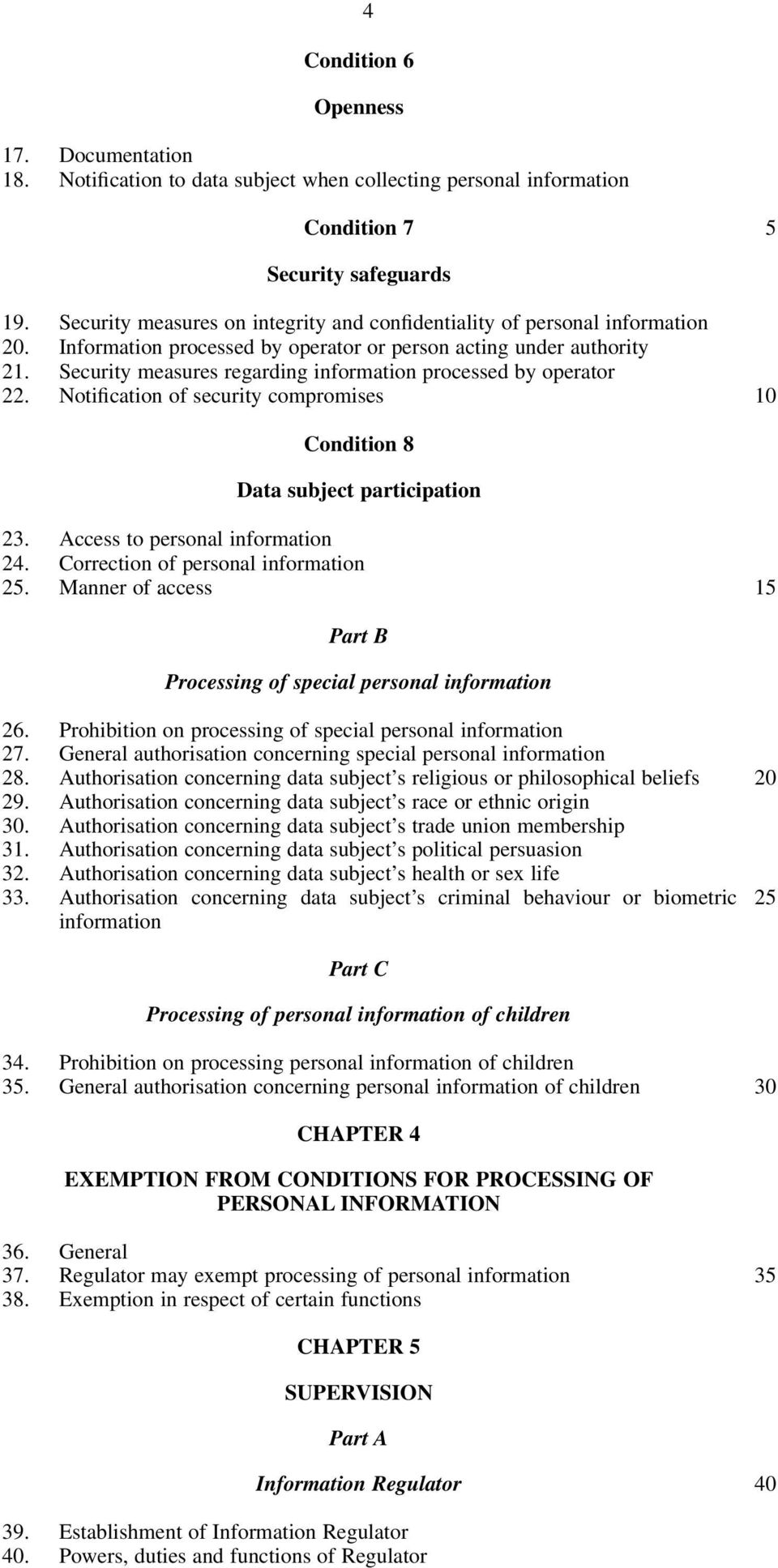
5 41. Appointment, term of office and removal of members of Regulator 42. Vacancies 43. Powers, duties and functions of Chairperson and other members 44. Regulator to have regard to certain matters 4. Conflict of interest 46. Remuneration, allowances, benefits and privileges of members 47. Staff 48. Powers, duties and functions of chief executive officer 49. Committees of Regulator 0. Establishment of Enforcement Committee 1. Meetings of Regulator 2. Funds 3. Protection of Regulator 4. Duty of confidentiality Part B Information Officer. Duties and responsibilities of Information Officer 6. Designation and delegation of deputy information officers CHAPTER 6 PRIOR AUTHORISATION Prior Authorisation 7. Processing subject to prior authorisation 8. Responsible party to notify Regulator if processing is subject to prior authorisation 9. Failure to notify processing subject to prior authorisation CHAPTER 7 CODES OF CONDUCT 60. Issuing of codes of conduct 61. Process for issuing codes of conduct 62. Notification, availability and commencement of code of conduct 63. Procedure for dealing with complaints 64. Amendment and revocation of codes of conduct 6. Guidelines about codes of conduct 66. Register of approved codes of conduct 67. Review of operation of approved code of conduct 68. Effect of failure to comply with code of conduct 3 CHAPTER 8 RIGHTS OF DATA SUBJECTS REGARDING DIRECT MARKETING BY MEANS OF UNSOLICITED ELECTRONIC COMMUNICATIONS, DIRECTORIES AND AUTOMATED DECISION MAKING 69. Direct marketing by means of unsolicited electronic communications 70. Directories 71. Automated decision making CHAPTER 9 TRANSBORDER INFORMATION FLOWS Transfers of personal information outside Republic

6 6 CHAPTER ENFORCEMENT 73. Interference with protection of personal information of data subject 74. Complaints 7. Mode of complaints to Regulator 76. Action on receipt of complaint 77. Regulator may decide to take no action on complaint 78. Referral of complaint to regulatory body 79. Pre-investigation proceedings of Regulator 80. Settlement of complaints 81. Investigation proceedings of Regulator 82. Issue of warrants 83. Requirements for issuing of warrant 84. Execution of warrants 8. Matters exempt from search and seizure 86. Communication between legal adviser and client exempt 87. Objection to search and seizure 88. Return of warrants 89. Assessment 90. Information notice 91. Parties to be informed of result of assessment 92. Matters referred to Enforcement Committee 93. Functions of Enforcement Committee 94. Parties to be informed of developments during and result of investigation 9. Enforcement notice 96. Cancellation of enforcement notice 97. Right of appeal 98. Consideration of appeal 99. Civil remedies CHAPTER 11 OFFENCES, PENALTIES AND ADMINISTRATIVE FINES 0. Obstruction of Regulator 1. Breach of confidentiality 2. Obstruction of execution of warrant 3. Failure to comply with enforcement or information notices 4. Offences by witnesses. Unlawful acts by responsible party in connection with account number 6. Unlawful acts by third parties in connection with account number 7. Penalties 8. Magistrate s Court jurisdiction to impose penalties 9. Administrative fines 3 CHAPTER 12 GENERAL PROVISIONS 1. Amendment of laws 111. Fees 112. Regulations 113. Procedure for making regulations 114. Transitional arrangements 1. Short title and commencement SCHEDULE 4 0 Laws amended by section 1

7 CHAPTER 1 DEFINITIONS AND PURPOSE 7 Definitions 1. In this Act, unless the context indicates otherwise biometrics means a technique of personal identification that is based on physical, physiological or behavioural characterisation including blood typing, fingerprinting, DNA analysis, retinal scanning and voice recognition; child means a natural person under the age of 18 years who is not legally competent, without the assistance of a competent person, to take any action or decision in respect of any matter concerning him- or herself; code of conduct means a code of conduct issued in terms of Chapter 7; consent means any voluntary, specific and informed expression of will in terms of which permission is given for the processing of personal information; Constitution means the Constitution of the Republic of South Africa, 1996; competent person means any person who is legally competent to consent to any action or decision being taken in respect of any matter concerning a child; data subject means the person to whom personal information relates; de-identify, in relation to personal information of a data subject, means to delete any information that (a) identifies the data subject; (b) can be used or manipulated by a reasonably foreseeable method to identify the (c) data subject; or can be linked by a reasonably foreseeable method to other information that identifies the data subject, and de-identified has a corresponding meaning; direct marketing means to approach a data subject, either in person or by mail or electronic communication, for the direct or indirect purpose of (a) promoting or offering to supply, in the ordinary course of business, any goods or services to the data subject; or (b) requesting the data subject to make a donation of any kind for any reason; electronic communication means any text, voice, sound or image message sent over an electronic communications network which is stored in the network or in the recipient s terminal equipment until it is collected by the recipient; enforcement notice means a notice issued in terms of section 9; filing system means any structured set of personal information, whether centralised, decentralised or dispersed on a functional or geographical basis, which is accessible according to specific criteria; information matching programme means the comparison, whether manually or by means of any electronic or other device, of any document that contains personal information about ten or more data subjects with one or more documents that contain personal information of ten or more data subjects, for the purpose of producing or verifying information that may be used for the purpose of taking any action in regard to an identifiable data subject; information officer of, or in relation to, a (a) public body means an information officer or deputy information officer as contemplated in terms of section 1 or 17; or (b) private body means the head of a private body as contemplated in section 1, of the Promotion of Access to Information Act; Minister means the Cabinet member responsible for the administration of justice; operator means a person who processes personal information for a responsible party in terms of a contract or mandate, without coming under the direct authority of that party; person means a natural person or a juristic person; personal information means information relating to an identifiable, living, natural person, and where it is applicable, an identifiable, existing juristic person, including, but not limited to (a) information relating to the race, gender, sex, pregnancy, marital status, national, ethnic or social origin, colour, sexual orientation, age, physical or 3 4 0

8 mental health, well-being, disability, religion, conscience, belief, culture, language and birth of the person; (b) information relating to the education or the medical, financial, criminal or employment history of the person; (c) any identifying number, symbol, address, physical address, telephone number, location information, online identifier or other particular assignment to the person; (d) the biometric information of the person; (e) the personal opinions, views or preferences of the person; (f) correspondence sent by the person that is implicitly or explicitly of a private or confidential nature or further correspondence that would reveal the contents of the original correspondence; (g) the views or opinions of another individual about the person; and (h) the name of the person if it appears with other personal information relating to the person or if the disclosure of the name itself would reveal information about the person; prescribed means prescribed by regulation or by a code of conduct; private body means (a) a natural person who carries or has carried on any trade, business or profession, but only in such capacity; (b) a partnership which carries or has carried on any trade, business or profession; or (c) any former or existing juristic person, but excludes a public body; processing means any operation or activity or any set of operations, whether or not by automatic means, concerning personal information, including (a) the collection, receipt, recording, organisation, collation, storage, updating or modification, retrieval, alteration, consultation or use; (b) dissemination by means of transmission, distribution or making available in any other form; or (c) merging, linking, as well as restriction, degradation, erasure or destruction of information; professional legal adviser means any legally qualified person, whether in private practice or not, who lawfully provides a client, at his or her or its request, with independent, confidential legal advice; Promotion of Access to Information Act means the Promotion of Access to Information Act, 00 (Act No. 2 of 00); public body means (a) any department of state or administration in the national or provincial sphere of government or any municipality in the local sphere of government; or (b) any other functionary or institution when (i) exercising a power or performing a duty in terms of the Constitution or (ii) a provincial constitution; or exercising a public power or performing a public function in terms of any legislation; public record means a record that is accessible in the public domain and which is in the possession of or under the control of a public body, whether or not it was created by that public body; record means any recorded information (a) (b) (c) (d) regardless of form or medium, including any of the following: (i) Writing on any material; (ii) information produced, recorded or stored by means of any tape-recorder, computer equipment, whether hardware or software or both, or other device, and any material subsequently derived from information so produced, recorded or stored; (iii) (iv) (v) label, marking or other writing that identifies or describes any thing of which it forms part, or to which it is attached by any means; book, map, plan, graph or drawing; photograph, film, negative, tape or other device in which one or more visual images are embodied so as to be capable, with or without the aid of some other equipment, of being reproduced; in the possession or under the control of a responsible party; whether or not it was created by a responsible party; and regardless of when it came into existence;

9 9 Regulator means the Information Regulator established in terms of section 39; re-identify, in relation to personal information of a data subject, means to resurrect any information that has been de-identified, that (a) identifies the data subject; (b) can be used or manipulated by a reasonably foreseeable method to identify the (c) data subject; or can be linked by a reasonably foreseeable method to other information that identifies the data subject, and re-identified has a corresponding meaning; Republic means the Republic of South Africa; responsible party means a public or private body or any other person which, alone or in conjunction with others, determines the purpose of and means for processing personal information; restriction means to withhold from circulation, use or publication any personal information that forms part of a filing system, but not to delete or destroy such information; special personal information means personal information as referred to in section 26; this Act includes any regulation or code of conduct made under this Act; and unique identifier means any identifier that is assigned to a data subject and is used by a responsible party for the purposes of the operations of that responsible party and that uniquely identifies that data subject in relation to that responsible party. Purpose of Act 2. The purpose of this Act is to (a) give effect to the constitutional right to privacy, by safeguarding personal information when processed by a responsible party, subject to justifiable limitations that are aimed at (i) balancing the right to privacy against other rights, particularly the right of access to information; and (ii) protecting important interests, including the free flow of information within the Republic and across international borders; (b) regulate the manner in which personal information may be processed, by establishing conditions, in harmony with international standards, that prescribe the minimum threshold requirements for the lawful processing of personal information; (c) provide persons with rights and remedies to protect their personal information from processing that is not in accordance with this Act; and (d) establish voluntary and compulsory measures, including the establishment of an Information Regulator, to ensure respect for and to promote, enforce and fulfil the rights protected by this Act. 3 Application and interpretation of Act CHAPTER 2 APPLICATION PROVISIONS 3. (1) This Act applies to the processing of personal information 4 (a) entered in a record by or for a responsible party by making use of automated or non-automated means: Provided that when the recorded personal information is processed by non-automated means, it forms part of a filing system or is intended to form part thereof; and (b) where the responsible party is 0 (i) domiciled in the Republic; or (ii) not domiciled in the Republic, but makes use of automated or non-automated means in the Republic, unless those means are used only to forward personal information through the Republic. (2) (a) This Act applies, subject to paragraph (b), to the exclusion of any provision of any other legislation that regulates the processing of personal information and that is materially inconsistent with an object, or a specific provision, of this Act.

10 (b) If any other legislation provides for conditions for the lawful processing of personal information that are more extensive than those set out in Chapter 3, the extensive conditions prevail. (3) This Act must be interpreted in a manner that (a) (b) gives effect to the purpose of the Act set out in section 2; and does not prevent any public or private body from exercising or performing its powers, duties and functions in terms of the law as far as such powers, duties and functions relate to the processing of personal information and such processing is in accordance with this Act or any other legislation, as referred to in subsection (2), that regulates the processing of personal information. (4) Automated means, for the purposes of this section, means any equipment capable of operating automatically in response to instructions given for the purpose of processing information. Lawful processing of personal information 4. (1) The conditions for the lawful processing of personal information by or for a responsible party are the following: (a) Accountability, as referred to in section 8; (b) Processing limitation, as referred to in sections 9 to 12; (c) Purpose specification, as referred to in sections 13 and 14; (d) Further processing limitation, as referred to in section ; (e) Information quality, as referred to in section 16; (f) Openness, as referred to in sections 17 and 18; (g) Security safeguards, as referred to in sections 19 to 22; and (h) Data subject participation, as referred to in sections 23 to. (2) The conditions, as referred to in subsection (1), are not applicable to the processing of personal information to the extent that such processing is (a) excluded, in terms of section 6 or 7, from the operation of this Act; or (b) exempted in terms of section 37 or 38, from one or more of the conditions concerned in relation to such processing. (3) The processing of the special personal information of a data subject is prohibited in terms of section 26, unless the (a) provisions of sections 27 to 33 are applicable; or (b) Regulator has granted an authorisation in terms of section 27(2), in which case, subject to section 37 or 38, the conditions for the lawful processing of personal information as referred to in Chapter 3 must be complied with. (4) The processing of the personal information of a child is prohibited in terms of section 34, unless the (a) provisions of section 3(1) are applicable; or (b) Regulator has granted an authorisation in terms of section 3(2), in which case, subject to section 37, the conditions for the lawful processing of personal information as referred to in Chapter 3 must be complied with. () The processing of the special personal information of a child is prohibited in terms of sections 26 and 34 unless the provisions of sections 27 and 3 are applicable in which case, subject to section 37, the conditions for the lawful processing of personal information as referred to in Chapter 3 must be complied with. (6) The conditions for the lawful processing of personal information by or for a responsible party for the purpose of direct marketing by any means are reflected in Chapter 3, read with section 69 insofar as that section relates to direct marketing by means of unsolicited electronic communications. (7) Sections 60 to 68 provide for the development, in appropriate circumstances, of codes of conduct for purposes of clarifying how the conditions referred to in subsection (1), subject to any exemptions which may have been granted in terms of section 37, are to be applied, or are to be complied with within a particular sector Rights of data subjects. A data subject has the right to have his, her or its personal information processed in accordance with the conditions for the lawful processing of personal information as referred to in Chapter 3, including the right (a) to be notified that

11 (b) (c) (d) (e) (f) (g) (h) (i) 11 (i) personal information about him, her or it is being collected as provided for in terms of section 18; or (ii) his, her or its personal information has been accessed or acquired by an unauthorised person as provided for in terms of section 22; to establish whether a responsible party holds personal information of that data subject and to request access to his, her or its personal information as provided for in terms of section 23; to request, where necessary, the correction, destruction or deletion of his, her or its personal information as provided for in terms of section 24; to object, on reasonable grounds relating to his, her or its particular situation to the processing of his, her or its personal information as provided for in terms of section 11(3)(a); to object to the processing of his, her or its personal information (i) at any time for purposes of direct marketing in terms of section 11(3)(b); or (ii) in terms of section 69(3)(c); not to have his, her or its personal information processed for purposes of direct marketing by means of unsolicited electronic communications except as referred to in section 69(1); not to be subject, under certain circumstances, to a decision which is based solely on the basis of the automated processing of his, her or its personal information intended to provide a profile of such person as provided for in terms of section 71; to submit a complaint to the Regulator regarding the alleged interference with the protection of the personal information of any data subject or to submit a complaint to the Regulator in respect of a determination of an adjudicator as provided for in terms of section 74; and to institute civil proceedings regarding the alleged interference with the protection of his, her or its personal information as provided for in section 99. Exclusions 6. (1) This Act does not apply to the processing of personal information (a) in the course of a purely personal or household activity; (b) that has been de-identified to the extent that it cannot be re-identified again; (c) by or on behalf of a public body (i) which involves national security, including activities that are aimed at assisting in the identification of the financing of terrorist and related activities, defence or public safety; or (ii) the purpose of which is the prevention, detection, including assistance in the identification of the proceeds of unlawful activities and the combating of money laundering activities, investigation or proof of offences, the prosecution of offenders or the execution of sentences or security measures, to the extent that adequate safeguards have been established in legislation for the protection of such personal information; (d) by the Cabinet and its committees or the Executive Council of a province; or (e) relating to the judicial functions of a court referred to in section 166 of the Constitution. (2) Terrorist and related activities, for purposes of subsection (1)(c), means those activities referred to in section 4 of the Protection of Constitutional Democracy against Terrorist and Related Activities Act, 04 (Act No. 33 of 04) Exclusion for journalistic, literary or artistic purposes 7. (1) This Act does not apply to the processing of personal information solely for the purpose of journalistic, literary or artistic expression to the extent that such an exclusion is necessary to reconcile, as a matter of public interest, the right to privacy with the right to freedom of expression. (2) Where a responsible party who processes personal information for exclusively journalistic purposes is, by virtue of office, employment or profession, subject to a code of ethics that provides adequate safeguards for the protection of personal information, such code will apply to the processing concerned to the exclusion of this Act and any

12 12 alleged interference with the protection of the personal information of a data subject that may arise as a result of such processing must be adjudicated as provided for in terms of that code. (3) In the event that a dispute may arise in respect of whether adequate safeguards have been provided for in a code as required in terms of subsection (2) or not, regard may be had to (a) the special importance of the public interest in freedom of expression; (b) domestic and international standards balancing the (i) public interest in allowing for the free flow of information to the public through the media in recognition of the right of the public to be informed; and (ii) public interest in safeguarding the protection of personal information of data subjects; (c) the need to secure the integrity of personal information; (d) domestic and international standards of professional integrity for journalists; and (e) the nature and ambit of self-regulatory forms of supervision provided by the profession. CHAPTER 3 CONDITIONS FOR LAWFUL PROCESSING OF PERSONAL INFORMATION Part A Processing of personal information in general Condition 1 Accountability Responsible party to ensure conditions for lawful processing 8. The responsible party must ensure that the conditions set out in this Chapter, and all the measures that give effect to such conditions, are complied with at the time of the determination of the purpose and means of the processing and during the processing itself. Condition 2 Processing limitation Lawfulness of processing 9. Personal information must be processed (a) lawfully; and (b) in a reasonable manner that does not infringe the privacy of the data subject. 3 Minimality. Personal information may only be processed if, given the purpose for which it is processed, it is adequate, relevant and not excessive. Consent, justification and objection 11. (1) Personal information may only be processed if (a) the data subject or a competent person where the data subject is a child consents to the processing; (b) processing is necessary to carry out actions for the conclusion or performance of a contract to which the data subject is party; (c) processing complies with an obligation imposed by law on the responsible party; (d) processing protects a legitimate interest of the data subject; 4

13 13 (e) processing is necessary for the proper performance of a public law duty by a public body; or (f) processing is necessary for pursuing the legitimate interests of the responsible party or of a third party to whom the information is supplied. (2) (a) The responsible party bears the burden of proof for the data subject s or competent person s consent as referred to in subsection (1)(a). (b) The data subject or competent person may withdraw his, her or its consent, as referred to in subsection (1)(a), at any time: Provided that the lawfulness of the processing of personal information before such withdrawal or the processing of personal information in terms of subsection (1)(b) to (f) will not be affected. (3) A data subject may object, at any time, to the processing of personal information (a) in terms of subsection (1)(d) to (f), in the prescribed manner, on reasonable grounds relating to his, her or its particular situation, unless legislation provides for such processing; or (b) for purposes of direct marketing other than direct marketing by means of unsolicited electronic communications as referred to in section 69. (4) If a data subject has objected to the processing of personal information in terms of subsection (3), the responsible party may no longer process the personal information. Collection directly from data subject 12. (1) Personal information must be collected directly from the data subject, except as otherwise provided for in subsection (2). (2) It is not necessary to comply with subsection (1) if (a) the information is contained in or derived from a public record or has deliberately been made public by the data subject; (b) the data subject or a competent person where the data subject is a child has consented to the collection of the information from another source; (c) collection of the information from another source would not prejudice a legitimate interest of the data subject; (d) collection of the information from another source is necessary (i) to avoid prejudice to the maintenance of the law by any public body, including the prevention, detection, investigation, prosecution and punishment of offences; (ii) to comply with an obligation imposed by law or to enforce legislation concerning the collection of revenue as defined in section 1 of the South African Revenue Service Act, 1997 (Act No. 34 of 1997); (iii) for the conduct of proceedings in any court or tribunal that have commenced or are reasonably contemplated; (iv) in the interests of national security; or (v) to maintain the legitimate interests of the responsible party or of a third party to whom the information is supplied; (e) (f) compliance would prejudice a lawful purpose of the collection; or compliance is not reasonably practicable in the circumstances of the particular case. 3 Condition 3 Purpose specification 4 Collection for specific purpose 13. (1) Personal information must be collected for a specific, explicitly defined and lawful purpose related to a function or activity of the responsible party. (2) Steps must be taken in accordance with section 18(1) to ensure that the data subject is aware of the purpose of the collection of the information unless the provisions of section 18(4) are applicable. 0 Retention and restriction of records 14. (1) Subject to subsections (2) and (3), records of personal information must not be retained any longer than is necessary for achieving the purpose for which the information was collected or subsequently processed, unless

14 14 (a) retention of the record is required or authorised by law; (b) the responsible party reasonably requires the record for lawful purposes related to its functions or activities; (c) retention of the record is required by a contract between the parties thereto; or (d) the data subject or a competent person where the data subject is a child has consented to the retention of the record. (2) Records of personal information may be retained for periods in excess of those contemplated in subsection (1) for historical, statistical or research purposes if the responsible party has established appropriate safeguards against the records being used for any other purposes. (3) A responsible party that has used a record of personal information of a data subject to make a decision about the data subject, must (a) retain the record for such period as may be required or prescribed by law or a (b) code of conduct; or if there is no law or code of conduct prescribing a retention period, retain the record for a period which will afford the data subject a reasonable opportunity, taking all considerations relating to the use of the personal information into account, to request access to the record. (4) A responsible party must destroy or delete a record of personal information or de-identify it as soon as reasonably practicable after the responsible party is no longer authorised to retain the record in terms of subsection (1) or (2). () The destruction or deletion of a record of personal information in terms of subsection (4) must be done in a manner that prevents its reconstruction in an intelligible form. (6) The responsible party must restrict processing of personal information if (a) (b) (c) (d) its accuracy is contested by the data subject, for a period enabling the responsible party to verify the accuracy of the information; the responsible party no longer needs the personal information for achieving the purpose for which the information was collected or subsequently processed, but it has to be maintained for purposes of proof; the processing is unlawful and the data subject opposes its destruction or deletion and requests the restriction of its use instead; or the data subject requests to transmit the personal data into another automated processing system. (7) Personal information referred to in subsection (6) may, with the exception of storage, only be processed for purposes of proof, or with the data subject s consent, or with the consent of a competent person in respect of a child, or for the protection of the rights of another natural or legal person or if such processing is in the public interest. (8) Where processing of personal information is restricted pursuant to subsection (6), the responsible party must inform the data subject before lifting the restriction on processing. 3 Condition 4 Further processing limitation Further processing to be compatible with purpose of collection. (1) Further processing of personal information must be in accordance or compatible with the purpose for which it was collected in terms of section 13. (2) To assess whether further processing is compatible with the purpose of collection, the responsible party must take account of (a) the relationship between the purpose of the intended further processing and the purpose for which the information has been collected; (b) the nature of the information concerned; (c) the consequences of the intended further processing for the data subject; (d) the manner in which the information has been collected; and (e) any contractual rights and obligations between the parties. (3) The further processing of personal information is not incompatible with the purpose of collection if (a) the data subject or a competent person where the data subject is a child has consented to the further processing of the information; 4 0

15 (b) the information is available in or derived from a public record or has deliberately been made public by the data subject; (c) further processing is necessary (i) to avoid prejudice to the maintenance of the law by any public body including the prevention, detection, investigation, prosecution and punishment of offences; (ii) to comply with an obligation imposed by law or to enforce legislation concerning the collection of revenue as defined in section 1 of the South African Revenue Service Act, 1997 (Act No. 34 of 1997); (iii) for the conduct of proceedings in any court or tribunal that have commenced or are reasonably contemplated; or (iv) in the interests of national security; (d) the further processing of the information is necessary to prevent or mitigate a serious and imminent threat to (i) public health or public safety; or (ii) the life or health of the data subject or another individual; (e) the information is used for historical, statistical or research purposes and the responsible party ensures that the further processing is carried out solely for such purposes and will not be published in an identifiable form; or (f) the further processing of the information is in accordance with an exemption granted under section 37. Condition Information quality Quality of information 16. (1) A responsible party must take reasonably practicable steps to ensure that the personal information is complete, accurate, not misleading and updated where necessary. (2) In taking the steps referred to in subsection (1), the responsible party must have regard to the purpose for which personal information is collected or further processed. Condition 6 Openness Documentation 17. A responsible party must maintain the documentation of all processing operations under its responsibility as referred to in section 14 or 1 of the Promotion of Access to Information Act. 3 Notification to data subject when collecting personal information 18. (1) If personal information is collected, the responsible party must take reasonably practicable steps to ensure that the data subject is aware of (a) the information being collected and where the information is not collected from the data subject, the source from which it is collected; (b) the name and address of the responsible party; (c) the purpose for which the information is being collected; (d) whether or not the supply of the information by that data subject is voluntary or mandatory; (e) the consequences of failure to provide the information; 4 (f) any particular law authorising or requiring the collection of the information; (g) the fact that, where applicable, the responsible party intends to transfer the information to a third country or international organisation and the level of protection afforded to the information by that third country or international organisation; 0 (h) any further information such as the (i) recipient or category of recipients of the information; (ii) nature or category of the information;

16 16 (iii) existence of the right of access to and the right to rectify the information collected; (iv) existence of the right to object to the processing of personal information as referred to in section 11(3); and (v) right to lodge a complaint to the Information Regulator and the contact details of the Information Regulator, which is necessary, having regard to the specific circumstances in which the information is or is not to be processed, to enable processing in respect of the data subject to be reasonable. (2) The steps referred to in subsection (1) must be taken (a) if the personal information is collected directly from the data subject, before the information is collected, unless the data subject is already aware of the information referred to in that subsection; or (b) in any other case, before the information is collected or as soon as reasonably practicable after it has been collected. (3) A responsible party that has previously taken the steps referred to in subsection (1) complies with subsection (1) in relation to the subsequent collection from the data subject of the same information or information of the same kind if the purpose of collection of the information remains the same. (4) It is not necessary for a responsible party to comply with subsection (1) if (a) (b) (c) the data subject or a competent person where the data subject is a child has provided consent for the non-compliance; non-compliance would not prejudice the legitimate interests of the data subject as set out in terms of this Act; non-compliance is necessary (i) to avoid prejudice to the maintenance of the law by any public body, including the prevention, detection, investigation, prosecution and punishment of offences; (ii) to comply with an obligation imposed by law or to enforce legislation concerning the collection of revenue as defined in section 1 of the South African Revenue Service Act, 1997 (Act No. 34 of 1997); (iii) for the conduct of proceedings in any court or tribunal that have been commenced or are reasonably contemplated; or (iv) in the interests of national security; (d) compliance would prejudice a lawful purpose of the collection; (e) compliance is not reasonably practicable in the circumstances of the particular case; or (f) the information will (i) not be used in a form in which the data subject may be identified; or (ii) be used for historical, statistical or research purposes. 3 Condition 7 Security Safeguards Security measures on integrity and confidentiality of personal information 19. (1) A responsible party must secure the integrity and confidentiality of personal information in its possession or under its control by taking appropriate, reasonable technical and organisational measures to prevent (a) loss of, damage to or unauthorised destruction of personal information; and (b) unlawful access to or processing of personal information. (2) In order to give effect to subsection (1), the responsible party must take reasonable measures to (a) identify all reasonably foreseeable internal and external risks to personal information in its possession or under its control; (b) establish and maintain appropriate safeguards against the risks identified; (c) (d) regularly verify that the safeguards are effectively implemented; and ensure that the safeguards are continually updated in response to new risks or deficiencies in previously implemented safeguards. (3) The responsible party must have due regard to generally accepted information security practices and procedures which may apply to it generally or be required in terms of specific industry or professional rules and regulations. 4 0

17 Information processed by operator or person acting under authority 17. An operator or anyone processing personal information on behalf of a responsible party or an operator, must (a) process such information only with the knowledge or authorisation of the responsible party; and (b) treat personal information which comes to their knowledge as confidential and must not disclose it, unless required by law or in the course of the proper performance of their duties. Security measures regarding information processed by operator 21. (1) A responsible party must, in terms of a written contract between the responsible party and the operator, ensure that the operator which processes personal information for the responsible party establishes and maintains the security measures referred to in section 19. (2) The operator must notify the responsible party immediately where there are reasonable grounds to believe that the personal information of a data subject has been accessed or acquired by any unauthorised person. Notification of security compromises 22. (1) Where there are reasonable grounds to believe that the personal information of a data subject has been accessed or acquired by any unauthorised person, the responsible party must notify (a) (b) the Regulator; and subject to subsection (3), the data subject, unless the identity of such data subject cannot be established. (2) The notification referred to in subsection (1) must be made as soon as reasonably possible after the discovery of the compromise, taking into account the legitimate needs of law enforcement or any measures reasonably necessary to determine the scope of the compromise and to restore the integrity of the responsible party s information system. (3) The responsible party may only delay notification of the data subject if a public body responsible for the prevention, detection or investigation of offences or the Regulator determines that notification will impede a criminal investigation by the public body concerned. (4) The notification to a data subject referred to in subsection (1) must be in writing and communicated to the data subject in at least one of the following ways: (a) Mailed to the data subject s last known physical or postal address; (b) sent by to the data subject s last known address; (c) placed in a prominent position on the website of the responsible party; (d) published in the news media; or (e) as may be directed by the Regulator. () The notification referred to in subsection (1) must provide sufficient information to allow the data subject to take protective measures against the potential consequences of the compromise, including (a) (b) (c) (d) a description of the possible consequences of the security compromise; a description of the measures that the responsible party intends to take or has taken to address the security compromise; a recommendation with regard to the measures to be taken by the data subject to mitigate the possible adverse effects of the security compromise; and if known to the responsible party, the identity of the unauthorised person who may have accessed or acquired the personal information. (6) The Regulator may direct a responsible party to publicise, in any manner specified, the fact of any compromise to the integrity or confidentiality of personal information, if the Regulator has reasonable grounds to believe that such publicity would protect a data subject who may be affected by the compromise

18 18 Condition 8 Data subject participation Access to personal information 23. (1) A data subject, having provided adequate proof of identity, has the right to (a) request a responsible party to confirm, free of charge, whether or not the responsible party holds personal information about the data subject; and (b) request from a responsible party the record or a description of the personal information about the data subject held by the responsible party, including information about the identity of all third parties, or categories of third parties, who have, or have had, access to the information (i) within a reasonable time; (ii) at a prescribed fee, if any; (iii) in a reasonable manner and format; and (iv) in a form that is generally understandable. (2) If, in response to a request in terms of subsection (1), personal information is communicated to a data subject, the data subject must be advised of the right in terms of section 24 to request the correction of information. (3) If a data subject is required by a responsible party to pay a fee for services provided to the data subject in terms of subsection (1)(b) to enable the responsible party to respond to a request, the responsible party (a) must give the applicant a written estimate of the fee before providing the services; and (b) may require the applicant to pay a deposit for all or part of the fee. (4) (a) A responsible party may or must refuse, as the case may be, to disclose any information requested in terms of subsection (1) to which the grounds for refusal of access to records set out in the applicable sections of Chapter 4 of Part 2 and Chapter 4 of Part 3 of the Promotion of Access to Information Act apply. (b) The provisions of sections and 61 of the Promotion of Access to Information Act are applicable in respect of access to health or other records. () If a request for access to personal information is made to a responsible party and part of that information may or must be refused in terms of subsection (4)(a), every other part must be disclosed. Correction of personal information 24. (1) A data subject may, in the prescribed manner, request a responsible party to (a) correct or delete personal information about the data subject in its possession or under its control that is inaccurate, irrelevant, excessive, out of date, incomplete, misleading or obtained unlawfully; or 3 (b) destroy or delete a record of personal information about the data subject that the responsible party is no longer authorised to retain in terms of section 14. (2) On receipt of a request in terms of subsection (1) a responsible party must, as soon as reasonably practicable (a) correct the information; (b) destroy or delete the information; (c) provide the data subject, to his or her satisfaction, with credible evidence in support of the information; or 4 (d) where agreement cannot be reached between the responsible party and the data subject, and if the data subject so requests, take such steps as are reasonable in the circumstances, to attach to the information in such a manner that it will always be read with the information, an indication that a correction of the information has been requested but has not been made. 0 (3) If the responsible party has taken steps under subsection (2) that result in a change to the information and the changed information has an impact on decisions that have been or will be taken in respect of the data subject in question, the responsible party must, if reasonably practicable, inform each person or body or responsible party to whom the personal information has been disclosed of those steps. (4) The responsible party must notify a data subject, who has made a request in terms of subsection (1), of the action taken as a result of the request.

19 19 Manner of access. The provisions of sections 18 and 3 of the Promotion of Access to Information Act apply to requests made in terms of section 23 of this Act. Part B Processing of special personal information Prohibition on processing of special personal information 26. A responsible party may, subject to section 27, not process personal information concerning (a) the religious or philosophical beliefs, race or ethnic origin, trade union membership, political persuasion, health or sex life or biometric information of a data subject; or (b) the criminal behaviour of a data subject to the extent that such information relates to (i) the alleged commission by a data subject of any offence; or (ii) any proceedings in respect of any offence allegedly committed by a data subject or the disposal of such proceedings. General authorisation concerning special personal information 27. (1) The prohibition on processing personal information, as referred to in section 26, does not apply if the (a) processing is carried out with the consent of a data subject referred to in section 26; (b) processing is necessary for the establishment, exercise or defence of a right or obligation in law; (c) processing is necessary to comply with an obligation of international public law; (d) processing is for historical, statistical or research purposes to the extent that (i) the purpose serves a public interest and the processing is necessary for the purpose concerned; or (ii) it appears to be impossible or would involve a disproportionate effort to ask for consent, and sufficient guarantees are provided for to ensure that the processing does not adversely affect the individual privacy of the data subject to a disproportionate extent; (e) information has deliberately been made public by the data subject; or (f) provisions of sections 28 to 33 are, as the case may be, complied with. (2) The Regulator may, subject to subsection (3), upon application by a responsible party and by notice in the Gazette, authorise a responsible party to process special personal information if such processing is in the public interest and appropriate safeguards have been put in place to protect the personal information of the data subject. (3) The Regulator may impose reasonable conditions in respect of any authorisation granted under subsection (2). 3 Authorisation concerning data subject s religious or philosophical beliefs 28. (1) The prohibition on processing personal information concerning a data subject s religious or philosophical beliefs, as referred to in section 26, does not apply if the processing is carried out by 4 (a) spiritual or religious organisations, or independent sections of those organisations if (i) the information concerns data subjects belonging to those organisations; or (ii) it is necessary to achieve their aims and principles; 0 (b) institutions founded on religious or philosophical principles with respect to their members or employees or other persons belonging to the institution, if it is necessary to achieve their aims and principles; or

20 (c) other institutions: Provided that the processing is necessary to protect the spiritual welfare of the data subjects, unless they have indicated that they object to the processing. (2) In the cases referred to in subsection (1)(a), the prohibition does not apply to processing of personal information concerning the religion or philosophy of life of family members of the data subjects, if (a) the association concerned maintains regular contact with those family members in connection with its aims; and (b) the family members have not objected in writing to the processing. (3) In the cases referred to in subsections (1) and (2), personal information concerning a data subject s religious or philosophical beliefs may not be supplied to third parties without the consent of the data subject. Authorisation concerning data subject s race or ethnic origin 29. The prohibition on processing personal information concerning a data subject s race or ethnic origin, as referred to in section 26, does not apply if the processing is carried out to (a) (b) identify data subjects and only when this is essential for that purpose; and comply with laws and other measures designed to protect or advance persons, or categories of persons, disadvantaged by unfair discrimination. Authorisation concerning data subject s trade union membership. (1) The prohibition on processing personal information concerning a data subject s trade union membership, as referred to in section 26, does not apply to the processing by the trade union to which the data subject belongs or the trade union federation to which that trade union belongs, if such processing is necessary to achieve the aims of the trade union or trade union federation. (2) In the cases referred to under subsection (1), no personal information may be supplied to third parties without the consent of the data subject. Authorisation concerning data subject s political persuasion 31. (1) The prohibition on processing personal information concerning a data subject s political persuasion, as referred to in section 26, does not apply to processing by or for an institution, founded on political principles, of the personal information of (a) its members or employees or other persons belonging to the institution, if such processing is necessary to achieve the aims or principles of the institution; or (b) a data subject if such processing is necessary for the purposes of (i) (ii) forming a political party; participating in the activities of, or engaging in the recruitment of members for or canvassing supporters or voters for, a political party with the view to (aa) an election of the National Assembly or the provincial legislature as regulated in terms of the Electoral Act, 1998 (Act No. 73 of 1998); (bb) municipal elections as regulated in terms of the Local Government: Municipal Electoral Act, 00 (Act No. 27 of 00); or (cc) a referendum as regulated in terms of the Referendums Act, 1983 (Act No. 8 of 1983); or (iii) campaigning for a political party or cause. (2) In the cases referred to under subsection (1), no personal information may be supplied to third parties without the consent of the data subject. 3 4 Authorisation concerning data subject s health or sex life 32. (1) The prohibition on processing personal information concerning a data subject s health or sex life, as referred to in section 26, does not apply to the processing by (a) medical professionals, healthcare institutions or facilities or social services, if such processing is necessary for the proper treatment and care of the data subject, or for the administration of the institution or professional practice concerned; 0

21 21 (b) insurance companies, medical schemes, medical scheme administrators and managed healthcare organisations, if such processing is necessary for (i) assessing the risk to be insured by the insurance company or covered by the medical scheme and the data subject has not objected to the processing; (ii) the performance of an insurance or medical scheme agreement; or (iii) the enforcement of any contractual rights and obligations; (c) schools, if such processing is necessary to provide special support for pupils or making special arrangements in connection with their health or sex life; (d) any public or private body managing the care of a child if such processing is necessary for the performance of their lawful duties; (e) any public body, if such processing is necessary in connection with the implementation of prison sentences or detention measures; or (f) administrative bodies, pension funds, employers or institutions working for them, if such processing is necessary for (i) the implementation of the provisions of laws, pension regulations or collective agreements which create rights dependent on the health or sex life of the data subject; or (ii) the reintegration of or support for workers or persons entitled to benefit in connection with sickness or work incapacity. (2) In the cases referred to under subsection (1), the information may only be processed by responsible parties subject to an obligation of confidentiality by virtue of office, employment, profession or legal provision, or established by a written agreement between the responsible party and the data subject. (3) A responsible party that is permitted to process information concerning a data subject s health or sex life in terms of this section and is not subject to an obligation of confidentiality by virtue of office, profession or legal provision, must treat the information as confidential, unless the responsible party is required by law or in connection with their duties to communicate the information to other parties who are authorised to process such information in accordance with subsection (1). (4) The prohibition on processing any of the categories of personal information referred to in section 26, does not apply if it is necessary to supplement the processing of personal information concerning a data subject s health, as referred to under subsection (1)(a), with a view to the proper treatment or care of the data subject. () Personal information concerning inherited characteristics may not be processed in respect of a data subject from whom the information concerned has been obtained, unless (a) a serious medical interest prevails; or (b) the processing is necessary for historical, statistical or research activity. (6) More detailed rules may be prescribed concerning the application of subsection (1)(b) and (f). 3 Authorisation concerning data subject s criminal behaviour or biometric information 33. (1) The prohibition on processing personal information concerning a data subject s criminal behaviour or biometric information, as referred to in section 26, does not apply if the processing is carried out by bodies charged by law with applying criminal law or by responsible parties who have obtained that information in accordance with the law. (2) The processing of information concerning personnel in the service of the responsible party must take place in accordance with the rules established in compliance with labour legislation. (3) The prohibition on processing any of the categories of personal information referred to in section 26 does not apply if such processing is necessary to supplement the processing of information on criminal behaviour or biometric information permitted by this section. 4 0
22 22 Part C Processing of personal information of children Prohibition on processing personal information of children 34. A responsible party may, subject to section 3, not process personal information concerning a child. General authorisation concerning personal information of children 3. (1) The prohibition on processing personal information of children, as referred to in section 34, does not apply if the processing is (a) carried out with the prior consent of a competent person; (b) necessary for the establishment, exercise or defence of a right or obligation in law; (c) necessary to comply with an obligation of international public law; (d) for historical, statistical or research purposes to the extent that (i) the purpose serves a public interest and the processing is necessary for the purpose concerned; or (ii) it appears to be impossible or would involve a disproportionate effort to ask for consent, and sufficient guarantees are provided for to ensure that the processing does not adversely affect the individual privacy of the child to a disproportionate (e) extent; or of personal information which has deliberately been made public by the child with the consent of a competent person. (2) The Regulator may, notwithstanding the prohibition referred to in section 34, but subject to subsection (3), upon application by a responsible party and by notice in the Gazette, authorise a responsible party to process the personal information of children if the processing is in the public interest and appropriate safeguards have been put in place to protect the personal information of the child. (3) The Regulator may impose reasonable conditions in respect of any authorisation granted under subsection (2), including conditions with regard to how a responsible party must (a) upon request of a competent person provide a reasonable means for that person to (i) review the personal information processed; and (ii) refuse to permit its further processing; (b) provide notice (i) regarding the nature of the personal information of children that is processed; (ii) how such information is processed; and (iii) regarding any further processing practices; (c) refrain from any action that is intended to encourage or persuade a child to disclose more personal information about him- or herself than is reasonably necessary given the purpose for which it is intended; and (d) establish and maintain reasonable procedures to protect the integrity and confidentiality of the personal information collected from children. CHAPTER EXEMPTION FROM CONDITIONS FOR PROCESSING OF PERSONAL INFORMATION General 36. Processing of personal information is not in breach of a condition for the processing of such information if the (a) Regulator grants an exemption in terms of section 37; or (b) processing is in accordance with section 38. 0
23 Regulator may exempt processing of personal information (1) The Regulator may, by notice in the Gazette, grant an exemption to a responsible party to process personal information, even if that processing is in breach of a condition for the processing of such information, or any measure that gives effect to such condition, if the Regulator is satisfied that, in the circumstances of the case (a) the public interest in the processing outweighs, to a substantial degree, any interference with the privacy of the data subject that could result from such processing; or (b) the processing involves a clear benefit to the data subject or a third party that outweighs, to a substantial degree, any interference with the privacy of the data subject or third party that could result from such processing. (2) The public interest referred to in subsection (1) includes (a) the interests of national security; (b) the prevention, detection and prosecution of offences; (c) important economic and financial interests of a public body; (d) fostering compliance with legal provisions established in the interests referred to under paragraphs (b) and (c); (e) historical, statistical or research activity; or (f) the special importance of the interest in freedom of expression. (3) The Regulator may impose reasonable conditions in respect of any exemption granted under subsection (1). Exemption in respect of certain functions 38. (1) Personal information processed for the purpose of discharging a relevant function is exempt from sections 11(3) and (4), 12, and 18 in any case to the extent to which the application of those provisions to the personal information would be likely to prejudice the proper discharge of that function. (2) Relevant function for purposes of subsection (1), means any function (a) of a public body; or (b) conferred on any person in terms of the law, which is performed with the view to protecting members of the public against (i) financial loss due to dishonesty, malpractice or other seriously improper conduct by, or the unfitness or incompetence of, persons concerned in the provision of banking, insurance, investment or other financial services or in the management of bodies corporate; or (ii) dishonesty, malpractice or other seriously improper conduct by, or the unfitness or incompetence of, persons authorised to carry on any profession or other activity. 3 CHAPTER SUPERVISION Part A Establishment of Information Regulator Information Regulator 39. There is hereby established a juristic person to be known as the Information Regulator, which (a) has jurisdiction throughout the Republic; 4 (b) is independent and is subject only to the Constitution and to the law and must be impartial and perform its functions and exercise its powers without fear, favour or prejudice; (c) must exercise its powers and perform its functions in accordance with this Act and the Promotion of Access to Information Act; and 0 (d) is accountable to the National Assembly.
24 Powers, duties and functions of Regulator 24. (1) The powers, duties and functions of the Regulator in terms of this Act are (a) to provide education by (i) promoting an understanding and acceptance of the conditions for the lawful processing of personal information and of the objects of those conditions; (ii) undertaking educational programmes, for the purpose of promoting the protection of personal information, on the Regulator s own behalf or in co-operation with other persons or authorities acting on behalf of the Regulator; (iii) making public statements in relation to any matter affecting the protection of the personal information of a data subject or of any class of data subjects; (iv) giving advice to data subjects in the exercise of their rights; and (v) providing advice, upon request or on its own initiative, to a Minister or a public or private body on their obligations under the provisions, and generally on any matter relevant to the operation, of this Act; (b) to monitor and enforce compliance by (i) public and private bodies with the provisions of this Act; (ii) undertaking research into, and monitoring developments in, information processing and computer technology to ensure that any adverse effects of such developments on the protection of the personal information of data subjects are minimised, and reporting to the Minister the results of such research and monitoring; (iii) examining any proposed legislation, including subordinate legislation, or proposed policy of the Government that the Regulator considers may affect the protection of the personal information of data subjects, and reporting to the Minister the results of that examination; (iv) reporting upon request or on its own accord, to Parliament from time to time on any policy matter affecting the protection of the personal information of a data subject, including the need for, or desirability of, taking legislative, administrative, or other action to give protection or better protection to the personal information of a data subject; (v) submitting a report to Parliament, within five months of the end of its financial year, on all its activities in terms of this Act during that financial year; 3 (vi) conducting an assessment, on its own initiative or when requested to do so, of a public or private body, in respect of the processing of personal information by that body for the purpose of ascertaining whether or not the information is processed according to the conditions for the lawful processing of personal information; (vii) monitoring the use of unique identifiers of data subjects, and reporting to Parliament from time to time on the results of that monitoring, including any recommendation relating to the need of, or desirability of taking, legislative, administrative, or other action to give protection, or better protection, to the personal information of a data subject; 4 (viii) maintaining, publishing and making available and providing copies of such registers as are prescribed in this Act; and (ix) examining any proposed legislation that makes provision for the (aa) collection of personal information by any public or private body; or (bb) disclosure of personal information by one public or private body to any other public or private body, or both, to have particular regard, in the course of that examination, to the matters set out in subsection (3), in any case where the Regulator considers that the information might be used for the purposes of an information matching programme, and reporting to the Minister and Parliament the results of that examination; 0 (c) to consult with interested parties by 60 (i) receiving and inviting representations from members of the public on any matter affecting the personal information of a data subject;
25 (ii) co-operating on a national and international basis with other persons and bodies concerned with the protection of personal information; and (iii) acting as mediator between opposing parties on any matter that concerns the need for, or the desirability of, action by a responsible party in the interests of the protection of the personal information of a data subject; (d) to handle complaints by (i) receiving and investigating complaints about alleged violations of the protection of personal information of data subjects and reporting to complainants in respect of such complaints; (ii) gathering such information as in the Regulator s opinion will assist the Regulator in discharging the duties and carrying out the Regulator s functions under this Act; (iii) attempting to resolve complaints by means of dispute resolution mechanisms such as mediation and conciliation; and (iv) serving any notices in terms of this Act and further promoting the resolution of disputes in accordance with the prescripts of this Act; (e) to conduct research and to report to Parliament (i) from time to time on the desirability of the acceptance, by South Africa, of any international instrument relating to the protection of the personal information of a data subject; and (ii) on any other matter, including necessary legislative amendments, relating to protection of personal information that, in the Regulator s opinion, should be drawn to Parliament s attention; (f) in respect of codes of conduct to (i) issue, from time to time, codes of conduct, amend codes and to revoke codes of conduct; (ii) make guidelines to assist bodies to develop codes of conduct or to apply codes of conduct; and (iii) consider afresh, upon application, determinations by adjudicators under approved codes of conduct; (g) to facilitate cross-border cooperation in the enforcement of privacy laws by participating in any initiative that is aimed at such cooperation; and (h) in general to (i) do anything incidental or conducive to the performance of any of the preceding functions; (ii) exercise and perform such other functions, powers, and duties as are conferred or imposed on the Regulator by or under this Act or any other legislation; (iii) require the responsible party to disclose to any person affected by a compromise to the integrity or confidentiality of personal information, such compromise in accordance with section 22; and (iv) exercise the powers conferred upon the Regulator by this Act in matters relating to the access of information as provided by the Promotion of Access to Information Act. (2) The Regulator may, from time to time, in the public interest or in the legitimate interests of any person or body of persons, publish reports relating generally to the exercise of the Regulator s functions under this Act or to any case or cases investigated by the Regulator, whether or not the matters to be dealt with in any such report have been the subject of a report to the Minister. (3) The provisions of sections 3 and 4 of the Commissions Act, 1947 (Act No. 8 of 1947), will apply, with the necessary changes, to the Regulator. (4) The powers and duties of the Regulator in terms of the Promotion of Access to Information Act are set out in Parts 4 and of that Act Appointment, term of office and removal of members of Regulator 41. (1) (a) The Regulator consists of the following members: (i) A Chairperson; and (ii) four other persons, as ordinary members of the Regulator. (b) Members of the Regulator must be appropriately qualified, fit and proper persons (i) at least one of whom must be appointed on account of experience as a practising advocate or attorney or a professor of law at a university; and 60
26 26 (ii) the remainder of whom must be appointed on account of any other qualifications, expertise and experience relating to the objects of the Regulator. (c) The Chairperson of the Regulator must be appointed in a full-time capacity and may, subject to subsection (4), not perform or undertake to perform any other remunerative work during the period in which he or she holds office as Chairperson. (d) The ordinary members of the Regulator must be appointed as follows: (i) Two ordinary members in a full-time capacity; and (ii) two ordinary members in a full-time or part-time capacity. (e) The members referred to in paragraph (d) who are appointed in a full-time capacity, may, subject to subsection (4), not perform or undertake to perform any other remunerative work during the period in which they hold office. (f) The Chairperson must direct the work of the Regulator and the staff of the Regulator. (g) A person may not be appointed as a member of the Regulator if he or she (i) is not a citizen of the Republic; (ii) is a public servant; (iii) is a member of Parliament, any provincial legislature or any municipal council; (iv) is an office-bearer or employee of any political party; (v) is an unrehabilitated insolvent; (vi) (vii) has been declared by a court to be mentally ill or unfit; or has at any time been convicted, whether in the Republic or elsewhere, of any offence involving dishonesty. (2) (a) The Chairperson and the members of the Regulator referred to in subsection (1)(a) must be appointed by the President on the recommendation of the National Assembly, which recommendation must also indicate which ordinary members must be appointed in a full-time or part-time capacity. (b) The National Assembly must recommend persons (i) (ii) nominated by a committee of the Assembly composed of members of parties represented in the Assembly; and approved by the Assembly by a resolution adopted with a supporting vote of a majority of the members of the Assembly. (3) The members of the Regulator will be appointed for a period of not more than five years and will, at the expiration of such period, be eligible for reappointment. (4) The Chairperson of the Regulator or a member who has been appointed in a full-time capacity may, notwithstanding the provisions of subsection (1)(c) or (e), only perform or undertake to perform any other remunerative work during the period that he or she holds office as Chairperson or member with the prior written consent of the Minister. () A person appointed as a member of the Regulator may, upon written notice to the President, resign from office. (6) (a) A member may be removed from office only on (i) (ii) (iii) the ground of misconduct, incapacity or incompetence; a finding to that effect by a committee of the National Assembly; and the adoption by the National Assembly of a resolution calling for that person s removal from office. (b) A resolution of the National Assembly concerning the removal from office of a member of the Regulator must be adopted with a supporting vote of a majority of the members of the Assembly. (c) The President (i) (ii) may suspend a member from office at any time after the start of the proceedings of a committee of the National Assembly for the removal of that member; and must remove a member from office upon adoption by the Assembly of the resolution calling for that member s removal Vacancies 42. (1) A vacancy in the Regulator occurs if a member (a) becomes subject to a disqualification referred to in section 41(1)(g); (b) tenders his or her resignation as contemplated in section 41() and the resignation takes effect; 60
27 27 (c) is removed from office in terms of section 41(6); (d) dies; or (e) becomes permanently incapable of doing his or her work. (2) (a) Where a vacancy has arisen as contemplated in subsection (1), the procedure contemplated in section 41(2) applies. (b) Any member appointed under this subsection holds office for the rest of the period of the predecessor s term of office, unless the President, upon recommendation by the National Assembly, appoints that member for a longer period which may not exceed five years. Powers, duties and functions of Chairperson and other members 43. (1) The Chairperson (a) must exercise the powers and perform the duties and functions conferred on or assigned to him or her by the Regulator in terms of this Act and the Promotion of Access to Information Act; and (b) is, for the purposes of exercising the powers and performing the duties and functions conferred on or assigned to him or her by the Regulator in terms of this Act and the Promotion of Access to Information Act, accountable to the Regulator. (2) (a) The members referred to in section 41(1)(d)(i) must exercise their powers and perform their duties and functions as follows: (i) One member in terms of this Act; and (ii) one member in terms of the Promotion of Access to Information Act. (b) The members referred to in section 41(1)(d)(ii) must exercise their powers and perform their duties and functions either in terms of this Act or the Promotion of Access to Information Act, or both. (c) The members, referred to in paragraphs (a) and (b), are, for the purposes of exercising their powers and performing their duties and functions, accountable to the Chairperson. Regulator to have regard to certain matters 44. (1) In the performance of its functions, and the exercise of its powers, under this Act the Regulator must (a) have due regard to the conditions for the lawful processing of personal information as referred to in Chapter 3; (b) have due regard for the protection of all human rights and social interests that compete with privacy, including the general desirability of a free flow of 3 information and the recognition of the legitimate interests of public and private bodies in achieving their objectives in an efficient way; (c) take account of international obligations accepted by South Africa; and (d) consider any developing general international guidelines relevant to the better protection of individual privacy. (2) In performing its functions in terms of section (1)(b)(ix)(bb) with regard to information matching programmes, the Regulator must have particular regard to whether or not the (a) objective of the programme relates to a matter of significant public importance; 4 (b) use of the programme to achieve that objective will result in monetary savings that are both significant and quantifiable or in other comparable benefits to society; (c) use of an alternative means of achieving that objective would give either of the results referred to in paragraph (b); 0 (d) public interest in allowing the programme to proceed outweighs the public interest in adhering to the conditions for the lawful processing of personal information that the programme would otherwise contravene; and (e) programme involves information matching on a scale that is excessive, having regard to (i) the number of responsible parties or operators that will be involved in the programme; and (ii) the amount of detail about a data subject that will be matched under the programme.
28 28 (3) In determining whether the processing of personal information for exclusively journalistic purposes by a responsible party who is, by virtue of office, employment or profession, not subject to a code of ethics as referred to in section 7(1), constitutes an interference with the protection of the personal information of the data subject in terms of section 73, the Regulator must have particular regard to the factors referred to in section 7(3)(a) to (d). Conflict of interest 4. (1) If any member of the Regulator or any person appointed by the Regulator in terms of this Act has a material interest in any matter which could conflict with the proper performance of his or her duties in terms of this Act or the Promotion of Access to Information Act, he or she must disclose that interest, as prescribed, as soon as practicable after the relevant facts came to his or her knowledge. (2) (a) If a member of the Regulator or person referred to in subsection (1) (i) is present at a meeting of the Regulator or committee referred to in section 49 or 0 at which a matter contemplated in that subsection is to be considered, the member or person concerned must disclose the nature of his or her interest to the meeting before the matter is considered; or (ii) fails to make a disclosure as required by this subsection and is present at a meeting of the Regulator or committee, as the case may be, or in any other manner participates in the proceedings, such proceedings in relation to the relevant matter must, as soon as the non-disclosure is discovered, be reviewed and be varied or set aside by the Regulator or the committee, as the case may be, without the participation of the member or person concerned. (b) A member of the Regulator or person referred to in subsection (1) who is obliged to make a disclosure in terms of this subsection may not be present during any deliberation, or take part in any decision, in relation to the matter in question. (c) Any disclosure made in terms of this subsection must be noted in the minutes of the relevant meeting of the Regulator or committee. (3) A member of the Regulator or person referred to in subsection (1) who has disclosed a conflict of interest in terms of subsection (1) (a) (b) may perform all duties relating to the matter in question if a decision has been taken that the interest is trivial or irrelevant; or must be relieved of all duties relating to the matter in question and such duties must be performed by another member of the Regulator or by another person referred to in subsection (1), as the case may be, who has no such conflict of interest. 3 Remuneration, allowances, benefits and privileges of members 46. (1) A member of the Regulator or a person referred to in section 49(1)(b) or 0(1)(b) who is not subject to the provisions of the Public Service Act, 1994 (Proclamation No. 3 of 1994), or who is not a judge of the High Court of South Africa or a magistrate will be entitled to such remuneration, allowances, including allowances for reimbursement of travelling and subsistence expenses incurred by him or her in the performance of his or her functions under this Act and the Promotion of Access to Information Act, benefits and privileges as the Minister in consultation with the Minister of Finance may determine. (2) The remuneration, allowances, benefits or privileges of different members of the Regulator may differ according to the different (a) (b) positions held by them in the Regulator; or functions performed, whether in a part-time or full-time capacity, by them from time to time. 4 0 Staff 47. (1) The Regulator must establish its own administration to assist it in the performance of its functions and to this end the Regulator must appoint, or secure the secondment in terms of subsection (6) of (a) a suitably qualified and experienced person as chief executive officer of the Regulator for the purpose of assisting the Regulator, subject to the Regulator s direction and supervision, in the performance of all financial and administra-
29 29 (b) tive functions in terms of this Act and the Promotion of Access to Information Act, work arising from the administration of this Act and the Promotion of Access to Information Act and to exercise any power delegated by the Regulator to him or her; and such other member of staff as the Regulator may deem necessary to assist the Regulator and the chief executive officer, as the case may be, with all such work as may arise through the performance of its functions. (2) (a) The chief executive officer may appoint a senior member of staff as acting chief executive officer to perform the functions of the chief executive officer in his or her absence. (b) A member of the Regulator may not be appointed as acting chief executive officer. (c) In the event that a vacancy occurs in the office of the chief executive officer the Regulator must appoint an acting chief executive officer. (3) The Regulator must, in the appointment of the staff of the Regulator (a) provide for the advancement of persons disadvantaged by unfair discrimination, with the aim that its staff, when viewed collectively, represents a broad cross-section of the population of the Republic; and (b) subject to paragraph (a), apply equal opportunity employment practices. (4) The Regulator may pay to the persons in its employ such remuneration and allowances and provide them with such pension and other employment benefits as are consistent with that paid in the public sector. () In exercising its powers in terms of subsections (1) and (4), the Regulator must consult with the Minister of Finance. (6) The Regulator may, in the performance of the functions contemplated in subsection (1), at its request, be assisted by officials in the Public Service seconded to the service of the Regulator in terms of any law regulating such secondment: Provided that the secondment of an official to the service of the Regulator may not exceed 12 months and that the initial period of secondment may only be extended once for a subsequent period not exceeding 12 months. (7) The Regulator may, in consultation with the Minister of Finance, on a temporary basis or for a particular matter which is being investigated by it, employ any person with special knowledge of any matter relating to the work of the Regulator, or obtain the co-operation of any body, to advise or assist the Regulator in the performance of its functions under this Act and the Promotion of Access to Information Act, and fix the remuneration, including reimbursement for travelling, subsistence and other expenses, of such person or body. 3 Powers, duties and functions of chief executive officer 48. The chief executive officer (a) is the head of administration and the accounting officer, as referred to in section 2(3), of the Regulator; (b) may appoint a senior member of staff as acting chief executive officer as referred to in section 47(2); (c) is responsible for the (i) management of the affairs and operations of the Regulator; (ii) formation and development of an efficient administration; 4 (iii) organisation and management of, and administrative control over, all the members of staff appointed in terms of section 47(1)(b) and all the persons seconded in terms of section 47(6); (iv) maintenance of discipline in respect of the members of staff; and (v) execution of the decisions of the Regulator, 0 and is for those purposes accountable to the Regulator and must report thereon to the Regulator as often as may be required by the Regulator; and (d) must exercise the powers and perform the duties and functions which the Regulator may from time to time confer upon or assign to him or her in order to achieve the objects of the Regulator, and is for those purposes accountable to the Regulator. Committees of Regulator 49. (1) The Regulator may, if it considers it necessary for the proper performance of its functions establish one or more committees, which must consist of
30 (a) such members of the Regulator as the Regulator may designate; or (b) such members of the Regulator as the Regulator may designate and other persons appointed by the Regulator, as referred to in section 47(7), for the period determined by the Regulator. (2) The Regulator may at any time extend the period of an appointment referred to in subsection (1)(b) or, if in its opinion good reasons exist therefor, revoke any such appointment. (3) The Regulator must designate the chairperson and, if the Regulator deems it necessary, the vice-chairperson of a committee established under subsection (1). (4) (a) A committee referred to in subsection (1) must, subject to the directions of the Regulator, perform those functions of the Regulator assigned to it by the Regulator. (b) Any function so performed by a committee referred to in subsection (1) will be deemed to have been performed by the Regulator. () The Regulator may at any time dissolve any committee established by the Regulator. (6) The provisions of sections (4) and 1 will apply, with the necessary changes, to a committee of the Regulator. Establishment of Enforcement Committee 0. (1) The Regulator must establish an Enforcement Committee which must consist of (a) at least one member of the Regulator; and (b) such other persons appointed by the Regulator, as referred to in section 47(7), for the period determined by the Regulator. (2) The Regulator must (a) in consultation with the Chief Justice and Minister, appoint a (i) judge of the High Court of South Africa, whether in active service or not; or (ii) magistrate with at least years appropriate experience, whether in active service or not; or (b) appoint an advocate or attorney with at least years appropriate experience, as Chairperson of the Enforcement Committee. (3) The Chairperson of the Enforcement Committee must manage the work of and preside at hearings of the Enforcement Committee. (4) (a) A member referred to in subsection (1)(a) may not participate in any proceedings of the Regulator in terms of which a decision is taken with regard to a recommendation by the Enforcement Committee as referred to in section 93. (b) A person referred to in subsection (1)(b) must be a fit and proper person and must comply with the criteria, referred to in section 41(1)(g), for appointment as a member of the Regulator. Meetings of Regulator 1. (1) Meetings of the Regulator must be held at the times and places determined by the Chairperson of the Regulator. (2) Three members of the Regulator constitute a quorum for a meeting. (3) (a) The Chairperson may regulate the proceedings at meetings as he or she may think fit and must keep minutes of the proceedings. (b) If the Chairperson is absent from a meeting the members present shall elect one of their number to preside at that meeting. (4) (a) Subject to subsection (2), a decision of the Regulator is taken by resolution agreed to by the majority of members at any meeting of the Regulator. (b) In the event of an equality of votes regarding any matter the Chairperson has a casting vote in addition to his or her deliberative vote Funds 2. (1) Funds of the Regulator consist of (a) such sums of money that Parliament appropriates annually, for the use of the Regulator as may be necessary for the proper exercise, performance and discharge, by the Regulator, of its powers, duties and functions under this Act and the Promotion of Access to Information Act; and
31 31 (b) fees as may be prescribed in terms of section 111(1). (2) The financial year of the Regulator is the period from 1 April in any year to 31 March in the following year, except that the first financial year of the Regulator begins on the date that this Chapter comes into operation, and ends on 31 March next following that date. (3) The chief executive officer of the Regulator is for purposes of the Public Finance Management Act, 1999 (Act No. 1 of 1999), the accounting officer and must execute his or her duties in accordance with that Act. (4) Within six months after the end of each financial year, the Regulator must prepare financial statements in accordance with established accounting practice, principles and procedures, comprising (a) a statement reflecting, with suitable and sufficient particulars, the income and expenditure of the Regulator during the preceding financial year; and (b) a balance sheet showing the state of its assets, liabilities and financial position as at the end of that financial year. () The Auditor-General must audit the Regulator s financial records each year. Protection of Regulator 3. Any person acting on behalf or under the direction of the Regulator, is not civilly or criminally liable for anything done in good faith in the exercise or performance or purported exercise or performance of any power, duty or function of the Regulator in terms of this Act or the Promotion of Access to Information Act. Duty of confidentiality 4. A person acting on behalf or under the direction of the Regulator, must, both during or after his or her term of office or employment, treat as confidential the personal information which comes to his or her knowledge in the course of the performance of his or her official duties, except if the communication of such information is required by law or in the proper performance of his or her duties. Part B Information Officer Duties and responsibilities of Information Officer. (1) An information officer s responsibilities include (a) the encouragement of compliance, by the body, with the conditions for the lawful processing of personal information; (b) dealing with requests made to the body pursuant to this Act; (c) working with the Regulator in relation to investigations conducted pursuant to Chapter 6 in relation to the body; (d) otherwise ensuring compliance by the body with the provisions of this Act; and (e) as may be prescribed. (2) Officers must take up their duties in terms of this Act only after the responsible party has registered them with the Regulator. 3 Designation and delegation of deputy information officers 6. Each public and private body must make provision, in the manner prescribed in section 17 of the Promotion of Access to Information Act, with the necessary changes, for the designation of 4 (a) such a number of persons, if any, as deputy information officers as is necessary to perform the duties and responsibilities as set out in section (1) of this Act; and (b) any power or duty conferred or imposed on an information officer by this Act to a deputy information officer of that public or private body. 0
32 32 CHAPTER 6 PRIOR AUTHORISATION Prior authorisation Processing subject to prior authorisation 7. (1) The responsible party must obtain prior authorisation from the Regulator, in terms of section 8, prior to any processing if that responsible party plans to (a) process any unique identifiers of data subjects (i) for a purpose other than the one for which the identifier was specifically intended at collection; and (ii) with the aim of linking the information together with information processed by other responsible parties; (b) process information on criminal behaviour or on unlawful or objectionable conduct on behalf of third parties; (c) process information for the purposes of credit reporting; or (d) transfer special personal information, as referred to in section 26, or the personal information of children as referred to in section 34, to a third party in a foreign country that does not provide an adequate level of protection for the processing of personal information as referred to in section 72. (2) The provisions of subsection (1) may be applied by the Regulator to other types of information processing by law or regulation if such processing carries a particular risk for the legitimate interests of the data subject. (3) This section and section 8 are not applicable if a code of conduct has been issued and has come into force in terms of Chapter 7 in a specific sector or sectors of society. (4) A responsible party must obtain prior authorisation as referred to in subsection (1) only once and not each time that personal information is received or processed, except where the processing departs from that which has been authorised in accordance with the provisions of subsection (1). Responsible party to notify Regulator if processing is subject to prior authorisation 8. (1) Information processing as contemplated in section 7(1) must be notified as such by the responsible party to the Regulator. (2) Responsible parties may not carry out information processing that has been notified to the Regulator in terms of subsection (1) until the Regulator has completed its investigation or until they have received notice that a more detailed investigation will not be conducted. (3) In the case of the notification of information processing to which section 7(1) is applicable, the Regulator must inform the responsible party in writing within four weeks of the notification as to whether or not it will conduct a more detailed investigation. (4) In the event that the Regulator decides to conduct a more detailed investigation, it must indicate the period within which it plans to conduct this investigation, which period must not exceed 13 weeks. () On conclusion of the more detailed investigation referred to in subsection (4) the Regulator must issue a statement concerning the lawfulness of the information processing. (6) A statement by the Regulator in terms of subsection (), to the extent that the information processing is not lawful, is deemed to be an enforcement notice served in terms of section 9 of this Act. (7) A responsible party that has suspended its processing as required by subsection (2), and which has not received the Regulator s decision within the time limits specified in subsections (3) and (4), may presume a decision in its favour and continue with its processing. Failure to notify processing subject to prior authorisation 9. If section 8(1) or (2) is contravened, the responsible party is guilty of an offence and liable to a penalty as set out in section
33 33 CHAPTER 7 CODES OF CONDUCT Issuing of codes of conduct 60. (1) The Regulator may from time to time issue codes of conduct. (2) A code of conduct must (a) incorporate all the conditions for the lawful processing of personal information or set out obligations that provide a functional equivalent of all the obligations set out in those conditions; and (b) prescribe how the conditions for the lawful processing of personal information are to be applied, or are to be complied with, given the particular features of the sector or sectors of society in which the relevant responsible parties are operating. (3) A code of conduct may apply in relation to any one or more of the following: (a) Any specified information or class of information; (b) any specified body or class of bodies; (c) any specified activity or class of activities; or (d) any specified industry, profession, or vocation or class of industries, professions, or vocations. (4) A code of conduct must also (a) specify appropriate measures (i) for information matching programmes if such programmes are used within a specific sector; or (ii) for protecting the legitimate interests of data subjects insofar as automated decision making, as referred to in section 71, is concerned; (b) provide for the review of the code by the Regulator; and (c) provide for the expiry of the code. Process for issuing codes of conduct 61. (1) The Regulator may issue a code of conduct under section 60 (a) on the Regulator s own initiative, but after consultation with affected stakeholders or a body representing such stakeholders; or (b) on the application, in the prescribed form, by a body which is, in the opinion of the Regulator, sufficiently representative of any class of bodies, or of any industry, profession, or vocation as defined in the code in respect of such class of bodies or of any such industry, profession or vocation. (2) The Regulator must give notice in the Gazette that the issuing of a code of conduct is being considered, which notice must contain a statement that (a) the details of the code of conduct being considered, including a draft of the proposed code, may be obtained from the Regulator; and (b) submissions on the proposed code may be made in writing to the Regulator within such period as is specified in the notice. (3) The Regulator may not issue a code of conduct unless it has considered the submissions made to the Regulator in terms of subsection (2)(b), if any, and is satisfied that all persons affected by the proposed code have had a reasonable opportunity to be heard. (4) The decision as to whether an application for the issuing of a code has been successful must be made within a reasonable period which must not exceed 13 weeks. 3 4 Notification, availability and commencement of code of conduct 62. (1) If a code of conduct is issued under section 60 the Regulator must ensure that (a) there is published in the Gazette, as soon as reasonably practicable after the code is issued, a notice indicating (i) that the code has been issued; and (ii) where copies of the code are available for inspection free of charge and for purchase; and (b) as long as the code remains in force, copies of it are available (i) on the Regulator s website; 0
34 34 (ii) for inspection by members of the public free of charge at the Regulator s offices; and (iii) for purchase or copying by members of the public at a reasonable price at the Regulator s offices. (2) A code of conduct issued under section 60 comes into force on the 28th day after the date of its notification in the Gazette or on such later date as may be specified in the code and is binding on every class or classes of body, industry, profession or vocation referred to therein. Procedure for dealing with complaints 63. (1) A code of conduct may prescribe procedures for making and dealing with complaints alleging a breach of the code, but no such provision may limit or restrict any provision of Chapter. (2) If the code sets out procedures for making and dealing with complaints, the Regulator must be satisfied that (a) the procedures meet the (i) prescribed standards; and (ii) guidelines issued by the Regulator in terms of section 6, relating to the making of and dealing with complaints; (b) the code provides for the appointment of an independent adjudicator to whom complaints may be made; (c) the code provides that, in exercising his or her powers and performing his or her functions, under the code, an adjudicator for the code must have due regard to the matters listed in section 44; (d) the code requires the adjudicator to prepare and submit a report, in a form satisfactory to the Regulator, to the Regulator within five months of the end of a financial year of the Regulator on the operation of the code during that (e) financial year; and the code requires the report prepared for each year to specify the number and nature of complaints made to an adjudicator under the code during the relevant financial year. (3) A responsible party or data subject who is aggrieved by a determination, including any declaration, order or direction that is included in the determination, made by an adjudicator after having investigated a complaint relating to the protection of personal information under an approved code of conduct, may submit a complaint in terms of section 74(2) with the Regulator against the determination upon payment of a prescribed fee. (4) The adjudicator s determination continues to have effect unless and until the Regulator makes a determination under Chapter relating to the complaint or unless the Regulator determines otherwise. Amendment and revocation of codes of conduct (1) The Regulator may amend or revoke a code of conduct issued under section 60. (2) The provisions of sections 60 to 63 apply in respect of any amendment or revocation of a code of conduct. Guidelines about codes of conduct 4 6. (1) The Regulator may provide written guidelines (a) to assist bodies to develop codes of conduct or to apply approved codes of conduct; (b) relating to making and dealing with complaints under approved codes of conduct; and (c) about matters the Regulator may consider in deciding whether to approve a code of conduct or a variation or revocation of an approved code of conduct. (2) The Regulator must have regard to the guidelines as set out in section 7(3)(a) to (d) when considering the approval of a code of conduct for the processing of personal information for exclusively journalistic purposes where the responsible party is not subject to a code of ethics as referred to in section 7(1). 0
35 3 (3) Before providing guidelines for the purposes of subsection (1)(b), the Regulator must give everyone the Regulator considers has a real and substantial legitimate interest in the matters covered by the proposed guidelines an opportunity to comment on them. (4) The Regulator must publish guidelines provided under subsection (1) in the Gazette. Register of approved codes of conduct 66. (1) The Regulator must keep a register of approved codes of conduct. (2) The Regulator may decide the form of the register and how it is to be kept. (3) The Regulator must make the register available to the public in the way that the Regulator determines. (4) The Regulator may charge reasonable fees for (a) making the register available to the public; or (b) providing copies of, or extracts from, the register. Review of operation of approved code of conduct 67. (1) The Regulator may, on its own initiative, review the operation of an approved code of conduct. (2) The Regulator may do one or more of the following for the purposes of the review: (a) Consider the process under the code for making and dealing with complaints; (b) inspect the records of an adjudicator for the code; (c) consider the outcome of complaints dealt with under the code; (d) (e) interview an adjudicator for the code; and appoint experts to review those provisions of the code that the Regulator believes require expert evaluation. (3) The review may inform a decision by the Regulator under section 64 to revoke the approved code of conduct with immediate effect or at a future date to be determined by the Regulator. Effect of failure to comply with code of conduct 68. If a code issued under section 60 is in force, failure to comply with the code is deemed to be a breach of the conditions for the lawful processing of personal information referred to in Chapter 3 and is dealt with in terms of Chapter. CHAPTER 8 RIGHTS OF DATA SUBJECTS REGARDING DIRECT MARKETING BY MEANS OF UNSOLICITED ELECTRONIC COMMUNICATIONS, DIRECTORIES AND AUTOMATED DECISION MAKING Direct marketing by means of unsolicited electronic communications (1) The processing of personal information of a data subject for the purpose of direct marketing by means of any form of electronic communication, including automatic calling machines, facsimile machines, SMSs or is prohibited unless the data subject (a) has given his, her or its consent to the processing; or (b) is, subject to subsection (3), a customer of the responsible party. (2) (a) A responsible party may approach a data subject (i) whose consent is required in terms of subsection (1)(a); and (ii) who has not previously withheld such consent, only once in order to request the consent of that data subject. 4 (b) The data subject s consent must be requested in the prescribed manner and form. (3) A responsible party may only process the personal information of a data subject who is a customer of the responsible party in terms of subsection (1)(b) (a) if the responsible party has obtained the contact details of the data subject in the context of the sale of a product or service; 0 (b) for the purpose of direct marketing of the responsible party s own similar products or services; and
36 36 (c) if the data subject has been given a reasonable opportunity to object, free of charge and in a manner free of unnecessary formality, to such use of his, her or its electronic details (i) at the time when the information was collected; and (ii) on the occasion of each communication with the data subject for the purpose of marketing if the data subject has not initially refused such use. (4) Any communication for the purpose of direct marketing must contain (a) details of the identity of the sender or the person on whose behalf the (b) communication has been sent; and an address or other contact details to which the recipient may send a request that such communications cease. () Automatic calling machine, for purposes of subsection (1), means a machine that is able to do automated calls without human intervention. Directories 70. (1) A data subject who is a subscriber to a printed or electronic directory of subscribers available to the public or obtainable through directory enquiry services, in which his, her or its personal information is included, must be informed, free of charge and before the information is included in the directory (a) (b) about the purpose of the directory; and about any further uses to which the directory may possibly be put, based on search functions embedded in electronic versions of the directory. (2) A data subject must be given a reasonable opportunity to object, free of charge and in a manner free of unnecessary formality, to such use of his, her or its personal information or to request verification, confirmation or withdrawal of such information if the data subject has not initially refused such use. (3) Subsections (1) and (2) do not apply to editions of directories that were produced in printed or off-line electronic form prior to the commencement of this section. (4) If the personal information of data subjects who are subscribers to fixed or mobile public voice telephony services have been included in a public subscriber directory in conformity with the conditions for the lawful processing of personal information prior to the commencement of this section, the personal information of such subscribers may remain included in this public directory in its printed or electronic versions, after having received the information required by subsection (1). () Subscriber, for purposes of this section, means any person who is party to a contract with the provider of publicly available electronic communications services for the supply of such services. 3 Automated decision making 71. (1) Subject to subsection (2), a data subject may not be subject to a decision which results in legal consequences for him, her or it, or which affects him, her or it to a substantial degree, which is based solely on the basis of the automated processing of personal information intended to provide a profile of such person including his or her performance at work, or his, her or its credit worthiness, reliability, location, health, personal preferences or conduct. (2) The provisions of subsection (1) do not apply if the decision (a) has been taken in connection with the conclusion or execution of a contract, and 4 (i) the request of the data subject in terms of the contract has been met; or (ii) appropriate measures have been taken to protect the data subject s legitimate interests; or (b) is governed by a law or code of conduct in which appropriate measures are specified for protecting the legitimate interests of data subjects. 0 (3) The appropriate measures, referred to in subsection (2)(a)(ii), must (a) provide an opportunity for a data subject to make representations about a decision referred to in subsection (1); and (b) require a responsible party to provide a data subject with sufficient information about the underlying logic of the automated processing of the information relating to him or her to enable him or her to make representations in terms of paragraph (a).
37 37 CHAPTER 9 TRANSBORDER INFORMATION FLOWS Transfers of personal information outside Republic 72. (1) A responsible party in the Republic may not transfer personal information about a data subject to a third party who is in a foreign country unless (a) the third party who is the recipient of the information is subject to a law, binding corporate rules or binding agreement which provide an adequate level of protection that (i) effectively upholds principles for reasonable processing of the information that are substantially similar to the conditions for the lawful processing of personal information relating to a data subject who is a natural person and, where applicable, a juristic person; and (ii) includes provisions, that are substantially similar to this section, relating to the further transfer of personal information from the recipient to third parties who are in a foreign country; (b) the data subject consents to the transfer; (c) the transfer is necessary for the performance of a contract between the data subject and the responsible party, or for the implementation of pre-contractual measures taken in response to the data subject s request; (d) the transfer is necessary for the conclusion or performance of a contract concluded in the interest of the data subject between the responsible party and a third party; or (e) the transfer is for the benefit of the data subject, and (i) it is not reasonably practicable to obtain the consent of the data subject to that transfer; and (ii) if it were reasonably practicable to obtain such consent, the data subject would be likely to give it. (2) For the purpose of this section (a) binding corporate rules means personal information processing policies, within a group of undertakings, which are adhered to by a responsible party or operator within that group of undertakings when transferring personal information to a responsible party or operator within that same group of undertakings in a foreign country; and (b) group of undertakings means a controlling undertaking and its controlled undertakings. 3 CHAPTER ENFORCEMENT Interference with protection of personal information of data subject 73. For the purposes of this Chapter, interference with the protection of the personal information of a data subject consists, in relation to that data subject, of (a) any breach of the conditions for the lawful processing of personal information as referred to in Chapter 3; (b) non-compliance with section 22, 4, 69, 70, 71 or 72; or (c) a breach of the provisions of a code of conduct issued in terms of section 60. Complaints (1) Any person may submit a complaint to the Regulator in the prescribed manner and form alleging interference with the protection of the personal information of a data subject. (2) A responsible party or data subject may, in terms of section 63(3), submit a complaint to the Regulator in the prescribed manner and form if he, she or it is aggrieved by the determination of an adjudicator. 0
38 38 Mode of complaints to Regulator 7. (1) A complaint to the Regulator must be made in writing. (2) The Regulator must give such reasonable assistance as is necessary in the circumstances to enable a person, who wishes to make a complaint to the Regulator, to put the complaint in writing. Action on receipt of complaint 76. (1) On receiving a complaint in terms of section 74, the Regulator may (a) conduct a pre-investigation as referred to in section 79; (b) act, at any time during the investigation and where appropriate, as conciliator in relation to any interference with the protection of the personal information of a data subject in the prescribed manner; (c) decide, in accordance with section 77, to take no action on the complaint or, as the case may be, require no further action in respect of the complaint; (d) conduct a full investigation of the complaint; (e) refer the complaint, in terms of section 92, to the Enforcement Committee; or (f) take such further action as is contemplated by this Chapter. (2) The Regulator must, as soon as is reasonably practicable, advise the complainant and the responsible party to whom the complaint relates of the course of action that the Regulator proposes to adopt under subsection (1). (3) The Regulator may, on its own initiative, commence an investigation into the interference with the protection of the personal information of a data subject as referred to in section 73. Regulator may decide to take no action on complaint 77. (1) The Regulator, after investigating a complaint received in terms of section 73, may decide to take no action or, as the case may be, require no further action in respect of the complaint if, in the Regulator s opinion (a) the length of time that has elapsed between the date when the subject matter of the complaint arose and the date when the complaint was made is such that an investigation of the complaint is no longer practicable or desirable; (b) the subject matter of the complaint is trivial; (c) the complaint is frivolous or vexatious or is not made in good faith; (d) the complainant does not desire that action be taken or, as the case may be, continued; (e) the complainant does not have a sufficient personal interest in the subject (f) matter of the complaint; or in cases where the complaint relates to a matter in respect of which a code of conduct is in force and the code of conduct makes provision for a complaints procedure, the complainant has failed to pursue, or to pursue fully, an avenue of redress available under that complaints procedure that it would be reasonable for the complainant to pursue. (2) Notwithstanding anything in subsection (1), the Regulator may in its discretion decide not to take any further action on a complaint if, in the course of the investigation of the complaint, it appears to the Regulator that, having regard to all the circumstances of the case, any further action is unnecessary or inappropriate. (3) In any case where the Regulator decides to take no action, or no further action, on a complaint, the Regulator must inform the complainant of that decision and the reasons for it. 3 4 Referral of complaint to regulatory body 78. (1) If, on receiving a complaint in terms of section 74, the Regulator considers that the complaint relates, in whole or in part, to a matter that is more properly within the jurisdiction of another regulatory body established in terms of any law, the Regulator must forthwith determine whether the complaint should be dealt with, in whole or in part, under this Act after consultation with the body concerned. (2) If the Regulator determines that the complaint should be dealt with by another body, the Regulator must forthwith refer the complaint to that body to be dealt with accordingly and must notify the complainant of the referral. 0
39 39 Pre-investigation proceedings of Regulator 79. Before proceeding to investigate any matter in terms of this Chapter, the Regulator must, in the prescribed manner, inform (a) the complainant, the data subject to whom the investigation relates (if not the complainant) and any person alleged to be aggrieved (if not the complainant), of the Regulator s intention to conduct the investigation; and (b) the responsible party to whom the investigation relates of the (i) details of the complaint or, as the case may be, the subject matter of the investigation; and (ii) right of that responsible party to submit to the Regulator, within a reasonable period, a written response in relation to the complaint or, as the case may be, the subject-matter of the investigation. Settlement of complaints 80. If it appears from a complaint, or any written response made in relation to a complaint under section 79(b)(ii), that it may be possible to secure (a) a settlement between any of the parties concerned; and (b) if appropriate, a satisfactory assurance against the repetition of any action that is the subject matter of the complaint or the doing of further actions of a similar kind by the person concerned, the Regulator may, without investigating the complaint or, as the case may be, investigating the complaint further, in the prescribed manner, use its best endeavours to secure such a settlement and assurance. Investigation proceedings of Regulator 81. For the purposes of the investigation of a complaint the Regulator may (a) summon and enforce the appearance of persons before the Regulator and compel them to give oral or written evidence on oath and to produce any records and things that the Regulator considers necessary to investigate the complaint, in the same manner and to the same extent as the High Court; (b) administer oaths; (c) receive and accept any evidence and other information, whether on oath, by affidavit or otherwise, that the Regulator sees fit, whether or not it is or would be admissible in a court of law; (d) at any reasonable time, subject to section 81, enter and search any premises occupied by a responsible party; (e) conduct a private interview with any person in any premises entered under section 84 subject to section 82; and (f) otherwise carry out in those premises any inquiries that the Regulator sees fit in terms of section Issue of warrants 82. (1) A judge of the High Court, a regional magistrate or a magistrate, if satisfied by information on oath supplied by the Regulator that there are reasonable grounds for suspecting that (a) a responsible party is interfering with the protection of the personal information of a data subject; or (b) an offence under this Act has been or is being committed, 4 and that evidence of the contravention or of the commission of the offence is to be found on any premises specified in the information, that are within the jurisdiction of that judge or magistrate, may, subject to subsection (2), grant a warrant to enter and search such premises. (2) A warrant issued under subsection (1) authorises any of the Regulator s members 0 or staff members, subject to section 84, at any time within seven days of the date of the warrant to enter the premises as identified in the warrant, to search them, to inspect, examine, operate and test any equipment found there which is used or intended to be used for the processing of personal information and to inspect and seize any record, other material or equipment found there which may be such evidence as is mentioned in that subsection.
40 Requirements for issuing of warrant 83. (1) A judge or magistrate must not issue a warrant under section 82 unless satisfied that (a) the Regulator has given seven days notice in writing to the occupier of the premises in question demanding access to the premises; (b) either (i) access was demanded at a reasonable hour and was unreasonably refused; or (ii) although entry to the premises was granted, the occupier unreasonably refused to comply with a request by any of the Regulator s members or staff to permit the members or the members of staff to do any of the things referred to in section 82(2); and (c) that the occupier, has, after the refusal, been notified by the Regulator of the application for the warrant and has had an opportunity of being heard on the question whether the warrant should be issued. (2) Subsection (1) does not apply if the judge or magistrate is satisfied that the case is one of urgency or that compliance with that subsection would defeat the object of the entry. (3) A judge or magistrate who issues a warrant under section 82 must also issue two copies of it and certify them clearly as copies. Execution of warrants 84. (1) A police officer who is assisting a person authorised to conduct an entry and search in terms of a warrant issued under section 82 may overcome resistance to the entry and search by using such force as is reasonably necessary. (2) A warrant issued under this section must be executed at a reasonable hour unless it appears to the person executing it that there are reasonable grounds for suspecting that the evidence in question would not be found if it were so executed. (3) If the person who occupies the premises in respect of which a warrant is issued under section 82 is present when the warrant is executed, he or she must be shown the warrant and supplied with a copy of it, and if that person is not present a copy of the warrant must be left in a prominent place on the premises. (4) A person seizing anything in pursuance of a warrant under section 82 must give a receipt to the occupier or leave the receipt on the premises. () Anything so seized may be retained for as long as is necessary in all circumstances but the person in occupation of the premises in question must be given a copy of any documentation that is seized if he or she so requests and the person executing the warrant considers that it can be done without undue delay. (6) A person authorised to conduct an entry and search in terms of section 82 must be accompanied and assisted by a police officer. (7) A person who enters and searches any premises under this section must conduct the entry and search with strict regard for decency and order, and with regard to each person s right to dignity, freedom, security and privacy. (8) A person who enters and searches premises under this section must before questioning any person (a) advise that person of the right to be assisted at the time by an advocate or attorney; and (b) allow that person to exercise that right. (9) No self-incriminating answer given or statement made to a person who conducts a search in terms of a warrant issued under section 82 is admissible as evidence against the person who gave the answer or made the statement in criminal proceedings, except in criminal proceedings for perjury or in which that person is tried for an offence contemplated in section 2 and then only to the extent that the answer or statement is relevant to prove the offence charged Matters exempt from search and seizure 8. If the Regulator has granted an exemption in terms of section 37, the information that is processed in terms of that exemption is not subject to search and seizure empowered by a warrant issued under section 82.
41 Communication between legal adviser and client exempt (1) Subject to the provisions of this section, the powers of search and seizure conferred by a warrant issued under section 82 must not be exercised in respect of (a) any communication between a professional legal adviser and his or her client in connection with the giving of legal advice to the client with respect to his or her obligations, liabilities or rights; or (b) any communication between a professional legal adviser and his or her client, or between such an adviser or his or her client and any other person, made in connection with or in contemplation of proceedings under or arising out of this Act, including proceedings before a court, and for the purposes of such proceedings. (2) Subsection (1) applies also to (a) any copy or other record of any such communication as is mentioned therein; and (b) any document or article enclosed with or referred to in any such communication if made in connection with the giving of any advice or, as the case may be, in connection with or in contemplation of and for the purposes of such proceedings as are mentioned therein. Objection to search and seizure 87. If the person in occupation of any premises in respect of which a warrant is issued under this Act objects to the inspection or seizure under the warrant of any material on the ground that it (a) contains privileged information and refuses the inspection or removal of such article or document, the person executing the warrant or search must, if he or she is of the opinion that the article or document contains information that has a bearing on the investigation and that such information is necessary for the investigation, request the Registrar of the High Court which has jurisdiction or his or her delegate, to attach and remove that article or document for safe custody until a court of law has made a ruling on the question whether the information concerned is privileged or not; or (b) consists partly of matters in respect of which those powers are not exercised, he or she must, if the person executing the warrant so requests, furnish that person with a copy of so much of the material as is not exempt from those powers. Return of warrants 88. A warrant issued under section 82 must be returned to the court from which it was issued (a) after being executed; or (b) if not executed within the time authorised for its execution, and the person who has executed the warrant must make an endorsement on it stating what powers have been exercised by him or her under the warrant. 3 Assessment 89. (1) The Regulator, on its own initiative, or at the request by or on behalf of the responsible party, data subject or any other person must make an assessment in the prescribed manner of whether an instance of processing of personal information complies with the provisions of this Act. (2) The Regulator must make the assessment if it appears to be appropriate, unless, where the assessment is made on request, the Regulator has not been supplied with such information as it may reasonably require in order to (a) satisfy itself as to the identity of the person making the request; and (b) enable it to identify the action in question. (3) The matters to which the Regulator may have regard in determining whether it is appropriate to make an assessment include (a) the extent to which the request appears to it to raise a matter of substance; (b) any undue delay in making the request; and 4 0
42 42 (c) whether or not the person making the request is entitled to make an application in terms of section 23 or 24 in respect of the personal information in question. (4) If the Regulator has received a request under this section it must notify the requester (a) (b) whether it has made an assessment as a result of the request; and to the extent that it considers appropriate, having regard in particular to any exemption which has been granted by the Regulator in terms of section 37 from section 23 or 24 applying in relation to the personal information concerned, of any view formed or action taken as a result of the request. Information notice 90. (1) If the Regulator (a) has received a request under section 89 in respect of any processing of personal information; or (b) reasonably requires any information for the purpose of determining whether the responsible party has interfered or is interfering with the personal information of a data subject, the Regulator may serve the responsible party with an information notice requiring the responsible party to furnish the Regulator, within a specified period, in a form specified in the notice, with a report indicating that the processing is taking place in compliance with the provisions of the Act, or with such information relating to the request or to compliance with the Act as is so specified. (2) An information notice must contain particulars of the right of appeal conferred by section 97, and (a) in a case falling within subsection (1)(a), a statement that the Regulator has (b) received a request under section 89 in relation to the specified processing; or in a case falling within subsection (1)(b), a statement that the Regulator regards the specified information as relevant for the purpose of determining whether the responsible party has complied, or is complying, with the conditions for the lawful processing of personal information and the reasons for regarding it as relevant for that purpose. (3) Subject to subsection (), the period specified in an information notice must not expire before the end of the period within which an appeal can be brought against the notice and, if such an appeal is brought, the information need not be furnished pending the determination or withdrawal of the appeal. (4) If the Regulator considers that the information is required as a matter of urgency, it may include in the notice a statement to that effect and a statement of its reasons for reaching that conclusion, and in that event subsection (3) does not apply. () A notice in terms of subsection (4) may not require the information to be furnished before the end of a period of three days beginning with the day on which the notice is served. (6) An information notice may not require a responsible party to furnish the Regulator with any communication between a (a) (b) professional legal adviser and his or her client in connection with the giving of legal advice on the client s obligations, liabilities or rights under this Act; or professional legal adviser and his or her client, or between such an adviser or his or her client and any other person, made in connection with or in contemplation of proceedings under or arising out of this Act (including proceedings before a court) and for the purposes of such proceedings. (7) In subsection (6) references to the client of a professional legal adviser include any person representing such a client. (8) An information notice may not require a responsible party to furnish the Regulator with information that would, by revealing evidence of the commission of any offence other than an offence under this Act, expose the responsible party to criminal proceedings. (9) The Regulator may cancel an information notice by written notice to the responsible party on whom it was served. Parties to be informed of result of assessment 91. (1) After completing the assessment referred to in section 89 the Regulator 3 4 0
43 43 (a) must report to the responsible party the results of the assessment and any recommendations that the Regulator considers appropriate; and (b) may, in appropriate cases, require the responsible party, within a specified time, to inform the Regulator of any action taken or proposed to be taken to implement the recommendations contained in the report or reasons why no such action has been or is proposed to be taken. (2) The Regulator may make public any information relating to the personal information management practices of a responsible party that has been the subject of an assessment under this section if the Regulator considers it in the public interest to do so. (3) A report made by the Regulator under subsection (1) is deemed to be the equivalent of an enforcement notice in terms of section 9. Matters referred to Enforcement Committee 92. (1) After completing the investigation of a complaint or other matter in terms of this Act, the Regulator may refer such complaint or other matter to the Enforcement Committee for consideration, a finding in respect of the complaint or other matter and a recommendation in respect of the proposed action to be taken by the Regulator as referred to in section 93. (2) The Regulator may prescribe the procedure to be followed by the Enforcement Committee, including (a) the manner in which the responsible party and data subject may make submissions to the Enforcement Committee; (b) the opportunity afforded to the parties who make submissions to the Enforcement Committee to make use of legal or other representation; (c) the period within which the Enforcement Committee must make a finding and submit its recommendation to the Regulator in respect of the complaint or other matter; and (d) the manner in which the Enforcement Committee may finalise urgent matters. Functions of Enforcement Committee 93. The Enforcement Committee (a) must consider all matters referred to it by the Regulator in terms of section 92 or the Promotion of Access to Information Act and make a finding in respect thereof; and (b) may make any recommendation to the Regulator necessary or incidental to any action that should be taken against (i) (ii) a responsible party in terms of this Act; or an information officer or head of a private body, as the case may be, in terms of the Promotion of Access to Information Act. 3 Parties to be informed of developments during and result of investigation 94. If an investigation is made following a complaint, and (a) the Regulator believes that no interference with the protection of the personal information of a data subject has taken place and therefore does not serve an enforcement notice; (b) the Regulator has referred the complaint to the Enforcement Committee for consideration in terms of section 92; (c) an enforcement notice is served in terms of section 9; 4 (d) a served enforcement notice is cancelled in terms of section 96; (e) an appeal is lodged against the enforcement notice for cancellation or variation of the notice in terms of section 97; or (f) an appeal against an enforcement notice is allowed, the notice is substituted or the appeal is dismissed in terms of section 98, 0 the Regulator must inform the complainant and the responsible party, as soon as reasonably practicable, in the manner prescribed of any development mentioned in paragraphs (a) to (f) and the result of the investigation.
44 44 Enforcement notice 9. (1) If the Regulator, after having considered the recommendation of the Enforcement Committee in terms of section 93, is satisfied that a responsible party has interfered or is interfering with the protection of the personal information of a data subject as referred to in section 73, the Regulator may serve the responsible party with an enforcement notice requiring the responsible party to do either or both of the following: (a) To take specified steps within a period specified in the notice, or to refrain from taking such steps; or (b) to stop processing personal information specified in the notice, or to stop processing personal information for a purpose or in a manner specified in the notice within a period specified in the notice. (2) An enforcement notice must contain (a) a statement indicating the nature of the interference with the protection of the personal information of the data subject and the reasons for reaching that conclusion; and (b) particulars of the rights of appeal conferred by section 97. (3) Subject to subsection (4), an enforcement notice may not require any of the provisions of the notice to be complied with before the end of the period within which an appeal may be brought against the notice and, if such an appeal is brought, the notice need not be complied with pending the determination or withdrawal of the appeal. (4) If the Regulator considers that an enforcement notice should be complied with as a matter of urgency it may include in the notice a statement to that effect and a statement of its reasons for reaching that conclusion, and in that event subsection (3) does not apply. () A notice in terms of subsection (4) may not require any of the provisions of the notice to be complied with before the end of a period of three days beginning with the day on which the notice is served. Cancellation of enforcement notice 96. (1) A responsible party on whom an enforcement notice has been served may, at any time after the expiry of the period during which an appeal may be brought against that notice, apply in writing to the Regulator for the cancellation or variation of that notice on the ground that, by reason of a change of circumstances, all or any of the provisions of that notice need not be complied with in order to ensure compliance with the conditions for the lawful processing of personal information. (2) If the Regulator considers that all or any of the provisions of an enforcement notice need not be complied with in order to ensure compliance with a condition for the lawful processing of personal information or conditions to which it relates, it may cancel or vary the notice by written notice to the responsible party on whom it was served. Right of appeal 97. (1) A responsible party on whom an information or enforcement notice has been served may, within days of receiving the notice, appeal to the High Court having jurisdiction for the setting aside or variation of the notice. (2) A complainant, who has been informed of the result of the investigation in terms of section 77(3) or 96, may, within 180 days of receiving the result, appeal to the High Court having jurisdiction against the result. 3 4 Consideration of appeal 98. (1) If in an appeal under section 97 the court considers (a) that the notice or decision against which the appeal is brought is not in accordance with the law; or (b) that the notice or decision involved an exercise of discretion by the Regulator that ought to have been exercised differently, the court must allow the appeal and may set aside the notice or substitute such other notice or decision as should have been served or made by the Regulator. (2) In such an appeal, the court may review any determination of fact on which the notice in question was based. 0
45 4 Civil remedies 99. (1) A data subject or, at the request of the data subject, the Regulator, may institute a civil action for damages in a court having jurisdiction against a responsible party for breach of any provision of this Act as referred to in section 73, whether or not there is intent or negligence on the part of the responsible party. (2) In the event of a breach the responsible party may raise any of the following defences against an action for damages: (a) Vis major; (b) consent of the plaintiff; (c) (d) fault on the part of the plaintiff; compliance was not reasonably practicable in the circumstances of the particular case; or (e) the Regulator has granted an exemption in terms of section 37. (3) A court hearing proceedings in terms of subsection (1) may award an amount that is just and equitable, including (a) payment of damages as compensation for patrimonial and non-patrimonial loss suffered by a data subject as a result of breach of the provisions of this Act; (b) aggravated damages, in a sum determined in the discretion of the Court; (c) interest; and (d) costs of suit on such scale as may be determined by the Court. (4) Any amount awarded to the Regulator in terms of subsection (3) must be dealt with in the following manner: (a) The full amount must be deposited into a specifically designated trust account established by the Regulator with an appropriate financial institution; (b) as a first charge against the amount, the Regulator may recover all reasonable expenses incurred in bringing proceedings at the request of a data subject in terms of subsection (1) and in administering the distributions made to the data subject in terms of subsection (); and (c) the balance, if any (in this section referred to as the distributable balance ), must be distributed by the Regulator to the data subject at whose request the proceedings were brought. () Any amount not distributed within three years from the date of the first distribution of payments in terms of subsection (4), accrue to the Regulator in the Regulator s official capacity. (6) The distributable balance must be distributed on a pro rata basis to the data subject referred to in subsection (1). (7) A Court issuing any order under this section must order it to be published in the Gazette and by such other appropriate public media announcement as the Court considers appropriate. (8) Any civil action instituted under this section may be withdrawn, abandoned or compromised, but any agreement or compromise must be made an order of Court. (9) If a civil action has not been instituted, any agreement or settlement, if any, may, on application to the Court by the Regulator after due notice to the other party, be made an order of Court and must be published in the Gazette and by such other public media announcement as the Court considers appropriate. 3 4 CHAPTER 11 OFFENCES, PENALTIES AND ADMINISTRATIVE FINES Obstruction of Regulator 0. Any person who hinders, obstructs or unlawfully influences the Regulator or any person acting on behalf of or under the direction of the Regulator in the performance of the Regulator s duties and functions under this Act, is guilty of an offence. Breach of confidentiality 1. Any person who contravenes the provisions of section 4, is guilty of an offence. 0
46 46 Obstruction of execution of warrant 2. Any person who (a) intentionally obstructs a person in the execution of a warrant issued under section 82; or (b) fails without reasonable excuse to give any person executing such a warrant such assistance as he or she may reasonably require for the execution of the warrant, is guilty of an offence. Failure to comply with enforcement or information notices 3. (1) A responsible party which fails to comply with an enforcement notice served in terms of section 9, is guilty of an offence. (2) A responsible party which, in purported compliance with an information notice served in terms of section 90 (a) makes a statement knowing it to be false; or (b) recklessly makes a statement which is false, in a material respect, is guilty of an offence. Offences by witnesses 4. (1) Any person summoned in terms of section 81 to attend and give evidence or to produce any book, document or object before the Regulator who, without sufficient cause fails (a) to attend at the time and place specified in the summons; (b) to remain in attendance until conclusion of the proceedings or until he or she is excused by the Chairperson of the Regulator from further attendance; (c) having attended, refuses to be sworn or to make an affirmation as witness after he or she has been required by the Chairperson of the Regulator to do so; (d) having been sworn or having made an affirmation, to answer fully and (e) satisfactorily any question lawfully put to him or her; or to produce any book, document or object in his or her possession or custody or under his or her control, which he or she has been summoned to produce, is guilty of an offence. (2) Any person who after having been sworn or having made an affirmation, gives false evidence before the Regulator on any matter, knowing such evidence to be false or not knowing or believing it to be true, is guilty of an offence. Unlawful acts by responsible party in connection with account number. (1) A responsible party who contravenes the provisions of section 8 insofar as 3 those provisions relate to the processing of an account number of a data subject is, subject to subsections (2) and (3), guilty of an offence. (2) The contravention referred to in subsection (1) must (a) be of a serious or persistent nature; and (b) likely cause substantial damage or distress to the data subject. (3) The responsible party must (a) have known or ought to have known that (i) there was a risk that the contravention would occur; or (ii) such contravention would likely cause substantial damage or distress to the data subject; and 4 (b) have failed to take reasonable steps to prevent the contravention. (4) Whenever a responsible party is charged with an offence under subsection (1), it is a valid defence to such a charge to contend that he or she has taken all reasonable steps to comply with the provisions of section 8. () Account number, for purposes of this section and section 6, means any 0 unique identifier that has been assigned (a) to one data subject only; or (b) jointly to more than one data subject, by a financial or other institution which enables the data subject, referred to in paragraph (a), to access his, her or its own funds or to access credit facilities or which enables a
47 data subject, referred to in paragraph (b), to access joint funds or to access joint credit facilities. Unlawful acts by third parties in connection with account number (1) A person who knowingly or recklessly, without the consent of the responsible party (a) obtains or discloses an account number of a data subject; or (b) procures the disclosure of an account number of a data subject to another person, is, subject to subsection (2), guilty of an offence. (2) Whenever a person is charged with an offence under subsection (1), it is a valid defence to such a charge to contend that (a) the obtaining, disclosure or procuring of the account number was (i) necessary for the purpose of the prevention, detection, investigation or proof of an offence; or (ii) required or authorised in terms of the law or in terms of a court order; (b) he or she acted in the reasonable belief that he or she was legally entitled to obtain or disclose the account number or, as the case may be, to procure the disclosure of the account number to the other person; (c) he or she acted in the reasonable belief that he or she would have had the consent of the responsible party if the responsible party had known of the (d) obtaining, disclosing or procuring and the circumstances of it; or in the particular circumstances the obtaining, disclosing or procuring was in the public interest. (3) A person who sells an account number which he or she has obtained in contravention of subsection (1), is guilty of an offence. (4) A person who offers to sell the account number of a data subject which that person (a) has obtained; or (b) subsequently obtained, in contravention of subsection (1), is guilty of an offence. () For the purposes of subsection (4), an advertisement indicating that an account number of a data subject is or may be for sale is an offer to sell the information. Penalties 7. Any person convicted of an offence in terms of this Act, is liable, in the case of a contravention of (a) section 0, 3(1), 4(2), (1), 6(1), (3) or (4) to a fine or to imprisonment for a period not exceeding years, or to both a fine and such imprisonment; or (b) section 9, 1, 2, 3(2) or 4(1), to a fine or to imprisonment for a period not exceeding 12 months, or to both a fine and such imprisonment. 3 Magistrate s Court jurisdiction to impose penalties 8. Despite anything to the contrary contained in any other law, a Magistrate s Court has jurisdiction to impose any penalty provided for in section 7. Administrative fines 9. (1) If a responsible party is alleged to have committed an offence in terms of this 4 Act, the Regulator may cause to be delivered by hand to that person (hereinafter referred to as the infringer) an infringement notice which must contain the particulars contemplated in subsection (2). (2) A notice referred to in subsection (1) must (a) specify the name and address of the infringer; 0 (b) specify the particulars of the alleged offence; (c) specify the amount of the administrative fine payable, which amount may, subject to subsection (), not exceed R million; (d) inform the infringer that, not later than days after the date of service of the infringement notice, the infringer may
48 48 (i) pay the administrative fine; (ii) make arrangements with the Regulator to pay the administrative fine in instalments; or (iii) elect to be tried in court on a charge of having committed the alleged offence referred to in terms of this Act; and (e) state that a failure to comply with the requirements of the notice within the time permitted, will result in the administrative fine becoming recoverable as contemplated in subsection (). (3) When determining an appropriate fine, the Regulator must consider the following factors: (a) The nature of the personal information involved; (b) the duration and extent of the contravention; (c) the number of data subjects affected or potentially affected by the contravention; (d) whether or not the contravention raises an issue of public importance; (e) the likelihood of substantial damage or distress, including injury to feelings or anxiety suffered by data subjects; (f) whether the responsible party or a third party could have prevented the contravention from occurring; (g) any failure to carry out a risk assessment or a failure to operate good policies, procedures and practices to protect personal information; and (h) whether the responsible party has previously committed an offence in terms of this Act. (4) If an infringer elects to be tried in court on a charge of having committed the alleged offence in terms of this Act, the Regulator must hand the matter over to the South African Police Service and inform the infringer accordingly. () If an infringer fails to comply with the requirements of a notice, the Regulator may file with the clerk or registrar of any competent court a statement certified by it as correct, setting forth the amount of the administrative fine payable by the infringer, and such statement thereupon has all the effects of a civil judgment lawfully given in that court in favour of the Regulator for a liquid debt in the amount specified in the statement. (6) The Regulator may not impose an administrative fine contemplated in this section if the responsible party concerned has been charged with an offence in terms of this Act in respect of the same set of facts. (7) No prosecution may be instituted against a responsible party if the responsible party concerned has paid an administrative fine in terms of this section in respect of the same set of facts. (8) An administrative fine imposed in terms of this section does not constitute a previous conviction as contemplated in Chapter 27 of the Criminal Procedure Act, 1977 (Act No. 1 of 1977). (9) A fine payable in terms of this section must be paid into the National Revenue Fund referred to in section 213 of the Constitution. () The Minister may, from time to time and after consultation with the Regulator, by notice in the Gazette, adjust the amount referred to in subsection (2)(c) in accordance with the average of the consumer price index, as published from time to time in the Gazette, for the immediately preceding period of 12 months multiplied by the number of years that the amount referred to in subsection (2)(c) has remained the same. 3 4 CHAPTER 12 GENERAL PROVISIONS Amendment of laws 0 1.The laws mentioned in the Schedule are amended to the extent indicated in the third column of the Schedule. Fees 111. (1) The Minister may, subject to section 113 and after consultation with the Regulator, prescribe fees to be paid by data subjects (a) to responsible parties as referred to in section 23(1)(b)(ii); and (b) to the Regulator as referred to in section 63(3).
49 (2) Different fees may be prescribed in respect of different categories of responsible parties and data subjects referred to in subsection (1)(a) and (b), respectively. Regulations (1) The Minister may, subject to section 113, make regulations relating to (a) the establishment of the Regulator; and (b) fees referred to in section 111(1). (2) The Regulator may, subject to section 113, make regulations relating to (a) the manner in terms of which a data subject may object to the processing of personal information as referred to in section 11(3); (b) the manner in which a data subject may submit a request to a responsible party as referred to in section 24(1); (c) the processing of health information by certain responsible parties as referred to in section 32(6); (d) the responsibilities of information officers as referred to in section (1)(e); (e) the form in terms of which an application for a code of conduct must be submitted to the Regulator as referred to in section 61(1)(b); (f) the manner and form within which the data subject s consent must be requested as referred to in section 69(2) (g) the manner and form in terms of which a complaint must be submitted in terms of section 74; (h) the Regulator acting as conciliator in relation to any interference with the protection of personal information as referred to in section 76(1)(b); (i) the notification of the parties concerned of an investigation to be conducted as referred to in section 79; (j) the settlement of complaints as referred to in section 80; (k) the manner in which an assessment of the processing of personal information will be made as referred to in section 89(1); (l) the manner in terms of which the parties concerned must be informed of the developments during and result of an investigation as referred to in section 94; and (m) matters incidental to the imposition of administrative fines as referred to in section 9. Procedure for making regulations 113. (1) The Minister, before making or amending any regulations referred to in section 112(1), must publish a notice in the Gazette 3 (a) setting out that draft regulations have been developed; (b) specifying where a copy of the draft regulations may be obtained; and (c) inviting written comments to be submitted on the proposed regulations within a specified period. (2) After complying with subsection (1) and after consultation with the Regulator in respect of the draft regulations referred to in section 112, the Minister may (a) amend the draft regulations; and (b) subject to subsection (), publish the regulations in final form in the Gazette. (3) The Regulator, before making or amending any regulations referred to in section 112(2), must publish a notice in the Gazette 4 (a) setting out that draft regulations have been developed; (b) specifying where a copy of the draft regulations may be obtained; and (c) inviting written comments to be submitted on the proposed regulations within a specified period. (4) After complying with subsection (3), the Regulator may 0 (a) amend the draft regulations; and (b) subject to subsection (), publish the regulations in final form in the Gazette. () (a) The Minister or the Regulator, as the case may be, must, within days before publication of the regulations in the Gazette, as referred to in subsection (2)(b) or (4)(b), table them in Parliament. (b) Subsection (1) or (3) does not apply in respect of any amendment of the regulations as a result of the process referred to in paragraph (a).
50 0 Transitional arrangements 114. (1) All processing of personal information must within one year after the commencement of this section be made to conform to this Act. (2) The period of one year referred to in subsection (1) may be extended by the Minister, on request or of his or her own accord and after consultation with the Regulator, by notice in the Gazette in respect of different class or classes of information and bodies by an additional period which period may not exceed three years. (3) Section 8(2) does not apply to processing referred to in section 7, which is taking place on the date of commencement of this Act, until the Regulator determines otherwise by notice in Gazette. (4) The South African Human Rights Commission must, in consultation with the Information Regulator, finalise or conclude its functions referred to in sections 83 and 84 of the Promotion of Access to Information Act, as soon as reasonably possible after the amendment of those sections in terms of this Act. Short title and commencement 1. (1) This Act is called the Protection of Personal Information Act, 13, and commences on a date determined by the President by proclamation in the Gazette. (2) Different dates of commencement may be determined in respect of different provisions of this Act or in respect of different class or classes of information and bodies.
51 SCHEDULE LAWS AMENDED BY SECTION 1 No. and year of law Short title Extent of repeal or amendment 1 Act 23 of 1994 Public Protector Act 1. The amendment of section 6 by the (a) substitution for paragraph (b) of subsection (4) of the following paragraph: (b) to endeavour, in his or her sole discretion, to resolve any dispute or rectify any act or omission by (i) mediation, conciliation or negotiation; (ii) advising, where necessary, any complainant regarding appropriate remedies; or (iii) any other means that may be expedient in the circumstances; and ; (b) substitution for paragraph (c) of subsection (4) of the following paragraph: (c) at a time prior to, during or after an investigation (i) if he or she is of the opinion that the facts disclose the commission of an offence by any person, to bring the matter to the notice of the relevant authority; and charged with prosecutions; or (ii) if he or she deems it advisable, to refer any matter which has a bearing on an investigation, to the appropriate public body or authority; and affected by it or to make an appropriate recommendation regarding the redress of the prejudice resulting therefrom or make any other appropriate recommendation he or she deems expedient to the affected public body or authority[; and]. ; and (c) deletion of paragraph (d) of subsection (4). Act 2 of 00 Promotion of Access to Information Act, The amendment of section 1 by the (a) insertion, after the definition of application of the following definition: biometrics means a technique of personal identification that is based on physical, physiological or behavioural characterisation including blood typing, fingerprinting, DNA analysis, retinal scanning and voice recognition; ;
52 2 No. and year of law Short title Extent of repeal or amendment (b) omission of the definition of Human Rights Commission ; (c) substitution for the definition of personal information of the following definition: personal information means information relating to an identifiable natural person, including, but not limited to (a) information relating to the race, gender, sex, pregnancy, marital status, national, ethnic or social origin, colour, sexual orientation, age, physical or mental health, well-being, disability, religion, conscience, belief, culture, language and birth of the person; (b) information relating to the education or the medical, financial, criminal or employment history of the person; (c) any identifying number, symbol, address, physical address, telephone number, location information, online identifier or other particular assigned to the person; (d) the biometric information of the person; (e) the personal opinions, views or preferences of the person; (f) correspondence sent by the person that is implicitly or explicitly of a private or confidential nature or further correspondence that would reveal the contents of the original correspondence; (g) the views or opinions of another individual about the person; and (h) the name of the person if it appears with other personal information relating to the person or if the disclosure of the name itself would reveal information about the person, but excludes information about an individual who has been dead for more than years; ; (d) omission of the definition of personal requester ; and (e) insertion after the definition of record of the following definition: Information Regulator means the Information Regulator established in terms of section 39 of the Protection of Personal Information Act, 13;.
53 3 No. and year of law Short title Extent of repeal or amendment 2. The amendment of section by the substitution of the following section:. (1) The [Human Rights Commission] Information Regulator must[, within three years after the commencement of this section, compile in each official language a] update and make available the existing guide that has been compiled by the South African Human Rights Commission containing such information, in an easily comprehensible form and manner, as may reasonably be required by a person who wishes to exercise any right contemplated in this Act and the Protection of Personal Information Act, 13. (2) The guide must, without limiting the generality of subsection (1), include a description of (a) the objects of this Act and the Protection of Personal Information Act, 13; [(b) the postal and street address, phone and fax number and, if available, electronic mail address of (i) the information officer of every public body; and (ii) every deputy information officer of every public body designated in terms of section 17(1); (c) such particulars of every private body as are practicable; (d)](b) the manner and form of a request for (i) access to a record of a public body contemplated in section 11; and (ii) access to a record of a private body contemplated in section 0; [(e)](c) the assistance available from the information officer of a public body in terms of this Act and the Protection of Personal Information Act, 13; [(f)](d) the assistance available from the [Human Rights Commission] Information Regulator in terms of this Act and the Protection of Personal Information Act, 13; [(g)](e) all remedies in law available regarding an act or failure to act in respect of a right or duty conferred or imposed by this Act and the Protection of Personal Information Act, 13, including the manner of lodging (i) an internal appeal; [and] (ii) a complaint to the Information Regulator; and (iii) an application with a court against a decision by the information officer of a public body, a decision on internal appeal, a decision by the Information Regulator or a decision of the head of a private body;
54 4 No. and year of law Short title Extent of repeal or amendment [(h)](f) the provisions of sections 14 and 1 requiring a public body and private body, respectively, to compile a manual, and how to obtain access to a manual; [(i)](g) the provisions of sections and 2 providing for the voluntary disclosure of categories of records by a public body and private body, respectively; [(j)](h) the notices issued in terms of sections 22 and 4 regarding fees to be paid in relation to requests for access; and [(k)](i) the regulations made in terms of section 92. (3) The [Human Rights Commission] Information Regulator must, if necessary, update and publish the guide at intervals of not more than two years. (4) The guide must be made available as prescribed.. 3. The amendment of section 11 by the substitution for subsection (2) of the following subsection: (2) A request contemplated in subsection (1) [includes] excludes a request for access to a record containing personal information about the requester.. 4. The amendment of section 14 by the (a) substitution for subsection (1) for the following subsection: (1) [Within six months after the commencement of this section or the coming into existence of a public body, the] The information officer of [the] a public body [concerned] must [compile] in at least three official languages make available, as referred to in subsection (3), a manual containing (a) in general (i) a description of its structure and functions; [(b)](ii) the postal and street address, phone and fax number and, if available, electronic mail address of the information officer of the body and of every deputy information officer of the body designated in terms of section 17(1); (iii) a description of all remedies available in respect of an act or a failure to act by the body; and (iv) such other information as may be prescribed; (b) insofar as this Act is concerned (i) a description of the guide referred to in section, if available, and how to obtain access to it; [(d)](ii) sufficient detail to facilitate a request for access to a record of the body, a description of the subjects on which the body holds records and the categories of records held on each subject;
55 No. and year of law Short title Extent of repeal or amendment [(e)](iii) the latest notice, in terms of section (2), if any, regarding the categories of records of the body which are available without a person having to request access in terms of this Act; [(f)](iv) a description of the services available to members of the public from the body and how to gain access to those services; and [(g)](v) a description of any arrangement or provision for a person (other than a public body referred to in paragraph (a) or (b)(i) of the definition of public body in section 1) by consultation, making representations or otherwise, to participate in or influence [(i)](aa) the formulation of policy; or [(ii)](bb) the exercise of powers or performance of duties, by the body; (c) insofar as the Protection of Personal Information Act, 13, is concerned (i) the purpose of the processing; (ii) a description of the categories of data subjects and of the information or categories of information relating thereto; (iii) the recipients or categories of recipients to whom the personal information may be supplied; (iv) planned transborder flows of personal information; and (v) a general description allowing a preliminary assessment of the suitability of the information security measures to be implemented by the responsible party to ensure the confidentiality, integrity and availability of the information which is to be processed. [(h) a description of all remedies available in respect of an act or a failure to act by the body; and (i) such other information as may be prescribed.] ; and (b) by the substitution for subsection (3) of the following subsection: (3) [Each manual must be made available as prescribed] The manual referred to in subsection (1), or the updated version thereof as referred to in subsection (2) must be made available (a) on the web site, if any, of the public body; (b) at the head office of the public body for public inspection during normal business hours;
56 6 No. and year of law Short title Extent of repeal or amendment (c) to any person upon request and upon the payment of a reasonable amount; and (d) to the Information Regulator upon request... The amendment of section by the (a) substitution for the words preceding paragraph (a) of subsection (1) of the following words: (1) The information officer of a public body, referred to in paragraph (a) or (b)(i) of the definition of public body in section 1, must[, on a periodic basis not less frequently than once a year, submit to the Minister] make available in the prescribed manner a description of ; (b) deletion of subsection (2); and (c) substitution of subsection (3) of the following subsection: (3) The only fee payable (if any) for access to a record [included in a notice in terms of subsection (2)] referred to in subsection (1) is a prescribed fee for reproduction.. 6. The amendment of section 21 by the substitution of paragraphs (a) and (b) of the following paragraphs: (a) the periods for lodging an internal appeal, a complaint to the Information Regulator, an application with a court or an appeal against a decision of that court have expired; or (b) that internal appeal, complaint to the Information Regulator, application or appeal against a decision of that court or other legal proceedings in connection with the request has been finally determined,. 7. The amendment of section 22 by the substitution for (a) subsection (1) of the following subsection: (1) The information officer of a public body to whom a request for access is made, must by notice require the requester[, other than a personal requester,] to pay the prescribed request fee (if any), before further processing the request. ; (b) subsection (2) of the following subsection: (2) If (a) the search for a record of a public body in respect of which a request for access by a requester[, other than a personal requester,] has been made; and (b) the preparation of the record for disclosure (including any arrangements contemplated in section 29(2)(a) and (b)(i) and (ii)(aa)),
57 7 No. and year of law Short title Extent of repeal or amendment would, in the opinion of the information officer of the body, require more than the hours prescribed for this purpose for requesters, the information officer must by notice require the requester[, other than a personal requester,] to pay as a deposit the prescribed portion (being not more than one third) of the access fee which would be payable if the request is granted. ; and (c) for subsection (3) of the following subsection: (3) The notice referred to in subsection (1) or (2) must state (a) the amount of the deposit payable in terms of subsection (2), if applicable; (b) that the requester may lodge an internal appeal, a complaint to the Information Regulator or an application with a court, as the case may be, against the tender or payment of the request fee in terms of subsection (1), or the tender or payment of a deposit in terms of subsection (2), as the case may be; and (c) the procedure (including the period) for lodging the internal appeal, complaint to the Information Regulator or application, as the case may.. 8. The amendment of section by the (a) substitution for paragraph (c) of subsection (2) of the following paragraph: (c) that the requester may lodge an internal appeal, a complaint to the Information Regulator or an application with a court, as the case may be, against the access fee to be paid or the form of access granted, and the procedure (including the period) for lodging the internal appeal, complaint to the Information Regulator or application, as the case may be. ; and (b) substitution for paragraph (c) of subsection (3) of the following paragraph: (c) state that the requester may lodge an internal appeal, complaint to the Information Regulator or an application with a court, as the case may be, against the refusal of the request, and the procedure (including the period) for lodging the internal appeal, complaint to the Information Regulator or application, as the case may be..
58 8 No. and year of law Short title Extent of repeal or amendment 9. The amendment of section 26 by the substitution for paragraph (c) of subsection (3) of the following paragraph: (c) that the requester may lodge an internal appeal, complaint to the Information Regulator or an application with a court, as the case may be, against the extension, and the procedure (including the period) for lodging the internal appeal, complaint to the Information Regulator or application, as the case may be... The amendment of section 29 by the substitution of subsection (9) for the following subsection: (9) If an internal appeal, complaint to the Information Regulator or an application to a court, as the case may be, is lodged against the granting of a request for access to a record, access to the record may be given only when the decision to grant the request is finally confirmed The amendment of section 49 by the (a) substitution of paragraphs (b) and (c) of subsection (3) for the following paragraphs: (b) that the third party may lodge an internal appeal, complaint to the Information Regulator or an application, as the case may be, against the decision within days after notice is given, and the procedure for lodging the internal appeal, complaint to the Information Regulator or application, as the case may be; and (c) that the requester will be given access to the record after the expiry of the applicable period contemplated in paragraph (b), unless such internal appeal, complaint to the Information Regulator or application with a court is lodged within that period. ; and (b) substitution of subsection (4) of the following subsection: (4) If the information officer of a public body decides in terms of subsection (1) to grant the request for access concerned, he or she must give the requester access to the record concerned after the expiry of days after notice is given in terms of subsection (1)(b), unless an internal appeal, complaint to the Information Regulator or an application with a court, as the case may be, is lodged against the decision within that period..
59 9 No. and year of law Short title Extent of repeal or amendment 12. The amendment of section 1 by (a) by the substitution of subsection (1) for the following subsection: (1) [Within six months after the commencement of this section or the coming into existence of the private body concerned, the] The head of a private body must [compile] make a manual available in terms of subsection (3) containing (a) in general (i) the postal and street address, phone and fax number and, if available, electronic mail address of the head of the body; and (ii) such other information as may be prescribed; (b) insofar as this Act is concerned [(b)] (i) a description of the guide referred to in section, if available, and how to obtain access to it; [(c)] (ii) the latest notice in terms of section 2(2), if any, regarding the categories of record of the body which are available without a person having to request access in terms of this Act; [(d)](iii) a description of the records of the body which are available in accordance with any other legislation; [(e)](iv) sufficient detail to facilitate a request for access to a record of the body, a description of the subjects on which the body holds records and the categories of records held on each subject; [and] (c) insofar as the Protection of Personal Information Act, 13, is concerned (i) the purpose of the processing; (ii) a description of the categories of data subjects and of the information or categories of information relating thereto; (iii) the recipients or categories of recipients to whom the personal information may be supplied; (iv) planned transborder flows of personal information; and (v) a general description allowing a preliminary assessment of the suitability of the information security measures to be implemented by the responsible party to ensure the confidentiality, integrity and availability of the information which is to be processed. [(f) in general such other information as may be prescribed.] ; and
60 60 No. and year of law Short title Extent of repeal or amendment (b) by the substitution for subsection (3) of the following subsection: (3) [Each manual must be made available as prescribed] The manual referred to in subsection (1), or the updated version thereof as referred to in subsection (2) must be made available (a) on the web site, if any, of the private body; (b) at the principal place of business of the private body for public inspection during normal business hours; (c) to any person upon request and upon the payment of a reasonable amount; and (d) to the Information Regulator upon request The amendment of section 2 by the (a) substitution for the words preceding paragraph (a) of subsection (1) of the following words: (1) The head of a private body may, on a voluntary [and periodic] basis, [submit to the Minister] make available in the prescribed manner a description of ; (b) deletion of subsection (2); and (c) substitution of subsection (3) of the following subsection: (3) The only fee (if any) for access to a record [included in a notice in terms of subsection (2)] referred to in subsection (1) is a prescribed fee for reproduction The amendment of section 4 by the substitution for (a) subsection (1) of the following subsection: (1) The head of a private body to whom a request for access is made must by notice require the requester[, other than a personal requester,] to pay the prescribed request fee (if any), before further processing the request. ; (b) subsection (2) of the following subsection: (2) If (a) the search for a record of a private body in respect of which a request for access by a requester [, other than a personal requester,] has been made; and (b) the preparation of the record for disclosure (including any arrangements contemplated in section 29(2)(a) and (b)(i) and (ii)(aa)),
61 61 No. and year of law Short title Extent of repeal or amendment would, in the opinion of the head of the private body concerned, require more than the hours prescribed for this purpose for requesters, the head must by notice require the requester[, other than a personal requester,] to pay as a deposit the prescribed portion (being not more than one third) of the access fee which would be payable if the request is granted. ; and (c) paragraphs (b) and (c) of subsection (3) of the following paragraphs: (b) that the requester may lodge a complaint to the Information Regulator or an application with a court against the tender or payment of the request fee in terms of subsection (1), or the tender or payment of a deposit in terms of subsection (2), as the case may be; and (c) the procedure (including the period) for lodging the complaint to the Information Regulator or the application... The amendment of section 6 by the (a) substitution for paragraph (c) of subsection (2) of the following paragraph between: (c) that the requester may lodge a complaint to the Information Regulator or an application with a court against the access fee to be paid or the form of access granted, and the procedure, including the period allowed, for lodging a complaint to the Information Regulator or the application. ; and (b) substitution for paragraph (c) of subsection (3) of the following paragraph: (c) state that the requester may lodge a complaint to the Information Regulator an application with a court against the refusal of the request, and the procedure (including the period) for lodging a complaint to the Information Regulator or the application The amendment of section 7 by the substitution for paragraph (c) of subsection (3) of the following paragraph: (c) that the requester may lodge a complaint to the Information Regulator or an application with a court against the extension, and the procedure (including the period) for lodging the application..
62 62 No. and year of law Short title Extent of repeal or amendment 17. The amendment of section 73 by the (a) substitution for paragraphs (b) and (c) of subsection (3) of the following paragraphs: (b) that the third party may lodge a complaint to the Information Regulator or an application with a court against the decision of the head within days after notice is given, and the procedure for lodging the complaint to the Information Regulator or the application; and (c) that the requester will be given access to the record after the expiry of the applicable period contemplated in paragraph (b), unless a complaint to the Information Regulator or an application with a court is lodged within that period. ; and (b) substitution of subsection (4) of the following subsection: (4) If the head of the private body decides in terms of subsection (1) to grant the request for access concerned, he or she must give the requester access to the record concerned after the expiry of days after notice is given in terms of subsection (1)(b), unless a complaint to the Information Regulator or an application with a court is lodged against the decision within that period The amendment of Chapter 1 of Part 4 by the insertion after section 77 of the following sections: CHAPTER 1A COMPLAINTS TO REGULATOR Complaints 77A. (1) A requester or third party referred to in section 74 may only submit a complaint to the Information Regulator in terms of this section after that requester or third party has exhausted the internal appeal procedure against a decision of the information officer of a public body provided for in section 74. (2) A requester (a) that has been unsuccessful in an internal appeal to the relevant authority of a public body; (b) aggrieved by a decision of the relevant authority of a public body to disallow the late lodging of an internal appeal in terms of section 7(2);
63 63 No. and year of law Short title Extent of repeal or amendment (c) aggrieved by a decision of the information officer of a public body referred to in paragraph (b) of the definition of public body in section 1 (i) to refuse a request for access; or (ii) taken in terms of section 22, 26(1) or 29(3); or (d) aggrieved by a decision of the head of a private body (i) to refuse a request for access; or (ii) taken in terms of section 4, 7(1) or 60, may within 180 days of the decision, submit a complaint, alleging that the decision was not in compliance with this Act, to the Information Regulator in the prescribed manner and form for appropriate relief. (3) A third party (a) that has been unsuccessful in an internal appeal to the relevant authority of a public body; (b) aggrieved by a decision of the information officer of a public body referred to in paragraph (b) of the definition of public body in section 1 to grant a request for access; or (c) aggrieved by a decision of the head of a private body in relation to a request for access to a record of that body, may within 180 days of the decision, submit a complaint, alleging that the decision was not in compliance with this Act, to the Information Regulator in the prescribed manner and form for appropriate relief. Modes of complaints to Regulator 77B. (1) A complaint to the Information Regulator must be made in writing. (2) The Information Regulator must give such reasonable assistance as is necessary in the circumstances to enable a person, who wishes to make a complaint to the Information Regulator, to put the complaint in writing. Action on receipt of complaint 77C. (1) The Information Regulator, after receipt of a complaint made in terms of section 77A, must (a) investigate the complaint in the prescribed manner; (b) refer the complaint to the Enforcement Committee established in terms of section 0 of the Protection of Personal Information Act, 13; or (c) decide, in accordance with section 77D, to take no action on the complaint or, as the case may be, require no further action in respect of the complaint.
64 64 No. and year of law Short title Extent of repeal or amendment (2) During the investigation the Information Regulator may (a) act, where appropriate, as conciliator in relation to such complaint in the prescribed manner; or (b) take such further action as is contemplated by this Chapter. (3) The Information Regulator must, as soon as is reasonably practicable, after receipt of a complaint, advise the complainant and the information officer or head of a private body, as the case may be, to whom the complaint relates of the course of action that the Information Regulator proposes to adopt under subsection (1). Regulator may decide to take no action on complaint 77D. (1) The Information Regulator, after investigating a complaint received in terms of section 77A, may decide to take no action or, as the case may be, require no further action in respect of the complaint if, in the Information Regulator s opinion (a) the complaint has not been submitted within the period referred to in section 77A(2) and there are no reasonable grounds to condone the late submission; (b) the complaint is frivolous or vexatious or is not made in good faith; or (c) it appears to the Information Regulator that, having regard to all the circumstances of the case, any further action is unnecessary or inappropriate. (2) In any case where the Information Regulator decides to take no action, or no further action, on a complaint, the Information Regulator must inform the complainant of that decision and the reasons for it. Pre-investigation proceedings of Regulator 77E. Before proceeding to investigate any matter in terms of this Chapter, the Information Regulator must, in the prescribed manner, inform (a) the complainant of the Information Regulator s intention to conduct the investigation; and (b) the information officer of the public body or the head of the private body, as the case may be, to whom the complaint relates of the (i)details of the complaint; and (ii) right of the information officer or the head to submit to the Information Regulator, within a reasonable period, a written response in relation to the complaint.
65 6 No. and year of law Short title Extent of repeal or amendment Settlement of complaints 77F. If it appears from a complaint, or any written response made in relation to a complaint under section 77E(b)(ii), that it may be possible to secure a settlement between the parties concerned, the Information Regulator may, without investigating the complaint or, as the case may be, investigating the complaint further, in the prescribed manner, use its best endeavours to secure such a settlement. Investigation proceedings of Regulator 77G. (1) For the purposes of the investigation of a complaint the Information Regulator has powers similar to those of the High Court in terms of section 80 relating to the disclosure of records to it and non-disclosure of records by it. (2) Section 81 of the Protection of Personal Information Act, 13, applies to the investigation of complaints in terms of this Chapter. Assessment 77H. (1) The Information Regulator, on its own initiative, or at the request by or on behalf of an information officer or head of a private body or any other person may make an assessment in the manner prescribed of whether a public or private body generally complies with the provisions of this Act insofar as its policies and implementation procedures are concerned. (2) The Information Regulator must make the assessment if it appears to be appropriate, unless, where the assessment is made on request, the Information Regulator has not been supplied with such information as it may reasonably require in order to (a) satisfy itself as to the identity of the person making the request; and (b) enable it to identify the private or public body concerned. (3) The matters to which the Information Regulator may have regard in determining whether it is appropriate to make an assessment include (a) the extent to which the request appears to it to raise a matter of substance; (b) determining that the request is not frivolous or vexatious; and (c) whether or not the person making the request is entitled to make an application in terms of this Act in respect of the information in question. (4) If the Information Regulator has received a request under this section it must notify the person referred to in subsection (1) (a) whether it has made an assessment as a result of the request; and (b) of any view formed or action taken as a result of the request.
66 66 No. and year of law Short title Extent of repeal or amendment Information Notice 77I. (1) For the purposes of the investigation of a complaint the Information Regulator may serve the information officer or head of a private body with an information notice requiring said party to furnish the Information Regulator, within a specified period, in a form specified in the notice, with the information specified in the notice. (2) An information notice in terms of sub-section (1) must be accompanied by (a) reasons for the issuing of the notice; and (b) particulars of the right to appeal conferred by section 78(4). (3) Section 90(3) to (9) of the Protection of Personal Information Act, 13, applies to the serving of an information notice in terms of this Chapter. Enforcement Notice 77J. (1) The Information Regulator, after having considered the recommendation of the Enforcement Committee, may serve the information officer of a public body or the head of a private body with an enforcement notice (a) confirming, amending or setting aside the decision which is the subject of the complaint; or (b) requiring the said officer or head to take such action or to refrain from taking such action as the Information Regulator has specified in the notice. (2) A notice in terms of subsection (1) must be accompanied by (a) reasons for the notice; (b) particulars of the right to make an application to court conferred by Chapter 2 of this Part. (3) Section 9(3) to () of the Protection of Personal Information Act, 13, applies, with the necessary changes, to the serving of an enforcement notice in terms of this Chapter. (4) A copy of the notice referred to in subsection (1) that has been certified by the Information Regulator is, for purposes of the application referred to in section 78, conclusive proof of the contents of the enforcement notice that has been served by the Regulator. Non-compliance with Enforcement Notice 77K. An information officer of a public body or head of a private body who refuses to comply with an enforcement notice referred to in section 77J, is guilty of an offence and liable upon conviction to fine or to imprisonment for a period not exceeding three years or to both such a fine and such imprisonment.
67 67 No. and year of law Short title Extent of repeal or amendment 19. The amendment of section 78 by the substitution for the following section: Applications regarding decisions of information officers or relevant authorities of public bodies or heads of private bodies or Regulator 78. (1) A requester or third party [referred to in section 74] may only apply to a court for appropriate relief in terms of section 82 [after that requester or third party has exhausted the internal appeal procedure against a decision of the information officer of a public body provided for in section 74] in the following circumstances: (a) After that requester or third party has exhausted the internal appeal procedure referred to in section 74; or (b) after that requester or third party has exhausted the complaints procedure referred to in section 77A. (2) A requester (a) that has been unsuccessful in an internal appeal to the relevant authority of a public body; (b) aggrieved by a decision of the relevant authority of a public body to disallow the late lodging of an internal appeal in terms of section 7(2); (c) aggrieved by a decision of the information officer of a public body referred to in paragraph (b) of the definition of public body in section 1 (i) to refuse a request for access; or (ii) taken in terms of section 22, 26(1) or 29(3); [or] (d) aggrieved by a decision of the head of a private body (i) to refuse a request for access; or (ii) taken in terms of section 4, 7(1) or 60[,]; or (e) that is aggrieved by any decision of the Information Regulator, may, by way of an application, within [] 180 days apply to a court for appropriate relief in terms of section 82. (3) A third party (a) that has been unsuccessful in an internal appeal to the relevant authority of a public body; (b) aggrieved by a decision of the information officer of a public body referred to in paragraph (b) of the definition of public body in section 1 to grant a request for access; [or] (c) aggrieved by a decision of the head of a private body in relation to a request for access to a record of that body[,]; or (d) that is aggrieved by any decision of the Information Regulator, may, by way of an application, within [] 180 days apply to a court for appropriate relief in terms of section 82.
68 68 No. and year of law Short title Extent of repeal or amendment (4) An information officer or relevant authority of a public body or the head of a private body, as the case may be, aggrieved by a decision of the Information Regulator in terms of section 77E(2)(b) or (c) may, by way of an application, within 180 days apply to a court for appropriate relief in terms of section The amendment of the heading of Part by substituting the words Human Rights Commission with the words Information Regulator. 21. The amendment of sections 32, 83, 84 and 8 by substituting the words Human Rights Commission wherever they occur, with the words Information Regulator. 22. The repeal of section The amendment of the long title for the following long title: To give effect to the constitutional right of access to any information held by the State and any information that is held by another person and that is required for the exercise or protection of any rights; to provide that the Information Regulator, established in terms of the Protection of Personal Information Act, 13, must exercise certain powers and perform certain duties and functions in terms of this Act; and to provide for matters connected therewith. Act of 02 Electronic Communications and Transactions Act 1. The amendment of section 1 by the substitution for the definition of personal information of the following definition: personal information means information relating to an identifiable natural person, including, but not limited to (a) information relating to the race, gender, sex, pregnancy, marital status, national, ethnic or social origin, colour, sexual orientation, age, physical or mental health, well-being, disability, religion, conscience, belief, culture, language and birth of the person; (b) information relating to the education or the medical, financial, criminal or employment history of the person; (c) any identifying number, symbol, address, physical address, telephone number, location information, online identifier or other particular assigned to the person;
69 69 No. and year of law Short title Extent of repeal or amendment (d) the biometric information of the person; (e) the personal opinions, views or preferences of the person; (f) correspondence sent by the person that is implicitly or explicitly of a private or confidential nature or further correspondence that would reveal the contents of the original correspondence; (g) the views or opinions of another individual about the person; and (h) the name of the person if it appears with other personal information relating to the person or if the disclosure of the name itself would reveal information about the person, but excludes information about an individual who has been dead for more than years;. 2. The repeal of sections 4, 0 and 1. Act 34 of 0 National Credit Act 1. The amendment of section 1 by the substitution of the definition of prohibited conduct with the following definition: prohibited conduct means any act or omission in contravention of the Act, other than an act or omission as contemplated in section (2)(b) or that constitutes an offence under this Act, by (a) an unregistered person who is required to be registered to engage in such an act; or (b) a credit provider, credit bureau or debt counselor;. 2. The amendment of section by the substitution for subsection (2) of the following subsection: (2) (a) Before issuing a notice in terms of subsection (1)(a) to a regulated financial institution, the National Credit Regulator must consult with the regulatory authority that issued a licence to that regulated financial institution. (b) Sections 68, 70(1), (2)(b) to (g) and (i), (3) and (4) and 72(1), (3) and () will be subject to the compliance procedures set out in Chapters and 11 of the Protection of Personal Information Act, The amendment of section 68 by the deletion of subsection (2).
70 70 No. and year of law Short title Extent of repeal or amendment 4. The amendment of section 136 by the substitution for subsection (1) of the following subsection: (1) Any person may, subject to section (2)(b), submit a complaint concerning an alleged contravention of this Act to the National Credit Regulator in the prescribed manner and form.. The amendment of section 137 by the deletion of subparagraph (a) of subsection (1).
71 MEMORANDUM ON THE OBJECTS OF THE PROTECTION OF PERSONAL INFORMATION BILL, PURPOSE OF BILL The Protection of Personal Information Bill, 09 (the Bill), emanates from the South African Law Reform Commission s report on privacy and data protection. The Bill aims to give effect to the right to privacy, by introducing measures to ensure that the personal information of an individual (data subject) is safeguarded when it is processed by responsible parties. The Bill also aims to balance the right to privacy against other rights, particularly the right of access to information, and to generally protect important interests, including the free flow of information within and across the borders of the Republic. 2. OBJECTS OF BILL The Bill is divided into 12 Chapters and a number of the Chapters of the Bill are further subdivided into different Parts. 2.2 Chapter 1 of the Bill contains two clauses dealing with definitions and the purpose of the Bill, respectively. Clause 2 provides that the purpose of the Bill is to (i) protect the right to privacy with regard to the processing of personal information; and (ii) balance the right to privacy against other rights, such as the right of access to information. 2.3 Chapter 2 reflects those provisions dealing with the application of the Act. Clause 3 clarifies that the Bill applies to the processing of personal information by or on behalf of a responsible party. A responsible party is defined as a public or private body or any other person who, alone or in conjunction with others, determines the purpose of and means for processing personal information. Clause 3 further provides that the Bill applies to the processing of personal information where the responsible party is domiciled in the Republic or where the responsible party is not domiciled in South Africa, but makes use of automated or non-automated means in the Republic. 2.4 Clauses 4 and deal with Lawful processing of personal information and the Rights of data subjects, respectively. Clause 4 aims to provide a general description, or a roadmap, of the conditions for the lawful processing of personal information in general and the applicability of the conditions in respect of the processing of certain categories of personal information. Clause provides a general description of the rights of data subjects as reflected in the different provisions of the Bill The wide ambit of clause 3 necessitates certain exclusions as far as its application is concerned. These exclusions are reflected in clauses 6 and 7 of the Bill. Clause 6 provides that the Bill does not apply to the processing of personal information in the following circumstances: (i) Personal or household activities; (ii) de-identified information (i.e. information that had deletions effected in such a manner that the identification of the data subject is not possible); (iii) the processing of personal information carried out in the interests of national security, defence or public safety or the prevention, investigation or proof of offences: Provided that adequate safeguards have been established in legislation for the protection of such personal information; (iv) information processing by the Cabinet and its committees or the Executive Council of a Province; (v) information processing relating to the judicial functions of a court referred to in section 166 of the Constitution of the Republic of South Africa, 1996.
72 Clause 7 deals with the exclusion for journalistic, literary or artistic expression. The clause provides that the Act does not apply to the processing of personal information solely for the purpose of journalistic, literary or artistic expression to the extent that such exclusion is necessary to reconcile, as a matter of public interest, the right to privacy with the right to freedom of expression. This provision further provides that the processing of personal information, for exclusively journalistic purposes by responsible parties who are subject to a code of ethics that provides adequate safeguards for the protection of personal information, takes place in terms of that code to the exclusion of the Act. Any alleged interference with the protection of the personal information of a data subject must therefore be adjudicated in terms of the aforementioned code of ethics Chapter 3 deals with conditions for lawful processing of personal information. Part A of the Chapter reflects eight core conditions, namely, accountability, processing limitation, purpose specification, further processing limitation, information quality, openness, security safeguards and data subject participation. The aforementioned conditions give effect to internationally accepted information protection principles which ensure that the Bill prescribes the minimum requirements for the lawful processing of personal information The Bill, among others, draws a distinction between personal information, special personal information and the personal information of children. Part B of Chapter 3 therefore regulates the processing of special personal information and places a prohibition on the processing of special personal information by responsible parties (i.e. public or private bodies). The term special personal information is defined in clause 26 as information concerning (i) the religious or philosophical beliefs, race or ethnic origin, trade union membership, political persuasion, health or sex life or biometric information of a data subject; or (ii) the criminal behaviour of a data subject to the extent that such information relates to the alleged commission by a data subject of any offence or any proceedings in respect of any offence allegedly committed by a data subject or the disposal of such proceedings The general prohibition in respect of the processing of special personal information is subject to a number of exceptions reflected in clauses 28 to 33. The general trend of the aforementioned exceptions can be explained with reference to a few clauses. Clause 27 creates a general authorisation concerning the special personal information of a data subject and provides that the clause 26 prohibition does not apply if, for example, the processing of a data subject s religious or philosophical beliefs is carried out with the consent of the data subject concerned. Clause 28, in addition to the general authorisation provision reflected in clause 27, provides that the processing of special personal information concerning a data subject s religious or philosophical beliefs may be processed if such processing is carried out by spiritual or religious organisations in respect of their members. Clause, in addition to clause 27, provides that a trade union, of which the data subject is a member, may process the information concerned if such processing is necessary to achieve the aims of the trade union Part C consists of two clauses and aims to regulate the processing of the personal information of children. Clause 34 places a prohibition on the processing of the personal information of a child. A child is, for purposes of the Act, defined as a natural person under the age of 18 years who is not legally competent, without the assistance of a competent person, to take any action or decision in respect of any matter concerning him- or herself. Clause 3 aims to introduce a general authorisation which stipulates the circumstances under which the clause 34 prohibition does not apply, for example, where the processing of the personal information of a child is carried out with the prior consent of a competent person in respect of the child concerned.
73 73 Clause 3 further empowers the Regulator to authorise a responsible party to process the personal information of children if the processing is in the public interest and appropriate safeguards have been put in place to protect the personal information of the child Chapter 4 contains provisions dealing with the Regulator s power to grant exemptions in respect of specific circumstances (clauses 36 and 37) and in respect of certain functions, as reflected in clause 38. Clause 36, among others, provides that processing of personal information will not be in breach of a condition for the processing of personal information if the Information Regulator (to be established in terms of Chapter of the Bill) grants an exemption in terms of clause 37. Clause 37 provides that the Regulator may grant an exemption to a responsible party to process personal information, even if that processing is in breach of a condition for the processing of such information, or any measure that gives effect to such condition, if the Regulator is satisfied that, in the circumstances of the case (i) the public interest in the processing outweighs, to a substantial degree, any interference with the privacy of the data subject that could result from the processing; or (ii) the processing involves a clear benefit to the data subject or a third party that outweighs, to a substantial degree, any interference with the privacy of the data subject or third party that could result from the processing Clause 38 provides that the provisions of clauses 11(3) and (4), 12, and 18 will not apply in respect of relevant functions under such circumstances where the application of these provisions would prejudice the proper discharge of the relevant function. The term relevant function is defined as any function of a public body or any function conferred on any person in terms of the law which is performed with the view to protecting members of the public against (i) financial loss due to dishonesty, malpractice or other seriously improper conduct by, or the unfitness or incompetence of, persons concerned in the provision of banking, insurance, investment or other financial services or in the management of bodies corporate; or (ii) dishonesty, malpractice or other seriously improper conduct by, or the unfitness or incompetence of, persons authorised to carry on any profession or other activity Part A of Chapter regulates matters dealing with the establishment of the Regulator (clause 39) as an independent statutory authority. This Chapter contains provisions dealing, among others, with the powers, duties and functions of the Regulator (clause ); the appointment, term of and removal from office of the members of the Regulator (clause 41); the powers, duties and functions of the Chairperson and the other members of the Regulator (clause 43); the powers, duties and functions of the chief executive officer of the Regulator (clause 48); and the establishment of an enforcement committee (clause 0). The Regulator is, among others, empowered to monitor and enforce compliance by public and private bodies with the provisions of the Bill. The Regulator is also responsible for issuing codes of conduct for different sectors and to make guidelines to assist bodies with the development and application of codes of conduct Part B of Chapter consists of two clauses which regulate the duties and responsibilities of information officers and the designation of deputy information officers, respectively. Information officers are, in terms of clause, among others, responsible for dealing with requests that are made to the public or private bodies in terms of the Bill. These officers are required to ensure that the public or private bodies of which they are the information officers comply with the provisions of the Bill. Clause 6 makes provision for the designation by public and private bodies of deputy information officers to perform those duties contemplated in clause.
74 2.9.1 Chapter 6 regulates prior authorisation. Clause 7 requires that a responsible party must obtain prior authorisation from the Regulator, in terms of clause 8, prior to any processing if that responsible party plans to (a) process any unique identifiers of data subjects (i) for a purpose other than the one for which the identifier was specifically intended at collection; and (ii) with the aim of linking the information together with information processed by other responsible parties; (b) process information on criminal behaviour or on unlawful or objectionable conduct on behalf of third parties; (c) (d) 74 process information for the purposes of credit reporting; or transfer special personal information, as referred to in clause 26, or the personal information of children as referred to in clause 34, to a third party in a foreign country that does not provide an adequate level of protection for the processing of personal information as referred to in clause Clause 8 provides that the Regulator must initiate an investigation before any processing commences and, among others, provides that responsible parties may not carry out information processing until the Regulator has completed its investigation. A responsible party who, among others, fails to notify the Regulator of information processing as required in terms of clause 8(1), is guilty of an offence in terms of clause Chapter 7 introduces Codes of Conduct. The development of codes of conduct will contribute to the proper implementation of the conditions for the lawful processing of personal information, as reflected in Chapter 3 of the Bill, in each sector. Clause 60, among others, provides that a code must prescribe how the conditions are to be complied with within specific sectors as far as the processing of personal information is concerned. The remainder of the clauses provide for the following: (i) The Regulator may issue codes on its own initiative or on application by persons who process personal information (clause 61). Provision is also made in subclause (1) for stakeholder involvement and consultation in the issuing of a code. (ii) The Regulator must, after a code is issued, publish a notice in the Gazette indicating that a code has been issued and where copies thereof are available. A code will come into operation 28 days after publication of the notice (clause 62). (iii) A code may prescribe procedures for making and dealing with complaints alleging a breach of the code. If a code sets out procedures for making and dealing with complaints, the Regulator must be satisfied that the procedures meet the prescribed standards and any guidelines that may have been issued by the Regulator (clause 63). (iv) The Regulator may from time to time amend or revoke a code that has been issued under clause 60 (clause 64). (v) The Regulator may provide written guidelines to assist bodies to develop codes or to apply approved codes (clause 6). (vi) The Regulator must keep a register of approved codes (clause 66). (vii) The Regulator may, on its own initiative, review the operation of an approved code (clause 67). (viii) Failure to comply with a code is deemed to be a breach of a condition for the lawful processing of personal information (clause 68) The three clauses reflected in Chapter 8 regulate matters relating to direct marketing by means of unsolicited electronic communications (clause 69), directories (clause 70) and automated decision making (clause 71). Some forms of direct marketing are, or have the capacity to be, more intrusive than others. The general principle reflected in clause 69, in respect of direct marketing by means of unsolicited electronic communication, is that if a data subject does not consent to the processing of his, her or its personal information, or is not a customer of the responsible party, the responsible party will not be allowed to process the personal information of the data
75 7 subject. A responsible party will be allowed to contact a data subject once in order to request the consent of the data subject concerned. Clauses 70 and 71 deal with directories and automated decision making, respectively, and are self-explanatory Chapter 9 consists of one provision and aims to regulate transfers of personal information outside the Republic. The flow of information across our borders benefits both organisations and individuals by lowering costs, increasing efficiency and improving customer convenience. However, the flow of personal information leads to concerns about privacy and present new challenges with respect to protecting individuals personal information. Clause 72 therefore stipulates that information will not be transferred to another country if, for example, proper safeguards for the protection of the information have not been adopted in that country or the data subject has not consented to the transfer Chapter provides for complaints to be lodged with the Regulator by data subjects regarding any interference with the protection of their personal information. Interference with the protection of the personal information of a data subject consist, in terms of clause 73, of (i) any breach of the conditions for the lawful processing of personal information set out in Chapter 3 of the Bill; (ii) non-compliance with any obligations created in terms of the Bill; or (iii) a breach of the provisions of a code that has been issued in terms of clause The remaining provisions of the Chapter deal with the powers of the Regulator as far as investigation of complaints are concerned and aim to regulate the following: (i) Clauses 74 and 7 provide that complaints may be submitted to the Regulator regarding the interference with personal information of a data subject and the manner in which such complaints may be made, respectively. (ii) Clauses 76 to 80 reflect those provisions dealing with the investigation of complaints by the Regulator and include matters such as the power to refer a complaint to another regulatory body if such regulatory body is in a better position to deal with the complaint (clause 78). The Regulator is also required, in terms of clause 79 as part of the Regulator s proceedings that precede the investigation itself, to inform the complainant of its intention to conduct an investigation and to allow the responsible party with the opportunity to submit a written response in respect of the complaint to the Regulator. Clause 80 provides that the Regulator may, if it is possible to settle the dispute between the parties, do so without proceeding with or concluding an investigation. (iii) Clauses 81 to 88 regulate the various aspects associated with the investigations conducted by the Regulator. As far as the investigation of complaints is concerned the Regulator will, among others, in terms of clause 81 be empowered to summon persons to appear before it, receive and accept any evidence and enter and search any premises that is occupied by a responsible party. The remaining clauses deal with procedural aspects in relation to the investigations to be conducted by the Regulator. These provisions deal with the issuing of search warrants (clause 82); the requirements for warrants to be issued (clause 83); the execution of warrants (clause 84); matters that are exempt from searches (clause 8); exemption of communication between a legal adviser and his or her client (clause 86); the possibility of objections to be raised with regard to searches (clause 87) and the return of warrants to the court that issued them after they have been executed or if they were not executed within the authorised period (clause 88).
76 76 (iv) (v) (vi) (vii) (viii) (ix) Clause 89 gives effect to the need for assessments or audits to be conducted with regard to the processing of personal information practices in order to determine whether such practices comply with the provisions of the Bill. An assessment may, in terms of clause 89, be conducted on the Regulator s own initiative or at the request of another person. The Regulator may issue an information notice in terms of clause 90 if the Regulator has received a request to conduct an assessment or if the Regulator requires certain information in order to determine whether a responsible party has interfered with the personal information of a data subject. Clause 91 requires that the Regulator must inform responsible parties of the result of assessments and any recommendations that the Regulator considers appropriate. Clause 92 provides that the Regulator may, after investigating a complaint or other matter, refer the complaint or other matter to the Enforcement Committee for consideration, a finding in respect of the complaint and a recommendation in respect of the proposed action to be taken by the Regulator. Clause 93 deals with the functions of the Enforcement Committee and provides, among others, that the Enforcement Committee may make any recommendation to the Regulator in respect of any action to be taken against, for example, a responsible party in terms of the Bill. The Regulator will also be empowered to make a determination that a responsible party must take specified action, or cease to act in a specific manner, within a specified period for the purpose of complying with the provisions of the Bill. Failure to comply with the notices will be a criminal offence. Clauses 9 to 98 of the Bill aim to give effect to the aforementioned. Clause 99 provides that a data subject may institute a civil action for damages against a responsible party for breach of any provision of the Bill. A court may, apart from compensatory damages for patrimonial and non-patrimonial loss, also award aggravated damages that are just and equitable Chapter 11 deals with offences and penalties. The Chapter, among others, creates offences such as obstruction of the Regulator (clause 0), breach of confidentiality by a person acting under the direction of the Regulator (clause 1), the failure to comply with an enforcement notice (clause 3), unlawful acts by responsible parties in connection with account numbers of data subjects (clause ) and unlawful acts by thirds parties in connection with account numbers of data subjects (clause 6). Clauses 7, 8 and 9 deal with penalties, the jurisdiction of a Magistrate s Court to impose penalties and administrative fines, respectively, and are self-explanatory. 2. Chapter 12 reflects certain general provisions such as the amendment of certain laws (clause 1), the Minister s power to make regulations relating to the establishment of the Information Regulator and in respect of fees to be prescribed in terms of the Bill (clause 112(1)) and the Regulator s power to make regulations (clause 112(2)). Clause 113 introduces the procedure for making regulations in terms of clause 112. Clause 114 deals with transitional arrangements and clause 1 reflects the short title and commencement of the Act The Schedule to the Bill is intended to effect certain amendments to existing legislation, among others, to ensure that all the responsibilities of the Human Rights Commission in terms of the Promotion of Access to Information Act, 00, are assigned to the Regulator. The amendments reflected in the Schedule further aim to establish the Information Regulator as the sole functionary, apart from the courts, that may consider complaints against decisions that have been taken by public or private bodies in respect of requests for access to records of the bodies concerned. The complaints
77 procedure regulated in terms of the Promotion of Access to Information Act, 00, will be amended as follows: (i) Insofar as certain public bodies are concerned, the compulsory internal appeal procedure will be retained. A party who is aggrieved by a decision of the relevant authority will have an option to either submit a complaint to the Information Regulator or to approach the court for appropriate relief; and (ii) a party who is aggrieved with a decision by the head of a private body will be able to either submit a complaint to the Information Regulator in respect of the decision concerned, or to approach the court for appropriate relief. 3. DEPARTMENTS/BODIES/PERSONS CONSULTED The South African Law Reform Commission consulted widely during the course of its investigation and solicited comments from a variety of interested parties in the public and private sectors. The Portfolio Committee on Justice and Constitutional Development consulted with numerous interested parties in connection with the provisions of the Bill. 4. IMPLICATIONS FOR PROVINCES None.. FINANCIAL IMPLICATIONS FOR STATE Approximately R0mil will be required to establish the Office of the Information Regulator. 6. PARLIAMENTARY PROCEDURE The State Law Advisers and the Department of Justice and Constitutional Development are of the opinion that the Bill must be dealt with in accordance with the procedure established by section 7 of the Constitution since it contains no provision to which the procedure set out in section 74 or 76 of the Constitution applies. 6.2 The State Law Advisers are of the opinion that it is not necessary to refer this Bill to the National House of Traditional Leaders in terms of section 18(1)(a) of the Traditional Leadership and Governance Framework Act, 03 (Act No. 41 of 03), since it does not contain provisions pertaining to customary law or customs of traditional communities.
78
79
80 Printed by Creda Communications ISBN
OBJECTS AND REASONS. (a) the regulation of the collection, keeping, processing, use or dissemination of personal data;
 OBJECTS AND REASONS This Bill would provide for (a) the regulation of the collection, keeping, processing, use or dissemination of personal data; (b) the protection of the privacy of individuals in relation
Proposal of regulation Com 2012 11/4 Directive 95/46/EC Conclusion
 Page 1 sur 155 Proposal of regulation Com 2012 11/4 Directive 95/46/EC Conclusion Legal nature of the instrument Règlement Directive Directly applicable act in internal law 91 articles 34 articles Art.
Personal Data Act (1998:204);
 Personal Data Act (1998:204); issued 29 April 1998. Be it enacted as follows. General provisions Purpose of this Act Section 1 The purpose of this Act is to protect people against the violation of their
LEGISLATION COMMITTEE OF THE CROATIAN PARLIAMENT
 LEGISLATION COMMITTEE OF THE CROATIAN PARLIAMENT 2300 Pursuant to its authority from Article 59 of the Rules of Procedure of the Croatian Parliament, the Legislation Committee determined the revised text
STATUTORY INSTRUMENTS. S.I. No. 336 of 2011
 STATUTORY INSTRUMENTS. S.I. No. 336 of 2011 EUROPEAN COMMUNITIES (ELECTRONIC COMMUNICATIONS NETWORKS AND SERVICES) (PRIVACY AND ELECTRONIC COMMUNICATIONS) REGULATIONS 2011 (Prn. A11/1165) 2 [336] S.I.
235.1. Federal Act on Data Protection (FADP) Aim, Scope and Definitions
 English is not an official language of the Swiss Confederation. This translation is provided for information purposes only and has no legal force. Federal Act on Data Protection (FADP) 235.1 of 19 June
Guidelines on Data Protection. Draft. Version 3.1. Published by
 Guidelines on Data Protection Draft Version 3.1 Published by National Information Technology Development Agency (NITDA) September 2013 Table of Contents Section One... 2 1.1 Preamble... 2 1.2 Authority...
(English text signed by the President) ACT
 HOME LOAN AND MORTGAGE DISCLOSURE ACT 63 OF 2000 [ASSENTED TO 8 DECEMBER 2000] [DATE OF COMMENCEMENT: TO BE PROCLAIMED] (English text signed by the President) ACT To promote fair lending practices, which
Personal Data Protection LAWS OF MALAYSIA. Act 709 PERSONAL DATA PROTECTION ACT 2010
 1 LAWS OF MALAYSIA Act 709 PERSONAL DATA PROTECTION ACT 2010 2 Laws of Malaysia ACT 709 Date of Royal Assent...... 2 June 2010 Date of publication in the Gazette......... 10 June 2010 Publisher s Copyright
ACT. [Long title substituted by s. 27 (1) of Act 33 of 2004.]
![ACT. [Long title substituted by s. 27 (1) of Act 33 of 2004.]](/thumbs/25/5989647.jpg "ACT. [Long title substituted by s. 27 (1) of Act 33 of 2004.]") FINANCIAL INTELLIGENCE CENTRE ACT 38 OF 2001 [ASSENTED TO 28 NOVEMBER 2001] [DATE OF COMMENCEMENT: 1 FEBRUARY 2002] (Unless otherwise indicated) (English text signed by the President) as amended by Protection
FINANCIAL INTELLIGENCE CENTRE ACT 38 OF 2001 [ASSENTED TO 28 NOVEMBER 2001] [DATE OF COMMENCEMENT: 1 FEBRUARY 2002] (Unless otherwise indicated) (English text signed by the President) as amended by Protection
(Chapter No. not allocated yet) COMMISSION FOR EQUALITY AND HUMAN RIGHTS ORDINANCE
 ST HELENA (Chapter No. not allocated yet) COMMISSION FOR EQUALITY AND HUMAN RIGHTS ORDINANCE Non-authoritative Consolidated Text This is not an authoritative revised edition for the purposes of the Revised
AlixPartners, LLP. General Data Protection Statement
 AlixPartners, LLP General Data Protection Statement GENERAL DATA PROTECTION STATEMENT 1. INTRODUCTION 1.1 AlixPartners, LLP ( AlixPartners ) is committed to fulfilling its obligations under the data protection
CROATIAN PARLIAMENT 1364
 CROATIAN PARLIAMENT 1364 Pursuant to Article 88 of the Constitution of the Republic of Croatia, I hereby pass the DECISION PROMULGATING THE ACT ON PERSONAL DATA PROTECTION I hereby promulgate the Act on
Merthyr Tydfil County Borough Council. Data Protection Policy
 Merthyr Tydfil County Borough Council Data Protection Policy 2014 Cyfarthfa High School is a Rights Respecting School, we recognise the importance of ensuring that the United Nations Convention of the
Office of the Data Protection Commissioner of The Bahamas. Data Protection (Privacy of Personal Information) Act, 2003. A Guide for Data Controllers
 Office of the Data Protection Commissioner of The Bahamas Data Protection (Privacy of Personal Information) Act, 2003 A Guide for Data Controllers 1 Acknowledgement Some of the information contained in
PRESIDENT S DECISION No. 40. of 27 August 2013. Regarding Data Protection at the European University Institute. (EUI Data Protection Policy)
 PRESIDENT S DECISION No. 40 of 27 August 2013 Regarding Data Protection at the European University Institute (EUI Data Protection Policy) THE PRESIDENT OF THE EUROPEAN UNIVERSITY INSTITUTE, Having regard
2015 No. 0000 FINANCIAL SERVICES AND MARKETS. The Small and Medium Sized Businesses (Credit Information) Regulations 2015
 Draft Regulations to illustrate the Treasury s current intention as to the exercise of powers under clause 4 of the the Small Business, Enterprise and Employment Bill. D R A F T S T A T U T O R Y I N S
(28 February 2014 to date) CREDIT RATING SERVICES ACT 24 OF 2012
 (28 February 2014 to date) [This is the current version and applies as from 28 February 2014, i.e. the date of commencement of the Financial Services Laws General Amendment Act 45 of 2013 to date] CREDIT
CREDIT RATING SERVICES BILL
 REPUBLIC OF SOUTH AFRICA CREDIT RATING SERVICES BILL (As introduced in the National Assembly (proposed section 7); explanatory summary of Bill published in Government Gazette No. 22 of 7 February 12) (The
Data Protection. Processing and Transfer of Personal Data in Kvaerner. Binding Corporate Rules Public Document
 Data Protection Processing and Transfer of Personal Data in Kvaerner Binding Corporate Rules Public Document 1 of 19 1 / 19 Table of contents 1 Introduction... 4 1.1 Scope... 4 1.2 Definitions... 4 1.2.1
Data Protection Act a more detailed guide
 Data Protection Act a more detailed guide What does the Act do? The Data Protection Act 1998 places considerable duties on organisations which process personal data; increases the rights of access by data
PROTECTED DISCLOSURES ACT 26 OF 2000
 Page 1 of 7 PROTECTED DISCLOSURES ACT 26 OF 2000 [ASSENTED TO 1 AUGUST 2000] [DATE OF COMMENCEMENT: 16 FEBRUARY 2001] (English text signed by the President) ACT To make provision for procedures in terms
PRIVACY POLICY Personal information and sensitive information Information we request from you
 PRIVACY POLICY Business Chicks Pty Ltd A.C.N. 121 566 934 (we, us, our, or Business Chicks) recognises and values the protection of your privacy. We also understand that you want clarity about how we manage
Identity Cards Act 2006
 Identity Cards Act 2006 CHAPTER 15 Explanatory Notes have been produced to assist in the understanding of this Act and are available separately 6 50 Identity Cards Act 2006 CHAPTER 15 CONTENTS Registration
POLICY. on the Protection of Personal Data of Persons of Concern to UNHCR DATA PROTECTION POLICY
 POLICY on the Protection of Personal Data of Persons of Concern to UNHCR DATA PROTECTION POLICY CONTENTS 2 DATA PROTECTION POLICY 1 GENERAL PROVISIONS... 6 1.1 Purpose... 7 1.2 Rationale... 7 1.3 Scope...
27 July 2006 No.152-FZ RUSSIAN FEDERATION FEDERAL LAW PERSONAL DATA. (as amended by Federal Law of 25.11.2009 No.266-FZ) Chapter 1.
 27 July 2006 No.152-FZ RUSSIAN FEDERATION FEDERAL LAW PERSONAL DATA (as amended by Federal Law of 25.11.2009 No.266-FZ) Article 1. Scope of This Federal Law Chapter 1. GENERAL Adopted by The State Duma
(28 February 2014 to date) NATIONAL PAYMENT SYSTEM ACT 78 OF 1998
 (28 February 2014 to date) [This is the current version and applies as from 28 February 2014, i.e. the date of commencement of the Financial Services Laws General Amendment Act 45 of 2013 to date] NATIONAL
NATIONAL PROSECUTING AUTHORITY AMENDMENT BILL
 REPUBLIC OF SOUTH AFRICA NATIONAL PROSECUTING AUTHORITY AMENDMENT BILL (As amended by the Portfolio Committee on Justice and Constitutional Development; having conferred with the Portfolio Committee on
Align Technology. Data Protection Binding Corporate Rules Controller Policy. 2014 Align Technology, Inc. All rights reserved.
 Align Technology Data Protection Binding Corporate Rules Controller Policy Contents INTRODUCTION 3 PART I: BACKGROUND AND ACTIONS 4 PART II: CONTROLLER OBLIGATIONS 6 PART III: APPENDICES 13 2 P a g e INTRODUCTION
PERSONAL INJURIES ASSESSMENT BOARD DATA PROTECTION CODE OF PRACTICE
 PERSONAL INJURIES ASSESSMENT BOARD DATA PROTECTION CODE OF PRACTICE ADOPTED ON 9 th January 2008 TABLE OF CONTENTS Page No. 1 Introduction...3 2 Glossary...3 3 Types of Personal Data held by Us...3 4 Obligations
Credit Reporting Privacy Code 2004
 Credit Reporting Privacy Code 2004 Incorporating Amendments No. 2 and No. 3 Privacy Commissioner Te Mana Matapono Matatapu NEW ZEALAND Credit Reporting Privacy Code 2004 1. Title 2. Commencement 3. Review
CORK INSTITUTE OF TECHNOLOGY
 CORK INSTITUTE OF TECHNOLOGY DATA PROTECTION POLICY APPROVED BY GOVERNING BODY ON 30 APRIL 2009 INTRODUCTION Cork Institute of Technology is committed to a policy of protecting the rights and privacy of
QUEENSLAND COUNTRY HEALTH FUND. privacy policy. Queensland Country Health Fund Ltd ABN 18 085 048 237. better health cover shouldn t hurt
 QUEENSLAND COUNTRY HEALTH FUND privacy policy Queensland Country Health Fund Ltd ABN 18 085 048 237 better health cover shouldn t hurt 1 2 contents 1. Introduction 4 2. National Privacy Principles 5 3.
DATA PROTECTION POLICY
 Reference number Approved by Information Management and Technology Board Date approved 14 th May 2012 Version 1.1 Last revised N/A Review date May 2015 Category Information Assurance Owner Data Protection
2015 No. 1945 FINANCIAL SERVICES AND MARKETS. The Small and Medium Sized Business (Credit Information) Regulations 2015
 S T A T U T O R Y I N S T R U M E N T S 2015 No. 1945 FINANCIAL SERVICES AND MARKETS The Small and Medium Sized Business (Credit Information) Regulations 2015 Made - - - - 26th November 2015 Coming into
Processor Binding Corporate Rules (BCRs), for intra-group transfers of personal data to non EEA countries
 Processor Binding Corporate Rules (BCRs), for intra-group transfers of personal data to non EEA countries Sopra HR Software as a Data Processor Sopra HR Software, 2014 / Ref. : 20141120-101114-m 1/32 1.
CRIMINAL PROCEDURE AMENDMENT BILL
 REPUBLIC OF SOUTH AFRICA CRIMINAL PROCEDURE AMENDMENT BILL (As introduced in the National Assembly (proposed section 7); explanatory summary of Bill published in Government Gazette No. 3111 of 2 June 2008)
FIRST DATA CORPORATION PROCESSOR DATA PROTECTION STANDARDS
 FIRST DATA CORPORATION PROCESSOR DATA PROTECTION STANDARDS As a world leader in electronic commerce and payment services, First Data Corporation and its subsidiaries ( First Data entity or entities ),
DATA PROTECTION LAWS OF THE WORLD. India
 DATA PROTECTION LAWS OF THE WORLD India Date of Download: 6 February 2016 INDIA Last modified 27 January 2016 LAW IN INDIA There is no specific legislation on privacy and data protection in India. However,
DATA PROTECTION [CH.324A 1 CHAPTER 324A DATA PROTECTION ARRANGEMENT OF SECTIONS
 [CH.324A 1 CHAPTER 324A LIST OF AUTHORISED PAGES 1-29 SECTION ARRANGEMENT OF SECTIONS PART I - PRELIMINARY 1. Short title. 2. Interpretation. 3. Crown to be bound. 4. Application of Act. 5. Exclusions
Mental Health (Care and Treatment) (Scotland) Bill
 Mental Health (Care and Treatment) (Scotland) Bill [AS AMENDED AT STAGE 2] Section CONTENTS PART 1 INTRODUCTORY A1 Principles for discharging certain functions B1 Welfare of the child 1 Equal opportunities
REPUBLIC OF SOUTH AFRICA CREDIT RATING SERVICES BILL. Draft for public comment As approved by Cabinet on 26 July 2011
 REPUBLIC OF SOUTH AFRICA CREDIT RATING SERVICES BILL Draft for public comment As approved by Cabinet on 26 July 2011 -------------------------------- (As introduced in the National Assembly (proposed section
Electronic Commerce ELECTRONIC COMMERCE ACT 2001. Act. No. 2001-07 Commencement LN. 2001/013 22.3.2001 Assent 14.3.2001
 ELECTRONIC COMMERCE ACT 2001 Principal Act Act. No. Commencement LN. 2001/013 22.3.2001 Assent 14.3.2001 Amending enactments Relevant current provisions Commencement date 2001/018 Corrigendum 22.3.2001
The Electronic Transactions Law Chapter I Title and Definition
 The Union of Myanmar The State Peace and Development Council The Electronic Transactions Law ( The State Peace and Development Council Law No. 5/2004 ) The 12th Waxing of Kason 1366 M.E. (30th April, 2004)
How To Protect Your Data In European Law
 Corporate Data Protection Code of Conduct for the Protection of the Individual s Right to Privacy in the Handling of Personal Data within the Deutsche Telekom Group 2010 / 04 We make ICT strategies work
Information Governance Policy
 Information Governance Policy 1 Introduction Healthwatch Rutland (HWR) needs to collect and use certain types of information about the Data Subjects who come into contact with it in order to carry on its
TABLE OF CONTENTS. Maintaining the Quality and Integrity of Information. Notification of an Information Security Incident
 AGREEMENT BETWEEN THE UNITED STATES OF AMERICA AND THE EUROPEAN UNION ON THE PROTECTION OF PERSONAL INFORMATION RELATING TO THE PREVENTION, INVESTIGATION, DETECTION, AND PROSECUTION OF CRIMINAL OFFENSES
Data Protection Acts 1988 and 2003: Informal Consolidation
 Page 1 of 55 Data Protection Acts 1988 and 2003: Informal Consolidation IMPORTANT NOTICE This document is an informal consolidation of the Data Protection Acts 1988 and 2003, prepared by the Office of
The Health Information Protection Act
 1 The Health Information Protection Act being Chapter H-0.021* of the Statutes of Saskatchewan, 1999 (effective September 1, 2003, except for subsections 17(1), 18(2) and (4) and section 69) as amended
DATA PROTECTION AUDIT GUIDANCE
 DATA PROTECTION AUDIT GUIDANCE CONTENTS Section I: Section II: Audit of Processing of Personal Data Audit Procedure Appendices: A B C D E Audit Form List of Purposes List of data subjects List of data
ATMD Bird & Bird. Singapore Personal Data Protection Policy
 ATMD Bird & Bird Singapore Personal Data Protection Policy Contents 1. PURPOSE 1 2. SCOPE 1 3. COMMITMENT TO COMPLY WITH DATA PROTECTION LAWS 1 4. PERSONAL DATA PROTECTION SAFEGUARDS 3 5. ATMDBB EXCEPTIONS:
Crimes (Computer Hacking)
 2009-44 CRIMES (COMPUTER HACKING) ACT 2009 by Act 2011-23 as from 23.11.2012 Principal Act Act. No. 2009-44 Commencement except ss. 15-24 14.1.2010 (LN. 2010/003) Assent 3.12.2009 Amending enactments Relevant
Personal Data Protection Bill
 Bill No. /12. Personal Data Protection Bill Read the first time on 12. Section PERSONAL DATA PROTECTION ACT 12 1. Short title and commencement 2. Interpretation 3. Purpose 4. Application of Act (No. 12)
PROHIBITION OF MERCENARY ACTIVITIES AND PROHIBITION AND REGULATION OF CERTAIN ACTIVITIES IN AREAS OF ARMED CONFLICT BILL
 REPUBLIC OF SOUTH AFRICA PROHIBITION OF MERCENARY ACTIVITIES AND PROHIBITION AND REGULATION OF CERTAIN ACTIVITIES IN AREAS OF ARMED CONFLICT BILL (As introduced in the National Assembly as a section 75
PUBLIC FINANCE MANAGEMENT ACT NO. 1 OF 1999
 PUBLIC FINANCE MANAGEMENT ACT NO. 1 OF 1999 as amended by Public Finance Management Amendment Act, No. 29 of 1999 ACT To regulate financial management in the national government and provincial governments;
Disclosure is the action of making new or secret information known.
 /PURPOSE OF POLICY Pty Limited (Momentum) is required and committed to comply with the Australian Privacy Principles (APPs) in the Privacy Act 1998 (Cth) (Privacy Act). The APPs regulate the manner in
Data Protection Good Practice Note
 Data Protection Good Practice Note This explanatory document explains what charities and voluntary organisations need to do to comply with the Data Protection Act 1988 as amended by the Data Protection
Part 1 National Treasury
 PUBLIC FINANCE MANAGEMENT ACT 1 OF 1999 [ASSENTED TO 2 MARCH 1999] [DATE OF COMMENCEMENT: 1 APRIL 2000] (Unless otherwise indicated) (English text signed by the President) as amended by Public Finance
NATIONAL STRATEGIC INTELLIGENCE ACT 39 OF 1994
 NATIONAL STRATEGIC INTELLIGENCE ACT 39 OF 1994 [ASSENTED TO 23 NOVEMBER 1994] [DATE OF COMMENCEMENT: 1 JANUARY 1995] (English text signed by the President) as amended by National Strategic Intelligence
MENTAL HEALTH CARE ACT 17 OF 2002
 Page 1 of 46 MENTAL HEALTH CARE ACT 17 OF 2002 [ASSENTED TO 28 OCTOBER 2002] [DATE OF COMMENCEMENT: 15 DECEMBER 2004] (English text signed by the President) as amended by Institution of Legal Proceedings
2015 No. 0000 FINANCIAL SERVICES AND MARKETS. The Small and Medium Sized Business (Finance Platforms) Regulations 2015
 Draft Regulations to illustrate the Treasury s current intention as to the exercise of powers under clause 5 of the Small Business, Enterprise and Employment Bill. D R A F T S T A T U T O R Y I N S T R
PUBLIC FINANCE MANAGEMENT ACT NO. 1 OF 1999
 PUBLIC FINANCE MANAGEMENT ACT NO. 1 OF 1999 [ASSENTED TO 2 MARCH, 1999] [DATE OF COMMENCEMENT: 1 APRIL, 2000] (Unless otherwise indicated) (English text signed by the President) NATIONAL TREASURY This
Daltrak Building Services Pty Ltd ABN: 44 069 781 933. Privacy Policy Manual
 Daltrak Building Services Pty Ltd ABN: 44 069 781 933 Privacy Policy Manual Table Of Contents 1. Introduction Page 2 2. Australian Privacy Principles (APP s) Page 3 3. Kinds Of Personal Information That
NATIONAL ARCHIVES AND RECORDS SERVICE OF SOUTH AFRICA ACT (ACT NO. 43 OF 1996)
 NATIONAL ARCHIVES AND RECORDS SERVICE OF SOUTH AFRICA ACT (ACT NO. 43 OF 1996) as amended by Cultural Laws Amendment Act 36 of 2001 ACT To provide for a National Archives and Record Service; the proper
Data Protection Act. Privacy & Security in the Information Age. April 26, 2013. Ministry of Communications, Ghana
 Data Protection Act Privacy & Security in the Information Age April 26, 2013 Agenda Privacy in The Information Age The right to privacy Why We Need Legislation Purpose of the Act The Data Protection Act
Corporate Policy. Data Protection for Data of Customers & Partners.
 Corporate Policy. Data Protection for Data of Customers & Partners. 02 Preamble Ladies and gentlemen, Dear employees, The electronic processing of virtually all sales procedures, globalization and growing
DATA PROTECTION POLICY
 Title Author Approved By and Date Review Date Mike Pilling Latest Update- Corporation May 2008 1 Aug 2013 DATA PROTECTION ACT 1998 POLICY FOR ALL STAFF AND STUDENTS 1.0 Introduction 1.1 The Data Protection
Appendix 11 - Swiss Data Protection Act
 GLEIF- LOU Restricted Appendix 11 - Swiss Data Protection Act GLEIF Revision Version: 1.0 2015-09-23 Master Copy page 2 of 11 Applicable Provisions of the Swiss Data Protection Act (DPA) including the
CHAPTER 124B COMPUTER MISUSE
 1 L.R.O. 2005 Computer Misuse CAP. 124B CHAPTER 124B COMPUTER MISUSE ARRANGEMENT OF SECTIONS SECTION PART I PRELIMINARY 1. Short title. 2. Application. 3. Interpretation. PART II PROHIBITED CONDUCT 4.
Casino, Liquor and Gaming Control Authority Act 2007 No 91
 New South Wales Casino, Liquor and Gaming Control Authority Act 2007 No 91 Contents Part 1 Part 2 Preliminary Page 1 Name of Act 2 2 Commencement 2 3 Definitions 2 4 Meaning of gaming and liquor legislation
Credit Union Board of Directors Introduction, Resolution and Code for the Protection of Personal Information
 Credit Union Board of Directors Introduction, Resolution and Code for the Protection of Personal Information INTRODUCTION Privacy legislation establishes legal privacy rights for individuals and sets enforceable
DATA PROTECTION MANUAL
 DATA PROTECTION MANUAL VERSION TABLE Version Date Published CO Circular 1 September 2008 3 July 2015 July 2015 2 CONTENTS Part A: General Guidance 1 Introduction to the Data Protection Act 1998 5 2 The
COMPUTER MISUSE AND CYBERSECURITY ACT (CHAPTER 50A)
 COMPUTER MISUSE AND CYBERSECURITY ACT (CHAPTER 50A) (Original Enactment: Act 19 of 1993) REVISED EDITION 2007 (31st July 2007) An Act to make provision for securing computer material against unauthorised
No. of 2006. Freedom of Saint Christopher Information Bill and Nevis. ARRANGEMENT OF SECTIONS
 No. of 2006. Freedom of Saint Christopher Information Bill and Nevis. ARRANGEMENT OF SECTIONS SECTION PART 1 PRELIMINARY 1. Short title and commencement 2. Interpretation 3. Application PART 2 THE RIGHT
51ST LEGISLATURE - STATE OF NEW MEXICO - FIRST SESSION, 2013
 SENATE BILL 1ST LEGISLATURE - STATE OF NEW MEXICO - FIRST SESSION, INTRODUCED BY Joseph Cervantes 1 ENDORSED BY THE COURTS, CORRECTIONS AND JUSTICE COMMITTEE AN ACT RELATING TO CIVIL ACTIONS; CLARIFYING
The Manitoba Child Care Association PRIVACY POLICY
 The Manitoba Child Care Association PRIVACY POLICY BACKGROUND The Manitoba Child Care Association is committed to comply with the legal obligations imposed by the federal government's Personal Information
COUNCIL OF EUROPE COMMITTEE OF MINISTERS. RECOMMENDATION No. R (90) 19 OF THE COMMITTEE OF MINISTERS TO MEMBER STATES
 COUNCIL OF EUROPE COMMITTEE OF MINISTERS RECOMMENDATION No. R (90) 19 OF THE COMMITTEE OF MINISTERS TO MEMBER STATES ON THE PROTECTION OF PERSONAL DATA USED FOR PAYMENT AND OTHER RELATED OPERATIONS' (Adopted
on the transfer of personal data from the European Union
 on the transfer of personal data from the European Union BCRsseptembre 2008.doc 1 TABLE OF CONTENTS I. PRELIMINARY REMARKS 3 II. DEFINITIONS 3 III. DELEGATED DATA PROTECTION MANAGER 4 IV. MICHELIN GROUP
LAW FOR THE ELECTRONIC DOCUMENT AND ELECTRONIC SIGNATURE
 LAW FOR THE ELECTRONIC DOCUMENT AND ELECTRONIC SIGNATURE Prom. SG. 34/6 Apr 2001, amend. SG. 112/29 Dec 2001, amend. SG. 30/11 Apr 2006, amend. SG. 34/25 Apr 2006, amend. SG. 38/11 May 2007, amend. SG.
Interception of Communications Code of Practice. Pursuant to section 71 of the Regulation of Investigatory Powers Act 2000
 Interception of Communications Code of Practice Pursuant to section 71 of the Regulation of Investigatory Powers Act 2000 Draft for public consultation February 2015 Contents Contents... 2 1. General...
CCBE RECOMMENDATIONS FOR THE IMPLEMENTATION OF THE DATA RETENTION DIRECTIVE
 Représentant les avocats d Europe Representing Europe s lawyers CCBE RECOMMENDATIONS FOR THE IMPLEMENTATION OF THE DATA RETENTION DIRECTIVE CCBE RECOMMENDATIONS FOR THE IMPLEMENTATION OF THE DATA RETENTION
Protection from Harassment Bill
 Protection from Harassment Bill Bill No. 12/2014. Read the first time on 3rd March 2014. PROTECTION FROM HARASSMENT ACT 2014 (No. of 2014) Section ARRANGEMENT OF SECTIONS PART I PRELIMINARY 1. Short title
2013 No. 233 ENVIRONMENTAL PROTECTION. The Timber and Timber Products (Placing on the Market) Regulations 2013
 STATUTORY INSTRUMENTS 2013 No. 233 ENVIRONMENTAL PROTECTION The Timber and Timber Products (Placing on the Market) Regulations 2013 Made - - - - 6th February 2013 Laid before Parliament 8th February 2013