
William Carey University May, 2014
|
|
|
- Cornelia Summers
- 10 years ago
- Views:
Transcription
1 Graduate Programs Master of Education Specialist in Education Doctor of Education in Higher Education Administration Doctor of Philosophy in Higher Education Administration Master of Business Administration Master of Science in Counseling Psychology Master of Science in Counselor Education Master of Science in Nursing Doctor of Philosophy in Nursing Education and Administration Master of Science in Nursing Master of Business Administration (dual degree) Master of Music in Music Education Master of Arts in English Master of Arts in History Master of Science in Biological Sciences William Carey University May, Tuscan Avenue Hwy. 67 Hattiesburg, MS Biloxi, MS Information contained in this catalog is subject to change without prior notice. Information contained herein shall not constitute a legally binding contract/agreement upon William Carey University.

2 Mission Statement As a Christian university which embraces its Baptist heritage and namesake, William Carey University provides quality educational programs, within a caring Christian academic community, which challenge the individual student to excel in scholarship, leadership, and service in a diverse global society. Vision William Carey University is a community of learners which seeks to blend faith and learning with living. Within this unique nurturing and challenging environment students prepare to fulfill their diverse callings in the larger global community. The Carey Creed Expect great things from God; attempt great things for God. Theme Verse Each year William Carey University choses an annual theme which is designed to provide an idea for us to focus on and to unify the university. The theme for is Acta Non Verba which is a Latin phrase meaning Action, not words. This concept is similarly expressed in James 1:22a which states, Be doers of the word, and not hearers only In the Sermon on the Mount, both the fool and the wise man heard the words of Jesus, but it was only the wise man who put the words of Jesus into action (Matt 7:24-27). Students at Carey will be challenged to put their education and faith into action. 2

3 Table of Contents General Information...7 Academic Calendar WCU Calendar for Change of Class Schedule...11 History...14 Governance...16 Locations...16 Accreditation...16 Institutional Effectiveness...17 Nondiscrimination Statement...18 Privacy of Student Records...18 Library System...18 Vehicle Registration...20 Campus Housing...20 Campus Safety and Security...20 Student Rights and Responsibilities...20 Students With Disabilities...20 Technology Resources...20 Admissions Information...21 General Admission Requirements...21 Incomplete Admission Status...21 Readmission...22 Early Admission...22 International Students...22 Transfer Courses...23 Second Master s Degree...23 Dual Degree...24 Changing Major or Emphasis...24 Financial Information...25 Graduate Fees...25 Terms of Payment...26 Withdrawal and Drop/Add Refund Policy...27 Student Credit Balance Refund Policy...27 Financial Aid...28 Academic Regulations...28 Full-Time Course Load Limitations...28 Independent Studies/Directed Readings/Courses at Other Institutions/Correspondence Courses...28 Grades...28 Degree Completion and Final Assessment...29 Academic Standing...29 Academic Advising...29 Academic Honesty...29 Attendance Regulations...30 Change of Class Schedule

4 Withdrawals...30 Right to Change Requirements...30 Transcripts...31 Validation of Outdated Courses...31 Graduate Committee...31 Degree Programs Master of Education...33 Requirements for the Master of Education Degree...37 Curriculum for Master of Education Degree...38 Master of Education in the Art of Teaching...41 Curriculum Materials Center...43 Course Descriptions...43 Professional Education Core...43 Art Education...44 Biology...45 Education...46 English...50 History and Social Science...51 Mathematics...52 Career and Technical Education...54 Course Descriptions...55 Educational Leadership...57 Curriculum for Educational Leadership...59 Course Descriptions...59 Dyslexia Therapy...61 Course Requirements...63 Course Descriptions...63 Interscholastic Athletic Administration...66 Curriculum...67 Course Descriptions...68 Specialist in Education...69 Educational Leadership...70 Instructional Leadership/Assessment...75 Elementary Education Concentration...80 Requirements for All Candidates...81 For MAT Graduates...81 Secondary Education Concentration...82 Requirements for All Candidates...83 Specialist in Higher Education Administration...84 Course Requirements...85 Course Descriptions

5 Doctoral Programs in Higher Education Administration...88 Doctor of Education in Higher Education Administration...89 Requirements for all Candidates...90 Doctor of Philosophy in Higher Education Administration...93 Requirements for all Candidates...94 Course Descriptions...97 Master of Business Administration Curriculum for Master of Business Administration Other Requirements Course Descriptions Master of Science in Counseling Psychology Program Policies/Requirements Curriculum for Master of Science Degree Christian Counseling Concentration Counseling Concentration Gerontology Concentration Child and Adolescent Counseling Concentration School Psychometry Course Descriptions Master of Science in Counselor Education Program Policies/Requirements Curriculum for Master of Science Degree Clinical Mental Health Counseling School Counseling Course Descriptions Master of Science in Nursing Requirements for the MSN Degree Curriculum for the MSN Degree Nurse Educator Course Descriptions Doctor of Philosophy in Nursing Curriculum Course Descriptions Master of Science in Nursing/Master of Business Administration Curriculum and Course Descriptions Master of Music in Music Education Degree Requirements Curriculum for the Master of Music Degree Course Descriptions

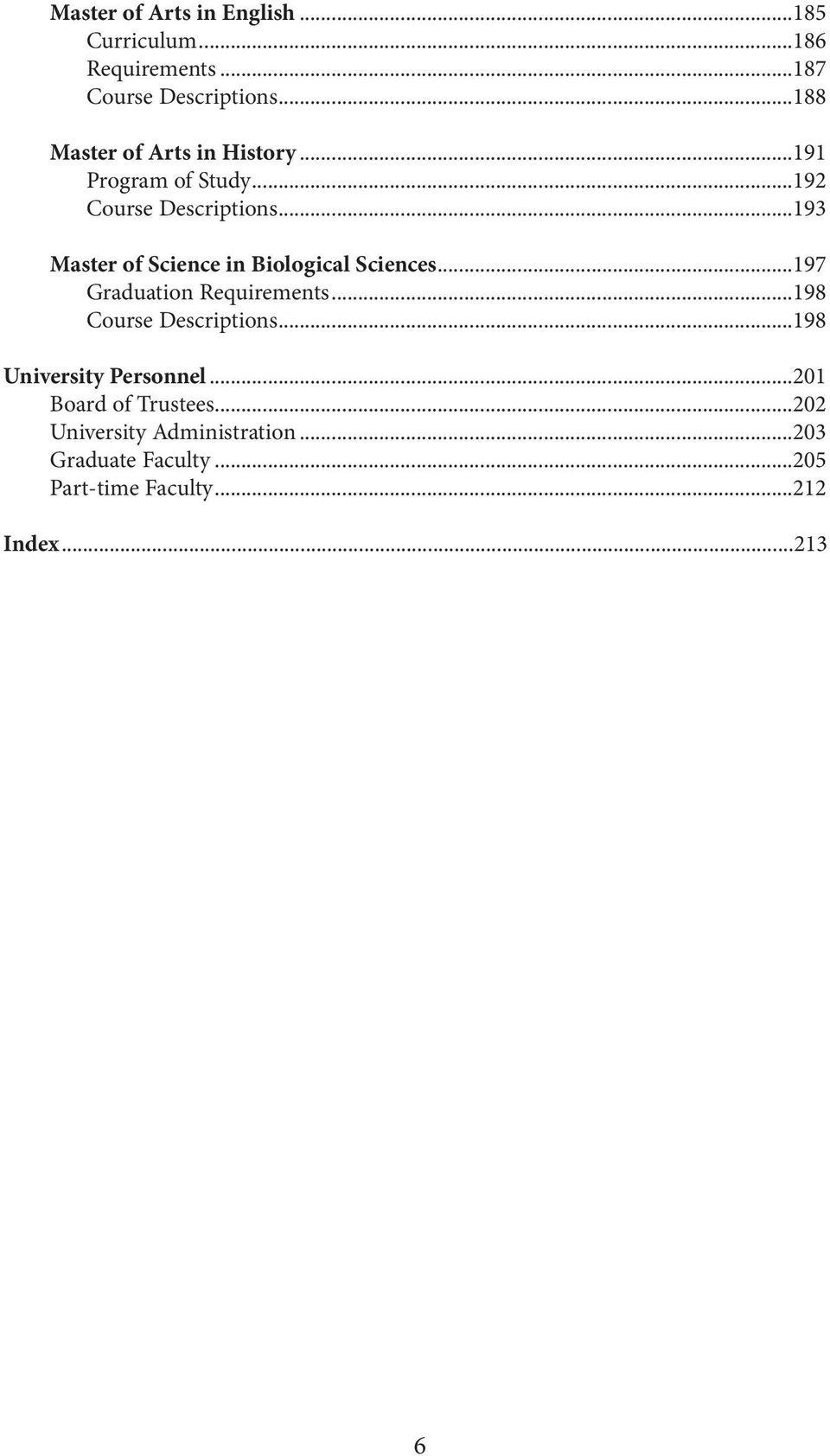
6 Master of Arts in English Curriculum Requirements Course Descriptions Master of Arts in History Program of Study Course Descriptions Master of Science in Biological Sciences Graduation Requirements Course Descriptions University Personnel Board of Trustees University Administration Graduate Faculty Part-time Faculty Index
7 GENERAL INFORMATION 7

8 AcADeMic calendar August 2014 S M T W T F S November 2014 S M T W T F S February 2015 S M T W T F S September 2014 S M T W T F S December 2014 S M T W T F S March 2015 S M T W T F S October 2014 S M T W T F S January 2015 S M T W T F S April 2015 S M T W T F S May 2015 S M T W T F S June 2015 S M T W T F S July 2015 S M T W T F S

9 WCU ACADEMIC CALENDAR, Fall Trimester Session 2014 August 18...Application deadline for fall trimester August 19...Fall faculty meeting August 20...Registration for fall trimester August 25...Late registration; Fall classes begin September 1...Labor Day holiday (night classes meet) October Advisement and registration for winter trimester October 15...Deadline for filing for May 2015 Graduation Deadline for Filing for February 2015 Degree Conferral (to receive diploma without commencement) October 29...Last day of class October 30, 31, November 3...Final examinations November 4...Grades due November Fall trimester break Winter Trimester Session November 3...Application deadline for winter trimester November 7...Registration for winter trimester November 10...Late registration; Winter classes begin November Thanksgiving holidays December 1...Classes resume December 3...Deadline for late filing of May 2015 graduation application December 6...M.Ed. Comprehensive Examinations December 20...Christmas holidays begin January 12, Classes resume January 19...Martin Luther King Day (night classes meet) January Advisement and registration for spring trimester February 11...Last day of classes February 12, 13, 16...Final examinations February 17...Grades due February Winter trimester break Spring Trimester Session 2015 February 16...Application deadline for spring trimester February 20...Registration for spring trimester February 23...Late registration; Spring classes begin March Spring break March 16...Classes resume March 31...Deadline for filing for August 2015 Graduation April 3...Easter holiday April 6...Classes resume April 11...M.Ed. Comprehensive Examinations 9

10 April Advisement & registration for summer and fall May 6...Last day of classes May 7, 8, 11...Final examinations May 12...Deadline for late filing for August 2015 Graduation May 12...Grades due May 15...Graduate Commencement, Hattiesburg May 16...Graduate Commencement, Tradition Summer Sessions 2015 May 26...Application deadline for summer term May 29...Registration for summer June 1...Summer trimester and Term I classes begin July 2...End of Term I July 3...Independence Holiday July 6...Term II classes begin July 11...M.Ed. Comprehensive Examinations July 15...Deadline for Filing for November 2015 Degree Conferral (to receive diploma without commencement) August 7...Summer academic session ends; Grades due August 8...Summer commencement 10

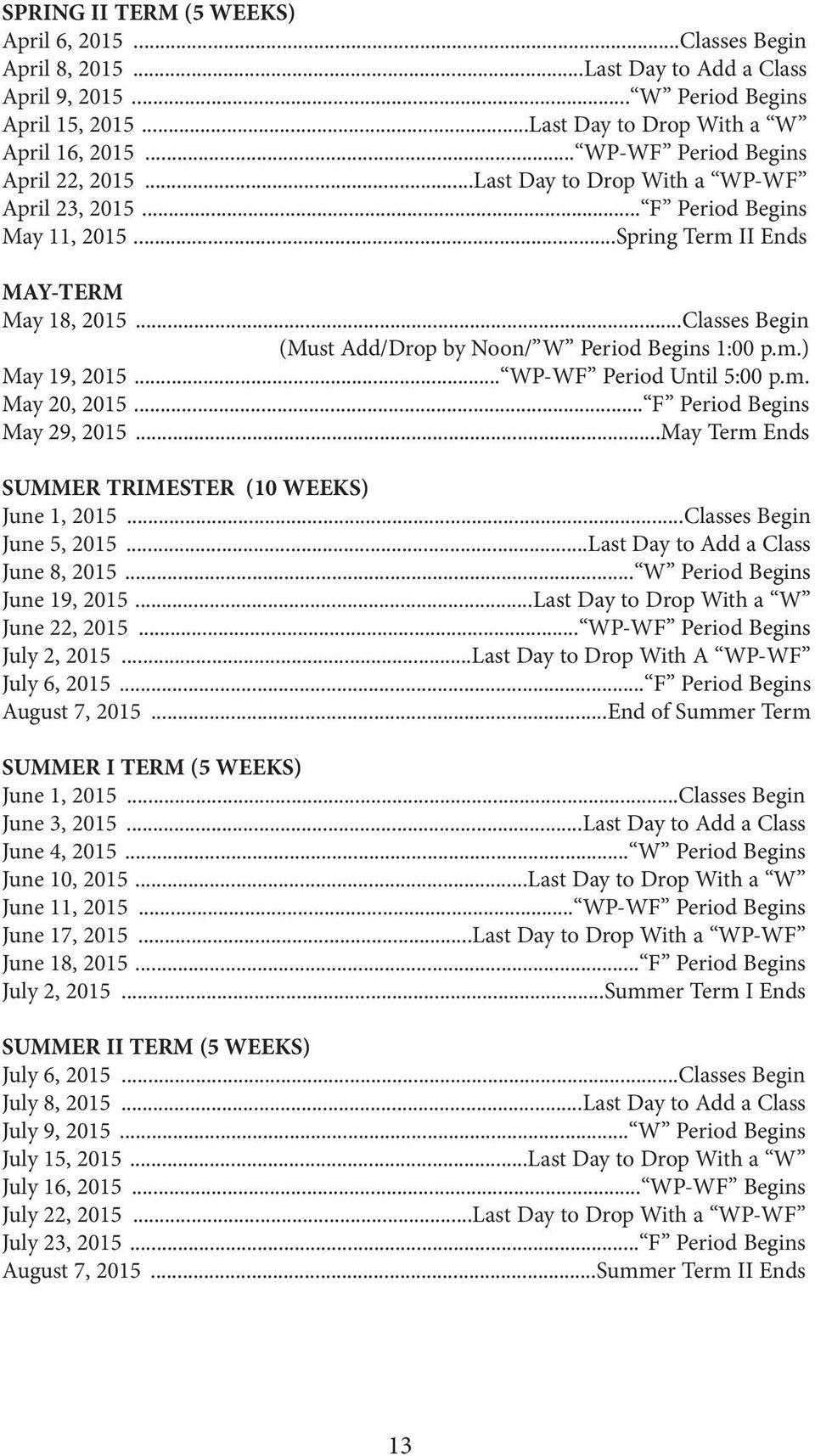
11 CHANGE OF CLASS SCHEDULE, FALL TRIMESTER (10 WEEKS) August 25, Classes Begin August 29, Last Day to Add a Class September 1, Labor Day Holiday (Night Classes Meet) September 1, W Period Begins September 12, Last Day to Drop With a W September 15, WP-WF Period Begins September 26, Last Day to Drop With a WP-WF September 29, F Period Begins November 3, Fall Term Ends FALL I TERM (5 WEEKS) August 25, Classes Begin August 27, Last Day to Add a Class August 28, W Period Begins September 3, Last Day to Drop With a W September 4, WP-WF Period Begins September 10, Last Day to Drop with a WP-WF September 11, F Period Begins September 26, Fall Term 1 Ends FALL II TERM (5 WEEKS) September 29, Classes Begin October 1, Last Day to Add a Class October 2, W Period Begins October 8, Last Day to Drop With a W October 9, WP-WF Period Begins October 15, Last Day to Drop With a WP-WF October 16, F Period Begins November 3, Fall Term II Ends WINTER TRIMESTER (10 WEEKS) November 10, Classes Begin November 14, Last Day to Add a Class November 17, W Period Begins December 5, Last Day to Drop With a W December 8, WP-WF Period Begins December 19, Last Day to Drop With a WP-WF January 12, F Period Begins February 16, Winter Term Ends 11
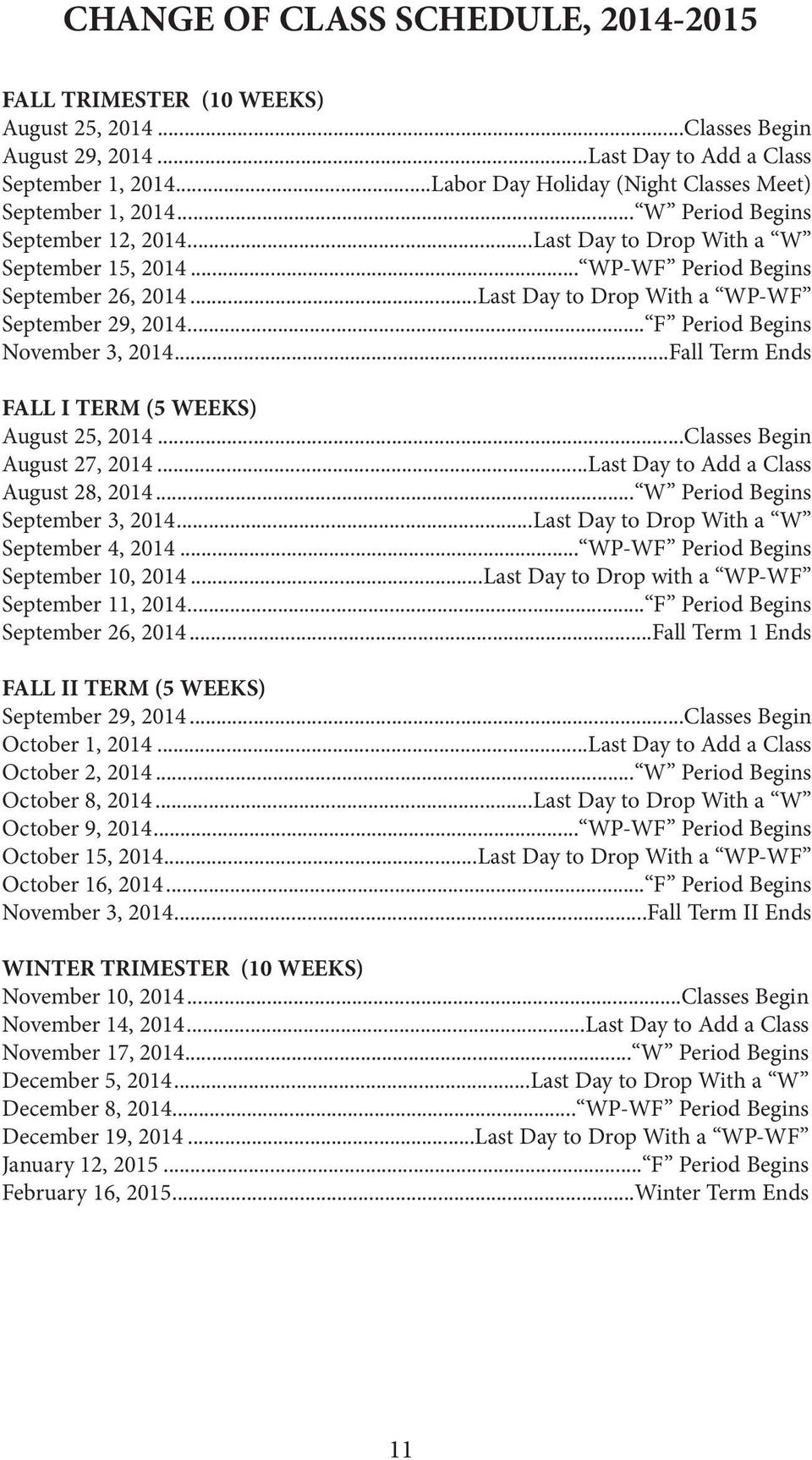
12 WINTER I TERM (5 WEEKS) November 10, Classes Begin November 12, Last Day to Add a Class November 13, W Period Begins November 19, Last Day to Drop With a W November 20, WP-WF Period Begins December 3, Last Day to Drop With a WP-WF December 4, F Period Begins December 19, Winter Term I Ends WINTER II TERM (5 WEEKS) January 12, Classes Begin January 14, Last Day to Add a Class January 15, W Period Begins January 21, Last Day to Drop With a W January 22, WP-WF Period Begins January 28, Last Day to Drop With a WP-WF January 29, F Period Begins February 16, Winter Term II Ends J-TERM (1 WEEK) January 5, Classes Begin (Must Add/Drop by noon. W Period Begins 1:00 p.m.) January 6, WP-WF Period Until 5:00 p.m. January 7-9, F Period January 9, Last Day of Classes/J-Term Ends SPRING TRIMESTER (10 WEEKS) February 23, Classes Begin February 27, Last Day to Add a Class March 2, W Period Begins March 20, Last Day to Drop With a W March 23, WP-WF Period Begins April 2, Last Day to Drop With a WP-WF April 6, F Period Begins May 11, Spring Term Ends SPRING I TERM (5 WEEKS) February 23, Classes Begin February 25, Last Day to Add a Class February 26, W Period Begins March 4, Last Day to Drop With a W March 5, WP-WF Period Begins March 18, Last Day to Drop With a WP-WF March 19, F Period Begins April 2, Spring Term I Ends 12
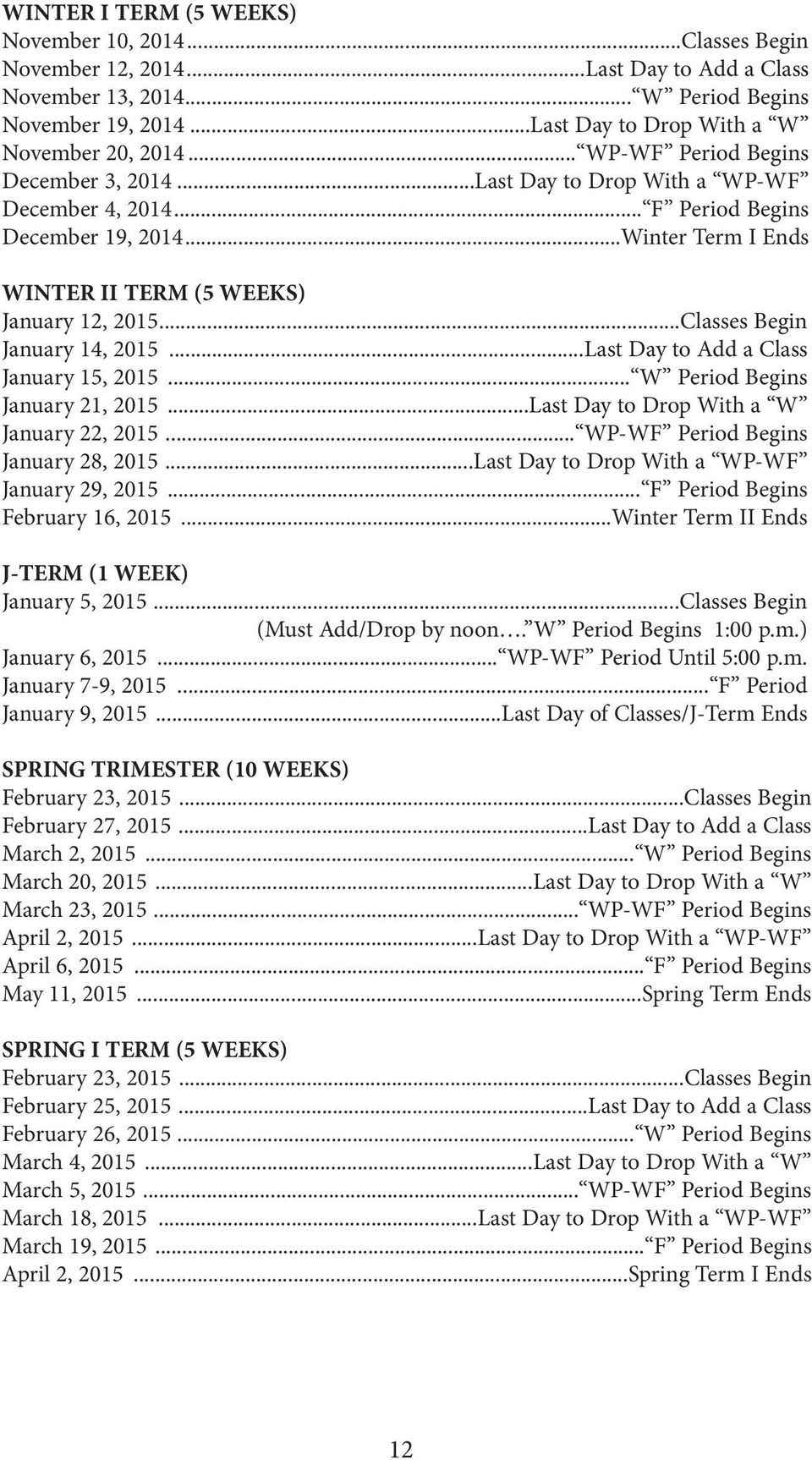
13 SPRING II TERM (5 WEEKS) April 6, Classes Begin April 8, Last Day to Add a Class April 9, W Period Begins April 15, Last Day to Drop With a W April 16, WP-WF Period Begins April 22, Last Day to Drop With a WP-WF April 23, F Period Begins May 11, Spring Term II Ends MAY-TERM May 18, Classes Begin (Must Add/Drop by Noon/ W Period Begins 1:00 p.m.) May 19, WP-WF Period Until 5:00 p.m. May 20, F Period Begins May 29, May Term Ends SUMMER TRIMESTER (10 WEEKS) June 1, Classes Begin June 5, Last Day to Add a Class June 8, W Period Begins June 19, Last Day to Drop With a W June 22, WP-WF Period Begins July 2, Last Day to Drop With A WP-WF July 6, F Period Begins August 7, End of Summer Term SUMMER I TERM (5 WEEKS) June 1, Classes Begin June 3, Last Day to Add a Class June 4, W Period Begins June 10, Last Day to Drop With a W June 11, WP-WF Period Begins June 17, Last Day to Drop With a WP-WF June 18, F Period Begins July 2, Summer Term I Ends SUMMER II TERM (5 WEEKS) July 6, Classes Begin July 8, Last Day to Add a Class July 9, W Period Begins July 15, Last Day to Drop With a W July 16, WP-WF Begins July 22, Last Day to Drop With a WP-WF July 23, F Period Begins August 7, Summer Term II Ends 13
14 WILLIAM CAREY UNIVERSITY HISTORY William Carey University had its earliest origins in Poplarville, Mississippi, when the noted educator W. I. Thames opened Pearl River Boarding School in A disastrous fire destroyed the school in Professor Thames moved to Hattiesburg where he opened South Mississippi College in South Mississippi College, under the leadership of Professor Thames as its president, quickly gained a reputation for having a strong faculty, especially in art, music, history, and home economics. After a fire destroyed the immense administration building, including classrooms, library, and a 1500-seat auditorium, the young institution was forced to close. In 1911 W. S. F. Tatum, wealthy lumberman and Methodist layman, acquired the property and offered it as a gift to the Baptists. He set two conditions: successful operation of a Christian school for girls for five years and an enrollment of at least 100 students the first year. In September, 1911 the school opened with a new name, Mississippi Woman s College, under the leadership of President W. W. Rivers. In November, 1911 the debt-free college was offered to the Mississippi Baptist Convention and was accepted. The growth of Mississippi Woman s College was a source of pride for Mississippi Baptists. Under the leadership of President J. L. Johnson, Jr. from 1912 to 1932, a splendid new administration building was completed in 1914 and named Tatum Court in honor of the college s major benefactor. New brick dormitories were added (Ross and Johnson Halls) as well as an infirmary and a model home, which was used as a laboratory for domestic science classes. During this period, the campus expanded to 40 acres. An early objective of Mississippi Woman s College was to train intelligent, concerned citizens who could establish Christian homes. By 1925 college stationery boldly proclaimed on its letterhead, Mississippi Woman s College: The School with a Mission. The student body dedicated itself to the mission of the college. Such dedication accounts for Mississippi Woman s College becoming known by the late 1920s as one of the South s outstanding Christian colleges for women. Continued growth and an emphasis on missions characterized the presidency of Dr. W. E. Holcomb from 1932 to When the exigencies of the depression era forced the college to close in 1940, its facilities were used as housing for army officers from Camp Shelby. In 1946 Mississippi Woman s College underwent major renovations and re-opened. Dr. I. E. Rouse was elected president in 1946 and served until In 1953 the Mississippi Baptist Convention voted to move the college into coeducational status after more than four decades of serving as a female institution. This vote necessitated a new name for the institution. In 1954 the board of trustees selected the name of William Carey College in honor of the eighteenth century English cobbler-linguist whose decades of missionary activity in India earned him international recognition as the Father of Modern Missions. Under the leadership of Dr. J. Ralph Noonkester as president, William Carey College enjoyed significant growth. In 14 years, a total of 14 new buildings rose on the Hattiesburg campus. The college attracted national attention with baseball, basketball, and tennis teams, the traveling chorale, the theatre performance groups, scientific honor societies, student mission efforts, a large number of mission volunteers, and a high percentage of acceptances to medical school. Dr. Noonkester served as president from 1956 to
15 In 1968 William Carey entered a new era when it announced a merger with the prestigious Mather School of Nursing in New Orleans. Another dimension opened for the institution in 1976 with the purchase of the Gulf Coast Military Academy campus in Gulfport. Known as William Carey College on the Coast, the 20-acre beachfront property was devastated by Hurricane Katrina in August Thirty acres were purchased in the Tradition Planned Community, and William Carey University Tradition Campus opened in In June 1989 Dr. James W. Edwards was elected as the seventh president and served until Under his leadership, enrollment in church-related vocations increased, the art program at Carey on the Coast was upgraded, the college debt was restructured, and a trimester system was inaugurated. The Lucile Parker Gallery was opened on the Hattiesburg campus, and the Sarah Gillespie Art Gallery was upgraded. A campus beautification project was inaugurated. Dr. Larry W. Kennedy served as president from 1998 to Many physical improvements were made to existing facilities. New construction on the Hattiesburg campus included the nursing building, Fail-Asbury Hall; the education classroom building, Lorena Roseberry Smith Hall; Donnell Hall, which houses the Center for the Life and Work of William Carey; soccer fields; and an intramural field. The college s $7.5 million debt was paid off ahead of schedule. In 2005 all three campuses were affected by Hurricane Katrina, with the Coast campus being completely destroyed. In 2006 the status of the institution was changed from college to university to honor its growth and enhance its potential in an increasingly global environment, thus the name was officially changed to William Carey University. In February 2007, Dr. Tommy King was named the ninth president of the university, the first alumnus to serve in this position. Under his leadership, the university completed the Larry Kennedy Sports Complex, the Milton Wheeler Baseball Field, the Joseph and Nancy Fail Softball Field, and Byrd and Braswell residence halls. In 2009 the Coast campus was relocated to the newly built Tradition campus, Smith/Rouse Library was expanded, and the Sarah Ellen Gillespie Museum of Art was dedicated. In 2010 the Joe and Virginia Tatum Theatre and the first buildings of the College of Osteopathic Medicine (COM) were completed. In 2011 the Asbury Administrative Center, the third building in the medical school complex, was completed. Also, the former facilities building was renovated to become the Old Cobbler Shop, Hackelton, Student Center. In 2012 McMillan Hall underwent major renovations and an expansion that doubled its size. In 2013 the 92-bed Davis Hall was completed, bringing residential occupancy up to 750 beds. In 2014 the Randy and Brenda Ross Anatomy Wing of the COM, the Bass Memorial Chapel, the Warren prayer garden, and the new School of Business Building were completed. Dr. King led the university to establish new academic programs and to add new athletic teams. In 2008 the Southern Association of Colleges and Schools raised the institution to Level V status, which permits the granting of doctoral degrees. A Master of Biomedical Science degree was added in In 2010 the inaugural class of the COM began, the specialist degree in higher education administration was offered. The Bachelor of Music in contemporary worship degree was added in The M.Ed. in educational leadership, Ed.D. and Ph.D. in higher education administration, Ph.D. in nursing education and administration, and department of criminal justice began in The intercultural studies major was first offered in Tennis was reinstated to the athletic program in 2009, with 15

16 cross country and women s golf added in Track and field for men and women began in fall of Along with many other awards, in 2013 the university was recognized as the number one best value among regional universities in the South by US News and World Report. The university is organized into the following academic units: the Ralph and Naomi Noonkester School of Arts and Letters; the School of Natural and Behavioral Sciences; the School of Business; the School of Education; the Donald and Frances Winters School of Music and Ministry Studies; the Joseph and Nancy Fail School of Nursing; and the College of Osteopathic Medicine. The dramatic developments over the years demonstrate that William Carey University has accepted William Carey s challenging motto: Expect great things from God; attempt great things for God. GOVERNANCE William Carey University is a nonprofit corporation operating as an institution of higher learning from its domicile in Hattiesburg, Mississippi. The university operates under the governance of a board of trustees elected by the Mississippi Baptist Convention. Locations William Carey University has two campuses: HATTIESBURG is the home of the main campus, founded in On 140 acres, the university is conveniently located on the south side of the city. Hattiesburg is known as the "Hub City" because it is located at the intersections of Interstate 59 and U.S. Highways 49, 98 and 11. The city is centrally located less than 100 miles from the state capital of Jackson, as well as the Gulf Coast, New Orleans and Mobile. With a population of nearly 50,000, Hattiesburg is the educational, retail and medical center for the southeast Mississippi region. The William Carey University Tradition Campus is located on Highway 67 in Biloxi. The 50-acre campus has two state-of-the-art buildings housing administrative and academic offices and classrooms equipped with the latest technology, a guard house and facilities building. This campus opened for classes in the fall of Accreditation William Carey University is accredited by the Southern Association of Colleges and Schools Commission on Colleges to award bachelor, master, specialist, and doctoral degrees. Contact the Commission on Colleges at 1866 Southern Lane, Decatur, Georgia or call for questions about the accreditation of William Carey University. All normal inquiries regarding the operation of the university, including admissions, financial aid, educational programs, and other operational matters should be addressed directly to the university and not to the Commission. The Commission should be 16

17 contacted only if there is evidence of significant non-compliance with the requirements or standards for accreditation. The Winters School of Music and Ministry Studies is an accredited institutional member of the National Association of Schools of Music. The music therapy program is accredited by the American Music Therapy Association. The Joseph and Nancy Fail School of Nursing is accredited by the Commission on Collegiate Nursing Education, One Dupont Circle, NW, Suite 530, Washington, DC, , ( ); by the board of trustees, Institutions of Higher Learning of the State of Mississippi, and approved in New Orleans by the Louisiana State Board of Nursing. Programs in education are approved by the Mississippi Department of Education using NCATE standards. William Carey University College of Osteopathic Medicine is accredited by the American Osteopathic Association s Commission on Osteopathic College Accreditation, which is the recognized accrediting agency for the approval of colleges preparing osteopathic physicians. The address and phone number of the accrediting agency are: Secretary, COCA; American Osteopathic Association; 142 East Ontario Street; Chicago, IL 60611; Telephone 312/ ; Fax 312/ The right to grant masters degrees was approved for William Carey College on December 12, 1972, when the Southern Association extended Level III status to the institution, and the Specialist in Education degree program was subsequently approved in In December 2008, William Carey University was raised to Level V, and approval was granted to offer the Doctor of Osteopathic Medicine (D.O.) degree. The university holds membership in the following professional organizations: American Association of Colleges for Teacher Education, Mississippi Association of Colleges of Teacher Education, Private Colleges of Education in Mississippi, American Association of Colleges of Nursing, Southern Council of Collegiate Schools of Nursing, National League for Nursing, Mississippi Association of Independent Colleges, and the American Council on Education. The School of Education at William Carey University is accredited by the National Council for Accreditation of Teacher Education/Council for the Accreditation of Teacher Preparation (NCATE/CAEP), This accreditation covers initial teacher preparation programs and advanced educator preparation programs at Hattiesburg and Biloxi. Institutional Effectiveness Engaging in a continual quest for quality, the university maintains a comprehensive system of planning and evaluation in all major aspects of the institution. The university uses the institutional mission statement as the foundation for evaluation. By using a variety of assessment methods, the institution implements its evaluative results to improve the education programs and support activities. The institution s effectiveness in achieving its established goals determines educational quality. As part of its annual planning process, the university uses assessment results for continual improvement of academic programs, student learning, and support services. 17

18 Nondiscrimination Statement In compliance with federal law, including provisions of Section 504 of the Rehabilitation Act of 1973, Title IX of the Education Amendments of 1972, and the bylaws of the university, William Carey University does not discriminate against any person on the basis of race, color, national or ethnic origin, sex, gender, age, or disability in admissions or in the administration of its education policies, scholarships, loan programs, athletic and other school-administered rights, privileges, programs, and activities generally accorded or made available to students at the school. William Carey University College of Osteopathic Medicine (WCUCOM) will not discriminate on the basis of race, gender, sex, color, religion, creed, national origin, age or disabilities. The following person has been designated to handle inquiries regarding the nondiscrimination policies: Vice President for Academic Affairs, 498 Tuscan Avenue, Hattiesburg, MS (601) Policy on Privacy of Student Records Under the Family Educational Rights and Privacy Act of 1974 as amended, William Carey University students have the right to inspect and review any and all records, files, and data directly related to them. The university will not ordinarily release students records to any outside agency without the written consent of the student. Consent forms are available in the registrar s office. William Carey University will release directory information on students to any interested member of the public unless the student requests in writing that it be withheld. WILLIAM CAREY LIBRARY SYSTEM The mission of the William Carey University Libraries is to provide a learning environment that meets the information needs of the university s students, faculty, and staff. This mission is accomplished through the provision of information resources and services that support the teaching, learning, research, and service needs of the university community. William Carey University Library resources are available to the university s students, faculty, and staff, as well as to sanctioned visitors and guests. Sanctioned visitors and guests may include a spouse or family member of a WCU student, faculty or staff member, members of the local clergy or staff of a local church, special guests of the WCU president or board of trustees, and alumni of William Carey University. Upon registration with the WCU Library, sanctioned visitors and guests may check out books and may use WCU Library facilities and may use online resources while they are in the library. The WCU Library s online collection includes over 101,000 electronic books, and 68,000 research databases. This online collection is accessible through the WCU Library s website from any WCU on-campus computer. WCU students, faculty, and staff can also access online collections from any off campus location by logging in through the WCU Library s website by utilizing their using WCU addresses and passwords as logins when prompted for full-text access. Licenses for databases, electronic books and journals, and other online materials prohibit access to these materials by individuals who are not WCU students, faculty, or staff. 18
19 The library s graduate research collections are located at the Dumas L. Smith/I.E. Rouse Library on the Hattiesburg campus, and at the Tradition Campus Library. Smith/Rouse Library houses over 74,800 print and media items. The Tradition Campus Library houses over 8,700 print and media items. An online catalog, accessible through the WCU Libraries website, provides information about all library holdings, including the location of physical items. All items in the collection are available for checkout at any WCU Library. Requests for items from another library location can be made by ing [email protected], by filling out the Interlibrary Loan form on the library s website or by calling The WCU Library develops and maintains services that support the missions of the library and the university. Library hours at each facility are available on the library s website at Regular hours for fall, winter, and spring trimesters and summer session are posted on the website. Special hours for trimester breaks, holidays and mini-sessions are also available on the website. Other services available at all library locations include interlibrary loan for requesting materials that are not owned by the WCU Library, reference and information services provided by experienced library staff, workshops in the use of library and information resources, and reference services at [email protected]. The Dumas L. Smith/I. E. Rouse Library The Smith/Rouse Library on the Hattiesburg campus houses books, periodicals, music scores, microforms, and other library materials that support the university s curriculum. The Smith/Rouse Library also holds medical and other health science collections to support students and faculty in the College of Osteopathic Medicine. The library provides a significant collection of online books, periodicals, and databases in the health sciences. A computer lab is available in the library, with access to the Internet as well as to word processing, spreadsheet, and presentation software. Printing and photocopying services are provided, as well as a microform reader/printer, and audiovisual equipment. Group study rooms are available on a first come first served basis, and a classroom equipped with student computers is available to faculty and staff by reservation. The Smith/Rouse Library houses the Clarence Dickinson Collection, which contains over 5,000 books, including many rare hymnals and psalters, scores, manuscripts, recordings, an antique piano, paintings, and memorabilia relating to the history of hymnology. Additionally, Smith/ Rouse Library is the home of the William Carey University archives, which documents and preserves materials relating to the history of the institution. Tradition Campus Library The library collection on the Tradition campus includes books, serials, and audiovisual resources. Library computers provide access to the Internet, as well as providing an extensive array of online research databases with thousands of journal articles. Quiet study areas, as well as photocopying services, are available for students and faculty. 19

20 VEHICLE REGISTRATION Registration of motor vehicles is a part of the academic registration procedure at the beginning of each year for all students who are permitted to bring cars on the campus. Students who bring unregistered vehicles on campus after any registration period must register them immediately after arrival on the campus. All university employees and students shall register their vehicles and secure a registration decal from the student development office. Failure to register a vehicle, to use the proper decal, or to observe all traffic regulations will constitute a violation and subject the violator to certain penalties. CAMPUS HOUSING Students desiring campus housing should contact the director of housing on the Hattiesburg campus for information and fee schedules. CAMPUS SAFETY AND SECURITY Campus security personnel are located at four stations on the Hattiesburg campus and are available 24 hours a day. Security personnel at Tradition are located at the campus security station. Any crime or suspicious activity should be reported promptly to campus security: Hattiesburg (601) STUDENT RIGHTS AND RESPONSIBILITIES Every student is expected to display proper conduct. The university reserves the right to require at any time the withdrawal of a student whose conduct or academic work does not meet university standards. University policy regarding student rights and responsibilities for both undergraduate and graduate students is stated in the student handbook, The Red Book. STUDENTS WITH DISABILITIES Every reasonable effort will be made to meet the special needs of students who qualify under Section 504 and ADA disability criteria. Eligibility for special accommodations will be available to students who are officially enrolled at William Carey University, who meet all university program requirements, and who meet the definition of disability as defined by the Rehabilitation Act of 1973 and the Americans with Disabilities Act. The definition of disability includes any person who " has a physical, emotional, or mental impairment which substantially limits one or more of life' s major activities; has a record of disability, or is regarded as having a disability" (P. L ). To obtain service or for more information, contact the office of student services or refer to the policies and procedures outlined in The Red Book. TECHNOLOGY RESOURCES William Carey University provides a variety of technology resources to support student learning. These resources include the Indigo Student Self Service Portal, the Desire2Learn (D2L) learning management system, student accounts, remote access to library database resources, and Carey Air a university-wide unified wireless network. 20

21 The Indigo Portal allows students to access their campus information including course registration, course offerings, unofficial transcripts, job searches, billing information, schedules, financial aid information, and grades. The portal also allows students to pay tuition and fees online. William Carey University does not mail individual grade reports. Many courses incorporate information technology both within the classroom and remotely through the internet. The university uses D2L for communicating vital course information to students, including course content, assignments, discussions, and more. Students are required to access their WCU and D2L accounts as quickly as possible so that faculty and administrative offices will have a reliable means of communication with the student. A student technology guide is available for download at guide. This guide is constantly updated to reflect any changes as the office of information technology is constantly working to bring new and improved services. General Admission Requirements ADMISSIONS INFORMATION Each applicant to graduate programs at William Carey University must 1. hold a baccalaureate degree from an accredited college or university; 2. provide official transcript(s) of all college work completed to date. An official transcript is defined as one mailed directly from the institution to William Carey University. In addition to these requirements, the applicant must meet any additional requirements as put forth by the respective graduate degree programs. Those requirements are listed in the following sections for the Master of Education, the Specialist in Education, the Doctor of Education, the Master of Business Administration, the Master of Science in psychology, the Master of Music in music education, the Master of Science in Nursing, the Doctor of Philosophy in Nursing Education and Administration, the Master of Biomedical Science, the Master of Arts in English, the Master of Arts in History, and the Master of Science in Biology degrees. Applications for admission to graduate programs must be submitted by the Monday of general registration week. Consideration will be given to applications that are late due to extenuating circumstances. Incomplete Admission Status A student who appears to be eligible for admission but is unable to supply certain required records prior to registration may be allowed to register on an incomplete basis for one trimester. Students who do not provide all official documents required for admission by the end of the term will not be allowed to continue in the program. Permission for incomplete registration does not indicate official acceptance into William Carey University. No financial aid will be processed or paid on students who have not been officially accepted. 21
22 Readmission A student who has not enrolled in a course within the past 12-month period must apply for readmission. Readmission forms may be obtained from the office of admissions or the William Carey University website. Early Admission A candidate for a baccalaureate degree at William Carey may apply for early admission to the graduate program, and may enroll for graduate credit in courses not required for completion of the baccalaureate degree provided that the student is within six hours of meeting degree requirements and has a cumulative grade point average of 3.0 on a 4.0 scale. A student may take only six hours of graduate courses prior to meeting the requirements of the baccalaureate degree. Participation in the early admission program is limited to one trimester only. International Students William Carey University is authorized by the Department of Homeland Security (DHS) to enroll nonimmigrant alien students. International students who wish to be admitted to William Carey University must meet the requirements listed below. 1. Application Application for admission can be downloaded from the Carey website ( Applications may also be requested by mail through the Office of Graduate Admissions on the Hattiesburg campus. A US$30 application fee, which allows for a student s application to be processed, should be mailed to the Office of Graduate Admissions at 498 Tuscan Avenue, Box 155, Hattiesburg, MS, Academic Records Academic records indicating graduation from any institution(s) of higher education or official transcript(s) from U.S. institution(s) attended are required. An official transcript is defined as one mailed directly from one institution to another. All records must be in English before an I-20 from William Carey University is issued. Transcripts from foreign institutions must be submitted to one of two foreign credential evaluation agencies: World Education Services ( or AACRAO Foreign Credential Services ( The results from the evaluation must be mailed to William Carey University. This process takes between 30 to 60 days. 3. Language Proficiency Students who are not from nations where English is considered the official or second language are required to take either the Test of English as a Foreign Language (TOEFL) or the International English Language Testing System (IELTS). A minimum score of 523 is required on the paper-based TOEFL; a minimum score of 193 on the computer-based TOEFL; or a minimum score of 70 on the internetbased TOEFL. Students who wish to take the IELTS must meet the minimum requirement score of 5.5. Students who do not meet the minimum English proficiency required are invited to apply for admission the William Carey University English Language Center. 22
23 4. Certification of Finances Proof of financial support for the duration of the international student s stay in the United States is required. This document can be downloaded from the Carey website ( 5. Proof of Immunizations William Carey University requires one immunization for measles, mumps, and rubella (MMR) in the past ten years or two such immunizations in a lifetime. 6. Proof of Major Medical Coverage Proof of medical coverage while attending an institution of higher education in the United States is required. All international students are required to take a policy with the university. Students will be assessed for the policy coverage at the beginning of each trimester. More information on the health insurance policy adopted by William Carey University is available online ( Additional Information In order to receive an F-1 VISA, international students must schedule an appointment with the nearest U.S. consulate or embassy in their country within 90 days of departure. They must take along their documentation, letter of acceptance, and I-20 for presentation and review. The Department of Homeland Security (DHS) recommends the entering student be honest and have copies of all documentation sent to William Carey University available for review by the U.S. custom official at the consulate, embassy, or U.S. port of entry. Custom officials may at any point of the student s travel to the United States deny him/her entry into the country. The Office of Graduate Admissions may receive faxed copies; however, original documents must be mailed and placed in the student s file before any decision can be made. International students should refer to the university calendar for dates of trimester breaks and religious and national holidays (i.e. Thanksgiving, Christmas) in preparation for holiday travel. Questions or concerns should be directed to the director of international admissions on the Hattiesburg campus, or (toll free). Transfer Courses No more than six semester hours may be transferred from another institution and applied toward an M.Ed., Ed.S., M.B.A., M.S.N., or Ed.D. Nine hours may be applied toward an M.S. degree in programs that require more than 36 hours. A maximum of 15 hours from another institution may be transferred into the Ph.D. in nursing education and administration. Transfer credits will be applicable only if they contribute to the overall plan of study designed for the student. No graduate work carrying a grade of less than a B will be accepted. All transfer credits must meet the six-year limit on the completion of the degree. Independent study credit earned at another institution will not be accepted. Second Master s Degree A student holding a master s degree may apply for a second master s degree in another area. Moreover, students holding the M.Ed. may apply for a second M.Ed. in another certification area. Students must meet all admissions and degree requirements for the second degree. A candidate for a second degree may use six hours of graduate credit from the first degree toward a second degree in education or business and nine graduate hours toward a second degree in psychology programs. A student must complete all requirements for the 23
24 first degree before applying for or beginning a second degree. This applies to all degrees. Courses to be applied toward a second degree must have the approval of the dean, and grades in such courses cannot be below a B. Students holding the M.S. in psychology with emphasis in industrial organization may use an additional six hours toward the M.B.A. for a total of 12 hours from the first degree. The limit of six hours of transfer credit means that a total of 24 hours must be taken at William Carey University. Further, students who have completed the MBA degree at William Carey University may transfer a total of 12 graduate hours to the M.S. degree with emphasis in organizational counseling. All other rules stated in this section will be maintained as standards for the transfer of credit. Dual Degree The Master of Science in Nursing Master of Business Administra-tion is an integrated dual degree program requiring students to complete a minimum of 53 semester hours to graduate. To complete requirements for the dual degree, students must complete the individual requirements for the integrated program. Individual degrees will not be awarded for either program. No more than six semester hours of M.S.N coursework may be transferred from another institution and applied toward the M.S.N. M.B.A. dual degree. No more than six semester hours of M.B.A. coursework may be transferred from another institution and applied toward the M.S.N. M.B.A dual degree. Changing Major or Emphasis When a student changes from one major or degree to another or changes emphasis within the major where there are different requirements for admission, the student must reapply and meet the requirements of the new program. 24
25 FINANCIAL INFORMATION Graduate Fees (per trimester, unless otherwise indicated) Tuition (per trimester hour)...$315 Master s Nursing Tuition (per trimester hour)...$340 Ph.D. Nursing Tuition (per trimester hour)...$410 Ed.D. Tuition (per trimester hour)...$340 Specialist in Education Tuition (per trimester hour)...$340 Master of Biomedical Science (MBS) Tuition (33 trimester hours)...$20,000 Acceptance Fee (applied to tuition)...$750* Auditing a Course...one-half the regular tuition cost Application Fee...$ 30* General Fee...$100* Art Fee for Studio Classes (per class)...$ 30 Art Deposit Against Supplies ($75 for ceramics classes/$200 for sculpture classes)...$75/$200 Late Registration Fee...$ 50* Late Payment Fee...$ 50* Deferred Payment Plan Fee...$ 35* Late Deferred Payment Fee...$ 15* Drop Course Fee...$ 75* Administrative Fee for Withdrawal...$ 50* Course Validation Fee (per trimester hour)...$ 50 Directed Reading Fee (per trimester hour above the regular tuition rates)...$ 50 Graduation Fee...$ 50* Late Graduation Fee (additional fee)...$ 100* Returned Check Fee...$ 50* Transcript Fee (mailed/faxed)...$5/$10 * nonrefundable fees For housing deposits, board, and dormitory rates, refer to undergraduate catalog. One-half tuition and fees is required at registration for official enrollment. Fees are subject to change without notice. 25
26 Terms of Payment All fees are due and payable upon registration prior to the beginning of each trimester. Returning students who pre-registered must make payment arrangements with the business office by the end of the day on Thursday before the start of each term in order to avoid a $50.00 late payment fee. Returning students who fail to register for the next trimester during the pre-registration period will be assessed a late registration fee of $ New students who register on general registration day must make payment arrangements at the time of registration in order to avoid a $50.00 late payment fee. Students registering after the pre-registration period will not receive a bill by mail, but must come to the business office for a schedule of classes and charges. The university offers a deferred payment plan for students who elect not to pay in full at the time of registration. There is a $35 fee assessed each trimester for the privilege of using the deferred payment plan. In order to register under this plan, a student must pay all remaining balances from previous trimesters and a minimum of one-half the tuition, fees, room, and board charges after deducting any student loans, grants, and scholarship amounts. The remaining trimester balance can be divided into two equal payments with payments due at the times specified in the business office and on the university website. Students who fail to set up on the deferred payment plan by the end of the first week of class will be automatically charged an additional late payment fee. Failure to make payments by the due dates on the agreement will result in a $15 late payment charge on each of the due dates. If a student is more than 15 days late in making payment, the university reserves the right to terminate the student's enrollment. Account statements are mailed out monthly on all accounts with an outstanding balance. Students are responsible for notifying the business office of any address changes in order for statements to be received in a timely manner. Call the business office at (601) or send by mail to William Carey University, 498 Tuscan Avenue, Box 2, Hattiesburg, MS (Note: In order to change the address on file for grades, the registrar's office should be notified.) Nonreceipt of statements will not be considered a valid excuse for nonpayment. It is the responsibility of the individual (the student) who has incurred the debt to see that it is paid promptly. An account becomes delinquent after the second deferred payment due date has passed. If satisfactory payment arrangements cannot be made, the business office will send a registered letter to the last known address with a final request for payment. If no response is received within ten days, the account will be sent to a collection agency. The collection agency will bill for the balance owed to WCU, plus up to an additional 50% for their fee. The student will be responsible for paying the collection costs as stated on the Registration Form in the section "Acknowledgement of Financial Responsibility." When an account is not paid in full by the final deferred payment due date, the business office will place a "HOLD" on a student's record. This "HOLD" restricts the student's ability to receive transcripts, diploma, and to register for future academic terms. Once established, the "HOLD" will remain in place until the debt is paid in full. 26
27 Withdrawal and Drop/Add Refund Policy A portion of tuition and fees may be refunded to students who officially withdraw from the university or officially drop a course. Any claim for such refund will be based on the date on which the student files a completed request with the registrar's office for official withdrawal or dropping of a course. No refund is made when a student is dismissed for reasons of misconduct. The general tuition refund policy is applied as follows: During the first week of class...100% less $75/$50* During the second week...70% less $50/$50* During the third week...40% less $50/$50* After the third week...none *$75 for dropping a class. $50 for complete withdrawal. For classes offered on a schedule shorter than a 10-week term, the refund period will be reduced in proportion to the length of the course. The effect of holidays on this schedule will be determined by the business office. The graduate summer tuition refund schedule is available in the graduate dean s office and in the business office. Student Credit Balance Refund Policy Refund checks will no longer be available for pick-up on campus. Refunds for students with credit balances are now issued through Higher One beginning on Wednesday of the fifth week of the term and continuing every Friday after that until the end of the term. Financial aid, payments, or adjustments must be received in the Hattiesburg business office by the cut-off date to be considered for refunds the following week. Student refunds for credit balances will be disbursed each trimester according to the dates listed in the student refunds link on the WCU website and in the business office information packet. Refunds take at least one week to process; therefore, after the first refund date, refunds will be disbursed every Friday for financial aid or payments that have been received in the Hattiesburg business office by the previous Friday. Students who will receive a refund must indicate their preferred method for receiving funds by logging onto the website appearing on the Higher One Crusader Card received by mail. Refund methods are: 1. Direct deposit into an existing checking or savings account 2. Activation of a Higher One account 3. Paper check If a student fails to log in and make a refund selection, a paper check will be mailed. The check may be received up to 30 days after the initial refund date of the term. 27
28 Financial Aid Financial aid programs are available to graduate students who qualify. Financial aid applicants must be accepted for admission before financial aid can be awarded. Nondegree seeking students are not eligible for federal financial aid. For more information, contact the Financial Aid Office, (601) for Hattiesburg or (228) for Biloxi. Full-Time Course Load Limitations ACADEMIC REGULATIONS The minimum course load for status as a full-time graduate student is six semester hours during a trimester. A course load for graduate students of up to ten hours per trimester is permitted. By special permission of the advisor and academic vice president, twelve hours per trimester may be taken. No more than twelve hours may be taken. Independent Studies/Directed Readings/Courses at Other Institutions/ Correspondence Courses Independent study and/or directed readings courses are allowed, but only in situations where a required course is not available or in unusual circumstances that prevent a student from taking a course in the normal manner. Independent study and/or directed readings courses must be taken at William Carey University and are limited to six hours. Permission from the advisor and appropriate dean is required. Students wishing to earn credit at another institution after the program plan is submitted must seek written approval for these courses prior to enrollment. No graduate credits earned by correspondence will apply toward a graduate degree. Grades The university uses the following grading system: A is reserved for work which is definitely superior in quality. B is given for work which is consistently good and would be considered above average. C is given for minimal work and shows that basic requirements in class assignments have been met, but is not considered standard work for graduate students. F is given when the student has failed the course. I A grade of I (incomplete), will be assigned only when unavoidable circumstances prevent completion of the work of the course on schedule and must be approved by the instructor and the academic dean. In order to be elibible for a grade of I, a student must be doing passing work, must have completed 80% of the required work for the class, and must provide appropriate documentation for requesting the incomplete. Requests are made using the Incomplete Grade Request Form obtained from the registrar s office. When the work is completed satisfactorily, the I may be changed to any grade assigned by the instructor. If a grade of I is not changed to a passing grade by the end of the next trimester, it will automatically be changed to an F. 28
29 Degree Completion and Final Assessment A student must complete all required work within a period of six years after enrolling in graduate programs. All master s degree programs at William Carey University require a candidate s final assessment prior to graduation. This assessment may take the form of a written comprehensive exam, a portfolio, a capstone course, and/or oral examination. Students who are candidates for May degrees on the Hattiesburg and Tradition campuses are required to file applications for their degrees in the registrar s office by October 15 prior to graduation. Candidates for August graduation must file application for their degrees by March 31. Late applications may be taken within 30 working days of these deadlines. There will be a $ late fee in addition to the graduation fee. Academic Standing A 3.0 GPA on all graduate courses taken at William Carey is required for graduation. A student whose GPA drops below a 3.0 is placed on academic probation. Students are allowed to improve their GPA by retaking courses at William Carey; however, only one grade replacement is allowed. Grades from other retakes will be averaged in with grades from other courses. Students on probation may not improve their GPA by taking courses at other institutions. A student on academic probation must raise his/her GPA to a 3.0 by the end of the next trimester of enrollment or the student will be dismissed and cannot continue in the program. Only two grades lower than a B are allowed. Upon receiving a second grade lower than a B, a student is advised to repeat one of the first two grades lower than a B before continuing in the program. A student making a third grade lower than a B will be dismissed from the program. All appeals to policy relative to academic standing are made through the appropriate dean and, as necessary, to the graduate academic appeals subcommittee of the graduate committee. Academic Advising All new students are assigned an academic advisor in their major area of interest. The academic advisor will assist the student in designing a program of study that leads to the desired degree; however, the ultimate responsibility in the selection of courses that satisfy degree requirements rests with the student. Academic Honesty William Carey University seeks to create an environment that encourages continued growth of moral and ethical values, which include personal honesty and mutual trust. The university places high value on academic integrity and regards any act of academic dishonesty as a serious offense. Academic dishonesty is considered unethical and in violation of William Carey University s academic standards and Christian commitment. The complete policy statement on academic integrity is in the student handbook, found in the back of The Red Book. 29
30 Attendance Regulations Graduate students are expected to attend all class meetings. However, an absence may be granted in case of an emergency. It is the student s responsibility to contact the instructor regarding the absence, and the student is responsible for all work missed. Excessive absences may seriously affect the work of the whole class as well as that of the individual students who are absent. Individual faculty members set their own attendance regulations for their classes and inform their students of them; however, students must attend 80% of the class meetings in order to receive credit for the course. The total number of absences for each student shall be reported for each class by each faculty member at the time of filing trimester grade rosters. Change of Class Schedule (Dropping and Adding Courses) 1. No change of schedule, either in dropping a course or adding a course, may be made except by permission of the student's academic advisor and dean. 2. No student may register for a course after 10% of class meetings have occurred. 3. Courses dropped within the first three weeks of a trimester will be recorded as W (withdrawn). Courses dropped after three weeks and before the middle of a trimester are recorded as WP (withdrawn passing) or WF (withdrawn failing), and courses dropped after the midterm will receive a grade of F. Any student dropping a course at any time without the required approval receives an F in that course. 4. Courses offered in mini-terms or with special schedules will have add/drop dates proportionate to length of course. Withdrawals Students desiring to drop a class or withdraw from the university must do so formally in order to avoid academic and financial penalties and should contact the office of the director of graduate studies or dean of the school for the proper procedure. Students are considered officially registered upon completion of the registration packets and payment of fees even though they may not attend a class. Right to Change Requirements This catalog and its contents are subject to change by action of the university faculty. Possible changes include, but are not limited to, graduation requirements, admission requirements, tuition, fees, curricula, and course content. Students are responsible for reading and responding to any such changes. The university is responsible for providing information to students on those changes. The requirements as outlined in this catalog are valid for six years from the date of issuance. After that period, a student must change to the catalog currently in use. 30
31 Transcripts Transcripts are issued by the registrar s office. 1. An official transcript is one bearing the signature of the registrar and the seal of the university and is mailed directly to whatever official may be designated by the student. 2. When a transcript bearing the stamp Issued to Student is given to the person whose credits are transcribed thereon, the university assumes no responsibility for its accuracy after it leaves the registrar s office. 3. Transcripts of credit will not be issued for those students who have any type of administrative holds on their records. Validation of Outdated Courses Because of new developments within academic disciplines, some coursework may become outdated and not suitable for use toward a degree. The determination of whether or not a course has become outdated is made by the school or department where that course is taught. Students with outdated William Carey coursework not older than ten years at the point of student s initial program of graduate study may validate it by successfully passing a test or completing required work if prior approval is granted by the advisor, dean, and current instructor of that course. Outdated coursework at other institutions will not be accepted. Graduate Committee The Graduate Committee is charged with the responsibility of approving policy and curriculum changes in William Carey University graduate programs. The committee is composed of faculty with graduate rank and graduate students. Faculty members are selected from the School of Education, the School of Nursing, the School of Natural and Behavioral Sciences, the School of Business, the School of Music, and from departments which offer graduate courses. Specific duties of the committee are: To develop university policies and procedures for graduate work. To establish and maintain the academic standards and regulations for graduate students and faculty. To conduct continuous study of the graduate curriculum in its relation to the purpose of the institution and changing state requirements. To review and recommend after departmental and dean approval to the graduate faculty all modifications of existing graduate courses, course descriptions, and programs. To review and recommend for approval to the Academic Council all new graduate programs or the deletion of graduate programs. To design and publish the graduate catalog through the office of the vice president of academic affairs. 31
32 32
33 MASTER OF EDUCATION Specialized Concentrations: Art Education Biology Elementary Education English Gifted Education Mathematics Mild/Moderate Disabilities Secondary Education Social Science ef Art of Teaching (Alternate Route) Elementary Track Secondary Track ef Career and Technical Education ef Dyslexia Therapy ef Educational Leadership ef Interscholastic Athletic Administration 33
34 GOALS AND OBJECTIVES The specific goals and objectives of the Master of Education program are to provide students with opportunities to 1. earn academic credentials that may allow them to advance in the chosen field of employment; 2. experience personal growth and understanding through in-depth study in the area of concentration and certification; 3. expand the student's Christian values through course work and campus activities; 4. specialize in a chosen area or discipline; 5. build upon their undergraduate studies and work experience to broaden their knowledge base in the teaching field; and 6. become strong professional leaders in their chosen discipline and area of certification. GENERAL ADMISSIONS REQUIREMENTS A. Each applicant must 1. hold a baccalaureate degree from an accredited college or university. 2. complete and file with the graduate education office the application packet for admission to the university. This application must be submitted prior to registering for classes and before the deadline established by the graduate admission office. 3. provide official transcripts of all college work completed to date for the registrar and the graduate office. After the applicant is accepted, a supplementary official transcript showing any additional work completed at other institutions is also required. 4. have an overall minimum grade point average of 2.50 on a four-point scale for the last 64 hours of undergraduate work or the overall cumulative GPA presented for the baccalaureate degree. Applicants must hold, or be qualified to hold, a standard Mississippi State Department of Education teaching license. If an applicant has a GPA below 2.50, the applicant may appeal the admissions decision by presenting a Graduate Record Exam minimum score of 800 (verbal and quantitative taken prior to July 2012) or 290 (verbal and quantitative taken after July 2012). The Miller s Analogy Test score of 370 is also accepted. 5. have a TK20 account (tk20.wmcarey.edu), which is the School of Education s electronic portfolio. 6. hold or qualify to hold a Class A teacher s license if planning to teach at the elementary or secondary school level in Mississippi. If deemed necessary by the student s advisor and/or the dean, students who are licensed in Mississippi through the alternate route may be required to complete additional course work in the area of concentration to strengthen the student s academic preparation for graduate study. A copy of this license must be filed in the graduate office. 34
35 7. declare a major and file a program plan signed by the student's advisor prior to completing nine hours of graduate work. This plan will be approved and becomes an application for candidacy for the degree. B. Applicants for the Master of Education degree who seek an advanced license in a different area than their education bachelor s degree will be required to take additional courses beyond the 30-hour master s degree in order to meet requirements for licensure. The additional coursework will be determined by the director of graduate education and will be listed in detail on the student s program of study. C. Upon special request by the student and the approval of the Graduate Committee, the teacher license requirement may be waived only for a student pursuing a graduate degree in English, biology, mathematics, or social science who is currently employed in a college, nonpublic institution or a position not requiring a teacher s license. In the event the licensure requirement is waived, the following notation will be entered upon the student s transcript: "Student does not meet requirements for teacher licensure." Students must request waiver in writing and must state the reason for the request. ADMISSIONS STATUS An applicant for the Master of Education degree program is admitted to regular or nondegree graduate status as follows: Regular Regular graduate status will be granted to those students who meet all requirements for admission to the Master of Education degree program and are actively pursuing a graduate degree. Nondegree Nondegree status may be assigned to those students who meet the requirements for admission, but do not otherwise wish to become a candidate for a degree. These students may be enrolling in courses for reinstatement of expired teaching licenses or to eliminate certification deficiencies at the undergraduate level prior to enrolling as regular students. The nondegree status also applies to students who are ineligible to pursue a graduate degree but wish to take course work for nondegree purposes. No more than nine hours of credit from a nondegree status may apply toward a degree. Admission on nondegree status does not imply admission to any program. OFF-CAMPUS TRANSFER COURSES A maximum of 12 hours of off-campus WCU courses may be applied toward the M.Ed. degree. Permission from the dean and academic vice president is required for use of any additional off-campus credit. A maximum of six hours may be transferred from another institution. All transfer courses must be approved. SUPPLEMENTAL ENDORSEMENTS Students who wish to add a supplemental endorsement to a valid teaching license must meet the requirements set by the Mississippi Department of Education. Supplemental endorsements requiring an approved program (specific coursework) are gifted education, health, mild/moderate disabilities, and remedial reading. The endorsement for severe/profound disabilities may only be added to a valid license in mild/moderate disabilities. A student must be admitted to the appropriate program to take coursework leading to an endorsement. 35
36 SUBMISSION OF PROGRAM PLAN By the end of the first trimester, the student must be officially accepted as a candidate for a master s degree. A program plan sheet must be submitted to the director of graduate education outlining the courses the student plans to take. This plan sheet must be signed by the student and the student's advisor. Students who wish to earn credit at another institution after the program plan is submitted must seek written approval from the department admissions committee prior to enrollment in theses courses. A form requesting approval of transfer credit is available in the dean s office. WORKSHOP CREDIT AND COURSE NUMBERING No more than six semester hours of workshop credit may be applied toward the Master of Education degree. Three hours may apply to the area of concentration and three hours may be used as an elective. All workshops are numbered as 593 or 693 courses, and named when offered. Special topic courses that are named when they are offered are numbered 590 or 690 and can be taken for 1-3 hours of credit. Directed readings courses are numbered 549 or 649. COMPREHENSIVE EXAMINATION AND DEGREE APPLICATION The Master of Education degree comprehensive examinations for will be given on these dates: December 6, 2014 April 11, 2015 and July 11, 2015 Students must submit an application to take the comprehensive examinations and an application for the degree by these deadlines: For May graduation: October 15 For August graduation: March 31 Students must be taking their last six hours in order to qualify for comprehensives. Students failing any one section of the comps may retake that portion of the exam during the same grading period. Students failing two or more sections must wait until the next scheduled test date to retake those sections. An application form is available in the School of Education. A copy of the scoring rubric is also available. Applications for degree will be accepted up to 30 days after the respective deadlines. A fee of $100 is charged for late applications. APPLICATION FOR LICENSURE Students are responsible for making the proper application to the Mississippi Department of Education for their Class AA license. Forms are available in the registrar's office or the department of education office and online at the State Department of Education website ( The student must also complete a release-ofrecords form. 36
37 Completion of the degree does not automatically guarantee licensure. The student must meet all requirements for licensure specified by the Mississippi Department of Education and current law, which may dictate changes from the content of this publication. NOTE: All education programs and requirements are subject to change due to requirements set forth by the Mississippi Department of Education and state law. The current requirements for licensure if different from this catalog will supersede the catalog descriptions. REQUIREMENTS FOR THE MASTER OF EDUCATION DEGREE These general requirements apply to all candidates for the Master of Education degree: 1. Each student must have acquired regular graduate admissions status. 2. A minimum of 30 semester hours graduate work must be completed with a minimum grade point average of A student making a third grade of a C or lower may not repeat any other courses and will be dismissed from the program. 4. Only six hours of course work in general education and in the area of concentration can be taken at the 500 level. Courses taken to meet license deficiencies or add-on endorsements may not be used for the degree program. 5. Proficiency in writing and speaking the English language is a requirement for the Master of Education degree. Students failing to exhibit an acceptable proficiency while performing class work will be asked to eliminate such deficiency by enrolling in a noncredit course in English usage or by other appropriate methods. An informal interview with a candidate for the purpose of determining a plan of action in this area may be requested. 6. A student must complete all required work within a period of six years after enrolling in graduate courses. 7. A thesis is not an option in the Master of Education degree. 8. A written comprehensive examination will be required of each candidate prior to graduation. The contents of this examination will be determined by the graduate faculty. A student must have met all other degree requirements and be enrolled in the final six hours in order to take the comprehensive examination. 9. A signed program of study should be on file prior to completing 12 hours. 10. Participation in the graduation ceremony is required. Degrees are not conferred in absentia, except by the office of academic affair's special permission for which students must submit a written request. Students who are candidates for May degrees are required to file applications for their degrees in the registrar s office by October 15. Candidates for August graduation must file by March 31. Late applications will be accepted up to 30 days after the respective deadlines. There will be a $50 late fee in addition to the graduation fee. 37
38 CURRICULUM FOR MASTER OF EDUCATION DEGREE The academic requirements for a Master of Education degree consist of 30 semester hours from three categories: (1) professional education, (2) specialized concentrations, and (3) electives. Additional courses beyond those listed below will be required for students who seek an advanced license in an area different from their education bachelor s degree, as determined by the director of graduate education. I. Professional Education All degree curricula (with exception of the Master of Arts in Teaching) require the professional core: EDU 620 Teacher as Researcher EDU 630 Historical/Philosophical Foundations of Education EDU 640 Curricula Planning II. Specialized Concentrations and Electives Art Education Art Core (15 hours) 15 hours of art education (ART) courses Electives (6 hours) Two courses chosen with approval of advisor Biology Required Biology Courses (6 hours) BIO 601 Applications of the Scientific Method BIO 602 Systemics Choose one of the following courses (3 hours): BIO 610 Environmental Impacts BIO 611 Microbial Ecology BIO 612 Recombinant DNA and Society Electives (12 hours) Choose three of the following: BIO 620 Biology of the Endangered Species BIO 625 PCR Theory and Applications BIO 630 Population and Community Ecology BIO 635 Genomics BIO 640 Animal Behavior BIO 645 Proteomics BIO 650 Mississippi Flora Elementary Education Elementary Core (12) EDU 606 Integration of Content Curriculum EDU 611 Current Trends in Teaching Reading EDU 636 Reading/Writing Across the Curriculum and one of the following courses 38
39 EDU 601 Social Studies in the Elementary School EDU 607 Elementary School Mathematics EDU 609 Science in the Elementary School Electives (9 hours) Three courses chosen with advisor approval English English Courses (15 hours) 15 hours of English (ENG) courses Electives (6 hours) Two courses chosen with approval of advisor Gifted Education Gifted Courses (15 hours) EDU 651 The Gifted Child EDU 652 Teaching the Gifted Child EDU 653 Curricular Development for the Gifted EDU 654 Trends and Issues in Gifted Education EDU 655 Curriculum for Artistically and Creatively Gifted Electives (6 hours) EDU 690 Metacognition EDU 625 Technology in Education EDU 627 Performance Assessment Others with approval of advisor Mathematics Mathematics Courses (15 hours) 15 hours of mathematics (MAT) courses Electives (6 hours) 6 hours chosen with approval of advisor Mild/Moderate Disabilities Mild/Moderate Disabilities Concentration (18 hours) EDU 660 Organizational Procedures for Special Education EDU 663 Learning Disabilities EDU 664 Teaching Individuals with Learning Disabilities EDU 665 Behavior Management EDU 668 Intellectual Disabilities EDU 669 Teaching Individuals with Intellectual Disabilities Electives (3 hours) EDU 608 Learning Styles and Multiple Intelligences EDU 617 Multicultural Education EDU 642 Home/School/Community Relations: Working with Parents 39
40 Prerequisite (3 hours) EDU 572 Survey of Exceptional Child Endorsement in Mild/Moderate Disabilities EDU 660 Organizational Procedures for Special Education EDU 663 Learning Disabilities EDU 664 Teaching the Learning Disabled EDU 668 Intellectual Disabilities EDU 669 Teaching Individuals with Intellectual Disabilities EDU 572 Survey of the Exceptional Child (prerequisite) Endorsement in Gifted EDU 651 The Gifted Child EDU 652 Teaching the Gifted Child EDU 653 Curricular Development for the Gifted EDU 654 Trends and Issues in Gifted Education EDU 655 Curriculum for Artistically and Creatively Gifted Endorsement in Severe/Profound Disabled (can only be added to the mild/moderate) EDU 666 Teaching Individuals with Severe/Profound Mental Retardation EDU 667 Internship in Working with Individuals with Severe/Profound Mental Retardation Endorsement in Reading (18 hours) EDU 602 Trends in Children s Literature EDU 611 Current Trends in Reading EDU 615 Language Arts in the Elementary School EDU 636 Reading and Writing Across the Curriculum EDU 637 Advanced Diagnosis and Correction of Reading Disability EDU 574 Reading in the Middle and Secondary School Secondary Education Secondary Core (12 hours) EDU 625 Technology in Education EDU 636 Reading /Writing Across the Curriculum EDU 646 Secondary Methods EDU 572 Survey of the Exceptional Child* *if you had the undergraduate equivalent select EDU 626 Cooperative Learning or EDU 627 Performance Assessment Electives (9 hours) Three courses chosen with advisor approval Social Science See advisor for course requirements. 40
41 MASTER OF EDUCATION IN THE ART OF TEACHING (An alternate route to teacher licensure) William Carey University has been approved for a unique program designed to provide an opportunity for noneducation graduates to enter the teaching profession and to earn a Master of Education degree in the Art of Teaching. The program is designed to lead to full standard alternative licensure within one year and the option of earning a master s degree within one more year. Because of the unique nature of this program, all work must be done at William Carey University. Alternate route interns are required to secure employment in approved school districts within a 60-mile radius of William Carey University. Special permission is required if an intern is employed in a school district out of the 60-mile area. Steps Toward Standard Licensure 1. Admission to the Alternate Route Program A candidate must have an overall minimum grade point average of 2.75 on a fourpoint scale for the last 64 hours of undergraduate work or the overall cumulative GPA presented for the baccalaureate degree and a 21 ACT equivalent or a passing score on the PRAXIS Core Academic Skills for Educators examination; achieve the nationally recommended passing score on the specialty area examination (Elementary Education PRAXIS II 0014). Each intern must be employed as a full-time classroom teacher in an endorsement area listed on the educator s license. 2. Initial Course Requirements (6 hours) A candidate must first successfully complete EDU 536 Classroom Management and EDU 650 Tests, Measurements, and Evaluations. These courses must be completed prior to application for licensure and to the internship. Students must complete the internship within three years in order to gain a standard teaching certificate. 3. Admission to the Internship (EDU hours) After the successful completion of Step 2, a candidate will be admitted to EDU 635, which is a two-term internship as a regular classroom teacher. This course will include regularly scheduled seminars on the William Carey campus during this year. Alternate route students will be enrolled in EDU 635 (Internship) in cohort groups. A cohort is defined as a group of students who begin and end EDU 635 Internship at the same time. Interns will move through the two trimesters of internship in consecutive order (fall trimester 3 hours; winter trimester 3 hours). After completing these three steps, a candidate will receive a standard Mississippi Educator License in the area in which the PRAXIS specialty areas was passed. If the candidate wishes to enter the M.Ed. program, the 12 hours earned in these steps will count toward the Master of Education in the Art of Teaching degree. A student wishing to transfer to another M.Ed. program must complete all requirements for standard licensure prior to admission to the second program. 41
42 Admission to the Program A candidate having successfully completed the initial 12 hours (EDU 536, EDU 650, and EDU 635) leading to standard licensure as required by the Mississippi Department of Education with at least a 3.0 GPA will be eligible for admission to the Master of Education in Art of Teaching program. The Program This program is specifically designed with a 12-hour core and both an elementary and secondary track. The elementary track has 33 hours, and the secondary track has 30 hours. Because the 12 hours initially earned for licensure count toward this degree, there are no electives in this program. Current Areas Available for Licensure Through the Special Alternate Route MAT Art Biology Business Chemistry Elementary Education (4-8 only) English Music Education French German Home Economics Marketing Mathematics Physical Education Physics Spanish Speech Communication Social Studies Technology Ed. Requirements for All Candidates EDU 572 Survey of the Exceptional Child and Multicultural Education EDU 620 Teacher as Researcher EDU 625 Technology in Education EDU 636 Reading and Writing across the Curriculum Select a Track Elementary: EDU 602 Children s Literature EDU 606 Integration of Content Curriculum EDU 611 Current Trends in Reading Secondary: EDU 640 Curricula Planning EDU 646 Secondary Methods 42
43 Other Requirements Comprehensive Examination Each candidate must successfully complete a comprehensive examination. Graduate Requirements Successfully complete the program with a GPA of at least 3.0. No grade less than a C will be accepted toward the degree. Successfully complete the required courses and comprehensive examination. Complete the program within six years after being admitted. Curriculum Materials Center A curriculum materials center is maintained on the Hattiesburg campus with a branch on the Tradition campus. The materials are housed in Fairchild Hall on the Hattiesburg campus and in classroom building on the Tradition campus. Materials available in the center include textbooks used in the schools with teachers' manuals and pupil books, books for children, reference materials, activity books, teachermade games, commercially produced games and materials, and computer programs. Most materials are not available for checkout but may be used in the center. COURSE DESCRIPTIONS Professional Education Core (EDU) 620 Teacher as Researcher. Three hours. The study of methodology and interpretation of educational research which acquaints the student with various techniques of research and their use in educational endeavors. 630 Historical and Philosophical Foundations of Education. Three hours. This course is a survey of the development of educational systems and philosophies from ancient times to the present. 640 Curricula Planning. Three hours. A survey of general curriculum development with emphasis upon current practices in curriculum design and organization, evaluation of curriculum materials, and curriculum development including instructional objectives. Required for the M.Ed. in the Art of Teaching. 536 Classroom Management. Three hours. This course provides information to help students develop pro-active strategies to manage the classroom environment and student behavior. Emphasis is placed on students development of a personal and unique classroom management plan. (May not be taken for graduate credit if taken at undergraduate level.) 650 Tests, Measurements, and Evaluations. Three hours. The study of the measurement and evaluation of student learning with both criterion and normreferenced procedures. (May not be taken for graduate credit if taken at undergraduate level.) 43
44 Art Education (ART) The M.Ed. candidate who wishes to specialize in art must present an artwork portfolio to be reviewed by the graduate art faculty. A positive evaluation is required for admission to the program. 600 Art History I/Walter Anderson. Three hours. In-depth discussion of the life and works of Walter Anderson. Papers and seminar type discussions are required. Research will be conducted through the primary resources of the Walter Anderson Museum. 601 Art History I/Mississippi Coast Artists. Three hours. In-depth discussion of the life and works of Walter Anderson, Dusti Bonge, and George Ohr. Research will be conducted through discussion with primary resources of the Anderson family and viewing of works available through the Anderson Museum, George Ohr Museum, and family archives. 610 Painting Processes and Applications in Education. Three hours. Individual studio work in painting with media process, subject matter, and developmental learning application for art curriculum development. 611 Drawing Processes and Applications in Education. Three hours. Individual studio work in drawing with media process and developmental learning application for art programs. 630 Applied Computer Graphic Design in Art Education: Photoshop. Three hours. Introduction to the application of desktop publishing software, Photoshop. Through practical study of the current Photoshop, this introductory course will provide a solid understanding of the various technical capabilities as it applies to the classroom instruction. From scanning to rendering, the course will cover this most popular software program s vast capabilities. Prerequisite: A working computer knowledge. 631 Applied Graphic Design in Art Education: Graphic Illustration. Three hours. Traditional painting and drawing skills will be emphasized as they apply to graphic illustration as visual problem solving. The creative process is explored in depth as the student prepares an illustration from the conceptual thumbnail stage to a finished product. 649 Independent Study. Three hours. Individual research and study under the guidance of a graduate faculty member. 660 Issues and Trends in Art Education. Three hours. A course designed to research recent developments in art education including the aims, philosophies, methods, content, and problems related to the field. 680 Research in Art Education. Three hours. A course designed to help the student plan and carry out a research project. Specific course content will be designed to meet the research needs of the individual student. Prerequisite: Education 620, Introduction to Research. 690 Art Workshop. Three hours. Special topic courses to be named when offered. 691 Seminar in Art Education: Special topics. Three hours. Selected topics, content, and teaching methods by guest lecturers and graduate faculty. 44
45 Biology (BIO) The department of biological sciences, in support of the Master of Education degree, offers a graduate curriculum that provides students with an in-depth study of the areas of environmental biology and molecular biology. Courses emphasize the current state of knowledge and theory within these fields, as well as methods of translating this information into classroom-friendly forms. M.Ed. candidates intending to specialize in biology should have a strong background in the discipline. The student's undergraduate coursework should include such areas as ecology, botany, zoology, genetics, cell biology, and/or vertebrate biology. Graduate classes in biology are typically offered on a rotation; academic advisors will assist each student in the timely completion of the degree. 531 Ichthyology. Four hours. An introduction to the study of fishes. This course covers the anatomy, physiology, ecology, and evolutionary relationships of these vertebrates. A one semester laboratory/field/collection experience is included. 532 Herpetology. Four hours. An introduction to the anatomy, physiology, ecology, and evolutionary relationships of amphibians and reptiles. A one semester hour laboratory/field/collection experience is included. 601 Applications of the Scientific Method. Three hours. An introduction to the philosophy and practice of the scientific method, with applications to teaching science. Analysis of the current scientific literature will be emphasized in this course. 602 Systematics. Three hours. A survey of the historical and modern classification of organisms into groups based on their phylogenetic relationships. 610 Environmental Impacts. Three hours. A study of environments impacted by human activities. Methods that federal and state governments employ to regulate these impacts and options for restricting the long term impact of these environmental changes are covered. 611 Microbial Ecology. Three hours. A survey of current topics in microbial ecology, including microbial diversity, microbial interactions within communities, and microbe-mediated nutrient cycling in the biosphere. 612 Recombinant DNA and Society. Three hours. A course exploring the history, development, and impact of recombinant DNA technologies on society. Current applications of recombinant DNA technology will be examined. 620 Biology of Endangered Species. Four hours. The biology of populations impacted by human-induced changes to environments. The design and implementation of long-term management practices are discussed. A one semester-hour lab which includes trips to visit managed populations is included. 625 PCR Theory and Applications. Four hours. A course exploring the theoretical and practical aspects of PCR, including current methods and their applications. A one semester-hour lab is included. 630 Population and Community Ecology. Four hours. A survey of the important concepts and theories in population and community ecology. Methods of collecting and analyzing data are presented. A one semester-hour lab that includes field trips and data collection is included. 45
46 635 Genomics. Four hours. A survey of current concepts and methods in genomics and bioinformatics. Analysis of recent and ongoing public genomics projects will be an integral part of the course. Special attention will be given to current research on the human genome. A one semester-hour lab is included. 640 Animal Behavior. Four hours. A survey of the field of anima1 behavior with emphasis on proximate/ultimate causes, predator-prey interactions, social interactions, foraging, migration, and parental care. A one semester-hour lab which includes data collection and analysis is included. 645 Proteomics. Four hours. An introduction to the concepts and methods of proteomics. Analysis of recent and ongoing public proteomics projects will be an integral part of the course. A one semester-hour lab is included. 650 Mississippi Flora. Four hours. A survey of both natural and introduced plants found in Mississippi. The habitat requirements of various plant species and keys used to identify plants are covered. A one semester-hour lab involving field trips to natural areas is included. 698 Proposal Preparation and Literature Research. Three hours. This course requires that a student complete a research proposal that includes a review of relevant literature. 699 Thesis Research. Three hours. This course requires that a student complete a research project and complete a thesis. Education (EDU) 501 The Teacher s Pedagogical Performance Analysis by Self-Study. One hour. A course designed to implement theory as well as foster professional growth and development through teacher pedagogical performance self-study. Emphasis is placed on the importance of informed decision-making and reflection in relation to classroom management, evaluation, and pedagogical skills and planning. 502 The Teacher s Performance Self-Study through Student Engagement. One hour. This course is designed to implement theory and study of teacher-student engagement (actively engaged with content, time on task) in the classroom through self-study. Emphasis is placed on the importance of informed decision-making and reflection in relation to teacher-studnet active engagement. 503 The Teacher s Performance Self-Study through Student Learning. One hour. This course is designed to implement theory and foster professional growth and development, through the study of student learning. Through this course, the first year teacher will work with assessment data to improve instruction and mastery in the classroom. Emphasis is placed on the importance of informed decision-making and reflection in relation to student learning and pedagogical skills, curriculum and planning. 572 Survey of Exceptional Children. Three hours. A study of exceptionalities from the gifted to the profoundly handicapped. This course is a prerequisite for the mildly/moderately disabled concentration. (May not be taken for graduate credit if course was taken at undergraduate level.) 46
47 574 Reading in the Middle and Secondary School. Three hours. The development of reading skills in the content areas. Emphasis on helping the middle and secondary school student read more effectively. (May not be taken for graduate credit if course was taken at undergraduate level.) This class may be online enhanced. 575 Teacher Induction. Three hours. A course designed to provide entry educators with effective research-based strategies for managing the learning environment, for using appropriate teaching strategies, and for establishing effective communication skills in a school setting. The course extends for more than one trimester with collaboration between the school district and university. The student registers only one term but has to cross-over terms to complete requirements. 601 Social Studies in the Elementary School. Three hours. The study of research and techniques for teaching social studies as an integrated approach is emphasized. 602 Trends in Children s Literature. Three hours. A survey of children's literature and current techniques for using literature in all areas of the curriculum. 603 Seminar in Early Childhood Education. Three hours. A study of curricula trends and issues in early childhood education. Emphasis is placed on developmentally appropriate curriculum and practice, current research, and organization and evaluation of learning experiences for the young child. 606 Integration of Content Curriculum. Three hours. Components from social studies, science and mathematics in the elementary school will be included. Integrating each of these subjects through discovery, hands-on experiences and problem-solving is emphasized. The scope and sequence of the elementary curriculum is examined with an emphasis placed on the development of concepts and generalizations appropriate for the elementary child. Prerequisite: EDU 640. This class may be online enhanced. 607 Elementary School Mathematics. Three hours. A study of current research and methodology for teaching mathematics in the elementary school. Emphasis is placed on incorporating current NCTM standards in the classroom. 608 Multiple Intelligences. Three hours. An examination of the theories of multiple intelligences, brain-based learning, and learning styles. The influence of these theories on the concepts of creativity, metacognition, and critical thinking is applied to classroom practice. 609 Science in the Elementary School. Three hours. Trends, innovations, and research for teaching life science and physical science in the elementary school are explored. 611 Current Trends in Reading. Three hours. Current research related to the effective teaching of reading in the elementary school is explored. 615 Language Arts in the Elementary School. Three hours. The development of communication skills and concepts is explored through research and practical experiences. 616 Art in the Elementary School. Three hours. Art activities and materials which stimulate thought processes and development of children from one stage of growth to another. The analysis of successful teaching activities and ways relationships between art and other subjects within the school curriculum are explored. 47
48 617 Multicultural Education. Three hours. An examination of strategies and resources for teaching students of diverse cultural backgrounds. The development of units and activities exploring multicultural topics is required. 620 Teacher as Researcher. Three hours. The study of methodology and interpretation of educational research which acquaints the student with various techniques of research and the use in educational endeavors. 621 Theories of Learning. Three hours. An in-depth study of learning theories, cognitive development, and current topics related to appropriate educational classroom practice. Same as PSY 621. This class may be online enhanced. 625 Technology in Education. Three hours. A study of the use of computers and other technology in the classroom. The student is given hands-on experiences using technology including understanding of the Internet. This class may be online enhanced. 626 Cooperative Learning. Three hours. A study of various forms of cooperative learning structures that can be implemented in all curriculum areas. 627 Performance Assessment. Three hours. This course will examine theory, practice, and strategies related to assessing student achievement in the contemporary classroom. This class may be online enhanced. 628 Direction and Supervision of Student Teachers. Three hours. This course is designed to train prospective supervising teachers to be knowledgeable mentors who understand how to train the safe practitioner. The class focuses attention on each aspect of the teaching/learning experience and environment. Case studies are also studied and discussed that explore diverse situations in urban, suburban, and rural schools. 630 Historical and Philosophical Foundations of Education. Three hours. This course is a survey of the development of educational systems and philosophies from ancient times to the present. 635 Internship. Six hours in increments of two. Students will be supervised by a university faculty member in an accredited school where they are employed. Students are required to attend scheduled seminars which will include research and discussion on current educational issues related to the classroom teacher. The internship will last for a full academic year, with students entering in the fall trimester and continuing the internship in cohort groups through the spring trimester. 636 Reading and Writing Across the Curriculum. Three hours. An introduction to specific principles and practices of integrating reading/writing across the curriculum with emphasis placed upon an awareness of balancing the process and the product, strategies for using the approach and assessment. This class may be online enhanced. 637 Advanced Diagnosis of Reading and Writing Difficulties. Three hours. This course provides specific knowledge in the assessment of the reading and writing abilities of elementary students. An emphasis is placed on the various causal factors which might inhibit the student s developmental processes of learning to read and write effectively and strategically, and an understanding of these factors might enable a teacher to develop and implement a program of prescriptive instruction. This class may be online enhanced. 48
49 640 Curricula Planning. Three hours. A survey of general curriculum development with emphasis on current practices in curriculum design and organization, evaluation, curriculum materials, and curriculum development including instructional objectives. 642 Home-School-Community Relations: Working With Parents. Three hours. Current research regarding parent involvement programs, parent education, parentteacher conferences, using community resources, and current topics are explored. 646 Secondary Methods. Three hours. An in-depth study of current management, instructional and evaluation processes and practices within secondary schools. Methods and problems related to teaching and learning in the student s major field will be emphasized. 651 The Gifted Child.* Three hours. A study of the social, emotional, physical, and intellectual characteristics of the gifted child, including methods of identifying the gifted child. 652 Teaching the Gifted Child.* Three hours. A study of the programs, curricula, methodologies, media and materials for the education of the gifted child. 653 Curricula Development for the Gifted.* Three hours. This course focuses on the development of modules for advanced placement classes and writing/choosing appropriate curricula for elementary or secondary gifted children. 654 Trends in Gifted Education and Practicum.* Three hours. Through research and discussion, the student develops understanding of problems and current trends in gifted education. Students work with gifted students in a public school or clinical setting. 655 Curriculum for Artistically and Creatively Gifted.* Three hours. An examination of research and practice dealing with the concept of artistic talent and implications for curricula in the visual and performing arts. *These courses are available only for students who wish to add gifted education to an existing elementary or secondary teaching license. 660 Organizational Procedures for Special Education. Three hours. A study of the organizational procedures of special education as required by the Mississippi State Department of Education and the legislative and court decisions associated with special education are covered in this course. This class may be online enhanced. 663 Learning Disabilities. Three hours. This course is an overview of the field of learning disabilities including historical development, theoretical research bases, and social, emotional, physical and learning characteristics. Same as PSY 663. This class may be online enhanced. 664 Teaching Individuals with Learning Disabilities. Three hours. This course addresses basic assessment procedures, selection and utilization of instructional methods, materials, and individualized programming for individuals with specific learning disabilities. Prerequisite EDU Behavior Management. Three hours. This course will examine the laws, history, and prevalence of behavior disorders. Assessment instruments and procedures will 49
50 be presented along with extensive coverage of intervention plans, curricula, and classroom management strategies. Field experience may be included. Same as PSY Teaching Individuals with Severe/Profound Intellectual Disabilities. Three hours. This course addresses basic assessment procedures, selection, and utilization of instructional methods, materials, and individualized programming for individuals with severe or profound intellectual disabilities. 667 Internship in Working with Individuals with Severe/Profound Intellectual Disabilities. Three hours. This course serves as a field experience to apply knowledge and ideas garnered in EDU 666 within a realistic setting. The student will serve a minimum of 80 contact hours with this population, in addition to 10 hours in a seminar discussing such experiences, goals and objectives that have been established for such an experience. 668 Intellectual Disabilities. Three hours. This course is an overview of intellectual disabilities including etiology and syndromes, theoretical research bases, and social, emotional, physical, and intellectual characteristics. Same as PSY 661. This class may be online enhanced. 669 Teaching Individuals with Mild Intellectual Disabilities. Three hours. This course addresses basic assessment procedures, selection, and utilization of instructional methods, materials, and individualized programming for individuals with mild intellectual disabilities. Prerequisite EDU 661 or 668. English (ENG) The English Department of William Carey University, in keeping with the Goals Statement as put forth by the Master of Education program, seeks to provide students with 1) academic credentials that may allow them to advance in the chosen field of employment; 2) opportunities to specialize in the chosen field of English; 3) opportunities to build upon their undergraduate studies and work experience; and 4) opportunities to become strong professional leaders within the English discipline. Ordinarily, the M.Ed. candidate who wishes to specialize in English will be an undergraduate English major or minor. In general, the M.Ed./English candidates should have a mastery of rhetoric, composition, literature, and pedagogy. Candidates who do not have an undergraduate major/minor in English will have their undergraduate transcript evaluated so that academic deficiencies in English may be addressed before beginning the graduate program in English. These deficiencies may require the candidate to enroll in additional undergraduate classes; these classes, however, may be taken for pass/fail credit. These requirements also apply to those seeking the add-on endorsement in English. Each M.Ed./English candidate will be assigned an academic advisor who will both guide the candidate in course selection and track the candidate's academic success. Graduate English classes are listed under the Master of Arts in English section of this catalog. 50
51 History and Social Science (HIS) The department of history and social science seeks to provide Master of Education students with an opportunity to expand their methodological, interpretative and factual acumen in social studies. Typically, the M.Ed. candidate who wishes to specialize in social studies will be an undergraduate history or social science major or minor. Candidates who do not have an undergraduate major/minor in history or social science will have their undergraduate transcript evaluated so that academic deficiencies in history and social science may be addressed before beginning the graduate program in social studies. These deficiencies may require the candidate to enroll in additional undergraduate classes. Each M.Ed./social studies candidate will be assigned an academic advisor. Requirements for the social studies concentration include 15 hours of courses in graduate history or social science, nine hours of core M.Ed. courses (EDU 620, 630, 640), and six hours of graduate electives. Only six hours of the total program may be taken at the 500-level. 502 Progressive Era. Three hours. A study of reformers and reform in the United States during the early twentieth century. 511 History of Christianity. Three hours. A study of Christianity s historical foundations, expansion, historical theology, and cultural influences. 513 Renaissance and Reformation. Three hours. A study of the Renaissance and the Protestant Reformation with primary attention given to the interrelationship of these movements. 521 Historiography. Three hours. The theory and practice of historical writing from Herodotus to the antiquarian empiricists. 532 History of Russia. Three hours. A survey of Russian history from Slavic origins to the present day. 558 The Contemporary World. Three hours. A regional study of the world since The Roman Republic. Three hours. A study of the origins, growth, and demise of the Roman Republic in the ancient Mediterranean world, 509 B.C. to 31 B.C. 571 The Roman Empire. Three hours. A study of the transition from Roman Republic to Roman Empire, 31 B.C. to 312 A.D 572 The Byzantine Empire. Three hours. A study of the survival of the Roman Empire in the East down to the fall of Constantinople in The British Empire. Three hours. A study of the political, social, economic and religious institutions of the British Empire from 1600 through Britain, Three hours. A study of the government and culture of Britain and Ireland during the reigns of the Tudors and the Stuarts. 622 Britain, Three hours. The study of the emergence of Britain as the preeminent world power. 623 Reformation Historiography. Three hours. A study of the historio-graphical trends that have governed recent understandings of the European Reformation. 624 French Revolution. Three hours. A study of the collapse of the Bourbon monarchy and its replacement by a revolutionary regime. 51
52 625 Mississippi History. Three hours. A study of the history of Mississippi from prehistory to the present. 630 The Later Roman Empire: Three hours. A study of the decline of the Roman world and its transformation into Medieval Europe. 631 Historiography of Medieval Europe. Three hours. An historiographic study of major works of scholarship on the history of medieval Europe, The Crusades. Three hours. A study of the development and history of the crusading movement in western history through the use of both primary and secondary sources. 633 The Early Church. Three hours. A study of the rise of the early church as well as the various internal and external challenges faced by the earliest Christians. 634 The Italian City-State. Three hours. A study of the unique culture of the Italian city-republics during the late medieval and Renaissance periods. 650 European Historiography, 1815 to the Present. Three hours. An historiographical study of periods and topics from the age of Metternich to the present. 659 Historiography of Nineteenth Century America. Three hours. An historiographical study of topics and periods in nineteenth century America. 660 Historiography of Modern America. Three hours. An historiographical study of topics and periods in modern America since Historiography of Asia and Africa. Three hours. An historiographical study of Asian and African topics. Mathematics (MAT) The mathematics department of William Carey University, in keeping with the goals statement of the Master of Education program, offers a graduate mathematics curriculum designed to provide students with 1) academic credentials that may allow them to advance in the chosen field of employment; 2) opportunities to specialize in the chosen field of the teaching of mathematics; 3) opportunities to build upon their under-graduate studies and work experience; and 4) opportunities to become strong professional leaders within the mathematics discipline. Ordinarily, the M.Ed. candidate who wishes to specialize in mathematics will be an undergraduate mathematics major (or strong minor). Candidates who do not have this background in mathematics will have their undergraduate transcript evaluated so that academic deficiencies may be addressed. These deficiencies may require the candidate to enroll in additional undergraduate classes; these classes, however, may be taken for pass/fail credit. Each Master of Education in mathematics candidate will be assigned an academic advisor who will guide the candidate in course selection. Graduate mathematics classes are offered on a rotation schedule, with the majority of the classes offered in the summer term. 52
53 536 Geometry. Three hours. Euclidean and non-euclidean geometries with emphasis given to their logical development from basic assumptions are studied. 541 Abstract Algebra. Three hours. The algebraic structure of the rational, real, and complex numbers is studied. 551 Advanced Calculus. Three hours. An intensive and detailed study of continuous and differential functions. 553 Differential Equations. Three hours. A basic course in differential equations including differential equations of the first order, applications, linear differential equations, and series methods. 603 Algebra with Technology. Three hours. A comprehensive study of the functions and capabilities of graphing calculators (hand-held computers) and their dual use in mathematical computation and as a tool for understanding algebra topics and the graphs and properties of relations and functions. A variety of mathematical explorations (keyed to both the Mississippi Mathematics Framework and CUPM recommendations for the training of teachers of mathematics) are used to attain skill in the use of each ca1cu1ator feature. 613 Higher Math with Technology. Three hours. A comprehensive study of the functions and capabilities of graphing calculators (hand-held computers) and their dual use in computation in analysis, probability, statistics, and trigonometry and as a tool for understanding these topics. A follow-up to MAT 603, which is a useful previous course, but not a required pre-requisite. 623 Mathematics with Technology. Three hours. A companion course to MAT 603 and MAT 613, this course emphasizes the use of computer algebra systems (CAS) on calculators and computers to develop an understanding of mathematics and to use these features in problem-solving and computation. 635 Foundations of Higher Math. Three hours. Logic, sets, relations, functions, denumerable sets, cardinal numbers, and ordered sets, with emphasis throughout on the nature and techniques of mathematical proof. 641 Seminar in Algebra. Three hours. An intensive study of algebra with emphasis on the relationship of algebra to other areas of mathematics. 643 Seminar in Linear Algebra. Three hours. An in-depth study of linear algebra topics and applications with emphasis on vector spaces, inner product spaces, linear transformations, eigenvectors, eigenvalues, and an introduction to numerical methods. Prerequisite: MAT Seminar in Analysis. Three hours. An intensive study of analysis which emphasizes applications to real life problems. 661 Seminar in Geometry. Three hours. An intensive study of selected topics in geometry. 671 History of Mathematics. Three hours. A study of the origin and development of mathematical concepts in which an effort is made to discover the role of mathematics in the cultural development of mankind. 53
54 672 Seminar in Mathematics Education. Three hours. Current trends and issues in the teaching of mathematics in secondary schools are studied. Special emphasis will be given to problems in curriculum and methods of instruction. 680 Seminar in Problem Solving. Three hours. An exploration of various mathematical topics and contexts to learn mathematics, to pose problems and make conjectures, to solve problems, to develop a variety of problem solving strategies, and to communicate mathematical demonstrations and proofs. CURRICULUM FOR THE MASTER OF EDUCATION DEGREE IN CAREER AND TECHNICAL EDUCATION The Master of Education degree in career and technical education is offered with two specialized concentrations. The teaching concentration is for students who intend to enter or continue technical and career education upon graduation as secondary or postsecondary instructors. This is a 30-hour program. The military/training concentration is for students who are interested in military or industrial training in subject areas that are not offered in secondary or post secondary career and technical programs. This is a 36- hour program intended to support GS 1750 requirements. Master of Education in Career and Technical Education (Teaching Concentration: 30 hours) 1. Professional Education (9 hours) CTE 605. CTE 652. CTE 607. CTE 611. History of Technology and Occupational Education or History and Philosophy of Career and Technical Education Curriculum Design in Career and Technical Education Philosophy and Organization of Occupational Education 2. Teaching Concentration (18 hours) CTE 641 CTE 642. CTE 643. CTE 644. CTE 645. CTE 646. Foundations of Career and Technical Education Management of the Career &Technical Education Learning Environment Design of Career & Technical Education Programs Development of Career & Technical Instructional Materials Delivery of Career & Technical Instructional Program Evaluation of Career & Technical Student Performance 3. Electives (3 hours) One course chosen with the approval of the instructor 54
55 Master of Education in Career and Technical Education (Military/Industrial Training Concentration: 36 hours) 1. Professional Education (9 hours) CTE 605. History of Technology and Occupational Education or CTE 652. History and Philosophy of Career and Technical Education CTE 607. Curriculum Design in Career and Technical Education CTE 611. Philosophy and Organization of Occupational Education 2. Military/Industrial Training Concentration (24 hours) CTE 641 Foundations of Career and Technical Education CTE 643 Design of Career & Technical Education Programs CTE 644. Development of Career & Technical Instructional Materials CTE 645. Delivery of Career & Technical Instructional Program CTE 646 Evaluation of Career & Technical Student Performance CTE 690 Adult Education and Learning Theory EDU 620 Teacher as Researcher 3. Electives (3 hours) One course chosen with the approval of the instructor COURSE DESCRIPTIONS FOR CAREER AND TECHNICAL EDUCATION 641 Foundations of Career and Technical Education: (3 hours) An overview of the methods, learning theories, delivery models, and purpose of the career and technical education. 642 Management of the Career and Technical Education Learning Environment: (3 hours) Management of equipment, inventory, physical facilities, and emergency planning. 643 Design of Career and Technical Education Programs: (3 hours) Occupational analysis-based program design and sequencing of instructional program. 644 Development of Career and Technical Instructional Materials: (3 hours) Selection, development, and use of instructional media for hybrid and online instruction. 645 Delivery of Career and Technical Instructional Programs: (3 hours) Learning theory and models for instructional delivery in the CTE classroom and laboratory 646 Evaluation of Career and Technical Student Performance: (3 hours) Development and utilization of various testing and survey instruments, statistical treatment of data, and generation of evaluative reports 55
56 647 Industrial Human Relations: (3 hours) An examination of interpersonal dynamics within the workplace environment for industrial trainers and educators 652 History and Philosophy of Career and Technical Education: (3 hours) Evolution and organization of career and technical education 605 History of Technology and Occupational Education: (3 hours) A study of the leaders, movements, and agencies influential in the development of technical and occupational education 607 Curriculum Design in Career and Technical Education: (3 hours) The design and development of curriculum models and theories from behaviorism to constructivism in career and technical education 611 Philosophy and Organization of Occupational Education: (3 hours) Foundation and development of vocational education under national, state, and local influences 690 Adult Education and Learning Theory: (3 hours) Learning theories for working with adult students in industrial, military and corporate environments. 56
57 MASTER OF EDUCATION EDUCATIONAL LEADERSHIP The School of Education offers the Master of Education in Educational Leadership degree program which leads to elementary and secondary principal licensure in school administration (P-12). Vision The vision of William Carey University s leadership program is to equip educational leadership candidates to become change agents for positively impacting students lives, socially, emotionally and academically. Goals and Objectives The vision and values are instilled through the following guiding principles: 1) Effective leaders develop and articulate reasonable personal and school goals; 2) Effective leaders are instructional leaders and are knowledgeable about analyzing data, identifying, securing, and organizing appropriate resources for school reform (human, technological, etc.); 3) Effective leaders create nurturing and caring educational environments; 4) Effective leaders are knowledgeable about safe practices regarding ethical, legal, social, and political issues; 5) Effective leaders skillfully communicate with internal and external publics; 6) Effective leaders emphasize the importance of literacy; and 7) Effective leaders skillfully practice leadership theories in real world settings. Admissions Requirements A. General 1. Each applicant must hold a baccalaureate degree or graduate degree from an accredited college or university. 2. Each applicant must file with the graduate office of admissions the following: Documentation certifying at least three years of teaching experience A resume, transcripts, and a five-year teaching licensure Graduate Record Exam score or Miller s Analogy Score (competitive) A letter of support from school superintendent and a letter of support from the principal 3. Additionally, applicant must have a GPA of 3.0 for the last 64 hours in the undergraduate program or 3.5 in the graduate program. 57
58 4. After acceptance by the graduate office of admissions, each applicant must complete a writing sample and interview administered by the department of educational leadership. B. Other 1. Students move through the program in cohorts. 2. A minimum of 36 semester hours of graduate work must be completed with a minimum grade point average of 3.25 maintained. Only two grades lower than a B are allowed. Upon receiving a second grade lower than a B, a student is advised to repeat one of the first two grades lower than a B before continuing in the program. A student making a third grade lower than a B will be dismissed from the program. All appeals to policy relative to academic standing are made through the appropriate dean and, as necessary, to the graduate academic appeals subcommittee of the graduate committee. 3. A student must complete all required work within a period of six years after enrolling in graduate courses. 4. A written comprehensive examination will be required of each candidate prior to graduation. The contents of this examination will be determined by the graduate faculty. A student must have met all other degree requirements and be enrolled in the final six hours in order to take the comprehensive examination. 5. A signed program of study should be on file prior to completing 12 hours. 6. Candidates must successfully meet state requirements for Praxis SLLA (School Leadership Licensure Assessment) and any other licensure requirements mandated by the State of Mississippi as a graduation requirement. 7. Participation in the graduation ceremony is required. Degrees are not conferred in absentia, except by the office of academic affairs special permission for which students must submit a written request. Students who are candidates for May degrees are required to file applications for their degrees in the registrar s office by October 15. Candidates for August graduation must file by March 31. Late applications will be accepted up to 30 days after the respective deadlines. There will be a $ late fee in addition to the graduation fee. 8. Candidates are required to have two approved mentors (P-12 licensed administrators) and complete 900 hours of practicum and internship. 58
59 CURRICULUM FOR MASTER OF EDUCATION IN EDUCATIONAL LEADERSHIP DEGREE The academic requirements for a Master of Education in Educational Leadership degree consist of 36 semester hours from four categories (Landscapes). LANDSCAPE ONE: Organizational Horizons EDL 601 Organizational Leadership EDL 602 Roles of the Principal LANDSCAPE TWO: Instructional Horizons EDL 603 Research-Based Instruction EDL 604 Data Driven Instruction EDL 608 Best Practices EDL 607 Instructional Leadership EDL 617 Human and Student Diversity LANDSCAPE THREE: Humanistic Horizons EDL 605 Human Resources Management EDL 606 Judicial and Ethics Considerations EDL 688 School and Community Climates School Leadership Licensure Assessment (PRAXIS) LANDSCAPE FOUR: Practicing Horizons EDL 635 Practicum and Internship Internship I (Pass or Fail Grade) Internship II (Pass or Fail Grade) Internship III (Pass or Fail Grade) Internship IV (A, B, or C) EDU 000 Comprehensive Examination 3 hours 3 hours 3 hours 3 hours 3 hours 3 hours 3 hours 3 hours 3 hours 3 hours 6 hours 1 hour 1 hour 1 hour 3 hours 0 hours COURSE DESCRIPTIONS EDUCATIONAL LEADERSHIP (EDL) 601 Organizational Leadership. Three hours. The study of the fundamental principles and culture of the educational organization and administration as well as concepts for development and growth. 602 Roles of the Principal. Three hours. This course identifies specific roles of the principal and equips the school leader in becoming a facilitator in sustaining a school culture that promotes the success of students and staff by ensuring management of the organization and resources for a safe, efficient, and effective learning environment. 603 Data-Driven Instruction. Three hours. This course examines the utilization of educational data to make informed decisions for leading schools. 59
60 604 Research-Based Instruction. Three hours. This is a study of research-based approaches to leading and assessing instructional processes. Required of all graduate students in the Master of Education in Educational Leadership degree program. 605 Human Resources Management. Three hours. This course examines the processes of personnel administration in educational organizations, for both certified and non-certified personnel. It provides a comprehensive overview of personnel administration as it relates to recruitment, selection, orientation, professional development, motivation, work incentives, grievance management, reduction in force, employee discipline, employee evaluation, salary, fringe benefits, sexual harassment, discrimination, and worker s compensation. 606 Judicial and Ethics Considerations. Three hours. This course includes the exploration of local, state, and federal laws, court decisions, and legal opinions affecting public education. 607 Instructional Leadership. Three hours. This course trains the candidate to organize human, financial, physical, and community resources for leading school improvement. 608 Best Practices. Three hours. This course examines the new standards for various subject areas for the state-of-the-art teaching as set by national educational and professional organizations as well as national exemplary programs. 617 Human and Student Diversity. Three hours. This course helps the candidate to understand students from diverse and cultural backgrounds, and examines ways to develop learning environments that support and improve student learning. 635 Practicum and Internship. Six hours. Participation in reflective field experiences and observations of all aspects of day-to-day school operations. (400 internship hours and 500 practicum hours) 688 School Community Climates. Three hours. The course examines the relationship between organizations and communities, and explores strategies to maintain healthy school support. 60
61 MASTER OF EDUCATION DYSLEXIA THERAPY The purpose of the Master of Education (M.Ed.) in dyslexia therapy is to train candidates in research based Orton-Gillingham based methodology to deliver comprehensive dyslexia therapy to students with dyslexia and related disorders. Upon completion of the program, the candidate will have met the requirements for attaining a state AA licensure in dyslexia therapy. Candidates who successfully complete the program will also be eligible to sit for the Academic Language Therapy Association (ALTA) examination for the opportunity to gain national certification as a certified academic language therapist (CALT). The M.Ed. in dyslexia therapy is designed to be in full compliance with the 2012 Mississippi Dyslexia Law (MS Code Sec ). Definitions "Dyslexia" is a specific learning disability that is neurological in origin, characterized by difficulties with accurate and fluent word recognition and poor spelling and decoding abilities, which typically result from a deficit in the phonological component of language that is often unexpected in relation to other cognitive abilities and the provision of effective classroom instruction, and secondary consequences which may include problems in reading comprehension and reduced reading experience that can impede growth of vocabulary and background knowledge (International Dyslexia Association, 2012). "Dyslexia therapy" means an appropriate specialized dyslexia instructional program that is delivered by a Mississippi Department of Education licensed dyslexia therapist which is scientific, research-based, Orton-Gillingham based, and is offered in a small group (MS Code Sec ). "Dyslexia therapist" means a professional who has completed training in a department approved Orton-Gillingham based dyslexia therapy training program attaining an AA license in dyslexia therapy or a professional participating in a state approved dyslexia therapy training program to attain a AA license in dyslexia therapy (MS Code Sec ). Admission Requirements Students are admitted to the Master of Education in dyslexia therapy program as a cohort class. When a sufficient applicant pool is available, prospective students will be interviewed, provide a handwritten writing sample, and complete other requirements. No students will be admitted on a provisional or probationary basis. Coursework used in a previous degree may not be used toward the master s degree. To fulfill requirements for admission to the Master of Education in dyslexia therapy program, the student must: 61
62 hold a baccalaureate degree from an accredited college or university. complete and file with the graduate education office the application packet for admission to the university. This application must be submitted prior to registering for classes and before the deadline established by the graduate admission office. provide official transcripts of all college work completed to date for the registrar and the graduate office. After the applicant is accepted, a supplementary official transcript showing any additional work completed at other institutions is also required. have an overall minimum grade point average of 2.50 on a four-point scale for the last 64 hours of undergraduate work or the overall cumulative GPA presented for the baccalaureate degree. Applicants must hold, or be qualified to hold, a standard Mississippi State Department of Education teaching license. If an applicant has a GPA below 2.50, the applicant may appeal the admissions decision by presenting a Graduate Record Exam minimum score of 800 (verbal and quantitative taken prior to July 2012) or 290 (verbal and quantitative taken after July 2012). The Miller s Analogy Test score of 370 is also accepted. have a TK20 account (tk20.wmcarey.edu), which is the School of Education s electronic portfolio. hold or qualify to hold a Class A teacher s license if planning to teach at the elementary or secondary level in Mississippi. A copy of the license must be filed in the School of Education graduate office or a transcript review indicating the candidate is qualified to hold a license. submit three letters of recommendation completed by a school superintendant or head master, a principal, and an immediate supervisor. this degree leads to an advanced license in dyslexia therapy as regulated by the Mississippi Department of Education. The master s degree presently meets the MDE licensure requirements and has been approved the Mississippi Department of Education and State Board of Education. Should in the future additional requirements be added to the licensure requirements, this program would be adapted to meet those licensure requirements. A weight system will be used when examining the submitted information. A committee will examine the information and make acceptance decisions after an evaluation of the information from all potential students who have made application to the program. 62
63 Course Requirements The requirements for a Master of Education degree in dyslexia therapy include completion of the 30-hour program below, and successful completion of 720 supervised clinical practicum hours. DYS 670 DYS 671 DYS 672 DYS 673 DYS 674 DYS 675 DYS 676 DYS 677 DYS 678 DYS 679 Introduction to Dyslexia Therapy and Multisensory Basic Language Skills I Dyslexia Therapy Theory and Practice of Multisensory Basic Language Skills I Dyslexia Therapy Internship I (15 class hrs; 120 clinical hrs) Dyslexia Therapy Internship II (15 class hrs; 120 clinical hrs) Dyslexia Therapy Internship III (15 class hrs; 120 clinical hrs) Dyslexia Therapy Planning and Application of Multisensory Basic Language Skills II Dyslexia Therapy Assessment and Evaluation of Multisensory Basic Language Skills II Dyslexia Therapy Internship IV (15 class hrs; 120 clinical hrs) Dyslexia Therapy Internship V (15 class hrs; 120 clinical hrs) Dyslexia Therapy Internship VI (15 class hrs; 120 clinical hrs) COURSE DESCRIPTIONS DYSLEXIA THERAPY (DYS) 670 Introduction to Dyslexia Therapy and Multisensory Basic Language Skills I: (3 hours) This course is an introduction to the study of multisensory instruction of basic language skills and literacy instruction for students with dyslexia and related disorders. Specifically, the course focuses on reading readiness, the characteristics of dyslexia and related disorders, definitions, basic terminology, and research-based components of Orton-Gillingham instruction. The course provides practical application of the theoretical underpinnings of reading development to guide instructional decisions for students with dyslexia and related disorders. 671 Dyslexia Therapy Theory and Practice of Multisensory Basic Language Skills I: (3 hours) This course is an extension of DYS 670 and expands on the introduction to the study of multisensory structured language skills for students with dyslexia and related disorders. Specifically, the course focuses on the characteristics of dyslexia and related disorders, definitions, basic terminology, and research-based components of Orton-Gillingham based instruction. The course provides practical application of the theoretical underpinnings of reading development to guide a therapist s instructional decisions for students with dyslexia and related disorders. 63
64 672 Dyslexia Therapy Internship I / Written Expression: (3 hours) The course offers a study of research-based written expression instruction for students with dyslexia. This course sets professional guidelines for delivering dyslexia therapy and requires that the student be accumulating dyslexia therapy internship hours in a public school setting or private setting. 673 Dyslexia Therapy Internship II/ Multisensory Instruction for Students for Building Accuracy and Fluency: (3 hours) This course provides instruction in multisensory reading instruction for building accuracy and fluency for students with dyslexia. The course sets professional guidelines for delivering dyslexia therapy and requires observations of students who are participating in a dyslexia therapy internship program. 674 Dyslexia Therapy Internship III/ Developing Meta Cognitive Skills: (3 hours) This course provides information on the development of meta-cognition, the ability to think about thinking. The course will offer a study of expressive language and receptive language and the development of written language skills. This course sets professional guidelines for delivering dyslexia therapy and requires that the student be accumulating dyslexia therapy internship hours in a public school setting or private setting. 675 Dyslexia Therapy Planning and Application of Multisensory Basic Language Skills II: (3 hours) This course is an advanced study of multisensory structured language skills for students with dyslexia. Specifically, the course is an in-depth study of the theoretical underpinnings of research-based components of Orton- Gillingham based instruction and provides practical implementation of dyslexia therapy for students with dyslexia. 676 Dyslexia Therapy Assessment and Evaluation of Multisensory Basic Language Skills II Advanced Course: (3 hours) This course is an extension of DYS 675 and expands on multisensory structured language skills providing an advanced study of dyslexia therapy. Specifically, the course provides the dyslexia therapist instruction for assessing students progress and evaluating students instructional needs in order to plan for appropriate Orton-Gillingham based dyslexia therapy sessions. 677 Dyslexia Therapy Internship IV/ Developing Vocabulary and Reading Success. (3 hours) This course provides instruction for the development of reading vocabulary and comprehension strategies. The course sets professional guidelines for delivering dyslexia therapy and requires observations of students who are conducting dyslexia therapy in a school or private setting. 678 Dyslexia Therapy Internship V/Multisensory Morphology. (3 hours) This course offers morphology instruction that will prepare the dyslexia therapist to deliver higher level language instruction to students as they advance in their reading skills. The course sets professional guidelines for delivering dyslexia therapy and requires therapy observations of students who are participating in a dyslexia therapy internship program. 64
65 679 Dyslexia Therapy Internship VI/ Multisensory Basic Language Skills III Advanced. (3 hours) This course offers an advanced study of multisensory structured language skills designed for students at the highest level of dyslexia therapy instruction. The course is an in-depth study of the components of advanced Orton-Gillingham based instruction and provides practical implementation of dyslexia therapy. The course sets professional guidelines for delivering dyslexia therapy and requires therapy observations of students who are participating in a dyslexia therapy internship program. 65
66 MASTER OF EDUCATION INTERSCHOLASTIC ATHLETIC ADMINISTRATION The School of Education offers the Master of Education degree in interscholastic athletic administration (IAA). This degree program has been fully approved for AA licensure by the Mississippi Department of Education and approved by the Mississippi State Board of Education. NOTE: This program encompasses 21 graduate hours of PED coursework, which qualifies students as instructors at the higher education level. The IAA degree program, coordinated by the Department of Health Physical Education, and Recreation, is a two-summer cohort program delivered in an executive format. A new cohort begins each summer term. In addition to the summer coursework, requirements include an applied fieldwork project and an online course during the 15- month period for completion of 33 total hours of graduate work. This program focuses on building applied capabilities for effectively planning, organizing, and controlling the quality of interscholastic athletic and/or private sector sports programs. The foundation of the program is an understanding and practice of researchbased leadership and management models. Vision Inherent in the vision of the IAA master degree program is innovation based on the very highest quality of ethical leadership and management for meeting the demands of effective athletic administration and sports management. Goals and Objectives The IAA program sets the following goals for its students: understanding sport management issues, ability to plan sports events and manage facilities, competency in marketing and promoting programs, knowledge of ethical and legal concepts, skill in finance and resource allocation, understanding media operations, capability related to effective leadership and organizational behavior, skill for effective project management. 66
67 Admission Requirements Each applicant must file with the office of admissions a baccalaureate degree from an accredited college or university, a resume and transcripts, transcripts indicating a GPA of 2.5 in undergraduate work or in the last 64 hours of the baccalaureate, Graduate Record Exam (GRE) or the Miller Analogy Test (MAT) results, a letter of recommendation from a supervisor or colleague. NOTE: Those students in the program who seek AA teaching licensure approval upon completion of the IAA master s degree MUST also : provide documentation of at least 3 years of teaching experience, and hold a current five-year teaching license. CURRICULUM FOR MASTER OF EDUCATION IN INTERSCHOLASTIC ATHLETIC ADMINISTRATION The academic requirements for a Master of Education in interscholastic athletic administration degree consist of 33 hours. PED 680 Sports Marketing 3 hours PED 691 Sports Administration Issues 3 hours PED 692 Sports Finance 3 hours PED 695 Facility and Event Management 3 hours PED 696 Sports Media 3 hours PED 697 Athletic Administration Field Work Project 6 hours EDL 601 Organizational Leadership 3 hours EDL 606 Judicial and Ethical Consideration 3 hours EDL 607 Instructional Leadership 3 hours EDL 788 School and Community Safety Management 3 hours Total Required 33 hours 67
68 COURSE DESCRIPTIONS INTERSCHOLASTIC ATHLETIC ADMINISTRATION (PED) 680 Sports Marketing. Three hours. Marketing from a sports managerial perspective which includes analyzing market opportunities, strategies, making decisions, and managing and delivering sports marketing programs. 691 Sports Administration Issues. Three hours. This course provides students an overview of sports and athletic administration issues. It serves as a foundation for students further studies in various subject areas in the field of sports and athletic administration management, including sports marketing, sports law, sports facility and event management, and sports finance/economics. 692 Sports Finance. Three hours. Financial management in sport will provide advanced principles and applications of finance and economics in the sport industry. It is an in-depth exploration of traditional and innovative revenue acquisition methods for sport organizations. The course maintains a strong practical orientation. 695 Facility and Event Management. Three hours. This course will review the finance and construction of a sport facility, as well as the organizational, human resource, and operation management structures. Facility and event security issues will also be addressed, including threats to sports events. This course will examine risk assessment procedures, security planning options, emergency response and recovery, and training and exercises. 696 Sports Media. Three hours. The course will cover aspects of sports media and American culture including the development of sports media, coverage and business of sports media (print and broadcasting reporting, marketing and PR), and sports media audience (including critical cultural perspectives). Guess speakers from each area will address the class giving a first-hand perspective of each area. 697 Athletic Administration Field Work Project. Three to six hours. The field work project provides the opportunity to study in greater depth an aspect of particular academic interest relating to the program theme. With the assistance of the instructor/advisor, an appropriate topic is selected. See Master of Education in Educational Leadership for EDL Course descriptions. 68
69 SPECIALIST IN EDUCATION Concentrations: Educational Leadership Instructional Leadership/Assessment Elementary Education Elementary Education for MAT Graduates Secondary Education Higher Education Administration 69
70 SPECIALIST IN EDUCATION EDUCATIONAL LEADERSHIP CONCENTRATION The School of Education offers the Specialist of Education in Educational Leadership degree program, which leads to elementary and secondary principal licensure in school administration (P-12). Vision The vision of William Carey University s leadership program is to equip educational leadership candidates to become change agents for positively impacting students lives, socially, emotionally and academically. Goals and Objectives The vision and values are instilled through the following guiding principles: 1) Effective leaders develop and articulate reasonable personal and school goals; 2) Effective leaders are instructional leaders and are knowledgeable about analyzing data, identifying, securing, and organizing appropriate resources for school reform (human, technological, etc.); 3) Effective leaders create nurturing and caring educational environments; 4) Effective leaders are knowledgeable about safe practices regarding ethical, legal, social, and political issues; 5) Effective leaders skillfully communicate with internal and external publics; 6) Effective leaders emphasize the importance of literacy; and 7) Effective leaders skillfully practice leadership theories in real world settings. Admissions Requirements A. General 1. Each applicant must hold an approved master s degree or graduate degree from an accredited college or university. 2. Each applicant must file with the graduate office of admissions the following: Documentation certifying at least three years of teaching experience A resume, transcripts, and a five-year teaching licensure Graduate Record Exam score or Miller s Analogy Score (competitive) A letter of support from school superintendent and a letter of support from the principal 3. Additionally, applicant must have a GPA of 3.0 for the last 64 hours in the undergraduate program or 3.5 in the graduate program. 4. After acceptance by the graduate office of admissions, each applicant must complete a writing sample and interview administered by the department of educational leadership. 70
71 B. Other 1. Students move through the program in cohorts. 2. A minimum of 36 semester hours of graduate work must be completed with a minimum grade point average of 3.25 maintained. Only two grades lower than a B are allowed. Upon receiving a second grade lower than a B, a student is advised to repeat one of the first two grades lower than a B before continuing in the program. A student making a third grade lower than a B will be dismissed from the program. All appeals to policy relative to academic standing are made through the appropriate dean and, as necessary, to the graduate academic appeals subcommittee of the graduate committee. 3. A student must complete all required work within a period of six years after enrolling in graduate courses. 4. A written comprehensive examination will be required of each candidate prior to graduation. The contents of this examination will be determined by the graduate faculty. A student must have met all other degree requirements and be enrolled in the final six hours in order to take the comprehensive examination. 5. A signed program of study should be on file prior to completing 12 hours. 6. Candidates must successfully meet state requirements for Praxis SLLA (School Leadership Licensure Assessment) and any other licensure requirements mandated by the State of Mississippi as a graduation requirement. 7. Participation in the graduation ceremony is required. Degrees are not conferred in absentia, except by the office of academic affairs special permission for which students must submit a written request. Students who are candidates for May degrees are required to file applications for their degrees in the registrar s office by October 15. Candidates for August graduation must file by March 31. Late applications will be accepted up to 30 days after the respective deadlines. There will be a $ late fee in addition to the graduation fee. 8. Candidates are required to have two approved mentors (P-12 licensed administrators) and complete 900 hours of practicum and internship. 71
72 CURRICULUM FOR SPECIALIST IN EDUCATION EDUCATIONAL LEADERSHIP CONCENTRATION The academic requirements for a Specialist of Education in Educational Leadership degree consist of 36 semester hours from four categories (Landscapes). LANDSCAPE ONE: Organizational Horizons EDL 601 Organizational Leadership EDL 602 Roles of the Principal LANDSCAPE TWO: Instructional Horizons EDL 603 Research-Based Instruction EDL 604 Data Driven Instruction EDL 608 Best Practices EDL 607 Instructional Leadership EDL 617 Human and Student Diversity LANDSCAPE THREE: Humanistic Horizons EDL 605 Human Resources Management EDL 606 Judicial and Ethics Considerations EDL 688 School and Community Climates School Leadership Licensure Assessment (PRAXIS) LANDSCAPE FOUR: Practicing Horizons EDL 635 Practicum and Internship Internship I (Pass or Fail Grade) Internship II (Pass or Fail Grade) Internship III (Pass or Fail Grade) Internship IV (A, B, or C) EDU 000 Comprehensive Examination 3 hours 3 hours 3 hours 3 hours 3 hours 3 hours 3 hours 3 hours 3 hours 3 hours 6 hours 1 hour 1 hour 1 hour 3 hours 0 hours 72
73 COURSE DESCRIPTIONS EDUCATIONAL LEADERSHIP (EDL) 601 Organizational Leadership. Three hours. The study of the fundamental principles and culture of the educational organization and administration as well as concepts for development and growth. 602 Roles of the Principal. Three hours. This course identifies specific roles of the principal and equips the school leader in becoming a facilitator in sustaining a school culture that promotes the success of students and staff by ensuring management of the organization and resources for a safe, efficient, and effective learning environment. 603 Data-Driven Instruction. Three hours. This course examines the utilization of educational data to make informed decisions for leading schools. 604 Research-Based Instruction. Three hours. This is a study of research-based approaches to leading and assessing instructional processes. Required of all graduate students in the Master of Education in Educational Leadership degree program. 605 Human Resources Management. Three hours. This course examines the processes of personnel administration in educational organizations, for both certified and non-certified personnel. It provides a comprehensive overview of personnel administration as it relates to recruitment, selection, orientation, professional development, motivation, work incentives, grievance management, reduction in force, employee discipline, employee evaluation, salary, fringe benefits, sexual harassment, discrimination, and worker s compensation. 606 Judicial and Ethics Considerations. Three hours. This course includes the exploration of local, state, and federal laws, court decisions, and legal opinions affecting public education. 607 Instructional Leadership. Three hours. This course trains the candidate to organize human, financial, physical, and community resources for leading school improvement. 608 Best Practices. Three hours. This course examines the new standards for various subject areas for the state-of-the-art teaching as set by national educational and professional organizations as well as national exemplary programs. 617 Human and Student Diversity. Three hours. This course helps the candidate to understand students from diverse and cultural backgrounds, and examines ways to develop learning environments that support and improve student learning. 635 Practicum and Internship. Six hours. Participation in reflective field experiences and observations of all aspects of day-to-day school operations. (400 internship hours and 500 practicum hours) 73
74 688 School Community Climates. Three hours. The course examines the relationship between organizations and communities, and explores strategies to maintain healthy school support. 74
75 Mission SPECIALIST IN EDUCATION INSTRUCTIONAL LEADERSHIP CONCENTRATION The program mission is to prepare instructional leaders to be caring, reflective decision makers. This program will equip instructional candidates to become change agents for positively impacting students lives socially, emotionally, and academically. Overview This program is intended for students interested in careers in public, parochial, or private school leadership. Likely career paths for graduates of the program include leadership roles in schools districts as principals, vice principals, superintendents, deputy superintendents of assessment and curriculum improvement, directors of educational programs for exceptional children, and conservators of failing school districts. The program offers two tracks of study: one in instructional leadership and the other in instructional assessment. Admission Requirements No student will be admitted on a provisional or probationary basis. Students may transfer hours of approved coursework from an institution that is fully accredited by a recognized accrediting agency. Coursework used in a previous degree may not be used toward the specialist degree. To fulfill requirements for admission to the specialist in instructional leadership degree program, the student must: 1. Hold (or qualify to hold) a master s degree from an institution fully accredited by a recognized accrediting agency. 2. Meet the university s general requirements for graduate admission. 3. Have a GPA of 3.50 in a related master s program. 4. Have completed 30 hours of graduate work. 5. Have passed basic statistics and have knowledge of basic research methods 6. Submit two letters of references which may include a letter from a superintendent, professor, principal and/or supervisor. Progression To progress through the specialist in instructional leadership degree program, the student must: 1. Maintain a 3.00 G.P.A. 2. Complete a minimum of 24 hours through William Carey University, not to include credits from a prior degree earned through WCU. 75
76 3. Complete all required work within a period of six years after enrolling in the program. 4. File a signed program of study prior to completing 9 hours. Requirements for Candidates The academic requirements for a specialist in instructional leadership are the 30-hour program outlined below, and successful completion of a comprehensive examination taken during the final trimester of coursework. Professional Education Core (12 hours) EDL 702 EDL 703 EDL 792 EDL 788 Ethical Issues in Administration Learning Research Based in Instruction Theory Primary & Secondary Interpretation of Quantitative Data Schools and Community Safety Management Professional Education Electives (Choose 2 courses, 6 hours, from the following courses with approval of advisor.) EDL 704 EDL 701 EDL 717 Data Driven Decision Making Advanced Organizational Leadership Models Innovative Approaches Leading to Administration a Diverse Culture Instructional Leadership Requirement (12 hours) Required courses EDL 730 EDL 727 School Finance Influenced by Current Trends and Issues in Public Education Theories of Educational Leadership Please choose 6 hours from the following courses EDL 735 EDL 736 EDL 786 EDL 737 EDL 738 Employees and Faculty Conflict Resolution Advanced School Law Issues Qualitative Methods in Educational Research Analyses and Problem Solving for Education Organizations Building Professional Learning Communities Internally and Externally 76
77 Instructional Assessment Requirement (12 hours) Required courses EDL 732 EDL 791 Effective Data Analysis for Instructional and Performance Improvement Using Technology Tools Data Analysis Program Improvement through Professional Learning Communities Please choose 6 hours from the following courses EDL 786 EDL 789 EDL 795 EDL 796 EDL 797 Qualitative Methods in Educational Research Educational Unit Self-Study through Assessment Inquiry Research Global Analysis of Student Data and its Impact on Local Instruction Educational Internship through Global Learning and Assessment Assessment and Curriculum Design COURSE DESCRIPTIONS EDUCATIONAL LEADERSHIP (EDL) 701 Advanced Organizational Leadership Models. Three hours. Fundamental principles, development and culture of the educational organization and how it was influenced by theories of historical and social foundations of education. 702 Ethical Issues in Administration. Three hours. This course identifies and explores specific roles of the school administration and the leadership principles and ethics of the position. 703 Learning Research Based in Instruction Theory. Three hours. This course examines the research-based approaches to leading and assessing instructional processes given the study of theory and research in educational psychology. 704 Data Driven Decision Making. Three hours. The utilization of educational data to make informed decisions regarding instruction is detailed in this course. 717 Innovative Approaches Leading to Administration a Diverse Culture. Three hours. Understanding students from diverse and cultural backgrounds and developing positive learning environments will be the focus of this course. 727 Theories of Educational Leadership. Three hours. This course provides students an opportunity to investigate, analyze, and apply various theories of leadership and associated concepts. Investigation of change theories and models to maximize change implementation initiatives in an organization context will be topics discussed, also. 730 School Finance Influenced by Current Trends and Issues in Public Education. Three hours. This course informs students how to use financial resources to substantially increase student performance. Identifying resources and the 77
78 mechanisms to distribute resources at the federal, state, district, and school level, the course delves into issues of equity of finance and whether there exists and adequate level of resources in the system. 731 Curriculum Theories and Practice. Three hours. This course is designed to guide the student in the process of identifying and analyzing emerging and developing theories in assessment and curriculum design, development, implementation, and evaluation. 732 Effective Data Analysis for Instructional and Performance Improvement Using Technology Tools. Three hours. This course emphasizes the visionary leadership role of the principal as an instructional leader, one who can thoughtfully and strategically provide direction in analyzing data to enable improvements in classroom performance and instruction. 735 Employees and Faculty Conflict Resolution. Three hours. The objective of this course is to assist administrators in developing the capability of applying constructive confrontation planning and behavioral skills as a means of solving continued non-compliance: Students will be required to identify a situation, plan a confrontation, implement the confrontation, and follow-up results with an after action report. 736 Advanced School Law Issues. Three hours. This course offers an overview of legislative, executive, and judicial action pertaining to education. A survey of federal and state statues, regulations, executive agency opinions, and published research with respect to the rights of students and personnel responsibilities of school and state agency officials is included. 737 Analyses and Problem Solving for Education Organizations. Three hours. The objective of this class is to develop effective counseling and coaching skills including: communication styles, active listening, direct communication, effective questioning behavior, developing a positive climate. Students will be required to identify a problem situation, and then practice applying the skills learned in attempting to identify possible solutions, and facilitate development of an action plan leading to achieving desired results. 738 Building Professional Learning Communities Internally and Externally. Three hours. This course is designed to provide information and strategies for the development of professional learning communities throughout the school building and the community. 786 Qualitative Methods in Educational Research. Three hours. This course gives an introduction to qualitative research traditions and methods in education including interviewing, grounded theory, phenomenology, and case studies. Major methods include observational methods, qualitative interviewing, focus groups, and data and artifact analysis. This includes qualitative data analysis, ontology development and an introduction to computer programs such and NVivo. 78
79 788 Schools and Community Safety Management. Three hours. Best practices in environmental protocols for internal and external safety management at school and the surrounding community. 789 Educational Unit Self-Study through Assessment Inquiry Research. Three hours. This class is designed to provide self-study which involves systematically exploring the tensions of practice and the dilemmas we encounter, along with university-supervised field experiences under the direction of an approved educational administrator. This is designed to promote appropriate application of academic course work and experiences in the school setting. 791 Data Analysis Program Improvement through Professional Learning Communities. Three hours. This research course focuses on using performance and assessment data as tools to improve decision-making for school improvement purposes at the building level through professional learning communities (PLC). This course highlights the concurrent use and analysis of multiples data sources to guide leaders through curriculum alignment, development and enhancement, supervision of instruction, and focus on professional development for teachers, administrators, and support staff that will increase student learning. 792 Primary & Secondary Interpretation of Quantitative Data. Three hours. This course will concentrate on making meaningful interpretations of numerically coded data as a component of instructional change in schools and/or policy implementation. 795 Global Analysis of Student Data and its Impact on Local Instruction. Three hours. This course is designed to consider varying comparison designs for data analysis that are used to evaluate educational systems. The learner will investigate global, national, and state assessments and how this data impacts curriculum and policy development at the system level. During the course the learner will create protocols to analyze data and use resources to implement instructional and program improvements. 796 Educational Internship through Global Learning and Assessment. Three hours. This course examines the characteristics and protocols of assessment in an international system of education. The student will be able to examine the nature of global assessment and the highly competitive stakes associated with international evaluation and data analysis. This course will investigate the history of international assessment, with a focus on the context and purpose of the assessment. 797 Assessment and Curriculum Design. Three hours. This research course focuses on using data as a tool to enhance decision-making processes for curriculum design and development. This course emphasizes the real-time use and analysis of multiple assessment data to guide decision makers through curriculum alignment, development, and enhancement for system wide improvement of student learning. 79
80 ELEMENTARY EDUCATION CONCENTRATION Admission Requirements Students are admitted to the specialist program as a cohort class. When a sufficient applicant pool is available, prospective candidates will be interviewed, provide a writing sample, and complete other requirements. No students will be admitted on a provisional or probationary basis. Students may transfer in no more than six hours of coursework from any institution into the program. Coursework used in a previous degree may not be used toward the specialist degree. To fulfill requirements for admission to the specialist in elementary education degree program, the student must: 1. Hold (or qualify to hold) a master's degree from an institution fully accredited by a recognized accrediting agency. 2. Hold (or qualify to hold) a Class AA certificate in elementary education. 3. Present evidence of acceptable scholarship: An average of at least a 3.25 on previous master s degree work and A minimum composite score of 800 (taken prior to July 2012) on the verbal and quantitative subsections of the Graduate Record Exam or 290 (verbal and quantitative taken after July 2012). The Miller s Analogy Test score of 370 is also accepted OR An average of at least a 3.50 on previous master s degree work and A minimum composite score of 750 (taken prior to July 2012) on the verbal and quantitative subsections of the Graduate Record Exam or 285 (verbal and quantitative taken after July 2012). The Miller s Analogy Test score of 350 is also accepted 4. Have completed at least two years of successful teaching experience (as indicated by the verification form). 5. Complete and file with the graduate admissions' office the proper application for admission to graduate school. 6. Complete the interview and writing components of the admission process. 7. Submit vitae or resume. Potential students will hold or qualify to hold a master s degree from an institution fully accredited by a recognized accrediting agency, and hold or qualify to hold a Class AA certification in elementary education. Potential students applying for admission to the specialist program will provide a writing sample and participate in an interview process on a date set by the Education Department. Potential students will also submit official transcripts for undergraduate and/or graduate work, take the GRE or MAT and provide the 80
81 scores, and will provide two letters of recommendation and a curriculum vitae or resume. A weight system will be used when examining the submitted information. A committee will examine the above listed information and make acceptance decisions after an evaluation of the information from all potential students who have made application for the program. Requirements for All Candidates The academic requirements for a specialist in education degree are the 36-hour program outlined below, successful completion of a research component and a comprehensive examination taken during the final trimester of coursework. Professional Education Core (12 hours) EDU 701 EDU 702 EDU 703 RSH 720 Seminar in K-12 Education Advanced K-12 School Curriculum Theories of Learning Research Foundations Research Component (6 hours) EDU 721 Field Research Project Special Education Requirement (6 hours) EDU 660 EDU 663 Organizational Procedures for Special Education Learning Disabilities Electives (12 hours) Choose four courses with approval of advisor. All courses must be at the 600 or higher level. For MAT Graduates Instead of the 12 hours of electives for completion of the 36-hour program, the following courses are required for completion of the 51-hour program. This program will allow an educator to add the K-4 license to an existing 4-8 license. Additional Requirements (27 hours) EDU 574 EDU 601 EDU 603 EDU 607 EDU 609 EDU 615 EDU 616 EDU 627 EDU 637 Reading in the Middle/Secondary School Social Studies in the Elementary School Seminar in Early Childhood Math in Elementary School Science in the Elementary School Language Arts in the Elementary School Art in the Elementary School Performance Assessment Advanced Diagnosis of Reading and Writing Difficulties 81
82 SECONDARY EDUCATION CONCENTRATION Admission Requirements Students are admitted to the specialist program as a cohort class. When a sufficient applicant pool is available, prospective candidates will be interviewed, provide a writing sample, and complete other requirements. No students will be admitted on a provisional or probationary basis. Students may transfer in no more than six hours of coursework from any institution into the program. Coursework used in a previous degree may not be used toward the specialist degree. To fulfill requirements for admission to the specialist in secondary education degree program, the student must: 1. Hold (or qualify to hold) a master s degree in secondary education or a specific subject area related to secondary education from an institution fully accredited by a recognized accrediting agency. 2. Hold (or qualify to hold) a Class AA certification in secondary education or a specific subject area related to secondary education. 3. Present evidence of acceptable scholarship: An average of at least a 3.25 on previous master s degree work and A minimum composite score of 800 (taken prior to July 2012) on the verbal and quantitative subsections of the Graduate Record Exam or 290 (verbal and quantitative- taken after July 2012). The Miller s Analogy Test score of 370 is also accepted. OR An average of at least a 3.50 on previous master s degree work and A minimum composite score of 750 (taken prior to July 2012) on the verbal and quantitative subsections of the Graduate Record Exam or 285 (verbal and quantitative- taken after July 2012). The Miller s Analogy Test score of 350 is also accepted. 4. Have completed at least two years of successful teaching experience (as indicated by the verification form. 5. Complete and file with the graduate admissions office the proper application for admission to graduate school 6. Complete the interview and writing components of the admission process. 7. Submit vitae or resume. Potential students will hold or qualify to hold a master s degree in secondary education or a subject area related to secondary education from an institution fully accredited by a recognized accrediting agency, and hold or qualify to hold a Class AA certification in secondary education or a specific subject area related to secondary education. Potential students applying for admission to the specialist program will provide a writing sample and 82
83 participate in an interview process on a date set by the School of Education. Potential students will also submit official transcripts for undergraduate and /or graduate work, take the GRE or MAT and provide the scores, and will provide two letters of recommendation and a curriculum vitae or resume. A weight system will be used when examining the submitted information. A committee will examine the above listed information and make acceptance decisions after an evaluation of the information from all potential students who have made application for the program. Requirements for all Candidates The academic requirements for a specialist in education degree are the 36-hour program outlined below, successful completion of a research component, and a comprehensive examination taken during the final trimester of coursework. Professional Education Core (12 hours) EDU 701 EDU 702 EDU 703 RSH 720 Seminar in K-12 Education Advanced K-12 School Curriculum Theories of Learning Research Foundations Research Component (6 hours) EDU 721 Field Research Project Special Education Requirement (6 hours) EDU 660 EDU 663 Organizational Procedures for Special Education Learning Disabilities Electives (12 hours) Choose four courses with approval of advisor. All courses must be at the 600 or higher level. 83
84 SPECIALIST IN HIGHER EDUCATION ADMINISTRATION Vision The higher education administration program prepares students for positions in fouryear, community and technical colleges, and universities. Students interested in careers as future higher education administrators receive a comprehensive program of study that explores academic, student, and administrative affairs. Courses offered in the program develop knowledge, skills, and dispositions necessary for success in higher education administration. Goals and Objectives The vision and values are instilled through the following principles: 1. Effective institutional leaders should demonstrate knowledge of higher education history and foundations. 2. Effective institutional leaders should understand legal and ethical issues related to higher education. 3. Effective institutional leaders should understand the role and importance of curriculum in students lives. 4. Effective institutional leaders analyze current trends in higher education and understand how it might impact their institutions, faculty, staff, and students. 5. Effective institutional leaders should understand finance and budgeting, and how to maintain financially solvent institutions. 6. Effective leaders should understand the importance of the role of the two-year colleges in higher education. Admission Requirements Students are admitted to the specialist in higher education administration program as a cohort class. When a sufficient applicant pool is available, prospective candidates will be interviewed, provide a writing sample, and complete other requirements. No students will be admitted on a provisional or probationary basis. Students may transfer in no more than six hours of coursework from any institution into the program. Coursework used in a previous degree may not be used toward the specialist degree. To fulfill requirements for admission to the specialist in higher education administration degree program, the student must: 1. Meet the university s general requirements for graduate admission. 2. Hold (or qualify to hold) a master s degree from an institution fully accredited by a recognized accrediting agency. 84
85 3. Present evidence of acceptable scholarship with an average of at least 3.00 on previous master s degree work. 4. Complete and file with the graduate admissions office the proper application for admission to graduate school. 5. Complete the interview and writing components of the admission process. Potential students will hold or qualify to hold a master s degree from an institution fully accredited by a recognized accrediting agency. Potential students will also submit official transcripts for undergraduate and/or graduate work, and will provide two letters of recommendation. A weight system will be used when examining the submitted information. A committee will examine the above listed information and make acceptance decisions after an evaluation of the information from all potential students who have made application for the program. Course Requirements The academic requirements for a specialist in the higher education administration degree are the 35-hour program outlined below, successful completion of a research component, and the completion of the action research project. Students must successfully complete and present findings of the field research project to a committee. Students must earn at least a 3.0 G.P.A. to graduate. Higher Education Administration Core (21 Hours) EDH 701 EDH 702 EDH 703 EDH 704 EDH 705 EDH 706 EDH 707 History and Foundations of Higher Education Survey of the Community College Legal and Ethical Issues in Higher Education Community Relations and Continuing Education Programs Teaching and Learning in Higher Education Seminar of Current Issues in Higher Education Finance in Higher Education Professional Writing Component (2 Hours) RSH 702 APA Style for Professional Writing Research Component (6 Hours) RSH 720 RSH 740 Research Foundations Survey Design, Descriptive Statistics, and Evaluation Action Research Project (6 Hours) EDH 721 Field Research Project TOTAL: 35 Hours 85
86 Cognate Content Area (Optional - 9 Hours) Students in the higher education administration specialist program may elect to take nine hours of discipline-specific courses for the purpose of content credentialing. The student will select three courses with the approval of his/her advisor. All courses must be at the 600 or higher level. Education (EDU) COURSE DESCRIPTIONS 701 Seminar in Elementary Education. Three hours. The advanced study of major problems in elementary education and elementary schools. Cannot be completed through independent study. 702 Advanced Elementary School Curriculum. Three hours. A comprehensive indepth study of the development and implementation of curricula in elementary schools. 703 Theories of Learning. Three hours. The study of the process and theories of learning in direct relation to education. 721 Field Research Project. Six hours. The investigation of a significant problem in elementary education using scientific research skills. A scholarly written report is required. Register for six hours. The field project must be completed in one academic year or three consecutive trimesters. (Prerequisite: EDU 720) Higher Education Administration (EDH) 701 History and Foundations of Higher Education. Three hours. This course is an introduction and overview of higher education, including the development of higher education in the United States, the nature of institutions of higher education, and the major trends, challenges, and issues in higher education today. 702 Survey of the Community College. Three hours. This course provides an overview of the administrative aspects of two-year institutions, including the scope and role of two-year institutions in higher education. 703 Legal and Ethical Issues in Higher Education. Three hours. This course encompasses legal issues and policies that affect how higher education is governed and how administrators in higher education implement policies and practices to ensure compliance with federal and state laws. Specific legal cases will be examined and analyzed, and subsequent legal and ethical implications will be discussed. 704 Community Relations and Continuing Education. Three hours. This courses examines the economic, social, and political issues associated with postsecondary continuing education programs, including the relationship between these programs and the communities they serve and strategies used to maintain strong public support. 86
87 705 Teaching and Learning in Higher Education. Three hours. This course studies the historical and theoretical development of higher education curricula in the United States. The elements that relate to best practices in teaching and learning will be examined, as well as the administrator s role to oversee curricula planning. 706 Seminar of Current Issues in Higher Education. Three hours. This course explores contemporary trends and issues in higher education. 707 Finance in Higher Education. Three hours. This course will explore the sources of funds, resources by institutional type, and the differences between funding sources for institutions of higher learning. This course will explain budget and financial terminology and prepare students to read and analyze higher education budgets for 2 and 4 year colleges, and study current and future issues which affect higher education finance and budgeting. 721 Field Research Project. Three hours. This course is designed as an investigation of a significant problem in higher education using scientific research skills. A scholarly written report is required. Students will meet with the Field Project Director as needed. During EDH 721, the field project will be investigated, analyzed, and reported upon to the advisory committee. Six hours total credit to be taken over two terms, three hours each term. EDH 721 cannot be taken for more than four terms (12 hours). Research (RSH) 702 APA Style for Professional Writing. Two hours. A study of the application of American Psychological Association (APA) style requirements for professional writing. 720 Research Foundations. Three hours. This course is designed to emphasize the application of foundational research methodology through the development of a research project pre-proposal in the area of major concentration. Candidates will develop a research project pre-proposal which must be approved by an advisory committee member. This course is for specialist and/or doctoral students only. 740 Survey Design, Descriptive Statistics, and Evaluation. Three hours. This course is a study of proper survey design and administration, descriptive statistics, data analysis, and evaluation. 87
88 DOCTORAL PROGRAMS IN HIGHER EDUCATION ADMINISTRATION 88
89 DOCTOR OF EDUCATION IN HIGHER EDUCATION ADMINISTRATION Vision The purpose of the Doctor of Education (Ed.D.) in higher education administration is to prepare candidates to be successful leaders in post-secondary institutions through visionary planning, strategic utilization of resources, effective management and leadership, and practical application of research. Goals and Objectives The vision and values are instilled through the following principles: 1. Effective institutional leaders should demonstrate knowledge of higher education history and foundations. 2. Effective institutional leaders should understand legal and ethical issues related to higher education. 3. Effective institutional leaders should understand the role and importance of curriculum in students lives. 4. Effective institutional leaders analyze current trends in higher education and understand how it might impact their institutions, faculty, staff, and students. 5. Effective institutional leaders should understand finance and budgeting, and how to maintain financially solvent institutions. 6. Effective leaders should understand the importance of the role of the two-year colleges in higher education. 7. Effective leaders understand relevant leadership theories and practices in higher education. 8. Effective leaders understand how to conduct quality research and use current research to make informed decisions for their institutions. Admission Requirements Students are admitted to the Ed.D. program as a cohort class each fall term at the Hattiesburg campus. If a sufficient pool is available, prospective candidates will be interviewed and complete other requirements. No students will be admitted on a provisional or probationary basis. Students may transfer in no more than six hours of coursework from any institution into the program. Coursework used in a previous degree may not be used toward the doctoral degree. Students earn a specialist degree as they progress through the program. Therefore, the Education Specialist degree in higher education administration 89
90 awarded from William Carey University will be accepted as credit toward the higher education administration doctoral degree. To fulfill requirements for admission to the Ed.D. in higher education administration, the student must: 1. Meet the university s general requirements for graduate admission. 2. Have completed the specialist in higher education administration degree awarded from William Carey University or a masters degree from a recognized accrediting agency. 3. Present evidence of acceptable scholarship with an average of at least a 3.25 GPA on the higher education administration specialist degree work or master s level coursework. 4. Submit two written letters of recommendation one from a professor and one from a supervisor. 5. Submit a resume or curriculum vita to the higher education administration program coordinator. 6. Complete an interview conducted by the higher education administration doctoral admissions committee. 7. Submit Graduate Record Exam (GRE) scores earned within the past five years of application submission date. These scores must include the quantitative, verbal, and written components. Admission is competitive and highly selective based on the above criteria and other considerations. A weight system will be used when examining the submitted information. The higher education administra-tion admissions committee will examine the above listed information and make acceptance decisions after an evaluation of the information from all potential students who have made application to the program. Requirements for All Candidates The academic requirements for the Ed.D. in higher education administration include successful program progression and graduation requirements. The program progression requirements are as follows: 1. Must maintain a 3.0 GPA 2. Must complete all required program work within a period of six years after enrolling in the higher education administration program. If the student has already completed a specialist degree in higher education administration, then the student will have three years to complete coursework and the dissertation. 3. A signed program of study must be on file prior to completing nine hours. 90
91 4. Students may only have one replacement grade. This includes specialist and doctoral level coursework. Other courses may be retaken and averaged in the student s GPA. Students who make more than two C s or below in the program (this includes specialist and doctoral coursework) will be dismissed from the program. The academic requirements for the doctorate in higher education administration degree include successful completion of the specialist degree in higher education administration, doctoral coursework, comprehensive examination, and dissertation. In addition, there is a GPA requirement. Specifically, to meet the graduation requirements of the doctoral program, the student must: 1. Complete 68 program hours as outlined in the curriculum. 2. Pass a written comprehensive examination. 3. Successfully complete all dissertation requirements as per the dissertation guidelines, chair, and committee. This includes successfully defending the dissertation proposal and final defense before the dissertation committee. 4. Have a cumulative GPA of 3.0 or higher. The coursework for the doctoral program is outlined below (after completing the specialist degree in higher education administration): Higher Education Administration Core (21 Hours) EDH 701 History and Foundations of Higher Education EDH 702 Survey of the Community College EDH 703 Legal and Ethical Issues in Higher Education EDH 704 Community Relations and Continuing Education Programs EDH 705 Teaching and Learning in Higher Education EDH 706 Seminar of Current Issues in Higher Education EDH 707 Finance in Higher Education Professional Writing Component (2 Hours) RSH 702 APA Style for Professional Writing Action Research Project (6 Hours) EDH 721 Field Research Project Leadership Core (9 Hours) EDU 750 Leadership and Professional Responsibilities EDU 760 General Leadership Theories EDU 770 Educational Organizational Behavior 91
92 Research Courses (15 Hours) RSH 720 Research Foundations RSH 740 Survey Design, Descriptive Statistics, and Evaluation RSH 770 Correlation and Regression Analysis and Evaluation RSH 780 Quasi-Experimental Designs and Evaluation RSH 800 Inferential Statistics, Analysis of Variance and Evaluation Electives (3 Hours) Must be 600 level or higher and selected with approval from advisor. Dissertation Requirement (12 Hours) EDH 880 Higher Education Administration Dissertation Cognate Content Area Optional (up to 18 hours) Students may take hours in a discipline-specific area for the purpose of content credentialing. The student will select courses with advisor approval. All courses must be 600 level or higher. Comprehensive Examination The student will take and successfully pass a comprehensive examination after completing the doctoral coursework. It is the student s responsibility to see his/her advisor to schedule a test time. Dissertation Requirement The student must take 12 hours of dissertation study. It is recommended that the student take three hours over four trimesters, and the student must be enrolled in dissertation hours the trimester he/she successfully defends. Students must successfully defend the dissertation proposal and the final study results after data are collected. Students will receive specific dissertation requirements from their program coordinator and dissertation chairs. 92
93 DOCTOR OF PHILOSOPHY IN HIGHER EDUCATION ADMINISTRATION The purpose of the Doctor of Philosophy (Ph.D.) in higher education administration is to prepare candidates to be successful leaders in post-secondary institutions through visionary planning, strategic utilization of resources, effective management and leadership, and practical application of research. Goals and Objectives The vision and values are instilled through the following principles: 1. Effective institutional leaders should demonstrate knowledge of higher education history and foundations. 2. Effective institutional leaders should understand legal and ethical issues related to higher education. 3. Effective institutional leaders should understand the role and importance of curriculum in students lives. 4. Effective institutional leaders analyze current trends in higher education and understand how it might impact their institutions, faculty, staff, and students. 5. Effective institutional leaders should understand finance and budgeting, and how to maintain financially solvent institutions. 6. Effective leaders should understand the importance of the role of the two-year colleges in higher education. 7. Effective leaders understand relevant leadership theories and practices in higher education. 8. Effective leaders understand how to conduct quality research and use current research to make informed decisions for their institutions. Admission Requirements Students are admitted to the Ph.D. program as a cohort class each fall term at the Hattiesburg campus. If a sufficient pool is available, prospective candidates will be interviewed and complete other requirements.no students will be admitted on a provisional or probationary basis. Students may transfer in no more than six hours of coursework from any institution into the program. Coursework used in a previous degree may not be used toward the doctoral degree. Students earn a specialist degree as they progress through the program. Therefore, the Education Specialist degree in higher education administration awarded from William Carey University will be accepted as credit toward the higher education administration doctoral degree. 93
94 To fulfill requirements for admission to the Ph. D. in higher education administration, the student must: 1. Meet the university s general requirements for graduate admission. 2. Have completed the specialist in higher education administration degree awarded from William Carey University or a masters degree from a recognized accrediting agency. 3. Present evidence of acceptable scholarship with an average of at least a 3.25 GPA on the higher education administration specialist degree or master s level coursework. 4. Submit two written letters of recommendation one from a professor and one from a supervisor. 5. Submit a resume or curriculum vita to the higher education administration program coordinator. 6. Complete an interview conducted by the higher education administration doctoral admissions committee. 7. Submit Graduate Record Exam (GRE) scores earned within the past five years of application submission date. These scores must include the quantitative, verbal, and written components. Admission is competitive and highly selective based on the above criteria and other considerations. A weight system will be used when examining the submitted information. The higher education administration admissions committee will examine the above listed information and make acceptance decisions after an evaluation of the information from all potential students who have made application to the program. Requirements for All Candidates The academic requirements for the Ph.D. in higher education administration include successful program progression and graduation requirements. The program progression requirements are as follows: 1. Must maintain a 3.0 GPA 2. Must complete all required program work within a period of six years after enrolling in the higher education administration program. If the student has already completed a specialist degree in higher education administration, then the student will have three years to complete coursework and the dissertation. 3. A signed program of study must be on file prior to completing nine hours. 94
95 4. Students may only have one replacement grade. This includes specialist and doctoral level coursework. Other courses may be retaken and averaged in the student s GPA. Students who make more than two C s or below in the program (this includes specialist and doctoral coursework) will be dismissed from the program. The academic requirements for the doctorate in higher education administration degree include successful completion of the specialist degree in higher education administration, doctoral coursework, comprehensive examination, and dissertation. In addition, there is a GPA requirement. Specifically, to meet the graduation requirements of the doctoral program, the student must: 1. Complete 74 program hours as outlined in the curriculum. 2. Pass a written comprehensive examination. 3. Successfully complete all dissertation requirements as per the dissertation guidelines, chair, and committee. This includes successfully defending the dissertation proposal and final defense before the dissertation committee. 4. Have a cumulative GPA of 3.0 or higher. The coursework for the doctoral program is outlined below: Higher Education Administration Core (21 Hours) EDH 701 History and Foundations of Higher Education EDH 702 Survey of the Community College EDH 703 Legal and Ethical Issues in Higher Education EDH 704 Community Relations and Continuing Education Programs EDH 705 Teaching and Learning in Higher Education EDH 706 Seminar of Current Issues in Higher Education EDH 707 Finance in Higher Education Professional Writing Component (2 Hours) RSH 702 APA Style for Professional Writing Action Research Project (6 Hours) EDH 721 Field Research Project Leadership Core (9 Hours) EDU 750 Leadership and Professional Responsibilities EDU 760 General Leadership Theories EDU 770 Educational Organizational Behavior 95
96 Research Courses (15 Hours) RSH 720 Research Foundations RSH 740 Survey Design, Descriptive Statistics, and Evaluation RSH 770 Correlation and Regression Analysis and Evaluation RSH 780 Quasi-Experimental Designs and Evaluation RSH 800 Inferential Statistics, Analysis of Variance and Evaluation Electives (3 Hours) Must be 600 level or higher and selected with approval from advisor. Proficiency Area (6 Hours) The student will complete one of the following: 1. Foreign Language: Successfully complete six graduate hours (600 level or higher) in one foreign language or successfully pass the language proficiency exam in a foreign language. The student must have preapproval by his/her advisor. 2. Instructional Design/Applications in Technology: Successfully complete six graduate hours (600 level or higher) in instructional design and /or application in technology. The student must have preapproval by his/her advisor. 3. Research: Successfully complete six additional graduate hours (600 level or above) of research and statistics courses with advisor approval. Dissertation Requirement (12 Hours) EDH 880 Higher Education Administration Dissertation Cognate Content Area Optional (up to 18 hours) Students may take hours in a discipline-specific area for the purpose of content credentialing. The student will select courses with advisor approval. All courses must be 600 level or higher. The student will take and successfully pass a comprehensive examination after completing the doctoral coursework. It is the student s responsibility to see his/her advisor to schedule a test time. The student must take 12 hours of dissertation study. It is recommended that the student take three hours over four trimesters, and the student must be enrolled in dissertation hours the trimester he/she successfully defends. Students must successfully defend the dissertation proposal and the final study results after data are collected. Students will receive specific dissertation requirements from their program coordinator and dissertation chairs. 96
97 COURSE DESCRIPTIONS Higher Education Administration (EDH) 701 History and Foundations of Higher Education. Three hours. This course is an introduction and overview of higher education,including the development of higher education in the United States, the nature of institutions of higher education, and the major trends, challenges, and issues in higher education today. 702 Survey of the Community College. Three hours. This course provides an overview of the administrative aspects of two-year institutions, including the scope and role of two-year institutions in higher education. 703 Legal and Ethical Issues in Higher Education. Three hours. This course encompasses legal issues and policies that affect how higher education is governed and how administrators in higher education implement policies and practices to ensure compliance with federal and state laws. Specific legal cases will be examined and analyzed, and subsequent legal and ethical implications will be discussed. 704 Community Relations and Continuing Education. Three hours. This courses examines the economic, social, and political issues associated with postsecondary continuing education programs, including the relationship between these programs and the communities they serve and strategies used to maintain strong public support. 705 Teaching and Learning in Higher Education. Three hours. This course studies the historical and theoretical development of higher education curricula in the United States. The elements that relate to best practices in teaching and learning will be examined, as well as the administrator s role to oversee curricula planning. 706 Seminar of Current Issues in Higher Education. Three hours. This course explores contemporary trends and issues in higher education. 707 Finance in Higher Education. Three hours. This course will explore the sources of funds, resources by institutional type, and the differences between funding sources for institutions of higher learning. This course will explain budget and financial terminology and prepare students to read and analyze higher education budgets for 2 and 4 year colleges, and study current and future issues which affect higher education finance and budgeting. 721 Field Research Project. Three hours. This course is designed as an investigation of a significant problem in higher education using scientific research skills. A scholarly written report is required. Students will meet with the Field Project Director as needed. During EDH 721, the field project will be investigated, analyzed, and reported upon to the advisory committee. Six hours total credit to be taken over two terms, three hours each term. EDH 721 cannot be taken for more than four terms (12 hours) 97
98 880 Dissertation. One to twelve hours. Completion of original research concluding in a written dissertation and oral defense as directed by dissertation chair and committee. Education (EDU) 750 Leadership and Professional Responsibilities. Three hours. An introduction to peculiarities and challenges of leading an organization/institution as it relates to the legal, political, and ethical implications of education. 760 General Leadership Studies. Three hours. An in-depth look at how educational administrators manage and lead educational organizations, and how leadership styles have evolved. 770 Education Organizational Behavior. Three hours. An examina-tion of how educational organizations are usually structured and designed to utilize human, technological, fiscal, and physical resources for maximizing talents and student achievement. Research (RSH) 702 APA Style for Professional Writing. Two hours. A study of the application of American Psychological Association (APA) style requirements for professional writing. 720 Research Foundations. Three hours. This course is designed to emphasize the application of foundational research methodology through the development of a research project pre-proposal in the area of major concentration. Candidates will develop a research project pre-proposal which must be approved by an advisory committee member. This course is for specialist and/or doctoral students only. 740 Survey Design, Descriptive Statistics, and Evaluation. Three hours. This course is a study of proper survey design and administration, descriptive statistics, data analysis, and evaluation. 750 Qualitative Designs and Analysis. Three hours. This course is designed to introduce characteristics of and various approaches to designing and conducting qualitative research. Emphasis is placed on various qualitative design types, and data collection and analysis of qualitative research methodology. The course is also designed to have participants analyze various types of qualitative research. 770 Correlation and Regression Analysis and Evaluation. Three hours. Advanced study of relationships between variables and predictive statistical models. 780 Quasi-Experimental Designs and Evaluation. Three hours. Advanced study of quasi-experimental research designs, especially in educational studies. 98
99 800 Inferential Statistics, Analysis of Variance, and Evaluation. Three hours. A study of statistical data analysis and subsequent generalizations made from inferential analysis. 850 Multivariate Analysis and Evaluation. This course is designed to help students understand multivariate techniques for data analysis. This course will focus on the practical applications of the data analysis techniques. The following topics will be explored: factor analysis, general linear model, discriminant analysis, multiple linear regression, path analysis, and structural equation modeling (SEM). 860 Advanced Educational Research Software Applications. This course will explore the use of statistical programming software in the analysis of data for educational research. This course will emphasize the development and use of computer skills in analyzing data. 99
100 100
101 MASTER OF BUSINESS ADMINISTRATION 101
102 PROGRAM OVERVIEW The Master of Business Administration is designed for working adult students and employers who are leaders in either private or public sector management. M.B.A. graduates from William Carey University complete a rigorous program that uniquely balances management theory with practical decision making. This program is available to students with no previous business course work, in addition to undergraduate business majors. Students accepted into the program will complete an individual plan of study ranging from 30 semester hours to 48 semester hours, depending on previous business course work. The M.B.A. degree is offered at the Hattiesburg and Tradition campuses and at Keesler Air Force Base. DEPARTMENTAL MISSION The School of Business strives to provide an environment that promotes student learning in the field of business within a caring Christian community. The educational experience in the School of Business is focused on providing students with the knowledge, skills, and ethical principles to assume leadership positions in their workplaces, communities, and the global business environment. GENERAL ADMISSIONS REQUIREMENTS In order to be considered for admission to the program each applicant must: Complete a baccalaureate degree from an accredited college or university prior to enrollment. Submit an application packet to the graduate admissions office. Conduct a personal interview with a member of the admissions committee. ADMISSIONS PROCESS The following must be submitted as part of the application packet: the completed application form, official transcripts of all college work completed, GMAT scores, two nominations from individuals familiar with the applicant's abilities, application fee, and TOEFL scores if applicable. Each applicant is individually evaluated using two primary criteria: undergraduate grade point average and the applicant's score on the Graduate Management Admission Test (GMAT). The admissions evaluation score is calculated according to the following formula: GMAT score + (200 x Undergraduate GPA) 102
103 Regular admission status will be granted if the admissions evaluation score is greater than or equal to 1,000 points. For individuals with managerial work experience who fail to meet the 1,000 point minimum, an additional 10 points can be added for each year of work experience (up to a maximum of 10 years). The alternate formula for applicants with managerial work experience would be: GMAT score + (200 x undergraduate GPA) + (10 x number of years of work experience*) Regular admission status will be granted if the admissions evaluation score on the alternate formula is greater than or equal to 1,000 points. * A maximum of ten years relevant work experience may be used. ADMISSIONS STATUS Each application for admission will be presented to the M.B.A. admissions committee for approval. After review of the application packet, the M.B.A. admissions committee may grant the applicant regular, probationary, or non-degree admission status. An applicant must be admitted to William Carey University prior to being considered for admission for the M.B.A. degree. A. Regular Admission Status Regular admission status is awarded to an applicant who has 1,000 or more points on either the regular admission formula or the alternate admission formula (described above). B. Probationary Admission Status Applicants who fail to meet the designated criteria for regular admission status may be admitted on probation until evidence of successful work is established. Probationary admission may be granted by the M.B.A. admissions committee to an applicant who does not meet the criteria for regular admission status but appears to be capable of satisfactory performance in the M.B.A. program. A student will remain on probation until the completion of at least six hours of course work in the program. A student admitted on probationary status must maintain a 3.00 GPA or the student will be dismissed and cannot continue in the program. Probationary students who have a GPA of 3.00 or higher at the end of the probationary period will be upgraded to regular admission status. Probationary students who have a GPA below 3.00 at the end of the probationary period will be ineligible to continue in the M.B.A. program. All courses taken to remove probationary status must be taken at William Carey University. C. Incomplete Admission Status A student may be enrolled in the M.B.A. program under the "Incomplete Admission Status" under the conditions that he or she presents a completed M.B.A. application, a copy of his or her college transcript reflecting graduation from an accredited college 103
104 institution, submission of the completed "Graduate Incomplete Admission" form, and the application fee. This incomplete status will allow the M.B.A. student to complete one trimester in the M.B.A. program, but the student will not be allowed to continue without further completion of all requirements under the terms and conditions stated on the previous page under "Admissions Process. This shall include: official transcripts of all college work completed, two nominations, and completion of the GMAT. All the requirements of admission must be completed before the student will be allowed to continue following the trimester admitted under the "Incomplete Admission Status. A student admitted under this status may take only nine hours of course credit. Upon completion of all the requirements as stated, the student will be further evaluated to determined his or her future status applying the standards of the "admission evaluation score" as specified under the previous section. Students on incomplete status, who would have been on probation once the incomplete is removed, will be considered on probation for that trimester. D. Nondegree Admission A limited number of students who do not desire to complete the M.B.A. degree may be admitted to M.B.A. classes as nondegree students. Up to 9 hours may be taken within the M.B.A. program as a nondegree student. Approval for such status is on a course by course basis by the M.B.A. admissions committee chair or M.B.A. director. Students seeking nondegree status must provide transcripts of all previous course work and a completed application form. Such enrolled nondegree students are prohibited from enrolling in the M.B.A. program in the future under Incomplete Status. Students must have a 3.00 GPA on all M.B.A. course work to be considered by the M.B.A. admisisons committee for regular admission status. E. Early Admission to the M.B.A. Program In addition to the early admission requirements given in the General Information section of the catalog, a candidate for early admission to the M.B.A. program must have an application for the undergraduate degree on file in the registrar s office. The candidate must complete an application for admission and submit two nominations and GMAT scores. After review of the application materials, the M.B.A. admissions committee may grant early admissions status. If a student is not admitted because he or she does not meet these admissions criteria, the student may appeal the admission decision to the admissions committee for reconsideration. A student may be admitted by the admissions committee if the committee determines that the student has the potential for success in the M.B.A. program. Recommendations from the student's supervisors or other individuals will be taken into consideration by the committee. 104
105 CURRICULUM FOR MASTERS OF BUSINESS ADMINISTRATION The required curriculum for a student will vary based on the educational background of the student. All students are required to complete a basic core of application and integrated courses as well as elective courses. Students without a business degree may also be required to complete a set of business foundation courses. Foundation Courses MBA 611 Financial Accounting and Reporting MBA 613 Economic Principles and Concepts MBA 614 Statistical Methods for Management MBA 622 Managerial Communication MBA 624 Managerial Finance and Policy MBA 626 Basic Business Law (MBA 611 is equivalent to two undergraduate Principles of Accounting courses and is waived for students who have completed both courses. MBA 613 is equivalent to undergraduate macro and micro economic theory courses and is waived for students who have completed both courses.) Core Courses (required for all students) MBA 621 Managerial Accounting and Reporting MBA 623 Marketing Strategy MBA 625 Quantitative Analysis and Decision Making MBA 631 Information Systems in Management MBA 630 International Business: Environments and Operations OR MBA 632 Economic Development and Technology Management MBA 633 Business Ethics and Leadership MBA 640 Strategic Planning MBA 643 Organizational Behavior MBA 689 Contemporary Issues in Business Electives 1 Elective Course An individual plan of course study is developed for each student as part of the application process in order to assure timely completion of the M.B.A. 105
106 OTHER REQUIREMENTS FOR THE MASTER OF BUSINESS ADMINISTRATION Candidates for the M.B.A. from William Carey University must have acquired regular admissions status prior to application for graduation. Students must have successfully completed the plan of study approved by the M.B.A. admissions committee with a minimum GPA of 3.0 within a six year time frame. A typical plan of study will contain a minimum of 30 semester hours of credit. Students who have not had an undergraduate course in the area of accounting, economics, business law, finance, statistics, or business communication will be required to take the appropriate foundation courses as listed on page 116 of this catalog, which will extend the hours in their individual plan of study. With the permission of the advisor and written approval of the dean, a student can take an undergraduate course at William Carey University to meet the requirements of a foundation course. Permission to take such courses at another institution may be granted, but only in situations where a course is not available. Students wishing to earn credit at other institutions after the program plan is submitted must seek the written approval of the dean prior to enrollment. Approval of undergraduate courses to meet foundation course requirements is subject to the ten-hour course load limit described on page 33. Participation in the graduation ceremony is required. Degrees are not conferred in absentia, except by the office of academic affair's special permission for which students must submit a written request. Students who are candidates for May degrees are required to file applications for their degrees in the registrar s office by October 15. Candidates for August graduation must file by March 31. Late applications will be accepted up to 30 days after the respective deadlines. There is a $ late fee for late application. COURSE DESCRIPTIONS 611 Financial Accounting and Reporting Fundamentals of accumulating, reporting, and interpreting financial accounting information. Emphasis is placed on the preparation of financial statements and the use of accounting information by managers, investors, and creditors 3 hours. 613 Economic Principles and Concepts Micro and macro economic theory and applications including market structures; pricing and output decisions; and national income, output, employment, and inflation concepts; money and banking theory and practice 3 hours. 614 Statistical Methods for Management Study of forecasting techniques descriptive and inferential statistics; and analytical decision making concepts for management 3 hours. 621 Managerial Accounting and Reporting Traditional and contemporary topics in managerial accounting including cost determination, cost behavior, activity-based costing, budgeting, planning, controlling, and tactical decisionmaking. Emphasis is placed on the role of accounting in the management decision-making process 3 hours. Prerequisite: MBA 611 or two undergraduate principles of accounting courses. 106
107 622 Managerial Communications Skill development by improving written and oral communications and other areas of organizational dynamics including listening and nonverbal communication 3 hours. Same as PSY Marketing Strategy Marketing from a managerial perspective, which includes analyzing market opportunities, developing marketing strategies, making marketing decisions, and managing and delivering marketing programs 3 hours. 624 Managerial Finance and Policy Development of models for long- and short-run financial strategies for acquiring, managing, and use of business resources; discounted cash flow; receivables, payables, inventory management; capital budgeting; risk return analysis; leverage and long-term capital costs 3 hours. Prerequisite: MBA 611 or two undergraduate principles of accounting courses 3 hours. 625 Quantitative Analysis and Decision Making This course will cover the application of statistics and quantitative methods within the business environment to support the analysis of objective-based decision-making for management and organizational problems. Topics include elementary research design, data collection and measurement, descriptive and inferential statistics, sampling, data distribution modeling, regression techniques, and forecasting based on time-series and cause-and-effect models. An emphasis is placed on interpretation and communication. 3 hours. Prerequiste: MBA 614 or undergraduate statistics course. 626 Basic Business Law A course in the basics of business law which includes contracts, negotiable instruments, property, deeds, mortgages, torts, international trade, and other topics relevant to business operation 3 hours. 630 International Business: Environments and Operations This course covers the description of international business, the current analysis of the international business environment, with an in-depth understanding of exporting, importing, and foreign direct investment 3 hours. 631 Information Systems in Management An introduction to Information System (IS) taxonomies and to the IS/organizational relationship. Conceptual, sociological, and technical issues associated with IS and management decisionmaking will be examined. Operational, tactical, and strategic implications related to Information Systems and Information Technology will also be addressed 3 hours. 632 Economic Development and Technology Management Entrepreneurship and economic development; new business ventures and technologies; sources of innovation and new technologies; and locational and market analysis 3 hours. 633 Business Ethics and Leadership A study of business ethics with emphasis on the interaction between leadership styles and ethical behavior on an individual and corporate level 3 hours. 634 Policy Development and Organizational Change Strategies Identifies and analyzes those integrating forces which affect the organization s ability to change and compete effectively; strategies and policies are developed to provide a comprehensive course of action for change 3 hours. 107
108 640 Strategic Planning An integrative course designed to provide a topmanagement perspective of strategic planning and decision making in today s dynamic business environment. Prerequisite: 6 completed hours of MBA core courses, or permission of instructor 3 hours. 641 Entrepreneurship An introductory course which examines the impact of entrepreneurship and the function of the entrepreneur in new-venture creation. A framework is developed which incorporates marketing feasibility studies and financial analysis into a comprehensive business plan 3 hours. 643 Organizational Behavior The study of human behavior in organizations with emphasis on individuals and group behavior as it relates to organizational success in the global business environment 3 hours. 644 Operations Management Management science application including optimization techniques; capacity and aggregate planning; quality and project control; facilities location and layout; and linear programming 3 hours. 645 Research Problems in Operations Management Special topics and research studies of contemporary issues in optimizing the use of human and technological resources 3 hours. 670 Intercultural and Organizational Communication Topics A survey of current topics in intercultural communications including non-verbal as well as culture and co culture issues. A survey of organizational communication theories with emphasis on interpersonal, group and leadership topics 3 hours. Same as PSY Investment Analysis An introductory course which examines valuation issues in both fixed income and equity securities. A framework of analysis is developed in which commodities, futures and international markets are analyzed and portfolio management theory is viewed 3 hours. 689 Contemporary Issues in Business This course will examine recent issues in the business world which have an important impact on business administration. This will include the areas of accounting, finance, economics, management and marketing, plus the legal and social environments of business, but the emphasis may vary by instructor. Prerequisite: six completed hours of MBA core courses or permission of instructor 3 hours. 108
109 MASTER OF SCIENCE IN COUNSELING PSYCHOLOGY Specialized Concentrations: Counseling Christian Counseling Gerontology School Counseling School Psychometry Child/Adolescent Therapy 109
110 PROGRAM OVERVIEW The Master of Science degree in counseling psychology is designed to prepare individuals for ministry and employment in a variety of fields: school guidance programs, community mental health centers, religious counseling centers, private practice, mental health institutions community based facilities, and pastoral care. All M.S. degrees in the counseling psychology programs may lead to licensure and/or certification. GOALS FOR THE PROGRAMS The goals for the master degree programs in counseling and psychology at William Carey University are: to lead students to recognize the spiritual resources for healing and to utilize them in helping relationships; to provide skills and academic credentials which lead to employment; to provide training by instructors who share a Christian world view; to instill Christian values in those who become involved in the helping professions; and to ensure a high level of professional competence in the graduates. MASTER OF SCIENCE DEGREE The School of Natural and Behavioral Sciences at William Carey University offers the Master of Science degree in counseling psychology with concentrations in counseling, school counseling, school psychometry, Christian counseling, gerontology, and organizational counseling. The counseling degree program is designed to prepare professional counselors to practice in community health centers, private counseling centers, and private practice. Likewise, concentrations in gerontology, Christian counseling, and school counseling are intended to equip individuals to practice in their particular fields of interest. The counseling psychology degree programs are offered at the Hattiesburg campus. The school counseling program is offered on the Tradition campus along with an add-on endorsement in school psychometry. The organizational counseling concentration, which is available at Tradition only, is intended to equip graduates to serve in this cutting-edge and ever-expanding area of practice as well as covering the ten competency areas required by the Mississippi Board of Examiners for Licensed Professional Counselors. ACADEMIC REQUIREMENTS FOR ADMISSION To fulfill requirements for admission to either of the Master of Science degree programs the student must: have completed a baccalaureate degree from an accredited college or university. have completed coursework that reflects adequate preparation for pursuing an advanced degree in either counseling psychology or organizational counseling. possess a minimum cumulative grade point average of 2.5 for the last 64 hours of course work. 110
111 have submitted an official score on the Graduate Record Examination (GRE) or the Miller Analogies Test (MAT). Although examination scores are only one factor considered in admission decisions, applicants should be aware that competitive scores significantly enhance the overall application. have completed undergraduate courses in general psychology, counseling psychology, abnormal psychology, and/or statistical methods. have made up any deficiencies in undergraduate course preparation prior to the completion of the first 18 hours of graduate coursework. Individual programs and concentrations have specific requirements in addition to those listed above: Students in gerontology MUST have Introduction to Gerontology at the undergraduate level. Students in psychometrics and school counseling desiring licensure need to present a valid standard Mississippi teaching license or qualify to hold a standard teaching license when applying for psychometrics or school counseling. Undeclared Admission A student who meets minimum admission requirements may be allowed one trimester of undeclared admission. By the end of the first trimester, a student must declare an area of concentration and complete a degree plan. Nondegree Admission A student who holds a master s degree from an institution with comparable admission requirements may be accepted as a nondegree or continuing education student in order to take specific courses for licensure and/or certification. Should such an individual seek to become a degree seeking student, all requirements for regular admission as a degree student must be met. Students who hold a master s degree and seek a second degree or additional credentials will have an individual program designed to ensure an appropriate theoretical and practical background. A minimum of 18 semester hours must be earned at William Carey University in order to obtain institutional recommendation. Change of Concentration Students who desire to change emphasis areas must submit a new application form, meet requirements in this catalog for the program, receive approval of the advisor, and be admitted to the new concentration by the admissions committee. Probationary or Incomplete Admission There is no probationary or incomplete admission to any of the programs. 111
112 PROGRAM POLICIES/ REQUIREMENTS All application materials (application, application fee, official transcripts, recommendations, official test score reports) should be submitted to William Carey University office of graduate admissions no later than three weeks prior to the beginning of classes. All work for the degree must be completed within a period not to exceed six years. Transfer Credit: No more than nine semester hours of credit may be transferred from another institution. Transferred credits will be applicable only if they contribute to the overall plan of study designed for the student. No graduate work carrying a grade of less than B will be accepted. All transfer credits must meet the six-year limit on the completion of the degree. Independent study credit earned at another institution will not be accepted. Class Attendance: Graduate students are expected to attend all class meetings. However, an absence may be granted in case of an emergency. It is the student's responsibility to contact the instructor regarding the absence, and the student is responsible for all work missed. The student who misses more than two classes will automatically fail the course. Practica/Internships: Students who intend to register for practica or internships must gain the approval of the appropriate instructor not less than five weeks prior to the beginning of the term. Credentialing: Completion of a degree program does not guarantee credentialing. Individuals who are seeking licensure or certification must satisfy all requirements of the various credentialing boards. Such students should make contact with the appropriate agency to obtain requirements prior to enrolling in a program at William Carey University. It is the student s responsibility to satisfy these requirements. Financial Information: Mississippi students may finance their program in a variety of ways. The program requires an important investment of time and money. Scholarships, veterans administration benefits, and loans are also sources. Additional information regarding need-based loans may be obtained by contacting the university s financial aid office in Hattiesburg at (601) and at Tradition at (228) Tuition may be changed without prior notice. Advisements: While advisors are assigned to each student, it is the student s responsibility to comply with all requirements of their degree program. Dual Enrollment: Students may not be enrolled simultaneously in the M.S. in counseling psychology and any other graduate degree program. Professional Conduct: The graduate program in psychology is designed to prepare students to function in a mental health setting. This may include institutional/agency employment or private practice. In either event a counselor is bound by the code of professional conduct of the American Counseling Association (ACA). Violations of the code may result in revocation of credentials or dismissal from the job. As a part of the training provided by William Carey University, all students are required to be familiar with and adhere to the Code of Professional Conduct; local, state and federal law; and rules and regulations of the university. Violations of any of these may result in disciplinary actions, including, but not limited to dismissal from the graduate program. 112
113 OTHER REQUIREMENTS FOR THE MASTER OF SCIENCE Students must have successfully completed the plan of study approved by the faculty with a minimum GPA of 3.0 within a six-year time frame. Extensions and course substitutions are considered on an individual basis. Participation in the graduation ceremony is required. Degrees are not conferred in absentia, except by the office of academic affair's special permission for which students must submit a written request. Students who are candidates for May degrees are required to file applications for their degrees in the registrar's office by October 15. Candidates for August graduation must file by March 31. Late applications will be accepted up to 30 days after the respective deadlines. There is a $ late fee for late application. Graduate students are responsible for course planning and selection. Advisors will assist students with the process but final responsibility for satisfying requirements for a degree rests with the student. 113
114 CURRICULUM FOR MASTER OF SCIENCE DEGREES 48 semester hours required Master of Science in Counseling Psychology School Counseling Concentration Prerequisites: Hold a standard teaching license/certificate Satisfy State requirements for Praxis I Other Requirements for the 48-hour School Counseling Program Satisfy State requirements for Praxis II (School Guidance) by the end of the trimester following successful completion of PSY 573, Fundamentals of School Counseling. Core Education Courses (9 hours) PSY620 or EDU 620 EDU 640 PSY 505 Specialized Courses (24-33 hours) PSY 570 PSY 575 PSY 600 PSY 641 PSY 648 PSY 651 PSY 573 PSY 698 Elective Courses (15 or 18 hours) Introduction to Research or Teacher as Researcher Curricula Planning Advanced Developmental Psychology Multicultural Counseling Use and Interpretation of Tests Lifestyle and Career Development Crisis Counseling Consultation: Theory, Models and Practices Drug and Alcohol Abuse Counseling Fundamentals of School Counseling Internship in Counseling: School (3-12 hours) PSY 506 Dynamics of Personality EDU 660 Organizational Procedures for Special Education PSY 601 Orientation to Professional Counseling PSY 630 Analysis of the Individual PSY 660 Techniques of Group Counseling PSY 667 Advanced Theories and Techniques of Counseling PSY 680 Practicum in Individual Counseling PSY 665 Behavior Management EDU 536 Classroom Management PSY 676 Individual Analysis: The Wechsler Scales PSY 677 Individual Analysis: The Stanford-Binet PSY 632 Psychopathology PSY 699 Thesis, Research and Publication (6 hours) Elective EDU/PSY course chosen with advisor Elective EDU/PSY course chosen with advisor 114
115 Alternate program for individuals who do not hold a license: PSY 630, PSY 660, PSY 665 or EDU 536, and a full year internship Individuals pursuing the alternate route must pass Praxis I and II (School Guidance), by the end of the trimester following successful completion of PSY 573, Fundamentals of School Counseling. 115
116 MASTER OF SCIENCE IN COUNSELING PSYCHOLOGY CHRISTIAN COUNSELING CONCENTRATION 60 semester hours required The 60-hour M.S. in Christian counseling degree is designed for individuals who wish to become licensed professional counselors and practice in a religious setting. The program meets all requirements for LPC licensure in Mississippi and certification by the National Board for Certified Counselors as an NCC. No more than nine semester hours may be transferred from other institutions for this program. CORE (42 hours) PSY 505 PSY 570 PSY 572 OR PSY 654 PSY 601 PSY 600 PSY 632 PSY 640 PSY 641 PSY 642 PSY 660 PSY 666 PSY 667 PSY 680 PSY 698 Advanced Developmental Psychology Multicultural Counseling Psychological Aspects of Aging Organization and Administration of Senior Services, Orientation to Professional Counseling Lifestyle and Career Development Psychopathology Principles of Christian Counseling Crisis Counseling Marriage and Family Counseling Techniques of Group Counseling Psychology of Religion Advanced Theories and Techniques of Counseling Practicum in Individual Counseling Internship in Counseling: Christian (3-12 hours) ELECTIVES A minimum of 18 hours of electives in psychology or education must be selected with the approval of the advisor. PSY 620 * Introduction to Research PSY 651 Drug and Alcohol Abuse Counseling PSY 654 Organization and Administration of Senior Services PSY 506 Dynamics of Personality EDU 621 Theories of Learning PSY 630 * Analysis of the Individual PSY 665 Behavior Management PSY 648 * Consultation: Theory, Models and Practices Elective to be approved by advisor Elective to be approved by advisor *Required for licensure. 116
117 36 semester hours required Master of Science in Counseling Psychology Christian Counseling Concentration The 36-hour M.S. in Christian counseling is designed for ministers who are exempt from licensure requirements. Only ordained ministers are eligible for the 36-hour program. No more than six semester hours may be transferred from other institutions for the 36-hour program. CORE (27 hours) PSY 505 PSY 667 PSY 600 PSY 640 PSY 641 PSY 660 PSY 666 PSY 680 PSY 698 Advanced Developmental Psychology Advanced Theories and Techniques of Counseling Lifestyle and Career Development Principles of Christian Counseling Crisis Counseling Techniques of Group Counseling Psychology of Religion Practicum in Individual Counseling Internship in Counseling: Christian (3-12 hours) SPECIALIZED COURSES (Electives - 9 Hours*) PSY 570 PSY 572 PSY 601 PSY 620 PSY 632 PSY 642 PSY 651 PSY 654 PSY 506 PSY 630 PSY 665 PSY 648 Multicultural Counseling Psychological Aspects of Aging Orientation to Professional Counseling Introduction to Research Psychopathology Marriage and Family Counseling Drug and Alcohol Abuse Counseling Organization and Administration of Senior Services Dynamics of Personality Analysis of the Individual Behavior Management Consultation: Theory, Models and Practices 117
118 MASTER OF SCIENCE IN COUNSELING PSYCHOLOGY COUNSELING CONCENTRATION 60 semester hours required CORE COURSES (51 hours) PSY 505 Advanced Developmental Psychology PSY 506 Dynamics of Personalty PSY 570 Multicultural Counseling PSY 575 Use and Interpretation of Tests PSY 600 Lifestyle and Career Development PSY 601 Orientation to Professional Counseling PSY 620 or EDU 620 Introduction to Research or Teacher as Researcher PSY 632 Psychopathology PSY 641 Crisis Counseling PSY 642 Marriage and Family Counseling PSY 648 Consultation: Theory, Models and Practices PSY 651 Drug and Alcohol Abuse Counseling PSY 660 Techniques of Group Counseling PSY 667 Advanced Theories and Techniques of Counseling PSY 676 or PSY 677 Individual Assessment: Wechsler Scales or Stanford-Binet PSY 680 Practicum in Individual Counseling PSY 698 Internship in Counseling: Clinical (3-12 hours) ELECTIVES (9 hours) PSY 551 PSY 630 EDU 640 EDU 660 PSY 663 PSY 665 PSY 699 Psychological Statistics Analysis of the Individual Curricula Planning Organizational Procedures for Special Education Learning Disabilities Behavior Management Thesis, Research and Publication Elective to be approved by advisor Elective to be approved by advisor 118
119 MASTER OF SCIENCE IN COUNSELING GERONTOLOGY CONCENTRATION 60 semester hours required CORE ( 57 hours) PSY 505 PSY 506 PSY 570 PSY 572 PSY 574 PSY 575 PSY 600 PSY 601 PSY 620 or EDU 620 PSY 632 PSY 641 PSY 648 PSY 651 PSY 654 PSY 660 PSY 661 PSY 667 PSY 680 PSY 698 Advanced Developmental Psychology Dynamics of Personalty Multicultural Counseling Psychological Aspects of Aging Case Management Use and Interpretation of Tests Lifestyle and Career Development Orientation to Professional Counseling Introduction to Research Psychopathology Crisis Counseling Consultation: Theory, Models and Practices Drug and Alcohol Abuse Counseling Organization and Administration of Senior Services Techniques of Group Counseling Mental Retardation Advanced Theories and Techniques of Counseling Practicum in Individual Counseling Internship in Counseling: Gerontology (3-12 hours) ELECTIVES (3-6 hours) PSY 551 Psychological Statistics EDU 640 Curricula Planning EDU 660 Organizational Procedures for Special Education PSY 665 Behavior Management PSY 667 Advanced Theories and Techniques of Counseling PSY 676 Individual Assessment: The Wechsler Scales PSY 677 Individual Assessment: Stanford-Binet PSY 662 Teaching Individuals With Mild Mental Retardation PSY 699 Thesis, Research and Publication (6 hours) Elective to be approved by advisor Elective to be approved by advisor 119
120 MASTER OF SCIENCE IN COUNSELING PSYCHOLOGY CHILD AND ADOLESCENT COUNSELING CONCENTRATION 60 semester hours required Core Courses (48 hours) PSY 505 PSY 570 PSY 575 PSY 600 PSY 601 PSY 620 or EDU 620 PSY 632 PSY 642 PSY 660 PSY 667 PSY 676 or PSY 677 PSY 680 PSY 682 PSY 683 PSY 684 PSY 698 Electives (12 hours) PSY 630 PSY 641 PSY 651 PSY 660 PSY 663 PSY 665 PSY 666 PSY 506 Advanced Development Psychology Multicultural Counseling Use and Interpretation of Tests Lifestyle and Career Development Orientation to Professional Counseling Introduction to Research Teacher as Researcher Psychopathology Marriage and Family Counseling Techniques of Group Counseling Advanced Theories and Techniques of Counseling Individual Assessment: Weschler Scales Individual Assessment: Stanford Binet Practicum in Counseling Counseling Children and Adolescents Child Psychotherapy and Play Therapy Adventure-Based Counseling with Children and Adolescents Internship in Counseling Child and Adolescent Emphasis (3-12 hours) Analysis of the Individual Crisis Counseling Drug and Alcohol Abuse Counseling Principles of Christian Counseling Learning Disabilities Behavior Management Psychology of Religion Dynamics of Personality Elective EDU/PSY course chosen with advisor Elective EDU/PSY course chosen with advisor 120
121 MASTER OF SCIENCE IN COUNSELING PSYCHOLOGY SCHOOL PSYCHOMETRY 48 semester hours required Core Courses (9 hours) PSY620 or EDU 620 or COU 621 PSY 505 or COU 507 EDU 640 Specialized Courses (21 hours) EDU 660 PSY 665 PSY 575 or COU 627 PSY 630 or COU 626 PSY 676 PSY 677 PSY 696 Electives (18 hours) PSY 648 or COU 650 PSY 660 PSY 632 PSY 663 PSY 662 PSY 641 EDU 536 PSY 699 Introduction to Research Teacher as Researcher Research Design and Evaluation Advanced Developmental Psychology Human Growth and Development Curricula Planning Organizational Procedures for Special Education Behavior Management Use and Interpretation of Tests School-Based Assessment Analysis of the Individual Clinical-Based Assessment Individual Analysis: The Wechsler Scales Individual Analysis: The Stanford-Binet Practicum in School Psychometrics (3-6 hours) Consultation: Theory, Models, and Techniques Collaboration and Consultation Techniques of Group Counseling Psychopathology Learning Disabilities Psychology of Individuals with Mild Mental Retardation Crises Counseling Classroom Management Thesis, Research, and Publication (6 hours) Elective to be approved by advisor Elective to be approved by advisor Adding Licensure Individuals who hold a master s degree (AA Teacher License) and desire to add psychometry licensure must complete the prescribed program on the following page. 121
122 School Psychometry Endorsement (213) Prerequisite: AA License NOTE: The add-on endorsement in psychometry has been suspended on the Hattiesburg campus but is still available on the Tradition campus. All school psychometry endorsement students are advised at the Tradition campus. Twenty-four hours selected from the courses below. If a teacher has EDU 620 and EDU 640 in their prior degree, a minimum of 18 hours will be required to bring their prior degree (assumed to be 30 hours) up to the 48 hour requirement for a degree in school psychometry. A minimum of 18 hours will be required to add on this endorsement, regardless of prior course work. PSY 505 or COU 507 Advanced Developmental Psychology 3 hours or Human Growth and Development or any course(s) which covers the physical, emotional, and social development of the child across the lifespan (example: child and adolescent psychology) PSY 575 Use and Interpretation of Tests 3 hours or PSY 630 Analysis of the Individual or COU 627 School-Based Assessment (a course that covers basic testing procedures) PSY 620 Introduction to Research 3 hours or EDU 620 Teacher as Researcher or COU 621 Research Design and Evaluation EDU 640 Curricula Planning 3 hours PSY 648 Consultation: Theory, Models and Techniques 3 hours or COU 650 Collaboration and Consultation EDU/PSY 660 Organizational Procedures for Special 3 hours Education or a course that involves the study of special education regulations and procedures. (EDU 661, 663, 572) PSY/EDU 665 Behavior Management or a course in 3 hours teaching the emotionally or behaviorally disabled must include an emphasis on functional behavioral assessment. PSY 676 Individual Analysis: The Wechsler Scales 3 hours and other tests of ability and achievement. PSY 677 Individual Analysis: The Stanford Binet 3 hours and measures of adaptive behavior and emotionality. PSY 696 Practicum in school psychometrics 3-6 hours 122
123 Course Descriptions (PSY) 505 Advanced Developmental Psychology Advanced studies in human development emphasizing the physical, social, and cultural influences on the cognitive and psychological development of the individual. Emphasis is placed on psychological approaches used to explain, predict, and modify human behavior 3 hours. 506 Dynamics of Personality An advanced study of personality theories and human behavior for effective living 3 hours. 551 Psychological Statistics A study of statistical procedures commonly used in psychological research. Descriptive and inferential statistics are covered, including measures of central tendency, variability and correlation. Tests of significance and analysis of variance are studied. No mathematical ability is assumed beyond the basic skills of arithmetic and algebraic manipulations 3 hours. 570 Multicultural Counseling A study of the social and cultural foundations of counseling, including studies of ethnic groups, subcultures, changing roles of women, sexism, urban and rural societies, population patterns, cultural mores, use of leisure time, and differing life patterns 3 hours. 572 Psychological Aspects of Aging The purpose of this course is to expand upon the sociological aspects of aging presented in PSY 570. The role of the psychologist, as well as the psychological factors surrounding the person who is aging, will be emphasized. The importance of planning for this stage of life span in order to remain psychologically healthy will be discussed. This course will require extensive research and a poster session exhibiting results of the research proposal 3 hours. 573 Fundamentals of School Counseling This course covers all aspects of the school counselor s role, including history and philosophy of school guidance, multicultural issues, organization and administration of a school counseling program, licensure and professional roles of a school counselor. In addition to classroom lectures and discussion, observation in the school and contact with practicing school counselors are major components of the course 3 hours. 574 Case Management Advanced studies in case management, including case management as an approach to service delivery, is the focus of this course. Emphasis will be placed on networking and linkage using various roles and techniques. This course will require extensive research and a poster session exhibiting results of the research proposal 3 hours. 575 Use and Interpretation of Tests Studies in the theory of individual and group tests of intelligence, personality, interests and attitudes. Interpretation of test results and use of results in therapy/program planning is included. 3 hours. 576 Psychopharmacology An introduction to psychopharmacology with a focus on features and characteristics of psychotropic drugs which are commonly used in applied settings of interest to psychologists and counselors. 3 hours. Prerequisite: PSY
124 578 Advanced Studies in Addiction A study of psychological and psychophysiological theories of addiction, including methods of assessment and treatment. Prerequisites: PSY 651 and PSY Lifestyle and Career Development This course presents a broad understanding of career developmental theories, occupational and educational information sources, and lifestyle and career decision-making models 3 hours. 601 Orientation to Professional Counseling An introductory course to the field of counseling, providing a comprehensive overview of counseling roles and functions, goals and objectives, organization and associations, history and trends. Special attention is given to multicultural and pluralistic issues, preparation, credentialing, ethical and legal issues 3 hours. 605 History and Philosophy of Vocational Education/Counseling A study of the historical and philosophical underpinnings of the vocational education and guidance movement, including the influence of federal and state legislation on the development of vocational education and guidance 3 hours. 620 Introduction to Research The course is designed to enable the student to be both a producer and a consumer of research. Research methodology and statistical techniques that are appropriate for a variety of settings will be mastered. A research proposal and design will be required. The course will provide training in the use of assessment data for evaluation of individuals and programs 3 hours. 630 Analysis of the Individual This course introduces a wide variety of individual and group instruments designed to assess the individual, academic, social, personal, emotional, and lifestyle functioning of an individual. Methods of data gathering, scoring, and interpretation. Attention is given to appropriate psychometric techniques, as well as psychometric properties of acceptable instruments. Ethnic, cultural, and gender factors are given special consideration 3 hours. 632 Psychopathology A general introduction to the field of abnormal psychology with emphasis on DSM IV. Approaches to clinical interviewing, diagnosis and projectives assessment instruments are introduced 3 hours. 640 Principles of Christian Counseling This course introduces and provides experiences in sound principles of psychology which are consistent with counseling in a Christian setting 3 hours (offered in the spring of evennumbered years). 641 Crisis Counseling This course emphasizes an array of systematic approaches to crisis counseling. Recognition of behavioral precursors of violence, violence prevention and conflict resolution are the primary focus 3 hours. 642 Marriage and Family Counseling An introduction to the theory and practice of marriage and family counseling. Assessment procedures as well as models and techniques of counseling are emphasized 3 hours. 648 Consultation: Theory, Models and Practices The course provides insight into the unique theories and practices of consultation in a variety of settings. A broad understanding of societal trends, multicultural dynamics, and pluralistic approaches is emphasized 3 hours. 124
125 651 Drug and Alcohol Abuse Counseling An introductory course presenting theories and methods utilized in drug and alcohol abuse counseling. Physiological and psychopharmacological aspects of addiction, as well as treatment procedures, are presented. Observation and involvement with twelve step programs are required 3 hours. 654 Organization and Administration of Senior Services The course will introduce the student to the legislative and administrative issues and practices which serve as the foundation for senior services. Not only will the student become quite knowledgeable about the Older American s Act but will also be aware of other state and federal laws and regulations surrounding services for this population. The course will serve as the foundation for the Gerontology Internship which will be served in a service system for seniors 3 hours (offered in the summer of oddnumbered years). 660 Techniques of Group Counseling A study of theory and types of groups, as well as descriptions of group practices which includes a group experience. An investigation and understanding of leadership and power, interpersonal influence, group effectiveness, conformity, conflict, role behavior, and group decisionmaking 3 hours. 661 Mental Retardation This course is an overview of mental retardation including etiology and syndromes, theoretical research bases, and social, emotional, physical, and intellectual characteristics 3 hours. Same as EDU Teaching Individuals with Mild Mental Retardation This course addresses basic assessment procedures, selection, and utilization of instructional methods, materials, and individualized programming for individuals with mild mental retardation 3 hours. Same as EDU Learning Disabilities This course is an overview of the field of learning disabilities including historical development, theoretical research bases, and social, emotional, physical and learning characteristics 3 hours. Same as EDU Behavior Management This course will examine the laws, history, and prevalence of behavior disorders. Assessment instruments and procedures will be presented along with extensive coverage of intervention plans, curricula, and classroom management strategies. Field experience may be included 3 hours. Same as EDU Psychology of Religion A study of religious beliefs, practices and customs in light of current psychological thought 3 hours (offered in the spring of oddnumbered years). 667 Advanced Theories and Techniques of Counseling An in depth study of counseling theories and techniques is presented. Intensive application of techniques studied is expected 3 hours. 675 Psychology of Training and Evaluation A study of the theory and techniques used to design, conduct, and evaluate instructional programs which includes needs assessment and the characteristics of the job and trainees. An investigation of strategies of design issues such as pre- and post-testing and control groups, as well as organizational constraints, necessary for planning evaluation 3 hours. 125
126 676 Individual Assessment: Wechsler Scales The major objective or this course is mastery of the Wechsler Scales. General psychometric principles and properties of acceptable psychometric instruments is emphasized. Other current instruments designed to measure verbal and nonverbal intelligence are reviewed. Prerequisite: PSY 630, or EDU 650, or PSY 575 and permission of program advisor 3 hours. 677 Individual Assessment: Stanford-Binet Mastery of the administration, scoring, and interpreting of the Stanford-Binet Intelligence Test is the major focus of the course. Introduction to the Bender, individual measures of achievement, social competence, and functional behavioral instruments are included. Prerequisite: PSY 630 or EDU 650 and permission of program advisor 3 hours. 678 Individual Assessment: Personality This course deals with the concepts and issues in individual differences in personality and its assessment. The emphasis is on content, significance, and interpretation of personality traits and scales. Major alternative approaches to personality scales development and assessment are examined. Prerequisite: PSY 630 and PSY 632 and permission of program advisor 3 hours. 680 Practicum in Individual Counseling Supervised experiences in a variety of settings which utilize an array of psychological techniques. Prerequisite: PSY 667 and permission of program advisor 3-6 hours. 682 Counseling with Children and Adolescents This introductory course addresses basic assessment procedures, therapeutic techniques, ad models for counseling children and adolescents. Special emphasis will be given to age-appropriateness, development needs and working with the child or adolescent within the context of the family. The student will also develop skills in working with parents, as they relate to their children 3 hours (offered odd-numbered years). 683 Child Psychotherapy and Play Therapy This course will explore specific techniques of play therapy and child psychotherapy. It will address treatment modalities for working successfully with special client populations. Treatment for trauma, family violence, attachment disorder, loss and grieving will be addressed, as well as other issues specific to childhood 3 hours (offered even-numbered years). 684 Adventure-Based Counseling with Children and Adolescents This course will explore adventure-based counseling techniques and treatment plans used with the child and adolescent populations. Emphasis will be given to problem-solving skills and initiatives. Use of the techniques with clients with addictions, self-destructive behaviors and attention problems will be explored 3 or 6 hours. 685 Practicum in Organizational Counseling Supervised experiences in a variety of work settings which utilize an array of psychological techniques. Prerequisites: consent of program advisor 3-6 hours. 686 Consensus Decision Making and Conflict Resolution Designed to help teachers and administrators improve their skills in working with faculty and community groups in educational decision making and resolving conflict 3 hours. Same as EDU
127 695 Internship in Industrial Organization Internship in organizational counseling. Supervised on the job experiences in appropriate settings. Prerequisites: consent of the program advisor and completion of 48 hours of coursework 3-6 hours. 696 Practicum in School Psychometrics Supervised practice in psychometrics, consultation, functional behavior assessment and planning, and multidisciplinary team planning. May be taken for 3 or 6 hours. Prerequisites: PSY 676 and PSY 677 and permission of the program advisor 3-6 hours. 698 Internship (School Counseling, Christian Counseling, Gerontology, Child/Adolescent or Clinical Counseling) The final internship in a community agency, private clinic, school or religious setting under the supervision of a qualified professional. The course may be taken for up to 12 semester hours, depending on, the requirements of the credentialing body. Prerequisite: Completion or course requirements for the degree and permission of program advisor 3-12 hours. 699 Thesis, Research and Publication The course requires that the student complete a formal research proposal and, after approval by the major professor, complete the research project and thesis 3-6 hours. 127
128 128
129 MASTER OF SCIENCE IN COUNSELOR EDUCATION Specialized Concentrations: Clinical Mental Health Counseling School Counseling 129
130 PROGRAM OVERVIEW The Master of Science in counselor education offers two concentrations: clinical mental health counseling and school counseling. The programs are designed to prepare individuals for careers in clinical mental health settings and school counseling programs in K-12 settings. GOALS FOR THE PROGRAMS The curriculum of the Master of Science in counselor education is designed to build a strong foundation for graduates entering the counseling professions. The clinical mental health counseling concentration provides coursework that is necessary to apply for licensure in the State of Mississippi as a licensed professional counselor (LPC) and coursework that is necessary to apply to become a nationally certified counselor (NCC). The school counseling concentration provides coursework that is necessary to apply for a Mississippi AA educator license in school counseling and coursework necessary to apply to become a nationally certified school counselor (NCSC). All applicants for licensure must pass the corresponding licensure examination, experience requirements, and corresponding licensing agency requirements before becoming licensed. The goals for the Master of Science in counselor education at William Carey University, Tradition Campus are: to provide an understanding of issues and trends in a multicultural and diverse society; to provide excellent instruction and expertise in the skills of counseling that will prepare students for employment; to provide experiences that develop a strong professional counselor identity among students and faculty; to achieve excellence defined by maintaining CACREP accreditation; and to provide quality programs that challenge students to excel in scholarship, leadership, and service in a diverse global society. Master of Science in Counselor Education Degree The School of Natural and Behavioral Sciences at William Carey University, Tradition Campus, offers the Master of Science degree in counselor education with concentrations in clinical mental health counseling and school counseling. These two programs are designed to prepare professional counselors to practice in community mental health centers, mental health institutions and agencies, primary care settings, private practice, and K-12 school counseling settings. Admission to these programs is in the summer or fall trimesters only. All Common Core and required COU coursework for the Master of Science in counselor education concentrations must be taken on the Tradition Campus. Students in both the clinical mental health counseling and school counseling programs may take EDU and PSY prefix courses as long as these are not COU Common Core or required courses. 130
131 The school psychometrics program and the endorsement program in school psychometrics are also offered on the Tradition campus. ACADEMIC REQUIREMENTS FOR ADMISSION Admission to the Master of Science in counselor education occurs in the summer trimester and fall trimester. To fulfill requirements for admission to the Master of Science in counselor education degree programs, students must: hold a bachelor's degree from an accredited institution; have an overall cumulative undergraduate grade point average of 2.5 or have a cumulative grade point average of 3.0 on the last 30 hours of coursework; submit a current resume and statement of professional counseling career goals; complete the graduate school application that includes official transcripts, GRE scores (less than five years old with verbal and quantitative sub-scores) or Miller Analogies Test (MAT) scores (less than five years old), and complete the counselor education informed consent checklist; have completed coursework that reflects adequate preparation for pursuing an advanced degree in clinical mental health counseling or school counseling (general psychology or educational psychology, counseling theory, statistics); and have made up any deficiencies in undergraduate course preparation prior to the completion of the first 18 semester hours of graduate coursework. Mail application and accompanying documents to the graduate office at William Carey University in Hattiesburg, MS. Students who apply to the school counseling or psychometrics program and pursuing an AA educator license must satisfy MDE requirements. ACADEMIC ADVISEMENT The faculty will schedule a mandatory orientation session for entering students by the end of the first week of the initial summer or fall trimester. The orientation meeting will provide students with the opportunity to receive a student handbook, an academic advisor assignment, and opportunities to ask questions concerning the program. REGULAR ADMISSION STATUS Regular admission is granted in the summer or fall trimesters to any student who has met all academic requirements for admission. UNDECLARED ADMISSION A student who meets minimum admission requirements may be allowed one trimester of undeclared admission. By the end of the first trimester, a student must declare an area of concentration and complete a degree plan. 131
132 NONDEGREE ADMISSION A student who holds a master s degree from an institution with comparable admission requirements may be accepted as a nondegree or continuing education student in order to take specific courses for licensure and/or certification. Should such an individual seek to become a degree seeking student, all requirements for regular admission as a degree student must be met. Students who hold a master s degree and seek a second degree or additional credentials will have an individual program designed to ensure an appropriate theoretical and practical background. A minimum of 18 semester hours must be earned at William Carey University in order to obtain institutional recommendation. CHANGE OF CONCENTRATION Students who desire to change emphasis areas must submit a new application form, meet requirements in this catalog for the program, receive approval of the advisor, and be admitted to the new concentration by the admissions committee. PROBATIONARY OR INCOMPLETE ADMISSION Incomplete admission status may be granted for one trimester for a student who appears to be eligible for admission but is unable to supply specified required records prior to registration. PRACTICUM AND INTERNSHIP Students must submit a signed practicum/internship application, signed practicum/ internship agreement, academic supervisor agreement, and a copy of his/her current liability insurance by the end of the second week of the trimester preceding registration for the practicum/internship. Lack of any of these documents at that time will prevent practicum/internship registration. Note: the initial sign-up is not registering for the practicum or internship. The initial sign-up signifies your intent for the upcoming trimester. Students must complete this sign-up before registration for the next trimester. PROGRAM POLICIES/ REQUIREMENTS All application materials (application fee, official transcripts, official test score reports, resume, statement of professional counseling career goals, counselor education informed consent checklist) should be submitted to the William Carey University office of graduate admissions no later than three weeks prior to the beginning of classes. All work for the degree must be completed within a period not to exceed six years. Transfer Credit: No more than nine semester hour of credit may be transferred from another institution of program. Transferred credits will be applicable only if they contribute to the overall plan of study designed for the student. No graduate work with a grade of less than B will be accepted. All transfer credits must meet the sixyear limit on the completion of the degree. Independent study credit earned at another institution or program will not be accepted. 132
133 Class Attendance: Graduate students are expected to attend all class meetings. However, an absence may be granted in case of an emergency. It is the student s responsibility to contact the instructor regarding the absence, and the student is responsible for all work missed. Students who miss more than two classes will automatically fail the course. Credentialing: Completion of a degree program does not guarantee credentialing. Individuals who are seeking licensure or certification must satisfy all requirements of the various credentialing boards. Such students should make contact with the appropriate board to obtain requirements prior to enrolling in a program at William Carey University. It is the student s responsibility to satisfy these requirements. Financial Information: Mississippi student may finance their program of study in a variety of methods. The program of study requires an important investment of time and finances. Scholarships, veterans administration benefits, and loans are sources of funding. Additional information regarding need-based loans may be obtained by contacting the university s financial aid office in Biloxi at (228) and in Hattiesburg at (601) Tuition may be changed without prior notice. Advisements: While advisors are assigned to each student, it is the student s responsibility to comply with all requirements of his/her degree program. Dual enrollment: Students may not be enrolled simultaneously in the M.S. in counselor education and any other graduate degree program. Professional Conduct: The graduate program in counselor education is designed to prepare professional counselors to practice in community mental health centers, mental health institutions and agencies, primary care settings, private practice, and K-12 school counseling settings. The most recent edition of the American Counseling Association Code of Ethics binds all counselors. Violations of this code may result in revocation of credentials or dismissal from a job. As part of the training provided by William Carey University, all students are required to be familiar with and adhere to local, state, and federal laws, and rules and regulations of the university. Violations of any of these may result in disciplinary actions, including, but not limited to dismissal from the graduate program. OTHER REQUIREMENTS FOR THE MASTER OF SCIENCE Students must have successfully completed the plan of study approved by the faculty with a minimum GPA of 3.0 within a six-year time frame. Extensions and course substitutions are considered on an individual basis. Participation in the graduation ceremony is required. Degrees are not conferred in absentia, except by the office of academic affair's special permission for which students must submit a written request. Students who are candidates for May degrees are required to file applications for their degrees in the registrar's office by October 15. Candidates for August graduation must file by March 31. Late applications will be accepted up to 30 days after the respective deadlines. There is a $ late fee for late application. Graduate students are responsible for course planning and selection. Advisors will assist students with the process, but final responsibility for satisfying requirements for a degree rests with the student. 133
134 MASTER OF SCIENCE IN COUNSELOR EDUCATION CLINICAL MENTAL HEALTH COUNSELING CONCENTRATION 60 semester hours required Common Core (27 hours) COU 507* Human Growth and Development COU 508* Counseling Theories COU 571* Social and Cultural Diversity COU 602* Lifestyle and Career Development COU 603* Professional Orientation, Foundations, and Ethical Practice COU 621* Research Design and Evaluation COU 626* Clinical-Based Assessment COU 664* Group Counseling COU 668* Counseling Skills Required (24 hours) COU 635* Diagnosis COU 693 Practicum in Clinical Mental Health Counseling (3 hours) COU 697 Internship in Clinical Mental Health Counseling (6-12 hours) PSY 551 Psychological Statistics PSY 641 Crisis Counseling PSY 642* Marriage and Family Counseling PSY 651 Drug and Alcohol Abuse Counseling Elective Courses (9 hours) COU 626 School-Based Assessment COU 681 Patient-Centered Behavioral Healthcare PSY 576 Psychopharmacology PSY 578 Advanced Studies in Addiction PSY 640 Principles of Christian Counseling PSY 665 Behavior Management PSY 676 Individual Assessment: Wechsler Scales PSY 677 Individual Assessment: Stanford-Binet PSY 678 Individual Assessment: Personality PSY 682 Counseling with Children and Adolescents PSY 683 Child Psychotherapy and Play Therapy PSY 684 Adventure-Based Counseling with Children and Adolescents PSY 686 Consensus Decision-Making and Conflict Resolution Elective course chosen with advisor Elective course chosen with advisor * Required for licensure as a Licensed Professional Counselor in Mississippi. 134
135 MASTER OF SCIENCE IN COUNSELOR EDUCATION SCHOOL COUNSELING CONCENTRATION 60 semester hours required Common Core (27 hours) COU 507 Human Growth and Development COU 508 Counseling Theories COU 571 Social and Cultural Diversity COU 602 Lifestyle and Career Development COU 603 Professional Orientation, Foundations, and Ethical Practice COU 621 Research Design and Evaluation COU 627 School-Based Assessment COU 664 Group Counseling COU 668 Counseling Skills Required (24 hours) COU 577 Leadership and Administration in School Counseling COU 650 Collaboration and Consultation COU 692 Practicum in School Counseling (3 hours) COU 694 Internship in School Counseling (6-12 hours) PSY 551 Psychological Statistics PSY 641 Crisis Counseling PSY 651 Drug and Alcohol Abuse Counseling Elective Courses (9 hours) COU 635 Diagnosis COU 626 Clinical-Based Assessment COU 681 Patient-Centered Behavioral Healthcare PSY 576 Psychopharmacology PSY 578 Advanced Studies in Addiction PSY 640 Principles of Christian Counseling PSY 642 Marriage and Family Counseling PSY 665 Behavior Management PSY 676 Individual Assessment: Wechsler Scales PSY 677 Individual Assessment: Stanford-Binet PSY 678 Individual Assessment: Personality PSY 682 Counseling with Children and Adolescents PSY 683 Child Psychotherapy and Play Therapy PSY 684 Adventure-Based Counseling with Children and Adolescents PSY 686 Consensus Decision-Making and Conflict Resolution Elective course chosen with advisor Elective course chosen with advisor 135
136 COURSE DESCRIPTIONS (COU) 507 Human Growth and Development Advanced studies focusing on physical, cognitive, social, and cultural development across the lifespan with an emphasis on psychological approaches to explain, predict, and modify human behavior. (3 hours) 508 Counseling Theories Provides an understanding of major counseling theories. The primary focus is for students to have a theoretical understanding of counseling, so that they begin to develop a personal model of counseling. (3 hours) 571 Social and Cultural Diversity Studies that provide an understanding of cultural theories, context of relationships, and issues and trends in a multicultural society including the exploration of self, multicultural concepts, and counseling techniques. (3 hours) 577 Leadership and Administration of School Counseling Studies that provide an understanding of the history and philosophy, design, implementation, management, evaluation, and ethics of a comprehensive school counseling program with a focus on principles, skills, and styles of effective leadership, the ASCA National Model, the Mississippi K-12 Counselor Curriculum and the Mississippi School Counseling Model. (3 hours) 602 Lifestyle and Career Development Studies that provide an understanding of career development and related life factors, including theories, decision-making, systems, planning, and assessment. (3 hours) 603 Professional Orientation, Foundations, and Ethical Practice Studies that provide an understanding of the history and philosophical foundations of the profession, professional roles, supervision models and techniques, professional organizations, advocacy, licensure and credentialing, and ethical standards. (3 hours) 621 Research Design and Evaluation Studies that provide an understanding of research design methods, statistical methods, needs assessments, and training in the use of assessment data for individual and program evaluation as it relates to the field of counseling. A research proposal and design will be required. (3 hours) 626 Clinical-Based Assessment Studies that provide an understanding of individual and group approaches to assessment/appraisal, and evaluation in a multicultural society that includes history, psychometric properties, test selection, administration, interpretation, and ethical issues. Focus will include an introduction to prevention, crisis, and addiction assessment, and the appropriate use of assessments in clinical settings including diagnostic interviews, mental status examinations, personality assessments, and screening instruments. (3 hours) 136
137 627 School-Based Assessment Studies that provide an understanding of individual and group approaches to assessment/appraisal, and evaluation in a multicultural society that includes history, psychometric properties, test selection, administration, interpretation, and ethical issues. Focus will include an introduction to prevention, crisis, and addiction assessment, and the use of psycho-educational assessments along with the most recent Mississippi Policies Regarding Children with Disabilities Act and the Mississippi eligibility requirements for special needs students. (3 hours) 635 Diagnosis An overview of clinical mental health pathology based on the current classification used by the Diagnostic and Statistical Manual of Mental Disorders (DSM). Emphasis will be placed on the diagnostic processes of clinical assessment, mental status examination, clinical interviewing, recognition of differential diagnosis, co-occurring disorders and dual diagnosis, and development of skills in suicide and violence assessment. (3 hours) 650 Collaboration and Consultation This course promotes an understanding and implementation of the collaboration and consultation process to create synergistic efforts among various stakeholders to promote the academic, career, and personal development of students and other stakeholders. (3 hours) 664 Group Counseling Processes and principles of group formation, interactions and dynamics are studied from a didactic and experiential perspective. Theoretical foundations, methods, leadership styles, application to a variety of settings as well as multicultural issues will be explored. (3 hours) 668 Counseling Skills Counseling skills and conceptualization processes are taught. Attention is given to interviewing clients, establishing therapeutic relationships, treatment planning, consultative/collaborative relationships, crisis intervention, and evidence-based interventions. This course provides the foundation for all practicum and internship experiences. Prerequisite: COU (3 hours) 681 Patient Centered Behavioral Healthcare Studies that provide an exploration of behavioral health needs in primary care that include research of chronic mental health illness, substance abuse, cultural impact, and application of the professional behavioral health provider s roles and skills in primary care or the patient-centered medical home. Prerequisite for COU 6930 and COU 6970 in primary care setting. (3 hours) 687 Supervision for Counselor Supervisors Studies that provide supervision training specifically for supervisors or becoming supervisors of counselors. Includes roles and functions of counselors, models of supervision, mental health related professional development, methods and techniques in supervision, supervisory relationship issues, cultural issues in supervision, group supervision, legal and ethical issues of supervision, and the evaluation of supervisee competence and the supervision process. Online. Intended to meet July 1, 2008 requirements for becoming a Mississippi LPC board qualified supervisor (LPC-S). (3 hours) 137
138 692 Practicum in School Counseling Supervised 300-clock hour experience in school counseling with application of principles, techniques, and strategies acquired in previous course work along with attention to supervision models and strategies and the supervision process. Supervised work experiences take place in a K-12 setting. Prerequisites: COU 5080, COU 5710, COU 5770, COU 6030, COU 6270, COU 6680, and permission of program advisor. (3 hours required) 693 Practicum in Clinical Mental Health Counseling Supervised 300-clock hour practicum experience in counseling with the application of principles, techniques and strategies acquired in previous course work along with attention to supervision models and strategies and the supervision process. Supervised work experiences will take place in community mental health centers, mental health institutions/agencies, or primary care settings. Prerequisites: COU 5080, COU 5710, COU 6030, COU 6260 or COU 6270, COU 6350, COU 6680, COU 6810 (if placed in primary care setting), and permission of program advisor. (3 hours required) 694 Internship in School Counseling Supervised minimum 600-clock hour internship experiences that integrate and apply knowledge, skills, and attitudes acquired in the school counseling training program. The course will include discussions of supervisory relationship issues, cultural issues in supervision, and legal and ethical issues of supervision. Internship experiences will take place in K- 12 settings. Prerequisites: COU 5080, COU 5710, COU 5770, COU 6030, COU 6270, COU 6680, and permission of program advisor. (6 hours required) 697 Internship in Clinical Mental Health Counseling Supervised 600-clock hour internship experiences that enable students to integrate and apply knowledge, skills, and attitudes learned throughout the counseling training program and that include discussions of supervisory relationship issues, cultural issues in supervision, and legal and ethical issues of supervision. Field experience is gained in community mental health centers, mental health institutions/agencies, or primary care settings. Prerequisites: COU 5080, COU 5710, COU 6030, COU 6260 or COU 6270, COU 6350, COU 6680, COU 6810 (if placed in primary care setting), and permission of program advisor. (6 hours required, may take up to 12 semester hours) Non-Common Core COU classes, Non-required COU classes, and electives in clinical mental health counseling and school counseling may be a mix of COU, EDU, and PSY courses. 138
139 MASTER OF SCIENCE IN NURSING 139
140 PROGRAM OVERVIEW The Master of Science degree in Nursing is designed for registered nurses who are seeking advanced preparation and leadership roles. The nurse educator concentration prepares graduates to assume faculty roles in nursing education at the pre-licensure program levels or roles in staff development in healthcare settings. In the program, graduates participate in clinical experiences in selected settings and in teaching environments. Graduates begin preparation to become eligible for national specialty certification as a certified nurse educator (CNE). Students will be eligible to take the certification exam upon graduation and after meeting the eligibility criteria. Additionally, students will choose one of five specialty focus areas: case management, gerontological nursing, healthcare simulation education, nursing administration, and populationfocused nursing. Six post-master s program options are available. The post-master s is available for registered nurses holding a master s degree or higher from an accredited school of nursing or related health care field who desire to have preparation in one of the following six specialty areas: case management, gerontological nursing, healthcare simulation education, nursing administration, nursing education, and population-focused nursing. Upon completion of the designated courses, the student will receive a letter indicating successful completion of the program. GRADUATE OUTCOMES The following graduate outcomes were adapted from the 2011 American Association of Colleges of Nursing s (AACN) The Essentials of Master s Education in Nursing. The graduate will be able to: 1. Integrate knowledge gained from nursing, bio-psychosocial fields, genetics/genomics, public health, quality improvement, and organizational sciences for the continual improvement of nursing education in diverse settings. 2. Incorporate leadership, collaborative, and organizational skills into educational practice in order to emphasize ethical and critical decision-making, effective working relationships, and a system-perspective. 3. Integrate the principles of quality improvement and evaluation into the advanced nurse educator role. 4. Utilize evidence-based practice, research findings, and collaborative skills to affect accountable change in nursing practice, education, and policy. 5. Analyze practice, legal, and ethical considerations of current and emerging healthcare technologies utilized in patient care and nursing education. 6. Integrate the principles of patient-centered and culturally appropriate concepts of planning, delivering, and evaluating prevention and population care into nursing education and clinical practice care. 140
141 ADMISSION REQUIREMENTS FOR THE M.S.N. PROGRAM In addition to the general admission requirements to the graduate school, each applicant must: 1. hold a baccalaureate degree from a nationally accredited school of nursing. 2. submit a statement of professional goals and current resume. 3. hold a current unencumbered RN license with no pending action in any state. 4. have an overall undergraduate GPA of 3.0 or a GPA of 2.5 on the last 30 undergraduate hours. ADMISSION REQUIREMENTS FOR THE POST-MASTER S PROGRAMS Each post-master s in nursing education applicant must: 1. hold a master s degree or higher from an accredited school of nursing, or 2. hold a master s in a health related field from an accredited university 3. have earned a GPA of > 3.5 on master s course work 4. submit a statement of professional goals and current resume 5. hold a current, unencumbered RN license and unencumbered license in any state where clinical work will be done. Each post-master s in healthcare simulation education applicant must: 1. hold a health related master s degree from an accredited university 2. have earned a GPA of > 3.5 on master s course work. 3. submit a statement of professional goals and current resume. ADMISSION STATUS An applicant for the Master of Science in Nursing degree program is admitted to regular or nondegree graduate status as follows: Regular Regular graduate status will be granted to those students who meet all requirements for admission to the program and are actively pursuing a degree. Nondegree Nondegree status may be assigned to those students who meet the requirements for admission, but do not wish to become a candidate for a degree. No more than 12 hours of credit earned in a nondegree status may apply toward a degree. Incomplete admission status may be granted for one term for a student who appears to be eligible for admission but is unable to supply certain required records prior to registration (see page 24 for further explanation.) 141
142 Health status, criminal background, drug testing, and malpractice insurance requirements apply to MSN and post-master s in nursing education students. HEALTH STATUS REQUIREMENTS All students entering nursing courses are required to have a completed School of Nursing health examination form. All students must submit documentation of receiving the hepatitis B immunization series, or positive titer; two varicella immunizations, or positive titer; a DTaP immunization; and the results of appropriate screening for TB annually. Failure to comply with all health requirements will result in the inability to attend the clinical portion of a course and failure of the course. All students must complete (re)certification of CPR for the Health Professional either annually or every two years, depending on the clinical facilities used. This will be done at an institution of the student's choice. Students are responsible for submitting evidence of current certification to the nursing office for their file. Failure to do so will result in the inability to attend the clinical portion of a course and failure of the course. CRIMINAL BACKGROUND CHECK All students enrolled in nursing must have clearance of criminal background checks prior to participating in nursing courses. This is a mandatory requirement as part of the Mississippi state law, Section of Mississippi Code of 1972 and in accordance with R.S. 37:921, LAC 64:XLVII.3403 and LAC 46:XLVII.3331 of the Louisiana State Board of Nursing. After initial enrollment, any subsequent disciplinary action, arrest, charge, addiction, or impairment shall also be reported immediately to the dean of nursing. Failure to report any and all subsequent disciplinary actions, arrests, or impairment will constitute falsification of records and may result in loss of licensure as a registered nurse. DRUG TESTING All students will be required to have drug screens upon admission or provide proof of a clear drug screen within the last year. These students can participate in the drug screening process at our new student orientation or have it done individually. If done individually, students will be responsible for all sample collection, drug screening, and shipping fees. Random drug screening can be performed at the discretion of the School of Nursing. Refusal by a student to submit to testing will result in denial of admission for new students and immediate dismissal from the School of Nursing for continuing students. Any admitting student who tests positive for illegal drugs must withdraw from clinical nursing courses. The student may reapply for admission in six months and will be admitted based on admission criteria as any new student making application. 142
143 All costs associated with drug testing and criminal background checks are the responsibility of the student. MALPRACTICE INSURANCE The student is responsible for providing documentation of current malpractice insurance. Insurance can be acquired through William Carey University. Students with private insurance must provide documentation from the insurance carrier that coverage extends to the student role. COMPUTER REQUIREMENTS Technology is an essential and integral aspect of web-enhanced (hybrid) courses. The student must have access to a computer and stable connection to the internet on a regular basis. A high-speed internet connection, such as a cable modem or DSL line, is preferred. The student will need access to a Word, PowerPoint, and an Excel software program, for example: Microsoft Office 2010 Professional. Students will also need access to audio through speakers and the capability to record through a microphone for selected webenhanced assignments. REQUIREMENTS FOR THE MASTER OF SCIENCE IN NURSING DEGREE These general requirements apply to all candidates for the Master of Science in Nursing degree: 1. Each student must have acquired regular graduate admissions status. 2. All required courses must be completed with a minimum grade point average of 3.0. Only two grades lower than a B are allowed. Only one grade below a C is allowed and must be repeated for a grade of C or better. 3. Proficiency in writing and speaking the English language is a requirement for the Master of Science in Nursing degree. Students failing to exhibit an acceptable proficiency while performing class work will be asked to eliminate such deficiency by enrolling in a noncredit course in English usage or by other appropriate methods. An informal interview with a candidate for the purpose of determining a plan of action in this area may be requested. 4. A student must complete all required work within a period of six years after enrolling in graduate nursing courses. 5. Participation in the graduation ceremony is required. Degrees are not conferred in absentia, except by special permission of the Office of Academic Affairs, for which students must submit a written request. Students who are candidates for May degrees are required to file applications for their degrees in the registrar s office by October 15. Candidates for August graduation must file by March 31. Late applications will be accepted up to 30 days after the respective deadlines. There will be a $ late fee in addition to the graduation fees. 143
144 CURRICULUM FOR MASTER OF SCIENCE IN NURSING DEGREE 41 semester hours required for degree confirmation CORE CURRICULUM (29 hours) NUR 661 Teaching Advanced Assessment Across the Lifespan NUR 634 Nursing Education Practicum NUR 660 Healthcare Policy and Resource Allocation NUR 621 Informatics in Nursing Education and Introduction to Professional Writing NUR 623 Research Methods and Applications in Nursing NUR 663 Theoretical Foundations of Professional/Advanced Practice in Nursing NUR 664 Role Development for the Nurse Educator NUR 665 Curriculum Development and Program Planning NUR 666 Instructional Strategies and Evaluation of Student Learning NUR 662 Teaching Pathophysiology and Pharmacology Across the Lifespan NUR 667 Issues and Trends in Advanced Practice Nursing NUR 668 Capstone Project Planning NUR 669 Capstone Project Implementation and Analysis SPECIALTY COURSES (12 hours required) Population Focused Nursing The specialization tract in population focused nursing practice addresses care of individuals and vulnerable populations in rural and underserved areas as well as other at risk groups in a variety of practice settings. Students will apply epidemiological and health promotion concepts to identify health needs and develop program level interventions to address those needs. The emphasis will be on collaborative efforts for meeting population focused health outcomes that utilize best evidence based practices. Students will be required to complete both didactic content and a 135 hour practicum in population focused courses and practice settings. The specialization track may be completed by taking the following courses: NPF 650 Epidemiological Processes in Health Care NPF 651 Population Focused Health Promotion NPF 652 Diverse Populations NPF 653 Practicum in Population Health Management 144
145 Healthcare Simulation Education The Masters of Science degree in Nursing Education with an emphasis in healthcare simulation education program prepares healthcare educators to use simulation in instruction. Registered nurses with master s degrees, and other healthcare educators with master s degrees, are eligible for this program. The specialization track may be completed by taking the following courses: NHS 643 Theoretical Foundations of Healthcare Simulation NHS 640 Clinical Simulation Teaching and Evaluation Strategies NHS 641 Simulation Lab Design NHS 642 Simulation Role Practicum Nursing Administration The Masters of Science degree in Nursing Education with an emphasis in nursing administration, will prepare nurses to serve in a variety of leadership and management roles within healthcare. It requires the nursing student to complete courses focusing on nursing administration competencies that are essential for practice in the role of a nurse administrator. The specialization track may be completed by taking the following courses: NAN 630 MSN Organizational and Administrative Theory NAN 631 Strategic Health Care Management and Planning NAN 632 Healthcare Economics and Financial Management NAN 633 Nursing Administration Role Practicum Gerontology The gerontology specialty track is designed to meet the growing needs of an aging population. The didactic and clinical experience offered in the gerontology specialty facilitates preparation to meet the eligibility criteria to sit for the American Nurses Credentialing Center s (ANCC) Clinical Nurse Specialist in Adult-Gerontology certification examination. The specialization track may be completed by taking the following courses: NGN 620 Gerontological Nursing I: Common Physiological Variations in Health NGN 621 Gerontological Nursing II: Acute and Episodic Physiological Occurrences in Health NGN 622 Clinical Decision Making in Advanced Gerontological Nursing NGN 623 Gerontological Clinical Nurse Specialist Practicum 145
146 Case Management The Masters of Science in Education with a nurse case management track will prepare the nurse to perform the application of case management concepts in diverse population settings including inpatient acute, long term facilities, homeless shelters, and the managed care setting. The case management track will allow the student to function in the expanded role of a case manager and utilize expertise in the concepts of cost containment and resource allocation. This will not allow one to qualify for the case management examination. Additional work and practice guidelines must be met before taking the examination in case management. The specialization track may be completed by taking the following courses: NCM 610 Fundamentals of Case Management NCM 611 Healthcare Reimbursement and Insurance Principles NCM 612 Legal, Ethical and Financial Management Issues in Nursing Case Management NCM 613 Case Management Practicum Nursing (NUR) COURSE DESCRIPTIONS 621 Informatics in Nursing Education and Introduction to Professional Writing. The informatics portion of this course examines a variety of informatics theories, models, and issues within complex healthcare systems. Content is directed toward assisting the student to understand system planning, analysis, implementation and evaluation. The course also explores utilization of information technology as well as information generation and management as it affects nursing practice. The introduction to professional writing portion of this course provides an overview of the basic concepts of scholarly writing in nursing through application of American Psychological Association (APA) style requirements for professional writing. Readings, discussion, and writing projects have an emphasis on writing conventions, style, design, and APA formatting. 623 Research Methods and Applications in Nursing. 4 hours. This course explores the methodology and application of nursing research and its relevancy to nursing education, nursing practice, and the student s specialty focus area. Emphasis is on research design, implementation and application of research. The student will also explore evidence-based practice models, quality improvement models, and grading levels of evidence. 634 Nursing Education Practicum. 3 hours. (135 clock hours) The purpose of this course is to synthesize nursing education theory in practicum experiences. The educator role is practiced under the supervision of a preceptor. Prerequisite: NUR
147 660 Healthcare Policy and Resource Allocation. 2 hours. This course focuses on a critical examination of health policy as it impacts health care delivery, particularly related to access, cost and quality. Principles of health care economics and fiscal resource management will be explored through the use of case studies and participative learning activities. 661 Teaching Advanced Assessment Across the Lifespan. 3 hours. This course emphasizes the transfer of knowledge to clinical practice as students apply teaching-learning theory and assessment techniques to the healthcare of clients of all ages and the education of professional caregivers. Analysis and synthesis of assessment findings are related to relevant client history, cultural and psychosocial client characteristics, normal anatomy and physiology, and normal growth and development. 662 Teaching Pathophysiology and Pharmacology Across the Lifespan. 2 hours. This course focuses on teaching concepts of the pathophysiologic processes in disease states. Emphasis is on teaching pharmacology and nursing-related measures for health promotion as well as in illness for diverse populations across the lifespan. 663 Theoretical Foundations of Professional/Advanced Practice in Nursing. 2 hours. Nursing theories and concepts are addressed as frameworks for guiding professional and advanced practice nursing. Concepts and theories are drawn from nursing, behavioral, natural, and applied sciences. Students explore the nature of theory development in nursing, examine the relevance of concepts, and analyze selected frameworks and theories. An historical analysis of nursing s professional progress to its present state provides the background for analysis, discussion, and evaluation of different frameworks and theories. 664 Role Development for the Nurse Educator. 2 hours. Students will explore fundamental knowledge and acquire skill sets to facilitate learning using various modalities. Areas to be investigated and discussed include history of nursing education, curriculum design, learning theories, teaching strategies, resources, and accreditation of nursing programs. Focus is also on facilitating learner development and socialization by exploring different techniques for helping prelicensure students develop as nurses and by assisting them to acquire behaviors to fulfill that role. Complex theories and concepts in nursing education will be examined and discussed to help the future nurse educator in assessing and evaluating student learning in multiple settings. Students will engage in scholarship by exhibiting a spirit of inquiry and evidence-based teaching by designing and implementing presentations on selected teaching-learning topics. 665 Curriculum Development and Program Planning. 2 hours. Focus is on the nature of curriculum development and program planning in higher education based on educational theories and principles. The development of curricula for a variety of academic programs in nursing education are explored. Major societal, educational, and professional influences on nursing education are examined. 666 Instructional Strategies and Evaluation of Student Learning. 2 hours. This course explores a variety of teaching and evaluation strategies for both the theory and clinical components of nursing education. An emphasis will be placed on innovative, evidence-based practices. This course includes a 45-hour 147
148 clinical component intended to help the student put acquired strategies into practice. 667 Issues and Trends in Advanced Practice Nursing. 1 hour. This course provides a forum for the discussion of emerging issues and trends encountered in the areas of nursing education, population focused practice, case management, simulation, and nursing administration. Emphasis is on the educator s critical analysis and management of these issues. 668 Capstone Project Planning. 2 hours. Facilitated by a member of the graduate faculty, the student will discover and develop an evidence base for an original capstone project related to the student s specialty focus area. The student will begin the professional manuscript to be completed in NUR 669. Prerequisite: NUR Capstone Project Implementation and Analysis. 1 hour. Facilitated by a member of the graduate faculty, the student will implement and analyze findings of the capstone project developed in NUR 668. The student will develop a poster for professional presentation and complete a manuscript from which a publishable article can be derived. Prerequisites: NUR 662, NUR 668. Population Focused Nursing (NPF) SPECIALTY COURSES 650 Epidemiological Processes in Health Care. 3 hours. This course will provide an introduction to basic principles and concepts of epidemiology related to the design, analysis, and interpretation of epidemiological studies. Students will learn to interpret and apply measures of disease incidence and prevalence (e.g. risk, rate, and odds) and measures of effect (e.g. relative and absolute risk). Students will demonstrate understanding of the basic principles underlying study designs, including cohort, case-control, and intervention studies as well as, assess strengths and limitations of each of these study designs. Problems in interpreting epidemiological data, such as chance, bias, and confounding variables will be studied. By the end of this course, students will be able to critically interpret evidence and assess causality. 651 Population Focused Health Promotion. 3 hours. This course is designed to provide students with information concerning the interaction of biological, psychological, behavioral, sociocultural, and environmental processes that function in the promotion of health and prevention of disease. Theories that will address health and illness behaviors at the intrapersonal, interpersonal and group/community levels are introduced and critiqued. Ethical considerations inherent to efforts designed to produce health-related behavior change are examined. Course outcomes will provide students with the tools to design nursing care for individuals, families, groups and aggregates/populations within a framework of health promotion. 652 Diverse Populations. 3 hours. This course will focus on diverse populations encountered within the health care system. Strategies for providing health care to populations identified as vulnerable, disadvantaged, at-risk, or with health disparities will be highlighted. Emphasis is on rural health, immigrant health, 148
149 homeless populations, and prison populations, as well as those populations served in community health clinics and public health departments. 653 Practicum in Population Health Management. 3 hours (135 practicum hours) This practicum course develops the student s competency in managing a caseload, a population, an educational program, or health services. Within one of these contexts, the student takes a role in initiating, managing, or sustaining collaborative efforts related to change and improvement of health services. Population groups are far reaching and include, but are not limited to rural health, immigrant health, prison populations, community health clinics, and public health departments, to name a few. Healthcare Simulation Education (NHS) 643 Theoretical Foundations of Healthcare Simulation. 3 hours. This course explores selected concepts and theories useful for guiding simulation pedagogy. Concepts and theories are drawn from nursing and adult behavioral learning theories. These concepts and theories will be examined within the context of advancing nursing knowledge and practice with a focus on medium and highfidelity simulation. 640 Clinical Simulation Teaching and Evaluation Strategies. 3 hours. This course is designed for graduate nursing students enrolled in the post-master s program for the nursing clinical simulation educator. Strategies for teaching and evaluation in the classroom and simulation lab will be discussed. 641 Simulation Lab Design. 3 hours. This course is designed for graduate nursing students who plan to design, implement, and evaluate simulation based learning in institutions in which they work. The principles and processes of medium and high-fidelity simulation design and implementation will be explored. 642 Simulation Role Practicum. 3 hours (135 practicum hours). This simulation practicum will be individually tailored to meet each student's career goals. Students will be placed with a practicing nursing simulation educator. The setting may vary according to the student's interests and objectives. Examples include, but are not limited to universities, community colleges, hospitals or community settings. Nursing Administration (NAN) 630 Organizational and Administrative Theory. 3 hours. This course examines the evaluation of the concepts, models, and theories of health care organizations. Emphasis will be placed on the analysis of quantitative and qualitative decision making models in health care systems. Continuous quality improvement strategies will be analyzed in terms of patient safety and staff outcomes. This course will serve as an introduction to database management for administrative decision making. 631 Strategic Health Care Management and Planning. 3 hours. This course examines the effectiveness of strategic management and planning in health care organizations. Emphasis will be placed on applying principles and concepts in the development of strategic plans which set long-term goals for the healthcare organization, identify key initiatives, and accountability of results. 149
150 632 Healthcare Economics and Financial Management. 3 hours. This course examines health care from an economic perspective tailored for the nurse manager and executive. Emphasis is on the allocation of health care resource policies in the United States with examination of different health care programs. Within the health care industry, focus is on public and private health care funding in addition to the role of managed care systems with relation to financial management, management control systems, budgeting and nurse staffing. 633 Nursing Administration Role Practicum. 3 hours. (135 practicum hours) This administrative practicum will be individually tailored to meet each student's career goals. Students will be placed with a practicing nurse executive. The setting may vary according to the student's interests and objectives. Examples include, but are not limited to acute care, home care, long term care, occupational health, community based clinics, consulting groups and political/ legislative experiences. Gerontology (NGN) 620 Gerontological Nursing I: Common Physiological Variations in Health. 3 hours. This course provides the theoretical basis for advance assessment, diagnostic reasoning, and decision making for collaborative management of common physiological variations among the gerontological population. Focus will be on the collective identification and management of normal transition of aging throughout the body systems. 621 Gerontological Nursing II: Acute and Episodic Physiological Occurrences in Health. 3 hours. This course provides the theoretical basis for advance assessment, diagnostic reasoning, and decision making for the collaborative management of acute and episodic gerontological situations and evaluation for nursing practice. Focus will be on the collective identification and management of acute and episodic health concerns such as but not limited to: diabetes, hypertension, acute renal failure, pulmonary disease, endocrine anomalies, neurological disorders, acute respiratory failure, heart failure, cerebral vascular accident, elimination disorders, and post-surgical complications. 622 Clinical Decision Making in Advanced Gerontological Nursing. 3 hours. This course provides role support to explore and analyze interrelations of societal values, societal issues, political policies, developmental health care policy, and employ advocacy that impacts the gerontological population. 623 Gerontological Clinical Nurse Specialist Practicum. 3 hours. (135 practicum hours) The gerontological practicum is a supervised clinical practice occurring in either the acute, episodic, or long term care setting for the gerontological population. The focus of the clinical is to perfect the student s clinical skills including: assessment, diagnostic reasoning, and clinical decision making. Students are precepted by a registered nurse working in the setting of focus. 150
151 Case Management (NCM) 610 Fundamentals of Case Management. 3 hours. Students will explore the essentials of case management, including the fundamental domains and subdomains of case management. This course will examine the delivery of case management services to clients in various settings with an emphasis on current evidence based practice and case management models. 611 Healthcare Reimbursement and Insurance Principles. 3 hours. This course will address multiple payor sources and discuss HHRG, DRGs, outliers and coding practices that generate healthcare payment. This course will emphasize the importance of documentation and discharge planning while networking with payor sources to contain cost. Topics pertaining to capitation, fee-for service, risk band and threshold protection. 612 Legal, Ethical and Financial Management Issues in Nursing Case Management. 3 hours. The student will review the legal aspects associated with case management practice and evaluate the laws affecting clients in their own state. This course will explore the expanded scope of practice for case managers and the financial and resource management issues that are inherent in case management roles. 613 Case Management Practicum. 3 hours. (135 practicum hours) The practicum allows the student to practice with an experienced RN preceptor in case management in the healthcare setting. The student will integrate theory and case management concepts in the application of case management principles for appropriate client outcomes. 151
152 152
153 DOCTOR OF PHILOSOPHY IN NURSING 153
154 PROGRAM OVERVIEW The Doctor of Philosophy (Ph.D.) in nursing education and administration program is a terminal degree designed to prepare nurse scholars as nurse educators and/or administrators. Graduates will be prepared for the educator role including the ability to use sound educational concepts, principles, and knowledge in order to develop undergraduate and graduate nursing students who will be able to contribute to the health and well-being of diverse populations across the lifespan. These graduates will also be able to rise through the administrative ranks to become administrators of nursing programs. Graduates will also be able to assume leadership and upper level management roles in healthcare organizations in order to assure accountable clinical nursing practice. GRADUATE OUTCOMES The following graduate competencies were adapted from the NLN educator core competencies (NLN, 2005) AACN Essentials for Master s Education for Advanced Practice Nursing, The graduate will: 1. Utilize concepts, knowledge, and skills to create an environment that facilitates classroom and clinical learning in the cognitive, affective, and psychomotor domains. 2. Facilitate students development as professional nurses. 3. Utilize sound principles to develop strategies to assess academic achievement in the classroom and clinical settings and in the cognitive, affective, and psychomotor domains. 4. Design, implement, evaluate, and revise nursing curricula and program outcomes that reflect the academic institution s mission and goals, reflect current trends and evidence-based practice, and prepare graduates to function as professional nurses. 5. Function as a change agent in order to promote the profession of nursing. 6. Develop and articulate a vision for the professional nursing practice within the healthcare delivery system. 7. Employ sound management, decision-making, problem-solving, and communication skills to establish collaborative partnerships, resolve conflict, and effectively utilize resources. 8. Utilize information and communication technology effective in the global environment of nursing and healthcare. 9. Establish relationships with the community of interest. 10. Demonstrate proficiency in scholarly writing. 11. Utilize Christian principles as a nurse administrator. 154
155 ADMISSIONS REQUIREMENTS FOR THE PH.D. PROGRAM To be admitted as a regular student, the applicant will have to: Submit a completed application to William Carey University and the graduate school. Pay application fee. Submit official transcripts from all colleges and universities attended. Submit a scholarly narrative of 1-2 pages of personal philosophy of nursing education and goals. Submit three letters of references: two from individuals who can attest to research and scholarship and one personal reference. Have earned an MSN from an accredited school of nursing Have earned a GPA of >3.50 on MSN courses Have an unencumbered nursing license with no pending legal or state board action Be eligible to re-enter any previously attended college or university in good standing Demonstrate computer literacy involving proficiency in word processing, correspondence, and the internet. Demonstrate basic competence in statistics as evidenced by successful completion, with a grade of B or better, in an undergraduate or graduate level statistics course within the past five years or substantial experience in nursing research projects. Submit current curriculum vita. ADMISSION STATUS An applicant for the Ph.D. program in nursing is admitted to regular or nondegree graduate status as follows: Regular Regular graduate status will be granted to those students who meet all requirements for admission to the program and are actively pursuing a degree. Nondegree Nondegree status may be assigned to those students who meet the requirements for admission, but do not wish to become a candidate for a degree. No more than nine hours of credit earned in a nondegree status may apply toward a degree. Incomplete admission status may be granted for one term for a student who appears to be eligible for admission but is unable to supply certain required records prior to registration (see page 21 for further explanation.) 155
156 CRIMINAL BACKGROUND CHECK All students enrolled in nursing must have clearance of criminal background checks prior to participating in nursing clinical courses. This is a mandatory requirement as part of the Mississippi state law, Section of Mississippi Code of 1972 and in accordance with R.S. 37:921, or the state in which the student resides or practices. After initial enrollment, any subsequent disciplinary action, arrest, charge, addiction, or impairment shall also be reported immediately to the dean of nursing. Failure to report any and all subsequent disciplinary actions, arrests, or impairment will constitute falsification of records and may result in loss of licensure as a registered nurse. MALPRACTICE INSURANCE The student is responsible for providing documentation of current malpractice insurance. Insurance can be acquired through William Carey University. Students with private insurance must provide documentation from the insurance carrier that coverage extends to the student role. COMPUTER REQUIREMENTS Technology is an essential and integral aspect of web-enhanced (hybrid) courses. The student must have access to a computer and stable connection to the internet on a regular basis. A high-speed internet connection, such as a cable modem or DSL line, is preferred. The student will need access to a Word, PowerPoint, and an Excel software program, for example: Microsoft Office 2010 Professional. Students will also need access to audio through speakers and the capability to record through a microphone for selected web-enhanced assignments. PROGRESSION Successful progression through the program requires the following: Complete all assignments with a passing grade. Make no grade below a B. The student is allowed to repeat only one course to improve the grade to a B. A student who makes less than a B in a second course is not eligible to progress in the program. Any student who makes an F in a Ph.D. course will be dismissed from the program and be ineligible to readmit. Student grades will be reviewed at the end of each term by the administrator of the graduate program and other WCU SON administration to determine status in achieving the GPA necessary to graduate. NUR 801, 802, 803 and 804 Research Process grading criteria will be pass/fail. The student must successfully complete each course in sequence. 156
157 The student will be admitted to doctoral candidacy upon successful completion of 37 credit hours of required course work and NUR 802: Research Process II. Successfully complete comprehensive examination to indicate mastery of program content. The student will have to have completed all but six hours of the curriculum and all other degree requirements. This excludes dissertation hours. Successful completion of a dissertation. GRADUATION Graduation requires: the student to submit a degree application. successful completion of all degree requirements with a GPA of 3.5. the student to be nominated by the dean. mandatory participation in graduation. 157
158 CURRICULUM OF THE PH.D. IN NURSING EDUCATION AND ADMINISTRATION The Ph.D. program is designed to be completed in two years, including summer terms. Students are allowed to attend on a part-time basis. The total number of hours required is hours depending upon the content and focus of the student s master s degree. The program is in a hybrid (web-enhanced) format. Students will meet face-to-face three weekends a term, usually once a month; the rest of the content and student activities will be conducted via D2L (Desire to Learn learning management system). Transfer credit is available for any student. A maximum of 15 hours may be transferred from another university. Approval of transfer hours is considered on an individual basis. Each student must complete a dissertation. The dissertation process will proceed over the last term of the first year and the first three terms of the second year for full-time students. The research courses will be developed to help the student design the essential components of a dissertation. Each student will have a committee of three Ph.D. program faculty members. There will be a written comprehensive examination during the second year to determine mastery of the Ph.D. content. Basic statistics competency prior to admission by under-graduate/graduate statistics course within five years of admission to the Ph.D. program. NUR 611 NUR 613 NUR 633 NUR 635 NUR 638 NUR 713 NUR 714 NUR 715 NUR 730 NUR 731 NUR 732 NUR 733 NUR 734 NUR 735 NUR 736 NUR 737 NUR 739 NUR 748 NUR 751 NUR 800 NUR 801 NUR 802 NUR 803 NUR 804 Role Development for the Nurse Educator Role Development for the Administrator Curriculum Development and Program Planning Healthcare Systems Teaching Strategies and Evaluation Organization and Administrative Theory Human Resources Information Systems and Technology Advanced Curriculum Planning and Revision Distance Learning Teaching in the Global Environment Electronic Educational Design Program Evaluation Design Strategic Management and Planning Role Practicum Nursing Education and Administration Seminars Healthcare Economics Advanced Research Designs and Methods Issues and Trends in Health Insurance and Managed Care Statistics Research Process I Research Process II Research Process III Research Process IV 158
159 COURSE DESCRIPTIONS Nursing (NUR) 611 Role Development for the Nurse Educator. 2 hours. This course focuses on the role of the nurse as educator, including the use of principles and theories of teaching and learning in nursing education. Issues related to the nurse educator will be explored. 613 Role Development for the Administrator. 2 hours. This course explores the skills necessary to develop as a nurse administrator. These include facilitating collaborative relationships, team-building, problem-solving/decision making, consumer advocacy, conflict resolution, and managing change effectively. Emphasis is placed on developing and articulating a vision for the practice of nursing administration within a complex healthcare delivery system. 633 Curriculum Development and Program Planning. 3 hours. This course is designed for graduate nursing students who plan to teach in schools of nursing or in institutions in which they work. The principles and processes of curriculum building and program planning will be explored. 635 Health Care Systems. 2 hours. This course explores the major health care delivery systems both nationally and internationally. Historical development and current trends that have an impact on heath care policies will be examined. Emphasis will be placed on the critical review of health care policy and delivery both nationally and internationally. 638 Teaching Strategies and Evaluation. 2 hours. This course is designed for graduate nursing students enrolled in the post-master s program for the nurse educator. Strategies for teaching and evaluation in the classroom and clinical setting will be discussed. 713 Organization and Administrative Theory. 3 hours. This course explores the differences among administration, leadership, and management. The historical development, current trends, and future directions of administrative/ leadership/organization theories will be analyzed to identify the relevant skills and principles to develop a personal administrative theory. The student will also analyze organizational and individual factors that influence administration. Concepts and principles underlying organizational structure, behaviors, and management will be explored. Emphasis will be placed on practical application of these skills and principles to facilitate an efficient and effective institutional environment. Further emphasis will be on critical application of knowledge and principles of organization to a complex organization. 714 Human Resources. 2 hours. This focuses on the require-ments of the nurse administrator in relation to delegation, assignments, problem solving, and evaluation. Concepts and principles underlying selection, development and evaluation of faculty and/or staff will be examined. Emphasis is on the skills necessary for an upper level academic or health care organization administrator. 159
160 715 Information Systems and Technology. 3 hours. This course critically analyzes the role of the nurse administrator in selecting, implementing, and evaluating information systems and technology in health care. Legal and ethical issues are explored. Emphasis is placed on the utilizing information systems and technology in achievement of health care consumer outcomes. 730 Advanced Curriculum Planning and Revision. 2 hours. This course analyzes the role of the nurse educator in developing, implementing, evaluating, and revising nursing curricula. The processes for developing curricula that reflect the academic organization s and nursing program s philosophies, health care trends, and community/societal needs are explored. Emphasis is placed on identifying graduate outcomes, writing learner objectives, selecting teaching-learning strategies, and student evaluation methods that are based on sound education principles. 731 Distance Learning. 2 hours. This course analyzes the theoretical concepts underlying the process of teaching effectively using distance learning strategies. Student characteristics, barriers to distance learning, teaching-learning strategies, technology, and required resources are explored. Emphasis is placed on synthesizing the knowledge, principles and skills of distance learning to develop a syllabus using distance learning. 732 Teaching in the Global Environment. 2 hours. This course examines the implications for teaching across cultures and geographic boundaries. Economic, legal, and ethical issues, barriers, and strategies will be analyzed. Emphasis is placed on understanding and effectively using the technology and teaching-strategies for providing global education. 733 Electronic Educational Design. 2 hours. This course analyzes the implications for incorporating electronic technology into nursing courses. Design and implementation of electronic teaching-learning strategies will be explored. Emphasis is placed on content that can be effectively taught via electronic technology. 734 Program Evaluation. 3 hours. This course analyzes the role of systematic and comprehensive evaluation in nursing education programs. Theoretic concepts and qualities of effective evaluation and measurement are explored. Emphasis is placed on relating program outcomes with the mission and philosophy of the nursing program. 735 Strategic Management and Planning. 3 hours. This course analyzes the theoretical foundations of strategic management and planning. The processes by which strategic management and planning facilitate the effectiveness of an organization will be explored. Emphasis will be placed on applying principles and concepts to develop and evaluate a strategic plan. 736 Role Practicum. 2 hours. This course focuses on the practical application of principles, knowledge, and skills learned in the classroom setting to the actual education or administrative setting. 160
161 737 Nursing Education and Administration Seminar. 2 hours. This course provides a forum for the critical examination of issues and trends encountered in the profession of nursing. Emphasis will be placed on those issues relevant tonursing education and administration. 739 Healthcare Economics. 2 hours. This course is an integration of the economic and finance principles underlying diverse healthcare delivery systems. Students will analyze current and future factors that have an impact on healthcare delivery in healthcare facilities and in the community. Emphasis is on identifying opportunities for the nurse administrator to facilitate change in equitable allocation of healthcare resources which align with Healthy People 2020 for the improvement of health outcomes. 748 Advanced Research Designs and Methods. 3 hours. This course analyzes the elements of the research process as it applies to nursing education or administration. Emphasis is placed on evaluating, critiquing current nursing research, and developing a pilot research project. 751 Issues and Trends in Health Insurance and Managed Care. 2 hours. This course analyzes the concepts underlying the design, function, management, and regulation of health insurance and managed care healthcare plans. National and international healthcare insurance and managed care will be explored. Emphasis will be placed on current trends and factors that influence health insurance and managed care systems and the impact on diverse healthcare consumer groups. 800 Statistics. 3 hours. This course explores the methods of statistical analysis and decision-making. Methods of data collection, sampling, hypothesis-testing, and decision-making are included. (Student must have evidence of a statistics course/research experience within the past five years. Emphasis is placed on gaining competency in utilizing statistical software packages. 801 Research Process I. 3 hours. This course explores the initial processes involved in nursing research. Emphasis is placed on ethical and legal considerations and conducting a literature review. 802 Research Process II. 3 hours. This course is intended to identify a researchable problem. Emphasis is placed on developing: a problem statement, purpose, hypotheses/ research questions, and identifying a research design. 803 Research Process III. 3 hours. This course is designed to develop and defend a research proposal. 804 Research Process IV. 3 hours. In this course, the student conducts and defends the research identified in NUR 802 and
162 162
163 MASTER OF SCIENCE IN NURSING MASTER OF BUSINESS ADMINISTRATION 163
164 PROGRAM OVERVIEW The Master of Science in Nursing and Master of Business Administration is an integrated dual degree program requiring students to complete a minimum of 53 semester hours to graduate. Registered nurses with a bachelor's degree in nursing are eligible to apply for this dual degree. Graduates are prepared to apply both professional nursing and business theories in their administrative roles. The goal of this program is to prepare nurses for administrative roles that facilitate quality patient care in the increasingly complex health care industry. Designated courses in the dual MSN-MBA program are integrated courses which incorporate concepts from both business and nursing. See course descriptions for further information. Integrated courses are intended only for this dual degree and will not substitute for courses in the individual MBA or MSN programs. GRADUATE OUTCOMES The graduate will be able to demonstrate the following MSN outcomes: The following graduate outcomes were adapted from the 2011 American Association of Colleges of Nursing s (AACN) The Essentials of Master s Education in Nursing. 1. Integrate knowledge gained from nursing, bio-psychosocial fields, genetics/genomics, public health, quality improvement, and organizational sciences for the continual improvement of nursing education in diverse settings. 2. Incorporate leadership, collaborative, and organizational skills into educational practice in order to emphasize ethical and critical decision-making, effective working relationships, and a system-perspective. 3. Integrate the principles of quality improvement and evaluation into the advanced nurse practice role as well as the role of administrators in healthcare settings. 4. Utilize evidence-based practice, research findings, and collaborative skills to affect accountable change in nursing practice, education, and health care policy. 5. Analyze practice, legal, and ethical considerations of current and emerging health care technologies utilized in patient-care and nursing, and healthcare administration. 6. Integrate ethical practices and policies which appropriately address the unique healthcare laws and regulations healthcare organizations must follow. 7. Integrate the principles of patient-centered and culturally appropriate concepts of planning, delivering, and evaluating prevention and population care into nursing education, clinical practice care and healthcare administration. 8. Analyze significant issues between clinical nursing practice and healthcare administration to offer effective conflict resolution and provide leadership for practical solutions. 164
165 The graduate will be able to demonstrate the following MBA outcomes: 1. Recognize problems. 2. Integrate theory and practice for the purpose of strategic analysis. 3. Employ and apply quantitative techniques and methods in the analysis of real-world business situations. 4. Communicate to relevant audiences. 5. Work effectively with a team of colleagues on diverse projects. 6. Identify and analyze the ethical obligations and responsibilities of business. ADMISSION REQUIREMENTS FOR THE M.S.N. M.B.A. PROGRAM In addition to the general admission requirements to the graduate school, each applicant must: 1. hold a baccalaureate degree in nursing from a nationally accredited school of nursing; 2. submit a statement of professional goals and current resume; 3. hold a current unencumbered RN license with no pending action in any state; 4. have an overall undergraduate GPA of 3.0 or a GPA of 2.5 on the last 30 undergraduate hours; 5. earn an admission evaluation score of 1000, calculated according to the following: GMAT score + [200 X undergraduate GPA] + [10 X number of years relevant work experience*] *A maximum of 10 years relevant work experience may be used. ADMISSION/PROGRESSION/GRADUATION REQUIREMENTS A biannual admission process is recommended for this program. Admission will be in the fall and spring terms. This will facilitate accuracy in tracking and trending student data, and more importantly, will allow students to take courses in an organized sequence in order to facilitate progressive knowledge, competency and student success. The requirements for admission or progression through the MSN-MBA program is an integrated process with major requirements from each individual program included. 165
166 ADMISSION STATUS An applicant for the Dual Master of Science in Nursing and Master of Business Administration degree program is admitted to regular or nondegree graduate status as follows: Regular Regular graduate status will be granted to those students who meet all requirements for admission to the program and are actively pursuing a degree. Nondegree Nondegree status may be assigned to those students who meet the requirements for admission, but do not wish to become a candidate for a degree. No more than nine hours of credit earned in a nondegree status may apply toward a degree. Incomplete admission status may be granted for one term for a student who appears to be eligible for admission but is unable to supply certain required records prior to registration (see page 24 for further explanation.) HEALTH STATUS REQUIREMENTS All students entering nursing courses are required to have a completed School of Nursing health examination form. All students must submit: documentation of receiving the hepatitis B immunization series, or positive titer; two varicella immunizations, or positive titer; a Dtap immunization; and the results of appropriate screening for TB annually. Failure to comply with all health requirements will result in the inability to attend the clinical portion of a course and failure of the course. All students must complete (re)certification of CPR for the Health Professional either annually or every two years, depending on the clinical facilities used. This will be done at an institution of the student's choice. Students are responsible for submitting evidence of current certification to the nursing office for their file. Failure to do so will result in the inability to attend the clinical portion of a course and failure of the course. CRIMINAL BACKGROUND CHECK All students enrolled in nursing must provide documentation of a clear criminal background check prior to participating in nursing courses. This is a mandatory requirement as part of the Mississippi state law, Section of Mississippi Code of 1972 and in accordance with R.S. 37:921, LAC 64:XLVII.3403 and LAC 46:XLVII.3331 of the Louisiana State Board of Nursing. After initial enrollment, any subsequent disciplinary action, arrest, charge, addiction, or impairment shall also be reported immediately to the dean of nursing. Failure to report any and all subsequent disciplinary actions, arrests, or impairment will constitute falsification of records and may result in loss of licensure as a registered nurse. DRUG TESTING All students will be required to have drug screens upon admission or provide proof of a clear drug screen within the last year. These students can participate in the drug screening process at our new prelicensure student orientation or have it done individually. If done 166
167 individually, students will be responsible for all sample collection, drug screening, and shipping fees. Random drug screening can be performed at the discretion of the School of Nursing. Refusal by a student to submit to testing will result in denial of admission for new students and immediate dismissal from the School of Nursing for continuing students. Any admitting student who tests positive for illegal drugs must withdraw from clinical nursing courses. The student may reapply for admission in six months and will be admitted based on admission criteria as any new student making application. All costs associated with drug testing and criminal background checks are the responsibility of the students. MALPRACTICE INSURANCE The student is responsible for providing documentation of current malpractice insurance. Insurance can be acquired through William Carey University. Students with private insurance must provide documentation from the insurance carrier that coverage extends to the student role. COMPUTER REQUIREMENTS Technology is an essential and integral aspect of web-enhanced (hybrid) courses. The student must have access to a computer and stable connection to the internet on a regular basis. A high-speed internet connection, such as a cable modem or DSL line, is preferred. The student will need access to a Word, PowerPoint, and an Excel software program, for example: Microsoft Office 2010 Professional. Students will also need access to audio through speakers and the capability to record through a microphone for selected web-enhanced assignments. ATTENDANCE Students are to attend all graduate (MSN or PhD) nursing classes. Missing a face-to-face class will reduce the overall course grade by one letter grade. Any missed activities may be made up at the discretion of the course faculty. ACCREDITATION The School of Nursing is accredited by the Commission on Collegiate Nursing Education, One Dupont Circle, NW, Suite 530, Washington, DC, ( ); by Board of Trustees, Institutions of Higher Learning of the State of Mississippi, and approved by the Louisiana State Board of Nursing. William Carey University is also accredited by the Southern Association of Colleges and Schools Commission on Colleges. PROGRAM LENGTH The student can complete the program of study in 18 months. The program is designed to allow students to progress through the program at an individual pace within six years of initial enrollment at William Carey University. The MSN-MBA degree requires successful completion of 53 hours of course work. 167
168 CURRICULUM AND COURSE DESCRIPTIONS The MSN-MBA curriculum is outlined below. The MSN-MBA can be accomplished by successfully completing an MSN curriculum including 32 credit hours of course work and 21 credit hours of MBA courses. The overall program credit hours will be 53 credit hours. Some courses are integrated courses that include content from the existing MSN and the existing MBA programs. Courses for MSN-MBA Master of Business Administration 21 semester hours required NMBA 688 NMBA 689 NMBA 690 NMBA 691 NMBA 692 NMBA 693 Marketing Strategy. 3 hours. Marketing from a managerial perspective, which includes analyzing market opportunities, developing marketing strategies, making marketing decisions, and managing, and delivering marketing programs. Business Ethics and Leadership. 3 hours. A study of business ethics with emphasis on the interaction between leadership styles and ethical behavior on an individual and corporate level. Organizational Behavior. 3 hours. The study of human behavior in organizations with emphasis on individuals and group behavior as it relates to organizational success in the global business environment. Accounting for the Healthcare Decisions. 3 hours. Fundamentals of interpreting financial statements and the use of accounting information in the decision-making process of healthcare managers. (This is an integrated MSN-MBA course. Prerequisite: Admission to the MSN-MBA dual degree program. ) Economic Principles and Concepts for the Healthcare Industry. 3 hours. Micro- and macro- economic theory and applications for the health care industry. This is an integrated MSN-MBA course. Prerequisite: Admission to the MSN-MBA dual degree program. Healthcare Finance. 3 hours. Application of techniques of managerial finance and economics to healthcare financial and operational problems. This is an integrated MSN-MBA course. Prerequisite: Admission to the MSN-MBA dual degree program and Accounting for the Healthcare Industry. NMBA 694 Legal Principles of Healthcare Administration. 3 hours. Legal principles, application and assessment, resource allocation and social responsibility in the management of health services organizations. This is an integrated MSN-MBA course. Prerequisite: Admission to the MSN- MBA dual degree program. 168
169 Master of Science in Nursing 32 semester hours required NUR 661 NUR 662 NUR 663 NUR 621 NUR 623 Teaching Advanced Assessment Across the Lifespan. 3 hours. This course emphasizes the transfer of knowledge to clinical practice as students apply teaching-learning theory and assessment techniques to the healthcare of clients of all ages and the education of professional caregivers. Analysis and synthesis of assessment findings are related to relevant client history, cultural and psychosocial client characteristics, normal anatomy and physiology, and normal growth and development. Teaching Pathophysiology and Pharmacology Across the Lifespan. 2 hours. This course focuses on teaching concepts of the pathophysiologic processes in disease states. Emphasis is on teaching pharmacology and nursing-related measures for health promotion as well as in illness for diverse populations across the lifespan. Theoretical Foundations of Professional/Advanced Practice in Nursing. 2 hours. Nursing theories and concepts are addressed as frameworks for guiding professional and advanced practice nursing. Concepts and theories are drawn from nursing, behavioral, natural, and applied sciences. Students explore the nature of theory development in nursing, examine the relevance of concepts, and analyze selected frameworks and theories. An historical analysis of nursing s professional progress to its present state provides the background for analysis, discussion, and evaluation of different frameworks and theories. Informatics in Nursing Education and Introduction to Professional Writing. Hours??? The informatics portion of this course examines a variety of informatics theories, models and issues within complex healthcare systems. Content is directed toward assisting the student to understand system planning, analysis, implementation and evaluation. The course also explores utilization of information technology as well as information generation and management as it affects nursing practice. The introduction to professional writing portion of this course provides an overview of the basic concepts of scholarly writing in nursing through application of American Psychological Association (APA) style requirements for professional writing. Readings, discussion, and writing projects have an emphasis on writing conventions, style, design, and APA formatting. Research Methods and Applications in Nursing. 4 hours. This course explores the methodology and application of nursing research and its relevancy to nursing education, nursing practice, and the student s specialty focus area. Emphasis is on research design, implementation and application of research. The student will also explore evidence-based practice models, quality improvement models, and grading levels of evidence. 169
170 NUR 660 NMBA 695 NMBA 696 NMBA 697 NUR 698 Health Care Policy and Resource Allocation. 2 hours. This course focuses on a critical examination of health policy as it impacts health care delivery, particularly related to access, cost and quality. Principles of health care economics and fiscal resource management will be explored through the use of case studies and participative learning activities. This course integrates concepts of MBA 632. Strategic Health Care Management and Planning. 3 hours. This course examines the effectiveness of strategic management and planning in health care organizations. Emphasis will be placed on applying principles and concepts in the development of strategic plans which set long-term goals for the healthcare organization, identify key initiatives, and accountability of results. This is an integrated MSN-MBA course. This course integrates concepts of MBA 625; Prerequisite: Admission to the MSN-MBA dual degree program.) Healthcare Economics and Financial Management. 3 hours. This course examines health care from an economic perspective tailored for the nurse manager and executive. Emphasis is on the allocation of health care resource policies in the United States with examination of different health care programs. Within the health care industry, focus is on public and private health care funding in addition to the role of managed care systems with relation to financial management, management control systems, budgeting and nurse staffing. This is an integrated MSN-MBA course. Prerequisite: Admission to the MSN-MBA dual degree program. Nursing Administration Role Issues and Trends in Advanced Practice Nursing with Practicum (180 hours). 4 hours. This course provides a forum for the discussion of emerging issues and trends encountered in nursing. Emphasis is on the critical analysis and management of issues as well as incorporating an administrative practicum. The administrative practicum will be individually tailored to meet each student's career goals. Students will be placed with a practicing nurse executive. The setting may vary according to the student's interests and objectives. Examples include, but are not limited to acute care, home care, long term care, occupational health, community based clinics, consulting groups and political/ legislative experiences. This is an integrated MSN-MBA course. This course integrates concepts of MBA 689. Prerequisite: Admission to the MSN-MBA dual degree program. Human Resources Management and Fiscal Policy. 3 hours. This course focuses on the requirements of the health care administrator in relation to delegation, assignments, problem solving, evaluation, equitable allocation of healthcare resources and reimbursement. Concepts and principles underlying selection, development and evaluation of staff will be examined. Emphasis is on the skills necessary for an upper level health care organization administrator. This is an integrated MSN-MBA course. Prerequisite: Admission to the MSN-MBA dual degree program. 170
171 MASTER OF MUSIC IN MUSIC EDUCATION 171
172 PROGRAM OVERVIEW The Master of Music (M.M.) in music education degree program provides an opportunity for music educators to perfect musicianship and enhance pedagogical expertise toward becoming master teachers. The program supports and advances the mission of William Carey University which is to provide quality liberal arts and professional education programs within a caring Christian academic community, encouraging the individual student to develop his or her highest potential in scholarship, leadership, and service. Upon completion of the Master of Music degree, students will be eligible for an advanced license (AA) to teach in the state of Mississippi. PROGRAM OBJECTIVES The M.M. degree program aims at improving music instruction with specific attention to the following areas: the quality of instruction of elementary and secondary music in the public and private schools of Mississippi and the surrounding region; music education in the community and junior colleges in the region; aural and cognitive diagnostic skills in choral assessment; selection of appropriate music and related activities to achieve mastery of curriculum objectives and state and national standards; selection of literature representative of the gamut of choral music that also includes current cultural diversity indicative of a global society; individual performance artistry. ADMISSION In addition to the general admission requirements stated in the graduate catalog, entrance into the M.M. program is based upon the following requirements: All students accepted must have completed a bachelor s degree in music from an institution accredited by NASM (National Association of Schools of Music) and must provide official transcripts as documentation. Entering students must have a minimum undergraduate grade point average of 2.5 over their last 64 credit hours of coursework. Students accepted into the program must either have a teaching license or have successfully passed Praxis I and Praxis II (music content, only) examinations. The Test of English as a Foreign Language (TOEFL exam) is required of all applicants, international or U.S. citizen, whose native language is not English. A minimum score of 550 (or 213, computer based) is required for admission. 172
173 DEGREE REQUIREMENTS Continuance toward degree completion is based upon the following requirements: Students must complete a minimum of two terms in residence. Students in the program must maintain a grade point average of 3.0 (A = 4.0). This also applies to students with previous graduate study. A student whose GPA drops below 3.0 is placed on academic probation. Students may retake one, and only one, graduate course at William Carey University. Students may not improve their GPA by taking courses at other institutions. A student on academic probation must raise their GPA to 3.0 by the end of the following term enrolled or the student will be dismissed from the program. Proficiency in writing and speaking the English language is a requirement for the Master of Music degree. Students failing to exhibit an acceptable proficiency while performing class work will be asked to eliminate such deficiency by enrolling in a noncredit course in English usage. Students must complete all required work within a period of six years after enrolling in the graduate program. The Master of Music degree will require a minimum of 30 semester hours beyond the bachelor s degree. Each candidate for graduation will undergo a comprehensive examination, both written and oral, that will fully evaluate the student s skills in musicianship, teaching, performance, and evaluation. Questions will also delve into philosophical, historical, and curricular perspectives in music education. Final Project Requirement. o Students choosing the thesis track will formulate a topic for investigation with the collaboration of a graduate faculty member. The topic will be submitted for approval by a graduate thesis committee consisting of three faculty members. Students must enroll in 6 hours of thesis work, during which time research will be done and written documentation will be completed. The final document will be given to the graduate thesis committee in a formal presentation for acceptance. o Students choosing the non-thesis track will complete a directed study with one of the graduate faculty members. This final project will center on a pedagogical topic chosen by the student with collaboration from the faculty member. The focus will be to enhance personal skills, investigate current trends, or evaluate historical practices. 173
174 NASM Standards PROGRAM FEATURES The curriculum for the M.M. in music education, in compliance with the standards of NASM, provides substantial development in the student s major area through courses in research, foundations and principles, and curriculum development. A variety of elective courses in the major area and in the field of general education provides students the opportunity to enhance particular musical and professional skills. The program also requires advanced study in music theory, history, and literature. All students will be required to demonstrate proficiency and artistry on an instrument of their choice by enrolling in applied lessons each semester in residence. All students will have an ensemble experience each semester in residence. Students will be expected to demonstrate a mastery of pedagogical skills as well as speak and write with authority within the context of the history and current practices of music education. Individuals in the Master s program in Music Education will be evaluated against a high standard for written and artistic performance. Distance Learning Face-to-face interactions between teachers and students in classrooms, rehearsal halls, and studios will be considered essential; at least two summers of residency will be required. However, certain courses will be offered in a distance learning format: MUE 650 Research in Music Education, MUE 652 Foundations and Principles of Music Education, and MUE 654 Curriculum Development. No more than 30% of the curriculum will be offered in the distance learning format. Breadth of Competence The requirements for the M.M. in music education affords each student an opportunity to expand competencies in performance, both individual and group; in pedagogy; theoretical aspects; literature; research; curriculum; world music; as well as historical perspectives. In essence, students will demonstrate competence in the specific areas listed above. Due to the small number of graduate students in the program, each will receive much personal attention from the graduate faculty. Whether electing the thesis or non-thesis route, students will be challenged to investigate a topic of their choice to further broaden their realm of expertise. 174
175 CURRICULUM FOR MASTER OF MUSIC IN MUSIC EDUCATION DEGREE 30 semester hours required CORE CURRICULUM (15 hours) MUE 650 Research in Music Education 3 hours MUE 652 Foundations and Principles of Music 3 hours Education MUE 654 Curriculum Development 3 hours MUE 670 Thesis 6 hours MUE 672 Thesis Defense 0 hours or MUE 680 Directed Study 3 hours MUE Additional Music Education Elective 3 hours (chosen from list of electives below) MUE 685 Comprehensive Exam 0 hours MUSIC SUPPORT AREA (10 hours) Upon entrance to the program, the student will undergo an assessment of musicianship in the areas of music theory, music history, and applied performance. Those who fail to demonstrate competence in music theory and/or music history must take MUT 610 Graduate Survey of Music Theory and/or MUM 610 Graduate Survey of Music History. Those who fail to demonstrate competence in performance may be required to take remedial instruction in applied music not applicable to the degree. When the assessment is complete, the advisor will develop a program of study including the courses that will be required in the music support area, and a copy of the program of study signed by student and advisor will be kept on file in the School of Music. MUM 610 Graduate Survey of Music History 3 hours (or directed study in music history if entrance exam is passed) MUT 610 Graduate Survey of Music Theory 3 hours (or directed study in music theory if entrance exam is passed) MU_ 630, 730 Applied Music (two trimesters) 2 hours MUG 630, 730 Ensemble (two trimesters) 2 hours 175
176 ELECTIVES (5 hours) MUE 610 The Orff Approach 3 hours MUE 612 Choral Literature 3 hours MUE 614 Music Technology 1 hour MUE 616 Show Choir 1 hour MUE 620 Vocal Pedagogy 3 hours MUE 622 Choral Conducting 2 hours MUE 623* Implementing Successful Teaching 1 hour MUE 624* Choral Music in the Middle School 1 hours MUE 680 Directed Reading Variable MU_730 Additional applied music 2 hours Approved graduate course from the 3 hours School of Education (EDU) *one of these courses is required of alternate route students MUSIC CONDUCTING (MCC) COURSE DESCRIPTIONS 507 Applied Conducting (2 hours) Advanced skills in conducting techniques, score analysis, and rehearsal methods. Repeatable. Prerequisite(s): 6 hours of undergraduate conducting course and/or applied conducting and literature classes. 509 Applied Instrumental Conducting and Score Reading (2 hours) A study of advanced problems in advanced instrumental conducting and literature from 1600 to the present. Repeatable. 510 Applied Choral Conducting and Score Reading (2 hours) A study of advanced problems in advanced choral conducting and literature from 1600 to the present. Repeatable. 613 Instrumental Literature (3 hours) An in-depth historical, cultural, and musical study of the gamut of instrumental music from Gothic Period to the 21st century is encompassed in this course. 621/721 Instrumental Conducting (2 hours) Designed as a graduate course in advanced techniques in instrumental conducting. Video-taped analysis of individual style, interpretation, and nuance is emphasized throughout the course. 176
177 622 Graduate Choral Conducting and Sacred Choral Literature (3 hours) A study of advanced problems in choral conducting and a review of sacred choral literature appropriate for collegiate and high school choirs. 624 Special Topics in Conducting (2 Credits) In this study of advanced topics and problems in conducting (choral, instrumental, or collaborative), the student will engage in research and problem solving techniques appropriate to specific areas of interests. CHURCH MUSIC (MUC) 600 Research and Writing in Church Music (3 hours) Designed to teach appropriate research and writing skills required for scholarly investigation in the field. 601 Music and Worship Studies (3 hours) An intense study of Biblical texts with specific attention given to Biblical models. Hermeneutical and exegetical tools will be examined in order to facilitate an understanding of Biblical context and worship models. 602 Advanced Studies in Worship Forms and Practices (2 hours) An intensive review of a variety of worship forms, practices, and traditions in liturgical and non-liturgical Christian traditions. 604 History of Congregational Literature and Performance Techniques (3 hours) An intense history of congregational literature and performance practices of the period. A review of congregational worship literature common to major Christian denominations from the Reformation through the present. 606 Advanced Reading and Research in Church Music Philosophy and Administration (2 hours) A research based course designed to help student use research tools to investigate problems related to church music philosophy and administration. 608 Music Traditions of the Early Church (2 hours) An examination of the music literature of the church from early sources through the Medieval period. 610 Advanced Studies in American Evangelical Music (2 hours) An analysis of musical forms, practices, and genres that developed from 1650 through the end of the 20th century in American Evangelical Church. 725 Special Topics in Music and Worship Ministry (2 hours) Issues common to the professional music and worship pastor will be examined. 780 FINAL PROJECT IN CHURCH MUSIC (2 hours) Students must enroll in course every trimester until project is completed. Prerequisites: Successful completion of comprehensive exams; a minimum of 24 hours of the degree must be completed prior to enrolling in this course. 177
178 790 Thesis in Church Music (2 hours) A historical, qualitative or quantitative research study. Students music enroll in this course every trimester until thesis is completed. Prerequisites: MUC 680 Research and Writing in Church Music and successful completion of comprehensive exams, all remedial study, and 28 hours or course work. MUSIC EDUCATION (MUE) 610 The Orff Approach (3 hours) The rhythmic, melodic, and physical movement approach of composer Carl Orff is studied for use in building musicianship in children. 613 Instrumental Literature (3 hours) An in-depth historical, cultural, and musical study of the gamut of instrumental music from Gothic Period to the 21st century is encompassed in this course. 614 Music Technology (1 hour) Students are expected to demonstrate proficiency in computer assisted composition as well as the use and operation of sound systems, power-point presentations, and other technical devices in music teaching. 615 Band Literature (3 hours) An in-depth historical, cultural, and musical study of the gamut of instrumental music from Gothic Period to the 21st century is encompassed in this course. 616 Showchoir (1 hour) Techniques involved in establishing a showchoir from the ground up are taught with emphasis placed on vocals, literature, costuming, and accompaniment. Concurrent enrollment in music technology is highly recommended. 618 Directed Study (up to 6 hours) An individual study on a topic relevant to the enhancement of music education, under the guidance of a graduate music faculty member. 620 Vocal Pedagogy (3 hours) The investigation of the physiological, psychological, and acoustical challenges in singing with specific emphasis in methods of teaching voice to individuals and groups is the purpose of this course. 621 Instrumental Conducting (2 hours) Advanced techniques in instrumental conducting, as well as video-taped analysis on individual style and interpretation are emphasized. 622 Choral Conducting (2 hours) Advanced techniques in choral conducting, as well as video-taped analysis of individual style and interpretation, are emphasized. 623 Implementing Successful Teaching (1 hour) MUE 623 is designed as a one-term course to equip alternate-route students with national standards for music education, the state framework for content strands, lesson planning experience, appropriate content for students in grades K-12, 178
179 assessment/evaluation methods, and classroom manage-ment techniques for ensured success in the classroom. 624 Choral Music in the Middle School (2 hours) MUE 624 is designed as a one-term course to equip teachers in concept development, sight-reading pedagogy, the changing voice, appropriate choral literature, vocal develop-ment, and rehearsal techniques within the context of a current middle school music situation. 631 Instrumental Chamber Ensemble (1 hour) A practical investigation of instrumental literature by rehearsing and performing on a principal instrument. 650 Research in Music Education (3 hours) Methods, resources, and techniques needed for successful and meaningful exploration in music education. 652 Foundations and Principles of Music Education (3 hours) A historical survey of the methods and materials of teaching music that transcends current trends and includes prescriptions for the future. 654 Curriculum Development (3 hours) The structure of curriculum offerings in school settings, including scope and sequence, is investigated and solidified. 670 Thesis (6 hours) A speculative study on a topic chosen in coordination with a graduate faculty member. 672 Thesis Defense (0 hours) An oral interview with the designated graduate committee. 680 Directed Study (3 hours) All students taking the non-thesis option will choose a topic for a directed project with one faculty member. Those electing to perform a recital as a directed study must first pass a hearing and subsequently register for three terms of applied lessons (in addition to the 2 term requirement) in preparation for recital presentation. 685 Comprehensive Exam (0 hours) A written and oral examination that will fully evaluate the student s skills in musicianship, teaching, performance, and evaluation. Questions will also delve into philosophical, historical, and curricular perspectives in music education. 179
180 MUSIC HISTORY AND LITERATURE (MHL) 610 Survey of Music History (3 hours) A review of the stylistic periods of music history from ancient times to the present. 612 Choral Literature (3 hours) An in-depth historical, cultural, and musical study of the gamut of choral music from Renaissance to the 21st century is encompassed in this one-semester course. 615 Directed Study in Music History (3 hours) An in-depth investigation of trends, stylistic techniques, and compositions throughout the chronology of music history, guided by the graduate music history professor. PERFORMANCE ENSEMBLES (MPE) 630/730 Choir (1 hour) A performing ensemble undertaking the mastery of literature from a variety of musical styles. Three hours per week. Repeatable. 631/731 Instrumental Chamber Ensemble (1 hour each) A practical investigation of instrumental literature by rehearsing and performing on a principal instrument. Repeatable. 672/772 Symphonic Winds (1 hour each) Open to all WCU students by audition. Ensemble performs a variety of literature and accompanies a variety of productions. Three hours per week. Repeatable. 690/790 Jazz Band: (1 hour each) An instrumental ensemble open to all WCU students by audition. This ensemble represents the university at schools, civic functions, and churches. Three hours per week. Repeatable. 692/792 Chorale (1 hour each) Primary choral performing ensemble of the School of Music. Open to all students by audition. Five hours per week. Repeatable. 698/798 Carey Company (1 hour each) A song and dance entertainment ensemble open to all WCU students by audition. Three hours per week. Repeatable. 180
181 ORGAN (MUO) 630/730 Applied Organ (2 hours) Applied study of organ including research and study from a broad spectrum of organ literature from multiple performance genres. Repeatable. Prerequisites: Undergraduate recital in organ. 650 Advanced Studies in Organ Literature (2 hours) An advanced study of organ literature. While a wide spectrum of composers will be studied, this course will focus on developing a student s ability to discover, research, and perform literature of composers not well known to the student. The course will include knowledge of registration and performance practice of music and the organs for which it was composed. Repeatable. 670 Organ Design in American Churches (2 hours) A study of the major electronic and pipe organ manufactures in America. 690 Advanced Organ Pedagogy (2 hours) A review of the most recent resources and techniques for instruction in organ for both the professional organist and the non-professional organists. PIANO (MUP) 525 Seminar in Vocal Collaboration I (2 hours) Standard opera and concert repertoire for the voice in a two-semester sequence: Semester I opera arias, Italian canzone, English songs. Graduate pianists collaborate with fellow student vocalists in master class performances. Critique and coaching by director of collaborative piano. Prerequisite(s): Undergraduate major/concentration in piano or equivalent background. 526 Seminar in Vocal Collaboration II (2 hours) A study of performance practices for German lied, French chanson and melodie. Graduate pianists collaborate with fellow student vocalists in master class performances. Critique and coaching by director of collaborative piano. 605 Graduate Teaching in Piano (2 hours) An advanced supervised teaching experiences of piano students in class and private settings. Prerequisites: Undergraduate or graduate piano pedagogy and piano literature. 630/730 Applied Piano (2 hours) Individual study of literature from the significant style periods. 181
182 MUSIC TECHNOLOGY (MTT) 560 Audio Techniques (3 hours) Fundamental audio techniques including live music production, recording hardware, live sound, studio recording, and mixing. 601 Sibelius for Commercial Music (2 hours) A study of methods and techniques of using Sibelius in a commercial music setting. 603 Finale for Commercial Music (2 hours) A study of methods and techniques of using Finale in a commercial music setting. 605 Special Topics in Music Technology (2 hours) An in depth study of special topics in music technology that will facilitate the students specific interests 607 Principles of Acoustics (2 hours) A theoretical study and practical experimentation of the fundamental principles of acoustics with a focus on recording music and live performance. 609 Advanced Digital Audio Mixing Techniques (2 hours) An advanced study of digital audio mixing techniques including hardware and software. Prerequisites: Beginning audio techniques or evidence of experience in Pro-Tools, Reason, or WAVE. MUSIC THEORY AND COMPOSITION (MUT) 610 Survey of Music Theory (3 hours) A review of common-practice harmony, ear training, form and analysis, twentiethcentury techniques. 612 Advanced Composition Techniques for Congregational Literature (3 hours) A composition class designed to teach students compositional techniques appropriate for producing congregational literature for a variety of churches. 618 Composition and Arranging for Choral Ensemble (3 hours) A study of advanced composition and arranging techniques for choral ensembles. 620 Composition and Arranging for Instrumental Ensemble (3 hours) A study of advanced composition and arranging techniques for instrumental ensembles. 182
183 VOICE (MUV) 607 Graduate Teaching in Voice (2 hours) Supervised experiences in voice. Repeatable. Prerequisites: Vocal Pedagogy, Anatomy and Physiology of the Vocal Mechanism. 625 Vocal Disorders and Therapies (3 hours) A thorough analysis of vocal disorders and appropriate therapies for the professional singing teacher. Course materials will include the role of the vocal therapy in the medical community, drugs and vocal responses, stroboscopy and other procedures, and legal issues for professional teachers of voice. Prerequisites: MUE 620 Vocal Pedagogy; MUV 701 Anatomy and Physiology of the Vocal Mechanism. 630/730 Applied Voice Individual study of vocal technique and literature including the major languages. RECITALS (MUR) 699 Gradiate Recital piano, organ, voice, instrumental or conducting (2 hours) Students will perform a 60- minute public recital that must contain standard literature appropriate for the performing genre. Students must submit at the time of the recital hearing a formal research paper documenting performance practices and standards for literature to be performed. Students may elect to present a lecture recital, however at least 45 minutes of music must be performed. APPLIED MUSIC GUITAR (MUG) BRASS (MUB) PERCUSSION (MUD) PIANO (MUP) ORGAN (MUO) VOICE (MUV) WINDS (MUW) STRINGS (MUS) MU (G,B,D,P,O,V,W, or S) Applied Music for Music Majors: (1 to 3 hours credit) 183
184 184
185 MASTER OF ARTS IN ENGLISH 185
186 PROGRAM OVERVIEW The Department of Language and Literature provides a strong academic curriculum and excellent instruction enriched with Christian values for students of all backgrounds to achieve their highest potential in scholarship. The Master of Arts (M.A.) in English extends the under-graduate curriculum and offers expanded study in language, literature, composition theory and practice, literary theory and criticism, literary history, cultural studies, and readings in diverse texts. Students in the program are expected to write with a high degree of accuracy, effectiveness, and fluency. The program will give emphasis to bibliographical study and research techniques at an advanced level. Students will be given the opportunity to read critically and appreciatively in the best of the world s literatures. Master s level study in English, including required competence in a foreign language, prepares students for a variety of possible careers, including doctoral level study/research and college level teaching. In addition to graduate study and community college teaching, graduate study in English can lead to careers in publishing, professional writing, library work, and government service, as well as study and work in law and the ministry. Students may choose between thesis and non-thesis options in the planned curriculum, depending on interest in research, focus, and possibilities for further study. ADMISSION REQUIREMENTS In addition to the general admission requirements for all graduate programs at William Carey University, admission to the M.A. in English is based upon the following criteria: 1. At least 15 hours of undergraduate English courses with a 3.0 GPA in these courses, not including courses in the core curriculum; 2. A combined score of 293 (850 on the old scale) on the verbal and quantitative sections of the GRE. Students may be admitted on a discretionary basis if GRE score is above 291 (800 on the old scale) and they have at least a 3.5 undergraduate GPA. 3. Critical writing sample (10-15 page paper in MLA format) and three letters of recommendation. 4. Have 12 semester hours or intermediate level proficiency in one modern foreign language or agree to meet those requirements during the course of study for the M.A. CURRICULUM A minimum of 30 semester hours of graduate work in English is required for the M.A. degree. The degree offers thesis (24 hours of course work plus 6 hours of thesis) and nonthesis ( 30 hours of course work) options, giving students increased flexibility and research opportunities. A required course for all students in the M.A. program focuses on bibliography and research methods with special attention to reference tools and practical application. Bibliographic inquiry, textual questions, data retrieval, and study in literary 186
187 theory are included. The course serves as an introduction to the program and to graduate study in English. A second required course for all students includes study in the history of the English language. Other courses may be selected from the graduate course list which will are generally offered on a two-year rotation schedule. In the last trimester of enrollment, candidates for the M.A. in English who elect the non-thesis option must take written comprehensive examinations based on course work; students who elect the thesis option must take an oral exam which will include a defense of the thesis. REQUIREMENTS A minimum of 30 semester hours of graduate work in either the thesis option (24 hours of course work plus 6 hours of thesis) or the non-thesis option (30 hours of course work) is required. 1. Six required semester hours for all M.A. students must be ENG 601 (bibliography and research) and ENG 515 (history of the English language); 2. For non-thesis option, 24 semester hours of graduate electives in English chosen in consultation with advisor; 3. For students electing the thesis option, 18 hours of graduate electives in English, chosen in consultation with advisor, and six hours of thesis, ENG 698 and ENG In the last trimester of enrollment, candidates for the M.A. in English must take either a written comprehensive examination based on course work (non-thesis option) or an oral exam to include defense of the thesis (thesis option). If judged unsatisfactory, all or part of the written/oral examination may be retaken once in the following trimester or summer term. 5. Students are reminded that no more than nine hours of the course work to be applied toward the degree can be at the 500 level. A 400 level course taken for undergraduate credit at Carey cannot be changed to graduate credit nor repeated for graduate credit on the 500 level. Students must maintain a B or 3.0 GPA to continue in the program, and graduate work must be completed with a minimum grade point average of 3.0. Students making a third grade of C or lower may not repeat any other courses and will be dismissed from the program. 6. After nine hours are completed in the program, students will be required to complete a progress report with an advisor and complete a signed program of study for the degree. 7. The foreign language requirement may be satisfied with 12 semester hours of undergraduate course work in one modern foreign language (or the equivalent of the intermediate level). An alternative option is the submission of an acceptable score demonstrating intermediate level proficiency on the CLEP in French, German or Spanish. If the student does not pass the CLEP in two attempts, a locally-administered test may be arranged. If the student does not pass the local exam, the foreign language requirement must be met by passing the intermediate level courses. 187
188 COURSE DESCRIPTIONS (ENG) 503 Advanced Grammar and Linguistics. Three hours. A study of the grammatical aspects of language morphology syntax, semantics, phonetics, and phonology; the social aspects of language; and the biological aspects of language. 504 Survey of Drama. Three hours. Critical and historical study of major plays from the classical Greek period through the 18th century. 506 The Pre-Renaissance Age. Three hours. The literature of the Middle Ages through the early English lyricists. 507 Psychology and Literature. Three hours. Study of selected literary texts in relation to issues and problems in psychology, including the use of psychology in literary theory and approaches to reading. 509 Pedagogical Grammar. Three hours. An examination of the philosophy of teaching grammar, a thorough review of traditional grammar, and a focus on eliminating the stylistic faults that most often impede reading and obscure meaning. 511 The Age of Elizabethan/Jacobean Drama. Three hours. A survey of representative plays. 515 History of the English Language. Three hours. A study of the history and development of the English language from its Indo-European ancestry to the twentieth century. 524 The Novel. Three hours. A study of representative European and/or American novels selected from various literary, historic, or thematic types with an emphasis on various critical approaches. 534 The Renaissance Age. Three hours. A critical study of non-epic and non-dramatic works of Milton and other seventeenth century writers. 540 The Age of Enlightenment. Three hours. A study of British prose and poetry of the eighteenth century. 550 The Romantic Age. Three hours. A study in the British prose and poetry of the early nineteenth century. 560 The Victorian Age. Three hours. A study in the British prose and poetry of the middle and later nineteenth century. 565 Development of the Short Story. Three hours. A study of selected short fiction as representative of the development of the genre. 572 Contemporary Literature. Three hours. Poetry, fiction, and selected drama of the Western world from the late nineteenth century to the present. 575 Modern and Contemporary Drama. Three hours. A study of Western dramatic literature from Ibsen to contemporary dramatists. 580 Studies in American Literature I. Three hours. Readings in works of American literature from its beginnings to
189 581 Studies in American Literature II. Three hours. Readings in works of American literature from 1865 to the present. 585 Southern Literature. Three hours. Study of selected works in relation to southern literary history and southern culture. 600 Creative Writing. Three hours. A study of artistic techniques in selected masterpieces of short fiction, drama, poetry, and the essay. During the course students will submit several original works following the review of each literary genre. 601 Bibliography and Research. Three hours. Required introduction to graduate study for all beginning students in M.A. program, offering an introduction to current issues in the discipline and advanced instruction in research. 603 Seminar in American Literature, I. Three hours. A study of literature from the colonial, early national, and romantic periods. 604 Seminar in American Literature, II. Three hours. A study of literature from the realist to the post-modernist periods. 611 Seminar in World Literature to Three hours. A study of selected world masterpieces with emphasis on nonwestern authors and comparative literary analysis. 612 Seminar in World Literature from 1650 to the present. Three hours. A study of selected world masterpieces with emphasis on nonwestern authors and comparative literary analysis. 614 Seminar in Theories and Methods of Teaching Grammar. Three hours. A study of the competing theories of teaching grammar and application to the classroom. 615 Seminar in Theories and Methods of Teaching Literature. Three hours. A study of literary theory and application to the classroom. 616 Seminar in Theories and Methods of Teaching Composition. Three hours. A study of composition theories and application to the classroom. 620 Seminar in Fiction. Three hours. An examination of major fictional works beginning with Don Quixote. 622 Seminar in Poetry. Three hours. A study of the major developments in poetry. 626 Seminar in Shakespearean Drama. Three hours. An in-depth study of selected Shakespearean plays. 627 Seminar in Contemporary Drama. Three hours. A study of major dramatic works. 630 Seminar in Literary Criticism. Three hours. Presents a broad overview both of the the schools of literary critical thought and of the major documents of literary theory. 635 Seminar in Religion and Literature. Three hours. Establishes a working definition of religion and the religious experience that will be used to evaluate various works by western authors. 189
190 640 Seminar in Mythology. Three hours. An overview of the basic elements of mythology followed by a brief survey of major world mythologies. 655 Seminar in American Southern Literature. Three hours. Selected essays, fiction, folk tales, plays, and poetry by representative Southern authors, past, and present. 656 Seminar in Mississippi Writers. Three hours. A study of writers associated with Mississippi, focusing on modern and contemporary writers and texts. 657 Seminar in African-American Writers. Three hours. A study of selected writing by African Americans, ranging from early texts to contemporary. 698 Thesis I. Three hours. Includes preparation of proposal for graduate thesis and satisfactory progress in research as determined by advisor. 699 Thesis II. Three hours. Completion of thesis and oral defense as determined by thesis committee. 190
191 MASTER OF ARTS IN HISTORY 191
192 PROGRAM OVERVIEW The Department of History and Social Sciences at William Carey University offers a unique Master of Arts in History program with a focus on the development of empires in world history. The M.A. program is designed to introduce high-achieving students to the various historiographical and methodological issues related to imperial studies, to critical analysis of primary source material and other related research skills, and to the appropriate secondary historical works relevant to their specific area of study. In addition to graduate coursework, M.A. students will be expected to demonstrate high-level skills in research and writing by completion and successful defense of a thesis-length project. Graduates of this program will be prepared for further graduate work on the doctoral level, teaching in community colleges, as well as a number of other academic and nonacademic jobs. ADMISSIONS REQUIREMENTS 1. Completed graduate application form and application fee ($30). The form and fee must be submitted to the office of graduate admissions. 2. A minimum 3.0 GPA in undergraduate coursework and 24 under-graduate hours of history courses. 3. A minimum score of 500 on the verbal section of the GRE. 4. Critical writing sample (10-15 pages). 5. Three narrative letters of recommendation from academic referees. 6. Final approval by the history department graduate admissions committee. PROGRAM OF STUDY 1. A total of 27 hours of graduate history coursework, which must include: a. HIS 601: Empires and Imperialisms (3 hours). b. At least 12 hours of coursework in the student s chosen field of study, either pre-modern empires or modern empires. c. Subsequent course hours may be taken from any other HIS courses. d. Only 6 hours of 500-level history coursework may count towards the degree. e. Students may only transfer up to 6 hours of history coursework from a previously completed degree program. 2. Prior to completion of coursework, the student must demonstrate reading proficiency in one of the following research languages: for pre-modern empires, Greek or Latin; for modern empires, French or German. Language examinations will be administered by competent faculty within the history department. 192
193 3. Upon completion of course work and demonstration of language proficiency, the student must pass a 4-hour written comprehensive exam. 4. Upon successfully passing the comprehensive exam, the student will move on to the thesis stage. The student may take 3-6 hours of thesis coursework towards the degree. All students in the M.A. in history program are required to complete a thesis. There is not a nonthesis option for the M.A. in history program. The thesis must successfully pass an oral defense before a committee of three history faculty members. 5. Students must maintain a 3.0 GPA to continue in good standing in the program and must have a 3.0 GPA in order to graduate. Students making a third C or lower may not repeat any other courses and will be dismissed from the program. COURSE DESCRIPTIONS (HIS) 502 Progressive Era. Three hours. A study of reformers and reform in the United States during the early twentieth century. 511 History of Christianity. Three hours. A study of Christianity s historical foundations, expansion, historical theology, and cultural influences. 513 Renaissance and Reformation. Three hours. A study of the Renaissance and the Protestant Reformation with primary attention given to the interrelationship of these movements. 521 Historiography. Three hours. The theory and practice of historical writing from Herodotus to the antiquarian empiricists. 532 History of Russia. Three hours. A survey of Russian history from Slavic origins to the present day. 558 The Contemporary World. Three hours. A regional study of the world since The Roman Republic. Three hours. A study of the origins, growth, and demise of the Roman Republic in the ancient Mediterranean world, 509 B.C. to 31 B.C. 571 The Roman Empire. Three hours. A study of the transition from Roman Republic to Roman Empire, 31 B.C. to 312 A.D. 572 The Byzantine Empire. Three hours. A study of the survival of the Roman Empire in the East down to the fall of Constantinople in Empires and Imperialisms. Three hours. A theoretical and methodological survey of historical empires from the ancient, medieval, and modern periods. This course serves as the required foundational study for the Master of Arts program. 602 Bronze Age Empires of the Near East and Egypt. Three hours. A study of the inception and development of empire in western Asia and Egypt from its beginnings to the collapse of the Bronze Age world about 1200 BC. 603 Iron Age Empires of the Near Eastern World. Three hours. A study of the Assyrian, Neo-Babylonian, and Persian Empires of the Near Eastern Iron Age, about BC. 193
194 604 Roman Imperialism. Three hours. A study of the development of Roman imperial ideology, government and warfare from the Middle Republican Period through the collapse of the Western Roman Empire. 605 Religion in the Roman Empire. Three hours. A study of the various religions within the Roman Empire, including pagan cults, mystery religions, Judaism and Christianity, and the various interactions between these religions. 606 Byzantine Empire. Three hours. A study of the political, social, religious and cultural history of the Eastern Roman Empire, from 284 to 1453 AD. 607 The Imperial City. Three hours. A study of the critical role of urban centers, urban planning and civic architecture in the social, economic, political and religious life of the Roman Empire. 620 The British Empire. Three hours. A study of British Imperialism from its foundations in the sixteenth century to its effective end in the late twentieth century. 621 Britain, Three hours. A study of the government and culture of Britain and Ireland during the reigns of the Tudors and the Stuarts. 622 Britain, Three hours. The study of the emergence of Britain as the preeminent world power. 623 Reformation Historiography. Three hours. A study of the historiographical trends that have governed recent understandings of the European Reformation. 624 French Revolution. Three hours. A study of the collapse of the Bourbon monarchy and its replacement by a revolutionary regime. 625 Mississippi History. Three hours. A study of the history of Mississippi from prehistory to the present. 626 Sea-Borne Empires: Three hours. A study of European expansion and competition on the high-seas between the sixteenth and nineteenth centuries. 627 European Imperialism: Three hours. A study of modern European imperialism focusing on the nineteenth and twentieth centuries, including decolonization and independence movements. 630 The Later Roman Empire. Three hours. A study of the decline of the Roman world and its transformation into Medieval Europe. 631 Historiography of Medieval Europe. Three hours. An historiographic study of major works of scholarship on the history of medieval Europe, The Crusades. Three hours. A study of the development and history of the crusading movement in western history through the use of both primary and secondary sources. 633 The Early Church. Three hours. A study of the rise of the early church as well as the various internal and external challenges faced by the earliest Christians. 634 The Italian City-State. Three hours. A study of the unique culture of the Italian city-republics during the late medieval and Renaissance periods. 194
195 650 European Historiography, 1815 to the Present. Three hours. An historiographical study of periods and topics from the age of Metternich to the present. 659 Historiography of Nineteenth Century America. Three hours. An historiographical study of topics and periods in nineteenth century America. 660 Historiography of Modern America. Three hours. An historiographical study of topics and periods in modern America since Historiography of Asia and Africa. Three hours. An historiographical study of Asian and African topics. 699 Master s Thesis. Three six hours. 195
196 196
197 MASTER OF SCIENCE IN BIOLOGICAL SCIENCES 197
198 PROGRAM OVERVIEW The Department of Biological Sciences offers the Master of Science degree in biological sciences. Students choose between a thesis or non-thesis option, which each require 30 hours of credit. The nonthesis option requires 30 hours of course work and a comprehensive exam, and the thesis option requires 24 hours of course work, a thesis (that includes 6 hours of research), and a comprehensive exam. At least two credit hours in either option would be in seminar (discussion) courses. The nonthesis option is considered a terminal degree; therefore, students wishing to pursue higher degrees should take the thesis option. Comprehensive exams will be oral, written, or both at the discretion of the advisor. ADMISSION REQUIREMENTS Students admitted to the program must satisfy the general admission requirements for graduate programs and must have a GRE score of 290 (or 900 on the old scale) or above, with the score being less than five years old when submitted. GRADUATION REQUIREMENTS Students must maintain a 3.0 grade point average to continue in the program. Any grade below a B will not count towards graduation. Both thesis and nonthesis option students must form an advisory committee before the end of their first trimester. Committees must consist of at least three members (no more than five) and two of these members must be faculty at WCU. The advisory committee will approve the program of study, grade the comprehensive exam, and approve the thesis (when the thesis option is selected). Students pursuing the thesis option should seek out a faculty member to act as their advisor by the end of the first trimester (preferably before enrolling). No more than six hours of credit may be transferred from another institution. COURSE DESCRIPTIONS 531 Ichthyology. Four hours. An introduction to the study of fishes. This course covers the anatomy, physiology, ecology, and evolutionary relationships of these vertebrates. A one semester laboratory/field/collection experience is included. 532 Herpetology. Four hours. An introduction to the anatomy, physiology, ecology, and evolutionary relationships of amphibians and reptiles. A one semester hour laboratory/field/collection experience is included. 601 Applications of the Scientific Method. Three hours. An introduction to the philosophy and practice of the scientific method, with applications to teaching science. Analysis of the current scientific literature will be emphasized in this course. 602 Systematics. Three hours. A survey of the historical and modern classification of organisms into groups based on their phylogenetic relationships. 198
199 610 Environmental Impacts. Three hours. A study of environments impacted by human activities. Methods that federal and state governments employ to regulate these impacts and options for restricting the long term impact of these environmental changes are covered. 611 Microbial Ecology. Three hours. A survey of current topics in microbial ecology, including microbial diversity, microbial interactions within communities, and microbe-mediated nutrient cycling in the biosphere. 612 Recombinant DNA and Society. Three hours. A course exploring the history, development, and impact of recombinant DNA technologies on society. Current applications of recombinant DNA technology will be examined. 620 Biology of Endangered Species. Four hours. The biology of populations impacted by human-induced changes to environments. The design and implementation of long-term management practices are discussed. A one semester-hour lab which includes trips to visit managed populations is included. 625 PCR Theory and Applications. Four hours. A course exploring the theoretical and practical aspects of PCR, including current methods and their applications. A one semester-hour lab is included. 630 Field Biology. Four Hours. A field based course where the recognition, taxonomy, and ecological relationships of naturally occurring organisms in Mississippi are studied. This course consists of an extended field trip to study organisms in various habitats. Students must obtain permission of the instructor before registering for this course. 635 Genomics. Four hours. A survey of current concepts and methods in genomics and bioinformatics. Analysis of recent and ongoing public genomics projects will be an integral part of the course. Special attention will be given to current research on the human genome. A one semester-hour lab is included. 640 Animal Behavior. Four hours. A survey of the field of anima1 behavior with emphasis on proximate/ultimate causes, predator-prey interactions, social interactions, foraging, migration, and parental care. A one semester-hour lab which includes data collection and analysis is included. 645 Proteomics. Four hours. An introduction to the concepts and methods of proteomics. Analysis of recent and ongoing public proteomics projects will be an integral part of the course. A one semester-hour lab is included. 650 Mississippi Flora. Four hours. A survey of both natural and introduced plants found in Mississippi. The habitat requirements of various plant species and keys used to identify plants are covered. A one semester-hour lab involving field trips to natural areas is included. 655 Marine Invertebrate Zoology. Four hours. A survey of the diversity, morphology, evolution, and ecology of marine invertebrates from near shore to deep sea. Collection and preservation methods will be presented. Economic and ecological importance will be discussed. A one-semester hour lab focuses on morphological identification and field trips to coastal environments. 199
200 660 Population and Community Ecology. Four hours. A survey of the important concepts and theories in population and community ecology. Methods of collecting and analyzing data are presented. A one semester-hour lab that includes field trips and data collection is included. 698 Proposal Preparation and Literature Research. Three hours. This course requires that a student complete a research proposal that includes a review of relevant literature. 699 Thesis Research. Three hours. This course requires that a student complete a research project and complete a thesis. 200
201 UNIVERSITY PERSONNEL 201
202 BOARD OF TRUSTEES 2014 Mr. Jim Braswell, Purvis Mr. Stan Burton, Laurel Mr. Odean Busby, Magee Mr. Ted Cannon, Petal Dr. Hugh Dickens, Columbia Dr. Jules Eustice, Ocean Springs Dr. Joseph D. Fail, Bay Springs Mr. Glenn Galey, Hattiesburg Mr. Gary Gordon, Bay Springs Dr. Eric Lindstrom, Laurel Dr. Kermit McGregor, Pontotoc Dr. David Millican, McComb Ms. Emily Mooney, Hattiesburg Mr. Lewis Myrick, Sr., Hattiesburg Dr. Julie Palmer, Saltillo Hon. Charles Pickering, Sr., Taylorsville Dr. Jerry Rankin, Clinton Mr. Jack Simmons, Hattiesburg Dr. LaRue Stephens, Long Beach Mrs. Mona Stewart, Hattiesburg Ms. Doris Tullos, Magee Dr. Brett Valentine, Sumrall Mrs. Joan Warren, Sumrall Mrs. Ann Williams, Columbia 202
203 UNIVERSITY ADMINISTRATION TOMMY KING B.A., M.R.E., M.A., M.Ed., Ed.D. President and Chief Executive Officer SCOTT HUMMEL B.A., M.Div., Ph.D. Executive Vice President and Provost GARRY M. BRELAND B.A., M.Div., Ed.D. Vice President for Academic Affairs BENNIE R. CROCKETT, JR. B.A., M.A., M.Div., Th.D., Ph.D. Vice President of Institutional Effectiveness and Long-Range Planning GRANT GUTHRIE B.A., M.A., M.B.A., C.M.A. Vice President for Business Affairs and Chief Financial Officer VALERIE BRIDGEFORTH B.A., M.Ed. Vice President for Student Support RICHARD DICK VOGEL B.A., M.S. Associate Vice President for University and Athletic Advancement FRANK G. BAUGH B.S., M.S., Ph.D. Dean, School of Natural and Behavioral Sciences and Graduate Dean BENJAMIN BURNETT B.M.E., M.M.E., Ph.D. Dean, School of Education CHERYL D. DALE B.S., M.B.A., Ph.D. Dean, School of Business MYRON C. NOONKESTER B.A., M.A., Ph.D. Dean, Ralph and Naomi Noonkester School of Arts and Letters DON ODOM B.M., M.M., D.M.A. Dean, Donald and Frances Winters School of Music JAMES M. TURNER B.S., D.O. Dean, College of Osteopathic Medicine JANET K. WILLIAMS B.S., M.S.N., M.B.A., Ph.D. Dean, Joseph and Nancy Fail School of Nursing GERALD BRACEY B.S., M.B.A. Administrative Dean, Tradition Campus EFFREY S. ANDREWS B.S, M.B.A. Director of Information Technology 203
204 ROBERT BLEVINS A.S.M.E. Director of Facilities, Grounds, and Maintenance CINDY H. COFIELD B.M. Director of Alumni Relations WILLIAM N. CURRY B.S., M.Ed. Director of Financial Aid BARBARA L. HAMILTON B.A., M.A.T., Ed.S. Executive Assistant to the President and Grant Writer BENNY HORNSBY A.A., B.A., M.S., M.A., Ed.S., Th.M., D.Min. Director of Institutional Research ALISSA KING B.S. Director of Admissions AMANDA KNESAL B.S., M.S. Director of Keesler Center GAYLE KNIGHT B.S., M.S., Ed.S. Registrar STEVEN H. KNIGHT B.S., M.Ed. Director of Intercollegiate Athletic Programs MONICA MARLOWE B.A., M.Ed. Chief Advancement Officer, Tradition Campus WENDY MOORE B.S.BA., B.S.B.A., M.Ed. Director of Student Support Services TINA NEVELS B.S., M.P.A. Controller and Compliance Director REESE POWELL B.B.A., M.B.A., M.L.S. Director of Libraries and Learning Resources DEDE SHOWS B.S.B., M.Ed., Ed.S. Director of Payroll and Human Resources 204
205 GRADUATE FACULTY Date following each entry indicates year of appointment at William Carey University. Robert Bailey, Assistant Professor of Clinical and Biomedical Sciences; B.A., University of Mississippi; M.S., University of Southern Mississippi; D.O., Kansas City College of Osteopathic Medicine. (2010) Jenna Barton, Instructor of Nursing; B.S.N., University of Southern Mississippi; M.S.N., William Carey University. (2011) Robert C. Bateman, Jr., Professor of Biomedical Sciences; Coordinator of MBS Program; B.S., Louisiana State University; Ph.D., University of North Carolina at Chapel Hill. (2010) Frank G. Baugh, Associate Professor of Psychology and Dean, School of Natural and Behavioral Sciences; Graduate Dean; B.S., William Carey College; M.S., University of Southern Mississippi; Ph.D., Texas A&M University. (2005) Patrick L. Brady, Jr., Associate Professor of Nursing; Diploma, Charity Hospital School of Nursing; B.S.N., Loyola University; M.S.N., William Carey College; D.N.P., University of South Alabama. (2005) Mary Elizabeth Breland, Assistant Professor of Language and Literature and Coordinator for Faculty Exhange/China; B.A., William Carey College; M.A., Ph.D., University of Missouri-Columbia. (2011) Jonathan Brooke, Assistant Professor of History; B.A., William Carey College; M.A., University of New Orleans; Ph.D., University of London. (2008) Josye Brookter, Assistant Professor of Language and Literature; B.A., William Carey College; M.A., Southern Illinois University; Ph.D., University of Southern Mississippi. (2007) Billy F. Brown, Professor of Business Administration; holder of the J. D. Sims Chair of Business Administration; B.P.A., University of Mississippi; M.B.A., William Carey College; J.D., University of Mississippi. (1992) Tammie Brown, Associate Professor of Education; Chair, Department of Curriculum and Instruction; B.S., M.Ed., Ph.D., The University of Southern Mississippi. (2013) Daniel Browning, Jr., Professor of Religion; B.S., University of Alabama in Huntsville; M.Div., Ph.D., Southwestern Baptist Theological Seminary. (1990) Olivia Cameron Burkett, Lecturer in Psychology; B.A., M.A., Ph.D.; University of Southern Mississippi. (1999) Judy Caldwell, Assistant Professor of Clinical Sciences; Chair of Family Medicine; B.S.O.E., Wayland Baptist University; B.A., University of Hawaii; D.O., Osteopathic College of the Pacific. (2010) 205
206 Deborah H. Chatham, Associate Professor of Nursing; B.S.N., University of Mississippi Medical Center; M.S., University of Southern Mississippi; D.N.P., University of South Alabama. (1991) Allison C. Chestnut, Professor of Language and Literature; B.S., M.A., Mississippi University for Women; Ph.D., Louisiana State University; additional graduate study, University of Southern Mississippi. (1992) Cassandra G. Conner, Assistant Professor of Education; B.S., M.Ed., Ed.S., Ph.D., University of Southern Mississippi. (2011) Marilyn Cooksey, Professor of Nursing; B.S., University of Southern Mississippi; M.S.N., University of South Alabama; Ph.D., University of Southern Mississippi. (1991) Walter Cooper, Professor of Education; B.S., Huntingdon College; M.A., Ed.D., University of Alabama. (2012) Lisa Cummings, Associate Professor of Psychology; B.S., M.S., University of Southern Mississippi; Ph.D., Saint Louis University. (1999) Cheryl D. Dale, Associate Professor of Business Administration; Dean, School of Business; holder of the Thompson Endowed Chair of Business Administration; B.S., Mississippi State University; M.B.A., University of Southern Mississippi; Ph.D. University of Alabama. (1997) Robin C. Dennis, Associate Professor of Nursing; B.S.N., M.S.N., University of South Alabama. (1999) Mary Read Diket, Professor of Art and Education, Director of Creative Scholars Center; holder of the Gillespie Chair of Art; B.A.E., University of Mississippi; M.A.E., University of Southern Mississippi; Ph.D., University of Georgia. (1992) Allison Downing, Assistant Professor of Education; B.S., M.S., Ph.D., University of Southern Mississippi. (2009) Robert W. Ellis, Professor of Business Administration and Coordinator of Management Information Systems, Tradition Campus; B.S., M.S.I.S, Arkansas State University; D.B.A., Mississippi State University. (1993) Gregory Lee Futral, Assistant Professor of Psychology; B.S., William Carey College; M.S., Ph.D., The University of Southern Mississippi. (2010) Angela Garrett, Assistant Professor of Health Information Management and Health Information Management Program Director; B.S., M.S., University of Southern Mississippi. (2013) Susan Broom Gibson, Assistant Professor of Psychology; B.A., M.A., Ph.D., University of Mississippi. (2007) J. Nick Griffis, Instructor of Anatomy and Supervisor of the Anatomical Lab; B.S., M.S., The University of Southern Mississippi. (2010) 206
207 Denise Hancock, Instructor of Nursing; B.S.N., Oklahoma City University; B.S., LSU Health Sciences Center; M.S., University of Oklahoma. (2010) Randall K. Harris, Professor of Biological Sciences; B.S., Belmont University; Ph.D., Vanderbilt University. (1994) James M. Harrison, Assistant Professor of Education and Director of Education Program, Tradition Campus; B.S., Mississippi State University; M.Ed., Ed.D., University of Southern Mississippi. (2001) Tanisha R. Hayes, Assistant Professor of Clinical and Biomedical Sciences; B.A., Temple University; M.B.S., Drexel University; D.O., University of Medicine and Dentistry of New Jersey. (2012) Debra S. Herring, Assistant Professor of Education; B.S., M.S., Ph.D., University of Southern Mississippi. (2006) Tyler Hodges, Assistant Professor of Biological Sciences; B.S., M.S., University of Mississippi; Ph.D., University of Alabama. (2011) Benny Hornsby, Associate Professor of Psychology and Chair, Department of Psychology and Counseling; Director of Institutional Research; B.A., M.S., Ed.S., University of Southern Mississippi; M.A., San Diego State University; M.A. University of Oklahoma; M.A., University of Rhode Island; M.A., New Mexico State University; Th.M., New Orleans Baptist Theological Seminary; D.Min, Fuller Theological Seminary. (2014) June G. Hornsby, Professor of Education and Director of Teacher Internships; B.S., Mississippi College; M.S., Ed.D., University of Southern Mississippi; additional graduate study, Southwestern Baptist Theological Seminary. (1992) Lynne Houston, Assistant Professor of Education and Advancement Officer; B.S., University of Southern Mississippi; M.Ed., Mississippi State University; Ed.D., Nova Southeastern University. (2008) Jennifer Hotzman, Assistant Professor of Biomedical Sciences; B.S., The University of Southern Mississippi; M.S., Ph.D., University of Florida. (2012) Sharon Hutchinson, Professor of Nursing; B.S., M.S., Louisiana State University Medical Center School of Nursing; Ph.D., The Ohio State University. (2012) Carol B. Jones, Associate Professor of Psychology and Director of Psychology, Tradition Campus; B.A.E., M.Ed., Ph.D., University of Mississippi. (1994) John M. Jones, Professor of Clinical Sciences and Chair, Osteopathic Principles and Practices; B.A., Ambassador University; M.Ed., Stephen F. Austin State University; D.O., University of North Texas Health Science Center, Texas College of Osteopathic Medicine. (2009) Karen Juneau, Associate Professor of Education and Chair, Department of Technical and Occupational Education; Director of the Adult Degree Completion Program; B.S., M.S., Texas A & M University; Ph.D., Louisiana State University. (2010) 207
208 Angela Jupiter-McCon, Assistant Professor of Nursing; B.S.N., M.S.N., University of South Alabama; Ph.D., William Carey University. (2013) Howard T. Keever, Professor of Music; B.M., Eastman School of Music, University of Rochester; M.M., Ph.D., Florida State University. (1985) Tommy King, Professor of Psychology, President and Chief Executive Officer of the University; B.A., William Carey College; M.A., Liberty University; M.Ed., Ed.D, University of Southern Mississippi. (1999) Ashley Krebs, Assistant Professor of Nursing and Academic Coordinator of Undergraduate Studies, Hattiesburg; B.S.N., University of Southern Mississippi; M.S.N., Ph.D., William Carey University. (2009) Gabor Legradi, Associate Professor of Biomedical Sciences; M.D., Semmelweis University Medical School, Budapest, Hungary. (2010) Stuart Leonard, Assistant Professor of Biomedical Sciences; B.S., Louisiana College; M.S., McNeese State University; Ph.D., University of Memphis. (2011) Jeannie Lockley, Professor of Education; B.S., The University of the State of New York; M.Ed. William Carey College; Ph.D., University of Southern Mississippi. (2005) Beth Longenecker, Assistant Professor of Clinical Sciences and Associate Dean of Clinical Sciences; B.S., Indiana University of Pennsylvania; D.O., Ohio University College of Osteopathic Medicine. (2012) Bobbie A. Loveless, Associate Professor of Nursing and Associate Dean of Nursing; B.S.N., M.S.N., William Carey College; D.N.P, Samford University. (2011) Darrell E. Lovins, Professor of Medicine; B.A. Bethel College; D.O., Kirksville College of Osteopathic Medicine; M.P.H., University of Washington. Post-doctoral Fellowship, Madigan Army Medical Center. (2008) Michael Madaris, Assistant Professor of Business Administration; B.S., M.A., Ph.D., The University of Alabama. (2007) Mark H. Malone, Professor of Music and Coordinator of Music Education; B.A., Rollins College; B.S., M.M.E., Ph.D., Florida State University. (2006) Ashwini Margaitis, Assistant Professor of Clinical Sciences; B.S. University of Florida; D.O., Des Moines University College of Osteopathic Medicine. (2011) Richard Margaitas, Assistant Professor of Clinical Sciences and Team Physician for WCU Athletic Teams; B.S., Florida Southern College; D.O., New York College of Osteopathic Medicine. (2011) Julie V. May, Associate Professor of Biological Sciences; B.S., Louisiana State University Medical Center; Ph.D., University of Southern Mississippi. (2005) Maude H. McGill, Instructor of Nursing; B.S.N, M.S.N., Ph.D., William Carey University. (2011) 208
209 Charlotte A. McShea, Professor of Mathematics and Education and Chair, Department of Mathematics; B.S., Mississippi College; M.S., University of Southern Mississippi; Ph.D., University of Texas at Austin. (1990) David McWhorter, Professor of Biomedical Sciences and Coordinator of Faculty Development; B.S.E., Truman State University; M.A., University of Missouri-Columbia; Ph.D., Kent State University. (2013) Bobby Middlebrooks, Professor of Biomedical Sciences; B.A., Rice University; M.A. and Ph.D., The University of Texas Southwestern Medical School. (2010) Clarke F. Millette, Professor of Biomedical Sciences; B.A., Johns Hopkins University; Ph.D., Rockefeller University. (2010) Kimberle Moon McKee, Instructor of Voice and Vocal Arts, Artist in Residence; B.S., M.S., Ohio University; Ph.D., The Ohio State University. (2012) Barry N. Morris, Associate Professor of Education; B.A., Mobile University; M.S., University of Southern Mississippi; Ph.D., University of South Florida. (2005) Pearl G. Myers, Associate Professor of Clinical and Biomedical Sciences; B.S., Wofford College; M.S., Meharry Medical College; M.D., University of Kansas. (2010) Marsha Newman, Associate Professor of English; B.A., Lousiana State University; Ph.D., University of California-Berkeley. (2012) J. Mark Nicovich, Associate Professor of History; B.A., William Carey College; M.A., Ph.D., St. Louis University. (2003) Myron C. Noonkester, Professor of History; Dean, Ralph and Naomi Noonkester School of Arts and Letters; Chair, Department of History and Social Science; Co-director, Center for Study of the Life and Work of William Carey, D.D. ( ); holder of the J. Ralph Noonkester Endowed Professorship of History; B.A., Duke University; M.A., Ph.D., The University of Chicago. (1984) Don Odom, Professor of Music and Dean, Winters School of Music; holder of the Winters Chair in Music; B.M., M.M., William Carey College; D.M.A., New Orleans Baptist Theological Seminary. (2010) Philip Pennington, Assistant Professor of Education; B.S., George Peabody College for Teachers; M.Ed., Ed.D., Tennessee State University. (2014) Willie Pierce, Professor of Higher Education Administration, B.S.E., M.Ed., Delta State University; Ed.D., North Carolina State University. (2013) Steven N. Piper, Assistant Professor of Clinical Sciences and Medical Director of Clinical Simulation; B.A., Indiana University; D.O., Michigan State University College of Osteopathic Medicine. (2012) Johnny Porter, Professor of Biomedical Sciences; B.S., Western Kentucky University; M.S., Northeast Louisiana State College; Ph.D., LSU Health Sciences Center. (2010) 209
210 Barry M. Prior, Assistant Professor of Biomedical Sciences; B.S., University of Massachusetts; M.A. and Ph.D., University of Georgia. (2013) Dennis C. Rau, Jr., Assistant Professor of Clinical Sciences; B.S., University of New England; D.O., University of Pikeville Kentucky College of Osteopathic Medicine. (2013) Thomas J. Rauch, III, Professor of Biological Sciences and Chair, Department of Biological Sciences; B.S., M.S., Louisiana State University; Ph.D., University of Southern Mississippi. (2000) Mike Reed, Assistant Professor of Educational Leadership; B.S., M.Ed., Ed.D., University of Southern Mississippi. (2013) R. Eric Reidenbach, Associate Professor of Business; B.A., DePauw University; M.B.A., University of Central Florida; Ph.D., Michigan State University. (2010) Thomas J. Richardson, Professor of Language and Literature, Chair, Department of Language and Literature; B.A., University of Southern Mississippi; M.A., University of Alabama; Ph.D., Vanderbilt University. (2005) Everett Roark, Assistant Professor of Biomedical Sciences and Director of MBS Program; B.S., Jackson State University; Ph.D., Northwestern University. (2010) Connie D. Roberts, Professor of Music; B.M., M.M., Louisiana State University; D.M.A., University of Southern Mississippi. (1994) Jalynn Roberts, Assistant Professor of Education and Coordinator of Higher Education; B.S., University of Southern Mississippi; M.Ed., William Carey College; Ed.S., Ph.D., University of Southern Mississippi. (2010) Emily Scott; Instructor of Nursing; B.S.N., M.S.N., William Carey University. (2010) Shirley Scott; Assistant Professor of Biological Sciences; B.S., Centenary College of Louisiana; Ph.D., University of Alabama at Birmingham. (2013) Karen Sicard, Assistant Professor of Nursing and Associate Dean of Nursing, Hattiesburg/Louisiana Campuses; R.N., B.S.N., Louisiana State University; M.S.N., University of South Alabama; Ph.D., William Carey University. (2006) Gregg Silberg, Professor of Clinical Sciences; Chair for Internal Medicine; B.S., Drake University; D.O., University of Health Sciences College of Osteopathic Medicine. (2014) Richard Sloan, Assistant Professor of Clinical Sciences; B.S., Rutgers University, Cook College; D.O., Philadelphia College of Osteopathic Medicine. (2012) John Smith, Assistant Professor of Biomedical Sciences; B.S., Boston College; Ph.D., University of Mississippi Medical Center. (2011) Keith Speed, Associate Professor of Clinical Sciences; B.S., M.S., The University of Southern Mississippi; D.O., West Virginia School of Osteopathic Medicine. (2010) 210
211 Hubert Leslie Steverson, Assistant Professor of Education and Academic Dean, Tradition Campus ; M.Ed., Mississippi College; B.S., Ed.D., University of Southern Mississippi. (1998) Richard A. Strebeck, Assistant Professor of Psychology and Counselor Education; B.A., Mississippi College; M.A.(RE), MAMFC, Southwestern Baptist Theological Seminary; Ph.D., New Orleans Baptist Theological Seminary. (2012) Italo R. Subbarao, Associate Professor of Clinical Sciences; Associate Dean of Pre-Clinical Sciences; B.S., Duquesne University; M.S., St. Joseph University; D.O., Philadelphia College of Osteopathic Medicine. (2012) Jessica Taylor, Assistant Professor of Biomedical Sciences; B.S., The University of Southern Mississippi; Ph.D., University of Missouri-Columbia. (2010) Karen J. Taylor, Assistant Professor of Nursing; B.S.N., University of Southern Mississippi; M.S.N., William Carey University. (2007) Brenda Thomas, Associate Professor of Education; B.G.S., Louisiana College; M.Ed., Ph.D., University of Southern Mississippi. (2008) James Turner, Professor of Clinical Sciences and Dean, College of Osteopathic Medicine; B.S., Georgia Southwestern College; D.O., Southeastern College of Osteopathic Medicine. (2011) Philip H. Turnquist, Associate Professor of Business Administration; B.A., Drake University; M.B.A., University of South Alabama; D.B.A., Mississippi State University. (2002) Kathy Vail, Associate Professor of Music; B.M., M.M., Mississippi College. (1997) Vickey C. Walley, Associate Professor of Nursing; B.S.N, M.N., University of Mississippi Medical Center. (2004) Patricia L. Ward, Associate Professor of Education; B.S., M.Ed., Ed.S., Ed.D., University of Southern Mississippi. (1998) Lorie W. Watkins, Associate Professor of Language and Literature; B.A., M.A., Ph.D., University of Southern Mississippi. (2008) Liesa M. Weaver, Assistant Professor of Education and Chair, Department of Educational Leadership; B.S., University of Southern Mississippi; M.Ed., University of Mississippi; Ph.D., Mississippi State University. (2009) Jim C. Weir, Professor of Clinical and Biomedical Sciences; Associate Dean, Student Affairs for the College of Osteopathic Medicine; B.S., Millsaps College; D.D.S., University of Tennessee; J.D., Loyola University. (2010) Susan H. Whitcomb, Associate Professor of Education; B.S., Athens State University; M.Ed., Ed.D., University of Southern Mississippi. (2009) Janet K. Williams, Professor of Nursing; Dean, Joseph and Nancy Fail School of Nursing; B.S., University of Southern Mississippi; M.S.N., University of Alabama in Birmingham; M.B.A., University of South Alabama; Ph.D., University of Southern Mississippi. (1990) 211
212 Norris L. Williams, Associate Professor of Education; Georgetown College; M.A., American University; Ed.D., University of Southern Mississippi. (2004) P. Diane Williams, Lecturer in Psychology and Counseling, B.S., William Carey College; M.S., Ed.S., Mississippi State University; Ph.D. (candidate). (2007) Tracy Williams, Assistant Professor of Art and Chair, Department of Art; B.F.A., M.F.A., Syracuse University. (2005) Leslie Wimsatt, Professor of Biomedical Sciences; Associate Dean of Academic Affairs for the College of Osteopathic Medicine; B.S., Michigan State University; M.S., Ithaca College; Ph.D., University of Michigan. (2012) PART-TIME FACULTY John Gaudet, Assistant Professor of Clinical Sciences; B.S., Auburn University; M.D., University of South Alabama College of Medicine. (2011) James Glisson, Assistant Professor of Clinical Sciences; Pharm.D., University of Mississippi; M.D., University of Mississippi Medical School. (2012) Cena Holifield, Assistant Professor of Education and Coordinator of the Masters of Education in Dyslexia Therapy; B.S., M.Ed., Ph.D., University of Southern Mississippi. Leslie Horton, Assistant Professor of Mathematics; B.A., Millsaps College; M.C.S., Mississippi College; M.S., Ph.D., University of Mississippi. (2011) Douglas A. Lipka, Assistant Professor of Biology; B.A., Austin College; M.S., Ph.D., Texas A&M University. (2013) John McCann, Associate Professor of Medicine (volunteer); B.S., University of Southern Mississippi; M.D., University of Mississippi School of Medicine. (2011) Dean Browne Miller, Assistant Professor of Education; B.S., M.Ed., Ph.D., University of Southern Mississippi. (2000) Linda Mucha, Assistant Professor of Education; B.S., University of Southern Mississippi; M.Ed., William Carey College; Ed.D, Nova Southeastern University. (2010) Roberta Diane Roberts, Lecturer in Mathematics; B.A., University of Mississippi; M.Ed., Ph.D., University of Southern Mississippi. (2004) Janice Vincent, Professor of Nursing; B.S.N., Samford University; M.S.N., Medical College of Georgia; D.S.N., University of Alabama at Birmingham. (2012) 212
213 Index Academic Advising...29 Academic Honesty...29 Academic Standing...29 Accreditation...16 Admission General Requirements...21 Incomplete Status...21 Early Admission...22 Art Courses...44 Attendance Regulations...29 Board of Trustees Biological Science, Master of Science Program Overview Admission Requirements Graduation Requirements Course Descriptions Business Administration Master s Degree Program Overview Departmental Mission Admissions Requirements Admissions Process Admissions Status Curriculum Other Requirements Course Descriptions Calendars Academic...8 Change of Class Schedule...11 University...9 Campus Housing...20 Carey Creed...2 Change of Class Schedule...11/30 Changing Major or Emphasis...24 Child/Adolescent Counseling Christian Counseling Comprehensive Examination...36 Counseling Psychology Counselor Education, Master of Science Course Descriptions Clinical Mental Health Counseling School Counseling Program Requirements Requirements for Admission Course Load Limitations...28 Courses Correspondence...28 Directed Readings...28 Independent Studies...28 Other Institutions...28 Technology Resources...20 Transfer...23 Degree Completion...29 Directed Readings...28 Dual Degree...24 Early Admission...22 Education, Doctor of Higher Education Administration...89 Admission Requirements...89 Course Descriptions...97 Education, Doctor of Philosophy in Higher Education Admin...93 Admission Requirements...93 Course Descriptions...97 Education, Master s Degree Goals and Objectives...34 Admission Requirements...34 Admission Status...35 Off-campus Courses...35 Supplemental Endorsements...35 Program Plan...36 Workshop Credit...36 Course Numbering...36 Comprehensive Examination...36 Degree Application...36 Licensure...36 Requirements...37 Curriculum...38 Education, Master s Degree in the Art of Teaching...41 Steps Toward Licensure...41 Admission Requirements...42 Program Overview...42 Areas for Licensure...42 Curriculum Materials Center...43 Course Descriptions...43 Education, Master s Degree in Career & Technical Education...54 Curriculum...54 Course Descriptions
214 Education, Master s Degree in Educational Leadership...57 Admission Requirements...57 Curriculum...59 Course Descriptions...59 Education, Master s Degree in Dyslexia Therapy...61 Admission Requirements...61 Course Requirements...63 Course Descriptions...63 Education, Master s Degree in Interscholastic Athletic Adm Admission Requirements...67 Curriculum...67 Course Descriptions...68 Education, Master s Degree in Secondary Education Conc...82 Admission Requirements...82 Requirements...83 Education, Specialist s Degree...70 Educational Leadership...70 Admission Requirements...70 Curriculum...72 Course Descriptions...73 Instructional Leadership...75 Admission Requirements...75 Course Descriptions...77 Elementary Education Conc Admission Requirements...80 Requirements...81 MAT Graduates...81 Higher Education Adm...84 Admission Requirements...84 Requirements...85 Course Descriptions...86 English, Master of Arts Degree Program Overview Admission Requirements Curriculum Requirements Course Descriptions English Courses...50 Faculty Fees...25 Final Assessment...29 Financial Aid...28 Financial Information...25 Gerontology Governance...16 Grades...28 Graduate Committee...31 History, Master of Arts Degree Program of Study Admission Requirements Course Descriptions History/Social Science Courses...51 Housing...20 Incomplete Admission Status...21 Independent Studies...28 Institutional Effectiveness...17 International Students...22 Library System...18 Licensure, Education...36 Locations...16 Math Courses...52 Mission Statement...2 MSN and MBA Admission Requirements Curriculum Course Descriptions Music, Masters of Admission Requirements Curriculum Course Descriptions Nondiscrimination Statement...18 Nursing, Doctor of Philosophy Admission Requirements Progression Graduation Curriculum Course Descriptions Nursing, Master of Science Admission Requirements Degree Requirements Curriculum Course Descriptions Outdated Courses, Validation...31 Payment, Terms of...26 Personnel Board of Trustees Faculty University Administration Privacy of Student Records...18 Psychology, Master of Science Course Descriptions Counseling Psychology
215 Curriculum Child/Adolescent Christian Counseling Counseling Gerontology School Counseling School Psychometry Program Requirements Requirements for Admission Readmission...22 Refund Policy, Tuition...27 Requirements, Right to Change...30 Rights and Responsibilities...20 Safety and Security...20 Second Master s Degree...23 Student Records, Privacy...18 Students with Disabilities...20 Student Rights and Responsibilities...20 Technology Resources...20 Theme Verse...2 Transcripts...31 Transfer Courses...23 University History...14 Validation of Outdated Courses...31 Vehicle Registration...20 Vision...2 Withdrawal and Drop/Add Refund Policy...27 Withdrawals
216 216
BALL STATE UNIVERSITY GRADUATE CATALOG
 BALL STATE UNIVERSITY GRADUATE CATALOG 2005 2007 BALL STATE UNIVERSITY BULLETIN (USPS 040-660) Volume LXXX, Number 2 Spring 2005 Ball State University Bulletin published four times a year by Ball State
How To Get Into Lancaster College
 P r i o r i t y A d m i s s i o n s A P P l i c A t i o n Lynchburg College UNDERGRADUATE ADMISSION PROCEDURES Application Instructions Freshman Early Decision Applicants The Early Decision option is strongly
Department of Computer Science Academic Policies
 Department of Computer Science Academic Policies January 2012 This manual describes the academic policies for the Master of Science Degree in Computer Science, Master of Science Degree in Computer Information
MASTER OF ENGINEERING MANAGEMENT
 MASTER OF ENGINEERING MANAGEMENT APPLICATION FOR ADMISSION TO THE GRADUATE DIVISION Graduate Programs in Management Valparaiso University College of Business Administration College of Engineering (219)
UNDERGRADUATE PROGRAM UNDERGRADUATE PROGRAM. Undergraduate Admission Traditional Programs
 UNDERGRADUATE PROGRAM Undergraduate Admission Traditional Programs 800.422.4101 Institutional Codes 574.807.7600 ACT 1178 574.807.7650 (fax) SAT 1079 [email protected] TOEFL 1079 Bethel College
Department of Computer Science Academic Policies
 Department of Computer Science Academic Policies Version 4 August 2008 This manual describes the academic policies for the Master of Science Degree in Computer Science, Master of Science Degree in Computer
graduate-level Nursing
 nova southeastern university college of allied health and nursing graduate-level Nursing Master of Science in Nursing Degree Post-Master of Science in Nursing Certificates entering class 2012 The Master
Graduate Programs Manual Shawnee State University
 Graduate Programs Manual Shawnee State University INTRODUCTION The following is a guide to graduate programs at Shawnee State University (SSU). SSU retains the right to change its course offerings, academic
Master of Science in Nursing Online Programs
 Master of Science in Nursing Online Programs Nursing Education Health Systems Leadership COLLEGE OF NURSING nova southeastern university 2012 2013 MASTER OF SCIENCE IN NURSING NURSING EDUCATION/HEALTH
ADMISSION REQUIREMENTS AND PROCEDURES
 ADMISSION REQUIREMENTS AND PROCEDURES Changes to some admission requirements have occurred, edits are indicated below in red. Santa Fe University of Art and Design is an academically challenging institution
Admissions. Campus Visits and Admission Application
 Admissions Campus Visits and Admission Application Several opportunities are available for prospective students to gain a personal view of life on the Hannibal-LaGrange University campus. Tours, entertainment,
Master of Biomedical Sciences
 COLLEGE OF MEDICAL SCIENCES Master of Biomedical Sciences HEALTH PROFESSIONS DIVISION Entering Class 2015 MASTER OF BIOMEDICAL SCIENCES The College of Medical Sciences joins the Colleges of Osteopathic
Admissions ADMISSION REQUIREMENTS
 Admissions Admission to Northwest University is granted to applicants meeting the University admissions requirements without regard to sex, race, color, age, national or ethnic origin, or physical disability.
Bachelor of Science in Nursing Entry Level COLLEGE OF NURSING
 Bachelor of Science in Nursing Entry Level COLLEGE OF NURSING nova southeastern university 2012 2013 The Largest Health Care Provider As you plan or consider a career as a registered nurse, you should
Master s in Educational Administration K-12 / Tier I Credential Application Checklist
 Master s in Educational Administration K-12 / Tier I Credential Application Checklist Students applying for admission to the dual Master of Arts Degree/Preliminary Administrative Credential Program need
Florida Gulf Coast University General Graduate Academic Policies
 I. Graduate Admission Policies Florida Gulf Coast University General Graduate Academic Policies A. Graduate Admission Requirements Applicants to graduate degree programs or post-baccalaureate professional
Admission to the College of Graduate Studies
 30 Admission to the College of Graduate Studies Admission to the College of Graduate Studies The University welcomes applications from individuals qualified for graduate study. Admission to graduate studies
GRADUATE PROGRAM IN THEOLOGY MASTER OF ARTS IN CATHOLIC THEOLOGY
 GRADUATE PROGRAM IN THEOLOGY MASTER OF ARTS IN CATHOLIC THEOLOGY The Theology Program at Our Lady of Holy Cross College offers a Master of Arts in Catholic Theology (MACT). This degree is designed to be
Master of Science in Nursing
 Master of Science in Nursing Advanced Practice Registered Nurse, Family Nurse Practitioner COLLEGE OF NURSING nova southeastern university 2012 2013 MASTER OF SCIENCE IN NURSING ADVANCED PRACTICE REGISTERED
LL.M. Admissions (Non-U.S. law school graduates)
 GRADUATE PROGRAMS OFFICE International Students Division LL.M. Admissions (Non-U.S. law school graduates) Frequently Asked Questions (FAQ) 1. INTRODUCTION TO THE LAW SCHOOL 1.1. I did not receive the information
DIVISION OF ADULT AND GRADUATE STUDIES GRADUATE STUDIES IN MINISTRY AND THEOLOGY
 HOURS MNUR 613 Information Systems in Nursing 3 MNUR 699 Nursing Thesis in Specialty Area 3 MNUR 699B Thesis Completion 0 Core Hours 21 Nurse Educator Track MNUR 611 Educational Pedagogy 3 MNUR 612 Curriculum
Instructions for Completing Online Application DOCTOR OF PHYSICAL THERAPY CLASS ENTERING MAY 2015
 1 Instructions for Completing Online Application DOCTOR OF PHYSICAL THERAPY CLASS ENTERING MAY 2015 These instructions are posted on the Physical Therapy website at http://www.umc.edu/shrp/. Click on Physical
ADMISSION POLICY. Documents required to start the admission process are:
 ADMISSION POLICY The UAA welcomes applications from students who choose to combine intellectual integrity with spiritual goals in their efforts to obtain a profession. The Admission Committee reviews applications
Official School Records Literal English translations
 Version One 12 3 04 I NT ER N AT I O N A L ADM IS SI O N I NF O R M AT I O N Thank you for applying to Dallas Baptist University! Dallas Baptist University is the perfect choice for students wanting an
R.N. to B.S.N. R.N. to M.S.N. COLLEGE OF NURSING
 R.N. to B.S.N. R.N. to M.S.N. COLLEGE OF NURSING nova southeastern university 2012 2013 Dean s Message The American Association of Colleges of Nursing (AACN) and other leading nursing organizations recognize
Table of Contents. Summer 2015 Calendar
 Table of Contents Important Dates: Summer 2015 Semester.......................... 2 Advising and Registration Information............................. 3 Adding and Dropping Courses...................................
Graduate-Level Nursing Ph.D. in Nursing Education COLLEGE OF NURSING
 Graduate-Level Nursing Ph.D. in Nursing Education COLLEGE OF NURSING nova southeastern university entering class 2013 DOCTOR OF PHILOSOPHY (PH.D.) IN NURSING EDUCATION The Doctor of Philosophy (Ph.D.)
Master of Science in Disaster and Emergency Preparedness
 COLLEGE OF OSTEOPATHIC MEDICINE Master of Science in Disaster and Emergency Preparedness HEALTH PROFESSIONS DIVISION Entering Class 2015 Yes, please send me an application and more information on the M.S.
Admission Information and Requirements
 Admission Information and Requirements Admission Contacting the Office of Admission Office of Admission Butler University 4600 Sunset Ave. Indianapolis, IN 46208-3485 Local: (317) 940-8100 Fax: (317) 940-8150
Graduate Admission Application
 For applicants seeking Master s / Specialist Degree, or Post-Baccalaureate / Post-Master s Certificate Graduate Admission Application Office of Admissions, Box 1047, Edwardsville, Illinois 62026-1047,
Tuition and Fees 2014-2015. Academic and Registration Info
 Tuition and Fees 2014-2015 Academic and Registration Info North Idaho College 31 2014-2015 REGISTRATION Registration is the official process of enrolling in classes. NIC is on a 16-week Fall/Spring Semester,
PERSONAL INFORMATION Male Female Unspecified. 1. Print legal name in full Last (family name) First Middle. Name used on previous record
 UNIVERSITY OF MAINE AT AUGUSTA International Application for Admission APPLICATION INSTRUCTIONS: Complete and return this form with a non-refundable application fee of forty U.S. dollars (U.S. $40.00)
ACADEMIC REGULATIONS FOR MASTER'S DEGREE PROGRAMS
 Additional Requirements 1. At least six hours of electives must be completed to present a minimum total of 120 semester hours. 2. A cumulative grade point average of 2.0, including a minimum of 2.0 in
Graduate School. Admission to Graduate School Doctoral Program. Arriving at the Admission Score. Steps for Admission
 Dr. Angela Spaulding, interim dean Killgore Research Center, Room 102 WTAMU Box 60215 (806)651-2730 Fax (806)651-2733 www.wtamu.edu/graduateschool [email protected] Admission to Graduate School
STUDENT EXPENSES AND FEES
 STUDENT EXPENSES AND FEES College expenses consist of basic charges, special charges, other required fees and deposits, charges for books and materials, and personal expenses. The cost to students for
Admissions ADMISSIONS PROCESS FOR FULL-TIME STUDY. International Admissions. Freshman Admissions. Transfer Admissions
 Admissions 2011-2012 Sacred Heart University Undergraduate Catalog Admissions ADMISSIONS PROCESS FOR FULL-TIME STUDY The Office of Undergraduate Admissions coordinates the admission of prospective students
Dear Parents, We wish your student much success here at Bergen Community College and trust this information is helpful. Sincerely,
 Dear Parents, Making the transition from high school to college may be challenging and sometimes difficult. Students must adjust to new academic standards, make new friends, and make appropriate decisions
Spring 2016. 23 Invoices for Spring will be available 15 Installment Plan 3 of 5 due by 5 p.m.
 Spring 2016 Payment Deadlines Frequently Asked Questions Tuition and Fee Rates Payment Plans Refund Information December March 23 Invoices for Spring will be available 15 Installment Plan 3 of 5 due by
Policies and Procedures
 1 Policies and Procedures Observance of Bulletin Requirements A student, except a classified graduate student, who remains in continuous attendance in regular sessions and continuing in the same curriculum
International Students, 68 admission of, 75 tuition rate schedule for 47 Intramural and Recreational Activities, 66
 Academic Records, release of, 92 Standing, 85 Accommodations, Living, for students, 66 Accounting and Information Systems Division of, 122 Accounting, course descriptions, 123 Master of Professional Accounting
NON-MATRICULATED STUDENT APPLICATION AND REGISTRATION GUIDE
 COLLEGE OF NURSING Office of Student Affairs and Admissions 726 Broadway, 10 th Floor New York, NY 10003-9502 Telephone: (212) 998-5317 Fax: (212) 995-4302 NON-MATRICULATED STUDENT APPLICATION AND REGISTRATION
NURSING. Bachelor of Science in Nursing (BSN) APPLICATION PORTFOLIO & INSTRUCTIONS (SUMMER 2015) PORTLAND OREGON
 NURSING Bachelor of Science in Nursing (BSN) APPLICATION PORTFOLIO & INSTRUCTIONS (SUMMER 2015) PORTLAND OREGON Bachelor of Science in Nursing (BSN) Admission Self Evaluation Practice as a professional
DOCTORAL DEGREES ADMISSION REQUIREMENTS
 DOCTORAL DEGREES Ball State University offers programs leading to the doctor of philosophy degree (PhD), the doctor of education degree (EdD), the doctor of arts degree (DA), and the doctor of audiology
Scholarships and Grants
 Scholarships and Grants More than 5,000 scholarships and grants are awarded annually to Drake University students. These scholarships include awards based on demonstrated financial need, academic achievement,
GRADUATE STUDENT HANDBOOK 2013-2014
 Herbert H. Lehman, CUNY THE OFFICE OF GRADUATE STUDIES GRADUATE STUDENT HANDBOOK 2013-2014 The Office of Graduate Studies: Shuster Hall, Room 279 (2 nd floor) Graduate Studies Office Assistant: Patrice
Will apply content knowledge, decision-making skills and sound judgments inherent in the learning and teaching process.
 TEACHER INTERN PROGRAM DESIGN The Teacher Intern Program focuses on a way of thinking about teaching that includes planning and preparation, classroom management, instruction and professional responsibilities.
GRADUATE PROGRAMS APPLICATION FORM
 GRADUATE PROGRAMS APPLICATION FORM Office of Graduate Admissions 5600 City Avenue, Philadelphia, Pennsylvania 19131-1395 610-660-1101 1-888-SJU-GRAD Fax: 610-660-1224 [email protected] www.sju.edu/admissions/graduate
Mental Health Counseling M.S. CENTER FOR PSYCHOLOGICAL STUDIES
 Mental Health Counseling M.S. CENTER FOR PSYCHOLOGICAL STUDIES MASTER OF SCIENCE DEG M.S. in Mental Health Counseling The master s degree program in mental health counseling is designed for the continued
Glossary of College Terms
 Glossary of College Terms Academic Advisor: Member of student services who helps and advises students on what classes to take, what major to pursue, etc. He or she also assists students during the registration
Application for Admission to The Graduate School
 Application for Admission to The Graduate School 102 Continuing Education Building 1200 Murchison Road Fayetteville NC 28301-4252 Admissions: 910.672.1753 Main Office: 910.672.1374 Fax: 910.672.1470 INSTRUCTIONS
International Student Admission Guide
 International Student Admission Guide Office of Admissions 10501 FGCU Blvd. South Fort Myers, FL 33965-6565 www.fgcu.edu [email protected] Toll free (888) 889-1095 Florida Gulf Coast University is accredited
P.C. Rossin College of Engineering and Applied Science Graduate Programs
 11-03-2011 P.C. Rossin College of Engineering and Applied Science Graduate Programs Listed below are the degree programs offered through the P.C. Rossin College of Engineering and Applied Science at Lehigh
Admissions Requirements by Degree Program. MATS MA/M.Div./Adv. M.Div. Diploma
 Admissions Admissions Requirement Descriptions Degree Programs Diploma Program Master s Program Doctoral Programs Acceptance Categories Deadlines At Southern Seminary you will have the opportunity to study
Index. A Academic Consistency 64. Art Education (B.F.A.) 108. Art and Design, Department of 107. Academic Honesty 18. Arts Management (B.F.A.
 A Academic Consistency 64 Academic Honesty 18 Academic Honors graduation 64 Merit list/dean s list 62 Academic Information and Programs 68 Academic Standing graduate 261 undergraduate 62 Academy Administration
Academic Information. Academic Credit. Credit Earned at Carl Sandburg College. Credit for Courses Completed at Other Colleges and Universities
 Carl Sandburg College 1 Academic Information Academic Credit Credit Earned at Carl Sandburg College The unit of credit measure is the semester hour which approximates the effort expended in 50 minutes
UNIVERSITY ADMISSIONS
 UNIVERSITY ADMISSIONS The Office of Admissions has administrative responsibility for administering the admissions policies of the University. The Office of Admissions is a component of the Division of
Master of Business Administration
 Master of Business Administration Designed to meet the needs of working professionals and full time students in the Gulf South region Southern Miss MBA Hattiesburg A full-time program delivered in traditional,
Senior Vice President for Academic and Student Affairs and Provost
 Announcing an Executive Search for the Senior Vice President for Academic and Student Affairs and Provost Georgia Gwinnett College invites applications and nominations for the position of Senior Vice President
Coastal Carolina University Catalog 2004/2005 ADMISSIONS
 ADMISSIONS 25 ADMISSION INFORMATION The Office of Admissions is committed to marketing the University and attracting students who seek to attend a comprehensive liberal arts institution. As a team, we
Graduate Program Application for Admission
 Graduate Program Application for Admission Graduate Program Division of Education, Supervision and Instruction Tougaloo College Tougaloo, MS 39174 601-977-7744 [email protected] SOCIAL SECURITY NUMBER:
NORTHERN MICHIGAN UNIVERSITY SCHOOL OF NURSING
 NORTHERN MICHIGAN UNIVERSITY SCHOOL OF NURSING Information Packet for the Baccalaureate Nursing Program RN to BSN Track www.nmu.edu/nursing/ Revised may 2014 km/tv University & Nursing Program Information
Graduate Academic Policies and Procedures
 Graduate Academic Policies and Procedures Graduate Programs Sarah Lawrence offers 11 distinctive master s degree programs in the arts, humanities, and sciences: The Art of Teaching (Master of Science in
achieve more TOGETHER. INTERNATIONAL STUDENTS
 achieve more TOGETHER. INTERNATIONAL STUDENTS around the WORLD Welcome to Lewis University Lewis University offers International Students a wide array of 85 undergraduate and 35 graduate programs that
MARIETTA COLLEGE. Application for Undergraduate Admission International Students. admission.marietta.edu
 Application for Undergraduate Admission International Students admission.marietta.edu Note: This application is intended for persons seeking/possessing F-1 student visa status and other visa categories.
Financial Aid. of the total clock hours required to complete the course shall receive no refund.
 of the total clock hours required to complete the course shall receive no refund. Noncredit Courses A. Students who officially withdraw from class one work day prior to the first class meeting shall receive
MSW APPLICATION PROCESS
 MSW APPLICATION PROCESS FLORIDA A & M UNIVERSITY DEPARTMENT OF SOCIAL WORK MASTER OF SOCIAL WORK PROGRAM Suite 300, Banneker Building B Tallahassee, Florida 32307 Telephone: 850/561-2590 Fax Number: 850/599-3215
Visiting/Non-Degree Student Guide
 Visiting/Non-Degree Student Guide As a visiting/non-degree student at Carnegie Mellon University, you can take advantage of our innovative programs in fine arts, business, engineering, technology, liberal
Differentiated Instruction
 Master of Education in Differentiated Instruction About Concordia University Texas Welcome Message from Online Center Dean Program Details Admissions / How to Apply Tuition Information Financial Aid Military
Curriculum, Instruction, and Special Education
 Curriculum, Instruction, and Special Education Dr. Susie Burroughs, Interim Department Head Dr. Kent Coffey, Graduate Coordinator 310 Allen Hall PO Box 9705 Mississippi State, MS 39762 Telephone: 662-325-3703
Application and Admission
 15 DEGREE AND NON-DEGREE STUDENTS Students may register for graduate classes as degree seeking students or as non-degree seeking students. All students registering for graduate courses must hold a baccalaureate
Admission ADMISSION. Requirements for Admission
 ADMISSION T he admission of graduate students to the College of Graduate Studies of the University of Toledo Health Science Campus is determined by the recommendation of the program Admissions Committees
Please refer to www.ubalt.edu/gradadmission for the current address to which all application supporting materials should be mailed.
 ADMISSION Office of Graduate Admission Academic Center, Room 117 Tel: 410.837.6565, 1.877.ApplyUB (toll free) Fax: 410.837.4793 Email: [email protected] Web: www.ubalt.edu/gradadmission Office of
Sciences Center New Orleans
 Louisiana State University Health Catalog/Bulletin 2013 2014 Sciences Center New Orleans [ARCHIVED CATALOG] Nursing, MN Delete this section RN to MN and MSN Track 1. Submit a completed application. 2.
The University of Louisiana at Monroe
 i The University of Louisiana at Monroe Online Doctoral Program in Marriage and Family Therapy: Concentration in Creative Systemic Studies Doctor of Philosophy Degree Program Handbook Policies and Procedures
Graduate Academic Catalog
 www.nwmissouri.edu Graduate Academic Catalog 2007-2009 2007-2009 ACADEMIC GRADUATE CATALOG Northwest Missouri State University 2007-2009 Graduate Catalog The information in this publication endeavors
Quick Guide to Getting Started. Admission. Students Not Seeking Degrees or Certificates. Transfer Students. Credit for Prior Learning
 Getting Started 14 getting started Quick Guide to Getting Started www.clackamas.edu (click on Admissions & Aid) www.clackamas.edu/como_inscribirse.aspx Apply to CCC Apply for financial aid (if applicable)
Admissions. Admissions Application Procedures. Visiting Campus. English Language Competency Requirement for All Applicants
 University of Illinois at Chicago 1 Admissions Mailing Address: Office of Undergraduate Admissions (MC 018) University of Illinois at Chicago Suite 1100 Student Services Building 1200 West Harrison Street
Master of Business Administration
 Master of Business Administration Designed to meet the needs of working professionals and full time students in the Gulf South region Southern Miss MBA Hattiesburg A full-time program delivered in traditional,
STUDENT FINANCIAL SERVICES
 STUDENT FINANCIAL SERVICES Jacksonville State University offers a broad program of financial aid to assist as many qualified students as possible. Since the University cannot meet the financial needs of
Table of Contents. Academic Calendar 2015 2016... 2 Index... 11
 Table of Contents Academic Calendar 2015 2016... 2 Index... 11 i ACADEMIC CALENDAR 2015 2016 Fall 2015 NOTE: Classes for FALL LONG SESSION run the full term beginning in the first week and ending in the
application for admissions to graduate programs
 To submit Print out this form and write in answers, or scan and attach as a PDF, and email to: [email protected]. Attention: Graduate Admissions. Mail to: Graduate Admissions 4513 Manhattan College Pkwy
A p p l i c a t i o n f o r A d m i s s i o n
 Miami UniveRsity Graduate School A p p l i c a t i o n f o r A d m i s s i o n You ll find links to all of our graduate programs at: www.muohio.edu/graduate-studies For more information, please contact:
South Florida Bible College & Theological Seminary 747 S. Federal Highway Deerfield Beach, FL 33441 954-426-8652 toll-free 1-800-432-1926 www.sfbc.
 Page 1 of 8 South Florida Bible College & Theological Seminary 747 S. Federal Highway Deerfield Beach, FL 33441 954-426-8652 toll-free 1-800-432-1926 www.sfbc.edu Expected Entry and Status Application
Financial Aid. Financial Aid. Course Descriptions
 Monmouth University believes that financing a student s education should be a cooperative effort between the student and the institution. To that end, the staff of the Financial Aid Office is available
Medical Assisting Admissions Requirements
 Medical Assisting Admissions Requirements 2014-2015 2 HEALTH PROGRAMS ADMISSIONS REQUIREMENTS Below are the general admissions requirements for all health programs followed by the program specific requirements.
Steps for Getting Started Online
 Why Choose The University of West Alabama Online? Division of Online Programs Convenience No residency requirement. You work at your chosen time of the day. Five terms per year in eight-week blocks. Graduates
DEGREE-SEEKING APPLICANTS Designed for those persons who wish to earn an undergraduate degree from the University of Memphis.
 Instructions for completing the Application and Procedures for Undergraduate Admission U ALL APPLICANTS The application form should be completed carefully by all applicants (except international applicants
Veterans Information Bulletin for University of San Diego Professional and Continuing Education Programs
 Veterans Information Bulletin for University of San Diego Professional and Continuing Education Programs Thank you for your interest in VA Educational Benefits at University of San Diego Professional and