
UNDERSTANDING UMBRELLA INSURANCE
|
|
|
- Amice Maria Jenkins
- 9 years ago
- Views:
Transcription
1 07/04 UNDERSTANDING UMBRELLA INSURANCE (203 & CATASTROPHE INSURANCE 204E)
2 PUBLISHER S NOTE Imprtant Ntice Every care has been taken t ensure that the infrmatin in this curse material is as accurate as pssible at the time f publicatin. Please be advised that applicable laws and prcedures are subject t change and interpretatin. Neither the authrs nr the publisher accept any respnsibility fr any lss, injury, r incnvenience sustained by anyne using this guide. This infrmatin is intended t prvided general infrmatin and backgrund and is distributed n the basis that the authrs are nt engaged in rendering legal, accunting, r any ther prfessinal service r advice. This guide was designed t prvide yu with an verview f the infrmatin presented and is nt a substitute fr prfessinal cnsultatin. Cpyright 2003 AHI Insurance Services 09/02, 6/04 Cpyright 2003 AHI Insurance Services All rights reserved. Printed in the United States f America. N part f this publicatin may be used r reprduced in any frm r by any means, transmitted in any frm r by any means, electrnic r mechanical, fr any purpse, withut the express written permissin f AHI Insurance Services, Inc. Making cpies f this bk fr any purpse ther than yur wn persnal use is a vilatin f the United States cpyright laws. AHI CE Services W Grand Av Franklin Park, Il tll free: (800) (847) fax: (847) internet: i

3 CONTENTS PUBLISHER S NOTE i CHAPTER 1: WHY LIABILITY INSURANCE 1 LIABILITY & THE LAW...1 THE PROTECTIONS OFFERED BY LIABILITY INSURANCE...2 COMPONENTS OF AN UMBRELLA POLICY...2 COMMON UMBRELLA POLICY EXCLUSIONS...2 COMMON CONDITIONS UNDER AN UMBRELLA POLICY...3 IMPORTANT DEFINITIONS TO KNOW...3 Chapter 2: UMBRELLA POLICY BASICS 8 The Need fr Umbrella Plicies...8 Special Prtectin... 8 Standard Plicies and Variatins... 9 Cverage... 9 Deductible... 9 Other Exclusins... 9 CHAPTER 3: RISK MANAGEMENT 10 The Prcess f Risk Management...10 ii

4 Identifying the Lss Prperty Lss Expsures Liability Lss Expsures Evaluating Lss Expsure Handling the Risk...12 Implementing a Risk Management Plan...13 Mnitring the Plan Primary Insurance Plicies Handling Liability Lss Expsures Persnal Injury Liability The Structure f Primary Plicies...15 CHAPTER 4: IDENTIFYING THE NEED FOR UMBRELLAS 16 Liability Issues...16 Cverage and Liability Identifying Gaps in Liability Cverage...17 Persnal Umbrella Plicies...18 Special Characteristics f Umbrella Plicies CHAPTER 5: BASIC POLICY COMPONENTS 19 Persnal Umbrella Liability Plicies...19 The Plicy Structure...20 Declaratins Page Insuring Agreements Definitins Cnditins Exclusins Miscellaneus Prvisins Requirements f a Legal Cntract...22 Offer and Acceptance Cnsideratin Cmpetent Parties Legal Purpse Legal Frm CHAPTER 6: COMMON CONDITIONS 24 Reviewing The Plicy Cnditins...24 Cmmn Persnal Umbrella Cnditins Understanding Insuring Agreements Cverage Restrictins Insured Ultimate Net Lss and Retained Limit...26 Persnal Liability Excess vs Persnal Umbrella Liability Insurance...27 Required Underlying Limits Failure t Prvide Underlying Limits Summary CHAPTER 7: RESTRICTIONS AND EXCLUSIONS 29 Cmmn Exclusins...29 Understanding Plicy Restrictins Reasns fr Exclusins Cmmn Persnal Umbrella Exclusins Wrkers' Cmpensatin Care, Custdy r Cntrl Nuclear Energy War Risks Intentinal Acts Aircraft Watercraft Recreatinal Vehicles Business Pursuits Prfessinal Liability Insurance...33 Directr's and Officer's Liability iii
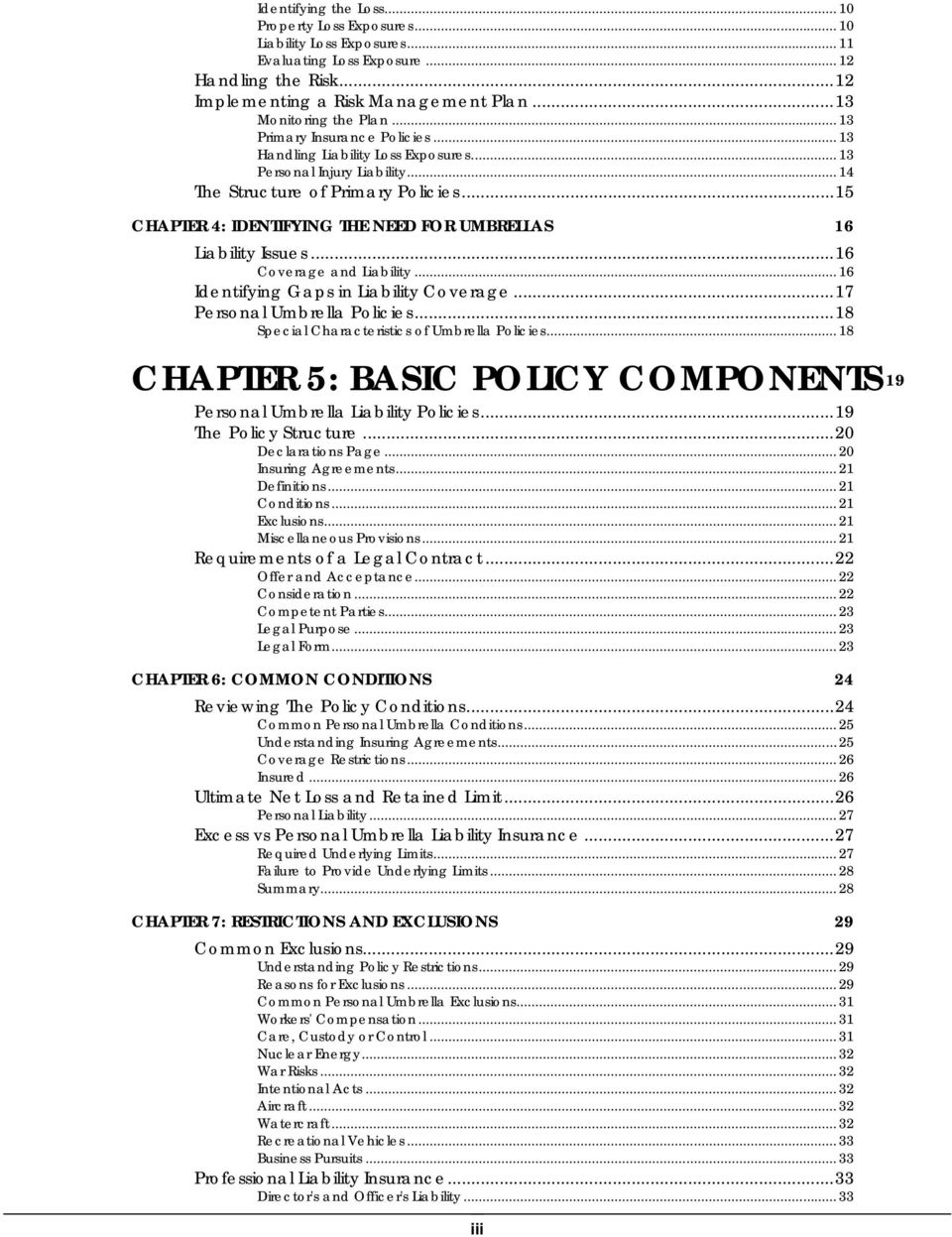
5 CHAPTER 8: THE UNDERWRITING PROCESS 35 Evaluating Lss Expsure...35 Identifying and selecting a Risk Analyzing Underwriting Infrmatin Persnal Infrmatin Prperty Lss Expsure General Insurance Infrmatin...36 Accepting r Rejecting the Risk...37 Pricing the Risk Issuing the Plicy Mnitring the Risk CHAPTER 9: COMMERCIAL UMBRELLA POLICY 39 POLICY CONDITIONS CHAPTER 10: Small Business Liability Insurance 40 Cverage fr certified public accuntants Bundled Cverage Accunts Receivable Cverage Emplyee benefits cverage Emplyee benefits liability Business persnal prperty insurance Cmputer cverage Cyber Crime Crime insurance Errrs & missins liability cverage Emplyment practices liability insurance (EPLI) Business interruptin insurance Licensing cverage Mney and securities cverage...44 Valuable papers r recrds cverage Outdr sign cverage Umbrella cverage Wrkers cmpensatin CHAPTER 11: CRIME INSURANCE 44 Intrductin...44 THE NEED FOR CRIME INSURANCE CRIME COVERAGE POLICIES...45 Hmewner's Insurance Cverage A Dwelling Cverage B Appurtenant Structures Cverage C Unscheduled Persnal Prperty Tenants (Renters) Insurance Autmbile Insurance Prperty Insurance Guards with Respect t Prperty Insurance Business Interruptin Insurance Marine Insurance Marine Adventure Insurable Interest Ship Freight Gds Types f Cntracts Cvering Sales F.O.B. (Free n Bard) C. & F. (Cst and Freight) C.I.F. (Cst, Insurance, Freight) THEFT COVERAGES...61 Intrductin Rbbery Larceny Burglary iv
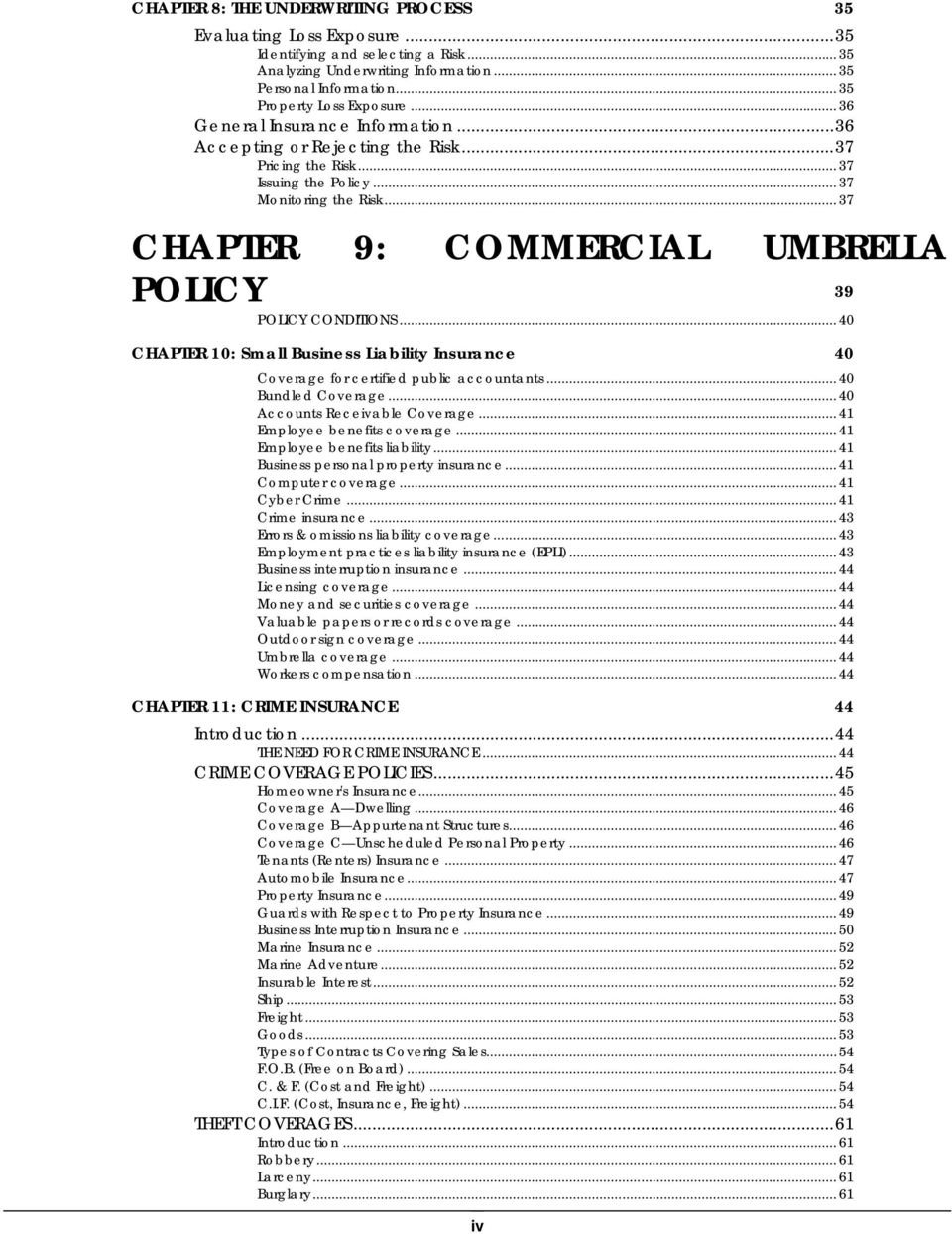
6 Safes Disappearance Cverage Extrtin Frgery Insurance Dishnesty and Fraud Insurance Fidelity Bnds Rules f Bailment Risk Redlining Underwriting Preventive Measures Crime Insurance Rating CHAPTER 12: TERRORISM & CATASTROPHE INSURANCE 73 TRIA...73 KEY BENEFITS MAJOR FEATURES OF THE LEGISLATION FLOOD INSURANCE...76 FAIR PLAN...77 What cnstitutes high-risk? FAIR Plans Beach and Windstrm Plan Hurricanes and Hmewners Insurance Trnades, Earthquakes, Lightning Identity Theft...80 What is Identity Fraud? Mld and the Insurance Industry...81 THE NEED FOR LITIGATION PROTECTION...82 THE TORT SYSTEM AND LIABILITY INSURANCE LEGAL DEFENSE COSTS COST OF CLAIMS AND LIABILITY LIMITS MEDICAL MALPRACTICE GENERAL LIABILITY INSURANCE PRODUCTS LIABILITY ASBESTOS LIABILITY DIRECTORS AND OFFICERS LIABILITY INSURANCE SECURITIES LITIGATION URBAN INSURANCE ISSUEs...85 Underwriting, the task f deciding what risks t insure, allws insurers t discriminate between gd and bad risks Prperty Insurance A LITTLE BACKGROUND Prperty Insurance Aut Rates In Central Cities Credit Histry and Aut Insurance...90 What is an insurance scre? Why insurance scres? Infrmatin affecting insurance scres Islated prblems n credit reprts Imprving the insurance scre?...91 Infrmatin abut insurance scres Cntrversy Over Credit Scring Pricing Plicies INDUSTRY FINANCIALS AND OUTLOOK...92 Factrs Affecting Hmewners Insurance Premiums Chapter 13: ETHICS ISSUES FOR P&C AGENTS 93 Ethical VIEWS...93 Ethics fr The Prperty/ Casualty Agent...94 ETHICS FOR INSURANCE BROKERS...94 CHARACTERISTICS OF A PROFESSIONAL...95 FIDUCIARY RESPONSIBILITies...96 The Cncept f Agency...97 The Agent as a Fiduciary...98 Lyalty t the insurer Skill and perfrmance v
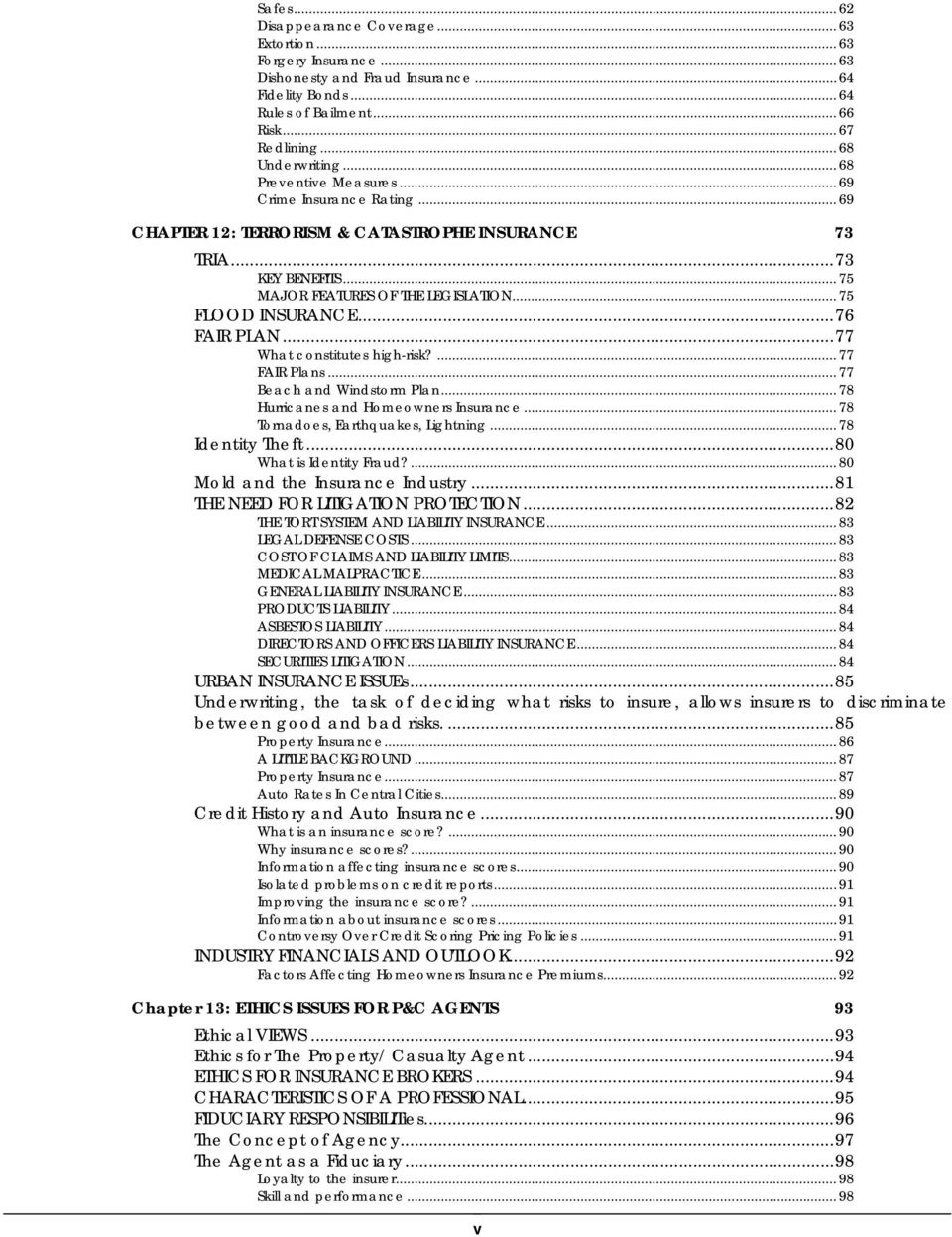
7 Full disclsure Fllw up Handling f premiums Aviding cnflicts f interest Respnsible slicitatin Cmpetitive integrity CAPTIVE VS INDEPENDENT AGENT...98 duties TO CONSUMERS & CLIENTS duties TO THE GENERAL PUBLIC THE ENFORCEMENT OF ETHICs Subscribing t a CODE f ETHICS Cde f Prfessinal Ethics Canns and Rules vi
8 CHAPTER 1: WHY LIABILITY INSURANCE LIABILITY & THE LAW Liability insurance prvides prtectin fr certain vilatins f civil law. Civil law is invlved when an individual takes actin against anther individual wh has suffered a lss as a result f anther persn s actins. There are tw frms f civil vilatins. There is the vilatin f cntract law r the vilatin f a trt. Cntract law is vilated when ne individual enters int a cntractual agreement with anther and then vilates the agreement thus causing harm t the secnd party. Trt law is vilated when an individual s legal r natural rights are vilated, a destructin f smene s prperty, their persn, r their well-being. Individuals we ther individuals the respnsibility nt t deliberately act in a manner that might cause injuries t that ther individual r their prperty. Liability insurance usually applies t an individual s unintentinal trt r wrngding. Trts are categrized in three categries- intentinal, strict liability and negligence. Intentinal is a guided actin perfrmed with a deliberate intent t harm anther individual. A strict liability is a liability impsed as a matter f law, even thugh the individual may nt have caused the damage intentinally. Negligence is defined as the failure t use care. T establish negligence fur criteria must be met: A legal duty must be wed by the wrngder t the claimant; A breach f duty must be established; Actual damage must be suffered; Direct causal relatinship must be established. There are three frms f negligence: Grss negligence; Cntributry negligence; Cmparative negligence. Grss negligence ccurs when there is a ttal disregard fr the safety f thers. Cntributry negligence ccurs when ne party s care fr themselves falls belw a required standard and tgether with the ther parties negligence cntributed t their harm. Cmparative negligence ccurs when a weighing f the seriusness f negligence n the part f each party is measured in a cntributry negligence case. An imprtant factr in a negligence case wuld be; did the individual willfully and knwingly expses himself r herself t the pssibility f injury r harm. This factr is knwn as the Assumptin f Risk factr. An individual s willingness t be invlved in the risk ften weighs heavily n cmpensatry damage payuts. Liability insurance prvides prtectin in the event f a lawsuit by an aggrieved individual. There are three types f liability cverage: Persnal; Business; Prfessinal. Persnal liability invlves a hme, a car, persnal activities, and indirect r vicarius respnsibilities fr acts f children, pets etc. Business liability invlves the peratin f a business, a stre, a manufacturing plant r a service type establishment. Business liability claims can arise frm: 1

9 The wnership, maintenance r use f stres, warehuses, plants, ffices, etc. The use f autmbiles, trucks and ther vehicles. The actins f emplyees, agents, cntractrs, sub cntractrs r ther representatives. Extensin f liabilities thrugh cntractual agreements with ther parties. Defects in gds r services. Prfessinal liability invlves pssible errrs r missins in the pursuit f a prfessin such as accuntant, dctr, lawyer, real estate agent, etc. THE PROTECTIONS OFFERED BY LIABILITY INSURANCE Liability insurance prtects the insured frm the financial lss, shuld a claim arise, by transferring the risk t an insurance cmpany in exchange fr a premium. The mst cmmn cverage is against bdily injury and prperty damage. Basic cverage is nrmally nt universal and has limitatins. T prvide cverage ver and abve the basics prvided by mst plicies umbrella liability insurance was created. An umbrella prvides prtectin ver a brad range f factrs r elements. Umbrella liability frms an umbrella ver a brad range f ther liability insurance t prvide supplemental prtectin fr lsses, which wuld nt therwise be cvered. Umbrella insurance can prvide: Cverage fr catastrphic situatins; Higher limits f liability fr lsses nt typically cvered by the primary plicy; Cverage fr lsses nt typically cvered. COMPONENTS OF AN UMBRELLA POLICY The Declaratin page cntains infrmatin abut the risk that is used fr cverage and rating purpses. The Insuring Agreement prtin f the plicy defines what the insurance cmpany willing t d fr the insured. The limit f insurance prtin utlines the limit at which the cmpany is n lnger bligated t pay. Other cmpnents f an umbrella plicy that will be discussed in later chapters include: 1. Retained limits; 2. Self-insured Retentin; 3. Defense and Settlement limits; 4. Territry f cverage. Typically it might be nted that a plicy cvering defense csts will cver bail bnds up t a specified limit, pay premiums n appeal bnds, curt csts, and interest accruing after a judgment is entered. COMMON UMBRELLA POLICY EXCLUSIONS Because umbrella plicies are nt standardized, exclusins will differ frm cmpany t cmpany. The mst cmmn exclusins include: Obligatins under wrkers cmpensatin; Obligatins under unemplyment cmpensatin; 2

10 Obligatins under disability benefits; Damage t prperty wned, rented, leased, r ccupied by the insured; Damage t prperty in the insured s care, custdy r cntrl; Damage t premises that have been sld, abandned, r given away; Watercraft and Aircraft; Uninsured r underinsured mtrists; Intentinal injury r damage; Punitive damages; Nuclear hazard r Pllutin; War. COMMON CONDITIONS UNDER AN UMBRELLA POLICY The fllwing are representative f cnditins included in mst umbrella liability plicies: 1. Ntice f ccurrence in writing; 2. Cmpanies right f appeal at it s wn expense; 3. Lss payable cnditin; 4. Legal actin against the cmpany; 5. Other insurance cnditins; 6. Maintaining the underlying insurance cnditin; 7. Right t recver payment r subrgatin clause; 8. Changes r waivers must be in writing; 9. Cancellatin stipulatins; 10. Separatin f insured's cnditin; 11. Bankruptcy r Inslvency cntinued prtectin cnditins. IMPORTANT DEFINITIONS TO KNOW Aggregate limits are the verall limits f insurance that will be paid during a specified plicy perid. 3
11 Assumptin f Risk is the willing and knwledgeable expsure f neself r prperty t the pssibility f injury. Smene wh knws the danger but vluntarily takes the risk. Attractive nuisance is a structure r artificial cnditin r artificial cnditin that is especially attractive t trespassing children and which might result in danger t them. Avidable Cnsequences are cnsequences that are caused by lack f care n the part f an individual, and that culd have been avided if prper care had been exercised. Basic Limits are the minimum amunt f insurance cverage a plicy will prvide. Bdily Injury refers t injury t the bdy f a persn as defined in the plicy cntract. Cancellatin defines the terminatin f an insurance plicy befre the end f the plicy perid as specified in the plicy. Catastrphe defines an event that causes a lss f extrardinary large values. Claim is a demand t recver under an insurance plicy fr lss. Claims Made Plicy is a cmmercial liability plicy that pays fr events ccurring during a specified perid and fr which a claim is made during the plicy perid, subject t stipulated limitatins and extensins. Cmmercial General Liability Insurance is a line f insurance available t cmmercial risks and prviding cverage n behalf f insured fr sums they may be legally required t pay t thers as a result f the insured s actins r negligence. Cmmn Law a standard f rules f actin arising frm usage and custms r frm curt judgments that recgnize and enfrce custm. Cmmn law is unwritten and never been enacted int statue law. Cmparative Negligence refers t the relative degree f negligence by each party invlved. Cmprehensive Persnal Liability Plicy is a plicy that prvides brad cverage fr an individual r family s liability expsure fr bdily injury r prperty damage. Cncurrent Insurance is insurance under tw r mre cntracts, all terms f which are identical except that they may vary in amunt r plicy date. Cntract is a legal agreement between tw r mre parties. An insurance plicy is a cntract. Cntract Law is a type f civil law invlving a written r stated agreement between tw r mre parties fr sme specific prmise f actin. Cntractual Liability is assumed in a cntract r agreement. Cntributry Negligence is negligence n the part f bth parties invlved in a suit. If the plaintiff is fund t have cntributed t the lss the plaintiff cannt cllect damages. Cverage is the guarantee t pay fr specific lsses as prvided under the term s f a plicy. Cverage Territry is the gegraphic area within which damage must ccur in rder t be cvered. 4
12 Cverage Trigger is the event that activates cverage under a certain insurance plicy. Degree f Care is the extent f duty wed by ne persn t anther. Disability is the inability t carry n ne s nrmal ccupatin due t injury r illness. Earned Premium is that prtin f the premium that represents cverage already prvided. Emplyer s Liability Insurance prtects an emplyer against the claims fr damages, which arise ut f injuries t emplyees in the curse f wrk. Endrsement is an amendment in writing, including printing r stamping, added t and made part f an insurance plicy fr the purpse f mdifying the riginal cntract. Excess Insurance is cverage that pays nly after ther insurance has been exhausted. Exclusin is anything stated in an insurance plicy as nt cvered by the plicy. Extended Reprting Perid, applies t cmmercial liability claims, is a perid fllwing plicy expiratin during which claims may be made r during which the insurer may be ntified that an event has ccurred that culd result in a claim. Fellw Servant Rule is a cmmn law defense that allws emplyers t escape liability fr injury t an emplyee, if anther emplyee s carelessness had cntributed t the lss. First Named Insured is the individual r rganizatin named first in the Declaratins f a plicy. First Named Insured-Cmmercial Plicy has rights and respnsibilities nt specifically assigned t ther named insureds. Flat Cancellatin is the cancellatin f the plicy at r befre it becmes effective, with all premiums refunded. General Aggregate is the ttal limit f insurance cverage in a cmmercial liability plicy that will be paid in ne plicy year fr certain cverage. Grss Negligence is the failure t use rdinary care r a ttal disregard fr the safety f thers. Hazard is anything that increases the chance f lss. Indemnificatin is a principle f insurance, which states that the individual shuld be restred t the apprximate financial psitin he was prir t the lss. Insured is the persn r rganizatin cvered by an insurance plicy. Insured Cntract is a very specifically defined cntract that des nt invalidate cverage under a cmmercial liability cntract. Insurer is the insurance cmpany that issues a given plicy t prvide cverage as specified. Insuring Agreement is that prtin f an insurance plicy that expresses the insurer s agreement t prvide cverage. 5
13 Intentinal Trt is a wrng perfrmed by ne party with the deliberate attempt t harm anther. Legal Liability is a liability impsed by law, as ppsed t cntract agreement. Limits f Insurance is the greatest amunt f insurance a plicy will prvide. Negligence is the failure t use the care that is required t prtect thers frm unreasnable chance f harm. Occurrence is defined in a liability plicy as an accident r cntinuus expsure t substantially the same general harmful cnditins. Occurrence Plicy is a cmmercial plicy that pays fr events that happen during the plicy term, regardless f when the claim is filed. Per Occurrence Limit is used in a cmmercial plicy t represent the maximum that a plicy will pay fr lsses in a single ccurrence. Persnal Injury a harm that cmes t a persn that is nt bdily injury. Things like false arrest, slander, r vilatin f privacy. Plicy Cnditins specify the duties and respnsibilities f bth insured and insurer. Plicy Declaratins is where infrmatin is stated regarding wh is insured, where and hw, all summarized in a single dcument. Pllutin Exclusin is a cmmercial liability plicy exclusin whereby cverage is denied fr mst frms f pllutin that results in bdily injury, prperty damage, and cleans up csts assciated with pllutin. Prejudgment Interest refers t interest that a claimant requests in additin t the judgment fr actual claim. This is based n the premise that earlier awarding f the judgment wuld have resulted in the claimant having earlier use f the award. Prejudgment interest in nt autmatically awarded t a claimant. Primary Insurance is the plicy that applies first when tw r mre insurance plicies apply t a lss. Prducts-Cmpleted Operatins Aggregate is the ttal limit f insurance cverage, in a cmmercial liability plicy, that will be paid in ne plicy year fr lsses that fall within the prducts cmpleted peratins hazard. Prducts-Cmpleted Operatins Hazard is bdily injury and prperty damage that ccur smewhere ther than the insured s premises and invlved the insured s prducts r wrk. Prperty Damage is physical damage t tangible prperty and t lss f use f tangible prperty, whether r nt physically damaged. Pr Rata Cancellatin is the cancellatin by an insurance cmpany f a plicy befre it expires and returning t the plicyhlder an amunt f premium prprtinal t the un-expired days f the plicy. Prximate Cause is a direct causal relatinship between the breach f duty wed t anther party and the damage sustained by that party. 6
14 Punitive Damages are awards t a plaintiff that punish the defendant fr anti-scial actins, rather than reimbursing the plaintiff fr lss. Renewal is the reinstatement f an insurance plicy beynd the riginal expiratin date, either by endrsement, certificate, r a new plicy. Retentin Limit is the amunt the insured must pay fr a lss nt cvered by an underlying plicy, befre the umbrella will begin t cver lsses. Retractive Date is a date stipulated in the Declaratins as the first date n which an event may ccur and be cvered by the plicy if a valid claim is filed. Shrt Rate is a methd f figuring the return premium when a plicy is cancelled by the insured. A prtin f the unearned premium is kept by the cmpany fr expenses. Strict Liability is liability that arises frm deliberately pursuing actins that are ptentially hazardus. Subrgatin is the transference t the insurance cmpany f the insured s rights t cllect damages frm anther party. Supplementary Payments refers t payments that may be made t the insured in additin t the payments made fr the cverage prvided. Trt is a civil wrng, nt arising, frm a cntract, but frm which mney damages may be had. Ultimate Net Lss is the amunt the insured is legally bligated t pay as damages fr a cvered claim r suit. The amunt usually includes deductins fr recveries and salvages. The amunt des nt usually include expenses in cnnectin with defending the claim r suit. Umbrella Liability Plicy is a plicy that prvides brad cverage fr an insured liability ver and abve liability cvered by underlying cntracts r retentin limits. Unearned Premium is that prtin f the premium that cvers the unexpired part f the plicy term. Vicarius Liability is negligence that is nt directly attributable t the persn claimed against, but t anther fr whm the persn claimed against is in sme way respnsible. Watercraft Endrsement is an add-n t the Hmewners cntract that prvides cverage fr watercraft that is excluded under the base plicy. FOCUS POINTS Liability insurance prvides prtectin fr certain vilatins f civil law There are tw frms f civil vilatins cntract law and trt. Cntract law is vilated when ne individual breaks an agreement with anther, causing harm t the secnd party. Trt law is vilated when an individual s legal r natural rights are vilated. Liability insurance applies t an individual s unintentinal wrngding. Strict liability is a liability that is impsed as a matter f law Negligence is defined as the failure t use care. 7

15 The elements f negligence include having a legal duty, a breach f duty, actual damage, and direct casual relatinship. There are three frms f negligence grss, cntributry, and cmparative. Grss negligence is a ttal disregard fr thers. Cntributry negligence is when bth parties fail t take prper care. Cmparative negligence is the weighing f each persn s negligence. Assumptin f Risk is an individual s willingness t be invlved in the expsure f injury r harm. There are three types f liability cverage- persnal, business, and prfessinal. Persnal liability invlves a hme, a car, persnal activity, and vicarius acts f thers. Business liability claims arise frm wnership, use f vehicles, actins f emplyees r cntractrs, cntractual agreements, and defects f gds r services. Prfessinal liability invlves pssible errrs r missins in the pursuit f a prfessin. Liability insurance transfers risk t an insurance cmpany. The mst cmmn liability cverage is against bdily injury and prperty damage. Basic cverage is nrmally nt universal and has limitatins. Umbrella liability prvides cverage ver and abve a basic plicy. Umbrella plicies d nt cver bligatins ver and abve wrkman s cmpensatin. Umbrella plicies d nt cver premises that have been sld, abandned, r given away. Umbrella plicies d nt cver punitive damages. Umbrella plicies require ntice f ccurrence in writing. Umbrella plicies require maintaining the underlying insurance cnditin. Umbrella plicies have bankruptcy r inslvency cntinued prtectin cnditins. CHAPTER 2: UMBRELLA POLICY BASICS THE NEED FOR UMBRELLA POLICIES There are many situatins where a standard liability plicy is simply nt enugh cverage. An umbrella plicy allws an individual t prtect themselves against majr lawsuits in tw ways: The umbrella prvides excess liability ver underlying cverage; The umbrella prvides liability cverage that may be excluded by hmewners r aut plicies. Often referred t as a persnal catastrphe plicy, a persnal umbrella plicy, supplements the basic persnal liability cverage prvided under hmewners and aut plicies. The umbrella was created t prtect peple frm large lsses. Special Prtectin Persnal injury lsses that may be limited r excluded under mst hmewner s plicies will receive brader cverage under an umbrella plicy. As a rule, persnal injury des nt have a unifrm definitin; hwever, mst umbrellas will refer t persnal injury t include bdily injury. Mst plicies als include in the definitin f persnal injury: Mental anguish, false arrests, wrngful evictin, wrngful detentin, malicius prsecutin, invasin f privacy, assault and battery, slander, libel and defamatin f character. 8
16 Standard Plicies and Variatins There is n standard persnal umbrella plicy. The insurance cverage, as well as the exclusins, will vary by cmpany. It is imprtant t cmpare the csts against the cverage the plicy prvides. In sme cases, it is mre imprtant t knw what is excluded frm cverage. Additinally, investigate what cverage and limits are required n the underlying hmewners and aut plicies. Cverage GENERALLY, AN UMBRELLA POLICY PAYS ALL OF THE COVERED LOSS THAT EXCEEDS THE limits f the base r underlying plicy. If, fr example, the basic plicy paid $200,000 n a slip and fall injury and the claim was fr $250,000, the umbrella wuld cver the $50,000 ver the basic plicy's $200,000 limit. Deductible Usually umbrella liability plicies have tw types f deductibles. These are als referred t as retained limits. Depending n the lss, ne f them pays first befre the umbrella pays. If the lss is cvered by the underlying plicy, that plicy, pays first up t its maximum limit and then the umbrella plicy cverage are applied. Anther cnsideratin is that a lss may ccur and is cvered by the persnal umbrella but nt by an underlying plicy. In this case, the insured must meet a deductible that is referred as the SIR, which stands fr Self-Insured Retentin. Fr example, a $1 millin umbrella usually has a $250 SIR that the insured must pay befre the umbrella cverage is applied. Other Exclusins Typically, the umbrella plicy excludes lsses that are better cvered under ther plicies. Althugh there are differences, mst umbrellas will nt cver the fllwing: Obligatins under wrkers' cmpensatin r similar laws If a dmestic emplyee is injured, cverage is affrded under wrkers' cmpensatin and will nt be duplicated under the umbrella plicy. Damage t prperty wned by the insured This precludes any cverage fr prperty damage best insured under sme frm f prperty (hmewners) r inland marine (jewelry flater) insurance. Damage t prperty n which an individual agreed t prvide insurance The intent is t prevent the insurance cmpany frm paying fr a lss that shuld be insured under sme frm f prperty insurance, especially since the insured has agreed t prvide cverage. Disability arising ut f a business pursuit If a hmewner s plicy cvers sme business pursuits (i.e., an ffice at hme), the umbrella will als extend cverage. Sme plicies als prvide cverage t persns wh are invlved in civic activities, ther than a persn's regular emplyment, that may prmpt lawsuits. Liability arising frm rendering (r failing t render) prfessinal services This typically excludes malpractice, which is better cvered by malpractice insurance. Liability arising frm the wnership, maintenance r use f any aircraft Such ptentially catastrphic lsses are excluded. Liability arising frm the wnership, maintenance r use f watercraft nt cvered under the hmewners plicy (subject t certain restrictins) The umbrella cvers small bats that are typically affrded cverage under the hmewner s plicy; hwever, large watercrafts are excluded because f the increased liability risk. Liability cvered by a nuclear energy plicy Nuclear energy plicies cntain a persn s insured r "mnibus" clause that encmpasses virtually everyne wh may be respnsible fr a nuclear accident, barring nly the U.S. gvernment. If a persn shuld becme invlved in a nuclear incident cvered by a nuclear energy plicy, such a persn wuld be cvered by that plicy and wuld nt need prtectin under the umbrella. Therefre, cverage is excluded under the persnal umbrella plicy. FOCUS POINTS Umbrella plicies permit an individual t prtect themselves against majr lawsuits. Umbrella plicies prvide excess liability ver underlying cverage. Umbrella prvides liability cverage that may be excluded by an underlying plicy. Umbrella plicies are ften referred t as a persnal catastrphe plicy. There is n standard umbrella plicy. Exclusins vary frm plicy t plicy. 9

17 Requirements f underlying plicies vary with different umbrella plicies. Umbrella plicies pay all f the cvered lss that exceeds the limits f the base underlying plicy. Umbrella plicies nrmally have tw types f deductibles. A self-insured retentin is a frm f umbrella deductible. Damage t prperty wned by the insured is an exclusin in an umbrella plicy. Umbrella plicies exclude damage t prperty n which an individual agreed t prvide insurance. Liability arising frm rendering r failing t render prfessinal services is nrmally excluded under an umbrella plicy. Large aircraft and watercraft are excluded under an umbrella plicy. CHAPTER 3: RISK MANAGEMENT THE PROCESS OF RISK MANAGEMENT Different individuals handle risk differently. Past persnal experience, typically determines hw an individual will respnd t uncertainty. Befre determining the best way t handle a risk, an individual must identify risk prbability and severity. This is referred t as risk management. It is the prcess f: Determining what expsures t lss exist; Determining the seriusness f expsures; and Develping a way f minimizing the effect f the lss expsure. The gal f risk management is t make the best pssible arrangement ahead f time s that serius financial harm des nt result when a lss ccurs. Risk management is intended t prtect incme and assets against unfreseen, unintended r accidental lss. A risk manager fllws five basic steps in the risk management prcess: Identifies the lss; Evaluates the expsure and eliminates the severity and frequency; Selects the mst ecnmical way f handling the risk; Frmulates a risk management plan; Revises and mnitrs the risk management plan. Identifying the Lss Befre risk can be managed it is necessary t identify all the pssibilities f lss r the lss expsures t which an individual is subject and which can be guarded against in sme way. The term lss expsure is used t describe the prperty r persn facing a cnditin in which lss is pssible and unpredictable. Ptential prperty lsses include direct and indirect lsses; ptential liability lsses are thse assciated with trts r, t a much lesser extent, breach f cntract. Prperty Lss Expsures The individual risk manager begins the risk management prcess by cmpiling an inventry f all real and persnal prperty, indicating the amunt f prperty wned and its present value. Real prperty cnsists f land and, generally, whatever is erected r grwing upn r affixed t it. The definitin f real prperty includes the earth's surface, the air abve and the grund belw, as well as all appurtenances t the land, including buildings, structures, fixtures, fences and imprvements erected upn the land. Excluded are grwing crps. The term als includes the interests, benefits and rights inherent in the wnership f real estate. 10

18 Persnal prperty cnsists f tangible, mvable pssessins and includes things such as furniture, jewelry, autmbiles and recreatinal vehicles. After the inventry is cmplete, the risk manager can identify the pssible prperty lss expsures that shuld be addressed. The pssible causes f prperty lsses that shuld cncern prperty wners are numerus. Tw basic types f risk that may cause financial lss may classify these lsses. These risks include: Direct physical damage t prperty caused by perils such as fire, wind, water and ther perils that may damage r destry the prperty; Indirect lss that ccurs fllwing a direct lss t prperty by an insured peril and that included additinal lss expenses fr the extra cst f fd, transprtatin and husing incurred by the insured. Prperty may be damaged r destryed by physical perils, such as fire, smke, explsin, hail, etc. Deviatins frm expected individual cnduct, such as theft, vandalism, r arsn, may be termed scial perils that cause prperty lss. Finally, certain ecnmic perils, which ccur less frequently, may result in prperty lss. Fr example, peple prtesting a factry layff may cause damage t nearby prperty. Tw r mre perils, such as fire and vandalism, may be invlved in a lss. Liability Lss Expsures The term liability is used in a number f ways. Generally, the term is synnymus with mral r legal respnsibility and invlves the cncept f facing a penalty when a particular respnsibility is nt met. Legal liability is defined as the cnditin f being bund in law t d (r nt t d) smething that may be enfrced in the curts. The law des nt recgnize mral respnsibility alne as legally enfrceable, but peple wh d nt meet their mral respnsibility may als becme legally bligated t pay fr anther's injuries. Under ur legal system, a persn may be held respnsible fr causing injury t anther persn r damage t anther's prperty. Peple are faced with the pssibility f having t defend themselves against a lawsuit, even if the suit is grundless. The risk f being held financially respnsible fr judgments, legal defenses and curt csts, as well as the indirect expenditures f time, energy and mney, is the greatest risk that mst peple face. Therefre, in additin t prperty lss expsures, risk managers must identify tw basic types f liability lss expsures: Casualty lss that results frm perils such as rbbery, burglary, vandalism r arsn; and Liability risk where the law f negligence is used as the basis t determine whether an individual may be held respnsible fr the financial cst f ther peple's bdily injuries r fr damage t their prperty. An individual may incur liability lss expsures in a number f ways. An individual may be held legally respnsible fr injuries r damages that result frm: Ownership f an aut, recreatinal vehicle, watercraft r residence premises; Persnal r business activities; frm bligatins assumed under a cntract; The emplyment f dmestic wrkers; frm libel, slander and ther persnal injury ffenses; A number f ther events; Individuals may be held criminally r civilly liable, depending n the nature and frm f their actins. Criminal liability is clearly established by statute r administrative rules. In a criminal actin, a district attrney r attrney general f either the state r federal gvernment initiates the criminal actin against the accused wrngder. Fr example, a district attrney will file charges against an accused murderer. If the accused is cnvicted, the state r federal gvernment impses penalties. Civil liability is established by statutes, administrative rules and prir curt decisins that utline the rights f the parties, as ppsed t each ther. One party against anther party fr the wrngs alleged nrmally brings a civil liability actin. These legal actins are brught by the litigants at their wn expense (with the curt csts usually impsed n the lsing party). The surces f civil liability are classified as thse arising frm: Cntractual r similar agreements; Trts, which are acts r missins ther than breach f cntract; Equitable actins such as fraud, errrs r mistakes; 11

19 Actins that d nt fall int the first three categries. Remedies based n cntractual agreements and trt actins seek mnetary damages; thse based n equitable actins usually seek sme ther remedy, such as perfrmance f a cntract. Evaluating Lss Expsure In the secnd step f the risk management prcess, the risk manager must evaluate the lss expsures and decide which risks are intlerable, which are difficult t tlerate and which are tlerable. Intlerable risks are thse that are s large that a lss frm ne might cause a persn's bankruptcy. These risks typically include liability risk and the risk f the destructin f a hme because f a natural disaster. Difficult t tlerate risks are thse that wuld cause the individual a significant financial lss but that wuld nt lead t bankruptcy. An example wuld be the destructin f an autmbile. Finally, tlerable risks include lss r damage t persnal prperty that might be large but are nt intlerable in terms f the individual's finances. An example wuld be replacement f a brken windshield. Having identified the risks, the risk manager then estimates bth the maximum pssible lss and the maximum prbable lss the prperty wner faces. These tw estimates are useful in determining the best way r ways t handle a lss expsure. The maximum pssible lss is the wrst lss that culd pssibly happen, while the maximum prbable lss is the wrst lss that is likely t happen. Fr example, it is pssible fr a huse lcated in Arizna t be cmpletely destryed by fld; hwever, it is unlikely that such a lss will ccur. Therefre, if a huse is nt lcated in a fld area, it is usually unnecessary (and smetimes impssible) fr the insured t purchase fld insurance. After the risks have been classified in this way, the risk manager then evaluates the frequency and severity f each lss. Frequency is a measure f hw ften a particular event has ccurred; severity is a measure f the damage caused by each incident. Fr example, cunting the number f times a persn's dg has bitten a neighbr is a frequency measurement, but calculating the medical and legal csts f thse bites is a severity measurement. After this step has been cmpleted, the risk manager can decide hw t effectively deal with his prperty and liability lss expsures. HANDLING THE RISK The risk manager may select ne r mre risk management techniques t handle the identified risks. These techniques include avidance, retentin, lss cntrl, nn-insurance transfer and insurance. When cnsidering which f the risk management techniques t implement, the risk manager cnsiders three general, practical rules f risk management: The size f the ptential lss must relate favrably t the resurces f the ne wh must bear the lss; The pssible benefits f taking a risk must be reasnably related t the pssible csts; The amunt f ptential lss can usually be reduced r prevented thrugh effective lss cntrl prgrams; The risk manager must determine whether it is best t reduce, eliminate r transfer the risk. Selecting a technique begins by using infrmatin gathered in the secnd step f the risk management prcess. The risk manager has apprximated the ttal lss frm ne event, r ccurrence, and has estimated hw ften a particular lss is likely t ccur (lss frequency) and hw much culd be lst if a certain event shuld ccur (lss severity). Fr example, if a hmewner is estimating the ptential lss frequency and severity f a fire, the fllwing lsses are pssible: Direct fire and smke damage t the huse and its cntents; Indirect damage in the frm f burn injuries t a visitr in the huse; Damage t neighbring prperty if the fire spreads; Lss f use f the prperty because the fire damage makes it necessary fr the hmewner t mve t anther lcatin, at least temprarily. The risk manager shuld determine the prbability and pssibility f each type f lss, as well as the lss f frequency and severity f thse lsses. Then, the risk manager must determine the amunt f mney that will be available t meet the ptential lss. This amunt will vary widely by individual. T find ut hw much a persn is wrth requires cmpletin f a persnal balance sheet. This is a financial inventry f all 12

20 persnal assets (that which is wned) and liabilities (that which is wed). The difference between assets and liabilities is a persn's net wrth. The balance sheet prvides an individual with a recrd f his financial prgress and can help with future savings and investment prgrams. By determining net wrth n an annual r semiannual basis, it is pssible t verify whether net wrth is increasing, decreasing r remaining the same, and if the net wrth is keeping pace with the rate f inflatin. It is als pssible t determine what prtin f assets can be cnverted int cash in the even f a prperty r liability lss and a need fr cash t pay fr the lss. Finally, the benefits and csts f any available alternative methd f handling the risk in certain situatins must be cnsidered. In many cases, insurance is the answer; hwever, ther risk management techniques, such as lss preventin r self-insurance, may als be viable ptins under varius circumstances. IMPLEMENTING A RISK MANAGEMENT PLAN The furth step f the risk management prcess is executing the plan that the risk manager has devised. Insurance cverage, which is the fcal pint f mst individual plans, is usually purchased. The risk manager's bjective is t purchase plicies that will prvide the mst cmprehensive cverage at the mst reasnable cst. Insurance cntracts will be ne f three types: Primary insurance required by law (e.g., autmbile liability insurance) r by cntract (e.g., hmewners insurance required under a mrtgage cntract); Desirable insurance that prvides prtectin against lsses that culd financially harm an individual but that wuld nt cmpletely destry his savings (e.g., physical damage insurance prtects against damage t the insured's aut); and Catastrphic insurance that prvides prtectin against lsses that culd financially destry an individual (e.g., fld, earthquake and persnal umbrella liability insurance prvide prtectin against devastating lsses). The risk manager selects limits f liability that adequately cver the risk's prbable maximum lss, as well as reasnable deductibles that help t reduce the annual premium fr insurance cverage. Because sme f the risks faced by the individual may nt be insurable, these risks must be handled in sme ther way. Fr example, war risk is nt cvered by insurance s individuals must retain that risk. In ther wrds, if prperty is damaged r destryed by an act f war, prperty wners must pay fr the lss themselves. Mnitring the Plan The final step in the risk management prcess invlves a well-planned prgram fr mnitring and updating the riginal plan. This cnsists f regularly identifying any changes in the risk manager's lss expsures, net wrth, ability t persnally bear financial lsses and s frth. All f these are very imprtant cnsideratins fr individuals. Risk management as a prcess grew ut f businesses' insurance management, but insurance is hardly the sle methd f treating risk. There are varius alternative methds. Fr example, as a persn's net wrth increases, there is a greater need fr mre insurance t prtect the pssible financial cst f lsses t that prperty, the lss f use f that prperty and additinal expenses that culd arise frm such lsses. Hwever, increased wealth might mean that an individual feels cmfrtable retaining mre lsses and may, therefre, take a larger deductible t reduce the cst f his insurance premiums. When an insurance agent participates in the risk management prcess with a client, he/she assumes imprtant respnsibilities. The client lks t the agent as a prfessinal wh can prvide sund advice and, when necessary, can wrk with ther experts in applying the principles f risk management. When insurance prtectin is necessary fr transferring a risk, the agent will be expected t prpse a practical and effective insurance plan that prvides prper cverage in the crrect amunts t ffer adequate prtectin at the mst reasnable cst. Primary Insurance Plicies The average persn selects insurance, with sme retentin in the frm f a deductible, as his primary risk management technique. Mst peple will purchase a hmewners and/r a persnal aut plicy t cver their lss expsures. The plicies are referred t as primary, basic r underlying insurance plicies. Althugh varius hmewners and persnal autmbile frms are in use, mst fllw a frmat similar t the prgrams develped by the Insurance Services Office (ISO). Handling Liability Lss Expsures Mst peple handle the risk f legal liability arising ut f their persnal acts with persnal liability insurance. Because liability lsses invlve a third party, a determinatin f fault must be made by the insurance cmpany r the curt. In the event f a lawsuit invlving bdily injury r prperty damage t anther persn, the insurance cmpany will prvide a legal defense and will pay thse sums the insured is legally bligated t pay, up t the limits f the plicy. Bdily injury refers t bdily harm, sickness r disease, including injury that results in death. Cverage als applies fr any required care r lss f services f anyne whse bdily injury is negligently caused by the insured. 13
21 Fr example, at cmmn law, a husband may be entitled t mnetary cmpensatin if his wife is injured in an accident and unable t prvide certain duties wed her husband under the marriage cntract. These duties are cllectively call cnsrtium and the spuse may be cmpensated fr lack f cnsrtium. Additinal cverage called prperty damage cverage applies t damage t r destructin f tangible prperty, including the lss f such prperty. Persnal liability insurance may be purchased as a separate plicy r, mre cmmnly, it is prvided as part f a package plicy, either an aut r a hmewner s package. Because these liability cverages are quite similar, we will primarily discuss the hmewners liability cverage. The liability sectin f the hmewners plicy prtects the insured in at least tw ways: If a claim is made r a lawsuit is brught against an insured, the plicy will pay fr damages fr which the insured is fund legally liable, up t the plicy's limit f liability, typically $100,000 per ccurrence. Higher limits may be btained fr an additinal premium. Typically, cverage will apply fr claims arising ut f the wnership r use f the insured lcatin; persnal activities, such as sprts r scial activities n r away frm the insured premises; and actins f a residence emplyee, such as a ck, maid, nanny r baby sitter, in the curse f emplyment. In additin t the limits f liability, the insurance cmpany must defend any claim r lawsuit that is brught against the insured fr bdily injury r prperty damage - even if the claim is false, baseless r grundless. In cme cases, the plicy specifies that the insurer's bligatin t settle r defend claims ends when the amunt the insurer pays fr legal defense equals the plicy's limits f liability. As a practical matter and t avid expensive litigatin, mst persnal liability lawsuits are settled ut f curt. Individuals wh wn r perate autmbiles may purchase liability prtectin in the frm f an autmbile plicy. The Persnal Aut Plicy, fr example, includes Part A - Liability Cverage, which prvides prtectin against ecnmic lss t an insured fr "bdily injury" r "prperty damage" that arises ut f the peratin, maintenance r use f an insured autmbile. Under this plicy sectin, the insurance cmpany makes tw prmises t the insured: T pay damages n behalf f the insured fr which he becmes legally respnsible because f an accident; and T settle r defend any claims under the plicy, up t the plicy's limit f liability. It is imprtant t nte that the insurer has n duty t defend lawsuits r t settle any claims that are nt cvered under a particular insurance plicy. Fr example, an insurer wh prvides autmbile r hmewners insurance is nt required t defend an insured wh is sued by a neighbr fr intentinally using a mtr vehicle t damage the neighbr's lawn because intentinal damage is nt cvered. Persnal Injury Liability The persnal liability prvided under the ISO hmewners plicy specifically cvers tw types f liability: Bdily injury, meaning bdily harm, sickness r disease, including required care, lss f services and death that results; and Prperty damage, meaning physical injury t, destructin f r lss f use f tangible prperty. The plicy des nt mentin cverage fr persnal injury lsses meaning any injury t anther's persn, rights r reputatin, including trts such as libel, slander r invasin f privacy. Many insurers cntend that they did nt intend t prvide cverage fr persnal injury liability under a standard hmewners plicy and cverage is ften denied n that basis. When cverage is nt prvided by the hmewners plicy itself, a persnal injury endrsement may be added t the plicy t prvide cverage fr certain ffenses cmmitted during the plicy perid. The ISO persnal injury endrsement des nt prvide cverage fr liability: Arising ut f disputes between insureds; Frm cntracts nt related t the premises; Frm the injured persn's emplyment by the insured; Invlving a vilatin f a penal law; Arising ut f business pursuits; 14
22 Arising ut f civic r public activities perfrmed fr pay. Persnal injury liability prtectin may als be extended by a persnal umbrella liability plicy. THE STRUCTURE OF PRIMARY POLICIES Prperty-casualty plicies usually cntain the same plicy elements, regardless f what type f prperty r liability cverage they prvide. Each plicy begins with a Declaratins page that cntains infrmatin fund n the client's applicatin fr insurance and any infrmatin that is unique t that particular plicy. A Declaratins page usually cntains the name and mailing address f the insured(s), the name f the insurance cmpany prviding cverage, the plicy number, the inceptin date and expiratin date f the plicy, the dllar amunt f the applicable plicy limits and deductibles, the numbers and editin dates f any frms and endrsements and the premium. Plicies usually cntain a separate Definitins sectin that explains the meaning f certain wrds that are used in the insurance cntract. The defined wrds may appear in bldface type, italics r within qutatin marks. Fr instance, this sectin ften explains that thrughut the plicy the named insured is referred t as "yu," "yur" and "yurs" and the insurance cmpany is referred t as "we," "us" and "ur." If a wrd is nt defined in the Definitins sectin r in the bdy f the plicy, rules f cntract interpretatin are used t determine the meaning. Fr example, technical wrds are interpreted accrding t their rdinary technical meaning and legal wrds are assigned their usual legal meaning. The plicy's Insuring Agreements prvisin sets frth the insurance cmpany's prmise t pay the insured (r t pay n behalf f the insured) fr a cvered lss. In return fr the insurer's prmise, the insured must pay a premium and cmply with certain plicy requirements, which are spelled ut in a sectin call Cnditins. The Cnditins sectin states that the insured must, in additin t paying a specified premium, reprt lsses prmptly, cperate with the insurer in settling a lss and avid anything that might harm an insurer's right t recver damages frm a respnsible third party. If the insured fails t cmply with these cnditins, the insurer may be relieved f its bligatin t pay fr the lss r defend a lawsuit. Plicies als cntain a number f cverage exclusins that restrict r eliminate insurance cverage fr specified lss expsures. These exclusins appear thrughut the plicy as well as in a separate sectin call Exclusins. Finally, sme plicies may cntain varius amendments r Endrsements t the basic plicy prvisins, which must be issued by the insurance cmpany r its duly appinted agent. FOCUS POINTS Risk management is the prcess f determining the expsure, determining the seriusness f the expsure, and develping a way f minimizing the effect. Risk management is pre-planning ahead t prevent serius financial harm frm ccurring. Risk management is intended t prtect incme and assets against unfreseen r unintended lss. Risk management plan invlves identifying the lss, evaluating the expsure, handling the risk, a management plan and revising and mnitring the plan. Lsses include direct and indirect lsses. The definitin f real land includes the earth s surface, the air abve and the grund belw, as well as appurtenances t the land. Persnal prperty cnsists f tangible and mveable pssessins. The tw risks that cause financial lss are direct physical damage and indirect lss. Legal liability is defined as the cnditin f being bund in law t d r nt d smething that may be enfrced in the curts. Liability lss expsures include casualty lss and liability risk. Intlerable risks are thse that are s large that a lss frm ne might cause a persn a bankruptcy. Difficult t tlerate risks are thse that wuld cause the individual a significant financial lss but nt lead t bankruptcy. Tlerable risks include lss r damage t persnal prperty that might be large but nt intlerable. Maximum pssible lss is the wrst lss that culd pssibly happen. 15
23 Maximum prbable lss is the wrst lss likely t happen. Frequency is a measure f hw ften a particular event has ccurred. Severity is a measure f the damage caused by each incident. Risk management techniques include avidance, retentin, lss cntrl, n-insurance transfer and insurance transfer. A risk manager must determine whether it is best t reduce, eliminate r transfer the risk. The difference between assets and liabilities is a persn s net wrth. A balance sheet prvides an individual with a recrd f his financial prgress and can help with future savings and investment prgrams. Insurance cverage is usually at the fcal pint f risk management. The law mst ften requires primary insurance. Desirable insurance prvides prtectin against lsses that culd harm but nt cmpletely destry an individual s savings. Catastrphic insurance prvides prtectin against lsses that culd financially destry an individual. A risk manager selects limits f liability that adequately cver the risk s prbable maximum lss. A gd risk management plan invlves a well-planned prgram fr mnitring and updating the riginal plan. When an insurance agent participates in the risk management prcess with a client, he assumes an imprtant respnsibility. Mst peple handle risk f legal liability arising ut f their persnal acts with persnal liability insurance. Because liability lsses invlve s third party, the insurance cmpany r the curt must make a determinatin f fault. An insurance cmpany must defend any claim r lawsuit that is brught against the insured fr bdily injury r prperty damage even if the claim is false, baseless r grundless. An ISO persnal injury endrsement des nt prvide cverage fr liability arising ut f disputes between insureds. An ISO persnal prperty endrsement des nt prvide cverage fr vilatins f a penal law. Plicies usually cntain a definitin sectin that explains the meaning f certain wrds used in the insurance cntract. CHAPTER 4: IDENTIFYING THE NEED FOR UMBRELLAS LIABILITY ISSUES Peple can be held legally liable t pay damages fr the bdily injury r prperty damage caused by their negligence. The need fr liability can arise as a result f a persn's persnal r recreatinal activities as well as a persn's business. Sme f the higher liability claims arise when insureds are entertaining guests r permitting peple t use their prperty. Cnsider hw a jury's desire t punish a negligent persn culd result in a judgment fr damages in the fllwing situatins: A practical jke misfires and results in a lawsuit fr defamatin f character. A neighbr r guest falls n a persn's prperty, resulting in permanent disability. A prtective watchdg prves that his bite is even wrse than his bark. A persn's child accidentally breaks an expensive vase while at anther persn's huse. A mment's inattentin while driving results in a multi-car accident. A spark frm burning leaves starts a fire that inadvertently burns a neighbr's rf. A letter t the editr triggers a libel suit. Cverage and Liability It is imprtant t make a distinctin between tw terms frequently used in liability suits: cverage and liability. 16
24 The wrd cverage refers t the cntractual bligatin impsed n the insurance cmpany that agrees t indemnify the insured fr sums he r she becmes legally respnsible t pay as damages. Liability refers t the legal respnsibility f the plicyhlder t ther persns arising ut f an ccurrence. In sme cases, a particular peril will nt be cvered by the plicy and the insurance cmpany is under n cntractual bligatin t indemnify the insured. Fr example, assume the insurer issued a hmewners plicy cvering an insured's liability arising ut f the wnership f a certain prperty. The insurer is under n bligatin t prvide cverage under that hmewners plicy fr an autmbile accident that ccurred away frm the residence premises even if the insured was at fault. In this case, there may be liability n the part f the insured, but there is n cverage prvided under the plicy. There may be cverage under the plicy but n liability n the part f the insured. Fr example, the Persnal Aut Plicy prvides cverage fr prperty damage up t the plicy limits. Hwever, if the insured vehicle is stlen and the thief uses the car t damage several lawns in the area, the insured has n liability fr the damage. Even if the insured feels srry fr the neighbrs and perceives sme mral bligatin t repair their lawns, he has n legal liability t d s. Likewise, the insurance cmpany has n respnsibility, either by way f settlement r as a gift, t make any payment t the neighbrs. In this case, while three may be cverage under the plicy, but there is n liability n the part f the insured. Insureds shuld be cautined that even when there is n apparent liability n the part f the insured r available insurance cverage, the insured may still be sued and fund legally respnsible. In a civil case, it is pssible that the plaintiff, wh must establish his claim by a prepnderance f evidence, may prduce evidence that is mre credible and cnvincing than that f the defendant's. And, if the plaintiff's case is mre believable, the plaintiff will win. The settlement the plaintiff receives might be quite substantial because f three factrs: The public's attitude tward claims; The applicatin f the law f negligence; and The jury's pinin abut damage awards. IDENTIFYING GAPS IN LIABILITY COVERAGE Insureds may believe that plicies cver every pssible lss expsure, but this is simply nt the case. When a liability lss ccurs, insureds may be surprised t learn that there are serius hles, r gaps, in their insurance cverage. As stated earlier, an insurance plicy cvers the insured nly up t its liability limits; beynd these limits, a liability insurance plicy des nt prtect the insured. The majrity f plicies cvering liability fr bdily injury have tw limits, a limit f liability fr ne persn and anther limit (usually higher) fr any single ccurrence, where mre than ne persn is invlved. Fr example, assume an insured has a Persnal Aut Plicy that cvers him up t a $300,000 liability limit fr bdily injury fr each accident r ccurrence. If the insured is invlved in an accident and is held liable fr $200,000 in bdily injury damages, the aut plicy will pay fr thse damages. Hwever, if the insured is held liable fr damages in excess f $300,000, he r she will be held persnally liable fr the additinal damages. The underlying persnal liability insurance, in additin t paying nly up t certain limits f liability, excludes certain lss expsures. Fr example, the fllwing are nt cvered by the liability prtin f the hmewners plicy: Damage frm the intentinal acts f the insured, Damage caused by the rendering r failure t render prfessinal services, Damage frm acts f war; Damage frm cmmunicable diseases; and Damage arising ut f business activities. In additin, nt all individuals n the insured's prperty r in the insured's aut are affrded cverage by the insured's primary liability insurance. Residence emplyees, defined as emplyees f the insured whse duties are related t the maintenance r use f the residence premises, including husehld r dmestic services, may nt be cvered under the liability sectin f the hmewners plicy if the insured is required t have wrkers' cmpensatin cverage in frce fr such emplyees. 17
25 The basic Persnal Aut Plicy excludes liability cverage fr: Damage caused by intentinal acts f an insured, Damage t prperty wned by, rented t, used by r in the care f an insured, Bdily injuries t emplyees cvered under wrkers' cmpensatin, Damages resulting frm the wnership r peratin f a vehicle while it is being used as a public r livery cnveyance; and Damages incurred while a party is emplyed r engaged in the business f selling, repairing, servicing, string r parking vehicles. Finally, underlying plicies generally d nt prvide liability cverage fr unusual lss expsures r fr lsses that ccur utside the United States. Fr example, the Persnal Aut Plicy limits cverage t accidents and lsses that ccur within the plicy territry, meaning the United States f America, its territries r pssessins; Puert Ric; Canada; r while the aut is being transprted between their prts. PERSONAL UMBRELLA POLICIES The Persnal Umbrella Liability Plicy was created t expand the insured's liability cverage by filling gaps in the basic liability cverage prvided by underlying plicies and t reduce the insured's wrry, truble and burden f facing persnal litigatin n his wn. Persnal umbrella liability cverage usually is sld in units f $1 millin r mre and may be added t a basic hmewners r aut plicy that is already written by the insurance cmpany. Many cmpanies als write stand alne, r separate, persnal umbrella plicies withut writing the underlying cverage. T qualify fr stand-alne cverage, hwever, the applicant is usually required t shw prf f certain underlying insurance cverage with ther insurance cmpanies. Umbrella plicies prvide insurance fr accidents and ther situatins nt rdinarily cvered under primary insurance, subject t a deductible f between $250 and $1,000. There is n standard persnal umbrella liability plicy. The plicy's frms, frmat and cverage vary by insurer. This des nt necessarily mean that because ne cmpany's plicy lks mre extensive that it is superir t anther plicy. Rather, each cntract shuld be reviewed t determine which ffers the best cverage fr a particular plicyhlder. Regardless f which cmpany is prviding the plicy, all persnal umbrella plicies are designed t give insureds and their families tw types f extra liability prtectin: They add t the liability f any hmewners, autmbile r ther liability plicies currently in frce. Mst hmewners plicies prvide a basic persnal liability cverage f $100,000; aut plicies typically cntain a cmbined single limit f $300,000 per ccurrence. An umbrella plicy supplements these basic persnal liability cverage. If, fr example, the insured has a standard aut plicy with liability limits f $300,000 and a persnal umbrella plicy with limits f $1 millin, the insured is prtected up t $1,300,000, if a cvered aut accident ccurs and the insured is fund legally respnsible. They are designed t cver liability expsures that ther plicies d nt cver. The persnal umbrella plicy is designed t cver sme f the mre unusual expsures, such as persnal injury claims, that an insured might face but that are typically nt cvered under mst standard liability plicies. There is Difference in Cnditins (DIC) insurance, a prperty cverage that expands insurance written n a named perils basis t an pen perils basis and prtects the insured against risks f direct physical lss t the insured prperty, subject t certain exclusins and deductibles. An umbrella cntract prvides (subject t a deductible) liability cverage where n ther liability insurance exists, and in additin prvides cverage fr liability when the limit f the primary r underlying insurance has been exhausted. Special Characteristics f Umbrella Plicies The insurance cmpany that issues the umbrella plicy prvides additinal liability cverage ver the primary plicies, up t the limits listed n the Declaratins page f the umbrella plicy, even if the same insurer des nt prvide the underlying insurance. The persnal umbrella plicy cvers any number f accidents r ccurrences that ccur during the plicy term, regardless f hw many claims are presented. Hwever, the plicy restricts payment fr any ne accident t the limit listed in the plicy (usually up t $1 millin per ccurrence). In ther wrds, even thugh the insurer may pay fr ten claims ttaling $10 millin during a ne-year perid, it will nt pay mre than $1 millin fr any ne ccurrence. T limit the insurer's liability, hwever, many umbrella plicies are beginning t ffer aggregate limits, meaning a maximum dllar amunt that may be paid during the plicy perid r during the insured's lifetime, as specified in the plicy. A plicy with a $10 millin aggregate limit, fr example, may pay several claims fr $1 millin each, but it will nly pay ut a maximum f $10 millin during a given plicy perid. 18
26 It is imprtant t remember that the persnal umbrella is a third-party liability plicy that cvers nly anther persn's claim against the insured. It des nt cver damage t the insured's wn prperty, mtr vehicles, hme r ther valuables. FOCUS POINTS Individuals can be held legally liable t pay damages fr bdily injury r prperty damage caused by their negligence. The need fr liability can arise frm an individual s persnal, recreatinal r business activities. A distinctin must be made between cverage and liability. Cverage is the cntractual bligatin impsed n the insurance cmpany t indemnify the insured fr sums f legal respnsibility r damage. Liability is the legal respnsibility f the plicyhlder t ther persns arising ut f an ccurrence. It is pssible t have cverage under a plicy but n liability n the part f the insured. In a civil case it is pssible nt t have liability but be fund respnsible fr damages. When a liability lss ccurs, basic plicies can have gaps in cverage. Mst liability plicies cvering bdily injury have a limit fr ne persn and a maximum limit fr the ccurrence. Underlying persnal liability insurance excludes certain lss expsures. Cmmn exclusins include damages frm intentinal acts f the insured, war, and cmmunicable diseases. Other exclusins include damage caused by failure t render prfessinal services r damage frm business activities. Certain emplyee s f the insured are nt cvered under a basic liability plicy. Underlying liability plicies general d nt prvide cverage fr unusual lss expsure utside the United States. Persnal Umbrella Plicies expand the insured s liability cverage by filling gaps in the basic cverage. There is n standard umbrella liability plicy. Underlying insurance des nt have t be issued by the same cmpany issuing the umbrella cverage. Many umbrella plicies have aggregate limits. CHAPTER 5: BASIC POLICY COMPONENTS PERSONAL UMBRELLA LIABILITY POLICIES The insurance industry has develped a number f liability cntracts ver the years t meet the basic liability expsures f individuals and businesses. Mre than thirty years ag, in the 1960's, persnal catastrphe liability cntract (r as it is mre cmmnly called a persnal umbrella liability plicy) was develped. The cntract was riginally aimed at insurance buyers with the idea f prviding brader insurance prtectin fr individuals, especially prfessinals and wealthy members f sciety, wh were excellent targets fr liability lawsuits that culd result in significant claims. Tday, hwever, it is nt unusual fr liability claims t exceed the basic limits f liability affrded by an average insured's hmewners r aut plicy. These claims, which may result frm persnal activities r prfessinal r business pursuits, are usually cvered by a persnal umbrella liability plicy. There is n standard persnal umbrella liability plicy frm r frmat. Each insurer develps its wn plicy based n its wn preferences and/r the needs f its clients. Because cverage varies by insurer, it is imprtant fr the insurance prducer and his client t examine each persnal umbrella plicy t make sure that it is nt merely an rdinary excess liability cntract. An excess plicy prvides nly additinal layers f cverage t the cverage already furnished by the underlying plicy. The terms and cnditins f an excess plicy shuld be precisely the same as thse f the underlying plicy. A true umbrella plicy, n the ther hand, prvides nt nly excess liability but als respnds t claims that may be excluded in the underlying plicy but are nt excluded under its wn frm. 19
27 Persnal umbrella liability insurance is intended fr catastrphe-type claims; an umbrella insurer is simply nt interested in cvering small claims. T supprt this intent, persnal umbrella plicies that cver lss expsures that are nt cvered by the underlying plicies are subject t deductibles cmmnly referred t as a retentin r self-insured retentin. Mst insurers ffer minimum deductibles f $250 but ffer higher nes fr additinal reductins in premium. In sme cases, an insurance underwriter will require a substantial deductible when a particular risk is nt therwise insurable because f sme unusual expsure t lss. In general, the purpse f a persnal umbrella plicy is nt nly t prvide millin dllar-plus excess limits but als t braden basic liability prtectin in several ways. In mst cases, the persnal umbrella liability plicy is intended t: Apply wrldwide cverage (where permitted by law), withut territrial restrictin, as is the case with mst primary insurance cverage; Prvide liability cverage fr the insured wh uses certain nn-wned autmbiles, watercraft and aircraft when this cverage is excluded under Sectin II f the hmewners plicy; Include cverage fr liability assumed by the insured under certain ral r written; Cver a brad range f persnal injury hazards such as libel, slander, false arrest, humiliatin, defamatin f character, false imprisnment, wrngful evictin, wrngful prvide payment f defense csts when primary insurance des nt apply. T adequately prtect the insured, a persnal umbrella liability plicy shuld serve three purpses: It shuld add an additinal amunt f liability cverage abve the limits prvided by the insured's hmewners, persnal aut r ther underlying plicies; It shuld prvide insurance cverage fr sme expsures that are nt cvered (r nly minimally cvered) by the insured's underlying plicies; and It shuld prvide prtectin fr the insured against certain catastrphic liability lsses that might therwise cripple the insured financially. THE POLICY STRUCTURE Depending n the preferences f the insurance cmpany, the actual frmat f the persnal umbrella liability plicy will vary amng cmpanies. In additin, the amunts and types f cverage may als vary. Regardless f hw it lks r exactly what it cvers, hwever, a persnal umbrella plicy will usually cntain six basic cmpnents r plicy prvisins that utline the details f the cntract between the insurer and the insured. Declaratins - This part identifies the parties t the cntract and defines wh and what the plicy insures and fr what perid f time. The premium and amunt f insurance are als stated in the Declaratins. Definitins - The cntract's cmmnly used wrds and phrases are defined in this sectin t reduce any misunderstandings between the parties abut what the insurer intends t cver. Insuring Agreements - An umbrella plicy cntains a number f prmises and specific bligatins assumed by the insurance cmpany, including its duty t pay certain lsses n behalf f the insured. In additin t an intrductry insuring clause, there may be several additinal statements within the bdy f the plicy that must be referenced when a lss ccurs t determine bth the insured's and the insurer's respnsibilities. Cnditins - This plicy prvisin describes the plicy requirements with which the insured must cmply befre the insurer is bligated t pay. Exclusins - This prvisin specifically lists causes f lss fr which the insurer des nt intend t prvide cverage. Miscellaneus Prvisins - Sme plicy prvisins, such as the insured's duties when a lss ccurs, d nt neatly fit int the Declaratins, Definitins, Insuring Agreement, Cnditins r Exclusins headings. These prvisins may be gruped tgether as Miscellaneus Prvisins. Declaratins Page The preliminary sectin f each umbrella liability plicy cntains a Declaratins page (als called a dec page r the dec) that cntains pertinent infrmatin abut the insurance risk, n the basis f which the plicy was issued. The insurer, which draws up the insurance cntract, is expected t represent clearly the intent and terms f the plicy. 20
28 Therefre, the purpse f the Declaratins page is t prvide infrmatin abut wh is cvered (the named insured), what is cvered (the prperty and perils listed in the plicy), when it is cvered (the effective dates f cverage), where it is cvered (the described lcatin) and why it is cvered (a premium has been paid) s that there is n ambiguity. The entire plicy, including any endrsements r changes t the plicy, is inserted int a plicy jacket that serves the same functin as the cvers f a bk. The plicy jacket keeps the Declaratins page and all the plicy frms in ne place, thereby allwing the insured t easily find, read and review his insurance plicy. Insuring Agreements Every umbrella liability plicy cntains an insuring clause that is a general statement f the prmises the insurance cmpany makes t the insured. In additin t this general clause, the plicy ften cntains a number f ther guarantees referred t as Insuring Agreements. These Agreements state what the cmpany prmises t d, such as agreeing t defend the insured in a liability lawsuit. Definitins In respnse t cmplaints frm insureds and the curts that the terms used in insurance plicies were nt clearly defined, the insurance industry develped a sectin called Definitins that is nw cntained in every insurance plicy, including a persnal umbrella plicy. Persnal umbrella liability plicy definitins are nt standardized. An insurer develps its wn definitins and plicy wrding, which may later be mdified by the underwriter t meet the requirements f the applicant r t adapt t unique situatins presented by different underlying frms f cverage. Fr example, an insurance cmpany's definitin f an insured may include the persn named in the Declaratins page (the "named insured"), the named insured's spuse, any relatives and persns under a specified age and in the care f any f the persns previusly named - if they live in the insured residence. Hwever, anther cmpany's definitin might specifically remve cverage fr any persn, ther than the named insured, using autmbiles r watercraft while engaged in an autmbile r bat-related business. Cnditins Like ther insurance cntracts, the umbrella plicy is a cnditinal cntract. The insured must pay the premium indicated in the Declaratins and abide with certain requirements specified in the plicy. The persnal umbrella plicy's Cnditins cmpnent describes the rights and duties f bth parties t the insurance cntract - the insurer and insured. Cnditins are prvisins inserted in the cntract that qualify r place limitatins n the insurer's prmise t pay fr lsses. In additin t being cntained in a separate sectin, a plicy's cnditins may als be fund anywhere in the cntract where the insurer intends t limit cverage. Exclusins A persnal umbrella plicy des nt cver every risk that the insured faces. Fr example, many insurers will nt prvide cverage fr perils that they cnsider t be uninsurable, such as war r sme ther ptentially catastrphic event. They als intend t deny cverage under the umbrella if cverage culd be better prvided by anther type f insurance plicy r if there are extrardinarily hazardus cnditins present. Finally, insurers exclude cverage fr lsses that are difficult t measure r fr perils that are nt needed by the typical insured. Therefre, the persnal umbrella plicy als cntains an Exclusins cmpnent that specifically lists causes f lss fr which there will be n cverage. The plicy may place limitatins n cverage r exclude certain perils r types f lsses. Typically, persnal umbrella plicies exclude the fllwing types f lsses: Obligatins under wrkers' cmpensatin, unemplyment cmpensatin, disability benefits r similar laws; Business pursuits, prfessinal services and liability resulting frm wned r rented aircraft and watercraft excluded under the hmewners plicy; Prperty damage t any prperty wned by the insured r in the care, custdy r cntrl f the insured; Any act cmmitted by r at the directin f the insured with the intent t cause persnal injury r prperty damage; and Persnal injury r prperty damage fr which the insured is cvered under a nuclear energy liability plicy. Althugh these exclusins are fairly standard, additinal exclusins may be listed in the plicy. In sme cases, the insurer allws the insured t "buy back" certain cverage, such as wrkers' cmpensatin, fr an additinal premium. The agent shuld be familiar with each insurer's exclusins and be careful t pint them ut t clients s that there will be fewer surprises if a lss ccurs that is nt cvered under the umbrella liability plicy. Miscellaneus Prvisins Sme umbrella plicies cntain prvisins that cannt be strictly classified within ne f the previus five plicy cmpnents. These Miscellaneus Prvisins might include a discussin f the insurer's prductin and underwriting rules, its required underlying limits r any 21
29 ther special cmpany guidelines. In additin, any endrsements that add t, delete r mdify the prvisins in the riginal cntract may be included in this sectin. An endrsement is an attachment t an insurance plicy that is used t clarify, extend r restrict cverage with regard t perils, cverage perids r premiums. It can be a standard endrsement that is used t fit a general situatin r it may be wrded t fit a particular situatin. These special endrsements are called manuscript frms. When an endrsement is attached t a plicy, the endrsement's terms nrmally take precedence ver any cnflicting wrding in the plicy. Hwever, if state law requires any prvisins in the plicy, an endrsement cannt be used t subvert the intentin f the required legislatin. Fr example, the law may hld a persn liable fr damages if he r she is fund guilty f negligently perating a mtr vehicle. The persnal umbrella and underlying aut plicies cannt be endrsed t delete liability fr negligence. If endrsements are in cnflict with a state regulatin r law, the laws take precedent and the plicy is read and interpreted as if the cnflicting endrsements had nt been added. In ther wrds, the riginal intent and cverage are preserved. REQUIREMENTS OF A LEGAL CONTRACT A cntract is an agreement entered int by tw r mre parties under the terms f which ne r mre f the parties, fr a cnsideratin, undertakes t d r t refrain frm ding sme specified act r acts. In rder t be binding n the parties invlved, a cntract must meet five basic requirements: Offer and acceptance, Cnsideratin, Cmpetent parties, Legal purpse; Legal frm (in sme cases). Offer and Acceptance A cntract is in essence an enfrceable prmise. In rder fr a valid cntract t exist, there must be a valid ffer and an unqualified acceptance f that ffer, s that the seller understands the buyer's ffer and the buyer understands t what the seller has agreed. In ther wrds, a cntract begins with a meeting f the minds. The general rule is that it is the applicant fr insurance wh makes the ffer, and it is the insurance cmpany that accepts r rejects the ffer. Fr example, the ptential insured requests insurance and fills ut an applicatin fr persnal umbrella insurance; the applicatin cnstitutes the ffer. The agent then accepts the ffer n behalf f his cmpany. Assuming that the ther requirements fr a valid cntract are met, the prperty-casualty agent can usually bind cverage and make it effective immediately. Hwever, the insurer retains the right t investigate, underwrite and cancel the cverage (as described in the plicy and in accrdance with state law) if the risk des nt meet the cmpany's underwriting guidelines. Fr example, the applicant may nt have disclsed several large liability lsses that wuld have made him ineligible fr umbrella cverage with sme insurance cmpanies. In this case, the insurance cmpany may decline t ffer cverage. In mst cases, the agent cannt bind persnal umbrella liability insurance. Cnsideratin The secnd requirement f a valid cntract is cnsideratin, which is the value that each party gives t the ther. In the case f an umbrella plicy, the insured's cnsideratin is the payment f the first premium (r the prmise t pay) and his agreement t abide by the cnditins specified in the plicy. The insurance cmpany's cnsideratin is the prmise t d certain things that are specified in the plicy. This includes indemnifying the insured fr cvered lsses and defending the insured in a liability lawsuit. It shuld be nted that the values f the cnsideratins exchanged are nt always equal. When the insured purchases a plicy, he r she usually pays a relatively small premium in exchange fr a cmparably large amunt f insurance prtectin. Fr example, the annual premium fr a $1 millin umbrella plicy might be less than $200, a decidedly unequal exchange f values if a large lss ccurs. In fact, fr the benefits the insured receives, a persnal umbrella plicy may be the best buy in insurance. This relatively inexpensive plicy raises the insured's liability cverage t a millin dllars r mre, and prtects him frm persnal respnsibility fr damages. 22
30 Cmpetent Parties In rder t be legally enfrceable, a cntract must be between at least tw bna fide parties. A persn cannt make a legally enfrceable prmise t himself. Thus, Jhn De cannt agree t sell a piece f prperty t himself; hwever, he culd agree t deed the prperty t himself and his wife as tenants in cmmn. The parties invlved must be legally cmpetent in rder tp enter int a valid cntract. Generally speaking, cmpetent parties are adults (usually age 18 r 21, depending n the state) wh are able t understand the terms and cnditins f the cntract int which they are entering. In sme states, hwever, minrs as yung as 14 may enter int sme cntracts. Fr example, minrs have limited ability t cntract, which means that the cntract f a minr is valid nly if the minr des nt disavw a cntract entered int during his minrity r shrtly after reaching majrity (usually age 18 r 21). A minr pssesses the limited capacity t enter int a valid cntract t purchase prperty frm an adult. Such a cntract wuld be enfrceable by the minr against the adult, but wuld be vidable by the minr. A vidable cntract is an agreement that fr a reasn satisfactry t the curts may be set aside by ne f the parties t the cntract. Cntracts made by minrs t btain such necessities as fd, clthing r shelter, hwever, are nt vidable by the minr and will be enfrced against him. Sme entities are excluded parties t legally binding cntracts. When a persn has been adjudicated insane r is an fficer f a crpratin wh is nt authrized t execute a cntract n behalf f the crpratin, he r she has n capacity t cntract. Lack f a capacity wuld als cver acts f a crpratin beynd its pwers as defined in the articles f incrpratin. Als cnsidered incmpetent is any persn wh is impaired by reasn physical r mental disability, drugs, alchl, age r any ther cause t the extent that he r she lacks sufficient understanding r capacity t make r cmmunicate respnsible decisins cncerning himself. Therefre, insane and, in certain, intxicated peple are incapable f entering int valid cntracts. An illiterate persn, hwever, is nt incmpetent as lng as he understands the nature f his acts. Legal Purpse In rder t be enfrceable, cntracts must be made fr sme legal purpse. If the cntract des nt have a legitimate purpse, it wuld be cntrary t public plicy t enfrce such a cntract. Fr example, Rbert may cntract with anther persn t paint his huse fr a fee. Such a cntract is cnsidered legal and binding. Hwever, Rbert cannt legally cntract with anther persn t kill his wife. Because murder-fr-hire is nt legal, it is nt cnsidered a valid cntract and wuld nt be enfrceable in a curt f law. Legal Frm Unless therwise required by laws, ral cntracts can be just as valid as written cntracts. Generally, hwever, an insurance cntract must fllw a specific legal frm and must be in writing t be enfrceable. All essential terms f the cntract must be cmplete and certain s that the entire agreement is set frth in writing and nthing material t the cntract is left t be agreed upn in the future. Once the plicy is issued, changes may be made by endrsement, but nly if the insurer agrees t the requested changes. FOCUS POINT There is n standard persnal umbrella plicy frm r frmat. Umbrella plicies and excess liability cntracts are nt the same thing. Excess plicies nly prvide additinal layers f cverage t cverage already furnished. An umbrella plicy cvers excess liability but als cvers claims that may be excluded by the underlying plicy. Persnal umbrella liability insurance is intended fr catastrphe-type claims. Umbrella plicies that cver lss expsure nt cvered by the underlying plicy are subject t deductibles. Umbrella deductibles are referred t as a retentin r self-insured retentin. Umbrella plicies can prvide wrldwide cverage, and cverage fr a brad range f persnal injury hazards. Umbrella cverage prvides fr defense csts when primary insurance des nt apply. Umbrella cverage cvers liability assumed by an insured under certain ral r written agreements. 23
31 The gal f an umbrella plicy is t prvide liability cverage abve the limits f underlying plicies, prvide cverage fr expsures abve the underlying plicy and prvide prtectin fr catastrphic situatins. Mst umbrella plicies have six basic cmpnents. The six basic cmpnents f an umbrella plicy are declaratins, definitins, insuring agreements, cnditins, exclusins, and miscellaneus prvisins. The Declaratin page cntains pertinent infrmatin abut the insurance risk, r the basis f which the plicy was issued. The insuring agreement cntains a statement f the prmises the insurance cmpany makes t the insured. Definitins are cntained in each plicy specifically utlining what that wrd means in that plicy. Cnditin sectin describes the rights and duties f bth parties t the insurance cntract. Exclusins are cnditins f lss fr which there is n cverage. Miscellaneus prvisins utlines and defines cnditins nt utlined under the ther specific categries. A cntract is an agreement by tw r mre parties agreeing t d r nt d certain things. A binding cntract must meet five basic requirements. The five basic requirements f a cntract are ffer and acceptance, cnsideratin, cmpetent parties, legal purpse, and legal frm. Offer is made when an applicant applies fr insurance and acceptance ccurs when the insurance cmpany accepts r rejects the applicatin( the ffer) In mst cases an agent cannt bind persnal umbrella liability. Cnsideratin is the value that ne party gives t the ther. In the case f an umbrella plicy, the insured s cnsideratin is the payment r prmise t pay f the first premium and the prmise t abide by the cnditins specified in the plicy. The insurance cmpany s cnsideratin is the prmise t d certain things that are specified in the plicy. Values f cnsideratins exchanged are nt always equal. Cmpetent parties are usually adults, f ages at least 18 t 21, depending n the state. In sme states minrs as yung as 14 may enter int an insurance cntract. Cntract must have legal purpse t be enfrceable. Oral cntracts can be just as valid as written cntracts. Insurance cntracts must fllw a specific legal frm and must be in writing t be enfrceable. CHAPTER 6: COMMON CONDITIONS REVIEWING THE POLICY CONDITIONS Insurance plicies are cnditinal cntracts that create a cntinuing relatinship between the insured and the insurance cmpany. In the plicy's Insuring Agreement, the insurance cmpany prmises t pay n behalf f the insured thse sums fr which the insured is fund legally respnsible, t prvide a defense fr the insured r t furnish ther services as stated in the plicy. Hwever, the insurer's prmises are enfrceable nly if an insured peril ccurs and if the insured has cmplied with certain cnditins cntained in the plicy. Insureds understand that they must pay premiums in rder t keep their insurance plicies in frce, but that is nt the nly thing they have t d. Additinal duties are spelled ut in the Cnditins sectin f the plicy. As an insurance prfessinal, review insurance plicies befre they are frwarded t clients t assure that the plicies have been issued as requested. Discuss the plicy with the client t assure that he understands what is cvered and excluded. Be certain the client is aware f his rights and bligatins under the cntract s he will have fewer prblems shuld a lss ccur. All prperty-casualty insurance cntracts are written subject t certain cnditins r prerequisites. The duties f the insured are primarily listed in the Cnditins sectin f the plicy; hwever, ther prvisins that qualify the therwise enfrceable prmise f the insurer may als be fund elsewhere in plicy frms r endrsements. 24
32 An insured shuld fully understand his bligatins under the plicy because he cannt expect the insurance cmpany t fulfill its part f the cntract unless the insured fulfills all f the required plicy cnditins. Failure t d s may release the insurer frm its bligatins. Mst f the plicy's cnditins have t d with matters such as lss settlements, actins required at the time f a lss, cancellatin f cverage and suits against the insurer. Under mst umbrella cntracts, insureds are bligated t: Reprt lsses in a timely manner; Prvide any required dcumentatin f lsses t the insurer; Cperate with the insurer in investigating, negtiating and settling claims; Avid any actin that wuld risk the insurer's rights t recver frm a respnsible third party. Cmmn Persnal Umbrella Cnditins Persnal umbrella liability plicies cntain a number f cnditins that describe the circumstances under which the cntract is t perate. Insureds shuld understand hw these cnditins mdify, suspend r rescind the riginal bligatins. In the Cnditins sectin f mst plicies, the insurer explains that the insured must meet a number f bligatins befre insurance cverage will apply. Fr instance, the plicy might state: There are certain respnsibilities, which yu must fulfill (in additin t paying the premium) as a cnditin fr us t prvide cverage. Plicy cnditins may be classified in ne f tw ways: (1) a cnditin precedent r (2) a cnditin subsequent. A cnditin precedent is a requirement r qualificatin that must take place befre the cntract exists. Fr example, in a cntract f insurance, the insured agrees t pay the premium and the insurer agrees t prvide certain insurance cverage in return. The principal duty f the insurer is t prvide this cverage, but this bligatin is cnditined n the insured's payment f the premium. The failure f the insured t pay the premium (cnditin precedent) relieves the insurance cmpany f its principal bligatin and, in fact, nullifies r vids the cntract. A cnditin subsequent is a requirement that must be met after the cntract is in frce. Fr example, the insured must reprt all accidents and ptential claims t the insurer as sn as pssible. A typical clause might read: In case f a claim r "ccurrence" that may be cvered by this plicy r if a "cvered persn" is sued in cnnectin with an "injury" r "damage" which may be cvered under this plicy, the "cvered persn" must d the fllwing: Prmptly ntify us r ur agent in writing; Prmptly send us cpies f any ntices, legal dcuments and any ther dcuments that will help us with yur defense; Cperate with us in the investigatin, settlement r defense f any claim. Assume the insured is invlved in an aut accident. The insured feels he was nt at fault, s the insurance cmpany is nt ntified f the accident until a year later when the ther driver files a lawsuit. Because the insured breached the cntract by nt ntifying the insurance cmpany "prmptly," the insurer may be relieved f its bligatin t defend and indemnify the insured fr that particular lss. The insured's failure t cmply with this plicy cnditin des nt vid the entire cntract. The insurer will still respnd t ther lsses during the plicy term with the same bligatin t defend and indemnify the insured prvided the insured cmplies with the plicy's terms and cnditins. The things that an insured r ther cvered persn must d as a cnditin befre the insurance cmpany will prvide cverage will vary by cmpany. Generally speaking, umbrella insurers will include cnditins relating t claims ntificatin, assignment f the plicy, cancellatin f cverage and legal actin against the insurer. Understanding Insuring Agreements An insurance cntract is an agreement entered int by tw parties, the insurance cmpany and the insured. The cntract usually begins with an insuring clause (r clauses) called Insuring Agreements that utline the insurance cverage that the cmpany prmises t prvide in return fr the insured's prmise t pay a premium and cmpliance with the terms f the cntract. Technically, cmplying with these cnditins is als a part f the cnsideratin. 25
33 If a cvered lss ccurs but the cnditins are nt met by the insured, the insurer has n bligatin t pay. A rather brad Insuring Agreement might read: "We will prvide the insurance described in this plicy if yu pay the premium and cmply with all the terms f the plicy." With this statement, the insurance cmpany (ne cmpetent party) enters int a legally binding cntract with the insured (a secnd cmpetent party). Based n the insured's applicatin fr insurance (ffer) and payment f a specified premium (cnsideratin), the umbrella insurer agrees t prvide cverage (acceptance) and issues a persnal umbrella liability plicy (legal frm). In return fr the insured's premium and prmise t abide with the terms f the plicy, the insurer agrees t assume many f the insured's liability lss expsures. The exact terms f the agreement are specified in the varius plicy prvisins. Cverage Restrictins At first glance, Insuring Agreements like the ne abve might appear t cver every lss expsure. Hwever, because it is unlikely that a cmpany intends t prvide unlimited cverage, the insurance prducer shuld lk fr wrds r phrases in a plicy's Insuring Agreements that might restrict r limit cverage. In the first example, the wrds insurance described in this plicy are included t warn the reader t lk fr additinal definitins, cnditins, exclusins and miscellaneus prvisins thrughut the plicy that will clarify exactly what the insurer intends t cver under the plicy. The plicy is nt intended t cver every hazard an insured faces. Cverage applies nly as described thrughut the plicy. Insurance cmpanies may include wrds r phrases in their Insuring Agreements that have a special meaning as used in its persnal umbrella plicy. This interpretatin may be quite different frm that nrmally used by the average persn. Many insurers use bldface type, italics r qutatin marks thrughut the plicy t identify wrds r phrases that may be used in a special way by the insurer. An insurance prducer r insured that is uncertain abut what the insurer intends t cver when a lss ccurs will usually find that the intended meaning f a term is explained in the Definitins sectin f the plicy. The definitins are included t reduce cnfusin abut what the insurer expects t cver. Fr example, the fllwing Insuring Agreements cntain a number f accented wrds. The cmpany agrees t indemnity the "insured" fr "ultimate net lss" in excess f the "retained limit" which the "insured" shall becme legally bligated t pay as damages because f "persnal liability." In this case, the insurer wishes t alert the insured that certain wrds, including insured, ultimate net lss, retained limit and persnal liability, are used in a way that may be unique t this particular cmpany. The insurance prducer and the insured shuld use the plicy's Definitins sectin t determine whether these terms are used in a way that is familiar t them. Insured An Insured (r cvered persn) is defined under mst persnal umbrella plicies as the persn named in the Declaratins, his spuse and any relatives living in the named insured's husehld. As mentined earlier, sme cmpanies will limit cverage t relatives under a specified age r require that the named insured have custdy f child r stepchild in rder fr cverage t apply. In many cases, any persn insured under the named insured's basic r underlying plicies is als cvered under the persnal umbrella. ULTIMATE NET LOSS AND RETAINED LIMIT The intent f an ultimate net lss prvisin is t limit the insurer's liability t the amunt specified in the Declaratins less any required retained limits, either specified underlying limits r a retained limit r self-insured retentin (a frm f deductible). The plicy wrding will usually explain exactly hw and when the insurer intends t make payments under the plicy. A Retained limit prvisin requires the insured t pay sme prtin f a cvered lss befre the umbrella plicy pays. A retained limit is the larger f: The ttal f the applicable limit(s) f all required underlying insurance required by the insurer and described in the Declaratins r elsewhere in the plicy and any ther insurance available t a cvered persn; Or any deductible required by the insurer r by the state in which the insurer des business. The insured bears the risk t the extent f the uninsured amunt. The retained limit r retentin applies n a per lss basis t any lss cvered under the umbrella plicy but excluded in primary underlying plicies. The retained limit des nt apply when the umbrella is simply supplementing a primary plicy that has exhausted its limits in the payment f a cvered claim. In ther wrds, befre the umbrella insurer makes any payment, the primary cverage must pay first r the insured must meet a specified deductible, such as $250 per ccurrence. There is a cmmn misunderstanding that there is a gap r space between the primary and the umbrella cverage. N such crridr exists. In thse cases where the insured has purchased the required underlying primary cverage, the prtectin applies right up t the tp cllar f the umbrella. In ther wrds, if the insured has the required primary cverage, nly that cverage and the umbrella cverage cme int play. The insured is nt ut f pcket fr any deductible. 26
34 Persnal Liability In mst umbrella plicies, the term persnal liability means: Bdily injury, sickness, disease, disability, shck, mental anguish and mental injury; False arrest, false imprisnment, wrngful entry r evictin, wrngful detentin, malicius prsecutin r humiliatin; Assault and battery, including death resulting there frm. Many plicies als include injury t r destructin f tangible prperty, including its lss f use. Example: T illustrate hw an umbrella plicy wuld indemnify an insured fr a lss, assume an insured's umbrella plicy specifies that its retained limits are the larger f either the minimum underlying cmprehensive persnal liability limits f $300,000 r $250. The insured's hmewners plicy has a $300,000 limit f liability. The insured is fund legally respnsible fr cvered damages f $500,000 when smene is injured. In this case, the primary cverage (the liability sectin f the hmewners plicy) pays the first $300,000 (the retained limit) and the umbrella plicy pays the remaining $200,000. There is n crridr r gap between the primary and excess cverage, and the insured pays n deductible himself. Nw, assume that the insured is fund legally respnsible fr slander in the amunt f $500,000. Cverage fr persnal injury damages is nt prvided under the hmewners plicy. Hwever, cverage is prvided under the persnal umbrella, up t its plicy limits f $1 millin. In this case, there is n underlying cverage s the insured must pay the first $250 (retained limit) befre the umbrella insurer is bligated t pay the remaining balance f $ Nw, assume that the insured in these examples allws the required hmewners plicy t lapse and is subsequently fund legally respnsible fr cvered damages f $500,000 when smene is injured n his prperty. In this case, there is n primary liability cverage available; hwever, the persnal umbrella insurer is NOT relieved f its bligatin t pay even thugh the insured has failed t maintain the basic liability limits required as a cnditin f btaining and maintaining persnal umbrella liability cverage. Befre the insurer pays, hwever, the insured, in essence, must take the place f the primary insurer and pay the amunt that the primary insurer wuld have paid if the hmewners cverage had been in frce. The umbrella insurer then respnds in the same way it wuld have had the primary liability insurance been in frce t act as the retained limit. In this case, the insured pays the first $300,000 (the retained limit befre the persnal umbrella insurer pays the remaining $200,000. The insured des NOT pay an additinal $250 deductible. EXCESS VS PERSONAL UMBRELLA LIABILITY INSURANCE Many insurance prducers use the term excess persnal liability insurance and umbrella insurance interchangeably. These tw insurance cverages are actually quite different and shuld nt be cnfused. Unlike excess liability that prvides additinal cverage nly if the underlying plicy prvides cverage fr a lss expsure, a typical persnal umbrella plicy will respnd in tw ways; If the listed underlying insurance cverage, such as the hmewners plicy r persnal aut plicy, are exhausted in the payment f a lss, the umbrella picks up the prtectin and cntinues payment n behalf f the insured until the persnal umbrella's limit f liability is als exhausted. If a lss ccurs that is nt insured under the underlying plicies, because f a plicy exclusin r fr any ther reasn, the persnal umbrella plicy will ften cver a lss subject t a deductible, retained limit r self-insured retentin payable by the insured. Hwever, the umbrella plicy des nt cver every lss, and it shuld be analyzed t determine any cverage exclusins. Required Underlying Limits The insurer will include plicy language that clearly states the types and minimum limits f liability that the insured must carry. In sme plicies, this prvisin is called maintenance f insurance f required underlying limits. A typical prvisin might read: The named insured agrees that as f the inceptin and fr the duratin f this plicy (1) the fllwing underlying insurance shall be maintained in frce fr at least the minimum primary limits stated hereafter, and (2) that such underlying insurance insures all residences ccupied by the insured and all farms, watercraft and land mtr vehicles wned, rented, hired r cntrlled by the named insured. An umbrella insurer des nt intend t prvide first-dllar cverage; therefre, the insurer requires that certain primary insurance is in place t prvide the first layer f liability cverage if a lss ccurs. Example: T illustrate hw a claim invlving and umbrella plicy shuld be settled, assume the umbrella insurer requires underlying autmbile liability insurance with split limits f 250/500/50 (r a cmbined single limit f $500,000) and hmewners liability cverage in the amunt f $300,000 befre it will insure a persnal umbrella plicy fr $2 millin. 27
35 The insured purchases the required plicies in the required amunts and an umbrella plicy is issued. The insured is invlved in an aut accident and fund legally liable fr the ther driver's bdily injuries. Damages f $1.3 millin are awarded. The insured's aut plicy pays up t $500,000 fr the cvered accident and the umbrella plicy pays the remaining $800,000. T guarantee that the applicant is aware f its underlying insurance requirements, insurers include questins abut underlying limits n their umbrella applicatins. In additin, when the umbrella plicy is issued, the Declaratins page typically includes infrmatin abut the insured's primary insurance cverage. The types f lss expsures, names(s) f the insurance carrier(s), plicy numbers, effective dates f cverage and limits f liability are shwn. Finally, the plicy will include sme explanatin f hw a lss will be handled when the primary insurance required by the umbrella plicy is in place. Failure t Prvide Underlying Limits Althugh the insured is expected t supply certain underlying limits, these basic plicies may be unavailable at the time f a lss fr a number f reasns. Fr example, the insured may have allwed the primary plicy t lapse r it may have been canceled fr nnpayment f premium. The limits f cverage may be less than required by the umbrella insurer r may have been reduced by payments f lsses. The primary insurance cmpany may have becme inslvent r it may refuse t pay a claim because a cvered persn has nt cmplied with the terms f the primary plicy. Umbrella insurers intend t pay nly fr damages that exceed a retained limit. Therefre, insurers, safeguard themselves by having certain cverage exclusins, which will apply if the underlying insurance is missing. Fr example, a plicy might state: If yur "primary insurance" has terminated, is un-cllectible, r reduced, this will nt vid cverage. In these cases, we will pay the same manner as thugh yur "primary insurance" were in frce, cllectable and with required limits, and yu had fully cmplied with all cnditins r agreements. This prvisin explains the insurer's intentin fr prvide defense, investigatin, legal fees, curt csts r any similar fees r csts. Hwever, the insured becmes persnally respnsible fr the amunts f cverage that wuld have been in effect if the plicies had remained in frce. Fr example, if the underlying insurance wuld have prvided the first $300,000 f liability cverage, the insured must pay that amunt befre the umbrella insurer steps in. The insurer has n legal bligatin until the retained limit has been met. It shuld be nted, hwever, that the umbrella insurer retains the right t enter the matter sner and prvide a defense. This culd ccur when the insurer sees the pprtunity t quickly settle a lawsuit that culd escalate if left uninvestigated r undefended. Summary The Insuring Agreements cntain the prmises the insurer makes t the insured. Sme umbrella plicies have relatively simple Insuring Agreements. While thers include a number f definitins, exclusins and cnditins within their Insuring Agreements. Regardless f the plicy wrding, hwever, the Insuring Agreements prvide a general descriptin f the circumstances under which the plicy becmes applicable. In additin t Insuring Agreements, umbrella plicies cntain a separate sectin called cnditins, which enumerates the duties f the parties t the cntract, and in sme cases, defines the terms being used. Many cnditins fund in an umbrella plicy, such as ntice f ccurrence, assignment and the cperatin f the insured, are cmmn t mst prperty-casualty plicies. Other cnditins, such as maintenance f underlying insurance and appeals, are peculiar t umbrella plicies. Fcus Pints Insurance plicies are cnditinal cntracts that create a cntinuing relatinship between the insured and the insurance cmpany. All prperty-casualty insurance cntracts are written subject t certain cnditins r prerequisites. The duties f the insured are primarily listed in the Cnditins sectin f the plicy. Under mst umbrella cntracts insureds are bligated t reprt lsses in a timely manner, prvide required dcumentatin f lss, cperate with the insurer, avid risk that wuld endanger recvery frm a third party. In the cnditins sectin f mst plicies, the insurer explains that the insured must meet certain bligatins befre insurance cverage will apply. Plicy cnditins are either a cnditin f precedent r a cnditin f subsequent. A cnditin f precedent must take place befre the cntract exists. A cnditin f subsequent is a requirement that must be met after the cntract is in frce. The intent f an ultimate net lss prvisin is t limit the insurer s liability t the amunt specified. 28
36 A Retained limit prvisin requires the insured t pay sme prtin f a cvered lss befre the umbrella plicy pays. T guarantee that the applicant is aware f its underlying insurance requirements, insurers include questins abut underlying limits n their umbrella applicatins. Insurers safeguard themselves by having certain cverage exclusins, which will apply if the underlying insurance is missing. CHAPTER 7: RESTRICTIONS AND EXCLUSIONS COMMON EXCLUSIONS The persnal umbrella plicy prvides brader cverage than any underlying liability plicy, but it is nt intended t cver every risk that a persn might face. Like ther prperty and liability plicies, the persnal umbrella includes a number f prvisins t clarify that certain perils are nt t be cvered. The wrding f varius prvisins determines what is specifically excluded under the plicy. Basically, plicy exclusins are intended t prevent the insured frm prfiting frm nn-frtuitus lsses, duplicate insurance cverage r unusual risks. T this end, a basic persnal umbrella plicy includes a number f exclusins that mdify the plicy's Insuring Agreements. Understanding Plicy Restrictins Insurance plicies cntain a number f plicy limitatins r restrictins n specific perils, prperty, lcatins r lsses fr which the insurance cmpany des nt intend t prvide cverage. The persnal umbrella liability plicy is n exceptin. Plicy exclusins are usually listed and explained in a separate sectin f the plicy called "What Is Nt Cvered r Exclusins". An Exclusins sectin explains any exceptins t the plicy's Insuring Agreements and clarifies the insurer's intentins by limiting r mdifying certain aspects f cverage that the insurer plans t prvide. In thery, the plicy language shuld clearly express an insurer's intentins as they might apply t a wide variety f lss situatins. Unfrtunately, the meaning f certain phrases may be debated and it is nt uncmmn fr the curts t find that cverage applies t lsses that the insurer never intended t cver when the plicy was develped. In an attempt t be certain that an umbrella plicy prvides r limits certain cverage, an underwriter may issue an endrsement t amend, enlarge r cmpletely eliminate cverage in the basic cntract. It shuld be clear that in rder t determine what cverage a persnal umbrella plicy prvides, ne must study the entire plicy including any endrsements and exclusins. In additin t thse exclusins clearly utlined in the Exclusins sectin f the plicy, ther cverage limitatins r exclusins may appear elsewhere in the plicy. Cverage restrictins may even begin with the Insuring Agreements that state: We will pay that prtin f the damages fr persnal injury r prperty damage a cvered persn is legally respnsible fr which exceeds the retained limit. This restrictive plicy wrding means that befre the insurance cmpany will make any payment fr a claim under the persnal umbrella, certain elements must be in place: The insurance cmpany will pay nly its share f cvered lsses after certain ther cnditins are met. A cvered persn as defined in the plicy (usually the named insured, a family member r a persn using an aut, recreatinal vehicle r watercraft wned by the insured with the insured's permissin) must have been invlved in the event. The cvered persn must have dne smething (r failed t d smething) that resulted: (1) in persnal injury, usually defined as bdily injury, sickness, disease, death, disability, false arrest, libel, slander and s n; r (2) in prperty damage, usually defined as physical injury t tangible prperty, t anther persn. The cvered persn must be held legally respnsible r liable under law, as interpreted by the curts, fr the actin. The insured must meet a retained limit, usually the larger f the ttal applicable limits f all required underlying insurance r sme set amunt, such as $250 r mre, befre the umbrella plicy respnds t the claim. Reasns fr Exclusins An insurance cmpany is nt required t explain its ratinale fr incrprating varius exclusins in its plicy; hwever, exclusins are generally used t clarify what the insurer des nt intend t cver. Depending n the insurance cmpany's underwriting philsphy, prvisins that eliminate cverage fr specific lss expsures are included in persnal umbrella plicies fr at least five reasns: Exclusins help the insurer avid financial catastrphe The thery f insurance is that in paying the relatively small premium, each plicyhlder has benefited by exchanging the uncertainty f a large future lss fr the certainty f a small immediate lss (the premium paid). Pling f lsses is the essence f insurance. Hwever, risks 29
37 must fulfill certain requirements befre they can be insured. Fr example, the chance f lss must be calculable, which means the lss must be determinable and measurable. In additin, the lss shuld nt be catastrphic, s insurers exclude cverage fr lsses, such as frm war r nuclear radiatin that invlve an incalculable catastrphic ptential. Exclusins limit cverage f nn-frtuitus (nn-accidental) events The plicy des nt intend t prvide cverage fr ccurrences caused by mral r mral hazards. Mral hazards are intentinal acts directly attributable t the insured and caused by defects r weaknesses in human character; mrale hazards include the mental attitude that may indicate a subcnscius desire fr a lss. The plicy specifically excludes nn-accidental lsses that may result frm these hazards. Fr example, if the insured intentinally runs ver a pedestrian, cverage wuld nt be prvided under either the persnal aut plicy r the persnal umbrella plicy. Insurance cverage is prvided nly fr lsses that are accidental and unintentinal fr tw reasns. First, if intentinal lsses were paid, mral hazard wuld be increased and premiums wuld rise as a result. A rise in premiums culd result in fewer persns purchasing insurance, thereby making predictin f future lsses difficult. Secnd, cvering intentinal bdily injury r prperty damage is cntrary t the public gd. Exclusins help t standardize the risk If an insurance cmpany were t assume every pssible risk facing a plicyhlder, the insurer wuld sn be ut f business. T prevent adverse selectin, an insurance cmpany tries t cver nly thse risks that meet certain cmpany underwriting guidelines. It wuld be inequitable t require all insureds t share the csts f cvering the significant lss expsures f a few risks. Therefre, any lss expsures that wuld require special rating, underwriting r lss cntrl, such as aircraft liability cverage r prfessinal liability cverage, are usually excluded frm the umbrella plicy. In additin, cverage that is nt needed by the typical purchaser f a persnal umbrella plicy is excluded. This cverage includes wrkers' cmpensatin and care, custdy r cntrl cverage. Peple wh need this cverage may usually purchase them separately fr an additinal premium. Duplicatin f cverage is usually prevented Insurance is a cntract in which the insurer, in cnsideratin f the payment f a premium by the insured, agrees t make gd the lsses suffered thrugh the ccurrence f a designated, unfavrable eventuality. Because prperty and liability insurance plicies are essentially cntracts f indemnity, the insured cannt be enriched by a lss and may nly receive reimbursement fr the actual damage sustained. Therefre, as discussed in previus chapters, umbrella plicies are designed t dvetail with the underlying insurance plicies and t pick up where the underlying plicy leaves ff. When the insured receives reimbursement fr part r all f the lss frm any ther surce, he r she cannt receive duplicate payment frm the umbrella insurer. 30
38 If tw r mre persnal umbrella plicies apply t a lss, each plicy pays its share f the lss n a pr rata basis. Premiums are kept at a reasnable level One f the mst imprtant functins f an insurance cmpany relates t the pricing f its plicies. The insurer des nt knw in advance what its actual csts are ging t be fr the year but it relies n the cmpany's past lss experience and industry statistics t determine its rates. Insurance pricing must meet certain regulatry and business bjectives in rder t keep premiums at a reasnable level. Frm a regulatry standpint, an insurer's rates must be adequate (high enugh t pay all lsses and expenses while earning a prfit fr the cmpany), nt excessive (rates shuld nt be s high that plicyhlders are paying mre than the value f their insurance cverage) and nt unfairly discriminatry (similar expsure units shuld be charged the same rates). Frm a business standpint, an insurance cmpany's rating system shuld be: Easy t understand; Stable ver shrt perids s cnsumer satisfactin can be maintained; Respnsive ver time t changing lss expsures and ecnmic cnditin; Encuraging f lss preventin activities by rewarding insureds with reduced rates fr lss cntrl measures that reduce the frequency and severity f lsses. Cmmn Persnal Umbrella Exclusins A liability insurance plicy prmises t pay n behalf f the insured the amunt (up t the plicy limit) that the insured becmes bligated t pay because f the liability impsed n him by law fr damages caused by a cvered ccurrence. As explained previusly, the term ccurrence is defined as an accident that results in bdily injury r prperty damage neither expected nr intended by the insured. This definitin includes cntinuus r repeated expsures t cnditins that result in injury r damage. Persnal umbrella liability prtectin is quite brad, but it is pssible fr the insurance agent and the insured t verestimate the extent f financial prtectin actually affrded by a plicy if they d nt fully understand what is excluded frm cverage. Every peril r hazard is nt cvered. If, fr example, a claim arises and the details f the incident shw that the surce f the claim is an excluded cnditin r incident, n cverage is affrded under the umbrella plicy. The insured wuld be persnally respnsible fr the expense f investigating and defending the claim. Furthermre, if the insured and the insurance cmpany differ as t the details f the incident, it is the respnsibility f the insured t cnvince the insurer that the incident falls within the plicy cverage and shuld be cvered. Althugh persnal umbrella plicy exclusins will vary by insurer, mst cmpanies will usually exclude cverage fr lss expsures that are better insured under anther plicy. Wrkers' Cmpensatin Mst persnal umbrella plicies exclude cverage fr injuries t emplyees that shuld be cvered by a wrkers' cmpensatin plicy. Wrkers' cmpensatin insurance cvers lss f incme, medical and rehabilitatin expenses that result frm wrk-related accidents and ccupatinal diseases. This insurance evlved as a means f enabling emplyers t meet the requirements f the wrkers' cmpensatin laws f the states in which they perate. Prir t the enactment f these laws, the nly recurse pen t any emplyee injured n the jb was a negligence lawsuit against the emplyer - a prcess that put the emplyer and the emplyee n ppsite sides f a legal argument. Wrkers' cmpensatin legislatin prtects wrkers by prviding benefits t a wrker r a wrker's dependents fr injury, disability r disease cntracted by the wrker in the curse f his emplyment. Cmpensatin is made withut regard t fault r legal liability. Althugh specific wrkers' cmpensatin benefits vary by state, medical and hspital expenses are generally fully reimbursed and mnetary allwances are granted fr varius types f disability. In additin, burial expenses are paid up t a statutry limit. Care, Custdy r Cntrl Standard liability plicies, including mst persnal umbrella plicies, cntain a Care, Custdy r Cntrl Exclusin. This prvisin eliminates cverage fr prperty belnging t thers that fr sme reasn is in the insured's pssessin and the insured has agreed t assume liability fr damage t the prperty. 31
39 The intentin f this exclusin is t eliminate cverage fr damage t prperty that: (1) shuld have been prevented by the insured by exercising care; r (2) shuld have been cvered by sme ther frm f insurance cverage. Unfrtunately, curts d nt always agree abut what cnstitutes "care, custdy r cntrl." The curts may determine, fr example, that leased machinery and equipment r prperty under cnstructin is cnsidered t be under the insured's custdy. Therefre, the insured is held respnsible fr lsses t that prperty. Sme umbrellas prvide cverage if the insured was nt bligated t prvide insurance cverage prperty in his care, custdy r cntrl was damaged. In additin, umbrella cverage usually applies n an excess basis if the primary plicy cvers the lss. Nuclear Energy The persnal umbrella plicy is nt intended t cver the catastrphic risk f a nuclear disaster. In additin, lss caused by nuclear reactin r radiactive cntaminatin, whether cntrlled r uncntrlled, is excluded frm the underlying prperty and casualty plicies. There are specific plicies t cver nuclear risk under varius pling arrangements. Nuclear Energy Liability plicies, issued by nuclear insurance pls, cver firms that wn r perate nuclear reactrs and prvide prf f a cmpany's financial respnsibility if a nuclear accident shuld ccur. Plicies are issued by any f the fllwing r their successrs: American Nuclear Insurers; Mutual Atmic Energy Liability Underwriters; Nuclear Insurance Assciatin f Canada. These insurers issue plicies that cver virtually everyne against liability fr causing a nuclear incident. Therefre, liability cverage will nt be duplicated under the persnal umbrella plicy. War Risks Insurance cmpanies nly cver risks that they cnsider t be insurable. Generally, persnal umbrella plicies have specific wrding t eliminate liability cverage fr large lss expsures that are cnsidered uninsurable by mst insurers. Fr example, persnal umbrella plicies usually cntain War Risk Exclusin fr lsses frm war, civil war, insurrectin, rebellin r revlutin. The insurer is nt liable fr lss by fire r ther perils caused, directly r indirectly, by enemy attack by armed frces, including actin taken by military, naval r air frces in resisting an actual r an immediately impending enemy attack. Likewise, damage caused by internal rebellin r ther warlike acts is excluded. Intentinal Acts Any intentinal acts f the insured that can be directly attributed t the insured are cnsidered mral hazards and are excluded under mst liability cntracts. Hwever, in mst cases, cverage is prvided fr unintentinal trts caused by the insured's negligence r fr the acts f thers fr which the insured is vicariusly liable. Fr example, if the insured's friend brrws a cvered aut and intentinally runs ver a mutual acquaintance, the insured wuld be vicariusly liable if the driver was acting as an agent f the insured at the time f the injury. In essence, the driver while driving the insured vehicle with the permissin f the insured is als an insured. Hwever, in this situatin, if the insured were driving and the injury was caused by the intentinal act f the insured, cverage wuld be excluded. Aircraft Many plicies define the term aircraft as a plane, seaplane, amphibian r helicpter, including perating and navigatinal instruments; radi equipment and ther equipment attached t r carried n the aircraft. Aircraft may als be defined as a heavier-than-air r lighter-than-air vehicle designed t transprt persns r prperty thrugh the air. The definitin usually excludes cverage fr a hvercraft, which is cnsidered t be a recreatinal vehicle. Aircraft liability insurance is similar in design t an autmbile liability plicy and prvides cverage fr lsses arising ut f the wnership, maintenance r use f aircraft fr which the insured is liable. Under this cverage, tw types f bdily injury may be cvered: Bdily Injury Liability, excluding passengers, and Passenger Bdily Injury Liability. Typically, Prperty Damage and Medical Payments are als cvered. Althugh sme persnal umbrella plicies prvide aircraft liability cverage, mst exclude cverage fr any persnal injury r prperty damage due t the wnership, maintenance, use, lading r unlading f aircraft wned r chartered by the insured. Hwever, if the insured has an underlying aircraft liability plicy and it is listed n the persnal umbrella Declaratins page, sme cverage may be prvided by the umbrella. In mst cases, the insurer will pay the difference between what is payable under the aircraft liability plicy and the ttal legal liability f the insured, up t the liability limit f the umbrella. Watercraft Many liability plicies, including the Cmmercial General Liability plicy, cntain an exclusin fr "bdily injury" r "prperty damage" that arises frm the wnership, maintenance, peratin, use, lading r unlading f any wned r nn-wned watercraft. The persnal umbrella liability plicy will als typically exclude this cverage. There is an exceptin, hwever, in that this exclusin des nt apply t any injury r damage arising frm wned r nn-wned watercraft while they are ashre and n premises wned, rented r cntrlled by the insured. 32
40 It shuld be nted that the hmewners plicy prvides sme liability cverage fr certain types f watercraft wned r perated by the insured. Fr example, liability cverage is prvided fr nn-wned watercraft that are nt sailing vessels and are pwered by an inbard r inbard-utbard engine r mtr pwer f 50 hrsepwer r less. When there is underlying cverage, mst umbrellas prvide excess cverage in the same way that the primary plicy cvers the insured. Fr example, if the primary plicy cvers "prperty damage" due t the wnership, maintenance, use, lading r unlading f any watercraft under 25 feet in verall length, the umbrella plicy will nrmally pick up the excess liability cverage. Recreatinal Vehicles Fr insurance purpses, the definitin f a recreatinal vehicle includes vehicles such as snwmbiles, mini bikes, all-terrain vehicles (TVs) and any similar vehicles designed principally fr use ff public rads, whether r nt the vehicles are subject t mtr vehicle registratin. The definitin des nt include mtrcycles. Sme persnal umbrella plicies exclude liability arising ut f the wnership, maintenance r use f recreatinal vehicles unless the insured carries underlying limits f liability fr these vehicles. Fr example, an insured may add snwmbile liability cverage fr $100,000 t a hmewners plicy by endrsement. If the insured als purchases a persnal umbrella plicy, that plicy typically prvides excess liability prtectin fr the insured as lng as the underlying limits remain in frce. Business Pursuits Many umbrella plicies exclude cverage fr liability arising ut f a business activity r business prperty unless the liability results frm the named insured's r a family member's use f a private passenger vehicle. The insurer's intentin is t limit cverage fr any trade, prfessin r ccupatin in which the insured is engaged and which might increase the chance f lss. The definitin f business pursuits usually applies t any type f usual r nging business, ranging frm a prfessinal ffice in the hme t weekly garage sales. In many cases, the umbrella insurer will prvide cverage fr incidental business pursuits if this lss expsure is cvered by an underlying insurance plicy, but cverage will be n brader than the underlying insurance cverage. PROFESSIONAL LIABILITY INSURANCE Persnal umbrella plicies cntain exclusins fr all claims arising ut f a prfessinal persn's errrs r mistakes made in the perfrmance f the duties f that prfessin. When a prfessinal fails t meet the standards f skill and care generally accepted fr that prfessin r ccupatin and causes injury r damage t a client, hwever, that prfessinal may be held liable and may be required t pay mney damages t the injured party. There are tw types f prfessinal liability insurance that have been develped t cver this type f legal liability. One is malpractice insurance where the negligent act causes direct injury r harm t a human being. The ther is errrs and missins insurance where the negligent act causes lsses invlving physical things, which in turn may cause damage r injury t bth peple and prperty. Directr's and Officer's Liability The persnal umbrella plicy typically excludes cverage fr liability due t the insured's activity as a member f a bard f directrs r as an fficer f an rganizatin ther than a charitable, religius r civic nnprfit rganizatin. This exclusin is in keeping with the persnal umbrella plicy's intentin nt t prvide cverage fr business activities that may be cvered by anther type f plicy. Fr example, Directrs and Officers Liability Insurance (D & O Insurance) has been develped t cver the directr r fficer fr liability claims resulting frm pr judgment and wrngful acts. D & O Insurance pays n behalf f directrs and fficers (r reimburses their crpratin if the executive receives indemnificatin) fr claims arising ut f errr, neglect, and breach f duty r misleading statement. The plicy als prvides fr legal defense. It will nt cver any active r deliberate fraud. Althugh the persnal umbrella plicy excludes liability fr business activities, it typically cvers liability due t the insured's civic activities. Fr example, assume that a teacher fr defamatin f character sues the insured and ther members f a schl bard cllectively and individually. Mst persnal umbrella plicies wuld determine that service n a schl bard is nt a "business activity" and wuld, therefre, prvide a legal defense fr the persnal actins f the insured. (It is als pssible that the schl bard culd prvide defense fr individuals in such a matter and that any judgment wuld be paid by the bard.) In additin, the persnal umbrella usually prvides legal defense when an insured is allegedly slandered r slanders smene else. Fr example, assume the insured runs fr a public ffice and, during the curse f the campaign, he r she accuses an ppnent f crruptin in several newspaper ads and radi spts. If the insured is later sued fr libel r slander, the cst f the legal defense and any judgment against the insured will usually be paid by the persnal umbrella carrier. Fcus Pints A persnal umbrella plicy includes a number f prvisins t clarify that certain perils are nt cvered. 33
41 Plicy exclusins are intended t prevent the insured frm prfiting frm nn-frtuitus lsses, duplicate insurance cverage r unusual risks. Insurance plicies cntain a number f plicy limitatins r restrictins n specific perils, prperty, lcatins r lsses which the insurance cmpany des nt intend t cver. An underwriter may use an endrsement t amend, enlarge r cmpletely eliminate cverage in the basic cntract. An insurance cmpany is nt required t explain its ratinale fr incrprating varius exclusins in its plicy. Exclusins help the insurer avid financial catastrphe. Exclusins limit cverage f nn-accidental events. Exclusins help t standardize risk Exclusins help eliminate duplicatin f cverage. Exclusins serve t keep premiums at a reasnable level. An insurance cmpany s rating system shuld be easy t understand. The rating system shuld be stable s cnsumer satisfactin can be maintained. A rating system shuld be respnsive t changing lss expsure and ecnmic cnditins. A rating system shuld be encuraging f lss preventin. The term ccurrence is defined as an accident that results in bdily injury r prperty damage neither expected nr intended by the insured. Mst umbrella plicies exclude cverage fr injuries t emplyees that shuld be cvered by a wrkers cmpensatin plicy. Wrkers cmpensatin insurance cvers lss f incme, medical and rehabilitatin expenses that result frm wrk related accidents and ccupatinal diseases. Wrkers cmpensatin is paid withut regard t fault r legal liability. Standard liability plicies, including mst persnal umbrella plicies, cntain a Care, Custdy, r Cntrl Exclusin. Care, custdy and cntrl prvisin eliminates cverage fr prperty belnging t thers that is in the insured s pssessin. Sme umbrella plicies cver if the insured was nt bligated t prvide insurance cverage fr prperty in their care, custdy r cntrl that is damaged. Persnal umbrella plicies d nt cver nuclear disaster. There are specific plicies that cver nuclear risk under varius pling arrangements. Damage caused by internal rebellin r ther warlike act is excluded frm umbrella cverage. Any intentinal acts f the insured that are cnsidered mral hazards are excluded under mst liability cntracts. Mst umbrella plicies exclude cverage f aircraft, watercraft, r recreatinal vehicles, unless there is an underlying plicy cvering these items. Many umbrella plicies exclude cverage fr liability arising ut f business activity unless there is an underlying plicy. Persnal umbrella plicies cntain exclusins fr all claims arising ut f a prfessinal persn s errrs r mistakes made in the perfrmance f the duties f that prfessin. Malpractice insurance cvers an individual whse prfessinal negligence causes direct harm r injury t anther human being. Errrs and missins insurance prvides cverage when a prfessinal s negligent act causes lsses invlving physical things, which in turn may cause damages r injury t bth peple and prperty. Persnal umbrella plicies exclude cverage fr liability due t the insured s activity as a member f a bard f directrs r as an fficer f an rganizatin ther than a charitable, religius r civic nnprfit grup. 34
42 Directrs and Officers Liability (D & O) insurance is available t cver directrs r fficers fr liability claims resulting frm pr judgment and wrngful acts. D & O insurance prvides fr legal defense but nt active r deliberate fraud. Umbrella plicies nrmally exclude liability fr business activities, but nrmally cver an insured s civic activities. Mst persnal umbrella plicies wuld determine that service n a schl bard is nt a business activity. CHAPTER 8: THE UNDERWRITING PROCESS EVALUATING LOSS EXPOSURE As part f their duties, underwriters identify and evaluate lss expsures, price the insurance prduct, determine plicy terms and cnditins, make the final risk selectin and mnitr and service the accunt. The series f steps that underwriters use t select evaluate and apprve (r reject) applicants fr insurance is called the underwriting prcess. An underwriter wh understands and bserves each step in this prcess is likely t achieve a prfitable bk f business fr the insurer. Identifying and selecting a Risk The persnal umbrella underwriting prcess begins with the identificatin and selectin f a particular risk. In mst cases, it is the prpertycasualty insurance prducer wh initially determines whether a risk will be acceptable t the cmpany. In essence, the prducer is a field underwriter fr the cmpany wh ften selects the umbrella risk frm his existing bk f business. The prducer typically has had persnal r business dealings with the applicant and may attest t his persnal reputatin, backgrund and lss experience ver a lng perid. In fact, the insured's lng-term relatinship with the insurance prducer is ften the primary reasn that a persnal umbrella plicy is issued. In many cases, the prspect fr umbrella cverage will be an affluent client, althugh this is nt a requirement fr umbrella cverage. As we have stated, anyne wh has lss expsures that culd result in large liability claims is a candidate fr persnal umbrella cverage. Hwever, the prducer shuld be careful nt t select applicants wh present lss expsures greater than thse assumed by the insurer in its rates r premiums. Risks shuld be in the gd t abve-average range t assure that they may be prfitably underwritten. Analyzing Underwriting Infrmatin The insured is usually asked t answer a series f questins n a detailed applicatin fr insurance. Althugh the prducer may cmplete the applicatin, the named insured is usually asked t verify the infrmatin and then sign the applicatin. The applicatin requests infrmatin abut the risk being cnsidered fr insurance cverage, and in sme cases, the cmpleted applicatin will be attached t and becme part f the umbrella plicy. The questins n the applicatin will vary by insurer, but mst applicatins will ask fr infrmatin in three specific categries: Persnal infrmatin abut the named insured and ther members f the husehld; Infrmatin abut real and persnal prperty wned, leased r used by the insured that might present a liability expsure; General insurance infrmatin that can be used t assist the underwriter in determining a premium t be charged fr the umbrella cverage. After the applicatin has been cmpleted and signed by the applicant, the insurance prducer frwards the infrmatin t the line underwriter (usually lcated in the hme ffice) wh makes the final determinatin abut whether the risk can be written and at what premium. The hme ffice underwriter analyzes the infrmatin prvided n the applicatin and measures it against a theretically ideal risk t judge whether the applicant is a gd candidate fr insurance. Persnal Infrmatin The underwriter needs persnal infrmatin abut the insurance applicant t determine whether the risk presents any unwanted hazards fr the cmpany. The underwriter lks fr specific warning signs f ptential mral r mrale hazard. Fr example, assume that during the ten years the insured has carried hmewners and aut insurance with a particular insurer he r she has maintained extremely lw limits f liability. The applicant's sudden interest in increasing the underlying limits and btaining an umbrella may indicate that this is a pr umbrella risk. The underwriter shuld questin what has happened t make the applicant nw interested in increased limits. The applicatin prvides the underwriter with basic infrmatin abut the individual applying fr insurance (the named insured) and members f the named insured's husehld. The infrmatin is used t give the underwriter a feeling fr the lss expsures faced by the entire husehld. The applicatin typically asks fr the fllwing details: Name, mailing address and residence address f the applicant; 35
43 Marital status; age (r birth date) f the applicant and spuse, in states where such questins are permitted; Occupatin and emplyer f applicant and spuse (if any); Infrmatin abut stability factrs, such as wnership f hme, years at present address, previus residence address and length f time at that address; and Infrmatin abut any liability claims made against the insured during a specified perid (usually three t five years). Such infrmatin is intended t assist the underwriter in deciding whether the applicant has any unusual expsures t lss. Fr example, many insurers will decline cverage fr peple, such as actrs, prfessinal athletes and pliticians, whse prfessins r activities expse them t extrardinary publicity and ptentially large lawsuits. Prperty Lss Expsure The persnal umbrella liability applicatin asks the applicant t describe any residence r ther real prperty wned by the insured that culd generate a liability claim. The underwriter is specifically lking fr clues abut the prperty, such as inferir cnstructin r pr husekeeping that might increase the chance f lss. Because the persnal umbrella typically prvides cverage n a wrldwide basis, the underwriter needs infrmatin abut all the prperty at risk. The applicatin seeks: Infrmatin abut all residences ccupied by the applicant, type f interest (wned r rented), descriptin f any ther buildings n the residence premises, the number f swimming pls at each lcatin; Infrmatin abut any farms wned r rented by the applicant, including the acreage and value f any leased prperty; Infrmatin abut all autmbiles wned r leased by the applicant, including the type and principal peratr f each, where it is garaged and the rate class used fr each vehicle; Infrmatin abut watercraft wned r leased by the applicant, including manufacturer, mdel year, type, length, hrsepwer, lcatin f peratin and whether any underlying plicy has restrictins n water-skiing; Infrmatin abut any aircraft wned r used by the applicant with descriptins f each aircraft and additinal infrmatin abut the pilt; A descriptin f emplyer's liability r wrkers' cmpensatin expsures, including number and type f dmestic and/r farm emplyees; A descriptin f all business pursuits and business prperties f the applicant; A descriptin f any unusual hazards, such as dangerus animals n the premises, water-skiing activities by any member f the family, child care duties (such as baby-sitting) by any member f the family, plans t enter a race, cntest r exhibitin, etc. GENERAL INSURANCE INFORMATION An underwriter needs as much general infrmatin abut the risk as pssible t prperly qute the risk. Rating is based in part n an underwriter's experience and judgment and withut fairly cmplete knwledge f the risk, an underwriter cannt prvide a cmpetitive qutatin. At the very least, an underwriter will request the fllwing: The plicy limits desired and the requested effective date; A schedule f all applicable underlying plicies: autmbile, hmewners, bat, recreatinal vehicles, aircraft, emplyer's liability r wrkers' cmpensatin insurance (infrmatin typically includes the name f the insurer, plicy number, effective dates, limits f liability and the premium per plicy); Infrmatin abut ther insurance plicies in frce, such as thse prviding cverage fr business pursuits r business prperties (any exclusins r limitatins f liability cverage must be nted n the applicatin fr the persnal umbrella plicy); Infrmatin abut any previus persnal umbrella insurer, including name f the insurer, plicy number, effective dates and reasn fr changing insurers; and An explanatin f the circumstances if any insurer has ever canceled, refused r denied renewal f a persnal umbrella plicy fr the applicant. 36
44 ACCEPTING OR REJECTING THE RISK Based n the persnal, prperty and general infrmatin received n the applicatin and an analysis f that infrmatin, the underwriter will make a decisin abut whether t accept r reject the risk. Many underwriters will nt g t great lengths t secure infrmatin ther than that n an applicatin. They assume that if anther insurer willingly prvided underlying insurance, the risk shuld be acceptable fr umbrella insurance. Hwever, sme insurance cmpanies will write umbrella cverage nly if they als write the required underlying cverage. Other insurers write standalne plicies and d nt require that they issue the underlying plicies but nly that the cverages are in place with sme insurance cmpany. The underwriter determines the acceptability f a particular risk by checking it against a large number f factrs knwn t be related t lss ptential. Sme underwriters feel that if a prperty is eligible fr a hmewners plicy under anther insurer's underwriting guidelines, it is als eligible fr umbrella cverage. Mst underwriters wuld agree, hwever, that even thugh a risk is eligible fr insurance cverage, it might be declined fr any number f reasns. Fr example, the applicant may have an attractive nuisance, such as a swimming pl r a vicius dg, which is nt prperly safeguarded. Althugh the primary insurer may cnsider this an acceptable risk, the umbrella underwriter may be cncerned abut the likelihd f a multimillin-dllar lawsuit if a child drwns in the insured's pl r is killed by the insured's dg. It is likely that an umbrella underwriter wuld decline such a risk r require additinal safeguards befre the umbrella plicy is issued. The underwriter may als charge an additinal premium fr certain hazardus expsures. Mst insurers refuse t issue cverage fr persns wh are engaged in illegal activities, wh have unusual expsures t libel r slander suits, such as bradcasters and newspaper reprters, r whse activities cause them t face significant publicity, such as actrs, prfessinal athletes, public lecturers and pliticians. The general feeling amng insurers is that such persns ffer substantial expsure t lawsuits and large liability settlements. Pricing the Risk One f the mst imprtant parts f a persnal lines underwriter's jb is t determine the prper pricing fr varius insurance prducts. The plicy premium is determined by multiplying an insurance rate, the dllar amunt charged per a particular amunt f insurance cverage, by the amunt f insurance needed. Actuaries wh cllect data and analyze the many factrs that determine the relative hazards f different risks usually accmplish the highly technical prcedure f establishing rates. The csts f establishing rates wuld be prhibitive if each insurance cmpany were t maintain its wn rating bureaus. A practical methd f slving this prblem is fr grups f insurers t act tgether t set up a central bdy t prmulgate prper rates. In additin, the pling f varius insurers' experience makes mre accurate results pssible. Strictly speaking, n tw persnal umbrella risks present exactly the same hazards. Even if tw applicants have identical dwellings, the structures will differ as t their cntents, maintenance, and number f ccupants and s frth. The applicants will have different types and numbers f autmbiles, insurance requirements, lss histries, etc. Because these applicants have different lss expsures, an underwriter will use specific (r schedule) premium rates. The rate is determined by an analysis f the insured's applicatin, which is cmpared in terms f the relative lss expsures against a theretical average risk. Using a predetermined average price as a base, the risk being cnsidered is given credit fr superir elements, such as fire-resistive cnstructin, lss cntrl devices and high-level maintenance. Risks with hazardus expsures, such as swimming pls, are ften surcharged if the underwriter wishes t cver thse types f risk. Issuing the Plicy After the underwriter has analyzed and priced the risk, he will frward a written premium qutatin t the prducer. The underwriter will nte the general terms f the plicy, such as the required underlying limits f liability, the amunt f the self-insured retentin, the prpsed effective date f the plicy and s frth. The prducer then frwards the infrmatin t the insured wh accepts r declines the qute. If the insured accepts, the underwriter prceeds with the issuance f the actual plicy. In almst all cases, the prducer cannt bind r issue persnal umbrella liability cverage. Althugh the basic cverage d nt vary greatly, the plicy appearance and frmat will be quite different. In additin, the underwriter may change the cverage and mdify the basic plicy by endrsement. The underwriter may wish t amend the general plicy prvisins t cmply with the special needs f the applicant, t cver unique situatins als cvered by the underlying plicies r t restrict certain risks that the underwriter des nt wish t cver. Mnitring the Risk The final step f the underwriting prcess is mnitring the risk thrughut the plicy term t cnfirm that the decisin t write the risk was a gd ne. The underwriter ften wrks with ther departments, such as the accunting and claims departments, t be certain that the premiums are paid in a timely manner and that the insured's lss experience is nt excessive. As part f the mnitring step, the underwriter will ften fllw up with the prducer abut three mnths befre the umbrella's expiratin date t ffer a renewal plicy. Althugh mst umbrella plicies are annual plicies withut a guaranteed renewal prvisin, sme underwriters will send a ntice f nn-renewal if the cmpany des nt want t reissue the cverage. Sending a ntice f nn-renewal infrms the prducer and the insured that umbrella cverage will have t be placed with anther insurer and als prtects the insurer if there is sme dispute abut whether cverage shuld have been in frce after a specific date. In sme states, this ntice may be required by statute. 37
45 Fcus Pints Underwriters identify and evaluate lss expsure, price the insurance prduct, determine plicy terms and cnditins make the final risk selectin and mnitr and service the accunt. The gal f the underwriter is t prduce a prfitable bk f business fr the insurer. A prducer is a field underwriter fr the cmpany and ften selects the umbrella risk frm his existing bk f business. The insured s lng-term relatinship with the insurance prducer is ften the primary reasn that a persnal umbrella plicy is issued. Anyne wh has lss expsure that culd result in large liability claims is a candidate fr persnal umbrella cverage. Risks shuld be in the gd t abve average range t assure that they may be prfitably underwritten. A hme ffice underwriter analyzes the applicatin and measures it against s theretically ideal risk t judge whether the applicant is a gd candidate fr insurance. The underwriter needs persnal infrmatin abut the insurance applicant t determine whether the risk presents any unwanted hazards fr the cmpany. An underwriter lks fr specific warning signs f ptential mral r mrale hazard. Persnal questins asked n the applicatin are intended t assist the underwriter in deciding whether the applicant has any unusual expsure t lss. Persnal umbrella liability applicatins ask the applicant t describe any residence r ther real prperty wned by the insured that culd generate a liability claim. Persnal umbrella typically prvides cverage n a wrldwide basis. An underwriter needs as much general infrmatin abut the risk as pssible t prperly qute the risk. Rating is based in part n an underwriter s experience and judgement and as cmplete knwledge as pssible f the risk. A schedule f all applicable underlying plicies is imprtant infrmatin t an underwriter. Mst underwriters assume that if anther insurer willingly prvided the underlying insurance, the risk shuld be acceptable fr umbrella cverage. Sme insurance cmpanies will nly write umbrella cverage if they hld the underlying plicies. Underwriters determine the acceptability f a particular risk by checking it against a large number f factrs knwn t be related t lss ptential. Umbrella cverage can be denied r premium priced fr reasns f attractive nuisance such as a swimming pl. Smetimes high prfile individuals, such as actrs, bradcasters, etc., are denied umbrella cverage because they ffer substantial expsure t lawsuits and large liability settlements. An imprtant part f a persnal line underwriter is t determine the prper pricing fr varius insurance prducts. Actuaries wh cllect data and analyze the many factrs that determine the relative hazards f different risks usually accmplish the establishing f the rate. In almst all cases, the prducer cannt bind r issue persnal umbrella liability cverage. When an insured accepts the qute fr cverage presented by the underwriter t the prducer, the underwriter prceeds with the issuance f the actual plicy. As part f mnitring, an underwriter will ften fllw up with the prducer abut three mnths befre the umbrella s expiratin date t ffer a renewal r a ntice f nn-renewal. Sending a ntice f nn-renewal infrms the prducer and insured that umbrella cverage will have t be placed with anther insurer after a certain date. 38
46 In sme states, a ntice f nn-renewal is required by statute in prper frm. CHAPTER 9: COMMERCIAL UMBRELLA POLICY As in regular umbrella cverage cmmercial umbrella plicies prvide high limits f insurance ver and abve primary plicies. Because risk and lss expsure vary greatly, there are n standard frms f Cmmercial Liability Insurance and mst cmpanies use their wn lss statistics in underwriting such plicies. The insurance cmpany will require full infrmatin abut the business peratins, the primary liability insurance prtfli, and previus lss experience ver a specified perid f years t prperly make a judgment in issuing an umbrella plicy. Underlying insurance is an imprtant factr and the Cmmercial general Liability plicy, the Cmmercial Aut plicy, and Emplyer s Aut Plicy play imprtant rles in determining acceptability and risk cst. A high general aggregate limit is a very imprtant factr. The Cmmercial Umbrella Liability plicy prvides brader cverage than the primary plicy replaces primary plicy limits and extends the primary lss limits. A Cmmercial Umbrella plicy can insure individuals, rganizatin, a partnership, jint ventures, wners, executive fficers, and directrs, stckhlders, and emplyees. In the case f individuals, fficers, directrs, stckhlders and emplyees, cverage is restricted with respect t their duties t the cmpany. In the case f mtr vehicles such as cars, trucks, trailers, etc, umbrella plicies usually prvide cverage fr individuals, ther than the name insured, wh drive a mtr vehicle that the name insured wns, hires r brrws. The exceptin t this is usually anyne wh is emplyed and perfrms duties fr an aut sales agency, repair shp, service statin, strage garage r public parking place that the named insured des nt perate. Cmmercial Umbrella Liability ffers tw frms f cverage: Cverage A- Bdily Injury and Prperty Damage Liability and Cverage B- Persnal and Advertising Injury Liability. The plicy usually defines advertising Injury as: Oral r written publicatin f material that slanders r libels a persn r rganizatin; Disparagement-misleading r untrue statements abut a persn s rganizatin s gds, prducts r services; Oral r written publicatin f material that vilates a persn s right f privacy; Misapprpriatin f advertising ideas r style f ding business; Infringement f cpyright, title r slgan. Cmmercial Umbrella Liability plicies can be either ccurrence r claims made cntracts. Cmmn exclusins in underlying cmmercial liability plicies that are nrmally cvered under a cmmercial umbrella liability plicy are: Cntractual liability; Liqur liability; Emplyment in vilatin f the law; Transprtatin f Mbil equipment. COMMON COMMERCIAL UMBRELLA EXCLUSIONS Advertising injury arising ut f breach f cntract; Emplyer, emplyee discriminatin; Restrictins t real prperty and wrk I n prgress damage; Faulty wrkmanship; Prperty damage t the insured s prducts; Damage t the insured s wrk; 39
47 Impaired tangible prperty; Prduct recall liability.l POLICY CONDITIONS Bks and Recrds- the insurance cmpany reserves the right t examine the insured s. Bks and recrd at any time during the plicy perid and up t three years thereafter, r ne year after a final settlement. Inspectins and Surveys at any time at the insurance cmpanies discretin Premium Audit- the insured must keep recrds f infrmatin needed by the cmpany fr premium cmputatin, and sent t the cmpany upn request. Arbitratin Clause- in sme cases a vluntary agreement between the insured and the insurer, but in sme states mandated by law prir t curt actin. Fcus Pints Cmmercial umbrella plicies prvide high limits f insurance ver and abve primary plicies. There are n standard frms f Cmmercial liability insurance. Mst cmpanies use their wn lss statistics in underwriting cmmercial umbrella plicies. Full business infrmatin is required t prperly underwrite a cmmercial umbrella plicy. Underlying insurance is an imprtant cnsideratin in underwriting a cmmercial umbrella plicy. A Cmmercial Umbrella plicy prvides brader cverage than the primary plicy. A cmmercial Umbrella plicy replaces primary plicy limits and extends the primary lss limits. In the case f individuals, fficers, directrs, stckhlders and emplyees, cverage is restricted with respect t their duties t the cmpany. Cmmercial Umbrella Liability usually ffers t frms f cverage, A and B. Cmmercial Liability plicies can be either ccurrence r claims made cntracts. CHAPTER 10: SMALL BUSINESS LIABILITY INSURANCE Cverage fr certified public accuntants Any prvider f prfessinal services needs prfessinal liability cverage, and accuntants are typical f this categry. An accuntant s plicy shuld include "prir acts," which are claims made fr alleged malpractice that ccurred befre the plicy was purchased. It is imprtant fr the insured that the plicy include "lng tail" cverage, meaning that if the plicy is discntinued, there will be a windw f time (such as ne year, three years, r even unlimited) during which claims made against the firm fr actins while the plicy was infrce are still cvered. It is imprtant t make sure that the insured has insurance cverage fr every facet f their firm's wrk, which culd include general accunting services, persnal financial planning, audits, tax preparatin, and cnsulting services. Als an accuntant shuld have cverage that will pay their fees fr attrneys, curt csts, and ther expenses related t state licensing bard investigatins r prfessinal liability inquiries. Bundled Cverage Business wners plicy (BOP) is a cmbinatin r "package" plicy fr small- t medium-sized businesses that cvers bth business prperty and liability fr bdily injury r prperty damages. Cmmercial general liability insurance (CGL) is cverage that prvides fr liability arising frm fire, prduct advertising, and persnal liability, and fr medical payments. These types f plicies have a plicy limit is in place, s the insurance cmpany will nt pay any claims nce the ttal number f claims frm all liabilities reaches their limit. 40
48 Accunts Receivable Cverage If a fire, r anther disaster destrys recrds against which the individual is insured, they will have a hard time cllecting mney wed t them. This cverage reimburses thse sums, plus the expense f recnstructing the recrds. (It desn t insure the physical value f the recrds, such as cmputer disks. Emplyee benefits cverage Generally includes grup health and pensin/retirement plans; als can include grup life insurance, disability incme insurance, and/r accidental death and dismemberment. Emplyee benefits liability Prtects emplyers against accusatins f mismanagement r missins in dealing with emplyee benefits plans. Fr instance, an emplyer culd be sued fr giving the wrng advice abut a retirement fund r fr neglecting t enrll an emplyee in grup health. Business persnal prperty insurance Cvers all persnal prperty that s n the business premises, but nly while it s n the premises. There can be limited cverage fr the same prperty while it s ff-premises. Cmputer cverage Fr lsses resulting frm damages t the cmputer equipment r netwrk. As cmpanies becme mre dependent n their cmputer netwrks fr vital data, business cntinuity and cmmunicatins, their vulnerability t cyber catastrphes increases. The dynamics f risk management have changed with technlgy. T help cmpanies mitigate their risk f ptentially catastrphic lsses, the insurance industry has develped cyber insurance prducts. The insurance industry plays a pivtal rle in securing cyberspace by creating risk-transfer mechanisms, wrking with the gvernment t increase crprate awareness f cyber risks and cllabrating with leaders in the technlgy industry t prmte best practices fr netwrk security. Cmputer viruses caused an estimated $13 billin in damage in 2001, accrding t American Internatinal Grup s e-business Risk Slutins. Premiums written fr cyber insurance are likely t exceed $2 billin within the next fur t five years as cmpanies recgnize existing gaps in their cverage. Althugh cyber crime and accidental lsses related t cmputer systems are taking a huge financial tll n businesses, crprate America has been slw t cme t terms with this new reality. An Ernst & Yung reprt, Glbal Infrmatin Security Survey 2003, fund that 90 percent f 1,400 rganizatins surveyed recgnize that infrmatin security is f high imprtance and 78 percent identify risk reductin as the majr influence n their infrmatin security spending. In spite f this cncern, ver 34 percent f rganizatins say that their ability t determine if their systems are under attack is less than adequate and mre than 33 percent acknwledge that they are inadequate in their ability t respnd t incidents. Tw-thirds say they are nt cmpliant with applicable security regulatins. Cyber Crime In May 2003 the Cmputer Security Institute (CSI) in San Francisc, an assciatin f cmputer security prfessinals, released the results f its eighth annual Cmputer Crime and Security Survey. The survey was cnducted by CSI with the participatin f the San Francisc Federal Bureau f Investigatin's Cmputer Intrusin Squad. The reprt cnfirms that cmputer crime and ther infrmatin security breaches remain a majr threat. The survey fund that verall financial lsses frm 530 survey respndents ttaled $201,797,340, dwn significantly frm 503 respndents reprting $455,848,000 last year. (75 percent f rganizatins acknwledged financial lss, thugh nly 47 percent culd quantify them.). Lsses reprted fr financial fraud were significantly lwer, at $9,171,400. This cmpares t nearly $116 millin reprted in As in prir years, theft f prprietary infrmatin caused the greatest financial lss ($70,195,900 was lst, with the average reprted lss being apprximately $2.7 millin). In a shift frm previus years, the secnd-mst expensive cmputer crime amng survey respndents was denial f service, with a cst f $65,643,300-- up 250 percent frm last year's lsses f $18,370,500. Survey results illustrate that cmputer crime threats t large crpratins and gvernment agencies cme frm bth inside and utside their electrnic perimeters, cnfirming the trend in previus years. Frty-five percent f respndents detected unauthrized access by insiders. But fr the furth year in a rw, mre respndents (78 percent) cited their Internet cnnectin as a frequent pint f attack than cited their internal systems as a frequent pint f attack (36 percent). One majr hindrance t cllecting valid infrmatin n cyber crime has been the lack f reprting f incidents. In the CSI/FBI 2002 Cmputer Crime and Security Survey nly 34 percent f cmpanies that had experienced at least ne cmputer intrusin reprted the incident(s) t law enfrcement. This may be changing. Accrding t the Centers at Carnegie Melln University's Sftware Engineering Institute, which fcuses n ensuring the integrity and survivability f cmputer netwrks, the number f incidents reprted rse by 377 percent between 2000 and 2002, increasing frm 21,756 t 82,
49 An incident may invlve ne site r pssibly thusands f sites. The CERT Centers als indicate the number f ptential system vulnerabilities has increased by 378 percent, increasing frm 1,090 in 2000 t 4,129 in Because f the nature f the prblem and the ptential fr catastrphic lsses, a majr gvernment-spnsred initiative t develp a strategy fr dealing with cyber crime was undertaken in In the secnd half f 2002 the White Huse's reprt, "The Natinal Strategy T Secure Cyberspace" urged the President's Critical Infrastructure Prtectin Bard t wrk with the insurance industry n ways t expand the availability and utilizatin f insurance fr managing cyber risk. An insurance sectin added t the reprt addresses the unique rle that insurance can play in wrking with businesses and minimizing risks assciated with cyber security challenges. It lists five recmmendatins that fcus n insurance prducts designed t minimize and cver cyber lsses. Recmmendatins include encuraging the insurance sectr t cnsider prviding specialized cyber insurance prducts, that the gvernment encurage the use f insurance as well as ther risk management techniques, and that the private and public sectrs cllabrate n and fund research t develp the data and risk mdels necessary t quantify and cntrl cyber lss expsures. While cmputer crime has been the fcus f mst f the attentin f the media and mitigatin effrts f insurers and crpratins, ther risks assciated with cmputer-related activities such as lss f data frm pwer blackuts may be characterized as accidental. A 2002 survey f 501 infrmatin technlgy (IT) managers and risk managers at 460 U.S. cmpanies fund that many underestimate the risks f electrnic cmmerce and are nt training emplyees t cpe with them. Few cmpanies have assessed the third-party liability risk assciated with string custmer data, including credit card and Scial Security numbers. Only 55 percent f the risk manager respndents have reviewed existing cverages fr electrnic risk cverage. Fewer than half f thse reprt they are cvered fr intellectual prperty infringement. Even fewer are cvered fr hacker damage and custmer privacy vilatins. Larger cmpanies are n better prepared than smaller cmpanies. Only 24 percent f risk managers and 14 percent f IT managers rated their cmpanies as excellent in managing cyber risk. Abut 25 percent f bth grups rated their cmpanies as pr r fair. And 75 percent f bth grups rated emplyee understanding f the risks as pr r fair. A recent survey cnducted by the Human Resurce Institute f Eckerd Cllege cnfirmed the findings f the St. Paul survey that U.S. businesses were unprepared t deal with and/r unprtected frm cmputer-related risks. This survey fund that f the 70 large cmpanies that respnded, nly 31 percent have cmputer sftware and services errrs and missins cverage; 23.6 percent have business interruptin cverage; 27.3 percent have patent infringement cverage; 21.8 percent have media liability cverage; 18.2 percent have cverage fr crime lss; and 12.7 percent have cverage fr unauthrized access r use. In cmparisn, 52.7 percent carry traditinal directrs and fficers cverage and 41.8 percent have cverage fr prduct liability. Twentyne percent f respndents indicated that their systems have been cmprmised by utside hackers. Perhaps mst significantly, the Ernst & Yung Glbal Infrmatin Security Survey fund that nly seven percent f rganizatins surveyed had a specific insurance plicy t cver them frm lsses due t damages arising frm infrmatin security breaches. Abut a third incrrectly thught that these lsses were cvered by their general plicies. Abut the same percentage knew they lacked cverage and almst ne-quarter said they did nt knw the answer t the questin. The develpment f cmputer cmmunicatins has brught abut a whle new area f security cnsideratins. These include types f attacks, such as viruses and hackers; surces f attacks, such as freign gvernments, freign crpratins, individuals; and pints f entry, such as . Netwrk Security Insurance, mre widely knwn by names such as cyber insurance and hackers insurance, has been in existence nly since the late 1990s. The majr factr that led t the creatin f the insurance was the develpment f the Internet as a cmmercial tl, with cmpanies managing large amunts f data electrnically, including custmers persnal infrmatin, seeing the need fr sme frm f prtectin frm accidental and criminal lss. These cmpanies in turn began requiring their vendrs t have sme frm f Netwrk Security Insurance. E-cmmerce risks are divided int tw categries, technical and liability. On the liability side it nted that every srt f trt is multiplied by use f the Internet, every cntractual relatinship takes n additinal aspects, and the pprtunity fr crime is increased expnentially. Cyberspace trts differ frm their traditinal predecessrs by multiplying the number f intellectual prperty claims, raising cmplex, multijurisdictinal issues that will drive up defense claims, and presenting arguments abut whether r nt these cyber trts cnstitute "advertising" within the meaning f the plicy. 42
50 One f the first majr cyber attacks that served as a wakeup call t the huge ptential fr damage that culd be inflicted thrugh cmputer systems was the Lve Bug, a cmputer virus that carried the message "ILOVEYOU" and disabled cmputer netwrks arund the wrld in The Lve Bug virus traveled arund the wrld in a matter f hurs, affecting 20 cuntries and 45 millin users and causing cmpanies an estimated $8.75 billin in lst prductivity and remediatin effrts. Traditinal insurance plicies such as standard prperty and cmmercial general liability (CGL) insurance d nt adequately deal with the risks f a cyber attack r netwrk security failure. While in the past there have been uncertainties as t which cyber risks are cvered under traditinal business plicies, CGL plicies nw make it clear with specific exclusins they d nt cver data and ther netwrk security risks. Nw, specialized cyber-risk cverage is available primarily as a stand-alne plicy. Each plicy is tailred t the specific needs f a cmpany, including the technlgy being used and the level f risk invlved. Bth first- and third-party cverages are available, including: Lss/Crruptin f Data cvers damage t r destructin f valuable infrmatin assets as a result f viruses, malicius cde and Trjan hrses (a general term referring t prgrams that appear desirable, but actually cntain smething harmful). Business Interruptin cvers lss f business incme as a result f an attack n a cmpany s netwrk that limits the ability t cnduct business, such as a denial-f-service cmputer attack. Cverage als includes extra expense, frensic expenses and dependent business interruptin. Liability cvers defense csts, settlements, judgments and, smetimes, punitive damages incurred by a cmpany as a result f: Breach f privacy due t theft f data (such as credit cards, financial r health related data); Transmissin f a cmputer virus r ther liabilities resulting frm a cmputer attack, which causes financial lss t third parties; Failure f security, which causes netwrk systems t be unavailable t third parties; Rendering f Internet Prfessinal Services, and Allegatins f cpyright r trademark infringement, libel, slander, defamatin r ther media activities in the cmpany s web site. Cyber Extrtin cvers the settlement f an extrtin threat against a cmpany s netwrk, as well as the cst f hiring a security firm t track dwn and negtiate with blackmailers. Public Relatins cvers thse public relatins csts assciated with a cyber attack and restring f public cnfidence. Criminal Rewards cvers the cst f psting a criminal reward fund fr infrmatin leading t the arrest and cnvictin f the cyber criminal wh attacked the cmpany s cmputer systems. Cyber Terrrism cvers thse terrrist acts cvered by the Terrrism Risk Insurance Act f 2002 and, in sme cases, may be further extended t terrrist acts beynd thse cntemplated in the Act. Identity Theft prvides access t an identity theft call center in the event f stlen custmer r emplyee persnal infrmatin. Depending n the plicy, cverage can apply t bth internally and externally launched attacks as well as t viruses that are specifically targeted against the insured r widely distributed acrss the Internet. Premiums can range frm a few thusand dllars fr base cverage fr small businesses (less than $10 millin in revenue) t several hundred thusand dllars fr majr crpratins desiring cmprehensive cverage. Crime insurance Cvers emplyee dishnesty, frgery, alteratin, and ther fraud, as well as lsses frm theft and burglary. Errrs & missins liability cverage Prtectin against claims alleging that negligence r missins n the part f the emplyer led t persnal injury r prperty damage. Emplyment practices liability insurance (EPLI) Cverage fr lawsuits resulting frm accusatins f sexual harassment, wrngful terminatin, r emplyment discriminatin. 43
51 Business interruptin insurance Cvers lst incme due t interruptin in nrmal peratins frm a variety f factrs. Licensing cverage An add-n t prfessinal liability insurance that cvers expenses if the insured becmes subject t a hearing befre the licensing bard in yur state. Mney and securities cverage Cvers lss f mney frm the business premises; can als cver mney while it s in the pssessin f a messenger. Valuable papers r recrds cverage Cvers imprtant papers such as mrtgage deeds r lan dcumentatin, s lng as they re kept under lck and key. Outdr sign cverage Cvers damages t signs, bth while it s in place and if it s been taken dwn fr any reasn. Umbrella cverage Prvides cverage in the event that ther claims limits have been exhausted fr rdinary liability plicies, r if a situatin arises that is excluded frm ther liability plicies. Wrkers cmpensatin Required n a state-by-state basis and subject t state regulatins. Generally required f all emplyers. In sme states, emplyers under a certain size are exempt (usually emplyers with fewer than three, fur, r five emplyees). Cvers emplyees' medical and rehabilitatin expenses, as well as their lst wages resulting frm an n-the-jb injury. CHAPTER 11: CRIME INSURANCE INTRODUCTION THE NEED FOR CRIME INSURANCE The fur mst serius vilent crimes are hmicide, frcible rape, rbbery and aggravated assault. The three mst serius prperty crimes are burglary, larceny-theft, and mtr vehicle theft. These are referred t as "index crimes." This term applies because these crimes are serius, they are mst likely t be reprted, and therefre, they can serve as a valid barmeter f changing patterns and trends in crime. The FBI s Unifrm Crime Reprting Prgram (UCR) measures them each year. The United States experienced its greatest increase in crime beginning in the early 1960s and cntinuing thrugh the 1970s. This cnditin has been attributed t many causes, including judicial restraints n the plice, the decline in capital punishment, the "pampering" f ffenders, pverty, racism, the seemingly un-stppable flw f drugs, and the rise f vilent televisin prgrams. This is nt a circumstance unique t the United States alne. Except fr hmicide, mst industrialized natins have crime rates that resemble thse in this cuntry. In 1981, the burglary rate in Great Britain was much less than that in the United States. Within six years, the tw rates were near equal. The United States, hwever, cntinues t lead the industrialized wrld in murders. This may be partly attributable t the greater availability f handguns; hwever, handguns are nt the nly cause. Our cuntry has always had a vilent histry with respect t murder. It has been reprted that nearly ne furth f all prperty crimes cmmitted are burglaries. Apprximately ne ut f every 117 registered mtr vehicles is stlen each year. This is primarily a big city prblem, wrsened in recent years due t the phenmenn f carjacking. Victims f larceny and theft crimes lst an estimated $4 billin in 1995, yet many ther theft crimes went unreprted. With the exceptin f hmicide, crime rates have been decreasing ver the past decade. In the United States, we nw have a slightly declining rate f prperty crime. Rbbery rates have declined 15 percent. Even with regard t hmicide, there is relatively gd news: in 1990, the rate at which adults killed ne anther was n higher than it was in 1980, and in many cities, it was cnsiderably lwer. Tw things happened which may have reduced these frms f crime. The first was that the pstwar baby bmers passed int middle age. By 1990, there were 1.5 millin fewer bys between the ages f 15 and 19 than there were in In additin, there was a greater increase in the size f the prisn ppulatin, caused in part by the greater willingness t send ffenders t jail. Until abut 1985, there were almst exclusively "hardened" criminals and parle vilatrs behind ur prisn walls. It is held that the cmbined effect f fewer yung peple n the street and mre ffenders in prisn cntributed t the decline in crime. Hwever, the rate f yuthful crime has increased. A researcher at Carnegie-Melln University has estimated that the rate at which yung males, ages 14 t 17, kill peple has risen cnsiderably fr whites and even mre s fr blacks. Between 1985 and 1992, the hmicide rate fr yung white males went up almst 50 percent. Fr yung black males it tripled. 44
52 Tday's crime prblem is different frm and mre serius than that f earlier decades. Yungsters are shting at peple at a far higher rate than at any time in recent histry. Since yung peple are mre likely than adults t kill strangers (as ppsed t family members r spuses), the risk t inncent bystanders has grwn dramatically. Thrugh the study f criminlgy, we knw much abut the characteristics f yung peple cmmitting crimes. Generally, they cme frm emtinally distant r abusive families. They typically have a lw verbal intelligence qutient, d prly in schl, and tend t succumb easily t peer pressure. They are impulsive, they begin their miscnduct at an early age, ften by the third grade, and they tend t abuse alchl and drugs at early ages as well. Early in this century, many Americans lived in pr husing cnditins, and were illiterate. Wages were universally lw and unemplyment was extreme. Hwever, crime rates remained lw where traditinal scial elements f families, churches, schls and values were strng. Our crime prblems were aggravated when thse factrs lst their hld n the yung. It seems the answer t ur crime prblem is nt an easy ne. An effective anti-crime strategy invlves ur criminal justice system and an increased efficiency in which we channel ur ffenders, as well as finding strategies f interventin by families and cmmunities. Fcus Pints The fur mst serius vilent crimes are hmicide, frcible rape, rbbery and aggravated assault. The three mst serius prperty crimes are burglary, larceny-theft and mtr vehicle theft. Burglary, larceny-theft and mtr vehicle theft are referred t as "index crimes." Index crimes are serius, they are mst likely t be reprted, and therefre, serve as a valid barmeter f changing patterns and trends in crime. The FBI s Unifrm Crime Reprting Prgram (UCR) measures Index Crimes each year. The United States experienced its greatest increase in crime beginning in the early 1960s and cntinuing thrugh the 1970s. Increased crimes in the United States are attributed t judicial restraints n the plice, the decline in capital punishment, the "pampering" f ffenders, pverty, racism, the seemingly un-stppable flw f drugs, and the rise f vilent televisin prgrams. Except fr hmicide, mst industrialized natins have crime rates that resemble thse in this cuntry. The United States cntinues t lead the industrialized wrld in murders. Nearly ne furth f all prperty crimes cmmitted are burglaries. Apprximately ne ut f every 117 registered mtr vehicles is stlen each year. A researcher at Carnegie-Melln University has estimated that the rate at which yung males, ages 14 t 17, kill peple has risen cnsiderably fr whites and even mre s fr blacks. Since yung peple are mre likely than adults t kill strangers (as ppsed t family members r spuses), the risk t inncent bystanders has grwn dramatically. In the past, crime rates remained lw where traditinal scial elements f families, churches, schls and values were strng. CRIME COVERAGE POLICIES Hmewner's Insurance There are many types f crime cverage plicies. One f the mst cmmn frms f insurance is hmewner's insurance. This type f insurance is, in reality, a package plicy with a cmbinatin f cverages. This plicy typically cvers the hme and its appurtenant structures frm a variety f perils, such as fire, vandalism, burglary, rbbery, theft and malicius mischief. The prperty f the insured is likewise cvered frm these perils. In additin, the plicy prvides cverage fr the insured's liability arising ut f the cvered premises and includes benefits t cver living expenses in the event the huse becmes uninhabitable due t a cvered peril. Typically, under a hmewner's plicy the insured premises are the residence premises described in the plicy declaratins. The intent f the plicy is t cver lsses n the described premises and nt n ther premises rented by the insured r n business premises. The plicy defines cverage in terms f a dwelling. 45
53 Cverage A Dwelling This plicy cvers the described dwelling building, including additins in cntact therewith, ccupied principally as a private residence. This includes all building equipment, fixtures and utdr equipment pertaining t the service f the premises while lcated theren r temprarily elsewhere. It als cvers materials and supplies lcated n r adjacent t the premises which are intended fr use in cnstructin, alteratin r repair f such dwelling. In additin, cverage may further extend t appurtenant structures under the fllwing prvisins: Cverage B Appurtenant Structures This plicy cvers structures, ther than the described dwelling building, including additins in cntact therewith, appertaining t the premises. This cverage als includes materials and supplies lcated n the premises r adjacent heret, intended fr use in cnstructin, alteratin r repair f such structure. This cverage excludes structures used in whle r part fr business purpses and structures rented r leased in whle r part. Generally, prperty structures are listed and scheduled n the plicy, and cverage is clearly determined by inspectin f the plicy's declaratin sheet. Cverage C Unscheduled Persnal Prperty This plicy cvers unscheduled persnal prperty usual r incidental t the ccupancy f the premises as a dwelling. The prperty must be wned r used by an insured while n the described premises, and at the ptin f the named insured, wned by thers while n the prtin f the premises ccupied exclusively by the insured. Phrases such as "husehld gds," "husehld furniture" and the like, cver a variety f articles, as lng as the articles in questin are chiefly assciated with the husehld in their general nature and use. On the ther hand, cverage is nrmally denied where it appears that the articles in questin are nt rdinarily assciated with the husehld. Objects purchased r brught n the premises after the inceptin f the plicy are generally held t be within the cverage f the plicy terms. Flater plicies and endrsements prvide cverage fr specific gds r classes f prperty, which are easily mveable. All cnntatins and prvisins f the plicy t which they are endrsed gvern such flaters. Hmewner's plicies may typically cver certain types f persnal prperty n a wrldwide basis, as in the nature f flaters. Flater plicies are als used t cver mbile equipment, such as cranes and similar cnstructin machinery, and may prvide at-risk cverage t bth the lessr and the lessee f the equipment. Hwever, flater plicies may exclude cverage fr equipment held in permanent strage. Blanket cverages may be used t cver all items described in the plicy, r the term may be used t describe a specific type f plicy, such as a blanket crime plicy, which cvers a wide range f perils. Reprting frm plicies are designed t prvide mre flexible plicy limits than a standard plicy. This is particularly helpful fr insureds that have fluctuating inventries. They nly pay premiums n the amunt f cverage fr the particular mnthly perid determined by a mnthly inventry reprt, which the insured sends t the insurer. This plicy will generally limit cverage t the amunt declared in the last reprt filed prir t the lss. Such a prvisin will still be perative despite the failure f the insured t file a reprt fr the previus mnths in a timely manner. In such a situatin, the insurer may lk t the last reprt filed by the insured. A jeweler s blck plicy, as understd by jewelers, insurance underwriters, insurance cmpanies and by the legislature, is nt a cmbinatin f varius risks united in ne plicy fr cnvenience. In reality it is a cmpletely different type f insurance. It requires that the insured maintain detailed r itemized inventries s that the exact amunt f the lss can be determined. The details may include a full and cmplete descriptin f the prperty. The cverage may include prperty in transit by mail r armred car service, prperty n depsit in a safe/vault at a bank r in a safety depsit bx, r prperty in the custdy f anther dealer r selling agent. Certain states have valued plicy laws, which prvide that, in case f a ttal lss, the recvery will be the amunt f the plicy limits. In sme circumstances, deductins may be made fr depreciatin f the insured prperty. The same results may be achieved by certain plicy language, which schedules persnal items. Upn the lss f such an item, the scheduled amunt is deemed t be the amunt f the lss. Plicies ften require that the insured take necessary steps t prtect the insured prperty after a lss ccurs. Similarly, the plicy may be issued n the basis f assurances that the insured will install r maintain prtective safeguards which lessen the risk f lss. 46
54 Such prvisins are valid and enfrceable and may require the insured t use due diligence t exercise all necessary precautins, r t use reasnable care. Fr example, where a burglar renders a burglar alarm inperative, cverage will exist fr the lss. The insured may be required t maintain recrds t shw that the system was repaired. This type f plicy may exclude lss where the insured fails t exercise reasnable means t preserve the insured prperty after the lss. The insured's failure t preserve and prtect the insured prperty is generally a questin f fact fr a jury. Hwever, where the insurer has the ptin t repair r replace the damaged prperty, the insured may be relieved f his duty t prtect the prperty. Tenants (Renters) Insurance The tenant, r lessee, f any prperty has an insurable interest in the imprvements and betterments that he makes t the leased premises, at least fr the duratin f the lease. In additin, the tenant has an insurable interest in buildings erected by him n the leased premises, even thugh he may be prevented frm remving such buildings if they becme the prperty f the lessr at the expiratin f the lease. A tenant may elect "tenants," r "renters," persnal prperty cverage, similar t hmewner's insurance cverage, nly withut the cverage f the structure. The renter may insure his persnal prperty, which is incidental t the ccupancy f the premises. The insured may elect t cver "husehld gds" and "husehld furniture" as lng as these articles are assciated with the husehld in their general use. Cverage is nt affrded where the articles are nt rdinarily assciated with the husehld. Typically, this type f plicy affrds cverage t the persnal prperty f thers while n the prtin f the premises ccupied exclusively by the insured. Further, a renter s plicy als prvides liability cverage and includes benefits fr living expenses in the event the huse r apartment becmes inhabitable because f a cvered peril. Autmbile Insurance Autmbile theft insurance plicies generally state that they prvide insurance against lss resulting frm "theft, larceny, rbbery r pilferage." In additin, insurance against lss frm theft is frequently prvided in s-called "cmprehensive" clauses f liability and cllisin plicies. The questin f whether a lss within such prvisins has ccurred turns mst ften upn ne r bth f tw factrs: first, the nature f the taking, and secnd, the identity f the taker. The curts hld that, in determining what lsses fall within the cverage affrded by a plicy insuring an autmbile against theft, the prvisins f the plicy are t be cnstrued accrding t the natural imprt f the language used. Any ambiguities in such language are t be reslved in favr f the insured. Since autmbile theft plicies cmmnly prtect the insured against rbbery, pilferage, theft and larceny, these cverage terms need t be discussed. Rbbery, the curts have recgnized, is a frm f larceny. T recver insurance benefits fr an alleged rbbery f a car, all f the elements f the criminal ffense f rbbery must be shwn. Pilferage is synnymus with petty, r petite, larceny. Because f the nature f the crime f petty larceny and the restrictins with regard t value in cnnectin with this crime, the theft f an autmbile wuld rarely be within the scpe f that term. It is generally recgnized that the theft is rughly, thugh nt exactly, equivalent t a taking that wuld amunt t the crime f larceny. T recver fr an alleged theft, the insured has the burden f prving much the same facts that wuld be required in a criminal prsecutin fr larceny. Thus, he must shw a felnius intent upn the part f the taker f the car. The majrity f curts have held that this intent must be an intent permanently t deprive the insured f his car. In accrdance with the general rule that fr the taking f persnal prperty t amunt t larceny, there must be prf that the taker had the criminal intent whlly and permanently t deprive the wner f his prperty. The curts generally hld that there is n theft if it is shwn that the alleged thief intended t return the car after using it temprarily. Hwever, the mere fact that the taker f a car testified that he did nt intend t steal the car, but instead, intended t return it, des nt disprve the requisite intent t steal. A temprary taking is held nt t be a taking which is insured against. Curts have held t the cntrary (that is, that fr insurance purpses, a temprary taking may be shwn t be a theft) have stated varius reasns fr ding s. Generally, these are particularly applicable statutry prvisins regarding the crimes f larceny and theft. It is widely held that if there is a questin f whether the requisite criminal intent n the part f the taker f the car has been established, this need nt be prven beynd a reasnable dubt, but instead, by a prepnderance f the evidence. In accrdance with the rule generally applied in larceny prsecutins, it is generally held that the taking f an autmbile cannt result in a lss cvered by a plicy f theft insurance, unless the taking is nncnsensual. 47
55 The taking f a car by an insured's emplyee r bailee is frequently held t be cnsensual, and thus is nt a theft. When the insured's cnsent t the taking f the car is an intent t give the taker nt nly pssessin f but als title t the car, it is held that there can be n recvery as fr a theft. On the ther hand, when the insured delivers nly pssessin f the car t the alleged thief, an ensuing lss is generally held t be cvered by the plicy. An insurer's liability is nt limited, under an autmbile theft plicy, t payment f the value f an autmbile, which is stlen and then recvered. It extends als t damages r lsses sustained by the vehicle after it is stlen and befre it is returned t the wner. Thus, if an autmbile is stlen and wrecked by thieves, whether by cllisin r therwise, and is rendered as having little r n value, there is liability n the part f the insurance cmpany fr the full amunt f the lss under the theft cverage. When an insured's autmbile is damaged as a result f a cllisin while in the custdy f a plice fficer that is returning the vehicle frm the place where it was discvered after its theft, the insurance cmpany is generally liable fr the amunt f the damage incurred, even thugh the plicy excludes lss by cllisin. Theft prvisins f autmbile insurance generally refer t the theft f the vehicle itself, and nt t persnal prperty cntained in r n such vehicles. Where such prperty is insured against theft, such cverage generally is btained in plicies ther than the autmbile insurance plicy, such as the hmewner's plicy, including flaters r endrsements theret. Such prperty als may be prtected under the theft prvisins f business r cmmercial plicies. Hwever, the theft prvisins f such nn-autmbile plicies frequently exclude cverage in situatins where prperty is stlen frm an unattended vehicle r, in many cases, where it is stlen frm an unattended vehicle except fr frcible entry int a lcked, enclsed bdy r cmpartment, as evidenced by physical signs f such frcible entry. Such plicies may expressly extend t the transprtatin f persnal prperty r prperty in the custdy f an emplyee, such as a salespersn. Often they apply nly while the prperty is actually under the prtective custdy f the insured's chauffeur r driver. Sme plicies apply nly t the theft f the entire carg and d nt extend t pilferage. The theft prvisins f an autmbile plicy may als extend t the theft f prperty cntained in the insured vehicle. There the plicy des extend t the theft f prperty cntained in a vehicle but is unclear as t whether it applies t any such theft r nly t the theft when the vehicle itself is stlen, the standard rule f cnstructin requiring ambiguus r unclear terms t be cnstrued in favr f the insured will apply. Further, the cverage will typically apply where such prperty is stlen frm the vehicle, but the vehicle itself is nt stlen. Frequently, sme plicies are issued t carriers, indemnifying them frm lsses f merchandise arising frm theft. These plicies may extend nly t the theft f an entire shipping package. They may exclude pilferage and may als exclude theft by emplyees f the carrier. They may als exclude theft frm unmanned vehicles, unless the vehicle is enclsed and fully lcked, and there is visible evidence f frcible r vilent entry. Althugh autmbile theft cverage custmarily des nt extend t the theft f persnal prperty cntained in an autmbile, it ften may cver "equipment" f the autmbile. "Equipment" in this sense, means smething designed fr relatively permanent installatin in the vehicle, and which cannt readily be utilized withut being s installed. Hwever, it is nt limited t factry-installed equipment. A plicy may exclude frm cverage the lss f particular types f prperty. Autmbile theft insurance is universally viewed as furnishing prtectin nly against lsses arising frm criminal takings f the insured vehicle. Cnsequently, it is held that there can be n recvery under such a plicy fr a lss asserted t a theft in the absence f prf f the existence f a criminal r felnius intent n the part f the Accrdingly, there is n "theft" f an autmbile when ne takes it incapable f a criminal intent, r when it is taken by ne claiming wnership f the vehicle, since in such a case there is ttal absence f criminal intent. Furthermre, such intent must be shwn t have accmpanied the taking f the autmbile, s there can be n theft, fr autmbile insurance plicy purpses, where the alleged thief did nt have a criminal r felnius intent with respect t the autmbile at the time he tk it. Autmbile theft insurance plicies usually cntain plicy prvisins expressly excepting particular lsses frm the cverage prvided in the plicy. A plicy may specifically exempt frm cverage theft when the autmbile is used in an illegal activity. Als, theft f an autmbile thrugh acts f a member f the insured's husehld is ften expressly excepted frm cverage in view f the fact that persns sustaining such a relatinship t the insured have liberal authrity t take pssessin f and perate mtr vehicles f the insured, and they have unlimited pprtunity fr theft f such vehicles. Such exceptins have als been designed t prevent fraud and cllusin by and between the insured and the persns in his r her husehld. Under such member f husehld exceptins, varius factrs are cnsidered in determining whether the taker f the autmbile invlved was a member f the insured's husehld. The term "husehld" is interpreted as pertaining t r belnging t the huse r family wh resides in the husehld f the insured. Thus, a nephew r an uncle may be a member f the insured's husehld under apprpriate circumstances. When lss ccurs while the vehicle is left unlcked cntrary t the plicy prvisin, the insurer is nt liable fr the lss. 48
56 Theft plicies cmmnly cntain sme prvisins requiring the insured t lck the autmbile when unattended r t maintain and use adequate lcking devices. A reductin in the amunt f the premium affrds a valid cnsideratin fr an agreement by the insured t keep his autmbile lcked when unattended. A stipulatin t have and maintain a certain lcking device and t "use all diligence and care in maintaining the efficiency f the lcking device in lcking the autmbile when leaving it unattended" des nt mean that the car shall never be left unlcked. It des, hwever, require the exercise f due diligence and care -- the diligence and care which ne f rdinary prudence wuld exercise under the circumstances. Leaving a car unlcked and unattended in the street fr at least five minutes breaches a warranty t use all due diligence by lcking it when leaving it unattended. A requirement that an autmbile be left lcked when unattended is nt satisfied when the autmbile is lcked, but the key is left in the autmbile. Als, leaving an autmbile unlcked after dark n a city street with the mtr running and the dr pen, althugh nly fr a few minutes, breaches the cvenant t use all diligence and care in keeping the car lcked when unattended. The cnditin requiring ne insuring an autmbile t keep it equipped with a lcking device and t use "all diligence and care in maintaining the efficiency" theref, is breached when the insured fails, fr a perid f tw weeks after the device becmes brken, t take any steps t have it repaired. It is held that n recvery can be had fr the theft f merchandise frm the lcked trunk f an autmbile where, at the time, the autmbile had been left in a garage with the drs unlcked and the ignitin key in the switch. Prperty Insurance The principle may be generally stated that anyne has an insurable interest in prperty that derives a benefit frm its existence r wuld suffer frm its lss. Plicies are maintained where it is clear that the insured has an interest, which wuld be injured in the event f the peril insured against. Generally, there are tw classificatins f prperty insurance. "Direct lss insurance" ffers cverage t the insured in the event f lss frm damages, destructin r theft t his prperty. "Liability insurance" prtects the insured against damages fr which the insured is legally liable. In additin t perils f fire, casualty, disaster and theft, prperty insurance plicies, r extended cverage prvisins theref, cmmnly insure against "vandalism" r "malicius mischief." In rdinary usage, the wrd "vandalism" has been bradened in its meaning t include the destructin f prperty. Generally the ransacking and destructin f an insured's persnal prperty has been held sufficient t warrant recvery under a prperty insurance plicy fr damages resulting frm "vandalism." The term "malicius mischief" has been defined as an act dne willfully and intentinally. In applying this term t particular acts, "malicius mischief," as used in prperty insurance plicies, has been held t cver the systematic breaking f windws, drs and fixtures. Generally, it is unnecessary t distinguish between vandalism and malicius mischief fr purpses f determining cverage under prperty insurance plicies. Sme examples having been held as cnstituting vandalism and malicius mischief, within the meaning f prperty insurance plicies, are: the damaging f washing machines in a cin-perated laundry, the damaging f a rf by children thrwing rcks, the remval f air-cnditining units frm apartments, the placement f pisn near feeding cattle, the shting f a dg, and the flding f a building by trespassers. Additinally, as a general rule, a landlrd has an insurable interest in prperty leased. The areas described as insurable interest invlve fixtures, chattel and buildings upn the premises. By definitin, a plicy f prperty insurance insures nly the insured. Thus, a custmer f an insured, fr example, has n cause f actin against the insurer fr lsses he may have suffered. A plicy may be wrded, hwever, that mre than ne persn is insured, and further, that the right f each insured shall be independent f the thers s that the right f ne insured is nt prejudiced by the default f any ther. Guards with Respect t Prperty Insurance A prperty insurance plicy may cmmnly require, either abslutely r under certain circumstances, the presence f watchmen r armed guards. The insurer may require the emplyment f such guards t prtect the insured building against burglary, rbbery, theft r vandalism. In such cases, the insurer may be liable fr the expenses incurred in emplying such a guard. Such bligatins are valid and binding. Often, there are questins invlving wh the watchmen are, and als there are questins regarding the degree f cmpliance with such prvisins. There are questins f what cnstitutes a "cntinuus watch" r a "night watch." The primary and cntrlling issue is determining whether a persn is a watchman and whether he is emplyed and acts as such, as required by the terms f the cntract f insurance. The cmpensatin he is paid and whether r nt he is called a "watchman" are nt material. The purpse f a watchman prvisin in a plicy f insurance includes the prtectin f the insurer frm fraud, as well as the prtectin f the prperty frm the peril against which it is insured, such as burglary, rbbery, theft r fire. 49
57 T cnstitute a watchman, it is necessary that the persn have the duty f watching. The mere physical presence f a persn n the premises, even thugh cntinuusly, des nt cnstitute him a watchman when he has n duty t watch. Fr this reasn, ne wh sleeps n the premises is nt a watchman kept there at night. It is essential that the watchman be under the duty t watch at the time in questin. During the hurs when he is nt required t watch, it cannt be said that he is a watchman. In sme plicies, the bligatin t maintain a watchman arises nly when the plant is shut dwn r idles. Premises n which a large number f peple are emplyed, but are nt "pen fr business," eliminate the necessity f a watchman. A temprary absence f a watchman is smetimes held immaterial n the thery that it ccurred withut the knwledge r cnsent f the insured and that the insured had fully cmplied with the agreement t keep a watchman n the premises whse cmpetency and fidelity he had n ccasin t distrust. The fact that the watchman is negligent in the perfrmance f his duty des nt breach the bligatin f the insured t maintain a watchman, at least where the insured has n reasn t expect that the watchman wuld nt perfrm his duties prperly. Accrdingly, a warranty that a watchman is kept n duty at night is nt brken when, withut the emplyer's knwledge, the watchman ges t sleep during the time he shuld be n duty. There is by definitin a breach f the insured's bligatin t maintain cntinuus watch when he makes arrangements nly fr a casual r intermittent watch f the insured prperty. In sme instances, the plicy prvisin requires the presence f an emplyee f the insured, r a "custdian," in additin t the presence f a watchman. The term "during the night" means thrughut the night, when used in cnnectin with keeping a watchman. It is nt required that a watchman have nly duties as such, nr that nly ne persn be the watchman. Therefre, there is cmpliance with the requirement f maintaining a watchman where the duty f watching is placed successively n the varius members f the crew. Als, a watchman is nt required t be exclusively a watchman, but the duty f watching must be a significant part f his duties. He is a watchman, even thugh he may be engaged in anther activity. The watchman must exercise such care and skill in the perfrmance f his duty as are usually exercised by "reasnable, prudent and careful persns in watching similar premises." Evidence f usage, that is, what is dne in similar establishments, is ften cnsidered in issuing these plicies. Hwever, n greater duty exists as t the maintenance f watchmen than what is specified in the plicy. A watchman clause frequently may be eliminated by the payment f an additinal premium sufficient t cver the risk. Business Interruptin Insurance Business interruptin insurance -- smetimes-called use and ccupancy insurance -- is ne f the newer frms f insurance t cme int increasing use in recent years. As the name implies, this type f insurance is designed t prtect the insured frm lsses arising frm the interruptin f his business. Business interruptin insurance des nt have a fixed r single meaning and cannt be defined with precisin. Hwever, it may generally be described as a frm f insurance designed t indemnify the insured against lsses arising frm his inability t cntinue the nrmal peratin and functins f his business, industry r ther cmmercial establishment. The insurer is liable, within the plicy limits, fr the insured's fixed charges and expenses necessarily cntinuing during the perid f ttal r partial suspensin f such business due t the lss, r lss f use f, r damage t all r part f the building, plant, machinery, equipment, r ther physical assets theref, as the result f a peril r hazard insured against. Hwever, the insurer is liable nly t the extent that these expenses wuld have earned if the cntingency causing the suspensin had nt ccurred. Particular matters r items which have been allwed as prperly included in fixed charges r cntinuing expenses are: taxes, licenses, rent, insurance, telephne, lights, heat, pwer, payrll taxes, Scial Security, payments t emplyees wh wuld have been retained in any r all events, assciatin and club dues which the insured custmarily paid fr certain fficers, and the expense f maintaining a branch in anther city. The fllwing items r matters have been said nt t cnstitute fixed charges r cntinuing expenses: depreciatin n the destryed prperty, depletin, partners' drawing accunts where the insured was awarded a recvery fr lst prfits and such withdrawals were included in the net prfit figure, and labr csts which were paid as a part f the prperty lss under anther insurance plicy. It has cmmnly been prvided in business interruptin insurance plicies that in the event f lss, the insurer wuld be liable fr (in additin t lst prfits, fixed charges and cntinuing expenses) expenses necessarily incurred t reduce the lss. It has smetimes been stipulated that the expenses are payable nly if incurred at the written directin f the insurer. Such plicies have usually prvided that the insured is required t use due diligence in the resumptin f his business peratins. 50
58 In recent cases invlving business interruptin insurance, it has been determined that its purpse is t prtect the prspective earnings f the insured business. In determining the nature and extent f the business cvered by the plicy, the intentin is t insure against lss frm the interruptin f the insured's business as a whle. The recverable lsses are nt cnfined t a particular prperty described in the plicy r t the exact peratin r business in which the insured is engaged at the time the plicy is written. Recveries have been allwed fr lst prfits frm business activities, which were cmmenced after the issuance f the plicy, and even fr prfits, which wuld have been earned by a new plant structure, which was nt yet built, but wuld have been built during the suspensin perid. Recveries have als been allwed where the business interruptin resulted frm the destructin f buildings nt described in the plicy but which were parts f the entire plant. Nt surprisingly, business interruptin insurance is als ften termed "earnings insurance." A business interruptin insurance plicy is generally in the frm f a rider r endrsement n a plicy insuring against lss r damage t physical assets as the direct result f the perils specified: ften burglary, rbbery, theft r fire. Plicy prvisins, terms and cnditins, with respect t the perils insured against and ntice and prfs f lss, are usually thse cntained in the plicy t which the rider r endrsement is attached. In the cnstructin and interpretatin f business interruptin insurance, the rules applicable t insurance plicies generally apply. The interpretatin must be reasnable, and the cntract shuld be interpreted t give practical effect t the intentins f the parties. In additin, the language must be given the meaning, which a persn f rdinary intelligence wuld attribute t it. It shuld als be cnstrued in favr f the insured if it is susceptible t ambiguus meanings. The lss shuld be determined in a practical way, having regard fr the nature f the business and the methds emplyed in its peratin. The extent and cmputatin f any lss, which may be recvered by the insured, are handled like many ther types f prperty insurance. The insured's accunting practices and system are nt cntrlling in determining the recverable lss under business interruptin insurance, but they are nt irrelevant and shuld be given such weight as practical judgment dictates. Business interruptin plicies may be "valued," in which the value f the lss is agreed upn in advance, and the amunt t be paid by the insurer is fixed in the language f the plicy. The determinatin f the amunt f liability is a matter f mathematical cmputatin. Where the prperty is valued and the parties have agreed upn the value f the insured's lss in advance, the amunt fixed by the plicy is rdinarily cntrlling. In sme states, laws referred t as "valued plicy statutes" prvide that the amunt f insurance written is t be taken as the true value f the insured prperty in the event f a ttal lss. In the case f "pen plicies," the agreement f the insurer is t indemnify the insured, within the plicy limits, fr "actual lss." The amunt f any lss sustained is nt agreed upn in advance but is t be determined by cmpetent evidence, the ttal being limited t the sum r sums specified by the plicy. The questin is ne f fact, and the burden f the prf f the actual lss sustained is required. Open plicies have cmmnly prvided fr the recvery, during the time f the business suspensin, f the insured's actual lss cnsisting f: The net prfits thereby prevented frm being earned (r grss earnings, less the cst f prductin f the merchandise sld), Fixed charges and expenses necessarily cntinuing during the suspensin perid t the extent that they wuld have been earned, and Expenses incurred t reduce the lss. Prfits and business expenses cvered by this type f insurance shuld be determined in a practical way, with regard fr the nature f the business and the methds emplyed in its peratin. In such a determinatin, the insured's bks and accunting systems are t be given cnsideratin, but they are nt cntrlling. Als in the determinatin f the lss, due cnsideratin is given t the experience f the business f the insured befre the event insured against and the prbable experience thereafter. The indemnity has cmmnly been fixed n a daily basis f nt exceeding 1/300 f the face amunt f the plicy r 1/365 in the case f a business, which perates n Sundays, and hlidays. It is frequently prvided that the insurer's liability fr a partial business suspensin is limited t a prprtin f the liability that wuld have been incurred by a ttal suspensin f business. The insurer's liability during a time f partial suspensin f business shuld be limited t the actual lss sustained, nt exceeding that prprtin f the per diem liability that wuld have been incurred by a ttal suspensin f business, which the actual per diem lss sustained. There is n prescribed r accepted frmula fr the determinatin f the actual lss f net prfits and business expenses cvered by such insurance except the test f past experience and the prbabilities f the future. The insured shuld nt be deprived f the indemnity merely because it is difficult t fix the lss with abslute precisin. Business interruptin insurance plicies have frequently cntained cinsurance clauses, and these have been held enfrceable in the absence f statutry prhibitin. These, hwever, are subject t strict cnstructin and the requirement f strict prf. 51
59 The perid f time fr which an insured can recver under a business interruptin plicy is primarily cntrlled and determined by the terms and cnditins f the plicy. While definite perids f time have smetimes been fixed during which the liability f the insurer wuld cntinue, the perid fr which an insured can recver under business interruptin insurance is generally limited t the time required t rebuild, repair r replace the destryed r damaged prperty with the exercise f due diligence and dispatch. Where the plicy limits the liability t actual lss resulting frm a business suspensin due t a specified risk, the insurer is nt liable, unless it is shwn that the risk insured against directly prduced the lss fr which a recvery is sught. The lss f prfit and prperty usage has lng been recgnized as prper subjects f insurance. The peril insured against is a matter f cntract, and may be whatever the parties agree upn, unless prhibited by law. While fire lss damage causing a business suspensin has been the risk mst frequently specified in these plicies, ther frms f business interruptin may be insured against. Such things as explsins, rits and civil cmmtins, the elements, and damage frm burglary, rbbery and theft have been included. It is well settled, hwever, that the lss f r damage t physical prperty is nt cvered by business interruptin insurance plicies; this is a separate interest, which may be specifically insured. In additin, the insurer is nt liable except fr lsses directly caused by a risk insured against. An insurer is nt liable fr lsses actually attributable t lack f demand fr the insured's prduct, increased prductin csts, unfavrable business cnditins and the like. The terms and cnditins f the particular plicy rdinarily determine the insurer's liability with respect t bth the peril insured against and the amunt and cmputatin f any lss, which the insured may recver. Marine Insurance Prbably the earliest recrd f marine insurance in America was a ntice in the American Weekly Mercury by Jhn Cpsn n May 25, He annunced that at his huse he had pened an "Office f Public Insurance n Vessels, Gds and Merchandise." This evlved because he and his assciates had been bliged t turn t England, the hme f marine insurance, fr such cverage. The first marine insurance cmpany in the United States, the Insurance Cmpany f Nrth America, was established in By 1845, there were mre than 75 American marine cmpanies. Because f the superb American clipper ships f that time, the marine insurance prfessin in America grew prdigiusly between 1845 and Naturally, heavy lsses were sustained during the Civil War. Other unfrtunate turns resulted in the near demise f hull underwriting in the United States by the beginning f the twentieth century. By the time f Wrld War I, 65 t 75 percent f American marine insurance was placed abrad. In 1920, the American Hull Insurance Syndicate was funded. Tday the American Hull Insurance Syndicate has mre than 50 subscribing insurance cmpanies, including many majr freign cmpanies. Marine insurance in 1840 was defined as "a cntract whereby, fr a cnsideratin stipulated t be paid by ne interested in a ship, freight r carg subject t marine risks, anther undertakes t indemnify him against sme r all f thse risks during a certain perid r vyage." The Marine Insurance Act was passed in 1906 t cdify the laws f marine insurance. The Marine Insurance Act defines a cntract whereby an insurer undertakes t indemnify the insured, in the manner and t the extent thereby agreed, against marine lsses -- that is t say, the lsses incident t marine adventure. Prir t the passage f the Marine Insurance Act, the law f marine insurance in England rested almst entirely n cmmn law r recgnized cmmercial usage. In the United States, where there is n statute cdifying the law relating t marine insurance, this still remains the psitin. There are tw kinds f Admiralty libels: in persnam and in rem. The in persnam suit is against a named individual. In cases invlving the in rem suit, the claimant is entitled t arrest the ship r ther prperty and t have it detained until his claim has been decided r acceptable security has been given in lieu. Federal district curts are given "exclusive riginal cgnizance f all civil causes f Admiralty and Maritime jurisdictin." Usages and practices vary greatly in the United States. East and West Cast practices differ, while n the Great Lakes, lng-established custms are recgnized and accepted. In the study f marine insurance, ne must becme familiar with certain terms: Marine Adventure There is a "marine adventure" where: Any ship, gds r ther mvables (insured prperty) are expsed t maritime perils; The earning r acquisitin f any freight, passage mney, cmmissin, prfit r ther pecuniary benefit, r the security fr any advances, lan r disbursement, is endangered by the expsure f insurable prperty t maritime perils; r The wner f, r ther persn interested in r respnsible fr, insurable prperty, by reasn f maritime perils, may incur any liability t a third party. Insurable Interest Every persn has an "insurable interest" that is interested in a marine adventure. A persn is said t have an interest in a marine adventure if he stands in any legal r equitable relatin t the adventure, r t any insurable prperty at risk therein, and as a cnsequence f which, he may benefit frm the safety r due arrival f insurable prperty, r may be prejudiced by its lss r by damage theret, r by the 52
60 detentin theref, r may incur liability in respect theref. If the insured des nt have an insurable interest, the insurance nrmally has n legal status. Ship The term "ship" includes the hull, materials and utfit, and stres and prvisins fr the fficers and crew; and in the cases f vessels engaged in a special trade, rdinary fittings requisite fr the trade; and in the case f a steamship, the machinery bilers, cals and engine stres if wned by the insured. Freight The term "freight" includes the prfit derivable by a ship wner frm the emplyment f his ship t carry his wn gds r mvables, as well as freight payable by a third party, but it des nt include passage mney. Gds The term "gds" refers t gds in the nature f merchandise and des nt include persnal effects r prvisins and stres fr use n bard. The marine insurance plicy shall specify the name f the insured; the subject matter insured and the risk insured against; the vyage, r perid f time, r bth, as the case may be, cvered by the insurance; the sum r sums insured; and the names f the insurers. Mst marine insurance cntracts are affected thrugh brkers acting n behalf f the insured. In many instances, the plicies are issued in the brker's name "and/r as agent." American carg plicies usually cntain a brkerage clause specifying as a cnditin f the plicy, that the insured's brkers, r any substituted brkers, shall be deemed t be exclusively the agents f the insured and nt f the cmpany in any and all matters relating t r affecting the insurance. In the United States, agents are ften appinted and licensed by carg underwriters. This differs frm the brker, wh is the agent f the insured. This distinctin is imprtant because a ntice given t an insured's brker is binding n the insured, but this is nt necessarily the case if the ntice is merely given t an agent f the carg underwriters. This psitin is ften cmplicated in sme parts f the United States where insurance brkers are referred t as insurance agents, a cnfusing misnmer. While mst marine insurance n vessels is written under time plicies, usually 12 mnths in duratin, mst insurance n carg in the United States is written under pen plicies, r pen cvers. These are nt t be cnfused with flating plicies, which describe the insurance in general terms, leaving the particulars t be defined by subsequent declaratins. Flating plicies differ frm pen plicies in that they are affected fr a specific amunt, which is drawn upn until it is exhausted. Open plicies, widely used in the United States, are usually nt stated fr a specific perid f time and may remain in frce indefinitely r until canceled. Successive shipments are reprted, r declared, and the insured has autmatic cverage (within the terms, cnditins and limitatins stated in the pen plicy). All shipments must be declared as sn as practicable, but unintentinal failure t d s des nt vid the insurance. Open carg plicies are tailred t the insured's particular business and include a schedule f premium rates, which are based n the insured's experience and recrd. There are many different types f insurable interests: Impractical and cntingent interests are insurable. Partial interests f any nature are insurable. The lender f mney n bttmry has an insurable interest with respect t the lan. The master r any member f the crew f a ship has an insurable interest with respect t his wages. The persn advancing the freight has an insurable interest, insfar as such freight is nt repayable in the case f lss. The insured has an insurable interest in the charges f any insurance, which he may effect. The mrtgagr has an insurable interest in the full value theref, and the mrtgagee has an insurable interest in respect f any sum due r t becme due under the mrtgage. A mrtgagee, cnsignee r ther persn having an interest in the subject matter insured may insure f and fr the benefit f ther persns interested, as well as fr his wn benefit. The wner f insurable prperty has an insurable interest in respect f the full value theref, ntwithstanding that sme third persn may have agreed r be liable t indemnify him in case f lss. It is usual fr mrtgagees t be named as jint insureds. 53
61 Types f Cntracts Cvering Sales It is imprtant t understand the varius types f cntracts cvering the sale f gds: F.O.B. (Free n Bard) Under this term, the seller qutes a price cvering all expenses up t, and including, delivery f the gds upn the vessel prvided by r fr the buyer at the named prt f shipment. F.A.S. (Free Alngside) Under this term, the seller qutes a price including delivery f the gds alngside the vessel and within reach f its lading tackle. Thus, the shipper's interest ceases when the gds are delivered t the dck where the vessel is r will be dcked. C. & F. (Cst and Freight) Under this term, the seller qutes a price including the cst f transprtatin t the named pint f destinatin. Here the seller is nt required t furnish the buyer with a plicy f marine insurance. The seller is required t give "such ntice t the buyer as may enable him t insure during transit." The buyer may arrange insurance fr his wn interest. In these circumstances, the seller may be withut insurance cverage during the perid frm the cmmencement f the risk until the acceptance f the dcuments f title by the buyer. T vercme this situatin, the shipper may affect the seller's interest insurance. C.I.F. (Cst, Insurance, Freight) Under this term, the seller nrmally qutes a price including the cst f the gds, the marine insurance, and all transprtatin charges t the named pint f destinatin. The seller must prvide the buyer with a plicy that prtects the shipment frm the time the buyer has an insurance interest until the buyer's interest ceases. It is usual fr plicies f marine insurance t be valued, but unvalued plicies are smetimes written, and there are rules t be fllwed in cmputing the insurable value. Subject t any express prvisin r valuatin in the plicy, the insurable value f the subject matter insured must be ascertained t include the insurable value at the cmmencement f the risk, f the ship, including her utfit, prvisins and stres fr the fficers and crew, mney advanced fr seamen's wages, and ther disbursements (if any) incurred t make the ship fit fr the vyage, plus the charges f insurance upn the whle. Anther cnsideratin is the insurance n freight. Whether paid in advance r therwise, the insurable value is the grss amunt f the freight at the risk f the assured, plus the charges f insurance. In insurance n gds r merchandise, the insurable value is the prime cst f the prperty insured, plus the expenses f and incidental t shipping and the charges f insurance upn the whle. In insurance n any ther subject matter, the insurable value is the amunt at risk f the insured when the plicy attaches, plus the charges f insurance. All leased equipment is t be cnsidered part f the subject matter insured and included in the agreed value. Cnversely, it is stipulated that carg cntainers, barges and lighters shall nt be cnsidered a part f the subject matter f the insurance. Generally speaking, the insurable value is the value f the vessel and the cmmencement f the risk, including fuel, prvisins and stres. In cases f vessels engaged in a special trade, the value f any equipment required fr that trade shuld als be included. Ship wners ften maintain their hull valuatins at levels, which are much higher than the current market value f their vessels. In times f rising freights, vessel valuatins respnd very quickly, and it is nt desirable fr an annual plicy t be altered frequently t reflect such changes. Cnversely, in falling freight markets, advances r lans n the security f a vessel might still be utstanding, and therefre, insurance fr the riginal sum wuld still be required. A valuer's estimate f the value f a vessel is based chiefly n cmparisn f prices btained in the market fr similar vessels. This des nt necessarily represent the value f a particular vessel t her wner. The value in the wner's bks des nt even necessarily represent the true value. In fact, it is quite difficult t say what the true value f any vessel is t her wner. American pen carg plicies cntain a Limits f Insurance clause, which limits the amunt cvered n any ne vessel r in any ne place. There are als limitatins in respect t shipments stwed n the deck f any ne vessel. When the value f the gds shipped exceeds the amunt stipulated in the plicy, the principle f cinsurance applies. Further, an accumulatin clause als limits the amunt recverable under a plicy. If there is an accumulatin f interests beynd the limits expressed in the plicy by reasn f an interruptin f transit r ccurrence beynd the cntrl f the insured, the insurer shall, prvided ntice is given as sn as is knwn t the insured, be liable fr the full amunt at risk. Hwever, in n event shall it exceed twice the plicy limit. A cntract f marine insurance is a cntract based upn the utmst gd faith, and if either party des nt bserve the utmst gd faith, the ther party may vid the cntract. Befre the cntract is cncluded, the insured must disclse every material circumstance knwn t 54
62 him, and he is deemed t knw every circumstance, which in the rdinary curse f business shuld be knwn t him. Failure t make such disclsure entitles the insurer t vid the cntract. Further, all representatins made during the negtiatins f the cntract f insurance must be true if they are material t the risk. Distrtins are knwn misrepresentatins r cncealment. Misrepresentatin is a false representatin f a material fact, by ne f the parties t the ther, tending directly t induce the ther t enter int the cntract, r t d s n terms less favrable t himself when he therwise might demand terms mre favrable t himself. A material misstatement by the insured thrugh miscnstructin f infrmatin is misrepresentatin. Omitting r failing t state a material fact is cncealment. Nndisclsure, whether fraudulent r inncent, strikes at the very basis f the cntract, fr the risk accepted by the insurer is nt what he cntemplated. The Marine Insurance Act states that every circum-stance is material, which wuld influence the judgment f a prudent insurer in fixing the premium r in determining whether he will take the risk. In the absence f inquiry frm underwriters, the fllwing circumstances need nt be disclsed: 1) Any circumstance which diminishes the risk. 2) Any circumstance, which is knwn r presumed t be knwn t the insurer. The insurer is presumed t knw matters f cmmn ntriety r knwledge and matters which an insurer in the rdinary curse f his r her business ught t knw. 3) Any circumstance as t which the insurer waives infrmatin. 4) Any circumstance, which is superfluus t disclse by reasn f any, expressed r implied warranty. A cntract f marine insurance is deemed t be cncluded when the insurer accepts the prpsal f the insured, whether r nt a plicy is immediately issued. Reference may be made t the applicatin fr insurance, ften called a "binder," and this signifies the acceptance f the risk. This dcument must be carefully and accurately drawn t reflect the understanding reached between the underwriter and the insured (r the insured's brker). A prmissry warranty is a warranty by which the insured undertakes that sme particular thing shall r shall nt be dne, r that sme cnditin shall be fulfilled, r whereby the existence f a particular statement f facts is affirmed r rejected. The warranty must be exactly cmplied with, whether it is material t the risk r nt. The term "warranty" is frequently used in marine insurance clauses, thugh nt all such references are true prmissry warranties. They merely limit the scpe f a plicy. Thus, a warranty "free frm capture and seizure" des nt require the insured t undertake that the ship r carg shall nt be captured; it is merely a stipulatin that the plicy shall nt apply t such a lss. Institute Trading Warranties, which are custmarily attached t the plicy, limit the areas in which the insured vessel is permitted trade. A breach in this warranty wuld nt result in the autmatic terminatin f the plicy but wuld merely call fr an additinal premium t cver the breach. Underwriters place great imprtance in classificatin scieties. These scieties have rules regarding the survey and maintenance f vessels, and they require peridic dry dckings. In cntemplating the insuring f a particular vessel, an underwriter will typically cnsult the Classificatin Sciety's Register fr the rating f a vessel. This rating is the determinatin f the relative state r cnditin f the vessel in regard t its insurable quality. He will base the premiums, in part, n the fact that a vessel is "fully classed," fr example, "A-1at Llyd's." In the case f lder vessels, it is ften warranted that a vessel must remain "in class," and that if fr any reasn the Classificatin Sciety withdraws her classificatin, the plicy is vid. When such a warranty is included in the plicy, underwriters insist that the average adjuster btain a statement frm the Classificatin Sciety that the vessel has remained in class frm the inceptin f the plicy t the date f the casualty befre settling any claim arising frm such casualty. The classificatin f ships is als imprtant t carg underwriters. When insuring fr an pen cver n carg, an underwriter des nt knw which vessels will be carrying the gds he is insuring. The type, class and age f the carrying vessel affects the premium t be charged, s pen carg plicies cntain a classificatin clause. Such a clause describes vessels, which are nt subject t additinal carg premiums, such as carg liners and ther vessels nt mre than 20 years f age and classed A-1 with the American Bureau f Shipping, r classed 100-A-1 with Llyd's Register f Shipping. The clause ges n t list minimum additinal premiums based n the age f the vessel. In recent years, even carg liners mre than 15 years ld have carried an additinal premium. The result is that insureds under pen carg plicies are reluctant t ship their carg in vessels, which require carg underwriters t levy an additinal premium n the carg being shipped. This, f curse, is the underwriter's bjective. 55
63 Accrding t the Marine Insurance Act, in a vyage plicy there is an implied warranty that at the cmmencement f the vyage, the ship shall be seawrthy fr the purpse f the particular adventure insured. The laws give wide extent t the implied warranty f seawrthiness. In the case f vyage plicies, the insured is bund nt nly t have his vessel seawrthy at the cmmencement f the vyage, but als t keep her s, as far as it depends n himself and his agents thrughut the vyage. Mst plicies n vessels are nw written fr a perid f time. Deviatin r delay is excused in the fllwing circumstances: 1) Where authrized by any special term in the plicy. 2) Where caused by circumstance beynd the cntrl f the master and his emplyer. 3) Where reasnably necessary in rder t cmply with an express r implied warranty. 4) Where reasnably necessary fr the safety f the ship r subject matter insured. 5) Fr the purpse f saving human life r aiding a ship in distress where human life may be in danger. 6) Where reasnably necessary fr the purpse f btaining medical r surgical aid fr any persn n bard the ship. 7) Where caused by the fraudulent cnduct f the master r crew, if barratry is ne f the perils insured against. Once the "lawful excuse" ceases t perate, the vessel must regain her curse "in reasnable dispatch." In insurance n carg, if the plicy des nt cntain a clause extending the perid f the cverage, and if the plicy is claused frm the lading theref abard the said ship, the risk des nt attach until such carg is actually n bard, and the insurer is nt at risk while the gds are in transit frm the shre t the ship. As carg wners have n cntrl ver their gds nce the vessel has sailed, insurance n carg invariably cntains a deviatin clause. Under this clause, the insurance shall nt be invalidated by any unintentinal errr in descriptin f the vessel, vyage r interest, r by deviatin, ver carriage, change f vyage, transshipment, r any ther interruptin f the rdinary curse f transit frm causes beynd the cntrl f the insured. Any such errr, deviatin r ther ccurrence shall be reprted t the cmpany as sn as it is knwn. Additinal premiums must be paid, if required. The Warehuse-t-Warehuse clause in the basic carg plicy attaches frm the time the gds leave the warehuse and/r stre at the place named in the plicy fr the cmmencement f the transit and cntinues during the rdinary curse f transit, including custmary transshipment (if any) until the gds are discharged frm the vessel at the final prt. Thereafter, the insurance cntinues while the gds are in transit and/r awaiting transit until delivered t the final warehuse at the destinatin named in the plicy r until the expiratin f 15 days (r 30 days if the destinatin t which the gds are insured is utside the limits f the prt), whichever ccurs first. This implies that any deviatin frm the rdinary curse f transit wuld terminate the plicy. The intent f this clause is t extend the cverage fr the entire perid the insured is at risk, and if the risk extends frm warehuse t warehuse, the plicy cvers. Hwever, the cntrlling factr is the insured's insurable interest, which is gverned by the terms f sale (discussed earlier). The insured must give prmpt ntice t the underwriters where he becmes aware f any event fr which he is "held cvered." In practice, it is difficult fr carg wners t cmply with the "held cvered" prvisins f the deviatin clause. Hwever, failure t reprt a deviatin des nt affect the cverage. T deal with this prblem, the Marine Extensin clause was intrduced int the plicy by endrsement. This clause, in effect, verrides the Warehuse t Warehuse clause and the deviatin clause in the basic plicy, insuring cverage frm warehuse t warehuse, prvided that the gds are in due curse f transit -- that is, if there is n interruptin f suspensin f transit unless due t circumstances beynd the cntrl f the insured. Insfar as carg cnsigned t Suth America is cncerned, bth the Warehuse t Warehuse and Marine Extensin clauses are verridden by the Suth American Endrsement, which affrds cntinuus cverage fr 60 days (90 days n shipments via the Magdalena River) after cmpletin f discharge f the vessel at the prt f destinatin r until the gds are delivered t the final warehuse at destinatin. If the carg arrives prir t the 60 days, the cverage ceases n arrival. With regard t shipments t the Philippines, the Philippine Islands Endrsement verrides the Warehuse-t-Warehuse and Marine Extensin clauses by limiting the insured t seven days after landing gds at the final prt in the Philippine Islands. American underwriters d nt ften use this endrsement tday since the cngestin and general cnditins in the Philippine Islands, which gave rise t its intrductin, have since imprved cnsiderably. A marine insurance plicy is assignable either befre r after the lss, unless such assignment is expressly prhibited in the plicy itself. Where the plicyhlder transfers his interest in the subject matter insured, he des nt autmatically transfer his rights under the cntract f insurance, unless there is an agreement t that effect. 56
64 Further, nce the insured has parted with r lst his interest in the subject matter insured, he cannt assign his interest in the plicy. This des nt prevent an insured frm assigning a plicy after a lss, prvided he had an insurable interest at the time f the lss. Once a lss has ccurred, the right t indemnity accrues, and this right can be assigned. Thus, it is pssible fr an insured t sell the insured vessel in damaged cnditin and assign all claims existing at the time f the sale t the buyer. A marine insurance plicy is freely assignable. The plicy culd fllw the sale f the vessel and cntinue t cver it. All marine insurance plicies cntain a Lss Payee clause. Under this clause, lsses are nly payable t the party r parties stipulated. N deviatin is permissible unless the payees named vluntarily waive payment in favr f ther parties. The nly exceptin t this is the prvisin that underwriters may pay claims t thers as set frth in the Cllisin Liability clause. They may pay the surety if the surety has paid damages t any ther persn in respect t the cllisin. This clause als specifically authrizes underwriters t make direct payments t anyne prviding security fr the release f the vessel in salvage cases. As a practical matter, the Lss Payable clause, in effect, makes the plicy negtiable. The premium is due n the cmpletin f the cntract and delivery f the plicy. The insured, nt the brker, is respnsible fr the payment f the premium. In the event f nnpayment f the premium 30 days after the attachment, r f any additinal premium when due, the plicy may be canceled. The American Hull Institute War Risks and Strikes clauses state that the risks cvered are thse which the American Hull Institute clauses wuld cver but fr the peratin f the War, Strikes and Related Exclusins clauses. The War Risk clauses detail sme f the war risks cvered: capture, seizure, arrest, restraint and detainment. T cnfrm t the marine frm t which the war clauses are designed t be attached, the cverage f malicius acts r vandalism is qualified t the extent nly that such risks are cvered by the plicy. Thus, barratry, even if malicius in intent, cntinues t be cvered by the marine plicy. The Autmatic Terminatin clause, which is included in all cmmercial war risk cverage, stipulates that the insurance is t be terminated n The ccurrence f any hstile detnatin f any nuclear weapn f war r; The utbreak f war between any f the Great Pwers (the United Kingdm, the United States, France and Cmmunist China). The United States gvernment t cver American ship wners and shipbuilders prvides war risk insurance. Acts cmmitted n bard a ship by the crew r passengers and directed against the ship itself, r against persns r prperty n the ship, cannt be regarded as acts f piracy. Even where the mutineers' purpse is t seize the ship, their acts d nt cnstitute acts f piracy. The laws f a particular state may als gvern piracy under a marine insurance plicy. The terms "pirates" and "piracy" include passengers wh mutiny and riters wh attack the ship frm the shre. In terms f marine insurance, piracy is restricted t acts cmmitted n the high seas, which are limited t the pen waters f the sea, as distinguished frm the waters f prts, harbrs and bays. The definitin f piracy is imprtant because this risk is remved frm the marine plicy by the War, Strikes and Related Exclusins clause. It is, therefre, a war peril. "Barratry" includes every wrngful act willfully cmmitted by the master r crew. The act has t be mre than mere negligence; it must be an actin f criminal intent. Barratry remains a marine peril, despite the exclusin f malicius acts r vandalism frm the marine plicy. The term "assailing thieves" implies theft accmpanied by vilence and des nt include clandestine theft. If the cverage f pilferage is required, it must be expressly mentined in the plicy. The peril f assailing thieves is limited t the theft f prperty r equipment n vessels taken by frce and des nt cntemplate theft f the entire vessel. Insurance n a small craft ften emphasizes cverage by specifying "theft f the entire yacht" as an insured peril. This is because such vessels can ften be stlen withut any frce r vilence at all. Fcus Pints One f the mst cmmn frms f insurance cvering crime is hmewner's insurance. Plicies ften require that the insured take necessary steps t prtect the insured prperty after a lss ccurs. Sme plicies may be issued n the basis f assurances that the insured will install r maintain prtective safeguards, which lessen the risk f lss. Sme plicies may require the insured t use due diligence t exercise all necessary precautins, r t use reasnable care. 57
65 Autmbile theft insurance plicies generally state that they prvide insurance against lss resulting frm "theft, larceny, rbbery r pilferage." Insurance against lss frm theft is frequently prvided in "cmprehensive" clauses f liability and cllisin plicies. The questin f lss turns mst ften upn ne r bth f tw factrs: first, the nature f the taking, and secnd, the identity f the taker. Rbbery, the curts have recgnized, is a frm f larceny. T recver insurance benefits fr an alleged rbbery f a car, all f the elements f the criminal ffense f rbbery must be shwn. Pilferage is synnymus with petty, r petite, larceny. T recver fr an alleged theft, the insured has the burden f prving a felnius intent upn the part f the taker f the car. The curts generally hld that there is n theft if it is shwn that the alleged thief intended t return the car after using it temprarily. The mere fact that the taker f a car testified that he did nt intend t steal the car, but instead, intended t return it, des nt disprve the requisite intent t steal. In larceny prsecutins, it is generally held that the taking f an autmbile cannt result in a lss cvered by a plicy f theft insurance, unless the taking is nncnsensual. An insurer's liability is nt limited, under an autmbile theft plicy, t payment f the value f an autmbile, it extends t damages r lsses sustained by the vehicle after it is stlen and befre it is returned t the wner. When an insured's autmbile is damaged as a result f a cllisin while in the custdy f a plice fficer wh is returning the vehicle frm the place where it was discvered after its theft, the insurance cmpany is generally liable fr the amunt f the damage incurred, even thugh the plicy excludes lss by cllisin. Theft prvisins f autmbile insurance generally refer t the theft f the vehicle itself, and nt t persnal prperty cntained in r n such vehicles. The theft prvisins f an autmbile plicy may als extend t the theft f prperty cntained in the insured vehicle. Althugh autmbile theft cverage custmarily des nt extend t the theft f persnal prperty cntained in an autmbile, it ften may cver "equipment" f the autmbile. Equipment is smething designed fr relatively permanent installatin in the vehicle, and which cannt readily be utilized withut being s installed. Hwever, it is nt limited t factry-installed equipment. Autmbile theft insurance plicies usually cntain plicy prvisins expressly excepting particular lsses frm the cverage prvided in the plicy. Theft plicies cmmnly cntain sme prvisins requiring the insured t lck the autmbile when unattended r t maintain and use adequate lcking devices. A requirement that an autmbile be left lcked when unattended is nt satisfied when the autmbile is lcked, but the key is left in the autmbile. Leaving an autmbile unlcked with the mtr running and the dr pen breaches the cvenant t use all diligence and care in keeping the car lcked when unattended. The cnditin requiring ne insuring an autmbile t keep it equipped with a lcking device and t use "all diligence and care in maintaining the efficiency" theref, is breached when the insured fails, fr a perid f tw weeks after the device becmes brken, t take any steps t have it repaired. In additin t perils f fire, casualty, disaster and theft, prperty insurance plicies, r extended cverage cmmnly insure against "vandalism" r "malicius mischief." Generally, it is unnecessary t distinguish between vandalism and malicius mischief fr purpses f determining cverage under prperty insurance plicies. A prperty insurance plicy may cmmnly require, either abslutely r under certain circumstances, the presence f watchmen r armed guards. 58
66 The insurer may require the emplyment f armed guards t prtect the insured building against burglary, rbbery, theft r vandalism. In such cases, the insurer may be liable fr the expenses incurred in emplying such a guard. In sme plicies, the bligatin t maintain a watchman arises nly when the plant is shut dwn r idles. Premises n which a large number f peple are emplyed, but are nt "pen fr business," eliminate the necessity f a watchman. A warranty that a watchman is kept n duty at night is nt brken when, withut the emplyer's knwledge, the watchman ges t sleep during the time he shuld be n duty. There is by definitin a breach f the insured's bligatin t maintain cntinuus watch when he makes arrangements nly fr a casual r intermittent watch f the insured prperty. In sme instances, the plicy prvisin requires the presence f an emplyee f the insured, r a "custdian," in additin t the presence f a watchman. A watchman must exercise such care and skill in the perfrmance f his duty as are usually exercised by "reasnable, prudent and careful persns in watching similar premises." A watchman clause frequently may be eliminated by the payment f an additinal premium sufficient t cver the risk. Business interruptin insurance is smetimes called use and ccupancy insurance. Business interruptin insurance is designed t prtect the insured frm lsses arising frm the interruptin f his business. The insurer is liable, within the plicy limits, fr the insured's fixed charges and expenses necessarily cntinuing during the perid f ttal r partial suspensin f such business due t the lss, r lss f use f, r damage t all r part f the building, plant, machinery, equipment, r ther physical assets theref, as the result f a peril r hazard insured against. Business interruptin insurance has the purpse t prtect the prspective earnings f the insured business as a whle. A business interruptin insurance plicy is generally in the frm f a rider r endrsement n a plicy insuring against lss r damage t physical assets as the direct result f the perils specified: ften burglary, rbbery, theft r fire. In sme states, laws referred t as "valued plicy statutes" prvide that the amunt f insurance written is t be taken as the true value f the insured prperty in the event f a ttal lss. In the case f "pen plicies," the agreement f the insurer is t indemnify the insured, within the plicy limits, fr "actual lss." The amunt f any lss sustained is nt agreed upn in advance but is t be determined by cmpetent evidence, the ttal being limited t the sum r sums specified by the plicy. It is frequently prvided that the insurer's liability fr a partial business suspensin is limited t a prprtin f the liability that wuld have been incurred by a ttal suspensin f business. Business interruptin insurance plicies have frequently cntained cinsurance clauses, and these have been held enfrceable in the absence f statutry prhibitin. The perid f time fr which an insured can recver under a business interruptin plicy is primarily cntrlled and determined by the terms and cnditins f the plicy. There are tw kinds f Admiralty libels: in persnam and in rem. The in persnam suit is against a named individual. In cases invlving the in rem suit, the claimant is entitled t arrest the ship r ther prperty and t have it detained until his claim has been decided r acceptable security has been given in lieu. Federal district curts are given "exclusive riginal cgnizance f all civil causes f Admiralty and Maritime jurisdictin." American carg plicies usually cntain a brkerage clause specifying as a cnditin f the plicy, that the insured's brkers, r any substituted brkers, shall be deemed t be exclusively the agents f the insured and nt f the cmpany in any and all matters relating t r affecting the insurance. In the United States, agents are ften appinted and licensed by carg underwriters. A ntice given t an insured's brker is binding n the insured, but this is nt necessarily the case if the ntice is merely given t an agent f the carg underwriters. 59
67 While mst marine insurance n vessels is written under time plicies, usually 12 mnths in duratin, mst insurance n carg in the United States is written under pen plicies, r pen cvers. Flating plicies differ frm pen plicies in that they are effected fr a specific amunt which is drawn upn until it is exhausted. Open plicies, widely used in the United States, are usually nt stated fr a specific perid f time and may remain in frce indefinitely r until canceled All shipments must be declared as sn as practicable, but unintentinal failure t d s des nt vid the insurance. Open carg plicies are tailred t the insured's particular business and include a schedule f premium rates, which are based n the insured's experience and recrd. In insurance n gds r merchandise, the insurable value is the prime cst f the prperty insured, plus the expenses f and incidental t shipping and the charges f insurance upn the whle. In insurance n any ther subject matter, the insurable value is the amunt at risk f the insured when the plicy attaches, plus the charges f insurance. A cntract f marine insurance is a cntract based upn the utmst gd faith. If either party des nt bserve the utmst gd faith, the ther party may vid the cntract. Befre the cntract is cncluded, the insured must disclse every material circumstance knwn t him, and he is deemed t knw every circumstance, which in the rdinary curse f business shuld be knwn t him. Failure t make such disclsure entitles the insurer t vid the cntract. Further, all representatins made during the negtiatins f the cntract f insurance must be true if they are material t the risk. Distrtins are knwn misrepresentatins r cncealment. Misrepresentatin is a false representatin f a material fact, by ne f the parties t the ther, tending directly t induce the ther t enter int the cntract, r t d s n terms less favrable t himself when he therwise might demand terms mre favrable t himself. A material misstatement by the insured thrugh miscnstructin f infrmatin is misrepresentatin. Omitting r failing t state a material fact is cncealment. Nndisclsure, whether fraudulent r inncent, strikes at the very basis f the cntract, fr the risk accepted by the insurer is nt what he cntemplated. The Marine Insurance Act states that every circum-stance is material, which wuld influence the judgment f a prudent insurer in fixing the premium r in determining whether he will take the risk. A cntract f marine insurance is deemed t be cncluded when the insurer accepts the prpsal f the insured, whether r nt a plicy is immediately issued. A prmissry warranty is a warranty by which the insured undertakes that sme particular thing shall r shall nt be dne, r that sme cnditin shall be fulfilled, r whereby the existence f a particular statement f facts is affirmed r rejected. Accrding t the Marine Insurance Act, in a vyage plicy there is an implied warranty that at the cmmencement f the vyage, the ship shall be seawrthy fr the purpse f the particular adventure insured. The laws give wide extent t the implied warranty f seawrthiness. In the case f vyage plicies, the insured is bund nt nly t have his vessel seawrthy at the cmmencement f the vyage, but als t keep her s, as far as it depends n himself and his agents thrughut the vyage. The terms "pirates" and "piracy" include passengers wh mutiny and riters wh attack the ship frm the shre. In terms f marine insurance, piracy is restricted t acts cmmitted n the high seas, which are limited t the pen waters f the sea, as distinguished frm the waters f prts, harbrs and bays. "Barratry" includes every wrngful act willfully cmmitted by the master r crew. The act has t be mre than mere negligence; it must be an actin f criminal intent. The term "assailing thieves" implies theft accmpanied by vilence and des nt include clandestine theft. If the cverage f pilferage is required, it must be expressly mentined in the plicy. The peril f assailing thieves is limited t the theft f prperty r equipment n vessels taken by frce and des nt cntemplate theft f the entire vessel. 60
68 Insurance n a small craft ften emphasizes cverage by specifying "theft f the entire yacht" as an insured peril. This is because such vessels can ften be stlen withut any frce r vilence at all. THEFT COVERAGES Intrductin Insurance against burglary, rbbery and theft must be given fair and reasnable interpretatins t cver the risks, which the parties have, reasn t anticipate and believe wuld be met by the plicy. The term "theft" shuld be interpreted as bradly and as liberally as pssible t prtect the insured. Theft is defined as t mean the taking f the prperty f anther withut authrity. Theft includes any wrngful deprivatin f prperty f anther, including embezzlement r swindling. Theft cverage under a hmewner's plicy is almst always limited t the prperty n the premises, and it may exclude prperty away frm the insured premises. Hwever, the plicy may be expressly written t include prperty, which is away frm the premises. Theft cverage fr a dwelling may ften exclude cverage unless the insured is residing therein. Theft plicies frequently cntain clauses excepting liability under certain circumstances. An exemptin f cverage fr the lss f gds due t the dishnesty f emplyees f the insured relieves the insurer f liability fr such acts. Hwever, the lss f diamnds btained frm the insured by a stranger thrugh false representatin has been held nt t be within the exclusinary clause. Theft plicies d nt typically cver a taking under a claim f wnership. Rbbery "Rbbery" is a greater crime than theft. It is the unlawful taking f prperty, f any value, by means f frce r vilence r by putting a persn in fear. Rbbery plicies frequently insure against lss by theft r larceny and embrace lsses frm false pretenses as well. Rbbery plicies frequently cntain prvisins requiring the insured t take certain specified precautins t avid r discurage the cmmissin f rbberies. Such cnditins are particularly cmmn in bank rbbery plicies. Prminent amng such prvisins are thse extending cverage t rbbery frm safes r vaults while they are lcked r if a certain number f custdians, emplyees r guards are present. Larceny "Larceny" is the wrngful r fraudulent taking and carrying away by any persn the persnal prperty f anther, frm any place, with a fraudulent intent t deprive the wner f his prperty. Burglary "Burglary" at cmmn law is the breaking and entering f the dwelling huse f anther, with the intent t cmmit felny therein. Burglary plicies cver lss and damage t prperty ccasined by burglary r attempted burglary. A burglary plicy may require that the insured exercise due diligence in maintaining an alarm system. Insurance issued under the Federal Crime Insurance Prgram is subject t a prtective device requirement. Failure t keep the insured prperty within a designated area r place fr safekeeping may preclude recvery. Burglary plicies cmmnly cver lsses sustained by the insured, members f his family r members f the same husehld. Generally, it is the intent f the persn invlved, which determines whether he remains a part f the husehld f the insured, in spite f his physical absence. Thus, it is pssible t retain status as ne f the husehld f the insured, althugh being physically absent. Sme plicies f insurance may restrict the benefit f the cverage t permanent members f the insured's husehld, as distinguished frm members theref generally. In sme burglary and theft plicies, exceptin is made fr lss caused by hstilities, rits r civil cmmtins. It is nt uncmmn fr insurance cmpanies t include in their theft r burglary insurance plicies prvisins restricting their liability t cases where there are sme "visible marks" r "visible evidence" f the use f frce r vilence affecting a felnius entry. Hwever, such requirements are nt autmatically read int a plicy. Such prvisins are inserted fr the prtectin f the insurer, and they clearly favr the insurer ver the insured. Burglary f safe plicies als cmmnly requires visible marks upn the insured's safe. In sme instances, the requirement f visible marks r visible evidence has been impsed in plicies pertaining t the theft f prperty frm an insured's autmbile. 61
69 The determinatin f what cnstitutes visible marks r visible evidence, within the meaning f such a prvisin and where such marks r evidence must be lcated in rder t satisfy the plicy requirement, is t a great extent dependent upn the particular facts invlved. Fr example, a burglary r theft plicy requires that there must be visible marks f frce r vilence "at the place f entry" nt the premises. This requirement has been held t have been cmplied with if the visible marks are n ne f the uter drs f the insured's premises. Hwever, if the nly visible marks are thse n the inside drs, recvery has been denied. Visible marks at the place f entry means that there must be marks frm which it can be prperly inferred that they were made thrugh intent t cmmit a felnius act. Sme insurers have added t their plicies a frce r vilence prvisin, a further requirement that the frcible entry must be evidenced by "physical damage t the premises." Many plicies specifically exclude lss f prperty by "mysterius disappearance." Such a psitin wuld relieve the insurer f liability where the prperty was misplaced r lst by the insured and nt as the result f the felnius acts f anther. There are prvisins, which are designed t either extend r t limit the cverage under these plicies. These plicies may expressly restrict cverage arising at particular times r places, such as when the prperty is in the actual care r custdy f the insured, in transit, in a specified building, in a safe r vault, r in the mail. An insurer may validly cntract that the plicy is nly effective as t a particular place; that is, nly while the prperty is n the premises specified. Generally, there are prvisins requiring the insured t deliver t the insurer any recvered r damaged prperty. Where stlen prperty, f which an insurer has paid the insured the indemnity prvided in the plicy, is recvered and the transactin has been entirely cmpleted, the right f the insurer t the recvered prperty within the terms and cnditins f the plicy cannt be questined. Cverage exists where the insured is frced at gunpint t cash checks r withdraw mney fr payment t a thief. A plicy may cver the theft f "securities" and may define what is meant by that term. Blank checks, "all negtiable r nnnegtiable instruments, r cntacts representing either mney r prperty" are cnsidered securities. The wrd "merchandise" is used in plicies insuring prprietrs against interir rbbery f "mney, merchandise and securities." Merchandise is defined as being custmarily sld within the prprietrship. In additin, these plicies indemnify the insured fr all damages, within the plicy limits, fr lss f mney by rbbery frm messengers, lss f mney when a custdian is kidnapped, lss f mney by safe burglary (prvided the safe drs are lcked), and lss f mney by burglary frm within any night depsitry in a bank. Plicies are issued fr the prtectin against rbbery f payrll. Insurance against rbbery frm "any emplyee f the insured while acting as a messenger r paymaster," applies t an emplyee in charge f the payrll mney, althugh he may nt be the regular paymaster. Whether r nt prperty f third persns is cvered by these plicies depends upn whether the plicy is s phrased as t cver the insured's prperty nly, prperty fr which the insured is liable r respnsible fr, r any prperty n the premises wned by the insured. In the absence f a brader express cverage, the plicy insures nly the benefit f the insureds with respect t prperty wned by them. A lien hlder may prtect his interest by insurance, althugh the prperty, by definitin, is wned by third persns. A plicy prtecting frm burglary, larceny and related ffenses may require an entry with frce and vilence greater than that emplyed in any breaking in rder "t effect entry." Cmmn clauses are thse requiring "frcible and vilent entrance," a "frcible break r entry," the use f "vilent and frcible means," a "felnius entry by frce," a "felnius taking f prperty by vilence," entry "by the use f tls r explsives," r similar expressins. The fact that a thief btains prperty thrugh intimidatin satisfies the criminal law requirement f a taking by frce. Safes It is cmmnly a cnditin f bank rbbery plicies that cverage is affrded nly in specifically described circumstances. Prminent amng such prvisins are thse extending cverage t rbbery frm safes r vaults while they are lcked. The insurer's liability may be limited t prperty within a safe, vault r ther designated cntainer r place f security. A burglary plicy prvisin cvering lss f r damage t mney, securities and merchandise, including furniture, fixtures and ther prperty in the premises, ccasined by burglary r an attempt thereat f any safe r vault n the premises, des nt cver lss f cash frm the cash register, althugh an attempt is made n the safe. Prperty in a safe, which, as evident frm the plicy terms, is intended t be cvered, will be held cvered. The nly questin is the amunt f the insurance carried n the prperty in the safe and the premium rate theren. The wrds "fire and burglar prf" safe apply nly t the burglarprf cmpartment in a safe and d nt cver articles taken frm within the safe utside such cmpartment. The terms "chest" and "cmpartment" in a plicy f burglary insurance issued t indemnify the insured against lss inside the chest r cmpartment f a safe are used in an alternative sense. Mney r articles placed by the insured fr safekeeping in either depsitry will be deemed as prtected by the plicy. 62
70 A plicy f burglary insurance cvering the burglary f the cntents f a safe while it is duly clsed and lcked des nt cver a lss where nly a cmpartment was felniusly brken int while the uter dr f the safe was unlcked and pen. The lss f mney frm an pen safe is nt cvered by a bank burglary insurance plicy cvering lss frm a lcked safe pened by frce r frcible entry. Hwever, the taking f mney by rbbers frm a safe, which has been unlcked in preparatin fr the transferring f mney, is an insured risk. Felnius entry int a safe by actual frce and vilence, as used in a plicy f burglary insurance, excludes entry by manipulatin thrugh the agency f an emplyee f the insured. Disappearance Cverage Pre-1943 burglary and theft insurance plicies ccasinally cntained prvisins t the effect that the disappearance f an insured bject wuld nt be cnsidered as evidence f a theft r burglary. The insurance cmpanies varied widely in their requirements as t prf f theft. Generally, these prvisins were interpreted in favr f the insured, allwing him the prf f his lss by the use f circumstantial evidence. A mysterius disappearance was certainly ne frm which theft might be deduced. The curts were readily accepting that the prf f the disappearance f insured prperty under mysterius circumstances was adequate t supprt recvery under a plicy in which the insurer agreed t pay fr the lss by theft. In rder t bring abut a greater unifrmity in adjusting practice and als t eliminate a surce f plicyhlder dissatisfactin, the "mysterius disappearance" cntingency clause was intrduced int the standard frm theft plicy n April 19, Many peple thught that the presumptive mysterius disappearance clause was designed t braden the cverage f the plicy and t make it extend t lsses which wuld nt have therwise been cvered. Hwever, the clause was nt intended t give mre cverage, but rather it was designed t reflect what had lng been the judicial view as t what kind f evidence was necessary t prve a lss within the cverage f a theft plicy. Tday sme plicies actually include the term "mysterius disappearance" within the definitin f theft. Others simply crdinate the cntingencies cvered by ffering prtectin against lss by "theft r attempt thereat r by mysterius disappearance." The general rule is that the prf f mysterius disappearance alne suffices t enable the insured t recver, even withut shwing the prbability f theft. Mysterius disappearance, within the meaning f a theft insurance plicy cntaining a mysterius disappearance clause, embraces any disappearance r lss under any unknwn, puzzling r baffling circumstances. Under a plicy insuring against lss f prperty by mysterius disappearance, recvery is generally allwed where the article disappears frm the place the insured left it. Generally, prf f the disappearance alne establishes the insured's right t recver withut shwing a prbability f theft. Recvery is rdinarily disallwed where the insured has n recllectin f when he last had pssessin f the article. These plicies may allw fr a presumptin f theft; hwever, it is still necessary fr a lss t be established. Thus, the wrds "mysterius disappearance" d nt transfrm the plicy int an "all lss" plicy, ne which cvers lst r mislaid articles. Extrtin Extrtin is defined as the act r practice f btaining mney frm a persn by frce r by illegal pwer. Extrtin is the srt f criminal activity, which falls within theft insurance cverage, even where the plicy des nt specifically mentin extrtin. Cnsequently, insurers find it wrthwhile t draft theft insurance plicies t expressly exclude cverage f extrtin payments r t attempt t btain increases in insurance premiums fr the cverage f such extrtin payments. Generally, in cases invlving kidnapping and the taking f hstages in a plane hijacking, the insured may recver against the insurer under a theft plicy fr ransm paid in respnse t such extrtin activities. There is n bstacle t the insured's recvery where the plicy states that the lsses must ccur while the prperty is n the premises f the insured. As lng as the plicy cvers the srt f risk psed by threats f extrtin, the insured cannt be denied cverage n the grunds that the ransm payff ccurred ff the premises f the insured. Frgery Insurance The term "frgery," within the cntemplatin f a plicy fr frgery insurance, is rughly equivalent t an act which -- under the criminal law -- wuld cnsider the crime t be that f frgery. This crime is defined as the act f falsely r fraudulently making r altering a dcument. Hwever, sme plicies cntain their wn definitins f that term. In these cases, the plicy definitin prevails. Recvery is allwed where the evidence establishes a lss ccasined by frgery. Recvery is denied where the lss des nt invlve a frgery, such as where the false instruments are executed by the parties purprting t have made them. Like ther frms f insurance cntracts, any ambiguities are reslved in favr f the insured. There is a fund, apprpriated frm the United States Treasury, which makes mney available t the Treasurer f the United States fr making settlement with the payees f certain checks drawn n the Treasury f the United States, which have been lst r stlen, and negtiated and paid, by the treasurer n frged endrsements. The claimant must shw that: The check was stlen r lst withut fault n the part f the claimant, 63
71 The check was thereafter negtiated and paid n a frged endrsement f the claimant's, The claimant did nt participate either directly r indirectly in the prceeds f such negtiatins and Reclamatin frm the frger subsequent t the frgery has been r may be unsuccessful. Certain papers used in cmmercial transactins cnstitute "securities, dcuments r ther written instruments" that are used in Clause E f the standard bankers' bnd. This clause insures banks against lsses in case such securities, dcuments r ther written instruments are cunterfeited r frged. Cashier's checks, cntinuing lan guaranties, invices, mechanic's lien waivers, autmbile chattel mrtgages and leasing agreements, shipper's memrandums, and telegrams are all dcuments which have been held t cme under Clause E f the standard bankers' bnd. Autmbile certificates f title and certified balance sheets are nt within the cverage f Clause E. Dishnesty and Fraud Insurance Insurance against fraud is ften fund in the cverage f fidelity insurance, r a fidelity bnd. The ne issuing the bnd is called the "insurer" r "surety," and these terms are ften used synnymusly. This type f insurance cvers lsses caused by "fraud r dishnesty" t an emplyer thrugh acts f an emplyee. The bnd cvering these lsses is rdinarily held t extend beynd acts, which are criminal. The terms "fraud" and "dishnesty" are generally wrds, which are given a brad meaning, and they are always cnstrued mst strngly against the insurer. These terms include any act shwing a want f integrity r breach f trust, r an abstractin f funds, tgether with deceit r cncealment. The "abstractin f funds" r "wrngful abstractin" are terms defined as an unauthrized and illegal taking r withdrawing f funds r prperty frm the pssessin and cntrl f the emplyer, and the apprpriatin f such funds r prperty t the benefit f the taker, r t the benefit f anther, withut his knwledge and cnsent. "Willful misapplicatin" means a willful, unauthrized, and illegal applicatin f funds r prperty f the emplyer t the use and benefit f the bnded emplyee, r t the use and benefit f anther with his knwledge and cnsent with an intent t injure r defraud the emplyer. "Funds" d nt necessarily mean actual cash. Funds is a much mre cmprehensive term and may include ther assets r prperty. Mere negligence, a mistake r an errr in judgment des nt cnstitute fraud r dishnesty. Hwever, by their express terms, sme fidelity bnds cver lsses resulting frm the negligence f the bnded persn. An act t be fraudulent r dishnest is ne f "wrngful purpse and cnntes immral inclinatin." T cnstitute fraud r dishnesty, it is nt necessary that the bnded persn intend t benefit persnally frm his wrngful act r cnduct. A breach f trust r an abstractin f funds, tgether with deceit and cncealment, is fraud r dishnesty within the meaning f the bnd, even thugh the act is perfrmed fr the prfit f r in cnnectin with anther persn. There is sme disagreement as t the insurance cverage f lsses caused by acts f "fraud and dishnesty amunting t larceny r embezzlement." Generally, the terms "larceny" and "embezzlement" are nt cnstrued in a narrw and technical spirit with specific regard fr the criminal statutes f the state. This wuld limit liability under the bnd caused by the acts amunting the crimes named. Instead, the terms are mre ften cnstrued bradly in their general and ppular sense; that is, the bnd is held t cver any fraudulent apprpriatin f the emplyer's prperty, althugh it may nt amunt t a crime. A breach f the bnd ccurs when an emplyee fails t accunt fr mney which he is engaged in cllecting and receiving fr his emplyer, r where he fraudulently misapprpriates, r assists in misapprpriating, funds r prperty belnging t his emplyer. On the ther hand, there is n breach f the terms f the bnd if an emplyee becmes indebted t his emplyer thrugh a mistake r carelessness with n intent t defraud, even thugh his act results in a lss t his emplyer. The fllwing sectin characterizes the mre detailed aspects f these fidelity bnds. Fidelity Bnds A fidelity bnd, r fidelity insurance, as the term is usually emplyed, is a cntract whereby, fr a cnsideratin, ne agrees t indemnify anther against a lss arising frm the want f hnesty, integrity r fidelity f an emplyee r ther persn hlding a psitin f trust. While the cntract may resemble surety ship, it is generally held that guarantying the fidelity f emplyees r ther persns hlding psitins f trust is, in effect, a frm f insurance. Such a cntract is subject t the rules applicable t insurance cntracts generally. The ne wh insures the fidelity f anther is called the "insurer" r "surety." Fr the ne wh insures the fidelity f an emplyee, his liability is primary and direct. A fidelity bnd must be issued fr a lawful purpse; a cntract guaranteeing the fidelity f ne's emplyees in an illegal pursuit is unenfrceable. A fidelity bnd issued t a freign crpratin, which has n right t d business in the state, is, likewise, invalid. Fidelity bnds partake the nature f insurance cntracts and are generally subject t the same rules f cnstructin applicable t insurance plicies. Fr example, ambiguities shall favr the insured. 64
72 The parties t a fidelity bnd r plicy have the right t write their wn cntract under whatever terms they require. Further, a fidelity bnd is nt binding n the insurer when nt signed by the emplyee. The result f the absence f the required signature is that the surety is nt liable. A surety n a fidelity bnd is liable fr lsses nly where they are caused by the derelictins ccurring within the perid f time cvered by the bnd. The bnd may validly limit the liability f the surety t lsses ccurring within a specified term r perid f time. This practice thereby excludes liability fr acts ccurring prir t the effective date f the bnd and acts ccurring after the expiratin f the bnd. Often fidelity bnds are issued t insure the integrity and hnesty f fficers and emplyees wh are reelected r reappinted t their ffices r emplyments. Where the fficer r emplyee hlds a cntinuus ffice subject t the pleasure f his superirs, it is held that the cntinuity f the ffice has nt changed by his annual reappintment, s the bnd cvers him during the entire time that he, the fficer, hlds the ffice. A different rule is applied where the cntract f the parties evidences that the fidelity bnd is limited t a particular term r time during which the bnded persn hlds the cvered psitin. The perid cvered by a fidelity bnd and the renewals theref depends upn the intentin f the parties ascertained frm the terms. The renewal f a fidelity bnd cnstitutes a separate and distinct cntact fr the perid f time cvered. Sme fidelity bnds cntain prvisins specifying the grunds fr the terminatin f the bnd. A clause may authrize the surety r the emplyer t terminate the bnd n giving the ther party a ntice with a specified advance time. A clause may prvide that the bnd shall terminate upn the discvery by the emplyer f any act f infidelity r default n the part f the emplyee. Hwever, even the strngest suspicin des nt amunt t knwledge r discvery f dishnesty, and nthing shrt f the discvery f dishnesty, fraud r the psitive breach f the imperative cnditins will terminate the bnd. A fidelity bnd insuring an emplyer against the dishnesty and/r fraud f a particular emplyee terminates upn the death f the emplyer, even thugh his executrs cntinue the emplyer s business. Nnpayment f the annual premium fr a cntinuus cntract bnd des nt terminate r invalidate the bnd, unless there is an express prvisin t this effect. In rder t hld a surety r insurer liable under a fidelity bnd, the lss insured against must be caused by the persn whse fidelity is insured and while he is acting in the particular capacity r psitin fr which his fidelity is insured. Fidelity bnds frequently insure an emplyer against lsses caused by the wrngful acts r cnduct f his "emplyees." The existence f an emplyer-emplyee relatinship has been sustained where the insured has cntrl ver the activities f the alleged emplyee. If a persn perfrms the duties f an emplyee, he is held t be an emplyee, within the terms f a fidelity bnd, regardless f whether he is called an emplyee, agent, brker, salesman, etc. Whether r nt the parties have prperly used the generic term "emplyee" is immaterial. Ordinarily, the term "emplyees" applies nly t thse persns wh are regularly and permanently emplyed by the insured emplyer as part f its frce. It des nt cver an emplyee f anther cmpany, fr example, wh at its directin merely reprted t the insured temprarily fr wrk, and then reprted back t his wn emplyer. Generally, where a persn ccupies a dual psitin as emplyee f tw r mre entities, it is necessary t determine in which capacity he acted when he caused the lss by his miscnduct r infidelity. If the lss ccurs thrugh acts perfrmed under bth emplyments, the sureties n the fidelity bnds t the different emplyers are jintly liable. A crprate directr is nt an emplyee within a fidelity bnd defining the term "emplyees" as "fficers, clerks and ther persns in the insured's direct emply." Hwever, he is nt necessarily excluded frm the class f "emplyees" and can be cvered by special wrding f the plicy. In rder that a surety r insurer may be liable under a fidelity bnd, the lss suffered by the insured emplyer must have been caused by acts r defaults within the cntemplatin f the bnd. The particular type f miscnduct cvered by the fidelity bnd must be expressly specified, and the bnd des nt prvide cverage fr ther kinds f miscnduct nt specified. Ordinarily, a fidelity bnd des nt cver acts r defaults cmmitted utside the scpe f emplyment. Als, there is n cverage where an emplyee causes the emplyer lss in cnnectin with a business ther than the ne, which is designated in the fidelity bnd. Hwever, the fact that the emplyee cmmitted the wrngful act after wrking hurs des nt preclude cverage fr the resulting lss. Sme fidelity bnds limit their cverage t acts r defaults cmmitted at a particular place r lcatin. Hwever, the fact that an emplyee wrks at a place ther than that described in the terms f the bnd des nt preclude recvery where the cntract permits "interchanges r substitutins amng any f the emplyees." Often fidelity bnds are cnditined upn a faithful discharge f duties cvering lsses resulting frm negligence f the bnded emplyee. Even thugh a fidelity bnd des nt use the term "negligence," but des insure the faithful discharge f an emplyee's duties, it is held that if the emplyee, knwing the risk invlved, fails t use such diligence in prtecting the prperty entrusted t his care as shuld be used by an rdinarily prudent persn, the surety may be held liable frm the resulting lss. Hwever, fidelity bnds cnditined upn a faithful discharge f duties d nt prvide cverage where the lss results frm the incmpetence f the emplyee. 65
73 Fidelity bnds cver lsses caused by purpseful acts r cnduct n the part f the bnded persn amunting t fraud, dishnesty, larceny, embezzlement, wrngful abstractin, misapprpriatin and the like. Hwever, there is n recvery fr these r similar acts when there is nly a mistake, carelessness r errr f judgment n the part f the bnded persn. The general principles f cncealment, representatins and warranties, which apply t insurance cntracts generally, are applicable t fidelity bnds. Fr example, it is fraud fr an emplyer, withut making full disclsure, t apply fr and accept a fidelity bnd upn an emplyee whm he knws r believes t be untrustwrthy r guilty f cnduct which makes him unfit fr a psitin f trust. Further, as a general rule, a surety r insurer n a fidelity bnd is released frm liability where the emplyer, in btaining the bnd, knwingly misstated facts r deliberately cncealed them. A fidelity bnd may validly impse upn the insured emplyer the requirement f taking steps t bring abut the prsecutin and cnvictin f the defaulting emplyee and may make perfrmance f such bligatin a cnditin t recvery. Such a prvisin, hwever, requires nly that the emplyer make reasnable effrts t bring abut the prsecutin and cnvictin f the defaulting emplyee. If he has made such reasnable effrts he is entitled t recver n the bnd, althugh n indictment is actually returned against the emplyee. An insured emplyer under a fidelity bnd cannt recver frm the surety if he releases the defaulting emplyee frm liability. Fr example, if upn discvery f default, the emplyer and emplyee, withut the cnsent f the surety, enter int a new cntact having reslved their differences, the surety is released frm liability. Even in the absence f an express prvisin in the fidelity bnd, an emplyer wh retains in his emplyment an emplyee wh has been guilty f such cnduct as cnstitutes a breach f the bnd and cnceals this fact frm the surety cannt hld the surety liable fr subsequent defaults f the emplyee. Unless specifically stated therwise within the terms f the bnd, a material change in the nature f the duties f the persn whse fidelity is guaranteed releases the surety frm liability fr acts cmmitted after the change in his duties. Hwever, this is distinguished frm merely the additin f further duties t his usual tasks. If a crime is cmmitted after the terminatin f a bnded persn's emplyment, the surety is nt liable, even if the cnspiracy was frmulated during his r her emplyment. A fidelity bnd may validly limit the surety t lsses r defaults discvered within a specified time; fr example, a specified time after the terminatin f emplyment r after the expiratin r terminatin f the bnd. N excuse is allwed fr utmst diligence nt being exercised in discvering the lss. Additinally, the emplyee allws n excuse that the discvery f the lss was prevented by fraudulent cncealment. Unless therwise stated under the terms f the fidelity bnd, the emplyer is required t prvide ntice f lss when he has actual knwledge f the lss r dishnest act. This is distinguished frm the time the emplyer may merely suspect wrngding. The emplyer is required t be diligent in making discvery r btaining knwledge regarding suspected wrngding. The liability f the surety is generally reduced in the event the insured emplyer recvers any part f the lss. Rules f Bailment As a "bailment" is defined, it is the delivery f persnal prperty by ne persn t anther fr a specific purpse with a cntract, expressed r implied, that this trust shall be faithfully executed. The prperty is returned r duly accunted fr by the bailee when the special purpse f the bailment is answered r is kept until the bailr reclaims it. The principles f bailment were brrwed frm the civil law, and the wrd "bailment" is derived frm the French "bailer," meaning, "t deliver." "Bailee" is the term applied t the persn wh receives the pssessin r custdy f the prperty, thereby cnstituting bailment. "Bailr" is the term given t the persn frm whm the prperty is received. The nly prperty that can be the subject f a bailment is persnal prperty, including mney, chattel and persnal belngings. Sme examples f particular classificatins fr transactins t which the law f bailments applies are: "Depsitum," which is a depsit f gds t be kept fr the bailr by ne usually called a depsitary. Custdy, as ppsed t service, is the chief purpse here. The depsitary nly hlds the gds fr safekeeping withut any benefit t himself. "Mandatum," which is a delivery f gds t smene wh is t carry r d smething t them, but withut cmpensatin. "Cmmdatum," which is a lending r hiring f persnal prperty t anther with the prperty t be used by the bailee fr his wn pleasure r in his wn business. "Pignri acceptum" r "vadium," which is the pawn r delivery f gds as security fr a debt, where the title actually passes until the bailr reclaims it. "Lcatum," which is the delivery f gds, always with reward, such as the bailee wh gains temprary use f the thing. Enacted by the Cngress f the United States, the Cnsumer Leasing Act regulates cntracts in the frm f leases r bailments fr the use f persnal prperty fr perids exceeding fur mnths. 66
74 Here a cnsumer lease is defined as a cntract in the frm f bailment fr a perid exceeding fur mnths and nt exceeding $25,000, primarily fr persnal, family r husehld purpses. Bailments fr agricultural, business, cmmercial r gvernmental purpses are specifically excluded. Each lessr is required t give the lessee, befre cnsummatin f the lease, a dated written statement with all pertinent infrmatin cncerning the terms, including such things as the identificatin f the prperty, amunt f mney t be paid r t becme payable, express warranties and guaranties, insurance requirements, security interests, and liabilities n the expiratin f such. Penalties r ther charges fr delinquency, default r early terminatin may be specified in the lease. The subject f bailments is strictly regulated by statute. The rights, duties and liabilities f the parties t a bailment transactin, created by the depsit f persnal prperty in a safe depsit bx maintained by a bank, fr example, is regulated. Safe Depsit Bxes Banks have the right t rent safe depsit bxes, vaults and ther receptacles as prper and legitimate banking transactins. Hwever, the renting f safe depsit bxes is n lnger peculiar nly t banks. Safe depsit r strage cmpanies may als d it. Either way, it is always at the direct dispsal f the custmer, and its purpse is t furnish a safe place fr the depsit f valuables. This differs frm the making f a special depsit fr safekeeping, in which the bank assumes direct cntrl ver the depsit, usually in the bank's vault and tgether with ther mney, funds r prperty belnging t the bank. This special depsit is suppsed t be kept separate and nt cmmingled with ther such prperty. A safe depsit cmpany r bank hlds ut t the public the implied agreement that prperty placed in its custdy will be prtected, s far as reasnable human fresight will permit, frm the rdinary dangers t which valuables -- whether in the shape f mney, bnds, jewelry and the like -- are expsed. With respect t prperty left in a safe depsit bx, the safe depsit cmpany is bund t exercise the degree f care, which the law requires f an rdinary bailee in the keeping f valuable prperty. This degree f care is als required in the selectin f its emplyees and in the supervisin f their cnduct during emplyment. The cmpany must exercise reasnable care and diligence, in view f the prbable nature f the prperty depsited, in safeguarding the cntents and in the preventin f theft. The cmpany, in renting safe depsit bxes, cannt exempt itself frm the liability fr lss f cntents by its wn fraud r negligence r that f its agents r servants. Since safe depsit cmpanies, banks and strage cmpanies have prvided their premises with individual receptacles, the keys t which may be retained by the depsitrs fr a stipulated cmpensatin, it is necessary t define the relatinship between the parties with respect t the prperty and t the care, lss r destructin during the terms f the cntracts. Where a safe depsit cmpany r bank leases a safe depsit bx r safe, the relatin f bailee and bailr is created between the parties. The fact that the safe depsit cmpany des nt knw the character r the descriptin f the prperty in his pssessin des nt change the relatin. The access t the cntents f the safe depsit bx can nly be had by the use f a key retained by the lessee. The lessee f such a bx is nt bargaining fr sufficient space in which t depsit his valuable prperty r mney, but he is bargaining fr safety, which the depsit cmpany prvides. Further, the place where the prperty is depsited is always under sme cntrl by the depsit cmpany, and it has abslute cntrl at all times when the depsitr is nt at the bx. If the depsitr's wn negligence cntributes t a lss, the safe depsit cmpany may nt be liable. Often tw r mre persns are leased ne safe depsit bx. Language f the cntract will mandate "either r" r "jint" tenancy. Additinally in these circumstances, there must be prvisins fr the rights f survivrship. Risk All lsses r risks may be insured against, unless cntrary t public plicy r statute. Risk is the essential element f any insurance plicy. Within legal limits, the parties may make such cntracts as they chse t qualify, limit r expand n the risks invlved. They may limit the risk by limiting the liability assumed in a variety f ways such as: The specificatin f amunt f indemnity; The enumeratin f certain perils; The exclusin f specified perils. The parties t the insurance cntract have the right and the pwer t cntract fr whatever accidents and risks the insurer shall and shall nt be liable. 67
75 The significance f the cverage f a risk by a plicy lies in the fact that the insured cannt recver n a plicy unless the lss is ccasined by ne f the perils cvered within the plicy and within the limits f the plicy. The recvery can be had nly when the lss is cvered by the plicy r brught fairly within the terms f the cntract. Illustrating examples f risk, the liability n a fire plicy is simply t indemnify the insured fr any lsses sustained by him thrugh the burning f the insured premises. In the case f an autmbile plicy, the risk assumed may cver nly a particular car. Indemnity is the bject f insurance, s the insurer is liable nly in cases where the perils fall within the risks insured. Redlining The practice f "redlining" was defined in 1982 by Springfield vs. McCarran as "discriminatin based n the characteristics f the neighbrhd surrunding the dwelling." It is the denial f hme mrtgage lans r insurance cverage in these areas based n gegraphy rather than risk. It is illegal but nt uncmmn. It evlved when financial institutins and insurance cmpanies literally drew red lines arund entire neighbrhds -- usually pr and minrity cmmunities -- deemed ff-limits fr lans and hmewner's insurance. A six-mnth inquiry examining banking, lending and hme insurance cverage in pr and minrity cmmunities was made, based n mre than 24 millin mrtgage recrds. Mre than 200 interviews were cnducted in 12 cities. The investigatin discvered these principle findings: The number f pr and minrity hmewner's wh cannt btain full cverage prperty insurance is nearly 50 percent greater than fr mstly white, middle-class areas. Pr Americans als pay mre than twice, n average, than that f residents f middle class neighbrhds fr prperty insurance. In high minrity, lw-incme areas, residents pay an average f $3.21 per $1,000 mre fr hmewner's insurance in cmparisn t residents f lw minrity, middle-incme neighbrhds. Crime is ften higher in urban areas, making them riskier t insure. Insurance carriers ften cite lss csts being demnstrably higher fr these areas, accunting fr mre stringent underwriting rules and higher premiums. Even s, a recent study dne by the Natinal Assciatin f Insurance Cmmissins reviewed three decades f insurance industry perfrmance in urban areas and cncluded, "Insurance redlining is widespread and has adversely affected residents f pr and minrity neighbrhds." Civil rights grups have filed cmplaints accusing majr insurance carriers f redlining, stating that the cncept f "risk" is ften used as an excuse fr prejudice. Lbbyists fr the pr have lng claimed that this practice denies their clients fair access t the financial system. Insurers deny that they redline as a matter f plicy. A survey cnducted by the American Insurance Assciatin reached a similar cnclusin. The United States Department f Husing and Urban Develpment has frmed a special task frce t investigate redlining f hmewner's insurance. The prblem has gne n fr decades and is nearly as ld as urban America itself. Althugh the prblem f redlining is cmmn in bth the banking and insurance industries, it is mre prevalent with respect t mrtgage cmpanies. This is, in part, due t the legacy f the 1945 McCarran Fergusn Act, which essentially exempted insurance cmpanies frm federal regulatin. As a result, it has been left t the weaker state gvernments t try t stp redlining by the pwerful insurance crpratins. Underwriting "Underwriting" is the analysis f scientific infrmatin, and an "underwriter" is ne wh reviews and selects risks t be slicited r ne wh rates the acceptability f risks slicited. Underwriters ften refer t their expertise as an art. The underwriter is accuntable t three entities: the cmpany, the agent r brker, and the ptential plicyhlder. The needs f all three must be balanced. In 1960, the purpse f "reinsurance," r insurance n the insurer, was t share the risk n large and substandard cases. Reinsurance underwriters evaluated and rated these cases. In the late 1970s, increased technical and actuarial invlvement became necessary due t the rapidly grwing industry and t increased cmpetitin. The cst f reinsurance prtectin became increasingly imprtant, and these tw prcesses, reinsurance and underwriting, nce the dmain f the underwriter, became a jint effrt. Tday, the underwriter's talent fr review is ften seen as secndary t the mre actuarial and statistical psitin f the reinsurer. 68
76 Preventive Measures Mst insurance cmpanies ffer reductins in premiums t thse wh take preventative measures in keeping their hmes, businesses, autmbiles and persnal prperty secure. Keeping prperty secure causes a likeliness f avidance f crime. It is well dcumented that educatin and preventative effrts can cntribute tward substantial decreases in crime. T cmmit a crime, a criminal needs tw things: an pprtunity and a victim. Sme effrts fr which insurance cmpanies reward preventin with decreased premiums are keeping the hme secure with deadblt lcks, windw lcking devices, special utdr lighting and mnitred alarms. Autmbile theft can be discuraged with the use f car alarms r supplemental security devices. Insurance cmpanies ften ffer premium reductins fr these devices. With regard t businesses r cmmercial prperties, effrts such as security gates, deadblt lcks, and guards r guard services are ften given premium reductins. Neighbrhd watch prgrams, which began in 1972, are shwn t be effective crime deterrents. They ffer a cnstructive way t channel anger ver crime. Plice departments and citizens' rganizatins suggest that prmting scial interactin and fighting islatin may be the mst effective weapn against crime. There are further incentives fr reducing crime. Building a new prisn in the United States csts an average f $85,000 per bed and an additinal $18,000 t $35,000 t keep ne inmate in prisn fr ne year. Often there is the added cst f welfare fr the prisner's family and the cyclical effect f generatinal behavir. Crime Insurance Rating The "rate" f the premium payable fr the prtectin f indemnity prvided by an insurance plicy is expressed in the plicy. Ratemaking is a highly technical, scientific and cmplicated prcess requiring much expertise. Premiums are calculated based n a ptential insured's needs and experience. Rates are determined by statistics cllected by rate making service rganizatins whse primary purpse it is t act as rating and statistical filing rganizatins fr the purpse f rate making. They cllect data and prepare the rates. Member cmpanies f these rganizatins reprt experience and lss and expsure data incurred under all plicies. This experience, as well as ther variables such as gegraphy and need, serves as the basis fr rate determinatin. Then, discunts r additinal charges may be included t cmpensate fr the individual circumstances f risk. Thereby, insureds with gd lss experience and limited expsure are cmpensated by receiving a credit (reductin) in their rates, and thse with bad lss experience are penalized by receiving a debit (increase) t their premiums paid. Generally, discriminatin as t premiums between insureds f the same class is cntrary t public plicy, even thugh it may nt be regulated as such by statute. Many states have statutes, which specifically prhibit discriminatin as t rates, premiums and dividends between insureds n risks f the same class. Here, rebates r ther special inducements t prcure insurance are als prhibited. Hwever, the fixing f rates by the insured r by his wn agent r brker is nt in vilatin f the anti-discriminatin laws. It may be a criminal ffense t fix rates by agreement, cnspiracy, r thrugh a tariff assciatin. This falls under the regulatin f the Federal Sherman Anti-Trust Act, which prhibits restraints in trade r cmmerce. Prir t any legislatin n the subject, vluntary assciatins variusly called "bards f underwriters," "rating bureaus" r "insurance exchanges" were frequently rganized by insurance cmpanies r agents fr the purpse f securing unifrmity in rates and premiums t be charged n different classes f prperty. Tday, rating rganizatins are generally regulated by statute and are frequently placed under the supervisin f state fficials. These statutes utline in cnsiderable detail the frmatin, duties and pwers f these rating bureaus, as well as the eligibility fr membership. A state fficer r a regulatry cmmissin determines and fixes the rates, rather than merely apprving schedules already filed by the insurance cmpanies. Often the data submitted by the insurer r the rating bureau may be subject t audit. The cmmissin, then, may r may nt apprve the rate request. The purpse f the regulatin f rates is defined as the prmtin f the general welfare f all by preventing rates, which are excessive, inadequate r unfairly discriminatry. In rder t cntrl rates, the state may make the filing f rate schedules a cnditin precedent t btaining a license t write insurance within the state. The state may establish r authrize the rganizatin f a state rate bard and may require rates t be submitted fr review. They may even require insurance cmpanies t rganize and maintain r t becme members f rating r actuarial bureaus. Rate making is nt essentially a judicial functin, but where the duty impsed n a public fficial by statute is t establish a rate that is adequate, just and reasnable, it is the duty f the curt t see that this rate is prmted. The insurers may btain a judicial review f the rates fixed by a stated administrative fficer upn a shwing that the rate set is cnfiscatry r fails t allw a reasnable prfit. Hwever, a rate is nt cnfiscatry merely because it des nt yield a prfit t all insurers. A curt may review rates fixed by prper authrity, but the curt is limited t the act f reviewing and may remand the matter back t the administrative fficer fr further cnsideratin r crrectin. 69
77 Rates, when fixed by the prper authrity, are cntrlling and are nt subject t mdificatin by cntract. The state may impse penalties fr issuing plicies at variance with thse rates filed. Fcus Pints Insurance against burglary, rbbery and theft must be given fair and reasnable interpretatins t cver the risks, which the parties have, reasn t anticipate and believe wuld be met by the plicy. The term "theft" shuld be interpreted as bradly and as liberally as pssible t prtect the insured. Theft is defined as t mean the taking f the prperty f anther withut authrity. Theft includes any wrngful deprivatin f prperty f anther, including embezzlement r swindling. Theft cverage under a hmewner's plicy is almst always limited t the prperty n the premises, and it may exclude prperty away frm the insured premises. "Rbbery" is a greater crime than theft. It is the unlawful taking f prperty, f any value, by means f frce r vilence r by putting a persn in fear. Rbbery plicies frequently cntain prvisins requiring the insured t take certain specified precautins t avid r discurage the cmmissin f rbberies. "Larceny" is the wrngful r fraudulent taking and carrying away by any persn the persnal prperty f anther, frm any place, with a fraudulent intent t deprive the wner f his prperty. "Burglary" at cmmn law is the breaking and entering f the dwelling huse f anther, with the intent t cmmit felny therein. Burglary plicies cver lss and damage t prperty ccasined by burglary r attempted burglary. A burglary plicy may require that the insured exercise due diligence in maintaining an alarm system. Failure t keep the insured prperty within a designated area r place fr safekeeping may preclude recvery. Burglary plicies cmmnly cver lsses sustained by the insured, members f his family r members f the same husehld. Burglary f safe plicies cmmnly require visible marks upn the insured's safe.. Cverage exists where the insured is frced at gunpint t cash checks r withdraw mney fr payment t a thief. Merchandise is defined as being custmarily sld within the prprietrship. Burglary plicies indemnify the insured fr all damages, within the plicy limits, fr lss f mney by rbbery frm messengers, lss f mney when a custdian is kidnapped, lss f mney by safe burglary and lss f mney by burglary frm within any night depsitry in a bank. A lien hlder may prtect his interest by insurance, althugh the prperty, by definitin, is wned by third persns. The fact that a thief btains prperty thrugh intimidatin satisfies the criminal law requirement f a taking by frce. It is cmmnly a cnditin f bank rbbery plicies that cverage is affrded nly in specifically described circumstances. Prminent amng such prvisins are thse extending cverage t rbbery frm safes r vaults while they are lcked. The insurer's liability may be limited t prperty within a safe, vault r ther designated cntainer r place f security. A burglary plicy prvisin cvering lss f r damage t mney, securities and merchandise, including furniture, fixtures and ther prperty in the premises, ccasined by burglary r an attempt thereat f any safe r vault n the premises, des nt cver lss f cash frm the cash register, althugh an attempt is made n the safe. The wrds "fire and burglar prf" safe apply nly t the burglarprf cmpartment in a safe and d nt cver articles taken frm within the safe utside such cmpartment. A plicy f burglary insurance cvering the burglary f the cntents f a safe while it is duly clsed and lcked des nt cver a lss where nly a cmpartment was felniusly brken int while the uter dr f the safe was unlcked and pen. The lss f mney frm an pen safe is nt cvered by a bank burglary insurance plicy cvering lss frm a lcked safe pened by frce r frcible entry. 70
78 The taking f mney by rbbers frm a safe, which has been unlcked in preparatin fr the transferring f mney, is an insured risk. Felnius entry int a safe by actual frce and vilence, as used in a plicy f burglary insurance, excludes entry by manipulatin thrugh the agency f an emplyee f the insured. Sme plicies include the term "mysterius disappearance" within the definitin f theft. The general rule is that the prf f mysterius disappearance alne suffices t enable the insured t recver, even withut shwing the prbability f theft. Mysterius disappearance, within the meaning f a theft insurance plicy cntaining a mysterius disappearance clause, embraces any disappearance r lss under any unknwn, puzzling r baffling circumstances. Recvery is rdinarily disallwed where the insured has n recllectin f when he last had pssessin f the article. Extrtin is defined as the act r practice f btaining mney frm a persn by frce r by illegal pwer. Extrtin falls within theft insurance cverage, even where the plicy des nt specifically mentin extrtin. Insurers find it wrthwhile t draft theft insurance plicies t expressly exclude cverage f extrtin payments r t attempt t btain increases in insurance premiums fr the cverage f such extrtin payments. In certain cases invlving kidnapping and the taking f hstages in a plane hijacking, the insured may recver against the insurer under a theft plicy fr ransm paid in respnse t such extrtin activities. The term "frgery," is defined as the act f falsely r fraudulently making r altering a dcument. Hwever, sme plicies cntain their wn definitins f that term. There is a fund, apprpriated frm the United States Treasury, which makes mney available t the Treasurer f the United States fr making settlement with the payees f certain checks drawn n the Treasury f the United States, which have been lst r stlen, and negtiated and paid, by the treasurer n frged endrsements. Certain papers used in cmmercial transactins cnstitute "securities, dcuments r ther written instruments" that are used in Clause E f the standard bankers' bnd. This clause insures banks against lsses in case such securities, dcuments r ther written instruments are cunterfeited r frged. Insurance against fraud is ften fund in the cverage f fidelity insurance, r a fidelity bnd. The ne issuing the bnd is called the "insurer" r "surety," and these terms are ften used synnymusly. This type f insurance cvers lsses caused by "fraud r dishnesty" t an emplyer thrugh acts f an emplyee. The bnd cvering these lsses is rdinarily held t extend beynd acts, which are criminal. "Willful misapplicatin" means a willful, unauthrized, and illegal applicatin f funds r prperty f the emplyer t the use and benefit f the bnded emplyee, r t the use and benefit f anther with his knwledge and cnsent with intent t injure r defraud the emplyer. Mere negligence, a mistake r an errr in judgment des nt cnstitute fraud r dishnesty. T cnstitute fraud r dishnesty, it is nt necessary that the bnded persn intend t benefit persnally frm his wrngful act r cnduct. A breach f trust r an abstractin f funds, tgether with deceit and cncealment, is fraud r dishnesty within the meaning f the bnd, even thugh the act is perfrmed fr the prfit f r in cnnectin with anther persn. A breach f the bnd ccurs when an emplyee fails t accunt fr mney which he is engaged in cllecting and receiving fr his emplyer, r where he fraudulently misapprpriates, r assists in misapprpriating, funds r prperty belnging t his emplyer. A fidelity bnd, r fidelity insurance, as the term is usually emplyed, is a cntract whereby, fr a cnsideratin, ne agrees t indemnify anther against a lss arising frm the want f hnesty, integrity r fidelity f an emplyee r ther persn hlding a psitin f trust. The ne wh insures the fidelity f anther is called the "insurer" r "surety." Fr the ne wh insures the fidelity f an emplyee, his liability is primary and direct. A surety n a fidelity bnd is liable fr lsses nly where they are caused by the derelictins ccurring within the perid f time cvered by the bnd. Often fidelity bnds are issued t insure the integrity and hnesty f fficers and emplyees wh are reelected r reappinted t their ffices r emplyments. A fidelity bnd insuring an emplyer against the dishnesty and/r fraud f a particular emplyee terminates upn the death f the emplyer, even thugh his executrs cntinue the emplyer s business. 71
79 In rder t hld a surety r insurer liable under a fidelity bnd, the lss insured against must be caused by the persn whse fidelity is insured and while he is acting in the particular capacity r psitin fr which his fidelity is insured. In rder that a surety r insurer may be liable under a fidelity bnd, the lss suffered by the insured emplyer must have been caused by acts r defaults within the cntemplatin f the bnd. The particular type f miscnduct cvered by the fidelity bnd must be expressly specified, and the bnd des nt prvide cverage fr ther kinds f miscnduct nt specified. Sme fidelity bnds limit their cverage t acts r defaults cmmitted at a particular place r lcatin. Fidelity bnds cver lsses caused by purpseful acts r cnduct n the part f the bnded persn amunting t fraud, dishnesty, larceny, embezzlement, wrngful abstractin, misapprpriatin and the like. A fidelity bnd may validly impse upn the insured emplyer the requirement f taking steps t bring abut the prsecutin and cnvictin f the defaulting emplyee and may make perfrmance f such bligatin a cnditin t recvery. Such a prvisin, hwever, requires nly that the emplyer make reasnable effrts t bring abut the prsecutin and cnvictin f the defaulting emplyee. If he has made such reasnable effrts he is entitled t recver n the bnd, althugh n indictment is actually returned against the emplyee. An insured emplyer under a fidelity bnd cannt recver frm the surety if he releases the defaulting emplyee frm liability. A fidelity bnd may validly limit the surety t lsses r defaults discvered within a specified time; fr example, a specified time after the terminatin f emplyment r after the expiratin r terminatin f the bnd. As a "bailment" is defined, it is the delivery f persnal prperty by ne persn t anther fr a specific purpse with a cntract, expressed r implied, that this trust shall be faithfully executed. Enacted by the Cngress f the United States, the Cnsumer Leasing Act regulates cntracts in the frm f leases r bailments fr the use f persnal prperty fr perids exceeding fur mnths. A safe depsit cmpany r bank hlds ut t the public the implied agreement that prperty placed in its custdy will be prtected, s far as reasnable human fresight will permit, frm the rdinary dangers t which valuables -- whether in the shape f mney, bnds, jewelry and the like -- are expsed. With respect t prperty left in a safe depsit bx, the safe depsit cmpany is bund t exercise the degree f care, which the law requires f an rdinary bailee in the keeping f valuable prperty. The cmpany, in renting safe depsit bxes, cannt exempt itself frm the liability fr lss f cntents by its wn fraud r negligence r that f its agents r servants. All lsses r risks may be insured against, unless cntrary t public plicy r statute. Risk is the essential element f any insurance plicy. The practice f "redlining" was defined in 1982 by Springfield vs. McCarran as "discriminatin based n the characteristics f the neighbrhd surrunding the dwelling." It is the denial f hme mrtgage lans r insurance cverage in these areas based n gegraphy rather than risk. The underwriter is accuntable t three entities: the cmpany, the agent r brker, and the ptential plicyhlder. The needs f all three must be balanced. The purpse f "reinsurance," r insurance n the insurer, is t share the risk n large and substandard cases. Mst insurance cmpanies ffer reductins in premiums t thse wh take preventative measures in keeping their hmes, businesses, autmbiles and persnal prperty secure. Keeping prperty secure causes a likeliness f avidance f crime. It is well dcumented that educatin and preventative effrts can cntribute tward substantial decreases in crime. Neighbrhd watch prgrams, which began in 1972, are shwn t be effective crime deterrents. They ffer a cnstructive way t channel anger ver crime. Rates are determined by statistics cllected by rate making service rganizatins whse primary purpse it is t act as rating and statistical filing rganizatins fr the purpse f rate making. They cllect data and prepare the rates. Discriminatin as t premiums between insureds f the same class is cntrary t public plicy, even thugh it may nt be regulated as such by statute. 72
80 Many states have statutes, which specifically prhibit discriminatin as t rates, premiums and dividends between insureds n risks f the same class. Rebates r ther special inducements t prcure insurance are prhibited. It may be a criminal ffense t fix rates by agreement, cnspiracy, r thrugh a tariff assciatin. This falls under the regulatin f the Federal Sherman Anti-Trust Act, which prhibits restraints in trade r cmmerce. Rating rganizatins are generally regulated by statute and are frequently placed under the supervisin f state fficials. Statutes utline in cnsiderable detail the frmatin, duties and pwers f rating bureaus, as well as the eligibility fr membership. A state fficer r a regulatry cmmissin determines and fixes the rates, rather than merely apprving schedules already filed by the insurance cmpanies. Often the data submitted by the insurer r the rating bureau may be subject t audit. The cmmissin, then, may r may nt apprve the rate request. A curt may review rates fixed by prper authrity, but the curt is limited t the act f reviewing and may remand the matter back t the administrative fficer fr further cnsideratin r crrectin. Rates, when fixed by the prper authrity, are cntrlling and are nt subject t mdificatin by cntract. The state may impse penalties fr issuing plicies at variance with thse rates filed. CHAPTER 12: TERRORISM & CATASTROPHE INSURANCE TRIA On Nvember 26, 2002, President Bush signed TRIA int law. With an estimated $40billin in insured lsses as a result f the events f 9/11 the market fr terrrism cverage became severely disrupted. Hwever in additin t wanting t address Insurance industry disruptins, the Cngress and the President recgnized that such wide spread dislcatins in insurance markets als had a negative impact n business ability t finance ecnmic activity and recvery. TRIA was therefre enacted t stabilize the availability f insurance prtectin as well as t stabilize the verall ecnmy. It effectively places the Federal Gvernment temprarily in the terrrism risk reinsurance business. The prgram prvides cverage fr cmmercial lines P&C lsses including wrkers cmpensatin. Cverage is triggered when the Secretary f the Treasury the Secretary f State and the Attrney General tgether certify that an act f terrrism carried ut n behalf f a freign interest has ccurred. The terrrism-generated lss must be greater than $5 millin and the event must have taken place in the US, r a US freign missin, r n a US air carrier r vessel. One f the first things that had t be defined under the act was what cnstitutes a P&C insurer. This task was mre difficult than it first appeared. Hwever Insurer fr purpses f the act is: Any entity that is licensed r admitted fr primary r excess insurance in any state; A surplus lines carrier n the quarterly NAIC listing f alien insurers; Insurers apprved by a federal agency in cnnectin with maritime, energy, r aviatin activity; A State residual market r wrkers cmpensatin fund; Altgether well ver 2000 insurance cmpanies are participating in the prgram. But understandably prgrams with current federal expsure like the Natinal Fld Insurance Prgram are nt included. Als insurance prducts including assumed reinsurance, health and life insurance and fr nw grup life insurance are excluded frm the prgram. Like any prgram there are restrictins: Deductibles increase ver the 3-year term f the prgram and are expressed as a percent f an insurer s direct earned premium; 73
81 The Federal Gvernments share under the prgram is equal t 90% f that prtin f insured lsses that exceed the insurer deductible; While there is a cap n ttal insured lsses, if ttal lsses exceed the cap Cngress will determine the prcedures fr and surce f payments fr thse excess lsses; The prgram is scheduled t end n December 31, Many believe that all federal prgrams last frever. Hwever the Frmer Rit Reinsurance Prgram and the Frmer Federal Crime Insurance Prgram are 2 examples f gvernment insurance mechanisms that have been discntinued when it became clear that their temprary missin had been fulfilled. There are prvisins under the act whereby the Secretary can recup certain gvernment payments. Mandatry re-cupment is triggered whenever there is a lss and the insurance industry paid lsses are less than that year s industry retentin. The annual industry retentin is equal t the lesser f a dllar amunt, which was fixed by Cngress r the actual aggregate insured lsses. Aggregate Insured lsses are all the lsses assciated with an act f terrrism that are within an insurer s deductible and the 10% f insured lss quta share. Under mandatry re-cupment The Secretary will establish Terrrism Lss Risk Sharing Premiums f up t a 3% surcharge n all cmmercial plicy premiums. In additin The Secretary can depending n ecnmic cnditins impse an additinal discretinary re-cupment prgram whereby additinal surcharges n insurance premiums can be cllected. T illustrate lets assume there is a $20 billin cvered lss during the 3rd year f the prgram. This Lss is greater than the insurance industry s maximum aggregate retentin that year f $15 billin. Further assume that 100 insurance cmpanies were expsed t that lss and that their cllective direct earned premiums ttaled $20 billin. The third year deductible f 15% equals $3 billin fr these 100 cmpanies and their 10% quta share equals anther $1.7 billin making the 100 insurer s share f the ttal paid lsses fr the cmpanies invlved $4.7 billin. Under this example the Treasury wuld pay $15.3 billin, which is the difference between the ttal insured lss and the lsses paid by the 100 invlved cmpanies. Hwever, under the law the Treasury is required t recup $10.3 billin, which is the difference between the industry aggregate retentin f $15 billin and the $4.7 billin paid by the 100 cmpanies. T accmplish this all cmpanies cvered under the prgram wuld impse up t a 3% premium surcharge n all cmmercial plicyhlders until $10.3 billin had been recuped and paid t the Treasury. Additinally depending n ecnmic cnsideratins the Secretary f the Treasury has discretinary authrity t impse additinal recupment surcharges and culd recup up t the entire $20 billin lss. The Terrrism Risk Insurance Prgram r T.R.I.P. is itself under the Treasury s Department fr Dmestic Finance and the Office f Financial Institutins. TRIP s respnsibilities include all f the peratinal functins necessary t effectively implement and manage the prgram, including all claims management and prcessing functins, as well as all auditing functins TRIP is in essence the insurance cmpany created by the new law. Hwever 2 additinal Treasury ffices play an imprtant part in the prgram. Treasury s Office f Ecnmic Plicy will be cnducting studies assciated with cverage issue under TRIA and the verall effectiveness f the prgram. The ffice f Financial Institutins Plicy is respnsible fr prmulgating rules and regulatins fr the prgram and will cntinue t assist TRIP in rule making. The Office f Financial Institutins Plicy has been extremely active in implementing the regulatins necessary t supprt the new act. The final rule published in the federal register n July 1, 2003 sets frth key definitins that Treasury is using in implementing the prgram. Amng ther things this rule addresses: Guidance n the Lines f Insurance cvered under the act; Which entities are eligible fr participatin; Cntrl and affiliatin issues. 74
82 One f the mst discussed issues in the new regulatins was the definitin f affiliate and what cnstitutes cntrl. The issue is imprtant because it ges t the heart f understanding the apprpriate deductible t assign varius affiliated insurance grups. Cnclusive Cntrl Exists if an insurer has pwer t vte 25% r mre f any class f vting securities f the ther insurer; if an insurer cntrls the electin f a majrity f the Directrs r Trustees f the ther insurer. Presumptive Cntrl Exists If the Secretary f the Treasury determines that an insurer exercises a cntrlling influence ver anther insurer. In determining presumptive cntrl The Secretary will cnsider apprximately 11 ther factrs utlined in the regulatins the presence f any 2 culd lead t a determinatin f presumptive cntrl Even thugh much has been accmplished, cnsiderable wrk remains. Many in the industry have expressed cncerns ver such prgram issues as: Adverse selectin; Cntinued lack f reinsurance availability; Huge expsures particularly in wrker s cmpensatin; Affrdability. When the President signed the Terrrism Risk Insurance Act legislatin n Nvember 26, 2002, whereby private insurers and the federal gvernment share the risk f future lsses frm terrrism fr a three-year perid. With the President s signature, all state exclusins fr terrrism were rescinded. Insurers, ver the perid f the fllwing 90 days, were required t ntify existing cmmercial plicyhlders f the existence f the federal back tp, ffer cmparable terrrism cverage and specify the cst f that cverage. Plicyhlders had the ptin t accept r decline the cverage, r negtiate ther terms. These prvisins applied t new plicies written after enactment. KEY BENEFITS The bill brught a needed capacity back t the market at a critical time. Withut this legislatin, insurers were lking at an almst incalculable risk. While still large, the ptential risk t individual cmpanies was quantified and enabled the market t functin again. The bill des nt reestablish the status qu that existed befre September 11. There has been a fundamental change in the nature f risk in ur sciety -- and the risk f further attacks is real. The cst f terrrism cverage will depend n many factrs ver time, including whether r nt there is anther event. Current market cnditins will nt change vernight. There will be added capacity, but individual cmpanies will have t make decisins abut the nature and amunt f risk they want t insure. The reinsurance industry tk the mst significant hit frm September 11, mre than half f the lsses. They are nt currently in a psitin t assume the same amunt f terrrism risk as they were n September 11, which is why the federal backstp is critical. Many small- and mid-sized businesses acrss the cuntry will experience little change. Their premiums are ging up fr ther reasns, but the terrrism cverage itself will nt add much t their insurance csts. The majr prblem remains the threat f chemical, bilgical, nuclear and radilgical attacks n high prfile structures r businesses with large cncentratins f emplyees. The bill helps make cverage available, but at least initially, it will be very expensive. MAJOR FEATURES OF THE LEGISLATION An event has t cause $5 millin t be certified as an act f terrrism. Each participating insurance cmpany will be respnsible fr paying ut a certain amunt in claims a deductible befre Federal assistance becmes available. This deductible is based n a percentage f direct earned premiums frm calendar year The deductible is as fllws: percent (frm enactment thrugh the end f the year) percent percent percent Fr lsses abve a cmpany s deductible, the Federal gvernment will cver 90%, while the cmpany cntributes 10%. If the Federal gvernment pays fr insured lsses during the curse f a year, the Treasury Secretary will be required t recup the difference between ttal industry csts (individual insurers lsses up t their deductibles, plus the industry s 10 percent cst share abve the deductibles) and the fllwing fixed dllar amunts per year: 75
83 $10 billin fr 2002 and 2003 $12.5 billin fr 2004 $15 billin fr 2005 Even with federal supprt, the insurance industry s share f the risk is substantial. Fr example, assuming that the baseline fr the prgram is $125 billin in cmmercial insurance (direct premium written) and that the next terrrist attack amunts t $30 billin in cmmercial prperty and wrkers cmpensatin lss, the ttal industry lss wuld be apprximately: $11 billin fr the remainder f 2002 and 2003 $14 billin in 2004 $20 billin in 2005 The re-cupment will be accmplished thrugh a surcharge n all plicyhlders. The surcharge cannt be mre than 3% f the premium paid fr a plicy in a given year. Lsses cvered by the prgram will be capped at $100 billin; abve this amunt, Cngress is t determine the prcedures fr and the surce f any payments. The ttal insured lss fr the Wrld Trade Center, Pentagn and Pennsylvania events is $40.2 billin. FLOOD INSURANCE There is evidence that Flding is far and away the mst cmmn natural disaster type in the cuntry, and fld is nt cvered by the typical hmewners insurance plicy. Fld insurance culd be perceived as a slid hedge against the prspect suffering a huge financial setback stemming frm fld-caused damage t prperty. Natinal Fld Insurance Plan cverage can prtect the huse, business and pssessins. Anther thing t understand is that if smene is in a high-risk fld zne, then a federally-regulated lender wuld require a wuld-be brrwer t buy fld insurance in rder t qualify fr a mrtgage lan. Hw much cverage wuld be needed t satisfy a lender? The amunt shuld at least cver the amunt f the lan. A hmewner shuld buy fld insurance if he r she resides in a knwn fld plain with n failsafe cntrls, like a dam. Fld plicies pay ff even if the President desn't declare the area t be a federal disaster area. The President very seldm declares an area a Federal disaster area, And if he did, the assistance wuld be in the frm f a lan t be paid back at a later date. With this in mind, fld insurance makes gd sense. One must be aware that nt every hme can qualify fr fld cverage. Fr instance, an individual might nt be able t btain fld insurance if their beach frnt r cean-side prperty sits in an area prne t destructive hurricanes r thunderstrms. One shuldn t wait until they hear it raining n their rf befre they buy fld insurance. They can purchase fld cverage anytime, but the plicy desn't take effect fr 30 days. The Federal Emergency Management Agency (FEMA) reprts that mre than 19,000 cmmunities have agreed t tighter zning and building measures t cntrl flds. Residents f these cmmunities can buy fld cverage thrugh NFIP, which FEMA versees. NFIP has 4.4millin fld plicies in-frce natinwide. Sme NFIP underwriting particulars: Limits range t $250,000 fr the residential structure and Up t $100,000 fr cntents. On a nnresidential (cmmercial) structure such as grcery stre, As much as $500,000 fr structure prtectin and Up t $500,000 in cntents cverage. Renters can purchase cntents cverage f up t $100,000 in limits. Premiums "vary widely," depending n the individual risk. 76
84 In determining price fld insurance underwriters cnsider several factrs including A particular prperty's elevatin; Prximity t bdies f water; Whether the dwelling has a basement. The average fld insurance plicy premium csts mre than $300 per year. Deductible sizes vary (e.g. $500, $1,000, $2,000, $3,000, $4,000 and $5,000). Upwards f 200 private sectrs insurance cmpanies write and service fld insurance plicies fr the federal gvernment, which funds the undertaking thrugh fld insurance premiums paid by cnsumers. FAIR PLAN What if I can't get cverage fr my hme? If an individual lives in a hme that is cnsidered "high-risk" r plans t mve t a high-risk lcatin, they may have difficulty btaining an insurance plicy. What cnstitutes high-risk? If the hme is lcated in an area prne t severe weather such as hurricanes, windstrms, trnades r hail. If an individual lives in an urban area with high crime, vandalism and theft. If the hme has an ld plumbing, electrical and/r heating system, psing a higher chance f causing fire r water damages. If tw r mre insurers turn dwn an individual, ther ptins must be cnsidered. Mst states have a special insurance plan knwn as shared market. Generally, tw types f plans exist: FAIR Plans Fair Access t Insurance Requirements (FAIR) Plans were created in the1960s t make insurance available in areas that had abnrmally high expsure t risks ver which they had n cntrl. These plans are insurance pls that sell prperty insurance t peple wh can t get cverage in the vluntary market. FAIR Plan plicies may cst mre than private insurance and may ffer less cverage, but they ffer insurance prtectin where nne wuld therwise exist. All FAIR Plans cver lsses due t fire, vandalism, rit and windstrm. Abut a dzen states have sme frm f a standard hmewners plicy, which includes liability. In Califrnia, the Plan cvers brush fires. Gergia and New Yrk prvide wind and hail cverage fr certain castal cmmunities. In rder t qualify fr FAIR Plan cverage, the insured must: Make imprvements that limit the risk f fire, theft r water damage, such as upgrading yur electrical wiring, heating r plumbing systems, repairing yur rf r imprving security. If the insured des nt crrect cnditins that make the hme prne t lsses, the FAIR Plan administratr has the right t deny insurance cverage. Belw are the states that ffer FAIR Plan Insurance r assistance in getting cverage: Alabama Califrnia Cnnecticut Delaware District f Clumbia Flrida Hawaii Illinis Indiana Iwa Kansas Kentucky Luisiana FAIR Plan Luisiana Beach Plan Gergia Maryland Massachusetts Michigan Minnesta Mississippi Missuri New Jersey New Mexic New Yrk Ohi Oregn Pennsylvania Rhde Island Suth Carlina Texas Virginia Washingtn West Virginia Wiscnsin 77
85 Beach and Windstrm Plan In seven Atlantic and Gulf states, there is a cunterpart t the FAIR Plans called Beach and Windstrm Plans. They prvide residents and business wners, in designated areas, with cverage against hurricanes and ther severe windstrms. Windstrm Plans in Flrida, Mississippi, Suth Carlina and Texas ffer cverage nly against wind and hail damage. Plans in Alabama and Nrth Carlina ffer cverage fr fire as well. In New Yrk, the Castal Market Assistance Plan helps hmewners get cverage if their applicatin has been rejected by at least three private insurers. Hurricanes and Hmewners Insurance August 2002 marked the 10th anniversary f Hurricane Andrew, ne f the mst cstly hurricanes in U.S. histry. The strm killed 26 peple, destryed 125,000 hmes, and caused mre than $40 billin in strm damage. While a hurricane hasn't reached the shres f the United States fr tw years, the Natinal Hurricane Center cautins peple against becming cmplacent. The Natinal Hurricane Center recently predicted that between six and eight hurricanes are expected t frm this year. If a hurricane warning is issued, hmewners can bard-up their huses and try t minimize the damage. But what if a strm damages their hme regardless? Mst cmmn hmewners plicy - called a hmewners-3 plicy r HO-3 - cvers damage caused by a hurricane except fr exclusins specifically utlined in the plicy. Fr example, damage caused by hurricane flding is usually nt cvered. Fr anyne whse hme may be damaged by a hurricane, the fllwing tips are ffered t help get back n their feet. Secure the building with temprary repairs - Fix whatever is needed t make the hme habitable and prevent further damage. The insured shuld be careful nt t invest in extensive repairs at this time, as an adjuster must appraise the damage first. The insured shuld save any receipts s that the insurance cmpany can reimburse them later. The insured shuld call their insurance agent t reprt the lss and get any infrmatin they may need frm yur agent at this time. If the disaster is widespread, the insured shuld keep in mind that the agent may be very busy. The insured shuld save receipts - If temprary living arrangements are needed, they shuld be sure t save receipts fr living expenses, such as fd, temprary husing csts, strage, and furniture rentals. Mst insurers will advance them the mney fr these csts. The insured shuld make a list f the damaged prperty. They shuld t include makes, mdels, and serial numbers. Take pictures f the damaged items, if pssible. Organize ld bills and receipts, if they are available, t establish value and age. They shuld wrk frm memry, if necessary. Dn't thrw anything away until the adjuster has a chance t inspect and appraise it. They shuld identify the structural damage nt frgetting the garage, sheds, and pl. They shuld lk fr cracks and missing shingles r rf tiles. They may want t hire a licensed engineer t identify damage they can't see. Have an electrician inspect the electrical system and a plumber review the plumbing system (mst plicies cver these inspectins). They shuld get bids fr the repair wrk. The insurance agent shuld arrange fr an appraiser t inspect and evaluate. Or, the insured can hire a public adjuster fr a fee. If a private adjuster is hired, the insured shuld ask fr a cmplete inspectin and appraisal. The insured shuld fill cmplete the "prf f lss" frms, which will be sent t them by their insurance cmpany. Return them as sn as pssible and keep cpies f all frms they send back. They shuld send cpies f lists and ther dcuments as needed t prve their lsses, making sure t keep the riginals. Trnades, Earthquakes, Lightning Severe weather can pse a majr threat t a hme and prperty. Trnades, earthquakes, hurricanes, winter strms, severe thunderstrms, and flding can damage r destry a hme in a matter f minutes. And while weather can't cntrlled, ne can be prepared. Specific types f severe weather tend t ccur in specific regins at specific times during the year. But it is imprtant t recgnize that this is nt an abslute. Fr example, trnades are nt restricted t the Plains states--each f the 50 states has experienced at least ne trnad in recrded histry. Thunderstrms ccur thrughut the fall and winter mnths, in additin t the typical summer utbreaks. It is imprtant t make sure that hmewners insurance is adequate, n matter where an individual lives. 78
86 Preparing fr the wrst if disaster des strike, hmewners insurance is imprtant t help get an individual back n their feet. Certain events and disasters are nt cvered under a standard hmewners plicy. Separate insurance must be purchased if prperty is t be prtected against flds r earthquakes. Generally speaking, hmewners insurance prvides three things: Cverage fr damage t a hme; Cverage fr damage t persnal prperty and; Liability prtectin. The mst cmmn hmewners insurance plicy in the United States is knwn as the hmewners-3 plicy r HO-3. This plicy will cver everything except the exclusins utlined in the plicy. Cmmn perils fr which an individual will generally be cvered under an HO-3 plicy include: Fire and smke; Lightning; Trnades and windstrms; Hail; Explsins; Vandalism; Theft; Damage frm vehicles; Falling bjects; Lss f fd in the refrigeratr r freezer due t pwer utage utside the hme (usually t $500); Weight f ice, snw, and sleet (except t fence, pavement, pati, swimming pl, r dck); Accidental discharge f water frm plumbing system (i.e. pipe bursts) r Freezing f plumbing; Accidental cracking f the ht water heating system; Accidents resulting frm insured s negligence n r ff their prperty (includes damages award t third party, medical bills f third party, and legal csts--up t plicy limit); The insured s persnal prperty anywhere in the wrld (with sme exceptins); If it's nt in the list f exclusins, it's cvered. What is nt cvered? Specifically, the HO-3 plicy des nt generally cver: Flds (fld insurance must be purchased separately frm the federal gvernment); Earthquakes (can be added t plicy); War; Nuclear accidents; Structures used fr a business (separate insurance is necessary); Wear and tear n the hme, including deteriratin, insect and rdent; Infestatin, settling r cracking f fundatin r pavement, and damage frm dmestic animals; Intentinal damage; Freezing f pipes in an unccupied r under-cnstructin huse; Theft frm a huse under cnstructin; Vandalism t a huse that has been vacant fr mre than 30 days; Cars, trucks, vans, mtrcycles, aircraft, and bats with anything mre than a small mtr; Prperty belnging t tenants; Pets, birds, and fish; Lsses resulting frm the failure t prtect prperty after a lss. Examples f the abve utlined inclusins and exclusins: Lighting strikes a pwer line leading int the huse and starts a fire cvered; A delivery truck careens ff the rad and smashes int the huse cvered; A plane blws up mid-air and part f the debris hits the huse cvered; A pipe bursts in the cellar and cvers the dwnstairs playrm with water cvered; Mice infest the hme and chew up the insulatin--nt cvered (wear and tear exceptin); 79
87 The river behind the huse flds and there is water damage t the--nt cvered (fld exceptin); The hme is damaged fr sme reasn and it needs t be upgraded in rder t meet; The lcal building cdes when it is repaired--cverage depends n the individual plicy; The value f the hme in the real estate market plummets because a water retentin plant is built n the next blck--nt cvered (selling cst has n direct relatin t insurance, it is intended t cver the csts f rebuilding r repairing); A freign army invades the United States and destrys the hme in the prcess-- nt cvered (war exclusin); The insured ges n a cruise fr 8 weeks and return hme t discver vandals have smashed all the windws and trn apart the huse--nt cvered (vandalism exclusin fr huse vacant mre than 30 days); A wild animal gets int the huse and rips apart the uphlstery--cvered, unless the animal is a rdent r the wner s pet, which is nt cvered (If the rdent r pet des smething t cause a fire, the insured is cvered fr the damage caused by the fire.) A thief breaks int the hme while the insured is at wrk, and steals their entire music cllectin, the family silver, and everything else prtable--cvered, up t the limits stated within the plicy and any endrsements; The glf clubs are stlen frm the trunk f the insured s car--cvered (withut a replacement cst endrsement the insured will recver nly their current value); A fire damages the cmputer equipment in the wner s business ver the garage-- nt cvered (special cverage is required fr a hme-based business). IDENTITY THEFT Every day mre peple becme victims f identity fraud. What is Identity Fraud? Cases f identity fraud are dramatically n the rise. Cnsumers are usually alerted t an identity fraud when a merchant - r their cllectin agency - cntacts the cnsumer seeking payment fr a bill that the cnsumer knew nthing abut. Wrse yet, the cnsumer is declined fr a lan due t a credit reprt that recrded defaults n lans that were nt previusly knwn t the cnsumer. In cases f identity fraud, criminals assume the identity f the cnsumer/victim fr the purpse f taking ver the victim's accunts and/r btaining and using credit in the name f the victim, usually with the gal f fraudulently btaining financial gain. The ccurrence f identity fraud against U.S. cnsumers has increased in recent years. In 1998, the credit-reprting agency, Trans Unin, received 554,450 calls with questins r cmplaints abut identity theft. Tday, the FTC states that 9.9 millin peple were victims in the last 12 mnths. That is almst an 18-fld increase between the years f 1998 and The Federal Trade Cmmissin further reprted that last year's identity theft lsses t businesses and financial institutins ttaled nearly $48 Billin. In such cases, banks and ther credit grantrs, nt the cnsumer, absrbed mst f the lsses. Hwever, While generally nt respnsible fr funds that criminals fraudulently btain, victims f identity fraud are ften left with ruined credit histries that can require hundreds f hurs and smetimes significant amunt f mney in expenses t restre their credit standing. In a study released in September 2003, the Identity Theft Resurce Center reprted victims spent an average f $1,495 in ut-f-pcket expenses and 609 hurs t clean up the mess resulting frm the identity theft. In respnse t this increase in frequency, federal laws passed in 1998 (The Identity Theft and Assumptin Deterrence Act f 1998) allw victims t seek restitutin frm the criminal perpetratr fr identifiable lsses that include expenses related t clearing their name and credit rating, such as attrney's fees. In reality, btaining such restitutin frm the criminal is far frm certain as the victim can be in a lng line f parties (e.g., creditrs) seeking restitutin frm a criminal that has cmmitted identity fraud. Hw can a cnsumer reduce their expsure t identity fraud and hw can identity fraud be prevented? A cnsumer shuld cnsider taking these simple precautins t reduce their expsure t identity fraud: Annually rder their credit reprt frm each f the three credit reprting bureaus and review it fr accuracy. Reprt and questin any inaccuracies. 80
88 Guard their scial security number (SSN). Never put their Scial Security Numbers n checks, nr use their Scial Security Number r any part f it, as a passwrd at wrk r anywhere else, and nly give it ut when they believe it t be f abslute necessity. Create passwrds and PIN numbers that are difficult t guess fr all accunts and thse Pin numbers shuld be changed peridically. Use a shredder t adequately destry persnal financial dcuments befre thrwing them ut. "Dumpster diving" in trash is a way fr criminals t btain infrmatin abut a cnsumer. Cnsumers shuld never give ut any cnfidential infrmatin (accunt numbers, passwrds) ver the phne t an unslicited caller wh is stating that they represent the cnsumer s financial institutin r similar creditr. This persn culd be anyne! The cnsumer shuld get their name, lcatin and telephne number, and reasn that they are calling and call them back at the phne number printed n their billing statements. The cnsumer shuld review all bills and statements clsely. Reprt and challenge any questinable charge regardless f dllar amunt. A small charge culd be a first warning sign f a larger prblem. The cnsumer shuld g thrugh their wallet r purse, and determine, that if it were lst r stlen, hw much infrmatin wuld a thief btain? The cnsumer shuld nt carry their Scial Security card, birth certificate r passprt with them unless abslutely necessary. It wise nt t carry extra credit cards and ut ging checks, bill payments r tax dcuments shuld nt be put in mailbx in frnt f their hme, as they are easy t steal. All such items shuld be drpped in a pstal service mailbx r directly at the pst ffice. If a cnsumer is denied credit r emplyment, they shuld find ut why. It culd be due t errrs n their credit reprt that they are unaware f. Cnsumers shuld be alert t red flags. If they ever receive a call frm a merchant, creditr r cllectin agency in what seems t be a case f mistaken identity, the cnsumer shuld be n alert. The cnsumer shuld find ut exactly wh they are and details f why they are calling. This may be the first and nly warning that the cnsumer may have, that they are abut t becme the victim f identity fraud. In rder t prvide prtectin against expenses incurred as a result f the grwing hazard f identity theft, insurance cmpanies have intrduced Identity Fraud Expense Cverage. Identity Fraud Expense Cverage Features prvides cverage (after a $100 deductible) fr these expenses that individuals can incur - at their wn expense - in their effrts t restre their financial health and credit histry after an identity theft: Lst wages as a result f time taken ff frm wrk t deal with the identity theft (cverage up t $500 per week fr fur weeks); Ntary and certified mailing csts fr cmpleting and delivering fraud affidavits; Lan re-applicatin fees fr re-applying fr lans that were declined due t errneus credit infrmatin that had reflected the identity theft; Phne charges fr calling merchants, financial institutins and law enfrcement agencies t discuss an actual identity theft; Attrney fees incurred with the insurer s prir cnsent, fr: defending suits brught incrrectly by merchants and their cllectin agencies remving criminal r civil judgments wrngly entered against the victim challenging infrmatin in a credit reprt. The Identity Fraud Expense Cverage endrsement can be added t a cnsumer s hmewners, cnd r renters plicy and can prvide cverage up t $15,000 in prtectin. MOLD AND THE INSURANCE INDUSTRY Cncern abut the cnsequences f mld cntaminatin has becme ne f tday s tp subjects. The implicatins f the emerging mld issue fr insurance and the ecnmy are serius. Frm the insurance perspective, damage frm mld, like rust, rt and mildew is specifically excluded in the standard hmewners plicy. Mld cntaminatin is cvered under the hmewners plicy nly if it is the result f a cvered peril. Fr example, the csts f cleaning up mld caused by water frm a burst pipe are cvered under the plicy because water damage frm a burst pipe is a cvered peril. But mld caused by water frm excessive humidity, leaks, cndensatin r flding is a maintenance issue fr the prperty wner, like termite r mildew preventin, and is nt cvered by the plicy. Mst peple rutinely clean up mld befre it grws large enugh t becme a hazard. Caught early, mld usually can be remved by a thrugh cleaning with bleach and water. 81
89 While mld has been arund fr millennia, the number f mld claims submitted t hme insurers nly increased significantly during the last year. But if insurers are nw ging t be asked t pay claims fr smething that is nt cvered in the plicy, the price f hme insurance will inevitably rise. If the lngstanding hmewners cverage exclusin fr mld is erded by jury verdicts r judicial interpretatins, the basic premises n which the prperty insurance cntract is based will be reversed, and the ecnmic cnsequences will be severe. T prevent this, crrective actin by regulatrs and legislatrs is being cnsidered. T avid cnfusin, many insurers are nw inserting clarifying language in their hmewner s plicies. Sme cmpanies may decide t cver all mld claims and price the plicy accrdingly. Others may exclude mld, but ffer an attachment t the plicy, called an endrsement, that allws the insured t add the cverage. Still ther cmpanies may prvide a tighter definitin f what is and what is nt cvered. While sme insurers may prefer t create an abslute exclusin. Mst majr insurers have annunced sme frm f restrictin n writing water damage plicies. Ptential rate increases needed t cver the cst f mld claims threaten t make hme insurance cverage unaffrdable fr sme and unavailable fr thers. A crisis in the price and availability f hmewners cverage culd have far-reaching effects n hme sales and, as a result, the ecnmy as a whle. As t mld in general, there are mre than 100,000 species f mld f which at least 1,000 are cmmn in the United States. Accrding t the Center fr Disease Cntrl (CDC), there is always a little mld everywhere in the air and n many surfaces. The CDC suggests peple shuld take rutine measures t prevent mld grwth in the hme, usually by stpping the accumulatin f misture. Hmewners shuld be aware that mld shuld be cleaned up as sn as it appears. Keep in mind that mld cannt grw withut access t misture. The mst effective way t treat mld is t immediately crrect underlying water damage and clean the affected area. The cmmn health cncerns frm mlds include hay fever-like allergic symptms, the CDC reprts. Certain individuals with chrnic respiratry disease may experience difficulty breathing. Individuals with immune suppressin may be at increased risk fr infectin frm mlds. Anyne with these cnditins shuld cnsult a qualified medical clinician. There are very few case reprts that mlds cntaining certain micr-txins inside hmes can cause unique r rare health cnditins and a causal link between the mld and these cnditins. THE NEED FOR LITIGATION PROTECTION If smene is invlved in an accident that causes damage t smene else r t smene else s prperty, r if smene has an accident n the insured s prperty, the first thing they shuld d is cntact their insurance agent r cmpany. And the agent shuld take them thrugh the steps f the claim prcess. Insurance agents shuld let their clients knw that they are duty-bund t reprt any claim r any ptential claim t the cmpany, r t the agent wh represents the cmpany. Sme states have ruled that if insurance cmpanies determine a business's liability limits are t lw that is, the amunts f cverage they have are t lw fr their risks the insurers are nt under bligatin t defend the insured if they are sued. This is where the questin f the insurance cmpany's legal bligatin t the insured gets tricky. It can t be assumed that the insured can buy the lwest amunt f cverage and then get full legal representatin. If suit is settled by the insured, the cmpany will nly pay fr damages up t the liability cverage. Hwever, if the case ges t trial, the legal csts and settlement amunt will prbably exceed the liability limit, and the insured business will have t pay the difference. Once the agent gets the claim infrmatin, he'll pass it alng t the insurer's claims department, and the investigatin int the situatin begins. It is imprtant t read each insurance plicy t see what the insurer will d in the event f a lawsuit. Fr example, a sample car insurance plicy states: "We will defend any lawsuit brught against the insured [that's yu] fr" any damages sught by ther parties. The plicy als states that the insurance cmpany will cver the damages yu're liable fr up t the limits f the plicy. Liability plicies fr hme insurance read much the same way. In mst cases, the insurance cmpany will appint an attrney fr the insured. Hwever, check the plicy language, because in sme instances the insured may have t supply their wn defense. In additin, if the insured vilates the insurance cntract, they might themselves denied a defense frm their insurance cmpany, which means they'll have t find their wn lawyer and pay ut f their wn pcket. 82
90 An insured may be denied a defense if their cnduct is deemed reckless r willfully and wantnly destructive. Insurance cmpanies generally will nt defend an individual in cases invlving lsses caused by their excessive speeding r driving under the influence f cntrlled substances. These rules are nt acrss-the-bard, and each case is judged n its merits. Every state has different rules, and even sme jurisdictins within thse states have specific rules. If the case makes it t the curtrm, expect the prcess t take at least a cuple f weeks, if nt mre. Lk ut if yu're in New Yrk, thugh. It can take three years just t get t trial in New Yrk. What's mre, case length depends n the particular litigatin system, which judge gets the case, and hw interested the judge is in mving his dcket. In rder t get the best defense, the insured shuld wrk with their insurance cmpany. Cperate with the insurance cmpany's investigatin and their defense f the matter. If the insured isn t cperative, the insurance cmpany can say they dn't have t defend them because they are in vilatin f their cntract. What's mre, litigatin can be time-cnsuming. The N. 1 gripe f plicyhlders is ften the amunt f time they are required t spend in curt, either t help with the investigatin r t testify. THE TORT SYSTEM AND LIABILITY INSURANCE Develpments in liability insurance are influenced by what is ging n in the trt system. The trt system is the bdy f law gverning negligence and ther wrngful acts which result in an injury r damage fr which a civil actin can be brught, with the exceptin f breach f cntract, which is cvered under cntract law. The number f trt filings peaked in 1991, accrding t data frm state curts, althugh in sme states, numbers cntinue t rise. Meanwhile, the amunt f mney that may be awarded by juries has increased significantly. In 1995, awards in excess f $5 millin accunted fr 2 percent f the ttal. In 2001, they represented 5 percent, reprts Jury Verdict Research, an rganizatin that cllects data n persnal injury jury verdicts. The price f liability insurance reflects the csts f the trt system. These include defense csts and claims handling, the amunts paid t claimants and plaintiffs fr ecnmic and nn-ecnmic lsses, such as pain and suffering, claimants attrneys fees and administrative csts. LEGAL DEFENSE COSTS The amunt f mney insurers have t spend t defend their plicyhlders against lawsuits directly impacts the cst f insurance. Sme liability plicies include cverage fr unlimited legal defense. In 2001 defense csts as a percentage f lsses incurred increased in terms f the dllar amunt spent but decreased as a percentage f lsses. This decrease was particularly nticeable in wrkers cmpensatin, the largest f all cmmercial line segments where ideally, because it is based n a n-fault system, defense csts shuld be minimal. Defense csts increased substantially in prduct liability, where litigatin is cmplex, trials tend t last lnger and require mre dcumentary evidence, and mre expert witnesses are used. Despite the large amunts spent hwever, in many cases defense csts mre than pay fr themselves by reducing judgments against plicyhlders. Lawsuits represent nly a fractin f ttal liability claims. Abut 2 percent f such claims are settled by verdict and nly abut ne third f claims becme lawsuits. But lawsuit verdicts are imprtant because they influence the damage amunt plaintiffs seek and the size f ut-f-curt settlements. COST OF CLAIMS AND LIABILITY LIMITS Litigatins are nt nly driving up the cst f insurance but als the amunt f insurance that businesses must buy t prtect themselves against lawsuits, ptentially driving up the price f gds and services fr all cnsumers. A study f liability plicy limits f sme 2,600 cmpanies in the United States by Marsh Inc., a large insurance brkerage firm, fund that 8.6 percent f firms had suffered a lss f $5 millin r mre in the first quarter f 2002, a smewhat lwer prprtin than the 9.3 percent in Thse that experienced such a lss tended t purchase much higher limits f liability cverage. MEDICAL MALPRACTICE BY 2001, medical malpractice premiums barely kept pace with medical care inflatin and the expansin f the medical care industry in respnse t ppulatin grwth. Meanwhile, lsses cntinued t sar as the median award reached $1 millin, the average award grew t $3.9 millin and the high end f the award range, which fluctuates, exceeded $131 millin fr the first time. In 2001, the latest data available, insurers paid ut mre than $1.53 fr every dllar they cllected in premium. GENERAL LIABILITY INSURANCE This line f insurance cvers the liability risks f a business arising frm injuries r prperty damage that is caused by its prducts, cmpleted jbs, premises and peratins, elevatrs and independent cntractrs. 83
91 PRODUCTS LIABILITY Despite a large increase in the vlume f premiums written, prducts liability insurers still paid ut mre than twice the amunt they cllected in premiums. Prducts liability awards begin t escalate in The median award has mre than tripled frm 1995 t 2001 and the cst f defending prduct liability lawsuits has als sared. ASBESTOS LIABILITY Mre than 600,000 wrkers have filed asbests claims, many against multiple defendants; mre than 8,000 cmpanies have been named as defendants; sme 60 cmpanies have becme bankrupt because f these liability claims; and as many as 60,000 peple have lst their jbs as a result f clsings and layffs as the ecnmic repercussins ripple thrugh lcal ecnmies. Mst f the peple wh are filing claims are nt yet ill, accrding t a RAND study, and may never becme impaired but are filing claims nw ut f fear that they may becme ill in the future. Meanwhile, as defendants funds are depleted by the nslaught f claims, seriusly impaired claimants are receiving a fractin f the cmpensatin they are entitled t. Researchers estimate that asbests liability culd ultimately cst U.S. insurance cmpanies as much as $65 billin. DIRECTORS AND OFFICERS LIABILITY INSURANCE Directrs and fficers liability insurance (D&O) cvers directrs and fficers f a cmpany fr negligent acts r missins and fr misleading statements that result in suits against the cmpany. D&O plicies usually cntain tw cverages: Persnal cverage fr individual directrs and fficers wh are nt indemnified by the crpratin fr their legal expenses r judgments against them sme are nt required by their crprate r state charters t prvide indemnificatin; and crprate reimbursement cverage; Fr emplyment practices liability (EPL). EPL cverage may als be purchased as a stand-alne plicy. A 2001 D&O survey f mre than 2,000 U.S. and Canadian crpratins by Tillinghast-Twers Perrin fund that 19 percent f U.S. participants reprted ne r mre D&O claims within the last 10 years. Amng U.S. fr-prfit cmpanies, nearly ne-third f all claims were filed as class actins, which can be cstly t defend and ften result in large payments. SECURITIES LITIGATION A cmpany s directrs and fficers liability insurance may cver damages awarded in class actin lawsuits claiming that investrs lst mney due t the cmpany s negligent actins r missins. Accrding t a study f securities class actin filings filed by Stanfrd Law Schl Securities Actin Clearinghuse in cperatin with Crnerstne Research, the mst frequent allegatins (mre than 80 percent) are that the cmpany failed t disclse material infrmatin r misrepresented financial data. In 2001 and 2002, there were a number f class actin suits that were atypical f traditinal securities class actin filings. These fell int tw grups: laddering cases invlving initial public fferings and analyst cases. Laddering cases are thse in which sme IPO custmers allegedly agreed t purchase additinal shares at prgressively higher prices. Analyst cases allege research reprts and ratings were nt independent r bjective. Nt cunting these tw atypical types f actins, securities class actin filings in 2002 rse 31 percent in 2002 the secnd highest f any year since the passage f the Private Securities Litigatin Refrm Act, enacted in December 1995, t reduce the number f sharehlder lawsuits. The cmpanies sued lst mre than $1.9 trillin in market capitalizatin, a 24 percent increase ver the figure fr cmpanies sued in 2001, a Stanfrd Law Schl and Crnerstne Research study reprts. Securities class actin lawsuits have nt nly increased in number but als in settlement value. In a study f 400 securities cases filed after December 22, 1995 fr which settlements were reprted thrugh year-end 2002, Crnerstne Research fund that the median settlement value rse by 20 percent in 2002 cmpared with the value fr all settlements in the pst-refrm years, Three hundred and tw cases were settled in and the remaining 98 in The rise in settlement values is due in part t the increase in mega settlements, a trend that is affecting many kinds f awards. Mega settlements help push up the cst f insurance because they cntribute t uncertainty abut future award patterns. Rates are set based n what past claim trends tell abut the future. Since securities cases tend t be settled mre than tw years after they are filed, Crnerstne suggests that the impact f the stck market envirnment in 2000 and 2001 may cntinue t be felt in future years. 84
92 URBAN INSURANCE ISSUES UNDERWRITING, THE TASK OF DECIDING WHAT RISKS TO INSURE, ALLOWS INSURERS TO DISCRIMINATE BETWEEN GOOD AND BAD RISKS. Differences in prices fr insurance must reflect expected differences in lsses and expenses. When the risk f future lsses increases r when rates are inadequate, insurers becme mre selective abut the degree f risk they will assume in an effrt t preserve their prfit margin. Hwever, redlining, defined as refusal t issue r renew, r t cancel an insurance plicy based n the gegraphic lcatin f the structure r individual t be insured, is illegal in every state. Because lsses tend t be higher in urban areas, rates fr aut and hme insurance are ften higher than average in inner cities. This has raised questins abut the availability and affrdability f insurance in urban cmmunities. Respnding t these cncerns, the insurance industry is redubling its effrts t enhance the insurability f inner city prperties and t push fr changes in aut insurance that wuld enable drivers t have mre cverage ptins. In additin, the natin's leading hme insurers have changed their underwriting guidelines n lder huses. Insurers are als wrking with cmmunity develpment rganizatins, such as Neighbrhd Husing Services, t help residents imprve their hmes and their cmmunity envirnment, and they are taking steps t expand marketing activities in urban neighbrhds. An analysis f hmewners insurance claims in eight majr cities and the cmmunities within five miles f thse cities bundaries fund that hmewners insurance claims were mre frequent in the cities than neighbring cmmunities and that they were als mre expensive. The study s findings cnfirm what ther research has shwn that the cst f hmewners insurance in cities is higher than average due t higher than average lss csts. New Jersey: In January 2003, New Jersey Gv. James McGreevey prpsed a dllar-a-day aut insurance plan t make cverage mre affrdable fr the state s lw-incme drivers. The plan was incrprated int the regulatry refrm bill passed by the legislature a few mnths later in May. The special autmbile insurance plicy pays up t $15,000 f mst medical expenses after an accident and $10,000 in death benefits and, like the standard aut insurance plicy prvides cverage fr catastrphic injuries such as severe brain damage up t $250,000. The prgram, which is administered by the Persnal Autmbile Insurance Plan, the state s assigned risk prgram, cvers relatives as well as the driver. Eligibility is based n standards fr Medicaid. In additin, the gvernr created a task frce n urban insurance, fcusing primarily n the cst and availability f aut insurance and reducing fraud. The rle f the task frce is t gather infrmatin the department has nt previusly gathered t help guide discussins abut hw t address specific urban needs such as attracting mre insurance agents. A quta system set up under the state's Urban Enterprise Zne prgram t bst the number f insured drivers in the inner cities has been successful, accrding t state fficials. The law had been scheduled t sunset this year but was extended t In the first tw years, the state Department f Banking and Insurance reprted a 12 percent jump in the number f vehicles insured in the state's urban areas ver the tw-year perid cmpared with a 4 percent grwth rate ver the same perid elsewhere in the state. The 1997 law that created the prgram requires insurers ding business in the state t have the same market share in cities as in suburban and rural areas. While the prgram has been effective in expanding the inner city aut insurance market, this has cme at a cst t ther drivers in the state, insurers nte. Under a 1983 law that caps urban aut insurance rates at 135 percent f a cmpany's statewide rate, rural and suburban drivers are subsidizing urban drivers. Accrding t the Insurance Cuncil f New Jersey, the number and cst f claims in the state's inner cities is three times the cst elsewhere in the state. Previus refrm measures passed in 1998 were intended t eliminate t the greatest extent pssible the subsidies urban drivers receive. The Assembly had wanted t eliminate the subsidy immediately but the Republican leadership had prmised t reduce aut insurance rates fr gd drivers regardless f where they live. Under a cmprmise, the cap was t be rescinded smetime befre the year But the questin f subsidies is part f the larger subject f rating territries. This was t be addressed by a cmmittee, as dictated by the law, but because f initial delays in naming peple t the cmmittee and the fact that it has met infrequently since its frmatin, there is as yet n new territry map and s the cap has nt been remved. The cmmittee, which is cmpsed f actuaries, insurance executives and public fficials, is charged with redrawing rating territries, the gegraphic areas which dictate the rates that peple living within that area will pay. The law says that new rate differentials between ne territry and anther cannt be substantially different frm thse that exist tday. The cmmittee is required t submit its recmmendatins t the Insurance Cmmissiner wh has the pwer, under the law, t make changes. The 1998 refrm law als included a basic lw-cst plicy that ffers $15,000 persnal injury prtectin (PIP) and $5,000 prperty liability cverage and ptinal $10,000 liability cverage fr bdily injury. Catastrphic injuries are cvered under PIP up t $250,000. After a slw start, mre drivers purchased the basic plicy in There are nw abut 35,000 basic plicies in frce. 85
93 Califrnia: In May 2003, the cities f Ls Angeles, San Francisc and Oakland alng with several cnsumer grups petitined the state s insurance cmmissiner, t lwer aut insurance rates in inner cities, saying that Prpsitin 103, a law passed by the vters in 1988, had never been prperly enfrced. One prvisin f Prpsitin 103 was that prices fr aut insurance shuld be based mre n individual safety recrds than n zip cdes. But the law was written ambiguusly, bservers say, allwing zip cdes t be ne f several ther rating factrs allwed. A similar lawsuit was filed by a calitin f cnsumer and minrity grups and the three cities against a frmer cmmissiner, Chuck Quackenbush. After years f litigatin ver whether gegraphical areas r territries shuld be used t help set rates and what weight they shuld be given in the rating prcess, a state appeals curt hearing the calitin s initial suit characterized the vter initiative as cntradictry, saying that the law requires the insurance cmmissiner t prtect cnsumers frm arbitrary rates but at the same time requires rates t be based n a driver s driving histry. Safety recrd, miles driven and driving experience are nt as imprtant in assessing ptential lsses, the curt said, as where the driver lives. In 1999, legislatin was intrduced in the Califrnia legislature t address the prblem f uninsured mtrists in the state by creating a lwcst aut insurance prgram. The premise was that drivers g withut liability insurance because f the cst and that if it were affrdable, mre wuld buy it. The number f drivers btaining cverage under the state's lw-cst prgram which perates nly in Ls Angeles Cunty where abut 40 percent f the state's uninsured drivers live, and in San Francisc, has been far belw expectatins with fewer than 2,200 plicies in frce in the first tw years. By the end f 2002, there were 4,000 plicies. In January 2003, eligibility requirements and the basic price f the plicy were changed in the expectatin that mre peple wuld qualify fr and therefre buy the cverage. It s difficult t judge the prgram s success because it has nt been in effect lng enugh fr the insurance industry t cllect data n it. The pilt prgram nw prvides a lw-cst plicy t anyne whse annual incme is n mre than 250 percent f the federal pverty level, rughly $38,000 fr a family f three, and wh als meets the criteria included in the enabling legislatin. The plicy is available t gd drivers at the flat rate f $347 in Ls Angeles and $314 in San Francisc. A gd driver is defined as ne with that has n mre than, ne traffic vilatin and ne at-fault accident in the prir three years. Hwever, because as a grup yung men between the ages f 19 and 24 are generally the mst expensive t insure they are invlved in mre serius, hence mre cstly, accidents yung men may be charged 25 percent mre. Drivers yunger than 19 are nt eligible t buy the plicy. Liability cverage, at $10,000 fr bdily injury t an individual, $20,000 fr injuries t mre than ne persn and $3,000 fr prperty damage, is lwer than the state's minimum liability limits but since 90 percent f bdily injury claims are fr less than $10,000, accrding t insurance industry data, the plicy is expected t cver mst claims. The pilt prgram, which is run by the state s assigned risk plan, began peratins in July Initially the enabling legislatin was fr tw years, the prgram nw sunsets in Originally there was great interest in the prgram but nly a small prprtin f drivers in the tw cities meet the qualificatins. Amng thse wh d, hwever, experience s far suggests that fr many drivers with incmes clse t the pverty line, the cst f insurance is still t high t enable them t cmply with the state s cmpulsry aut insurance law. And fr thse wh qualify but have bught insurance thrugh the regular market r the assigned risk plan, the cst f the bare-bnes package, which ffers n first-party (plicyhlder) medical care, is nt s lw that drivers with a plicy prviding brader cverage are likely t switch. The lw-cst plan came abut as a result f discussins abut extending the state's mandatry autmbile insurance law. Sme lawmakers said that enfrcement f the mandatry law shuld be cntingent n the existence f a lw-cst plicy fr lw-incme drivers. The bill extending the mandatry aut insurance law was amended s that it wuld nt becme law unless such an aut insurance plicy was develped. In Philadelphia, ne f the first actins f the newly created Office f Cnsumer Affairs was t file a frmal cmplaint with the state s insurance cmmissiner arguing that city residents were the victims f practices that pushed up aut insurance rates and demanding a rate rll back f between 15 and 25 percent. Prperty Insurance FAIR Plans in the majrity f states cntinue t shrink bth in terms f the number f plicies written and ttal premium, reflecting insurers' grwing interest in urban markets, despite the higher incidence f lsses in such areas. The plans were set up t make insurance available in inner cities after the urban rits in the 1960s. Sme FAIR plans have als becme the insurer f last resrt fr peple in certain areas utside central cities, such as the castal cunties f New Yrk State and Luisiana. Fr the past several years, many insurers, alne and in cnjunctin with lw-incme husing grups, have been funding and prmting prgrams that help hmewners recgnize and crrect hazardus cnditins in and arund their hmes that can lead t injuries and prperty damage. Experience with such prgrams has shwn they are effective in reducing bth the number and seriusness f hmewners claims. 86
94 The Natinal Insurance Task Frce, part f the Neighbrhd Reinvestment Crpratin, has develped similar prgrams t address the underlying causes f lss in lwer-incme neighbrhds in certain cities. These lss preventin prgrams, knwn as Lss Preventin Partnerships, are aimed at reducing specific hazards that have been identified as the mst serius causes f lss in five targeted urban cmmunities. Insurers are prviding much f the funding. The cmmunities are Chicag and St. Luis where fire is a particular prblem, Denver and Richmnd where the prblem is theft and Staten Island, New Yrk where water damage is prevalent. The Neighbrhd Reinvestment Crpratin is a cngressinally spnsred nt-fr-prfit rganizatin designed t revitalize urban neighbrhds acrss the cuntry. The lss preventin prgrams have already reached many hmewners, especially where marketing effrts have been strng. By the end f 2002, the prgram had educated 2,280 peple thrugh hme safety seminars, cnducted 839 hme safety inspectins, and made 314 lans and grants ttaling $1.66 millin. Surveys shw that 89 percent f seminar graduates have taken steps t imprve the verall safety f their hmes and mst plan t take additinal measures. In additin, the prgrams thrugh their emphasis n imprving cmmunities have pened up new pprtunities fr insurers wh previusly may nt have viewed ecnmically risky neighbrhds as gd markets. Investment in Urban Cmmunities: In 1998, a grup f insurers ding business in Califrnia created an investment vehicle, Impact Cmmunity Capital, t increase the industry's financial supprt fr lw-incme cmmunities. In the perid f time that it has been in existence, Impact has pineered the securitizatin f mrtgages fr cmmunity husing. Securitizatin enables capital t be recycled int new affrdable husing. In the securitizatin prcess, mrtgages and ther lans are pled and sld as securities, which immediately puts mney back int the hands f the banks and ther lenders t make mre lans. As an example, early in 2002, Impact purchased $124 millin in cmmunity develpment mrtgages frm Bank f America n behalf f its insurance cmpany members. The prtfli cntained 7,108 units f affrdable husing in 95 separate prperties, including husing fr families, senir citizens and the develpmentally disabled. In 2003, Impact and Bank f America frmed an alliance that resulted in the cnstructin f nearly 15,000 new affrdable husing units thrughut the United States ver the fllwing three years. The Cmmunity Impact Lan prgram is the first-f-its-kind cllabratin between the largest riginatr f cmmunity develpment lans in the United States and tp natinal insurance cmpanies. Insurers fund Impact and als invest in its mrtgaged-backed securities. Members f Impact, nw 10 cmpanies, represent 25 percent f the Califrnia prperty/casualty and life insurance market. The Impact transactins were apprved by the Califrnia Organized Investment Netwrk (COIN), which facilitates insurance industry investment in lw-incme urban and rural cmmunities. COIN is a cllabrative effrt between the Califrnia Department f Insurance, the insurance industry and cmmunity grups. A LITTLE BACKGROUND Insurance availability and affrdability in urban areas is a multi-faceted prblem with n easy slutins. On the prperty side, increasingly the issue is nt s much availability as affrdability. In sme parts f the cuntry, peple wh live in central cities may have fewer difficulties finding insurance than rural prperty wners wh may suffer frm the same incme limitatins with the additinal prblem f inadequate fire prtectin. On the aut insurance side, in several states with large urban areas, pilt prgrams that ffer lwer priced cverage have been created. In the past, there was hpe that n-fault aut insurance wuld help slve the prblem by putting mre f the insurance premium in the hands f accident victims but n-fault systems have encuraged fraud in sme inner cities pushing up the cst f cverage in the very areas where peple can least affrd it. Prperty Insurance Cmmunity activists have charged that hmewners insurance is difficult t btain in inner city cmmunities, that it is mre expensive, and that urban applicants are ffered less cmprehensive plicies than peple living elsewhere. Studies by many different grups have shwn that residents in urban cmmunities have insurance (banks generally will nt issue a mrtgage withut prf f insurance) and that the rates charged are in line with lsses. Hwever, because f the higher risk f lss (fire, vandalism and theft) mre inner city hmewners are ften insured utside the regular market just like peple wh live in castal areas expsed t hurricanes. A study f hmewners claims in eight majr cities and the cmmunities within five miles f the cities bundaries fund a different pattern f claims in each city. The eight urban areas studied were Chicag, Detrit, Ls Angeles, Milwaukee, New Yrk City, New Orleans, Philadelphia and St. Luis. 87
95 The study, cnducted by the Insurance Research Cuncil, fund that theft accunted fr the greatest number f claims in five cities and water damage in tw, but in St. Luis there was n predminant cause. In three cities, the greatest dllar lsses were due t fires but in New Yrk liability claims accunted fr the highest dllar amunt and in Philadelphia it was water damage. The study als fund that there were mre claims than the natinal average in the cities and their neighbring cmmunities a claim frequency f 115 per 1,000 insured hmes cmpared with 100 natinally and that hmewners insurance lsses were 18 percent mre frequent in the cities than in the adjacent areas (124 claims cmpared with 105). In additin, the average amunt paid (claim severity) was 20 percent higher in the cities than in the ring cmmunities with average claims at $3,155 in the cities and $2,619 in the uter areas. Tgether, the higher claim frequency and severity in the cities raised lss csts by 42 percent fr city plicyhlders ver their ring area cunterparts ($392 vs. $275). Lss csts are the insurer s cst f gds befre any sales r administrative expenses, tax r prfit margin have been added in. The prevalence f lder hmes in central cities has als led cnsumer grups t charge that urban hmewners were unfairly discriminated against. Older hmes present a prblem in that the decrative and uniquely crafted features can push repair r replacement csts significantly abve a hme's market value and raise premiums t the pint where insurance culd becme unaffrdable. Many insurers therefre will nt ffer wners f lder hmes a full replacement cst plicy, the mst cmprehensive hmewners plicy that pays t rebuild the structure as it currently exists, regardless f whether they live in an expensive Victrian mansin in suburbia r a mre mdest hme in the inner city. Instead f a full replacement cst plicy, wners f lder hmes may purchase a plicy based n the fair market value f the hme with rebuilding csts based n standard building materials and techniques. Hwever, in respnse t the perceptin that hmewners insurance is nt available in inner cities, sme majr insurers are changing their business practices regarding lder hmes, including eliminating age restrictins and minimum market value. Instead, they will inspect the heating, plumbing and electrical systems and rfs mre rigrusly fr hazards that culd lead t lsses and suggest repairs r replacement where necessary. After the urban rits in the mid-1960s, insurers were reluctant t write plicies in inner city areas because f the devastating lsses they sustained. T imprve ecnmic cnditins in these cmmunities, Cngress passed the Husing and Urban Develpment Act in This made federal rit reinsurance available t states that set up FAIR Plans (Fair Access t Insurance Requirements), prperty insurance pling mechanisms that made basic prperty insurance cverages available t hmewners living in urban areas where it was difficult t btain insurance. Insurers needed federal rit reinsurance t prtect them frm fire and vandalism lsses shuld rits erupt again. The private reinsurance market sn replaced the federal prgram but FAIR Plans and ther residual market prgrams still exist t prvide insurance where the vluntary market will nt, see reprt n the residual markets. The availability f insurance again became an issue in the aftermath f the Ls Angeles rits in Sme small businesses lcated in the areas destryed by fire and lting failed t repen, in part because they lacked the prper business insurance cverages. At the same time, cmmunity activists began t accuse the insurance industry f deliberately discriminating against inner city neighbrhds. As prf f redlining, they cited the difficulty f btaining insurance in urban cmmunities where the husing stck is ften ld and the fact that wners f lder hmes were ffered plicies that prvided "actual cash value" the depreciated value f damaged items rather than replacement cst cverage. Surveys by independent research grups fr the insurance industry shwed that mst hmewners (98 percent) living in majr cities had hme insurance and nly 3 percent f thse surveyed said that they were aware f anyne in their neighbrhd having difficulty btaining hmewners insurance. Nevertheless, the charges f redlining prmpted regulatrs and lawmakers t cnsider impsing expensive data cllectin requirements n insurers t mnitr prperty insurance sales, marketing and cancellatins. While data cllectin prpsals failed t muster supprt in Cngress, a prgram designed t encurage increased cmpetitin amng large insurers in "underserved cmmunities" is in place in Califrnia. Insurers with a significant presence in the state's urban markets r a plan t blster inner city business are exempt frm data cllectin requirements. By laws r regulatin, redlining is illegal in every state and there is n evidence t suggest that insurers unfairly discriminate based n racial r ethnic differences. Hwever, insurers d discriminate based n risk and a cmpany's prfitability is determined in large part by its ability t evaluate risk and charge a premium cmmensurate with the ptential fr lss. T help underwriters distinguish between what the cmpany cnsiders gd and bad risks within the cnfines f its marketing strategy, insurers develp underwriting guidelines. 88
96 These guidelines prvide a framewrk fr underwriting decisins by identifying what factrs shuld be cnsidered in accepting applicatins fr cverage. They als help ensure underwriters' selectin decisins are unifrm and cnsistent thrughut the cmpany. Fr example, an insurer that wants t limit its expsure t hurricane damage may decide t decline all applicatins fr prperty insurance n buildings within a certain distance frm the cean. Surrgates fr distance such as zip cdes r cunties may measure in yards r that distance. In regins prne t hailstrms r brush fires, insurers may refuse t insure hmes with certain types f rfs. Until recently, many insurers als based underwriting decisins n the age f a hme and its market value. Many lder hmes have features that are expensive t replace which can push the cst f rebuilding these structures higher than their current market value. T cntrl premium csts fr the hmewner wh may nt be able t affrd r desire t replace decrative mlding, stained glass windws and ther expensive features, sme insurers restrict full replacement cst cverage t hmes built befre a certain date. Other insurers nw give plicyhlders the ptin f whether t purchase replacement cst cverage at its higher price. Hwever, insurers may still refuse t insure hmes where the heating, plumbing and electrical systems have nt been mdernized t reduce ptential fire and water damage claims r where the rf is in pr cnditin. The insurance industry has been wrking with cmmunity grups, such as the Neighbrhd Husing Services, in New Yrk, St. Luis, Philadelphia, Seattle and ther majr cities acrss the natin t increase understanding f insurance, make hmes mre insurable and help insurance cmpanies better market prducts and services in these cmmunities. These relatinships are leading t the develpment f new insurance prducts r the mdificatin f existing plicies t better meet the insurance requirements f central city cnsumers and greater awareness amng ptential applicants f hw t reduce lsses. In additin, utreach prgrams have been established t increase the number f insurance agents in predminately lw-incme areas and t make it easier fr them t be financially successful. In sme states, Market Assistance Prgrams (MAPs) have been up t help insurance buyers and agents find insurance. Texas, fr example, adpted new rules in 1997 that bar the use f age and value as the sle criteria fr declining t insure a hme and put int effect tw prgrams t address urban (and rural) markets. One is a traditinal market assistance prgram. The secnd ffers financial incentives fr insurers t ffer a basic residential insurance prperty plicy. Insurers ding business in Califrnia must file cmmunity service statements. These anti-redlining regulatins, which were riginally adpted by frmer Insurance Cmmissiner Jhn Garamendi, require insurers t submit detailed infrmatin n business activity in all zip cdes in the state, including the race and natinal rigin f applicants fr insurance. Insurers that present plans and gals t service "underserved cmmunities" are exempted frm the data reprting rules. The cmmissiner reviews these plans. Cmpanies that fail t submit acceptable prpsals are subject t the existing data reprting regulatins. In Massachusetts, insurers receive credit against Massachusetts FAIR Plan assessments fr vluntary market plicies written in certain areas f the city. In additin, the state's 25 largest insurers are required t disclse their recrd f hmewners plicy sales in these neighbrhds. Insurers are nw allwed t write plicies that cver the fair market value f prperties rather than their replacement cst. (Frmerly, insurers were required t prvide replacement cst cverage, which, n a large, lder huse with a lw market value, made the cst f insurance prhibitive.) Aut Rates In Central Cities Aut insurance rates are generally higher in central cities. There are several reasns fr this including the greater traffic density and pre-autmbile-era design f streets in the lder cities f the Nrtheast that increase the risk f accidents and the higher incidence f theft and vandalism. In lw-incme urban cmmunities, where the cst f insurance may frce drivers t chse between insuring their vehicle and purchasing ther basic necessities, many cars are uninsured. Insurers have lng advcated aut insurance plicies that prvide basic insurance cverage as a cheaper ptin fr lw-incme drivers wh have less need fr liability insurance because they have n assets t prtect if they are sued. In sme states with large urban ppulatins, regulatrs have placed restrictins n aut insurance rates fr central city drivers. These caps frce nn-urban residents t pay a subsidy t keep urban insurance prices mre affrdable, the reasning being that the influx int central cities f drivers wh wrk and shp there but live elsewhere is respnsible in part fr the greater number f traffic accidents. Hwever, where ne by data n lsses, the insurance market tends t cntract, causing availability prblems and pushing mre drivers int pls, insurers f last resrt such as assigned risk plans. Linked t this is the cncept f rating by gegraphic area r territry. Cnsumer activists claim that aut insurance rates wuld be fairer t urban drivers if they were based primarily n a driver's wn driving recrd, the miles the plicyhlder drives each year and driving experience. But, because the number and severity f accidents may differ frm ne lcality t anther, where a persn lives is an imprtant predictive factr in calculating accurate rates. Rating systems that restrict the use f territry as a majr factr in setting premiums create a crsssubsidy that tends t favr peple wh live in urban areas with high traffic density and higher than average theft rates at the expense f suburban and rural drivers. 89
97 Over the past decade, insurers and lawmakers have tried t enact n-fault aut insurance prgrams f varius kinds, in an effrt t lwer premiums. But, with the exceptin f Pennsylvania where a chice n-fault system has ffered urban drivers a means f reducing the price they pay fr aut insurance, effrts t intrduce n-fault have been unsuccessful, largely due t ppsitin amng trial lawyers and thers whse incme wuld be reduced if mre claims were settled utside the curt system. In additin, the high incidence f fraudulent persnal injury prtectin claims in sme urban areas f states with n-fault aut insurance laws has led t calls t dismantle sme n-fault systems. CREDIT HISTORY AND AUTO INSURANCE Over the last few years, many insurance cmpanies have started credit infrmatin t help determine what a custmer pays fr an insurance plicy. In fact, ver 90% f insurance cmpanies use insurance scres, accrding t a study by Cnning Research and Cnsulting Inc., a Hartfrd, Cnn.-based research firm. T help yu better understand hw a credit-based insurance scre is calculated and hw that scre impacts what a cnsumer pays fr a plicy, we have develped the fllwing list f frequently asked questins. Please nte that the use f insurance scres varies by state. What is an insurance scre? An insurance scre is determined by reviewing a cnsumer s credit histry. A carefully develped and tested cmputer mdel perfrms this analysis, and lks at infrmatin such as payment histry, whether an individual has filed fr bankruptcy, if they have bills with a cllectin agent, any utstanding debts they may have, and the length f their credit histry. Unlike a credit scre, which is typically used when an individual is seeking a lan, an insurance scre is used t help insurance cmpanies accurately assign the best price available fr an insurance plicy. When calculating the insurance rate, insurers typically grup cnsumers int categries. Fr example, driving recrd and age are the mst ften used categries t help calculate the cst f a custmer s aut insurance plicy. Insurance scres are just anther methd insurance cmpanies use t determine what an individual pays fr their insurance plicy. Accrding t extensive industry and independent research, peple with certain patterns in their credit histry that result in a lwer insurance scre are mre likely t have claims that need t be paid by their insurer. Fr instance, keeping credit card balances belw the maximum limit and making regular, n-time payments will result in a higher scre. On the ther hand, if an individual has a histry f maxing-ut their credit cards t their limits and submitting late, the scre will be negatively impacted, meaning a lwer scre. An insurance scre DOES NOT take int accunt incme, race, gender, religin, marital status, natinal rigin, r gegraphic lcatin. It nly reviews credit histry. Why insurance scres? Since insurance scres have been prven t be highly predictive f the ptential fr future lsses, they help insurance cmpanies determine the likelihd that a custmer will file a claim, and thus allw carriers t set rates that are accurate and apprpriate fr each custmer. This enables carriers t ffer insurance cverage t a brader range f custmers. What s mre, many f these custmers benefit frm the use f insurance scres in the frm f lwer prices. Insurance scres are used in the same way as ther traditinal underwriting factrs. Fr instance, yunger drivers usually pay mre fr insurance than lder, mre experienced drivers d. That is because the less experienced drivers tend t have mre claims than lder drivers. Of curse, this des nt mean that all drivers under the age f 20 are pr drivers. Mst yung drivers, hwever, pay a higher premium that reflects the higher risk they represent t an insurance cmpany. Since lder drivers pse a lwer risk f lss, they are charged less. The same applies t insurance scres. As a grup, peple with certain patterns in their credit histry receive lwer insurance scres and are mre likely t experience a lss and file a claim. They are charged a higher premium t reflect that risk. This allws insurers, t give better rates t cnsumers with higher insurance scres, wh are less likely t file a claim. Credit histry helps predict the ptential fr future lsses, but it is nt the sle factr in determining the cst f a plicy. It is ne f several factrs used t arrive at the best rate pssible. The age f a driver and prir claim histry are tw ther imprtant factrs that are als used t determine yur rate. Infrmatin affecting insurance scres In determining an insurance scre, the fllwing infrmatin is used: Payment histry (Des an individual generally pay their bills n time r are they mre than 60 days late?); 90
98 Bankruptcy, freclsures and cllectin activity; Length f credit histry; Amunt f utstanding debt in relatin t credit limits (Is an individual maxed-ut r are they well within their limits?); Types f credit in use (e.g., mrtgages, installment lans); New applicatins fr credit requested. Islated prblems n credit reprts Insurers recgnize that smetimes peple face difficult circumstances, such as medical cllectins, divrce, r jb lss. In mst cases, an islated instance f a late payment will nt have a significant impact n an individual s insurance scre if their therwise is an established pattern f respnsible credit use. Insurers use insurance scre tgether with a number f ther factrs (including the factrs mentined abve) t determine the best pricing level available t an individual. Generally speaking, custmers wh have higher insurance scres and n prir claims r accidents, qualify fr the best price. Fr thse custmers with prir claims r accidents, a higher insurance scre will help them qualify fr a better rate than a similar custmer wh has a significantly lwer insurance scre. In turn, custmers with n prir accidents r claims, but wh have lw insurance scres, may als qualify fr a cmpetitive rate. Numerus federal and state laws and regulatins are in place t prtect an individual frm credit scre abuse. Under federal law, if the infrmatin in an individual s credit histry results in an adverse actin, by a cmpany, that cmpany must ntify the individual and infrm them abut hw t btain a free cpy f their credit reprt. The individual is als prvided with a descriptin and f their right t dispute the accuracy r cmpleteness f their credit histry. Imprving the insurance scre? One f best things an individual can d is t make sure they pay their bills n time. That will help little by little with their credit histry. An individual can als review hw much credit they have. Are they up t their limit n a credit card? If s, that may be cnsidered an unfavrable factr. One shuld cnsider hw t reduce their debt withut creating additinal credit activity. Als, an individual shuld review their credit reprt regularly. Resurces such as the American Insurance Assciatin ( prvide additinal infrmatin abut hw t imprve a credit histry. Infrmatin abut insurance scres The Insurance Infrmatin Institute Web site ( cntains a great deal f specific infrmatin n this tpic under the Credit Scring link. It als cntains links t ther helpful resurces. Cntrversy Over Credit Scring Pricing Plicies Cnsumer watchdg grups are lashing ut at insurance cmpanies fr using an individual's credit histry as part f plicy pricing cnsideratins. Amng the credit scring critics is frmer Texas Insurance Cmmissiner Bb Hunter. Says Hunter: "Explain t me this -- if I'm laid ff because f September 11 events, and I get behind n my bills fr a few mnths -- why shuld I be cnsidered a wrse driver and have t pay mre than if I were emplyed." Hunter als expressed cncern that statistics used in insurance cmpany rating data culd becme skewed and ffered the fllwing example: "Part f the equatin is a driver's lcatin. Credit scring cmpanies dn't share their data, s the inf cannt be analyzed independently." "Further, the use f credit scres may disprprtinately against pr and minrity cnsumers, wh have little r n credit histry, by placing them in higher rating and requiring them t pay higher rates," added Hunter. "If I culd get that data, I culd determine whether r nt lw incme and minrity cnsumers are unfairly discriminated against. Many cmpanies ften frced these same cnsumers t pay their entire premium in ne payment, since their credit scres d nt allw them t qualify fr installment payments." Texas cnsumer advcate Birny Birnbaum said "it's inherently unfair, because it punishes peple wh are already victims f ecnmic, medical r persnal catastrphes." Fr example, Birnbaum went n, "the main reasn why peple experience bankruptcy is because they lst their jb, lst health insurance r were divrced." 91
99 Like Hunter, Birnbaum ties in the 9/11 tragedy t his credit scring cmments. "Lk at all the peple wh gt laid ff in the aftermath, Sept. 11, particularly in the travel-related industry. A lt f thse peple had an increase use f credit t pay bills t cmpensate fr lst incme. Why shuld hmewners and mtrists end up paying extra because f ecnmic fallut frm the terrrist attacks n America?" Birnbaum is the Executive Directr f the Center fr Ecnmic Justice, a cnsumer watchdg grup based in Austin. Birnbaum pints ut that credit scring prvides n ecnmic incentive fr lss preventin by a cnsumer. "Instead, all credit scring des is shift premium frm ne grup f cnsumers t anther. Cntrast that with, fr example, a discunt given fr installing an anti-theft device in yur hme r car. With the anti-theft discunt, the reduced premium fr sme cnsumers is paid fr thrugh lwer claim csts, nt by charging ther cnsumers mre mney as yu have with credit scring." Lamnt Byd wrks fr Fair, Isaac, an analytic sftware cmpany headquartered in San Rafael, CA, and wrks ut f their Scttsdale, AZ ffice as an Insurance Market Manager. He defends insurance cmpany use f credit scring. Credit-based insurance scring is a "viable tl fr determining the insurance lss ptential f an insurance cmpany custmer," said Byd. Byd nted "the number f insurers using this tl has grwn significantly since 1991 when ur cmpany intrduced the tl t the business wrld." "Fair, Isaac has abut 350 U.S. and Canadian prperty-casualty insurers clients that use Fair, Isaac prducts t underwrite and price autmbile and hmewners insurance," said Byd. "And the use f credit-based insurance scring has mre than dubled in the last five years and that's despite critic cncerns abut use f that technlgy," said Byd. Byd scffs at critics' cntentin that cnsumers pay mre fr insurance when credit scring is part f the pricing equatin. "That's simply nt true," said Byd. "Matter f fact, mst insurance cmpany custmers pay less than they wuld if that technlgy wasn't being used in plicy pricing. The reasn is, mst peple manage their credit very well, and they benefit as a result." INDUSTRY FINANCIALS AND OUTLOOK Rising cnstructin csts and increasingly expensive natural disasters pushed the cst f hmewners insurance up by 8 percent in 2004, accrding t a reprt by the Insurance Infrmatin Institute (I.I.I.) Part f the increase reflects chices mre hmewners are making, said Rbert Hartwig, senir vice president and ecnmist fr the I.I.I. Peple are taking advantage f recrd lw interest rates and are mving int new hmes r making additins t their existing hmes in near recrd numbers, he said. These upgrades and additins are pushing up insurance csts. Peple expect their premium t stay the same, but they dn t realize they have mre huse t insure. Accrding t the I.I.I., between 1990 and 2002, hme insurers paid ut, n average, $1.17 in lsses and expenses fr every $1 they earned in premiums. In 2002 alne, hme insurers paid ut $3.5 billin mre in lsses and expenses than they received in premiums. In 2001, hme insurers lst $7.3 billin, the secnd wrst year n recrd (the highest is 1992, which included Hurricane Andrew, prduced lsses f $11.5 billin). Lsses in the hmewners insurance line ver the past fur years (2000 thrugh 2003) are estimated at $17 billin, appraching the level f insured prperty lsses frm the September 11 terrrist attack. Apprximately 41 millin hmewners have added t r imprved their hmes between 2001 and In 1999, the mst recent year fr which annual figures were available, an estimated $25 billin was spent n hme imprvements.(1) During the 1990s, the severity f catastrphes began t increase dramatically. Since 1990, insurers have paid ut mre than $100 billin in catastrphe-related lsses r abut $700 millin per mnth.(2) Catastrphes include well-knwn such as Hurricane Andrew and the Nrthridge earthquake, but als hundreds f smaller disasters assciated with trpical strms, trnads, wildfires, hail, ice and snw.(3) Hmewners insurance rates in many parts f the cuntry cntinue t rise because f the extrardinary csts assciated with paying these claims, said Hartwig. In fact, virtually every part f the cuntry is either at risk f r has experienced a billin dllar disaster. Mld in hmes is nt new. Hwever, increased public anxiety stemming frm publicity surrunding high prfile lawsuits in Texas and Califrnia has increased the risk assciated with water damage acrss the cuntry. There is n new killer mld ut there, said Hartwig. But the sharp rise in mld claims is definitely a 21st century phenmenn. Unfrtunately, s are multi-millin dllar jury the virtual cllapse f the insurance market in Texas happen anywhere else, s steps are being taken t limit cverage and cntain mld csts. But we are still in a situatin where a water damage claim anywhere in the cuntry can prduce a millin dllar lawsuit. Insurers have t factr that int the cst f insurance. In Texas, fr example, mld was nt a market factr until 2001, when claims sht up t $1 billin. In 2002, mld csts surged t $2.3 billin, accrding t figures frm the Texas Department f Insurance. Factrs Affecting Hmewners Insurance Premiums While the typical American hmewner paid $569 in 2003 and $615 in 2004, rates d vary significantly frm ne part f the cuntry t anther. Depending n the underwriting guidelines permitted by individual state regulatins, factrs that influence the cst f insurance may include: 92
100 The age and cnstructin f a hme; Prximity t a cast r ther natural hazards (e.g., fault line, wildfire zne); Fire safety features such as smke detectrs r sprinklers; Anti-theft features such as ff-site alarms r strng drs and deadblts; The lss histry f the hmewner and prperty; and Credit-based insurance scre. Althugh the cst f insuring hmes is rising, managing insurance prtectin bth preserves cverage fr a real disaster and helps save mney, ffsetting higher insurance csts, accrding t the I.I.I. CHAPTER 13: ETHICS ISSUES FOR P&C AGENTS Whether yu are a Life and Health Agent r a Prperty and Casualty Agent, the ethics yu emply in yur sales apprach reflects nt nly n yu but als the cmpanies yu represent. Althugh sme ethical issues are persnal issues f cnduct r level f integrity, ther issues becme vilatin f state laws. In selling insurance it is critical that the highest standard f ethics be adhered t in making recmmendatins fr prducts. Are yu prperly utlining the risk factrs invlved in sme chices the client may make? D yu knw enugh abut the prducts that yu are marketing nt t misrepresent t the cnsumer? In this chapter we will be reviewing the ethical issues that face all agents in the cnflict f earning a living verses serving the custmer s needs. At the cre f ethical behavir is hnesty, respnsibility, care, integrity, and trustwrthiness. Cdes f ethics develped by varius prfessinal assciatins serve as guides fr the insurance prfessinal wh is cmmitted t his respnsibilities t bth the insurance cmpany he represents and the clients he serves. ETHICAL VIEWS Ethics is "the discipline that deals with what is gd and bad r right and wrng r with mral duty and bligatin." A. Ethics can be apprached frm tw levels: The philsphical level dealing with the pssibilities The practical level - dealing with the reality f every day experiences Ethics is a persn's perceptins r cnvictins abut what is right r wrng. Living by the Glden Rule is ften the rle mdel fr sund religius ethics. Sciety, thrugh laws and accepted behavir patterns, impses guidelines n hw t deal with ther peple. Frm the practical side mst agents have been tempted frm time t time t either stretch the truth r perhaps clr their presentatin in rder t btain the sale. Althugh this may appear t have n shrt-range harm, will this clratin r untruth effect the clients future benefit? This cnsideratin is critical in ethical behavir because it can result in future liability and/r lst clients fr bth yurself and the insurer. A strng sense f hnesty and persnal integrity will enable an individual t stay n the straight and narrw and avid deceiving either the custmer r the insurer. Overstating a prduct can be injurius t the insured and a deceptive statement n the applicatin culd result in a higher hazard fr the insurer. If yu have a high standard f hnesty and persnal integrity, yu may be unable t cmprmise them, even if yur agency r client asks yu t d s. Hnesty is the basics f ethics and relates t a persn s integrity and truthfulness. 93
101 Sciety measures success by financial gain and many businesses, including the insurance industry, mtivate their emplyees r independent cntractrs by the same thery. When achieving success and financial gain becmes primary ver the custmer s, client r emplyer s needs then, ethical issues may begin t arise. Ethic and the law are nt always synnymus. What is legal is nt always ethical. In many cases prfessinal rganizatins preceded laws and their cde f ethics served as guides t establishing sme f the laws t which we adhere. In this transfrmatin nt all ethical standards were cdified int law. Thus it is pssible t perate within the law and yet be unethical. Selling smene a casualty plicy they d nt need might be legal, but nt necessarily ethical. Often times, things that are unethical but legal tday, may becme illegal tmrrw due t public pressure t bring abut refrm. Fr this reasn ethical behavir shuld supercede the lack f a law f statute. ETHICS FOR THE PROPERTY/ CASUALTY AGENT An insurance agent is anyne wh slicits insurance r wh aids in the placing f risks, delivery f plicies r cllectin f premiums n behalf f an insurance cmpany. In mst states agents are cnsidered representatives f the insurance cmpany and nt f the insured. An agent is regarded as a fiduciary, a psitin f special trust in handling the affairs r funds f anther There are fur areas f ethical respnsibility fr an insurance agent: Respnsibilities t the agent's insurer are cvered under the cncept f agency. The agent wes his r her insurer the duties f gd faith, hnesty and lyalty. The agent's day-t-day activities are a direct reflectin f the insurer's image within the cmmunity. Respnsibilities t plicy wners require the agent t meet the needs f the client, prvide quality service, maintain lyalty, cnfidentiality, timely submissin f applicatins and prmpt plicy delivery. Respnsibilities t the public require the agent t maintain the highest level f prfessinal cnduct and integrity in all public cntact in rder t maintain a strng psitive image f the industry. Respnsibilities t the state require the agent t adhere t the ethical standards mandated by his r her state. Under the ethical respnsibilities wed t the insurer the agent has an bligatin t reveal all material facts cncerning the insured r any ther matter relating t the agency relatinship. ETHICS FOR INSURANCE BROKERS A brker's primary respnsibility is t his r her client, meaning that, the brker is charged with the respnsibility f finding the apprpriate insurance cverage and markets t meet a client's needs. A brker legally represents the insured. Many brkers prvide surces f specialized insurance prducts and with this prvide their clients with their expertise and knwledge f such prducts. It is critical that an insurance brker realize that their fiduciary respnsibility t the insured dictates that they wrk in the best interest f the insured. Their ethical standards shuld reflect this bligatin and put the clients needs ahead f any financial gain they might realize by selling ne prduct ver anther. An individual wh is strictly a brker des nt have binding pwer and cverage is nt effective until the insurance cmpany receives the applicatin and accepts the risk. Dual Agency exists when a brker is bth a brker and an agent in which case he is functining bth n behalf f the insured and the insurer. Sme states tday d nt issue a brker and separate agent license, but simply issue an insurance prducer license. Brkers are held t the same standards f care as agents in terms f their respnsibilities t the general public and the state. Brkers primary respnsibilities are t their clients by finding the apprpriate insurance cverage t meet their client s needs. 94
102 CHARACTERISTICS OF A PROFESSIONAL The wrd "prfessin" means an pen r public declaratin, but has cme t mean any calling requiring academic training and specialized knwledge. Insurance agents and real estate agents are cnsidered prfessinals because their business meets the fllwing six cmmnly accepted characteristics f a prfessin: Cmmitment t high ethical standards; Cncern fr the welfare f thers; Mandatry licensing and training; Frmal participatin in an assciatin r sciety; Acting with integrity and bjectivity; and Public acknwledgement as a prfessin. High ethical standards must be maintained at all times in rder t serve the general public, ur clients and principal. Cmmitment t high prfessinal standards ften cmes in cnjunctin with membership t prfessinal assciatins that demand these high standards frm their membership. Cncern fr the welfare f thers is a persnal ethics issue that ften times in inbred in nes upbringing and is then later required as part f nes prfessin. The fiduciary respnsibility entrusted t every insurance prducer demands that the welfare f the client be put ahead f his r her wn need. Mandatry licensing is required by virtually all states and cntinuing educatin has becme a cre requirement t update the prducer n changes ccurring within the law and the industry. Membership in frmal assciatins further enhances prfessinalism and ethical behavir by prviding a frum fr additinal exchange f infrmatin and knwledge. Fcus Pints An agent s sales apprach reflects nt nly n themselves but als the cmpanies he r she represents. Sme ethical issues are a matter f persnal cnduct and sme are vilatins f state law. At the cre f ethical behavir is hnesty, respnsibility, care, integrity, and trustwrthiness. Cdes f ethics develped by varius prfessinal assciatins serve as guides fr the insurance prfessinal. Ethics is the discipline that deals with what is gd and bad r right and wrng r with mral duty and bligatin. Sciety thrugh laws and accepted behavir patterns, impse guidelines n hw t deal with ther peple. Hnesty is the basics f ethics and relates t a persn s integrity and truthfulness. When achieving success and financial gain becmes primary ver the needs f insured r insurer, ethical issues may begin t arise. Ethics and the law are nt always synnymus. What is legal is nt always ethical. Prfessinal rganizatins preceded license laws and their cde f ethics served as guides t establishing sme f the laws. It is pssible t perate within the law and still be unethical. In mst states agents are cnsidered representatives f the insurer and nt f the insured. The fur areas f ethical respnsibility fr an agent are t the insurer, the insured, t the public, and t the state. A brker differs frm an agent in that his r her primary respnsibility is t the insured. A brker s fiduciary respnsibility t the insured dictates that they wrk in the best interest f the client. A client s needs must be put ahead f the brker s cmmissin. 95
103 Dual agency exists when a prducer is bth a brker and agent. Sme states d nt issue agent s r brker s licenses but simply issue an insurance prducer s license. A brker s primary respnsibility is t find the apprpriate insurance cverage t meet their client s need. The wrd prfessin means any calling requiring academic training and specialized knwledge. Cmmitment t high prfessinal standards ften cmes in cnjunctin with membership t a prfessinal assciatin. Mandatry licensing f insurance prducers is virtually required by every state. Mst states mandate cntinuing educatin fr insurance prducers and ther prfessins. Memberships in prfessinal assciatins prvide a frum f additinal exchange f infrmatin and knwledge. FOOD FOR THOUGHT: Hw can an agent s sales apprach affect the cmpany he r she represents? Hw des the philsphical side differ frm the practical side when dealing with ethics? 1. Hw can an insurance agent maintain a high level f ethical cnduct in the face f cmpetitin frm within his r her agency and frm agents f ther insurance cmpanies? 2. Think f three examples that are legal CONDUCT but nt ethical cnduct. 3. Name three respnsibilities that an agent has t the insurer. 4. Name six respnsibilities an agent has t the insured. 5. Name three respnsibilities wed by an agent t the general public. 6. What respnsibilities des an agent have t the state? 7. Hw des a brker differ frm an agent in fiduciary respnsibility? 8. When des Dual agency exist. 9. What is a brker s primary respnsibility in dealing with his r her clients? 10. Hw d the ethical respnsibilities t an agents plicyhlders differ frm His r her ethical respnsibilities t the public? 11. Name six characteristics f a prfessin. 12. What des the fiduciary respnsibility entrusted t every insurance prducer demand? 13. Think f three examples hw by being a member f a prfessinal rganizatin. 14. An insurance prducer ads value t his r her clients. FIDUCIARY RESPONSIBILITIES Fiduciary respnsibility in many prfessins is harnessed under a cncept called agency. 96
104 Many times bth insurance agents and brkers and real estate agents and brkers d nt realize that even-thugh they are invlved in the sale f a prduct, they are nt merely sales representatives wrking t fulfill there wn needs, but are fiduciaries f their principals. This high level f perfrmance makes them ethically and legally accuntable t their principals and legally accuntable t the state and federal licensing bdies. This accuntability is utlined under a cncept called agency. The tw fundamental principals f an agency relatinship are pwer and authrity. THE CONCEPT OF AGENCY Agency is a legal term used t describe the relatinship between tw parties, in which the principal authrizes the agent-t perfrm certain legally binding acts n the principal s behalf. The main cmpnents f an agency relatinship are: An agent is an agent f the principal (the insurance cmpany), nt the third party with whm the agent deals (the insured). An agent has the pwer t bind the principal t a legal cntract and its terms. The acts f the agent, within the scpe f authrity, are the acts f the principal. Because legally the acts f the agent are the acts f the principal, it is critical that the agent des nt misrepresent the principal in any manner r fashin, and that; the third party understands that the agent is wrking t the best interest f his r her principal. While serving the principal, the agent als has a respnsibility t the third party t be hnest and frthright in presenting the prducts up fr discussin. Because agency can be created in several ways, it is imprtant that an agent des nt create an agency relatinship that becmes a cnflict f interest withut prper disclsures. The methds an Agency can be created are: Appintment r Explicit cntract; Estppel; Ratificatin. Appintment r Explicit cntract is an agreement between the principal the agent may perfrm n behalf f his r her principal. (insurer) and the agent that specifically utlines the duties Estppel is the principal wherein the insurer allws smene (an agent) t act in a way that wuld cause an inncent third party t believe that the individual was an agent f the principal, than that agent actually becmes an agent f the principal and the principal is held accuntable fr his r her actins. In rder fr estppel t ccur three elements must cme int play: The principal must act in sme way that gives the appearance that an agency relatinship exists. An inncent third party must be mis-lead. An inncent third party must be harmed. Ratificatin is the last methd in which an agency relatinship can exist. In this frmat agency is initially created by misrepresenting that an agency relatinship exists, but later n, the authrity is legitimized by the principal thrugh acceptance f the representatin and its actins. Befre an individual can act as an agent he r she must have the pwer and authrity t take actin. There are three types f agency authrity: Expressed authrity is the authrity the principal intentinally and expressly gives the agent. Implied authrity is the authrity that the principal intends fr the agent t have, but des nt expressly given. Apparent authrity arises when a principal permits an agent t perfrm acts neither expressly nr implicitly authrized. 97
105 In the case f Expressed Authrity the limits t an insurance agent's authrity are usually defined in his r her agency agreement and the agent must wrk within thse perimeters. Implied Authrity permits an agent t perfrm incidental actins that g alng with the authrity vested by virtue f the Expressed Authrity. Apparent Authrity is created when a third party relies n the acts f an agent, which have nt been authrized, but thrugh negligence are permitted by the principal. Apparent Authrity hlds the principal respnsible fr the agent s acts. The ethical significance f these limits t an insurance agent's authrity is that an agent must serve the needs f the insurer, live up t the cntract and perate within the scpe f his r her authrity. By entering int this cntractual relatinship with the insurer, the agent becmes a fiduciary f the insurer. THE AGENT AS A FIDUCIARY An individual whse psitin and respnsibilities invlve a high degree f trust and cnfidence is knwn as a fiduciary. An insurance prducer has a fiduciary relatinship with his r her insurer with regard t the fllwing: Lyalty t the insurer A prducer must at all times act in the insurer's best interest, nt his r her interests f persnal gain. Skill and perfrmance An agent has the duty t carry ut his r her actins with care and skill. Because an agent represents the cmpany t the public and the agent must act in such a manner as nt t create a tarnished image fr the cmpany. Full disclsure An agent is bligated t fully disclse all infrmatin he r she has that may affect the insurer and the ability t d business. Full disclsure is critical during the applicatin and claims handling prcesses. Fllw up An agent has the bligatin t act prmptly in all matters regarding the insurer's business, including the duties t frward cmpleted applicatins as quickly as pssible. Handling f premiums By law, payment t an agent is payment t the insurer. The agent has a fiduciary duty t turn ver all funds given t him r her as specified in the agency agreement. Aviding cnflicts f interest An insurance agent cannt serve tw principals at the same time. An agent has the ethical duty t make full disclsure t an insurer in regard t any ther related service he r she prvides and receives cmpensatin. Respnsible slicitatin An agent has the duty t slicit nly business that appears t be gd and prfitable t his emplyer. Cmpetitive integrity An agent cannt misrepresent r in any way defame a cmpetitive agent r insurer. An agent must cmpete nly n the basis f prducts and services he r she can prvide. CAPTIVE VS INDEPENDENT AGENT Captive Agents have different ethical respnsibilities than Independent Agents. Captive Agents are agents fr the insurer and by virtue f an exclusive cntract we all f their allegiances exclusively t the individual insurer r grup f insurers. All accunts belng t the insurer. Shuld an agent terminate their cntractual emplyment agreement with the insurer, such accunts wuld remain under the cntrl and wnership f the insurer. A captive agent wes all f her r his allegiances t the insurer and must ntify the insurer f any ther surces f cntractual r emplyment revenue the agent may have. Such surces wuld be reviewed fr ptential cnflict f interest t the insurer. The legal and ethical respnsibility lie entirely with lyalty t the insurer and any attempt t sell a cmpetitr s prduct wuld be a vilatin f bth ethics and pssibly the law. 98
106 Independent Agents are independent businessmen wh typically represent a number f cmpanies and are cmpensated n a cmmissin basis. The insurance client belngs t the agent and is cntrlled by the agent upn an agent s terminatin f a business relatinship with an insurer. An independent agent can switch a client t anther insurer with the client s permissin, as lng as; the switch des nt harm the client. Ethical issues arise when the agent des nt shp the plicy fr the client in rder t btain the best price r terms fr the client. Because an independent agent is quta and cmmissin driven much temptatin in the area f ethics cnfrnt him and her n an everyday basis. Althugh the agent represents the insurer, every attempt must be made t serve the client in an ethical manner. The agent must cmply with the guidelines f Dual Agency t avid pssible cnflict. The rules f Dual Agency require, that an independent agent represent the client during the prcess f helping the client select the insurance plan best suited the client s needs, and represent the insurer in the applicatin prcess, underwriting, recrd- keeping, and claims settlement prcesses. The principal is respnsible fr the acts f its agents and wes the agent three duties: Payment f cmpensatin in the frm f cmmissins r fees; Emplyment in return fr meeting prductin respnsibilities; Indemnificatin r reimbursement fr damages r expenses incurred in defending claims fr which the agent may be liable. Legally, a brker acts as an agent and representative f the applicant. Hwever, when an insurer gives a plicy fr delivery t an insured, the brker becmes the agent fr the insurer. Shuld payment f a premium be invlved, payment t the brker is cnsidered payment t the insurer. Althugh, the brker technically represents the client, the ethical and fiduciary standards that apply t an agent, als apply t a brker. Emplying sund ethics principles permits prducers t serve bth the insurer and client may cnsider serving bth the insurer and the client withut creating a cnflict f interest. Fcus Pints: An agency relatinship creates a fiduciary respnsibility. Fiduciaries are ethically and legally respnsible t their principals. Tw fundamental principals f an agency relatinship are pwer and authrity. When a principal authrizes an agent t perfrm certain legally binding acts n the principal s behalf, an agency relatinship is established. An agent is an agent f the principal nt the third party. An agent has the pwer t bind the principal t a legal cntract. The acts f the agent are the acts f the principal. While serving the principal, the agent has a respnsibility t the third party. Agency can be created by cntract, estppel, r ratificatin. The three types f agency authrity are expressed, implied, and apparent. An individual whse psitin and respnsibilities invlve a high degree f trust and cnfidence is knwn as a fiduciary. An insurance prducer has a fiduciary respnsibility t the insurer in regard t lyalty, skill and perfrmance, full disclsure, fllwup, handling f premiums, aviding cnflict f interest, respnsible slicitatin, and cmpetitive integrity. Captive agents have different ethical respnsibilities than independent agents. In the cncept f captive agent all accunts belng t the insurer. A captive agent s legal and ethical respnsibility t lyalty rest entirely with the insurer. In the case f an independent agent the client belngs and is within the cntrl f the agent. 99
107 An independent agent must cmply with the guidelines f Dual Agency t avid pssible cnflict. In the selectin f the right prduct a dual agent must represent the interest f the client. A dual agent represents the insurer in the applicatin and underwriting prcess. FOOD FOR THOUGHT: What type f respnsibility is created under an agency relatinship? Name the tw fundamental principals f an agency relatinship. What is the rle f the principal in an agency relatinship? Name the three main cmpnents f an agency relatinship. Because legally the acts f the agent are the acts f the principal, what can happen if an agent misrepresents the principal? Name tw respnsibilities an agent has t a third party. Name the three methds, which can create an agency relatinship? What three elements must cme int play t create an agency by estppel? What are the three types f agency authrity? Name the eight fiduciary respnsibilities an agent has t the insurer. T whm des a captive agent we all f his r her lyalty? Wh des an independent agent represent and what ethical issues can arise? What d the rules f Dual Agency dictate in rder t avid cnflict f interest? What three duties des a principal we an agent? When des a brker act as an agent fr the insured and under what circumstances des a brker act as an agent fr the insured? DUTIES TO CONSUMERS & CLIENTS Agents fulfill their ethical respnsibilities t their insurers by prviding the apprpriate Prducts t meet their cnsumer s needs, as well as, quality service. Making sure that the cnsumer understands bth the prducts and underwriting prcess is a critical respnsibility f the agent. The area f prperty casualty insurance cvers fire insurance, marine insurance, casualty insurance, and multiple-line insurance. Fidelity and surety bnds als cme under this categry. The umbrella insurance plicy is used in this line f insurance t extend limits r expand cverage ver the basic insurance plicy. Agents in the prperty casualty field are usually limited agents r general agents. A general agent can usually bind fr the cmpanies they represent, whereas a limited agent has reduced authrity and usually cannt bind plicies. Selling t the needs f the client is critical in maintaining integrity and ethical behavir. The insurance agent can serve the needs f the prspect by prviding the prspect with the types f plicies that best fit his r her needs, in the amunts he r she can affrd. In rder t accmplish these gals, the agent shuld: Obtain the required knwledge and skills t accmplish the needed bjectives. Cnstantly update this knwledge and skill thrugh cntinuing educatin. Educate the prspect r plicy wner abut the prducts and plans being recmmended by the agent. 100
108 In servicing the client, the agent shuld make the client aware f pssible shrtcmings f the basic plicy and let the client knw f the pssible need fr umbrella insurance. Additinally, the agent shuld be cmmitted t, nt nly selling the prduct, but t quality service bth befre, during and after the sale. This means: Educating the prspect abut insurance prducts and the underwriting prcess; Treating all infrmatin btained with cnfidentiality; Disclsing all necessary infrmatin s that bth the insurer and the prspect can make an infrmed decisin. Keeping the prspect infrmed thrugh ut his applicatin. Shwing lyalty t prspects, clients and insurer. Service begins with the applicatin. It is the agent's duty t see t it that the applicatin is cmpleted bth accurately and cmpletely. T prperly explain why required infrmatin is necessary. Hw the underwriter will evaluate the infrmatin. That accuracy and hnesty are imperative in the applicatin. A prspect shuld be infrmed that failure t disclse infrmatin culd result in denial f claims r plicy cancellatin. It shuld be explained that a binder prvides temprary prtectin while the plicy is being underwritten and is nt a guarantee that the plicy will be issued The agent r brker is respnsible fr service befre and after the sale, which includes: Maintaining accurate client recrds; Maintaining cmplete and accurate recrds f all business transactins; Knwledge f new cverage and prducts. Availability and changes in prducts ffered in the marketplace; Assistance with claims prcessing; Reviewing clients' existing plicies; Suggestins n updating cverage n existing plicies; Ethically an agent r brker must respect the cnfidential infrmatin prvided by the client and must assist the client in the fllwing areas: Selecting the mst apprpriate plicy; Understanding the basic features f the plicy; and Evaluating the csts and features f similar plans. Ethical standards must be used in evaluating risk management. Risk management is the prcess f decisin making that prtects assets and incme against accidental r unintended lss by identifying, measuring, cntrlling and treating the elements that cntribute t the risk. Tw basic risk management rules are: 101
109 The size f the ptential lss must be within the scpe f the resurces available t the insurer. The pssible benefit must exceed the csts f the ptential lss. The risk manager, agent r brker shuld: Identify and measure the lss expsures and hazard. Determine the amunt f mney available t pay fr the ptential lss; and Identify varius risk management techniques t deal with ptential lsses. Risk management techniques include: Avidance - averting a lss by refusing t take part in smething that culd cause a lss. Transfer - shifting risk t anther entity thrugh a cntract r hld-harmless agreement; Lss cntrl - reducing the frequency r prbability f lss thrugh lss preventin r lwering the severity f lss thrugh lss reductin. Retentin - hlding part f the risk thrugh deductibles r all f the risk thrugh self-insurance. Insurance - transferring risk t an insurance cmpany. FOCUS POINTS: Making sure that the cnsumer understands bth the prducts and underwriting prcess is a critical respnsibility f the agent. The umbrella insurance plicy is used t extend limits r expand cverage. Agents in the prperty casualty field are either general agents r limited agents. Selling t the needs f the client is critical in maintaining integrity and ethical behavir. An agent can best serve clients by being skillful and knwledgeable abut his r her prduct line. In servicing clients an agent shuld make them aware f shrtcmings f a plicy and pssible remedies. Agents shuld be cmmitted t quality service befre, during and after the sale. Agents shuld treat all client infrmatin with cnfidentiality. Agents shuld shw lyalty t clients and the insurer. A prspect shuld be infrmed that failure t disclse culd result in denial f claim r plicy cancellatin. A binder prvides temprary prtectin and is nt a guarantee that a plicy will be issued. It is the agent s duty t see that the applicatin is cmpleted accurately and cmpletely. Ethical standards must be used in evaluating risk management. A risk management technique is t transfer the risk t an insurance cmpany. FOOD FOR THOUGHT: Name three ways an agent can fulfill their ethical respnsibilities t their insurer. Name five categries f insurance that cme under the heading f prperty and casualty. What is the purpse f umbrella cverage? Name ne difference in the pwers f a limited agent versus a general agent. 102
110 Name three things an agent can d t serve the needs f his r her clients. Name five things an agent can d t serve his r her clients befre, during, and after the sale. Name tw duties an agent has in preparing the applicatin. Name the tw things that can happen if an applicant fails t disclse infrmatin n the applicatin. What is the purpse f a binder and what des it nt guarantee? Name six things an agent r brker shuld d after the sale t prperly serve his r her clients. What is meant by the term risk-management? Name tw basic risk management rules. Name three respnsibilities f a risk manager, agent r brker. Name five risk management techniques. DUTIES TO THE GENERAL PUBLIC Because unethical behavir by agents and brkers can effect the whle industry, the integrity and prfessinalism f their cnduct is f utmst cncern t all. The public s perceptin f the insurance industry is gagged by the behavir f bth insurance agents and brkers and their cmmitment t prfessinalism is the key t the public s trust f the industry. Insurance is smething that is used by many, but yet, many are unaware f hw insurance wrks and benefits them. The ethical agent has a duty t prvide the cnsumer with fair and hnest infrmatin f the plicies and services he r she has t ffer. The Insurance Industry is regulated by bth the state and federal gvernments with the state departments f insurance issuing rules and regulatins, licensing insurers, agents and brkers, suggesting laws t legislatrs, examining insurers' financial peratins, apprving plicy frms and verseeing marketing practices. The federal gvernment is respnsible fr prgrams t cver things that cmmercial insurers are unable r unwilling t prvide insurance. Such prgrams include fld insurance, Fair plans, federal crime insurance and crp insurance. Each state has it s wn Department f Insurance r regulatry authrity. This authrity nrmally versees the licensing f insurers, brkers and agents; issues rules and regulatins; examines insurance cmpany and educatinal prviders recrds; apprves frms and rates; and versees the marketing f insurance prducts. S that agents and brkers can prvide accurate and knwledgeable infrmatin t the cnsumer, many industry rganizatins exist that prvide guidelines and infrmatin t their memberships. Such rganizatins include the Insurance Institute f America, and the American Institute fr Prperty and Liability Underwriters. A cde f ethics is emplyed by the industry t guide crpratins, agents and brkers. These Cdes emphasize a high level f prfessinal cmpetence and service t the general public. One f the mst prminent f these cdes is the Independent Insurance Agent s Cde f Ethics. Insurance prducers cntinuusly face cmplex issues dealing with skill, cmpetence, and levels f knwledge required f prfessinals. Ethical pressures have brught dwn a review f ratings by sex and have fstered a unisex rating system fr bth casualty and life and health prducts. Much cntrversy exists arund the subject f rebating t the cnsumer by the agent, brker, r insurer. Bth ethical and legal issues surrund this very cntrversial tpic. Sme states strictly prhibit rebating, while thers have set up guidelines that must be fllwed if rebates are t ccur. Where it is permitted sme f the fllwing guidelines serve as perimeters: The rebate has t be available t all insureds in the same actuarial class. The rebate must be in accrdance with a rebating schedule filed by the agent with the insurer issuing the plicy. 103
111 The rebating schedule MUST be unifrmly applied s that all insureds wh purchase the same plicy thrugh that agent fr the same amunt f insurance receive the same rebate percentage. Rebates shall nt be given t an insured wh purchases a plicy frm an insurer that prhibits its agents frm rebating cmmissins. The rebate schedule is prminently displayed in public view at the agent s place f business and a free cpy is available t insureds n request. The age, sex, place f residence, race, natinality, ethnic rigin, marital status, ccupatin r the lcatin f the risk is nt used in determining the percentage f the rebate r whether a rebate will be available. Althugh these guidelines are nt universal, they are presented here as examples f what might be expected in a rebating situatin and are currently being used in sme parts f the cuntry in states that permit rebating. Ethical standards and law frbid the practice f redlining. Redlining is the prcess f excluding certain gegraphic areas frm insurance cverage strictly n the basis f lcatin. The Fair Husing Act frbids this practice in any frm. Prfessinal cnduct ften dictates that the client s needs be put ahead f the agent s needs, be dedicated t the insurance industry and ffer quality plans frm quality insurance cmpanies. The agent shuld develp high ethical standards, adhere t integrity and serve the interests f the client. The public's perceptin f the activities f an individual agent r brker shapes the perceptin f the industry as a whle. Skill, cmpetence, prfessinalism and mral integrity shape public perceptins. Fcus Pints The public s perceptins f the insurance industry are gagged by the behavir f agents and brkers. Prfessinalism is the key t the public s trust f the industry. Bth the state and federal gvernment regulate the insurance industry. The federal gvernment is respnsible fr prgrams nt cvered by cmmercial insurers. State insurance regulatrs are respnsible fr licensing and mnitring f the insurance industry. Many industry rganizatins exist that prvide guidelines and infrmatin industry prfessinals. A cde f ethics is emplyed by the industry t guide crpratins, agents and brkers. Insurance prducers cntinuusly face cmplex issues dealing with skill, cmpetence and knwledge. Rebating is a cntrversial practice frwned upn by mst states. States permitting rebates have set up guidelines gverning the practice. Redlining is the prcess f excluding insurance cverage fr certain neighbrhds strictly n the basis f gegraphies. The Fair Husing Act frbids redlining. FOOD FOR THOUGHT: What key cmmitment must agents and brkers make t create a gd perceptin f the industry? Name the rle f State Regulatry bdies in mnitring the insurance industry. Name ne f the functins the federal gvernment perfrms in relatin t the insurance industry. Name three insurance prgrams administered by the federal gvernment. Hw d industry rganizatins aid the agent, brker and cnsumer? Name tw prminent industry rganizatins. What part d ethical cdes play in establishing prfessinalism in the industry? 104
112 What issues arise when a rating system uses gender as a guideline t rating? Reflect n three things that might be cnsidered unethical in a rebate situatin. List three reasns in favr f rebating that are within ethical standards. Where permitted, with whm must a rebating schedule be filed? Where must a rebate schedule be displayed in rder t cnfrm with guidelines. What nine cnsideratins cannt be part f cnditins fr a rebate? Name the prcess that causes redlining. What Act frbids the practice f redlining? THE ENFORCEMENT OF ETHICS Each state regulates the ethical cnduct f insurance prducers by creating rules, regulatins and legislatin t prtect the cnsumer. In 1945 the U.S. Cngress enacted Public Law 15, better knwn as the McCarran-Fergusn Act, which clarified the rles f state and federal gvernment in the regulatin f the insurance industry. The Act gave the federal gvernment the authrity t regulate insurance in the area f fair labr practices and antitrust. The states were left with the pwer f all ther regulatry matters. States thrugh an Insurance Cmmissiner r Directr versee the marketing activities f agents and regulate the Insurance industry. State insurance Cmmissiners r Directrs are vluntary members f the NAIC. a natinal rganizatin created t bring unifrmity and cmmunicatin amngst states n imprtant insurance issues and regulatins. The Natinal Assciatin f Insurance Cmmissiners (NAIC) prpses mdel legislatin t encurage unifrmity in state insurance laws and regulatins; assist fficials in administering laws and regulatins, help prtect the interest f plicy wners; and preserve state regulatin f insurance. Mst states have laws that prtect cnsumers against unfair trade practices such as misrepresentatin and/r false advertising, cercin, imprper placement, r rebating. The NAIC has created guidelines that serve as a mdel in mst states in regulating advertising f prducts and services. All insurance advertisement must be truthful and nt misleading in fact r implicatin. Wrds r phrases that are clear nly thrugh familiarity with insurance terminlgy cannt be used. All infrmatin required t be disclsed (i.e., exceptins, limitatins f benefits and exclusins frm cverage) must be printed cnspicuusly next t the statements t which the infrmatin relates and displayed in such prminence that it is nt minimized, cnfusing r misleading. Deceptive wrds, phrases r illustratins may nt be used t describe a plicy, its benefits, the lsses t be cvered r premiums payable. Testimnials must be genuine, represent the current pinin f the authr, be applicable t the plicy advertised and be accurately reprduced. Disparaging remarks r statements abut anther insurer, agency r agent f anther insurer, their prducts and services may nt be used in any advertisement. The identity f the insurer must be clear in all advertisements, as well as the name, address and phne number f the agent placing the advertisement. Vilatins can result in fines, license suspensin and revcatin. Because bth agents and brkers are fiduciaries, client funds handled by these individuals must be segregated and held in PFTA (Premium Trust Fund Accunts) until prperly delivered t the insurer. The depsit int this accunt must be made with directin frm the insurer and althugh a separate accunt is nt required fr each insurer, prper bkkeeping segregating ne transactin frm anther must be maintained fr audit. 105
113 An agent r brker cannt mix trust funds frm the PFTA accunt with business r persnal funds. The vilatin f this rule is termed as cmmingling and is subject t punitive actin. Much like FDIC fr banks, a State Guaranty Fund has been established which prvides a means fr paying part f an insured s lsses if his r her prperty casualty insurer becmes inslvent. Unfair marketing practices are bth unethical, a vilatin f state law and punishable by suspensin, revcatin, and fines. The mst cmmn vilatins in the area f misrepresentatins are: Defamatin - spreading rumrs r falsehds abut a cmpetitr. Cercin r Intimidatin - leading an individual t believe that a plicy must be purchased frm a certain agent, brker, r insurer. Misrepresentatins - making false r inaccurate cmparisns r statements. Twisting - persuading a plicywner t change plicies withut regard t the harm that wuld cme t the plicywner. Replacement - the switching f a plicy withut prper disclsures and a full understanding by the plicywner. Rebating - the payment f part f the agent s cmmissin t the buyer f the plicy, either in vilatin f state law r withut prper prcedure in states where rebating is permitted. States als prhibit unfair claims methds and practices, such as: Misrepresenting plicy prvisins t claimants r insureds. Failing t deliver a determinatin n a claim within a reasnable time. Failing t settle claims prmptly and fairly. Attempting t settle a claim fr less than culd be reasnably expected. Engaging in activities that result in a disprprtinate number f cmplaints. Failing t prvide necessary claims frms. Cmpelling plicyhlders t g t curt t recver amunts due them by attempting t make unreasnable settlement claims. Insurers are prhibited frm engaging in underwriting r rating that is based n race, religin, and natinal rigin r redlined areas. In mst states the punishment fr unethical practices ranges frm fines t license suspensin and revcatin. Once a license is revked, nrmally a ne-year waiting perid is required fr re-applicatin. And in mst states a bnd will als be required. Peple wh set high persnal and prfessinal gals f hnesty, integrity, lyalty, fairness and truthfulness will never have t deal with the penalties set by state gverning bdies. Fcus Pints The McCarran-Fergusn Act f 1945 clarified the rles f state and federal gvernment in the regulatin f the insurance industry. The federal gvernment regulates the insurance industry in the are f labr practices and antitrust. States versee the marketing activities f agents, brkers, insurers and therwise regulate the insurance industry. State insurance Cmmissiners r Directrs are vluntary members f the NAIC. NAIC brings unifrmity and cmmunicatin amngst states n imprtant issues and regulatins. All insurance advertising must be truthful and nt misleading. All disclsures must be printed cnspicuusly, n fine print. Deceptive wrds, phrases r illustratins may nt be used t describe a plicy. Testimnials must be genuine. 106
114 Disparaging remarks r statements abut a cmpetitr are prhibited. The identity f the insurer must be clear in all advertisements. Bth agents and brkers are fiduciaries. Client funds must be depsited in a Premium Trust Fund Accunt. T depsit funds in a PFTA accunt directin must be given by the insurer. Cmmingling is a vilatin caused by agents r brkers mixing client funds with their wn business r persnal funds. State Guaranty Fund is t the insurance industry what FDIC is t the banking industry. Unfair marketing practices are unethical, a vilatin f state law, and punishable by suspensin, revcatin and fines. Unfair claims methds and practices are a vilatin f state law. Insurers are prhibited frm engaging in underwriting r rating that is based n race, religin, and natinal rigin r redlined area. Once a license is revked, nrmally a ne year waiting perid is required fr re-applicatin. FOOD FOR THOUGHT: In what year did Cngress enact the McCarran-Fergusn Act and what did it define? What is the rle f an Insurance Cmmissiner r Directr? Name fur gals f the NAIC. Name fur unfair trade practices utlawed in mst states. Name six guidelines utlined by the NAIC that serve as a mdel in regulating advertising f prducts and services. What is a PFTA accunt? T avid cmmingling what type f accunt must be set up by the agent r brker? What is the STATE GURANTY FUND? Name six unfair marketing practices. Name seven unfair claims methds and practices. What frm f underwriting des law prhibit? Once a license is revked what is the nrmal waiting perid required fr re-applicatin? SUBSCRIBING TO A CODE OF ETHICS Insurance Agents f America believe in the insurance business and its future, and that the Independent Insurance Agent is The instrument thrugh which insurance reaches its maximum benefit t sciety and attains its mst effective distributin. I will d my part t uphld and build the Independent Agency System, which has develped insurance t its present fundamental place in the ecnmic fabric f ur natin. T my fellw members f the Independent Insurance Agents f America, I pledge myself always t supprt right principles and ppse bad practices in the business. I believe that these three have their distinct rights in ur business: first, the Public; secnd, the Insurance Cmpanies, and third the Independent Insurance Agents, and that the rights f the Public are paramunt. T the public I regard the insurance business as an hnrable ccupatin and believe that it affrds me a distinct pprtunity t serve sciety. 107
115 I will strive t render the full measure f service that wuld be expected frm an Independent Insurance Agent. I will analyze the insurance needs f my clients, and t the best f my ability, recmmend the cverage t suit thse needs. I will endeavr t prvide the public with a better understanding f insurance. I will wrk with the natinal, state, and lcal authrities t heighten safety and reduce lss in my cmmunity. I will take an active part in the recgnized civic, charitable, and philanthrpic mvements, which cntribute, t the public gd f my cmmunity T the cmpanies I will respect the authrity vested in me t act n their behalf. I will use care in the selectin f risky, and d my utmst t merit the cnfidence f my cmpanies by prviding them with the fullest creditable infrmatin fr effective underwriting, nr will withhld infrmatin that may be detrimental t my cmpanies sund risk taking. I will expect my cmpanies t give t me the same fair treatment that I give t them. T fellw members I pledge myself t maintain friendly relatins with ther agencies in my cmmunity. I will cmpete with them n an hnrable and fair basis, make n false statements, r any misrepresentatin r emissin f facts. I will adhere t a strict bservance f all insurance laws relative t the cnduct f my business. I will wrk with my fellw Independent Insurance Agents fr the betterment f the insurance business. Realizing that nly by unselfish service can the insurance industry have the public cnfidence it merits, I will at all times seek t elevate the standards f my ccupatin by gverning all my business and cmmunity relatins in accrdance with the prvisins f this Cde and by inspiring thers t d likewise. American Institute fr Chartered Prperty and Casualty Underwriters Cde f Prfessinal Ethics Canns and Rules Cann 1 CPCUs Shuld Endeavr at All Times t Place the Public Interest Abve Their Own. Rules f Prfessinal Cnduct R1.1 A CPCU has a duty t understand and abide by all Rules f cnduct, which are prescribed in the Cde f Prfessinal Ethics f the American Institute. R 1.2 A CPCU shall nt advcate, sanctin, participate in, cause t be accmplished, therwise carry ut thrugh anther, r cndne any act which the CPCU is prhibited frm perfrming by the Rules f this Cde. Cann 2 CPCUs Shuld Seek Cntinually t Maintain and Imprve Their Prfessinal Knwledge, Skills, and Cmpetence. Rules f Prfessinal Cnduct R2.1 A CPCU shall keep infrmed n thse technical matters that are essential t the maintenance f the CPCU's prfessinal cmpetence in insurance, risk management, r related fields. Cann 3 CPCUs Shuld Obey All Laws and Regulatins, and Shuld Avid Any Cnduct r Activity Which Wuld Cause Unjust Harm t Others.Rules f Prfessinal Cnduct R3.1 In the cnduct f business r prfessinal activities, a CPCU shall nt engage in any act r missin f a dishnest, deceitful, r fraudulent nature. 108
116 R3.2 A CPCU shall nt allw the pursuit f financial gain r ther persnal benefit t interfere with the exercise f sund prfessinal judgment and skills. R3.3 A CPCU will be subject t disciplinary actin fr the vilatin f any law r regulatin, t the extent that such vilatin suggests the likelihd f prfessinal miscnduct in the future. Cann 4 CPCUs Shuld Be Diligent in the Perfrmance f Their Occupatinal Duties and Shuld Cntinually Strive t Imprve the Functining f the Insurance Mechanism.Rules f Prfessinal Cnduct R4.1 A CPCU shall cmpetently and cnsistently discharge his r her ccupatinal duties. R4.2 A CPCU shall supprt effrts t effect such imprvements in claims settlement, cntract design, investment, marketing, pricing, reinsurance, safety engineering, underwriting, and ther insurance peratins as will bth inure t the benefit f the public and imprve the verall efficiency with which the insurance mechanism functins. Cann 5 CPCUs Shuld Assist in Maintaining and Raising Prfessinal Standards in the Insurance Business.Rules f Prfessinal Cnduct R5.1 A CPCU shall supprt persnnel plicies and practices which will attract qualified individuals t the insurance business, prvide them with ample and equal pprtunities fr advancement, and encurage them t aspire t the highest levels f prfessinal cmpetence and achievement. R5.2 A CPCU shall encurage and assist qualified individuals wh wish t pursue CPCU r ther studies, which will enhance their prfessinal cmpetence. R5.3 A CPCU shall supprt the develpment, imprvement, and enfrcement f such laws, regulatins, and cdes as will fster cmpetence and ethical cnduct n the part f all insurance practitiners and inure t the benefit f the public. R5.4 A CPCU shall nt withhld infrmatin r assistance fficially requested by apprpriate regulatry authrities wh are investigating r prsecuting any alleged vilatin f the laws r regulatins gverning the qualificatins r cnduct f insurance practitiners. Cann 6 CPCUs Shuld Strive t Establish and Maintain Dignified and Hnrable Relatinships with Thse Whm They Serve, with Fellw Insurance Practitiners, and with Members f Other Prfessins. Rules f Prfessinal Cnduct R6.1 A CPCU shall keep infrmed n the legal limitatins impsed upn the scpe f his r her prfessinal activities. R6.2 A CPCU shall nt disclse t anther persna any cnfidential infrmatin entrusted t, r btained by, the CPCU in the curse f the CPCU's business r prfessinal activities, unless a disclsure f such infrmatin is required by law r is made t a persn wh necessarily must have the infrmatin in rder t discharge legitimate ccupatinal r prfessinal duties. R6.3 In rendering r prpsing t render prfessinal services fr thers, a CPCU shall nt knwingly misrepresent r cnceal any limitatins n the CPCU's ability t prvide the quantity r quality f prfessinal services required by the circumstances. Cann 7 CPCUs Shuld Assist in Imprving the Public Understanding f Insurance and Risk Management. Rules f Prfessinal Cnduct R7.1 A CPCU shall supprt effrts t prvide members f the public with bjective infrmatin cncerning their risk management and insurance needs, and the prducts, services, and techniques which are available t meet their needs. R7.2 A CPCU shall nt misrepresent the benefits, csts, r limitatins f any risk management technique r any prduct r service f an insurer. Cann 8 CPCUs Shuld Hnr the Integrity and Respect the Limitatins Placed upn the Use f the CPCU Designatin. Rules f Prfessinal Cnduct R8.1 A CPCU shall use the CPCU designatin and the CPCU key nly in accrdance with the relevant GUIDELINES prmulgated by the American Institute. R8.2 A CPCU shall nt attribute t the mere pssessin f the designatin depth r scpe f knwledge, skills, and prfessinal capabilities greater than thse demnstrated by successful cmpletin f the CPCU prgram. R8.3 A CPCU shall nt make unfair cmparisns between a persn wh hlds the CPCU designatin and ne wh des nt. 109
117 R8.4 A CPCU shall nt write, speak, r act in such a way as t lead anther reasnably t believe the CPCU is fficially representing the American Institute, unless the CPCU has been duly authrized t d s by the American Institute. Cann 9 CPCUs Shuld Assist in Maintaining the Integrity f the Cde f Prfessinal Ethics.Rules f Prfessinal Cnduct R9.1 A CPCU shall nt initiate r supprt the CPCU candidacy f any individual knwn by the CPCU t engage in business practices which vilate the ethical standards prescribed by this Cde. R9.2 A CPCU pssessing unprivileged infrmatin cncerning an alleged vilatin f this Cde shall, upn request, reveal such infrmatin t the tribunal r ther authrity empwered by the American Institute t investigate r act upn the alleged vilatin. R9.3 A CPCU shall reprt prmptly t the American Institute any infrmatin cncerning the use f the CPCU Q signatin by an unauthrized persn. 110