
Benchmark Transport EU Legislation
|
|
|
- Joan Paul
- 10 years ago
- Views:
Transcription
1 Benchmark Transport EU Legislation Poland - the Netherlands Contributed by Ministry of Finance, the Netherlands Ministry of Transport, Public Works and Water Management, the Netherlands Office of the Committee for European Integration (UKIE), Poland December 2005

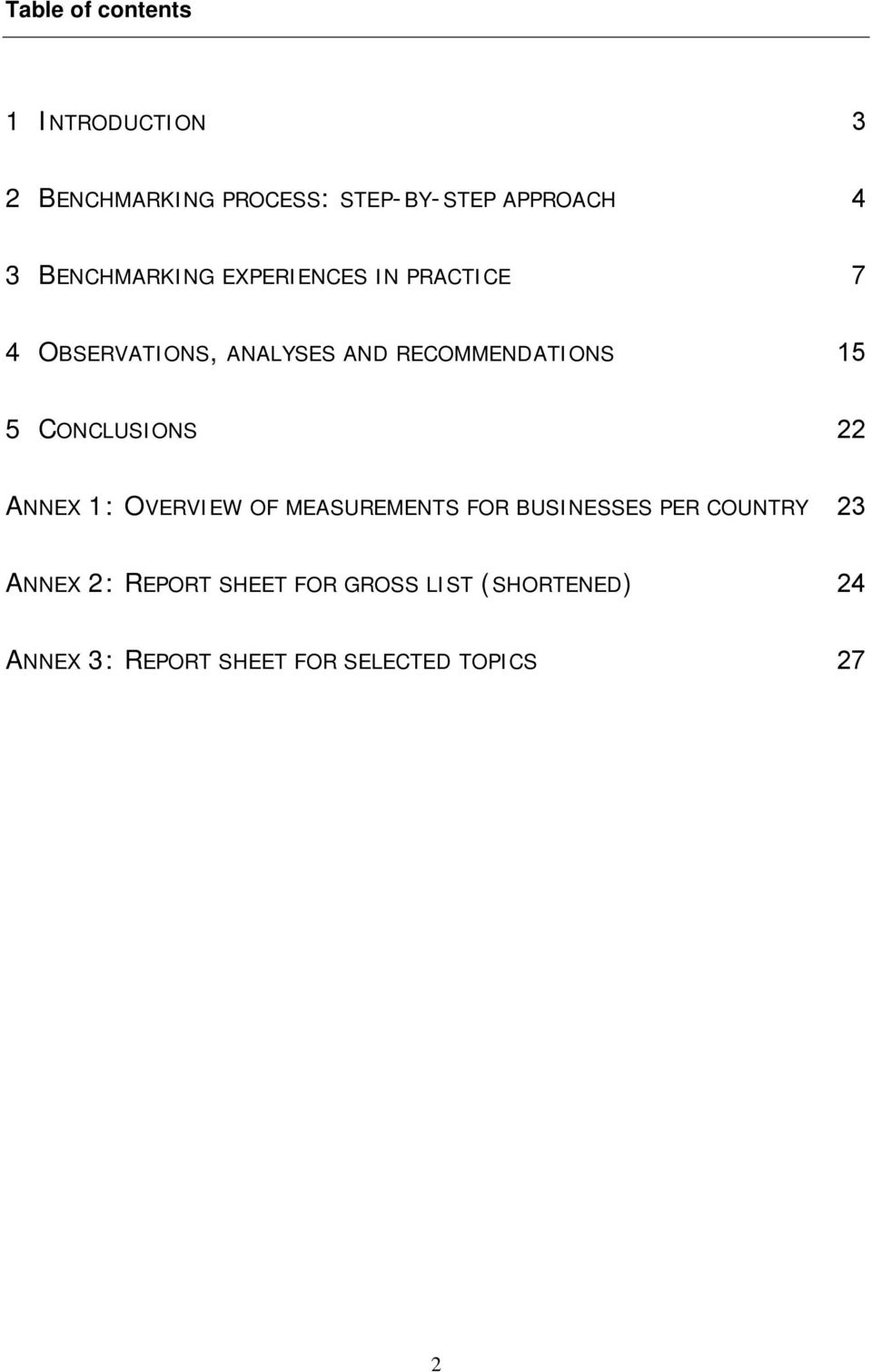
2 Table of contents 1 INTRODUCTION 3 2 BENCHMARKING PROCESS: STEP-BY-STEP APPROACH 4 3 BENCHMARKING EXPERIENCES IN PRACTICE 7 4 OBSERVATIONS, ANALYSES AND RECOMMENDATIONS 15 5 CONCLUSIONS 22 ANNEX 1: OVERVIEW OF MEASUREMENTS FOR BUSINESSES PER COUNTRY 23 ANNEX 2: REPORT SHEET FOR GROSS LIST (SHORTENED) 24 ANNEX 3: REPORT SHEET FOR SELECTED TOPICS 27 2
3 1 Introduction Excessive administrative costs hamper economic growth and are an obstacle in the life of our enterprises. European economies would benefit from lowering the cost of doing business. By replacing inefficient and unnecessary administrative tasks with good quality legislation, which is not unnecessary burdensome, entrepreneurial resources are freed up that may be allocated to a more productive use. The reduction of administrative costs has become a top priority for many European countries and the European institutions in Brussels. When trying to cut red tape governments should both focus on national and international & EU legislation; about halve of the administrative costs EU Member states face have an origin in international & EU legislation. The Netherlands developed a methodology to quantify & reduce administrative burdens: the standard cost model (SCM). Several countries nowadays use the model (see annex 1) and develop policies to cut red tape. Consequently this causes a need for evidence-based assessments and comparisons of the work done. Against this background Poland and the Netherlands initiated a benchmark project on EU/international transport legislation in The objectives were: To develop a methodology to benchmark the administrative costs between countries; To carry out a benchmark into EU transport legislation between Poland and the Netherlands; To learn lessons to cut red tape from each other. The joint project is carried out by Poland and the Netherlands. The project team consisted of the Polish UKIE (Urząd Komitetu Integracji Europejskiej, Departament Analiz i Strategii) and the Dutch Ministry of Finance, Administrative Burden Department (IPAL) in close cooperation with the Dutch Ministry of Transport, Public Works and Water Management. This report highlights the benchmark process, the practical experiences and recommendations. The theoretical process (chapter 2) is described quite extensively as an important objective was to develop a benchmark methodology, which was not available yet. Therefore this benchmark project also was a learning project. The benchmark experiences are noted down in chapter 3. These experiences led to observations, which were analysed with the help of policy experts from the responsible Ministries. This resulted in recommendations (chapter 4), which may offer new possibilities for simplification and reduction of administrative burdens. The recommendations in this report reflect the position of the benchmark project team, not necessarily the position of the responsible Ministries. If you have any questions about this benchmark, please contact Dirk-Jan Schoneveld (tel or [email protected]) or Malgorzata Kaluzynska (tel or [email protected]) 3

4 2 Benchmarking process: step-by-step approach Measurement of administrative costs is relatively new. Some years ago only a few countries applied the SCM. Nowadays more than 10 EU countries use it. Further, the OECD is doing an international benchmark with the SCM. Because of the fact that the topic is new, there are no known studies of benchmarking projects on administrative costs. Therefore Poland and the Netherlands had a blank start. During the project a benchmark methodology had to be developed. Hereby the experiences of the first VAT benchmark were taken into account. The experiences resulted in the following: below a nine-stepapproach for doing a benchmark (also portrayed in the international SCM manual of 2005). List of Countries List of Subjects Step 1 Exploration of context of involved countries Go / No Go Step 2 Selection of regulation Step 3 Set down process and methodological preconditions Step 4 Mapping the information obligations from the selected regulation Step 5 Mapping all the national info obligations stemming from the selected regulation Step 6 Select the information obligations which are interesting for benchmarking Step 7 Elaboration of the selected information obligations into more detailed Step 8 Session with experts to discuss the results of step 7 Step 9 Final Benchmark report including recommendations to improve efficiency 4

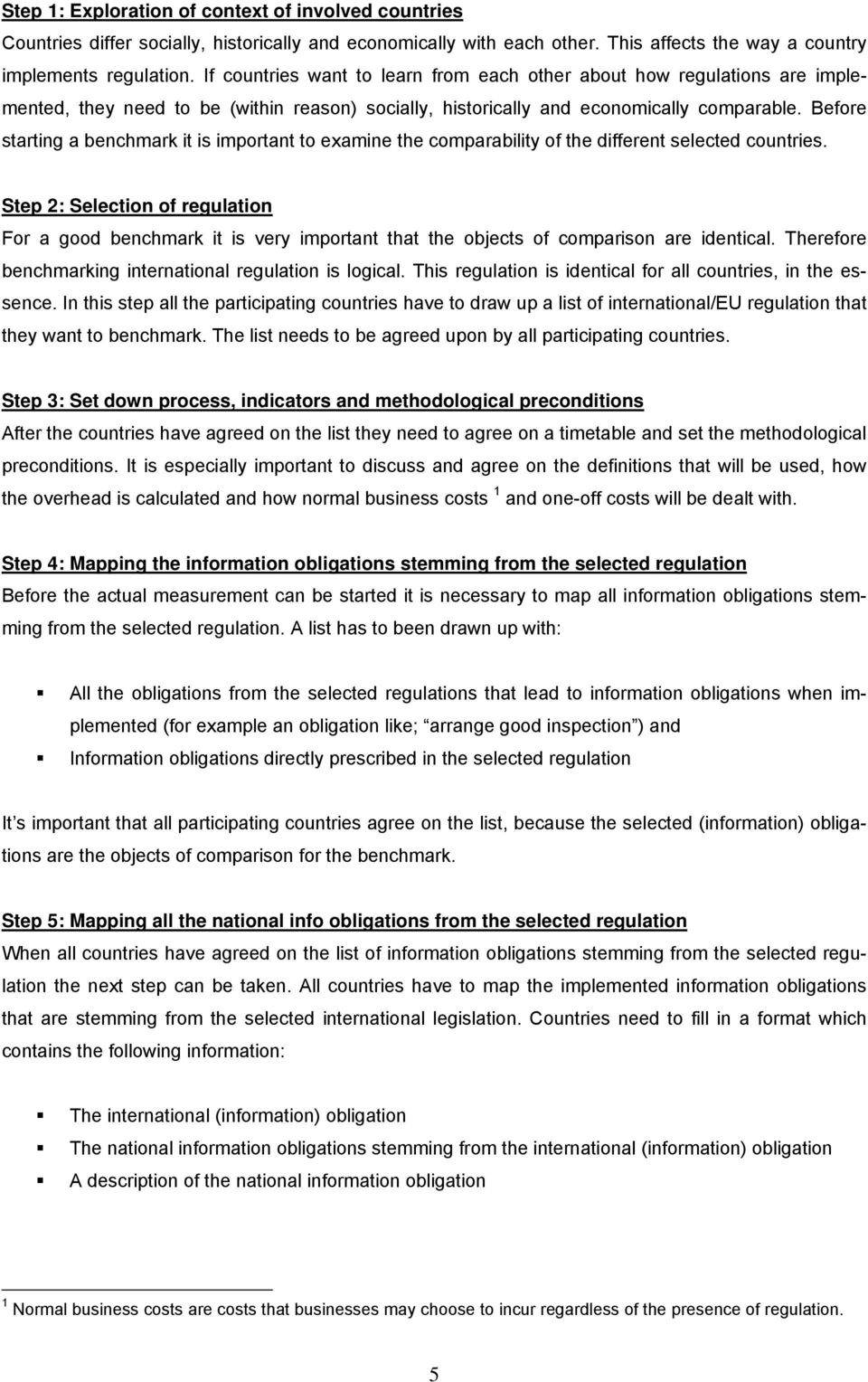
5 Step 1: Exploration of context of involved countries Countries differ socially, historically and economically with each other. This affects the way a country implements regulation. If countries want to learn from each other about how regulations are implemented, they need to be (within reason) socially, historically and economically comparable. Before starting a benchmark it is important to examine the comparability of the different selected countries. Step 2: Selection of regulation For a good benchmark it is very important that the objects of comparison are identical. Therefore benchmarking international regulation is logical. This regulation is identical for all countries, in the essence. In this step all the participating countries have to draw up a list of international/eu regulation that they want to benchmark. The list needs to be agreed upon by all participating countries. Step 3: Set down process, indicators and methodological preconditions After the countries have agreed on the list they need to agree on a timetable and set the methodological preconditions. It is especially important to discuss and agree on the definitions that will be used, how the overhead is calculated and how normal business costs 1 and one-off costs will be dealt with. Step 4: Mapping the information obligations stemming from the selected regulation Before the actual measurement can be started it is necessary to map all information obligations stemming from the selected regulation. A list has to been drawn up with: All the obligations from the selected regulations that lead to information obligations when implemented (for example an obligation like; arrange good inspection ) and Information obligations directly prescribed in the selected regulation It s important that all participating countries agree on the list, because the selected (information) obligations are the objects of comparison for the benchmark. Step 5: Mapping all the national info obligations from the selected regulation When all countries have agreed on the list of information obligations stemming from the selected regulation the next step can be taken. All countries have to map the implemented information obligations that are stemming from the selected international legislation. Countries need to fill in a format which contains the following information: The international (information) obligation The national information obligations stemming from the international (information) obligation A description of the national information obligation 1 Normal business costs are costs that businesses may choose to incur regardless of the presence of regulation. 5
6 Step 6: Select the information obligations which are interesting for benchmarking For the actual benchmark the information obligations need to be analysed in more detail. This takes a lot of time so it may be useful to select a sample (10 for example) of information obligations, which are of particular interest to benchmark. Field experts and experts in the field of administrative burdens select the most interesting information obligations together. At the end of this step all countries need to agree on the list of information obligations that are selected for the actual benchmark. Step 7: Elaboration of the selected information obligations into more detailed level When all countries have agreed on the list of information obligations which are selected for the benchmark, these information obligations need to be measured and analysed in more detail. The following information is needed to benchmark the information obligations (variables): Subject Number of international legislation Short description of the international information obligation Detailed description in activities of the international information obligation under review Detailed description in activities and visualization of the national implementation of the international information obligation The key characteristics (national) of the administrative burdens of the information obligation Description & size target group Thresholds & exemptions for target groups Frequency Administrative costs of information obligation (P) Time to fulfil the information obligation (T) A lot of information is already known from steps 1 to 6. All this information has to be put in a format, which is identical for all participating countries. Step 8: Session with experts to discuss the results of step 7 In this step the actual benchmark takes place. A group of experts of all countries discuss the outcomes of step 7 and see which lessons may be learned from the other participating countries. Step 9: Final benchmark After the session a final benchmark report has to be drawn up. This should include recommendations for each country to improve the efficiency of their regulation. 6

7 3 Benchmarking experiences in practice This chapter fills in the theoretical steps (which are described in the former chapter) with the practical experiences of this particular benchmark. Step 1: Exploration of context of involved countries The SCM in the Netherlands In the period the Netherlands occasionally applied the basic structure of the SCM. In 2002 the Dutch Cabinet set the target of reducing the administrative costs for businesses (and citizens) structurally by 25% between 2003 and The Cabinet first had to make a zero base measurement of the administrative burdens per All departments uniformly used the SCM for the quantifications and measured the package of their legislation. All central government legislation was measured, including implemented EU and international legislation. In total the administrative burdens for enterprises added up to 16.4 billion, which constitutes 3.6% of the Dutch GDP. A reduction of 25% means cutting this with 4.1 billion. Nowadays the SCM is also used to measure costs on the regional and local level and to measure inter-institutional costs. Road transport sector in the Netherlands The road transport sector covers the road transport of goods, moving transport excluded. In the Dutch road transport and haulage industry more than people are active in companies. In the passenger transport sector about companies are active. Since 2001 the total number of companies slightly declines. Especially the category own drivers descends. In the category of more than 100 driving licenses there is a slight increase. This indicates the sector is scaling-up, but nevertheless the sector is relatively small-scale oriented. Almost 33% of the total number of companies is an own driver. About 75% of the companies are small companies with less than 9 driving licenses. Less than 3% has 50 or more licenses. Those companies in the last category take care of halve the total transported weight. About 25% of the total transported weight is cross-border transport. Belgium, Luxemburg, Germany and France are the countries most business takes place with. 75% is domestic transportation. A license is needed for both domestic and cross-border transport. More than 80% of the companies have both types of licenses. About 81% of the own-drivers have a community license. The cargo of domestic transport consists or more than 75% of nutrition & agricultural products and raw minerals & manufactured goods. For cross-border transport that is about the same. 7

8 Key statistics Netherlands * Poland Companies Total number of companies * Cross- border companies Domestic companies Licenses Number of outstanding domestic licenses ,.00 Number of outstanding Euro licenses Average number of domestic licenses per company 8,7 Average number of Euro licenses per company 7,1 Vehicles Number of vehicles (lorries) Average number of vehicles per enterprise 8 Own-drivers Number of license holders with one certificate * Loading capacity** Domestic road transport and haulage (in tons) Domestic own-transport Cross-border road transport and haulage Cross-border own-transport Sources the Netherlands: NIWO and CBS The SCM in Poland ** Per 2004, rest per for the Netherlands * For Poland figures only for international transport Poland started applying the SCM to measure administrative costs at the end of 2004, starting with transport, financial markets and VAT. Road transport sector in Poland In the national road transport, licenses are granted by a starost competent for the entrepreneur s seat. Pursuant to the act on road transport starost offices were obliged to submit information on the number and scope of the granted licenses and authorizations to the minister responsible for transport at least twice a year, by 15 January and by 15 July. According to the data collected by the Ministry of Infrastructure from 378 starost offices, as of the end of 2004 there were 7 thousand businesses in the segment of passenger transport and over 41 thousand business in freight transport segment. The number of copies of licenses (this number corresponds to the number of vehicles covered by licenses) for passenger transport amounted to 43.1 thousand and to thousand for freight transport. 8

9 Functioning of international road transport A steep increase in the sales of motor trucks resulted after Poland s accession to the European Union. Sales of vehicles with total admissible weight in access of 6 tons reached the level of 12 thousand units in After Poland s accession to the European Union and liberalization of market access there emerged surplus supply of transport services in international carriage. According to BOTM (International Polish Transport Office) figures as of 1 January 2005, the number of businesses in international freight transport amounted to 11,835 and in international passenger transport - to 2,567. The structure of all authorizations granted for freight carriage in international road transport depending on maximum authorized mass of vehicles is as follows: Table below. Structure of authorizations for freight carriage in international road transport depending on maximum authorized mass of vehicles Maximum authorized mass of a vehicle Number of authorizations as of Percentage share Number of authorizations as of Percentage share Number of authorizations as of Percentage share Under 6 tons % % % 6-20 tons % % % Over 20 tons % % % TOTAL: % % % Carriage on own account Since 1 May 2004 BOTM has been issuing certificates for road passenger and freight carriage on own account in the international road transport. Between 1 May 2004 and 1 January 2005, certificates were issued for freight transport. The certificates covered vehicles. Passenger transport services on own account based on a certificate consistent with model set forth by the European Union are operated by 17 entities. Step 2: Selection of regulation Poland and the Netherlands agreed to benchmark EU (and international) legislation. European Directives and Regulations often provide Member States a certain degree of flexibility in the way they transpose the European legislation into national legislation. As a consequence EU legislation is implemented differently among Member States. Against that background Poland and the Netherlands decided to benchmark a selection of EU transport legislation, with a focus on how EU legislation is implemented on a national level in terms of administrative costs. The analyses of implementation differences could provide valuable lessons in order to keep the administrative costs to a minimum. Therefore the focus in this 9
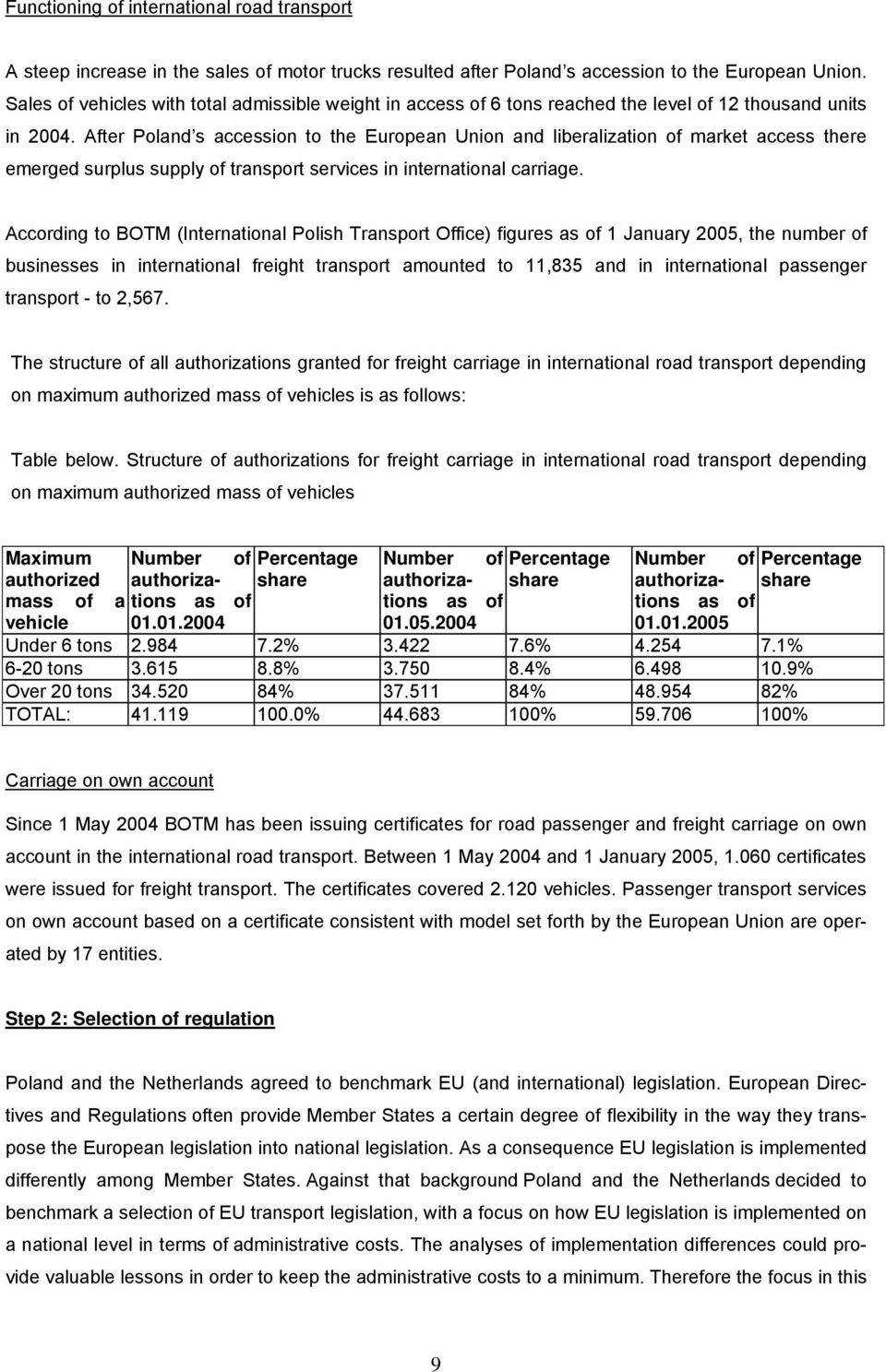
10 benchmark project lied on bilateral cooperation aiming at deepening this specific red tape issue and trying to find effective implementation solutions by sharing knowledge and national experiences. The following legislation (gross list) was initially selected for the benchmark: Directive No. 98/76 Directive 98/76, amending Directive 96/26, on admission to the occupation of road haulage operator and road passenger transport operator and mutual recognition of diplomas, certificates and other evidence of formal qualifications intended to facilitate for these operators the right to freedom of establishment in national and international transport operations. Directive No. 76/914 Council Directive 76/914/EEC of 16 December 1976 on the minimum level of training for some road transport drivers. Directive No. 2003/59 Directive 2003/59/EC of 10 September 2003 on the initial qualification and periodic training of drivers of certain road vehicles for the carriage of goods or passengers entered into force. Directive No. 2000/30 Directive 2000/30/EC of the European Parliament and of the Council of 6 June The Directive will introduce EU rules for the technical roadside inspection of commercial vehicles. Directive No. 96/35 Council Directive 96/35/EC of 3 June 1996 on the appointment and vocational qualification of safety advisers for the transport of dangerous goods by road, rail and inland waterway. Directive No. 94/55 Council Directive 94/55/EC of 21 November 1994 on the approximation of the laws of the Member States with regard to the transport of dangerous goods by road. The aims of the directive are to lay down uniform safety rules for the transport of dangerous goods by road. The Directive applies to the transport of dangerous goods by road in the Community. It does not apply to the transport of dangerous goods by vehicles belonging to the armed forces or under the control of the armed forces. Regulation No. 684/92 Council Regulation of March on common rules for the international carriage of passengers by coach and bus. Under the Regulation a prior licensing procedure is applied for scheduled bus or coach services. 10

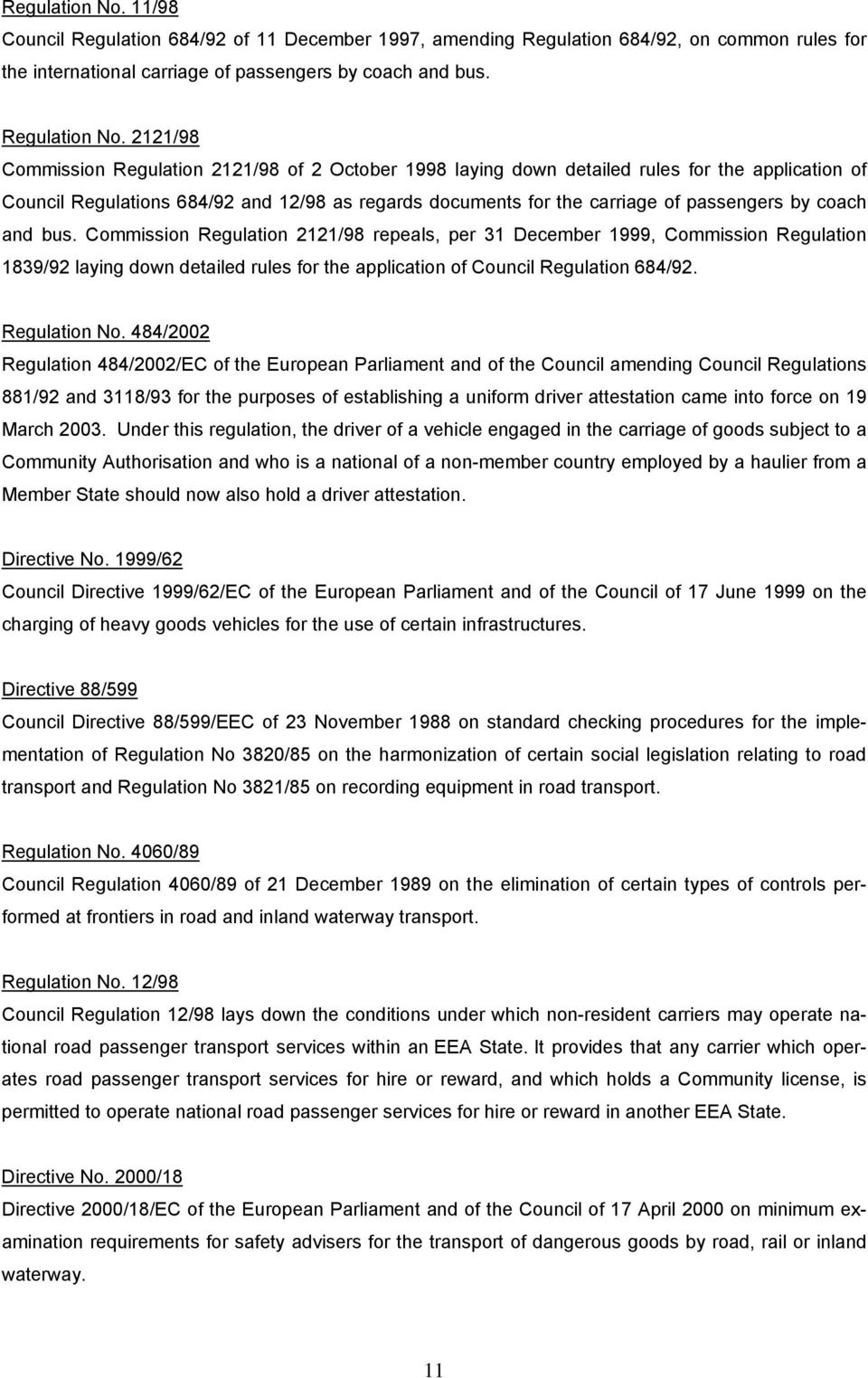
11 Regulation No. 11/98 Council Regulation 684/92 of 11 December 1997, amending Regulation 684/92, on common rules for the international carriage of passengers by coach and bus. Regulation No. 2121/98 Commission Regulation 2121/98 of 2 October 1998 laying down detailed rules for the application of Council Regulations 684/92 and 12/98 as regards documents for the carriage of passengers by coach and bus. Commission Regulation 2121/98 repeals, per 31 December 1999, Commission Regulation 1839/92 laying down detailed rules for the application of Council Regulation 684/92. Regulation No. 484/2002 Regulation 484/2002/EC of the European Parliament and of the Council amending Council Regulations 881/92 and 3118/93 for the purposes of establishing a uniform driver attestation came into force on 19 March Under this regulation, the driver of a vehicle engaged in the carriage of goods subject to a Community Authorisation and who is a national of a non-member country employed by a haulier from a Member State should now also hold a driver attestation. Directive No. 1999/62 Council Directive 1999/62/EC of the European Parliament and of the Council of 17 June 1999 on the charging of heavy goods vehicles for the use of certain infrastructures. Directive 88/599 Council Directive 88/599/EEC of 23 November 1988 on standard checking procedures for the implementation of Regulation No 3820/85 on the harmonization of certain social legislation relating to road transport and Regulation No 3821/85 on recording equipment in road transport. Regulation No. 4060/89 Council Regulation 4060/89 of 21 December 1989 on the elimination of certain types of controls performed at frontiers in road and inland waterway transport. Regulation No. 12/98 Council Regulation 12/98 lays down the conditions under which non-resident carriers may operate national road passenger transport services within an EEA State. It provides that any carrier which operates road passenger transport services for hire or reward, and which holds a Community license, is permitted to operate national road passenger services for hire or reward in another EEA State. Directive No. 2000/18 Directive 2000/18/EC of the European Parliament and of the Council of 17 April 2000 on minimum examination requirements for safety advisers for the transport of dangerous goods by road, rail or inland waterway. 11
12 Directive 2000/61 Directive 2000/61/EC of the European Parliament and of the Council of 10 October 2000 amending Council Directive 94/55/EC on the approximation of the laws of the Member States with regard to the transport of dangerous goods by road. Regulation No. 3912/92 Council Regulation of 17 December 1992 on controls carried out within the Community in the field of road and inland waterway transport in respect of means of transport registered or put into circulation in a third country. Waybill See the international CMR Treaty. Convention relative au contrat de transport internationale de Marchandises par Route, signed May Convention on the Contract for the International Carriage of Goods by Road: the statutory road transit document stipulated in the European Treaty of Rome. Directive No. 96/26 Council Directive 96/26/EC of 29 April 1996 on admission to the occupation of road haulage operator and road passenger transport operator and mutual recognition of diplomas, certificates and other evidence of formal qualifications intended to facilitate for these operators the right to freedom of establishment in national and international transport operations. Regulation No. 881/92 Council Regulation 881/92 of 26 March 1992 on access to the market in the carriage of goods by road within the Community to or from the territory of a Member State or passing across the territory of one or more Member States. Step 3, 4 & 5 Step 3: Set down process indicators and methodological preconditions Step 4: Mapping the information obligations stemming from the selected regulation Step 5: Mapping all the national info obligations from the selected regulation A benchmark report sheet has been developed for the benchmark. See annex 2 for a shortened example (report sheet for gross list). In the sheet, obligations and information obligations were identified in the selected pieces of EU legislation. The difference here between obligation and information obligation is that sometimes the EU directive/regulation just mentions an obligation, which in itself is not information obligation but necessarily leads to an information obligation after implementation onto the national level. In other cases the EU directive/regulation itself contains the information obligation, which is also implemented in the national law. 12
13 Obligations and information obligations identified in the EU legislation were finally categorized into three categories by the following criteria: Category 1: Information obligations which do not involve any national implementation. This case concerns in particular regulations, which are not transposed into national law. Category 2: Obligations which necessarily lead on a national level to information obligations. It needs to be stressed that at the level of EU legislation an obligation, e.g. good level of inspection, in itself is not information obligation yet. Its implementation, however, results in introduction by a member state of information obligation, e.g. through requirements to provide information to an appointed agency or to obtain an additional license. This case concerns in particular directives, which have to be transposed to national law in the scope of the goals set forth therein. Category 3: Information obligations which lead on a national level to information obligations. In this situation information obligation is already stipulated in EU legislation and at the time of implementation it is copied into national legislation to a smaller or larger degree. Such breakdown of obligations and information obligations facilitates determination of where and how information obligation arises. It also enables an analysis of the possibilities to simplify the identified obligation and to develop a more effective piece of legislation at the national level. Both countries used the sheet of annex 2 to analyse the gross list of EU legislation and to note down information obligations found. This guaranteed to a high degree that the selected EU legislation was analysed uniformly. This was essential in order the get comparable outcomes in a later stage. Step 6: Select the information obligations which are interesting for benchmarking The gross lists of report sheets functioned as a sort of a quick-scan. On the basis of the sheets the first analysis took place. Poland and the Netherlands selected the following topics for further elaboration. These were considered interesting for benchmarking in more detail. Topic Format 1: Community license (passenger transport) (98/76, 96/26, 881/92 Obligations: - Request permit (submitting evidence conform 3 criteria) Format 2: Community license (road transport of goods) (98/76, 96/26,881/92) Obligations: - Request permit (submitting evidence conform 3 criteria) Format 3: Way Bill (CMR Treaty) Obligations: - Drafting national and international way bill - Check cargo - Keeping the way bill in storage of the vehicle Format 4: Travel forms (684/92, 11/98, 2121/98) 13
14 Obligations: - Request travel form book - Filling the travel forms - Sending it to the responsible authority - Keeping the travel form book in storage Format 5: Inspections driving- and rest hours (88/599) Obligations: - Cooperation with inspection along the road - Cooperation with company inspections Format 6: Security advisor hazardous goods (96/35) Obligations: - Appointment of security advisor and (re)training/education - Drafting the security report Step 7: Elaboration of the selected information obligations into more detailed For the extensive assessment again a new format was developed, addressing the benchmark variables. The format elaborated on the issues that are important in a cross-country benchmark of EU legislation. Both countries filled it in for the 6 selected topics. See annex 3 (report sheet for selected topics). In the sheets not all indicators, as described in step 7 of chapter 2, are addressed. That was due to the restrictive amount of time that was available to finalize the project. Of course, the more variables are addressed, the more detail the benchmark gets, the more potential for improvement may be identified. Step 8: Session with experts to discuss the results of step 7 In September 2005 the benchmark project team met in Warsaw to discuss the preparatory work carried out. From the Netherlands the representatives were Jeroen Nijland & Dirk-Jan Schoneveld (Ministry of Finance) and Henk Kohsiek (Ministry of Transport, Public Works and Watermanagement). From Poland Małgorzata Kałużyńska, Marcin Gancarz and Anna Kamyczek (UKIE). Step 9: Final benchmark All observations, analyses and recommendations are noted down in this end report. See the next chapter for the extensive results. 14

15 4 Observations, analyses and recommendations 2 This chapter describes the main benchmark observations, analyses and recommendations for both the Netherlands and Poland. The benchmark observations were the result of the benchmark meeting held in Warsaw. Next, analyses took place to clarify and assess the observations. Policy experts from the involved kindly assisted in this exercise. This all resulted in the following recommendations (underlined). The recommendations are suggested by the benchmark project team and do not necessarily reflect the position of the responsible Ministries. Community License Passenger Transport (96/26 en 98/76) The Netherlands In the Netherlands the national and international licenses are issued in a rather similar way. In Poland organisations that transport < 9 persons (including driver) do not need a license. This is the case for both non-commercial national transport and international passenger road transport. The Netherlands does not seem to have such a system; according to the law it is not a bus when it concerns < 9 persons. In this case it is a passenger vehicle. It does not concern professional passenger transportation and thus it is not covered in Transport Law. Professional passenger transportation is covered in the taxi legislation. Under Dutch Taxi Law entrepreneurs need a license though. This largely fits EU taxi legislation, which regulates to some degree accession to the profession. Under restrictions not-professional bus transportation (another category) does require a license in the Netherlands. This leads to the conclusions that in the Netherlands several kinds of transportation can be defined, which have their own license system. Modifications in these systems, in terms of streamlining procedures for example, might offer valuable improvements the sector could benefit from. It is advisable to explore that. In the evaluation project, which the Ministry of Transport, Public Works and Water management is already carrying out, the idea is now explored to improve the related license systems. The idea is to abolish the license system for not-professional bus transportation, conform EU standards. Before a company starts in the Netherlands in the sector for public or closed bus transport a license is needed; the Collective Passenger Transport (CPT) license. Also a Collective Transport (CT) license is effective for international licenses. The demands for obtaining the CPT are a bit stricter, but this license is issued for an indefinite period. The CT only for 5 years. It is worthwhile to explore possibilities to 2 In this report the context and characteristics of both the Dutch and Polish transport sector have been taken into account. However, safety statistics are hardly represented and compared in this report. Countries have different levels of safety standards and apparently safety laws. These laws affect the sector. That is a note to take into account when reading this chapter. 15

16 streamline the procedures, in order to have more uniform license systems. The Ministry of Transport, Public Works and Water management is developing plans in this context. There is a difference between Poland and the Netherlands in the way an applicant has to show financial creditworthiness. Different kinds of paperwork have to be submitted, which have to be signed by an accountant in the Netherlands. That is also the standard for non-legal entities, which are exempted from making an annual account for example (an annual account needs an accountant s signature conform EU legislation). Poland does not have such accounting requirements. Again it is worthwhile to explore possibilities to abolish this requirement, because for smaller non-legal entities the costs of getting the accountant s signature may go beyond the benefit of the signature. Evidently, medium and large companies need the accountant s signature anyway (for the annual account). For them the requirement may be persevered. The Netherlands is developing plans to make the Dutch standard identical to the less strict EU standard. In order to meet the demand of reliability (for managers) the applicant has to submit a certificate of the criminal record, which shows the person is reliable and of good behaviour. This certificate should be applied for via a form at the local community. The request should be accompanied by a letter of NIWO (Dutch Foundation for (inter)national road transport). Next, it should be send to the competent central organisation (COVOG), falling under the authority of the Ministry of Justice. COVOG deals with issuing certificates of reliability. This organisation assesses the application. In this context it is advisable to explore the possibility of inspection authorities only checking if a person is not reliable, instead of reliable. This saves some paperwork, because the applicant in this case does not have to hand over certificates if he is reliable. Only a minor part of all applications are refused in the Netherlands. In this context interference is only required when someone does not meet the standards. This however is the responsibility of the Dutch Ministry of Justice. Further, the procedure might contain possibilities for simplification. This is worthwhile exploring. Right now a direct transfer of the paperwork seems not possible. In the chain between applicant and the Ministry of Justice is now involved NIWO. The issuance of certificates of good behaviour is a standard procedure and used in many similar situations. However, in this case additional information (NIWO letter) is requested. It could be examined if this is indeed essential. To obtain a proof of appropriate financial standing, the company in the Netherlands is obliged to prove the minimum risk capital amounting to ,42 plus 4991,58 per vehicle, from which the license is granted after Further, 4.537,80 for every vehicle for which the license is grated before , but with a minimum of ,02 (for one vehicle). This is a stricter standard than EU minimum requirement, which is set for for one vehicle and euro for every subsequent vehicle possessed by the company. The government policy in the Netherlands is to implement EU legislation minimally. It would be worthwhile to explore in more detail if this is a form of gold plating and if additional requirements in this context could be abolished. 16

17 Poland In Poland there is a difference between the procedure for a national applicant and a foreign applicant. The latter for example has to submit a by the notary approved certificate of professional competence, an official Polish translation and a confirmation (signed by the publisher of the certificate of professional competence) that the person indeed is competent. In this context there is an option to examine the possibility of reducing some additional obligations for foreign applicants. In Poland, while applying for a licence, an entity is obliged to attach to the application a declaration that it will hire only drivers and carbon copies of decisions assigning REGON and NIP numbers. Additionally the application needs to be accompanied by a list of vehicles together with a certified copy of registration licenses and, if the entrepreneur does not own the vehicles, also a document certifying the right of use thereof. In the Netherlands the only additional action required is to attach a list of registration plate numbers of vehicles of the applicant business. The problem of duplication of identification numbers of the companies still maintains. It might be useful to assess the possibilities of introducing one identification number for registration, taxation and statistical purposes. In Poland the possibilities to prove creditworthiness are greater than in the Netherlands as there is no enumerative list of documents that prove it. A company may issue a bill of exchange signed by any identity, or present a bank report, etc. In Poland there are works being conducted to amend the act to make this requirement stricter in order to provide higher level of protection. As far as certificate of good repute is considered in Poland only one institution is engaged. The declaration is issued by the National Penal Register at the request from the entrepreneur. However some improvements are possible. It is advisable to explore the possibility of introducing the request put by the inspection authorities rather than an entrepreneur. This would allow to avoid company undertake an activity of applying for the declaration of not having criminal record. Community License Transport of Goods (98/76, 96/26, 881/92) The Netherlands Until recently the Netherlands set the threshold stricter than EU requirement, on 500 kilo of loading capacity. The Dutch government, however, does intend to prevent from gold plating. This implies the threshold could be lifted. This now is being adapted to the EU standard (3.500 kilo). The Netherlands will soon abolish the national license, which means a single license system will remain. To obtain a proof of appropriate financial standing, the minimum company capital is for the first used vehicle and for every subsequent vehicle. That is the same as the EU standard. 17

18 Poland In Poland several groups has been excluded from the obligation to apply for a Community license. Exemptions cover transport in public postal services, services of transport of municipal waste or liquid waste and non-entrepreneurs. The threshold in Poland is set on kg of GVW (Gross Vehicle Weight) or more, which is the same as the EU threshold. Vehicles with a total weight below kg are excluded. To obtain a proof of appropriate financial standing, the minimum company capital is for the first used vehicle and for every subsequent vehicle. That is the same as the EU standard. Waybill (CMR Treaty) Both in the Netherlands and in Poland a waybill for international transport of goods is applied. In this case implementation of activities connected with fulfilment of this obligation are the same in both countries. However in case of national road transport in Poland issuing of waybill is non-compulsory whereas in the Netherlands it is, but the CMR Treaty does not require this. In Poland often VAT invoices are used as waybill. That is possible, because the CMR Treaty does not prescribe a format for the waybill. Any paper, which contains the essential information, can serve as a waybill. The Netherlands recently simplified the waybill. The fields of the form are diminished from 15 to 5 fields. In practice, however, companies often prefer to use the old format. The Netherlands Dutch law seems to allow the possibility to use other forms as a waybill. The sector now has a separate administration for the waybill, while many other forms often also contain the required information. Streamlining of the different forms might prevent overlap and potentially saves entrepreneurs time and money. However, this is up to the sector. The Dutch government could only communicate the potential benefits in this context. Travel form (684/92, 11/98, 2121/98) Fulfilment of this obligation in the scope set forth by EU legislation is virtually identical in both cases. Before the start of each and every trip a travel form has to be filled in. This form for instance contains all the names of the passengers. Both in the Netherlands and in Poland the form is available from one institution only - in Poland in the International Transport Office (BOTM). 18

19 The Netherlands In Holland it is additionally required to send a copy of the completed form to the Central Bureau of Statistics (CBS) after each journey, which will process the data. After processing CBS sends back the copy to the company and the company will have to keep the documents for at least 2 years. Electronic post is much less burdensome compared to hard-copy post. Further, now entrepreneurs have to request for hard-copy travel forms ( 17 per package) at the Ministry. An electronic option for application and submitting is an alternative. An electronic option will be available from 2006, as a result of the inspection authority s e-government project. Poland In Poland the company keeps a copy of the completed form for five years. The obligation to send the forms to BOTM functions on the on-demand basis. The period for which journey forms are to be kept is also not specified in the EU legislation. Inspection driving and rest hours (88/599) Poland is carrying out relatively much road inspections (Poland ; the Netherlands ) and few in-company inspections (Poland 478: the Netherlands 1.600). This might indicate inspections in the Netherlands are more focused. Possibly both countries can learn here from each other. Euro Control Route, an international organisation of enforcement officers, is a platform in which exchange of this kind of information could occur and further discussion could take place. 3 According to regulations any vehicle may be subject to a roadside inspection regarding daily driving periods, breaks and daily rest periods and, in the case of clear indications of irregularities, also the record sheets for the preceding days. In case of an inspection the driver is obliged to allow for checks of the record sheets of both daily driving and rest periods and of last week rest periods. Moreover the driver is obliged to allow for checks of the correct functioning of the recording equipment. Checks of driving and rest periods can also take place at premises of undertakings, particularly when serious breaches of regulations have been detected at the roadside. The checks at the premises of undertakings may concern weekly rest periods and driving periods between these rest periods, compensation for reduced daily or weekly rest periods or the organisation of drivers' working times. In the case of both states, checks of driving and rest periods are performed during regular checks at the roadside, which also concern technical condition of vehicles and documentation required during haul- 3 ECR is a forum for the exchange of ideas about best practices en has three objectives: promoting information exchange, the organisation of joint enforcement operations and promoting cross-border practical education. 19

20 age. It must be stressed that depending on the type of the driving and rest time recording equipment installed in the vehicle (conventional control devices with registration cards or digital control devices) level of burdens is differentiated. Results of the Dutch study show that in the case of roadside checks, there are more burdens involved for digital control devices. However in the case of checks at the premises, use of digital forms of data processing and storage reduces the level of burdens to one third compared to registration and storage of registration cards and record sheets in paper form. The Netherlands In case of inspection drivers should be able to submit copies of documents about the medical condition. Poland does not have this obligation. It is not prescribed by EU legislation. It causes the entrepreneur extra paperwork and some kind of guarantee about the medical condition is also present by obtaining the driver license. Poland It may be advisable to conduct in Poland a cost-benefits analysis of usage of digital devises versus traditional ones. In Poland legislation imposes not only the obligation to allow for checks of specified documentation but also the obligation to allow making of a copy of the checked documentation. In theory this does not seem to make much difference but in real life it can translate to more burdens for the checked entity in the form of more time devoted to the check. As this obligation was not considered separately in the Polish pilot project so it was not quantified. It may be useful to examine if this solution is practically more burdensome for companies. Safety Advisor Hazardous Goods (96/35) Both the Netherlands and Poland have noted down in their legislation exceptions, in which it is not required to appoint a safety advisor. Via a certificate the safety advisor is legally allowed to do the job. In both cases advisers are obliged to prepare an annual report and submit it to relevant authorities. In the Netherlands this concerns regional authorities but, if required, reports must also made available to national authorities. In Poland the annual report is submitted to the Voivode. In both cases the report must be kept for 5 years. 20
21 The Netherlands No particular pre-knowledge or education is needed to obtain the certificate in the Netherlands. Any candidate that follows a 10-day course and passes the exam obtains the right to pursue the profession of a safety adviser for the transport of dangerous good. In the Netherlands the certificate is valid for five years. It will be continued automatically. Poland In Poland to obtain the right to pursue the profession of a safety adviser for the transport of dangerous good a candidate must follow a 10-day course and pass the exam. In addition the candidate must meet the criterion of good repute, be of age over 21, and present a proof of higher education. In this context further analysis seems to be required in order to evaluate the necessity of age and higher education requirements. In Poland the certificate is also valid for five years however for continuation of the certificate s validity a signature by the inspection authority is required. Further, the owner of the certificate is in Poland obliged to send a copy of the certificate to the authorities. In Poland there is no requirement for Voivodes to send the report e.g. to the Main Statistical Office, Since there are no statistics available on national scale on the numbers and character of accidents involving vehicles carrying dangerous goods. Lack of such statistics hampers undertaking of proper preventive steps (including legislative ones) in this regard. In this case one can state that gold plating consisting e.g. in obligation for Voivodes to send annual reports to the Ministry of Infrastructure, would be advisable from the point of view of road safety policy. The further analysis in this context is advisable. 21
22 5 Conclusions General This benchmark project was a learning-by-doing exercise. Along the process a benchmark methodology had to be developed. The methodology is described in this report. The experience of the project team is that the formulated methodology does seem to work in practice. A benchmark on administrative costs is relatively labour-intensive, but can provide interesting new perspectives. A benchmark has the potential to uncover new potential for regulatory improvement. The administrative cost topic is not an exact science consisting of only figures. The qualitative and interpretative aspect play a main role, though hamper easy comparability. Extensive discussions about the qualitative and interpretative aspects remain essential in order to clear situations, to work towards comparable outcomes and to identify potential for regulatory improvement. Transport benchmark The focus in this project was mainly on the qualitative dimension. More focus on the quantitative dimension would have given the project more depth and could have resulted in additional suggestions for improvement. This benchmark report concludes with some valuable recommendations. These recommendations uncover some new potential for regulatory improvement and reduction of administrative burdens. 22
23 Annex 1: Overview of measurements for businesses per country NL CZ DK SWE NO EST HU POL BE IT FR UK Tax - VAT (excl. invoicing) Y P Y Y Y Y Y Y Y P N P - Excise Duties Y P Y Y Y N N N P N N P - Other Tax Y P Y Y P N N N N N N P Bus & Ec Affairs Y P Y N P N N N Y N N P Statistics Y P Y P P Y P N P N N P Justice Y P Y N P N N N P N N P Annual Reporting Y P Y Y P N N N P N N P Financial Markets Y P Y N P N N Y N N N P Environment Y P Y P Y N N N P N N P Business Permits Y P Y N P N N N P P P P Social Affairs Y P Y N P N N N P N N P Labour law Y P Y P P N N N P N N P Safety at Work Y P Y P Y P N N P N N P (Food) Safety Y P Y P P N N N P N N P Interior Y P Y N P N N N P N N P Health Y P Y N Y N N N P N N P Family, Cons Affairs Y P Y N P N N N P N N P Sc, Techn, Innovation Y P Y N P N N N P N N P Culture Y P Y N P N N N P N N P Transport Y P Y P P N N Y P N N P Per October 2005 Y = Measured N = Not measured P = Planned to be measured or being measured Note: Some countries also have administrative costs programs for citizens and government authorities, e.g. the Netherlands, Belgium and Spain. Germany is planning a national approach to fight bureaucracy. The SCM will be used here. The OECD is doing an international benchmark into transport events. Participating countries: Belgium, Italy, United States, Sweden, Denmark, Canada, the Netherlands, Norway, France, UK and Turkey. 23
24 Annex 2: Report sheet for gross list (shortened) Law: Directive 98/76/EG Topic: Access to the profession of transporters of goods EU obligations EU nr Law and article (Information) Obligation Description obligation Category d Application for authorisation/recognition Application of confirmation of the insurance of a bank as proof for creditworthiness (optional) a Taking an examination Doing an obliged examination to show competence f Taking an examination Taking an additional exam to show competence about specific knowledge about a MS d Presenting, reporting and showing information Presenting evidence of competence to the authorities Carrying out inspections Check by authorities if company does still meet standards about competence, reliability and financial capacity; at least once per 5 years. 2 24
25 National obligations EU nr Nat nr Law and article (Information) Obligation Activity Remarks activities PxQ Administrative Costs NL Law on Good Transport, art 5.1 Application for a license/permit (1) Filling in the application form; (2) Submitting evidence: copy of registration in trade register, copy of registration, copy of creditworthiness, copy of diploma, copy of good behaviour. Law on Good Transport, art 5.1 Application for a license/permit (1) Filling in the application form; (2) Submitting evidence: copy of registration in trade register, copy of registration, copy of creditworthiness, copy of diploma, copy of good behaviour. Law on Good Transport, art 5.1 Application for a license/permit (1) Filling in the application form; (2) Submitting evidence: copy of registration in trade register, copy of registration, copy of creditworthiness, copy of diploma, copy of good behaviour. Law on Good Transport, art 5.1 Application for a license/permit (1) Filling in the application form; (2) Submitting evidence: copy of registration in trade register, copy of registration, copy of creditworthiness, copy of diploma, copy of good behaviour. Law on Good Transport, art 5.1 Application for a license/permit (1) Filling in the application form; (2) Submitting evidence: copy of registration in trade register, copy of registration, copy of creditworthiness, copy of diploma, copy of good behaviour. Decision Transport of Goods, art 18 Presenting, reporting and showing information/reports Submitting an statement concerning the demand of reliability (for application of licences). Request for initial permit domestic good transport companies;600 new registrations per year Request for initial permit domestic good transport companies;600 new registrations per year Request for initial permit domestic good transport companies;600 new registrations per year Request for initial permit domestic good transport companies;600 new registrations per year Request for initial permit domestic good transport companies;600 new registrations per year Every 5 year is teste`d if the transporter still meeets the demands concerning reliability, professional skills and creditworthiness. (45.000) Part of Part of Part of TOTAL
26 National obligations EU nr Nat nr Law and article (Information) Obligation Activity Remarks activities PxQ Administrative Costs 1 1 POL art Application for a license/permit Prepare (fill in) and submit written application of the entrepreneur for licence. Application should include: indication of the entrepreneur s name, seat and address, personal number of registration,indication of type, scope and area of proposed road transport, type and number of motor vehicles held by the applicant, proposed time frame for the licencea copy of register s entry. Submitting evidence: a copy of registration with statistical authority (REGON number), a copy of registration with fiscal authority (NIP number), certificate of professional competences, a statement from the criminal register documenting clear criminal record of the persons, documents confirming the finacial standing, a representation of the intention to hire only drivers, a list of motor vehicles including confirmed copies of registration cards, and when the entrepreneur is not owner of the vehicles a document entitling to use such vehicles. art. 84.1,2 and art Presenting, reporting and showing information/reports Provide written or oral explanations, produce documents and other information media and make all data relevant to the control available 5 5 TOTAL 26
27 Annex 3: Report sheet for selected topics Community license (passenger road transport) (98/76, 96/26, 881/92) Poland Subject: Community licence for passenger transport EU information obligation: Application for a licence for goods transport EU legislation: Directive 96/26/EC and Directive 98/76/EC 1. Explanation European information obligation in activities Below a detailed description in activities of the European information obligation under survey here. For exercising international road passenger transport a Community license is needed. The application requires the following. The applicant must: fill out the tender requirements (application form), be of good dispute, be of appropriate financial standing, satisfy the condition as to professional competence. To keep a Community license, the good-repute requirement, the requirement of appropriate financial standing and of professional competence should be proofed at least once every 5 years. 2. National implementation Below a detailed description in activities and visualization of the national implementation of the EU information obligation. Start of application what who Apply for application form Ministry of Infastructure Fill out application form Name, seat and address, personal number of registration, indication of type, scope and area of proposed road transport, type and number of motor vehicles held by the applicant, proposed timeframe for the licence, a copy of register s entry Obtain proof of good financial standing Present a duplicate of the entry into register of enterpreneurs or register of economic activity Present a declaration on the intention to hire drivers Obtain proof of good repute Obtain certificate of professional competences Present carbon copy of the granting of statistical identification number REGON Present carbon copy of decision granting tax identification number NIP Present a list of motor vehicles including confirmed copies of registration cards and when the entrepreneur is not owner of the vehicles a document entitling to use such vehicles License 3. Administrative burdens and key characteristics (national) Below a description of the relevant national administrative burdens and other key characteristics of the national implementation of the EU information obligation under survey here (eg frequency, thresholds & exemption of target groups). Description & size target group: Transport companies: in international transport of passengers in Poland 27
28 Thresholds & exemptions for target groups: Exemptions: designed to carry not more than 9 passengers incl a driver in non-commercial national and international carriages of passengers by road. Frequency: Once per 5 years Administrative costs of information obligation: Time to fulfil the information obligation: 4. Other relevant remarks Application for a haulage license for performance of international road transport: - application form - L1 (data of the entrepreneur), - FORM L2 (list of the fleet) - Duplicate of the entry into register of entrepreneurs or register of economic activity; - Carbon copy of the granting of statistical identification number (REGON), - Carbon copy of the decision granting tax identification number (NIP) or possibly: - Carbon copy of professional competence certificate in international road transport of the entrepreneur or of person managing road transport within the undertaking accompanied by a document confirming the fact of managing road transport, [in case of submitting a foreign certificate authorizing for performance of a job of an international road carrier by a third country national, the following documents must be submitted: a carbon copy of professional competence certificate (certified by a public notary for conformance with the original or the original for inspection) + a translation into Polish made by a sworn translator, confirmation from the issuer of the professional competence certificate that the person named therein was issued the certificate (No...of... [date]), including a translation into Polish made by a sworn translator)], At least one of the managers has the certificate of professional competences. In order to obtain a certificate of professional competences, practical and theoretical knowledge in the scope of performing economic activity in the field of road transport shall be required. Persons with at least 5 years of experience in performing economic activity in the field of road transport or management of road transport enterprise shall receive a certificate of professional competences on the basis of positive results of the professional competences test. Additionally, in order to perform international road transport, knowledge in the fields of existing international agreements and transport regulations, customs regulations and conditions and documents required to perform international road transport shall be required. In order to verify knowledge in the fields a written exam shall be held before an examination commission. The certificate of professional competence in international road transport of passengers shall be used at the same time as the certificate of professional competence in national road transport of passengers. The certificate of professional competence in international road transport of goods shall be used at the same time as the certificate of professional competence in national road transport of goods - Information about the person from a register of convicts confirming unpunishability of the concerned person, (concerns members of the governing body of a legal person, persons composing the management board of an ordinary partnership or a limited partnership, or in case of other entrepreneurs self-employed persons pursuing business activity) a document valid for 6 months since issuance date, [In case a third country national submits the certificate, the following documents are required: a carbon copy of the aforementioned document (certified by a public notary for conformance with the original or the original) including a translation into Polish made by a sworn translator] A statement from the criminal register documents clear criminal record of the persons. The requirement of good repute is not satisfied if such persons have been convicted of wilful crimes for example against safety in transport, property, reliability of documents or protection of the environment or have been declared unfit to pursue the occupation of the road transport operator under the separate legislation in force.documents confirming financial standing ensuring starting up and pursuance of economic activity in the scope of road transport (for the entire fleet) in the amount of: EUR per the first vehicle, EUR per each subsequent vehicle, Documents confirming the financial standing of the entrepreneur, e.g.: a certificate from a bank funds available on the bank account (valid for 3 months after issuance date); bank guarantee with validity date specified thereon; bills of exchange issued by a third person for the benefit of the carrier of unlimited validity, AC policy (without assignment) of the vehicle owned by the entrepreneur, - Declaration on the intention to hire or not hire drivers - Carbon copies of registration license (vehicles registered in Poland) with valid technical inspection: in case when an entrepreneurship is not the owner of those vehicles -> documents confirming the right to dispose of them, e.g.: - Leasing contract with a given timeframe of its validity accompanied by protocol of acceptance, - Renting contract (in case of renting of a leased vehicle, additionally an approval of the leasing company is required), - Lending contract, 28
29 - Leasing contract, - Alienation contract + loan contract; - Declaration of validity of the legal basis (form), fiscal charge of 5 PLN per application and 0.5 PLN per each attachment. The Netherlands Subject: EU information obligation: Community license for passenger transport License application for international transport with touring cars and buses EU legislation: 98/76 & 96/26 & 11/98 & 684/92 1. Explanation European information obligation in activities Below a detailed description in activities of the European information obligation under survey here. For exercising international road passenger transport a Community license is needed. For the application of a Community license the applicant must: fill out the tender requirements (application form), show that he/she possesses a entrepreneur license for collective passenger transport or coach services. For this, the entrepreneur shall: be of good repute, be of appropriate financial standing, satisfy the condition as to professional competence. To keep a Community license, the good-repute requirement, the requirement of appropriate financial standing and the requirement of professional competence should be proofed at least once every 5 years. 2. National implementation Below a detailed description in activities and visualization of the national implementation of the EU information obligation. For exercising international road passenger transport a Community license is needed. To obtain a community license, one must obtain a National license (only valid for national transportation) for which applies the same application requirements as described above. Both licenses (National and Community) can be applied for at the same time and on the same application form. A detailed description of each step in the process is given below, followed by a visualization of the process in a graph. Ad 1. Fill out the tender requirements (application form) The application form can be asked for at the Transport and Water Management Inspectorate. To obtain a license one has to fill out the application form and one has to meet requirements that will be described in the next paragraphs. The tender requirements are based on EU-legislation. One requirement however is added: the applicant must produce a list with the license plate registrations of all company buses. When transporting passengers by bus on a regular basis on a regular route within Europe, an additional license must be applied for. The tender requirements to produce, are: a time table of services, tariffs, an official stamped copy of the Community license, any specialties, a map with official route, drop off/pick-up places and a travelling schedule, which will give the opportunity to check the drive and rest times. Ad 2a. Obtain proof of good repute To obtain proof of being of good dispute a declaration of good dispute must be shown. To obtain this declaration, an application for the declaration must be sent to the municipality where the company is residing together with a letter from NIWO stating that the declaration is really needed. The municipality will than send the application to Central Organization Declaration Concerning Repute (COVOG), which will than judge the application and give (or refuses) the declaration. When applying for a Community license the declaration may not be older than 3 months. Ad 2b. Obtain proof of good financial standing To obtain a proof of appropriate financial standing, the company must produce (1) a financial statement with a detailed balance sheet signed by an accountant or (2) a detailed report in a format that is given by the accountants organization National Institute For Register Accountants (NIVRA) and Dutch Order for Accountants-Administrationconsultants (NOvAA). To obtain a proof of appropriate financial standing, the company in the Netherlands is obliged to prove the minimum risk capital amounting to ,42 plus 4991,58 per vehicle, from which the license is granted after Further, 4.537,80 for every vehicle for which the license is grated before , but with a minimum of ,02 (for one vehicle). Ad 2c. Professional competence To satisfy the condition concerning professional competence, the entrepreneur needs to have a diploma given by the (Foundation Examination office for Professional Transport (SEB). The exam will consist of the following modules: Company management, Financial management, Truck management, Personnel management, Calculation and a specific course (Taxi, bus, road haulage or international road haulage). The total cost of the exams are approximately 300,-. Training for the exams will take 8 full days. The person that is in charge 29
30 on a daily basis must satisfy the condition concerning professional competence. If more than one person is in charge, at least one must satisfy the condition. Other ways of proofing professional competence are: - A declaration from an authorized institution that the requirement from 96/26 has been met. - Proof that the company had a license for transporting groups on 1 January To keep a Community license, the good-repute requirement, the requirement of appropriate financial standing and the requirement of professional competence should be proofed at least once every 5 years. Start of application Explanation Authority Apply for application form Fill out application form Obtain license for collective passenger transport Obtain proof of good repute Obtain proof of good financial standing Obtain proof of professional competence Show form and appendices License Name, address, city of residence, license plates and signature Application at city hall. Good repute will be checked at COVOG. Proof: annual account with an audit certificate or report of actual connections concerning the minimum presence of risk-bearing capital. Proof: copy of diploma given by the Foundation Examination office for professional transport(seb) or ECdeclaration, given by the Ministry of Transport, Public works and Water Management(V&W). Transport and Water Management Inspectorate Transport and Water Management Inspectorate Municipality SEB/V&W Transport and Water Management Inspectorate 3. Administrative burdens and key characteristics (national) Below a description of the relevant national administrative burdens and other key characteristics of the national implementation of the EU information obligation under survey here (eg frequency, thresholds & exemption of target groups). Description & size target group: International Bus transport companies; 220 in Holland Thresholds & exemptions for target groups: - Frequency: Once every 5 years Administrative costs of information obligation Unscheduled transport 59,- / Scheduled transport 272,- Shuttle transport 545, - (P): Time to fulfil the information obligation (T): Unscheduled transport: 1 hour and 18 minutes / Scheduled transport: 4 hours / Shuttle transport: 12 hours 4. Other relevant remarks Costs: National license (CPV): 663,-. / Community license: 322,- / Actualise license: 17,- (also the price of every officially stamped copy of a licence). Community license (road transport of goods) (98/76, 96/26,881/92) Poland Subject: Community licence for goods transport EU information obligation: Application for a licence for goods transport EU legislation: Directive 96/26/EC and Directive 98/76/EC 1. Explanation European information obligation in activities Below a detailed description in activities of the European information obligation under survey here. 30
31 For exercising international road goods transport a Community license is needed. The application requires the following. The applicant must: fill out the tender requirements (application form), be of good dispute, be of appropriate financial standing and satisfy the condition as to professional competence. To keep a EU license, the good-repute requirement, the requirement of appropriate financial standing and the requirement of professional competence should be proofed at least once every 5 years. 2. National implementation Below a detailed description in activities and visualization of the national implementation of the EU information obligation. Start of application what who Apply for application form Ministry of Infastructure Fill out application form Name, seat and address, personal number of registration, indication of type, scope and area of proposed road transport, type and number of motor vehicles held by the applicant, proposed timeframe for the licence, a copy of register s entry Obtain proof of good financial standing Present a duplicate of the entry into register of enterpreneurs or register of economic activity Present a declaration on the intention to hire drivers Obtain proof of good repute Obtain certificate of professional competences Present carbon copy of the granting of statistical identification number REGON Present carbon copy of decision granting tax identification number NIP Present a list of motor vehicles including confirmed copies of registration cards and when the entrepreneur is not owner of the vehicles a document entitling to use such vehicles Licence 3. Administrative burdens and key characteristics (national) Below a description of the relevant national administrative burdens and other key characteristics of the national implementation of the EU information obligation under survey here (eg frequency, thresholds & exemption of target groups). Description & size target group: Transport companies: in transport of goods in Poland Thresholds & exemptions for target groups: Exemptions: - total allowable weight of the vehicle does not exceed 3.5 tons - vehicles of medical assistance teams and medical transport - transport in public postal services - transport of public waste - transport in institution of non-economic activity Frequency: Once per 5 years Administrative costs of information obligation: Time to fulfil the information obligation: 4. Other relevant remarks Application for a haulage license for performance of international road transport: - application form - L1 (data of the entrepreneur), - FORM L2 (list of the fleet) 31
32 - Duplicate of the entry into register of entrepreneurs or register of economic activity; - Carbon copy of the granting of statistical identification number (REGON), - Carbon copy of the decision granting tax identification number (NIP) or possibly: - Carbon copy of professional competence certificate in international road transport of the entrepreneur or of person managing road transport within the undertaking accompanied by a document confirming the fact of managing road transport, [in case of submitting a foreign certificate authorizing for performance of a job of an international road carrier by a third country national, the following documents must be submitted: a carbon copy of professional competence certificate (certified by a public notary for conformance with the original or the original for inspection) + a translation into Polish made by a sworn translator, confirmation from the issuer of the professional competence certificate that the person named therein was issued the certificate (No...of... [date]), including a translation into Polish made by a sworn translator)], - At least one of the managers has the certificate of professional competences. In order to obtain a certificate of professional competences, practical and theoretical knowledge in the scope of performing economic activity in the field of road transport shall be required. Persons with at least 5 years of experience in performing economic activity in the field of road transport or management of road transport enterprise shall receive a certificate of professional competences on the basis of positive results of the professional competences test. Additionally, in order to perform international road transport, knowledge in the fields of existing international agreements and transport regulations, customs regulations and conditions and documents required to perform international road transport shall be required. In order to verify knowledge in the fields a written exam shall be held before an examination commission. - The certificate of professional competence in international road transport of passengers shall be used at the same time as the certificate of professional competence in national road transport of passengers. The certificate of professional competence in international road transport of goods shall be used at the same time as the certificate of professional competence in national road transport of goods - Information about the person from a register of convicts confirming unpunishability of the concerned person, (concerns members of the governing body of a legal person, persons composing the management board of an ordinary partnership or a limited partnership, or in case of other entrepreneurs self-employed persons pursuing business activity) a document valid for 6 months since issuance date, [In case a third country national submits the certificate, the following documents are required: a carbon copy of the aforementioned document (certified by a public notary for conformance with the original or the original) including a translation into Polish made by a sworn translator] - A statement from the criminal register documents clear criminal record of the persons. The requirement of good repute is not satisfied if such persons have been convicted of wilful crimes for example against safety in transport, property, reliability of documents or protection of the environment or have been declared unfit to pursue the occupation of the road transport operator under the separate legislation in force. - Documents confirming financial standing ensuring starting up and pursuance of economic activity in the scope of road transport (for the entire fleet) in the amount of: per the first vehicle, per each subsequent vehicle, - Documents confirming the financial standing of the entrepreneur, e.g.: a certificate from a bank funds available on the bank account (valid for 3 months after issuance date); bank guarantee with validity date specified thereon; bills of exchange issued by a third person for the benefit of the carrier of unlimited validity, AC policy (without assignment) of the vehicle owned by the entrepreneur, - Declaration on the intention to hire or not hire drivers - Carbon copies of registration license (vehicles registered in Poland) with valid technical inspection: in case when an entrepreneurship is not the owner of those vehicles -> documents confirming the right to dispose of them, e.g.: - Leasing contract with a given timeframe of its validity accompanied by protocol of acceptance, - Renting contract (in case of renting of a leased vehicle, additionally an approval of the leasing company is required), - Lending contract, - Leasing contract, - Alienation contract + loan contract; - Declaration of validity of the legal basis (form), fiscal charge of 5 PLN per application and 0.5 PLN per each attachment. Poland Subject: EU information obligation: National licence for goods and passenger transport Application for a licence for goods transport 32
33 EU legislation: Directive 96/26/EC and Directive 98/76/EC 1. Explanation European information obligation in activities Below a detailed description in activities of the European information obligation under survey here. For exercising national road goods passenger transport a license is needed. The application requires the following. The applicant must: fill out the tender requirements (application form), be of good dispute, be of appropriate financial standing and satisfy the condition as to professional competence. To keep a license, the good-repute requirement, the requirement of appropriate financial standing and the requirement of professional competence should be proofed at least once every 5 years. 2. National implementation Below a detailed description in activities and visualization of the national implementation of the EU information obligation. Start of application what who Apply for application form Regional Authority (Starosta offices) Fill out application form Name, seat and address, personal number of registration, indication of type, scope and area of proposed road transport, type and number of motor vehicles held by the applicant, proposed timeframe for the licence, a copy of register s entry Obtain proof of good financial standing Present a duplicate of the entry into register of enterpreneurs or register of economic activity Present a declaration on the intention to hire drivers Obtain proof of good repute Obtain certificate of professional competences Present carbon copy of the granting of statistical identification number REGON Present carbon copy of decision granting tax identification number NIP Present a list of motor vehicles including confirmed copies of registration cards and when the entrepreneur is not owner of the vehicles a document entitling to use such vehicles Licence 3. Administrative burdens and key characteristics (national) Below a description of the relevant national administrative burdens and other key characteristics of the national implementation of the EU information obligation under survey here (eg frequency, thresholds & exemption of target groups). Description & size target group: Transport companies: ca in transport of goods and ca in trans- 33
34 port of passengers in Poland Thresholds & exemptions for target groups: Exemptions: - Designed to carry not more than 9 passengers including a driver in non-commercial national carriages of passengers by road (transport of passengers), - Total allowable weight of the vehicle does not exceed 3.5 tons - Vehicles of medical assistance teams and medical transport - Transport in public postal services - Transport of public waste - Transport in institution of non-economic activity Frequency: Once per 5 years Administrative costs of information obligation: Time to fulfil the information obligation: 4. Other relevant remarks Application for a haulage license for performance of international road transport: - application form - L1 (data of the entrepreneur), - FORM L2 (list of the fleet) - Duplicate of the entry into register of entrepreneurs or register of economic activity; - Carbon copy of the granting of statistical identification number (REGON), - Carbon copy of the decision granting tax identification number (NIP) or possibly: - Carbon copy of professional competence certificate in international road transport of the entrepreneur or of person managing road transport within the undertaking accompanied by a document confirming the fact of managing road transport, [in case of submitting a foreign certificate authorizing for performance of a job of an international road carrier by a third country national, the following documents must be submitted: a carbon copy of professional competence certificate (certified by a public notary for conformance with the original or the original for inspection) + a translation into Polish made by a sworn translator, confirmation from the issuer of the professional competence certificate that the person named therein was issued the certificate (No...of... [date]), including a translation into Polish made by a sworn translator)], - At least one of the managers has the certificate of professional competences. In order to obtain a certificate of professional competences, practical and theoretical knowledge in the scope of performing economic activity in the field of road transport shall be required. Persons with at least 5 years of experience in performing economic activity in the field of road transport or management of road transport enterprise shall receive a certificate of professional competences on the basis of positive results of the professional competences test. Additionally, in order to perform international road transport, knowledge in the fields of existing international agreements and transport regulations, customs regulations and conditions and documents required to perform international road transport shall be required. In order to verify knowledge in the fields a written exam shall be held before an examination commission. - The certificate of professional competence in international road transport of passengers shall be used at the same time as the certificate of professional competence in national road transport of passengers. The certificate of professional competence in international road transport of goods shall be used at the same time as the certificate of professional competence in national road transport of goods - Information about the person from a register of convicts confirming unpunishability of the concerned person, (concerns members of the governing body of a legal person, persons composing the management board of an ordinary partnership or a limited partnership, or in case of other entrepreneurs self-employed persons pursuing business activity) a document valid for 6 months since issuance date, [In case a third country national submits the certificate, the following documents are required: a carbon copy of the aforementioned document (certified by a public notary for conformance with the original or the original) including a translation into Polish made by a sworn translator] - A statement from the criminal register documents clear criminal record of the persons. The requirement of good repute is not satisfied if such persons have been convicted of wilful crimes for example against safety in transport, property, reliability of documents or protection of the environment or have been declared unfit to pursue the occupation of the road transport operator under the separate legislation in force. - Documents confirming financial standing ensuring starting up and pursuance of economic activity in the scope of road transport (for the entire fleet) in the amount of: EUR per the first vehicle, EUR per each subsequent vehicle, - Documents confirming the financial standing of the entrepreneur, e.g.: a certificate from a bank funds available on the bank account (valid for 3 months after issuance date); bank guarantee with validity date specified thereon; bills of exchange 34
35 issued by a third person for the benefit of the carrier of unlimited validity, AC policy (without assignment) of the vehicle owned by the entrepreneur, - Declaration on the intention to hire or not hire drivers - Carbon copies of registration license (vehicles registered in Poland) with valid technical inspection: in case when an entrepreneurship is not the owner of those vehicles -> documents confirming the right to dispose of them, e.g.: - leasing contract with a given timeframe of its validity accompanied by protocol of acceptance, - Renting contract (in case of renting of a leased vehicle, additionally an approval of the leasing company is required), - Lending contract, - Leasing contract, - Alienation contract + loan contract; - Declaration of validity of the legal basis (form), fiscal charge of 5 PLN per application and 0.5 PLN per each attachment. The Netherlands Subject: License for international road haulage company EU information obligation: License application for national/international road haulage company EU legislation: 98/76 & 96/26 1. Explanation European information obligation in activities Below a detailed description in activities of the European information obligation under survey here. For exercising international road haulage transport with a GVW (Gross Vehicle Weight) of kg or more a license is needed. The application requires the following. The applicant must: - Fill out the tender requirements (application form). - Show that he/she possesses a entrepreneur license for collective passenger transport or coach services. For this, the entrepreneur shall: - Be of good repute. - Be of appropriate financial standing. - Satisfy the condition as to professional competence. To keep a Community license, the good-repute requirement, the requirement of appropriate financial standing and the requirement of professional competence should be proofed at least once every 5 years. 2. National implementation Below a detailed description in activities and visualization of the national implementation of the EU information obligation. For exercising international road haulage transport with a loading capacity of 500 kg or more a Euro license is needed. To obtain a Euro license, one must obtain a National license (only valid for national transportation) for which applies the same application requirements as described above. Both licenses (National and Euro) can be applied for at the same time and on the same application form. A detailed description of each step in the process is given below, followed by a visualization of the process in a graph. Ad 1. Application form The application form can be applied for at the Transport and Water Management Inspectorate. To obtain a license one has to fill out the application form and one has to meet requirements that will be described in the next paragraphs. Ad 2a. Be of good repute To obtain proof of being of good dispute a declaration of good dispute must be shown. To obtain this declaration, an application for the declaration must be sent to the municipality where the company is residing together with a letter from NIWO stating that the declaration is really needed. The municipality will than send the application to COVOG, which will than judge the application and give (or refuses) the declaration. When applying for a Euro license the declaration may not be older than 3 months. Ad 2b. Good financial standing To obtain a proof of appropriate financial standing, the company must produce a financial statement with a detailed balance sheet signed by an accountant. The minimum company capital is for the first used vehicle and for every subsequent vehicle. The statement made by the accountant may not be older than 2 months. Ad 2c. Professional competence To satisfy the condition as to professional competence, the entrepreneur needs to have a diploma given by the SEB. The exam will consist of the following modules: Company management, Financial management, Truck management, Personnel management, Calculation and a specific course (Taxi, bus, road haulage or international road haulage). The total cost of the exams are approximately 300,-. Training will take 8 full days. Another way to obtain proof is to get a 35
36 declaration from an authorized institution that the requirements have been met. An additional requirement for a Euro license compared to an National license is that the applicant must have an additional diploma for international road haulage. To keep a Euro license, the good-repute requirement, the requirement of appropriate financial standing and the requirement of professional competence should be proofed at least once every 5 years. Start of application Explanation Authority Apply for application form Fill out application form Obtain license for collective passenger transport Obtain proof of good repute Obtain proof of good financial standing Obtain proof of professional competence Show form and appendices License Name, address, city of residence, license plates and signature Application at city hall. Good repute will be checked at COVOG. Proof: annual account with an audit certificate or report of actual connections concerning the minimum presence of risk-bearing capital. Proof: copy of diploma given by the Foundation Examination office for professional transport(seb) or ECdeclaration, given by the Ministry of Transport, Public works and Water Management(V&W). Transport and Water Management Inspectorate Transport and Water Management Inspectorate Municipality SEB/V&W Transport and Water Management Inspectorate 3. Administrative burdens and key characteristics (national) Below a description of the relevant national administrative burdens and other key characteristics of the national implementation of the EU information obligation under survey here (eg frequency, thresholds & exemption of target groups). Description & size target group: There are road haulage transport companies in Holland. Thresholds & exemptions for target groups: A national license in the Netherlands is needed for lorries with a loading capacity of > 500 kilo. The community standard is set at > Conclusion: The Netherlands set a stricter standard than legally obliged by EU legislation. Frequency: Once per 5 years Adm. costs of information obligation (P): 125,- Time to fulfil the information obligation (T): 2 hours and 45 minutes 4. Other relevant remarks Costs: National license: 347,10 / Euro-license: 347,10 / - Actualise license: 13,60 each. Way Bill (CMR Treaty) Poland Subject: Way Bill EU information obligation: Presenting national and international way bill EU legislation: CMR Treaty 1. Explanation European information obligation in activities 36
37 Below a detailed description in activities of the European information obligation under survey here. For exercising international road goods transport a way bill has to be issued. Activities concerning this obligation include: Draft way bill in three copies with transport agreement and any other required information. Three copies of the document have to be signed by both parties. The signature is also possible via a stamp, but it depends on the standards in the country in which the freight bill is drafted, if that is allowed. One copy of way bill must accompany the cargo Sign way bill by a transporter when the goods are received 2. National implementation Below a detailed description in activities and visualization of the national implementation of the EU information obligation. what who Drafting way bill - Name and address of the consigner, his signature and specification of the post of the carrier concluding the contract, - point of destination of the consignment and the name and address of the consignee, - specification of the goods, mass, number of items of the consignment, method of packing and marking, - other indications and declarations, required or admitted in accordance with legal provisions due to terms of a given contract or settlement method. The consigner attaches to the consignment note documents required by specific regulations, or - if unable to attach them the consigner delivers them in proper time to the place of performance of required actions, placing in the consignment note a relevant note about attaching the documents or about the place where they are submitted. One copy of way bill must accompany the cargo Checking if the consigment is in accordance with the way bill. Optional, if the cargo is checked this information is filled in the way bill or in the annex to way bill Sign the way bill when the goods that have to be transported are received. 3. Administrative burdens and key characteristics (national) Below a description of the relevant national administrative burdens and other key characteristics of the national implementation of the EU information obligation under survey here (eg frequency, thresholds & exemption of target groups). Description & size target group: Transport companies: in international transport of goods in Poland Thresholds & exemptions for target groups: Frequency: Administrative costs of information obligation: Time to fulfil the information obligation: 4. Other relevant remarks - The activity of checking the cargo if it is in accordance with the way bill is optional The Netherlands Subject: CMR-Treaty EU information obligation: Establish consignment note EU legislation: CMR-treaty 1. Explanation European information obligation in activities Below a detailed description in activities of the European information obligation under survey here. A carrier has to make sure that all road haulage transports undertaken have to carry a consignment note. This note contains the 37
38 following: 1. Date of the consignment note and place at which it is made out. 2. Name and address of sender. 3. Name and address of carrier. 4. Place and date of taking over of the goods and place designated for delivery. 5. Name and address of the consignee. 6. Description in common use of the nature of the goods and the method of packing, and, in the case of dangerous goods their generally recognised description. 7. Number of packages and their special marks and numbers. 8. Gross weight of the goods or their quantity otherwise expressed (sender can order carrier to check these). 9. Charges relating to carriage (carriage charges, supplementary charges, customs duties and other charges incurred from the making of the contract to the time of delivery). 10. Requisite instructions for Customs and other formalities. 11. Statement that carriage is subject, notwithstanding any clause to the contrary, to the provisions of this Convention. Where applicable, the consignment note shall also contain the following particulars: 12. Statement that transhipment is not allowed. 13. Charges which the sender undertakes to pay. 14. Amount of cash on delivery charges. 15. Declaration of the value of the goods and the amount representing special interest in delivery. 16. Sender s instructions to the carrier regarding insurance of the goods. 17. Agreed time-limit within which the carriage is to be carried out. 18. List of the documents handed to the carrier. The consignment note has to be copied in threefold. The first copy shall be handed to the sender, the second copy shall accompany the goods and the third shall be retained by the carrier. On taking over the goods, the carrier shall check: Accuracy of the statements in the consignment note as to the number of packages and their marks and numbers. Apparent condition of the goods and their packaging. 2. National implementation Below a detailed description in activities and visualization of the national implementation of the EU information obligation. A consignment note for international transport in the EU should fulfil the requirements as stated in the CMR-treaty. All points mentioned in the first part will have to be followed exactly. For national transportation the requirements put on by the treaty do not apply. Consignment notes should only include: 1. Name and address of the sender. 2. Name and address of the carrier. 3. Name and address of the recipient. 4. Description of the goods transported. 5. Weight or amount of transported goods. Both the for the international and national consignment note similar procedures have to be followed. A description of the procedure is given below, followed by a visualization of the process in a graph. The four main steps in the procedure that have to carried out by the carrier are: 1. Fill out the consignment note. 2. Check if the good are in quantity and state as mentioned on the consignment note. 3. Make copies of the consignment note and hand over one copy to the sender. 4. Keep one copy of the consignment note with the goods at all times during transport and one copy at the company s office. 38
39 Consignment note Explanation Who Fill out consignment note Check goods Make three copies Name of sender, recipient and carrier, description and quantity of goods. Sender may be entitled to require the carrier to check the good (weight, condition and packaging) A copy for the sender, carrier and one that shall accompany the goods Carrier Carrier Carrier Keep consignment note during transport Carrier 3. Administrative burdens and key characteristics (national) Below a description of the relevant national administrative burdens and other key characteristics of the national implementation of the EU information obligation under survey here (eg frequency, thresholds & exemption of target groups). Description & size target group: There are road haulage transport companies in Holland. Thresholds & exemptions for target groups: - Frequency: CMR-consignments notes as part of consignment notes in total. Administrative costs of information obligation (P): 7 Time to fulfil the information obligation (T): 15 minutes 4. Other relevant remarks - Travel forms (684/92, 11/98, 2121/98) Poland Subject: Common rules for international transport of touring cars and busses. EU information obligation: Application for a community permit for the international transportation of persons with touring cars and busses providing additional documentation in case of occasional transport and regular transport. EU legislation: Directive 684/92/EC and Regulation 12/98/EC 1. Explanation European information obligation in activities Below a detailed description in activities of the European information obligation under survey here. For exercising the international transportation of persons with touring cars and busses a community permit is needed. The application requires the following. The applicant must: fill out the tender requirements (application form), provide additional documentation and filling out a travel form. 2. National implementation Below a detailed description in activities and visualization of the national implementation of the EU information obligation. 39
40 Start of application what who Apply for application form Ministry of Infastructure Fill out application form Name, seat and address, indication of type, scope and route of proposed transport, type and number of motor vehicles held by the applicant, Provide documentation additional 1) proposed route of service, indicating departure and destination points, length of the route in terms of km and cross border points, 2) a summary of deadlines, 3) a map indicating the route, 4) a copy of contract between the forwarder and road carrier, 5) a schedule of driving times and rest periods for drivers. Fill out a travel form Data concerning the marking of the carier, registration number, description of the service, starting and destnation point, name list of the passengers Permit 3. Administrative burdens and key characteristics (national) Below a description of the relevant national administrative burdens and other key characteristics of the national implementation of the EU information obligation under survey here (eg frequency, thresholds & exemption of target groups). Description & size target group: Transport companies: in international transport of passengers in Poland Since Poland s accession to the European Union, BOTM has received 831 applications for granting of authorization for operation of regular carriage services in the international road transport. 190 authorizations were delivered to carriers. 225 printed authorizations remained to be delivered. Further 386 applications for authorizations were being processed as of 1 January 2005 in accordance with Council Regulation (EEC) No. 684/92. Thresholds & exemptions for target groups: Frequency: In statistical terms, the number of submitted applications amounts to about 20 weekly, this yields 80 applications monthly. Administrative costs of information obligation: Time to fulfil the information obligation: 4. Other relevant remarks The Netherlands Subject: Journey forms EU information obligation: Fill out journey forms EU legislation: 684/92 &11/98 1. Explanation European information obligation in activities Below a detailed description in activities of the European information obligation under survey here. A carrier operating occasional services and shuttle services with accommodation shall fill out a journey form before each journey. The journey form shall contain at least the following information: 1. Type of service. 2. Main itinerary. 40
41 3. Carrier(s) involved. 4. In the case of a shuttle service with accommodation, the duration, the dates or days of departure and return, the areas of departure and destination and the taking-up and setting-down points. 2. National implementation Below a detailed description in activities and visualization of the national implementation of the EU information obligation. A journey form is needed when transporting passengers to other Member states. For operating occasional services and shuttle services the requirements are similar in the EU-legislation. A description of the process is given below, followed by a visualization of the process in a graph. 1. A transporting company orders a journey form book at the Transport and Water Management Inspectorate (IVW). This book contains 25 journey forms and costs Before each trip a journey form has to be filled out. In addition to EU-legislation Dutch law requires the number and names of passengers filled out on the journey form. 3. After each trip the company sends a copy of the filed out form to the Central Bureau of Statistics (CBS) which will process the data. After processing CBS sends back the copy to the company and the company will have to hold on to the documents for at least 2 years. Journey forms Explanation Authority Order journey form book Fill out a journey form before the trip Keep one copy in bus. Keep one copy in company s office. Send copy to CBS Keep both copies In company for 2 yrs. Type of service, Carrier(s) involved, number of passengers, names of all passengers, One copy has to be send to the Central Bureau of Statistics. After having processed the data CBS sends the journey form back. Transport and Water Management Inspectorate CBS 3. Administrative burdens and key characteristics (national) Below a description of the relevant national administrative burdens and other key characteristics of the national implementation of the EU information obligation under survey here (eg frequency, thresholds & exemption of target groups). Description & size target group: International passenger transport companies: 125 in the Netherlands Thresholds & exemptions for target groups: - Frequency: Monthly Adm of information obligation (P): 170 Time to fulfil the information obligation (T): 3 hours and 45 minutes 4. Other relevant remarks - Inspections driving- and rest hours (88/599) Poland Subject: EU information obligation: EU legislation: Inspection of companies and vehicles. Obligation to cooperate with inspection on fulfilment of regulatory obligations by company and technical condition of the vehicle(s). Directive 2000/30/EC, Directive 88/599/EC. 41
42 1. Explanation European information obligation in activities Below a detailed description in activities of the European information obligation under survey here. Every car may be subject to control along the road on the technical condition of the vehicle. The driver is obliged to: - allow for visual inspection of state of maintenance vehicle, - allow for inspection to find maintenance deficits, - allow for inspection of docs which should show conformity with technical regulations. Allow for inspection of the company (assistance) by inspector and providing of required documentation. 2. National implementation Below a detailed description in activities and visualization of the national implementation of the EU information obligation. Submitting related documents and making able to an inspector to make copies.(assistance) what who Allowing to check weight, axle loads and dimensions of the vehicle Providing access to the vehicle, and control and measuring devices fitted in the vehicle Allowing entering the area of the company during the hours of economic activity (assistance) Road Transport Inspection Providing required explanations in written or oral form, produce required documents and other media of information and the data related to the purpose of the control Enabling photographic or movie documentation if it may be used for evidencing purposes or for recording of evidences in the scope of the control 3. Administrative burdens and key characteristics (national) Below a description of the relevant national administrative burdens and other key characteristics of the national implementation of the EU information obligation under survey here (eg frequency, thresholds & exemption of target groups). Description & size target group: Road transport companies in Poland: in international transport of goods and 2567in international transport of passengers; National road transport companies in Poland: in transport of good and in transport of passengers. Thresholds & exemptions for target groups: Frequency: Frequency of inspections along the road not stated in the law, number of inspections along the road in 2004 was 79268, number of inspected enterprises 478. Controls of licences at least once in five years. Administrative costs of information obligation: Time to fulfil the information obligation: 4. Other relevant remarks Polish law requires not only submitting related documents but also making able to an inspector to make copies of the document, which is broader obligation. Inspector is allowed to control and make copy of: - Documents related to provision of road transport - Documents related to carriages 42
43 - Technical checks of the vehicle, - Documents related to working time (driving hours, compulsory intervals, rest periods of drivers) - Principles and condition of transport of animals - Principles of transport of dangerous substances - Technical documentation, marking and fulfilment of technical regulations of pressure vessels Except of Road Transport Inspection aforementioned documents (control along the road) may also be checked by the police and border control officers. During a road transport carriage, driver of the motor vehicle is required to keep on board and produce on request of the inspecting authority: a copy of the license, proof of payment for the road user charge, readings of a device automatically recording driving speed and times, idle times, statutory breaks and rest periods, and additionally: 1) In road transport of passengers: a) In case of regular, special regular, shuttle or occasional services relevant permit, b) In case of occasional or shuttle services and the services for own account a waybill, 2) In road transport of goods documents of the consignment: a) Relevant permit in international road transport, b) Relevant for road carriages of dangerous goods, c) A certificate required under the agreement on international carriages of perishable foodstuff and special transport means for such carriages (ATP), d) Relevant permit for the vehicle - (un)load - when weights, axle loads or dimensions exceed the statutory authorisations, e) Relevant for carriages of live animals, 3) In international road transport of goods - driver's attestation if it is required The entrepreneur is liable for providing the driver with the required documents. The Netherlands Subject: Inspections EU information obligation: Participate in inspections for road transport concerning daily driving times. EU legislation: 88/599/EEG 1. Explanation European information obligation in activities Below a detailed description in activities of the European information obligation under survey here. The main function of inspections on road haulage transportation is to check the daily driving times and rest period as this plays a big role for safety. The elements of roadside checks are: 1. Daily driving periods, breaks and daily rest periods and, in the case of clear indications of irregularities, also the record sheets for the preceding days carried on the vehicle. 2. Last weekly rest period, where appropriate. 3. Correct functioning of the recording equipment (determination of possible misuse of the equipment and/or record sheets). There are also checks at the premises of undertakings. Checks at premises shall be planned taking account of past experience of different categories of transport. Checks shall also be carried out at premises of undertaking when serious breaches of regulations have been detected at the roadside. The elements of checks at the premises of undertakings, in addition to those for roadside checks, are: 1. Weekly rest periods and driving periods between these rest periods. 2. Two-weekly limitation of driving hours. 3. Compensation for reduced daily or weekly rest periods. 4. The use of record sheets and/or the organization of drivers working times. 2. National implementation Below a detailed description in activities and visualization of the national implementation of the EU information obligation. The Transport and Water Management Inspectorate (IVW) carries out the national checks. As described in EU legislation this is done through road checks and checks at premises of undertakings. Both kind of checks are broader than the elements described in Directive 88/599/EEG concerning daily driving times. Other elements that are part of the checks are: Road checks: - Registration, technical papers and technical state of vehicle. - License for national passenger transport or other licenses and journey forms. - Driver s license and medical statement. 43
44 - Quantity and type of load (only for road haulage transportation with a certain capacity). - Euro vignette (only for road haulage transportation). Checks at premises of undertakings: - Professional competence of the undertaking. - Labour environment. The process of activities during checks differ as a result of the type of technical control device that is used. A distinction is made in: 1. Conventional control devices. The activities that an inspector carries out, are: Road checks. The driver hands over the registration cards of a period of time. The inspector investigates these cards on irregularities. If no irregularities are found (and the driver has complied with the rules), this investigation takes place in a couple of minutes. Checks at premises of undertakings. The registration cards that are brought in the company for storage, are checked by an inspector. Therefore, the company has to make sure that registration cards are being arranged in chronological order, so that the inspector can compare beginnings and endings of driving times of consecutive days. The investigation takes place in a couple of hours. 2. Digital control devices. The activities that an inspector carries out, are: Road checks. The inspector puts in a digital control card in the digital device and reads out the stored information. This investigation takes place in a couple of minutes. Checks at premises of undertakings. The inspector logs in on the company computer and reads out the stored information over a specific period of time. To look for irregularities and non-compliance specific software can be used. A visualization of the described activities is shown In the graph below. The activities are limited to the elements concerning daily driving times. Road check Checks at premises of undertakings Check on daily driving times Check on daily driving times Digital device used? Digital device used? Take out registration cards Put in digital control card Collect registration cards over a period Log in company computer Check data Download data and check data Check data Download data and check data Check on daily driving times done Check on daily driving times done 3. Administrative burdens and key characteristics (national) Below a description of the relevant national administrative burdens and other key characteristics of the national implementation of the EU information obligation under survey here (eg frequency, thresholds & exemption of target groups). Description & size target group: Transport companies of goods and passengers; total in the Netherlands. Thresholds & exemptions for target groups: - Frequency: road checks a year; checks at premises of undertakings a year. Administrative costs of information obligation Conventional road checks: 5,7 (P): Digital road checks: 6,2 Conventional checks at premises: 120 Digital checks at premises: 40 44
45 Time to fulfil the information obligation: Conventional road checks: 10 minutes Digital road checks: 8 12 minutes Conventional checks at premises: 3 hours Digital checks at premises: 1 hour 4. Other relevant remarks - Security advisor hazardous goods (96/35) Poland Subject: Appointment of safety advisor for dangerous goods. EU information obligation: EU legislation: Directive 96/35/EC, Directive 2000/18 1. Explanation European information obligation in activities Below a detailed description in activities of the European information obligation under survey here. The safety advisor has to have a valid competence certificate and Complete education in the last year of validity of the certificate in order to have it prolonged 2. National implementation Below a detailed description in activities and visualization of the national implementation of the EU information obligation. Appointment of safety advisor Obtain competence certificate for safety advisor The certificate is prolonged for next five years if education has has been followed in the last year of validity and exam has been passed what In order to obtain the certificate a candidate must fulfil obligations: - be of age over 21, - obtain of proof of good reputy, - present proof of higher education, - complete a training for safety advisors and pass exam In order to obtain prolongate of the certificate a candidate must still fulfil obligations: - be of age over 21, - obtain of proof of good reputy, - present proof of higher education, - not infringed act on transport of dangerous substances during last five years - complete a training for safety advisors and pass exam who Exam committee apointed by voivodship road transport inspector Exam committee apointed by Voivodship road transport inspector Prolongation Voivodship road transport inspector 3. Administrative burdens and key characteristics (national) Below a description of the relevant national administrative burdens and other key characteristics of the national implementation of the EU information obligation under survey here (eg frequency, thresholds & exemption of target groups). Description & size target group: Number of safety advisors in Poland: (year 2004) 3071 application for certificate, 1606 certificates granted. Thresholds & exemptions for target groups: Appointing safety advisor is not necessary in case of transport or (un)loading of dangerous substances does not exceed amount (weight) stated in ADR for marking vehicles. Exemptions from the usage of act on transport of dangerous substances are for transport of dangerous substances for military purposes or by safety units while saving life or health or removing effects of natural disasters. Frequency: Frequency every 5 years Administrative costs of information obligation: Time to fulfil the information obligation: 4. Other relevant remarks 45
46 In Poland prolongation of the certificate is not automatically granted after passing the exam, but is an administrative decision of Voivodship road transport inspector. Poland Subject: Accident manual EU information obligation: Making an accident-manual about accidents during transport and (un)loading. Presenting the report to the management of the undertaking and local authorities. EU legislation: Directive 96/35/EC 1. Explanation European information obligation in activities Below a detailed description in activities of the European information obligation under survey here. In case of accidents concerning persons, property or environment (and any damages of them) safety advisor is obliged to prepare an accident report and present it to the management of undertaking and local authorities. 2. National implementation Below a detailed description in activities and visualization of the national implementation of the EU information obligation. Making a report about accidents during transport and (un)loading what In case when accidents caused persons injuries, property damages or environment pollution who Presenting the accident-report to the management of undertaking Presenting the accident-report to proper authorities Voivodship national fire safety unit and any other authority conducting investigation 3. Administrative burdens and key characteristics (national) Below a description of the relevant national administrative burdens and other key characteristics of the national implementation of the EU information obligation under survey here (eg frequency, thresholds & exemption of target groups). Description & size target group: Number of safety advisors in Poland: (year 2004) 3071 application for certificate, 1606 certificates granted Thresholds & exemptions for target groups: Appointing a safety advisor is not necessary in case of transport or (un)loading of dangerous substances does not exceed amount (weight) stated in ADR for marking vehicles. Exemptions from the usage of act on transport of dangerous substances are for transport of dangerous substances for military purposes or by safety units while saving life or health or removing effects of natural disasters. Frequency: Frequency (number of accidents in transport of dangerous substances ca. 100 in 2002, data for 2004 not yet available. Administrative costs of information obligation: Time to fulfil the information obligation: 4. Other relevant remarks The Netherlands Subject: EU information obligation: Appointment and vocational qualification of safety advisers Appointment and vocational qualification of safety advisers for the transport of dangerous goods by road, rail and inland waterway. 46
47 EU legislation: 96/35/EG 1. Explanation European information obligation in activities Below a detailed description in activities of the European information obligation under survey here. The Member States must take the necessary measures in accordance with the requirements of the directive to ensure that no later than 31 December 1999 undertakings, that carrry out activities concerning transport or the related loading or unloading of dangerous goods by road, rail or inland waterway, appoint one or more safety advisers for the transport of dangerous goods. These safety advisers are responsible for helping to prevent the risks inherent in such activities with regard to persons, property and environment. The following requirements apply concerning safety advisers: 1. An adviser shall hold a Community-type vocational-training certificate. To obtain a certificate a candidate shall undergo training and pass an examination approved by the Member State's competent authority. 2. The certificate shall be valid for five years. The period of validity of a certificate shall be extended automatically for five years at a time where, during the final year before its expiry, its holder has followed refresher courses or passed an examination both of which must be approved by the competent authority. 3. Whenever an accident affects person, property or the environment or an accident results in damage to property or the environment during transport, loading or unloading, the adviser shall, after collecting all the relevant information, prepare an accident report to the management of the undertaking or to a local public authority, as appropriate. 2. National implementation Below a detailed description in activities and visualization of the national implementation of the EU information obligation. Any company that sends, transports, received or delivers dangerous substances must have a safety adviser. The safety advisor is required to have a certificate. Ad 1. Getting a certificate To become a safety adviser one must have a certificate. In order to get a certificate a course must be followed and an exam must be passed. No particular pre-knowledge or education is needed for the course. A course takes 10 full days and costs The course is finished by an exam. A number of subjects, for example classification, documents, safety instructions and security are mandatory in the exam. Ad 2. Keeping a certificate The certificate is valid for 5 years. Before the fifth year, the advisor must update his knowledge by doing new courses. This course takes 2 days and costs about 450. Ad 3. Accident reports The safety advisor is in particular in charge of the following tasks according to Dutch law: 1. Examine if the regulations are observed concerning the transport of dangerous goods. 2. Serve the venture of recommendation at activities which concerns the transport of dangerous goods. 3. Establish for the management or for a local government an annual report where appropriate information concerning the activities of the venture concerning transport of dangerous goods is given. These reports are kept five years and are, if required, made available to the national authorities. 4. Report concerning accidents, which contains analysis of the accidents. Reports also should be made in case of violations during the transport of dangerous goods or during loading and unloading. 3. Administrative burdens and key characteristics (national) Below a description of the relevant national administrative burdens and other key characteristics of the national implementation of the EU information obligation under survey here (eg frequency, thresholds & exemption of target groups). Description & size target group: Transport companies that transport dangerous goods, size is unknown. Thresholds & exemptions for target groups: - Frequency: To keep certificate: Once per 5 years To make accidents reports: Variabel To make annual report: Once a year Administrative costs of information obligation To keep certificate: Unknown (P for internal advisers): To make accidents reports: To make annual report: Time to fulfil the information obligation (T for To keep certificate: Unknown internal advisers): To make accidents reports: 32 hours To make annual report: 16 hours 4 Books will count for 140 and the exam itself costs
48 4. Other relevant remarks The tasks of safety advisers include particularly the study of the following practices and procedures concerning the activities concerned: 1. The working methods which aim at the compliance with the regulations concerning identifying transported dangerous goods 2. Take the practice of the venture concerning into account, at purchase of transport resources, of possible particular needs concerning transported dangerous goods. 3. The working methods it material used for the transport of dangerous goods or for loading and unloading to check. 4. The fact that the employees concerned of the venture have received an appropriate training and this training in their file has been incorporated. 5. Setting up appropriate procedures for possible accidents or situations that might be dangerous for the security during the transport of dangerous goods or during loading and unloading. 6. Performing of analyses and if necessary reports concerning accidents. Or concerning violations during the transport of dangerous goods or during loading and unloading. 7. Introducing appropriate measures for recurrence of accidents, occurring or serious violations. 8. Take into account the legal regulations and the particular needs concerning the transport of dangerous goods, with regard to the choice and the use of sub contractors or other commission agents. 9. Check if the staff which is designated for the transport or loading and unloading dangerous goods, have implemented in detail the procedures and instructions. 10. Introducing measures for awareness-raising for the dangers which are linked to the transport and for charging and discharging dangerous goods. 11. Introducing control methods to ensure that the security documents and gears which must accompany the transport are in fact on the vehicle and are in accordance with the regulations. 12. Introducing control methods to ensure that the regulations concerning loading and unloading are observed. In daily practice, not all company s hire a full time in-company safety advisor. It is also possible to hire an external advisor that is specialized in the field. The big difference is that more than 70% of the external safety advisor spends 1 to 2 days per year per company to apply to the regulations. In-company safety advisor spend more time on their job: about 60% spends 1 to 4 days per month on the job. It is calculated to be less than 30% of their total work time. 48
REPORT FROM THE COMMISSION TO THE EUROPEAN PARLIAMENT AND THE COUNCIL
 EUROPEAN COMMISSION Brussels, 25.9.2014 COM(2014) 592 final REPORT FROM THE COMMISSION TO THE EUROPEAN PARLIAMENT AND THE COUNCIL on the implementation in the period from 4 December 2011 until 31 December
These guidelines are organised in 2 separate parts, as follows:
 GUIDELINES TO BECOME AN APPROVED TRAINING PROVIDER FOR THE COURSE LEADING TO THE CERTIFICATE OF PROFESSIONAL COMPETENCE FOR TRANSPORT MANAGERS (ROAD HAULAGE AND PASSENGER TRANSPORT OPERATIONS) FEBRUARY
The Act imposes foreign exchange restrictions, i.e. performance of certain actions requires a relevant foreign exchange permit.
 RESPONSIBILITIES OF THE NATIONAL BANK OF POLAND RESULTING FROM THE FOREIGN EXCHANGE ACT 1. FOREIGN EXCHANGE PROVISIONS Foreign exchange regulations, which constitute part of the financial legislation,
SURVEY ON THE TRAINING OF GENERAL CARE NURSES IN THE EUROPEAN UNION. The current minimum training requirements for general care nurses
 SURVEY ON THE TRAINING OF GENERAL CARE NURSES IN THE EUROPEAN UNION This survey serves as a background document for the discussion of the Commission's legislative proposal to modernize the minimum requirements
E U R O P E A N E C O N O M I C A R E A
 E U R O P E A N E C O N O M I C A R E A S T A N D I N G C O M M I T T E E O F T H E E F T A S T A T E S Distribution: EEA EFTA 20 March 2012 SUBCOMMITTEE I ON THE FREE MOVEMENT OF GOODS EEA EFTA Comment
Option Table - Directive on Statutory Audits of Annual and Consolidated Accounts
 Option Table - Directive on Statutory Audits of Annual and Consolidated Accounts The purpose of this document is to highlight the changes in the options available to Member States and Competent Authorities
ACT. of 22 May 2003. on insurance mediation 1. Chapter 1. General Provisions
 Kancelaria Sejmu Page 1 of 29 ACT of 22 May 2003 on insurance mediation 1 Chapter 1 General Provisions Article 1. This Act lays down rules for pursuing insurance mediation in the field of life and non
SUMMARY OF THE IMPACT ASSESSMENT
 EN EN EN COMMISSION OF THE EUROPEAN COMMUNITIES Brussels, SEC(2008) 350/2 COMMISSION STAFF WORKING DOCUMENT accompanying the Proposal for a DIRECTIVE OF THE EUROPEAN PARLIAMENT AND OF THE COUNCIL facilitating
General Protocol relating to the collaboration of the insurance supervisory authorities of the Member States of the European Union March 2008
 CEIOPS-DOC-07/08 General Protocol relating to the collaboration of the insurance supervisory authorities of the Member States of the European Union March 2008 CEIOPS e.v. - Westhafenplatz 1 60327 Frankfurt
CABINET OFFICE THE CIVIL SERVICE NATIONALITY RULES
 ANNEX A CABINET OFFICE THE CIVIL SERVICE NATIONALITY RULES Introduction The Civil Service Nationality Rules concern eligibility for employment in the Civil Service on the grounds of nationality and must
DIRECTIVE 2005/36/EC OF THE EUROPEAN PARLIAMENT AND OF THE COUNCIL of 7 September 2005 on the recognition of professional qualifications
 2005L0036 EN 26.12.2007 002.001 1 This document is meant purely as a documentation tool and the institutions do not assume any liability for its contents B DIRECTIVE 2005/36/EC OF THE EUROPEAN PARLIAMENT
Response to the European Commission s consultation on the legal framework for the fundamental right to protection of personal data
 Stockholm: Göteborg: Malmö: 105 24 Stockholm Box 57 Box 4221 Fax 08 640 94 02 401 20 Göteborg 203 13 Malmö Plusgiro: 12 41-9 Org. Nr: 556134-1248 www.intrum.se Bankgiro: 730-4124 [email protected] Response
Council of the European Union Brussels, 12 September 2014 (OR. en)
 Council of the European Union Brussels, 12 September 2014 (OR. en) Interinstitutional File: 2013/0409 (COD) 13132/14 NOTE From: To: Presidency DROIPEN 104 COPEN 218 CODEC 1799 Working Party on Substantive
THE LICENSING OF PENSION ENTITIES IN PRIVATE PENSION SYSTEMS
 THE LICENSING OF PENSION ENTITIES IN PRIVATE PENSION SYSTEMS July 2007 This comparative report provides background to the OECD-IOPS Guidelines on the Licensing of Pension Entities. For further on this
Explanatory notes VAT invoicing rules
 Explanatory notes VAT invoicing rules (Council Directive 2010/45/EU) Why explanatory notes? Explanatory notes aim at providing a better understanding of legislation adopted at EU level and in this case
Results of the public consultation on the TOP10 most burdensome legislative acts for SMEs
 Results of the public consultation on the TOP10 most burdensome legislative acts for SMEs 1. Introduction The public consultation on the TOP10 most burdensome legislative acts for SMEs ("TOP10 public consultation")
The basic regulations concerning insurance contract are formulated in the following acts:
 Warsaw, 15 th May 2016 INFORMATION ON THE RULES OF THE GENERAL GOOD Introduction: This information intended for insurance companies from the EU Member States, as well as from the EFTA Member States the
IQ-C Action plan 2006-2008-2012 for rail freight corridor Rotterdam-Genoa
 IQ-C Action plan 2006-2008-2012 for rail freight corridor Rotterdam-Genoa July 2006 (Initial Document) August 2008 (Update) The action plan has been decided upon by the Ministries of Transport from Germany,
Definition of Public Interest Entities (PIEs) in Europe
 Definition of Public Interest Entities (PIEs) in Europe FEE Survey October 2014 This document has been prepared by FEE to the best of its knowledge and ability to ensure that it is accurate and complete.
31977L0092. mhtml:file://c:\documents and Settings\evtimova_r\Local Settings\Temporary Inter...
 Page 1 of 6 Avis juridique important 31977L0092 Council Directive 77/92/EEC of 13 December 1976 on measures to facilitate the effective exercise of freedom of establishment and freedom to provide services
EXTRATERRITORIAL ENFORCEMENT OF TAX LAWS
 EXTRATERRITORIAL ENFORCEMENT OF TAX LAWS Rita Correia da Cunha 1- ABSTRACT Extraterritorial enforcement of tax laws refers to the attempt of states to collect revenue beyond their territories. It is a
ACT. of 15 March 2002
 215 ACT of 15 March 2002 on electronic signature and on the amendment and supplementing of certain acts as amended by Act No. 679/2004 Coll., Act No. 25/2006 Coll., Act No. 275/2006 Coll., Act No. 214/2008
International SCM Network to reduce administrative burdens
 Measuring and reducing administrative burdens for businesses International Standard Cost Model Manual Preface Better regulation is crucial in order to achieve growth and improve the competitive position
Guidelines on operational functioning of colleges
 EIOPA-BoS-14/146 EN Guidelines on operational functioning of colleges EIOPA Westhafen Tower, Westhafenplatz 1-60327 Frankfurt Germany - Tel. + 49 69-951119-20; Fax. + 49 69-951119-19; email: [email protected]
VAT in the European Community APPLICATION IN THE MEMBER STATES, FACTS FOR USE BY ADMINISTRATIONS/TRADERS INFORMATION NETWORKS ETC.
 EUROPEAN COMMISSION DIRECTORATE-GENERAL TAXATION AND CUSTOMS UNION Indirect Taxation and Tax administration VAT and other turnover taxes VAT in the European Community APPLICATION IN THE MEMBER STATES,
STATUTORY INSTRUMENTS. S.I. No.[ ] of 2014 SMALL PUBLIC SERVICE VEHICLE (CONSOLIDATION AND REFORM) REGULATIONS 2014
![STATUTORY INSTRUMENTS. S.I. No.[ ] of 2014 SMALL PUBLIC SERVICE VEHICLE (CONSOLIDATION AND REFORM) REGULATIONS 2014](/thumbs/31/14922152.jpg "STATUTORY INSTRUMENTS. S.I. No.[ ] of 2014 SMALL PUBLIC SERVICE VEHICLE (CONSOLIDATION AND REFORM) REGULATIONS 2014") STATUTORY INSTRUMENTS S.I. No.[ ] of 2014 SMALL PUBLIC SERVICE VEHICLE (CONSOLIDATION AND REFORM) REGULATIONS 2014 SMALL PUBLIC SERVICE VEHICLE (CONSOLIDATION AND REFORM) REGULATIONS 2014 ARRANGEMENT OF
STATUTORY INSTRUMENTS S.I. No.[ ] of 2014 SMALL PUBLIC SERVICE VEHICLE (CONSOLIDATION AND REFORM) REGULATIONS 2014 SMALL PUBLIC SERVICE VEHICLE (CONSOLIDATION AND REFORM) REGULATIONS 2014 ARRANGEMENT OF
EXECUTIVE SUMMARY. Measuring money laundering at continental level: The first steps towards a European ambition. January 2011 EUROPEAN COMMISSION
 MONEY LAUNDERING IN EUROPE Measuring money laundering at continental level: The first steps towards a European ambition EXECUTIVE SUMMARY January 2011 EUROPEAN COMMISSION DG HOME AFFAIRS FIGHT AGAINST
Joint Degree Programmes, Implementation (Joint-degree-Empfehlung 2012) Last update: 3 rd October 2012
 Joint Degree Programmes, Implementation (Joint-degree-Empfehlung 2012) Last update: 3 rd October 2012 GZ BMWF- BMWF-53.810/0001-III/7/2012 The Federal Ministry of Science and Research recommends for the
INTERNAL REGULATIONS
 COUNCIL OF BUREAUX CONSEIL DES BUREAUX INTERNAL REGULATIONS Preamble (1) Whereas in 1949 the Working Party on Road Transport of the Inland Transport Committee of the Economic Commission for Europe of the
DIRECTIVE 2006/95/EC OF THE EUROPEAN PARLIAMENT AND OF THE COUNCIL. of 12 December 2006
 L 374/10 EN Official Journal of the European Union 27.12.2006 DIRECTIVE 2006/95/EC OF THE EUROPEAN PARLIAMENT AND OF THE COUNCIL of 12 December 2006 on the harmonisation of the laws of Member States relating
Proposal for a DIRECTIVE OF THE EUROPEAN PARLIAMENT AND OF THE COUNCIL. on electronic invoicing in public procurement. (Text with EEA relevance)
 EUROPEAN COMMISSION Brussels, 26.6.2013 COM(2013) 449 final 2013/0213 (COD) Proposal for a DIRECTIVE OF THE EUROPEAN PARLIAMENT AND OF THE COUNCIL on electronic invoicing in public procurement (Text with
COMMISSION OF THE EUROPEAN COMMUNITIES COMMISSION STAFF WORKING DOCUMENT. Accompanying document to the. Proposal for a
 COMMISSION OF THE EUROPEAN COMMUNITIES Brussels, 26.2.2009 SEC(2009) 207 C6-0074/09 COMMISSION STAFF WORKING DOCUMENT Accompanying document to the Proposal for a DIRECTIVE OF THE EUROPEAN PARLIAMENT AND
EUROPEAN CENTRAL BANK
 19.2.2013 Official Journal of the European Union C 47/1 III (Preparatory acts) EUROPEAN CENTRAL BANK OPINION OF THE EUROPEAN CENTRAL BANK of 24 May 2012 on a draft Commission delegated regulation supplementing
CIRCULAR NOTE REGISTRATION OF DIPLOMATIC VEHICLES. (20 August 2013)
 Protocol Directorate - P1.1 CIRCULAR NOTE REGISTRATION OF DIPLOMATIC VEHICLES (20 August 2013) The Federal Public Service Foreign Affairs, Foreign Trade and Development Cooperation presents its compliments
Company Car Tax and Related Certain Personal Income Tax Issues 2014.
 Company Car Tax and Related Certain Personal Income Tax Issues 2014. The tax liability relating to company cars is regulated in Chapter IV. of Act LXXXII of 1991 on the Motor Vehicle Tax (hereinafter:
RECRUITMENT OF HIGHLY SKILLED LABOUR ABROAD OECD COUNTRIES THE PRACTICE OF SELECTED. DICE Reports
 RECRUITMENT OF HIGHLY SKILLED LABOUR ABROAD THE PRACTICE OF SELECTED OECD COUNTRIES The dynamic development of the information technology industry has led to bottlenecks in the labour market for highly
Informative material for MSS service providers on the frequency use authorisation procedure in Hungary and their related obligations
 Informative material for MSS service providers on the frequency use authorisation procedure in Hungary and their related obligations 1. Objective of This Informative Material 1 On 13 May 2009, the European
COMMISSION OF THE EUROPEAN COMMUNITIES
 EN EN EN COMMISSION OF THE EUROPEAN COMMUNITIES Brussels, 28.11.2008 COM(2008) 798 final COMMUNICATION FROM THE COMMISSION TO THE COUNCIL, THE EUROPEAN PARLIAMENT, THE EUROPEAN ECONOMIC AND SOCIAL COMMITTEE
Migration Policies and Recognition of Foreign Qualifications for Health Professionals: Recognition of Foreign Qualifications
 Austria No (5 years of practice in a German speaking country or a language ). Belgium No No, systematic exam. Doctors: Special rules apply notably to qualification from former Yugoslavian countries. Third
Alcohol interlocks: towards a European approach for the fight against drinkdriving
 Ilyas Daoud Project Manager European Transport Safety Council Alcohol interlocks: towards a European approach for the fight against drinkdriving European Commission Representation in Poland Warsaw, 26
NEGOTIATING FRAMEWORK FOR TURKEY. Principles governing the negotiations
 NEGOTIATING FRAMEWORK FOR TURKEY Principles governing the negotiations 1. The negotiations will be based on Turkey's own merits and the pace will depend on Turkey's progress in meeting the requirements
Executive Order on Residence in Denmark for Aliens Falling within the Rules of the European Union (the EU Residence Order) 1
 Act No. 322 of 21 April 2009 Executive Order on Residence in Denmark for Aliens Falling within the Rules of the European Union (the EU Residence Order) 1 The following is laid down pursuant to section
SCOPE OF APPLICATION AND DEFINITIONS
 Unofficial translation No. 398/1995 Act on Foreign Insurance Companies Issued in Helsinki on 17 March 1995 PART I SCOPE OF APPLICATION AND DEFINITIONS Chapter 1. General Provisions Section 1. Scope of
CALL FOR EXPRESSION OF INTEREST
 CALL FOR EXPRESSION OF INTEREST for one expert in charge of the screening procedure and, upon request, of the Strategic Environmental Assessment for the ENI CBC MED Programme 2014-2020 Public notice Regione
2015 No. 2059 PROFESSIONAL QUALIFICATIONS. The European Union (Recognition of Professional Qualifications) Regulations 2015
 S T A T U T O R Y I N S T R U M E N T S 2015 No. 2059 PROFESSIONAL QUALIFICATIONS The European Union (Recognition of Professional Qualifications) Regulations 2015 Made - - - - 17th December 2015 Laid before
ARE THE POINTS OF SINGLE CONTACT TRULY MAKING THINGS EASIER FOR EUROPEAN COMPANIES?
 ARE THE POINTS OF SINGLE CONTACT TRULY MAKING THINGS EASIER FOR EUROPEAN COMPANIES? SERVICES DIRECTIVE IMPLEMENTATION REPORT NOVEMBER 2011 EUROPEAN COMPANIES WANT WELL-FUNCTIONING POINTS OF SINGLE CONTACT
Initial appraisal of a European Commission Impact Assessment
 Initial appraisal of a European Commission Impact Assessment European Commission proposal for a Directive on the harmonisation of laws of the Member States to the making available on the market of radio
Limited liability company in Poland
 Limited liability company in Poland I. Introduction The limited liability company (Polish: spółka z ograniczoną odpowiedzialnością or abbreviated: sp. z o.o.) enjoys popularity as a form of medium-size
CASH BENEFITS IN RESPECT OF SICKNESS AND MATERNITY SUBJECT TO EU COORDINATION
 CASH BENEFITS IN RESPECT OF SICKNESS AND MATERNITY SUBJECT TO EU COORDINATION Z a k ł a d U b e z p i e c z e ń S p o ł e c z n y c h The scope and purpose of benefits coordination The EU coordination
INTERNAL MARKET SCOREBOARD
 Annual Report 2012 EFTA Surveillance Authority INTERNAL MARKET SCOREBOARD No. 31 32 EEA EFTA STATES of the EUROPEAN ECONOMIC AREA July 2013 Event No: 374279 INTERNAL MARKET SCOREBOARD No. 32 EEA EFTA STATES
How To Fund A Project
 PREPARATORY ACTION IN THE FIELD OF SPORT Administrative and Financial Management Handbook The rules outlined in this Administrative and Financial Handbook apply to the projects funded by the Preparatory
Main characteristics of EU Law Relations between EU Law and National Legal Systems
 European Institute of Public Administration - Institut européen d administration publique Main characteristics of EU Law Relations between EU Law and National Legal Systems Tomasz KRAMER Lecturer European
Report on impacts of raised thresholds defining SMEs
 Knowledge creating results--- DG Internal Market Report on impacts of raised thresholds defining SMEs Impact assessment on raising the thresholds in the 4th Company Law Directive (78/660/EEC) defining
CCBE POSITION WITH RESPECT TO THE FREE CHOICE OF A LAWYER IN RELATION TO LEGAL EXPENSES INSURANCE
 CCBE POSITION WITH RESPECT TO THE FREE CHOICE OF A LAWYER IN RELATION TO LEGAL EXPENSES INSURANCE CCBE position with respect to the free choice of a lawyer in relation to legal expenses insurance The Council
Kafka works: Reducing red tape in Belgium. Electronic Billing: functioning and advantages CERTIPOST Brussels, 20 June 2006
 Kafka works: Reducing red tape in Belgium Electronic Billing: functioning and advantages CERTIPOST Brussels, 20 June 2006 Vincent VAN QUICKENBORNE, Secretary of State for Administrative Reform Agenda I.
N.B. Unofficial translation, legally binding only in Finnish and Swedish. Ministry for Foreign Affairs, Finland
 N.B. Unofficial translation, legally binding only in Finnish and Swedish. Ministry for Foreign Affairs, Finland Decree of the Ministry for Foreign Affairs on Fees for Services Produced by the Foreign Service
REQUIREMENTS FOR OBTAINING A BANK OR FINANCIAL INSTITUTION LICENSE
 REQUIREMENTS FOR OBTAINING A BANK OR FINANCIAL INSTITUTION LICENSE The business of banks (or credit institutions ) and financial institutions is regulated by directive No. 2006/48 EC of 14 June 2006 ("the
(Acts whose publication is obligatory) DECISION No 1855/2006/EC OF THE EUROPEAN PARLIAMENT AND OF THE COUNCIL. of 12 December 2006
 27.12.2006 EN Official Journal of the European Union L 372/1 I (Acts whose publication is obligatory) DECISION No 1855/2006/EC OF THE EUROPEAN PARLIAMENT AND OF THE COUNCIL of 12 December 2006 establishing
COMMUNICATION FROM THE COMMISSION TO THE COUNCIL, THE EUROPEAN PARLIAMENT AND THE EUROPEAN ECONOMIC AND SOCIAL COMMITTEE
 EN EN EN EUROPEAN COMMISSION Brussels, COM(2010) COMMUNICATION FROM THE COMMISSION TO THE COUNCIL, THE EUROPEAN PARLIAMENT AND THE EUROPEAN ECONOMIC AND SOCIAL COMMITTEE Removing cross-border tax obstacles
The Ministry of Transport, Public Works and Water Management of the Netherlands
 Memorandum of Understanding on the implementation of approval procedures for rolling stock and cross-acceptance of approval procedures of the competent supervisory authorities between The Ministry of Transport,
COMMISSION OF THE EUROPEAN COMMUNITIES. Proposal for a DIRECTIVE OF THE EUROPEAN PARLIAMENT AND OF THE COUNCIL
 COMMISSION OF THE EUROPEAN COMMUNITIES Brussels, 16.3.2004 COM(2004) 177 final 2004/0065 (COD) Proposal for a DIRECTIVE OF THE EUROPEAN PARLIAMENT AND OF THE COUNCIL on statutory audit of annual accounts
BUDGET HEADING 04.03.03.03 INFORMATION, CONSULTATION AND PARTICIPATION OF REPRESENTATIVES OF UNDERTAKINGS CALL FOR PROPOSALS
 EUROPEAN COMMISSION Employment, Social Affairs and Inclusion DG Employment and Social Legislation, Social Dialogue Labour Law BUDGET HEADING 04.03.03.03 INFORMATION, CONSULTATION AND PARTICIPATION OF REPRESENTATIVES
EEA EFTA States. Internal Market Scoreboard
 EEA EFTA States Internal Market Scoreboard February 2012 Event No: 374279 29th INTERNAL MARKET SCOREBOARD of the EEA EFTA STATES MAIN FINDINGS The average transposition deficit of the EEA EFTA States decreased
Law of Georgia On Normative Acts
 Published in the Gazette of the Parliament of Georgia (November 19, 1996) Law of Georgia On Normative Acts Chapter I General Provisions Article 1 This Law shall define the types and hierarchy of normative
Chapter 3 Financial Year
 [PART 6 FINANCIAL STATEMENTS, ANNUAL RETURN AND AUDIT Chapter 1 Preliminary 269. What this Part contains and use of prefixes - Companies Act and IFRS. 270. Overall limitation on discretions with respect
Liechtenstein. Heinz Frommelt. Sele Frommelt & Partners Attorneys at Law Ltd
 Sele Frommelt & Partners Attorneys at Law Ltd Heinz Frommelt Sele Frommelt & Partners Attorneys at Law Ltd Legislation and jurisdiction 1 What is the relevant legislation and who enforces it? is a member
Act to Control and Restrict Immigration and to Regulate the Residence and Integration of EU Citizens and Foreigners (Immigration Act) of 30 July 2004
 Translation Federal Law Gazette Volume 2004, Part I, No. 41, issued in Bonn on 5 August 2004 Act to Control and Restrict Immigration and to Regulate the Residence and Integration of EU Citizens and Foreigners
DIRECTIVE 2009/38/EC OF THE EUROPEAN PARLIAMENT AND OF THE COUNCIL
 L 122/28 Official Journal of the European Union 16.5.2009 DIRECTIVE 2009/38/EC OF THE EUROPEAN PARLIAMENT AND OF THE COUNCIL of 6 May 2009 on the establishment of a European Works Council or a procedure
ACT on Payment Services 1 ) 2 ) of 19 August 2011. Part 1 General Provisions
 ACT on Payment Services 1 ) 2 ) of 19 August 2011 Part 1 General Provisions Article 1. This Act sets out rules for the provision of payment services, including: 1) the conditions for provision of payment
PUBLIC PROCUREMENT CONTRACTS
 PUBLIC PROCUREMENT CONTRACTS Public authorities conclude contracts to ensure the supply of works and delivery of services. These contracts, concluded in exchange for remuneration with one or more operators,
IDENTIFICATION OF SUBJECTS OF CIVIL LIABILITY INSURANCE IN RESPECT OF THE MOTOR VEHICLE OWNERS UNDER UKRAINIAN LAW
 UDC 347.764:368.2(477) Zubkova Lyubov Advanced student of the Department of Civil Law and Process National Academy of Internal Affairs IDENTIFICATION OF SUBJECTS OF CIVIL LIABILITY INSURANCE IN RESPECT
How To Write A Ticket For A Plane
 CONVENTION FOR THE UNIFICATION OF CERTAIN RULES RELATING TO INTERNATIONAL CARRIAGE BY AIR, SIGNED AT WARSAW ON 12 OCTOBER 1929 ( WARSAW CONVENTION) CHAPTER I SCOPE - DEFINITIONS Article 1 1. This Convention
EBA FINAL draft Regulatory Technical Standards
 EBA/RTS/2015/03 03 July 2015 EBA FINAL draft Regulatory Technical Standards on resolution colleges under Article 88(7) of Directive 2014/59/EU Contents 1. Executive summary 3 2. Background and rationale
Inventarisatie toepassing EU btw-regelgeving op hoveniersdiensten
 Inventarisatie toepassing EU btw-regelgeving op hoveniersdiensten Governments can stimulate citizens to contribute to ecological, social and economic goals. By using a reduced VAT-rate for private gardening
Act on Insurance Mediation and Reinsurance Mediation
 Act on Insurance Mediation and Reinsurance Mediation The full wording of Act No. 340/2005 Coll. dated 23 June 2005 on insurance mediation and resinsurance mediation and on amendments to certain laws, as
PRINCIPLES OF THE TRANSFER OF PERSONAL DATA TO A THIRD COUNTRY. Introduction
 PRINCIPLES OF THE TRANSFER OF PERSONAL DATA TO A THIRD COUNTRY Introduction The continuous globalization of the world economy influences the international transfer of personal data. The transfer of personal
COMMISSION REGULATION. of 5.5.2011
 EN EN EN EUROPEAN COMMISSION Brussels, 5.5.2011 C(2011) 2962 final COMMISSION REGULATION of 5.5.2011 on the technical specification for interoperability relating to the subsystem 'telematics applications
Official Journal of the European Union
 ISSN 1977-091X Official Journal C 76 A of the European Union English edition Information and Notices Volume 55 15 March 2012 Notice No Contents Page V Announcements ADMINISTRATIVE PROCEDURES European Personnel
VAT Refunds Irrecoverable Tax A Country by Country Detailed Guide
 VAT Refunds Irrecoverable Tax A Country by Country Detailed Guide EC VAT refunds Irrecoverable Tax VAT incurred in other EC Member States may be recovered in certain circumstances. However, some claims
Transport and Logistics Chain Intermediaries
 Transport and Logistics Chain Intermediaries FIATA World Congress 2014, Istanbul 16 October 2014 Ms Isabelle Bon-Garcin President of the IRU Commission on Legal Affairs This is the IRU 2 Evolution of IRU
CONSULTATION ON A POSSIBLE STATUTE FOR A EUROPEAN PRIVATE COMPANY (EPC)
 EUROPEAN COMMISSION Internal Market and Services DG MARKT/ 19.07.2007 CONSULTATION ON A POSSIBLE STATUTE FOR A EUROPEAN PRIVATE COMPANY (EPC) Consultation by the Services of the Internal Market Directorate
Section 1: Development of the EU s competence in the field of police and judicial cooperation in criminal matters
 CALL FOR EVIDENCE ON THE GOVERNMENT S REVIEW OF THE BALANCE OF COMPETENCES BETWEEN THE UNITED KINGDOM AND THE EUROPEAN UNION Police and Criminal Justice LEGAL ANNEX Section 1: Development of the EU s competence
Doing business in Sweden. www.pwc.se/doingbusinessinsweden
 Doing business in Sweden www.pwc.se/doingbusinessinsweden 1. What type of presence do we require? 2. What other registrations do we need to be aware of? 3. What tax issues may arise now that we are operating