
OFFICE OF INSPECTOR GENERAL
|
|
|
- Sylvia Nichols
- 9 years ago
- Views:
Transcription
1 NATIONAL CREDIT UNION ADMINISTRATION OFFICE OF INSPECTOR GENERAL NCUA 2014 FINANCIAL STATEMENT AUDIT FOR TEMPORARY CORPORATE CREDIT UNION STABILIZATION FUND For the year ended December 31, 2014 Audited Financial Statements Temporary Corporate Credit Union Stabilization Fund Audit Report Number OIG March 13, 2015 James W. Hagen Inspector General

2 OIG-15-06: 2014 NCUA FINANCIAL STATEMENT AUDIT FOR TEMPORARY CORPORATE CREDIT UNION STABILIZATION FUND EXECUTIVE SUMMARY PURPOSE AND SCOPE This report transmits KPMG LLP s (KPMG) report on its financial statement audit of the National Credit Union Administration s (NCUA) financial statements for the Temporary Corporate Credit Union Stabilization Fund (TCCUSF) as of and for the years ended December 31, 2014 and The NCUA prepared financial statements in accordance with the Office of Management and Budget (OMB) Circular No. A-136 Revised, Financial Reporting Requirements, and subjected them to audit. AUDIT REPORTS ON FINANCIAL STATEMENTS, INTERNAL CONTROL, AND COMPLIANCE AND OTHER MATTERS Under a contract monitored by the NCUA OIG, KPMG, an independent certified public accounting firm, performed an audit of the NCUA s financial statements as of December 31, The contract required that the audit be performed in accordance with generally accepted government auditing standards issued by the Comptroller General of the United States; Office of Management and Budget audit guidance, and the Government Accountability Office/President's Council on Integrity and Efficiency Financial Audit Manual. KPMG s audit report for 2014 includes: (1) an opinion on the financial statements, (2) conclusions on internal control over financial reporting, and (3) a section addressing compliance and other matters. In its audit of the NCUA, KPMG found: The financial statements were fairly presented, in all material respects, in conformity with U.S. generally accepted accounting principles; There were no material weaknesses in internal controls; 1 There were no significant deficiencies related to internal controls; 2 and No instances of reportable noncompliance with laws and regulations it tested or other matters that are required to be reported under Government Auditing Standards or OMB guidance. 1 A material weakness is defined as a deficiency, or combination of deficiencies, in internal control, such that there is a reasonable possibility that a material misstatement of the entity s financial statements will not be prevented, or detected and corrected on a timely basis. 2 A significant deficiency is defined as a deficiency, or a combination of deficiencies, in internal control that is less severe than a material weakness, yet important enough to merit attention by those charged with governance. NCUA Office of Inspector General Page 1
3 OIG-15-06: 2014 NCUA FINANCIAL STATEMENT AUDIT FOR TEMPORARY CORPORATE CREDIT UNION STABILIZATION FUND OIG EVALUATION OF KPMG S AUDIT PERFORMANCE To ensure the quality of the audit work performed, we reviewed KPMG s approach and planning of the audit, evaluated the qualifications and independence of the auditors, monitored the progress of the audit at key points, and reviewed and accepted KPMG s reports and related documentation, and inquired of its representatives. Our review, as differentiated from an audit in accordance with U.S. generally accepted government auditing standards, was not intended to enable us to express, and we do not express, opinions on NCUA s financial statements or conclusions about the effectiveness of internal control, or conclusions on compliance with laws and regulations. KPMG is responsible for the attached auditor s report dated March 14, 2014, and the conclusions expressed in the report. However, our review disclosed no instances where KPMG did not comply, in all material respects, with generally accepted government auditing standards. This report is on the TCCUSF for the year ended December 31, Reports for NCUA s Operating Fund, Share Insurance Fund, Central Liquidity Facility and Community Development Revolving Loan Fund were issued on February 17, 2015, and can be found on the NCUA OIG s website. We would like to extend our thanks to NCUA management and staff involved in issuing the TCCUSF s financial statements. In addition, we appreciate the professionalism, courtesies, and cooperation extended to KPMG throughout the audit and our oversight of the audit process. NCUA Office of Inspector General Page 2
4 Report #OIG National Credit Union Administration Temporary Corporate Credit Union Stabilization Fund Financial Statements as of and for the Years Ended December 31, 2014 and 2013, and Independent Auditors Report

5 NATIONAL CREDIT UNION ADMINISTRATION TEMPORARY CORPORATE CREDIT UNION STABILIZATION FUND TABLE OF CONTENTS Page OVERVIEW 1-9 INDEPENDENT AUDITORS REPORT FINANCIAL STATEMENTS AS OF AND FOR THE YEARS ENDED DECEMBER 31, 2014 AND 2013: Balance Sheets 13 Statements of Net Cost 14 Statements of Changes in Net Position 15 Statements of Budgetary Resources 16 Notes to Financial Statements Required Supplementary Information (Unaudited) 34-36

6 Overview I. Mission, Background, and Organizational Structure TCCUSF Mission and Background The National Credit Union Administration (NCUA) administers the Temporary Corporate Credit Union Stabilization Fund (TCCUSF). 1 Congress established the TCCUSF in May 2009 as a revolving fund in the Treasury of the United States (U.S. Treasury) under the management of the NCUA Board. The TCCUSF is currently planned to close in June The TCCUSF was established to accrue the losses of the corporate credit unions during the credit crisis and to recover such losses over time. References to credit unions or credit union system refer only to those credit unions that are federally insured. Acting under authority granted by Congress under the Helping Families Save Their Homes Act of 2009, Public Law (Helping Families Act), the NCUA Board took action to provide significant relief to insured credit unions in dealing with assessments related to corporate credit union stabilization actions while maintaining a safe and strong National Credit Union Share Insurance Fund (NCUSIF). 2 With the failures of several large corporate credit unions in 2009, the TCCUSF provided an opportunity to mitigate the one-time assessment burden on insured credit unions for corporate credit union stabilization actions. While it has recognized the corporate credit union stabilization costs under the TCCUSF, the NCUA Board, at its discretion, determines if, and when, to assess premiums over the life of the TCCUSF. From inception through 2014, special premium assessments collected from federally insured credit unions totaled $4.8 billion, and gross guarantee payments made totaled approximately $9.4 billion. Currently, no additional special premium assessments are expected for the recovery of losses over the remaining term of the TCCUSF. Should adverse conditions develop, the NCUA Board may have to impose an assessment. On September 24, 2010, the NCUA Board announced the Corporate System Resolution Program (CSRP). The CSRP is a multi-stage plan for stabilizing the corporate credit union system, providing short-term and long-term funding to resolve a portfolio of residential mortgage-backed securities, commercial mortgage-backed securities, other asset-backed securities and corporate bonds (collectively referred to as the Legacy Assets) held by the failed corporate credit unions, and establishing a new regulatory framework for corporate credit unions. Under the CSRP, the NCUA created a re-securitization program (NCUA Guaranteed Notes (NGN) Program) to provide long-term funding for the Legacy Assets through the issuance of the NGNs by trusts established for this purpose (NGN Trusts). The NGNs are guaranteed by the NCUA, and backed by the full faith and credit of the United States. The Legacy Assets from failed corporate credit unions consisted of over 2,000 investment securities, secured by approximately 1.6 million residential mortgages, as well as commercial 1 The TCCUSF is one of five funds established in the U.S. Treasury and administered by the NCUA Board. In addition to the TCCUSF, a temporary fund, NCUA administers four permanent funds to include the National Credit Union Share Insurance Fund, the Operating Fund, the Central Liquidity Facility and the Community Development Revolving Loan Fund. All five funds report under separate financial statements. 2 Subject to specific regulations that govern different types of accounts, the NCUSIF insures each member s accounts in insured credit unions up to the standard maximum share insurance amount. 1

7 mortgages and other assets. With the issuances of NGNs, the NCUA transferred the associated Legacy Assets into the respective NGN Trusts. As part of the CSRP, the NCUA Board liquidated five corporate credit unions during The assets and liabilities of the liquidated corporate credit unions were placed into asset management estates, administered by the NCUA Board as the liquidating agent, through its Asset Management and Assistance Center (AMAC), pursuant to applicable provisions of the Federal Credit Union Act (FCU Act). To facilitate the resolution process, the NCUA Board chartered four bridge corporate credit unions (Bridge Corporates) to purchase certain assets and assume certain liabilities and member shares from the asset management estates. To the extent that the liabilities and shares assumed exceeded the assets purchased by the Bridge Corporates, the asset management estates issued promissory notes (Promissory Notes) to the Bridge Corporates for the difference. Each Promissory Note was guaranteed by the NCUA and was primarily funded by the TCCUSF. During 2011, the NCUA repaid the outstanding Promissory Notes and approved the mergers of two Bridge Corporates. In 2012, the NCUA Board completed the CSRP with the closing of the remaining two Bridge Corporates. The TCCUSF continues to provide funding necessary for the continuation of the NGN Program and for AMAC to complete the wind down of the corporate credit union asset management estates. In 2013, the NCUA Board, as the liquidating agent of the corporate credit union asset management estates, reached settlements with several banks, in connection with their sale of mortgage-backed securities to the failed corporate credit unions (Settlements). During 2013, NCUA settled with Bank of America and its subsidiaries for $165 million, and with JPMorgan Chase and affiliated companies for $1.4 billion, as part of a $13.0 billion settlement along with the U.S. Department of Justice and other governmental-related plaintiffs. There were no significant recoveries on legal claims of the asset management estates in With the Settlements and the continued improvement in the performance of the Legacy Assets underlying the NGN Program, insured credit unions currently are not expected to be charged another special premium assessment. Should adverse conditions develop, such as a severe economic downturn, the NCUA Board may impose a special premium assessment. Organizational Structure The NCUA Board authorized staff to establish the corporate governance structure of the TCCUSF. The NCUA Board delegated operational oversight and provided authority to staff to borrow funds, invest and approve assistance to corporate credit unions, subject to certain limitations and the FCU Act. The NCUA Board created the NGN Securities Management and Oversight Committee to ensure that NCUA meets all its statutory and legal obligations under the NGN Program. The Directors of the Office of Examination and Insurance, AMAC, and the Office of the Chief Financial Officer comprise the committee. The Director of the Office of Examination and Insurance serves as the Chair of the NGN Securities Management and Oversight Committee and other NCUA offices provide operational and administrative services to the TCCUSF. AMAC administers the asset management estates, 2

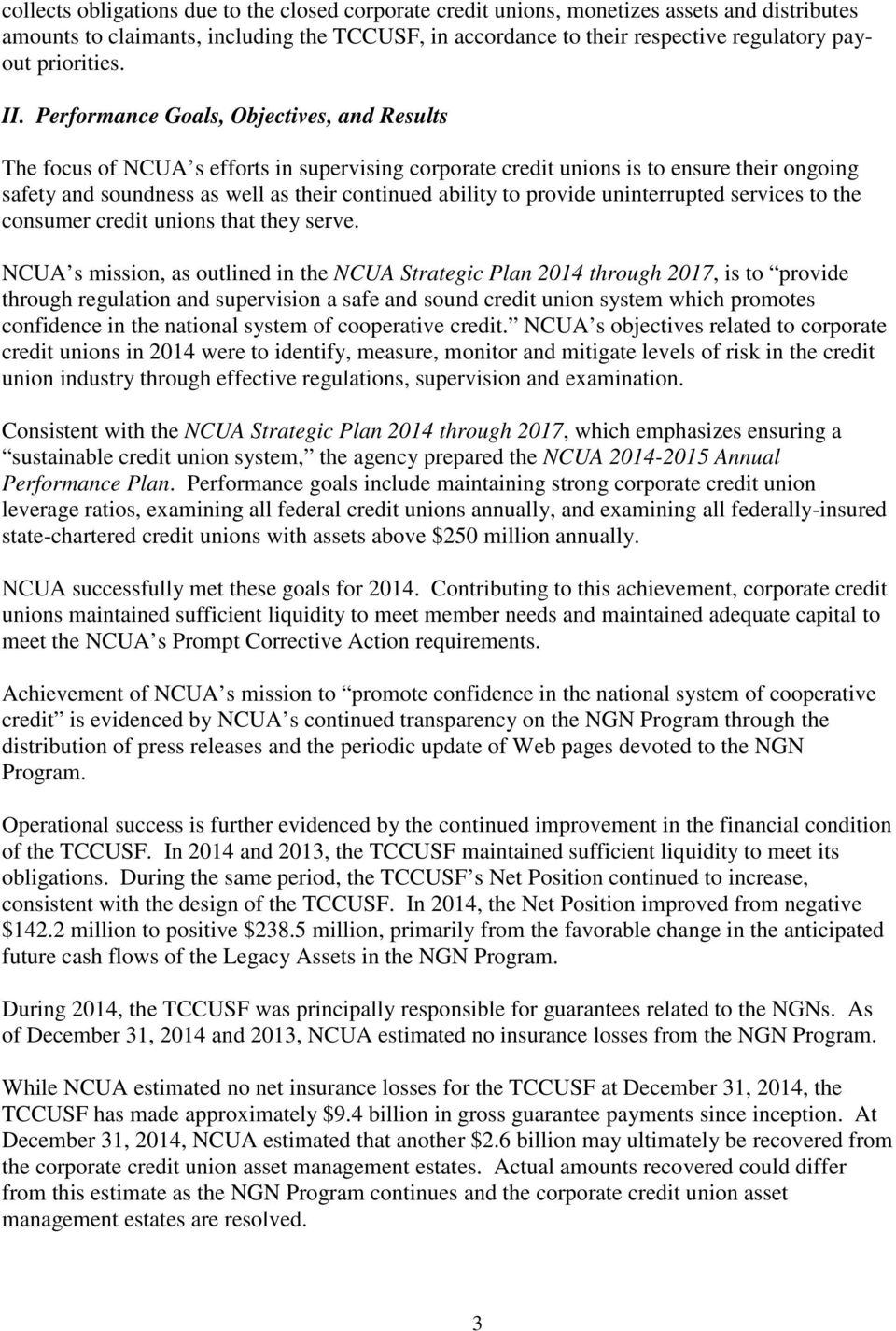
8 collects obligations due to the closed corporate credit unions, monetizes assets and distributes amounts to claimants, including the TCCUSF, in accordance to their respective regulatory payout priorities. II. Performance Goals, Objectives, and Results The focus of NCUA s efforts in supervising corporate credit unions is to ensure their ongoing safety and soundness as well as their continued ability to provide uninterrupted services to the consumer credit unions that they serve. NCUA s mission, as outlined in the NCUA Strategic Plan 2014 through 2017, is to provide through regulation and supervision a safe and sound credit union system which promotes confidence in the national system of cooperative credit. NCUA s objectives related to corporate credit unions in 2014 were to identify, measure, monitor and mitigate levels of risk in the credit union industry through effective regulations, supervision and examination. Consistent with the NCUA Strategic Plan 2014 through 2017, which emphasizes ensuring a sustainable credit union system, the agency prepared the NCUA Annual Performance Plan. Performance goals include maintaining strong corporate credit union leverage ratios, examining all federal credit unions annually, and examining all federally-insured state-chartered credit unions with assets above $250 million annually. NCUA successfully met these goals for Contributing to this achievement, corporate credit unions maintained sufficient liquidity to meet member needs and maintained adequate capital to meet the NCUA s Prompt Corrective Action requirements. Achievement of NCUA s mission to promote confidence in the national system of cooperative credit is evidenced by NCUA s continued transparency on the NGN Program through the distribution of press releases and the periodic update of Web pages devoted to the NGN Program. Operational success is further evidenced by the continued improvement in the financial condition of the TCCUSF. In 2014 and 2013, the TCCUSF maintained sufficient liquidity to meet its obligations. During the same period, the TCCUSF s Net Position continued to increase, consistent with the design of the TCCUSF. In 2014, the Net Position improved from negative $142.2 million to positive $238.5 million, primarily from the favorable change in the anticipated future cash flows of the Legacy Assets in the NGN Program. During 2014, the TCCUSF was principally responsible for guarantees related to the NGNs. As of December 31, 2014 and 2013, NCUA estimated no insurance losses from the NGN Program. While NCUA estimated no net insurance losses for the TCCUSF at December 31, 2014, the TCCUSF has made approximately $9.4 billion in gross guarantee payments since inception. At December 31, 2014, NCUA estimated that another $2.6 billion may ultimately be recovered from the corporate credit union asset management estates. Actual amounts recovered could differ from this estimate as the NGN Program continues and the corporate credit union asset management estates are resolved. 3
9 III. Financial Statement Analysis During 2014, the financial condition of the TCCUSF improved as seen by the improvement of its Net Position from negative $142.2 million to positive $238.5 million. This $380.7 million change is primarily explained by the $327.7 million Reduction of Insurance Losses. In 2014, the TCCUSF maintained sufficient liquidity to meet its obligations and paid down $300 million of Borrowings from the U.S. Treasury. Summarized financial information is presented below for the TCCUSF. Summarized Financial Information (in thousands) December 31, 2014 December 31, 2013 Total Assets $ 2,840,930 $ 2,761,032 Receivables from Asset Management Estates, Net 2,556,140 2,304,840 Fund Balance with Treasury and Investments, Net 278, ,553 Borrowings from the U.S. Treasury 2,600,000 2,900,000 Insurance and Guarantee Program Liabilities - - Net Position 238,485 (142,244) Net Income from Operations 379,780 3,256,180 Special Premium Revenue 3, ,199 Guarantee Fee Revenue 56,701 67,161 Reduction of Insurance Losses 327,721 2,508,426 Balance Sheet Highlights Total Assets grew by $79.9 million in 2014, primarily as a result of Net Income from Operations of $379.8 million, partially offset by the repayment of $300 million in U.S. Treasury borrowings. The outstanding balance with U.S. Treasury was $2.6 billion as of December 31, Receivables from Asset Management Estates, Net grew by $251.3 million in Reflected in the increase is the favorable change in the anticipated future cash flows of the Legacy Assets in the NGN Program and recoveries from the asset management estates due to previous Settlements. During 2014, the TCCUSF did not borrow any additional funds from the U.S. Treasury. The TCCUSF primarily used the recoveries from the asset management estates and other sources to repay $300 million during 2014, resulting in an outstanding balance of $2.6 billion as of December 31, Insurance and Guarantee Program Liabilities, also referred to as contingent liabilities, were $0 at December 31, 2014 and While there was no contingent liability as of December 31, 2014 and 2013, the TCCUSF continues to have ongoing guarantee obligations for the NGN Program. The contingent liability balance may increase in the future, depending on future analyses of the value of Legacy Assets in the NGN Program. Statement of Net Cost Highlights Net Income from Operations was $379.8 million for 2014, as compared to $3.3 billion for In 2014, net income is primarily due to the $327.7 million Reduction of Insurance Losses. This reduction is mainly due to the favorable change in future cash flows of the Legacy Assets in the NGN Program. Net income also includes $56.7 million in Guarantee Fee Revenues. In 2013, 4
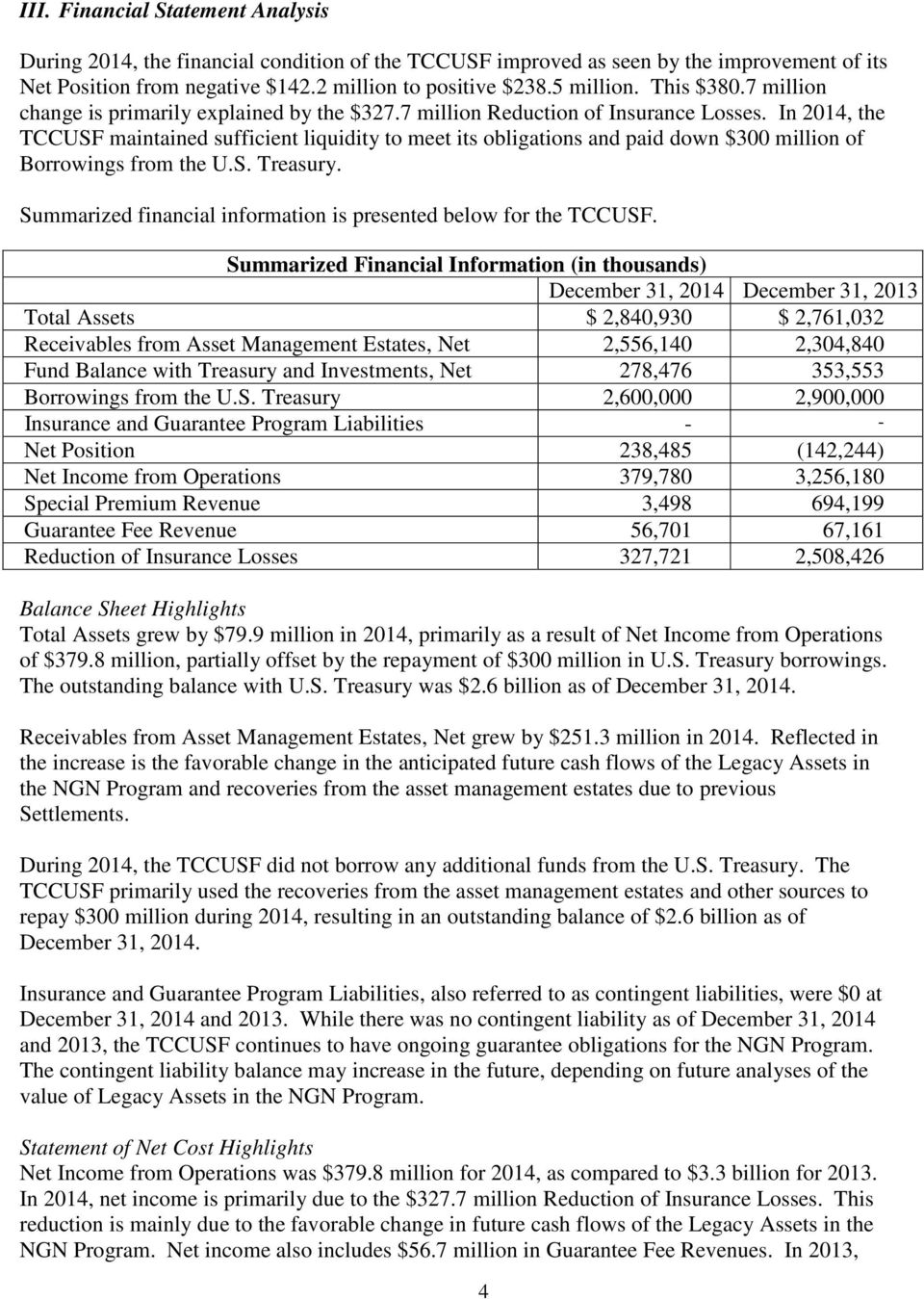
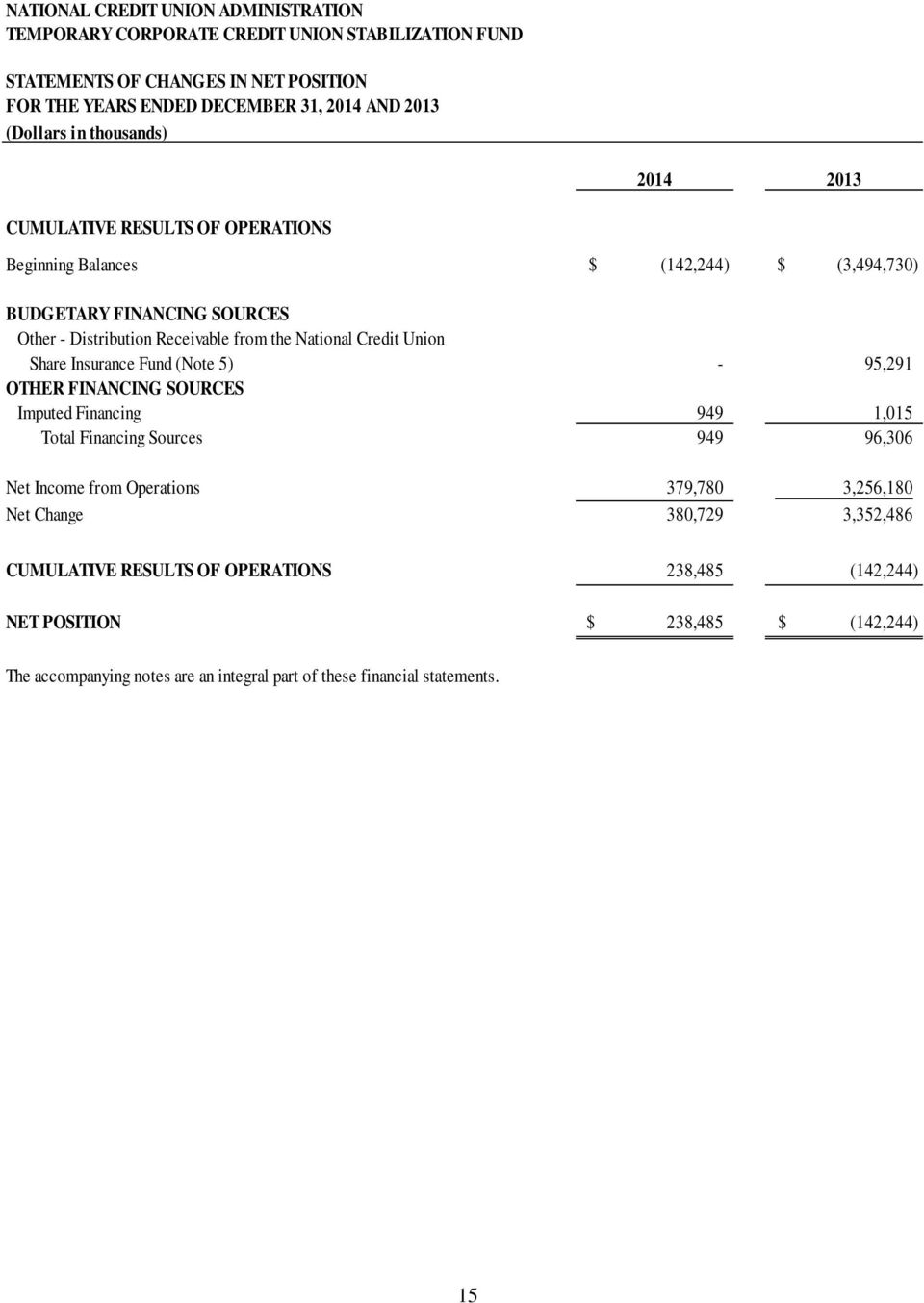
10 Net Income from Operations of $3.3 billion included Special Premium Revenue of $694.2 million and a Reduction in Insurance Losses of $2.5 billion, which contained an increase in expected recoveries from asset management estates due to Settlements. Statement of Changes in Net Position Highlights Cumulative Results of Operations increased by $380.7 million in 2014 resulting in a positive Net position of $238.5 million. This increase was due to Net Income from Operations of $379.8 million. This positive net position represents a measure of the difference between the fund s assets and liabilities as of December 31, While the improving values of the Legacy Assets contribute to the positive net position, NCUA must repay the outstanding borrowings from the U.S. Treasury. In any year that the TCCUSF has an outstanding borrowing from the U.S. Treasury, the NCUA Board must make the distribution from NCUSIF to the TCCUSF rather than to insured credit unions. As of December 31, 2014, the NCUSIF calculated equity ratio was 1.29%; therefore, NCUSIF did not make a distribution to the TCCUSF. As of December 31, 2013, the TCCUSF recorded a distribution receivable due from the NCUSIF, pursuant to the FCU Act, to bring the NCUSIF equity ratio to its normal operating level of 1.30% in the amount of $95.3 million. The TCCUSF received this amount in March Statement of Budgetary Resources Highlights Activity affecting budget totals of the overall Federal Government is recorded in the TCCUSF s Statements of Budgetary Resources. The TCCUSF s gross outlays of $17.1 million in 2014 decreased from $22.4 million for 2013 primarily due to lower payments made in 2014 as compared to The TCCUSF s unobligated balance, or budget available to create future obligations, increased $126.6 million primarily due to cash flows from Guarantee Fee Revenue and recoveries from asset management estates. Fiduciary Activity Highlights As the TCCUSF was established to accrue the losses of the corporate credit union system during the credit crisis and to recover such losses over time, the TCCUSF s financial results are driven by the financial performance of the corporate credit union asset management estates, which includes the Settlements and the NGN Program. The financial results of the corporate credit union asset management estates and the NGN Trusts in the NGN Program are not presented in the results of the TCCUSF as described above, but are instead presented as fiduciary activities of the TCCUSF in accordance with the Federal Accounting Standards Advisory Board s Statement of Federal Financial Accounting Standard (SFFAS) No. 31, Accounting for Fiduciary Activities, and are included in the notes to the TCCUSF financial statements. NGN Program The outstanding principal balance of the NGNs was $15.2 billion and $17.5 billion as of December 31, 2014 and 2013, respectively. This amount represents the maximum potential future guarantee payments that NCUA could be required to make without consideration of future expected cash flows from underlying Legacy Assets and possible recoveries under the terms of the guarantees or from the asset management estates. The losses from the guarantees of NGNs are expected to be significantly less than the above maximum potential exposure, and such losses are based on estimated guarantee payments, net of estimated guarantor reimbursements, if any, from the NGN Trusts and expected recoveries, if any, from the asset management estates. The NCUA s estimate of the expected recovery from the asset management estates reflects the 5

11 NCUA s expectations and assumptions about the recovery value of the asset management estates' assets, which include economic residual interests in the NGN Trusts. The NCUA s estimated guarantee payments, guarantor reimbursements and the recovery values, if any, of the asset management estates' economic residual interests in the NGN Trusts are derived using an external model that distributes estimated cash flows of the Legacy Assets transferred to the NGN Trusts in the priority of payments pursuant to the governing documents of each NGN Trust. The estimated cash flows incorporate the NCUA s assumptions about discount rates. The estimated cash flows of the Legacy Assets transferred to the NGN Trusts are also derived from the external model that incorporates the NCUA s expectations and assumptions about the estimated cash flows from the collateral that comprises the Legacy Assets, and the priority of payments and estimated cash flows of the Legacy Assets pursuant to the governing documents for the respective Legacy Assets. The external model produces estimated cash flows of collateral underlying the Legacy Assets by incorporating the NCUA s expectations and assumptions about prepayments, defaults and loss severity of the collateral consisting of residential and commercial mortgage loans and other assets. Assumptions about prepayments, defaults, and loss severity are developed based on the characteristics and historical performance of the collateral, as well as assumptions about macroeconomic variables such as unemployment rates, housing prices, and interest rates. The table below represents the composition of Legacy Assets collateralizing the thirteen NGN Trusts, with an aggregate unpaid principal balance of $21.0 billion and $23.9 billion and recovery value of approximately $18.0 billion and $19.8 billion as of December 31, 2014 and 2013, respectively. 6

12 Based on Recovery Value Based on Unpaid Principal Balance Asset Type and Credit Rating AAA 0% 0% 0% 0% AA 1% 1% 1% 1% RMBS A 4% 4% 3% 3% 73% 73% 76% 76% BBB 4% 4% 3% 4% Below Investment Grade 91% 91% 92% 92% NA 0% 0% 0% 0% AAA 23% 18% 24% 18% AA 29% 30% 28% 30% CMBS A 23% 23% 23% 23% 21% 21% 18% 17% BBB 7% 11% 7% 11% Below Investment Grade 18% 18% 18% 18% NA 0% 0% 0% 0% AAA 0% 1% 0% 1% AA 66% 37% 46% 25% ABS 2 A 13% 39% 10% 26% 3% 3% 3% 4% BBB 5% 8% 4% 5% Below Investment Grade 16% 15% 40% 43% NA 0% 0% 0% 0% Agency 2% 100% 2% 100% 2% 100% 2% 100% AAA 0% 0% 0% 0% AA 12% 4% 8% 4% Corporate A 23% 13% 15% 11% 1% 1% 1% 1% BBB 60% 45% 38% 36% Below Investment Grade 1% 35% 7% 32% NA 4% 3% 32% 17% Percentages may not total 100% due to rounding. 1 The rating is based on the lowest published rating by S&P, Moody s, or Fitch. 2 The collateral underlying the ABS included in the table above is primarily student loans. Due to uncertain economic risks and the possibility of variances from historical data, actual losses could differ materially from the contingent liabilities, if any, recorded by the TCCUSF. Performance measures are designed to enable management and the NCUA s stakeholders to assess programs and financial performance and to use this information to make improvements. Performance measures have inherent limitations, including the change over time in the correlation of cause and effect. A strong correlation between cause and effect in one period may not continue into the next. In addition, performance measures may not address economic risks, which can have a significant effect on future results. Limitations of the Financial Statements The principal financial statements have been prepared to report the financial position and results of operations of the TCCUSF. While the statements have been prepared from the books and records of the TCCUSF in accordance with U.S. generally accepted accounting principles (GAAP) for Federal entities and the formats prescribed by the Office of Management and Budget, the statements are in addition to the financial reports used to monitor and control budgetary resources that are prepared from the same books and records. The statements should be read with the realization that they are for a component of the U.S. Government, a sovereign entity. 7

13 Liquidity Risk and Capital Resources For liquidity, the TCCUSF maintains cash in its Fund Balance with Treasury (FBWT) as well as investments in overnight U.S. Treasury Securities, which are available for the possibility of urgent liquidity needs and 2013 Fund Balance with Treasury and Investments (in thousands) December 31, 2014 December 31, 2013 Fund Balance with Treasury $ 2,500 $ 2,496 U.S. Treasury Securities, Overnight 275, ,057 The FBWT account is increased by amounts collected from special premium assessments, guarantee fee income, borrowing from the U.S. Treasury, interest income on investments in U.S. Treasury Securities, distributions from the NCUSIF, and any recoveries from the asset management estates including proceeds recovered from legal claims. The FBWT account is decreased by amounts expended in support of stabilizing the corporate credit union system, including guarantee payments, repayment of borrowings from the U.S. Treasury and related interest payments, and purchases of U.S. Treasury Securities. The TCCUSF is a revolving fund in the U.S. Treasury and has access to sufficient funds to meet its obligations, including its Insurance and Guarantee Program Liabilities. The TCCUSF has multiple sources of funding including: special premium assessments on insured credit unions, as necessary; borrowings from the U.S. Treasury; and distributions from the NCUSIF, as provided by the FCU Act. Special Premium Assessments In January 2011, The National Credit Union Authority Clarification Act, Public Law (Clarification Act), amended the FCU Act by clarifying NCUA s authority to assess a premium against credit unions not only to repay TCCUSF advances but also to make TCCUSF expenditures without borrowing from the U.S. Treasury. The Clarification Act permits the NCUA Board to assess a special premium with respect to each insured credit union in an aggregate amount that is reasonably calculated to make any pending or future TCCUSF expenditures, in addition to existing authority to make assessments to repay U.S. Treasury advances. The Clarification Act also states that the NCUA Board must take into consideration any potential impact on credit union earnings that such an assessment may have and requires the premium be paid not later than 60 days after the date of the assessment. Borrowing Authority from the U.S. Treasury The TCCUSF has $6.0 billion in maximum statutory borrowing authority, shared with the NCUSIF, from the U.S. Treasury. As of December 31, 2014 and 2013, the TCCUSF had $2.6 billion and $2.9 billion in borrowings outstanding from the U.S. Treasury, respectively; the NCUSIF had no borrowings outstanding. As a result, the TCCUSF had $3.4 billion and $3.1 billion, respectively, in available borrowing authority, shared with the NCUSIF. The estimated losses and liquidity needs of the TCCUSF are based on the NCUA s expectations and assumptions about the resolution of failed corporate credit unions, including the disposition and recovery value of their assets. Actual losses of the TCCUSF, including the TCCUSF s funding 8

14 needs, could differ from those estimates. Consequently, additional borrowing reduces funds available from this source. Distributions from the NCUSIF In accordance with Section 202(c)(3) of the FCU Act, Distributions from Fund Required, the NCUA Board shall effect a pro rata distribution from the NCUSIF to insured credit unions after each calendar year, if: (i) any loans to the NCUSIF from the Federal Government, and any interest on those loans, have been repaid; and (ii) the NCUSIF s equity ratio exceeds the normal operating level, as defined, of 1.3%; and (iii) the NCUSIF s available assets ratio, as defined, exceeds 1.0%. The amount of distribution shall equal the maximum possible amount that does not reduce the NCUSIF s equity ratio below the normal operating level of 1.3% and does not reduce the NCUSIF s available assets ratio below 1.0%. In any year that the TCCUSF has an outstanding borrowing from the U.S. Treasury, the NCUA Board must make the distribution to the TCCUSF rather than to insured credit unions. IV. Systems, Controls and Legal Compliance The TCCUSF was created by the Helping Families Act, enacted May 20, NCUA, including the TCCUSF, is exempt from requirements under the Federal Credit Reform Act of 1990 (2 U.S.C. 661 et seq.). The TCCUSF may make expenditures only in connection with the conservatorship, liquidation, or threatened conservatorship or liquidation of a corporate credit union. Governing legislation specified that the TCCUSF would close 90 days after the seven year anniversary of its first borrowing from the U.S. Treasury, which was on June 25, With the concurrence of the U.S. Treasury and in accordance with the FCU Act, the TCCUSF s closing date was extended to June 30, Internal controls should be designed to provide reasonable assurance regarding prevention or prompt detection of unauthorized acquisition, use, or disposition of assets. The Federal Manager s Financial Integrity Act (FMFIA) requires agencies to establish management controls over their programs and financial systems. Accordingly, NCUA management is responsible for establishing and maintaining effective internal controls and financial management systems that meet the objectives of FMFIA, which include safeguarding assets and compliance with applicable laws and regulations. NCUA managers monitor and assess their relevant internal controls and report on their assessment. This allows NCUA management to provide reasonable assurance that internal controls are operating effectively. NCUA is in compliance with FMFIA as well as all applicable laws such as the Prompt Payment Act and the Debt Collection and Improvement Act. As required by the Improper Payments Elimination and Recovery Act, NCUA determined that the TCCUSF s programs are not susceptible to a high risk of significant improper payments. As required by the Federal Information Security Management Act, NCUA develops, documents, and implements an agency-wide program to provide information privacy and security (management, operational and technical security controls) for the information and information systems that support the operations of the agency, including those provided or managed by another agency, contractor, or other source. 9

15 KPMG LLP Suite K Street, NW Washington, DC Independent Auditors Report Inspector General, National Credit Union Administration and the National Credit Union Administration Board: Report on the Financial Statements We have audited the accompanying financial statements of the National Credit Union Administration Temporary Corporate Credit Union Stabilization Fund (TCCUSF), which comprise the balance sheets as of December 31, 2014 and 2013, and the related statements of net cost, changes in net position, and statements of budgetary resources for the years then ended, and the related notes to the financial statements. Management s Responsibility for the Financial Statements Management is responsible for the preparation and fair presentation of these financial statements in accordance with U.S. generally accepted accounting principles; this includes the design, implementation, and maintenance of internal control relevant to the preparation and fair presentation of financial statements that are free from material misstatement, whether due to fraud or error. Auditors Responsibility Our responsibility is to express an opinion on these financial statements based on our audits. We conducted our audits in accordance with auditing standards generally accepted in the United States of America; the standards applicable to financial audits contained in Government Auditing Standards issued by the Comptroller General of the United States; and Office of Management and Budget (OMB) Bulletin No , Audit Requirements for Federal Financial Statements. Those standards and OMB Bulletin No , require that we plan and perform the audit to obtain reasonable assurance about whether the financial statements are free from material misstatement. An audit involves performing procedures to obtain audit evidence about the amounts and disclosures in the financial statements. The procedures selected depend on the auditors judgment, including the assessment of the risks of material misstatement of the financial statements, whether due to fraud or error. In making those risk assessments, the auditor considers internal control relevant to the entity s preparation and fair presentation of the financial statements in order to design audit procedures that are appropriate in the circumstances, but not for the purpose of expressing an opinion on the effectiveness of the entity s internal control. Accordingly, we express no such opinion. An audit also includes evaluating the appropriateness of accounting policies used and the reasonableness of significant accounting estimates made by management, as well as evaluating the overall presentation of the financial statements. We believe that the audit evidence we have obtained is sufficient and appropriate to provide a basis for our audit opinion. 10 KPMG LLP is a Delaware limited liability partnership, the U.S. member firm of KPMG International Cooperative ( KPMG International ), a Swiss entity.

16 Opinion on the Financial Statements In our opinion, the financial statements referred to above present fairly, in all material respects, the financial position of the National Credit Union Administration Temporary Corporate Credit Union Stabilization Fund as of December 31, 2014 and 2013, and its net costs, changes in net position, and budgetary resources for the years then ended in accordance with U.S. generally accepted accounting principles. Other Matters Required Supplementary Information U.S. generally accepted accounting principles require that the information in the Overview and Required Supplementary Information sections be presented to supplement the basic financial statements. Such information, although not a part of the basic financial statements, is required by the Federal Accounting Standards Advisory Board who considers it to be an essential part of financial reporting for placing the basic financial statements in an appropriate operational, economic, or historical context. We have applied certain limited procedures to the required supplementary information in accordance with auditing standards generally accepted in the United States of America, which consisted of inquiries of management about the methods of preparing the information and comparing the information for consistency with management s responses to our inquiries, the basic financial statements, and other knowledge we obtained during our audits of the basic financial statements. We do not express an opinion or provide any assurance on the information because the limited procedures do not provide us with sufficient evidence to express an opinion or provide any assurance. Other Reporting Required by Government Auditing Standards Internal Control Over Financial Reporting In planning and performing our audit of the financial statements as of and for the year ended December 31, 2014, we considered the TCCUSF s internal control over financial reporting (internal control) to determine the audit procedures that are appropriate in the circumstances for the purpose of expressing our opinion on the financial statements, but not for the purpose of expressing an opinion on the effectiveness of the TCCUSF s internal control. Accordingly, we do not express an opinion on the effectiveness of the TCCUSF s internal control. We did not test all internal controls relevant to operating objectives as broadly defined by the Federal Managers Financial Integrity Act of A deficiency in internal control exists when the design or operation of a control does not allow management or employees, in the normal course of performing their assigned functions, to prevent, or detect and correct, misstatements on a timely basis. A material weakness is a deficiency, or a combination of deficiencies, in internal control, such that there is a reasonable possibility that a material misstatement of the entity s financial statements will not be prevented, or detected and corrected, on a timely basis. A significant deficiency is a deficiency, or a combination of deficiencies, in internal control that is less severe than a material weakness, yet important enough to merit attention by those charged with governance. Our consideration of internal control was for the limited purpose described in the first paragraph of this section and was not designed to identify all deficiencies in internal control that might be material weaknesses or significant deficiencies. Given these limitations, during our audit we did not identify any deficiencies in internal control that we consider to be material weaknesses. However, material weaknesses may exist that have not been identified. 11

17 Compliance and Other Matters As part of obtaining reasonable assurance about whether the TCCUSF s financial statements are free from material misstatement, we performed tests of its compliance with certain provisions of laws, regulations, and contracts, noncompliance with which could have a direct and material effect on the determination of financial statement amounts, and certain provisions of other laws and regulations specified in OMB Bulletin No However, providing an opinion on compliance with those provisions was not an objective of our audit, and accordingly, we do not express such an opinion. The results of our tests of compliance disclosed no instances of noncompliance or other matters that are required to be reported herein under Government Auditing Standards or OMB Bulletin No Purpose of the Other Reporting Required by Government Auditing Standards The purpose of the communication described in the Other Reporting Required by Government Auditing Standards section is solely to describe the scope of our testing of internal control and compliance and the result of that testing, and not to provide an opinion on the effectiveness of the TCCUSF s internal control or compliance. Accordingly, this communication is not suitable for any other purpose. March 13,

18 NATIONAL CREDIT UNION ADMINISTRATION TEMPORARY CORPORATE CREDIT UNION STABILIZATION FUND BALANCE SHEETS AS OF DECEMBER 31, 2014 AND 2013 (Dollars in thousands) ASSETS INTRAGOVERNMENTAL Fund Balance with Treasury (Note 2) $ 2,500 $ 2,496 Investments, Net - U.S. Treasury Securities (Note 3) 275, ,057 Accounts Receivable - Due from the National Credit Union Share Insurance Fund - 3,910 Other - Distribution Receivable from the National Credit Union Share Insurance Fund (Note 5) - 95,291 Total Intragovernmental Assets 278, ,754 PUBLIC Accounts Receivable - Special Premium Assessments from Insured Credit Unions, Net (Note 4) 3, Prepaid Expenses 5 - Accounts Receivable - Guarantee Fee on National Credit Union Administration Guaranteed Notes, Net (Note 4) 2,797 3,419 Other - Receivables from Asset Management Estates, Net (Note 6) 2,556,140 2,304,840 Total Public Assets 2,562,454 2,308,278 TOTAL ASSETS $ 2,840,930 $ 2,761,032 LIABILITIES INTRAGOVERNMENTAL Debt - Borrowings from the U.S. Treasury (Note 7) $ 2,600,000 $ 2,900,000 Other - Accrued Interest Payable to the U.S. Treasury (Note 7) 1,643 2,358 Total Intragovernmental Liabilities 2,601,643 2,902,358 PUBLIC Accounts Payable Other Liabilities Other - Insurance and Guarantee Program Liabilities (Note 8) - - Total Public Liabilities TOTAL LIABILITIES 2,602,445 2,903,276 Commitments and Contingencies (Note 8) NET POSITION Cumulative Result of Operations (Note 1) 238,485 (142,244) Total Net Position 238,485 (142,244) TOTAL LIABILITIES AND NET POSITION $ 2,840,930 $ 2,761,032 The accompanying notes are an integral part of these financial statements. 13

19 NATIONAL CREDIT UNION ADMINISTRATION TEMPORARY CORPORATE CREDIT UNION STABILIZATION FUND STATEMENTS OF NET COST FOR THE YEARS ENDED DECEMBER 31, 2014 AND 2013 (Dollars in thousands) GROSS COSTS Interest Expense on Borrowings (Note 7) $ 3,838 $ 8,288 Reduction of Insurance Losses AME Receivable Bad Debt Expense (Note 6) (327,721) (2,508,426) Imputed Costs 949 1,015 Fee on Early Retirement of Borrowings from the U.S. Treasury (Note 7) Administrative Expenses 3,449 3,946 Total Gross Costs (319,485) (2,494,609) LESS EARNED REVENUES Special Premium Revenue (3,498) (694,199) Guarantee Fee Revenue - National Credit Union Administration Guaranteed Notes (56,701) (67,161) Interest Revenue - Investments (96) (211) Total Earned Revenues (60,295) (761,571) NET (INCOME) FROM OPERATIONS $ (379,780) $ (3,256,180) The accompanying notes are an integral part of these financial statements. 14

20 NATIONAL CREDIT UNION ADMINISTRATION TEMPORARY CORPORATE CREDIT UNION STABILIZATION FUND STATEMENTS OF CHANGES IN NET POSITION FOR THE YEARS ENDED DECEMBER 31, 2014 AND 2013 (Dollars in thousands) CUMULATIVE RESULTS OF OPERATIONS Beginning Balances $ (142,244) $ (3,494,730) BUDGETARY FINANCING SOURCES Other - Distribution Receivable from the National Credit Union Share Insurance Fund (Note 5) - 95,291 OTHER FINANCING SOURCES Imputed Financing 949 1,015 Total Financing Sources ,306 Net Income from Operations 379,780 3,256,180 Net Change 380,729 3,352,486 CUMULATIVE RESULTS OF OPERATIONS 238,485 (142,244) NET POSITION $ 238,485 $ (142,244) The accompanying notes are an integral part of these financial statements. 15
21 NATIONAL CREDIT UNION ADMINISTRATION TEMPORARY CORPORATE CREDIT UNION STABILIZATION FUND STATEMENTS OF BUDGETARY RESOURCES FOR THE YEARS ENDED DECEMBER 31, 2014 AND 2013 (Dollars in thousands) BUDGETARY RESOURCES (Notes 10, 11, 12, and 14) Unobligated balance, brought forward, January 1 $ 3,546,554 $ 1,359,863 Borrowing authority (mandatory) 300,000 2,200,000 Spending authority from offsetting collections (mandatory) Collected 146,759 2,109,923 Change in receivables from federal sources (3,910) 3,220 Anticipated nonexpenditure transfer - 95,291 Permanently not available (300,000) (2,200,000) TOTAL BUDGETARY RESOURCES $ 3,689,403 $ 3,568,297 STATUS OF BUDGETARY RESOURCES Obligations incurred $ 16,269 $ 21,743 Unobligated balance, end of year: Exempt from apportionment 3,673,134 3,546,554 Total unobligated balance, end of year 3,673,134 3,546,554 TOTAL STATUS OF BUDGETARY RESOURCES $ 3,689,403 $ 3,568,297 CHANGE IN OBLIGATED BALANCE Unpaid Obligations: Unpaid obligations, brought forward, January 1 $ 6,199 $ 6,817 Obligations incurred 16,269 21,743 Outlays (gross) (17,126) (22,361) Unpaid obligations, end of year $ 5,342 $ 6,199 Uncollected payments: Uncollected customer payments from federal sources, brought forward, January 1 $ (3,910) $ (690) Change in uncollected customer payments from Federal sources 3,910 (3,220) Uncollected customer payments from Federal sources, end of year $ - $ (3,910) Obligated balance, start of year (net) $ 2,289 $ 6,127 Obligated balance, end of year (net) $ 5,342 $ 2,289 BUDGET AUTHORITY AND OUTLAYS, NET Budget authority, gross (mandatory) $ 142,849 $ 2,208,434 Actual offsetting collections (mandatory) (146,759) (2,109,923) Change in uncollected customer payments from Federal sources (mandatory) 3,910 (3,220) Anticipated offsetting collections (mandatory) - (95,291) BUDGET AUTHORITY, NET (MANDATORY) $ - $ - Outlays, gross (mandatory) $ 17,126 $ 22,361 Actual offsetting collections (mandatory) (146,759) (2,109,923) Outlays, net (discretionary and mandatory) (129,633) (2,087,562) AGENCY OUTLAYS, NET (MANDATORY) $ (129,633) $ (2,087,562) The accompanying notes are an integral part of these financial statements. 16
22 NATIONAL CREDIT UNION ADMINISTRATION TEMPORARY CORPORATE CREDIT UNION STABILIZATION FUND NOTES TO FINANCIAL STATEMENTS AS OF AND FOR THE YEARS ENDED DECEMBER 31, 2014 AND SUMMARY OF SIGNIFICANT ACCOUNTING POLICIES Reporting Entity The Temporary Corporate Credit Union Stabilization Fund (TCCUSF) was created by Public Law , Helping Families Save Their Homes Act of 2009 (Helping Families Act), enacted May 20, The TCCUSF was established as a revolving fund in the Treasury of the United States (U.S. Treasury) under the management of the National Credit Union Administration (NCUA) Board (NCUA Board). The purposes of the TCCUSF are to accrue the losses of the corporate credit union (CCU) system and, over time, assess the credit union system for the recovery of such losses. In January 2011, The National Credit Union Authority Clarification Act, Public Law (Clarification Act), amended the Federal Credit Union Act (FCU Act) by clarifying NCUA s authority to assess a premium against federally insured (insured) credit unions not only to repay TCCUSF advances but also to make TCCUSF expenditures without borrowing from the U.S. Treasury. The TCCUSF may make expenditures only in connection with the conservatorship, liquidation, or threatened conservatorship or liquidation of a CCU. Governing legislation specified that the TCCUSF would terminate 90 days after the seven year anniversary of its first borrowing from the U.S. Treasury, which was on June 25, With the concurrence of the U.S. Treasury and in accordance with the FCU Act, the TCCUSF s termination date was extended to June 30, On June 18, 2009, the NCUA Board approved actions to legally obligate the TCCUSF for the costs of stabilizing the CCU system. The Board designated the TCCUSF as principal obligor for all liabilities arising from the Temporary Corporate Credit Union Share Guarantee Program (TCCUSGP) and the Temporary Corporate Credit Union Liquidity Guarantee Program (TCCULGP). Under the TCCUSGP, the NCUA guaranteed the entire share amount that member credit unions had on deposit with CCUs, subject to certain limitations. Under the TCCULGP, the NCUA guaranteed the timely payment of principal and interest on certain unsecured debt of participating CCUs. The funding for the NCUA s guarantees under the TCCUSGP and TCCULGP was primarily provided by the TCCUSF. The TCCUSGP ended December 31, In addition, the TCCULGP had no remaining guarantees on unsecured debt of participating CCUs as of and after December 31, Fiduciary Responsibilities Fiduciary activities are the collection or receipt, management, protection, accounting, investment, or disposition by the Federal Government of cash or other assets, in which nonfederal individuals or entities have an ownership interest that the Federal Government must uphold. 17
23 On September 24, 2010, the NCUA Board announced the Corporate System Resolution Program (CSRP). The CSRP is a multi-stage plan for stabilizing the CCU system, providing short-term and long-term funding to resolve a portfolio of residential mortgage-backed securities, commercial mortgage-backed securities, other asset-backed securities and corporate bonds (collectively referred to as the Legacy Assets) held by failed CCUs, and establishing a new regulatory framework for CCUs. Under the CSRP, the NCUA created a re-securitization program to provide long-term funding for the Legacy Assets through the issuance of the NCUA Guaranteed Notes (NGNs) by the trusts established for this purpose (NGN Trusts). The NGNs are guaranteed by the NCUA, and backed by the full faith and credit of the United States Government. The principal funding for the NCUA s guarantees on the NGNs is provided by the TCCUSF. To the extent that required funding for the guarantees exceeds the funds available from the TCCUSF, the National Credit Union Share Insurance Fund (NCUSIF) will be obligated to provide the needed funds. As part of the CSRP, the NCUA Board liquidated five CCUs during The assets and liabilities of liquidated CCUs were placed into Asset Management Estates (AMEs), and are administered by the NCUA Board as liquidating agent, through its Asset Management and Assistance Center (AMAC), pursuant to applicable provisions of the Federal Credit Union Act (FCU Act). To facilitate the resolution process, the NCUA Board chartered four bridge corporate credit unions (Bridge Corporates) to purchase certain assets and assume certain liabilities and member shares from the AMEs. The Bridge Corporates were private legal entities. While legally separate from the TCCUSF and therefore not part of the reporting entity, they remained in the conservatorship of the NCUA Board. The U.S. Central Bridge Corporate Federal Credit Union (USC Bridge) and Western Bridge Corporate Federal Credit Union (Western Bridge) were placed into liquidation during The two other Bridge Corporates were resolved through unassisted mergers with other CCUs in When establishing the Bridge Corporates, to the extent that the liabilities and shares assumed exceeded the assets purchased by the Bridge Corporates, the AMEs issued promissory notes (Promissory Notes) to the Bridge Corporates for the difference. Each Promissory Note was guaranteed by the NCUA through the TCCUSF. All Promissory Notes have since been paid in full. The NCUA s AMAC conducts liquidations and performs management and recovery of assets for failed credit unions, including failed CCUs and Bridge Corporates placed in liquidation. The assets and liabilities of the AMEs and NGN Trusts are considered fiduciary in accordance with the Statement of Federal Financial Accounting Standards (SFFAS) No. 31, Accounting for Fiduciary Activities (SFFAS No. 31). Fiduciary assets are not assets of the Federal Government and therefore are not recognized on the Balance Sheet. Additionally, NCUA entity assets are non-fiduciary. Sources of Funding The TCCUSF has multiple sources of funding, including special premium assessments, investment interest income, guarantee fees, and borrowings from the U.S. Treasury shared with the NCUSIF. The NCUA Board may assess premiums to all insured credit unions, as provided by the FCU Act. The TCCUSF may also receive additional funding from the NCUSIF under certain circumstances. As part of the Helping Families Act, when the TCCUSF has an advance (borrowing) outstanding from the U.S. Treasury and the NCUSIF would have otherwise paid a distribution to insured credit unions, the NCUSIF is obligated to make distributions to the 18
24 TCCUSF in lieu of distributions to insured credit unions to the maximum amount possible that does not reduce the NCUSIF s equity ratio below the normal operating level, as defined, of 1.3%, and does not reduce the NCUSIF s available assets ratio, as defined, below 1.0%. Basis of Presentation The TCCUSF s financial statements have been prepared from its accounting records in accordance with standards promulgated by the Federal Accounting Standards Advisory Board (FASAB). FASAB is designated by the American Institute of Certified Public Accountants as the source of generally accepted accounting principles (GAAP) for federal reporting entities. The format of the financial statements and footnotes are in accordance with the form and content guidance provided in Office of Management and Budget (OMB) Circular A-136, Financial Reporting Requirements, revised September 18, Consistent with SFFAS No. 34, The Hierarchy of Generally Accepted Accounting Principles, Including the Application of Standards Issued by the Financial Accounting Standards Board, NCUA considers and where appropriate, applies Financial Accounting Standards Board guidance for those instances where no applicable FASAB guidance is available. Basis of Accounting In its accounting structure, the TCCUSF records both proprietary and budgetary accounting transactions. Following the accrual method of accounting, revenues are recognized when earned and expenses are recognized when incurred, without regard to the actual collection or payment of cash. Federal budgetary accounting recognizes the obligation of appropriations, borrowing authorities, and other funds upon the establishment of a properly documented legal liability, which may be different from the recording of an accrual-based transaction. The recognition of budgetary accounting transactions is essential for compliance with legal controls over the use of federal funds and compliance with budgetary laws. The NCUA, including the TCCUSF, is exempt from requirements of the Federal Credit Reform Act of 1990 (2 U.S.C. 661 et seq.). Use of Estimates The preparation of financial statements in conformity with GAAP for the Federal Government requires management to make estimates and assumptions that affect the following: reported amounts of assets and liabilities; disclosure of contingent assets and liabilities at the date of the financial statements; and the amounts of revenues and costs reported during that period. Actual results could differ from estimates. Significant items subject to those estimates and assumptions include: (i) reserves for probable losses and contingencies related to Insurance and Guarantee Program Liabilities; (ii) the amount and timing of recoveries, if any, related to any claims paid in settlement of the guarantee liabilities; and (iii) allowance amounts established related to reimbursements from AMEs for claims paid on their behalf. 19
25 Fund Balance with Treasury Fund Balance with Treasury (FBWT) is the aggregate amount of the TCCUSF s accounts with the Federal Government s central accounts, from which the TCCUSF is authorized to make expenditures and pay liabilities. The entire FBWT is a revolving fund type. Investments Investments represent non-marketable U.S. Treasury securities purchased and reported at par value, which are overnight securities managed by the Bureau of the Fiscal Service (BFS). Cash balances in FBWT may be invested in non-marketable U.S. Treasury securities. Accounts Receivable Accounts receivable represents the TCCUSF s claims for payment from other entities. Gross receivables are reduced to net realizable value by an allowance for doubtful accounts as further discussed below. The TCCUSF s accounts receivable has two components: Intragovernmental and Public. Intragovernmental accounts receivable due from the NCUSIF represents activity collected by the NCUSIF on behalf of the TCCUSF, but not yet transferred to the TCCUSF for its use and benefit. Public accounts receivable represents outstanding balances of any special premiums assessed to insured credit unions and guarantee fees associated with the NGNs, as described herein. Allowance for Doubtful Accounts An allowance for doubtful accounts is the TCCUSF s best estimate of the amount of losses in an existing receivable. Based on an assessment of collectability, the TCCUSF calculates an allowance on an individual account basis for public accounts receivable. An account may be impaired or written off if it is probable that the TCCUSF will not collect all amounts contractually due. No allowance is calculated for intragovernmental accounts receivable, as these are deemed to be fully collectible. Other - Distribution Receivable The TCCUSF records a distribution receivable from the NCUSIF, per Section 217(e) of the FCU Act, when the TCCUSF has an outstanding advance (borrowing) from the U.S. Treasury and the NCUSIF is required to make a distribution. The NCUSIF is prohibited from making the distribution to insured credit unions described in Section 202(c)(3) of the FCU Act and instead must make its distribution to the TCCUSF. Other - Receivables from Asset Management Estates, Net Receivables from AMEs, Net include claims to recover payments made by the TCCUSF to satisfy obligations to insured shareholders and other guaranteed parties and to recoup administrative expenses paid on behalf of AMEs. A related allowance for loss represents the difference between the funds disbursed and obligations incurred and the expected repayment, when recognized, from the AMEs pursuant to the liquidation payment priorities set forth in 709.5(b) of Title 12 of the Code of Federal Regulations Payout Priorities in Involuntary Liquidation (12 CFR 709.5(b)). Assets held by the AMEs are the main source of repayment of the TCCUSF s receivables from the AMEs. The recoveries from these AME assets are paid 20
26 to the TCCUSF as AME assets are monetized and to the extent a receivable is due for guarantee obligations and administrative expenses. The allowance for losses on receivables from AMEs is based on expected asset recovery rates and is estimated based on several sources, including: actual or pending AME asset disposition data; asset valuation data based upon the performance, quality, and type of the assets in the portfolio; estimated liquidation costs based on information from recently failed credit unions; estimated AME specific administrative expenses based upon complexity and expected duration of the AME; and recoveries from the AMEs related to legal claims. Expected asset recovery rates are evaluated during the year and at the reporting date but remain subject to uncertainties because of potential changes in economic and market conditions. Debt - Borrowings from the U.S. Treasury The amount of debt owed and payable by the TCCUSF is recognized at par value and consists solely of borrowings from the U.S. Treasury, specifically through BFS. Other - Accrued Interest Payable to the U.S. Treasury Accrued interest payable represents interest expense incurred but unpaid on principal owed to the U.S. Treasury on borrowings. Insurance and Guarantee Program Liabilities and Contingencies In accordance with SFFAS No. 5, Accounting for Liabilities of The Federal Government (SFFAS No. 5), all federal insurance and guarantee programs, except social insurance and loan guarantee programs, should recognize a liability for: unpaid claims incurred, resulting from insured events that have occurred as of the reporting date; a contingent liability when an existing condition, situation, or set of circumstances involving uncertainty as to possible loss exists, and the uncertainty will ultimately be resolved when one or more probable future events occur or fail to occur; and a future outflow or other sacrifice of resources that is probable. The TCCUSF records a contingent liability for probable losses, if any, for the guarantees associated with the NGNs. Liabilities for loss contingencies also arise from claims, assessments, litigation, fines, penalties and other sources. These loss contingencies are recorded when it is probable that a liability has been incurred and the amount of the assessment and/or remediation can be reasonably estimated. Legal costs incurred in connection with loss contingencies are expensed as incurred for any contingencies. 21
27 Net Position and Accumulated Deficit The TCCUSF may have an accumulated deficit in its net position primarily due to the Insurance and Guarantee Program Liabilities, borrowings from the U.S. Treasury, and the allowance for losses associated with the receivables from AMEs. As allowed under the TCCUSF s enabling legislation, and incorporated into the FCU Act as Section 217(g), the financial condition of the TCCUSF may reflect a deficit. In accordance with Section 217(d) of the FCU Act, the TCCUSF may assess special premiums to recover such losses. Revenue Recognition Exchange Revenue Exchange revenues arise and are recognized when a Federal Government entity provides goods and services to the public or to another Federal Government entity for a price. Exchange revenue consists of special premium assessments, guarantee fee income, and interest revenue. Special Premium Assessments from Insured Credit Unions Under the statutory authority provided by the Helping Families Act, the NCUA Board may assess each insured credit union a special premium charge that shall be stated as a percentage of its insured shares as represented on the insured credit union s previous call report. Guarantee Fees on NCUA Guaranteed Notes For a fee, the NCUA guarantees the timely payment of principal and interest on the NGNs, principally funded through the TCCUSF. Non-exchange Revenue Non-exchange revenues are inflows of resources that the Federal Government demands or receives by donation. Such revenues are recognized when a specifically identifiable, legally enforceable claim to resources arises, to the extent that collection is probable (more likely than not) and the amount is reasonably estimable. Imputed Financing Sources The TCCUSF records an imputed cost on the Statement of Net Cost and an offsetting imputed financing source on the Statement of Changes in Net Position for administrative expenses paid by the NCUA Operating Fund but not reimbursed by the TCCUSF. Tax-Exempt Status NCUA, as a government entity, is not subject to federal, state, or local income taxes and accordingly, no provision for income taxes is recorded for the TCCUSF. 22
28 2. FUND BALANCE WITH TREASURY FBWT balances and status at December 31, 2014 and 2013, consisted of the following: (Dollars in thousands) Total Fund Balance with Treasury: Revolving Funds $ 2,500 $ 2,496 Status of Fund Balance with Treasury: Unobligated Balance - Available $ 3,673,134 $ 3,546,554 Obligated Balances Not Yet Disbursed 5,342 6,199 Non-Budgetary Investment Accounts (275,976) (351,057) Non-FBWT Budgetary Accounts (3,400,000) (3,199,200) Total $ 2,500 $ 2,496 As a revolving fund, the FBWT is used for continuing business-like activities. The TCCUSF collects special premium assessments and guarantee fees, which in turn are invested in overnight U.S. Treasury securities. The proceeds are primarily held to cover liquidation activities, guarantee payments and other administrative expenses, without requirement for annual appropriations. FBWT contains monies available for future obligations as well as monies obligated for current activities. Non-budgetary Investment Accounts, which consist of U.S. Treasury investments, reduce the status of fund balance. Non-FBWT Budgetary Accounts may consist of borrowing authority, nonexpenditure transfers, and changes in federal receivables. Funds not needed for immediate liquidity are invested in overnight U.S. Treasury securities. As of December 31, 2014 and 2013, there were no unreconciled differences between U.S. Treasury records and balances reported in the TCCUSF s general ledger. 3. INVESTMENTS The TCCUSF invests in non-marketable daily overnight U.S. Treasury securities, which are purchased at par value. The cost and market value of U.S. Treasury securities were as follows: As of December 31, 2014 and 2013 (Dollars in thousands) Cost Amortization Method Amortized (Premium) Discount Interest Receivable Investments, Net Other Adjustments Market Value Disclosure Non-Marketable, par value, 12/31/2014 $ 275,976 n/a $ - $ - $ 275,976 $ - $ 275,976 Non-Marketable, par value, 12/31/2013 $ 351,057 n/a $ - $ - $ 351,057 $ - $ 351,057 Non-marketable securities as of December 31, 2014 and 2013 exclude fiduciary assets of $0 and $301.0 million, respectively. 23
29 4. ACCOUNTS RECEIVABLE Public Accounts Receivable Special Premium Assessments from Insured Credit Unions Premium receivable refers to premium charge amounts that have been billed to insured credit unions, but have not been received as of the reporting date. As of December 31, 2014 and 2013, accounts receivable due from insured credit unions were $3.5 million and $18.7 thousand, respectively. NGN Guarantee Fee Receivable For a fee, the NCUA guarantees the timely payment of principal and interest on the NGNs, principally through the TCCUSF. Guarantee fees on each NGN Trust are 35 basis points per year, payable monthly, on the outstanding balance of the NGNs. As of December 31, 2014 and 2013, there were $2.8 million and $3.4 million in NGN guarantee fees receivable, respectively. Allowance for Doubtful Accounts The allowance for doubtful accounts on public accounts receivable was $0 as of December 31, 2014 and OTHER - DISTRIBUTION RECEIVABLE In accordance with Section 202(c)(3) of the FCU Act, Distributions from Fund Required, the NCUA Board shall effect a pro rata distribution from the NCUSIF to insured credit unions after each calendar year, if: (i) any loans to the NCUSIF from the Federal Government, and any interest on those loans, have been repaid; and (ii) the NCUSIF s equity ratio exceeds the normal operating level, as defined, of 1.3%; and (iii) the NCUSIF s available assets ratio, as defined, exceeds 1.0%. The amount of distribution shall equal the maximum amount that does not reduce the NCUSIF s equity ratio below the normal operating level, as defined, of 1.3%, and does not reduce the NCUSIF s available assets ratio, as defined, below 1.0%. At the end of any year in which the TCCUSF has an outstanding advance from the U.S. Treasury, the NCUA Board must make the distribution to the TCCUSF rather than to insured credit unions. As of December 31, 2014 and 2013, the TCCUSF had an outstanding advance (borrowing) from the U.S. Treasury. As of December 31, 2014, the NCUSIF calculated equity ratio was 1.29%; therefore, NCUSIF did not record a distribution payable to the TCCUSF. As of December 31, 2014 and 2013, the TCCUSF had a distribution receivable due from the NCUSIF of $0 and $95.3 million, respectively. 6. OTHER RECEIVABLES FROM ASSET MANAGEMENT ESTATES As of December 31, 2014 and 2013, the gross receivables from AMEs were $6.9 billion and $6.9 billion, and the related allowance for losses was $4.3 billion and $4.6 billion, for net receivables from AMEs of $2.6 billion and $2.3 billion, respectively. The net receivables from AMEs represent the TCCUSF's expected reimbursements from the AMEs for claims paid by the TCCUSF. 24
30 The allowance for losses takes into account the NCUA s assessment of expected recovery from the AMEs that reflects the NCUA's expectations and assumptions about the recovery value of the AMEs' assets, as further discussed under fiduciary activities in Note 13. For the Year Ended December 31, 2014 For the Year Ended December 31, 2013 (Dollars in thousands) Gross Receivable from AMEs $ 6,847,031 $ 6,923,452 Allowance for Loss, beginning balance 4,618,612 7,127,038 AME Receivable Bad Debt Expense (Reduction) (327,721) (2,508,426) Allowance for Loss, ending balance 4,290,891 4,618,612 Receivable from AMEs, Net $ 2,556,140 $ 2,304, DEBT BORROWINGS FROM U.S. TREASURY As of December 31, 2014 and 2013, the TCCUSF owed $2.6 billion and $2.9 billion to the U.S. Treasury, respectively. In 2014, the TCCUSF repaid $300 million of borrowings, incurred interest expense of $3.8 million on outstanding principal, and paid fees of $0 on the early retirement of debt. During 2013, the TCCUSF repaid $2.2 billion of borrowings, incurred interest expense of $8.3 million on outstanding principal, and paid fees of $567.9 thousand on the early retirement of debt. As of December 31, 2014 and 2013, accrued interest payable was $1.6 million and $2.4 million, respectively. 8. OTHER LIABILITIES INSURANCE AND GUARANTEE PROGRAM LIABILITIES With the expiration of TCCUSGP and the TCCULGP during 2012, as previously discussed herein, the TCCUSF was only responsible for the guarantees related to the NGNs in 2014 and NCUA Guaranteed Notes The TCCUSF is principally responsible for the guarantees related to the NGNs. The NCUA s guarantees on the NGNs are a direct result of the NCUA s implementation of the CSRP. Pursuant to the FCU Act, the NCUA is authorized to assess insured credit unions for the recovery of any losses from this initiative. The NCUA uses both internal and external models to estimate contingent liabilities associated with the NGN Program, as discussed herein. The TCCUSF recorded no contingent liabilities on the TCCUSF s Balance Sheet as of December 31, 2014 and Beginning in October 2010, the NCUA Board, as liquidating agent of the AMEs, transferred Legacy Assets to NGN Trusts and re-securitized them through the issuance of a series of floating and fixed-rate NGNs. The NGNs have final maturities ranging from 2013 to As of December 31, 2014 and 2013, the outstanding principal balance of the NGNs was $15.2 billion and $17.5 billion, respectively. This amount represents the maximum potential, but not the expected, future guarantee payments that NCUA could be required to make. The NCUA, principally through the TCCUSF, is liable to make guarantee payments through the NGN Trusts to the NGN holders under certain conditions outlined in the respective indentures and related agreements with respect to timely payment of interest and ultimate 25
31 principal on the NGNs, as well as any parity payments. As of a given payment date, parity payments are due when the unpaid principal balance of all Legacy Assets underlying a particular NGN Trust, after realized and implied losses, if applicable, is less than the remaining unpaid principal balance of the related NGNs after distribution of all cash collected on the Legacy Assets for such payment date. As of December 31, 2014 and 2013, there were no probable losses for the guarantee of NGNs associated with 13 re-securitization transactions. Although the gross estimated guarantee payments were approximately $3.2 billion and $3.3 billion, respectively, these payments are estimated to be offset by: i) related reimbursements and interest from the Legacy Assets of the NGN Trusts received directly from contractual reimbursement rights pursuant to the governing documents of approximately $2.9 billion and $2.8 billion as of December 31, 2014 and 2013, respectively; and ii) indirectly by collections pursuant to NCUA s right as liquidating agent from portions of the AMEs economic residual interests in NGN Trusts of up to approximately $3.8 billion and $3.2 billion as of December 31, 2014 and 2013, respectively, that are estimated to remain after all obligations of the NGN Trusts are satisfied. Recoveries in the form of potential guarantor reimbursements by the NGN Trusts to the NCUA are subordinate to payments on the NGNs in accordance with the respective indentures. As such, reimbursements to the NCUA will not occur until the applicable NGNs have been repaid in full. After the NGNs are repaid in full, any cash flows received on the Legacy Assets underlying the NGN Trusts are directed toward reimbursements until the NCUA is reimbursed in full. The NCUA earns interest on any guarantee payments not yet reimbursed by the NGN Trusts at a rate equal to the interest rate on the associated NGNs. Guarantee fees are senior in the NGN Trust payment waterfall in accordance with the respective indentures. It is expected that the NCUA will receive a guarantee fee payment from the NGN Trusts on each NGN payment date. The guarantee fee amount due to the NCUA, at each monthly payment date, is equal to 35 basis points per year on the outstanding NGN balance prior to the distribution of principal on the payment date. The NCUA s estimated guarantee payments, guarantor reimbursements, and the recovery value of the AMEs economic residual interests in the NGN Trusts are derived using an external model that distributes estimated cash flows of the Legacy Assets transferred to the NGN Trusts in the priority of payments pursuant to the indenture of each NGN Trust. The estimated cash flows incorporate the NCUA's assumptions about discount rates. The estimated cash flows of the Legacy Assets transferred to the NGN Trusts are also derived from the external model that incorporates the NCUA s expectations and assumptions about the estimated cash flows from the collateral that comprise the Legacy Assets, and the priority of payments and estimated cash flows of the Legacy Assets pursuant to the governing documents for the respective Legacy Assets. The external model produces estimated cash flows of collateral underlying the Legacy Assets by incorporating the NCUA s expectations and assumptions about prepayments, defaults and loss severity of the collateral consisting of residential and commercial mortgage loans and 26
32 other assets. Assumptions about prepayments, defaults and loss severity are developed based on the characteristics and historical performance of the collateral, as well as assumptions about macroeconomic variables such as unemployment rates, housing prices and interest rates. 9. INTRAGOVERNMENTAL COSTS AND EXCHANGE REVENUE Program costs and revenues are separated between Intragovernmental and Public to facilitate government-wide financial reporting. Intragovernmental revenue and expenses arise from transactions with other federal entities, including imputed costs for CSRP administrative expenses paid by the NCUA Operating Fund but not reimbursed by the TCCUSF. Public revenue and expenses arise from transactions with domestic and foreign persons and organizations outside of the Federal Government. The associated costs and revenue of the TCCUSF s initiatives for the years ended December 31, 2014 and 2013 are provided below. When guarantee payments are made for the TCCUSF s initiatives, the TCCUSF obtains funds from special premium assessments, available cash, investments, and borrowings from the U.S. Treasury. For the Year Ended December 31, 2014 Intragovernmental Costs and Exchange Revenue NGNs Other TOTAL (Dollars in thousands) Intragovernmental Costs $ - $ 4,787 $ 4,787 Public Costs (Reduction) - (324,272) (324,272) Total - (319,485) (319,485) Intragovernmental Exchange Revenue - (96) (96) Public Exchange Revenue (56,701) (3,498) (60,199) Total (56,701) (3,594) (60,295) Net (Income) $ (56,701) $ (323,079) $ (379,780) For the Year Ended December 31, 2013 Intragovernmental Costs and Exchange Revenue NGNs Other TOTAL (Dollars in thousands) Intragovernmental Costs $ - $ 9,871 $ 9,871 Public Costs (Reduction) - (2,504,480) (2,504,480) Total - (2,494,609) (2,494,609) Intragovernmental Exchange Revenue - (211) (211) Public Exchange Revenue (67,161) (694,199) (761,360) Total (67,161) (694,410) (761,571) Net (Income) $ (67,161) $ (3,189,019) $ (3,256,180) For the years ended December 31, 2014 and 2013, other intragovernmental costs of $4.8 million and $9.9 million, respectively, included interest expense on borrowings, imputed costs, and the fee, if applicable, on the early retirement of borrowings from the U.S. Treasury. Public costs include administrative costs and a reduction in insurance losses of $324.3 million 27
33 and $2.5 billion for the years ended December 31, 2014 and 2013, respectively. For 2014, public exchange revenue of $60.2 million is primarily guarantee fee income. For 2013, public exchange revenue of $761.4 million consists primarily of guarantee fee income and a special premium assessment. 10. TERMS OF BORROWING AUTHORITY USED On June 23, 2009, the NCUA entered into a Memorandum of Understanding (MOU) with the U.S. Treasury to establish the terms and conditions for borrowing from the U.S. Treasury. This MOU is reviewed and updated annually. Interest is payable annually on the anniversary of the first advance, which was June 25, The interest rate resets on each anniversary at a rate equal to the average market yield on the outstanding marketable obligations of the United States with maturities equal to 12 months. The interest rate per the MOU was 0.122% and 0.157% at December 31, 2014 and 2013, respectively, with a maturity of June 25, Early repayment of any advance is made at a price determined by the U.S. Treasury per the current MOU. 11. AVAILABLE BORROWING AUTHORITY, END OF PERIOD The TCCUSF shares its $6.0 billion borrowing authority from the U.S. Treasury with the NCUSIF. For the years ended December 31, 2014 and 2013, the TCCUSF did not borrow additional funds from the U.S. Treasury. The TCCUSF repaid $300.0 million and $2.2 billion of borrowings in 2014 and 2013, respectively. At December 31, 2014 and 2013, the TCCUSF, together with the NCUSIF, had $3.4 billion and $3.1 billion, respectively, in available borrowing capacity. 12. DISCLOSURES RELATED TO THE STATEMENT OF BUDGETARY RESOURCES The Statement of Budgetary Resources discloses total budgetary resources available to the TCCUSF and the status of resources as of December 31, 2014 and Activity impacting budget totals of the overall Federal Government budget is recorded in the TCCUSF s Statement of Budgetary Resources budgetary accounts. As of December 31, 2014 and 2013, the TCCUSF s resources in budgetary accounts were $3.7 billion and $3.6 billion, respectively, and undelivered orders were $3.0 million and $3.0 million, respectively. All liabilities are covered by budgetary resources, excluding the Insurance and Guarantee Program Liabilities because they are contingent liabilities and do not require budgetary resources until the liabilities are no longer contingent. All obligations incurred by the TCCUSF are reimbursable. The TCCUSF is exempt from OMB apportionment control. Budgetary resources listed on the TCCUSF s financial statements and the budgetary resources found in the budget of the Federal Government differ because the TCCUSF s statements are prepared as of December 31, calendar year, rather than as of September 30, the Federal Government s fiscal year end. 13. FIDUCIARY ACTIVITIES The NCUA s fiduciary activities, in accordance with SFFAS No. 31, involve the collection or receipt, management, protection, accounting, investment, or disposition by AMEs and NGN Trusts of cash and other assets in which non-federal individuals or entities have an ownership 28
34 interest. Fiduciary assets are not assets of the Federal Government. Fiduciary activities are not recognized on the financial statements, but are reported on schedules in the notes to the financial statements in accordance with SFFAS No. 31. The NCUA Board, as liquidating agent of the AMEs, disburses funds for obligations owed by and collects money due to the AMEs. The Bridge Corporates, as previously discussed herein, were established to function in a temporary capacity and were formed by the NCUA Board as chartered private enterprises to purchase and assume selected assets, liabilities and member shares of the AMEs resulting from the five CCU liquidations that occurred in The Bridge Corporates were established to provide uninterrupted services to the consumer credit unions and CCUs that were members of the now failed CCUs. As of December 31, 2012, all Bridge Corporates were resolved through merger or liquidation. At the time of liquidation in 2010, the AMEs had an aggregate deficit of approximately $7.2 billion, which represented the difference between the value of the AMEs' assets and the contractual or settlement amount of the claims and member shares recognized by the NCUA Board as the liquidating agent. As previously discussed herein, in an effort to maximize recoveries and minimize losses to the AMEs and all insured credit unions, the NCUA provided guarantees on the various obligations of the AMEs. In addition, to facilitate the orderly liquidation of the Legacy Assets held by the AMEs, the NCUA provided guarantees on the NGNs issued through a series of resecuritization transactions. During 2010 and 2011, the NCUA completed thirteen NGN transactions with net proceeds of $28.3 billion. The schedules of fiduciary activity and the fiduciary net assets/liabilities of the AMEs and the NGN Trusts for the years ended December 31, 2014 and 2013 are presented below. The preparation of these schedules requires the NCUA Board, in its role as the liquidating agent, to make estimates and assumptions that affect the reported amounts of assets, liabilities, revenues and expenses of the AMEs and the NGN Trusts. The NCUA, in its role as the guarantor, is exposed to the risk of loss from various guarantees extended to the creditors of both the AMEs and the NGN Trusts. The estimates and expectations regarding the contingent liabilities recorded on the TCCUSF's Balance Sheet related to these guarantees are based on our current assumptions about the future performance of Legacy Assets collateralizing the NGNs issued through the NGN Trusts and the recovery value of other assets held by the AMEs. Actual results could differ materially from our current estimates and expectations. 29
35 Schedule of Fiduciary Activity For the Year Ended December 31, 2014 (Dollars in thousands) AMEs NGN Trusts Eliminations TOTAL Fiduciary Net Liabilities, Beginning of Year $ 3,824,087 $ - $ - $ 3,824,087 Revenues Interest on Loans (4,030) - - (4,030) Income from AMEs on Re-Securitized Assets - (252,802) 252,802 - Income from Investment Securities (351,478) - - (351,478) Settlements and Legal Claims (1,701) - - (1,701) Other Fiduciary Revenues (10,128) - - (10,128) Expenses Professional and Outside Services Expenses 5, ,844 Interest Expense on Borrowings and NGNs - 196, ,101 Payments to NGN Trusts 252,802 - (252,802) - Guarantee Fees - 56,701-56,701 Other Expenses 2, ,156 Net Change in Recovery Value of Assets and Liabilities (743,484) - - (743,484) Decrease in Fiduciary Net Liabilities (850,019) - - (850,019) FIDUCIARY NET LIABILITIES, END OF YEAR $ 2,974,068 $ - $ - $ 2,974,068 Schedule of Fiduciary Activity For the Year Ended December 31, 2013 (Dollars in thousands) AMEs NGN Trusts Eliminations TOTAL Fiduciary Net Liabilities, Beginning of Year $ 6,816,904 $ - $ - $ 6,816,904 Revenues Interest on Loans (4,898) - - (4,898) Income from AMEs on Re-Securitized Assets - (289,989) 289,989 - Income from Investment Securities (397,268) - - (397,268) Settlements and Legal Claims (1,588,663) - - (1,588,663) Other Fiduciary Revenues (3,958) - - (3,958) Expenses Professional and Outside Services Expenses 390, ,644 Interest Expense on Borrowings and NGNs - 222, ,828 Payments to NGN Trusts 289,989 - (289,989) - Guarantee Fees - 67,161-67,161 Other Expenses 2, ,540 Net Change in Recovery Value of Assets and Liabilities (1,681,203) - - (1,681,203) Decrease in Fiduciary Net Liabilities (2,992,817) - - (2,992,817) FIDUCIARY NET LIABILITIES, END OF YEAR $ 3,824,087 $ - $ - $ 3,824,087 During 2014, fiduciary net liabilities declined by $850.0 million. When compared to 2013, the primary drivers for this decline were the decrease in revenue from settlements and legal claims and the decrease in net change in recovery value of assets and liabilities. The settlements and legal claims line-item decreased by $1.6 billion in 2014 as compared to For 2013, the major settlements were with Bank of America and JPMorgan Chase. The net change in the recovery value of assets and liabilities line-item decreased by $937.7 million; anticipated future cash flows of the Legacy Assets in the NGN Program increased, although at a lower amount when compared to
36 The schedule of fiduciary activity includes revenues earned on the investments, including Legacy Assets, loans, real estate and other investments, and expenses incurred in orderly liquidation of the AMEs, including interest expense on borrowings and the NGNs. The Net Change in Recovery Value of Assets and Liabilities includes the realized and unrealized gains and losses on the Legacy Assets, loans, real estate, investments and other assets and liabilities. Schedule of Fiduciary Net Assets/Liabilities As of December 31, 2014 (Dollars in thousands) AMEs NGN Trusts Eliminations TOTAL Fiduciary Assets Cash and Cash Equivalents $ 3,911 $ 297,809 $ - $ 301,720 Legacy Assets 3, ,341 Legacy Assets/Investments Collateralizing the NGNs 18,020, ,466-18,647,807 Loans 107, ,309 Receivable from AMEs - 14,287,744 (14,287,744) - Other Fiduciary Assets 61, ,760 TOTAL FIDUCIARY ASSETS 18,196,662 15,213,019 (14,287,744) 19,121,937 Fiduciary Liabilities Accrued Expenses (32,011) (9,465) - (41,476) NGNs - (15,203,554) - (15,203,554) Due to NGN Trusts (14,287,744) - 14,287,744 - Unsecured Claims and Payables (3,944) - - (3,944) Due to TCCUSF (Note 6) (6,847,031) - - (6,847,031) TOTAL FIDUCIARY LIABILITIES (21,170,730) (15,213,019) 14,287,744 (22,096,005) TOTAL FIDUCIARY NET ASSETS / (LIABILITIES) $ (2,974,068) $ - $ - $ (2,974,068) Schedule of Fiduciary Net Assets/Liabilities As of December 31, 2013 (Dollars in thousands) AMEs NGN Trusts Eliminations TOTAL Fiduciary Assets Cash and Cash Equivalents $ 311,115 $ 271,609 $ - $ 582,724 Legacy Assets Legacy Assets/Investments Collateralizing the NGNs 19,779, ,071-20,133,147 Loans 126, ,531 Receivable from AMEs - 16,893,900 (16,893,900) - Other Fiduciary Assets 117, ,660 TOTAL FIDUCIARY ASSETS 20,334,420 17,519,580 (16,893,900) 20,960,100 Fiduciary Liabilities Accrued Expenses (337,211) (11,260) - (348,471) NGNs - (17,508,320) - (17,508,320) Due to NGN Trusts (16,893,900) - 16,893,900 - Unsecured Claims and Payables (3,944) - - (3,944) Due to TCCUSF (Note 6) (6,923,452) - - (6,923,452) TOTAL FIDUCIARY LIABILITIES (24,158,507) (17,519,580) 16,893,900 (24,784,187) TOTAL FIDUCIARY NET ASSETS / (LIABILITIES) $ (3,824,087) $ - $ - $ (3,824,087) The schedule of fiduciary net assets reflects the expected recovery value of the AMEs assets, including the Legacy Assets collateralizing the NGNs issued through the NGN Trusts, and the settlement value of valid claims against the AMEs outstanding at December 31, 2014 and 31
37 2013. Certain claims against the AMEs and the NGNs are guaranteed by the NCUA as previously discussed herein. Fiduciary assets include cash, investments in U.S. Treasury securities held by TCCUSF, investments in Legacy Assets collateralizing the NGNs, consumer and mortgage loans, investments in credit union service organizations, buildings, fixtures, furniture, equipment and other investments. At December 31, 2014 and 2013, Cash and Cash Equivalents included $0 and $301.0 million, respectively, in non-marketable U.S. Treasury daily overnight securities held as fiduciary assets by TCCUSF. Fiduciary assets are recorded at values that are estimated to be recovered based on market information and external valuations, such as appraisals, as well as internal and external models incorporating the NCUA s current assumptions regarding numerous factors, including prepayments, defaults, loss severity and discount rates. Fiduciary liabilities include the NGNs and related accrued interest expense, unsecured claims and accrued liquidation costs. Fiduciary liabilities related to borrowings and claims are recorded at their contractual or settlement amounts as agreed by the NCUA and the creditors. Accrued liquidation costs reflect the NCUA s estimates and assumptions regarding the timing and associated costs to dispose of the AME assets. The future estimate of liquidation costs, as well as the actual amounts, could differ materially from current estimates and assumptions. Unless expressly guaranteed by the NCUA and backed by the full faith and credit of the United States, the AMEs' unsecured creditors could only expect to be paid if recoveries from the assets of the AMEs are sufficient to be distributed to the unsecured creditors in order of priority as set forth in 12 CFR 709.5(b). 32
38 14. RECONCILIATION OF NET COST OF OPERATIONS TO BUDGET The Reconciliation of Net Cost of Operations to Budget explains the difference between the budgetary net obligations and proprietary net cost of operations. The Reconciliation of Net Cost of Operations to Budget consisted of the following: Reconciliation of Net Cost of Operations to Budget (Dollars in Thousands) Resources Used to Finance Activities: As of December 31, 2014 As of December 31, 2013 Unobligated Balance, brought forward, January 1 $ 3,546,554 $ 1,359,863 Borrowing Authority Realized 300,000 2,200,000 Spending Authority from Offsetting Collections Collected 146,759 2,109,923 Change in Receivables from Federal Sources (3,910) 3,220 Permanently not available (300,000) (2,200,000) Nonexpenditure Transfers, Net - 95,291 Total Budgetary Resources 3,689,403 3,568,297 Less Unobligated Balance - Exempt from Apportionment (3,673,134) (3,546,554) Total Obligations Incurred 16,269 21,743 Imputed Financing 949 1,015 Total Resources Used to Finance Activities 17,218 22,758 Resources Used to Fund Items Not Part of the Net Cost of Operations: Other Collections (86,463) (1,348,352) Change in Budgetary Resources Obligated for Goods and Services Not Yet Received 42 (819) Costs Capitalized/(Recovered) on the Balance Sheet (250,262) (1,168,171) Other Adjustments to Net Obligated Resources that do not Affect Net Cost of Operations (20) (25) Total Resources Used to Fund Items Not Part of Net Cost of Operations (336,703) (2,517,367) Costs Included in the Net Cost of Operations That Do Not Require Resources During the Reporting Period: Reserve for Guarantee Liabilities - - Revenue Recognized Interest Collected - on Investments (96) (211) Guarantee Fees (56,701) (67,161) Special Premiums (3,498) (694,199) Total Costs That Do Not Require Resources (60,295) (761,571) Net (Income) from Operations $ (379,780) $ (3,256,180) 33
39 15. SUBSEQUENT EVENTS Subsequent events have been evaluated from the Balance Sheet date through March 13, 2015, which is the date the financial statements were available to be issued. Management has determined that there were no items to disclose as of December 31, REQUIRED SUPPLEMENTARY INFORMATION (UNAUDITED) Risk Assumed Information Contingent Liability As discussed previously herein, the purpose of the TCCUSF is to accrue the losses of the CCU system and recover such losses over time. The TCCUSF recognized no net contingent liability for expected losses from the failed CCUs pursuant to SFFAS No. 5 at December 31, 2014 and During 2014 and 2013, the TCCUSF was responsible for the guarantees related to the NGNs. As of December 31, 2014 and 2013, NCUA estimated no insurance losses from the NGNs. At December 31, 2014 and 2013 the TCCUSF had accrued for losses of the CCU system of approximately $4.3 billion and $4.6 billion consisting of allowance for loss against receivables from the AMEs, respectively. As of December 31, 2014 and 2013, the TCCUSF had gross receivables from the AMEs of $6.9 billion and $6.9 billion, against which an allowance for losses of approximately $4.3 billion and $4.6 billion was established, respectively. Fees and Premiums Under the NGN initiative, the TCCUSF is entitled to guarantee fees on a monthly basis for providing associated guarantees as previously discussed in Notes 4 and 8. As of December 31, 2014 and 2013, the estimated value of TCCUSF guarantee fees for the remaining term of the NGNs, which will lessen the expected losses recognized by TCCUSF, was $148.4 million and $200.0 million, respectively. In addition, the NCUA Board, under the FCU Act, may assess insured credit unions special premiums to cover payments for the conservatorship, liquidation, or threatened conservatorship or liquidation of CCUs. The TCCUSF assessed a special premium of $0 and $694.2 million in 2014 and 2013, respectively. Currently, no additional special premium assessments are expected for the recovery of losses over the remaining term of the TCCUSF. Should adverse conditions develop, the NCUA Board may have to impose an assessment. Sensitivity, Risks, and Uncertainties of the Assumptions As discussed in Note 8, the NCUA estimates the expected losses from the initiatives created by the NCUA to stabilize the CCU system using various methodologies, including internal and external models that incorporate the NCUA's expectations and assumptions about the anticipated recovery value, if any, of the AMEs' assets and the Legacy Assets collateralizing the NGNs. 34
40 The development of assumptions for key input variables of the estimation models and external valuations is a highly subjective process that involves significant judgment. Future values are difficult to estimate, especially over longer timeframes. Key assumptions in the modeling include borrower status, prepayments, default, loss severity, discount rates, forward interest rate curves, house price appreciation forecasts, legal and regulatory changes, property locations, and unemployment expectations. Assumptions also vary by asset type and vintage. The assumptions developed for the estimation models are regularly evaluated by the NCUA to determine the reasonableness of those assumptions over time. As discussed in Note 8, the NCUA's estimated guarantee payments, guarantor reimbursements, and the recovery values, if any, of the AMEs' economic residual interests in the NGN Trusts are derived using an external model that distributes estimated cash flows of the Legacy Assets transferred to the NGN Trusts in the priority of payments pursuant to the governing documents of each NGN Trust. The estimated cash flows incorporate the NCUA's assumptions about discount rates. The estimated cash flows of the Legacy Assets transferred to the NGN Trusts are also derived from the external model that incorporates the NCUA's expectations and assumptions about the estimated cash flows from the collateral underlying the Legacy Assets and the priority of payments and estimated cash flows of the Legacy Assets pursuant to the governing documents for the respective Legacy Assets. The external model produces estimated cash flows of collateral underlying the Legacy Assets by incorporating the NCUA's expectations and assumptions about prepayments, defaults and loss severity of the collateral consisting of residential and commercial mortgages and other assets. Assumptions about prepayments, defaults and loss severity are developed based on the characteristics and historical performance of the collateral, as well as assumptions about macroeconomic variables such as unemployment rate and housing prices, among other factors. While certain parts of the credit market have seen recent improvements, the performance of asset- and mortgage-backed securities, such as the Legacy Assets, remains uncertain. The longer-term outlook for borrower and loan performance is uncertain. Uncertainty around housing prices, interest and unemployment rates, legal and regulatory actions, and the relationship of these factors to prepayment, loss severity, default and delinquency rates will likely change over time. Legacy Asset performance continues to be challenging to predict, and the external model used to derive the expected losses to the TCCUSF from the guarantee of the NGNs is sensitive to assumptions made about Legacy Asset performance. For example, changing the assumptions for reasonably possible variations in certain macroeconomic factors such as a decline in housing prices from its most recent peak in the external model would have resulted in no expected losses, net of estimated guarantor reimbursements and the economic residual interests in the NGN Trusts (but exclusive of the estimated guarantee fees for the remaining term of the NGNs) associated with the thirteen re-securitization transactions, under any scenario as of December 31, However, such changes in the assumptions would have resulted in an amount for the Receivables from the AMEs, Net that differed from the recognized amount on the TCCUSF s Balance Sheet as of December 31, NCUA s estimates of future guarantee payments and potential recoveries under the NGN program require significant judgment and will change over time. Forecasting borrower behavior and changes in the macroeconomic environment is inherently difficult. Historical 35
41 trends are not indicative of future performance. Even under so-called normal conditions, leading economic experts have great difficulty predicting economic conditions with any degree of certainty. Consistent with accounting standards, the assumptions used to estimate the cash flows of the NGNs, Legacy Assets underlying the NGNs, and collateral underlying the Legacy Assets will require continued calibration and refinement as circumstances change. 36
APPALACHIAN REGIONAL COMMISSION FINANCIAL STATEMENTS
 APPALACHIAN REGIONAL COMMISSION FINANCIAL STATEMENTS As of And For The Years Ended APPALACHIAN REGIONAL COMMISSION TABLE OF CONTENTS Page(s) Independent Auditor s Report... 1-3 Financial Statements Balance
Office of Inspector General Office of Audit
 OFFICE OF WORKERS COMPENSATION PROGRAMS Office of Inspector General Office of Audit FINANCIAL STATEMENTS AND INDEPENDENT AUDITORS REPORT September 30, 2009 and 2008 This report was prepared by KPMG, LLP,
United States Chemical Safety and Hazard Investigation Board
 United States Chemical Safety and Hazard Investigation Board Audit of Financial Statements As of and for the Years Ended September 30, 2005 and 2004 Submitted By Leon Snead & Company, P.C. Certified Public
AUDIT REPORT. Federal Energy Regulatory Commission's Fiscal Year 2014 Financial Statement Audit
 U.S. Department of Energy Office of Inspector General Office of Audits and Inspections AUDIT REPORT Federal Energy Regulatory Commission's Fiscal Year 2014 Financial Statement Audit OAS-FS-15-05 December
(A Special Purpose Vehicle Consolidated by the Federal Reserve Bank of New York)
 (A Special Purpose Vehicle Consolidated by the Federal Reserve Bank of New York) Consolidated Financial Statements as of and for the Years Ended December 31, 2012 and 2011 and Independent Auditors Report
State of Arkansas Construction Assistance Revolving Loan Fund Program
 Independent Auditor s Report and Financial Statements Contents Independent Auditor s Report... 1 Management s Discussion and Analysis... 4 Financial Statements Statements of Net Position... 9 Statements
TALF LLC (A Special Purpose Vehicle Consolidated by the Federal Reserve Bank of New York)
 (A Special Purpose Vehicle Consolidated by the Federal Reserve Bank of New York) Financial Statements for the Period February 4, 2009 to December 31, 2009 and Independent Auditors Report Table of Contents
Table of Contents. Interest Expense and Income 185.32 Why do financing accounts borrow from Treasury? 185.33 Why do financing accounts earn interest?
 SECTION 185 FEDERAL CREDIT Table of Contents General Information 185.1 Does this section apply to me? 185.2 What background information must I know? 185.3 What special terms must I know? 185.4 Are there
F INANCIAL S TATEMENTS. Brazos Student Finance Corporation Year Ended June 30, 2014 With Independent Auditors Report
 F INANCIAL S TATEMENTS Brazos Student Finance Corporation Year Ended June 30, 2014 With Independent Auditors Report Financial Statements Year Ended June 30, 2014 Contents Independent Auditors Report...1
GUIDE FOR BASIC ACCOUNTING AND REPORTING FOR DIRECT LOAN PROGRAMS WITHOUT COLLATERAL IN FEDERAL CREDIT PROGRAM
 GUIDE FOR BASIC ACCOUNTING AND REPORTING SEPTEMBER 2010 PREPARED BY: CREDIT REFORM SUBCOMMITTEE AND UNITED STATES STANDARD GENERAL LEDGER DIVISION ACCOUNTING SYSTEMS AND STANDARDS DIRECTORATE GOVERNMENTWIDE
FLORIDA FUNDING I LLC. FINANCIAL STATEMENTS December 31, 2014 and 2013
 FINANCIAL STATEMENTS FINANCIAL STATEMENTS CONTENTS INDEPENDENT AUDITOR S REPORT... 1 FINANCIAL STATEMENTS BALANCE SHEETS... 3 STATEMENTS OF INCOME AND MEMBER S EQUITY... 4 STATEMENTS OF CASH FLOWS... 5
KENTUCKY EMPLOYERS' MUTUAL INSURANCE AUTHORITY dba KENTUCKY EMPLOYERS' MUTUAL INSURANCE
 KENTUCKY EMPLOYERS' MUTUAL INSURANCE AUTHORITY dba KENTUCKY EMPLOYERS' MUTUAL INSURANCE Statutory Basis Financial Statements and Supplementary Information Years Ended December 31, 2010 and 2009 with Independent
Arkansas Development Finance Authority, a Component Unit of the State of Arkansas
 Arkansas Development Finance Authority, a Component Unit of the State of Arkansas Combined Financial Statements and Additional Information for the Year Ended June 30, 2000, and Independent Auditors Report
Table of Contents. Exhibit F 1 Line Numbers for the SF 132, SF 133, Schedule P and SBR Exhibit F 2 Abbreviated Line Titles for the SF 132 and SF 133
 APPENDIX F FORMAT OF SF 132, SF 133, SCHEDULE P, AND SBR APPENDIX F FORMAT OF SF 132, SF 133, SCHEDULE P, AND SBR Table of Contents Exhibit F 1 Line Numbers for the SF 132, SF 133, Schedule P and SBR Exhibit
Minnesota Workers' Compensation Assigned Risk Plan. Financial Statements Together with Independent Auditors' Report
 Minnesota Workers' Compensation Assigned Risk Plan Financial Statements Together with Independent Auditors' Report December 31, 2012 CONTENTS Page INDEPENDENT AUDITORS' REPORT 1 FINANCIAL STATEMENTS: Balance
NONPROFITS ASSISTANCE FUND FINANCIAL STATEMENTS YEARS ENDED MARCH 31, 2015 AND 2014
 FINANCIAL STATEMENTS YEARS ENDED TABLE OF CONTENTS YEARS ENDED INDEPENDENT AUDITORS' REPORT 1 FINANCIAL STATEMENTS STATEMENTS OF FINANCIAL POSITION 3 STATEMENTS OF ACTIVITIES 5 STATEMENTS OF CASH FLOWS
CAPITAL ONE INVESTING, LLC (An Indirect Wholly Owned Subsidiary of Capital One Financial Corporation) Period Ended June 30, 2015.
 S T A T E M E N T O F F I N A N C I A L C O N D I T I O N Period Ended June 30, 2015 (Unaudited) Contents Statement of Financial Condition (Unaudited)...1 Notes to Statement of Financial Condition...2
CITY OF AVENTURA POLICE OFFICERS RETIREMENT PLAN FINANCIAL STATEMENTS SEPTEMBER 30, 2014, AND 2013
 CITY OF AVENTURA POLICE OFFICERS RETIREMENT PLAN FINANCIAL STATEMENTS SEPTEMBER 30, 2014, AND 2013 CITY OF AVENTURA POLICE OFFICERS RETIREMENT PLAN FINANCIAL STATEMENTS SEPTEMBER 30, 2014, AND 2013 TABLE
Table of Contents. Overview 82.1 What is the purpose of the program and financing schedule and how is it organized?
 SECTION 82 PROGRAM AND FINANCING (SCHEDULE P) Table of Contents Overview 82.1 What is the purpose of the program and financing schedule and how is it organized? Detailed Guidance on the Program and Financing
NATIONAL COMMUNITY INVESTMENT FUND AND AFFILIATE YEARS ENDED DECEMBER 31, 2013 AND 2012
 NATIONAL COMMUNITY INVESTMENT FUND YEARS ENDED DECEMBER 31, 2013 AND 2012 YEARS ENDED DECEMBER 31, 2013 AND 2012 CONTENTS Page Independent auditor s report 1-2 Consolidated financial statements: Statement
GE Financial Assurance Holdings, Inc. (Exact name of registrant as specified in its charter)
 SECURITIES AND EXCHANGE COMMISSION WASHINGTON, D.C. 20549 FORM 8-K/A1 CURRENT REPORT Pursuant to Section 13 or 15(d) of the Securities Exchange Act of 1934 Date of report (Date of earliest event reported)
The University Of California Home Loan Program Corporation (A Component Unit of the University of California)
 Report Of Independent Auditors And Financial Statements The University Of California Home Loan Program Corporation (A Component Unit of the University of California) As of and for the periods ended June
POLISH & SLAVIC FEDERAL CREDIT UNION Brooklyn, New York. FINANCIAL STATEMENTS September 30, 2014 and 2013
 POLISH & SLAVIC FEDERAL CREDIT UNION Brooklyn, New York FINANCIAL STATEMENTS September 30, 2014 and 2013 TABLE OF CONTENTS PAGE INDEPENDENT AUDITORS REPORT...1 FINANCIAL STATEMENTS...3 Statements of Financial
Prince William Self-Insurance Group Workers Compensation Association. Financial Report June 30, 2013
 Prince William Self-Insurance Group Workers Compensation Association Financial Report June 30, 2013 Contents Report of Independent Auditor 1-2 Management s Discussion and Analysis (Unaudited) 3-6 Basic
Dumfries Mutual Insurance Company Financial Statements For the year ended December 31, 2010
 Dumfries Mutual Insurance Company Financial Statements For the year ended December 31, 2010 Contents Independent Auditors' Report 2 Financial Statements Balance Sheet 3 Statement of Operations and Unappropriated
Hammock Bay Community Development District
 Hammock Bay Community Development District FINANCIAL STATEMENTS September 30, 2015 Table of Contents September 30, 2015 REPORT Independent Auditors' Report 1 FINANCIAL STATEMENTS Management s Discussion
Wells Fargo Bank, N.A. Collective Investment Funds. annual report
 Wells Fargo Bank, N.A. Collective Investment Funds 2014 annual report Table of Contents Page Independent Auditors Report 1 Financial Statements: Statement of Operations 3 Statement of Changes in Net Assets
Public Employees Individual Retirement Account Fund/Deferred Compensation Plan (A Component Unit of the State of Alabama)
 Public Employees Individual Retirement Account Fund/Deferred Compensation Plan (A Component Unit of the State of Alabama) FINANCIAL STATEMENTS For the Fiscal Year Ended September 30, 2014 201 South Union
UNIVERSITY OF FLORIDA SELF-INSURANCE PROGRAM AND HEALTHCARE EDUCATION INSURANCE COMPANY COMBINING FINANCIAL STATEMENTS JUNE 30, 2013
 UNIVERSITY OF FLORIDA SELF-INSURANCE PROGRAM AND HEALTHCARE COMBINING FINANCIAL STATEMENTS UNIVERSITY OF FLORIDA SELF-INSURANCE PROGRAM AND HEALTHCARE TABLE OF CONTENTS Page(s) Independent Auditors Report
The Farmers Automobile Insurance Association
 The Farmers Automobile Insurance Association Report on Audits of Financial Statements - Statutory Basis For the Years Ended December 31, 2015 and 2014 Table of Contents Page(s) Independent Auditor s Report...
F INANCIAL S TATEMENTS. BSFC-Private Student Loan Trust Year Ended June 30, 2014 With Independent Auditors Report
 F INANCIAL S TATEMENTS BSFC-Private Student Loan Trust Year Ended June 30, 2014 With Independent Auditors Report BSFC-PRIVATE STUDENT LOAN TRUST Financial Statements Year Ended June 30, 2014 Contents Independent
North Carolina Insurance Underwriting Association
 North Carolina Insurance Underwriting Association Statutory Financial Statements and Supplemental Schedules (With Independent Auditor s Report Thereon) December 31, 2014 and 2013 Contents Independent Auditor
WHITE CLOUD AREA FIRE DEPARTMENT JOINT BUILDING AUTHORITY NEWAYGO COUNTY, MICHIGAN ANNUAL FINANCIAL REPORT YEAR ENDED DECEMBER 31, 2013
 WHITE CLOUD AREA FIRE DEPARTMENT JOINT BUILDING AUTHORITY NEWAYGO COUNTY, MICHIGAN ANNUAL FINANCIAL REPORT YEAR ENDED DECEMBER 31, 2013 TABLE OF CONTENTS INDEPENDENT AUDITOR'S REPORT 1 MANAGEMENT S DISCUSSION
AAA PUBLIC ADJUSTING GROUP, INC. (EXACT NAME OF REGISTRANT AS SPECIFIED IN ITS CHARTER)
 UNITED STATES SECURITIES AND EXCHANGE COMMISSION WASHINGTON, D.C. 20549 FORM 10-Q [ X] QUARTERLY REPORT PURSUANT TO SECTION 13 OF 15(d) OF THE SECURITIES EXCHANGE ACT OF 1934 For the quarterly period ended
BRITISH COLUMBIA TRANSIT
 Audited Financial Statements of BRITISH COLUMBIA TRANSIT Years ended March 31, 2005 and 2004 AUDITOR S REPORT BC TRANSIT 41 REPORT OF MANAGEMENT Years ended March 31, 2005 and 2004 The financial statements
CLEARINGHOUSE CRA INVESTMENT FUNDS COMBINED FINANCIAL STATEMENTS For the years ended December 31, 2014 and 2013 with Report of Independent Auditors
 COMBINED FINANCIAL STATEMENTS For the years ended December 31, 2014 and 2013 with Report of Independent Auditors Novogradac & Company LLP Certified Public Accountants NOVOGRADAC & COMPANY nrl!} CERrJFIE
Executive Office of the President Office of Management and Budget ACCOUNTING FOR DIRECT LOANS AND LOAN GUARANTEES
 Executive Office of the President Office of Management and Budget ACCOUNTING FOR DIRECT LOANS AND LOAN GUARANTEES STATEMENT OF FEDERAL FINANCIAL ACCOUNTING STANDARDS NUMBER 2 July 15, 1993 ************************************************************
Roche Capital Market Ltd Financial Statements 2009
 R Roche Capital Market Ltd Financial Statements 2009 1 Roche Capital Market Ltd, Financial Statements Reference numbers indicate corresponding Notes to the Financial Statements. Roche Capital Market Ltd,
COLLEGE ACCESS FOUNDATION OF CALIFORNIA
 CONSOLIDATED FINANCIAL STATEMENTS C O N T E N T S Page Independent Auditors Report 1 Consolidated Statements of Financial Position 2 Consolidated Statements of Activities and Changes in Net Assets 3 Consolidated
101000 Fund Balance With Treasury Debit 109000 Fund Balance With Treasury Under a Continuing Resolution Debit
 Account Number Title Normal Balance 100000 ASSETS 101000 Fund Balance With Treasury 109000 Fund Balance With Treasury Under a Continuing Resolution CASH 110100 General Fund Operating Cash 110300 Restricted
SOUTH CAROLINA RETIREE HEALTH INSURANCE TRUST FUND AUDITED FINANCIAL STATEMENTS YEAR ENDED JUNE 30, 2014 WITH INDEPENDENT AUDITORS REPORT
 SOUTH CAROLINA RETIREE HEALTH INSURANCE TRUST FUND AUDITED FINANCIAL STATEMENTS YEAR ENDED JUNE 30, 2014 WITH INDEPENDENT AUDITORS REPORT State of South Carolina RICHARD H. GILBERT, JR., CPA DEPUTY STATE
American International Group, Inc.
 Financial Supplement Fourth Quarter 2013 All financial information in this document is unaudited. This report should be read in conjunction with AIG s Annual Report on Form 10-K for the year ended December
PAWNEE COUNTY, KANSAS PUBLIC BUILDING COMMISSION FINANCIAL STATEMENT
 PAWNEE COUNTY, KANSAS PUBLIC BUILDING COMMISSION FINANCIAL STATEMENT For the Year Ended December 31, 2013 VONFELDT, BAUER & VONFELDT, CHTD. Certified Public Accountants Larned, Kansas 67550 PAWNEE COUNTY,
Statutory Financial Statements and Report of Independent Certified Public Accountants. Massachusetts Catholic Self-Insurance Group, Inc.
 Statutory Financial Statements and Report of Independent Certified Public Accountants Massachusetts Catholic Self-Insurance Group, Inc. Contents Page Report of Independent Certified Public Accountants
FLORIDA INTERNATIONAL ELEMENTARY ACADEMY
 FLORIDA INTERNATIONAL ELEMENTARY ACADEMY (A COMPONENT UNIT OF THE PUBLIC SCHOOL BOARD OF MIAMI-DADE COUNTY, FLORIDA) BASIC FINANCIAL STATEMENTS AND ADDITIONAL INFORMATION BASIC FINANCIAL STATEMENTS AND
PERMANENT HEALTH FUND FINANCIAL STATEMENTS
 FINANCIAL STATEMENTS Years Ended August 31, 2001 and 2000 Deloitte & Touche LLP Suite 2300 333 Clay Street Houston, Texas 77002-4196 Tel: (713) 982-2000 Fax: (713) 982-2001 www.us.deloitte.com INDEPENDENT
Harvard University Report on Federal Awards in Accordance with OMB Circular A-133 June 30, 2014 EIN #042103580
 Report on Federal Awards in Accordance with OMB Circular A-133 June 30, 2014 EIN #042103580 Report on Federal Awards in Accordance with OMB Circular A-133 Index June 30, 2014 Page(s) Part I - Financial
EHDOC Robert Sharp Towers II Limited Partnership (A Florida Limited Partnership) Financial Report October 31, 2014
 EHDOC Robert Sharp Towers II Limited Partnership Financial Report October 31, 2014 Contents Independent Auditor's Report 1 Financial Statements Balance sheet 2 3 Statement of income 4 Statement of changes
United Federal Credit Union. Consolidated Financial Report with Additional Information December 31, 2014
 Consolidated Financial Report with Additional Information December 31, 2014 Contents Report Letter 1-2 Consolidated Financial Statements Statement of Financial Condition 3 Statement of Income 4 Statement
CYBER SUPPLY INC. (Exact name of registrant as specified in its charter)
 UNITED STATES SECURITIES AND EXCHANGE COMMISSION Washington, D.C. 20549 FORM 10-K/A-1 [X] ANNUAL REPORT UNDER TO SECTION 13 OR 15(d) OF THE SECURITIES EXCHANGE ACT OF 1934 For the fiscal year ended February
Statement of Investment Policies and Goals. Saskatchewan Pension Plan Annuity Fund. As of January 1, 2015. APPROVED on this 9 th day of December, 2014
 Statement of Investment Policies and Goals Saskatchewan Pension Plan Annuity Fund As of January 1, 2015 APPROVED on this 9 th day of December, 2014 Tim Calibaba Chair on behalf of the Board of Trustees
Starr Insurance & Reinsurance Limited and Subsidiaries
 Starr Insurance & Reinsurance Limited and Subsidiaries Financial Statements Table of Contents Page Independent Auditors Report 1 Financial Statements Consolidated Balance Sheet 2 Consolidated Statement
STATE OF CONNECTICUT CLEAN WATER FUND - DRINKING WATER FEDERAL REVOLVING LOAN ACCOUNT (STATE REVOLVING FUND)
 STATE OF CONNECTICUT CLEAN WATER FUND - DRINKING WATER FEDERAL REVOLVING LOAN ACCOUNT (STATE REVOLVING FUND) AUDIT REPORTS AND SCHEDULES IN ACCORDANCE WITH OMB CIRCULAR A-133 June 30, 2014 and 2013 STATE
Controls and accounting policies
 Controls and accounting policies Controls and procedures Management s responsibility for financial information contained in this Annual Report is described on page 92. In addition, the Bank s Audit and
Starr Insurance & Reinsurance Limited and Subsidiaries
 Starr Insurance & Reinsurance Limited and Subsidiaries Consolidated Financial Statements December 31,2014 and 2013 Table of Contents December 31, 2014 and 2013 Page Independent Auditors' Report 1 Consolidated
National Safety Council. Consolidated Financial Report June 30, 2014 and 2013
 Consolidated Financial Report June 30, 2014 and 2013 Contents Independent Auditor s Report 1 2 Financial Statements Consolidated statements of financial position 3 Consolidated statements of activities
TIAA-CREF Individual & Institutional Services, LLC (A wholly-owned subsidiary of Teachers Insurance and Annuity Association of America) Statement of
 TIAA-CREF Individual & Institutional Services, LLC (A wholly-owned subsidiary of Teachers Insurance and Annuity Association of America) Statement of Financial Condition (Unaudited) Index Page(s) Financial
4 FAM 030 ACCOUNTING PRINCIPLES AND STANDARDS STATEMENT
 4 FAM 030 ACCOUNTING PRINCIPLES AND STANDARDS STATEMENT (Office of Origin: CGFS/FPRA/FP) 4 FAM 031 GENERAL STATEMENT 4 FAM 031.1 Scope and Purpose (TL:FIN-356; 11-30-1995) This section establishes the
CLEARWATER CHRISTIAN COLLEGE PRIVATE SCHOOL, INC.
 CLEARWATER CHRISTIAN COLLEGE PRIVATE SCHOOL, INC. Financial Statements For the Years Ended June 30, 2014 and 2013 (With Independent Auditors Report Thereon) CLEARWATER CHRISTIAN COLLEGE PRIVATE SCHOOL,
Boston College Financial Statements May 31, 2007 and 2006
 Financial Statements Index Page(s) Report of Independent Auditors... 1 Financial Statements Statement of Financial Position... 2 Statement of Activities... 3 Statement of Cash Flows... 4...5-15 PricewaterhouseCoopers
Pontiac ILF Limited Dividend Housing Association Limited Partnership HUD Project No. 044-35621
 Pontiac ILF Limited Dividend Housing Association Financial Report with Supplemental Information December 31, 2013 Certificate of Partners I certify that I have examined the attached financial statements
We believe that the audit evidence we have obtained is sufficient and appropriate to provide a basis for our audit opinion.
 Financial Statements MNP INDEPENDENT AUDITOR'S REPORT To the Policyholders of Grenville Mutual Insurance Company We have audited the accompanying financial statements of Grenville Mutual Insurance Company,
MICHIGAN AUDIT REPORT OFFICE OF THE AUDITOR GENERAL THOMAS H. MCTAVISH, C.P.A. AUDITOR GENERAL
 MICHIGAN OFFICE OF THE AUDITOR GENERAL AUDIT REPORT THOMAS H. MCTAVISH, C.P.A. AUDITOR GENERAL The auditor general shall conduct post audits of financial transactions and accounts of the state and of all
Questions and Answers on Accounting for Loan and Lease Losses
 Office of the Comptroller of the Currency Board of Governors of the Federal Reserve System Federal Deposit Insurance Corporation National Credit Union Administration Office of Thrift Supervision Questions
Roche Capital Market Ltd Financial Statements 2014
 Roche Capital Market Ltd Financial Statements 2014 1 Roche Capital Market Ltd - Financial Statements 2014 Roche Capital Market Ltd, Financial Statements Roche Capital Market Ltd, statement of comprehensive
CALIFORNIA EARTHQUAKE AUTHORITY. Financial Statements. December 31, 2001 and 2000. (With Independent Auditors Report Thereon)
 Financial Statements (With Independent Auditors Report Thereon) Three Embarcadero Center San Francisco, CA 94111 Independent Auditors Report The Board of Directors California Earthquake Authority: We have
Case Western Reserve University Consolidated Financial Statements for the Year Ending June 30, 2001
 Contents Report of Independent Accountants 1 Part 1 Consolidated Financial Statements Consolidated Balance Sheet 2 Consolidated Statement of Activities 3 Consolidated Statement of Cash Flows 4 Part 2 Summary
ALASKA STUDENT LOAN CORPORATION (a Component Unit of the State of Alaska) Management s Discussion and Analysis and Financial Statements
 Management s Discussion and Analysis and Financial Statements June 30, 2012 and 2011 Together with Independent Auditors Report June 30, 2012 and 2011 Table of Contents Pages Management s Discussion and
0101 OVERVIEW... 2 0102 POLICIES... 3 0103 AUTHORITY AND REFERENCES... 4 0104 ROLES AND RESPONSIBILITIES... 4 0105 PROCEDURES... 5
 VA Financial Policies and Procedures Recognition and Accounting for Assets CHAPTER 1 0101 OVERVIEW... 2 0102 POLICIES... 3 0103 AUTHORITY AND REFERENCES... 4 0104 ROLES AND RESPONSIBILITIES... 4 0105 PROCEDURES...
INDIANA BOND BANK. (A Component Unit of the State of Indiana)
 Financial Statements with Supplementary Information (A COMPONENT UNIT OF THE STATE OF INDIANA) Table of Contents Independent Auditors Report 1 Page(s) Management s Discussion and Analysis 2 7 Financial
MISSION VALUES. The guide has been printed by:
 www.cudgc.sk.ca MISSION We instill public confidence in Saskatchewan credit unions by guaranteeing deposits. As the primary prudential and solvency regulator, we promote responsible governance by credit