
Family Emergency Preparedness Plan
|
|
|
- Tyrone Oliver
- 10 years ago
- Views:
Transcription
1

2

3 Family Emergency Preparedness Plan Why Plan?...2 Four Steps to Disaster Planning...3 Disaster Supplies Kit...5 Pet Disaster Supplies...8 Hazard Hunt...9 Floor Plan Utilities Planning For Specific Disasters...13 Fire...15 Tornadoes...16 Floods Earthquakes...19 Winter Storms and Extreme Cold...20 Power Outages...21 Hazardous Material Accidents...22 Nuclear Power Plants...24 Water Purification...25 Emergency Telephone Numbers...26 Credits The Family Emergency Preparedness Plan was jointly developed by the Office of Emergency Preparedness at Group Health Cooperative of Puget Sound, the Seattle-King County Chapter of The American Red Cross and the Washington State Military Department, Emergency Management Division. Family Emergency Preparedness Plan 1

4 Why plan? Communities throughout the Midwest are subject to a number of potential natural disasters such as fires, floods, severe storms, earthquakes and dam failures. Being prepared for disasters is important. Emergency services and government agencies may not be able to respond to your needs immediately. Their buildings, equipment, personnel, communications and mobility may be severely hampered by the event. Experts tell us to plan to be on our own for a minimum of three days. While we cannot stop these disasters from occurring, we can limit their impact on us and those we love. The chances of being killed or injured in a disaster are actually very low. You will more likely be unable to live normally in your home. It may be damaged and let in the weather, it may be cold with no heat, you may have no power or water, or it may not even be safe for you to go back into your home. In short, disasters make life very uncomfortable. Proper planning and preparation will help you and your family be more comfortable in the event that your home is damaged or you cannot get back into it. The most important concept in developing a family emergency preparedness plan is communication. Every member of the family needs to be involved so that when disaster strikes, everyone will know what to do. How well you manage the aftermath of a disaster depends greatly on your level of preparedness when disaster strikes. In the following pages, you will find a step-by-step guide to disaster planning along with other essential information you will need in building a comprehensive family emergency preparedness plan. Be sure to involve all the members of your household when developing your preparedness plan. A plan will only work when everyone knows about it and agrees to operate within its guidelines. Once your family is prepared, it is time to look to your neighbors. In times of disaster, your neighbors will probably be the first ones available to come to your aid. Find out before disaster strikes what resources you share and how you can work together for the good of one another. Be sure to review your plan each year. Prepare because you care! 2 Family Emergency Preparedness Plan

5 Four Steps to Disaster Planning 1. Find out what disasters could happen to you. Ask what types of disasters are most likely to happen in your area. Learn about your community s warning signals: what they sound like and what you should do when you hear them. Also, learn which radio stations will provide emergency information for your area. Ask about animal care after a disaster. Find out how to help elderly or disabled persons, if needed. Find out about the disaster plan at your workplace, your children s school or childcare center and other places your family frequents. 2. Create a disaster plan. Meet with your family and discuss why you need to prepare for disaster. Plan to share responsibilities and work together as a team. Discuss the types of disasters that are most likely to happen. Explain what to do in each case. Discuss what to do in an evacuation. Plan to take care of your pets. Ask an out-of-area friend or relative to be your family contact. It s often easier to call long distance following a disaster. (See page 26.) Pick two places to meet: 1. Right outside your home in case of fire. 2. Outside your neighborhood in case you cannot return home. Everyone must know the address and phone number. Address Phone Family Emergency Preparedness Plan 3

6 3. Put your plan into action. Post emergency telephone numbers by phones. Teach children how and when to call 911 or your local emergency medical services number. Show each family member how and when to turn off the water, gas and electricity at the main switches. Check for adequate insurance coverage. Install an ABC type fire extinguisher in your home, teach each family member how to use it and show everyone where it is kept. Install smoke detectors on each level of your home, especially near bedrooms. Conduct a home hazard hunt (see page 9). Stock emergency supplies and assemble a disaster supplies kit (see page 5). Take a first aid and CPR class. Determine the best escape routes from your home. Find two ways out of each room. (Complete escape diagram on page 10). Find safe spots in your home for each type of disaster. 4. Practice and maintain your plan. Review your plans every six months so everyone remembers what to do. Next review: Conduct fire and emergency evacuation drills. Date of last drill: Date of next drill: Test and recharge your fire extinguishers according to manufacturer s instructions. Date inspected: Next inspection due: Test your smoke detectors monthly. Change the batteries every six months and clean the dust from the detector each time you change batteries. Date of last battery change: Next battery change due: Replace stored water and food every six months. Date of last rotation: Date of next rotation: HINT: When you set your clocks in the fall and the spring, also replace your stored water and food, change your smoke detector batteries and do take other steps necessary to maintain your plan. 4 Family Emergency Preparedness Plan

7 Disaster Supplies Kit There are six basics you should stock in your home: water, food, first aid, clothing and bedding, tools and emergency supplies and special items. Keep the items you will most likely need during an evacuation in an easy-to-carry container such as a large, covered trash container, camping backpack or duffle bag. Keep a smaller version of the disaster supplies kit in the trunk of your car. Water Store one gallon of water per person per day Have purifying agents available See page 25 for purification information. How to store water: Store your water in thoroughly washed plastic, fiberglass or enamel-lined metal containers. Never use a container that has held toxic substances. Plastic containers, such as soft drink bottles, are the best. You can also purchase food-grade plastic buckets or drums. Seal water containers tightly, label them and store in a cool, dark place. Replace every six months. Food Store at least a three day supply of non-perishable food for each person. Select foods that require no refrigeration, cooking or preparation. Select food items that are compact and lightweight and rotate the food supply every six months. Ready-to-eat canned meats, fruits and vegetables Juices canned, powdered or crystallized Soups bouillon cubes or dried soups in a cup Smoked or dried meats such as beef jerky Milk powdered or canned Vitamins Stress foods sugar cookies, hard candy Staples sugar, salt, pepper High energy foods peanut butter, nuts, trail mix Non-Prescription Medications Aspirin or non-aspirin pain reliever Anti-diarrhea medication Antacid Emetic (to induce vomiting) Laxative Eye wash Rubbing alcohol Antiseptic or hydrogen peroxide Activated charcoal Family Emergency Preparedness Plan 5

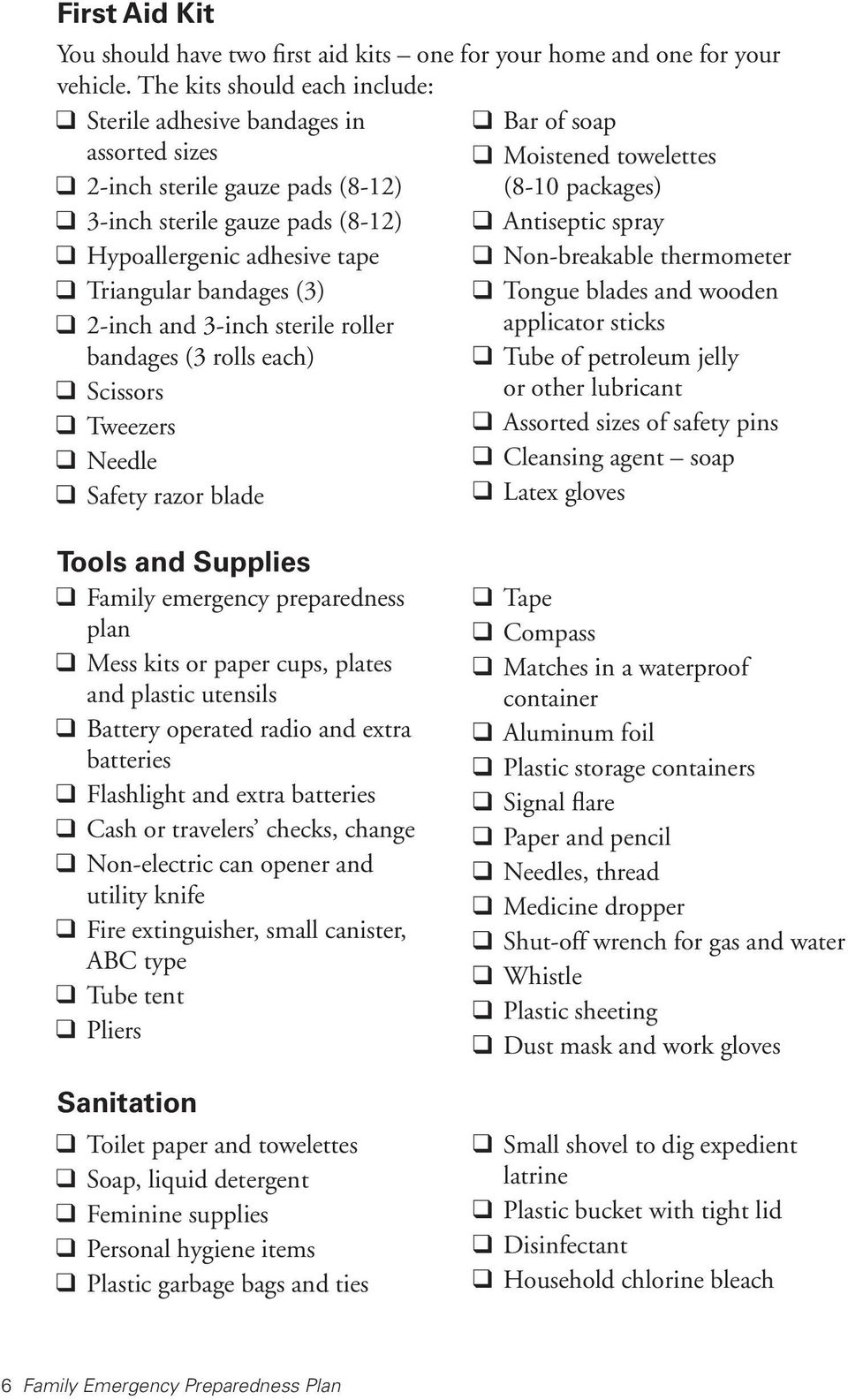
8 First Aid Kit You should have two first aid kits one for your home and one for your vehicle. The kits should each include: Sterile adhesive bandages in Bar of soap assorted sizes Moistened towelettes 2-inch sterile gauze pads (8-12) (8-10 packages) 3-inch sterile gauze pads (8-12) Antiseptic spray Hypoallergenic adhesive tape Non-breakable thermometer Triangular bandages (3) Tongue blades and wooden 2-inch and 3-inch sterile roller applicator sticks bandages (3 rolls each) Tube of petroleum jelly Scissors or other lubricant Tweezers Assorted sizes of safety pins Needle Cleansing agent soap Safety razor blade Latex gloves Tools and Supplies Family emergency preparedness plan Mess kits or paper cups, plates and plastic utensils Battery operated radio and extra batteries Flashlight and extra batteries Cash or travelers checks, change Non-electric can opener and utility knife Fire extinguisher, small canister, ABC type Tube tent Pliers Sanitation Toilet paper and towelettes Soap, liquid detergent Feminine supplies Personal hygiene items Plastic garbage bags and ties Tape Compass Matches in a waterproof container Aluminum foil Plastic storage containers Signal flare Paper and pencil Needles, thread Medicine dropper Shut-off wrench for gas and water Whistle Plastic sheeting Dust mask and work gloves Small shovel to dig expedient latrine Plastic bucket with tight lid Disinfectant Household chlorine bleach 6 Family Emergency Preparedness Plan
9 Clothing and Bedding Include at least one complete change of clothing and footwear per person. Sturdy shoes or work boots Hat and gloves Rain gear Thermal underwear Blankets or sleeping bags Sunglasses Special Items Remember family members with special needs such as infants, the elderly or disabled individuals. For Baby Formula Diapers Bottles Powdered milk Medications For Adults Heart and high blood pressure medications Insulin Prescription drugs Denture needs Contact lenses and supplies Extra eyeglasses Entertainment games for children and books for adults Important Family Documents Keep these records in a waterproof, portable container. Will, insurance policies, contracts, deeds, stocks and bonds Passports, social security cards, immunization records Bank account numbers Credit card account numbers and companies Inventory of valuable household goods Family records (birth, marriage and death certificates) Important telephone numbers Family Emergency Preparedness Plan 7

10 Pet Disaster Supplies Kit Know what to do as a disaster approaches. Warnings are often listed hours or even days in advance. Do not disregard warnings. Make sure you know where your pet disaster supplies are and be ready to grab them at a moment s notice. Bring all pets into the house so that you do not have to search for them. Make sure all pets are wearing identification. Some veterinarians microchip animals to keep track of them. If microchipping is not available to you, have a collar with all pertinent information for yor pet. If you are not home when the warning comes, see whether a neighbor or friend can take the animals and meet you at a prearranged location. Remember, animals react very differently under stress. Keep dogs on leashes and cats in carriers, and do not leave them unattended. Even the most trustworthy pet might panic, hide, bite or scratch. Birds also should be transported in carriers; wrap a blanket around the cage in cold weather. Snakes can be transported in pillowcases but must be transferred to a more secure site upon reaching your final destination. Hamsters and gerbils can be transported in carriers, but make sure to take bedding, food, etc. Have a safe place to take pets Contact hotels and check policies on having pets in your room. Ask friends and relatives if they can shelter your pets. Have a list of boarding facilities, including 24-hour telephone numbers, and find out from local shelters and sanctuaries if they provide emergency care. Assemble a portable pet disaster supplies kit Medical records Make a record of any medical problems and the name and phone number of the pet s veterinarian. Leashes and collars Current photos Food and water bowls Cat litter and cat litter pan Reprinted with permission of the Columbia Daily Tribune 8 Family Emergency Preparedness Plan

11 Hazard Hunt Conduct a hazard hunt to identify hazards in your home. Record the action required to correct each problem below. Check the box once the hazard has been corrected. Water heater Top-heavy, freestanding furniture Heavy or breakable objects Electronic equipment and appliances Hanging plants Mirrors and heavy pictures Unsecured cupboard doors Poisons, toxics and solvents House foundation Chimney and roof Utilities (flexible gas connections, electrical wiring, shut off valves and switches) Date completed: Date of next review: Family Emergency Preparedness Plan 9

12 Floor Plan Sketch the floor plan of your home and establish two exit routes. Floor One Floor Two 10 Family Emergency Preparedness Plan

13 Gas Utilities Locate your gas meter shut-off valve and learn how to turn the gas off. If you suspect the shut-off valve is corroded and not working properly, call your utility company for an operational check of the valve. Make sure a wrench is immediately available to turn the gas meter off in an emergency. If you smell natural gas, get everyone out and away from the home immediately. Do not use matches, lighter, open flame appliances or operate electrical switches. Sparks could ignite gas and cause an explosion. Shut off the gas ONLY if you smell gas and cannot locate the leak. Let the gas company turn the gas back on. Seek the assistance of a plumber to repair gas pipe damage. Sewer Your sewer system could be damaged in a disaster such as an earthquake, landslide or flood. Make sure the system is functioning as designed before using it to prevent contamination of your home and possibly the drinking water supply. Have a bucket or portable toilet available for disposal of human waste. Plastic bags placed in the toilet bowl will also work. Family Emergency Preparedness Plan 11

14 Electricity Locate your main electrical switch or fuse panel and learn how to turn the electrical power off. Remember, electrical sparks can cause a fire or explosion. If you are using a generator as a backup power supply, be sure to: Follow the generator manufacturer s instructions. Connect lights and appliances directly to the generator and not the electrical system. Generators connected to a utility company s electrical system must be inspected by the utility and the state electrical inspector. Failure to have the system inspected may result in death or injury to utility crews trying to restore service to the area. Water Label the water shut-off valve and learn to turn off the water supply to your home. Identify the valve with a large tag. Make sure the valve can be fully turned off. If the water valve requires the use of a certain tool, make sure the tool is readily available. Shut off the main valve to prevent contamination of the water supply in your water heater and plumbing. 12 Family Emergency Preparedness Plan

15 Fire Planning for Specific Disasters More than 24 million fires are reported annually, resulting in more than $11 billion in property damage. The United States has one of the highest fire death rates per capita in the world. At least 6,000 people die in fires each year, and an additional 100,000 are injured. Senior citizens and children under the age of five are at highest risk. Fire is fast, dark and deadly, emitting smoke and gases that can render a person unconscious within minutes. It is the most likely disaster that families will experience. Wildland fires in the Pacific Northwest burn thousands of acres in an average year. Most of these fires are caused by man. If you live in wildland areas where flammable vegetation is abundant, your house could be a target for wildland fire. Tornadoes The United States has the highest occurrence of tornadoes of any nation in the world. During the last ten years, an average of 1,200 tornadoes occurred across the continental United States. Nearly a third of these tornadoes occur in the states of Texas, Oklahoma, Kansas and Nebraska, an area known as Tornado Alley. Conditions often combine in this area during spring and early summer for the formation of supercell thunderstorms and tornadoes. More than 55 percent of a year s tornadoes occur between the months of April and June, when cool dry air from Canada clashes with warm moist air from the Gulf of Mexico. Floods Floods are the most common and widespread of all natural disasters and can occur nearly anywhere in the United States. Flooding has been responsible for the deaths of more than 10,000 people since Property damage attributable to flooding now totals more than $1 billion each year. The sheer force of just six inches of swiftly moving water can knock people off their feet. Cars are easily swept away in just two feet of water. Flash floods can occur with little or no warning and can reach full peak within minutes. Rapidly rising walls of water can reach heights of 30 feet or more and are often accompanied by a deadly cargo of debris. Family Emergency Preparedness Plan 13

16 Earthquakes Seventy million people in 39 states are at high risk to be affected by earthquakes. People in all states, however, are at some risk. Earthquakes can cause buildings to collapse, disrupt utilities and trigger landslides, avalanches, flash floods, fires, tsunamis and volcanoes. Winter Storms Heavy snowfall and extreme cold can immobilize an entire region. Even areas which normally experience mild winters can be hit with a major snowstorm or extreme cold. The results can range from isolation to the havoc of cars and trucks sliding on icy highways. Power Outage Everyone experiences power interruptions from time to time. Unfortunately, many of these outages come at times of weather extremes or accompany various disasters. When the power is out we lose our primary source of artificial light and may lose our source of heat and water as well. Safety becomes a major concern when there is a power outage. Hazardous Materials As many as 500,000 products pose physical or health hazards and can be defined as hazardous materials. Accidents involving toxic substances have occurred in communities across the country. For example, tankers containing toxic substances derailed and burned in Kentucky, forcing 7,500 area residents to evacuate. A train derailment near Marysville, Wash., resulted in a hazardous materials fire and the evacuation of more than 100 homes. Nuclear Power In the United States, nuclear power plants have been generating power for more than 35 years. Nuclear power plants operate in most states in the country and produce about 20 percent of the nation s power. Please note: The University of Missouri operates a nuclear reactor within the city limits of Columbia. In addition, the Callaway nuclear reactor is located approximately 40 miles east of Columbia. The following pages provide specific instructions on what to do in the case of fire, tornadoes, flood, earthquakes, winter storms, power outages, hazardous materials or nuclear power accidents. The preparedness steps in this section are in addition to those identified in the section Four Steps to Disaster Planning on page 3. You should first complete Four Steps to Disaster Planning. 14 Family Emergency Preparedness Plan

17 Getting Prepared Fire Install smoke detectors, according to the manufacturer s directions, on every level of your house: outside bedrooms on the ceiling or high on the wall, at the top of open stairways, or at the bottom of enclosed stairs and near (but not in) the kitchen. Clean smoke detectors once a month and change batteries at two specified times each year, when you set your clocks for Daylight Savings or Standard Time. Plan two escape routes out of each room. Contact your local fire authority for help in planning for the safe escape of people with disabilities. Make sure windows are not nailed or painted shut and security grating on windows have a fire safety opening feature. Teach everyone to stay low to the floor when escaping from a fire. Pick a meeting place outside your home for the family to meet after escaping from a fire. ONCE OUT, STAY OUT! Practice your escape plans at least twice a year. Clean out storage areas. Store flammable and combustible liquids in approved containers. Keep containers in the garage or an outside storage area. Inspect electrical appliances and extension cords for bare wires, worn plugs and loose connections each year. Clean and inspect primary and secondary heating equipment each year. Learn how to turn off the gas and electricity in an emergency. Working smoke detectors double your chance of surviving a fire. Install A-B-C type fire extinquishers. Teach family members how to use them. Inspect or service your fire extinguisher each year. In case of fire Do not attempt to extinguish a fire that is rapidly spreading. Use water or a fire extinguisher to put out small fires. Never use water on an electrical fire. Smother oil and grease fires in the kitchen with baking soda or salt, or put a lid over the flame if it is burning in a pan. If your clothes catch fire Stop-Drop-Roll until the fire is out. Sleep with your door closed. Not sure you can control the fire? Evacuate and then call the fire department from a neighbor s house. Family Emergency Preparedness Plan 15

18 If the smoke alarm sounds, crouch down low and feel the bottom of the door with the palm of your hand. If the door is hot, do not open it. Escape through the window. If the door is not hot and this route is your only means of escape, open the door and crawl below the level of the smoke. Use the first available exit door to escape. If you cannot escape, leave the door closed, stay where you are and hang a white or light-colored sheet outside the window. After a Fire Stay out of the burned structure. Notify your local disaster relief service if you need housing or food. Call your insurance agent. Ask the fire department for assistance in retrieving important documents. Keep records of all clean-up and repair costs. Secure personal belongings. If you are a tenant, notify the landlord. Getting Prepared Tornadoes Do not throw away damaged goods until an official inventory has been taken. Prepare a home tornado plan. Designate a place where family members can gather if a tornado is headed your way. A basement is ideal. If there is no basement, choose a center hallway, bathroom or closet on the lowest floor. Keep this place free of clutter. If you are in a high-rise building, you may not have enough time to go to the lowest floor. Designate a place in a hallway in the center of the building. Know the differences between a tornado watch and a tornado warning. In case of a tornado watch Tornado watches and warnings are issued by the county and/or the city. A watch means a tornado is possible in your area. When a watch is issued, listen to local radio and TV stations for updates. Be alert to changing weather conditions. Blowing debris or the sound of an approaching tornado may alert you. Many people say it sounds like a freight train. 16 Family Emergency Preparedness Plan

19 During a tornado A warning means a tornado has been sighted and may be headed for your area. Go to safety immediately. If you are inside when a warning is issued, go to a safe place to protect yourself from glass and other flying objects. The tornado may be approaching your area. If you are outside, hurry to the basement of a nearby sturdy building or lie flat in a ditch or low-lying area. If you are in a car or a mobile home, get out immediately and head for safety. Never try to out drive a tornado in a vehicle. Tornadoes can change direction quickly and can lift up a vehicle and toss it through the air. After a tornado Help injured or trapped persons. Give first aid when appropriate. Do not try to move the seriously injured unless they are in immediate danger of further injury. Call for help. Turn on a radio or television to get the latest emergency information. Stay out of damaged buildings. Return home only when authorities say it is safe. Use the telephone only for emergency calls. Clean up spilled medicines, bleaches, gasoline or other flammable liquids immediately. Leave the building if you smell gas or chemical fumes. Take pictures of the damage both to the house and its contents for insurance purposes. Remember to help your neighbors who may require special assistance, such as infants, the elderly and people with disabilities. Getting Prepared Floods Do not seek shelter in a mobile home or a vehicle. Evacuate immediately if you smell gas or chemical fumes. Learn what to do when you hear flood warning signals. Find out if you live in a flood-prone area and identify dams in your area. Ask your local emergency manager about official flood warning signals. Take steps to flood proof your home. Call your local building department or emergency management office for information. Keep all insurance policies and your household inventory in a safe place. Family Emergency Preparedness Plan 17

20 In Case of Heavy Rains Be aware of flash floods. Listen to radio or television stations for local information. Be aware of streams, drainage channels and areas known to flood suddenly. If local authorities issue a flood watch, prepare to evacuate. Secure your home. If time permits, secure items located outside the house. If instructed, turn off utilities at the main switches or valves. Fill your car with fuel. Sterilize the bathtub. Fill the bathtub with water in case water becomes contaminated or services are cut off. Stay away from flood waters. When deep flooding is likely, permit the flood waters to flow freely into your basement to avoid structural damage to the foundation and the house. After a Flood Stay away from flood waters. Stay away from moving water. Moving water six inches deep can sweep you off your feet. Be aware of areas where flood waters have receded and may have weakened road surfaces. Stay away from and report downed power lines. Stay away from disaster areas unless authorities ask for volunteers. Continue listening to the radio for information about where to get assistance. Consider health and safety needs. Wash your hands frequently with soap and clean water if you come in contact with flood waters. Throw away food that has come in contact with flood waters. Call your insurance agent. Keep records of all clean-up and repair costs. Take photos of or videotape your belongings and your home. Do not throw away damaged goods until an official inventory has been taken. Know the meaning of the terms flood watch, flash flood watch, flood warning, flash flood warning, and urban and small stream warning. Plan for evacuation 18 Family Emergency Preparedness Plan If there is any possibility of a flash flood, move immediately to higher ground. Flood waters may be contaminated by oil, gasoline or raw sewage. The water may also be electrically charged from underground or downed power lines.

21 Getting Prepared Earthquakes Securely fasten water heaters and gas appliances. Repair defective electrical wiring, leaky gas and inflexible utility connections. Place large or heavy objects on lower shelves. Fasten shelves to walls. Brace high and top-heavy objects. Store bottled foods, glass, china and other breakables on low shelves or in cabinets that can fasten shut. Anchor overhead lighting fixtures. Be sure house is firmly anchored to its foundation. Know where and how to shut off all utilities. Locate safe spots in each room. Identify danger zones in each room. Consider buying earthquake insurance. When the Ground Moves If indoors take cover under sturdy furniture or against an inside wall, and hold on. Drop-Cover-Hold. Stay away from the kitchen. If outdoors stay there. Move away from buildings, street lights and utility wires. If in a high-rise building take cover under sturdy furniture away from windows and outside walls. Stay in the building on the same floor. An evacuation may not be necessary. Wait for instructions from safety personnel. Do not use elevators. Look for items in your home that could become a hazard in an earthquake. Conduct earthquake drills with your family. Doorways are not always a safe place to be during an earthquake. If in a vehicle stop as quickly as safety permits, and stay in the vehicle. Avoid stopping near or under buildings, trees, overpasses or utility wires. When the Shaking Stops If the electricity is out use flashlights or battery powered lanterns. If you smell gas or hear a hissing or blowing sound open a window and leave the building. Shut off the main gas valve outside. Be prepared for aftershocks. Check yourself and those around you for injuries. If there is electrical damage switch off the power at the main control panel. If water pipes are damaged shut off the water supply at the main valve. Wear sturdy shoes in areas covered with fallen debris and broken glass. Family Emergency Preparedness Plan 19
22 Check your home for structural damage. Check chimneys for damage. Clean up spilled medicines, bleaches, gasoline and other flammable liquids. Visually inspect utility lines and appliances for damage. Do not flush toilets until you know that sewage lines are intact. Open cabinets cautiously. Beware of objects that can fall off shelves. Use the phone only to report a life threatening emergency. Listen to news reports for the latest emergency information. Stay off the streets. Stay away from damaged areas, unless your assistance has been specifically requested by proper authorities. Winter Storms and Extreme Cold Getting Prepared Do not use candles, matches or open flames indoors because of the possibility of gas leaks. Dress for the weather and keep a winter car kit in the trunk of your car. Know the terms used by weather forecasters. Consider purchasing a battery-powered National Oceanic and Atmospheric Administration (NOAA) weather radio and stock extra batteries. Keep rock salt to melt ice on walkways and sand to improve traction. Make sure you have sufficient heating fuel. Make sure you have an alternate heat source and a supply of fuel. Install storm windows or cover windows with plastic. Insulate walls and attics. Caulk and weather-strip doors and windows. Keep your car winterized with antifreeze. Use snow tires. During a Winter Storm Listen to the radio or television for weather reports and emergency information. Wear several layers of loose-fitting, lightweight, warm clothing rather than one layer of heavy clothing. Wear mittens instead of gloves. Wear a hat. Most body heat is lost through the top of the head. Avoid overexertion. Watch for signs of frostbite. If symptoms are detected, get medical help immediately. 20 Family Emergency Preparedness Plan
23 Watch for signs of hypothermia. If symptoms are detected, get medical help immediately. Conserve fuel if necessary by keeping your house cooler than normal. Refuel kerosene heaters outside and keep them at least three feet from flammable objects. Consider using public transportation if you must travel. Caught in Your Car During a Blizzard Pull off the highway and set your hazard lights to flash. Hang a distress flag from the radio antenna. Run the engine and heater about ten minutes each hour to keep warm. While the engine is running, slightly open a window and keep the exhaust pipe free of snow. Exercise lightly to maintain body heat. Huddle with passengers to stay warm. Take turns sleeping. Be careful not to run the car battery down. If stranded in a remote rural or wilderness area, spread a large cloth over the snow to attract attention of rescue personnel. Once the blizzard passes, you may need to leave the car and proceed on foot. Power Outages When using kerosene heaters, maintain ventilation to avoid a build-up of toxic fumes. Remain in your vehicle and wait to be found. Getting Prepared Register life-sustaining equipment with your utility. Consider purchasing a small generator or know where to rent one if you use life-sustaining equipment that requires electrical power. Post the telephone number of the New Construction, Repairs and Power Outage listing of your local utility. If you own an electric garage door opener, learn how to open the door without power. Prepare a power outage kit. Consider having on hand glow light sticks, flashlights, a battery powered radio, extra batteries and a wind-up clock for short duration outages. Make sure you have an alternate heat source and a supply of fuel. Have a corded telephone available. When installing generators, follow the manufacturer s instructions and have it inspected by the utility company and the state electrical inspector. Family Emergency Preparedness Plan 21
24 When the Lights Go Out If your house is the only one without power, check your fuse box or circuit breaker panel. Turn off large appliances before replacing fuses or resetting circuits. If power is out in the neighborhood, disconnect all electrical heaters and appliances to reduce the initial demand and protect the motors from possible low voltage damage. If you leave home, turn off or unplug heat producing appliances. Unplug computers and other voltage sensitive equipment to protect them against possible surges when power is restored. Conserve water, especially if your water source is a well. Keep doors, windows and draperies closed to retain heat in your home. Keep refrigerator and freezer doors closed. A fully loaded freezer can keep foods frozen for two days if the door remains closed. Be extremely careful of fire hazards caused by candles or other flammable light sources. When using kerosene heaters, gas lanterns or stoves inside the house, maintain ventilation to avoid a buildup of toxic fumes. Never use charcoal or gas barbeques inside; they produce carbon monoxide. Connect lights and appliances directly to a generator, not to an existing electrical system. NOTE: Leave one light switch in the on position to alert you when service is restored. Getting Prepared Hazardous Material Accidents Report power outages to the utility company. Evaluate the risks to your family. Ask your local fire department about emergency warning procedures. Find out precise information about where reportable quantities of extremely hazardous substances are stored and where they are used. Ask your Local Emergency Planning Committee (LEPC) about community plans for responding to hazardous material accidents. Determine how close you are to freeways, railroads or factories which may produce or transport toxic materials. Be prepared to evacuate. Have materials available to seal off your residence from airborne contamination. 22 Family Emergency Preparedness Plan
25 Responding to a Hazardous Material Incident If you are a witness call 911 or your local fire department. If you hear a warning signal listen to local radio or television stations for further information. Follow all instructions. Stay away from the incident site to minimize the risk of contamination. If caught outside stay upstream, uphill or upwind. Try to go one-half mile (10 city blocks) from the danger area. If you are in a car close windows and shut off ventilation. Evacuate if told to do so. If local officials say there is time, close all windows, shut vents, and turn off attic fans and other ventilation systems to minimize contamination. To reduce the possibility of toxic vapors entering your home, seal all entry routes as efficiently as possible. If an explosion is imminent close drapes, curtains and shades. If you suspect gas or vapor contamination take shallow breaths through a cloth or towel. Avoid contact with any spilled liquid materials, airborne mist or condensed solid chemical deposits. Do not eat or drink any food or water that may have been contaminated. After a Hazmat Incident Seek medical help for unusual symptoms. If medical help is not immediately available and you suspect contamination remove all clothing and shower thoroughly. Place exposed clothing and shoes in tightly sealed containers without allowing them to contact other materials. Get directions for proper disposal. Advise others of your possible contamination. Get direction from local authorities on how to clean up your land and property. Return home only when directed to do so. Ventilate the house upon returning home. Report lingering vapors or other hazards. Strictly follow all instructions given by emergency authorities. Follow decontamination instructions from local authorities. Family Emergency Preparedness Plan 23
26 Getting Prepared Nuclear Power Plants Know the terms that describe a nuclear emergency: Notification of Unusual Event Alert Site Area Emergency General Emergency Learn your community s warning system. Commercial nuclear power plants are required to install sirens and other warning systems within a 10-mile area. Get public emergency information materials from the company operating the plant. Learn the emergency plans for schools, day care centers, nursing homes and other places where members of your family might be. Be prepared to evacuate. Responding to a Power Plant Emergency Time, distance and shielding are the keys to minimizing radioactive exposure. Keep calm. Not all incidents result in the release of radiation. Stay tuned to your local radio or television stations for information. Evacuate if you are advised to do so. Close and lock home doors and widows. Keep car windows and vents closed; use recirculating air. Listen to the radio for evacuation routes and other information. If not ordered to evacuate stay indoors. Close doors and windows. Local instructions take precedence over advice in this handbook. Turn off air conditioner, ventilation fans, furnace and other air intakes. Go to a basement or other underground area if possible. Keep a battery-powered radio handy at all times. If you must go outdoors cover your nose and mouth with a handkerchief. If time permits, shelter livestock and give them stored feed. Do not use the telephone unless absolutely necessary. If you have just been outdoors shower and change clothes. Put clothing and shoes in a plastic bag; seal it up and store it out of the way. 24 Family Emergency Preparedness Plan
27 Three ways to purify water In addition to having a bad odor and taste, contaminated water can contain microorganisms that cause diseases such as dysentery, typhoid and hepatitis. You should purify all water of uncertain purity before using it for drinking, food preparation or hygiene. There are many ways to purify water. None is perfect. Often the best solution is a combination of methods. Two easy purification methods are outlined below. These measures will kill most microbes but will not remove other contaminants such as heavy metals, salts and most other chemicals. Before purifying, let any suspended particles settle to the bottom, or strain them through layers of paper towel or clean cloth. 1. Boiling is the safest method of purifying water. Bring water to a rolling boil for 3-5 minutes, keeping in mind that some water will evaporate. Let the water cool before drinking. Boiled water will taste better if you put oxygen back into it by pouring the water back and forth between two clean containers. This will also improve the taste of stored water. 2. Disinfection. You can use household liquid bleach to kill microorganisms. Use only regular household liquid bleach that contains 5.25 percent sodium hypochlorite. Do not use scented bleaches, colorsafe bleaches or bleaches with added cleaners. The only agent used to purify water should be household liquid bleach. Other chemicals, such as iodine or water treatment products sold in camping or surplus stores that do not contain 5.25 percent sodium hypochlorite as the only active ingredient, are not recommended and should not be used. Add 16 drops of bleach per gallon of water, stir and let stand for 30 minutes. If the water does not have a slight bleach odor, repeat the dosage and let stand another 15 minutes. NOTE: While the two methods described above will kill most microbes in water, distillation will remove microbes that resist these methods, and heavy metals, salts and most other chemicals. 3. Distillation involves boiling water and then collecting the vapor that condenses back to water.the condensed vapor will not include salt and other impurities. To distill, fill a pot halfway with water. Tie a cup to the handle on the pot s lid so that the cup will hang right-side-up when the lid is upside-down. Make sure the cup is not dangling into the water. Boil the water for 20 minutes. The water that drips from the lid into the cup is distilled. Family Emergency Preparedness Plan 25
28 Emergency Telephone Numbers Out-of-Area Contact The Out-Of-Area Contact is one of the most important concepts in your disaster plan. When disaster occurs, you will be concerned about the welfare of your loved ones. Name City Telephone (day) (Evening) Local Contact In a disaster, local telephone service may be disrupted. However, long distance lines, because they are routed many different ways out of your community, may be open. It is also important to remember that the telephone company s emergency telephone network is the pay telephone system. They will restore it before the rest of the system. So, if you have change to make a pay telephone call and an out-of-area contact, you may be able to communicate with loved ones in the disaster area indirectly through your out-of-area contact. Name City Telephone (day) (Evening) Nearest Relative Name Telephone (day) Family Work Numbers Father Other City (Evening) Mother Emergency Telephone Numbers In a life threatening emergency, dial 911 or the local emergency medical services system number. Police Department Fire Department Hospital 26 Family Emergency Preparedness Plan
29 Family Physicians Name Name Name Telephone Telephone Telephone Reunion Locations After a disaster it may be impossible for family members to return home for one reason or another. It is very important that you select a meeting point in the community where you can once again join the members of your household. 1. Right outside your home 2. Away from the neighborhood, in case you cannot return home Address Telephone Route to try first Working with neighbors can save lives and property. Meet with your neighbors to plan how the neighborhood could work together after a disaster until help arrives. Notes Family Emergency Preparedness Plan 27
30
SHELTER-IN-PLACE OR EVACUATE
 SHELTER-IN-PLACE OR EVACUATE WOULD YOU KNOW WHAT TO DO? A PREPAREDNESS GUIDE FOR THE HOME No matter where you live, your community may experience a natural or man-made disaster a tornado, floor, winter
EMERGENCY PREPAREDNESS
 EMERGENCY PREPAREDNESS REQUIREMENTS: Wind makes kites fly, fire can keep us warm, and rain helps the flowers and plants to grow. But sometimes the wind can blow too hard, fires can get too big or it can
FACT SHEET: HAZARDOUS MATERIALS ACCIDENTS
 FACT SHEET: HAZARDOUS MATERIALS ACCIDENTS A hazardous materials accident can occur anywhere. Communities located near chemical manufacturing plants are particularly at risk. However, hazardous materials
EMERGENCY RESPONSE PROCEDURES
 EMERGENCY RESPONSE PROCEDURES Emergency Telephone Numbers Life Threatening Emergency................................. 911 Local Police............................. Local Fire and Paramedics.................
Family Emergency Preparedness Plan
 Family plan should address the following: Evacuation routes Family communications Utility shut-off and safety Insurance and vital records Evacuation plan Caring for animals Evacuation routes Draw a floor
Factors to Consider When Developing an Evacuation Plan
 The following should be viewed only as suggestions: Factors to Consider When Developing an Evacuation Plan 1. You must identify your document with a specific title and explanation. Example: Evacuation
SELF-STUDY SERIES. UNDERSTANDING THE REGULATIONS: What Alaskan Foster Parents Need to Know. Updated January 2013. 1.0 Hour Training Credit
 SELF-STUDY SERIES UNDERSTANDING THE REGULATIONS: What Alaskan Foster Parents Need to Know UNIT #10: Fire Safety, First Aid and Emergency Preparedness in the Foster Home Updated January 2013 1.0 Hour Training
Hurricane Preparedness Checklist www.hcoem.org
 Hurricane Preparedness Checklist DISASTER. It strikes anytime, anywhere. It takes many forms -- a hurricane, an earthquake, a tornado, a flood, a fire or a hazardous spill, some are natural, some are man-made.
EMERGENCY PREPAREDNESS FOR SENIORS WHAT WE CAN DO TO SAVE OUR LIVES COUNTY OF SUSSEX DEPARTMENT OF HUMAN SERVICES DIVISION OF SENIOR SERVICES
 EMERGENCY PREPAREDNESS FOR SENIORS WHAT WE CAN DO TO SAVE OUR LIVES COUNTY OF SUSSEX DEPARTMENT OF HUMAN SERVICES DIVISION OF SENIOR SERVICES SUSSEX COUNTY DIVISION OF SENIOR SERVICES One Spring Street,
TOWN OF HARRISBURG FIRE DEPARTMENT 6450 Morehead Road, Harrisburg North Carolina 28075 Phone: 704 455 3574 Fax 704 455 6391 www.harrisburgfd.
 FLOOD FACTS AND SAFETY TIPS Floods are one of the most common hazards in the United States. Flood effects can be local, impacting a neighborhood or community, or very large, affecting entire river basins
Personal Preparedness Plan
 EEmmeerrggeennccyy MMaannaaggeemmeenntt Personal Preparedness Plan TEMPLATE Name Date Personal Preparedness Plan - TEMPLATE Page 1 of 16 Plan Maintenance Mark off task and enter date completed Activity
Emergency Planning Template. A Guide for Family and Large Family
 Emergency Planning Template A Guide for Family and Large Family Child Care Homes Emergency Planning Template: A Guide for Family and Large Family Child Care Homes June, 2009 The purpose of this template
BEFORE AN EARTHQUAKE OCCURS
 Did you know that your chances of being injured or killed are greater if you try to flee from a building while it is shaking? It's true. Thousands of earthquake victims have been hurt because they fell
Building a Disaster Supply Kit: A 20 Week Checklist
 Building a Disaster Supply Kit: A 20 Week Checklist Visit us at: www.redcrosscentralcoast.org Connect with us: www.youtube/redcrosscentralcoast http://facebook.com/redcrossventuracounty http://facebook.com/redcrosssantabarbaracounty
Pima County Office of Emergency Management and Homeland Security
 Pima County Office of Emergency Management and Homeland Security A Neighborhood Guide for Emergency Preparedness The events of September 11, 2001 and subsequent bioterrorism acts have reminded us of the
Household Preparedness Guide
 PreparedBC: Household Preparedness Guide A guide for protecting your family PreparedBC HOUSEHOLD PREPAREDNESS GUIDE Earthquakes, tsunamis, floods and wildfires are just some of the potential hazards in
When 911 is called, the person making the call will stay on the phone until the dispatcher hangs up and all questions have been answered.
 Emergency Preparedness Plan In all scenarios below, the situation, with specific details, will be documented in the client s file. The client s case management agency and client s family/representative
How to Prepare for and Survive a Disaster in Rancho Palos Verdes
 How to Prepare for and Survive a Disaster in Rancho Palos Verdes Is Your Home Ready? It s not the will to survive, but the will to prepare to survive that makes the difference. This brochure provides clear
Things to Think About
 Why Do People with Thalassemia Need an Emergency Preparedness Checklist? Emergencies and natural disasters are thankfully rare, but they do happen. It s important that all families develop a plan of action
There to help when you need us most.
 There to help when you need us most. Preparing your home and family for the unthinkable. Disaster can strike anywhere, anytime with little or no warning. Are you really prepared? Disaster can strike quickly
WINTER DRIVING. This information supplied by the Federal Emergency Management Agency and the NJ Office of Emergency Management.
 SAFE WINTER DRIVING This information supplied by the Federal Emergency Management Agency and the NJ Office of Emergency Management. DID YOU KNOW??? The leading cause of death during winter storms is transportation
City of Richmond Citizens Emergency Citizens Emergency Preparedness Preparedness Guide Guide
 City of Richmond Citizens Emergency Citizens Emergency Preparedness Preparedness Guide Guide Your Guide To Emergency Preparedness Letter from Mayor... 1 Are You Ready?... 3 Get a Kit... 5 Emergency Supply
Emergency procedures instructions to farm staff
 Emergency procedures instructions to farm staff The first priority in the event of an emergency is for the safety of all people present. Emergency phone numbers Dial 111 for Fire/Police/Ambulance 1. Tell
Patient Emergency Preparedness Plan
 Patient Emergency Preparedness Plan Section 1: General Plan For all Patients Make a List: Medications Medical Information Allergies and sensitivities Copies of health insurance cards Dialysis prescription
WHAT TO DO IF THE LIGHTS GO OUT. PUBLIC SERVICE COMPANY OF OKLAHOMA
 WHAT TO DO IF THE LIGHTS GO OUT. PUBLIC SERVICE COMPANY OF OKLAHOMA We all take reliable electric service for granted. Flip a switch, push a button, turn a knob; the lights come on; the home computer powers
Suggested Hurricane Supply List
 Suggested Hurricane Supply List To prepare for the unknown, each home should have a 72-hour Disaster Survival Kit. You will need to pack some essential items to help you and your family survive, whether
FLOOD DAMAGE PRECAUTIONS
 FLOOD DAMAGE PRECAUTIONS 1. Prepare for flood events: Know how to shut off the electricity and gas to your house in a flood event. Make a list of emergency numbers and identify a safe place to go make
U.S. Department of Housing and Urban Development Office of Public and Indian Housing. A Good Place to Live!
 U.S. Department of Housing and Urban Development Office of Public and Indian Housing A Good Place to Live! Introduction Having a good place to live is important. Through your Public Housing Agency (or
Evacuation Planning Form for Child Care Emergency/Disaster Preparedness
 (R.8/12) COMMONWEALTH OF KENTUCKY Cabinet for Health and Family Services Department for Community Based Services Division of Child Care N Evacuation Planning Form for Child Care Emergency/Disaster Preparedness
After a Fire or Flood
 After a Fire or Flood Some help and advice Advice after a Fire Your property is your responsibility when the firefighters leave. If you intend to leave your property unattended: Lock all windows and doors,
Community Emergency Response Teams (CERT) & Individual and Family Preparedness
 Community Emergency Response Teams (CERT) & Individual and Family Preparedness Good Morning Vicki Garfola Michael Loper Points of Discussion Community Emergency Response Teams (CERT) Family Preparedness/Creating
Preparing Your Business for a Flood
 This document was generated in part from the excellent work done by EPICC (Emergency Preparedness for Industry and Commerce Council). Please refer to EPICC s website http://www.epicc.org/ to learn more
How To Handle An Emergency At A Strata Corporation
 24 HOUR ANSWERING SERVICE The regular office hours at our firm are 9:00 am to 5:00 pm Monday to Friday. After these regular hours, the same telephone number is answered by a Telephone Answering Service,
Emergency Management is responsible for coordinating the City of Houston s preparation for and response to emergency situations.
 CITY OF HOUSTON Office of Emergency Management October 2004 Emergency Management is responsible for coordinating the City of Houston s preparation for and response to emergency situations. Houston is exposed
HURRICANE EVACUATION GUIDE
 booklet-final 6/30/00 9:41 AM Page 1 E M E R G E N C Y P R E P A R E D N E S S HURRICANE EVACUATION GUIDE Vital information you need to know in case of a hurricane evacuation. Information brought to you
GET READY IN 5 EASY STEPS HURRICANE SEASON
 HURRICANE SEASON GET READY IN 5 EASY STEPS It s true, major hurricanes don t hit the U.S. every year. But if you live on or near the coast, someday you may have to face a Category 3, or worse. Could be
Chippewa County Courthouse Security Emergency Procedures. Dial 9 9 1 1 FIRE POLICE AMBULANCE
 Chippewa County Courthouse Security Emergency Procedures Dial 9 9 1 1 FIRE POLICE AMBULANCE Table of Contents Introduction... 2 Explosion... 3 Civil Disorder/Threat to Personal Safety... 4 Chemical Spill...
National Flood Safety Awareness Week is March 16-20, 2015
 Armond Budish Cuyahoga County Executive FOR IMMEDIATE RELEASE Media Contacts: Christopher Harris: (216) 443 7157 or [email protected] Rich Luchette: (216) 698 5637, (216) 797 0931, or [email protected]
MY HOME IN A HOUSING BLOCK A GUIDE FOR RESIDENTS
 MY HOME IN A HOUSING BLOCK A GUIDE FOR RESIDENTS -KESKUSTA One half of Finns live in housing blocks, which is a safe and comfortable way to live. Welcome a board! Buildings and the Finnish climate There
Severe Weather Safety Resources to help weather the storm
 Severe Weather Safety Resources to help weather the storm Hurricanes: By the Basics What: A Hurricane is a severe weather system that brings high winds, torrential rain, storm surges, and flooding. Hurricanes
RETURNING HOME SAFELY AFTER FLOODING. Keep yourself safe and healthy, with these simple checklists.
 RETURNING HOME SAFELY AFTER FLOODING Keep yourself safe and healthy, with these simple checklists. BEFORE RETURNING HOME Do not return home until your local municipality and/or authorities announce you
City of Freeport, Illinois
 City of Freeport, Illinois GEORGE W. GAULRAPP 230 W. Stephenson Street MAYOR Freeport, Illinois 61032 Telephone (815) 235-8200 Facsimile (815) 232-7925 July 26, 2010 Dear Resident: Last week brought eleven
North Carolina State University Emergency Facilities Closure Checklist- Part I
 North Carolina State University Emergency Facilities Closure Checklist- Part I Unplanned or spontaneous events often disrupt daily operations on campus. In the event that an incident may interrupt your
Family Disaster Plan and Personal Survival Guide
 Family San Diego Disaster County Plan Office and Personal of Emergency Survival Services Guide Family Disaster Plan and Personal Survival Guide I. PREPARATION Family Disaster Plan and Personal Survival
Helping Children Cope with Disaster
 Helping Children Cope with Disaster This booklet offers parents, caregivers, and other adults suggestions on how to help children cope with the effects of disaster, as well as how to be prepared before
Pennsylvania Flood Safety Awareness Week March 6-10th, 2015
 Pennsylvania Flood Safety Awareness Week March 6-10th, 2015 David J. Nicosia Warning Coordination Meteorologist National Weather Service Binghamton, NY Flooding is a coast to coast threat to the United
READY? are you. Become a Ready Hero and learn how to plan for emergencies.
 are you READY? Become a Ready Hero and learn how to plan for emergencies. Once you have completed your readiness plan and built your emergency kit, have each family member sign the certificate (see inside
Taking Care of Your Children
 Taking Care of Your Children Planning on who will take care of your children is the most important thing you can do to prepare your family for a disaster situation. Talk with your family, friends and neighbors
West Chicago Public Library District EMERGENCIES AND EMERGENCY SITUATION PROCEDURES
 West Chicago Public Library District EMERGENCIES AND EMERGENCY SITUATION PROCEDURES Approved by Board of Library Trustees: October 24, 2005 Revision Approved by Board of Library Trustees: October 22, 2007
Fire Damage. To Help Prevent. a Guide
 a Guide To Help Prevent Fire Damage Fire damage in your home can be costly and emotionally devastating. The damage caused by the flames and smoke can destroy a lifetime of memories in a matter of minutes.
CITY OF HUMBLE OFFICE OF EMERGENCY MANAGEMENT. 110 W. Main St. Humble, Tx. 77338 ph. 281 446 4928 Email; [email protected]
 CITY OF HUMBLE OFFICE OF EMERGENCY MANAGEMENT 110 W. Main St. Humble, Tx. 77338 ph. 281 446 4928 Email; [email protected] Emergency Management Director: Mayor Donnie McMannes Emergency Management
Food and Water in an Emergency
 Food and Water in an Emergency If an earthquake, hurricane, winter storm, or other disaster strikes your community, you might not have access to food, water, and electricity for days or even weeks. By
Name Of Occupancy Date. Yes No Describe
 FIRE PREVENTION INSPECTION CHECKLIST For Class A Occupancy (For Assembly Buildings, Bars, Restaurants, Gyms, Churches, Arenas, Theatres or wherever people gather) Name Of Occupancy Date Physical Address
HAZARDS AND THREATS WILDFIRES HOMEOWNERS CHECKLIST INSIDE THE HOME
 HAZARDS AND THREATS WILDFIRES HOMEOWNERS CHECKLIST INSIDE THE HOME KITCHEN Keep a working extinguisher in the kitchen. Maintain electric and gas stoves in good operating condition. Keep baking soda on
How to Prepare Yourself For Emergencies
 Emergency Management at Yale Important Phone Numbers Yale Police 911 or 203-432-4400 Yale Security 203-785-5555 Facilities Operations Center 203-432-6888 Yale Health 203-432-0123 Blue phones 400+ around
A PUBLIC HEALTH GUIDE TO EMERGENCY PLANNING
 A PUBLIC HEALTH GUIDE TO EMERGENCY PLANNING A United Front New Jersey s Department of Health (DOH) has made it a priority to strengthen our state s health care infrastructure to prepare for any public
EARTHQUAKE PREPAREDNESS
 EARTHQUAKE PREPAREDNESS STEP 1. IDENTIFY POTENTIAL HAZARDS IN YOUR HOME AND BEGIN TO FIX THEM. Earthquake safety is more than minimizing damage to buildings. We must also secure the contents of our buildings
Preparing Your Business for a Flood
 CHECKLISTS Before a Flood Stay in touch with what s happening and listen for warnings and advisories through the media or through local community messaging. A flood watch means flooding is possible. A
Accident Prevention. and Crisis Management. Learning Objectives
 13 1 1 Accident Prevention 2 and Crisis Management Learning Objectives How can you prevent accidents? What should you do when a food recall or food crisis occurs? What should you do if the establishment
exit routes and fire protection
 exit routes and fire protection OSHA 11 Exit Routes and Fire Protection Osha 11 Exit Routes and Fire Protection Exit routes and fire protection Learning Objectives By the end of this lesson, students will
FIRE SAFETY FOR OFFICE WORKERS
 FIRE SAFETY FOR OFFICE WORKERS This easy-to-use Leader s Guide is provided to assist in conducting a successful presentation. Featured are: INTRODUCTION: A brief description of the program and the subject
How to Reduce Your Exposure to Chemicals at Home, Work, and Play
 How to Reduce Your Exposure to Chemicals at Home, Work, and Play You come into contact with chemicals every day. This is called chemical exposure. Although some chemical exposures are safe, others are
Preparing for Disaster
 Preparing for Disaster Where Will You or Your Family Be When a Disaster Strikes? You could be anywhere at work, at school or in the car. How will you find each other? Will you know if your children are
Upstate NY Recovery assistance information
 Upstate NY Recovery assistance information www.nationalgrid.com Emergency contact information National Grid Customer Service 1-800-642-4272 National Grid Gas Emergency: 1-800-892-2345 Federal Emergency
Stay safe this storm season
 Stay safe this storm season Be prepared Horizon Power is committed to providing the safest and most reliable power supply to customers and we work hard to safely and quickly restore power supplies when
Family Emergency Plan Template (For families with pets and/or livestock)
 Family Emergency Plan Template (For families with pets and/or livestock) Family Name: Family Phone Numbers: Friends and Neighbors: Local and out of the area contacts for our family: ο ο ο Other emergency
The effects of a pandemic can be lessened, however, if preparations are made ahead of time.
 PANDEMIC FLU FAMILY GUIDE TO PREPARATIONS A flu pandemic is a global outbreak of influenza that occurs when a new flu virus appears to which people have little or no immunity. Pandemic flu spreads easily
WINTERIZING YOUR HOME PLUMBING AT BLUE RIDGE SHORES
 WINTERIZING YOUR HOME PLUMBING AT BLUE RIDGE SHORES The following are suggestions to help you winterize your home plumbing. They are for homes where the heat is not left on during the winter months. There
Protection Against Hantavirus. How to safely clean-up rodent droppings, dead rodents, and nests
 Protection Against Hantavirus How to safely clean-up rodent droppings, dead rodents, and nests 1 Hantavirus Carriers Other culprits include: the white-footed mouse, the rice rat, and the cotton rat Deer
emergency action guide
 emergency action guide IN THE EVENT OF LIFE-THREATENING OR EXTREME EMERGENCY CALL 911 FIRST. Central Campus Public Safety Dial 6666 from campus phone or call 215.641.6666 West Campus Public Safety Dial
FIRE SAFETY IN THE HOME
 FIRE SAFETY IN THE HOME 2 Did you know? You re four times more likely to die in a fire if you don t have a smoke alarm that works. Around half of home fires are caused by cooking accidents. Two fires a
Cougar Home Safety Assessment 4.0 Initial Visit
 Cougar Home ty Assessment 4.0 Initial Visit Adapted with permission from: The ty for Older Consumers Home ty Checklist, by Consumer Product ty Commission. (N.D.) Retrieved on November 23, 2003 from http://www.cpsc.gov/cpscpub/pubs/701.html.
Power Problems? Let Us Know!
 Power Problems? Let Us Know! Power Problems? Contact Us! by phone: 1-800-75-CONED, 1-800-752-6633 through the Web: www.coned.com If you have power problems, please contact us right away Con Edison is committed
Preparation. Preparation. Step 2 Prepare an emergency kit. Step 1 Prepare your emergency plan. Step 4 Tune into warnings
 This emergency toolkit provides you with steps to take before and during emergencies to protect you and your property. The Victoria State Emergency Service (SES) is a volunteer organisation dedicated to
HISTOLOGY LABORATORY EMERGENCY PROCEDURES
 HISTOLOGY LABORATORY EMERGENCY PROCEDURES CONTENTS 1 Chain of command...3 2 Disaster plan...3 2.1 Announcement 2.2 Pathology departmental duties 2.3 Reference 3 Evacuation...4 3.1 Meeting place 3.2 Evacuation
Installation Instructions for Alarm Module Kit A043F059
 Instruction Sheet 07-2013 Installation Instructions for Alarm Module Kit A043F059 1 Introduction The information contained within is based on information available at the time of going to print. In line
St. John s University
 St. John s University Fire Safety Plan Founder s Village Townhouses Page 1 St. John s University Fire Safety Plan Part 1-Building Information Section Founder s Village Townhouses 8000 Utopia Parkway Jamaica
8 plumbing. plumbing. 2010 PulteGroup, Inc. All Rights Reserved.
 8 90 2010 PulteGroup, Inc. All Rights Reserved. drains All the water you use leaves the home through a drain. Maintaining drains prevents clogging, overflows, water damage, and other problems. care and
Housing Quality Standards Inspection Checklist
 Housing Quality Standards Inspection Checklist To prevent delays, the R.T.A. must be complete and upon submission the unit must be in move in condition or an inspection will not be conducted. A Fair Housing
Dennis Fire Department Fire Prevention Mark Dellner Fire Chief
 Dennis Fire Department Fire Prevention Mark Dellner Fire Chief FIRE SAFETY INSPECTION GUIDELINES FOR COMMERCIAL PROPERTIES (MA Fire Prevention Regulations 527 CMR, MGL Chapter 148) FIRE PREVENTION CHECKLIST-
EMERGENCY ACTION PLAN. for
 EMERGENCY ACTION PLAN for Facility Name: Facility Address: DATE PREPARED: / / EMERGENCY PERSONNEL NAMES AND PHONE NUMBERS EMERGENCY COORDINATOR: Name: Phone: ( ) AREA MONITORS (If applicable): Area: Name:
IN CASE OF EMERGENCY. Emergency Telephone Number 112
 IN CASE OF EMERGENCY Emergency Telephone Number 112 Police, Fire, Ambulance Dial 112 in case of fire, medical emergency, serious or life threatening traffic or other accident. Tell the operator: What has
EARTHQUAKES AND PREVENTIVE MEASURES
 EARTHQUAKES AND PREVENTIVE MEASURES by K. C. Makropoulos Human rights in Disasters: Search and Rescue Operations in disasters especially for vulnerable people Hotel Electra, 5-6 November 2009 INSTRUMENTS
Flood Protection Tips
 Flood Protection Tips Information About Floodplains and Flood Prevention What is a floodplain? Floodplains serve many useful purposes, and those that are preserved in their natural or nearly natural state