
Robert D. Ingram 43rd State Bar President
|
|
|
- Anis Pauline Small
- 10 years ago
- Views:
Transcription
1 Aug gust mber 1 Robert D. Ingram 43rd State Bar President

2 Do you know what it feels like to shake your insurance agent s hand? Oh my, don t tell me you ve never actually shaken his hand. Or looked him in the eye. Why, don t you think it s important to know the people who may one day come to your defense in the case of a malpractice claim? Aubrey Smith, president of Georgia Lawyers Insurance Company, thinks so. He believes that you can t build trust through s and voice mails. He believes that a handshake and a human connection are the only real signs that someone understands your needs and is willing to stand behind you all the way. He believes that if you ever have a problem, question or concern, you should have not just a phone number, but a person to call. Because he believes that if you ever did face a malpractice claim, you ought to know the people who hold your career in his hands. If you re ready for a different kind of insurance experience and a free policy review, or a Quick Quote, call Aubrey Smith or any member of the Georgia Lawyers team at: or toll-free, Visit us online at:

3

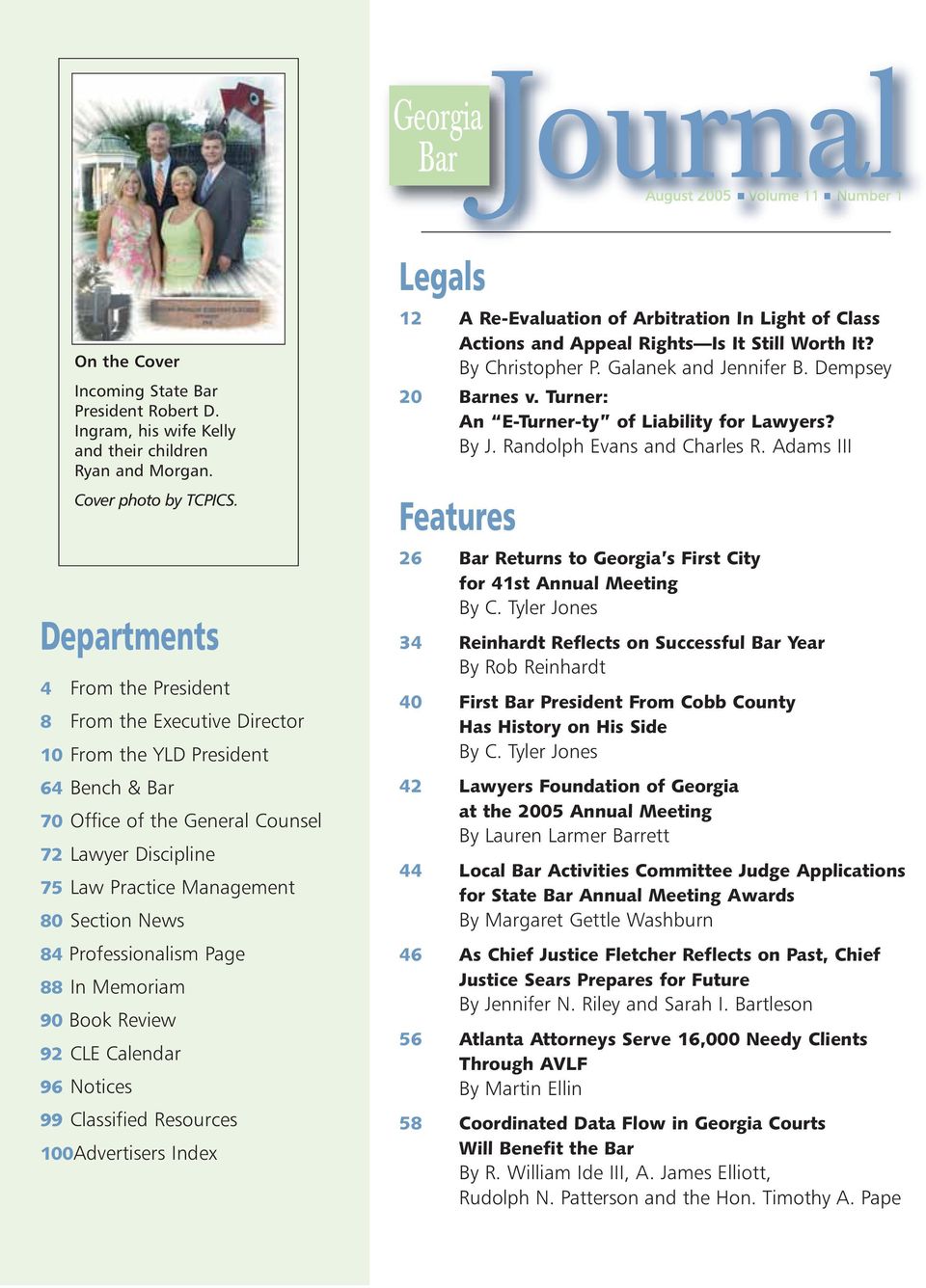
4 Aug gust mber 1 On the Cover Incoming State Bar President Robert D. Ingram, his wife Kelly and their children Ryan and Morgan. Cover photo by TCPICS. Departments 4 From the President 8 From the Executive Director 10 From the YLD President 64 Bench & Bar 70 Office of the General Counsel 72 Lawyer Discipline 75 Law Practice Management 80 Section News 84 Professionalism Page 88 In Memoriam 90 Book Review 92 CLE Calendar 96 Notices 99 Classified Resources 100Advertisers Index Legals 12 A Re-Evaluation of Arbitration In Light of Class Actions and Appeal Rights Is It Still Worth It? By Christopher P. Galanek and Jennifer B. Dempsey 20 Barnes v. Turner: An E-Turner-ty of Liability for Lawyers? By J. Randolph Evans and Charles R. Adams III Features 26 Bar Returns to Georgia s First City for 41st Annual Meeting By C. Tyler Jones 34 Reinhardt Reflects on Successful Bar Year By Rob Reinhardt 40 First Bar President From Cobb County Has History on His Side By C. Tyler Jones 42 Lawyers Foundation of Georgia at the 2005 Annual Meeting By Lauren Larmer Barrett 44 Local Bar Activities Committee Judge Applications for State Bar Annual Meeting Awards By Margaret Gettle Washburn 46 As Chief Justice Fletcher Reflects on Past, Chief Justice Sears Prepares for Future By Jennifer N. Riley and Sarah I. Bartleson 56 Atlanta Attorneys Serve 16,000 Needy Clients Through AVLF By Martin Ellin 58 Coordinated Data Flow in Georgia Courts Will Benefit the Bar By R. William Ide III, A. James Elliott, Rudolph N. Patterson and the Hon. Timothy A. Pape
5 Editorial Board Marcus D. Liner Editor-in-Chief Robert Henry Beer Ronald Arthur Lowry Donald P. Boyle Jr. J. Kevin Moore Clayton Owen Carmack E. Peyton Nunez Erin Reynolds Chance Stephanie Ann Paulk Charles Madden Cork III Cynthia B. Smith Lynda Carney Crum Mary E. Staley Diane Lea DeShazo Robert R. Stubbs David A. Dodd Thomas W. Thrash Jr. Bridgette Elizabeth Eckerson Martin Enrique Valbuena John Michael Gross Kristin H. West Jennifer Carpenter Kane Pamela Y. White-Colbert Robert Richard Long IV W. Scott Wright Executive Committee Liaison Laurel Payne Landon Advisor Rebecca Ann Hoelting Editors Emeritus Rebecca Ann Hoelting, Charles R. Adams III, Marisa Anne Pagnattaro, L. Dale Owens, D. Scott Murray, Donna G. Barwick, William Wall Sapp, James C. Gaulden Jr., Theodore H. Davis Jr., Jerry B. Blackstock, L. Brett Lockwood, Steven M. Collins, Stephanie B. Manis, Walter M. Grant, William L. Bost Jr., Stephen E. Raville, Officers of the State Bar of Georgia Robert D. Ingram President J. Vincent Cook President-elect Gerald M. Edenfield Secretary Bryan M. Caven Treasurer Rob Reinhardt Immediate Past President Damon E. Elmore YLD President Jonathan A. Pope YLD President-elect Laurel Payne Landon YLD Past President Communications Committee S. Lester Tate III Chairperson S. Kendall Butterworth Co-Vice Chairperson Nancy Jean Whaley Co-Vice Chairperson Communications Staff C. Tyler Jones Director Sarah I. Bartleson Assistant Director Johanna B. Merrill Section Liaison Jennifer N. Riley Administrative Assistant Quick Dial Attorney Discipline (800) ext. 720 (404) Consumer Assistance Program (404) Conference Room Reservations (404) Fee Arbitration (404) CLE Transcripts (404) Diversity Program (404) ETHICS Hotline (800) (404) Georgia Bar Foundation/IOLTA (404) Georgia Bar Journal (404) Lawyer Assistance Program (800) Lawyers Foundation of Georgia (404) Law Practice Management (404) Membership Records (404) Meetings Information (404) Pro Bono Project (404) Professionalism (404) Sections (404) Unauthorized Practice of Law (404) Young Lawyers Division (404) Manuscript Submissions The Georgia Bar Journal welcomes the submission of unsolicited legal manuscripts on topics of interest to the State Bar of Georgia or written by members of the State Bar of Georgia. Submissions should be 10 to 12 pages, double-spaced (including endnotes) and on letter-size paper. Citations should conform to A UNIFORM SYSTEM OF CITATION (17th ed. 2000). Please address unsolicited articles to: Marcus David Liner, State Bar of Georgia, Communications Department, 104 Marietta St. NW, Suite 100, Atlanta, GA Authors will be notified of the Editorial Board s decision regarding publication. The Georgia Bar Journal welcomes the submission of news about local and circuit bar association happenings, Bar members, law firms and topics of interest to attorneys in Georgia. Please send news releases and other information to: C. Tyler Jones, Director of Communications, 104 Marietta St. NW, Suite 100, Atlanta, GA 30303; phone: (404) ; [email protected]. Disabilities If you have a disability which requires printed materials in alternate formats, please contact the ADA coordinator at (404) or (800) Headquarters 104 Marietta St. NW, Suite 100, Atlanta, GA (800) , (404) , FAX (404) Visit us on the Internet at South Georgia Office 244 E. Second St. (31794) P.O. Box 1390 Tifton, GA (800) , (229) , FAX (229) Publisher s Statement The Georgia Bar Journal (ISSN ) is published six times per year (February, April, June, August, October, December) with a special issue in November by the State Bar of Georgia, 104 Marietta St. NW, Suite 100, Atlanta, Georgia State Bar of Georgia One copy of each issue is furnished to members as part of their State Bar dues. Subscriptions: $36 to non-members. Single copies: $6. Periodicals postage paid in Atlanta, Georgia and additional mailing offices. Opinions and conclusions expressed in articles herein are those of the authors and not necessarily those of the Editorial Board, Communications Committee, Officers or Board of Governors of the State Bar of Georgia. Advertising rate card will be furnished upon request. Publishing of an advertisement does not imply endorsement of any product or service offered. POSTMAS- TER: Send address changes to same address.
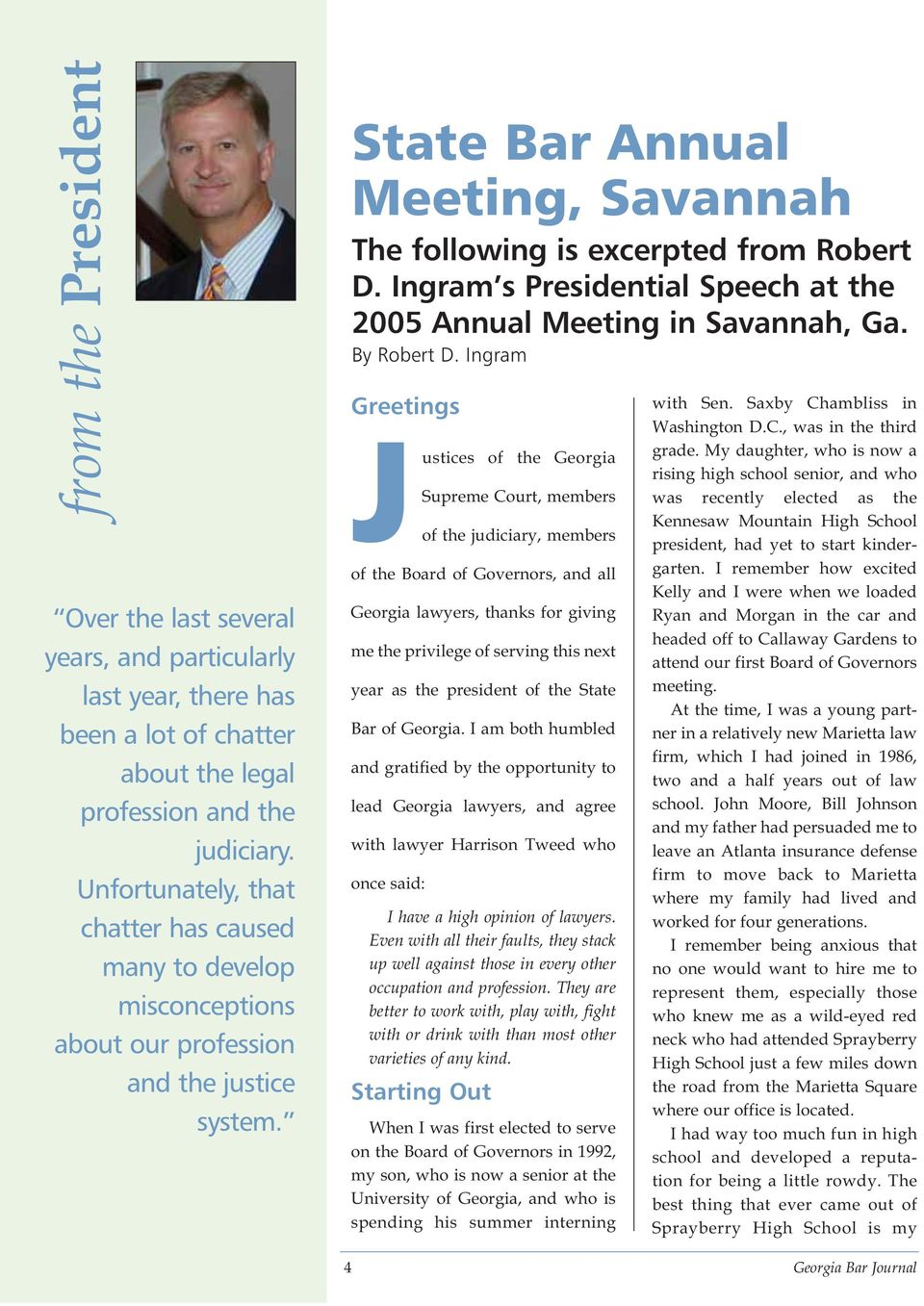
6 from the President Over the last several years, and particularly last year, there has been a lot of chatter about the legal profession and the judiciary. Unfortunately, that chatter has caused many to develop misconceptions about our profession and the justice system. State Bar Annual Meeting, Savannah The following is excerpted from Robert D. Ingram s Presidential Speech at the 2005 Annual Meeting in Savannah, Ga. By Robert D. Ingram Greetings Justices of the Georgia Supreme Court, members of the judiciary, members of the Board of Governors, and all Georgia lawyers, thanks for giving me the privilege of serving this next year as the president of the State Bar of Georgia. I am both humbled and gratified by the opportunity to lead Georgia lawyers, and agree with lawyer Harrison Tweed who once said: I have a high opinion of lawyers. Even with all their faults, they stack up well against those in every other occupation and profession. They are better to work with, play with, fight with or drink with than most other varieties of any kind. Starting Out When I was first elected to serve on the Board of Governors in 1992, my son, who is now a senior at the University of Georgia, and who is spending his summer interning with Sen. Saxby Chambliss in Washington D.C., was in the third grade. My daughter, who is now a rising high school senior, and who was recently elected as the Kennesaw Mountain High School president, had yet to start kindergarten. I remember how excited Kelly and I were when we loaded Ryan and Morgan in the car and headed off to Callaway Gardens to attend our first Board of Governors meeting. At the time, I was a young partner in a relatively new Marietta law firm, which I had joined in 1986, two and a half years out of law school. John Moore, Bill Johnson and my father had persuaded me to leave an Atlanta insurance defense firm to move back to Marietta where my family had lived and worked for four generations. I remember being anxious that no one would want to hire me to represent them, especially those who knew me as a wild-eyed red neck who had attended Sprayberry High School just a few miles down the road from the Marietta Square where our office is located. I had way too much fun in high school and developed a reputation for being a little rowdy. The best thing that ever came out of Sprayberry High School is my 4 Georgia Bar Journal
7 lovely wife Kelly. Fortunately her parents had the foresight not to allow her to date me in high school because of my rowdy reputation. My junior year, while I was serving as class president, I was suspended three times for fighting, streaking and drinking. Kelly, on the other hand, was a well-behaved young lady who was a class beauty on the homecoming court and the high school cheerleading squad. The low expectations Kelly s parents had for me were appropriately shared by many others, although after high school I tried hard to clean up my act and eventually persuaded Kelly to marry me. You re a Lawyer? Yeah, and I m a Brain Surgeon Student loans and Kelly s job as a dental assistant put me through law school, and I will never forget attending my 10-year high school reunion and seeing the shock on everyone s face when they learned that I was a lawyer. In fact, at the reunion, our organizers posted a chart showing what everyone was doing for a living. I remember one of my high school buddies who I had not seen since graduation approached me and said, Ingram, that s great that you re a lawyer yeah, and I m a brain surgeon. What are you really doing? The only way anyone would believe I was really a lawyer was for Kelly to confirm it. I am telling you this to simply say, I can t believe you re letting me do this. Unlike Rob Reinhardt and Bill Barwick, who have distinguished pedigrees and come from families with a long heritage in the legal profession and on the bench, I was the first in my family to graduate from college. I also tell you this to prepare you for a steep learning curve. State Bar Agenda: Harnessing Horsepower of Georgia s Lawyers and Judges In the 21 years I have been practicing law, there has never been more opportunity for the State Bar to make a positive impact for our profession and for the justice system than right now. This is true because although our profession and the judiciary have been under unprecedented attack over the last year, lawyers and judges have never been more energized and willing to get involved. Lawyers, like most Americans, have a tendency to be complacent and apathetic. But after taking a few shots to the head with a ball bat last year, I sense that lawyers and judges are more enthusiastic and willing to get involved than ever before. Winston Churchill once said, When the eagles are silent the parrots begin to jabber. Over the last several years, and particularly last year, there has been a lot of chatter about the legal profession and the judiciary. Unfortunately, that chatter has caused many to develop misconceptions about our profession and the justice system. From my vantage point, it s time for the State Bar to harness the tremendous horsepower of Georgia s 37,000 lawyers and 1,500 judges by plugging them in to an ongoing effort at public legal education. We also need to be working hard to build relationships with those running the legislative and executive branches of our govern- SOUTH GEORGIA ADR SERVICE, LLC MEDIATION and ARBITRATION of personal injury, wrongful death, commercial, real estate and other complex litigation cases. Visit our Web site ( for fee schedules and biographies of our panel, comprised of experienced Middle and South Georgia trial lawyers. ROBERT R. GUNN, II, MANAGING PARTNER Rachel D. McDaniel, Scheduling Coordinator 240 THIRD STREET, MACON, GEORGIA (800) or (478) FAX (478) JERRY A. BUCHANAN Columbus JOHN A. DRAUGHON Macon JAMES L. ELLIOTT Valdosta BENJAMIN M. GARLAND Macon ROBERT R. GUNN, II Macon JANE M. JORDAN Macon JEROME L. KAPLAN Macon STANLEY KARSMAN Savannah BERT KING Gray MICHAEL S. MEYER VON BREMEN Albany S. E. (TREY) MOODY, III Perry PHILIP R. TAYLOR St. Simons Island F. BRADFORD WILSON, JR. Macon August
8 ment so that we can have a voice at the table. Continuity of Leadership The limitations on what a State Bar president can accomplish in one year were summed up by our General Counsel Bill Smith, who I once heard refer to a State Bar president by stating: I can endure anything for one year. Although I m sure Bill has that same thought as I begin my year as president, his comment underscores the importance of continuity of leadership on any program the State Bar undertakes if we want to have a long-term, meaningful impact. Long-Term Strategy Needed The State Bar needs to develop a long-term strategy in which future bar leaders have ownership. For that reason, I have been working with Rob Reinhardt, Jay Cook, Gerald Edenfield, Bryan Cavan, and your entire Executive Committee in an effort to develop a long-term strategy to address the attacks which have become common place against our profession and the justice system. I think we all agree that going forward, one of the perpetual missions of the State Bar will be to identify and create ongoing opportunities for lawyers and judges to help spread the truth about the importance of the rule of law and an independent judiciary in America s constitutional democracy. Laws without an independent judiciary free from political influence and partisanship are meaningless. As Georgia lawyer and former President Woodrow Wilson once said,...the struggle for constitutional government is a struggle for good laws, indeed, but also for intelligent independent and impartial courts. America s Justice System The Envy of the World As participants in America s justice system, no one is better positioned than us to respond to the attacks on the judiciary. We must inform the public that a strong and independent judiciary is the foundation for the freedoms and liberties which make America s constitutional democracy the envy of the world. Helping to educate the public about the role of lawyers and judges in preserving our constitutional democracy, and the American way of life through the utilization of an independent judiciary is a task which should be shared by all within our profession. Together lawyers and judges will be a powerful voice in helping to spread the truth. State Bar Agenda Now, let s talk about how we can utilize the resources of the State Bar to begin changing the public s perception about the justice system and the legal profession, and hopefully in the process silence a few parrots. I. FOUNDATION OF FREEDOM COMMISSION Chair: Rob Reinhardt Vice-Chair: Jay Cook Commission of respected judges, lawyers, educators, legislators and business leaders created for the purpose of developing a long-term plan to utilize the resources of the State Bar for public legal education. The plan should seek to mobilize Bar committees, Bar sections, and Bar staff in: Educating public about the importance of independent judiciary and the rule of law; Educating public about the critical role of lawyers in America s constitutional democracy; and Equipping lawyers and judges to participate in public legal education. Goal of the Foundations of Freedom Commission will not be to improve the image of lawyers, but instead to spread the truth about how the justice system operates and the important role of lawyers in making America s constitutional democracy work. The commission will utilize the services of communication experts to help determine the message and how to effectively convey it. II. LAWYER ADVERTISING TASK FORCE Chair: Mike Bagley Vice-Chair: George Fryhofer Task force created to study lawyer advertising and to advise the State Bar on ways to encourage professionalism in lawyer advertising and discourage misleading lawyer advertising without running afoul of the First Amendment. A 2002 ABA Survey demonstrates that the public views lawyer advertising as over-promising, overly dramatic and targeted toward vulnerable people. No wonder public perception of the legal profession is dropping when consumers are bombarded daily with unprofessional and misleading advertisements. The Lawyer Advertising Task Force will confer with Florida bar 6 Georgia Bar Journal
9 leaders regarding the regulations it has been utilizing to regulate lawyer advertisements. The Task Force is seeking input from the Chamber of Commerce and the Georgia Self Insurers Association in developing this proposal. Business leaders need to understand that most lawyers would like to encourage professional lawyer advertising and prevent misleading ads as much as they do and that lawyers are running businesses just like they are. III. EVALUATION OF STATE BAR PROGRAMS Chair: Chris Phelps Vice-Chair: David Darden The State Bar of Georgia has some excellent programs which benefit lawyers and the public. However, like any organization, programs can lose focus, become stale, or become inefficient over time. Over the course of the next year, the Programs Committee has been charged with taking a fresh look at all State Bar programs to determine the following with regard to each program: Annual amount of bar dues paid by each lawyer to support the program Cost benefit analysis of the program Number of lawyers or members of the public benefiting from the program on an annual basis The findings will be reported to the Board of Governors with a recommendation as to whether the program should continue in its current form, be modified or ended. Benefits of taking a fresh look at Bar Programs include: Ensuring lawyers are getting adequate bang for their buck. Heightening lawyers awareness and utilization of worthwhile programs. IV. PROMOTE PROFES- SIONALISM AND CIVIL- ITY THROUGH THE USE OF THE JUDICIAL DIS- TRICT PROFESSIONAL- ISM PROGRAM Prior to the creation of the JDPP, lawyers and judges had few options when encountering unprofessional or uncivil conduct. Either file a Bar complaint or a Judicial Qualifications Commission complaint. Rude or unprofessional conduct rarely violated rules even if a complaint was filed. Accordingly, lawyers and judges would often do nothing when encountering unprofessional and uncivil conduct. The JDPP uses Board of Governors members in each of the 10 Judicial Districts as local committee members charged with the task of investigating and acting upon complaints of unprofessional and uncivil conduct when a pattern exists. The intake arm of the program is the State Bar s Consumer Assistance Program ( ). Complaints can be made anonymously and will be kept confidential if requested. The Judicial District Professionalism Committee determines whether conduct warrants intervention and, if so, develops a plan to meet with the offending lawyer or judge in an effort to persuade them to alter their conduct. V. MENTORING / TRANSI- TION INTO PRACTICE OF LAW PROGRAM Director: Douglas Ashworth Committee Chair: John Marshall Work with the committee on the Standards of the Profession in helping to recruit qualified mentors in order to begin the mandatory Transition into Law Practice Program, commonly known as the Mentoring Program. The program seeks to match every beginning lawyer with a mentor for the first year after admission to the bar beginning in January VI. EXPERT ADVICE FOR LAWMAKERS (Legislative Research Committee) Chair: Ben Easterlin Vice-Chair: William Jenkins The State Bar will work with executive and legislative branches of the government to provide free legal expertise and advice to lawmakers. The newly formed Legal Research Committee will assist lawmakers by utilizing lawyers with expertise in the area of inquiry to research topics to help ensure lawmakers are better informed when considering legislation. VII. COMMITTEE ON THE JUDICIARY Co-Chair: Judge Bonnie Oliver Co-Chair: Terry Sullivan Committee on the Judiciary (formerly Court Futures Committee) has been asked to study judicial compensation and to prepare a report on judicial compensation which includes: Analysis of judicial compensation comparing compensation of other states and comparing judges to compensation for lawyers in private practice; History of judicial pay increases; and Recommendations for procedure in handling judicial compensation and judicial pay increases. August
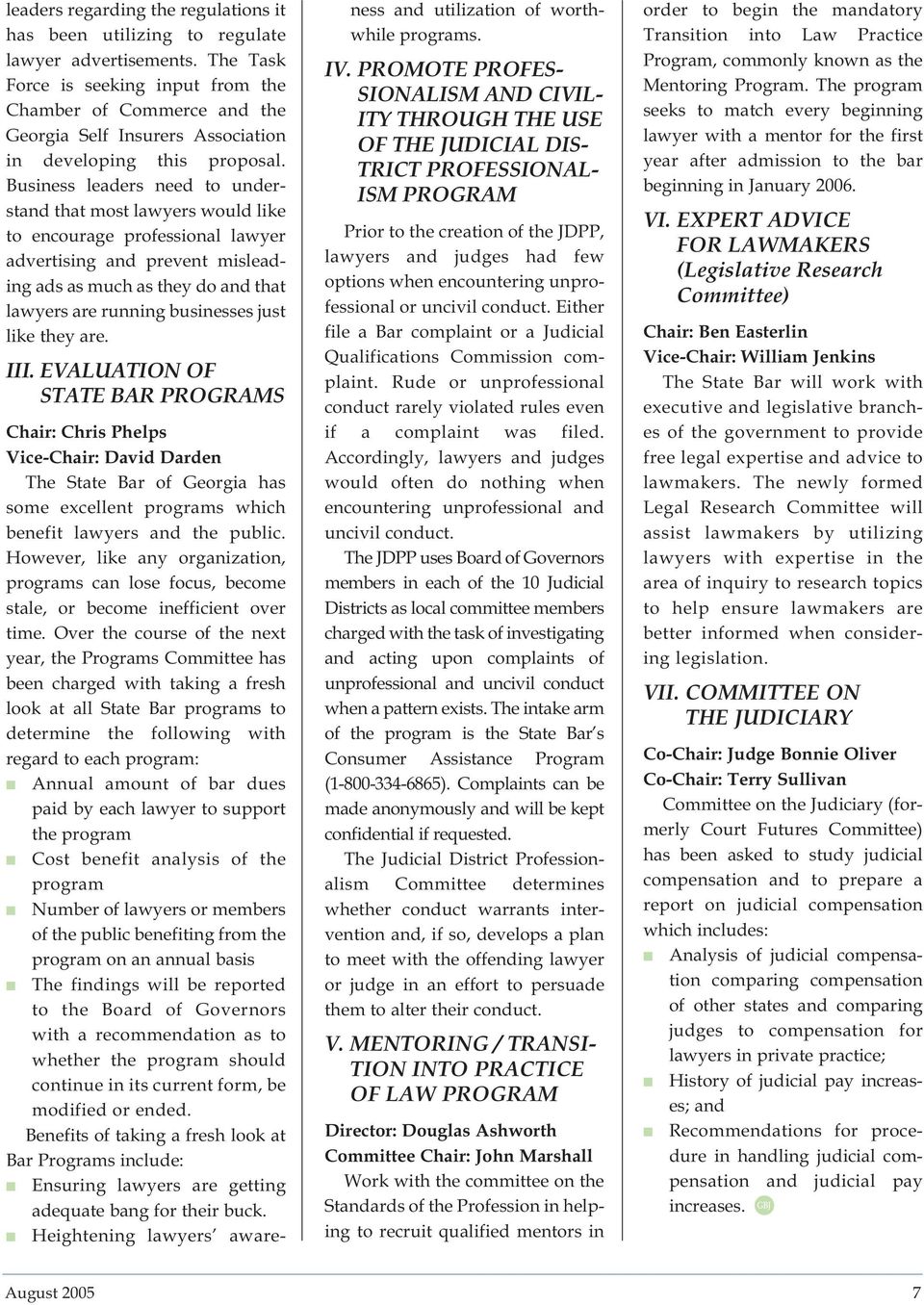
10 from the Executive Director Although the rule of law has close ties to democracy and capitalism, it still stands apart as a non-ideological solution. Spreading the Rule of Law Throughout the World By Cliff Brashier Ambassador James B. Cunningham, United States deputy permanent representative to the United Nations, commenting on Justice and the Rule of Law in International Affairs to the United Nations Security Council on Sept. 24, 2003, said, The rule of law is indispensable to justice, freedom, and economic development. Moreover, the rule of law is indispensable to international peace and security abroad. As a nation founded by law, the United States is the unflagging champion of the rule of law. By working together in support of the rule of law, we believe the international community can strengthen the peace and help conflict-ridden societies build a better future. For two hundred years, this has been our firm conviction and practice, and it will remain our first article of faith. The legacy of the U.S. Constitution, the world s first written constitution, which helped distinguish America from other countries, continues to be a model for drafters of the very newest constitutions to follow. Today, of the 192 independent nations of the world, all but a very few have such a constitution or are committed to having one. However, even the best constitution is not worth much if it is not put into practice, and if an independent judiciary is not permitted to interpret and enforce it. For our purposes, the rule of law can be defined as a system in which the laws are public knowledge, are clear in meaning, and apply equally to everyone. Without the rule of law, political and civil liberties are sacrificed, and major economic institutions such as corporations, banks and governments are not likely to function. Although the process has been slow, the concept of the rule of law has been spreading throughout the world. Probably the most active region for rule-of-law reform has been Eastern Europe. Since 1989, most Eastern European societies have taken significant steps to reform their legal systems. They have rewritten constitutions and laws and initiated key changes in their legal institutions. The Czech Republic, for example, has made major progress on judicial independence, and Hungary has recently launched a comprehensive judicial reform package. 8 Georgia Bar Journal
11 Since the early 1980s constitutionally based, elected governments have been established almost everywhere throughout Latin America. The region s governments have acknowledged the need for rule-oflaw reform and are taking steps toward it. Chile and Costa Rica have each made significant progress in reforming their judicial systems. Most governments attempting rule-of-law reform are not doing so on their own, the United States and other Western countries have offered their assistance and expertise. Although the rule of law has close ties to democracy and capitalism, it still stands apart as a nonideological solution. In many countries, people may argue over the appropriateness of various models of democracy or capitalism, but hardly anyone will admit to being against the idea of law. You may be asking yourself how this applies to the State Bar of Georgia. With the rule of law and the independence of the judiciary more frequently coming under attack, I thought it would be a good reminder to point out how the American judicial system is still the best in the world and continues to be used as a model for other countries to follow. Public education about our system of justice is an important part of the mission of the Bar Center with school students visiting during field trips. In an effort to make their experience as informative and memorable as possible, we will use role playing, scripted mock trials and interactive discussions to show them the important role of law in their lives. The script is designed to lead into a discussion of the rule of law. An example scenario follows: It s a beautiful April afternoon. You ve just arrived home from school. Even before you get through the front door, your mother meets you with an armload of books. Take these back to the library, would you please? We ve got to get them back today, or they ll be overdue. She then adds the magic words; You may take the car if you wish. Hey that s all right. You just got your driver s license. Off you go. When you return to your car after dropping off the books, a police officer is standing by your car. Good grief, what could be wrong, you wonder? He hands you a ticket. (With your new driver s license, you had been really careful. Before parking you had checked carefully for No Parking signs.) You ask, What did I do wrong, officer? The officer says, You can t park here. You point out that there isn t a no parking sign anywhere around. The officer replies that he just made it a no parking area. You contend that he cannot do that. He responds that he can and that you are Consumer Pamphlet Series The State Bar of Georgia s Consumer Pamphlet Series is available at cost to Bar members, non- Bar members and organizations. Pamphlets are individually priced at 25 and 75 cents each plus shipping. Questions? Call (404) The following pamphlets are available: Auto Accidents Bankruptcy Buying a Home Divorce How to Be a Good Witness How to Choose a Lawyer Juror's Manual Lawyers and Legal Fees Legal Careers Legal Rights of Nursing Home Residents Patents, Trademarks and Copyrights Selecting a Nursing Home Selecting a Personal Care Home Wills now under arrest. Arrest, how can I be arrested when I didn t break the law? you ask. The officer responds, You did break the law my law. You are under arrest. Alarmed, you ask, what happens now? The officer says, I try you. Try me! You are not a judge! The officer says, I am now. You re guilty. I fine you $25 and costs. You ask, How much are the costs? He responds, Another $25. But I am not guilty you reply. The officer says, Pay me. I encourage you to use this or your own experience to teach future generations about the rule of law. I believe it is the foundation of freedom that protects American s life, liberty, property, security and opportunity. Your thoughts and suggestions are always welcome. My telephone numbers are (800) (toll free), (404) (direct dial), (404) (fax) and (770) (home). Visit for an order form and more information or [email protected]. August

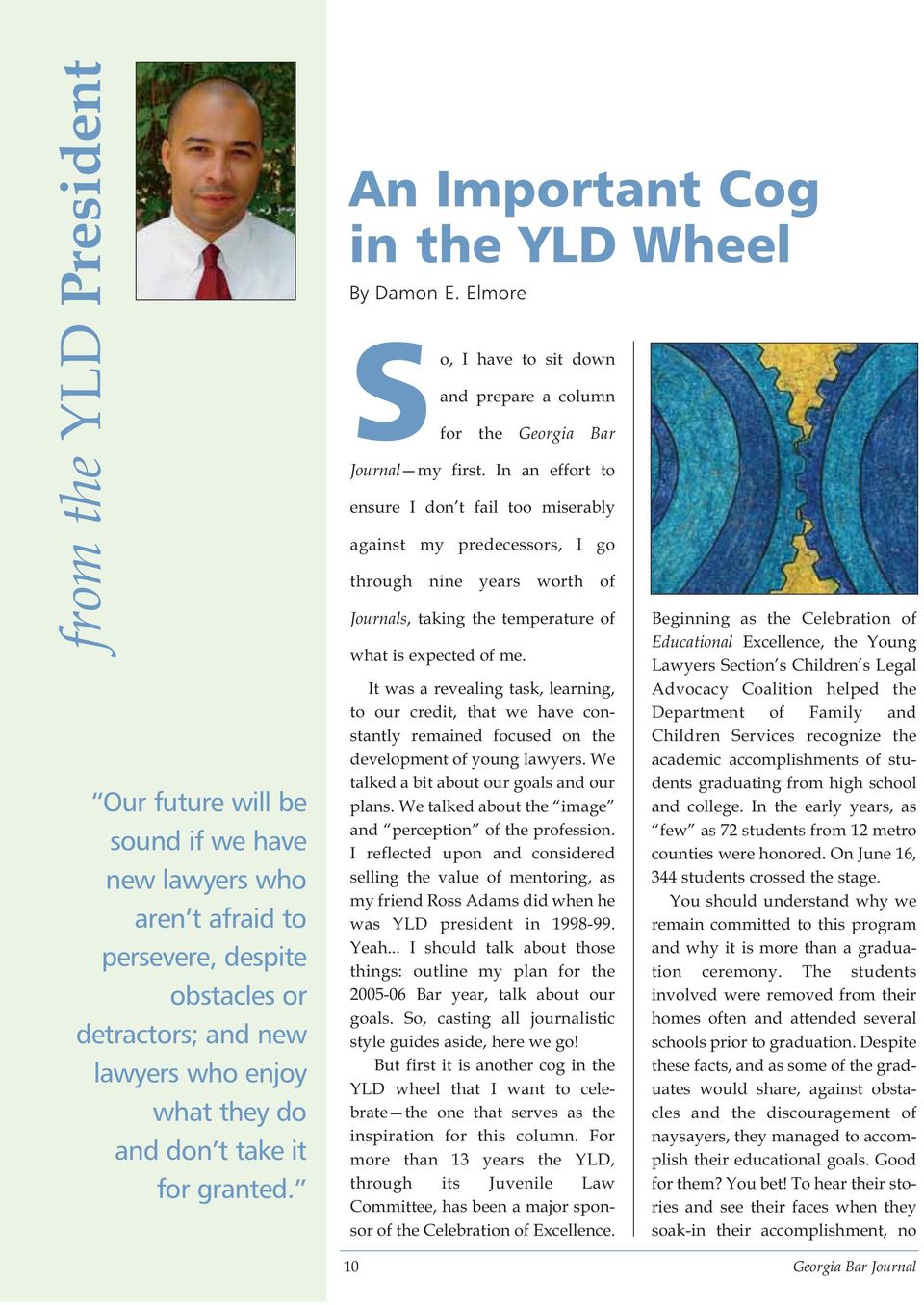
12 from the YLD President Our future will be sound if we have new lawyers who aren t afraid to persevere, despite obstacles or detractors; and new lawyers who enjoy what they do and don t take it for granted. An Important Cog in the YLD Wheel By Damon E. Elmore So, I have to sit down and prepare a column for the Georgia Bar Journal my first. In an effort to ensure I don t fail too miserably against my predecessors, I go through nine years worth of Journals, taking the temperature of what is expected of me. It was a revealing task, learning, to our credit, that we have constantly remained focused on the development of young lawyers. We talked a bit about our goals and our plans. We talked about the image and perception of the profession. I reflected upon and considered selling the value of mentoring, as my friend Ross Adams did when he was YLD president in Yeah... I should talk about those things: outline my plan for the Bar year, talk about our goals. So, casting all journalistic style guides aside, here we go! But first it is another cog in the YLD wheel that I want to celebrate the one that serves as the inspiration for this column. For more than 13 years the YLD, through its Juvenile Law Committee, has been a major sponsor of the Celebration of Excellence. Beginning as the Celebration of Educational Excellence, the Young Lawyers Section s Children s Legal Advocacy Coalition helped the Department of Family and Children Services recognize the academic accomplishments of students graduating from high school and college. In the early years, as few as 72 students from 12 metro counties were honored. On June 16, 344 students crossed the stage. You should understand why we remain committed to this program and why it is more than a graduation ceremony. The students involved were removed from their homes often and attended several schools prior to graduation. Despite these facts, and as some of the graduates would share, against obstacles and the discouragement of naysayers, they managed to accomplish their educational goals. Good for them? You bet! To hear their stories and see their faces when they soak-in their accomplishment, no 10 Georgia Bar Journal
13 doubt. Good for us? Absolutely! But not in the pat ourselves on the back sort of way. Our participation with the COE, as well as with all of the other YLD committees and events, should be viewed as the image and perception of the profession. There it is. See, we don t do it for the newspaper articles so much. The YLD COE trailblazers, the current committee chairs, Melissa Dorris, Amy Howell and Brooke Silverthorn, and countless volunteer committee members, didn t do it for the money. They did it, we do it, because my colleagues in this Bar live as an example. Our roles as counselors, advocates and leaders do not survive on a retainer or cease at 6 p.m., (or whenever your day wraps up). This is not often sensationalized and others don t get that. But it won t alter our path we advocate for good. Here s another reason why we benefit from events like this. I would be honored and truly hope that any of these students some day join us as members of this Bar. In fact, many said they want to be lawyers. Our future will be sound if we have new lawyers who aren t afraid to persevere, despite obstacles or detractors; new lawyers who enjoy what they do and don t take it for granted; new lawyers who understand a bit of adversity and can sympathize with a client s concerns; and new lawyers who are proud of it all. We will. We do. Now, those goals. By the time this hits your desk, our officers and directors will have met. We look forward to this year. Our YLD meetings, the opportunity to conduct the division s business, are listed with this article. Each is in an attractive location for that mini-vacation you and your family may need. More importantly, with a CLE component at each and an opportunity to network, these meetings can be invaluable to your professional development. We encourage your attendance YLD member or not. We look forward to doing our good work. I am confident our committees will do that. We have good plans for our Leadership Academy, headedup by our Immediate Past President Laurel Payne Landon. So, look for our newsletter and other communications. Watch for us having as much fun as humanly possible, as Henry Walker set out to do in Notice how we maintain the positive image of this profession Meeting Schedule Summer Meeting Aug , 2005 Charleston Place Hotel Charleston, S.C. Fall Meeting Oct , 2005 Foundry Park Inn & Spa Athens, Ga. Midyear Meeting Jan. 6-8, 2006 Renaissance Waverly Hotel Spring Meeting April 20-23, 2006 MGM Grand Hotel and Casino Las Vegas, Nev. Annual Meeting June 1-4, 2006 The Westin Resort Hilton Head, S.C. A-A-A ATTORNEY REFERRAL SERVICE Is your phone ringing like it used to? Last month we referred over 17,000 callers to our attorneys. Are you ready to start getting referrals? Call us today! (800) hour paging: (888) NEW HOME CONSTRUCTION COMPLAINTS Residential Construction & Development Expert Code & Inspection Compliance Cost/Quality Analysis Materials & Labor Evaluation SENTENCING CONSULT@TION WHEN IT S TIME FOR A CHANGE Georgia and All Federal Circuits FEDERAL CRIMINAL LAW CENTER Voice: Fax: [email protected] August

14 By Christopher P. Galanek and Jennifer B. Dempsey A Re-Evaluation of Arbitration In Light of Class Actions and Appeal Rights Is It Still Worth It? Over the last 20 years, the use of arbitration has increasingly gained in popularity as a means to resolve disputes among parties to commercial transactions. Proponents urge that the advantages of arbitration over traditional litigation in a court are many. The advantages they tout include that arbitrators have more particularized experience to address the parties needs in a complex dispute than a judge, that the arbitration forum is private and confidential, that the risk of home-cooking is reduced, and that the parties have more control over possible remedies than if a judge or jury is making the remedy 12 Georgia Bar Journal

15 determination. Most importantly, proponents of arbitration have insisted that arbitration costs less than going to court and leads to a quicker resolution of disputes. Of course, as arbitration has evolved, and as attorneys increasingly use arbitration as a method to resolve disputes, disadvantages have arisen that undermine the conclusion that arbitration costs less and takes less time. Attorneys comfortable with solving disputes in the courtroom often find it difficult to modify their approach to dispute resolution to take full advantage of the cost and time-saving potential of the arbitration forum. Attorneys often find it difficult to restrict the scope of the traditional discovery process, or to forego the discovery process altogether, to minimize time and expense. The natural inclination of many attorneys is to utilize traditional discovery methods to learn whatever they can about their opponent s case before the ultimate adjudication of the matter. Other disadvantages, separate and apart from how attorneys use the arbitration process, have also come to light. Disappointment in the perceived tendency that arbitrators too often split the baby when deciding a dispute has led to an increasing dissatisfaction with arbitration by some members of the bar. Other perceived disadvantages include the fact that summary judgment is often not allowed and the limited right of appeal of an arbitrator s award. As attorneys increasingly approach arbitration as merely another forum in which to conduct full-blown litigation, the question of whether arbitration is really less costly and takes less time needs to be evaluated. Increasingly, attorneys are advising their clients simply to avoid using arbitration clauses in contracts because the advantages of arbitration are simply not being realized. In the past few years, several developments have occurred that again call into question the utilization of arbitration as a means of dispute resolution. One development that will make businesses less likely to subject themselves to the uncertainties of arbitration is the recent rise of class-action arbitrations. This development could significantly impact the manner in which Georgia attorneys have approached class actions since the General Assembly first passed the class action statute in A second development the Georgia General Assembly s amendment to Georgia s statute regarding appealing an arbitrator s award may, however, actually make critics of the process more comfortable with arbitration in Georgia. These two developments are discussed further below. Recent Development The Threat and Uncertainty of Class- Wide Arbitration For years, the possibility that a party would be required to defend a class action in an arbitration forum was not a real threat to businesses that used arbitration clauses in their contracts. That has now changed. With a 2003 decision by the United States Supreme Court and the adoption of the American Arbitration Association s (AAA) Supplementary Rules for Class Arbitration, as well as the policies on class action arbitration issued by commercial arbitration companies like JAMS, the possibility of a class action arbitration is real and palpable. Now businesses are faced with arbitrating class-wide disputes that they never contemplated would be addressed in arbitration, by arbitrators wholly unfamiliar with the procedure for adjudicating issues related to class actions. The United States Supreme Court changed the landscape of class-wide arbitration with its decision in Green Tree Financial Corp. v. Bazzle. 1 Before the decision in Bazzle, whether a class-wide arbitration could proceed pursuant to an arbitration agreement was a decision for the court. The vast majority of federal courts had determined that where an arbitration agreement did not specifically provide for class-wide arbitration, the parties must not have intended class-wide arbitration to occur, and thus, a class-wide arbitration could not occur. In August
16 Bazzle, however, the Supreme Court sharply changed directions and held that where an arbitration agreement is silent on the issue of class-wide arbitration, the question of whether a class arbitration can proceed pursuant to an arbitration agreement is a decision for an arbitrator rather than a court. 2 The Bazzle decision summarized the types of decisions in which courts have assumed in the past that parties to an arbitration agreement intended the courts rather than an arbitrator to decide. Those types of decisions include matters such as whether the parties have a valid arbitration agreement at all or whether a concededly binding arbitration clause applies to a certain type of controversy. 3 The court concluded that the question of whether class-wide arbitration was allowed was not a question that fell within one of those narrow categories. The relevant question, the court concluded, is what kind of arbitration proceeding the parties agreed to, which does not concern state or judicial procedures, but rather contract interpretation and arbitration procedures. Arbitrators are well situated to answer that question. 4 The practical effect of the Bazzle decision is that, where previously class arbitration was only allowed if parties expressly consented to such a procedure in their contracts, now, class-wide arbitration can proceed even in the absence of such express consent. To date, according to the AAA s public docket published on its Web site, the overwhelming majority of AAA arbitrators addressing this issue have decided that if the contract does not expressly provide for or prohibit class arbitration, or in other words is silent on the issue of class-wide arbitration, then the class-wide arbitration process can proceed. Several of these arbitrators noted that, based on decisions from a minority of states (three in total), even if an arbitration clause expressly excluded class-wide arbitration, the arbitration clause might well be unconscionable. 5 Pitfalls in the AAA s Procedure for Conducting Class-Wide Arbitrations Shortly after the Supreme Court s decision in Bazzle, the AAA wrote and adopted its Supplementary Rules for Class Arbitration (the Supplementary Rules). The AAA s stated policy is as follows: The American Arbitration Association will administer demands for class arbitration pursuant to its Supplementary Rules for Class Arbitrations if (1) the underlying agreement specifies that disputes arising out of the parties agreement shall be resolved by arbitration in accordance with any of the Association s rules, and (2) the agreement is silent with respect to class claims, consolidation or joinder of claims. The Association is not currently accepting for administration demands for class arbitration where the underlying agreement prohibits class claims, consolidation or joinder, unless an order of a court directs the parties to the underlying dispute to submit their dispute to an arbitrator or to the Association. The arbitrability of class arbitrations where the parties agreement precludes such relief is a developing area of the law, and the Association awaits further guidance from the courts on this issue. As of the date of this publication, and since the AAA promulgated its Supplementary Rules on Oct. 8, 2003, 68 class action arbitration demands have been filed before the AAA. The AAA s Supplementary Rules provide for a three-tiered procedure in determining class-wide arbitrations. In the first phase the clause construction phase the arbitrator must determine the threshold matter of whether an arbitration clause permits an arbitration to proceed on behalf of or against a class. If the arbitrator determines that the arbitration can proceed as a class action, then the arbitrator must determine in the second phase whether to certify a class. After each of these first two steps in the class arbitration procedure, the arbitrator stays the proceedings for 30 days to allow either party to seek redress in the court for the arbitrator s decision. It is in the arbitrator s discretion whether to stay the arbitration proceedings until a court has an opportunity to evaluate and rule whether the arbitrator s award should be vacated. Finally, in the third phase of the class-wide arbitration, the arbitrator addresses and determines the merits of the case. The Supplementary Rules also provide that [t]he presumption of privacy and confidentiality in arbitration proceedings shall not apply in class arbitrations. 6 Despite whether the arbitration clause in a contract provides that all arbitration proceedings shall be kept confidential, information regarding the dispute including a copy of the demand filed and any awards issued by the arbitrator are provided on the AAA s Web site for all to see. 14 Georgia Bar Journal
17 Because the AAA has been administering class arbitrations pursuant to its Supplementary Rules only since late 2003, the AAA and its arbitrators do not yet have a baseline of knowledge or opinions upon which to rely when rendering decisions related to class arbitrations. In the majority of arbitration clauses construed by AAA arbitrators in the class arbitration context thus far, the arbitrators have concluded that the arbitration clauses at issue did not preclude a classwide arbitration from proceeding. In the one arbitration where the AAA arbitrators determined that the arbitration clauses at issue did preclude a class-wide arbitration, the arbitrator determined that although the clause showed no intention of precluding class arbitration, the clause did provide for a $100,000 ceiling on arbitration jurisdiction. Because the demand was for greater than $100,000, the arbitrator determined the class claims could not be arbitrated in that case. Only one AAA arbitrator has, in a dissent, acknowledged that there were provisions in the parties contract which showed that the parties intended that their disputes be resolved by arbitration between them separately and individually, and not by class arbitration, and thus, class arbitration was not appropriate under the parties contract. The majority of the AAA awards rendered thus far, and indeed the Supplementary Rules themselves, lead to the conclusion that the parties intent at the time they entered into the contracts at issue is not necessarily a relevant consideration. For example, an argument can be made that the AAA s Supplementary Rules specifically require arbitrators to disregard the parties intent regarding class arbitration when rendering decisions. Rule 3 of the Supplementary Rules provides: In construing the applicable arbitration clause, the arbitrator shall not consider the existence of these Supplementary Rules, or any other AAA rules, to be a factor either in favor of or against permitting the arbitration to proceed on a class basis. 7 The Supplementary Rules specifically direct the arbitrator to disregard whether the parties contemplated the availability of class action arbitrations when deciding whether the parties intended to allow a class action arbitration to proceed. Even where it is clear that nothing within the rules of the AAA indicated that class treatment was appropriate or allowed by the AAA at the time the parties to a contract agreed to be bound by a particular arbitration clause, the AAA expressly forbids its arbitrators to consider this information. Notwithstanding the AAA Supplemental Rules, an argument can certainly be made that parties who agreed to be bound by an arbitration clause could not have intended to participate in a class arbitration when the AAA s rules did not provide for such a thing at the time they entered into the contract. The winning edge for Georgia attorneys since 1969 Perhaps the most striking pitfall of the AAA s class action procedures is that in several of the 68 class action demands that have been filed since the Supplementary Rules have been in place, the AAA has taken the position that a separate class action arbitration demand may be filed on behalf of each and every potential named claimant or class member. In light of this position, a separate arbitrator must hear each separate class action demand filed, in a separate proceeding, unless the claimants consent to consolidation into one class action proceeding. The filing of separate class action arbitration demands, each setting forth the exact same allegations, each seeking to certify the same class, and each being decided by a separate arbitrator, can impose significant hardships on potential class defendants and destroy the efficiency of the arbitration process altogether. In addition to having to pay for attorneys to assert the exact same arguments, prepare similar briefs, and attend similar hearings for multiple cases, defendants are also required to pay fees to multiple arbitrators. Essentially, the AAA s current interpretation of its Supplementary Rules gives claimants counsel multiple bites at the same apple multiple opportu- NLRG National Legal Research Group CHARLOTTESVILLE, VIRGINIA Put us to work helping you win today or [email protected] Fast, Affordable, Specialized Research, Writing and Analysis For more information, and to see what your peers are saying about us: August

18 nities to have the same, identical issue decided hoping that in at least one of several proceedings an arbitrator can be convinced to certify a class. The AAA has refused to require that separate, yet identical, class action demands be consolidated and heard by one arbitrator in one proceeding. A number of different, inconsistent results are therefore possible under the Supplementary Rules. For example, arbitrators in the first three of four identical actions filed could determine that the arbitration clause to which the parties agreed does not permit a class action arbitration, while the arbitrator in the fourth action could then determine that the same arbitration clause to which the parties agreed does permit a class action arbitration. It is also possible that the arbitrators in the first three actions could refuse to certify a class, while the arbitrator in the fourth filed action could grant class certification. Given the AAA s interpretation of its Supplementary Rules and potential claimants likely refusal to consent to consolidation, counsel for claimants could potentially file an identical class action demand on behalf of each and every purported class member until finding an arbitrator willing to certify a class. The AAA has refused to recognize that its application of the Supplementary Rules flies in the face of the very purpose for class actions: to litigate claims economically based on the same transaction and occurrence at one time. One potential avenue to consider when a client is faced with such a situation is to appeal to the sensibilities of a judge more familiar than the AAA s administrative team with the purpose and procedure of Georgia s class action statute. In Executech Systems Inc., et al. v. U.S. Bancorp, 8 the State Court of Fulton County recognized the absurdity and wastefulness of having to defend five identical class demands before the AAA at the same time and agreed to stay all but one of the class-wide arbitrations. Other than allowing parties to seek redress in the courts to remedy the problems with the AAA s Supplementary Rules, the AAA has been unwilling to address the problems with the Supplementary Rules as they currently stand. JAMS The Resolution Expert s Approach to Class Action Arbitrations Shortly after the Bazzle decision, JAMS announced that even if an arbitration clause expressly prohibited class action arbitrations, JAMS would still permit class action arbitrations to go forward. This decision met with immediate criticism from the corporate clients that utilized JAMS s arbitration services. In March, JAMS withdrew that policy and instead announced that [r]ecent court decisions on the validity of class action preclusion clauses have varied by jurisdiction. In this legal environment, our attempt, as a national ADR provider, to bring uniformity to the administration of class wide arbitrations stemming from these clauses has created concern and confusion about how the policy would be applied. Accordingly, we are retracting the previously announced policy and reaffirm that JAMS and its arbitrators will always apply the law on a case by case basis in each jurisdiction. 9 JAMS noted in its press release on the issue that its previous policy suggested to some that JAMS had deviated from its core value of neutrality. We want to reaffirm to all of our constituencies that we have a fundamental responsibility and commitment to absolute neutrality and the highest ethical and professional standards. 10 The AAA also issued a commentary to its Supplementary Rules on February 18, noting, in part, that the enforceability of class action waivers in arbitration clauses was an unsettled issue in the courts. The commentary states: The Association s determination not to administer class arbitrations where the underlying arbitration agreement explicitly precludes class procedures was made because the law on the enforceability of class action waivers was unsettled; the Association takes no position as to whether such clauses are or should be enforceable. In a recent review of this practice by the Association s Executive Committee it was agreed that this practice should be maintained in light of the continued unsettled state of the law. Courts in different states and different federal circuits have reached differing conclusions concerning the preclusion of class actions by agreement and gateway issues generally. In light of the unsettled nature of the law and procedure regarding class action arbitrations, this is an area of contract interpretation of which attorneys should take careful consideration in consulting with their clients. Vacating an Arbitrator s Award in Georgia Courts The Georgia General Assembly s amendment to Georgia s statute 16 Georgia Bar Journal
19

20 Traditionally, the Georgia General Assembly and the Georgia courts have given deference to arbitrators decisions where parties to a dispute have voluntarily submitted their claims to arbitration. regarding appealing an arbitrator s award may actually make critics of the arbitration process more comfortable with arbitration in Georgia. Traditionally, the Georgia General Assembly and the Georgia courts have given deference to arbitrators decisions where parties to a dispute have voluntarily submitted their claims to arbitration. 11 For years, the Georgia statute addressing the vacatur of an arbitrator s award provided that an arbitrator s award could be vacated only if the court found the parties rights were prejudiced by corruption, fraud or misconduct in procuring the award, the partiality of the arbitrator, an overstepping of the arbitrator s authority, or failure of the arbitrator to follow a procedure of the Georgia Arbitration Code. 12 The statute did not provide for vacatur of the arbitrator s award in the situation where the arbitrator simply got the law wrong. Despite the express language of the statutes, for years some Georgia courts had permitted vacatur of an arbitrator s award where the arbitrator manifestly disregarded the law of the state of Georgia. In 2002, however, the Supreme Court of Georgia ended this practice. In Progressive Data Systems, Inc. v. Jefferson Randolph Corp., 13 the Supreme Court of Georgia held that Georgia courts could no longer, as they had been doing for years, vacate an arbitrator s award due to his manifest disregard for the law because manifest disregard was not one of the four grounds that the Georgia General Assembly listed in the arbitration code as grounds for vacating an arbitrator s decision at that time. 14 In response to the court s decision in Progressive Data Systems, the Georgia General Assembly amended the arbitration code to allow for greater flexibility in appealing an arbitrator s decision specifically, to allow for vacatur of an arbitrator s decision based upon the arbitrator s manifest disregard of the law. 15 The Georgia General Assembly added the arbitrator s manifest disregard of the law in O.C.G.A as a fifth ground for vacatur of an arbitrator s award. Since the amendment of O.C.G.A , no Georgia case has specifically explained what the General Assembly meant by manifest disregard of the law. Georgia cases decided prior to Progressive Data Systems, Inc., however, may be instructive on this point. [T]o manifestly disregard the law, one must be conscious of the law and deliberately ignore it. 16 It remains to be seen whether some of the issues related to giving credence to the parties intent in relation to class action arbitrations will rise to the level of the arbitrator s manifest disregard of the law under Georgia law. 17 Conclusion The recent developments in the law of arbitration have highlighted how imperative it is that careful consideration be given to the drafting of an arbitration clause included in a commercial or consumer contract. While in the past simply demonstrating an intent to arbitrate a dispute was sufficient, now consideration must be given regarding how the intent of the parties is articulated concerning whether, and under what circumstances, arbitration should be provided for in a contract, the availability of class action arbitrations in such a proceeding, and the forum in which the arbitration should occur. Chris Galanek is a partner in Powell Goldstein, LLP's Business Litigation and Arbitration Group. Galanek graduated from the University of Georgia School of Law in 1991 and his practice focuses on commercial disputes, business torts, class action defense, the enforcement of post employment competitive restrictions and the development of discovery compliance programs. Jennifer Dempsey is an associate in Powell Goldstein, LLP's Products Liability Litigation Group. Dempsey graduated from Georgia State University College of Law in 2000 and her practice focuses on a variety of general commercial matters, including products liability litigation, commercial contract disputes, insurance and surety litigation, and class action defense in the courts and arbitration settings. Dempsey is active in the State Bar's Young Lawyers Division. 18 Georgia Bar Journal

21 Endnotes U.S. 444 (2003). 2. Id. at Id. at Id. at The Eleventh Circuit, however, does not follow this view. In Jenkins v. First American Cash Advance of Georgia, LLC, 400 F.3d 868, 875 (11th Cir. 2005), the Eleventh Circuit recently held that arbitration agreements precluding class action are valid and enforceable. 6. American Arbitration Association, Supplementary Rules for Class Arbitrations, Rule 9, adopted October 8, 2003, available at 7. American Arbitration Association, Supplementary Rules for Class Arbitrations, Rule 3, adopted October 8, 2003, available at 8. Civil Action No. 01VS026566G. 9. Press Release, JAMS Reaffirms Commitment to Neutrality Through Withdrawal of Class Action Arbitration Waiver Policy (Mar. 10, 2005), available at Id. 11. See Humar Properties, LLLP v. Prior Tire Enterprises, Inc., 270 Ga. App. 306, 605 S.E.2d 926, 927 (2004) ( In deciding whether to confirm or vacate an arbitration award, a trial court s role is severely curtailed so as not to frustrate the purpose of avoiding litigation. ). 12. O.C.G.A (2005) Ga. 420, 568 S.E.2d 474 (2002). 14. Id. at 421 ( Inasmuch as the Code does not list manifest disregard of the law as a ground for vacating an arbitration award, it cannot be used as an additional ground for vacatur. ). 15. See Audio Recording of House Proceedings (Feb. 12, 2003), available at Ralston v. City of Dahlonega, 236 Ga. App. 386, 390, 512 S.E.2d 300, 304 (1999), quoting Montes Securities v. Professional Planning Ass n, 857 F.2d 742, 747 (11th Cir. 1988). 17. See also John W. Hinchey & Thomas V. Burch, Georgia General Assembly Adopts Manifest Disregard as a Ground for Vacating Arbitration Awards: How Will Georgia Courts Treat the New Standard?, GA. BAR J., Feb at 11 (analyzing the manifest disregard standard). Unlockyour Potential Sign up for the Women & Minorities in the Profession Committee s Speaker Clearinghouse About the Clearinghouse The Women and Minorities in the Profession Committee is committed to promoting equal participation of minorities and women in the legal profession. The Speaker Clearinghouse is designed specifically for, and contains detailed information about, minority and women lawyers who would like to be considered as faculty members in continuing legal education programs and provided with other speaking opportunities. For more information and to sign up, visit To search the Speaker Clearinghouse, which provides contact information and information on the legal experience of minority and women lawyers participating in the program, visit August
22 Barnes v. Turner: An E-Turner-ty of Liability for Lawyers? By J. Randolph Evans and Charles R. Adams III Statutes of limitation find their justification in necessity and convenience rather than in logic. They represent expedients, rather than principles. They are practical and pragmatic devices to spare the courts from litigation of stale claims, and the citizen from being put to his defense after memories have faded, witnesses have died or disappeared, and evidence has been lost. They are by definition arbitrary, and their operation does not discriminate between the just and the unjust claim, or the [a]voidable and unavoidable delay. 1 What do the following scenarios have in common? In 1994, Lawyer A obtains a judgment in favor of his Client B. The judgment is duly recorded on the general execution docket, but at the time of recording, the defendant has no assets to satisfy the claim. Seven years pass, the fi.fa. is never renewed, and the judgment becomes dormant and loses priority. 2 In 2003, the original defendant comes into an inheritance that would be substantial enough to satisfy the judgment in favor of B, but not when all of the defendant s other creditors who have acquired subsequent priority have intervened. In 1990, Lawyer C writes a will for Client D, setting up a testamentary scheme in favor of D s children. D is unmarried at the time, and C fails to advise him that remarriage will revoke his will. D subsequently remarries in Thereafter, D dies, and his children discover that, because of his remarriage, the 1990 will is invalid and D s testamentary scheme is frustrated. 3 What these two scenarios, as well as numerous others, have in com- 20 Georgia Bar Journal
23 mon is that, despite the apparent expiration of the usual four-year statute of limitations that applies in legal malpractice cases, 4 the attorneys in both cases could now potentially be subject to liability because of the Supreme Court of Georgia s recent four-to-three ruling in Barnes v. Turner. 5 THE CASE The facts in Barnes v. Turner are relatively simple. Plaintiff (the client) retained defendant (the attorney) to represent him in the sale of his company. At the closing on Oct. 1, 1996, the purchasers executed a 10-year promissory note that was secured by a lien. On Oct. 30, 1996, the security interest was perfected by the filing of UCC financing statements. Importantly, the attorney did not inform the seller-client that the financing statements were only effective for five years, although they could be renewed. No renewal statements were filed, and on Oct. 30, 2001, the original financing statements expired. Prior to expiration, but before the time for renewal, other creditors filed UCC financing statements, which upon the expiration of the client s financing statements became senior secured positions. On Oct. 18, 2002, the client filed an action against the attorney for legal malpractice. Although the client brought his case more than four years after the closing, the trial court and the Georgia Court of Appeals held that the applicable four-year statute of limitations barred the action. 6 The Supreme Court of Georgia reversed. The court held that by failing to inform the client of the renewal requirement, the attorney undertook a duty to renew the security interest himself. 7 Significantly, in reaching its result, the court conceded that if the statute of limitations were measured from the closing date, it would have expired. However, to reach its result, the court adopted a separate, or springing, duty theory, under which the failure of the attorney to perform one duty to the client (to inform of the renewal requirement) triggered a separate duty for the attorney (to renew the financing statement himself). According to the court, this separate duty was then breached by the attorney s failing to renew the financing statement himself, and the statute of limitations began running from that point. The premise for the court s analysis was a determination, citing precedent from other jurisdictions, that a closing attorney must at least file original UCC financing statements, even absent direction from the client. 8 From this basis, the court extended the closing attorney s duty to hold that if the Minnesota Lawyers Mutual is a professional liability program founded by lawyers to serve lawyers. Our commitment is to provide stable, affordable malpractice coverage and practice management services to the legal profession. - Providing uninterrupted coverage to attorneys since Rated "A" excellent by AM Best. - Over $25 million in dividends returned since Free risk management services for policyholders. - Apply online today and save 10% August
24 Although the majority opinion in Barnes does not purport to overrule any specific prior decisions, it certainly unsettles a vast body of case law in Georgia regarding the commencement of statutes of limitations. financing statements require renewal before full payment is made to the seller, then the attorney has duties regarding the renewal. 9 In defining the scope of the closing attorney s duties, the court held that there are two means by which an attorney can fulfill his duty in connection with a closing: inform his client of the renewal requirement or renew the financing statement himself. 10 In Barnes, the attorney did neither. His original breach of duty, in 1996, was a failure to inform his client of the renewal requirement. Thus, a claim based solely on this failure to inform would have been barred by the statute of limitations in 2000, four years after the breach. The attorney s second alleged breach, however, was a failure to perform by not renewing the financing statement. This breach occurred upon the expiration of the original financing statements in 2001 and thus was less than four years prior to the filing of the client s action. Accordingly, the court found that the statute of limitations on this second breach had not expired. Interestingly, the court went to great lengths to reject any suggestion that it was adopting the continuous representation rule, stating, [w]e are not holding that a failure to inform by [the attorney] in 1996 was a continuing wrong that tolled the statute of limitations until Instead, the court made clear that the 1996 failure to inform about the duty to renew the financing statement created or gave rise to a separate duty to perform in 2001, which was breached when the closing attorney failed to renew the financing statement at its expiration. 12 PROBLEMS PRESENTED The dissent in Barnes quickly recognized a plethora of problems presented by the majority holding. Writing for three members of the court, Justice Benham pointed out that [f]or the purpose of ensuring recompense for a client who may have been caused a grievous financial loss by his attorney s alleged failure to perform a simple duty, a majority of this court has ignored pertinent law and created a new species of duties which arise not from employment but from the occurrence of an initial mistake. 13 The dissent observed that the majority started with the premise, based on an unsupported assumption instead of reasoning or law, that an attorney has a duty to maintain, and not just to create, a security interest for his client. 14 Noting that the attorney was employed only to handle the closing of the sale of the business, which included filing the UCC financing statements, the dissent argued that the attorney breached the duties arising from that employment, or did not, at that time. 15 Addressing the continuing representation issue, the dissent noted that the attorney had continued to represent the client in legal matters, but he was not engaged on an ongoing basis to protect [the client s] interests in all legal matters which arose or might have arisen. 16 The majority s assertion that, because of his representation of the client at the closing, the attorney assumed a duty that might not manifest itself for five years, is tantamount to an espousal of the continuing representation rule, which Georgia courts have routinely rejected in malpractice cases. 17 Justice Benham went on to identify a number of serious potential, albeit unintended, consequences of the holding in Barnes: The majority thus creates new duties that could outlast not only the period of the attorney-client relationship, but even the attorney s life and it destroys any notion of finality attorneys may hope to have in any aspect of their employment. No attorney can safely close a file and, apparently, no passage of time can insulate a mistake since the very happening of a mistake creates, under the majority s view, another duty. Under the conditional duty concept created from the whole cloth by the majority, for which no authority or valid reasoning is offered, any change in employment status must trigger a full examination of every past transaction to be sure some inadvertence in the past has not created a new duty which would start a period of limitation running again. 18 The dissent also noted that malpractice insurers will not be able to make accurate assessments of legal malpractice exposures because, 22 Georgia Bar Journal
25 under the majority opinion, neither attorneys nor their insurers would even know that a new duty existed until after damage has manifested from the original mistake. Inevitably, this will lead to higher premiums, which are simply passed on to clients. Over time, the impact of the majority opinion will trigger further consolidation of the practice of law into larger and larger firms, which have the resources to prevent the smallest oversights and will use narrowly drafted engagement letters that restrict the scope of representation to only those tasks for which the firm is hired. In the end, the dissent concluded, small business owners, like the plaintiff in this case that the majority purported to protect, will suffer the most damage from the majority s rule. 19 In essence, the dissent concluded, the majority in Barnes invented a perpetual duty to ensure payment to the client. The dissent accurately noted this vast extension of the attorney s duty, which now appears to be, in some unspecified fashion, to ascertain the full extent of the client s objectives in undertaking the transaction and then take whatever actions are necessary to see that the objectives are fulfilled. 20 Although the dissent acknowledged that lawyers often do undertake such extra steps to see that the client s objectives are met, this has never been the requisite standard of care observed in legal malpractice cases. 21 Although the majority opinion in Barnes does not purport to overrule any specific prior decisions, it certainly unsettles a vast body of case law in Georgia regarding the commencement of statutes of limitations. In its holding in Hoffman v. Insurance Company of North America 22 in 1978, the court clearly stated the applicable standard: The test to be applied in determining when the statute of limitations begins to run against an action sounding in tort is in whether the act causing the damage is in and of itself an invasion of some right of the plaintiff, and thus constitutes a legal injury and gives rise to a cause of action. If the act is of itself not unlawful in this sense, and a recovery is sought only on account of damage subsequently accruing from and consequent upon the act, the cause of action accrues and the statute begins to run only when the damage is sustained; but if the act causing such subsequent damage is of itself unlawful in the sense that it constitutes a legal injury to the plaintiff, and is thus a completed wrong, the cause of action accrues and the statute begins to run from the time the act is committed, however slight the actual damage then may be. 23 Likewise, many legal malpractice cases, including one decided by the Court of Appeals since Barnes, have held that since nominal damages arise upon the commission of the wrongful act, such nominal damages are sufficient as a triggering device for the statute of Show the Jury Demonstrative Evidence Are you involved in a case with so many documents that it s difficult to keep track of them and make a credible presentation to the jury? Do you need to make an illustrative presentation showing a surgeon s error in a medical malpractice case? Would illustration help explain an industrial or motor vehicle accident to your jury? Let Jonathan A. Clark help you make your point with a presentation. His experience and training in computer science can make all the difference. His presentations can make your case! limitation and thus the cause of action then arises. 24 The Court of Appeals in Barnes had relied upon this line of authority in its determination that the statute of limitations commenced to run in 1996, so it is arguable that the above-quoted authorities may have been overruled sub silentio. SUGGESTED SOLUTIONS At this early stage, it is impossible to assess the full impact of Barnes, but there are several things lawyers should do at once. Engagement letters and fee contracts should be revised in at least three important ways. Number one, lawyers should revise the scope of representation paragraph, which lays out what it is that the firm has agreed to do on behalf of a particular client. Attorneys need to add a provision that they are undertaking the employment to perform only the tasks that fall within the scope of the representation, not to achieve or to guarantee any particular result. Second, engagement letters must specifically address the Barnes concept of duty as it relates to the termination of the relationship. The letter should contain a paragraph, labeled Termination of the Contact: Jonathan A. Clark Colony Glen Drive Alpharetta, GA (770) [email protected] August
26 Attorney-Client Relationship, specifically stating that when the attorney-client relationship is terminated, the firm will no longer undertake any duties or responsibilities on the clients behalf and that the client has no expectation of performance of any duties by the firm in the future. The third item that must be considered on a case-by-case basis in drafting engagement letters and fee contracts is whether a particular client is an ongoing client or a client who is represented on a self-contained unit basis that is, a single representation and not part of any continuous representation. If the matter at hand is the only matter that is being handled for this client (e.g., in the plaintiff s personal injury context), there should be a separate sentence stating, You acknowledge that the only matter that this firm has been retained to assist you on is this matter. It is vital, in light of the uncertainties created by Barnes, to make these modifications to the engagement letter or fee contract. Further, these modifications must be considered not only in context of the defense, but, as noted, the plaintiff s side as well. Another important thing for attorneys to do is to document in writing all foreseeable future contingencies which might occur to defeat the client s legal objective, and further document the client s responsibility for taking action upon the occurrence of such events. For example, in Barnes itself, the attorney should have documented in 1996 the client s obligation to renew the financing statements in In the first hypothetical presented at the beginning of this article, the client should have been advised of his duty to renew the fi.fa.; in the second hypothetical, the attorney should have advised the client in writing of the circumstances that revoke a will by operation of law. Although in the second hypothetical the attorney could not have executed a new will by himself after he failed to inform the client that remarriage would revoke his will, a ruling that the statute of limitations begins on the date of remarriage in such a situation could conceivably be the next step down the slippery slope created by the Barnes decision. Hopefully, Barnes will be overruled, or at least limited to its facts. Until and unless judicial or legislative intervention occurs, however, the genie is out of the bottle, and Barnes v. Turner may truly pose some eternal liability problems for lawyers. J. Randolph Evans is a partner at McKenna, Long & Aldridge, LLP. He earned his B.A. at West Georgia College, summa cum laude, in 1980 and his J.D. at the University of Georgia, magna cum laude, in Evans is the author of The Practical Guide to Legal Malpractice Prevention. Charles R. Adams is a partner at Adams & Adams, LLP, Fort Valley, Georgia. He earned his A.B. at the University of Georgia in 1980 and his J.D. from Mercer University, cum laude, in Adams teaches Advanced Torts at Mercer Law School, and is the author of Georgia Law of Torts, which deals generally with the issues discussed in this article. Endnotes 1. Chase Securities Corp v. Donaldson, 325 U.S. 304, 314 (1945). 2. See O.C.G.A (2005). 3. See id (a). 4. See id See generally CHARLES R. ADAMS III, GEORGIA LAW OF TORTS 18-2(f) (2004) (discussing existing law relating to statutes of limitations in legal malpractice claims) Ga. 788, 606 S.E.2d 849 (2004). 6. See Barnes v. Turner, 265 Ga. App. 6, 593 S.E.2d 9 (2003), rev d, 278 Ga. 788, 606 S.E.2d 849 (2004). 7. Barbnes, 278 Ga. at See id. at 789. As the dissent in Barnes points out, however, the foreign cases cited by the majority deal only with the initial duty to file the financing statement, not with the separate, additional duty to safeguard the security interest created thereby. See 278 Ga. at 794 (Benham, J., dissenting). 9. See id. at See id. at Id. at 792 (emphasis in original). 12. See id. 13. Id. at 792 (Benham, J., dissenting). 14. See id. 15. Id. at 793 (Benham, J., dissenting). 16. Id. 17. Id.; see, e.g., Hunter, Maclean, Exley & Dunn, P.C. v. Frame, 269 Ga. 844, 849, 507 S.E.2d 411 (1998) (rejecting the continuous representation rule). 18. Id. at 793 (Benham, J., dissenting). 19. See id. at Id. 21. See id Ga. 328, 245 S.E.2d 287 (1978). 23. Id. at 330 (emphasis added). 24. Gingold v. Allen, Ga. App., 613 S.E.2d 173 (2005) (quoting Hamilton v. Powell, Goldstein, Frazer & Murphy, 167 Ga. App. 411, , 306 S.E.2d 340 (1983)); see also Jankowski v. Taylor, Bishop & Lee, 246 Ga. 804, 806, 273 S.E.2d 16 (1980); Jones, Day, Reavis & Pogue v. American Envirecycle, 217 Ga. App. 80, 81-82, 456 S.E.2d 264 (1995). 24 Georgia Bar Journal
27 Pressed for Time? In less time than it takes to pick up your dry cleaning... go online to request a quote for your Lawyers Professional Liability Insurance Gilsbar is the exclusive administrator for the CNA Lawyers Professional Liability Program in the State of Georgia. This partnership provides excellent coverage and service ext. 513 Gilsbar, Inc. P.O. Box 998 Covington, LA MK CNA is a registered service mark and trade name with the U.S Patent and Trademark Office. The program referenced herein is underwritten by one or more of the CNA companies. This information is for illustrative purposes only and is not a contract. It is intended to provide a general overview of the products and services offered.
28 GBJ feature Bar Returns to Georgia s First City for 41st Annual Meeting By C. Tyler Jones With its treelined streets and historic charm, Georgia s first city was a perfect choice for the Bar s 41st Annual Meeting June Many attendees were seen ferrying back and forth between The Westin Savannah Harbor Resort & Spa and the cobblestone streets of the city s Historic District. Although the pace of life is a little slower in Savannah, the Annual Meeting was a fast-paced whirlwind of meetings, educational sessions and other activities. Opening Night Festival The meeting kicked off Thursday evening with the Sensational Sounds of Motown performing such oldies such as Sugar Pie- Honey Bunch, My Girl, Just My Imagination, Stand By Me and Mustang Sally. Conference attendees danced the night away beside the Savannah River with the lights of the city setting a picturesque backdrop. The Opening Night Festival also provided a myriad of activities for those children in attendance, and also for those attendees young at heart. The pleasant sounds of laughter melded with the music of Motown and floated across the lawn of the Westin Savannah Harbor Resort & Spa helping to set the stage for a magical evening of fun and fellowship. Back to Business The successful opening night set a positive tone for the meeting as attendees got back to business Friday by attending CLE sessions, law school gatherings, breakfast meetings and much more. The more ambitious attendees began their day Bar President Robert Ingram presents Past President Rob Reinhardt with the Big Guy Award. with the YLD/LFG 5K Fun Run. Following the early morning meetings, attendees gathered to attend the plenary session awards ceremony as part of the 202 nd meeting of the Board of Governors. Rob Reinhardt presented the following awards: Chief Justice Thomas O. Marshall Professionalism Awards; Georgia Indigent Defense Awards; Voluntary Bar Awards; Pro Bono Awards; A Photos by C. Tyler Jones 26 Georgia Bar Journal
29 Business Commitment Committee and Access to Justice Committee Awards; and Sections Awards (see Annual Awards, page 22). One of the more touching highlights of the meeting was Supreme Court of Georgia Chief Justice Norman S. Fletcher s final state of the Georgia judiciary speech. Following his emotional speech, Chief Justice Fletcher presented a Certificate of Honor to Claudia Barnes, the widow of Superior Court Judge Roland E. Barnes. Board Meeting Highlights The 203 rd meeting of the Board of Governor s took place Saturday, where Reinhardt ceremoniously turned the meeting over to Robert Ingram, who would officially be sworn in as president during the Inaugural Dinner. Highlights of the Board meeting include: Damon Elmore provided a report on the activities of the YLD for the coming year, including introducing the new YLD Officers, recognizing outgoing YLD President Laurel Payne Landon, the renewing of its commitment to be the service arm of the Bar, its leadership academy to promote professionalism and future Bar leadership and the YLD s upcoming schedule of meetings and activities. The Board, by unanimous voice vote, approving the following presidential appointments to the State Disciplinary Board: Investigative Panel: District 2: Joe Dent, Albany (2006) District 5: Hubert J. Bell Jr., Atlanta (2008) District 6: H. Emily George, Forest Park (2008) District 7: Christopher A. Townley, Rossville (2008) Review Panel: Northern District: Sharon C. Barnes, Alpharetta (2008) Middle District: Gregory L. Fullerton, Albany (2008) Southern District: Jeffrey S. Ward, Brunswick (2008) Formal Advisory Opinion Board: At-Large: Harry Raymond Tear III, Marietta (2007) Georgia Defense Lawyers: Alexander T. Galloway III, Marietta (2007) Young Lawyers Division: Claire C. Murray, Atlanta (2007) John Marshall: Professor Jeffrey A. Van Detta, Atlanta (2007) Mercer University: Professor Patrick Longan, Macon (2007) University of Georgia: Professor C. Robert D. Ingram and newly appointed Supreme Court of Georgia Justice Harold D. Melton attend the Cobb County Bar Association Reception during the Annual Meeting. Chief Justice Norman S. Fletcher presents a Certificate of Honor to Claudia Barnes, the widow of Superior Court Judge Roland E. Barnes. Georgia Attorney General Thurbert E. Baker delivers his State of the Law Department address at the Annual Meeting. August
30 Ronald Ellington, Athens (2007) Investigative Panel:Christine Anne Koehler, Lawrenceville (2006) Review Panel: James B. Ellington, Augusta (2006) Attorney General Thurbert Baker delivered the State of the Law Department speech. As required by Article V, Section 8 of the Bylaws, the Annual Meeting Exhibitors ABA Members Retirement Program Alexander Gallo & Associates Amelia Island Plantation Amusement Masters Productions, Inc. Atlanta Custom Tailors BNA Bombardier Flexjet Brown Reporting INC. Clarity Graphics CourtCall Daily Report Friedman s Fine Art Georgia Casemaker Georgia Lawyers Insurance Company Georgia Technology Authority Huey & Associates Insurance Specialists, Inc. Law Practice Management Program, State Bar Lawyers Foundation of Georgia Silent Auction Legal Nurse Partners LexisNexis Minnesota Lawyers Mutual Pravasa State Bar of Georgia Pro Bono Project Sections, State Bar SoftPro Stetson University College of Law Thomson West Board authorized the president to secure blanket fidelity bonds for the Bar s Officers and staff handling State Bar funds. The Board designated Jones and Kolb as the independent auditing firm to audit the financial records of the Sate Bar for the fiscal year Robert Ingram reported that the Bar completed permanent financing of the Bar Center with a $7.2 million, 10-year swap agreement offered by SunTrust Bank, at a 5.2 percent fixed rate. Following a report by A. Thomas Stubbs, the Board approved the creation of a Consumer Law Section. Following a report by Robert Ingram, the Board approved Standing Board Policy 400 (which expires at the end of the Bar year unless renewed for future years) as follows: Standing Board Policy 400- Board of Governors Alumni It shall be the policy of the Board of Governors of the State Bar of Georgia that any members of the Board who has served a minimum of ten years shall, upon retirement from the The Executive Committee consists of officers and six members of the Board of Governors elected by the Board. President: Robert D. Ingram, Marietta President-elect: Jay Vincent Cook, Athens Immediate Past President: Rob Reinhardt Jr., Tifton Secretary: Gerald M. Edenfield, Statesboro Treasurer: Bryan M. Cavan, Atlanta Board, be invited to attend all regularly called meetings of the Board of Governors; provided, such member remains in good standing with the State Bar. Such retired member of the Board may be allowed floor privileges at the sole discretion of the chair, but shall not vote on any question nor be counted in ascertaining a quorum. The affected retired Board members will not receive a copy of the agenda book. The following Board members were elected to serve on the Executive Committee: S. Lester Tate III, Nancy J. Whaley and David S. Lipscomb The Board elected Cliff Brashier to serve as executive director for the Bar year. The Board approved the appointment of John Howard Moore and Zahra S. Karinshak, for three-year terms, to the Chief Justice s Commission on Professionalism. The Board approved the appointment of Lisa Ellen Chang, Jeffrey O. Bramlett, William C. Rumer, Mark F. Dehler and Leigh Martin Wilco, State Bar Executive Committee YLD President: Damon Erik Elmore, Atlanta YLD President-elect: Jonathan Andrew Pope, Canton YLD Immediate Past President: Laurel Payne Landon, Augusta At-Large Members: Jeffrey O. Bramlett, Atlanta Phyllis J. Holmen, Atlanta David S. Lipscomb, Duluth S. Lester Tate III, Cartersville N. Harvey Weitz, Savannah Nancy J. Whaley, Atlanta 28 Georgia Bar Journal
31 for two-year terms, to the Georgia Legal Services Board. Phyllis Miller was recognized for her recent appointment to the Gwinnett County Juvenile Court. Anton Mertens provided a report on the International Law Section s new International Connections Project. The initiative is cosponsored by Georgia State University College of Law and is designed to facilitate and fund a semester-long student exchange for two law students from the Republic of Georgia. As the meeting came to a close, Ingram addressed the Board with his proposed program of activities for the Bar year (see New President Speech, page 4). Annual Awards Each year at the Annual Meeting, the president of the Bar presents numerous awards to highly deserving individuals who give their time and effort to making Georgia a better place to work and live. This year was no different. President Rob Reinhardt started by thanking everyone who gave of their time, and stated that it s hard to pick just one person for each award, when so many are deserving. The Chief Justice Thomas O. Marshall Professionalism Award honors one lawyer and one judge who have and continue to demonstrate the highest professional conduct and paramount reputation for professionalism. This year s recipients are: The Honorable Harold L. Murphy, judge, U.S. District Court, Rome, Ga.; and Manley F. Brown, O Neal, Brown & Clark, P.C., Macon, Ga. The 2004 Georgia Association of Criminal Defense Lawyers Award was presented to Steven E. Phillips, for his many years of advocacy on behalf of his indigent clients. The prestigious H. Sol Clark Award honors an individual lawyer who has excelled in one or more of a variety of activities that extend civil legal services to the poor and is presented by the Access to Justice Committee of the State Bar of Georgia and the Pro Bono Project in 2005 to Donald Carlton Gibson, who has demonstrated professionalism and proven commitment to, and support for, the delivery of civil legal services to the poor. The William B. Spann Jr. Award is given each year either to a local bar association, law firm project or a community organization in Georgia that has developed a pro bono program that has satisfied previously unmet needs or extended services to underserved segments of the population. This Award is presented by the Access to Justice Committee of the State Bar of Georgia and the Pro Bono Project to the Nelson Mullins Riley & Scarborough, LLP Team Child/Early Intervention Project and the Jones Day, LLP Special Education Project for their advocacy for the appropriate education of special needs children, a population for which virtually no pro bono legal services have existed. The Dan Bradley Award honors the commitment to the delivery of high quality legal services of a From Left to Right: Winners of the tennis tournament: Kip Shepherd, Judge Kathryn Tanksley, Jon Monson and Margaret Cannon. Rob Reinhardt presents Tracey M. Roberts with the first-ever Civil Justice Innovation Award. August
32 lawyer of Georgia Legal Services Program or the Atlanta Legal Aid Society. The 2005 Dan Bradley Award is presented by the Access to Justice Committee of the State Bar of Georgia to Vicky O. Kimbrell, the family law and health law specialist for Georgia Legal Services Program, who, through her quality advocacy and vision for justice, has shown exemplary service and dedication to the delivery of legal services to the poor and to the ideals of the legal profession. The Georgia A Business Commitment Pro Bono Business Law Award honors the business law pro bono contributions of an individual lawyer, corporate legal department or law firm to the nonprofit and community economic development sectors in Georgia. The 2005 Award is presented by the State Bar of Georgia A Business Commitment Committee to Todd O. Grice, counsel for the Coca-Cola Company, for professionalism and strong commitment to the delivery of pro bono business law services to Special Thanks to the Following Sections for Their Support of the Meeting Platinum Level $5,000 Criminal Law Tort & Insurance Practice Diamond Level $4,000 Corporate Counsel Law Gold Level $3,000 Alternative Dispute Resolution Bankruptcy Law Business Law Product Liability the nonprofit and community economic development sectors in Georgia, exemplified by his outstanding service to the nonprofit Tyler Place Community Development Corporation, an affordable housing developer and neighborhood improvement organization. The Civil Justice Innovation Award honors an individual lawyer or legal project that, through the use of innovative technology, has extended civil legal services to the poor or marginalized communities or has met previously unmet legal needs. This is the first year of this Award, and it is presented by the State Bar of Georgia Access to Justice Committee and the Pro Bono Project, acknowledges exemplary Internet, computerassisted or other media-assisted efforts to disseminate legal education and information to advocates and/or low-to-moderate income clients in Georgia. This first Civil Justice Innovation Award was presented to Tracey Silver Level $2,000 Elder Law Labor & Employment Law Legal Economics Law Bronze Level $1,000 Appellate Practice Health Law Intellectual Property Law International Law Real Property Law Taxation Law Copper Level $500 Administrative Law Antitrust Law Creditors Rights Government Attorneys Technology Law M. Roberts, who has demonstrated outstanding leadership in the civil justice community in her work developing LegalAid- GA.org, a web-based legal information and self-help resource. The Section Awards are presented to outstanding sections for their dedication and service to their areas of practice, and for devoting endless hours of volunteer effort to the profession. Section of the Year was awarded to the Real Property Law Section. Awards of Achievement were awarded to the General Practice and Trial Section, Tort and Insurance Practice Section and the Criminal Law Section. Local Bar Activities Awards were also presented. Local and voluntary bars play a big role in our state. Members of the local bars put a huge amount of work into their bar associations and their communities this past year. For a Annual Meeting Corporate Sponsors Five Gavel The Georgia Fund Four Gavel Georgia Lawyers Insurance Three Gavel ABA Members Retirement Program Thomson West TrialGraphix Two Gavel Minnesota Lawyers Mutual One Gavel Brown Reporting, Inc. Insurance Specialists, Inc. Real Property Section of the State Bar of Georgia 30 Georgia Bar Journal
33 Supreme Court of Georgia Justice P. Harris Hines administers the oath of office to Robert D. Ingram, as Kelly Ingram holds the Bible. full list of these awards and awardees, please see page 42. Congratulations to all awardees, and thank you for another year of effort and volunteer time. Changing of the Guard On Saturday evening, the justices of the Supreme Court of Georgia were honored at a reception preceding the Presidential Inauguration Dinner. As the reception drew to a close, the doors to the grand ballroom swung open and attendees were greeted with music and two giant screens flashing pictures of attendees participating in the previous days events. Following dinner, Supreme Court of Georgia Justice P. Harris Hines officially swore in Ingram, a fellow Marietta resident, as the 43rd president of the State Bar of Georgia. After stepping on stage, Justice Hines asked Ingram to put his left hand on the Bible, raise his right hand and repeat the following: I do solemnly swear that I will execute the office of president of the State Bar of Georgia, and perform all the duties incumbent upon me, faithfully, to the best of my ability and understanding, and agreeable to the policies, bylaws and rules and regulations of the State Bar of Georgia; the laws and constitution of the state of Georgia; and the Constitution of the United States. So help me God. Following the swearing in ceremony, Ingram recognized his family and guests in attendance, then decided to poke a little fun at outgoing President Rob Reinhardt by showing a PowerPoint presentation comprised of Grrisms quotes from Reinhardt s president s column in the Georgia Bar Journal. With the audience still laughing, Ingram invited past Bar President Bill Barwick up to the podium, where Barwick presented Reinhardt with a shotgun for his outgoing presidential gift. The evening concluded with a special performance of Swamp Gravy, the official folk life play of Georgia. C. Tyler Jones is the director of communications for the State Bar of Georgia. Save Valuable Research Time Casemaker is a Web-based legal research library and search engine that allows you to search and browse a variety of legal information such as codes, rules and case law through the Internet. It is an easily searchable, continually updated database of case law, statutes and regulations. Each State Bar of Georgia member my login to Casemaker by going to the State Bar's Web site at The Casemaker help line is operational Monday thru Friday, 8:30 a.m. to 5 p.m. locally at (404) or toll free at (877) CASE-509 or (877) Send to: [email protected]. All e- mail received will receive a response within 24 hours. August
34 Cobb County Bar members made a strong showing at the Annual Meeting to support Marietta native Robert D. Ingram as he became the first State Bar president to call Cobb County home. (Above) Paul Kim and his wife Dr. Ellen Koo attend the Lawyers Foundation Cruise. (Left) YLD President Damon Elmore and former YLD Presidents Pete Daughtery, Laurel Payne Landon, Derek White and Joseph Dent (kneeling) take part in the Opening Night festivities.
35 Cynthia Clanton, Past President A. James Elliot, Phyllis Marshburn, Chief Justice Leah Ward Sears and her daughter, Brennan Sears-Collins, and mother, Onnye J. Sears, attend the Opening Night extravaganza. With his presidential gift of a shotgun in hand, Rob Reinhardt thanks his wife for her support and understanding during his term as Bar president. (Above) Robert D. Ingram, his wife, Kelly and their children, Morgan and Ryan, pause on their way to the swearing in ceremony. (Left) Judge Ben Studdard and his wife, Sherri, enjoy themselves during the Opening Night celebration.
36 GBJ feature Reinhardt Reflects on Successful Bar Year By Rob Reinhardt The bylaws of the State Bar of Georgia specify the duties of the president. One of the responsibilities is to deliver a report at the Annual Meeting of the members of the activities of the State Bar during his or her term of office and furnish a copy of the report to the Supreme Court of Georgia. Following is the report from President Rob Reinhardt on his year, , delivered June 10, at the State Bar s Annual Meeting. One short year ago, we were discussing liftoff of the Bar year we are concluding this weekend. We talked about the train leaving the station. And we had our eyes on the finish line for several Bar projects that had been works in progress for some time. Let s talk a few minutes about how those visions translated into reality. I recognize this is a swan song and it should be short and sweet. This is going to be as short and sweet as I can make it but this year has brought good things and the credit for them rests on the collective effort of many of the folks sitting in this room. So bear with me while we briefly revisit some of the goals we discussed at the 2004 Annual Meeting in Orlando. Casemaker You remember Casemaker was spinning up. It had been approved at our Spring 2004 Board meeting and we anticipated implementation in January YOUR STATE BAR DELIVERED ON THIS PROMISE. For an annual fee of $9 that is included in your dues, Casemaker, which allows every lawyer in Georgia to have free online access to computer assisted legal research with a powerful search engine, was made available through the Bar s Web site on Jan. 1. The online libraries of the 20 other states that comprise the Casemaker consortium are also available to State Bar members. We continue to improve the offerings through Casemaker and we keep hearing from members that Casemaker is the best member benefit we have ever provided. You can make a strong argument for that but then what about the... Bar Center You remember the timeline of the Bar Center. We bought it in 1997 worked through the tree issues took occupancy of the building in 2001 and since then have been working on leasing space and obtaining permanent financing and reconstructing the parking deck. You remember that we left Orlando last year headed back to Atlanta to open that parking deck. Between July 1 and Dec. 31, 2004, the parking deck opened and we retrofitted the third floor conference center to provide state of the art space to accommodate meetings, continuing legal education and training and like functions. It was a close thing I remember standing with Cliff Brashier under the arch watching electricians wiring lighting at the midnight hour on the eve of the dedication ceremony. BUT THE STATE BAR DELIVERED ON THIS PROMISE, and the building was in splendid form for the formal dedication of the Bar Center ably coordinated by Frank Jones. The dedication was marked by the presentation of a resolution from our Supreme Court presented by then 34 Georgia Bar Journal
37 Chief Justice Norman Fletcher and keynoted with an inspiring address from Justice Anthony M. Kennedy of the U. S. Supreme Court. Today the Bar Center is fulfilling its promise to provide a home for Georgia lawyers. You only have to walk the halls to see the organized Bar in action. Hall monitors display many and diverse functions. Members in good standing may reserve any of the 3rd floor rooms (10 conference rooms, a mock trial courtroom and an auditorium) free of charge on a first-come, firstserved basis during business hours for law-related meetings. Bar members park free of charge in the Bar Center parking deck. The Bar Center provides a superb facility to focus the various energies and efforts of Georgia lawyers. Its use has surpassed our ambitions and justified the tremendous work of past Bar leaders and Bar staff who made it happen. While we are talking about utilization of facilities, another milestone was recently accomplished with the video-link of the Atlanta and Tifton offices. We have been attempting this for close to 10 years; and on May 20 we held a demonstration resembling Alexander Graham Bell s first inter-continental telephone call. This will allow lawyers in South Georgia to participate in Bar work through real-time video link meaningful participation without investing hours of road time on either side of a meeting. Some of my friends have uncharitably attributed some self interest to my promotion of this project, but I am convinced that this will allow us to leverage the potential of the satellite office in Tifton. Transition into Law Practice We discussed the State Bar s effort to promote professionalism among our beginning attorneys. The initiative was at that time traveling under the name of Standards of the Profession and a group of our best and brightest serving on that committee had labored for years under the talented leadership of John Marshall and Sally Lockwood to craft a program to provide beginning lawyers meaningful access to seasoned lawyers for counsel and help while working through their introduction into the practice. The program has educational and clinical dimensions, designed to instill from the outset core values of ethical and professional conduct. The program had been piloted and the Board of Attorney coaches are needed for high school teams throughout Georgia SERVE AS A MENTOR TO A TEAM IN YOUR AREA AND MAKE A POSITIVE IMPACT IN YOUR COMMUNITY! CLE CREDIT IS AVAILABLE FOR COACHING A MOCK TRIAL TEAM! For more information, contact the mock trial office before September 30th at (404) or toll free (800) ext. 779 or [email protected] for online sign-up go to: (click on the YLD link, then the HSMT link) August
38 Governors adopted and funded it at the August 2004 meeting. On Feb. 2 of this year, the Supreme Court of Georgia authorized the State Bar to proceed with the implementation of the program. Each of the approximate 900 new lawyers, who are admitted to the Bar each year, will be assigned a mentor trained to assist them as they transition from law school to practicing attorneys. Douglas Ashcroft has been hired as the new director and he is busy spreading the gospel. Doug has a great sense of how professionalism is learned and taught and he will be a great asset in matching mentors with mentees and all of us will benefit. SO THE STATE BAR DELIVERED ON THAT PROMISE. Member Benefits We talked about revitalizing the Member Benefits Committee. Laurel Payne Landon and I worked together to restructure that group to generate meaningful feedback from Bar members as to the real benefit of services we offer, and suggestions for services we should offer. This work is not for people who are easily discouraged. Lawyers are busy seeing to their clients interests and it is challenging to get good information. The committee enlisted the help of Larry Jones and ICLE in surveying seminar attendees. Utilizing and local bar meetings and direct contacts, this committee took a temperature reading of how membership views what we offer and the committee reported this spring: members are requesting a number of services that are already available through the Bar (identifying the need for improved communications); the need exists for expanding several of the services currently offered; and the provision of an option for health insurance is far and away the number one requested member service. This year, the effort will shift from identification to implementation. The committee has proposed promising suggestions for improved communication of Bar offerings to members. Leadership will continue under Gordon Zeese of Albany and Greg Sowell from Tifton. Electronic Communication Thanks to the efforts of our Communications Director Tyler Jones, we have significantly improved electronic communication with members: The Bar s Web site was overdue for a redesign, and I am proud to report that it has been updated and re-organized. The new Web site has received many positive comments; and it provides another way we can improve services to members and to the public; and In January, we instituted an E- news service with three purposes: to establish a regular communication channel with Bar members looking for electronic communication; to provide timely updates on key Bar issues and upcoming CLE offerings; and to provide information on various Bar programs and upcoming events. The Enewsletter has been well received and it provides another means of reaching members. Communication is a long term missionary function; we have to continue to look for effective ways of reaching Georgia lawyers. They are a diverse group and our effort has to be broad. Court Futures We stayed about the business of improving the science of law and one of our most impressive efforts was court futures. Bill Barwick reported last year that under the strong leadership of the Hon. Ben Studdard, that committee was midstride in its focus on identifying means of insuring that our legal system retains a high level of legal talent on our trial and appellate benches and preserves the independence that allows sitting judges to apply the law to the facts without fear of political or physical reprisal. After another year of hard work, Judge Studdard presented to the Executive Committee on May 20th the fine report produced by his committee. I commend it to your study it provides thoughtful insight on achieving the appropriate balance of accountability and independence for judges serving our courts. And it proposes concrete recommendations for improvements in various aspects related to our judiciary. It is being studied and you will hear more about it in the months to come. Look at the membership of that committee and when you see Judge Studdard or other committee members, thank them for the impressive work they did on our behalf. Indigent Defense The transition has not been seamless and there is still work to be done. Because of the dedicated efforts of many people, led by Georgia lawyers committed to seeing Constitutional protections reach all Georgians, indigent per- 36 Georgia Bar Journal
39 sons charged with criminal conduct in Georgia courts are served by a system uniform in its application throughout the state and designed to insure that the legal system in Georgia delivers on the promises of the Constitution. You have heard me say in the past and I firmly believe that a test of any system is how it treats the least influential of its users. Our members toiled for long years in this vineyard, and their determination forged big progress. Legislature The legislative landscape changed on us this year in major ways. The State Bar every year proposes an ambitious legislative program. And we did that in the 2005 legislative session. However, the historic shift in the political makeup of our legislative body and the priorities of this General Assembly eclipsed many of the legislative efforts we mounted that stayed under the radar screen. Two developments in this year s legislative program stand out: First, it became apparent that for too long we as lawyers failed to engage on legislative initiatives, relying on the good services of our comrades serving in positions of responsibility in the Legislature. Winston Churchill paid tribute to England s fighter pilots for their successful resistance of German airpower in World War II by saying that never in the history of mankind have so many owed so much to so few. Now I don t want to liken the 2005 Georgia General Assembly to the German blitzkrieg, but this session demonstrated to us that we need more effective communication with our elected leaders. Second, we have already made progress on that front. Our members no doubt prompted by your urging responded to our call for help. Members of the Legislature confirmed that they were hearing from lawyers on issues affecting our legal system. And it is crucial that we remain focused on and engaged with our elected lawmakers. Many of the values on which this country is based are under attack. Foundations of our legal system indeed our freedoms are being eroded. And this movement is so insidious and gradual that most folks don t see it coming. We are witnessing attacks on our judges terroristic attacks like the tragic killings in Fulton County and Chicago, and political attacks where elected leaders threaten judges with reprisals for their rulings. Sounding the warning demanding that the values carefully crafted into the Constitution by our founding fathers be protected is our sacred duty. Our generation of Americans has not been challenged by a world war. The dangers to our way of life are more subtle, but no less threatening. When Jimmy Carter wanted to focus our attention on the failings of our educational system he talked about the moral equivalent of war. That is the level of urgency that we must assign to resisting efforts to diminish and control our justice system. I know no better way to say it than lawyers are the foot soldiers of the Constitution. We must continue to be heard; and our message must be delivered more effectively New and Retiring Board of Governors Members Post Appalachian Circuit Cordele Circuit Eastern Circuit, Post 2 Macon Circuit, Post 1 Macon Circuit, Post 3 Ogeechee Circuit, Post 1 Piedmont Circuit Southern Circuit, Post 2 Stone Mountain Circuit, Post 4 Toombs Circuit Towaliga Circuit Member-at-Large Post 1 Member-at-Large Post 2 New Diane Marger Moore John C. Pridgen Lester B. Johnson, III David S. Hollingsworth Charles L. Ruffin Daniel Brent Snipes Nancy R. Floyd Brian A. McDaniel John M. Hyatt William Bryant Swan, Jr. Wilson H. Bush Tanya Danielle Jeffords Paul Thomas Kim Retiring Edwin Marger John N. Davis William K. Broker Lamar W. Sizemore, Jr. Robert R. Gunn, II Sam L. Brannen John E. Stell, Jr. Robert Daniel Jewell M.T. Simmons, Jr. Dennis C. Sanders W. Ashley Hawkins Althea L. Buafo Bettina Wing-Che Yip August
40 Discipline Report A key function of a unified bar is lawyer discipline. For the Bar year, the General Counsel s office reported out the following: the help line averaged 21 calls per day (more than 5,000 calls this year); lawyers in the Office of General Counsel participated in 59 CLE programs; breakdown of disciplinary action taken: 29 Investigative Panel Reprimands 28 Letters of Admonition 35 Cases Dismissed with Letters of Instruction 26 Interim Suspensions 34 Disbarments/Voluntary Surrenders 25 Suspensions 2 Public Reprimands 7 Review Panel Reprimands 1 Review Panel Letter of Admonition requests for grievance forms decreased by 505 as compared with the previous year (from 4,111 in to 3,606 in ); number of grievances returned increased by 28 as compared to the previous year (from 2,472 in to 2,500 in ); OGC reviewed and dismissed 2,039 grievances and referred 356 to the Investigative Panel of the State Disciplinary Board for further investigation. This is an increase from the 306 cases that were sent to the Investigative Panel in ; Overdraft Notification Program received 380 notices from financial institutions. 262 of these cases were dismissed after initial inquiry. Five files were referred to Law Practice Management and 13 files were forwarded to the Investigative Panel for possible disciplinary action; During the year, OGC was involved in 36 fee arbitration enforcement cases. These are matters that are handled in the state system where the lawyer refuse to be bound by the award of the arbitrators. We want to continue the public service aspect of this program, but these difficult and time consuming cases consume a great deal of resources. We are looking for ways to improve function both as to efficiency and cost. Breadth of Bar Programs Now comrades, you have listened to me a considerable time and we have only reviewed some of the highlights. One benefit of this job is that you at least get a glimpse of the total scope of the State Bar s program of work. To see first hand the tremendous volunteer manpower channeled through our State Bar redefines your appreciation of what member participation means. But it also makes you aware of the formidable challenge of harnessing and coordinating our volunteer effort to keep this train moving. Our Bar staff operates right below the radar screen making sure that happens. I ve been about Bar work a long time and I can testify that I came into this year without a sufficient understanding of the staff support I would need. Fortunately, I found that our staff does understand. They cover, seemingly without effort, details that I wouldn t recognize as necessary until they are explained to me. And they are so generous of spirit that when events come off well they attribute it to inspired leadership. Truth is, your elected leadership could never cover the myriad of work needed to plan, supervise, monitor and execute all functions of the Bar. We have a terrific staff. In addition to strong staff support, our system of using an Executive Committee gives great support to your elected officers. Some of my ex-friends have suggested that my passing of the torch to Robert Ingram should be an occasion of great rejoicing for Georgia lawyers. But take comfort from the fact that no president can stray far when supported by the good judgment and experience of your Executive Committee. Strong minded, vocal and great lawyers all. Thanks to Board of Governors and All Georgia Lawyers We have reviewed the impressive accomplishments the State Bar has achieved this year. So I guess we have just about safely brought this train back into the station. And it has been a hell of a ride. But before we move across the platform to board the Ingram Express, I need to make a few remarks that are up close and personal. I believe in two old adages (having become extremely selfrighteous since my children got about college age). If you lay down with dogs you will get up with fleas and you are known by the company you keep. And I believe they say the same thing. If you aspire to something, you are well advised to run with people who reflect those achievements. If you want to improve your tennis game, you play with tennis partners who are better. If your goal is to develop into a honorable, hardworking, professional lawyer, you 38 Georgia Bar Journal
41 can do no better than to move among the lawyers of Georgia, and particularly those lawyers who serve on the Board of Governors. The greatest experience I had this year among the great excitement of dedicating the Bar Center, and seeing the Transition in Practice Program take off and bringing Casemaker online was visiting among lawyers all over the great state of Georgia: I would speak to local bar associations and see first hand the level of engagement lawyers have in their communities; I would stand before our Board of Governors and hear lawyers debate issues to improve the administration of justice and improve access to the courts and improve the quality of legal service to clients. This Board of Governors doesn t promote self-interest it seeks to hold Georgia lawyers to high standards in the delivery of legal services to the consuming public. That is the kind of lawyer that I want to be. And I come a lot closer to it by virtue of my association with Georgia lawyers active in the State Bar. When you hold this job, you are associated and identified with the best of our profession. You work closely with lawyers who are bright and committed and insightful. You see through a lot of different avenues the cumulative effort of Georgia lawyers working to ensure that Georgia remains a place where everyone gets a fair shake. And don t let anyone tell you that the state of the profession is weak. It is strong. It s strong because it is derivative of the great caliber of the women and men who stand at the Bar. You folks have afforded me the chance to stand Girl Scouts Earn the Law and Order Badge On June 23 and 24, the Georgia Association for Women Lawyers Foundation collaborated with the Girl Scout Council of Northwest Georgia to provide junior high and high school aged Girl Scouts an opportunity to earn the Law and Order Badge. The program took place at the Bar Center and featured a variety of speakers, including Lieutenant Nerbonne from the Cobb County Police Department, Fulton County Juvenile Court Judge Sharon Hill, Public Defender Renee Jarrett, and Hollie Manheimer, the executive director of the Georgia First Amendment Foundation. Nearly 20 GAWL members joined the Girl Scouts for lunch to discuss law school and the practice of law. The two-day program culminated with a mock trial the highlight of the program, in which Lord Capulet sued Friar Lawrence for wedding Romeo and Juliet without parental consent. Fulton County Superior Court Judge Susan Forsling presided over the mock trial. During the closing ceremony, the scouts were delighted to receive their Law and Order Badges from Georgia Supreme Court Justice Carol Hunstein and Georgia Court of Appeals Judge Debra Bernes. out front, supported by your goodwill and good name. I don t deserve that privilege on merit. I can t come up with words that will adequately express how grateful I am to you for the many kindnesses and the strong support I have received from you. It s time for me to rotate out of this job but I don t intend to fade away. Because work in the State Bar reminds me that the practice is more than my next legal crisis. And it gives me a chance to associate with you folks and I am a better lawyer for working among you. I thank you as sincerely as I know how I am indebted to you at a level I can never repay and I am proud to be numbered among your friends and colleagues. August
42 GBJ feature First Bar President From Cobb County Has History on His Side By C. Tyler Jones In the combined 141 year history of the Georgia Bar Association and State Bar of Georgia there has never been a president from Cobb County, until now. President Robert D. Ingram has Cobb County roots that run four generations deep. Anyone who knows Robert, knows his commitment and love of Cobb County is without compare. The Strand Theatre was the first major motion picture house, which provided movie entertainment to thousands of people of all ages in Marietta until it closed its doors in Robert s grandfather Ernest Ingram farmed the land along what is now Barrett Parkway, the current home of Towne Center Mall, nestled between Interstate 75 and Interstate 575 in north Cobb County. Robert recalls chasing cows that had escaped from the pasture along the country road formerly know as Robert s Road, but which is now the six-lane Barrett Parkway. Not one to sit idly, Robert s grandfather, in 1935, helped build The Strand Theatre, a noted landmark on the historic Marietta Square. The Strand Theatre was the first major motion picture house, which provided movie entertainment to thousands of people of all ages in Marietta until it closed its doors in Robert recalls spending a lot of time on the Marietta Square playground before and after attending Saturday afternoon matinees. A group known as Friends of The Strand are currently involved in a capital campaign to restore The Strand to its original glory. Somewhat of a history buff, Robert is proud of the fact that his law firm, Moore Ingram Johnson & Steele, is housed in what used to be the old Greyhound Bus Station just off Marietta Square. Robert s partner, John Moore, purchased the old bus station in order to convert it to Photo courtesy of the Marietta Museum of History 40 Georgia Bar Journal
43 1909 Courthouse Bus Station Sherman burned down Cobb s first courthouse. office space when he began the law firm in The firm eventually added on to its building and converted two Quonset huts, formerly used to repair buses, to office space. The firm later purchased the old Awtrey Parker building across Roswell Street from its main office building. Since 1986, when John Moore persuaded Bill Johnson and Robert Ingram to leave Atlanta insurance defense firms in order to develop a commercial litigation and insurance defense practice, the firm has grown from five lawyers to 61, including lawyers focusing their practice in commercial real estate, corporate, taxation, estate planning, domestic relations, criminal, workers compensation defense, probate, and miscellaneous civil litigation Courthouse The old Awtrey Parker building purchased by Moore Ingram Johnson & Steele was once the home for many prominent Cobb lawyers who practiced in the former Awtrey & Parker law firm. The lawyers included Lemon Awtrey, former Superior Court Judges Grant Brantley and Tom Cauthorn, former Congressman Buddy Darden, Bob Grayson, Supreme Court Justice P. Harris Hines, Dana Jackel, Sidney Parker, Cobb State Court Judge Toby Prodgers, Lynn Rainey, and Bob Silliman, among others. Ironically, Sidney Parker was the first Cobb lawyer to run for State Bar president. He ended up losing the 1976 election to former Representative and Georgia Supreme Court Justice Harold Clarke. The offices of Moore Ingram Johnson & Steele contain many artifacts and photos of Cobb County and Marietta history, including Civil War artifacts, black and white photos of the Marietta Square during cotton days, old courthouses, and even a bench that was saved out of the Cobb Courthouse, which was rebuilt after General Sherman burned down Cobb s first courthouse during his march to Atlanta. Robert s dad, Harry Ingram, played a part in Cobb s history when he was elected in 1960, along with Ernest Barrett, to the first multi-member Cobb County Board of Commissioners upon which he served two terms before managing Cobb s Water and Sewer System until his retirement. As Robert embarks on his year as president, like his father and grandfather, he will strive to leave a positive mark, not only on Cobb County, but on the State Bar of Georgia as well. C. Tyler Jones is the director of communications for the State Bar of Georgia. Ralph Cunningham Motor Vehicle Accident Reconstruction and Component Failure Evaluations Event Data Recorder Downloads Conyers, Georgia Fax: August
44 GBJ feature Lawyers Foundation of Georgia at the 2005 Annual Meeting By Lauren Larmer Barrett The State Bar of Georgia returned to Savannah for its Annual Meeting this year, and the Lawyers Foundation of Georgia held several events during the meeting at the Savannah Harbor Westin Resort. The Silent Auction was even bigger and better this year. With over 80 items to bid on, the Annual Meeting attendees kept their pens flying at the auction, especially in the last half hour during the Lawyers Foundation/Pro Bono Bloody Mary Reception. We thank all who participated both donors and bidders. The YLD/LFG Fun Run began at the Greenbrier Club, just a few hundred yards from the hotel, and followed the path of an old road racetrack through the marshes and then next to the golf course. Deidra Sanderson, director of the Younger Lawyers Division, and Lauren Larmer Barrett, director of the Lawyers Foundation of Georgia, trailed along behind in a golf cart, passing out water bottles to those in need. Libby and Frank Love prepare to board the Palmetto Star. The Fellows Meeting, held each year to provide the Fellows of the Foundation with an update on the foundation and to elect the officers and trustees of the foundation took place June 9. On Friday evening, just as the rainfall stopped, the members of the Fellows Program and their guests boarded the Palmetto Star and the Spirit of Harbor Town, fabulous yachts that sailed down from Hilton Head to cruise the Savannah River for two delightful hours. The food and drinks were great, and the boats could not be beat. Everyone on board had a great time, and we would like to thank everyone who made the cruise possible: Vagabond Cruise, the charter company; Advertising Specialty Services, vendor of the baseball caps that kept many heads dry on the walk back to the hotel; and of course our sponsors: Photo by Jennifer N. Riley 42 Georgia Bar Journal
45 Brown Court Reporters Coca-Cola Cushman & Wakefield Esquire Depositions Georgia Fund IKON Document Services Insurance Specialists, Inc. (ISI) Legal-link Lexis Mauldin & Jenkins Minnesota Mutual SunTrust To all those who support the Lawyers Foundation of Georgia, thank you! The continued growth of the foundation is due to your participation and contributions. If you have any questions about the activities, events and programs of the foundation, please contact Lauren Larmer Barrett, 104 Marietta St., NW, Suite 630, Atlanta, GA 30303; (404) Lauren Larmer Barrett is the executive director of the Lawyers Foundation of Georgia. The Lawyers Foundation of Georgia Web site address has changed to: related_organizations/ lawyers_foundation/ Please be sure to visit us at our new link to learn more about our program. The Palmetto Star and the Spirit of Harbor Town arrived from Hilton Head to take LFG members and their guests on a two hour cruise down the Savannah River Board of Trustees Chairperson Linda A. Klein Gambrell & Stolz LLP, Atlanta Secretary George E. Mundy George E. Mundy, P.C., Cedartown Vice Chairperson Rudolph N. Patterson Westmoreland, Patterson & Moseley, Macon Treasurer James B. Franklin Franklin, Taulbee, Rushing, Snipes & Marsh, Statesboro Cliff Brashier Executive Director State Bar of Georgia, Atlanta John A. Chandler Sutherland, Asbill & Brennan, Atlanta Hon. Robert W. Chasteen Jr. Ben Hill County Courthouse, Fitzgerald Jay Cook Cook, Noell, Tolley, Bates & Michael, Athens Harold T. Daniel Jr. Holland & Knight, Atlanta James Benjamin Durham Durham, McHugh & Duncan, P. C., Brunswick Benjamin F. Easterlin IV King & Spalding, Atlanta Damon Erik Elmore Genuine Parts Company, Atlanta Robert D. Ingram Moore, Ingram, Johnson & Steele, Marietta William R. Jenkins Jenkins & Associates, Atlanta Teresa Roseborough Sutherland, Asbill & Brennan, Atlanta N. Harvey Weitz Weiner, Shearouse, Weitz, Greenberg & Shawe, LLC, Savannah August
46 GBJ feature Local Bar Activities Committee Judge Applications for State Bar Annual Meeting Awards By Margaret Gettle Washburn The Local Bar Activities Committee met at the State Bar in May and had the pleasure of judging the award applications from bar associations throughout the state for the annual Local Bar Activities Awards. It was gratifying to see the amount of work that members of our local bars put into their bar associations and their communities this past year. As always, we were served a terrific lunch in the boardroom by the Communications Department, including Tyler Jones, director, and Jennifer Riley, administrative assistant. Our chair is Thomas Herman, a member of the Macon Bar Association. Bill degolian, a member of the Atlanta Bar Association, also assisted in judging the entries. Overall, the entries were imaginative and fun. They contained descriptions of each bar association s activities, posters, high school essays, Law Day activities, speakers bureaus, Teacher of the Year and Police Officer of the Year winners and a touching memorial. There were even T-shirts! We tried to get our veteran chair to model the Sleigh Bells on the Square 2004 Road Race T-shirt submitted by the Cobb County Bar Association, however, he declined out of extreme modesty. The Law Day entry submitted by the Gwinnett County Bar Association was replete with photos and memorabilia of an excellent program. All aspects of the American Bar Association recommendations for a Law Day program had been met. The Blue Ridge Bar Association and Cobb County Bar Association Law Day programs were also informative, including great speakers and great programs for the local schools. The Atlanta Bar Association had an entry that contained brochures, photos, newsletters and memos to members and also to members of its different sections of upcoming events. The DeKalb Bar Association newsletter was a first time entry and was an excellent example of presentation, information and notification for its members. Blue Ridge, Augusta, Sandy Springs, Savannah, Gwinnett and the Georgia Association of Black Women Attorneys all had very impressive presentations. Each year it is more and more difficult to determine an award for the best. However, one application did truly stand out and that was the new entry for the Macon Bar Association. This entry also included a memorial to the late David L. Mincey Sr., a great lawyer and family man and an asset to the Macon Bar Association. The awards were presented at the Plenary Session on Friday, June 10, by State Bar President Rob Reinhardt. He stated that it was an honor to recognize this year s award recipients. He echoed what the committee found, in that there are so many dedicated and talented volunteers who contribute so much to the State Bar of Georgia and to the Georgia legal community. Reinhardt stated it best when he said, It is hard to choose from among so many deserving Georgia lawyers. The awards and recipients are as follows. The Voluntary Bar Awards Excellence in Bar Leadership Award is presented annually, and honors an individual for a lifetime of commitment to the legal profession and the justice system in 44 Georgia Bar Journal
47 Georgia. This year s recipient is the late David L. Mincey Sr., Macon Bar Association and his son, David L. Mincey Jr., accepted the award on his father s behalf. Awards of Merit are given to voluntary bar associations for their dedication to improving relations among local lawyers and devoting endless hours to serving their communities. This year s awards go to under 50 members: Sandy Springs Bar Association; members: Henry County Bar Association; members: Georgia Association of Black Women Attorneys; members: Macon Bar Association; and 501 members or more: Atlanta Bar Association. The Best New Entry Award is presented to recognize the excellent efforts of those voluntary bar associations that have entered the Law Day, Award of Merit or Newsletter competitions for the first time in four years. This year s recipient is the Macon Bar Association and was accepted by Charles Ruffin, president of the Macon Bar. The Best Newsletter Award is presented to voluntary bars according to their size members: Georgia Association of Black Women Attorneys; members: DeKalb Bar Association; and 501 members or more: Cobb County Bar Association. The Law Day Award is also presented to voluntary bars according to number of members. Every year, voluntary bar associations plan Law Day activities in their respective communities to commemorate this occasion. The recipients are members: Blue Ridge Bar Association; members: Gwinnett County Bar Association, accepted by Carole Korn; and 501 members or more: Cobb County Bar Association, accepted by Ann Dettmering. The President s Cup Award is a traveling award, presented annually to the voluntary bar association with the best overall program. This year s recipient is the Atlanta Bar Association, accepted by Bill Ragland, president of the Atlanta Bar. Our congratulations to Bill and to the members of the Atlanta Bar. Congratulations to all the recipients. We look forward to another great year for 2006! Margaret Gettle Washburn is the vice chair of the State Bar of Georgia s Local Bar Activities Committee. Rob Reinhardt presents GABWA President Dawn Jones with the Best Newsletter Award. Photos by C. Tyler Jones Rob Reinhardt presents outgoing Atlanta Bar President Bill Ragland with the President s Cup. August
48 GBJ feature As Chief Justice Fletcher Reflects on Past, Chief Justice Sears Prepares for Future By Jennifer N. Riley On June 30, Chief Justice Norman S. Fletcher retired from the Supreme Court of Georgia after 15 and a half years on the Court and a legal career that spans more than four decades. In this feature, the 26th chief of the high court shares his thoughts on the past and his expectations for the future. When did you decide to become a lawyer and what were the ideals that you had in mind as to what a lawyer should be and do? I started thinking about it when I was in high school in Fitzgerald, Ga. I was on the debate team and participated in other activities that involved public speaking. But the summers I spent watching Solicitor Retiring Supreme Court of Georgia Chief Justice Norman S. Fletcher said Leah Ward Sears is ready for the job and the state is fortunate to have her. Harvey Jay and Carlyle McDonald try cases at the Ben Hill County Courthouse really guided my decision to study law. They were very colorful, very good gentleman, and very good lawyers. That s when I first started thinking that being a lawyer was what I wanted to do, and I really never changed my mind after that. What was your area of practice? Most of my practice was spent in LaFayette, Ga., in a small law office of two to three general practitioners where we did a little bit of everything. In the early days, I had to do appointed criminal work, but I did not continue doing criminal Photo by Jennifer N. Riley 46 Georgia Bar Journal
49 work after I could get away from it. I did some local government work involving public utilities in LaFayette. I did a lot of real estate work, estate work, and civil litigation in various areas, but also some plaintiff s work and defense work along the way. Did you, during this time, have ambitions to be a Supreme Court Justice? I didn t think about it much early on. I had a partner, Irwin Stoltz, and we were together about eight years before [President] Carter appointed him to the Court of Appeals, but I didn t think about Appellate Court work as far as me doing it for a long time, but it did enter my mind when I was in my early 50s. Is serving as a Supreme Court Justice what you thought it would be? It is, but it s a lot more. I really was thinking more in terms that it was just the business of hearing and deciding cases, drafting opinions. But the Supreme Court has so many other administrative duties of one type or another such as its relationship with the State Bar; making rules for the State Bar and being involved with programs to improve the profession, like the Professionalism Commission. Then there are all the matters dealing with lawyer discipline. I realized we would have to review petitions for writ of cert but I never thought about the floodgates involved with habeas corpus applications, which as of present time we file approximately 400 each year. It s a lot more time consuming than I expected. People on the Court who have previously served on the Court of Appeals never anticipated that this job would be so involved, Justice Benham and Justice Carley can tell you that. One of the other things that should be considered by the entire bench, as well as the chief in particular, is that you need to be involved in innovative programs that can improve the profession and improve the judicial branch itself, such as all the work we did on Indigent Defense and the Mentoring Program. Do you think the negative perception of lawyers, by the general public, is fair or deserved? I believe it s not completely fair. I do think part of it we ve brought on ourselves because we re in an adversarial business. If you re in a contested type of case, someone is going to be the winner and someone is going to the loser, and you re always going to have people who are dissatisfied. I think we can improve this by having better PR; letting the public know how much good lawyers are doing through community service and pro bono work. We probably don t get enough credit for this. Part of the problem I think too, is instant communication. People see one bad situation and immediately think the entire profession is tainted in some way. Or they don t like a decision a court in Massachusetts makes and then they condemn the entire judicial system, not trusting any of it. I believe there are many things that detract from the good that s being done. Our professionalism programs are helping, and I think when lawyers understand that you don t have to destroy the other side to win, people will have a better perception of the profession. Your style can be such that you don t have to be quite so combative, so long as the jury can relate to you as a human being. What do you see as the most challenging issue facing the law profession? There are several. Combating the negative perception of the law is one of them. Another challenge is that it is difficult to provide quality legal services outside a city environment. The people in smaller towns and less populated areas deserve quality service and it doesn t always happen that way. An additional challenge is keeping up with the changes in the law and then communicating those changes to the public. Legislative bodies make changes to statutory laws and you end up going back and forth. Just about the time the courts answer all the questions and lawyers are familiar with the everything, the General Assembly makes changes in the statues and you go through another time period where it appears you are sort of groping in the dark for a while until the courts can adequately address the issues. The public then doesn t understand why you don t have a definite answer and maybe is the only answer you can give. What fits one situation doesn t necessarily fit another. People want the law to be black or white, but if that were the case, it would probably do more harm than good because the law is evolving all along. My greatest concern is the present attack on the courts, both nationally and locally. I think the attacks are aimed to take away the decisional independence of the judiciary and I think it is definitely August
50 It has been a great opportunity for service in trying to render a stable and predictable body of law; to develop policy to a certain extent that is favorable to all the public. It has been a great opportunity to work with the Bar in making improvements to the delivery of justice and to implement programs that actually make this a better society. going in the wrong direction. If our democracy is to survive and we are going to be a nation under the rule of law, then our third branch of government must be independent and must fairly and impartially interpret and apply the law. What is your definition of justice? It s a matter of fairness; fairness in the procedure, which includes fair notice whether you re accused of a crime or civil matter. As long as people feel they have been treated fairly by the courts, then they say the system works and they have received justice. Whether they win or lose, people want to be heard and feel someone has listened. Justice is about being reasonably notified and given the opportunity to respond to any type of charges, civil or otherwise. Justice is consistently applied to all, not just the wealthy or the large corporation, but to those who, frankly, don t have the economic means to pay for all of the services they need. What did serving on the Supreme Court mean to you? It has been a great opportunity for service in trying to render a stable and predictable body of law; to develop policy to a certain extent that is favorable to all the public. It has been a great opportunity to work with the Bar in making improvements to the delivery of justice and to implement programs that actually make this a better society. The Bar has had many fine programs to help ensure that the system works better. The Transition into Law Practice Program is one such program. I think it s going to be very good for two reasons. It is going to help young lawyers, particularly those who practice in the rural areas, from getting into disciplinary problems before they get started, and at the same time, it is great for the public because the mentoring will provide guidance to lawyers about what they should be doing in the nature of law practice. It s a win-win situation for the profession, the young lawyer, and potential clients. Was the decision to retire a difficult one? No it was really not very difficult. When I first came to the Court I couldn t imagine why Charlie Weltner or Harold Clarke were even thinking about retiring. It was so much fun, it was so exciting for me. I did think, after a little while, I might like to follow in Harold s footsteps and retire by the time I was about 67. But I got so interested in the Indigent Defense reform movement that it delayed any thoughts of retirement. What will you miss the most? I will miss the good working relationship with my law clerks. We ve become very close and it s almost like a family. Each of us is involved with all of the cases to some extent. This has been the policy that we have been the most successful with for at least the past 10 years I think it s worked well. Every now and then I will miss working on a particularly interesting case. And of course I will miss my colleagues on the Court, but a change really is needed. For someone my age, I think once you have served as chief, it s better to move on. What has serving on the Supreme Court taught you about yourself? I don t know if it s taught me about myself so much as it has caused me to rethink about what really is important in life and to rethink what my notions of success were to rethink what we owe to those who are less fortunate. It s taught me to be more concerned, frankly, for the welfare of the public as a whole than just the particular case or facts before us. Being on the Court for 15 and a half years, I ve come to realize that we are given so many things and have so many great opportunities that we, then, have a corresponding duty to 48 Georgia Bar Journal
51 do for others. Arnold Swartznegger talked at the Chief Justice conference about his life and why he wanted to do things for the public. He was really going back to a Biblical principle to those who have been much, much is expected, much is owed. I feel that more strongly now than I ever have, and I speak about it to young lawyers and to law firms now. We have been treated exceedingly well so therefore we need to face up to the responsibilities of trying to make things better for this world and for others. Is there one decision that stands out above the rest as one you will never forget? Why? There have been so many and when I finished 10 years on the Court, two of my longtime staff looked back over those years and selected one case a year they thought I would think was the most important. I have not set down and reviewed it, but I can put them in categories. The cases and opinions I drafted relating to the First Amendment and the freedom of the press and open government is one category which is extremely important and I take great pride in. The other would be any of a number of cases in criminal law where we attempted to make the process a little fairer for those accused of a crime. What is the most important piece of information you will share with the new Chief Justice? We ve been sharing things for a long time. She and I attended the University of Virginia graduate program together in summers of We are not only colleagues; we ve become very close friends. We have been very open with each other over the past four years. I have tried to include her as much as possible in the process of budgetary concerns so that she is better prepared for dealing with the appropriations committees of the House and Senate. I ve had her involved with many of the things that we are doing with the judicial council and the administrative office of the court. I ve kept Leah informed, and in some areas I ve had her involved in the decision-making process. She s ready. The one thing I would tell her is that you ve got to decide what your particular primary focus is going to be, stand up for it and just lead. She s just going to have to focus on what she wants to accom- August
52 plish besides the day-to-day process of making decisions in cases. I think she s going to have a much better relationship with the Legislature than some of the legislators may think because they don t know her quite as well as they knew me. She is ready and will do a very good job. We re very fortunate to have her. What are you most proud of? I m most proud of what we ve accomplished with Indigent Defense. It s been a strong interest of mine ever since I got to the court and I was influenced by Harold Clark. It s really been a 40- year struggle that I was fortunate enough to be here at the right time when the right opportunities came along. I m very pleased to see that it s being received as well as it is. We have to stay behind it and still support it because it s got to be refined; it s got to be further developed and expanded but it s certainly off to a very good start. Not many people have the opportunity to make the type of change that affects so many lives, and I m very, very happy about it, and I get a lot of peace and joy out of the fact that it s been accomplished. If you had the opportunity to share just one thought about the legal profession with current and future lawyers, what would that be and why do you feel it is important? I would tell them they are entering a very noble profession but they need to remember to make time in their life for other important things such as family, church, and community and to live a wellrounded life. Final Thoughts My first few weeks on this Court were so exciting. I particularly appreciate Charlie Weltner, Willis Hunt and Harold Clarke, who at the time had administrative duties of being chief. I could rely on Willis and Charlie for very sound advice. They were always there for me, and you need mentoring when you come to an appellate court from practice. I particularly appreciated those close relationships and the advice I got from both of them. My working relationships have been very good. It s a very collegial court. We have had disagreements, but that s put behind very rapidly. It s just a disagreement about how we feel about the construction of statutes. Charlie Weltner gave me some good advice about that. After a long, tedious fight with him over an entire term, I ended up with a 4-3 decision where I prevailed. I went to Charlie and said, Charlie, I hope I haven t messed up the law here. You re so brilliant. I feel pretty strongly about this, but I hope I haven t done any bad damage. Charlie responded, No, that s the way it should work. We have both laid out our sides. We ve come to different conclusions about the same statutes. If the bench and bar are concerned about the outcome, they can go to the Legislature and they can change it. About Justice Fletcher Prior to his appointment to the Supreme Court, Chief Justice Fletcher was engaged in the general practice of law. He began his law practice in 1958 as an associate in the law firm of Mathews, Maddox, Walton and Smith in Rome, Ga. In 1963, he moved to LaFayette, Ga., to form a partnership with the late George P. Shaw and Irwin W. Stolz If our democracy is to survive and we are going to be a nation under the rule of law, then our third branch of government must be independent and must fairly and impartially interpret and apply the law. Jr. While in private practice, he represented the state of Georgia as a Special Assistant Attorney General ( ) and he also served as LaFayette City Attorney ( ) and Walker County Attorney ( ). He continued his general practice in LaFayette until his appointment to the Supreme Court. Chief Justice Fletcher received his B.A. degree in 1956 and his LL.B. degree in 1958 from the University of Georgia. He also earned an LL.M. from the University of Virginia School of Law in Chief Justice Fletcher married the former Dorothy Johnson of Fitzgerald, Ga., in They have two daughters and five grandchildren. 50 Georgia Bar Journal
53 There s a New Chief In Town By Sarah I. Bartleson Icongratulate citizens and the representatives and the leaders of the state of Georgia, my state, Justice Clarence Thomas said. I congratulate you for once again being in the forefront, in the forefront of a day like this. I never thought that in my lifetime, I would be able to witness a black woman as the chief justice of the state of Georgia. Chief Justice Leah Ward Sears was sworn into office on June 28, officially taking office on July 1. Justice Clarence Thomas made a special trip to the South that day, to be present as his friend and colleague took office as the first female chief justice of Georgia. I know that you will call them as you see them, and I know that you will do that well, Justice Thomas said to Justice Sears. Quoting playwright George Bernard Shaw at her swearing in, Justice Sears said: My life belongs to the community and as long as I live, it is my privilege to do for it what I can. I want to be thoroughly used up when I die. For the harder the work, the more I live. Life is no brief candle to me. It s a sort of flinted torch, which I have got hold of for a moment and I want it to burn as brightly as possible before handing it on to future generations. As Justice Sears began to get settled in as the new chief justice, she Newly appointed Chief Justice Leah Ward Sears is not only the first female chief justice of the Supreme Court of Georgia, but 13 years ago, she became the first, and youngest, woman to sit on the Court. took some time to answer questions for the Georgia Bar Journal. What has been the most difficult obstacle to get where you are today? I was not from the standard mold at the time that I was beginning my career on the bench. When I first became a judge, most of the other judges were older, white men. If you were a younger, black female, all the stereotypes didn t really fit you. People had to look hard to see that you could possibly be a judge. Overcoming those prejudices that weren t just against me, but were against anyone who didn t fit into the traditional mold, was most difficult. For example, the first time I saw a female firefighter, I thought, Wow! But then you see them do their jobs, and you re fine with it. But initially, it takes a little mental adjustment. And some people aren t willing to make the mental adjustment as fast as other people. You are involved in numerous professional and civil affiliations. Why are these important to you? Community service is an extremely important part of public service, and I ve dedicated my life to public service. Good lawyers and good judges spend a good deal of their time giving to others. When you have the kind of lush and lav- Photos by Sarah I. Bartleson August
54 ish life that I ve had, surely I have an obligation to make sure that somebody else gets a little piece of the pie. And that s what I ve always tried to act upon. During your time on the Supreme Court, what are some of the biggest and most memorable cases you have been involved in? Any and all death penalty cases are extremely memorable and extremely serious, so I tend to keep those in a catalog in my brain. But there have been some other very interesting cases... interesting for all kinds of different reasons. One was a virtual adoption case, which I thought when I was writing it, was a fairly routine case. But it ended up being cited in a trusts and estates book for law students, complete with my picture. I found that interesting because I thought it was a fairly routine case. I ve written over 900 opinions now, and that s just the opinions I ve written over the past 13 or 14 years. There s been no great case that comes to mind that was much bigger than the others. We have a lot of big cases all the time. I hesitate to pick a single case, because it would seem as if I had a personal interest in either the subject matter or that particular case. As the new chief justice, what is your number one goal? My number one goal is to promote judicial independence. I am also passionate about making people aware of the growing problem that is being created in our judicial system by the numbers of people that are never getting married or whose marriages are breaking up. Sixty-five percent of our civil jurisdiction is divorce, child custody and child support cases. I think since the courts are a microcosm of society, that means that there are lots of children, too many children, that don t have fathers in their lives on an ongoing bases. The family is rapidly becoming obsolete as we know it. It s going to be my goal to push back what I see is a creeping presence since I started practicing law the disposable marriage. For many people, marriage is so disposable that they do not even bother to get married before they have children. In your speech after you were sworn in, you said that you intended to do what you can to help Georgia s families to prosper and succeed. How do you plan on doing that? What I would like to do is set up a committee, a commission or a blue ribbon panel to study the effect that our changing families are having on the court system and then ask them to make recommendations for change. I m not a radical special interest type, you know, You get married now. You get married forever. I m not that extreme. But I do think marriage is an extremely serious undertaking. It s a commitment that more people who have children need to make and need to take seriously. I don t believe in the marriage vows, I will love you until I don t. Or I will love you until I get tired. I just don t think that level of commitment is conducive to providing a secure environment for the upbringing of our children. I do understand that in some circumstances families never come together in marriage. I also understand that divorces do happen. I m divorced myself. But when you are looking at percent, I think that figure is just too much. And I think that we as a society will have to take a hard look at that, and push it back. What words of advice has Justice Fletcher passed on to you? You know, it wasn t really the words of advice that he passed on to me so much, but his example of working hard. Justice Fletcher did a fantastic job making sure that the constitutional mandate that every person accused of a crime, if they were looking at jail time, could have a lawyer. That is required by our constitution. I really respected his commitment to see that that happened on his watch. If I can emulate Justice Fletcher in that I also fulfill my commitment to better the judicial system, I feel like I would have lived up to his ideas and his ideals. He was an excellent example and a good role model. When did you decide to study law and why? I decided when I was very young, because I wanted to have a big impact on the lives of people. I was born in 1955, and came of age in the 70s, so many of the changes that were being made when I was coming up, women s rights, civil rights, etc., were all coming out of the courts. And I thought that was a good thing. I came to admire the courts, particularly the federal courts at that time. 52 Georgia Bar Journal
55 Renay San Miguel Renay San Miguel has served as a reporter covering technology and the high tech business industry. He was the original anchor for the live science and technology series Next@CNN. His reporting has included several interviews with Microsoft chairman Bill Gates and Apple CEO Steve Jobs. In April 2005, he hosted a onehour CNN Radio special, A Closer Look at Data Insecurity, focusing on the rapidly growing problem of identity theft. 8:00 Registration 8:30-9:45 Digital Media Rights Panel: Kevin Lapidus (GC, YellowBrix), Renay San Miguel (CNN Headline News), James Trigg (Partner, Kilpatrick Stockton), and Martin Lafferty (CEO, Distributed Computing Industry Association) 9:45-10:30 Due Diligence in E-commerce Transactions: Holly Towle (Partner, Preston Gates & Ellis LLP) 10:30-10:40 Break 10:40-11:40 Open Source: Jim Harvey (Partner, Alston & Bird) and Marc Fleury (CEO, J-Boss) 11:40-12:25 Technology Litigation: (1 Trial Practice Credit Hour) Fred Bartlit (Partner, Bartlit Beck) 12:25-2:05 Lunch Professionalism: (1 Professionalism Credit Hour) Sean Carter (Attorney and Humorist) 2:05-3:20 Privacy Panel: (1 Ethics Credit Hour) Chuck Ross (Senior Assistant District Attorney, Gwinett County), John Tomaszewski (CPO, CheckFree), Peggy Eisenhauer (Partner, Hunton & Williams), and Steve Surfaro (Manager, Enterprise System Group, Panasonic Corporation) 3:20-3:30 Break 3:30-4:30 Georgia Law Update: Bob Neufeld (Associate, King & Spalding) and Gaines Carter (Counsel, ARRIS International) Sponsored by ICLE and the Technology Law Section Technology Law Institute: 7 CLE Credit Hours Including 1 Ethics, 1 Professionalism, and 1 Trial Practice September 20, 2005 State Bar of Georgia Headquarters 104 Marietta Street, Atlanta, Georgia To register, visit Fred Bartlit Fred Barlit is a nation-wide leader in high-tech litigation. Fred Bartlit represented President George W. Bush in the election contest filed by former Vice President Al Gore in Tallahassee, Florida, contesting the results of the 2000 Presidential election in Florida. Barlit argued and won two Federal Circuit appeals relating to Cipro. Last year Fred Barlit defeated the State of Connecticut on behalf of Ted Forstmann in a landmark jury trial challenging the traditional private equity investment contracts. Sean Carter Smart and very funny! Combines astute legal commentary with great situational comedy. Think Dennis Miller meets Chris Rock in a pot stewed by Johnny Cochran. He actually made the law both funny and enjoyable - for an hour anyway. Sean Carter was truly entertaining and contributed greatly to the success of our Partnership Retreat. The partners are still talking about it.
56 When you did decide to become a lawyer, what were the ideals that you had in mind as to what a lawyer should be and do? A lawyer should be first and foremost a servant to his or her client, albeit, you re being paid for it. A lawyer should be honest. And a lawyer should have integrity. Explain briefly your legal career. I graduated from Emory Law School in I started with the law firm of Alston & Bird (then known as Alston, Miller & Gaines.) Three years after that, I left Alston & Bird when former Mayor Andrew Young appointed me to the City Court of Atlanta. Three years after that, I ran for the Superior Court of Fulton County, and I became the first female Fulton County Superior Court Judge. Four years after that, former Gov. Zell Miller selected me at the age of 36 to serve on the Supreme Court of Georgia. So I Prior to being sworn in, Chief Justice Sears greets her minister from the First Congregational Church in Atlanta, Rev. Dwight Andrews, who delivered the invocation. became the youngest person at 36 and the first woman on the Supreme Court of Georgia. Thirteen years later, my colleagues voted me in as chief justice. How did becoming chief justice make you feel? I felt very, very good. Because I know my colleagues know my skills better than anyone and if I wasn t qualified, they would not have voted for me. If they didn t have trust and confidence in me, I would not have gotten the job. I had come off of a bruising election, and it was nice to know that my colleagues had confidence in me. Is serving as a Supreme Court Justice what you thought it would be? No, I thought what I would be doing is coming in every morning and writing the great opinions of the day. It hasn t been like that (chuckling). I ve had a few occasions to try and do that. But I do a lot of administrative work. We work with the Bar on many activities with the disciplining of lawyers and judges, and working on commissions. We are working on all of these projects to make sure that the courts get better. And then some of the cases don t require all that much at all. They are pretty easy and all we re doing is looking at them and deciding that the trial court was correct, two notches before it got to us. You know these aren t all the great decisions of the day. But there is enough out there to keep me excited. What is your definition of justice? That s a good question. It depends on the case it always depends on the case and on the person. It s very similar to this (and this is why it s very hard to pin down): I have two children. And they are two very different children. And justice for one is not justice for the other because they are so very different. Their needs are so very different. It really does depend on the case. I can sit here and give you some glib answer like, fairness and equality for all. But what is equal for you? Sometimes you don t need equal. Sometimes you need unequal. For example, if you have a disability, we need to do more to help you than the next guy. That s justice for you, but it may not be equal. I can t really decide that other than on a case by case basis. It s one of those things where you know it and feel it when you are doing it if you look hard enough. It really defies a little pat answer. What is the most important suggestion you have for attorneys concerning how they can improve their written work product filed with the Supreme Court of Georgia? Read more, write more and revise more. Write and revise. A good written product is only good 54 Georgia Bar Journal
57 because it s been revised a thousand times. Revision is what makes writing good. Similarly, what is the most important piece of advice you have for attorneys concerning how they can improve their performance at oral argument? Practice. Practice. Practice. Join Toastmasters, get a speech coach, learn the rules of good oral argument keeping it short, focusing on just the issue you believe you have a chance of winning. There are some good tools for good public speaking. Some lawyers come in and I can t even hear them, they don t even speak up. Or they read their arguments. I like PowerPoints and charts those are extremely helpful, but not in every single case. I can always recall what I ve seen on a chart or a board. If you had the opportunity to share one thought about the legal profession with current and future lawyers, what would that be and why do you feel its important? Take some of your time to help those who can t afford your services. And do so gratis. We have a crisis in this country and in this state poor people and lower income people do not have access to basic legal services. I d like to see more lawyers extend a helping hand to those people who are shut out, and let them have access to a lawyer and access to the justice system. I d like to see more lawyers performing more pro bono work. I know lawyers have to make a living I d just like to see them make a donation in this regard. What federal or state court judge living or dead do you admire the most and why? To be perfectly honest with you, it would be my cousin, John Charles Thomas, who was the first African-American on the Supreme Court of Virginia. He left the bench and is at Hunton & Williams now. I admire him because he is an excellent writer, a good oral arguer and I can always call on him to give me advice. He had already left the bench when I was coming on it, so it was always nice to have someone within the family that I could call on for advice as I made my way through this maze. And so I do admire him, a lot. And I am grateful to have him in my family. Do you think the negative perception of lawyers, by the public, is fair? No, not at all. I think lawyers provide the basic building blocks of this great democracy. Lawyers have fought to maintain this country. This is a country based on laws, and I know that all of the rights that I have and all of the rights that are protected are always protected because of the skills of lawyers. I hold lawyers in very high esteem. I don t laugh at lawyer jokes, and I don t snicker at them. I don t think they re funny. I always aspired from the beginning from 7 or 8 years old to be a lawyer. I wanted to be able to go to court and get justice for somebody. There s no greater feeling than that and no greater calling. What can we do to change the perception? I think we need to do a much better job of letting the public know the good things that lawyers really do. And I think we need to change some of our wording, the way we put things. We need to do a positive PR message, a professional one. It s not often that people are reminded of the good things the legal community does. What do you do for enjoyment and/or relaxation in your spare time? I love to shop with my daughter and my mother. We have girls shopping days where we lunch and shop and just have a nice time with each other. We really like being with each other. My husband, Haskell Sears Ward, has some property down in Griffin, Ga., and we often go down there. He fishes, I hike and we spend some time together relaxing. Griffin is a really laid back town that has welcomed us. We love to travel, and I ve been all over the world, from Asia to Africa, to Europe, to Egypt, all around. Whenever I can I like to travel with my husband and my kids. Sarah I. Bartleson is the assistant director of communications for the State Bar of Georgia. Jennifer N. Riley is the administrative assistant in the Bar s communications department and a contributing writer to the Georgia Bar Journal. August
58 GBJ feature Atlanta Attorneys Serve 16,000 Needy Clients Through AVLF By Martin Ellin As the Atlanta Volunteer Lawyers Foundation celebrates its 25th anniversary, we are very proud of our achievements to date, optimistic about the future of pro bono legal service in Atlanta, and dedicated to linking even more attorneys with clients in need. In the past quarter-century, we have referred over 16,000 clients to private volunteer attorneys with cases ranging from drafting wills for emergency personnel following Sept. 11 to serving as attorneys ad litem for abused and neglected children. Founded by the Atlanta Bar Association, AVLF has grown to be the preeminent volunteer attorney referral program in the Southeast. Twenty-five years ago, leaders of the Atlanta Bar Association reached two important conclusions: 1) given the unmet civil legal needs of the poor in Atlanta, no matter how large the terrific Atlanta Legal Aid Society attorney staff grew, it would never be large enough, and 2) a significant effort to increase private attorney pro bono involvement was critically important to the aim of providing effective legal service to lowincome citizens. From that determination, the Atlanta Volunteer Lawyers Foundation was born, and because of the resolve of and the support of the breadth of the Atlanta legal community, AVLF has thrived, and now celebrates its 25th anniversary stronger than any time in its history. AVLF depends on volunteer attorneys and paralegals to respond to more than 17,000 calls we receive each year, over 1,400 of which are referred to private attorneys. The level of commitment by the Atlanta legal community is at a all time high: yet we remain aggressive in our efforts to recruit new volunteer attorneys. Even if 2,000 lawyers volunteer this year, there will still be nearly 15,000 lawyers in the Atlanta metropolitan area who have not responded to the tremendous unmet legal need in Fulton County. AVLF works to provide volunteer attorneys and paralegals with the training and support they need to make their pro bono participation efficient, effective and rewarding. Our programs cover an extraordinary amount of legal ground, providing pro bono opportunities for volunteers in all areas of the law. Volunteers write wills for Fulton County Sheriffs and Marshals, City of Atlanta firefighters, and soon, with the Atlanta Bar Association, AVLF will start a program that will offer every Fulton County Courthouse employee a will, living will or other advance directive at no cost. Volunteers also write wills for Fulton County senior citizens and other non-ambulatory individuals. Volunteers represent Fulton County tenants who face imminent eviction. Volunteers serve in the Guardians ad Litem Program for the Fulton County Superior Court Family Division. Volunteers provide the legal advocacy for domestic violence 56 Georgia Bar Journal
59 victims at One Stop in the Fulton County Courthouse. Volunteers speak at community education seminars such as this spring s Legal Audit for Non-Profit Corporations and seminars sponsored by the Marcus Institute, the Federal Reserve Bank and the Atlanta Neighborhood Development Program. Volunteers represent families concerned that their special needs children may not be receiving an appropriate education. Volunteers serve as attorneys ad litem for abused and neglected children in the Fulton County and DeKalb County Juvenile Courts. Volunteers staff the Fulton County Probate Information Center. Volunteers file bankruptcy petitions and can coordinate the provision of financial counseling for eligible clients. Volunteers address consumer complaints, recover security deposits, help victims of domestic violence secure divorces and so much more as we continue to evolve and expand the delivery of pro bono legal services to the poor. The Foundation is supported by a strikingly broad array of Atlanta s lawyers, both financially and in terms of the numbers of volunteers who staff our pro bono programs. AVLF has a close relationship with all of the Fulton County Courts, the Atlanta Bar Association and its sections, the We join President Carter in congratulating our volunteers and encourage those who have yet to volunteer to visit for more information. Gate City Bar Association and particularly with the Atlanta Legal Aid Society and the other wonderful organizations in Atlanta that provide our clients with free legal and other assistance. At a recent 25th anniversary celebration, AVLF honored our founders, Hon. Charles Carnes, John Chandler, Robert Dokson, Hon. Jim Martin and Hon. Sidney Marcus. The foundation also received a letter of support from Rosalyn and President Jimmy Carter, a portion of which reads as follows: We are pleased to congratulate the Atlanta Volunteer Lawyers Foundation on a quarter century of service to the people of Atlanta. Although much has changed in the world since AVLF began in 1979, one constant has been the need of our low-income citizens to have access to quality legal services. Thankfully, AVLF has been there to help fill the void through the tireless and creative efforts of its staff, its board, and perhaps most importantly, the thousands of volunteer lawyers who have taken up the cause of justice. It is sometimes said that a society should be judged by how it treats those who are weakest. While opinions might differ on how we measure against that standard, there is little doubt that over the last 25 years, AVLF has done its part to help those less fortunate. We applaud your sacrifice and commitment to fair representation for all. We join President Carter in congratulating our volunteers and encourage those who have yet to volunteer to visit for more information. We look forward to seeing how much the Atlanta legal community can achieve in the next 25 years. Martin L. Ellin is the executive director of the Atlanta Volunteer Lawyers Foundation. Ellin began his career as a staff attorney, then a managing attorney for the Atlanta Legal Aid Society, followed by a 20-year career in private practice. In 1999, Marty served as Director of Legal Services for the Justice Center of Atlanta, before assuming his current position in Marty is a graduate of Duke University and the University of Maryland School of Law. August
60 GBJ feature Coordinated Data Flow in Georgia Courts Will Benefit the Bar By R. William Ide III, A. James Elliott, Rudolph N. Patterson and the Hon. Timothy A. Pape The Supreme Court of Georgia Committee on Court Technology recently presented its unanimous report to the full Supreme Court. Mandated by the court to chart a course to embrace and improve technology in the Georgia courts for the greater efficiency of the judicial system and to maximize limited court resources, the committee s findings and recommendations should be of great interest to the legal profession. The composition of the committee reflected many of the diverse interests affected by information flow within the court system. Members included judges of all levels of court except the Court of Appeals and Supreme Court, clerks of all levels of court, district court administrators, and representatives of the State Bar, the Prosecuting Attorneys Council, the Georgia Public Defender Standards Council, the Georgia Courts Automation Commission, the Georgia Superior Court Clerks Cooperative Authority, and the Board of Court Reporting. An advisory committee appointed by the Supreme Court represented the executive and legislative branches. The Administrative Office of the Courts provided staff support to the committee throughout 14 months of hearings, analysis and discussion. While the groups represented constitute some of the main players in the judicial system, other groups also have a significant role in any court information technology initiative. These include city and county governments, police and sheriffs departments, and social service agencies. The level of information technology available to any of Georgia s 1,100 trial courts depends on a wide variety of factors. These include: The fiscal means and level of interest of a city or county which funds court operations; Professor A. James Elliott, Associate Dean of Emory University School of Law and former president of the State Bar, is congratulated by Chief Justice Norman S. Fletcher for his leadership as reporter of the Supreme Court Committee on Court Technology. The level of technical and infrastructure support available; and The personal preferences of individual judges or clerks of court. Under these circumstances, it is not surprising that the committee found a tremendous range of technological sophistication within each class of court, within counties, and even within similar classes of court in the same judicial circuit. Georgia s judicial branch represents an intricate network of different courts, different jurisdictions, different funding sources and dif- 58 Georgia Bar Journal
61 ferent levels of technology even within a single class of courts or a single circuit. While some counties have achieved a measure of IT integration, there is no statewide or even circuit-wide system that allows data to be exchanged seamlessly among all courts and other agencies involved in the administration of justice. While a handful of courts offer those who use them and work in them sophisticated means of accessing information, most lag far behind the standards of other government sectors. Indeed, the fact that a number of courts including some that handle the majority of local cases still enter data manually and lack basic hardware and software demonstrates how fundamental is the challenge. Facts (information) form the basis for the operations of any judicial system, and information flow is its lifeblood. Facts are compiled as matters are brought for resolution by the courts. The compilation begins with the investigating officer or initiating party and travels, gathering additional facts, through the various agencies and parties on its way to the courts for resolution. These facts, and the information presented to the court or jury, form the basis for decisions and the resolution of disputes by the justice system. The resolutions, whether they are sentences of criminal defendants, orders for payments of debts owed or settlements of civil disputes, themselves become information upon which the public acts. If information flow is compromised at any point in this complex system, miscarriages of justice can occur. A prisoner may be set free, an error in judgment made, a protective order withheld, or access lost to information that could thwart terrorism. Such errors can erode public confidence in justice and in public safety. Furthermore, inadequate technology infrastructure in Georgia s courts leads to unnecessary costs. A main culprit is duplicative manual data entry at every stage of the criminal justice process. It has been estimated that identifying data is entered four times before it gets to the clerk s office, where it is entered again, as well as at the district attorney s office and the public defender s office. At each point, the possibility of error occurs. Witnesses testified that substantial amounts of clerical time are spent in retrieving paper files from storage, copying records, transferring records, or locating files in use by a judge or court personnel. In addition to the cost of clerical time lost, the expense of storing thousands of paper files is significant. It costs between $125 and $135 per square foot to build file storage in a modern courthouse in Georgia. In contrast, an online case file allows multiple authorized users to view a document at the same time, without waiting for a paper file to be located and retrieved. The cost to store information electronically is minimal by comparison with that of paper. Lack of an appropriate technology infrastructure in the courts may also hinder the effectiveness of projects undertaken by the Georgia Crime Information Center and other agencies to automate the identification of criminal records, felony dispositions, firearm violations, domestic violence offenders and traffic case dispositions. Legally mandated electronic reporting requirements may not be met. Public access to information and to the court system is also hampered by the inability to access court and case information online and to file civil cases electronically. At the same time as the inefficiencies caused by inadequate technological resources in the courts are increasingly exposed, technological innovation is making old barriers easier to overcome. Modern software can convert data into standardized formats and terminology. This technology enables disparate court computer systems to transmit and receive data with their existing software and hardware. Various national initiatives that will allow the exchange of information among Georgia courts and court-related agencies were identified. These include: The Global Justice XML (Extensible Mark-Up Language) August
62 25% 20% 15% 10% 5% 0% Figure 1: E-filing by lawyers 2001 and Source: ABA surveys Data Model and Data Dictionary, developed by the Georgia Tech Research Institute through a grant from the U.S. Department of Justice, Office of Justice Programs; OASIS, the Organization for Advancement of Structured Information Systems, which produces specifications and standards for use in XML in general as well as Legal XML for courts; and The National Center for State Courts model access policy and functional guidelines for case management systems. As members of the Bar, attorneys have much to gain from automating the flow of information to and from the courts, including the ability to file cases at any time of day in courthouses in remote locations, and to review documents filed in a case online. Access would be subject to appropriate firewalls and to confidentiality and privacy safeguards. As part of its mandate, the committee examined the potential use and benefits of electronic filing (efiling) in Georgia. E-filing enables documents and other court information to be transmitted to the court online, rather than on paper. An American Bar Association member survey shows that the use of e-filing by lawyers is growing (See Figure 1). E-filing has been facilitated in Georgia by a law 1 that authorizes the use of an electronic signature in place of a handwritten signature to facilitate online transactions. E-filing also allows courts to function more efficiently by reducing staff time spent filing, retrieving and storing documents. It is already making its presence felt in Georgia. The U.S. District Court for the Middle District of Georgia introduced mandatory e-filing in October It was implemented in the Northern District of Georgia on July 15, as part of the federal judiciary s shift to an electronic case filing system. Only two classes of state court in Georgia are specifically authorized by statute to adopt e-filing: magistrate courts and the Supreme Court. However, other courts may do so, and a number have chosen to do so. 2 E-filing has been adopted by Fulton County State and Superior Courts for use in asbestos cases. 3 Parties sign on through the system s vendor. The public can access the docket online through a public access terminal located in the clerk s office. Fulton County Superior Court has implemented e- filing for the trial of Brian Nichols, the accused in the Fulton County Courthouse shootings. When the proposed Business Court in Fulton County is in operation, the use of e- filing will be encouraged. E-filing has been successfully implemented in Cobb County Magistrate Court since January Between January and November, the percentage of eviction cases filed electronically rose from 0.7 percent to 41 percent and the percentage of small claims filed electronically averaged 16 percent. However, e-filing programs offered by the state courts of Chatham and Clayton counties failed to attract users and have been discontinued. One possible reason offered for the failure of the Chatham County program is that the community is relatively small and did not present the geographic problems that e-filing overcomes. E-filing also has the potential to overcome some of the problems associated with pro-se litigants, who in many cases file hand-written claims. These cases may go on appeal to state or superior courts. Superior courts also handle a number of divorce cases brought by pro se litigants. While pro se litigants, especially those with low incomes and limited access to technology, present special problems for adoption of e-filing, adaptations can be made to facilitate their use of this technology. 4 Making court forms available online, at least for the most common types of pro se actions, would benefit the public and save time for court staff. This would also improve the ability of courts to move cases expeditiously through the system. The committee endorsed the principle that pro se litigants must be considered in the planning and implementation of e-filing in Georgia, and that e-filing should not create barriers for low-income self- 60 Georgia Bar Journal
63 represented people who seek access to the justice system. Taking all these factors into consideration, the committee concluded that technology improvements in Georgia s court system are urgently needed in order to protect public safety and homeland security, and enhance the efficiency of the court system and the convenience of the public. Its challenge was to come up with a structure to ensure the flow of information as needed, to designate the channels through which it should flow, and to find a way around or over obstacles that currently block the flow. The primary obstacle to coordinated information flow is the fact that Georgia does not have a unified trial court system. As described above, funding for courts is heavily dependent on arbitrary local government allocations. No uniform standards have been adopted to facilitate the flow of information among courts, or among courts and related parties, such as government agencies or the private Bar. There is no single body to seek funding or set standards for the court system as a whole. The committee focused its efforts on addressing these issues. It recommended creation of a judicial governance structure, to be named the Judicial Technology Coordinating Council. The JTCC would be established by an order of the Supreme Court. It would establish and coordinate statewide IT priorities for both criminal and civil justice. It would be authorized to seek funding for statewide projects, establish and ensure compliance with uniform standards for IT connectivity, and provide accountability and consistency. The JTCC would include two representatives of each class of court. The State Bar would have one representative on the JTCC, as would the Prosecuting Attorneys Council, the Georgia Public Defender Standards Council, the Georgia Council of Court Administrators and the Council of Superior Court Clerks. A Stakeholder Coordination Advisory Group representing other stakeholders in the judicial system, including the legislative and executive branches, would also be created. The committee concluded that participation in the JTCC should be voluntary, if possible. This would be achieved through a contract or Memorandum of Understanding to participate in the JTCC freely entered into by each class of court and relevant external agencies. The advantage of entering into an agreement or MOU is that the JTCC would derive its authority from the grass roots, thus giving it more legitimacy among stakeholders. On the other hand, for the agreement approach to be meaningful, all classes of courts would need to sign it and it would have to be enforceable. Voluntary compliance is to be preferred. However, legislation mandating compliance should be adopted if agreement has not been achieved at the end of 12 months. The committee also specifically restricted the JTCC s sphere of influence. All courts would be required to comply with standards established by the JTCC for exchanging data with another class of court or a state agency. However, the JTCC would have no power to mandate the use of court management software and technology specific to an individual court or class of court. While the committee recognized that a coordinated approach to information sharing is vital, it believes that the goal can be accomplished without a significant impact on the autonomy of classes of courts or of individual courts. Attention should be focused on documenting the intersection of data among state and local justice agencies and the courts, instead of on operations within individual courts or classes of court. To facilitate such data exchange, the JTCC should develop statewide open standards such as Legal XML and a data dictionary for the sharing and exchange of data among the various systems. Furthermore, the judicial branch should tap into existing state initiatives to facilitate data exchange in order to maximize its resources. Above all, to overcome the financial barriers to investments in R. William Ide, III, chair of the Supreme Court Committee on Court Technology, presents the committee s report to the full Supreme Court of Georgia. August
64 SUPREME COURT COMMITTEE ON COURT TECHNOLOGY The members of the Supreme Court Committee on Court Technology were: R. William Ide III, Chair The Hon. Timothy A. Pape, Cochair A. James Elliott, Reporter Judge John D. Allen (Superior Court, Chattahoochee Circuit) Carlton W. Blair Jr. (Clerk, Chatham County State Court) Barbara Bledsoe (Clerk, DeKalb County Juvenile Court) Gayle Collins (Clerk, Whitfield County Magistrate Court) Judge William M. Coolidge III (Municipal Court, Duluth, deceased) John E. Cowart Jr. (District 2 Court Administrator) Judge John Kinsley Edwards Jr. (Municipal Court, Valdosta) Jane Gaguski (Clerk, Municipal Court, Lawrenceville) Malvern Ulysses Griffin III (State Bar Technology Section) Judge N. Jackson Harris (Superior Court, Blue Ridge Circuit) technology caused by Georgia s fragmented court system, the committee recommended creation of a stable, ongoing source of funds that does not depend solely on annual legislative appropriations to fund statewide court technology efforts. These funds and all technology initiatives that require cooperation among agencies would be administered by the JTCC. Kimberly Hunnicutt (Board of Court Reporting) Judge Joseph Iannazzone (State Court, Gwinnett County) Judge Cliff L. Jolliff (Juvenile Court, Hall County) Steven D. Kelley (District Attorney, Brunswick Circuit) William J. Martin III (Clerk, Georgia Court of Appeals) Jodie Overcash (District 7 Court Administrator) Rudolph N. Patterson (State Bar) Judge John C. Pridgen (Superior Court, Cordele Circuit) Judge Thomas W. Reed (Magistrate Court, Dade County) Jean H. Rogers (Clerk, Crisp County Superior Court) Judge William J. Self II (Probate Court, Bibb County) V. Natasha Perdew Silas (Georgia Public Defenders Standards Council) Rosa Stroud (Clerk, Henry County Probate Court) Judge Brenda S. Weaver (Superior Court, Appalachian Circuit) Sherie M. Welch, Clerk (Supreme Court of Georgia) F. Barry Wilkes (Clerk, Wilkes County Superior Court) The committee also recommended that the JTCC adopt standards for e-filing and encourage its use in Georgia. It specified that all new information technology initiatives should address and satisfy privacy concerns. It is our hope that members of the Bar will get behind this effort to bring the Georgia courts into the 21st century. Other agencies and private entities are demanding that the courts deliver services in a more accessible electronic format, while many courts are continuing to do business as they always have. As the committee recognized, the road to the record room is no longer a paved road, but an electronic road. Constituents of the judicial system are demanding improvements that can only be addressed through improving the way information technology is leveraged. Agencies such as police and sheriff s departments, the Department of Corrections, the Department of Juvenile Justice, the Department of Human Resources, and the Department of Family and Children s Services request or transmit data extensively to the courts, as do private probation companies and treatment providers associated with Drug Courts, DUI Courts and Mental Health Courts. Demand for online access to court forms, court documents and e-filing will also come increasingly from the public. 5 The public expects to do business with the courts as efficiently as with other sectors of government. Citizens want ready access to their marriage licenses, divorce decrees, and other documents, as well as to court schedules and other information in the court records. While this demand has to be balanced against the requirements of confidentiality, the trend is likely to grow. Similarly, the private sector increasingly needs accurate court information for credit and employment decisions. In order for the justice system and the courts of the state of Georgia to meet the needs of the public, the judiciary of this state must ensure that the information which is derived from its operations is trustworthy, timely and 62 Georgia Bar Journal
65 protective of the public. The objective will be obtained only if all components of the judicial system of the state work together to ensure uniformity of information gathering, timely access to justice information and data (with appropriate protections of privacy), and the efficient and ethical management of both the information and the state s resources and monies. As former Chief Justice Norman S. Fletcher said in accepting the committee s report, Our judicial system and the citizens of Georgia deserve and need better court technology. Let us all resolve to work together to implement your recommendations as soon as reasonably possible. The full report of the Supreme Court Committee on Court Technology, Embracing Information Technology in Georgia s Courts, may be viewed online at R. William Ide III, a partner in McKenna Long & Aldridge L.L.P. and past president of the American Bar Association s House of Delegates , chaired the Supreme Court Committee on Court Technology. A. James Elliott, associate dean of Emory University School of Law and past president of the State Bar of Georgia , was reporter for the committee. Rudolph N. Patterson, a partner in the Macon law firm Westmoreland, Patterson, Moseley & Hinson, L.L.P., and past president of the State Bar of Georgia , represented the State Bar on the committee. The Hon. Timothy A. Pape, Floyd County Juvenile Court Judge and chair of the Georgia Courts Automation Commission, cochaired the committee. Endnotes 1. OCGA For example, Gwinnett County is in the process of adopting e-filing, which it describes as a virtual gateway for individuals, attorneys, and agents who want to file an original pleading or response in the courts we serve. The system has the following capabilities: Windows 98 or newer versions of Windows required. No other software required; Accepts documents in Word, Excel, Access, Word Perfect, or PDF format; E-file is not available in all courts and a limited number of forms are available; All fees and costs may be easily paid online by Visa or MasterCard; Bulk filers may establish an account with the Clerk (approval required). The process involves six steps: 1 Select a court and case type; 2 Enter party information; 3 Enter case information; 4 Attach prepared documents along with case (optional); 5 Review documents and batch summary; 6 Submit payment if required andserve/rules/pdfs/ga- FultonStateAsbestos.pdf 4. Ronald W. Staudt. White Paper: Self-Represented Litigants and Electronic Filing www/judgelink.org/presentations/srlande-filing. The paper presents conclusions of an expert group including representatives of the Legal Services Corporation, NCSC and other organizations. 5. The cultural shift to e-filing will come from millions of consumers and businesses filing their taxes online, or paying for their car tabs, or voting online. Brandon E. Hillis. Jurist jurist.law.pitt.edu/courttech1.htm. The committee also heard testimony that modern software can generate forms, including some legal documents, in XML language. The document is completely open, can be modified and is easy to use. Such forms can be on court Web sites or be embedded in the database to facilitate online transactions with the courts. Hardest Working Site on the Web. August
66 Bench & Bar KUDOS Marietta attorney Michael Manely received the annual Mary Beth Tinker Award in May. The award is presented to the person who has most courageously championed the rights of America s high school students. Manely was selected for the award because of his successful advocacy of First Amendment Rights in Selman v. Cobb County Board of Education. DuPont Legal announced that Kilpatrick Stockton LLP was honored as one of a select number of firms receiving this year s Meeting the Challenge award. This recognition goes to an elite group of DuPont Primary Law Firms and Service Providers who distinguish themselves for sustained contributions to the DuPont Legal Model. In particular, Kilpatrick Stockton is acknowledged for its: Outstanding legal services and results in all areas of litigation and appellate work; collaboration with other DuPont Primary Law Firms and Service Providers; and participation in and support of the DuPont Legal Model and leadership in paralegal utilization. The DuPont Legal Model is a comprehensive and integrated process that takes a business-focused and results-oriented approach to the law, and helps law firms and corporate law departments improve the quality, cost and efficiency of legal services. Kilpatrick Stockton announced Pro Bono partner Debbie Segal was recently recognized by the National Association of Pro Bono Professionals with the prestigious William Reece Smith Special Services to Pro Bono Award. The award was presented to Segal at the American Bar Association/National Legal Aid and Defenders Association s Equal Justice Conference in Austin, Texas. This acknowledgement is intended to recognize the efforts of those who, on a national, regional or statewide basis, bring about innovations, generate support for, provide assistance to or have other positive influence on the systems or networks of providing pro bono legal services. Kilpatrick Stockton also announced that partner Rick Horder and the firm have been recognized by The National Center on Grandparents Raising Grandchildren for the firm s signature Grandparent Adoption Program. The organization, which recently held its first annual symposium in Atlanta, sponsored by Georgia State University, presented the firm with an award in recognition of the firm s advocacy efforts on behalf of Grandparent-Headed Families. At that same symposium, The National Center on Grandparents Raising Grandchildren presented a second award to Horder in recognition of his exemplary service to Grandparent-Headed Families. Since 2001, Kilpatrick Stockton has contributed 7,100 hours of pro bono representation through the Grandparent Adoption program, a value of just under $2 million, impacting the lives of hundreds of children and their caregivers. Kilpatrick Stockton s Signature Grandparent Adoption Program was created by Horder in 1997 in partnership with the Atlanta Legal Aid Society to provide pro bono representation in adoption cases to low income grandparents who were raising their grandchildren. Christopher Glenn Sawyer, partner, Alston & Bird LLP, was presented with the Chattahoochee Nature Center s 2005 Lifetime Achievement Award in May for his seven years of leadership with the Trust for Public Land and the Nature Conservancy of Georgia in creating a 148 mile linear park system along the Chattahoochee River. This acreage has been set aside permanently for public use and benefit, and also protects the Chattahoochee River by creating a buffer between development and the river. From 1996 until 2004, Sawyer served as chairman of the Chattahoochee River Coordinating Committee, which he founded to coordinate the primary partners and agencies in their focused pursuit of the collective vision for the Chattahoochee Greenway. Sawyer joined Alston & Bird in 1978, has been a partner since 1985, and is a member of the firm s real estate group. Kilpatrick Stockton announced that partner Evelyn Coats was selected for the Leadership Atlanta Class of 2006 and associate Kali Beyah was Coats Beyah selected for the L.E.A.D. Atlanta Class of Coats was one of 74 individuals chosen to participate in the Leadership Atlanta Class of It is the mission of Leadership Atlanta to build a better community for everyone in the Atlanta region by imparting to its members what makes Atlanta unique and by inspiring them to take on and exercise real leadership committed to serving the common good. As a partner in the Real Estate Practice Group, Coats draws on 20 years of general commercial real estate experience in her primary practice of representing developers in their acquisition, financing, development, leasing, management and disposition of real estate. Beyah is one of only 38 individuals chosen to participate in L.E.A.D (leadership, education, action and direction) Atlanta, a Leadership Atlanta initiative for 64 Georgia Bar Journal
67 young professionals. L.E.A.D. Atlanta provides young adults the opportunity to enhance their leadership skills, tackle challenges facing the community and develop contacts early in their careers. As an associate in the firm s Litigation Department, Beyah s practice includes representing clients in general commercial disputes and defending clients in product liability and commercial tort claims. She also has broad experience in the areas of personal injury, bad faith insurance claims and RICO claims. Womble Carlyle announced that Steven S. Dunlevie, member of the firm s Atlanta office, was one of 18 of the firm s attorneys that were named best in their fields in the 2005 Chambers USA: America s Leading Lawyers for Business. Dunlevie, Administrative & Public Law/Banking & Finance, is one of the founding partners of the law firm of Parker, Johnson, Cook & Dunlevie of Atlanta, Ga., which merged with Womble Carlyle Sandridge & Rice, PLLC, in June of His practice is divided among corporate finance, mergers and acquisitions, banking, and commercial real estate. H. Daniel L. Daniel Oakley Holland & Knight LLP announced that that Atlanta partners Harold T. Daniel, Laurie Webb Daniel and Mary Ann B. Oakley have been named leading attorneys in the 2005 Chambers USA: America s Leading Lawyers for Business. The firm had a total of 58 lawyers selected this year. Harold T. Daniel practices in the firm s Litigation Section, specializing in complex factual and legal issues involving antitrust, securities, RICO, business torts and commercial law. Laurie Webb Daniel practices in the firm s Litigation Section, where her appellate work frequently addresses business, competition, and medical liability issues. Oakley practices in the firm s Employment Law group, where she has substantial experience in administrative proceedings, trials and appellate practice in all aspects of labor and employment law. Holland & Knight also announced that Alfred B. Al Adams III, a partner in the firm s Atlanta office, has been elected to the firm s Directors Committee. The Directors Committee consists of 24 Holland & Knight partners from offices across the country and is the policy-making body of the firm. Members of the committee serve three-year terms. The election occurred at the firm s annual partners meeting, held recently in Orlando. Adams practices in the area of litigation. As a trial lawyer for more than 30 years, he has conducted jury and non-jury trials involving commercial law disputes, product liability cases and a myriad of other types of civil suits, including construction, environmental, joint venture/partnership, toxic tort, class actions, administrative, probate, premises liability and real estate litigation. He has also successfully resolved litigation through alternative dispute resolution in many forums. Kilpatrick Stockton LLP announced that the firm earned the highest recognition in the 2005 Chambers USA: America s Leading Lawyers for Business. In total, 42 Kilpatrick Stockton attorneys made this prestigious list in 13 distinct areas of practice, including several individuals listed as No. 1 in their respective practice area. Those recognized with this achievement included: Miles Alexander, intellectual property; Anthony Askew, intellectual property; William Dorris, construction; and Richard Horder, environment. Kilpatrick Stockton was ranked No. 1 in four key practice areas, three in Georgia: construction, employment: mainly defense and was named Leading Georgia Firm for Intellectual Property. The following Atlanta Kilpatrick Stockton attorneys were also recognized for their note-worthy achievement in their respective areas: in banking & finance: Hilary P. Jordan; in bankruptcy: Alfred Lurey, Dennis Meir, Todd Meyers, Paul M. Rosenblatt; in construction: Brian Corgan, William Dorris, Randall Hafer, George Anthony Smith, Neal Sweeney; in corporate/mergers & acquisitions: Rey Pascual, David Stockton; in employment: James Coil, Richard Boisseau; in employment litigation: William Boice; in environment: Richard Horder, Susan Richardson; in healthcare: Phillip Street; in intellectual property: Miles Alexander, Anthony Askew, Joseph Beck, William Brewster, Jim Ewing, James Johnson, John Pratt, Jerre Swann; in litigation: Susan Cahoon; and in real estate: Tim Carssow. Rankings assessed key qualities in the legal field, including technical legal ability, professional conduct, client service, commercial awareness/astuteness, diligence, commitment and other qualities most valued by the client. The National Association of Corporate Directors recently appointed Kilpatrick Stockton partner Neil Falis as a commissioner to its prestigious 2005 Blue Ribbon Commission (BRC). The 2005 BRC will be charged with addressing current trends in litigation against directors, new developments in Bench & Bar August
68 Bench & Bar federal and state stockholder litigation, new developments affecting the general fiduciary role of the board under common law and state corporation law, and key issues in indemnification and insurance. The BRC s findings will be compiled in a report in October The commission will be chaired by Norman Veasey, former chief justice of the Delaware Supreme Court. BRC commissioners will include legal and corporate leaders from companies across the country. The NACD is a national non-profit membership organization dedicated exclusively to serving the corporate governance needs of corporate boards and individual board members. In addition to his appointment on the NACD 2005 Blue Ribbon Commission, Falis leadership in this area has been recognized through his selection as President of the NACD Atlanta Chapter, for which he is now serving a two-year term. Kilpatrick Stockton LLP announced it was named a NameProtect Trademark Insider Award recipient for Recognized for its significant trademark filing activities in 2004, Kilpatrick Stockton was named the No. 1 Atlanta Law Firm for the third year in a row, and Managing Partner Bill Brewster was recognized as one of the Top 20 U.S. Trademark Filers, based on number of filings in These annual awards are granted by NameProtect to leading trademark attorneys and law firms on a national basis, as recognized in NameProtect s latest edition of its quarterly NameProtect Trademark Insider report. The report provides the general business and legal industries with insight into trademark filing and trademark industry activities. Awards are determined by the total number of new trademark applications filed with the United States Patent and Trademark Office during calendar year NameProtect s Trademark Insider Awards are given on an annual basis to provide special recognition to both the top law firms and individual trademark attorneys for their annual trademark application volume. Doug Sandberg, general counsel and secretary for RBS Lynk Incorporated (formerly Lynk Systems, Inc.) was promoted to vice president and general counsel of Retail Direct USA. Retail Direct USA is the newly formed payment services division of The Royal Bank of Scotland, plc s $140 billion US operations. Retail Direct USA is comprised of RBS Lynk, a single source, full-service provider of electronic payment processing services including credit, debit, EBT, gift cards, customer loyalty cards, checks and more. RBS Lynk is considered the 6th largest non-bank acquirer, the 9th largest merchant acquirer in the U.S. market and the 3rd largest processor of ATMs in the U.S. It is also comprised of Citizens Bank s Corporate and Commercial Credit Card Division, and Citizens Bank-Charter One s ATM and Debit Card Division. Sandberg will also be managing the attorneys at RBS National Bank (a U.S. consumer credit card company), in Bridgeport, Conn. Morris, Manning & Martin, LLP, partner Rachel Iverson was chosen to serve as the presidentelect of the Lawyers Club of Atlanta. Founded in 1922, the Lawyers Club of Atlanta has 1,700 members. It has grown from a small coalition of lawyers determined to improve the standards of the legal profession to a highly diverse group, including members of the judiciary and practicing lawyers. Iverson is a partner in Morris, Manning & Martin s residential real estate group. She has served on the Executive Committee of the State Bar of Georgia and was a Board member for 10 years. In addition she served as president of the Younger Lawyers Section of the State Bar of Georgia and is a past chair of the State Bar s Real Property Section. Iverson has been active in the American Bar Association, having been a council member of the Real Property and Probate Section and a delegate to the Younger Lawyers Division. She has chaired several real estate education seminars including a national seminar in Washington, D.C. Counsel On Call announced that Dennis McKinnie has been named executive director of its Atlanta office. McKinnie brings more than 20 years of legal experience to the company. In early 2001, he cofounded and served as a managing director of Contrado Partners, LLC, a management consulting firm located in the Research Triangle area of North Carolina. Immediately preceding the founding of Contrado Partners, he was senior vice-president and general counsel of two publicly traded enterprise software companies. McKinnie also served as staff counsel to the Supreme Court of the United States and was a part of the intellectual property litigation group of Powell, Goldstein, Frazer and Murphy in Atlanta. Counsel On Call provides law firms and corporate clients with top-level legal talent on an as-needed basis. The firm places attorneys and paralegals with excellent academics and significant substantive experience with law firms and corporate legal departments. 66 Georgia Bar Journal
69 ON THE MOVE In Atlanta Sutherland Asbill & Brennan LLP announced that Mark D. Wasserman had been named firmwide managing partner. He is the co-chair of Sutherland s corporate transactional practice and has been a member of the firm s executive committee for the past three years. Wasserman plans to continue the firm s focus on top-level client service, strategic growth, and pro bono and community involvement. The Atlanta office is located at 999 Peachtree St. NE, Atlanta, GA ; (404) ; Fax (404) ; Merchant & Gould, a national intellectual property law firm, has named Alan G. Gorman managing partner in its Atlanta office. Gorman practices general intellectual property law with an emphasis on developing business strategies and counseling clients on matters relating to technology and innovation. His practice encompasses all phases of patent portfolio management, including prosecution, searches, opinions, technology transfer, licensing infringement/validity assessment and dispute resolution. The Atlanta office is located at 133 Peachtree St. NE, Suite 4900; Atlanta, GA 30303; (404) ; Fax (404) ; W. Scott Smith, formerly a prosecutor for the Cobb Count District Attorney s office, has opened a private practice. W. Scott Smith, P.C., specializes in criminal defense, personal injury and litigation. The office is located at 2060 Equitable Building, 100 Peachtree St., Atlanta, GA 30303; (404) ; Fax (404) ; then patent agent. Curfman s practice focuses on all aspects of patent prosecution and litigation in chemical and biotechnology related technologies. Jackson has worked for 10 years as a technology consultant creating and deploying computers, networks, applications, Web sites, and databases, and has held three summer associate positions as well as a research assistant position at Emory where he conducted research on international patent policy issues. As a computer scientist, Jackson s practice focuses on multiple areas of software, electronics and business method patent practice as well as technology-related intellectual property litigation and licensing. The law office is located at Suite 1000, 999 Peachtree St., Atlanta, GA ; (678) ; Fax (678) ; Benjamin Vinson and Meredith Spence joined the Government Affairs group of McKenna Long & Aldridge LLP as members of the state and local government practice. Vinson will serve as a government affairs associate and Spence will serve as government affairs manager. Both will be based in the firm s Atlanta office and will counsel clients on state and local legislative issues. Most recently, Vinson worked with the Georgia House of Representatives serving as counsel to the Majority Caucus including Speaker Glenn Richardson. Spence joins the local government practice from the Charlotte Chamber of Commerce where she was director of public policy. The office is located at 303 Peachtree St. NE, Suite 5300, Atlanta, GA 30308; (404) ; Fax (404) ; Bench & Bar Brown Curfman Jackson Needle & Rosenberg P.C., named Charley F. Brown, Christopher L. Curfman and Jason S. Jackson as associates to the Atlanta-based law firm. Brown joined Needle & Rosenberg in His practice includes patent prosecution, client counseling and opinion work in the areas of biotechnology, electronics/software and bioinformatics. Curfman has been with Needle & Rosenberg since 2000, first as a science advisor, Alphonso Han Waddell McGuireWoods LLP announced that Gordon Alphonso, Sam S. Han, PhD., and Robert J. Waddell Jr. have joined McGuireWoods Atlanta office. Alphonso, formerly a partner at Troutman Sanders, focuses his practice in environmental law, and his clients include utility companies. His emphasis is on air, solid and hazardous waste issues. As an associate in the firm s commercial litigation department, Han focuses his practice on patents, trademarks, copyrights, and trade secrets. Prior to joining McGuireWoods, he was an associate with Thomas, Kayden, Horstemeyer & Risley, LLP. Previously, he served under the Hon. Marvin Shoob, U.S. District Court, Northern District of Georgia, and the Hon. Wendy L. Shoob, Fulton August
70 Bench & Bar Superior Court. Waddell, also an associate in the firm s commercial litigation department, will focus his practice on complex commercial litigation. The Atlanta office is located at The Proscenium, 1170 Peachtree St. NE, Suite 2100; Atlanta, GA 30309; (404) ; Fax (404) ; Ellwood Ebb Oakley III of Atlanta has joined Atlanta s Closure ADR Group as a member of its panel of neutrals. Oakley has mediated more than 200 business-related disputes and arbitrated more than 30 cases in the past several years. In addition, the professor has written numerous articles in support of alternate dispute resolution in law and business publications. Oakley is currently an associate professor of legal studies in the J. Mack Robinson College of Business at Georgia State University. Closure ADR Group is a full-service arbitration and mediation company which offers an exceptional roster of distinguished and respected neutrals with broad-ranging experience across the full spectrum of arbitration and mediation services. Founded in 2004, the company serves law firms and clients throughout the Southeast. The office is located at 30 Stewart Drive, Atlanta, GA 30342; (404) ; Fax (404) ; Thirty-year traditional labor lawyer veteran, Clifford H. Nelson Jr., joins Constangy, Brooks and Smith, LLC, as a member (partner). Nelson is a former senior partner at the management labor and employment law firm of Wimberly, Lawson, Steckel, Nelson & Schneider, P.C., where he practiced for 16 years. He has handled cases before both the National Labor Relations Board and the courts. Nelson s principal practice areas are union avoidance consulting and campaigns, NLRB litigation and union negotiations and arbitration. His entire client base of national and regional companies accompanied him to Constangy, Brooks and Smith. Clients range from HCR Manor Care, a leading long-term health care provider with facilities across the country, to Lamar Advertising Company, one of the largest outdoor advertising organizations in the United States. The Atlanta office is located at Suite 2400, 230 Peachtree St. NW, Atlanta, GA 30303; (404) ; Fax (404) ; Raley & Sandifer, P.C., announced that Alison Reich Spiers has joined the firm as an associate. Spiers experience involves representing corporations, small businesses and individuals in the areas of business torts, contracts, intellectual property, professional negligence, premises liability, probate, and land use. She is a member of the American Bar Association, the State Bar of Georgia, and the Defense Research Institute. Prior to joining the firm, Spiers was a litigation associate at Hall, Booth, Smith & Slover, P.C. The firm is located at 2650 Resurgens Plaza, 945 E. Paces Ferry Road, Atlanta, GA 30326; (404) l; Fax (404) ; Kilpatrick Stockton LLP announced that Russ Wofford has joined the firm in Atlanta as a partner in the Litigation Department. Wofford, whose practice will focus on antitrust and complex commercial litigation, will be a member of Kilpatrick Stockton s internationally-recognized antitrust team. As lead counsel, Wofford has represented multiple Fortune 500 companies in actions involving antitrust claims, commercial lease disputes, consumer fraud statutes and breach-of-contract claims both as plaintiff and defendant. In addition to his substantial trial and arbitration experience, he has several times successfully negotiated settlements with law enforcement agencies to avoid their bringing claims against major corporations. Wofford currently serves as vice chair of the Exemptions and Immunities Committee of the American Bar Association s Antitrust Section, has recently joined the Board of the State Bar of Georgia s Antitrust Law Section and is a contributor to Antitrust Law Developments, the most authoritative antitrust treatise available. The office is located at Suite 2800, 1100 Peachtree St., Atlanta, GA 30309; (404) ; Fax (404) ; In Albany Allen H. Olsen has joined the law firm of Moore, Clarke, DuVall & Rodgers, P.C., with offices in Albany, Atlanta and Valdosta. Olson s practice will focus on the area of agricultural law, including federal farm programs, agricultural payment limitations, conservation easements, perishable commodities issues and other legal matters affecting farmers, ranchers and agricultural-related businesses. The Albany office is located at 2829 Old Dawson Road, Albany, GA 31707; (229) ; Fax (229) ; In Brunswick J. Ferrier C. Ferrier Ferrier & Ferrier, P.C., formerly known as Ferrier & Associates, announced its recent name change and its newest partner, Crystal R. Ferrier. Joseph H. Ferrier and Crystal R. 68 Georgia Bar Journal
71 Ferrier have formed the only father-daughter law firm in Glynn County. Crystal s practice will focus on the representation of injured consumers and individuals resulting from medical malpractice, motor vehicle accidents, slip and fall occurrences, and product defects. The office is located at 1901 Gloucester St., Brunswick, GA 31520; (912) ; Fax (912) ; In Columbus Pope, McGlamry, Kilpatrick, Morrison & Norwood, LLP, announced that Alan G. Snipes, formerly a partner with Hatcher, Stubbs, Land, Hollis & Rothschild, has joined the firm as partner. The firm maintains offices in Columbus and Atlanta. The Columbus office has relocated to 1111 Bay Ave., Suite 450, Columbus, GA 31901; (706) ; Fax (706) In Norcross Coughlin & Kitay, P.C., announced that Steven J. Edelstein, formerly of counsel to the firm, has been made a member, and the firm name has changed to Coughlin, Kitay & Edelstein, P.C. The firm, whose practice is limited to civil rights defense and multifamily accessibility issues, also announced the opening of an office at 475 Lincoln Blvd., Suite 483, Marina del Rey, CA The Norcross office is located at 7742 Spalding Drive, Suite 478, Norcross, GA 30092; (770) ; Fax (770) In Birmingham, Ala. Timothy M. Fulmer, formerly of Emond, Vines, Gorham & Waldrep, P.C., announced the formation of Natter & Fulmer, P.C. Firm offices are located at 3800 Colonnade Parkway, Suite 450, Birmingham, AL 35243; (205) ; Fax (205) In Washington, D.C. Troutman Sanders LLP announced Charles A. Hunnicutt has joined the law firm s Washington, D.C., office. Hunnicutt, formerly of Robins, Kaplan, Miller & Ciresi L.L.P., joins Troutman Sanders as a partner, bringing valuable experience in aviation policy and international trade from his past tenures with the U.S. Department of Transportation and the U.S. International Trade Commission. He counsels clients on all aspects of international trade, including representation in unfair trade actions. His broad commercial and international practice includes legislative lobbying and representation before executive branch departments and independent regulatory agencies, as well as related litigation and appellate work. The firm is located at 401 Ninth St. NW, Suite 1000, Washington, D.C ; (202) ; Fax (202) ; In Daytona Beach, Fla. ICI Homes announced that Sam Sparks has joined the organization as its managing director of land acquisition and development, focusing mainly in ICI s North Florida Division. For 13 years, Sparks early career was spent as an attorney in his own Atlanta law firm practicing primarily in the area of real estate and development. He later served as president of Torrey Development Corporation, a division of Torrey Homes in Atlanta and stayed on as regional president when Torrey was purchased by D. R. Horton. ICI Homes, with its corporate headquarters in Daytona Beach, is Volusia and Flagler Counties largest residential developer and homebuilder. Established in 1980, it has ranked among the nation s Top 100 Builders by Builder magazine for several years. The North Florida division office is located at 2379 Bellville Road, Daytona Beach, FL 32119; (386) ; Fax (386) ; In Orlando, Fla. The Orlando law firm of ShuffieldLowman added veteran attorney, W. Marvin Hardy III, to its litigation department. Hardy, a practicing attorney for 40 years, was formerly with the Orlando firm of Gurney and Handley, P.A. Hardy practices in the areas of commercial litigation, civil trial practice, personal injury and wrongful death. In addition, Hardy is extremely active in several civic organizations including the Emory Alumni Association, Oxford College Board of Counselors and Boy Scouts of America. The office is located at Gateway Center, 1000 Legion Place, Suite 1700, Orlando, FL 32801; (407) ; Fax (407) ; In Lafayette, La. The law firm of Davidson, Meaux, Sonnier & McElligott announced that Robert J. Martin Jr. became of counsel to the firm. Martin will continue to represent management in matters relating to labor relations and employment law issues. The office is located at 810 South Buchanan St., Lafayette, LA 70501; (337) , Fax (337) ; Correction: On page 88 of the June issue of the Georgia Bar Journal (Vol. 10, No. 7) Rick Horder was incorrectly listed as a partner in Kilpatrick Stockton s real estate group. He is a partner in the litigation practice group. Bench & Bar August
72 Office of the General Counsel Support Staff and Client Confidentiality By Paula Frederick You really need to talk to your support staff, your buddy Ezra announces as he enters your office. I heard some pretty juicy stuff on the elevator ride up here. I didn t know the paternity test in the Newsworthy case had come back negative! Who told you that? you exclaim. My assistants would never mention a client by name outside the office. I really wasn t eavesdropping; it s just hard to ignore a conversation that takes place in a 10 x10 elevator. And they probably never said Newsworthy s name, but anybody who reads the paper would know what they were talking about there just aren t that many divorce cases involving a Hooters girl and a church bishop. Anyhow, you ll be pleased to hear that your assistant has typed up the changes you made to the discovery responses and the document should be ready to mail this afternoon. I really need to talk to my support staff, you admit. I personally do an orientation for every new employee. As a supervisor, I m more hands-on than most lawyers. How does this stuff happen? Lawyers are taught to keep client secrets. Our sense of professionalism, the Rules of Professional Conduct and the threat of disciplinary sanction ensure that we don t reveal the intimate details of our clients lives. But what about our employees? Legal assistants, secretaries, and even mailroom staff constantly come into contact with sensitive information, yet they are not bound by our ethics rules and don t have a license to risk in a disciplinary proceeding. The system would come to a screeching halt if these folks freely discussed the secrets they hear within the law office. The burden is on the lawyer to ensure that nonlawyer staff behave in a way that is compatible with the professional obligations of the lawyer. 1 This means that any employee who handles client money should be thoroughly familiar with the Bar s rules on trust accounts. If you ve got a nonlawyer helping you with marketing, he or she should know the Bar s rules on advertising and soliciting. And all staff whether you believe they are privy to client secrets or not should be familiar with Rule 1.6 on client confidentiality. Endnotes Paula Frederick is the deputy general counsel for the State Bar of Georgia. 1. Rule 5.3 of the Georgia Rules of Professional Conduct. 70 Georgia Bar Journal
73 We re the e-discovery choice for the nation s top law firms and corporations. Not to drop names, but LexisNexis Applied Discovery is the electronic discovery service trusted by top law firms and corporations. (At last count, 38 of the top 50 U.S. law firms were working with us and the list keeps growing.) Our technology and services enable lawyers to locate, review and produce responsive documents quickly and efficiently. Perhaps that s why we ve received some prominent recognition recently, including the Law Technology News Awards for 2003 Product of the Year and 2003 Best Electronic Discovery System. Plus, TechnoLawyer has named Applied Discovery the Favorite Electronic Discovery Application for Of course, you can make it to one of these lists without choosing Applied Discovery. But apparently, it helps. To learn more, visit us today at lexisnexis.com/applieddiscovery. LexisNexis and the Knowledge Burst logo are registered trademarks of Reed Elsevier Properties Inc., used under license. Applied Discovery is a registered trademark of Applied Discovery, Inc. Other products and services maybe trademarks or registered trademarks of their respective companies Applied Discovery, Inc. All rights reserved. AL8216
74 Lawyer Discipline Discipline Notices (April 8, 2005 through June 16, 2005) By Connie P. Henry DISBARMENTS/ VOLUNTARY SURRENDERS Darrin Shane Coats Blairsville, Ga. Darrin Shane Coats (State Bar No ) has been disbarred from the practice of law in Georgia by Supreme Court order dated April 26, Coats pled guilty in the Superior Court of Houston County to one count each of sexual battery, interference with child custody, and delinquency of a minor. Gerald Phillip Ruleman Austell, Ga. Gerald Phillip Ruleman (State Bar No ) has been disbarred from the practice of law in Georgia by Supreme Court order dated April 26, In three disciplinary matters the State Bar filed formal complaints to which Ruleman failed to answer. In all three cases, Ruleman agreed to represent clients but thereafter would not return their phone calls or respond to correspondence. He failed to return their documents, failed to withdraw from representation, and failed to answer Notices of Investigation. The Court noted in aggravation of discipline Ruleman s multiple offenses, pattern of behavior, and the actual or potential harm to his clients. Marshall L. Cohen Fort Myers, Fla. Marshall L. Cohen (State Bar No ) has been disbarred from the practice of law in Georgia by Supreme Court order dated April 26, Cohen is a resident of Florida who has been an inactive member of the State Bar of Georgia since A client paid Cohen $2,500 to represent him in a criminal case pending in Georgia. Cohen failed to appear at the arraignment and calendar call although he sent a notice of appearance and filed a motion for continuance (both received and filed after the arraignment). The client subsequently surrendered to authorities after calling Cohen several times about the warrant, which calls Cohen did not return. Cohen eventually agreed to meet in Florida with the client, prior to his surrender, but Cohen did not appear for the meeting and later told his client that he could not come to Georgia until more than a month later. Cohen then filed a motion to set aside the bench warrant and bond forfeiture. The client discharged Cohen and sought a refund of the fees, but Cohen neither responded nor returned the fees. Cohen filed a motion to withdraw from the case and to allow bond. In none of the filings with the superior court did Cohen reveal that he was not eligible to practice law in Georgia. Justice Benham dissented. Daniel Horton Byars Reston, Va. Daniel Horton Byars (State Bar No ) has been disbarred from the practice of law in Georgia by Supreme Court order dated April 26, Byars failed to answer the Notice of Discipline filed by the State Bar. The facts show that a client retained Byars in August of 2003 in connection with the suspension of her driver s license and paid Byars $500. Although the client attempted to call Byars 35 times between August and November 2003, she reached him only once and he did not return any other calls. Subsequently Byars told the client that her case was not going anywhere and that he could help her no further. Byars was unable to support his response that he had spoken to the police and the court, and did not return the fee. Byars was suspended from practice indefinitely in 1980 for misappropriating funds in a fiduciary capacity due to an addiction to alcohol. Byars was reinstated to practice only a few months before the current infraction. 72 Georgia Bar Journal
75 Joe C. Ashworth Pittsburgh, Penn. On April 26, 2005, the Supreme Court accepted the Petition for Voluntary Surrender of License of Joe C. Ashworth (State Bar No ). On January 5, 2005, the Court of Appeals of Maryland ordered that Ashworth be disbarred from the practice of law in the State of Maryland for violation of numerous rules of the Maryland Rules of Professional Conduct. A final adjudication in another jurisdiction that a lawyer had been guilty of misconduct establishes conclusively the misconduct or removal from practice for purposes of a disciplinary proceeding in Georgia. Jason Todd Shwiller Dallas, Ga. On April 26, 2005, the Supreme Court accepted the Petition for Voluntary Surrender of License of Jason Todd Shwiller (State Bar No ). Shwiller admits that (1) he is facing an indictment in Fulton County on felony drug charges involving the possession of a large amount of cocaine, (2) he is facing felony drug charges in Douglas County, to which he has agreed to a negotiated guilty plea, (3) after his arrest in Douglas County, he revealed client secrets and confidences to police, (4) he missed scheduled court appearances on behalf of clients due to his being under the influence of illegal substances, (5) he has failed to communicate adequately with clients and opposing counsel due to his being under the influence of illegal substances, (6) he has used illegal substances with clients, and (7) he has obtained illegal substances from clients. Clifton S. Fuller Jr. On May 9, 2005, the Supreme Court accepted the Petition for Voluntary Surrender of License of Clifton S. Fuller Jr. (State Bar No ). On March 25, 2005, in Gwinnett County Superior Court, Fuller was convicted of possession of cocaine, a felony violation of the Criminal Code of Georgia. William R. Gignilliat William R. Gignilliat III (State Bar No ) has been disbarred from the practice of law in Georgia by Supreme Court order dated May 23, Gignilliat was the executor of the will of his client, who died in November The will provided for the client s two children. Gignilliat was to hold in trust the assets of the minors until they reached 25 years of age. Gignilliat failed to promptly account for the estate s assets, failed to make timely distributions to the beneficiaries, and failed to communicate with the two beneficiaries (or with the younger one s guardian). He sold two parcels of real property belonging to the estate and failed to account for the proceeds from those sales. Gignilliat has not closed the estate or established trusts for the estate. He has not filed an accounting with the Fulton County Probate Court since He has commingled estate funds with his own, and has converted estate funds. Gignilliat did not respond to disciplinary authorities. SUSPENSIONS John L. Welsh II Lawrenceville, Ga. John L. Welsh II (State Bar No ) has been suspended from the practice of law for one year by Supreme Court order dated April 26, In his Petition for Voluntary Discipline Welsh admitted that he pled guilty to three misdemeanor counts of violating OCGA (criminal trespass) in the Superior Court of Gwinnett County. Welsh represented a client in a divorce case and attempted to assist his client in gaining access to marital property to which the client was legally entitled under the parties settlement agreement. Welsh was sentenced to 36 months on probation, $1,000 fine, and conditions of probation that include the filing of this petition and agreement to suspension of his license to practice law for a period of 12 months. Spurgeon Green III Warner Robins, Ga. Spurgeon Green III (State Bar No ) has been suspended for ninety days from the practice of law in Georgia by Supreme Court order dated May 9, Green D. Jeff DeLancey, CPA, PC Certified Public Accountant/Certified Fraud Examiner Forensic Accounting, Financial Investigations & Litigation Support Suite 250, 9 Lumpkin Street, Lawrenceville, GA , [email protected] August
76 must meet certain conditions prior to reinstatement. In May 2004 the Supreme Court of Illinois suspended Green from the practice of law for 90 days effective June 7, 2004, and directed him to reimburse the Illinois Sate Disciplinary Fund for any Client Protection payments arising from his conduct prior to the termination of his suspension. This imposition of discipline arose out of Green s neglect of a client matter in Illinois between 1995 and 1998 and his false denial of liability for the $160,000 Illinois default judgment for legal malpractice that the client later obtained against Green. The Court noted in mitigation that Green had no prior disciplinary history and in aggravation that Green had filed for bankruptcy rather than pay the $160,000. Green must reimburse the Illinois State Bar Disciplinary Fund as required by the Illinois Supreme Court prior to reinstatement. Anthony Gus Caroway Kingston, Ga. Anthony Gus Caroway (State Bar No ) has been suspended for 24 months with conditions for reinstatement from the practice of law in Georgia by Supreme Court order dated May 23, Caroway pled guilty to possession of cocaine; possession of methamphetamine by ingestion; possession of marijuana; and driving under the influence in the Superior Court of Bartow County. Justices Hunstein, Thompson and Hines dissented. PUBLIC REPRIMAND William Madison Yates Jr. Columbia, S.C. On April 26, 2005, the Supreme Court of Georgia ordered that William Madison Yates Jr. (State Bar No ) be administered a public reprimand. Yates, who is both a doctor and a lawyer, treated an 18-year old patient with antidepressants and shortly thereafter accompanied the patient to dinner where he consumed alcoholic beverages. He then took her to his home and began to fondle and kiss her before she expressed her desire that he stop, after which she was picked up by friends and taken home. In 1999 the State Board of Medical Examiners of South Carolina publicly reprimanded Yates, fined him and indefinitely suspended his license to practice medicine pending successful completion of psychological and behavioral assessments. In 2002 the Board of Medical Examiners reinstated Yates license in a probationary status until compliance with conditions. Yates entered into an Agreement for Discipline by Consent with the South Carolina Disciplinary Counsel in which he agreed to the imposition of an admonition or a public reprimand. The South Carolina Supreme Court ordered the imposition of a public reprimand. REVIEW PANEL REPRIMANDS Bonnie Michelle Smith Warner Robins, Ga. On March 28, 2005, the Supreme Court of Georgia ordered that Bonnie Michelle Smith, (State Bar No ) be administered a Review Panel reprimand. In her Petition for Voluntary Discipline Smith admitted that after she was named as a defendant in a lawsuit filed in a Georgia superior court, she removed the suit to federal court, and answered the complaint and filed counterclaims. The suit was remanded back to the superior court, which subsequently granted summary judgment to the plaintiffs on all claims. She unsuccessfully appealed the decision. The Court found in mitigation of discipline that Smith had no prior disciplinary record, that she fully cooperated with disciplinary authorities and that she exhibited good moral character and a has a good reputation in the community. Robert Michael Leen Seattle, Wash. On March 28, 2005, the Supreme Court of Georgia ordered that Robert Michael Leen, (State Bar No ) be administered a Review Panel reprimand. This matter arose out of Leen s having received a formal reprimand for violations of the State of Washington s Rules of Professional Conduct. INTERIM SUSPENSIONS Under State Bar Disciplinary Rule (d), a lawyer who receives a Notice of Investigation and fails to file an adequate response with the Investigative Panel may be suspended from the practice of law until an adequate response is filed. Since April 8, 2005, three lawyers have been suspended for violating this Rule and one has been reinstated. Connie P. Henry is the clerk of the State Disciplinary Board. Recent Discpline is also listed on the Bar s Web site at ethics/recent_discipline/ 74 Georgia Bar Journal
77 Law Practice Management Case Management Software: Fixing What Ails Your Law Practice By Natalie R. Thornwell Regardless of firm size, shape, or concerns, law offices are hard pressed to efficiently handle client cases without the use of a case management software program. In fact, practice management software, as it is called by many nowadays, is designed to provide effective tools for handling or managing integration provided by this software and its features make this software necessary in practices despite size or practice areas. As a general rule, case management software packages will have the following main features. Files All of the information for case files can be arranged and kept in the case manager. This feature makes the genre of legal specific case management what it is. No other calendaring/task managing combination program your firm s information and not just the case information. The distinguishing feature of case management software is the client s case or matter feature which in essence allows the firm to put a copy of their physical files on the computer. This feature is at the center of case management software, just as files are at the center of the law practice. By examining the problems that exist in firms and the features of the time-saving, money-making case management programs, you can truly fix what s ailing your law practice with this software. So, exactly what is case management software, and why has it become so necessary in the modern law practice? The short answer is case management software is the central data filing and organizational system for law offices. The need to organize and work around the offices files is needed in all law firms. The August
78 includes this vital part for attorneys. Not even the popular systems like Microsoft Outlook can brag that they have cases or files as a feature. Without a file centric system, firms are forced to attempt building their systems around contact and event records that do not always give enough flexibility in terms of accessing data in logical places. With case management software, everything about a client s matter can be found on that client s case/matter/file. Because data is stored on the computer, users can save time and bill more time for completed work as opposed to wasting time looking for files and wasting billable time. Users are often shocked to learn how much can be earned in a year by implementing a case management system. Calendaring/ Appointments Both group and individual calendars are a standard feature in case managers. A lot of flexibility is afforded users needing to move dates around to reset appointments or to schedule a chain of events together, or even create recurring appointments. Some case management vendors have teamed up with companies offering built-in calendaring rules for various jurisdictions to further speed up the calendaring/docketing process. To Do Lists Case management vendors have included proactive, interactive task or to do lists that make keeping up with deadlines and things that must be done relatively easy. Delegating tasks and tracking the status of things that need to be taken care of can also be easily handled in most case managers. Various alarms and reminders can also be easily set for these items. The automatic forwarding of items that have not been taken care of makes this feature an electronic replacement for lists that have to be handled over and over when done on paper. Contacts Taking over from the contact management or PIM (personal information managers) that were first introduced in the sales and marketing industries, contacts in case managers allow users to include all contact information for people and companies the firm encounters. The contacts features outperform the more general contact management systems because they integrate with other information found in the case manager. Being able to add contacts to files and calendars is one of the greatest things about case management software. Phone Call Management Users can track incoming and outgoing telephone calls, and even though the user might not know whether the ringing phone will result in tracking the conversation or not, the ability to easily manage phone messages is also a standard part of case management systems. Integration Most, if not all, case managers have the ability to include client and other s on the file. Many programs synchronize with the popular Microsoft Outlook program and allow the attaching of incoming s to client files. Other programs allow users to treat incoming s just like other document types to be included on client files. Notes Mainly as a part of their Files feature, case managers do not overlook the need for extensive space to keep and track general case information like memos to files. Firms will sometimes use notes for case planning and even communications tracking. Research Legal research can be conducted and integrated with the case files in case management systems. This is yet another vital part of the law practice front end, and one of the areas that first started to be added beyond the basic features when the programs started to evolve toward more full-bodied practice management products. This is just the beginning of a long list of features for today s case management systems, and is also why it might be best to call this software practice management software. From a technical standpoint, case management software is typically a relational database. The interrelated tables of data allow users to enter data in one place, and the same data is then found in every other place it would be needed without the user having to enter the data again. This makes case management software a true time saver in a busy law firm environment. As the fields of the tables are sometimes open to the end users via either an administrative module or directly in the program, customizing various parts of the software is easy. The functionality of the programs is enhanced by allowing the tables to be accessible from both Corel WordPerfect and Microsoft Word. The merge functionality of these word processors are put to use as the fields that are completed in the 76 Georgia Bar Journal
79 case management software becomes available for templates to be used in creating both WordPerfect and Word merge documents. With the ability to open the database users were able to see the need to move the data from the case management software programs to time entry applications for billing and accounting. Time entry functionality is found in most small and mid-sized firm case management programs, but they do not handle billing or accounting functions. So, instead, the case data is entered as time entries that are sent or posted to the time billing and accounting applications. Large firm programs will combine all of the front office or case management features into one database that also handles time billing and accounting. Some programs for other sized firms allow for the viewing of billing data on the client s case management file. Typically case management links allow a bi-directional link of clients names, addresses, and phone numbers. This means users can open a case from either the case management program or the time billing/accounting application and have the item appear in the other database at the same time. As for the time entries, these items pass only from the case management program to the time billing/accounting program. This means users can track their time in the case manager and then transfer that time into the back office time billing/accounting program, but not the reverse. The informational needs of solos, while similar to the larger firms, revolve around general organization of data and access to that data. In a typical solo or small law office, the need to have everything about a file in one place is common. You find firms are still losing the file in the office; searching for telephone numbers; and attempting to remember or determine if there is a conflict with the new client and some former client (conflict of interest searching). Without a system that can organize the pertinent client information, the solo and small law office staff will continue to search for a solution that can put everything about a client file in one place. Small firms also have a need Today s malpractice insurance marketplace can be tough to navigate. Let us help light the way. Our relationships with many highly rated professional liability providers can enable us to quickly find coverage that suits your individual needs. You ll also have access to a variety of other insurance products, such as businessowners coverage and surety, fidelity, and court bonds. Most importantly, you ll always be able to speak to a knowledgable, experienced agent that truly cares about you and your professional insurance needs. Give us a call... We re sure you ll find it illuminating! DANIELS-HEAD INSURANCE AGENCY, INC August
80 to generate documents more quickly and reduce the number of steps it takes to create, store and retrieve documents. The document assembly and document management features in case management software can take the users to the next level as they learn to utilize these more advanced features. Mid-sized law practices also need to be able to locate documents and track data on client files. However, their size often lends itself to several groups working together on matters. The case management software will need to offer office-enhanced conflict checking, document management and integrated calendaring features. Flexibility in terms of customizing the application is of great concern to mid-sized firms as they are often required to work on multiple matters with multiple people in the firm. By customizing the database, the information for multiple case types can be handled in one central area. Large firms tend to have advanced needs in terms of communication and real-time data management. Typically having firm offices all over the world, the case managers in large law offices need to have very strong communication features or add-ins that enhance mainstream communication tools such as Microsoft Outlook and online collaboration services. The case managers for large firms should also be able to handle multiple remote users. The ASP model of case managers that have not been successful in midsized and small law offices continue to have a presence in the large firm market. Firms use the Internet to access file information, and some even have online case managers that allow clients and related parties to retrieve and use client matter information. There are many different case managers on the market and it is not uncommon to find a system that would be better suited for a large or mid-sized law firm in a solo or small firm practitioner s office. So, how can firms determine what s best for them when it comes to case management software and what should they do to avoid shopping mistakes? With case management software prices ranging from around $300 per user to well over $1000, it is important for firms to shop wisely. When shopping for case management software, make sure to: Look at the features provided in the programs and learn firsthand how they work. Most practice management software vendors will provide downloadable demonstration copies of their programs. For largefirm products, seek demonstrations or sample implementations from the vendors. Look at product reviews and articles from legal-specific publications. Pay attention to the pros and cons as discussed by case management users who are similarly situated in any reviews or articles like this one. Look at what you already have in terms of hardware and software. Analyze your current technology and determine if the specifications of the case management programs you are looking for will fit into your current technology mix or will you need to upgrade or change your environment. Look at what is being used by colleagues in firms of similar size and practice areas. Realize that with case management software shopping you will not have to reinvent the wheel. Pay attention to your needs and match them with the solutions being provided by case management software. After determining what program will work best for your firm, you should keep in mind the following general precepts for case management software implementation: 1. Write out a plan for the implementation. This process, even when done informally, will help the firm immensely in terms of successfully implementing case management software. Write down what systems you plan to implement (the level or functions needed), the hardware requirements, people involved with implementation and their roles, customization needs based on how the software works, and every thing that you can think of that will help in getting the system up and running properly. 2. Get proper training no matter how familiar you are with similar features from other more generic packages. This is paramount! You must learn the features of the tools you use. Don t waste time and money trying to teach yourself. Just think how long it would have taken you to learn to be a lawyer without going to law school. Engage a certified consultant or trainer for the software to assist you with teaching everybody in the firm. 3. Get proper buy-in from the ground up. Make sure staff and the leaders of the firm are all in agreement and are excited (or made excited) about the improvement of the practice through careful and steady 78 Georgia Bar Journal
81 technology advances. Make sure everyone understands the economics of the decision. Whether it s the secretary that doesn t understand that she won t have to go to every single office in the firm and manually update the contact information for the new judge, or the senior partner or firm owner that can capture more billable time using the system, teach your firm that this system will help to save time and make more money while delivering legal services more efficiently. 4. Be patient as the firm learns the various parts of the systems and work to apply the next level of features continuously over time. Do not give up at just the basics, and do not get left too far behind in the software s inherent upgrade cycle. 5. Don t start from scratch if you don t have to. Use every electronic source of data that you have to get you going. Have a certified consultant review the current status of your technology and help with migrating as much data as possible into your new system. Even if you maintain a list of clients in a word processor, data can be moved from one application to another so that you are not starting with an empty database. With a number of applications to choose from, no firm should be ailing from an unorganized office when it comes to client cases. Use this information to help choose and implement a case management software program to help better manage your entire law practice. Natalie R. Thornwell is the director of the State Bar of Georgia s Law Practice Management Program. Purchasing Case Management Systems When faced with deciding on what to purchase for your practice, these programs should top your list for consideration. They are currently the best in class for case management systems. Top Case Management Software Choices for Solo/Small Law Offices Amicus Attorney - ABACUS Law - PCLaw - Practice Master - Time Matters - For this class of firms, there are also some practice area specific case managers, like Needles, for personal injury firms. Bankruptcy, immigration, and real estate firms can also find programs that have case management like features and will sometimes need to use two different programs for keeping up with transactions and/or client case/matter files. Most will simply need to come up with procedural work-arounds to deal with having a case manager and software that keeps similar information but does not link to the case manager. Top Case Management Software Choices for Mid-Sized Law Firms Case management systems available for medium-sized firms are also plentiful. These systems are focused on extending basic case management functionality and customization to deal with multiple users with multiple needs. Some of the top options for mid-sized firms are: Client Profiles, PerfectPractice, ProLaw, Omega, TrialWorks, Top Case Management Software Choices for Large Law Firms One thing to note is that software for larger firms sometimes handles both front and back office needs, but can also carry with it a $1000 per seat and up price tag. This pricing can also be complicated by varying licensing procedures and arrangements, and training options. With large law firms, it is vitally important that programs are flexible and customizable and even portable to interfaces that can be built upon by law firm IT personnel. Some top programs for large law firms are: Aderant, (Solution 6; formerly CMS Open) Elite, RealLegal, (RealLegal Practice Manager) CaseManager Pro, Legal Files, With a number of applications to choose from, no firm should be ailing from an unorganized office when it comes to client cases. Use this information to help choose and implement a case management software program to help better manage your entire law practice. August
82 Section News Sections Sponsor Opening Night, Enjoy Annual Meeting By Johanna B. Merrill The 2005 Annual Meeting in Savannah was a great success in part due to the participation of the State Bar sections. Twenty-seven sections sponsored the Opening Night Gala, which was held on June 9 on the lawn of the Westin Savannah Harbor Resort & Spa. The fair-like atmosphere was abuzz with carnival games, jousting, and a jump castle for the kids. Members and their families drank and ate into the night as they danced to the tunes of the Sensational Sounds of Motown. During the Plenary Session on June 10, President Rob Reinhardt presented the section awards, which are given to outstanding sections for their dedication and service to the profession. The Real Property Law Section, chaired by Douglas Selph, was awarded with Section of the Year. The following sections were presented with Awards of Achievement: Criminal Law J. Michael Cranford, Chair; General Practice & Trial Catherine Helms, chair; and Tort & Insurance Practice James F. Taylor III, chair. Three sections held working breakfast meetings on June 10: School & College Law, Taxation Law and Tort & Insurance Practice. Also that morning the General Practice & Trial Section held their annual Tradition of Excellence Awards Breakfast, where they honored four Bar members for President Rob Reinhardt presents Real Property Law Section Chair Doug Selph with the Section of the Year Award during the Plenary Session on June 10. their years of service to their practice area and the public and a lifetime of achievement. The 2005 recipients were: Judge Walter C. McMillan Jr., judicial; Phyllis J. Holmen, general practice; Ben L. Weinberg Jr., defense; and John E. James, plaintiff. GPTS also held a reception later that evening to honor the winners along with their friends, families and colleagues. The International Law Section also hosted a reception, with Ambassador Donald Johnson, director of the Dean Rusk Center at the University of Georgia School of Law as their guest speaker. Ambassador Johnson addressed the commitment of Georgia academics to international study and practice. The Criminal Law Section held a reception titled, CSI: An Evening of Intrigue where attendees tried to solve setup crime scenes with the help of a crime scene investigators who were on hand. On June 11 The Board of Governors approved the creation of the Consumer Law Section, the Bar s 38th section. The purpose Photo by C. Tyler Jones 80 Georgia Bar Journal
83 John E. James, Dianne Burnside, Thomas Burnside Jr., Judge Anthony A. Alaimo and Ben L. Weinberg at the General Practice and Trial Section s Tradition in Excellence Reception. Jane Jackson, Theresa Cranford and Terry Jackson at the Criminal Law Section s CSI: An Evening of Intrigue reception at the Annual Meeting. of the section is to foster professionalism and excellence in consumer law advocacy, both through individual and class actions, and to promote improvements in laws governing consumer transactions and fair or deceptive business practices, including but not limited to, those involving credit, insurance, utilities, sales and warranties, as well as the practices of businesses in connection with those transactions in the state of Georgia. To join the Consumer Law Section, submit your name, Bar number, contact information and the $25 dues to the Bar s Membership Department at 104 Marietta St., NW, Atlanta, GA For more information, contact Section Liaison Johanna Merrill at [email protected]. News from the Sections The Real Property Law Institute at Amelia Island this month provided a forum to remember and pay tribute to our friend and distinguished colleague William Charles McFee Jr. The Section s Executive Committee named Bill as the 11th recipient of the George A. Pindar Award for outstanding leadership and service to the real estate bar. On May 12, 2005, Jed Beardsley presented the Pindar Award to Bill s wife Ellen McFee and his daughter Molly following a moving tribute of photographs and memories narrated by Bill s law partner, Scott Schulten. The 27th annual Real Property Law Institute was organized by Bill McFee in his role as chairpersonelect of the Real Property Law Section. He carefully established the seminar program, approved the topics and engaged the speakers. The Institute would have represented the beginning of Bill s term of leadership for our Section. Linda Curry, chair-elect, stepped up to assume Bill s position. She was elected chairperson of the Real Property Law Section for the coming fiscal year. The Executive Committee also decided to honor Bill McFee and his passion for running with a recreational event at the Institute. Cosponsored by Land America/Lawyer s Title, the First Annual Feat for McFee, a 5K fun run and 1-mile walk took place at 7 a.m. on May 13. Sixteen volunteers hosted 54 participants, including Accepting the Pindar award for Bill McAfee were his wife, Ellen and daughter, Molly. Also present were Jed Beardsley (center), who presented the award, Linda Curry, RPLS chair and Scott Shulten, Bill s law partner. Ellen and Molly McFee, who were all rewarded with a commemorative T-shirt. Drew Marlar and Julie Joiner finished in first place in the men s and women s divisions. The Executive Committee plans to make this an annual event at the Real Property Law Institute to honor the memory of Bill, and the attributes that he brought to our profession. A graduate of Vanderbilt University and the JD/MBA Program of Emory, Bill practiced real estate, tax and corporate law in Decatur with Wes Warren s firm until three years ago when he joined Schulten, Ward & Turner. August
84 Bill was active in the DeKalb Volunteer Lawyers Foundation and Glenn Memorial United Methodist Church. REAL PROPERTY LAW INSTITUTE Real estate lawyers numbering 515 from all over Georgia gathered at Amelia Island May for the annual Real Property Law Institute. The Institute, sponsored by the Institute for Continuing Legal Education in Georgia and the Real Property Law Section, provided a great setting for attorneys practicing real estate to come together for networking, sharing of information, socializing and, most importantly, obtaining those required continuing legal education credits. On Thursday and Saturday mornings the attendees met in joint sessions that included topics of interest to all real estate attorneys such as the judicial and legislative update, ethics and avoiding malpractice, and zoning, land use, title, taxation and electronic document execution issues. In addition, a panel provided information and suggestions on how real estate attorneys can be involved in pro bono opportunities. On Friday morning, concurrent sessions were held for commercial real estate and residential real estate attorneys that targeted issues related to those practices. Both the speakers and their materials received high ratings. One comment from an attendee was, A practical and useful seminar, finally! In addition to the valuable educational opportunities the Real Property Law Section held its annual meeting and presented the Pindar Award posthumously to William C. McFee Jr., the chairelect of the section who planned the Institute before his untimely death. Early Friday morning a walk/run in honor of McFee named the Feat for McFee was held to honor him and there were 70 people who participated, either in the 5K run, the 1-mile walk or as volunteers. On Thursday evening, thanks to the Institute sponsors, title companies and vendors, there was an evening social hour. There was also the opportunity to participate in a golf tournament and a tennis tournament. Next year the Institute will be held at the SanDestin Resort in Florida, May 4 through 6. Johanna B. Merrill is the section liaison for the State Bar of Georgia. Sharpen your skills! Join One of the Bar s 38 Sections! Section Dues Administrative Law $15 Agriculture Law $20 Alternative Dispute Resolution Law $15 Antitrust Law $20 Appellate Practice $15 Aviation Law $15 Bankruptcy Law $25 Business Law $20 Consumer Law $25 Corporate Counsel Law $25 Creditors' Rights $15 Criminal Law $20 Elder Law $20 Eminent Domain Law $35 Entertainment and Sports Law $25 Environmental Law $25 Family Law $35 Fiduciary Law $30 General Practice and Trial Law $35 Government Attorneys Section $10 Health Law $20 Immigration Law Section $15 Individual Rights Law $15 Intellectual Property Law $25 International Law $25 Judicial Section $10 Labor and Employment Law $20 Legal Economics Law $10 Local Government Law $10 Military/Veterans Law $15 Product Liability Law $25 Real Property Law $30 School and College Law $15 Senior Lawyers $10 Taxation Law $20 Technology Law $25 Tort and Insurance Practice $15 Workers' Compensation Law $25 To join a section, send your name, contact information and Bar number, along with a check made payable to: State Bar of Georgia, Attention: Membership Department, P.O. Box , Atlanta, GA Georgia Bar Journal
85 When Time is of the Eessence, Make Every Minute Count... Access Casemaker at for Your Online Research Needs Georgia CASEMAKER Online Law Library
86 Professionalism Office Legal Profession Course Embodies the Concept of Pay It Forward By Jennifer N. Riley The course description taken from the Mercer University School of Law s Web site for The Legal Profession reads: Former Chief Justice Norman Fletcher presents Professor Patrick E. Longan with the 2nd Annual National Award of Innovation and Excellence in Teaching Professionalism for a second time at a meeting of the Chief Justice Committee on Professionalism. The Legal Profession course is an exploration of lawyer professionalism. Students learn about what professionalism means for lawyers and why it matters. They see what pressures the practice of law places on professionalism in different settings. The students explore the many ways in which the legal profession seeks, imperfectly, to create and perpetuate the conditions that promote professionalism. This course also examines the extraordinary challenges and opportunities that come with a life in the law, and the students study ways in which professionalism contributes to the satisfaction that lawyers find in their calling. In addition to class readings, discussions, guest speakers, and an exam, the students write two papers reflecting on their career goals. They also visit in small groups with experienced lawyers to discuss life in the legal profession, and they read a biography of a famous lawyer or judge and discuss it in a small group setting. The two-year old course, required for all first year law students and taught by Professor Patrick E. Longan, is the only required professionalism course in the country. Longan created the course because he felt it was imperative to introduce students to the importance of professionalism in the field of law and to give them an idea of what they will face once all the classes are complete and the work of a practicing lawyers begins. His vision of teaching professionalism took him from the classroom to the focus of the Photo by Jennifer N. Riley 84 Georgia Bar Journal
87 public eye at the national conference of Professional Challenges in Large Practices at Fordham University Law School. On April 15, Longan was awarded the 2nd Annual National Award of Innovation and Excellence in Teaching Professionalism. The award, co-sponsored by the American Bar Association Standing Committee on Professionalism and the Conference of Chief Justices and supported by the W. Lee Burge Endowment of Law & Ethics and Georgia State University, honored Longan for his groundbreaking first year law school course The Legal Profession. The award was presented a second time at the April 29 meeting of the Chief Justice Committee on Professionalism, after which Professor Longan took time to answer a few questions. Can you tell me about the course and its purpose? The purpose of the course is to introduce students to the role of the legal profession in American society and to the role of the lawyer within the profession. The first goal, simply put, is classroom instruction in lawyer professionalism. We believe that it is crucial for all students, at the outset of their legal education, to know what is expected of them and why. So the Legal Profession course is a required first year course, graded with the same weight and the same scale as more traditional courses. All of our students emerge from the course with this instruction in common, as a baseline for all the learning they will do about professionalism, both in law school and beyond. We work early in the semester to a definition of professionalism and on an exploration of why lawyers are expected to comply with these expectations. We come eventually to a five-part definition that we use, and to some extent tinker with, throughout the rest of the semester. Our second goal is to help students understand that life in the law is both more rewarding and, in many ways, more challenging than they might have expected. This part of the course focuses on the individual experience of the lawyer rather than the structural expectations and programs of the bar. In these classes, we look at questions such as why life in the law is a life worth choosing, quite apart from any economic rewards of practice. We examine causes, consequences and remedies for problems such as alcoholism and August
88 depression that are far too common among lawyers. The students also hear from distinguished guest speakers about ways to deal with the pressures of practice and, beyond coping, ways to find deep meaning, or a higher calling, in what they will do as lawyers. As the students begin to understand the rewards of practice that are not monetary, rewards that flow from becoming a certain kind of person in their profession, they begin to see the connection between the values of professionalism and finding happiness and meaning in the practice of law. When this course was first being discussed among the Mercer faculty, before I ever joined it, it was described by my colleague Jack Sammons as being less about what to do and more about who to become. The third goal is for the students to understand that they are not alone in facing the challenges of living up to the values of professionalism in the face of many difficult challenges. The students are required to conduct a brief oral history of a local senior member of our Inn of Court. They also read a biography of a famous lawyer or judge and participate in a discussion group about it. My hope here is to alert them to the abundance of stories about great lawyers and maybe even get them started on a life-long habit of reading them. That history and tradition, as well as the memory of the living example of professionalism they interviewed, may stay with them as they leave the protected environment of law school and face the challenges that inevitably await them. They need to know the traditions of their profession, and feel a connection to it. The opportunity to meet actual practitioners of the law after the initial barrage of information that s upsetting offers a renewal on both sides, from professional to student and back. It really shows how one generation leads on the next. How do you get lawyers and judges to participate in your program? As a member of the Bootle Inn of Court in Macon, I went to the senior membership and told them about the course, then asked for volunteers. No lawyer or judge has turned me down, ever. What is your definition of legal professionalism? There are five components: competence/craftsmanship; fiduciary responsibility/transcendence the client and his/her needs over your personal views; public service; duties as an officer of the court lawyers have boundaries that say you don t help your clients break the law; and civility. I want the students to leave their first year understanding what s expected of them and to do so I try to give students a vocabulary for talking about professionalism, using words such as fiduciary and civility. I believe this provides them with a common thread that follows them through every class so that they are all on the same page about the meaning of professionalism. Why is this subject important to you and what inspired you to create the course? Personal experience led to the creation of the course. In the late 1980s, I was a young attorney who had entered the legal profession with high expectations for the career I had chosen, but those feelings did not last for long. I was soon confronted with practices and behaviors I found shocking. There was very little guidance at all there had never been any discussions in law school or associate training that provided support for new lawyers who came into the profession at a time when skirting the edges of right and wrong was the norm, and even encouraged (i.e. billable hours). With all of my education, I had not been taught about professionalism in the field of law. More to the point, I had not been schooled in the appropriate ways to handle questionable situations and felt woefully unprepared. When I left private practice for academia, I decided that my mission was to help prepare law students for what they would face upon entering the field of law. I would focus on bringing the importance of professionalism in the law to their attention while supplying the students with the mentors and resources that would give them an open, honest view of the legal profession. My goal is that through this class, my students will never be in the position I was in, torn between choices that could make or break me as far as right or wrong. I want students to know about great lawyers meet with them, spend time with them, see that in a profession where the lines of honor and tradition have blurred with fast-talking and unprofessional actions, there are men and women, lawyers and judges who have come through the fire and emerged with a greater understanding and respect for the law they uphold and defend. I want to set up role models and mentors for these students 86 Georgia Bar Journal
89 that will exemplify the great tradition of doing it right and taking pride in that. I acknowledge that being a lawyer is difficult. There is the stress and strain of balancing work and a personal life, combined with the pressures being placed on you from all sides. But they will have something to hold onto, a clear understanding of what it means to be a lawyer, the history behind the profession, the honor it brings, and that others who have gone before have faced the same dilemmas and have had to make similar choices and have made it through and been successful at it. How would you describe the legal profession today? It is a great and noble profession, but full of strains and stresses that have led to unprofessional behavior by lawyers. Education counters the effects of those behaviors. What do you hope your students take from the class? Students come into first year law with a multitude of misconceptions about law and its practice: Most have no idea of the pressures that are exerted upon them that fall into unprofessional behavior, and They are naive about the practice of law and its responsibilities. In this class, we want to shatter those misconceptions and open their eyes to those responsibilities. In doing so, we don t sugar coat the downside of the legal profession and the students don t like what they learn. You might say there is some shock factor involved in the instruction. The theory here is that it is better to know ahead of time what kinds of pitfalls are out there and to learn about them in a protected environment where students can be taught how to deal with it instead of just being thrown out there and expected to survive unscathed. There are too many options and choices to make that can lead to undesirable results. My hope is that when the students who have taken this class enter the workforce and an unprofessional opportunity is presented to them as the way things are done, I want those students to have the backbone, knowledge, and confidence to say, No, it s not, and I m not going to do it. If you could share only one piece of information presented in your course that you feel is imperative for current and future attorneys to know about the legal profession, what would that be and why? Professionalism matters to the individual, to the profession, to society. Without it, lawyers can t find true meaning, the profession can t fulfill its responsibility and society would be different. Conclusion In the film Pay It Forward moviegoers were introduced to the idea through the concept and subsequent actions of a young student. By paying it forward, the characters are encouraged to not just repay a good deed, but to do a good deed for someone else. The movie chronicles the application and results of the pay it forward concept in the lives of the characters. The premise of the movie is that by doing something for someone, they in turn will do something for someone else, and so on and so on until the original person has affected hundreds of people in a positive way. In this way, Professor Patrick Longan is much like the character of Trevor McKinney. He wants to prepare his students for the profession of law by teaching them about professionalism, which will enable them to determine how to practice law in such a way as to positively impact those whom they are hired to represent. He is teaching them what he learned in hopes that they will use that information to guide future lawyers. The truth of pay it forward is that there is more to work for than gain for oneself and Professor Longan s Legal Profession course is a testament to that truth. If someone did you a favor something big, something you couldn t do on your own and instead of paying it back, you paid it forward to three people. And the next day, they each paid it forward to three more. And the day after that, those 27 people each paid it forward to another three. And each day, everyone in turn paid it forward to three more people. In two weeks, that comes to 4,782,962 people. Trevor McKinney (Played by Haley Joel Osment, Pay It Forward, Warner Brothers, 2000.) Jennifer N. Riley is the administrative assistant in the Bar s communications department and a contributing writer to the Georgia Bar Journal. August
90 In Memoriam The Lawyers Foundation of Georgia Inc. sponsors activities to promote charitable, scientific and educational purposes for the public, law students and lawyers. Memorial contributions may be sent to the Lawyers Foundation of Georgia Inc., 104 Marietta St. NW, Suite 630, Atlanta, GA 30303, stating in whose memory they are made. The Foundation will notify the family of the deceased of the gift and the name of the donor. Contributions are tax deductible. Robert Edge Andrews Sr. Gainesville, Ga. Admitted 1949 Died April 2005 William L. Auld Fernandina Beach, Fla. Admitted 1958 Died January 2005 Alfred O. Braggs III Tallahassee, Fla. Admitted 1973 Died April 2005 James Elmer (Jim) Hardin Griffin, Ga. Admitted 1991 Died May 2005 Richard G. Holloway Admitted 1964 Died April 2005 Ellis Hooper Admitted 1963 Died June 2005 Walter Smith Macon, Ga. Admitted 1949 Died February 2005 John W. (Bill) Trunnell Jr. Warner Robbins, Ga. Admitted 1978 Died March 2005 Alfred Weeks Hartwell, Ga. Admitted 1955 Died January 2005 Raymond R. Burgess Fairburn, Ga. Admitted 1951 Died April 2005 William C. Carter Columbus, Ga. Admitted 1951 Died March 2005 J. Sydney Cook Jr. Union Springs, Ala. Admitted 1972 Died March 2005 Hon. J. Harvey Davis Tifton, Ga. Admitted 1969 Died May 2005 A. Rowland Dye Augusta, Ga. Admitted 1961 Died April 2005 Tillie Kidd Fowler Jacksonville, Fla. Admitted 1967 Died March 2005 R. David Giles Jr. Admitted 1951 Died March 2005 Russell Sinclair Grove Jr. Marietta, Ga. Admitted 1964 Died April 2005 George Horkan Jr. Moultrie, Ga. Admitted 1952 Died February 2005 Judge Lenwood A. Jackson Admitted 1970 Died May 2005 Herbert T. Jenkins Jr. Snellville, Ga. Admitted 1956 Died April 2005 Harry Eugene Luhrs Macon, Ga. Admitted 1991 Died January 2005 Joseph Edwin Magaro Admitted 1976 Died May 2005 Tom C. Penland Thomaston, Ga. Admitted 1947 Died April 2005 Thomas J. Phillips Jr. Milledgeville, Ga. Admitted 1969 Died April 2005 Larry E. Puckett Roswell, Ga. Admitted 1982 Died April 2005 Benjamin Williams Admitted 1977 Died May 2005 W. Emory Walters Ocilla, Ga. Admitted 1960 Died May 2005 John E. Van Diver Oldsmar, Fla. Admitted 1984 Died March 2005 Tillie Kidd Fowler, 62, of Jacksonville, Fla., died in March. Fowler was born in Milledgeville, Ga., in She was the daughter of Georgia State Sen. Culver Kidd, a longtime state legislator whom she once called a progressive good old boy, if there is such a thing. He pushed his daughter to pursue a profession, she once told a Jacksonville reporter, because he had seen widowed women during the Depression unable to earn a living. It was decided she should go to law school. After graduating from Emory University and its law school in the mid-1960s, Rep. Fowler spent three years as a legislative assis- 88 Georgia Bar Journal
91 tant to Rep. Robert G. Stephens Jr. (D-Fla.) because no Atlanta firm would hire a female litigator. She served in the White House as general counsel in the Office of Consumer Affairs from 1970 to Afterward, Fowler moved to Jacksonville with her new family and grew active in volunteer activities and the Junior League. Those connections created an enormous base of supporters and money during her campaigns. She was a member of the Jacksonville city council from 1985 to In 1989, as council president, she ordered the arrest of three black council members who walked out of a council hearing when they were denied better funding for sewage and drainage projects affecting their constituents. With several other council members absent, Fowler called in the police because she needed a quorum to continue work on passing the budget. In the aftermath, she spent significant time repairing the public relations damage and denying her actions were racially motivated. She sought national office when Rep. Charles E. Bennett (D) announced his retirement in Fowler represented Jacksonville in the U.S. House of Representatives from 1993 to 2001 and became one of the top-ranking women in her party. During her House career, she became the vice chairwoman of the House Republican Conference, the fifth-ranking GOP leader, and served for six years as a deputy majority whip. Fowler was called on in recent years to serve on panels investigating allegations of sexual misconduct at the U.S. Air Force Academy as well as prisoner abuse in Iraq. In the House, Fowler served on the Transportation and Infrastructure Committee and the Armed Services Committee, the second a natural choice considering that the area around her district supports several naval installations. In the late 1990s, she tried to limit American involvement in the warring Balkan region. In recent years, she was a Washington-based partner at the law firm of Holland & Knight and did lobbying work on behalf of the city of Jacksonville during military base realignment and closures. Fowler, a champion of increased defense budgets during her years in Congress, had served since her retirement on the Defense Policy Board Advisory Committee, which aids the defense secretary on strategy and policy matters. She was appointed its chairwoman in summer 2003, succeeding Richard Perle, who stepped down amid allegations of conflicts of interest with his business ventures. Throughout her career, Rep. Fowler was sometimes called the Steel Magnolia and described as a hybrid of a Southern belle and a Marine drill sergeant. Survivors include her husband, Buck Fowler of Jacksonville; and two daughters, Tillie Fowler of Washington and Elizabeth Fowler of San Francisco. James Elmer (Jim) Hardin, 57, of Griffin, died in May. Hardin, who grew up in East Point, taught sociology at Cleveland State College in Tennessee and at Woodward Academy in College Park, where he also coached football and taught dyslexic children. He had a lifelong interest in law enforcement and through methodical analysis selected the Secret Service. Working out of the Secret Service s Atlanta field office, Hardin at various times provided protection for Presidents Jimmy Carter, Gerald Ford and Ronald Reagan and for King Hussein of Jordan. He was fond of Reagan and even landed on the cover of Time magazine while protecting him. He gave up teaching sociology to become a Secret Service agent protecting presidents and kings. In turn, he gave up the Secret Service to become a lawyer. By 1985, Hardin had married and left the Secret Service to attend law school. He became an assistant district attorney in Fayette County in He was currently Assistant District Attorney for the Griffin Judicial Circuit. Away from work, Hardin attended the concert series at Fayette County s amphitheaters, relaxed on cruises, and never missed a Friday date night when several couples go out to supper and socialize. Hardin is survived by his wife, Ann Horton Hardin of Brooks, Ga; brother and sister-inlaw Bob and Dianne Hardin; mother-in-law, Hazel Horton, sister Diane Jaynes and sister-in-law and brother-in-law Brenda and David Gregory, all of Fayetteville; nieces, nephews, and cousins. Memorial Gifts The Lawyers Foundation of Georgia furnishes the Georgia Bar Journal with memorials to honor deceased members of the State Bar of Georgia. A meaningful way to honor a loved one or to commemorate a special occasion is through a tribute and memorial gift to the Lawyers Foundation of Georgia. An expression of sympathy or a celebration of a family event that takes the form of a gift to the Lawyers Foundation of Georgia provides a lasting remembrance. Once a gift is received, a written acknowledgement is sent to the contributor, the surviving spouse or other family member, and the Georgia Bar Journal. Information For information regarding the placement of a memorial, please contact the Lawyers Foundation of Georgia. 104 Marietta St. NW Suite 630 Atlanta, GA P: (404) F: (404) August
92 Book Review JUDGING THOMAS The Life and Times of Clarence Thomas By Ken Foskett, HarperCollins Publishers Inc. (2005), 339 pages Reviewed by Lisa Cooper Fourteen years ago at his summer home in Kennebunkport, Maine, George H.W. Bush announced Clarence Thomas as his nominee to succeed Thurgood Marshall on the United States Supreme Court. Conservative groups, recently angered by the failed nomination of Robert Bork, were elated, while most others were apprehensive about whether a relatively unknown, conservative African American attorney with less than two years of judicial experience was the best person to replace the beloved Marshall. Virtually no one could have predicted the firestorm that subsequently ensued over the 106th Supreme Court justice, who has continued to be a subject of considerable controversy and interest. In Judging Thomas, Ken Foskett does a skillful job of chronicling Clarence Thomas s life from his boyhood in Pin Point, Georgia up to the present day. The result is an informative, moderately balanced look at a man who rose from relative obscurity to the highest court in the country. Foskett, an investigative reporter with the Atlanta Journal Constitution, researched his subject by interviewing more than 300 friends, colleagues and other people who know Thomas; reading through thousands of pages of the jurist s speeches, legal writings and other published material; and actually talking to Thomas. Thomas, however, refused to grant Foskett access to his private papers. Thomas, born in 1948, was seven years old when he and his younger brother went to live with his grandfather, Myers Anderson, in Liberty County, Georgia. Anderson was a strict disciplinarian who required his grandsons to work hard from sun to sun; he believed that the way to overcome obstacles even those created by racism was through hard work. He constantly lectured young Clarence about hard work and selfreliance, concepts often espoused by Justice Thomas today. Clarence and his brother enrolled in a Catholic Elementary School in Savannah and though the school was segregated, it provided the best education for black children in the south. The nuns were mostly from Europe and had not been acclimated to the inequities of the racist South. Like Anderson, the nuns were also strict disciplinarians who instilled in Thomas the belief that being different was acceptable a lesson that enriched him throughout his life. At the age of 16, Thomas entered Savannah s new, all-white Saint John Seminary, an elite boarding school for aspiring priests. While there, he excelled at sports and worked hard at his studies, dispelling any doubts about his intellectual abilities. He also began to explore African American writers Ralph Ellison and Richard Wright. Following his graduation, he decided to continue his study of the priesthood at Conception Seminary College near Kansas City, Missouri. On this first real journey outside of Georgia, Thomas was rudely awakened to the fact that racism and bigotry were not unique to the segregated South. This revelation became too much for Thomas in April 1968, when he overheard a fellow student reveling over the assassination of Dr. Martin Luther King Jr. The next month Thomas left Conception and the Catholic Church and returned to Georgia. The death of Dr. King impacted Thomas in another significant way in that many universities sought to increase the number of minority students and began aggressively recruiting black students. Thomas s departure from Conception was followed shortly thereafter by his admission to Holy Cross University with a full scholarship. 90 Georgia Bar Journal
93 At Holy Cross, Thomas was a central figure in organizing the college s first Black Student Union, a group instrumental in lobbying for black professors and administrators, as well as for courses in black studies. Thomas s daily wardrobe consisted of army fatigues, black combat boots, a green canvas army jacket and a black beret covered with black power buttons. He marched in support of the Black Panther party, and at one point, suggested that black students address a perceived racial injustice by tearing up their student cards and leaving the school. Despite this radical behavior, however, he also demonstrated a color blind philosophy. For example, Thomas was the lone vote in opposition to the Black Student Union s decision to establish a dormitory floor reserved for black students, and he also proposed that at least one black student sit with the white students at every meal. In 1971, Thomas began his studies at Yale Law School, where he traded in his army fatigues for bib overalls and a wool knit cap. Thomas seized the opportunity to be unique in Yale s liberal environment by purposely taking more conservative positions and often playing the devil s advocate. From this perspective Thomas advocated a narrow reading of the Commerce Clause and espoused some originalist law opinions that he holds today. After Thomas completed his studies at Yale, he was hired by the Missouri Attorney General s office working for John Danforth, who had recruited at Yale specifically looking for an African American lawyer. Thomas had made it known that he did not want anything to do with Civil Rights Law; Danforth would later say that Thomas was the most conservative person on his staff, a group which included John Ashcroft. When Danforth left the Attorney General s Office to run for the senate, Thomas took a job at Monsanto Corporation, where he remained for two and a half years before moving to Washington to work for Senator Danforth as a legislative aide. Thomas arrived in Washington as a young, black conservative during the Reagan administration, which was desperate to increase its minority presence. Thomas reluctantly agreed to an appointment as the head of the Office of Civil Rights at the Department of Education, and at the age of 34 was sworn in as the Chairman of the Equal Employment Opportunity Commission. Thomas soon discovered the direct correlation between his conservative outspokenness and his rising value in the administration. He won powerful allies among conservatives but also created forceful enemies from many groups. He angered civil rights groups because he did not embrace affirmative action, and provoked women s groups for not endorsing the concept of comparable worth. In 1990, President Bush appointed Thomas to the D.C. Circuit Court of Appeals, and a year later nominated him to the Supreme Court. Foskett covers the tumultuous confirmation process in a scant two chapters, perhaps realizing that this subject has already been covered in considerable detail. While mostly maintaining his neutrality on the subject of Hill v. Thomas, Foskett s description of these events subtly reveal his bias in favor of Thomas. Judging Thomas provides an interesting look at Clarence Thomas s fascinating life. Nevertheless, the book does not satisfactorily explain the motivations of the man who voted to reverse Roe v. Wade, abolish affirmative action and authorize the death penalty for juveniles. In fact, in many ways the book raises more questions than it answers: What effect did his strict upbringing have on his narrow reading of the constitution? Does Thomas harbor resentment towards blacks because of the lack of support he received during his confirmation process? How can someone who benefitted so often from affirmative action be so outspoken against it? Was Thomas completely forthright during his confirmation hearing when he said he had never discussed Roe v. Wade? Considering that Judging Thomas is a biography, albeit only partially authorized, we can only hope that the authorized biography of the Justice will answer some of the questions that Foskett has left unanswered. Lisa Cooper is the Assistant United States Attorney in the Northern District of Georgia, on detail with the Executive Office for United States Attorneys, General Counsel s Office in Washington, D.C. The opinions expressed in this review are the author s own and in no way those of the Northern District of Georgia or the United States Department of Justice. August
94 CLE Calendar Note: To verify a course that you do not see listed, please call the CLE Department at (404) Also, ICLE seminars only list total CLE hours. For a breakdown, call (800) August ICLE Environmental Law Institute Hilton Head, S.C. 8 CLE NATIONAL BUSINESS INSTITUTE How to Protect Assets During Life and Avoid Estate Tax at Death 6 CLE including 0.5 Ethics NATIONAL BUSINESS INSTITUTE Successfully Negotiating & Drafting Acquisitions Agreements in Georgia 6 CLE including 0.5 Ethics LORMAN BUSINESS CENTER, INC. Medicare Set-Aside Trust 6 CLE including 1.3 Ethics ICLE Video Replay: Real Property Law Institute See for locations 12 CLE 10 LORMAN BUSINESS CENTER, INC. Fair Labor Standards Act 6.7 CLE 11 UNIVERSITY OF GEORGIA LAW SCHOOL Cost-Effective Approaches for Evaluating Environmental Performance Athens, Ga. 11 CLE 15 PROFESSIONAL EDUCATION SYSTEMS, INC. Georgia Deeds, Descriptions & the Law 6.8 CLE 16 NATIONAL BUSINESS INSTITUTE Preventing Employee Law Suits Through Compliance with Georgia 6 CLE including 0.5 Ethics LORMAN BUSINESS CENTER, INC. Financial Statements Analysis 6.7 CLE 23 LORMAN BUSINESS CENTER, INC. Employee Discharge & Documentation 6.7 CLE 24 LORMAN BUSINESS CENTER, INC. Construction Defect Claims 6 CLE ICLE Contract Litigation 6 CLE 26 ICLE Nuts & Bolts of Family Law Savannah, Ga. 6 CLE ICLE Video Replay: Successful Trial Practice See for locations 6 CLE ICLE YLD Summer Seminar Charleston, S.C. 2 CLE NATIONAL BUSINESS INSTITUTE Medical Evidence in Georgia Court 6 CLE including 0.5 Ethics and 6 Trial 92 Georgia Bar Journal
95 LORMAN BUSINESS CENTER, INC. Litigation of Estate, Trusts & Guardianships 6.7 CLE including 1 Ethics and 5.7 Trial LORMAN BUSINESS CENTER, INC. The Blind Spots in the World of Partnerships Albany, Ga. 6.7 CLE including 1 Ethics LORMAN BUSINESS CENTER, INC. Health Reimbursement Accounts, Health Savings Accounts 6.7 CLE 31 ICLE Selected Video Replays See for locations 6 CLE LORMAN BUSINESS CENTER, INC. Public Contracts Code & Competitive Public Bidding Athens, Ga. 6 CLE including 0.5 Ethics September 2005 ICLE Urgent Legal Matters Sea Island, Ga. 12 CLE 2-4 NATIONAL BUSINESS INSTITUTE Georgia Probate Litigation 3 CLE ICLE Solo and Small Firm Institute 12 CLE ICLE Women in the Profession 6 CLE LORMAN BUSINESS CENTER, INC. Reducing Real & Personal Property Tax 6.7 CLE 9 LORMAN BUSINESS CENTER, INC. Partnerships, LLC s & LLP s 6.7 CLE LORMAN BUSINESS CENTER, INC. Real Estate Litigation 6 CLE including 6 Trial 13 LORMAN BUSINESS CENTER, INC. Landlord & Tenant Law 6.7 CLE including 1 Ethics ICLE Family Immigration Law 6.5 CLE ICLE School and College Law 6 CLE 15 LORMAN EDUCATION CENTER, INC. Bankruptcy: A Creditors Perspective Macon, Ga. 6.7 CLE 16 ICLE Hot Topics in Guardianships 6 CLE NATIONAL BUSINESS INSTITUTE Analysis & Application of Advanced Principles in GA 6 CLE including 0.5 Ethics LORMAN BUSINESS CENTER, INC. Police Liability 6 CLE LORMAN BUSINESS CENTER, INC. Internal Controls Macon, Ga. 6.7 CLE including 1 Ethics 17 LORMAN BUSINESS CENTER, INC. Purchasing & Selling the Small Business 6.7 CLE ICLE Bridge the Gap 6 CLE 19 CLE Calendar August
96 CLE Calendar NATIONAL BUSINESS INSTITUTE A Practical Guide to Commercial Eviction in GA 6 CLE including 0.5 Ethics ICLE Technology Law Institute 6 CLE 20 LORMAN BUSINESS CENTER, INC. Using IRA/401(k) to Invest in Real Estate 6.7 CLE 22 ICLE White Collar Crime 6 CLE ICLE Insurance Law Institute St. Simons, Ga. 12 CLE ICLE Punitive Damages 6 CLE LORMAN BUSINESS CENTER, INC. Construction Issues 6.7 CLE LORMAN BUSINESS CENTER, INC. Acquisition Due Diligence 6.7 CLE ICLE Trial Tactics 4 CLE 24 LORMAN BUSINESS CENTER, INC. Administration & Enforcement of the Wetlands 6.6 CLE 29 ICLE Construction Law for the General Practitioner 6 CLE 30 ICLE Advanced Health Care Law 6 CLE October 2005 LORMAN BUSINESS CENTER, INC. Problem Solving for Condominiums and the Homeowner 6 CLE LORMAN BUSINESS CENTER, INC. Solving Moisture & Mold Problems 6 CLE ICLE Workers Compensation Institute St. Simons, Ga. 13 CLE ICLE Title Standards 6 CLE 6 ICLE U. S. Supreme Court Update 6 CLE ICLE City and County Attorneys Institute Savannah, Ga. 6 CLE 28 ICLE Class Actions 6 CLE 7 ICLE Doing Business in China 6 CLE ICLE Employers Duties and Problems 6 CLE 94 Georgia Bar Journal
97 NATIONAL BUSINESS INSTITUTE Revised UCC Article 9 Secured Transaction 6 CLE including 0.5 Ethics LORMAN BUSINESS CENTER, INC. Complaint Documents Retention & Destruction 6 CLE including 0.5 Ethics 12 LORMAN BUSINESS CENTER, INC. Commercial Lending Requirements & Loan Documents 6 CLE ICLE Family Law Institute Augusta, Ga. 6 CLE ICLE Advanced Slip and Fall 6 CLE 14 ICLE Nuts & Bolts of Family Law 6 CLE ICLE Professional and Ethical Dilemmas 3 CLE ICLE Internal Corporate Audit 6 CLE ICLE Video Replay: PowerPoint in the Courtroom See for locations 3 CLE 20 NATIONAL BUSINESS INSTITUTE Georgia Elder Care Planning 6 CLE including 0.5 Ethics ICLE Criminal Law 6 CLE ICLE Tort Reform from Both Sides 6 CLE ICLE Business Law Institute/Securities Litigation 12 CLE ICLE ADR Institute 6 CLE 21 ICLE Building on the Foundation 6 CLE ICLE Zoning 6 CLE AMERICAN ARBITRATION ASSOCIATION Chairing an Arbitration Panel 2 CLE ICLE Mauet on Evidence 6 CLE ICLE Premises Liability 6 CLE ICLE Spinal Cord Injury Cases 6 CLE ICLE Ga. Personal Injury Practice 6 CLE Earn up to 6 CLE credits for authoring legal articles and having them published. Submit articles to: Marcus D. Liner Georgia Bar Journal 104 Marietta St. NW, Suite 100 Atlanta, GA Contact [email protected] for more information or visit the Bar s Web site, CLE Calendar August
98 Notices UPL Advisory Opinion No Issued by the Standing Committee on the Unlicensed Practice of Law on June 10, Note: This opinion is only an interpretation of the law, and does not constitute final action by the Supreme Court of Georgia. Unless the Court grants review under Bar Rule (g), this opinion shall be binding only on the Standing Committee on the Unlicensed Practice of Law, the State Bar of Georgia, and the petitioner, and not on the Supreme Court of Georgia, which shall treat the opinion as persuasive authority only. QUESTION PRESENTED Does a nonlawyer engage in the unlicensed practice of law when he prepares, for another and for remuneration, articles of incorporation, bylaws or other documents relating to the establishment of a corporation? SUMMARY ANSWER Yes. The existence of a corporation depends entirely upon the law, and the documents that bring it into being secure legal rights. Consequently, the preparation of those documents involves the practice of law. A nonlawyer who prepares such documents for another in exchange for a fee engages in the unlicensed practice of law. OPINION A corporation is a legal person, having the same powers as an individual to do all things necessary or convenient to carry out its business and affairs. O.C.G.A When properly formed and maintained, its existence is legally independent from those who created and own it. This independent status relative to the law is the raison d être of the corporation, as the entity can insulate its shareholders, directors and officers from certain forms of liability. See, e.g., O.C.G.A (b), (d), and (d). The corporation owes its existence entirely to the operation of the law, as [a] corporation, considered in itself. is, in fact, a myth, a fiction, and has no existence but in the imagination of the law. Loudon v. Coleman, 59 Ga. 653, 655 (1877). Since a corporation s existence is utterly tied to and dependent upon the law, the documents that bring it into being and define its parameters are documents that serve to secure legal rights. The practice of law in Georgia is defined, in part, as [t]he preparation of legal instruments of all kinds whereby a legal right is secured and [a]ny action taken for others in any matter connected with the law. O.C.G.A (3) and (6). See also Huber v. State, 234 Ga. 357, 358 (1975). The documents referenced in the question above are designed to bring a corporation into existence. Once they are filed with the Georgia Secretary of State, they confer rights and impose obligations under applicable state and federal law. In view of the foregoing, the preparation of the documents involves the practice of law. The Committee notes that its determination in this regard is consistent with the superior court orders entered into the record of the hearing conducted in this matter. The preceding analysis does not exhaust the issue. Individuals have the general right to pro se representation. Ga. Const. (1983), Art. 1, Sec. 1, Para. 12. This right to handle one s personal legal affairs extends beyond the narrow confines of court proceedings. See, e.g., In re UPL Advisory Opinion , 277 Ga. 472, 473 n.2 (2003). Under Georgia law, those who act on their own behalf are free to prepare those documents they deem necessary to effectuate a pro se incorporation. O.C.G.A states, in part, that no person shall be prohibited from drawing any legal instrument for another person, firm, or corporation, provided it is done 96 Georgia Bar Journal
99 without fee and solely at the solicitation and the request and under the direction of the person, firm, or corporation desiring to execute the instrument. Accordingly, a nonlawyer who assists another within the scope of O.C.G.A does not engage in the unlicensed practice of law. Moreover, an employee of an attorney acting within the ambit of O.C.G.A does not engage in the unlicensed practice of law. During the hearing, the Committee heard testimony indicating that there are nonlawyers who, for third parties and in exchange for a fee, prepare documents relating to the establishment of Georgia corporations. The Committee finds that this activity does constitute the unlicensed practice of law. As noted above, O.C.G.A allows a nonlawyer to assist another with regard to the drawing of legal instruments. The permissible degree of assistance, however, is not unlimited, and is partially predicated upon the assistance being rendered on a noncommercial basis. The proponents of such activity have failed to direct the Committee to any provision of Georgia law authorizing nonlawyers to deliver commercial legal services to Georgia residents. They have also failed to explain why such activity is not prohibited by O.C.G.A (a)(3), (a)(4) or (a)(8). In contradistinction to this fact, the Supreme Court of Georgia has, when discussing the delivery of legal services in another context, explicitly distinguished between delivering those services as part of a professional service, as opposed to their delivery though a purely commercial enterprise. In re UPL Advisory Opinion , 277 Ga. at (2003). The Court has indicated that legal services are to be provided by duly licensed and regulated Georgia attorneys. The Secretary of State has the power reasonably necessary to perform the duties required of him regarding the administration of the laws relating to corporations. O.C.G.A This opinion does not, of course, in any way impinge upon the Secretary of State s prerogative to disseminate information under O.C.G.A , or otherwise act in a way consistent with his legal duties as set out by statute, rule or applicable law. U.S. Court of Appeals for the Eleventh Circuit NOTICE OF AND OPPORTUNITY FOR COMMENT ON AMENDMENTS TO THE RULES AND INTER- NAL OPERATING PROCEDURES OF THE U.S. COURT OF APPEALS FOR THE ELEVENTH CIRCUIT. Pursuant to 28 U.S.C. ' 2071(b), notice and opportunity for comment is hereby given of proposed amendments to the Rules and Internal Operating Procedures of the U.S. Court of Appeals for the Eleventh Circuit. A copy of the proposed amendments may be obtained on and after August 1, 2005, from the court s Web site at A copy may also be obtained without charge from the Office of the Clerk, U.S. Court of Appeals for the Eleventh Circuit, 56 Forsyth St., N.W., Atlanta, Georgia [phone: ]. Comments on the proposed amendments may be submitted in writing to the Clerk at the above street address by August 31, Update Your Information with the Membership Department The Communications Department is beginning the process of updating the Directory and Handbook. To ensure your listing is accurate and up to date, please check your information using the Bar s Online Membership Directory If your information needs to be updated, go to or call the Bar s Membership Department at (404) August
100 SEVENTH ANNUAL JUSTICE ROBERT BENHAM AWARDS FOR COMMUNITY SERVICE The outstanding contributions of lawyers to their local communities often go unrecognized by their peers and the public. This award is designed to recognize those lawyers, who in addition to practicing law, also deserve recognition for their valuable contributions to their communities. Justice Robert Benham Supreme Court of Georgia CALL FOR NOMINATIONS The Community Service Awards Selection Committee and the State Bar of Georgia invite nominations for the Seventh Annual Justice Robert Benham Awards for Community Service. Eligibility: To be eligible a nominee must be: 1) Member in good standing of the State Bar of Georgia; 2) Participant in outstanding community service work; 3) Not a member of the Selection Committee; and 4) Not engaged in a contested judicial or political contest in calendar year Nomination should include: I. Nominator: Name (contact person for law firm, corporate counsel or other legal organization), address, telephone number and address. II. Nominee: Name, address, telephone number, address. III. Nomination Narrative: Explain how the nominee meets the following criteria: These awards recognize judges and lawyers who have combined a professional career with outstanding service and dedication to their communities through voluntary participation in community organizations, government sponsored activities or humanitarian work outside of their professional practice. These judges and lawyers contributions may be made in any field, including but not limited to: social service, education, faith-based efforts, sports, recreation, the arts, or politics. Continuous activity over a period is an asset. Specify the nature of the contribution and identify those who have benefitted. IV. Biographical Information: Nominee s resume or other biographical information should be included. V. Letters of Support: Include two (2) letters of support from individuals and organizations in the community that are aware of the nominee s work. Selection Process: The Community Service Task Force Selection Committee will review the nominations and select the recipients. One recipient will be selected from each judicial district for a total of ten recipients. If no recipient is chosen in a district, then two or more recipients might be selected from the same district. Stellar candidates may be considered for the Lifetime Achievement Award. All Community Service Task Force Selection Committee decisions will be final and binding. Awards will be presented at a special ceremony in Marietta in January. Send Nomination materials to: Mary McAfee, Chief Justice s Commission on Professionalism, Suite 620, 104 Marietta Street, N.W., Atlanta, Georgia 30303, (404) Nominations must be postmarked by November 1, 2005.
101 Books/Office Furniture & Equipment The Lawbook Exchange, Ltd. Buys, sells and appraises all major lawbook sets. Also antiquarian, scholarly. Reprints of legal classics. Catalogues issued in print and online. Mastercard, Visa, AmEx. (800) ; fax (732) ; LegalEats, A Lawyer s Lite Cookbook is a fun legal-themed cookbook, with easy to prepare gourmet recipes, targeted to the legal community. A must for any lawyer with a demanding palate, LegalEats makes a great gift and is a welcome kitchen shelf addition. To order call tollfree (877) or visit Beautiful looking professional office furniture at great prices! Up to 20% off for law professionals! We have a large selection of antique style desks, credenzas, bookcases, desk chairs etc. all hand crafted in England in various wood types and leather colors. English Classics, 1442 Chattahoochee Ave., Atlanta, GA 30318, (404) , Web: Practice Assistance Mining Engineering Experts Extensive expert witness experience in all areas of mining surface and underground mines, quarries etc. Accident investigation, injuries, wrongful death, mine construction, haulage/trucking/rail, agreement disputes, product liability, mineral property management, asset and mineral appraisals for estate and tax purposes. Joyce Associates (540) Handwriting Expert/Forensic Document Examiner Certified by the American Board of Forensic Document Examiners. Former Chief, Questioned Documents, U.S. Army Crime Laboratory. Member, American Society of Questioned Document Examiners and American Academy of Forensic Sciences. Farrell Shiver, Shiver & Nelson Document Investigation Laboratory, 1903 Lilac Ridge Drive, Woodstock, GA 30189, (770) Insurance Expert Witness. Former Insurance Commissioner and Property Casualty CEO. Expertise includes malpractice, agent liability, applications, bad faith, custom and practice, coverage, claims, duty of care, damages, liability, CGL, WC, auto, HO, disability, health, life, annuities, liquidations, regulation, reinsurance, surplus lines, vanishing premiums. Bill Hager, Insurance Metrics Corp, (561) Visit Must sue or defend in Chicago? Emory 76 litigator is available to act as local counsel in state, district, and bankruptcy courts. Contact John Graettinger, Gardiner, Koch & Weisberg, 53 West Jackson Boulevard, Suite 950, Chicago, Illinois 60604; (312) WE HAVE THOUSANDS OF MEDICAL MAL- PRACTICE EXPERT WITNESSES. Fast, easy, affordable, flat-rate referrals to board certified, practicing doctors in all specialties. Your satisfaction GUARANTEED. Just need an analysis? Our veteran MD specialists can do that for you, quickly and easily, for a low flat fee. Med-mal EXPERTS, Inc., (888) New York and New Jersey Actions. Georgia Bar member practicing in Manhattan, also with New Jersey office, can help you with your corporate transactions and litigation in both state and federal courts. Contact E. David Smith, 551 Fifth Avenue, Suite 1601, New York, New York 10176; (212) ; [email protected]. PROFESSIONAL ENGINEER, EXPERT WIT- NESS, ACCIDENT RECONSTRUCTIONIST Professional Engineer with 28 years of machinery, industrial, construction, safety, structural, OSHA, building codes, automobile accidents, product liability and pulp & paper experience. Certified Accident Reconstructionist-Northwestern University. Plaintiff or defense. Robert T. Tolbert, P.E., (205) , Fax (205) , e- mail: [email protected], website: rtolbert.com. Business Valuation for FLP s, tax and business purposes; Economic Damage Analysis for wrongful death, employee discrimination, personal injury and commercial damages; Forensic Accounting for fraud, divorce and commercial cases; Litigation Support for complex financial accounting issues. Michael Costello, CPA/ABV, Costello Forensic Accounting, Suite 1100, Two Union Square, Chattanooga, TN 37402; (423) [email protected] Need Local, employer-side labor and employment litigation counsel in the Chicago area? Labor and employment boutique is available to act as local counsel. Firm has separate employment litigation, benefits, immigration and traditional labor and employment relations departments. Contact Georgia and Illinois Bar member Sonya Olds Som at Laner Muchin, 515 N. State St., Suite 2800, Chicago, IL 60610; (312) ; [email protected]. classified Resources August
102 classified Resources Show Your Jury Demonstrative Evidence. Make an illustrative presentation in a medical malpractice case, explain an industrial or motor vehicle accident or present multiple documents. Jonathan A. Clark can make your points with his professional presentations. These points can make your case! Contact Jonathan A. Clark, phone: (770) , [email protected]. Positions Atlanta plaintiff s personal injury firm seeks attorney. Strong negotiation skills, litigation experience a plus. Great financial opportunity, good benefits. Fax resume to PIGB at (800) Immediate Attorney Opening! We need attorneys in your area for an established national firm. No litigation or research required. It is possible to maintain your practice while working with us. Requirements: active bar license, car, cell phone, computer with Internet connection and notary seal. For interview, fax letter of interest and resume to (813) Want Less Stress in Your Life? Yes there is a way. Work with us part or full time. We need attorneys in your area for an established firm. It is possible to maintain your practice while working with us. Requirements: active bar license, car, cell phone, computer with Internet connection and notary seal. For interview, fax letter of interest and resume to (813) BANKRUPTCY High Volume Top Pay. Debtors Practice. Must have experience in Northern and Middle District 13 s. Paul C. Parker (404) Maupin Tylor, P.A., an established multi-specialty corporate law firm with offices in Raleigh, RTP and Wilmington, seeks the following: Corporate Associate with 2-5 years experience in corporate finance, M&A, securities, and related fields to work in the Raleigh office. Large firm experience preferred. Direct client contact involved. Commercial Real Estate Attorney Two (2) associates and/or of-counsel positions available in expanding real estate practice years experience in commercial real estate development, financing, and leasing to work in Raleigh office. Excellent writing and legal analysis skills required. Litigation Associate 2+ years experience to work in Wilmington office. Some travel to Raleigh office required. Top academics and good communication skills required. NC Bar preferred. Competitive compensation and excellent benefits offered. Please send resume in confidence to Recruiter, P.O. Drawer 19764, Raleigh, NC Georgia licensed attorneys with current GA notary license needed to complete residential real estate closings throughout the state. Some closings may require malpractice insurance and escrow account. Flexible scheduling, high volumes. No experience necessary. Please forward resume to: [email protected] or fax: (412) Contract attorneys with current Georgia attorney and notary licenses needed for project throughout the state including, but not limited to, Columbus, Macon, Albany, Athens, Dalton, Atlanta, Valdosta, Brunswick, and Bainbridge. Very flexible hours, competitive pay rates. Some travel required. Interested candidates should e- mail resume to: [email protected]. If you would like to place a classified advertisement in the Georgia Bar Journal, please contact Sarah I. Bartleson at (404) or [email protected]. Advertisers Index AAA Attorney Referral Service...11 Arthur Anthony...59 Crisp & Associates...11 D. Jeff DeLancey, CPA, PC...73 Daniel Turner Builders, Inc Daniels-Head Insurance...77 DragNet IT...57 Georgia Lawyers Insurance Co....IFC Gilsbar, Inc...25 Insurance Specialists, Inc....1 Jonathan A. Clark...23 LexisNexis...71 Mainstreet...17 Marcia G. Shein...11 Minnesota Lawyers Mutual...21 Mitchell Kaye Valuation...13 National Legal Research Group, Inc QLTT International...49 Ralph Cunningham, Inc SoftPro Corporation...85 South Georgia ADR...5 Technology Law Institute...53 U.S. Army JAG Corps...35 West...BC 100 Georgia Bar Journal
103 And Justice for All 2005 State Bar Campaign for the Georgia Legal Services Program, Inc. (GLSP) When you give to the Georgia Legal Services Program... you make good things happen! Your contribution helps GLSP provide critical legal assistance to thousands of low-income families who cannot afford a private attorney. Give to our State Bar s only campaign for justice for low-income Georgians. Use the coupon below and mail your gift today! YES, I would like to support the State Bar of Georgia Campaign for the Georgia Legal Services Program. I understand my tax-deductible gift will provide legal assistance to low-income Georgians. Please include me in the following giving circle: Benefactor s Circle $2,500 or more Sustainer s Circle $250-$499 President s Circle $1,500-$2,499 Donor s Circle $150-$249 Executive s Circle $750-$1,499 or, I d like to be billed on (date) Leadership Circle $500-$749 for a pledge of $ Pledge payments are due by December 31st. Pledges of $500 or more may be paid in installments with the final installment fulfilling the pledge to be paid by December 31st. Gifts of $150 or more will be included in the Honor Roll of Contributors in the Georgia Bar Journal. Donor Information Name Business Address City/State/Zip Please check one: Personal gift Firm gift GLSP is a non-profit law firm recognized as a 501(c) (3) by the IRS. Please mail your check to: State Bar of Georgia Campaign for Georgia Legal Services, P.O. Box 999, Atlanta, Georgia Every Gift Counts! Georgia Legal Services Program (GLSP) Thank you for your generosity!
104 WestDockets to go A faster route to dockets, with direct connections to related content. For speed, coverage and content, WestDockets is the only way to go. Access more dockets from more courts. Find any docket fast even without a name or number. Plus, whether you re tracking your case or others, link directly to Westlaw background on the people, cases, and other briefs cited in the docket. Non-stop benefits with WestDockets. Call or go to westlawlitigator.com 2005 West, a Thomson business L /5-05
James H. Greene and Mennie Johnson sued Cash America and other Defendants alleging that they made improper and unlawful payday loans.
 THE STATE COURT OF COBB COUNTY, GEORGIA THIS IS A COURT ORDERED LEGAL NOTICE You may be affected by a class action lawsuit if you received a payday loan from or had a loan serviced by Georgia Cash America,
Free Legal Consumer Guide Series www.southernmarylandlaw.com
 Free Legal Consumer Guide Series Brought To You By Meeting All Your Legal Needs For 50 Years 2 How To Handle A Traffic Ticket HOW TO USE THIS GUIDE If you read this guide, you will discover what you need
To the Esteemed Members of the Augusta Bar Association: April 19, 2011 DEDICATION CEREMONY
 To the Esteemed Members of the Augusta Bar Association: April 19, 2011 DEDICATION CEREMONY The Augusta Judicial Center and John H. Ruffin, Jr. Courthouse will be dedicated on May 18, 2011. We are thrilled
CURRICULUM VITAE JAY A. DAUGHERTY MEDIATOR ARBITRATOR
 CURRICULUM VITAE JAY A. DAUGHERTY MEDIATOR ARBITRATOR JAY A. DAUGHERTY 911 Main Street, Suite 2000 Kansas City, Missouri 64105 (816) 931-6300 E-mail: [email protected] EDUCATION University
20 Essential Legal Tips to Know Before You Hire a Lawyer
 20 Essential Legal Tips to Know Before You Hire a Lawyer Ken LaMance, Attorney at Law Copyright 2000-2010 All Rights Reserved Contents Do I need a Lawyer? 1. Define your problem carefully before considering
Inquiry Concerning A Florida Lawyer
 Inquiry Concerning A Florida Lawyer This pamphlet provides general information relating to the purpose and procedures of the Florida lawyer discipline system. It should be read carefully and completely
Marketing Tips Ideas Plans for Illinois State Bar Association Members
 2 0 0 9 Marketing Tips Ideas Plans for Illinois State Bar Association Members Vol. 96, No. 10 www.isba.org october 2008 The Magazine of Illinois lawyers Marital Property Before Divorce? Judicial Review
A Practical Guide to. Hiring a LAWYER
 A Practical Guide to Hiring a LAWYER A PRACTIAL GUIDE TO HIRING A LAWYER I. Introduction 3 II. When do you Need a Lawyer? 3 III. How to Find a Lawyer 4 A. Referrals 4 B. Lawyer Referral Service 5 C. Unauthorized
The Code of Ethics for Arbitrators in Commercial Disputes
 The Code of Ethics for Arbitrators in Commercial Disputes Approved by the American Bar Association House of Delegates on February 9, 2004 Approved by the Executive Committee of the Board of Directors of
Best Practice Newsletter Volume 1, Issue 2
 Best Practice Newsletter Volume 1, Issue 2 Page 2 The Uniform Mediation Act Do We Need It? Do We Want It? Page 3 Ten Suggestions For The Advocate Mediating The Complex Case By George Fitzsimmons Page 6
GLOSSARY OF SELECTED LEGAL TERMS
 GLOSSARY OF SELECTED LEGAL TERMS Sources: US Courts : http://www.uscourts.gov/library/glossary.html New York State Unified Court System: http://www.nycourts.gov/lawlibraries/glossary.shtml Acquittal A
Case 5:10-cv-01025-OLG Document 150 Filed 11/12/12 Page 1 of 6
 Case 5:10-cv-01025-OLG Document 150 Filed 11/12/12 Page 1 of 6 IN THE UNITED STATES DISTRICT COURT FOR THE WESTERN DISTRICT OF TEXAS SAN ANTONIO DIVISION Hon. Orlando Garcia ERIC STEWARD, by his next friend
UNITED STATES DISTRICT COURT FOR THE DISTRICT OF CONNECTICUT
 UNITED STATES DISTRICT COURT FOR THE DISTRICT OF CONNECTICUT If you settled a personal injury or worker s compensation claim with Hartford Accident and Indemnity Company, Hartford Casualty Insurance Company,
AN ACT. To amend chapter 383, RSMo, by adding thereto thirteen new sections relating to the Missouri health care arbitration act.
 3721L.01I AN ACT To amend chapter 383, RSMo, by adding thereto thirteen new sections relating to the Missouri health care arbitration act. BE IT ENACTED BY THE GENERAL ASSEMBLY OF THE STATE OF MISSOURI,
TIPS AND ADVICE TO ENSURE THE BEST OUTCOME FOR YOUR PERSONAL INJURY CASE.
 A CONSUMER S GUIDE TO A SUCCESSFUL PERSONAL INJURY CLAIM TIPS AND ADVICE TO ENSURE THE BEST OUTCOME FOR YOUR PERSONAL INJURY CASE. MATERIAL PROVIDED BY: DICAUDO & YODER, LLC A CONSUMER S GUIDE TO A SUCCESSFUL
CITY OF EDMONDS REQUEST FOR QUALIFICATIONS FOR PUBLIC DEFENSE ATTORNEYS. The City of Edmonds ( City ), Washington, is requesting proposals from well
 CITY OF EDMONDS REQUEST FOR QUALIFICATIONS FOR PUBLIC DEFENSE ATTORNEYS The City of Edmonds ( City ), Washington, is requesting proposals from well qualified attorneys interested in providing legal representation
Prosecuting Attorneys Council of Georgia Transition Into Prosecution Program
 Prosecuting Attorneys Council of Georgia Transition Into Prosecution Program Office: Name of Beginning Lawyer: Bar No. Name of Mentor: Bar No. MODEL MENTORING PLAN OF ACTIVITIES AND EXPERIENCES FOR STATE
MINUTES OF THE MEETING OF THE WISCONSIN JUDICIAL COUNCIL MADISON, WISCONSIN April 16, 2010
 MINUTES OF THE MEETING OF THE WISCONSIN JUDICIAL COUNCIL MADISON, WISCONSIN April 16, 2010 The Judicial Council met at 9:30 a.m. in Room 328NW, State Capitol, Madison, Wisconsin. MEMBERS PRESENT: Chair
Boulder Municipal Court Boulder County Justice Center P.O. Box 8015 1777 6 th Street Boulder, CO 80306-8015 www.bouldercolorado.
 Boulder Municipal Court Boulder County Justice Center P.O. Box 8015 1777 6 th Street Boulder, CO 80306-8015 www.bouldercolorado.gov/court JURY READINESS CONFERENCE INSTRUCTIONS You have set your case for
What to Do When Your Witness Testimony Doesn t Match His or Her Declaration
 What to Do When Your Witness Testimony Doesn t Match His or Her Declaration Russell R. Yurk Jennings, Haug & Cunningham, L.L.P. 2800 N. Central Avenue, Suite 1800 Phoenix, AZ 85004-1049 (602) 234-7819
The Circuit Court. Judges and Clerks. Jurisdiction
 The Circuit Court The circuit court is the trial court of general jurisdiction in Virginia, and the court has authority to try a full range of both civil and criminal cases. Civil cases involve disputes
General District Courts
 General District Courts To Understand Your Visit to Court You Should Know: It is the courts wish that you know your rights and duties. We want every person who comes here to receive fair treatment in accordance
INTRODUCTION DO YOU NEED A LAWYER?
 INTRODUCTION The purpose of this handbook is to provide answers to some very basic questions that inmates or inmates families might have regarding the processes of the criminal justice system. In no way
Supreme Court, Appellate Division First Judicial Department 61 Broadway New York, New York 10006 (212) 401-0800 (212) 287-1045 FAX
 Departmental Disciplinary Committee Supreme Court, Appellate Division First Judicial Department 61 Broadway (212) 401-0800 (212) 287-1045 FAX HOW TO FILE A COMPLAINT INTRODUCTION When you hire a lawyer
How Do People Settle Disputes? How a Civil Trial Works in California
 Article brought to you by the Administrative Office of the California Courts and California Council for the Social Studies in partnership for Civic Education How Do People Settle Disputes? How a Civil
DISRUPTIVE OWNERS AND THE HOA; DEALING WITH GOVERNMENT; AND DEALING WITH THE MEDIA
 DISRUPTIVE OWNERS AND THE HOA; DEALING WITH GOVERNMENT; AND DEALING WITH THE MEDIA DEALING WITH THE DISRUPTIVE OWNER--"AN OUNCE OF PREVENTION" There is nothing an association can do in advance that will
Chapter 153. Violations and Fines 2013 EDITION. Related Laws Page 571 (2013 Edition)
 Chapter 153 2013 EDITION Violations and Fines VIOLATIONS (Generally) 153.005 Definitions 153.008 Violations described 153.012 Violation categories 153.015 Unclassified and specific fine violations 153.018
Sample Arbitration Clauses with Comments
 Sample Arbitration Clauses with Comments BRIEF DESCRIPTION Arbitrations are creatures of contract. Thus, the parties can shape an arbitration proceeding to a great extent in their arbitration agreements.
The What to Expect Series FINRA s Dispute Resolution Process 1
 FINRA s Dispute Resolution Process 1 What to Expect: FINRA s Dispute Resolution Process It is rare for most firms to find themselves in a dispute with a customer, an employee, or another firm that escalates
Information for Crime Victims and Witnesses
 Office of the Attorney General Information for Crime Victims and Witnesses MARCH 2009 LAWRENCE WASDEN Attorney General Criminal Law Division Special Prosecutions Unit Telephone: (208) 332-3096 Fax: (208)
Vickie S. Carlton-Sadler 2404 Caneridge Pointe, SW Marietta, GA 30064 (404) 642-1211 Email: [email protected]
 Vickie S. Carlton-Sadler 2404 Caneridge Pointe, SW Marietta, GA 30064 (404) 642-1211 Email: [email protected] Professional Experience Savannah Law School, August 2014 to Present Visiting Associate
Child Abuse, Child Neglect. What Parents Should Know If They Are Investigated
 Child Abuse, Child Neglect What Parents Should Know If They Are Investigated Written by South Carolina Appleseed Legal Justice Center with editing and assistance from the Children s Law Center and the
HOURLY CONSULTING AGREEMENT
 4245 Kemp Blvd., Suite 1007 Wichita Falls, Texas 76308 HOURLY CONSULTING AGREEMENT This is an agreement between Personal Money Planning ( Advisor ), and ( Client ). By this agreement, Client retains Advisor
Ethical Constraints on Lawyers Serving as Pro Tem Limited Jurisdiction Judges
 Arizona Supreme Court Judicial Ethics Advisory Committee ADVISORY OPINION 02-06 (September 21, 2002) Ethical Constraints on Lawyers Serving as Pro Tem Limited Jurisdiction Judges Issues 1. May a lawyer
Case: 1:12-cv-10064 Document #: 137 Filed: 07/29/14 Page 1 of 11 PageID #:1365
 Case: 1:12-cv-10064 Document #: 137 Filed: 07/29/14 Page 1 of 11 PageID #:1365 IN THE UNITED STATES DISTRICT COURT FOR THE NORTHERN DISTRICT OF ILLINOIS EASTERN DIVISION IN RE CAPITAL ONE TELEPHONE CONSUMER
Blispay Card agreement
 Blispay Card agreement 1. Definitions 2. How Blispay Card works 3. Making payments 4. Fees and interest 5. When things go wrong 6. Arbitration Provision 7. Legal 8. Communications and information sharing
Judicial Council of Virginia. Report to the General Assembly and Supreme Court of Virginia
 2012 Judicial Council of Virginia Report to the General Assembly and Supreme Court of Virginia The Judicial Council of Virginia 2012 Report to the General Assembly and Supreme Court of Virginia Supreme
CHAPTER 2. COLORADO COURT SYSTEM Updated by Honorable Julie E. Anderson
 CHAPTER 2 COLORADO COURT SYSTEM Updated by Honorable Julie E. Anderson THE LEGAL SYSTEM IN COLORADO The Colorado Constitution defines the structure and gives the power to the three units that comprise
CONSUMER GUIDE TO MANDATORY ARBITRATION CLAUSES (Issued 9/02)
 CONSUMER GUIDE TO MANDATORY ARBITRATION CLAUSES (Issued 9/02) WHAT IS MANDATORY ARBITRATION? Arbitration is an alternative dispute resolution (ADR) technique that provides an alternative to litigation.
EXECUTIVE ORDER (Language Services in the Courts)
 SUPREME COURT No. 2012-05 EXECUTIVE ORDER (Language Services in the Courts) Pursuant to the authority granted to the Chief Justice of the Rhode Island Supreme Court by 8-15-2 of the Rhode Island General
How To Find Out If A Student Has Violated The Honor Code
 ACADEMIC HONOR CODE UNIVERSITY OF CALIFORNIA, IRVINE SCHOOL OF LAW PREAMBLE The purpose of this Academic Honor Code is to promote academic, extracurricular, and professional opportunities in an atmosphere
Common Myths About Personal Injury and Wrongful Death Cases 1. By B. Keith Williams
 Common Myths About Personal Injury and Wrongful Death Cases 1 By B. Keith Williams There are several myths about accident cases and the attorneys that handle them. It is important to keep these myths in
The N.C. State Bar v. Wood NO. COA10-463. (Filed 1 February 2011) 1. Attorneys disciplinary action convicted of criminal offense
 The N.C. State Bar v. Wood NO. COA10-463 (Filed 1 February 2011) 1. Attorneys disciplinary action convicted of criminal offense The North Carolina State Bar Disciplinary Hearing Commission did not err
Your Guide to Illinois Traffic Courts
 Consumer Legal Guide Your Guide to Illinois Traffic Courts Presented by the Illinois Judges Association and the Illinois State Bar Association Illinois Judges Association Traffic courts hear more cases
ROLES TO ASSIGN. 1. Judge. 2. Courtroom Deputy. 3. Prosecutor 1 opening statement. 4. Prosecutor 2 direct of Dana Capro
 ROLES TO ASSIGN 1. Judge 2. Courtroom Deputy 3. Prosecutor 1 opening statement 4. Prosecutor 2 direct of Dana Capro 5. Prosecutor 3 direct of Jamie Medina 6. Prosecutor 4 cross of Pat Morton 7. Prosecutor
INDEPENDENT CONTRACTOR AGREEMENT
 INDEPENDENT CONTRACTOR AGREEMENT This Independent Contractor Agreement ( Agreement ) is entered between Nordstrom, Inc. ( Nordstrom ), with a business address at 1700 Seventh Avenue, Suite 1000, Seattle,
Consumer Legal Guide. Your Guide to Hiring a Lawyer
 Consumer Legal Guide Your Guide to Hiring a Lawyer How do you find a lawyer? Finding the right lawyer for you and your case is an important personal decision. Frequently people looking for a lawyer ask
NEW JERSEY FAMILY COLLABORATIVE LAW ACT. An Act concerning family collaborative law and supplementing Title 2A of the New Jersey Statutes.
 NEW JERSEY FAMILY COLLABORATIVE LAW ACT An Act concerning family collaborative law and supplementing Title 2A of the New Jersey Statutes. Be It Enacted by the Senate and General Assembly of the State of
PUBLISHED AS A PUBLIC SERVICE BY THE OFFICE OF DISCIPLINARY COUNSEL
 This information has been prepared for persons who wish to make or have made a complaint to The Lawyer Disciplinary Board about a lawyer. Please read it carefully. It explains the disciplinary procedures
WAIVER OF FUTURE CONFLICTS OF INTEREST: PERMITTED IN GEORGIA?
 WAIVER OF FUTURE CONFLICTS OF INTEREST: PERMITTED IN GEORGIA? Middle District of Georgia Bankruptcy Law Institute Friday, September 7, 2007 Macon, Georgia Clark D. Cunningham W. Lee Burge Professor of
2,225 gain admission to 'very noble' profession
 Sign Out Front Page Trial Notebook Case Summaries In the News Calendar Photo of the Day Courts New Suits Public Notices Jobs Search Advanced Search Site Map Customer Care Contact Us LB Company Order A
Nine Question You Should Always Ask Every Lawyer You Interview in a Personal Injury or Wrongful Death Case
 Nine Question You Should Always Ask Every Lawyer You Interview in a Personal Injury or Wrongful Death Case Here are 9 questions you should ask EVERY lawyer you interview to represent you in a personal
UNITED STATES DISTRICT COURT DISTRICT OF MINNESOTA CRIMINAL JUSTICE ACT PLAN
 UNITED STATES DISTRICT COURT DISTRICT OF MINNESOTA CRIMINAL JUSTICE ACT PLAN I. AUTHORITY Under the Criminal Justice Act of 1964, as amended, (CJA), 18 U.S.C. 3006A and the Guidelines for Administering
Model Code of Conduct for Judicial Employees in the State of Nevada
 Model Code of Conduct for Judicial Employees in the State of Nevada Prepared by: Judicial Council of the State of Nevada Court Administration Committee Model Code of Conduct for Judicial Employees in the
CLIENT INFORMATION: GUIDELINES ON ADMINISTRATION & BILLING
 CLIENT INFORMATION: GUIDELINES ON ADMINISTRATION & BILLING As updated from time-to-time for billing rates and responsible attorney and, following actual notice to the client. This agreement forms the basis
APPLICATION FOR EMPLOYMENT
 APPLICATION FOR EMPLOYMENT SEABORNE AIRLINES, (hereinafter Employer or The Company ) is an equal opportunity employer and does not unlawfully discriminate in employment. No question on this application
Whistleblower Program
 AUDITOR OF STATE WA S H I N G T O N NOV 11, 1889 Washington State Auditor s Office Whistleblower Program Frequently Asked Questions 1. What is the Whistleblower Program? Independence Respect Integrity
How To Appeal To The Supreme Court In North Carolina
 QUESTIONS AND ANSWERS ABOUT YOUR APPEAL AND YOUR LAWYER A Guide Prepared by the Office of the Appellate Defender 1. WHO IS MY LAWYER? Your lawyer s name is on the notice that came with this guide. The
Seven Things You Must Know Before Hiring a DUI Attorney
 Seven Things You Must Know Before Hiring a DUI Attorney Seven Things to Know Before Hiring a DUI Attorney Copyright 2014 SmartWeb Online 1 Introduction Some people don t quite understand the severity of
S.B. 88 126th General Assembly (As Introduced)
 Elizabeth Dominic Bill Analysis Legislative Service Commission S.B. 88 126th General Assembly (As Introduced) Sens. Coughlin, Goodman BILL SUMMARY Requires the Superintendent of Insurance to establish
Complaints Against Lawyers
 complain.qxp 4/16/2008 10:16 AM Page 7 Complaints Against Lawyers When you hire a lawyer to handle a particular matter, you are a consumer of legal services, and as in any consumer relationship, you and
Superior Court of Cobb County, State of Georgia In re Cobb EMC Class Action, Case No. 10:100353-48 NOTICE OF PROPOSED CLASS ACTION SETTLEMENT
 Superior Court of Cobb County, State of Georgia In re Cobb EMC Class Action, Case No. 10:100353-48 NOTICE OF PROPOSED CLASS ACTION SETTLEMENT A Court authorized this Notice. This is not a solicitation.
DUI FAQ Guide. FAQs to Help Guide You Through The Florida DUI Process
 DUI FAQ Guide FAQs to Help Guide You Through The Florida DUI Process Randy Berman, Esq. Law Offices of Randy Berman (561) 537-3877 RandyBermanLaw.com A Simple guide for someone recently arrested for a
SUMMARY OF CHANGES COMMERCIAL ARBITRATION RULES
 SUMMARY OF CHANGES COMMERCIAL ARBITRATION RULES Amended and Effective October 1, 2013 SIGNIFICANT CHANGES: 1. Mediation R-9. Mediation: Mediation is increasingly relied upon and is an accepted part of
ARBITRATION RULES OF THE COURT OF ARBITRATION AT THE POLISH CHAMBER OF COMMERCE
 ARBITRATION RULES OF THE COURT OF ARBITRATION AT THE POLISH CHAMBER OF COMMERCE Chapter I Introductory provisions 1 Court of Arbitration 1. The Court of Arbitration at the Polish Chamber of Commerce (the
FOR CUSTOMER SERVICE. Visit us online at www.pyramidmg.com or call 1-800-297-5009. Balance Inquiries Purchase More Gift Cards Special Offers
 FOR CUSTOMER SERVICE Visit us online at www.pyramidmg.com or call 1-800-297-5009 Balance Inquiries Purchase More Gift Cards Special Offers For easiest use ALWAYS KNOW YOUR BALANCE AND TELL THE CASHIER!
If we cannot reach a favorable settlement, my colleagues and I are ready, willing and able to go to trial.
 Robert A. Chapman Phone (312) 606 8752 E mail [email protected] "For more than 10 years, Swift Engineering has turned to Bob Chapman to handle our litigation and advise us when disputes come
Comparison of Newly Adopted Utah Rules of Professional Conduct with ABA Model Rules UTAH
 Comparison of Newly Adopted Utah Rules of Professional Conduct with ABA Model Rules UTAH Rules as adopted by Utah Supreme Court to be effective 11/1/05. Changes to Rules 1.12 and 2.4 effective 11/1/06.
NINTH JUDICIAL CIRCUIT, IN AND FOR ORANGE COUNTY, FLORIDA. AMENDED ADMINISTRATIVE ORDER GOVERNING COURT REPORTING-ORANGE COUNTY ONLY
 ADMINISTRATIVE ORDER NO. 07-98-43 IN THE CIRCUIT COURT OF THE NINTH JUDICIAL CIRCUIT, IN AND FOR ORANGE COUNTY, FLORIDA. AMENDED ADMINISTRATIVE ORDER GOVERNING COURT REPORTING-ORANGE COUNTY ONLY WHEREAS,
Conviction Integrity Unit Best Practices October 15, 2015
 Conviction Integrity Unit Best Practices October 15, 2015 District Attorney s offices are increasingly creating Conviction Integrity Units (CIUs) to re examine questionable convictions and guard against
HP0868, LD 1187, item 1, 123rd Maine State Legislature An Act To Recoup Health Care Funds through the Maine False Claims Act
 PLEASE NOTE: Legislative Information cannot perform research, provide legal advice, or interpret Maine law. For legal assistance, please contact a qualified attorney. Be it enacted by the People of the
Small Claims Court Information provided by Oregon State Bar http://www.osbar.org/public/legalinfo/1061_smallclaims.htm
 Community Alliance of Tenants Tenant Education Information is for general information purposes only, and is not a substitute for the advice of an attorney Small Claims Court Information provided by Oregon
Introduction. QBE and BLM Mock Trial. David Evans
 Introduction QBE and BLM Mock Trial David Evans 6 November 2012 Introduction Welcome to the QBE and BLM Mock Trial 2012. Firstly we would like to thank QBE for arranging and hosting this event. The scenario
Oregon State Bar Judicial Voters Guide 2014
 Oregon State Bar Judicial Voters Guide 2014 1) Full name: Michael A Greenlick 2) Office Address and Phone Number: Multnomah County Courthouse 1021 SW 4 th Ave, Portland, OR 97204 503-988-3214 3) Web site
SUPERIOR COURT OF ARIZONA MARICOPA COUNTY LC2014-000424-001 DT 01/22/2015 THE HON. CRANE MCCLENNEN HIGHER COURT RULING / REMAND
 Michael K. Jeanes, Clerk of Court *** Filed *** 01/26/2015 8:00 AM THE HON. CRANE MCCLENNEN STATE OF ARIZONA CLERK OF THE COURT J. Eaton Deputy GARY L SHUPE v. MONICA RENEE JONES (001) JEAN JACQUES CABOU
CHAPTER 50. C.2A:23D-1 Short title. 1. This act shall be known and may be cited as the New Jersey Family Collaborative Law Act.
 CHAPTER 50 AN ACT concerning family collaborative law and supplementing Title 2A of the New Jersey Statutes. BE IT ENACTED by the Senate and General Assembly of the State of New Jersey: C.2A:23D-1 Short
INTRODUCTION TO SMALL CLAIMS COURT TABLE OF CONTENTS
 INTRODUCTION TO SMALL CLAIMS COURT TABLE OF CONTENTS INTRODUCTION TO SUE OR NOT TO SUE? HOW TO FILE A SMALL CLAIMS CASE WHERE TO FILE FILING FEE NOTICE TO THE DEFENDANT COUNTERCLAIMS PREPARING FOR TRIAL
The Medical Inquiry and Conciliation Panel Office of Administrative Hearings Department of Commerce and Consumer Affairs State of Hawai`i
 A Guide to the Medical Inquiry and Conciliation Panel The Medical Inquiry and Conciliation Panel Office of Administrative Hearings Department of Commerce and Consumer Affairs State of Hawai`i THIS GUIDE
COST AND FEE ALLOCATION IN CIVIL PROCEDURE
 International Academy of Comparative Law 18th World Congress Washington D.C. July 21-31, 2010 Topic II.C.1 COST AND FEE ALLOCATION IN CIVIL PROCEDURE National Reporter - Slovenia: Nina Betetto Supreme
Technical Help Desk Terms of Service
 Technical Help Desk Terms of Service This esecuritel Technical Help Desk Terms of Service (the Agreement ) is provided in connection with the eligible tablet enrolled in either the Advanced Protection
COMMISSION SURVEY ANALYSIS FOR CRIMINAL LAW SECTION N=7
 COMMISSION SURVEY ANALYSIS FOR CRIMINAL LAW SECTION N=7 1. Are there court services or administrative activities currently performed at the county level that could be performed either regionally, centrally,
Warren Fitzgerald EDUCATIONAL BACKGROUND
 EDUCATIONAL BACKGROUND Boston University: B.A., Magna Cum Laude with Distinction, Phi Beta Kappa, 1976 Boston University School of Law: Juris Doctor, 1979; Boston University Law Review (Staff 1977-1978,
Seven Things You Must Know Before Hiring a DUI Lawyer
 Seven Things You Must Know Before Hiring a DUI Lawyer 1 Introduction Some people don t quite understand the severity of getting a DUI. In many cases, your license is instantly taken away and you won t
: : before this court (the Court Annexed Mediation Program ); and
 UNITED STATES BANKRUPTCY COURT SOUTHERN DISTRICT OF NEW YORK - - - - - - - - - - - - - - - - - - - - - - - - - - - - - - - - - - - - In re: ADOPTION OF PROCEDURES GOVERNING : MEDIATION OF MATTERS AND THE
The NH Court System excerpts taken from http://www.courts.state.nh.us/press/030608guide.pdf
 The NH Court System excerpts taken from http://www.courts.state.nh.us/press/030608guide.pdf NH court system: The modern trial and appellate court system in New Hampshire took shape in 1901, when the legislature
T E X A S Y O U N G L A W Y E R S A S S O C I A T I O N A N D S T A T E B A R O F T E X A S G UIDE T O C O URT
 T E X A S Y O U N G L A W Y E R S A S S O C I A T I O N A N D S T A T E B A R O F T E X A S G UIDE T O T RAFFIC C O URT A G UIDE T O T RAFFIC C O URT Prepared and distributed as a Public Service by the
Queensland WHISTLEBLOWERS PROTECTION ACT 1994
 Queensland WHISTLEBLOWERS PROTECTION ACT 1994 Act No. 68 of 1994 Queensland WHISTLEBLOWERS PROTECTION ACT 1994 Section PART 1 PRELIMINARY TABLE OF PROVISIONS Division 1 Title and commencement Page 1 Short
NEW MEXICO BOARD OF LEGAL SPECIALIZATION AN AGENCY OF THE SUPREME COURT OF NEW MEXICO STANDARDS FOR LEGAL SPECIALIZATION WORKERS COMPENSATION LAW
 NEW MEXICO BOARD OF LEGAL SPECIALIZATION AN AGENCY OF THE SUPREME COURT OF NEW MEXICO Post Office Box 93070 Albuquerque, New Mexico 87199 (505) 821-1890 Fax (505) 821-0220 e-mail [email protected]
JUSTICE COURT # 2 GRAHAM COUNTY STATE OF ARIZONA P.O. BOX 1159, 136 WEST CENTER STREET, PIMA AZ 85543 PHONE (928) 485-2771 FAX (928) 485-9961
 JUSTICE COURT # 2 GRAHAM COUNTY STATE OF ARIZONA P.O. BOX 1159, 136 WEST CENTER STREET, PIMA AZ 85543 PHONE (928) 485-2771 FAX (928) 485-9961 SMALL CLAIMS INSTRUCTIONS FOR FILING ***EFFECTIVE JANUARY 1,
Defending Your License
 Defending Your License The How-To for Michigan Health Care Professionals www.fb-firm.com About the Author: Tariq S. Hafeez Mr. Hafeez practices in the areas of business/corporate law, healthcare law, and
Cynthia E. Jones. David A. Clark School of Law, University of the District of Columbia Summer 1996 Adjunct Instructor (Appellate Advocacy)
 Cynthia E. Jones Teaching Experience Assistant Professor of Law Fall 2004-present Visiting Professor 2002-2004 Courses: Evidence, Criminal Law, Criminal Procedure and Race, Crime and Politics seminar George
YOUR LEGAL RIGHTS ARE AFFECTED WHETHER YOU ACT OR DON T ACT ON THE SETTLEMENT. READ THIS NOTICE CAREFULLY.
 NOTICE OF $7,000,000.00 CLASS ACTION SETTLEMENT TO PERSONS WHO PAID A FEE TO A CHECK CASHING BUSINESS KNOWN AS THE CHECK CASHING STORE OR THE CCS PAYMENT STORE IF PRIOR TO OCTOBER 1, 2001 YOU ENTERED INTO
NOT TO BE PUBLISHED IN THE OFFICIAL REPORTS IN THE COURT OF APPEAL OF THE STATE OF CALIFORNIA SECOND APPELLATE DISTRICT DIVISION TWO
 Filed 8/27/14 Tesser Ruttenberg etc. v. Forever Entertainment CA2/2 NOT TO BE PUBLISHED IN THE OFFICIAL REPORTS California Rules of Court, rule 8.1115(a), prohibits courts and parties from citing or relying
The legal system. Chapter 2 TYPES OF LAW. Criminal and civil law. Public and private law
 Chapter This chapter covers the way the English legal system is organised: the two main branches of law; the personnel of the legal system and their roles; and the courts which make up the system. As court
Advice Note. An overview of civil proceedings in England. Introduction
 Advice Note An overview of civil proceedings in England Introduction There is no civil code in England; English civil law comprises of essentially legislation by Parliament and decisions by the courts.
Top Ten Organizational Commitments Needed to Make IGO Whistleblower Protection Policies Effective 1
 1612 K Street Suite 1100 Washington, DC, USA 20006 202-408-0034 fax: 202-408-9855 Website: www.whistleblower.org Top Ten Organizational Commitments Needed to Make IGO Whistleblower Protection Policies