
PREPARE Disaster Plan Template and Guidelines August 2008
|
|
|
- Abner Thompson
- 10 years ago
- Views:
Transcription
1 PREPARE Disaster Plan Template and Guidelines August 2008 Developed by Mather LifeWays with funding from the Assistant Secretary for Preparedness and Response. To learn more about Mather LifeWays disaster preparedness programs, go to

2 TABLE OF CONTENTS PAGE Organization Information... 3 Introduction to the Plan... 4 Facility Preparation... 4 Authorities and References... 5 Emergency Response Roles... 5 Job Action Sheet... 7 Communication Plan and Resources... 8 Emergency Resource Call List... 9 Staff Call Protocol Response Resident Emergency Profile Resident Tracking System Sample Mutual Aid and Transfer Agreement Surge Capacity Plan Security/Safety Issues Evacuation Re-Entry Post-Disaster Recovery Information, Training and Exercise Plan for Updating the Disaster Plan Examples of Polices and Procedures Definitions Fire Skilled Nursing Care Evacuation Apartment Evacuation Severe Weather Bomb Threat Discontinuation of Water Supply Electrical Power Outage Heat and Humidity Radiological Accident Chemical Spill Bioterrorism Threats Internal Disaster PREPARE Disaster Plan Template and Guidelines Page 2

3 DISASTER PLAN TEMPLATE AND GUIDELINES The following document serves as a template to assist your long-term care organization to plan and prepare to meet the needs of both your residents and staff in the event of a disaster/emergency. The Disaster Plan is compliant with current federal guidelines for disaster planning (National Incident Management System). Your state and local emergency preparedness agencies will also be key resources to your organization for guidance and information about local plans to integrate into your Disaster Plan. Your Disaster Plan should be shared with local emergency preparedness and government agencies to assure your local first responders are aware of your plans ORGANIZATION INFORMATION Organization: Address: City: State: Zip code: Phone Number: ( ) Fax: ( ) Owner of LTC Community/Organization Name: Address: City: State: Zip code: Phone Number: ( ) Fax: ( ) Cell Phone Number: ( ) Administrator/Executive Director Name: Address: City: State: Zip code: Phone Number: ( ) Fax: ( ) Cell Phone Number: ( ) PREPARE Disaster Plan Template and Guidelines Page 3

4 I. INTRODUCTION TO THE PLAN PURPOSE: To continue providing quality care to residents of (name of your community) during times of major emergencies and/or disasters or when such events are reasonably believed to be pending by maintaining close coordination and planning links with local emergency response organizations on an ongoing basis. It will be the responsibility of the highest ranking staff person on duty to declare a situation a disaster and activate the disaster and evacuation policy and procedure. A disaster may be classified as a fire, tornado, flood, electrical power outage, explosion, bomb threat, hazardous material spills or releases, or any other situation that would warrant evacuation of the community in order to protect the lives and safety of residents and staff. This disaster/emergency plan is implemented under the following circumstances: II. FACILITY PREPARATION Physical Plant Risk Assessment is completed (indicate frequency quarterly, biannually, annually). Physical Plant Risk Assessment Schedule: Physical Plant Risk Assessment includes (develop checklist for these items): Clearly marked gas and water shut-off valves with legible instructions how to shut off each Available tools to facilitate prompt gas shut-off Check gas shut off-valves and generators to insure proper operation Evaluate heating, ventilating, and air conditioning function and control options Assess ducted and non-ducted return air systems Building air tightness Preventive maintenance of HVAC system Community s evacuation plan in area accessible to the public Photographs of buildings needed for insurance purposes have been taken on located. and are A plan to have Protected Cash on hand is in place (specify plan). PREPARE Disaster Plan Template and Guidelines Page 4

5 III. AUTHORITIES AND REFERENCES Emergency Response Roles Each role listed in the emergency response Chain of Command has specific duties to perform should the Emergency Preparedness Plan be implemented. Although there are specific personnel that would be best to fill a position, they may not necessarily be on site when a disaster might occur; therefore, each job does not necessarily require a specific person to fill the position. The following structures parallels the government s Incident Command System (ICS) outlined in the National Response Plan. This clarifies key functional areas that need your attention when responding to emergencies/disasters. Using the ICS conforms to the state Emergency Management System which increases the likelihood of your organization s eligibility for reimbursement of disaster-related costs. In addition, one person may need to take responsibility for the functions of more than one job until relieved. The main priority is to begin the functions until additional or more qualified personnel are available to fulfill these duties. In the event the emergency occurs on off-shifts or weekends designate which staff will hold key roles until the designated personnel arrive on site. Additionally, if your organization owns or manages more than one LTC community or CCRC and/or you have a corporate office dedicated to managing more than one community, you must identify responsible personnel for each community. Insert your Organizational Chart to outline the Chain of Command with lines of authority for functional responsibilities and communication. (Depending on the size of the organization some individuals may have more than one function.) 1. Designated Incident Command Manager and Community Spokesperson - Manages the overall response and communications with the external community (generally filled by the organization s chief administrator/executive director) Name: Phone Number: ( ) Cell Phone Number: ( ) 2. Succession Incident Command Manager - Responsible for Incident Command in the event the initial designee is unable to assume responsibility. Name: Phone Number: ( ) Cell Phone Number: ( ) 3. Operations Manager Directs carrying out of the initial response functions including delegation of other functions (i.e., utility checks, fire suppression, search and rescue, and first aid). Name: Phone Number: ( ) Cell Phone Number: ( ) PREPARE Disaster Plan Template and Guidelines Page 5

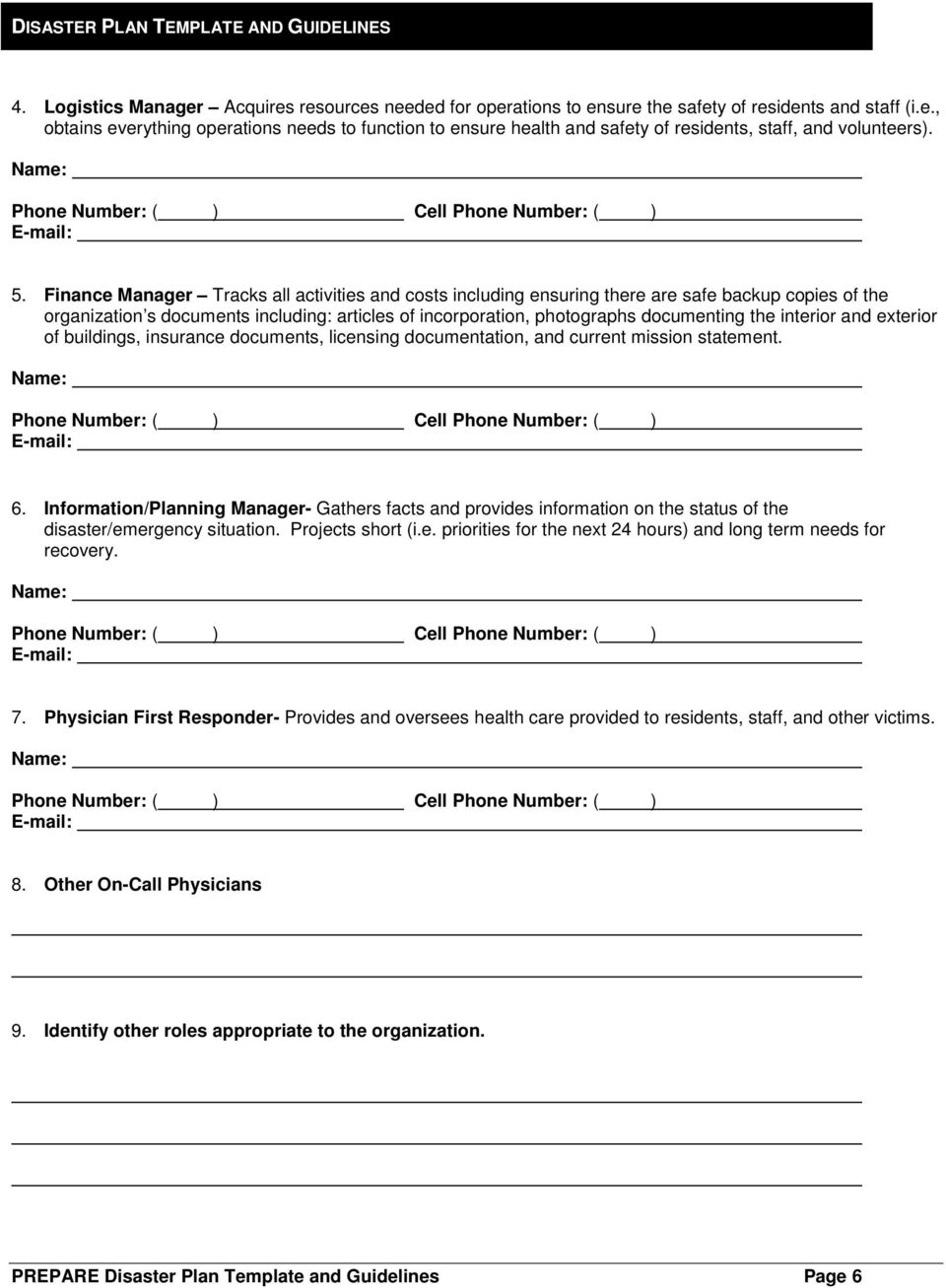
6 4. Logistics Manager Acquires resources needed for operations to ensure the safety of residents and staff (i.e., obtains everything operations needs to function to ensure health and safety of residents, staff, and volunteers). Name: Phone Number: ( ) Cell Phone Number: ( ) 5. Finance Manager Tracks all activities and costs including ensuring there are safe backup copies of the organization s documents including: articles of incorporation, photographs documenting the interior and exterior of buildings, insurance documents, licensing documentation, and current mission statement. Name: Phone Number: ( ) Cell Phone Number: ( ) 6. Information/Planning Manager- Gathers facts and provides information on the status of the disaster/emergency situation. Projects short (i.e. priorities for the next 24 hours) and long term needs for recovery. Name: Phone Number: ( ) Cell Phone Number: ( ) 7. Physician First Responder- Provides and oversees health care provided to residents, staff, and other victims. Name: Phone Number: ( ) Cell Phone Number: ( ) 8. Other On-Call Physicians 9. Identify other roles appropriate to the organization. PREPARE Disaster Plan Template and Guidelines Page 6
7 Job Action Sheets Job Action Sheets should be developed for all personnel involved in the emergency response. The following is an example. In a skilled care nursing center, the Director of Nursing would be assigned the role of Senior Nursing Officer during an emergency. JOB ACTION SHEET Senior Nursing Officer Position assigned to: Director of Nursing Reports to: Emergency Incident Commander Immediate Responsibilities: Establishes contact with Emergency Incident Commander. Reads this entire job action sheet. Initiates Nursing Disaster plan. Determines the number of available beds and status. Assists and facilitates the organization s response to the disaster. Provides updates to the Emergency Incident Commander. Evaluates staff for signs of fatigue and stress. Rotates staff to allow rest. Extended Responsibilities: Facilitates special family/patient needs. Provides an update to the Emergency Incident Commander on status of services. Returns inventories to appropriate level. Returns to normal staffing pattern when feasible. Evaluates staff for signs of delayed stress. Evaluates departmental emergency response and update plan as needed. Other Responsibilities as assigned: Date Revised: PREPARE Disaster Plan Template and Guidelines Page 7

8 IV. COMMUNICATION PLAN AND RESOURCES The Disaster Plan should include a 24-hour, 7-day per week communications network with internal and external components. Additionally, as traditional communication systems may not function in an emergency or disaster (i.e., telephone lines down or cellular phones not functioning), the LTC community should identify mechanisms for alternate communications as back-up. Consider use of radios, broad band technology, walkie-talkies, nearest pay phone, and runner messenger system. Components of Your Alternate Communication Plan: , 5. Inventory of Emergency Resources Indicate the location at each building/floor where the following items, in working condition, may be found. As part of regular safety inspections, your LTC community should include checks of these items. Here is an example template you may use and modify for your community. Emergency Resources - Date of Safety Check Number Available Indicate Location 1/3/06 4/3/06 7/3/06 10/3/06 Portable radio/extra batteries 1 radio/4 batteries 5 North supply closet Portable radio/extra batteries 1 radio/4 batteries Nursing office Emergency first aid supplies 4 kits Nursing office Flashlights and extra batteries 2 flashlights/4 batteries Reception desk Flashlights and extra batteries 2 flashlights/4 batteries Dining room Wrenches and other tools 1 wrench/1 dual head screwdriver Reception desk Fire extinguisher 2 per floor Personal protective equipment 12 gowns, 2 boxes gloves, 2 boxes masks, 12 pairs goggles Personal protective equipment 12 gowns, 2 boxes gloves, 2 boxes masks, 12 pairs goggles Front and back stairwells Nursing office 5 North supply closet PREPARE Disaster Plan Template and Guidelines Page 8

9 Emergency Resource Call List Outline the plan for contacting managers, staff, necessary emergency resources, and outside agencies such as the local public health department, CDC, fire department, and key businesses/resources. Modify the call list based on your LTC community s chain of command. The type of disaster dictates who will be contacted in an emergency. If unsure, always start with the local emergency response system and first responders. This list should be reviewed and updated at least once a year. Contact Name Number (indicate at least 2 phone numbers for each contact as applicable) Local Emergency Response System 911 Internal Contacts: Administrator Supervisor Director of Nursing Department Managers/Directors Safety Officer Infection Control Officer Medical Director Other Staff (as appropriate) External Contacts: Fire Department (first responders) Police or Sheriff s Department (first responders) Local Hospital/Emergency Room Local Health Department State Health Department FBI Field Office CDC BT Emergency Hotline CDC Hospital Infections Program Local FEMA Office Local Red Cross Office Area Agency on Aging Local Electrical Power Provider Local Water Department Local Telephone Company Local Natural/Propane Gas Supplier Include emergency reporting number and business office number Include emergency reporting number and business office number Include emergency reporting number and business office number Include emergency reporting number and business office number Other emergency contacts and community resources may be added to the call list including: elevator maintenance company; cleaning company; exterminator; fire alarm system; insurance company; locksmith; plumbing company; snow removal; sprinkler system; water softener distributor; local church; neighboring LTC communities; public health clinic; and other hospitals. PREPARE Disaster Plan Template and Guidelines Page 9

10 Staff Call Protocol Outline the protocol for contacting staff in the event that a disaster/emergency necessitates additional staff resources. Ensure that call lists include 24-hour contact information for all key staff including home telephones, pagers, mobile phones, and electronic mail. A list of telephone numbers of staff for emergency contact is located at (location). During an emergency, (name/position) is responsible for contacting staff to report for duty. The alternate contact is : (name/position). Resident Family Notification Outline the plan for notifying residents/families of the emergency and the specifics of the plan. Provide a written copy of the plan for residents and families. During an emergency, (name/position) is responsible for notifying residents. The alternate contact is : (name/position). A list of telephone numbers of resident emergency contacts is located at (location). During an emergency, (name/position) is responsible for contacting family members/guardians. The alternate contact is : (name/position). You may also have a situation where some of your residents could be off site during an emergency or disaster. You should have a procedure in place to know where your residents are and how to contact them when off site. Describe your procedure and how you plan to find out about the condition of residents who may be off site during an emergency/disaster. Community Resources Call Protocol Outline the plan for contacting community resources to request their assistance in the emergency. During an emergency, (name/position) is responsible for notifying community resources (i.e., Red Cross, Area Agency on Aging, etc.). V. RESPONSE PREPARE Disaster Plan Template and Guidelines Page 10

11 Department Response Departments are responsible for developing standard operating procedures to reflect how the department would continue to provide services during a disaster/emergency. These plans should be included in the community s Disaster Plan and kept on file in the specific department. These departments include the following (additional departments may be added by individual communities): 1. Administration 2. Nursing 3. Infection Control 4. Pharmacy 5. Central Supply/Equipment 6. Security 7. Food and Nutrition 8. Environmental Services 9. Social Services 10. Medical Services 11. Engineering/Physical Plant/Maintenance Pre-Disaster Checklist (for emergencies with advance warning such as hurricanes and floods) Develop a list of all assignments that must be completed before the emergency strikes. Use the following table as a template for emergency planning in your LTC community. We have provided some areas to consider in emergency planning. Your LTC community should identify resources and arrangements you have made. In some cases, a written agreement should be obtained to support these arrangements. The first item is provided as an example. Emergency Planning Checklist What arrangements are in place to obtain additional sources for bottled water? What arrangements are in place to obtain additional sources for food? What arrangements are in place to obtain additional sources for emergency supplies? What arrangements are in place to obtain additional sources for medical equipment? What immediate medical staff is available? What arrangements are in place for prescription delivery services? What arrangements are in place on site for separate heating/cooling units for food and medications? What arrangements are in place to protect records and documents (i.e., paper and electronic)? What arrangements are in place to protect equipment? What resources are in place to provide baths, clean clothes, and/or personal care Resources and Arrangement Made Local Costco commits ounce bottles of water. Written Agreement? Yes 10/5/05 PREPARE Disaster Plan Template and Guidelines Page 11

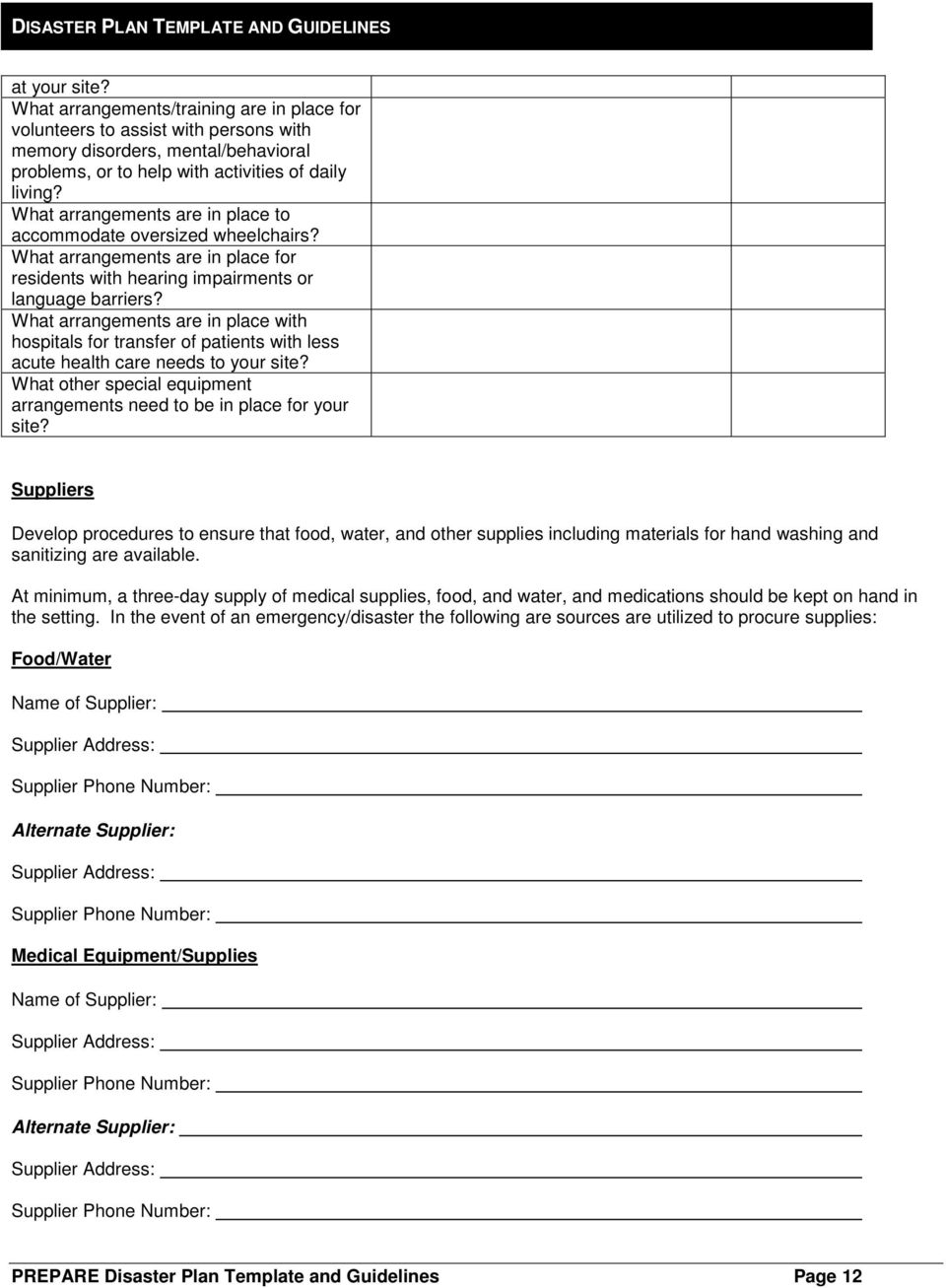
12 at your site? What arrangements/training are in place for volunteers to assist with persons with memory disorders, mental/behavioral problems, or to help with activities of daily living? What arrangements are in place to accommodate oversized wheelchairs? What arrangements are in place for residents with hearing impairments or language barriers? What arrangements are in place with hospitals for transfer of patients with less acute health care needs to your site? What other special equipment arrangements need to be in place for your site? Suppliers Develop procedures to ensure that food, water, and other supplies including materials for hand washing and sanitizing are available. At minimum, a three-day supply of medical supplies, food, and water, and medications should be kept on hand in the setting. In the event of an emergency/disaster the following are sources are utilized to procure supplies: Food/Water Name of Supplier: Supplier Address: Supplier Phone Number: Alternate Supplier: Supplier Address: Supplier Phone Number: Medical Equipment/Supplies Name of Supplier: Supplier Address: Supplier Phone Number: Alternate Supplier: Supplier Address: Supplier Phone Number: PREPARE Disaster Plan Template and Guidelines Page 12
13 Pharmacy Name of Supplier: Supplier Address: Supplier Phone Number: Alternate Supplier: Supplier Address: Supplier Phone Number: Staff Mobilization Protocol Outline the plan for staff assignments during the emergency or disaster situation include plan for assigning staff who are on-duty and those who are called to report for duty. Depending on the size of the LTC community, this may include using a labor pool manager. During a disaster/emergency, (name/position) determines if the staff call plan needs to be implemented and implements the call plan based on this decision. Use of Volunteers Volunteers from agencies providing mutual aid will be assigned to duties by the Operations Manager. To support the work of staff in an emergency/disaster, we will use volunteers for the following activities: , 5. A list of trained volunteers will be developed and updated monthly by: (name/position). During an emergency, (name/position) is responsible for contacting staff to report for duty. Resident Identification and Information System PREPARE Disaster Plan Template and Guidelines Page 13

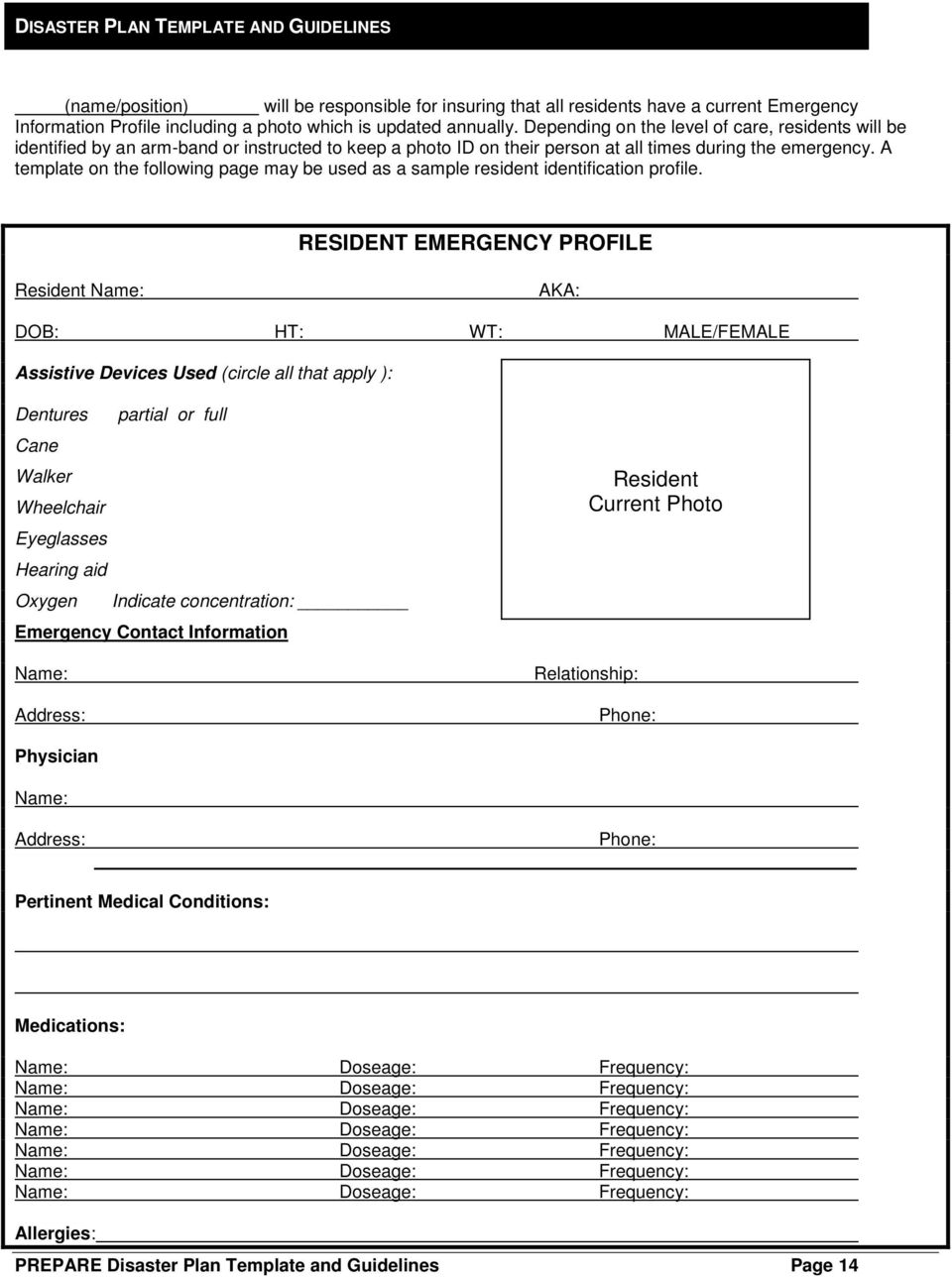
14 (name/position) will be responsible for insuring that all residents have a current Emergency Information Profile including a photo which is updated annually. Depending on the level of care, residents will be identified by an arm-band or instructed to keep a photo ID on their person at all times during the emergency. A template on the following page may be used as a sample resident identification profile. RESIDENT EMERGENCY PROFILE Resident Name: AKA: DOB: HT: WT: MALE/FEMALE Assistive Devices Used (circle all that apply ): Dentures partial or full Cane Walker Wheelchair Eyeglasses Hearing aid Oxygen Indicate concentration: Emergency Contact Information Name: Address: Resident Current Photo Relationship: Phone: Physician Name: Address: Phone: Pertinent Medical Conditions: Medications: Name: Doseage: Frequency: Name: Doseage: Frequency: Name: Doseage: Frequency: Name: Doseage: Frequency: Name: Doseage: Frequency: Name: Doseage: Frequency: Name: Doseage: Frequency: Allergies: PREPARE Disaster Plan Template and Guidelines Page 14
15 Medical Devices: Insurances: Pet: Name: Age: Resident Tracking System During a disaster/emergency situation a list of all residents and their locations will be developed and updated by: (name/position) and kept at: (location). Admission and Discharge Protocols In the event that the facility needs to discharge residents or accommodate displaced residents, or discharges from hospitals (name/position) will be responsible for reviewing a roster of current residents and developing a list of those that are appropriate for discharge. Discharge criteria include: , 5. PREPARE Disaster Plan Template and Guidelines Page 15

16 Transfer Agreements are in place with the following LTC communities and hospitals: Name of LTC Community: Address: Contact Person: Phone: Name of Hospital: Address: Contact Person: Phone: PREPARE Disaster Plan Template and Guidelines Page 16
17 SAMPLE MUTUAL AID TRANSFER AGREEMENT "The following long-term care community agree to accept residents from other communities (specify) in the event of a disaster. A disaster is any event, natural, man-made or technological, that the community determines that a partial or full evacuation is necessary. "This transfer would not exceed the receiving community's total bed capacity on a long-term basis. "All facilities involved in a transfer during a disaster will be responsible for contacting the Department of Health and Family Services for decisions regarding Medicare/Medicaid reimbursement and any other issue. "The facilities involved in transferring residents during a disaster will mutually determine the beds available, whether special needs and resident choice can be accommodated. "All employees of the transferring community will remain employees of the transferring community for the purpose of worker's compensation insurance. "The receiving community will distribute community policies and procedures and information on emergency plans to employees of the transferring community. The receiving community will assign all employees to work with the transferring community personnel. "Medical records will be evacuated as discussed in each community's emergency plan. "The receiving community will be responsible for all resident related costs after 12:00 midnight on the day of evacuation. "This agreement will renew automatically annually unless prior written 30-day notice is given." PREPARE Disaster Plan Template and Guidelines Page 17
18 Surge Capacity Plan Outline a plan for dealing with surge capacity describing methods to increase admission capacity in non-resident care areas and to facilitate rapid transfers and/or discharges. The following table may be used by your LTC community as a template to identify areas during an emergency/disaster situation where your community may shelter residents from neighboring LTC communities or hospital or care for victims from the emergency site. For example, in your skilled nursing care areas, could you add additional beds to private rooms or could some rooms being used for storage be converted into care areas (example given below). Additionally, the location where additional beds/mattresses are stored or where they may be obtained should be indicated in your Disaster Plan. Bed Capacity in Following Areas (modify below areas based on your LTC community s environment) Current Staffed Beds (based on your current operational capacity) Approximate Surge Bed Capacity (estimate maximum number of additional staffed beds created in 12 hours) Skilled nursing care 2 nd floor Skilled nursing care 3 rd floor th floor storage room 0 2 If your LTC community needed to isolate residents due to BT or influenza outbreaks, your Disaster Plan should also identify areas to be used for isolation. In the situation of an influenza outbreak, hospitals may be at overcapacity, and thus may not be able to accept transfers from your LTC community. Areas/Units that May be Used for Isolation Areas/Units Current Staffed Beds (based on your current operational capacity) Uneffected Residents May be Moved to: Skilled nursing care 3 rd floor 25 Skilled nursing care 2 nd floor Skilled nursing care 1 st floor If non-resident care areas are used for emergency overflow of victims (i.e., lobby, dining room, activity room) in the event of a declared disaster, access to the following services, supplies, and equipment needs to be considered in your Disaster Plan. Do overflow areas have ready access to: Yes No Unknown Beds or cots Running water Toilets Hand washing areas Food supplies Medical supplies Medications Telephones Radio PREPARE Disaster Plan Template and Guidelines Page 18

19 Emergency Power Plan In the event that power to the facility is disrupted, does your LTC community have access to an emergency generator to provide back-up power? If an emergency generator is not available one can be obtained from: Name of Supplier: Supplier Address: Supplier Phone Number: Alternate Supplier: Supplier Address: Supplier Phone Number: Family/Visitor Procedures Develop strategies to address the needs of families and visitors including a provision of support services such as counseling and information updates in a designated area. The following area will be designated as the family visitor waiting area: (name/position) emergency/disaster. will be assigned to the role of providing family support during the Procedures for Pets Residents with pets should specify arrangements for their pets in the event the building is evacuated. The following is a template for a Pet Preparation Form. PET PREPARATION FORM I, have made the following arrangements for my pet in the event there is a disaster/emergency. I am aware of the fact that some temporary shelters do not allow pets to be housed. Therefore I have made the following arrangements: Type of Pet: Age of Pet: Name of Pet: Name of Kennel/Relative/Friend taking responsibility for my pet: Address: Telephone Number: Pet s special Needs: PREPARE Disaster Plan Template and Guidelines Page 19

20 Family of Staff Procedures In the event of a disaster/emergency, staff will be allowed to contact their families as soon as possible following the disaster on the direction of the Incident Command Manager. Plans should be made to shelter families of staff if necessary. The following area will be designated as the shelter area for families of staff: Cleaning and Disinfecting Procedures for BT Exposure Principles of Standard Precautions should be generally applied for the management of equipment and environmental control in the event of a bioterrorism (BT) event. Each LTC community should have in place adequate procedures for the routine care, cleaning, and disinfection of environmental surfaces, beds, bedrails, bedside equipment, and other frequently touched surfaces and equipment, and should ensure that these procedures are being followed. Approved germicidal cleaning agents should be available in resident care areas to use for cleaning spills of contaminated material and disinfecting non-critical equipment. Used equipment soiled or potentially contaminated with blood, body fluids, secretions, or excretions should be handled in a manner that prevents exposures to skin and mucous membranes, avoids contamination of clothing, and minimizes the likelihood of transfer of microbes to other patients and environments. Policies should be in place to ensure that reusable equipment is not used for the care of another resident until it has been appropriately cleaned and reprocessed, and to ensure that single-use resident items are appropriately discarded. Sterilization is required for all instruments or equipment that enter normally sterile tissues or through which blood flows. Rooms and bedside equipment of residents with BT-related infections should be cleaned using the same procedures that are used for all patients as a component of Standard Precautions, unless the infecting microorganism and the amount of environmental contamination indicates special cleaning. In addition to adequate cleaning, thorough disinfection of bedside equipment and environmental surfaces may be indicated for certain organisms that can survive in the inanimate environment for extended periods of time. The methods and frequency of cleaning and the products used are determined by organizational policy. Linen should be handled in accordance with Standard Precautions. Although linen may be contaminated, the risk of disease transmission is negligible if it is handled, transported, and laundered in a manner that avoids transfer of microorganisms to other patients, personnel and environments. Organizational policy and local/state regulations should determine the methods for handling, transporting, and laundering soiled linen. Contaminated waste should be sorted and discarded in accordance with federal, state and local regulations. Policies for the prevention of occupational injury and exposure to bloodborne pathogens in accordance with Standard Precautions and Universal Precautions should be in place within each LTC community. In the event of a BT attack, hospital-grade germicidal cleaning agents are used for cleaning spills of contaminated material and disinfecting non-critical equipment. The goal of decontamination after a potential exposure to a BT agent is to reduce the extent of external contamination of victims and contain the contamination to prevent further spread. Decontamination should only be considered in instances of gross contamination. Decisions regarding the need for decontamination should be made in consultation with state and local health departments. PREPARE Disaster Plan Template and Guidelines Page 20
21 Exposure of Persons to Chemical or Other BT Agents If the agent presents likelihood for re-aerosolization, or a risk associated with cutaneous exposure, clothing of exposed persons may need to be removed. After removal of contaminated clothing, residents should be assisted to shower/bathe with soap and water immediately. Potentially harmful practices, such as bathing residents with bleach solutions, are unnecessary and should be avoided. Clean water, saline solution, or commercial ophthalmic solutions should be used for rinsing eyes. If indicated, after removal at the decontamination site, resident clothing should be handled only by personnel wearing appropriate personal protective equipment, and placed in an impervious bag to prevent further environmental contamination. Treatment for BT Exposure In the event of exposure to BT agents, local and state health departments and the CDC should be contacted for the most current treatment regimen. Until agents can be received from the National Pharmaceutical Stockpile program, pharmaceutical agents will be supplied by: Name of Supplier: Supplier Address: Supplier Phone Number: Alternate Supplier: Supplier Address: Supplier Phone Number: Post-Mortem Procedures In the event of disaster-related deaths, arrangement to transport and store bodies have been made with (may include hospital, mortuary, or local health department) Name of Facility: Facility Address: Facility Phone Number: Alternate Facility: Facility Address: Facility Phone Number: PREPARE Disaster Plan Template and Guidelines Page 21
22 VI. SECURITY/SAFETY ISSUES Building Access Outline a plan to minimize points of egress and access to the building(s). During an emergency/disaster, the point of access is: All staff will be required to show a staff photo Identification Badge to gain entry to building(s). The entry point designated for staff, emergency responders and volunteers is: Security staff will be provided with a list of designated family members who will be allowed access to building(s) with photo identification. Security staff will be provided with a list of designated volunteers who will be allowed access to building(s) with photo identification. Emergency vehicles will have access at: Support agency vehicles will have access at: Delivery vehicles will have access at: The following table may be used as a template to identify staff responsible for safety issues during an emergency/disaster. Modify the table based on your LTC community s safety needs. Safety Area Responsibilities Staff Responsible/Phone Building Security Check and turn off gas (if odor detected or damage is evident) and electricity. Turn off water if pipes are broken or leaking. Fire Suppression Check for and suppress small fires. Notify fire department. Search and Rescue Ensure everyone has evacuated if required. Search for trapped or injured persons and seek help from other responders. First Aid Administer first aid to injured persons. PREPARE Disaster Plan Template and Guidelines Page 22
23 VII. EVACUATION Your LTC organization may wish to individualize the following evacuation procedures to indicate personnel/titles and responsibilities pertinent to your community/setting. At the time of a disaster, it is imperative that the Administrator be contacted in order to give staff proper direction. This evacuation procedure is written so that there are clear guidelines for providing resident and staff safety in the event of a disaster. It is important to know that each situation is going to be different, and that a situation may not allow for the following procedure to be implemented in this specific order. 1. In the event of an emergency, the shift supervisor shall immediately contact the Administrator, Director of Nursing, and the Maintenance Supervisor. 2. Once the Administrator, Director of Nursing, or Maintenance Supervisor arrives and determines that the situation requires evacuation, the facility call tree shall be put into effect in order to obtain available persons to evacuate the residents to safety. 3. A command center shall be set up in the Administrator s and connecting Business Office to handle and coordinate all internal communications. If this area is in the line of danger a new location will be determined at that time. 4. The Administrator, or Highest Ranking person at the scene, will direct people to areas needing assistance. 5. If temporary placement for residents is needed, the Administrator, or Highest Ranking person at the scene, shall contact the American Red Cross by calling 911 and requesting an emergency shelter through the County Department of Emergency Government Center. 6. If permanent placement for residents is needed, the Administrator and Director of Nursing, or highest ranking person at the scene, will assess which residents need to be hospitalized or transferred to another LTC community. 7. The Administrator, or Highest Ranking person on the scene, shall assign a person to coordinate transportation. 8. Once a shelter is arranged, the residents will be evacuated from the building in an orderly fashion. All department personnel shall report at this time with the supplies they are assigned to gather. 9. Medical Records personnel will be responsible for putting name tags on all residents upon evacuation. They shall also be responsible for ensuring that the residents medical records are transported with the resident. 10. Nursing personnel will be assigned to specific areas, and are responsible for evacuating those residents and assisting with others when complete. 11. The Charge Nurse shall be responsible for removing the Medications, the Medication Administration Record, Resident Charts and the current Resident Roster to the designated shelter. 12. Dietary personnel will be responsible for gathering food and dietary supplies. 13. Housekeeping and Laundry personnel will be responsible for gathering all linens and supplies for resident care. 14. The Activities personnel shall assist wherever needed. 15. The Administrative Assistant and the Bookkeeper shall gather all departmental employee schedules and the employee call roster, as well as other important business office supplies and records. 16. The Social Worker will be responsible for contacting family members to notify them of the disaster and where residents are being transported. 17. The Day Care personnel shall be responsible for accounting for all children, phone numbers of family members of the children and organizing the children for evacuation. 18. The Apartment Residents will be evacuated the same as the residents in skilled nursing being evacuated. Reminder to nurses to bring the apartment files. 19. The Administrator shall check all rooms before leaving the grounds. A "white tag" will be placed on each door handle to verify that the room is empty to ensure that no residents or staff members are left behind. PREPARE Disaster Plan Template and Guidelines Page 23
24 Your Disaster Plan should clearly indicate who is responsible for: Decision to evacuate the facility: (name, position, phone numbers) Facility evacuation procedures implementation: (name, position, phone numbers) Notification of transportation/ambulance companies: Notification of sites/shelters receiving residents: (name, position, phone numbers) (name, position, phone numbers) Agreements for transporting residents to evacuation sites have been made with the following transportation and ambulance companies (include copies of the written agreements with the plan): Transportation Company Name of Company: Company Address: Company Phone Number: Alternate Company: Company Address: Company Phone Number: Ambulance Company Name of Company: Company Address: Company Phone Number: Alternate Company: Company Address: Company Phone Number: Evacuation Locations (include copies of the written agreements) Name of Setting/Shelter: Facility Address: Facility Phone Number: PREPARE Disaster Plan Template and Guidelines Page 24
25 Name of Setting/Shelter: Facility Address: Facility Phone Number: Evacuation Logistics Based on your residents needs, levels of mobility, cognitive abilities, and health status, your LTC community should develop evacuation logistics as part of your Disaster Plan. The following table is an example of such a logistics plan. Transportation Evacuation Plan Residents who are independent in ambulation: will be accompanied by a designated staff member to the designated mode of transportation. Residents who require assistance with ambulation: will be accompanied by designated staff member to the designated mode of transportation. Residents who are non-ambulatory: will be transferred by designated staff members via the designated mode of transportation. Residents with cognitive impairments: will be accompanied by an assigned staff member via the designated mode of transportation. Residents with equipment/prosthetics: equipment/prosthetics should accompany residents and should be securely stored in the designated mode of transportation. Medical Records At a minimum, each resident will be evacuated with the Resident Emergency Profile. Medications Each resident will be evacuated with a minimum of a 3-day supply of medications. If medications require refrigeration, indicate plan to keep medications cool. Estimated Evacuation Time Calculate based on the number of residents and estimated time for each based on assistance required. Resident Tracking Indicate who is responsible for keeping the log of residents locations post-evacuation (some situations may require residents going to numerous locations). Resident Justification Indicate who is responsible for making a final check and head count of residents to ensure all residents have been evacuated. Evacuation Routes/Destinations Attach copies of maps with the primary and secondary routes and destinations. PREPARE Disaster Plan Template and Guidelines Page 25
26 VIII. RE-ENTRY Identify who is responsible for decision for authorizing re-entry to the buildings: IX. POST- DISASTER RECOVERY Identify the Designated Recovery Officer (responsible for planning inventory and supply checks, clean-up, physical plant restoration, equipment servicing, etc. post-disaster): Ensuring service continuation is an important post-disaster component of your Disaster Plan. Use the following template to identify key services necessary to re-establish or continue service to your residents. Primary Services Needed to Continue Post-Disaster Recovery Plans Critical Material Resources to Maintain These Services Neighboring LTC Communities, Agencies, Businesses Willing to Provide These Resources Key Contact Information Post-Disaster Debriefing and Counseling The impact of a disaster will affect persons in different ways. The stress of the situation and how persons cope in the aftermath is difficult to determine, but the LTC community may take several steps to assure residents and staff that they will be heard. Counselors, psychologists, and mental health practitioners with experience in disasters may be called upon to assist in post-disaster counseling. Your Disaster Plan should indicate who is responsible for: Critical incident stress debriefing for residents and staff: Post-incident counseling for residents and staff: (name, title, phone number) (name, title, phone number) PREPARE Disaster Plan Template and Guidelines Page 26
27 X. INFORMATION, TRAINING, AND EXERCISE Indicate where the Disaster Plan will be located for staff reference: Staff training on the specifics of the Disaster Plan including their roles will be required of all staff on annual basis and included in orientation for all new staff. Review of staff training will be conducted for each staff member during their annual performance appraisal. Emergency Disaster training exercises will be held on an annual basis. The Disaster/Safety Committee will be responsible for planning and critiquing the exercises. After the critique of the exercise, the Disaster Committee will develop a written plan to address noted deficiencies. Provide all staff an outline for an individual/family emergency plan (see Module 11) and encourage them to complete it. XI. PLAN FOR UPDATING THE DISASTER PLAN This disaster plan will be reviewed and updated every six months by the following staff: Disaster Plan Review Schedule Date Responsible Personnel PREPARE Disaster Plan Template and Guidelines Page 27
28 Developing Your LTC Community Disaster Plan Example Policies and Procedures The following are example policies and procedures that your organization may use as templates for developing your own Disaster Plan. Depending on your geographic area, you will need to identity policies and procedures targeting potential natural disasters in your locale. Disaster Plan Definitions Partial Evacuation: Residents are not required to leave the premises. They may be brought to hallways in the event of a severe weather situation. In the event of a controlled/contained fire, residents may only be evacuated to beyond the fire doors to a wing. Total Evacuation: Residents are taken from the building to area shelters or hospitals. Internal Disaster: Fire, explosion, flooding, bomb threat, etc. which threatens the safety of persons within the community and necessitates setting the evacuation plan in order. External Disaster: Tornado, flood, disbursement of dangerous airborne particles or poisonous gases which threaten the safety of persons within the community and necessitates setting the evacuation plan in order. Triage: The screening and classification of sick or injured persons during a disaster to determine priority needs for efficient use of medical manpower, equipment, and facilities and to determine the priority of treatment. PREPARE Disaster Plan Template and Guidelines Page 28
29 FIRE POLICY AND PROCEDURE POLICY: The primary purpose of the Fire Policy and Procedure is to provide a course of action for all personnel to follow in the event of a fire. PROCEDURE: R - Rescue anyone in immediate danger. A - Alert other staff members of the fire and location over the intercom system. Pull the nearest fire alarm. The Person in Charge shall contact the fire department by calling 911. C - Contain the fire. Close all doors and windows adjacent to the fire. Close all fire doors. Shut off all fans, ventilators and air conditioners, as these will feed the fire and spread smoke throughout the building. E - Extinguish if the fire is small. The extinguisher should be aimed low at the base of the fire, and move slowly upward with a sweeping motion. Never aim high at the middle or top of the flames as this will cause the fire to spread. If you cannot extinguish the fire, evacuate the building immediately. Special Note: The most common cause of death in a fire is smoke, and not the flames. Keep low to the floor and avoid inhaling too much smoke. Person In Charge: 1. Call the fire department at Give exact location of the fire and its extent. 2. Call the Administrator. 3. Assist with residents if evacuation is necessary. 4. Assign a staff member to meet the fire department in order to direct them to the fire. Assign a staff member to keep a roster of residents if evacuation is necessary. Assign a staff member to answer the telephone and relay messages and instructions. Nursing, Dietary, and Housekeeping/Laundry Personnel: 1. Remove residents from immediate danger. 2. Close all doors and windows. 3. Turn off fans, ventilators, air conditioners, and other equipment. 4. Stay close to residents to provide reassurance and provide comfort measures. 5. Make sure fire exits are clear. Maintenance Personnel: 1. Go directly to scene of fire, taking extra fire extinguishers. 2. Check to be sure that all ventilating or blower equipment is shut off. 3. Once fire is over, care for all fire extinguishers. Administrator: 1. Call the fire department if not already done. 2. Coordinate staff movement for highest efficiency. 3. Assist with resident movement in coordination with supervisor/charge nurse. 4. Delegate responsibility for the movement of records as deemed necessary. 5. Check with department heads in the event of evacuation to determine that all staff and residents are out of the building. PREPARE Disaster Plan Template and Guidelines Page 29
30 SKILLED NURSING CARE EVACUATION PROCEDURE Depending on the location of the fire, residents may be evacuated to another portion of the building, rather than total community evacuation. However, in the event that a partial or complete evacuation of the building becomes necessary, the following procedure shall be followed: 1. The shift supervisor/charge nurse shall immediately contact the Administrator, Maintenance Director, and Director of Nursing, if they are not yet present. 2. Once the Administrator, Director of Nursing, or Maintenance Director arrives and determines that the situation requires evacuation, the call tree shall be put into effect in order to obtain available persons to evacuate the residents to safety. Administrator contacts: Medical Records and Business Office personnel Director of Nursing contacts: Social Worker and Activity Director Maintenance Director contacts: Housekeeping/Laundry Supervisor and Dietary Manager Once Business Office and Medical Records personnel arrive, they shall contact department managers and other off-duty personnel to come and assist with the evacuation. 3. A command center shall be established per the Administrator's direction. This should be in a convenient location out of the line of danger. The Administrator, or highest ranking person at scene, shall become the "Incident Command Manager" in order to direct people to areas needing assistance. 4. Alternate placement for residents must be arranged. the Administrator, or highest ranking person at scene, shall designate someone to coordinate a shelter. This can be arranged by calling and requesting a shelter or contacting other LTC communities or organizations who have established mutual aid agreements. 5. Residents should be evacuated in this order: residents in immediate danger, nonambulatory or bedridden residents, wheelchair residents, and ambulatory residents. 6. The Administrator, or highest ranking person on scene, shall assign a second person to coordinate transportation. 7. Once a shelter is arranged, the Incident Command Manager shall designate a meeting spot outside of the building. Residents shall be evacuated from the building in an orderly fashion. All departmental personnel shall report to the designated location with the supplies they are assigned to gather. 8. Medical Records personnel shall be responsible for tagging and identifying all residents upon evacuation. They shall also be responsible for ensuring that the residents medical records are transported with the resident. 9. Nursing personnel will be responsible for caring for residents. The Charge Nurse shall be responsible for taking the Med Cart to the meeting spot. 10. Housekeeping and Laundry personnel will be responsible for gathering all linens and supplies needed for resident care. If possible, attempts should be made to gather resident clothing also. 11. Dietary personnel will be responsible for gathering food and dietary supplies. 12. The Social Worker will be responsible for contacting family members to notify them of the disaster and where residents are being transported. The Social Worker may also have to reassure and supervise family members and on-lookers that may arrive on the scene. PREPARE Disaster Plan Template and Guidelines Page 30
31 13. The Activities personnel shall be assist wherever needed. The Activities personnel shall also be responsible for the community pets. 14. The Business Office Manager shall gather all departmental employee schedules and the employee roster, as well as other pertinent business office supplies and records. 15. The Administrator, or designated person, shall check all rooms before leaving the grounds. An "X" should be marked on each door to verify that the room is empty. All available staff members shall assist with a last walk through of the building to ensure that no residents or staff members are left behind. 16. Once everyone has been evacuated and all supplies gathered, boarding of residents and supplies for relocation shall begin in an orderly fashion. 17. The Social Worker shall be responsible for keeping an official roster with names of residents, staff, board members, and volunteers present at the time of disaster and during the evacuation. Information to be recorded shall include: name of resident and next of kin/responsible party shelter transferred to and person accompanying resident medications, med sheet, and chart sent with resident to location of transfer. PREPARE Disaster Plan Template and Guidelines Page 31
32 APARTMENT EVACUATION PROCEDURE PURPOSE: To evacuate all apartment residents to safety in the event of a disaster. PROCEDURE: In the event it becomes necessary to evacuate the entire building, or part of a building, the following procedure will be followed: 1. The Administrator or designated person will notify the apartment residents in the event of a disaster. 2. For the purpose of an emergency, the apartment resident will be evacuated the same as the residents in skilled nursing areas would be evacuated. 3. Nursing personnel will direct staff to evacuate these tenants with the nursing home residents. 4. Nursing staff will knock on the apartment door and notify the tenants on what to do, if no one answers the door, go on to the next apartment and report to the Administrator anyone who was not home. The Administrator will then take the master key to ensure there is no one left in the apartment. 5. The nursing staff will be responsible for bringing the apartment residents files in the event of disaster. 6. A designated person will notify family members what has transpired and where the apartment residents are located. Disclaimer: It is important to note that each situation is going to be different, and that a situation may not allow for the above procedures to be implemented in this specific order. At a time of a disaster, it is imperative that the Administrator be contacted in order to give staff proper direction. This policy and procedure is written so that there are clear guidelines for providing resident care and ensuring their safety in the event of a disaster. Sound judgment and common sense are the best practices in an emergency. Therefore, the Administrator and charge persons will have to make the best judgment at that time. This plan should be in cooperation with the American Red Cross, the County Emergency Government office, and local Police and County Sheriff's Departments. PREPARE Disaster Plan Template and Guidelines Page 32
33 SEVERE WEATHER POLICY AND PROCEDURE Purpose: The purpose of a Severe Weather Policy and Procedures is to educate and inform staff of weather conditions that warrant their attention. It is the community s responsibility to keep the residents and staff safe at all times. If severe weather strikes, precautions need to be taken to ensure their safety. Definitions: Watch -- Means that conditions are favorable for a thunderstorm or tornado to develop. Warning -- Means that a thunderstorm or tornado has been sighted. If a siren sounds, stay inside and take cover. Procedure: 1. Account for all residents and staff. Make sure everyone is inside. 2. Close all windows and pull all curtains. 3. Keep all residents away from windows. If there is a tornado warning, further precautions need to be taken: 4. Gather residents in hallways behind fire doors, or in the bathroom. If residents are in bed, pull the beds into the hallway. If this is not possible, make sure all curtains in room are pulled, including cubicle curtains. Cover the resident with extra blankets and pillows, especially near the head. 5. Gather flash lights and radio. Be sure to listen to weather reports for updates. Do not leave the area until the storm has passed and the warning has lifted. 6. Stay calm and provide reassurance to the residents. Keep them as comfortable as possible. Receptionist/Charge Nurse: Receptionist: All Staff: Nursing Staff: Announce: "Attention all staff, we are now in a severe weather/ tornado warning, begin severe weather procedures at once." If phone does not work, send runners to all areas. Repeat announcement. Stay at the desk as long as is safe to supervise the front door. Send people to the assembly area and close fire doors in the area. See also specific department, if listed. If on the nursing floor, help move residents to assembly area. Reassure and comfort residents. Advise visitors and residents not to leave the building. Move residents to assembly area. Reassure and make residents comfortable. Account for all residents. PREPARE Disaster Plan Template and Guidelines Page 33
34 WINTER STORM SAFETY PRECAUTIONS Purpose: The purpose of these winter storm safety precautions is to inform staff of measures that should be taken during severe winter weather. The following winter storm safety precautions have been established for all personnel to follow during blizzards, heavy snow, freezing rain, ice storms, or sleet. Precautions: 1. Keep posted on all area weather bulletins and relay to others. 2. Have portable radio available. Make sure extra batteries are available. 3. Be prepared for isolation at the community. 4. Make sure all emergency equipment and supplies are on hand, or can be readily obtained. 5. Make sure emergency food supplies and equipment are on hand. 6. Make sure emergency supply of water is available. 7. Make sure emergency power supply is operable. 8. Make sure heating system is operable. 9. Have extra blankets available and keep residents as warm as possible. 10. Make sure adequate staff is available. 11. Keep flashlights handy, and extra batteries available. 12. Close drapes on cloudy days and at night. 13. Travel only when necessary, and only during daylight hours. Never travel alone. Travel only assigned routes. 14. Be prepared to evacuate residents if necessary. 15. Do not make any unnecessary trips outside. If you must venture outside, make sure you are properly dressed, and fully covered. 16. Avoid overexertion by doing only what is necessary. Cold weather strains the heart. 17. Do not panic; remain calm. PREPARE Disaster Plan Template and Guidelines Page 34
35 BOMB THREAT POLICY AND PROCEDURE Purpose: The purpose of this policy is to inform staff of precautions to be taken in the event of a bomb threat. The current national situation of increased bombings, bomb threats, and bomb scares must be given immediate consideration. In the past, the vast majority of bomb threats were hoaxes. However, the current trend nationally is that more of the threats are materializing. Upon receipt of a bomb threat, it is impossible to know if it is real or a hoax. Therefore, precautions need to be taken for the safety of residents and employees. Procedure: If you receive a bomb threat over the phone, follow these procedures: 1. Keep the caller on the line as long as possible. 2. Ask the caller to repeat the message. 3. Ask the caller his name. 4. Ask the caller where the bomb is located. 5. Record every word spoken by the person making the call. 6. Record time call was received and terminated. 7. Inform the caller that the building is occupied and the detonation of a bomb could result in death or serious injury to many innocent people. 8. Complete the bomb threat form, attached, to record the caller's characteristics. If possible, during the call, try to notify the charge nurse immediately. The charge nurse shall: 1. Call the Police Department at Call the Administrator if not present. 3. Organize staff to evacuate residents upon police or administrative order. Once the Police have arrived: Keys shall be available so that searchers can inspect all rooms. Employee lockers will be searched. If padlocked, padlock will be cut off. The Administrator or designee shall remain with the Search Commander during the entire search to provide assistance and counsel during the search. If a suspected bomb is located within the building, the responsibility for investigation will be that of the law enforcement officials having jurisdiction over such matters. PREPARE Disaster Plan Template and Guidelines Page 35
36 BOMB THREAT TELEPHONE PROCEDURE Use the following template in the situation of a potential bomb threat. PROCEDURE: Listen - Do Not Interrupt Caller Except to Ask: When will it go off? Where is it planted? What does it look like? Certain House Time Remaining Area Did caller seem familiar with building by the description of bomb location? Your Name Time of Call Date CALLER S IDENTITY: Male Female Approximate Age VOICE CHARACTERISTICS Loud Soft High Pitch Deep Fast Excellent Raspy Pleasant Slow Good Intoxicated Distinct Stutter Fair Nasal Foul Slurred Poor Other ORIGIN OF CALL: Local Long Distance Booth Internal (from within the building) ACCENT: Local Not Local Foreign Regional Race Calm Angry Rational Irrational Coherent Incoherent Emotional Laughing Deliberate Righteous Other BACKGROUND NOISES: Quiet Voices Music Animals Mixed Party Airplanes Bedlam Office Machines Factory Machines Street Traffic Other PREPARE Disaster Plan Template and Guidelines Page 36
37 EMERGENCY PROCEDURES DURING DISCONTINUATION OF WATER SUPPLY Purpose: To ensure that there will be adequate water supply on hand to supply residents with water for personal and hygienic needs. Procedure: If water supply is suddenly disrupted for any reason, the following steps will be taken by staff on duty during the time of the discontinuation of water supply. 1. Notify the Administrator or Administrator s designee and the Maintenance personnel. 2. All attempts will be made to determine the cause for water disruption and the probable length of shutdown. 3. Dietary department will give out juices and other fluids that are on hand for consumption by residents. 4. Disposable dishes and utensils may be used during emergencies. 5. If necessary, water will be brought in and dispensed as needed. This will be initiated through emergency government. 6. If it becomes apparent that a water shortage will last for an undetermined length of time, the Administrator will order emergency measures taken to ensure proper care for ill residents and for those whose treatment has been disrupted by lack of water supply. Arrangements may need to be made to transfer those residents to hospitals or other long term care facilities for care. PREPARE Disaster Plan Template and Guidelines Page 37
38 ELECTICAL POWER OUTAGE POLICY AND PROCEDURE Purpose: It is the policy of this community to provide auxiliary power to designated areas within the community to operate life-support equipment should our normal power supply fail. The community has an emergency generator that should be automatically activated in the event of a power outage. The generator operates on natural gas, and as long as the gas lines are not damaged or disrupted, the generator is capable of providing the community with a minimal supply of electricity. Procedure: In the event of a power outage, the following steps should be followed: 1. Immediately identify any residents that require oxygen concentrators or other life support equipment. Move the resident to areas supplied with emergency power (outlets marked with a red "X" on them). 2. Gather all flashlights and other needed supplies. Check on all residents to ensure their safety. Calm any residents experiencing distress. 3. Unplug the fax machine, and plug in the "Emergency Phone." Community Generator DOES NOT... Provide Heat or Water Provide Power to Laundry or Kitchen Operate Fire Alarm System (this is on its own battery back-up system) Operate the phone system Areas Equipped with Emergency Lighting: Front Lobby Hallways Break room Laundry Room Boiler Room Stairways PREPARE Disaster Plan Template and Guidelines Page 38
39 HEAT AND HUMIDITY POLICY AND PROCEDURE Purpose: The purpose of this policy is to provide precautionary and preventative measures for our residents during the hot and humid summer months. Older adults are extremely vulnerable to heat related disorders. Definitions: Heat Exhaustion: A disorder resulting from overexposure to heat or to the sun. Early symptoms are headache and a feeling of weakness and dizziness, usually accompanied by nausea and vomiting. There may also be cramps in the muscles of the arms, legs, or abdomen. The person turns pale and perspires profusely, skin is cool and moist, pulse and breathing are rapid. Body temperature remains at a normal level or slightly below or above. The person may seem confused and may find it difficult to coordinate body movements. Heat Stroke: A profound disturbance of the body's heat-regulating mechanism, caused by prolonged exposure to excessive heat, particularly when there is little or no circulation of air. The first symptoms may be headache, dizziness and weakness. Later symptoms are an extremely high fever and absence of perspiration. Heat stroke may cause convulsions and sudden loss of consciousness. In extreme cases it may be fatal. Precautionary Procedures: 1. Keep the air circulating. 2. Draw all shades, blinds and curtains in rooms when exposed to direct sunlight. 3. Remove residents from areas that are exposed to direct sunlight. 4. Keep outdoor activities to a minimum. 5. Check to see that residents are appropriately dressed. 6. Provide ample fluids, and provide as many fluids as the resident will take. 7. Increase the number of baths given for skilled care nursing residents. Encourage independent residents to take showers/baths. 8. Place fans in hallways to increase circulation. 9. Report any changes in the resident s condition such as edema, shortness of breath, the skin being hot or dry. PREPARE Disaster Plan Template and Guidelines Page 39
40 PROCEDURE FOR EVACUATION IN CASE OF A RADIOLOGICAL ACCIDENT Purpose: To outline an emergency plan to be followed in the case of a radiological accident. Policy: The following is the procedure to be followed in the case of a radiological accident. In the case of an accident at a nuclear power plant, the local/state office of emergency services will use the following alert systems: Emergency siren system Emergency scanner system The community will receive a phone call from the Emergency Broadcast System on the radio and television. Upon notification, community staff should immediately call the Administrator and Director of Nursing to inform them of the exact notification. All in-town community staff members should immediately report to the community to assist with the evacuation of residents and community records. All residents and staff will be evacuated by transportation provided by emergency government. Concentrate on preparing all residents for evacuation. Do not take clothing, food or water. They will be provided at the evacuation site. The following residents will be transferred to hospitals by ambulance or medi-van: Oxygen dependent residents Tracheostomy residents Tube fed residents Severe wounds and decubiti Severe pain control i.e., terminal cancer Severe obesity (Hoyer lift assist required) All staff outside the community should report to assist in resident evacuation as soon as possible. Staff will be needed to care for residents at the shelter areas. One staff member will accompany each vehicle going to the hospital and to each shelter area to calm residents and reassure them. Resident medical chart will be transferred to the hospital and/or shelter. Nurse will make certain that the chart accompanies the resident to the hospital or shelter. The Administrator and supervisory staff will contact other LTC communities and residents' families to relocate residents in proper environments to ensure appropriate care. If return to the community is not possible, the Administrative staff will seek supplemental staff to assist in the care of residents until return or relocation is completed. PREPARE Disaster Plan Template and Guidelines Page 40
41 CHEMICAL SPILLS Purpose: To inform staff of action to be taken in the event of an outdoor chemical spill. Policy: The following action will be taken in the event of an outdoor chemical spill. 1. Shut down outside intake ventilation. 2. Close all doors to the outside and close and lock all windows. 3. Maintenance staff should set all ventilation systems to 100% recirculation so that no outside air is drawn into the building. When this is not possible, ventilation systems should be turned off. This is accomplished by pulling the fire alarm. 4. Turn off all heating systems. 5. Turn off all air conditioners and switch inlets to the "closed" position. Seal any gaps around window type air conditioners with tape and plastic sheeting, wax paper or aluminum wrap. 6. Turn off all exhaust fans in kitchens and bathrooms. 7. Close as many internal doors as possible in the building. 8. Use tape and plastic food wrapping, wax paper or aluminum wrap to cover and seal bathroom exhaust fan grills, range vents, dryer vents, and other openings to the outside. 9. If the gas or vapor is soluble or partially soluble in water, hold a wet cloth over your nose and mouth if gases start to bother you. For a higher degree of protection, go into the bathroom, close the door and turn on the shower in a strong spray to wash the air. 10. If an explosion is possible outdoors, close drapes, curtains or shades over windows. Stay away form external windows to prevent injury from flying glass. 11. Tune into the Emergency Broadcasting System on the radio or television for further information and guidance. Law enforcement agencies will make a determination regarding possible evacuation of residents. PREPARE Disaster Plan Template and Guidelines Page 41
42 Reporting Requirements and Contact Information BIOTERRORISM THREATS In the event a bioterrorism (BT) event is suspected, local emergency response systems should be activated. Notification should immediately include local infection control personnel and the LTC community s administration, and prompt communication with the local and state health departments, FBI field office, local police, CDC, and medical emergency services. Each LTC community should include a list containing the following telephone notification numbers in its readiness plan: INTERNAL CONTACTS: INFECTION CONTROL EPIDEMIOLOGIST ADMINISTRATION/PUBLIC AFFAIRS EXTERNAL CONTACTS: LOCAL HEALTH DEPARTMENT STATE HEALTH DEPARTMENT FBI FIELD OFFICE BIOTERRORISM EMERGENCY NUMBER, CDC Emergency Response Office 770/ CDC HOSPITAL INFECTIONS PROGRAM 404/ Detection of Outbreaks Caused by Agents of BT BT occurs as covert events, in which persons are unknowingly exposed and an outbreak is suspected only upon recognition of unusual disease clusters or symptoms. BT may also occur as announced events, in which persons are warned that an exposure has occurred. A number of announced BT events have occurred in the United States during , but these were determined to have been hoaxes; that is, there were no true exposures to BT agents. A healthcare facility s BT Readiness Plan should include details for management of both types of scenarios: suspicion of a BT outbreak potentially associated with a covert event and announced BT events or threats. The possibility of a BT event should be ruled out with the assistance of the FBI and state health officials. Infection Control Practices for Patient Management Agents of BT are generally not transmitted from person to person; re-aerosolization of these agents is unlikely. All persons, including symptomatic patients with suspected or confirmed BT-related illnesses, should be managed utilizing Standard Precautions. Standard Precautions are designed to reduce transmission from both recognized and unrecognized sources of infection, and are recommended for all persons receiving care, regardless of their diagnosis or presumed infection status. For certain diseases or syndromes (e.g., smallpox and pneumonic plague), additional precautions may be needed to reduce the likelihood for transmission. Standard Precautions prevent direct contact with all body fluids (including blood), secretions, excretions, nonintact skin (including rashes), and mucous membranes. Standard Precautions routinely practiced by healthcare providers include: Handwashing Hands are washed after touching blood, body fluids, excretions, secretions, or items contaminated with such body fluids, whether or not gloves are worn. Hands are washed immediately after gloves are removed, between contacts, and as appropriate to avoid transfer of microorganisms to others and the environment. Either plain or antimicrobial-containing soaps may be used according to policy. PREPARE Disaster Plan Template and Guidelines Page 42
43 Gloves Clean, non-sterile gloves are worn when touching blood, body fluids, excretions, secretions, or items contaminated with such body fluids. Clean gloves are put on just before touching mucous membranes and nonintact skin. Gloves are changed between tasks and between procedures on the same person if contact occurs with contaminated material. Hands are washed promptly after removing gloves. Masks/Eye Protection or Face Shields A mask and eye protection (or face shield) are worn to protect mucous membranes of the eyes, nose, and mouth while performing procedures and care activities that may cause splashes of blood, body fluids, excretions, or secretions. Gowns A gown is worn to protect skin and prevent soiling of clothing during procedures and care activities that are likely to generate splashes or sprays of blood, body fluids, excretions, or secretions. Selection of gowns and gown materials should be suitable for the activity and amount of body fluid likely to be encountered. Soiled gowns are removed promptly and hands are washed to avoid transfer of microorganisms to others. Post Exposure Management The need for decontamination depends on the suspected exposure and in most cases will not be necessary. The goal of decontamination after a potential exposure to a BT agent is to reduce the extent of external contamination of the residents and contain the contamination to prevent further spread. Decontamination should only be considered in instances of gross contamination. Decisions regarding the need for decontamination should be made in consultation with state and local health departments. Decontamination of exposed individuals prior to receiving them in the healthcare facility may be necessary to ensure the safety of residents and staff while providing care. When developing BT Readiness Plans, facilities should consider available locations and procedures for patient decontamination. Depending on the agent, the likelihood for re-aerosolization, or a risk associated with cutaneous exposure, clothing of exposed persons may need to be removed. After removal of contaminated clothing, patients should be instructed (or assisted if necessary) to immediately shower with soap and water. Potentially harmful practices, such as bathing residents with bleach solutions, are unnecessary and should be avoided. Clean water, saline solution, or commercial ophthalmic solutions are recommended for rinsing eyes. If indicated, after removal at the decontamination site, patient clothing should be handled only by personnel wearing appropriate personal protective equipment, and placed in an impervious bag to prevent further environmental contamination. Development of Bioterrorism Readiness Plans should include coordination with the FBI field office. The FBI may require collection of exposed clothing and other potential evidence for submission to FBI or Department of Defense laboratories to assist in exposure investigations. Prophylaxis and post-exposure immunization Recommendations for prophylaxis are subject to change. However, up-to-date recommendations should be obtained in consultation with local and state health departments and CDC. Communities should ensure that policies are in place to identify and manage health care workers exposed to infectious residents. In general, maintenance of accurate occupational health records will facilitate identification, contact, assessment, and delivery of postexposure care to potentially exposed healthcare workers. PREPARE Disaster Plan Template and Guidelines Page 43
44 Psychological aspects of BT Following a BT-related event, fear and panic can be expected from both residents and healthcare providers. Psychological responses following a BT event may include horror, anger, panic, unrealistic concerns about infection, fear of contagion, paranoia, social isolation, or demoralization. Health care professionals should develop prior working relationships with mental health support personnel (e.g., psychiatrists, psychologists, social workers, clergy, and volunteer groups) and assist in their collaboration with emergency response agencies and the media. Local, state, and federal media experts can provide assistance with communications needs. When developing the community BT Readiness Plan, consider the following to address resident and general public fears: Minimize panic by clearly explaining risks, offering careful but rapid medical evaluation/treatment, and avoiding unnecessary isolation or quarantine. Treat anxiety in unexposed persons who are experiencing somatic symptoms (e.g., with reassurance, or diazepam-like anxiolytics as indicated for acute relief of those who do not respond to reassurance). Consider the following to address healthcare worker fears: Provide BT readiness education, including frank discussions of potential risks and plans for protecting healthcare providers. Invite active, voluntary involvement in the BT readiness planning process. Encourage participation in disaster drills. Fearful or anxious healthcare workers may benefit from their usual sources of social support, or by being asked to fulfill a useful role. PREPARE Disaster Plan Template and Guidelines Page 44
45 SPECIFIC BIOTERRORISM AGENTS Anthrax Facts Anthrax is an acute infectious disease caused by Bacillus anthracis, a spore forming, gram-positive bacillus. Associated disease occurs most frequently in sheep, goats, and cattle, which acquire spores through ingestion of contaminated soil. Humans can become infected through skin contact, ingestion, or inhalation of B. anthracis spores from infected animals or animal products (as in woolsorter s disease from exposure to goat hair). Person-to-person transmission of inhalational disease does not occur. Direct exposure to vesicle secretions of cutaneous anthrax lesions may result in secondary cutaneous infection. Human anthrax infection can occur in three forms: pulmonary, cutaneous, or gastrointestinal, depending on the route of exposure. Of these forms, pulmonary anthrax is associated with BT exposure to aerosolized spores. Anthrax Clinical Features Pulmonary Non-specific prodrome of flu-like symptoms follows inhalation of infectious spores. Possible brief interim improvement. Two to four days after initial symptoms, abrupt onset of respiratory failure. Mortality remains extremely high despite antibiotic treatment if it is initiated after onset of respiratory symptoms. Cutaneous Local skin involvement after direct contact with spores or bacilli. Commonly seen on the head, forearms or hands. Localized itching, followed by a papular lesion that turns vesicular, and within 2-6 days develops into a depressed black eschar. Usually non-fatal if treated with antibiotics. Gastrointestinal Abdominal pain, nausea, vomiting, and fever following ingestion of contaminated food, usually meat. Bloody diarrhea, bloody sputum. Gram-positive bacilli on blood culture, usually after the first two or three days of illness. Usually fatal after progression to toxemia and sepsis. Isolation Precautions Standard Precautions are used for the care of patients with infections associated with B. anthracis. Standard Precautions include the routine use of gloves for contact with nonintact skin, including rashes and skin lesions. Private room placement for patients with anthrax is not necessary. Airborne transmission of anthrax does not occur. Skin lesions may be infectious, but requires direct skin contact only. Treatment Antibiotics are available for prophylactic therapy. Oral Fluoroquinolones are prescribed (Ciprofloxacin 500 mg twice a day; Levofloxacin mg once a day) or if Fluoroquinolones are contraindicated or not available, use Doxycyline mg twice a day. PREPARE Disaster Plan Template and Guidelines Page 45
46 Botulism Facts Clostridium botulinum is an anaerobic gram-positive bacillus that produces a potent neurotoxin, botulinum toxin. In humans, botulinum toxin inhibits the release of acetylcholine, resulting in characteristic flaccid paralysis. C. botulinum produces spores that are present in soil and marine sediment throughout the world. Foodborne botulism is the most common form of disease in adults. An inhalational form of botulism is also possible. Botulinum toxin exposure may occur in both forms as agents of bioterrorism. Botulism Clinical Features Foodborne botulism is accompanied by gastrointestinal symptoms. Inhalational botulism and foodborne botulism are likely to share other symptoms including: o o o o o Responsive patient with absence of fever. Symmetric cranial neuropathies (drooping eyelids, weakened jaw clench, difficulty swallowing or speaking). Blurred vision and diplopia due to extra-ocular muscle palsies. Symmetric descending weakness in a proximal to distal pattern (paralysis of arms first, followed by respiratory muscles, then legs). Respiratory dysfunction from respiratory muscle paralysis or upper airway obstruction due to weakened glottis. Isolation Precautions Standard Precautions are used for the care of patients with infections associated with B. anthracis. Standard Precautions include the routine use of gloves for contact with nonintact skin, including rashes and skin lesions. Private room placement for patients is not necessary. Suspicion of even single cases of botulism should immediately raise concerns of an outbreak potentially associated with shared contaminated food. In collaboration with CDC and local /state health departments, attempts should be made to locate the contaminated food source and identify other persons who may have been exposed. Any individuals suspected to have been exposed to botulinum toxin should be carefully monitored for evidence of respiratory compromise. Treatment Patients affected by botulinum toxin are at risk for respiratory dysfunction that may necessitate mechanical ventilation. Ventilatory support is required, on average, for 2 to 3 months before neuromuscular recovery allows unassisted breathing. Large-scale exposures to botulinum toxin may overwhelm an institution s available resources for mechanical ventilation. PREPARE Disaster Plan Template and Guidelines Page 46
47 Smallpox Facts Smallpox is an acute viral illness caused by the variola virus. Smallpox is a bioterrorism threat due to its potential to cause severe morbidity in a nonimmune population and because it can be transmitted via the airborne route. A single case is considered a public health emergency. Smallpox Clinical Features Acute clinical symptoms of smallpox resemble other acute viral illnesses, such as influenza. Skin lesions appear, quickly progressing from macules to papules to vesicles. Other clinical symptoms to aid in identification of smallpox include: o o o o 2-4 day, non-specific prodrome of fever, myalgias. Rash most prominent on face and extremities (including palms and soles) in contrast to the truncal distribution of varicella. Rash scabs over in 1-2 weeks. In contrast to the rash of varicella, which arises in crops, variola rash has a synchronous onset. Isolation Precautions For patients with suspected or confirmed smallpox, both Airborne and Contact Precautions should be used in addition to Standard Precautions. Airborne Precautions are used for patients known or suspected to be infected with microorganisms transmitted by airborne droplet nuclei (small particle residue, 5m or smaller in size) of evaporated droplets containing microorganisms that can remain suspended in air and can be widely dispersed by air currents. Airborne Precautions require healthcare providers and others to wear respiratory protection when entering the patient room. (Appropriate respiratory protection is based on facility selection policy; must meet the minimal NIOSH standard for particulate respirators, N95). Contact Precautions are used for patients known or suspected to be infected or colonized with epidemiologically important organisms that can be transmitted by direct contact with the patient or indirect contact with potentially contaminated surfaces in the patient s care area. Contact precautions require healthcare providers and others to: o o o Wear clean gloves upon entry into patient room. Wear gown for all patient contact and for all contact with the patient s environment. Based on local policy, some healthcare facilities require a gown be worn to enter the room of a patient on Contact Precautions. Gown must be removed before leaving the patient s room. Wash hands using an antimicrobial agent. Treatment Post-exposure immunization with smallpox vaccine (vaccinia virus) is available and effective. Vaccination alone is recommended if given within 3 days of exposure. Passive immunization is also available in the form of vaccinia immune-globulin (VIG) (0.6ml/kg IM). If greater than 3 days has elapsed since exposure, both vaccination and VIG are recommended. PREPARE Disaster Plan Template and Guidelines Page 47
48 INTERNAL DISASTER PLAN Procedure: An internal disaster is one that occurs within the building and which causes a disruption of services or destruction in some form. An internal disaster may be minor to extremely serious. The Administrator and Maintenance Supervisor shall be notified in the event of disasters and for all fires regardless of the size. The following disasters are listed with type of action to be taken in the event of an internal disaster. FIRE: In the event of a fire, procedures in the fire plan shall be followed. BOMB THREAT: In the event of a bomb threat, procedures in the bomb threat procedures portion of this disaster plan shall be followed. LOSS OF TELEPHONE SERVICES: In the event that telephone service is lost at the community due to outside causes, the telephone company must be notified immediately. There is a cellular phone in the med. room that may be used if the phone system does not work. If the cellular phone does not work, the nurse should designate a staff person to go to the nearest operating local telephone to report the telephone outage. The number to call for service is xxx-xxxx. If the telephone outage continues, a driver and a vehicle should be designated to be ready to depart in an emergency to report any disaster requiring emergency services from the Police, Fire Department or Ambulance Service. EXPLOSION: An explosion of some form is always possible from many causes. In the event of an explosion, persons witnessing the explosion should alert other persons in danger immediately. Explosions can be caused by short circuiting electrical systems, unsafe fuel vapors, dropping compressed gasses containers in such a way as to break off valve heads, improper use of chemicals or spilling volatile liquids, and putting too much pressure in an enclosure (tank, pipeline, bottle, etc.). Explosions result in some form of property damage and can cause personal injuries or death. In the event of personal injuries, persons witnessing the explosion shall take immediate action to assist the injured without placing themselves in immediate danger. The injured persons should be given first aid and treatment as necessary. When the injured have been removed from the scene and others have been removed from immediate danger, the assessment of damages must be made. A report must also be made. The report must contain what happened, the time of the explosion, the extent of injuries, etc. It is essential to try to remember all details of the explosion. This information is vital in the event of any future legal actions. PREPARE Disaster Plan Template and Guidelines Page 48
Nursing Home #1 Disaster Planning Document
 Nursing Home #1 Disaster Planning Document Bomb Threat Policy & Procedure Disaster Policy & Procedure Electrical Power Outage Policy & Procedure Emergency Notification of Administrator Evacuation Procedures
EMERGENCY PREPAREDNESS TEMPLATE
 EMERGENCY PREPAREDNESS TEMPLATE *This template is designed to help facilities keep track of emergency preparedness information. The fields can be typed in online or the form can be printed out and done
Factors to Consider When Developing an Evacuation Plan
 The following should be viewed only as suggestions: Factors to Consider When Developing an Evacuation Plan 1. You must identify your document with a specific title and explanation. Example: Evacuation
LOUISIANA MODEL HOME HEALTH/HOSPICE EMERGENCY PLAN
 LOUISIANA MODEL HOME HEALTH/HOSPICE EMERGENCY PLAN Revised July 2014 (agency name) (address) (phone) FORWARDED TO THE FOLLOWING PARISH OFFICES OF EMERGENCY PREPAREDNESS DATE OF ORIGINAL PLAN DATE OF UPDATES
EMERGENCY PROCEDURES
 EMERGENCY PROCEDURES In an Emergency Call 911 Using County Telephone System Call 9-911 Fresno County Sheriff 600-3111 Fresno County Security 600-6785 TABLE OF CONTENTS Introduction 3 Accidents 4 Serious
Assisted Living Facilities & Adult Care Comprehensive Emergency Management Plans
 Assisted Living Facilities & Adult Care Comprehensive Emergency Management Plans STATUTORY REFERENCE GUIDANCE CRITERIA The Henrico County Division of Fire s Office of Emergency Management provides this
PALOMA HOME HEALTH AGENCY INC. EMERGENCY PLAN
 PALOMA HOME HEALTH AGENCY INC. EMERGENCY PLAN TABLE OF CONTENTS I II III IV V XII PURPOSE SITUATION AND CONSIDERATIONS CONCEPT OF OPERATIONS ORGANIZATION AND RESPONSIBILITIES ADMINISTRATION AND LOGISTICS
Union College Campus Safety Emergency Action Guide
 Union College Campus Safety Emergency Action Guide Emergency Telephone Numbers At Union College, for all campus emergencies dial Campus Safety at ext. 911. (If the line is busy on a second try, dial "6911".)
EMERGENCY PROCEDURES
 EMERGENCY PROCEDURES Introduction Being prepared is the first step towards preventing and/or handling emergency situations. Because your safety is of utmost importance, SOLEX College has created this document
Chippewa County Courthouse Security Emergency Procedures. Dial 9 9 1 1 FIRE POLICE AMBULANCE
 Chippewa County Courthouse Security Emergency Procedures Dial 9 9 1 1 FIRE POLICE AMBULANCE Table of Contents Introduction... 2 Explosion... 3 Civil Disorder/Threat to Personal Safety... 4 Chemical Spill...
Emergency Preparedness and Conference Emergency Plan Form
 In order to maintain a safe environment for all visitors at Pacific University, it is important for your program s staff and participants to understand the procedures to follow in the unlikely event of
CONTINUITY OF OPERATION PLAN (COOP) FOR NONPROFIT HUMAN SERVICES PROVIDERS
 A L L I A N C E F O R H U M A N S E R V I C E S www.alliance4hs.org CONTINUITY OF OPERATION PLAN (COOP) FOR NONPROFIT HUMAN SERVICES PROVIDERS ALLIANCE FOR HUMAN SERVICES & MIAMI-DADE COUNTY OFFICE OF
Emergency Management of Long-term Care Facilities
 Emergency Management of Long-term Care Facilities What is the Ombudsman Role? Patty Ducayet, Texas State Long-term Care Ombudsman Emergency Preparedness in Long-term Care Facilities Facility planning involves
Hospital Emergency Operations Plan
 Hospital Emergency Operations Plan I-1 Emergency Management Plan I PURPOSE The mission of University Hospital of Brooklyn (UHB) is to improve the health of the people of Kings County by providing cost-effective,
Reviewed: Revised: 12/09. Page: 1 of 9
 Section: Emergency / Disaster Plan II Title/Subject: Clinic Evacuation Policy Number: Reviewed: Revised: 12/09 Page: 1 of 9 Purpose: The purpose of this Emergency Evacuation Plan is to ensure that the
Evacuation Planning Form for Child Care Emergency/Disaster Preparedness
 (R.8/12) COMMONWEALTH OF KENTUCKY Cabinet for Health and Family Services Department for Community Based Services Division of Child Care N Evacuation Planning Form for Child Care Emergency/Disaster Preparedness
HISTOLOGY LABORATORY EMERGENCY PROCEDURES
 HISTOLOGY LABORATORY EMERGENCY PROCEDURES CONTENTS 1 Chain of command...3 2 Disaster plan...3 2.1 Announcement 2.2 Pathology departmental duties 2.3 Reference 3 Evacuation...4 3.1 Meeting place 3.2 Evacuation
Mass Casualty Disaster Plan Checklist: A Template for Healthcare Facilities
 Mass Casualty Disaster Plan Checklist: A Template for Healthcare Facilities Emergency management for healthcare facilities includes elements of mitigation, preparedness, response, and recovery. These plans
Template Policy on Healthcare Facility Patient Evacuation and Shelter-in Place
 Template Policy on Healthcare Facility Patient Evacuation and Shelter-in Place Policy: It is the policy of the healthcare facility to have defined procedures to protect the life and safety of both patients1
South Carolina Child Care Services. Child Care Emergency Plan Template
 South Carolina Child Care Services Child Care Emergency Plan Template South Carolina Department of Social Services regulations require child care facilities to have a plan in place that addresses emergency
EMERGENCY PREPAREDNESS PLAN FOR
 EMERGENCY PREPAREDNESS PLAN FOR Name of Child Care Center Provided by: 2014 Emergency Preparedness Plan Page 1 TABLE OF CONTENTS Page I: Introduction... 3 II: Emergency Response Organization... 3 III:
How To Handle An Emergency
 Company Name Address Telephone Contact Name Title Last Revision Date Policy and Organizational Statements Identify the goals and objectives for the emergency response plan. Define what your emergency response
MAJOR PLANNING CONSIDERATIONS CHECKLIST
 MAJOR PLANNING CONSIDERATIONS CHECKLIST The following checklist is provided as a guide to assure that relevant considerations are identified in the emergency management planning process. Use the blank
The Joint Commission s Emergency Management Update - 2009
 The Joint Commission s Emergency Management Update - 2009 William M. Wagner, ScD CHCM CHSP CHEP Vice President-Education, Research & Development Safety Management Services, Inc. September 22, 2009 Goals
GREENWOOD INTERNATIONAL SCHOOL
 GREENWOOD INTERNATIONAL SCHOOL EMERGENCY CRISIS MANAGEMENT PLAN REVISED ON DECEMBER 2011 Website: www.greenwood.sch.ae E-mail: [email protected] Promulgation Statement Greenwood International School
Emergency Management Planning Criteria for Ambulatory Surgical Centers (State Criteria Form)
 Emergency Management Planning Criteria for Ambulatory Surgical Centers (State Criteria Form) FACILITY INFORMATION: FACILITY NAME: FIELD (Company) FAC. TYPE: ASC STATE RULE: 59A-5, F.A.C CONTACT PERSON:
How To Evacuate The University Of California Building
 University of California Washington Center Emergency Evacuation Plan UC Washington Center 1608 Rhode Island Ave., NW Washington, DC 20036 Revised February 16, 2012 I. Purpose of the Plan II. Building Description
Fairfax County Government. Emergency Planning Guidance for Medical and Patient Care Facilities
 This guidance is designed to provide facilities with information that stimulates emergency preparation assessment planning discussions with key personnel in medical and patient care facilities. These facilities
Implementation Date: May 5, 2009. Table of Contents. Section Description Page. 1.0 Description 1. 2.0 Initial Response 2
 Recommended by Emergency Preparedness Committee: April 21, 2009 Recommended by President s Council: May 1, 2009 Approved by Executive Committee: May 5, 2009 NAIT Procedures CS1.2.6 Flood Implementation
The Johns Hopkins Hospital and The Johns Hopkins University Health, Safety and Environment Manual Fire Safety:
 Page 1 of 10 Keywords: Emergency Room, Evacuation, Evacuation Plans, Fire, Fire Incident Responsibilities, Fire Safety, Gas Shutoff, Inpatient Area, Intensive Care, JHH Fire Incident Responsibilities,
SAFETY GUIDANCE MATERIAL
 SAFETY GUIDANCE MATERIAL SAFETY MANAGEMENT MONDAY MARCH 23,GUIDANCE 2015 This safety resource was written for the scrap industry by the scrap industry and was developed to assist you in making your scrap
This document contains the text of Secretary of the State regulations concerning
 1 This document contains the text of Secretary of the State regulations concerning Emergency Contingency Model Plan for Elections (Sections 9-174a-1 to 9-174a-34) This document was created by the Office
HOSPITALS STATUTE RULE CRITERIA. Current until changed by State Legislature or AHCA
 HOSPITALS STATUTE RULE CRITERIA Current until changed by State Legislature or AHCA Hospitals and Ambulatory Surgical Centers Statutory Reference' 395.1055 (1)(c), Florida Statutes Rules and Enforcement.
CEMP Criteria for Residential Treatment Facilities
 CEMP Criteria for Residential Treatment Facilities Lee County Emergency Management The following minimum criteria are to be used when Comprehensive Emergency Management Plans (CEMP) for all Residential
A Plan Outline for Neonatal Intensive Care Unit Evacuation Institution. Draft 1
 A Plan Outline for Neonatal Intensive Care Unit Evacuation Institution Draft 1 Approval Form The plan described in this document has been approved by the following people: Plan Revisions: The Plan for
Emergency Plan. This emergency plan provides a format of data essential in an emergency situation.
 Emergency Plan A. Introduction This emergency plan provides a format of data essential in an emergency situation. B. Definition of Emergency Incident An emergency condition exists when we determine that
EVACUATION/TRANSFER PROCEDURES
 EVACUATION/TRANSFER PROCEDURES MISSION: Every effort will be made by all staff to maintain the highest quality care through but not limited to continuity of: Care Plan/Medical Records- The Care Plan will
Fire Response Plan - Code Red
 Fire Response Plan - Code Red SUMMARY & PURPOSE The purpose of the Fire Response Plan Code Red is to provide guidelines for hospital personnel to follow during a Code Red. As more fully described below,
POINT UNIVERSITY CAMPUS SECURITY Emergency Response Plan
 POINT UNIVERSITY CAMPUS SECURITY Emergency Response Plan Introduction The Point University Emergency Response Plan establishes guidelines for campus-wide communication, service coordination and safety
Preparing Your Business for a Flood
 CHECKLISTS Before a Flood Stay in touch with what s happening and listen for warnings and advisories through the media or through local community messaging. A flood watch means flooding is possible. A
SHELTER-IN-PLACE OR EVACUATE
 SHELTER-IN-PLACE OR EVACUATE WOULD YOU KNOW WHAT TO DO? A PREPAREDNESS GUIDE FOR THE HOME No matter where you live, your community may experience a natural or man-made disaster a tornado, floor, winter
AMBULATORY SURGICAL CENTERS
 AMBULATORY SURGICAL CENTERS STATUTE RULE CRITERIA Current until changed by State Legislature or AHCA Hospitals and Ambulatory Surgical Centers Statutory Reference 3 395.1055 (1)(c), Florida Statutes Rules
BRYN MAWR COLLEGE EMERGENCY RESPONSE PLAN Revised 3/17/08 (abridged)
 BRYN MAWR COLLEGE EMERGENCY RESPONSE PLAN Revised 3/17/08 (abridged) This document is a synopsis of the planning and preparation the College has undertaken to handle emergencies in a professional, efficient,
EMERGENCY PREPAREDNESS PLAN
 EMERGENCY PREPAREDNESS PLAN Promontory Charter School ----------------Emergency 911--------------------- INTRODUCTION The purpose of this Emergency Preparedness Plan for Promontory Charter School is to
PERSONAL DISASTER PREPAREDNESS GUIDE
 PERSONAL DISASTER PREPAREDNESS GUIDE This document is available in English and in Spanish at www.operationhope.org. For additional information call 888-388-HOPE (4673) Revised 09-01-2005 PERSONAL DISASTER
FACT SHEET: HAZARDOUS MATERIALS ACCIDENTS
 FACT SHEET: HAZARDOUS MATERIALS ACCIDENTS A hazardous materials accident can occur anywhere. Communities located near chemical manufacturing plants are particularly at risk. However, hazardous materials
EMERGENCY PREPAREDNESS & RESPONSE PROCEDURE
 1 of 12 DOCUMENT REVISION HISTORY Revision No. Date DESCRIPTION OF CHANGES Pages Affected By 00 01/07/2003 Draft Issued For Comment All HSEQ Dept. 01 01/09/2003 Total Change First Approved Issue All HSEQ
TEPP Planning Products Model Procedure
 TEPP Planning Products e for Properly Handling and Packaging Potentially Radiologically 02B00215-13.p65 Prepared for the Department of Energy Office of Transportation and Emergency Management table of
LOSS OF HEATING/VENTILATION/AIR CONDITIONING (HVAC)
 SCENARIO There has been a recent heat wave over the last week and the weather forecast for today is a sunny 98 degrees with 85% humidity. Your hospital census is 90% and you have seen an increase in patients
EMERGENCY MANAGEMENT PLANNING CRITERIA FOR HOSPITALS
 EMERGENCY MANAGEMENT PLANNING CRITERIA FOR HOSPITALS The following minimum criteria are to be used when developing Comprehensive Emergency Management Plans (CEMP) for all hospitals. These criteria will
Emergency Procedures Manual For MGEX Building Tenants
 March 2011 Emergency Procedures Manual For MGEX Building Tenants Emergency Contacts Emergency/Security... ( 612) 250-3269 Police...911 Fire...911 Paramedics...911 Poison Control...1-800-222-1222 MGEX Property
EMERGENCY MANAGEMENT PLANNING CRITERIA FOR AMBULATORY SURGICAL CENTERS
 EMERGENCY MANAGEMENT PLANNING CRITERIA FOR AMBULATORY SURGICAL CENTERS The following criteria are to be used when developing Comprehensive Emergency Management Plans (CEMP) for all ambulatory surgical
Living Arts Institute @ School of Communication Arts Emergency Preparedness Plan. - Table of Contents -
 Living Arts Institute @ School of Communication Arts Emergency Preparedness Plan - Table of Contents - Purpose 1 Evacuation Procedures 2 Medical Emergency 3 Accident Report Form 4 Blood and Body Fluid
Sam Houston State University
 Sam Houston State University Lowman Student Center EMERGENCY PROCEDURES July 2007 Emergency Procedures Found in this Document General Information for any Emergency Situation in the LSC...... 2 Vandalism,
Emergency Procedures
 FIRE AND LIFE SAFETY Building Systems Hayden Ferry Lakeside is state of the art and designed to offer maximum protection to its building occupants. The building is monitored 24 hours a day, seven days
Contractor s Injury Management Toolbox RISK CONTROL
 Contractor s Injury Management Toolbox managing job site accidents and injuries RISK CONTROL Your Role in Workplace Safety As a superintendent or foreman, you play an important role in helping our company
Accreditation Program: Hospital. Emergency Management
 ccreditation Program: Hospital Emergency Management ccreditation of Healthcare Organizations ccreditation Program: Hospital Chapter: Emergency Management Standard EM.01.01.01 The [organization] engages
EMERGENCY OPERATIONS PLANNING GUIDANCE FOR FACILITIES
 EMERGENCY OPERATIONS PLANNING GUIDANCE FOR FACILITIES The City of Richmond Office of Emergency Management provides this template in an effort to guide facilities in the development of their personalized
Emergency Management is responsible for coordinating the City of Houston s preparation for and response to emergency situations.
 CITY OF HOUSTON Office of Emergency Management October 2004 Emergency Management is responsible for coordinating the City of Houston s preparation for and response to emergency situations. Houston is exposed
EVACUATION & EMERGENCY PREPAREDNESS PLAN
 Evacuation & Emergency Preparedness Plan: Museum of Natural History & Surfing Museum Operations manager: Lise Peterson Telephone: (831) 420-6115 IN-CASE OF EMERGENCY DIAL 911 The Santa Cruz Museum of Natural
Continual Readiness Guide Staff in Emergency or Disaster Events Human Resource Questions and Answers
 Continual Readiness Guide Human Resource Questions and Answers # Question Answer Emergency Operations Plan? As WakeMed provides essential healthcare services to the community, it has the responsibility
Disaster Ready. By: Katie Tucker, Sales Representative, Rolyn Companies, Inc
 By: Katie Tucker, Sales Representative, Rolyn Companies, Inc Are you and your facility disaster ready? As reported by the Red Cross, as many as 40 percent of small businesses do not reopen after a major
Emergency Planning Template. A Guide for Family and Large Family
 Emergency Planning Template A Guide for Family and Large Family Child Care Homes Emergency Planning Template: A Guide for Family and Large Family Child Care Homes June, 2009 The purpose of this template
EMERGENCY RESPONSE PROCEDURES
 EMERGENCY RESPONSE PROCEDURES Emergency Telephone Numbers Life Threatening Emergency................................. 911 Local Police............................. Local Fire and Paramedics.................
NURSING HOME STATUE RULE CRITERIA
 NURSING HOME STATUE RULE CRITERIA Page 1 of 11 Nursing Homes Statutory Reference 8 400.23 (2)(g), Florida Statutes Rules; criteria; Nursing Home Advisory Committee; evaluation and rating system; fee for
Emergency Management Planning Criteria for Assisted Living Facilities (State Criteria Form)
 Emergency Management Planning Criteria for Assisted Living Facilities (State Criteria Form) FACILITY INFORMATION: FACILITY NAME: FIELD (ALF Company) ST. LIC. NO.: FIELD (Lic. #) FAC. TYPE: ALF STATE RULE:
ADULT DAY CARE CENTER
 ADULT DAY CARE CENTER STATUTE RULE CRITERIA Current until changed by State Legislature or AHCA Adult Day Care Centers Statutory Reference 1 400.562, Florida Statutes Rules establishing standards. (1) The
TOOELE COUNTY EMPLOYEES EMERGENCY SAFETY HANDBOOK 2012 REVISION
 TOOELE COUNTY EMPLOYEES EMERGENCY SAFETY HANDBOOK 2012 REVISION This handbook has been developed for four reasons: 1) to save lives 2) to assist county officials in meeting OSHA requirements for fire safety
The Orange County Farmers Museum Emergency Preparedness Plan
 The Orange County Farmers Museum Emergency Preparedness Plan TABLE OF CONTENTS Section Page Introduction. 2 1. Coordination with an Emergency Response Agency. 2 2. Policies of the Board 2 3. Procedures
OESO Ergonomics Division...919-668-ERGO(3746) Duke Police...919-684-2444 Corporate Risk Management... 919-684-6226
 Musculoskeletal Disorders (MSDs) Develop over time and can take a long time to heal Can be quite painful and reduce overall effectiveness and efficiency Occur in any part of the body A variety of risk
Emergency Management Planning Criteria for Nursing Home Facilities (Criteria)
 Emergency Management Planning Criteria for Nursing Home Facilities (Criteria) The following minimum criteria are to be used when developing Comprehensive Emergency Management Plans (CEMP) for all Nursing
COLUMBUS STATE COMMUNITY COLLEGE EMPLOYEE SAFETY MANUAL
 COLUMBUS STATE COMMUNITY COLLEGE EMPLOYEE SAFETY MANUAL HAZARDOUS MATERIAL MANAGEMENT Effective October 15, 1995 Page 1 of 4 Updated August, 2008 Revised August, 2009 A. Columbus State Community College
Evacuation Procedures
 Evacuation Procedures CONTENTS Evacuation Procedures... 1 When Alarm Sounds... 2 Evacuation Routes... 2 Accounting for Employees/Visitors after Evacuation... 3 Emergency Contact Information... 3 Advanced
Mt. San Antonio College Campus Emergency Response and Evacuation Plan
 Mt. San Antonio College Campus Emergency Response and Evacuation Plan The Mt. SAC Board of Trustees is committed to providing a safe and secure campus work and learning environment for students, employees,
CAPABILITY 7: Mass Care
 Mass care is the ability to coordinate with partner agencies to address the public health, medical, and mental/behavioral health needs of those impacted by an incident at a congregate location. 98 This
EMERGENCY MANAGEMENT PLANNING CRITERIA FOR ADULT DAY CARE FACILITIES
 The following criteria are to be used for the development of Comprehensive Emergency Management Plans (CEMP) for Adult Day Care (ADC). The criteria will serve as a recommended plan format for the CEMP,
Sample Emergency and Critical Incident Policy and Procedure
 Sample Emergency and Critical Incident Policy and Procedure 1. Purpose and Scope Emergencies and critical incidents in the workplace can affect people physically and psychologically, and affect program
Emergency Management Planning Criteria for Hospital Facilities (State Criteria Form)
 Emergency Management Planning Criteria for Hospital Facilities (State Criteria Form) FACILITY INFORMATION: FACILITY NAME: FIELD (Company) ST. LIC. NO.: FIELD (Lic. #) FAC. TYPE: Hospital STATE RULE: 59A-3.078
Emergency Management Planning Criteria For Residential Treatment Facilities
 Emergency Management Planning Criteria For Residential Treatment Facilities The following minimum criteria are to be used for Comprehensive Emergency Management Plans (CEMP) for Therapeutic Group Homes
UNION COLLEGE INCIDENT RESPONSE PLAN
 UNION COLLEGE INCIDENT RESPONSE PLAN The college is committed to supporting the safety and welfare of all its students, faculty, staff and visitors. It also consists of academic, research and other facilities,
BETTENDORF PUBLIC LIBRARY INFORMATION CENTER EMERGENCY RESPONSE AND FACILITY CLOSURE POLICY
 BETTENDORF PUBLIC LIBRARY INFORMATION CENTER EMERGENCY RESPONSE AND FACILITY CLOSURE POLICY PURPOSE This policy serves to provide guidelines for staff and patrons to be used in response to an event or
Emergencies and Incident Investigation FOR SCHOOLS
 Emergencies and Incident Investigation FOR SCHOOLS When an emergency occurs it is too late to decide who will do what, and what equipment you need. With your staff, plan how you will manage emergencies
Center for Clinical Standards and Quality/Survey & Certification Group
 DEPARTMENT OF HEALTH & HUMAN SERVICES Centers for Medicare & Medicaid Services 7500 Security Boulevard, Mail Stop C2-21-16 Baltimore, Maryland 21244-1850 Center for Clinical Standards and Quality/ Group
AMBULATORY SURGICAL CENTERS (Based upon AHCA Form # 3130-2003 JUL 94)
 (Based upon AHCA Form # 3130-2003 JUL 94) The document below is the cross-reference used by Palm Beach County Division of Emergency Management for the annual review and re-certification of your CEMP. Review
EMERGENCY MESSAGE TEMPLATES
 General Guidelines: EMERGENCY MESSAGE TEMPLATES Text messages may not be longer than 160 characters, including spaces. E-mail and voice mail messages should generally be the same message. There are two
UNITED CHURCH OF CHRIST LOCAL CHURCH DISASTER PREPAREDNESS AND RESPONSE PLANNING GUIDELINES
 UNITED CHURCH OF CHRIST LOCAL CHURCH DISASTER PREPAREDNESS AND RESPONSE PLANNING GUIDELINES The United Church of Christ local churches may use this plan as a guide when preparing their own disaster plans
EMERGENCY MANAGEMENT PLANNING & COMPLIANCE REVIEW CRITERIA FOR NURSING HOMES [FL RULE CHAPTER 59A-4.126 F.A.C]
![EMERGENCY MANAGEMENT PLANNING & COMPLIANCE REVIEW CRITERIA FOR NURSING HOMES [FL RULE CHAPTER 59A-4.126 F.A.C]](/thumbs/33/16547086.jpg "EMERGENCY MANAGEMENT PLANNING & COMPLIANCE REVIEW CRITERIA FOR NURSING HOMES [FL RULE CHAPTER 59A-4.126 F.A.C]") EMERGENCY MANAGEMENT PLANNING & COMPLIANCE REVIEW CRITERIA FOR NURSING HOMES [FL RULE CHAPTER 59A-4.126 F.A.C] Notice: Facilities must submit their plans with the appropriate page numbers shown in the
EMERGENCY MANAGEMENT PLANNING & COMPLIANCE REVIEW CRITERIA FOR NURSING HOMES [FL RULE CHAPTER 59A-4.126 F.A.C] Notice: Facilities must submit their plans with the appropriate page numbers shown in the
EMERGENCY MANAGEMENT ORGANIZATION
 VI. EMERGENCY MANAGEMENT ORGANIZATION General 1. The overall responsibility for emergency preparedness rests with government on all levels, including all agencies of state, county and city in coordination
Fire Safety PROCEDURES January 2011
 Fire Safety PROCEDURES January 2011 [email protected] Campus Phones EMERGENCY Dial 911 Fire Safety Service is the focal point for the coordinated administration of the University Fire Safety program and
East Mississippi Community College. Scooba Campus * Mayhew Campus Department of Public Safety. Campus Emergency Action Plan.
 1 East Mississippi Community College Scooba Campus * Mayhew Campus Department of Public Safety Campus Emergency Action Plan Revised 2013 TABLE OF CONTENTS 2 Foreword & Emergency Numbers Page 3 Active Shooter
TENANT EMERGENCY PREPAREDNESS PLAN
 JSR Management 2800 Corporate Exchange Dr. Suite #025 Columbus, OH 43231 614-882-1515 614-882-2301 fax [email protected] TELEPHONE NUMBERS POLICE, FIRE, AMBULANCE 911 MANAGEMENT OFFICE JSR Management 2800
Preparing Your Business for a Flood
 This document was generated in part from the excellent work done by EPICC (Emergency Preparedness for Industry and Commerce Council). Please refer to EPICC s website http://www.epicc.org/ to learn more
Emergency Preparedness Guidelines
 DM-PH&SD-P7-TG6 رقم النموذج : I. Introduction This Guideline on supports the national platform for disaster risk reduction. It specifies requirements to enable both the public and private sector to develop
EMERGENCY PREPAREDNESS CHECKLIST RECOMMENDED TOOL FOR EFFECTIVE HEALTH CARE FACILITY PLANNING Not Started In Progress Completed
 Develop Emergency Plan: Gather all available relevant information when developing the emergency plan. This information includes, but is not limited to: - Copies of any state and local emergency planning
REACT. Rapid Emergency Action Checklist. The University of Toledo Health Science Campus. Emergency Contact Information for Department or Lab
 Emergency Contact Information for Department or Lab Main contact: Phone number: Back-up contact: Phone number: The University of Toledo Health Science Campus Rapid Emergency Action Checklist REACT This