
TEXAS PROPERTY TAX CODE 2013 EDITION
|
|
|
- Hubert Logan
- 9 years ago
- Views:
Transcription
1 TEXAS PROPERTY TAX CODE 2013 EDITION

2 QUESTIONS ABOUT THIS PUBLICATION? For CUSTOMER SERVICE ASSISTANCE concerning replacement pages, shipments, billing, reprint permission, or other matters, please call Customer Service Department at or visit our interactive customer service website at For EDITORIAL content questions concerning this publication, For information on other LEXISNEXIS MATTHEW BENDER publications, please call us at or visit our online bookstore at ISBN: Matthew Bender & Company, Inc., a member of the LexisNexis Group. All rights reserved. LexisNexis and the Knowledge Burst logo are registered trademarks, and Michie is a trademark of Reed Elsevier Properties Inc., used under license. Matthew Bender is a registered trademark of Matthew Bender Properties Inc. Matthew Bender & Company, Inc. Editorial Offices 701 E. Water Street Charlottesville, VA Product Number (Pub )

3 October 2013 Dear Fellow Texan: The 2013 edition of the Texas Property Tax Code is available in this hard copy format and electronically. The publication is a valuable tool for property tax professionals and the public to be informed about property tax administration. In our continued effort to make the information from our office more accessible, we provide the Property Tax Code on our website at You may order a hard copy by completing a form at You may contact us at [email protected] or (press 2, then select 1 for Information Services) or write to us at Texas Comptroller of Public Accounts, Property Tax Assistance Division, P.O. Box 13528, Austin, Texas I hope this information is helpful. Please let us know if we can be of any further assistance. Sincerely, Susan Combs Texas Comptroller of Public Accounts

4

5 TABLE OF CONTENTS PAGE Table of Amendments... vii PROPERTY TAX CODE Title 1. Property Tax Code Subtitle A. General Provisions Chapter 1. General Provisions, 1.01 to Chapters 2 to 4. [Reserved for expansion]... 7 Subtitle B. Property Tax Administration Chapter 5. State Administration, 5.01 to Chapter 6. Local Administration Subchapter A. Appraisal Districts, 6.01 to Subchapter B. Assessors and Collectors, 6.21 to Subchapter C. Appraisal Review Board, 6.41 to Chapters 7 to 10. [Reserved for expansion] Subtitle C. Taxable Property and Exemptions Chapter 11. Taxable Property and Exemptions Subchapter A. Taxable Property, to Subchapter B. Exemptions, to Subchapter C. Administration of Exemptions, to Chapters 12 to 20. [Reserved for expansion] Subtitle D. Appraisal and Assessment Chapter 21. Taxable Situs, to Chapter 22. Renditions and Other Reports Subchapter A. Information from Taxpayer, to Subchapter B. Requirements and Procedures, to Subchapter C. Other Reports, Chapter 23. Appraisal Methods and Procedures Subchapter A. Appraisals Generally, to Subchapter B. Special Appraisal Provisions, to Subchapter C. Land Designated for Agricultural Use, to Subchapter D. Appraisal of Agricultural Land, to Subchapter E. Appraisal of Timber Land, to Subchapter F. Appraisal of Recreational, Park, and Scenic Land, to Subchapter G. Appraisal of Public Access Airport Property, to Subchapter H. Appraisal of Restricted-Use Timber Land, to Chapter 24. Central Appraisal Subchapter A. Transportation Business Intangibles [Repealed] Subchapter B. Railroad Rolling Stock, to Chapter 25. Local Appraisal, to Chapter 26. Assessment, to Chapters 27 to 30. [Reserved for expansion] Subtitle E. Collections and Delinquency Chapter 31. Collections, to Chapter 32. Tax Liens and Personal Liability, to Chapter 33. Delinquency Subchapter A. General Provisions, to Subchapter B. Seizure of Personal Property, to Subchapter C. Delinquent Tax Suits, to Subchapter D. Tax Masters, to Subchapter E. Seizure of Real Property, to Chapter 34. Tax Sales and Redemption Subchapter A. Tax Sales, to Subchapter B. Redemption, to Chapters 35 to 40. [Reserved for expansion] Subtitle F. Remedies v
![20... 15 Subchapter B. Assessors and Collectors, 6.21 to 6.40... 28 Subchapter C. Appraisal Review Board, 6.41 to 6.43... 31 Chapters 7 to 10. [Reserved for expansion]... 36 Subtitle C.](/docs-images/49/16260637/images/page_5.jpg "Taxable Property and Exemptions Chapter 11. Taxable Property and Exemptions Subchapter A. Taxable Property, 11.01 to 11.10... 37 Subchapter B. Exemptions, 11.11 to 11.40... 37 Subchapter C.")
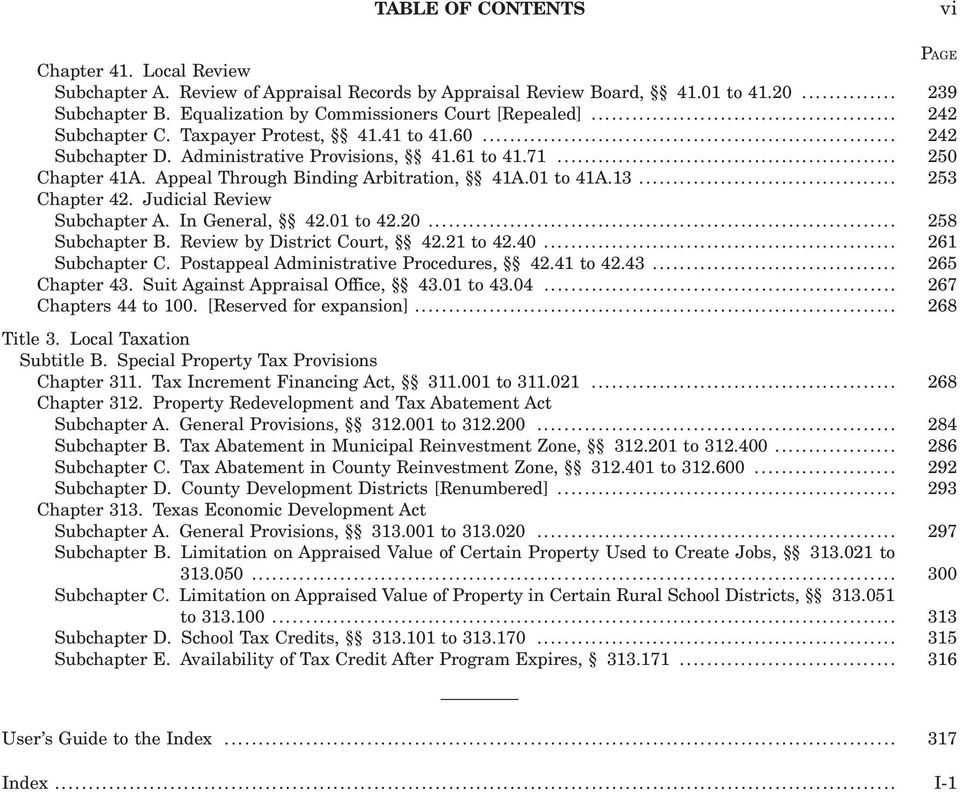
6 TABLE OF CONTENTS vi Chapter 41. Local Review Subchapter A. Review of Appraisal Records by Appraisal Review Board, to Subchapter B. Equalization by Commissioners Court [Repealed] Subchapter C. Taxpayer Protest, to Subchapter D. Administrative Provisions, to Chapter 41A. Appeal Through Binding Arbitration, 41A.01 to 41A Chapter 42. Judicial Review Subchapter A. In General, to Subchapter B. Review by District Court, to Subchapter C. Postappeal Administrative Procedures, to Chapter 43. Suit Against Appraisal Office, to Chapters 44 to 100. [Reserved for expansion] Title 3. Local Taxation Subtitle B. Special Property Tax Provisions Chapter 311. Tax Increment Financing Act, to Chapter 312. Property Redevelopment and Tax Abatement Act Subchapter A. General Provisions, to Subchapter B. Tax Abatement in Municipal Reinvestment Zone, to Subchapter C. Tax Abatement in County Reinvestment Zone, to Subchapter D. County Development Districts [Renumbered] Chapter 313. Texas Economic Development Act Subchapter A. General Provisions, to Subchapter B. Limitation on Appraised Value of Certain Property Used to Create Jobs, to Subchapter C. Limitation on Appraised Value of Property in Certain Rural School Districts, to Subchapter D. School Tax Credits, to Subchapter E. Availability of Tax Credit After Program Expires, PAGE User s Guide to the Index Index... I-1
7 TABLE OF AMENDMENTS Section Effect Chapter Tax Code 1.07 Amended Amended Amended Amended Amended Amended New Amended Amended Amended Amended New Amended New Amended Amended Amended Amended Amended New New Amended Amended Amended Amended Amended Amended New New Amended Amended Amended Amended Amended Amended Amended Amended Amended New New Amended Amended Amended Amended Amended Amended Amended Amended Amended Amended Amended New Amended Amended Amended Amended 996 Section Effect Chapter Amended Amended Amended Amended Amended Amended Amended New Amended Amended Amended Amended Amended Amended Amended Amended Amended Amended Amended Amended Amended Amended Amended Amended Amended Amended Amended Amended Amended Amended Amended Amended A.01 Amended A.03 Amended A.03 Amended A.031 Repealed A.031 Repealed A.06 Amended Amended Amended Amended Amended Amended Amended Amended Amended Amended Amended Amended Amended Repealed Repealed New New Amended Amended Amended 1304 vii

8 TABLE OF AMENDMENTS viii Section Effect Chapter Amended Amended Amended Amended Amended New Amended Amended New 1304 Section Effect Chapter Amended Amended Repealed Repealed Repealed Repealed Repealed Amended 1304
9 TEXAS PROPERTY TAX CODE TITLE 1 PROPERTY TAX CODE SUBTITLE A GENERAL PROVISIONS CHAPTER 1 GENERAL PROVISIONS Section Short Title Applicability of Title Construction of Title Definitions City Fiscal Year Effect of Weekend or Holiday Delivery of Notice Timeliness of Action by Mail or Common or Contract Carrier. Section Communication in Electronic Format Availability of Forms Rolls in Electronic Data-Processing Records Communications to Fiduciary Representation of Property Owner Median Level of Appraisal Master for Tax Suits [Renumbered] [Blank] Appraisers for Taxing Units Prohibited. Sec Short Title. This title may be cited as the Property Tax Code. (Enacted by Acts 1979, 66th Leg., ch. 841 (S.B. 621), 1, effective January 1, 1982.) Sec Applicability of Title. This title applies to a taxing unit that is created by or pursuant to any general, special, or local law enacted before or after the enactment of this title unless a law enacted after enactment of this title by or pursuant to which the taxing unit is created expressly provides that this title does not apply. This title supersedes any provision of a municipal charter or ordinance relating to property taxation. Nothing in this title invalidates or restricts the right of voters to utilize municipal-level initiative and referendum to set a tax rate, level of spending, or limitation on tax increase for that municipality. (Enacted by Acts 1979, 66th Leg., ch. 841 (S.B. 621), 1, effective January 1, 1982; am. Acts 1981, 67th Leg., 1st C.S., ch. 13 (H.B. 30), 1, effective January 1, 1982.) Sec Construction of Title. The Code Construction Act (Chapter 311, Government Code) applies to the construction of each provision of this title except as otherwise expressly provided by this title. (Enacted by Acts 1979, 66th Leg., ch. 841 (S.B. 621), 1, effective January 1, 1982; am. Acts 1985, 69th Leg., ch. 479 (S.B. 813), 72, effective September 1, 1985.) Sec Definitions. In this title: (1) Property means any matter or thing capable of private ownership. (2) Real property means: (A) land; (B) an improvement; (C) a mine or quarry; (D) a mineral in place; (E) standing timber; or (F) an estate or interest, other than a mortgage or deed of trust creating a lien on property or an interest securing payment or performance of an obligation, in a property enumerated in Paragraphs (A) through (E) of this subdivision. (3) Improvement means: (A) a building, structure, fixture, or fence erected on or affixed to land; (B) a transportable structure that is designed to be occupied for residential or business purposes, whether or not 1
10 Sec PROPERTY TAX CODE 2 it is affixed to land, if the owner of the structure owns the land on which it is located, unless the structure is unoccupied and held for sale or normally is located at a particular place only temporarily; or (C) for purposes of an entity created under Section 52, Article III, or Section 59, Article XVI, Texas Constitution, the: (i) subdivision of land by plat; (ii) installation of water, sewer, or drainage lines; or (iii) paving of undeveloped land. (3-a) Notwithstanding anything contained herein to the contrary, a manufactured home is an improvement to real property only if the owner of the home has elected to treat the manufactured home as real property pursuant to Section , Occupations Code, and a certified copy of the statement of ownership and location has been filed with the real property records of the county in which the home is located as provided in Section (d), Occupations Code. (4) Personal property means property that is not real property. (5) Tangible personal property means personal property that can be seen, weighed, measured, felt, or otherwise perceived by the senses, but does not include a document or other perceptible object that constitutes evidence of a valuable interest, claim, or right and has negligible or no intrinsic value. (6) Intangible personal property means a claim, interest (other than an interest in tangible property), right, or other thing that has value but cannot be seen, felt, weighed, measured, or otherwise perceived by the senses, although its existence may be evidenced by a document. It includes a stock, bond, note or account receivable, franchise, license or permit, demand or time deposit, certificate of deposit, share account, share certificate account, share deposit account, insurance policy, annuity, pension, cause of action, contract, and goodwill. (7) Market value means the price at which a property would transfer for cash or its equivalent under prevailing market conditions if: (A) exposed for sale in the open market with a reasonable time for the seller to find a purchaser; (B) both the seller and the purchaser know of all the uses and purposes to which the property is adapted and for which it is capable of being used and of the enforceable restrictions on its use; and (C) both the seller and purchaser seek to maximize their gains and neither is in a position to take advantage of the exigencies of the other. (8) Appraised value means the value determined as provided by Chapter 23 of this code. (9) Assessed value means, for the purposes of assessment of property for taxation, the amount determined by multiplying the appraised value by the applicable assessment ratio, but, for the purposes of determining the debt limitation imposed by Article III, Section 52, of the Texas Constitution, shall mean the market value of the property recorded by the chief appraiser. (10) Taxable value means the amount determined by deducting from assessed value the amount of any applicable partial exemption. (11) Partial exemption means an exemption of part of the value of taxable property. (12) Taxing unit means a county, an incorporated city or town (including a home-rule city), a school district, a special district or authority (including a junior college district, a hospital district, a district created by or pursuant to the Water Code, a mosquito control district, a fire prevention district, or a noxious weed control district), or any other political unit of this state, whether created by or pursuant to the constitution or a local, special, or general law, that is authorized to impose and is imposing ad valorem taxes on property even if the governing body of another political unit determines the tax rate for the unit or otherwise governs its affairs. (13) Tax year means the calendar year. (14) Assessor means the officer or employee responsible for assessing property taxes as provided by Chapter 26 of this code for a taxing unit by whatever title he is designated. (15) Collector means the officer or employee responsible for collecting property taxes for a taxing unit by whatever title he is designated. (16) Possessory interest means an interest that exists as a result of possession or exclusive use or a right to possession or exclusive use of a property and that is unaccompanied by ownership of a fee simple or life estate in the property. However, possessory interest does not include an interest, whether of limited or indeterminate duration, that involves a right to exhaust a portion of a real property. (17) Conservation and reclamation district means a district created under Article III, Section 52, or Article XVI, Section 59, of the Texas Constitution, or under a statute enacted under Article III, Section 52, or Article XVI, Section 59, of the Texas Constitution. (18) Clerical error means an error: (A) that is or results from a mistake or failure in writing, copying, transcribing, entering or retrieving computer data, computing, or calculating; or (B) that prevents an appraisal roll or a tax roll from accurately reflecting a finding or determination made by the chief appraiser, the appraisal review board, or the assessor; however, clerical error does not include an error that is or results from a mistake in judgment or reasoning in the making of the finding or determination. (19) Comptroller means the Comptroller of Public Accounts of the State of Texas. (Enacted by Acts 1979, 66th Leg., ch. 841 (S.B. 621), 1, effective January 1, 1982; am. Acts 1981, 67th Leg., 1st C.S., ch. 13 (S.B. 17), 2, effective January 1, 1982; am. Acts 1987, 70th Leg., ch. 984 (S.B. 1315), 25, effective June 19,

11 3 GENERAL PROVISIONS Sec ; am. Acts 1989, 71st Leg., ch (H.B. 2301), 1, effective January 1, 1990; am. Acts 1991, 72nd Leg., ch. 20 (S.B. 351), 13, effective August 26, 1991; am. Acts 1991, 72nd Leg., ch. 393 (S.B. 514), 1, effective June 10, 1991; am. Acts 1991, 72nd Leg., ch. 843 (S.B 984), 6, effective September 1, 1991; am. Acts 1991, 72nd Leg., 1st C.S., ch. 14 (H.B. 169), 8.01(22), effective Nov. 12, 1991; am. Acts 1993, 73rd Leg., ch. 347 (S.B. 7), 4.04, effective May 31, 1993; am. Acts 1997, 75th Leg., ch (S.B. 1865), 52, effective September 1, 1997; am. Acts 2005, 79th Leg., ch (H.B. 2438), 30, effective June 18, 2005.) Sec City Fiscal Year. The governing body of a home-rule city may establish by ordinance a fiscal year different from that fixed in its charter if a different fiscal year is desirable to adapt budgeting and other fiscal activities to the tax cycle required by this title. (Enacted by Acts 1979, 66th Leg., ch. 841 (S.B. 621), 1, effective January 1, 1982.) Sec Effect of Weekend or Holiday. If the last day for the performance of an act is a Saturday, Sunday, or legal state or national holiday, the act is timely if performed on the next regular business day. (Enacted by Acts 1979, 66th Leg., ch. 841 (S.B. 621), 1, effective January 1, 1982.) Sec Delivery of Notice. (a) An official or agency required by this title to deliver a notice to a property owner may deliver the notice by regular first-class mail, with postage prepaid, unless this section or another provision of this title requires or authorizes a different method of delivery or the parties agree that the notice must be delivered as provided by Section (b) The official or agency shall address the notice to the property owner, the person designated under Section 1.111(f) to receive the notice for the property owner, if that section applies, or, if appropriate, the property owner s agent at the agent s address according to the most recent record in the possession of the official or agency. However, if a property owner files a written request with the appraisal district that notices be sent to a particular address, the official or agency shall send the notice to the address stated in the request. (c) A notice permitted to be delivered by first-class mail by this section is presumed delivered when it is deposited in the mail. This presumption is rebuttable when evidence of failure to receive notice is provided. (d) [2 Versions: Effective Until January 1, 2014] A notice required by Section 11.45(d), 23.44(d), 23.57(d), 23.79(d), or 23.85(d) must be sent by certified mail. (d) [2 Versions: Effective January 1, 2014] A notice required by Section 11.45(d), 23.44(d), 23.46(c), 23.54(e), (c), 23.55(e), 23.57(d), 23.76(e), 23.79(d), or 23.85(d) must be sent by certified mail. (Enacted by Acts 1979, 66th Leg., ch. 841 (S.B. 621), 1, effective January 1, 1982; am. Acts 1983, 68th Leg., ch. 885 (H.B. 1447), 1, effective January 1, 1984; am. Acts 1989, 71st Leg., ch. 796 (H.B. 432), 1, effective September 1, 1989; am. Acts 1997, 75th Leg., ch (S.B. 841), 1, effective January 1, 1998; am. Acts 1999, 76th Leg., ch. 441 (S.B. 1209), 1, effective September 1, 1999; am. Acts 2005, 79th Leg., ch (H.B. 2491), 1, effective September 1, 2005; am. Acts 2011, 82nd Leg., ch. 483 (H.B. 843), 1, effective January 1, 2012; am. Acts 2013, 83rd Leg., ch. 230 (H.B. 242), 1, effective January 1, 2014.) Sec Timeliness of Action by Mail or Common or Contract Carrier. When a property owner is required by this title to make a payment or to file or deliver a report, application, statement, or other document or paper by a specified due date, the property owner s action is timely if it is properly addressed with postage or handling charges prepaid and: (1) it is sent by regular first-class mail and bears a post office cancellation mark of a date earlier than or on the specified due date and within the specified period; (2) it is sent by common or contract carrier and bears a receipt mark indicating a date earlier than or on the specified due date and within the specified period; or (3) it is sent by regular first-class mail or common or contract carrier and the property owner furnishes satisfactory proof that it was deposited in the mail or with the common or contract carrier on or before the specified due date and within the specified period. (Enacted by Acts 1979, 66th Leg., ch. 841 (S.B. 621), 1, effective January 1, 1982; am. Acts 2005, 79th Leg., ch. 412 (S.B. 1652), 2, effective September 1, 2005; am. Acts 2013, 83rd Leg., ch. 779 (S.B. 1224), 1, effective June 14, 2013.) Sec Communication in Electronic Format. (a) Notwithstanding any other provision in this title and except as provided by this section, any notice, rendition, application form, or completed application that is required or permitted by this title to be delivered between a chief appraiser, an appraisal district, an appraisal review board, or any combination of those persons and a property owner or between a chief appraiser, an appraisal district, an appraisal review board, or any combination of those persons and a person designated by a property owner under Section 1.111(f) may be delivered in an electronic format if the chief appraiser and the property owner or person designated by the owner agree under this section. (b) An agreement between a chief appraiser and a property owner, or the person designated by the owner under Section 1.111(f), must:
12 Sec PROPERTY TAX CODE 4 (1) be in writing or in an electronic form; (2) be signed by the chief appraiser; (3) be signed by the property owner or person designated by the owner in a form acceptable to the chief appraiser; and (4) specify: (A) the medium of communication; (B) the type of communication covered; (C) the means for protecting the security of a communication; (D) the means for confirming delivery of a communication; and (E) the electronic mail address of the property owner or person designated by the property owner, as applicable. (c) An agreement may address other matters. (d) Unless otherwise provided by an agreement, the delivery of any information in an electronic format is effective on receipt by a chief appraiser, an appraisal district, an appraisal review board, a property owner, or a person designated by a property owner. An agreement entered into under this section remains in effect until rescinded in writing by the property owner or person designated by the owner. (e) The comptroller by rule: (1) shall prescribe acceptable media, formats, content, and methods for the electronic transmission of notices required by Section 25.19; and (2) may prescribe acceptable media, formats, content, and methods for the electronic transmission of other notices, renditions, and applications. (f) In an agreement entered into under this section, a chief appraiser may select the medium, format, content, and method to be used by the appraisal district from among those prescribed by the comptroller under Subsection (e). If the comptroller has not prescribed the media, format, content, and method applicable to the communication, the chief appraiser may determine the medium, format, content, and method to be used. (g) Notwithstanding Subsection (a), if a property owner whose property is included in 25 or more accounts in the appraisal records of the appraisal district requests the chief appraiser to enter into an agreement for the delivery of the notice required by Section in an electronic format, the chief appraiser must enter into an agreement under this section for that purpose if the appraisal district is located in a county that has a population of more than 200,000. If the chief appraiser must enter into an agreement under this subsection, the chief appraiser shall deliver the notice in accordance with an electronic medium, format, content, and method prescribed by the comptroller under Subsection (e). If the comptroller has not prescribed the media, format, content, and method applicable to the notice, the chief appraiser may determine the medium, format, content, and method to be used. (h) This subsection applies to the chief appraiser of an appraisal district only if the appraisal district is located in a county described by Subsection (g) or the chief appraiser has decided to authorize electronic communication under this section and the appraisal district has implemented a system that allows such communication. The chief appraiser shall provide notice regarding the availability of agreement forms authorizing electronic communication under this section. The chief appraiser shall provide the notice by: (1) publishing a notice in a newspaper having general circulation in the district at least once on or before February 1 of each year that includes the words Notice of Availability of Electronic Communications ; or (2) delivering the agreement form on or before February 1, or as soon as practicable after that date, to each owner of property shown on the certified appraisal roll for the preceding tax year and on or before February 1 of each subsequent year, or as soon as practicable after that date, to each new owner of property shown on the certified appraisal roll for the preceding tax year. (i) A property owner or a person designated by the property owner who enters into an agreement under this section that has not been rescinded shall notify the appraisal district of a change in the electronic mail address specified in the agreement before the first April 1 that occurs following the change. If notification is not received by the appraisal district before that date, until notification is received, any notices delivered under the agreement to the property owner or person designated by the owner are considered to be timely delivered. (j) An electronic signature that is included in any notice, rendition, application form, or completed application subject to an agreement under this section and that is required by Chapters 11, 22, 23, 24, 25, 26, and 41 shall be considered to be a digital signature for purposes of Section , Government Code, and that section applies to the electronic signature. (k) Unless the chief appraiser is required to enter an agreement under this section, a decision by the chief appraiser not to enter into an agreement under this section may not be reviewed by the appraisal review board or be the subject of: (1) a suit to compel; (2) a protest under Section 41.41; (3) an appeal under Chapter 42; or (4) a complaint under Chapter 1151, Occupations Code. (l) Unless the chief appraiser and the property owner or person designated by the owner agree otherwise under Subsection (b), the chief appraiser, appraisal district, or appraisal review board shall deliver a notice electronically in a manner that allows for confirmation of receipt by the property owner or the person designated by the owner, such as

13 5 GENERAL PROVISIONS Sec electronic mail. If confirmation of receipt is not received by the 30th day following the date the electronic notice is delivered, the chief appraiser, appraisal district, or appraisal review board, as applicable, shall deliver the notice to the property owner or the person designated by the owner in the manner provided by Section (Enacted by Acts 1999, 76th Leg., ch. 441 (S.B. 1209), 2, effective September 1, 1999; effective January 1, 2005am. Acts 2003, 78th Leg., ch. 984 (S.B. 1833), 1, effective January 1, 2005; am. Acts 2003, 78th Leg., ch (S.B. 340), 1, effective January 1, 2005; am. Acts 2005, 79th Leg., ch. 412 (S.B. 1652), 3, 18, effective September 1, 2005; am. Acts 2011, 82nd Leg., ch. 831 (H.B. 3216), 1, effective September 1, 2011; am. Acts 2013, 83rd Leg., ch. 229 (H.B. 241), 1, effective September 1, 2013.) Sec Availability of Forms. When a property owner is required by this title to use a form, the office or agency with which the form is filed shall make printed and electronic versions of the forms readily and timely available and shall furnish a property owner a form without charge. (Enacted by Acts 1979, 66th Leg., ch. 841 (S.B. 621), 1, effective January 1, 1982; am. Acts 2003, 78th Leg., ch. 984 (S.B. 1833), 2; am. Acts 2003, 78th Leg., ch (S.B. 340), 2, effective January 1, 2005.) Sec Rolls in Electronic Data-Processing Records. The appraisal roll for an appraisal district and the appraisal roll or the tax roll for the unit may be retained in electronic data-processing equipment. However, a physical document for each must be prepared and made readily available to the public. (Enacted by Acts 1979, 66th Leg., ch. 841 (S.B. 621), 1, effective January 1, 1982; am. Acts 1981, 67th Leg., 1st C.S., ch. 13 (H.B. 30), 3, effective January 1, 1982.) Sec Communications to Fiduciary. (a) On the written request of a property owner, an appraisal office or an assessor or collector shall deliver all notices, tax bills, and other communications relating to the owner s property or taxes to the owner s fiduciary. (b) To be effective, a request made under this section must be filed with the appraisal district. A request remains in effect until revoked by a written revocation filed with the appraisal district by the owner or the owner s designated agent. (Enacted by Acts 1981, 67th Leg., 1st C.S., ch. 13 (H.B. 30), 4, effective January 1, 1982; am. Acts 2005, 79th Leg., ch (H.B. 2491), 2, effective September 1, 2005; am. Acts 2013, 83rd Leg., ch. 715 (H.B. 3439), 1, effective September 1, 2013.) Sec Representation of Property Owner. (a) A property owner may designate a lessee or other person to act as the agent of the owner for any purpose under this title in connection with the property or the property owner. (b) The designation of an agent must be made by written authorization on a form prescribed by the comptroller under Subsection (h) and signed by the owner, a property manager authorized to designate agents for the owner, or another person authorized to act on behalf of the owner other than the person being designated as agent, and must clearly indicate that the person is authorized to act on behalf of the property owner in property tax matters relating to the property or the property owner. The designation may authorize the agent to represent the owner in all property tax matters or in specific property tax matters as identified in the designation. The designation does not take effect with respect to an appraisal district or a taxing unit participating in the appraisal district until a copy of the designation is filed with the appraisal district. Each appraisal district established for a county having a population of 500,000 or more shall implement a system that allows a designation to be signed and filed electronically. (c) The designation of an agent under this section remains in effect until revoked in a written revocation filed with the appraisal district by the property owner or designated agent. The designated agent revoking the designation must send notice of the revocation by certified mail to the property owner at the owner s last known address. A designation may be made to expire according to its own terms but is still subject to prior revocation by the property owner or designated agent. (d) A property owner may not designate more than one agent to represent the property owner in connection with an item of property. The designation of an agent in connection with an item of property revokes any previous designation of an agent in connection with that item of property. (e) An agreement between a property owner or the owner s agent and the chief appraiser is final if the agreement relates to a matter: (1) which may be protested to the appraisal review board or on which a protest has been filed but not determined by the board; or (2) which may be corrected under Section or on which a motion for correction under that section has been filed but not determined by the board. (f) A property owner in writing filed with the appraisal district may direct the appraisal district, appraisal review board, and each taxing unit participating in the appraisal district to deliver all notices, tax bills, orders, and other communications relating to one or more specified items of the owner s property to a specified person instead of to the

14 Sec PROPERTY TAX CODE 6 property owner. The instrument must clearly identify the person by name and give the person s address to which all notices, tax bills, orders, and other communications are to be delivered. The property owner may but is not required to designate the person s agent for other tax matters designated under Subsection (a) as the person to receive all notices, tax bills, orders, and other communications. The designation of an agent for other tax matters under Subsection (a) may also provide that the agent is the person to whom notices, tax bills, orders, and other communications are to be delivered under this subsection. (g) An appraisal district, appraisal review board, or taxing unit may not require a person to designate an agent to represent the person in a property tax matter other than as provided by this section. (h) The comptroller shall prescribe forms and adopt rules to facilitate compliance with this section. The comptroller shall include on any form used for designation of an agent for a single-family residential property in which the property owner resides the following statement in boldfaced type: In some cases, you may want to contact your appraisal district or other local taxing units for free information and/or forms concerning your case before designating an agent. (i) An appraisal review board shall accept and consider a motion or protest filed by an agent of a property owner if an agency authorization is filed at or before the hearing on the motion or protest. (j) An individual exempt from registration as a property tax consultant under Section , Occupations Code, who is not supervised, directed, or compensated by a person required to register as a property tax consultant under that chapter and who files a protest with the appraisal review board on behalf of the property owner is entitled to receive all notices from the appraisal district and appraisal review board regarding the property subject to the protest until the authority is revoked by the property owner as provided by this section. An individual to which this subsection applies who is not designated by the property owner to receive notices, tax bills, orders, and other communications as provided by Subsection (f) or Section 1.11 shall file a statement with the protest that includes: (1) the individual s name and address; (2) a statement that the individual is acting on behalf of the property owner; and (3) a statement of the basis for the individual s exemption from registration under Section , Occupations Code. (k) On written request by the chief appraiser, an agent who electronically submits a designation of agent form shall provide the chief appraiser information concerning: (1) the electronic signature of the person who signed the form; (2) the date the person signed the form; and (3) the Internet Protocol address of the computer the person used to complete the form. (l) A person may not knowingly make a false entry in, or false alteration of, a designation of agent form that has been signed as provided by Subsection (b). (Enacted by Acts 1987, 70th Leg., ch. 435 (S.B. 1352), 1, effective January 1, 1988; am. Acts 1989, 71st Leg., ch. 796 (H.B. 432), 2, effective September 1, 1989; am. Acts 1991, 72nd Leg., 2nd C.S., ch. 6 (S.B. 45), 1, effective September 1, 1991; am. Acts 1993, 73rd Leg., ch. 981 (H.B. 2716), 1, effective January 1, 1994; am. Acts 1993, 73rd Leg., ch (S.B. 893), 1, effective September 1, 1993; am. Acts 1997, 75th Leg., ch. 349 (S.B. 1014), 1, effective September 1, 1997; am. Acts 2009, 81st Leg., ch. 156 (H.B. 1203), 1, effective May 26, 2009; am. Acts 2009, 81st Leg., ch (H.B. 1030), 1, effective June 19, 2009; am. Acts 2011, 82nd Leg., ch. 771 (H.B. 1887), 1, effective September 1, 2011; am. Acts 2011, 82nd Leg., ch. 831 (H.B. 3216), 2, effective September 1, 2011; am. Acts 2013, 83rd Leg., ch. 715 (H.B. 3439), 2, effective September 1, 2013.) Sec Median Level of Appraisal. (a) For purposes of this title, the median level of appraisal is the median appraisal ratio of a reasonable and representative sample of properties in an appraisal district or, for purposes of Section or 42.26, of a sample of properties specified by that section. (b) An appraisal ratio is the ratio of a property s appraised value as determined by the appraisal office or appraisal review board, as applicable, to: (1) the appraised value of the property according to law if the property qualifies for appraisal for tax purposes according to a standard other than market value; or (2) the market value of the property if Subdivision (1) of this subsection does not apply. (c) The median appraisal ratio for a sample of properties is, in a numerically ordered list of the appraisal ratios for the properties: (1) if the sample contains an odd number of properties, the appraisal ratio above and below which there is an equal number of appraisal ratios in the list; or (2) if the sample contains an even number of properties, the average of the two consecutive appraisal ratios above and below which there is an equal number of appraisal ratios in the list. (d) For purposes of this section, the appraisal ratio of a homestead to which Section applies is the ratio of the property s market value as determined by the appraisal district or appraisal review board, as applicable, to the market value of the property according to law. The appraisal ratio is not calculated according to the appraised value of the property as limited by Section (Enacted by Acts 1981, 67th Leg., 1st C.S., ch. 13 (H.B. 30), 5, effective January 1, 1982; am. Acts 1983, 68th Leg., ch. 877 (H.B. 1395), 1, effective January 1, 1984; am. Acts 1985, 69th Leg., ch. 823 (S.B. 908), 1, effective January

15 7 STATE ADMINISTRATION Sec , 1986; am. Acts 1989, 71st Leg., ch. 796 (H.B. 432), 3, effective June 15, 1989; am. Acts 1997, 75th Leg., ch (S.B. 841), 46, effective January 1, 1998.) Sec Master for Tax Suits [Renumbered]. Renumbered to Tex. Tax Code by Acts 1991, 72nd Leg., ch. 525 (H.B. 2197), 1, effective September 1, Sec [Blank]. Sec Appraisers for Taxing Units Prohibited. A taxing unit may not employ any person for the purpose of appraising property for taxation purposes except to the extent necessary to perform a contract under Section 6.05(b) of this code. (Enacted by Acts 1983, 68th Leg., ch (H.B. 2284), 1, effective October 1, 1985; am. Acts 1987, 70th Leg., ch. 167 (S.B. 892), 5.01(a)(50), effective September 1, 1987 (renumbered from Sec. 1.13).) CHAPTERS 2 TO 4 [RESERVED FOR EXPANSION] SUBTITLE B PROPERTY TAX ADMINISTRATION CHAPTER 5 STATE ADMINISTRATION Section State Property Tax Board [Repealed] Grounds for Removal of Board Members [Repealed] Board Personnel [Repealed] Equal Employment Opportunity Policy [Repealed] Restrictions on Board Membership and Employment [Repealed] Powers and Duties Generally Training and Education of Appraisers Training of Appraisal Review Board Members Required Training for Chief Appraisers Appraisal Manuals and Other Materials Explanation of Taxpayer Remedies Property Tax Forms and Records Systems. Section Professional and Technical Assistance Biennial Reports Ratio Studies Technical Advisory Committee [Repealed] Review of Appraisal Districts [Effective January 1, 2014] Appraisal Review Board Oversight Sunset Provision [Repealed] Performance Audit of Appraisal District Administration of Performance Audits Public Access, Information, and Complaints Examinations [Repealed] Administrative Provisions. Sec State Property Tax Board [Repealed]. Repealed by Acts 1991, 72nd Leg., 2nd C.S., ch. 6 (S.B. 45), 66, effective January 8, (Enacted by Acts 1979, 66th Leg., ch. 841 (S.B. 621), 1, effective January 1, 1982; am. Acts 1989, 71st Leg., ch. 384 (S.B. 531), 1, effective September 1, 1989.) Sec Grounds for Removal of Board Members [Repealed]. Repealed by Acts 1991, 72nd Leg., 2nd C.S., ch. 6 (S.B. 45), 66, effective January 8, (Enacted by Acts 1985, 69th Leg., ch. 729 (H.B. 1585), 13, effective September 1, 1985; am. Acts 1987, 70th Leg., ch. 167 (S.B. 892), 2.20(45), effective September 1, 1987; am. Acts 1989, 71st Leg., ch. 384 (S.B. 531), 11, effective September 1, 1989.) Sec Board Personnel [Repealed]. Repealed by Acts 1991, 72nd Leg., 2nd C.S., ch. 6 (S.B. 45), 66, effective January 8, (Enacted by Acts 1979, 66th Leg., ch. 841 (S.B. 621), 1, effective January 1, 1982; am. Acts 1989, 71st Leg., ch. 384 (S.B. 531), 3, effective September 1, 1989.) Sec Equal Employment Opportunity Policy [Repealed]. Repealed by Acts 1991, 72nd Leg., 2nd C.S., ch. 6 (S.B. 45), 66, effective January 8, (Enacted by Acts 1989, 71st Leg., ch. 384 (S.B. 531), 4, effective September 1, 1989.) Sec Restrictions on Board Membership and Employment [Repealed]. Repealed by Acts 1991, 72nd Leg., 2nd C.S., ch. 6 (S.B. 45), 66, effective January 8, (Enacted by Acts 1989, 71st Leg., ch. 384 (S.B. 531), 5, effective September 1, 1989.)

16 Sec PROPERTY TAX CODE 8 Sec Powers and Duties Generally. (a) The comptroller shall adopt rules establishing minimum standards for the administration and operation of an appraisal district. The minimum standards may vary according to the number of parcels and the kinds of property the district is responsible for appraising. (b) The comptroller may require from each district engaged in appraising property for taxation an annual report on a form prescribed by the comptroller on the administration and operation of the appraisal office. (c) The comptroller may contract with consultants to assist in performance of the duties imposed by this chapter. (Enacted by Acts 1979, 66th Leg., ch. 841 (S.B. 621), 1, effective January 1, 1980; am. Acts 1981, 67th Leg., 1st C.S., ch. 13 (H.B. 30), 6, effective January 1, 1982; am. Acts 1991, 72nd Leg., 2nd C.S., ch. 6 (S.B. 45), 2, effective September 1, 1991.) Sec Training and Education of Appraisers. (a) The comptroller shall enter into a memorandum of understanding with the Texas Department of Licensing and Regulation or any successor agency responsible for certifying tax professionals in this state in setting standards for and approving curricula and materials for use in training and educating appraisers and assessor-collectors, and the comptroller may contract or enter into a memorandum of understanding with other public agencies, educational institutions, or private organizations in sponsoring courses of instruction and training programs. (b) An appraisal district shall reimburse an employee of the appraisal office for all actual and necessary expenses, tuition and other fees, and costs of materials incurred in attending, with approval of the chief appraiser, a course or training program sponsored or approved by the Texas Department of Licensing and Regulation. (Enacted by Acts 1979, 66th Leg., ch. 841 (S.B. 621), 1, effective January 1, 1980; am. Acts 1981, 67th Leg., 1st C.S., ch. 13 (H.B. 30), 7, effective January 1, 1982; am. Acts 1991, 72nd Leg., 2nd C.S., ch. 6 (S.B. 45), 2, effective September 1, 1991; am. Acts 2009, 81st Leg., ch. 450 (H.B. 2447), 40, effective September 1, 2009.) Sec Training of Appraisal Review Board Members. (a) The comptroller shall: (1) approve curricula and provide materials for use in training and educating members of an appraisal review board; (2) supervise a comprehensive course for training and education of appraisal review board members and issue certificates indicating course completion; (3) make all materials for use in training and educating members of an appraisal review board freely available online; (4) establish and maintain a toll-free telephone number that appraisal review board members may call for answers to technical questions relating to the duties and responsibilities of appraisal review board members and property appraisal issues; and (5) provide, as feasible, online technological assistance to improve the operations of appraisal review boards and appraisal districts. (b) A member of the appraisal review board established for an appraisal district must complete the course established under Subsection (a). A member of the appraisal review board may not participate in a hearing conducted by the board unless the person has completed the course established under Subsection (a) and received a certificate of course completion. (b-1) [Effective January 1, 2014] At the conclusion of a course established under Subsection (a), each member of an appraisal review board in attendance shall complete a statement, on a form prescribed by the comptroller, indicating that the member will comply with the requirements of this title in conducting hearings. (c) The comptroller may contract with service providers to assist with the duties imposed under Subsection (a), but the course required may not be provided by an appraisal district, the chief appraiser or another employee of an appraisal district, a member of the board of directors of an appraisal district, a member of an appraisal review board, or a taxing unit. The comptroller may assess a fee to recover a portion of the costs incurred for the training course, but the fee may not exceed $50 per person trained. (d) The course material for the course required under Subsection (a) is the comptroller s Appraisal Review Board Manual in use on the effective date of this section. The manual shall be updated regularly. It may be revised on request, in writing, to the comptroller. The revision language must be approved on the unanimous agreement of a committee selected by the comptroller and representing, equally, taxpayers and chief appraisers. The person requesting the revision shall pay the costs of mediation if the comptroller determines that mediation is required. (e) Notwithstanding the provisions of Subsection (b), an appraisal review board member appointed after a course offering may continue to serve until the completion of the subsequent course offering. (e-1) In addition to the course established under Subsection (a), the comptroller shall approve curricula and provide materials for use in a continuing education course for members of an appraisal review board. The curricula and materials must include information regarding: (1) the cost, income, and market data comparison methods of appraising property; (2) the appraisal of business personal property; (3) the determination of capitalization rates for property appraisal purposes;
17 9 STATE ADMINISTRATION Sec (4) the duties of an appraisal review board; (5) the requirements regarding the independence of an appraisal review board from the board of directors and the chief appraiser and other employees of the appraisal district; (6) the prohibitions against ex parte communications applicable to appraisal review board members; (7) the Uniform Standards of Professional Appraisal Practice; (8) the duty of the appraisal district to substantiate the district s determination of the value of property; (9) the requirements regarding the equal and uniform appraisal of property; (10) the right of a property owner to protest the appraisal of the property as provided by Chapter 41; and (11) a detailed explanation of each of the actions described by Sections 25.25, 41.41(a), , , , 41.42, and so that members are fully aware of each of the grounds on which a property appraisal can be appealed. (e-2) [2 Versions: Effective Until January 1, 2014] As soon as practicable after the beginning of the second year of an appraisal review board member s term of office, the member must successfully complete the course established under Subsection (e-1). A person who fails to timely complete the course established under Subsection (e-1) may not be reappointed to an additional term on the appraisal review board. If the person is reappointed to an additional term on the appraisal review board, the person must successfully complete the course established under Subsection (e-1) in each year the member continues to serve. (e-2) [2 Versions: Effective January 1, 2014] During the second year of an appraisal review board member s term of office, the member must successfully complete the course established under Subsection (e-1). At the conclusion of the course, the member must complete a statement described by Subsection (b-1). A person may not participate in a hearing conducted by the board, vote on a determination of a protest, or be reappointed to an additional term on the board until the person has completed the course established under Subsection (e-1) and has received a certificate of course completion. If the person is reappointed to an additional term on the appraisal review board, the person must successfully complete the course established under Subsection (e-1) and comply with the other requirements of this subsection in each year the member continues to serve. (e-3) The comptroller may contract with service providers to assist with the duties imposed under Subsection (e-1), but the course required by that subsection may not be provided by an appraisal district, the chief appraiser or another employee of an appraisal district, a member of the board of directors of an appraisal district, a member of an appraisal review board, or a taxing unit. The comptroller may assess a fee to recover a portion of the costs incurred for the continuing education course, but the fee may not exceed $50 for each person trained. (f) [2 Versions: Effective Until January 1, 2014] The comptroller may not advise a property owner, a property owner s agent, an appraisal district, or an appraisal review board on a matter that the comptroller knows is the subject of a protest to the appraisal review board. (f) [2 Versions: Effective January 1, 2014] The comptroller may not advise a property owner, a property owner s agent, or the chief appraiser or another employee of an appraisal district on a matter that the comptroller knows is the subject of a protest to the appraisal review board. The comptroller may provide advice to an appraisal review board member as authorized by Subsection (a)(4) of this section or Section and may communicate with the chairman of an appraisal review board or a taxpayer liaison officer concerning a complaint filed under Section (g) Except during a hearing or other appraisal review board proceeding and as provided by Subsection (h) and Section 6.411(c-1), the following persons may not communicate with a member of an appraisal review board about a course provided under this section or any matter presented or discussed during the course: (1) the chief appraiser of the appraisal district for which the appraisal review board is established; (2) another employee of the appraisal district for which the appraisal review board is established; (3) a member of the board of directors of the appraisal district for which the appraisal review board is established; (4) an officer or employee of a taxing unit that participates in the appraisal district for which the appraisal review board is established; and (5) an attorney who represents or whose law firm represents the appraisal district or a taxing unit that participates in the appraisal district for which the appraisal review board is established. (h) An appraisal review board may retain an appraiser certified by the Texas Appraiser Licensing and Certification Board to instruct the members of the appraisal review board on valuation methodology if the appraisal district provides for the instruction in the district s budget. (Enacted by Acts 1997, 75th Leg., ch. 691 (S.B. 1017), 1, effective September 1, 1997; am. Acts 2009, 81st Leg., ch (H.B. 2317), 1, effective September 1, 2009; am. Acts 2011, 82nd Leg., ch. 771 (H.B. 1887), 2, effective September 1, 2011; am. Acts 2013, 83rd Leg., ch (H.B. 585), 2, effective January 1, 2014.) Sec Required Training for Chief Appraisers. (a) Except as provided by this section, a person may not serve as a chief appraiser for an appraisal district unless the person has completed the course of training prescribed by Section , Occupations Code. (b) A person may serve in a temporary, provisional, or interim capacity as chief appraiser for a period of up to one year without completing the training required by this section. (c) This section does not apply to a county assessor-collector who serves as chief appraiser under Section 6.05(c). (Enacted by Acts 2005, 79th Leg., ch (H.B. 2382), 2, effective July 1, 2006.)
18 Sec PROPERTY TAX CODE 10 Sec Appraisal Manuals and Other Materials. (a) The comptroller may prepare and issue publications relating to the appraisal of property and the administration of taxes, or may approve other publications relating to those matters, including materials published by The Appraisal Foundation, the International Association of Assessing Officers, or other professionally recognized organizations, for use in the administration of property taxes, including: (1) a general appraisal manual; (2) special appraisal manuals as authorized by law; (3) cost, price, and depreciation schedules as authorized by law; (4) periodic news and reference bulletins; (5) an annotated version of this title and Title 3; and (6) a handbook containing selected laws and all rules promulgated by the comptroller relating to the property tax and its administration. (b) The comptroller shall revise or supplement all materials issued by the comptroller or approve other publications periodically as necessary to keep them current. (c) The comptroller shall electronically publish all materials under this section for administering the property tax system. The comptroller shall make the materials available to local governmental officials and members of the public but may charge a reasonable fee to offset the costs of preparing, printing, and distributing the materials. (d) If the appraised value of property is at issue in a lawsuit involving property taxation, a court may not admit in evidence appraisal manuals or cost, price, and depreciation schedules, or portions thereof, that are prepared and issued pursuant to this section. The manuals or schedules may only be used for the limited purpose of impeachment in the same manner and pursuant to the same evidentiary rules as applicable to books and treatises. (Enacted by Acts 1979, 66th Leg., ch. 841 (S.B. 621), 1, effective January 1, 1980; am. Acts 1981, 67th Leg., 1st C.S., ch. 13 (H.B. 30), 8, effective January 1, 1982; am. Acts 1989, 71st Leg., ch. 384 (S.B. 531), 6, effective September 1, 1989; am. Acts 1991, 72nd Leg., 2nd C.S., ch. 6 (S.B. 45), 3, effective September 1, 1991; am. Acts 2005, 79th Leg., ch. 412 (S.B. 1652), 4, effective September 1, 2005; am. Acts 2011, 82nd Leg., 1st C.S., ch. 4 (S.B. 1), 17.02, effective September 28, 2011.) Sec Explanation of Taxpayer Remedies. The comptroller shall prepare and electronically publish a pamphlet explaining the remedies available to dissatisfied taxpayers and the procedures to be followed in seeking remedial action. The comptroller shall include in the pamphlet advice on preparing and presenting a protest. (Enacted by Acts 1979, 66th Leg., ch. 841 (S.B. 621), 1, effective January 1, 1980; am. Acts 1989, 71st Leg., ch. 384 (S.B. 531), 7, effective September 1, 1989; am. Acts 1991, 72nd Leg., 2nd C.S., ch. 6 (S.B. 45), 4, effective September 1, 1991; am. Acts 2011, 82nd Leg., 1st C.S., ch. 4 (S.B. 1), 17.03, effective September 28, 2011.) Sec Property Tax Forms and Records Systems. (a) The comptroller shall prescribe the contents of all forms necessary for the administration of the property tax system and on request shall furnish sufficient copies of model forms of each type to the appropriate local officials. The comptroller may require reimbursement for the costs of printing and distributing the forms. (b) The comptroller shall make the contents of the forms uniform to the extent practicable but may prescribe or approve additional or substitute forms for special circumstances. (c) The comptroller shall also prescribe a uniform record system to be used by all appraisal districts for the purpose of submitting data to be used in the studies required by Section 5.10 of this code and by Section , Government Code. The record system shall include a compilation of information concerning sales of real property within the boundaries of the appraisal district. The sales information maintained in the uniform record system shall be submitted annually in a form prescribed by the comptroller. (Enacted by Acts 1979, 66th Leg., ch. 841 (S.B. 621), 1, effective January 1, 1980; am. Acts 1991, 72nd Leg., 2nd C.S., ch. 6 (S.B. 45), 4, effective September 1, 1991; am. Acts 2003, 78th Leg., ch (S.B. 671), 4, effective June 20, 2003; am. Acts 2009, 81st Leg., ch. 288 (H.B. 8), 5, effective January 1, 2010.) Sec Professional and Technical Assistance. (a) The comptroller may provide professional and technical assistance on request in appraising property, installing or updating tax maps, purchasing equipment, developing recordkeeping systems, or performing other appraisal activities. The comptroller may also provide professional and technical assistance on request to an appraisal review board. The comptroller may require reimbursement for the costs of providing the assistance. (b) The comptroller may provide information to and consult with persons actively engaged in appraising property for tax purposes about any matter relating to property taxation without charge. (Enacted by Acts 1979, 66th Leg., ch. 841 (S.B. 621), 1, effective January 1, 1980; am. Acts 1981, 67th Leg., 1st C.S., ch. 13 (H.B. 30), 9, effective January 1, 1982; am. Acts 1991, 72nd Leg., 2nd C.S., ch. 6 (S.B. 45), 4, effective September 1, 1991.) Sec Biennial Reports. (a) The comptroller shall prepare a biennial report of the total appraised values and taxable values of taxable

19 11 STATE ADMINISTRATION Sec property by category and the tax rates of each county, municipality, and school district in effect for the two years preceding the year in which the report is prepared. (b) Not later than December 31 of each even-numbered year, the comptroller shall: (1) electronically publish on the comptroller s Internet website the report required by Subsection (a); and (2) notify the governor, the lieutenant governor, and each member of the legislature that the report is available on the website. (Enacted by Acts 1979, 66th Leg., ch. 841 (S.B. 621), 1, effective January 1, 1980; am. Acts 1981, 67th Leg., 1st C.S., ch. 13 (H.B. 30), 10, effective January 1, 1982; am. Acts 1989, 71st Leg., ch. 384 (S.B. 531), 8, effective September 1, 1989; am. Acts 1991, 72nd Leg., 2nd C.S., ch. 6 (S.B. 45), 5, effective September 1, 1991; am. Acts 1991, 72nd Leg., 2nd C.S., ch. 6 (S.B. 45), 66, effective October 17, 1991; am. Acts 2011, 82nd Leg., 1st C.S., ch. 4 (S.B. 1), 17.04, effective September 28, 2011.) Sec Ratio Studies. (a) At least once every two years, the comptroller shall conduct a study in each appraisal district to determine the degree of uniformity of and the median level of appraisals by the appraisal district within each major category of property. The comptroller shall publish a report of the findings of the study, including in the report the median levels of appraisal for each major category of property, the coefficient of dispersion around the median level of appraisal for each major category of property, and any other standard statistical measures that the comptroller considers appropriate. In conducting the study, the comptroller shall apply appropriate standard statistical analysis techniques to data collected as part of the study of school district taxable values required by Section , Government Code. (b) The published findings of a ratio study conducted by the comptroller shall be distributed to all members of the legislature and to all appraisal districts. (c) In conducting a study under this section, the comptroller or the comptroller s authorized representative may enter the premises of a business, trade, or profession and inspect the property to determine the existence and market value of property used for the production of income. An inspection under this subsection must be made during normal business hours or at a time mutually agreeable to the comptroller or the comptroller s authorized representative and the person in control of the premises. (Enacted by Acts 1981, 67th Leg., 1st C.S., ch. 13 (H.B. 30), 11, effective January 1, 1984; am. Acts 1983, 68th Leg., ch (H.B. 2134), 2, effective January 1, 1984; am. Acts 1985, 69th Leg., ch. 823 (S.B. 908), 2, effective January 1, 1986; am. Acts 1989, 71st Leg., ch. 384 (S.B. 531), 9, effective September 1, 1989; am. Acts 1991, 72nd Leg., ch. 843 (S.B. 984), 7, effective September 1, 1991; am. Acts 1995, 74th Leg., ch. 260 (S.B. 1), 44, effective May 30, 1995; am. Acts 2009, 81st Leg., ch. 288 (H.B. 8), 6, effective January 1, 2010.) Sec Technical Advisory Committee [Repealed]. Repealed by Acts 2009, 81st Leg., ch. 288 (H.B. 8), 11, effective January 1, (Enacted by Acts 1989, 71st Leg., ch. 384 (S.B. 531), 10, effective September 1, 1989; am. Acts 1991, 72nd Leg., ch. 843 (S.B. 984), 8, effective September 1, 1991; am. Acts 1995, 74th Leg., ch. 260 (S.B. 1), 45, effective May 30, 1995; am. Acts 2001, 77th Leg., ch. 268 (S.B. 1095), 1, effective September 1, 2001.) Sec Review of Appraisal Districts. (a) At least once every two years, the comptroller shall review the governance of each appraisal district, taxpayer assistance provided, and the operating and appraisal standards, procedures, and methodology used by each appraisal district, to determine compliance with generally accepted standards, procedures, and methodology. After consultation with the advisory committee created under Section , Government Code, the comptroller by rule may establish procedures and standards for conducting and scoring the review. (b) In conducting the review, the comptroller is entitled to access to all records and reports of the appraisal district, to copy or print any record or report of the appraisal district, and to the assistance of the appraisal district s officers and employees. (c) At the conclusion of the review, the comptroller shall, in writing, notify the appraisal district concerning its performance in the review. If the review results in a finding that an appraisal district is not in compliance with generally accepted standards, procedures, and methodology, the comptroller shall deliver a report that details the comptroller s findings and recommendations for improvement to: (1) the appraisal district s chief appraiser and board of directors; and (2) the superintendent and board of trustees of each school district participating in the appraisal district. (d) If the appraisal district fails to comply with the recommendations in the report and the comptroller finds that the board of directors of the appraisal district failed to take remedial action reasonably designed to ensure substantial compliance with each recommendation in the report before the first anniversary of the date the report was issued, the comptroller shall notify the Board of Tax Professional Examiners, or a successor to the board, which shall take action necessary to ensure that the recommendations in the report are implemented as soon as practicable. (e) Before February 1 of the year following the year in which the Board of Tax Professional Examiners, or its successor, takes action under Subsection (d), and with the assistance of the comptroller, the board shall determine whether the recommendations in the most recent report have been substantially implemented. The presiding officer of

20 Sec PROPERTY TAX CODE 12 the board shall notify the chief appraiser and the board of directors of the appraisal district in writing of the board s determination. (Enacted by Acts 1991, 72nd Leg., ch. 843 (S.B. 984), 9, effective September 1, 1991; am. Acts 1995, 74th Leg., ch. 260 (S.B. 1), 46, effective May 30, 1995; am. Acts 1997, 75th Leg., ch (S.B. 862), 65, effective September 1, 1997; am. Acts 2003, 78th Leg., ch (S.B. 671), 5, effective June 20, 2003; am. Acts 2009, 81st Leg., ch. 288 (H.B. 8), 7, effective January 1, 2010.) Sec [Effective January 1, 2014] Appraisal Review Board Oversight. (a) The comptroller shall prepare model hearing procedures for appraisal review boards. (b) The model hearing procedures shall address: (1) the statutory duties of an appraisal review board; (2) the process for conducting a hearing; (3) the scheduling of hearings; (4) the postponement of hearings; (5) the notices required under this title; (6) the determination of good cause under Section 41.44(b); (7) the determination of good cause under Sections 41.45(e) and (e-1); (8) a party s right to offer evidence and argument; (9) a party s right to examine or cross-examine witnesses or other parties; (10) a party s right to appear by an agent; (11) the prohibition of an appraisal review board s consideration of information not provided at a hearing; (12) ex parte and other prohibited communications; (13) the exclusion of evidence at a hearing as required by Section 41.67(d); (14) the postponement of a hearing as required by Section 41.66(h); (15) conflicts of interest; (16) the process for the administration of applications for membership on an appraisal review board; and (17) any other matter related to fair and efficient appraisal review board hearings. (c) The comptroller may: (1) categorize appraisal districts based on the size of the district, the number of protests filed in the district, or similar characteristics; and (2) develop different model hearing procedures for different categories of districts. (d) An appraisal review board shall follow the model hearing procedures prepared by the comptroller when establishing its procedures for hearings as required by Section 41.66(a). (e) The comptroller shall prescribe the contents of a survey form for the purpose of providing the public a reasonable opportunity to offer comments and suggestions concerning the appraisal review board established for an appraisal district. The survey form must permit a person to offer comments and suggestions concerning the matters listed in Subsection (b) or any other matter related to the fairness and efficiency of the appraisal review board. The survey form, together with instructions for completing the form and submitting the form, shall be provided to each property owner at or before each hearing on a protest conducted by an appraisal review board. The appraisal office may provide clerical assistance to the comptroller for purposes of the implementation of this subsection, including assistance in providing and receiving the survey form. The comptroller, or an appraisal office providing clerical assistance to the comptroller, may provide for the provision and submission of survey forms electronically. (f) The comptroller shall issue an annual report summarizing the survey forms submitted by property owners concerning each appraisal review board. The report may not disclose the identity of a person who submits a survey form. (Enacted by Acts 2013, 83rd Leg., ch (H.B. 585), 3, effective January 1, 2014.) Sec Sunset Provision [Repealed]. Repealed by Acts 1991, 72nd Leg., 2nd C.S., ch. 6 (S.B. 45), 66, effective January 8, (Enacted by Acts 1985, 69th Leg., ch. 729 (H.B. 1585), 13, effective September 1, 1985; am. Acts 1987, 70th Leg., ch. 167 (S.B. 892), 2.20(45), effective September 1, 1987; am. Acts 1989, 71st Leg., ch. 384 (S.B. 531), 11, effective September 1, 1989.) Sec Performance Audit of Appraisal District. (a) The comptroller shall audit the performance of an appraisal district if one or more of the following conditions exist according to each of two consecutive studies conducted by the comptroller under Section 5.10, regardless of whether the prescribed condition or conditions that exist are the same for each of those studies: (1) the overall median level of appraisal for all property in the district for which the comptroller determines a median level of appraisal is less than 0.75; (2) the coefficient of dispersion around the overall median level of appraisal of the properties used to determine the overall median level of appraisal for all property in the district for which the comptroller determines a median level of appraisal exceeds 0.30; or

21 13 STATE ADMINISTRATION Sec (3) the difference between the median levels of appraisal for any two classes of property in the district for which the comptroller determines a median level of appraisal is more than (b) At the written request of the governing bodies of a majority of the taxing units participating in an appraisal district or of a majority of the taxing units entitled to vote on the appointment of appraisal district directors, the comptroller shall audit the performance of the appraisal district. The governing bodies may request a general audit of the performance of the appraisal district or may request an audit of only one or more particular duties, practices, functions, departments, or other appraisal district matters. (c) At the written request of the owners of not less than 10 percent of the number of accounts or parcels of property in an appraisal district belonging to a single class of property, if the class constitutes at least five percent of the appraised value of taxable property within the district in the preceding year, or at the written request of the owners of property representing not less than 10 percent of the appraised value of all property in the district belonging to a single class of property, if the class constitutes at least five percent of the appraised value of taxable property in the district in the preceding year, the comptroller shall audit the performance of the appraisal district. The property owners may request a general audit of the performance of the appraisal district or may request an audit of only one or more particular duties, practices, functions, departments, or other appraisal district matters. A property owner may authorize an agent to sign a request for an audit under this subsection on the property owner s behalf. The comptroller may require a person signing a request for an audit to provide proof that the person is entitled to sign the request as a property owner or as the agent of a property owner. (d) A request for a performance audit of an appraisal district may not be made under Subsection (b) or (c) if according to each of the two most recently published studies conducted by the comptroller under Section 5.10: (1) the overall median level of appraisal for all property in the district for which the comptroller determines a median level of appraisal is more than 0.90 and less than 1.10; (2) the coefficient of dispersion around the overall median level of appraisal of the properties used to determine the overall median level of appraisal for all property in the district for which the comptroller determines a median level of appraisal is less than 0.15; and (3) the difference between the highest and lowest median levels of appraisal in the district for the classes of property for which the comptroller determines a median level of appraisal is less than (e) A request for a performance audit of an appraisal district may not be made under Subsection (b) or (c): (1) during the two years immediately following the publication of the second of two consecutive studies according to which the comptroller is required to conduct an audit of the district under Subsection (a); (2) during the year immediately following the date the results of an audit of the district conducted by the comptroller under Subsection (a) are reported to the chief appraiser of the district; or (3) during a year in which the comptroller is conducting a review of the district under Section (f) For purposes of this section, class of property means a major kind of property for which the comptroller determines a median level of appraisal under Section 5.10 of this code. (g) [Repealed by Acts 2009, 81st Leg., ch. 288 (H.B. 8), 11, effective January 1, 2010.] (h) In addition to the performance audits required by Subsections (a), (b), and (c) and the review of appraisal standards required by Section 5.102, the comptroller may audit an appraisal district to analyze the effectiveness and efficiency of the policies, management, and operations of the appraisal district. The results of the audit shall be delivered in a report that details the comptroller s findings and recommendations for improvement to the appraisal district s chief appraiser and board of directors and the governing body of each taxing unit participating in the appraisal district. The comptroller may require reimbursement by the appraisal district for some or all of the costs of the audit, not to exceed the actual costs associated with conducting the audit. (Enacted by Acts 1987, 70th Leg., ch. 860 (H.B. 354), 1, effective January 1, 1990; am. Acts 1989, 71st Leg., ch. 384 (S.B. 531), 12, effective September 1, 1989; am. Acts 1991, 72nd Leg., ch. 843 (S.B. 984), 10, effective September 1, 1991; am. Acts 2003, 78th Leg., ch (S.B. 671), 6, effective June 20, 2003; am. Acts 2009, 81st Leg., ch. 288 (H.B. 8), 8, 11, effective January 1, 2010.) Sec Administration of Performance Audits. (a) The comptroller shall complete an audit required by Section 5.12(a) within two years after the date of the publication of the second of the two studies the results of which required the audit to be conducted. The comptroller shall complete an audit requested under Section 5.12(b) or (c) as soon as practicable after the request is made. (b) The comptroller may not audit the financial condition of an appraisal district or a district s tax collections. If the request is for an audit limited to one or more particular matters, the comptroller s audit must be limited to those matters. (c) The comptroller must approve the specific plan for the performance audit of an appraisal district. Before approving an audit plan, the comptroller must provide any interested person an opportunity to appear before the comptroller and to comment on the proposed plan. Not later than the 20th day before the date the comptroller considers the plan for an appraisal district performance audit, the comptroller must notify the presiding officer of the appraisal district board of directors that the comptroller intends to consider the plan. The notice must include the time, date, and place of the meeting to consider the plan. Immediately after receiving the notice, the presiding officer shall deliver a copy of the notice to the other members of the appraisal district board of directors.
22 Sec PROPERTY TAX CODE 14 (d) In conducting a general audit, the comptroller shall consider and report on: (1) the extent to which the district complies with applicable law or generally accepted standards of appraisal or other relevant practice; (2) the uniformity and level of appraisal of major kinds of property and the cause of any significant deviations from ideal uniformity and equality of appraisal of major kinds of property; (3) duplication of effort and efficiency of operation; (4) the general efficiency, quality of service, and qualification of appraisal district personnel; and (5) except as otherwise provided by Subsection (b) of this section, any other matter included in the request for the audit. (e) In conducting the audit, the comptroller is entitled to have access at all times to the books, appraisal and other records, reports, vouchers, and other information, whether confidential or not, of the appraisal district. The comptroller may require the assistance of appraisal district officers or employees that does not interfere significantly with the ordinary functions of the appraisal district. The comptroller may rely on any analysis it has made previously relating to the appraisal district if the previous analysis is useful or relevant to the audit. (f) The comptroller shall report the results of its audit in writing to the governing body of each taxing unit that participates in the appraisal district, to the chief appraiser, and to the presiding officer of the appraisal district board of directors. If the audit was requested under Section 5.12(c) of this code, the comptroller shall also provide a report to a representative of the property owners who requested the audit. (g) If the audit is required or requested under Section 5.12(a) or (b) of this code, the appraisal district shall reimburse the comptroller for the costs incurred in conducting the audit and making its report of the audit. The costs shall be allocated among the taxing units participating in the district in the same manner as an operating expense of the district. If the audit is requested under Section 5.12(c) of this code, the property owners who requested the audit shall reimburse the comptroller for the costs incurred in conducting the audit and making its report of the audit and shall allocate the costs among those property owners in proportion to the appraised value of each property owner s property in the district or on such other basis as the property owners may agree. If the audit confirms that the median level of appraisal for a class of property exceeds 1.10 or that the median level of appraisal for a class of property varies at least 10 percent from the overall median level of appraisal for all property in the district for which the comptroller determines a median level of appraisal, within 90 days after the date a request is made by the property owners for reimbursement the appraisal district shall reimburse the property owners who requested the audit for the amount paid to the comptroller for the costs incurred in conducting the audit and making the report. Before conducting an audit under Section 5.12(c), the comptroller may require the requesting taxing units or property owners to provide the comptroller with a bond, deposit, or other financial security sufficient to cover the expected costs of conducting the audit and making the report. For purposes of this subsection, costs include expenses related to salaries, professional fees, travel, reproduction or other printing services, and consumable supplies that are directly attributable to conducting the audit. (h) At any time after the request for an audit is made, the comptroller may discontinue the audit in whole or in part if requested to do so by: (1) the governing bodies of a majority of the taxing units participating in the district, if the audit was requested by a majority of those units; (2) the governing bodies of a majority of the taxing units entitled to vote on the appointment of appraisal district directors, if the audit was requested by a majority of those units; or (3) if the audit was requested under Section 5.12(c) of this code, by the taxpayers who requested the audit. (i) The comptroller by rule may adopt procedures, audit standards, and forms for the administration of the performance audits. (Enacted by Acts 1987, 70th Leg., ch. 860 (H.B. 354), 1, effective January 1, 1990; am. Acts 1989, 71st Leg., ch. 384 (S.B. 531), 12, effective September 1, 1989 (renumbered from Sec. 5.12(c) (i)); am. Acts 1991, 72nd Leg., ch. 843 (S.B. 984), 11, effective September 1, 1991; am. Acts 2009, 81st Leg., ch. 288 (H.B. 8), 9, effective January 1, 2010.) Sec Public Access, Information, and Complaints. (a) The comptroller shall develop and implement policies that provide the public with a reasonable opportunity to submit information on any property tax issue under the jurisdiction of the comptroller. (b) The comptroller shall prepare and maintain a written plan that describes how a person who does not speak English or who has a physical, mental, or developmental disability may be provided reasonable access to the comptroller s programs. (c) The comptroller shall prepare information of public interest describing the property tax functions of the office of the comptroller and the comptroller s procedures by which complaints are filed with and resolved by the comptroller. The comptroller shall make the information available to the public and appropriate state agencies. (d) If a written complaint is filed with the comptroller that the comptroller has authority to resolve, the comptroller, at least quarterly and until final disposition of the complaint, shall notify the parties to the complaint of the status of the complaint unless notice would jeopardize an undercover investigation. (e) The comptroller shall keep an information file about each complaint filed with the comptroller that the comptroller has authority to resolve. (Enacted by Acts 1989, 71st Leg., ch. 384 (S.B. 531), 13, effective September 1, 1989; am. Acts 1991, 72nd Leg., 2nd C.S., ch. 6 (S.B. 45), 6, effective September 1, 1991.)
23 15 LOCAL ADMINISTRATION Sec Sec Examinations [Repealed]. Repealed by Acts 1991, 72nd Leg., 2nd C.S., ch. 6 (S.B. 45), 66, effective January 8, (Enacted by Acts 1989, 71st Leg., ch. 384 (S.B. 531), 13, effective September 1, 1989.) Sec Administrative Provisions. (a) The comptroller may inspect the records or other materials of an appraisal office or taxing unit, including the relevant records and materials in the possession or control of a consultant, advisor, or expert hired by the appraisal office or taxing unit, for the purpose of: (1) establishing, reviewing, or evaluating the value of or an appraisal of any property; or (2) conducting a study, review, or audit required by Section 5.10 or or by Section , Government Code. (b) On request of the comptroller, the chief appraiser or administrative head of the taxing unit shall produce the materials in the form and manner prescribed by the comptroller. (Enacted by Acts 1991, 72nd Leg., 2nd C.S., ch. 6 (S.B. 45), 7, effective September 1, 1991; am. Acts 1997, 75th Leg., ch (S.B. 862), 66, effective September 1, 1997.) CHAPTER 6 LOCAL ADMINISTRATION Subchapter A. Appraisal Districts Section Appraisal Districts Established District Boundaries Overlapping Appraisal Districts; Joint Procedures [Repealed] Board of Directors Changes in Board Membership or Selection [Blank] Recall of Director Optional Staggered Terms for Board of Directors Restrictions on Eligibility and Conduct of Board Members and Chief Appraisers and Their Relatives Interest in Certain Contracts Prohibited Participation of Conservation and Reclamation Districts in Appraisal District Matters Organization, Meetings, and Compensation Appraisal Office [Effective January 1, 2014] Appointment of Eligible Chief Appraiser by Comptroller Ownership or Lease of Real Property Taxpayer Liaison Officer Assistance to Emergency Management Authorities Appraisal District Budget and Financing Changes in Method of Financing Publication of Budget Financial Audit Taxing Unit Boundaries Notice of Optional Exemptions Designation of District Depository Disapproval of Board Actions Purchasing and Contracting Authority. Section Agricultural Appraisal Advisory Board District Records Information Provided to Texas Legislative Council Ex Parte Communications; Penalty to [Reserved]. Subchapter B. Assessors and Collectors County Assessor-Collector Assessor and Collector for Other Taxing Units Duties of Assessor and Collector [Effective January 1, 2014] Continuing Education Continuing Education Requirements [Repealed] Contracts for Assessment and Collection County Contract with Appraisal District [Repealed] Election to Consolidate Assessing and Collecting Functions Compensation for Assessment and Collection Release of Assessor and Collector from Liability Bonds for State and County Taxes Bonds for Other Taxes Attorneys Representing Taxing Units to [Reserved]. Subchapter C. Appraisal Review Board Appraisal Review Board Ex Parte Communications; Penalty Restrictions on Eligibility of Board Members Interest in Certain Contracts Prohibited Auxiliary Appraisal Review Board Members Organization, Meetings, and Compensation Personnel. SUBCHAPTER A APPRAISAL DISTRICTS Sec Appraisal Districts Established. (a) An appraisal district is established in each county. (b) The district is responsible for appraising property in the district for ad valorem tax purposes of each taxing unit that imposes ad valorem taxes on property in the district. (c) An appraisal district is a political subdivision of the state. (Enacted by 1979, 66th Leg., ch. 841 (S.B. 621), 1, effective January 1, 1982; am. Acts 1981, 67th Leg., 1st C.S., ch. 13 (H.B. 30), 12, 13, effective January 1, 1982; am. Acts 1983, 68th Leg., ch. 851 (H.B. 1203), 1, effective August 29, 1983.) Sec District Boundaries. (a) The appraisal district s boundaries are the same as the county s boundaries.
24 Sec PROPERTY TAX CODE 16 (b) This section does not preclude the board of directors of two or more adjoining appraisal districts from providing for the operation of a consolidated appraisal district by interlocal contract. (c) to (g) [Repealed by Acts 2007, 80th Leg., ch. 648 (H.B. 1010), 5(2), effective January 1, 2008.] (Enacted by Acts 1979, 66th Leg., ch. 841 (S.B. 621), 1, effective January 1, 1980; am. Acts 1981, 67th Leg., 1st C.S., ch. 13 (H.B. 30), 14, 167(a), effective January 1, 1982; am. Acts 1983, 68th Leg., ch. 117 (S.B. 433), 1, effective May 17, 1983; am. Acts 1991, 72nd Leg., ch. 20 (S.B. 351), 14, effective August 26, 1991; am. Acts 1991, 72nd Leg., ch. 391 (H.B. 2885), 13, effective August 26, 1991; am. Acts 1993, 73rd Leg., ch. 347 (S.B. 7), 4.05, effective May 31, 1993; am. Acts 1997, 75th Leg., ch. 165 (S.B. 898), 6.72, effective September 1, 1997; am. Acts 2007, 80th Leg., ch. 648 (H.B. 1010), 1, 5(2), effective January 1, 2008.) Sec Overlapping Appraisal Districts; Joint Procedures [Repealed]. Repealed by Acts 2007, 80th Leg., ch. 648 (H.B. 1010), 5(3), effective January 1, (Enacted by Acts 1995, 74th Leg., ch. 186 (H.B. 623), 1, effective January 1, 1996; am. Acts 1997, 75th Leg., ch (H.B. 670), 1, effective January 1, 1998; am. Acts 1999, 76th Leg., ch. 250 (H.B. 1037), 1, effective January 1, 2000; am. Acts 1999, 76th Leg., ch. 250 (H.B. 1037), 2, effective January 1, 2000; am. Acts 2003, 78th Leg., ch. 455 (H.B. 703), 1, effective January 1, 2004; am. Acts 2003, 78th Leg., ch (H.B. 1082), 1, effective January 1, 2004.) Sec Board of Directors. (a) The appraisal district is governed by a board of directors. Five directors are appointed by the taxing units that participate in the district as provided by this section. If the county assessor-collector is not appointed to the board, the county assessor-collector serves as a nonvoting director. The county assessor-collector is ineligible to serve if the board enters into a contract under Section 6.05(b) or if the commissioners court of the county enters into a contract under Section 6.24(b). To be eligible to serve on the board of directors, an individual other than a county assessor-collector serving as a nonvoting director must be a resident of the district and must have resided in the district for at least two years immediately preceding the date the individual takes office. An individual who is otherwise eligible to serve on the board is not ineligible because of membership on the governing body of a taxing unit. An employee of a taxing unit that participates in the district is not eligible to serve on the board unless the individual is also a member of the governing body or an elected official of a taxing unit that participates in the district. (b) Members of the board of directors other than a county assessor-collector serving as a nonvoting director serve two-year terms beginning on January 1 of even-numbered years. (c) Members of the board of directors other than a county assessor-collector serving as a nonvoting director are appointed by vote of the governing bodies of the incorporated cities and towns, the school districts, the junior college districts, and, if entitled to vote, the conservation and reclamation districts that participate in the district and of the county. A governing body may cast all its votes for one candidate or distribute them among candidates for any number of directorships. Conservation and reclamation districts are not entitled to vote unless at least one conservation and reclamation district in the district delivers to the chief appraiser a written request to nominate and vote on the board of directors by June 1 of each odd-numbered year. On receipt of a request, the chief appraiser shall certify a list by June 15 of all eligible conservation and reclamation districts that are imposing taxes and that participate in the district. (d) The voting entitlement of a taxing unit that is entitled to vote for directors is determined by dividing the total dollar amount of property taxes imposed in the district by the taxing unit for the preceding tax year by the sum of the total dollar amount of property taxes imposed in the district for that year by each taxing unit that is entitled to vote, by multiplying the quotient by 1,000, and by rounding the product to the nearest whole number. That number is multiplied by the number of directorships to be filled. A taxing unit participating in two or more districts is entitled to vote in each district in which it participates, but only the taxes imposed in a district are used to calculate voting entitlement in that district. (e) The chief appraiser shall calculate the number of votes to which each taxing unit other than a conservation and reclamation district is entitled and shall deliver written notice to each of those units of its voting entitlement before October 1 of each odd-numbered year. The chief appraiser shall deliver the notice: (1) to the county judge and each commissioner of the county served by the appraisal district; (2) to the presiding officer of the governing body of each city or town participating in the appraisal district, to the city manager of each city or town having a city manager, and to the city secretary or clerk, if there is one, of each city or town that does not have a city manager; (3) to the presiding officer of the governing body of each school district participating in the district and to the superintendent of those school districts; and (4) to the presiding officer of the governing body of each junior college district participating in the district and to the president, chancellor, or other chief executive officer of those junior college districts. (f) The chief appraiser shall calculate the number of votes to which each conservation and reclamation district entitled to vote for district directors is entitled and shall deliver written notice to the presiding officer of each conservation and reclamation district of its voting entitlement and right to nominate a person to serve as a director of the district before July 1 of each odd-numbered year. (g) Each taxing unit other than a conservation and reclamation district that is entitled to vote may nominate by resolution adopted by its governing body one candidate for each position to be filled on the board of directors. The
25 17 LOCAL ADMINISTRATION Sec presiding officer of the governing body of the unit shall submit the names of the unit s nominees to the chief appraiser before October 15. (h) Each conservation and reclamation district entitled to vote may nominate by resolution adopted by its governing body one candidate for the district s board of directors. The presiding officer of the conservation and reclamation district s governing body shall submit the name of the district s nominee to the chief appraiser before July 15 of each odd-numbered year. Before August 1, the chief appraiser shall prepare a nominating ballot, listing all the nominees of conservation and reclamation districts alphabetically by surname, and shall deliver a copy of the nominating ballot to the presiding officer of the board of directors of each district. The board of directors of each district shall determine its vote by resolution and submit it to the chief appraiser before August 15. The nominee on the ballot with the most votes is the nominee of the conservation and reclamation districts in the appraisal district if the nominee received more than 10 percent of the votes entitled to be cast by all of the conservation and reclamation districts in the appraisal district, and shall be named on the ballot with the candidates nominated by the other taxing units. The chief appraiser shall resolve a tie vote by any method of chance. (i) If no nominee of the conservation and reclamation districts receives more than 10 percent of the votes entitled to be cast under Subsection (h), the chief appraiser, before September 1, shall notify the presiding officer of the board of directors of each conservation and reclamation district of the failure to select a nominee. Each conservation and reclamation district may submit a nominee by September 15 to the chief appraiser as provided by Subsection (h). The chief appraiser shall submit a second nominating ballot by October 1 to the conservation and reclamation districts as provided by Subsection (h). The conservation and reclamation districts shall submit their votes for nomination before October 15 as provided by Subsection (h). The nominee on the second nominating ballot with the most votes is the nominee of the conservation and reclamation districts in the appraisal district and shall be named on the ballot with the candidates nominated by the other taxing units. The chief appraiser shall resolve a tie vote by any method of chance. (j) Before October 30, the chief appraiser shall prepare a ballot, listing the candidates whose names were timely submitted under Subsections (g) and, if applicable, (h) or (i) alphabetically according to the first letter in each candidate s surname, and shall deliver a copy of the ballot to the presiding officer of the governing body of each taxing unit that is entitled to vote. (k) The governing body of each taxing unit entitled to vote shall determine its vote by resolution and submit it to the chief appraiser before December 15. The chief appraiser shall count the votes, declare the five candidates who receive the largest cumulative vote totals elected, and submit the results before December 31 to the governing body of each taxing unit in the district and to the candidates. For purposes of determining the number of votes received by the candidates, the candidate receiving the most votes of the conservation and reclamation districts is considered to have received all of the votes cast by conservation and reclamation districts and the other candidates are considered not to have received any votes of the conservation and reclamation districts. The chief appraiser shall resolve a tie vote by any method of chance. (l) If a vacancy occurs on the board of directors other than a vacancy in the position held by a county assessor-collector serving as a nonvoting director, each taxing unit that is entitled to vote by this section may nominate by resolution adopted by its governing body a candidate to fill the vacancy. The unit shall submit the name of its nominee to the chief appraiser within 45 days after notification from the board of directors of the existence of the vacancy, and the chief appraiser shall prepare and deliver to the board of directors within the next five days a list of the nominees. The board of directors shall elect by majority vote of its members one of the nominees to fill the vacancy. (m) [Repealed by Acts 2007, 80th Leg., ch. 648 (H.B. 1010), 5(4), effective January 1, 2008.] (Enacted by Acts 1979, 66th Leg., ch. 841 (S.B. 621), 1; am. Acts 1981, 67th Leg., 1st C.S., ch. 13 (H.B. 30), 15, 167(a), effective January 1, 1982; am. Acts 1987, 70th Leg., ch. 59 (S.B. 469), 1, effective September 1, 1987; am. Acts 1987, 70th Leg., ch. 270 (H.B. 268), 1, effective August 31, 1987; am. Acts 1989, 71st Leg., ch (H.B. 2301), 2, effective January 1, 1990; am. Acts 1991, 72nd Leg., ch. 20 (S.B. 351), 15, effective August 26, 1991; am. Acts 1991, 72nd Leg., ch. 371 (H.B. 864), 1, effective September 1, 1991; am. Acts 1993, 73rd Leg., ch. 347 (S.B. 7), 4.06, effective May 31, 1993; am. Acts 1997, 75th Leg., ch. 165 (S.B. 898), 6.73, effective September 1, 1997; am. Acts 1997, 75th Leg., ch. 1039, 2, effective January 1, 1998; am. Acts 1999, 76th Leg., ch. 705 (H.B. 834), 1, effective January 1, 2000; am. Acts 2003, 78th Leg., ch. 629 (H.B. 2043), effective June 20, 2003; am. Acts 2007, 80th Leg., ch. 648 (H.B. 1010), 5(4), effective January 1, 2008; am. Acts 2013, 83rd Leg., ch (S.B. 359), 1, effective June 14, 2013.) Sec Changes in Board Membership or Selection. (a) The board of directors of an appraisal district, by resolution adopted and delivered to each taxing unit participating in the district before August 15, may increase the number of members on the board of directors of the district to not more than 13, change the method or procedure for appointing the members, or both, unless the governing body of a taxing unit that is entitled to vote on the appointment of board members adopts a resolution opposing the change, and files it with the board of directors before September 1. If a change is rejected, the board shall notify, in writing, each taxing unit participating in the district before September 15. (b) The taxing units participating in an appraisal district may increase the number of members on the board of directors of the district to not more than 13, change the method or procedure for appointing the members, or both, if the governing bodies of three-fourths of the taxing units that are entitled to vote on the appointment of board members adopt resolutions providing for the change. However, a change under this subsection is not valid if it reduces the voting
26 Sec PROPERTY TAX CODE 18 entitlement of one or more taxing units that do not adopt a resolution proposing it to less than a majority of the voting entitlement under Section 6.03 of this code or if it reduces the voting entitlement of any taxing unit that does not adopt a resolution proposing it to less than 50 percent of its voting entitlement under Section 6.03 of this code and if that taxing unit s allocation of the budget is not reduced to the same proportional percentage amount, or if it expands the types of taxing units that are entitled to vote on appointment of board members. (b-1) If an appraisal district increases the number of members on the board of directors of the district or changes the method or procedure for appointing the members as provided by this section, the board of directors by resolution shall provide for the junior college districts that participate in the appraisal district to collectively participate in the selection of directors in the same manner as the school district that imposes the lowest total dollar amount of property taxes in the appraisal district among all of the school districts with representation in the appraisal district. A resolution adopted under this section is not subject to rejection by a resolution opposing the change filed with the board of directors by a taxing unit under Subsection (a). (c) An official copy of a resolution under this section must be filed with the chief appraiser of the appraisal district after June 30 and before October 1 of a year in which board members are appointed or the resolution is ineffective. (d) Before October 5 of each year in which board members are appointed, the chief appraiser shall determine whether a sufficient number of eligible taxing units have filed valid resolutions proposing a change for the change to take effect. The chief appraiser shall notify each taxing unit participating in the district of each change that is adopted before October 10. (e) A change in membership or selection made as provided by this section remains in effect until changed in a manner provided by this section or rescinded by resolution of a majority of the governing bodies that are entitled to vote on appointment of board members under Section 6.03 of this code. (f) A provision of Section 6.03 of this code that is subject to change under this section but is not expressly changed by resolution of a sufficient number of eligible taxing units remains in effect. (g) For purposes of this section, the conservation and reclamation districts in an appraisal district are considered to be entitled to vote on the appointment of appraisal district directors if: (1) a conservation and reclamation district has filed a request to the chief appraiser to nominate and vote on directors in the current year as provided by Section 6.03(c); or (2) conservation and reclamation districts were entitled to vote on the appointment of directors in the appraisal district in the most recent year in which directors were appointed under Section (Enacted by Acts 1981, 67th Leg., 1st C.S., ch. 13 (H.B. 30), 16, effective January 1, 1982; am. Acts 1987, 70th Leg., ch. 59 (S.B. 469), 2, effective September 1, 1987; am. Acts 1989, 71st Leg., ch (H.B. 2301), 3, effective January 1, 1990; am. Acts 2013, 83rd Leg., ch (S.B. 359), 2, effective June 14, 2013.) Sec [Blank]. Sec Recall of Director. (a) The governing body of a taxing unit may call for the recall of a member of the board of directors of an appraisal district appointed under Section 6.03 of this code for whom the unit cast any of its votes in the appointment of the board. The call must be in the form of a resolution, be filed with the chief appraiser of the appraisal district, and state that the unit is calling for the recall of the member. If a resolution calling for the recall of a board member is filed under this subsection, the chief appraiser, not later than the 10th day after the date of filing, shall deliver a written notice of the filing of the resolution and the date of its filing to the presiding officer of the governing body of each taxing unit entitled to vote in the appointment of board members. (b) On or before the 30th day after the date on which a resolution calling for the recall of a member of the board is filed, the governing body of a taxing unit that cast any of its votes in the appointment of the board for that member may vote to recall the member by resolution submitted to the chief appraiser. Each taxing unit is entitled to the same number of votes in the recall as it cast for that member in the appointment of the board. The governing body of the taxing unit calling for the recall may cast its votes in favor of the recall in the same resolution in which it called for the recall. (c) Not later than the 10th day after the last day provided by this section for voting in favor of the recall, the chief appraiser shall count the votes cast in favor of the recall. If the number of votes in favor of the recall equals or exceeds a majority of the votes cast for the member in the appointment of the board, the member is recalled and ceases to be a member of the board. The chief appraiser shall immediately notify in writing the presiding officer of the appraisal district board of directors and of the governing body of each taxing unit that voted in the recall election of the outcome of the recall election. If the presiding officer of the appraisal district board of directors is the member whose recall was voted on, the chief appraiser shall also notify the secretary of the appraisal district board of directors of the outcome of the recall election. (d) If a vacancy occurs on the board of directors after the recall of a member of the board under this section, the taxing units that were entitled to vote in the recall election shall appoint a new board member. Each taxing unit is entitled to the same number of votes as it originally cast to appoint the recalled board member. Each taxing unit entitled to vote may nominate one candidate by resolution adopted by its governing body. The presiding officer of the governing body of the unit shall submit the name of the unit s nominee to the chief appraiser on or before the 30th day after the date
27 19 LOCAL ADMINISTRATION Sec it receives notification from the chief appraiser of the result of the recall election. On or before the 15th day after the last day provided for a nomination to be submitted, the chief appraiser shall prepare a ballot, listing the candidates nominated alphabetically according to each candidate s surname, and shall deliver a copy of the ballot to the presiding officer of the governing body of each taxing unit that is entitled to vote. On or before the 15th day after the date on which a taxing unit s ballot is delivered, the governing body of the taxing unit shall determine its vote by resolution and submit it to the chief appraiser. On or before the 15th day after the last day on which a taxing unit may vote, the chief appraiser shall count the votes, declare the candidate who received the largest vote total appointed, and submit the results to the presiding officer of the governing body of the appraisal district and of each taxing unit in the district and to the candidates. The chief appraiser shall resolve a tie vote by any method of chance. (e) If the board of directors of an appraisal district is appointed by a method or procedure adopted under Section of this code, the governing bodies of the taxing units that voted for or otherwise participated in the appointment of a member of the board may recall that member and appoint a new member to the vacancy by any method adopted by resolution of a majority of those governing bodies. If the appointment was by election, the method of recall and of appointing a new member to the vacancy is not valid unless it provides that each taxing unit is entitled to the same number of votes in the recall and in the appointment to fill the vacancy as it originally cast for the member being recalled. (Enacted by Acts 1985, 69th Leg., ch. 273 (H.B. 1202), 1, effective August 26, 1985; am. Acts 1987, 70th Leg., ch. 59 (S.B. 469), 5, effective September 1, 1987 (renumbered from Sec ).) Sec Optional Staggered Terms for Board of Directors. (a) The taxing units participating in an appraisal district may provide that the terms of the appointed members of the board of directors be staggered if the governing bodies of at least three-fourths of the taxing units that are entitled to vote on the appointment of board members adopt resolutions providing for the staggered terms. A change to staggered terms may be adopted only if the method or procedure for appointing board members is changed under Section of this code to eliminate or have the effect of eliminating cumulative voting for board members as provided by Section 6.03 of this code. A change to staggered terms may be proposed concurrently with a change that eliminates or has the effect of eliminating cumulative voting. (b) An official copy of a resolution providing for staggered terms adopted by the governing body of a taxing unit must be filed with the chief appraiser of the appraisal district after June 30 and before October 1 of a year in which board members are to be appointed, or the resolution is ineffective. (c) Before October 5 of each year in which board members are to be appointed, the chief appraiser shall determine whether a sufficient number of taxing units have filed valid resolutions proposing a change to staggered terms for the change to take effect. Before October 10 the chief appraiser shall notify each taxing unit participating in the district of a change that is adopted under this section. (d) A change to staggered terms made under this section becomes effective beginning on January 1 of the next even-numbered year after the chief appraiser determines that the change has been adopted. The entire board of directors shall be appointed for that year without regard to the staggered terms. At the earliest practical date after January 1 of that year, the board shall determine by lot which of its members shall serve one-year terms and which shall serve two-year terms in order to implement the staggered terms. If the board consists of an even number of board members, one-half of the members must be designated to serve one-year terms and one-half shall be designated to serve two-year terms. If the board consists of an odd number of board members, the number of members designated to serve two-year terms must exceed by one the number of members designated to serve one-year terms. (e) After the staggered terms have been implemented as provided by Subsection (d) of this section, the appraisal district shall appoint annually for terms to begin on January 1 of each year a number of board members equal to the number of board members whose terms expire on that January 1, unless a change in the total number of board members is adopted under Section of this code to take effect on that January 1. (f) If a change in the number of directors is adopted under Section of this code in an appraisal district that has adopted staggered terms for board members, the change must specify how many members terms are to begin in even-numbered years and how many members terms are to begin in odd-numbered years. The change may not provide that the number of members whose terms are to begin in even-numbered years differs by more than one from the number of members whose terms are to begin in odd-numbered years. (g) A change to staggered terms made as provided by this section may be rescinded by resolution of a majority of the governing bodies that are entitled to vote on appointment of board members under Section 6.03 of this code. To be effective, a resolution providing for the rescission must be adopted by the governing body and filed with the chief appraiser after June 30 and before October 1 of an odd-numbered year. If the required number of resolutions are filed during that period, the chief appraiser shall notify each taxing unit participating in the district that the rescission is adopted. If the rescission is adopted, the terms of all members of the board serving at the time of the adoption expire on January 1 of the even-numbered year following the adoption, including terms of members who will have served only one year of a two-year term on that date. The entire board of directors shall be appointed for two-year terms beginning on that date. (h) If an appraisal district that has adopted staggered terms adopts or rescinds a change in the method or procedure for appointing board members and the change or rescission results in a method of appointing board members by
28 Sec PROPERTY TAX CODE 20 cumulative voting, the change or rescission has the same effect as a rescission of the change to staggered terms made under Subsection (g) of this section. (i) If a vacancy occurs on the board of directors of an appraisal district that has adopted staggered terms for board members, the vacancy shall be filled by appointment by resolution of the governing body of the taxing unit that nominated the person whose departure from the board caused the vacancy, and the procedure for filling a vacancy provided by Section 6.03 of this code does not apply in that event. (Enacted by Acts 1985, 69th Leg., ch. 601 (S.B. 79), 1, effective June 14, 1985; am. Acts 1987, 70th Leg., ch. 59 (S.B. 469), 4, effective September 1, 1987; am. Acts 1987, 70th Leg., ch. 167 (S.B. 892), 5.01(a)(51), effective September 1, 1987 (renumbered from Sec ); am. Acts 1997, 75th Leg., ch (S.B. 841), 3, effective January 1, 1998.) Sec Restrictions on Eligibility and Conduct of Board Members and Chief Appraisers and Their Relatives. (a) An individual is ineligible to serve on an appraisal district board of directors and is disqualified from employment as chief appraiser if the individual: (1) is related within the second degree by consanguinity or affinity, as determined under Chapter 573, Government Code, to an individual who is engaged in the business of appraising property for compensation for use in proceedings under this title or of representing property owners for compensation in proceedings under this title in the appraisal district; or (2) owns property on which delinquent taxes have been owed to a taxing unit for more than 60 days after the date the individual knew or should have known of the delinquency unless: (A) the delinquent taxes and any penalties and interest are being paid under an installment payment agreement under Section 33.02; or (B) a suit to collect the delinquent taxes is deferred or abated under Section or (a-1) An individual is ineligible to serve on an appraisal district board of directors if the individual has engaged in the business of appraising property for compensation for use in proceedings under this title or of representing property owners for compensation in proceedings under this title in the appraisal district at any time during the preceding five years. (b) A member of an appraisal district board of directors or a chief appraiser commits an offense if the board member continues to hold office or the chief appraiser remains employed knowing that an individual related within the second degree by consanguinity or affinity, as determined under Chapter 573, Government Code, to the board member or chief appraiser is engaged in the business of appraising property for compensation for use in proceedings under this title or of representing property owners for compensation in proceedings under this title in the appraisal district in which the member serves or the chief appraiser is employed. An offense under this subsection is a Class B misdemeanor. (c) A chief appraiser commits an offense if the chief appraiser refers a person, whether gratuitously or for compensation, to another person for the purpose of obtaining an appraisal of property, whether or not the appraisal is for ad valorem tax purposes. An offense under this subsection is a Class B misdemeanor. (d) An appraisal performed by a chief appraiser in a private capacity or by an individual related within the second degree by consanguinity or affinity, as determined under Chapter 573, Government Code, to the chief appraiser may not be used as evidence in a protest or challenge under Chapter 41 or an appeal under Chapter 42 concerning property that is taxable in the appraisal district in which the chief appraiser is employed. (Enacted by Acts 1989, 71st Leg., ch. 796 (H.B. 432), 4, effective September 1, 1989; am. Acts 1991, 72nd Leg., ch. 561 (H.B. 1345), 43, effective August 26, 1991; am. Acts 1995, 74th Leg., ch. 76 (S.B. 959), 5.95(27), effective September 1, 1995; am. Acts 2001, 77th Leg., ch (H.B. 490), 1, effective September 1, 2001; am. Acts 2013, 83rd Leg., ch (H.B. 585), 4, effective June 14, 2013.) Sec Interest in Certain Contracts Prohibited. (a) An individual is not eligible to be appointed to or to serve on the board of directors of an appraisal district if the individual or a business entity in which the individual has a substantial interest is a party to a contract with: (1) the appraisal district; or (2) a taxing unit that participates in the appraisal district, if the contract relates to the performance of an activity governed by this title. (b) An appraisal district may not enter into a contract with a member of the board of directors of the appraisal district or with a business entity in which a member of the board has a substantial interest. (c) A taxing unit may not enter into a contract relating to the performance of an activity governed by this title with a member of the board of directors of an appraisal district in which the taxing unit participates or with a business entity in which a member of the board has a substantial interest. (d) For purposes of this section, an individual has a substantial interest in a business entity if: (1) the combined ownership of the individual and the individual s spouse is at least 10 percent of the voting stock or shares of the business entity; or (2) the individual or the individual s spouse is a partner, limited partner, or officer of the business entity. (e) In this section, business entity means a sole proprietorship, partnership, firm, corporation, holding company, joint-stock company, receivership, trust, or other entity recognized by law.
29 21 LOCAL ADMINISTRATION Sec (f) This section does not limit the application of any other law, including the common law relating to conflicts of interest, to an appraisal district director. (Enacted by Acts 1989, 71st Leg., ch. 796 (H.B. 432), 5, effective September 1, 1989.) Sec Participation of Conservation and Reclamation Districts in Appraisal District Matters. In this title, a reference to the taxing units entitled to vote on the appointment of appraisal district board members includes the conservation and reclamation districts participating in the appraisal district, without regard to whether the conservation and reclamation districts are currently entitled to do so under Section 6.03(c). In a provision of this title other than Section 6.03 or that grants authority to a majority or other number of the taxing units entitled to vote on the appointment of appraisal district directors, including the disapproval of the appraisal district budget under Section 6.06 and the disapproval of appraisal district board actions under Section 6.10, the conservation and reclamation districts participating in the appraisal district are given the vote or authority of one taxing unit. That vote or authority is considered exercised only if a majority of the conservation and reclamation districts take the same action to exercise that vote or authority. Otherwise, the conservation and reclamation districts are treated in the same manner as a single taxing unit that is entitled to act but does not take any action on the matter. (Enacted by Acts 1989, 71st Leg., ch (H.B. 2301), 4, effective January 1, 1990; am. Acts 1990, 71st Leg., 6th C.S., ch. 12 (S.B. 51), 2(28), effective September 6, 1990 (renumbered from Sec ).) Sec Organization, Meetings, and Compensation. (a) A majority of the appraisal district board of directors constitutes a quorum. At its first meeting each calendar year, the board shall elect from its members a chairman and a secretary. (b) The board may meet at any time at the call of the chairman or as provided by board rule, but may not meet less often than once each calendar quarter. (c) Members of the board may not receive compensation for service on the board but are entitled to reimbursement for actual and necessary expenses incurred in the performance of their duties as provided by the budget adopted by the board. (d) The board shall develop and implement policies that provide the public with reasonable opportunity to appear before the board to speak on any issue under the jurisdiction of the board. Reasonable time shall be provided during each board meeting for public comment on appraisal district and appraisal review board policies and procedures, and a report from the taxpayer liaison officer if one is required by Section (e) The board shall prepare and maintain a written plan that describes how a person who does not speak English or who has a physical, mental, or developmental disability may be provided reasonable access to the board. (f) The board shall prepare information of public interest describing the functions of the board and the board s procedures by which complaints are filed with and resolved by the board. The board shall make the information available to the public and the appropriate taxing jurisdictions. (g) If a written complaint is filed with the board that the board has authority to resolve, the board, at least quarterly and until final disposition of the complaint, shall notify the parties to the complaint of the status of the complaint unless notice would jeopardize an undercover investigation. (Enacted by Acts 1979, 66th Leg., ch. 841 (S.B. 621), 1, effective January 1, 1980; am. Acts 1983, 68th Leg., ch. 262 (H.B. 532), 1, effective August 29, 1983; am. Acts 1989, 71st Leg., ch. 796 (H.B. 1464), 6, effective September 1, 1989.) Sec Appraisal Office. (a) Except as authorized by Subsection (b) of this section, each appraisal district shall establish an appraisal office. The appraisal office must be located in the county for which the district is established. An appraisal district may establish branch appraisal offices outside the county for which the district is established. (b) The board of directors of an appraisal district may contract with an appraisal office in another district or with a taxing unit in the district to perform the duties of the appraisal office for the district. (c) [2 Versions: Effective Until January 1, 2014] The chief appraiser is the chief administrator of the appraisal office. The chief appraiser is appointed by and serves at the pleasure of the appraisal district board of directors. If a taxing unit performs the duties of the appraisal office pursuant to a contract, the assessor for the unit is the chief appraiser. (c) [2 Versions: Effective January 1, 2014] The chief appraiser is the chief administrator of the appraisal office. Except as provided by Section , the chief appraiser is appointed by and serves at the pleasure of the appraisal district board of directors. If a taxing unit performs the duties of the appraisal office pursuant to a contract, the assessor for the unit is the chief appraiser. To be eligible to be appointed or serve as a chief appraiser, a person must be certified as a registered professional appraiser under Section , Occupations Code, possess an MAI professional designation from the Appraisal Institute, or possess an Assessment Administration Specialist (AAS), Certified Assessment Evaluator (CAE), or Residential Evaluation Specialist (RES) professional designation from the International Association of Assessing Officers. A person who is eligible to be appointed or serve as a chief appraiser by having a professional designation described by this subsection must become certified as a registered professional appraiser
30 Sec PROPERTY TAX CODE 22 under Section , Occupations Code, not later than the fifth anniversary of the date the person is appointed or begins to serve as chief appraiser. A chief appraiser who is not eligible to be appointed or serve as chief appraiser may not perform an action authorized or required by law to be performed by a chief appraiser, including the preparation, certification, or submission of any part of the appraisal roll. Not later than January 1 of each year, a chief appraiser shall notify the comptroller in writing that the chief appraiser is either eligible to be appointed or serve as the chief appraiser or not eligible to be appointed or serve as the chief appraiser. (d) [2 Versions: Effective Until January 1, 2014] The chief appraiser is entitled to compensation as provided by the budget adopted by the board of directors. The chief appraiser s compensation may not be directly or indirectly linked to an increase in the total market, appraised, or taxable value of property in the appraisal district. The chief appraiser may employ and compensate professional, clerical, and other personnel as provided by the budget, with the exception of a general counsel to the appraisal district. (d) [2 Versions: Effective January 1, 2014] Except as provided by Section , the chief appraiser is entitled to compensation as provided by the budget adopted by the board of directors. The chief appraiser s compensation may not be directly or indirectly linked to an increase in the total market, appraised, or taxable value of property in the appraisal district. Except as provided by Section , the chief appraiser may employ and compensate professional, clerical, and other personnel as provided by the budget, with the exception of a general counsel to the appraisal district. (e) The chief appraiser may delegate authority to his employees. (f) The chief appraiser may not employ any individual related to a member of the board of directors within the second degree by affinity or within the third degree by consanguinity, as determined under Chapter 573, Government Code. A person commits an offense if the person intentionally or knowingly violates this subsection. An offense under this subsection is a misdemeanor punishable by a fine of not less than $100 or more than $1,000. (g) The chief appraiser is an officer of the appraisal district for purposes of the nepotism law, Chapter 573, Government Code. An appraisal district may not employ or contract with an individual or the spouse of an individual who is related to the chief appraiser within the first degree by consanguinity or affinity, as determined under Chapter 573, Government Code. (h) The board of directors of an appraisal district by resolution may prescribe that specified actions of the chief appraiser relating to the finances or administration of the appraisal district are subject to the approval of the board. (i) To ensure adherence with generally accepted appraisal practices, the board of directors of an appraisal district shall develop biennially a written plan for the periodic reappraisal of all property within the boundaries of the district according to the requirements of Section and shall hold a public hearing to consider the proposed plan. Not later than the 10th day before the date of the hearing, the secretary of the board shall deliver to the presiding officer of the governing body of each taxing unit participating in the district a written notice of the date, time, and place for the hearing. Not later than September 15 of each even-numbered year, the board shall complete its hearings, make any amendments, and by resolution finally approve the plan. Copies of the approved plan shall be distributed to the presiding officer of the governing body of each taxing unit participating in the district and to the comptroller within 60 days of the approval date. (j) The board of directors of an appraisal district may employ a general counsel to the district to serve at the will of the board. The general counsel shall provide counsel directly to the board and perform other duties and responsibilities as determined by the board. The general counsel is entitled to compensation as provided by the budget adopted by the board. (Enacted by Acts 1979, 66th Leg., ch. 841 (S.B. 621), 1, effective January 1, 1980; am. Acts 1987, 70th Leg., ch. 55 (S.B. 312), 1, effective January 1, 1988; am. Acts 1989, 71st Leg., ch. 384 (S.B. 531), 15, effective September 1, 1989; am. Acts 1989, 71st Leg., ch. 796 (H.B. 432), 7, effective September 1, 1989; am. Acts 1990, 71st Leg., 6th C.S., ch. 12 (S.B. 51), 2(29), effective September 6, 1990; am. Acts 1991, 72nd Leg., ch. 561 (H.B. 1345), 44, effective August 26, 1991; am. Acts 1995, 74th Leg., ch. 76 (S.B. 959), 5.95(25), (27), effective September 1, 1995; am. Acts 2005, 79th Leg., ch. 412 (S.B. 1652), 5, effective September 1, 2005; am. Acts 2007, 80th Leg., ch. 205 (H.B. 35), 1, effective May 25, 2007; am. Acts 2011, 82nd Leg., ch. 528 (H.B. 2387), 1, effective June 17, 2011; am. Acts 2013, 83rd Leg., ch (H.B. 585), 5, effective January 1, 2014.) Sec [Effective January 1, 2014] Appointment of Eligible Chief Appraiser by Comptroller. (a) The comptroller shall appoint a person eligible to be a chief appraiser under Section 6.05(c) or a person who has previously been appointed or served as a chief appraiser to perform the duties of chief appraiser for an appraisal district whose chief appraiser is ineligible to serve. (b) A chief appraiser appointed under this section serves until the earlier of: (1) the first anniversary of the date the comptroller appoints the chief appraiser; or (2) the date the board of directors of the appraisal district: (A) appoints a chief appraiser under Section 6.05(c); or (B) contracts with an appraisal district or a taxing unit to perform the duties of the appraisal office for the district under Section 6.05(b). (c) The comptroller shall determine the compensation of a chief appraiser appointed under this section. A chief appraiser appointed under this section shall determine the budget necessary for the adequate operation of the appraisal
31 23 LOCAL ADMINISTRATION Sec office, subject to the approval of the comptroller. The board of directors of the appraisal district shall amend the budget as necessary to compensate the appointed chief appraiser and fund the appraisal office as determined under this subsection. (d) An appraisal district that does not appoint a chief appraiser or contract with an appraisal district or a taxing unit to perform the duties of the appraisal office by the first anniversary of the date the comptroller appoints a chief appraiser shall contract with an appraisal district or a taxing unit to perform the duties of the appraisal office or with a qualified public or private entity to perform the duties of the chief appraiser, subject to the approval of the comptroller. (Enacted by Acts 2013, 83rd Leg., ch (H.B. 585), 6, effective January 1, 2014.) Sec Ownership or Lease of Real Property. (a) The board of directors of an appraisal district may purchase or lease real property and may construct improvements as necessary to establish and operate the appraisal office or a branch appraisal office. (b) The acquisition or conveyance of real property or the construction or renovation of a building or other improvement by an appraisal district must be approved by the governing bodies of three-fourths of the taxing units entitled to vote on the appointment of board members. The board of directors by resolution may propose a property transaction or other action for which this subsection requires approval of the taxing units. The chief appraiser shall notify the presiding officer of each governing body entitled to vote on the approval of the proposal by delivering a copy of the board s resolution, together with information showing the costs of other available alternatives to the proposal. On or before the 30th day after the date the presiding officer receives notice of the proposal, the governing body of a taxing unit by resolution may approve or disapprove the proposal. If a governing body fails to act on or before that 30th day or fails to file its resolution with the chief appraiser on or before the 10th day after that 30th day, the proposal is treated as if it were disapproved by the governing body. (c) The board of directors may convey real property owned by the district, and the proceeds shall be credited to each taxing unit that participates in the district in proportion to the unit s allocation of the appraisal district budget in the year in which the transaction occurs. A conveyance must be approved as provided by Subsection (b) of this section, and any proceeds shall be apportioned by an amendment to the annual budget made as provided by Subsection (c) of Section 6.06 of this code. (d) An acquisition of real property by an appraisal district before January 1, 1988, may be validated before March 1, 1988, in the manner provided by Subsection (b) of this section for the acquisition of real property. (Enacted by Acts 1987, 70th Leg., ch. 55 (S.B. 312), 2, effective January 1, 1988.) Sec Taxpayer Liaison Officer. (a) [2 Versions: Effective Until January 1, 2014] The board of directors for an appraisal district created for a county with a population of more than 125,000 shall appoint a taxpayer liaison officer who shall serve at the pleasure of the board. The taxpayer liaison officer shall administer the public access functions required by Sections 6.04(d), (e), and (f), and is responsible for resolving disputes not involving matters that may be protested under Section (a) [2 Versions: Effective January 1, 2014] The board of directors for an appraisal district created for a county with a population of more than 120,000 shall appoint a taxpayer liaison officer who shall serve at the pleasure of the board. The taxpayer liaison officer shall administer the public access functions required by Sections 6.04(d), (e), and (f), and is responsible for resolving disputes not involving matters that may be protested under Section In addition, the taxpayer liaison officer is responsible for receiving, and compiling a list of, comments and suggestions filed by the chief appraiser, a property owner, or a property owner s agent concerning the matters listed in Section 5.103(b) or any other matter related to the fairness and efficiency of the appraisal review board established for the appraisal district. The taxpayer liaison officer shall forward to the comptroller comments and suggestions filed under this subsection in the form and manner prescribed by the comptroller. (b) [2 Versions: Effective Until January 1, 2014] The taxpayer liaison officer may provide information and materials designed to assist property owners in understanding the appraisal process, protest procedures, and related matters. (b) [2 Versions: Effective January 1, 2014] The taxpayer liaison officer shall provide to the public information and materials designed to assist property owners in understanding the appraisal process, protest procedures, the procedure for filing comments and suggestions under Subsection (a) of this section or a complaint under Section 6.04(g), and other matters. Information concerning the process for submitting comments and suggestions to the comptroller concerning an appraisal review board shall be provided at each protest hearing. (c) [2 Versions: Effective Until January 1, 2014] The taxpayer liaison officer shall report to the board at each meeting on the status of all complaints filed with the board under Section 6.04(g). (c) [2 Versions: Effective January 1, 2014] The taxpayer liaison officer shall report to the board at each meeting on the status of all comments and suggestions filed with the officer under Subsection (a) of this section and all complaints filed with the board under Section 6.04(g). (d) The taxpayer liaison officer is entitled to compensation as provided by the budget adopted by the board of directors. (e) [2 Versions: Effective Until January 1, 2014] The chief appraiser or any other person who performs appraisal services for the appraisal district for compensation is not eligible to be the taxpayer liaison officer for the appraisal district.
32 Sec PROPERTY TAX CODE 24 (e) [2 Versions: Effective January 1, 2014] The chief appraiser or any other person who performs appraisal or legal services for the appraisal district for compensation is not eligible to be the taxpayer liaison officer. (f) [Effective January 1, 2014] The taxpayer liaison officer for an appraisal district described by Section 6.41(d-1) is responsible for providing clerical assistance to the local administrative district judge in the selection of appraisal review board members. The officer shall deliver to the local administrative district judge any applications to serve on the board that are submitted to the officer and shall perform other duties as requested by the local administrative district judge. The officer may not influence the process for selecting appraisal review board members. (Enacted by Acts 1989, 71st Leg., ch. 796 (H.B. 432), 8, effective January 1, 1990; am. Acts 1991, 72nd Leg., ch. 371 (H.B. 864), 2, effective September 1, 1991; am. Acts 2007, 80th Leg., ch (H.B. 3038), 1, effective September 1, 2007; am. Acts 2013, 83rd Leg., ch (H.B. 585), 7, effective January 1, 2014.) Sec Assistance to Emergency Management Authorities. The chief appraiser shall, if requested by the emergency management authorities of a federal, state, or local government agency, provide information and assistance pertinent to disaster mitigation or recovery, including assisting in the estimation of damage from an actual or potential disaster event. (Enacted by Acts 2009, 81st Leg., ch. 844 (S.B. 2148), 1, effective June 19, 2009.) Sec Appraisal District Budget and Financing. (a) Each year the chief appraiser shall prepare a proposed budget for the operations of the district for the following tax year and shall submit copies to each taxing unit participating in the district and to the district board of directors before June 15. He shall include in the budget a list showing each proposed position, the proposed salary for the position, all benefits proposed for the position, each proposed capital expenditure, and an estimate of the amount of the budget that will be allocated to each taxing unit. Each taxing unit entitled to vote on the appointment of board members shall maintain a copy of the proposed budget for public inspection at its principal administrative office. (b) The board of directors shall hold a public hearing to consider the budget. The secretary of the board shall deliver to the presiding officer of the governing body of each taxing unit participating in the district not later than the 10th day before the date of the hearing a written notice of the date, time, and place fixed for the hearing. The board shall complete its hearings, make any amendments to the proposed budget it desires, and finally approve a budget before September 15. If governing bodies of a majority of the taxing units entitled to vote on the appointment of board members adopt resolutions disapproving a budget and file them with the secretary of the board within 30 days after its adoption, the budget does not take effect, and the board shall adopt a new budget within 30 days of the disapproval. (c) The board may amend the approved budget at any time, but the secretary of the board must deliver a written copy of a proposed amendment to the presiding officer of the governing body of each taxing unit participating in the district not later than the 30th day before the date the board acts on it. (d) Each taxing unit participating in the district is allocated a portion of the amount of the budget equal to the proportion that the total dollar amount of property taxes imposed in the district by the unit for the tax year in which the budget proposal is prepared bears to the sum of the total dollar amount of property taxes imposed in the district by each participating unit for that year. If a taxing unit participates in two or more districts, only the taxes imposed in a district are used to calculate the unit s cost allocations in that district. If the number of real property parcels in a taxing unit is less than 5 percent of the total number of real property parcels in the district and the taxing unit imposes in excess of 25 percent of the total amount of the property taxes imposed in the district by all of the participating taxing units for a year, the unit s allocation may not exceed a percentage of the appraisal district s budget equal to three times the unit s percentage of the total number of real property parcels appraised by the district. (e) Unless the governing body of a unit and the chief appraiser agree to a different method of payment, each taxing unit shall pay its allocation in four equal payments to be made at the end of each calendar quarter, and the first payment shall be made before January 1 of the year in which the budget takes effect. A payment is delinquent if not paid on the date it is due. A delinquent payment incurs a penalty of 5 percent of the amount of the payment and accrues interest at an annual rate of 10 percent. If the budget is amended, any change in the amount of a unit s allocation is apportioned among the payments remaining. (f) Payments shall be made to a depository designated by the district board of directors. The district s funds may be disbursed only by a written check, draft, or order signed by the chairman and secretary of the board or, if authorized by resolution of the board, by the chief appraiser. (g) If a taxing unit decides not to impose taxes for any tax year, the unit is not liable for any of the costs of operating the district in that year, and those costs are allocated among the other taxing units as if that unit had not imposed taxes in the year used to calculate allocations. However, if that unit has made any payments, it is not entitled to a refund. (h) If a newly formed taxing unit or a taxing unit that did not impose taxes in the preceding year imposes taxes in any tax year, that unit is allocated a portion of the amount budgeted to operate the district as if it had imposed taxes in the preceding year, except that the amount of taxes the unit imposes in the current year is used to calculate its allocation. Before the amount of taxes to be imposed for the current year is known, the allocation may be based on an estimate to which the district board of directors and the governing body of the unit agree, and the payments made after that amount is known shall be adjusted to reflect the amount imposed. The payments of a newly formed taxing unit that has no source of funds are postponed until the unit has received adequate tax or other revenues.
33 25 LOCAL ADMINISTRATION Sec (i) The fiscal year of an appraisal district is the calendar year unless the governing bodies of three-fourths of the taxing units entitled to vote on the appointment of board members adopt resolutions proposing a different fiscal year and file them with the secretary of the board not more than 12 and not less than eight months before the first day of the fiscal year proposed by the resolutions. If the fiscal year of an appraisal district is changed under this subsection, the chief appraiser shall prepare a proposed budget for the fiscal year as provided by Subsection (a) of this section before the 15th day of the seventh month preceding the first day of the fiscal year established by the change, and the board of directors shall adopt a budget for the fiscal year as provided by Subsection (b) of this section before the 15th day of the fourth month preceding the first day of the fiscal year established by the change. Unless the appraisal district adopts a different method of allocation under Section of this code, the allocation of the budget to each taxing unit shall be calculated as provided by Subsection (d) of this section using the amount of property taxes imposed by each participating taxing unit in the most recent tax year preceding the fiscal year established by the change for which the necessary information is available. Each taxing unit shall pay its allocation as provided by Subsection (e) of this section, except that the first payment shall be made before the first day of the fiscal year established by the change and subsequent payments shall be made quarterly. In the year in which a change in the fiscal year occurs, the budget that takes effect on January 1 of that year may be amended as necessary as provided by Subsection (c) of this section in order to accomplish the change in fiscal years. (j) If the total amount of the payments made or due to be made by the taxing units participating in an appraisal district exceeds the amount actually spent or obligated to be spent during the fiscal year for which the payments were made, the chief appraiser shall credit the excess amount against each taxing unit s allocated payments for the following year in proportion to the amount of each unit s budget allocation for the fiscal year for which the payments were made. If a taxing unit that paid its allocated amount is not allocated a portion of the district s budget for the following fiscal year, the chief appraiser shall refund to the taxing unit its proportionate share of the excess funds not later than the 150th day after the end of the fiscal year for which the payments were made. (k) For good cause shown, the board of directors may waive the penalty and interest on a delinquent payment under Subsection (e). (Enacted by Acts 1979, 66th Leg., ch. 841 (S.B. 621), 1, effective January 1, 1981; am. Acts 1981, 67th Leg., 1st C.S., ch. 13 (H.B. 30), 17, 18, effective August 14, 1981; am. Acts 1985, 69th Leg., ch. 311 (H.B. 2300), 1, effective August 26, 1985; am. Acts 1989, 71st Leg., ch. 796 (H.B. 432), 9, effective September 1, 1989; am. Acts 1991, 72nd Leg., ch. 20 (S.B. 351), 16, effective August 26, 1991; am. Acts 1993, 73rd Leg., ch. 347 (S.B. 7), 4.07, effective May 31, 1993; am. Acts 2007, 80th Leg., ch. 87 (S.B. 948), 1, effective May 14, 2007.) Sec Changes in Method of Financing. (a) The board of directors of an appraisal district, by resolution adopted and delivered to each taxing unit participating in the district after June 15 and before August 15, may prescribe a different method of allocating the costs of operating the district unless the governing body of any taxing unit that participates in the district adopts a resolution opposing the different method, and files it with the board of directors before September 1. If a board proposal is rejected, the board shall notify, in writing, each taxing unit participating in the district before September 15. (b) The taxing units participating in an appraisal district may adopt a different method of allocating the costs of operating the district if the governing bodies of three-fourths of the taxing units that are entitled to vote on the appointment of board members adopt resolutions providing for the other method. However, a change under this subsection is not valid if it requires any taxing unit to pay a greater proportion of the appraisal district s costs than the unit would pay under Section 6.06 of this code without the consent of the governing body of that unit. (c) An official copy of a resolution under this section must be filed with the chief appraiser of the appraisal district after April 30 and before May 15 or the resolution is ineffective. (d) Before May 20, the chief appraiser shall determine whether a sufficient number of eligible taxing units have filed valid resolutions proposing a change in the allocation of district costs for the change to take effect. Before May 25, the chief appraiser shall notify each taxing unit participating in the district of each change that is adopted. (e) A change in allocation of district costs made as provided by this section remains in effect until changed in a manner provided by this section or rescinded by resolution of a majority of the governing bodies that are entitled to vote on appointment of board members under Section 6.03 of this code. (f) [Repealed by Acts 1993, 73rd Leg., ch. 347 (S.B. 7), 4.13(2), effective May 31, 1993.] (Enacted by Acts 1981, 67th Leg., 1st C.S., ch. 13 (H.B. 30), 19, effective January 1, 1982; am. Acts 1987, 70th Leg., ch. 59 (S.B. 469), 3, effective September 1, 1987; am. Acts 1991, 72nd Leg., ch. 20 (S.B. 351), 17, effective August 26, 1991; am. Acts 1993, 73rd Leg., ch. 347 (S.B. 7), 4.13(2), effective May 31, 1993.) Sec Publication of Budget. (a) Not later than the 10th day before the date of the public hearing at which the board of directors considers the appraisal district budget, the chief appraiser shall give notice of the public hearing by publishing the notice in a newspaper having general circulation in the county for which the appraisal district is established. The notice may not be smaller than one-quarter page of a standard-size or tabloid-size newspaper and may not be published in the part of the paper in which legal notices and classified advertisements appear.
34 Sec PROPERTY TAX CODE 26 (b) The notice must set out the time, date, and place of the public hearing and must set out a summary of the proposed budget. The summary must set out as separate items: (1) the total amount of the proposed budget; (2) the amount of increase proposed from the budget adopted for the current year; and (3) the number of employees compensated under the current budget and the number of employees to be compensated under the proposed budget. (c) The notice must state that the appraisal district is supported solely by payments from the local taxing units served by the appraisal district. The notice must also contain the following statement: If approved by the appraisal district board of directors at the public hearing, this proposed budget will take effect automatically unless disapproved by the governing bodies of the county, school districts, cities, and towns served by the appraisal district. A copy of the proposed budget is available for public inspection in the office of each of those governing bodies. (Enacted by Acts 1989, 71st Leg., ch. 796 (H.B. 432), 10, effective September 1, 1989.) Sec Financial Audit. (a) At least once each year, the board of directors of an appraisal district shall have prepared an audit of its affairs by an independent certified public accountant or a firm of independent certified public accountants. (b) The report of the audit is a public record. A copy of the report shall be delivered to the presiding officer of the governing body of each taxing unit eligible to vote on the appointment of district directors, and a reasonable number of copies shall be available for inspection at the appraisal office. (Enacted by Acts 1987, 70th Leg., ch. 860 (H.B. 354), 2, effective September 1, 1987.) Sec Taxing Unit Boundaries. If a new taxing unit is formed or an existing taxing unit s boundaries are altered, the unit shall notify the appraisal office of the new boundaries within 30 days after the date the unit is formed or its boundaries are altered. (Enacted by Acts 1979, 66th Leg., ch. 841 (S.B. 621), 1, effective January 1, 1980.) Sec Notice of Optional Exemptions. If a taxing unit adopts, amends, or repeals an exemption that the unit by law has the option to adopt or not, the taxing unit shall notify the appraisal office of its action and of the terms of the exemption within 30 days after the date of its action. (Enacted by Acts 1979, 66th Leg., ch. 841 (S.B. 621), 1, effective January 1, 1980.) Sec Designation of District Depository. (a) The appraisal district depository must be a banking corporation incorporated under the laws of this state or the United States or a savings and loan association in this state whose deposits are insured by the Federal Savings and Loan Insurance Corporation. (b) The appraisal district board of directors shall designate as the district depository the financial institution or institutions that offer the most favorable terms and conditions for the handling of the district s funds. (c) The board shall solicit bids to be designated as depository for the district. The depository when designated shall serve for a term of two years and until its successor is designated and has qualified. The board and the depository may agree to extend a depository contract for one additional two-year period. (d) To the extent that funds in the depository are not insured by the Federal Deposit Insurance Corporation or the Federal Savings and Loan Insurance Corporation, they shall be secured in the manner provided by law for the security of funds of counties. (Enacted by Acts 1981, 67th Leg., 1st C.S., ch. 13 (H.B. 30), 20, effective January 1, 1982; am. Acts 2003, 78th Leg., ch. 906 (S.B. 902), 1, effective June 20, 2003.) Sec Disapproval of Board Actions. If the governing bodies of a majority of the taxing units entitled to vote on the appointment of board members adopt resolutions disapproving an action, other than adoption of the budget, by the appraisal district board of directors and file them with the secretary of the board within 15 days after the action is taken, the action is revoked effective the day after the day on which the required number of resolutions is filed. (Enacted by Acts 1981, 67th Leg., 1st C.S., ch. 13 (H.B. 30), 21, effective January 1, 1982.) Sec Purchasing and Contracting Authority. (a) An appraisal district is subject to the same requirements and has the same purchasing and contracting authority as a municipality under Chapter 252, Local Government Code. (b) For purposes of this section, all the provisions of Chapter 252, Local Government Code, applicable to a municipality or to purchases and contracts by a municipality apply to an appraisal district and to purchases and contracts by an appraisal district to the extent they can be made applicable, and all references to the municipality in that chapter mean the appraisal district. For purposes of applying Section , Local Government Code, to an appraisal district, any resident of the appraisal district may seek an injunction under that section. Sections and
35 27 LOCAL ADMINISTRATION Sec , Local Government Code, apply to an officer or employee of an appraisal district in the same manner those sections apply to a municipal officer or employee. (Enacted by Acts 1981, 67th Leg., 1st C.S., ch. 13 (H.B. 30), 21, effective January 1, 1982; am. Acts 1987, 70th Leg., ch. 149 (S.B. 896), 42, effective September 1, 1987; am. Acts 1993, 73rd Leg., ch. 757 (H.B. 1651), 21, effective September 1, 1993; am. Acts 2003, 78th Leg., ch. 152 (S.B. 726), 1, effective July 1, 2003.) Sec Agricultural Appraisal Advisory Board. (a) The chief appraiser of each appraisal district shall appoint, with the advice and consent of the board of directors, an agricultural advisory board composed of three or more members as determined by the board. (b) The agricultural advisory board members must be landowners of the district whose land qualifies for appraisal under Subchapter C, D, E, or H, Chapter 23, and who have been residents of the district for at least five years. (c) Members of the board serve for staggered terms of two years. In making the initial appointments of members of the agricultural advisory board the chief appraiser shall appoint for a term of one year one-half of the members, or if the number of members is an odd number, one fewer than a majority of the membership. (d) The board shall meet at the call of the chief appraiser at least once a year. (e) An employee or officer of an appraisal district may not be appointed and may not serve as a member of the agricultural advisory board. (f) A member of the agricultural advisory board is not entitled to compensation. (g) The board shall advise the chief appraiser on the valuation and use of land that may be designated for agricultural use or that may be open space agricultural or timber land within the district. (Enacted by Acts 1989, 71st Leg., ch. 274 (H.B. 2756), 1, effective August 28, 1989; am. Acts 1999, 76th Leg., ch. 631 (S.B. 977), 1, effective September 1, 1999; am. Acts 2011, 82nd Leg., ch. 228 (H.B. 361), 1, effective September 1, 2011.) Sec District Records. The preservation, microfilming, destruction, or other disposition of the records of each appraisal district is subject to the requirements of Subtitle C, Title 6, Local Government Code, and rules adopted under that subtitle. (Enacted by Acts 1989, 71st Leg., ch. 1248, (H.B. 1285), 67, effective September 1, 1989; am. Acts 1990, 71st Leg., 6th C.S., ch. 12 (S.B. 51), 2(30), effective September 6, 1990 (renumbered from Sec. 6.12).) Sec Information Provided to Texas Legislative Council. (a) On the written request of the Texas Legislative Council, an appraisal district that maintains its appraisal records in electronic format shall provide a copy of the information or data maintained in the district s appraisal records to the council without charge. (b) The appraisal district shall provide the requested information or data to the council as soon as practicable but not later than the 30th day after the date the request is received by the district. (c) The information or data shall be provided in a form approved by the council. (Enacted by Acts 1999, 76th Leg., ch (S.B. 1367), 4, effective June 20, 1999.) Sec Ex Parte Communications; Penalty. (a) A member of the board of directors of an appraisal district commits an offense if the member directly or indirectly communicates with the chief appraiser on any matter relating to the appraisal of property by the appraisal district, except in: (1) an open meeting of the appraisal district board of directors or another public forum; or (2) a closed meeting of the board of directors held to consult with the board s attorney about pending litigation, at which the chief appraiser s presence is necessary for full communication between the board and the board s attorney. (b) A chief appraiser commits an offense if the chief appraiser directly or indirectly communicates with a member of the board of directors of the appraisal district on any matter relating to the appraisal of property by the appraisal district, except in: (1) an open meeting of the board of directors or another public forum; or (2) a closed meeting of the board of directors held to consult with the board s attorney about pending litigation, at which the chief appraiser s presence is necessary for full communication between the board and the board s attorney. (c) Subsections (a) and (b) do not apply to a routine communication between the chief appraiser and the county assessor-collector that relates to the administration of an appraisal roll, including a communication made in connection with the certification, correction, or collection of an account, regardless of whether the county assessor-collector was appointed to the board of directors of the appraisal district or serves as a nonvoting director. (d) An offense under this section is a Class C misdemeanor. (Enacted by Acts 2007, 80th Leg., ch. 208 (H.B. 402), 1, effective September 1, 2007.) Secs to [Reserved for expansion].
36 Sec PROPERTY TAX CODE SUBCHAPTER B ASSESSORS AND COLLECTORS 28 Sec County Assessor-Collector. (a) The assessor-collector for a county is determined as provided by Article VIII, Sections 14, 16, and 16a, of the Texas Constitution. (b) If a county with a population of less than 10,000 authorizes a separate county assessor-collector as provided by Article VIII, Section 16a, of the Texas Constitution, the commissioners court may appoint a county assessor-collector to serve until an assessor-collector is elected at the next general election and has qualified. (Enacted by Acts 1979, 66th Leg., ch. 841 (S.B. 621), 1, effective January 1, 1982.) Sec Assessor and Collector for Other Taxing Units. (a) The assessor and collector for a taxing unit other than a county or a home-rule city are determined by the law creating or authorizing creation of the unit. (b) The assessor and collector for a home-rule city are determined by the city s charter and ordinances. (c) The governing body of a taxing unit authorized to have its own assessor and collector by official action in the manner required by law for official action by the body may require the county to assess and collect the taxes the unit imposes in the county in the manner in which the county assesses and collects its taxes. The governing body of the unit may revoke the requirement at any time by the same official action. (Enacted by Acts 1979, 66th Leg., ch. 841 (S.B. 621), 1, effective January 1, 1982.) Sec Duties of Assessor and Collector. (a) The county assessor-collector shall assess and collect taxes on property in the county for the county. He shall also assess and collect taxes on property for another taxing unit if: (1) the law creating or authorizing creation of the unit requires it to use the county assessor-collector for the taxes the unit imposes in the county; (2) the law creating or authorizing creation of the unit does not mention who assesses and collects its taxes and the unit imposes taxes in the county; (3) the governing body of the unit requires the county to assess and collect its taxes as provided by Subsection (c) of Section 6.22 of this code; or (4) required by an intergovernmental contract. (b) The assessor and collector for a taxing unit other than a county shall assess, collect, or assess and collect taxes, as applicable, for the unit. He shall also assess, collect, or assess and collect taxes, as applicable, for another unit if: (1) required by or pursuant to the law creating or authorizing creation of the other unit; or (2) required by an intergovernmental contract. (Enacted by Acts 1979, 66th Leg., ch. 841 (S.B. 621), 1, effective January 1, 1982; am. Acts 1981, 67th Leg., 1st C.S., ch. 13 (H.B. 30), 22, effective January 1, 1982; am. Acts 1983, 68th Leg., ch. 851 (H.B. 1203), 2, effective August 29, 1983.) Sec [Effective January 1, 2014] Continuing Education. (a) A county assessor-collector must successfully complete 20 hours of continuing education before each anniversary of the date on which the county assessor-collector takes office. The continuing education must include at least 10 hours of instruction on laws relating to the assessment and collection of property taxes for a county assessor-collector who assesses or collects property taxes. (b) In addition to the requirement described by Subsection (a), a county assessor-collector shall successfully complete continuing education courses on ethics and on the constitutional and statutory duties of the county assessor-collector not later than the 90th day after the date on which the county assessor-collector first takes office. (c) Continuing education required by this section must be approved by a state agency or an accredited institution of higher education, including an institution that is a part of or associated with an accredited institution of higher education, such as the V. G. Young Institute of County Government. (d) A county assessor-collector shall file annually a continuing education certificate of completion with the commissioners court of the county in which the county assessor-collector holds office. (e) To satisfy the requirement described by Subsection (a), a county assessor-collector may carry forward from one 12-month period to the next not more than 10 continuing education hours that the county assessor-collector completes in excess of the required 20 hours. (f) For purposes of removal under Subchapter B, Chapter 87, Local Government Code, incompetency in the case of a county assessor-collector includes the failure to complete continuing education requirements in accordance with this section. (Enacted by Acts 2013, 83rd Leg., ch. 429 (S.B. 546), 1, effective January 1, 2014.) Sec Continuing Education Requirements [Repealed]. Repealed by Acts 2003, 78th Leg., ch. 815 (S.B. 276), 19(1), effective September 1, 2003.
37 29 LOCAL ADMINISTRATION Sec (Enacted by Acts 1993, 73rd Leg., ch. 501 (H.B. 610), 2, effective August 30, 1993.) Sec Contracts for Assessment and Collection. (a) The governing body of a taxing unit other than a county may contract as provided by the Interlocal Cooperation Act with the governing body of another unit or with the board of directors of an appraisal district for the other unit or the district to perform duties relating to the assessment or collection of taxes. (b) The commissioners court with the approval of the county assessor-collector may contract as provided by the Interlocal Cooperation Act with the governing body of another taxing unit in the county or with the board of directors of the appraisal district for the other unit or the district to perform duties relating to the assessment or collection of taxes for the county. If a county contracts to have its taxes assessed and collected by another taxing unit or by the appraisal district, except as provided by Subsection (c), the contract shall require the other unit or the district to assess and collect all taxes the county is required to assess and collect. (c) A contract entered into under Subsection (b) may exclude from the taxes the other unit or the district is required to assess and collect taxes the county is required to assess and collect under one or more of the following provisions: (1) Section ; (2) Section ; (3) Section ; (4) Section ; (5) Section ; (6) Section ; (7) Section ; or (8) Section (d) A contract under this section may provide for the entity that collects taxes to contract with an attorney, as provided by Section 6.30 of this code, for collection of delinquent taxes. (Enacted by Acts 1979, 66th Leg., ch. 841 (S.B. 621), 1, effective January 1, 1982; am. Acts 1981, 67th Leg., 1st C.S., ch. 13 (H.B. 30), 23, 24, effective August 14, 1981; am. Acts 1983, 68th Leg., ch. 851 (H.B. 1203), 28, effective August 29, 1983; am. Acts 2001, 77th Leg., ch (H.B. 490), 2, effective September 1, 2001.) Sec County Contract with Appraisal District [Repealed]. Repealed by Acts 1981, 67th Leg., 1st C.S., ch. 13 (H.B. 30), 167(a), effective January 1, (Enacted by Acts 1979, 66th Leg., ch. 841 (S.B. 621), 1, effective January 1, 1982.) Sec Election to Consolidate Assessing and Collecting Functions. (a) The qualified voters residing in an appraisal district by petition submitted to the county clerk of the county principally served by the appraisal district may require that an election be held to determine whether or not to require the appraisal district, the county assessor-collector, or a specified taxing unit within the appraisal district to assess, collect, or assess and collect property taxes on property appraised by the district for all taxing units. (b) The qualified voters of a taxing unit that assesses, collects, or assesses and collects its own property taxes by petition submitted to the governing body of the taxing unit may require that an election be held to determine whether or not to require the appraisal district, the county assessor-collector, or another taxing unit that is assessing and collecting property taxes to assess, collect, or assess and collect the unit s property taxes. (c) A petition is valid if: (1) it states that it is intended to require an election in the appraisal district or taxing unit on the question of consolidation of assessing or collecting functions or both; (2) it states the functions to be consolidated and identifies the entity or office that will be required to perform the functions; and (3) it is signed by a number of qualified voters equal to at least 10 percent of the number of qualified voters, according to the most recent official list of qualified voters, residing in the appraisal district, if the petition is authorized by Subsection (a) of this section, or in the taxing unit, if the petition is authorized by Subsection (b) of this section, or by 10,000 qualified voters, whichever number is less. (d) Not later than the 10th day after the day the petition is submitted, the commissioners court, if the petition is authorized by Subsection (a) of this section, or the governing body of the taxing unit, if the petition is authorized by Subsection (b) of this section, shall determine whether the petition is valid and pass a resolution stating its finding. The signature of a person may not be counted for purposes of validating the petition under Subsection (c)(3) of this section if: (1) the person does not enter beside his signature at the time of his signing the date on which he signs the petition; or (2) the person signs the petition more than 30 days before the date on which the petition is submitted to the county clerk or the governing body. (e) If the commissioners court or the governing body finds that the petition is valid, it shall order that an election be held in the district or taxing unit on the next uniform election date prescribed by the Texas Election Code that is more than 60 days after the last day on which it could have acted to approve or disapprove the petition. At the election, the
38 Sec PROPERTY TAX CODE 30 ballots shall be prepared to permit voting for or against the proposition: Requiring the (name of entity or office) to (assess, collect, or assess and collect, as applicable) property taxes for (all taxing units in the appraisal district for county or name of taxing unit or units, as applicable). (f) If a majority of the qualified voters voting on the question in the election favor the proposition, the entity or office named by the ballot shall perform the functions named by the ballot beginning with the next time property taxes are assessed or collected, as applicable, that is more than 90 days after the date of the election. If the governing bodies (and appraisal district board of directors when the district is involved) agree, a function may be consolidated when performance of the function begins in less than 90 days after the date of the election. (g) A taxing unit shall pay the actual cost of performance of the functions to the office or entity that performs functions for it pursuant to an election as provided by this section. (h) If a taxing unit is required by election pursuant to Subsection (b) of this section to assess, collect, or assess and collect property taxes for another taxing unit, it also shall perform the functions for all taxing units for which the other unit previously performed those functions pursuant to law or intergovernmental contract. (i) If functions are consolidated by an election, a taxing unit may not terminate the consolidation within two years after the date of the consolidation. (j) An appraisal district may not be required by an election to assess, collect, or assess and collect taxes on property outside the district s boundaries. A taxing unit may not be required by an election to assess, collect, or assess and collect taxes on property outside the boundaries of the appraisal district that appraises property for the unit. (Enacted by Acts 1979, 66th Leg., ch. 841 (S.B. 621), 1, effective January 1, 1982; am. Acts 1981, 67th Leg., 1st C.S., ch. 13 (H.B. 30), 25, effective January 1, 1982; am. Acts 1983, 68th Leg., ch. 785 (H.B. 645), 1, effective September 1, 1983.) Sec Compensation for Assessment and Collection. (a) [Repealed by Acts 1983, 68th Leg., ch. 851 (H.B. 1203), 28, effective August 29, 1983.] (b) Except as provided by Subsection (d), the county assessor-collector is entitled to a reasonable fee, which may not exceed the actual costs incurred, for assessing and collecting taxes for a taxing unit pursuant to Section 6.23(a)(1), (2), or (3). (c) The assessor or collector for a taxing unit other than a county is entitled to reasonable compensation, which may not exceed the actual costs incurred, for assessing or collecting taxes for a taxing unit pursuant to Subsection (b) of Section 6.23 of this code. (d) If a law enacted under Section 59, Article XVI, Texas Constitution, creating a river authority authorizes the river authority to impose a tax, specifies the maximum tax rate, and specifies the maximum fee that the authority may pay for the assessment and collection of the authority s taxes, and if the county assessor-collector assesses and collects the taxes the river authority imposes pursuant to Section 6.23(a)(1), (2), or (3), the county assessor-collector may not charge the river authority a fee for assessing and collecting the taxes that exceeds the fee specified in the law creating the river authority. (Enacted by Acts 1979, 66th Leg., ch. 841 (S.B. 621), 1, effective January 1, 1982; am. Acts 1981, 67th Leg., 1st C.S., ch. 13 (H.B. 30), 26, effective January 1, 1982; am. Acts 1983, 68th Leg., ch. 851 (H.B. 1203), 28, effective August 29, 1983; am. Acts 2005, 79th Leg., ch. 32 (S.B. 692), 1, effective May 9, 2005.) Sec Release of Assessor and Collector from Liability. A county assessor-collector is not personally liable for the loss of public funds in the custody of the assessor-collector or the assessor-collector s office if a district court enters a declaratory judgment that the loss is due to a reason other than the negligence or misconduct of the assessor-collector. (Enacted by Acts 1987, 70th Leg., 2nd C.S., ch. 37 (H.B. 95), 1, effective October 20, 1987.) Sec Bonds for State and County Taxes. (a) Before beginning to perform the duties of office, a person elected or appointed as county assessor-collector must give bonds to the state and to the county, conditioned on the faithful performance of the person s duties as assessor-collector. (b) The bond for state taxes must be payable to the governor and his successors in office in an amount equal to five percent of the net state collections from motor vehicle sales and use taxes and motor vehicle registration fees in the county during the year ending August 31 preceding the date bond is given, except that the amount of bond may not be less than $2,500 or more than $100,000. To be effective, the bond must be approved by the commissioners court and the state comptroller of public accounts. (c) The bond for county taxes must be payable to the commissioners court in an amount equal to 10 percent of the total amount of county taxes imposed in the preceding tax year, except that the amount of the bond may not be less than $2,500 or more than $100,000, except as otherwise provided by this subsection. The commissioners court of a county with a population of 1.5 million or more by order may set the maximum amount of the bond in an amount greater than $100,000. To be effective, a bond under this subsection must be approved by the commissioners court. (d) The state comptroller of public accounts or the commissioners court may require a new bond for state taxes at any time. The commissioners court may require a new bond for county taxes at any time. However, the total amount of state
39 31 LOCAL ADMINISTRATION Sec bonds or county bonds required of an assessor-collector may not exceed $100,000 at one time, except that in a county in which the commissioners court by order has set the maximum amount of the bond for county taxes in an amount greater than $100,000, the total amount of state bonds or county bonds required may not exceed that greater amount. The commissioners court shall suspend the assessor-collector from office and begin removal proceedings if the assessor-collector fails to give new bond within a reasonable time after demand. (e) The assessor-collector s official oath and bonds for state and county taxes shall be recorded in the office of the county clerk, and the county judge shall submit the bond for state taxes to the state comptroller of public accounts. (f) A county shall pay a reasonable premium for the assessor-collector s bonds for state and county taxes out of the county general revenue fund on presentation to the commissioners court of a bill for the premium authenticated as required by law for other claims against the county. A court of competent jurisdiction may determine the reasonableness of any amount claimed as premium. (Enacted by Acts 1979, 66th Leg., ch. 841 (S.B. 621), 1, effective January 1, 1982; am. Acts 1981, 67th Leg., 1st C.S., ch. 13 (H.B. 30), 27, effective January 1, 1982; am. Acts 1983, 68th Leg., ch. 851 (H.B. 1203), 3, effective August 29, 1983; am. Acts 1999, 76th Leg., ch (H.B. 3458), 1, effective August 30, 1999; am. Acts 2011, 82nd Leg., ch (H.B. 2104), 1, effective September 1, 2011.) Sec Bonds for Other Taxes. (a) A taxing unit, other than a county, that has its own collector shall require him to give bond conditioned on the faithful performance of his duties. To be effective, the bond must be made payable to and must be approved by the governing body of the unit in an amount determined by the governing body. The governing body may require a new bond at any time, and failure to give new bond within a reasonable time after demand is a ground for removal from office. The governing body may prescribe additional requirements for the bond. (b) A taxing unit whose taxes are collected by the collector for another taxing unit, by an officer or employee of another taxing unit or of an appraisal district, or by any other person other than the unit s own collector may require that collector, officer, employee, or other person to give bond conditioned on the faithful performance of his duties. To be effective, the bond must be made payable to and must be approved by and paid for by the governing body of the unit requiring bond in an amount determined by the governing body. The governing body may prescribe additional requirements for the bond. (c) A taxing unit shall pay the premium for a bond required pursuant to this section from its general fund or as provided by intergovernmental contract. (Enacted by Acts 1979, 66th Leg., ch. 841 (S.B. 621), 1, effective January 1, 1982; am. Acts 1987, 70th Leg., ch. 125 (S.B. 379), 1, effective May 20, 1987.) Sec Attorneys Representing Taxing Units. (a) The county attorney or, if there is no county attorney, the district attorney shall represent the county to enforce the collection of delinquent taxes if the commissioners court does not contract with a private attorney as provided by Subsection (c) of this section. (b) The governing body of a taxing unit other than a county may determine who represents the unit to enforce the collection of delinquent taxes. If a taxing unit collects taxes for another taxing unit, the attorney representing the unit to enforce the collection of delinquent taxes may represent the other unit with consent of its governing body. (c) The governing body of a taxing unit may contract with any competent attorney to represent the unit to enforce the collection of delinquent taxes. The attorney s compensation is set in the contract, but the total amount of compensation provided may not exceed 20 percent of the amount of delinquent tax, penalty, and interest collected. (d) [Repealed by Acts 1983, 68th Leg., ch. 851 (H.B. 1203), 28, effective August 29, 1983.] (e) A contract with an attorney that does not conform to the requirements of this section is void. (Enacted by Acts 1979, 66th Leg., ch. 841 (S.B. 621), 1, effective January 1, 1982; am. Acts 1981, 67th Leg., 1st C.S., ch. 13 (H.B. 30), 28, effective January 1, 1982; am. Acts 1983, 68th Leg., ch. 851 (H.B. 1203), 4, 28, effective August 29, 1983.) Secs to [Reserved for expansion]. SUBCHAPTER C APPRAISAL REVIEW BOARD Sec Appraisal Review Board. (a) The appraisal review board is established for each appraisal district. (b) The board consists of three members. However, the district board of directors by resolution of a majority of its members may increase the size of the appraisal review board to the number of members the board of directors considers appropriate. (c) To be eligible to serve on the board, an individual must be a resident of the district and must have resided in the district for at least two years.
40 Sec PROPERTY TAX CODE 32 (d) Except as provided by Subsection (d-1), members of the board are appointed by resolution of a majority of the appraisal district board of directors. A vacancy on the board is filled in the same manner for the unexpired portion of the term. (d-1) [2 Versions: Effective Until January 1, 2014] In a county with a population of 3.3 million or more or a county with a population of 550,000 or more that is adjacent to a county with a population of 3.3 million or more the members of the board are appointed by the local administrative district judge in the county in which the appraisal district is established. (d-1) [2 Versions: Effective January 1, 2014] In a county with a population of 120,000 or more the members of the board are appointed by the local administrative district judge under Subchapter D, Chapter 74, Government Code, in the county in which the appraisal district is established. All applications submitted to the appraisal district or to the appraisal review board from persons seeking appointment as a member of the appraisal review board shall be delivered to the local administrative district judge. The appraisal district may provide the local administrative district judge with information regarding whether an applicant for appointment to or a member of the board owes any delinquent ad valorem taxes to a taxing unit participating in the appraisal district. (d-2) A local administrative district judge making appointments under Subsection (d-1) may make such appointments directly or may, by written order, appoint from three to five persons to perform the duties of appraisal review board commissioner. If the local administrative district judge chooses to appoint appraisal review board commissioners, each commissioner shall possess the same qualifications as those required of an appraisal review board member. (d-3) The local administrative judge making appointments under Subsection (d-1) shall cause the proper officer to notify such appointees of such appointment, and when and where they are to appear. (d-4) If appraisal review board commissioners are appointed under Subsection (d-2), they shall meet as directed by the local administrative district judge in order to complete their duties. (d-5) The appraisal district of the county shall provide to the local administrative district judge, or to the appraisal review board commissioners, as the case may be, the number of appraisal review board positions that require appointment and shall provide whatever reasonable assistance is requested by the local administrative district judge or the commissioners. (d-6) An appraisal review board commissioner is not disqualified from serving as a member of the appraisal review board. (d-7) If appraisal review board commissioners are appointed under this section, the commissioners shall return a list of proposed appraisal review board members to the local administrative district judge at a time directed by such local administrative judge, but in no event later than January 1 of each year. Such list shall be composed of no less than five (5) names in excess of the number of appraisal review board positions to be filled by the local administrative district judge. The local administrative judge may accept the proposed names, or reject the proposed list and return the proposed list to the commissioners upon which the commissioners shall propose a revised list until the local administrative judge accepts the list. (d-8) Any appraisal review board commissioners appointed pursuant to this section shall hold office for a term of one year beginning January 1. A commissioner may be appointed to successive terms at the discretion of the local administrative district judge. (d-9) Upon selection of the individuals who are to serve as members of the appraisal review board, the local administrative district judge shall enter an appropriate order designating such members and setting each member s respective term of office, as provided elsewhere in this section. (e) Members of the board hold office for terms of two years beginning January 1. The appraisal district board of directors by resolution shall provide for staggered terms, so that the terms of as close to one-half of the members as possible expire each year. In making the initial or subsequent appointments, the board of directors or the local administrative district judge or the judge s designee shall designate those members who serve terms of one year as needed to comply with this subsection. (f) [2 Versions: Effective Until January 1, 2014] A member of the board may be removed from the board by a majority vote of the appraisal district board of directors, or by the local administrative district judge or the judge s designee, as applicable, that appointed the member. Grounds for removal are: (1) a violation of Section 6.412, 6.413, 41.66(f), or 41.69; or (2) good cause relating to the attendance of members at called meetings of the board as established by written policy adopted by a majority of the appraisal district board of directors. (f) [2 Versions: Effective January 1, 2014] A member of the board may be removed from the board by a majority vote of the appraisal district board of directors, or by the local administrative district judge or the judge s designee, as applicable, that appointed the member. Grounds for removal are: (1) a violation of Section 6.412, 6.413, 41.66(f), or 41.69; (2) good cause relating to the attendance of members at called meetings of the board as established by written policy adopted by a majority of the appraisal district board of directors; or (3) clear and convincing evidence of repeated bias or misconduct. (g) Subsection (a) does not preclude the boards of directors of two or more adjoining appraisal districts from providing for the operation of a consolidated appraisal review board by interlocal contract. (h) When adjoining appraisal districts by interlocal contract have provided for the operation of a consolidated appraisal review board:
41 33 LOCAL ADMINISTRATION Sec (1) a reference in this or another section of this code to the appraisal district means the adjoining appraisal districts; (2) a reference in this or another section of this code to the appraisal district board of directors means the boards of directors of the adjoining appraisal districts; (3) a provision of this code that applies to an appraisal review board also applies to the consolidated appraisal review board; and (4) a reference in this code to the appraisal review board shall be construed to also refer to the consolidated appraisal review board. (i) [Effective January 1, 2014] This subsection applies only to an appraisal district described by Subsection (d-1). A chief appraiser or another employee or agent of the appraisal district, a member of the appraisal review board for the appraisal district, a member of the board of directors of the appraisal district, a property tax consultant, or an agent of a property owner commits an offense if the person communicates with the local administrative district judge regarding the appointment of appraisal review board members. This subsection does not apply to: (1) a communication between a member of the appraisal review board and the local administrative district judge regarding the member s reappointment to the board; (2) a communication between the taxpayer liaison officer for the appraisal district and the local administrative district judge in the course of the performance of the officer s clerical duties so long as the officer does not offer an opinion or comment regarding the appointment of appraisal review board members; or (3) a communication between a chief appraiser or another employee or agent of the appraisal district, a member of the appraisal review board for the appraisal district, or a member of the board of directors of the appraisal district and the local administrative district judge regarding information described by Subsection (d-1) of this section or Section , Government Code. (j) [Effective January 1, 2014] A chief appraiser or another employee or agent of an appraisal district commits an offense if the person communicates with a member of the appraisal review board for the appraisal district, a member of the board of directors of the appraisal district, or, if the appraisal district is an appraisal district described by Subsection (d-1), the local administrative district judge regarding a ranking, scoring, or reporting of the percentage by which the appraisal review board or a panel of the board reduces the appraised value of property. (k) [Effective January 1, 2014] An offense under Subsection (i) or (j) is a Class A misdemeanor. (Enacted by Acts 1979, 66th Leg., ch. 841 (S.B. 621), 1, effective January 1, 1982; am. Acts 1981, 67th Leg., 1st C.S., ch. 13 (H.B. 30), 29, effective January 1, 1982; am. Acts 1989, 71st Leg., ch. 796 (H.B. 432), 11, effective September 1, 1989 (Subsection (b) effective January 1, 1990); am. Acts 1991, 72nd Leg., ch. 597 (S.B. 33), 107, effective September 1, 1991; am. Acts 1991, 72nd Leg., 2nd C.S., ch. 6 (S.B. 45), 8, effective September 1, 1991; am. Acts 1995, 74th Leg., ch. 154 (H.B. 356), 1, effective August 28, 1995; am. Acts 1995, 74th Leg., ch. 299 (H.B. 674), 1, effective January 1, 1996; am. Acts 1997, 75th Leg., ch (S.B. 841), 4, effective January 1, 1998; am. Acts 1999, 76th Leg., ch. 639 (H.B. 79), 1, effective June 18, 1999; am. Acts 2001, 77th Leg., ch. 354 (S.B. 650), 1, effective January 1, 2002; am. Acts 2001, 77th Leg., ch (H.B. 490), 3, effective September 1, 2001; am. Acts 2003, 78th Leg., ch. 408 (H.B. 193), 1, effective January 1, 2004; am. Acts 2009, 81st Leg., ch. 970 (H.B. 3611), 1, effective January 1, 2010; am. Acts 2009, 81st Leg., ch (H.B. 1030), 2, effective January 1, 2010; am. Acts 2011, 82nd Leg., ch (H.B. 2702), 112, effective September 1, 2011; am. Acts 2013, 83rd Leg., ch (H.B. 585), 8, effective January 1, 2014.) Sec Ex Parte Communications; Penalty. (a) A member of an appraisal review board commits an offense if the member communicates with the chief appraiser or another employee or a member of the board of directors of the appraisal district for which the appraisal review board is established in violation of Section 41.66(f). (b) A chief appraiser or another employee of an appraisal district, a member of a board of directors of an appraisal district, or a property tax consultant or attorney representing a party to a proceeding before the appraisal review board commits an offense if the person communicates with a member of the appraisal review board established for the appraisal district with the intent to influence a decision by the member in the member s capacity as a member of the appraisal review board. (c) This section does not apply to communications between the board and its legal counsel. (c-1) This section does not apply to communications with a member of an appraisal review board by the chief appraiser or another employee or a member of the board of directors of an appraisal district or a property tax consultant or attorney representing a party to a proceeding before the appraisal review board: (1) during a hearing on a protest or other proceeding before the appraisal review board; (2) that constitute social conversation; (3) that are specifically limited to and involve administrative, clerical, or logistical matters related to the scheduling and operation of hearings, the processing of documents, the issuance of orders, notices, and subpoenas, and the operation, appointment, composition, or attendance at training of the appraisal review board; or (4) that are necessary and appropriate to enable the board of directors of the appraisal district to determine whether to appoint, reappoint, or remove a person as a member or the chairman or secretary of the appraisal review board. (d) An offense under this section is a Class A misdemeanor.
42 Sec PROPERTY TAX CODE 34 (Enacted by Acts 2003, 78th Leg., ch. 950 (S.B. 1452), 1, effective September 1, 2003; am. Acts 2009, 81st Leg., ch (S.B. 771), 12, effective January 1, 2010; am. Acts 2011, 82nd Leg., ch. 771 (H.B. 1887), 3, effective September 1, 2011; am. Acts 2013, 83rd Leg., ch (H.B. 585), 9, effective June 14, 2013.) Sec Restrictions on Eligibility of Board Members. (a) An individual is ineligible to serve on an appraisal review board if the individual: (1) is related within the second degree by consanguinity or affinity, as determined under Chapter 573, Government Code, to an individual who is engaged in the business of appraising property for compensation for use in proceedings under this title or of representing property owners for compensation in proceedings under this title in the appraisal district for which the appraisal review board is established; (2) owns property on which delinquent taxes have been owed to a taxing unit for more than 60 days after the date the individual knew or should have known of the delinquency unless: (A) the delinquent taxes and any penalties and interest are being paid under an installment payment agreement under Section 33.02; or (B) a suit to collect the delinquent taxes is deferred or abated under Section or ; or (3) is related within the third degree by consanguinity or within the second degree by affinity, as determined under Chapter 573, Government Code, to a member of the appraisal district s board of directors. (b) A member of an appraisal review board commits an offense if the board member continues to hold office knowing that an individual related within the second degree by consanguinity or affinity, as determined under Chapter 573, Government Code, to the board member is engaged in the business of appraising property for compensation for use in proceedings under this title or of representing property owners for compensation in proceedings under this title in the appraisal district for which the appraisal review board is established. An offense under this subsection is a Class B misdemeanor. (c) A person is ineligible to serve on the appraisal review board if the person is a member of the board of directors, an officer, or employee of the appraisal district, an employee of the comptroller, or a member of the governing body, officer, or employee of a taxing unit. (d) A person is ineligible to serve on the appraisal review board of an appraisal district established for a county having a population of more than 100,000 if the person: (1) is a former member of the board of directors, former officer, or former employee of the appraisal district; (2) served as a member of the governing body or officer of a taxing unit for which the appraisal district appraises property, until the fourth anniversary of the date the person ceased to be a member or officer; or (3) appeared before the appraisal review board for compensation during the two-year period preceding the date the person is appointed. (e) A person who has served for all or part of three consecutive terms as a board member on an appraisal review board is ineligible to serve on the appraisal review board during a term that begins on the next January 1 following the third of those consecutive terms. (f) [Repealed by Acts 2013, 83rd Leg., ch. 632 (H.B. 326), 2, effective June 14, 2013.] (Enacted by Acts 1989, 71st Leg., ch. 796 (H.B. 432), 12, effective September 1, 1989; am. Acts 1991, 72nd Leg., ch. 561 (H.B. 1345), 45, effective August 26, 1991; am. Acts 1995, 74th Leg., ch. 76 (S.B. 959), 5.95(27), effective September 1, 1995; am. Acts 1997, 75th Leg., ch. 691 (S.B. 1017), 2, effective September 1, 1997; am. Acts 1999, 76th Leg., ch. 639 (H.B. 79), 2, effective June 18, 1999; am. Acts 2001, 77th Leg., ch. 354 (S.B. 650), 2, effective January 1, 2002; am. Acts 2001, 77th Leg., ch (H.B. 490), 4, effective September 1, 2001; am. Acts 2011, 82nd Leg., ch. 730 (H.B. 896), 2, effective June 17, 2011; am. Acts 2011, 82nd Leg., ch. 771 (H.B. 1887), 4, effective September 1, 2011; am. Acts 2013, 83rd Leg., ch. 632 (H.B. 326), 1, 2, effective June 14, 2013; am. Acts 2013, 83rd Leg., ch. 714 (H.B. 3438), 1, effective September 1, 2013.) Sec Interest in Certain Contracts Prohibited. (a) An individual is not eligible to be appointed to or to serve on the appraisal review board established for an appraisal district if the individual or a business entity in which the individual has a substantial interest is a party to a contract with the appraisal district or with a taxing unit that participates in the appraisal district. (b) An appraisal district may not enter into a contract with a member of the appraisal review board established for the appraisal district or with a business entity in which a member of the appraisal review board has a substantial interest. (c) A taxing unit may not enter into a contract with a member of the appraisal review board established for an appraisal district in which the taxing unit participates or with a business entity in which a member of the appraisal review board has a substantial interest. (d) For purposes of this section, an individual has a substantial interest in a business entity if: (1) the combined ownership of the individual and the individual s spouse is at least 10 percent of the voting stock or shares of the business entity; or (2) the individual or the individual s spouse is a partner, limited partner, or officer of the business entity. (e) In this section, business entity means a sole proprietorship, partnership, firm, corporation, holding company, joint-stock company, receivership, trust, or other entity recognized by law.
43 35 LOCAL ADMINISTRATION Sec (f) This section does not limit the application of any other law, including the common law relating to conflicts of interest, to an appraisal review board member. (Enacted by Acts 1989, 71st Leg., ch. 796 (H.B. 432), 13, effective September 1, 1989.) Sec Auxiliary Appraisal Review Board Members. (a) The board of directors of an appraisal district by resolution of a majority of the members may provide for a number of auxiliary appraisal review board members that the board considers appropriate to hear taxpayer protests before the appraisal review board and to assist the board in performing its duties. (b) An auxiliary board member is appointed in the same manner and for the same term as an appraisal review board member under Section 6.41 and is subject to the same eligibility requirements and restrictions as a board member under Sections 6.41, 6.411, 6.412, and (c) An auxiliary board member may attend meetings of the appraisal review board but may not vote in a determination made by the board or serve as chairman or secretary of the board. An auxiliary board member is not included in determining what constitutes a quorum of the board or whether a quorum is present at any meeting of the board. (d) An auxiliary board member may hear taxpayer protests before the appraisal review board. If one or more auxiliary board members sit on a panel established under Section to conduct a protest hearing, the number of regular appraisal review board members required by that section to constitute the panel is reduced by the number of auxiliary board members sitting. An auxiliary board member sitting on a panel is considered a regular board member for all purposes related to the conduct of the hearing. (e) An auxiliary board member is entitled to make a recommendation to the appraisal review board regarding a protest heard by the member but is not entitled to vote on the determination of the protest by the board. (f) An auxiliary board member is entitled to compensation as provided by the appraisal district budget and is not entitled to a per diem or reimbursement of expenses under Section 6.42(c). (g) Except as provided by this section, in this title, appraisal review board member includes an auxiliary appraisal review board member. (Enacted by Acts 2011, 82nd Leg., ch. 730 (H.B. 896), 1, effective June 17, 2011.) Sec Organization, Meetings, and Compensation. (a) A majority of the appraisal review board constitutes a quorum. The board of directors of the appraisal district by resolution shall select a chairman and a secretary from among the members of the appraisal review board. The board of directors of the appraisal district is encouraged to select as chairman of the appraisal review board a member of the appraisal review board, if any, who has a background in law and property appraisal. (b) The board may meet at any time at the call of the chairman or as provided by rule of the board. The board shall meet to examine the appraisal records within 10 days after the date the chief appraiser submits the records to the board. (c) Members of the board are entitled to per diem set by the appraisal district budget for each day the board meets and to reimbursement for actual and necessary expenses incurred in the performance of board functions as provided by the district budget. (d) [Repealed by Acts 1995, 74th Leg., ch. 515 (H.B. 2661), 1, effective June 12, 1995.] (Enacted by Acts 1979, 66th Leg., ch. 841 (S.B. 621), 1, effective January 1, 1982; am. Acts 1991, 72nd Leg., ch. 836 (S.B. 772), 7.1, effective January 1, 1992; am. Acts 1995, 74th Leg., ch. 515 (H.B. 2661), 1, effective June 12, 1995; am. Acts 2009, 81st Leg., ch (H.B. 2317), 2, effective September 1, 2009.) Sec Personnel. (a) The appraisal review board may employ legal counsel as provided by the district budget or use the services of the county attorney. (b) Except as provided by Subsection (c), an attorney may not serve as legal counsel for the appraisal review board if the attorney or a member of the attorney s law firm has during the year before the date of the appraisal review board s hiring of the attorney represented a property owner who owns property in the appraisal district, a taxing unit that participates in the appraisal district, or the appraisal district in a matter addressed by Section or of this code, Subtitle F of this title, or Subchapter Z, Chapter 2003, Government Code. (c) The county attorney for the county in which the appraisal district is established may provide legal services to the appraisal review board notwithstanding that the county attorney or an assistant to the county attorney represents or has represented the appraisal district or a taxing unit that participates in the appraisal district in any matter. (d) An attorney who serves as legal counsel for an appraisal review board may not act as an advocate in a hearing or proceeding conducted by the board. The attorney may provide advice to the board or a panel of the board during a hearing or proceeding and shall disclose to the board all legal authority in the controlling jurisdiction known to the attorney to be relevant to the matter and not disclosed by the parties. The attorney shall disclose to the board a material fact that may assist the board or panel in making an informed decision regardless of whether the fact is adverse to the position of a party. (e) An appraisal district may specify in its budget whether the appraisal review board may employ legal counsel or must use the services of the county attorney. If the budget authorizes the board to employ legal counsel, the budget must
44 Sec PROPERTY TAX CODE 36 provide for reasonable compensation to be paid to the attorney serving as legal counsel. An appraisal district may not require the board to employ a specific attorney as legal counsel. (f) The appraisal office may provide clerical assistance to the appraisal review board, including assisting the board with the scheduling and arranging of hearings. (Enacted by Acts 1979, 66th Leg., ch. 841 (S.B. 621), 1, effective January 1, 1982; am. Acts 2011, 82nd Leg., ch. 771 (H.B. 1887), 5, effective September 1, 2011.) CHAPTERS 7 TO 10 [RESERVED FOR EXPANSION] SUBTITLE C TAXABLE PROPERTY AND EXEMPTIONS CHAPTER 11 TAXABLE PROPERTY AND EXEMPTIONS Subchapter A. Taxable Property Section Real and Tangible Personal Property Intangible Personal Property to [Reserved]. Subchapter B. Exemptions Public Property Public Property Used to Provide Transitional Housing for Indigent Persons Federal Exemptions Residence Homestead Residence Homestead of 100 Percent or Totally Disabled Veteran [2 Versions: As added by Acts 2013, 83rd Leg., ch. 122, effective January 1, 2014, Contingent on Voter Approval See Editor s Note] Donated Residence Homestead of Partially Disabled Veteran [2 Versions: As added by Acts 2013, 83rd Leg., ch. 138, effective January 1, 2014, Contingent on Voter Approval See Editor s Note] Residence Homestead of Surviving Spouse of Member of Armed Services Killed in Action Continuation of Residence Homestead Exemption While Replacement Structure Is Constructed; Sale of Property Tangible Personal Property Not Producing Income Travel Trailers [Repealed] Income-Producing Tangible Personal Property Having Value of Less Than $ Mineral Interest Having Value of Less Than $ Family Supplies Farm Products Implements of Husbandry Cemeteries Charitable Organizations Charity Care and Community Benefits Requirements for Charitable Hospital Charitable Organizations Improving Property for Low-Income Housing Community Housing Development Organizations Improving Property for Low-Income and Moderate- Income Housing: Property Previously Exempt Organizations Constructing or Rehabilitating Low- Income Housing: Property Not Previously Exempt Monitoring of Compliance with Low-Income and Moderate-Income Housing Exemptions Community Land Trust Association Providing Assistance to Ambulatory Health Care Centers Organizations Engaged Primarily in Performing Charitable Functions Colonia Model Subdivision Program. Section Youth Spiritual, Mental, and Physical Development Associations Religious Organizations Additional Tax on Sale of Certain Religious Organization Property Schools Disabled Veterans Miscellaneous Exemptions Nonprofit Community Business Organization Providing Economic Development Services to Local Community Historic Sites Marine Cargo Containers Used Exclusively in International Commerce Tangible Personal Property Exempt Motor Vehicles Leased for Personal Use Tangible Personal Property in Transit Motor Vehicle Used for Production of Income and for Personal Activities Limitation of School Tax on Homesteads of Elderly or Disabled Limitation of County, Municipal, or Junior College District Tax on Homesteads of Disabled and Elderly Solar and Wind-Powered Energy Devices Offshore Drilling Equipment Not in Use Property Exempted from City Taxation by Agreement Intracoastal Waterway Dredge Disposal Site Nonprofit Water Supply or Wastewater Service Corporation Pollution Control Property [Expires December 31, 2015] Temporary Exemption: Landfill-Generated Gas Conversion Facilities [Effective January 1, 2014] Energy Storage System in Nonattainment Area Certain Water Conservation Initiatives Raw Cocoa and Green Coffee Held in Harris County Limitation of Taxes on Real Property in Designated Areas of Certain Municipalities to [Reserved]. Subchapter C. Administration of Exemptions Partial Ownership of Exempt Property Exemption Qualification Date Qualification of Religious Organization Qualifications of a School Qualification of Charitable Organization or Youth Association Conflict Between Governing Regulation of Nonprofit Organization, Association, or Entity and Contract with United States Application for Exemption Late Application for Homestead Exemption Homestead Exemption for Manufactured Home.
45 37 TAXABLE PROPERTY AND EXEMPTIONS Sec Section Late Application for Religious Organization Exemption Late Application for a School Exemption Late Application for Charitable Organization Exemption Application for Exemption of Certain Property Used for Low-Income Housing Exemption for Cotton Stored in Warehouse Late Application for Veteran s Organization Exemption. Section Late Application for Disabled Veterans Exemption Late Application for Freeport Exemption Notice of Application Requirements Action on Exemption Applications Compilation of Partial Exemptions Mail Survey of Residence Homesteads Confidential Information. SUBCHAPTER A TAXABLE PROPERTY Sec Real and Tangible Personal Property. (a) All real and tangible personal property that this state has jurisdiction to tax is taxable unless exempt by law. (b) This state has jurisdiction to tax real property if located in this state. (c) This state has jurisdiction to tax tangible personal property if the property is: (1) located in this state for longer than a temporary period; (2) temporarily located outside this state and the owner resides in this state; or (3) used continually, whether regularly or irregularly, in this state. (d) Tangible personal property that is operated or located exclusively outside this state during the year preceding the tax year and on January 1 of the tax year is not taxable in this state. (Enacted by Acts 1979, 66th Leg., ch. 841 (S.B. 621), 1, effective January 1, 1980; am. Acts 1983, 68th Leg., ch. 353 (H.B. 1748), 1, effective January 1, 1984; am. Acts 1989, 71st Leg., ch. 534 (H.B. 2959), 2, effective January 1, 1990.) Sec Intangible Personal Property. (a) Except as provided by Subsection (b) of this section, intangible personal property is not taxable. (b) Intangible property governed by Article 4.01, Insurance Code, or by Section , Finance Code, is taxable as provided by law, unless exempt by law, if this state has jurisdiction to tax those intangibles. (c) This state has jurisdiction to tax intangible personal property if the property is: (1) owned by a resident of this state; or (2) located in this state for business purposes. (Enacted by Acts 1979, 66th Leg., ch. 841 (S.B. 621), 1, effective January 1, 1980; am. Acts 1984, 68th Leg., 2nd C.S., ch. 31 (H.B. 122), art. 3, part A, 1, effective January 1, 1985; am. Acts 1999, 76th Leg., ch. 62 (S.B. 1368), 7.88, effective September 1, 1999.) Secs to [Reserved for expansion]. SUBCHAPTER B EXEMPTIONS Sec Public Property. (a) Except as provided by Subsections (b) and (c) of this section, property owned by this state or a political subdivision of this state is exempt from taxation if the property is used for public purposes. (b) Land owned by the Permanent University Fund is taxable for county purposes. Any notice required by Section of this code shall be sent to the comptroller, and the comptroller shall appear in behalf of the state in any protest or appeal relating to taxation of Permanent University Fund land. (c) Agricultural or grazing land owned by a county for the benefit of public schools under Article VII, Section 6, of the Texas Constitution is taxable for all purposes. The county shall pay the taxes on the land from the revenue derived from the land. If revenue from the land is insufficient to pay the taxes, the county shall pay the balance from the county general fund. (d) Property owned by the state that is not used for public purposes is taxable. Property owned by a state agency or institution is not used for public purposes if the property is rented or leased for compensation to a private business enterprise to be used by it for a purpose not related to the performance of the duties and functions of the state agency or institution or used to provide private residential housing for compensation to members of the public other than students and employees of the state agency or institution owning the property, unless the residential use is secondary to its use by an educational institution primarily for instructional purposes. Any notice required by Section of this code shall be sent to the agency or institution that owns the property, and it shall appear in behalf of the state in any protest or appeal related to taxation of the property. (e) Property that is held or dedicated for the support, maintenance, or benefit of an institution of higher education as defined by Section , Education Code, but is not rented or leased for compensation to a private business
46 Sec PROPERTY TAX CODE 38 enterprise to be used by it for a purpose not related to the performance of the duties and functions of the state or institution or is not rented or leased to provide private residential housing to members of the public other than students and employees of the state or institution is not taxable. If a portion of property of an institution of higher education is used for public purposes and a portion is not used for those purposes, the portion of the property used for public purposes is exempt under this subsection. All oil, gas, and other mineral interests owned by an institution of higher education are exempt from all ad valorem taxes. Property bequeathed to an institution is exempt from the assessment of ad valorem taxes from the date of the decedent s death, unless: (1) the property is leased for compensation to a private business enterprise as provided in this subsection; or (2) the transfer of the property to an institution is contested in a probate court, in which case ad valorem taxes shall be assessed to the estate of the decedent until the final determination of the disposition of the property is made. The property is exempt from the assessment of ad valorem taxes upon vesting of the property in the institution. (f) Property of a higher education development foundation or an alumni association that is located on land owned by the state for the support, maintenance, or benefit of an institution of higher education as defined in Chapter 61, Education Code, is exempt from taxation if: (1) the foundation or organization meets the requirements of Sections 11.18(e) and (f) and is organized exclusively to operate programs or perform other activities for the benefit of institutions of higher education; and (2) the property is used exclusively in those programs or activities. (g) For purposes of this section, an improvement is owned by the state and is used for public purposes if it is: (1) located on land owned by the Texas Department of Criminal Justice; (2) leased and used by the department; and (3) subject to a lease-purchase agreement providing that legal title to the improvement passes to the department at the end of the lease period. (h) For purposes of this section, tangible personal property is owned by this state or a political subdivision of this state if it is subject to a lease-purchase agreement providing that the state or political subdivision, as applicable, is entitled to compel delivery of the legal title to the property to the state or political subdivision, as applicable, at the end of the lease term. The property ceases to be owned by the state or political subdivision, as applicable, if, not later than the 30th day after the date the lease terminates, the state or political subdivision, as applicable, does not exercise its right to acquire legal title to the property. (i) A corporation organized under the Texas Non-Profit Corporation Act (Article et seq., Vernon s Texas Civil Statutes), or a successor statute, that engages primarily in providing chilled water and steam to an eligible institution, as defined by Section , Health and Safety Code, is entitled to an exemption from taxation of the property the corporation owns as though the property of the corporation were owned by this state and used for health or educational purposes. (j) For purposes of this section, any portion of a facility owned by the Texas Department of Transportation that is a rail facility or system or is a highway in the state highway system, and that is licensed or leased to a private entity by that department under Chapter 91 or 223, Transportation Code, is public property used for a public purpose if the rail facility or system, highway, or facility is operated by the private entity to provide transportation or utility services. Any part of a facility, rail facility or system, or state highway that is licensed or leased to a private entity for a commercial purpose is not exempt from taxation. (Enacted by Acts 1979, 66th Leg., ch. 841 (S.B. 621), 1, effective January 1, 1980; am. Acts 1981, 67th Leg., 1st C.S., ch. 13 (H.B. 30), 30, effective January 1, 1984; am. Acts 1983, 68th Leg., ch. 851 (H.B. 1203), 5, effective August 29, 1983; am. Acts 1983, 68th Leg., ch (H.B. 2156), 1, effective January 1, 1984; am. Acts 1989, 71st Leg., ch. 796 (H.B. 432), 14, effective January 1, 1990; am. Acts 1989, 71st Leg., ch (H.B. 1078), 1, effective August 28, 1989; am. Acts 1990, 71st Leg., 6th C.S., ch. 12 (S.B. 51), 2(31), effective September 6, 1990; am. Acts 1991, 72nd Leg., 2nd C.S., ch. 6 (S.B. 45), 9, effective September 1, 1991; am. Acts 1997, 75th Leg., ch. 843 (H.B. 846), 1, effective January 1, 1998; am. Acts 2001, 77th Leg., ch. 362 (S.B. 1189), 1, effective May 26, 2001; am. Acts 2003, 78th Leg., ch (S.B. 1652), 1.01, effective June 21, 2003; am. Acts 2005, 79th Leg., ch. 281 (H.B. 2702), 2.95, effective June 14, 2005; am. Acts 2007, 80th Leg., ch. 204 (S.B. 812), 1, effective January 1, 2008; am. Acts 2009, 81st Leg., ch. 87 (S.B. 1969), , effective September 1, 2009; am. Acts 2011, 82nd Leg., ch. 259 (H.B. 1201), 1, effective June 17, 2011.) Sec Public Property Used to Provide Transitional Housing for Indigent Persons. (a) The governing body of a taxing unit by ordinance or order may exempt from ad valorem taxation residential property owned by the United States or an agency of the United States and used to provide transitional housing for the indigent under a program operated or directed by the United States Department of Housing and Urban Development. (b) For purposes of this section, transitional housing for indigent individuals is housing provided at no cost or nominal cost to an indigent individual or family during a temporary period in which the individual or a member of the family participates in a job training program, job placement program, or other program intended to assist the individual or family to become self-sufficient. (c) The exemption provided by this section applies even if the United States or its agency leases the property to a nonprofit organization in return for the organization s assistance in operating the program to provide transitional housing, as long as the lease does not require the nonprofit organization to pay more than a nominal amount to lease the property.
47 39 TAXABLE PROPERTY AND EXEMPTIONS Sec (Enacted by Acts 1991, 72nd Leg., ch. 762, 13, effective January 1, 1992.) Sec Federal Exemptions. Property exempt from ad valorem taxation by federal law is exempt from taxation. (Enacted by Acts 1979, 66th Leg., ch. 841, 1, effective January 1, 1980.) Sec Residence Homestead. (a) A family or single adult is entitled to an exemption from taxation for the county purposes authorized in Article VIII, Section 1-a, of the Texas Constitution of $3,000 of the assessed value of his residence homestead. (b) An adult is entitled to exemption from taxation by a school district of $15,000 of the appraised value of the adult s residence homestead, except that $10,000 of the exemption does not apply to an entity operating under former Chapter 17, 18, 25, 26, 27, or 28, Education Code, as those chapters existed on May 1, 1995, as permitted by Section , Education Code. (c) In addition to the exemption provided by Subsection (b) of this section, an adult who is disabled or is 65 or older is entitled to an exemption from taxation by a school district of $10,000 of the appraised value of his residence homestead. (d) In addition to the exemptions provided by Subsections (b) and (c) of this section, an individual who is disabled or is 65 or older is entitled to an exemption from taxation by a taxing unit of a portion (the amount of which is fixed as provided by Subsection (e) of this section) of the appraised value of his residence homestead if the exemption is adopted either: (1) by the governing body of the taxing unit; or (2) by a favorable vote of a majority of the qualified voters of the taxing unit at an election called by the governing body of a taxing unit, and the governing body shall call the election on the petition of at least 20 percent of the number of qualified voters who voted in the preceding election of the taxing unit. (e) The amount of an exemption adopted as provided by Subsection (d) of this section is $3,000 of the appraised value of the residence homestead unless a larger amount is specified by: (1) the governing body authorizing the exemption if the exemption is authorized as provided by Subdivision (1) of Subsection (d) of this section; or (2) the petition for the election if the exemption is authorized as provided by Subdivision (2) of Subsection (d) of this section. (f) Once authorized, an exemption adopted as provided by Subsection (d) of this section may be repealed or decreased or increased in amount by the governing body of the taxing unit or by the procedure authorized by Subdivision (2) of Subsection (d) of this section. In the case of a decrease, the amount of the exemption may not be reduced to less than $3,000 of the market value. (g) If the residence homestead exemption provided by Subsection (d) of this section is adopted by a county that levies a tax for the county purposes authorized by Article VIII, Section 1-a, of the Texas Constitution, the residence homestead exemptions provided by Subsections (a) and (d) of this section may not be aggregated for the county tax purposes. An individual who is eligible for both exemptions is entitled to take only the exemption authorized as provided by Subsection (d) of this section for purposes of that county tax. (h) Joint, community, or successive owners may not each receive the same exemption provided by or pursuant to this section for the same residence homestead in the same year. An eligible disabled person who is 65 or older may not receive both a disabled and an elderly residence homestead exemption but may choose either. A person may not receive an exemption under this section for more than one residence homestead in the same year. (i) The assessor and collector for a taxing unit may disregard the exemptions authorized by Subsection (b), (c), (d), or (n) of this section and assess and collect a tax pledged for payment of debt without deducting the amount of the exemption if: (1) prior to adoption of the exemption, the unit pledged the taxes for the payment of a debt; and (2) granting the exemption would impair the obligation of the contract creating the debt. (j) For purposes of this section: (1) Residence homestead means a structure (including a mobile home) or a separately secured and occupied portion of a structure (together with the land, not to exceed 20 acres, and improvements used in the residential occupancy of the structure, if the structure and the land and improvements have identical ownership) that: (A) is owned by one or more individuals, either directly or through a beneficial interest in a qualifying trust; (B) is designed or adapted for human residence; (C) is used as a residence; and (D) is occupied as the individual s principal residence by an owner or, for property owned through a beneficial interest in a qualifying trust, by a trustor or beneficiary of the trust who qualifies for the exemption. (2) Trustor means a person who transfers an interest in real or personal property to a qualifying trust, whether during the person s lifetime or at death, or the person s spouse. (3) Qualifying trust means a trust: (A) in which the agreement, will, or court order creating the trust, an instrument transferring property to the trust, or any other agreement that is binding on the trustee provides that the trustor of the trust or a beneficiary
48 Sec PROPERTY TAX CODE 40 of the trust has the right to use and occupy as the trustor s or beneficiary s principal residence residential property rent free and without charge except for taxes and other costs and expenses specified in the instrument or court order: (i) for life; (ii) for the lesser of life or a term of years; or (iii) until the date the trust is revoked or terminated by an instrument or court order that describes the property with sufficient certainty to identify it and is recorded in the real property records of the county in which the property is located; and (B) that acquires the property in an instrument of title or under a court order that: (i) describes the property with sufficient certainty to identify it and the interest acquired; and (ii) is recorded in the real property records of the county in which the property is located (k) A qualified residential structure does not lose its character as a residence homestead if a portion of the structure is rented to another or is used primarily for other purposes that are incompatible with the owner s residential use of the structure. However, the amount of any residence homestead exemption does not apply to the value of that portion of the structure that is used primarily for purposes that are incompatible with the owner s residential use. (l) A qualified residential structure does not lose its character as a residence homestead when the owner who qualifies for the exemption temporarily stops occupying it as a principal residence if that owner does not establish a different principal residence and the absence is: (1) for a period of less than two years and the owner intends to return and occupy the structure as the owner s principal residence; or (2) caused by the owner s: (A) military service outside of the United States as a member of the armed forces of the United States or of this state; or (B) residency in a facility that provides services related to health, infirmity, or aging. (m) In this section: (1) Disabled means under a disability for purposes of payment of disability insurance benefits under Federal Old-Age, Survivors, and Disability Insurance. (2) School district means a political subdivision organized to provide general elementary and secondary public education. School district does not include a junior college district or a political subdivision organized to provide special education services. (n) In addition to any other exemptions provided by this section, an individual is entitled to an exemption from taxation by a taxing unit of a percentage of the appraised value of his residence homestead if the exemption is adopted by the governing body of the taxing unit before July 1 in the manner provided by law for official action by the body. If the percentage set by the taxing unit produces an exemption in a tax year of less than $5,000 when applied to a particular residence homestead, the individual is entitled to an exemption of $5,000 of the appraised value. The percentage adopted by the taxing unit may not exceed 20 percent. (o) For purposes of this section, a residence homestead also may consist of an interest in real property created through ownership of stock in a corporation incorporated under the Cooperative Association Act (Article , Vernon s Texas Civil Statutes) to provide dwelling places to its stockholders if: (1) the interests of the stockholders of the corporation are appraised separately as provided by Section of this code in the tax year to which the exemption applies; (2) ownership of the stock entitles the owner to occupy a dwelling place owned by the corporation; (3) the dwelling place is a structure or a separately secured and occupied portion of a structure; and (4) the dwelling place is occupied as his principal residence by a stockholder who qualifies for the exemption. (p) Exemption under this section for a homestead described by Subsection (o) of this section extends only to the dwelling place occupied as a residence homestead and to a portion of the total common area used in the residential occupancy that is equal to the percentage of the total amount of the stock issued by the corporation that is owned by the homestead claimant. The size of a residence homestead under Subsection (o) of this section, including any relevant portion of common area, may not exceed 20 acres. (q) The surviving spouse of an individual who qualifies for an exemption under Subsection (d) for the residence homestead of a person 65 or older is entitled to an exemption for the same property from the same taxing unit in an amount equal to that of the exemption for which the deceased spouse qualified if: (1) the deceased spouse died in a year in which the deceased spouse qualified for the exemption; (2) the surviving spouse was 55 or older when the deceased spouse died; and (3) the property was the residence homestead of the surviving spouse when the deceased spouse died and remains the residence homestead of the surviving spouse. (r) An individual who receives an exemption under Subsection (d) is not entitled to an exemption under Subsection (q). (s) [Expired pursuant to Acts 1997, 75th Leg., ch (S.B. 1873), 28, effective January 1, 1999.] (Enacted by Acts 1979, 66th Leg., ch. 841 (S.B. 621), 1, effective January 1, 1980; am. Acts 1981, 67th Leg., 1st C.S., ch. 13 (H.B. 30), 31, effective January 1, 1982; am. Acts 1983, 68th Leg., ch. 851 (H.B. 1203), 6, effective August 29, 1983; am. Acts 1985, 69th Leg., ch. 301 (S.B. 602), 1, effective June 7, 1985; am. Acts 1987, 70th Leg., ch. 547 (S.B.
49 41 TAXABLE PROPERTY AND EXEMPTIONS Sec ), 1, effective January 1, 1988; am. Acts 1991, 72nd Leg., ch. 20 (S.B. 351), 18, effective August 26, 1991; am. Acts 1991, 72nd Leg., ch. 20 (S.B. 351), 19(a), effective January 1, 1992; am. Acts 1991, 72nd Leg., ch. 391 (H.B. 2885), 14; am. Acts 1993, 73rd Leg., ch. 347 (S.B. 7), 4.08, effective May 31, 1993; am. Acts 1993, 73rd Leg., ch. 854 (H.B. 2813), 1, effective January 1, 1994; am. Acts 1995, 74th Leg., ch. 76 (S.B. 959), 15.01, effective September 1, 1995; am. Acts 1995, 74th Leg., ch. 610 (H.B. 1127), 1, effective January 1, 1996; am. Acts 1997, 75th Leg., ch. 194 (H.B. 1773), 1, effective January 1, 1998; am. Acts 1997, 75th Leg., ch. 592 (H.B. 4), 2.01, effective September 1, 1997; am. Acts 1997, 75th Leg., ch (S.B. 841), 6, effective January 1, 1998; am. Acts 1997, 75th Leg., ch (S.B. 1437), 2, effective June 19, 1997; am. Acts 1997, 75th Leg., ch (S.B 1873), 28, effective September 1, 1997; am. Acts 1999, 76th Leg., ch (S.B. 435), 1, effective June 18, 1999; am. Acts 1999, 76th Leg., ch (H.B. 3549), 1, effective January 1, 2000; am. Acts 2003, 78th Leg., ch. 240 (H.B. 1223), 1, effective June 18, 2003; am. Acts 2005, 79th Leg., ch. 159 (H.B. 3240), 1, effective January 1, 2006; am. Acts 2013, 83rd Leg., ch. 699 (H.B. 2913), 6, effective September 1, 2013.) Sec Residence Homestead of 100 Percent or Totally Disabled Veteran. (a) In this section: (1) Disabled veteran has the meaning assigned by Section (2) Residence homestead has the meaning assigned by Section (3) Surviving spouse means the individual who was married to a disabled veteran at the time of the veteran s death. (b) A disabled veteran who receives from the United States Department of Veterans Affairs or its successor 100 percent disability compensation due to a service-connected disability and a rating of 100 percent disabled or of individual unemployability is entitled to an exemption from taxation of the total appraised value of the veteran s residence homestead. (c) The surviving spouse of a disabled veteran who qualified for an exemption under Subsection (b) when the disabled veteran died is entitled to an exemption from taxation of the total appraised value of the same property to which the disabled veteran s exemption applied if: (1) the surviving spouse has not remarried since the death of the disabled veteran; and (2) the property: (A) was the residence homestead of the surviving spouse when the disabled veteran died; and (B) remains the residence homestead of the surviving spouse. (d) If a surviving spouse who qualifies for an exemption under Subsection (c) subsequently qualifies a different property as the surviving spouse s residence homestead, the surviving spouse is entitled to an exemption from taxation of the subsequently qualified homestead in an amount equal to the dollar amount of the exemption from taxation of the former homestead under Subsection (c) in the last year in which the surviving spouse received an exemption under that subsection for that homestead if the surviving spouse has not remarried since the death of the disabled veteran. The surviving spouse is entitled to receive from the chief appraiser of the appraisal district in which the former residence homestead was located a written certificate providing the information necessary to determine the amount of the exemption to which the surviving spouse is entitled on the subsequently qualified homestead. (Enacted by Acts 2009, 81st Leg., ch (H.B. 3613), 1(a), effective June 19, 2009; am. Acts 2011, 82nd Leg., ch (S.B. 516), 1, 2, effective January 1, 2012.) Sec [2 Versions: As added by Acts 2013, 83rd Leg., ch. 122, effective January 1, 2014, Contingent on Voter Approval See Editor s Note] Donated Residence Homestead of Partially Disabled Veteran. (a) In this section: (1) Charitable organization means an organization that is exempt from federal income taxation under Section 501(a), Internal Revenue Code of 1986, as an organization described by Section 501(c)(3) of that code. (2) Disability rating and disabled veteran have the meanings assigned by Section (3) Residence homestead has the meaning assigned by Section (4) Surviving spouse has the meaning assigned by Section (b) A disabled veteran who has a disability rating of less than 100 percent is entitled to an exemption from taxation of a percentage of the appraised value of the disabled veteran s residence homestead equal to the disabled veteran s disability rating if the residence homestead was donated to the disabled veteran by a charitable organization at no cost to the disabled veteran. (c) The surviving spouse of a disabled veteran who qualified for an exemption under Subsection (b) of a percentage of the appraised value of the disabled veteran s residence homestead when the disabled veteran died is entitled to an exemption from taxation of the same percentage of the appraised value of the same property to which the disabled veteran s exemption applied if: (1) the surviving spouse has not remarried since the death of the disabled veteran; and (2) the property: (A) was the residence homestead of the surviving spouse when the disabled veteran died; and (B) remains the residence homestead of the surviving spouse.
50 Sec PROPERTY TAX CODE 42 (d) If a surviving spouse who qualifies for an exemption under Subsection (c) subsequently qualifies a different property as the surviving spouse s residence homestead, the surviving spouse is entitled to an exemption from taxation of the subsequently qualified residence homestead in an amount equal to the dollar amount of the exemption from taxation of the former residence homestead under Subsection (c) in the last year in which the surviving spouse received an exemption under that subsection for that residence homestead if the surviving spouse has not remarried since the death of the disabled veteran. The surviving spouse is entitled to receive from the chief appraiser of the appraisal district in which the former residence homestead was located a written certificate providing the information necessary to determine the amount of the exemption to which the surviving spouse is entitled on the subsequently qualified residence homestead. (Enacted by Acts 2013, 83rd Leg., ch. 122 (H.B. 97), 1, effective January 1, 2014.) STATUTORY NOTES Editor s notes. Acts 2013, 83rd Leg., ch. 122 (H.B. 97), 9 provides: This Act takes effect January 1, 2014, but only if the constitutional amendment proposed by the 83rd Legislature, Regular Session, 2013, authorizing the legislature to provide for an exemption from ad valorem taxation of part of the market value of the residence homestead of a partially disabled veteran or the surviving spouse of a partially disabled veteran if the residence homestead was donated to the disabled veteran by a charitable organization is approved by the voters. If that amendment is not approved by the voters, this Act has no effect. The enactment of Tex. Tax Code Ann by Acts 2013, 83rd Leg., ch. 122 (H.B. 97), 1, effective January 1, 2014, is contingent on voter approval of HJR 24, at the November 5, 2013 election. Sec [2 Versions: As added by Acts 2013, 83rd Leg., ch. 138, effective January 1, 2014, Contingent on Voter Approval See Editor s Note] Residence Homestead of Surviving Spouse of Member of Armed Services Killed in Action. (a) In this section: (1) Residence homestead has the meaning assigned by Section (2) Surviving spouse means the individual who was married to a member of the armed services of the United States at the time of the member s death. (b) The surviving spouse of a member of the armed services of the United States who is killed in action is entitled to an exemption from taxation of the total appraised value of the surviving spouse s residence homestead if the surviving spouse has not remarried since the death of the member of the armed services. (c) A surviving spouse who receives an exemption under Subsection (b) for a residence homestead is entitled to receive an exemption from taxation of a property that the surviving spouse subsequently qualifies as the surviving spouse s residence homestead in an amount equal to the dollar amount of the exemption from taxation of the first property for which the surviving spouse received the exemption under Subsection (b) in the last year in which the surviving spouse received that exemption if the surviving spouse has not remarried since the death of the member of the armed services. The surviving spouse is entitled to receive from the chief appraiser of the appraisal district in which the first property for which the surviving spouse claimed the exemption was located a written certificate providing the information necessary to determine the amount of the exemption to which the surviving spouse is entitled on the subsequently qualified homestead. (Enacted by Acts 2013, 83rd Leg., ch. 138 (S.B. 163), 1, effective January 1, 2014.) STATUTORY NOTES Editor s notes. Acts 2013, 83rd Leg., ch. 138 (S.B. 163), 9 provides: This Act takes effect January 1, 2014, but only if the constitutional amendment proposed by the 83rd Legislature, Regular Session, 2013, authorizing the legislature to provide for an exemption from ad valorem taxation of all or part of the market value of the residence homestead of the surviving spouse of a member of the armed services of the United States who is killed in action is approved by the voters. If that amendment is not approved by the voters, this Act has no effect. The enactment of Tex. Tax Code Ann by Acts 2013, 83rd Leg., ch. 138 (S.B. 163), 1, effective January 1, 2014, is contingent on voter approval of HJR 62, at the November 5, 2013 election. Sec Continuation of Residence Homestead Exemption While Replacement Structure Is Constructed; Sale of Property. (a) If a qualified residential structure for which the owner receives an exemption under Section is rendered uninhabitable or unusable by a casualty or by wind or water damage, the owner may continue to receive the exemption for the structure and the land and improvements used in the residential occupancy of the structure while the owner constructs a replacement qualified residential structure on the land if the owner does not establish a different principal residence for which the owner receives an exemption under Section during that period and intends to return and occupy the structure as the owner s principal residence. To continue to receive the exemption, the owner must begin active construction of the replacement qualified residential structure or other physical preparation of the site on which the structure is to be located not later than the first anniversary of the date the owner ceases to occupy the former
51 43 TAXABLE PROPERTY AND EXEMPTIONS Sec qualified residential structure as the owner s principal residence. The owner may not receive the exemption for that property under the circumstances described by this subsection for more than two years. (b) For purposes of Subsection (a), the site of a replacement qualified residential structure is under physical preparation if the owner has engaged in architectural or engineering work, soil testing, land clearing activities, or site improvement work necessary for the construction of the structure or has conducted an environmental or land use study relating to the construction of the structure. (c) If an owner receives an exemption for property under Section under the circumstances described by Subsection (a) and sells the property before the owner completes construction of a replacement qualified residential structure on the property, an additional tax is imposed on the property equal to the difference between the taxes imposed on the property for each of the years in which the owner received the exemption and the tax that would have been imposed had the owner not received the exemption in each of those years, plus interest at an annual rate of seven percent calculated from the dates on which the differences would have become due. (d) A tax lien attaches to property on the date a sale under the circumstances described by Subsection (c) occurs to secure payment of the additional tax and interest imposed by that subsection and any penalties incurred. The lien exists in favor of all taxing units for which the additional tax is imposed. (e) A determination that a sale of property under the circumstances described by Subsection (c) has occurred is made by the chief appraiser. The chief appraiser shall deliver a notice of the determination to the owner of the property as soon as possible after making the determination and shall include in the notice an explanation of the owner s right to protest the determination. If the owner does not file a timely protest or if the final determination of the protest is that the additional taxes are due, the assessor for each taxing unit shall prepare and deliver a bill for the additional taxes plus interest as soon as practicable. The taxes and interest are due and become delinquent and incur penalties and interest as provided by law for ad valorem taxes imposed by the taxing unit if not paid before the next February 1 that is at least 20 days after the date the bill is delivered to the owner of the property. (f) The sanctions provided by Subsection (c) do not apply if the sale is: (1) for right-of-way; or (2) to this state or a political subdivision of this state to be used for a public purpose. (g) The comptroller shall adopt rules and forms to implement this section. (Enacted by Acts 2009, 81st Leg., ch. 359 (H.B. 1257), 1(a), effective June 19, 2009; Enacted by Acts 2009, 81st Leg., ch (H.B. 770), 2, effective January 1, 2010.) Sec Tangible Personal Property Not Producing Income. (a) A person is entitled to an exemption from taxation of all tangible personal property, other than manufactured homes, that the person owns and that is not held or used for production of income. This subsection does not exempt from taxation a structure that a person owns which is substantially affixed to real estate and is used or occupied as a residential dwelling. (b) In this section: (1) Manufactured home has the meaning assigned by Section (2) Structure does not include a vehicle that: (A) is a trailer-type unit designed primarily for use as temporary living quarters in connection with recreational, camping, travel, or seasonal use; (B) is built on a single chassis mounted on wheels; (C) has a gross trailer area in the set-up mode of 400 square feet or less; and (D) is certified by the manufacturer as complying with American National Standards Institute Standard A (c) The governing body of a taxing unit, by resolution or order, depending upon the method prescribed by law for official action by that governing body, may provide for taxation of tangible personal property exempted under Subsection (a). If a taxing unit provides for taxation of tangible personal property as provided by this subsection, the exemption prescribed by Subsection (a) does not apply to that unit. (d) The central appraisal district for the county shall determine the cost of appraising tangible personal property required by a taxing unit under the provisions of Subsection (c) and shall assess those costs to the taxing unit or taxing units which provide for the taxation of tangible personal property. (e) A political subdivision choosing to tax property otherwise made exempt by this section, pursuant to Article VIII, Section 1(e), of the Texas Constitution, may not do so until the governing body of the political subdivision has held a public hearing on the matter, after having given notice of the hearing at the times and in the manner required by this subsection, and has found that the action will be in the public interest of all the residents of that political subdivision. At the hearing, all interested persons are entitled to speak and present evidence for or against taxing the property. Not later than the 30th day prior to the date of a hearing held under this subsection, notice of the hearing must be: (1) published in a newspaper having general circulation in the political subdivision and in a section of the newspaper other than the advertisement section; (2) not less than one-half of one page in size; and (3) republished on not less than three separate days during the period beginning with the 10th day prior to the hearing and ending with the actual date of the hearing. (Enacted by Acts 1979, 66th Leg., ch. 841 (S.B. 621), 1, effective January 1, 1980; am. Acts 1987, 70th Leg., ch. 181 (S.B. 367), 1, effective May 26, 1987; am. Acts 1989, 71st Leg., ch. 76 (H.B. 82), 1, effective January 1, 1990; am.
52 Sec PROPERTY TAX CODE 44 Acts 1991, 72nd Leg., ch. 391 (H.B. 2885), 15, effective August 26, 1991; am. Acts 1993, 73rd Leg., ch. 347 (S.B. 7), 4.09, effective May 31, 1993; am. Acts 2001, 77th Leg., ch. 521 (H.B. 2076), 1, effective January 1, 2002; am. Acts 2003, 78th Leg., ch. 5 (S.B. 510), 1, effective September 1, 2003; am. Acts 2007, 80th Leg., ch (H.B. 1928), 1, effective January 1, 2009.) Sec Travel Trailers [Repealed]. Repealed by Acts 2003, 78th Leg., ch. 5 (S.B. 510), 2, effective September 1, (Enacted by Acts 2001, 77th Leg., ch. 521 (H.B. 2076), 2, effective January 1, 2002.) Sec Income-Producing Tangible Personal Property Having Value of Less Than $500. (a) A person is entitled to an exemption from taxation of the tangible personal property the person owns that is held or used for the production of income if that property has a taxable value of less than $500. (b) The exemption provided by Subsection (a) applies to each separate taxing unit in which a person holds or uses tangible personal property for the production of income, and, for the purposes of Subsection (a), all property in each taxing unit is aggregated to determine taxable value. (Enacted by Acts 1995, 74th Leg., ch. 296 (H.B. 366), 1, effective January 1, 1996.) Sec Mineral Interest Having Value of Less Than $500. (a) A person is entitled to an exemption from taxation of a mineral interest the person owns if the interest has a taxable value of less than $500. (b) The exemption provided by Subsection (a) applies to each separate taxing unit in which a person owns a mineral interest and, for the purposes of Subsection (a), all mineral interests in each taxing unit are aggregated to determine value. (Enacted by Acts 1995, 74th Leg., ch. 296 (H.B. 366), 1, effective January 1, 1996.) Sec Family Supplies. A family is entitled to an exemption from taxation of its family supplies for home or farm use. (Enacted by Acts 1979, 66th Leg., ch. 841 (S.B. 621), 1, effective January 1, 1980.) Sec Farm Products. (a) A producer is entitled to an exemption from taxation of the farm products that he produces and owns. A nursery product, as defined by Section , Agriculture Code, is a farm product for purposes of this section if it is in a growing state. (b) Farm products in the hands of the producer are exempt. (c) For purposes of this exemption, the following definitions apply: (1) Farm products include livestock, poultry, and timber. (2) In the hands of the producer, for livestock and poultry, means under the ownership of the person who is financially providing for the physical requirements of such livestock and poultry on January 1 of the tax year and, for timber, means standing timber or timber that has been harvested and, on January 1 of the tax year, is located on the real property on which it was produced and is under the ownership of the person who owned the timber when it was standing. (Enacted by Acts 1979, 66th Leg., ch. 841 (S.B. 621), 1, effective January 1, 1980; am. Acts 1981, 67th Leg., ch. 192 (H.B. 911), 1, effective January 1, 1982; am. Acts 1981, 67th Leg. ch. 388 (H.B. 1436), 3, effective September 1, 1981; am. Acts 1999, 76th Leg., ch. 631 (S.B. 977), 2, effective January 1, 2000.) Sec Implements of Husbandry. Machinery and equipment items that are used in the production of farm or ranch products or of timber, regardless of their primary design, are considered to be implements of husbandry and are exempt from ad valorem taxation. (Enacted by Acts 1981, 67th Leg., 1st C.S., ch. 13 (H.B. 30), 32, effective January 1, 1982; am. Acts 1983, 68th Leg., ch. 851 (H.B. 1203), 7, effective August 29, 1983; am. Acts 1991, 72nd Leg., ch. 16 (S.B. 232), 17.01, effective August 26, 1991; am. Acts 1999, 76th Leg., ch. 631 (S.B. 977), 3, effective January 1, 2000; am. Acts 2005, 79th Leg., ch. 412 (S.B. 1652), 6, effective January 1, 2006.) Sec Cemeteries. A person is entitled to an exemption from taxation of the property he owns and uses exclusively for human burial and does not hold for profit. (Enacted by Acts 1979, 66th Leg., ch. 841 (S.B. 621), 1, effective January 1, 1980.) Sec Charitable Organizations. (a) An organization that qualifies as a charitable organization as provided by this section is entitled to an exemption from taxation of:
53 45 TAXABLE PROPERTY AND EXEMPTIONS Sec (1) the buildings and tangible personal property that: (A) are owned by the charitable organization; and (B) except as permitted by Subsection (b), are used exclusively by qualified charitable organizations; and (2) the real property owned by the charitable organization consisting of: (A) an incomplete improvement that: (i) is under active construction or other physical preparation; and (ii) is designed and intended to be used exclusively by qualified charitable organizations; and (B) the land on which the incomplete improvement is located that will be reasonably necessary for the use of the improvement by qualified charitable organizations. (b) Use of exempt property by persons who are not charitable organizations qualified as provided by this section does not result in the loss of an exemption authorized by this section if the use is incidental to use by qualified charitable organizations and limited to activities that benefit the beneficiaries of the charitable organizations that own or use the property. (c) To qualify as a charitable organization for the purposes of this section, an organization, whether operated by an individual, or as a corporation, foundation, trust, or association, must meet the applicable requirements of Subsections (d), (e), (f), and (g). (d) A charitable organization must be organized exclusively to perform religious, charitable, scientific, literary, or educational purposes and, except as permitted by Subsections (h) and (l), engage exclusively in performing one or more of the following charitable functions: (1) providing medical care without regard to the beneficiaries ability to pay, which in the case of a nonprofit hospital or hospital system means providing charity care and community benefits in accordance with Section ; (2) providing support or relief to orphans, delinquent, dependent, or handicapped children in need of residential care, abused or battered spouses or children in need of temporary shelter, the impoverished, or victims of natural disaster without regard to the beneficiaries ability to pay; (3) providing support without regard to the beneficiaries ability to pay to: (A) elderly persons, including the provision of: (i) recreational or social activities; and (ii) facilities designed to address the special needs of elderly persons; or (B) the handicapped, including training and employment: (i) in the production of commodities; or (ii) in the provision of services under 41 U.S.C. Sections 46-48c; (4) preserving a historical landmark or site; (5) promoting or operating a museum, zoo, library, theater of the dramatic or performing arts, or symphony orchestra or choir; (6) promoting or providing humane treatment of animals; (7) acquiring, storing, transporting, selling, or distributing water for public use; (8) answering fire alarms and extinguishing fires with no compensation or only nominal compensation to the members of the organization; (9) promoting the athletic development of boys or girls under the age of 18 years; (10) preserving or conserving wildlife; (11) promoting educational development through loans or scholarships to students; (12) providing halfway house services pursuant to a certification as a halfway house by the parole division of the Texas Department of Criminal Justice; (13) providing permanent housing and related social, health care, and educational facilities for persons who are 62 years of age or older without regard to the residents ability to pay; (14) promoting or operating an art gallery, museum, or collection, in a permanent location or on tour, that is open to the public; (15) providing for the organized solicitation and collection for distributions through gifts, grants, and agreements to nonprofit charitable, education, religious, and youth organizations that provide direct human, health, and welfare services; (16) performing biomedical or scientific research or biomedical or scientific education for the benefit of the public; (17) operating a television station that produces or broadcasts educational, cultural, or other public interest programming and that receives grants from the Corporation for Public Broadcasting under 47 U.S.C. Section 396, as amended; (18) providing housing for low-income and moderate-income families, for unmarried individuals 62 years of age or older, for handicapped individuals, and for families displaced by urban renewal, through the use of trust assets that are irrevocably and, pursuant to a contract entered into before December 31, 1972, contractually dedicated on the sale or disposition of the housing to a charitable organization that performs charitable functions described by Subdivision (9); (19) providing housing and related services to persons who are 62 years of age or older in a retirement community, if the retirement community provides independent living services, assisted living services, and nursing services to its residents on a single campus:
54 Sec PROPERTY TAX CODE 46 (A) without regard to the residents ability to pay; or (B) in which at least four percent of the retirement community s combined net resident revenue is provided in charitable care to its residents; (20) providing housing on a cooperative basis to students of an institution of higher education if: (A) the organization is exempt from federal income taxation under Section 501(a), Internal Revenue Code of 1986, as amended, by being listed as an exempt entity under Section 501(c)(3) of that code; (B) membership in the organization is open to all students enrolled in the institution and is not limited to those chosen by current members of the organization; (C) the organization is governed by its members; and (D) the members of the organization share the responsibility for managing the housing; (21) acquiring, holding, and transferring unimproved real property under an urban land bank demonstration program established under Chapter 379C, Local Government Code, as or on behalf of a land bank; (22) acquiring, holding, and transferring unimproved real property under an urban land bank program established under Chapter 379E, Local Government Code, as or on behalf of a land bank; (23) providing housing and related services to individuals who: (A) are unaccompanied and homeless and have a disabling condition; and (B) have been continuously homeless for a year or more or have had at least four episodes of homelessness in the preceding three years; or (24) operating a radio station that broadcasts educational, cultural, or other public interest programming, including classical music, and that in the preceding five years has received or been selected to receive one or more grants from the Corporation for Public Broadcasting under 47 U.S.C. Section 396, as amended. (e) A charitable organization must be operated in a way that does not result in accrual of distributable profits, realization of private gain resulting from payment of compensation in excess of a reasonable allowance for salary or other compensation for services rendered, or realization of any other form of private gain and, if the organization performs one or more of the charitable functions specified by Subsection (d) other than a function specified by Subdivision (1), (2), (8), (9), (12), (16), or (18), be organized as a nonprofit corporation as defined by the Texas Non-Profit Corporation Act (Article et seq., Vernon s Texas Civil Statutes). (f) A charitable organization must: (1) use its assets in performing the organization s charitable functions or the charitable functions of another charitable organization; and (2) by charter, bylaw, or other regulation adopted by the organization to govern its affairs direct that on discontinuance of the organization by dissolution or otherwise: (A) the assets are to be transferred to this state, the United States, or an educational, religious, charitable, or other similar organization that is qualified as a charitable organization under Section 501(c)(3), Internal Revenue Code of 1986, as amended; or (B) if required for the organization to qualify as a tax-exempt organization under Section 501(c)(12), Internal Revenue Code of 1986, as amended, the assets are to be transferred directly to the organization s members, each of whom, by application for an acceptance of membership in the organization, has agreed to immediately transfer those assets to this state or to an educational, religious, charitable, or other similar organization that is qualified as a charitable organization under Section 501(c)(3), Internal Revenue Code of 1986, as amended, as designated in the bylaws, charter, or regulation adopted by the organization. (g) A charitable organization that performs a charitable function specified by Subsection (d)(15) must: (1) be affiliated with a state or national organization that authorizes, approves, or sanctions volunteer charitable fundraising organizations; (2) qualify for exemption under Section 501(c)(3), Internal Revenue Code of 1986, as amended; (3) be governed by a volunteer board of directors; and (4) distribute contributions to at least five other associations to be used for general charitable purposes, with all recipients meeting the following criteria: (A) be governed by a volunteer board of directors; (B) qualify for exemption under Section 501(c)(3), Internal Revenue Code of 1986, as amended; (C) receive a majority of annual revenue from private or corporate charitable gifts and government agencies; and (D) provide services without regard to the ability of persons receiving the services to pay for the services. (h) Performance of noncharitable functions by a charitable organization that owns or uses exempt property does not result in loss of an exemption authorized by this section if those other functions are incidental to the organization s charitable functions. The division of responsibilities between an organization that qualifies as a charitable organization under Subsection (c) and another organization will not disqualify the organizations or any property owned or used by either organization from receiving an exemption under this section if the collaboration furthers the provision of one or more of the charitable functions described in Subsection (d) and if the other organization: (1) is exempt from federal income taxation under Section 501(a), Internal Revenue Code of 1986, as an organization described by Section 501(c)(3) of that code; (2) meets the criteria for a charitable organization under Subsections (e) and (f); and (3) is under common control with the charitable organization described in this subsection.
55 47 TAXABLE PROPERTY AND EXEMPTIONS Sec (i) In this section, building includes the land that is reasonably necessary for use of, access to, and ornamentation of the building. (j) The exemption of an organization preserving or conserving wildlife is limited to land and improvements and may not exceed 1,000 acres in any one county. (k) In connection with a nursing home or retirement community, for purposes of Subsection (d): (1) Assisted living services means responsible adult supervision of or assistance with routine living functions of an individual in instances where the individual s condition necessitates that supervision or assistance. (2) Charity care, government-sponsored indigent health care, and net resident revenue are determined in the same manner for a retirement community or nursing home as for a hospital under Section (a)(2). (3) Nursing care services includes services provided by nursing personnel, including patient observation, the promotion and maintenance of health, prevention of illness or disability, guidance and counseling to individuals and families, and referral of patients to physicians, other health care providers, or community resources if appropriate. (4) Retirement community means a collection of various types of housing that are under common ownership and designed for habitation by individuals over the age of 62. (5) Single campus means a facility designed to provide multiple levels of retirement housing that is geographically situated on a site at which all levels of housing are contiguous to each other on a single property. (l) A charitable organization described by Subsection (d)(3) that provides support to elderly persons must engage primarily in performing charitable functions described by Subsection (d)(3), but may engage in other activities that support or are related to its charitable functions. (m) A property may not be exempted under Subsection (a)(2) for more than three years. (n) For purposes of Subsection (a)(2), an incomplete improvement is under physical preparation if the charitable organization has: (1) engaged in architectural or engineering work, soil testing, land clearing activities, or site improvement work necessary for the construction of the improvement; or (2) conducted an environmental or land use study relating to the construction of the improvement. (o) For purposes of Subsection (a)(2), real property acquired, held, and transferred by an organization that performs the function described by Subsection (d)(21) or (22) is considered to be used exclusively by the qualified charitable organization to perform that function. (p) [2 Versions: Effective Until January 1, 2014] The exemption authorized by Subsection (d)(23) applies only to improvements that: (1) are owned by a charitable organization that has been in existence for at least 10 years; (2) are used to provide housing and related services to individuals described by that subsection; and (3) are located on a single campus owned by a municipality with a population of more than 750,000 and less than 850,000. (p) [2 Versions: Effective January 1, 2014] The exemption authorized by Subsection (d)(23) applies only to property that: (1) is owned by a charitable organization that has been in existence for at least 12 years; (2) is used to provide housing and related services to individuals described by that subsection; and (3) is located on or consists of a single campus in a municipality with a population of more than 750,000 and less than 850,000 or within the extraterritorial jurisdiction of such a municipality. (p-1) [Effective January 1, 2014] Notwithstanding Subsection (a)(1), the exemption authorized by Subsection (d)(23) applies to real property regardless of whether the real property is considered to constitute a building within the meaning of this section. (q) Real property owned by a charitable organization and leased to an institution of higher education, as defined by Section , Education Code, is exempt from taxation to the same extent as the property would be exempt if the property were owned by the institution. (Enacted by Acts 1979, 66th Leg., ch. 841 (S.B. 621), 1, effective January 1, 1980; am. Acts 1981, 67th Leg., 1st C.S., ch. 13 (H.B. 30), 33, effective January 1, 1982; am. Acts 1983, 68th Leg., ch. 412 (H.B. 845), 1, effective January 1, 1984; am. Acts 1985, 69th Leg., ch. 960 (S.B. 809), 1, effective January 1, 1986; am. Acts 1987, 70th Leg., ch. 430 (S.B. 1066), 1, effective January 1, 1988; am. Acts 1991, 72nd Leg., ch. 407 (S.B. 670), 1, effective January 1, 1992; am. Acts 1993, 73rd Leg., ch. 360 (S.B. 427), 5, effective September 1, 1993; am. Acts 1995, 74th Leg., ch. 471 (S.B. 428), 1, effective January 1, 1996; am. Acts 1995, 74th Leg., ch. 781 (S.B. 1190), 4, effective September 1, 1995; am. Acts 1997, 75th Leg., ch. 715 (H.B. 137), 1, effective January 1, 1998; am. Acts 1997, 75th Leg., ch (S.B. 841), 7, effective January 1, 1998; am. Acts 1997, 75th Leg., ch (H.B. 2383), 1, effective June 20, 1997; am. Acts 1999, 76th Leg., ch. 138 (H.B. 873), 1, effective May 18, 1999; am. Acts 1999, 76th Leg., ch. 266 (H.B. 1978), 1, effective January 1, 2000; am. Acts 1999, 76th Leg., ch. 924 (H.B. 2269), 1, effective January 1, 2000; am. Acts 1999, 76th Leg., ch (H.B. 2821), 1, effective September 1, 1999; am. Acts 2001, 77th Leg., ch (H.B. 2812), (a), effective September 1, 2001; am. Acts 2003, 78th Leg., ch. 288 (H.B. 2416), 1.01, effective June 18, 2003; am. Acts 2003, 78th Leg., ch. 288 (H.B. 2416), 2.01, effective January 1, 2006; am. Acts 2007, 80th Leg., ch (H.B. 1742), 13, effective September 1, 2007; am. Acts 2007, 80th Leg., ch (S.B. 1908), 34, effective September 1, 2007; am. Acts 2009, 81st Leg., ch. 87 (S.B. 1969), , , effective September 1, 2009; am. Acts 2009, 81st Leg., ch (S.B. 2442), 1, 2, effective January 1, 2010; am. Acts 2009, 81st Leg., ch (H.B. 2628), 1, 2, effective
56 Sec PROPERTY TAX CODE 48 January 1, 2010; am. Acts 2011, 82nd Leg., ch. 91 (S.B. 1303), , (55), effective September 1, 2011; am. Acts 2011, 82nd Leg., ch (H.B. 2702), 113, effective September 1, 2011; am. Acts 2013, 83rd Leg., ch. 849 (H.B. 294), 1, effective January 1, 2014.) Sec Charity Care and Community Benefits Requirements for Charitable Hospital. (a) To qualify as a charitable organization under Section 11.18(d)(1), a nonprofit hospital or hospital system must provide charity care and community benefits as follows: (1) charity care and government-sponsored indigent health care must be provided at a level that is reasonable in relation to the community needs, as determined through the community needs assessment, the available resources of the hospital or hospital system, and the tax-exempt benefits received by the hospital or hospital system; (2) charity care and government-sponsored indigent health care must be provided in an amount equal to at least four percent of the hospital s or hospital system s net patient revenue; (3) charity care and government-sponsored indigent health care must be provided in an amount equal to at least 100 percent of the hospital s or hospital system s tax-exempt benefits, excluding federal income tax; or (4) charity care and community benefits must be provided in a combined amount equal to at least five percent of the hospital s or hospital system s net patient revenue, provided that charity care and government-sponsored indigent health care are provided in an amount equal to at least four percent of net patient revenue. (b) A nonprofit hospital that has been designated as a disproportionate share hospital under the state Medicaid program in the current year or in either of the previous two fiscal years shall be considered to have provided a reasonable amount of charity care and government-sponsored indigent health care and is considered to be in compliance with the standards in Subsection (a). (c) A hospital operated on a nonprofit basis that is located in a county with a population of less than 58,000 and in which the entire county or the population of the entire county has been designated as a health professionals shortage area is considered to be in compliance with the standards in Subsection (a). (d) A hospital providing health care services to inpatients or outpatients without receiving any payment for providing those services from any source, including the patient or person legally obligated to support the patient, third-party payors, Medicare, Medicaid, or any other state or local indigent care program but excluding charitable donations, legacies, bequests, or grants or payments for research, is considered to be in compliance with the standards in Subsection (a). (e) For purposes of complying with Subsection (a)(4), a hospital or hospital system may not change its existing fiscal year unless the hospital or hospital system changes its ownership or corporate structure as a result of a sale or merger. (f) For purposes of this section, a hospital that complies with Subsection (a)(1) or that is considered to be in compliance with the standards in Subsection (a) under Subsection (b), (c), or (d) shall be excluded in determining a hospital system s compliance with the standards in Subsection (a)(2), (3), or (4). (g) For purposes of this section, charity care, government-sponsored indigent health care, health care organization, hospital system, net patient revenue, nonprofit hospital, and tax-exempt benefits have the meanings assigned by Sections and , Health and Safety Code. A determination of the amount of community benefits and charity care and government-sponsored indigent health care provided by a hospital or hospital system and the hospital s or hospital system s compliance with Section , Health and Safety Code, shall be based on the most recently completed and audited prior fiscal year of the hospital or hospital system. (h) The providing of charity care and government-sponsored indigent health care in accordance with Subsection (a)(1) shall be guided by the prudent business judgment of the hospital, which will ultimately determine the appropriate level of charity care and government-sponsored indigent health care based on the community needs, the available resources of the hospital, the tax-exempt benefits received by the hospital, and other factors that may be unique to the hospital, such as the hospital s volume of Medicare and Medicaid patients. These criteria shall not be determinative factors, but shall be guidelines contributing to the hospital s decision along with other factors that may be unique to the hospital. The formulas in Subsections (a)(2), (3), and (4) shall also not be considered determinative of a reasonable amount of charity care and government-sponsored indigent health care. (i) The requirements of this section shall not apply to the extent a hospital or hospital system demonstrates that reductions in the amount of community benefits, charity care, and government-sponsored indigent health care are necessary to maintain financial reserves at a level required by a bond covenant or are necessary to prevent the hospital or hospital system from endangering its ability to continue operations, or if the hospital or hospital system, as a result of a natural or other disaster, is required substantially to curtail its operations. (j) In any fiscal year that a hospital or hospital system, through unintended miscalculation, fails to meet any of the standards in Subsection (a) or fails to be considered to be in compliance with the standards in Subsection (a) under Subsection (b), (c), or (d), the hospital or hospital system shall not lose its tax-exempt status without the opportunity to cure the miscalculation in the fiscal year following the fiscal year the failure is discovered by both meeting one of the standards and providing an additional amount of charity care and government-sponsored indigent health care that is equal to the shortfall from the previous fiscal year. A hospital or hospital system may apply this provision only once every five years. (Enacted by Acts 1979, 66th Leg., ch. 841 (S.B 621), 1, effective January 1, 1980; am. Acts 1981, 67th Leg., 1st C.S., ch. 13 (H.B. 30), 33, effective January 1, 1982; am. Acts 1983, 68th Leg., ch. 412 (H.B. 845), 1, effective January 1,
57 49 TAXABLE PROPERTY AND EXEMPTIONS Sec ; am. Acts 1985, 69th Leg., ch. 960 (S.B. 809), 1, effective January 1, 1986; am. Acts 1987, 70th Leg., ch. 430 (S.B 1066), 1, effective January 1, 1988; am. Acts 1991, 72nd Leg., ch. 407 (S.B. 670), 1, effective January 1, 1992; am. Acts 1993, 73rd Leg., ch. 360 (S.B. 427), 5, effective September 1, 1993; am. Acts 1995, 74th Leg., ch. 471 (S.B. 428), 1, effective January 1, 1996; am. Acts 1995, 74th Leg., ch. 781 (S.B. 1190), 4, effective September 1, 1995; am. Acts 1997, 75th Leg., ch. 715 (H.B. 137), 1, effective January 1, 1998; am. Acts 1997, 75th Leg., ch (S.B. 841), 7, effective January 1, 1998; am. Acts 1997, 75th Leg., ch (H.B. 2383), 1, effective June 20, 1997; am. Acts 1999, 76th Leg., ch. 138 (H.B. 873), 1, effective May 18, 1999; am. Acts 1999, 76th Leg., ch. 266 (H.B. 1978), 1, effective January 1, 2000; am. Acts 1999, 76th Leg., ch. 924 (H.B. 2269), 1, effective January 1, 2000; am. Acts 1999, 76th Leg., ch (H.B. 2821), 1, effective September 1, 1999; am. Acts 2001, 77th Leg., ch. 669 (H.B. 2810), 118, effective September 1, 2001; am. Acts 2001, 77th Leg., ch (H.B. 2812), (a), effective September 1, 2001.) Sec Charitable Organizations Improving Property for Low-Income Housing. (a) An organization is entitled to an exemption from taxation of improved or unimproved real property it owns if the organization: (1) meets the requirements of a charitable organization provided by Sections 11.18(e) and (f); (2) owns the property for the purpose of building or repairing housing on the property primarily with volunteer labor to sell without profit to an individual or family satisfying the organization s low-income and other eligibility requirements; and (3) engages exclusively in the building, repair, and sale of housing as described by Subdivision (2), and related activities. (b) Property may not be exempted under Subsection (a) after the fifth anniversary of the date the organization acquires the property. Property that received an exemption under Section and that was subsequently transferred by the organization described by that section that qualified for the exemption to an organization described by this section may not be exempted under Subsection (a) after the fifth anniversary of the date the transferring organization acquired the property. (c) An organization entitled to an exemption under Subsection (a) is also entitled to an exemption from taxation of any building or tangible personal property the organization owns and uses in the administration of its acquisition, building, repair, or sale of property. To qualify for an exemption under this subsection, property must be used exclusively by the charitable organization, except that another individual or organization may use the property for activities incidental to the charitable organization s use that benefit the beneficiaries of the charitable organization. (d) For the purposes of Subsection (e), the chief appraiser shall determine the market value of property exempted under Subsection (a) and shall record the market value in the appraisal records. (e) If the organization that owns improved or unimproved real property that has been exempted under Subsection (a) sells the property to a person other than an individual or family satisfying the organization s low-income or other eligibility requirements, a penalty is imposed on the property equal to the amount of the taxes that would have been imposed on the property in each tax year that the property was exempted from taxation under Subsection (a), plus interest at an annual rate of 12 percent calculated from the dates on which the taxes would have become due. (f) The charitable organization and the purchaser of the property from that organization are jointly and severally liable for the penalty and interest imposed under Subsection (e). A tax lien in favor of all taxing units for which the penalty is imposed attaches to the property to secure payment of the penalty and interest. (g) The chief appraiser shall make an entry in the appraisal records for the property against which a penalty under Subsection (e) is imposed and shall deliver written notice of the imposition of the penalty and interest to the charitable organization and to the person who purchased the property from that organization. (Enacted by Acts 1993, 73rd Leg., ch. 345 (H.B. 1096), 1, effective January 1, 1994; am. Acts 2009, 81st Leg., ch (H.B. 2555), 1, effective June 19, 2009; am. Acts 2011, 82nd Leg., ch (H.B. 3133), 1, effective June 17, 2011.) Sec Community Housing Development Organizations Improving Property for Low- Income and Moderate-Income Housing: Property Previously Exempt. (a) In this section: (1) Cash flow means the amount of money generated by a housing project for a fiscal year less the disbursements for that fiscal year for operation and maintenance of the project, including: (A) standard property maintenance; (B) debt service; (C) employee compensation; (D) fees required by government agencies; (E) expenses incurred in satisfaction of requirements of lenders, including reserve requirements; (F) insurance; and (G) other justifiable expenses related to the operation and maintenance of the project. (2) Community housing development organization has the meaning assigned by 42 U.S.C. Section (b) An organization is entitled to an exemption from taxation of improved or unimproved real property it owns if the organization: (1) is organized as a community housing development organization;
58 Sec PROPERTY TAX CODE 50 (2) meets the requirements of a charitable organization provided by Sections 11.18(e) and (f); (3) owns the property for the purpose of building or repairing housing on the property to sell without profit to a low-income or moderate-income individual or family satisfying the organization s eligibility requirements or to rent without profit to such an individual or family; and (4) engages exclusively in the building, repair, and sale or rental of housing as described by Subdivision (3) and related activities. (c) Property owned by the organization may not be exempted under Subsection (b) after the third anniversary of the date the organization acquires the property unless the organization is offering to rent or is renting the property without profit to a low-income or moderate-income individual or family satisfying the organization s eligibility requirements. (d) A multifamily rental property consisting of 36 or more dwelling units owned by the organization that is exempted under Subsection (b) may not be exempted in a subsequent tax year unless in the preceding tax year the organization spent, for eligible persons in the county in which the property is located, an amount equal to at least 40 percent of the total amount of taxes that would have been imposed on the property in that year without the exemption on social, educational, or economic development services, capital improvement projects, or rent reduction. This subsection does not apply to property acquired by the organization using tax-exempt bond financing after January 1, 1997, and before December 31, (e) In addition to meeting the applicable requirements of Subsections (b) and (c), to receive an exemption under Subsection (b) for improved real property that includes a housing project constructed after December 31, 2001, and financed with qualified 501(c)(3) bonds issued under Section 145 of the Internal Revenue Code of 1986, tax-exempt private activity bonds subject to volume cap, or low-income housing tax credits, the organization must: (1) control 100 percent of the interest in the general partner if the project is owned by a limited partnership; (2) comply with all rules of and laws administered by the Texas Department of Housing and Community Affairs applicable to community housing development organizations; and (3) submit annually to the Texas Department of Housing and Community Affairs and to the governing body of each taxing unit for which the project receives an exemption for the housing project evidence demonstrating that the organization spent an amount equal to at least 90 percent of the project s cash flow in the preceding fiscal year as determined by the audit required by Subsection (g), for eligible persons in the county in which the property is located, on social, educational, or economic development services, capital improvement projects, or rent reduction. (f) An organization entitled to an exemption under Subsection (b) is also entitled to an exemption from taxation of any building or tangible personal property the organization owns and uses in the administration of its acquisition, building, repair, sale, or rental of property. To qualify for an exemption under this subsection, property must be used exclusively by the organization, except that another person may use the property for activities incidental to the organization s use that benefit the beneficiaries of the organization. (g) [2 Versions: Effective Until January 1, 2014] To receive an exemption under Subsection (b) or (f), an organization must annually have an audit prepared by an independent auditor. The audit must include a detailed report on the organization s sources and uses of funds. A copy of the audit must be delivered to the Texas Department of Housing and Community Affairs and to the chief appraiser of the appraisal district in which the property subject to the exemption is located. (g) [2 Versions: Effective January 1, 2014] To receive an exemption under Subsection (b) or (f), an organization must annually: (1) have an audit prepared by an independent auditor that includes a detailed report on the organization s sources and uses of funds; and (2) deliver a copy of the audit to the Texas Department of Housing and Community Affairs and to the chief appraiser of the appraisal district in which the property subject to the exemption is located. (h) Subsections (d) and (e)(3) do not apply to property owned by an organization if: (1) the entity that provided the financing for the acquisition or construction of the property: (A) requires the organization to make payments in lieu of taxes to the school district in which the property is located; or (B) restricts the amount of rent the organization may charge for dwelling units on the property; or (2) the organization has entered into an agreement with each taxing unit for which the property receives an exemption to spend in each tax year for the purposes provided by Subsection (d) or (e)(3) an amount equal to the total amount of taxes imposed on the property in the tax year preceding the year in which the organization acquired the property. (i) If any property owned by an organization receiving an exemption under this section has been acquired or sold during the preceding year, such organization shall file by March 31 of the following year with the chief appraiser in the county in which the relevant property is located, on a form promulgated by the comptroller of public accounts, a list of such properties acquired or sold during the preceding year. (j) An organization may not receive an exemption under Subsection (b) or (f) for property for a tax year unless the organization received an exemption under that subsection for the property for any part of the 2003 tax year. (k) Notwithstanding Subsection (j) of this section and Sections 11.43(a) and (c), an exemption under Subsection (b) or (f) does not terminate because of a change in the ownership of the property if the property is sold at a foreclosure sale and, not later than the 30th day after the date of the sale, the owner of the property submits to the chief appraiser
59 51 TAXABLE PROPERTY AND EXEMPTIONS Sec evidence that the property is owned by an organization that meets the requirements of Subsections (b)(1), (2), and (4). If the owner of the property submits the evidence required by this subsection, the exemption continues to apply to the property for the remainder of the current tax year and for subsequent tax years until the owner ceases to qualify the property for the exemption. This subsection does not prohibit the chief appraiser from requiring the owner to file a new application to confirm the owner s current qualification for the exemption as provided by Section 11.43(c). (Enacted by Acts 1997, 75th Leg., ch. 715 (H.B. 137), 2, effective January 1, 1998; am. Acts 2001, 77th Leg., ch. 842 (H.B. 1392), 2, 4 effective June 14, 2001; am. Acts 2001, 77th Leg., ch (H.B. 3383), 1, effective January 1, 2002; am. Acts 2003, 78th Leg., ch (H.B. 3546), 1, 2 effective January 1, 2004; am. Acts 2003, 78th Leg., ch (H.B. 3506), 2(120), effective September 1, 2003; am. Acts 2007, 80th Leg., ch. 505 (S.B. 426), 1, effective June 15, 2007; am. Acts 2013, 83rd Leg., ch. 399 (S.B. 193), 1, effective January 1, 2014.) Sec Organizations Constructing or Rehabilitating Low-Income Housing: Property Not Previously Exempt. (a) An organization is entitled to an exemption from taxation of real property owned by the organization that the organization constructs or rehabilitates and uses to provide housing to individuals or families meeting the income eligibility requirements of this section. (b) To receive an exemption under this section, an organization must meet the following requirements: (1) for at least the preceding three years, the organization: (A) has been exempt from federal income taxation under Section 501(a), Internal Revenue Code of 1986, as amended, by being listed as an exempt entity under Section 501(c)(3) of that code; (B) has met the requirements of a charitable organization provided by Sections 11.18(e) and (f); and (C) has had as one of its purposes providing low-income housing; (2) a majority of the members of the board of directors of the organization have their principal place of residence in this state; (3) at least two of the positions on the board of directors of the organization must be reserved for and held by: (A) an individual of low income as defined by Section , Government Code, whose principal place of residence is located in this state; (B) an individual whose residence is located in an economically disadvantaged census tract as defined by Section (b), Government Code, in this state; or (C) a representative appointed by a neighborhood organization in this state that represents low-income households; and (4) the organization must have a formal policy containing procedures for giving notice to and receiving advice from low-income households residing in the county in which a housing project is located regarding the design, siting, development, and management of affordable housing projects. (c) Notwithstanding Subsection (b), an owner of real property that is not an organization described by that subsection is entitled to an exemption from taxation of property under this section if the property otherwise qualifies for the exemption and the owner is: (1) a limited partnership of which an organization that meets the requirements of Subsection (b) controls 100 percent of the general partner interest; or (2) an entity the parent of which is an organization that meets the requirements of Subsection (b). (d) If the owner of the property is an entity described by Subsection (c), the entity must: (1) be organized under the laws of this state; and (2) have its principal place of business in this state. (e) A reference in this section to an organization includes an entity described by Subsection (c). (f) For property to be exempt under this section, the organization must own the property for the purpose of constructing or rehabilitating a housing project on the property and: (1) renting the housing, regardless of whether the housing project consists of multifamily or single-family dwellings, to individuals or families whose median income is not more than 60 percent of the greater of: (A) the area median family income for the household s place of residence, as adjusted for family size and as established by the United States Department of Housing and Urban Development; or (B) the statewide area median family income, as adjusted for family size and as established by the United States Department of Housing and Urban Development; or (2) selling single-family dwellings to individuals or families whose median income is not more than the greater of: (A) the area median family income for the household s place of residence, as adjusted for family size and as established by the United States Department of Housing and Urban Development; or (B) the statewide area median family income, as adjusted for family size and as established by the United States Department of Housing and Urban Development. (g) Property may not receive an exemption under this section unless at least 50 percent of the total square footage of the dwelling units in the housing project is reserved for individuals or families described by Subsection (f). (h) The annual total of the monthly rent charged or to be charged for each dwelling unit in the project reserved for an individual or family described by Subsection (f) may not exceed 30 percent of the area median family income for the household s place of residence, as adjusted for family size and as established by the United States Department of Housing and Urban Development.
60 Sec PROPERTY TAX CODE 52 (i) Property owned for the purpose of constructing a housing project on the property is exempt under this section only if: (1) the property is used to provide housing to individuals or families described by Subsection (f); or (2) the housing project is under active construction or other physical preparation. (j) For purposes of Subsection (i)(2), a housing project is under physical preparation if the organization has engaged in architectural or engineering work, soil testing, land clearing activities, or site improvement work necessary for the construction of the project or has conducted an environmental or land use study relating to the construction of the project. (k) An organization may not receive an exemption for a housing project constructed by the organization if the construction of the project was completed before January 1, (l) If the property is owned for the purpose of rehabilitating a housing project on the property: (1) the original construction of the housing project must have been completed at least 10 years before the date the organization began actual rehabilitation of the project; (2) the person from whom the organization acquired the project must have owned the project for at least five years, if the organization is not the original owner of the project; (3) the organization must provide to the chief appraiser and, if the project was financed with bonds, the issuer of the bonds a written statement prepared by a certified public accountant stating that the organization has spent on rehabilitation costs at least the greater of $5,000 or the amount required by the financial lender for each dwelling unit in the project; and (4) the organization must maintain a reserve fund for replacements: (A) in the amount required by the financial lender; or (B) if the financial lender does not require a reserve fund for replacements, in an amount equal to $300 per unit per year. (m) Beginning with the 2005 tax year, the amount of the reserve required by Subsection (l)(4)(b) is increased by an annual cost-of-living adjustment determined in the manner provided by Section 1(f)(3), Internal Revenue Code of 1986, as amended, substituting calendar year 2004 for the calendar year specified in Section 1(f)(3)(B) of that code. (n) A reserve must be established for each dwelling unit in the property, regardless of whether the unit is reserved for an individual or family described by Subsection (f). The reserve must be maintained on a continuing basis, with withdrawals permitted: (1) only as authorized by the financial lender; or (2) if the financial lender does not require a reserve fund for replacements, only to pay the cost of capital improvements needed for the property to maintain habitability under the Minimum Property Standards of the United States Department of Housing and Urban Development or the code of a municipality or county applicable to the property, whichever is more restrictive. (o) For purposes of Subsection (n)(2), capital improvement means a property improvement that has a depreciable life of at least five years under generally accepted accounting principles, excluding typical make ready expenses such as expenses for plasterboard repair, interior painting, or floor coverings. (p) If the organization acquires the property for the purpose of constructing or rehabilitating a housing project on the property, the organization must be renting or offering to rent the applicable square footage of dwelling units in the property to individuals or families described by Subsection (f) not later than the third anniversary of the date the organization acquires the property. (p-1) Notwithstanding the other provisions of this section, the transfer of property from an organization described by this section to a nonprofit organization that claims an exemption for the property under Section (a) is a proper use of and purpose for owning the property under this section and does not affect the eligibility of the property for an exemption under this section. (q) If property qualifies for an exemption under this section, the chief appraiser shall use the income method of appraisal as described by Section to determine the appraised value of the property. The chief appraiser shall use that method regardless of whether the chief appraiser considers that method to be the most appropriate method of appraising the property. In appraising the property, the chief appraiser shall: (1) consider the restrictions provided by this section on the income of the individuals or families to whom the dwelling units of the housing project may be rented and the amount of rent that may be charged for purposes of computing the actual rental income from the property or projecting future rental income; and (2) use the same capitalization rate that the chief appraiser uses to appraise other rent-restricted properties. (r) Not later than January 31 of each year, the appraisal district shall give public notice in the manner determined by the district, including posting on the district s website if applicable, of the capitalization rate to be used in that year to appraise property receiving an exemption under this section. (s) Unless otherwise provided by the governing body of a taxing unit any part of which is located in a county with a population of at least 1.8 million under Subsection (x), for property described by Subsection (f)(1), the amount of the exemption under this section from taxation is 50 percent of the appraised value of the property. (s-1) For property described by Subsection (f)(2), the amount of the exemption under this section from taxation is 100 percent of the appraised value of the property. (t) Notwithstanding Section 11.43(c), an exemption under this section does not terminate because of a change in ownership of the property if:
61 53 TAXABLE PROPERTY AND EXEMPTIONS Sec (1) the property is foreclosed on for any reason and, not later than the 30th day after the date of the foreclosure sale, the owner of the property submits to the chief appraiser evidence that the property is owned by: (A) an organization that meets the requirements of Subsection (b); or (B) an entity that meets the requirements of Subsections (c) and (d); or (2) in the case of property owned by an entity described by Subsections (c) and (d), the organization meeting the requirements of Subsection (b) that controls the general partner interest of or is the parent of the entity as described by Subsection (c) ceases to serve in that capacity and, not later than the 30th day after the date the cessation occurs, the owner of the property submits evidence to the chief appraiser that the organization has been succeeded in that capacity by another organization that meets the requirements of Subsection (b). (u) The chief appraiser may extend the deadline provided by Subsection (t)(1) or (2), as applicable, for good cause shown. (v) Notwithstanding any other provision of this section, an organization may not receive an exemption from taxation of property described by Subsection (f)(1) by a taxing unit any part of which is located in a county with a population of at least 1.8 million unless the exemption is approved by the governing body of the taxing unit in the manner provided by law for official action. (w) To receive an exemption under this section from taxation by a taxing unit for which the approval of the governing body of the taxing unit is required by Subsection (v), an organization must submit to the governing body of the taxing unit a written request for approval of the exemption from taxation of the property described in the request. (x) Not later than the 60th day after the date the governing body of the taxing unit receives a written request under Subsection (w) for an exemption under this section, the governing body shall: (1) approve the exemption in the amount provided by Subsection (s); (2) approve the exemption in a reasonable amount other than the amount provided by Subsection (s); or (3) deny the exemption if the governing body determines that: (A) the taxing unit cannot afford the loss of ad valorem tax revenue that would result from approving the exemption; or (B) additional housing for individuals or families meeting the income eligibility requirements of this section is not needed in the territory of the taxing unit. (y) Not later than the fifth day after the date the governing body of the taxing unit takes action under Subsection (x), the taxing unit shall issue a letter to the organization stating the governing body s action and, if the governing body denied the exemption, stating whether the denial was based on a determination under Subsection (x)(3)(a) or (B) and the basis for the determination. The taxing unit shall send a copy of the letter by regular mail to the chief appraiser of each appraisal district that appraises the property for the taxing unit. The governing body may charge the organization a fee not to exceed the administrative costs of processing the request of the organization, approving or denying the exemption, and issuing the letter required by this subsection. If the chief appraiser determines that the property qualifies for an exemption under this section and the governing body of the taxing unit approves the exemption, the chief appraiser shall grant the exemption in the amount approved by the governing body. (Enacted by Acts 2003, 78th Leg., ch (H.B. 3546), 3, effective January 1, 2004; am. Acts 2007, 80th Leg., ch (H.B. 3191), 1, effective January 1, 2008; am. Acts 2011, 82nd Leg., ch (H.B. 2702), 114, effective September 1, 2011; am. Acts 2011, 82nd Leg., ch (H.B. 3133), 2, effective June 17, 2011.) Sec Monitoring of Compliance with Low-Income and Moderate-Income Housing Exemptions. (a) In this section, department means the Texas Department of Housing and Community Affairs. (b) [2 Versions: Effective Until January 1, 2014] Property may not be exempted under Section for a tax year unless the organization owning or controlling the owner of the property has an audit prepared by an independent auditor covering the organization s most recent fiscal year. The audit must be conducted in accordance with generally accepted accounting principles. The audit must include an opinion on whether: (1) the financial statements of the organization present fairly, in all material respects and in conformity with generally accepted accounting principles, the financial position, changes in net assets, and cash flows of the organization; and (2) the organization has complied with all of the terms and conditions of the exemption under Section (b) [2 Versions: Effective January 1, 2014] Property may not be exempted under Section for a tax year unless the organization owning or controlling the owner of the property: (1) has an audit prepared by an independent auditor covering the organization s most recent fiscal year that: (A) is conducted in accordance with generally accepted accounting principles; and (B) includes an opinion on whether: (i) the financial statements of the organization present fairly, in all material respects and in conformity with generally accepted accounting principles, the financial position, changes in net assets, and cash flows of the organization; and (ii) the organization has complied with all of the terms and conditions of the exemption under Section ; and (2) delivers a copy of the audit in accordance with Subsection (c).
62 Sec PROPERTY TAX CODE 54 (c) [2 Versions: Effective Until January 1, 2014] Not later than the 180th day after the last day of the organization s most recent fiscal year, the organization must deliver a copy of the audit to the department and the chief appraiser of the appraisal district in which the property is located. (c) [2 Versions: Effective January 1, 2014] Not later than the 180th day after the last day of the organization s most recent fiscal year, the organization must deliver a copy of the audit to the department and the chief appraiser of the appraisal district in which the property is located. The chief appraiser may extend the deadline for good cause shown. (d) Notwithstanding any other provision of this section, if the property contains not more than 36 dwelling units, the organization may deliver to the department and the chief appraiser a detailed report and certification as an alternative to an audit. (e) Property may not be exempted under Section for a tax year unless the organization owning or controlling the owner of the property complies with this section, except that the audit required by this section must address compliance with the requirements of Section (f) All information submitted to the department or the chief appraiser under this section is subject to required disclosure, is excepted from required disclosure, or is confidential in accordance with Chapter 552, Government Code, or other law. (Enacted by Acts 2003, 78th Leg., ch (H.B. 3546), 3, effective January 1, 2004; am. Acts 2013, 83rd Leg., ch. 399 (S.B. 193), 2, effective January 1, 2014.) Sec Community Land Trust. (a) In this section, community land trust means a community land trust created or designated under Section 373B.002, Local Government Code. (b) In addition to any other exemption to which the trust may be entitled, a community land trust is entitled to an exemption from taxation by a taxing unit of land owned by the trust, together with the housing units located on the land if they are owned by the trust, if: (1) the trust: (A) meets the requirements of a charitable organization provided by Sections 11.18(e) and (f); (B) owns the land for the purpose of leasing the land and selling or leasing the housing units located on the land as provided by Chapter 373B, Local Government Code; and (C) engages exclusively in the sale or lease of housing as described by Paragraph (B) and related activities, except that the trust may also engage in the development of low-income and moderate-income housing; and (2) the exemption is adopted by the governing body of the taxing unit before July 1 in the manner provided by law for official action by the body. (c) Property owned by a community land trust may not be exempted under Subsection (b) after the third anniversary of the date the trust acquires the property unless the trust is offering to sell or lease or is leasing the property as provided by Chapter 373B, Local Government Code. (d) A community land trust entitled to an exemption from taxation by a taxing unit under Subsection (b) is also entitled to an exemption from taxation by the taxing unit of any real or tangible personal property the trust owns and uses in the administration of its acquisition, construction, repair, sale, or leasing of property. To qualify for an exemption under this subsection, property must be used exclusively by the trust, except that another person may use the property for activities incidental to the trust s use that benefit the beneficiaries of the trust. (e) To receive an exemption under this section, a community land trust must annually have an audit prepared by an independent auditor. The audit must include: (1) a detailed report on the trust s sources and uses of funds; and (2) any other information required by the governing body of the municipality or county that created or designated the trust under Section 373B.002, Local Government Code. (f) Not later than the 180th day after the last day of the community land trust s most recent fiscal year, the trust must deliver a copy of the audit required by Subsection (e) to: (1) the governing body of the municipality or county or an entity designated by the governing body; and (2) the chief appraiser of the appraisal district in which the property subject to the exemption is located. (Enacted by Acts 2011, 82nd Leg., ch. 383 (S.B. 402), 2, effective January 1, 2012.) Sec Association Providing Assistance to Ambulatory Health Care Centers. (a) An association is entitled to an exemption from taxation of the property it owns and uses exclusively for the purposes for which the association is organized if the association: (1) is exempt from federal income taxation under Section 501(a), Internal Revenue Code of 1986, as an organization described by Section 501(c)(3) of that code; (2) complies with the criteria for a charitable organization under Sections 11.18(e) and (f); (3) except as provided by Subsection (b), engages exclusively in providing assistance to ambulatory health care centers that provide medical care to individuals without regard to the individuals ability to pay, including providing policy analysis, disseminating information, conducting continuing education, providing research, collecting and analyzing data, or providing technical assistance to the health care centers;
63 55 TAXABLE PROPERTY AND EXEMPTIONS Sec (4) is funded wholly or partly, or assists ambulatory health care centers that are funded wholly or partly, by a grant under Section 330, Public Health Service Act (42 U.S.C. Section 254b), and its subsequent amendments; and (5) does not perform abortions or provide abortion referrals or provide assistance to ambulatory health care centers that perform abortions or provide abortion referrals. (b) Use of the property by a person other than the association does not affect the eligibility of the property for an exemption authorized by this section if the use is incidental to use by the association and limited to activities that benefit: (1) the ambulatory health care centers to which the association provides assistance; or (2) the individuals to whom the health care centers provide medical care. (c) Performance of noncharitable functions by the association does not affect the eligibility of the property for an exemption authorized by this section if those other functions are incidental to the association s charitable functions. (Enacted by Acts 1999, 76th Leg., ch. 675 (H.B. 541), 1, effective January 1, 2000.) Sec Organizations Engaged Primarily in Performing Charitable Functions. (a) In this section: (1) Local charitable organization means an organization that: (A) is a chapter, subsidiary, or branch of a statewide charitable organization; and (B) with respect to its activities in this state, is engaged primarily in performing functions listed in Section 11.18(d). (2) Qualified charitable organization means a statewide charitable organization or a local charitable organization. (3) Statewide charitable organization means a statewide organization that, with respect to its activities in this state, is engaged primarily in performing functions listed in Section 11.18(d). (b) [Repealed by Acts 2009, 81st Leg., ch (H.B. 2555), 2(b), effective January 1, 2010.] (c) A qualified charitable organization is entitled to an exemption from taxation of: (1) the buildings and other real property and the tangible personal property that: (A) are owned by the organization; and (B) except as permitted by Subsection (d), are used exclusively by the organization and other organizations eligible for an exemption from taxation under this section or Section 11.18; and (2) the real property owned by the organization consisting of: (A) an incomplete improvement that: (i) is under active construction or other physical preparation; and (ii) is designed and intended to be used exclusively by the organization and other organizations eligible for an exemption from taxation under this section or Section 11.18; and (B) the land on which the incomplete improvement is located that will be reasonably necessary for the use of the improvement by the organization and other organizations eligible for an exemption from taxation under this section or Section (d) Use of exempt property by persons who are not charitable organizations eligible for an exemption from taxation under this section or Section does not result in the loss of an exemption authorized by this section if the use is incidental to use by those charitable organizations and limited to activities that benefit the charitable organization that owns or uses the property. (e) Before an organization may submit an application for an exemption under this section, the organization must apply to the comptroller for a determination of whether the organization is engaged primarily in performing functions listed in Section 11.18(d) and is eligible for an exemption under this section. In making the determination, the comptroller shall consider: (1) whether the organization is recognized by the Internal Revenue Service as a tax-exempt organization under Section 501 of the Internal Revenue Code of 1986; (2) whether the organization holds a letter of exemption issued by the comptroller certifying that the organization is entitled to issue an exemption certificate under Section ; (3) whether the charter or bylaws of the organization require charitable work or public service; (4) the amount of monetary support contributed or in-kind charitable or public service performed by the organization in proportion to: (A) the organization s operating expenses; (B) the amount of dues received by the organization; and (C) the taxes imposed on the organization s property during the preceding year if the property was taxed in that year or, if the property was exempt from taxation in that year, the taxes that would have been imposed on the property if it had not been exempt from taxation; and (5) any other factor the comptroller considers relevant. (f) Not later than the 30th day after the date the organization submits an application under Subsection (e), the comptroller may request that the organization provide additional information the comptroller determines necessary. Not later than the 90th day after the date the application is submitted or, if applicable, the date the additional information is provided, the comptroller shall issue a letter to the organization stating the comptroller s determination.
64 Sec PROPERTY TAX CODE 56 (g) The comptroller may: (1) adopt rules to implement this section; (2) prescribe the form of an application for a determination letter under this section; and (3) charge an organization a fee not to exceed the administrative costs of processing a request, making a determination, and issuing a determination letter under this section. (h) An organization applying for an exemption under this section shall submit with the application a copy of the determination letter issued by the comptroller under Subsection (f). The chief appraiser shall accept the copy of the letter as conclusive evidence as to whether the organization engages primarily in performing charitable functions and is eligible for an exemption under this section. (i) A property may not be exempted under Subsection (c)(2) for more than three years. (j) For purposes of Subsection (c)(2), an incomplete improvement is under physical preparation if the charitable organization has: (1) engaged in architectural or engineering work, soil testing, land clearing activities, or site improvement work necessary for the construction of the improvement; or (2) conducted an environmental or land use study relating to the construction of the improvement. (k) An exemption under this section expires at the end of the fifth tax year after the year in which the exemption is granted. To continue to receive an exemption under this section after that year, the organization must obtain a new determination letter and reapply for the exemption. (l) Notwithstanding the other provisions of this section, a corporation that is not a qualified charitable organization is entitled to an exemption from taxation of property under this section if: (1) the corporation is exempt from federal income taxation under Section 501(a), Internal Revenue Code of 1986, by being listed as an exempt entity under Section 501(c)(2) of that code; (2) the corporation holds title to the property for, collects income from the property for, and turns over the entire amount of that income, less expenses, to a qualified charitable organization; and (3) the qualified charitable organization would qualify for an exemption from taxation of the property under this section if the qualified charitable organization owned the property. (m) Before a corporation described by Subsection (l) may submit an application for an exemption under this section, the qualified charitable organization for which the corporation holds title to the property must apply to the comptroller for the determination described by Subsection (e) with regard to the qualified charitable organization. The application for the determination must also include an application to the comptroller for a determination of whether the corporation meets the requirements of Subsections (l)(1) and (2). The corporation shall submit with the application for an exemption under this section a copy of the determination letter issued by the comptroller. The chief appraiser shall accept the copy of the letter as conclusive evidence of the matters described by Subsection (h) as well as of whether the corporation meets the requirements of Subsections (l)(1) and (2). (n) Notwithstanding Subsection (k), in order for a corporation to continue to receive an exemption under Subsection (l) after the fifth tax year after the year in which the exemption is granted, the qualified charitable organization for which the corporation holds title to property must obtain a new determination letter and the corporation must reapply for the exemption. (Enacted by Acts 2001, 77th Leg., ch (H.B. 1689), 1, effective September 1, 2001; am. Acts 2003, 78th Leg., ch. 288 (H.B. 2416), 1.02, effective June 18, 2003; am. Acts 2003, 78th Leg., ch. 288 (H.B. 2416), 2.02, effective January 1, 2006; am. Acts 2009, 81st Leg., ch (H.B. 2555), 2(a), (b), effective January 1, 2010.) Sec Colonia Model Subdivision Program. (a) An organization is entitled to an exemption from taxation of unimproved real property it owns if the organization: (1) meets the requirements of a charitable organization provided by Sections 11.18(e) and (f); (2) purchased the property or is developing the property with proceeds of a loan made by the Texas Department of Housing and Community Affairs under the colonia model subdivision program under Subchapter GG, Chapter 2306, Government Code; and (3) owns the property for the purpose of developing a model colonia subdivision. (b) Property may not be exempted under Subsection (a) after the fifth anniversary of the date the organization acquires the property. (c) An organization entitled to an exemption under Subsection (a) is also entitled to an exemption from taxation of any building or tangible personal property the organization owns and uses in the administration of its acquisition, building, repair, or sale of property. To qualify for an exemption under this subsection, property must be used exclusively by the charitable organization, except that another individual or organization may use the property for activities incidental to the charitable organization s use that benefit the beneficiaries of the charitable organization. (d) For the purposes of Subsection (e), the chief appraiser shall determine the market value of property exempted under Subsection (a) and shall record the market value in the appraisal records. (e) If the organization that owns improved or unimproved real property that has been exempted under Subsection (a) sells the property to a person other than a person described by Section (b)(1), Government Code, a penalty is imposed on the property equal to the amount of the taxes that would have been imposed on the property in each tax year that the property was exempted from taxation under Subsection (a), plus interest at an annual rate of 12 percent computed from the dates on which the taxes would have become due.
65 57 TAXABLE PROPERTY AND EXEMPTIONS Sec (Enacted by Acts 2001, 77th Leg., ch (S.B. 322), 2.14, effective September 1, 2001; am. Acts 2003, 78th Leg., ch (H.B. 3506), 2(121), effective September 1, 2003 (renumbered from Sec ).) Sec Youth Spiritual, Mental, and Physical Development Associations. (a) An association that qualifies as a youth development association as provided by Subsection (d) is entitled to an exemption from taxation of: (1) the tangible property that: (A) is owned by the association; (B) except as permitted by Subsection (b), is used exclusively by qualified youth development associations; and (C) is reasonably necessary for the operation of the association; and (2) the real property owned by the youth development association consisting of: (A) an incomplete improvement that: (i) is under active construction or other physical preparation; and (ii) is designed and intended to be used exclusively by qualified youth development associations when complete; and (B) the land on which the incomplete improvement is located that will be reasonably necessary for the use of the improvement by qualified youth development associations. (b) Use of exempt tangible property by persons who are not youth development associations qualified as provided by Subsection (d) of this section does not result in the loss of an exemption under this section if the use is incidental to use by qualified associations and benefits the individuals the associations serve. (c) An association that qualifies as a youth development association as provided by Subsection (d) of this section is entitled to an exemption from taxation of those endowment funds the association owns that are used exclusively for the support of the association and are invested exclusively in bonds, mortgages, or property purchased at a foreclosure sale for the purpose of satisfying or protecting the bonds or mortgages. However, foreclosure-sale property that is held by an endowment fund for longer than the two-year period immediately following purchase at the foreclosure sale is not exempt from taxation. (d) To qualify as a youth development association for the purposes of this section, an association must: (1) be organized and operated primarily for the purpose of promoting the threefold spiritual, mental, and physical development of boys, girls, young men, or young women; (2) be operated in a way that does not result in accrual of distributable profits, realization of private gain resulting from payment of compensation in excess of a reasonable allowance for salary or other compensation for services rendered, or realization of any other form of private gain; (3) operate in conjunction with a state or national organization that is organized and operated for the same purpose as the association; (4) use its assets in performing the association s youth development functions or the youth development functions of another youth development association; and (5) by charter, bylaw, or other regulation adopted by the association to govern its affairs direct that on discontinuance of the association by dissolution or otherwise the assets are to be transferred to this state, the United States, or a charitable, educational, religious, or other similar organization that is qualified as a charitable organization under Section 501(c)(3), Internal Revenue Code of 1954, as amended. (e) A property may not be exempted under Subsection (a)(2) for more than three years. (f) For purposes of Subsection (a)(2), an incomplete improvement is under physical preparation if the youth development association has: (1) engaged in architectural or engineering work, soil testing, land clearing activities, or site improvement work necessary for the construction of the improvement; or (2) conducted an environmental or land use study relating to the construction of the improvement. (Enacted by Acts 1979, 66th Leg., ch. 841 (S.B. 621), 1, effective January 1, 1980; am. Acts 1981, 67th Leg., 1st C.S., ch. 13 (H.B. 30), 34, effective January 1, 1982; am. Acts 1997, 75th Leg., ch (S.B. 841), 8, effective January 1, 1998; am. Acts 1997, 75th Leg., ch (H.B. 2383), 2, effective June 20, 1997; am. Acts 1999, 76th Leg., ch. 138 (H.B. 873), 2, effective May 18, 1999; am. Acts 2003, 78th Leg., ch. 288 (H.B. 2416), 1.03, effective June 18, 2003; am. Acts 2003, 78th Leg., ch. 288 (H.B. 2416), 2.03, effective January 1, 2006.) Sec Religious Organizations. (a) An organization that qualifies as a religious organization as provided by Subsection (c) is entitled to an exemption from taxation of: (1) the real property that is owned by the religious organization, is used primarily as a place of regular religious worship, and is reasonably necessary for engaging in religious worship; (2) the tangible personal property that is owned by the religious organization and is reasonably necessary for engaging in worship at the place of worship specified in Subdivision (1); (3) the real property that is owned by the religious organization and is reasonably necessary for use as a residence (but not more than one acre of land for each residence) if the property:
66 Sec PROPERTY TAX CODE 58 (A) is used exclusively as a residence for those individuals whose principal occupation is to serve in the clergy of the religious organization; and (B) produces no revenue for the religious organization; (4) the tangible personal property that is owned by the religious organization and is reasonably necessary for use of the residence specified by Subdivision (3); (5) the real property owned by the religious organization consisting of: (A) an incomplete improvement that is under active construction or other physical preparation and that is designed and intended to be used by the religious organization as a place of regular religious worship when complete; and (B) the land on which the incomplete improvement is located that will be reasonably necessary for the religious organization s use of the improvement as a place of regular religious worship; (6) the land that the religious organization owns for the purpose of expansion of the religious organization s place of regular religious worship or construction of a new place of regular religious worship if: (A) the religious organization qualifies other property, including a portion of the same tract or parcel of land, owned by the organization for an exemption under Subdivision (1) or (5); and (B) the land produces no revenue for the religious organization; and (7) the real property owned by the religious organization that is leased to another person and used by that person for the operation of a school that qualifies as a school under Section 11.21(d). (b) An organization that qualifies as a religious organization as provided by Subsection (c) of this section is entitled to an exemption from taxation of those endowment funds the organization owns that are used exclusively for the support of the religious organization and are invested exclusively in bonds, mortgages, or property purchased at a foreclosure sale for the purpose of satisfying or protecting the bonds or mortgages. However, foreclosure-sale property that is held by an endowment fund for longer than the two-year period immediately following purchase at the foreclosure sale is not exempt from taxation. (c) To qualify as a religious organization for the purposes of this section, an organization (whether operated by an individual, as a corporation, or as an association) must: (1) be organized and operated primarily for the purpose of engaging in religious worship or promoting the spiritual development or well-being of individuals; (2) be operated in a way that does not result in accrual of distributable profits, realization of private gain resulting from payment of compensation in excess of a reasonable allowance for salary or other compensation for services rendered, or realization of any other form of private gain; (3) use its assets in performing the organization s religious functions or the religious functions of another religious organization; and (4) by charter, bylaw, or other regulation adopted by the organization to govern its affairs direct that on discontinuance of the organization by dissolution or otherwise the assets are to be transferred to this state, the United States, or a charitable, educational, religious, or other similar organization that is qualified as a charitable organization under Section 501(c)(3), Internal Revenue Code of 1954, as amended. (d) Use of property that qualifies for the exemption prescribed by Subsection (a)(1) or (2) or by Subsection (h)(1) for occasional secular purposes other than religious worship does not result in loss of the exemption if the primary use of the property is for religious worship and all income from the other use is devoted exclusively to the maintenance and development of the property as a place of religious worship. (e) For the purposes of this section, religious worship means individual or group ceremony or meditation, education, and fellowship, the purpose of which is to manifest or develop reverence, homage, and commitment in behalf of a religious faith. (f) A property may not be exempted under Subsection (a)(5) for more than three years. (g) For purposes of Subsection (a)(5), an incomplete improvement is under physical preparation if the religious organization has engaged in architectural or engineering work, soil testing, land clearing activities, or site improvement work necessary for the construction of the improvement or has conducted an environmental or land use study relating to the construction of the improvement. (h) Property owned by this state or a political subdivision of this state, including a leasehold or other possessory interest in the property, that is held or occupied by an organization that qualifies as a religious organization as provided by Subsection (c) is entitled to an exemption from taxation if the property: (1) is used by the organization primarily as a place of regular religious worship and is reasonably necessary for engaging in religious worship; or (2) meets the qualifications for an exemption under Subsection (a)(5). (i) For purposes of the exemption provided by Subsection (h), the religious organization may apply for the exemption and take other action relating to the exemption as if the organization owned the property. (j) A tract of land that is contiguous to the tract of land on which the religious organization s place of regular religious worship is located may not be exempted under Subsection (a)(6) for more than six years. A tract of land that is not contiguous to the tract of land on which the religious organization s place of regular religious worship is located may not be exempted under Subsection (a)(6) for more than three years. For purposes of this subsection, a tract of land is considered to be contiguous with another tract of land if the tracts are divided only by a road, railroad track, river, or stream.
67 59 TAXABLE PROPERTY AND EXEMPTIONS Sec (k) For purposes of Subsection (a)(6), an application or statement accompanying an application for the exemption stating that the land is owned for the purposes described by Subsection (a)(6) and signed by an authorized officer of the organization is sufficient to establish that the land is owned for those purposes. (Enacted by Acts 1979, 66th Leg., ch. 841 (S.B. 621), 1, effective January 1, 1980; am. Acts 1981, 67th Leg., 1st C.S., ch. 13 (H.B. 30), 35, effective January 1, 1982; am. Acts 1987, 70th Leg., ch. 640 (H.B. 2213), 1, effective January 1, 1988; am. Acts 1995, 74th Leg., ch. 458 (H.B. 2613), 1, effective June 9, 1995; am. Acts 1997, 75th Leg., ch (S.B. 841), 9, effective January 1, 1998; am. Acts 1997, 75th Leg., ch (H.B. 2383), 3, effective June 20, 1997; am. Acts 1999, 76th Leg., ch. 138 (H.B. 873), 3, effective May 18, 1999; am. Acts 2003, 78th Leg., ch. 123 (H.B. 2383), 1, effective January 1, 2004; am. Acts 2003, 78th Leg., ch. 288 (H.B. 2416), 1.04, effective June 18, 2003; am. Acts 2003, 78th Leg., ch. 288 (H.B. 2416), 2.04, effective January 1, 2006; am. Acts 2003, 78th Leg., ch (H.B. 1278), 1, effective January 1, 2004; am. Acts 2005, 79th Leg., ch. 728 (H.B. 2018), (80), effective September 1, 2005.) Sec Additional Tax on Sale of Certain Religious Organization Property. (a) If land is sold or otherwise transferred to another person in a year in which the land receives an exemption under Section 11.20(a)(6), an additional tax is imposed on the land equal to the tax that would have been imposed on the land had the land been taxed for each of the five years preceding the year in which the sale or transfer occurs in which the land received an exemption under that subsection, plus interest at an annual rate of seven percent calculated from the dates on which the taxes would have become due. (b) A tax lien attaches to the land on the date the sale or transfer occurs to secure payment of the tax and interest imposed by this section and any penalties incurred. The lien exists in favor of all taxing units for which the tax is imposed. (c) If only part of a parcel of land that is exempted under Section 11.20(a)(6) is sold or transferred, the tax applies only to that part of the parcel and equals the taxes that would have been imposed had that part been taxed. (d) The assessor for each taxing unit shall prepare and deliver a bill for the additional taxes plus interest as soon as practicable after the sale or transfer occurs. The taxes and interest are due and become delinquent and incur penalties and interest as provided by law for ad valorem taxes imposed by the taxing unit if not paid before the next February 1 that is at least 20 days after the date the bill is delivered to the owner of the land. (e) The sanctions provided by Subsection (a) do not apply if the sale or transfer occurs as a result of: (1) a sale for right-of-way; (2) a condemnation; (3) a transfer of property to the state or a political subdivision of the state to be used for a public purpose; or (4) a transfer of property to a religious organization that qualifies the property for an exemption under Section for the tax year in which the transfer occurs. (Enacted by Acts 2003, 78th Leg., ch (H.B. 1278), 2, effective January 1, 2004.) Sec Schools. (a) A person is entitled to an exemption from taxation of: (1) the buildings and tangible personal property that the person owns and that are used for a school that is qualified as provided by Subsection (d) if: (A) the school is operated exclusively by the person owning the property; (B) except as permitted by Subsection (b), the buildings and tangible personal property are used exclusively for educational functions; and (C) the buildings and tangible personal property are reasonably necessary for the operation of the school; and (2) the real property owned by the person consisting of: (A) an incomplete improvement that: (i) is under active construction or other physical preparation; and (ii) is designed and intended to be used for a school that is qualified as provided by Subsection (d); and (B) the land on which the incomplete improvement is located that will be reasonably necessary for the use of the improvement for a school that is qualified as provided by Subsection (d). (b) Use of exempt tangible property for functions other than educational functions does not result in loss of an exemption authorized by this section if those other functions are incidental to use of the property for educational functions and benefit the students or faculty of the school. (c) A person who operates a school that is qualified as provided by Subsection (d) of this section is entitled to an exemption from taxation of those endowment funds he owns that are used exclusively for the support of the school and are invested exclusively in bonds, mortgages, or property purchased at a foreclosure sale for the purpose of satisfying or protecting the bonds or mortgages. However, foreclosure-sale property that is held by an endowment fund for longer than the two-year period immediately following purchase at the foreclosure sale is not exempt from taxation. (d) To qualify as a school for the purposes of this section, an organization (whether operated by an individual, as a corporation, or as an association) must: (1) be organized and operated primarily for the purpose of engaging in educational functions; (2) normally maintain a regular faculty and curriculum and normally have a regularly organized body of students in attendance at the place where its educational functions are carried on;
68 Sec PROPERTY TAX CODE 60 (3) be operated in a way that does not result in accrual of distributable profits, realization of private gain resulting from payment of compensation in excess of a reasonable allowance for salary or other compensation for services rendered, or realization of any other form of private gain and, if the organization is a corporation, be organized as a nonprofit corporation as defined by the Texas Non-Profit Corporation Act; (4) use its assets in performing the organization s educational functions or the educational functions of another educational organization; and (5) by charter, bylaw, or other regulation adopted by the organization to govern its affairs direct that on discontinuance of the organization by dissolution or otherwise the assets are to be transferred to this state, the United States, or an educational, charitable, religious, or other similar organization that is qualified as a charitable organization under Section 501(c)(3), Internal Revenue Code of 1954, as amended. (e) In this section, building includes the land that is reasonably necessary for use of, access to, and ornamentation of the building. (f) Notwithstanding Subsection (a), a person is entitled to an exemption from taxation of the buildings and tangible personal property the person acquires for use for a school that meets each requirement of Subsection (d) if: (1) the person authorizes the former owner to continue to use the property pending the use of the property for a school; and (2) the former owner would be entitled to an exemption from taxation of the property if the former owner continued to own the property. (g) A property may not be exempted under Subsection (a)(2) for more than three years. (h) For purposes of Subsection (a)(2), an incomplete improvement is under physical preparation if the person has: (1) engaged in architectural or engineering work, soil testing, land clearing activities, or site improvement work necessary for the construction of the improvement; or (2) conducted an environmental or land use study relating to the construction of the improvement. (Enacted by Acts 1979, 66th Leg., ch. 841 (S.B. 621), 1, effective January 1, 1980; am. Acts 1981, 67th Leg., 1st C.S., ch. 13 (H.B. 30), 36, effective January 1, 1982; am. Acts 1997, 75th Leg., ch (S.B. 841), 10, effective January 1, 1998; am. Acts 1997, 75th Leg., ch (S.B. 344), 1, effective September 1, 1997; am. Acts 1997, 75th Leg., ch (H.B. 2383), 4, effective June 20, 1997; am. Acts 1999, 76th Leg., ch. 138 (H.B. 873), 4, effective May 18, 1999; am. Acts 2003, 78th Leg., ch. 288 (H.B. 2416), 1.05, effective June 18, 2003; am. Acts 2003, 78th Leg., ch. 288 (H.B. 2416), 2.05, effective January 1, 2006.) Sec Disabled Veterans. (a) A disabled veteran is entitled to an exemption from taxation of a portion of the assessed value of a property the veteran owns and designates as provided by Subsection (f) in accordance with the following schedule: an exemption for a disability rating of of up to: at least: but less than: $5,000 of the assessed value 10% 30% 7, , , and over (b) A disabled veteran is entitled to an exemption from taxation of $12,000 of the assessed value of a property the veteran owns and designates as provided by Subsection (f) of this section if the veteran: (1) is 65 years of age or older and has a disability rating of at least 10 percent; (2) is totally blind in one or both eyes; or (3) has lost the use of one or more limbs. (c) If a disabled veteran who is entitled to an exemption by Subsection (a) or (b) of this section dies, the veteran s surviving spouse is entitled to an exemption from taxation of a portion of the assessed value of a property the spouse owns and designates as provided by Subsection (f) of this section. The amount of the exemption is the amount of the veteran s exemption at time of death. The spouse is entitled to an exemption by this subsection only for as long as the spouse remains unmarried. If the spouse does not survive the veteran, each of the veteran s surviving children who is younger than 18 years of age and unmarried is entitled to an exemption from taxation of a portion of the assessed value of a property the child owns and designates as provided by Subsection (f) of this section. The amount of exemption for each eligible child is computed by dividing the amount of the veteran s exemption at time of death by the number of eligible children. (d) If an individual dies while on active duty as a member of the armed services of the United States: (1) the individual s surviving spouse is entitled to an exemption from taxation of $5,000 of the assessed value of the property the spouse owns and designates as provided by Subsection (f) of this section; and (2) each of the individual s surviving children who is younger than 18 years of age and unmarried is entitled to an exemption from taxation of a portion of the assessed value of a property the child owns and designates as provided by Subsection (f) of this section, the amount of exemption for each eligible child to be computed by dividing $5,000 by the number of eligible children.
69 61 TAXABLE PROPERTY AND EXEMPTIONS Sec (e) An individual who qualifies for more than one exemption authorized by this section is entitled to aggregate the amounts of the exemptions, except that: (1) a disabled veteran who qualifies for more than one exemption authorized by Subsections (a) and (b) of this section is entitled to only one exemption but may choose the greatest exemption for which he qualifies; and (2) an individual who receives an exemption as a surviving spouse of a disabled veteran as provided by Subsection (c) of this section may not receive an exemption as a surviving child as provided by Subsection (c) or (d) of this section. (f) An individual may receive an exemption to which he is entitled by this section against only one property, which must be the same for every taxing unit in which the individual claims the exemption. If an individual is entitled by Subsection (e) of this section to aggregate the amounts of more than one exemption, he must take the entire aggregated amount against the same property. An individual must designate on his exemption application form the property against which he takes an exemption under this section. (g) An individual is not entitled to an exemption by this section unless he is a resident of this state. (h) In this section: (1) Child includes an adopted child or a child born out of wedlock whose paternity has been admitted or has been established in a legal action. (2) Disability rating means a veteran s percentage of disability as certified by the Veterans Administration or its successor or the branch of the armed services in which the veteran served. (3) Disabled veteran means a veteran of the armed services of the United States who is classified as disabled by the Veterans Administration or its successor or the branch of the armed services in which the veteran served and whose disability is service-connected. (4) Surviving spouse means the individual who was married to a disabled veteran or member of the armed services at the time of the veteran s or member s death. (Enacted by Acts 1979, 66th Leg., ch. 841 (S.B. 621), 1, effective January 1, 1980; am. Acts 2001, 77th Leg., ch (H.B. 2812), , effective September 1, 2001; am. Acts 2009, 81st Leg., ch (H.B. 3613), 1(b), effective June 19, 2009.) Sec Miscellaneous Exemptions. (a) Veteran s Organizations. A nonprofit organization that is composed primarily of members or former members of the armed forces of the United States or its allies and that is chartered or incorporated by the United States Congress is entitled to an exemption from taxation of each of the buildings (including the land that is reasonably necessary for use of, access to, and ornamentation of the buildings) and other property owned and primarily used by that organization if the property is not used to produce revenue or held for gain. Occasional renting of the post or chapter property for other nonprofit activities does not result in loss of the exemption provided by this subsection if the rental proceeds are used solely for the maintenance and improvement of the property. For purposes of this subsection, an organization is a nonprofit organization if it is organized and operated in a way that does not result in the accrual of distributable profits, realization of private gain from payment of compensation in excess of a reasonable allowance for salary or other compensation for services rendered, or realization of any other form of private gain. (b) Federation of Women s Clubs. The Texas Federation of Women s Clubs is entitled to an exemption from taxation of the tangible property it owns if the property is not held for gain. (c) Nature Conservancy of Texas. The Nature Conservancy of Texas, Incorporated, is entitled to an exemption from taxation of the tangible property it owns if the property is not held for gain, as long as the organization is a nonprofit corporation as defined by the Texas Non-Profit Corporation Act. (d) Congress of Parents and Teachers. The Texas Congress of Parents and Teachers is entitled to an exemption from taxation for state and county purposes of the buildings (including the land that is reasonably necessary for use of, access to, and ornamentation of the buildings) it owns and uses as its state headquarters. (e) Private Enterprise Demonstration Associations. An association that engages exclusively in conducting nonprofit educational programs designed to demonstrate the American private enterprise system to children and young people and that operates under a state or national organization that is organized and operated for the same purpose is entitled to an exemption from taxation of the tangible property that it owns and uses exclusively if it is reasonably necessary for the association s operation. (f) Bison, Buffalo, and Cattalo. A person is entitled to an exemption from taxation of the bison, buffalo, and cattalo he owns that are not held for gain and that are used in experimental breeding with cattle for the purpose of producing an improved strain of meat animal or kept in parks to preserve the species. (g) Theater Schools. A corporation that is organized to promote the teaching and study of the dramatic arts is entitled to an exemption from taxation of the property it owns and uses in the operation of a school for the dramatic arts if: (1) the corporation is organized as a nonprofit corporation as defined by the Texas Non-Profit Corporation Act; (2) the corporation is not self-sustaining in any fiscal year from income other than gifts, grants, or donations; (3) the corporation is exempt from federal income taxes; (4) the school maintains a theater-school program with regular classes for at least four grades, formal textbooks and curriculum, an enrollment of 150 or more students during each of at least two semesters every calendar year, and a faculty substantially all of whom hold degrees in theater arts from an accredited school of higher education; (5) the school offers apprenticeship or other practical training in theater management and operation for college students or offers similar training for playwrights, actors, and production personnel; and
70 Sec PROPERTY TAX CODE 62 (6) more than one-half of each season s theatrical productions for which admission is charged have significant literary merit of the character that contributes to the educational programs of secondary schools and schools of higher education. (h) County Fair Associations. A county fair association organized to hold agricultural fairs and encourage agricultural pursuits is entitled to an exemption from taxation of the land and buildings that it owns and uses to hold agricultural fairs. An association that holds a license issued after January 1, 2001, under the Texas Racing Act (Article 179e, Vernon s Texas Civil Statutes) to conduct a horse race meeting or a greyhound race meeting with pari-mutuel wagering is not entitled to an exemption under this subsection. Land or a building used to conduct a horse race meeting or a greyhound race meeting with pari-mutuel wagering under a license issued after January 1, 2001, under that Act may not be exempted under this subsection. To qualify for an exemption under this subsection, a county fair association must: (1) be a nonprofit corporation as defined by the Texas Non-Profit Corporation Act (Article et seq., Vernon s Texas Civil Statutes); (2) be exempt from federal income taxes as an organization described by Section 501(c)(3), (4), or (5), Internal Revenue Code of 1986, as amended; (3) qualify for an exemption from the franchise tax under Section ; and (4) meet the requirements of a charitable organization provided by Sections 11.18(e) and (f), for which purpose the functions for which the association is organized are considered to be charitable functions. (i) Community Service Clubs. An association that qualifies as a community service club is entitled to an exemption from taxation of the tangible property the club owns that qualifies under Article VIII, Section 2, of the constitution and that is not used for profit or held for gain. To qualify as a community service club for the purposes of this subsection, an association must: (1) be organized to promote and must engage primarily in promoting: (A) the religious, educational, and physical development of boys, girls, young men, or young women; (B) the development of the concepts of patriotism and love of country; and (C) the development of interest in community, national, and international affairs; (2) be affiliated with a state or national organization of similar purpose; (3) be open to membership without regard to race, religion, or national origin; and (4) be operated in a way that does not result in accrual of distributable profits, realization of private gain resulting from payment of compensation in excess of a reasonable allowance for salary or other compensation for services rendered, or realization of any other form of private gain. (j) Medical Center Development. All real and personal property owned by a nonprofit corporation, as defined in the Texas Non-Profit Corporation Act, and held for use in the development of a medical center area or areas in which the nonprofit corporation has donated land for a state medical, dental, or nursing school, and for other hospital, medical, and educational uses and uses reasonably related thereto, during the time remaining property is held for the development to completion of the medical center and not leased or otherwise used with a view to profit, is exempt from all ad valorem taxation as though the property were, during that time, owned and held by the state for health and educational purposes. (j-1) Medical Center Development in Populous Counties. In a county described by Section (1), Transportation Code, all real and personal property owned by a nonprofit corporation, as defined in the Texas Non-Profit Corporation Act (Article et seq., Vernon s Texas Civil Statutes), and held for use in the development or operation of a medical center area or areas in which the nonprofit corporation has donated land for a state medical, dental, or nursing school, and for other hospital, medical, educational, or nonprofit uses and uses reasonably related thereto, or for governmental or public purposes, including the relief of traffic congestion, and not leased or otherwise used with a view to profit, is exempt from all ad valorem taxation as though the property were, during that time, owned and held by the state for health and educational purposes. In connection with the application or enforcement of a deed restriction or a covenant related to the property, a use or purpose described in this subsection shall also be considered to be a hospital, medical, or educational use, or a use that is reasonably related to a hospital, medical, or educational use. (k) Scientific Research Corporations. A nonprofit corporation as defined in the Texas Non-Profit Corporation Act is entitled to an exemption from taxation of the property it owns and uses in scientific research and educational activities for the benefit of one or more colleges and universities. Use of property exempted by this subsection for purposes other than scientific research and education does not result in loss of the exemption if those other functions are incidental to use of the property for scientific research and education activities and benefit the scientific research corporation and the colleges or universities that it supports. (l) Incomplete Improvements. A person described by Subsection (a) (e), (g), or (i) (k) is entitled to an exemption from taxation of the real property owned by the person consisting of an incomplete improvement that is under active construction or other physical preparation and that is designed and intended to be used by the person for a purpose described by that subsection when complete and the land on which the incomplete improvement is located that will be reasonably necessary for the person s use of the improvement for that purpose. A property may not be exempted under this subsection for more than three years. For purposes of this subsection, an incomplete improvement is under physical preparation if the person has:
71 63 TAXABLE PROPERTY AND EXEMPTIONS Sec (1) engaged in architectural or engineering work, soil testing, land clearing activities, or site improvement work necessary for the construction of the improvement; or (2) conducted an environmental or land use study relating to the construction of the improvement. (Enacted by Acts 1979, 66th Leg., ch. 841 (S.B. 621), 1, effective January 1, 1980; am. Acts 1981, 67th Leg., 1st C.S., ch. 13 (H.B. 30), 37, effective January 1, 1982; am. Acts 1987, 70th Leg., ch. 430 (S.B. 1066), 2, effective January 1, 1988; am. Acts 1987, 70th Leg., ch. 640 (H.B. 2213), 5, effective August 31, 1987; am. Acts 1991, 72nd Leg., ch. 162 (H.B. 30), 1, effective August 26, 1991; am. Acts 1997, 75th Leg., ch. 954 (H.B. 1145), 2, effective January 1, 1998; am. Acts 1999, 76th Leg., ch. 138 (H.B. 873), 5, effective May 18, 1999; am. Acts 2001, 77th Leg., ch. 815 (H.B. 824), 1, effective January 1, 2002; am. Acts 2003, 78th Leg., ch. 288 (H.B. 2416), 1.06, effective June 18, 2003; am. Acts 2003, 78th Leg., ch. 288 (H.B. 2416), 2.06, effective January 1, 2006; am. Acts 2003, 78th Leg., 3rd C.S., ch. 3 (H.B. 7), 20.01, effective January 11, 2004.) Sec Nonprofit Community Business Organization Providing Economic Development Services to Local Community. (a) In this section, nonprofit community business organization means an organization that meets the following requirements: (1) the organization has been in existence for at least the preceding five years; (2) the organization: (A) is a nonprofit corporation organized under the Texas Non-Profit Corporation Act (Article et seq., Vernon s Texas Civil Statutes) or a nonprofit corporation formed under the Texas Nonprofit Corporation Law, as described by Section 1.008, Business Organizations Code; (B) is a nonprofit organization described by Section 501(c)(6), Internal Revenue Code of 1986; and (C) is not a statewide organization; (3) for at least the preceding three years, the organization has maintained a dues-paying membership of at least 50 members; and (4) the organization: (A) has a board of directors elected by the members; (B) does not compensate members of the board of directors for service on the board; (C) with respect to its activities in this state, is engaged primarily in performing functions listed in Subsection (d); (D) is primarily supported by membership dues and other income from activities substantially related to its primary functions; and (E) is not, has not formed, and does not financially support a political committee as defined by Section , Election Code. (b) An association that qualifies as a nonprofit community business organization as provided by this section is entitled to an exemption from taxation of: (1) the buildings and tangible personal property that: (A) are owned by the nonprofit community business organization; and (B) except as permitted by Subsection (c), are used exclusively by qualified nonprofit community business organizations to perform their primary functions; and (2) the real property owned by the nonprofit community business organization consisting of: (A) an incomplete improvement that: (i) is under active construction or other physical preparation; and (ii) is designed and intended to be used exclusively by qualified nonprofit community business organizations; and (B) the land on which the incomplete improvement is located that will be reasonably necessary for the use of the improvement by qualified nonprofit community business organizations. (c) Use of exempt property by persons who are not nonprofit community business organizations qualified as provided by this section does not result in the loss of an exemption authorized by this section if the use is incidental to use by qualified nonprofit community business organizations and limited to activities that benefit the beneficiaries of the nonprofit community business organizations that own or use the property. (d) To qualify for an exemption under this section, a nonprofit community business organization must be engaged primarily in performing one or more of the following functions in the local community: (1) promoting the common economic interests of commercial enterprises; (2) improving the business conditions of one or more types of business; or (3) otherwise providing services to aid in economic development. (e) In this section, building includes the land that is reasonably necessary for use of, access to, and ornamentation of the building. (f) A property may not be exempted under Subsection (b)(2) for more than three years. (g) For purposes of Subsection (b)(2), an incomplete improvement is under physical preparation if the nonprofit community business organization has: (1) engaged in architectural or engineering work, soil testing, land clearing activities, or site improvement work necessary for the construction of the improvement; or
72 Sec PROPERTY TAX CODE 64 (2) conducted an environmental or land use study relating to the construction of the improvement. (Enacted by Acts 2009, 81st Leg., ch (H.B. 770), 3, effective January 1, 2010.) Sec Historic Sites. The governing body of a taxing unit by official action of the body adopted in the manner required by law for official actions may exempt from taxation part or all of the assessed value of a structure or archeological site and the land necessary for access to and use of the structure or archeological site, if the structure or archeological site is: (1) designated as a Recorded Texas Historic Landmark under Chapter 442, Government Code, or a state archeological landmark under Chapter 191, Natural Resources Code, by the Texas Historical Commission; or (2) designated as a historically or archeologically significant site in need of tax relief to encourage its preservation pursuant to an ordinance or other law adopted by the governing body of the unit. (Enacted by Acts 1979, 66th Leg., ch. 841 (S.B. 621), 1, effective January 1, 1980; am. Acts 1995, 74th Leg., ch. 109 (S.B. 365), 21, effective August 30, 1995.) Sec Marine Cargo Containers Used Exclusively in International Commerce. (a) A person is entitled to an exemption from taxation of a marine cargo container and the equipment related to the container that the person owns if: (1) the person is: (A) a citizen of a foreign country; or (B) an entity organized under the laws of a foreign country; and (2) the container is: (A) based, registered, and subject to taxation in a foreign country; and (B) used exclusively in international commerce. (b) In this section, marine cargo container : (1) means a container that may be: (A) used to transport goods by ship; (B) readily handled; (C) transferred from one mode of transport to another without reloading; and (D) used repeatedly; and (2) includes a container that is fully or partially enclosed so as to serve as a compartment for goods, has an open top suitable for loading goods into the container, or consists of a flat rack suitable for securing goods onto the container. (Enacted by Acts 1997, 75th Leg., ch. 726 (H.B. 479), 1, effective September 1, 1997.) Sec Tangible Personal Property Exempt. (a) In this section, freeport goods means property that under Article VIII, Section 1-j, of the Texas Constitution is not taxable. (b) [2 Versions: Effective Until January 1, 2014, Contingent on Voter Approval] A person is entitled to an exemption from taxation of the appraised value of that portion of the person s inventory or property consisting of freeport goods. (b) [2 Versions: Effective January 1, 2014, Contingent on Voter Approval See Editor s Note] A person is entitled to an exemption from taxation by a taxing unit of the appraised value of that portion of the person s inventory or property consisting of freeport goods as determined under this section for the taxing unit. (c) [2 Versions: Effective Until January 1, 2014, Contingent on Voter Approval] The exemption provided by Subsection (b) is subtracted from the market value of the inventory or property determined under Section to determine the taxable value of the inventory or property. (c) [2 Versions: Effective January 1, 2014, Contingent on Voter Approval See Editor s Note] The exemption provided by Subsection (b) is subtracted from the market value of the inventory or property determined under Section to determine the taxable value of the inventory or property for the taxing unit. (d) Except as provided by Subsections (f) and (g), the chief appraiser shall determine the appraised value of freeport goods under this subsection. The chief appraiser shall determine the percentage of the market value of inventory or property owned by the property owner in the preceding calendar year that was contributed by freeport goods. The chief appraiser shall apply that percentage to the market value of the property owner s inventory or property for the current year to determine the appraised value of freeport goods for the current year. (e) [2 Versions: Effective Until January 1, 2014, Contingent on Voter Approval] In determining the market value of freeport goods that in the preceding year were assembled, manufactured, repaired, maintained, processed, or fabricated in this state or used by the person who acquired or imported the property in the repair or maintenance of aircraft operated by a certificated air carrier, the chief appraiser shall exclude the cost of equipment, machinery, or materials that entered into and became component parts of the freeport goods but were not themselves freeport goods or that were not transported outside the state before the expiration of 175 days after they were brought into this state by the property owner or acquired by the property owner in this state. For component parts held in bulk, the chief appraiser may use the average length of time a component part was held in this state by the property owner during the
73 65 TAXABLE PROPERTY AND EXEMPTIONS Sec preceding year in determining whether the component parts were transported out of this state before the expiration of 175 days. (e) [2 Versions: Effective January 1, 2014, Contingent on Voter Approval See Editor s Note] In determining the market value of freeport goods that in the preceding year were assembled, manufactured, repaired, maintained, processed, or fabricated in this state or used by the person who acquired or imported the property in the repair or maintenance of aircraft operated by a certificated air carrier, the chief appraiser shall exclude the cost of equipment, machinery, or materials that entered into and became component parts of the freeport goods but were not themselves freeport goods or that were not transported outside the state before the expiration of 175 days, or, if applicable, the greater number of days adopted by the taxing unit as authorized by Subsection (l), after they were brought into this state by the property owner or acquired by the property owner in this state. For component parts held in bulk, the chief appraiser may use the average length of time a component part was held in this state by the property owner during the preceding year in determining whether the component parts were transported out of this state before the expiration of 175 days or, if applicable, the greater number of days adopted by the taxing unit as authorized by Subsection (l). (f) If the property owner was not engaged in transporting freeport goods out of this state for the entire preceding year, the chief appraiser shall calculate the percentage of cost described in Subsection (d) for the portion of the year in which the property owner was engaged in transporting freeport goods out of this state. (g) [2 Versions: Effective Until January 1, 2014, Contingent on Voter Approval] If the property owner or the chief appraiser demonstrates that the method provided by Subsection (d) significantly understates or overstates the market value of the property qualified for an exemption under Subsection (b) in the current year, the chief appraiser shall determine the market value of the freeport goods to be exempt by determining, according to the property owner s records and any other available information, the market value of those freeport goods owned by the property owner on January 1 of the current year, excluding the cost of equipment, machinery, or materials that entered into and became component parts of the freeport goods but were not themselves freeport goods or that were not transported outside the state before the expiration of 175 days after they were brought into this state by the property owner or acquired by the property owner in this state. (g) [2 Versions: Effective January 1, 2014, Contingent on Voter Approval See Editor s Note] If the property owner or the chief appraiser demonstrates that the method provided by Subsection (d) significantly understates or overstates the market value of the property qualified for an exemption under Subsection (b) in the current year, the chief appraiser shall determine the market value of the freeport goods to be exempt by determining, according to the property owner s records and any other available information, the market value of those freeport goods owned by the property owner on January 1 of the current year, excluding the cost of equipment, machinery, or materials that entered into and became component parts of the freeport goods but were not themselves freeport goods or that were not transported outside the state before the expiration of 175 days, or, if applicable, the greater number of days adopted by the taxing unit as authorized by Subsection (l), after they were brought into this state by the property owner or acquired by the property owner in this state. (h) The chief appraiser by written notice delivered to a property owner who claims an exemption under this section may require the property owner or a person designated in writing by the importer of record to provide copies of inventory or property records in order to determine the amount and value of freeport goods. If the property owner or designated person fails to deliver the information requested in the notice before the 31st day after the date the notice is delivered to the property owner or before the date the appraisal review board approves the appraisal records under Section 41.12, whichever is later, the property owner forfeits the right to claim or receive the exemption for that year. If the property owner or designated person delivers the information requested in the notice before the date the appraisal review board approves the appraisal records but not before the 31st day after the date the notice is delivered to the property owner and the exemption is allowed, the property owner is liable to each taxing unit for a penalty in an amount equal to 10 percent of the difference between the amount of tax imposed by the taxing unit on the inventory or property and the amount that would otherwise have been imposed. The chief appraiser shall make an entry on the appraisal records for the inventory or property indicating the property owner s liability for the penalty and shall deliver a written notice of imposition of the penalty, explaining the reason for its imposition, to the property owner. The assessor for a taxing unit that taxes the inventory or property shall add the amount of the penalty to the property owner s tax bill, and the tax collector for the unit shall collect the penalty at the time and in the manner the collector collects the tax. The amount of the penalty constitutes a lien against the inventory or property against which the penalty is imposed, as if it were a tax, and accrues penalty and interest in the same manner as a delinquent tax. (i) The exemption provided by Subsection (b) does not apply to a taxing unit that takes action to tax the property under Article VIII, Section 1-j, Subsection (b), of the Texas Constitution. (j) Petroleum products as set forth in Article VIII, Section 1-j, of the Texas Constitution shall mean liquid and gaseous materials that are the immediate derivatives of the refining of oil or natural gas. (k) [2 Versions: Effective Until January 1, 2014, Contingent on Voter Approval] Property that meets the requirements of Article VIII, Sections 1-j(a)(1) and (2), of the Texas Constitution and that is transported outside of this state not later than 175 days after the date the person who owns it on January 1 acquired it or imported it into this state is freeport goods regardless of whether the person who owns it on January 1 is the person who transports it outside of this state. (k) [2 Versions: Effective January 1, 2014, Contingent on Voter Approval See Editor s Note] Property that meets the requirements of Article VIII, Sections 1-j(a)(1) and (2), of the Texas Constitution and that is transported
74 Sec PROPERTY TAX CODE 66 outside of this state not later than 175 days, or, if applicable, the greater number of days adopted by the taxing unit as authorized by Subsection (l), after the date the person who owns it on January 1 acquired it or imported it into this state is freeport goods regardless of whether the person who owns it on January 1 is the person who transports it outside of this state. (l) [Effective January 1, 2014, Contingent on Voter Approval See Editor s Note] The governing body of a taxing unit, in the manner provided by law for official action, may extend the date by which freeport goods that are aircraft parts must be transported outside the state to a date not later than the 730th day after the date the person acquired or imported the property in this state. An extension adopted by official action under this subsection applies only to the exemption from ad valorem taxation by the taxing unit adopting the extension and applies to: (1) the tax year: (A) in which the extension is adopted if officially adopted before June 1 of a tax year; or (B) immediately following the tax year in which the extension is adopted if officially adopted on or after June 1 of a tax year; and (2) each tax year following the year of adoption of the extension. (Enacted by Acts 1989, 71st Leg., ch. 534 (H.B. 2959), 1, effective January 1, 1990; am. Acts 1991, 72nd Leg., ch. 504 (H.B. 1859), 1, effective June 13, 1991; am. Acts 1993, 73rd Leg., ch. 779 (S.B. 1487), 1, effective January 1, 1994; am. Acts 2001, 77th Leg., ch. 125 (S.B. 862), 1, effective September 1, 2001; am. Acts 2013, 83rd Leg., ch (H.B. 3121), 1, effective January 1, 2014.) STATUTORY NOTES Editor s notes. Acts 2013, 83rd Leg., ch (H.B. 3121), 3 provides: This Act takes effect January 1, 2014, but only if the constitutional amendment proposed by the 83rd Legislature, Regular Session, 2013, to authorize a political subdivision of this state to extend the number of days that aircraft parts that are exempt from ad valorem taxation due to their location in this state for a temporary period may be located in this state for purposes of qualifying for the tax exemption is approved by the voters. If that amendment is not approved by the voters, this Act has no effect. The amendment to Tex. Tax Code Ann by Acts 2013, 83rd Leg., ch (H.B. 3121), 1, effective January 1, 2014, is contingent on voter approval of HJR 133, at the November 5, 2013 election. Sec Motor Vehicles Leased for Personal Use. (a) The owner of a motor vehicle that is subject to a lease is entitled to an exemption from taxation of the vehicle if: (1) the lessee does not hold the vehicle for the production of income; and (2) the vehicle is used primarily for activities that do not involve the production of income. (b) For purposes of this section, a motor vehicle is presumed to be used primarily for activities that do not involve the production of income if 50 percent or more of the miles the motor vehicle is driven in a year are for non-income producing purposes. (c) The comptroller by rule shall establish exemption application requirements and appropriate procedures to determine whether a motor vehicle subject to a lease qualifies for an exemption under Subsection (a). (d) In connection with the requirements and procedures under Subsection (c), the comptroller by rule shall adopt a form to be completed by the lessee of a motor vehicle for which the owner of the vehicle may apply for an exemption under Subsection (a). The form shall require the lessee to provide the lessee s name, address, and driver s license or personal identification certificate number and to certify under oath that the lessee does not hold the vehicle for the production of income and that the vehicle is used primarily for activities that do not involve the production of income. The comptroller shall include on the form a notice of the penalties prescribed by Section 37.10, Penal Code, for making a false statement on the form. (e) The owner of a motor vehicle that is subject to a lease shall maintain the form completed by the lessee of the vehicle and make the form available for inspection and copying by the chief appraiser of the applicable appraisal district at all reasonable times. If the owner does not maintain a completed form relating to the vehicle, the owner: (1) must render the vehicle for taxation in the applicable rendition statement or property report filed by the owner under Chapter 22; and (2) may not file an application for an exemption under Subsection (a) for the vehicle. (f) The governing body of a municipality by ordinance adopted before January 1, 2002, may provide for the taxation of leased motor vehicles otherwise exempted under Subsection (a). If the governing body of a municipality provides for the taxation of leased motor vehicles under this subsection, the exemption provided by Subsection (a) does not apply to that municipality. (g) [Repealed by Acts 2003, 78th Leg., ch. 866 (S.B. 658), 1, effective June 20, 2003.] (h) In this section: (1) Lease has the meaning assigned by Section (6). (2) Motor vehicle means a passenger car or truck with a shipping weight of not more than 9,000 pounds. (i) In addition to the requirements of Subsections (c) and (d), the comptroller by rule shall prescribe a property report form to be completed by the lessor describing the leased motor vehicles that the lessor owns. The property report form shall require the lessor to list each leased vehicle the lessor owns on January 1, to provide the year, make, model, and vehicle identification number of each leased vehicle, and to provide the name of the lessee, the address at which the
75 67 TAXABLE PROPERTY AND EXEMPTIONS Sec vehicle is kept, and an indication of whether the lessee has designated the vehicle as not held for the production and not used for the production of income. (j) The lessor shall provide the chief appraiser with the completed property report form adopted by the comptroller in the manner provided by Subchapter B, Chapter 22. (Enacted by Acts 2001, 77th Leg., ch (S.B. 248), 1, effective January 1, 2002; am. Acts 2003, 78th Leg., ch. 866 (S.B. 658), 1, effective June 20, 2003.) Sec Tangible Personal Property in Transit. (a) In this section: (1) Dealer s motor vehicle inventory, dealer s vessel and outboard motor inventory, dealer s heavy equipment inventory, and retail manufactured housing inventory have the meanings assigned by Subchapter B, Chapter 23. (2) Goods-in-transit means tangible personal property that: (A) is acquired in or imported into this state to be forwarded to another location in this state or outside this state; (B) is stored under a contract of bailment by a public warehouse operator at one or more public warehouse facilities in this state that are not in any way owned or controlled by the owner of the personal property for the account of the person who acquired or imported the property; (C) is transported to another location in this state or outside this state not later than 175 days after the date the person acquired the property in or imported the property into this state; and (D) does not include oil, natural gas, petroleum products, aircraft, dealer s motor vehicle inventory, dealer s vessel and outboard motor inventory, dealer s heavy equipment inventory, or retail manufactured housing inventory. (3) Location means a physical address. (4) Petroleum product means a liquid or gaseous material that is an immediate derivative of the refining of oil or natural gas. (5) Bailee and warehouse have the meanings assigned by Section 7.102, Business & Commerce Code. (6) Public warehouse operator means a person that: (A) is both a bailee and a warehouse; and (B) stores under a contract of bailment, at one or more public warehouse facilities, tangible personal property that is owned by other persons solely for the account of those persons and not for the operator s account. (b) A person is entitled to an exemption from taxation of the appraised value of that portion of the person s property that consists of goods-in-transit. (c) The exemption provided by Subsection (b) is subtracted from the market value of the property determined under Section or 23.12, as applicable, to determine the taxable value of the property. (d) Except as provided by Subsections (f) and (g), the chief appraiser shall determine the appraised value of goods-in-transit under this subsection. The chief appraiser shall determine the percentage of the market value of tangible personal property owned by the property owner and used for the production of income in the preceding calendar year that was contributed by goods-in-transit. For the first year in which the exemption applies to a taxing unit, the chief appraiser shall determine that percentage as if the exemption applied in the preceding year. The chief appraiser shall apply that percentage to the market value of the property owner s tangible personal property used for the production of income for the current year to determine the appraised value of goods-in-transit for the current year. (e) In determining the market value of goods-in-transit that in the preceding year were stored in this state, the chief appraiser shall exclude the cost of equipment, machinery, or materials that entered into and became component parts of the goods-in-transit but were not themselves goods-in-transit or that were not transported to another location in this state or outside this state before the expiration of 175 days after the date they were brought into this state by the property owner or acquired by the property owner in this state. For component parts held in bulk, the chief appraiser may use the average length of time a component part was held by the owner of the component parts during the preceding year at a location in this state that was not owned by or under the control of the owner of the component parts in determining whether the component parts were transported to another location in this state or outside this state before the expiration of 175 days. (f) If the property owner was not engaged in transporting goods-in-transit to another location in this state or outside this state for the entire preceding year, the chief appraiser shall calculate the percentage of the market value described in Subsection (d) for the portion of the year in which the property owner was engaged in transporting goods-in-transit to another location in this state or outside this state. (g) If the property owner or the chief appraiser demonstrates that the method provided by Subsection (d) significantly understates or overstates the market value of the property qualified for an exemption under Subsection (b) in the current year, the chief appraiser shall determine the market value of the goods-in-transit to be exempt by determining, according to the property owner s records and any other available information, the market value of those goods-intransit owned by the property owner on January 1 of the current year, excluding the cost of equipment, machinery, or materials that entered into and became component parts of the goods-in-transit but were not themselves goods-intransit or that were not transported to another location in this state or outside this state before the expiration of 175 days after the date they were brought into this state by the property owner or acquired by the property owner in this state.
76 Sec PROPERTY TAX CODE 68 (h) The chief appraiser by written notice delivered to a property owner who claims an exemption under this section may require the property owner to provide copies of property records so the chief appraiser can determine the amount and value of goods-in-transit and that the location in this state where the goods-in-transit were detained for storage was not owned by or under the control of the owner of the goods-in-transit. If the property owner fails to deliver the information requested in the notice before the 31st day after the date the notice is delivered to the property owner, the property owner forfeits the right to claim or receive the exemption for that year. (i) Property that meets the requirements of this section constitutes goods-in-transit regardless of whether the person who owns the property on January 1 is the person who transports the property to another location in this state or outside this state. (j) The governing body of a taxing unit, in the manner required for official action by the governing body, may provide for the taxation of goods-in-transit exempt under Subsection (b) and not exempt under other law. The official action to tax the goods-in-transit must be taken before January 1 of the first tax year in which the governing body proposes to tax goods-in-transit. Before acting to tax the exempt property, the governing body of the taxing unit must conduct a public hearing as required by Section 1-n(d), Article VIII, Texas Constitution. If the governing body of a taxing unit provides for the taxation of the goods-in-transit as provided by this subsection, the exemption prescribed by Subsection (b) does not apply to that unit. The goods-in-transit remain subject to taxation by the taxing unit until the governing body of the taxing unit, in the manner required for official action, rescinds or repeals its previous action to tax goods-in-transit, or otherwise determines that the exemption prescribed by Subsection (b) will apply to that taxing unit. (j-1) Notwithstanding Subsection (j) or official action that was taken under that subsection before October 1, 2011, to tax goods-in-transit exempt under Subsection (b) and not exempt under other law, a taxing unit may not tax such goods-in-transit in a tax year that begins on or after January 1, 2012, unless the governing body of the taxing unit takes action on or after October 1, 2011, in the manner required for official action by the governing body, to provide for the taxation of the goods-in-transit. The official action to tax the goods-in-transit must be taken before January 1 of the first tax year in which the governing body proposes to tax goods-in-transit. Before acting to tax the exempt property, the governing body of the taxing unit must conduct a public hearing as required by Section 1-n(d), Article VIII, Texas Constitution. If the governing body of a taxing unit provides for the taxation of the goods-in-transit as provided by this subsection, the exemption prescribed by Subsection (b) does not apply to that unit. The goods-in-transit remain subject to taxation by the taxing unit until the governing body of the taxing unit, in the manner required for official action, rescinds or repeals its previous action to tax goods-in-transit or otherwise determines that the exemption prescribed by Subsection (b) will apply to that taxing unit. (j-2) Notwithstanding Subsection (j-1), if under Subsection (j) the governing body of a taxing unit, before October 1, 2011, took action to provide for the taxation of goods-in-transit and pledged the taxes imposed on the goods-in-transit for the payment of a debt of the taxing unit, the tax officials of the taxing unit may continue to impose the taxes against the goods-in-transit until the debt is discharged, if cessation of the imposition would impair the obligation of the contract by which the debt was created. (k) A property owner who receives the exemption from taxation provided by Subsection (b) is not eligible to receive the exemption from taxation provided by Section for the same property. (Enacted by Acts 2007, 80th Leg., ch. 830 (H.B. 621), 1, effective January 1, 2008; am. Acts 2011, 82nd Leg., 1st C.S., ch. 4 (S.B. 1), 48.01, effective January 1, 2012; am. Acts 2011, 82nd Leg., 1st C.S., ch. 4 (S.B. 1), 48.02, effective October 1, 2011.) Sec Motor Vehicle Used for Production of Income and for Personal Activities. (a) Except as provided by Subsection (c), an individual is entitled to an exemption from taxation of one motor vehicle owned by the individual that is used in the course of the individual s occupation or profession and is also used for personal activities of the owner that do not involve the production of income. (b) In this section, motor vehicle means a passenger car or light truck as those terms are defined by Section , Transportation Code. (c) A person who has been granted or applied for an exemption under this section may not apply for another exemption under this section until after the application or exemption has been denied. (d) This section does not apply to a motor vehicle used to transport passengers for hire. (Enacted by Acts 2007, 80th Leg., ch. 842 (H.B. 1022), 1, effective November 6, 2007; am. Acts 2009, 81st Leg., ch. 87 (S.B. 1969), (86), effective September 1, 2009 (renumbered from Sec ); am. Acts 2009, 81st Leg., ch. 706 (H.B. 2814), 2, effective January 1, 2010 (renumbered from Sec ).) Sec Limitation of School Tax on Homesteads of Elderly or Disabled. (a) The tax officials shall appraise the property to which this section applies and calculate taxes as on other property, but if the tax so calculated exceeds the limitation imposed by this section, the tax imposed is the amount of the tax as limited by this section, except as otherwise provided by this section. A school district may not increase the total annual amount of ad valorem tax it imposes on the residence homestead of an individual 65 years of age or older or on the residence homestead of an individual who is disabled, as defined by Section 11.13, above the amount of the tax it imposed in the first tax year in which the individual qualified that residence homestead for the applicable exemption provided by Section 11.13(c) for an individual who is 65 years of age or older or is disabled. If the individual qualified
77 69 TAXABLE PROPERTY AND EXEMPTIONS Sec that residence homestead for the exemption after the beginning of that first year and the residence homestead remains eligible for the same exemption for the next year, and if the school district taxes imposed on the residence homestead in the next year are less than the amount of taxes imposed in that first year, a school district may not subsequently increase the total annual amount of ad valorem taxes it imposes on the residence homestead above the amount it imposed in the year immediately following the first year for which the individual qualified that residence homestead for the same exemption, except as provided by Subsection (b). If the first tax year the individual qualified the residence homestead for the exemption provided by Section 11.13(c) for individuals 65 years of age or older was a tax year before the 1997 tax year, the amount of the limitation provided by this section is the amount of tax the school district imposed for the 1996 tax year less an amount equal to the amount determined by multiplying $10,000 times the tax rate of the school district for the 1997 tax year, plus any 1997 tax attributable to improvements made in 1996, other than improvements made to comply with governmental regulations or repairs. (a-1) Notwithstanding the other provisions of this section, if in the 2007 tax year an individual qualifies for a limitation on tax increases provided by this section on the individual s residence homestead and the first tax year the individual or the individual s spouse qualified for an exemption under Section 11.13(c) for the same homestead was the 2006 tax year, the amount of the limitation provided by this section on the homestead in the 2007 tax year is equal to the amount computed by: (1) multiplying the amount of tax the school district imposed on the homestead in the 2006 tax year by a fraction the numerator of which is the tax rate of the district for the 2007 tax year and the denominator of which is the tax rate of the district for the 2006 tax year; and (2) adding any tax imposed in the 2007 tax year attributable to improvements made in the 2006 tax year as provided by Subsection (b) to the lesser of the amount computed under Subdivision (1) or the amount of tax the district imposed on the homestead in the 2006 tax year. (a-2) Notwithstanding the other provisions of this section, if in the 2007 tax year an individual qualifies for a limitation on tax increases provided by this section on the individual s residence homestead and the first tax year the individual or the individual s spouse qualified for an exemption under Section 11.13(c) for the same homestead was a tax year before the 2006 tax year, the amount of the limitation provided by this section on the homestead in the 2007 tax year is equal to the amount computed by: (1) multiplying the amount of tax the school district imposed on the homestead in the 2005 tax year by a fraction the numerator of which is the tax rate of the district for the 2006 tax year and the denominator of which is the tax rate of the district for the 2005 tax year; (2) adding any tax imposed in the 2006 tax year attributable to improvements made in the 2005 tax year as provided by Subsection (b) to the lesser of the amount computed under Subdivision (1) or the amount of tax the district imposed on the homestead in the 2005 tax year; (3) multiplying the amount computed under Subdivision (2) by a fraction the numerator of which is the tax rate of the district for the 2007 tax year and the denominator of which is the tax rate of the district for the 2006 tax year; and (4) adding to the lesser of the amount computed under Subdivision (2) or (3) any tax imposed in the 2007 tax year attributable to improvements made in the 2006 tax year, as provided by Subsection (b). (a-3) Except as provided by Subsection (b), a limitation on tax increases provided by this section on a residence homestead computed under Subsection (a-1) or (a-2) continues to apply to the homestead in subsequent tax years until the limitation expires. (b) If an individual makes improvements to the individual s residence homestead, other than improvements required to comply with governmental requirements or repairs, the school district may increase the tax on the homestead in the first year the value of the homestead is increased on the appraisal roll because of the enhancement of value by the improvements. The amount of the tax increase is determined by applying the current tax rate to the difference in the assessed value of the homestead with the improvements and the assessed value it would have had without the improvements. A limitation imposed by this section then applies to the increased amount of tax until more improvements, if any, are made. (c) The limitation on tax increases required by this section expires if on January 1: (1) none of the owners of the structure who qualify for the exemption and who owned the structure when the limitation first took effect is using the structure as a residence homestead; or (2) none of the owners of the structure qualifies for the exemption. (d) If the appraisal roll provides for taxation of appraised value for a prior year because a residence homestead exemption for individuals 65 years of age or older or for disabled individuals was erroneously allowed, the tax assessor shall add, as back taxes due as provided by Section 26.09(d), the positive difference if any between the tax that should have been imposed for that year and the tax that was imposed because of the provisions of this section. (e) For each school district in an appraisal district, the chief appraiser shall determine the portion of the appraised value of residence homesteads of individuals on which school district taxes are not imposed in a tax year because of the limitation on tax increases imposed by this section. That portion is calculated by determining the taxable value that, if multiplied by the tax rate adopted by the school district for the tax year, would produce an amount equal to the amount of tax that would have been imposed by the school district on those residence homesteads if the limitation on tax increases imposed by this section were not in effect, but that was not imposed because of that limitation. The chief appraiser shall determine that taxable value and certify it to the comptroller as soon as practicable for each tax year.
78 Sec PROPERTY TAX CODE 70 (f) The limitation on tax increases required by this section does not expire because the owner of an interest in the structure conveys the interest to a qualifying trust as defined by Section 11.13(j) if the owner or the owner s spouse is a trustor of the trust and is entitled to occupy the structure. (g) Except as provided by Subsection (b), if an individual who receives a limitation on tax increases imposed by this section, including a surviving spouse who receives a limitation under Subsection (i), subsequently qualifies a different residence homestead for the same exemption under Section 11.13, a school district may not impose ad valorem taxes on the subsequently qualified homestead in a year in an amount that exceeds the amount of taxes the school district would have imposed on the subsequently qualified homestead in the first year in which the individual receives that same exemption for the subsequently qualified homestead had the limitation on tax increases imposed by this section not been in effect, multiplied by a fraction the numerator of which is the total amount of school district taxes imposed on the former homestead in the last year in which the individual received that same exemption for the former homestead and the denominator of which is the total amount of school district taxes that would have been imposed on the former homestead in the last year in which the individual received that same exemption for the former homestead had the limitation on tax increases imposed by this section not been in effect. (h) An individual who receives a limitation on tax increases under this section, including a surviving spouse who receives a limitation under Subsection (i), and who subsequently qualifies a different residence homestead for an exemption under Section 11.13, or an agent of the individual, is entitled to receive from the chief appraiser of the appraisal district in which the former homestead was located a written certificate providing the information necessary to determine whether the individual may qualify for that same limitation on the subsequently qualified homestead under Subsection (g) and to calculate the amount of taxes the school district may impose on the subsequently qualified homestead. (i) If an individual who qualifies for the exemption provided by Section 11.13(c) for an individual 65 years of age or older dies, the surviving spouse of the individual is entitled to the limitation applicable to the residence homestead of the individual if: (1) the surviving spouse is 55 years of age or older when the individual dies; and (2) the residence homestead of the individual: (A) is the residence homestead of the surviving spouse on the date that the individual dies; and (B) remains the residence homestead of the surviving spouse. (j) If an individual who qualifies for an exemption provided by Section 11.13(c) for an individual 65 years of age or older dies in the first year in which the individual qualified for the exemption and the individual first qualified for the exemption after the beginning of that year, except as provided by Subsection (k), the amount to which the surviving spouse s school district taxes are limited under Subsection (i) is the amount of school district taxes imposed on the residence homestead in that year determined as if the individual qualifying for the exemption had lived for the entire year. (k) If in the first tax year after the year in which an individual dies in the circumstances described by Subsection (j) the amount of school district taxes imposed on the residence homestead of the surviving spouse is less than the amount of school district taxes imposed in the preceding year as limited by Subsection (j), in a subsequent tax year the surviving spouse s school district taxes on that residence homestead are limited to the amount of taxes imposed by the district in that first tax year after the year in which the individual dies. (l) For the purpose of calculating a limitation on ad valorem tax increases by a school district under this section, an individual who qualified a residence homestead before January 1, 2003, for an exemption under Section 11.13(c) for a disabled individual is considered to have first qualified the homestead for that exemption on January 1, (m) For the purpose of qualifying under Subsection (g) for the limitation on ad valorem taxes on a subsequently qualified homestead imposed by a school district, the residence homestead of a disabled individual may be considered to be a subsequently qualified homestead only if the disabled individual qualified the former homestead for an exemption under Section 11.13(c) for a disabled individual for a tax year beginning on or after January 1, (n) Notwithstanding Subsection (c), the limitation on tax increases required by this section does not expire if the owner of the structure qualifies for an exemption under Section under the circumstances described by Section (a). (o) Notwithstanding Subsections (a), (a-3), and (b), an improvement to property that would otherwise constitute an improvement under Subsection (b) is not treated as an improvement under that subsection if the improvement is a replacement structure for a structure that was rendered uninhabitable or unusable by a casualty or by wind or water damage. For purposes of appraising the property in the tax year in which the structure would have constituted an improvement under Subsection (b), the replacement structure is considered to be an improvement under that subsection only if: (1) the square footage of the replacement structure exceeds that of the replaced structure as that structure existed before the casualty or damage occurred; or (2) the exterior of the replacement structure is of higher quality construction and composition than that of the replaced structure. (Enacted by Acts 1979, 66th Leg., ch. 841 (S.B. 621), 1, effective January 1, 1980; am. Acts 1981, 67th Leg., 1st C.S., ch. 13 (H.B. 30), 38, effective January 1, 1982; am. Acts 1984, 68th Leg., 2nd C.S., ch. 28 (H.B. 72), part F, art. II, 16, effective September 1, 1984; am. Acts 1991, 72nd Leg., 2nd C.S., ch. 6 (S.B. 45), 10, effective September 1, 1991; am.
79 71 TAXABLE PROPERTY AND EXEMPTIONS Sec Acts 1993, 73rd Leg., ch. 854 (H.B. 2813), 2, effective January 1, 1994; am. Acts 1997, 75th Leg., ch. 592 (H.B. 4), 2.02, effective September 1, 1997; am. Acts 1997, 75th Leg., ch (S.B. 841), 11 14, effective August 9, 1997; am. Acts 1997, 75th Leg., ch (S.B. 1437), 3, effective June 19, 1997; am. Acts 1999, 76th Leg., ch. 62 (S.B. 1368), 16.01, effective September 1, 1999; am. Acts 1999, 76th Leg., ch (H.B. 3549), 2, effective January 1, 2000; am. Acts 2001, 77th Leg., ch. 193 (H.B. 506), 1, effective January 1, 2002; am. Acts 2001, 77th Leg., ch (H.B. 2812), , effective September 1, 2001; am. Acts 2003, 78th Leg., ch. 411 (H.B. 217), 1, 2, effective January 1, 2004; am. Acts 2007, 80th Leg., ch. 19 (H.B. 5), 1, effective May 12, 2007; am. Acts 2009, 81st Leg., ch. 359 (H.B. 1257), 1(b), effective June 19, 2009; am. Acts 2009, 81st Leg., ch (H.B. 770), 4, effective January 1, 2010.) Sec Limitation of County, Municipal, or Junior College District Tax on Homesteads of Disabled and Elderly. (a) This section applies only to a county, municipality, or junior college district that has established a limitation on the total amount of taxes that may be imposed by the county, municipality, or junior college district on the residence homestead of a disabled individual or an individual 65 years of age or older under Section 1-b(h), Article VIII, Texas Constitution. (b) The tax officials shall appraise the property to which the limitation applies and calculate taxes as on other property, but if the tax so calculated exceeds the limitation provided by this section, the tax imposed is the amount of the tax as limited by this section, except as otherwise provided by this section. The county, municipality, or junior college district may not increase the total annual amount of ad valorem taxes the county, municipality, or junior college district imposes on the residence homestead of a disabled individual or an individual 65 years of age or older above the amount of the taxes the county, municipality, or junior college district imposed on the residence homestead in the first tax year, other than a tax year preceding the tax year in which the county, municipality, or junior college district established the limitation described by Subsection (a), in which the individual qualified that residence homestead for the exemption provided by Section 11.13(c) for a disabled individual or an individual 65 years of age or older. If the individual qualified that residence homestead for the exemption after the beginning of that first year and the residence homestead remains eligible for the exemption for the next year, and if the county, municipal, or junior college district taxes imposed on the residence homestead in the next year are less than the amount of taxes imposed in that first year, a county, municipality, or junior college district may not subsequently increase the total annual amount of ad valorem taxes it imposes on the residence homestead above the amount it imposed on the residence homestead in the year immediately following the first year, other than a tax year preceding the tax year in which the county, municipality, or junior college district established the limitation described by Subsection (a), for which the individual qualified that residence homestead for the exemption. (c) If an individual makes improvements to the individual s residence homestead, other than repairs and other than improvements required to comply with governmental requirements, the county, municipality, or junior college district may increase the amount of taxes on the homestead in the first year the value of the homestead is increased on the appraisal roll because of the enhancement of value by the improvements. The amount of the tax increase is determined by applying the current tax rate to the difference between the appraised value of the homestead with the improvements and the appraised value it would have had without the improvements. A limitation provided by this section then applies to the increased amount of county, municipal, or junior college district taxes on the residence homestead until more improvements, if any, are made. (d) A limitation on county, municipal, or junior college district tax increases provided by this section expires if on January 1: (1) none of the owners of the structure who qualify for the exemption provided by Section 11.13(c) for a disabled individual or an individual 65 years of age or older and who owned the structure when the limitation provided by this section first took effect is using the structure as a residence homestead; or (2) none of the owners of the structure qualifies for the exemption provided by Section 11.13(c) for a disabled individual or an individual 65 years of age or older. (e) If the appraisal roll provides for taxation of appraised value for a prior year because a residence homestead exemption for disabled individuals or individuals 65 years of age or older was erroneously allowed, the tax assessor for the applicable county, municipality, or junior college district shall add, as back taxes due as provided by Section 26.09(d), the positive difference, if any, between the tax that should have been imposed for that year and the tax that was imposed because of the provisions of this section. (f) A limitation on tax increases provided by this section does not expire because the owner of an interest in the structure conveys the interest to a qualifying trust as defined by Section 11.13(j) if the owner or the owner s spouse is a trustor of the trust and is entitled to occupy the structure. (g) Except as provided by Subsection (c), if an individual who receives a limitation on county, municipal, or junior college district tax increases provided by this section subsequently qualifies a different residence homestead in the same county, municipality, or junior college district for an exemption under Section 11.13, the county, municipality, or junior college district may not impose ad valorem taxes on the subsequently qualified homestead in a year in an amount that exceeds the amount of taxes the county, municipality, or junior college district would have imposed on the subsequently qualified homestead in the first year in which the individual receives that exemption for the subsequently qualified homestead had the limitation on tax increases provided by this section not been in effect, multiplied by a fraction the
80 Sec PROPERTY TAX CODE 72 numerator of which is the total amount of taxes the county, municipality, or junior college district imposed on the former homestead in the last year in which the individual received that exemption for the former homestead and the denominator of which is the total amount of taxes the county, municipality, or junior college district would have imposed on the former homestead in the last year in which the individual received that exemption for the former homestead had the limitation on tax increases provided by this section not been in effect. (h) An individual who receives a limitation on county, municipal, or junior college district tax increases under this section and who subsequently qualifies a different residence homestead in the same county, municipality, or junior college district for an exemption under Section 11.13, or an agent of the individual, is entitled to receive from the chief appraiser of the appraisal district in which the former homestead was located a written certificate providing the information necessary to determine whether the individual may qualify for a limitation on the subsequently qualified homestead under Subsection (g) and to calculate the amount of taxes the county, municipality, or junior college district may impose on the subsequently qualified homestead. (i) If an individual who qualifies for a limitation on county, municipal, or junior college district tax increases under this section dies, the surviving spouse of the individual is entitled to the limitation on taxes imposed by the county, municipality, or junior college district on the residence homestead of the individual if: (1) the surviving spouse is disabled or is 55 years of age or older when the individual dies; and (2) the residence homestead of the individual: (A) is the residence homestead of the surviving spouse on the date that the individual dies; and (B) remains the residence homestead of the surviving spouse. (j) If an individual who is 65 years of age or older and qualifies for a limitation on county, municipal, or junior college district tax increases for the elderly under this section dies in the first year in which the individual qualified for the limitation and the individual first qualified for the limitation after the beginning of that year, except as provided by Subsection (k), the amount to which the surviving spouse s county, municipal, or junior college district taxes are limited under Subsection (i) is the amount of taxes imposed by the county, municipality, or junior college district, as applicable, on the residence homestead in that year determined as if the individual qualifying for the exemption had lived for the entire year. (k) If in the first tax year after the year in which an individual who is 65 years of age or older dies under the circumstances described by Subsection (j) the amount of taxes imposed by a county, municipality, or junior college district on the residence homestead of the surviving spouse is less than the amount of taxes imposed by the county, municipality, or junior college district in the preceding year as limited by Subsection (j), in a subsequent tax year the surviving spouse s taxes imposed by the county, municipality, or junior college district on that residence homestead are limited to the amount of taxes imposed by the county, municipality, or junior college district in that first tax year after the year in which the individual dies. (l) Notwithstanding Subsection (d), a limitation on county, municipal, or junior college district tax increases provided by this section does not expire if the owner of the structure qualifies for an exemption under Section under the circumstances described by Section (a). (m) Notwithstanding Subsections (b) and (c), an improvement to property that would otherwise constitute an improvement under Subsection (c) is not treated as an improvement under that subsection if the improvement is a replacement structure for a structure that was rendered uninhabitable or unusable by a casualty or by wind or water damage. For purposes of appraising the property in the tax year in which the structure would have constituted an improvement under Subsection (c), the replacement structure is considered to be an improvement under that subsection only if: (1) the square footage of the replacement structure exceeds that of the replaced structure as that structure existed before the casualty or damage occurred; or (2) the exterior of the replacement structure is of higher quality construction and composition than that of the replaced structure. (Enacted by Acts 2003, 78th Leg., ch. 396 (H.B. 136), 1, effective January 1, 2004; am. Acts 2009, 81st Leg., ch. 359 (H.B. 1257), 1(c), effective June 19, 2009; am. Acts 2009, 81st Leg., ch (H.B. 770), 5, effective January 1, 2010.) Sec Solar and Wind-Powered Energy Devices. (a) A person is entitled to an exemption from taxation of the amount of appraised value of his property that arises from the installation or construction of a solar or wind-powered energy device that is primarily for production and distribution of energy for on-site use. (b) The comptroller, with the assistance of the Texas Energy and Natural Resources Advisory Council, or its successor, shall develop guidelines to assist local officials in the administration of this section. (c) In this section: (1) Solar energy device means an apparatus designed or adapted to convert the radiant energy from the sun, including energy imparted to plants through photosynthesis employing the bioconversion processes of anaerobic digestion, gasification, pyrolysis, or fermentation, but not including direct combustion, into thermal, mechanical, or electrical energy; to store the converted energy, either in the form to which originally converted or another form; or to distribute radiant solar energy or the energy to which the radiant solar energy is converted. (2) Wind-powered energy device means an apparatus designed or adapted to convert the energy available in the wind into thermal, mechanical, or electrical energy; to store the converted energy, either in the form to which originally converted or another form; or to distribute the converted energy.
81 73 TAXABLE PROPERTY AND EXEMPTIONS Sec (Enacted by Acts 1981, 67th Leg., 1st C.S., ch. 13 (H.B. 30), 39, effective January 1, 1982; am. Acts 1991, 72nd Leg., 2nd C.S., ch. 6 (S.B. 45), 11, effective September 1, 1991.) Sec Offshore Drilling Equipment Not in Use. (a) In this section: (1) Environmental protection agency of the United States includes: (A) the United States Department of the Interior and any agency, bureau, or other entity established in that department, including the Bureau of Safety and Environmental Enforcement and the Bureau of Ocean Energy Management, Regulation and Enforcement; and (B) any other department, agency, bureau, or entity of the United States that prescribes rules or regulations described by Subdivision (2)(A). (2) Offshore spill response containment system means a marine or mobile containment system that: (A) is designed and used or intended to be used solely to implement a response plan that meets or exceeds rules or regulations adopted by any environmental protection agency of the United States, this state, or a political subdivision of this state for the control, reduction, or monitoring of air, water, or land pollution in the event of a blowout or loss of control of an offshore well drilled or used for the exploration for or production of oil or gas; (B) has a design capability to respond to a blowout or loss of control of an offshore well drilled or used for the exploration for or production of oil or gas that is drilled in more than 5,000 feet of water; (C) is used or intended to be used solely to respond to a blowout or loss of control of an offshore well drilled or used for the exploration for or production of oil or gas without regard to the depth of the water in which the well is drilled; and (D) except for any monitoring function for which the system may be used, is used or intended to be used as a temporary measure to address fugitive oil, gas, sulfur, or other minerals after a leak has occurred and is not used or intended to be used after the leak has been contained as a continuing means of producing oil, gas, sulfur, or other minerals. (3) Rules or regulations adopted by any environmental protection agency of the United States includes 30 C.F.R. Part 254 and any corresponding provision or provisions of succeeding, similar, substitute, proposed, or final federal regulations. (b) An owner or lessee of a marine or mobile drilling unit designed for offshore drilling of oil or gas wells is entitled to an exemption from taxation of the drilling unit if the drilling unit: (1) is being stored in a county bordering on the Gulf of Mexico or on a bay or other body of water immediately adjacent to the Gulf of Mexico; (2) is not being stored for the sole purpose of repair or maintenance; and (3) is not being used to drill a well at the location at which it is being stored. (c) A person is entitled to an exemption from taxation of the personal property the person owns or leases that is used, constructed, acquired, stored, or installed solely as part of an offshore spill response containment system, or that is used solely for the development, improvement, storage, deployment, repair, maintenance, or testing of such a system, if the system is being stored while not in use in a county bordering on the Gulf of Mexico or on a bay or other body of water immediately adjacent to the Gulf of Mexico. Property described by this subsection and not used for any other purpose is considered to be property used wholly as an integral part of mobile or marine drilling equipment designed for offshore drilling of oil or gas wells. (d) Subsection (c) does not apply to personal property used, wholly or partly, for the exploration for or production of oil, gas, sulfur, or other minerals, including the equipment, piping, casing, and other components of an oil or gas well. For purposes of this subsection, the offshore capture of fugitive oil, gas, sulfur, or other minerals that is entirely incidental to the property s temporary use as an offshore spill response containment system is not considered to be production of those substances. (e) Subsection (c) does not apply to personal property that was used, constructed, acquired, stored, or installed in this state on or before January 1, (f) To qualify for an exemption under Subsection (c), the person owning or leasing the property must be an entity formed primarily for the purpose of designing, developing, modifying, enhancing, assembling, operating, deploying, and maintaining an offshore spill response containment system. A person may not qualify for the exemption by providing services to or for an offshore spill response containment system that the person does not own or lease. (Enacted by Acts 1987, 70th Leg., ch. 805 (H.B. 2082), 1, effective January 1, 1988; am. Acts 2013, 83rd Leg., ch. 942 (H.B. 1712), 1, effective June 14, 2013.) Sec Property Exempted from City Taxation by Agreement. The owner of property to which an agreement made under the Property Redevelopment and Tax Abatement Act (Chapter 312 of this code) applies is entitled to exemption from taxation by an incorporated city or town or other taxing unit of all or part of the value of the property as provided by the agreement. (Enacted by Acts 1981, 67th Leg., 1st C.S., ch. 5 (S.B. 17), 7, effective November 1, 1981; am. Acts 1987, 70th Leg., ch. 191 (S.B. 888), 2, effective September 1, 1987.)
82 Sec PROPERTY TAX CODE 74 Sec Intracoastal Waterway Dredge Disposal Site. (a) A person is entitled to an exemption from taxation of land that the person owns and that has been dedicated by recorded donated easement dedicating said land as a disposal site for depositing and discharging materials dredged from the main channel of the Gulf Intracoastal Waterway by or under the direction of the state or federal government. (b) An exemption granted under this section terminates when the land ceases to be used as an active dredge material disposal site described by Subsection (a) of this section and is no longer dedicated for that purpose. (Enacted by Acts 1987, 70th Leg., ch. 428 (S.B. 982), 1, effective January 1, 1988.) Sec Nonprofit Water Supply or Wastewater Service Corporation. (a) A corporation organized under Chapter 67, Water Code, that provides in the bylaws of the corporation that on dissolution of the corporation the assets of the corporation remaining after discharge of the corporation s indebtedness shall be transferred to an entity that provides a water supply or wastewater service, or both, that is exempt from ad valorem taxation is entitled to an exemption from taxation of: (1) property that the corporation owns and that is reasonably necessary for and used in the operation of the corporation: (A) to acquire, treat, store, transport, sell, or distribute water; or (B) to provide wastewater service; and (2) the real property owned by the corporation consisting of: (A) an incomplete improvement that: (i) is under active construction or other physical preparation; and (ii) is designed and intended to be used in the operation of the corporation for a purpose described by Subdivision (1) when complete; and (B) the land on which the incomplete improvement is located that will be reasonably necessary for the use of the improvement in the operation of the corporation for a purpose described by Subdivision (1). (b) A property may not be exempted under Subsection (a)(2) for more than three years. (c) For purposes of Subsection (a)(2), an incomplete improvement is under physical preparation if the corporation has: (1) engaged in architectural or engineering work, soil testing, land clearing activities, or site improvement work necessary for the construction of the improvement; or (2) conducted an environmental or land use study relating to the construction of the improvement. (Enacted by Acts 1991, 72nd Leg., ch. 306 (S.B. 325), 1, effective January 1, 1992; am. Acts 1999, 76th Leg., ch. 62 (S.B. 1368), 18.46, effective September 1, 1999; am. Acts 1999, 76th Leg., ch. 138 (H.B. 873), 6, effective May 18, 1999; am. Acts 2003, 78th Leg., ch. 288 (H.B. 2416), 1.07, effective June 18, 2003; am. Acts 2003, 78th Leg., ch. 288 (H.B. 2416), 2.07, effective January 1, 2006.) Sec Pollution Control Property. (a) A person is entitled to an exemption from taxation of all or part of real and personal property that the person owns and that is used wholly or partly as a facility, device, or method for the control of air, water, or land pollution. A person is not entitled to an exemption from taxation under this section solely on the basis that the person manufactures or produces a product or provides a service that prevents, monitors, controls, or reduces air, water, or land pollution. Property used for residential purposes, or for recreational, park, or scenic uses as defined by Section 23.81, is ineligible for an exemption under this section. (b) In this section, facility, device, or method for the control of air, water, or land pollution means land that is acquired after January 1, 1994, or any structure, building, installation, excavation, machinery, equipment, or device, and any attachment or addition to or reconstruction, replacement, or improvement of that property, that is used, constructed, acquired, or installed wholly or partly to meet or exceed rules or regulations adopted by any environmental protection agency of the United States, this state, or a political subdivision of this state for the prevention, monitoring, control, or reduction of air, water, or land pollution. This section does not apply to a motor vehicle. (c) In applying for an exemption under this section, a person seeking the exemption shall present in a permit application or permit exemption request to the executive director of the Texas Commission on Environmental Quality information detailing: (1) the anticipated environmental benefits from the installation of the facility, device, or method for the control of air, water, or land pollution; (2) the estimated cost of the pollution control facility, device, or method; and (3) the purpose of the installation of such facility, device, or method, and the proportion of the installation that is pollution control property. If the installation includes property that is not used wholly for the control of air, water, or land pollution, the person seeking the exemption shall also present such financial or other data as the executive director requires by rule for the determination of the proportion of the installation that is pollution control property. (d) Following submission of the information required by Subsection (c), the executive director of the Texas Commission on Environmental Quality shall determine if the facility, device, or method is used wholly or partly as a facility, device, or method for the control of air, water, or land pollution. As soon as practicable, the executive director
83 75 TAXABLE PROPERTY AND EXEMPTIONS Sec shall send notice by regular mail or by electronic means to the chief appraiser of the appraisal district for the county in which the property is located that the person has applied for a determination under this subsection. The executive director shall issue a letter to the person stating the executive director s determination of whether the facility, device, or method is used wholly or partly to control pollution and, if applicable, the proportion of the property that is pollution control property. The executive director shall send a copy of the letter by regular mail or by electronic means to the chief appraiser of the appraisal district for the county in which the property is located. (e) Not later than the 20th day after the date of receipt of the letter issued by the executive director, the person seeking the exemption or the chief appraiser may appeal the executive director s determination to the Texas Commission on Environmental Quality. The commission shall consider the appeal at the next regularly scheduled meeting of the commission for which adequate notice may be given. The person seeking the determination and the chief appraiser may testify at the meeting. The commission may remand the matter to the executive director for a new determination or deny the appeal and affirm the executive director s determination. On issuance of a new determination, the executive director shall issue a letter to the person seeking the determination and provide a copy to the chief appraiser as provided by Subsection (d). A new determination of the executive director may be appealed to the commission in the manner provided by this subsection. A proceeding under this subsection is not a contested case for purposes of Chapter 2001, Government Code. (e-1) The executive director shall issue a determination letter required by Subsection (d) to the person seeking the exemption, and the commission shall take final action on the initial appeal under Subsection (e) if an appeal is made, not later than the first anniversary of the date the executive director declares the application to be administratively complete. (f) The commission may charge a person seeking a determination that property is pollution control property an additional fee not to exceed its administrative costs for processing the information, making the determination, and issuing the letter required by this section. (g) The commission shall adopt rules to implement this section. Rules adopted under this section must: (1) establish specific standards for considering applications for determinations; (2) be sufficiently specific to ensure that determinations are equal and uniform; and (3) allow for determinations that distinguish the proportion of property that is used to control, monitor, prevent, or reduce pollution from the proportion of property that is used to produce goods or services. (g-1) The standards and methods for making a determination under this section that are established in the rules adopted under Subsection (g) apply uniformly to all applications for determinations under this section, including applications relating to facilities, devices, or methods for the control of air, water, or land pollution included on a list adopted by the Texas Commission on Environmental Quality under Subsection (k). (h) The executive director may not make a determination that property is pollution control property unless the property meets the standards established under rules adopted under this section. (i) A person seeking an exemption under this section shall provide to the chief appraiser a copy of the letter issued by the executive director of the Texas Commission on Environmental Quality under Subsection (d) determining that the facility, device, or method is used wholly or partly as pollution control property. The chief appraiser shall accept a final determination by the executive director as conclusive evidence that the facility, device, or method is used wholly or partly as pollution control property. (j) This section does not apply to a facility, device, or method for the control of air, water, or land pollution that was subject to a tax abatement agreement executed before January 1, (k) The Texas Commission on Environmental Quality shall adopt rules establishing a nonexclusive list of facilities, devices, or methods for the control of air, water, or land pollution, which must include: (1) coal cleaning or refining facilities; (2) atmospheric or pressurized and bubbling or circulating fluidized bed combustion systems and gasification fluidized bed combustion combined cycle systems; (3) ultra-supercritical pulverized coal boilers; (4) flue gas recirculation components; (5) syngas purification systems and gas-cleanup units; (6) enhanced heat recovery systems; (7) exhaust heat recovery boilers; (8) heat recovery steam generators; (9) superheaters and evaporators; (10) enhanced steam turbine systems; (11) methanation; (12) coal combustion or gasification byproduct and coproduct handling, storage, or treatment facilities; (13) biomass cofiring storage, distribution, and firing systems; (14) coal cleaning or drying processes, such as coal drying/moisture reduction, air jigging, precombustion decarbonization, and coal flow balancing technology; (15) oxy-fuel combustion technology, amine or chilled ammonia scrubbing, fuel or emission conversion through the use of catalysts, enhanced scrubbing technology, modified combustion technology such as chemical looping, and cryogenic technology;
84 Sec PROPERTY TAX CODE 76 (16) if the United States Environmental Protection Agency adopts a final rule or regulation regulating carbon dioxide as a pollutant, property that is used, constructed, acquired, or installed wholly or partly to capture carbon dioxide from an anthropogenic source in this state that is geologically sequestered in this state; (17) fuel cells generating electricity using hydrogen derived from coal, biomass, petroleum coke, or solid waste; and (18) any other equipment designed to prevent, capture, abate, or monitor nitrogen oxides, volatile organic compounds, particulate matter, mercury, carbon monoxide, or any criteria pollutant. (l) The Texas Commission on Environmental Quality by rule shall update the list adopted under Subsection (k) at least once every three years. An item may be removed from the list if the commission finds compelling evidence to support the conclusion that the item does not provide pollution control benefits. (m) Notwithstanding the other provisions of this section, if the facility, device, or method for the control of air, water, or land pollution described in an application for an exemption under this section is a facility, device, or method included on the list adopted under Subsection (k), the executive director of the Texas Commission on Environmental Quality, not later than the 30th day after the date of receipt of the information required by Subsections (c)(2) and (3) and without regard to whether the information required by Subsection (c)(1) has been submitted, shall determine that the facility, device, or method described in the application is used wholly or partly as a facility, device, or method for the control of air, water, or land pollution and shall take the actions that are required by Subsection (d) in the event such a determination is made. (n) The Texas Commission on Environmental Quality shall establish a permanent advisory committee consisting of representatives of industry, appraisal districts, taxing units, and environmental groups, as well as members who are not representatives of any of those entities but have substantial technical expertise in pollution control technology and environmental engineering, to advise the commission regarding the implementation of this section. At least one member of the advisory committee must be a representative of a school district or junior college district in which property is located that is or previously was subject to an exemption under this section. Chapter 2110, Government Code, does not apply to the size, composition, or duration of the advisory committee. (Enacted by Acts 1993, 73rd Leg., ch. 285 (H.B. 1920), 1, effective January 1, 1994; am. Acts 2001, 77th Leg., ch. 881 (H.B. 3121), 1, effective September 1, 2001; am. Acts 2007, 80th Leg., ch (H.B. 3732), 4, effective September 1, 2007; am. Acts 2009, 81st Leg., ch. 943 (H.B. 3206), 1, effective September 1, 2009; am. Acts 2009, 81st Leg., ch. 962 (H.B. 3544), 2, 3, effective September 1, 2009; am. Acts 2011, 82nd Leg., ch (H.B. 2280), 1, effective June 17, 2011; am. Acts 2013, 83rd Leg., ch. 964 (H.B. 1897), 1, effective September 1, 2013.) Sec [Expires December 31, 2015] Temporary Exemption: Landfill-Generated Gas Conversion Facilities. (a) This section applies only to real and personal property that is used in the manner described by Subsection (b) on January 1, (b) A person is entitled to an exemption from taxation of the real and personal property the person owns that is located on or in close proximity to a landfill and is used to: (1) collect gas generated by the landfill; (2) compress and transport the gas; (3) process the gas so that it may be: (A) delivered into a natural gas pipeline; or (B) used as a transportation fuel in methane-powered on-road or off-road vehicles or equipment; and (4) deliver the gas: (A) into a natural gas pipeline; or (B) to a methane fueling station. (c) Property described by this section is considered to be property used as a facility, device, or method for the control of air, water, or land pollution. (d) This section expires December 31, (Enacted by Acts 2013, 83rd Leg., ch. 964 (H.B. 1897), 2, effective September 1, 2013.) Sec [Effective January 1, 2014] Energy Storage System in Nonattainment Area. (a) In this section, energy storage system means a device capable of storing energy to be discharged at a later time, including a chemical, mechanical, or thermal storage device. (b) A person is entitled to an exemption from taxation by a taxing unit of an energy storage system owned by the person if: (1) the exemption is adopted by the governing body of the taxing unit in the manner provided by law for official action by the governing body; and (2) the energy storage system: (A) is used, constructed, acquired, or installed wholly or partly to meet or exceed 40 C.F.R. Section or any other rules or regulations adopted by any environmental protection agency of the United States, this state, or a political subdivision of this state for the prevention, monitoring, control, or reduction of air pollution; (B) is located in:
85 77 TAXABLE PROPERTY AND EXEMPTIONS Sec (i) an area designated as a nonattainment area within the meaning of Section 107(d) of the federal Clean Air Act (42 U.S.C. Section 7407); and (ii) a municipality with a population of at least 100,000 adjacent to a municipality with a population of more than two million; (C) has a capacity of at least 10 megawatts; and (D) is installed on or after January 1, (c) Once authorized, an exemption adopted under this section may be repealed by the governing body of a taxing unit in the manner provided by law for official action by the governing body. (Enacted by Acts 2013, 83rd Leg., ch (H.B. 2712), 1, effective January 1, 2014.) Sec Certain Water Conservation Initiatives. The governing body of a taxing unit by official action of the governing body adopted in the manner required by law for official actions may exempt from taxation part or all of the assessed value of property on which approved water conservation initiatives, desalination projects, or brush control initiatives have been implemented. For purposes of this section, approved water conservation, desalination, and brush control initiatives shall be designated pursuant to an ordinance or other law adopted by the governing unit. (Enacted by Acts 1997, 75th Leg., ch (S.B. 1), 5.11, effective November 4, 1997; am. Acts 2001, 77th Leg., ch. 966 (S.B. 2), 4.24, effective September 1, 2001; am. Acts 2001, 77th Leg., ch (S.B. 312), 38, effective September 1, 2001.) Sec Raw Cocoa and Green Coffee Held in Harris County. (a) A person is entitled to an exemption from taxation of raw cocoa and green coffee that the person holds in Harris County. (b) An exemption granted under this section, once allowed, need not be claimed in subsequent years, and the exemption applies to all raw cocoa and green coffee the person holds until the cocoa s or the coffee s qualification for the exemption changes. The chief appraiser may, however, require a person who holds raw cocoa or green coffee for which an exemption in a prior year has been granted to file a new application to confirm the cocoa s or the coffee s current qualification for the exemption by delivering a written notice that a new application is required, accompanied by an appropriate application form, to the person. (Enacted by Acts 2001, 77th Leg., ch. 961 (S.B. 1574), 1, effective January 1, 2002.) Sec Limitation of Taxes on Real Property in Designated Areas of Certain Municipalities. (a) This section applies only to a municipality having a population of less than 10,000. (b) Acting under the authority of Section 1-o, Article VIII, Texas Constitution, the governing body of a municipality, by official action, may call an election in the municipality to permit the voters of the municipality to determine whether to authorize the governing body to enter into an agreement with an owner of real property in or adjacent to an area in the municipality that has been approved for funding under the programs administered by the Department of Agriculture as described by Section 1-o, Article VIII, Texas Constitution, under which the parties agree that the ad valorem taxes imposed by any political subdivision on the owner s real property may not be increased for the first five tax years after the tax year in which the agreement is entered into, subject to the terms and conditions provided by the agreement. (c) If the authority to limit tax increases under this section is approved by the voters and the governing body of the municipality enters into an agreement to limit tax increases under this section, the tax officials shall appraise the property to which the limitation applies and calculate taxes as on other property, but if the tax so calculated exceeds the limitation, the tax imposed is the amount of the tax as limited by this section, except as provided by Subsections (f) and (g). (d) An agreement to limit tax increases under this section must be entered into before December 31 of the tax year in which the election was held. (e) A taxing unit may not increase the total annual amount of ad valorem taxes the taxing unit imposes on the property above the amount of the taxes the taxing unit imposed on the property in the tax year in which the governing body of the municipality entered into an agreement to limit tax increases under this section. (f) Subject to Subsection (g), an agreement to limit tax increases under this section expires on the earlier of: (1) January 1 of the sixth tax year following the tax year in which the agreement was entered into; or (2) January 1 of the first tax year in which the owner of the property when the agreement was entered into ceases to own the property. (g) If property subject to an agreement to limit tax increases under this section is owned by two or more persons, the limitation expires on January 1 of the first tax year following the year in which the ownership of at least a 50 percent interest in the property is sold or otherwise transferred. (h) Notwithstanding Subsection (a), if the population of a municipality to which this section applies when the municipality enters into an agreement to limit taxes under this section subsequently increases to 10,000 or more, the
86 Sec PROPERTY TAX CODE 78 validity of the agreement is not affected by that change in population, and the agreement does not expire because of that change. (Enacted by Acts 2009, 81st Leg., ch. 464 (S.B. 252), 1, effective June 19, 2009.) Secs to [Reserved for expansion]. SUBCHAPTER C ADMINISTRATION OF EXEMPTIONS Sec Partial Ownership of Exempt Property. (a) If a person who qualifies for an exemption as provided by this chapter is not the sole owner of the property to which the exemption applies, the exemption shall be multiplied by a fraction, the numerator of which is the value of the property interest the person owns and the denominator of which is the value of the property. (b) In the application of this section, community ownership by a person who qualifies for the exemption and the person s spouse is treated as if the person owns the community interest of the person s spouse. (Enacted by Acts 1979, 66th Leg., ch. 841 (S.B. 621), 1, effective January 1, 1982; am. Acts 1997, 75th Leg., ch. 194 (H.B. 1773), 2, effective January 1, 1998; am. Acts 1997, 75th Leg., ch (S.B. 841), 15, effective January 1, 1998.) Sec Exemption Qualification Date. (a) Except as provided by Subsections (b) and (c) and by Sections , , , , and , eligibility for and amount of an exemption authorized by this chapter for any tax year are determined by a claimant s qualifications on January 1. A person who does not qualify for an exemption on January 1 of any year may not receive the exemption that year. (b) An exemption authorized by Section is effective immediately on qualification for the exemption. (c) [2 Versions: Effective Until January 1, 2014, Contingent on Voter Approval] An exemption authorized by Section 11.13(c) or (d) is effective as of January 1 of the tax year in which the person qualifies for the exemption and applies to the entire tax year. (c) [2 Versions: Effective January 1, 2014, Contingent on Voter Approval See Editor s Note] An exemption authorized by Section 11.13(c) or (d) or is effective as of January 1 of the tax year in which the person qualifies for the exemption and applies to the entire tax year. (d) A person who acquires property after January 1 of a tax year may receive an exemption authorized by Section 11.17, 11.18, 11.19, 11.20, 11.21, 11.23, , or for the applicable portion of that tax year immediately on qualification for the exemption. (e) A person who qualifies for an exemption under Section after January 1 of a tax year may receive the exemption for the applicable portion of that tax year immediately on qualification for the exemption. (Enacted by Acts 1979, 66th Leg., ch. 841 (S.B. 621), 1, effective January 1, 1982; am. Acts 1987, 70th Leg., ch. 640 (H.B. 2213), 2, effective August 31, 1987; am. Acts 1991, 72nd Leg., ch. 836 (S.B. 772), 6.1, effective September 1, 1991; am. Acts 1993, 73rd Leg., ch. 345 (H.B. 1096), 2, effective January 1, 1994; am. Acts 1997, 75th Leg., ch (S.B. 841), 16, effective January 1, 1998; am. Acts 1997, 75th Leg., ch (S.B. 1437), 1, effective June 19, 1997; am. Acts 1997, 75th Leg., ch (S.B. 95), 1, effective January 1, 1998; am. Acts 1999, 76th Leg., ch (H.B. 3549), 3, effective January 1, 2000; am. Acts 2003, 78th Leg., ch. 411 (H.B. 217), 3, effective January 1, 2004; am. Acts 2009, 81st Leg., ch (H.B. 770), 6, effective January 1, 2010; am. Acts 2011, 82nd Leg., ch. 597 (S.B. 201), 1, effective January 1, 2012; am. Acts 2013, 83rd Leg., ch. 122 (H.B. 97), 2, effective January 1, 2014; am. Acts 2013, 83rd Leg., ch. 138 (S.B. 163), 2, effective January 1, 2014.) STATUTORY NOTES Editor s notes. Acts 2013, 83rd Leg., ch. 122 (H.B. 97), 9 provides: This Act takes effect January 1, 2014, but only if the constitutional amendment proposed by the 83rd Legislature, Regular Session, 2013, authorizing the legislature to provide for an exemption from ad valorem taxation of part of the market value of the residence homestead of a partially disabled veteran or the surviving spouse of a partially disabled veteran if the residence homestead was donated to the disabled veteran by a charitable organization is approved by the voters. If that amendment is not approved by the voters, this Act has no effect. Acts 2013, 83rd Leg., ch. 138 (S.B. 163), 9 provides: This Act takes effect January 1, 2014, but only if the constitutional amendment proposed by the 83rd Legislature, Regular Session, 2013, authorizing the legislature to provide for an exemption from ad valorem taxation of all or part of the market value of the residence homestead of the surviving spouse of a member of the armed services of the United States who is killed in action is approved by the voters. If that amendment is not approved by the voters, this Act has no effect. The amendment to Tex. Tax Code Ann (c) by Acts 2013, 83rd Leg., ch. 122 (H.B. 97), 2, effective January 1, 2014, and by Acts 2013, 83rd Leg., ch. 138 (S.B. 163), 2, effective January 1, 2014, is contingent on voter approval of HJR 24 and HJR 62, respectively, at the November 5, 2013 election. The amendments made by chs. 122 and 138 were identical.
87 79 TAXABLE PROPERTY AND EXEMPTIONS Sec Sec Qualification of Religious Organization. (a) If the chief appraiser denies a timely filed application for an exemption under Section for an organization that otherwise qualified for the exemption on January 1 of the year but that did not satisfy the requirements of Subsection (c)(4) of that section on that date, the organization is eligible for the exemption for the tax year if the organization: (1) satisfies the requirements of Section 11.20(c)(4) before the later of: (A) June 1 of the year to which the exemption applies; or (B) the 60th day after the date the chief appraiser notifies the organization of its failure to comply with those requirements; and (2) within the time provided by Subdivision (1) files with the chief appraiser a new completed application for the exemption together with an affidavit stating that the organization has complied with the requirements of Section 11.20(c)(4). (b) If the chief appraiser cancels an exemption for a religious organization under Section that was erroneously allowed in a tax year because he determines that the organization did not satisfy the requirements of Section 11.20(c)(4) on January 1 of that year, the organization is eligible for the exemption for that tax year if the organization: (1) was otherwise qualified for the exemption; (2) satisfies the requirements of Section 11.20(c)(4) on or before the 60th day after the date the chief appraiser notifies the organization of the cancellation; and (3) within the time provided by Subdivision (2) files with the chief appraiser a new completed application for the exemption together with an affidavit stating that the organization has complied with the requirements of Section 11.20(c)(4). (Enacted by Acts 1987, 70th Leg., ch. 640 (H.B. 2213), 3, effective August 31, 1987; am. Acts 1997, 75th Leg., ch (S.B. 841), 17, effective January 1, 1998; am. Acts 1997, 75th Leg., ch (H.B. 2383), 5, effective June 20, 1997.) Sec Qualifications of a School. (a) If the chief appraiser denies a timely filed application for an exemption under Section for a school that otherwise qualified for the exemption on January 1 of the year but that did not satisfy the requirements of Subsection (d)(5) of that section on that date, the school is eligible for the exemption for the tax year if the school: (1) satisfies the requirements of Section 11.21(d)(5) before the later of: (A) July 1 of the year for which the exemption applies; or (B) the 60th day after the date the chief appraiser notifies the school of its failure to comply with those requirements; and (2) within the time provided by Subdivision (1), files with the chief appraiser a new completed application for the exemption together with an affidavit stating that the school has complied with the requirements of Section 11.21(d)(5). (b) If the chief appraiser cancels an exemption for a school under Section that was erroneously allowed in a tax year because the appraiser determines that the school did not satisfy the requirements of Section 11.21(d)(5) on January 1 of that year, the school is eligible for the exemption for that tax year if the school: (1) was otherwise qualified for the exemption; (2) satisfies the requirements of Section 11.21(d)(5) on or before the 30th day after the date the chief appraiser notifies the school of the cancellation; and (3) in the time provided in Subdivision (2) files with the chief appraiser a new completed application stating that the school has complied with the requirements of Section 11.21(d)(5). (Enacted by Acts 1991, 72nd Leg., ch. 836 (S.B. 772), 6.2, effective September 1, 1991; am. Acts 1997, 75th Leg., ch (S.B. 841), 17, effective January 1, 1998; am. Acts 1997, 75th Leg., ch (H.B. 2383), 5, effective June 20, 1997.) Sec Qualification of Charitable Organization or Youth Association. (a) If the chief appraiser denies a timely filed application for an exemption under Section or for an organization or association that otherwise qualified for the exemption on January 1 of the year but that did not satisfy the requirements of Section 11.18(f)(2) or 11.19(d)(5), as appropriate, on that date, the organization or association is eligible for the exemption for the tax year if the organization or association: (1) satisfies the requirements of Section 11.18(f)(2) or 11.19(d)(5), as appropriate, before the later of: (A) June 1 of the year to which the exemption applies; or (B) the 60th day after the date the chief appraiser notifies the organization or association of its failure to comply with those requirements; and (2) within the time provided by Subdivision (1) files with the chief appraiser a new completed application for the exemption together with an affidavit stating that the organization or association has complied with the requirements of Section 11.18(f)(2) or 11.19(d)(5), as appropriate. (b) If the chief appraiser cancels an exemption for an organization or association under Section or that was erroneously allowed in a tax year because the chief appraiser determines that the organization or association did
88 Sec PROPERTY TAX CODE 80 not satisfy the requirements of Section 11.18(f)(2) or 11.19(d)(5), as appropriate, on January 1 of that year, the organization or association is eligible for the exemption for that tax year if the organization or association: (1) was otherwise qualified for the exemption; (2) satisfies the requirements of Section 11.18(f)(2) or 11.19(d)(5), as appropriate, on or before the 60th day after the date the chief appraiser notifies the organization or association of the cancellation; and (3) within the time provided by Subdivision (2) files with the chief appraiser a new completed application for the exemption together with an affidavit stating that the organization or association has complied with the requirements of Section 11.18(f)(2) or 11.19(d)(5), as appropriate. (Enacted by Acts 1997, 75th Leg., ch (S.B. 841), 18, effective January 1, 1998; Enacted by Acts 1997, 75th Leg., ch (H.B. 2383), 6, effective June 20, 1997.) Sec Conflict Between Governing Regulation of Nonprofit Organization, Association, or Entity and Contract with United States. To the extent of a conflict between a provision in a contract entered into by an organization, association, or entity with the United States and a provision in the charter, a bylaw, or other regulation adopted by the organization or entity to govern its affairs in compliance with Section 11.18(f)(2), 11.19(d)(5), 11.20(c)(4), or 11.21(d)(5), the existence of the contract or the organization s compliance with the contract does not affect the eligibility of the organization, association, or entity to receive an exemption under the applicable section of this code, and the organization, association, or entity may comply with the provision in the contract instead of the conflicting provision in the charter, bylaw, or other regulation. (Enacted by Acts 1997, 75th Leg., ch (S.B. 841), 18, effective January 1, 1998; Enacted by Acts 1997, 75th Leg., ch (H.B. 2383), 6, effective June 20, 1997.) Sec Application for Exemption. (a) To receive an exemption, a person claiming the exemption, other than an exemption authorized by Section 11.11, 11.12, 11.14, , , 11.15, 11.16, , or of this code, must apply for the exemption. To apply for an exemption, a person must file an exemption application form with the chief appraiser for each appraisal district in which the property subject to the claimed exemption has situs. (b) Except as provided by Subsection (c) and by Sections and , a person required to apply for an exemption must apply each year the person claims entitlement to the exemption. (c) [3 Versions: Effective Until January 1, 2014] An exemption provided by Section 11.13, , 11.17, 11.18, , , , 11.19, 11.20, 11.21, 11.22, 11.23(h), (j), or (j-1), , , , 11.29, 11.30, or 11.31, once allowed, need not be claimed in subsequent years, and except as otherwise provided by Subsection (e), the exemption applies to the property until it changes ownership or the person s qualification for the exemption changes. However, the chief appraiser may require a person allowed one of the exemptions in a prior year to file a new application to confirm the person s current qualification for the exemption by delivering a written notice that a new application is required, accompanied by an appropriate application form, to the person previously allowed the exemption. (c) [3 Versions: Effective January 1, 2014, Contingent on Voter Approval See Editor s Note] An exemption provided by Section 11.13, , 11.17, 11.18, , , , 11.19, 11.20, 11.21, 11.22, 11.23(h), (j), or (j-1), , , , 11.29, 11.30, 11.31, or , once allowed, need not be claimed in subsequent years, and except as otherwise provided by Subsection (e), the exemption applies to the property until it changes ownership or the person s qualification for the exemption changes. However, the chief appraiser may require a person allowed one of the exemptions in a prior year to file a new application to confirm the person s current qualification for the exemption by delivering a written notice that a new application is required, accompanied by an appropriate application form, to the person previously allowed the exemption. (c) [3 Versions: Effective January 1, 2014, Contingent on Voter Approval See Editor s Note] An exemption provided by Section 11.13, , , 11.17, 11.18, , , , 11.19, 11.20, 11.21, 11.22, 11.23(h), (j), or (j-1), , , , 11.29, 11.30, 11.31, or , once allowed, need not be claimed in subsequent years, and except as otherwise provided by Subsection (e), the exemption applies to the property until it changes ownership or the person s qualification for the exemption changes. However, the chief appraiser may require a person allowed one of the exemptions in a prior year to file a new application to confirm the person s current qualification for the exemption by delivering a written notice that a new application is required, accompanied by an appropriate application form, to the person previously allowed the exemption. (d) To receive an exemption the eligibility for which is determined by the claimant s qualifications on January 1 of the tax year, a person required to claim an exemption must file a completed exemption application form before May 1 and must furnish the information required by the form. A person who after January 1 of a tax year acquires property that qualifies for an exemption covered by Section 11.42(d) must apply for the exemption for the applicable portion of that tax year before the first anniversary of the date the person acquires the property. For good cause shown the chief appraiser may extend the deadline for filing an exemption application by written order for a single period not to exceed 60 days. (e) Except as provided by Section , , , , , , or , if a person required to apply for an exemption in a given year fails to file timely a completed application form, the person may not receive the exemption for that year.
89 81 TAXABLE PROPERTY AND EXEMPTIONS Sec (f) The comptroller, in prescribing the contents of the application form for each kind of exemption, shall ensure that the form requires an applicant to furnish the information necessary to determine the validity of the exemption claim. The form must require an applicant to provide the applicant s name and driver s license number, personal identification certificate number, or social security account number. If the applicant is a charitable organization with a federal tax identification number, the form must allow the applicant to provide the organization s federal tax identification number in lieu of a driver s license number, personal identification certificate number, or social security account number. The comptroller shall include on the forms a notice of the penalties prescribed by Section 37.10, Penal Code, for making or filing an application containing a false statement. The comptroller shall include, on application forms for exemptions that do not have to be claimed annually, a statement explaining that the application need not be made annually and that if the exemption is allowed, the applicant has a duty to notify the chief appraiser when the applicant s entitlement to the exemption ends. In this subsection: (1) Driver s license has the meaning assigned that term by Section , Transportation Code. (2) Personal identification certificate means a certificate issued by the Department of Public Safety under Subchapter E, Chapter 521, Transportation Code. (g) A person who receives an exemption that is not required to be claimed annually shall notify the appraisal office in writing before May 1 after his entitlement to the exemption ends. (h) If the chief appraiser learns of any reason indicating that an exemption previously allowed should be canceled, he shall investigate. If he determines that the property should not be exempt, he shall cancel the exemption and deliver written notice of the cancellation within five days after the date he makes the cancellation. (i) If the chief appraiser discovers that an exemption that is not required to be claimed annually has been erroneously allowed in any one of the five preceding years, the chief appraiser shall add the property or appraised value that was erroneously exempted for each year to the appraisal roll as provided by Section of this code for other property that escapes taxation. If an exemption that was erroneously allowed did not apply to all taxing units in which the property was located, the chief appraiser shall note on the appraisal records, for each prior year, the taxing units that gave the exemption and are entitled to impose taxes on the property or value that escaped taxation. (j) In addition to the items required by Subsection (f), an application for a residence homestead exemption prescribed by the comptroller and authorized by Section must: (1) list each owner of the residence homestead and the interest of each owner; (2) state that the applicant does not claim an exemption under that section on another residence homestead in this state or claim a residence homestead exemption on a residence homestead outside this state; (3) state that each fact contained in the application is true; (4) include a copy of the applicant s driver s license or state-issued personal identification certificate unless the applicant: (A) is a resident of a facility that provides services related to health, infirmity, or aging; or (B) is certified for participation in the address confidentiality program administered by the attorney general under Subchapter C, Chapter 56, Code of Criminal Procedure; (5) state that the applicant has read and understands the notice of the penalties required by Subsection (f); and (6) be signed by the applicant. (k) [2 Versions: Effective Until January 1, 2014, Contingent on Voter Approval] A person who qualifies for an exemption authorized by Section 11.13(c) or (d) must apply for the exemption no later than the first anniversary of the date the person qualified for the exemption. (k) [2 Versions: Effective January 1, 2014, Contingent on Voter Approval See Editor s Note] A person who qualifies for an exemption authorized by Section 11.13(c) or (d) or must apply for the exemption no later than the first anniversary of the date the person qualified for the exemption. (l) The form for an application under Section must include a space for the applicant to state the applicant s date of birth. Failure to provide the date of birth does not affect the applicant s eligibility for an exemption under that section, other than an exemption under Section 11.13(c) or (d) for an individual 65 years of age or older. (m) Notwithstanding Subsections (a) and (k), a person who receives an exemption under Section 11.13, other than an exemption under Section 11.13(c) or (d) for an individual 65 years of age or older, in a tax year is entitled to receive an exemption under Section 11.13(c) or (d) for an individual 65 years of age or older in the next tax year on the same property without applying for the exemption if the person becomes 65 years of age in that next year as shown by: (1) information in the records of the appraisal district that was provided to the appraisal district by the individual in an application for an exemption under Section on the property or in correspondence relating to the property; or (2) the information provided by the Texas Department of Public Safety to the appraisal district under Section , Transportation Code. (m-1) Subsection (m) does not apply if the chief appraiser determines that the individual is no longer entitled to any exemption under Section on the property. (n) Except as provided by Subsection (p), a chief appraiser may not allow an applicant an exemption provided by Section if the applicant is required under Subsection (j) to provide a copy of the applicant s driver s license or state-issued personal identification certificate unless the address listed on the driver s license or state-issued personal identification certificate provided by the applicant corresponds to the address of the property for which the exemption is claimed.
90 Sec PROPERTY TAX CODE 82 (o) The application form for an exemption authorized by Section must require an applicant for an exemption under Subsection (c) or (d) of that section who is not specifically identified on a deed or other appropriate instrument recorded in the applicable real property records as an owner of the residence homestead to provide an affidavit or other compelling evidence establishing the applicant s ownership of an interest in the homestead. (p) A chief appraiser may waive the requirement provided by Subsection (n) that the address of the property for which the exemption is claimed correspond to the address listed on the driver s license or state-issued personal identification certificate provided by the applicant under Subsection (j) if the applicant: (1) is an active duty member of the armed services of the United States or the spouse of an active duty member and the applicant includes with the application a copy of the applicant s or spouse s military identification card and a copy of a utility bill for the property subject to the claimed exemption in the applicant s or spouse s name; or (2) holds a driver s license issued under Section (c) or , Transportation Code, and includes with the application a copy of the application for that license provided to the Texas Department of Transportation. (Enacted by Acts 1979, 66th Leg., ch. 841 (S.B. 621), 1, effective January 1, 1982; am. Acts 1981, 67th Leg., 1st C.S., ch. 13 (H.B. 30), 40, 41, effective January 1, 1982; am. Acts 1983, 68th Leg., ch. 574 (S.B. 738), 1, effective January 1, 1984; am. Acts 1983, 68th Leg., ch. 851 (H.B. 1203), 8, effective August 29, 1983; am. Acts 1987, 70th Leg., ch. 428 (S.B. 982), 2, effective January 1, 1988; am. Acts 1987, 70th Leg., ch. 791 (H.B. 954), 1, effective January 1, 1988; am. Acts 1989, 71st Leg., ch. 76 (H.B. 82), 2, effective January 1, 1990; am. Acts 1990, 71st Leg., 6th C.S., ch. 8 (H.B. 36), 2, effective September 6, 1990; am. Acts 1991, 72nd Leg., ch. 306 (S.B. 325), 2, effective January 1, 1992; am. Acts 1991, 72nd Leg., ch. 836 (S.B. 772), 6.5, effective September 1, 1991; am. Acts 1991, 72nd Leg., 2nd C.S., ch. 6 (S.B. 262), 12, effective September 1, 1991; am. Acts 1993, 73rd Leg., ch. 198 (H.B. 71), 3, effective September 1, 1993; am. Acts 1993, 73rd Leg., ch. 285 (H.B. 1920), 2, effective January 1, 1994; am. Acts 1993, 73rd Leg., ch. 779 (S.B. 1487), 2, effective January 1, 1994; am. Acts 1995, 74th Leg., ch. 296 (H.B. 366), 2, effective January 1, 1996; am. Acts 1995, 74th Leg., ch. 381 (H.B. 1434), 1, effective January 1, 1996; am. Acts 1997, 75th Leg., ch. 194 (H.B. 1773), 3, effective January 1, 1998; am. Acts 1997, 75th Leg., ch. 726 (H.B. 479), 2, effective September 1, 1997; am. Acts 1997, 75th Leg., ch (S.B. 841), 19, effective January 1, 1998; am. Acts 1997, 75th Leg., ch (S.B. 1437), 4, effective June 19, 1997; am. Acts 1997, 75th Leg., ch (S.B. 95), 2, effective January 1, 1998; am. Acts 1999, 76th Leg., ch. 62 (S.B. 1368), 16.02, 16.03, effective September 1, 1999; am. Acts 1999, 76th Leg., ch. 675 (H.B. 541), 2, effective January 1, 2000; am. Acts 1999, 76th Leg., ch (H.B. 3549), 4, 5, effective January 1, 2000; am. Acts 2001, 77th Leg., ch. 125 (S.B. 862), 2, effective September 1, 2001; am. Acts 2001, 77th Leg., ch. 213 (H.B. 16), 1, effective September 1, 2001; am. Acts 2001, 77th Leg., ch. 842 (H.B. 1392), 1, effective June 14, 2001; am. Acts 2001, 77th Leg., ch (H.B. 1689), 2, effective September 1, 2001; am. Acts 2001, 77th Leg., ch (H.B. 2812), , effective September 1, 2001; am. Acts 2003, 78th Leg., ch. 407 (H.B. 179), 1, effective January 1, 2004; am. Acts 2003, 78th Leg., ch. 411 (H.B. 217), 4, effective January 1, 2004; am. Acts 2003, 78th Leg., ch (H.B. 3506), 3(39), effective September 1, 2003; am. Acts 2003, 78th Leg., ch (H.B. 3507), (a), effective September 1, 2003; am. Acts 2003, 78th Leg., 3rd C.S., ch. 3 (S.B. 330), 20.02, effective January 11, 2004; am. Acts 2005, 79th Leg., ch (H.B. 2491), 3, effective September 1, 2005; am. Acts 2007, 80th Leg., ch. 766 (H.B. 3514), 2, effective June 15, 2007; am. Acts 2009, 81st Leg., ch. 706 (H.B. 2814), 1, effective January 1, 2010; am. Acts 2009, 81st Leg., ch (H.B. 3613), 1(c), effective June 19, 2009; am. Acts 2009, 81st Leg., ch (H.B. 770), 7, effective January 1, 2010; am. Acts 2011, 82nd Leg., ch. 221 (H.B. 252), 1, effective September 1, 2011; am. Acts 2011, 82nd Leg., ch. 383 (S.B. 402), 3, effective January 1, 2012; am. Acts 2011, 82nd Leg., ch. 712 (H.B. 645), 1, effective September 1, 2011; am. Acts 2013, 83rd Leg., ch. 122 (H.B. 97), 3, effective January 1, 2014; am. Acts 2013, 83rd Leg., ch. 138 (S.B. 163), 3, effective January 1, 2014; am. Acts 2013, 83rd Leg., ch. 298 (H.B. 1287), 1, effective September 1, 2013; am. Acts 2013, 83rd Leg., ch. 942 (H.B. 1712), 2, effective June 14, 2013; am. Acts 2013, 83rd Leg., ch (H.B. 2712), 2, effective January 1, 2014.) STATUTORY NOTES Editor s notes. Acts 2013, 83rd Leg., ch. 122 (H.B. 97), 9 provides: This Act takes effect January 1, 2014, but only if the constitutional amendment proposed by the 83rd Legislature, Regular Session, 2013, authorizing the legislature to provide for an exemption from ad valorem taxation of part of the market value of the residence homestead of a partially disabled veteran or the surviving spouse of a partially disabled veteran if the residence homestead was donated to the disabled veteran by a charitable organization is approved by the voters. If that amendment is not approved by the voters, this Act has no effect. Acts 2013, 83rd Leg., ch. 138 (S.B. 163), 9 provides: This Act takes effect January 1, 2014, but only if the constitutional amendment proposed by the 83rd Legislature, Regular Session, 2013, authorizing the legislature to provide for an exemption from ad valorem taxation of all or part of the market value of the residence homestead of the surviving spouse of a member of the armed services of the United States who is killed in action is approved by the voters. If that amendment is not approved by the voters, this Act has no effect. The amendment to Tex. Tax Code Ann (c) by Acts 2013, 83rd Leg., ch. 122 (H.B. 97), 3, effective January 1, 2014, and by Acts 2013, 83rd Leg., ch. 138 (S.B. 163), 3, effective January 1, 2014, is contingent on voter approval of HJR 24 and HJR 62, respectively, at the November 5, 2013 election. The amendments made by chs. 122 and 138 were identical. The amendment to Tex. Tax Code Ann (k) by Acts 2013, 83rd Leg., ch. 122 (H.B. 97), 3, effective January 1, 2014, is contingent on voter approval of HJR 24 at the November 5, 2013 election.
91 83 TAXABLE PROPERTY AND EXEMPTIONS Sec Sec Late Application for Homestead Exemption. (a) [3 Versions: Effective Until January 1, 2014, Contingent on Voter Approval] The chief appraiser shall accept and approve or deny an application for a residence homestead exemption, including an exemption under Section for the residence homestead of a disabled veteran or the surviving spouse of a disabled veteran, after the deadline for filing it has passed if it is filed not later than one year after the delinquency date for the taxes on the homestead. (a) [3 Versions: As amended by Acts 2013, 83rd Leg., ch. 122, effective January 1, 2014, Contingent on Voter Approval See Editor s Note] The chief appraiser shall accept and approve or deny an application for a residence homestead exemption, including an exemption under Section or for the residence homestead of a disabled veteran or the surviving spouse of a disabled veteran, after the deadline for filing it has passed if it is filed not later than one year after the delinquency date for the taxes on the homestead. (a) [3 Versions: As amended by Acts 2013, 83rd Leg., ch. 138, effective January 1, 2014, Contingent on Voter Approval See Editor s Note] The chief appraiser shall accept and approve or deny an application for a residence homestead exemption, including an exemption under Section for the residence homestead of a disabled veteran or the surviving spouse of a disabled veteran or an exemption under Section for the residence homestead of the surviving spouse of a member of the armed services of the United States who is killed in action, after the deadline for filing it has passed if it is filed not later than one year after the delinquency date for the taxes on the homestead. (b) If a late application is approved after approval of the appraisal records by the appraisal review board, the chief appraiser shall notify the collector for each unit in which the residence is located. The collector shall deduct from the person s tax bill the amount of tax imposed on the exempted amount if the tax has not been paid. If the tax has been paid, the collector shall refund the amount of tax imposed on the exempted amount. (Enacted by Acts 1981, 67th Leg., 1st C.S., ch. 13 (H.B. 30), 42, effective January 1, 1982; am. Acts 2003, 78th Leg., ch. 650 (H.B. 2147), 1, effective June 20, 2003; am. Acts 2009, 81st Leg., ch (H.B. 3613), 1(d), effective June 19, 2009; am. Acts 2011, 82nd Leg., ch (S.B. 516), 3, effective January 1, 2012; am. Acts 2013, 83rd Leg., ch. 122 (H.B. 97), 4, effective January 1, 2014; am. Acts 2013, 83rd Leg., ch. 138 (S.B. 163), 4, effective January 1, 2014.) STATUTORY NOTES Editor s notes. Acts 2013, 83rd Leg., ch. 122 (H.B. 97), 9 provides: This Act takes effect January 1, 2014, but only if the constitutional amendment proposed by the 83rd Legislature, Regular Session, 2013, authorizing the legislature to provide for an exemption from ad valorem taxation of part of the market value of the residence homestead of a partially disabled veteran or the surviving spouse of a partially disabled veteran if the residence homestead was donated to the disabled veteran by a charitable organization is approved by the voters. If that amendment is not approved by the voters, this Act has no effect. Acts 2013, 83rd Leg., ch. 138 (S.B. 163), 9 provides: This Act takes effect January 1, 2014, but only if the constitutional amendment proposed by the 83rd Legislature, Regular Session, 2013, authorizing the legislature to provide for an exemption from ad valorem taxation of all or part of the market value of the residence homestead of the surviving spouse of a member of the armed services of the United States who is killed in action is approved by the voters. If that amendment is not approved by the voters, this Act has no effect. The amendment to Tex. Tax Code Ann (a) by Acts 2013, 83rd Leg., ch. 122 (H.B. 97), 4, effective January 1, 2014, and by Acts 2013, 83rd Leg., ch. 138 (S.B. 163), 4, effective January 1, 2014, is contingent on voter approval of HJR 24 and HJR 62, respectively, at the November 5, 2013 election. Sec Homestead Exemption for Manufactured Home. (a) Except as provided by Subsection (a-1), for a manufactured home to qualify as a residence homestead under Section 11.13, the application for exemption required by Section must be accompanied by: (1) a copy of the statement of ownership and location for the manufactured home issued by the manufactured housing division of the Texas Department of Housing and Community Affairs under Section , Occupations Code, showing that the individual applying for the exemption is the owner of the manufactured home; (2) a copy of the purchase contract or payment receipt showing that the applicant is the purchaser of the manufactured home; or (3) a sworn affidavit by the applicant stating that: (A) the applicant is the owner of the manufactured home; (B) the seller of the manufactured home did not provide the applicant with a purchase contract; and (C) the applicant could not locate the seller after making a good faith effort. (a-1) An appraisal district may rely upon the computer records of the Texas Department of Housing and Community Affairs to verify an applicant s ownership of a manufactured home. An applicant is not required to submit an accompanying document described by Subsection (a) if the appraisal district verifies the applicant s ownership under this subsection. (b) The land on which a manufactured home is located qualifies as a residence homestead under Section only if: (1) the land is owned by one or more individuals, including the applicant; (2) the applicant occupies the manufactured home as the applicant s principal residence; and (3) the applicant demonstrates ownership of the manufactured home under Subsection (a) or the appraisal district determines the applicant s ownership under Subsection (a-1). (c) The owner of land that qualifies as a residence homestead under this section is entitled to obtain the homestead
92 Sec PROPERTY TAX CODE 84 exemptions provided by Section and any other benefit granted under this title to the owner of a residence homestead regardless of whether the applicant has elected to treat the manufactured home as real property or personal property and regardless of whether the manufactured home is listed on the tax rolls with the real property to which it is attached or listed on the tax rolls separately. (d) In this section, manufactured home has the meaning assigned by Section , Occupations Code. (Enacted by Acts 1985, 69th Leg., ch. 846 (S.B. 1267), 14, effective September 1, 1985; am. Acts 1989, 71st Leg., ch (H.B. 863), 4.02, effective September 1, 1989; am. Acts 1993, 73rd Leg., ch. 274 (H.B. 563), 12, effective August 30, 1993; am. Acts 2003, 78th Leg., ch. 338 (S.B. 521), 44, effective January 1, 2004; am. Acts 2007, 80th Leg., ch. 863 (H.B. 1460), 70, effective January 1, 2008; am. Acts 2011, 82nd Leg., ch. 221 (H.B. 252), 2(a), effective January 1, 2012.) Sec Late Application for Religious Organization Exemption. (a) The chief appraiser shall accept and approve or deny an application for a religious organization exemption under Section after the filing deadline provided by Section if the application is filed not later than December 31 of the fifth year after the year in which the taxes for which the exemption is claimed were imposed. (b) The chief appraiser may not approve a late application for an exemption filed under this section if the taxes imposed on the property for the year for which the exemption is claimed are paid before the application is filed. (c) If a late application is approved after approval of the appraisal records for the year for which the exemption is granted, the chief appraiser shall notify the collector for each taxing unit in which the property was taxable in the year for which the exemption is granted. The collector shall deduct from the organization s tax bill the amount of tax imposed on the property for that year if the tax has not been paid and any unpaid penalties and accrued interest relating to that tax. The collector may not refund taxes, penalties, or interest paid on the property for which an exemption is granted under this section. (d) The chief appraiser may grant an exemption for property pursuant to an application filed under this section only if the property otherwise qualified for the exemption under the law in effect on January 1 of the tax year for which the exemption is claimed. (e) [Repealed by Acts 1999, 76th Leg., ch. 449 (S.B. 1254), 5, effective June 18, 1999; Acts 1999, 76th Leg., ch. 817 (H.B. 1604), 4, effective September 1, 1999.] (Enacted by Acts 1990, 71st Leg., 6th C.S., ch. 8 (H.B. 36), 1, effective September 6, 1990; am. Acts 1993, 73rd Leg., ch. 971 (H.B. 835), 1, effective June 19, 1993; am. Acts 1997, 75th Leg., ch. 170 (H.B. 197), 1, effective May 21, 1997; am. Acts 1999, 76th Leg., ch. 449 (S.B. 1254), 1, 5 effective June 18, 1999; am. Acts 1999, 76th Leg., ch. 817 (H.B. 1604), 4, effective September 1, 1999.) Sec Late Application for a School Exemption. (a) The chief appraiser shall accept or deny an application for a school exemption under Section after the filing deadline provided by Section if the application is filed not later than December 31 of the fifth year after the year in which the taxes for which the exemption is claimed were imposed. (b) The chief appraiser may not approve a late application for an exemption filed under this section if the taxes imposed on the property for the year for which the exemption is claimed are paid before the application is filed. (c) If a late application is approved after approval of the appraisal records for the year for which the exemption is granted, the chief appraiser shall notify the collector for each taxing unit in which the property was taxable in the year for which the exemption is granted. The collector shall deduct from the school s tax bill the amount of tax imposed on the property for that year if the tax has not been paid and any unpaid penalties and accrued interest relating to that tax. The collector may not refund taxes, penalties, or interest paid on the property for which an exemption is granted under this section. (d) [Repealed by Acts 1999, 76th Leg., ch. 449 (S.B. 1254), 5, effective June 18, 1999.] (Enacted by Acts 1991, 72nd Leg., ch. 836 (S.B. 772), 6.3, effective September 1, 1991; am. Acts 1997, 75th Leg., ch (H.B. 2383), 7, effective June 20, 1997; am. Acts 1999, 76th Leg., ch. 449 (S.B. 1254), 2, 5, effective June 18, 1999.) Sec Late Application for Charitable Organization Exemption. (a) The chief appraiser shall accept and approve or deny an application for a charitable organization exemption under Section after the filing deadline provided by Section if the application is filed not later than December 31 of the fifth year after the year in which the taxes for which the exemption is claimed were imposed. (b) The chief appraiser may not approve a late application for an exemption filed under this section if the taxes imposed on the property for the year for which the exemption is claimed are paid before the application is filed. (c) If a late application is approved after approval of the appraisal records for the year for which the exemption is granted, the chief appraiser shall notify the collector for each taxing unit in which the property was taxable in the year for which the exemption is granted. The collector shall deduct from the organization s tax bill the amount of tax imposed on the property for that year if the tax has not been paid and any unpaid penalties and accrued interest relating to that tax. The collector may not refund taxes, penalties, or interest paid on the property for which an exemption is granted under this section.
93 85 TAXABLE PROPERTY AND EXEMPTIONS Sec (d) The chief appraiser may grant an exemption for property pursuant to an application filed under this section only if the property otherwise qualified for the exemption under the law in effect on January 1 of the tax year for which the exemption is claimed. (e) [Repealed by Acts 1999, 76th Leg., ch. 449 (S.B. 1254), 5, effective June 18, 1999.] (Enacted by Acts 1991, 72nd Leg., ch. 836 (S.B. 772), 6.4, effective September 1, 1991; am. Acts 1997, 75th Leg., ch. 170 (H.B. 197), 2, effective May 21, 1997; am. Acts 1999, 76th Leg., ch. 449 (S.B. 1254), 3, 5, effective June 18, 1999.) Sec Application for Exemption of Certain Property Used for Low-Income Housing. (a) An organization that acquires property that qualifies for an exemption under Section (a) or may apply for the exemption for the year of acquisition not later than the 30th day after the date the organization acquires the property, and the deadline provided by Section 11.43(d) does not apply to the application for that year. (b) If the application is granted, the exemption for that year applies only to the portion of the year in which the property qualifies for the exemption, as provided by Section If the application is granted after approval of the appraisal records by the appraisal review board, the chief appraiser shall notify the collector for each taxing unit in which the property is located. The collector shall calculate the amount of tax due on the property in that year as provided by Section and shall refund any amount paid in excess of that amount. (c) To facilitate the financing associated with the acquisition of a property, an organization, before acquiring the property, may request from the chief appraiser of the appraisal district established for the county in which the property is located a preliminary determination of whether the property would qualify for an exemption under Section if acquired by the organization. The request must include the information that would be included in an application for an exemption for the property under Section Not later than the 45th day after the date a request is submitted under this subsection, the chief appraiser shall issue a written preliminary determination for the property included in the request. A preliminary determination does not affect the granting of an exemption under Section (Enacted by Acts 1993, 73rd Leg., ch. 345 (H.B. 1096), 3, effective January 1, 1994; am. Acts 1997, 75th Leg., ch. 715 (H.B. 137), 3, effective January 1, 1998; am. Acts 2001, 77th Leg., ch. 842 (H.B. 1392), 3, effective June 14, 2001; am. Acts 2003, 78th Leg., ch (H.B. 3546), 4, effective January 1, 2004.) Sec Exemption for Cotton Stored in Warehouse. (a) A person who operates a warehouse used primarily for the storage of cotton for transportation outside of this state may apply for an exemption under Section for cotton stored in the warehouse on behalf of all the owners of the cotton. An exemption granted under this section applies to all cotton stored in the warehouse that is eligible to be exempt under Section Cotton that is stored in a warehouse covered by an exemption granted under this section and that is transported outside of this state is presumed to have been transported outside of this state within the time permitted by Article VIII, Section 1-j, of the Texas Constitution for cotton to qualify for an exemption under that section. (b) An exemption granted under this section, once allowed, need not be claimed in subsequent years, and except as provided by Section 11.43(e), the exemption applies to cotton stored in the warehouse until the warehouse changes ownership or the cotton s qualification for the exemption changes. The chief appraiser may, however, require a person who operates a warehouse for which an exemption for cotton has been granted in a prior year to file a new application to confirm the cotton s current qualification for the exemption by delivering a written notice that a new application is required, accompanied by an appropriate application form, to the person. (Enacted by Acts 1993, 73rd Leg., ch. 779 (S.B. 1487), 3, effective January 1, 1994; am. Acts 1995, 74th Leg., ch. 76 (S.B. 959), 17.01(45), effective September 1, 1995 (renumbered from Sec ).) Sec Late Application for Veteran s Organization Exemption. (a) The chief appraiser shall accept and approve or deny an application for a veteran s organization exemption under Section 11.23(a) after the filing deadline provided by Section if the application is filed not later than December 31 of the fifth year after the year in which the taxes for which the exemption is claimed were imposed. (b) If the taxes and related penalties and interest imposed on the property for the year for which the exemption is claimed are paid before an application is filed under this section, the chief appraiser may approve the late application for an exemption only on a showing that the taxes, penalties, and interest were paid under protest. (c) If a late application is approved after approval of the appraisal records for a year for which the exemption is granted, the chief appraiser shall notify the collector for each taxing unit in which the property was taxable in that year. The collector shall deduct from the organization s tax bill the amount of tax imposed on the property for that year and any penalties and interest relating to that tax if the tax and related penalties and interest have not been paid. If the tax and related penalties and interest on the property for a tax year for which an exemption is granted under this section were paid under protest, the organization is eligible for a refund of the tax, penalties, and interest paid as provided by Section The deadline prescribed by Section 31.11(c) for applying for a refund does not apply to a refund under this section. (d) [Repealed by Acts 1999, 76th Leg., ch. 449 (S.B. 1254), 5, effective June 18, 1999.] (Enacted by Acts 1997, 75th Leg., ch (S.B. 1438), 1, effective September 1, 1997; am. Acts 1999, 76th Leg., ch. 449 (S.B. 1254), 4, 5, effective June 18, 1999; am. Acts 2009, 81st Leg., ch. 494 (S.B. 798), 2, effective January 1, 2010.)
94 Sec PROPERTY TAX CODE 86 Sec Late Application for Disabled Veterans Exemption. (a) The chief appraiser shall accept and approve or deny an application for an exemption under Section after the filing deadline provided by Section if the application is filed not later than one year after the delinquency date for the taxes on the property. (b) If a late application is approved after approval of the appraisal records for the year for which the exemption is granted, the chief appraiser shall notify the collector for each taxing unit in which the property was taxable in that year. The collector shall correct the taxing unit s tax roll to reflect the amount of tax imposed on the property after applying the exemption and shall deduct from the person s tax bill the amount of tax imposed on the exempted portion of the property for that year. If the tax and any related penalties and interest have been paid, the collector shall pay to the person a refund of the tax imposed on the exempted portion of the property and the corresponding portion of any related penalties and interest paid. The collector shall pay the refund not later than the 60th day after the date the chief appraiser notifies the collector of the approval of the exemption. No additional interest is due on the amount refunded. (Enacted by Acts 2001, 77th Leg., ch. 213 (H.B. 16), 2, effective September 1, 2001; am. Acts 2005, 79th Leg., ch. 412 (S.B. 1652), 7, effective September 1, 2005.) Sec Late Application for Freeport Exemption. (a) The chief appraiser shall accept and approve or deny an application for an exemption for freeport goods under Section after the deadline for filing it has passed if it is filed before the date the appraisal review board approves the appraisal records. (b) If the application is approved, the property owner is liable to each taxing unit for a penalty in an amount equal to 10 percent of the difference between the amount of tax imposed by the taxing unit on the inventory or property, a portion of which consists of freeport goods, and the amount that would otherwise have been imposed. (c) The chief appraiser shall make an entry on the appraisal records for the inventory or property indicating the property owner s liability for the penalty and shall deliver a written notice of imposition of the penalty, explaining the reason for its imposition, to the property owner. (d) The tax assessor for a taxing unit that taxes the inventory or property shall add the amount of the penalty to the property owner s tax bill, and the tax collector for the unit shall collect the penalty at the time and in the manner the collector collects the tax. The amount of the penalty constitutes a lien against the inventory or property against which the penalty is imposed, as if it were a tax, and accrues penalty and interest in the same manner as a delinquent tax. (Enacted by Acts 2001, 77th Leg., ch. 125 (S.B. 862), 3, effective September 1, 2001; am. Acts 2003, 78th Leg., ch (H.B. 3506), 2(122), effective September 1, 2003 (renumbered from Sec ).) Sec Notice of Application Requirements. (a) Before February 1 of each year, the chief appraiser shall deliver an appropriate exemption application form to each person who in the preceding year was allowed an exemption that must be applied for annually. He shall include a brief explanation of the requirements of Section of this code. (b) Each year the chief appraiser for each appraisal district shall publicize, in a manner reasonably designed to notify all residents of the district, the requirements of Section of this code and the availability of application forms. (c) The comptroller shall prescribe by rule the content of the explanation required by Subsection (a) of this section, and shall require that each exemption application form be printed and prepared: (1) as a separate form from any other form; or (2) on the front of the form if the form also provides for other information. (Enacted by Acts 1979, 66th Leg., ch. 841 (S.B. 621), 1, effective January 1, 1982; am. Acts 1981, 67th Leg., 1st C.S., ch. 13 (H.B. 30), 43, effective January 1, 1982; am. Acts 1991, 72nd Leg., 2nd C.S., ch. 6 (S.B. 45), 13, effective September 1, 1991.) Sec Action on Exemption Applications. (a) The chief appraiser shall determine separately each applicant s right to an exemption. After considering the application and all relevant information, the chief appraiser shall, as the law and facts warrant: (1) approve the application and allow the exemption; (2) modify the exemption applied for and allow the exemption as modified; (3) disapprove the application and request additional information from the applicant in support of the claim; or (4) deny the application. (b) If the chief appraiser requests additional information from an applicant, the applicant must furnish it within 30 days after the date of the request or the application is denied. However, for good cause shown the chief appraiser may extend the deadline for furnishing the information by written order for a single period not to exceed 15 days. (c) The chief appraiser shall determine the validity of each application for exemption filed with him before he submits the appraisal records for review and determination of protests as provided by Chapter 41 of this code. (d) If the chief appraiser modifies or denies an exemption, he shall deliver a written notice of the modification or denial to the applicant within five days after the date he makes the determination. He shall include with the notice a brief explanation of the procedures for protesting his action.
95 87 TAXABLE SITUS Sec (Enacted by Acts 1979, 66th Leg., ch. 841 (S.B. 621), 1, effective January 1, 1982; am. Acts 1981, 67th Leg., 1st C.S., ch. 13 (H.B. 30), 44, effective January 1, 1982.) Sec Compilation of Partial Exemptions. Each year the chief appraiser shall compile and make available to the public a list showing for each taxing unit in the district the number of each kind of partial exemption allowed in that tax year and the total assessed value of each taxing unit that is exempted by each kind of partial exemption. (Enacted by Acts 1979, 66th Leg., ch. 841 (S.B. 621), 1, effective January 1, 1982; am. Acts 1981, 67th Leg., 1st C.S., ch. 13 (H.B. 30), 45, effective January 1, 1982.) Sec Mail Survey of Residence Homesteads. (a) Between December 1 and December 31 of any year, the appraisal office may mail a card to each person who was allowed, in that year, one or more residence homestead exemptions that are not required to be claimed annually. The appraisal office shall include on the card the description of the property and the kind and amount of residence homestead exemptions allowed for the property according to the appraisal office records. (b) The appraisal office shall include on each card mailed as authorized by this section a direction to the postal authorities not to forward it to any other address and to return it to the appraisal office if the addressee is no longer at the address to which the card was mailed. (c) The appraisal office shall investigate each residence homestead exemption allowed a person whose card is returned undelivered. (Enacted by Acts 1981, 67th Leg., 1st C.S., ch. 13 (H.B. 30), 46, effective January 1, 1982.) Sec Confidential Information. (a) A driver s license number, personal identification certificate number, or social security account number provided in an application for an exemption filed with a chief appraiser is confidential and not open to public inspection. The information may not be disclosed to anyone other than an employee of the appraisal office who appraises property, except as authorized by Subsection (b). (b) Information made confidential by this section may be disclosed: (1) in a judicial or administrative proceeding pursuant to a lawful subpoena; (2) to the person who filed the application or to the person s representative authorized in writing to receive the information; (3) to the comptroller and the comptroller s employees authorized by the comptroller in writing to receive the information or to an assessor or a chief appraiser if requested in writing; (4) in a judicial or administrative proceeding relating to property taxation to which the person who filed the application is a party; or (5) if and to the extent the information is required to be included in a public document or record that the appraisal office is required by law to prepare or maintain. (c) A person who legally has access to an application for an exemption or who legally obtains the information from the application made confidential by this section commits an offense if the person knowingly: (1) permits inspection of the confidential information by a person not authorized by Subsection (b) to inspect the information; or (2) discloses the confidential information to a person not authorized by Subsection (b) to receive the information. (d) An offense under Subsection (c) is a Class B misdemeanor. (Enacted by Acts 2003, 78th Leg., ch. 436 (H.B. 500), 1, effective September 1, 2003.) CHAPTERS 12 TO 20 [RESERVED FOR EXPANSION] SUBTITLE D APPRAISAL AND ASSESSMENT CHAPTER 21 TAXABLE SITUS Section Real Property Tangible Personal Property Generally Vessels and Other Watercraft Interstate Allocation Allocation of Taxable Value of Vessels and Other Watercraft Used Outside This State Railroad Rolling Stock. Section Commercial Aircraft Business Aircraft Intangible Property Generally Intangibles of Certain Transportation Businesses Intangibles of Certain Financial Institutions Allocation Application Late Application for Allocation.
96 Sec PROPERTY TAX CODE 88 Section to [Reserved] Definition [Repealed] Record of Movement [Repealed] Record of Movement [Repealed]. Section Penalty for Failure to Record or Report Movement [Repealed] Exemption [Repealed]. Sec Real Property. Real property is taxable by a taxing unit if located in the unit on January 1, except as provided by Chapter 41, Education Code. (Enacted by Acts 1979, 66th Leg., ch. 841 (S.B. 621), 1, effective January 1, 1982; am. Acts 1993, 73rd Leg., ch. 347 (S.B. 7), 4.10, effective May 31, 1993; am. Acts 1997, 75th Leg., ch. 165 (S.B. 898), 6.74, effective September 1, 1997.) Sec Tangible Personal Property Generally. (a) Except as provided by Subsections (b) and (e) and by Sections , 21.04, and 21.05, tangible personal property is taxable by a taxing unit if: (1) it is located in the unit on January 1 for more than a temporary period; (2) it normally is located in the unit, even though it is outside the unit on January 1, if it is outside the unit only temporarily; (3) it normally is returned to the unit between uses elsewhere and is not located in any one place for more than a temporary period; or (4) the owner resides (for property not used for business purposes) or maintains the owner s principal place of business in this state (for property used for business purposes) in the unit and the property is taxable in this state but does not have a taxable situs pursuant to Subdivisions (1) through (3) of this subsection. (b) Tangible personal property having taxable situs at the same location as real property detached from a school district and annexed by another school district under Chapter 41, Education Code, is taxable in the tax year in which the detachment and annexation occurs by the same school district by which the real property is taxable in that tax year under Chapter 41, Education Code. For purposes of this subsection and Chapter 41, Education Code, tangible personal property has taxable situs at the same location as real property detached and annexed under Chapter 41, Education Code, if the detachment and annexation of the real property, had it occurred before January 1 of the tax year, would have changed the taxable situs of the tangible personal property determined as provided by Subsection (a) from the school district from which the real property was detached to the school district to which the real property was annexed. (c) Tangible personal property has taxable situs in a school district that is the result of a consolidation under Chapter 41, Education Code, in the year in which the consolidation occurs if the property would have had taxable situs in the consolidated district in that year had the consolidation occurred before January 1 of that year. (d) A motor vehicle does not have taxable situs in a taxing unit under Subsection (a)(1) if, on January 1, the vehicle: (1) has been located for less than 60 days at a place of business of a person who holds a wholesale motor vehicle auction general distinguishing number issued by the Texas Department of Motor Vehicles under Chapter 503, Transportation Code, for that place of business; and (2) is offered for resale. (e) In this subsection, portable drilling rig includes equipment associated with the drilling rig. A portable drilling rig designed for land-based oil or gas drilling or exploration operations is taxable by each taxing unit in which the rig is located on January 1 if the rig was located in the appraisal district that appraises property for the unit for the preceding 365 consecutive days. If the drilling rig was not located in the appraisal district where it is located on January 1 for the preceding 365 days, it is taxable by each taxing unit in which the owner s principal place of business in this state is located on January 1, unless the owner renders the rig under Chapter 22 to the appraisal district in which the rig is located on January 1, in which event the rig is taxable by each taxing unit in which the rig is located on January 1. If an owner elects to render any portable drilling rig to the appraisal district in which the rig is located on January 1 when the rig otherwise would be taxable at the owner s principal place of business in this state, all the owner s portable drilling rigs are taxable by the taxing units in which each rig is located on January 1. Notwithstanding any other provision of this subsection, if the owner of a portable drilling rig does not have a place of business in this state, the rig is taxable by each taxing unit in which the rig is located on January 1. (Enacted by Acts 1979, 66th Leg., ch. 841 (S.B. 621), 1, effective January 1, 1982; am. Acts 1983, 68th Leg., ch. 353 (H.B. 1748), 2, effective January 1, 1984; am. Acts 1989, 71st Leg., ch. 534 (H.B. 2959), 5, effective August 28, 1989; am. Acts 1993, 73rd Leg., ch. 347 (S.B. 7), 4.11, effective May 31, 1993; am. Acts 1997, 75th Leg., ch. 165 (S.B. 898), 6.75, effective September 1, 1997; am. Acts 2005, 79th Leg., ch. 412 (S.B. 1652), 8, effective September 1, 2005; am. Acts 2006, 79th Leg., 3rd C.S., ch. 1 (H.B. 3), 1(a), effective January 1, 2007; am. Acts 2007, 80th Leg., ch. 911 (H.B. 2982), 1, effective January 1, 2008; am. Acts 2009, 81st Leg., ch. 933 (H.B. 3097), 3K.01, effective September 1, 2009.) Sec Vessels and Other Watercraft. (a) A vessel or other watercraft used as an instrumentality of commerce (as defined in Section (b) of this code) is taxable pursuant to Section of this code.
97 89 TAXABLE SITUS Sec (b) A special-purpose vessel or other watercraft not used as an instrumentality of commerce (as defined in Section (b) of this code) is deemed to be located on January 1 for more than a temporary period for purposes of Section of this code in the taxing unit in which it was physically located during the year preceding the tax year. If the vessel or watercraft was physically located in more than one taxing unit during the year preceding the tax year, it is deemed to be located for more than a temporary period for purposes of Section of this code in the taxing unit in which it was physically located for the longest period during the year preceding the tax year or for 30 days, whichever is longer. If a vessel or other watercraft is not deemed to be located in any taxing unit on January 1 for more than a temporary period pursuant to this subsection, the property is taxable as provided by Subdivisions (2) through (4) of Section of this code. (c) This section applies solely to a determination of taxable situs and does not apply to a determination of jurisdiction to tax under Section of this code. (Enacted by Acts 1983, 68th Leg., ch. 353 (H.B. 1748), 3, effective January 1, 1984.) Sec Interstate Allocation. (a) If personal property that is taxable by a taxing unit is used continually outside this state, whether regularly or irregularly, the appraisal office shall allocate to this state the portion of the total market value of the property that fairly reflects its use in this state. (b) The comptroller shall adopt rules: (1) identifying the kinds of property subject to this section; and (2) establishing formulas for calculating the proportion of total market value to be allocated to this state. (Enacted by Acts 1979, 66th Leg., ch. 841 (S.B. 621), 1, effective January 1, 1982; am. Acts 1991, 72nd Leg., 2nd C.S., ch. 6 (S.B. 45), 14, effective September 1, 1991.) Sec Allocation of Taxable Value of Vessels and Other Watercraft Used Outside This State. (a) If a vessel or other watercraft that is taxable by a taxing unit is used continually outside this state, whether regularly or irregularly, the appraisal office shall allocate to this state the portion of the total market value of the vessel or watercraft that fairly reflects its use in this state. The appraisal office shall not allocate to this state the portion of the total market value of the vessel or watercraft that fairly reflects its use in another state or country, in international waters, or beyond the Gulfward boundary of this state. (b) The appraisal office shall make the allocation as follows: (1) The allocable portion of the total fair market value of a vessel or other watercraft used as an instrumentality of commerce that is taxable in this state is determined by multiplying the total fair market value by a fraction, the numerator of which is the number of miles the vessel or watercraft was operated in this state during the year preceding the tax year and the denominator of which is the total number of miles the vessel or watercraft was operated during the year preceding the tax year. For purposes of this section, vessel or other watercraft used as an instrumentality of commerce means a vessel or other watercraft that is primarily employed in the transportation of cargo, passengers, or equipment, and that is economically employed when it is moving from point to point as a means of transportation. (2) The allocable portion of the total fair market value of a special-purpose vessel or other watercraft not used as an instrumentality of commerce is determined by multiplying the total fair market value by a fraction, the numerator of which is the number of days the vessel or watercraft was physically located in this state during the year preceding the tax year and the denominator of which is 365. For purposes of this section, special-purpose vessel or other watercraft not used as an instrumentality of commerce means a vessel or other watercraft that: (A) is designed to be transient and customarily is moved from location to location on a more or less regular basis; (B) is economically employed when operated in a localized area or in a fixed place; and (C) is not primarily employed to transport cargo, passengers, and equipment but rather to perform some specialized function or operation not requiring constant movement from point to point. (c) A vessel or other watercraft used as an instrumentality of commerce or a special-purpose vessel or other watercraft not used as an instrumentality of commerce that is used outside this state and is in this state solely to be converted, repaired, stored, or inspected is presumed to be in interstate, international, or foreign commerce and not located in this state for longer than a temporary period for purposes of Sections and (d) If the allocation provisions of this section do not fairly reflect the use of a vessel or other watercraft in this state, an alternate allocation formula shall be utilized if the property owner or appraisal office demonstrates that: (1) the allocation formula specified in this section is arbitrary and unreasonable as applied to the vessel or watercraft; and (2) the formula or indication of use proposed by the property owner or appraisal office more fairly reflects the vessel or watercraft s use in this state than that specified in this section. (e) To receive an allocation of value under this section, a property owner must apply for the allocation on a form that substantially complies with the form prescribed by the comptroller. The application must be filed with the chief appraiser for the district in which the property to which the application applies is taxable before the approval of the appraisal records by the appraisal review board as provided by Section of this code.
98 Sec PROPERTY TAX CODE 90 (f) The comptroller shall promulgate forms and may adopt rules consistent with the provisions of this section. (g) A vessel or other watercraft to be used as an instrumentality of commerce or a special-purpose vessel or other watercraft not to be used as an instrumentality of commerce that is under construction in this state is presumed to be in interstate, international, or foreign commerce and not located in this state for longer than a temporary period for purposes of Sections and (h) Tangible personal property in this state is presumed to be in interstate, international, or foreign commerce and not located in this state for longer than a temporary period for purposes of Sections and if the owner demonstrates to the chief appraiser that the owner intends to incorporate the property in or attach the property to an identified vessel or other watercraft described by Subsection (c) or (g). (Enacted by Acts 1983, 68th Leg., ch. 353 (H.B. 1748), 3, effective January 1, 1984; am. Acts 1991, 72nd Leg., 2nd C.S., ch. 6 (S.B. 45), 15, effective September 1, 1991; am. Acts 2001, 77th Leg., ch. 117 (H.B. 1100), 1, effective January 1, 2002.) Sec Railroad Rolling Stock. (a) A portion of the total market value of railroad rolling stock that is appraised as provided by Subchapter B of Chapter 24 of this code is taxable by each county in which the railroad operates. (b) The portion of the total market value that is taxable by a county is determined by the provisions of Subchapter B of Chapter 24 of this code. (Enacted by Acts 1979, 66th Leg., ch. 841 (S.B. 621), 1, effective January 1, 1982; am. Acts 1983, 68th Leg., ch. 851 (H.B. 1203), 9, effective August 29, 1983.) Sec Commercial Aircraft. (a) If a commercial aircraft that is taxable by a taxing unit is used both in this state and outside this state, the appraisal office shall allocate to this state the portion of the fair market value of the aircraft that fairly reflects its use in this state. The appraisal office shall not allocate to this state the portion of the total market value of the aircraft that fairly reflects its use beyond the boundaries of this state. (b) The allocable portion of the total fair market value of a commercial aircraft that is taxable in this state is presumed to be the fair market value of the aircraft multiplied by a fraction, the numerator of which is the product of 1.5 and the number of revenue departures by the aircraft from Texas during the year preceding the tax year, and the denominator of which is the greater of (1) 8,760, or (2) the numerator. (c) During the time in which any commercial aircraft is removed from air transportation service for repair, storage, or inspection, such aircraft is presumed to be in interstate, international, or foreign commerce and not located in this state for longer than a temporary period for purposes of Section of this code. (d) A certificated air carrier shall designate the tax situs of commercial aircraft that land in Texas as either the carrier s principal office in Texas or that Texas airport from which the carrier has the highest number of Texas departures. (e) For purposes of this subchapter, a commercial aircraft shall mean an instrumentality of air commerce that is: (1) primarily engaged in the transportation of cargo, passengers, or equipment for others for consideration; (2) economically employed when it is moving from point to point as a means of transportation; and (3) operated by a certificated air carrier. A certificated air carrier is one engaged in interstate or intrastate commerce under authority of the U.S. Department of Transportation. (Enacted by Acts 1989, 71st Leg., ch. 534 (H.B. 2959), 6, effective August 28, 1989.) Sec Business Aircraft. (a) If an aircraft is used for a business purpose of the owner, is taxable by a taxing unit, and is used continually outside this state, whether regularly or irregularly, the appraisal office shall allocate to this state the portion of the fair market value of the aircraft that fairly reflects its use in this state. The appraisal office shall not allocate to this state the portion of the total market value of the aircraft that fairly reflects its use beyond the boundaries of this state. (b) The allocable portion of the total fair market value of an aircraft described by Subsection (a) is presumed to be the fair market value of the aircraft multiplied by a fraction, the numerator of which is the number of departures by the aircraft from a location in this state during the year preceding the tax year and the denominator of which is the total number of departures by the aircraft from all locations during the year preceding the tax year. (c) This section does not apply to a commercial aircraft as defined by Section (Enacted by Acts 1999, 76th Leg., ch. 970 (H.B. 2574), 1, effective June 18, 1999; Enacted by Acts 1999, 76th Leg., ch (H.B. 3549), 7, effective September 1, 1999.) Sec Intangible Property Generally. (a) Except as provided by Sections through of this code, intangible property is taxable by a taxing unit if the owner of the property resides in the unit on January 1, unless the property normally is used in this state for business purposes outside the unit. In that event, the intangible property is taxable by each taxing unit in which the property normally is used for business purposes.
99 91 TAXABLE SITUS Sec (b) Depositing intangible property with an agency of the state pursuant to a law requiring or authorizing the deposit is not using it for a business purpose at the depository. (Enacted by Acts 1979, 66th Leg., ch. 841 (S.B. 621), 1, effective January 1, 1982.) Sec Intangibles of Certain Transportation Businesses. (a) A portion of the total intangible value of a transportation business whose intangibles are appraised as provided by Subchapter A of Chapter 24 of this code is taxable by each county in which the business operates. (b) The portion of the total value that is taxable as provided by Subsection (a) of this section is determined by the provisions of Subchapter A of Chapter 24 of this code. (Enacted by Acts 1979, 66th Leg., ch. 841 (S.B. 621), 1, effective January 1, 1982; am. Acts 1983, 68th Leg., ch. 851 (H.B. 1203), 10, effective August 29, 1983.) Sec Intangibles of Certain Financial Institutions. (a) The taxable situs of intangible property owned by an insurance company incorporated under the laws of this state is determined as provided by Article 4.01, Insurance Code. (b) The taxable situs of intangible property owned by a savings and loan association is determined as provided by Section , Finance Code. (Enacted by Acts 1979, 66th Leg., ch. 841 (S.B. 621), 1, effective January 1, 1982; am. Acts 1999, 76th Leg., ch. 62 (S.B. 1368), 7.89, effective September 1, 1999.) Sec Allocation Application. (a) To receive an allocation authorized by Section 21.03, , 21.05, or , a person claiming the allocation must apply for the allocation. To apply for an allocation, a person must file an allocation application form with the chief appraiser in the appraisal district in which the property subject to the claimed allocation has taxable situs. (b) A person claiming an allocation must apply for the allocation each year the person claims the allocation. A person claiming an allocation must file a completed allocation application form before May 1 and must provide the information required by the form. If the property was not on the appraisal roll in the preceding year, the deadline for filing the allocation application form is extended to the 45th day after the date of receipt of the notice of appraised value required by Section 25.19(a)(3). For good cause shown, the chief appraiser shall extend the deadline for filing an allocation application form by written order for a period not to exceed 60 days. (c) The comptroller shall prescribe the contents of the allocation application form and shall ensure that the form requires an applicant to provide the information necessary to determine the validity of the allocation claim. (d) If the chief appraiser learns of any reason indicating that an allocation previously allowed should be canceled, the chief appraiser shall investigate. If the chief appraiser determines that the property is not entitled to an allocation, the chief appraiser shall cancel the allocation and deliver written notice of the cancellation not later than the fifth day after the date the chief appraiser makes the cancellation. A person may protest the cancellation of an allocation. (e) The filing of a rendition under Chapter 22 is not a condition of qualification for an allocation. (Enacted by Acts 2013, 83rd Leg., ch (H.B. 585), 10, effective June 14, 2013.) Sec Late Application for Allocation. (a) The chief appraiser shall accept and approve or deny an application for an allocation under Section after the deadline for filing the application has passed if the application is filed before the date the appraisal review board approves the appraisal records. (b) If the application is approved, the property owner is liable to each taxing unit for a penalty in an amount equal to 10 percent of the difference between the amount of tax imposed by the taxing unit on the property without the allocation and the amount of tax imposed on the property with the allocation. (c) The chief appraiser shall make an entry on the appraisal records for the property indicating the property owner s liability for the penalty and shall deliver a written notice of imposition of the penalty, explaining the reason for its imposition, to the property owner. (d) The tax assessor for a taxing unit that taxes the property shall add the amount of the penalty to the property owner s tax bill, and the tax collector for the unit shall collect the penalty at the time and in the manner the collector collects the tax. The amount of the penalty constitutes a lien against the property against which the penalty is imposed, as if the penalty were a tax, and accrues penalty and interest in the same manner as a delinquent tax. (Enacted by Acts 2013, 83rd Leg., ch (H.B. 585), 10, effective June 14, 2013.) Secs to [Reserved for expansion]. Sec Definition [Repealed]. Repealed by Acts 1995, 74th Leg., ch. 978 (H.B. 785), 25(3), effective September 1, (Enacted by Acts 1981, 67th Leg., ch. 823 (H.B. 1155), 2, effective September 1, 1981; am. Acts 1991, 72nd Leg., 2nd C.S., ch. 6 (S.B. 45), 16, effective September 1, 1991; am. Acts 1993, 73rd Leg., ch (S.B. 893), 13, effective September 1, 1993.)
100 Sec PROPERTY TAX CODE 92 Sec Record of Movement [Repealed]. Repealed by Acts 1995, 74th Leg., ch. 978 (H.B. 785), 25(3), effective September 1, (Enacted by Acts 1981, 67th Leg., ch. 823 (H.B. 1155), 2, effective September 1, 1981; am. Acts 1991, 72nd Leg., 2nd C.S., ch. 6 (S.B. 45), 16, effective September 1, 1991; am. Acts 1993, 73rd Leg., ch (S.B. 893), 13, effective September 1, 1993.) Sec Record of Movement [Repealed]. Repealed by Acts 1995, 74th Leg., ch. 978 (H.B. 785), 25(3), effective September 1, (Enacted by Acts 1981, 67th Leg., 1st C.S., ch. 13 (H.B. 30), 47, effective August 14, 1981; am. Acts 1981, 67th Leg., ch. 823 (H.B. 1155), 2, effective September 1, 1981; am. Acts 1983, 68th Leg., ch. 868 (H.B. 1308), 1, effective September 1, 1983). Sec Penalty for Failure to Record or Report Movement [Repealed]. Repealed by Acts 1995, 74th Leg., ch. 978 (H.B. 785), 25(3), effective September 1, (Enacted by Acts 1981, 67th Leg., ch. 823 (H.B. 1155), 2, effective September 1, 1981; am. Acts 1983, 68th Leg., ch. 868 (H.B. 1308), 2, effective September 1, 1983.) Sec Exemption [Repealed]. Repealed by Acts 1995, 74th Leg., ch. 978 (H.B. 785), 25(3), effective September 1, (Enacted by Acts 1981, 67th Leg., ch. 823 (H.B. 1155), 2, effective September 1, 1981; am. Acts 1989, 71st Leg., ch (H.B. 863), 4.03, effective September 1, 1989.) CHAPTER 22 RENDITIONS AND OTHER REPORTS Subchapter A. Information from Taxpayer Section Rendition Generally Rendition of Property Losing Exemption During Tax Year or for Which Exemption Application Is Denied Report of Decreased Value Report by Bailee, Lessee, or Other Possessor Rendition by Railroad Rendition by Bank [Repealed] Inspection of Property to [Reserved]. Subchapter B. Requirements and Procedures Publicizing Requirements Method for Requiring Rendition or Report. Section Filing Date Rendition and Report Forms Place and Manner of Filing Signature Confidential Information Penalty For Delinquent Report; Penalty Collection Procedures Penalty for Fraud or Intent to Evade Tax Waiver of Penalty to [Reserved]. Subchapter C. Other Reports Report of Political Subdivision Actions Affecting Real Property Values. SUBCHAPTER A INFORMATION FROM TAXPAYER Sec Rendition Generally. (a) Except as provided by Chapter 24, a person shall render for taxation all tangible personal property used for the production of income that the person owns or that the person manages and controls as a fiduciary on January 1. A rendition statement shall contain: (1) the name and address of the property owner; (2) a description of the property by type or category; (3) if the property is inventory, a description of each type of inventory and a general estimate of the quantity of each type of inventory; (4) the physical location or taxable situs of the property; and (5) the property owner s good faith estimate of the market value of the property or, at the option of the property owner, the historical cost when new and the year of acquisition of the property. (b) When required by the chief appraiser, a person shall render for taxation any other taxable property that he owns or that he manages and controls as a fiduciary on January 1. (c) A person may render for taxation any property that he owns or that he manages and controls as a fiduciary on January 1, although he is not required to render it by Subsection (a) or (b) of this section. (c-1) [Effective January 1, 2014] In this section: (1) Secured party has the meaning assigned by Section 9.102, Business & Commerce Code. (2) Security interest has the meaning assigned by Section 1.201, Business & Commerce Code.
101 93 RENDITIONS AND OTHER REPORTS Sec (c-2) [Effective January 1, 2014] With the consent of the property owner, a secured party may render for taxation any property of the property owner in which the secured party has a security interest on January 1, although the secured party is not required to render the property by Subsection (a) or (b). This subsection applies only to property that has a historical cost when new of more than $50,000. (d) A fiduciary who renders property shall indicate his fiduciary capacity and shall state the name and address of the owner. (d-1) [Effective January 1, 2014] A secured party who renders property under Subsection (c-2) shall indicate the party s status as a secured party and shall state the name and address of the property owner. A secured party is not liable for inaccurate information included on the rendition statement if the property owner supplied the information or for failure to timely file the rendition statement if the property owner failed to promptly cooperate with the secured party. A secured party may rely on information provided by the property owner with respect to: (1) the accuracy of information in the rendition statement; (2) the appraisal district in which the rendition statement must be filed; and (3) compliance with any provisions of this chapter that require the property owner to supply additional information. (e) Notwithstanding Subsections (a) and (b), a person is not required to render for taxation cotton that: (1) the person manages and controls as a fiduciary; (2) is stored in a warehouse for which an exemption for cotton has been granted under Section ; and (3) the person intends to transport outside of the state within the time permitted by Article VIII, Section 1-j, of the Texas Constitution for cotton to qualify for an exemption under that section. (f) Notwithstanding Subsections (a) and (b), a rendition statement of a person who owns tangible personal property used for the production of income located in the appraisal district that, in the owner s opinion, has an aggregate value of less than $20,000 is required to contain only: (1) the name and address of the property owner; (2) a general description of the property by type or category; and (3) the physical location or taxable situs of the property. (g) A person s good faith estimate of the market value of the property under Subsection (a)(5) is solely for the purpose of compliance with the requirement to render tangible personal property and is inadmissible in any subsequent protest, hearing, appeal, suit, or other proceeding under this title involving the property, except for: (1) a proceeding to determine whether the person complied with this section; (2) a proceeding under Section 22.29(b); or (3) a protest under Section (h) If the property that is the subject of the rendition is regulated by the Public Utility Commission of Texas, the Railroad Commission of Texas, the federal Surface Transportation Board, or the Federal Energy Regulatory Commission, the owner of the property is considered to have complied with the requirements of this section if the owner provides to the chief appraiser, on written request of the chief appraiser, a copy of the annual regulatory report covering the property and sufficient information to enable the chief appraiser to allocate the value of the property among the appropriate taxing units for which the appraisal district appraises property. (i) Subsection (a) does not apply to a property owner whose property is subject to appraisal by a third party retained by the appraisal district if the property owner provides information substantially equivalent to that required by Subsection (a) regarding the property directly to the third party appraiser. (j) Subsection (a) does not apply to property that is exempt from taxation. (k) Notwithstanding Subsections (a) and (b), an individual who has been granted or has applied for an exemption from taxation under Section for a motor vehicle the individual owns is not required to render the motor vehicle for taxation. (l) If the information contained in the most recent rendition statement filed by a person in a prior tax year is accurate with respect to the current tax year, the person may comply with the requirements of Subsection (a) by filing a rendition statement on a form prescribed or approved by the comptroller under Section 22.24(c) on which the person has checked the appropriate box to affirm that the information continues to be complete and accurate. (m) Notwithstanding Subsections (a) and (b), a person is not required to render for taxation personal property appraised under Section (Enacted by Acts 1979, 66th Leg., ch. 841 (S.B. 621), 1, effective January 1, 1982; am. Acts 1981, 67th Leg., 1st C.S., ch. 13 (H.B. 30), 48, effective January 1, 1982; am. Acts 1993, 73rd Leg., ch. 779 (S.B. 1487), 4, effective January 1, 1994; am. Acts 2003, 78th Leg., ch (S.B. 340), 3, effective January 1, 2004; am. Acts 2003, 78th Leg., ch (H.B. 3507), (b), effective September 1, 2003; am. Acts 2005, 79th Leg., ch. 941 (H.B. 809), 1, effective January 1, 2006; am. Acts 2007, 80th Leg., ch. 602 (H.B. 264), 1, effective January 1, 2008; am. Acts 2007, 80th Leg., ch. 842 (H.B. 1022), 2, effective November 6, 2007; am. Acts 2009, 81st Leg., ch. 87 (S.B. 1969), (33), effective September 1, 2009; am. Acts 2009, 81st Leg., ch. 706 (H.B. 2814), 3, effective January 1, 2010; am. Acts 2011, 82nd Leg., ch. 234 (H.B. 533), 1, effective June 17, 2011; am. Acts 2013, 83rd Leg., ch (S.B. 1508), 1, effective January 1, 2014; am. Acts 2013, 83rd Leg., ch (H.B. 585), 11, effective January 1, 2014.) Sec Rendition of Property Losing Exemption During Tax Year or for Which Exemption Application Is Denied. (a) If an exemption applicable to a property on January 1 terminates during the tax year, the person who owns or
102 Sec PROPERTY TAX CODE 94 acquires the property on the date applicability of the exemption terminates shall render the property for taxation within 30 days after the date of termination. (b) If the chief appraiser denies an application for an exemption for property described by Section 22.01(a), the person who owns the property on the date the application is denied shall render the property for taxation in the manner provided by Section within 30 days after the date of denial. (Enacted by Acts 1979, 66th Leg., ch. 841 (S.B. 621), 1, effective January 1, 1982; am. Acts 2003, 78th Leg., ch (S.B. 340), 4, effective January 1, 2004.) Sec Report of Decreased Value. (a) A person who believes the appraised value of his property decreased during the preceding tax year for any reason other than normal depreciation may file an information report describing the property involved and stating the nature and cause of the decrease. (b) Except as provided by Subsection (d) of this section, before determining the appraised value of property that is the subject of a completed and timely filed report as provided by Subsection (a) of this section, the chief appraiser must view the property to verify any reported change in appraised value and its cause and nature. The person who views the property shall note on the back of the property owner s report his name, the date he viewed the property, and his determination of any decrease in appraised value and its cause and nature. (c) The chief appraiser shall deliver a written notice to the property owner of the determination made as provided by Subsection (b) of this section. (d) Before determining the appraised value of oil and gas property that is the subject of a completed and timely filed report as provided by Subsection (a) of this section, the chief appraiser must review the appraisal of the property to verify any reported change in appraised value and its cause and nature. The person who reviews the appraisal of the property shall note on the back of the property owner s report his name, the date he reviewed the appraisal of the property, and his determination of any decrease in appraised value and its cause and nature. (Enacted by Acts 1979, 66th Leg., ch. 841 (S.B. 621), 1, effective January 1, 1982; am. Acts 1981, 67th Leg., 1st C.S., ch. 13 (H.B. 30), 49, effective January 1, 1982; am. Acts 1985, 69th Leg., ch. 315 (S.B. 67), 1, 2, effective January 1, 1986.) Sec Report by Bailee, Lessee, or Other Possessor. (a) When required by the chief appraiser, a person shall file a report listing the name and address of each owner of property that is in his possession or under his management on January 1 by bailment, lease, consignment, or other arrangement. (b) When required by the chief appraiser, a person who leases or otherwise provides space to another for storage of personal property shall file an information report stating the name and address of each person to whom he leased or otherwise provided storage space on January 1. (c) This section does not apply to a warehouse for which an exemption for cotton has been granted under Section (d) This section does not apply to a motor vehicle that on January 1 is located at a place of business of a person who holds a wholesale motor vehicle auction general distinguishing number issued by the Texas Department of Motor Vehicles under Chapter 503, Transportation Code, for that place of business, and that: (1) has not acquired taxable situs under Section 21.02(a)(1) in a taxing unit that participates in the appraisal district because the vehicle is described by Section 21.02(d); (2) is offered for sale by a dealer who holds a dealer s general distinguishing number issued by the Texas Department of Motor Vehicles under Chapter 503, Transportation Code, and whose inventory of motor vehicles is subject to taxation in the manner provided by Sections and ; or (3) is collateral possessed by a lienholder and offered for sale in foreclosure of a security interest. (Enacted by Acts 1979, 66th Leg., ch. 841 (S.B. 621), 1, effective January 1, 1982; am. Acts 1981, 67th Leg., 1st C.S., ch. 13 (H.B. 30), 50, effective January 1, 1982; am. Acts 1993, 73rd Leg., ch. 779 (S.B. 1487), 5, effective January 1, 1994; am. Acts 2003, 78th Leg., ch (H.B. 3507), (c), effective September 1, 2003; am. Acts 2005, 79th Leg., ch. 412 (S.B. 1652), 9, effective September 1, 2005; am. Acts 2009, 81st Leg., ch. 933 (H.B. 3097), 3K.02, effective September 1, 2009.) Sec Rendition by Railroad. (a) In addition to other reports required by Chapter 24 of this code, a railroad corporation shall render the property the railroad corporation owns or possesses as of January 1. (b) The rendition shall: (1) list all real property other than the property covered by Subdivision (2) of this subsection; (2) list the number of miles of railroad together with the market value per mile, which value shall include right-of-way, roadbed, superstructure, and all buildings and improvements used in the operation of the railroad; and (3) list all personal property as required by Section of this code. (Enacted by Acts 1979, 66th Leg., ch. 841 (S.B. 621), 1, effective January 1, 1982; am. Acts 1981, 67th Leg., 1st C.S., ch. 13 (H.B. 30), 51, effective January 1, 1982.)
103 95 RENDITIONS AND OTHER REPORTS Sec Sec Rendition by Bank [Repealed]. Repealed by Acts 1984, 68th Leg., 2nd C.S., ch. 31 (H.B. 122), Art. 3, part A, 2, effective January 1, (Enacted by Acts 1979, 66th Leg., ch. 841 (S.B. 621), 1, effective January 1, 1982.) Sec Inspection of Property. (a) The chief appraiser or his authorized representative may enter the premises of a business, trade, or profession and inspect the property to determine the existence and market value of tangible personal property used for the production of income and having a taxable situs in the district. (b) An inspection under this section must be during normal business hours or at a time mutually agreeable to the chief appraiser or his representative and the person in control of the premises. (c) The chief appraiser may request, either in writing or by electronic means, that the property owner provide a statement containing supporting information indicating how the value rendered under Section 22.01(a)(5) was determined. The statement must: (1) summarize information sufficient to identify the property, including: (A) the physical and economic characteristics relevant to the opinion of value, if appropriate; and (B) the source of the information used; (2) state the effective date of the opinion of value; and (3) explain the basis of the value rendered. If the property owner is a business with 50 employees or less, the property owner may base the estimate of value on the depreciation schedules used for federal income tax purposes. (d) The property owner shall deliver the statement to the chief appraiser, either in writing or by electronic means, not later than the 21st day after the date the chief appraiser s request is received. The owner s statement is solely for informational purposes and is not admissible in evidence in any subsequent protest, suit, appeal, or other proceeding under this title involving the property other than: (1) a proceeding to determine whether the property owner has complied with this section; (2) a proceeding under Section 22.29(b); or (3) a protest under Section (e) A statement provided under this section is confidential information and may not be disclosed, except as provided by Section (f) Failure to comply with this section in a timely manner is considered to be a failure to timely render under Section and penalties as described in Section shall be applied by the chief appraiser. (Enacted by Acts 1981, 67th Leg., 1st C.S., ch. 13 (H.B. 30), 52, effective January 1, 1982; am. Acts 2003, 78th Leg., ch (S.B. 340), 5, effective January 1, 2004.) Secs to [Reserved for expansion]. SUBCHAPTER B REQUIREMENTS AND PROCEDURES Sec Publicizing Requirements. Each year the comptroller and each chief appraiser shall publicize in a manner reasonably designed to notify all property owners the requirements of the law relating to filing rendition statements and property reports and of the availability of forms. (Enacted by Acts 1979, 66th Leg., ch. 841 (S.B. 621), 1, effective January 1, 1982; am. Acts 1981, 67th Leg., 1st C.S., ch. 13 (H.B. 30), 53, effective January 1, 1982; am. Acts 1991, 72nd Leg., 2nd C.S., ch. 6 (S.B. 45), 17, effective September 1, 1991.) Sec Method for Requiring Rendition or Report. The chief appraiser may require a rendition statement or property report he is authorized to require by this chapter by delivering written notice that the statement or report is required to the person responsible for filing it. He shall attach to the notice a copy of the appropriate form. (Enacted by Acts 1979, 66th Leg., ch. 841 (S.B. 621), 1, effective January 1, 1982; am. Acts 1981, 67th Leg., 1st C.S., ch. 13 (H.B. 30), 53, effective January 1, 1982.) Sec Filing Date. (a) Rendition statements and property reports must be delivered to the chief appraiser after January 1 and not later than April 15, except as provided by Section (b) On written request by the property owner, the chief appraiser shall extend a deadline for filing a rendition statement or property report to May 15. The chief appraiser may further extend the deadline an additional 15 days upon good cause shown in writing by the property owner. (c) [Expired pursuant to Acts 2003, 78th Leg., ch (S.B. 340), 6, effective January 1, 2005.] (Enacted by Acts 1979, 66th Leg., ch. 841 (S.B. 621), 1, effective January 1, 1982; am. Acts 1981, 67th Leg., 1st C.S., ch. 13 (H.B. 30), 53, effective January 1, 1982; am. Acts 1985, 69th Leg., ch. 312 (H.B. 2301), 1, effective June 7,
104 Sec PROPERTY TAX CODE ; am. Acts 1987, 70th Leg., ch. 185 (S.B. 618), 1, effective January 1, 1988; am. Acts 1993, 73rd Leg., ch. 924 (H.B. 1016), 1, effective September 1, 1993; am. Acts 1997, 75th Leg., ch (S.B. 841), 20, effective January 1, 1998; am. Acts 2003, 78th Leg., ch (S.B. 340), 6, effective September 1, 2003.) Sec Rendition and Report Forms. (a) A person required to render property or to file a report as provided by this chapter shall use a form that substantially complies with the appropriate form prescribed or approved by the comptroller. (b) A person filing a rendition or report shall include all information required by Section (c) The comptroller may prescribe or approve different forms for different kinds of property but shall ensure that each form requires a property owner to furnish the information necessary to identify the property and to determine its ownership, taxability, and situs. Each form must include a box that the property owner may check to permit the property owner to affirm that the information contained in the most recent rendition statement filed by the property owner in a prior tax year is accurate with respect to the current tax year in accordance with Section 22.01(l). A form may not require but may permit a property owner to furnish information not specifically required by this chapter to be reported. In addition, a form prescribed or approved under this subsection must contain the following statement in bold type: If you make a false statement on this form, you could be found guilty of a Class A misdemeanor or a state jail felony under Section 37.10, Penal Code. (d) Except as required by Section 22.01(a), a rendition or report form shall permit but not require a property owner to state the owner s good faith estimate of the market value of the property. (e) [2 Versions: Effective Until January 1, 2014] To be valid, a rendition or report must be sworn to before an officer authorized by law to administer an oath. The comptroller may not prescribe or approve a rendition or report form unless the form provides for the person filing the form to swear that the information provided in the rendition or report is true and accurate to the best of the person s knowledge and belief. This subsection does not apply to a rendition or report filed by the property owner, an employee of the property owner, or an employee of a property owner on behalf of an affiliated entity of the property owner. (e) [2 Versions: Effective January 1, 2014] To be valid, a rendition or report must be sworn to before an officer authorized by law to administer an oath. The comptroller may not prescribe or approve a rendition or report form unless the form provides for the person filing the form to swear that the information provided in the rendition or report is true and accurate to the best of the person s knowledge and belief. This subsection does not apply to a rendition or report filed by a secured party, as defined by Section 22.01, the property owner, an employee of the property owner, or an employee of a property owner on behalf of an affiliated entity of the property owner. (Enacted by Acts 1979, 66th Leg., ch. 841 (S.B. 621), 1, effective January 1, 1982; am. Acts 1981, 67th Leg., 1st C.S., ch. 13 (H.B. 30), 54, effective January 1, 1982; am. Acts 1991, 72nd Leg., 2nd C.S., ch. 6 (S.B. 45), 18, effective September 1, 1991; am. Acts 1997, 75th Leg., ch. 316 (H.B. 1879), 1, effective September 1, 1997; am. Acts 1999, 76th Leg., ch. 463 (S.B. 1359), 1, effective September 1, 1999; am. Acts 2003, 78th Leg., ch (S.B. 340), 7, effective January 1, 2004; am. Acts 2007, 80th Leg., ch. 602 (H.B. 264), 2, effective September 1, 2007; am. Acts 2013, 83rd Leg., ch (S.B. 1508), 2, effective January 1, 2014; am. Acts 2013, 83rd Leg., ch (H.B. 585), 12, effective January 1, 2014.) Sec Place and Manner of Filing. A rendition statement or property report required or authorized by this chapter must be filed with the chief appraiser for the district in which the property listed in the statement or report is taxable. (Enacted by Acts 1979, 66th Leg., ch. 841 (S.B. 621), 1, effective January 1, 1982; am. Acts 1981, 67th Leg., 1st C.S., ch. 13 (H.B. 30), 55, effective January 1, 1982.) Sec Signature. (a) Each rendition statement or property report required or authorized by this chapter must be signed by an individual who is required to file the statement or report. (b) When a corporation is required to file a statement or report, an officer of the corporation or an employee or agent who has been designated in writing by the board of directors or by an authorized officer to sign in behalf of the corporation must sign the statement or report. (Enacted by Acts 1979, 66th Leg., ch. 841 (S.B. 621), 1, effective January 1, 1982.) Sec Confidential Information. (a) Rendition statements, real and personal property reports, attachments to those statements and reports, and other information the owner of property provides to the appraisal office in connection with the appraisal of the property, including income and expense information related to a property filed with an appraisal office and information voluntarily disclosed to an appraisal office or the comptroller about real or personal property sales prices after a promise it will be held confidential, are confidential and not open to public inspection. The statements and reports and the information they contain about specific real or personal property or a specific real or personal property owner and information voluntarily disclosed to an appraisal office about real or personal property sales prices after a promise it will
105 97 RENDITIONS AND OTHER REPORTS Sec be held confidential may not be disclosed to anyone other than an employee of the appraisal office who appraises property except as authorized by Subsection (b) of this section. (b) Information made confidential by this section may be disclosed: (1) in a judicial or administrative proceeding pursuant to a lawful subpoena; (2) to the person who filed the statement or report or the owner of property subject to the statement, report, or information or to a representative of either authorized in writing to receive the information; (3) to the comptroller and the comptroller s employees authorized by the comptroller in writing to receive the information or to an assessor or a chief appraiser if requested in writing; (4) in a judicial or administrative proceeding relating to property taxation to which the person who filed the statement or report or the owner of the property that is a subject of the statement, report, or information is a party; (5) for statistical purposes if in a form that does not identify specific property or a specific property owner; (6) if and to the extent the information is required to be included in a public document or record that the appraisal office is required to prepare or maintain; (7) to a taxing unit or its legal representative that is engaged in the collection of delinquent taxes on the property that is the subject of the information; (8) to an employee or agent of a taxing unit responsible for auditing, monitoring, or reviewing the operations of an appraisal district; or (9) to an employee or agent of a school district that is engaged in the preparation of a protest of the comptroller s property value study in accordance with Section , Government Code. (c) A person who legally has access to a statement or report or to other information made confidential by this section or who legally obtains the confidential information commits a Class B misdemeanor if he knowingly: (1) permits inspection of the statement or report by a person not authorized to inspect it by Subsection (b) of this section; or (2) discloses the confidential information to a person not authorized to receive the information by Subsection (b) of this section. (d) No person who directly or indirectly provides information to the comptroller or appraisal office about real or personal property sales prices, either as set forth in Subsection (a) of this section under a promise of confidentiality, or otherwise, shall be liable to any other person as the result of providing such information. (Enacted by Acts 1979, 66th Leg., ch. 841 (S.B. 621), 1, effective January 1, 1982; am. Acts 1981, 67th Leg., 1st C.S., ch. 13 (H.B. 30), 56, effective January 1, 1982; am. Acts 1985, 69th Leg., ch. 148 (S.B. 515), 1, effective September 1, 1985; am. Acts 1991, 72nd Leg., ch. 836 (S.B. 772), 1.1, effective September 1, 1991; am. Acts 1991, 72nd Leg., 2nd C.S., ch. 6 (S.B. 45), 19, 20, effective September 1, 1991; am. Acts 1997, 75th Leg., ch. 316 (H.B. 1879), 2, effective September 1, 1997; am. Acts 2001, 77th Leg., ch (H.B. 490), 5, effective September 1, 2001; am. Acts 2009, 81st Leg., ch (H.B. 2941), 2, effective June 19, 2009.) Sec Penalty For Delinquent Report; Penalty Collection Procedures. (a) Except as otherwise provided by Section 22.30, the chief appraiser shall impose a penalty on a person who fails to timely file a rendition statement or property report required by this chapter in an amount equal to 10 percent of the total amount of taxes imposed on the property for that year by taxing units participating in the appraisal district. The chief appraiser shall deliver by first class mail a notice of the imposition of the penalty to the person. The notice may be delivered with a notice of appraised value provided under Section 25.19, if practicable. (b) The chief appraiser shall certify to the assessor for each taxing unit participating in the appraisal district that imposes taxes on the property that a penalty imposed under this chapter has become final. The assessor shall add the amount of the penalty to the original amount of tax imposed on the property and shall include that amount in the tax bill for that year. The penalty becomes part of the tax on the property and is secured by the tax lien that attaches to the property under Section (c) A penalty under this chapter becomes final if: (1) the property owner does not protest under Section the imposition of the penalty before the appraisal review board; (2) the appraisal review board determines a protest brought by the property owner under Section by denying a waiver of the penalty and the property owner does not bring an appeal under Chapter 42 or the judgment of the district court sustaining the determination subsequently becomes final; or (3) a court imposes the penalty under Section and the order of the court imposing the penalty subsequently becomes final. (d) To help defray the costs of administering this chapter, a collector who collects a penalty imposed under Subsection (a) shall remit to the appraisal district that employs the chief appraiser who imposed the penalty an amount equal to five percent of the penalty amount collected. (Enacted by Acts 2003, 78th Leg., ch (S.B. 340), 8, effective January 1, 2004; am. Acts 2005, 79th Leg., ch (H.B. 2491), 4, effective September 1, 2005; am. Acts 2011, 82nd Leg., ch. 234 (H.B. 533), 2, effective June 17, 2011.) Sec Penalty for Fraud or Intent to Evade Tax. (a) The chief appraiser shall impose an additional penalty on the person equal to 50 percent of the total amount of taxes imposed on the property for the tax year of the statement or report by the taxing units participating in the appraisal district if it is finally determined by a court that:
106 Sec PROPERTY TAX CODE 98 (1) the person filed a false statement or report with the intent to commit fraud or to evade the tax; or (2) the person alters, destroys, or conceals any record, document, or thing, or presents to the chief appraiser any altered or fraudulent record, document, or thing, or otherwise engages in fraudulent conduct, for the purpose of affecting the course or outcome of an inspection, investigation, determination, or other proceeding before the appraisal district. (b) Enforcement of this section shall be by a proceeding initiated by the district or county attorney of the county in which the appraisal is established, on behalf of the appraisal district. (c) In making a determination of liability under this section, the court shall consider: (1) the person s compliance history with respect to paying taxes and filing statements or reports; (2) the type, nature, and taxability of the specific property involved; (3) the type, nature, size, and sophistication of the person s business or other entity for which property is rendered; (4) the completeness of the person s records; (5) the person s reliance on advice provided by the appraisal district that may have contributed to the violation; (6) any change in appraisal district policy during the current or preceding tax year that may affect how property is rendered; and (7) any other factor the court considers relevant. (d) The chief appraiser may retain a portion of a penalty collected under this section, not to exceed 20 percent of the amount of the penalty, to cover the chief appraiser s costs of collecting the penalty. The chief appraiser shall distribute the remainder of the penalty to each taxing unit participating in the appraisal district that imposes taxes on the property in proportion to the taxing unit s share of the total amount of taxes imposed on the property by all taxing units participating in the district. (Enacted by Acts 2003, 78th Leg., ch (S.B. 340), 8, effective January 1, 2004.) Sec Waiver of Penalty. (a) The chief appraiser may waive the penalty imposed by Section if the chief appraiser determines that the person exercised reasonable diligence to comply with or has substantially complied with the requirements of this chapter. A written request, accompanied by supporting documentation, stating the grounds on which penalties should be waived must be sent to the chief appraiser before June 1 or not later than the 30th day after the date the person received notification of the imposition of the penalty, whichever is later. The chief appraiser shall make a determination of the penalty waiver request: (1) based on the information submitted; and (2) after consideration of the factors described by Subsection (b). (a-1) If the chief appraiser denies the penalty waiver request, the chief appraiser shall deliver by first class mail written notice of the denial to the property owner. The property owner may protest the imposition of the penalty before the appraisal review board. To initiate a protest, the property owner must file written notice of the protest with the appraisal review board before June 1 or not later than the 30th day after the date the property owner receives the notice of denial, whichever is later. (b) The appraisal review board shall determine the protest after considering: (1) the person s compliance history with respect to paying taxes and filing statements or reports; (2) the type, nature, and taxability of the specific property involved; (3) the type, nature, size, and sophistication of the person s business or other entity for which property is rendered; (4) the completeness of the person s records; (5) the person s reliance on advice provided by the appraisal district that may have contributed to the person s failure to comply and the imposition of the penalty; (6) any change in appraisal district policy during the current or preceding tax year that may affect how property is rendered; and (7) any other factors that may have caused the person to fail to timely file a statement or report. (c) The procedures for a protest before the appraisal review board under this section are governed by the procedures for a taxpayer protest under Subchapter C, Chapter 41. The property owner is entitled to appeal under Chapter 42 an order of the appraisal review board determining a protest brought under this section. (d) Notwithstanding any other provision of this section, the chief appraiser and a protesting property owner may enter into a settlement agreement on the matter being protested, if both parties agree that there was a mistake. (Enacted by Acts 2003, 78th Leg., ch (S.B. 340), 8, effective January 1, 2004; am. Acts 2011, 82nd Leg., ch. 234 (H.B. 533), 2, effective June 17, 2011.) Secs to [Reserved for expansion]. SUBCHAPTER C OTHER REPORTS Sec Report of Political Subdivision Actions Affecting Real Property Values. (a) At the request of the chief appraiser of an appraisal district in which a political subdivision of this state has
107 99 APPRAISAL METHODS AND PROCEDURES Sec territory, the governing body of the political subdivision shall deliver a written report to the chief appraiser describing each of the following actions taken by the governing body in the preceding period specified in the request: (1) a zoning action; (2) an action that directly restricts the use of real property or a class of real property specified by the action or that exempts real property or a class of real property specified by the action from an existing restriction on the use of the property; or (3) an action that grants the owner or custodian of real property specified by the action the right or authority to make a change or improvement to the property. (b) The report is not required to include an action that does not apply to real property in the appraisal district whose chief appraiser requested the report. (c) The chief appraiser in the request for a report shall specify the period to be covered by the report. The governing body is not required to include in the report an action included in a previous report made to the chief appraiser of the same appraisal district. The governing body must deliver the report to the chief appraiser not later than the 30th day after the date of the request, unless the chief appraiser specifies or agrees to a later date. (d) As soon as practicable after delivering a report to the chief appraiser under Subsection (c), the governing body making the report shall deliver a copy of the report to the governing body of each taxing unit in which is located property affected by an action included in the report. (Enacted by Acts 1989, 71st Leg., ch. 796 (H.B. 432), 15, effective September 1, 1989.) CHAPTER 23 APPRAISAL METHODS AND PROCEDURES Subchapter A. Appraisals Generally Section Appraisals Generally Consideration of Alternate Appraisal Methods Cost Method of Appraisal Income Method of Appraisal Market Data Comparison Method of Appraisal Exclusion of Property As Real Property Reappraisal of Property Damaged in Disaster Area Compilation of Large Properties and Properties Subject to Limitation on Appraised Value to [Reserved]. Subchapter B. Special Appraisal Provisions Governmental Action That Constitutes Taking Inventory A. Dealer s Motor Vehicle Inventory; Value [Renumbered] B. Prepayment of Taxes by Certain Taxpayers [Renumbered] D. Dealer s Vessel and Outboard Motor Inventory; Value [Renumbered] E. Prepayment of Taxes by Certain Taxpayers [Renumbered] F. Declarations and Statements Confidential [Renumbered] Dealer s Motor Vehicle Inventory; Value Temporary Production Aircraft; Value Prepayment of Taxes by Certain Taxpayers Declarations and Statements Confidential Dealer s Vessel and Outboard Motor Inventory; Value Dealer s Heavy Equipment Inventory; Value Prepayment of Taxes by Heavy Equipment Dealers Refund of Prepayment of Taxes on Fleet Transaction Prepayment of Taxes by Certain Taxpayers Declarations and Statements Confidential Retail Manufactured Housing Inventory; Value Prepayment of Taxes by Manufactured Housing Retailers Waiver of Certain Penalties Taxable Leaseholds License to Occupy Dwelling Unit in Tax-Exempt Retirement Community Appraisal of Property Subject to Environmental Response Requirement Intangibles of an Insurance Company Intangibles of a Savings and Loan Association. Section Mineral Interest Not Being Produced Oil or Gas Interest Property Owned by a Nonprofit Homeowners Organization for the Benefit of Its Members Property Occupied by Stockholders of Corporation Incorporated Under Cooperative Association Act Waiver of Special Appraisal Property Used to Provide Affordable Housing Appraisal of Certain Nonexempt Property Used for Low-Income or Moderate-Income Housing Land Use of Which Is Restricted by Governmental Entity Appraisal of Land Included in Habitat Preserve and Subject to Conservation Easement [Repealed] Limitation on Appraised Value of Residence Homestead Furniture, Fixtures, and Equipment Appraisal of Land Used for Single-Family Residential Purposes That Is Contiguous to Agricultural or Open-Space Land with Common Ownership [Effective January 1, 2014] Solar Energy Property to [Reserved]. Subchapter C. Land Designated for Agricultural Use Appraisal Eligibility Eligibility of Land Used for Growing Florist Items in Certain Counties Application Late Application for Agricultural Designation Action on Application Application Confidential Additional Taxation Loan Secured by Lien on Agricultural-Use Land Reappraisal of Land Subject to Temporary Quarantine for Ticks to [Reserved]. Subchapter D. Appraisal of Agricultural Land Definitions Appraisal of Qualified Agricultural Land Standards for Qualification of Land for Appraisal Based on Wildlife Management Use Temporary Cessation of Agricultural Use During Drought Capitalization Rate.
108 Sec PROPERTY TAX CODE 100 Section Application Late Application for Appraisal As Agricultural Land Change of Use of Land Land Ineligible for Appraisal as Open-Space Land Action on Applications Loan Secured by Lien on Open-Space Land Appraisal of Open-Space Land That Is Converted to Timber Production Reappraisal of Land Subject to Temporary Quarantine for Ticks to [Reserved]. Subchapter E. Appraisal of Timber Land Definitions Qualification for Productivity Appraisal Appraisal of Qualified Timber Land Capitalization Rate Application Late Application for Appraisal As Timber Land Change of Use of Land Land Ineligible for Appraisal As Timber Land Minimum Taxable Value of Timber Land Action on Applications [Reserved]. Subchapter F. Appraisal of Recreational, Park, and Scenic Land Definitions. Section Voluntary Restrictions Appraisal of Restricted Land Application Action on Application Additional Taxation for Preceding Years Penalty for Violating Deed Restriction to [Reserved]. Subchapter G. Appraisal of Public Access Airport Property Definitions Voluntary Restrictions Appraisal of Restricted Land Application Action on Application Taxation for Preceding Years Penalty for Violating Deed Restriction. Subchapter H. Appraisal of Restricted-Use Timber Land Definitions Qualification for Appraisal As Restricted-Use Timber Land Appraisal of Qualified Restricted-Use Timber Land Application Action on Application Application Denial Based on Zone Location Change of Use of Land. SUBCHAPTER A APPRAISALS GENERALLY Sec Appraisals Generally. (a) Except as otherwise provided by this chapter, all taxable property is appraised at its market value as of January 1. (b) The market value of property shall be determined by the application of generally accepted appraisal methods and techniques. If the appraisal district determines the appraised value of a property using mass appraisal standards, the mass appraisal standards must comply with the Uniform Standards of Professional Appraisal Practice. The same or similar appraisal methods and techniques shall be used in appraising the same or similar kinds of property. However, each property shall be appraised based upon the individual characteristics that affect the property s market value, and all available evidence that is specific to the value of the property shall be taken into account in determining the property s market value. (c) Notwithstanding Section 1.04(7)(C), in determining the market value of a residence homestead, the chief appraiser may not exclude from consideration the value of other residential property that is in the same neighborhood as the residence homestead being appraised and would otherwise be considered in appraising the residence homestead because the other residential property: (1) was sold at a foreclosure sale conducted in any of the three years preceding the tax year in which the residence homestead is being appraised and was comparable at the time of sale based on relevant characteristics with other residence homesteads in the same neighborhood; or (2) has a market value that has declined because of a declining economy. (d) The market value of a residence homestead shall be determined solely on the basis of the property s value as a residence homestead, regardless of whether the residential use of the property by the owner is considered to be the highest and best use of the property. (e) Notwithstanding any provision of this subchapter to the contrary, if the appraised value of property in a tax year is lowered under Subtitle F, the appraised value of the property as finally determined under that subtitle is considered to be the appraised value of the property for that tax year. In the following tax year, the chief appraiser may not increase the appraised value of the property unless the increase by the chief appraiser is reasonably supported by substantial evidence when all of the reliable and probative evidence in the record is considered as a whole. If the appraised value is finally determined in a protest under Section 41.41(a)(2) or an appeal under Section 42.26, the chief appraiser may satisfy the requirement to reasonably support by substantial evidence an increase in the appraised value of the property in the following tax year by presenting evidence showing that the inequality in the appraisal of property has been corrected with regard to the properties that were considered in determining the value of the subject property. The burden of proof is on the chief appraiser to support an increase in the appraised value of property under the circumstances described by this subsection. (Enacted by Acts 1979, 66th Leg., ch. 841 (S.B. 621), 1, effective January 1, 1982; am. Acts 1985, 69th Leg., ch. 823 (S.B. 908), 5, effective January 1, 1986; am. Acts 1997, 75th Leg., ch (S.B. 841), 21, effective January 1, 1998;
109 101 APPRAISAL METHODS AND PROCEDURES Sec am. Acts 2009, 81st Leg., ch. 619 (H.B. 1038), 1, effective January 1, 2010; am. Acts 2009, 81st Leg., ch (S.B. 771), 1, effective January 1, 2010; am. Acts 2009, 81st Leg., ch (H.B. 3613), 2, effective January 1, 2010; am. Acts 2011, 82nd Leg., ch. 91 (S.B. 1303), (56), (57), effective September 1, 2011.) Sec Consideration of Alternate Appraisal Methods. In determining the market value of property, the chief appraiser shall consider the cost, income, and market data comparison methods of appraisal and use the most appropriate method. (Enacted by Acts 1997, 75th Leg., ch (S.B. 841), 22, effective January 1, 1998; am. Acts 1999, 76th Leg., ch (S.B. 1641), 1, effective January 1, 2000.) Sec Cost Method of Appraisal. If the chief appraiser uses the cost method of appraisal to determine the market value of real property, the chief appraiser shall: (1) use cost data obtained from generally accepted sources; (2) make any appropriate adjustment for physical, functional, or economic obsolescence; (3) make available to the public on request cost data developed and used by the chief appraiser as applied to all properties within a property category and may charge a reasonable fee to the public for the data; (4) clearly state the reason for any variation between generally accepted cost data and locally produced cost data if the data vary by more than 10 percent; and (5) make available to the property owner on request all applicable market data that demonstrate the difference between the replacement cost of the improvements to the property and the depreciated value of the improvements. (Enacted by Acts 1997, 75th Leg., ch (S.B. 841), 22, effective January 1, 1998.) Sec Income Method of Appraisal. (a) If the income method of appraisal is the most appropriate method to use to determine the market value of real property, the chief appraiser shall: (1) analyze comparable rental data available to the chief appraiser or the potential earnings capacity of the property, or both, to estimate the gross income potential of the property; (2) analyze comparable operating expense data available to the chief appraiser to estimate the operating expenses of the property; (3) analyze comparable data available to the chief appraiser to estimate rates of capitalization or rates of discount; and (4) base projections of future rent or income potential and expenses on reasonably clear and appropriate evidence. (b) In developing income and expense statements and cash-flow projections, the chief appraiser shall consider: (1) historical information and trends; (2) current supply and demand factors affecting those trends; and (3) anticipated events such as competition from other similar properties under construction. (Enacted by Acts 1997, 75th Leg., ch (S.B. 841), 22, effective January 1, 1998; am. Acts 2003, 78th Leg., ch. 548 (H.B. 1460), 1, effective January 1, 2004.) Sec Market Data Comparison Method of Appraisal. (a) If the chief appraiser uses the market data comparison method of appraisal to determine the market value of real property, the chief appraiser shall use comparable sales data and shall adjust the comparable sales to the subject property. (b) A sale is not considered to be a comparable sale unless the sale occurred within 24 months of the date as of which the market value of the subject property is to be determined, except that a sale that did not occur during that period may be considered to be a comparable sale if enough comparable properties were not sold during that period to constitute a representative sample. (b-1) [Effective January 1, 2014] Notwithstanding Subsection (b), for a residential property in a county with a population of more than 150,000, a sale is not considered to be a comparable sale unless the sale occurred within 36 months of the date as of which the market value of the subject property is to be determined, regardless of the number of comparable properties sold during that period. (c) A sale of a comparable property must be appropriately adjusted for any change in the market value of the comparable property during the period between the date of the sale of the comparable property and the date as of which the market value of the subject property is to be determined. (d) Whether a property is comparable to the subject property shall be determined based on similarities with regard to location, square footage of the lot and improvements, property age, property condition, property access, amenities, views, income, operating expenses, occupancy, and the existence of easements, deed restrictions, or other legal burdens affecting marketability. (Enacted by Acts 1997, 75th Leg., ch (S.B. 841), 22, effective January 1, 1998; am. Acts 1999, 76th Leg., ch (S.B. 1641), 2, effective January 1, 2000; am. Acts 2009, 81st Leg., ch (S.B. 771), 2, effective January 1, 2010; am. Acts 2013, 83rd Leg., ch. 611 (S.B. 1256), 1, effective January 1, 2014.)
110 Sec PROPERTY TAX CODE 102 Sec Exclusion of Property As Real Property. Except as provided by Section 23.24(b), in determining the market value of real property, the chief appraiser shall analyze the effect on that value of, and exclude from that value the value of, any: (1) tangible personal property, including trade fixtures; (2) intangible personal property; or (3) other property that is not subject to appraisal as real property. (Enacted by Acts 2003, 78th Leg., ch. 548 (H.B. 1460), 2, effective January 1, 2004; am. Acts 2009, 81st Leg., ch (S.B. 771), 2, effective January 1, 2010.) Sec Reappraisal of Property Damaged in Disaster Area. (a) The governing body of a taxing unit that is located partly or entirely inside an area declared to be a disaster area by the governor may authorize reappraisal of all property damaged in the disaster at its market value immediately after the disaster. (b) If a taxing unit authorizes a reappraisal pursuant to this section, the appraisal office shall complete the reappraisal as soon as practicable. The appraisal office shall include on the appraisal records, in addition to other information required or authorized by law: (1) the date of the disaster; (2) the appraised value of the property after the disaster; and (3) if the reappraisal is not authorized by all taxing units in which the property is located, an indication of the taxing units to which the reappraisal applies. (c) A taxing unit that authorizes a reappraisal under this section must pay the appraisal district all the costs of making the reappraisal. If two or more taxing units provide for the reappraisal in the same territory, each shall share the costs of the reappraisal in that territory in the proportion the total dollar amount of taxes imposed in that territory in the preceding year bears to the total dollar amount of taxes all units providing for reappraisal of that territory imposed in the preceding year. (d) If property damaged in a disaster is reappraised as provided by this section, the governing body shall provide for prorating the taxes on the property for the year in which the disaster occurred. If the taxes are prorated, taxes due on the property are determined as follows: the taxes on the property based on its value on January 1 of that year are multiplied by a fraction, the denominator of which is 365 and the numerator of which is the number of days before the date the disaster occurred; the taxes on the property based on its reappraised value are multiplied by a fraction, the denominator of which is 365 and the numerator of which is the number of days, including the date the disaster occurred, remaining in the year; and the total of the two amounts is the amount of taxes on the property for the year. (e) [Repealed by Acts 1983, 68th Leg., ch. 851 (H.B. 1203), 28, effective August 29, 1983.] (Enacted by Acts 1981, 67th Leg., 1st C.S., ch. 13 (H.B. 30), 57, effective January 1, 1982; am. Acts 1983, 68th Leg., ch. 851 (H.B. 1203), 28, effective August 29, 1983; am. Acts 2013, 83rd Leg., ch (H.B. 585), 13, 14, effective June 14, 2013.) Sec Compilation of Large Properties and Properties Subject to Limitation on Appraised Value. Each year the chief appraiser shall compile and send to the Texas Department of Economic Development a list of properties in the appraisal district that in that tax year: (1) have a market value of $100 million or more; or (2) are subject to a limitation on appraised value under Chapter 313. (Enacted by Acts 2001, 77th Leg., ch (H.B. 1200), 2, effective January 1, 2002.) Secs to [Reserved for expansion]. SUBCHAPTER B SPECIAL APPRAISAL PROVISIONS Sec Governmental Action That Constitutes Taking. In appraising private real property, the effect of a governmental action on the market value of private real property as determined in a suit or contested case filed under Chapter 2007, Government Code, shall be taken into consideration by the chief appraiser in determining the market value of the property. (Enacted by Acts 1995, 74th Leg., ch. 517 (S.B. 14), 3, effective September 1, 1995.) Sec Inventory. (a) Except as provided by Sections , , , and , the market value of an inventory is the price for which it would sell as a unit to a purchaser who would continue the business. An inventory shall include residential real property which has never been occupied as a residence and is held for sale in the ordinary course of a trade or business, provided that the residential real property remains unoccupied, is not leased or rented, and produces no income.
111 103 APPRAISAL METHODS AND PROCEDURES Sec (b) The chief appraiser shall establish procedures for the equitable and uniform appraisal of inventory for taxation. In conjunction with the establishment of the procedures, the chief appraiser shall: (1) establish, publish, and adhere to one procedure for the determination of the quantity of property held in inventory without regard to the kind, nature, or character of the property comprising the inventory; and (2) apply the same enforcement, verification, and audit procedures, techniques, and criteria to the discovery, physical examination, or quantification of all inventories without regard to the kind, nature, or character of the property comprising the inventory. (c) In appraising an inventory, the chief appraiser shall use the information obtained pursuant to Subsection (b) of this section and shall apply generally accepted appraisal techniques in computing the market value as defined in Subsection (a) of this section. (d) Subsections (b) and (c) of this section apply only to an inventory held for sale, lease, or rental. (e) A person who owns an inventory to which Subsection (b) of this section applies may bring an action to enjoin the chief appraiser from certifying to a taxing unit any portion of the appraisal roll that lists an inventory for which the chief appraiser has not complied with the requirements of Subsection (b) of this section. (f) The owner of an inventory other than a dealer s motor vehicle inventory as that term is defined by Section , a dealer s heavy equipment inventory as that term is defined by Section , or a dealer s vessel and outboard motor inventory as that term is defined by Section , or a retail manufactured housing inventory as that term is defined by Section may elect to have the inventory appraised at its market value as of September 1 of the year preceding the tax year to which the appraisal applies by filing an application with the chief appraiser requesting that the inventory be appraised as of September 1. The application must clearly describe the inventory to which it applies and be signed by the owner of the inventory. The application applies to the appraisal of the inventory in each tax year that begins after the next August 1 following the date the application is filed with the chief appraiser unless the owner of the inventory by written notice filed with the chief appraiser revokes the application or the ownership of the inventory changes. A notice revoking the application is effective for each tax year that begins after the next September following the date the notice of revocation is filed with the chief appraiser. (g) [Expired pursuant to Acts 1989, 71st Leg., ch. 796 (H.B. 432), 16, effective January 1, 1991.] (Enacted by Acts 1979, 66th Leg., ch. 841 (S.B. 621), 1, effective January 1, 1982; am. Acts 1981, 67th Leg., 1st C.S., ch. 13 (H.B. 30), 58, effective January 1, 1982; am. Acts 1987, 70th Leg., ch. 590 (H.B. 2445), 1, effective August 31, 1987; am. Acts 1989, 71st Leg., ch. 796 (H.B. 432), 16, effective September 1, 1989; am. Acts 1993, 73rd Leg., ch. 672 (S.B. 878), 1, 2, effective January 1, 1994; am. Acts 1995, 74th Leg., ch. 836 (H.B. 2940), 1, effective January 1, 1996; am. Acts 1995, 74th Leg., ch. 836 (H.B. 2940), 2, effective January 1, 1996; am. Acts 1995, 74th Leg., ch. 945 (H.B. 2624), 1, effective January 1, 1996; am. Acts 1997, 75th Leg., ch. 165 (S.B. 898), 31.01(73), effective September 1, 1997; am. Acts 1997, 75th Leg., ch (H.B. 2606), 1, effective January 1, 1998; am. Acts 1997, 75th Leg., ch (S.B. 759), 1, effective January 1, 1998.) Sec A. Dealer s Motor Vehicle Inventory; Value [Renumbered]. Renumbered to Tex. Tax Code by Acts 1995, 74th Leg., ch. 76 (S.B. 959), 17.01(46), effective September 1, 1995 and Acts 1995, 74th Leg., ch. 945 (H.B. 2624), 2, effective January 1, Sec B. Prepayment of Taxes by Certain Taxpayers [Renumbered]. Renumbered to Tex. Tax Code by Acts 1995, 74th Leg., ch. 76 (S.B. 959), 17.01(47), effective September 1, 1995 and Acts 1995, 74th Leg., ch. 945 (H.B. 2624), 3, effective January 1, Sec D. Dealer s Vessel and Outboard Motor Inventory; Value [Renumbered]. Renumbered to Tex. Tax Code by Acts 1997, 75th Leg., ch. 165 (S.B. 898), 31.01(73), effective September 1, Sec E. Prepayment of Taxes by Certain Taxpayers [Renumbered]. Renumbered to Tex. Tax Code by Acts 1997, 75th Leg., ch. 165 (S.B. 898), 31.01(73), effective September 1, Sec F. Declarations and Statements Confidential [Renumbered]. Renumbered to Tex. Tax Code by Acts 1997, 75th Leg., ch. 165 (S.B. 898), 31.01(73), effective September 1, Sec Dealer s Motor Vehicle Inventory; Value. (a) In this section: (1) Chief appraiser means the chief appraiser for the appraisal district in which a dealer s motor vehicle inventory is located. (2) Collector means the county tax assessor-collector in the county in which a dealer s motor vehicle inventory is located.
112 Sec PROPERTY TAX CODE 104 (3) [2 Versions: Effective Until January 1, 2014] Dealer means a person who holds a dealer s general distinguishing number issued by the Texas Department of Motor Vehicles under the authority of Chapter 503, Transportation Code, or who is legally recognized as a motor vehicle dealer pursuant to the law of another state and who complies with the terms of Section (f). The term does not include: (A) a person who holds a manufacturer s license issued under Chapter 2301, Occupations Code; (B) an entity that is owned or controlled by a person who holds a manufacturer s license issued under Chapter 2301, Occupations Code; or (C) a dealer whose general distinguishing number issued by the Texas Department of Motor Vehicles under the authority of Chapter 503, Transportation Code, prohibits the dealer from selling a vehicle to any person except a dealer. (3) [2 Versions: Effective January 1, 2014] Dealer means a person who holds a dealer s general distinguishing number issued by the Texas Department of Motor Vehicles under the authority of Chapter 503, Transportation Code, or who is legally recognized as a motor vehicle dealer pursuant to the law of another state and who complies with the terms of Section (f). The term does not include: (A) a person who holds a manufacturer s license issued under Chapter 2301, Occupations Code; (B) an entity that is owned or controlled by a person who holds a manufacturer s license issued under Chapter 2301, Occupations Code; (C) a dealer whose general distinguishing number issued by the Texas Department of Motor Vehicles under the authority of Chapter 503, Transportation Code, prohibits the dealer from selling a vehicle to any person except a dealer; or (D) a dealer who: (i) does not sell motor vehicles described by Section (3)(A); (ii) meets either of the following requirements: (a) the total annual sales from the dealer s motor vehicle inventory, less sales to dealers, fleet transactions, and subsequent sales, for the 12-month period corresponding to the preceding tax year are 25 percent or less of the dealer s total revenue from all sources during that period; or (b) the dealer did not sell a motor vehicle to a person other than another dealer during the 12-month period corresponding to the preceding tax year and the dealer estimates that the dealer s total annual sales from the dealer s motor vehicle inventory, less sales to dealers, fleet transactions, and subsequent sales, for the 12-month period corresponding to the current tax year will be 25 percent or less of the dealer s total revenue from all sources during that period; (iii) not later than August 31 of the preceding tax year, filed with the chief appraiser and the collector a declaration on a form prescribed by the comptroller stating that the dealer elected not to be treated as a dealer under this section in the current tax year; and (iv) renders the dealer s motor vehicle inventory in the current tax year by filing a rendition with the chief appraiser in the manner provided by Chapter 22. (4) Dealer s motor vehicle inventory means all motor vehicles held for sale by a dealer. (5) Dealer-financed sale means the sale of a motor vehicle in which the seller finances the purchase of the vehicle, is the sole lender in the transaction, and retains exclusively the right to enforce the terms of the agreement evidencing the sale. (6) Declaration means the dealer s motor vehicle inventory declaration form promulgated by the comptroller as required by this section. (7) Fleet transaction means the sale of five or more motor vehicles from a dealer s motor vehicle inventory to the same person within one calendar year. (8) Motor vehicle means a towable recreational vehicle or a fully self-propelled vehicle with at least two wheels which has as its primary purpose the transport of a person or persons, or property, whether or not intended for use on a public street, road, or highway. The term does not include: (A) a vehicle with respect to which the certificate of title has been surrendered in exchange for a salvage certificate in the manner provided by law; or (B) equipment or machinery designed and intended to be used for a specific work-related purpose other than the transporting of a person or property. (9) Owner means a dealer who owes current year vehicle inventory taxes levied against a dealer s motor vehicle inventory. (10) Person means a natural person, corporation, partnership, or other legal entity. (11) Sales price means the total amount of money paid or to be paid for the purchase of a motor vehicle as set forth as sales price in the form entitled Application for Texas Certificate of Title promulgated by the Texas Department of Motor Vehicles. In a transaction that does not involve the use of that form, the term means an amount of money that is equivalent, or substantially equivalent, to the amount that would appear as sales price on the Application for Texas Certificate of Title if that form were involved. (12) Subsequent sale means a dealer-financed sale of a motor vehicle that, at the time of the sale, has been the subject of a dealer-financed sale from the same dealer s motor vehicle inventory in the same calendar year. (13) Total annual sales means the total of the sales price from every sale from a dealer s motor vehicle inventory for a 12-month period.
113 105 APPRAISAL METHODS AND PROCEDURES Sec (14) Towable recreational vehicle means a nonmotorized vehicle that is designed for temporary human habitation for recreational, camping, or seasonal use and: (A) is titled and registered with the Texas Department of Motor Vehicles through the office of the collector; (B) is permanently built on a single chassis; (C) contains one or more life support systems; and (D) is designed to be towable by a motor vehicle. (a-1) [Effective January 1, 2014] A dealer who has elected to file the declaration described by Subsection (a)(3)(d)(iii) and to render the dealer s motor vehicle inventory as provided by Subsection (a)(3)(d)(iv) must continue to file the declaration and render the dealer s motor vehicle inventory so long as the dealer meets the requirements of Subsection (a)(3)(d)(ii)(a) or (b). (b) For the purpose of the computation of property tax, the market value of a dealer s motor vehicle inventory on January 1 is the total annual sales from the dealer s motor vehicle inventory, less sales to dealers, fleet transactions, and subsequent sales, for the 12-month period corresponding to the prior tax year, divided by 12. (c) For the purpose of the computation of property tax, the market value of the dealer s motor vehicle inventory of an owner who was not a dealer on January 1 of the prior tax year, the chief appraiser shall estimate the market value of the dealer s motor vehicle inventory. In making the estimate required by this subsection the chief appraiser shall extrapolate using sales data, if any, generated by sales from the dealer s motor vehicle inventory in the prior tax year. (d) Except for dealer s motor vehicle inventory, personal property held by a dealer is appraised as provided by other sections of this code. In the case of a dealer whose sales from dealer s motor vehicle inventory are made predominately to dealers, the chief appraiser shall appraise the dealer s motor vehicle inventory as provided by Section of this code. (e) A dealer is presumed to be an owner of a dealer s motor vehicle inventory on January 1 if, in the 12-month period ending on December 31 of the immediately preceding year, the dealer sold a motor vehicle to a person other than a dealer. The presumption created by this subsection is not rebutted by the fact that a dealer has no motor vehicles physically on hand for sale from dealer s motor vehicle inventory on January 1. (f) The comptroller shall promulgate a form entitled Dealer s Motor Vehicle Inventory Declaration. Except as provided by Section (l), not later than February 1 of each year, or, in the case of a dealer who was not in business on January 1, not later than 30 days after commencement of business, each dealer shall file a declaration with the chief appraiser and file a copy with the collector. For purposes of this subsection, a dealer is presumed to have commenced business on the date of issuance to the dealer of a dealer s general distinguishing number as provided by Chapter 503, Transportation Code. Notwithstanding the presumption created by this subsection, a chief appraiser may, at his or her sole discretion, designate as the date on which a dealer commenced business a date other than the date of issuance to the dealer of a dealer s general distinguishing number. The declaration is sufficient to comply with this subsection if it sets forth the following information: (1) the name and business address of each location at which the dealer owner conducts business; (2) each of the dealer s general distinguishing numbers issued by the Texas Department of Motor Vehicles; (3) a statement that the dealer owner is the owner of a dealer s motor vehicle inventory; and (4) the market value of the dealer s motor vehicle inventory for the current tax year as computed under Section (b). (g) Under the terms provided by this subsection, the chief appraiser may examine the books and records of the holder of a general distinguishing number issued by the Texas Department of Motor Vehicles. A request made under this subsection must be made in writing, delivered personally to the custodian of the records, at the location for which the general distinguishing number has been issued, must provide a period not less than 15 days for the person to respond to the request, and must state that the person to whom it is addressed has the right to seek judicial relief from compliance with the request. In a request made under this section the chief appraiser may examine: (1) the document issued by the Texas Department of Motor Vehicles showing the person s general distinguishing number; (2) documentation appropriate to allow the chief appraiser to ascertain the applicability of this section and Section to the person; (3) sales records to substantiate information set forth in the dealer s declaration filed by the person. (h) If a dealer fails to file a declaration as required by this section, or if, on the declaration required by this section, a dealer reports the sale of fewer than five motor vehicles in the prior year, the chief appraiser shall report that fact to the Texas Department of Motor Vehicles and the department shall initiate termination proceedings. The chief appraiser shall include with the report a copy of a declaration, if any, indicating the sale by a dealer of fewer than five motor vehicles in the prior year. A report by a chief appraiser to the Texas Department of Motor Vehicles as provided by this subsection is prima facie grounds for the cancellation of the dealer s general distinguishing number under Section (a)(9), Transportation Code, or for refusal by the Texas Department of Motor Vehicles to renew the dealer s general distinguishing number. (i) A dealer who fails to file a declaration required by this section commits an offense. An offense under this subsection is a misdemeanor punishable by a fine not to exceed $500. Each day during which a dealer fails to comply with the terms of this subsection is a separate violation. (j) A dealer who violates Subsection (g) of this section commits an offense. An offense under this subsection is a misdemeanor punishable by a fine not to exceed $500. Each day during which a person fails to comply with the terms of Subsection (g) of this section is a separate violation.
114 Sec PROPERTY TAX CODE 106 (k) In addition to other penalties provided by law, a dealer who fails to file or fails to timely file a declaration required by this section shall forfeit a penalty. A tax lien attaches to the dealer s business personal property to secure payment of the penalty. The appropriate district attorney, criminal district attorney, county attorney, chief appraiser, or person designated by the chief appraiser shall collect the penalty established by this section in the name of the chief appraiser. Venue of an action brought under this subsection is in the county in which the violation occurred or in the county in which the owner maintains the owner s principal place of business or residence. A penalty forfeited under this subsection is $1,000 for each month or part of a month in which a declaration is not filed or timely filed after it is due. (Enacted by Acts 1993, 73rd Leg., ch. 672 (S.B. 878), 3, effective January 1, 1993; am. Acts 1995, 74th Leg., ch. 76 (S.B. 959), 17.01(46), effective September 1, 1995 (renumbered from 23.12A); am. Acts 1995, 74th Leg., ch. 945 (H.B. 2624), 2, effective January 1, 1996 (renumbered from 23.12A); am. Acts 1997, 75th Leg., ch. 165 (S.B. 898), , effective September 1, 1997; am. Acts 1997, 75th Leg., ch. 321 (H.B. 2116), 1 3, effective May 26, 1997; am. Acts 1999, 76th Leg., ch (H.B. 3033), 1, effective June 18, 1999; am. Acts 2009, 81st Leg., ch. 116 (H.B. 2071), 1, effective September 1, 2009; am. Acts 2009, 81st Leg., ch. 933 (H.B. 3097), 3K.03, 3K.04, effective September 1, 2009; am. Acts 2013, 83rd Leg., ch. 850 (H.B. 315), 1, 2, effective January 1, 2014.) Sec Temporary Production Aircraft; Value. (a) In this section: (1) List price means the value of an aircraft as listed in the most recent edition of the International Bureau of Aviation Aircraft Values Book. (2) Maximum takeoff weight means the maximum takeoff weight listed in the aircraft s type certificate data sheet for the lowest rated configuration or, if the aircraft does not have a type certificate data sheet, the maximum takeoff weight target as published by the aircraft s manufacturer. (3) Temporary production aircraft means an aircraft: (A) that is a transport category aircraft as defined by federal aviation regulations; (B) for which a Federal Aviation Administration special airworthiness certificate has been issued; (C) that is operated under a Federal Aviation Administration special flight permit; (D) that has a maximum takeoff weight of at least 145,000 pounds; and (E) that is temporarily located in this state for purposes of manufacture or assembly. (b) The chief appraiser shall determine the appraised value of temporary production aircraft to be 10 percent of the aircraft s list price as of January 1. (c) The legislature finds that there is a lack of information that reliably establishes the market value of temporary production aircraft. Accordingly, the legislature has enacted this section to specify the method to be used in determining the appraised value of such aircraft. (Enacted by Acts 2011, 82nd Leg., ch. 848 (H.B. 3727), 1, effective September 1, 2011.) Sec Prepayment of Taxes by Certain Taxpayers. (a) In this section: (1) Aggregate tax rate means the combined tax rates of all relevant taxing units authorized by law to levy property taxes against a dealer s motor vehicle inventory. (2) Chief appraiser has the meaning given it in Section of this code. (3) Collector has the meaning given it in Section of this code. (4) Dealer s motor vehicle inventory has the meaning given it in Section of this code. (5) Declaration has the meaning given it in Section of this code. (6) Owner has the meaning given it in Section of this code. (7) Relevant taxing unit means a taxing unit, including the county, authorized by law to levy property taxes against a dealer s motor vehicle inventory. (8) Sales price has the meaning given it in Section of this code. (9) Statement means the Dealer s Motor Vehicle Inventory Tax Statement filed on a form promulgated by the comptroller as required by this section. (10) Subsequent sale has the meaning given it in Section of this code. (11) Total annual sales has the meaning given it in Section of this code. (12) Unit property tax factor means a number equal to one-twelfth of the prior year aggregate tax rate at the location where a dealer s motor vehicle inventory is located on January 1 of the current year. (b) Except for a vehicle sold to a dealer, a vehicle included in a fleet transaction, or a vehicle that is the subject of a subsequent sale, an owner or a person who has agreed by contract to pay the owner s current year property taxes levied against the owner s motor vehicle inventory shall assign a unit property tax to each motor vehicle sold from a dealer s motor vehicle inventory. The unit property tax of each motor vehicle is determined by multiplying the sales price of the motor vehicle by the unit property tax factor. On or before the 10th day of each month the owner shall, together with the statement filed by the owner as required by this section, deposit with the collector a sum equal to the total of unit property tax assigned to all motor vehicles sold from the dealer s motor vehicle inventory in the prior month to which a unit property tax was assigned. The money shall be deposited by the collector in or otherwise credited by the collector to the owner s escrow account for prepayment of property taxes as provided by this section. An escrow account required
115 107 APPRAISAL METHODS AND PROCEDURES Sec by this section is used to pay property taxes levied against the dealer s motor vehicle inventory, and the owner shall fund the escrow account as provided by this subsection. (c) The collector shall maintain the escrow account for each owner in the county depository. The collector is not required to maintain a separate account in the depository for each escrow account created as provided by this section but shall maintain separate records for each owner. The collector shall retain any interest generated by the escrow account to defray the cost of administration of the prepayment procedure established by this section. Interest generated by an escrow account created as provided by this section is the sole property of the collector, and that interest may be used by no entity other than the collector. Interest generated by an escrow account may not be used to reduce or otherwise affect the annual appropriation to the collector that would otherwise be made. (d) The owner may not withdraw funds in an escrow account created pursuant to this section. (e) The comptroller shall promulgate a form entitled a Dealer s Motor Vehicle Inventory Tax Statement. Each month, a dealer shall complete the form regardless of whether a motor vehicle is sold. A dealer may use no other form for that purpose. The statement may include the information the comptroller deems appropriate but shall include at least the following: (1) a description of each motor vehicle sold; (2) the sales price of the motor vehicle; (3) the unit property tax of the motor vehicle if any; and (4) the reason no unit property tax is assigned if no unit property tax is assigned. (f) On or before the 10th day of each month a dealer shall file with the collector the statement covering the sale of each motor vehicle sold by the dealer in the prior month. On or before the 10th day of a month following a month in which a dealer does not sell a motor vehicle, the dealer must file the statement with the collector and indicate that no sales were made in the prior month. A dealer shall file a copy of the statement with the chief appraiser and retain documentation relating to the disposition of each motor vehicle sold. A chief appraiser or collector may examine documents held by a dealer as required by this subsection in the same manner, and subject to the same provisions, as are set forth in Section (g). (g) The requirements of Subsection (f) of this section apply to all dealers, without regard to whether or not the dealer owes vehicle inventory tax for the current year. A dealer who owes no vehicle inventory tax for the current year because he was not in business on January 1 may neither assign a unit property tax to a motor vehicle sold by the dealer nor remit money with the statement unless pursuant to the terms of a contract as provided by Subsection (l) of this section. (h) A collector may establish a procedure, voluntary or mandatory, by which the unit property tax of a vehicle is paid and deposited into an owner s escrow account at the time of processing the transfer of title to the motor vehicle. (i) A relevant taxing unit shall, on its tax bill prepared for the owner of a dealer s motor vehicle inventory, separately itemize the taxes levied against the dealer s motor vehicle inventory. When the tax bill is prepared by a relevant taxing unit for a dealer s motor vehicle inventory, the assessor for the relevant taxing unit, or an entity, if any, other than the collector, that collects taxes on behalf of the taxing unit, shall provide the collector a true and correct copy of the tax bill sent to the owner, including taxes levied against the dealer s motor vehicle inventory. The collector shall apply the money in the owner s escrow account to the taxes imposed and deliver a tax receipt to the owner. The collector shall apply the amount to each relevant taxing unit in proportion to the amount of taxes levied, and the assessor of each relevant taxing unit shall apply the funds received from the collector to the taxes owed by the owner. (j) If the amount in the escrow account is not sufficient to pay the taxes in full, the collector shall apply the money to the taxes and deliver to the owner a tax receipt for the partial payment and a tax bill for the amount of the deficiency together with a statement that the owner must remit to the collector the balance of the total tax due. (k) The collector shall remit to each relevant taxing unit the total amount collected by the collector in deficiency payments. The assessor of each relevant taxing unit shall apply those funds to the taxes owed by the owner. Taxes that are due but not received by the collector on or before January 31 are delinquent. Not later than February 15 the collector shall distribute to relevant taxing units in the manner set forth in this section all funds collected pursuant to the authority of this section and held in escrow by the collector as provided by this section. This section does not impose a duty on a collector to collect delinquent taxes that the collector is not otherwise obligated by law or contract to collect. (l) A person who acquires the business or assets of an owner may, by contract, agree to pay the current year vehicle inventory taxes owed by the owner. The owner who owes the current year tax and the person who acquires the business or assets of the owner shall jointly notify the chief appraiser and the collector of the terms of the agreement and of the fact that the purchaser has agreed to pay the current year vehicle inventory taxes owed by the selling dealer. The chief appraiser and the collector shall adjust their records accordingly. Notwithstanding the terms of Section of this code, a person who agrees to pay current year vehicle inventory taxes as provided by this subsection is not required to file a declaration until the year following the acquisition. This subsection does not relieve the selling owner of tax liability. (m) A dealer who fails to file a statement as required by this section commits an offense. An offense under this subsection is a misdemeanor punishable by a fine not to exceed $100. Each day during which a dealer fails to comply with the terms of this subsection is a separate violation. (n) In addition to other penalties provided by law, a dealer who fails to file or fails to timely file a statement as required by this section shall forfeit a penalty. A tax lien attaches to the dealer s business personal property to secure payment of the penalty. The appropriate district attorney, criminal district attorney, county attorney, collector, or person
116 Sec PROPERTY TAX CODE 108 designated by the collector shall collect the penalty established by this section in the name of the collector. Venue of an action brought under this subsection is in the county in which the violation occurred or in the county in which the owner maintains the owner s principal place of business or residence. A penalty forfeited under this subsection is $500 for each month or part of a month in which a statement is not filed or timely filed after it is due. (o) An owner who fails to remit unit property taxes due as required by this section shall pay a penalty of five percent of the amount due. If the amount is not paid within 10 days after the due date, the owner shall pay an additional penalty of five percent of the amount due. Notwithstanding the terms of this section, unit property taxes paid on or before January 31 of the year following the date on which they are due are not delinquent. The collector, the collector s designated agent, or the county or district attorney shall enforce the terms of this subsection. A penalty under this subsection is in addition to any other penalty provided by law if the owner s taxes are delinquent. (p) Fines collected pursuant to the authority of this section shall be deposited in the county depository to the credit of the general fund. Penalties collected pursuant to the authority of this section are the sole property of the collector, may be used by no entity other than the collector, and may not be used to reduce or otherwise affect the annual appropriation to the collector that would otherwise be made. (Enacted by Acts 1993, 73rd Leg., ch. 672 (S.B. 878), 3, effective January 1, 1993; am. Acts 1995, 74th Leg., ch. 76 (S.B. 959), 17.01(47), effective September 1, 1995 (renumbered from Sec B); am. Acts 1995, 74th Leg., ch. 945 (H.B. 2624), 3, effective January 1, 1996 (renumbered from Sec B); am. Acts 1997, 75th Leg., ch. 321 (H.B. 2116), 4 7, effective May 26, 1997; am. Acts 2009, 81st Leg., ch. 116 (H.B. 2071), 2, effective September 1, 2009.) Sec Declarations and Statements Confidential. (a) In this section: (1) Collector has the meaning given it in Section of this code. (2) Chief appraiser has the meaning given it in Section of this code. (3) Dealer has the meaning given it in Section of this code. (4) Declaration has the meaning given it in Section of this code. (5) Owner has the meaning given it in Section of this code. (6) Statement has the meaning given it in Section of this code. (b) Except as provided by this section, a declaration or statement filed with a chief appraiser or collector as required by Section or Section of this code is confidential and not open to public inspection. A declaration or statement and the information contained in either may not be disclosed to anyone except an employee of the appraisal office who appraises the property or to an employee of the county tax assessor-collector involved in the maintenance of the owner s escrow account. (c) Information made confidential by this section may be disclosed: (1) in a judicial or administrative proceeding pursuant to a lawful subpoena; (2) to the person who filed the declaration or statement or to that person s representative authorized by the person in writing to receive the information; (3) to the comptroller or an employee of the comptroller authorized by the comptroller to receive the information; (4) to a collector or chief appraiser; (5) to a district attorney, criminal district attorney or county attorney involved in the enforcement of a penalty imposed pursuant to Section or Section ; (6) for statistical purposes if in a form that does not identify specific property or a specific property owner; (7) if and to the extent that the information is required for inclusion in a public document or record that the appraisal or collection office is required by law to prepare or maintain; or (8) to the Texas Department of Motor Vehicles for use by that department in auditing compliance of its licensees with appropriate provisions of applicable law. (d) A person who knowingly permits inspection of a declaration or statement by a person not authorized to inspect the declaration or statement or who discloses confidential information contained in the declaration or statement to a person not authorized to receive the information commits an offense. An offense under this subsection is a Class B misdemeanor. (Enacted by Acts 1995, 74th Leg., ch. 945 (H.B. 2624), 4, effective January 1, 1996; am. Acts 1999, 76th Leg., ch (H.B. 3033), 2, effective June 18, 1999; am. Acts 2009, 81st Leg., ch. 933 (H.B. 3097), 3K.05, effective September 1, 2009.) Sec Dealer s Vessel and Outboard Motor Inventory; Value. (a) In this section: (1) Chief appraiser means the chief appraiser for the appraisal district in which a dealer s vessel and outboard motor inventory is located. (2) Collector means the county tax assessor-collector in the county in which a dealer s vessel and outboard motor inventory is located. (3) Dealer means a person who holds a dealer s and manufacturer s number issued by the Parks and Wildlife Department under the authority of Section , Parks and Wildlife Code, or is authorized by law or interstate reciprocity agreement to purchase vessels or outboard motors in Texas without paying the sales tax. The term does
117 109 APPRAISAL METHODS AND PROCEDURES Sec not include a person who is principally engaged in manufacturing vessels or outboard motors or an entity that is owned or controlled by such a person. (4) Dealer s vessel and outboard motor inventory means all vessels and outboard motors held for sale by a dealer. (5) Dealer-financed sale means the sale of a vessel or outboard motor in which the seller finances the purchase of the vessel or outboard motor, is the sole lender in the transaction, and retains exclusively the right to enforce the terms of the agreement evidencing the sale. (6) Declaration means the dealer s vessel and outboard motor inventory declaration form promulgated by the comptroller as required by this section. (7) Fleet transaction means the sale of five or more vessels or outboard motors from a dealer s vessel and outboard motor inventory to the same business entity within one calendar year. (8) Outboard motor has the meaning given it by Section , Parks and Wildlife Code. (9) Owner means a dealer who owes current year vessel and outboard motor inventory taxes levied against a dealer s vessel and outboard motor inventory. (10) Person means a natural person, corporation, partnership, or other legal entity. (11) Sales price means the total amount of money paid or to be paid for the purchase of: (A) a vessel, other than a trailer that is treated as a vessel, as set forth as sales price in the form entitled Application for Texas Certificate of Number/Title for Boat/Seller, Donor or Trader s Affidavit promulgated by the Parks and Wildlife Department; (B) an outboard motor as set forth as sales price in the form entitled Application for Texas Certificate of Title for an Outboard Motor/Seller, Donor or Trader s Affidavit promulgated by the Parks and Wildlife Department; or (C) a trailer that is treated as a vessel as set forth as sales price in the form entitled Application for Texas Certificate of Title promulgated by the Texas Department of Motor Vehicles. In a transaction involving a vessel, an outboard motor, or a trailer that is treated as a vessel that does not involve the use of one of these forms, the term means an amount of money that is equivalent, or substantially equivalent, to the amount that would appear as sales price on the Application for Texas Certificate of Number/Title for Boat/Seller, Donor or Trader s Affidavit, the Application for Texas Certificate of Title for an Outboard Motor/Seller, Donor or Trader s Affidavit, or the Application for Texas Certificate of Title if one of these forms were involved. (12) Subsequent sale means a dealer-financed sale of a vessel or outboard motor that, at the time of the sale, has been the subject of a dealer-financed sale from the same dealer s vessel and outboard motor inventory in the same calendar year. (13) Total annual sales means the total of the sales price from every sale from a dealer s vessel and outboard motor inventory for a 12-month period. (14) Vessel has the meaning given it by Section , Parks and Wildlife Code, except such term shall not include: (A) vessels of more than 65 feet in length, measured from end to end over the deck, excluding sheer; and (B) canoes, kayaks, punts, rowboats, rubber rafts, or other vessels under 14 feet in length when paddled, poled, oared, or windblown. The term vessel also includes trailers that are treated as vessels as defined in this section. (15) Trailer treated as a vessel means a vehicle that: (A) is designed to carry a vessel; and (B) is either a trailer or semitrailer as such terms are defined by Section , Transportation Code. (b) For the purpose of the computation of property tax, the market value of a dealer s vessel and outboard motor inventory on January 1 is the total annual sales from the dealer s vessel and outboard motor inventory, less sales to dealers, fleet transactions, and subsequent sales, for the 12-month period corresponding to the prior tax year, divided by 12. (c) For the purpose of the computation of property tax on the market value of a dealer s vessel and outboard motor inventory of an owner who was not a dealer on January 1 of the prior tax year, the chief appraiser shall estimate the market value of the dealer s vessel and outboard motor inventory. In making the estimate required by this subsection, the chief appraiser shall extrapolate using sales data, if any, generated by sales from the dealer s vessel and outboard motor inventory in the prior tax year. (d) Except for the dealer s vessel and outboard motor inventory, personal property held by a dealer is appraised as provided by other sections of this code. In the case of a dealer whose sales from the dealer s vessel and outboard motor inventory are made predominantly to dealers, the chief appraiser shall appraise the dealer s vessel and outboard motor inventory as provided by Section of this code. (e) A dealer is presumed to be an owner of a dealer s vessel and outboard motor inventory on January 1 if, in the 12-month period ending on December 31 of the immediately preceding year, the dealer sold a vessel or outboard motor to a person other than a dealer. The presumption created by this subsection is not rebutted by the fact that a dealer has no vessels or outboard motors physically on hand for sale from a dealer s vessel and outboard motor inventory on January 1. (f) The comptroller shall promulgate a form entitled Dealer s Vessel and Outboard Motor Inventory Declaration. Except as provided by Section (l) of this code, not later than February 1 of each year or, in the case of a dealer who was not in business on January 1, not later than 30 days after commencement of business, each dealer shall file
118 Sec PROPERTY TAX CODE 110 a declaration with the chief appraiser and file a copy with the collector. The declaration is sufficient to comply with this subsection if it sets forth the following information: (1) the name and business address of each location at which the dealer owner conducts business; (2) each of the dealer s and manufacturer s numbers issued by the Parks and Wildlife Department; (3) a statement that the dealer owner is the owner of a dealer s vessel and outboard motor inventory; and (4) the market value of the dealer s vessel and outboard motor inventory for the current tax year as computed under Subsection (b) of this section. (g) Under the terms provided by this subsection, the chief appraiser may examine the books and records of the holder of a dealer s and manufacturer s number issued by the Parks and Wildlife Department. A request made under this subsection must be made in writing, delivered personally to the custodian of the records, must provide a period not less than 15 days for the person to respond to the request, and must state that the person to whom it is addressed has the right to seek judicial relief from compliance with the request. In a request made under this section the chief appraiser may examine: (1) the document issued by the Parks and Wildlife Department showing the person s dealer s and manufacturer s number; (2) documentation appropriate to allow the chief appraiser to ascertain the applicability of this section and Section of this code to the person; (3) sales records to substantiate information set forth in the dealer s declaration filed by the person. (h) If a dealer fails to file a declaration required by this section, or if, on the declaration required by this section, a dealer reports the sale of fewer than five vessels or outboard motors in the prior year, the chief appraiser shall report that fact to the Parks and Wildlife Department. (i) A dealer who fails to file a declaration required by this section commits an offense. An offense under this subsection is a misdemeanor punishable by a fine not to exceed $500. Each day during which a dealer fails to comply with the terms of this subsection is a separate violation. (j) A dealer who violates Subsection (g) of this section commits an offense. An offense under this subsection is a misdemeanor punishable by a fine not to exceed $500. Each day during which a dealer fails to comply with the terms of Subsection (g) of this section is a separate violation. (k) In addition to other penalties provided by law, a dealer who fails to file or fails to timely file a declaration required by this section shall forfeit a penalty. A tax lien attaches to the dealer s business personal property to secure payment of the penalty. The appropriate district attorney, criminal district attorney, or county attorney shall collect the penalty established by this section in the name of the chief appraiser or collector. Venue of an action brought under this subsection is in the county in which the violation occurred or in the county in which the owner maintains the owner s principal place of business or residence. A penalty forfeited under this subsection is $1,000 for each month or part of a month in which a declaration is not filed or timely filed after it is due. (Enacted by Acts 1995, 74th Leg., ch. 836 (H.B. 2940), 3, effective January 1, 1996; am. Acts 1997, 75th Leg., ch. 165 (S.B. 898), 31.01(73), effective September 1, 1997 (renumbered from Sec D); am. Acts 1997, 75th Leg., ch (S.B. 1153), 1, 2, effective January 1, 1998; am. Acts 2009, 81st Leg., ch. 116 (H.B. 2071), 3, effective September 1, 2009; am. Acts 2009, 81st Leg., ch. 933 (H.B. 3097), 3K.06, effective September 1, 2009.) Sec Dealer s Heavy Equipment Inventory; Value. (a) In this section: (1) [2 Versions: Effective Until January 1, 2014] Dealer means a person engaged in the business in this state of selling, leasing, or renting heavy equipment. (1) [2 Versions: Effective January 1, 2014] Dealer means a person engaged in the business in this state of selling, leasing, or renting heavy equipment. The term does not include a bank, savings bank, savings and loan association, credit union, or other finance company. In addition, for purposes of taxation of a person s inventory of heavy equipment in a tax year, the term does not include a person who renders the person s inventory of heavy equipment for taxation in that tax year by filing a rendition statement or property report in accordance with Chapter 22. (2) [2 Versions: Effective Until January 1, 2014] Dealer s heavy equipment inventory means all items of heavy equipment that a dealer holds for sale, lease, or rent during a 12-month period. (2) [2 Versions: Effective January 1, 2014] Dealer s heavy equipment inventory means all items of heavy equipment that a dealer holds for sale, lease, or rent in this state during a 12-month period. (3) Dealer-financed sale means the sale at retail of an item of heavy equipment in which the dealer finances the purchase of the item, is the sole lender in the transaction, and retains exclusively the right to enforce the terms of the agreement that evidences the sale. (4) Declaration means a dealer s heavy equipment inventory declaration form adopted by the comptroller under this section. (5) Fleet transaction means the sale of five or more items of heavy equipment from a dealer s heavy equipment inventory to the same person in one calendar year. (6) Heavy equipment means self-propelled, self-powered, or pull-type equipment, including farm equipment or a diesel engine, that weighs at least 1,500 pounds and is intended to be used for agricultural, construction, industrial, maritime, mining, or forestry uses. The term does not include a motor vehicle that is required by:
119 111 APPRAISAL METHODS AND PROCEDURES Sec (A) Chapter 501, Transportation Code, to be titled; or (B) Chapter 502, Transportation Code, to be registered. (7) Sales price means: (A) the total amount of money paid or to be paid to a dealer for the purchase of an item of heavy equipment; or (B) for a lease or rental, the total amount of the lease or rental payments. (8) Subsequent sale means a dealer-financed sale of an item of heavy equipment that, at the time of the sale, has been the subject of a dealer-financed sale from the same dealer s heavy equipment inventory in the same calendar year. The term does not include a rental or lease with an unexercised purchase option or without a purchase option. (9) Total annual sales means the total of the: (A) sales price for each sale from a dealer s heavy equipment inventory in a 12-month period; and (B) lease and rental payments received for each lease or rental of heavy equipment inventory in a 12-month period. (b) For the purpose of the computation of property tax, the market value of a dealer s heavy equipment inventory on January 1 is the total annual sales, less sales to dealers, fleet transactions, and subsequent sales, for the 12-month period corresponding to the preceding tax year, divided by 12. (b-1) For the purpose of the computation of property tax on the market value of the dealer s heavy equipment inventory, the sales price of an item of heavy equipment that is sold during the preceding tax year after being leased or rented for a portion of that same tax year is considered to be the sum of the sales price of the item plus the total lease and rental payments received for the item in the preceding tax year. (c) For the purpose of the computation of property tax on the market value of the dealer s heavy equipment inventory of an owner who was not a dealer on January 1 of the preceding tax year, the chief appraiser shall estimate the market value of the dealer s heavy equipment inventory. In making the estimate required by this subsection, the chief appraiser shall extrapolate using sales data, if any, generated by sales from the dealer s heavy equipment inventory in the preceding tax year. (d) Except for dealer s heavy equipment inventory, personal property held by a dealer is appraised as provided by the other sections of this code. In the case of a dealer whose sales from the dealer s heavy equipment inventory are made predominately to other dealers, the chief appraiser shall appraise the dealer s heavy equipment inventory as provided by Section (e) A dealer is presumed to be an owner of a dealer s heavy equipment inventory on January 1 if, in the 12-month period ending on December 31 of the preceding year, the dealer sold, leased, or rented an item of heavy equipment to a person other than a dealer. The presumption is not rebutted by the fact that a dealer has no item of heavy equipment physically on hand for sale from the dealer s heavy equipment inventory on January 1. (f) The comptroller by rule shall adopt a dealer s heavy equipment inventory declaration form. Except as provided by Section (k), not later than February 1 of each year, or, in the case of a dealer who was not in business on January 1, not later than 30 days after commencement of business, each dealer shall file a declaration with the chief appraiser and file a copy with the collector. The declaration is sufficient to comply with this subsection if it sets forth: (1) the name and business address of each location at which the declarant conducts business; (2) a statement that the declarant is the owner of a dealer s heavy equipment inventory; and (3) the market value of the declarant s heavy equipment inventory for the current tax year as computed under Subsection (b). (g) As provided by this subsection, the chief appraiser may examine the books and records of a dealer. A request made under this subsection must be made in writing, must be delivered personally to the custodian of the records at a location at which the dealer conducts business, must provide a period of not less than 15 days for the person to respond to the request, and must state that the person to whom the request is addressed has the right to seek judicial relief from compliance with the request. In a request made under this section, the chief appraiser may examine: (1) documentation appropriate to allow the chief appraiser to ascertain the applicability of this section and Section to the person; and (2) sales records to substantiate information set forth in the declaration filed by the dealer. (h) [Repealed by Acts 1999, 76th Leg., ch. 574 (S.B. 521), 2(1), effective June 18, 1999.] (i) [Repealed by Acts 2011, 82nd Leg., ch. 322 (H.B. 2476), 8, effective January 1, 2012.] (j) In addition to other penalties provided by law, a dealer who fails to file or fails to timely file a declaration required by Subsection (f) shall forfeit a penalty. A tax lien attaches to the dealer s business personal property to secure payment of the penalty. The appropriate district attorney, criminal district attorney, or county attorney may collect the penalty established by this section in the name of the collector. The chief appraiser may collect the penalty in the name of the chief appraiser. The chief appraiser or the appropriate district attorney, criminal district attorney, or county attorney may sue to enforce compliance with this section. Venue of an action brought under this subsection, including an action for injunctive relief, is in the county in which the violation occurred or in the county in which the owner maintains the owner s principal place of business or residence. The court may award attorney s fees to a chief appraiser, district attorney, criminal district attorney, or county attorney who prevails in a suit to collect a penalty or enforce compliance with this section. A penalty forfeited under this subsection is $1,000 for each month or part of a month in which a declaration is not filed or timely filed after it is due. (Enacted by Acts 1997, 75th Leg., ch (S.B. 759), 2, effective January 1, 1998; am. Acts 1999, 76th Leg., ch. 574 (S.B. 521), 2(1), effective June 18, 1999; am. Acts 1999, 76th Leg., ch (S.B. 1435), 1 3, effective January 1,
120 Sec PROPERTY TAX CODE ; am. Acts 2009, 81st Leg., ch. 116 (H.B. 2071), 4, effective September 1, 2009; am. Acts 2011, 82nd Leg., ch. 322 (H.B. 2476), 1, 2, 8, effective January 1, 2012; am. Acts 2013, 83rd Leg., ch. 884 (H.B. 826), 1, effective January 1, 2014.) Sec Prepayment of Taxes by Heavy Equipment Dealers. (a) In this section: (1) Aggregate tax rate means the combined tax rates of all appropriate taxing units authorized by law to levy property taxes against a dealer s heavy equipment inventory. (2) Dealer s heavy equipment inventory, declaration, dealer, sales price, subsequent sale, and total annual sales have the meanings assigned those terms by Section (3) Statement means the dealer s heavy equipment inventory tax statement filed on a form adopted by the comptroller under this section. (4) Unit property tax factor means a number equal to one-twelfth of the preceding year s aggregate ad valorem tax rate at the location where a dealer s heavy equipment inventory is located on January 1 of the current year. (b) Except for an item of heavy equipment sold to a dealer, an item of heavy equipment included in a fleet transaction, an item of heavy equipment that is the subject of a subsequent sale, or an item of heavy equipment that is subject to a lease or rental, an owner or a person who has agreed by contract to pay the owner s current year property taxes levied against the owner s heavy equipment inventory shall assign a unit property tax to each item of heavy equipment sold from a dealer s heavy equipment inventory. In the case of a lease or rental, the owner shall assign a unit property tax to each item of heavy equipment leased or rented. The unit property tax of each item of heavy equipment is determined by multiplying the sales price of the item or the monthly lease or rental payment received for the item, as applicable, by the unit property tax factor. If the transaction is a lease or rental, the owner shall collect the unit property tax from the lessee or renter at the time the lessee or renter submits payment for the lease or rental. The owner of the equipment shall state the amount of the unit property tax assigned as a separate line item on an invoice. On or before the 10th day of each month the owner shall, together with the statement filed by the owner as required by this section, deposit with the collector an amount equal to the total of unit property tax assigned to all items of heavy equipment sold, leased, or rented from the dealer s heavy equipment inventory in the preceding month to which a unit property tax was assigned. The money shall be deposited by the collector to the credit of the owner s escrow account for prepayment of property taxes as provided by this section. An escrow account required by this section is used to pay property taxes levied against the dealer s heavy equipment inventory, and the owner shall fund the escrow account as provided by this subsection. (c) The collector shall maintain the escrow account for each owner in the county depository. The collector is not required to maintain a separate account in the depository for each escrow account created as provided by this section but shall maintain separate records for each owner. The collector shall retain any interest generated by the escrow account to defray the cost of administration of the prepayment procedure established by this section. Interest generated by an escrow account created as provided by this section is the sole property of the collector and that interest may not be used by an entity other than the collector. Interest generated by an escrow account may not be used to reduce or otherwise affect the annual appropriation to the collector that would otherwise be made. (d) Except as provided by Section , the owner may not withdraw funds in an escrow account created under this section. (e) The comptroller by rule shall adopt a dealer s heavy equipment inventory tax statement form. Each month, a dealer shall complete the form regardless of whether an item of heavy equipment is sold, leased, or rented. A dealer may use no other form for that purpose. The statement may include the information the comptroller considers appropriate but shall include at least the following: (1) a description of each item of heavy equipment sold, leased, or rented including any unique identification or serial number affixed to the item by the manufacturer; (2) the sales price of or lease or rental payment received for the item of heavy equipment, as applicable; (3) the unit property tax of the item of heavy equipment, if any; and (4) the reason no unit property tax is assigned if no unit property tax is assigned. (f) On or before the 10th day of each month, a dealer shall file with the collector the statement covering the sale, lease, or rental of each item of heavy equipment sold, leased, or rented by the dealer in the preceding month. On or before the 10th day of a month following a month in which a dealer does not sell, lease, or rent an item of heavy equipment, the dealer must file the statement with the collector and indicate that no sales, leases, or rentals were made in the prior month. A dealer shall file a copy of the statement with the chief appraiser and retain documentation relating to the disposition of each item of heavy equipment sold and the lease or rental of each item of heavy equipment. A chief appraiser or collector may examine documents held by a dealer as provided by this subsection in the same manner, and subject to the same conditions, as provided by Section (g). (g) Except as provided by this subsection, Subsection (f) applies to any dealer, regardless of whether a dealer owes heavy equipment inventory tax for the current year. A dealer who owes no heavy equipment inventory tax for the current year because the dealer was not in business on January 1: (1) shall file the statement required by this section showing the information required by this section for each month that the dealer is in business; and (2) may not assign a unit property tax to an item of heavy equipment sold by the dealer or remit money with the statement except in compliance with the terms of a contract as provided by Subsection (k).
121 113 APPRAISAL METHODS AND PROCEDURES Sec (h) A taxing unit shall, on its tax bill prepared for the owner of a dealer s heavy equipment inventory, separately itemize the taxes levied against the dealer s heavy equipment inventory. When the tax bill is prepared for a dealer s heavy equipment inventory, the assessor for the taxing unit, or an entity, if any, other than the collector, that collects taxes on behalf of the taxing unit, shall provide the collector a true and correct copy of the tax bill sent to the owner, including taxes levied against the dealer s heavy equipment inventory. The collector shall apply the money in the owner s escrow account to the taxes imposed and deliver a tax receipt to the owner. The collector shall apply the amount to each appropriate taxing unit in proportion to the amount of taxes levied, and the assessor of each taxing unit shall apply the funds received from the collector to the taxes owed by the owner. (i) If the amount in the escrow account is not sufficient to pay the taxes in full, the collector shall apply the money to the taxes and deliver to the owner a tax receipt for the partial payment and a tax bill for the amount of the deficiency together with a statement that the owner must remit to the collector the balance of the total tax due. (j) The collector shall remit to each appropriate taxing unit the total amount collected by the collector in deficiency payments. The assessor of each taxing unit shall apply those funds to the taxes owed by the owner. Taxes that are due but not received by the collector on or before January 31 are delinquent. Not later than February 15, the collector shall distribute to each appropriate taxing unit in the manner provided by this section all funds collected under authority of this section and held in escrow by the collector under this section. This section does not impose a duty on a collector to collect delinquent taxes that the collector is not otherwise obligated by law or contract to collect. (k) A person who acquires the business or assets of an owner may, by contract, agree to pay the current year heavy equipment inventory taxes owed by the owner. The owner who owes the current year tax and the person who acquires the business or assets of the owner shall jointly notify the chief appraiser and the collector of the terms of the agreement and of the fact that the other person has agreed to pay the current year heavy equipment inventory taxes owed by the dealer. The chief appraiser and the collector shall adjust their records accordingly. Notwithstanding Section , a person who agrees to pay current year heavy equipment inventory taxes as provided by this subsection is not required to file a declaration until the year following the acquisition. This subsection does not relieve the selling owner of the tax liability. (l) [Repealed by Acts 2011, 82nd Leg., ch. 322 (H.B. 2476), 8, effective January 1, 2012.] (m) In addition to other penalties provided by law, a dealer who fails to file or fails to timely file a statement as required by this section shall forfeit a penalty. A tax lien attaches to the dealer s business personal property to secure payment of the penalty. The appropriate district attorney, criminal district attorney, or county attorney may collect the penalty established by this section in the name of the collector. The chief appraiser may collect the penalty in the name of the chief appraiser. The chief appraiser or the appropriate district attorney, criminal district attorney, or county attorney may sue to enforce compliance with this section. Venue of an action brought under this subsection, including an action for injunctive relief, is in the county in which the violation occurred or in the county in which the owner maintains the owner s principal place of business or residence. The court may award attorney s fees to a chief appraiser, district attorney, criminal district attorney, or county attorney who prevails in a suit to collect a penalty or enforce compliance with this section. A penalty forfeited under this subsection is $500 for each month or part of a month in which a statement is not filed or timely filed after it is due. (n) An owner who fails to remit unit property taxes due as required by this section shall pay a penalty of five percent of the amount due. If the amount is not paid within 10 days after the due date, the owner shall pay an additional penalty of five percent of the amount due. Notwithstanding this section, unit property taxes paid on or before January 31 of the year following the date on which they are due are not delinquent. The collector, the collector s designated agent, or the county or district attorney shall enforce this subsection. A penalty under this subsection is in addition to any other penalty provided by law if the owner s taxes are delinquent. (o) A fine collected under this section shall be deposited in the county depository to the credit of the general fund. A penalty collected under this section is the sole property of the collector, may be used by no entity other than the collector, and may not be used to reduce or otherwise affect the annual appropriation to the collector that would otherwise be made. (p) Section applies to a declaration or statement filed under this section in the same manner in which that section applies to a statement or declaration filed as required by Section or (Enacted by Acts 1997, 75th Leg., ch (S.B. 759), 2, effective January 1, 1998; am. Acts 2009, 81st Leg., ch. 116 (H.B. 2071), 5, effective September 1, 2009; am. Acts 2011, 82nd Leg., ch. 322 (H.B. 2476), 3, 8, effective January 1, 2012.) Sec Refund of Prepayment of Taxes on Fleet Transaction. (a) In this section, dealer and fleet transaction have the meanings assigned those terms by Section (b) A dealer may apply to the chief appraiser for a refund of the unit property tax paid on a sale that is a fleet transaction. (c) The chief appraiser shall determine whether to approve or deny, wholly or partly, the refund requested in the application. The chief appraiser shall deliver a written notice of the chief appraiser s determination to the collector maintaining the escrow account described by Section and to the applicant that states the amount, if any, to be refunded. (d) A collector who receives a notice described by Subsection (c) stating an amount to be refunded shall pay the amount to the dealer not later than the 45th day after the date the collector receives the notice. The dealer shall use
122 Sec PROPERTY TAX CODE 114 the dealer s best efforts to pay the refund to the customer who paid the tax that relates to the fleet transaction for which the refund is requested not later than the 30th day after the date the dealer receives the refund. (Enacted by Acts 2011, 82nd Leg., ch. 322 (H.B. 2476), 4, effective January 1, 2012.) Sec Prepayment of Taxes by Certain Taxpayers. (a) In this section: (1) Aggregate tax rate means the combined tax rates of all relevant taxing units authorized by law to levy property taxes against a dealer s vessel and outboard motor inventory. (2) Chief appraiser has the meaning given it in Section of this code. (3) Collector has the meaning given it in Section of this code. (4) Dealer s vessel and outboard motor inventory has the meaning given it in Section of this code. (5) Declaration has the meaning given it in Section of this code. (6) Owner has the meaning given it in Section of this code. (7) Relevant taxing unit means a taxing unit, including the county, authorized by law to levy property taxes against a dealer s vessel and outboard motor inventory. (8) Sales price has the meaning given it in Section of this code. (9) Statement means the dealer s vessel and outboard motor inventory tax statement filed on a form promulgated by the comptroller as required by this section. (10) Subsequent sale has the meaning given it in Section of this code. (11) Total annual sales has the meaning given it in Section of this code. (12) Unit property tax factor means a number equal to one-twelfth of the prior year aggregate tax rate at the location where a dealer s vessel and outboard motor inventory is located on January 1 of the current year. (b) Except for a vessel or outboard motor sold to a dealer, a vessel or outboard motor included in a fleet transaction, or a vessel or outboard motor that is the subject of a subsequent sale, an owner or a person who has agreed by contract to pay the owner s current year property taxes levied against the owner s vessel and outboard motor inventory shall assign a unit property tax to each vessel and outboard motor sold from a dealer s vessel and outboard motor inventory. The unit property tax of each vessel or outboard motor is determined by multiplying the sales price of the vessel or outboard motor by the unit property tax factor. On or before the 10th day of each month the owner shall, together with the statement filed by the owner as required by this section, deposit with the collector a sum equal to the total of unit property tax assigned to all vessels and outboard motors sold from the dealer s vessel and outboard motor inventory in the prior month to which a unit property tax was assigned. The money shall be deposited by the collector in or otherwise credited by the collector to the owner s escrow account for prepayment of property taxes as provided by this section. An escrow account required by this section is used to pay property taxes levied against the dealer s vessel and outboard motor inventory, and the owner shall fund the escrow account as provided by this subsection. (c) The collector shall maintain the escrow account for each owner in the county depository. The collector is not required to maintain a separate account in the depository for each escrow account created as provided by this section but shall maintain separate records for each owner. The collector shall retain any interest generated by the escrow account to defray the cost of administration of the prepayment procedure established by this section. Interest generated by an escrow account created as provided by this section is the sole property of the collector, and that interest may be used by no entity other than the collector. Interest generated by an escrow account may not be used to reduce or otherwise affect the annual appropriation to the collector that would otherwise be made. (d) The owner may not withdraw funds in an escrow account created pursuant to this section. (e) The comptroller shall promulgate a form entitled Dealer s Vessel and Outboard Motor Inventory Tax Statement. Each month, a dealer shall complete the form regardless of whether a vessel and outboard motor is sold. A dealer may use no other form for that purpose. The statement may include the information the comptroller deems appropriate but shall include at least the following: (1) a description of each vessel or outboard motor sold; (2) the sales price of the vessel or outboard motor; (3) the unit property tax of the vessel or outboard motor, if any; and (4) the reason no unit property tax is assigned if no unit property tax is assigned. (f) On or before the 10th day of each month a dealer shall file with the collector the statement covering the sale of each vessel or outboard motor sold by the dealer in the prior month. On or before the 10th day of a month following a month in which a dealer does not sell a vessel or outboard motor, the dealer must file the statement with the collector and indicate that no sales were made in the prior month. A dealer shall file a copy of the statement with the chief appraiser and retain documentation relating to the disposition of each vessel and outboard motor sold. A chief appraiser or collector may examine documents held by a dealer as provided by this subsection in the same manner, and subject to the same provisions, as are set forth in Section (g). (g) Except as provided by this subsection, the requirements of Subsection (f) of this section apply to all dealers, without regard to whether or not the dealer owes vessel and outboard motor inventory tax for the current year. A dealer who owes no vessel and outboard motor inventory tax for the current year because he was not in business on January 1: (1) shall file the statement required by this section showing the information required by this section for each month during which the dealer is in business; and
123 115 APPRAISAL METHODS AND PROCEDURES Sec (2) may neither assign a unit property tax to a vessel or outboard motor sold by the dealer nor remit money with the statement unless pursuant to the terms of a contract as provided by Subsection (l) of this section. (h) A collector may establish a procedure, voluntary or mandatory, by which the unit property tax of a vessel or outboard motor is paid and deposited into an owner s escrow account at the time of processing the transfer of title to the vessel or outboard motor. (i) A relevant taxing unit shall, on its tax bill prepared for the owner of a dealer s vessel and outboard motor inventory, separately itemize the taxes levied against the dealer s vessel and outboard motor inventory. When the tax bill is prepared by a relevant taxing unit for a dealer s vessel and outboard motor inventory, the assessor for the relevant taxing unit, or an entity, if any, other than the collector, that collects taxes on behalf of the taxing unit, shall provide the collector a true and correct copy of the tax bill sent to the owner, including taxes levied against a dealer s vessel and outboard motor inventory. The collector shall apply the money in the owner s escrow account to the taxes imposed and deliver a tax receipt to the owner. The collector shall apply the amount to each relevant taxing unit in proportion to the amount of taxes levied, and the assessor of each relevant taxing unit shall apply the funds received from the collector to the taxes owed by the owner. (j) If the amount in the escrow account is not sufficient to pay the taxes in full, the collector shall apply the money to the taxes and deliver to the owner a tax receipt for the partial payment and a tax bill for the amount of the deficiency together with a statement that the owner must remit to the collector the balance of the total tax due. (k) The collector shall remit to each relevant taxing unit the total amount collected by the collector in deficiency payments. The assessor of each relevant taxing unit shall apply those funds to the taxes owed by the owner. Taxes that are due but not received by the collector on or before January 31 are delinquent. Not later than February 15, the collector shall distribute to relevant taxing units in the manner set forth in this section all funds collected pursuant to the authority of this section and held in escrow by the collector as provided by this section. This section does not impose a duty on a collector to collect delinquent taxes that the collector is not otherwise obligated by law or contract to collect. (l) A person who acquires the business or assets of an owner may, by contract, agree to pay the current year vessel and outboard motor inventory taxes owed by the owner. The owner who owes the current year tax and the person who acquires the business or assets of the owner shall jointly notify the chief appraiser and the collector of the terms of the agreement and of the fact that the other person has agreed to pay the current year vessel and outboard motor inventory taxes owed by the dealer. The chief appraiser and the collector shall adjust their records accordingly. Notwithstanding the terms of Section of this code, a person who agrees to pay current year vessel and outboard motor inventory taxes as provided by this subsection is not required to file a declaration until the year following the acquisition. This subsection does not relieve the selling owner of the tax liability. (m) A dealer who fails to file a statement as required by this section commits an offense. An offense under this subsection is a misdemeanor punishable by a fine not to exceed $100. Each day during which a dealer fails to comply with the terms of this subsection is a separate violation. (n) In addition to other penalties provided by law, a dealer who fails to file or fails to timely file a statement as required by this section shall forfeit a penalty. A tax lien attaches to the owner s business personal property to secure payment of the penalty. The appropriate district attorney, criminal district attorney, or county attorney shall collect the penalty established by this section in the name of the chief appraiser or collector. Venue of an action brought under this subsection is in the county in which the violation occurred or in the county in which the owner maintains the owner s principal place of business or residence. A penalty forfeited under this subsection is $500 for each month or part of a month in which a statement is not filed or timely filed after it is due. (o) An owner who fails to remit unit property taxes due as required by this section shall pay a penalty of five percent of the amount due. If the amount is not paid within 10 days after the due date, the owner shall pay an additional penalty of five percent of the amount due. Notwithstanding the terms of this section, unit property taxes paid on or before January 31 of the year following the date on which they are due are not delinquent. The collector, the collector s designated agent, or the county or district attorney shall enforce the terms of this subsection. A penalty under this subsection is in addition to any other penalty provided by law if the owner s taxes are delinquent. (p) Fines and penalties collected pursuant to the authority of this section shall be deposited in the county depository to the credit of the general fund. (Enacted by Acts 1995, 74th Leg., ch. 836 (H.B. 2940), 4, effective January 1, 1996; am. Acts 1997, 75th Leg., ch. 165 (S.B. 898), 31.01(73), effective September 1, 1997 (renumbered from Sec E); am. Acts 2009, 81st Leg., ch. 116 (H.B. 2071), 6, effective September 1, 2009.) Sec Declarations and Statements Confidential. (a) In this section: (1) Collector has the meaning given it in Section of this code. (2) Chief appraiser has the meaning given it in Section of this code. (3) Dealer has the meaning given it in Section of this code. (4) Declaration has the meaning given it in Section of this code. (5) Owner has the meaning given it in Section of this code. (6) Statement has the meaning given it in Section of this code. (b) Except as provided by this section, a declaration or statement filed with a chief appraiser or collector as required by Section or Section of this code is confidential and not open to public inspection. A declaration or
124 Sec PROPERTY TAX CODE 116 statement and the information contained in either may not be disclosed to anyone except an employee of the appraisal office who appraises the property or to an employee of the county tax assessor-collector involved in the maintenance of the owner s escrow account. (c) Information made confidential by this section may be disclosed: (1) in a judicial or administrative proceeding pursuant to a lawful subpoena; (2) to the person who filed the declaration or statement or to that person s representative authorized by the person in writing to receive the information; (3) to the comptroller or an employee of the comptroller authorized by the comptroller to receive the information; (4) to a collector or chief appraiser; (5) to a district attorney, criminal district attorney, or county attorney involved in the enforcement of a penalty imposed pursuant to Section or Section of this code; (6) for statistical purposes if in a form that does not identify specific property or a specific property owner; or (7) if and to the extent that the information is required for inclusion in a document or record that the appraisal or collection office is required by law to prepare or maintain. (d) A person who knowingly permits inspection of a declaration or statement by a person not authorized to inspect the declaration or statement or who discloses confidential information contained in the declaration or statement to a person not authorized to receive the information commits an offense. An offense under this subsection is a Class B misdemeanor. (Enacted by Acts 1995, 74th Leg., ch. 836 (H.B. 2940), 5, effective January 1, 1996; am. Acts 1997, 75th Leg., ch. 165 (S.B. 898), 31.01(73), effective September 1, 1997 (renumbered from Sec F).) Sec Retail Manufactured Housing Inventory; Value. (a) In this section: (1) Chief appraiser means the chief appraiser for the appraisal district in which a retailer s retail manufactured housing inventory is located. (2) Collector means the county tax assessor-collector for the county in which a retailer s retail manufactured housing inventory is located. (3) Declaration means a retail manufactured housing inventory declaration form adopted by the comptroller under this section. (4) Department means the Texas Department of Housing and Community Affairs. (5) HUD-code manufactured home has the meaning assigned by Section , Occupations Code. (6) Manufactured housing means: (A) a HUD-code manufactured home as it would customarily be held by a retailer in the normal course of business in a retail manufactured housing inventory; or (B) a mobile home as it would customarily be held by a retailer in the normal course of business in a retail manufactured housing inventory. (7) Mobile home has the meaning assigned by Section , Occupations Code. (8) Owner means a retailer who owes current year inventory taxes imposed on a retailer s retail manufactured housing inventory. (9) Retail manufactured housing inventory means all units of manufactured housing that a retailer holds for sale at retail. (10) Retailer has the meaning assigned by Section , Occupations Code. (11) Retailer-financed sale means the sale at retail of a unit of manufactured housing in which the retailer finances the purchase of the unit of manufactured housing, is the sole lender in the transaction, and retains exclusively the right to enforce the terms of the agreement that evidences the sale. (12) Sales price means the total amount of money paid or to be paid to a retailer for the purchase of a unit of manufactured housing, excluding any amount paid for the installation of the unit. (13) Subsequent sale means a retailer-financed sale of a unit of manufactured housing that, at the time of the sale, has been the subject of a retailer-financed sale from the same retail manufactured housing inventory in the same calendar year. (14) Total annual sales means the total of the sales price for each sale from a retail manufactured housing inventory in a 12-month period. (b) For the purpose of the computation of property taxes, the market value of a retail manufactured housing inventory on January 1 is the total annual sales, less sales to retailers and subsequent sales, for the 12-month period corresponding to the preceding tax year, divided by 12. (c) For the purpose of the computation of property taxes on the market value of the retail manufactured housing inventory of an owner who was not a retailer on January 1 of the preceding tax year, the chief appraiser shall estimate the market value of the retail manufactured housing inventory. In making the estimate required by this subsection, the chief appraiser shall extrapolate using any sales data generated by sales from the retail manufactured housing inventory in the preceding tax year. (d) Except for a retail manufactured housing inventory, personal property held by a retailer is appraised as provided by the other sections of this code. In the case of a retailer whose sales from the retail manufactured housing inventory
125 117 APPRAISAL METHODS AND PROCEDURES Sec are made predominately to other retailers, the chief appraiser shall appraise the retail manufactured housing inventory as provided by Section (e) A retailer is presumed to be an owner of a retail manufactured housing inventory on January 1 if, in the 12-month period ending on December 31 of the immediately preceding year, the retailer sold a unit of manufactured housing to a person other than a retailer. The presumption created by this subsection is not rebutted by the fact that a retailer does not have any units of manufactured housing physically on hand for sale from the retail manufactured housing inventory on January 1. (f) The comptroller by rule shall adopt a form entitled Retail Manufactured Housing Inventory Declaration. Except as provided by Section (k), not later than February 1 of each year or, in the case of a retailer who was not in business on January 1, not later than the 30th day after the date the retailer commences business, each retailer shall file a declaration with the chief appraiser and file a copy with the collector. The declaration is sufficient to comply with this subsection if it sets forth the following information: (1) the name and business address of each location at which the retailer conducts business; (2) the retailer s license number issued by the department; (3) a statement that the retailer is the owner of a retail manufactured housing inventory; and (4) the market value of the retailer s manufactured housing inventory for the current tax year as computed under Subsection (b). (g) The chief appraiser may examine the books and records of a retailer. A request made under this subsection must be made in writing, delivered personally to the custodian of the records at a location at which the retailer conducts business, provide a period of not less than 15 days for the person to respond to the request, and state that the person to whom the request is addressed has the right to seek judicial relief from compliance with the request. In an examination made under this section, the chief appraiser may examine: (1) the document issued by the department showing the retailer s license number; (2) documentation appropriate to allow the chief appraiser to ascertain the applicability of this section and Section to the retailer; and (3) sales records to substantiate information stated in a retailer s declaration filed by the person. (h) If a retailer fails to file a declaration as required by Subsection (f), or if, on the declaration required by Subsection (f) a retailer reports the sale of fewer than two units of manufactured housing in the preceding year, the chief appraiser shall report that fact to the department. (i) A retailer who fails to file a declaration as required by Subsection (f) commits an offense. An offense under this subsection is a misdemeanor punishable by a fine not to exceed $500. Each day that a retailer fails to file the declaration as required by Subsection (f) is a separate violation. (j) A retailer who violates Subsection (g) commits an offense. An offense under this subsection is a misdemeanor punishable by a fine not to exceed $500. Each day that a retailer fails to comply with Subsection (g) is a separate violation. (k) In addition to other penalties provided by law, a retailer who fails to file or fails to timely file a declaration required by Subsection (f) is liable for a penalty in the amount of $1,000 for each month or part of a month in which a declaration is not filed or timely filed after it is due. A lien attaches to the retailer s business personal property to secure payment of the penalty. The appropriate district attorney, criminal district attorney, county attorney, chief appraiser, or person designated by the chief appraiser shall collect the penalty established by this section in the name of the chief appraiser. Venue of an action brought under this subsection is in the county in which the violation occurred or in the county in which the retailer maintains the retailer s principal place of business or residence. (l) Section applies to a declaration filed under this section in the same manner in which that section applies to a declaration filed as required by Section (Enacted by Acts 1997, 75th Leg., ch (H.B. 2606), 2, effective January 1, 1998; am. Acts 1999, 76th Leg., ch (H.B. 3197), 1, effective January 1, 2000; am. Acts 2003, 78th Leg., ch (H.B. 3507), 14A.812, effective September 1, 2003; am. Acts 2009, 81st Leg., ch. 116 (H.B. 2071), 7, effective September 1, 2009.) Sec Prepayment of Taxes by Manufactured Housing Retailers. (a) In this section: (1) Aggregate tax rate means the combined tax rates of all appropriate taxing units authorized by law to impose property taxes on a retail manufactured housing inventory. (2) Appropriate taxing unit means a taxing unit, including the county, authorized by law to impose property taxes on a retail manufactured housing inventory. (3) Chief appraiser, collector, declaration, manufactured housing, owner, retail manufactured housing inventory, retailer, sales price, subsequent sale, and total annual sales have the meanings assigned by Section (4) Statement means the retail manufactured housing inventory tax statement filed on a form adopted by the comptroller under this section. (5) Unit property tax factor means a number equal to one-twelfth of the preceding year s aggregate ad valorem tax rate at the location at which a retail manufactured housing inventory is located on January 1 of the current year. (b) Except for a unit of manufactured housing sold to a retailer or a unit of manufactured housing that is the subject of a subsequent sale, a retailer or a person who has agreed by contract to pay the retailer s current year property taxes
126 Sec PROPERTY TAX CODE 118 imposed on the retailer s manufactured housing inventory shall assign a unit property tax to each unit of manufactured housing sold from a retail manufactured housing inventory. The unit property tax of each unit of manufactured housing is determined by multiplying the sales price of the unit by the unit property tax factor. On or before the 10th day of each month the retailer shall, together with the statement filed by the retailer as required by this section, deposit with the collector an amount equal to the total of the unit property tax assigned to all units of manufactured housing sold from the retail manufactured housing inventory in the preceding month to which a unit property tax was assigned. The collector shall deposit the money to the credit of the retailer s escrow account for prepayment of property taxes as provided by this section. An escrow account required by this section is used to pay property taxes imposed on the retail manufactured housing inventory, and the retailer shall fund the escrow account as provided by this subsection. (c) The collector shall maintain the escrow account for each retailer in the county depository. The collector is not required to maintain a separate account in the depository for each escrow account created as provided by this section but shall maintain separate records for each retailer. The collector shall retain any interest generated by the escrow account to defray the cost of administration of the prepayment procedure established by this section. Interest generated by an escrow account created as provided by this section is the sole property of the collector and may not be used by an entity other than the collector. Interest generated by an escrow account may not be used to reduce or otherwise affect the annual appropriation to the collector that would otherwise be made. (d) The retailer may not withdraw money in an escrow account created under this section. (e) The comptroller by rule shall adopt a form entitled Retail Manufactured Housing Inventory Tax Statement. Each month, a retailer shall complete the form regardless of whether a unit of manufactured housing is sold. A retailer may not use another form for that purpose. The statement shall include: (1) a description of the unit of manufactured housing sold, including any unique identification or serial number affixed to each unit by the manufacturer; (2) the sales price of the unit of manufactured housing; (3) any unit property tax of the unit of manufactured housing; (4) the reason a unit property tax is not assigned if that is the case; and (5) any other information the comptroller considers appropriate. (f) On or before the 10th day of each month, a retailer shall file with the collector the statement covering the sale of each unit of manufactured housing sold by the retailer in the preceding month. On or before the 10th day of a month following a month in which a dealer does not sell a unit of manufactured housing, the dealer must file the statement with the collector and indicate that no sales were made in the prior month. A retailer shall file a copy of the statement with the chief appraiser and retain documentation relating to the disposition of each unit of manufactured housing sold. A chief appraiser or collector may examine documents held by a retailer as required by this subsection in the same manner, and subject to the same conditions, as in Section (g). (g) Subsection (f) applies to a retailer regardless of whether the retailer owes retail manufactured housing inventory tax for the current year. A retailer who does not owe any retail manufactured housing inventory tax for the current year because the retailer was not in business on January 1 may not assign a unit property tax to a unit of manufactured housing sold by the retailer or remit money with the statement unless under the terms of a contract as provided by Subsection (k). (h) An appropriate taxing unit shall, on its tax bill prepared for the owner of a retail manufactured housing inventory, separately itemize the taxes imposed on the retail manufactured housing inventory. When the tax bill is prepared for a retail manufactured housing inventory, the assessor for the taxing unit, or an entity, if any, other than the collector, that collects taxes on behalf of the taxing unit, shall provide the collector a true and correct copy of the tax bill sent to the owner, including taxes imposed on the retail manufactured housing inventory. The collector shall apply the money in the owner s escrow account to the taxes imposed and deliver a tax receipt to the owner. The collector shall apply the amount to each appropriate taxing unit in proportion to the amount of taxes imposed, and the assessor of each taxing unit shall apply the money received from the collector to the taxes owed by the owner. No penalties or interest shall be assessed against an owner for property taxes which the owner has previously paid but which are not delivered to the appropriate taxing unit before the date on which such taxes become delinquent. (i) If the amount in the escrow account is not sufficient to pay the taxes in full, the collector shall apply the money to the taxes and deliver to the owner a tax receipt for the partial payment and a tax bill for the amount of the deficiency together with a statement that the owner must remit to the collector the balance of the total tax due; however, no penalty or interest shall be assessed against an owner for that portion of the property taxes which represents the amount of the partial payment if the amount of the deficiency is not paid before the date the deficiency is delinquent. (j) The collector shall remit to each appropriate taxing unit the total amount collected by the collector in deficiency payments. The assessor of each taxing unit shall apply that amount to the taxes owed by the owner. Taxes that are due but not received by the collector on or before January 31 are delinquent. Not later than February 15, the collector shall distribute to each appropriate taxing unit in the manner provided by this section all money collected under this section and held in escrow by the collector under this section. This section does not impose a duty on a collector to collect delinquent taxes that the collector is not otherwise obligated by law or contract to collect. (k) A person who acquires the business or assets of a retailer may, by contract, agree to pay the current year retail manufactured housing inventory taxes owed by the retailer. The retailer who owes the current year tax and the person who acquires the business or assets of the retailer shall jointly notify the chief appraiser and the collector of the terms
127 119 APPRAISAL METHODS AND PROCEDURES Sec of the agreement and of the fact that the purchaser has agreed to pay the current year retail manufactured housing inventory taxes owed by the selling retailer. The chief appraiser and the collector shall adjust their records accordingly. Notwithstanding Section , a person who agrees to pay current year retail manufactured housing inventory taxes as provided by this subsection is not required to file a declaration until the year following the acquisition. This subsection does not relieve the selling retailer of tax liability. (l) A retailer who fails to file a statement as required by this section commits an offense. An offense under this subsection is a misdemeanor punishable by a fine not to exceed $100. Each day that a retailer fails to comply with this subsection is a separate violation. (m) In addition to other penalties provided by law, a retailer who fails to file or fails to timely file a statement as required by this section is liable for a penalty in the amount of $500 for each month or part of a month in which a statement is not filed after it is due. A tax lien attaches to the retailer s business personal property to secure payment of the penalty. The appropriate district attorney, criminal district attorney, county attorney, collector, or person designated by the collector shall collect the penalty established by this section in the name of the collector. Venue of an action brought under this subsection is in the county in which the violation occurred or in the county in which the retailer maintains the retailer s principal place of business or residence. (n) A retailer who fails to remit unit property taxes due as required by this section shall pay a penalty of five percent of the amount due. If the amount is not paid within 10 days after the due date, the retailer shall pay an additional penalty of five percent of the amount due. Notwithstanding this section, unit property taxes paid on or before January 31 of the year following the date on which they are due are not delinquent. The collector, the collector s designated agent, or the county or district attorney shall enforce this subsection. A penalty under this subsection is in addition to any other penalty provided by law if the owner s taxes are delinquent. (o) A fine collected under this section shall be deposited in the county depository to the credit of the general fund. A penalty collected under this section is the sole property of the collector and may not be used by an entity other than the collector or used to reduce or otherwise affect the annual appropriation to the collector that would otherwise be made. (p) Section applies to a statement filed under this section in the same manner in which that section applies to a statement filed as required by Section (Enacted by Acts 1997, 75th Leg., ch (H.B. 2606), 2, effective January 1, 1998; am. Acts 1999, 76th Leg., ch (H.B. 3197), 2, effective January 1, 2000; am. Acts 1999, 76th Leg., ch (H.B. 3197), 3, effective September 1, 1999; am. Acts 2009, 81st Leg., ch. 116 (H.B. 2071), 8, effective September 1, 2009.) Sec Waiver of Certain Penalties. (a) Subject to Subsection (b): (1) a chief appraiser may waive a penalty imposed by Section (k), (j), or (k); and (2) a collector may waive a penalty imposed by Section (n), (m), or (m). (b) A chief appraiser or collector may waive a penalty under Subsection (a) only if: (1) the taxpayer seeking the waiver files a written application for the waiver with the chief appraiser or collector, as applicable, not later than the 30th day after the date the declaration or statement, as applicable, was required to be filed; (2) the taxpayer s failure to file or failure to timely file the declaration or statement was a result of: (A) a disaster that made it effectively impossible for the taxpayer to comply with the filing requirement; or (B) an event beyond the control of the taxpayer that destroyed the taxpayer s property or records; and (3) the taxpayer is otherwise in compliance with this chapter. (Enacted by Acts 2011, 82nd Leg., ch. 192 (S.B. 1385), 1, effective September 1, 2011; am. Acts 2013, 83rd Leg., ch (H.B. 585), 16, effective June 14, 2013.) Sec Taxable Leaseholds. A taxable leasehold or other possessory interest in real property that is exempt from taxation to the owner of the estate or interest encumbered by the possessory interest is appraised at the market value of the leasehold or other possessory interest. However, the appraised value may not be less than the total rental paid for the interest for the current tax year. (Enacted by Acts 1979, 66th Leg., ch. 841 (S.B. 621), 1, effective January 1, 1982.) Sec License to Occupy Dwelling Unit in Tax-Exempt Retirement Community. A license to occupy a dwelling unit in a retirement community that is exempt from taxation under Section 11.18(d)(19) is not a taxable leasehold or other possessory interest in real property regardless of whether the occupant of the dwelling unit is required to pay a refundable or nonrefundable deposit or a periodic service fee under the contract granting the occupant the license to occupy the dwelling unit. (Enacted by Acts 2005, 79th Leg., ch. 606 (H.B. 2080), 1, effective June 17, 2005.) Sec Appraisal of Property Subject to Environmental Response Requirement. (a) In this section, environmental response requirement means remedial action by a property owner to correct, mitigate, or prevent a present or future air, water, or land pollution.
128 Sec PROPERTY TAX CODE 120 (b) In appraising real property that the chief appraiser knows is subject to an environmental response requirement, the present value of the estimated cost to the owner of the property of the environmental response requirement is an appropriate element that reduces market value and shall be taken into consideration by the chief appraiser in determining the market value of the property. (Enacted by Acts 1993, 73rd Leg., ch. 403 (H.B. 1735), 1, effective August 30, 1993.) Sec Intangibles of an Insurance Company. Intangible property owned by an insurance company incorporated under the laws of this state is appraised as provided by Article 4.01, Insurance Code. (Enacted by Acts 1979, 66th Leg., ch. 841 (S.B. 621), 1, effective January 1, 1982.) Sec Intangibles of a Savings and Loan Association. Intangible property owned by a savings and loan association is appraised as provided by Section , Finance Code. (Enacted by Acts 1979, 66th Leg., ch. 841 (S.B. 621), 1, effective January 1, 1982; am. Acts 1999, 76th Leg., ch. 62 (S.B. 1368), 7.90, effective September 1, 1999.) Sec Mineral Interest Not Being Produced. An interest in a mineral that may be removed by surface mining or quarrying from a deposit and that is not being produced is appraised at the price for which the interest would sell while the mineral is in place and not being produced. The appraised value is determined by applying a per acre value to the number of acres covered by the interest. The aggregate of the appraised value of the interest and the appraised value of all other interests that if not under separate ownership would constitute a fee simple estate in real property may not exceed the appraised value that would be placed on the fee estate if the interest in minerals were not owned separately. (Enacted by Acts 1979, 66th Leg., ch. 841 (S.B. 621), 1, effective January 1, 1982.) Sec Oil or Gas Interest. (a) If a real property interest in oil or gas in place is appraised by a method that takes into account the future income from the sale of oil or gas to be produced from the interest, the method must use the average price of the oil or gas from the interest for the preceding calendar year multiplied by a price adjustment factor as the price at which the oil or gas produced from the interest is projected to be sold in the current year of the appraisal. The average price for the preceding calendar year is calculated by dividing the sum of the monthly average prices for which oil and gas from the interest was selling during each month of the preceding calendar year by 12. If there was no production of oil or gas from the interest during any month of the preceding calendar year, the average price for which similar oil and gas from comparable interests was selling during that month is to be used. The chief appraiser shall calculate the price adjustment factor by dividing the price of imported low-sulfur light crude oil in nominal dollars or the spot price of natural gas at the Henry Hub in nominal dollars, as applicable, as projected for the current calendar year by the United States Energy Information Administration in the most recently published Early Release Overview of the Annual Energy Outlook by the price of imported low-sulfur light crude oil in nominal dollars or the spot price of natural gas at the Henry Hub in nominal dollars, as applicable, for the preceding calendar year as stated in the same report. The price for the interest used in the second through the sixth calendar year of the appraisal may not reflect an annual escalation or de-escalation rate that exceeds the average annual percentage change from 1982 to the most recent year for which the information is available in the producer price index for domestically produced petroleum or for natural gas, as applicable, as published by the Bureau of Labor Statistics of the United States Department of Labor. The price for the interest used in the sixth calendar year of the appraisal must be used in each subsequent year of the appraisal. (b) The comptroller by rule shall develop and distribute to each appraisal office appraisal manuals that specify the formula to be used in computing the limit on the price for an interest used in the second through the sixth year of an appraisal and the methods and procedures to discount future income from the sale of oil or gas from the interest to present value. (c) Each appraisal office shall use the formula, methods, and procedures specified by the appraisal manuals developed under Subsection (b). (Enacted by Acts 1993, 73rd Leg., ch. 998 (H.B. 925), 1, effective September 1, 1993; am. Acts 2007, 80th Leg., ch. 911 (H.B. 2982), 2, effective January 1, 2008; am. Acts 2011, 82nd Leg., ch. 144 (S.B. 1505), 1, effective January 1, 2012.) Sec Property Owned by a Nonprofit Homeowners Organization for the Benefit of Its Members. (a) Because many residential subdivisions are developed on the basis of a nonprofit corporation or association maintaining nominal ownership to property, such as swimming pools, parks, meeting halls, parking lots, tennis courts, or other similar property, that is held for the use, benefit, and enjoyment of the members of the organization, that nominally owned property is to be appraised as provided by this section on the basis of a nominal value to avoid double taxation of the property that would result from taxation on the basis of market value of both the property of the
129 121 APPRAISAL METHODS AND PROCEDURES Sec organization and the residential units or lots of the members of the organization, whose property values are enhanced by the right to use the organization s property. (b) All property owned by an organization that qualifies as a nonprofit homeowners organization under this section is appraised at a nominal value as provided by this section if: (1) the property is held for the use, benefit, and enjoyment of all members of the organization equally; (2) each member of the organization owns an easement, license, or other nonrevokable right for the use and enjoyment on an equal basis of all property held by the organization, even if the right is subject to a restriction imposed by the instruments conveying the right or interest or granting the easement or subject to a rule, regulation, or bylaw imposed by the organization pursuant to authority granted by articles of incorporation, declaration of covenants, conditions and restrictions, bylaws, or articles of association of the organization; and (3) each member s easement, license, or other nonrevokable right to the use and enjoyment of the property is appurtenant to and an integral part of the taxable real property owned by the member. (c) The chief appraiser, in appraising property owned by a member of a qualified nonprofit homeowners organization who is entitled to the use and enjoyment of facilities owned by the organization, shall consider the enhanced value of the property resulting from the member s right to the use and benefit of those facilities. (d) An organization qualifies as a nonprofit homeowners organization under this section if: (1) it engages in residential real estate management; (2) it is organized and operated to provide for the acquisition, construction, management, maintenance, and care of property nominally owned by the organization and held for the use, benefit, and enjoyment of its members; (3) 60 percent or more of the gross income of the organization consists of amounts received as membership dues, fees, or assessments from owners of residences or residential lots within an area subject to the jurisdiction and assessment of the organization; (4) 90 percent or more of the expenditures of the organization is made for the purpose of acquiring, constructing, managing, maintaining, and caring for the property nominally held by the organization; (5) each member owns an easement, a license, or other nonrevokable right for the use and enjoyment on an equal basis of all property nominally owned by the organization even if the right is subject to a restriction imposed by the instruments conveying the right or interest or granting the easement or subject to a rule, regulation, or bylaw imposed by the organization pursuant to authority granted by articles of incorporation, declaration of covenants, conditions and restrictions, the bylaws, or articles of association of the organization; (6) net earnings of the organization do not inure to the benefit of any member of the organization or individual, other than by acquiring, constructing, or providing management, maintenance, and care of the organization s property or by a rebate of excess membership dues, fees, or assessments; and (7) it qualifies for taxation under Section 1301 of the Tax Reform Act of 1976, Section 528 of the Internal Revenue Code of 1954, as amended, entitled Certain Homeowners Associations. (Enacted by Acts 1981, 67th Leg., 1st C.S., ch. 13 (H.B. 30), 59, effective January 1, 1982.) Sec Property Occupied by Stockholders of Corporation Incorporated Under Cooperative Association Act. (a) In this section, cooperative housing corporation means a corporation incorporated under the Cooperative Association Act (Article , Vernon s Texas Civil Statutes) to provide dwelling places for its stockholders. (b) If an appraisal district receives a written request for the appraisal of real property and improvements of a cooperative housing corporation according to the separate interests of the corporation s stockholders, the chief appraiser shall separately appraise the interests described by Subsection (d) if the conditions required by Subsections (e) and (f) have been met. Separate appraisal under this section is for the purposes of administration of tax exemptions, determination of applicable limitations of taxes under Section or , and apportionment by a cooperative housing corporation of property taxes among its stockholders but is not the basis for determining value on which a tax is imposed under this title. A stockholder whose interest is separately appraised under this section may protest and appeal the appraised value in the manner provided by this title for protest and appeal of the appraised value of other property. (c) An appraisal under this section applies to the tax year in which a request is made under this section only if the request is received by the appraisal district before March 1. After the first separate appraisal of interests of stockholders of a cooperative housing corporation under this section, separate appraisals of interests of stockholders of the corporation shall be made in subsequent years without further request. A request may not be rescinded after the first separate appraisal has been made, and a request is binding on future owners and stockholders of the corporation. (d) The interest that is to be separately appraised under this section is the market value of the right of exclusive occupancy of each separate dwelling place that is transferable only concurrently with the transfer of stock ownership in the corporation by the person having the right of occupancy, together with the market value of the right of use of a portion of the total common area used in the residential occupancy that is equal to the percentage of the total amount of the stock issued by the corporation that is owned by the stockholder. (e) A separate appraisal of interests under this section may not be made unless: (1) the person making the request files a resolution of the board of directors of the corporation certifying that the stockholders of the corporation have approved the request in the manner provided by the corporate articles of incorporation or bylaws for approval of matters affecting the corporation generally; and
130 Sec PROPERTY TAX CODE 122 (2) a diagrammatic floor plan of the improvements and a survey plot map of the land showing the location of the improvements on the land have been filed with the appraisal district. (f) The chief appraiser may require a cooperative housing corporation for which separate appraisal of interests has been requested under this section to submit or verify a list of stockholders of the corporation at least annually. (g) A tax bill or a separate statement accompanying the tax bill to a cooperative housing corporation for which interests of stockholders are separately appraised under this section must state, in addition to the information required by Section 31.01, the appraised value and taxable value of each interest separately appraised. Each exemption claimed as provided by this title by a person entitled to the exemption shall also be deducted from the total appraised value of the property of the corporation. The total tax imposed by a school district, county, municipality, or junior college district shall be reduced by any amount that represents an increase in taxes attributable to separately appraised interests of the real property and improvements that are subject to the limitation of taxes prescribed by Section or The corporation shall apportion among its stockholders liability for reimbursing the corporation for property taxes according to the relative taxable values of their interests. (h) A cooperative housing corporation remains liable for payment of all taxes, penalties, and interest imposed under this title on property owned by the corporation, and the tax lien attaches to the entirety of the property. (i) The chief appraiser may charge a fee in an amount not to exceed $100 for the initial cost of separately appraising interests in a cooperative housing corporation. (Enacted by Acts 1987, 70th Leg., ch. 547 (S.B. 21), 2, effective January 1, 1988; am. Acts 2003, 78th Leg., ch. 396 (H.B. 136), 2, effective January 1, 2004.) Sec Waiver of Special Appraisal. (a) An owner of inventory or real property may in writing waive the right to special appraisal provided by Section or Subchapter C, D, E, F, or G as to one or more taxing units designated in the waiver. In a tax year in which a waiver is in effect, the property is appraised for each taxing unit to which the waiver applies at the value determined under Subchapter A of this chapter or the value determined under Section or Subchapter C, D, E, F, or G, whichever is the greater value. (b) A waiver of the right to special appraisal provided by Section may be submitted at any time. A waiver of the right to special appraisal provided by Subchapter C, D, E, F, or G may be submitted with an application for appraisal under that subchapter or at any other time. A property owner who has waived special appraisal under this section as to one or more taxing units may make additional waivers under this section as to other taxing units in which the property is located. (c) A waiver under this section is effective for 25 consecutive tax years beginning on the first tax year in which the waiver is effective without regard to whether the property is subject to appraisal under Section or Subchapter C, D, E, F, or G. To be effective in the year in which the waiver is executed, it must be filed before May 1 of that year with the chief appraiser of the appraisal district in which the property is located, unless for good cause shown the chief appraiser extends the filing deadline for not more than 60 days. An application filed after the year s deadline takes effect in the next tax year. (d) A waiver filed under this section is applicable to the property for the term of the waiver, runs with any land to which the waiver applies, and is binding on the owner who executed the waiver and any successor in interest. A waiver may not be revoked as to any taxing unit except on approval by official action of the governing body of the taxing unit on a finding by the governing body that the revocation of the waiver would not materially impair the contractual, bond, or other debt obligation of the taxing unit wholly or partly payable from property taxes to which the property is subject. An application for revocation must be filed with the governing body of each taxing unit to which the revocation is to apply. A waiver may not be revoked if revocation is prohibited under a rule adopted under Subsection (e). The revocation is effective in the year in which the governing body approves the revocation if the chief appraiser receives a written notice of the approval before the appraisal review board approves the appraisal records. If the notice is not received before the deadline the revocation takes effect in the next tax year. (e) The Texas Commission on Environmental Quality, a commissioners court, and the Texas Transportation Commission each, by rule, may ensure that a waiver under this section that applies to real property is properly and timely executed, and is irrevocable by the owner of the property to which the waiver applies or by any other related person receiving or proposing to receive, directly or indirectly, the proceeds of any bonds issued by or to be issued by the taxing unit. The rules of the Texas Commission on Environmental Quality apply to waivers applicable to taxing units that are conservation and reclamation districts subject to the jurisdiction of the commission. The rules of the commissioners court apply to waivers applicable to taxing units that are road districts created by the commissioners court. The rules of the Texas Transportation Commission apply to waivers applicable to taxing units that are road utility districts subject to the jurisdiction of the commission. (f) For computations required to be made under this title, the appraised value of the property for taxation by a taxing unit to which a waiver applies is the value at which the property is taxed under this section. (g) A waiver of a special appraisal of property under Subchapter C, D, E, F, or G of this chapter does not constitute a change of use of the property or diversion of the property to another use for purposes of the imposition of additional taxes under any of those subchapters. (Enacted by Acts 1989, 71st Leg., ch. 796 (H.B. 432), 17, effective June 15, 1989; Enacted by Acts 1989, 71st Leg., ch (H.B. 1948), 1, effective June 16, 1989; am. Acts 1995, 74th Leg., ch. 76 (S.B. 959), , effective September
131 123 APPRAISAL METHODS AND PROCEDURES Sec , 1995; am. Acts 1995, 74th Leg., ch. 165 (S.B. 971), 22(68), effective September 1, 1995; am. Acts 2003, 78th Leg., ch. 700 (H.B. 2726), 1, effective January 1, 2004.) Sec Property Used to Provide Affordable Housing. (a) In appraising real property that is rented or leased to a low-income individual or family meeting income-eligibility standards established by the owner of the property under regulations or restrictions limiting to a percentage of the individual s or the family s income the amount that the individual or family may be required to pay for the rental or lease of the property, the chief appraiser shall take into account the extent to which that use and limitation reduce the market value of the property. (b) In appraising real property that is rented or leased to a low-income individual or family meeting income-eligibility standards established by a governmental entity or under a governmental contract for affordable housing limiting the amount that the individual or family may be required to pay for the rental or lease of the property, the chief appraiser shall take into account the extent to which that use and limitation reduce the market value of the property. (c) In appraising land or a housing unit that is leased by a community land trust created or designated under Section 373B.002, Local Government Code, to a family meeting the income-eligibility standards established by Section 373B.006 of that code under regulations or restrictions limiting the amount that the family may be required to pay for the rental or lease of the property, the chief appraiser shall take into account the extent to which that use and limitation reduce the market value of the property. (d) In appraising a housing unit that the owner or a predecessor of the owner acquired from a community land trust created or designated under Section 373B.002, Local Government Code, and that is located on land owned by the trust and leased by the owner of the housing unit, the chief appraiser shall take into account the extent to which any regulations or restrictions limiting the right of the owner of the housing unit to sell the housing unit, including any limitation on the price for which the housing unit may be sold, reduce the market value of the housing unit. (e) In appraising real property that was previously owned by an organization that received an exemption for the property under Section (a) and that was sold to a low-income individual or family meeting income eligibility standards established by the organization under regulations or restrictions limiting to a percentage of the individual s or the family s income the amount that the individual or family was required to pay for purchasing the property, the chief appraiser shall take into account the extent to which that use and limitation and any resale restrictions or conditions applicable to the property established by the organization reduce the market value of the property. (Enacted by Acts 1997, 75th Leg., ch. 980 (H.B. 2577), 53, effective September 1, 1997; am. Acts 1999, 76th Leg., ch. 62 (S.B. 1368), 16.04, effective September 1, 1999; am. Acts 2011, 82nd Leg., ch. 383 (S.B. 402), 4, effective January 1, 2012; am. Acts 2011, 82nd Leg., ch (H.B. 3133), 3, effective June 17, 2011; am. Acts 2013, 83rd Leg., ch. 161 (S.B. 1093), (41), effective September 1, 2013.) Sec Appraisal of Certain Nonexempt Property Used for Low-Income or Moderate- Income Housing. (a) This section applies only to real property owned by an organization: (1) that on the effective date of this section was rented to a low-income or moderate-income individual or family satisfying the organization s income eligibility requirements and that continues to be used for that purpose; (2) that was financed under the low income housing tax credit program under Subchapter DD, Chapter 2306, Government Code; (3) that does not receive an exemption under Section or ; and (4) the owner of which has not entered into an agreement with any taxing unit to make payments to the taxing unit instead of taxes on the property. (b) The chief appraiser shall appraise the property in the manner provided by Section (q). (Enacted by Acts 2003, 78th Leg., ch (H.B. 3546), 5, effective January 1, 2004.) Sec Land Use of Which Is Restricted by Governmental Entity. In appraising land the use of which is subject to a restriction that is imposed by a governmental entity and to which the owner of the land has not consented, including a restriction to preserve wildlife habitat, the chief appraiser shall consider the effect of the restriction on the value of the property. (Enacted by Acts 1997, 75th Leg., ch (S.B. 841), 23, effective January 1, 1998; am. Acts 1999, 76th Leg., ch. 62 (S.B. 1368), 160.5, effective September 1, 1999 (renumbered from Sec ).) Sec Appraisal of Land Included in Habitat Preserve and Subject to Conservation Easement [Repealed]. Repealed by Acts 2007, 80th Leg., ch. 454 (H.B. 604), 3, effective January 1, (Enacted by Acts 2005, 79th Leg., ch (H.B. 2491), 5, effective September 1, 2005.) Sec Limitation on Appraised Value of Residence Homestead. (a) Notwithstanding the requirements of Section and regardless of whether the appraisal office has appraised the property and determined the market value of the property for the tax year, an appraisal office may increase the appraised value of a residence homestead for a tax year to an amount not to exceed the lesser of:
132 Sec PROPERTY TAX CODE 124 (1) the market value of the property for the most recent tax year that the market value was determined by the appraisal office; or (2) the sum of: (A) 10 percent of the appraised value of the property for the preceding tax year; (B) the appraised value of the property for the preceding tax year; and (C) the market value of all new improvements to the property. (b) When appraising a residence homestead, the chief appraiser shall: (1) appraise the property at its market value; and (2) include in the appraisal records both the market value of the property and the amount computed under Subsection (a)(2). (c) The limitation provided by Subsection (a) takes effect as to a residence homestead on January 1 of the tax year following the first tax year the owner qualifies the property for an exemption under Section The limitation expires on January 1 of the first tax year that neither the owner of the property when the limitation took effect nor the owner s spouse or surviving spouse qualifies for an exemption under Section (d) This section does not apply to property appraised under Subchapter C, D, E, F, or G. (e) In this section, new improvement means an improvement to a residence homestead made after the most recent appraisal of the property that increases the market value of the property and the value of which is not included in the appraised value of the property for the preceding tax year. The term does not include repairs to or ordinary maintenance of an existing structure or the grounds or another feature of the property. (f) Notwithstanding Subsections (a) and (e) and except as provided by Subdivision (2), an improvement to property that would otherwise constitute a new improvement is not treated as a new improvement if the improvement is a replacement structure for a structure that was rendered uninhabitable or unusable by a casualty or by wind or water damage. For purposes of appraising the property under Subsection (a) in the tax year in which the structure would have constituted a new improvement: (1) the appraised value the property would have had in the preceding tax year if the casualty or damage had not occurred is considered to be the appraised value of the property for that year, regardless of whether that appraised value exceeds the actual appraised value of the property for that year as limited by Subsection (a); and (2) the replacement structure is considered to be a new improvement only if: (A) the square footage of the replacement structure exceeds that of the replaced structure as that structure existed before the casualty or damage occurred; or (B) the exterior of the replacement structure is of higher quality construction and composition than that of the replaced structure. (g) [Effective January 1, 2014] In this subsection, disaster recovery program means the disaster recovery program administered by the General Land Office that is funded with community development block grant disaster recovery money authorized by the Consolidated Security, Disaster Assistance, and Continuing Appropriations Act, 2009 (Pub. L. No ) and the Consolidated and Further Continuing Appropriations Act, 2012 (Pub. L. No ). Notwithstanding Subsection (f)(2), and only to the extent necessary to satisfy the requirements of the disaster recovery program, a replacement structure described by that subdivision is not considered to be a new improvement if to satisfy the requirements of the disaster recovery program it was necessary that: (1) the square footage of the replacement structure exceed that of the replaced structure as that structure existed before the casualty or damage occurred; or (2) the exterior of the replacement structure be of higher quality construction and composition than that of the replaced structure. (Enacted by Acts 1997, 75th Leg., ch (S.B. 841), 47, effective January 1, 1998; am. Acts 2003, 78th Leg., ch (S.B. 340), 9, effective January 1, 2004; am. Acts 2007, 80th Leg., ch (H.B. 438), 1, effective January 1, 2008; am. Acts 2009, 81st Leg., ch. 359 (H.B. 1257), 1(d), effective June 19, 2009; am. Acts 2009, 81st Leg., ch (H.B. 770), 8, effective January 1, 2010; am. Acts 2013, 83rd Leg., ch (H.B. 585), 15, effective January 1, 2014.) Sec Furniture, Fixtures, and Equipment. (a) If real property is appraised by a method that takes into account the value of furniture, fixtures, and equipment in or on the real property, the furniture, fixtures, and equipment shall not be subject to additional appraisal or taxation as personal property. (b) In determining the market value of the real property appraised on the basis of rental income, the chief appraiser may not separately appraise or take into account any personal property valued as a portion of the income of the real property, and the market value of the real property must include the combined value of the real property and the personal property. (Enacted by Acts 1999, 76th Leg., ch. 479 (S.B. 1464), 1, effective September 1, 1999; am. Acts 2009, 81st Leg., ch (S.B. 771), 2, effective January 1, 2010.) Sec Appraisal of Land Used for Single-Family Residential Purposes That Is Contiguous to Agricultural or Open-Space Land with Common Ownership. (a) This section applies only to the appraisal of a parcel of land that:
133 125 APPRAISAL METHODS AND PROCEDURES Sec (1) is used for single-family residential purposes; and (2) is contiguous to a parcel of land that is: (A) appraised under Subchapter C or D; and (B) owned by: (i) the same person; (ii) the person s spouse; (iii) an individual related within the first degree of consanguinity to the person; or (iv) a legal entity that is affiliated with the person. (b) In appraising the parcel of land, the chief appraiser shall: (1) determine the price for which the parcel of land being appraised and the contiguous parcel of land described by Subsection (a)(2) would sell if both parcels were sold as a single combined parcel of land; and (2) attribute a portion of the amount determined under Subdivision (1) to the parcel of land being appraised based on the proportion that the size of the parcel of land being appraised bears to the size of the single combined parcel of land described by Subdivision (1). (c) If the chief appraiser uses the market data comparison method of appraisal to appraise the parcel of land, the chief appraiser may not use comparable sales data pertaining to the sale of land located in the corporate limits of a municipality. (Enacted by Acts 2007, 80th Leg., ch (H.B. 3630), 1, effective January 1, 2008.) Sec [Effective January 1, 2014] Solar Energy Property. (a) In this section, solar energy property means a solar energy device as defined by Section 11.27(c)(1) that is used for a commercial purpose, including a commercial storage device, power conditioning equipment, transfer equipment, and necessary parts for the device and equipment. (b) This section applies only to solar energy property that is constructed or installed on or after January 1, (c) The chief appraiser shall use the cost method of appraisal to determine the market value of solar energy property. (d) To determine the market value of solar energy property using the cost method of appraisal, the chief appraiser shall: (1) use cost data obtained from generally accepted sources; (2) make any appropriate adjustment for physical, functional, or economic obsolescence and any other justifiable factor; and (3) calculate the depreciated value of the property by using a useful life that does not exceed 10 years. (e) The chief appraiser may not in any tax year determine the depreciated value under Subsection (d)(3) to be less than 20 percent of the value computed after making appropriate adjustments under Subsection (d)(2) to the value determined under Subsection (d)(1). (Enacted by Acts 2013, 83rd Leg., ch. 687 (H.B. 2500), 1, effective January 1, 2014.) Secs to [Reserved for expansion]. SUBCHAPTER C LAND DESIGNATED FOR AGRICULTURAL USE Sec Appraisal. (a) Land designated for agricultural use is appraised at its value based on the land s capacity to produce agricultural products. The value of land based on its capacity to produce agricultural products is determined by capitalizing the average net income the land would have yielded under prudent management from production of agricultural products during the five years preceding the current year. However, if the value of land as determined by capitalization of average net income exceeds the market value of the land as determined by other generally accepted appraisal methods, the land shall be appraised by application of the other appraisal methods. (b) The comptroller shall promulgate rules specifying the methods to apply and the procedures to use in appraising land designated for agricultural use. (c), (d) [Repealed by Acts 1999, 76th Leg., ch. 574 (S.B. 521), 2(2), effective June 18, 1999.] (e) Improvements other than appurtenances to the land, the mineral estate, and all land used for residential purposes and for processing harvested agricultural products are appraised separately at market value. Riparian water rights, private roads, dams, reservoirs, water wells, and canals, ditches, terraces, and similar reshapings of or additions to the soil for agricultural purposes are appurtenances to the land, and the effect of each on the value of the land for agricultural use shall be considered in appraising the land. However, the comptroller shall provide that in calculating average net income from land a deduction from income be allowed for an appurtenance subject to depreciation or depletion. (Enacted by Acts 1979, 66th Leg., ch. 841 (S.B. 621), 1, effective January 1, 1982; am. Acts 1981, 67th Leg., 1st C.S., ch. 13 (H.B. 30), 60, effective January 1, 1982; am. Acts 1991, 72nd Leg., 2nd C.S., ch. 6 (S.B. 45), 21, effective September 1, 1991; am. Acts 1999, 76th Leg., ch. 574 (S.B. 521), 2(2), effective June 18, 1999.)
134 Sec PROPERTY TAX CODE 126 Sec Eligibility. (a) Except as provided by Subsection (a-1), an individual is entitled to have land he owns designated for agricultural use if, on January 1: (1) the land has been devoted exclusively to or developed continuously for agriculture for the three years preceding the current year; (2) the individual is using and intends to use the land for agriculture as an occupation or a business venture for profit during the current year; and (3) agriculture is the individual s primary occupation and primary source of income. (a-1) On or after January 1, 2008, an individual is not entitled to have land designated for agricultural use if the land secures a home equity loan described by Section 50(a)(6), Article XVI, Texas Constitution. (b) Use of land for nonagricultural purposes does not deprive an owner of his right to an agricultural designation if the nonagricultural use is secondary to and compatible with the agricultural use of the land. (c) Agriculture is an individual s primary occupation and primary source of income if as of January 1 he devotes a greater portion of his time to and derives a greater portion of his gross income from agriculture than any other occupation. The time an individual devotes to each occupation and the gross income he derives from each is determined by averaging the time he devoted to each and the gross income he derived from each for any number of consecutive years not exceeding five years immediately preceding January 1 of the current year, that he has engaged in agriculture as an occupation. However, if he has not been engaged in agriculture as an occupation for the entire year preceding January 1, the time he has devoted to and the income he has derived from each occupation since the date he began engaging in agriculture as an occupation determine whether agriculture is his primary occupation and primary source of income. (d) For purposes of this section: (1) Agriculture means the use of land to produce plant or animal products, including fish or poultry products, under natural conditions but does not include the processing of plant or animal products after harvesting or the production of timber or forest products. (2) Occupation includes employment and a business venture that requires continual supervision or management. (Enacted by Acts 1979, 66th Leg., ch. 841 (S.B. 621), 1, effective January 1, 1982; am. Acts 2007, 80th Leg., ch (H.B. 3630), 2, effective January 1, 2008.) Sec Eligibility of Land Used for Growing Florist Items in Certain Counties. (a) This section applies only to land: (1) that is located in a county with a population of 35,000 or less; and (2) on which a greenhouse for growing florist items solely for wholesale purposes is located. (b) A person who owns land described by Subsection (a) is entitled to have the land designated for agricultural use under this subchapter if the land otherwise qualifies for the designation under Section and the person who owns the land is not using it in conjunction with or contiguous to land being used to conduct retail sales of florist items. For purposes of Section 23.41, a greenhouse described by Subsection (a)(2) is an appurtenance to the land. (c) In this section: (1) Florist item has the meaning assigned by Section , Agriculture Code. (2) Greenhouse means a building or permanent structure that is enclosed with a nonporous covering and is designed or constructed for growing plants in a protected or climate-controlled environment. (Enacted by Acts 2001, 77th Leg., ch. 365 (S.B. 1272), 1, effective January 1, 2002.) Sec Application. (a) An individual claiming the right to have his land designated for agricultural use must apply for the designation each year he claims it. Application for the designation is made by filing a sworn application form with the chief appraiser for the appraisal district in which the land is located. (b) A claimant must deliver a completed application form to the chief appraiser before May 1 and must furnish the information required by the form. For good cause shown the chief appraiser may extend the deadline for filing the application by written order for a single period not to exceed 60 days. (c) If a claimant fails to timely file a completed application form in a given year, he may not receive the agricultural designation for that year. (d) The comptroller in prescribing the contents of the application forms shall ensure that each form requires a claimant to furnish the information necessary to determine the validity of the claim. The comptroller shall require that the form permit a claimant who has previously been allowed an agricultural designation to indicate that previously reported information has not changed and to supply only the eligibility information not previously reported. (e) Before February 1 the chief appraiser shall deliver an application form to each individual whose land was designated for agricultural use during the preceding year. He shall include with the application a brief explanation of the requirements for obtaining agricultural designation. (f) Each year the chief appraiser for each appraisal district shall publicize, in a manner reasonably designed to notify all residents of the district, the requirements of this section and the availability of application forms. (Enacted by Acts 1979, 66th Leg., ch. 841 (S.B. 621), 1, effective January 1, 1982; am. Acts 1981, 67th Leg., 1st C.S., ch. 13 (H.B. 30), 61, 62 effective January 1, 1982; am. Acts 1991, 72nd Leg., 2nd C.S., ch. 6 (S.B. 45), 22, effective September 1, 1991.)
135 127 APPRAISAL METHODS AND PROCEDURES Sec Sec Late Application for Agricultural Designation. (a) The chief appraiser shall accept and approve or deny an application for an agricultural designation after the deadline for filing it has passed if it is filed before approval of the appraisal records by the appraisal review board. (b) If an application for agricultural designation is approved when the application is filed late, the owner is liable for a penalty of 10 percent of the difference between the amount of tax imposed on the property and the amount that would be imposed without the agricultural designation. (c) The chief appraiser shall make an entry on the appraisal records indicating the person s liability for the penalty and shall deliver written notice of imposition of the penalty, explaining the reason for its imposition, to the person. (d) The tax assessor for a taxing unit to which an agricultural designation allowed after a late application applies shall add the amount of the penalty to the owner s tax bill, and the tax collector for the unit shall collect the penalty at the time and in the manner he collects the tax. The amount of the penalty constitutes a lien against the property against which the penalty is imposed, as if it were a tax, and accrues penalty and interest in the same manner as a delinquent tax. (Enacted by Acts 1981, 67th Leg., 1st C.S., ch. 13 (H.B. 30), 63, effective January 1, 1982.) Sec Action on Application. (a) The chief appraiser shall determine individually each claimant s right to the agricultural designation. After considering the application and all relevant information, the chief appraiser shall, as the law and facts warrant: (1) approve the application and designate the land for agricultural use; (2) disapprove the application and request additional information from the claimant in support of the claim; or (3) deny the application. (b) If the chief appraiser requests additional information from a claimant, the claimant must furnish the information within 30 days after the date of the request or the application is denied. However, for good cause shown the chief appraiser may extend the deadline for furnishing additional information by written order for a single period not to exceed 15 days. (c) The chief appraiser shall determine the validity of each application for agricultural designation filed with him before he submits the appraisal records for review and determination of protests as provided by Chapter 41 of this code. (d) If the chief appraiser denies an application, he shall deliver a written notice of the denial to the claimant within five days after the date of denial. The notice must include a brief explanation of the procedures for protesting the denial. (Enacted by Acts 1979, 66th Leg., ch. 841 (S.B. 621), 1, effective January 1, 1982; am. Acts 1981, 67th Leg., 1st C.S., ch. 13 (H.B. 30), 64, effective January 1, 1982.) Sec Application Confidential. (a) An application for agricultural designation filed with a chief appraiser is confidential and not open to public inspection. The application and the information it contains about specific property or a specific owner may not be disclosed to anyone other than an employee of the appraisal office who appraises property except as authorized by Subsection (b) of this section. (b) Information made confidential by this section may be disclosed: (1) in a judicial or administrative proceeding pursuant to a lawful subpoena; (2) to the person who filed the application or to his representative authorized in writing to receive the information; (3) to the comptroller and his employees authorized by him in writing to receive the information or to an assessor or a chief appraiser if requested in writing; (4) in a judicial or administrative proceeding relating to property taxation to which the person who filed the application is a party; (5) for statistical purposes if in a form that does not identify specific property or a specific property owner; or (6) if and to the extent the information is required to be included in a public document or record that the appraisal office is required to prepare or maintain. (c) A person who legally has access to an application for agricultural designation or who legally obtains the confidential information the application contains commits a Class B misdemeanor if he knowingly: (1) permits inspection of the application by a person not authorized to inspect it by Subsection (b) of this section; or (2) discloses confidential information contained in the report to a person not authorized to receive the information by Subsection (b) of this section. (Enacted by Acts 1979, 66th Leg., ch. 841 (S.B. 621), 1, effective January 1, 1982; am. Acts 1981, 67th Leg., 1st C.S., ch. 13 (H.B. 30), 65, effective January 1, 1982; am. Acts 1991, 72nd Leg., 2nd C.S., ch. 6 (S.B. 45), 23, effective September 1, 1991.) Sec Additional Taxation. (a) When appraising land designated for agricultural use, the chief appraiser also shall appraise the land at its market value and shall record both the market value and the value based on its capacity to produce agricultural products in the appraisal records.
136 Sec PROPERTY TAX CODE 128 (b) Property taxes imposed on land designated for agricultural use are based on the land s agricultural use value determined as provided by Section of this code after the appropriate assessment ratio has been applied to that value. When an assessor calculates the amount of tax due on the land, however, he shall also calculate the amount of tax that would have been imposed had the land not been designated for agricultural use. The difference in the amount of tax imposed and the amount that would have been imposed is the amount of additional tax for that year, and the assessor shall enter that amount in his tax records relating to the property. (c) If land that has been designated for agricultural use in any year is sold or diverted to a nonagricultural use, the total amount of additional taxes for the three years preceding the year in which the land is sold or diverted plus interest at the rate provided for delinquent taxes becomes due. A determination that the land has been diverted to a nonagricultural use is made by the chief appraiser. For purposes of this subsection, the chief appraiser may not consider any period during which land is owned by the state in determining whether the land has been diverted to a nonagricultural use. The chief appraiser shall deliver a notice of the determination to the owner of the land as soon as possible after making the determination and shall include in the notice an explanation of the owner s right to protest the determination. If the owner does not file a timely protest or if the final determination of the protest is that the additional taxes are due, the assessor for each taxing unit shall prepare and deliver a bill for the additional taxes plus interest as soon as practicable after the change of use occurs. If the additional taxes are due because of a sale of the land, the assessor for each taxing unit shall prepare and deliver the bill as soon as practicable after the sale occurs. The taxes and interest are due and become delinquent and incur penalties and interest as provided by law for ad valorem taxes imposed by the taxing unit if not paid before the next February 1 that is at least 20 days after the date the bill is delivered to the owner of the land. (d) A tax lien attaches to the land on the date the sale or change of use occurs to secure payment of the additional tax and interest imposed by Subsection (c) of this section and any penalties incurred. The lien exists in favor of all taxing units for which the additional tax is imposed. (e) Land is not diverted to nonagricultural use for purposes of Subsection (c) of this section solely because the owner of the land claims it as part of his residence homestead for purposes of Section of this code. (Enacted by Acts 1979, 66th Leg., ch. 841 (S.B. 621), 1, effective January 1, 1982; am. Acts 1981, 67th Leg., 1st C.S., ch. 13 (H.B. 30), 66, effective January 1, 1982; am. Acts 1983, 68th Leg., ch. 652 (S.B. 1143), 1, effective June 19, 1983; am. Acts 1983, 68th Leg., ch. 851 (H.B. 1203), 11, effective August 29, 1983; am. Acts 1989, 71st Leg., ch. 796 (H.B. 432), 18, effective September 1, 1989; am. Acts 1997, 75th Leg., ch. 345 (S.B. 728), 4, effective September 1, 1997.) Sec Loan Secured by Lien on Agricultural-Use Land. (a) A lender may not require as a condition to granting or amending the terms of a loan secured by a lien in favor of the lender on land appraised according to this subchapter that the borrower waive the right to the appraisal or agree not to apply for or receive the appraisal. (b) A provision in an instrument pertaining to a loan secured by a lien in favor of the lender on land appraised according to this subchapter is void to the extent that the provision attempts to require the borrower to waive the right to the appraisal or to prohibit the borrower from applying for or receiving the appraisal. (c) A provision in an instrument pertaining to a loan secured by a lien in favor of the lender on land appraised according to this subchapter that requires the borrower to make a payment to protect the lender from loss because of the imposition of additional taxes and interest under Section is void unless the provision: (1) requires the borrower to pay into an escrow account established by the lender an amount equal to the additional taxes and interest that would be due under Section if a sale or change of use occurred on January 1 of the year in which the loan is granted or amended; (2) requires the escrow account to bear interest to be credited to the account monthly; (3) permits the lender to apply money in the escrow account to the payment of a bill for additional taxes and interest under Section before the loan is paid and requires the lender to refund the balance remaining in the escrow account after the bill is paid to the borrower; and (4) requires the lender to refund the money in the escrow account to the borrower on the payment of the loan. (d) On the request of the borrower or the borrower s representative, the assessor for each taxing unit shall compute the additional taxes and interest that would be due that taxing unit under Section if a sale or change of use occurred on January 1 of the year in which the loan is granted or amended. The assessor may charge a reasonable fee not to exceed the actual cost of making the computation. (e) In this section, lender means a lending institution, including a bank, trust company, banking association, savings and loan association, mortgage company, investment bank, credit union, life insurance company, or governmental agency that customarily provides financing or an affiliate of any of those entities. The term does not include an agency of the United States. (Enacted by Acts 1995, 74th Leg., ch. 82 (H.B. 947), 1, effective May 11, 1995.) Sec Reappraisal of Land Subject to Temporary Quarantine for Ticks. (a) An owner of land designated for agricultural use on which the Texas Animal Health Commission has established a temporary quarantine of at least 90 days in length in the current tax year for the purpose of regulating the handling
137 129 APPRAISAL METHODS AND PROCEDURES Sec of livestock and eradicating ticks or exposure to ticks at any time during a tax year is entitled to a reappraisal of the owner s land for that year on written request delivered to the chief appraiser. (b) As soon as practicable after receiving a request for reappraisal, the chief appraiser shall complete the reappraisal. In determining the appraised value of the land under Section 23.41, the effect on the value of the land caused by the infestation of ticks is an additional factor that must be taken into account. The appraised value of land reappraised under this section may not exceed the lesser of: (1) the market value of the land as determined by other appraisal methods; or (2) one-half of the original appraised value of the land for the current tax year. (c) A property owner may not be required to pay the appraisal district for the costs of making the reappraisal. Each taxing unit that participates in the appraisal district and imposes taxes on the land shall share the costs of the reappraisal in the proportion the total dollar amount of taxes imposed by that taxing unit on that land in the preceding year bears to the total dollar amount of taxes all taxing units participating in the appraisal district imposed on the land in the preceding year. (d) If land is reappraised as provided by this section, the governing body of each taxing unit that participates in the appraisal district and imposes taxes on the land shall provide for prorating the taxes on the land for the tax year in which the reappraisal is conducted. If the taxes are prorated, taxes due on the land are determined as follows: the taxes on the land based on its value on January 1 of that year are multiplied by a fraction, the denominator of which is 365 and the numerator of which is the number of days in that year before the date the reappraisal was conducted; the taxes on the land based on its reappraised value are multiplied by a fraction, the denominator of which is 365 and the numerator of which is the number of days, including the date the reappraisal was conducted, remaining in the year; and the total of the two amounts is the amount of taxes imposed on the land for that year. Notwithstanding Section 26.15, the assessor for each applicable taxing unit shall enter the reappraised value on the appropriate tax roll together with the original appraised value and the calculation of the taxes imposed on the land under this section. If for any tax year the reappraisal results in a decrease in the tax liability of the landowner, the assessor for the taxing unit shall prepare and mail a new tax bill in the manner provided by Chapter 31. If the owner has paid the tax, each taxing unit that imposed taxes on the land in that year shall promptly refund the difference between the tax paid and the tax due on the lower appraised value. (e) In appraising the land for any subsequent tax year in which the Texas Animal Health Commission quarantine remains in place, the chief appraiser shall continue to take into account the effect on the value of the land caused by the infestation of ticks. (f) If the owner of the land is informed by the Texas Animal Health Commission that the quarantine is no longer in place, not later than the 30th day after the date on which the owner received that information the owner of the land shall so notify the chief appraiser in writing. If the owner fails to notify the chief appraiser as required by this subsection, a penalty is imposed on the property equal to 10 percent of the difference between the taxes imposed on the property in each year it is erroneously allowed appraisal under this section and the taxes that would otherwise have been imposed. (g) The chief appraiser shall make an entry in the appraisal records for the property against which the penalty is imposed indicating liability for the penalty and shall deliver a written notice of imposition of the penalty to the person who owns the property. The notice shall include a brief explanation of the procedures for protesting the imposition of the penalty. The assessor for each taxing unit that imposed taxes on the property on the basis of appraisal under this section shall add the amount of the penalty to the unit s tax bill for taxes on the property against which the penalty is imposed. The penalty shall be collected at the same time and in the same manner as the taxes on the property against which the penalty is imposed. The amount of the penalty constitutes a lien on the property against which the penalty is imposed and accrues penalty and interest in the same manner as a delinquent tax. (Enacted by Acts 2007, 80th Leg., ch (H.B. 967), 2, effective June 15, 2007.) Secs to [Reserved for expansion]. SUBCHAPTER D APPRAISAL OF AGRICULTURAL LAND Sec Definitions. In this subchapter: (1) Qualified open-space land means land that is currently devoted principally to agricultural use to the degree of intensity generally accepted in the area and that has been devoted principally to agricultural use or to production of timber or forest products for five of the preceding seven years or land that is used principally as an ecological laboratory by a public or private college or university. Qualified open-space land includes all appurtenances to the land. For the purposes of this subdivision, appurtenances to the land means private roads, dams, reservoirs, water wells, canals, ditches, terraces, and other reshapings of the soil, fences, and riparian water rights. Notwithstanding the other provisions of this subdivision, land that is currently devoted principally to wildlife management as defined by Subdivision (7)(B) or (C) to the degree of intensity generally accepted in the area qualifies for appraisal as qualified open-space land under this subchapter regardless of the manner in which the land was used in any preceding year.
138 Sec PROPERTY TAX CODE 130 (2) Agricultural use includes but is not limited to the following activities: cultivating the soil, producing crops for human food, animal feed, or planting seed or for the production of fibers; floriculture, viticulture, and horticulture; raising or keeping livestock; raising or keeping exotic animals for the production of human food or of fiber, leather, pelts, or other tangible products having a commercial value; planting cover crops or leaving land idle for the purpose of participating in a governmental program, provided the land is not used for residential purposes or a purpose inconsistent with agricultural use; and planting cover crops or leaving land idle in conjunction with normal crop or livestock rotation procedure. The term also includes the use of land to produce or harvest logs and posts for the use in constructing or repairing fences, pens, barns, or other agricultural improvements on adjacent qualified open-space land having the same owner and devoted to a different agricultural use. The term also includes the use of land for wildlife management. The term also includes the use of land to raise or keep bees for pollination or for the production of human food or other tangible products having a commercial value, provided that the land used is not less than 5 or more than 20 acres. (3) Category means the value classification of land considering the agricultural use to which the land is principally devoted. The chief appraiser shall determine the categories into which land in the appraisal district is classified. In classifying land according to categories, the chief appraiser shall distinguish between irrigated cropland, dry cropland, improved pasture, native pasture, orchard, and waste. The chief appraiser may establish additional categories. The chief appraiser shall further divide each category according to soil type, soil capability, irrigation, general topography, geographical factors, and other factors that influence the productive capacity of the category. The chief appraiser shall obtain information from the Texas Agricultural Extension Service, the Natural Resources Conservation Service of the United States Department of Agriculture, and other recognized agricultural sources for the purposes of determining the categories of land existing in the appraisal district. (4) Net to land means the average annual net income derived from the use of open-space land that would have been earned from the land during the five-year period preceding the year before the appraisal by an owner using ordinary prudence in the management of the land and the farm crops or livestock produced or supported on the land and, in addition, any income received from hunting or recreational leases. The chief appraiser shall calculate net to land by considering the income that would be due to the owner of the land under cash lease, share lease, or whatever lease arrangement is typical in that area for that category of land, and all expenses directly attributable to the agricultural use of the land by the owner shall be subtracted from this owner income and the results shall be used in income capitalization. In calculating net to land, a reasonable deduction shall be made for any depletion that occurs of underground water used in the agricultural operation. For land that qualifies under Subdivision (7) for appraisal under this subchapter, the chief appraiser may not consider in the calculation of net to land the income that would be due to the owner under a hunting or recreational lease of the land. (5) Income capitalization means the process of dividing net to land by the capitalization rate to determine the appraised value. (6) Exotic animal means a species of game not indigenous to this state, including axis deer, nilga antelope, red sheep, other cloven-hoofed ruminant mammals, or exotic fowl as defined by Section , Agriculture Code. (7) Wildlife management means: (A) actively using land that at the time the wildlife-management use began was appraised as qualified open-space land under this subchapter or as qualified timber land under Subchapter E in at least three of the following ways to propagate a sustaining breeding, migrating, or wintering population of indigenous wild animals for human use, including food, medicine, or recreation: (i) habitat control; (ii) erosion control; (iii) predator control; (iv) providing supplemental supplies of water; (v) providing supplemental supplies of food; (vi) providing shelters; and (vii) making of census counts to determine population; (B) actively using land to protect federally listed endangered species under a federal permit if the land is: (i) included in a habitat preserve and is subject to a conservation easement created under Chapter 183, Natural Resources Code; or (ii) part of a conservation development under a federally approved habitat conservation plan that restricts the use of the land to protect federally listed endangered species; or (C) actively using land for a conservation or restoration project to provide compensation for natural resource damages pursuant to the Comprehensive Environmental Response, Compensation, and Liability Act of 1980 (42 U.S.C. Section 9601 et seq.), the Oil Pollution Act of 1990 (33 U.S.C. Section 2701 et seq.), the Federal Water Pollution Control Act (33 U.S.C. Section 1251 et seq.), or Chapter 40, Natural Resources Code. (8) Endangered species, federal permit, and habitat preserve have the meanings assigned by Section , Parks and Wildlife Code. (Enacted by Acts 1979, 66th Leg., ch. 841 (S.B. 621), 1, effective January 1, 1982; am. Acts 1981, 67th Leg., 1st C.S., ch. 13 (H.B. 30), 67, effective January 1, 1982; am. Acts 1985, 69th Leg., ch. 207 (H.B. 2045), 1, effective September 1, 1985; am. Acts 1987, 70th Leg., ch. 773 (H.B. 1440), 1, effective January 1, 1988; am. Acts 1987, 70th Leg., ch. 780
139 131 APPRAISAL METHODS AND PROCEDURES Sec (H.B. 1867), 1, 2, effective January 1, 1988; am. Acts 1989, 71st Leg., ch. 796 (H.B. 432), 19, effective January 1, 1990; am. Acts 1991, 72nd Leg., ch. 560 (H.B. 1298), 1 3, effective January 1, 1992; am. Acts 1993, 73rd Leg., ch. 203 (H.B. 608), 6, effective September 1, 1993; am. Acts 1995, 74th Leg., ch. 911 (H.B. 1358), 1, effective January 1, 1996; am. Acts 2003, 78th Leg., ch. 775 (H.B. 3607), 1, effective January 1, 2004; am. Acts 2005, 79th Leg., ch. 817 (S.B. 760), 1, effective January 1, 2006; am. Acts 2005, 79th Leg., ch (H.B. 2491), 6, effective September 1, 2005; am. Acts 2007, 80th Leg., ch. 454 (H.B. 604), 1, effective January 1, 2008; am. Acts 2007, 80th Leg., ch (H.B. 3630), 3, effective January 1, 2008; am. Acts 2009, 81st Leg., ch. 495 (S.B. 801), 1, effective January 1, 2010; am. Acts 2011, 82nd Leg., 1st C.S., ch. 4 (S.B. 1), 46.01, effective September 28, 2011.) Sec Appraisal of Qualified Agricultural Land. (a) The appraised value of qualified open-space land is determined on the basis of the category of the land, using accepted income capitalization methods applied to average net to land. The appraised value so determined may not exceed the market value as determined by other appraisal methods. (b) The chief appraiser shall determine the appraised value according to this subchapter and, when requested by a landowner, the appraised value according to Subchapter C of this chapter of each category of open-space land owned by that landowner and shall make each value and the market value according to the preceding year s appraisal roll available to a person seeking to apply for appraisal as provided by this subchapter or as provided by Subchapter C of this chapter. (c) The chief appraiser may not change the appraised value of a parcel of open-space land unless the owner has applied for and the land has qualified for appraisal as provided by this subchapter or by Subchapter C of this chapter or unless the change is made as a result of a reappraisal. (d) The comptroller by rule shall develop and distribute to each appraisal office appraisal manuals setting forth this method of appraising qualified open-space land, and each appraisal office shall use the appraisal manuals in appraising qualified open-space land. The comptroller by rule shall develop and the appraisal office shall enforce procedures to verify that land meets the conditions contained in Subdivision (1) of Section of this code. The rules, before taking effect, must be approved by a majority vote of a committee comprised of the following officials or their designees: the governor, the comptroller, the attorney general, the agriculture commissioner, and the Commissioner of the General Land Office. (e) For the purposes of Section of this code, the chief appraiser also shall determine the market value of qualified open-space land and shall record both the market value and the appraised value in the appraisal records. (f) The appraisal of minerals or subsurface rights to minerals is not within the provisions of this subchapter. (g) The category of land that qualifies under Section 23.51(7) is the category of the land under this subchapter or Subchapter E, as applicable, before the wildlife-management use began. (Enacted by Acts 1979, 66th Leg., ch. 841 (S.B. 621), 1, effective January 1, 1982; am. Acts 1981, 67th Leg., 1st C.S., ch. 13 (H.B. 30), 68, effective January 1, 1982; am. Acts 1991, 72nd Leg., 2nd C.S., ch. 6 (S.B. 45), 24, effective September 1, 1991; am. Acts 1995, 74th Leg., ch. 911 (H.B. 1358), 2, effective January 1, 1996; am. Acts 2001, 77th Leg., ch (H.B. 3123), 2, effective September 1, 2001; am. Acts 2009, 81st Leg., ch. 495 (S.B. 801), 2, effective January 1, 2010.) Sec Standards for Qualification of Land for Appraisal Based on Wildlife Management Use. (a) The Parks and Wildlife Department, with the assistance of the comptroller, shall develop standards for determining whether land qualifies under Section 23.51(7) for appraisal under this subchapter. The comptroller by rule shall adopt the standards developed by the Parks and Wildlife Department and distribute those rules to each appraisal district. On request of the Parks and Wildlife Department, the Texas Agricultural Extension Service shall assist the department in developing the standards. (b) The standards adopted under Subsection (a) may require that a tract of land be a specified minimum size to qualify under Section 23.51(7)(A) for appraisal under this subchapter, taking into consideration one or more of the following factors: (1) the activities listed in Section 23.51(7)(A); (2) the type of indigenous wild animal population the land is being used to propagate; (3) the region in this state in which the land is located; and (4) any other factor the Parks and Wildlife Department determines is relevant. (c) The standards adopted under Subsection (a) may include specifications for a written management plan to be developed by a landowner if the landowner receives a request for a written management plan from a chief appraiser as part of a request for additional information under Section (d) In determining whether land qualifies under Section 23.51(7) for appraisal under this subchapter, the chief appraiser and the appraisal review board shall apply the standards adopted under Subsection (a) and, to the extent they do not conflict with those standards, the appraisal manuals developed and distributed under Section 23.52(d). (Enacted by Acts 2001, 77th Leg., ch (H.B. 3123), 1, effective September 1, 2001; am. Acts 2007, 80th Leg., ch. 454 (H.B. 604), 2, effective January 1, 2008.)
140 Sec PROPERTY TAX CODE 132 Sec Temporary Cessation of Agricultural Use During Drought. The eligibility of land for appraisal under this subchapter does not end because the land ceases to be devoted principally to agricultural use to the degree of intensity generally accepted in the area if: (1) a drought declared by the governor creates an agricultural necessity to extend the normal time the land remains out of agricultural production; and (2) the owner of the land intends that the use of the land in that manner and to that degree of intensity be resumed when the declared drought ceases. (Enacted by Acts 2009, 81st Leg., ch (S.B. 771), 3, effective January 1, 2010.) Sec Capitalization Rate. The capitalization rate to be used in determining the appraised value of qualified open-space land as provided by this subchapter is 10 percent or the interest rate specified by the Farm Credit Bank of Texas or its successor on December 31 of the preceding year plus percentage points, whichever percentage is greater. (Enacted by Acts 1979, 66th Leg., ch. 841 (S.B. 621), 1, effective January 1, 1982; am. Acts 1995, 74th Leg., ch. 579 (S.B. 642), 4, effective January 1, 1996.) Sec Application. (a) A person claiming that his land is eligible for appraisal under this subchapter must file a valid application with the chief appraiser. (b) To be valid, the application must: (1) be on a form provided by the appraisal office and prescribed by the comptroller; and (2) contain the information necessary to determine the validity of the claim. (c) The comptroller shall include on the form a notice of the penalties prescribed by Section 37.10, Penal Code, for making or filing an application containing a false statement. The comptroller, in prescribing the contents of the application form, shall require that the form permit a claimant who has previously been allowed appraisal under this subchapter to indicate that previously reported information has not changed and to supply only the eligibility information not previously reported. (d) The form must be filed before May 1. However, for good cause the chief appraiser may extend the filing deadline for not more than 60 days. (e) If a person fails to file a valid application on time, the land is ineligible for appraisal as provided by this subchapter for that year. Once an application is filed and appraisal under this subchapter is allowed, the land is eligible for appraisal under this subchapter in subsequent years without a new application unless the ownership of the land changes or its eligibility under this subchapter ends. However, the chief appraiser if he has good cause to believe the land s eligibility under this subchapter has ended, may require a person allowed appraisal under this subchapter in a prior year to file a new application to confirm that the land is currently eligible under this subchapter by delivering a written notice that a new application is required, accompanied by the application form, to the person who filed the application that was previously allowed. (f) The appraisal office shall make a sufficient number of printed application forms readily available at no charge. (g) Each year the chief appraiser for each appraisal district shall publicize, in a manner reasonably designed to notify all residents of the district, the requirements of this section and the availability of application forms. (h) A person whose land is allowed appraisal under this subchapter shall notify the appraisal office in writing before May 1 after eligibility of the land under this subchapter ends or after a change in the category of agricultural use. If a person fails to notify the appraisal office as required by this subsection a penalty is imposed on the property equal to 10 percent of the difference between the taxes imposed on the property in each year it is erroneously allowed appraisal under this subchapter and the taxes that would otherwise have been imposed. (i) The chief appraiser shall make an entry in the appraisal records for the property against which the penalty is imposed indicating liability for the penalty and shall deliver a written notice of imposition of the penalty to the person who owns the property. The notice shall include a brief explanation of the procedures for protesting the imposition of the penalty. The assessor for each taxing unit that imposed taxes on the property on the basis of appraisal under this subchapter shall add the amount of the penalty to the unit s tax bill for taxes on the property against which the penalty is imposed. The penalty shall be collected at the same time and in the same manner as the taxes on the property against which the penalty is imposed. The amount of the penalty constitutes a lien on the property against which the penalty is imposed and accrues penalty and interest in the same manner as a delinquent tax. (j) If the chief appraiser discovers that appraisal under this subchapter has been erroneously allowed in any one of the five preceding years because of failure of the person whose land was allowed appraisal under this subchapter to give notice that its eligibility has ended, he shall add the difference between the appraised value of the land under this subchapter and the market value of the land to the appraisal roll as provided by Section of this code for other property that escapes taxation. (Enacted by Acts 1979, 66th Leg., ch. 841 (S.B. 621), 1, effective January 1, 1982; am. Acts 1981, 67th Leg., 1st C.S., ch. 13 (H.B. 30), 69, effective January 1, 1982; am. Acts 1991, 72nd Leg., 2nd C.S., ch. 6 (S.B. 45), 25, effective September 1, 1991; am. Acts 1993, 73rd Leg., ch (S.B. 893), 14, effective September 1, 1993.)
141 133 APPRAISAL METHODS AND PROCEDURES Sec Sec Late Application for Appraisal As Agricultural Land. (a) The chief appraiser shall accept and approve or deny an application for appraisal under this subchapter after the deadline for filing it has passed if it is filed before approval of the appraisal records by the appraisal review board. (b) If appraisal under this subchapter is approved when the application is filed late, the owner is liable for a penalty of 10 percent of the difference between the amount of tax imposed on the property and the amount that would be imposed if the property were taxed at market value. (c) The chief appraiser shall make an entry on the appraisal records indicating the person s liability for the penalty and shall deliver written notice of imposition of the penalty, explaining the reason for its imposition, to the person. (d) The tax assessor for a taxing unit that taxes land based on an appraisal under this subchapter after a late application shall add the amount of the penalty to the owner s tax bill, and the tax collector for the unit shall collect the penalty at the time and in the manner he collects the tax. The amount of the penalty constitutes a lien against the property against which the penalty is imposed, as if it were a tax, and accrues penalty and interest in the same manner as a delinquent tax. (Enacted by Acts 1981, 67th Leg., 1st C.S., ch. 13 (H.B. 30), 70, effective January 1, 1982.) Sec Change of Use of Land. (a) If the use of land that has been appraised as provided by this subchapter changes, an additional tax is imposed on the land equal to the difference between the taxes imposed on the land for each of the five years preceding the year in which the change of use occurs that the land was appraised as provided by this subchapter and the tax that would have been imposed had the land been taxed on the basis of market value in each of those years, plus interest at an annual rate of seven percent calculated from the dates on which the differences would have become due. For purposes of this subsection, the chief appraiser may not consider any period during which land is owned by the state in determining whether a change in the use of the land has occurred. (b) A tax lien attaches to the land on the date the change of use occurs to secure payment of the additional tax and interest imposed by this section and any penalties incurred. The lien exists in favor of all taxing units for which the additional tax is imposed. (c) The additional tax imposed by this section does not apply to a year for which the tax has already been imposed. (d) If the change of use applies to only part of a parcel that has been appraised as provided by this subchapter, the additional tax applies only to that part of the parcel and equals the difference between the taxes imposed on that part of the parcel and the taxes that would have been imposed had that part been taxed on the basis of market value. (e) A determination that a change in use of the land has occurred is made by the chief appraiser. The chief appraiser shall deliver a notice of the determination to the owner of the land as soon as possible after making the determination and shall include in the notice an explanation of the owner s right to protest the determination. If the owner does not file a timely protest or if the final determination of the protest is that the additional taxes are due, the assessor for each taxing unit shall prepare and deliver a bill for the additional taxes plus interest as soon as practicable. The taxes and interest are due and become delinquent and incur penalties and interest as provided by law for ad valorem taxes imposed by the taxing unit if not paid before the next February 1 that is at least 20 days after the date the bill is delivered to the owner of the land. (f) The sanctions provided by Subsection (a) of this section do not apply if the change of use occurs as a result of: (1) a sale for right-of-way; (2) a condemnation; (3) a transfer of the property to the state or a political subdivision of the state to be used for a public purpose; or (4) a transfer of the property from the state, a political subdivision of the state, or a nonprofit corporation created by a municipality with a population of more than one million under the Development Corporation Act (Subtitle C1, Title 12, Local Government Code) to an individual or a business entity for purposes of economic development if the comptroller determines that the economic development is likely to generate for deposit in the general revenue fund during the next two fiscal bienniums an amount of taxes and other revenues that equals or exceeds 20 times the amount of additional taxes and interest that would have been imposed under Subsection (a) had the sanctions provided by that subsection applied to the transfer. (g) If the use of the land changes to a use that qualifies under Subchapter E of this chapter, the sanctions provided by Subsection (a) of this section do not apply. (h) Additional taxes, if any, for a year in which land was designated for agricultural use as provided by Subchapter C of this chapter (or Article VIII, Section 1-d, of the constitution) are determined as provided by that subchapter, and the additional taxes imposed by this section do not apply for that year. (i) The use of land does not change for purposes of Subsection (a) of this section solely because the owner of the land claims it as part of his residence homestead for purposes of Section of this code. (j) The sanctions provided by Subsection (a) do not apply to a change in the use of land if: (1) the land is located in an unincorporated area of a county with a population of less than 100,000; (2) the land does not exceed five acres; (3) the land is owned by a not-for-profit cemetery organization; (4) the cemetery organization dedicates the land for a cemetery purpose; (5) the cemetery organization has not dedicated more than five acres of land in the county for a cemetery purpose in the five years preceding the date the cemetery organization dedicates the land for a cemetery purpose; and
142 Sec PROPERTY TAX CODE 134 (6) the land is adjacent to a cemetery that has been in existence for more than 100 years. (k) In Subsection (j), cemetery, cemetery organization, and cemetery purpose have the meanings assigned those terms by Section , Health and Safety Code. (l) The sanctions provided by Subsection (a) of this section do not apply to land owned by an organization that qualifies as a religious organization under Section 11.20(c) of this code if the organization converts the land to a use for which the land is eligible for an exemption under Section of this code within five years. (m) For purposes of determining whether a transfer of land qualifies for the exemption from additional taxes provided by Subsection (f)(4), on an application of the entity transferring or proposing to transfer the land or of the individual or entity to which the land is transferred or proposed to be transferred, the comptroller shall determine the amount of taxes and other revenues likely to be generated as a result of the economic development for deposit in the general revenue fund during the next two fiscal bienniums. If the comptroller determines that the amount of those revenues is likely to equal or exceed 20 times the amount of additional taxes and interest that would be imposed under Subsection (a) if the sanctions provided by that subsection applied to the transfer, the comptroller shall issue a letter to the applicant stating the comptroller s determination and shall send a copy of the letter by regular mail to the chief appraiser. (n) Within one year of the conclusion of the two fiscal bienniums for which the comptroller issued a letter as provided under Subsection (m), the board of directors of the appraisal district, by official board action, may direct the chief appraiser to request the comptroller to determine if the amount of revenues was equal to or exceeded 20 times the amount of taxes and interest that would have been imposed under Subsection (a). The comptroller shall issue a finding as to whether the amount of revenue met the projected increases. The chief appraiser shall review the results of the comptroller s finding and shall make a determination as to whether sanctions under Subsection (a) should be imposed. If the chief appraiser determines that the sanctions provided by Subsection (a) shall be imposed, the sanctions shall be based on the date of the transfer of the property under Subsection (f)(4). (o) The sanctions provided by Subsection (a) do not apply to land owned by an organization that qualifies as a charitable organization under Section 11.18(c), is organized exclusively to perform religious or charitable purposes, and engages in performing the charitable functions described by Section 11.18(d)(19), if the organization converts the land to a use for which the land is eligible for an exemption under Section 11.18(d)(19) within five years. (p) The sanctions provided by Subsection (a) do not apply to real property transferred to an organization described by Section (a) if the organization converts the real property to a use for which the real property is eligible for an exemption under Section (a). This subsection does not apply to the sanctions provided by Subsection (a) in connection with a change in use described by this subsection that are due to a county or school district unless the governing body of the county or school district, as applicable, waives the sanctions in the manner required by law for official action by the body. (q) The sanctions provided by Subsection (a) do not apply to land owned by an organization that qualifies as a school under Section 11.21(d) if the organization converts the land to a use for which the land is eligible for an exemption under Section within five years. (Enacted by Acts 1979, 66th Leg., ch. 841 (S.B. 621), 1, effective January 1, 1982; am. Acts 1981, 67th Leg., 1st C.S., ch. 13 (H.B. 30), 71, effective January 1, 1982; am. Acts 1983, 68th Leg., ch. 652 (S.B. 1143), 2, effective June 19, 1983; am. Acts 1983, 68th Leg., ch. 851 (H.B. 1203), 12, effective August 29, 1983; am. Acts 1989, 71st Leg., ch. 796 (H.B. 432), 20, effective September 1, 1989; am. Acts 1995, 74th Leg., ch. 471 (S.B. 428), 2, effective June 12, 1995; am. Acts 1995, 74th Leg., ch. 811 (H.B. 1884), 1, effective August 28, 1995; am. Acts 1997, 75th Leg., ch. 165 (S.B. 898), 31.01(74), effective September 1, 1997; am. Acts 1997, 75th Leg., ch. 345 (S.B. 728), 5, effective September 1, 1997; am. Acts 1997, 75th Leg., ch. 351 (S.B. 1033), 1, effective September 1, 1997; am. Acts 1997, 75th Leg., ch (S.B. 841), 49, effective January 1, 1998; am. Acts 2003, 78th Leg., ch. 288 (H.B. 2416), 1.08, effective June 18, 2003; am. Acts 2003, 78th Leg., ch (S.B. 480), 1, effective June 20, 2003; am. Acts 2005, 79th Leg., ch. 728 (H.B. 2018), (81), effective September 1, 2005; am. Acts 2007, 80th Leg., ch. 885 (H.B. 2278), 3.69, effective April 1, 2009; am. Acts 2011, 82nd Leg., ch (H.B. 3133), 4, effective June 17, 2011; am. Acts 2013, 83rd Leg., ch. 865 (H.B. 561), 1, effective June 14, 2013.) Sec Land Ineligible for Appraisal as Open-Space Land. Land is not eligible for appraisal as provided by this subchapter if: (1) the land is located inside the corporate limits of an incorporated city or town, unless: (A) the city or town is not providing the land with governmental and proprietary services substantially equivalent in standard and scope to those services it provides in other parts of the city or town with similar topography, land utilization, and population density; (B) the land has been devoted principally to agricultural use continuously for the preceding five years; or (C) the land: (i) has been devoted principally to agricultural use or to production of timber or forest products continuously for the preceding five years; and (ii) is used for wildlife management; (2) the land is owned by an individual who is a nonresident alien or by a foreign government if that individual or government is required by federal law or by rule adopted pursuant to federal law to register his ownership or acquisition of that property; or
143 135 APPRAISAL METHODS AND PROCEDURES Sec (3) the land is owned by a corporation, partnership, trust, or other legal entity if the entity is required by federal law or by rule adopted pursuant to federal law to register its ownership or acquisition of that land and a nonresident alien or a foreign government or any combination of nonresident aliens and foreign governments own a majority interest in the entity. (Enacted by Acts 1979, 66th Leg., ch. 841 (S.B. 621), 1, effective January 1, 1982; am. Acts 2009, 81st Leg., ch. 495 (S.B. 801), 3, effective January 1, 2010.) Sec Action on Applications. (a) The chief appraiser shall determine separately each applicant s right to have his land appraised under this subchapter. After considering the application and all relevant information, the chief appraiser shall, as the law and facts warrant: (1) approve the application and allow appraisal under this subchapter; (2) disapprove the application and request additional information from the applicant in support of the claim; or (3) deny the application. (b) If the chief appraiser requests additional information from an applicant, the applicant must furnish it within 30 days after the date of the request or the application is denied. However, for good cause shown the chief appraiser may extend the deadline for furnishing the information by written order for a single period not to exceed 15 days. (c) The chief appraiser shall determine the validity of each application for appraisal under this subchapter filed with him before he submits the appraisal records for review and determination of protests as provided by Chapter 41 of this code. (d) If the chief appraiser denies an application, he shall deliver a written notice of the denial to the applicant within five days after the date he makes the determination. He shall include with the notice a brief explanation of the procedures for protesting his action and a full explanation of the reasons for denial of the application. (Enacted by Acts 1981, 67th Leg., 1st C.S., ch. 13 (H.B. 30), 72, effective January 1, 1982.) Sec Loan Secured by Lien on Open-Space Land. (a) A lender may not require as a condition to granting or amending the terms of a loan secured by a lien in favor of the lender on land appraised according to this subchapter that the borrower waive the right to the appraisal or agree not to apply for or receive the appraisal. (b) A provision in an instrument pertaining to a loan secured by a lien in favor of the lender on land appraised according to this subchapter is void to the extent that the provision attempts to require the borrower to waive the right to the appraisal or to prohibit the borrower from applying for or receiving the appraisal. (c) A provision in an instrument pertaining to a loan secured by a lien in favor of the lender on land appraised according to this subchapter that requires the borrower to make a payment to protect the lender from loss because of the imposition of additional taxes and interest under Section is void unless the provision: (1) requires the borrower to pay into an escrow account established by the lender an amount equal to the additional taxes and interest that would be due under Section if a change of use occurred on January 1 of the year in which the loan is granted or amended; (2) requires the escrow account to bear interest to be credited to the account monthly; (3) permits the lender to apply money in the escrow account to the payment of a bill for additional taxes and interest under Section before the loan is paid and requires the lender to refund the balance remaining in the escrow account after the bill is paid to the borrower; and (4) requires the lender to refund the money in the escrow account to the borrower on the payment of the loan. (d) On the request of the borrower or the borrower s representative, the assessor for each taxing unit shall compute the additional taxes and interest that would be due that taxing unit under Section if a change of use occurred on January 1 of the year in which the loan is granted or amended. The assessor may charge a reasonable fee not to exceed the actual cost of making the computation. (e) In this section, lender has the meaning assigned by Section 23.47(e). (Enacted by Acts 1995, 74th Leg., ch. 82 (H.B. 947), 2, effective May 11, 1995.) Sec Appraisal of Open-Space Land That Is Converted to Timber Production. (a) If land that has been appraised under this subchapter for at least five preceding years is converted to production of timber after September 1, 1997, the owner may elect to have the land continue to be appraised under this subchapter for 15 years after the date of the conversion, so long as the land qualifies for appraisal as timber land under Subchapter E. In that event, the land is deemed to be the same category of land under this subchapter as it was immediately before conversion to timber production. (b) The election must be made by a new application filed as provided by Section and remains in effect for 15 years or until a change in use of the land occurs. (c) This section applies to the appraisal of land converted to timber production only until the end of the tax year in which the 15th anniversary of the date of the conversion occurs. In the 16th and subsequent years, the land shall be appraised as timber land as provided by Subchapter E, so long as it qualifies as timber land under Subchapter E. (Enacted by Acts 1997, 75th Leg., ch. 765 (H.B. 1723), 1, effective September 1, 1997.)
144 Sec PROPERTY TAX CODE 136 Sec Reappraisal of Land Subject to Temporary Quarantine for Ticks. (a) An owner of qualified open-space land, other than land used for wildlife management, on which the Texas Animal Health Commission has established a temporary quarantine of at least 90 days in length in the current tax year for the purpose of regulating the handling of livestock and eradicating ticks or exposure to ticks at any time during a tax year is entitled to a reappraisal of the owner s land for that year on written request delivered to the chief appraiser. (b) As soon as practicable after receiving a request for reappraisal, the chief appraiser shall complete the reappraisal. In determining the appraised value of the land under Section 23.52, the effect on the value of the land caused by the infestation of ticks is an additional factor that must be taken into account. The appraised value of land reappraised under this section may not exceed the lesser of: (1) the market value of the land as determined by other appraisal methods; or (2) one-half of the original appraised value of the land for the current tax year. (c) A property owner may not be required to pay the appraisal district for the costs of making the reappraisal. Each taxing unit that participates in the appraisal district and imposes taxes on the land shall share the costs of the reappraisal in the proportion the total dollar amount of taxes imposed by that taxing unit on that land in the preceding year bears to the total dollar amount of taxes all taxing units participating in the appraisal district imposed on that land in the preceding year. (d) If land is reappraised as provided by this section, the governing body of each taxing unit that participates in the appraisal district and imposes taxes on the land shall provide for prorating the taxes on the land for the tax year in which the reappraisal is conducted. If the taxes are prorated, taxes due on the land are determined as follows: the taxes on the land based on its value on January 1 of that year are multiplied by a fraction, the denominator of which is 365 and the numerator of which is the number of days in that year before the date the reappraisal was conducted; the taxes on the land based on its reappraised value are multiplied by a fraction, the denominator of which is 365 and the numerator of which is the number of days, including the date the reappraisal was conducted, remaining in the year; and the total of the two amounts is the amount of taxes imposed on the land for that year. Notwithstanding Section 26.15, the assessor for each applicable taxing unit shall enter the reappraised value on the appropriate tax roll together with the original appraised value and the calculation of the taxes imposed on the land under this section. If for any tax year the reappraisal results in a decrease in the tax liability of the landowner, the assessor for the taxing unit shall prepare and mail a new tax bill in the manner provided by Chapter 31. If the owner has paid the tax, each taxing unit that imposed taxes on the land in that year shall promptly refund the difference between the tax paid and the tax due on the lower appraised value. (e) In appraising the land for any subsequent tax year in which the Texas Animal Health Commission quarantine remains in place, the chief appraiser shall continue to take into account the effect on the value of the land caused by the infestation of ticks. (f) If the owner of the land is informed by the Texas Animal Health Commission that the quarantine is no longer in place, not later than the 30th day after the date on which the owner received that information the owner of the land shall so notify the chief appraiser. If the owner fails to notify the chief appraiser as required by this subsection, a penalty is imposed on the property equal to 10 percent of the difference between the taxes imposed on the property in each year it is erroneously allowed appraisal under this section and the taxes that would otherwise have been imposed. (g) The chief appraiser shall make an entry in the appraisal records for the property against which the penalty is imposed indicating liability for the penalty and shall deliver a written notice of imposition of the penalty to the person who owns the property. The notice shall include a brief explanation of the procedures for protesting the imposition of the penalty. The assessor for each taxing unit that imposed taxes on the property on the basis of appraisal under this section shall add the amount of the penalty to the unit s tax bill for taxes on the property against which the penalty is imposed. The penalty shall be collected at the same time and in the same manner as the taxes on the property against which the penalty is imposed. The amount of the penalty constitutes a lien on the property against which the penalty is imposed and accrues penalty and interest in the same manner as a delinquent tax. (Enacted by Acts 2007, 80th Leg., ch (H.B. 967), 3, effective June 15, 2007.) Secs to [Reserved for expansion]. SUBCHAPTER E APPRAISAL OF TIMBER LAND Sec Definitions. In this subchapter: (1) Category of the land means the value classification of land for timber production, based on soil type, soil capability, general topography, weather, location, and other pertinent factors, as determined by competent governmental sources. (2) Net to land means the average net income that would have been earned by a category of land over the preceding five years by a person using ordinary prudence in the management of the land and the timber produced on the land. The net income for each year is determined by multiplying the land s potential average annual growth, expressed in tons, by the stumpage value, expressed in price per ton, of large pine sawtimber, small pine sawtimber,
145 137 APPRAISAL METHODS AND PROCEDURES Sec pine pulpwood, hardwood sawtimber, hardwood pulpwood, and any other significant timber product, taking into consideration the three forest types and the four different soil types, as determined by using information for the East Texas timber-growing region as a whole from the U.S. Forest Service, the Natural Resources Conservation Service of the United States Department of Agriculture, the Texas Forest Service, and colleges and universities within this state, and by subtracting from the product reasonable management costs and other reasonable expenses directly attributable to the production of the timber that a prudent manager of the land and timber, seeking to maximize return, would incur in the management of the land and timber. Stumpage prices shall be determined by using information collected for all types of timber sales, including cutting contract and gatewood sales. (Enacted by Acts 1979, 66th Leg., ch. 841 (S.B. 621), 1, effective January 1, 1982; am. Acts 2003, 78th Leg., ch. 968 (S.B. 1646), 1, effective January 1, 2004.) Sec Qualification for Productivity Appraisal. Land qualifies for appraisal as provided by this subchapter if it is currently and actively devoted principally to production of timber or forest products to the degree of intensity generally accepted in the area with intent to produce income and has been devoted principally to production of timber or forest products or to agricultural use that would qualify the land for appraisal under Subchapter C or D of this chapter for five of the preceding seven years. (Enacted by Acts 1979, 66th Leg., ch. 841 (S.B. 621), 1, effective January 1, 1982; am. Acts 1987, 70th Leg., ch. 780 (H.B. 1867), 3, effective January 1, 1988.) Sec Appraisal of Qualified Timber Land. (a) The appraised value of qualified timber land is determined on the basis of the category of the land, using accepted income capitalization methods applied to average net to land. The appraised value so determined may not exceed the market value of the land as determined by other appraisal methods. (b) The comptroller by rule shall develop and distribute to each appraisal office appraisal manuals setting forth this method of appraising qualified timber land, and each appraisal office shall use the appraisal manuals in appraising qualified timber land. The comptroller by rule shall develop and the appraisal office shall enforce procedures to verify that land meets the conditions contained in Section of this code. The rules, before taking effect, must be approved by majority vote of a committee comprised of the following officials or their designees: the governor, the comptroller, the attorney general, the agriculture commissioner, and the Commissioner of the General Land Office. (c) For the purposes of Section of this code, the chief appraiser also shall determine the market value of qualified timber land and shall record both the market value and the appraised value in the appraisal records. (d) The appraisal of minerals or subsurface rights to minerals is not within the provisions of this subchapter. (Enacted by Acts 1979, 66th Leg., ch. 841 (S.B. 621), 1, effective January 1, 1982; am. Acts 1981, 67th Leg., 1st C.S., ch. 13 (H.B. 30), 73, effective January 1, 1982; am. Acts 1991, 72nd Leg., 2nd C.S., ch. 6 (S.B. 45), 26, effective September 1, 1991.) Sec Capitalization Rate. (a) The capitalization rate to be used in determining the appraised value of qualified timber land as provided by this subchapter is the greater of: (1) the interest rate specified by the Farm Credit Bank of Texas or its successor on December 31 of the preceding year plus percentage points; or (2) the capitalization rate used in determining the appraised value of qualified timber land as provided by this subchapter for the preceding tax year. (b) Notwithstanding Subsection (a): (1) in the first tax year in which the capitalization rate determined under that subsection equals or exceeds 10 percent, the capitalization rate for that tax year is the rate determined under Subsection (a)(1); and (2) for each tax year following the tax year described by Subdivision (1), the capitalization rate is the average of the rate determined under Subsection (a)(1) for the current tax year and the capitalization rate used for each of the four tax years preceding the current tax year other than a tax year preceding the tax year described by Subdivision (1). (Enacted by Acts 1979, 66th Leg., ch. 841 (S.B. 621), 1, effective January 1, 1982; am. Acts 1995, 74th Leg., ch. 579 (S.B. 642), 5, effective January 1, 1996; am. Acts 2003, 78th Leg., ch. 968 (S.B. 1646), 2, effective January 1, 2004.) Sec Application. (a) A person claiming that his land is eligible for appraisal as provided by this subchapter must file a valid application with the chief appraiser. (b) To be valid, the application must: (1) be on a form provided by the appraisal office and prescribed by the comptroller; and (2) contain the information necessary to determine the validity of the claim. (c) The comptroller shall include on the form a notice of the penalties prescribed by Section 37.10, Penal Code, for making or filing an application containing a false statement. The comptroller, in prescribing the contents of the application form, shall require that the form permit a claimant who has previously been allowed appraisal under this
146 Sec PROPERTY TAX CODE 138 subchapter to indicate that previously reported information has not changed and to supply only the eligibility information not previously reported. (d) The form must be filed before May 1. However, for good cause the chief appraiser may extend the filing deadline for not more than 60 days. (e) If a person fails to file a valid application on time, the land is ineligible for appraisal as provided by this subchapter for that year. Once an application is filed and appraisal under this subchapter is allowed, the land is eligible for appraisal under this subchapter in subsequent years without a new application unless the ownership of the land changes or its eligibility under this subchapter ends. However, the chief appraiser if he has good cause to believe the land s eligibility under this subchapter has ended, may require a person allowed appraisal under this subchapter in a prior year to file a new application to confirm that the land is currently eligible under this subchapter by delivering a written notice that a new application is required, accompanied by the application form, to the person who filed the application that was previously allowed. (f) The appraisal office shall make a sufficient number of printed application forms readily available at no charge. (g) Each year the chief appraiser for each appraisal district shall publicize, in a manner reasonably designed to notify all residents of the district, the requirements of this section and the availability of application forms. (h) A person whose land is allowed appraisal under this subchapter shall notify the appraisal office in writing before May 1 after eligibility of the land under this subchapter ends. If a person fails to notify the appraisal office as required by this subsection a penalty is imposed on the property equal to 10 percent of the difference between the taxes imposed on the property in each year it is erroneously allowed appraisal under this subchapter and the taxes that would otherwise have been imposed. (i) The chief appraiser shall make an entry in the appraisal records for the property against which the penalty is imposed indicating liability for the penalty and shall deliver a written notice of imposition of the penalty to the person who owns the property. The notice shall include a brief explanation of the procedures for protesting the imposition of the penalty. The assessor for each taxing unit that imposed taxes on the property on the basis of appraisal under this subchapter shall add the amount of the penalty to the unit s tax bill for taxes on the property against which the penalty is imposed. The penalty shall be collected at the same time and in the same manner as the taxes on the property against which the penalty is imposed. The amount of the penalty constitutes a lien on the property against which the penalty is imposed and accrues penalty and interest in the same manner as a delinquent tax. (j) If the chief appraiser discovers that appraisal under this subchapter has been erroneously allowed in any one of the five preceding years because of failure of the person whose land was allowed appraisal under this subchapter to give notice that its eligibility had ended, the chief appraiser shall add the difference between the appraised value of the land under this subchapter and the market value of the land to the appraisal roll as provided by Section of this code for other property that escapes taxation. (Enacted by Acts 1979, 66th Leg., ch. 841 (S.B. 621), 1, effective January 1, 1982; am. Acts 1981, 67th Leg., 1st C.S., ch. 13 (H.B. 30), 74, effective January 1, 1982; am. Acts 1991, 72nd Leg., 2nd C.S., ch. 6 (S.B. 45), 27, effective September 1, 1991; am. Acts 1995, 74th Leg., ch. 579 (S.B. 642), 6, effective January 1, 1996.) Sec Late Application for Appraisal As Timber Land. (a) The chief appraiser shall accept and approve or deny an application for appraisal under this subchapter after the deadline for filing it has passed if it is filed before approval of the appraisal records by the appraisal review board. (b) If appraisal under this subchapter is approved when the application is filed late, the owner is liable for a penalty of 10 percent of the difference between the amount of tax imposed on the property and the amount that would be imposed if the property were taxed at market value. (c) The chief appraiser shall make an entry on the appraisal records indicating the person s liability for the penalty and shall deliver written notice of imposition of the penalty, explaining the reason for its imposition, to the person. (d) The tax assessor for a taxing unit that taxes land based on an appraisal under this subchapter after a late application shall add the amount of the penalty to the owner s tax bill, and the tax collector for the unit shall collect the penalty at the time and in the manner he collects the tax. The amount of the penalty constitutes a lien against the property against which the penalty is imposed, as if it were a tax, and accrues penalty and interest in the same manner as a delinquent tax. (Enacted by Acts 1981, 67th Leg., 1st C.S., ch. 13 (H.B. 30), 75, effective January 1, 1982.) Sec Change of Use of Land. (a) If the use of land that has been appraised as provided by this subchapter changes, an additional tax is imposed on the land equal to the difference between the taxes imposed on the land for each of the five years preceding the year in which the change of use occurs that the land was appraised as provided by this subchapter and the tax that would have been imposed had the land been taxed on the basis of market value in each of those years, plus interest at an annual rate of seven percent calculated from the dates on which the differences would have become due. (b) A tax lien attaches to the land on the date the change of use occurs to secure payment of the additional tax and interest imposed by this section and any penalties incurred. The lien exists in favor of all taxing units for which the additional tax is imposed. (c) The additional tax imposed by this section does not apply to a year for which the tax has already been imposed.
147 139 APPRAISAL METHODS AND PROCEDURES Sec (d) If the change of use applies to only part of a parcel that has been appraised as provided by this subchapter, the additional tax applies only to that part of the parcel and equals the difference between the taxes imposed on that part of the parcel and the taxes that would have been imposed had that part been taxed on the basis of market value. (e) A determination that a change in use of the land has occurred is made by the chief appraiser. The chief appraiser shall deliver a notice of the determination to the owner of the land as soon as possible after making the determination and shall include in the notice an explanation of the owner s right to protest the determination. If the owner does not file a timely protest or if the final determination of the protest is that the additional taxes are due, the assessor for each taxing unit shall prepare and deliver a bill for the additional taxes and interest as soon as practicable after the change of use occurs. The taxes and interest are due and become delinquent and incur penalties and interest as provided by law for ad valorem taxes imposed by the taxing unit if not paid before the next February 1 that is at least 20 days after the date the bill is delivered to the owner of the land. (f) The sanctions provided by Subsection (a) do not apply if the change of use occurs as a result of: (1) a sale for right-of-way; (2) a condemnation; or (3) a transfer of the land to this state or a political subdivision of this state to be used for a public purpose. (g) If the use of the land changes to a use that qualifies under Subchapter C, D, or H of this chapter, the sanctions provided by Subsection (a) of this section do not apply. (h) The use of land does not change for purposes of Subsection (a) solely because the owner of the land claims it as part of the owner s residence homestead for purposes of Section (i) The sanctions provided by Subsection (a) do not apply to land owned by an organization that qualifies as a religious organization under Section 11.20(c) if the organization converts the land to a use for which the land is eligible for an exemption under Section within five years. (j) The sanctions provided by Subsection (a) do not apply to a change in the use of land if: (1) the land is located in an unincorporated area of a county with a population of less than 100,000; (2) the land does not exceed five acres; (3) the land is owned by a not-for-profit cemetery organization; (4) the cemetery organization dedicates the land for a cemetery purpose; (5) the cemetery organization has not dedicated more than five acres of land in the county for a cemetery purpose in the five years preceding the date the cemetery organization dedicates the land for a cemetery purpose; and (6) the land is adjacent to a cemetery that has been in existence for more than 100 years. (k) In Subsection (j), cemetery, cemetery organization, and cemetery purpose have the meanings assigned those terms by Section , Health and Safety Code. (Enacted by Acts 1979, 66th Leg., ch. 841 (S.B. 621), 1, effective January 1, 1982; am. Acts 1981, 67th Leg., 1st C.S., ch. 13 (H.B. 30), 76, effective January 1, 1982; am. Acts 1983, 68th Leg., ch. 851 (H.B. 1203), 13, effective August 29, 1983; am. Acts 1989, 71st Leg., ch. 796 (H.B. 432), 21, effective September 1, 1989; am. Acts 1999, 76th Leg., ch. 631 (S.B. 977), 4, effective September 1, 1999; am. Acts 1999, 76th Leg., ch. 723 (H.B. 958), 1, effective June 18, 1999; am. Acts 2005, 79th Leg., ch. 921 (H.B. 312), 1, effective September 1, 2005.) Sec Land Ineligible for Appraisal As Timber Land. Land is not eligible for appraisal as provided by this subchapter if: (1) the land is located inside the corporate limits of an incorporated city or town, unless: (A) the city or town is not providing the land with governmental and proprietary services substantially equivalent in standard and scope to those services it provides in other parts of the city or town with similar topography, land utilization, and population density; or (B) the land has been devoted principally to production of timber or forest products continuously for the preceding five years; (2) the land is owned by an individual who is a nonresident alien or by a foreign government if that individual or government is required by federal law or by rule adopted pursuant to federal law to register his ownership or acquisition of that property; or (3) the land is owned by a corporation, partnership, trust, or other legal entity if the entity is required by federal law or by rule adopted pursuant to federal law to register its ownership or acquisition of that land and a nonresident alien or a foreign government or any combination of nonresident aliens and foreign governments own a majority interest in the entity. (Enacted by Acts 1979, 66th Leg., ch. 841 (S.B. 621), 1, effective January 1, 1982.) Sec Minimum Taxable Value of Timber Land. The taxable value of qualified timber land appraised as provided by this subchapter may not be less than the appraised value of that land for the taxing unit in the 1978 tax year, except that the taxable value used for any tax year may not exceed the market value of the land as determined by other generally accepted appraisal methods. If the appraised value of timber land determined as provided by this subchapter is less than a taxing unit s appraised value of that land in 1978, the assessor for the unit shall substitute the 1978 appraised value for that land on the unit s appraisal roll.
148 Sec PROPERTY TAX CODE 140 (Enacted by Acts 1979, 66th Leg., ch. 841 (S.B. 621), 1, effective January 1, 1982; am. Acts 1981, 67th Leg., 1st C.S., ch. 13 (H.B. 30), 77, effective January 1, 1982.) Sec Action on Applications. (a) The chief appraiser shall determine separately each applicant s right to have his land appraised under this subchapter. After considering the application and all relevant information, the chief appraiser shall, as the law and facts warrant: (1) approve the application and allow appraisal under this subchapter; (2) disapprove the application and request additional information from the applicant in support of the claim; or (3) deny the application. (b) If the chief appraiser requests additional information from an applicant, the applicant must furnish it within 30 days after the date of the request or the application is denied. However, for good cause shown the chief appraiser may extend the deadline for furnishing the information by written order for a single period not to exceed 15 days. (c) The chief appraiser shall determine the validity of each application for appraisal under this subchapter filed with him before he submits the appraisal records for review and determination of protests as provided by Chapter 41 of this code. (d) If the chief appraiser denies an application, he shall deliver a written notice of the denial to the applicant within five days after the date he makes the determination. He shall include with the notice a brief explanation of the procedures for protesting his action. (Enacted by Acts 1981, 67th Leg., 1st C.S., ch. 13 (H.B. 30), 78, effective January 1, 1982.) Sec [Reserved for expansion]. SUBCHAPTER F APPRAISAL OF RECREATIONAL, PARK, AND SCENIC LAND Sec Definitions. In this subchapter: (1) Recreational, park, or scenic use means use for individual or group sporting activities, for park or camping activities, for development of historical, archaeological, or scientific sites, or for the conservation and preservation of scenic areas. (2) Deed restriction means a valid and enforceable provision that limits the use of land and that is included in a written instrument filed and recorded in the deed records of the county in which the land is located. (Enacted by Acts 1981, 67th Leg., 1st C.S., ch. 13 (H.B. 30), 79, effective January 1, 1982.) Sec Voluntary Restrictions. (a) The owner of a fee simple estate in land of at least five acres may limit the use of the land to recreational, park, or scenic use by filing with the county clerk of the county in which the land is located a written instrument executed in the form and manner of a deed. (b) The instrument must describe the land, name each owner of the land, and provide that the restricted land may be used only for recreational, park, or scenic uses during the term of the deed restriction. The term of the deed restriction must be for at least 10 years, and the length of the term must be stated in the instrument. (c) The county attorney of the county in which the restricted land is located or any person owning or having an interest in the restricted land may enforce a deed restriction that complies with the requirements of this section. (Enacted by Acts 1981, 67th Leg., 1st C.S., ch. 13 (H.B. 30), 79, effective January 1, 1982.) Sec Appraisal of Restricted Land. (a) A person is entitled to have land he owns appraised under this subchapter if, on January 1: (1) the land is restricted as provided by this subchapter; (2) the land is used in a way that does not result in accrual of distributable profits, realization of private gain resulting from payment of compensation in excess of a reasonable allowance for salary or other compensation for services rendered, or realization of any other form of private gain; (3) the land has been devoted exclusively to recreational, park, or scenic uses for the preceding year; and (4) he is using and intends to use the land exclusively for those purposes in the current year. (b) The chief appraiser may not consider any factor other than one relating to the value of the land as restricted. Sales of comparable land not restricted as provided by this subchapter may not be used to determine the value of restricted land. (c) Improvements other than appurtenances to the land and the mineral estate are appraised separately at market value. Riparian water rights, private roads, dams, reservoirs, water wells, and canals, ditches, terraces, and similar reshapings of or additions to the soil are appurtenances to the land and the effect of each on the value of the land for recreational, park, or scenic uses shall be considered in appraising the land.
149 141 APPRAISAL METHODS AND PROCEDURES Sec (d) If land is appraised under this subchapter for a year, the chief appraiser shall determine at the end of that year whether the land was used exclusively for recreational, park, or scenic uses. If the land was not used exclusively for recreational, park, or scenic uses, the assessor for each taxing unit shall impose an additional tax equal to the difference in the amount of tax imposed and the amount that would have been imposed for that year if the land had not been restricted to recreational, park, or scenic uses. The assessor shall include the amount of additional tax plus interest on the next bill for taxes on the land. (e) The comptroller shall promulgate rules specifying the methods to apply and the procedures to use in appraising land under this subchapter. (Enacted by Acts 1981, 67th Leg., 1st C.S., ch. 13 (H.B. 30), 79, effective January 1, 1982; am. Acts 1991, 72nd Leg., 2nd C.S., ch. 6 (S.B. 45), 28, effective September 1, 1991.) Sec Application. (a) A person claiming the right to have his land appraised under this subchapter must apply for the right the first year he claims it. Application for appraisal under this chapter is made by filing a sworn application form with the chief appraiser for the appraisal district in which the land is located. (b) A claimant must deliver a completed application form to the chief appraiser before May 1 and must furnish the information required by the form. For good cause shown the chief appraiser may extend the deadline for filing the application by written order for a single period not to exceed 60 days. (c) If a claimant fails to timely file a completed application form, the land is ineligible for appraisal as provided by this subchapter for that year. Once an application is filed and appraisal under this subchapter is allowed, the land is eligible for appraisal under this subchapter during the term of the deed restriction without a new application unless the ownership of the land changes or its eligibility under this subchapter ends. However, the chief appraiser, if he has good cause to believe the land s eligibility under this subchapter has ended, may require a person allowed appraisal under this subchapter in a prior year to file a new application to confirm that the land is currently eligible under this subchapter by delivering a written notice that a new application is required, accompanied by the application form, to the person who filed the application that was previously allowed. (d) A person whose land is allowed appraisal under this subchapter shall notify the appraisal office in writing before May 1 after eligibility of the land under this subchapter ends. (e) If the chief appraiser discovers that appraisal under this subchapter has been erroneously allowed in any one of the five preceding years, the chief appraiser shall add the difference between the appraised value of the land under this subchapter and the market value of the land if it had not been restricted to recreational, park, or scenic uses to the appraisal roll as provided by Section of this code for other property that escapes taxation. (f) The comptroller in prescribing the contents of the application forms shall ensure that each form requires a claimant to furnish the information necessary to determine the validity of the claim and that the form requires the claimant to state that the land for which he claims appraisal under this subchapter will be used exclusively for recreational, park, or scenic uses in the current year. (Enacted by Acts 1981, 67th Leg., 1st C.S., ch. 13 (H.B. 30), 79, effective January 1, 1982; am. Acts 1991, 72nd Leg., 2nd C.S., ch. 6 (S.B. 45), 29, effective September 1, 1991; am. Acts 1995, 74th Leg., ch. 579 (S.B. 642), 7, effective January 1, 1996.) Sec Action on Application. (a) The chief appraiser shall determine individually each claimant s right to appraisal under this subchapter. After considering the application and all relevant information, the chief appraiser shall, as the law and facts warrant: (1) approve the application and allow appraisal under this subchapter; (2) disapprove the application and request additional information from the claimant in support of the claim; or (3) deny the application. (b) If the chief appraiser requests additional information from a claimant, the claimant must furnish the information within 30 days after the date of the request or the application is denied. However, for good cause shown the chief appraiser may extend the deadline for furnishing additional information by written order for a single period not to exceed 15 days. (c) The chief appraiser shall determine the validity of each application for appraisal under this subchapter filed with him before he submits the appraisal records for review and determination of protests as provided by Chapter 41 of this code. (d) If the chief appraiser denies an application, he shall deliver a written notice of the denial to the claimant within five days after the date of denial. The notice must include a brief explanation of the procedures for protesting the denial. (Enacted by Acts 1981, 67th Leg., 1st C.S., ch. 13 (H.B. 30), 79, effective January 1, 1982.) Sec Additional Taxation for Preceding Years. (a) If land that has been appraised under this subchapter is no longer subject to a deed restriction or is diverted to a use other than recreational, park, or scenic uses, an additional tax is imposed on the land equal to the difference between the taxes imposed on the land for each of the five years preceding the year in which the change of use occurs or the deed restriction expires that the land was appraised as provided by this subchapter and the tax that would have
150 Sec PROPERTY TAX CODE 142 been imposed had the land not been restricted to recreational, park, or scenic uses in each of those years, plus interest at an annual rate of seven percent calculated from the dates on which the differences would have become due. (b) A tax lien attaches to the land on the date the change of use occurs or the deed restriction expires to secure payment of the additional tax and interest imposed by this section and any penalties incurred. The lien exists in favor of all taxing units for which the additional tax is imposed. (c) The assessor shall prepare and deliver a statement for the additional taxes as soon as practicable after the change of use occurs or the deed restriction expires. The taxes become delinquent and incur penalties and interest as provided by law for ad valorem taxes imposed by the taxing unit if not paid before the next date on which the unit s taxes become delinquent that is more than 10 days after the date the statement is delivered. (d) The sanctions provided by Subsection (a) of this section do not apply if the change of use occurs as a result of a sale for right-of-way or a condemnation. (Enacted by Acts 1981, 67th Leg., 1st C.S., ch. 13 (H.B. 30), 79, effective January 1, 1982; am. Acts 1983, 68th Leg., ch. 851 (H.B. 1203), 14, effective August 29, 1983.) Sec Penalty for Violating Deed Restriction. (a) If land appraised under this subchapter is used for other than recreational, park, or scenic uses before the term of the deed restriction expires, a penalty is imposed on the land equal to the difference between the taxes imposed on the land for the year in which the violation occurs and the amount that would have been imposed for that year had the land not been restricted to recreational, park, or scenic uses. (b) The chief appraiser shall make an entry in the appraisal records for the land against which the penalty is imposed indicating liability for the penalty and shall deliver a written notice of imposition of the penalty to the person who filed the application for appraisal under this subchapter. The notice shall include a brief explanation of the procedures for protesting the imposition of the penalty. (c) The assessor for each taxing unit that imposed taxes on the land on the basis of appraisal under this subchapter shall add the amount of the penalty to the unit s tax bill for taxes on the land against which the penalty is imposed. The penalty shall be collected at the same time and in the same manner as the taxes on the land against which the penalty is imposed. The amount of the penalty constitutes a lien on the land against which the penalty is imposed and accrues penalties and interest in the same manner as a delinquent tax. (Enacted by Acts 1981, 67th Leg., 1st C.S., ch. 13 (H.B. 30), 79, effective January 1, 1982.) Secs to [Reserved for expansion]. SUBCHAPTER G APPRAISAL OF PUBLIC ACCESS AIRPORT PROPERTY Sec Definitions. In this subchapter: (1) Airport property means real property that is designed to be used or is used for airport purposes, including the landing, parking, shelter, or takeoff of aircraft and the accommodation of individuals engaged in the operation, maintenance, or navigation of aircraft or of aircraft passengers in connection with their use of aircraft or of airport property. (2) Public access airport property means privately owned airport property that is regularly used by the public for or regularly provides services to the public in connection with airport purposes. (3) Deed restriction means a valid and enforceable provision that restricts the use of property and that is included in a written instrument filed and recorded in the deed records of the county in which the property is located. (Enacted by Acts 1981, 67th Leg., ch. 581 (S.B. 970), 1, effective January 1, 1982.) Sec Voluntary Restrictions. (a) The owner of a fee simple estate in property of at least five acres may limit the use of that part of the property which is airport property to public access airport property by filing with the county clerk of the county in which the property is located a written instrument executed in the form and manner of a deed. (b) The instrument must describe the property and the restricted part of the property, name each owner of the property, and provide that the restricted property may only be used as public access airport property during the term of the deed restriction. The term of the deed restriction must be for at least 10 years, and the length of the term must be stated in the instrument. (c) The county attorney of the county in which the restricted property is located or any person owning or having an interest in the restricted property may enforce a deed restriction that complies with the requirements of this section. (Enacted by Acts 1981, 67th Leg., ch. 581 (S.B. 970), 1, effective January 1, 1982.) Sec Appraisal of Restricted Land. (a) A person is entitled to have airport property he owns appraised under this subchapter if, on January 1:
151 143 APPRAISAL METHODS AND PROCEDURES Sec (1) the property is restricted as provided by this subchapter; (2) the property has been devoted exclusively to use as public access airport property for the preceding year; and (3) he is using and intends to use the property exclusively as public access airport property in the current year. (b) The chief appraiser may not consider any factor other than one relating to the value of the airport property as restricted. Sales of comparable airport property not restricted as provided by this subchapter may not be used to determine the value of restricted property. (c) Improvements to the property that qualify as public access airport property are appraised as provided by this subchapter, but other improvements and the mineral estate are appraised separately at market value. (d) If airport property is appraised under this subchapter for a year, the chief appraiser shall determine at the end of that year whether the property was used exclusively as public access airport property. If the airport property was not used exclusively as public access airport property, the assessor for each taxing unit shall impose an additional tax equal to the difference in the amount of tax imposed and the amount that would have been imposed for that year if the property had not been restricted to use as public access airport property. The assessor shall include the amount of additional tax plus interest on the next bill for taxes on the land. (e) The comptroller shall promulgate rules specifying the methods to apply and the procedures to use in appraising property under this subchapter. (Enacted by Acts 1981, 67th Leg., ch. 581 (S.B. 970), 1, effective January 1, 1982; am. Acts 1981, 67th Leg., 1st C.S., ch. 13 (H.B. 30), 81, effective January 1, 1982; am. Acts 1991, 72nd Leg., 2nd C.S., ch. 6 (S.B. 45), 30, effective September 1, 1991.) Sec Application. (a) A person claiming the right to have his airport property appraised under this subchapter must apply for the right the first year he claims it. Application for appraisal under this subchapter is made by filing a sworn application form with the chief appraiser for each appraisal district in which the land is located. (b) A claimant must deliver a completed application form to the chief appraiser before May 1 and must furnish the information required by the form. For good cause shown the chief appraiser may extend the deadline for filing the application by written order for a single period not to exceed 60 days. (c) If a claimant fails to timely file a completed application form, the property is ineligible for appraisal as provided by this subchapter for that year. Once an application is filed and appraisal under this subchapter is allowed, the property is eligible for appraisal under this subchapter during the term of the deed restriction without a new application unless the ownership of the property changes or its eligibility under this subchapter ends. However, the chief appraiser, if he has good cause to believe the property s eligibility under this subchapter has ended, may require a person allowed appraisal under this subchapter in a prior year to file a new application to confirm that the property is currently eligible under this subchapter by delivering a written notice that a new application is required, accompanied by the application form, to the person who filed the application that was previously allowed. (d) A person whose property is allowed appraisal under this subchapter shall notify the appraisal office in writing before May 1 after eligibility of the property under this subchapter ends. (e) If the chief appraiser discovers that appraisal under this subchapter has been erroneously allowed in any one of the five preceding years, the chief appraiser shall add the difference between the appraised value of the property under this subchapter and the value of the property if it had not been restricted to use as public access airport property to the appraisal roll as provided by Section of this code for other property that escapes taxation. (f) The comptroller in prescribing the contents of the application forms shall ensure that each form requires a claimant to furnish the information necessary to determine the validity of the claim and that the form requires the claimant to state that the airport property for which he claims appraisal under this subchapter will be used exclusively as public access airport property in the current year. (Enacted by Acts 1981, 67th Leg., ch. 581 (S.B. 970), 1, effective January 1, 1982; am. Acts 1981, 67th Leg., 1st C.S., ch. 13 (H.B. 30), 82, effective January 1, 1982; am. Acts 1991, 72nd Leg., 2nd C.S., ch. 6 (S.B. 45), 31, effective September 1, 1991; am. Acts 1995, 74th Leg., ch. 579 (S.B. 642), 8, effective January 1, 1996.) Sec Action on Application. (a) The chief appraiser shall determine individually each claimant s right to appraisal under this subchapter. After considering the application and all relevant information, the chief appraiser shall, as the law and facts warrant: (1) approve the application and allow appraisal under this subchapter; (2) disapprove the application and request additional information from the claimant in support of the claim; or (3) deny the application. (b) If the chief appraiser requests additional information from a claimant, the claimant must furnish the information within 30 days after the date of the request or before April 15, whichever is earlier, or the application is denied. However, for good cause shown the chief appraiser may extend the deadline for furnishing additional information by written order for a single period not to exceed 15 days. (c) The chief appraiser shall determine the validity of each application for appraisal under this subchapter filed with him before he submits the appraisal records for review and determination of protests as provided by Chapter 41 of this code.
152 Sec PROPERTY TAX CODE 144 (d) If the chief appraiser denies an application, he shall deliver a written notice of the denial to the claimant within five days after the date of denial. The notice must include a brief explanation of the procedures for protesting the denial. (Enacted by Acts 1981, 67th Leg., ch. 581 (S.B. 970), 1, effective January 1, 1982; am. Acts 1981, 67th Leg., 1st C.S., ch. 13 (H.B. 30), 83, effective January 1, 1982.) Sec Taxation for Preceding Years. (a) If airport property that has been appraised under this subchapter is no longer subject to a deed restriction, an additional tax is imposed on the property equal to the difference between the taxes imposed on the property for each of the five years preceding the year in which the deed restriction expires that the property was appraised as provided by this subchapter and the tax that would have been imposed had the property not been restricted to use as public access airport property in each of those years, plus interest at an annual rate of seven percent calculated from the dates on which the differences would have become due. (b) A tax lien attaches to the property on the date the deed restriction expires to secure payment of the additional tax and interest imposed by this section and any penalties incurred. The lien exists in favor of all taxing units for which the additional tax is imposed. (c) The assessor shall prepare and deliver a statement for the additional taxes as soon as practicable after the deed restriction expires. The taxes become delinquent and incur penalties and interest as provided by law for ad valorem taxes imposed by the taxing unit if not paid before the next date on which the unit s taxes become delinquent that is more than 10 days after the date the statement is delivered. (d) The sanctions provided by Subsection (a) of this section do not apply if the change of use occurs as a result of a sale for right-of-way or a condemnation. (Enacted by Acts 1981, 67th Leg., ch. 581 (S.B. 970), 1, effective January 1, 1982; am. Acts 1983, 68th Leg., ch. 851 (H.B. 1203), 15, effective August 29, 1983.) Sec Penalty for Violating Deed Restriction. (a) If airport property appraised under this subchapter is used as other than public access airport property before the term of the deed restriction expires, a penalty is imposed on the property equal to the difference between the taxes imposed on the property on the basis of appraisal under this subchapter for the year in which the violation occurs and the amount that would have been imposed for that year had the property not been restricted to use as public access airport property. (b) The chief appraiser shall make an entry in the appraisal records for the property against which the penalty is imposed indicating liability for the penalty and shall deliver a written notice of imposition of the penalty to the person who filed the application for appraisal under this subchapter. The notice shall include a brief explanation of the procedures for protesting the imposition of the penalty. (c) The assessor for each taxing unit that imposed taxes on the property on the basis of appraisal under this subchapter shall add the amount of the penalty to the unit s tax bill for taxes on the property against which the penalty is imposed. The county assessor-collector shall add the amount of the penalty to the county s tax bill for taxes on the property. The penalty shall be collected at the same time and in the same manner as the taxes on the property against which the penalty is imposed. The amount of the penalty constitutes a lien on the property against which the penalty is imposed and accrues penalty and interest in the same manner as a delinquent tax. (Enacted by Acts 1981, 67th Leg., ch. 581 (S.B. 970), 1, effective January 1, 1982; am. Acts 1981, 67th Leg., 1st C.S., ch. 13 (H.B. 30), 84, effective January 1, 1982.) SUBCHAPTER H APPRAISAL OF RESTRICTED-USE TIMBER LAND Sec Definitions. In this subchapter: (1) Aesthetic management zone means timber land on which timber harvesting is restricted for aesthetic or conservation purposes, including: (A) maintaining standing timber adjacent to public rights-of-way, including highways and roads; and (B) preserving an area in a forest, as defined by Section , Natural Resources Code, that is designated by the director of the Texas Forest Service as special or unique because of the area s natural beauty, topography, or historical significance. (2) Critical wildlife habitat zone means timber land on which the timber harvesting is restricted so as to provide at least three of the following benefits for the protection of an animal or plant that is listed as endangered or threatened under the Endangered Species Act of 1973 (16 U.S.C. Section 1531 et seq.) and its subsequent amendments or as endangered under Section , Parks and Wildlife Code: (A) habitat control; (B) erosion control; (C) predator control; (D) providing supplemental supplies of water;
153 145 APPRAISAL METHODS AND PROCEDURES Sec (E) providing supplemental supplies of food; (F) providing shelters; and (G) making of census counts to determine population. (3) Management plan means a plan that uses forestry best management practices consistent with the agricultural and silvicultural nonpoint source pollution management program administered by the State Soil and Water Conservation Board under Section , Agriculture Code. (4) Regenerate means to replant or manage natural regeneration. (5) Streamside management zone means timber land on which timber harvesting is restricted in accordance with a management plan to: (A) protect water quality; or (B) preserve a waterway, including a lake, river, stream, or creek. (6) Qualified restricted-use timber land means land that qualifies for appraisal as provided by this subchapter. (Enacted by Acts 1999, 76th Leg., ch. 631 (S.B. 977), 5, effective January 1, 2000.) Sec Qualification for Appraisal As Restricted-Use Timber Land. (a) Land qualifies for appraisal as provided by this subchapter if the land is in an aesthetic management zone, critical wildlife habitat zone, or streamside management zone. (b) Land qualifies for appraisal as provided by this subchapter if: (1) timber was harvested from the land in a year in which the land was appraised under Subchapter E; and (2) the land has been regenerated for timber production to the degree of intensity generally accepted in the area for commercial timber land and with intent to produce income. (c) Land ceases to qualify for appraisal under Subsection (b) on the 10th anniversary of the date the timber was harvested under Subsection (b)(1). This subsection does not disqualify the land from qualifying for appraisal under this section in a tax year following that anniversary based on the circumstances existing in that subsequent tax year. (Enacted by Acts 1999, 76th Leg., ch. 631 (S.B. 977), 5, effective January 1, 2000.) Sec Appraisal of Qualified Restricted-Use Timber Land. (a) Except as provided by Subsection (b), the appraised value of qualified restricted-use timber land is one-half of the appraised value of the land as determined under Section 23.73(a). (b) The appraised value determined under Subsection (a) may not exceed the lesser of: (1) the market value of the land as determined by other appraisal methods; or (2) the appraised value of the land for the year preceding the first year of appraisal under this subchapter. (c) The chief appraiser shall determine the market value of qualified restricted-use timber land and shall record both the market value and the appraised value in the appraisal records. (Enacted by Acts 1999, 76th Leg., ch. 631 (S.B. 977), 5, effective January 1, 2000.) Sec Application. (a) A person claiming that the person s land is eligible for appraisal as provided by this subchapter must file a valid application with the chief appraiser. (b) To be valid, an application for appraisal under Section (a) must: (1) be on a form provided by the appraisal office and prescribed by the comptroller; (2) provide evidence that the land qualifies for designation as an aesthetic management zone, critical wildlife habitat zone, or streamside management zone; (3) specify the location of the proposed zone and the quantity of land, in acres, in the proposed zone; and (4) contain other information necessary to determine the validity of the claim. (c) To be valid, an application for appraisal under Section (b) must: (1) be on a form provided by the appraisal office and prescribed by the comptroller; (2) provide evidence that the land on which the timber was harvested was appraised under Subchapter E in the year in which the timber was harvested; (3) provide evidence that all of the land has been regenerated in compliance with Section (b)(2); and (4) contain other information necessary to determine the validity of the claim. (d) The comptroller shall include on the form a notice of the penalties prescribed by Section 37.10, Penal Code, for making or filing an application containing a false statement. The comptroller, in prescribing the contents of the application form, shall require that the form permit a claimant who has previously been allowed appraisal under this subchapter to indicate that the previously reported information has not changed and to supply only the eligibility information not previously reported. (e) The form must be filed before May 1. However, for good cause shown, the chief appraiser may extend the filing deadline for not more than 15 days. (f) If a person fails to file a valid application on time, the land is ineligible for appraisal as provided by this subchapter for that year. Once an application is filed and appraisal under this subchapter is allowed, the land is eligible for appraisal under the applicable provision of this subchapter in subsequent years without a new application unless the ownership of the land changes, the standing timber is harvested, or the land s eligibility under this subchapter ends.
154 Sec PROPERTY TAX CODE 146 However, if the chief appraiser has good cause to believe the land s eligibility under this subchapter has ended, the chief appraiser may require a person allowed appraisal under this subchapter in a previous year to file a new application to confirm that the land is currently eligible under this subchapter by delivering a written notice that a new application is required, accompanied by the application form, to the person who filed the application that was previously allowed. (g) The appraisal office shall make a sufficient number of printed application forms readily available at no charge. (h) Each year the chief appraiser for each appraisal district shall publicize, in a manner reasonably designed to notify all residents of the district, the requirements of this section and the availability of application forms. (i) A person whose land is allowed appraisal under this subchapter shall notify the appraisal office in writing before May 1 after eligibility of the land under this subchapter ends. If a person fails to notify the appraisal office as required by this subsection, a penalty is imposed on the property equal to 10 percent of the difference between the taxes imposed on the property in each year it is erroneously allowed appraisal under this subchapter and the taxes that would otherwise have been imposed. (j) The chief appraiser shall make an entry in the appraisal records for the property against which the penalty is imposed indicating liability for the penalty and shall deliver a written notice of imposition of the penalty to the person who owns the property. The notice shall include a brief explanation of the procedures for protesting the imposition of the penalty. The assessor for each taxing unit that imposed taxes on the property on the basis of appraisal under this subchapter shall add the amount of the penalty to the unit s tax bill for taxes on the property against which the penalty is imposed. The penalty shall be collected at the same time and in the same manner as the taxes on the property against which the penalty is imposed. The amount of the penalty constitutes a lien on the property against which the penalty is imposed and on delinquency accrues penalty and interest in the same manner as a delinquent tax. (k) If the chief appraiser discovers that appraisal under this subchapter has been erroneously allowed in any of the 10 preceding years because of failure of the person whose land was allowed appraisal under this subchapter to give notice that the land s eligibility had ended, the chief appraiser shall add the difference between the appraised value of the land under this subchapter and the market value of the land for any year in which the land was ineligible for appraisal under this subchapter to the appraisal records as provided by Section for other property that escapes taxation. (Enacted by Acts 1999, 76th Leg., ch. 631 (S.B. 977), 5, effective January 1, 2000.) Sec Action on Application. (a) The chief appraiser shall determine separately each applicant s right to have the applicant s land appraised under this subchapter. After considering the application and all relevant information, the chief appraiser shall, based on the law and facts: (1) approve the application and allow appraisal under this subchapter; (2) disapprove the application and request additional information from the applicant in support of the claim; or (3) deny the application. (b) If the chief appraiser requests additional information from an applicant, the applicant must furnish it not later than the 30th day after the date of the request or the chief appraiser shall deny the application. However, for good cause shown, the chief appraiser may extend the deadline for furnishing the information by written order for a single period not to exceed 15 days. (c) The chief appraiser shall determine the validity of each application for appraisal under this subchapter filed with the chief appraiser before the chief appraiser submits the appraisal records for review and determination of protests as provided by Chapter 41. (d) If the chief appraiser denies an application, the chief appraiser shall deliver a written notice of the denial to the applicant not later than the fifth day after the date the chief appraiser makes the determination. The chief appraiser shall include with the notice a brief explanation of the procedures for protesting the denial. (Enacted by Acts 1999, 76th Leg., ch. 631 (S.B. 977), 5, effective January 1, 2000.) Sec Application Denial Based on Zone Location. (a) Before a chief appraiser may deny an application under Section on the ground that the land is not located in an aesthetic management zone, critical wildlife habitat zone, or streamside management zone, the chief appraiser must first request a determination letter from the director of the Texas Forest Service as to the type, location, and size of the zone, if any, in which the land is located. (b) The chief appraiser shall notify the landowner and each taxing unit in which the land is located that a determination letter has been requested. (c) The director s letter is conclusive as to the type, size, and location of the zone for purposes of appraisal of the land under this subchapter. (d) If the land is located in a zone described in the determination letter, the chief appraiser shall approve the application and allow appraisal under this subchapter if the applicant is otherwise entitled to have the applicant s land appraised under this subchapter. (e) The director of the Texas Forest Service by rule shall adopt procedures under this section. The procedures must allow the chief appraiser, the landowner, and a representative of each taxing unit in which the land is located to present information to the director before the director issues the determination letter.
155 147 CENTRAL APPRAISAL Sec (f) Chapters 41 and 42 do not apply to a determination under this section by the director of the Texas Forest Service of the type, size, and location of a zone. (Enacted by Acts 1999, 76th Leg., ch. 631 (S.B. 977), 5, effective January 1, 2000.) Sec Change of Use of Land. (a) If the use of land that has been appraised as provided by this subchapter changes to a use that qualifies the land for appraisal under Subchapter E, an additional tax is imposed on the land equal to the sum of: (1) the difference between: (A) the taxes imposed on the land for each of the five years preceding the year in which the change of use occurs that the land was appraised as provided by this subchapter; and (B) the taxes that would have been imposed had the land been appraised under Subchapter E in each of those years; and (2) interest at an annual rate of seven percent calculated from the dates on which the differences would have become due. (b) If the use of land that has been appraised as provided by this subchapter changes to a use that does not qualify the land for appraisal under Subchapter E or under this subchapter, an additional tax is imposed on the land equal to the sum of: (1) the difference between: (A) the taxes imposed on the land for each of the five years preceding the year in which the change of use occurs that the land was appraised as provided by this subchapter; and (B) the taxes that would have been imposed had the land been taxed on the basis of market value in each of those years; and (2) interest at an annual rate of seven percent calculated from the dates on which the differences would have become due. (c) A tax lien attaches to the land on the date the change of use occurs to secure payment of the additional tax and interest imposed by this section and any penalties incurred. The lien exists in favor of all taxing units for which the additional tax is imposed. (d) The additional tax imposed by this section does not apply to a year for which the tax has already been imposed. (e) If the change of use applies to only part of a parcel that has been appraised as provided by this subchapter, the additional tax applies only to that part of the parcel. (f) A determination that a change in use of the land has occurred is made by the chief appraiser. The chief appraiser shall deliver a notice of the determination to the owner of the land as soon as possible after making the determination and shall include in the notice an explanation of the owner s right to protest the determination. If the owner does not file a timely protest or if the final determination of the protest is that the additional taxes are due, the assessor for each taxing unit shall prepare and deliver a bill for the additional taxes and interest as soon as practicable after the change of use occurs. The taxes and interest are due and become delinquent and incur penalties and interest as provided by law for ad valorem taxes imposed by the taxing unit if not paid before the next February 1 that is at least 20 days after the date the bill is delivered to the owner of the land. (g) The harvesting of timber from the land before the expiration of the period provided by Section (c) constitutes a change of use of the land for purposes of this section. (h) The sanction provided by Subsection (a) or (b) does not apply if the change of use occurs as a result of a: (1) sale for right-of-way; (2) condemnation; or (3) change in law. (Enacted by Acts 1999, 76th Leg., ch. 631 (S.B. 977), 5, effective January 1, 2000.) CHAPTER 24 CENTRAL APPRAISAL Subchapter A. Transportation Business Intangibles [Repealed] Section Appraisal by Comptroller [Repealed] Property Information Report [Repealed] Additional Information [Repealed] Penalty for Failure or Refusal to Deliver Required Information [Repealed] Assistance from State Agencies [Repealed] Method of Appraisal [Repealed] Intrastate Apportionment [Repealed] Protest Hearing [Repealed] Notice [Repealed] Rules [Repealed]. Section Certification of Apportioned Value [Repealed] Omitted Property [Repealed] Imposition of Tax [Repealed] Exemption from Gross Receipts Tax [Repealed] to [Reserved]. Subchapter B. Railroad Rolling Stock Appraisal at Headquarters Rolling Stock Information Reports Report of Leased Rolling Stock Forwarded Interstate Allocation Notice, Review, and Protest Certification to Comptroller Correction of Certified Amount.
156 Sec Section Intrastate Apportionment Certification of Apportioned Value. PROPERTY TAX CODE Section Imposition of Tax Omitted Property. 148 SUBCHAPTER A TRANSPORTATION BUSINESS INTANGIBLES [REPEALED] Sec Appraisal by Comptroller [Repealed]. Repealed by Acts 1993, 73rd Leg., ch. 464 (H.B. 203), 1, effective January 1, (Enacted by Acts 1979, 66th Leg., ch. 841 (S.B. 621), 1, effective January 1, 1982; am. Acts 1987, 70th Leg., ch. 232 (H.B. 485), 1, effective May 28, 1987; am. Acts 1991, 72nd Leg., 2nd C.S., ch. 6 (S.B. 45), 32, effective September 1, 1991.) Sec Property Information Report [Repealed]. Repealed by Acts 1993, 73rd Leg., ch. 464 (H.B. 203), 1, effective January 1, (Enacted by Acts 1979, 66th Leg., ch. 841 (S.B. 621), 1, effective January 1, 1982; am. Acts 1981, 67th Leg., 1st C.S., ch. 13 (H.B. 30), 85, effective August 14, 1981; am. Acts 1991, 72nd Leg., 2nd C.S., ch. 6 (S.B. 45), 33, effective September 1, 1991.) Sec Additional Information [Repealed]. Repealed by Acts 1993, 73rd Leg., ch. 464 (H.B. 203), 1, effective January 1, (Enacted by Acts 1979, 66th Leg., ch. 841 (S.B. 621), 1, effective January 1, 1982; am. Acts 1991, 72nd Leg., 2nd C.S., ch. 6 (S.B. 45), 35, effective September 1, 1991.) Sec Penalty for Failure or Refusal to Deliver Required Information [Repealed]. Repealed by Acts 1993, 73rd Leg., ch. 464 (H.B. 203), 1, effective January 1, (Enacted by Acts 1979, 66th Leg., ch. 841 (S.B. 621), 1, effective January 1, 1982; am. Acts 1991, 72nd Leg., 2nd C.S., ch. 6 (S.B. 45), 34, effective September 1, 1991.) Sec Assistance from State Agencies [Repealed]. Repealed by Acts 1993, 73rd Leg., ch. 464 (H.B. 203), 1, effective January 1, (Enacted by Acts 1979, 66th Leg., ch. 841 (S.B. 621), 1, effective January 1, 1982; am. Acts 1991, 72nd Leg., 2nd C.S., ch. 6 (S.B. 45), 35, effective September 1, 1991.) Sec Method of Appraisal [Repealed]. Repealed by Acts 1993, 73rd Leg., ch. 464 (H.B. 203), 1, effective January 1, (Enacted by Acts 1979, 66th Leg., ch. 841 (S.B. 621), 1, effective January 1, 1982; am. Acts 1991, 72nd Leg., 2nd C.S., ch. 6 (S.B. 45), 35, effective September 1, 1991.) Sec Intrastate Apportionment [Repealed]. Repealed by Acts 1993, 73rd Leg., ch. 464 (H.B. 203), 1, effective January 1, (Enacted by Acts 1979, 66th Leg., ch. 841 (S.B. 621), 1, effective January 1, 1982; am. Acts 1991, 72nd Leg., 2nd C.S., ch. 6 (S.B. 45), 35, effective September 1, 1991.) Sec Protest Hearing [Repealed]. Repealed by Acts 1993, 73rd Leg., ch. 464 (H.B. 203), 1, effective January 1, (Enacted by Acts 1979, 66th Leg., ch. 841 (S.B. 621), 1, effective January 1, 1982; am. Acts 1991, 72nd Leg., 2nd C.S., ch. 6 (S.B. 45), 35, effective September 1, 1991.) Sec Notice [Repealed]. Repealed by Acts 1993, 73rd Leg., ch. 464 (H.B. 203), 1, effective January 1, (Enacted by Acts 1979, 66th Leg., ch. 841 (S.B. 621), 1, effective January 1, 1982; am. Acts 1981, 67th Leg., 1st C.S., ch. 13 (H.B. 30), 86, effective August 14, 1981; am. Acts 1991, 72nd Leg., 2nd C.S., ch. 6 (S.B. 45), 35, effective September 1, 1991.) Sec Rules [Repealed]. Repealed by Acts 1993, 73rd Leg., ch. 464 (H.B. 203), 1, effective January 1, (Enacted by Acts 1979, 66th Leg., ch. 841 (S.B. 621), 1, effective January 1, 1982; am. Acts 1991, 72nd Leg., 2nd C.S., ch. 6 (S.B. 45), 35, effective September 1, 1991.)
157 149 CENTRAL APPRAISAL Sec Sec Certification of Apportioned Value [Repealed]. Repealed by Acts 1993, 73rd Leg., ch. 464 (H.B. 203), 1, effective January 1, (Enacted by Acts 1979, 66th Leg., ch. 841 (S.B. 621), 1, effective January 1, 1982; am. Acts 1983, 68th Leg., ch. 851 (H.B. 1203), 16, effective August 29, 1983; am. Acts 1991, 72nd Leg., 2nd C.S., ch. 6 (S.B. 45), 35, effective September 1, 1991.) Sec Omitted Property [Repealed]. Repealed by Acts 1993, 73rd Leg., ch. 464 (H.B. 203), 1, effective January 1, (Enacted by Acts 1979, 66th Leg., ch. 841 (S.B. 621), 1, effective January 1, 1982; am. Acts 1991, 72nd Leg., 2nd C.S., ch. 6 (S.B. 45), 35, effective September 1, 1991.) Sec Imposition of Tax [Repealed]. Repealed by Acts 1993, 73rd Leg., ch. 464 (H.B. 203), 1, effective January 1, (Enacted by Acts 1979, 66th Leg., ch. 841 (S.B. 621), 1, effective January 1, 1982; am. Acts 1981, 67th Leg., 1st C.S., ch. 13 (H.B. 30), 87, effective August 14, 1981; am. Acts 1983, 68th Leg., ch. 851 (H.B. 1203), 16, effective August 29, 1983.) Sec Exemption from Gross Receipts Tax [Repealed]. Repealed by Acts 1993, 73rd Leg., ch. 464 (H.B. 203), 1, effective January 1, (Enacted by Acts 1979, 66th Leg., ch. 841 (S.B. 621), 1, effective January 1, 1982.) Secs to [Reserved for expansion]. SUBCHAPTER B RAILROAD ROLLING STOCK Sec Appraisal at Headquarters. The chief appraiser for the county in which the owner of rolling stock used by a railroad resides or maintains a principal place of business in this state shall appraise for taxation the rolling stock owned on January 1. However, if the owner does not reside or maintain a place of business in this state, the chief appraiser for the county in which a railroad that leases the rolling stock maintains its principal place of business in this state shall appraise it. (Enacted by Acts 1979, 66th Leg., ch. 841 (S.B. 621), 1, effective January 1, 1980; am. Acts 1981, 67th Leg., 1st C.S., ch. 13 (H.B. 30), 88, effective January 1, 1982.) Sec Rolling Stock Information Reports. (a) In addition to any reports required by Chapter 22, a person who on January 1 owns or manages and controls as a fiduciary any rolling stock used in the operation of a railroad shall file a property information report listing the rolling stock with the chief appraiser for the county in which the owner maintains his principal place of business in this state. (b) If the owner of a railroad is leasing or otherwise using rolling stock on January 1 for use in the operation of the railroad, he shall file a separate report, attached to the report required by Subsection (a) of this section, listing the rolling stock, the name and business address of the owner, and the full consideration for the lease or use. (c) A report required by this section must be on a form prescribed by the comptroller. In prescribing the form, the comptroller shall ensure that it requires the information necessary to determine market value of rolling stock used in this state. (d) The report must contain all the information required by the form and must be signed by the individual required to file the report by Subsection (a) of this section. When a corporation is required to file the report, an officer of the corporation or an employee or agent who has been designated in writing by the board of directors or by an authorized officer to sign in behalf of the corporation must sign the report. (e) A report must be filed before May 1. For good cause shown the chief appraiser may extend the filing deadline by written order for a single period not to exceed 15 days. (Enacted by Acts 1979, 66th Leg., ch. 841 (S.B. 621), 1, effective January 1, 1980; am. Acts 1981, 67th Leg., 1st C.S., ch. 13 (H.B. 30), 89, effective January 1, 1982; am. Acts 1991, 72nd Leg., 2nd C.S., ch. 6 (S.B. 45), 36, effective September 1, 1991; am. Acts 1993, 73rd Leg., ch. 464 (H.B. 203), 2, effective January 1, 1994.) Sec Report of Leased Rolling Stock Forwarded. If the owner of leased rolling stock resides in this state or maintains a place of business in this state, the chief appraiser receiving the lessee s report required by Subsection (b) of Section of this code shall deliver a certified copy of the report by registered or certified mail to the chief appraiser responsible for appraising the rolling stock as provided by Section of this code. (Enacted by Acts 1979, 66th Leg., ch. 841 (S.B. 621), 1, effective January 1, 1980; am. Acts 1981, 67th Leg., 1st C.S., ch. 13 (H.B. 30), 90, effective January 1, 1982.)
158 Sec PROPERTY TAX CODE 150 Sec Interstate Allocation. (a) If the railroad operates in another state or country, the chief appraiser shall allocate to this state the proportion of the total market value of the rolling stock that fairly reflects its use in this state during the preceding tax year. (b) The comptroller shall adopt rules establishing formulas for interstate allocation of the value of railroad rolling stock. (Enacted by Acts 1979, 66th Leg., ch. 841 (S.B. 621), 1, effective January 1, 1980; am. Acts 1981, 67th Leg., 1st C.S., ch. 13 (H.B. 30), 91, effective January 1, 1982; am. Acts 1991, 72nd Leg., 2nd C.S., ch. 6 (S.B. 45), 37, effective September 1, 1991.) Sec Notice, Review, and Protest. (a) The chief appraiser shall deliver notice to the owner of the rolling stock as provided by Section of this code and present the appraised value for review and protest as provided by Chapter 41 of this code. (b) Review and protests of appraisals of railroad rolling stock must be completed by July 1 or as soon thereafter as practicable and for that reason shall be given priority. (Enacted by Acts 1979, 66th Leg., ch. 841 (S.B. 621), 1, effective January 1, 1980; am. Acts 1981, 67th Leg., 1st C.S., ch. 13 (H.B. 30), 92, effective January 1, 1982.) Sec Certification to Comptroller. On approval of the appraised value of the rolling stock as provided by Chapter 41 of this code, the chief appraiser shall certify to the comptroller the amount of market value allocated to this state for each owner whose rolling stock is appraised in the county and the name and business address of each owner. (Enacted by Acts 1979, 66th Leg., ch. 841 (S.B. 621), 1, effective January 1, 1980; am. Acts 1981, 67th Leg., 1st C.S., ch. 13 (H.B. 30), 93, effective January 1, 1982; am. Acts 1991, 72nd Leg., 2nd C.S., ch. 6 (S.B. 45), 38, effective September 1, 1991.) Sec Correction of Certified Amount. (a) A chief appraiser who discovers that the chief appraiser s certification to the comptroller of the amount of the market value of rolling stock allocated to this state under Section was incomplete or incorrect shall immediately certify the correct amount of that market value to the comptroller. (b) As soon as practicable after the comptroller receives the correct certification from the chief appraiser, the comptroller shall certify to the county assessor-collector for each affected county the information required by Section as corrected. (Enacted by Acts 2001, 77th Leg., ch. 268 (S.B. 1095), 2, effective September 1, 2001.) Sec Intrastate Apportionment. The comptroller shall apportion the appraised value of each owner s rolling stock to each county in which the railroad using it operates according to the ratio the mileage of road owned by the railroad in the county bears to the total mileage of road the railroad owns in this state. (Enacted by Acts 1979, 66th Leg., ch. 841 (S.B. 621), 1, effective January 1, 1980; am. Acts 1991, 72nd Leg., 2nd C.S., ch. 6 (S.B. 45), 38, effective September 1, 1991.) Sec Certification of Apportioned Value. Before July 26, the comptroller shall certify to the county assessor-collector for each county in which a railroad operates: (1) the county s apportioned amount of the market value of each owner s rolling stock; and (2) the name and business address of each owner. (Enacted by Acts 1979, 66th Leg., ch. 841 (S.B. 621), 1, effective January 1, 1980; am. Acts 1983, 68th Leg., ch. 851 (H.B. 1203), 16, effective August 29, 1983; am. Acts 1991, 72nd Leg., 2nd C.S., ch. 6 (S.B. 45), 38, effective September 1, 1991; am. Acts 2009, 81st Leg., ch. 908 (H.B. 1309), 1, effective January 1, 2010.) Sec Imposition of Tax. The county assessor-collector and commissioners court may not change the apportioned values certified as provided by this subchapter. The county assessor-collector shall add each owner s rolling stock and the value apportioned to the county as certified to him to the appraisal roll certified to him by the chief appraiser as provided by Section of this code for county tax purposes. He shall calculate the county tax due on the rolling stock as provided by Section of this code. (Enacted by Acts 1979, 66th Leg., ch. 841 (S.B. 621), 1, effective January 1, 1980; am. Acts 1981, 67th Leg., 1st C.S., ch. 13 (H.B. 30), 94, effective January 1, 1982; am. Acts 1983, 68th Leg., ch. 851 (H.B. 1203), 16, effective August 29, 1983.) Sec Omitted Property. (a) If a chief appraiser discovers that rolling stock used in this state and subject to appraisal by him has not been appraised and apportioned to the counties in one of the two preceding years, he shall appraise the property as of
159 151 LOCAL APPRAISAL Sec January 1 for each year it was omitted, submit the appraisal for review and protest, and certify the approved value to the comptroller. (b) The certification shall show that the appraisal is for property that escaped taxation in a prior year and shall indicate the year and the appraised value for each year. (Enacted by Acts 1979, 66th Leg., ch. 841 (S.B. 621), 1, effective January 1, 1980; am. Acts 1981, 67th Leg., 1st C.S., ch. 13 (H.B. 30), 95, effective January 1, 1982; am. Acts 1991, 72nd Leg., 2nd C.S., ch. 6 (S.B. 45), 39, effective September 1, 1991.) CHAPTER 25 LOCAL APPRAISAL Section Preparation of Appraisal Records Special Appraisal Records Form and Content Confidentiality of Certain Home Address Information Confidentiality of Certain Shelter Center and Sexual Assault Program Address Information Information Regarding Certain Residential Property Description Separate Estates or Interests Life Estates Property Encumbered by Possessory or Security Interest Leasehold and Other Possessory Interests in Exempt Property Improvements Condominiums and Planned Unit Developments Standing Timber Undivided Interests. Section Mineral Interest Exempt Property Subject to Contract of Sale Qualifying Trusts Stock in Banking Corporation [Repealed] Bank Personal Property Subject to Lease [Repealed] Property Losing Exemption During Tax Year Property Overlapping Taxing Unit or Appraisal District Boundaries Periodic Reappraisals Notice of Appraised Value Inspection by Property Owner Access by Taxing Units Omitted Property Submission for Review and Protest Supplemental Appraisal Records Appraisal Roll Correction of Appraisal Roll Forfeiture of Remedy for Nonpayment of Taxes. Sec Preparation of Appraisal Records. (a) By May 15 or as soon thereafter as practicable, the chief appraiser shall prepare appraisal records listing all property that is taxable in the district and stating the appraised value of each. (b) The chief appraiser with the approval of the board of directors of the district may contract with a private appraisal firm to perform appraisal services for the district, subject to his approval. A contract for private appraisal services is void if the amount of compensation to be paid the private appraisal firm is contingent on the amount of or increase in appraised, assessed, or taxable value of property appraised by the appraisal firm. (c) A contract for appraisal services for an appraisal district is invalid if it does not provide that copies of the appraisal, together with supporting data, must be made available to the appraisal district and such appraisals and supporting data shall be public records. Supporting data shall not be construed to include personal notes, correspondence, working papers, thought processes, or any other matters of a privileged or proprietary nature. (Enacted by Acts 1979, 66th Leg., ch. 841 (S.B. 621), 1, effective January 1, 1982; am. Acts 1981, 67th Leg., 1st C.S., ch. 13 (H.B. 30), 96, effective January 1, 1982.) Sec Special Appraisal Records. (a) The chief appraiser for each appraisal district shall prepare and maintain a record of property specially appraised under Chapter 23 of this code and subject, in the future, to additional taxation for change in use or status. (b) The record for each type of specially appraised property must be maintained in a separate document for each 12-month period beginning June 1. The document must include the name of at least one owner of the property, the acreage of the property, and other information sufficient to identify the property as required by the comptroller. All entries in each document must be kept in alphabetical order according to the last name of each owner whose name is part of the record. (Enacted by Acts 1981, 67th Leg., 1st C.S., ch. 13 (H.B. 30), 97, effective January 1, 1982; am. Acts 1991, 72nd Leg., 2nd C.S., ch. 6 (S.B. 45), 40, effective September 1, 1991.) Sec Form and Content. (a) The appraisal records shall be in the form prescribed by the comptroller and shall include: (1) the name and address of the owner or, if the name or address is unknown, a statement that it is unknown; (2) real property; (3) separately taxable estates or interests in real property, including taxable possessory interests in exempt real property; (4) personal property; (5) the appraised value of land and, if the land is appraised as provided by Subchapter C, D, E, or H, Chapter 23, the market value of the land;
160 Sec PROPERTY TAX CODE 152 (6) the appraised value of improvements to land; (7) the appraised value of a separately taxable estate or interest in land; (8) the appraised value of personal property; (9) the kind of any partial exemption the owner is entitled to receive, whether the exemption applies to appraised or assessed value, and, in the case of an exemption authorized by Section 11.23, the amount of the exemption; (10) the tax year to which the appraisal applies; and (11) an identification of each taxing unit in which the property is taxable. (b) A mistake in the name or address of an owner does not affect the validity of the appraisal records, of any appraisal or tax roll based on them, or of the tax imposed. The mistake may be corrected as provided by this code. (Enacted by Acts 1979, 66th Leg., ch. 841 (S.B. 621), 1, effective January 1, 1982; am. Acts 1981, 67th Leg., 1st C.S., ch. 13 (H.B. 30), 98, effective January 1, 1982; am. Acts 1991, 72nd Leg., 2nd C.S., ch. 6 (S.B. 45), 41, effective September 1, 1991; am. Acts 1999, 76th Leg., ch. 631 (S.B. 977), 6, effective September 1, 1999.) Sec Confidentiality of Certain Home Address Information. (a) This section applies only to: (1) a current or former peace officer as defined by Article 2.12, Code of Criminal Procedure; (2) a county jailer as defined by Section , Occupations Code; (3) an employee of the Texas Department of Criminal Justice; (4) a commissioned security officer as defined by Section , Occupations Code; (5) a victim of family violence as defined by Section , Family Code, if as a result of the act of family violence against the victim, the actor is convicted of a felony or a Class A misdemeanor; (6) a federal judge, a state judge, or the spouse of a federal judge or state judge; (7) a current or former employee of a district attorney, criminal district attorney, or county or municipal attorney whose jurisdiction includes any criminal law or child protective services matters; (8) an officer or employee of a community supervision and corrections department established under Chapter 76, Government Code, who performs a duty described by Section (b) of that code; (9) a criminal investigator of the United States as described by Article 2.122(a), Code of Criminal Procedure; (10) a police officer or inspector of the United States Federal Protective Service; (11) a current or former United States attorney or assistant United States attorney and the spouse and child of the attorney; (12) a current or former employee of the office of the attorney general who is or was assigned to a division of that office the duties of which involve law enforcement; and (13) [2 Versions: As added by Acts 2013, 83rd Leg., ch. 996] a medical examiner or person who performs forensic analysis or testing who is employed by this state or one or more political subdivisions of this state. (13) [2 Versions: As added by Acts 2013, 83rd Leg., ch. 1028] a current or former member of the United States armed forces who has served in an area that the president of the United States by executive order designates for purposes of 26 U.S.C. Section 112 as an area in which armed forces of the United States are or have engaged in combat. (a-1) In this section: (1) Federal judge means: (A) a judge, former judge, or retired judge of a United States court of appeals; (B) a judge, former judge, or retired judge of a United States district court; (C) a judge, former judge, or retired judge of a United States bankruptcy court; or (D) a magistrate judge, former magistrate judge, or retired magistrate judge of a United States district court. (2) State judge means: (A) a judge, former judge, or retired judge of an appellate court, a district court, a statutory probate court, a constitutional county court, or a county court at law of this state; (B) an associate judge appointed under Chapter 201, Family Code, or Chapter 54A, Government Code, or a retired associate judge or former associate judge appointed under either law; (C) a justice of the peace; (D) a master, magistrate, referee, hearing officer, or associate judge appointed under Chapter 54, Government Code; or (E) a municipal court judge. (b) Information in appraisal records under Section is confidential and is available only for the official use of the appraisal district, this state, the comptroller, and taxing units and political subdivisions of this state if: (1) the information identifies the home address of a named individual to whom this section applies; and (2) the individual chooses to restrict public access to the information on the form prescribed for that purpose by the comptroller under Section (c) A choice made under Subsection (b) remains valid until rescinded in writing by the individual. (d) This section does not prohibit the public disclosure of information in appraisal records that identifies property according to an address if the information does not identify an individual who has made an election under Subsection (b) in connection with the individual s address.
161 153 LOCAL APPRAISAL Sec (Enacted by Acts 2001, 77th Leg., ch. 119 (S.B. 247), 4, effective September 1, 2001; am. Acts 2003, 78th Leg., ch. 703 (H.B. 2819), 1, effective June 20, 2003; am. Acts 2007, 80th Leg., ch. 594 (H.B. 41), 11, effective September 1, 2007; am. Acts 2007, 80th Leg., ch. 621 (H.B. 455), 3, effective September 1, 2007; am. Acts 2007, 80th Leg., ch. 851 (H.B. 1141), 1, effective June 15, 2007; am. Acts 2009, 81st Leg., ch. 87 (S.B. 1969), , effective September 1, 2009; am. Acts 2009, 81st Leg., ch. 465 (S.B. 281), 7, effective September 1, 2009; am. Acts 2009, 81st Leg., ch. 732 (S.B. 390), 3, effective September 1, 2009; am. Acts 2009, 81st Leg., ch (H.B. 559), 3, 4, effective September 1, 2009; am. Acts 2011, 82nd Leg., ch. 348 (H.B. 3307), 1, effective June 17, 2011; am. Acts 2011, 82nd Leg., ch. 953 (H.B. 1046), 3, effective June 17, 2011; am. Acts 2013, 83rd Leg., ch. 161 (S.B. 1093), , effective September 1, 2013; am. Acts 2013, 83rd Leg., ch. 202 (S.B. 1896), 1, effective May 25, 2013; am. Acts 2013, 83rd Leg., ch. 996 (H.B. 2267), 1, effective June 14, 2013; am. Acts 2013, 83rd Leg., ch (H.B. 2676), 1, effective June 14, 2013.) Sec Confidentiality of Certain Shelter Center and Sexual Assault Program Address Information. (a) In this section: (1) Family violence shelter center has the meaning assigned by Section , Human Resources Code. (2) Sexual assault program has the meaning assigned by Section , Government Code. (3) Victims of trafficking shelter center means a program that: (A) is operated by a public or private nonprofit organization; and (B) provides comprehensive residential and nonresidential services to victims of trafficking of persons under Section 20A.02, Penal Code. (b) Information in appraisal records under Section is confidential and is available only for the official use of the appraisal district, this state, the comptroller, and taxing units and political subdivisions of this state if the information identifies the address of a family violence shelter center, a sexual assault program, or a victims of trafficking shelter center. (Enacted by Acts 2001, 77th Leg., ch. 119 (S.B. 247), 5, effective September 1, 2001; am. Acts 2011, 82nd Leg., ch (H.B. 2329), 3, effective September 1, 2011.) Sec Information Regarding Certain Residential Property. (a) Information in appraisal records may not be posted on the Internet if the information is a photograph, sketch, or floor plan of an improvement to real property that is designed primarily for use as a human residence. (b) This section does not apply to an aerial photograph that depicts five or more separately owned buildings. (Enacted by Acts 2005, 79th Leg., ch. 29 (S.B. 541), 1, effective September 1, 2005.) Sec Description. (a) Property shall be described in the appraisal records with sufficient certainty to identify it. The description of a manufactured home shall include the correct identification or serial number of the home or the Department of Housing and Urban Development label number or the state seal number in addition to the information required in Subsection (c) of this Section. A manufactured home shall not be included in the appraisal records unless this identification and descriptive information is included. (b) The comptroller may adopt rules establishing minimum standards for descriptions of property. (c) Each description of a manufactured home shall include the approximate square footage, the approximate age, the general physical condition, and any characteristics which distinguish the particular manufactured home. (Enacted by Acts 1979, 66th Leg., ch. 841 (S.B. 621), 1, effective January 1, 1982; am. Acts 1991, 72nd Leg., ch. 617 (S.B. 1539), 10, effective August 26, 1991; am. Acts 1991, 72nd Leg., 2nd C.S., ch. 6 (S.B. 45), 42, effective September 1, 1991; am. Acts 1993, 73rd Leg., ch. 274 (H.B. 563), 13, effective August 30, 1993.) Sec Separate Estates or Interests. Except as otherwise provided by this chapter, when different persons own land and improvements in separate estates or interests, each separately owned estate or interest shall be listed separately in the name of the owner of each if the estate or interest is described in a duly executed and recorded instrument of title. (Enacted by Acts 1979, 66th Leg., ch. 841 (S.B. 621), 1, effective January 1, 1982.) Sec Life Estates. Real property owned by a life tenant and remainderman shall be listed in the name of the life tenant. (Enacted by Acts 1979, 66th Leg., ch. 841 (S.B. 621), 1, effective January 1, 1982.) Sec Property Encumbered by Possessory or Security Interest. (a) Except as provided by Section 25.07, property encumbered by a leasehold or other possessory interest or by a mortgage, deed of trust, or other interest securing payment or performance of an obligation shall be listed in the name of the owner of the property so encumbered. (b) Except as otherwise directed in writing under Section 1.111(f), real property that is subject to an installment contract of sale shall be listed in the name of the seller if the installment contract is not filed of record in the real property records of the county.
162 Sec PROPERTY TAX CODE 154 (c) This section does not apply to: (1) any portion of a facility owned by the Texas Department of Transportation that is a rail facility or system or is a highway in the state highway system and that is licensed or leased to a private entity by that department under Chapter 91 or 223, Transportation Code; or (2) a leasehold or other possessory interest granted by the Texas Department of Transportation in a facility owned by that department that is a rail facility or system or is a highway in the state highway system. (Enacted by Acts 1979, 66th Leg., ch. 841 (S.B. 621), 1, effective January 1, 1982; am. Acts 1995, 74th Leg., ch. 579 (S.B. 642), 9, effective January 1, 1996; am. Acts 1999, 76th Leg., ch (H.B. 3549), 6, effective January 1, 2000; am. Acts 2005, 79th Leg., ch. 281 (H.B. 2702), 2.96, effective June 14, 2005; am. Acts 2011, 82nd Leg., ch. 259 (H.B. 1201), 2, effective June 17, 2011.) Sec Leasehold and Other Possessory Interests in Exempt Property. (a) Except as provided by Subsection (b) of this section, a leasehold or other possessory interest in real property that is exempt from taxation to the owner of the estate or interest encumbered by the possessory interest shall be listed in the name of the owner of the possessory interest if the duration of the interest may be at least one year. (b) Except as provided by Sections 11.11(b) and (c), a leasehold or other possessory interest in exempt property may not be listed if: (1) the property is permanent university fund land; (2) the property is county public school fund agricultural land; (3) the property is a part of a public transportation facility owned by a municipality or county and: (A) is an airport passenger terminal building or a building used primarily for maintenance of aircraft or other aircraft services, for aircraft equipment storage, or for air cargo; (B) is an airport fueling system facility; (C) is in a foreign-trade zone: (i) that has been granted to a joint airport board under Subchapter C, Chapter 681, Business & Commerce Code; (ii) the area of which in the portion of the zone located in the airport operated by the joint airport board does not exceed 2,500 acres; and (iii) that is established and operating pursuant to federal law; or (D) (i) is in a foreign trade zone established pursuant to federal law after June 1, 1991, that operates pursuant to federal law; (ii) is contiguous to or has access via a taxiway to an airport located in two counties, one of which has a population of 500,000 or more according to the federal decennial census most recently preceding the establishment of the foreign trade zone; and (iii) is owned, directly or through a corporation organized under the Development Corporation Act (Subtitle C1, Title 12, Local Government Code), by the same municipality that owns the airport; (4) the interest is in a part of: (A) a park, market, fairground, or similar public facility that is owned by a municipality; or (B) a convention center, visitor center, sports facility with permanent seating, concert hall, arena, or stadium that is owned by a municipality as such leasehold or possessory interest serves a governmental, municipal, or public purpose or function when the facility is open to the public, regardless of whether a fee is charged for admission; (5) the interest involves only the right to use the property for grazing or other agricultural purposes; (6) the property is: (A) owned by a municipality, a public port, or a navigation district created or operating under Section 59, Article XVI, Texas Constitution, or under a statute enacted under Section 59, Article XVI, Texas Constitution; and (B) used as an aid or facility incidental to or useful in the operation or development of a port or waterway or in aid of navigation-related commerce; or (7) the property is part of a rail facility owned by a rural rail transportation district operating under Chapter 172, Transportation Code. (c) Subsection (a) does not apply to: (1) any portion of a facility owned by the Texas Department of Transportation that is a rail facility or system or is a highway in the state highway system and that is licensed or leased to a private entity by that department under Chapter 91 or 223, Transportation Code; or (2) a leasehold or other possessory interest granted by the Texas Department of Transportation in a facility owned by that department that is a rail facility or system or is a highway in the state highway system. (Enacted by Acts 1979, 66th Leg., ch. 841 (S.B. 621), 1, effective January 1, 1982; am. Acts 1981, 67th Leg., ch. 700 (H.B. 505), 1, effective January 1, 1982; am. Acts 1981, 67th Leg., 1st C.S., ch. 13 (H.B. 30), 99, effective January 1, 1982; am. Acts 1989, 71st Leg., ch. 534 (H.B. 2959), 7, effective August 28, 1989; am. Acts 1991, 72nd Leg., ch. 582 (S.B. 543), 18, effective September 1, 1991; am. Acts 1991, 72nd Leg., ch. 763 (S.B. 637), 2, effective January 1, 1992; am. Acts 1997, 75th Leg., ch. 829 (S.B. 1739), 1, effective January 1, 1998; am. Acts 2001, 77th Leg., ch (H.B. 2601), 1, effective August 27, 2001; am. Acts 2005, 79th Leg., ch. 281 (H.B. 2702), 2.97, effective June 14, 2005; am. Acts 2007, 80th Leg., ch. 609 (H.B. 387), 7, effective June 15, 2007; am. Acts 2007, 80th Leg., ch. 885 (H.B.
163 155 LOCAL APPRAISAL Sec ), 2.36, 3.70, effective April 1, 2009; am. Acts 2007, 80th Leg., ch (H.B. 316), 1, effective January 1, 2008; am. Acts 2009, 81st Leg., ch. 85 (S.B. 1540), 4.11, effective April 1, 2011; am. Acts 2009, 81st Leg., ch. 87 (S.B. 1969), , effective September 1, 2009; am. Acts 2011, 82nd Leg., ch. 259 (H.B. 1201), 3, effective June 17, 2011.) Sec Improvements. (a) Except as provided by Subsections (b) through (f), an improvement may be listed in the name of the owner of the land on which the improvement is located. (b) If a person who is not entitled to exemption owns an improvement on exempt land, the improvement shall be listed in the name of the owner of the improvement. (c) When a person other than the owner of an improvement owns the land on which the improvement is located, the land and the improvement shall be listed separately in the name of the owner of each if either owner files with the chief appraiser before May 1 a written request for separate taxation on a form furnished for that purpose together with proof of separate ownership. After an improvement qualifies for taxation separate from land, the qualification remains effective in subsequent tax years and need not be requested again. However, the qualification ceases when ownership of the land or the improvement is transferred or either owner files a request to cancel the separate taxation. (d) Within 30 days after an owner of land or an improvement qualifies for separate taxation or cancels a qualification, the chief appraiser shall deliver a written notice of the qualification or cancellation to the other owner. (e) A manufactured home shall be listed together with the land on which the home is located if: (1) the statement of ownership and location for the home issued under Section , Occupations Code, reflects that the owner has elected to treat the home as real property; and (2) a certified copy of the statement of ownership and location has been filed in the real property records in the county in which the home is located. (f) A manufactured home shall be listed separately from the land on which the home is located if either of the conditions provided by Subsection (e) is not satisfied. (g) The chief appraiser shall apportion a residence homestead exemption for property consisting of land and a manufactured home listed separately on the tax roll on a pro rata basis based on the appraised value of the land and the manufactured home. (Enacted by Acts 1979, 66th Leg., ch. 841 (S.B. 621), 1, effective January 1, 1982; am. Acts 1981, 67th Leg., 1st C.S., ch. 13 (H.B. 30), 100, effective January 1, 1982; am. Acts 2003, 78th Leg., ch. 338 (S.B. 521), 45, effective January 1, 2004; am. Acts 2011, 82nd Leg., ch. 221 (H.B. 252), 2(b), effective January 1, 2012.) Sec Condominiums and Planned Unit Developments. (a) A separately owned apartment or unit in a condominium as defined in the Condominium Act shall be listed in the name of the owner of each particular apartment or unit. The value of each apartment or unit shall include the value of its fractional share in the common elements of the condominium. (b) Property owned by a planned unit development association may be listed and taxes imposed proportionately against each member of the association if the association files with the chief appraiser before May 1 a resolution adopted by vote of a majority of all members of the association authorizing the proportionate imposition of taxes. A resolution adopted as provided by this subsection remains effective in subsequent tax years unless it is revoked by a similar resolution. (c) If property is listed and taxes imposed proportionately as authorized by Subsection (b) of this section, the amount of tax to be imposed on the association s property shall be divided by the number of parcels of real property in the development. The quotient is the proportionate amount of tax to be imposed on each parcel, and a tax lien attaches to each parcel to secure payment of its proportionate share of the tax on the association s property. (d) For purposes of this section, planned unit development association means an association that owns and maintains property in a real property development project for the benefit of its members, who are owners of individual parcels of real property in the development and are members of the association because of that ownership. (Enacted by Acts 1979, 66th Leg., ch. 841 (S.B. 621), 1, effective January 1, 1982; am. Acts 1981, 67th Leg., 1st C.S., ch. 13 (H.B. 30), 101, effective January 1, 1982.) Sec Standing Timber. (a) Except as provided by Subsections (b) and (c) of this section, standing timber may be listed together with the land on which it is located in the name of the owner of the land. (b) If a person who is not entitled to exemption owns standing timber on exempt land, the timber shall be listed separately in the name of the owner of the timber. (c) When a person other than the owner of standing timber owns the land on which the timber is located, the land and the timber shall be listed separately in the name of the owner of each if either owner files with the chief appraiser before May 1 a written request for separate taxation on a form furnished for that purpose together with proof of separate ownership. A qualification for separate taxation of timber expires at the end of the tax year. (d) Within 30 days after an owner of land or timber qualifies for separate taxation, the chief appraiser shall deliver a written notice of the qualification to the other owner.
164 Sec PROPERTY TAX CODE 156 (Enacted by Acts 1979, 66th Leg., ch. 841 (S.B. 621), 1, effective January 1, 1982; am. Acts 1981, 67th Leg., 1st C.S., ch. 13 (H.B. 30), 102, effective January 1, 1982.) Sec Undivided Interests. (a) Except as provided by Section of this code and by Subsection (b) of this section, a property owned in undivided interests may be listed jointly in the name of all owners of undivided interests in the property or in the name of any one or more owners. (b) An undivided interest in a property shall be listed separately from other undivided interests in the property in the name of its owner if the interest is described in a duly executed and recorded instrument of title and the owner files with the appraisal office before May 1 a written request for separate taxation on a form furnished for that purpose together with proof of ownership and of the proportion his interest bears to the whole. After an undivided interest qualifies for separate taxation, the qualification remains effective in subsequent tax years and need not be requested again. However, the qualification ceases when ownership is transferred or when any owner files a request to cancel separate taxation. (c) Within 30 days after an owner qualifies for separate taxation or cancels a qualification, the chief appraiser shall deliver a written notice of the qualification or cancellation to the other owners. (Enacted by Acts 1979, 66th Leg., ch. 841 (S.B. 621), 1, effective January 1, 1982; am. Acts 1981, 67th Leg., 1st C.S., ch. 13 (H.B. 30), 103, effective January 1, 1982.) Sec Mineral Interest. (a) Except as provided by Subsection (b) of this section, each separate interest in minerals in place shall be listed separately from other interests in the minerals in place in the name of the owner of the interest. (b) Separate interests in minerals in place, other than interests having a taxable value of less than $500, shall be listed jointly in the name of the operator designated with the railroad commission or the name of all owners or any combination of owners if the designated operator files with the appraisal office before May 1 a written request for joint taxation on a form furnished for that purpose. A qualification pursuant to this subsection for joint taxation remains effective in subsequent tax years and need not be requested again. However, the qualification ceases when the designated operator files a request to cancel joint taxation. (c) [2 Versions: As added by Acts 1989, 71st Leg., ch. 450] If a written request for joint taxation has been filed under Subsection (b), the notice of appraised value provided for by Section for the owners included in the request for joint taxation shall be delivered to the operator, owner, or owners of the mineral interest in whose name the mineral interest is designated for joint taxation. The chief appraiser is not required to deliver a separate notice of appraised value to each owner included in the request for joint taxation. Provided, however, a mineral interest owner may request a separate notice of appraised value and the chief appraiser shall deliver a separate notice of appraised value to such owner. (c) [2 Versions: As added by Acts 1989, 71st Leg., ch. 796] If a written request for joint taxation has been filed under Subsection (b), the notice of appraised value provided for by Section for the owners included in the request for joint taxation shall be delivered to the operator, owner, or owners of the mineral interest in whose name the mineral interest is designated for joint taxation. The chief appraiser is not required to deliver a separate notice of appraised value to each owner included in the request for joint taxation. However, the chief appraiser shall deliver a separate notice of appraised value to an owner of an interest in the property who before May 1 files a written request to receive a separate notice of appraised value with the chief appraiser on a form provided by the appraisal district for that purpose. The request is effective for each subsequent year until revoked by the owner or until the owner no longer owns an interest in the property. (Enacted by Acts 1979, 66th Leg., ch. 841 (S.B. 621), 1, effective January 1, 1982; am. Acts 1981, 67th Leg., 1st C.S., ch. 13 (H.B. 30), 104, effective January 1, 1982; am. Acts 1989, 71st Leg., ch. 450 (H.B. 1831), 1, effective September 1, 1989; am. Acts 1989, 71st Leg., ch. 796 (H.B. 432), 22, effective September 1, 1989; am. Acts 1997, 75th Leg., ch (S.B. 485), 1, effective January 1, 1998.) Sec Exempt Property Subject to Contract of Sale. Property that is exempt from taxation to the titleholder but is subject on January 1 to a contract of sale to a person not entitled to exemption shall be listed in the name of the purchaser. (Enacted by Acts 1979, 66th Leg., ch. 841 (S.B. 621), 1, effective January 1, 1982.) Sec Qualifying Trusts. The interest of a qualifying trust as defined by Section 11.13(j) in a residence homestead shall be listed in the name of the trustor of the trust. (Enacted by Acts 1993, 73rd Leg., ch. 854 (H.B. 2813), 3, effective January 1, 1994.) Sec Stock in Banking Corporation [Repealed]. Repealed by Acts 1984, 68th Leg., 2nd C.S., ch. 31 (H.B. 122), art. 3, part A, 2, effective January 1, (Enacted by Acts 1979, 66th Leg., ch. 841 (S.B. 621), 1, effective January 1, 1982.)
165 157 LOCAL APPRAISAL Sec Sec Bank Personal Property Subject to Lease [Repealed]. Repealed by Acts 1984, 68th Leg., 2nd C.S., ch. 31 (H.B. 122), art. 3, part A, 2, effective January 1, (Enacted by Acts 1979, 66th Leg., ch. 841 (S.B. 621), 1, effective January 1, 1982.) Sec Property Losing Exemption During Tax Year. (a) If an exemption applicable to a property on January 1 terminates during the tax year, the property shall be listed in the name of the person who owns or acquires the property on the date applicability of the exemption terminates. (b) The chief appraiser shall make an entry on the appraisal records showing that taxes on the property are to be calculated as provided by Section of this code and showing the date on which exemption terminated. (Enacted by Acts 1979, 66th Leg., ch. 841 (S.B. 621), 1, effective January 1, 1982; am. Acts 1981, 67th Leg., 1st C.S., ch. 13 (H.B. 30), 105, effective January 1, 1982.) Sec Property Overlapping Taxing Unit or Appraisal District Boundaries. (a) If real property is located partially outside and partially inside a taxing unit s boundaries, the portion inside the unit s boundaries shall be listed separately from the remaining portion. (b) If real property is located partially inside the boundaries of more than one appraisal district, the chief appraisers who are responsible for appraising the property shall to the greatest extent practicable coordinate their appraisals of each portion of the property to ensure to the greatest extent possible that the property as a whole is appraised at its market value. (Enacted by Acts 1979, 66th Leg., ch. 841 (S.B. 621), 1, effective January 1, 1982; am. Acts 2007, 80th Leg., ch. 648 (H.B. 1010), 2, effective January 1, 2008.) Sec Periodic Reappraisals. (a) Each appraisal office shall implement the plan for periodic reappraisal of property approved by the board of directors under Section 6.05(i). (b) The plan shall provide for the following reappraisal activities for all real and personal property in the district at least once every three years: (1) identifying properties to be appraised through physical inspection or by other reliable means of identification, including deeds or other legal documentation, aerial photographs, land-based photographs, surveys, maps, and property sketches; (2) identifying and updating relevant characteristics of each property in the appraisal records; (3) defining market areas in the district; (4) identifying property characteristics that affect property value in each market area, including: (A) the location and market area of property; (B) physical attributes of property, such as size, age, and condition; (C) legal and economic attributes; and (D) easements, covenants, leases, reservations, contracts, declarations, special assessments, ordinances, or legal restrictions; (5) developing an appraisal model that reflects the relationship among the property characteristics affecting value in each market area and determines the contribution of individual property characteristics; (6) applying the conclusions reflected in the model to the characteristics of the properties being appraised; and (7) reviewing the appraisal results to determine value. (c) A taxing unit by resolution adopted by its governing body may require the appraisal office to appraise all property within the unit or to identify and appraise newly annexed territory and new improvements in the unit as of a date specified in the resolution. On or before the deadline requested by the taxing unit, which deadline may not be less than 30 days after the date the resolution is delivered to the appraisal office, the chief appraiser shall complete the appraisal and deliver to the unit an estimate of the total appraised value of property taxable by the unit as of the date specified in such resolution. The unit must pay the appraisal district for the cost of making the appraisal. The chief appraiser shall provide sufficient personnel to make the appraisals required by this subsection on or before the deadline requested by the taxing unit. An appraisal made pursuant to this subsection may not be used by a taxing unit as the basis for the imposition of taxes. (Enacted by Acts 1979, 66th Leg., ch. 841 (S.B. 621), 1, effective January 1, 1982; am. Acts 1981, 67th Leg., 1st C.S., ch. 13 (H.B. 30), 106, effective January 1, 1984; am. Acts 1989, 71st Leg., ch. 796 (H.B. 432), 23, effective September 1, 1989; am. Acts 2005, 79th Leg., ch. 412 (S.B. 1652), 10, effective September 1, 2005.) Sec Notice of Appraised Value. (a) By April 1 or as soon thereafter as practicable if the property is a single-family residence that qualifies for an exemption under Section 11.13, or by May 1 or as soon thereafter as practicable in connection with any other property, the chief appraiser shall deliver a clear and understandable written notice to a property owner of the appraised value of the property owner s property if: (1) the appraised value of the property is greater than it was in the preceding year; (2) the appraised value of the property is greater than the value rendered by the property owner; or
166 Sec PROPERTY TAX CODE 158 (3) the property was not on the appraisal roll in the preceding year. (b) The chief appraiser shall separate real from personal property and include in the notice for each: (1) a list of the taxing units in which the property is taxable; (2) the appraised value of the property in the preceding year; (3) the taxable value of the property in the preceding year for each taxing unit taxing the property; (4) the appraised value of the property for the current year and the kind and amount of each partial exemption, if any, approved for the current year; (5) if the appraised value is greater than it was in the preceding year, the amount of tax that would be imposed on the property on the basis of the tax rate for the preceding year; (6) in italic typeface, the following statement: The Texas Legislature does not set the amount of your local taxes. Your property tax burden is decided by your locally elected officials, and all inquiries concerning your taxes should be directed to those officials ; (7) a detailed explanation of the time and procedure for protesting the value; (8) the date and place the appraisal review board will begin hearing protests; and (9) a brief explanation that the governing body of each taxing unit decides whether or not taxes on the property will increase and the appraisal district only determines the value of the property. (b-1) For real property, in addition to the information required by Subsection (b), the chief appraiser shall state in a notice required to be delivered under Subsection (a), the difference, expressed as a percent increase or decrease, as applicable, in the appraised value of the property for the current tax year as compared to the fifth tax year before the current tax year. (b-2) This subsection applies only to a notice of appraised value for residential real property that has not qualified for a residence homestead exemption in the current tax year. If the records of the appraisal district indicate that the address of the property is also the address of the owner of the property, in addition to containing the applicable information required by Subsections (b), (b-1), and (f), the notice must contain the following statement in boldfaced 12-point type: According to the records of the appraisal district, the residential real property described in this notice of appraised value is not currently being allowed a residence homestead exemption from ad valorem taxation. If the property is your home and you occupy it as your principal place of residence, the property may qualify for one or more residence homestead exemptions, which will reduce the amount of taxes imposed on the property. The form needed to apply for a residence homestead exemption is enclosed. Although the form may state that the deadline for filing an application for a residence homestead exemption is April 30, a late application for a residence homestead exemption will be accepted if filed before February 1, (insert year application must be filed). There is no fee or charge for filing an application or a late application for a residence homestead exemption. The notice must be accompanied by an application form for a residence homestead exemption. (c) In the case of the residence homestead of a person 65 years of age or older or disabled that is subject to the limitation on a tax increase over the preceding year for school tax purposes, the chief appraiser shall indicate on the notice that the preceding year s taxes may not be increased. (d) Failure to receive a notice required by this section does not affect the validity of the appraisal of the property, the imposition of any tax on the basis of the appraisal, the existence of any tax lien, the deadline for filing an application for a residence homestead exemption, or any proceeding instituted to collect the tax. (e) The chief appraiser, with the approval of the appraisal district board of directors, may dispense with the notice required by Subsection (a)(1) if the amount of increase in appraised value is $1,000 or less. (f) In the notice of appraised value for real property, the chief appraiser shall list separately: (1) the market value of the land; and (2) the total market value of the structures and other improvements on the property. (g) By April 1 or as soon thereafter as practicable if the property is a single-family residence that qualifies for an exemption under Section 11.13, or by May 1 or as soon thereafter as practicable in connection with any other property, the chief appraiser shall deliver a written notice to the owner of each property not included in a notice required to be delivered under Subsection (a), if the property was reappraised in the current tax year, if the ownership of the property changed during the preceding year, or if the property owner or the agent of a property owner authorized under Section makes a written request for the notice. The chief appraiser shall separate real from personal property and include in the notice for each property: (1) the appraised value of the property in the preceding year; (2) the appraised value of the property for the current year and the kind of each partial exemption, if any, approved for the current year; (3) a detailed explanation of the time and procedure for protesting the value; and (4) the date and place the appraisal review board will begin hearing protests. (h) A notice required by Subsection (a) or (g) must be in the form of a letter. (i) Delivery with a notice required by Subsection (a) or (g) of a copy of the pamphlet published by the comptroller under Section 5.06 or a copy of the notice published by the chief appraiser under Section is sufficient to comply with the requirement that the notice include the information specified by Subsection (b)(7) or (g)(3), as applicable. (j) The chief appraiser shall include with a notice required by Subsection (a) or (g): (1) a copy of a notice of protest form as prescribed by the comptroller under Section 41.44(d); and
167 159 LOCAL APPRAISAL Sec (2) instructions for completing and mailing the form to the appraisal review board and requesting a hearing on the protest. (k) Notwithstanding any other provision of this section, the chief appraiser may not deliver a written notice concerning property that is required to be rendered or reported under Chapter 22 until after the applicable deadline for filing the rendition statement or property report. (Enacted by Acts 1979, 66th Leg., ch. 841 (S.B. 621), 1, effective January 1, 1982; am. Acts 1981, 67th Leg., 1st C.S., ch. 13 (H.B. 30), 107, 162, effective January 1, 1982; am. Acts 1987, 70th Leg., ch. 185 (S.B. 618), 2, effective January 1, 1988; am. Acts 1987, 70th Leg., ch. 947 (H.B. 1866), 11, effective January 1, 1988; am. Acts 1989, 71st Leg., ch. 745 (H.B. 1269), 1, effective September 1, 1989; am. Acts 1989, 71st Leg., ch. 784 (H.B. 1884), 1, effective January 1, 1990; am. Acts 1989, 71st Leg., ch. 796 (H.B. 432), 24, effective September 1, 1989; am. Acts 1990, 71st Leg., 6th C.S., ch. 12 (S.B. 51), 2(32), effective September 6, 1990; am. Acts 1991, 72nd Leg., ch. 836 (S.B. 772), 2.1, effective January 1, 1992; am. Acts 1997, 75th Leg., ch (S.B. 841), 24, effective January 1, 1998; am. Acts 1999, 76th Leg., ch (H.B. 954), 4, effective January 1, 2000; am. Acts 1999, 76th Leg., ch (S.B. 694), 1, effective January 1, 2000; am. Acts 2003, 78th Leg., ch (S.B. 340), 10, effective January 1, 2004; am. Acts 2005, 79th Leg., ch. 412 (S.B. 1652), 11, 12, effective September 1, 2005; am. Acts 2005, 79th Leg., ch (H.B. 1984), 1, effective January 1, 2006; am. Acts 2007, 80th Leg., ch (H.B. 3496), 1, effective January 1, 2008; am. Acts 2007, 80th Leg., ch (H.B. 3630), 4, effective January 1, 2008.) Sec Inspection by Property Owner. (a) After the chief appraiser has submitted the appraisal records to the appraisal review board as provided by Section 25.22(a), a property owner or the owner s designated agent is entitled to inspect and copy the appraisal records relating to property of the property owner, together with supporting data, schedules, and, except as provided by Subsection (b), any other material or information held by the chief appraiser or required by Section 25.01(c) to be provided to the appraisal district under a contract for appraisal services, including material or information obtained under Section 22.27, that is obtained or used in making appraisals for the appraisal records relating to that property. (b) The owner of property other than vacant land or real property used for residential purposes or the owner s agent may not inspect any material or information obtained under Section (c) A property owner or the designated agent of an owner whose property is appraised by a private appraisal firm under a contract for appraisal services with an appraisal district is entitled to inspect and copy, at the office of that firm, all information pertaining to the property that the firm considered in appraising the property, including information showing each method of appraisal used to determine the value of the property and all calculations, personal notes, correspondence, and working papers used in appraising the property. This subsection does not apply to information made confidential by Section 22.27, except that the property owner or agent is entitled to inspect and copy any information relating to the owner s property, including otherwise confidential information. (d) The appraisal firm shall make information covered by Subsection (c) available for inspection and copying by the owner or agent not later than the 15th day after the date the owner or agent delivers a written request to inspect the information, unless the owner or agent agrees in writing to a later date. (e) If an owner or agent states under oath in a document filed with an appraisal review board in connection with a proceeding initiated under Section or Chapter 41 that the applicable appraisal firm has not complied with a request for inspection or copying under Subsection (c) related to the property that is the subject of the proceeding, the board may not conduct a hearing on the merits of any claim relating to that property and may not approve the appraisal records relating to that property until the board determines in a hearing that: (1) the appraisal firm has made the information available for inspection and copying as required by Subsection (c); or (2) the owner or agent has withdrawn the motion or protest that initiated the proceeding. (Enacted by Acts 1983, 68th Leg., ch. 920 (H.B. 1655), 1, effective August 29, 1983; am. Acts 1987, 70th Leg., ch. 38 (S.B. 308), 1, effective April 29, 1987; am. Acts 1997, 75th Leg., ch (S.B. 841), 25, effective January 1, 1998; am. Acts 2001, 77th Leg., ch. 268 (S.B. 1095), 3, effective September 1, 2001; am. Acts 2001, 77th Leg., ch. 372 (S.B. 1737), 1, effective May 26, 2001.) Sec Access by Taxing Units. The chief appraiser shall give the assessor for a taxing unit in the district reasonable access to the appraisal records at any time. (Enacted by Acts 1979, 66th Leg., ch. 841 (S.B. 621), 1, effective January 1, 1982; am. Acts 1981, 67th Leg., 1st C.S., ch. 13 (H.B. 30), 108, effective January 1, 1982; am. Acts 1985, 69th Leg., ch. 312 (H.B. 2301), 2, effective June 7, 1985; am. Acts 1989, 71st Leg., ch. 796 (H.B. 432), 25, effective September 1, 1989.) Sec Omitted Property. (a) If the chief appraiser discovers that real property was omitted from an appraisal roll in any one of the five preceding years or that personal property was omitted from an appraisal roll in one of the two preceding years, he shall appraise the property as of January 1 of each year that it was omitted and enter the property and its appraised value in the appraisal records.
168 Sec PROPERTY TAX CODE 160 (b) The entry shall show that the appraisal is for property that was omitted from an appraisal roll in a prior year and shall indicate the year and the appraised value for each year. (Enacted by Acts 1979, 66th Leg., ch. 841 (S.B. 621), 1, effective January 1, 1982; am. Acts 1981, 67th Leg., 1st C.S., ch. 13 (H.B. 30), 109, effective January 1, 1982; am. Acts 1991, 72nd Leg., ch. 367 (H.B. 507), 1, effective January 1, 1992; am. Acts 1991, 72nd Leg., ch. 836 (S.B. 772), 1.2, effective September 1, 1991.) Sec Submission for Review and Protest. (a) By May 15 or as soon thereafter as practicable, the chief appraiser shall submit the completed appraisal records to the appraisal review board for review and determination of protests. However, the chief appraiser may not submit the records until the chief appraiser has delivered the notices required by Subsection (d) of Section 11.45, Subsection (d) of Section 23.44, Subsection (d) of Section 23.57, Subsection (d) of Section 23.79, Subsection (d) of Section 23.85, Subsection (d) of Section 23.95, Subsection (d) of Section , and Section (b) The chief appraiser shall make and subscribe an affidavit on the submission substantially as follows: I,, (Chief Appraiser) for solemnly swear that I have made or caused to be made a diligent inquiry to ascertain all property in the district subject to appraisal by me and that I have included in the records all property that I am aware of at an appraised value determined as required by law. (c) The chief appraiser may require of his employees who are engaged in listing and appraising property an affidavit similar to his own. (Enacted by Acts 1979, 66th Leg., ch. 841 (S.B. 621), 1, effective January 1, 1982; am. Acts 1981, 67th Leg., ch. 581 (S.B. 970), 2, effective January 1, 1982; am. Acts 1981, 67th Leg., 1st C.S., ch. 13 (H.B. 30), 110, effective January 1, 1982; am. Acts 1985, 69th Leg., ch. 312 (H.B. 2301), 3, effective June 7, 1985; am. Acts 1989, 71st Leg., ch. 796 (H.B. 432), 26, effective September 1, 1989; am. Acts 1999, 76th Leg., ch. 631 (S.B. 977), 7, effective September 1, 1999.) Sec Supplemental Appraisal Records. (a) After submission of appraisal records, the chief appraiser shall prepare supplemental appraisal records listing: (1) each taxable property the chief appraiser discovers that is not included in the records already submitted, including property that was omitted from an appraisal roll in a prior tax year; (2) property on which the appraisal review board has not determined a protest at the time of its approval of the appraisal records; and (3) property that qualifies for an exemption under Section 11.13(n) that was adopted by the governing body of a taxing unit after the date the appraisal records were submitted. (b) Supplemental appraisal records shall be in the form prescribed by the comptroller and shall include the items required by Section of this code. (c) As soon as practicable after determining the appraised value of a property listed in supplemental appraisal records, the chief appraiser shall deliver the notice required by Section 25.19, if applicable, and submit the records for review and determination of protest as provided by Section (d) Supplemental appraisal records are subject to review, protest, and appeal as provided by Chapters 41 and 42 of this code. However, a property owner must file a notice of protest within 30 days after the date notice is delivered as required by Section If a property owner files a notice of protest, the appraisal review board shall hear and determine the protest within 30 days after the filing of the protest or as soon thereafter as practicable. If a property owner does not file a protest within the protest deadline, the appraisal review board shall complete its review of the supplemental appraisal records within 30 days after the protest deadline or as soon thereafter as practicable. (e) The chief appraiser shall add supplemental appraisal records, as changed by the appraisal review board and approved by that board, to the appraisal roll for the district and certify the addition to the taxing units. (Enacted by Acts 1979, 66th Leg., ch. 841 (S.B. 621), 1, effective January 1, 1982; am. Acts 1981, 67th Leg., 1st C.S., ch. 13 (H.B. 30), 111, effective January 1, 1982; am. Acts 1983, 68th Leg., ch. 884 (H.B. 1446), 2, effective January 1, 1984; am. Acts 1989, 71st Leg., ch. 796 (H.B. 432), 27, effective September 1, 1989; am. Acts 1991, 72nd Leg., ch. 836 (S.B. 772), 1.3, effective September 1, 1991; am. Acts 1991, 72nd Leg., 2nd C.S., ch. 6 (S.B. 45), 43, effective September 1, 1991; am. Acts 1999, 76th Leg., ch (S.B. 435), 2, effective June 18, 1999.) Sec Appraisal Roll. The appraisal records, as changed by order of the appraisal review board and approved by that board, constitute the appraisal roll for the district. (Enacted by Acts 1979, 66th Leg., ch. 841 (S.B. 621), 1, effective January 1, 1982; am. Acts 1981, 67th Leg., 1st C.S., ch. 13 (H.B. 30), 112, effective January 1, 1982.) Sec Correction of Appraisal Roll. (a) Except as provided by Chapters 41 and 42 of this code and by this section, the appraisal roll may not be changed. (b) The chief appraiser may change the appraisal roll at any time to correct a name or address, a determination of ownership, a description of property, multiple appraisals of a property, or a clerical error or other inaccuracy as prescribed by board rule that does not increase the amount of tax liability. Before the 10th day after the end of each calendar quarter, the chief appraiser shall submit to the appraisal review board and to the board of directors of the
169 161 LOCAL APPRAISAL Sec appraisal district a written report of each change made under this subsection that decreases the tax liability of the owner of the property. The report must include: (1) a description of each property; and (2) the name of the owner of that property. (c) The appraisal review board, on motion of the chief appraiser or of a property owner, may direct by written order changes in the appraisal roll for any of the five preceding years to correct: (1) clerical errors that affect a property owner s liability for a tax imposed in that tax year; (2) multiple appraisals of a property in that tax year; (3) the inclusion of property that does not exist in the form or at the location described in the appraisal roll; or (4) an error in which property is shown as owned by a person who did not own the property on January 1 of that tax year. (d) At any time prior to the date the taxes become delinquent, a property owner or the chief appraiser may file a motion with the appraisal review board to change the appraisal roll to correct an error that resulted in an incorrect appraised value for the owner s property. However, the error may not be corrected unless it resulted in an appraised value that exceeds by more than one-third the correct appraised value. If the appraisal roll is changed under this subsection, the property owner must pay to each affected taxing unit a late-correction penalty equal to 10 percent of the amount of taxes as calculated on the basis of the corrected appraised value. Payment of the late-correction penalty is secured by the lien that attaches to the property under Section and is subject to enforced collection under Chapter 33. The roll may not be changed under this subsection if: (1) the property was the subject of a protest brought by the property owner under Chapter 41, a hearing on the protest was conducted in which the property owner offered evidence or argument, and the appraisal review board made a determination of the protest on the merits; or (2) the appraised value of the property was established as a result of a written agreement between the property owner or the owner s agent and the appraisal district. (e) If the chief appraiser and the property owner do not agree to the correction before the 15th day after the date the motion is filed, a party bringing a motion under Subsection (c) or (d) is entitled on request to a hearing on and a determination of the motion by the appraisal review board. A party bringing a motion under this section must describe the error or errors that the motion is seeking to correct. Not later than 15 days before the date of the hearing, the board shall deliver written notice of the date, time, and place of the hearing to the chief appraiser, the property owner, and the presiding officer of the governing body of each taxing unit in which the property is located. The chief appraiser, the property owner, and each taxing unit are entitled to present evidence and argument at the hearing and to receive written notice of the board s determination of the motion. A property owner who files the motion must comply with the payment requirements of Section or forfeit the right to a final determination of the motion. (f) The chief appraiser shall certify each change made as provided by this section to the assessor for each unit affected by the change within five days after the date the change is entered. (g) Within 60 days after receiving notice of the appraisal review board s determination of a motion under this section or of a determination of the appraisal review board that the property owner has forfeited the right to a final determination of a motion under this section for failing to comply with the prepayment requirements of section 25.26, the property owner or the chief appraiser may file suit to compel the board to order a change in the appraisal roll as required by this section. A taxing unit may not be made a party to a suit filed by a property owner or chief appraiser under this subsection. (g-1) In a suit filed under Subsection (g), if a hearing to review and determine compliance with Section is requested, the movant must mail notice of the hearing by certified mail, return receipt requested, to the collector for each taxing unit that imposes taxes on the property not later than the 45th day before the date of the hearing. (g-2) Regardless of whether the collector for the taxing unit receives a notice under Subsection (g-1), a taxing unit that imposes taxes on the property may intervene in a suit filed under Subsection (g) and participate in the proceedings for the limited purpose of determining whether the property owner has complied with Section The taxing unit is entitled to process for witnesses and evidence and to be heard by the court. (h) The appraisal review board, on the joint motion of the property owner and the chief appraiser filed at any time prior to the date the taxes become delinquent, shall by written order correct an error that resulted in an incorrect appraised value for the owner s property. (i) A person who acquires property after January 1 of the tax year at issue is entitled to file any motion that this section authorizes the person who owned the property on January 1 of that year to file, if the deadline for filing the motion has not passed. (j) If during the pendency of a motion under this section the ownership of property subject to the motion changes, the new owner of the property is entitled to proceed with the motion in the same manner as the property owner who filed the motion. (k) The chief appraiser shall change the appraisal records and school district appraisal rolls promptly to reflect the detachment and annexation of property among school districts under Subchapter C or G, Chapter 41, Education Code. (l) A motion may be filed under Subsection (c) regardless of whether, for a tax year to which the motion relates, the owner of the property protested under Chapter 41 an action relating to the value of the property that is the subject of the motion.
170 Sec PROPERTY TAX CODE 162 (m) The hearing on a motion under Subsection (c) or (d) shall be conducted in the manner provided by Subchapter C, Chapter 41. (n) After a chief appraiser certifies a change under Subsection (b) that corrects multiple appraisals of a property, the liability of a taxing unit for a refund of taxes under Section 26.15(f), and any penalty or interest on those taxes, is limited to taxes paid for the tax year in which the appraisal roll is changed and the four tax years preceding that year. (o) The failure or refusal of a chief appraiser to change an appraisal roll under Subsection (b) is not: (1) an action that the appraisal review board is authorized to determine under this section; (2) an action that may be the subject of a suit to compel filed under Subsection (g); (3) an action that a property owner is entitled to protest under Section 41.41; or (4) an action that may be appealed under Chapter 42. (Enacted by Acts 1979, 66th Leg., ch. 841 (S.B. 621), 1, effective January 1, 1982; am. Acts 1981, 67th Leg., 1st C.S., ch. 13 (H.B. 30), 113, effective January 1, 1982; am. Acts 1985, 69th Leg., ch. 826 (S.B. 978), 1, effective June 15, 1985; am. Acts 1989, 71st Leg., ch. 796 (H.B. 432), 28, effective January 1, 1990; am. Acts 1989, 71st Leg., ch. 829 (S.B. 379), 1, effective June 14, 1989; am. Acts 1991, 72nd Leg., ch. 367 (H.B. 507), 2, effective January 1, 1992; am. Acts 1991, 72nd Leg., ch. 393 (S.B. 514), 2, effective June 10, 1991; am. Acts 1993, 73rd Leg., ch. 347 (S.B. 7), 4.12, effective May 31, 1993; am. Acts 1993, 73rd Leg., ch (S.B. 893), 2, effective September 1, 1993; am. Acts 1995, 74th Leg., ch. 76 (S.B. 959), 17.01(48), effective September 1, 1995; am. Acts 1997, 75th Leg., ch. 165 (S.B. 898), 6.76, effective September 1, 1997; am. Acts 1997, 75th Leg., ch. 177 (H.B. 581), 1, effective September 1, 1997; am. Acts 1997, 75th Leg., ch (S.B. 841), 26, effective January 1, 1998; am. Acts 2001, 77th Leg., ch. 439 (S.B. 865), 1, effective May 28, 2001; am. Acts 2001, 77th Leg., ch (H.B. 490), 6, effective September 1, 2001; am. Acts 2005, 79th Leg., ch (H.B. 2491), 7, effective September 1, 2005; am. Acts 2011, 82nd Leg., ch. 103 (S.B. 1341), 1, effective May 20, 2011; am. Acts 2011, 82nd Leg., ch. 445 (S.B. 1404), 1, effective June 17, 2011; am. Acts 2011, 82nd Leg., ch. 660 (S.B. 1441), 1, effective September 1, 2011; am. Acts 2011, 82nd Leg., ch. 771 (H.B. 1887), 6, effective September 1, 2011; am. Acts 2011, 82nd Leg., ch. 793 (H.B. 2220), 1, effective June 17, 2011; am. Acts 2013, 83rd Leg., ch. 161 (S.B. 1093), , effective September 1, 2013.) Sec Forfeiture of Remedy for Nonpayment of Taxes. (a) The pendency of a motion filed under Section does not affect the delinquency date for the taxes on the property that is the subject of the motion. However, that delinquency date applies only to the amount of taxes required to be paid under Subsection (b). If the property owner complies with Subsection (b), the delinquency date for any additional amount of taxes due on the property is determined in the manner provided by Section 42.42(c) for the determination of the delinquency date for additional taxes finally determined to be due in an appeal under Chapter 42, and that additional amount is not delinquent before that date. (b) Except as provided by Subsection (d), a property owner who files a motion under Section must pay the amount of taxes due on the portion of the taxable value of the property that is the subject of the motion that is not in dispute before the delinquency date or the property owner forfeits the right to proceed to a final determination of the motion. (c) A property owner who pays an amount of taxes greater than that required by Subsection (b) does not forfeit the property owner s right to a final determination of the motion by making the payment. If the property owner files a timely motion under Section 25.25, taxes paid on the property are considered paid under protest, even if paid before the motion is filed. (d) After filing an oath of inability to pay the taxes at issue, a property owner may be excused from the requirement of prepayment of tax as a prerequisite to the determination of a motion if the appraisal review board, after notice and hearing, finds that such prepayment would constitute an unreasonable restraint on the property owner s right of access to the board. On the motion of a party, the board shall determine compliance with this section in the same manner and by the same procedure as provided by Section (d) and may set such terms and conditions on any grant of relief as may be reasonably required by the circumstances. (Enacted by Acts 2011, 82nd Leg., ch. 771 (H.B. 1887), 7, effective September 1, 2011; Enacted by Acts 2011, 82nd Leg., ch. 793 (H.B. 2220), 2, effective June 17, 2011.) CHAPTER 26 ASSESSMENT Section Submission of Rolls to Taxing Units Limitation on Application of Reappraised Values [Expired] Definitions Assessment Ratios Prohibited Treatment of Captured Appraised Value and Tax Increment Submission of Roll to Governing Body; Effective and Rollback Tax Rates. Section Tax Rate of Unit Imposing Additional Sales and Use Tax Effective Tax Rate in County Imposing Sales and Use Tax [Repealed] Effective Tax Rate in City Imposing Mass Transit Sales and Use Tax Effective Tax Rate to Pay for State Criminal Justice Mandate Tax Rate Adjustment for Indigent Health Care.
171 163 ASSESSMENT Sec Section Rollback Relief for Pollution Control Requirements Tax Rate Evidence of Unrecorded Tax Rate Adoption Simplified Tax Rate Notice for Taxing Units with Low Tax Levies Notice, Hearing, and Vote on Tax Increase Supplemental Notice of Hearing on Tax Rate Increase Election to Repeal Increase Election to Ratify School Taxes Petition Signatures Election to Limit Dedication of School Funds to Junior College Calculation of Tax Prorating Taxes Loss of Exemption Prorating Taxes Acquisition by Government Prorating Taxes Acquisition by Charitable Organization [2 Versions: Effective Until January 1, 2014, Contingent on Voter Approval See Editor s Note] Calcu- Section lation of Taxes on Residence Homestead of Elderly or Disabled Person [2 Versions: Effective January 1, 2014, Contingent on Voter Approval See Editor s Note] Calculation of Taxes on Residence Homestead of Certain Persons Calculation of Taxes on Residence Homestead of 100 Percent or Totally Disabled Veteran [Effective January 1, 2014, Contingent on Voter Approval See Editor s Note] Calculation of Taxes on Donated Residence Homestead of Disabled Veteran or Surviving Spouse of Disabled Veteran Prorating Taxes Acquisition by Nonprofit Organization Units Created During Tax Year Taxing Unit Consolidation During Tax Year Tax Dates for Certain School Districts Annexation of Property During Tax Year Correction of Tax Roll Posting of Tax Rates on County s Internet Website. Sec Submission of Rolls to Taxing Units. (a) By July 25, the chief appraiser shall prepare and certify to the assessor for each taxing unit participating in the district that part of the appraisal roll for the district that lists the property taxable by the unit. The part certified to the assessor is the appraisal roll for the unit. The chief appraiser shall consult with the assessor for each taxing unit and notify each unit in writing by April 1 of the form in which the roll will be provided to each unit. (b) When a chief appraiser submits an appraisal roll for county taxes to a county assessor-collector, the chief appraiser also shall certify the appraisal district appraisal roll to the comptroller. However, the comptroller by rule may provide for submission of only a summary of the appraisal roll. The chief appraiser shall certify the district appraisal roll or the summary of that roll in the form and manner prescribed by the comptroller s rule. (c) The chief appraiser shall prepare and certify to the assessor for each taxing unit a listing of those properties which are taxable by that unit but which are under protest and therefore not included on the appraisal roll approved by the appraisal review board and certified by the chief appraiser. This listing shall include the appraised market value, productivity value (if applicable), and taxable value as determined by the appraisal district and shall also include the market value, taxable value, and productivity value (if applicable) as claimed by the property owner filing the protest if available. If the property owner does not claim a value and the appraised value of the property in the current year is equal to or less than its value in the preceding year, the listing shall include a reasonable estimate of the market value, taxable value, and productivity value (if applicable) that would be assigned to the property if the taxpayer s claim is upheld. If the property owner does not claim a value and the appraised value of the property is higher than its appraised value in the preceding year, the listing shall include the appraised market value, productivity value (if applicable) and taxable value of the property in the preceding year, except that if there is a reasonable likelihood that the appraisal review board will approve a lower appraised value for the property than its appraised value in the preceding year, the chief appraiser shall make a reasonable estimate of the taxable value that would be assigned to the property if the property owner s claim is upheld. The taxing unit shall use the lower value for calculations as prescribed in Sections and of this code. (d) The chief appraiser shall prepare and certify to the assessor for each taxing unit a list of those properties of which the chief appraiser has knowledge that are reasonably likely to be taxable by that unit but that are not included on the appraisal roll certified to the assessor under Subsection (a) or included on the listing certified to the assessor under Subsection (c). The chief appraiser shall include on the list for each property the market value, appraised value, and kind and amount of any partial exemptions as determined by the appraisal district for the preceding year and a reasonable estimate of the market value, appraised value, and kind and amount of any partial exemptions for the current year. Until the property is added to the appraisal roll, the assessor for the taxing unit shall include each property on the list in the calculations prescribed by Sections and , and for that purpose shall use the lower market value, appraised value, or taxable value, as appropriate, included on or computed using the information included on the list for the property. (e) Except as provided by Subsection (f), not later than April 30, the chief appraiser shall prepare and certify to the assessor for each county, municipality, and school district participating in the appraisal district an estimate of the taxable value of property in that taxing unit. The chief appraiser shall assist each county, municipality, and school district in determining values of property in that taxing unit for the taxing unit s budgetary purposes. (f) Subsection (e) does not apply to a county or municipality that notifies the chief appraiser that the county or municipality elects not to receive the estimate or assistance described by that subsection. (Enacted by Acts 1979, 66th Leg., ch. 841 (S.B. 621), 1, effective January 1, 1982; am. Acts 1981, 67th Leg., 1st C.S., ch. 13 (H.B. 30), 114, effective January 1, 1982; am. Acts 1983, 68th Leg., ch. 786 (H.B. 647), 1, effective August 29, 1983; am. Acts 1983, 68th Leg., ch. 851 (H.B. 1203), 17, effective August 29, 1983; am. Acts 1983, 68th Leg., ch. 884 (H.B. 1446), 3, effective January 1, 1984; am. Acts 1985, 69th Leg., ch. 312 (H.B. 2301), 6, effective June 7, 1985;
172 Sec PROPERTY TAX CODE 164 am. Acts 1987, 70th Leg., ch. 947 (H.B. 1866), 1, effective January 1, 1988; am. Acts 1991, 72nd Leg., 2nd C.S., ch. 6 (S.B. 45), 44, effective September 1, 1991; am. Acts 1997, 75th Leg., ch (S.B. 862), 67, effective September 1, 1997; am. Acts 1999, 76th Leg., ch. 643 (H.B. 98), 2, effective September 1, 2001; am. Acts 2001, 77th Leg., ch. 898 (H.B. 3526), 2, effective September 1, 2001; am. Acts 2001, 77th Leg., ch (H.B. 2226), 1, effective January 1, 2002; am. Acts 2007, 80th Leg., ch. 55 (S.B. 1405), 1, effective January 1, 2008; am. Acts 2009, 81st Leg., ch (H.B. 3646), 85, effective September 1, 2009.) Sec Limitation on Application of Reappraised Values [Expired]. Expired pursuant to Acts 1981, 67th Leg., 1st C.S., ch. 13 (H.B. 30), 115, effective January 1, (Enacted by Acts 1981, 67th Leg., 1st C.S., ch. 13 (H.B. 30), 115, effective August 14, 1981.) Sec Definitions. In this chapter: (1) Additional sales and use tax means an additional sales and use tax imposed by: (A) a city under Section (b); (B) a county under Chapter 323; or (C) a hospital district, other than a hospital district created on or after September 1, 2001, that: (i) imposes the sales and use tax under Subchapter I, Chapter 286, Health and Safety Code; or (ii) imposes the sales and use tax under Subchapter L, Chapter 285, Health and Safety Code. (2) Collection rate means the amount, expressed as a percentage, calculated by: (A) adding together estimates of the following amounts: (i) the total amount of taxes to be levied in the current year and collected before July 1 of the next year, including any penalties and interest on those taxes that will be collected during that period; (ii) any additional taxes imposed under Chapter 23 collected between July 1 of the current year and June 30 of the following year; and (iii) the total amount of delinquent taxes levied in any preceding year that will be collected between July 1 of the current year and June 30 of the following year, including any penalties and interest on those taxes that will be collected during that period; and (B) dividing the amount calculated under Paragraph (A) by the total amount of taxes that will be levied in the current year. (3) Current debt means debt service for the current year. (4) Current debt rate means a rate expressed in dollars per $100 of taxable value and calculated according to the following formula: CURRENT DEBT RATE = (CURRENT DEBT SERVICE - EXCESS COLLECTIONS) + (CURRENT TOTAL VALUE x COLLECTION RATE) CURRENT JUNIOR COLLEGE LEVY CURRENT TOTAL VALUE (5) Current junior college levy means the amount of taxes the governing body proposes to dedicate in the current year to a junior college district under Section (e), Education Code. (6) [2 Versions: Effective Until January 1, 2014] Current total value means the total taxable value of property listed on the appraisal roll for the current year, including all appraisal roll supplements and corrections as of the date of the calculation, less the taxable value of property exempted for the current tax year for the first time under Section 11.31, except that: (A) the current total value for a school district excludes: (i) the total value of homesteads that qualify for a tax limitation as provided by Section 11.26; and (ii) new property value of property that is subject to an agreement entered into under Chapter 313; and (B) the current total value for a county, municipality, or junior college district excludes the total value of homesteads that qualify for a tax limitation provided by Section (6) [2 Versions: Effective January 1, 2014] Current total value means the total taxable value of property listed on the appraisal roll for the current year, including all appraisal roll supplements and corrections as of the date of the calculation, less the taxable value of property exempted for the current tax year for the first time under Section or , except that: (A) the current total value for a school district excludes: (i) the total value of homesteads that qualify for a tax limitation as provided by Section 11.26; and (ii) new property value of property that is subject to an agreement entered into under Chapter 313; and (B) the current total value for a county, municipality, or junior college district excludes the total value of homesteads that qualify for a tax limitation provided by Section (7) Debt means a bond, warrant, certificate of obligation, or other evidence of indebtedness owed by a taxing unit that is payable solely from property taxes in installments over a period of more than one year, not budgeted for payment from maintenance and operations funds, and secured by a pledge of property taxes, or a payment made
173 165 ASSESSMENT Sec under contract to secure indebtedness of a similar nature issued by another political subdivision on behalf of the taxing unit. (8) Debt service means the total amount expended or to be expended by a taxing unit from property tax revenues to pay principal of and interest on debts or other payments required by contract to secure the debts and, if the unit is created under Section 52, Article III, or Section 59, Article XVI, Texas Constitution, payments on debts that the unit anticipates incurring in the next calendar year. (9) Effective maintenance and operations rate means a rate expressed in dollars per $100 of taxable value and calculated according to the following formula: EFFECTIVE MAINTENANCE AND OPERATIONS RATE = (LAST YEAR S - (LAST YEAR S - (LAST YEAR S JUNIOR LEVY) DEBT LEVY) COLLEGE LEVY) (CURRENT TOTAL VALUE - NEW PROPERTY VALUE) (10) Excess collections means the amount, if any, by which debt taxes collected in the preceding year exceeded the amount anticipated in the preceding year s calculation of the rollback rate, as certified by the collector under Section 26.04(b) of this code. (11) Last year s debt levy means the total of: (A) the amount of taxes that would be generated by multiplying the total taxable value of property on the appraisal roll for the preceding year, including all appraisal roll supplements and corrections, other than corrections made pursuant to Section 25.25(d) of this code, as of the date of calculation, by the debt rate adopted by the governing body in the preceding year under Section 26.05(a)(1) of this code; and (B) the amount of debt taxes refunded by the taxing unit in the preceding year for tax years before that year. (12) Last year s junior college levy means the amount of taxes dedicated by the governing body in the preceding year for use of a junior college district under Section (e), Education Code. (13) Last year s levy means the total of: (A) the amount of taxes that would be generated by multiplying the total tax rate adopted by the governing body in the preceding year by the total taxable value of property on the appraisal roll for the preceding year, including: (i) taxable value that was reduced in an appeal under Chapter 42; and (ii) all appraisal roll supplements and corrections other than corrections made pursuant to Section 25.25(d), as of the date of the calculation, except that last year s taxable value for a school district excludes the total value of homesteads that qualified for a tax limitation as provided by Section and last year s taxable value for a county, municipality, or junior college district excludes the total value of homesteads that qualified for a tax limitation as provided by Section ; and (B) the amount of taxes refunded by the taxing unit in the preceding year for tax years before that year. (14) Last year s total value means the total taxable value of property listed on the appraisal roll for the preceding year, including all appraisal roll supplements and corrections, other than corrections made pursuant to Section 25.25(d), as of the date of the calculation, except that: (A) last year s taxable value for a school district excludes the total value of homesteads that qualified for a tax limitation as provided by Section 11.26; and (B) last year s taxable value for a county, municipality, or junior college district excludes the total value of homesteads that qualified for a tax limitation as provided by Section (15) Lost property levy means the amount of taxes levied in the preceding year on property value that was taxable in the preceding year but is not taxable in the current year because the property is exempt in the current year under a provision of this code other than Section or , the property has qualified for special appraisal under Chapter 23 in the current year, or the property is located in territory that has ceased to be a part of the unit since the preceding year. (16) Maintenance and operations means any lawful purpose other than debt service for which a taxing unit may spend property tax revenues. (17) New property value means: (A) the total taxable value of property added to the appraisal roll in the current year by annexation and improvements listed on the appraisal roll that were made after January 1 of the preceding tax year, including personal property located in new improvements that was brought into the unit after January 1 of the preceding tax year; (B) property value that is included in the current total value for the tax year succeeding a tax year in which any portion of the value of the property was excluded from the total value because of the application of a tax abatement agreement to all or a portion of the property, less the value of the property that was included in the total value for the preceding tax year; and (C) for purposes of an entity created under Section 52, Article III, or Section 59, Article XVI, Texas Constitution, property value that is included in the current total value for the tax year succeeding a tax year in which the following occurs: (i) the subdivision of land by plat;
174 Sec PROPERTY TAX CODE 166 (ii) the installation of water, sewer, or drainage lines; or (iii) the paving of undeveloped land. (Enacted by Acts 1987, 70th Leg., ch. 947 (H.B. 1866), 2, effective January 1, 1988; am. Acts 1989, 71st Leg., ch. 2 (S.B. 221), 14.27(d)(1), 14.28(1), effective August 28, 1989; am. Acts 1989, 71st Leg., ch. 66 (H.B. 575), 4, effective August 28, 1989; am. Acts 1989, 71st Leg., ch. 534 (H.B. 2959), 3, effective January 1, 1990; am. Acts 1993, 73rd Leg., ch. 285 (H.B. 1920), 3, effective August 30, 1993; am. Acts 1993, 73rd Leg., ch. 696 (H.B. 361), 1, effective January 1, 1994;am. Acts 1995, 74th Leg., ch. 506 (H.B. 1537), 1 3, effective August 28, 1995; am. Acts 1997, 75th Leg., ch. 165 (S.B. 898), 29.01, 29.02, 6.77, effective September 1, 1997; am. Acts 1997, 75th Leg., ch (S.B. 1865), 53, effective September 1, 1997; am. Acts 2001, 77th Leg., ch (H.B. 602), 15, effective September 1, 2001; am. Acts 2001, 77th Leg., ch (H.B. 1200), 3, effective January 1, 2002; am. Acts 2003, 78th Leg., ch. 396 (H.B. 136), 3, effective January 1, 2004; am. Acts 2007, 80th Leg., ch. 830 (H.B. 621), 2, effective January 1, 2008; am. Acts 2013, 83rd Leg., ch. 161 (S.B. 1093), , effective September 1, 2013; am. Acts 2013, 83rd Leg., ch (H.B. 2712), 3, effective January 1, 2014.) Sec Assessment Ratios Prohibited. The assessment of property for taxation on the basis of a percentage of its appraised value is prohibited. All property shall be assessed on the basis of 100 percent of its appraised value. (Enacted by Acts 1979, 66th Leg., ch. 841 (S.B. 621), 1, effective January 1, 1982; am. Acts 1983, 68th Leg., ch. 851 (H.B. 1203), 18, effective August 29, 1983.) Sec Treatment of Captured Appraised Value and Tax Increment. (a) In this section, captured appraised value, reinvestment zone, tax increment, and tax increment fund have the meanings assigned by Chapter 311. (b) This section does not apply to a school district. (c) The portion of the captured appraised value of real property taxable by a taxing unit that corresponds to the portion of the tax increment of the unit from that property that the unit has agreed to pay into the tax increment fund for a reinvestment zone and that is not included in the calculation of new property value as defined by Section is excluded from the value of property taxable by the unit in any tax rate calculation under this chapter. (d) The portion of the tax increment of a taxing unit that the unit has agreed to pay into the tax increment fund for a reinvestment zone is excluded from the amount of taxes imposed or collected by the unit in any tax rate calculation under this chapter, except that the portion of the tax increment is not excluded if in the same tax rate calculation there is no portion of captured appraised value excluded from the value of property taxable by the unit under Subsection (c) for the same reinvestment zone. (Enacted by Acts 2001, 77th Leg., ch. 503 (H.B. 1468), 1, effective September 1, 2001; am. Acts 2003, 78th Leg., ch. 150 (S.B. 657), 1, effective January 1, 2004; am. Acts 2003, 78th Leg., ch. 426 (H.B. 390), 1, effective January 1, 2004.) Sec Submission of Roll to Governing Body; Effective and Rollback Tax Rates. (a) On receipt of the appraisal roll, the assessor for a taxing unit shall determine the total appraised value, the total assessed value, and the total taxable value of property taxable by the unit. He shall also determine, using information provided by the appraisal office, the appraised, assessed, and taxable value of new property. (b) The assessor shall submit the appraisal roll for the unit showing the total appraised, assessed, and taxable values of all property and the total taxable value of new property to the governing body of the unit by August 1 or as soon thereafter as practicable. By August 1 or as soon thereafter as practicable, the taxing unit s collector shall certify an estimate of the collection rate for the current year to the governing body. If the collector certified an anticipated collection rate in the preceding year and the actual collection rate in that year exceeded the anticipated rate, the collector shall also certify the amount of debt taxes collected in excess of the anticipated amount in the preceding year. (c) An officer or employee designated by the governing body shall calculate the effective tax rate and the rollback tax rate for the unit, where: (1) Effective tax rate means a rate expressed in dollars per $100 of taxable value calculated according to the following formula: EFFECTIVE TAX RATE = (LAST YEAR S LEVY - LOST PROPERTY LEVY) (CURRENT TOTAL VALUE - NEW PROPERTY VALUE) ; and (2) Rollback tax rate means a rate expressed in dollars per $100 of taxable value calculated according to the following formula: ROLLBACK TAX RATE = (EFFECTIVE MAINTENANCE AND OPERATIONS RATE x 1.08) + CURRENT DEBT RATE (d) The effective tax rate for a county is the sum of the effective tax rates calculated for each type of tax the county
175 167 ASSESSMENT Sec levies and the rollback tax rate for a county is the sum of the rollback tax rates calculated for each type of tax the county levies. (e) By August 7 or as soon thereafter as practicable, the designated officer or employee shall submit the rates to the governing body. He shall deliver by mail to each property owner in the unit or publish in a newspaper in the form prescribed by the comptroller: (1) the effective tax rate, the rollback tax rate, and an explanation of how they were calculated; (2) the estimated amount of interest and sinking fund balances and the estimated amount of maintenance and operation or general fund balances remaining at the end of the current fiscal year that are not encumbered with or by corresponding existing debt obligation; (3) a schedule of the unit s debt obligations showing: (A) the amount of principal and interest that will be paid to service the unit s debts in the next year from property tax revenue, including payments of lawfully incurred contractual obligations providing security for the payment of the principal of and interest on bonds and other evidences of indebtedness issued on behalf of the unit by another political subdivision and, if the unit is created under Section 52, Article III, or Section 59, Article XVI, Texas Constitution, payments on debts that the unit anticipates to incur in the next calendar year; (B) the amount by which taxes imposed for debt are to be increased because of the unit s anticipated collection rate; and (C) the total of the amounts listed in Paragraphs (A) (B), less any amount collected in excess of the previous year s anticipated collections certified as provided in Subsection (b); (4) the amount of additional sales and use tax revenue anticipated in calculations under Section ; (5) a statement that the adoption of a tax rate equal to the effective tax rate would result in an increase or decrease, as applicable, in the amount of taxes imposed by the unit as compared to last year s levy, and the amount of the increase or decrease; (6) in the year that a taxing unit calculates an adjustment under Subsection (i) or (j), a schedule that includes the following elements: (A) the name of the unit discontinuing the department, function, or activity; (B) the amount of property tax revenue spent by the unit listed under Paragraph (A) to operate the discontinued department, function, or activity in the 12 months preceding the month in which the calculations required by this chapter are made; and (C) the name of the unit that operates a distinct department, function, or activity in all or a majority of the territory of a taxing unit that has discontinued operating the distinct department, function, or activity; and (7) in the year following the year in which a taxing unit raised its rollback rate as required by Subsection (j), a schedule that includes the following elements: (A) the amount of property tax revenue spent by the unit to operate the department, function, or activity for which the taxing unit raised the rollback rate as required by Subsection (j) for the 12 months preceding the month in which the calculations required by this chapter are made; and (B) the amount published by the unit in the preceding tax year under Subdivision (6)(B). (e-1) The notice requirements imposed by Subsections (e)(1) (6) do not apply to a school district. (f) If as a result of consolidation of taxing units a taxing unit includes territory that was in two or more taxing units in the preceding year, the amount of taxes imposed in each in the preceding year is combined for purposes of calculating the effective and rollback tax rates under this section. (g) A person who owns taxable property is entitled to an injunction prohibiting the taxing unit in which the property is taxable from adopting a tax rate if the assessor or designated officer or employee of the unit, as applicable, has not complied with the computation or publication requirements of this section and the failure to comply was not in good faith. (h) For purposes of this section, the anticipated collection rate of a taxing unit is the percentage relationship that the total amount of estimated tax collections for the current year bears to the total amount of taxes imposed for the current year. The total amount of estimated tax collections for the current year is the sum of the collector s estimate of: (1) the total amount of property taxes imposed in the current year that will be collected before July 1 of the following year, including any penalties and interest on those taxes that will be collected during that period; and (2) the total amount of delinquent property taxes imposed in previous years that will be collected on or after July 1 of the current year and before July 1 of the following year, including any penalties and interest on those taxes that will be collected during that period. (i) This subsection applies to a taxing unit that has agreed by written contract to transfer a distinct department, function, or activity to another taxing unit and discontinues operating that distinct department, function, or activity if the operation of that department, function, or activity in all or a majority of the territory of the taxing unit is continued by another existing taxing unit or by a new taxing unit. The rollback tax rate of a taxing unit to which this subsection applies in the first tax year in which a budget is adopted that does not allocate revenue to the discontinued department, function, or activity is calculated as otherwise provided by this section, except that last year s levy used to calculate the effective maintenance and operations rate of the unit is reduced by the amount of maintenance and operations tax revenue spent by the taxing unit to operate the department, function, or activity for the 12 months preceding the month in which the calculations required by this chapter are made and in which the unit operated the discontinued
176 Sec PROPERTY TAX CODE 168 department, function, or activity. If the unit did not operate that department, function, or activity for the full 12 months preceding the month in which the calculations required by this chapter are made, the unit shall reduce last year s levy used for calculating the effective maintenance and operations rate of the unit by the amount of the revenue spent in the last full fiscal year in which the unit operated the discontinued department, function, or activity. (j) This subsection applies to a taxing unit that had agreed by written contract to accept the transfer of a distinct department, function, or activity from another taxing unit and operates a distinct department, function, or activity if the operation of a substantially similar department, function, or activity in all or a majority of the territory of the taxing unit has been discontinued by another taxing unit, including a dissolved taxing unit. The rollback tax rate of a taxing unit to which this subsection applies in the first tax year after the other taxing unit discontinued the substantially similar department, function, or activity in which a budget is adopted that allocates revenue to the department, function, or activity is calculated as otherwise provided by this section, except that last year s levy used to calculate the effective maintenance and operations rate of the unit is increased by the amount of maintenance and operations tax revenue spent by the taxing unit that discontinued operating the substantially similar department, function, or activity to operate that department, function, or activity for the 12 months preceding the month in which the calculations required by this chapter are made and in which the unit operated the discontinued department, function, or activity. If the unit did not operate the discontinued department, function, or activity for the full 12 months preceding the month in which the calculations required by this chapter are made, the unit may increase last year s levy used to calculate the effective maintenance and operations rate by an amount not to exceed the amount of property tax revenue spent by the discontinuing unit to operate the discontinued department, function, or activity in the last full fiscal year in which the discontinuing unit operated the department, function, or activity. (k) to (q) [Expired pursuant to Acts 1999, 76th Leg., ch (S.B. 1804), 1, effective January 1, 2001.] (Enacted by Acts 1979, 66th Leg., ch. 841 (S.B. 621), 1, effective January 1, 1982; am. Acts 1981, 67th Leg., 1st C.S., ch. 13 (H.B. 30), 116, effective January 1, 1982; am. Acts 1983, 68th Leg., ch. 400 (S.B. 1345), 1, effective June 17, 1983; am. Acts 1983, 68th Leg., ch. 987 (H.B. 2076), 3, effective June 19, 1983; am. Acts 1983, 68th Leg., ch (H.B. 2134), 1, effective January 1, 1984; am. Acts 1985, 69th Leg., ch. 657 (S.B. 1125), 1, 2, effective June 14, 1985; am. Acts 1985, 69th Leg., 1st C.S., ch. 1 (S.B. 1), 2(b), effective September 1, 1985; am. Acts 1986, 69th Leg., 3rd C.S., ch. 10 (H.B. 79), art. 1, 36, effective January 1, 1987; am. Acts 1987, 70th Leg., ch. 699 (S.B. 1420), 1, effective June 19, 1987; am. Acts 1987, 70th Leg., ch. 699 (S.B. 1420), 3, effective June 19, 1987; am. Acts 1987, 70th Leg., ch. 849 (H.B. 1650), 2, effective August 31, 1987; am. Acts 1987, 70th Leg., ch. 947 (H.B. 1866), 3, effective January 1, 1988; am. Acts 1987, 70th Leg., ch. 988 (S.B. 1420), 1, effective June 18, 1987; am. Acts 1987, 70th Leg., ch. 988 (S.B. 1420), 3, effective June 18, 1987; am. Acts 1991, 72nd Leg., 2nd C.S., ch. 6 (S.B. 45), 45, effective September 1, 1991; am. Acts 1993, 73rd Leg., ch. 81 (H.B. 155), 2, effective May 4, 1993; am. Acts 1993, 73rd Leg., ch. 611 (S.B. 668), 1, 2, effective August 30, 1993; am. Acts 1997, 75th Leg., ch. 165 (S.B. 898), 29.03, effective September 1, 1997; am. Acts 1997, 75th Leg., ch (S.B. 1865), 54, effective September 1, 1997; am. Acts 1999, 76th Leg., ch. 398 (H.B. 2075), 2, effective August 30, 1999; am. Acts 1999, 76th Leg., ch (H.B. 954), 1, effective January 1, 2000; am. Acts 1999, 76th Leg., ch (S.B. 1804), 1, effective August 30, 1999.) Sec Tax Rate of Unit Imposing Additional Sales and Use Tax. (a) In the first year in which an additional sales and use tax is required to be collected, the effective tax rate and rollback tax rate for the unit are calculated according to the following formulas: and EFFECTIVE TAX RATE = (LAST YEAR S LEVY - LOST PROPERTY LEVY) (CURRENT TOTAL VALUE - NEW PROPERTY VALUE) - SALES TAX GAIN RATE ROLLBACK RATE = (EFFECTIVE MAINTENANCE AND OPERATIONS RATE x 1.08) + CURRENT DEBT RATE - SALES TAX GAIN RATE where sales tax gain rate means a number expressed in dollars per $100 of taxable value, calculated by dividing the revenue that will be generated by the additional sales and use tax in the following year as calculated under Subsection (d) of this section by the current total value. (b) Except as provided by Subsections (a) and (c) of this section, in a year in which a taxing unit imposes an additional sales and use tax the rollback tax rate for the unit is calculated according to the following formula, regardless of whether the unit levied a property tax in the preceding year: ROLLBACK RATE = (LAST YEAR S MAINTENANCE AND OPERATIONS EXPENSE x 1.08) + (TOTAL CURRENT VALUE - NEW PROPERTY VALUE) (CURRENT DEBT RATE - SALES TAX REVENUE RATE) where last year s maintenance and operations expense means the amount spent for maintenance and operations from property tax and additional sales and use tax revenues in the preceding year, and sales tax revenue rate means a
177 169 ASSESSMENT Sec number expressed in dollars per $100 of taxable value, calculated by dividing the revenue that will be generated by the additional sales and use tax in the current year as calculated under Subsection (d) of this section by the current total value. (c) In a year in which a taxing unit that has been imposing an additional sales and use tax ceases to impose an additional sales and use tax the effective tax rate and rollback tax rate for the unit are calculated according to the following formulas: EFFECTIVE TAX RATE = (LAST YEAR S LEVY - LOST PROPERTY LEVY) + (CURRENT TOTAL VALUE - NEW PROPERTY VALUE) and SALES TAX LOSS RATE ROLLBACK TAX RATE = (LAST YEAR S MAINTENANCE AND OPERATIONS EXPENSE x 1.08) + (TOTAL CURRENT VALUE - NEW PROPERTY VALUE) CURRENT DEBT RATE where sales tax loss rate means a number expressed in dollars per $100 of taxable value, calculated by dividing the amount of sales and use tax revenue generated in the last four quarters for which the information is available by the current total value and last year s maintenance and operations expense means the amount spent for maintenance and operations from property tax and additional sales and use tax revenues in the preceding year. (d) In order to determine the amount of additional sales and use tax revenue for purposes of this section, the designated officer or employee shall use the sales and use tax revenue for the last preceding four quarters for which the information is available as the basis for projecting the additional sales and use tax revenue for the current tax year. If the rate of the additional sales and use tax is increased or reduced, the projection to be used for the first tax year after the effective date of the sales and use tax change shall be adjusted to exclude any revenue gained or lost because of the sales and use tax rate change. If the unit did not impose an additional sales and use tax for the last preceding four quarters, the designated officer or employee shall request the comptroller of public accounts to provide to the officer or employee a report showing the estimated amount of taxable sales and uses within the unit for the previous four quarters as compiled by the comptroller, and the comptroller shall comply with the request. The officer or employee shall prepare the estimate of the additional sales and use tax revenue for the first year of the imposition of the tax by multiplying the amount reported by the comptroller by the appropriate additional sales and use tax rate and by multiplying that product by.95. (e) If a city that imposes an additional sales and use tax receives payments under the terms of a contract executed before January 1, 1986, in which the city agrees not to annex certain property or a certain area and the owners or lessees of the property or of property in the area agree to pay at least annually to the city an amount determined by reference to all or a percentage of the property tax rate of the city and all or a part of the value of the property subject to the agreement or included in the area subject to the agreement, the governing body, by order adopted by a majority vote of the governing body, may direct the designated officer or employee to add to the effective and rollback tax rates the amount that, when applied to the total taxable value submitted to the governing body, would produce an amount of taxes equal to the difference between the total amount of payments for the tax year under contracts described by this subsection under the rollback tax rate calculated under this section and the total amount of payments for the tax year that would have been obligated to the city if the city had not adopted an additional sales and use tax. (f) An estimate made by the comptroller under Subsection (d) of this section need not be adjusted to take into account any projection of additional revenue attributable to increases in the total value of items taxable under the state sales and use tax because of amendments of Chapter 151, Tax Code. (g) If the rate of the additional sales and use tax is increased, the designated officer or employee shall make two projections, in the manner provided by Subsection (d) of this section, of the revenue generated by the additional sales and use tax in the following year. The first projection must take into account the increase and the second projection must not take into account the increase. The officer or employee shall then subtract the amount of the result of the second projection from the amount of the result of the first projection to determine the revenue generated as a result of the increase in the additional sales and use tax. In the first year in which an additional sales and use tax is increased, the effective tax rate for the unit is the effective tax rate before the increase minus a number the numerator of which is the revenue generated as a result of the increase in the additional sales and use tax, as determined under this subsection, and the denominator of which is the current total value minus the new property value. (h) If the rate of the additional sales and use tax is decreased, the designated officer or employee shall make two projections, in the manner provided by Subsection (d) of this section, of the revenue generated by the additional sales and use tax in the following year. The first projection must take into account the decrease and the second projection must not take into account the decrease. The officer or employee shall then subtract the amount of the result of the first projection from the amount of the result of the second projection to determine the revenue lost as a result of the decrease in the additional sales and use tax. In the first year in which an additional sales and use tax is decreased, the effective
178 Sec PROPERTY TAX CODE 170 tax rate for the unit is the effective tax rate before the decrease plus a number the numerator of which is the revenue lost as a result of the decrease in the additional sales and use tax, as determined under this subsection, and the denominator of which is the current total value minus the new property value. (i) Any amount derived from the sales and use tax that is or will be distributed by a county to the recipient of an economic development grant made under Chapter 381, Local Government Code, is not considered to be sales and use tax revenue for purposes of this section. (j) Any amount derived from the sales and use tax that is retained by the comptroller under Section 4 or 5, Chapter 1507, Acts of the 76th Legislature, Regular Session, 1999 (Article , Vernon s Texas Civil Statutes), is not considered to be sales and use tax revenue for purposes of this section. (Enacted by Acts 1986, 69th Leg., 3rd C.S., ch. 10 (H.B. 79), art. 1, 17, effective January 1, 1987; am. Acts 1987, 70th Leg., ch. 11 (S.B. 299), 11, effective April 2, 1987; am. Acts 1987, 70th Leg., ch. 947 (H.B. 1866), 4, effective January 1, 1988; am. Acts 1989, 71st Leg., ch. 256 (H.B. 2624), 3, effective September 1, 1989; am. Acts 1991, 72nd Leg., ch. 184 (H.B. 916), 8, effective May 24, 1991; am. Acts 1995, 74th Leg., ch (S.B. 1136), 1, effective September 1, 1995; am. Acts 1997, 75th Leg., ch. 165 (S.B. 898), 29.04, effective September 1, 1997; am. Acts 2003, 78th Leg., ch. 814 (S.B. 275), 5.08, effective September 1, 2003.) Sec Effective Tax Rate in County Imposing Sales and Use Tax [Repealed]. Repealed by Acts 1987, 70th Leg., ch. 947 (H.B. 1866), 5, effective January 1, 1988 and Acts 1997, 75th Leg., ch. 165 (S.B. 898), 29.09, effective September 1, (Enacted by Acts 1986, 69th Leg., 3rd C.S., ch. 10 (H.B. 79), Art. 1, 33, effective January 1, 1987; am. Acts 1987, 70th Leg., ch. 11 (S.B. 299), 12, effective April 2, 1987.) Sec Effective Tax Rate in City Imposing Mass Transit Sales and Use Tax. (a) In the tax year in which a city has set an election on the question of whether to impose a local sales and use tax under Subchapter H, Chapter 453, Transportation Code, the officer or employee designated to make the calculations provided by Section may not make those calculations until the outcome of the election is determined. If the election is determined in favor of the imposition of the tax, the representative shall subtract from the city s rollback and effective tax rates the amount that, if applied to the city s current total value, would impose an amount equal to the amount of property taxes budgeted in the current tax year to pay for expenses related to mass transit services. (b) In a tax year to which this section applies, a reference in this chapter to the city s effective or rollback tax rate refers to that rate as adjusted under this section. (c) For the purposes of this section, mass transit services does not include the construction, reconstruction, or general maintenance of municipal streets. (Enacted by Acts 1986, 69th Leg., 3rd C.S., ch. 10 (H.B. 79), art. 1, 35, effective January 1, 1987; am. Acts 1987, 70th Leg., ch. 947 (H.B. 1866), 6, effective January 1, 1988; am. Acts 1991, 72nd Leg., ch. 736 (S.B. 788), 1, effective June 15, 1991; am. Acts 1997, 75th Leg., ch. 165 (S.B. 898), 29.05, effective September 1, 1997.) Sec Effective Tax Rate to Pay for State Criminal Justice Mandate. (a) The first time that a county adopts a tax rate after September 1, 1991, in which the state criminal justice mandate applies to the county, the effective maintenance and operation rate for the county is increased by the rate calculated according to the following formula: (State Criminal Justice Mandate) (Current Total Value - New Property Value) (b) In the second and subsequent years that a county adopts a tax rate, if the amount spent by the county for the state criminal justice mandate increased over the previous year, the effective maintenance and operation rate for the county is increased by the rate calculated according to the following formula: (This Year s State Criminal Justice Mandate - Previous Year s State Criminal Justice Mandate) (Current Total Value - New Property Value) (c) The county shall include a notice of the increase in the effective maintenance and operation rate provided by this section, including a description and amount of the state criminal justice mandate, in the information published under Section 26.04(e) and Section 26.06(b) of this code. (d) In this section, state criminal justice mandate means the amount spent by the county in the previous 12 months providing for the maintenance and operation cost of keeping inmates in county-paid facilities after they have been sentenced to the Texas Department of Criminal Justice as certified by the county auditor based on information provided by the county sheriff, minus the amount received from state revenue for reimbursement of such costs. (Enacted by Acts 1991, 72nd Leg., 2nd C.S., ch. 10 (H.B. 93), 11.10, effective August 29, 1991; am. Acts 2009, 81st Leg., ch. 87 (S.B. 1969), , effective September 1, 2009.) Sec Tax Rate Adjustment for Indigent Health Care. (a) In the first tax year in which a taxing unit adopts a tax rate after January 1, 2000, and in which the enhanced
179 171 ASSESSMENT Sec minimum eligibility standards for indigent health care established under Section , Health and Safety Code, apply to the taxing unit, the effective maintenance and operations rate for the taxing unit is increased by the rate computed according to the following formula: Amount of Increase = Enhanced Indigent Health Care Expenditures (Current Total Value - New Property Value) (b) In each subsequent tax year, if the taxing unit s enhanced indigent health care expenses exceed the amount of those expenses for the preceding year, the effective maintenance and operations rate for the taxing unit is increased by the rate computed according to the following formula: Amount of Increase = (Current Tax Year s Enhanced Indigent Health Care Expenditures - Preceding Tax Year s Indigent Health Care Expenditures) (Current Total Value - New Property Value) (c) The taxing unit shall include a notice of the increase in its effective maintenance and operations rate provided by this section, including a brief description and the amount of the enhanced indigent health care expenditures, in the information published under Section 26.04(e) and, if applicable, Section 26.06(b). (d) In this section, enhanced indigent health care expenditures for a tax year means the amount spent by the taxing unit for the maintenance and operation costs of providing indigent health care at the increased minimum eligibility standards established under Section , Health and Safety Code, effective on or after January 1, 2000, in the period beginning on July 1 of the year preceding the tax year for which the tax is adopted and ending on June 30 of the tax year for which the tax is adopted, less the amount of state assistance received by the taxing unit in accordance with Chapter 61, Health and Safety Code, that is attributable to those costs. (e) [Expired pursuant to Acts 1999, 76th Leg., ch (H.B. 1398), 1.27, effective January 1, 2002.] (Enacted by Acts 1999, 76th Leg., ch (H.B. 1398), 1.27, effective September 1, 1999.) Sec Rollback Relief for Pollution Control Requirements. (a) The rollback tax rate for a political subdivision of this state is increased by the rate that, if applied to the total current value, would impose an amount of taxes equal to the amount the political subdivision will spend out of its maintenance and operation funds under Section (16) to pay for a facility, device, or method for the control of air, water, or land pollution that is necessary to meet the requirements of a permit issued by the Texas Commission on Environmental Quality. (b) In this section, facility, device, or method for control of air, water, or land pollution means any land, structure, building, installation, excavation, machinery, equipment, or device, and any attachment or addition to or reconstruction, replacement, or improvement of that property, that is used, constructed, acquired, or installed wholly or partly to meet or exceed rules or regulations adopted by any environmental protection agency of the United States or this state for the prevention, monitoring, control, or reduction of air, water, or land pollution. (c) To receive an adjustment to the rollback tax rate under this section, a political subdivision shall present information to the executive director of the Texas Commission on Environmental Quality in a permit application or in a request for any exemption from a permit that would otherwise be required detailing: (1) the anticipated environmental benefits from the installation of the facility, device, or method for the control of air, water, or land pollution; (2) the estimated cost of the pollution control facility, device, or method; and (3) the purpose of the installation of the facility, device, or method, and the proportion of the installation that is pollution control property. (d) Following submission of the information required by Subsection (c), the executive director of the Texas Commission on Environmental Quality shall determine whether the facility, device, or method is used wholly or partly as a facility, device, or method for the control of air, water, or land pollution. If the executive director determines that the facility, device, or method is used wholly or partly to control pollution, the director shall issue a letter to the political subdivision stating that determination and the portion of the cost of the installation that is pollution control property. (e) The Texas Commission on Environmental Quality may charge a political subdivision seeking a determination that property is pollution control property an additional fee not to exceed its administrative costs for processing the information, making the determination, and issuing the letter required by this section. The commission may adopt rules to implement this section. (f) The Texas Commission on Environmental Quality shall adopt rules establishing a nonexclusive list of facilities, devices, or methods for the control of air, water, or land pollution, which must include: (1) coal cleaning or refining facilities; (2) atmospheric or pressurized and bubbling or circulating fluidized bed combustion systems and gasification fluidized bed combustion combined cycle systems; (3) ultra-supercritical pulverized coal boilers; (4) flue gas recirculation components;
180 Sec PROPERTY TAX CODE 172 (5) syngas purification systems and gas-cleanup units; (6) enhanced heat recovery systems; (7) exhaust heat recovery boilers; (8) heat recovery steam generators; (9) superheaters and evaporators; (10) enhanced steam turbine systems; (11) methanation; (12) coal combustion or gasification byproduct and coproduct handling, storage, or treatment facilities; (13) biomass cofiring storage, distribution, and firing systems; (14) coal cleaning or drying processes such as coal drying/moisture reduction, air jigging, precombustion decarbonization, and coal flow balancing technology; (15) oxy-fuel combustion technology, amine or chilled ammonia scrubbing, fuel or emission conversion through the use of catalysts, enhanced scrubbing technology, modified combustion technology such as chemical looping, and cryogenic technology; (16) if the United States Environmental Protection Agency adopts a final rule or regulation regulating carbon dioxide as a pollutant, property that is used, constructed, acquired, or installed wholly or partly to capture carbon dioxide from an anthropogenic source in this state that is geologically sequestered in this state; (17) fuel cells generating electricity using hydrogen derived from coal, biomass, petroleum coke, or solid waste; and (18) any other equipment designed to prevent, capture, abate, or monitor nitrogen oxides, volatile organic compounds, particulate matter, mercury, carbon monoxide, or any criteria pollutant. (g) The Texas Commission on Environmental Quality by rule shall update the list adopted under Subsection (f) at least once every three years. An item may be removed from the list if the commission finds compelling evidence to support the conclusion that the item does not render pollution control benefits. (h) Notwithstanding the other provisions of this section, if the facility, device, or method for the control of air, water, or land pollution described in a permit application or in a request for any exemption from a permit that would otherwise be required is a facility, device, or method included on the list adopted under Subsection (f), the executive director of the Texas Commission on Environmental Quality, not later than the 30th day after the date of receipt of the information required by Subsections (c)(2) and (3) and without regard to whether the information required by Subsection (c)(1) has been submitted, shall determine that the facility, device, or method described in the permit application or in the request for an exemption from a permit that would otherwise be required is used wholly or partly as a facility, device, or method for the control of air, water, or land pollution and shall take the action that is required by Subsection (d) in the event such a determination is made. (i) A political subdivision of the state seeking an adjustment in its rollback tax rate under this section shall provide to its tax assessor a copy of the letter issued by the executive director of the Texas Commission on Environmental Quality under Subsection (d). The tax assessor shall accept the copy of the letter from the executive director as conclusive evidence that the facility, device, or method is used wholly or partly as pollution control property and shall adjust the rollback tax rate for the political subdivision as provided for by Subsection (a). (Enacted by Acts 1993, 73rd Leg., ch. 285 (H.B. 1920), 4, effective August 30, 1993; am. Acts 2007, 80th Leg., ch (H.B. 3732), 5, effective September 1, 2007.) Sec Tax Rate. (a) The governing body of each taxing unit, before the later of September 30 or the 60th day after the date the certified appraisal roll is received by the taxing unit, shall adopt a tax rate for the current tax year and shall notify the assessor for the unit of the rate adopted. The tax rate consists of two components, each of which must be approved separately. The components are: (1) for a taxing unit other than a school district, the rate that, if applied to the total taxable value, will impose the total amount published under Section 26.04(e)(3)(C), less any amount of additional sales and use tax revenue that will be used to pay debt service, or, for a school district, the rate calculated under Section (c)(5)(A)(ii)(b), Education Code; and (2) the rate that, if applied to the total taxable value, will impose the amount of taxes needed to fund maintenance and operation expenditures of the unit for the next year. (b) A taxing unit may not impose property taxes in any year until the governing body has adopted a tax rate for that year, and the annual tax rate must be set by ordinance, resolution, or order, depending on the method prescribed by law for adoption of a law by the governing body. The vote on the ordinance, resolution, or order setting the tax rate must be separate from the vote adopting the budget. The vote on the ordinance, resolution, or order setting a tax rate that exceeds the effective tax rate must be a record vote. A motion to adopt an ordinance, resolution, or order setting a tax rate that exceeds the effective tax rate must be made in the following form: I move that the property tax rate be increased by the adoption of a tax rate of (specify tax rate), which is effectively a (insert percentage by which the proposed tax rate exceeds the effective tax rate) percent increase in the tax rate. If the ordinance, resolution, or order sets a tax rate that, if applied to the total taxable value, will impose an amount of taxes to fund maintenance and operation expenditures of the taxing unit that exceeds the amount of taxes imposed for that purpose in the preceding year, the taxing unit must:
181 173 ASSESSMENT Sec (1) include in the ordinance, resolution, or order in type larger than the type used in any other portion of the document: (A) the following statement: THIS TAX RATE WILL RAISE MORE TAXES FOR MAINTENANCE AND OPERATIONS THAN LAST YEAR S TAX RATE. ; and (B) if the tax rate exceeds the effective maintenance and operations rate, the following statement: THE TAX RATE WILL EFFECTIVELY BE RAISED BY (INSERT PERCENTAGE BY WHICH THE TAX RATE EXCEEDS THE EFFECTIVE MAINTENANCE AND OPERATIONS RATE) PERCENT AND WILL RAISE TAXES FOR MAINTENANCE AND OPERATIONS ON A $100,000 HOME BY APPROXIMATELY $(Insert amount). ; and (2) include on the home page of any Internet website operated by the unit: (A) the following statement: (Insert name of unit) ADOPTED A TAX RATE THAT WILL RAISE MORE TAXES FOR MAINTENANCE AND OPERATIONS THAN LAST YEAR S TAX RATE ; and (B) if the tax rate exceeds the effective maintenance and operations rate, the following statement: THE TAX RATE WILL EFFECTIVELY BE RAISED BY (INSERT PERCENTAGE BY WHICH THE TAX RATE EXCEEDS THE EFFECTIVE MAINTENANCE AND OPERATIONS RATE) PERCENT AND WILL RAISE TAXES FOR MAINTENANCE AND OPERATIONS ON A $100,000 HOME BY APPROXIMATELY $(Insert amount). (c) If the governing body of a taxing unit does not adopt a tax rate before the date required by Subsection (a), the tax rate for the taxing unit for that tax year is the lower of the effective tax rate calculated for that tax year or the tax rate adopted by the taxing unit for the preceding tax year. A tax rate established by this subsection is treated as an adopted tax rate. Before the fifth day after the establishment of a tax rate by this subsection, the governing body of the taxing unit must ratify the applicable tax rate in the manner required by Subsection (b). (d) The governing body of a taxing unit other than a school district may not adopt a tax rate that exceeds the lower of the rollback tax rate or the effective tax rate calculated as provided by this chapter until the governing body has held two public hearings on the proposed tax rate and has otherwise complied with Section and Section The governing body of a taxing unit shall reduce a tax rate set by law or by vote of the electorate to the lower of the rollback tax rate or the effective tax rate and may not adopt a higher rate unless it first complies with Section (e) A person who owns taxable property is entitled to an injunction restraining the collection of taxes by a taxing unit in which the property is taxable if the taxing unit has not complied with the requirements of this section and the failure to comply was not in good faith. An action to enjoin the collection of taxes must be filed prior to the date a taxing unit delivers substantially all of its tax bills. (f) Except as required by the law under which an obligation was created, the governing body may not apply any tax revenues generated by the rate described in Subsection (a)(1) of this section for any purpose other than the retirement of debt. (g) Notwithstanding Subsection (a), the governing body of a school district that elects to adopt a tax rate before the adoption of a budget for the fiscal year that begins in the current tax year may adopt a tax rate for the current tax year before receipt of the certified appraisal roll for the school district if the chief appraiser of the appraisal district in which the school district participates has certified to the assessor for the school district an estimate of the taxable value of property in the school district as provided by Section 26.01(e). If a school district adopts a tax rate under this subsection, the effective tax rate and the rollback tax rate of the district shall be calculated based on the certified estimate of taxable value. (Enacted by Acts 1979, 66th Leg., ch. 841 (S.B. 621), 1, effective January 1, 1982; am. Acts 1981, 67th Leg., 1st C.S., ch. 13 (H.B. 30), 117, effective January 1, 1982; am. Acts 1985, 69th Leg., ch. 657 (S.B. 1125), 3, effective June 14, 1985; am. Acts 1987, 70th Leg., ch. 699 (S.B. 1420), 2, effective June 19, 1987; am. Acts 1987, 70th Leg., ch. 947 (H.B. 1866), 7, effective January 1, 1988; am. Acts 1987, 70th Leg., ch. 988 (S.B. 1420), 2, effective June 18, 1987; am. Acts 1991, 72nd Leg., ch. 404 (S.B. 293), 1, effective January 1, 1992; am. Acts 1997, 75th Leg., ch. 165 (S.B. 898), 29.06, effective September 1, 1997; am. Acts 1997, 75th Leg., ch (S.B. 841), 27, effective January 1, 1998; am. Acts 1999, 76th Leg., ch. 398 (H.B. 2075), 3, effective August 30, 1999; am. Acts 1999, 76th Leg., ch. 423 (S.B. 1118), 1, effective January 1, 2000; am. Acts 1999, 76th Leg., ch (H.B. 954), 2, effective January 1, 2000; am. Acts 2005, 79th Leg., ch. 412 (S.B. 1652), 13, effective September 1, 2005; am. Acts 2005, 79th Leg., ch (S.B. 18), 1, 5, effective June 18, 2005; am. Acts 2007, 80th Leg., ch. 921 (H.B. 3167), , effective September 1, 2007; am. Acts 2009, 81st Leg., ch. 668 (H.B. 2291), 1, effective June 19, 2009; am. Acts 2009, 81st Leg., ch (H.B. 3646), 86, effective September 1, 2009; am. Acts 2011, 82nd Leg., 1st C.S., ch. 4 (S.B. 1), 57.28, effective September 28, 2011.) Sec Evidence of Unrecorded Tax Rate Adoption. (a) If a taxing unit does not make a proper record of the adoption of a tax rate for a year but the tax rate can be determined by examining the tax rolls for that year, the governing body of the taxing unit may take testimony or make other inquiry to determine whether a tax rate was properly adopted for that year. If the governing body determines that a tax rate was properly adopted, it may order that its official records for that year be amended nunc pro tunc to reflect the adoption of the rate. (b) An amendment of the official records made under Subsection (a) of this section is prima facie evidence that the tax rate entered into the records was properly and regularly adopted for that year. (Enacted by Acts 1989, 71st Leg., ch. 2 (S.B. 221), 14.01(a), effective August 28, 1989.) Sec Simplified Tax Rate Notice for Taxing Units with Low Tax Levies. (a) This section applies only to a taxing unit for which the total tax rate proposed for the current tax year:
182 Sec PROPERTY TAX CODE 174 (1) is 50 cents or less per $100 of taxable value; and (2) would impose taxes of $500,000 or less when applied to the current total value for the taxing unit. (b) A taxing unit to which this section applies is exempt from the notice and publication requirements of Section 26.04(e) and is not subject to an injunction under Section 26.04(g) for failure to comply with those requirements. (c) A taxing unit to which this section applies may provide public notice of its proposed tax rate in either of the following methods not later than the seventh day before the date on which the tax rate is adopted: (1) mailing a notice of the proposed tax rate to each owner of taxable property in the taxing unit; or (2) publishing notice of the proposed tax rate in the legal notices section of a newspaper having general circulation in the taxing unit. (d) A taxing unit that provides public notice of a proposed tax rate under Subsection (c) is exempt from Sections 26.05(d) and and is not subject to an injunction under Section 26.05(e) for failure to comply with Section 26.05(d). A taxing unit that provides public notice of a proposed tax rate under Subsection (c) may not adopt a tax rate that exceeds the rate set out in the notice unless the taxing unit provides additional public notice under Subsection (c) of the higher rate or complies with Sections 26.05(d) and 26.06, as applicable, in adopting the higher rate. (e) Public notice provided under Subsection (c) must specify: (1) the tax rate that the governing body proposes to adopt; (2) the date, time, and location of the meeting of the governing body of the taxing unit at which the governing body will consider adopting the proposed tax rate; and (3) if the proposed tax rate for the taxing unit exceeds the unit s effective tax rate calculated as provided by Section 26.04, a statement substantially identical to the following: The proposed tax rate would increase total taxes in (name of taxing unit) by (percentage by which the proposed tax rate exceeds the effective tax rate). (Enacted by Acts 1999, 76th Leg., ch. 255 (H.B. 1520), 1, effective May 28, 1999.) Sec Notice, Hearing, and Vote on Tax Increase. (a) A public hearing required by Section may not be held before the seventh day after the date the notice of the public hearing is given. The second hearing may not be held earlier than the third day after the date of the first hearing. Each hearing must be on a weekday that is not a public holiday. Each hearing must be held inside the boundaries of the unit in a publicly owned building or, if a suitable publicly owned building is not available, in a suitable building to which the public normally has access. At the hearings, the governing body must afford adequate opportunity for proponents and opponents of the tax increase to present their views. (b) The notice of a public hearing may not be smaller than one-quarter page of a standard-size or a tabloid-size newspaper, and the headline on the notice must be in 24-point or larger type. The notice must contain a statement in the following form: NOTICE OF PUBLIC HEARING ON TAX INCREASE The (name of the taxing unit) will hold two public hearings on a proposal to increase total tax revenues from properties on the tax roll in the preceding tax year by (percentage by which proposed tax rate exceeds lower of rollback tax rate or effective tax rate calculated under this chapter) percent. Your individual taxes may increase at a greater or lesser rate, or even decrease, depending on the change in the taxable value of your property in relation to the change in taxable value of all other property and the tax rate that is adopted. The first public hearing will be held on (date and time) at (meeting place). The second public hearing will be held on (date and time) at (meeting place). (Names of all members of the governing body, showing how each voted on the proposal to consider the tax increase or, if one or more were absent, indicating the absences.) The average taxable value of a residence homestead in (name of taxing unit) last year was $ (average taxable value of a residence homestead in the taxing unit for the preceding tax year, disregarding residence homestead exemptions available only to disabled persons or persons 65 years of age or older). Based on last year s tax rate of $ (preceding year s adopted tax rate) per $100 of taxable value, the amount of taxes imposed last year on the average home was $ (tax on average taxable value of a residence homestead in the taxing unit for the preceding tax year, disregarding residence homestead exemptions available only to disabled persons or persons 65 years of age or older). The average taxable value of a residence homestead in (name of taxing unit) this year is $ (average taxable value of a residence homestead in the taxing unit for the current tax year, disregarding residence homestead exemptions available only to disabled persons or persons 65 years of age or older). If the governing body adopts the effective tax rate for this year of $ (effective tax rate) per $100 of taxable value, the amount of taxes imposed this year on the average home would be $ (tax on average taxable value of a residence homestead in the taxing unit for the current tax year, disregarding residence homestead exemptions available only to disabled persons or persons 65 years of age or older). If the governing body adopts the proposed tax rate of $ (proposed tax rate) per $100 of taxable value, the amount of taxes imposed this year on the average home would be $ (tax on the average taxable value of a residence in the taxing unit for the current year disregarding residence homestead exemptions available only to disabled persons or persons 65 years of age or older).
183 175 ASSESSMENT Sec Members of the public are encouraged to attend the hearings and express their views. (c) The notice of a public hearing under this section may be delivered by mail to each property owner in the unit, or may be published in a newspaper. If the notice is published in a newspaper, it may not be in the part of the paper in which legal notices and classified advertisements appear. If the taxing unit operates an Internet website, the notice must be posted on the website from the date the notice is first published until the second public hearing is concluded. (d) At the public hearings the governing body shall announce the date, time, and place of the meeting at which it will vote on the proposed tax rate. After each hearing the governing body shall give notice of the meeting at which it will vote on the proposed tax rate and the notice shall be in the same form as prescribed by Subsections (b) and (c), except that it must state the following: NOTICE OF TAX REVENUE INCREASE The (name of the taxing unit) conducted public hearings on (date of first hearing) and (date of second hearing) on a proposal to increase the total tax revenues of the (name of the taxing unit) from properties on the tax roll in the preceding year by (percentage by which proposed tax rate exceeds lower of rollback tax rate or effective tax rate calculated under this chapter) percent. The total tax revenue proposed to be raised last year at last year s tax rate of (insert tax rate for the preceding year) for each $100 of taxable value was (insert total amount of taxes imposed in the preceding year). The total tax revenue proposed to be raised this year at the proposed tax rate of (insert proposed tax rate) for each $100 of taxable value, excluding tax revenue to be raised from new property added to the tax roll this year, is (insert amount computed by multiplying proposed tax rate by the difference between current total value and new property value). The total tax revenue proposed to be raised this year at the proposed tax rate of (insert proposed tax rate) for each $100 of taxable value, including tax revenue to be raised from new property added to the tax roll this year, is (insert amount computed by multiplying proposed tax rate by current total value). The (governing body of the taxing unit) is scheduled to vote on the tax rate that will result in that tax increase at a public meeting to be held on (date of meeting) at (location of meeting, including mailing address) at (time of meeting). (e) The meeting to vote on the tax increase may not be earlier than the third day or later than the 14th day after the date of the second public hearing. The meeting must be held inside the boundaries of the taxing unit in a publicly owned building or, if a suitable publicly owned building is not available, in a suitable building to which the public normally has access. If the governing body does not adopt a tax rate that exceeds the lower of the rollback tax rate or the effective tax rate by the 14th day, it must give a new notice under Subsection (d) before it may adopt a rate that exceeds the lower of the rollback tax rate or the effective tax rate. (f) [Repealed by Acts 2005, 79th Leg., ch (S.B. 18), 6, effective June 18, 2005.] (g) This section does not apply to a school district. A school district shall provide notice of a public hearing on a tax increase as required by Section , Education Code. (Enacted by Acts 1979, 66th Leg., ch. 841 (S.B. 621), 1, effective January 1, 1982; am. Acts 1981, 67th Leg., 1st C.S., ch. 13 (H.B. 30), 118, effective January 1, 1982; am. Acts 1983, 68th Leg., ch (H.B. 2285), 1, effective September 1, 1983; am. Acts 1985, 69th Leg., 1st C.S., ch. 1 (S.B. 1), 3, effective September 1, 1986; am. Acts 1985, 69th Leg., ch. 657 (S.B. 1125), 4, effective June 14, 1985; am. Acts 1987, 70th Leg., ch. 456 (H.B. 328), 1, effective August 31, 1987; am. Acts 1987, 70th Leg., ch. 947 (H.B. 1866), 8, effective January 1, 1988; am. Acts 1989, 71st Leg., ch. 940 (H.B. 108), 1, effective September 1, 1989; am. Acts 1991, 72nd Leg., 2nd C.S., ch. 6 (S.B. 45), 46, effective September 1, 1991; am. Acts 1997, 75th Leg., ch. 165 (S.B. 898), 29.07, effective September 1, 1997; am. Acts 1997, 75th Leg., ch (S.B. 841), 28, 29, effective January 1, 1998; am. Acts 1999, 76th Leg., ch. 398 (H.B. 2075), 4, effective August 30, 1999; am. Acts 1999, 76th Leg., ch (H.B. 954), 3, effective January 1, 2000; am. Acts 2005, 79th Leg., ch. 807 (S.B. 567), 1, effective June 17, 2005; am. Acts 2005, 79th Leg., ch (S.B. 18), 2,6, effective June 18, 2005; am. Acts 2007, 80th Leg., ch (H.B. 3495), 1, effective January 1, 2008; am. Acts 2007, 80th Leg., ch (H.B. 3630), 5(a) (c), effective January 1, 2008; am. Acts 2009, 81st Leg., ch. 87 (S.B. 1969), , effective September 1, 2009.) Sec Supplemental Notice of Hearing on Tax Rate Increase. (a) In addition to the notice required under Section 26.06, the governing body of a taxing unit required to hold a public hearing by Section 26.05(d) shall give notice of the hearing in the manner provided by this section. (b) If the taxing unit owns, operates, or controls an Internet website, the unit shall post notice of the public hearing on the website continuously for at least seven days immediately before the public hearing on the proposed tax rate increase and at least seven days immediately before the date of the vote proposing the increase in the tax rate. (c) If the taxing unit has free access to a television channel, the taxing unit shall request that the station carry a 60-second notice of the public hearing at least five times a day between the hours of 7 a.m. and 9 p.m. for at least seven days immediately before the public hearing on the proposed tax rate increase and at least seven days immediately before the date of the vote proposing the increase in the tax rate. (d) The notice of the public hearing required by Subsection (b) must contain a statement that is substantially the same as the statement required by Section 26.06(b).
184 Sec PROPERTY TAX CODE 176 (e) This section does not apply to a taxing unit if the taxing unit: (1) is unable to comply with the requirements of this section because of the failure of an electronic or mechanical device, including a computer or server; or (2) is unable to comply with the requirements of this section due to other circumstances beyond its control. (f) A person who owns taxable property is not entitled to an injunction restraining the collection of taxes by a taxing unit in which the property is taxable if the taxing unit has, in good faith, attempted to comply with the requirements of this section. (Enacted by Acts 1999, 76th Leg., ch (H.B. 954), 5, effective January 1, 2001; am. Acts 2005, 79th Leg., ch (S.B. 18), 3, effective June 18, 2005.) Sec Election to Repeal Increase. (a) If the governing body of a taxing unit other than a school district adopts a tax rate that exceeds the rollback tax rate calculated as provided by this chapter, the qualified voters of the taxing unit by petition may require that an election be held to determine whether or not to reduce the tax rate adopted for the current year to the rollback tax rate calculated as provided by this chapter. (b) A petition is valid only if: (1) it states that it is intended to require an election in the taxing unit on the question of reducing the tax rate for the current year; (2) it is signed by a number of registered voters of the taxing unit equal to at least: (A) seven percent of the number of registered voters of the taxing unit according to the most recent list of registered voters if the tax rate adopted for the current tax year would impose taxes for maintenance and operations in an amount of at least $5 million; or (B) 10 percent of the number of registered voters of the taxing unit according to the most recent official list of registered voters if the tax rate adopted for the current tax year would impose taxes for maintenance and operations in an amount of less than $5 million; and (3) it is submitted to the governing body on or before the 90th day after the date on which the governing body adopted the tax rate for the current year. (c) Not later than the 20th day after the day a petition is submitted, the governing body shall determine whether or not the petition is valid and pass a resolution stating its finding. If the governing body fails to act within the time allowed, the petition is treated as if it had been found valid. (d) If the governing body finds that the petition is valid (or fails to act within the time allowed), it shall order that an election be held in the taxing unit on a date not less than 30 or more than 90 days after the last day on which it could have acted to approve or disapprove the petition. A state law requiring local elections to be held on a specified date does not apply to the election unless a specified date falls within the time permitted by this section. At the election, the ballots shall be prepared to permit voting for or against the proposition: Reducing the tax rate in (name of taxing unit) for the current year from (the rate adopted) to (the rollback tax rate calculated as provided by this chapter). (e) If a majority of the qualified voters voting on the question in the election favor the proposition, the tax rate for the taxing unit for the current year is the rollback tax rate calculated as provided by this chapter; otherwise, the tax rate for the current year is the one adopted by the governing body. (f) If the tax rate is reduced by an election called under this section after tax bills for the unit are mailed, the assessor for the unit shall prepare and mail corrected tax bills. He shall include with the bill a brief explanation of the reason for and effect of the corrected bill. The date on which the taxes become delinquent for the year is extended by a number of days equal to the number of days between the date the first tax bills were sent and the date the corrected tax bills were sent. (g) If a property owner pays taxes calculated using the higher tax rate when the rate is reduced by an election called under this section, the taxing unit shall refund the difference between the amount of taxes paid and the amount due under the reduced rate if the difference between the amount of taxes paid and the amount due under the reduced rate is $1 or more. If the difference between the amount of taxes paid and the amount due under the reduced rate is less than $1, the taxing unit shall refund the difference on request of the taxpayer. An application for a refund of less than $1 must be made within 90 days after the date the refund becomes due or the taxpayer forfeits the right to the refund. (h) to (j) [Expired pursuant to Acts 1987, 70th Leg., ch. 457 (H.B. 344), 13, effective June 1, 1989.] (Enacted by Acts 1979, 66th Leg., ch. 841 (S.B. 621), 1, effective January 1, 1982; am. Acts 1981, 67th Leg., 1st C.S., ch. 13 (H.B. 30), 119, effective January 1, 1982; am. Acts 1985, 69th Leg., 1st C.S., ch. 1 (S.B. 1), 2(a), effective September 1, 1985; am. Acts 1987, 70th Leg., ch. 457 (H.B. 344), 13, effective September 1, 1987; am. Acts 1987, 70th Leg., ch. 947 (H.B. 1866), 9, effective January 1, 1988; am. Acts 1993, 73rd Leg., ch. 292 (H.B. 366), 1, effective September 1, 1993; am. Acts 1993, 73rd Leg., ch. 728 (H.B. 75), 84, effective September 1, 1993; am. Acts 1997, 75th Leg., ch. 165 (S.B. 898), 29.08, effective September 1, 1997; am. Acts 2005, 79th Leg., ch (S.B. 18), 4, effective June 18, 2005.) Sec Election to Ratify School Taxes. (a) If the governing body of a school district adopts a tax rate that exceeds the district s rollback tax rate, the registered voters of the district at an election held for that purpose must determine whether to approve the adopted tax
185 177 ASSESSMENT Sec rate. When increased expenditure of money by a school district is necessary to respond to a disaster, including a tornado, hurricane, flood, or other calamity, but not including a drought, that has impacted a school district and the governor has requested federal disaster assistance for the area in which the school district is located, an election is not required under this section to approve the tax rate adopted by the governing body for the year following the year in which the disaster occurs. (b) The governing body shall order that the election be held in the school district on a date not less than 30 or more than 90 days after the day on which it adopted the tax rate. Section , Election Code, does not apply to the election unless a date specified by that section falls within the time permitted by this section. At the election, the ballots shall be prepared to permit voting for or against the proposition: Approving the ad valorem tax rate of $ per $100 valuation in (name of school district) for the current year, a rate that is $ higher per $100 valuation than the school district rollback tax rate. The ballot proposition must include the adopted tax rate and the difference between that rate and the rollback tax rate in the appropriate places. (c) If a majority of the votes cast in the election favor the proposition, the tax rate for the current year is the rate that was adopted by the governing body. (d) If the proposition is not approved as provided by Subsection (c), the governing body may not adopt a tax rate for the school district for the current year that exceeds the school district s rollback tax rate. (d-1) If, after tax bills for the school district have been mailed, a proposition to approve the school district s adopted tax rate is not approved by the voters of the district at an election held under this section, on subsequent adoption of a new tax rate by the governing body of the district, the assessor for the school shall prepare and mail corrected tax bills. The assessor shall include with each bill a brief explanation of the reason for and effect of the corrected bill. The date on which the taxes become delinquent for the year is extended by a number of days equal to the number of days between the date the first tax bills were sent and the date the corrected tax bills were sent. (d-2) If a property owner pays taxes calculated using the originally adopted tax rate of the school district and the proposition to approve the adopted tax rate is not approved by voters, the school district shall refund the difference between the amount of taxes paid and the amount due under the subsequently adopted rate if the difference between the amount of taxes paid and the amount due under the subsequent rate is $1 or more. If the difference between the amount of taxes paid and the amount due under the subsequent rate is less than $1, the school district shall refund the difference on request of the taxpayer. An application for a refund of less than $1 must be made within 90 days after the date the refund becomes due or the taxpayer forfeits the right to the refund. (e) For purposes of this section, local tax funds dedicated to a junior college district under Section (e), Education Code, shall be eliminated from the calculation of the tax rate adopted by the governing body of the school district. However, the funds dedicated to the junior college district are subject to Section (f) [Repealed by Acts 1999, 76th Leg., ch. 396 (S.B. 4), 3.01(c), effective September 1, 1999.] (g) In a school district that received distributions from an equalization tax imposed under former Chapter 18, Education Code, the effective rate of that tax as of the date of the county unit system s abolition is added to the district s rollback tax rate. (h) For purposes of this section, increases in taxable values and tax levies occurring within a reinvestment zone under Chapter 311 (Tax Increment Financing Act), in which the district is a participant, shall be eliminated from the calculation of the tax rate adopted by the governing body of the school district. (i) [2 Versions: Effective until September 1, 2017] For purposes of this section, the effective maintenance and operations tax rate of a school district is the tax rate that, applied to the current total value for the district, would impose taxes in an amount that, when added to state funds that would be distributed to the district under Chapter 42, Education Code, for the school year beginning in the current tax year using that tax rate, including state funds that will be distributed to the district in that school year under Section , Education Code, would provide the same amount of state funds distributed under Chapter 42, Education Code, including state funds distributed under Section , Education Code, and maintenance and operations taxes of the district per student in weighted average daily attendance for that school year that would have been available to the district in the preceding year if the funding elements for Chapters 41 and 42, Education Code, for the current year had been in effect for the preceding year. (i) [2 Versions: Effective September 1, 2017] For purposes of this section, the effective maintenance and operations tax rate of a school district is the tax rate that, applied to the current total value for the district, would impose taxes in an amount that, when added to state funds that would be distributed to the district under Chapter 42, Education Code, for the school year beginning in the current tax year using that tax rate, would provide the same amount of state funds distributed under Chapter 42, Education Code, and maintenance and operations taxes of the district per student in weighted average daily attendance for that school year that would have been available to the district in the preceding year if the funding elements for Chapters 41 and 42, Education Code, for the current year had been in effect for the preceding year. (i-1) [Repealed September 1, 2017] For purposes of Subsections (i) and (k), any change from the preceding school year to the current school year in the amount of state funds distributed to a school district under Section , Education Code, is not considered to be a change in a funding element for Chapter 42, Education Code. The amount of state funds distributed under Chapter 42, Education Code, and maintenance and operations taxes of the district per student in weighted average daily attendance for that school year that would have been available to the district in the preceding year if the funding elements for Chapters 41 and 42, Education Code, for the current year had been in effect
186 Sec PROPERTY TAX CODE 178 for the preceding year is computed on the basis of the amount actually distributed to the district under Section , Education Code, in the preceding school year. (j) [Repealed September 1, 2017] For purposes of Subsection (i), the amount of state funds that would have been available to a school district in the preceding year is computed using the maximum tax rate for the current year under Section (e), Education Code. (k) to (m) [Expired pursuant to Acts 2001, 77th Leg., ch (H.B. 3343), 2.11, effective January 1, 2009.] (n) For purposes of this section, the rollback tax rate of a school district whose maintenance and operations tax rate for the 2005 tax year was $1.50 or less per $100 of taxable value is: (1) for the 2006 tax year, the sum of the rate that is equal to percent of the maintenance and operations tax rate adopted by the district for the 2005 tax year, the rate of $0.04 per $100 of taxable value, and the district s current debt rate; and (2) for the 2007 and subsequent tax years, the lesser of the following: (A) the sum of the following: (i) the rate per $100 of taxable value that is equal to the product of the state compression percentage, as determined under Section , Education Code, for the current year and $1.50; (ii) the rate of $0.04 per $100 of taxable value; (iii) the rate that is equal to the sum of the differences for the 2006 and each subsequent tax year between the adopted tax rate of the district for that year if the rate was approved at an election under this section and the rollback tax rate of the district for that year; and (iv) the district s current debt rate; or (B) the sum of the following: (i) the effective maintenance and operations tax rate of the district as computed under Subsection (i) or (k), as applicable; (ii) the rate per $100 of taxable value that is equal to the product of the state compression percentage, as determined under Section , Education Code, for the current year and $0.06; and (iii) the district s current debt rate. (o) For purposes of this section, the rollback tax rate of a school district whose maintenance and operations tax rate for the 2005 tax year was greater than $1.50 per $100 of taxable value is computed in the manner provided by Subsection (n) except that the maintenance and operations tax rate per $100 of taxable value adopted by the district for the 2005 tax year is substituted for $1.50 in a computation under that subsection. (p) Notwithstanding Subsections (i), (n), and (o), if for the preceding tax year a school district adopted a maintenance and operations tax rate that was less than the district s effective maintenance and operations tax rate for that preceding tax year, the rollback tax rate of the district for the current tax year is calculated as if the district adopted a maintenance and operations tax rate for the preceding tax year that was equal to the district s effective maintenance and operations tax rate for that preceding tax year. (Enacted by Acts 1979, 66th Leg., ch. 841 (S.B. 621), 1, effective January 1, 1982; am. Acts 1981, 67th Leg., 1st C.S., ch. 13 (H.B. 30), 120, effective January 1, 1982; am. Acts 1983, 68th Leg., ch. 987 (H.B. 2076), 4, effective June 19, 1983; am. Acts 1984, 68th Leg., 2nd C.S., ch. 28 (H.B. 72), II(14), effective September 1, 1984; am. Acts 1987, 70th Leg., ch. 947 (H.B. 1866), 10, effective January 1, 1988; am. Acts 1989, 71st Leg., ch. 816 (S.B. 1019), 22, effective September 1, 1989; am. Acts 1991, 72nd Leg., ch. 20 (S.B. 351), 20, 26, effective August 26, 1991; am. Acts 1993, 73rd Leg., ch. 347 (S.B. 7), 2.04, effective May 31, 1993; am. Acts 1993, 73rd Leg., ch. 728 (H.B. 75), 85, effective September 1, 1993; am. Acts 1995, 74th Leg., ch. 260 (S.B. 1), 47, effective May 30, 1995; am. Acts 1995, 74th Leg., ch. 506 (H.B. 1537), 4, effective August 28, 1995; am. Acts 1995, 74th Leg., ch. 828 (H.B. 2610), 4, effective September 1, 1995; am. Acts 1997, 75th Leg., ch. 592 (H.B. 4), 2.03, effective September 1, 1997; am. Acts 1999, 76th Leg., ch. 396 (S.B. 4), 1.40, 3.01, effective September 1, 1999; am. Acts 2001, 77th Leg., ch (H.B. 3343), 2.11, effective September 1, 2001; am. Acts 2006, 79th Leg., 3rd C.S., ch. 5 (H.B. 1), 1.14, effective May 31, 2006; am. Acts 2009, 81st Leg., ch. 777 (S.B. 1024), 1, effective September 1, 2009; am. Acts 2009, 81st Leg., ch (S.B. 2274), 1, effective June 19, 2009; am. Acts 2009, 81st Leg., ch (H.B. 3646), 87(a), effective June 19, 2009; am. Acts 2011, 82nd Leg., ch. 91 (S.B. 1303), , effective September 1, 2011; am. Acts 2011, 82nd Leg., 1st C.S., ch. 4 (S.B. 1), 57.29, 57.32(b), effective September 1, 2017.) Sec Petition Signatures. (a) A voter s signature on a petition filed in connection with an election under this chapter is not required to appear exactly as the voter s name appears on the most recent official list of registered voters for the signature to be valid. (b) If the governing body reviewing the petition is unable to verify the validity of a particular voter s signature, and the petition does not contain any reasonable means by which they might otherwise do so, such as the voter s registration number, home address, or telephone number, the governing body may then require the organizer of the petition to provide such information for that particular voter if the organizer wishes for the signature to be counted. (Enacted by Acts 1989, 71st Leg., ch. 319 (H.B. 2423), 1, effective September 1, 1989.) Sec Election to Limit Dedication of School Funds to Junior College. (a) If the percentage of the total tax levy of a school district dedicated by the governing body of the school district to a junior college district under Section (e), Education Code, exceeds the percentage of the total tax levy of the
187 179 ASSESSMENT Sec school district for the preceding year dedicated to the junior college district under that section, the qualified voters of the school district by petition may require that an election be held to determine whether to limit the percentage of the total tax levy dedicated to the junior college district to the same percentage as the percentage of the preceding year s total tax levy dedicated to the junior college district. (b) A petition is valid only if: (1) it states that it is intended to require an election on the question of limiting the amount of school district tax funds to be dedicated to the junior college district for the current year; (2) it is signed by a number of registered voters of the school district equal to at least 10 percent of the number of registered voters of the school district according to the most recent official list of registered voters; and (3) it is submitted to the governing body on or before the 90th day after the date on which the governing body made the dedication to the junior college district. (c) Not later than the 20th day after the day a petition is submitted, the governing body shall determine whether the petition is valid and pass a resolution stating its finding. If the governing body fails to act within the time allowed, the petition is treated as if it had been found valid. (d) If the governing body finds that the petition is valid (or fails to act within the time allowed), it shall order that an election be held in the school district on a date not less than 30 or more than 90 days after the last day on which it could have acted to approve or disapprove the petition. A state law requiring local elections to be held on a specified date does not apply to the election unless a specified date falls within the time permitted by this section. At the election, the ballots shall be prepared to permit voting for or against the proposition: Limiting the portion of the (name of school district) tax levy dedicated to the (name of junior college district) for the current year to the same portion that was dedicated last year. (e) If a majority of the qualified voters voting on the question in the election favor the proposition, the percentage of the total tax levy of the school district for the year to which the election applies dedicated to the junior college district is reduced to the same percentage of the total tax levy that was dedicated to the junior college district by the school district in the preceding year. If the proposition is approved by a majority of the qualified voters voting in an election to limit the dedication to the junior college district in a year following a year in which there was no dedication of local tax funds to the junior college district under Section (e), Education Code, the school district may not dedicate any local tax funds to the junior college district in the year to which the election applies. If the proposition is not approved by a majority of the qualified voters voting in the election, the percentage of the total tax levy dedicated to the junior college district is the percentage adopted by the governing body. (Enacted by Acts 1983, 68th Leg., ch. 987 (H.B. 2076), 2, effective June 19, 1983; am. Acts 1993, 73rd Leg., ch. 728 (H.B. 75), 86, effective September 1, 1993; am. Acts 1997, 75th Leg., ch. 165 (S.B. 898), 6.78, effective September 1, 1997.) Sec Calculation of Tax. (a) On receipt of notice of the tax rate for the current tax year, the assessor for a taxing unit other than a county shall calculate the tax imposed on each property included on the appraisal roll for the unit. (b) The county assessor-collector shall add the properties and their values certified to him as provided by Chapter 24 of this code to the appraisal roll for county tax purposes. The county assessor-collector shall use the appraisal roll certified to him as provided by Section with the added properties and values to calculate county taxes. (c) The tax is calculated by: (1) subtracting from the appraised value of a property as shown on the appraisal roll for the unit the amount of any partial exemption allowed the property owner that applies to appraised value to determine net appraised value; (2) multiplying the net appraised value by the assessment ratio to determine assessed value; (3) subtracting from the assessed value the amount of any partial exemption allowed the property owner to determine taxable value; and (4) multiplying the taxable value by the tax rate. (d) If a property is subject to taxation for a prior year in which it escaped taxation, the assessor shall calculate the tax for each year separately. In calculating the tax, the assessor shall use the assessment ratio and tax rate in effect in the unit for the year for which back taxes are being imposed. Except as provided by Subsection (d-1), the amount of back taxes due incurs interest calculated at the rate provided by Section 33.01(c) from the date the tax would have become delinquent had the tax been imposed in the proper tax year. (d-1) For purposes of this subsection, an appraisal district has constructive notice of the presence of an improvement if a building permit for the improvement has been issued by an appropriate governmental entity. Back taxes assessed under Subsection (d) on an improvement to real property do not incur interest if: (1) the land on which the improvement is located did not escape taxation in the year in which the improvement escaped taxation; (2) the appraisal district had actual or constructive notice of the presence of the improvement in the year in which the improvement escaped taxation; and (3) the property owner pays all back taxes due on the improvement not later than the 120th day after the date the tax bill for the back taxes on the improvement is sent. (d-2) For purposes of Subsection (d-1)(3), if an appeal under Chapter 41A or 42 relating to the taxes imposed on the omitted improvement is pending on the date prescribed by that subdivision, the property owner is considered to have
188 Sec PROPERTY TAX CODE 180 paid the back taxes due by that date if the property owner pays the amount of taxes required by Section 41A.10 or 42.08, as applicable. (e) The assessor shall enter the amount of tax determined as provided by this section in the appraisal roll and submit it to the governing body of the unit for approval. The appraisal roll with amounts of tax entered as approved by the governing body constitutes the unit s tax roll. (Enacted by Acts 1979, 66th Leg., ch. 841 (S.B. 621), 1, effective January 1, 1982; am. Acts 1981, 67th Leg., 1st C.S., ch. 13 (H.B. 30), 121, effective January 1, 1982; am. Acts 1983, 68th Leg., ch. 851 (H.B. 1203), 19, effective August 29, 1983; am. Acts 2011, 82nd Leg., ch. 138 (S.B. 551), 1, effective September 1, 2011.) Sec Prorating Taxes Loss of Exemption. (a) If the appraisal roll shows that a property is eligible for taxation for only part of a year because an exemption, other than a residence homestead exemption, applicable on January 1 of that year terminated during the year, the tax due against the property is calculated by multiplying the tax due for the entire year as determined as provided by Section of this code by a fraction, the denominator of which is 365 and the numerator of which is the number of days the exemption is not applicable. (b) [3 Versions: Effective Until January 1, 2014, Contingent on Voter Approval] If the appraisal roll shows that a residence homestead exemption for an individual 65 years of age or older or a residence homestead exemption for a disabled individual applicable to a property on January 1 of a year terminated during the year and if the owner qualifies a different property for one of those residence homestead exemptions during the same year, the tax due against the former residence homestead is calculated by: (1) subtracting: (A) the amount of the taxes that otherwise would be imposed on the former residence homestead for the entire year had the individual qualified for the residence homestead exemption for the entire year; from (B) the amount of the taxes that otherwise would be imposed on the former residence homestead for the entire year had the individual not qualified for the residence homestead exemption during the year; (2) multiplying the remainder determined under Subdivision (1) by a fraction, the denominator of which is 365 and the numerator of which is the number of days that elapsed after the date the exemption terminated; and (3) adding the product determined under Subdivision (2) and the amount described by Subdivision (1)(A). (b) [3 Versions: As amended by Acts 2013, 83rd Leg., ch. 122, effective January 1, 2014, Contingent on Voter Approval See Editor s Note] If the appraisal roll shows that a residence homestead exemption under Section 11.13(c) or (d) or applicable to a property on January 1 of a year terminated during the year and if the owner qualifies a different property for one of those residence homestead exemptions during the same year, the tax due against the former residence homestead is calculated by: (1) subtracting: (A) the amount of the taxes that otherwise would be imposed on the former residence homestead for the entire year had the individual qualified for the residence homestead exemption for the entire year; from (B) the amount of the taxes that otherwise would be imposed on the former residence homestead for the entire year had the individual not qualified for the residence homestead exemption during the year; (2) multiplying the remainder determined under Subdivision (1) by a fraction, the denominator of which is 365 and the numerator of which is the number of days that elapsed after the date the exemption terminated; and (3) adding the product determined under Subdivision (2) and the amount described by Subdivision (1)(A). (b) [3 Versions: As amended by Acts 2013, 83rd Leg., ch. 138, effective January 1, 2014, Contingent on Voter Approval See Editor s Note] If the appraisal roll shows that a residence homestead exemption under Section 11.13(c) or (d) or applicable to a property on January 1 of a year terminated during the year and if the owner of the property qualifies a different property for one of those residence homestead exemptions during the same year, the tax due against the former residence homestead is calculated by: (1) subtracting: (A) the amount of the taxes that otherwise would be imposed on the former residence homestead for the entire year had the owner qualified for the residence homestead exemption for the entire year; from (B) the amount of the taxes that otherwise would be imposed on the former residence homestead for the entire year had the owner not qualified for the residence homestead exemption during the year; (2) multiplying the remainder determined under Subdivision (1) by a fraction, the denominator of which is 365 and the numerator of which is the number of days that elapsed after the date the exemption terminated; and (3) adding the product determined under Subdivision (2) and the amount described by Subdivision (1)(A). (c) If the appraisal roll shows that a residence homestead exemption under Section applicable to a property on January 1 of a year terminated during the year, the tax due against the residence homestead is calculated by multiplying the amount of the taxes that otherwise would be imposed on the residence homestead for the entire year had the individual not qualified for the exemption under Section during the year by a fraction, the denominator of which is 365 and the numerator of which is the number of days that elapsed after the date the exemption terminated. (Enacted by Acts 1979, 66th Leg., ch. 841 (S.B. 621), 1, effective January 1, 1982; am. Acts 1983, 68th Leg., ch. 896 (H.B. 1502), 1, effective January 1, 1984; am. Acts 1997, 75th Leg., ch (S.B. 841), 30, effective January 1, 1998; am. Acts 1997, 75th Leg., ch (S.B. 1437), 5, effective January 1, 1998; am. Acts 1999, 76th Leg., ch. 62
189 181 ASSESSMENT Sec (S.B. 1368), 16.06, effective September 1, 1999; am. Acts 2001, 77th Leg., ch (H.B ), 1, effective January 1, 2002; am. Acts 2003, 78th Leg., ch. 411 (H.B. 217), 5, effective January 1, 2004; am. Acts 2011, 82nd Leg., ch. 597 (S.B. 201), 2, effective January 1, 2012; am. Acts 2013, 83rd Leg., ch. 122 (H.B. 97), 5, effective January 1, 2014; am. Acts 2013, 83rd Leg., ch. 138 (S.B. 163), 5, effective January 1, 2014.) STATUTORY NOTES Editor s notes. Acts 2013, 83rd Leg., ch. 122 (H.B. 97), 9 provides: This Act takes effect January 1, 2014, but only if the constitutional amendment proposed by the 83rd Legislature, Regular Session, 2013, authorizing the legislature to provide for an exemption from ad valorem taxation of part of the market value of the residence homestead of a partially disabled veteran or the surviving spouse of a partially disabled veteran if the residence homestead was donated to the disabled veteran by a charitable organization is approved by the voters. If that amendment is not approved by the voters, this Act has no effect. Acts 2013, 83rd Leg., ch. 138 (S.B. 163), 9 provides: This Act takes effect January 1, 2014, but only if the constitutional amendment proposed by the 83rd Legislature, Regular Session, 2013, authorizing the legislature to provide for an exemption from ad valorem taxation of all or part of the market value of the residence homestead of the surviving spouse of a member of the armed services of the United States who is killed in action is approved by the voters. If that amendment is not approved by the voters, this Act has no effect. The amendment to Tex. Tax Code Ann by Acts 2013, 83rd Leg., ch. 122 (H.B. 97), 5, effective January 1, 2014, and by Acts 2013, 83rd Leg., ch. 138 (S.B. 163), 5, effective January 1, 2014, is contingent on voter approval of HJR 24 and HJR 62, respectively, at the November 5, 2013 election. Sec Prorating Taxes Acquisition by Government. (a) If the federal government, the state, or a political subdivision of the state acquires the right to possession of taxable property under a court order issued in condemnation proceedings or acquires title to taxable property, the amount of the tax due on the property is calculated by multiplying the amount of taxes imposed on the property for the entire year as determined as provided by Section of this code by a fraction, the denominator of which is 365 and the numerator of which is the number of days that elapsed prior to the date of the conveyance or the date of the order granting the right of possession. (b) If the amount of taxes to be imposed on the property for the year of transfer has not been determined at the time of transfer, the assessor for each taxing unit in which the property is taxable may use the taxes imposed on the property for the preceding tax year as the basis for determining the amount of taxes to be imposed for the current tax year. (c) If the amount of prorated taxes determined to be due as provided by this section is tendered to the collector for the unit, the collector shall accept the tender. The payment absolves: (1) the transferor of liability for taxes by the unit on the property for the year of the transfer; and (2) the taxing unit of liability for a refund in connection with taxes on the property for the year of the transfer. (Enacted by Acts 1979, 66th Leg., ch. 841 (S.B. 621), 1, effective January 1, 1982; am. Acts 2005, 79th Leg., ch (H.B. 2491), 8, effective September 1, 2005.) Sec Prorating Taxes Acquisition by Charitable Organization. (a) If an organization acquires taxable property that qualifies for and is granted an exemption under Section (a) or (a) for the year in which the property was acquired, the amount of tax due on the property for that year is calculated by multiplying the amount of taxes imposed on the property for the entire year as provided by Section by a fraction, the denominator of which is 365 and the numerator of which is the number of days in that year before the date the charitable organization acquired the property. (b) If the exemption terminates during the year of acquisition, the tax due is calculated by multiplying the taxes imposed for the entire year as provided by Section by a fraction, the denominator of which is 365 and the numerator of which is the number of days the property does not qualify for the exemption. (Enacted by Acts 1993, 73rd Leg., ch. 345 (H.B. 1096), 4, effective January 1, 1994; am. Acts 1997, 75th Leg., ch. 715 (H.B. 137), 4, effective January 1, 1998.) Sec [2 Versions: Effective Until January 1, 2014, Contingent on Voter Approval See Editor s Note] Calculation of Taxes on Residence Homestead of Elderly or Disabled Person. (a) Except as provided by Section 26.10(b), if at any time during a tax year property is owned by an individual who qualifies for an exemption under Section 11.13(c) or (d), the amount of the tax due on the property for the tax year is calculated as if the person qualified for the exemption on January 1 and continued to qualify for the exemption for the remainder of the tax year. (b) If a person qualifies for an exemption under Section 11.13(c) or (d) with respect to the property after the amount of the tax due on the property is calculated and the effect of the qualification is to reduce the amount of the tax due on the property, the assessor for each taxing unit shall recalculate the amount of the tax due on the property and correct the tax roll. If the tax bill has been mailed and the tax on the property has not been paid, the assessor shall mail a corrected tax bill to the person in whose name the property is listed on the tax roll or to the person s authorized agent. If the tax on the property has been paid, the tax collector for the taxing unit shall refund to the person who paid the tax the amount by which the payment exceeded the tax due. (Enacted by Acts 1997, 75th Leg., ch (S.B. 841), 31, effective January 1, 1998; enacted by Acts 1997, 75th Leg., ch (S.B. 1437), 6, effective June 19, 1997; am. Acts 1999, 76th Leg., ch (H.B. 3549), 8, effective January
190 Sec PROPERTY TAX CODE 182 1, 2000; am. Acts 2001, 77th Leg., ch (H.B. 1940), 2, effective January 1, 2002; am. Acts 2003, 78th Leg., ch. 411 (H.B. 217), 6, effective January 1, 2004.) STATUTORY NOTES Editor s notes. Acts 2013, 83rd Leg., ch. 138 (S.B. 163), 9 provides: This Act takes effect January 1, 2014, but only if the constitutional amendment proposed by the 83rd Legislature, Regular Session, 2013, authorizing the legislature to provide for an exemption from ad valorem taxation of all or part of the market value of the residence homestead of the surviving spouse of a member of the armed services of the United States who is killed in action is approved by the voters. If that amendment is not approved by the voters, this Act has no effect. If the amendment to Tex. Tax Code Ann by Acts 2013, 83rd Leg., ch. 138 (S.B. 163), 6, effective January 1, 2014, is approved on voter approval of HJR 62, at the November 5, 2013 election, this version will no longer be effective on January 1, Sec [2 Versions: Effective January 1, 2014, Contingent on Voter Approval See Editor s Note] Calculation of Taxes on Residence Homestead of Certain Persons. (a) Except as provided by Section 26.10(b), if at any time during a tax year property is owned by an individual who qualifies for an exemption under Section 11.13(c) or (d) or , the amount of the tax due on the property for the tax year is calculated as if the individual qualified for the exemption on January 1 and continued to qualify for the exemption for the remainder of the tax year. (b) If an individual qualifies for an exemption under Section 11.13(c) or (d) or with respect to the property after the amount of the tax due on the property is calculated and the effect of the qualification is to reduce the amount of the tax due on the property, the assessor for each taxing unit shall recalculate the amount of the tax due on the property and correct the tax roll. If the tax bill has been mailed and the tax on the property has not been paid, the assessor shall mail a corrected tax bill to the person in whose name the property is listed on the tax roll or to the person s authorized agent. If the tax on the property has been paid, the tax collector for the taxing unit shall refund to the person who paid the tax the amount by which the payment exceeded the tax due. (Enacted by Acts 1997, 75th Leg., ch (S.B. 841), 31, effective January 1, 1998; enacted by Acts 1997, 75th Leg., ch (S.B. 1437), 6, effective June 19, 1997; am. Acts 1999, 76th Leg., ch (H.B. 3549), 8, effective January 1, 2000; am. Acts 2001, 77th Leg., ch (H.B. 1940), 2, effective January 1, 2002; am. Acts 2003, 78th Leg., ch. 411 (H.B. 217), 6, effective January 1, 2004; am. Acts 2013, 83rd Leg., ch. 138 (S.B. 163), 6, effective January 1, 2014.) STATUTORY NOTES Editor s notes. Acts 2013, 83rd Leg., ch. 138 (S.B. 163), 9 provides: This Act takes effect January 1, 2014, but only if the constitutional amendment proposed by the 83rd Legislature, Regular Session, 2013, authorizing the legislature to provide for an exemption from ad valorem taxation of all or part of the market value of the residence homestead of the surviving spouse of a member of the armed services of the United States who is killed in action is approved by the voters. If that amendment is not approved by the voters, this Act has no effect. The amendment to Tex. Tax Code Ann by Acts 2013, 83rd Leg., ch. 138 (S.B. 163), 6, effective January 1, 2014, is contingent on voter approval of HJR 62, at the November 5, 2013 election. Sec Calculation of Taxes on Residence Homestead of 100 Percent or Totally Disabled Veteran. (a) If a person qualifies for an exemption under Section after the beginning of a tax year, the amount of the taxes on the residence homestead of the person for the tax year is calculated by multiplying the amount of the taxes that otherwise would be imposed on the residence homestead for the entire year had the person not qualified for the exemption under Section by a fraction, the denominator of which is 365 and the numerator of which is the number of days that elapsed before the date the person qualified for the exemption under Section (b) If a person qualifies for an exemption under Section with respect to the property after the amount of the tax due on the property is calculated and the effect of the qualification is to reduce the amount of the tax due on the property, the assessor for each taxing unit shall recalculate the amount of the tax due on the property and correct the tax roll. If the tax bill has been mailed and the tax on the property has not been paid, the assessor shall mail a corrected tax bill to the person in whose name the property is listed on the tax roll or to the person s authorized agent. If the tax on the property has been paid, the tax collector for the taxing unit shall refund to the person who paid the tax the amount by which the payment exceeded the tax due. (Enacted by Acts 2011, 82nd Leg., ch. 597 (S.B. 201), 3, effective January 1, 2012.) Sec [Effective January 1, 2014, Contingent on Voter Approval See Editor s Note] Calculation of Taxes on Donated Residence Homestead of Disabled Veteran or Surviving Spouse of Disabled Veteran. (a) Except as provided by Section 26.10(b), if at any time during a tax year property is owned by an individual who qualifies for an exemption under Section , the amount of the tax due on the property for the tax year is calculated
191 183 ASSESSMENT Sec as if the individual qualified for the exemption on January 1 and continued to qualify for the exemption for the remainder of the tax year. (b) If an individual qualifies for an exemption under Section with respect to the property after the amount of the tax due on the property is calculated and the effect of the qualification is to reduce the amount of the tax due on the property, the assessor for each taxing unit shall recalculate the amount of the tax due on the property and correct the tax roll. If the tax bill has been mailed and the tax on the property has not been paid, the assessor shall mail a corrected tax bill to the individual in whose name the property is listed on the tax roll or to the individual s authorized agent. If the tax on the property has been paid, the tax collector for the taxing unit shall refund to the individual who paid the tax the amount by which the payment exceeded the tax due. (Enacted by Acts 2013, 83rd Leg., ch. 122 (H.B. 97), 6, effective January 1, 2014.) STATUTORY NOTES Editor s notes. Acts 2013, 83rd Leg., ch. 122 (H.B. 97), 9 provides: This Act takes effect January 1, 2014, but only if the constitutional amendment proposed by the 83rd Legislature, Regular Session, 2013, authorizing the legislature to provide for an exemption from ad valorem taxation of part of the market value of the residence homestead of a partially disabled veteran or the surviving spouse of a partially disabled veteran if the residence homestead was donated to the disabled veteran by a charitable organization is approved by the voters. If that amendment is not approved by the voters, this Act has no effect. The enactment of Tex. Tax Code Ann by Acts 2013, 83rd Leg., ch. 122 (H.B. 97), 6, effective January 1, 2014, is contingent on voter approval of HJR 24, at the November 5, 2013 election. Sec Prorating Taxes Acquisition by Nonprofit Organization. (a) If a person acquires taxable property that qualifies for and is granted an exemption covered by Section 11.42(d) for a portion of the year in which the property was acquired, the amount of tax due on the property for that year is computed by multiplying the amount of taxes imposed on the property for the entire year as provided by Section by a fraction, the denominator of which is 365 and the numerator of which is the number of days in that year before the date the property qualified for the exemption. (b) If the exemption terminates during the year of acquisition, the tax due is computed by multiplying the taxes imposed for the entire year as provided by Section by a fraction, the denominator of which is 365 and the numerator of which is the number of days the property does not qualify for the exemption. (Enacted by Acts 1997, 75th Leg., ch (S.B. 841), 31, effective January 1, 1998; am. Acts 1997, 75th Leg., ch (S.B. 95), 3, effective January 1, 1998; am. Acts 1999, 76th Leg., ch (H.B. 3549), 9, effective January 1, 2000.) Sec Units Created During Tax Year. (a) If a taxing unit is created after January 1 and before July 1, the chief appraiser shall prepare and deliver an appraisal roll for the unit as provided by Section of this code as if the unit had existed on January 1. (b) If the taxing unit created after January 1 and before July 1 imposes taxes for the year, it shall do so as provided by this chapter as if it had existed on January 1. (c) If a taxing unit is created too late for observance of the deadline provided by Section of this code for certification of the appraisal roll to the assessor for the unit, the chief appraiser shall submit the appraisal roll as provided by Section as soon as practicable. (d) Except as provided by Subsection (e), a taxing unit created after June 30 may not impose property taxes in the year in which the unit is created. (e) [Repealed by Acts 1993, 73rd Leg., ch. 347 (S.B. 7), 4.13(2), effective May 31, 1993.] (Enacted by Acts 1979, 66th Leg., ch. 841 (S.B. 621), 1, effective January 1, 1982; am. Acts 1987, 70th Leg., ch. 39 (S.B. 309), 1, effective January 1, 1988; am. Acts 1989, 71st Leg., ch. 796 (H.B. 432), 29, effective September 1, 1989; am. Acts 1991, 72nd Leg., ch. 20 (S.B. 351), 21, effective August 26, 1991; am. Acts 1993, 73rd Leg., ch. 347 (S.B. 7), 4.13(2), effective May 31, 1993.) Sec Taxing Unit Consolidation During Tax Year. (a) If two or more taxing units consolidate into a single taxing unit after January 1, the governing body of the consolidated unit may elect to impose taxes for the current tax year either as if the unit as consolidated had existed on January 1 or as if the consolidation had not occurred. (b) The chief appraiser shall prepare and deliver an appraisal roll for the unit or units in accordance with the election made by the governing body. (c) Whatever the election, the assessor and collector for the unit, as consolidated shall assess and collect taxes on property that is taxable by the unit as consolidated. (Enacted by Acts 1979, 66th Leg., ch. 841 (S.B. 621), 1, effective January 1, 1982.) Sec Tax Dates for Certain School Districts. (a) A school district that before January 1, 1989, has for at least 10 years followed a practice of adopting its tax rate at a different date than as provided by this chapter and of billing for and collecting its taxes at different dates than as provided by Chapters 31 and 33 may continue to follow that practice.
192 Sec PROPERTY TAX CODE 184 (b) This section does not affect the dates provided by this title for other purposes, including those relating to the appraisal and taxability of property, the attachment of tax liens and personal liability for taxes, and administrative and judicial review under Chapters 41 and 42. (Enacted by Acts 1989, 71st Leg., ch. 813 (S.B. 417), 6.11, effective September 1, 1989.) Sec Annexation of Property During Tax Year. (a) Except as provided by Subsection (b) of this section, a taxing unit may not impose a tax on property annexed by the unit after January 1. (b) If a taxing unit annexes territory during a tax year that was located in another taxing unit of like kind on January 1, each unit shall impose taxes on property located within its boundaries on the date the appraisal review board approves the appraisal roll for the district. The chief appraiser shall prepare and deliver an appraisal roll for each unit in accordance with the requirements of this subsection. (c) For purposes of this section, taxing units of like kind are taxing units that are authorized by the laws by or pursuant to which they are created to perform essentially the same services. (Enacted by Acts 1979, 66th Leg., ch. 841 (S.B. 621), 1, effective January 1, 1982.) Sec Correction of Tax Roll. (a) Except as provided by Chapters 41 and 42 of this code and in this section, the tax roll for a taxing unit may not be changed after it is completed. (b) The assessor for a unit shall enter on the tax roll the changes made in the appraisal roll as provided by Section of this code. (c) At any time, the governing body of a taxing unit, on motion of the assessor for the unit or of a property owner, shall direct by written order changes in the tax roll to correct errors in the mathematical computation of a tax. The assessor shall enter the corrections ordered by the governing body. (d) Except as provided by Subsection (e) of this section, if a correction in the tax roll that changes the tax liability of a property owner is made after the tax bill is mailed, the assessor shall prepare and mail a corrected tax bill in the manner provided by Chapter 31 of this code for tax bills generally. He shall include with the bill a brief explanation of the reason for and effect of the corrected bill. (e) If a correction that increases the tax liability of a property owner is made after the tax is paid, the assessor shall prepare and mail a supplemental tax bill in the manner provided by Chapter 31 of this code for tax bills generally. He shall include with the supplemental bill a brief explanation of the reason for and effect of the supplemental bill. The additional tax is due on receipt of the supplemental bill and becomes delinquent if not paid before the delinquency date prescribed by Chapter 31 of this code or before the first day of the next month after the date of the mailing that will provide at least 21 days for payment of the tax, whichever is later. (f) If a correction decreases the tax liability of a property owner after the owner has paid the tax, the taxing unit shall refund to the property owner the difference between the tax paid and the tax legally due, except as provided by Section 25.25(n). (g) [2 Versions: Effective Until January 1, 2014] A taxing unit that determines a taxpayer is delinquent in ad valorem tax payments on property other than the property for which liability for a refund arises may apply the amount of an overpayment to the payment of the delinquent taxes if the taxpayer was the sole owner of the property: (1) for which the refund is sought on January 1 of the tax year in which those taxes were assessed; and (2) on which the taxes are delinquent on January 1 of the tax year for which those taxes were assessed. (g) [2 Versions: Effective January 1, 2014] A taxing unit that determines a taxpayer is delinquent in ad valorem tax payments on property other than the property for which liability for a refund arises or for a tax year other than the tax year for which liability for a refund arises may apply the amount of an overpayment to the payment of the delinquent taxes if the taxpayer was the sole owner of the property: (1) for which the refund is sought on January 1 of the tax year in which the taxes that were overpaid were assessed; and (2) on which the taxes are delinquent on January 1 of the tax year for which the delinquent taxes were assessed. (Enacted by Acts 1979, 66th Leg., ch. 841 (S.B. 621), 1, effective January 1, 1982; am. Acts 1991, 72nd Leg., ch. 418 (S.B. 1041), 1, effective August 26, 1991; am. Acts 1993, 73rd Leg., ch. 198 (H.B. 71), 2, effective September 1, 1993; am. Acts 2001, 77th Leg., ch (H.B. 490), 7, effective September 1, 2001; am. Acts 2013, 83rd Leg., ch. 643 (H.B. 709), 1, effective January 1, 2014.) Sec Posting of Tax Rates on County s Internet Website. (a) The county assessor-collector for each county that maintains an Internet website shall post on the website of the county the following information for the most recent five tax years beginning with the 2012 tax year for each taxing unit all or part of the territory of which is located in the county: (1) the adopted tax rate; (2) the maintenance and operations rate; (3) the debt rate; (4) the effective tax rate;
193 185 COLLECTIONS Sec (5) the effective maintenance and operations rate; and (6) the rollback tax rate. (b) Each taxing unit all or part of the territory of which is located in the county shall provide the information described by Subsection (a) pertaining to the taxing unit to the county assessor-collector annually following the adoption of a tax rate by the taxing unit for the current tax year. The chief appraiser of the appraisal district established in the county may assist the county assessor-collector in identifying the taxing units required to provide information to the assessor-collector. (c) The information described by Subsection (a) must be presented in the form of a table under the heading Truth in Taxation Summary. (d) The county assessor-collector shall post immediately below the table prescribed by Subsection (c) the following statement: The county is providing this table of property tax rate information as a service to the residents of the county. Each individual taxing unit is responsible for calculating the property tax rates listed in this table pertaining to that taxing unit and providing that information to the county. The adopted tax rate is the tax rate adopted by the governing body of a taxing unit. The maintenance and operations rate is the component of the adopted tax rate of a taxing unit that will impose the amount of taxes needed to fund maintenance and operation expenditures of the unit for the following year. The debt rate is the component of the adopted tax rate of a taxing unit that will impose the amount of taxes needed to fund the unit s debt service for the following year. The effective tax rate is the tax rate that would generate the same amount of revenue in the current tax year as was generated by a taxing unit s adopted tax rate in the preceding tax year from property that is taxable in both the current tax year and the preceding tax year. The effective maintenance and operations rate is the tax rate that would generate the same amount of revenue for maintenance and operations in the current tax year as was generated by a taxing unit s maintenance and operations rate in the preceding tax year from property that is taxable in both the current tax year and the preceding tax year. The rollback tax rate is the highest tax rate a taxing unit may adopt before requiring voter approval at an election. In the case of a taxing unit other than a school district, the voters by petition may require that a rollback election be held if the unit adopts a tax rate in excess of the unit s rollback tax rate. In the case of a school district, an election will automatically be held if the district wishes to adopt a tax rate in excess of the district s rollback tax rate. (e) The comptroller by rule shall prescribe the manner in which the information described by this section is required to be presented. (Enacted by Acts 2011, 82nd Leg., ch. 803 (H.B. 2338), 1, effective September 1, 2011.) CHAPTERS 27 TO 30 [RESERVED FOR EXPANSION] SUBTITLE E COLLECTIONS AND DELINQUENCY CHAPTER 31 COLLECTIONS Section Tax Bills Certain Tax Bills: Penalty and Interest Excluded [Redesignated] Delinquency Date Split Payment of Taxes Installment Payments of Certain Homestead Taxes Installment Payments of Taxes on Property in Disaster Area Performance of Service in Lieu of Payment of Taxes on Homestead of Elderly Person Performance of Teaching Services in Lieu of Payment of School Taxes on Homestead Performance of Teaching Services by Employee in Lieu of Payment of School Taxes on Property of Business Entity Postponement of Delinquency Date Discounts. Section Medium of Payment Payment of Taxes Assessed Against Real Property by Conveyance to Taxing Unit of Property Certain Payments Accepted Conditional Payments Escrow Accounts Restricted or Conditional Payments Prohibited Tax Receipt Tax Certificate Property Tax Withholding on Purchase of Business or Inventory Reports and Remittances of State Taxes [Repealed] Reports and Remittances of Other Taxes Refunds of Overpayments or Erroneous Payments Refunds of Duplicate Payments Payment of Tax Under Protest Payment of Tax Refunds; Interest. Sec Tax Bills. (a) Except as provided by Subsections (f), (i-1), and (k), the assessor for each taxing unit shall prepare and mail a tax
194 Sec PROPERTY TAX CODE 186 bill to each person in whose name the property is listed on the tax roll and to the person s authorized agent. The assessor shall mail tax bills by October 1 or as soon thereafter as practicable. The assessor shall mail to the state agency or institution the tax bill for any taxable property owned by the agency or institution. The agency or institution shall pay the taxes from funds appropriated for payment of the taxes or, if there are none, from funds appropriated for the administration of the agency or institution. The exterior of the tax bill must show the return address of the taxing unit. If the assessor wants the United States Postal Service to return the tax bill if it is not deliverable as addressed, the exterior of the tax bill may contain, in all capital letters, the words RETURN SERVICE REQUESTED, or another appropriate statement directing the United States Postal Service to return the tax bill if it is not deliverable as addressed. (b) The county assessor-collector shall mail the tax bill for Permanent University Fund land to the comptroller. The comptroller shall pay all county tax bills on Permanent University Fund land with warrants drawn on the General Revenue Fund and mailed to the county assessors-collectors before February 1. (c) The tax bill or a separate statement accompanying the tax bill shall: (1) identify the property subject to the tax; (2) state the appraised value, assessed value, and taxable value of the property; (3) if the property is land appraised as provided by Subchapter C, D, E, or H, Chapter 23, state the market value and the taxable value for purposes of deferred or additional taxation as provided by Section 23.46, 23.55, 23.76, or , as applicable; (4) state the assessment ratio for the unit; (5) state the type and amount of any partial exemption applicable to the property, indicating whether it applies to appraised or assessed value; (6) state the total tax rate for the unit; (7) state the amount of tax due, the due date, and the delinquency date; (8) explain the payment option and discounts provided by Sections and 31.05, if available to the unit s taxpayers, and state the date on which each of the discount periods provided by Section concludes, if the discounts are available; (9) state the rates of penalty and interest imposed for delinquent payment of the tax; (10) include the name and telephone number of the assessor for the unit and, if different, of the collector for the unit; (11) for real property, state for the current tax year and each of the preceding five tax years: (A) the appraised value and taxable value of the property; (B) the total tax rate for the unit; (C) the amount of taxes imposed on the property by the unit; and (D) the difference, expressed as a percent increase or decrease, as applicable, in the amount of taxes imposed on the property by the unit compared to the amount imposed for the preceding tax year; and (12) for real property, state the differences, expressed as a percent increase or decrease, as applicable, in the following for the current tax year as compared to the fifth tax year before that tax year: (A) the appraised value and taxable value of the property; (B) the total tax rate for the unit; and (C) the amount of taxes imposed on the property by the unit. (c-1) If for any of the preceding six tax years any information required by Subsection (c)(11) or (12) to be included in a tax bill or separate statement is unavailable, the tax bill or statement must state that the information is not available for that year. (c-2) For a tax bill that includes back taxes on an improvement that escaped taxation in a prior year, the tax bill or separate statement described by Subsection (c) must state that no interest is due on the back taxes if those back taxes are paid not later than the 120th day after the date the tax bill is sent. (d) Each tax bill shall also state the amount of penalty, if any, imposed pursuant to Sections , 23.54, , 23.75, , 23.87, 23.97, and (d-1) This subsection applies only to a school district. In addition to stating the total tax rate for the school district, the tax bill or the separate statement shall separately state: (1) the maintenance and operations rate of the school district; (2) if the school district has outstanding debt, as defined by Section , the debt rate of the district; (3) the maintenance and operations rate of the school district for the preceding tax year; (4) if for the current tax year the school district imposed taxes for debt, as defined by Section , the debt rate of the district for the current tax year; (5) if for the preceding tax year the school district imposed taxes for debt, as defined by Section , the debt rate of the district for that year; and (6) the total tax rate of the district for the preceding tax year. (d-2) [Expired pursuant to Acts 2007, 80th Leg., ch (H.B. 3496), 2, effective January 1, 2008.] (e) An assessor may include taxes for more than one taxing unit in the same tax bill, but he shall include the information required by Subsection (c) of this section for the tax imposed by each unit included in the bill. (f) A collector may provide that a tax bill not be sent until the total amount of unpaid taxes the collector collects on the property for all taxing units the collector serves is $15 or more. A collector may not send a tax bill for an amount
195 187 COLLECTIONS Sec of taxes less than $15 if before the tax bill is prepared the property owner files a written request with the collector that a tax bill not be sent until the total amount of unpaid taxes the collector collects on the property is $15 or more. The request applies to all subsequent taxes the collector collects on the property until the property owner in writing revokes the request or the person no longer owns the property. (g) Except as provided by Subsection (f), failure to send or receive the tax bill required by this section, including a tax bill that has been requested to be sent by electronic means under Subsection (k), does not affect the validity of the tax, penalty, or interest, the due date, the existence of a tax lien, or any procedure instituted to collect a tax. (h) An assessor who assesses taxes for more than one taxing unit may prepare and deliver separate bills for the taxes of a taxing unit that does not adopt a tax rate for the year before the 60th day after the date the chief appraiser certifies the appraisal roll for the unit under Section of this code or, if the taxing unit participates in more than one appraisal district, before the 60th day after the date it receives a certified appraisal roll from any of the appraisal districts in which it participates. If separate tax bills are prepared and delivered under this subsection, the taxing unit or taxing units that failed to adopt the tax rate before the prescribed deadline must pay the additional costs incurred in preparing and mailing the separate bills in addition to any other compensation required or agreed to be paid for the appraisal services rendered. (i) For a city or town that imposes an additional sales and use tax under Section (b) of this code, or a county that imposes a sales and use tax under Chapter 323 of this code, the tax bill shall indicate the amount of additional ad valorem taxes, if any, that would have been imposed on the property if additional ad valorem taxes had been imposed in an amount equal to the amount of revenue estimated to be collected from the additional city sales and use tax or from the county sales and use tax, as applicable, for the year determined as provided by Section of this code. (i-1) If an assessor mails a tax bill under Subsection (a) or delivers a tax bill by electronic means under Subsection (k) to a mortgagee of a property, the assessor is not required to mail or deliver by electronic means a copy of the bill to any mortgagor under the mortgage or to the mortgagor s authorized agent. (j) If a tax bill is mailed under Subsection (a) or delivered by electronic means under Subsection (k) to a mortgagee of a property, the mortgagee shall mail a copy of the bill to the owner of the property not more than 30 days following the mortgagee s receipt of the bill. (k) The assessor for a taxing unit shall deliver a tax bill as required by this section by electronic means if on or before September 15 the individual or entity entitled to receive a tax bill under this section and the assessor enter into an agreement for delivery of a tax bill by electronic means. An assessor who delivers a tax bill electronically under this subsection is not required to mail the same bill under Subsection (a). An agreement entered into under this subsection: (1) must: (A) be in writing or in an electronic format; (B) be signed by the assessor and the individual or entity entitled to receive the tax bill under this section; (C) be in a format acceptable to the assessor; (D) specify the electronic means by which the tax bill is to be delivered; and (E) specify the address to which the tax bill is to be delivered; and (2) remains in effect for all subsequent tax bills until revoked by an authorized individual in a written revocation filed with the assessor. (l) The comptroller may: (1) prescribe acceptable media, formats, content, and methods for the delivery of tax bills by electronic means under Subsection (k); and (2) provide a model form agreement. (Enacted by Acts 1979, 66th Leg., ch. 841 (S.B. 621), 1, effective January 1, 1982; am. Acts 1981, 67th Leg., ch. 581 (S.B. 970), 3, effective January 1, 1982; am. Acts 1981, 67th Leg., 1st C.S., ch. 13 (H.B. 30), 122, effective January 1, 1982; am. Acts 1983, 68th Leg., ch. 5 (H.B. 426), 1, effective March 14, 1983; am. Acts 1985, 69th Leg., ch. 429 (S.B. 623), 1, effective June 11, 1985; am. Acts 1987, 70th Leg., ch. 11 (S.B. 299), 13, effective April 2, 1987; am. Acts 1987, 70th Leg., ch. 834 (H.B. 1051), 1, effective June 18, 1987; am. Acts 1989, 71st Leg., ch. 2 (S.B. 221), 14.27(d)(2), 14.28(2), effective August 28, 1989; am. Acts 1989, 71st Leg., ch. 969 (H.B. 603), 1, effective September 1, 1989; am. Acts 1991, 72nd Leg., ch. 836 (S.B. 772), 9.1, effective August 26, 1991; am am. Acts 1991, 72nd Leg., 2nd C.S., ch. 6 (S.B. 45), 47, effective September 1, 1991; am. Acts 1993, 73rd Leg., ch. 926 (H.B. 1158), 2, effective September 1, 1993; am. Acts 1995, 74th Leg., ch (S.B. 1136), 2, effective September 1, 1995; am. Acts 1997, 75th Leg., ch. 906 (H.B. 3306), 1, effective January 1, 1998; am. Acts 1997, 75th Leg., ch (S.B. 841), 32, effective January 1, 1998; am. Acts 1999, 76th Leg., ch. 547 (S.B. 307), 1, effective September 1, 1999; am. Acts 1999, 76th Leg., ch. 631 (S.B. 977), 8, effective September 1, 1999; am. Acts 2005, 79th Leg., ch. 846 (S.B. 898), 1, effective September 1, 2005; am. Acts 2005, 79th Leg., ch (H.B. 1984), 2, effective January 1, 2006; am. Acts 2005, 79th Leg., ch (S.B. 18), 5, effective June 18, 2005; am. Acts 2006, 79th Leg., 3rd C.S., ch. 5 (H.B. 1), 1.15(a) (c), effective May 31, 2006; am. Acts 2007, 80th Leg., ch. 107 (H.B. 923), 1, effective September 1, 2007; am. Acts 2007, 80th Leg., ch (H.B. 3496), 2, effective January 1, 2008; am. Acts 2009, 81st Leg., ch (S.B. 562), 1, effective September 1, 2009; am. Acts 2011, 82nd Leg., ch. 138 (S.B. 551), 2, effective September 1, 2011; am. Acts 2011, 82nd Leg., ch. 483 (H.B. 843), 2, effective January 1, 2012.) Sec Certain Tax Bills: Penalty and Interest Excluded [Redesignated]. Redesignated as Tex. Tax Code (b) through (g) by Acts 1995, 74th Leg., ch. 579 (S.B. 642), 11, effective January 1, 1996.
196 Sec PROPERTY TAX CODE 188 (Enacted by Acts 1993, 73rd Leg., ch. 926 (H.B. 1158), 1, effective September 1, 1993.) Sec Delinquency Date. (a) Except as provided by Subsection (b) of this section and by Sections and of this code, taxes are due on receipt of the tax bill and are delinquent if not paid before February 1 of the year following the year in which imposed. (b) An eligible person serving on active duty in any branch of the United States armed forces during a war or national emergency declared in accordance with federal law may pay delinquent property taxes on property in which the person owns any interest without penalty or interest no later than the 60th day after the date on which the earliest of the following occurs: (1) the person is discharged from active military service; (2) the person returns to the state for more than 10 days; (3) the person returns to non-active duty status in the reserves; or (4) the war or national emergency ends. (c) Eligible person means a person on active military duty in this state who was transferred out of this state as a result of a war or national emergency declared in accordance with federal law or a person in the reserve forces who was placed on active military duty and transferred out of this state as a result of a war or national emergency declared in accordance with federal law. (d) A person eligible under Subsection (b) or any co-owner of property that is owned by an eligible person may notify the county tax assessor or collector or central appraisal district for the county in which the property is located of the person s eligibility for exemption under Subsection (b). The county tax assessor or collector or central appraisal district shall provide the forms necessary for those individuals giving notice under this subsection. If the notice is timely given, a taxing unit in the county may not bring suit for delinquent taxes for the tax year in which the notice is given. Failure to file a notice does not affect eligibility for the waiver of penalties and interest. (e) On verification that notice was properly filed under Subsection (d), a suit for delinquent taxes must be abated without cost to the defendant. The exemptions provided for under this section shall immediately stop all actions against eligible persons until the person s eligibility expires as provided in Subsection (b). (f) This section applies only to property in which the person eligible for the exemption owned an interest on the date the person was transferred out of this state as described by Subsection (c) or in which the person acquired the interest by gift, devise, or inheritance after that date. (g) For the purposes of this section, a person is considered to be on active military duty if the person is covered by the Soldiers and Sailors Civil Relief Act of 1940 (50 App. U.S.C. Section 501 et seq.) or the Uniformed Services Employment and Reemployment Rights Act of 1994 (38 U.S.C. Section 4301 et seq.), as amended. (h) [Repealed by Acts 2003, 78th Leg., ch. 129 (S.B. 173), 2, effective May 28, 2003.] (Enacted by Acts 1979, 66th Leg., ch. 841 (S.B. 621), 1, effective January 1, 1982; am. Acts 1991, 72nd Leg., ch. 381 (H.B. 1629), 1, effective August 26, 1991; am. Acts 2003, 78th Leg., ch. 129 (S.B. 173), 1, 2, effective May 28, 2003.) Sec Split Payment of Taxes. (a) The governing body of a taxing unit that collects its own taxes may provide, in the manner required by law for official action by the body, that a person who pays one-half of the unit s taxes before December 1 may pay the remaining one-half of the taxes without penalty or interest before July 1 of the following year. (b) Except as provided by Subsection (d), the split-payment option, if adopted, applies to taxes for all units for which the adopting taxing unit collects taxes. (c) If one or more taxing units contract with the appraisal district for collection of taxes, the split-payment option provided by Subsection (a) of this section does not apply to taxes collected by the district unless approved by resolution adopted by a majority of the governing bodies of the taxing units whose taxes the district collects and filed with the secretary of the appraisal district board of directors. After an appraisal district provides for the split-payment option, the option applies to all taxes collected by the district until revoked. It may be revoked in the same manner as provided for adoption. (d) This subsection applies only to a taxing unit located in a county having a population of not less than 285,000 and not more than 300,000 that borders a county having a population of 3.3 million or more and the Gulf of Mexico. The governing body of a taxing unit that has its taxes collected by another taxing unit that has adopted the split-payment option under Subsection (a) may provide, in the manner required by law for official action by the body, that the split-payment option does not apply to the taxing unit s taxes collected by the other taxing unit. (Enacted by Acts 1979, 66th Leg., ch. 841 (S.B. 621), 1, effective January 1, 1982; am. Acts 1981, 67th Leg., 1st C.S., ch. 13 (H.B. 30), 123, effective January 1, 1982; am. Acts 1983, 68th Leg., ch. 851 (H.B. 1203), 20, effective August 29, 1983; am. Acts 1983, 68th Leg., ch. 862 (H.B. 1282), 1, effective September 1, 1983; am. Acts 2007, 80th Leg., ch. 395 (S.B. 796), 1, effective June 15, 2007; am. Acts 2011, 82nd Leg., ch (H.B. 2702), 115, effective September 1, 2011.) Sec Installment Payments of Certain Homestead Taxes. (a) [3 Versions: Effective Until January 1, 2014] This section applies only to: (1) an individual who is:
197 189 COLLECTIONS Sec (A) disabled or at least 65 years of age; and (B) qualified for an exemption under Section 11.13(c); or (2) an individual who is qualified for an exemption under Section (a) [3 Versions: As amended by Acts 2013, 83rd Leg., ch. 122, effective January 1, 2014, Contingent on Voter Approval See Editor s Note] This section applies only to: (1) an individual who is: (A) disabled or at least 65 years of age; and (B) qualified for an exemption under Section 11.13(c); or (2) an individual who is: (A) a disabled veteran or the unmarried surviving spouse of a disabled veteran; and (B) qualified for an exemption under Section or (a) [3 Versions: As amended by Acts 2013, 83rd Leg., ch. 643, effective January 1, 2014] This section applies only to an individual who is qualified for an exemption under Section 11.13(c) or (a-1) An individual to whom this section applies may pay a taxing unit s taxes imposed on property that the person owns and occupies as a residence homestead in four equal installments without penalty or interest if the first installment is paid before the delinquency date and is accompanied by notice to the taxing unit that the person will pay the remaining taxes in three equal installments. The second installment must be paid before April 1, the third installment before June 1, and the fourth installment before August 1. (a-2) Notwithstanding the deadline prescribed by Subsection (a-1) for payment of the first installment, an individual to whom this section applies may pay the taxes in four equal installments as provided by Subsection (a-1) if the first installment is paid and the required notice is provided before March 1. (b) If the individual fails to make a payment, including the first payment, before the applicable date provided by Subsection (a-1), the unpaid amount is delinquent and incurs a penalty of six percent and interest as provided by Section 33.01(c). The penalty provided by Section 33.01(a) does not apply to the unpaid amount. (c) An individual may pay more than the amount due for each installment and the amount in excess of the amount due shall be credited to the next installment. An individual may not pay less than the total amount due for each installment unless the collector provides for the acceptance of partial payments under this section. If the collector accepts a partial payment, penalties and interest are incurred only by the amount of each installment that remains unpaid on the applicable date provided by Subsection (a-1). (d) If the delinquency date for taxes to which this section applies is postponed to May 1 or a later date, the collector shall extend each installment deadline provided by Subsection (a-1) by the number of months that the delinquency date was postponed. (Enacted by Acts 1989, 71st Leg., ch. 746 (H.B. 1270), 1, effective September 1, 1990; am. Acts 1993, 73rd Leg., ch. 171 (H.B. 1270), 1, effective September 1, 1993; am. Acts 1995, 74th Leg., ch. 510 (H.B. 1882), 1, effective August 28, 1995; am. Acts 2005, 79th Leg., ch (H.B. 2254), 1, effective September 1, 2005; am. Acts 2011, 82nd Leg., 1st C.S., ch. 4 (S.B. 1), 36.01, effective January 1, 2012; am. Acts 2013, 83rd Leg., ch. 122 (H.B. 97), 7, effective January 1, 2014; am. Acts 2013, 83rd Leg., ch. 161 (S.B. 1093), , effective September 1, 2013; am. Acts 2013, 83rd Leg., ch. 643 (H.B. 709), 2, effective January 1, 2014; am. Acts 2013, 83rd Leg., ch. 935 (H.B. 1597), 1, effective September 1, 2013.) STATUTORY NOTES Editor s notes. Acts 2013, 83rd Leg., ch. 122 (H.B. 97), 9 provides: This Act takes effect January 1, 2014, but only if the constitutional amendment proposed by the 83rd Legislature, Regular Session, 2013, authorizing the legislature to provide for an exemption from ad valorem taxation of part of the market value of the residence homestead of a partially disabled veteran or the surviving spouse of a partially disabled veteran if the residence homestead was donated to the disabled veteran by a charitable organization is approved by the voters. If that amendment is not approved by the voters, this Act has no effect. The amendment to Tex. Tax Code Ann by Acts 2013, 83rd Leg., ch. 122 (H.B. 97), 7, effective January 1, 2014, is contingent on voter approval of HJR 24, at the November 5, 2013 election. Sec Installment Payments of Taxes on Property in Disaster Area. (a) This section applies only to: (1) real property that: (A) is: (i) the residence homestead of the owner or consists of property that is used for residential purposes and that has fewer than five living units; or (ii) owned or leased by a business entity that had not more than the amount calculated as provided by Subsection (h) in gross receipts in the entity s most recent federal tax year or state franchise tax annual period, according to the applicable federal income tax return or state franchise tax report of the entity; (B) is located in a disaster area; and (C) has been damaged as a direct result of the disaster; (2) tangible personal property that is owned or leased by a business entity described by Subdivision (1)(A)(ii); and (3) taxes that are imposed on the property by a taxing unit before the first anniversary of the disaster.
198 Sec PROPERTY TAX CODE 190 (b) If, before the delinquency date, a person pays at least one-fourth of a taxing unit s taxes imposed on property that the person owns, accompanied by notice to the taxing unit that the person will pay the remaining taxes in installments, the person may pay the remaining taxes without penalty or interest in three equal installments. The first installment must be paid before April 1, the second installment before June 1, and the third installment before August 1. (c) If the person fails to make a payment before the applicable date provided by Subsection (b), the unpaid amount is delinquent and incurs a penalty of six percent and interest as provided by Section 33.01(c). (d) A person may pay more than the amount due for each installment and the amount in excess of the amount due shall be credited to the next installment. A person may not pay less than the total amount due for each installment unless the collector provides for the acceptance of partial payments under this section. If the collector accepts a partial payment, penalties and interest are incurred only by the amount of each installment that remains unpaid on the applicable date provided by Subsection (b). (e) If the delinquency date for taxes to which this section applies is postponed to May 1 or a later date, the collector shall extend each installment deadline provided by Subsection (b) by the number of months that the delinquency date was postponed. The collector may not extend the third installment deadline beyond December 31. (f) The comptroller shall adopt rules to implement this section. (g) In this section: (1) Disaster has the meaning assigned by Section , Government Code. (2) Disaster area has the meaning assigned by Section (h) For the 2009 tax year, the limit on gross receipts under Subsection (a)(1)(a)(ii) is $5 million. For each subsequent tax year, the comptroller shall adjust the limit to reflect inflation by using the index that the comptroller considers to most accurately report changes in the purchasing power of the dollar for consumers in this state and shall publicize the adjusted limit. Each collector shall use the adjusted limit as calculated by the comptroller under this subsection to determine whether property is owned or leased by a business entity described by Subsection (a)(1)(a)(ii). (Enacted by Acts 1995, 74th Leg., ch (H.B. 2197), 1, effective June 17, 1995; am. Acts 2009, 81st Leg., ch. 359 (H.B. 1257), 2, effective June 19, 2009; am. Acts 2011, 82nd Leg., ch. 387 (S.B. 432), 1, effective September 1, 2011.) Sec Performance of Service in Lieu of Payment of Taxes on Homestead of Elderly Person. (a) The governing body of a taxing unit by order or resolution may permit an individual who is at least 65 years of age to perform service for the taxing unit in lieu of paying taxes imposed by the taxing unit on property owned by the individual and occupied as the individual s residence homestead. (b) The governing body of the taxing unit shall determine: (1) the number of property owners who will be permitted to perform service for the taxing unit under this section; and (2) the maximum number of hours of service that a property owner may perform for the taxing unit under this section. (c) The governing body shall require that each property owner permitted to perform service for the taxing unit under this section execute a contract with the taxing unit. The contract must be executed before the delinquency date and must: (1) specify: (A) the nature of the service that the property owner will perform for the taxing unit; (B) the facility or location where the service will be performed; (C) the number of hours of service the property owner will perform; and (D) when the property owner will perform the service; and (2) set out or describe the provisions of Subsections (d), (e), and (f). (d) For each hour of service performed for the taxing unit, the property owner receives a credit against the taxes owed in an amount equal to the amount that would be earned by working one hour at the federal hourly minimum wage rate. The contract must require the property owner to perform the service not later than one year after the delinquency date for the taxes against which the property owner receives credit. (e) Taxes for which the property owner is to receive credit under the contract do not become delinquent on the delinquency date otherwise provided by this chapter as long as the contract is in effect and are considered paid when the service is performed. If the property owner fails to perform the service, or if the taxing unit determines that the service of the property owner is unsatisfactory, the taxing unit shall terminate the contract and notify the property owner of the termination. The unpaid taxes for which the property owner was to receive credit under the contract for service not yet performed become delinquent and incur penalty and interest provided by Section on the later of: (1) the delinquency date otherwise provided by this chapter for the unpaid taxes; or (2) the first day of the next calendar month that begins at least 21 days after the date the taxing unit delivers notice to the property owner that the contract has been terminated. (f) While performing service for a taxing unit, the property owner: (1) is not an employee of the taxing unit; and (2) is not entitled to any benefit, including workers compensation coverage, that the taxing unit provides to an employee of the taxing unit.
199 191 COLLECTIONS Sec (g) Property owners performing services for a taxing unit under this section may only supplement or complement the regular personnel of the taxing unit. A taxing unit may not reduce the number of persons the taxing unit employs or reduce the number of hours to be worked by employees of the taxing unit because the taxing unit permits property owners to perform services for the taxing unit under this section. (h) A person performing service for a taxing unit under this section is not entitled to indemnification from the taxing unit for injury or property damage the person sustains or liability the person incurs in performing service under this section. The taxing unit is not liable for any damages arising from an act or omission of the person in performing service under this section. (Enacted by Acts 1999, 76th Leg., ch. 637 (H.B. 51), 1, effective August 30, 1999.) Sec Performance of Teaching Services in Lieu of Payment of School Taxes on Homestead. (a) The governing body of a school district by resolution may permit qualified individuals to perform teaching services for the school district at a junior high school or high school of the district in lieu of paying taxes imposed by the district on property owned and occupied by the individual as a residence homestead. (b) The governing body of the school district shall determine: (1) the number of qualified individuals who will be permitted to perform teaching services for the district under this section; (2) the courses that a qualified individual may teach for the district under this section; and (3) the amount of the tax credit that a qualified individual may earn. (c) The governing body shall require that each qualified individual permitted to perform teaching services for the district under this section execute a contract with the district. The contract must be executed before the delinquency date and must: (1) specify: (A) the course or courses that the qualified individual will teach for the district; (B) the high school or junior high school of the district where the qualified individual will perform the teaching services; (C) the semester in which the qualified individual will perform the teaching services; and (D) the amount of the tax credit that the qualified individual will receive on successful completion of the individual s contractual obligations; and (2) set out or describe the provisions of Subsections (d) (g). (d) A qualified individual who teaches a course for an entire school semester is entitled to a maximum credit of $500 against the taxes imposed, except that if the qualified individual teaches a course for which a student receives a full year s credit for one semester, the qualified individual is entitled to a maximum credit of $1,000 for each such course taught for one semester by the qualified individual. A qualified individual may not receive credits for teaching more than two courses in any school year. (e) The district shall terminate the contract if: (1) the qualified individual fails to perform the teaching services; or (2) the district determines that the teaching services of the qualified individual are unsatisfactory. (f) If the contract is terminated under Subsection (e), on the termination date the district may grant the individual a portion of the tax credit based on the portion of the teaching services performed. (g) While performing teaching services for a school district, the qualified individual: (1) is not an employee of the district; and (2) is not entitled to any benefit, including workers compensation coverage, that the district provides to an employee of the district. (h) An individual is qualified to perform teaching services for a school district under this section only if the individual holds a baccalaureate or more advanced degree in a field related to each course to be taught and: (1) is certified as a classroom teacher under Subchapter B, Chapter 21, Education Code; or (2) obtains a school district teaching permit under Section , Education Code. (Enacted by Acts 1999, 76th Leg., ch. 637 (H.B. 51), 2, effective August 30, 1999.) Sec Performance of Teaching Services by Employee in Lieu of Payment of School Taxes on Property of Business Entity. (a) The governing body of a school district by resolution may authorize a corporation or other business entity to permit a qualified individual employed by the business entity to perform teaching services in a high school or a junior high school for the school district in lieu of paying taxes imposed by the district on property owned by the business entity. (b) The governing body of the school district shall determine: (1) the number of business entities that will be eligible for a tax credit under this section; (2) the courses that an employee of the business entity may teach for the district under this section; and (3) the amount of the tax credit that a business entity may earn.
200 Sec PROPERTY TAX CODE 192 (c) The governing body shall require that each business entity permitted to provide an employee to perform teaching services for the district under this section execute a contract with the district. The contract must be executed before the delinquency date and must: (1) specify: (A) the course or courses that the employee will teach for the district; (B) the high school or junior high school of the district where the employee will perform the teaching services; (C) the semester in which the employee will perform the teaching services; and (D) the amount of the tax credit that the business entity will receive on successful completion of the contractual obligations of the business entity and its employee; and (2) set out or describe the provisions of Subsections (d) (h). (d) For each course taught for the entire school semester by an employee of the business entity for the school district, the business entity is entitled to a maximum credit of $500 against the taxes imposed, except that if the employee teaches a course for which a student receives a full year s credit for one semester, the business entity is entitled to a maximum credit of $1,000 for each such course taught for one semester by the employee. (e) The district shall terminate the contract if: (1) the employee fails to perform the teaching services; or (2) the district determines that the teaching services of the employee of the business entity are unsatisfactory. (f) If the contract is terminated under Subsection (e), on the termination date the district may grant the business entity a portion of the tax credit based on the portion of the teaching services performed. (g) While performing teaching services for a school district, the employee of the business entity: (1) is not an employee of the district; and (2) is not entitled to any benefit, including workers compensation coverage, that the district provides to an employee of the district. (h) An individual may not perform teaching services for which a business entity receives a tax credit under this section if the individual enters into a contract with the same school district to provide teaching services for a tax credit for the same tax year under Section (i) An individual is qualified to perform teaching services for a school district under this section only if the individual holds a baccalaureate or more advanced degree in a field related to the course to be taught and: (1) is certified as a classroom teacher under Subchapter B, Chapter 21, Education Code; or (2) obtains a school district teaching permit under Section , Education Code. (Enacted by Acts 1999, 76th Leg., ch. 637 (H.B. 51), 2, effective August 30, 1999.) Sec Postponement of Delinquency Date. (a) If a tax bill is mailed after January 10, the delinquency date provided by Section of this code is postponed to the first day of the next month that will provide a period of at least 21 days after the date of mailing for payment of taxes before delinquent unless the taxing unit has adopted the discounts provided by Section 31.05(c) of this code, in which case the delinquency date is determined by Subsection (d) of this section. (a-1) If a tax bill is mailed that includes taxes for one or more preceding tax years because the property was erroneously omitted from the tax roll in those tax years, the delinquency date provided by Section is postponed to February 1 of the first year that will provide a period of at least 180 days after the date the tax bill is mailed in which to pay the taxes before they become delinquent. (b) If the delinquency date is postponed as provided by this section, the assessor who mails the bills shall notify the governing body of each taxing unit whose taxes are included in the bills of the postponement. (c) A payment option provided by Section of this code or a discount adopted under Section 31.05(b) of this code does not apply to taxes that are calculated too late for it to be available. (d) If a taxing unit mails its tax bills after September 30 and adopts the discounts provided by Section 31.05(c) of this code, the delinquency date is postponed to the first day of the next month following the fourth full calendar month following the date the tax bills were mailed. (e) If the delinquency date for a tax is postponed under Subsection (a) or (a-1), that postponed delinquency date is the date on which penalties and interest begin to be incurred on the tax as provided by Section (Enacted by Acts 1979, 66th Leg., ch. 841 (S.B. 621), 1, effective January 1, 1982; am. Acts 1983, 68th Leg., ch. 5 (H.B. 426), 2, effective March 14, 1983; am. Acts 1985, 69th Leg., ch. 753 (H.B. 2043), 1, effective June 14, 1985; am. Acts 2003, 78th Leg., ch. 151 (S.B. 725), 1, effective September 1, 2003.) Sec Discounts. (a) The governing body of a taxing unit may adopt the discounts provided by Subsection (b) or Subsection (c), or both, in the manner required by law for official action by the body. The discounts, if adopted, apply only to that taxing unit s taxes. If a taxing unit adopts both discounts under Subsections (b) and (c), the discounts adopted under Subsection (b) apply unless the tax bills for the unit are mailed after September 30, in which case only the discounts under Subsection (c) apply. A taxing unit that collects taxes for another taxing unit that adopts the discounts may prepare and mail separate tax bills on behalf of the adopting taxing unit and may charge an additional fee for preparing and mailing the separate tax bills and for collecting the taxes imposed by the adopting taxing unit. If under an intergovernmental
201 193 COLLECTIONS Sec contract a county assessor-collector collects taxes for a taxing unit that adopts the discounts, the county assessorcollector may terminate the contract if the county has adopted a discount policy that is different from the discount policy adopted by the adopting taxing unit. (b) A taxing unit may adopt the following discounts to apply regardless of the date on which it mails its tax bills: (1) three percent if the tax is paid in October or earlier; (2) two percent if the tax is paid in November; and (3) one percent if the tax is paid in December. (c) A taxing unit may adopt the following discounts to apply when it mails its tax bills after September 30: (1) three percent if the tax is paid before or during the next full calendar month following the date on which the tax bills were mailed; (2) two percent if the tax is paid during the second full calendar month following the date on which the tax bills were mailed; and (3) one percent if the tax is paid during the third full calendar month following the date on which the tax bills were mailed. (d) The governing body of a taxing unit may rescind a discount adopted by the governing body in the manner required by law for official action by the body. The rescission of a discount takes effect in the tax year following the year in which the discount is rescinded. (Enacted by Acts 1979, 66th Leg., ch. 841 (S.B. 621), 1, effective January 1, 1982; am. Acts 1981, 67th Leg., 1st C.S., ch. 13 (H.B. 30), 124, effective January 1, 1982; am. Acts 1983, 68th Leg., ch. 5 (H.B. 426), 2, effective March 14, 1983; am. Acts 1983, 68th Leg., ch. 862 (H.B. 1282), 2, 3, effective September 1, 1983; am. Acts 2005, 79th Leg., ch (H.B. 2491), 9, effective September 1, 2005; am. Acts 2011, 82nd Leg., ch. 999 (H.B. 2169), 1, effective June 17, 2011.) Sec Medium of Payment. (a) Except as provided by Section , taxes are payable only as provided by this section. A collector shall accept United States currency or a check or money order in payment of taxes and shall accept payment by credit card or electronic funds transfer. (b) Acceptance by a collector of a check or money order or of payment by credit card constitutes payment of a tax as of the date of acceptance if the check, money order, or credit card invoice is duly paid or honored. If the check, money order, or credit card invoice is not duly paid or honored, the collector shall deliver written notice of nonpayment to the person who attempted payment by check, money order, or credit card. Until payment is made in full by cash or by a check, money order, or credit card that is duly paid or honored, the lien securing payment of the tax remains in effect, whether or not the person receives notice of nonpayment. (c) If a tax is paid by credit card, the collector may collect a fee for processing the payment. The collector shall set the fee in an amount that is reasonably related to the expense incurred by the collector or taxing unit in processing the payment by credit card, not to exceed five percent of the amount of taxes and any penalties or interest being paid. The fee is in addition to the amount of taxes, penalties, or interest. (d) If a check or money order accepted in payment of taxes or the invoice for a payment of taxes by credit card is not duly paid or honored, the amount of any charge against the taxing unit for processing the check, order, or credit card invoice is added to the amount of tax due in the same manner as penalties and interest are added for taxes that are delinquent. The tax lien on the property also secures payment of the amount of the charge. (Enacted by Acts 1979, 66th Leg., ch. 841 (S.B. 621), 1, effective January 1, 1982; am. Acts 1981, 67th Leg., 1st C.S., ch. 13 (H.B. 30), 125, effective January 1, 1982; am. Acts 1989, 71st Leg., ch. 737 (H.B. 1225), 1, effective August 28, 1989; am. Acts 1993, 73rd Leg., ch. 697 (H.B. 737), 1, effective September 1, 1993; am. Acts 1999, 76th Leg., ch. 606 (S.B. 779), 1, effective June 18, 1999; am. Acts 2001, 77th Leg., ch. 529 (H.B. 2185), 2, effective June 11, 2001; am. Acts 2009, 81st Leg., ch (H.B. 3646), 88, effective September 1, 2009.) Sec Payment of Taxes Assessed Against Real Property by Conveyance to Taxing Unit of Property. (a) An owner of real property may, subject to the approval of the governing body of all of the taxing units, by deed convey the property to the taxing unit that is owed the largest amount of the taxes, penalties, and interest assessed against the property in payment of the taxes, including delinquent taxes, penalties, and interest assessed against the property by each taxing unit. The taxing unit acquiring the property holds title to the property on behalf of each taxing unit. The lien of each taxing unit on the property conveyed is extinguished at the time of the conveyance. The taxing unit acquiring the property may, subject to the approval of the governing body of another taxing unit, by deed convey the property to that taxing unit. The taxing unit acquiring the property holds title to the property on behalf of each taxing unit. (b) A taxing unit acquiring property under this section may sell the property. The sale may be conducted in a manner provided by Section If the taxing unit sells the property within six months after the date the owner conveys the property, the taxing unit shall pay to each taxing unit its proportionate share of the sale proceeds according to each taxing unit s share of the total amount of the taxes, penalties, and interest owed at the time of the acquisition.
202 Sec PROPERTY TAX CODE 194 (c) A taxing unit that does not sell property acquired under this section within six months after the date the owner conveys the property shall pay to each taxing unit its proportionate share, as determined under Subsection (b), of the appraised market value of the property as shown on the most recent tax roll, less the value of all encumbrances burdening the property. On making the payment provided by this subsection, the taxing unit owns the property outright and not on behalf of each taxing unit. The period during which a taxing unit may hold title to the property on behalf of each taxing unit may be extended subject to the approval of the governing body of each taxing unit. (d) The collector shall credit against the taxes, penalties, and interest owed each taxing unit: (1) the taxing unit s share, as determined under Subsection (b), of the sale price if the property is sold within six months after the date the owner conveys the property; or (2) the taxing unit s share, as determined under Subsection (b), of the appraised market value of the property as shown on the most recent tax roll, less the value of all encumbrances burdening the property, if the property is not sold within six months after the date the owner conveys the property. (e) The owner remains personally liable to each taxing unit to the extent the amount of the taxes, penalties, and interest owed each taxing unit exceeds the amount credited under Subsection (d). The owner is entitled to a refund from each taxing unit to the extent the amount credited under Subsection (d) exceeds the amount of the taxes, penalties, and interest owed the taxing unit. (f) A conveyance of property to a taxing unit under this section is voidable by the taxing unit at any time that the taxing unit owns the property and determines that the condition of the property on the date the owner conveyed it was or may have been in violation of a federal or state law, regulation, rule, or order. If the taxing unit voids the conveyance: (1) the taxing unit shall execute a quitclaim deed of the property to the owner, file the deed in the county records, and give notice of the deed and its filing to the owner; (2) the collector shall remove the credit against the taxes, penalties, and interest owed each taxing unit made under this section; (3) a taxing unit that does not acquire the property shall refund the payment made to it by the taxing unit that acquires the property and reinstate the taxes, penalties, and interest owed the taxing unit; and (4) the lien of each taxing unit is reinstated as of the date it originally attached. (g) [Repealed by Acts 1997, 75th Leg., ch (H.B. 2587), 8, effective September 1, 1997.] (Enacted by Acts 1993, 73rd Leg., ch. 697 (H.B. 737), 2, effective September 1, 1993; am. Acts 1997, 75th Leg., ch (H.B. 2587), 1, 8, effective September 1, 1997.) Sec Certain Payments Accepted. (a) A person may pay the tax imposed on any one property without simultaneously paying taxes imposed on other property he owns. (b) A collector shall accept payment of the tax imposed on a property by a taxing unit that has adopted the discounts under Section of this code separately from taxes imposed on that property by other taxing units using the same collector, even if the taxes are included in the same bill. The collector may adopt a policy of accepting separate payments in other circumstances. If the tax paid is included in the same bill as other taxes that are not paid, the collector shall send a revised bill or receipt to reflect the tax payment, if a discount applies to the payment, and may send a revised bill or receipt to reflect the tax payment in other circumstances. The sending of a revised bill does not affect the date on which the unpaid taxes become delinquent. (c) A collector may adopt a policy of accepting partial payments of property taxes. A payment option provided by Section of this code or a discount adopted under Section of this code does not apply to any portion of a partial payment. If a collector accepts a partial payment on a tax bill that includes taxes for more than one taxing unit, the collector shall allocate the partial payment among all the taxing units included in the bill in proportion to the amount of tax included in the bill for each taxing unit, unless the collector under Subsection (b) has adopted a policy of accepting payments of a taxing unit s taxes separate from the taxes of other taxing units included in the same bill and the taxpayer directs that the partial payment be allocated in specific amounts to one or more specific taxing units. Acceptance of a partial payment does not affect the date that the tax becomes delinquent, but the penalties and interest provided by Section of this code are incurred only by the portion of a tax that remains unpaid on the date the tax becomes delinquent. (d) Notwithstanding Subsection (c), a collector shall accept a partial payment of property taxes on a tax bill that includes taxes for more than one taxing unit if one or more of the taxing units has adopted the discounts under Section of this code, the taxpayer directs that the partial payment be allocated first to the payment of the taxes owed one or more of the taxing units that have adopted the discounts, and the amount of the payment is equal to or greater than the amount of the taxes owed the taxing units designated by the taxpayer. (Enacted by Acts 1979, 66th Leg., ch. 841 (S.B. 621), 1, effective January 1, 1982; am. Acts 1983, 68th Leg., ch. 851 (H.B. 1203), 21, effective August 29, 1983; am. Acts 1985, 69th Leg., ch. 493 (S.B. 607), 1, effective June 12, 1985; am. Acts 1989, 71st Leg., ch. 745 (H.B. 1269), 2, effective September 1, 1989; am. Acts 1993, 73rd Leg., ch. 539 (H.B. 1374), 1, effective September 1, 1993.) Sec Conditional Payments. (a) The collector of a taxing unit shall accept conditional payments of taxes before the delinquency date for property taxes that are subject to a pending challenge or protest.
203 195 COLLECTIONS Sec (b) A property owner whose property is subject to a pending protest or challenge may pay the tax due on the amount of value of the property involved in the pending action that is not in dispute or the amount of tax paid on the property in the preceding year, whichever is greater, but not to exceed the amount of tax that would be due on the appraised value that is subject to protest or challenge. The collector of the taxing unit shall provide the property owner with a temporary receipt of taxes paid under this section. (c) If the property is no longer subject to a challenge, protest, or appeal at any time before the delinquency date, the collector shall apply the amount paid by the property owner under this section to the tax imposed on the property and shall refund the remainder, if any, to the property owner. If the property is still subject to an appeal on the last working day before the delinquency date, or at an earlier date if so requested by the property owner, the collector shall apply the amount paid under this section to the payment required by Section 42.08(b) of this code and shall retain the remainder, if any, until the appeal is completed. When the appeal is completed, the collector shall apply any amount retained under this section to the tax ultimately imposed on the property that is not covered by the payment under Section 42.08(b) and shall refund the remainder, if any, to the property owner. (Enacted by Acts 1987, 70th Leg., ch. 999 (H.B. 2151), 1, effective August 31, 1987.) Sec Escrow Accounts. (a) The collector for a taxing unit may enter a contract with a property owner under which the property owner deposits money in an escrow account maintained by the collector to provide for the payment of property taxes collected by the collector on any property the person owns. (b) A contract may not be made before October 1 of the year preceding the tax year for which the account is established. The collector may agree to establish a combined account for more than one item of property having the same owner on the property owner s request. If a collector collects taxes for more than one taxing unit, an account must apply to taxes on the affected property for each of the taxing units. (c) A contract under this section must require the property owner to make monthly deposits to the escrow account until the amount set in the contract under Subsection (d) of this section accrues in the account or until the tax bill for the property is prepared, whichever occurs earlier. (d) On request by a property owner to establish an escrow account under this section, the collector shall estimate the amount of taxes to be imposed on the property by the affected taxing units in that year. A contract to establish an escrow account must provide for deposits that would provide, as of the date the collector estimates the tax bill for the property will be prepared, a total deposit that is not less than the amount of taxes estimated by the collector or the amount of taxes imposed on the property by the affected taxing units in the preceding year, whichever is less. The collector may agree to a deposit of a greater amount on the property owner s request. (e) The county tax assessor-collector shall maintain the escrow account in the county depository. Any other collector shall maintain the escrow account in the depository of the taxing unit or other entity that employs the collector. The collector is not required to maintain a separate account in the depository for each escrow account but shall maintain separate records for each escrow account. (f) The property owner may withdraw from the collector the money the owner deposited in an escrow account only if the withdrawal is made before the date the tax bill is prepared or October 1 of the tax year, whichever occurs earlier. On and after that date and until the taxes are paid, the collector must agree to a withdrawal by the taxpayer. The property owner may not withdraw less than the total amount deposited in the escrow account. (g) When the tax bill is prepared for property for which an escrow account is established, the collector shall apply the money in the account to the taxes imposed and deliver a tax receipt to the taxpayer together with a refund of any amount in the account in excess of the amount of taxes paid. If the amount in the escrow account is not sufficient to pay the taxes in full, the collector shall apply the money to the taxes and deliver to the taxpayer a tax receipt for the partial payment and a tax bill for the unpaid amount. If the escrow account applies to more than one taxing unit or to more than one item of property, the collector shall apply the amount to each taxing unit or item of property in proportion to the amount of taxes imposed unless the contract provides otherwise. (h) Notwithstanding Subsection (a), if the property owner requesting a collector to establish an escrow account under this section is a disabled veteran as defined by Section or a recipient of the Purple Heart, the Congressional Medal of Honor, the Bronze Star Medal, the Silver Star, the Legion of Merit, or a service cross awarded by a branch of the United States armed forces and the escrow account is to be used solely to provide for the payment of property taxes collected by the collector on the property owner s residence homestead, the collector shall enter into a contract with the property owner under this section. (i) Notwithstanding Subsection (a), if the property owner requesting a collector to establish an escrow account under this section is the owner of a manufactured home and the escrow account is to be used solely to provide for the payment of property taxes collected by the collector on the property owner s manufactured home, the collector shall enter into a contract with the property owner under this section. (Enacted by Acts 1989, 71st Leg., ch. 737 (H.B. 1225), 2, effective August 28, 1989; am. Acts 2005, 79th Leg., ch. 85 (S.B. 580), 1, effective May 17, 2005; am. Acts 2007, 80th Leg., ch. 863 (H.B. 1460), 71, effective January 1, 2008.) Sec Restricted or Conditional Payments Prohibited. A restriction or condition placed on a check in payment of taxes, penalties, or interest by the maker that limits the amount of taxes, penalties, or interest owed to an amount less than that stated in the tax bill or shown by the tax collector s records is void unless the restriction or condition is authorized by this code.
204 Sec PROPERTY TAX CODE 196 (Enacted by Acts 1993, 73rd Leg., ch. 539 (H.B. 1374), 2, effective September 1, 1993; am. Acts 2005, 79th Leg., ch (H.B. 2491), 10, effective September 1, 2005.) Sec Tax Receipt. (a) At the request of a property owner or a property owner s agent, the collector for a taxing unit shall issue a receipt showing the taxable value and the amount of tax imposed by the unit on the property in one or more tax years for which the information is requested, the tax rate for each of those tax years, and the amount of tax paid in each of those years. The receipt must describe the property in the manner prescribed by the comptroller. If the amount of the tax for the current year has not been calculated when the request is made, the collector shall on request issue to the property owner or agent a statement indicating that taxes for the current year have not been calculated. (b) In any judicial proceeding, including a suit to collect delinquent taxes under Chapter 33 of this code, a tax receipt issued under this section that states that a tax has been paid constitutes prima facie evidence that the tax has been paid as stated by the receipt. (Enacted by Acts 1987, 70th Leg., ch. 52 (S.B. 83), 1, effective May 6, 1987; am. Acts 1991, 72nd Leg., ch. 836 (S.B. 772), 5.5, effective August 26, 1991; am. Acts 1991, 72nd Leg., 2nd C.S., ch. 6 (S.B. 45), 48, effective September 1, 1991; am. Acts 2005, 79th Leg., ch (H.B. 3101), 2, effective September 1, 2005.) Sec Tax Certificate. (a) At the request of any person, a collector for a taxing unit shall issue a certificate showing the amount of delinquent taxes, penalties, interest, and any known costs and expenses under Section due the unit on a property according to the unit s current tax records. If the collector collects taxes for more than one taxing unit, the certificate must show the amount of delinquent taxes, penalties, interest, and any known costs and expenses under Section due on the property to each taxing unit for which the collector collects the taxes. The collector shall charge a fee not to exceed $10 for each certificate issued. The collector shall pay all fees collected under this section into the treasury of the taxing unit that employs the collector. (b) Except as provided by Subsection (c) of this section, if a person transfers property accompanied by a tax certificate that erroneously indicates that no delinquent taxes, penalties, or interest are due a taxing unit on the property or that fails to include property because of its omission from an appraisal roll as described under Section 25.21, the unit s tax lien on the property is extinguished and the purchaser of the property is absolved of liability to the unit for delinquent taxes, penalties, or interest on the property or for taxes based on omitted property. The person who was liable for the tax for the year the tax was imposed or the property was omitted remains personally liable for the tax and for any penalties or interest. (c) A tax certificate issued through fraud or collusion is void. (Enacted by Acts 1979, 66th Leg., ch. 841 (S.B. 621), 1, effective January 1, 1982; am. Acts 1983, 68th Leg., ch. 149 (S.B. 221), 1, effective September 1, 1983; am. Acts 1987, 70th Leg., ch. 105 (S.B. 267), 1, effective September 1, 1987; am. Acts 2005, 79th Leg., ch. 846 (S.B. 898), 2, effective September 1, 2005; am. Acts 2005, 79th Leg., ch (H.B. 2491), 11, effective September 1, 2005.) Sec Property Tax Withholding on Purchase of Business or Inventory. (a) This section applies only to a person who purchases a business, an interest in a business, or the inventory of a business from a person who is liable under this title for the payment of taxes imposed on personal property used in the operation of that business. (b) The purchaser shall withhold from the purchase price an amount sufficient to pay all of the taxes imposed on the personal property of the business, plus any penalties and interest incurred, until the seller provides the purchaser with: (1) a receipt issued by each appropriate collector showing that the taxes due the applicable taxing unit, plus any penalties and interest, have been paid; or (2) a tax certificate issued under Section stating that no taxes, penalties, or interest is due the applicable taxing unit. (c) A purchaser who fails to withhold the amount required by this section is liable for that amount to the applicable taxing units to the extent of the value of the purchase price, including the value of a promissory note given in consideration of the sale to the extent of the note s market value on the effective date of the purchase, regardless of whether the purchaser has been required to make any payments on that note. (d) The purchaser may request each appropriate collector to issue a tax certificate under Section or a statement of the amount of the taxes, penalties, and interest that are due to each taxing unit for which the collector collects taxes. The collector shall issue the certificate or statement before the 10th day after the date the request is made. If a collector does not timely provide or mail the certificate or statement to the purchaser, the purchaser is released from the duties and liabilities imposed by Subsections (b) and (c) in connection with taxes, penalties, and interest due the applicable taxing unit. (e) An action to enforce a duty or liability imposed on a purchaser by Subsection (b) or (c) must be brought before the fourth anniversary of the effective date of the purchase. An action to enforce the purchaser s duty or liability is subject to a limitation plea by the purchaser as to any taxes that have been delinquent at least four years as of the date the collector issues the statement under Subsection (d).
205 197 COLLECTIONS Sec (f) This section does not release a person who sells a business or the inventory of a business from any personal liability imposed on the person for the payment of taxes imposed on the personal property of the business or for penalties or interest on those taxes. (g) For purposes of this section: (1) a person is considered to have purchased a business if the person purchases the name of the business or the goodwill associated with the business; and (2) a person is considered to have purchased the inventory of a business if the person purchases inventory of a business, the value of which is at least 50 percent of the value of the total inventory of the business on the date of the purchase. (Enacted by Acts 1999, 76th Leg., ch (H.B. 3549), 10, effective January 1, 2000.) Sec Reports and Remittances of State Taxes [Repealed]. Repealed by Acts 1983, 68th Leg., ch. 851 (H.B. 1203), 28, effective August 29, (Enacted by Acts 1979, 66th Leg., ch. 841 (S.B. 621), 1, effective January 1, 1982.) Sec Reports and Remittances of Other Taxes. (a) Each month the collector of taxes for a taxing unit shall prepare and submit to the governing body of the unit a written report made under oath accounting for all taxes collected for the unit during the preceding month. Reports of collections made in the months of October through January are due on the 25th day of the month following the month that is the subject of the report. Reports of collections made in all other months are due on the 15th day of the month following the month that is the subject of the report. A collector for more than one taxing unit may prepare one report accounting for taxes collected for all units, and he may submit a certified copy of the report as his monthly report to the governing body of each unit. (b) The collector for a taxing unit shall prepare and submit to the governing body of the unit an annual report made under oath accounting for all taxes of the unit collected or delinquent on property taxed by the unit during the preceding 12-month period. Annual reports are due on the 60th day following the last day of the fiscal year. (c) Except as otherwise provided by Subsection (d) of this section, at least monthly the collector for a taxing unit shall deposit in the unit s depository all taxes collected for the unit. The governing body of a unit may require deposits to be made more frequently. (d) If the taxes of a taxing unit are collected by the collector or other officer or employee of another taxing unit or by an appraisal district as provided by the law creating or authorizing creation of the unit or as the result of an election held under Section 6.26 of this code, the entity that collects the taxes shall deposit the taxes in the unit s depository daily, unless the governing body of that unit by official action provides that those deposits may be made less often than daily. (Enacted by Acts 1979, 66th Leg., ch. 841 (S.B. 621), 1, effective January 1, 1982; am. Acts 1983, 68th Leg., ch (H.B. 2282), 1, effective August 29, 1983; am. Acts 1987, 70th Leg., ch. 488 (H.B. 1716), 1, effective January 1, 1988.) Sec Refunds of Overpayments or Erroneous Payments. (a) If a taxpayer applies to the tax collector of a taxing unit for a refund of an overpayment or erroneous payment of taxes, the collector for the unit determines that the payment was erroneous or excessive, and the auditor for the unit agrees with the collector s determination, the collector shall refund the amount of the excessive or erroneous payment from available current tax collections or from funds appropriated by the unit for making refunds. However, the collector may not make the refund unless: (1) in the case of a collector who collects taxes for one taxing unit, the governing body of the taxing unit also determines that the payment was erroneous or excessive and approves the refund if the amount of the refund exceeds: (A) $5,000 for a refund to be paid by a county with a population of two million or more; or (B) $500 for a refund to be paid by any other taxing unit; or (2) in the case of a collector who collects taxes for more than one taxing unit, the governing body of the taxing unit that employs the collector also determines that the payment was erroneous or excessive and approves the refund if the amount of the refund exceeds: (A) $5,000 for a refund to be paid by a county with a population of two million or more; or (B) $2,500 for a refund to be paid by any other taxing unit. (b) [2 Versions: Effective Until January 1, 2014] A taxing unit that determines a taxpayer is delinquent in ad valorem tax payments on property other than the property for which liability for a refund arises may apply the amount of an overpayment or erroneous payment to the payment of the delinquent taxes if the taxpayer was the sole owner of the property: (1) for which the refund is sought on January 1 of the tax year in which those taxes were assessed; and (2) on which the taxes are delinquent on January 1 of the tax year for which those taxes were assessed. (b) [2 Versions: Effective January 1, 2014] A taxing unit that determines a taxpayer is delinquent in ad valorem tax payments on property other than the property for which liability for a refund arises or for a tax year other than the tax year for which liability for a refund arises may apply the amount of an overpayment or erroneous payment to the payment of the delinquent taxes if the taxpayer was the sole owner of the property:
206 Sec PROPERTY TAX CODE 198 (1) for which the refund is sought on January 1 of the tax year in which the taxes that were overpaid or erroneously paid were assessed; and (2) on which the taxes are delinquent on January 1 of the tax year for which the delinquent taxes were assessed. (c) Except as provided by Subsection (c-1), an application for a refund must be made within three years after the date of the payment or the taxpayer waives the right to the refund. A taxpayer may apply for a refund by filing: (1) an application on a form prescribed by the comptroller by rule; or (2) a written request that includes information sufficient to enable the collector and the auditor for the taxing unit and, if applicable, the governing body of the taxing unit to determine whether the taxpayer is entitled to the refund. (c-1) The governing body of the taxing unit may extend the deadline provided by Subsection (c) for a single period not to exceed two years on a showing of good cause by the taxpayer. (d) The collector for a taxing unit shall provide a copy of the refund application form without charge on request of a taxpayer or a taxpayer s representative. (e) An application for a refund must: (1) include an affirmation by the taxpayer that the information in the application is true and correct; and (2) be signed by the taxpayer. (f) This subsection applies only to a refund that is required to be approved by the governing body of a taxing unit. The presiding officer of the governing body of the taxing unit is not required to sign the application for the refund or any document accompanying the application to indicate the governing body s approval or disapproval of the refund. The collector for the taxing unit shall indicate on the application whether the governing body approved or disapproved the refund and the date of the approval or disapproval. (g) If a taxpayer submits a payment of taxes that exceeds by $5 or more the amount of taxes owed for a tax year to a taxing unit, the collector for the taxing unit, without charge, shall mail to the taxpayer or the taxpayer s representative a written notice of the amount of the overpayment accompanied by a refund application form. (h) This section does not apply to an overpayment caused by a change of exemption status or correction of a tax roll. Such an overpayment is covered by Section or 42.43, as applicable. (i) Notwithstanding the other provisions of this section, in the case of an overpayment or erroneous payment of taxes submitted by a taxpayer to a collector who collects taxes for one or more taxing units one of which is a county with a population of two million or more: (1) a taxpayer is not required to apply to the collector for the refund to be entitled to receive the refund if the amount of the refund is at least $5 but does not exceed $5,000; and (2) the collector is not required to comply with Subsection (g) unless the amount of the payment exceeds by more than $5,000 the amount of taxes owed for a tax year to a taxing unit for which the collector collects taxes. (j) If the collector for a taxing unit does not respond to an application for a refund on or before the 90th day after the date the application is filed with the collector, the application is presumed to have been denied. (k) Not later than the 60th day after the date the collector for a taxing unit denies an application for a refund, the taxpayer may file suit against the taxing unit in district court to compel the payment of the refund. If the collector collects taxes for more than one taxing unit, the taxpayer shall join in the suit each taxing unit on behalf of which the collector denied the refund. If the taxpayer prevails in the suit, the taxpayer may be awarded: (1) costs of court; and (2) reasonable attorney s fees in an amount not to exceed the greater of: (A) $1,500; or (B) 30 percent of the total amount of the refund determined by the court to be due. (Enacted by Acts 1981, 67th Leg., 1st C.S., ch. 13 (H.B. 30), 126, effective January 1, 1982; am. Acts 1993, 73rd Leg., ch. 198 (H.B. 71), 1, effective September 1, 1993; am. Acts 1999, 76th Leg., ch. 565 (S.B. 446), 1, effective September 1, 1999; am. Acts 1999, 76th Leg., ch. 915 (H.B. 2220), 1, effective September 1, 1999; am. Acts 2001, 77th Leg., ch. 673 (H.B. 2832), 1, effective January 1, 2002; am. Acts 2001, 77th Leg., ch. 843 (H.B. 1393), 1, effective September 1, 2001; am. Acts 2001, 77th Leg., ch (H.B. 490), 8, effective September 1, 2001; am. Acts 2003, 78th Leg., ch. 756 (H.B. 3540), 1, effective September 1, 2003; am. Acts 2007, 80th Leg., ch. 464 (H.B. 1210), 1, effective June 16, 2007; am. Acts 2009, 81st Leg., ch. 69 (H.B. 1205), 1, effective January 1, 2010; am. Acts 2009, 81st Leg., ch. 494 (S.B. 798), 1, effective January 1, 2010; am. Acts 2013, 83rd Leg., ch. 643 (H.B. 709), 3, effective January 1, 2014; am. Acts 2013, 83rd Leg., ch (H.B. 585), 17, effective June 14, 2013.) Sec Refunds of Duplicate Payments. (a) The collector of a taxing unit who determines that a person erred in making a payment of taxes because the identical taxes were paid by another person shall refund the amount of the taxes to the person who erred in making the payment. (b) A refund under Subsection (a) shall be made as soon as practicable after the collector discovers the erroneous payment. The refund shall be accompanied by a description of the property subject to the taxes sufficient to identify the property. If the property is assigned an account number, the collector shall include that number. (c) Each month, the collector shall inform the auditor of each appropriate taxing unit of refunds of taxes made under Subsection (a) during the preceding month. (Enacted by Acts 2001, 77th Leg., ch. 673 (H.B. 2832), 2, effective January 1, 2002; enacted by Acts 2001, 77th Leg., ch (H.B. 490), 9, effective September 1, 2001.)
207 199 TAX LIENS AND PERSONAL LIABILITY Sec Sec Payment of Tax Under Protest. Payment of an ad valorem tax is involuntary if the taxpayer indicates that the tax is paid under protest: (1) on the instrument by which the tax is paid; or (2) in a document accompanying the payment. (Enacted by Acts 1995, 74th Leg., ch. 993 (S.B. 101), 1, effective June 17, 1995.) Sec Payment of Tax Refunds; Interest. (a) If a refund of a tax provided by Section (b), 26.07(g), 26.15(f), 31.11, or is paid on or before the 60th day after the date the liability for the refund arises, no interest is due on the amount refunded. If not paid on or before that 60th day, the amount of the tax to be refunded accrues interest at a rate of one percent for each month or part of a month that the refund is unpaid, beginning with the date on which the liability for the refund arises. (b) For purposes of this section, liability for a refund arises: (1) if the refund is required by Section (b), on the date the chief appraiser notifies the collector for the unit of the approval of the late homestead exemption; (2) if the refund is required by Section 26.07(g), on the date the results of the election to reduce the tax rate are certified; (3) if the refund is required by Section 26.15(f): (A) for a correction to the tax roll made under Section 26.15(b), on the date the change in the tax roll is certified to the assessor for the taxing unit under Section 25.25; or (B) for a correction to the tax roll made under Section 26.15(c), on the date the change in the tax roll is ordered by the governing body of the taxing unit; (4) if the refund is required by Section 31.11, on the date the auditor for the taxing unit determines that the payment was erroneous or excessive or, if the amount of the refund exceeds the applicable amount specified by Section 31.11(a), on the date the governing body of the unit approves the refund; or (5) if the refund is required by Section , on the date the collector for the taxing unit determines that the payment was erroneous. (c) This section does not apply to a refund in an amount less than $5. (Enacted by Acts 1987, 70th Leg., ch. 112 (S.B. 506), 1, effective September 1, 1987; am. Acts 1989, 71st Leg., ch. 796 (H.B. 432), 30, effective June 15, 1989; am. Acts 1999, 76th Leg., ch. 915 (H.B. 2220), 2, effective September 1, 1999; am. Acts 2001, 77th Leg., ch. 673 (H.B. 2832), 3, effective January 1, 2002; am. Acts 2001, 77th Leg., ch (H.B. 490), 10, effective September 1, 2001.) CHAPTER 32 TAX LIENS AND PERSONAL LIABILITY Section Tax Lien Tax Lien on Manufactured Home Tax Lien on Manufactured Home Restrictions on a Mineral Interest Tax Lien Restrictions on Personal Property Tax Lien. Section Priorities Among Tax Liens Priority of Tax Liens over Other Property Interests Property Tax Loans; Transfer of Tax Lien Contract for Foreclosure of Tax Lien Personal Liability for Tax. Sec Tax Lien. (a) On January 1 of each year, a tax lien attaches to property to secure the payment of all taxes, penalties, and interest ultimately imposed for the year on the property, whether or not the taxes are imposed in the year the lien attaches. The lien exists in favor of each taxing unit having power to tax the property. (b) A tax lien on inventory, furniture, equipment, or other personal property is a lien in solido and attaches to all inventory, furniture, equipment, and other personal property that the property owner owns on January 1 of the year the lien attaches or that the property owner subsequently acquires. (c) If an owner s real property is described with certainty by metes and bounds in one or more instruments of conveyance and part of that property is the owner s residence homestead taxed separately and apart from the remainder of the property, each of the liens under this section that secures the taxes imposed on that homestead and on the remainder of that property extends in solido to all the real property described in the instrument or instruments of conveyance, unless the homestead is identified as a separate parcel and is separately described in the conveyance or another instrument recorded in the real property records. (d) The lien under this section is perfected on attachment and, except as provided by Section 32.03(b), perfection requires no further action by the taxing unit. (Enacted by Acts 1979, 66th Leg., ch. 841 (S.B. 621), 1, effective January 1, 1982; am. Acts 1983, 68th Leg., ch. 851 (H.B. 1203), 22, effective August 29, 1983; am. Acts 1993, 73rd Leg., ch (S.B. 893), 3, effective September 1, 1993; am. Acts 1999, 76th Leg., ch (H.B. 3549), 11, effective January 1, 2000.)
208 Sec PROPERTY TAX CODE 200 Sec Tax Lien on Manufactured Home. (a) If the owner of a manufactured home has elected to treat the home as real property under Section 25.08, the tax lien shall be attached to the land on which the manufactured home is located. (b) If the owner of a manufactured home does not elect to treat the home as real property with the land on which the manufactured home is located, the tax lien on the manufactured home does not attach to the land on which the home is located. (c) In this section, manufactured home has the meaning assigned by Section , Occupations Code. (d) This section prevails over Chapter 1201, Occupations Code, to the extent of any conflict. (Enacted by Acts 1987, 70th Leg., ch. 633 (H.B. 2083), 2, effective August 31, 1987; am. Acts 1989, 71st Leg., ch. 2 (S.B. 221), 14.02(b), effective August 28, 1989; am. Acts 1989, 71st Leg., ch (H.B. 863), 4.04, effective September 1, 1989; am. Acts 1995, 74th Leg., ch. 978 (H.B. 785), 20, effective September 1, 1995; am. Acts 2001, 77th Leg., ch (H.B ), 8, effective January 1, 2002; am. Acts 2003, 78th Leg., ch. 338 (S.B. 521), 46, effective January 1, 2004; am. Acts 2003, 78th Leg., ch (H.B. 3507), 14A.813, effective September 1, 2003; am. Acts 2005, 79th Leg., ch (H.B. 2438), 31, effective June 18, 2005.) Sec Tax Lien on Manufactured Home. (a) On payment of the taxes, penalties, and interest for a year for which a valid tax lien has been recorded on the title records of the department, the collector for the taxing unit shall issue a tax certificate showing no taxes due or a tax paid receipt for such year to the person making payment. When the tax certificate showing no taxes due or tax paid receipt is filed with the department or when no suit to collect a personal property tax lien has been filed and the lien has been delinquent for more than four years, the tax lien is extinguished and canceled and shall be removed from the title records of the manufactured home. The collector for a taxing unit may not refuse to issue a tax paid receipt to the person who offers to pay the taxes, penalties, and interest for a particular year or years, even though taxes may also be due for another year or other years. (b) In this section, department and manufactured home have the meanings assigned by Section , Occupations Code; however, the term manufactured home does not include a manufactured home that has been attached to real property and for which the document of title has been canceled under Section of that code. (Enacted by Acts 1985, 69th Leg., ch. 846 (S.B. 1267), 15, effective September 1, 1985; am. Acts 1987, 70th Leg., ch (H.B. 855), 22, effective June 18, 1987; am. Acts 1989, 71st Leg., ch (H.B. 863), 4.05, effective September 1, 1989; am. Acts 1991, 72nd Leg., ch. 617 (S.B. 1539), 11, effective August 26, 1991; am. Acts 1995, 74th Leg., ch. 978 (H.B. 785), 21, effective September 1, 1995; am. Acts 1999, 76th Leg., ch (H.B. 3549), 12, effective January 1, 2000; am. Acts 2001, 77th Leg., ch. 988 (H.B. 468), 2, effective September 1, 2001; am. Acts 2003, 78th Leg., ch (H.B. 3507), 14A.814, effective September 1, 2003; am. Acts 2005, 79th Leg., ch (H.B. 2438), 32, effective June 18, 2005; am. Acts 2013, 83rd Leg., ch (H.B. 3613), 1, effective September 1, 2013.) Sec Restrictions on a Mineral Interest Tax Lien. (a) If a mineral estate is severed from a surface estate and if different persons own the mineral estate and surface estate, the lien resulting from taxes imposed against each interest in the mineral estate exists only for the duration of the interest it encumbers. After an interest in the mineral estate terminates, the lien encumbering it expires and is not enforceable: (1) against any part of the surface estate not owned by the owner of the interest encumbered by the lien; (2) against any part of the mineral estate not owned by the owner of the interest encumbered by the lien; or (3) against the owner of the surface estate as a personal obligation, unless he also owns the interest encumbered by the lien. (b) Taxes imposed on a severed interest in a mineral estate that has terminated remain the personal liability of the person who owned the interest on January 1 of the year for which the tax was imposed. (Enacted by Acts 1979, 66th Leg., ch. 841 (S.B. 621), 1, effective January 1, 1982.) Sec Restrictions on Personal Property Tax Lien. (a) Except as provided by Subsection (a-1), a tax lien may not be enforced against personal property transferred to a buyer in ordinary course of business as defined by Section 1.201(9) of the Business & Commerce Code for value who does not have actual notice of the existence of the lien. (a-1) With regard to a manufactured home, a tax lien may be recorded at any time not later than six months after the end of the year for which the tax was owed. A tax lien on a manufactured home may be enforced if it has been recorded in accordance with the laws in effect at the time of the recordation of the lien. A properly recorded tax lien may not be enforced against a new manufactured home that is owned by a person who acquired the manufactured home from a retailer as a buyer in the ordinary course of business. (a-2) A person may not transfer ownership of a manufactured home until all tax liens perfected on the home that have been timely filed with the Texas Department of Housing and Community Affairs have been extinguished or satisfied and released and any personal property taxes on the manufactured home which accrued on each January 1 that falls within the 18 months preceding the date of the sale have been paid. This subsection does not apply to the sale of a manufactured home in inventory.
209 201 TAX LIENS AND PERSONAL LIABILITY Sec (b) A bona fide purchaser for value or the holder of a lien recorded on a manufactured home statement of ownership and location is not required to pay any taxes that have not been recorded with the Texas Department of Housing and Community Affairs. In this section, manufactured home has the meaning assigned by Section (b). Unless a tax lien has been filed timely with the Texas Department of Housing and Community Affairs, no taxing unit, nor anyone acting on its behalf, may use a tax warrant or any other method to attempt to execute or foreclose on the manufactured home. (c) A taxpayer may designate in writing which tax year will be credited with a particular payment. If a taxpayer pays all the amounts owing for a given year, the taxing unit shall issue a receipt for the payment of the taxes for the designated year. (d) Notwithstanding any other provision of this section, if a manufactured home was omitted from the tax roll for either or both of the two preceding tax years, the taxing unit may file a tax lien within the 150-day period following the date on which the tax becomes delinquent. (e) If personal property taxes on a manufactured home have not been levied by the taxing unit, the taxing unit shall provide, upon request, an estimated amount of taxes computed by multiplying the taxable value of the manufactured home, according to the most recent certified appraisal roll for the taxing unit, by the taxing unit s adopted tax rate for the preceding tax year. In order to enable the transfer of the manufactured home, the tax collector shall accept the payment of the estimated personal property taxes and issue a certification to the Texas Department of Housing and Community Affairs that the estimated taxes are being held in escrow until the taxes are levied. Once the taxes are levied, the tax collector shall apply the escrowed sums to the levied taxes. At the time the tax collector accepts the payment of the taxes, the tax collector shall provide notice that the payment of the estimated taxes is an estimate that may be raised once the appraisal rolls for the year are certified and that the new owner may be liable for the payment of any difference between the tax established by the certified appraisal roll and the estimate actually paid. (Enacted by Acts 1979, 66th Leg., ch. 841 (S.B. 621), 1, effective January 1, 1982; am. Acts 1985, 69th Leg., ch. 846 (S.B. 1267), 16, effective September 1, 1985; am. Acts 1991, 72nd Leg., ch. 617 (S.B. 1539), 12, effective August 26, 1991; am. Acts 1991, 72nd Leg., ch. 836 (S.B. 772), 5.2, effective August 26, 1991; am. Acts 1995, 74th Leg., ch. 978 (H.B. 785), 22, effective September 1, 1995; am. Acts 2001, 77th Leg., ch. 988 (H.B. 468), 3, effective September 1, 2001; am. Acts 2003, 78th Leg., ch. 338 (S.B. 521), 47, effective January 1, 2004; am. Acts 2005, 79th Leg., ch (H.B. 2438), 33, 34(2), effective June 18, 2005; am. Acts 2007, 80th Leg., ch. 863 (H.B. 1460), 72, effective January 1, 2008.) Sec Priorities Among Tax Liens. (a) Whether or not a tax lien provided by this chapter takes priority over a tax lien of the United States is determined by federal law. In the absence of federal law, a tax lien provided by this chapter takes priority over a tax lien of the United States. (b) Tax liens provided by this chapter have equal priority. (Enacted by Acts 1979, 66th Leg., ch. 841 (S.B. 621), 1, effective January 1, 1982.) Sec Priority of Tax Liens over Other Property Interests. (a) A tax lien on real property takes priority over a homestead interest in the property. (b) Except as provided by Subsection (c)(1), a tax lien provided by this chapter takes priority over: (1) the claim of any creditor of a person whose property is encumbered by the lien; (2) the claim of any holder of a lien on property encumbered by the tax lien, including any lien held by a property owners association, homeowners association, condominium unit owners association, or council of owners of a condominium regime under a restrictive covenant, condominium declaration, master deed, or other similar instrument that secures regular or special maintenance assessments, fees, dues, interest, fines, costs, attorney s fees, or other monetary charges against the property; and (3) any right of remainder, right or possibility of reverter, or other future interest in, or encumbrance against, the property, whether vested or contingent. (b-1) The priority given to a tax lien by Subsection (b) prevails, regardless of whether the debt, lien, future interest, or other encumbrance existed before attachment of the tax lien. (c) A tax lien provided by this chapter is inferior to: (1) a claim for any survivor s allowance, funeral expenses, or expenses of the last illness of a decedent made against the estate of a decedent as provided by law; (2) except as provided by Subsection (b)(2), a recorded restrictive covenant that runs with the land and was recorded before January 1 of the year the tax lien arose; or (3) a valid easement of record recorded before January 1 of the year the tax lien arose. (d) In an action brought under Chapter 33 for the enforced collection of a delinquent tax against property, a property owners association, homeowners association, condominium unit owners association, or council of owners of a condominium regime that holds a lien for regular or special maintenance assessments, fees, dues, interest, fines, costs, attorney s fees, or other monetary charges against the property is not a necessary party to the action unless, at the time the action is commenced, notice of the lien in a liquidated amount is evidenced by a sworn instrument duly executed by an authorized person and recorded with the clerk of the county in which the property is located. A tax sale of the
210 Sec PROPERTY TAX CODE 202 property extinguishes the lien held by a property owners association, homeowners association, condominium unit owners association, or council of owners of a condominium regime for all amounts that accrued before the date of sale if: (1) the holder of the lien is joined as a party to an action brought under Chapter 33 by virtue of a notice of the lien on record at the time the action is commenced; or (2) the notice of lien is not of record at the time the action is commenced, regardless of whether the holder of the lien is made a party to the action. (e) The existence of a recorded restrictive covenant, declaration, or master deed that generally provides for the lien held by a property owners association, homeowners association, condominium unit owners association, or council of owners of a condominium regime does not, by itself, constitute actual or constructive notice to a taxing unit of a lien under Subsection (d). (Enacted by Acts 1979, 66th Leg., ch. 841 (S.B. 621), 1, effective January 1, 1982; am. Acts 1991, 72nd Leg., ch. 854 (S.B. 1426), 1, effective June 16, 1991; am. Acts 1999, 76th Leg., ch (H.B. 3549), 13, effective September 1, 1999; am. Acts 2005, 79th Leg., ch (H.B. 2491), 12, effective September 1, 2005.) Sec Property Tax Loans; Transfer of Tax Lien. (a) In this section: (1) Mortgage servicer has the meaning assigned by Section , Property Code. (2) Transferee means a person who is licensed under Chapter 351, Finance Code, or is exempt from the application of that chapter under Section (c), Finance Code, and who is: (A) authorized to pay the taxes of another; or (B) a successor in interest to a tax lien that is transferred under this section. (a-1) A property owner may authorize another person to pay the taxes imposed by a taxing unit on the owner s real property by executing and filing with the collector for the taxing unit: (1) a sworn document stating: (A) the authorization for payment of the taxes; (B) the name and street address of the transferee authorized to pay the taxes of the property owner; (C) a description of the property by street address, if applicable, and legal description; and (D) notice has been given to the property owner that if the property owner is disabled, the property owner may be eligible for a tax deferral under Section 33.06; and (2) the information required by Section , Finance Code. (a-2) Except as provided by Subsection (a-8), a tax lien may be transferred to the person who pays the taxes on behalf of the property owner under the authorization described by Subsection (a-1) for: (1) taxes that are delinquent at the time of payment; or (2) taxes that are due but not delinquent at the time of payment if the property is not subject to a recorded mortgage lien. (a-3) A person who is 65 years of age or older may not authorize a transfer of a tax lien on real property on which the person is eligible to claim an exemption from taxation under Section 11.13(c). (a-4) The Finance Commission of Texas shall: (1) prescribe the form and content of an appropriate disclosure statement to be provided to a property owner before the execution of a tax lien transfer; (2) adopt rules relating to the reasonableness of closing costs, fees, and other charges permitted under this section; (3) by rule prescribe the form and content of the sworn document under Subsection (a-1) and the certified statement under Subsection (b); and (4) by rule prescribe the form and content of a request a lender with an existing recorded lien on the property must use to request a payoff statement and the transferee s response to the request, including the period within which the transferee must respond. (a-5) At the time the transferee provides the disclosure statement required by Subsection (a-4)(1), the transferee must also describe the type and approximate cost range of each additional charge or fee that the property owner may incur in connection with the transfer. (a-6) Notwithstanding Subsection (f-3), a lender described by Subsection (a-4)(4) may request a payoff statement before the tax loan becomes delinquent. The Finance Commission of Texas by rule shall require a transferee who receives a request for a payoff statement to deliver the requested payoff statement on the prescribed form within a period prescribed by finance commission rule. The prescribed period must allow the transferee at least seven business days after the date the request is received to deliver the payoff statement. The consumer credit commissioner may assess an administrative penalty under Subchapter F, Chapter 14, Finance Code, against a transferee who wilfully fails to provide the payoff statement as prescribed by finance commission rule. (a-7) A contract between a transferee and a property owner that purports to authorize payment of taxes that are not delinquent or due at the time of the authorization, or that lacks the authorization described by Subsection (a-1), is void. (a-8) A tax lien may not be transferred to the person who pays the taxes on behalf of the property owner under the authorization described by Subsection (a-1) if the real property: (1) has been financed, wholly or partly, with a grant or below market rate loan provided by a governmental program or nonprofit organization and is subject to the covenants of the grant or loan; or
211 203 TAX LIENS AND PERSONAL LIABILITY Sec (2) is encumbered by a lien recorded under Subchapter A, Chapter 214, Local Government Code. (a-9) The Finance Commission of Texas may adopt rules to implement Subsection (a-8). (b) If a transferee authorized to pay a property owner s taxes under Subsection (a-1) pays the taxes and any penalties, interest, and collection costs imposed, the collector shall issue a tax receipt to that transferee. In addition, the collector or a person designated by the collector shall certify that the taxes and any penalties, interest, and collection costs on the subject property have been paid by the transferee on behalf of the property owner and that the taxing unit s tax lien is transferred to that transferee. The collector shall attach to the certified statement the collector s seal of office or sign the statement before a notary public and deliver a tax receipt and the certified statement attesting to the transfer of the tax lien to the transferee within 30 days. The tax receipt and certified statement may be combined into one document. The collector shall identify in a discrete field in the applicable property owner s account the date of the transfer of a tax lien transferred under this section. When a tax lien is released, the transferee shall file a release with the county clerk of each county in which the property encumbered by the lien is located for recordation by the clerk and send a copy to the collector. The transferee may charge the property owner a reasonable fee for filing the release. (b-1) Not later than the 10th business day after the date the certified statement is received by the transferee, the transferee shall send by certified mail a copy of the sworn document described by Subsection (a-1) to any mortgage servicer and to each holder of a recorded first lien encumbering the property. The copy must be sent, as applicable, to the address shown on the most recent payment invoice, statement, or payment coupon provided by the mortgage servicer to the property owner, or the address of the holder of a recorded first lien as shown in the real property records. (c) Except as otherwise provided by this section, the transferee of a tax lien is entitled to foreclose the lien in the manner provided by law for foreclosure of tax liens. (c-1) [Repealed by Acts 2013, 83rd Leg., ch. 206 (S.B. 247), 10, effective May 29, 2013.] (d) A transferee shall record a tax lien transferred as provided by this section with the certified statement attesting to the transfer of the tax lien as described by Subsection (b) in the deed records of each county in which the property encumbered by the lien is located. (d-1) A right of rescission described by 12 C.F.R. Section applies to a transfer under this section of a tax lien on residential property owned and used by the property owner for personal, family, or household purposes. (e) A transferee holding a tax lien transferred as provided by this section may not charge a greater rate of interest than 18 percent a year on the funds advanced. Funds advanced are limited to the taxes, penalties, interest, and collection costs paid as shown on the tax receipt, expenses paid to record the lien, plus reasonable closing costs. (e-1) A transferee of a tax lien may not charge a fee for any expenses arising after the closing of a loan secured by a tax lien transferred under this section, including collection costs, except for: (1) interest expressly authorized under this section; (2) the fees for filing the release of the tax lien under Subsection (b); (3) the fee for providing a payoff statement under Subsection (f-3); (4) the fee for providing information regarding the current balance owed by the property owner under Subsection (g); and (5) the fees expressly authorized under Section , Finance Code. (e-2) The contract between the property owner and the transferee may provide for interest for default, in addition to the interest permitted under Subsection (e), if any part of the installment remains unpaid after the 10th day after the date the installment is due, including Sundays and holidays. If the lien transferred is on residential property owned and used by the property owner for personal, family, or household purposes, the additional interest may not exceed five cents for each $1 of a scheduled installment. (f) The holder of a loan secured by a transferred tax lien that is delinquent for 90 consecutive days must send a notice of the delinquency by certified mail on or before the 120th day of delinquency or, if the 120th day is not a business day, on the next business day after the 120th day of delinquency, to any holder of a recorded preexisting lien on the property. The holder or mortgage servicer of a recorded preexisting lien on property encumbered by a tax lien transferred as provided by Subsection (b) is entitled, within six months after the date on which the notice is sent, to obtain a release of the transferred tax lien by paying the transferee of the tax lien the amount owed under the contract between the property owner and the transferee. (f-1) If an obligation secured by a preexisting first lien on the property is delinquent for at least 90 consecutive days and the obligation has been referred to a collection specialist, the mortgage servicer or the holder of the first lien may send a notice of the delinquency to the transferee of a tax lien. The mortgage servicer or the first lienholder is entitled, within six months after the date on which that notice is sent, to obtain a release of the transferred tax lien by paying the transferee of the tax lien the amount owed under the contract between the property owner and the transferee. The Finance Commission of Texas by rule shall prescribe the form and content of the notice under this subsection. (f-2) The rights granted by Subsections (f) and (f-1) do not affect a right of redemption in a foreclosure proceeding described by Subsection (k) or (k-1). (f-3) Notwithstanding any contractual agreement with the property owner, the transferee of a tax lien must provide the payoff information required by this section to the greatest extent permitted by 15 U.S.C. Section 6802 and 12 C.F.R. Part 216. The payoff statement must meet the requirements of a payoff statement defined by Section , Property Code. A transferee may charge a reasonable fee for a payoff statement that is requested after an initial payoff statement is provided. However, a transferee is not required to release payoff information pursuant to a notice under Subsection (f-1) unless the notice contains the information prescribed by the Finance Commission of Texas.
212 Sec PROPERTY TAX CODE 204 (f-4) Failure to comply with Subsection (b-1), (f), or (f-1) does not invalidate a tax lien transferred under this section or a deed of trust. (g) At any time after the end of the six-month period specified by Subsection (f) and before a notice of foreclosure of the transferred tax lien is sent, the transferee of the tax lien may require the property owner to provide written authorization and pay a reasonable fee before providing information regarding the current balance owed by the property owner to the transferee. (h) A mortgage servicer who pays a property tax loan secured by a tax lien transferred under this section becomes subrogated to all rights in the lien. (i) A judicial foreclosure of a tax lien transferred under this section may not be instituted within one year from the date on which the lien is recorded in all counties in which the property is located, unless the contract between the owner of the property and the transferee provides otherwise. (j) After one year from the date on which a tax lien transferred under this section is recorded in all counties in which the property is located, the transferee of the lien may foreclose the lien in the manner provided by Subsection (c) unless the contract between the transferee and the owner of the property encumbered by the lien provides otherwise. The proceeds of a sale following a judicial foreclosure as provided by this subsection shall be applied first to the payment of court costs, then to payment of the judgment, including accrued interest, and then to the payment of any attorney s fees fixed in the judgment. Any remaining proceeds shall be paid to other holders of liens on the property in the order of their priority and then to the person whose property was sold at the tax sale. (k) Beginning on the date the foreclosure deed is recorded, the person whose property is sold as provided by Subsection (c) or the mortgage servicer of a prior recorded lien against the property is entitled to redeem the foreclosed property from the purchaser or the purchaser s successor by paying the purchaser or successor: (1) 125 percent of the purchase price during the first year of the redemption period or 150 percent of the purchase price during the second year of the redemption period with cash or cash equivalent funds; and (2) the amount reasonably spent by the purchaser in connection with the property as costs within the meaning of Section 34.21(g) and the legal judgment rate of return on that amount. (k-1) The right of redemption provided by Subsection (k) may be exercised on or before the second anniversary of the date on which the purchaser s deed is filed of record if the property sold was the residence homestead of the owner, was land designated for agricultural use, or was a mineral interest. For any other property, the right of redemption must be exercised not later than the 180th day after the date on which the purchaser s deed is filed of record. If a person redeems the property as provided by Subsection (k) and this subsection, the purchaser at the tax sale or the purchaser s successor shall deliver a deed without warranty to the property to the person redeeming the property. If the person who owned the property at the time of foreclosure redeems the property, all liens existing on the property at the time of the tax sale remain in effect to the extent not paid from the sale proceeds. (l) Except as specifically provided by this section, a property owner cannot waive or limit any requirement imposed on a transferee by this section. (Enacted by Acts 1979, 66th Leg., ch. 841 (S.B. 621), 1, effective January 1, 1982; am. Acts 1995, 74th Leg., ch. 131 (S.B. 1387), 1, effective September 1, 1995; am. Acts 2005, 79th Leg., ch. 406 (S.B. 1587), 1, effective September 1, 2005; am. Acts 2005, 79th Leg., ch (H.B. 2491), 13, effective September 1, 2005; am. Acts 2007, 80th Leg., ch (H.B. 2138), 3, effective September 1, 2007; am. Acts 2007, 80th Leg., ch (S.B. 1520), 1, effective September 1, 2007; am. Acts 2009, 81st Leg., ch. 87 (S.B. 1969), , effective September 1, 2009; am. Acts 2009, 81st Leg., ch. 104 (H.B. 1465), 1, effective September 1, 2009; am. Acts 2009, 81st Leg., ch (S.B. 1620), 4, effective September 1, 2009; am. Acts 2011, 82nd Leg., ch. 622 (S.B. 762), 1, effective September 1, 2011; am. Acts 2013, 83rd Leg., ch. 206 (S.B. 247), 6 8, 10, effective May 29, 2013.) Sec Contract for Foreclosure of Tax Lien. (a) Section does not abridge the right of an owner of real property to enter into a contract for the payment of taxes. (b) Notwithstanding any agreement to the contrary, a contract entered into under Subsection (a) between a transferee and the property owner under Section that is secured by a priority lien on the property shall provide for foreclosure in the manner provided by Section 32.06(c) and: (1) an event of default; (2) notice of acceleration; and (3) recording of the deed of trust or other instrument securing the contract entered into under Subsection (a) in each county in which the property is located. (b-1) On an event of default and notice of acceleration, the mortgage servicer of a recorded lien encumbering real property may obtain a release of a transferred tax lien on the property by paying the transferee of the tax lien or the holder of the tax lien the amount owed by the property owner to that transferee or holder. (c) Notwithstanding any other provision of this code, a transferee of a tax lien or the transferee s assignee is subrogated to and is entitled to exercise any right or remedy possessed by the transferring taxing unit, including or related to foreclosure or judicial sale, but is prohibited from exercising a remedy of foreclosure or judicial sale where the transferring taxing unit would be prohibited from foreclosure or judicial sale. (d) Chapters 342 and 346, Finance Code, and the provisions of Chapter 343, Finance Code, other than Sections and , do not apply to a transaction covered by this section.
213 205 TAX LIENS AND PERSONAL LIABILITY Sec (e) If in a contract under this section a person contracts for, charges, or receives a rate or amount of interest that exceeds the rate or amount allowed by this section, the amount of the penalty for which the person is obligated is determined in the manner provided by Chapter 349, Finance Code. (f) Before accepting an application fee or executing a contract, the transferee shall disclose to the transferee s prospective borrower each type and the amount of possible additional charges or fees that may be incurred by the borrower in connection with the loan or contract under this section. (g) [Repealed by Acts 2007, 80th Leg., ch (S.B. 1520), 3, effective September 1, 2007.] (h) An affidavit of the transferee executed after foreclosure of a tax lien that recites compliance with the terms of Section and this section and is recorded in each county in which the property is located: (1) is prima facie evidence of compliance with Section and this section; and (2) may be relied on conclusively by a bona fide purchaser for value without notice of any failure to comply. (i) An agreement under this section that attempts to create a lien for the payment of taxes that are not delinquent or due at the time the property owner executes the sworn document under Section 32.06(a-1) is void. (Enacted by Acts 1979, 66th Leg., ch. 841 (S.B. 621), 1, effective January 1, 1980; am. Acts 1995, 74th Leg., ch. 131 (S.B. 1387), 1, effective September 1, 1995 (renumbered from Sec (j)); am. Acts 1997, 75th Leg., ch (H.B. 1971), 39, effective September 1, 1997; am. Acts 1999, 76th Leg., ch. 62 (S.B. 1368), 7.91, effective September 1, 1999; am. Acts 2005, 79th Leg., ch. 406 (S.B. 1587), 2, effective September 1, 2005; am. Acts 2005, 79th Leg., ch (H.B. 2491), 14, effective September 1, 2005; am. Acts 2007, 80th Leg., ch. 921 (H.B. 3167), (66), effective September 1, 2007; am. Acts 2007, 80th Leg., ch (H.B. 2138), 4, effective September 1, 2007; am. Acts 2007, 80th Leg., ch (S.B. 1520), 2, 3, effective September 1, 2007; am. Acts 2009, 81st Leg., ch. 87 (S.B. 1969), , effective September 1, 2009; am. Acts 2013, 83rd Leg., ch. 206 (S.B. 247), 9, effective May 29, 2013.) Sec Personal Liability for Tax. (a) Except as provided by Subsections (b) and (c) of this section, property taxes are the personal obligation of the person who owns or acquires the property on January 1 of the year for which the tax is imposed or would have been imposed had property not been omitted as described under Section A person is not relieved of the obligation because he no longer owns the property. (b) The person in whose name a property is required to be listed by Section of this code is personally liable for the taxes imposed on the property. (c) A qualifying trust as defined by Section 11.13(j) and each trustor of the trust are jointly and severally liable for the tax imposed on the interest of the trust in a residence homestead. (d) Any person who receives or collects an ad valorem tax or any money represented to be a tax from another person holds the amount so collected in trust for the benefit of the taxing unit and is liable to the taxing unit for the full amount collected plus any accrued penalties and interest on the amount collected. (e) With respect to an ad valorem tax or other money subject to the provisions of Subsection (d), an individual who controls or supervises the collection of tax or money from another person, or an individual who controls or supervises the accounting for and paying over of the tax or money, and who wilfully fails to pay or cause to be paid the tax or money is liable as a responsible individual for an amount equal to the tax or money, plus all interest, penalties, and costs, not paid or caused to be paid. The liability imposed by this subsection is in addition to any other penalty provided by law. The dissolution of a corporation, association, limited liability company, or partnership does not affect a responsible individual s liability under this subsection. (f) Venue for suits arising under this section shall be governed by Section 33.41(a). (g) In this section: (1) Responsible individual includes an officer, manager, director, or employee or a corporation, association, or limited liability company or a member of a partnership who, as an officer, manager, director, employee, or member, is under a duty to perform an act with respect to the collection, accounting, or payment of a tax or money subject to the provisions of Subsection (d). (2) Tax includes any ad valorem tax or money subject to the provisions of Subsection (d), including the penalty and interest computed by reference to the amount of the tax or money. (h) For purposes of Subsection (a), a person is considered to be an owner of property subject to an installment contract of sale if the person is: (1) the seller of the property; or (2) a purchaser of the property who has the duty under the installment contract to pay taxes on the property. (Enacted by Acts 1979, 66th Leg., ch. 841 (S.B. 621), 1, effective January 1, 1980; am. Acts 1993, 73rd Leg., ch. 854 (H.B. 2813), 4, effective January 1, 1994; am. Acts 1995, 74th Leg., ch. 579 (S.B. 642), 10, effective January 1, 1996; am. Acts 1997, 75th Leg., ch. 906 (H.B. 3306), 2, effective January 1, 1998; am. Acts 1999, 76th Leg., ch (H.B. 3549), 14, 15, effective January 1, 2000; am. Acts 2005, 79th Leg., ch. 846 (S.B. 898), 3, effective September 1, 2005.)
214 Sec PROPERTY TAX CODE CHAPTER 33 DELINQUENCY 206 Subchapter A. General Provisions Section Penalties and Interest Waiver of Penalties and Interest Installment Payment of Delinquent Taxes Delinquent Tax Roll Notice of Delinquency Notice of Provisions Authorizing Deferral or Abatement Limitation on Collection of Taxes Deferred Collection of Taxes on Residence Homestead of Elderly or Disabled Person Deferred Collection of Taxes on Appreciating Residence Homestead Additional Penalty for Collection Costs for Taxes Due Before June Additional Penalty for Collection Costs for Taxes Due on or After June [Expires February 1, 2014] Transfer of Delinquent County Education District Taxes Restricted or Conditional Payments of Delinquent Taxes, Penalties, and Interest Prohibited Early Additional Penalty for Collection Costs for Taxes Imposed on Personal Property to [Reserved]. Subchapter B. Seizure of Personal Property Property Subject to Seizure Institution of Seizure Tax Warrant Bond for Payment of Taxes Tax Sale: Notice; Method; Disposition of Proceeds to [Reserved]. Subchapter C. Delinquent Tax Suits Suit to Collect Delinquent Tax Taxes Included in Foreclosure Suit Petition Joinder of Other Taxing Units Joinder of Tax Lien Transferee Pleading and Answering to Claims Filed Partition of Real Property Tax Records As Evidence. Section Recovery of Costs and Expenses Liability of Taxing Unit for Costs Adjudged Value Writ of Possession Taxes Included in Judgment Order of Sale; Payment Before Sale Limitation on Actions Relating to Property Sold for Taxes Effect of Judgment on Accrual of Penalties and Interest Vacation of Judgment Alternative Notice of Tax Foreclosure on Certain Parcels of Real Property [Expires September 1, 2017] Alternative Notice of Foreclosure for Parcels in Certain Municipalities to [Reserved]. Subchapter D. Tax Masters Masters for Tax Suits Report Transmitted to Court; Notice Court Action on Master s Report; Master s Compensation Appeal of Recommendation of Final Judgment to the Referring Court or on Request of the Referring Court Decree or Order of Court Jury Trial Demanded Effect of Master s Report Pending Appeal Masters May Not Be Appointed Under Texas Rules of Civil Procedure Immunity Court Reporter to [Reserved]. Subchapter E. Seizure of Real Property Property Subject to Seizure by Municipality Property Subject to Seizure by County Notice Institution of Seizure Tax Warrant Notice of Tax Sale Purchaser. SUBCHAPTER A GENERAL PROVISIONS Sec Penalties and Interest. (a) A delinquent tax incurs a penalty of six percent of the amount of the tax for the first calendar month it is delinquent plus one percent for each additional month or portion of a month the tax remains unpaid prior to July 1 of the year in which it becomes delinquent. However, a tax delinquent on July 1 incurs a total penalty of twelve percent of the amount of the delinquent tax without regard to the number of months the tax has been delinquent. A delinquent tax continues to incur the penalty provided by this subsection as long as the tax remains unpaid, regardless of whether a judgment for the delinquent tax has been rendered. (b) If a person who exercises the split-payment option provided by Section of this code fails to make the second payment before July 1, the second payment is delinquent and incurs a penalty of twelve percent of the amount of unpaid tax. (c) A delinquent tax accrues interest at a rate of one percent for each month or portion of a month the tax remains unpaid. Interest payable under this section is to compensate the taxing unit for revenue lost because of the delinquency. A delinquent tax continues to accrue interest under this subsection as long as the tax remains unpaid, regardless of whether a judgment for the delinquent tax has been rendered. (d) In lieu of the penalty imposed under Subsection (a), a delinquent tax incurs a penalty of 50 percent of the amount of the tax without regard to the number of months the tax has been delinquent if the tax is delinquent because the property owner received an exemption under:
215 207 DELINQUENCY Sec (1) Section and the chief appraiser subsequently cancels the exemption because the residence was not the principal residence of the property owner and the property owner received an exemption for two or more additional residence homesteads for the tax year in which the tax was imposed; (2) Section 11.13(c) or (d) for a person who is 65 years of age or older and the chief appraiser subsequently cancels the exemption because the property owner was younger than 65 years of age; or (3) Section 11.13(q) and the chief appraiser subsequently cancels the exemption because the property owner was younger than 55 years of age when the property owner s spouse died. (e) A penalty imposed under Subsection (d) does not apply if: (1) the exemption was granted by the appraisal district or board and not at the request or application of the property owner or the property owner s agent; or (2) at any time before the date the tax becomes delinquent, the property owner gives to the chief appraiser of the appraisal district in which the property is located written notice of circumstances that would disqualify the owner for the exemption. (Enacted by Acts 1979, 66th Leg., ch. 841 (S.B. 621), 1, effective January 1, 1982; am. Acts 1981, 67th Leg., 1st C.S., ch. 13 (H.B. 30), 127, effective January 1, 1982; am. Acts 1991, 72nd Leg., ch. 836 (S.B. 772), 5.3, effective August 26, 1991; am. Acts 1997, 75th Leg., ch. 906 (H.B. 3306), 3, effective January 1, 1998; am. Acts 1997, 75th Leg., ch (S.B. 841), 33, effective January 1, 1998.) Sec Waiver of Penalties and Interest. (a) The governing body of a taxing unit: (1) shall waive penalties and may provide for the waiver of interest on a delinquent tax if an act or omission of an officer, employee, or agent of the taxing unit or the appraisal district in which the taxing unit participates caused or resulted in the taxpayer s failure to pay the tax before delinquency and if the tax is paid not later than the 21st day after the date the taxpayer knows or should know of the delinquency; (2) may waive penalties and provide for the waiver of interest on a delinquent tax if: (A) the property for which the tax is owed is acquired by a religious organization; and (B) before the first anniversary of the date the religious organization acquires the property, the organization pays the tax and qualifies the property for an exemption under Section as evidenced by the approval of the exemption by the chief appraiser under Section 11.45; and (3) may waive penalties and provide for the waiver of interest on a delinquent tax if the taxpayer submits evidence showing that: (A) the taxpayer attempted to pay the tax before the delinquency date by mail; (B) the taxpayer mailed the tax payment to an incorrect address that in a prior tax year was the correct address for payment of the taxpayer s tax; (C) the payment was mailed to the incorrect address within one year of the date that the former address ceased to be the correct address for payment of the tax; and (D) the taxpayer paid the tax not later than the 21st day after the date the taxpayer knew or should have known of the delinquency. (b) If a tax bill is returned undelivered to the taxing unit by the United States Postal Service, the governing body of the taxing unit shall waive penalties and interest if: (1) the taxing unit does not send another tax bill on the property in question at least 21 days before the delinquency date to the current mailing address furnished by the property owner and the property owner establishes that a current mailing address was furnished to the appraisal district by the property owner for the tax bill before September 1 of the year in which the tax is assessed; or (2) the tax bill was returned because of an act or omission of an officer, employee, or agent of the taxing unit or the appraisal district in which the taxing unit participates and the taxing unit or appraisal district did not send another tax bill on the property in question at least 21 days before the delinquency date to the proper mailing address. (c) For the purposes of this section, a property owner is considered to have furnished a current mailing address to the taxing unit or to the appraisal district if the current address is expressly communicated to the appraisal district in writing or if the appraisal district received a copy of a recorded instrument transferring ownership of real property and the current mailing address of the new owner is included in the instrument or in accompanying communications or letters of transmittal. (d) A request for a waiver of penalties and interest under Subsection (a)(1) or (3), (b), (h), or (j) must be made before the 181st day after the delinquency date. A request for a waiver of penalties and interest under Subsection (a)(2) must be made before the first anniversary of the date the religious organization acquires the property. A request for a waiver of penalties and interest under Subsection (i) must be made before the 181st day after the date the property owner making the request receives notice of the delinquent tax that satisfies the requirements of Section 33.04(b). To be valid, a waiver of penalties or interest under this section must be requested in writing. If a written request for a waiver is not timely made, the governing body of a taxing unit may not waive any penalties or interest under this section. (e) Penalties and interest do not accrue during the period that a bill is not sent under Section 31.01(f). (f) A property owner is not entitled to relief under Subsection (b) of this section if the property owner or the owner s agent furnished an incorrect mailing address to the appraisal district or the taxing unit or to an employee or agent of the district or unit.
216 Sec PROPERTY TAX CODE 208 (g) Taxes for which penalties and interest have been waived under Subsection (b) of this section must be paid within 21 days of the property owner having received a bill for those taxes at the current mailing address. (h) The governing body of a taxing unit shall waive penalties and interest on a delinquent tax if: (1) the tax is payable by electronic funds transfer under an agreement entered into under Section 31.06(a); and (2) the taxpayer submits evidence sufficient to show that: (A) the taxpayer attempted to pay the tax by electronic funds transfer in the proper manner before the delinquency date; (B) the taxpayer s failure to pay the tax before the delinquency date was caused by an error in the transmission of the funds; and (C) the tax was properly paid by electronic funds transfer or otherwise not later than the 21st day after the date the taxpayer knew or should have known of the delinquency. (i) The governing body of a taxing unit may waive penalties and interest on a delinquent tax that relates to a date preceding the date on which the property owner acquired the property if: (1) the property owner or another person liable for the tax pays the tax not later than the 181st day after the date the property owner receives notice of the delinquent tax that satisfies the requirements of Section 33.04(b); and (2) the delinquency is the result of taxes imposed on: (A) omitted property entered in the appraisal records as provided by Section 25.21; (B) erroneously exempted property or appraised value added to the appraisal roll as provided by Section 11.43(i); or (C) property added to the appraisal roll under a different account number or parcel when the property was owned by a prior owner. (j) The governing body of a taxing unit may waive penalties and interest on a delinquent tax if the taxpayer submits evidence sufficient to show that the taxpayer delivered payment for the tax before the delinquency date to: (1) the United States Postal Service for delivery by mail, but an act or omission of the postal service resulted in the taxpayer s payment being postmarked after the delinquency date; or (2) a private delivery service for delivery, but an act or omission of the private carrier resulted in the taxpayer s payment being received by the taxing unit after the delinquency date. (Enacted by Acts 1985, 69th Leg., ch. 769 (H.B. 2434), 1, effective June 14, 1985; am. Acts 1989, 71st Leg., ch. 796 (H.B. 432), 31, effective June 15, 1989; am. Acts 1991, 72nd Leg., ch. 836 (S.B. 772), 5.1, effective August 26, 1991; am. Acts 1995, 74th Leg., ch. 579 (S.B. 642), 11, effective January 1, 1996 (renumbered from Sec ); am. Acts 1999, 76th Leg., ch. 606 (S.B. 779), 2, effective June 18, 1999; am. Acts 1999, 76th Leg., ch. 817 (H.B. 1604), 1, effective September 1, 1999; am. Acts 2001, 77th Leg., ch. 768 (S.B. 1736), 1, effective June 30, 2001; am. Acts 2003, 78th Leg., ch. 151 (S.B. 725), 2, effective September 1, 2003; am. Acts 2005, 79th Leg., ch (H.B. 2491), 15, effective September 1, 2005; am. Acts 2007, 80th Leg., ch. 413 (S.B. 1063), 1, effective June 15, 2007; am. Acts 2013, 83rd Leg., ch. 967 (H.B. 1913), 1, effective September 1, 2013.) Sec Installment Payment of Delinquent Taxes. (a) The collector for a taxing unit may enter into an agreement with a person delinquent in the payment of the tax for payment of the tax, penalties, and interest in installments. The collector for a taxing unit shall, on request by a person delinquent in the payment of the tax on a residence homestead, enter into an agreement with the person for payment of the tax, penalties, and interest in installments if the person has not entered into an installment agreement with the collector for the taxing unit under this section in the preceding 24 months. An installment agreement under this section: (1) must be in writing; (2) must provide for payments to be made in equal monthly installments; (3) must extend for a period of at least 12 months; and (4) may not extend for a period of more than 36 months. (b) Except as provided by Subsection (b-1), interest and a penalty accrue as provided by Sections 33.01(a) and (c) on the unpaid balance during the period of the agreement. (b-1) Except as otherwise provided by this subsection, a penalty does not accrue as provided by Section 33.01(a) on the unpaid balance during the period of the agreement if the property that is the subject of the agreement is a residence homestead. If the property owner fails to make a payment as required by the agreement, a penalty accrues as provided by Section 33.01(a) on the unpaid balance as if the owner had not entered into the agreement. (c) A property owner s execution of an installment agreement under this section is an irrevocable admission of liability for all taxes, penalties, and interest that are subject to the agreement. (d) Property may not be seized and sold and a suit may not be filed to collect a delinquent tax subject to an installment agreement unless the property owner: (1) fails to make a payment as required by the agreement; (2) fails to pay other property taxes collected by the unit when due as required by the collector; or (3) breaches any other condition of the agreement. (e) Execution of an installment agreement tolls the limitation periods provided by Section of this code for the period during which enforced collection is barred by Subsection (d) of this section.
217 209 DELINQUENCY Sec (Enacted by Acts 1979, 66th Leg., ch. 841 (S.B. 621), 1, effective January 1, 1982; am. Acts 1997, 75th Leg., ch. 906 (H.B. 3306), 5, effective January 1, 1998; am. Acts 2005, 79th Leg., ch (H.B. 2491), 16, effective September 1, 2005; am. Acts 2013, 83rd Leg., ch. 935 (H.B. 1597), 2, effective September 1, 2013.) Sec Delinquent Tax Roll. Each year the collector for each taxing unit shall prepare a current and a cumulative delinquent tax roll for the unit. (Enacted by Acts 1979, 66th Leg., ch. 841 (S.B. 621), 1, effective January 1, 1982.) Sec Notice of Delinquency. (a) At least once each year the collector for a taxing unit shall deliver a notice of delinquency to each person whose name appears on the current delinquent tax roll. However, the notice need not be delivered if: (1) a bill for the tax was not mailed under Section 31.01(f); or (2) the collector does not know and by exercising reasonable diligence cannot determine the delinquent taxpayer s name and address. (b) [2 Versions: As added by Acts 2013, 83rd Leg., ch. 935] A notice of delinquency must contain the following statement in capital letters: IF THE PROPERTY DESCRIBED IN THIS DOCUMENT IS YOUR RESIDENCE HOMESTEAD, YOU SHOULD CONTACT THE (NAME OF TAXING UNIT) REGARDING A RIGHT YOU MAY HAVE TO ENTER INTO AN INSTALLMENT AGREEMENT DIRECTLY WITH THE (NAME OF TAXING UNIT) FOR THE PAYMENT OF THESE TAXES. (b) [2 Versions: As added by Acts 2013, 83rd Leg., ch. 967] If the delinquency is the result of taxes imposed on property described by Section (i), the first page of the notice must include, in 14-point boldfaced type or 14-point uppercase letters, a statement that reads substantially as follows: THE TAXES ON THIS PROPERTY ARE DELINQUENT. THE PROPERTY IS SUBJECT TO A LIEN FOR THE DELINQUENT TAXES. IF THE DELINQUENT TAXES ARE NOT PAID, THE LIEN MAY BE FORECLOSED ON. (c) The collector for a taxing unit must deliver a notice of delinquency to a person who is in breach of an installment agreement under Section and to any other owner of an interest in the property subject to the agreement whose name appears on the delinquent tax roll before the collector may seize and sell the property or file a suit to collect a delinquent tax subject to the agreement. (Enacted by Acts 1979, 66th Leg., ch. 841 (S.B. 621), 1, effective January 1, 1982; am. Acts 1981, 67th Leg., 1st C.S., ch. 13 (H.B. 30), 128, effective January 1, 1982; am. Acts 1985, 69th Leg., ch. 761 (H.B. 2299), 1, effective August 26, 1985; am. Acts 1999, 76th Leg., ch (H.B. 3549), 16, effective January 1, 2000; am. Acts 2001, 77th Leg., ch (H.B. 490), 11, effective September 1, 2001; am. Acts 2013, 83rd Leg., ch. 935 (H.B. 1597), 3, effective September 1, 2013; am. Acts 2013, 83rd Leg., ch. 967 (H.B. 1913), 2, effective September 1, 2013.) Sec Notice of Provisions Authorizing Deferral or Abatement. (a) A tax bill mailed by an assessor or collector under Section and any written communication delivered to a property owner by an assessor or collector for a taxing unit or an attorney or other agent of a taxing unit that specifically threatens a lawsuit to collect a delinquent tax assessed against property that may qualify as a residence homestead shall contain the following explanation in capital letters: IF YOU ARE 65 YEARS OF AGE OR OLDER OR ARE DISABLED, AND YOU OCCUPY THE PROPERTY DESCRIBED IN THIS DOCUMENT AS YOUR RESIDENCE HOMESTEAD, YOU SHOULD CONTACT THE APPRAISAL DISTRICT REGARDING ANY ENTITLEMENT YOU MAY HAVE TO A POSTPONEMENT IN THE PAYMENT OF THESE TAXES. (b) This section does not apply to a communication that relates to taxes that are the subject of pending litigation. (Enacted by Acts 2005, 79th Leg., ch (H.B. 2491), 18, effective September 1, 2005; am. Acts 2007, 80th Leg., ch. 31 (S.B. 456), 1, effective September 1, 2007.) Sec Limitation on Collection of Taxes. (a) Personal property may not be seized and a suit may not be filed: (1) to collect a tax on personal property that has been delinquent more than four years; or (2) to collect a tax on real property that has been delinquent more than 20 years. (b) A tax delinquent for more than the limitation period prescribed by this section and any penalty and interest on the tax is presumed paid unless a suit to collect the tax is pending. (c) If there is no pending litigation concerning the delinquent tax at the time of the cancellation and removal, the collector for a taxing unit shall cancel and remove from the delinquent tax roll: (1) a tax on real property that has been delinquent for more than 20 years; (2) a tax on personal property that has been delinquent for more than 10 years; and (3) a tax on real property that has been delinquent for more than 10 years if the property has been owned for at least the preceding eight years by a home-rule municipality in a county with a population of more than 3.3 million. (Enacted by Acts 1979, 66th Leg., ch. 841 (S.B. 621), 1, effective January 1, 1982; am. Acts 1991, 72nd Leg., ch. 836 (S.B. 772), 5.4, effective August 26, 1991; am. Acts 1997, 75th Leg., ch. 63 (S.B. 492), 1, effective September 1, 1997; am. Acts 2001, 77th Leg., ch. 669 (H.B. 2810), 119, effective September 1, 2001.)
218 Sec PROPERTY TAX CODE 210 Sec Deferred Collection of Taxes on Residence Homestead of Elderly or Disabled Person. (a) An individual is entitled to defer collection of a tax, abate a suit to collect a delinquent tax, or abate a sale to foreclose a tax lien if the individual: (1) is 65 years of age or older or is disabled as defined by Section 11.13(m); and (2) the tax was imposed against property that the individual owns and occupies as a residence homestead. (b) To obtain a deferral, an individual must file with the chief appraiser for the appraisal district in which the property is located an affidavit stating the facts required to be established by Subsection (a). The chief appraiser shall notify each taxing unit participating in the district of the filing. After an affidavit is filed under this subsection, a taxing unit may not file suit to collect delinquent taxes on the property and the property may not be sold at a sale to foreclose the tax lien until the 181st day after the date the individual no longer owns and occupies the property as a residence homestead. (c) To obtain an abatement of a pending suit, the individual must file in the court in which suit is pending an affidavit stating the facts required to be established by Subsection (a). If no controverting affidavit is filed by the taxing unit filing suit or if, after a hearing, the court finds the individual is entitled to the deferral, the court shall abate the suit until the 181st day after the date the individual no longer owns and occupies the property as a residence homestead. The clerk of the court shall deliver a copy of the judgment abating the suit to the chief appraiser of each appraisal district that appraises the property. (c-1) To obtain an abatement of a pending sale to foreclose the tax lien, the individual must deliver an affidavit stating the facts required to be established by Subsection (a) to the chief appraiser of each appraisal district that appraises the property, the collector for the taxing unit that requested the order of sale or the attorney representing that unit for the collection of delinquent taxes, and the officer charged with selling the property not later than the fifth day before the date of the sale. After an affidavit is delivered under this subsection, the property may not be sold at a tax sale until the 181st day after the date the individual no longer owns and occupies the property as a residence homestead. If property is sold in violation of this section, the property owner may file a motion to set aside the sale under the same cause number and in the same court as a judgment reference in the order of sale. The motion must be filed during the applicable redemption period as set forth in Section 34.21(a) or, if the property is bid off to a taxing entity, on or before the 180th day following the date the taxing unit s deed is filed of record, whichever is later. This right is not transferable to a third party. (d) A tax lien remains on the property and interest continues to accrue during the period collection of taxes is deferred or abated under this section. The annual interest rate during the deferral or abatement period is eight percent instead of the rate provided by Section Interest and penalties that accrued or that were incurred or imposed under Section or before the date the individual files the deferral affidavit under Subsection (b) or the date the judgment abating the suit is entered, as applicable, are preserved. A penalty under Section is not incurred during a deferral or abatement period. The additional penalty under Section may be imposed and collected only if the taxes for which collection is deferred or abated remain delinquent on or after the 181st day after the date the deferral or abatement period expires. A plea of limitation, laches, or want of prosecution does not apply against the taxing unit because of deferral or abatement of collection as provided by this section. (e) Each year the chief appraiser for each appraisal district shall publicize in a manner reasonably designed to notify all residents of the district or county of the provisions of this section and, specifically, the method by which eligible persons may obtain a deferral or abatement. (f) Notwithstanding the other provisions of this section, if an individual who qualifies for a deferral or abatement of collection of taxes on property as provided by this section dies, the deferral or abatement continues in effect until the 181st day after the date the surviving spouse of the individual no longer owns and occupies the property as a residence homestead if: (1) the property was the residence homestead of the deceased spouse when the deceased spouse died; (2) the surviving spouse was 55 years of age or older when the deceased spouse died; and (3) the property was the residence homestead of the surviving spouse when the deceased spouse died. (g) If the ownership interest of an individual entitled to a deferral under this section is a life estate, a lien for the deferred tax attaches to the estate of the life tenant, and not to the remainder interest, if the owner of the remainder is an institution of higher education that has not consented to the deferral. In this subsection, institution of higher education has the meaning assigned by Section , Education Code. This subsection does not apply to a deferral for which the individual entitled to the deferral filed the affidavit required by Subsection (b) before September 1, (Enacted by Acts 1979, 66th Leg., ch. 841 (S.B. 621), 1, effective January 1, 1982; am. Acts 1981, 67th Leg., 1st C.S., ch. 13 (H.B. 30), 129, effective January 1, 1982; am. Acts 1989, 71st Leg., ch. 793 (H.B. 421), 1, effective September 1, 1989; am. Acts 1997, 75th Leg., ch (S.B. 841), 34, 35, effective January 1, 1998; am. Acts 2001, 77th Leg., ch. 892 (H.B. 3364), 1, 2, effective June 14, 2001; am. Acts 2001, 77th Leg., ch (H.B. 490 ), 12, effective September 1, 2001; am. Acts 2003, 78th Leg., ch. 754 (H.B. 3504), 1, 2, effective September 1, 2003; am. Acts 2003, 78th Leg., ch (H.B. 3507), , effective September 1, 2003; am. Acts 2011, 82nd Leg., ch (S.B. 5), 4.05, effective June 17, 2011.) Sec Deferred Collection of Taxes on Appreciating Residence Homestead. (a) An individual is entitled to defer or abate a suit to collect a delinquent tax imposed on the portion of the appraised value of property the individual owns and occupies as the individual s residence homestead that exceeds the sum of:
219 211 DELINQUENCY Sec (1) 105 percent of the appraised value of the property for the preceding year; and (2) the market value of all new improvements to the property. (b) An individual may not obtain a deferral or abatement under this section, and any deferral or abatement previously received expires, if the taxes on the portion of the appraised value of the property that does not exceed the amount provided by Subsection (a) are delinquent. (c) To obtain a deferral, an individual must file with the chief appraiser for the appraisal district in which the property is located an affidavit stating the facts required to be established by Subsection (a). The chief appraiser shall notify each taxing unit participating in the district of the filing. After an affidavit is filed under this subsection, a taxing unit may not file suit to collect delinquent taxes on the property for which collection is deferred until the individual no longer owns and occupies the property as a residence homestead. (d) To obtain an abatement, the individual must file in the court in which the delinquent tax suit is pending an affidavit stating the facts required to be established by Subsection (a). If the taxing unit that filed the suit does not file a controverting affidavit or if, after a hearing, the court finds the individual is entitled to the deferral, the court shall abate the suit until the individual no longer owns and occupies the property as the individual s residence homestead. The clerk of the court shall deliver a copy of the judgment abating the suit to the chief appraiser of each appraisal district that appraises the property. (e) A deferral or abatement under this section applies only to ad valorem taxes imposed beginning with the tax year following the first tax year the individual entitled to the deferral or abatement qualifies the property for an exemption under Section For purposes of this subsection, the owner of a residence homestead that is qualified for an exemption under Section on January 1, 1998, is considered to have qualified the property for the first time in the 1997 tax year. (f) If the collection of delinquent taxes on the property was deferred in a prior tax year and the sum of the amounts described by Subsections (a)(1) and (2) exceeds the appraised value of the property for the current tax year, the amount of taxes the collection of which may be deferred is reduced by the amount calculated by multiplying the taxing unit s tax rate for the current year by the amount by which that sum exceeds the appraised value of the property. (g) A tax lien remains on the property and interest continues to accrue during the period collection of delinquent taxes is deferred or abated under this section. The annual interest rate during the deferral or abatement period is eight percent instead of the rate provided by Section Interest and penalties that accrued or that were incurred or imposed under Section or before the date the individual files the deferral affidavit under Subsection (c) or the date the judgment abating the suit is entered, as applicable, are preserved. A penalty is not incurred on the delinquent taxes for which collection is deferred or abated during a deferral or abatement period. The additional penalty under Section may be imposed and collected only if the delinquent taxes for which collection is deferred or abated remain delinquent on or after the 91st day after the date the deferral or abatement period expires. A plea of limitation, laches, or want of prosecution does not apply against the taxing unit because of deferral or abatement of collection as provided by this section. (h) Each year the chief appraiser for each appraisal district shall publicize in a manner reasonably designed to notify all residents of the county for which the appraisal district is established of the provisions of this section and, specifically, the method by which an eligible person may obtain a deferral. (i) In this section: (1) New improvement means an improvement to a residence homestead that is made after the appraisal of the property for the preceding year and that increases the market value of the property. The term does not include ordinary maintenance of an existing structure or the grounds or another feature of the property. (2) Residence homestead has the meaning assigned that term by Section (Enacted by Acts 1997, 75th Leg., ch (S.B. 841), 36, effective January 1, 1998; am. Acts 2001, 77th Leg., ch (H.B. 490), 13, effective September 1, 2001.) Sec Additional Penalty for Collection Costs for Taxes Due Before June 1. (a) A taxing unit or appraisal district may provide, in the manner required by law for official action by the body, that taxes that become delinquent on or after February 1 of a year but not later than May 1 of that year and that remain delinquent on July 1 of the year in which they become delinquent incur an additional penalty to defray costs of collection, if the unit or district or another unit that collects taxes for the unit has contracted with an attorney pursuant to Section The amount of the penalty may not exceed the amount of the compensation specified in the contract with the attorney to be paid in connection with the collection of the delinquent taxes. (b) A tax lien attaches to the property on which the tax is imposed to secure payment of the penalty. (c) If a penalty is imposed pursuant to this section, a taxing unit may not recover attorney s fees in a suit to collect delinquent taxes subject to the penalty. (d) If a taxing unit or appraisal district provides for a penalty under this section, the collector shall deliver a notice of delinquency and of the penalty to the property owner at least 30 and not more than 60 days before July 1. (Enacted by Acts 1981, 67th Leg., 1st C.S., ch. 13 (H.B. 30), 130, effective January 1, 1982; am. Acts 1999, 76th Leg., ch (H.B. 3549), 17, effective September 1, 1999; am. Acts 2001, 77th Leg., ch (H.B. 490), 14, effective September 1, 2001.) Sec Additional Penalty for Collection Costs for Taxes Due on or After June 1. (a) This section applies to a taxing unit or appraisal district only if:
220 Sec PROPERTY TAX CODE 212 (1) the governing body of the taxing unit or appraisal district has imposed the additional penalty for collection costs under Section 33.07; and (2) the taxing unit or appraisal district, or another taxing unit that collects taxes for the unit, has entered into a contract with an attorney under Section 6.30 for the collection of the unit s delinquent taxes. (b) The governing body of the taxing unit or appraisal district, in the manner required by law for official action, may provide that taxes that become delinquent on or after June 1 under Section 26.07(f), 26.15(e), 31.03, , , 31.04, or incur an additional penalty to defray costs of collection. The amount of the penalty may not exceed the amount of the compensation specified in the applicable contract with an attorney under Section 6.30 to be paid in connection with the collection of the delinquent taxes. (c) After the taxes become delinquent, the collector for a taxing unit or appraisal district that has provided for the additional penalty under this section shall send a notice of the delinquency and the penalty to the property owner. The penalty is incurred on the first day of the first month that begins at least 21 days after the date the notice is sent. (d) A tax lien attaches to the property on which the tax is imposed to secure payment of the additional penalty. (e) A taxing unit or appraisal district that imposes the additional penalty under this section may not recover attorney s fees in a suit to collect delinquent taxes subject to the penalty. (Enacted by Acts 1999, 76th Leg., ch (H.B. 3549), 18, effective September 1, 1999; am. Acts 2001, 77th Leg., ch (H.B. 490), 15, effective September 1, 2001; am. Acts 2011, 82nd Leg., ch. 704 (H.B. 499), 1, effective June 17, 2011.) Sec [Expires February 1, 2014] Transfer of Delinquent County Education District Taxes. (a) In this section, county education district taxes means ad valorem taxes imposed by a county education district under former Section , Education Code. (b) Not later than September 15, 2003, the successor-in-interest to a county education district shall transfer to the component school districts of the county education district all money held by the successor-in-interest that represents delinquent county education district taxes collected after August 31, 1993, less the amount of any costs incurred by the successor-in-interest to collect or maintain that money to the extent that those costs have not been previously reimbursed from the taxes collected. For purposes of this subsection, taxes collected include any penalties or interest collected with the taxes. The amount transferred to each school district must be equal to the difference between: (1) the amount of the delinquent county education district taxes held by the successor-in-interest that were collected from property located in the school district; and (2) the school district s share of the unreimbursed costs of collecting and maintaining the money distributed, computed by multiplying the total unreimbursed costs of collecting and maintaining the money by a fraction, the numerator of which is the amount of the delinquent county education district taxes held by the successor-in-interest that were collected from property located in the school district, and the denominator of which is the total amount of the delinquent county education district taxes held by the successor-in-interest. (c) Not later than September 15, 2003, the successor-in-interest to a county education district shall transfer to the component school districts of the county education district all uncollected delinquent county education district taxes not previously transferred to the component school districts. The uncollected delinquent taxes transferred to each school district must be the uncollected delinquent county education district taxes imposed on property located in the school district. (d) A school district to which uncollected delinquent county education district taxes are transferred under this section is responsible for: (1) collecting or contracting for the collection of the taxes; and (2) preparing and submitting any report required by the commissioner of education or the comptroller of the amount of delinquent county education taxes collected. (e) This section expires February 1, (Enacted by Acts 2001, 77th Leg., ch (H.B. 490), 16, effective September 1, 2001; am. Acts 2003, 78th Leg., ch. 409 (H.B. 195), 1, effective September 1, 2003.) Sec Restricted or Conditional Payments of Delinquent Taxes, Penalties, and Interest Prohibited. Unless the restriction or condition is authorized by this title, a restriction or condition placed on a check in payment of delinquent taxes by the maker that purports to limit the amount of delinquent taxes owed to an amount less than that stated in the applicable delinquent tax roll, or a restriction or condition placed on a check in payment of penalties and interest on delinquent taxes by the maker that purports to limit the amount of the penalties and interest to an amount less than the amount of penalties and interest accrued on the delinquent taxes, is void. (Enacted by Acts 2003, 78th Leg., ch. 651 (H.B. 2148), 1, effective June 20, 2003.) Sec Early Additional Penalty for Collection Costs for Taxes Imposed on Personal Property. (a) In order to defray costs of collection, the governing body of a taxing unit or appraisal district in the manner required by law for official action may provide that taxes imposed on tangible personal property that become delinquent
221 213 DELINQUENCY Sec on or after February 1 of a year incur an additional penalty on a date that occurs before July 1 of the year in which the taxes become delinquent if: (1) the taxing unit or appraisal district or another unit that collects taxes for the unit has contracted with an attorney under Section 6.30; and (2) the taxes on the personal property become subject to the attorney s contract before July 1 of the year in which the taxes become delinquent. (b) A penalty imposed under Subsection (a) is incurred by the delinquent taxes on the later of: (1) the date those taxes become subject to the attorney s contract; or (2) 60 days after the date the taxes become delinquent. (c) The amount of the penalty may not exceed the amount of the compensation specified in the contract with the attorney to be paid in connection with the collection of the delinquent taxes. (d) A tax lien attaches to the property on which the tax is imposed to secure payment of the penalty. (e) If a penalty is provided under this section, a taxing unit or appraisal district may not: (1) recover attorney s fees in a suit to collect delinquent taxes subject to the penalty; or (2) impose an additional penalty under Section on a delinquent personal property tax. (f) If the governing body of a taxing unit or appraisal district provides for a penalty under this section, the collector for the taxing unit or appraisal district shall send a notice of the penalty to the property owner. The notice shall state the date on which the penalty is incurred, and the tax collector shall deliver the notice at least 30 and not more than 60 days before that date. If the amount of personal property tax, penalty and interest owed to all taxing units for which the tax collector collects exceeds $10,000 on a single account identified by a unique property identification number, the notice regarding that account must be delivered by certified mail, return receipt requested. All other notices under this section may be delivered by regular first-class mail. (g) The authority granted to taxing units and appraisal districts under this section is to be construed as an alternative, with regards to delinquent personal property taxes, to the authority given by Section (Enacted by Acts 2005, 79th Leg., ch (H.B. 2491), 19, effective September 1, 2005.) Secs to [Reserved for expansion]. SUBCHAPTER B SEIZURE OF PERSONAL PROPERTY Sec Property Subject to Seizure. (a) A person s personal property is subject to seizure for the payment of a delinquent tax, penalty, and interest he owes a taxing unit on property. (b) A person s personal property is subject to seizure for the payment of a tax imposed by a taxing unit on the person s property before the tax becomes delinquent if: (1) the collector discovers that property on which the tax has been or will be imposed is about to be: (A) removed from the county; or (B) sold in a liquidation sale in connection with the cessation of a business; and (2) the collector knows of no other personal property in the county from which the tax may be satisfied. (c) Current wages in the possession of an employer are not subject to seizure. (d) In this subchapter, personal property means: (1) tangible personal property; (2) cash on hand; (3) notes or accounts receivable, including rents and royalties; (4) demand or time deposits; and (5) certificates of deposit. (Enacted by Acts 1979, 66th Leg., ch. 841 (S.B. 621), 1, effective January 1, 1982; am. Acts 1983, 68th Leg., ch. 851 (H.B. 1203), 23, effective August 29, 1983; am. Acts 2001, 77th Leg., ch (H.B. 490), 17, effective September 1, 2001; am. Acts 2007, 80th Leg., ch. 309 (H.B. 1910), 1, effective September 1, 2007.) Sec Institution of Seizure. (a) At any time after a tax becomes delinquent, a collector may apply for a tax warrant to any court in any county in which the person liable for the tax has personal property. If more than one collector participates in the seizure, all may make a joint application. (b) A collector may apply at any time for a tax warrant authorizing seizure of property as provided by Subsection (b) of Section of this code. (c) The court shall issue the tax warrant if the applicant shows by affidavit that: (1) the person whose property the applicant intends to seize is delinquent in the payment of taxes, penalties, and interest in the amount stated in the application; or (2) taxes in a stated amount have been imposed on the property or taxes in an estimated amount will be imposed on the property, the applicant knows of no other personal property the person owns in the county from which the tax may be satisfied, and the applicant has reason to believe that:
222 Sec PROPERTY TAX CODE 214 (A) the property owner is about to remove the property from the county; or (B) the property is about to be sold at a liquidation sale in connection with the cessation of a business. (d) A collector is entitled to recover attorney s fees in an amount equal to the compensation specified in the contract with the attorney if: (1) recovery of the attorney s fees is requested in the application for the tax warrant; (2) the taxing unit served by the collector contracts with an attorney under Section 6.30; (3) the existence of the contract and the amount of attorney s fees that equals the compensation specified in the contract are supported by the affidavit of the collector; and (4) the tax sought to be recovered is not subject to the additional penalty under Section or at the time the application is filed. (e) If a taxing unit is represented by an attorney who is also an officer or employee of the taxing unit, the collector for the taxing unit is entitled to recover attorney s fees in an amount equal to 15 percent of the total amount of delinquent taxes, penalties, and interest that the property owner owes the taxing unit. (Enacted by Acts 1979, 66th Leg., ch. 841 (S.B. 621), 1, effective January 1, 1982; am. Acts 2005, 79th Leg., ch (H.B. 2491), 17, effective September 1, 2005; am. Acts 2011, 82nd Leg., ch. 242 (H.B. 930), 1, effective June 17, 2011.) Sec Tax Warrant. (a) A tax warrant shall direct a peace officer in the county and the collector to seize as much of the person s personal property as may be reasonably necessary for the payment of all taxes, penalties, interest, and attorney s fees included in the application and all costs of seizure and sale. The warrant shall direct the person whose property is seized to disclose to the officer executing the warrant the name and the address if known of any other person having an interest in the property. (b) A bond may not be required of a taxing unit for issuance or delivery of a tax warrant, and a fee or court cost may not be charged for issuance or delivery of a warrant. (c) After a tax warrant is issued, the collector or peace officer shall take possession of the property pending its sale. The person against whom a tax warrant is issued or another person having possession of property of the person against whom a tax warrant is issued shall surrender the property on demand. Pending the sale of the property, the collector or peace officer may secure the property at the location where it is seized or may move the property to another location. (d) A person who possesses personal property owned by the person against whom a tax warrant is issued and who surrenders the property on demand is not liable to any person for the surrender. At the time of surrender, the collector shall provide the person surrendering the property a sworn receipt describing the property surrendered. (e) Subsection (d) does not create an obligation on the part of a person who surrenders property owned by the person against whom a tax warrant is issued that exceeds or materially differs from that person s obligation to the person against whom the tax warrant is issued. (Enacted by Acts 1979, 66th Leg., ch. 841 (S.B. 621), 1, effective January 1, 1982; am. Acts 1983, 68th Leg., ch. 851 (H.B. 1203), 24, effective August 29, 1983; am. Acts 2001, 77th Leg., ch (H.B. 490), 18, effective September 1, 2001; am. Acts 2005, 79th Leg., ch (H.B. 2491), 20, effective September 1, 2005.) Sec Bond for Payment of Taxes. A person may prevent seizure of property or sale of property seized by delivering to the collector a cash or surety bond conditioned on payment of the tax before delinquency. The bond must be approved by the collector in an amount determined by him, but he may not require an amount greater than the amount of tax if imposed or the collector s reasonable estimate of the amount of tax if not yet imposed. (Enacted by Acts 1979, 66th Leg., ch. 841 (S.B. 621), 1, effective January 1, 1982.) Sec Tax Sale: Notice; Method; Disposition of Proceeds. (a) After a seizure of personal property, the collector shall make a reasonable inquiry to determine the identity and to ascertain the address of any person having an interest in the property other than the person against whom the tax warrant is issued. The collector shall provide in writing the name and address of each other person the collector identifies as having an interest in the property to the peace officer charged with executing the warrant. The peace officer shall deliver as soon as possible a written notice stating the time and place of the sale and briefly describing the property seized to the person against whom the warrant is issued and to any other person having an interest in the property whose name and address the collector provided to the peace officer. The posting of the notice and the sale of the property shall be conducted: (1) in a county other than a county to which Subdivision (2) applies, by the peace officer in the manner required for the sale under execution of personal property; or (2) in a county having a population of three million or more: (A) by the peace officer or collector, as specified in the warrant, in the manner required for the sale under execution of personal property; or (B) under an agreement authorized by Subsection (b).
223 215 DELINQUENCY Sec (b) The commissioners court of a county having a population of three million or more by official action may authorize a peace officer or the collector for the county charged with selling property under this subchapter by public auction to enter into an agreement with a person who holds an auctioneer s license to advertise the auction sale of the property and to conduct the auction sale of the property. The agreement may provide for on-line bidding and sale. (c) The commissioners court of a county that authorizes a peace officer or the collector for the county to enter into an agreement under Subsection (b) may by official action authorize the peace officer or collector to enter into an agreement with a service provider to advertise the auction and to conduct the auction sale of the property or to accept bids during the auction sale of the property under Subsection (b) using the Internet. (d) The terms of an agreement entered into under Subsection (b) or (c) must be approved in writing by the collector for each taxing unit entitled to receive proceeds from the sale of the property. An agreement entered into under Subsection (b) or (c) is presumed to be commercially reasonable, and the presumption may not be rebutted by any person. (e) Failure to send or receive a notice required by this section does not affect the validity of the sale or title to the seized property. (f) The proceeds of a sale of property under this section shall be applied to: (1) any compensation owed to or any expense advanced by the licensed auctioneer under an agreement entered into under Subsection (b) or a service provider under an agreement entered into under Subsection (c); (2) all usual costs, expenses, and fees of the seizure and sale, payable to the peace officer conducting the sale; (3) all additional expenses incurred in advertising the sale or in removing, storing, preserving, or safeguarding the seized property pending its sale; (4) all usual court costs payable to the clerk of the court that issued the tax warrant; and (5) taxes, penalties, interest, and attorney s fees included in the application for warrant. (g) The peace officer or licensed auctioneer conducting the sale shall pay all proceeds from the sale to the collector designated in the tax warrant for distribution as required by Subsection (f). (h) After a seizure of personal property defined by Sections 33.21(d) (2)-(5), the collector shall apply the seized property toward the payment of the taxes, penalties, interest, and attorney s fees included in the application for warrant and all costs of the seizure as required by Subsection (f). (i) After a tax warrant is issued, the seizure or sale of the property may be canceled and terminated at any time by the applicant or an authorized agent or attorney of the applicant. (Enacted by Acts 1979, 66th Leg., ch. 841 (S.B. 621), 1, effective January 1, 1982; am. Acts 2001, 77th Leg., ch (H.B. 490), 19, effective September 1, 2001; am. Acts 2003, 78th Leg., ch. 319 (H.B. 3419), 1, effective June 18, 2003; am. Acts 2005, 79th Leg., ch (H.B. 2491), 21, effective September 1, 2005.) Secs to [Reserved for expansion]. SUBCHAPTER C DELINQUENT TAX SUITS Sec Suit to Collect Delinquent Tax. (a) At any time after its tax on property becomes delinquent, a taxing unit may file suit to foreclose the lien securing payment of the tax, to enforce personal liability for the tax, or both. The suit must be in a court of competent jurisdiction for the county in which the tax was imposed. (b) A suit to collect a delinquent tax takes precedence over all other suits pending in appellate courts. (c) In a suit brought under Subsection (a), a taxing unit may foreclose any other lien on the property in favor of the taxing unit or enforce personal liability of the property owner for the other lien. (d) In a suit brought under this section, a court shall grant a taxing unit injunctive relief on a showing that the personal property on which the taxing unit seeks to foreclose a tax lien is about to be: (1) removed from the county in which the tax was imposed; or (2) transferred to another person and the other person is not a buyer in the ordinary course of business, as defined by Section 1.201, Business & Commerce Code. (e) Injunctive relief granted under Subsection (d) must: (1) prohibit alienation or dissipation of the property; (2) order that proceeds from the sale of the property in an amount equal to the taxes claimed to be due be paid into the court registry; or (3) order any other relief to ensure the payment of the taxes owed. (f) A taxing unit is not required to file a bond as a condition to the granting of injunctive relief under Subsection (d). (g) In a petition for relief under Subsection (d), the taxing unit may also seek to secure the payment of taxes for a current tax year that are not delinquent and shall estimate the amount due if those taxes are not yet assessed. (h) The tax lien attaches to any amounts paid into the court s registry with the same priority as for the property on which taxes are owed. (Enacted by Acts 1979, 66th Leg., ch. 841 (S.B. 621), 1, effective January 1, 1982; am. Acts 1981, 67th Leg., ch. 707 (H.B. 646), 4(33), effective August 31, 1981; am. Acts 1993, 73rd Leg., ch (S.B. 893), 4, effective September 1, 1993; am. Acts 2001, 77th Leg., ch (H.B. 490), 20, effective September 1, 2001.)
224 Sec PROPERTY TAX CODE 216 Sec Taxes Included in Foreclosure Suit. (a) In a suit to foreclose a lien securing payment of its tax on real property, a taxing unit shall include all delinquent taxes due the unit on the property. (b) If a taxing unit s tax on real property becomes delinquent after the unit files suit to foreclose a tax lien on the property but before entry of judgment, the court shall include the amount of the tax and any penalty and interest in its judgment. (c) If a tax required by this section to be included in a suit is omitted from the judgment in the suit, the taxing unit may not enforce collection of the tax at a later time except as provided by Section 34.04(c)(2). (Enacted by Acts 1979, 66th Leg., ch. 841 (S.B. 621), 1, effective January 1, 1982; am. Acts 2001, 77th Leg., ch (H.B. 490), 21, effective September 1, 2001.) Sec Petition. (a) A petition initiating a suit to collect a delinquent property tax is sufficient if it alleges that: (1) the taxing unit is legally constituted and authorized to impose and collect ad valorem taxes on property; (2) tax in a stated amount was legally imposed on each separately described property for each year specified and on each person named if known who owned the property on January 1 of the year for which the tax was imposed; (3) the tax was imposed in the county in which the suit is filed; (4) the tax is delinquent; (5) penalties, interest, and costs authorized by law in a stated amount for each separately assessed property are due; (6) the taxing unit is entitled to recover each penalty that is incurred and all interest that accrues on delinquent taxes imposed on the property from the date of the judgment to the date of the sale under Section or under Section , Local Government Code, as applicable, if the suit seeks to foreclose a tax lien; (7) the person sued owned the property on January 1 of the year for which the tax was imposed if the suit seeks to enforce personal liability; (8) the person sued owns the property when the suit is filed if the suit seeks to foreclose a tax lien; (9) the taxing unit asserts a lien on each separately described property to secure the payment of all taxes, penalties, interest, and costs due if the suit seeks to foreclose a tax lien; (10) all things required by law to be done have been done properly by the appropriate officials; and (11) the attorney signing the petition is legally authorized to prosecute the suit on behalf of the taxing unit. (b) If the petition alleges that the person sued owns the property on which the taxing unit asserts a lien, the prayer in the petition shall be for foreclosure of the lien and payment of all taxes, penalties, interest, and costs that are due or will become due and that are secured by the lien. If the petition alleges that the person sued owned the property on January 1 of the year for which the taxes were imposed, the prayer shall be for personal judgment for all taxes, penalties, interest, and costs that are due or will become due on the property. If the petition contains the appropriate allegations, the prayer may be for both foreclosure of a lien on the property and personal judgment. (c) If the suit is for personal judgment against the person who owned personal property on January 1 of the year for which the tax was imposed on the property, the personal property may be described generally. (d) The petition need not be verified. (e) The comptroller shall prepare forms for petitions initiating suits to collect delinquent taxes. An attorney representing a taxing unit may use the forms or develop his own form. (Enacted by Acts 1979, 66th Leg., ch. 841 (S.B. 621), 1, effective January 1, 1982; am. Acts 1991, 72nd Leg., 2nd C.S., ch. 6 (S.B. 45), 49, effective September 1, 1991; am. Acts 1997, 75th Leg., ch. 981 (H.B. 2622), 1, effective September 1, 1997; am. Acts 1999, 76th Leg., ch (H.B. 3549), 19, effective September 1, 1999; am. Acts 2001, 77th Leg., ch (H.B. 2812), , effective September 1, 2001; am. Acts 2001, 77th Leg., ch (H.B. 490), 22, effective September 1, 2001.) Sec Joinder of Other Taxing Units. (a) A taxing unit filing suit to foreclose a tax lien on real property shall join other taxing units that have claims for delinquent taxes against all or part of the same property. (b) For purposes of joining a county, citation may be served on the county tax assessor-collector. For purposes of joining any other taxing unit, citation may be served on the officer charged with collecting taxes for the unit or on the presiding officer or secretary of the governing body of the unit. Citation may be served by certified mail, return receipt requested. A person on whom service is authorized by this subsection may waive the issuance and service of citation in behalf of his taxing unit. (c) A taxing unit joined in a suit as provided by this section must file its claim for delinquent taxes against the property or its lien on the property is extinguished. The court s judgment in the suit shall reflect the extinguishment of a lien under this subsection. (Enacted by Acts 1979, 66th Leg., ch. 841 (S.B. 621), 1, effective January 1, 1982; am. Acts 1983, 68th Leg., ch. 851 (H.B. 1203), 25, effective August 29, 1983.) Sec Joinder of Tax Lien Transferee. (a) A taxing unit acting under Section 33.44(a) shall also join each transferee of a tax lien against the property that may appear of record under Section After the joinder, the transferee of the tax lien may file its claim and seek
225 217 DELINQUENCY Sec foreclosure in the suit for all amounts owed the transferee that are secured by the transferred tax lien, regardless of when the original transfer of tax lien was recorded or whether the original loan secured by the transferred tax lien is delinquent. In the alternative, the transferee may pay all taxes, penalties, interest, court costs, and attorney s fees owing to the taxing unit that filed the foreclosure suit and each other taxing unit that is joined. (b) In consideration of the payment by the transferee of those taxes and charges, each joined taxing unit shall transfer its tax lien to the transferee in the form and manner provided by Section 32.06(b) and enter its disclaimer in the suit. The transfer of a tax lien under this subsection does not require authorization by the property owner. (c) On transfer of all applicable tax liens, the transferee may seek to foreclose the tax liens in the pending suit or in any other manner provided by Section 32.06, regardless of when the original transfer of tax lien was recorded or whether the original loan secured by the transferred tax lien is delinquent. The foreclosure may include all amounts owed to the transferee, including any amount secured by the original transfer of tax lien. (d) All liens held by a transferee who is joined under this section but fails to act in the manner provided by this section are extinguished, and the court s judgment shall reflect the extinguishment of those liens. (Enacted by Acts 2009, 81st Leg., ch. 104 (H.B. 1465), 2, effective September 1, 2009; am. Acts 2011, 82nd Leg., ch. 622 (S.B. 762), 2, effective September 1, 2011.) Sec Pleading and Answering to Claims Filed. A party to the suit must take notice of and plead and answer to all claims and pleadings filed by other parties that have been joined or have intervened, and each citation must so state. (Enacted by Acts 1979, 66th Leg., ch. 841 (S.B. 621), 1, effective January 1, 1982.) Sec Partition of Real Property. (a) If suit is filed to foreclose a tax lien on real property owned in undivided interests by two or more persons, one or more of the owners may have the property partitioned in the manner prescribed by law for the partition of real property in district court. (b) The court shall apportion the taxes, penalties, interest, and costs sued for to the owners of the property in proportion to the interest of each. If an owner pays the taxes, penalties, interest, and costs apportioned to him, the property partitioned to him is free from further claim or lien for the taxes involved in the suit. If an owner refuses to pay the amount apportioned to him, the suit shall proceed against him for that amount. (c) The court shall allow reasonable attorney s fees and costs of partitioning for each property partitioned. The fee shall be taxed as costs against each owner in proportion to his interest and constitutes a lien against the property until paid. (Enacted by Acts 1979, 66th Leg., ch. 841 (S.B. 621), 1, effective January 1, 1982.) Sec Tax Records As Evidence. (a) In a suit to collect a delinquent tax, the taxing unit s current tax roll and delinquent tax roll or certified copies of the entries showing the property and the amount of the tax and penalties imposed and interest accrued constitute prima facie evidence that each person charged with a duty relating to the imposition of the tax has complied with all requirements of law and that the amount of tax alleged to be delinquent against the property and the amount of penalties and interest due on that tax as listed are the correct amounts. (b) If the description of a property in the tax roll or delinquent tax roll is insufficient to identify the property, the records of the appraisal office are admissible to identify the property. (c) In a suit to collect a tax, a tax receipt issued under Section of this code, or an electronic replica of the receipt, that states that a tax has been paid is prima facie evidence that the tax has been paid as stated by the receipt or electronic replica. (Enacted by Acts 1979, 66th Leg., ch. 841 (S.B. 621), 1, effective January 1, 1982; am. Acts 1987, 70th Leg., ch. 52 (S.B. 83), 2, effective May 6, 1987; am. Acts 1995, 74th Leg., ch. 828 (H.B. 2610), 1, effective September 1, 1995; am. Acts 1999, 76th Leg., ch (H.B. 3549), 20, effective September 1, 1999.) Sec Recovery of Costs and Expenses. (a) In addition to other costs authorized by law, a taxing unit is entitled to recover the following costs and expenses in a suit to collect a delinquent tax: (1) all usual court costs, including the cost of serving process and electronic filing fees; (2) costs of filing for record a notice of lis pendens against property; (3) expenses of foreclosure sale; (4) reasonable expenses that are incurred by the taxing unit in determining the name, identity, and location of necessary parties and in procuring necessary legal descriptions of the property on which a delinquent tax is due; (5) attorney s fees in the amount of 15 percent of the total amount of taxes, penalties, and interest due the unit; and (6) reasonable attorney ad litem fees approved by the court that are incurred in a suit in which the court orders the appointment of an attorney to represent the interests of a defendant served with process by means of citation by publication or posting.
226 Sec PROPERTY TAX CODE 218 (b) Each item specified by Subsection (a) of this section is a charge against the property subject to foreclosure in the suit and shall be collected out of the proceeds of the sale of the property or, if the suit is for personal judgment, charged against the defendant. (c) Fees collected for attorneys and other officials are fees of office, except that fees for contract attorneys representing a taxing unit that is joined or intervenes shall be applied toward the compensation due the attorney under the contract. (d) A collector who accepts a payment of the court costs and other expenses described by this section shall disburse the amount of the payment as follows: (1) amounts owing under Subsections (a)(1), (2), (3), and (6) are payable to the clerk of the court in which the suit is pending; and (2) expenses described by Subsection (a)(4) are payable to the general fund of the taxing unit or to the person or entity who advanced the expense. (Enacted by Acts 1979, 66th Leg., ch. 841 (S.B. 621), 1, effective January 1, 1982; am. Acts 1981, 67th Leg., 1st C.S., ch. 13 (H.B. 30), 131, effective January 1, 1982; am. Acts 1993, 73rd Leg., ch (S.B. 893), 16, effective September 1, 1993; am. Acts 1997, 75th Leg., ch. 906 (H.B. 3306), 6(a), effective January 1, 1998; am. Acts 2001, 77th Leg., ch (H.B. 490), 23, effective September 1, 2001; am. Acts 2005, 79th Leg., ch (H.B. 2491), 22, effective September 1, 2005; am. Acts 2013, 83rd Leg., ch (H.B. 585), 18, effective June 14, 2013; am. Acts 2013, 83rd Leg., ch (H.B. 2302), 19, effective September 1, 2013.) Sec Liability of Taxing Unit for Costs. (a) [2 Versions: As amended by Acts 2013, 83rd Leg., ch. 1259] Except as provided by Subsection (b), a taxing unit is not liable in a suit to collect taxes for court costs, including any fees for service of process or electronic filing, an attorney ad litem, arbitration, or mediation, and may not be required to post security for costs. (a) [2 Versions: As amended by Acts 2013, 83rd Leg., ch. 1290] Except as provided by Subsection (b), a taxing unit is not liable in a suit to collect taxes for court costs, including any fees for service of process and electronic filing fees, an attorney ad litem, arbitration, or mediation, and may not be required to post security for costs. (b) A taxing unit shall pay the cost of publishing citations, notices of sale, or other notices from the unit s general fund as soon as practicable after receipt of the publisher s claim for payment. The taxing unit is entitled to reimbursement from other taxing units that are parties to the suit for their proportionate share of the publication costs on satisfaction of any portion of the tax indebtedness before further distribution of the proceeds. A taxing unit may not pay a word or line rate for publication of citation or other required notice that exceeds the rate the newspaper publishing the notice charges private entities for similar classes of advertising. (Enacted by Acts 1979, 66th Leg., ch. 841 (S.B. 621), 1, effective January 1, 1982; am. Acts 1993, 73rd Leg., ch. 850 (H.B. 2165), 1, effective June 19, 1993; am. Acts 2001, 77th Leg., ch (H.B. 490 ), 24, effective September 1, 2001; am. Acts 2013, 83rd Leg., ch (H.B. 585), 19, effective June 14, 2013; am. Acts 2013, 83rd Leg., ch (H.B. 2302), 20, effective September 1, 2013.) Sec Adjudged Value. (a) In a suit for foreclosure of a tax lien on property, the court shall determine the market value of the property on the date of trial. The appraised value of the property according to the most recent appraisal roll approved by the appraisal review board is presumed to be its market value on the date of trial, and the person being sued has the burden of establishing that the market value of the property differs from that appraised value. The court shall incorporate a finding of the market value of the property on the date of trial in the judgment. (b) If the judgment in a suit to collect a delinquent tax is for the foreclosure of a tax lien on property, the order of sale shall specify that the property may be sold to a taxing unit that is a party to the suit or to any other person, other than a person owning an interest in the property or any party to the suit that is not a taxing unit, for the market value of the property stated in the judgment or the aggregate amount of the judgments against the property, whichever is less. (c) The order of sale shall also specify that the property may not be sold to a person owning an interest in the property or to a person who is a party to the suit other than a taxing unit unless: (1) that person is the highest bidder at the tax sale; and (2) the amount bid by that person is equal to or greater than the aggregate amount of the judgments against the property, including all costs of suit and sale. (Enacted by Acts 1979, 66th Leg., ch. 841 (S.B. 621), 1, effective January 1, 1982; am. Acts 1997, 75th Leg., ch. 914 (S.B. 141), 5, effective September 1, 1997; am. Acts 1999, 76th Leg., ch (H.B. 3549), 21, effective September 1, 1999.) Sec Writ of Possession. (a) If the court orders the foreclosure of a tax lien and the sale of real property, the judgment shall provide for the issuance by the clerk of said court of a writ of possession to the purchaser at the sale or to the purchaser s assigns no sooner than 20 days following the date on which the purchaser s deed from the sheriff or constable is filed of record. (b) The officer charged with executing the writ shall place the purchaser or the purchaser s assigns in possession of the property described in the purchaser s deed without further order from any court and in the manner provided by the writ, subject to any notice to vacate that may be required to be given to a tenant under Section (b), Property Code.
227 219 DELINQUENCY Sec (c) The writ of possession shall order the officer executing the writ to: (1) post a written warning that is at least by 11 inches on the exterior of the front door of the premises notifying the occupant that the writ has been issued and that the writ will be executed on or after a specific date and time stated in the warning that is not sooner than the 10th day after the date the warning is posted; and (2) on execution of the writ: (A) deliver possession of the premises to the purchaser or the purchaser s assigns; (B) instruct the occupants to immediately leave the premises and, if the occupants fail or refuse to comply, physically remove them from the premises; (C) instruct the occupants to remove, or to allow the purchaser or purchaser s assigns, representatives, or other persons acting under the officer s supervision to remove, all personal property from the premises; and (D) place, or have an authorized person place, the removed personal property outside the premises at a nearby location, but not so as to block a public sidewalk, passageway, or street and not while it is raining, sleeting, or snowing. (d) The writ of possession shall authorize the officer, at the officer s discretion, to engage the services of a bonded or insured warehouseman to remove and store, subject to applicable law, all or part of the personal property at no cost to the purchaser, the purchaser s assigns, or the officer executing the writ. The officer may not require the purchaser or the purchaser s assigns to store the personal property. (e) The writ of possession shall contain notice to the officer that under Section 7.003, Civil Practice and Remedies Code, the officer is not liable for damages resulting from the execution of the writ if the officer executes the writ in good faith and with reasonable diligence. (f) The warehouseman s lien on stored property, the officer s duties, and the occupants rights of redemption as provided by Section , Property Code, are all applicable with respect to any personal property that is removed under Subsection (d). (g) A sheriff or constable may use reasonable force in executing a writ under this section. (h) If a taxing unit is a purchaser and is entitled to a writ of possession in the taxing unit s name: (1) a bond may not be required of the taxing unit for issuance or delivery of a writ of possession; and (2) a fee or court cost may not be charged for issuance or delivery of a writ of possession. (i) In this section: (1) Premises means all of the property described in the purchaser s deed, including the buildings, dwellings, or other structures located on the property. (2) Purchaser includes a taxing unit to which property is bid off under Section 34.01(j). (Enacted by Acts 1979, 66th Leg., ch. 841 (S.B. 621), 1, effective January 1, 1982; am. Acts 1997, 75th Leg., ch. 906 (H.B. 3306), 7, effective January 1, 1998; am. Acts 1997, 75th Leg., ch. 914 (S.B. 141), 6, effective September 1, 1997; am. Acts 1997, 75th Leg., ch (H.B. 2587), 2, effective September 1, 1997; am. Acts 1999, 76th Leg., ch (H.B. 3549), 42(1), effective September 1, 1999; am. Acts 2005, 79th Leg., ch (H.B. 2491), 23, effective September 1, 2005.) Sec Taxes Included in Judgment. (a) Only taxes that are delinquent on the date of a judgment may be included in the amount recoverable under the judgment by the taxing units that are parties to the suit. (b) In lieu of stating as a liquidated amount the aggregate total of taxes, penalties, and interest due, a judgment may: (1) set out the tax due each taxing unit for each year; and (2) provide that penalties and interest accrue on the unpaid taxes as provided by Subchapter A. (c) For purposes of calculating penalties and interest due under the judgment, it is presumed that the delinquency date for a tax is February 1 of the year following the year in which the tax was imposed, unless the judgment provides otherwise. (d) Except as provided by Section 34.05(k), a taxing unit s claim for taxes that become delinquent after the date of the judgment is not affected by the entry of the judgment or a tax sale conducted under that judgment. Those taxes may be collected by any remedy provided by this title. (Enacted by Acts 1979, 66th Leg., ch. 841 (S.B. 621), 1, effective January 1, 1982; am. Acts 1997, 75th Leg., ch. 906 (H.B. 3306), 8, effective January 1, 1998; am. Acts 1997, 75th Leg., ch. 981 (H.B. 2622), 2, effective September 1, 1997; am. Acts 1997, 75th Leg., ch (H.B. 2587), 3, effective September 1, 1997; am. Acts 1999, 76th Leg., ch (H.B. 3549), 22, effective September 1, 1999; am. Acts 2011, 82nd Leg., ch. 740 (H.B. 1118), 1, effective June 17, 2011.) Sec Order of Sale; Payment Before Sale. (a) If judgment in a suit to collect a delinquent tax is for foreclosure of a tax lien, the court shall order the property sold in satisfaction of the amount of the judgment. (b) On application by a taxing unit that is a party to the judgment, the district clerk shall prepare an order to an officer authorized to conduct execution sales ordering the sale of the property. If more than one parcel of property is included in the judgment, the taxing unit may specify particular parcels to be sold. A taxing unit may request more than one order of sale as necessary to collect all amounts due under the judgment.
228 Sec PROPERTY TAX CODE 220 (c) An order of sale: (1) shall be returned to the district clerk as unexecuted if not executed before the 181st day after the date the order is issued; and (2) may be accompanied by a copy of the judgment and a bill of costs attached to the order and incorporate the terms of the judgment or bill of costs by reference. (d) A judgment or a bill of costs attached to the order of sale is not required to be certified. (e) If the owner pays the amount of the judgment before the property is sold, the taxing unit shall: (1) release the tax lien held by the taxing unit on the property; and (2) file for record with the clerk of the court in which the judgment was rendered a release of the lien. (Enacted by Acts 1979, 66th Leg., ch. 841 (S.B. 621), 1, effective January 1, 1982; am. Acts 1997, 75th Leg., ch. 537 (H.B. 1610), 1, effective September 1, 1997; am. Acts 1999, 76th Leg., ch (H.B. 3549), 23, effective September 1, 1999.) Sec Limitation on Actions Relating to Property Sold for Taxes. (a) Except as provided by Subsection (b), an action relating to the title to property may not be maintained against the purchaser of the property at a tax sale unless the action is commenced: (1) before the first anniversary of the date that the deed executed to the purchaser at the tax sale is filed of record; or (2) before the second anniversary of the date that the deed executed to the purchaser is filed of record, if on the date that the suit to collect the delinquent tax was filed the property was: (A) the residence homestead of the owner; or (B) land appraised or eligible to be appraised under Subchapter C or D, Chapter 23. (b) If a person other than the purchaser at the tax sale or the person s successor in interest pays taxes on the property during the applicable limitations period and until the commencement of an action challenging the validity of the tax sale and that person was not served citation in the suit to foreclose the tax lien, that limitations period does not apply to that person. (c) When actions are barred by this section, the purchaser at the tax sale or the purchaser s successor in interest has full title to the property, precluding all other claims. (Enacted by Acts 1979, 66th Leg., ch. 841 (S.B. 621), 1, effective January 1, 1982; am. Acts 1997, 75th Leg., ch (H.B. 3263), 1, effective September 1, 1997; am. Acts 1997, 75th Leg., ch (S.B. 1249), 1, effective September 1, 1997.) Sec Effect of Judgment on Accrual of Penalties and Interest. A judgment for delinquent taxes does not affect the accrual after the date of the judgment of penalties and interest under this chapter on the taxes included in the judgment. (Enacted by Acts 1997, 75th Leg., ch (H.B. 2587), 4, effective September 1, 1997.) Sec Vacation of Judgment. (a) If, in a suit to collect a delinquent tax, a court renders a judgment for foreclosure of a tax lien on behalf of a taxing unit, any taxing unit that was a party to the judgment may file a petition to vacate the judgment on one or more of the following grounds: (1) failure to join a person needed for just adjudication under the Texas Rules of Civil Procedure, including a taxing unit required to be joined under Section 33.44(a); (2) failure to serve a person needed for just adjudication under the Texas Rules of Civil Procedure, including a taxing unit required to be joined under Section 33.44(a); (3) failure of the judgment to adequately describe the property that is the subject of the suit; or (4) that the property described in the judgment was subject to multiple appraisals for the tax years included in the judgment. (b) The taxing unit must file the petition under the same cause number as the delinquent tax suit and in the same court. (c) The taxing unit may not file a petition if a tax sale of the property has occurred unless: (1) the tax sale has been vacated by an order of a court; (2) the property was bid off to a taxing unit under Section 34.01(j) and has not been resold; or (3) the tax sale or resale purchaser, or the purchaser s heirs, successors, or assigns, consents to the petition. (d) Consent of the purchaser to a petition may be shown by: (1) a written memorandum signed by the purchaser and filed with the court; (2) the purchaser s joinder in the taxing unit s petition; (3) a statement of the purchaser made in open court on the record in a hearing on the petition; or (4) the purchaser s signature of approval to an agreed order to grant the petition. (e) A copy of the petition must be served in a manner authorized by Rule 21a, Texas Rules of Civil Procedure, on each party to the delinquent tax suit. (f) If the court grants the petition, the court shall enter an order providing that:
229 221 DELINQUENCY Sec (1) the judgment, any tax sale based on that judgment, and any subsequent resale are vacated; (2) any applicable tax deed or applicable resale deed is canceled; (3) the delinquent tax suit is revived; and (4) except in a case in which judgment is vacated under Subsection (a)(4), the taxes, penalties, interest, and attorney s fees and costs, and the liens that secure each of those items, are reinstated. (Enacted by Acts 1999, 76th Leg., ch. 626 (S.B. 953), 1, effective August 30, 1999; am. Acts 2001, 77th Leg., ch (H.B.490), 25, effective September 1, 2001.) Sec Alternative Notice of Tax Foreclosure on Certain Parcels of Real Property. (a) In this section, appraised value means the appraised value according to the most recent appraisal roll approved by the appraisal review board. (b) This section may be invoked and used by one or more taxing units if there are delinquent taxes, penalties, interest, and attorney s fees owing to a taxing unit on a parcel of real property, and: (1) the total amount of delinquent taxes, penalties, interest, and attorney s fees owed exceeds the appraised value of the parcel; or (2) there are 10 or more years for which delinquent taxes are owed on the parcel. (c) One or more taxing units may file a single petition for foreclosure under this section that includes multiple parcels of property and multiple owners. Alternatively, separate petitions may be filed and docketed separately for each parcel of property. Another taxing unit with a tax claim against the same parcel may intervene in an action for the purpose of establishing and foreclosing its tax lien without further notice to a defendant. The petition must be filed in the county in which the tax was imposed and is sufficient if it is in substantially the form prescribed by Section and further alleges that: (1) the amount owed in delinquent taxes, penalties, interest, and attorney s fees exceeds the appraised value of the parcel; or (2) there are 10 or more years for which delinquent taxes are owed on the parcel. (d) Simultaneously with the filing of the petition under this section, a taxing unit shall also file a motion with the court seeking an order approving notice of the petition to each defendant by certified mail in lieu of citation and, if the amount of delinquent taxes, penalties, interest, and attorney s fees alleged to be owed exceeds the appraised value of the parcel, waiving the appointment of an attorney ad litem. The motion must be supported by certified copies of tax records that show the tax years for which delinquent taxes are owed, the amounts of delinquent taxes, penalties, interest, and attorney s fees, and, if appropriate, the appraised value of the parcel. (e) The court shall approve a motion under Subsection (d) if the documents in support of the motion show that: (1) the amount of delinquent taxes, penalties, interest, and attorney s fees that are owed exceeds the appraised value of the parcel; or (2) there are 10 or more years for which delinquent taxes are owed on the parcel. (f) Before filing a petition under this section, or as soon afterwards as practicable, the taxing unit or its attorney shall determine the address of each owner of a property interest in the parcel for the purpose of providing notice of the pending petition. If the title search, the taxing unit s tax records, and the appraisal district records do not disclose an address of a person with a property interest, consulting the following sources of information is to be considered a reasonable effort by the taxing unit or its attorney to determine the address of a person with a property interest in the parcel subject to foreclosure: (1) telephone directories, electronic or otherwise, that cover: (A) the area of any last known address for the person; and (B) the county in which the parcel is located; (2) voter registration records in the county in which the parcel is located; and (3) where applicable, assumed name records maintained by the county clerk of the county in which the parcel is located and corporate records maintained by the secretary of state. (g) Not later than the 45th day before the date on which a hearing on the merits on a taxing unit s petition is scheduled, the taxing unit or its attorney shall send a copy of the petition and a notice by certified mail to each person whose address is determined under Subsection (f), informing the person of the pending foreclosure action and the scheduled hearing. A copy of each notice shall be filed with the clerk of the court together with an affidavit by the tax collector or by the taxing unit s attorney attesting to the fact and date of mailing of the notice. (h) In addition to the notice required by Subsection (g), the taxing unit shall provide notice by publication and by posting to all persons with a property interest in the parcel subject to foreclosure. The notice shall be published in the English language once a week for two weeks in a newspaper that is published in the county in which the parcel is located and that has been in general circulation for at least one year immediately before the date of the first publication, with the first publication to be not less than the 45th day before the date on which the taxing unit s petition is scheduled to be heard. When returned and filed in the trial court, an affidavit of the editor or publisher of the newspaper attesting to the date of publication, together with a printed copy of the notice as published, is sufficient proof of publication under this subsection. If a newspaper is not published in the county in which the parcel is located, publication in an otherwise qualifying newspaper published in an adjoining county is sufficient. The maximum fee for publishing the citation shall be the lowest published word or line rate of that newspaper for classified advertising. The notice by posting shall be in
230 Sec PROPERTY TAX CODE 222 the English language and given by posting a copy of the notice at the courthouse door of the county in which the foreclosure is pending not less than the 45th day before the date on which the taxing unit s petition is scheduled to be heard. Proof of the posting of the notice shall be made by affidavit of the attorney for the taxing unit, or of the person posting it. If the publication of the notice cannot be had for the maximum fee established in this subsection, and that fact is supported by the affidavit of the attorney for the taxing unit, the notice by posting under this subsection is sufficient. (i) The notice required by Subsections (g) and (h) must include: (1) a statement that foreclosure proceedings have been commenced and the date the petition was filed; (2) a legal description, tax account number, and, if known, a street address for the parcel in which the addressee owns a property interest; (3) the name of the person to whom the notice is addressed and the name of each other person who, according to the title search, has an interest in the parcel in which the addressee owns a property interest; (4) the date, time, and place of the scheduled hearing on the petition; (5) a statement that the recipient of the notice may lose whatever property interest the recipient owns in the parcel as a result of the hearing and any subsequent tax sale; (6) a statement explaining how a person may contest the taxing unit s petition as provided by Subsection (j) and that a person s interest in the parcel may be preserved by paying all delinquent taxes, penalties, interest, attorney s fees, and court costs before the date of the scheduled hearing on the petition; (7) the name, address, and telephone number of the taxing unit and the taxing unit s attorney of record; and (8) the name of each other taxing unit that imposes taxes on the parcel, together with a notice that any taxing unit may intervene without further notice and set up its claims for delinquent taxes. (j) A person claiming a property interest in a parcel subject to foreclosure may contest a taxing unit s petition by filing with the clerk of the court a written response to the petition not later than the seventh day before the date scheduled for hearing on the petition and specifying in the response any affirmative defense of the person. A copy of the response must be served on the taxing unit s attorney of record in the manner required by Rule 21a, Texas Rules of Civil Procedure. The taxing unit is entitled on request to a continuance of the hearing if a written response filed to a notice of the hearing contains an affirmative defense or requests affirmative relief against the taxing unit. (k) Before entry of a judgment under this section, a taxing unit may remove a parcel erroneously included in the petition and may take a voluntary nonsuit as to one or more parcels of property without prejudicing its action against the remaining parcels. (l) If before the hearing on a taxing unit s petition the taxing unit discovers a deficiency in the provision of notice under this section, the taxing unit shall take reasonable steps in good faith to correct the deficiency before the hearing. A notice provided by Subsections (g) (i) is in lieu of citation issued and served under Rule 117a, Texas Rules of Civil Procedure. Regardless of the manner in which notice under this section is given, an attorney ad litem may not be appointed for a person with an interest in a parcel with delinquent taxes, penalties, interest, and attorney s fees against the parcel in an amount that exceeds the parcel s appraised value. To the extent of any additional conflict between this section and the Texas Rules of Civil Procedure, this section controls. Except as otherwise provided by this section, a suit brought under this section is governed generally by the Texas Rules of Civil Procedure and by Subchapters C and D of this chapter. (m) A judgment in favor of a taxing unit under this section must be only for foreclosure of the tax lien against the parcel. The judgment may not include a personal judgment against any person. (n) A person is considered to have been provided sufficient notice of foreclosure and opportunity to be heard for purposes of a proceeding under this section if the taxing unit follows the procedures required by this section for notice by certified mail or by publication and posting or if one or more of the following apply: (1) the person had constructive notice of the hearing on the merits by acquiring an interest in the parcel after the date of the filing of the taxing unit s petition; (2) the person appeared at the hearing on the taxing unit s petition or filed a responsive pleading or other communication with the clerk of the court before the date of the hearing; or (3) before the hearing on the taxing unit s petition, the person had actual notice of the hearing. (Enacted by Acts 2005, 79th Leg., ch (H.B. 2491), 24, effective September 1, 2005.) Sec [Expires September 1, 2017] Alternative Notice of Foreclosure for Parcels in Certain Municipalities. (a) This section may be invoked and used by one or more taxing units if there are delinquent taxes, penalties, interest, and attorney s fees owing to a taxing unit on a parcel of real property and there are five or more years for which delinquent taxes are owed on the parcel, if the parcel is located in a municipality having a population of more than 100,000 that is situated in two or more counties, at least two of which have a population of more than one million, and in a subdivision having an average lot size of one-fifth of an acre or less. (b) If a taxing unit invokes this section, the procedures and other provisions of Section apply except as otherwise provided by this section. (c) Notwithstanding Section 33.57(c), a petition for foreclosure under this section is sufficient if it is in substantially the form prescribed by Section and further alleges the grounds for invoking this section provided by Subsection (a).
231 223 DELINQUENCY Sec (d) Notwithstanding Section 33.57(e), a court shall approve a motion under Section 33.57(d) if the documents in support of the motion show that the grounds for invoking this section provided by Subsection (a) exist. (e) If a taxing unit s petition includes multiple parcels of property and if requested by the taxing unit, the court s order of sale shall provide that the officer conducting the sale shall sell the parcels in solido, regardless of whether the parcels adjoin one another or have common ownership. (f) If the officer conducting the sale of the property is ordered to sell the property in solido under Subsection (e), the officer shall use, in calculating the minimum bid amount under Section 33.50(b) or (c), as appropriate: (1) the aggregate of all amounts awarded against the multiple parcels of property as the aggregate amount of the judgments; or (2) the aggregate of the adjudged market values of the multiple parcels of property as the market value of the property stated in the judgment. (g) If multiple parcels of property are sold in solido under an order of sale issued under Subsection (e), the amounts prescribed by Section that must be paid in redeeming property shall, for the purpose of redeeming an individual parcel of property, be in an amount equal to the taxes, penalties, interest, and attorney s fees adjudged against that individual parcel. (h) This section expires September 1, (Enacted by Acts 2007, 80th Leg., ch (H.B. 1899), 1, effective September 1, 2007.) Secs to [Reserved for expansion]. SUBCHAPTER D TAX MASTERS Sec Masters for Tax Suits. (a) The court may, in delinquent tax suits, for good cause appoint a master in chancery for each case as desired, who shall be a citizen of this state and not an attorney for either party to the action, nor related to either party, who shall perform all of the duties required by the court, be under orders of the court, and have the power the master of chancery has in a court of equity. (b) The order of reference to the master may specify or limit the master s powers, and may direct the master to report only upon particular issues, or to do or perform particular acts, or to receive and report evidence only, and may fix the time and place for beginning and closing the hearings and for the filing of the master s report. (c) Subject to the limitations and specifications stated in the order, the master may: (1) regulate all proceedings in every hearing before the master and do all acts and take all measures necessary or proper for the efficient performance of duties under the order; (2) require the production of evidence upon all matters embraced in the reference, including the production of books, papers, vouchers, documents, and other writings applicable to the case; (3) rule upon the admissibility of evidence, unless otherwise directed by the order of reference; (4) put witnesses on oath, and examine them; and (5) call the parties to the action and examine them upon oath. (d) When a party requests, the master shall make a record of the evidence offered and excluded in the same manner as provided for a court sitting in the trial of a case. (e) The clerk of the court shall forthwith furnish the master with a copy of the order of reference. (f) The parties may procure the attendance of witnesses before the master by the issuance and service of process as provided by law. (g) A pretrial ruling of a tax master from which a mandamus is sought must be appealed to the referring court before the initiation of mandamus proceedings before the court of appeals. (h) Notwithstanding any other law or requirement, an attorney appointed a master under this section may practice law in the referring court if otherwise qualified to do so. (Enacted by Acts 1983, 68th Leg., ch. 916 (H.B. 1625), 1, effective September 1, 1983; am. Acts 1991, 72nd Leg., ch. 525 (H.B. 2197), 1, effective September 1, 1991 (renumbered from Sec. 1.13); am. Acts 2001, 77th Leg., ch. 326 (H.B. 1876), 1, effective May 24, 2001.) Sec Report Transmitted to Court; Notice. (a) At the conclusion of any hearing conducted by a master that results in a recommendation of a final judgment or on the request of the referring court, the master shall transmit to the referring court all papers relating to the case, with the master s signed and dated report. (b) After the master s report has been signed, the master shall give to the parties participating in the hearing notice of the substance of the report. The master s report may contain the master s findings, conclusions, or recommendations. The master s report must be in writing in a form as the referring court may direct. The form may be a notation on the referring court s docket sheet. (c) If the master s report recommends a final judgment, notice of the right of appeal to the judge of the referring court shall be given to all parties.
232 Sec PROPERTY TAX CODE 224 (Enacted by Acts 1991, 72nd Leg., ch. 525 (H.B. 2197), 1, effective September 1, 1991.) Sec Court Action on Master s Report; Master s Compensation. (a) After the master s report is filed, and unless a party has filed a written notice of appeal to the referring court, the court may confirm, modify, correct, reject, reverse, or recommit the report as the court may deem proper and necessary in the particular circumstances of the case. (b) The court shall award reasonable compensation to the master to be taxed as costs of suit. (Enacted by Acts 1983, 68th Leg., ch. 916 (H.B. 1625), 1, effective September 1, 1983; am. Acts 1991, 72nd Leg., ch. 525 (H.B. 2197), 1, effective September 1, 1991 (renumbered from Sec. 1.13).) Sec Appeal of Recommendation of Final Judgment to the Referring Court or on Request of the Referring Court. (a) Any party is entitled to a hearing by the judge of the referring court, if within 10 days, computed in the manner provided by Rule 4 of the Texas Rules of Civil Procedure, after the master gives the notice required by Section 33.72(c), an appeal of the master s report is filed with the referring court. The first day of the appeal time to the referring court begins on the day after the date on which the master gives the notice. (b) The notice required by Section 33.72(c) may be given in open court or may be given by first class mail. If the notice is given by first class mail the notice is considered to have been given on the third day after the date of the mailing. (c) All appeals to the referring court shall be in writing specifying the findings and conclusions of the master that are objected to and the appeal shall be limited to those findings and conclusions. (d) On appeal to the referring court, the parties may present witnesses as in a hearing de novo only on the issues raised in the appeal. (e) Notice of any appeal to the referring court shall be given to opposing counsel under Rule 72 of the Texas Rules of Civil Procedure. (f) If an appeal to the referring court is filed by a party, any other party may file an appeal to the referring court not later than the seventh day after the date the initial appeal was filed. (g) The referring court, after notice to the parties, shall hold a hearing on all appeals not later than the 45th day after the date on which the initial appeal was filed with the referring court. (h) Before a hearing before a master, the parties may waive the right of appeal to the referring court in writing or on the record. (i) The failure to appeal to the referring court, by waiver or otherwise, a master s report that is approved by the referring court does not deprive any party of the right to appeal to or request other relief from a court of appeals or the supreme court. The date of the signing of an order or judgment by the referring court is the controlling date for the purposes of appeal to or request for other relief from a court of appeals or the supreme court. (Enacted by Acts 1991, 72nd Leg., ch. 525 (H.B. 2197), 1, effective September 1, 1991.) Sec Decree or Order of Court. If an appeal to the referring court is not filed or the right to an appeal to the referring court is waived, the findings and recommendations of the master become the decree or order of the referring court on the referring court s signing an order or decree conforming to the master s report. (Enacted by Acts 1991, 72nd Leg., ch. 525 (H.B. 2197), 1, effective September 1, 1991.) Sec Jury Trial Demanded. (a) In a trial on the merits, if a jury trial is demanded and a jury fee is paid, as prescribed by Rule 216, Texas Rules of Civil Procedure, the master shall refer any matters requiring a jury back to the referring court for a full trial before the referring court and jury. However, the master shall conduct all pretrial work necessary to prepare the case for a jury trial. (b) The master may require all parties to submit a proposed jury charge or other pretrial order or sanction the parties for failure to present or prepare a proper pretrial order. (Enacted by Acts 1991, 72nd Leg., ch. 525 (H.B. 2197), 1, effective September 1, 1991.) Sec Effect of Master s Report Pending Appeal. Pending appeal of the master s report to the referring court, the decisions and recommendations of the master are in full force and effect and are enforceable as an order of the referring court, except for orders providing for incarceration or for the appointment of a receiver. (Enacted by Acts 1991, 72nd Leg., ch. 525 (H.B. 2197), 1, effective September 1, 1991.) Sec Masters May Not Be Appointed Under Texas Rules of Civil Procedure. A court may not appoint a master under Rule 171, Texas Rules of Civil Procedure, in a delinquent tax suit. (Enacted by Acts 1991, 72nd Leg., ch. 525 (H.B. 2197), 1, effective September 1, 1991.)
233 225 DELINQUENCY Sec Sec Immunity. A master appointed under this subchapter has the judicial immunity of a district judge. All existing immunity granted masters by law, express or implied, continues in full force and effect. (Enacted by Acts 1991, 72nd Leg., ch. 525 (H.B. 2197), 1, effective September 1, 1991.) Sec Court Reporter. A court reporter is not required during a hearing held by a master appointed under this subchapter. A party, the master, or the referring court may provide for a reporter during the hearing. The record may be preserved by any other means approved by the master. The referring court or master may tax the expense of preserving the record as costs. (Enacted by Acts 1991, 72nd Leg., ch. 525 (H.B. 2197), 1, effective September 1, 1991.) Secs to [Reserved for expansion]. SUBCHAPTER E SEIZURE OF REAL PROPERTY Sec Property Subject to Seizure by Municipality. (a) After notice has been provided to a person, the person s real property, whether improved or unimproved, is subject to seizure by a municipality for the payment of delinquent ad valorem taxes, penalties, and interest the person owes on the property and the amount secured by a municipal health or safety lien on the property if: (1) the property: (A) is in a municipality; (B) is less than one acre; and (C) has been abandoned for at least one year; (2) the taxes on the property are delinquent for: (A) each of the preceding five years; or (B) each of the preceding three years if a lien on the property has been created on the property in favor of the municipality for the cost of remedying a health or safety hazard on the property; and (3) the tax collector of the municipality determines that seizure of the property under this subchapter for the payment of the delinquent taxes, penalties, and interest, and of a municipal health and safety lien on the property, would be in the best interest of the municipality and the other taxing units after determining that the sum of all outstanding tax and municipal claims against the property plus the estimated costs under Section of a standard judicial foreclosure exceed the anticipated proceeds from a tax sale. (b) The seizure and sale may not be set aside or voided because of any error in determination. (c) For purposes of this section, a property is presumed to have been abandoned for at least one year if, during that period, the property has remained vacant and a lawful act of ownership of the property has not been exercised. The tax collector of a municipality may rely on the affidavit of any competent person with personal knowledge of the facts in determining whether a property has been abandoned or vacant. For purposes of this subsection: (1) property is considered vacant if there is an absence of any activity by the owner, a tenant, or a licensee related to residency, work, trade, business, leisure, or recreation; and (2) lawful act of ownership includes mowing or cutting grass or weeds, repairing or demolishing a structure or fence, removing debris, or other form of property upkeep or maintenance performed by or at the request of the owner of the property. (Enacted by Acts 1995, 74th Leg., ch (S.B. 1545), 1, effective August 28, 1995; am. Acts 1997, 75th Leg., ch. 914 (S.B. 141), 1, effective September 1, 1997; am. Acts 2003, 78th Leg., ch. 319 (H.B. 3419), 2, effective June 18, 2003.) Sec Property Subject to Seizure by County. (a) After notice has been provided to a person, the person s real property, whether improved or unimproved, is subject to seizure by a county for the payment of delinquent ad valorem taxes, penalties, and interest the person owes on the property if: (1) the property: (A) is in the county; (B) is not in a municipality; and (C) has been abandoned for at least one year; (2) the taxes on the property are delinquent for each of the preceding five years; and (3) the county tax assessor-collector determines that seizure of the property under this subchapter for the payment of the delinquent taxes, penalties, and interest would be in the best interest of the county and the other taxing units after determining that the sum of all outstanding tax and county claims against the property plus the estimated costs under Section of a standard judicial foreclosure exceed the anticipated proceeds from a tax sale. (b) The seizure and sale may not be set aside or voided because of any error in determination. (c) For purposes of this section, a property is presumed to have been abandoned for at least one year if, during that period, the property has remained vacant and a lawful act of ownership of the property has not been exercised. The tax
234 Sec PROPERTY TAX CODE 226 collector of a county may rely on the affidavit of any competent person with personal knowledge of the facts in determining whether a property has been abandoned or vacant. For purposes of this subsection: (1) property is considered vacant if there is an absence of any activity by the owner, a tenant, or a licensee related to residency, work, trade, business, leisure, or recreation; and (2) lawful act of ownership includes mowing or cutting grass or weeds, repairing or demolishing a structure or fence, removing debris, or other form of property upkeep or maintenance performed by or at the request of the owner of the property. (Enacted by Acts 1997, 75th Leg., ch. 914 (S.B. 141), 1, effective September 1, 1997; am. Acts 2003, 78th Leg., ch. 319 (H.B. 3419), 3, effective June 18, 2003.) Sec Notice. (a) A person is considered to have been provided the notice required by Sections and if by affidavit or otherwise the collector shows that the assessor or collector for the municipality or county mailed the person each bill for municipal or county taxes required to be sent the person by Section 31.01: (1) in each of the five preceding years, if the taxes on the property are delinquent for each of those years; or (2) in each of the three preceding years, if: (A) the taxes on the property are delinquent for each of those years; and (B) a lien on the property has been created on the property in favor of the municipality for the cost of remedying a health or safety hazard on the property. (b) If notice under Subsection (a) is not provided, the notice required by Section or shall be given by the assessor or the collector for the municipality or county, as applicable, by: (1) serving, in the manner provided by Rule 21a, Texas Rules of Civil Procedure, a true and correct copy of the application for a tax warrant filed under Section to each person known, or constructively known through reasonable inquiry, to own or have an interest in the property; (2) publishing in the English language a notice of the assessor s intent to seize the property in a newspaper published in the county in which the property is located if, after exercising reasonable diligence, the assessor or collector cannot determine ownership or the address of the known owners; or (3) if required under Subsection (g), posting in the English language a notice of the assessor s intent to seize the property if, after exercising reasonable diligence, the assessor or collector cannot determine ownership or the address of the known owners. (c) A notice under Subsection (b)(1) shall be provided at the time of filing the application for a tax warrant and must be supported by a certificate of service appearing on the application in the same manner and form as provided by Rule 21a, Texas Rules of Civil Procedure. The notice is sufficient if sent to the person s last known address. (d) A notice by publication or posting under Subsection (b) must substantially comply with this subsection. The notice must: (1) be published or posted at least 10 days but not more than 180 days before the date the application for tax warrant under Section is filed; (2) be directed to the owners of the property by name, if known, or, if unknown, to the unknown owners of the property described below ; (3) state that the assessor or collector intends to seize the property as abandoned property and that the property will be sold at public auction without further notice unless all delinquent taxes, penalties, and interest are paid before the sale of the property; and (4) describe the property. (e) A description of the property under Subsection (d)(4) is sufficient if it is the same as the property description appearing on the current tax roll for the county or municipality. (f) A notice by publication or posting under Subsection (b) may relate to more than one property or to multiple owners of property. (g) For publishing a notice under Subsection (b)(2), a newspaper may charge a rate that does not exceed the greater of two cents per word or an amount equal to the published word or line rate of that newspaper for the same class of advertising. If notice cannot be provided under Subsection (b)(1) and there is not a newspaper published in the county where the property is located, or a newspaper that will publish the notice for the rate authorized by this subsection, the assessor shall post the notice in writing in three public places in the county. One of the posted notices must be at the door of the county courthouse. Proof of the posting shall be made by affidavit of the person posting the notice or by the attorney for the assessor or collector. (h) A person is considered to have been provided the notice under Section or in the manner provided by Subsection (b) if the application for the tax warrant under Section 33.92: (1) contains the certificate of service as required by Subsection (b)(1); (2) is accompanied by an affidavit on behalf of the applicable assessor or collector stating the fact of publication under Subsection (b)(2), with a copy of the published notice attached; or (3) is accompanied by an affidavit of posting on behalf of the applicable assessor or collector under Subsection (g) stating the fact of posting and facts supporting the necessity of posting. (i) A failure to provide, give, or receive a notice provided under this section does not affect the validity of a sale of the seized property or title to the property.
235 227 DELINQUENCY Sec (j) The costs of publishing notice under this section are chargeable as costs and payable from the proceeds of the sale of the property. (Enacted by Acts 1997, 75th Leg., ch. 914 (S.B. 141), 1, effective September 1, 1997; am. Acts 2003, 78th Leg., ch. 319 (H.B. 3419), 4, effective June 18, 2003.) Sec Institution of Seizure. (a) After property becomes subject to seizure under Section or , the collector for a municipality or a county, as appropriate, may apply for a tax warrant to a district court in the county in which the property is located. (b) The court shall issue the tax warrant if by affidavit the collector shows that the property is subject to seizure under Section or The collector may show that the property has been abandoned or vacant for at least one year, as required by Section 33.91(a)(1)(C) or (a)(1)(C) by affidavit of any competent person with personal knowledge of the relevant facts. (c) The court issuing the tax warrant shall include a statement as to the appraised value of the property according to the most recent appraisal roll approved by the appraisal review board. That value is presumed to be the market value of the property on the date that the warrant is issued. (d) The collector is entitled, on request in the application, to recover attorney s fees in an amount equal to the compensation specified in the contract with the attorney for collection of the delinquent taxes, penalties, and interest on the property if: (1) the taxing unit served by the collector contracts with an attorney under Section 6.30; (2) the existence of the contract and the amount of attorney s fees that equal the compensation specified in the contract are supported by the affidavit of the collector; and (3) the delinquent tax sought to be recovered is not subject to an additional penalty under Section or at the time the application is filed. (Enacted by Acts 1995, 74th Leg., ch (S.B. 1545), 1, effective August 28, 1995; am. Acts 1997, 75th Leg., ch. 914 (S.B. 141), 1, effective September 1, 1997; am. Acts 2003, 78th Leg., ch. 319 (H.B. 3419), 5, effective June 18, 2003.) Sec Tax Warrant. (a) A tax warrant shall direct the sheriff or a constable in the county and the collector for the municipality or the county to seize the property described in the warrant, subject to the right of redemption, for the payment of the ad valorem taxes, penalties, and interest owing on the property included in the application, any attorney s fees included in the application as provided by Section 33.92(d), the amount secured by a municipal health or safety lien on the property included in the application, and the costs of seizure and sale. The warrant shall direct the person whose property is seized to disclose to a person executing the warrant the name and address if known of any other person having an interest in the property. (b) A bond may not be required of a municipality or county for issuance or delivery of a tax warrant, and a fee or court cost may not be charged for issuance or delivery of the warrant. (c) On issuance of a tax warrant, the collector shall take possession of the property pending its sale by the officer charged with selling the property. (Enacted by Acts 1995, 74th Leg., ch (S.B. 1545), 1, effective August 28, 1995; am. Acts 1997, 75th Leg., ch. 914 (S.B. 141), 1, effective September 1, 1997; am. Acts 2003, 78th Leg., ch. 319 (H.B. 3419), 6, effective June 18, 2003.) Sec Notice of Tax Sale. (a) After a seizure of property, the collector for the municipality or county shall make a reasonable inquiry to determine the identity and address of any person, other than the person against whom the tax warrant is issued, having an interest in the property. The collector shall deliver as soon as possible a notice stating the time and place of the sale and briefly describing the property seized to: (1) the person against whom the warrant is issued, including each person to whom notice was provided under Section (a); (2) each person to whom notice was provided under Section (b)(1); and (3) any other person the collector determines has an interest in the property if the collector can ascertain the address of the other person. (b) Failure to send or receive a notice required by this section does not affect the validity of the sale of the seized property or title to the property. (Enacted by Acts 1995, 74th Leg., ch (S.B. 1545), 1, effective August 28, 1995; am. Acts 1997, 75th Leg., ch. 914 (S.B. 141), 1, effective September 1, 1997; am. Acts 2003, 78th Leg., ch. 319 (H.B. 3419), 7, effective June 18, 2003.) Sec Purchaser. A purchaser for value at or subsequent to the tax sale may conclusively presume the validity of the sale and takes free of any claim of a party with a prior interest in the property subject to the provisions of Section (b), Civil Practice and Remedies Code, and subject to applicable rights of redemption. (Enacted by Acts 1995, 74th Leg., ch (S.B. 1545), 1, effective August 28, 1995; am. Acts 1997, 75th Leg., ch. 914 (S.B. 141), 1, effective September 1, 1997.)
236 Sec PROPERTY TAX CODE CHAPTER 34 TAX SALES AND REDEMPTION 228 Subchapter A. Tax Sales Section Sale of Property Persons Eligible to Purchase Real Property Distribution of Proceeds Distribution of Excess Proceeds in Other Tax Foreclosure Proceedings Disposition of Excess Proceeds Claims for Excess Proceeds Resale by Taxing Unit Resale by Taxing Unit for the Purpose of Urban Redevelopment. Section Distribution of Proceeds of Resale Subrogation of Purchaser at Void Sale Challenge to Validity of Tax Sale to [Reserved]. Subchapter B. Redemption Right of Redemption Evidence of Title to Redeem Real Property Distribution of Redemption Proceeds. SUBCHAPTER A TAX SALES Sec Sale of Property. (a) Real property seized under a tax warrant issued under Subchapter E, Chapter 33, or ordered sold pursuant to foreclosure of a tax lien shall be sold by the officer charged with selling the property, unless otherwise directed by the taxing unit that requested the warrant or order of sale or by an authorized agent or attorney for that unit. The sale shall be conducted in the manner similar property is sold under execution except as otherwise provided by this subtitle. (b) On receipt of an order of sale of real property, the officer charged with selling the property shall endorse on the order the date and exact time when the officer received the order. The endorsement is a levy on the property without necessity for going upon the ground. The officer shall calculate the total amount due under the judgment, including all taxes, penalties, and interest, plus any other amount awarded by the judgment, court costs, and the costs of the sale. The costs of a sale include the costs of advertising, and deed recording fees anticipated to be paid in connection with the sale of the property. To assist the officer in making the calculation, the collector of any taxing unit that is party to the judgment may provide the officer with a certified tax statement showing the amount of the taxes included in the judgment that remain due that taxing unit and all penalties, interest, and attorney s fees provided by the judgment as of the date of the proposed sale. If a certified tax statement is provided to the officer, the officer shall rely on the amount included in the statement and is not responsible or liable for the accuracy of the applicable portion of the calculation. A certified tax statement is not required to be sworn to and is sufficient if the tax collector or the collector s deputy signs the statement. (c) The officer charged with the sale shall give written notice of the sale in the manner prescribed by Rule 21a, Texas Rules of Civil Procedure, as amended, or that rule s successor to each person who was a defendant to the judgment or that person s attorney. (d) An officer s failure to send the written notice of sale or a defendant s failure to receive that notice is insufficient by itself to invalidate: (1) the sale of the property; or (2) the title conveyed by that sale. (e) A notice of sale under Subsection (c) must substantially comply with this subsection. The notice must include: (1) a statement of the authority under which the sale is to be made; (2) the date, time, and location of the sale; and (3) a brief description of the property to be sold. (f) A notice of sale is not required to include field notes describing the property. A description of the property is sufficient if the notice: (1) states the number of acres and identifies the original survey; (2) as to property located in a platted subdivision or addition, regardless of whether the subdivision or addition is recorded, states the name by which the land is generally known with reference to that subdivision or addition; or (3) by reference adopts the description of the property contained in the judgment. (g) For publishing a notice of sale, a newspaper may charge a rate that does not exceed the greater of: (1) two cents per word; or (2) an amount equal to the published word or line rate of that newspaper for the same class of advertising. (h) If there is not a newspaper published in the county of the sale, or a newspaper that will publish the notice of sale for the rate authorized by Subsection (g), the officer shall post the notice in writing in three public places in the county not later than the 20th day before the date of the sale. One of the notices must be posted at the door of the county courthouse. (i) The owner of real property subject to sale may file with the officer charged with the sale a written request that the property be divided and that only as many portions be sold as necessary to pay the amount due against the property,
237 229 TAX SALES AND REDEMPTION Sec as calculated under Subsection (b). In the request the owner shall describe the desired portions and shall specify the order in which the portions should be sold. The owner may not specify more than four portions or a portion that divides a building or other contiguous improvement. The request must be delivered to the officer not later than the seventh day before the date of the sale. (j) If a bid sufficient to pay the lesser of the amount calculated under Subsection (b) or the adjudged value is not received, the taxing unit that requested the order of sale may terminate the sale. If the taxing unit does not terminate the sale, the officer making the sale shall bid the property off to the taxing unit that requested the order of sale, unless otherwise agreed by each other taxing unit that is a party to the judgment, for the aggregate amount of the judgment against the property or for the market value of the property as specified in the judgment, whichever is less. The duty of the officer conducting the sale to bid off the property to a taxing unit under this subsection is self-executing. The actual attendance of a representative of the taxing unit at the sale is not a prerequisite to that duty. (k) The taxing unit to which the property is bid off takes title to the property for the use and benefit of itself and all other taxing units that established tax liens in the suit. The taxing unit s title includes all the interest owned by the defendant, including the defendant s right to the use and possession of the property, subject only to the defendant s right of redemption. Payments in satisfaction of the judgment and any costs or expenses of the sale may not be required of the purchasing taxing unit until the property is redeemed or resold by the purchasing taxing unit. (l) Notwithstanding that property is bid off to a taxing unit under this section, a taxing unit that established a tax lien in the suit may continue to enforce collection of any amount for which a former owner of the property is liable to the taxing unit, including any post-judgment taxes, penalties, and interest, in any other manner provided by law. (m) The officer making the sale shall prepare a deed to the purchaser of real property at the sale, to any other person whom the purchaser may specify, or to the taxing unit to which the property was bid off. The taxing unit that requested the order of sale may elect to prepare a deed for execution by the officer. If the taxing unit prepares the deed, the officer shall execute that deed. An officer who executes a deed prepared by the taxing unit is not responsible or liable for any inconsistency, error, or other defect in the form of the deed. As soon as practicable after a deed is executed by the officer, the officer shall either file the deed for recording with the county clerk or deliver the executed deed to the taxing unit that requested the order of sale, which shall file the deed for recording with the county clerk. The county clerk shall file and record each deed filed under this subsection and after recording shall return the deed to the grantee. (n) The deed vests good and perfect title in the purchaser or the purchaser s assigns to the interest owned by the defendant in the property subject to the foreclosure, including the defendant s right to the use and possession of the property, subject only to the defendant s right of redemption, the terms of a recorded restrictive covenant running with the land that was recorded before January 1 of the year in which the tax lien on the property arose, a recorded lien that arose under that restrictive covenant that was not extinguished in the judgment foreclosing the tax lien, and each valid easement of record as of the date of the sale that was recorded before January 1 of the year the tax lien arose. The deed may be impeached only for fraud. (o) If a bid sufficient to pay the amount specified by Subsection (p) is not received, the officer making the sale, with the consent of the collector who applied for the tax warrant, may offer property seized under Subchapter E, Chapter 33, to a person described by Section or for less than that amount. If the property is offered to a person described by Section or 11.20, the officer making the sale shall reopen the bidding at the amount of that person s bid and bid off the property to the highest bidder. Consent to the sale by the taxing units entitled to receive proceeds of the sale is not required. The acceptance of a bid by the officer under this subsection is conclusive and binding on the question of its sufficiency. An action to set aside the sale on the grounds that a bid is insufficient may not be sustained, except that a taxing unit that participates in distribution of proceeds of the sale may file an action before the first anniversary of the date of the sale to set aside the sale on the grounds of fraud or collusion between the officer making the sale and the purchaser. (p) Except as provided by Subsection (o), property seized under Subchapter E, Chapter 33, may not be sold for an amount that is less than the lesser of the market value of the property as specified in the warrant or the total amount of taxes, penalties, interest, costs, and other claims for which the warrant was issued. If a sufficient bid is not received by the officer making the sale, the officer shall bid off the property to a taxing unit in the manner specified by Subsection (j) and subject to the other provisions of that subsection. A taxing unit that takes title to property under this subsection takes title for the use and benefit of that taxing unit and all other taxing units that established tax liens in the suit or that, on the date of the seizure, were owed delinquent taxes on the property. (q) A sale of property under this section to a purchaser other than a taxing unit: (1) extinguishes each lien securing payment of the delinquent taxes, penalties, and interest against that property and included in the judgment; and (2) does not affect the personal liability of any person for those taxes, penalties, and interest included in the judgment that are not satisfied from the proceeds of the sale. (r) [2 Versions: Effective Until October 1, 2013] Except as provided by this subsection, a sale of real property under this section must take place at the county courthouse in the county in which the land is located. The commissioners court of the county may designate an area in the county courthouse or another location in the county where sales under this section must take place and shall record any designated area or other location in the real property records of the county. If the commissioners court designates an area in the courthouse or another location in the county for sales, a sale must occur in that area or at that location. If the commissioners court does not designate
238 Sec PROPERTY TAX CODE 230 an area in the courthouse or another location in the county for sales, a sale must occur in the same area in the courthouse that is designated by the commissioners court for the sale of real property under Section , Property Code. (r) [2 Versions: Effective October 1, 2013] Except as provided by this subsection, a sale of real property under this section must take place at the county courthouse in the county in which the land is located. The commissioners court of the county may designate an area other than an area at the county courthouse where sales under this section will take place that is in a public place within a reasonable proximity of the county courthouse as determined by the commissioners court and in a location as accessible to the public as the courthouse door. The commissioners court shall record that designation in the real property records of the county. A designation by a commissioners court under this section is not a ground for challenging or invalidating any sale. A sale must be held at an area designated under this subsection if the sale is held on or after the 90th day after the date the designation is recorded. (s) To the extent of a conflict between this section and a provision of the Texas Rules of Civil Procedure that relates to an execution, this section controls. (Enacted by Acts 1979, 66th Leg., ch. 841 (S.B. 621), 1, effective January 1, 1982; am. Acts 1989, 71st Leg., ch. 796 (H.B. 432), 32, effective June 15, 1989; am. Acts 1991, 72nd Leg., ch. 854 (S.B. 1426), 2, effective June 16, 1991; am. Acts 1995, 74th Leg., ch (S.B. 1545), 2, effective August 28, 1995; am. Acts 1997, 75th Leg., ch. 914 (S.B. 141), 2, effective September 1, 1997; am. Acts 1999, 76th Leg., ch. 817 (H.B. 1604), 2, effective September 1, 1999; am. Acts 1999, 76th Leg., ch (H.B. 3549), 24, effective September 1, 1999; am. Acts 2001, 77th Leg., ch (H.B. 490), 26, effective September 1, 2001; am. Acts 2003, 78th Leg., ch. 319 (H.B. 3419), 8, effective June 18, 2003; am. Acts 2013, 83rd Leg., ch. 642 (H.B. 699), 3, effective October 1, 2013.) Sec Persons Eligible to Purchase Real Property. (a) In this section, person does not include a taxing unit or an individual acting on behalf of a taxing unit. (b) An officer conducting a sale of real property under Section may not execute a deed in the name of or deliver a deed to any person other than the person who was the successful bidder. The officer may not execute or deliver a deed to the purchaser of the property unless the purchaser exhibits to the officer an unexpired written statement issued under this section to the person by the county assessor-collector of the county in which the sale is conducted showing that: (1) there are no delinquent taxes owed by the person to that county; and (2) for each school district or municipality having territory in the county there are no known or reported delinquent ad valorem taxes owed by the person to that school district or municipality. (c) On the written request of any person, a county assessor-collector shall issue a written statement stating whether there are any delinquent taxes owed by the person to that county or to a school district or municipality having territory in that county. A request for the issuance of a statement by the county assessor-collector under this subsection must: (1) sufficiently identify any property subject to taxation by the county or by a school district or municipality having territory in the county, regardless of whether the property is located in the county, that the person owns or formerly owned so that the county assessor-collector and the collector for each school district or municipality having territory in the county may determine whether the property is included on a current or a cumulative delinquent tax roll for the county, the school district, or the municipality under Section 33.03; (2) specify the address to which the county assessor-collector should send the statement; (3) include any additional information reasonably required by the county assessor-collector; and (4) be sworn to and signed by the person requesting the statement. (d) On receipt of a request under Subsection (c), the county assessor-collector shall send to the collector for each school district and municipality having territory in the county, other than a school district or municipality for which the county assessor-collector is the collector, a request for information as to whether there are any delinquent taxes owed by the person to that school district or municipality. The county assessor-collector shall specify the date by which the collector must respond to the request. (e) If the county assessor-collector determines that there are delinquent taxes owed to the county, the county assessor-collector shall include in the statement issued under Subsection (c) the amount of delinquent taxes owed by the person to that county. If the county assessor-collector is the collector for a school district or municipality having territory in the county and the county assessor-collector determines that there are delinquent ad valorem taxes owed by the person to the school district or municipality, the assessor-collector shall include in the statement issued under Subsection (c) the amount of delinquent taxes owed by the person to that school district or municipality. (f) If the county assessor-collector receives a response from the collector for a school district or municipality having territory in the county indicating that there are delinquent taxes owed to that school district or municipality on the person s current or former property for which the person is personally liable, the county assessor-collector shall include in the statement issued under Subsection (c): (1) the amount of delinquent taxes owed by the person to that school district or municipality; and (2) the name and address of the collector for that school district or municipality. (g) If the county assessor-collector determines that there are no delinquent taxes owed by the person to the county or to a school district or municipality for which the county assessor-collector is the collector, the county assessorcollector shall indicate in the statement issued under Subsection (c) that there are no delinquent ad valorem taxes owed by the person to the county or to the school district or municipality.
239 231 TAX SALES AND REDEMPTION Sec (h) If the county assessor-collector receives a response from the collector for any school district or municipality having territory in that county indicating that there are no delinquent ad valorem taxes owed by the person to that school district or municipality, the county assessor-collector shall indicate in the statement issued under Subsection (c) that there are no delinquent ad valorem taxes owed by the person to that school district or municipality. (i) If the county assessor-collector does not receive a response from the collector for any school district or municipality to whom the county assessor-collector sent a request under Subsection (d) as to whether there are delinquent taxes on the person s current or former property owed by the person to that school district or municipality, the county assessor-collector shall indicate in the statement issued under Subsection (c) that there are no reported delinquent taxes owed by the person to that school district or municipality. (j) To cover the costs associated with the issuance of statements under Subsection (c), a county assessor-collector may charge the person requesting a statement a fee not to exceed $10 for each statement requested. (k) A statement under Subsection (c) must be issued in the name of the requestor, bear the requestor s name, include the dates of issuance and expiration, and be eligible for recording under Section (b), Property Code. A statement expires on the 90th day after the date of issuance. (k-1) If within six months of the date of a sale of real property under Section 34.01, the successful bidder does not exhibit to the officer who conducted the sale an unexpired statement that complies with Subsection (k), the officer who conducted the sale shall provide a copy of the officer s return to the county assessor-collector for each county in which the real property is located. On receipt of the officer s return, the county assessor-collector shall file the copy with the county clerk of the county in which the county assessor-collector serves. The county clerk shall record the return in records kept for that purpose and shall index and cross-index the return in the name of the successful bidder at the auction and each former owner of the property. The chief appraiser of each appraisal district that appraises the real property for taxation may list the successful bidder in the appraisal records of that district as the owner of the property. (l) The deed executed by the officer conducting the sale must name the successful bidder as the grantee and recite that the successful bidder exhibited to that officer an unexpired written statement issued to the person in the manner prescribed by this section, showing that the county assessor-collector of the county in which the sale was conducted determined that: (1) there are no delinquent ad valorem taxes owed by the person to that county; and (2) for each school district or municipality having territory in the county there are no known or reported delinquent ad valorem taxes owed by the person to that school district or municipality. (m) If a deed contains the recital required by Subsection (l), it is conclusively presumed that this section was complied with. (n) A person who knowingly violates this section commits an offense. An offense under this subsection is a Class B misdemeanor. (o) To the extent of a conflict between this section and any other law, this section controls. (p) This section applies only to a sale of real property under Section that is conducted in: (1) a county with a population of 250,000 or more; or (2) a county with a population of less than 250,000 in which the commissioners court by order has adopted the provisions of this section. (Enacted Acts 2003, 78th Leg., ch (H.B. 335), 2, effective September 1, 2003; am. Acts 2005, 79th Leg., ch. 86 (S.B. 644), 2, effective May 17, 2005; am. Acts 2005, 79th Leg., ch (H.B. 2926), 1, effective June 18, 2005.) Sec Distribution of Proceeds. (a) The proceeds of a tax sale under Section or shall be applied in the order prescribed by Subsection (b). The amount included under each subdivision of Subsection (b) must be fully paid before any of the proceeds may be applied to the amount included under a subsequent subdivision. (b) The proceeds shall be applied to: (1) the costs of advertising the tax sale; (2) any fees ordered by the judgment to be paid to an appointed attorney ad litem; (3) the original court costs payable to the clerk of the court; (4) the fees and commissions payable to the officer conducting the sale; (5) the expenses incurred by a taxing unit in determining necessary parties and in procuring necessary legal descriptions of the property if those expenses were awarded to the taxing unit by the judgment under Section 33.48(a)(4); (6) the taxes, penalties, interest, and attorney s fees that are due under the judgment; and (7) any other amount awarded to a taxing unit under the judgment. (c) If the proceeds are not sufficient to pay the total amount included under any subdivision of Subsection (b), each participant in the amount included under that subdivision is entitled to a share of the proceeds in an amount equal to the proportion its entitlement bears to the total amount included under that subdivision. (d) The officer conducting a sale under Section or shall pay any excess proceeds after payment of all amounts due all participants in the sale as specified by Subsection (b) to the clerk of the court issuing the warrant or order of sale. (e) In this section, taxes includes a charge, fee, or expense that is expressly authorized by Section or
240 Sec PROPERTY TAX CODE 232 (Enacted by Acts 1979, 66th Leg., ch. 841 (S.B. 621), 1, effective January 1, 1982; am. Acts 1995, 74th Leg., ch. 131 (S.B. 1387), 2, effective September 1, 1995; am. Acts 1999, 76th Leg., ch (H.B. 3549), 25, effective September 1, 1999; am. Acts 2003, 78th Leg., ch. 319 (H.B. 3419), 9, effective June 18, 2003.) Sec Distribution of Excess Proceeds in Other Tax Foreclosure Proceedings. A person conducting a sale for the foreclosure of a tax lien under Rule 736 of the Texas Rules of Civil Procedure shall, within 10 days of the sale, pay any excess proceeds after payment of all amounts due all participants in the sale to the clerk of the court that issued the order authorizing the sale. The excess proceeds from such a sale shall be handled according to Sections and of this code. (Enacted by Acts 2009, 81st Leg., ch. 254 (H.B. 406), 1, effective September 1, 2009.) Sec Disposition of Excess Proceeds. (a) The clerk of the court shall: (1) if the amount of excess proceeds is more than $25, before the 31st day after the date the excess proceeds are received by the clerk, send by certified mail, return receipt requested, a written notice to the former owner of the property, at the former owner s last known address according to the records of the court or any other source reasonably available to the court, that: (A) states the amount of the excess proceeds; (B) informs the former owner of that owner s rights to claim the excess proceeds under Section 34.04; and (C) includes a copy or the complete text of this section and Section 34.04; and (2) regardless of the amount, keep the excess proceeds paid into court as provided by Section 34.02(c) for a period of two years after the date of the sale unless otherwise ordered by the court. (b) If no claimant establishes entitlement to the proceeds within the period provided by Subsection (a), the clerk shall distribute the excess proceeds to each taxing unit participating in the sale in an amount equal to the proportion its taxes, penalties, and interests bear to the total amount of taxes, penalties, and interest due all participants in the sale. (c) The clerk shall note on the execution docket in each case the amount of the excess proceeds, the date they were received, and the date they were transmitted to the taxing units participating in the sale. Any local government record data may be stored electronically in addition to or instead of source documents in paper or other media. (Enacted by Acts 1979, 66th Leg., ch. 841 (S.B. 621), 1, effective January 1, 1982; am. Acts 1981, 67th Leg., 1st C.S., ch. 13 (H.B. 30), 132, effective August 14, 1981; am. Acts 1999, 76th Leg., ch (S.B. 337), 1, effective September 1, 1999; am. Acts 2011, 82nd Leg., ch. 421 (S.B. 886), 2, effective September 1, 2011.) Sec Claims for Excess Proceeds. (a) A person, including a taxing unit and the Title IV-D agency, may file a petition in the court that ordered the seizure or sale setting forth a claim to the excess proceeds. The petition must be filed before the second anniversary of the date of the sale of the property. The petition is not required to be filed as an original suit separate from the underlying suit for seizure of the property or foreclosure of a tax lien on the property but may be filed under the cause number of the underlying suit. (b) A copy of the petition shall be served, in the manner prescribed by Rule 21a, Texas Rules of Civil Procedure, as amended, or that rule s successor, on all parties to the underlying action not later than the 20th day before the date set for a hearing on the petition. (c) At the hearing the court shall order that the proceeds be paid according to the following priorities to each party that establishes its claim to the proceeds: (1) to the tax sale purchaser if the tax sale has been adjudged to be void and the purchaser has prevailed in an action against the taxing units under Section 34.07(d) by final judgment; (2) to a taxing unit for any taxes, penalties, or interest that have become due or delinquent on the subject property subsequent to the date of the judgment or that were omitted from the judgment by accident or mistake; (3) to any other lienholder, consensual or otherwise, for the amount due under a lien, in accordance with the priorities established by applicable law; (4) to a taxing unit for any unpaid taxes, penalties, interest, or other amounts adjudged due under the judgment that were not satisfied from the proceeds from the tax sale; and (5) to each former owner of the property, as the interest of each may appear, provided that the former owner: (A) was a defendant in the judgment; (B) is related within the third degree by consanguinity or affinity to a former owner that was a defendant in the judgment; or (C) acquired by will or intestate succession the interest in the property of a former owner that was a defendant in the judgment. (c-1) Except as provided by Subsections (c)(5)(b) and (C), a former owner of the property that acquired an interest in the property after the date of the judgment may not establish a claim to the proceeds. For purposes of this subsection, a former owner of the property is considered to have acquired an interest in the property after the date of the judgment if the deed by which the former owner acquired the interest was recorded in the real property records of the county in which the property is located after the date of the judgment.
241 233 TAX SALES AND REDEMPTION Sec (d) Interest or costs may not be allowed under this section. (e) An order under this section directing that all or part of the excess proceeds be paid to a party is appealable. (f) A person may not take an assignment or other transfer of an owner s claim to excess proceeds unless: (1) the assignment or transfer is taken on or after the 36th day after the date the excess proceeds are deposited in the registry of the court; (2) the assignment or transfer is in writing and signed by the assignor or transferor; (3) the assignment or transfer is not the result of an in-person or telephone solicitation; (4) the assignee or transferee pays the assignor or transferor on the date of the assignment or transfer an amount equal to at least 80 percent of the amount of the assignor s or transferor s claim to the excess proceeds; and (5) the assignment or transfer document contains a sworn statement by the assignor or transferor affirming: (A) that the assignment or transfer was given voluntarily; (B) the date on which the assignment or transfer was made and that the date was not earlier than the 36th day after the date the excess proceeds were deposited in the registry of the court; (C) that the assignor or transferor has received the notice from the clerk required by Section 34.03; (D) the nature and specific amount of consideration given for the assignment or transfer; (E) the circumstances under which the excess proceeds are in the registry of the court; (F) the amount of the claim to excess proceeds in the registry of the court; (G) that the assignor or transferor has made no other assignments or transfers of the assignor s or transferor s claim to the excess proceeds; (H) that the assignor or transferor knows that the assignor or transferor may retain counsel; and (I) that the consideration was paid in full on the date of the assignment or transfer and that the consideration paid was an amount equal to at least 80 percent of the amount of the assignor s or transferor s claim to the excess proceeds. (g) An assignee or transferee who obtains excess proceeds without complying with Subsection (f) is liable to the assignor or transferor for the amount of excess proceeds obtained plus attorney s fees and expenses. An assignee or transferee who attempts to obtain excess proceeds without complying with Subsection (f) is liable to the assignor or transferor for attorney s fees and expenses. (h) An assignee or transferee who files a petition setting forth a claim to excess proceeds must attach a copy of the assignment or transfer document and produce the original of the assignment or transfer document in court at the hearing on the petition. If the original assignment or transfer document is lost, the assignee or transferee must obtain the presence of the assignor or transferor to testify at the hearing. In addition, the assignee or transferee must produce at the hearing the original of any evidence verifying the payment of the consideration given for the assignment or transfer. If the original of any evidence of the payment is lost or if the payment was in cash, the assignee or transferee must obtain the presence of the assignor or transferor to testify at the hearing. (i) A fee charged by an attorney to obtain excess proceeds for an owner may not be greater than 25 percent of the amount obtained or $1,000, whichever is less. A person who is not an attorney may not charge a fee to obtain excess proceeds for an owner. (j) The amount of the excess proceeds the court may order be paid to an assignee or transferee may not exceed 125 percent of the amount the assignee or transferee paid the assignor or transferor on the date of the assignment or transfer. (Enacted by Acts 1979, 66th Leg., ch. 841 (S.B. 621), 1, effective January 1, 1982; am. Acts 1983, 68th Leg., ch. 851 (H.B. 1203), 26, effective August 29, 1983; am. Acts 1999, 76th Leg., ch (S.B. 337), 2, effective September 1, 1999; am. Acts 1999, 76th Leg., ch (H.B. 3549), 26, effective September 1, 1999; am. Acts 2001, 77th Leg., ch (H.B. 2812), , effective September 1, 2001; am. Acts 2001, 77th Leg., ch (H.B. 490 ), 27, effective September 1, 2001; am. Acts 2003, 78th Leg., ch. 319 (H.B. 3419), 10, effective June 18, 2003; am. Acts 2009, 81st Leg., ch. 254 (H.B. 406), 2, effective September 1, 2009; am. Acts 2011, 82nd Leg., ch. 508 (H.B. 1674), 22, effective September 1, 2011.) Sec Resale by Taxing Unit. (a) If property is sold to a taxing unit that is a party to the judgment, the taxing unit may sell the property at any time by public or private sale. In selling the property, the taxing unit may, but is not required to, use the procedures provided by Section , Local Government Code, or Section , Local Government Code. The sale is subject to any right of redemption of the former owner. The redemption period begins on the date the deed to the taxing unit is filed for record. (b) Property sold pursuant to Subsections (c) and (d) of this section may be sold for any amount. This subsection does not authorize a sale of property in violation of Section 52, Article III, Texas Constitution. (c) The taxing unit purchasing the property by resolution of its governing body may request the sheriff or a constable to sell the property at a public sale. If the purchasing taxing unit has not sold the property within six months after the date on which the owner s right of redemption terminates, any taxing unit that is entitled to receive proceeds of the sale by resolution of its governing body may request the sheriff or a constable in writing to sell the property at a public sale. On receipt of a request made under this subsection, the sheriff or constable shall sell the property as provided by Subsection (d), unless the property is sold under Subsection (h) or (i) before the date set for the public sale.
242 Sec PROPERTY TAX CODE 234 (d) Except as provided by this subsection, all public sales requested as provided by Subsection (c) shall be conducted in the manner prescribed by the Texas Rules of Civil Procedure for the sale of property under execution. The notice of the sale must contain a description of the property to be sold, the number and style of the suit under which the property was sold at the tax foreclosure sale, and the date of the tax foreclosure sale. The description of the property in the notice is sufficient if it is stated in the manner provided by Section 34.01(f). If the commissioners court of a county by order specifies the date or time at which or location in the county where a public sale requested under Subsection (c) shall be conducted, the sale shall be conducted on the date and at the time and location specified in the order. The acceptance of a bid by the officer conducting the sale is conclusive and binding on the question of its sufficiency. An action to set aside the sale on the grounds that the bid is insufficient may not be sustained in court, except that a taxing unit that participates in distribution of proceeds of the sale may file an action before the first anniversary of the date of the sale to set aside the sale on the grounds of fraud or collusion between the officer making the sale and the purchaser. On conclusion of the sale, the officer making the sale shall prepare a deed to the purchaser. The taxing unit that requested the sale may elect to prepare a deed for execution by the officer. If the taxing unit prepares the deed, the officer shall execute that deed. An officer who executes a deed prepared by the taxing unit is not responsible or liable for any inconsistency, error, or other defect in the form of the deed. As soon as practicable after a deed is executed by the officer, the officer shall either file the deed for recording with the county clerk or deliver the executed deed to the taxing unit that requested the sale, which shall file the deed for recording with the county clerk. The county clerk shall file and record each deed under this subsection and after recording shall return the deed to the grantee. (e) The presiding officer of a taxing unit selling real property under Subsection (h) or (i), under Section , or under Section , Local Government Code, or the sheriff or constable selling real property under Subsections (c) and (d) shall execute a deed to the property conveying to the purchaser the right, title, and interest acquired or held by each taxing unit that was a party to the judgment foreclosing tax liens on the property. The conveyance shall be made subject to any remaining right of redemption at the time of the sale. (f) An action attacking the validity of a resale of property pursuant to this section may not be instituted after the expiration of one year after the date of the resale. (g) A taxing unit to which property is bid off may recover its costs of upkeep, maintenance, and environmental cleanup from the resale proceeds without further court order. (h) In lieu of a sale pursuant to Subsections (c) and (d) of this section, the taxing unit that purchased the property may sell the property at a private sale. Consent of each taxing unit entitled to receive proceeds of the sale under the judgment is not required. Property sold under this subsection may not be sold for an amount that is less than the lesser of: (1) the market value specified in the judgment of foreclosure; or (2) the total amount of the judgments against the property. (i) In lieu of a sale pursuant to Subsections (c) and (d) of this section, the taxing unit that purchased the property may sell the property at a private sale for an amount less than required under Subsection (h) of this section with the consent of each taxing unit entitled to receive proceeds of the sale under the judgment. This subsection does not authorize a sale of property in violation of Section 52, Article III, Texas Constitution. (j) In lieu of a sale pursuant to Subsections (c) and (d), the taxing unit that purchased the property may sell the property at a private sale for an amount equal to or greater than its market value, as shown by the most recent certified appraisal roll, if: (1) the sum of the amount of the judgment plus post-judgment taxes, penalties, and interest owing against the property exceeds the market value; and (2) each taxing unit entitled to receive proceeds of the sale consents to the sale for that amount. (k) A sale under Subsection (j) discharges and extinguishes all liens foreclosed by the judgment and, with the exception of the prorated tax for the current year that is assessed under Section 26.10, the liens for post-judgment taxes that accrued from the date of judgment until the date the taxing unit purchased the property. The presiding officer of a taxing unit selling real property under Subsection (j) shall execute a deed to the property conveying to the purchaser the right, title, and interest acquired or held by each taxing unit that was a party to the judgment foreclosing tax liens on the property. The conveyance is subject to any remaining right of redemption at the time of the sale and to the purchaser s obligation to pay the prorated taxes for the current year as provided by Section The deed must recite that the liens foreclosed by the judgment and the post-judgment tax liens are discharged and extinguished by virtue of the conveyance. (l) A taxing unit that does not consent to a sale under Subsection (j) is liable to the taxing unit that purchased the property for a pro rata share of the costs incurred by the purchasing unit in maintaining the property, including the costs of preventing the property from becoming a public nuisance, a danger to the public, or a threat to the public health. The nonconsenting unit s share of the costs described by this subsection is calculated from the date the unit fails to consent to the sale and is equal to the percentage of the proceeds from a sale of the property to which the nonconsenting unit would be entitled multiplied by the costs incurred by the purchasing unit to maintain the property. (Enacted by Acts 1979, 66th Leg., ch. 841 (S.B. 621), 1, effective January 1, 1982; am. Acts 1983, 68th Leg., ch. 851 (H.B. 1203), 27, effective August 29, 1983; am. Acts 1995, 74th Leg., ch. 499 (H.B. 742), 1, effective August 28, 1995; am. Acts 1997, 75th Leg., ch. 310 (H.B. 1651), 1, effective September 1, 1997; am. Acts 1997, 75th Leg., ch. 712 (H.B. 110), 3, 4, effective June 17, 1997; am. Acts 1997, 75th Leg., ch. 906 (H.B. 3306), 9, effective January 1, 1998; am.
243 235 TAX SALES AND REDEMPTION Sec Acts 1997, 75th Leg., ch (H.B. 2587), 5, 8, effective September 1, 1997; am. Acts 1997, 75th Leg., ch (H.B. 3263), 2, effective September 1, 1997; am. Acts 1997, 75th Leg., ch (S.B. 1249), 2, effective September 1, 1997; am. Acts 1999, 76th Leg., ch. 62 (S.B. 1368), 16.07, effective September 1, 1999; am. Acts 1999, 76th Leg., ch (H.B. 3549), 27 29, 42(2), effective September 1, 1999; am. Acts 2001, 77th Leg., ch (H.B. 490), 28, effective September 1, 2001; am. Acts 2011, 82nd Leg., ch. 740 (H.B. 1118), 2, effective June 17, 2011.) Sec Resale by Taxing Unit for the Purpose of Urban Redevelopment. (a) A municipality is authorized to resell tax foreclosed property for less than the market value specified in the judgment of foreclosure or less than the total amount of the judgments against the property if consent to the conveyance is evidenced by an interlocal agreement between the municipality and each taxing unit that is a party to the judgment, provided, however, that the interlocal agreement complies with the requirements of Subsection (b). (b) Any taxing unit may enter into an interlocal agreement with the municipality for the resale of tax foreclosed properties to be used for a purpose consistent with the municipality s urban redevelopment plans or the municipality s affordable housing policy. If the tax foreclosed property is resold pursuant to this section to be used for a purpose consistent with the municipality s urban redevelopment plan or affordable housing policy, the deed of conveyance must refer to or set forth the applicable terms of the urban redevelopment plan or affordable housing policy. Any such interlocal agreement should include the following: (1) a general statement and goals of the municipality s urban redevelopment plans or affordable housing policy, as applicable; (2) a statement that the interlocal agreement concerns only tax foreclosed property that is either vacant or distressed and has a tax delinquency of six or more years; (3) a statement that the properties will be used only for a purpose consistent with an urban redevelopment plan or affordable housing policy, as applicable, that is primarily aimed at providing housing for families of low or moderate income; (4) a statement that the principal goal of the interlocal agreement is to provide an efficient mechanism for returning deteriorated or unproductive properties to the tax rolls, enhancing the value of ownership to the surrounding properties, and improving the safety and quality of life in deteriorating neighborhoods; and (5) a provision that all properties are sold subject to any right of redemption. (c) The deed of conveyance of property sold under this section conveys to the purchaser the right, title, and interest acquired or held by each taxing unit that was a party to the judgment of foreclosure, subject to any remaining right of redemption at the time of the sale. (d) An action attacking the validity of a sale of property pursuant to this section may not be instituted after the expiration of one year after the date of the sale and then only after the unconditional tender into the registry of the court of an amount equal to all taxes, penalties, interest, costs, and post-judgment interest of all judgments on which the original foreclosure sale was based. (Enacted by Acts 1997, 75th Leg., ch (H.B. 3263), 3, effective September 1, 1997; am. Acts 2001, 77th Leg., ch. 819 (H.B. 858), 1, effective June 14, 2001; am. Acts 2001, 77th Leg., ch (H.B. 490), 29, effective September 1, 2001.) Sec Distribution of Proceeds of Resale. (a) The proceeds of a resale of property purchased by a taxing unit at a tax foreclosure sale shall be paid to the purchasing taxing unit. (b) The proceeds of the resale shall be distributed as required by Subsections (c) (e). (c) The purchasing taxing unit shall first retain an amount from the proceeds to reimburse the unit for reasonable costs, as defined by Section 34.21, incurred by the unit for: (1) maintaining, preserving, and safekeeping the property; (2) marketing the property for resale; and (3) costs described by Subsection (f). (d) After retaining the amount authorized by Subsection (c), the purchasing taxing unit shall then pay all costs of the suit and the sale of the property in the same manner and in the same order of priority as provided by Sections 34.02(b)(1) (5). (e) After making the distribution under Subsection (d), any remaining balance of the proceeds shall be paid to each taxing unit participating in the sale in an amount equal to the proportion each participant s taxes, penalties, and interest bear to the total amount of taxes, penalties, and interest adjudged to be due all participants in the sale. (f) The purchasing taxing unit is entitled to recover from the proceeds of a resale of the property any cost incurred by the taxing unit in inspecting the property to determine whether there is a release or threatened release of solid waste from the property in violation of Chapter 361, Health and Safety Code, or a rule adopted or permit or order issued by the Texas Natural Resource Conservation Commission under that chapter, or a discharge or threatened discharge of waste or a pollutant into or adjacent to water in this state from a point of discharge on the property in violation of Chapter 26, Water Code, or a rule adopted or permit or order issued by the commission under that chapter, and in taking action to remove or remediate the release or threatened release or discharge or threatened discharge regardless of whether the taxing unit:
244 Sec PROPERTY TAX CODE 236 (1) was required by law to incur the cost; or (2) obtained the consent of each taxing unit entitled to receive proceeds of the sale under the judgment of foreclosure to incur the cost. (Enacted by Acts 1979, 66th Leg., ch. 841 (S.B. 621), 1, effective January 1, 1982; am. Acts 1997, 75th Leg., ch. 38 (S.B. 974), 1, effective May 5, 1997; am. Acts 1997, 75th Leg., ch. 906 (H.B. 3306), 10, effective January 1, 1998; am. Acts 1997, 75th Leg., ch. 914 (S.B. 141), 3, effective September 1, 1997; am. Acts 1999, 76th Leg., ch (H.B. 3549), 30, effective September 1, 1999; am. Acts 2003, 78th Leg., ch. 319 (H.B. 3419), 11, effective June 18, 2003.) Sec Subrogation of Purchaser at Void Sale. (a) The purchaser at a void or defective tax sale or tax resale is subrogated to the rights of the taxing unit in whose behalf the property was sold or resold to the same extent a purchaser at a void or defective sale conducted in behalf of a judgment creditor is subrogated to the rights of the judgment creditor. (b) Except as provided by Subsection (c), the purchaser at a void or defective tax sale or tax resale is subrogated to the tax lien of the taxing unit in whose behalf the property was sold or resold to the same extent a purchaser at a void or defective mortgage or other lien foreclosure sale is subrogated to the lien of the lienholder, and the purchaser is entitled to a reforeclosure of the lien to which the purchaser is subrogated. (c) If the purchaser at a void or defective tax sale or tax resale paid less than the total amount of the judgment against the property, the purchaser is subrogated to the tax lien only in the amount the purchaser paid at the sale or resale. (d) In lieu of pursuing the subrogation rights provided by this section to which a purchaser is subrogated, a purchaser at a void tax sale or tax resale may elect to file an action against the taxing units to which proceeds of the sale were distributed to recover an amount from each taxing unit equal to the distribution of taxes, penalties, interest, and attorney s fees the taxing unit received. In a suit filed under this subsection, the purchaser may include a claim for, and is entitled to recover, any excess proceeds of the sale that remain on deposit in the registry of the court or, in the alternative, is entitled to have judgment against any party to whom the excess proceeds have been distributed. A purchaser who files a suit authorized by this subsection waives all rights of subrogation otherwise provided by this section. This subsection applies only to an original purchaser at a tax sale or resale and only if that purchaser has not subsequently sold the property to another person. (e) If the purchaser prevails in a suit filed under Subsection (d), the court shall expressly provide in its final judgment that: (1) the tax sale is vacated and set aside; and (2) any lien on the property extinguished by the tax sale is reinstated on the property effective as of the date on which the lien originally attached to the property. (f) A suit filed against the taxing units under Subsection (d) may not be maintained unless the action is instituted before the first anniversary of the date of sale or resale. In this subsection: (1) Date of sale means the first Tuesday of the month on which the sheriff or constable conducted the sale of the property under Section (2) Date of resale means the date on which the grantor s acknowledgment was taken or, in the case of multiple grantors, the latest date of acknowledgment by the grantors as shown in the deed. (Enacted by Acts 1979, 66th Leg., ch. 841 (S.B. 621), 1, effective January 1, 1982; am. Acts 1999, 76th Leg., ch (H.B. 3549), 31, effective September 1, 1999; am. Acts 2001, 77th Leg., ch (H.B. 490), 30, effective September 1, 2001.) Sec Challenge to Validity of Tax Sale. (a) A person may not commence an action that challenges the validity of a tax sale under this chapter unless the person: (1) deposits into the registry of the court an amount equal to the amount of the delinquent taxes, penalties, and interest specified in the judgment of foreclosure obtained against the property plus all costs of the tax sale; or (2) files an affidavit of inability to pay under Rule 145, Texas Rules of Civil Procedure. (b) A person may not commence an action challenging the validity of a tax sale after the time set forth in Section 33.54(a)(1) or (2), as applicable to the property, against a subsequent purchaser for value who acquired the property in reliance on the tax sale. The purchaser may conclusively presume that the tax sale was valid and shall have full title to the property free and clear of the right, title, and interest of any person that arose before the tax sale, subject only to recorded restrictive covenants and valid easements of record set forth in Section 34.01(n) and subject to applicable rights of redemption. (c) If a person is not barred from bringing an action challenging the validity of a tax sale under Subsection (b) or any other provision of this title or applicable law, the person must bring an action no later than two years after the cause of action accrues to recover real property claimed by another who: (1) pays applicable taxes on the real property before overdue; and (2) claims the property under a registered deed executed pursuant to Section (d) Subsection (c) does not apply to a claim based on a forged deed. (Enacted by Acts 1997, 75th Leg., ch (H.B. 3263), 4, effective September 1, 1997; enacted by Acts 1997, 75th Leg., ch (S.B. 1249), 3, effective September 1, 1997; am. Acts 1999, 76th Leg., ch (H.B. 3549), 32, effective September 1, 1999.)
245 237 TAX SALES AND REDEMPTION Sec Secs to [Reserved for expansion]. SUBCHAPTER B REDEMPTION Sec Right of Redemption. (a) The owner of real property sold at a tax sale to a purchaser other than a taxing unit that was used as the residence homestead of the owner or that was land designated for agricultural use when the suit or the application for the warrant was filed, or the owner of a mineral interest sold at a tax sale to a purchaser other than a taxing unit, may redeem the property on or before the second anniversary of the date on which the purchaser s deed is filed for record by paying the purchaser the amount the purchaser bid for the property, the amount of the deed recording fee, and the amount paid by the purchaser as taxes, penalties, interest, and costs on the property, plus a redemption premium of 25 percent of the aggregate total if the property is redeemed during the first year of the redemption period or 50 percent of the aggregate total if the property is redeemed during the second year of the redemption period. (b) If property that was used as the owner s residence homestead or was land designated for agricultural use when the suit or the application for the warrant was filed, or that is a mineral interest, is bid off to a taxing unit under Section 34.01(j) or (p) and has not been resold by the taxing unit, the owner having a right of redemption may redeem the property on or before the second anniversary of the date on which the deed of the taxing unit is filed for record by paying the taxing unit: (1) the lesser of the amount of the judgment against the property or the market value of the property as specified in that judgment, plus the amount of the fee for filing the taxing unit s deed and the amount spent by the taxing unit as costs on the property, if the property was judicially foreclosed and bid off to the taxing unit under Section 34.01(j); or (2) the lesser of the amount of taxes, penalties, interest, and costs for which the warrant was issued or the market value of the property as specified in the warrant, plus the amount of the fee for filing the taxing unit s deed and the amount spent by the taxing unit as costs on the property, if the property was seized under Subchapter E, Chapter 33, and bid off to the taxing unit under Section 34.01(p). (c) If real property that was used as the owner s residence homestead or was land designated for agricultural use when the suit or the application for the warrant was filed, or that is a mineral interest, has been resold by the taxing unit under Section 34.05, the owner of the property having a right of redemption may redeem the property on or before the second anniversary of the date on which the taxing unit files for record the deed from the sheriff or constable by paying the person who purchased the property from the taxing unit the amount the purchaser paid for the property, the amount of the fee for filing the purchaser s deed for record, the amount paid by the purchaser as taxes, penalties, interest, and costs on the property, plus a redemption premium of 25 percent of the aggregate total if the property is redeemed in the first year of the redemption period or 50 percent of the aggregate total if the property is redeemed in the second year of the redemption period. (d) If the amount paid by the owner of the property under Subsection (c) is less than the amount of the judgment under which the property was sold, the owner shall pay to the taxing unit to which the property was bid off under Section an amount equal to the difference between the amount paid under Subsection (c) and the amount of the judgment. The taxing unit shall issue a receipt for a payment received under this subsection and shall distribute the amount received to each taxing unit that participated in the judgment and sale in an amount proportional to the unit s share of the total amount of the aggregate judgments of the participating taxing units. The owner of the property shall deliver the receipt received from the taxing unit to the person from whom the property is redeemed. (e) The owner of real property sold at a tax sale other than property that was used as the residence homestead of the owner or that was land designated for agricultural use when the suit or the application for the warrant was filed, or that is a mineral interest, may redeem the property in the same manner and by paying the same amounts as prescribed by Subsection (a), (b), (c), or (d), as applicable, except that: (1) the owner s right of redemption may be exercised not later than the 180th day following the date on which the purchaser s or taxing unit s deed is filed for record; and (2) the redemption premium payable by the owner to a purchaser other than a taxing unit may not exceed 25 percent. (f) The owner of real property sold at a tax sale may redeem the real property by paying the required amount as prescribed by this section to the assessor-collector for the county in which the property was sold, if the owner of the real property makes an affidavit stating: (1) that the period in which the owner s right of redemption must be exercised has not expired; and (2) that the owner has made diligent search in the county in which the property is located for the purchaser at the tax sale or for the purchaser at resale, and has failed to find the purchaser, that the purchaser is not a resident of the county in which the property is located, that the owner and the purchaser cannot agree on the amount of redemption money due, or that the purchaser refuses to give the owner a quitclaim deed to the property. (f-1) An assessor-collector who receives an affidavit and payment under Subsection (f) shall accept that the assertions set out in the affidavit are true and correct. The assessor-collector receiving the payment shall give the owner a signed receipt witnessed by two persons. The receipt, when recorded, is notice to all persons that the property described has
246 Sec PROPERTY TAX CODE 238 been redeemed. The assessor-collector shall on demand pay the money received by the assessor-collector to the purchaser. An assessor-collector is not liable to any person for performing the assessor-collector s duties under this subsection in reliance on the assertions contained in an affidavit. (g) In this section: (1) Land designated for agricultural use means land for which an application for appraisal under Subchapter C or D, Chapter 23, has been finally approved. (2) Costs includes: (A) the amount reasonably spent by the purchaser for maintaining, preserving, and safekeeping the property, including the cost of: (i) property insurance; (ii) repairs or improvements required by a local ordinance or building code or by a lease of the property in effect on the date of the sale; (iii) discharging a lien imposed by a municipality to secure expenses incurred by the municipality in remedying a health or safety hazard on the property; (iv) dues or assessments for maintenance paid to a property owners association under a recorded restrictive covenant to which the property is subject; and (v) impact or standby fees imposed under the Local Government Code or Water Code and paid to a political subdivision; and (B) if the purchaser is a taxing unit to which the property is bid off under Section 34.01, personnel and overhead costs reasonably incurred by the purchaser in connection with maintaining, preserving, safekeeping, managing, and reselling the property. (3) Purchaser includes a taxing unit to which property is bid off under Section (4) Residence homestead has the meaning assigned by Section (h) The right of redemption does not grant or reserve in the former owner of the real property the right to the use or possession of the property, or to receive rents, income, or other benefits from the property while the right of redemption exists. (i) The owner of property who is entitled to redeem the property under this section may request that the purchaser of the property, or the taxing unit to which the property was bid off, provide that owner a written itemization of all amounts spent by the purchaser or taxing unit in costs on the property. The owner must make the request in writing and send the request to the purchaser at the address shown for the purchaser in the purchaser s deed for the property, or to the business address of the collector for the taxing unit, as applicable. The purchaser or the collector shall itemize all amounts spent on the property in costs and deliver the itemization in writing to the owner not later than the 10th day after the date the written request is received. Delivery of the itemization to the owner may be made by depositing the document in the United States mail, postage prepaid, addressed to the owner at the address provided in the owner s written request. Only those amounts included in the itemization provided to the owner may be allowed as costs for purposes of redemption. (j) A quitclaim deed to an owner redeeming property under this section is not notice of an unrecorded instrument. The grantee of a quitclaim deed and a successor or assign of the grantee may be a bona fide purchaser in good faith for value under recording laws. (k) The inclusion of dues and assessments for maintenance paid to a property owners association within the definition of costs under Subsection (g) may not be construed as: (1) a waiver of any immunity to which a taxing unit may be entitled from a suit or from liability for those dues or assessments; or (2) authority for a taxing unit to make an expenditure of public funds in violation of Section 50, 51, or 52(a), Article III, or Section 3, Article XI, Texas Constitution. (Enacted by Acts 1979, 66th Leg., ch. 841 (S.B. 621), 1, effective January 1, 1982; am. Acts 1989, 71st Leg., ch. 796 (H.B. 432), 33, effective June 15, 1989; am. Acts 1991, 72nd Leg., ch. 419 (S.B. 1042), 1, effective August 26, 1991; am. Acts 1993, 73rd Leg., ch. 349 (S.B. 355), 1, effective January 1, 1994; am. Acts 1997, 75th Leg., ch. 906 (H.B. 3306), 11, effective January 1, 1998; am. Acts 1997, 75th Leg., ch. 914 (S.B. 141), 4, effective September 1, 1997; am. Acts 1997, 75th Leg., ch (H.B. 2587), 6, 8, effective September 1, 1997; am. Acts 1999, 76th Leg., ch (H.B. 3549), 33, effective September 1, 1999; am. Acts 2001, 77th Leg., ch. 231 ( S.B. 256), 1, effective May 22, 2001; am. Acts 2001, 77th Leg., ch (H.B. 490), 31, effective September 1, 2001; am. Acts 2003, 78th Leg., ch. 319 (H.B. 3419), 12, effective June 18, 2003; am. Acts 2003, 78th Leg., ch. 510 (H.B. 1125), 1, effective January 1, 2004; am. Acts 2009, 81st Leg., ch. 374 (H.B. 1407), 1, effective September 1, 2009.) Sec Evidence of Title to Redeem Real Property. (a) A person asserting ownership of real property sold for taxes is entitled to redeem the property if he had title to the property or he was in possession of the property in person or by tenant either at the time suit to foreclose the tax lien on the property was instituted or at the time the property was sold. A defect in the chain of title to the property does not defeat an offer to redeem. (b) A person who establishes title to real property that is superior to the title of one who has previously redeemed the property is entitled to redeem the property during the redemption period by paying the amounts provided by law to the person who previously redeemed the property.
247 239 LOCAL REVIEW Sec (Enacted by Acts 1979, 66th Leg., ch. 841 (S.B. 621), 1, effective January 1, 1982.) Sec Distribution of Redemption Proceeds. (a) If the owner of property sold for taxes to a taxing unit redeems the property before the property is resold, the taxing unit shall distribute the redemption proceeds in the manner that proceeds of the resale of property are distributed. (b) Except as provided by Section 34.21(e), the owner of property sold for taxes to a taxing unit may not redeem the property from the taxing unit after the property has been resold. (Enacted by Acts 1979, 66th Leg., ch. 841 (S.B. 621), 1, effective January 1, 1982; am. Acts 1997, 75th Leg., ch. 906 (H.B. 3306), 12, effective January 1, 1998.) CHAPTERS 35 TO 40 [RESERVED FOR EXPANSION] SUBTITLE F REMEDIES CHAPTER 41 LOCAL REVIEW Subchapter A. Review of Appraisal Records by Appraisal Review Board Section Duties of Appraisal Review Board Action by Board Challenge by Taxing Unit Challenge Petition Hearing on Challenge Notice of Challenge Hearing Determination of Challenge Correction of Records on Order of Board Clerical Errors Correction of Records on Recommendation of Chief Appraiser Notice to Property Owner of Change in Records Approval of Appraisal Records by Board to [Reserved]. Subchapter B. Equalization by Commissioners Court [Repealed] Scope of Review [Repealed] Action by Commissioners Court [Repealed] Correction of Records on Order of Commissioners Court [Repealed] Clerical Errors [Repealed] Correction of Records on Recommendation of Assessor- Collector [Repealed] Notice to Property Owner of Change in Records [Repealed] Completion of Review by Commissioners Court [Repealed] to [Reserved]. Subchapter C. Taxpayer Protest Section Right of Protest Protest of Failure to Give Notice Forfeiture of Remedy for Nonpayment of Taxes Person Acquiring Property After January Protest by Person Leasing Property [2 Versions: As added by Acts 2009, 81st Leg., ch. 1267] Electronic Filing of Notice of Protest [2 Versions: As added by Acts 2009, 81st Leg., ch. 1370] Electronic Filing of Notice of Protest Protest of Situs Protest of Determination of Value or Inequality of Appraisal Notice of Protest Hearing on Protest Pooled or Unitized Mineral Interests Notice of Protest Hearing Notice of Certain Matters Before Hearing Determination of Protest to [Reserved]. Subchapter D. Administrative Provisions Issuance of Subpoena Service and Enforcement of Subpoena Compensation for Subpoenaed Witness Inspection of Tax Records Request for State Assistance Hearing Procedures Evidence Record of Proceeding Conflict of Interest Public Notice of Protest and Appeal Procedures Evening and Weekend Hearings. SUBCHAPTER A REVIEW OF APPRAISAL RECORDS BY APPRAISAL REVIEW BOARD Sec Duties of Appraisal Review Board. (a) The appraisal review board shall: (1) determine protests initiated by property owners; (2) determine challenges initiated by taxing units; (3) correct clerical errors in the appraisal records and the appraisal rolls; (4) act on motions to correct appraisal rolls under Section 25.25; (5) determine whether an exemption or a partial exemption is improperly granted and whether land is improperly granted appraisal as provided by Subchapter C, D, E, or H, Chapter 23; and
248 Sec PROPERTY TAX CODE 240 (6) take any other action or make any other determination that this title specifically authorizes or requires. (b) The board may not review or reject an agreement between a property owner or the owner s agent and the chief appraiser under Section 1.111(e). (Enacted by Acts 1979, 66th Leg., ch. 841 (S.B. 621), 1, effective January 1, 1982; am. Acts 1981, 67th Leg., 1st C.S., ch. 13 (H.B. 30), 133, effective August 14, 1981; am. Acts 1993, 73rd Leg., ch (S.B. 893), 5, effective September 1, 1993; am. Acts 1997, 75th Leg., ch (S.B. 841), 37, effective January 1, 1998; am. Acts 1999, 76th Leg., ch. 631 (S.B. 977), 9, effective September 1, 1999.) Sec Action by Board. After making a determination or decision under Section 41.01, the appraisal review board shall by written order direct the chief appraiser to correct or change the appraisal records or the appraisal roll to conform the appraisal records or the appraisal roll to the board s determination or decision. (Enacted by Acts 1979, 66th Leg., ch. 841 (S.B. 621), 1, effective January 1, 1982; am. Acts 1993, 73rd Leg., ch (S.B. 893), 6, effective September 1, 1993.) Sec Challenge by Taxing Unit. (a) A taxing unit is entitled to challenge before the appraisal review board: (1) the level of appraisals of any category of property in the district or in any territory in the district, but not the appraised value of a single taxpayer s property; (2) an exclusion of property from the appraisal records; (3) a grant in whole or in part of a partial exemption; (4) a determination that land qualifies for appraisal as provided by Subchapter C, D, E, or H, Chapter 23; or (5) failure to identify the taxing unit as one in which a particular property is taxable. (b) If a taxing unit challenges a determination that land qualifies for appraisal under Subchapter H, Chapter 23, on the ground that the land is not located in an aesthetic management zone, critical wildlife habitat zone, or streamside management zone, the taxing unit must first seek a determination letter from the director of the Texas Forest Service. The appraisal review board shall accept the letter as conclusive proof of the type, size, and location of the zone. (Enacted by Acts 1979, 66th Leg., ch. 841 (S.B. 621), 1, effective January 1, 1982; am. Acts 1981, 67th Leg., 1st C.S., ch. 13 (H.B. 30), 134, effective January 1, 1984; am. Acts 1999, 76th Leg., ch. 631 (S.B. 977), 10, effective September 1, 1999.) Sec Challenge Petition. The appraisal review board is not required to hear or determine a challenge unless the taxing unit initiating the challenge files a petition with the board before June 1 or within 15 days after the date that the appraisal records are submitted to the appraisal review board, whichever is later. The petition must include an explanation of the grounds for the challenge. (Enacted by Acts 1979, 66th Leg., ch. 841 (S.B. 621), 1, effective January 1, 1982; am. Acts 1981, 67th Leg., 1st C.S., ch. 13 (H.B. 30), 134, effective August 14, 1981.) Sec Hearing on Challenge. (a) On the filing of a challenge petition, the appraisal review board shall schedule a hearing on the challenge. (b) The taxing unit initiating the challenge and each taxing unit in which property involved in the challenge is or may be taxable are entitled to an opportunity to appear to offer evidence or argument. (c) The chief appraiser shall appear at each hearing to represent the appraisal office. (d) If the challenge relates to a taxable leasehold or other possessory interest in real property that is owned by this state or a political subdivision of this state, the attorney general or a representative of the state agency that owns the real property, if the real property is owned by this state, or a person designated by the political subdivision that owns the real property, as applicable, is entitled to appear at the hearing and offer evidence and argument. (Enacted by Acts 1979, 66th Leg., ch. 841 (S.B. 621), 1, effective January 1, 1982; am. Acts 1999, 76th Leg., ch. 416 (S.B. 1097), 1, effective September 1, 1999.) Sec Notice of Challenge Hearing. (a) The secretary of the appraisal review board shall deliver to the presiding officer of the governing body of each taxing unit entitled to appear at a challenge hearing written notice of the date, time, and place fixed for the hearing. The secretary shall deliver the notice not later than the 10th day before the date of the hearing. (b) The secretary shall give the chief appraiser advance notice of the date, time, place, and subject matter of each challenge hearing. (c) If the challenge relates to a taxable leasehold or other possessory interest in real property that is owned by this state or a political subdivision of this state, the secretary shall deliver notice of the hearing as provided by Subsection (a) to: (1) the attorney general and the state agency that owns the real property, in the case of real property owned by this state; or
249 241 LOCAL REVIEW Sec (2) the governing body of the political subdivision, in the case of real property owned by a political subdivision. (Enacted by Acts 1979, 66th Leg., ch. 841 (S.B. 621), 1, effective January 1, 1982; am. Acts 1999, 76th Leg., ch. 416 (S.B. 1097), 2, effective September 1, 1999.) Sec Determination of Challenge. (a) The appraisal review board shall determine each challenge and make its decision by written order. (b) If on determining a challenge the board finds that the appraisal records are incorrect in some respect raised by the challenge, the board shall refer the matter to the appraisal office and by its order shall direct the chief appraiser to make the reappraisals or corrections in the records that are necessary to conform the records to the requirements of law. (c) The board shall determine all challenges before approval of the appraisal records as provided by Section of this code. (d) The board shall deliver by certified mail a notice of the issuance of the order and a copy of the order to the taxing unit. (Enacted by Acts 1979, 66th Leg., ch. 841 (S.B. 621), 1, effective January 1, 1982; am. Acts 1981, 67th Leg., 1st C.S., ch. 13 (H.B. 30), 135, effective August 14, 1981.) Sec Correction of Records on Order of Board. The chief appraiser shall make the reappraisals or other corrections of the appraisal records ordered by the appraisal review board as provided by this subchapter. The chief appraiser shall submit a copy of the corrected records to the board for its approval as promptly as practicable. (Enacted by Acts 1979, 66th Leg., ch. 841 (S.B. 621), 1, effective January 1, 1982.) Sec Clerical Errors. At any time before approval of the appraisal records as provided by Section of this code, the appraisal review board in writing may correct a clerical error in the records without referring the matter to the appraisal office if the correction will not affect the tax liability of a property owner and if the chief appraiser does not object in writing. (Enacted by Acts 1979, 66th Leg., ch. 841 (S.B. 621), 1, effective January 1, 1982.) Sec Correction of Records on Recommendation of Chief Appraiser. At any time before approval of the appraisal records as provided by Section of this code, the chief appraiser may submit written recommendations to the appraisal review board for corrections in the records. If the board approves a recommended correction and it will not result in an increase in the tax liability of a property owner, the board may make the correction by written order. (Enacted by Acts 1979, 66th Leg., ch. 841 (S.B. 621), 1, effective January 1, 1982.) Sec Notice to Property Owner of Change in Records. (a) Not later than the date the appraisal review board approves the appraisal records as provided by Section 41.12, the secretary of the board shall deliver written notice to a property owner of any change in the records that is ordered by the board as provided by this subchapter and that will result in an increase in the tax liability of the property owner. An owner who receives a notice as provided by this section shall be entitled to protest such action as provided by Section 41.44(a)(3). (b) The secretary shall include in the notice a brief explanation of the procedure for protesting the change. (c) Failure to deliver notice to a property owner as required by this section nullifies the change in the records to the extent the change is applicable to that property owner. (Enacted by Acts 1979, 66th Leg., ch. 841 (S.B. 621), 1, effective January 1, 1982; am. Acts 1997, 75th Leg., ch. 906 (H.B. 3306), 13, effective January 1, 1998; am. Acts 2007, 80th Leg., ch (H.B. 3496), 3, effective January 1, 2008.) Sec Approval of Appraisal Records by Board. (a) By July 20, the appraisal review board shall: (1) hear and determine all or substantially all timely filed protests; (2) determine all timely filed challenges; (3) submit a list of its approved changes in the records to the chief appraiser; and (4) approve the records. (b) The appraisal review board must complete substantially all timely filed protests before approving the appraisal records and may not approve the records if the sum of the appraised values, as determined by the chief appraiser, of all properties on which a protest has been filed but not determined is more than five percent of the total appraised value of all other taxable properties. (c) The board of directors of an appraisal district established for a county with a population of at least one million by resolution may:
250 Sec PROPERTY TAX CODE 242 (1) postpone the deadline established by Subsection (a) for the performance of the functions listed in that subsection to a date not later than August 30; or (2) provide that the appraisal review board may approve the appraisal records if the sum of the appraised values, as determined by the chief appraiser, of all properties on which a protest has been filed but not determined does not exceed 10 percent of the total appraised value of all other taxable properties. (Enacted by Acts 1979, 66th Leg., ch. 841 (S.B. 621), 1, effective January 1, 1982; am. Acts 1981, 67th Leg., 1st C.S., ch. 13 (H.B. 30), 136, effective August 14, 1981; am. Acts 1985, 69th Leg., ch. 312 (H.B. 2301), 4, effective June 7, 1985; am. Acts 1985, 69th Leg., ch. 630 (S.B. 575), 1, effective June 14, 1985; am. Acts 1993, 73rd Leg., ch (S.B. 893), 7, 8, effective September 1, 1993; am. Acts 2007, 80th Leg., ch. 626 (H.B. 538), 1, effective January 1, 2008.) Secs to [Reserved for expansion]. SUBCHAPTER B EQUALIZATION BY COMMISSIONERS COURT [REPEALED] Sec Scope of Review [Repealed]. Repealed by Acts 1981, 67th Leg., 1st C.S., ch. 13 (H.B. 30), 167(a), effective January 1, (Enacted by Acts 1979, 66th Leg., ch. 841 (S.B. 621), 1, effective January 1, 1982.) Sec Action by Commissioners Court [Repealed]. Repealed by Acts 1981, 67th Leg., 1st C.S., ch. 13 (H.B. 30), 167(a), effective January 1, (Enacted by Acts 1979, 66th Leg., ch. 841 (S.B. 621), 1, effective January 1, 1982.) Sec Correction of Records on Order of Commissioners Court [Repealed]. Repealed by Acts 1981, 67th Leg., 1st C.S., ch. 13 (H.B. 30), 167(a), effective January 1, (Enacted by Acts 1979, 66th Leg., ch. 841 (S.B. 621), 1, effective January 1, 1982.) Sec Clerical Errors [Repealed]. Repealed by Acts 1981, 67th Leg., 1st C.S., ch. 13 (H.B. 30), 167(a), effective January 1, (Enacted by Acts 1979, 66th Leg., ch. 841 (S.B. 621), 1, effective January 1, 1982.) Sec Correction of Records on Recommendation of Assessor-Collector [Repealed]. Repealed by Acts 1981, 67th Leg., 1st C.S., ch. 13 (H.B. 30), 167(a), effective January 1, (Enacted by Acts 1979, 66th Leg., ch. 841 (S.B. 621), 1, effective January 1, 1982.) Sec Notice to Property Owner of Change in Records [Repealed]. Repealed by Acts 1981, 67th Leg., 1st C.S., ch. 13 (H.B. 30), 167(a), effective January 1, (Enacted by Acts 1979, 66th Leg., ch. 841 (S.B. 621), 1, effective January 1, 1982.) Sec Completion of Review by Commissioners Court [Repealed]. Repealed by Acts 1981, 67th Leg., 1st C.S., ch. 13 (H.B. 30), 167(a), effective January 1, (Enacted by Acts 1979, 66th Leg., ch. 841 (S.B. 621), 1, effective January 1, 1982.) Secs to [Reserved for expansion]. SUBCHAPTER C TAXPAYER PROTEST Sec Right of Protest. (a) A property owner is entitled to protest before the appraisal review board the following actions: (1) determination of the appraised value of the owner s property or, in the case of land appraised as provided by Subchapter C, D, E, or H, Chapter 23, determination of its appraised or market value; (2) unequal appraisal of the owner s property; (3) inclusion of the owner s property on the appraisal records; (4) denial to the property owner in whole or in part of a partial exemption; (5) determination that the owner s land does not qualify for appraisal as provided by Subchapter C, D, E, or H, Chapter 23; (6) identification of the taxing units in which the owner s property is taxable in the case of the appraisal district s appraisal roll; (7) determination that the property owner is the owner of property;
251 243 LOCAL REVIEW Sec (8) a determination that a change in use of land appraised under Subchapter C, D, E, or H, Chapter 23, has occurred; or (9) any other action of the chief appraiser, appraisal district, or appraisal review board that applies to and adversely affects the property owner. (b) Each year the chief appraiser for each appraisal district shall publicize in a manner reasonably designed to notify all residents of the district: (1) the provisions of this section; and (2) the method by which a property owner may protest an action before the appraisal review board. (Enacted by Acts 1979, 66th Leg., ch. 841 (S.B. 621), 1, effective January 1, 1982; am. Acts 1981, 67th Leg., 1st C.S., ch. 13 (H.B. 30), 137, effective August 14, 1981; am. Acts 1985, 69th Leg., ch. 823 (S.B. 908), 3, effective January 1, 1986; am. Acts 1989, 71st Leg., ch. 796 (H.B. 432), 34, effective September 1, 1989; am. Acts 1997, 75th Leg., ch. 113 (S.B. 93), 1, effective January 1, 1998; am. Acts 1999, 76th Leg., ch. 631 (S.B. 977), 11, effective September 1, 1999.) Sec Protest of Failure to Give Notice. (a) A property owner is entitled to protest before the appraisal review board the failure of the chief appraiser or the appraisal review board to provide or deliver any notice to which the property owner is entitled. (b) If failure to provide or deliver the notice is established, the appraisal review board shall determine a protest made by the property owner on any other grounds of protest authorized by this title relating to the property to which the notice applies. (c) A property owner who protests as provided by this section must comply with the payment requirements of Section or the property owner forfeits the property owner s right to a final determination of the protest. (Enacted by Acts 1985, 69th Leg., ch. 504 (S.B. 760), 1, effective June 12, 1985; am. Acts 2007, 80th Leg., ch (H.B. 3496), 4(a), effective January 1, 2008; am. Acts 2011, 82nd Leg., ch. 771 (H.B. 1887), 8, effective September 1, 2011; am. Acts 2011, 82nd Leg., ch. 793 (H.B. 2220), 3, effective June 17, 2011.) Sec Forfeiture of Remedy for Nonpayment of Taxes. (a) The pendency of a protest under Section does not affect the delinquency date for the taxes on the property subject to the protest. However, that delinquency date applies only to the amount of taxes required to be paid under Subsection (b) and, for purposes of Subsection (b), that delinquency date is postponed to the 125th day after the date one or more taxing units first delivered written notice of the taxes due on the property, as determined by the appraisal review board at a hearing under Section 41.44(c-3). If the property owner complies with Subsection (b), the delinquency date for any additional amount of taxes due on the property is determined in the manner provided by Section 42.42(c) for the determination of the delinquency date for additional taxes finally determined to be due in an appeal under Chapter 42, and that additional amount is not delinquent before that date. (b) Except as provided in Subsection (d), a property owner who files a protest under Section must pay the amount of taxes due on the portion of the taxable value of the property subject to the protest that is not in dispute before the delinquency date or the property owner forfeits the right to proceed to a final determination of the protest. (c) A property owner who pays an amount of taxes greater than that required by Subsection (b) does not forfeit the property owner s right to a final determination of the protest by making the payment. If the property owner files a timely protest under Section , taxes paid on the property are considered paid under protest, even if paid before the protest is filed. (d) After filing an oath of inability to pay the taxes at issue, a property owner may be excused from the requirement of prepayment of tax as a prerequisite to the determination of a protest if the appraisal review board, after notice and hearing, finds that such prepayment would constitute an unreasonable restraint on the property owner s right of access to the board. On the motion of a party, the board shall hold a hearing to review and determine compliance with this section, and the reviewing board may set such terms and conditions on any grant of relief as may be reasonably required by the circumstances. If the board determines that the property owner has not substantially complied with this section, the board shall dismiss the pending protest. If the board determines that the property owner has substantially but not fully complied with this section, the board shall dismiss the pending protest unless the property owner fully complies with the board s determination within 30 days of the determination. (Enacted by Acts 2011, 82nd Leg., ch. 771 (H.B. 1887), 9, effective September 1, 2011; Enacted by Acts 2011, 82nd Leg., ch. 793 (H.B. 2220), 4, effective June 17, 2011.) Sec Person Acquiring Property After January 1. (a) A person who acquires property after January 1 and before the deadline for filing notice of the protest may pursue a protest under this subchapter in the same manner as a property owner who owned the property on January 1. (b) If during the pendency of a protest under this subchapter the ownership of the property subject to the protest changes, the new owner of the property on application to the appraisal review board may proceed with the protest in the same manner as the property owner who initiated the protest. (Enacted by Acts 1987, 70th Leg., ch. 451 (H.B. 190), 1, effective August 31, 1987.)
252 Sec PROPERTY TAX CODE 244 Sec Protest by Person Leasing Property. (a) A person leasing tangible personal property who is contractually obligated to reimburse the property owner for taxes imposed on the property is entitled to protest before the appraisal review board a determination of the appraised value of the property if the property owner does not file a protest relating to the property. (b) A person leasing real property who is contractually obligated to reimburse the property owner for taxes imposed on the property is entitled to protest before the appraisal review board a determination of the appraised value of the property if the property owner does not file a protest relating to the property. The protest provided by this subsection is limited to a single protest by either the property owner or the lessee. (c) A person bringing a protest under this section is considered the owner of the property for purposes of the protest. The appraisal review board shall deliver a copy of any notice relating to the protest and of the order determining the protest to the owner of the property and the person bringing the protest. (d) The property owner shall timely send to the person leasing the property a copy of any notice of the property s reappraisal received by the property owner. Failure of the owner to send a copy of the notice to the person leasing the property does not affect the time within which the person leasing the property may protest the appraised value. (Enacted by Acts 1995, 74th Leg., ch. 581 (S.B. 783), 1, effective August 28, 1995.) Sec [2 Versions: As added by Acts 2009, 81st Leg., ch. 1267] Electronic Filing of Notice of Protest. (a) This section applies only to an appraisal district established for a county having a population of 500,000 or more. (b) The appraisal district shall implement a system that allows the owner of a property that for the current tax year has been granted a residence homestead exemption under Section 11.13, in connection with the property, to electronically: (1) file a notice of protest under Section 41.41(a)(1) or (2) with the appraisal review board; (2) receive and review comparable sales data and other evidence that the chief appraiser intends to use at the protest hearing before the board; (3) receive, as applicable: (A) a settlement offer from the district to correct the appraisal records by changing the market value and, if applicable, the appraised value of the property to the value as redetermined by the district; or (B) a notice from the district that a settlement offer will not be made; and (4) accept or reject a settlement offer received from the appraisal district under Subdivision (3)(A). (c) With each notice sent under Section to an eligible property owner, the chief appraiser shall include information about the system required by this section, including instructions for accessing and using the system. (d) A notice of protest filed electronically under this section must include, at a minimum: (1) a statement as to whether the protest is brought under Section 41.41(a)(1) or under Section 41.41(a)(2); (2) a statement of the property owner s good faith estimate of the value of the property; and (3) an electronic mail address that the district may use to communicate electronically with the property owner in connection with the protest. (e) If the property owner accepts a settlement offer made by the appraisal district, the chief appraiser shall enter the settlement in the appraisal records as an agreement made under Section 1.111(e). (f) If the property owner rejects a settlement offer, the appraisal review board shall hear and determine the property owner s protest in the manner otherwise provided by this subchapter and Subchapter D. (g) An appraisal district is not required to make the system required by this section available to an owner of a residence homestead located in an area in which the chief appraiser determines that the factors affecting the market value of real property are unusually complex or to an owner who has designated an agent to represent the owner in a protest as provided by Section (h) An electronic mail address provided by a property owner to an appraisal district under Subsection (d)(3) is confidential and may not be disclosed by the district. (Enacted by Acts 2009, 81st Leg., ch (H.B. 1030), 3, effective January 1, 2010.) Sec [2 Versions: As added by Acts 2009, 81st Leg., ch. 1370] Electronic Filing of Notice of Protest. (a) This section applies only to an appraisal district that: (1) on January 1, 2008, maintained an Internet website accessible to the public; or (2) after that date established or establishes such an Internet website. (b) Each appraisal district shall implement a system that allows the owner of a property that for the current tax year has been granted a residence homestead exemption under Section 11.13, in connection with the property, to electronically: (1) file a notice of protest under Section 41.41(a)(1) or (2) with the appraisal review board; (2) receive and review comparable sales data and other evidence that the chief appraiser intends to use at the protest hearing before the board; (3) receive, as applicable:
253 245 LOCAL REVIEW Sec (A) a settlement offer from the district to correct the appraisal records by changing the market value and, if applicable, the appraised value of the property to the value as redetermined by the district; or (B) a notice from the district that a settlement offer will not be made; and (4) accept or reject a settlement offer received from the appraisal district under Subdivision (3)(A). (c) With each notice sent under Section to an eligible property owner, the chief appraiser shall include information about the system required by this section, including instructions for accessing and using the system. (d) A notice of protest filed electronically under this section must include, at a minimum: (1) a statement as to whether the protest is brought under Section 41.41(a)(1) or under Section 41.41(a)(2); (2) a statement of the property owner s good faith estimate of the value of the property; and (3) an electronic mail address that the district may use to communicate electronically with the property owner in connection with the protest. (e) If the property owner accepts a settlement offer made by the appraisal district, the chief appraiser shall enter the settlement in the appraisal records as an agreement made under Section 1.111(e). (f) If the property owner rejects a settlement offer, the appraisal review board shall hear and determine the property owner s protest in the manner otherwise provided by this subchapter and Subchapter D. (g) An appraisal district is not required to make the system required by this section available to an owner of a residence homestead located in an area in which the chief appraiser determines that the factors affecting the market value of real property are unusually complex. (h) An electronic mail address provided by a property owner to an appraisal district under Subsection (d)(3) is confidential and may not be disclosed by the district. (i) [Expires January 1, 2014] Notwithstanding Subsection (b), an appraisal district established for a county having a population of 250,000 or less is not required to implement the system required by this section before January 1, This subsection expires January 1, (Enacted by Acts 2009, 81st Leg., ch (S.B. 873), 1, effective January 1, 2011.) Sec Protest of Situs. A protest against the inclusion of property on the appraisal records for an appraisal district on the ground that the property does not have taxable situs in that district shall be determined in favor of the protesting party if he establishes that the property is subject to appraisal by another district or that the property is not taxable in this state. The chief appraiser of a district in which the property owner prevails in a protest of situs shall notify the appraisal office of the district in which the property owner has established situs. (Enacted by Acts 1979, 66th Leg., ch. 841 (S.B. 621), 1, effective January 1, 1982; am. Acts 1981, 67th Leg., 1st C.S., ch. 13 (H.B. 30), 137, effective August 14, 1981; am. Acts 1983, 68th Leg., ch. 906 (H.B. 1582), 1, effective January 1, 1984.) Sec Protest of Determination of Value or Inequality of Appraisal. (a) Except as provided by Subsections (a-1), (a-3), and (d), in a protest authorized by Section 41.41(a)(1) or (2), the appraisal district has the burden of establishing the value of the property by a preponderance of the evidence presented at the hearing. If the appraisal district fails to meet that standard, the protest shall be determined in favor of the property owner. (a-1) If in the protest relating to a property with a market or appraised value of $1 million or less as determined by the appraisal district the property owner files with the appraisal review board and, not later than the 14th day before the date of the first day of the hearing, delivers to the chief appraiser a copy of an appraisal of the property performed not later than the 180th day before the date of the first day of the hearing by an appraiser certified under Chapter 1103, Occupations Code, that supports the appraised or market value of the property asserted by the property owner, the appraisal district has the burden of establishing the value of the property by clear and convincing evidence presented at the hearing. If the appraisal district fails to meet that standard, the protest shall be determined in favor of the property owner. (a-2) To be valid, an appraisal filed under Subsection (a-1) must be attested to before an officer authorized to administer oaths and include: (1) the name and business address of the certified appraiser; (2) a description of the property that was the subject of the appraisal; (3) a statement that the appraised or market value of the property: (A) was, as applicable, the appraised or market value of the property as of January 1 of the current tax year; and (B) was determined using a method of appraisal authorized or required by Chapter 23; and (4) a statement that the appraisal was performed in accordance with the Uniform Standards of Professional Appraisal Practice. (a-3) In a protest authorized by Section 41.41(a)(1) or (2), the appraisal district has the burden of establishing the value of the property by clear and convincing evidence presented at the hearing if: (1) the appraised value of the property was lowered under this subtitle in the preceding tax year; (2) the appraised value of the property in the preceding tax year was not established as a result of a written agreement between the property owner or the owner s agent and the appraisal district under Section 1.111(e); and
254 Sec PROPERTY TAX CODE 246 (3) not later than the 14th day before the date of the first day of the hearing, the property owner files with the appraisal review board and delivers to the chief appraiser: (A) information, such as income and expense statements or information regarding comparable sales, that is sufficient to allow for a determination of the appraised or market value of the property if the protest is authorized by Section 41.41(a)(1); or (B) information that is sufficient to allow for a determination of whether the property was appraised unequally if the protest is authorized by Section 41.41(a)(2). (a-4) If the appraisal district has the burden of establishing the value of property by clear and convincing evidence presented at the hearing on a protest as provided by Subsection (a-3) and the appraisal district fails to meet that standard, the protest shall be determined in favor of the property owner. (a-5) Subsection (a-3)(3) does not impose a duty on a property owner to provide any information in a protest authorized by Section 41.41(a)(1) or (2). That subdivision is merely a condition to the applicability of the standard of evidence provided by Subsection (a-3). (b) A protest on the ground of unequal appraisal of property shall be determined in favor of the protesting party unless the appraisal district establishes that: (1) the appraisal ratio of the property is equal to or less than the median level of appraisal of a reasonable and representative sample of other properties in the appraisal district; (2) the appraisal ratio of the property is equal to or less than the median level of appraisal of a sample of properties in the appraisal district consisting of a reasonable number of other properties similarly situated to, or of the same general kind or character as, the property subject to the protest; or (3) the appraised value of the property is equal to or less than the median appraised value of a reasonable number of comparable properties appropriately adjusted. (c) For purposes of this section, evidence includes the data, schedules, formulas, or other information used to establish the matter at issue. (d) If the property owner fails to deliver, before the date of the hearing, a rendition statement or property report required by Chapter 22 or a response to the chief appraiser s request for information under Section 22.07(c), the property owner has the burden of establishing the value of the property by a preponderance of the evidence presented at the hearing. If the property owner fails to meet that standard, the protest shall be determined in favor of the appraisal district. (Enacted by Acts 1979, 66th Leg., ch. 841 (S.B. 621), 1, effective January 1, 1982; am. Acts 1981, 67th Leg., 1st C.S., ch. 13 (H.B. 30), 137, effective August 14, 1981; am. Acts 1983, 68th Leg., ch. 877 (H.B. 1395), 2, effective January 1, 1984; am. Acts 1985, 69th Leg., ch. 823 (S.B. 908), 3, effective January 1, 1986; am. Acts 1989, 71st Leg., ch. 796 (H.B. 432), 35, effective September 1, 1989; am. Acts 1997, 75th Leg., ch (S.B. 841), 37, effective January 1, 1998; am. Acts 2003, 78th Leg., ch (H.B. 1082), 2, effective September 1, 2003; am. Acts 2003, 78th Leg., ch (S.B. 340), 11, effective January 1, 2004; am. Acts 2007, 80th Leg., ch (H.B. 3024), 1, effective September 1, 2007; am. Acts 2013, 83rd Leg., ch (H.B. 585), 20(a), effective September 1, 2013.) Sec Notice of Protest. (a) Except as provided by Subsections (b), (b-1), (c), (c-1) and (c-2), to be entitled to a hearing and determination of a protest, the property owner initiating the protest must file a written notice of the protest with the appraisal review board having authority to hear the matter protested: (1) before May 1 or not later than the 30th day after the date that notice to the property owner was delivered to the property owner as provided by Section 25.19, if the property is a single-family residence that qualifies for an exemption under Section 11.13, whichever is later; (2) before June 1 or not later than the 30th day after the date that notice was delivered to the property owner as provided by Section in connection with any other property, whichever is later; (3) in the case of a protest of a change in the appraisal records ordered as provided by Subchapter A of this chapter or by Chapter 25, not later than the 30th day after the date notice of the change is delivered to the property owner; (4) in the case of a determination that a change in the use of land appraised under Subchapter C, D, E, or H, Chapter 23, has occurred, not later than the 30th day after the date the notice of the determination is delivered to the property owner; or (5) in the case of a determination of eligibility for a refund under Section , not later than the 30th day after the date the notice of the determination is delivered to the property owner. (b) A property owner who files his notice of protest after the deadline prescribed by Subsection (a) of this section but before the appraisal review board approves the appraisal records is entitled to a hearing and determination of the protest if he shows good cause as determined by the board for failure to file the notice on time. (b-1) Notwithstanding Subsection (a)(1), an owner of property described by that subsection who files a notice of protest after the deadline prescribed by that subsection but before the appraisal review board approves the appraisal records is entitled to a hearing and determination of the protest if the property owner files the notice before June 1. (c) A property owner who files notice of a protest authorized by Section is entitled to a hearing and determination of the protest if the property owner files the notice prior to the date the taxes on the property to which the notice applies become delinquent. An owner of land who files a notice of protest under Subsection (a)(4) is entitled to a hearing and determination of the protest without regard to whether the appraisal records are approved.
255 247 LOCAL REVIEW Sec (c-1) A property owner who files a notice of protest after the deadline prescribed by Subsection (a) but before the taxes on the property to which the notice applies become delinquent is entitled to a hearing and determination of the protest if the property owner was continuously employed in the Gulf of Mexico, including employment on an offshore drilling or production facility or on a vessel, for a period of not less than 20 days during which the deadline prescribed by Subsection (a) passed, and the property owner provides the appraisal review board with evidence of that fact through submission of a letter from the property owner s employer or supervisor or, if the property owner is self-employed, a sworn affidavit. (c-2) A property owner who files a notice of protest after the deadline prescribed by Subsection (a) but before the taxes on the property to which the notice applies become delinquent is entitled to a hearing and determination of the protest if the property owner was serving on full-time active duty in the United States armed forces outside the United States on the day on which the deadline prescribed by Subsection (a) passed and the property owner provides the appraisal review board with evidence of that fact through submission of a valid military identification card from the United States Department of Defense and a deployment order. (c-3) Notwithstanding Subsection (c), a property owner who files a protest under Section on or after the date the taxes on the property to which the notice applies become delinquent, but not later than the 125th day after the property owner, in the protest filed, claims to have first received written notice of the taxes in question, is entitled to a hearing solely on the issue of whether one or more taxing units timely delivered a tax bill. If at the hearing the appraisal review board determines that all of the taxing units failed to timely deliver a tax bill, the board shall determine the date on which at least one taxing unit first delivered written notice of the taxes in question, and for the purposes of this section the delinquency date is postponed to the 125th day after that date. (d) A notice of protest is sufficient if it identifies the protesting property owner, including a person claiming an ownership interest in the property even if that person is not listed on the appraisal records as an owner of the property, identifies the property that is the subject of the protest, and indicates apparent dissatisfaction with some determination of the appraisal office. The notice need not be on an official form, but the comptroller shall prescribe a form that provides for more detail about the nature of the protest. The form must permit a property owner to include each property in the appraisal district that is the subject of a protest. The comptroller, each appraisal office, and each appraisal review board shall make the forms readily available and deliver one to a property owner on request. (e) Notwithstanding any other provision of this section, a notice of protest may not be found to be untimely or insufficient based on a finding of incorrect ownership if the notice: (1) identifies as the property owner a person who is, for the tax year at issue: (A) an owner of the property at any time during the tax year; (B) the person shown on the appraisal records as the owner of the property, if that person filed the protest; (C) a lessee authorized to file a protest; or (D) an affiliate of or entity related to a person described by this subdivision; or (2) uses a misnomer of a person described by Subdivision (1). (Enacted by Acts 1979, 66th Leg., ch. 841 (S.B. 621), 1, effective January 1, 1982; am. Acts 1981, 67th Leg., 1st C.S., ch. 13 (H.B. 30), 137, effective August 14, 1981; am. Acts 1983, 68th Leg., ch. 884 (H.B. 1446), 1, effective January 1, 1984; am. Acts 1985, 69th Leg., ch. 504 (S.B. 760), 2, effective June 12, 1985; am. Acts 1987, 70th Leg., ch. 185 (S.B. 618), 3, effective January 1, 1988; am. Acts 1989, 71st Leg., ch. 796 (H.B. 432), 36, effective September 1, 1989; am. Acts 1991, 72nd Leg., ch. 836 (S.B. 772), 1.4, effective September 1, 1991; am. Acts 1991, 72nd Leg., 2nd C.S., ch. 6 (S.B. 45), 50, effective September 1, 1991; ; am. Acts 1999, 76th Leg., ch. 631 (S.B. 977), 12, effective September 1, 1999; am. Acts 2005, 79th Leg., ch. 829 (S.B. 828), 1, effective January 1, 2006; am. Acts 2007, 80th Leg., ch (H.B. 3496), 4(b), 5, effective January 1, 2008; am. Acts 2011, 82nd Leg., ch. 322 (H.B. 2476), 5, effective January 1, 2012; am. Acts 2011, 82nd Leg., ch. 771 (H.B. 1887), 10, effective September 1, 2011.) Sec Hearing on Protest. (a) On the filing of a notice as required by Section 41.44, the appraisal review board shall schedule a hearing on the protest. If more than one protest is filed relating to the same property, the appraisal review board shall schedule a single hearing on all timely filed protests relating to the property. A hearing for a property that is owned in undivided or fractional interests, including separate interests in a mineral in place, shall be scheduled to provide for participation by all owners who have timely filed a protest. (b) The property owner initiating the protest is entitled to an opportunity to appear to offer evidence or argument. The property owner may offer his evidence or argument by affidavit without personally appearing if he attests to the affidavit before an officer authorized to administer oaths and submits the affidavit to the board hearing the protest before it begins the hearing on the protest. On receipt of an affidavit, the board shall notify the chief appraiser. The chief appraiser may inspect the affidavit and is entitled to a copy on request. (c) The chief appraiser shall appear at each protest hearing before the appraisal review board to represent the appraisal office. (d) An appraisal review board consisting of more than three members may sit in panels of not fewer than three members to conduct protest hearings. However, the determination of a protest heard by a panel must be made by the board. If the recommendation of a panel is not accepted by the board, the board may refer the matter for rehearing to a panel composed of members who did not hear the original hearing or, if there are not at least three members who did
256 Sec PROPERTY TAX CODE 248 not hear the original protest, the board may determine the protest. Before determining a protest or conducting a rehearing before a new panel or the board, the board shall deliver notice of the hearing or meeting to determine the protest in accordance with the provisions of this subchapter. (e) On request made to the appraisal review board before the date of the hearing, a property owner who has not designated an agent under Section to represent the owner at the hearing is entitled to one postponement of the hearing to a later date without showing cause. In addition and without limitation as to the number of postponements, the board shall postpone the hearing to a later date if the property owner or the owner s agent at any time shows good cause for the postponement or if the chief appraiser consents to the postponement. The hearing may not be postponed to a date less than five or more than 30 days after the date scheduled for the hearing when the postponement is sought unless the date and time of the hearing as postponed are agreed to by the chairman of the appraisal review board or the chairman s representative, the property owner, and the chief appraiser. A request by a property owner for a postponement under this subsection may be made in writing, including by facsimile transmission or electronic mail, by telephone, or in person to the appraisal review board, a panel of the board, or the chairman of the board. The chairman or the chairman s representative may take action on a postponement under this subsection without the necessity of action by the full board if the hearing for which the postponement is requested is scheduled to occur before the next regular meeting of the board. The granting by the appraisal review board, the chairman, or the chairman s representative of a postponement under this subsection does not require the delivery of additional written notice to the property owner. (e-1) A property owner or a person designated by the property owner as the owner s agent to represent the owner at the hearing who fails to appear at the hearing is entitled to a new hearing if the property owner or the owner s agent files, not later than the fourth day after the date the hearing occurred, a written statement with the appraisal review board showing good cause for the failure to appear and requesting a new hearing. (e-2) For purposes of Subsections (e) and (e-1), good cause means a reason that includes an error or mistake that: (1) was not intentional or the result of conscious indifference; and (2) will not cause undue delay or other injury to the person authorized to extend the deadline or grant a rescheduling. (f) A property owner who has been denied a hearing to which the property owner is entitled under this chapter may bring suit against the appraisal review board by filing a petition or application in district court to compel the board to provide the hearing. If the property owner is entitled to the hearing, the court shall order the hearing to be held and may award court costs and reasonable attorney fees to the property owner. (g) In addition to the grounds for a postponement under Subsection (e), the board shall postpone the hearing to a later date if: (1) the owner of the property or the owner s agent is also scheduled to appear at a hearing on a protest filed with the appraisal review board of another appraisal district; (2) the hearing before the other appraisal review board is scheduled to occur on the same date as the hearing set by the appraisal review board from which the postponement is sought; (3) the notice of hearing delivered to the property owner or the owner s agent by the other appraisal review board bears an earlier postmark than the notice of hearing delivered by the board from which the postponement is sought or, if the date of the postmark is identical, the property owner or agent has not requested a postponement of the other hearing; and (4) the property owner or the owner s agent includes with the request for a postponement a copy of the notice of hearing delivered to the property owner or the owner s agent by the other appraisal review board. (h) Before the hearing on a protest or immediately after the hearing begins, the chief appraiser and the property owner or the owner s agent shall each provide the other with a copy of any written material that the person intends to offer or submit to the appraisal review board at the hearing. (i) To be valid, an affidavit offered under Subsection (b) must be attested to before an officer authorized to administer oaths and include: (1) the name of the property owner initiating the protest; (2) a description of the property that is the subject of the protest; and (3) evidence or argument. (j) A statement from the property owner that specifies the determination or other action of the chief appraiser, appraisal district, or appraisal review board relating to the subject property from which the property owner seeks relief constitutes sufficient argument under Subsection (i). (k) The comptroller shall prescribe a standard form for an affidavit offered under Subsection (b). Each appraisal district shall make copies of the affidavit form available to property owners without charge. (l) A property owner is not required to use the affidavit form prescribed by the comptroller when offering an affidavit under Subsection (b). (m) If the protest relates to a taxable leasehold or other possessory interest in real property that is owned by this state or a political subdivision of this state, the attorney general or a representative of the state agency that owns the land, if the real property is owned by this state, or a person designated by the political subdivision that owns the real property, as applicable, is entitled to appear at the hearing and offer evidence and argument. (n) [Effective January 1, 2014] A property owner does not waive the right to appear in person at the protest hearing by submitting an affidavit to the appraisal review board. The board may consider the affidavit only if the
257 249 LOCAL REVIEW Sec property owner does not appear at the protest hearing in person. For purposes of scheduling the hearing, the property owner shall state in the affidavit that the property owner does not intend to appear at the hearing or that the property owner intends to appear at the hearing and that the affidavit may be used only if the property owner does not appear at the hearing. If the property owner does not state in the affidavit whether the owner intends to appear at the hearing, the board shall consider the submission of the affidavit as an indication that the property owner does not intend to appear at the hearing. If the property owner states in the affidavit that the owner does not intend to appear at the hearing or does not state in the affidavit whether the owner intends to appear at the hearing, the appraisal review board is not required to consider the affidavit at the scheduled hearing and may consider the affidavit at a hearing designated for the specific purpose of processing affidavits. (Enacted by Acts 1979, 66th Leg., ch. 841 (S.B. 621), 1, effective January 1, 1982; am. Acts 1981, 67th Leg., 1st C.S., ch. 13 (H.B. 30), 138, effective August 14, 1981; am. Acts 1987, 70th Leg., ch. 794 (H.B. 1614), 1, effective June 18, 1987; am. Acts 1989, 71st Leg., ch. 796 (H.B. 432), 37, effective June 15, 1989; am. Acts 1991, 72nd Leg., ch. 836 (S.B. 772), 3.1, effective September 1, 1991; am. Acts 1995, 74th Leg., ch. 828 (H.B. 2610), 2, effective September 1, 1995; am. Acts 1997, 75th Leg., ch (S.B. 841), 38, effective January 1, 1998; am. Acts 1999, 76th Leg., ch. 416 (S.B. 1097), 3, effective September 1, 1999; am. Acts 1999, 76th Leg., ch. 463 (S.B. 1359), 2, effective September 1, 2000; am. Acts 2001, 77th Leg., ch (H.B. 2812), (99), effective September 1, 2001; am. Acts 2007, 80th Leg., ch. 626 (H.B. 538), 2, effective January 1, 2008; am. Acts 2009, 81st Leg., ch (H.B. 1030), 4, effective June 19, 2009; am. Acts 2011, 82nd Leg., ch. 771 (H.B. 1887), 11, effective September 1, 2011; am. Acts 2011, 82nd Leg., ch. 924 (S.B. 1546), 1, effective September 1, 2011; am. Acts 2013, 83rd Leg., ch (H.B. 585), 21, effective January 1, 2014.) Sec Pooled or Unitized Mineral Interests. (a) If a property owner files protests relating to a pooled or unitized mineral interest that is being produced at one or more production sites located in a single county with the appraisal review boards of more than one appraisal district, the appraisal review board for the appraisal district established for the county in which the production site or sites are located must determine the protest filed with that board and make its decision before another appraisal review board may hold a hearing to determine the protest filed with that other board. (b) If a property owner files protests relating to a pooled or unitized mineral interest that is being produced at two or more production sites located in more than one county with the appraisal review boards of more than one appraisal district and at least two-thirds of the surface area of the mineral interest is located in the county for which one of the appraisal districts is established, the appraisal review board for that appraisal district must determine the protest filed with that board and make its decision before another appraisal review board may hold a hearing to determine the protest filed with that other board. (c) A protest determined by an appraisal review board in violation of this section is void. (Enacted by Acts 1999, 76th Leg., ch. 810 (H.B. 1552), 1, effective January 1, 2000.) Sec Notice of Protest Hearing. (a) The appraisal review board before which a protest hearing is scheduled shall deliver written notice to the property owner initiating a protest of the date, time, and place fixed for the hearing on the protest and of the property owner s entitlement to a postponement of the hearing as provided by Section unless the property owner waives in writing notice of the hearing. The board shall deliver the notice not later than the 15th day before the date of the hearing. (b) The board shall give the chief appraiser advance notice of the date, time, place, and subject matter of each protest hearing. (c) If the protest relates to a taxable leasehold or other possessory interest in real property that is owned by this state or a political subdivision of this state, the board shall deliver notice of the hearing as provided by Subsection (a) to: (1) the attorney general and the state agency that owns the real property, in the case of real property owned by this state; or (2) the governing body of the political subdivision, in the case of real property owned by a political subdivision. (Enacted by Acts 1979, 66th Leg., ch. 841 (S.B. 621), 1, effective January 1, 1982; am. Acts 1981, 67th Leg., 1st C.S., ch. 13 (H.B. 30), 139, effective August 14, 1981; am. Acts 1997, 75th Leg., ch (S.B. 841), 39, effective January 1, 1998; am. Acts 1999, 76th Leg., ch. 416 (S.B. 1097), 4, effective September 1, 1999; am. Acts 2007, 80th Leg., ch. 626 (H.B. 538), 3, effective January 1, 2008.) Sec Notice of Certain Matters Before Hearing. (a) At least 14 days before a hearing on a protest, the chief appraiser shall: (1) deliver a copy of the pamphlet prepared by the comptroller under Section 5.06(a) to the property owner initiating the protest if the owner is representing himself, or to an agent representing the owner if requested by the agent; (2) inform the property owner that the owner or the agent of the owner may inspect and may obtain a copy of the data, schedules, formulas, and all other information the chief appraiser plans to introduce at the hearing to establish any matter at issue; and
258 Sec PROPERTY TAX CODE 250 (3) deliver a copy of the hearing procedures established by the appraisal review board under Section to the property owner. (b) The charge for copies provided to an owner or agent under this section may not exceed the charge for copies of public information as provided under Subchapter F, Chapter 552, Government Code, except: (1) the total charge for copies provided in connection with a protest of the appraisal of residential property may not exceed $15 for each residence; and (2) the total charge for copies provided in connection with a protest of the appraisal of a single unit of property subject to appraisal, other than residential property, may not exceed $25. (Enacted by Acts 1991, 72nd Leg., ch. 364 (H.B. 201), 1, effective January 1, 1992; am. Acts 1993, 73rd Leg., ch (S.B. 893), 17, effective September 1, 1993; am. Acts 1995, 74th Leg., ch. 76 (S.B.959), 5.95(100), effective September 1, 1995.) Sec Determination of Protest. (a) The appraisal review board hearing a protest shall determine the protest and make its decision by written order. (b) If on determining a protest the board finds that the appraisal records are incorrect in some respect raised by the protest, the board by its order shall correct the appraisal records by changing the appraised value placed on the protesting property owner s property or by making the other changes in the appraisal records that are necessary to conform the records to the requirements of law. If the appraised value of a taxable property interest, other than an interest owned by a public utility or by a cooperative corporation organized to provide utility service, is changed as the result of a protest or challenge, the board shall change the appraised value of all other interests, other than an interest owned by a public utility or by a cooperative corporation organized to provide utility service, in the same property, including a mineral in place, in proportion to the ownership interests. (c) If the protest is of the determination of the appraised value of the owner s property, the appraisal review board must state in the order the appraised value of the property: (1) as shown in the appraisal records submitted to the board by the chief appraiser under Section or 25.23; and (2) as finally determined by the board. (c-1) If, in the case of a determination of eligibility for a refund requested under Section , the appraisal review board determines that the dealer is entitled to a refund in excess of the amount, if any, to which the chief appraiser determined the dealer to be entitled, the board shall order the chief appraiser to deliver written notice of the board s determination to the collector and the dealer in the manner provided by Section (c). (d) The board shall deliver by certified mail a notice of issuance of the order and a copy of the order to the property owner and the chief appraiser. (e) The notice of the issuance of the order must contain a prominently printed statement in upper-case bold lettering informing the property owner in clear and concise language of the property owner s right to appeal the board s decision to district court. The statement must describe the deadline prescribed by Section 42.06(a) of this code for filing a written notice of appeal, and the deadline prescribed by Section 42.21(a) of this code for filing the petition for review with the district court. (Enacted by Acts 1979, 66th Leg., ch. 841 (S.B. 621), 1, effective January 1, 1982; am. Acts 1981, 67th Leg., 1st C.S., ch. 13 (H.B. 30), 140, effective August 14, 1981; am. Acts 1985, 69th Leg., ch. 504 (S.B. 760), 3, effective June 12, 1985; am. Acts 1987, 70th Leg., ch. 145 (S.B. 751), 1, effective January 1, 1988; am. Acts 1987, 70th Leg., ch. 773 (H.B. 1440), 2, effective January 1, 1988; am. Acts 1987, 70th Leg., ch. 794 (H.B. 1614), 2, effective June 18, 1987; am. Acts 1989, 71st Leg., ch. 2 (S.B. 221), 14.03, effective August 28, 1989; am. Acts 2011, 82nd Leg., ch. 322 (H.B. 2476), 6, effective January 1, 2012; am. Acts 2011, 82nd Leg., ch. 771 (H.B. 1887), 12, effective September 1, 2011; am. Acts 2013, 83rd Leg., ch. 161 (S.B. 1093), (42), effective September 1, 2013.) Secs to [Reserved for expansion]. SUBCHAPTER D ADMINISTRATIVE PROVISIONS Sec Issuance of Subpoena. (a) If reasonably necessary in the course of a protest provided by this chapter, the appraisal review board on its own motion or at the written request of a party to the protest, may subpoena witnesses or books, records, or other documents of the property owner or appraisal district that relate to the protest. (b) On the written request of a party to a protest provided by this chapter, the appraisal review board shall issue a subpoena if the requesting party: (1) shows good cause for issuing the subpoena; and (2) deposits with the board a sum the board determines is reasonably sufficient to insure payment of the costs estimated to accrue for issuance and service of the subpoena and for compensation of the individual to whom it is directed.
259 251 LOCAL REVIEW Sec (c) An appraisal review board may not issue a subpoena under this section unless the board holds a hearing at which the board determines that good cause exists for the issuance of the subpoena. The appraisal review board before which a good cause hearing is scheduled shall deliver written notice to the party being subpoenaed and parties to the protest of the date, time, and place of the hearing. The board shall deliver the notice not later than the 5th day before the date of the good cause hearing. The party being subpoenaed must have an opportunity to be heard at the good cause hearing. (Enacted by Acts 1979, 66th Leg., ch. 841 (S.B. 621), 1, effective January 1, 1982; am. Acts 1981, 67th Leg., 1st C.S., ch. 13 (H.B. 30), 141, effective August 14, 1981; am. Acts 1989, 71st Leg., ch. 796 (H.B. 432), 38, effective September 1, 1989; am. Acts 1995, 74th Leg., ch. 828 (H.B. 2610), 3, effective September 1, 1995.) Sec Service and Enforcement of Subpoena. (a) A sheriff or constable shall serve a subpoena issued as provided by this subchapter. (b) If the person to whom a subpoena is directed fails to comply, the issuing board or the party requesting the subpoena may bring suit in the district court to enforce the subpoena. If the district court determines that good cause exists for issuance of the subpoena, the court shall order compliance. The district court may modify the requirements of a subpoena that the court determines are unreasonable. Failure to obey the order of the district court is punishable as contempt. (c) The county attorney or, if there is no county attorney, the district attorney shall represent the board in a suit to enforce a subpoena. (Enacted by Acts 1979, 66th Leg., ch. 841 (S.B. 621), 1, effective January 1, 1982; am. Acts 1981, 67th Leg., 1st C.S., ch. 13 (H.B. 30), 142, effective August 14, 1981.) Sec Compensation for Subpoenaed Witness. (a) An individual who is not a party to the proceeding and who complies with a subpoena issued as provided by this subchapter is entitled to: (1) the reasonable costs of producing the documents; (2) mileage of 15 cents a mile for going to and returning from the place of the proceeding; and (3) a fee of $10 a day for each whole or partial day that the individual is necessarily present at the proceedings. (b) The appraisal review board by rule may prescribe greater mileage or fee, but an increase is not effective unless uniformly applicable to all individuals who are entitled to mileage or fee as provided by Subsection (a) of this section. (c) Compensation authorized as provided by this section is paid by the appraisal office if the subpoena is issued on the motion of the appraisal review board or by the party requesting the subpoena. (d) Compensation is not payable unless the amount claimed is approved by the appraisal review board that issued the subpoena. (Enacted by Acts 1979, 66th Leg., ch. 841 (S.B. 621), 1, effective January 1, 1982; am. Acts 1981, 67th Leg., 1st C.S., ch. 13 (H.B. 30), 143, effective August 14, 1981.) Sec Inspection of Tax Records. The appraisal review board may inspect the records or other materials of the appraisal office that are not made confidential under this code. On demand of the board, the chief appraiser shall produce the materials as soon as practicable. (Enacted by Acts 1979, 66th Leg., ch. 841 (S.B. 621), 1, effective January 1, 1982; am. Acts 1981, 67th Leg., 1st C.S., ch. 13 (H.B. 30), 144, effective August 14, 1981.) Sec Request for State Assistance. The appraisal review board may request the comptroller to assist in determining the accuracy of appraisals by the appraisal office or to provide other professional assistance. The appraisal office shall reimburse the costs of providing assistance if the comptroller requests reimbursement. (Enacted by Acts 1979, 66th Leg., ch. 841 (S.B. 621), 1, effective January 1, 1982; am. Acts 1981, 67th Leg., 1st C.S., ch. 13 (H.B. 30), 144, effective August 14, 1981; am. Acts 1991, 72nd Leg., 2nd C.S., ch. 6 (S.B. 45), 51, effective September 1, 1991.) Sec Hearing Procedures. (a) The appraisal review board shall establish by rule the procedures for hearings it conducts as provided by Subchapters A and C of this chapter. On request made by a property owner in the owner s notice of protest or in a separate writing delivered to the appraisal review board on or before the date the notice of protest is filed, the property owner is entitled to a copy of the hearing procedures. The copy of the hearing procedures shall be delivered to the property owner not later than the 10th day before the date the hearing on the protest begins and may be delivered with the notice of the protest hearing required under Section 41.46(a). The notice of protest form prescribed by the comptroller under Section 41.44(d) or any other notice of protest form made available to a property owner by the appraisal review board or the appraisal office shall provide the property owner an opportunity to make or decline to make a request under this subsection. The appraisal review board shall post a copy of the hearing procedures in a prominent place in the room in which the hearing is held.
260 Sec PROPERTY TAX CODE 252 (b) Hearing procedures to the greatest extent practicable shall be informal. Each party to a hearing is entitled to offer evidence, examine or cross-examine witnesses or other parties, and present argument on the matters subject to the hearing. (c) A property owner who is entitled as provided by this chapter to appear at a hearing may appear by himself or by his agent. A taxing unit may appear by a designated agent. (d) Except as provided by Subsection (d-1), hearings conducted as provided by this chapter are open to the public. (d-1) Notwithstanding Chapter 551, Government Code, the appraisal review board shall conduct a hearing that is closed to the public if the property owner or the chief appraiser intends to disclose proprietary or confidential information at the hearing that will assist the review board in determining the protest. The review board may hold a closed hearing under this subsection only on a joint motion by the property owner and the chief appraiser. (d-2) Information described by Subsection (d-1) is considered information obtained under Section (e) The appraisal review board may not consider any appraisal district information on a protest that was not presented to the appraisal review board during the protest hearing. (f) A member of the appraisal review board may not communicate with another person concerning: (1) the evidence, argument, facts, merits, or any other matters related to an owner s protest, except during the hearing on the protest; or (2) a property that is the subject of the protest, except during a hearing on another protest or other proceeding before the board at which the property is compared to other property or used in a sample of properties. (g) At the beginning of a hearing on a protest, each member of the appraisal review board hearing the protest must sign an affidavit stating that the board member has not communicated with another person in violation of Subsection (f). If a board member has communicated with another person in violation of Subsection (f), the member must be recused from the proceeding and may not hear, deliberate on, or vote on the determination of the protest. The board of directors of the appraisal district shall adopt and implement a policy concerning the temporary replacement of an appraisal review board member who has communicated with another person in violation of Subsection (f). (h) The appraisal review board shall postpone a hearing on a protest if the property owner requests additional time to prepare for the hearing and establishes to the board that the chief appraiser failed to comply with Section The board is not required to postpone a hearing more than one time under this subsection. (i) [Effective January 1, 2014] A hearing on a protest filed by a property owner who is not represented by an agent designated under Section shall be set for a time and date certain. If the hearing is not commenced within two hours of the time set for the hearing, the appraisal review board shall postpone the hearing on the request of the property owner. (j) [Effective January 1, 2014] On the request of a property owner or a designated agent, an appraisal review board shall schedule hearings on protests concerning up to 20 designated properties on the same day. The designated properties must be identified in the same notice of protest, and the notice must contain in boldfaced type the statement request for same-day protest hearings. A property owner or designated agent may not file more than one request under this subsection with the appraisal review board in the same tax year. The appraisal review board may schedule hearings on protests concerning more than 20 properties filed by the same property owner or designated agent and may use different panels to conduct the hearings based on the board s customary scheduling. The appraisal review board may follow the practices customarily used by the board in the scheduling of hearings under this subsection. (k) [Effective January 1, 2014] If an appraisal review board sits in panels to conduct protest hearings, protests shall be randomly assigned to panels, except that the board may consider the type of property subject to the protest or the ground of the protest for the purpose of using the expertise of a particular panel in hearing protests regarding particular types of property or based on particular grounds. If a protest is scheduled to be heard by a particular panel, the protest may not be reassigned to another panel without the consent of the property owner or designated agent. If the appraisal review board has cause to reassign a protest to another panel, a property owner or designated agent may agree to reassignment of the protest or may request that the hearing on the protest be postponed. The board shall postpone the hearing on that request. A change of members of a panel because of a conflict of interest, illness, or inability to continue participating in hearings for the remainder of the day does not constitute reassignment of a protest to another panel. (l) [Effective January 1, 2014] A property owner, attorney, or agent offering evidence or argument in support of a protest brought under Section 41.41(a)(1) or (2) of this code is not subject to Chapter 1103, Occupations Code, unless the person offering the evidence or argument states that the person is offering evidence or argument as a person holding a license or certificate under Chapter 1103, Occupations Code. A person holding a license or certificate under Chapter 1103, Occupations Code, shall state the capacity in which the person is appearing before the appraisal review board. (m) [Effective January 1, 2014] An appraisal district or appraisal review board may not make decisions with regard to membership on a panel or chairmanship of a panel based on a member s voting record in previous protests. (n) [Effective January 1, 2014] A request for postponement of a hearing must contain the mailing address and address of the person requesting the postponement. An appraisal review board shall respond in writing or by to a request for postponement of a hearing not later than the seventh day after the date of receipt of the request. (o) [Effective January 1, 2014] The chairman of an appraisal review board or a member designated by the chairman may make decisions with regard to the scheduling or postponement of a hearing. The chief appraiser or a person designated by the chief appraiser may agree to a postponement of an appraisal review board hearing.
261 253 APPEAL THROUGH BINDING ARBITRATION Sec (Enacted by Acts 1979, 66th Leg., ch. 841 (S.B. 621), 1, effective January 1, 1982; am. Acts 1981, 67th Leg., 1st C.S., ch. 13 (H.B. 30), 145, effective August 14, 1981; am. Acts 1989, 71st Leg., ch. 796 (H.B. 432), 39, effective September 1, 1989; am. Acts 1991, 72nd Leg., ch. 364 (H.B. 201), 2, effective January 1, 1992; am. Acts 1991, 72nd Leg., ch. 836 (S.B. 772), 3.2, effective September 1, 1991; am. Acts 1991, 72nd Leg., 1st C.S., ch. 14 (H.B. 169), 8.01(23), effective November 12, 1991; am. Acts 2005, 79th Leg., ch. 728 (H.B. 2018), , effective September 1, 2005; am. Acts 2013, 83rd Leg., ch (H.B. 2792), 1, effective June 14, 2013; am. Acts 2013, 83rd Leg., ch (H.B. 585), 22, effective January 1, 2014.) Sec Evidence. (a) A member of the appraisal review board may swear witnesses who testify in proceedings under this chapter. All testimony must be given under oath. (b) Documentary evidence may be admitted in the form of a copy if the appraisal review board conducting the proceeding determines that the original document is not readily available. A party is entitled to an opportunity to compare a copy with the original document on request. (c) Official notice may be taken of any fact judicially cognizable. A party is entitled to an opportunity to contest facts officially noticed. (d) Information that was previously requested under Section by the protesting party that was not made available to the protesting party at least 14 days before the scheduled or postponed hearing may not be used as evidence in the hearing. (Enacted by Acts 1979, 66th Leg., ch. 841 (S.B. 621), 1, effective January 1, 1982; am. Acts 1981, 67th Leg., 1st C.S., ch. 13 (H.B. 30), 146, effective August 14, 1981; am. Acts 1991, 72nd Leg., ch. 364 (H.B. 201), 3, effective January 1, 1992; am. Acts 1999, 76th Leg., ch. 463 (S.B. 1359), 3, effective September 1, 1999.) Sec Record of Proceeding. The appraisal review board shall keep a record of its proceedings in the form and manner prescribed by the comptroller. (Enacted by Acts 1979, 66th Leg., ch. 841 (S.B. 621), 1, effective January 1, 1982; am. Acts 1981, 67th Leg., 1st C.S., ch. 13 (H.B. 30), 147, effective August 14, 1981; am. Acts 1991, 72nd Leg., 2nd C.S., ch. 6 (S.B. 45), 51, effective September 1, 1991.) Sec Conflict of Interest. A member of the appraisal review board may not participate in the determination of a taxpayer protest in which he is interested or in which he is related to a party by affinity within the second degree or by consanguinity within the third degree, as determined under Chapter 573, Government Code. (Enacted by Acts 1979, 66th Leg., ch. 841 (S.B. 621), 1, effective January 1, 1982; am. Acts 1981, 67th Leg., 1st C.S., ch. 13 (H.B. 30), 147, effective August 14, 1981; am. Acts 1991, 72nd Leg., ch. 561 (H.B. 1345), 46, effective August 26, 1991; am. Acts 1995, 74th Leg., ch. 76 (S.B. 959), 5.95(27), effective September 1, 1995.) Sec Public Notice of Protest and Appeal Procedures. (a) On or after May 1 but not later than May 15, the chief appraiser shall publish notice of the manner in which a protest under this chapter may be brought by a property owner. The notice must describe how to initiate a protest and must describe the deadlines for filing a protest. The notice must also describe the manner in which an order of the appraisal review board may be appealed. The comptroller by rule shall adopt minimum standards for the form and content of the notice required by this section. (b) The chief appraiser shall publish the notice in a newspaper having general circulation in the county for which the appraisal district is established. The notice may not be smaller than one-quarter page of a standard-size or tabloid-size newspaper, and may not be published in the part of the paper in which legal notices and classified advertisements appear. (Enacted by Acts 1989, 71st Leg., ch. 796 (H.B. 432), 40, effective September 1, 1989; am. Acts 1991, 72nd Leg., 2nd C.S., ch. 6 (S.B. 45), 52, effective September 1, 1991.) Sec Evening and Weekend Hearings. An appraisal review board by rule shall provide for hearings on protests in the evening or on a Saturday or Sunday. (Enacted by Acts 1997, 75th Leg., ch (S.B. 841), 40, effective January 1, 1998.) CHAPTER 41A APPEAL THROUGH BINDING ARBITRATION Section 41A A.02. Right of Appeal by Property Owner. Notice of Right to Arbitration. Section 41A A.031. Request for Arbitration. Expedited Arbitration [Repealed].
262 Sec. 41A.01 PROPERTY TAX CODE 254 Section 41A A A A A.07. Contents of Request Form. Processing of Registration Request. Registry and Qualification of Arbitrators. Continued Qualification of Arbitrator; Renewal of Agreement. Appointment of Arbitrator. Section 41A A A A A A.13. Notice and Hearing; Representation of Parties. Award; Payment of Arbitrator s Fee. Payment of Taxes Pending Appeal. Postappeal Administrative Procedures. Use of Properties As Samples. Rules. Sec. 41A.01. Right of Appeal by Property Owner. As an alternative to filing an appeal under Section 42.01, a property owner is entitled to appeal through binding arbitration under this chapter an appraisal review board order determining a protest filed under Section 41.41(a)(1) or (2) concerning the appraised or market value of property if: (1) the property qualifies as the owner s residence homestead under Section 11.13; or (2) the appraised or market value, as applicable, of the property as determined by the order is $1 million or less. (Enacted by Acts 2005, 79th Leg., ch. 372 (S.B. 1351), 1, effective September 1, 2005; enacted by Acts 2005, 79th Leg., ch. 912 (H.B. 182), 1, effective September 1, 2005; am. Acts 2009, 81st Leg., ch (S.B. 771), 4, effective January 1, 2010; am. Acts 2013, 83rd Leg., ch. 610 (S.B. 1255), 1, effective June 14, 2013.) Sec. 41A.02. Notice of Right to Arbitration. An appraisal review board that delivers notice of issuance of an order described by Section 41A.01 and a copy of the order to a property owner as required by Section shall include with the notice and copy: (1) a notice of the property owner s rights under this chapter; and (2) [2 Versions: As added by Acts 2005, 79th Leg., ch. 372] a copy of the form prescribed under Section 41A.03(a)(1). (2) [2 Versions: As added by Acts 2005, 79th Leg., ch. 912] a copy of the form prescribed under Section 41A.04. (Enacted by Acts 2005, 79th Leg., ch. 372 (S.B. 1351), 1, effective September 1, 2005; enacted by Acts 2005, 79th Leg., ch. 912 (H.B. 182), 1, effective September 1, 2005.) Sec. 41A.03. Request for Arbitration. (a) To appeal an appraisal review board order under this chapter, a property owner must file with the appraisal district not later than the 45th day after the date the property owner receives notice of the order: (1) a completed request for binding arbitration under this chapter in the form prescribed by Section 41A.04; and (2) an arbitration deposit made payable to the comptroller in the amount of $500. (a-1) If a property owner requests binding arbitration under this chapter to appeal appraisal review board orders involving two or more tracts of land that are contiguous to one another, a single arbitration deposit in the amount provided by Subsection (a)(2) is sufficient to satisfy the requirement of Subsection (a)(2). (b) A property owner who fails to strictly comply with this section waives the property owner s right to request arbitration under this chapter. A property owner who appeals an appraisal review board order determining a protest concerning the appraised or market value, as applicable, of the owner s property under Chapter 42 waives the owner s right to request binding arbitration under this chapter regarding the value of that property. An arbitrator shall dismiss any pending arbitration proceeding if the property owner s rights are waived under this subsection. (Enacted by Acts 2005, 79th Leg., ch. 372 (S.B. 1351), 1, effective September 1, 2005; enacted by Acts 2005, 79th Leg., ch. 912 (H.B. 182), 1, effective September 1, 2005; am. Acts 2009, 81st Leg., ch (H.B. 4412), 1, effective September 1, 2009; am. Acts 2009, 81st Leg., ch (S.B. 771), 5, effective January 1, 2010; am. Acts 2013, 83rd Leg., ch. 488 (S.B. 1662), 1, effective January 1, 2014; am. Acts 2013, 83rd Leg., ch (H.B. 585), 23, effective June 14, 2013.) Sec. 41A.031. Expedited Arbitration [Repealed]. Repealed by Acts 2013, 83rd Leg., ch. 488 (S.B. 1662), 2, effective January 1, 2014 and by Acts 2013, 83rd Leg., ch (H.B. 585), 28, effective June 14, (Enacted by Acts 2009, 81st Leg., ch (S.B. 771), 6, effective January 1, 2010.) Sec. 41A.04. Contents of Request Form. The comptroller by rule shall prescribe the form of a request for binding arbitration under this chapter. The form must require the property owner to provide only: (1) a brief statement that explains the basis for the property owner s appeal of the appraisal review board order; (2) a statement of the property owner s opinion of the appraised or market value, as applicable, of the property that is the subject of the appeal; and (3) any other information reasonably necessary for the appraisal district to request appointment of an arbitrator. (Enacted by Acts 2005, 79th Leg., ch. 372 (S.B. 1351), 1, effective September 1, 2005; enacted by Acts 2005, 79th Leg., ch. 912 (H.B. 182), 1, effective September 1, 2005.) Sec. 41A.05. Processing of Registration Request. (a) Not later than the 10th day after the date an appraisal district receives from a property owner a completed
263 255 APPEAL THROUGH BINDING ARBITRATION Sec. 41A.07 request for binding arbitration under this chapter and an arbitration deposit as required by Section 41A.03, the appraisal district shall: (1) certify the request; (2) submit the request and deposit to the comptroller; and (3) request the comptroller to appoint a qualified arbitrator to conduct the arbitration. (b) The comptroller may retain an amount equal to 10 percent of the deposit to cover the comptroller s administrative costs. (Enacted by Acts 2005, 79th Leg., ch. 372 (S.B. 1351), 1, effective September 1, 2005; enacted by Acts 2005, 79th Leg., ch. 912 (H.B. 182), 1, effective September 1, 2005.) Sec. 41A.06. Registry and Qualification of Arbitrators. (a) The comptroller shall maintain a registry listing the qualified persons who have agreed to serve as arbitrators under this chapter. (b) To initially qualify to serve as an arbitrator under this chapter, a person must: (1) meet the following requirements, as applicable: (A) be licensed as an attorney in this state; or (B) have: (i) completed at least 30 hours of training in arbitration and alternative dispute resolution procedures from a university, college, or legal or real estate trade association; and (ii) been licensed or certified continuously during the five years preceding the date the person agrees to serve as an arbitrator as: (a) a real estate broker or salesperson under Chapter 1101, Occupations Code; (b) a real estate appraiser under Chapter 1103, Occupations Code; or (c) a certified public accountant under Chapter 901, Occupations Code; and (2) agree to conduct an arbitration for a fee that is not more than 90 percent of the amount of the arbitration deposit required by Section 41A.03. (c) An arbitrator must complete a training program on property tax law before conducting a hearing on an arbitration relating to the appeal of an appraisal review board order determining a protest filed under Section 41.41(a)(2). The training program must: (1) emphasize the requirements regarding the equal and uniform appraisal of property; (2) be at least four hours in length; and (3) be approved by the comptroller. (Enacted by Acts 2005, 79th Leg., ch. 372 (S.B. 1351), 1, effective September 1, 2005; enacted by Acts 2005, 79th Leg., ch. 912 (H.B. 182), 1, effective September 1, 2005; am. Acts 2009, 81st Leg., ch (S.B. 771), 7, 8, effective January 1, 2010; am. Acts 2013, 83rd Leg., ch. 610 (S.B. 1255), 2, 3, effective June 14, 2013.) Sec. 41A.061. Continued Qualification of Arbitrator; Renewal of Agreement. (a) The comptroller shall include a qualified arbitrator in the registry until the second anniversary of the date the person was added to the registry. To continue to be included in the registry after the second anniversary of the date the person was added to the registry, the person must renew the person s agreement with the comptroller to serve as an arbitrator on or as near as possible to the date on which the person s license or certification issued under Chapter 901, 1101, or 1103, Occupations Code, is renewed. (b) To renew the person s agreement to serve as an arbitrator, the person must: (1) file a renewal application with the comptroller at the time and in the manner prescribed by the comptroller; (2) continue to meet the requirements provided by Section 41A.06(b); and (3) during the preceding two years have completed at least eight hours of continuing education in arbitration and alternative dispute resolution procedures offered by a university, college, real estate trade association, or legal association. (c) The comptroller shall remove a person from the registry if the person fails or declines to renew the person s agreement to serve as an arbitrator in the manner required by this section. (Enacted by Acts 2009, 81st Leg., ch (S.B. 771), 9, effective January 1, 2010.) Sec. 41A.07. Appointment of Arbitrator. (a) On receipt of the request and deposit under Section 41A.05, the comptroller shall send the property owner and the appraisal district a copy of the comptroller s registry of qualified arbitrators and request that the parties select an arbitrator from the registry. The comptroller may send a copy of the registry to the parties by regular mail in paper form or may send the parties written notice of the Internet address of a website at which the registry is maintained and may be accessed. The parties shall attempt to select an arbitrator from the registry. (b) Not later than the 20th day after the date the parties receive the copy of the registry or notice of the Internet address of the registry website, the appraisal district shall notify the comptroller that: (1) the parties have selected an arbitrator and request that the comptroller appoint the selected arbitrator; or (2) the parties were unable to select an arbitrator and request the comptroller to appoint an arbitrator.
264 Sec. 41A.08 PROPERTY TAX CODE 256 (c) On receipt of notice from the appraisal district under Subsection (b), the comptroller shall: (1) appoint: (A) the arbitrator selected under Subsection (b)(1), if applicable; or (B) any arbitrator included in the comptroller s registry, if Subsection (b)(2) applies; and (2) send notice to the arbitrator appointed, requesting that the arbitrator conduct the arbitration. (d) If the arbitrator appointed is unable or unwilling to conduct the arbitration for any reason, the arbitrator shall promptly notify the comptroller that the arbitrator does not accept the appointment and state the reason. The comptroller shall appoint a substitute arbitrator promptly after receipt of the notice. (Enacted by Acts 2005, 79th Leg., ch. 372 (S.B. 1351), 1, effective September 1, 2005; enacted by Acts 2005, 79th Leg., ch. 912 (H.B. 182), 1, effective September 1, 2005.) Sec. 41A.08. Notice and Hearing; Representation of Parties. (a) On acceptance of an appointment to conduct an arbitration under this chapter, the arbitrator shall set the date, time, and place of a hearing on the arbitration. The arbitrator shall give notice of and conduct the hearing in the manner provided by Subchapter C, Chapter 171, Civil Practice and Remedies Code. The arbitrator: (1) shall continue a hearing if both parties agree to the continuance; and (2) may continue a hearing for reasonable cause. (b) The parties to an arbitration proceeding under this chapter may represent themselves or, at their own cost, may be represented by: (1) an employee of the appraisal district; (2) an attorney who is licensed in this state; (3) a person who is licensed as a real estate broker or salesperson under Chapter 1101, Occupations Code, or is licensed or certified as a real estate appraiser under Chapter 1103, Occupations Code; (4) a property tax consultant registered under Chapter 1152, Occupations Code; or (5) an individual who is licensed as a certified public accountant under Chapter 901, Occupations Code. (Enacted by Acts 2005, 79th Leg., ch. 372 (S.B. 1351), 1, effective September 1, 2005; am. Acts 2005, 79th Leg., ch. 912 (H.B. 182), 1, effective September 1, 2005; am. Acts 2009, 81st Leg., ch (S.B. 771), 10, effective January 1, 2010.) Sec. 41A.09. Award; Payment of Arbitrator s Fee. (a) Not later than the 20th day after the date the hearing under Section 41A.08 is concluded, the arbitrator shall make an arbitration award and deliver a copy of the award to the property owner, appraisal district, and comptroller. (b) An award under this section: (1) must include a determination of the appraised or market value, as applicable, of the property that is the subject of the appeal; (2) may include any remedy or relief a court may order under Chapter 42 in an appeal relating to the appraised or market value of property; (3) shall specify the arbitrator s fee, which may not exceed the amount provided by Section 41A.06(b)(2); (4) is final and may not be appealed except as permitted under Section , Civil Practice and Remedies Code, for an award subject to that section; and (5) may be enforced in the manner provided by Subchapter D, Chapter 171, Civil Practice and Remedies Code. (c) If the arbitrator determines that the appraised or market value, as applicable, of the property that is the subject of the appeal is nearer to the property owner s opinion of the appraised or market value, as applicable, of the property as stated in the request for binding arbitration submitted under Section 41A.03 than the value determined by the appraisal review board: (1) the comptroller, on receipt of a copy of the award, shall refund the property owner s arbitration deposit, less the amount retained by the comptroller under Section 41A.05(b); (2) the appraisal district, on receipt of a copy of the award, shall pay the arbitrator s fee; and (3) the chief appraiser shall correct the appraised or market value, as applicable, of the property as shown in the appraisal roll to reflect the arbitrator s determination. (d) If the arbitrator determines that the appraised or market value, as applicable, of the property that is the subject of the appeal is not nearer to the property owner s opinion of the appraised or market value, as applicable, of the property as stated in the request for binding arbitration submitted under Section 41A.03 than the value determined by the appraisal review board: (1) the comptroller, on receipt of a copy of the award, shall: (A) pay the arbitrator s fee out of the owner s arbitration deposit; and (B) refund to the owner the owner s arbitration deposit, less the arbitrator s fee and the amount retained by the comptroller under Section 41A.05(b); and (2) the chief appraiser shall correct the appraised or market value, as applicable, of the property as shown in the appraisal roll to reflect the arbitrator s determination if the value as determined by the arbitrator is less than the value as determined by the appraisal review board.
265 257 JUDICIAL REVIEW Sec. 41A.13 (e) The comptroller by rule may prescribe a standard form for an award and may require arbitrators to use the award form when making awards under this chapter. (Enacted by Acts 2005, 79th Leg., ch. 372 (S.B. 1351), 1, effective September 1, 2005; am. Acts 2005, 79th Leg., ch. 912 (H.B. 182), 1, effective September 1, 2005; am. Acts 2009, 81st Leg., ch (S.B. 771), 11, effective January 1, 2010.) Sec. 41A.10. Payment of Taxes Pending Appeal. (a) The pendency of an appeal under this chapter does not affect the delinquency date for the taxes on the property subject to the appeal. A property owner who appeals an appraisal review board order under this chapter shall pay taxes on the property subject to the appeal in an amount equal to the amount of taxes due on the portion of the taxable value of the property that is not in dispute. If the final determination of an appeal under this chapter decreases the property owner s tax liability to less than the amount of taxes paid, the taxing unit shall refund to the property owner the difference between the amount of taxes paid and the amount of taxes for which the property owner is liable. (b) A property owner may not file an appeal under this chapter if the taxes on the property subject to the appeal are delinquent. An arbitrator who determines that the taxes on the property subject to an appeal are delinquent shall dismiss the pending appeal with prejudice. If an appeal is dismissed under this subsection, the comptroller shall refund the property owner s arbitration deposit, less the amount retained by the comptroller under Section 41A.05(b). (Enacted by Acts 2005, 79th Leg., ch. 372 (S.B. 1351), 1, effective September 1, 2005; enacted by Acts 2005, 79th Leg., ch. 912 (H.B. 182), 1, effective September 1, 2005.) Sec. 41A.11. Postappeal Administrative Procedures. An arbitration award under this chapter is considered to be a final determination of an appeal for purposes of Subchapter C, Chapter 42. (Enacted by Acts 2005, 79th Leg., ch. 372 (S.B. 1351), 1, effective September 1, 2005; enacted by Acts 2005, 79th Leg., ch. 912 (H.B. 182), 1, effective September 1, 2005.) Sec. 41A.12. Use of Properties As Samples. An arbitrator s determination of market value under this chapter is the market value of the property subject to the appeal for the purposes of the study conducted under Section , Government Code. (Enacted by Acts 2005, 79th Leg., ch. 372 (S.B. 1351), 1, effective September 1, 2005; enacted by Acts 2005, 79th Leg., ch. 912 (H.B. 182), 1, effective September 1, 2005; am. Acts 2009, 81st Leg., ch. 288 (H.B. 8), 10, effective January 1, 2010.) Sec. 41A.13. Rules. The comptroller may adopt rules necessary to implement and administer this chapter. (Enacted by Acts 2005, 79th Leg., ch. 372 (S.B. 1351), 1, effective September 1, 2005; Enacted by Acts 2005, 79th Leg., ch. 912 (H.B. 182), 1, effective September 1, 2005.) CHAPTER 42 JUDICIAL REVIEW Subchapter A. In General Section Right of Appeal by Property Owner Appeal by Person Leasing Property Intervention in Appeal by Certain Persons Right of Appeal by Chief Appraiser Right of Appeal by County Right of Appeal by Taxing Unit Intervention by State or Political Subdivision Owning Property Subject to Taxable Leasehold Comptroller As Party Notice of Appeal Costs of Appeal Forfeiture of Remedy for Nonpayment of Taxes Remedies Exclusive to [Reserved]. Subchapter B. Review by District Court Petition for Review [2 Versions: As amended by Acts 1993, 73rd Leg., ch. 667] Venue. Section [2 Versions: As amended by Acts 1993, 73rd Leg., ch. 1033] Venue Consolidated Appeals for Multicounty Property Property Owner s Right to Appeal Through Arbitration Mediation Scope of Review Action by Court Remedy for Excessive Appraisal Remedy for Unequal Appraisal Additional Remedy for Erroneous Value [Repealed] Appeal of District Court Judgment Attorney s Fees Attorney Notice of Certain Engagements to [Reserved]. Subchapter C. Postappeal Administrative Procedures Correction of Rolls Corrected and Supplemental Tax Bills Refund.
266 Sec PROPERTY TAX CODE SUBCHAPTER A IN GENERAL 258 Sec Right of Appeal by Property Owner. (a) A property owner is entitled to appeal: (1) an order of the appraisal review board determining: (A) a protest by the property owner as provided by Subchapter C of Chapter 41; (B) a determination of an appraisal review board on a motion filed under Section 25.25; (C) a determination of an appraisal review board that the property owner has forfeited the right to a final determination of a motion filed under Section or of a protest under Section for failing to comply with the prepayment requirements of Section or , as applicable; or (D) a determination of an appraisal review board of eligibility for a refund requested under Section ; or (2) an order of the comptroller issued as provided by Subchapter B, Chapter 24, apportioning among the counties the appraised value of railroad rolling stock owned by the property owner. (b) A property owner who establishes that the owner did not forfeit the right to a final determination of a motion or of a protest in an appeal under Subsection (a)(1)(c) is entitled to a final determination of the court, as applicable: (1) of the motion filed under Section 25.25; or (2) of the protest under Section of the failure of the chief appraiser or appraisal review board to provide or deliver a notice to which the property owner is entitled, and, if failure to provide or deliver the notice is established, of a protest made by the property owner on any other grounds of protest authorized by this title relating to the property to which the notice applies. (Enacted by Acts 1979, 66th Leg., ch. 841 (S.B. 621), 1, effective January 1, 1982; am. Acts 1981, 67th Leg., 1st C.S., ch. 13 (H.B. 30), 148, effective August 14, 1981; am. Acts 1991, 72nd Leg., 2nd C.S., ch. 6 (S.B. 45), 53, effective September 1, 1991; am. Acts 1997, 75th Leg., ch (S.B. 841), 41, effective January 1, 1998; am. Acts 2011, 82nd Leg., ch. 322 (H.B. 2476), 7, effective January 1, 2012; am. Acts 2011, 82nd Leg., ch. 771 (H.B. 1887), 13, effective September 1, 2011; am. Acts 2011, 82nd Leg., ch. 793 (H.B. 2220), 5, effective June 17, 2011; am. Acts 2013, 83rd Leg., ch. 161 (S.B. 1093), , effective September 1, 2013.) Sec Appeal by Person Leasing Property. (a) A person leasing property who is contractually obligated to reimburse the property owner for taxes imposed on the property is entitled to appeal an order of the appraisal review board determining a protest brought by the person under Section (b) A person appealing an order of the appraisal review board under this section is considered the owner of the property for purposes of the appeal. The chief appraiser shall deliver a copy of any notice relating to the appeal to the owner of the property and to the person bringing the appeal. (Enacted by Acts 1995, 74th Leg., ch. 581 (S.B. 783), 2, effective August 28, 1995.) Sec Intervention in Appeal by Certain Persons. A person is entitled to intervene in an appeal brought under this chapter and the person has standing and the court has jurisdiction in the appeal if the property that is the subject of the appeal was also the subject of a protest hearing and the person: (1) owned the property at any time during the tax year at issue; (2) leased the property at any time during the tax year at issue and the person filed the protest that resulted in the issuance of the order under appeal; or (3) is shown on the appraisal roll as the owner of the property or as a lessee authorized to file a protest and the person filed the protest that resulted in the issuance of the order under appeal. (Enacted by Acts 2011, 82nd Leg., ch. 771 (H.B. 1887), 14, effective September 1, 2011.) Sec Right of Appeal by Chief Appraiser. (a) On written approval of the board of directors of the appraisal district, the chief appraiser is entitled to appeal an order of the appraisal review board determining: (1) a taxpayer protest as provided by Subchapter C, Chapter 41, subject to Subsection (b); or (2) a taxpayer s motion to change the appraisal roll filed under Section (b) Except as provided by Subsection (c), the chief appraiser may not appeal an order of the appraisal review board determining a taxpayer protest under Subsection (a)(1) if: (1) the protest involved a determination of the appraised or market value of the taxpayer s property and that value according to the order that is the subject of the appeal is less than $1 million; or (2) for any other taxpayer protest, the property to which the protest applies has an appraised value according to the appraisal roll for the current year of less than $1 million. (c) On written approval of the board of directors of the appraisal district, the chief appraiser may appeal an order of the appraisal review board determining a taxpayer protest otherwise prohibited by Subsection (b), if the chief appraiser alleges that the taxpayer or a person acting on behalf of the taxpayer committed fraud, made a material misrepresen-
267 259 JUDICIAL REVIEW Sec tation, or presented fraudulent evidence in the hearing before the board. In an appeal under this subsection, the court shall first consider whether the taxpayer or a person acting on behalf of the taxpayer committed fraud, made a material misrepresentation, or presented fraudulent evidence to the appraisal review board. If the court does not find by a preponderance of the evidence that the taxpayer or a person acting on behalf of the taxpayer committed fraud, made a material misrepresentation, or presented fraudulent evidence to the appraisal review board, the court shall: (1) dismiss the appeal; and (2) award court costs and reasonable attorney s fees to the taxpayer. (Enacted by Acts 1979, 66th Leg., ch. 841 (S.B. 621), 1, effective January 1, 1982; am. Acts 2001, 77th Leg., ch (H.B. 490), 32, effective September 1, 2001; am. Acts 2007, 80th Leg., ch (H.B. 1680), 1, effective June 15, 2007.) Sec Right of Appeal by County. A county may appeal the order of the comptroller issued as provided by Subchapter B, Chapter 24 of this code apportioning among the counties the appraised value of railroad rolling stock. (Enacted by Acts 1979, 66th Leg., ch. 841 (S.B. 621), 1, effective January 1, 1982; am. Acts 1991, 72nd Leg., 2nd C.S., ch. 6 (S.B. 45), 53, effective September 1, 1991.) Sec Right of Appeal by Taxing Unit. (a) A taxing unit is entitled to appeal an order of the appraisal review board determining a challenge by the taxing unit. (b) A taxing unit may not intervene in or in any other manner be made a party, whether as defendant or otherwise, to an appeal of an order of the appraisal review board determining a taxpayer protest under Subchapter C, Chapter 41, if the appeal was brought by the property owner. (Enacted by Acts 1981, 67th Leg., 1st C.S., ch. 13 (H.B. 30), 149, effective August 14, 1981; am. Acts 1989, 71st Leg., ch. 796 (H.B. 432), 41, effective September 1, 1989; am. Acts 1999, 76th Leg., ch (H.B. 3549), 34, effective January 1, 2000.) Sec Intervention by State or Political Subdivision Owning Property Subject to Taxable Leasehold. If the challenge or protest relates to a taxable leasehold or other possessory interest in real property that is owned by this state or a political subdivision of this state, the attorney general or a representative of the state agency that owns the real property, if the real property is owned by this state, or a person designated by the political subdivision that owns the real property, as applicable, may intervene in an appeal of an order of an appraisal review board determining a challenge by a taxing unit or a taxpayer protest. (Enacted Acts 1999, 76th Leg., ch. 416 (S.B. 1097), 5, effective September 1, 1999.) Sec Comptroller As Party. The comptroller is an opposing party in an appeal by: (1) a property owner of an order of the comptroller determining a protest of the appraisal, interstate allocation, or intrastate apportionment of transportation business intangibles; or (2) a county or a property owner of an order of the comptroller apportioning among the counties the appraised value of railroad rolling stock. (Enacted by Acts 1979, 66th Leg., ch. 841 (S.B. 621), 1, effective January 1, 1982; am. Acts 1991, 72nd Leg., 2nd C.S., ch. 6 (S.B. 45), 53, effective September 1, 1991.) Sec Notice of Appeal. (a) To exercise the party s right to appeal an order of an appraisal review board, a party other than a property owner must file written notice of appeal within 15 days after the date the party receives the notice required by Section or, in the case of a taxing unit, by Section that the order appealed has been issued. To exercise the right to appeal an order of the comptroller, a party other than a property owner must file written notice of appeal within 15 days after the date the party receives the comptroller s order. A property owner is not required to file a notice of appeal under this section. (b) A party required to file a notice of appeal under this section other than a chief appraiser who appeals an order of an appraisal review board shall file the notice with the chief appraiser of the appraisal district for which the appraisal review board is established. A chief appraiser who appeals an order of an appraisal review board shall file the notice with the appraisal review board. A party who appeals an order of the comptroller shall file the notice with the comptroller. (c) If the chief appraiser, a taxing unit, or a county appeals, the chief appraiser, if the appeal is of an order of the appraisal review board, or the comptroller, if the appeal is of an order of the comptroller, shall deliver a copy of the notice to the property owner whose property is involved in the appeal within 10 days after the date the notice is filed. (d) On the filing of a notice of appeal, the chief appraiser shall indicate where appropriate those entries on the appraisal records that are subject to the appeal.
268 Sec PROPERTY TAX CODE 260 (Enacted by Acts 1979, 66th Leg., ch. 841 (S.B. 621), 1, effective January 1, 1982; am. Acts 1981, 67th Leg., 1st C.S., ch. 13 (H.B. 30), 150, effective August 14, 1981; am. Acts 1987, 70th Leg., ch. 898 (H.B. 1714), 1, effective January 1, 1988; am. Acts 1989, 71st Leg., ch. 796 (H.B. 432), 42, effective June 15, 1989; am. Acts 1991, 72nd Leg., 2nd C.S., ch. 6 (S.B. 45), 53, effective September 1, 1991; am. Acts 1997, 75th Leg., ch (S.B. 841), 41, effective January 1, 1998.) Sec Costs of Appeal. The reviewing court in its discretion may charge all or part of the costs of an appeal taken as provided by this chapter against any of the parties. (Enacted by Acts 1979, 66th Leg., ch. 841 (S.B. 621), 1, effective January 1, 1982.) Sec Forfeiture of Remedy for Nonpayment of Taxes. (a) The pendency of an appeal as provided by this chapter does not affect the delinquency date for the taxes on the property subject to the appeal. However, that delinquency date applies only to the amount of taxes required to be paid under Subsection (b). If the property owner complies with Subsection (b), the delinquency date for any additional amount of taxes due on the property is determined by Section 42.42(c), and that additional amount is not delinquent before that date. (b) Except as provided in Subsection (d), a property owner who appeals as provided by this chapter must pay taxes on the property subject to the appeal in the amount required by this subsection before the delinquency date or the property owner forfeits the right to proceed to a final determination of the appeal. The amount of taxes the property owner must pay on the property before the delinquency date to comply with this subsection is the lesser of: (1) the amount of taxes due on the portion of the taxable value of the property that is not in dispute; (2) the amount of taxes due on the property under the order from which the appeal is taken; or (3) the amount of taxes imposed on the property in the preceding tax year. (b-1) This subsection applies only to an appeal in which the property owner elects to pay the amount of taxes described by Subsection (b)(1). The appeal filed by the property owner must be accompanied by a statement in writing of the amount of taxes the property owner proposes to pay. The failure to provide the statement required by this subsection is not a jurisdictional error. (c) A property owner that pays an amount of taxes greater than that required by Subsection (b) does not forfeit the property owner s right to a final determination of the appeal by making the payment. The property owner may pay an additional amount of taxes at any time. If the property owner files a timely appeal under this chapter, taxes paid on the property are considered paid under protest, even if paid before the appeal is filed. If the taxes are subject to the split-payment option provided by Section 31.03, the property owner may comply with Subsection (b) of this section by paying one-half of the amount otherwise required to be paid under that subsection before December 1 and paying the remaining one-half of that amount before July 1 of the following year. (d) After filing an oath of inability to pay the taxes at issue, a party may be excused from the requirement of prepayment of tax as a prerequisite to appeal if the court, after notice and hearing, finds that such prepayment would constitute an unreasonable restraint on the party s right of access to the courts. On the motion of a party and after the movant s compliance with Subsection (e), the court shall hold a hearing to review and determine compliance with this section, and the reviewing court may set such terms and conditions on any grant of relief as may be reasonably required by the circumstances. If the court determines that the property owner has not substantially complied with this section, the court shall dismiss the pending action. If the court determines that the property owner has substantially but not fully complied with this section, the court shall dismiss the pending action unless the property owner fully complies with the court s determination within 30 days of the determination. (e) Not later than the 45th day before the date of a hearing to review and determine compliance with this section, the movant must mail notice of the hearing by certified mail, return receipt requested, to the collector for each taxing unit that imposes taxes on the property. (f) Regardless of whether the collector for the taxing unit receives a notice under Subsection (e), a taxing unit that imposes taxes on the property may intervene in an appeal under this chapter and participate in the proceedings for the limited purpose of determining whether the property owner has complied with this section. The taxing unit is entitled to process for witnesses and evidence and to be heard by the court. (Enacted by Acts 1979, 66th Leg., ch. 841 (S.B. 621), 1, effective January 1, 1982; am. Acts 1983, 68th Leg., ch. 910 (H.B. 1603), 1, effective August 29, 1983; am. Acts 1985, 69th Leg., ch. 195 (H.B. 1188), 1, effective May 24, 1985; am. Acts 1989, 71st Leg., ch. 796 (H.B. 432), 43, effective June 15, 1989; am. Acts 1995, 74th Leg., ch. 579 (S.B. 642), 12, effective January 1, 1996; am. Acts 1997, 75th Leg., ch. 203 (H.B. 2201), 1, effective May 21, 1997; am. Acts 2007, 80th Leg., ch (H.B. 1680), 2, effective June 15, 2007; am. Acts 2009, 81st Leg., ch. 530 (S.B. 1359), 1, effective June 19, 2009; am. Acts 2013, 83rd Leg., ch (H.B. 585), 24, effective June 14, 2013.) Sec Remedies Exclusive. (a) Except as provided by Subsection (b) of this section, procedures prescribed by this title for adjudication of the grounds of protest authorized by this title are exclusive, and a property owner may not raise any of those grounds: (1) in defense to a suit to enforce collection of delinquent taxes; or
269 261 JUDICIAL REVIEW Sec (2) as a basis of a claim for relief in a suit by the property owner to arrest or prevent the tax collection process or to obtain a refund of taxes paid. (b) A person against whom a suit to collect a delinquent property tax is filed may plead as an affirmative defense: (1) if the suit is to enforce personal liability for the tax, that the defendant did not own the property on which the tax was imposed on January 1 of the year for which the tax was imposed; or (2) if the suit is to foreclose a lien securing the payment of a tax on real property, that the property was not located within the boundaries of the taxing unit seeking to foreclose the lien on January 1 of the year for which the tax was imposed. (c) For purposes of this section, suit includes a counterclaim, cross-claim, or other claim filed in the course of a lawsuit. (Enacted by Acts 1979, 66th Leg., ch. 841 (S.B. 621), 1, effective January 1, 1982; am. Acts 1987, 70th Leg., ch. 53 (S.B. 266), 1, effective May 6, 1987.) Secs to [Reserved for expansion]. SUBCHAPTER B REVIEW BY DISTRICT COURT Sec Petition for Review. (a) A party who appeals as provided by this chapter must file a petition for review with the district court within 60 days after the party received notice that a final order has been entered from which an appeal may be had or at any time after the hearing but before the 60-day deadline. Failure to timely file a petition bars any appeal under this chapter. (b) A petition for review brought under Section must be brought against the owner of the property involved in the appeal. A petition for review brought under Section must be brought against the appraisal district and against the owner of the property involved in the appeal. A petition for review brought under Section 42.01(a)(2) or must be brought against the comptroller. Any other petition for review under this chapter must be brought against the appraisal district. A petition for review may not be brought against the appraisal review board. An appraisal district may hire an attorney that represents the district to represent the appraisal review board established for the district to file an answer and obtain a dismissal of a suit filed against the appraisal review board in violation of this subsection. (c) If an appeal under this chapter is pending when the appraisal review board issues an order in a subsequent year under a protest by the same property owner and that protest relates to the same property that is involved in the pending appeal, the property owner may appeal the subsequent appraisal review board order by amending the original petition for the pending appeal to include the grounds for appealing the subsequent order. The amended petition must be filed with the court in the period provided by Subsection (a) for filing a petition for review of the subsequent order. A property owner may appeal the subsequent appraisal review board order under this subsection or may appeal the order independently of the pending appeal as otherwise provided by this section, but may not do both. A property owner may change the election of remedies provided by this subsection at any time before the end of the period provided by Subsection (a) for filing a petition for review. (d) An appraisal district is served by service on the chief appraiser at any time or by service on any other officer or employee of the appraisal district present at the appraisal office at a time when the appraisal office is open for business with the public. An appraisal review board is served by service on the chairman of the appraisal review board. Citation of a party is issued and served in the manner provided by law for civil suits generally. (e) A petition that is timely filed under Subsection (a) or amended under Subsection (c) may be subsequently amended to: (1) correct or change the name of a party; or (2) not later than the 120th day before the date of trial, identify or describe the property originally involved in the appeal. (f) A petition filed by an owner or lessee of property may include multiple properties that are owned or leased by the same person and are of a similar type or are part of the same economic unit and would typically sell as a single property. If a petition is filed by multiple plaintiffs or includes multiple properties that are not of a similar type, are not part of the same economic unit, or are part of the same economic unit but would not typically sell as a single property, the court may on motion and a showing of good cause sever the plaintiffs or the properties. (g) A petition filed by an owner or lessee of property may be amended to include additional properties in the same county that are owned or leased by the same person, are of a similar type as the property originally involved in the appeal or are part of the same economic unit as the property originally involved in the appeal and would typically sell as a single property, and are the subject of an appraisal review board order issued in the same year as the order that is the subject of the original appeal. The amendment must be filed within the period during which a petition for review of the appraisal review board order pertaining to the additional properties would be required to be filed under Subsection (a). (h) The court has jurisdiction over an appeal under this chapter brought on behalf of a property owner or lessee and the owner or lessee is considered to have exhausted the owner s or lessee s administrative remedies regardless of whether the petition correctly identifies the plaintiff as the owner or lessee of the property or correctly describes the
270 Sec PROPERTY TAX CODE 262 property so long as the property was the subject of an appraisal review board order, the petition was filed within the period required by Subsection (a), and the petition provides sufficient information to identify the property that is the subject of the petition. Whether the plaintiff is the proper party to bring the petition or whether the property needs to be further identified or described must be addressed by means of a special exception and correction of the petition by amendment as authorized by Subsection (e) and may not be the subject of a plea to the jurisdiction or a claim that the plaintiff has failed to exhaust the plaintiff s administrative remedies. If the petition is amended to add a plaintiff, the court on motion shall enter a docket control order to provide proper deadlines in response to the addition of the plaintiff. (Enacted by Acts 1979, 66th Leg., ch. 841 (S.B. 621), 1, effective January 1, 1982; am. Acts 1983, 68th Leg., ch. 981 (H.B. 2032), 1, effective August 29, 1983; am. Acts 1985, 69th Leg., ch. 760 (H.B. 2298), 1, effective August 26, 1985; am. Acts 1989, 71st Leg., ch. 796 (H.B. 432), 44, effective June 15, 1989; am. Acts 1991, 72nd Leg., 2nd C.S., ch. 6 (S.B. 45), 54, effective September 1, 1991; am. Acts 1999, 76th Leg., ch (H.B. 3616), 1, effective June 18, 1999; am. Acts 2009, 81st Leg., ch. 905 (H.B. 986), 1, effective June 19, 2009; am. Acts 2011, 82nd Leg., ch. 771 (H.B. 1887), 15, effective September 1, 2011; am. Acts 2013, 83rd Leg., ch. 161 (S.B. 1093), , effective September 1, 2013; am. Acts 2013, 83rd Leg., ch (H.B. 585), 25, effective June 14, 2013.) Sec [2 Versions: As amended by Acts 1993, 73rd Leg., ch. 667] Venue. Venue is in the county in which the appraisal review board that issued the order appealed is located, except as provided by Section Venue is in Travis County if the order appealed was issued by the comptroller. (Enacted by Acts 1979, 66th Leg., ch. 841 (S.B. 621), 1, effective January 1, 1982; am. Acts 1981, 67th Leg., 1st C.S., ch. 13 (H.B. 30), 151, effective August 14, 1981; am. Acts 1991, 72nd Leg., 2nd C.S., ch. 6 (S.B. 45), 55, effective September 1, 1991; am. Acts 1993, 73rd Leg., ch. 667 (S.B. 548), 1, effective September 1, 1993.) Sec [2 Versions: As amended by Acts 1993, 73rd Leg., ch. 1033] Venue. (a) Except as provided by Subsections (b) and (c), and by Section , venue is in the county in which the appraisal review board that issued the order appealed is located. (b) Venue of an action brought under Section 42.01(1) is in the county in which the property is located or in the county in which the appraisal review board that issued the order is located. (c) Venue is in Travis County if the order appealed was issued by the comptroller. (Enacted by Acts 1979, 66th Leg., ch. 841 (S.B. 621), 1, effective January 1, 1982; am. Acts 1981, 67th Leg., 1st C.S., ch. 13 (H.B. 30), 151, effective January 1, 1982; am. Acts 1991, 72nd Leg., 2nd C.S., ch. 6 (S.B. 45), 55, effective September 1, 1991; am. Acts 1993, 73rd Leg., ch (H.B. 301), 1, effective September 1, 1993.) Sec Consolidated Appeals for Multicounty Property. (a) The owner of property of a telecommunications provider, as defined by Section , Utilities Code, or the owner of property regulated by the Railroad Commission of Texas, the federal Surface Transportation Board, or the Federal Energy Regulatory Commission that runs through or operates in more than one county and is appraised by more than one appraisal district may appeal an order of an appraisal review board relating to the property running through or operating in more than one county to the district court of any county in which a portion of the property is located or operated if the order relating to that portion of the property is appealed. (b) A petition for review of each appraisal review board order under this section must be filed with the court as provided by Section The fee for filing each additional petition for review under this section after the first petition for review relating to the same property is filed for a tax year is $5. (c) If only one appeal by the owner of property subject to this section is pending before the court in an appeal from the decision of an appraisal review board of a district other than the appraisal district for that county, any party to the suit may, not earlier than the 30th day before and not later than the 10th day before the date set for the hearing, make a motion to transfer the suit to a district court of the county in which the appraisal review board from which the appeal is taken is located. In the absence of a showing that further appeals under this section will be filed, the court shall transfer the suit. (d) When the owner files the first petition for review under this section for a tax year, the owner shall include with the petition a list of each appraisal district in which the property is appraised for taxation in that tax year. (e) The court shall consolidate all the appeals for a tax year relating to a single property subject to this section for which a petition for review is filed with the court and may consolidate other appeals relating to other property subject to this section of the same owner if the property is located in one or more of the counties on the list required by Subsection (d). Except as provided by this subsection, on the motion of the owner of a property subject to this section the court shall grant a continuance to provide the owner with an opportunity to include in the proceeding appeals of appraisal review board orders from additional appraisal districts. The court may not grant a continuance to include an appeal of an appraisal review board order that relates to a property subject to this section in that tax year after the time for filing a petition for review of that order has expired. (f) This section does not affect the property owner s right to file a petition for review of an individual appraisal district s order relating to a property subject to this section in the district court in the county in which the appraisal review board is located.
271 263 JUDICIAL REVIEW Sec (g) On a joint motion or the separate motions of at least 60 percent of the appraisal districts that are defendants in a consolidated suit filed before the 45th day after the date on which the property owner s petitions for review of the appraisal review board orders relating to a property subject to this section for that tax year must be filed, the court shall transfer the suit to a district court of the county named in the motion or motions if that county is one in which one of the appraisal review boards from which an appeal was taken is located. (Enacted by Acts 1993, 73rd Leg., ch. 667 (S.B. 548), 2, effective September 1, 1993; enacted by Acts 1993, 73rd Leg., ch (H.B. 301), 2, effective September 1, 1993; am. Acts 2003, 78th Leg., ch (H.B. 1082), 3, effective September 1, 2003.) Sec Property Owner s Right to Appeal Through Arbitration. (a) On motion by a property owner who appeals an appraisal review board order under this chapter, the court shall submit the appeal to nonbinding arbitration. The court shall order the nonbinding arbitration to be conducted in accordance with Chapter 154, Civil Practice and Remedies Code. If the appeal proceeds to trial following an arbitration award or finding under this subsection, either party may introduce the award or finding into evidence. In addition, the court shall award the property owner reasonable attorney fees if the trial was not requested by the property owner and the determination of the appeal results in an appraised value for the owner s property that is equal to or less than the appraised value under the arbitration award or finding. However, the amount of an award of attorney fees under this subsection is subject to the same limitations as those provided by Section (b) On motion by the property owner, the court shall order the parties to an appeal of an appraisal review board order under this chapter to submit to binding arbitration if the appraisal district joins in the motion or consents to the arbitration. A binding arbitration award under this subsection is binding and enforceable in the same manner as a contract obligation. (c) The court shall appoint an impartial third party to conduct an arbitration under this section. The impartial third party is appointed by the court and serves as provided by Subchapter C, Chapter 154, Civil Practice and Remedies Code. (d) Each party or counsel for the party may present the position of the party before the impartial third party, who must render a specific arbitration award. (e) Prior to submission of a case to arbitration the court shall determine matters related to jurisdiction, venue, and interpretation of the law. (f) Except as provided in this section, an arbitration award may include any remedy or relief that a court could order under this chapter. (Enacted by Acts 1991, 72nd Leg., ch. 412 (S.B. 783), 1, effective August 26, 1991; am. Acts 1993, 73rd Leg., ch (S.B. 893), 9, effective September 1, 1993.) Sec Mediation. On motion by a party to an appeal under this chapter, the court shall enter an order requiring the parties to attend mediation. The court may enter an order requiring the parties to attend mediation on its own motion. (Enacted by Acts 2011, 82nd Leg., ch. 771 (H.B. 1887), 16, effective September 1, 2011.) Sec Scope of Review. (a) Review is by trial de novo. The district court shall try all issues of fact and law raised by the pleadings in the manner applicable to civil suits generally. (b) The court may not admit in evidence the fact of prior action by the appraisal review board or comptroller, except to the extent necessary to establish its jurisdiction. (c) Any party is entitled to trial by jury on demand. (d) Each party to an appeal is considered a party seeking affirmative relief for the purpose of discovery regarding expert witnesses under the Texas Rules of Civil Procedure if, on or before the 120th day after the date the appeal is filed, the property owner: (1) makes a written offer of settlement; (2) requests alternative dispute resolution; and (3) designates, in response to an appropriate written discovery request, which cause of action under this chapter is the basis for the appeal. (e) For purposes of Subsection (d), a property owner may designate a cause of action under Section or as the basis for an appeal, but may not designate a cause of action under both sections as the basis for the appeal. Discovery regarding a cause of action that is not specifically designated by the property owner under Subsection (d) shall be conducted as provided by the Texas Rules of Civil Procedure. The court may enter a protective order to modify the provisions of this subsection under Rule of the Texas Rules of Civil Procedure. (f) For purposes of a no-evidence motion for summary judgment filed by a party to an appeal under this chapter, the offer of evidence, including an affidavit or testimony, by any person, including the appraisal district, the property owner, or the owner s agent, that was presented at the hearing on the protest before the appraisal review board constitutes sufficient evidence to deny the motion. (g) For the sole purpose of admitting expert testimony to determine the value of chemical processing property or utility property in an appeal brought under this chapter and for no other purpose under this title, including the rendition of property under Chapter 22, the property is considered to be personal property.
272 Sec PROPERTY TAX CODE 264 (h) Evidence, argument, or other testimony offered at an appraisal review board hearing by a property owner or agent is not admissible in an appeal under this chapter unless: (1) the evidence, argument, or other testimony is offered to demonstrate that there is sufficient evidence to deny a no-evidence motion for summary judgment filed by a party to the appeal or is necessary for the determination of the merits of a motion for summary judgment filed on another ground; (2) the property owner or agent is designated as a witness for purposes of trial and the testimony offered at the appraisal review board hearing is offered for impeachment purposes; or (3) the evidence is the plaintiff s testimony at the appraisal review board hearing as to the value of the property. (Enacted by Acts 1979, 66th Leg., ch. 841 (S.B. 621), 1, effective January 1, 1982; am. Acts 1981, 67th Leg., 1st C.S., ch. 13 (H.B. 30), 152, effective August 14, 1981; am. Acts 1991, 72nd Leg., 2nd C.S., ch. 6 (S.B. 45), 56, effective September 1, 1991; am. Acts 2005, 79th Leg., ch (H.B. 2491), 25, effective September 1, 2005; am. Acts 2011, 82nd Leg., ch. 771 (H.B. 1887), 17, effective September 1, 2011; am. Acts 2013, 83rd Leg., ch (H.B. 585), 26, effective June 14, 2013.) Sec Action by Court. In determining an appeal, the district court may: (1) fix the appraised value of property in accordance with the requirements of law if the appraised value is at issue; (2) enter the orders necessary to ensure equal treatment under the law for the appealing property owner if inequality in the appraisal of his property is at issue; or (3) enter other orders necessary to preserve rights protected by and impose duties required by the law. (Enacted by Acts 1979, 66th Leg., ch. 841 (S.B. 621), 1, effective January 1, 1982.) Sec Remedy for Excessive Appraisal. If the court determines that the appraised value of property according to the appraisal roll exceeds the appraised value required by law, the property owner is entitled to a reduction of the appraised value on the appraisal roll to the appraised value determined by the court. (Enacted by Acts 1979, 66th Leg., ch. 841 (S.B. 621), 1, effective January 1, 1982.) Sec Remedy for Unequal Appraisal. (a) The district court shall grant relief on the ground that a property is appraised unequally if: (1) the appraisal ratio of the property exceeds by at least 10 percent the median level of appraisal of a reasonable and representative sample of other properties in the appraisal district; (2) the appraisal ratio of the property exceeds by at least 10 percent the median level of appraisal of a sample of properties in the appraisal district consisting of a reasonable number of other properties similarly situated to, or of the same general kind or character as, the property subject to the appeal; or (3) the appraised value of the property exceeds the median appraised value of a reasonable number of comparable properties appropriately adjusted. (b) If a property owner is entitled to relief under Subsection (a)(1), the court shall order the property s appraised value changed to the value as calculated on the basis of the median level of appraisal according to Subsection (a)(1). If a property owner is entitled to relief under Subsection (a)(2), the court shall order the property s appraised value changed to the value calculated on the basis of the median level of appraisal according to Subsection (a)(2). If a property owner is entitled to relief under Subsection (a)(3), the court shall order the property s appraised value changed to the value calculated on the basis of the median appraised value according to Subsection (a)(3). If a property owner is entitled to relief under more than one subdivision of Subsection (a), the court shall order the property s appraised value changed to the value that results in the lowest appraised value. The court shall determine each applicable median level of appraisal or median appraised value according to law, and is not required to adopt the median level of appraisal or median appraised value proposed by a party to the appeal. The court may not limit or deny relief to the property owner entitled to relief under a subdivision of Subsection (a) because the appraised value determined according to another subdivision of Subsection (a) results in a higher appraised value. (c) For purposes of establishing the median level of appraisal under Subsection (a)(1), the median level of appraisal in the appraisal district as determined by the comptroller under Section 5.10 is admissible as evidence of the median level of appraisal of a reasonable and representative sample of properties in the appraisal district for the year of the comptroller s determination, subject to the Texas Rules of Evidence and the Texas Rules of Civil Procedure. (d) For purposes of this section, the value of the property subject to the suit and the value of a comparable property or sample property that is used for comparison must be the market value determined by the appraisal district when the property is a residence homestead subject to the limitation on appraised value imposed by Section (Enacted by Acts 1979, 66th Leg., ch. 841 (S.B. 621), 1, effective January 1, 1982; am. Acts 1981, 67th Leg., 1st C.S., ch. 13 (H.B. 30), 153, effective August 14, 1981; am. Acts 1983, 68th Leg., ch. 877 (H.B. 1395), 3, effective January 1, 1984; am. Acts 1985, 69th Leg., ch. 823 (S.B. 908), 3, effective January 1, 1986; am. Acts 1989, 71st Leg., ch. 796 (H.B. 432), 45, effective June 15, 1989; am. Acts 1991, 72nd Leg., ch. 843 (S.B. 984), 12, effective September 1, 1991; am. Acts 1997, 75th Leg., ch (S.B. 841), 42, effective January 1, 1998; am. Acts 2003, 78th Leg., ch (H.B. 1082), 4, effective September 1, 2003.)
273 265 JUDICIAL REVIEW Sec Sec Additional Remedy for Erroneous Value [Repealed]. Repealed by Acts 1983, 68th Leg., ch. 905 (H.B. 1580), 2, effective August 29, (Enacted by Acts 1979, 66th Leg., ch. 841 (S.B. 621), 1, effective January 1, 1982; am. Acts 1981, 67th Leg., 1st C.S., ch. 13 (H.B. 30), 154, effective August 14, 1981.) Sec Appeal of District Court Judgment. A party may appeal the final judgment of the district court as provided by law for appeal of civil suits generally, except that an appeal bond is not required of the chief appraiser, the county, the comptroller, or the commissioners court. (Enacted by Acts 1979, 66th Leg., ch. 841 (S.B. 621), 1, effective January 1, 1982; am. Acts 1991, 72nd Leg., 2nd C.S., ch. 6 (S.B. 45), 57, effective September 1, 1991.) Sec Attorney s Fees. (a) A property owner who prevails in an appeal to the court under Section or 42.26, in an appeal to the court of a determination of an appraisal review board on a motion filed under Section 25.25, or in an appeal to the court of a determination of an appraisal review board of a protest of the denial in whole or in part of an exemption under Section 11.17, 11.22, 11.23, , or may be awarded reasonable attorney s fees. The amount of the award may not exceed the greater of: (1) $15,000; or (2) 20 percent of the total amount by which the property owner s tax liability is reduced as a result of the appeal. (b) Notwithstanding Subsection (a), the amount of an award of attorney s fees may not exceed the lesser of: (1) $100,000; or (2) the total amount by which the property owner s tax liability is reduced as a result of the appeal. (Enacted by Acts 1983, 68th Leg., ch. 905 (H.B. 1580), 1, effective August 29, 1983; am. Acts 1991, 72nd Leg., ch. 836 (S.B. 772), 4.1, effective September 1, 1991; am. Acts 1997, 75th Leg., ch. 203 (H.B. 2201), 2, effective May 21, 1997; am. Acts 2009, 81st Leg., ch (H.B.1030), 5, effective June 19, 2009; am. Acts 2013, 83rd Leg., ch (H.B. 585), 27, effective June 14, 2013.) Sec Attorney Notice of Certain Engagements. (a) An attorney who accepts an engagement or compensation from a third party to represent a person in an appeal under this chapter shall provide notice to the person represented: (1) informing the person that the attorney has been retained by a third party to represent the person; (2) explaining the attorney s ethical obligations to the person in relation to the third party, including the obligation to ensure that the third party does not interfere with the attorney s independent judgment or the attorney-client relationship; (3) describing the general activities the third party may perform in the appeal; (4) explaining that compensation will be received by the attorney from the third party; and (5) informing the person that the person s consent is required before the attorney may accept compensation from the third party. (b) The attorney shall mail the notice by certified mail to the person represented by the attorney not later than the 30th day after the date the attorney accepts the engagement from the third party. (c) Notwithstanding the other provisions of this section, an engagement complies with this section if each party related to the engagement, including the person represented in the appeal, the third party, and the attorney, enters into an agreement not later than the 30th day after the date of the filing of the appeal by the attorney that contains the information required by Subsection (a). (d) A person may void an engagement that does not comply with this section. An attorney who does not comply with this section may be reported to the Office of Chief Disciplinary Counsel for the State Bar of Texas. (Enacted by Acts 2011, 82nd Leg., ch. 771 (H.B. 1887), 18, effective September 1, 2011.) Secs to [Reserved for expansion]. SUBCHAPTER C POSTAPPEAL ADMINISTRATIVE PROCEDURES Sec Correction of Rolls. (a) Not later than the 45th day after the date an appeal is finally determined, the chief appraiser shall: (1) correct the appraisal roll and other appropriate records as necessary to reflect the final determination of the appeal; and (2) certify the change to the assessor for each affected taxing unit. (b) The assessor for each affected taxing unit shall correct the tax roll and other appropriate records for which the assessor is responsible. (c) A chief appraiser is irrebutably presumed to have complied with Subsection (a)(2).
274 Sec PROPERTY TAX CODE 266 (Enacted by Acts 1979, 66th Leg., ch. 841 (S.B. 621), 1, effective January 1, 1982; am. Acts 1981, 67th Leg., 1st C.S., ch. 13 (H.B. 30), 155, effective August 14, 1981; am. Acts 2003, 78th Leg., ch. 481 (H.B. 893), 1, effective September 1, 2003.) Sec Corrected and Supplemental Tax Bills. (a) Except as provided by Subsection (b) of this section, if the final determination of an appeal that changes a property owner s tax liability occurs after the tax bill is mailed, the assessor for each affected taxing unit shall prepare and mail a corrected tax bill in the manner provided by Chapter 31 of this code for tax bills generally. The assessor shall include with the bill a brief explanation of the reason for and effect of the corrected bill. (b) If the final determination of an appeal that increases a property owner s tax liability occurs after the property owner has paid his taxes, the assessor for each affected taxing unit shall prepare and mail a supplemental tax bill in the manner provided by Chapter 31 for tax bills generally. The assessor shall include with the bill a brief explanation of the reason for and effect of the supplemental bill. The additional tax is due on receipt of the supplemental bill and becomes delinquent if not paid before the delinquency date prescribed by Chapter 31 or before the first day of the next month after the date of mailing that will provide at least 21 days for payment of the tax, whichever is later. (c) If the final determination of an appeal occurs after the property owner has paid a portion of the tax finally determined to be due as required by Section 42.08, the assessor for each affected taxing unit shall prepare and mail a supplemental tax bill in the form and manner prescribed by Subsection (b). The additional tax is due and becomes delinquent as provided by Subsection (b), but the property owner is liable for penalties and interest on the tax included in the supplemental bill calculated as provided by Section as if the tax included in the supplemental bill became delinquent on the original delinquency date prescribed by Chapter 31. (d) If the property owner did not pay any portion of the taxes imposed on the property because the court found that payment would constitute an unreasonable restraint on the owner s right of access to the courts as provided by Section 42.08(d), after the final determination of the appeal the assessor for each affected taxing unit shall prepare and mail a supplemental tax bill in the form and manner prescribed by Subsection (b). The additional tax is due and becomes delinquent as provided by Subsection (b), but the property owner is liable for interest on the tax included in the supplemental bill calculated as provided by Section as if the tax included in the supplemental bill became delinquent on the delinquency date prescribed by Chapter 31. (Enacted by Acts 1979, 66th Leg., ch. 841 (S.B. 621), 1, effective January 1, 1982; am. Acts 1997, 75th Leg., ch. 203 (H.B. 2201), 3, effective May 21, 1997.) Sec Refund. (a) If the final determination of an appeal that decreases a property owner s tax liability occurs after the property owner has paid his taxes, the taxing unit shall refund to the property owner the difference between the amount of taxes paid and amount of taxes for which the property owner is liable. (b) For a refund made under this section, the taxing unit shall include with the refund interest on the amount refunded calculated at an annual rate that is equal to the sum of two percent and the most recent prime rate quoted and published by the Federal Reserve Board as of the first day of the month in which the refund is made, but not more than a total of eight percent, calculated from the delinquency date for the taxes until the date the refund is made. (b-1) A taxing unit may not send a refund made under this section before the earlier of: (1) the 21st day after the final determination of the appeal; or (2) the date the property owner files the form prescribed by Subsection (i) with the taxing unit. (c) Notwithstanding Subsection (b), if a taxing unit does not make a refund, including interest, required by this section before the 60th day after the date the chief appraiser certifies a correction to the appraisal roll under Section 42.41, the taxing unit shall include with the refund interest on the amount refunded at an annual rate of 12 percent, calculated from the delinquency date for the taxes until the date the refund is made. A refund is not considered made under this section until sent to the proper person as provided by this section. (d) A property owner who prevails in a suit to compel a refund, including interest, required by this section that is filed on or after the 180th day after the date the chief appraiser certifies a correction to the appraisal roll is entitled to court costs and reasonable attorney s fees. (e) Except as provided by Subsection (f) or (g), a taxing unit shall send a refund made under this section to the property owner. (f) The final judgment in an appeal under this chapter may designate to whom and where a refund is to be sent. (g) If a form prescribed by the comptroller under Subsection (i) is filed with a taxing unit before the 21st day after the final determination of an appeal that requires a refund be made, the taxing unit shall send the refund to the person and address designated on the form. (h) A separate form must be filed with a taxing unit under Subsection (g) for each appeal to which the property owner is a party. A form may be revoked in a written revocation filed with the taxing unit by the property owner. (i) The comptroller shall prescribe the form necessary to allow a property owner to designate the person to whom a refund must be sent. The comptroller shall include on the form a space for the property owner to designate to whom and where the refund must be sent and provide options to mail the refund to: (1) the property owner;
275 267 SUIT AGAINST APPRAISAL OFFICE Sec (2) the business office of the property owner s attorney of record in the appeal; or (3) any other individual and address designated by the property owner. (j) A property owner is not entitled to a refund under this section resulting from the final determination of an appeal of the denial of an exemption under Section 11.31, wholly or partly, unless the property owner is entitled to the refund under Subsection (a) or has entered into a written agreement with the chief appraiser that authorizes the refund as part of an agreement related to the taxation of the property pending a final determination by the Texas Commission on Environmental Quality under Section (k) Not later than the 10th day after the date a property owner and the chief appraiser enter into a written agreement described by Subsection (j), the chief appraiser shall provide to each taxing unit that taxes the property a copy of the agreement. The agreement is void if a taxing unit that taxes the property objects in writing to the agreement on or before the 60th day after the date the taxing unit receives a copy of the agreement. (Enacted by Acts 1979, 66th Leg., ch. 841 (S.B. 621), 1, effective January 1, 1982; am. Acts 1987, 70th Leg., ch. 640 (H.B. 2213), 4, effective August 31, 1987; am. Acts 1989, 71st Leg., ch. 796 (H.B. 432), 46, effective June 15, 1989; am. Acts 1993, 73rd Leg., ch. 592 (S.B. 1295), 1, effective September 1, 1993; am. Acts 1997, 75th Leg., ch (S.B. 841), 43, effective January 1, 1998; am. Acts 2001, 77th Leg., ch. 253 (S.B. 863), 1, effective May 22, 2001; am. Acts 2009, 81st Leg., ch. 905 (H.B. 986), 2, effective June 19, 2009; am. Acts 2011, 82nd Leg., ch. 771 (H.B. 1887), 19, effective September 1, 2011; am. Acts 2011, 82nd Leg., ch. 956 (H.B. 1090), 1, effective September 1, 2011; am. Acts 2013, 83rd Leg., ch. 964 (H.B. 1897), 3, effective September 1, 2013.) CHAPTER 43 SUIT AGAINST APPRAISAL OFFICE Section Authority to Bring Suit Venue. Section Action by Court Suit to Compel Compliance with Deadlines. Sec Authority to Bring Suit. A taxing unit may sue the appraisal district that appraises property for the unit to compel the appraisal district to comply with the provisions of this title, rules of the comptroller, or other applicable law. (Enacted by Acts 1979, 66th Leg., ch. 841 (S.B. 621), 1, effective January 1, 1982; am. Acts 1991, 72nd Leg., 2nd C.S., ch. 6 (S.B. 45), 58, effective September 1, 1991.) Sec Venue. Venue is in the county in which the appraisal district is established. (Enacted by Acts 1979, 66th Leg., ch. 841 (S.B. 621), 1, effective January 1, 1982.) Sec Action by Court. The court as the evidence warrants shall enter those orders necessary to compel compliance by the appraisal office. (Enacted by Acts 1979, 66th Leg., ch. 841 (S.B. 621), 1, effective January 1, 1982.) Sec Suit to Compel Compliance with Deadlines. The governing body of a taxing unit may sue the chief appraiser or members of the appraisal review board, as applicable, for failure to comply with the deadlines imposed by Section 25.22(a), 26.01(a), or If the court finds that the chief appraiser or appraisal review board failed to comply for good cause shown, the court shall enter an order fixing a reasonable deadline for compliance. If the court finds that the chief appraiser or appraisal review board failed to comply without good cause, the court shall enter an order requiring the chief appraiser or appraisal review board to comply with the deadline not later than the 10th day after the date the judgment is signed. In a suit brought under this section, the court may enter any other order the court considers necessary to ensure compliance with the court s deadline or the applicable statutory requirements. Failure to obey an order of the court is punishable as contempt. (Enacted by Acts 1985, 69th Leg., ch. 312 (H.B. 2301), 5, effective June 7, 1985; am. Acts 1989, 71st Leg., ch. 796 (H.B. 432), 47, effective September 1, 1989.)
276 Sec PROPERTY TAX CODE CHAPTERS 44 TO 100 [RESERVED FOR EXPANSION] TITLE 3 LOCAL TAXATION SUBTITLE B SPECIAL PROPERTY TAX PROVISIONS CHAPTER 311 TAX INCREMENT FINANCING ACT 268 Section Short Title Definitions Procedure for Creating Reinvestment Zone Enterprise Zone Contents of Reinvestment Zone Ordinance or Order Criteria for Reinvestment Zone Restrictions on Composition of Reinvestment Zone Changing Boundaries or Term of Existing Zone Powers of Municipality or County Power of Certain Municipalities Restriction on Powers of Certain Municipalities Composition of Board of Directors Composition of Board of Directors of Certain Reinvestment Zones Powers and Duties of Board of Directors Costs Associated with Transportation or Transit Projects. Section Participation of Disadvantaged Businesses in Certain Zones Project and Financing Plans Determination of Amount of Tax Increment Sales Tax Increment Tax Abatement Agreements Collection and Deposit of Tax Increments Tax Increment Fund Tax Increment Bonds and Notes Annual Report by Municipality or County Annual Report by Comptroller Termination of Reinvestment Zone Conflicts with Municipal Charter Central Registry State Assistance Act or Proceeding Presumed Valid. Sec Short Title. This chapter may be cited as the Tax Increment Financing Act. (Enacted by Acts 1987, 70th Leg., ch. 191 (S.B. 888), 1, effective September 1, 1987.) Sec Definitions. In this chapter: (1) Project costs means the expenditures made or estimated to be made and monetary obligations incurred or estimated to be incurred by the municipality or county designating a reinvestment zone that are listed in the project plan as costs of public works, public improvements, programs, or other projects benefiting the zone, plus other costs incidental to those expenditures and obligations. Project costs include: (A) capital costs, including the actual costs of the acquisition and construction of public works, public improvements, new buildings, structures, and fixtures; the actual costs of the acquisition, demolition, alteration, remodeling, repair, or reconstruction of existing buildings, structures, and fixtures; the actual costs of the remediation of conditions that contaminate public or private land or buildings; the actual costs of the preservation of the facade of a public or private building; the actual costs of the demolition of public or private buildings; and the actual costs of the acquisition of land and equipment and the clearing and grading of land; (B) financing costs, including all interest paid to holders of evidences of indebtedness or other obligations issued to pay for project costs and any premium paid over the principal amount of the obligations because of the redemption of the obligations before maturity; (C) real property assembly costs; (D) professional service costs, including those incurred for architectural, planning, engineering, and legal advice and services; (E) imputed administrative costs, including reasonable charges for the time spent by employees of the municipality or county in connection with the implementation of a project plan; (F) relocation costs; (G) organizational costs, including the costs of conducting environmental impact studies or other studies, the cost of publicizing the creation of the zone, and the cost of implementing the project plan for the zone; (H) interest before and during construction and for one year after completion of construction, whether or not capitalized; (I) the cost of operating the reinvestment zone and project facilities; (J) the amount of any contributions made by the municipality or county from general revenue for the implementation of the project plan;
277 269 TAX INCREMENT FINANCING ACT Sec (K) the costs of school buildings, other educational buildings, other educational facilities, or other buildings owned by or on behalf of a school district, community college district, or other political subdivision of this state; and (L) payments made at the discretion of the governing body of the municipality or county that the governing body finds necessary or convenient to the creation of the zone or to the implementation of the project plans for the zone. (2) Project plan means the project plan for the development or redevelopment of a reinvestment zone approved under this chapter, including all amendments of the plan approved as provided by this chapter. (3) Reinvestment zone financing plan means the financing plan for a reinvestment zone described by this chapter. (4) Taxing unit has the meaning assigned by Section (Enacted by Acts 1987, 70th Leg., ch. 191 (S.B. 888), 1, effective September 1, 1987; am. Acts 2005, 79th Leg., ch (H.B. 2120), 35, effective September 1, 2005; am. Acts 2011, 82nd Leg., ch (H.B. 2853), 1, effective June 17, 2011.) Sec Procedure for Creating Reinvestment Zone. (a) The governing body of a county by order may designate a contiguous geographic area in the county and the governing body of a municipality by ordinance may designate a contiguous or noncontiguous geographic area that is in the corporate limits of the municipality, in the extraterritorial jurisdiction of the municipality, or in both to be a reinvestment zone to promote development or redevelopment of the area if the governing body determines that development or redevelopment would not occur solely through private investment in the reasonably foreseeable future. The designation of an area that is wholly or partly located in the extraterritorial jurisdiction of a municipality is not affected by a subsequent annexation of real property in the reinvestment zone by the municipality. (b) Before adopting an ordinance or order designating a reinvestment zone, the governing body of the municipality or county must prepare a preliminary reinvestment zone financing plan. (c) Before adopting an ordinance or order providing for a reinvestment zone, the municipality or county must hold a public hearing on the creation of the zone and its benefits to the municipality or county and to property in the proposed zone. At the hearing an interested person may speak for or against the creation of the zone, its boundaries, or the concept of tax increment financing. Not later than the seventh day before the date of the hearing, notice of the hearing must be published in a newspaper having general circulation in the municipality or county. (d) A municipality or county proposing to designate a reinvestment zone must provide a reasonable opportunity for the owner of property to protest the inclusion of the property in a proposed reinvestment zone. (e) to (g) [Repealed by Acts 2011, 82nd Leg., ch (H.B. 2853), 21, effective June 17, 2011.] (Enacted by Acts 1987, 70th Leg., ch. 191 (S.B. 888), 1, effective September 1, 1987; am. Acts 1989, 71st Leg., ch (S.B. 1312), 16, effective September 1, 1989; am. Acts 1999, 76th Leg., ch. 983 (H.B. 2684), 14, effective June 18, 1999; am. Acts 2005, 79th Leg., ch (H.B. 2120), 36, effective September 1, 2005; am. Acts 2009, 81st Leg., ch. 910 (H.B. 1770), 1, effective June 19, 2009; am. Acts 2011, 82nd Leg., ch (H.B. 2853), 2, 21, effective June 17, 2011.) Sec Enterprise Zone. Designation of an area under the following other law constitutes designation of the area as a reinvestment zone under this chapter without further hearing or other procedural requirements other than those provided by the other law: (1) Chapter 2303, Government Code; and (2) Chapter 373A, Local Government Code. (Enacted by Acts 1989, 71st Leg., ch (S.B. 1205), 26, effective August 28, 1989; am. Acts 1995, 74th Leg., ch. 76 (S.B. 959), 5.95(22), effective September 1, 1995; am. Acts 2007, 80th Leg., ch (H.B. 470), 16, effective September 1, , effective September 1, 2007.) Sec Contents of Reinvestment Zone Ordinance or Order. (a) The ordinance or order designating an area as a reinvestment zone must: (1) describe the boundaries of the zone with sufficient definiteness to identify with ordinary and reasonable certainty the territory included in the zone; (2) create a board of directors for the zone and specify the number of directors of the board as provided by Section or , as applicable; (3) provide that the zone take effect immediately upon passage of the ordinance or order; (4) provide a date for termination of the zone; (5) assign a name to the zone for identification, with the first zone created by a municipality or county designated as Reinvestment Zone Number One, City (or Town, as applicable) of (name of municipality), or Reinvestment Zone Number One, (name of county) County, as applicable, and subsequently created zones assigned names in the same form numbered consecutively in the order of their creation; (6) establish a tax increment fund for the zone; and (7) contain findings that: (A) improvements in the zone will significantly enhance the value of all the taxable real property in the zone and will be of general benefit to the municipality or county; and (B) the area meets the requirements of Section
278 Sec PROPERTY TAX CODE 270 (b) For purposes of complying with Subsection (a)(7)(a), the ordinance or order is not required to identify the specific parcels of real property to be enhanced in value. (c) To designate a reinvestment zone under Section (a)(4), the governing body of a municipality or county must specify in the ordinance or order that the reinvestment zone is designated under that section. (Enacted by Acts 1987, 70th Leg., ch. 191 (S.B. 888), 1, effective September 1, 1987; am. Acts 1989, 71st Leg., ch (S.B. 1312), 17, effective September 1, 1989; am. Acts 1999, 76th Leg., ch. 983 (H.B. 2684), 1, effective June 18, 1999; am. Acts 2001, 77th Leg., ch (H.B. 3006), 1, effective September 1, 2001; am. Acts 2005, 79th Leg., ch (H.B. 2120), 36, effective September 1, 2005; am. Acts 2007, 80th Leg., ch. 921 (H.B. 3167), , effective September 1, 2007.) Sec Criteria for Reinvestment Zone. (a) To be designated as a reinvestment zone, an area must: (1) substantially arrest or impair the sound growth of the municipality or county designating the zone, retard the provision of housing accommodations, or constitute an economic or social liability and be a menace to the public health, safety, morals, or welfare in its present condition and use because of the presence of: (A) a substantial number of substandard, slum, deteriorated, or deteriorating structures; (B) the predominance of defective or inadequate sidewalk or street layout; (C) faulty lot layout in relation to size, adequacy, accessibility, or usefulness; (D) unsanitary or unsafe conditions; (E) the deterioration of site or other improvements; (F) tax or special assessment delinquency exceeding the fair value of the land; (G) defective or unusual conditions of title; (H) conditions that endanger life or property by fire or other cause; or (I) structures, other than single-family residential structures, less than 10 percent of the square footage of which has been used for commercial, industrial, or residential purposes during the preceding 12 years, if the municipality has a population of 100,000 or more; (2) be predominantly open or undeveloped and, because of obsolete platting, deterioration of structures or site improvements, or other factors, substantially impair or arrest the sound growth of the municipality or county; (3) be in a federally assisted new community located in the municipality or county or in an area immediately adjacent to a federally assisted new community; or (4) be an area described in a petition requesting that the area be designated as a reinvestment zone, if the petition is submitted to the governing body of the municipality or county by the owners of property constituting at least 50 percent of the appraised value of the property in the area according to the most recent certified appraisal roll for the county in which the area is located. (a-1) Notwithstanding Subsection (a), if the proposed project plan for a potential zone includes the use of land in the zone in connection with the operation of an existing or proposed regional commuter or mass transit rail system, or for a structure or facility that is necessary, useful, or beneficial to such a regional rail system, the governing body of a municipality may designate an area as a reinvestment zone. (b) In this section, federally assisted new community means a federally assisted area that has received or will receive assistance in the form of loan guarantees under Title X of the National Housing Act, if a portion of the federally assisted area has received grants under Section 107(a)(1) of the Housing and Community Development Act of (Enacted by Acts 1987, 70th Leg., ch. 191 (S.B. 888), 1, effective September 1, 1987; am. Acts 1989, 71st Leg., ch. 2 (S.B. 221), 14.05(a), effective August 28, 1989; am. Acts 1989, 71st Leg., ch (S.B. 1205), 27, effective August 28, 1989; am. Acts 1989, 71st Leg., ch (S.B. 1312), 18, effective September 1, 1989; am. Acts 2005, 79th Leg., ch (H.B. 2120), 37, effective September 1, 2005; am. Acts 2005, 79th Leg., ch (S.B. 771), 1, effective June 18, 2005; am. Acts 2007, 80th Leg., ch. 921 (H.B. 3167), , effective September 1, 2007; am. Acts 2007, 80th Leg., ch (H.B. 2092), 1, effective June 15, 2007; am. Acts 2011, 82nd Leg., ch (H.B. 2853), 3, effective June 17, 2011.) Sec Restrictions on Composition of Reinvestment Zone. (a) A municipality may not designate a reinvestment zone if: (1) more than 30 percent of the property in the proposed zone, excluding property that is publicly owned, is used for residential purposes; or (2) the total appraised value of taxable real property in the proposed zone and in existing reinvestment zones exceeds: (A) 25 percent of the total appraised value of taxable real property in the municipality and in the industrial districts created by the municipality, if the municipality has a population of 100,000 or more; or (B) 50 percent of the total appraised value of taxable real property in the municipality and in the industrial districts created by the municipality, if the municipality has a population of less than 100,000. (b) A municipality may not change the boundaries of an existing reinvestment zone to include property in excess of the restrictions on composition of a zone described by Subsection (a). (c) [Repealed by Acts 2011, 82nd Leg., ch (H.B. 2853), 21, effective June 17, 2011.]
279 271 TAX INCREMENT FINANCING ACT Sec (d) For purposes of this section, property is used for residential purposes if it is occupied by a house having fewer than five living units, and the appraised value is determined according to the most recent appraisal rolls of the municipality. (e) Subsection (a)(1) does not apply to a reinvestment zone designated under Section (a)(4). (Enacted by Acts 1987, 70th Leg., ch. 191 (S.B. 888), 1, effective September 1, 1987; am. Acts 1989, 71st Leg., ch (S.B. 1312), 19, effective September 1, 1989; am. Acts 2007, 80th Leg., ch. 921 (H.B. 3167), , effective September 1, 2007; am. Acts 2009, 81st Leg., ch. 543 (S.B. 1633), 1, effective September 1, 2009; am. Acts 2009, 81st Leg., ch. 910 (H.B. 1770), 2, effective June 19, 2009; am. Acts 2011, 82nd Leg., ch (H.B. 2853), 4, 21, effective June 17, 2011.) Sec Changing Boundaries or Term of Existing Zone. (a) Subject to the limitations provided by Section , if applicable, the boundaries of an existing reinvestment zone may be reduced or enlarged by ordinance or resolution of the governing body of the municipality or by order or resolution of the governing body of the county that created the zone. (b) The governing body of the municipality or county may enlarge an existing reinvestment zone to include an area described in a petition requesting that the area be included in the zone if the petition is submitted to the governing body of the municipality or county by the owners of property constituting at least 50 percent of the appraised value of the property in the area according to the most recent certified appraisal roll for the county in which the area is located. The composition of the board of directors of the zone continues to be governed by Section (a) or (b), whichever applied to the zone immediately before the enlargement of the zone, except that the membership of the board must conform to the requirements of the applicable subsection of Section as applied to the zone after its enlargement. The provision of Section (b) relating to the amount of property used for residential purposes that may be included in the zone does not apply to the enlargement of a zone under this subsection. (c) The governing body of the municipality or county that designated a reinvestment zone by ordinance or resolution or by order or resolution, respectively, may extend the term of all or a portion of the zone after notice and hearing in the manner provided for the designation of the zone. A taxing unit other than the municipality or county that designated the zone is not required to participate in the zone or portion of the zone for the extended term unless the taxing unit enters into a written agreement to do so. (Enacted by Acts 1987, 70th Leg., ch. 191 (S.B. 888), 1, effective September 1, 1987; am. Acts 1989, 71st Leg., ch (S.B. 1312), 20, effective September 1, 1989; am. Acts 2005, 79th Leg., ch (H.B. 2120), 38, effective September 1, 2005; am. Acts 2011, 82nd Leg., ch (H.B. 2853), 5, 6, effective June 17, 2011.) Sec Powers of Municipality or County. (a) In this section, educational facility includes equipment, real property, and other facilities, including a public school building, that are used or intended to be used jointly by the municipality or county and an independent school district. (b) A municipality or county may exercise any power necessary and convenient to carry out this chapter, including the power to: (1) cause project plans to be prepared, approve and implement the plans, and otherwise achieve the purposes of the plan; (2) acquire real property by purchase, condemnation, or other means and sell real property, on the terms and conditions and in the manner it considers advisable, to implement project plans; (3) enter into agreements, including agreements with bondholders, determined by the governing body of the municipality or county to be necessary or convenient to implement project plans and achieve their purposes, which agreements may include conditions, restrictions, or covenants that run with the land or that by other means regulate or restrict the use of land; and (4) consistent with the project plan for the zone: (A) acquire blighted, deteriorated, deteriorating, undeveloped, or inappropriately developed real property or other property in a blighted area or in a federally assisted new community in the zone for the preservation or restoration of historic sites, beautification or conservation, the provision of public works or public facilities, or other public purposes; (B) acquire, construct, reconstruct, or install public works, facilities, or sites or other public improvements, including utilities, streets, street lights, water and sewer facilities, pedestrian malls and walkways, parks, flood and drainage facilities, or parking facilities, but not including educational facilities; or (C) in a reinvestment zone created on or before September 1, 1999, acquire, construct, or reconstruct educational facilities in the municipality. (c) The powers authorized by Subsection (b)(2) prevail over any law or municipal charter to the contrary. (d) A municipality or county may make available to the public on request financial information regarding the acquisition by the municipality or county of land in the zone when the municipality or county acquires the land. (e) The implementation of a project plan to alleviate a condition described by Section (a)(1), (2), or (3) and to promote development or redevelopment of a reinvestment zone in accordance with this chapter serves a public purpose. (Enacted by Acts 1987, 70th Leg., ch. 191 (S.B. 888), 1, effective September 1, 1987; am. Acts 1987, 70th Leg., 2nd C.S., ch. 44 (H.B. 126), 2, effective October 20, 1987; am. Acts 1999, 76th Leg., ch (S.B. 824), 1, effective June
280 Sec PROPERTY TAX CODE , 1999; am. Acts 2005, 79th Leg., ch (H.B. 2120), 39, 40, effective September 1, 2005; am. Acts 2005, 79th Leg., ch (S.B. 771), 2, effective June 18, 2005; am. Acts 2011, 82nd Leg., ch (H.B. 2853), 7, effective June 17, 2011.) Sec Power of Certain Municipalities. (a) This section applies only to a municipality with a population of less than 130,000 as shown by the 2000 federal decennial census that has territory in three counties. (b) In this section, educational facility has the meaning assigned by Section (c) In addition to exercising the powers described by Section , a municipality may enter into a new agreement, or amend an existing agreement, with a school district that is located in whole or in part in a reinvestment zone created by the municipality to dedicate revenue from the tax increment fund to the school district for acquiring, constructing, or reconstructing an educational facility located in or outside of the zone. (Enacted by Acts 2001, 77th Leg., ch (H.B. 2682), 1, effective September 1, 2001; am. Acts 2009, 81st Leg., ch. 38 (H.B. 752), 1, effective May 19, 2009.) Sec Restriction on Powers of Certain Municipalities. (a) This section applies only to a proposed reinvestment zone: (1) the designation of which is requested in a petition submitted under Section (a)(4) before July 31, 2004, to the governing body of a home-rule municipality that: (A) has a population of more than 1.1 million; (B) is located primarily in a county with a population of 1.5 million or less; and (C) has created at least 20 reinvestment zones under this chapter; and (2) that is the subject of a resolution of intent that was adopted before October 31, 2004, by the governing body of the municipality. (b) If the municipality imposes a fee of more than $25,000 for processing the petition, the municipality may not require a property owner who submitted the petition, as a condition of designating the reinvestment zone or approving a development agreement, interlocal agreement, or project plan for the proposed reinvestment zone: (1) to waive any rights of the owner under Chapter 245, Local Government Code, or under any agreed order or settlement agreement to which the municipality is a party; (2) to dedicate more than 20 percent of the owner s land in the area described in the petition as open-space land; or (3) to use a nonconventional use pattern for a development to be located within the proposed reinvestment zone. (Enacted by Acts 2005, 79th Leg., ch (S.B. 771), 3, effective June 18, 2005; am. Acts 2007, 80th Leg., ch. 921 (H.B. 3167), , effective September 1, 2007.) Sec Composition of Board of Directors. (a) Except as provided by Subsection (b), the board of directors of a reinvestment zone consists of at least five and not more than 15 members, unless more than 15 members are required to satisfy the requirements of this subsection. Each taxing unit other than the municipality or county that designated the zone that levies taxes on real property in the zone may appoint one member of the board if the taxing unit has approved the payment of all or part of the tax increment produced by the unit into the tax increment fund for the zone. A unit may waive its right to appoint a director. The governing body of the municipality or county that designated the zone may appoint not more than 10 directors to the board; except that if there are fewer than five directors appointed by taxing units other than the municipality or county, the governing body of the municipality or county may appoint more than 10 members as long as the total membership of the board does not exceed 15. (b) If the zone was designated under Section (a)(4), the governing body of the municipality or county that designated the zone may provide that the board of directors of the zone consists of nine members appointed as provided by this subsection, unless more than nine members are required to comply with this subsection. Each taxing unit, other than the municipality or county that designated the zone, that levies taxes on real property in the zone may appoint one member of the board if the taxing unit has approved the payment of all or part of the tax increment produced by the unit into the tax increment fund for the zone. The member of the state senate in whose district the zone is located is a member of the board, and the member of the state house of representatives in whose district the zone is located is a member of the board, except that either may designate another individual to serve in the member s place at the pleasure of the member. If the zone is located in more than one senate or house district, this subsection applies only to the senator or representative in whose district a larger portion of the zone is located than any other senate or house district, as applicable. If fewer than seven taxing units, other than the municipality or county that designated the zone, are eligible to appoint members of the board of directors of the zone, the municipality or county may appoint a number of members of the board such that the board comprises nine members. If at least seven taxing units, other than the municipality or county that designated the zone, are eligible to appoint members of the board of directors of the zone, the municipality or county may appoint one member. (c) Members of the board are appointed for terms of two years unless longer terms are provided under Article XI, Section 11, of the Texas Constitution. Terms of members may be staggered.
281 273 TAX INCREMENT FINANCING ACT Sec (d) A vacancy on the board is filled for the unexpired term by appointment of the governing body of the taxing unit that appointed the director who served in the vacant position. (e) To be eligible for appointment to the board by the governing body of the municipality or county that designated the zone, an individual must be at least 18 years of age and: (1) if the board is covered by Subsection (a): (A) be a resident of the county in which the zone is located or a county adjacent to that county; or (B) own real property in the zone, whether or not the individual resides in the county in which the zone is located or a county adjacent to that county; or (2) if the board is covered by Subsection (b), own real property in the zone or be an employee or agent of a person that owns real property in the zone. (f) Each year the governing body of the municipality or county that created the zone shall appoint one member of the board to serve as chairman for a term of one year that begins on January 1 of the following year. The board of directors may elect a vice-chairman to preside in the absence of the chairman or when there is a vacancy in the office of chairman. The board may elect other officers as it considers appropriate. (g) A member of the board of directors of a reinvestment zone: (1) is not a public official by virtue of that position; and (2) unless otherwise ineligible, may be appointed to serve concurrently on the board of directors of a local government corporation created under Subchapter D, Chapter 431, Transportation Code. (Enacted by Acts 1987, 70th Leg., ch. 191 (S.B. 888), 1, effective September 1, 1987; am. Acts 1989, 71st Leg., ch (S.B. 1312), 21, effective September 1, 1989; am. Acts 1999, 76th Leg., ch. 983 (H.B. 2684), 2, effective June 18, 1999; am. Acts 2005, 79th Leg., ch (H.B. 2120), 41, effective September 1, 2005; am. Acts 2007, 80th Leg., ch. 921 (H.B. 3167), , effective September 1, 2007; am. Acts 2011, 82nd Leg., ch (H.B. 2853), 8, effective June 17, 2011.) Sec Composition of Board of Directors of Certain Reinvestment Zones. (a) This section applies to a reinvestment zone designated by a municipality which is wholly or partially located in a county with a population of less than 1.8 million in which the principal municipality has a population of 1.1 million or more. (b) Except as provided by Subsection (c), the board of directors of a reinvestment zone consists of at least five and not more than 15 members, unless more than 15 members are required to satisfy the requirements of this subsection. Each taxing unit that approves the payment of all or part of its tax increment into the tax increment fund is entitled to appoint a number of members to the board in proportion to the taxing unit s pro rata share of the total anticipated tax increment to be deposited into the tax increment fund during the term of the zone. In determining the number of members a taxing unit may appoint to the board, the taxing unit s percentage of anticipated pro rata contributions to the tax increment fund is multiplied by the number of members of the board, and a number containing a fraction that is one-half or greater shall be rounded up to the next whole number. Notwithstanding any other provision of this subsection, each taxing unit that approves the payment of all or part of its tax increment into the tax increment fund is entitled to appoint at least one member of the board, and the municipality that designated the zone is entitled to appoint at least as many members of the board as any other participating taxing unit. A taxing unit may waive its right to appoint a director. (c) If the zone was designated under Section (a)(4), the board of directors of the zone consists of nine members, unless a greater number of members is necessary to comply with this subsection. Each taxing unit that approves the payment of all or part of its tax increment into the tax increment fund is entitled to appoint a number of members to the board in proportion to the taxing unit s pro rata share of the total anticipated tax increment to be deposited into the tax increment fund during the term of the zone. In determining the number of members a taxing unit may appoint to the board, the taxing unit s percentage of anticipated pro rata contributions to the tax increment fund is multiplied by nine, and a number containing a fraction that is one-half or greater shall be rounded up to the next whole number. Notwithstanding any other provision of this subsection, each taxing unit that approves the payment of all or part of its tax increment into the tax increment fund is entitled to appoint at least one member of the board, and the municipality that designated the zone is entitled to appoint at least as many members of the board as any other participating taxing unit. A taxing unit may waive its right to appoint a director. The member of the state senate in whose district the zone is located is a member of the board, and the member of the state house of representatives in whose district the zone is located is a member of the board, except that either may designate another individual to serve in the member s place at the pleasure of the member. If the zone is located in more than one senate or house district, this subsection applies only to the senator or representative in whose district a larger portion of the zone is located than any other senate or house district, as applicable. (d) Members of the board are appointed for terms of two years unless longer terms are provided under Section 11, Article XI, Texas Constitution. Terms of members may be staggered. (e) A vacancy on the board is filled for the unexpired term by appointment of the governing body of the taxing unit that appointed the director who served in the vacant position. (f) Except as provided by Subsection (i), to be eligible for appointment to the board, an individual must: (1) be a qualified voter of the municipality; or
282 Sec PROPERTY TAX CODE 274 (2) be at least 18 years of age and own real property in the zone or be an employee or agent of a person that owns real property in the zone. (g) Each year the board of directors of a reinvestment zone shall elect one of its members to serve as presiding officer for a term of one year. The board of directors may elect an assistant presiding officer to preside in the absence of the presiding officer or when there is a vacancy in the office of presiding officer. The board may elect other officers as it considers appropriate. (h) A member of the board of directors of a reinvestment zone: (1) is not a public official by virtue of that position; and (2) unless otherwise ineligible, may be appointed to serve concurrently on the board of directors of a local government corporation created under Subchapter D, Chapter 431, Transportation Code. (i) The eligibility criteria for appointment to the board specified by Subsection (f) do not apply to an individual appointed by a conservation and reclamation district: (1) created under Section 59, Article XVI, Texas Constitution; and (2) the jurisdiction of which covers four counties. (Enacted by Acts 2001, 77th Leg., ch (H.B. 3006), 2, effective September 1, 2001; am. Acts 2007, 80th Leg., ch. 921 (H.B. 3167), , effective September 1, 2007; am. Acts 2011, 82nd Leg., ch (H.B. 2853), 9, effective June 17, 2011; am. Acts 2011, 82nd Leg., ch (H.B. 2702), 116, effective September 1, 2011.) Sec Powers and Duties of Board of Directors. (a) The board of directors of a reinvestment zone shall make recommendations to the governing body of the municipality or county that created the zone concerning the administration of this chapter in the zone. The governing body of the municipality by ordinance or resolution or the county by order or resolution may authorize the board to exercise any of the municipality s or county s powers with respect to the administration, management, or operation of the zone or the implementation of the project plan for the zone, except that the governing body may not authorize the board to: (1) issue bonds; (2) impose taxes or fees; (3) exercise the power of eminent domain; or (4) give final approval to the project plan. (b) The board of directors of a reinvestment zone and the governing body of the municipality or county that creates a reinvestment zone may each enter into agreements as the board or the governing body considers necessary or convenient to implement the project plan and reinvestment zone financing plan and achieve their purposes. An agreement may provide for the regulation or restriction of the use of land by imposing conditions, restrictions, or covenants that run with the land. An agreement may during the term of the agreement dedicate, pledge, or otherwise provide for the use of revenue in the tax increment fund to pay any project costs that benefit the reinvestment zone, including project costs relating to the cost of buildings, schools, or other educational facilities owned by or on behalf of a school district, community college district, or other political subdivision of this state, railroad or transit facilities, affordable housing, the remediation of conditions that contaminate public or private land or buildings, the preservation of the facade of a private or public building, the demolition of public or private buildings, or the construction of a road, sidewalk, or other public infrastructure in or out of the zone, including the cost of acquiring the real property necessary for the construction of the road, sidewalk, or other public infrastructure. An agreement may dedicate revenue from the tax increment fund to pay the costs of providing affordable housing or areas of public assembly in or out of the zone. (c) Subject to the approval of the governing body of the municipality that created the zone, the board of a zone designated by the governing body of a municipality under Section (a)(4) may exercise the power granted by Chapter 211, Local Government Code, to the governing body of the municipality that created the zone to restrict the use or uses of property in the zone. The board may provide that a restriction adopted by the board continues in effect after the termination of the zone. In that event, after termination of the zone the restriction is treated as if it had been adopted by the governing body of the municipality. (d) The board of directors of a reinvestment zone may exercise any power granted to a municipality or county by Section , except that: (1) the municipality or county that created the reinvestment zone by ordinance, resolution, or order may restrict any power granted to the board by this chapter; and (2) the board may exercise a power granted to a municipality or county under Section (b)(2) only with the consent of the governing body of the municipality or county. (e) After the governing body of a municipality by ordinance or the governing body of a county by order creates a reinvestment zone under this chapter, the board of directors of the zone may exercise any power granted to a board under this chapter. (f) The board of directors of a reinvestment zone and the governing body of the municipality or county that created the zone may enter into a contract with a local government corporation or a political subdivision to manage the reinvestment zone or implement the project plan and reinvestment zone financing plan for the term of the agreement. In this subsection, local government corporation means a local government corporation created by the municipality or county under Chapter 431, Transportation Code.
283 275 TAX INCREMENT FINANCING ACT Sec (g) Chapter 252, Local Government Code, does not apply to a dedication, pledge, or other use of revenue in the tax increment fund for a reinvestment zone under Subsection (b). (h) Subject to the approval of the governing body of the municipality or county that designated the zone, the board of directors of a reinvestment zone, as necessary or convenient to implement the project plan and reinvestment zone financing plan and achieve their purposes, may establish and provide for the administration of one or more programs for the public purposes of developing and diversifying the economy of the zone, eliminating unemployment and underemployment in the zone, and developing or expanding transportation, business, and commercial activity in the zone, including programs to make grants and loans from the tax increment fund of the zone in an aggregate amount not to exceed the amount of the tax increment produced by the municipality and paid into the tax increment fund for the zone for activities that benefit the zone and stimulate business and commercial activity in the zone. For purposes of this subsection, on approval of the municipality or county, the board of directors of the zone has all the powers of a municipality under Chapter 380, Local Government Code. The approval required by this subsection may be granted in an ordinance, in the case of a zone designated by a municipality, or in an order, in the case of a zone designated by a county, approving a project plan or reinvestment zone financing plan or approving an amendment to a project plan or reinvestment zone financing plan. (i) The board of directors of a reinvestment zone or a local government corporation administering a reinvestment zone may contract with the municipality that created the zone to allocate from the tax increment fund for the zone an amount equal to the tax increment produced by the municipality and paid into the tax increment fund for the zone to pay the incremental costs of providing municipal services incurred as a result of the creation of the zone or the development or redevelopment of the land in the zone, regardless of whether the costs of those services are identified in the project plan or reinvestment zone financing plan for the zone. (Enacted by Acts 1987, 70th Leg., ch. 191 (S.B. 888), 1, effective September 1, 1987; am. Acts 1989, 71st Leg., ch (S.B. 1312), 22, effective September 1, 1989; am. Acts 1991, 72nd Leg., 2nd C.S., ch. 11 (S.B. 41), 58, effective September 1, 1991; am. Acts 1995, 74th Leg., ch. 76 (S.B. 959), 5.95(23), effective September 1, 1995; am. Acts 1999, 76th Leg., ch. 983 (H.B. 2684), 3, effective June 18, 1999; am. Acts 2005, 79th Leg., ch (H.B. 2120), 42, effective September 1, 2005; am. Acts 2005, 79th Leg., ch (S.B. 771), 4, effective June 18, 2005; am. Acts 2007, 80th Leg., ch. 921 (H.B. 3167), , effective September 1, 2007; am. Acts 2009, 81st Leg., ch (S.B. 576), 1, effective June 19, 2009; am. Acts 2011, 82nd Leg., ch (H.B. 2853), 10, effective June 17, 2011.) Sec Costs Associated with Transportation or Transit Projects. (a) In this section: (1) Bus rapid transit project means a mass transportation facility designed to give preferential treatment to buses on a roadway in order to reduce bus travel time, improve service reliability, increase the convenience of users, and increase bus ridership, including: (A) a fixed guideway, high occupancy vehicle lane, bus way, or bus lane; (B) a transit center or station; (C) a maintenance facility; and (D) other real property associated with a bus rapid transit operation. (2) Rail transportation project means a passenger rail facility, including: (A) tracks; (B) a rail line; (C) a depot; (D) a maintenance facility; and (E) other real property associated with a passenger rail operation. (b) This section does not affect the power of the board of directors of a reinvestment zone or the governing body of the municipality that creates a reinvestment zone to enter into an agreement under Section (b) to dedicate, pledge, or otherwise provide for the use of revenue in the tax increment fund to pay the costs of acquiring, constructing, operating, or maintaining property located in the zone or to acquire or reimburse acquisition costs of real property outside the zone for right-of-way or easements necessary to construct public rights-of-way or infrastructure that benefits the zone. (c) An agreement under Section (b) may dedicate, pledge, or otherwise provide for the use of revenue in the tax increment fund to pay the costs of acquiring land, or the development rights or a conservation easement in land, located outside the reinvestment zone, if: (1) the zone is or will be served by a rail transportation project or bus rapid transit project; (2) the land or the development rights or conservation easement in the land is acquired for the purpose of preserving the land in its natural or undeveloped condition; and (3) the land is located in the county in which the zone is located. (d) The board of directors of a reinvestment zone, if all of the members of the board are appointed by the municipality that creates the zone, or the governing body of the municipality that creates a reinvestment zone may enter into an agreement described by Subsection (c) only if: (1) the board or the governing body determines that the acquisition of the land, or the development rights or conservation easement in the land, located outside the zone benefits or will benefit the zone by facilitating the
284 Sec PROPERTY TAX CODE 276 preservation of regional open space in order to balance the regional effects of urban development promoted by the rail transportation project or bus rapid transit project; and (2) the municipality that creates the reinvestment zone and the county in which the zone is located pay the same portion of their tax increment into the tax increment fund for the zone. (e) Property acquired under Subsection (c) may not be acquired through condemnation. (Enacted by Acts 2005, 79th Leg., ch (H.B. 2653), 1, effective June 18, 2005.) Sec Participation of Disadvantaged Businesses in Certain Zones. (a) It is the goal of the legislature, subject to the constitutional requirements spelled out by the United States Supreme Court in J. A. Croson Company v. City of Richmond (822 F.2d 1355) and as hereafter further elaborated by federal and state courts, that all disadvantaged businesses in the zone designated under Section (a)(4) be given full and complete access to the procurement process whereby supplies, materials, services, and equipment are acquired by the board. It is also the intent of the legislature that to the extent constitutionally permissible, a preference be given to disadvantaged businesses. The board and general contractor shall give preference, among bids or other proposals that are otherwise comparable, to a bid or other proposal by a disadvantaged business having its home office located in this state. (b) It is the intent of the legislature that the zone shall: (1) implement a program or programs targeted to disadvantaged businesses in order to inform them fully about the zone procurement process and the requirements for their participation in that process; (2) implement such steps as are necessary to ensure that all disadvantaged businesses are made fully aware of opportunities in the zone, including but not limited to specific opportunities to submit bids and proposals. Steps that may be appropriate in certain circumstances include mailing requests for proposals or notices inviting bids to all disadvantaged businesses in the county; (3) require prime contractors, as part of their responses to requests for proposals or bids, to make a specific showing of how they intend to maximize participation by disadvantaged businesses as subcontractors. The zone shall be required to evaluate such actions by prime contractors as a factor in the award of contracts within the zone procurement process; (4) identify disadvantaged businesses in the county that provide or have the potential to provide supplies, materials, services, and equipment to the zone; and (5) identify barriers to participation by disadvantaged businesses in the zone procurement process, such as bonding, insurance, and working capital requirements that may be imposed on businesses. (c) It is the intent of the legislature that the zone shall be required to develop a program pursuant to this Act for the purchase of supplies, materials, services, and equipment and that the board of the zone compile a report on an annual basis listing the total number and dollar amount of contracts awarded to disadvantaged businesses during the previous year as well as the total number and dollar amount of all contracts awarded. Such annual report shall be available for inspection by the general public during regular business hours. (d) The board by rule shall adopt goals for the participation of minority business enterprises and women-owned business enterprises in the awarding of state contracts for professional services. To implement the participation goals, the board shall encourage each issuer to award to minority business enterprises and women-owned business enterprises not less than 15 percent of the total value of all professional services contract awards that the issuer expects to make in its fiscal year. (Enacted by Acts 1989, 71st Leg., ch (S.B. 1312), 23, effective September 1, 1989; am. Acts 2007, 80th Leg., ch. 921 (H.B. 3167), , effective September 1, 2007.) Sec Project and Financing Plans. (a) The board of directors of a reinvestment zone shall prepare and adopt a project plan and a reinvestment zone financing plan for the zone and submit the plans to the governing body of the municipality or county that designated the zone. (b) The project plan must include: (1) a description and map showing existing uses and conditions of real property in the zone and proposed uses of that property; (2) proposed changes of zoning ordinances, the master plan of the municipality, building codes, other municipal ordinances, and subdivision rules and regulations, if any, of the county, if applicable; (3) a list of estimated nonproject costs; and (4) a statement of a method of relocating persons to be displaced, if any, as a result of implementing the plan. (c) The reinvestment zone financing plan must include: (1) a detailed list describing the estimated project costs of the zone, including administrative expenses; (2) a statement listing the proposed kind, number, and location of all public works or public improvements to be financed by the zone; (3) a finding that the plan is economically feasible and an economic feasibility study; (4) the estimated amount of bonded indebtedness to be incurred; (5) the estimated time when related costs or monetary obligations are to be incurred;
285 277 TAX INCREMENT FINANCING ACT Sec (6) a description of the methods of financing all estimated project costs and the expected sources of revenue to finance or pay project costs, including the percentage of tax increment to be derived from the property taxes of each taxing unit anticipated to contribute tax increment to the zone that levies taxes on real property in the zone; (7) the current total appraised value of taxable real property in the zone; (8) the estimated captured appraised value of the zone during each year of its existence; and (9) the duration of the zone. (d) The governing body of the municipality or county that designated the zone must approve a project plan or reinvestment zone financing plan after its adoption by the board. The approval must be by ordinance, in the case of a municipality, or by order, in the case of a county, that finds that the plan is feasible. (e) The board of directors of the zone at any time may adopt an amendment to the project plan consistent with the requirements and limitations of this chapter. The amendment takes effect on approval by the governing body of the municipality or county that created the zone. That approval must be by ordinance, in the case of a municipality, or by order, in the case of a county. If an amendment reduces or increases the geographic area of the zone, increases the amount of bonded indebtedness to be incurred, increases or decreases the percentage of a tax increment to be contributed by a taxing unit, increases the total estimated project costs, or designates additional property in the zone to be acquired by the municipality or county, the approval must be by ordinance or order, as applicable, adopted after a public hearing that satisfies the procedural requirements of Sections (c) and (d). (f) In a zone designated under Section (a)(4) that is located in a county with a population of 3.3 million or more, the project plan must provide that at least one-third of the tax increment of the zone be used to provide affordable housing during the term of the zone. (g) A school district that participates in a zone is not required to increase the percentage or amount of the tax increment to be contributed by the school district because of an amendment to the project plan or reinvestment zone financing plan for the zone unless the governing body of the school district by official action approves the amendment. (h) Unless specifically provided otherwise in the plan, all amounts contained in the project plan or reinvestment zone financing plan, including amounts of expenditures relating to project costs and amounts relating to participation by taxing units, are considered estimates and do not act as a limitation on the described items, but the amounts contained in the project plan or reinvestment zone financing plan may not vary materially from the estimates. This subsection may not be construed to increase the amount of any reduction under Section (d)(4), Government Code, in the total taxable value of the property in a school district that participates in the zone as computed under Section (d) of that code. (Enacted by Acts 1987, 70th Leg., ch. 191 (S.B. 888), 1, effective September 1, 1987; am. Acts 1989, 71st Leg., ch (S.B. 1312), 24, effective September 1, 1989; am. Acts 1999, 76th Leg., ch. 983 (H.B. 2684), 4, effective June 18, 1999; am. Acts 2001, 77th Leg., ch. 669 (H.B. 2810), 120, effective September 1, 2001; am. Acts 2005, 79th Leg., ch (H.B. 2120), 43, effective September 1, 2005; am. Acts 2007, 80th Leg., ch. 921 (H.B. 3167), , effective September 1, 2007; am. Acts 2011, 82nd Leg., ch (H.B. 2853), 11, effective June 17, 2011.) Sec Determination of Amount of Tax Increment. (a) The amount of a taxing unit s tax increment for a year is the amount of property taxes levied and assessed by the unit for that year on the captured appraised value of real property taxable by the unit and located in a reinvestment zone or the amount of property taxes levied and collected by the unit for that year on the captured appraised value of real property taxable by the unit and located in a reinvestment zone. The governing body of a taxing unit shall determine which of the methods specified by this subsection is used to calculate the amount of the unit s tax increment. (b) The captured appraised value of real property taxable by a taxing unit for a year is the total taxable value of all real property taxable by the unit and located in a reinvestment zone for that year less the tax increment base of the unit. (c) The tax increment base of a taxing unit is the total taxable value of all real property taxable by the unit and located in a reinvestment zone for the year in which the zone was designated under this chapter. If the boundaries of a zone are enlarged, the tax increment base is increased by the taxable value of the real property added to the zone for the year in which the property was added. If the boundaries of a zone are reduced, the tax increment base is reduced by the taxable value of the real property removed from the zone for the year in which the property was originally included in the zone s boundaries. If the municipality that designates a zone does not levy an ad valorem tax in the year in which the zone is designated, the tax increment base is determined by the appraisal district in which the zone is located using assumptions regarding exemptions and other relevant information provided to the appraisal district by the municipality. (Enacted by Acts 1987, 70th Leg., ch. 191 (S.B. 888), 1, effective September 1, 1987; am. Acts 1999, 76th Leg., ch. 983 (H.B. 2684), 5, effective June 18, 1999; am. Acts 2009, 81st Leg., ch. 910 (H.B. 1770), 3, effective June 19, 2009; am. Acts 2011, 82nd Leg., ch (H.B. 2853), 12, effective June 17, 2011.) Sec Sales Tax Increment. (a) In this section, sales tax base for a reinvestment zone means the amount of municipal sales and use taxes attributable to the zone for the year in which the zone was designated under this chapter. (b) The governing body of a municipality may determine, in an ordinance designating an area as a reinvestment zone or in an ordinance adopted subsequent to the designation of a zone, the portion or amount of tax increment generated
286 Sec PROPERTY TAX CODE 278 from municipal sales and use taxes attributable to the zone, above the sales tax base, to be deposited into the tax increment fund. Nothing in this section requires a municipality to contribute sales tax increment into a tax increment fund. (c) Before the issuance of a bond, note, or other obligation under this chapter that pledges the payments into the tax increment fund under Subsection (b), the governing body of a municipality may enter into an agreement, under Subchapter E, Chapter 271, Local Government Code, to authorize and direct the comptroller to: (1) withhold from any payment to which the municipality may be entitled the amount of the payment into the tax increment fund under Subsection (b); (2) deposit that amount into the tax increment fund; and (3) continue withholding and making additional payments into the tax increment fund until an amount sufficient to satisfy the amount due has been met. (d) A local government corporation created under Chapter 431, Transportation Code, that has contracted with a reinvestment zone and a municipality under Section (f) may be a party to an agreement under Subsection (c) and the agreement may provide for payments to be made to a paying agent of the local government corporation. (e) The sales and use taxes to be deposited into the tax increment fund under this section may be disbursed from the fund only to: (1) satisfy claims of holders of tax increment bonds, notes, or other obligations issued or incurred for the reinvestment zone; (2) pay project costs for the zone; and (3) make payments in accordance with an agreement made under Section (b) dedicating revenue from the tax increment fund. (Enacted by Acts 2005, 79th Leg., ch. 114 (S.B. 1199), 1, effective May 20, 2005; am. Acts 2007, 80th Leg., ch. 189 (S.B. 1264), 1, effective May 23, 2007.) Sec Tax Abatement Agreements. (a) Notwithstanding any provision in this chapter to the contrary, a taxing unit other than a school district may enter into a tax abatement agreement with an owner of real or personal property in a reinvestment zone, regardless of whether the taxing unit deposits or agrees to deposit any portion of its tax increment into the tax increment fund. (b) To be effective, an agreement to abate taxes on real property in a reinvestment zone must be approved by: (1) the board of directors of the reinvestment zone; and (2) the governing body of each taxing unit that imposes taxes on real property in the reinvestment zone and deposits or agrees to deposit any of its tax increment into the tax increment fund for the zone. (c) In any contract entered into by the board of directors of a reinvestment zone in connection with bonds or other obligations, the board may convenant that the board will not approve a tax abatement agreement that applies to real property in that zone. (d) If a taxing unit enters into a tax abatement agreement authorized by this section, taxes that are abated under that agreement are not considered taxes to be imposed or produced by that taxing unit in calculating the amount of: (1) the tax increment of that taxing unit; or (2) that taxing unit s deposit to the tax increment fund for the reinvestment zone. (e) The Texas Department of Economic Development or its successor may recommend that a taxing unit enter into a tax abatement agreement with a person under this chapter. In determining whether to approve an agreement to abate taxes on real property in a reinvestment zone under Subsection (b), the board of directors of the reinvestment zone and the governing body of a taxing unit shall consider any recommendation made by the Texas Department of Economic Development or its successor. (Enacted by Acts 1999, 76th Leg., ch. 983 (H.B. 2684), 6, effective June 18, 1999; am. Acts 2003, 78th Leg., ch. 978 (S.B. 1771), 4, effective September 1, 2003.) Sec Collection and Deposit of Tax Increments. (a) Each taxing unit that taxes real property located in a reinvestment zone shall provide for the collection of its taxes in the zone as for any other property taxed by the unit. (b) Each taxing unit shall pay into the tax increment fund for the zone an amount equal to the tax increment produced by the unit, less the sum of: (1) property taxes produced from the tax increments that are, by contract executed before the designation of the area as a reinvestment zone, required to be paid by the unit to another political subdivision; and (2) for a taxing unit other than the municipality that created the zone, a portion, not to exceed 15 percent, of the tax increment produced by the unit as provided by the reinvestment zone financing plan or a larger portion as provided by Subsection (f). (c) Notwithstanding any termination of the reinvestment zone under Section (a) and unless otherwise specified by an agreement between the taxing unit and the municipality or county that created the zone, a taxing unit shall make a payment required by Subsection (b) not later than the 90th day after the later of: (1) the delinquency date for the unit s property taxes; or
287 279 TAX INCREMENT FINANCING ACT Sec (2) the date the municipality or county that created the zone submits to the taxing unit an invoice specifying the tax increment produced by the taxing unit and the amount the taxing unit is required to pay into the tax increment fund for the zone. (c-1) A delinquent payment incurs a penalty of five percent of the amount delinquent and accrues interest at an annual rate of 10 percent. (d), (e) [Repealed by Acts 2011, 82nd Leg., ch (H.B. 2853), 21, effective June 17, 2011.] (f) A taxing unit is not required to pay into the tax increment fund any of its tax increment produced from property located in a reinvestment zone designated under Section (a) or in an area added to a reinvestment zone under Section unless the taxing unit enters into an agreement to do so with the governing body of the municipality or county that designated the zone. A taxing unit may enter into an agreement under this subsection at any time before or after the zone is designated or enlarged. The agreement may include conditions for payment of that tax increment into the fund and must specify the portion of the tax increment to be paid into the fund and the years for which that tax increment is to be paid into the fund. In addition to any other terms to which the parties may agree, the agreement may specify the projects to which a participating taxing unit s tax increment will be dedicated and that the taxing unit s participation may be computed with respect to a base year later than the original base year of the zone. The agreement and the conditions in the agreement are binding on the taxing unit, the municipality or county, and the board of directors of the zone. (f-1) This subsection does not apply to a hospital district to which Section , Health and Safety Code, applies. Notwithstanding Subsection (f), the commissioners court of a county that enters into an agreement with the governing body of a municipality under Subsection (f) may enter into an agreement with the governing body of the municipality under that subsection on behalf of a taxing unit other than the county if by statute the ad valorem tax rate of the other taxing unit is approved by the commissioners court or the commissioners court is expressly required by statute to levy the ad valorem taxes of the other taxing unit. The agreement entered into on behalf of the other taxing unit is not 0 required to contain the same conditions as the agreement entered into on behalf of the county. This subsection does not authorize the commissioners court of a county to enter into an agreement on behalf of another taxing unit solely because the county tax assessor-collector is required by law to assess or collect the taxing unit s ad valorem taxes. (f-2) This subsection does not apply to a hospital district to which Section , Health and Safety Code, applies. Notwithstanding Subsection (f), the commissioners court of a county that creates a zone may provide by order for the payment into the tax increment fund for the zone of a portion of the tax increment produced by a taxing unit other than the county if by statute the ad valorem tax rate of the other taxing unit is approved by the commissioners court or the commissioners court is expressly required by statute to levy the ad valorem taxes of the other taxing unit. The order may include conditions for payment of that tax increment into the fund that are different from the conditions applicable to the county s obligation to pay into the fund the tax increment produced by the county. This subsection does not authorize the commissioners court of a county to provide for the payment into the fund of a portion of the tax increment produced by another taxing unit solely because the county tax assessor-collector is required by law to assess or collect the taxing unit s ad valorem taxes. (g) Subject to the provisions of Section , in lieu of permitting a portion of its tax increment to be paid into the tax increment fund, and notwithstanding the provisions of Section , a taxing unit, including a municipality, may elect to offer the owners of taxable real property in a reinvestment zone created under this chapter an exemption from taxation of all or part of the value of the property. To be effective, an agreement to exempt real property from ad valorem taxes under this subsection must be approved by: (1) the board of directors of the reinvestment zone; and (2) the governing body of each taxing unit that imposes taxes on real property in the reinvestment zone and deposits or agrees to deposit any of its tax increment into the tax increment fund for the zone. (h) [Repealed by Acts 2003, 78th Leg., ch. 8 (S.B. 353), 1, effective. April 24, 2003.] (i) Notwithstanding Subsection (c) and Section (a), a taxing unit is not required to pay into a tax increment fund the applicable portion of a tax increment attributable to delinquent taxes until those taxes are collected. (j) Section 26.05(f) does not prohibit a taxing unit from depositing all of the tax increment produced by the taxing unit in a reinvestment zone into the tax increment fund for that zone. (k) A school district is not required to pay into the tax increment fund any of its tax increment produced from property located in an area added to the reinvestment zone under Section (a) or (b) unless the governing body of the school district enters into an agreement to do so with the governing body of the municipality or county that created the zone. The governing body of a school district may enter into an agreement under this subsection at any time before or after the zone is created or enlarged. The agreement may include conditions for payment of that tax increment into the fund and must specify the portion of the tax increment to be paid into the fund and the years for which that tax increment is to be paid into the fund. The agreement and the conditions in the agreement are binding on the school district, the municipality or county, and the board of directors of the zone. (l) The governing body of a municipality or county that designates an area as a reinvestment zone may determine, in the designating ordinance or order adopted under Section or in the ordinance or order adopted under Section approving the reinvestment zone financing plan for the zone, the portion of the tax increment produced by the municipality or county that the municipality or county is required to pay into the tax increment fund for the zone. If a municipality or county does not determine the portion of the tax increment produced by the municipality or county
288 Sec PROPERTY TAX CODE 280 that the municipality or county is required to pay into the tax increment fund for a reinvestment zone, the municipality or county is required to pay into the fund for the zone the entire tax increment produced by the municipality or county, except as provided by Subsection (b)(1). (m) The governing body of a municipality that is located in a county with a population of more than 1.8 million but less than 1.9 million or in a county with a population of 3.3 million or more by ordinance may reduce the portion of the tax increment produced by the municipality that the municipality is required to pay into the tax increment fund for the zone. The municipality may not reduce under this subsection the portion of the tax increment produced by the municipality that the municipality is required to pay into the tax increment fund for the zone unless the municipality provides each county that has entered into an agreement with the municipality to pay all or a portion of the county s tax increment into the fund an opportunity to enter into an agreement with 0 the municipality to reduce the portion of the tax increment produced by the county that the county is required to pay into the tax increment fund for the zone by the same proportion that the portion of the municipality s tax increment that the municipality is required to pay into the fund is reduced. The portion of the tax increment produced by a municipality that the municipality is required to pay into the tax increment fund for a reinvestment zone, as reduced by the ordinance adopted under this subsection, together with all other revenues required to be paid into the fund, must be sufficient to complete and pay for the estimated costs of projects listed in the reinvestment zone financing plan and pay any tax increment bonds or notes issued for the zone, and any other obligations of the zone. (n) This subsection applies only to a school district whose taxable value computed under Section (d), Government Code, is reduced in accordance with Subdivision (4) of that subsection. In addition to the amount otherwise required to be paid into the tax increment fund, the district shall pay into the fund an amount equal to the amount by which the amount of taxes the district would have been required to pay into the fund in the current year if the district levied taxes at the rate the district levied in 2005 exceeds the amount the district is otherwise required to pay into the fund in the year of the reduction. This additional amount may not exceed the amount the school district receives in state aid for the current tax year under Section , Education Code. The school district shall pay the additional amount after the district receives the state aid to which the district is entitled for the current tax year under Section , Education Code. (Enacted by Acts 1987, 70th Leg., ch. 191 (S.B. 888), 1, effective September 1, 1987; am. Acts 1989, 71st Leg., ch (S.B. 1312), 25, effective September 1, 1989; am. Acts 1991, 72nd Leg., ch. 16 (S.B. 232), 17.06, effective August 26, 1991; am. Acts 1993, 73rd Leg., ch. 112 (H.B. 1453), 1, effective August 30, 1993; am. Acts 1999, 76th Leg., ch. 983 (H.B. 2684), 7, effective June 18, 1999; am. Acts 2003, 78th Leg., ch. 8 (S.B. 353), 1, effective April 24, 2003; am. Acts 2005, 79th Leg., ch (H.B. 2120), 44, effective September 1, 2005; am. Acts 2005, 79th Leg., ch (S.B. 771), 5, effective June 18, 2005; am. Acts 2006, 79th Leg., 3rd C.S., ch. 5 (H.B. 1), 1.16, effective May 31, 2006; am. Acts 2009, 81st Leg., ch. 910 (H.B. 1770), 4, effective June 19, 2009; am. Acts 2009, 81st Leg., ch (H.B. 3646), 89, effective September 1, 2009; am. Acts 2009, 81st Leg., ch (S.B. 576), 2, effective June 19, 2009; am. Acts 2011, 82nd Leg., ch (H.B. 2853), 13, 21, effective June 17, 2011; am. Acts 2011, 82nd Leg., ch (H.B. 2702), 117, effective September 1, 2011; am. Acts 2011, 82nd Leg., ch (S.B. 627), 1, effective June 17, 2011; am. Acts 2011, 82nd Leg., 1st C.S., ch. 4 (S.B. 1), 57.30, effective September 28, 2011.) Sec Tax Increment Fund. (a) In addition to the deposits required by Section , all revenues from the sale of tax increment bonds or notes, revenues from the sale of any property acquired as part of the tax increment financing plan, and other revenues to be used in the reinvestment zone shall be deposited in the tax increment fund for the zone. (b) Money may be disbursed from the fund only to satisfy claims of holders of tax increment bonds or notes issued for the zone, to pay project costs for the zone, to make payments pursuant to an agreement made under Section (b) dedicating revenue from the tax increment fund, or to repay other obligations incurred for the zone. (c) Subject to an agreement with the holders of tax increment bonds or notes, money in a tax increment fund may be temporarily invested in the same manner as other funds of the municipality or county that created the zone. (d) After all project costs, all tax increment bonds or notes issued for a reinvestment zone, and any other obligations incurred for the zone have been paid, and subject to any agreement with bondholders, any money remaining in the tax increment fund shall be paid to the municipality or county that created the zone and other taxing units levying taxes on property in the zone in proportion to the municipality s or county s and each other unit s respective share of the total amount of tax increments derived from taxable real property in the zone that were deposited in the fund during the fund s existence. (e) A taxing unit that levies taxes on real property in a reinvestment zone may make a loan to the board of directors of the zone for deposit in the tax increment fund for the zone if the governing body of the taxing unit determines that the loan is beneficial to, and serves a public purpose of, the taxing unit. The loan is payable on the terms agreed to by the taxing unit, or an instrumentality of the taxing unit if applicable, and the board of directors of the zone. A loan under this subsection: (1) is not considered to be a tax increment bond or note under Section ; and (2) is considered to be: (A) an authorized investment under Chapter 2256, Government Code; and (B) an obligation incurred for the zone.
289 281 TAX INCREMENT FINANCING ACT Sec (f) Money in the tax increment fund for a reinvestment zone may be transferred to the tax increment fund for an adjacent zone if: (1) the taxing units that participate in the zone from which the money is to be transferred participate in the adjacent zone and vice versa; (2) each participating taxing unit has agreed to deposit the same portion of its tax increment in the fund for each zone; (3) each participating taxing unit has agreed to the transfer; and (4) the holders of any tax increment bonds or notes issued for the zone from which the money is to be transferred have agreed to the transfer. (Enacted by Acts 1987, 70th Leg., ch. 191 (S.B. 888), 1, effective September 1, 1987; am. Acts 1989, 71st Leg., ch (S.B. 1312), 26, effective September 1, 1989; am. Acts 2005, 79th Leg., ch (H.B. 2120), 45, effective September 1, 2005; am. Acts 2007, 80th Leg., ch. 189 (S.B. 1264), 2, effective May 23, 2007; am. Acts 2013, 83rd Leg., ch (H.B. 2636), 1, effective September 1, 2013.) Sec Tax Increment Bonds and Notes. (a) A municipality designating a reinvestment zone may issue tax increment bonds or notes, the proceeds of which may be used to make payments pursuant to agreements made under Section (b), to pay project costs for the reinvestment zone on behalf of which the bonds or notes were issued, or to satisfy claims of holders of the bonds or notes. The municipality may issue refunding bonds or notes for the payment or retirement of tax increment bonds or notes previously issued by it. (b) Tax increment bonds and notes are payable, as to both principal and interest, solely from the tax increment fund established for the reinvestment zone. The governing body of the municipality may pledge irrevocably all or part of the fund for payment of tax increment bonds or notes. The part of the fund pledged in payment may be used only for the payment of the bonds or notes or interest on the bonds or notes until the bonds or notes have been fully paid. A holder of the bonds or notes or of coupons issued on the bonds has a lien against the fund for payment of the bonds or notes and interest on the bonds or notes and may protect or enforce the lien at law or in equity. (c) Tax increment bonds are issued by ordinance of the municipality without any additional approval other than that of the attorney general. (d) Tax increment bonds or notes, together with the interest on and income from those bonds or notes, are exempt from all taxes. (e) The issuing municipality may provide in the contract with the owners or holders of tax increment bonds that it will pay into the tax increment fund all or any part of the revenue produced or received from the operation or sale of a facility acquired, improved, or constructed pursuant to a project plan, to be used to pay principal and interest on the bonds. If the municipality agrees, the owners or holders of tax increment bonds may have a lien or mortgage on a facility acquired, improved, or constructed with the proceeds of the bonds. (f) Tax increment bonds may be issued in one or more series. The ordinance approving a tax increment bond or note, or the trust indenture or mortgage issued in connection with the bond or note, shall provide: (1) the date that the bond or note bears; (2) that the bond or note is payable on demand or at a specified time; (3) the interest rate that the bond or note bears; (4) the denomination of the bond or note; (5) whether the bond or note is in coupon or registered form; (6) the conversion or registration privileges of the bond or note; (7) the rank or priority of the bond or note; (8) the manner of execution of the bond or note; (9) the medium of payment in which and the place or places at which the bond or note is payable; (10) the terms of redemption, with or without premium, to which the bond or note is subject; (11) the manner in which the bond or note is secured; and (12) any other characteristic of the bond or note. (g) A bond or note issued under this chapter is fully negotiable. In a suit, action, or other proceeding involving the validity or enforceability of a bond or note issued under this chapter or the security of a bond or note issued under this chapter, if the bond or note recites in substance that it was issued by the municipality for a reinvestment zone, the bond or note is conclusively deemed to have been issued for that purpose, and the development or redevelopment of the zone is conclusively deemed to have been planned, located, and carried out as provided by this chapter. (h) A bank, trust company, savings bank or institution, savings and loan association, investment company or other person carrying on a banking or investment business; an insurance company, insurance association, or other person carrying on an insurance business; or an executor, administrator, curator, trustee, or other fiduciary may invest any sinking funds, money, or other funds belonging to it or in its control in tax increment bonds or notes issued under this chapter. Tax increment bonds or notes are authorized security for all public deposits. A person, political subdivision, or public or private officer may use funds owned or controlled by the person, political subdivision, or officer to purchase tax increment bonds or notes. This chapter does not relieve any person of the duty to exercise reasonable care in selecting securities.
290 Sec PROPERTY TAX CODE 282 (i) A tax increment bond or note is not a general obligation of the municipality issuing the bond or note. A tax increment bond or note does not give rise to a charge against the general credit or taxing powers of the municipality and is not payable except as provided by this chapter. A tax increment bond or note issued under this chapter must state the restrictions of this subsection on its face. (i-1) A municipality s obligation to deposit sales and use taxes into the tax increment fund is not a general obligation of the municipality. An obligation to make payments from sales and use taxes under Section does not give rise to a charge against the general credit or taxing powers of the municipality and is not payable except as provided by this chapter. A tax increment bond or note issued under this chapter that pledges payments made under Section must state the restrictions of this subsection on its face. (j) A tax increment bond or note may not be included in any computation of the debt of the issuing municipality. (k) A municipality may not issue tax increment bonds or notes in an amount that exceeds the total cost of implementing the project plan for the reinvestment zone for which the bonds or notes are issued. (l) A tax increment bond or note must mature on or before the date by which the final payments of tax increment into the tax increment fund are due. (Enacted by Acts 1987, 70th Leg., ch. 191 (S.B. 888), 1, effective September 1, 1987; am. Acts 2005, 79th Leg., ch. 114 (S.B. 1199), 2, effective May 20, 2005; am. Acts 2011, 82nd Leg., ch (H.B. 2853), 14, effective June 17, 2011.) Sec Annual Report by Municipality or County. (a) On or before the 150th day following the end of the fiscal year of the municipality or county, the governing body of a municipality or county shall submit to the chief executive officer of each taxing unit that levies property taxes on real property in a reinvestment zone created by the municipality or county a report on the status of the zone. The report must include: (1) the amount and source of revenue in the tax increment fund established for the zone; (2) the amount and purpose of expenditures from the fund; (3) the amount of principal and interest due on outstanding bonded indebtedness; (4) the tax increment base and current captured appraised value retained by the zone; and (5) the captured appraised value shared by the municipality or county and other taxing units, the total amount of tax increments received, and any additional information necessary to demonstrate compliance with the tax increment financing plan adopted by the governing body of the municipality or county. (b) The municipality or county shall send a copy of a report made under this section to the comptroller. (Enacted by Acts 1987, 70th Leg., ch. 191 (S.B. 888), 1, effective September 1, 1987; am. Acts 1989, 71st Leg., ch. 2 (S.B. 221), 14.06(a), effective August 28, 1989; am. Acts 2001, 77th Leg., ch. 471 (H.B. 612), 1, 2, effective June 11, 2001; am. Acts 2005, 79th Leg., ch. 977 (H.B. 1820), 2, effective June 18, 2005; am. Acts 2005, 79th Leg., ch (H.B. 2120), 46, effective September 1, 2005; am. Acts 2011, 82nd Leg., ch. 990 (H.B. 1781), 9, effective June 17, 2011; am. Acts 2011, 82nd Leg., ch (H.B. 2853), 15, 16, effective June 17, 2011.) Sec Annual Report by Comptroller. (a) Not later than December 31 of each even-numbered year, the comptroller shall submit a report to the legislature and to the governor on reinvestment zones designated under this chapter and on project plans and reinvestment zone financing plans adopted under this chapter. (b) A report submitted under this section must include, for each reinvestment zone designated under this chapter, a summary of the information reported under Section (Enacted by Acts 2001, 77th Leg., ch. 471 (H.B. 612), 3, effective June 11, 2001.) Sec Termination of Reinvestment Zone. (a) A reinvestment zone terminates on the earlier of: (1) the termination date designated in the ordinance or order, as applicable, creating the zone or an earlier or later termination date designated by an ordinance or order adopted subsequent to the ordinance or order creating the zone; or (2) the date on which all project costs, tax increment bonds and interest on those bonds, and other obligations have been paid in full. (a-1) [2 Versions: As added by Acts 2009, 81st Leg., ch. 137] This subsection applies only to a reinvestment zone created by a municipality that has a population of more than 220,000 but less than 235,000 and is the county seat of a county that has a population of 280,000 or less. Notwithstanding Subsection (a)(1), a municipality by ordinance adopted subsequent to the ordinance adopted by the municipality creating a reinvestment zone may designate a termination date for the zone that is later than the termination date designated in the ordinance creating the zone but not later than the 20th anniversary of that date. If a municipality adopts an ordinance extending the 0 termination date for a reinvestment zone as authorized by this subsection, the zone terminates on the earlier of: (1) the termination date designated in the ordinance; or (2) the date provided by Subsection (a)(2). (a-1) [2 Versions: As added by Acts 2009, 81st Leg., ch. 910] Notwithstanding the designation of a later termination date under Subsection (a), a taxing unit that taxes real property located in the reinvestment zone, other
291 283 TAX INCREMENT FINANCING ACT Sec than the municipality or county that created the zone, is not required to pay any of its tax increment into the tax increment fund for the zone after the termination date designated in the ordinance or order creating the zone unless the governing body of the taxing unit enters into an agreement to do so with the governing body of the municipality or county that created the zone. (b) The tax increment pledged to the payment of bonds and interest on the bonds and to the payment of any other obligations may be discharged and the reinvestment zone may be terminated if the municipality or county that created the zone deposits or causes to be deposited with a trustee or other escrow agent authorized by law funds in an amount that, together with the interest on the investment of the funds in direct obligations of the United States, will be sufficient to pay the principal of, premium, if any, and interest on all bonds issued on behalf of the reinvestment zone at maturity or at the date fixed for redemption of the bonds, and to pay any other amounts that may become due, including compensation due or to become due to the trustee or escrow agent, as well as to pay the principal of and interest on any other obligations incurred on behalf of the zone. (Enacted by Acts 1987, 70th Leg., ch. 191 (S.B. 888), 1, effective September 1, 1987; am. Acts 2005, 79th Leg., ch (H.B. 2120), 47, effective September 1, 2005; am. Acts 2007, 80th Leg., ch. 189 (S.B. 1264), 3, effective May 23, 2007; am. Acts 2009, 81st Leg., ch. 137 (S.B. 1105), 1, effective May 23, 2009; am. Acts 2009, 81st Leg., ch. 910 (H.B. 1770), 5, effective June 19, 2009; am. Acts 2011, 82nd Leg., ch (H.B. 2853), 17, effective June 17, 2011; am. Acts 2011, 82nd Leg., ch (H.B. 2702), 118, effective September 1, 2011.) Sec Conflicts with Municipal Charter. To the extent of a conflict between this chapter and a municipal charter, this chapter controls. (Enacted by Acts 1999, 76th Leg., ch. 983 (H.B. 2684), 8, effective June 18, 1999.) Sec Central Registry. (a) The comptroller shall maintain a central registry of: (1) reinvestment zones designated under this chapter; (2) project plans and reinvestment zone financing plans adopted under this chapter; and (3) annual reports submitted under Section (b) A municipality or county that designates a reinvestment zone or approves a project plan or reinvestment zone financing plan under this chapter shall deliver to the comptroller before April 1 of the year following the year in which the zone is designated or the plan is approved a report containing: (1) a general description of each zone, including: (A) the size of the zone; (B) the types of property located in the zone; (C) the duration of the zone; and (D) the guidelines and criteria established for the zone under Section ; (2) a copy of each project plan or reinvestment zone financing plan adopted; and (3) any other information required by the comptroller to administer this section and Subchapter F, Chapter 111. (c) A municipality or county that amends or modifies a project plan or reinvestment zone financing plan adopted under this chapter shall deliver a copy of the amendment or modification to the comptroller before April 1 of the year following the year in which the plan was amended or modified. (d) [Expired pursuant to Acts 2001, 77th Leg., ch. 471 (H.B. 612), 4, effective January ] (Enacted by Acts 2001, 77th Leg., ch. 471 (H.B. 612), 4, effective June 11, 2001; am. Acts 2005, 79th Leg., ch (H.B. 2120), 47, effective September 1, 2005.) Sec State Assistance. (a) On request of the governing body of a municipality or county or of the presiding officer of the governing body, the comptroller may provide assistance to a municipality or county relating to the administration of this chapter. (b) The Texas Department of Economic Development and the comptroller may provide technical assistance to a municipality or county regarding: (1) the designation of reinvestment zones under this chapter; and (2) the adoption and execution of project plans or reinvestment zone financing plans under this chapter. (Enacted by Acts 2001, 77th Leg., ch. 471 (H.B. 612), 4, effective June 11, 2001; am. Acts 2005, 79th Leg., ch (H.B. 2120), 48, effective September 1, 2005.) Sec Act or Proceeding Presumed Valid. (a) A governmental act or proceeding of a municipality or county, the board of directors of a reinvestment zone, or an entity acting under Section (f) relating to the designation, operation, or administration of a reinvestment zone or the implementation of a project plan or reinvestment zone financing plan under this chapter is conclusively presumed, as of the date it occurred, valid and to have occurred in accordance with all applicable statutes and rules if: (1) the third anniversary of the effective date of the act or proceeding has expired; and (2) a lawsuit to annul or invalidate the act or proceeding has not been filed on or before the later of that second anniversary or August 1, 2011.
292 Sec PROPERTY TAX CODE 284 (b) This section does not apply to: (1) an act or proceeding that was void at the time it occurred; (2) an act or proceeding that, under a statute of this state or the United States, was a misdemeanor or felony at the time the act or proceeding occurred; (3) a rule that, at the time it was passed, was preempted by a statute of this state or the United States, including Section 1.06 or , Alcoholic Beverage Code; or (4) a matter that on the effective date of the Act enacting this section: (A) is involved in litigation if the litigation ultimately results in the matter being held invalid by a final judgment of a court; or (B) has been held invalid by a final judgment of a court. (Enacted by Acts 2011, 82nd Leg., ch (H.B. 2853), 18, effective June 17, 2011.) CHAPTER 312 PROPERTY REDEVELOPMENT AND TAX ABATEMENT ACT Subchapter A. General Provisions Section Short Title Eligibility of Taxing Unit to Participate in Tax Abatement Designation of Reinvestment Zone by School District Confidentiality of Proprietary Information Taxing Unit with Tax Rate Set by Commissioners Court State Administration Expiration Date Deferral of Commencement of Abatement Period to [Reserved]. Subchapter B. Tax Abatement in Municipal Reinvestment Zone Designation of Reinvestment Zone Enterprise Zone Criteria for Reinvestment Zone Expiration of Reinvestment Zone Municipal Tax Abatement Agreement Notice of Tax Abatement Agreement to Other Taxing Units Specific Terms of Tax Abatement Agreement Tax Abatement by Other Taxing Units Approval by Governing Body Modification or Termination of Agreement Application of Nonseverability Provision Agreement by Taxing Units Relating to Property in Certain School Districts Agreement by Municipality Relating to Property Subject to Voluntary Cleanup Agreement to [Reserved]. Subchapter C. Tax Abatement in County Reinvestment Zone Designation of Reinvestment Zone Enterprise Zone County Tax Abatement Agreement Tax Abatement Agreement for Nuclear Electric Power Generation Facility in County Reinvestment Zone to [Reserved]. Subchapter D. County Development Districts [Renumbered] Short Title [Renumbered]. Section Legislative Intent [Renumbered] Legislative Findings [Renumbered] Definitions [Renumbered] Counties Authorized to Create Districts [Renumbered] Petition of Landowners [Renumbered] Contents of Petition [Renumbered] Hearing on Petition [Renumbered] Notice of Hearing [Renumbered] Hearing [Renumbered] Granting or Refusing Petition [Renumbered] Temporary Directors; Vacancy in Office [Renumbered] Qualification of Temporary Directors [Renumbered] Confirmation and Sales and Use Tax Election [Renumbered] Election Order [Renumbered] Notice [Renumbered] Conduct of Election [Renumbered] Results of Election [Renumbered] Board of Directors [Renumbered] Qualifications for Directors [Renumbered] Persons Disqualified to Serve [Renumbered] Vacancies on the Board [Renumbered] Removal of Director [Renumbered] Organization of Board [Renumbered] Quorum; Officers Duties; Management of District [Renumbered] Meetings and Notice [Renumbered] Director s Compensation; Bond and Oath of Office [Renumbered] Governmental Agency; Suits [Renumbered] Powers [Renumbered] Competitive Bidding; Contract Award [Renumbered] Eminent Domain [Renumbered] Expenditures [Renumbered] Purposes for Borrowing Money [Renumbered] Repayment of Organizational Expenses [Renumbered] Issuance of Bonds [Renumbered] Manner of Repayment of Bonds [Renumbered] Use of Bond Proceeds [Renumbered] Sales and Use Tax [Renumbered] Adding and Excluding Land from the District [Renumbered] Dissolution of District [Renumbered] Dissolution of District on Agreement with Municipality [Renumbered]. SUBCHAPTER A GENERAL PROVISIONS Sec Short Title. This chapter may be cited as the Property Redevelopment and Tax Abatement Act.
293 285 PROPERTY REDEVELOPMENT AND TAX ABATEMENT ACT Sec (Enacted by Acts 1987, 70th Leg., ch. 191 (S.B. 888), 1, effective September 1, 1987.) Sec Eligibility of Taxing Unit to Participate in Tax Abatement. (a) A taxing unit may not enter into a tax abatement agreement under this chapter and the governing body of a municipality or county may not designate an area as a reinvestment zone unless the governing body has established guidelines and criteria governing tax abatement agreements by the taxing unit and a resolution stating that the taxing unit elects to become eligible to participate in tax abatement. The guidelines applicable to property other than property described by Section (a) must provide for the availability of tax abatement for both new facilities and structures and for the expansion or modernization of existing facilities and structures. (b) The governing body of a taxing unit may not enter into a tax abatement agreement under this chapter unless it finds that the terms of the agreement and the property subject to the agreement meet the applicable guidelines and criteria adopted by the governing body under this section. (c) The guidelines and criteria adopted under this section are effective for two years from the date adopted. During that period, the guidelines and criteria may be amended or repealed only by a vote of three-fourths of the members of the governing body. (d) The adoption of the guidelines and criteria by the governing body of a taxing unit does not: (1) limit the discretion of the governing body to decide whether to enter into a specific tax abatement agreement; (2) limit the discretion of the governing body to delegate to its employees the authority to determine whether or not the governing body should consider a particular application or request for tax abatement; or (3) create any property, contract, or other legal right in any person to have the governing body consider or grant a specific application or request for tax abatement. (e) The guidelines and criteria adopted by the commissioners court of a county may include a requirement that an application or request for tax abatement submitted to the county under this chapter must be accompanied by a reasonable application fee not to exceed $1,000. (f) On or after September 1, 2001, a school district may not enter into a tax abatement agreement under this chapter. (g) Taxing unit has the meaning assigned by Section 1.04, except that for a tax abatement agreement executed on or after September 1, 2001, the term does not include a school district that is subject to Chapter 42, Education Code, and that is organized primarily to provide general elementary and secondary public education. (Enacted by Acts 1989, 71st Leg., ch. 2 (S.B. 221), 14.07(a), effective August 28, 1989; am. Acts 1989, 71st Leg., ch (S.B. 1312), 1, effective September 1, 1989; am. Acts 1991, 72nd Leg., ch. 20 (S.B. 351), 22, effective August 26, 1991; am. Acts 1991, 72nd Leg., ch. 391 (H.B. 2885), 26, effective August 26, 1991; am. Acts 1991, 72nd Leg., ch. 836 (S.B. 772), 9.2, effective August 26, 1991; am. Acts 1993, 73rd Leg., ch. 347 (S.B. 7), 4.13(2), effective May 31, 1993; am. Acts 1997, 75th Leg., ch. 855 (H.B. 1239), 9, effective September 1, 1997; am. Acts 1997, 75th Leg., ch (S.B. 1596), 1, effective September 1, 1997; am. Acts 2001, 77th Leg., ch (H.B. 1449), 3, effective June 15, 2001; am. Acts 2001, 77th Leg., ch (H.B. 2782), 1, effective June 15, 2001; am. Acts 2003, 78th Leg., ch (H.B. 3506), 2(124), effective September 1, 2003.) Sec Designation of Reinvestment Zone by School District. (a) Notwithstanding any other provision of this chapter to the contrary, the governing body of a school district, in the manner required for official action and for purposes of Subchapter B or C, Chapter 313, may designate an area entirely within the territory of the school district as a reinvestment zone if the governing body finds that, as a result of the designation and the granting of a limitation on appraised value under Subchapter B or C, Chapter 313, for property located in the reinvestment zone, the designation is reasonably likely to: (1) contribute to the expansion of primary employment in the reinvestment zone; or (2) attract major investment in the reinvestment zone that would: (A) be a benefit to property in the reinvestment zone and to the school district; and (B) contribute to the economic development of the region of this state in which the school district is located. (b) The governing body of the school district may seek the recommendation of the commissioners court of each county and the governing body of each municipality that has territory in the school district before designating an area as a reinvestment zone under Subsection (a). (Enacted by Acts 2001, 77th Leg., ch (H.B. 1200), 4, effective January 1, 2002.) Sec Confidentiality of Proprietary Information. Information that is provided to a taxing unit in connection with an application or request for tax abatement under this chapter and that describes the specific processes or business activities to be conducted or the equipment or other property to be located on the property for which tax abatement is sought is confidential and not subject to public disclosure until the tax abatement agreement is executed. That information in the custody of a taxing unit after the agreement is executed is not confidential under this section. (Enacted by Acts 1989, 71st Leg., ch (S.B. 1312), 2, effective September 1, 1989.) Sec Taxing Unit with Tax Rate Set by Commissioners Court. (a) The commissioners court of a county that enters into a tax abatement agreement for the county may enter into a tax abatement agreement applicable to the same property on behalf of a taxing unit other than the county if by statute
294 Sec PROPERTY TAX CODE 286 the ad valorem tax rate of the other taxing unit is approved by the commissioners court or the commissioners court is expressly required by statute to levy the ad valorem taxes of the other taxing unit. The tax abatement agreement entered into on behalf of the other taxing unit is not required to contain the same terms as the tax abatement agreement entered into on behalf of the county. (b) This section does not apply to a taxing unit because the county tax assessor-collector is required by law to assess or collect the taxing unit s ad valorem taxes. (Enacted by Acts 1989, 71st Leg., ch (S.B. 1312), 3, effective September 1, 1989; am. Acts 1999, 76th Leg., ch (H.B. 3034), 1, effective September 1, 1999.) Sec State Administration. (a) The comptroller shall maintain a central registry of reinvestment zones designated under this chapter and of ad valorem tax abatement agreements executed under this chapter. The chief appraiser of each appraisal district that appraises property for a taxing unit that has designated a reinvestment zone or executed a tax abatement agreement under this chapter shall deliver to the comptroller before July 1 of the year following the year in which the zone is designated or the agreement is executed a report providing the following information: (1) for a reinvestment zone, a general description of the zone, including its size, the types of property located in it, its duration, and the guidelines and criteria established for the reinvestment zone under Section , including subsequent amendments and modifications of the guidelines or criteria; (2) a copy of each tax abatement agreement to which a taxing unit that participates in the appraisal district is a party; and (3) any other information required by the comptroller to administer this section and Subchapter F, Chapter 111. (b) The comptroller may provide assistance to a taxing unit on request of its governing body or the presiding officer of its governing body relating to the administration of this chapter. The Texas Department of Commerce and the comptroller may provide technical assistance to a local governing body regarding the designation of reinvestment zones, the adoption of tax abatement guidelines, and the execution of tax abatement agreements. (c) Not later than December 31 of each even-numbered year, the comptroller shall submit a report to the legislature and to the governor on reinvestment zones designated under this chapter and on tax abatement agreements adopted under this chapter, including a summary of the information reported under this section. (Enacted by Acts 1989, 71st Leg., ch (S.B. 1312), 4, effective September 1, 1989; am. Acts 1991, 72nd Leg., 2nd C.S., ch. 6 (S.B. 45), 59, effective September 1, 1991; am. Acts 1995, 74th Leg., ch. 995 (S.B. 345), 2, effective September 1, 1995; am. Acts 1997, 75th Leg., ch (H.B. 1526), 1, effective September 1, 1997; am. Acts 2001, 77th Leg., ch. 268 (S.B. 1095), 4, effective September 1, 2001; am. Acts 2001, 77th Leg., ch (H.B. 1449), 2, effective June 15, 2001.) Sec Expiration Date. If not continued in effect, this chapter expires September 1, (Enacted by Acts 1989, 71st Leg., ch (S.B. 1312), 5, effective September 1, 1989; am. Acts 1991, 72nd Leg., 1st C.S., ch. 17 (H.B. 222), 2.16, effective November 12, 1991; am. Acts 1995, 74th Leg., ch. 995 (S.B. 345), 4, effective August 31, 1995; am. Acts 2001, 77th Leg., ch (H.B ), 1, effective June 15, 2001; am. Acts 2001, 77th Leg., ch (H.B. 1200), 5, effective September 1, 2001; am. Acts 2009, 81st Leg., ch. 610 (H.B. 773), 1, effective June 19, 2009; am. Acts 2009, 81st Leg., ch (H.B. 3896), 1, effective June 19, 2009; am. Acts 2009, 81st Leg., ch (S.B. 1458), 1, effective June 19, 2009.) Sec Deferral of Commencement of Abatement Period. (a) In this section, abatement period means the period during which all or a portion of the value of real property or tangible personal property that is the subject of a tax abatement agreement is exempt from taxation. (b) Notwithstanding any other provision of this chapter, the governing body of the taxing unit granting the abatement and the owner of the property that is the subject of the agreement may agree to defer the commencement of the abatement period until a date that is subsequent to the date the agreement is entered into, except that the duration of an abatement period may not exceed 10 years. (Enacted by Acts 2009, 81st Leg., ch (H.B. 3896), 2, effective June 19, 2009; Enacted by Acts 2009, 81st Leg., ch (S.B. 1458), 2, effective June 19, 2009.) Secs to [Reserved for expansion]. SUBCHAPTER B TAX ABATEMENT IN MUNICIPAL REINVESTMENT ZONE Sec Designation of Reinvestment Zone. (a) The governing body of a municipality by ordinance may designate as a reinvestment zone an area, or real or personal property the use of which is directly related to outdoor advertising, in the taxing jurisdiction or extraterritorial jurisdiction of the municipality that the governing body finds satisfies the requirements of Section
295 287 PROPERTY REDEVELOPMENT AND TAX ABATEMENT ACT Sec (b) The ordinance must describe the boundaries of the zone and the eligibility of the zone for residential tax abatement or commercial-industrial tax abatement or tax increment financing as provided for in Chapter 311. (c) Area of a reinvestment zone designated for residential tax abatement or commercial-industrial tax abatement may be included in an overlapping or coincidental residential or commercial-industrial zone. In that event, the zone in which the property is considered to be located for purposes of executing an agreement under Section or is determined by the comprehensive zoning ordinance, if any, of the municipality. (d) The governing body may not adopt an ordinance designating an area as a reinvestment zone until the governing body has held a public hearing on the designation and has found that the improvements sought are feasible and practical and would be a benefit to the land to be included in the zone and to the municipality after the expiration of an agreement entered into under Section or , as applicable. At the hearing, interested persons are entitled to speak and present evidence for or against the designation. Not later than the seventh day before the date of the hearing, notice of the hearing must be: (1) published in a newspaper having general circulation in the municipality; and (2) delivered in writing to the presiding officer of the governing body of each taxing unit that includes in its boundaries real property that is to be included in the proposed reinvestment zone. (e) A notice made under Subsection (d)(2) is presumed delivered when placed in the mail postage paid and properly addressed to the appropriate presiding officer. A notice properly addressed and sent by registered or certified mail for which a return receipt is received by the sender is considered to have been delivered to the addressee. (Enacted by Acts 1987, 70th Leg., ch. 191 (S.B. 888), 1, effective September 1, 1987; am. Acts 1989, 71st Leg., ch. 2 (S.B. 221), 14.08(a), effective August 28, 1989; am. Acts 1997, 75th Leg., ch. 855 (H.B. 1239), 10, effective September 1, 1997; am. Acts 1997, 75th Leg., ch (S.B. 1596), 2, effective September 1, 1997.) Sec Enterprise Zone. Designation of an area as an enterprise zone under Chapter 2303, Government Code constitutes designation of the area as a reinvestment zone under this subchapter without further hearing or other procedural requirements other than those provided by Chapter 2303, Government Code. (Enacted by Acts 1989, 71st Leg., ch (S.B. 1205), 28, effective August 28, 1989; am. Acts 1995, 74th Leg., ch. 76 (S.B. 959), 5.95(22), effective September 1, 1995.) Sec Criteria for Reinvestment Zone. (a) To be designated as a reinvestment zone under this subchapter, an area must: (1) substantially arrest or impair the sound growth of the municipality creating the zone, retard the provision of housing accommodations, or constitute an economic or social liability and be a menace to the public health, safety, morals, or welfare in its present condition and use because of the presence of: (A) a substantial number of substandard, slum, deteriorated, or deteriorating structures; (B) the predominance of defective or inadequate sidewalks or streets; (C) faulty size, adequacy, accessibility, or usefulness of lots; (D) unsanitary or unsafe conditions; (E) the deterioration of site or other improvements; (F) tax or special assessment delinquency exceeding the fair value of the land; (G) defective or unusual conditions of title; (H) conditions that endanger life or property by fire or other cause; or (I) any combination of these factors; (2) be predominantly open and, because of obsolete platting, deterioration of structures or site improvements, or other factors, substantially impair or arrest the sound growth of the municipality; (3) be in a federally assisted new community located in a home-rule municipality or in an area immediately adjacent to a federally assisted new community located in a home-rule municipality; (4) be located entirely in an area that meets the requirements for federal assistance under Section 119 of the Housing and Community Development Act of 1974 (42 U.S.C. Section 5318); (5) encompass signs, billboards, or other outdoor advertising structures designated by the governing body of the municipality for relocation, reconstruction, or removal for the purpose of enhancing the physical environment of the municipality, which the legislature declares to be a public purpose; or (6) be reasonably likely as a result of the designation to contribute to the retention or expansion of primary employment or to attract major investment in the zone that would be a benefit to the property and that would contribute to the economic development of the municipality. (b) For purposes of this section, a federally assisted new community is a federally assisted area: (1) that has received or will receive assistance in the form of loan guarantees under Title X of the National Housing Act (12 U.S.C. Section 1749aa et seq.); and (2) a portion of which has received grants under Section 107 of the Housing and Community Development Act of 1974 (42 U.S.C. Section 5307) made pursuant to the authority created by that section for grants in behalf of new communities assisted under Title VII of the Housing and Urban Development Act of 1970 or Title IV of the Housing
296 Sec PROPERTY TAX CODE 288 and Urban Development Act of 1968 or in behalf of new community projects assisted under Title X of the National Housing Act (12 U.S.C. Section 1749aa et seq.). (Enacted by Acts 1987, 70th Leg., ch. 191 (S.B. 888), 1, effective September 1, 1987; am. Acts 1989, 71st Leg., ch. 2 (S.B. 221), 14.09(a), effective August 28, 1989; am. Acts 1989, 71st Leg., ch (S.B. 1205), 29, effective August 28, 1989.) Sec Expiration of Reinvestment Zone. The designation of a reinvestment zone for residential or commercial-industrial tax abatement expires five years after the date of the designation and may be renewed for periods not to exceed five years, except that a reinvestment zone that is a state enterprise zone is designated for the same period as a state enterprise zone as provided by Chapter 2303, Government Code. The expiration of the designation does not affect an existing tax abatement agreement made under this subchapter. (Enacted by Acts 1987, 70th Leg., ch. 191 (S.B. 888), 1, effective September 1, 1987; am. Acts 1995, 74th Leg., ch. 985 (H.B. 2065), 12, effective September 1, 1995.) Sec Municipal Tax Abatement Agreement. (a) The governing body of a municipality eligible to enter into tax abatement agreements under Section may agree in writing with the owner of taxable real property that is located in a reinvestment zone, but that is not in an improvement project financed by tax increment bonds, to exempt from taxation a portion of the value of the real property or of tangible personal property located on the real property, or both, for a period not to exceed 10 years, on the condition that the owner of the property make specific improvements or repairs to the property. The governing body of an eligible municipality may agree in writing with the owner of a leasehold interest in tax-exempt real property that is located in a reinvestment zone, but that is not in an improvement project financed by tax increment bonds, to exempt a portion of the value of property subject to ad valorem taxation, including the leasehold interest, improvements, or tangible personal property located on the real property, for a period not to exceed 10 years, on the condition that the owner of the leasehold interest make specific improvements or repairs to the real property. A tax abatement agreement under this section is subject to the rights of holders of outstanding bonds of the municipality. An agreement exempting taxable real property or leasehold interests or improvements on tax-exempt real property may provide for the exemption of such taxable interests in each year covered by the agreement only to the extent its value for that year exceeds its value for the year in which the agreement is executed. An agreement exempting tangible personal property located on taxable or tax-exempt real property may provide for the exemption of tangible personal property located on the real property in each year covered by the agreement other than tangible personal property that was located on the real property at any time before the period covered by the agreement with the municipality, including inventory and supplies. In a municipality that has a comprehensive zoning ordinance, an improvement, repair, development, or redevelopment taking place under an agreement under this section must conform to the comprehensive zoning ordinance. (b) The agreements made with the owners of property in a reinvestment zone must contain identical terms for the portion of the value of the property that is to be exempt and the duration of the exemption. For purposes of this subsection, if agreements made with the owners of property in a reinvestment zone before September 1, 1989, exceed 10 years in duration, agreements made with owners of property in the zone on or after that date must have a duration of 10 years. (c) The property subject to an agreement made under this section may be located in the extraterritorial jurisdiction of the municipality. In that event, the agreement applies to taxes of the municipality if the municipality annexes the property during the period specified in the agreement. (d) Except as otherwise provided by this subsection, property that is in a reinvestment zone and that is owned or leased by a person who is a member of the governing body of the municipality or a member of a zoning or planning board or commission of the municipality is excluded from property tax abatement or tax increment financing. Property that is subject to a tax abatement agreement in effect when the person becomes a member of the governing body or of the zoning or planning board or commission does not cease to be eligible for property tax abatement under that agreement because of the person s membership on the governing body, board, or commission. Property that is subject to tax increment financing when the person becomes a member of the governing body or of the zoning or planning board or commission does not become ineligible for tax increment financing in the same reinvestment zone because of the person s membership on the governing body, board, or commission. (e) The governing body of a municipality eligible to enter into tax abatement agreements under Section may agree in writing with the owner or lessee of real property that is located in a reinvestment zone to exempt from taxation for a period not to exceed 10 years a portion of the value of the real property or of personal property, or both, located within the zone and owned or leased by a certificated air carrier, on the condition that the certificated air carrier make specific real property improvements or lease for a term of 10 years or more real property improvements located within the reinvestment zone. An agreement may provide for the exemption of the real property in each year covered by the agreement to the extent its value for that year exceeds its value for the year in which the agreement is executed. An agreement may provide for the exemption of the personal property owned or leased by a certificated air carrier located
297 289 PROPERTY REDEVELOPMENT AND TAX ABATEMENT ACT Sec within the reinvestment zone in each year covered by the agreement other than specific personal property that was located within the reinvestment zone at any time before the period covered by the agreement with the municipality. (f) The agreements made with owners of property in an enterprise zone that is also designated as a reinvestment zone are not required to contain identical terms for the portion of the value of property that is to be exempt and the duration of the agreement. (g) Notwithstanding the other provisions of this chapter, the governing body of a municipality eligible to enter into tax abatement agreements under Section may agree in writing with the owner of real property that is located in a reinvestment zone to exempt from taxation for a period not to exceed five years a portion of the value of the real property or of tangible personal property located on the real property, or both, that is used to provide housing for military personnel employed at a military facility located in or near the municipality. An agreement may provide for the exemption of the real property in each year covered by the agreement only to the extent its value for that year exceeds its value for the year in which the agreement is executed. An agreement may provide for the exemption of tangible personal property located on the real property in each year covered by the agreement other than tangible personal property that was located on the real property at any time before the period covered by the agreement with the municipality and other than inventory or supplies. The governing body of the municipality may adopt guidelines and criteria for tax abatement agreements entered into under this subsection that are different from the guidelines and criteria that apply to tax abatement agreements entered into under another provision of this section. Tax abatement agreements entered into under this subsection are not required to contain identical terms for the portion of the value of the property that is to be exempt or for the duration of the exemption as tax abatement agreements entered into with the owners of property in the reinvestment zone under another provision of this section. (h) The Texas Department of Economic Development or its successor may recommend that a taxing unit enter into a tax abatement agreement with a person under this chapter. In determining whether to enter into a tax abatement agreement under this section, the governing body of a municipality shall consider any recommendation made by the Texas Department of Economic Development or its successor. (Enacted by Acts 1987, 70th Leg., ch. 191 (S.B. 888), 1, effective September 1, 1987; am. Acts 1989, 71st Leg., ch. 2 (S.B. 221), 14.10(a), effective August 28, 1989; am. Acts 1989, 71st Leg., ch. 486 (H.B. 2043), 1, effective June 14, 1989; am. Acts 1989, 71st Leg., ch (S.B. 1312), 6, 7, effective September 1, 1989; am. Acts 1995, 74th Leg., ch. 985 (H.B. 2065), 13, effective September 1, 1995; am. Acts 2001, 77th Leg., ch. 560 (H.B. 3001), 1, effective September 1, 2001; am. Acts 2001, 77th Leg., ch. 640 (H.B. 1448), 1, effective June 13, 2001; am. Acts 2001, 77th Leg., ch. 765 (S.B. 1710), 2, effective September 1, 2001; am. Acts 2001, 77th Leg., ch (H.B. 1194), 1, effective September 1, 2001; am. Acts 2001, 77th Leg., ch (S.B. 985), 1, effective September 1, 2001; am. Acts 2003, 78th Leg., ch. 149 (S.B. 652), 18, effective May 28, 2003; am. Acts 2003, 78th Leg., ch. 978 (S.B. 1771), 5, effective September 1, 2003; am. Acts 2005, 79th Leg., ch. 412 (S.B. 1652), 16, effective September 1, 2005; am. Acts 2005, 79th Leg., ch. 728 (H.B. 2018), (82), effective September 1, 2005.) Sec Notice of Tax Abatement Agreement to Other Taxing Units. (a) Not later than the seventh day before the date on which a municipality enters into an agreement under Section or , the governing body of the municipality or a designated officer or employee of the municipality shall deliver to the presiding officer of the governing body of each other taxing unit in which the property to be subject to the agreement is located a written notice that the municipality intends to enter into the agreement. The notice must include a copy of the proposed agreement. (b) A notice is presumed delivered when placed in the mail postage paid and properly addressed to the appropriate presiding officer. A notice properly addressed and sent by registered or certified mail for which a return receipt is received by the sender is considered to have been delivered to the addressee. (c) Failure to deliver the notice does not affect the validity of the agreement. (Enacted by Acts 1989, 71st Leg., ch. 2 (S.B. 221), 14.11(a), effective August 28, 1989; am. Acts 1989, 71st Leg., ch (S.B. 1312), 8, effective September 1, 1989; am. Acts 1997, 75th Leg., ch. 855 (H.B. 1239), 11, effective September 1, 1997; am. Acts 1997, 75th Leg., ch (S.B. 1596), 3, effective September 1, 1997.) Sec Specific Terms of Tax Abatement Agreement. (a) An agreement made under Section or must: (1) list the kind, number, and location of all proposed improvements of the property; (2) provide access to and authorize inspection of the property by municipal employees to ensure that the improvements or repairs are made according to the specifications and conditions of the agreement; (3) limit the uses of the property consistent with the general purpose of encouraging development or redevelopment of the zone during the period that property tax exemptions are in effect; (4) provide for recapturing property tax revenue lost as a result of the agreement if the owner of the property fails to make the improvements or repairs as provided by the agreement; (5) contain each term agreed to by the owner of the property; (6) require the owner of the property to certify annually to the governing body of each taxing unit that the owner is in compliance with each applicable term of the agreement; and
298 Sec PROPERTY TAX CODE 290 (7) provide that the governing body of the municipality may cancel or modify the agreement if the property owner fails to comply with the agreement. (b) An agreement made under Section or may include, at the option of the governing body of the municipality, provisions for: (1) improvements or repairs by the municipality to streets, sidewalks, and utility services or facilities associated with the property, except that the agreement may not provide for lower charges or rates than are made for other services or properties of a similar character; (2) an economic feasibility study, including a detailed list of estimated improvement costs, a description of the methods of financing all estimated costs, and the time when related costs or monetary obligations are to be incurred; (3) a map showing existing uses and conditions of real property in the reinvestment zone; (4) a map showing proposed improvements and uses in the reinvestment zone; (5) proposed changes of zoning ordinances, the master plan, the map, building codes, and city ordinances; and (6) the recapture of all or a portion of property tax revenue lost as a result of the agreement if the owner of the property fails to create all or a portion of the number of new jobs provided by the agreement, if the appraised value of the property subject to the agreement does not attain a value specified in the agreement, or if the owner fails to meet any other performance criteria provided by the agreement, and payment of a penalty or interest, or both, on that recaptured property tax revenue. (Enacted by Acts 1987, 70th Leg., ch. 191 (S.B. 888), 1, effective September 1, 1987; am. Acts 1995, 74th Leg., ch. 995 (S.B. 345), 3, effective September 1, 1995; am. Acts 1997, 75th Leg., ch. 855 (H.B. 1239), 12, effective September 1, 1997; am. Acts 1997, 75th Leg., ch (S.B. 1596), 4, effective September 1, 1997; am. Acts 2001, 77th Leg., ch. 740 (S.B. 986), 1, effective June 13, 2001.) Sec Tax Abatement by Other Taxing Units. (a) If property taxes on property located in the taxing jurisdiction of a municipality are abated under an agreement made under Section or , the governing body of each other taxing unit eligible to enter into tax abatement agreements under Section in which the property is located may execute a written tax abatement agreement with the owner of the property. The agreement is not required to contain terms identical to those contained in the agreement with the municipality. The execution, duration, and other terms of an agreement made under this section are governed by the provisions of Sections , , and applicable to a municipality. If the governing body of the taxing unit by official action at any time before the execution of the municipal agreement expresses an intent to be bound by the terms of the municipal agreement if the municipality enters into an agreement under Section or with the owner relating to the property, the terms of the municipal agreement regarding the share of the property to be exempt in each year of the municipal agreement apply to the taxation of the property by the taxing unit. (b) If property taxes on property located in the taxing jurisdiction of a municipality are abated under an agreement made by the municipality before September 1, 1989, the terms of the agreement with the municipality regarding the share of the property that is to be exempt in each year of the agreement apply to the taxation of the property by every other taxing unit, other than a county or school district, in which the property is located. If the agreement was made before September 1, 1987, the terms regarding the share of the property to be exempt in each year of the agreement also apply to the taxation of the property by a county or school district. (c) If the governing body of a municipality designates a reinvestment zone that includes property in the extraterritorial jurisdiction of the municipality, the governing body of a taxing unit eligible to enter into tax abatement agreements under Section in which the property is located may execute a written agreement with the owner of the property to exempt from its property taxes all or part of the value of the property in the same manner and subject to the same restrictions as provided by Section or for a municipality. The taxing unit may execute an agreement even if the municipality does not execute an agreement for the property, and the terms of the agreement are not required to be identical to the terms of a municipal agreement. However, if the governing body of another eligible taxing unit has previously executed an agreement to exempt all or part of the value of the property and that agreement is still in effect, the terms of the subsequent agreement relating to the share of the property that is to be exempt in each year that the existing agreement remains in effect must be identical to those of the existing agreement. (d) If property taxes are abated on property in the extraterritorial jurisdiction of a municipality due to an agreement with a county or school district made before September 1, 1989, the terms of the agreement with the county or school district relating to the share of the property that is to be exempt in each year of the agreement apply to the taxation of the property by every other taxing unit, other than a municipality, school district, or county, in which the property is located. (e) If property taxes on property located in an enterprise zone are abated under this chapter, the governing body of each taxing jurisdiction may execute a written agreement with the owner of the property not later than the 90th day after the date the municipal or county agreement is executed, whichever is later. The agreement may, but is not required to, contain terms that are identical to those contained in the agreement with the municipality, county, or both, whichever applies, and the only terms of the agreement that may vary are the portion of the property that is to be exempt from taxation under the agreement and the duration of the agreement. (Enacted by Acts 1987, 70th Leg., ch. 191 (S.B. 888), 1, effective September 1, 1987; am. Acts 1989, 71st Leg., ch. 2 (S.B. 221), 14.10(b), effective August 28, 1989; am. Acts 1989, 71st Leg., ch (S.B. 1312), 9, effective September
299 291 PROPERTY REDEVELOPMENT AND TAX ABATEMENT ACT Sec , 1989; am. Acts 1995, 74th Leg., ch. 985 (H.B. 2065), 14, effective September 1, 1995; am. Acts 1997, 75th Leg., ch. 855 (H.B. 1239), 13, effective September 1, 1997; am. Acts 1997, 75th Leg., ch (S.B. 1596), 5, effective September 1, 1997; am. Acts 1999, 76th Leg., ch (H.B. 3034), 2, effective September 1, 1999; am. Acts 2001, 77th Leg., ch. 765 (S.B. 1710), 1, effective September 1, 2001.) Sec Approval by Governing Body. (a) To be effective, an agreement made under this subchapter must be approved by the affirmative vote of a majority of the members of the governing body of the municipality or other taxing unit at a regularly scheduled meeting of the governing body. (b) On approval by the governing body, an agreement may be executed in the same manner as other contracts made by the municipality or other taxing unit. (Enacted by Acts 1987, 70th Leg., ch. 191 (S.B. 888), 1, effective September 1, 1987.) Sec Modification or Termination of Agreement. (a) At any time before the expiration of an agreement made under this subchapter, the agreement may be modified by the parties to the agreement to include other provisions that could have been included in the original agreement or to delete provisions that were not necessary to the original agreement. The modification must be made by the same procedure by which the original agreement was approved and executed. The original agreement may not be modified to extend beyond 10 years from the date of the original agreement. (b) An agreement made under this subchapter may be terminated by the mutual consent of the parties in the same manner that the agreement was approved and executed. (Enacted by Acts 1987, 70th Leg., ch. 191 (S.B. 888), 1, effective September 1, 1987; am. Acts 1989, 71st Leg., ch (S.B. 1312), 10, effective September 1, 1989.) Sec Application of Nonseverability Provision. Section 2, Article 5, Chapter 221, Acts of the 69th Legislature, Regular Session, 1985, applies to the provisions of this subchapter that are derived from amendments to the Property Redevelopment and Tax Abatement Act made by Chapter 221, Acts of the 69th Legislature, Regular Session, (Enacted by Acts 1987, 70th Leg., ch. 191 (S.B. 888), 1, effective September 1, 1987.) Sec Agreement by Taxing Units Relating to Property in Certain School Districts. (a) This section applies only to a tax abatement agreement applicable to property located in a reinvestment zone with respect to which a municipality, county, and junior college district have entered into a joint agreement to offer tax abatements exempting from taxation a specified portion of the value of the property in the reinvestment zone. (b) A tax abatement agreement with the owner of real property or tangible personal property that is located in the reinvestment zone described by Subsection (a) and in a school district that has a wealth per student that does not exceed the equalized wealth level must exempt from taxation: (1) the portion of the value of the property in the amount specified in the joint agreement among the municipality, county, and junior college district; and (2) an amount equal to 10 percent of the maximum portion of the value of the property that may under Section (a) be otherwise exempted from taxation. (c) In this section, wealth per student and equalized wealth level have the meanings assigned those terms by Section , Education Code. (Enacted by Acts 1995, 74th Leg., ch (H.B. 2860), 1, effective June 17, 1995; am. Acts 1997, 75th Leg., ch. 165 (S.B. 898), 6.84, effective September 1, 1997; am. Acts 2001, 77th Leg., ch. 640 (H.B. 1448), 2, effective June 13, 2001.) Sec Agreement by Municipality Relating to Property Subject to Voluntary Cleanup Agreement. (a) This section applies only to: (1) real property: (A) that is located in a reinvestment zone; (B) that is not in an improvement project financed by tax increment bonds; and (C) that is the subject of a voluntary cleanup agreement under Section , Health and Safety Code; and (2) tangible personal property located on the real property. (b) The governing body of a municipality eligible to enter into a tax abatement agreement under Section may agree in writing with the owner of property described by Subsection (a) to exempt from taxation a portion of the value of the property for a period not to exceed four years. The agreement takes effect on January 1 of the next tax year after the date the owner receives a certificate of completion for the property under Section , Health and Safety Code. The agreement may exempt from taxation: (1) not more than 100 percent of the value of the property in the first year covered by the agreement; (2) not more than 75 percent of the value of the property in the second year covered by the agreement;
300 Sec PROPERTY TAX CODE 292 (3) not more than 50 percent of the value of the property in the third year covered by the agreement; and (4) not more than 25 percent of the value of the property in the fourth year covered by the agreement. (c) A property owner may not receive a tax abatement under this section for the first tax year covered by the agreement unless the property owner includes with the application for an exemption under Section filed with the chief appraiser of the appraisal district in which the property has situs a copy of the certificate of completion for the property. (d) A property owner who files a copy of the certificate of completion for property for the first tax year covered by the agreement is not required to refile the certificate in a subsequent tax year to receive a tax abatement under this section for the property for that tax year. (e) The chief appraiser shall accept a certificate of completion filed under Subsection (c) as conclusive evidence of the facts stated in the certificate. (f) The governing body of the municipality may cancel or modify the agreement if: (1) the use of the land is changed from the use specified in the certificate of completion; and (2) the governing body determines that the new use may result in an increased risk to human health or the environment. (g) A municipality may enter into a tax abatement agreement covering property described by Subsection (a) under this section or under Section , but not under both sections. Section applies to an agreement entered into under this section except as otherwise provided by this section. (h) A school district may not enter into a tax abatement agreement under this section. (Enacted by Acts 1997, 75th Leg., ch. 855 (H.B. 1239), 8, effective September 1, 1997; enacted by Acts 1997, 75th Leg., ch (S.B. 1596), 6, effective September 1, 1997; am. Acts 2001, 77th Leg., ch. 483 (H.B. 1027), 6, effective September 1, 2001.) Secs to [Reserved for expansion]. SUBCHAPTER C TAX ABATEMENT IN COUNTY REINVESTMENT ZONE Sec Designation of Reinvestment Zone. (a) The commissioners court of a county eligible to do so under Section by order may designate as a reinvestment zone an area of the county that does not include area in the taxing jurisdiction of a municipality. (b) The commissioners court may not designate an area as a reinvestment zone until it holds a public hearing on the designation and finds that the designation would contribute to the retention or expansion of primary employment or would attract major investment in the zone that would be a benefit to the property to be included in the zone and would contribute to the economic development of the county. At the hearing, interested persons are entitled to speak and present evidence for or against the designation. Notice of the hearing must be given in the same manner as provided for notice of a hearing to be held by a municipality under Section (c) The designation of a reinvestment zone under this section expires five years after the date of the designation and may be renewed for periods not to exceed five years. The expiration of the designation does not affect existing agreements made under this subchapter. (d) Property may be located both in a reinvestment zone designated by a county under this subchapter and in a reinvestment zone designated by a municipality under Subchapter B. (Enacted by Acts 1987, 70th Leg., ch. 191 (S.B. 888), 1, effective September 1, 1987; am. Acts 1989, 71st Leg., ch. 2 (S.B. 221), 14.12(a), effective August 28, 1989.) Sec Enterprise Zone. Designation of an area as an enterprise zone under Chapter 2303, Government Code constitutes designation of the area as a reinvestment zone under this subchapter without further hearing or other procedural requirements other than those provided by Chapter 2303, Government Code. (Enacted by Acts 1989, 71st Leg., ch (S.B. 1205), 30, effective August 28, 1989; am. Acts 1995, 74th Leg., ch. 76 (S.B. 959), 5.95(22), effective September 1, 1995.) Sec County Tax Abatement Agreement. (a) The commissioners court may execute a tax abatement agreement with the owner of taxable real property located in a reinvestment zone designated under this subchapter or with the owner of tangible personal property located on real property in a reinvestment zone to exempt from taxation all or a portion of the value of the real property, all or a portion of the value of the tangible personal property located on the real property, or all or a portion of the value of both. (a-1) The commissioners court may execute a tax abatement agreement with the owner of a leasehold interest in tax-exempt real property located in a reinvestment zone designated under this subchapter to exempt all or a portion of the value of the leasehold interest in the real property. The court may execute a tax abatement agreement with the owner of tangible personal property or an improvement located on tax-exempt real property that is located in a
301 293 PROPERTY REDEVELOPMENT AND TAX ABATEMENT ACT Sec designated reinvestment zone to exempt all or a portion of the value of the tangible personal property or improvement located on the real property. (a-2) The execution, duration, and other terms of an agreement entered into under this section are governed by the provisions of Sections , , and applicable to a municipality. Section applies to an agreement entered into under this section in the same manner as that section applies to an agreement entered into under Section or (a-3) The commissioners court may execute a tax abatement agreement with a lessee of taxable real property located in a reinvestment zone designated under this subchapter to exempt from taxation all or a portion of the value of the fixtures, improvements, or other real property owned by the lessee and located on the property that is subject to the lease, all or a portion of the value of tangible personal property owned by the lessee and located on the real property that is the subject of the lease, or all or a portion of the value of both the fixtures, improvements, or other real property and the tangible personal property described by this subsection. (b) A tax abatement agreement made by a county has the same effect on the school districts and other taxing units in which the property subject to the agreement is located as is provided by Sections (a) and (b) for an agreement made by a municipality to abate taxes on property located in the taxing jurisdiction of the municipality. (c) If on or after September 1, 1989, property subject to an agreement with a county under this section is annexed by a municipality during the existence of the agreement, the terms of the county agreement regarding the share of the property to be exempt in each year of the agreement apply to the taxation of the property by the municipality if before the annexation the governing body of the municipality by official action expresses an intent to enter into an agreement with the owner of the property to abate taxes on the property if it is annexed or to be bound by the terms of the county agreement after annexation, even if that official action of the governing body of the municipality expressing that intent occurs before September 1, (d) Except as otherwise provided by this subsection, property that is located in a reinvestment zone designated by a county under this subchapter and that is owned or leased by a person who is a member of the commissioners court may not be subject to a tax abatement agreement made under this section. Property that is subject to a tax abatement agreement under this section in effect when the person becomes a member of the commissioners court does not cease to be eligible for property tax abatement under that agreement because of the person s membership on the commissioners court. (e) An agreement made under this section by a county or other taxing unit may be modified or terminated in the same manner and subject to the same limitations as provided by Section for an agreement made under Subchapter B. (f) The Texas Department of Economic Development or its successor may recommend that a taxing unit enter into a tax abatement agreement with a person under this chapter. In determining whether to enter into a tax abatement agreement under this section, the commissioners court of a county shall consider any recommendation made by the Texas Department of Economic Development or its successor. (Enacted by Acts 1987, 70th Leg., ch. 191 (S.B. 888), 1, effective September 1, 1987; am. Acts 1989, 71st Leg., ch. 2 (S.B. 221), 14.12(b), effective August 28, 1989; am. Acts 1989, 71st Leg., ch (S.B. 1312), 11, effective September 1, 1989; am. Acts 1997, 75th Leg., ch. 855 (H.B. 1239), 14, effective September 1, 1997; am. Acts 1997, 75th Leg., ch (S.B. 1596), 7, effective September 1, 1997; am. Acts 2001, 77th Leg., ch. 640 (H.B. 1448), 3, effective June 13, 2001; am. Acts 2001, 77th Leg., ch (H.B. 1194), 2, effective September 1, 2001; am. Acts 2003, 78th Leg., ch. 978 (S.B. 1771), 6, effective September 1, 2003; am. Acts 2009, 81st Leg., ch (H.B. 3896), 3, effective June 19, 2009; am. Acts 2009, 81st Leg., ch (S.B. 1458), 3, effective June 19, 2009.) Sec Tax Abatement Agreement for Nuclear Electric Power Generation Facility in County Reinvestment Zone. (a) In this section, nuclear electric power generation has the meaning assigned by Section (e). (b) An agreement made under this subchapter with the owner of property that is a nuclear electric power generation facility may include a provision that defers the effective date of the agreement to a later date agreed to by the taxing unit and the owner of the property, but not later than the seventh anniversary of the date the agreement is made. (c) If the effective date of an agreement is deferred under Subsection (b), the agreement may have a term ending not later than 10 years after the effective date of the agreement, notwithstanding Sections and (Enacted by Acts 2007, 80th Leg., ch (H.B. 2994), 1, effective June 15, 2007.) Secs to [Reserved for expansion]. SUBCHAPTER D COUNTY DEVELOPMENT DISTRICTS [RENUMBERED] Sec Short Title [Renumbered]. Renumbered to Tex. Local Gov t Code by Acts 1997, 75th Leg., ch. 165 (S.B. 898), 23.05, effective September 1, 1997.
302 Sec PROPERTY TAX CODE 294 Sec Legislative Intent [Renumbered]. Renumbered to Tex. Local Gov t Code by Acts 1997, 75th Leg., ch. 165 (S.B. 898), 23.05, effective September 1, Sec Legislative Findings [Renumbered]. Renumbered to Tex. Local Gov t Code by Acts 1997, 75th Leg., ch. 165 (S.B. 898), 23.05, effective September 1, Sec Definitions [Renumbered]. Renumbered to Tex. Local Gov t Code by Acts 1997, 75th Leg., ch. 165 (S.B. 898), 23.05, effective September 1, Sec Counties Authorized to Create Districts [Renumbered]. Renumbered to Tex. Local Gov t Code by Acts 1997, 75th Leg., ch. 165 (S.B. 898), 23.05, effective September 1, Sec Petition of Landowners [Renumbered]. Renumbered to Tex. Local Gov t Code by Acts 1997, 75th Leg., ch. 165 (S.B. 898), 23.05, effective September 1, Sec Contents of Petition [Renumbered]. Renumbered to Tex. Local Gov t Code by Acts 1997, 75th Leg., ch. 165 (S.B. 898), 23.05, effective September 1, Sec Hearing on Petition [Renumbered]. Renumbered to Tex. Local Gov t Code by Acts 1997, 75th Leg., ch. 165 (S.B. 898), 23.05, effective September 1, Sec Notice of Hearing [Renumbered]. Renumbered to Tex. Local Gov t Code by Acts 1997, 75th Leg., ch. 165 (S.B. 898), 23.05, effective September 1, Sec Hearing [Renumbered]. Renumbered to Tex. Local Gov t Code by Acts 1997, 75th Leg., ch. 165 (S.B. 898), 23.05, effective September 1, Sec Granting or Refusing Petition [Renumbered]. Renumbered to Tex. Local Gov t Code by Acts 1997, 75th Leg., ch. 165 (S.B. 898), 23.05, effective September 1, Sec Temporary Directors; Vacancy in Office [Renumbered]. Renumbered to Tex. Local Gov t Code by Acts 1997, 75th Leg., ch. 165 (S.B. 898), 23.05, effective September 1, Sec Qualification of Temporary Directors [Renumbered]. Renumbered to Tex. Local Gov t Code by Acts 1997, 75th Leg., ch. 165 (S.B. 898), 23.05, effective September 1, Sec Confirmation and Sales and Use Tax Election [Renumbered]. Renumbered to Tex. Local Gov t Code by Acts 1997, 75th Leg., ch. 165 (S.B. 898), 23.05, effective September 1, Sec Election Order [Renumbered]. Renumbered to Tex. Local Gov t Code by Acts 1997, 75th Leg., ch. 165 (S.B. 898), 23.05, effective September 1, Sec Notice [Renumbered]. Renumbered to Tex. Local Gov t Code by Acts 1997, 75th Leg., ch. 165 (S.B. 898), 23.05, effective September 1, Sec Conduct of Election [Renumbered]. Renumbered to Tex. Local Gov t Code by Acts 1997, 75th Leg., ch. 165 (S.B. 898), 23.05, effective September 1, 1997.
303 295 PROPERTY REDEVELOPMENT AND TAX ABATEMENT ACT Sec Sec Results of Election [Renumbered]. Renumbered to Tex. Local Gov t Code by Acts 1997, 75th Leg., ch. 165 (S.B. 898), 23.05, effective September 1, Sec Board of Directors [Renumbered]. Renumbered to Tex. Local Gov t Code by Acts 1997, 75th Leg., ch. 165 (S.B. 898), 23.05, effective September 1, Sec Qualifications for Directors [Renumbered]. Renumbered to Tex. Local Gov t Code by Acts 1997, 75th Leg., ch. 165 (S.B. 898), 23.05, effective September 1, Sec Persons Disqualified to Serve [Renumbered]. Renumbered to Tex. Local Gov t Code by Acts 1997, 75th Leg., ch. 165 (S.B. 898), 23.05, effective September 1, Sec Vacancies on the Board [Renumbered]. Renumbered to Tex. Local Gov t Code by Acts 1997, 75th Leg., ch. 165 (S.B. 898), 23.05, effective September 1, Sec Removal of Director [Renumbered]. Renumbered to Tex. Local Gov t Code by Acts 1997, 75th Leg., ch. 165 (S.B. 898), 23.05, effective September 1, Sec Organization of Board [Renumbered]. Renumbered to Tex. Local Gov t Code by Acts 1997, 75th Leg., ch. 165 (S.B. 898), 23.05, effective September 1, Sec Quorum; Officers Duties; Management of District [Renumbered]. Renumbered to Tex. Local Gov t Code by Acts 1997, 75th Leg., ch. 165 (S.B. 898), 23.05, effective September 1, Sec Meetings and Notice [Renumbered]. Renumbered to Tex. Local Gov t Code by Acts 1997, 75th Leg., ch. 165 (S.B. 898), 23.05, effective September 1, Sec Director s Compensation; Bond and Oath of Office [Renumbered]. Renumbered to Tex. Local Gov t Code by Acts 1997, 75th Leg., ch. 165 (S.B. 898), 23.05, effective September 1, Sec Governmental Agency; Suits [Renumbered]. Renumbered to Tex. Local Gov t Code by Acts 1997, 75th Leg., ch. 165 (S.B. 898), 23.05, effective September 1, Sec Powers [Renumbered]. Renumbered to Tex. Local Gov t Code by Acts 1997, 75th Leg., ch. 165 (S.B. 898), 23.05, effective September 1, Sec Competitive Bidding; Contract Award [Renumbered]. Renumbered to Tex. Local Gov t Code and by Acts 1997, 75th Leg., ch. 165 (S.B. 898), 23.05, effective September 1, Sec Eminent Domain [Renumbered]. Renumbered to Tex. Local Gov t Code by Acts 1997, 75th Leg., ch. 165 (S.B. 898), 23.05, effective September 1, Sec Expenditures [Renumbered]. Renumbered to Tex. Local Gov t Code by Acts 1997, 75th Leg., ch. 165 (S.B. 898), 23.05, effective September 1, Sec Purposes for Borrowing Money [Renumbered]. Renumbered to Tex. Local Gov t Code by Acts 1997, 75th Leg., ch. 165 (S.B. 898), 23.05, effective September 1, 1997.
304 Sec PROPERTY TAX CODE 296 Sec Repayment of Organizational Expenses [Renumbered]. Renumbered to Tex. Local Gov t Code by Acts 1997, 75th Leg., ch. 165 (S.B. 898), 23.05, effective September 1, Sec Issuance of Bonds [Renumbered]. Renumbered to Tex. Local Gov t Code by Acts 1997, 75th Leg., ch. 165 (S.B. 898), 23.05, effective September 1, Sec Manner of Repayment of Bonds [Renumbered]. Renumbered to Tex. Local Gov t Code by Acts 1997, 75th Leg., ch. 165 (S.B. 898), 23.05, effective September 1, Sec Use of Bond Proceeds [Renumbered]. Renumbered to Tex. Local Gov t Code by Acts 1997, 75th Leg., ch. 165 (S.B. 898), 23.05, effective September 1, Sec Sales and Use Tax [Renumbered]. Renumbered to Tex. Local Gov t Code by Acts 1997, 75th Leg., ch. 165 (S.B. 898), 23.05, effective September 1, Sec Adding and Excluding Land from the District [Renumbered]. Renumbered to Tex. Local Gov t Code by Acts 1997, 75th Leg., ch. 165 (S.B. 898), 23.05, effective September 1, Sec Dissolution of District [Renumbered]. Renumbered to Tex. Local Gov t Code and by Acts 1997, 75th Leg., ch. 165 (S.B. 898), 23.05, effective September 1, Sec Dissolution of District on Agreement with Municipality [Renumbered]. Renumbered to Tex. Local Gov t Code by Acts 1997, 75th Leg., ch. 165 (S.B. 898), 23.05, effective September 1, CHAPTER 313 TEXAS ECONOMIC DEVELOPMENT ACT Subchapter A. General Provisions Section Short Title [2 Versions: Effective Until January 1, 2014] Findings [2 Versions: Effective January 1, 2014] Findings [2 Versions: Effective Until January 1, 2014] Purposes [2 Versions: Effective January 1, 2014] Purposes [2 Versions: Effective Until January 1, 2014] Legislative Intent [2 Versions: Effective January 1, 2014] Legislative Intent Definitions Imposition of Impact Fee [2 Versions: Effective Until January 1, 2014] Expiration [2 Versions: Effective January 1, 2014] Expiration [Repealed January 1, 2014] Report on Compliance with Energy-Related Agreements [Repealed January 1, 2014] Report on Compliance with Agreements [2 Versions: As added by Acts 2013, 83rd Leg., ch. 1274] Certain Entities Ineligible [2 Versions: As added by Acts 2013, 83rd Leg., ch. 1304, effective January 1, 2014] Audit of Agreements by State Auditor to [Reserved]. Subchapter B. Limitation on Appraised Value of Certain Property Used to Create Jobs [Expires December 31, 2022] [Expires December 31, 2022] Definitions. Section [Expires December 31, 2022] Applicability; Categorization of School Districts [Expires December 31, 2022] Minimum Amounts of Qualified Investment [Expires December 31, 2022] Eligible Property [Expires December 31, 2022] Application; Action on Application [2 Versions: Effective Until January 1, 2014] Economic Impact Evaluation [2 Versions: Effective January 1, 2014, expires December 31, 2022] Economic Impact Evaluation [Expires December 31, 2022] Disclosure of Appraised Value Limitation Information [Expires December 31, 2022] Limitation on Appraised Value; Agreement [Expires December 31, 2022] Recapture of Ad Valorem Tax Revenue Lost [Effective January 1, 2014] Penalty for Failure to Comply with Job-Creation Requirements [Expires December 31, 2022] Certain Business Information Confidential Tax Rate Limitation [Repealed] [Expires December 31, 2022] Property Not Eligible for Tax Abatement [Expires December 31, 2022] Rules and Forms; Fees [2 Versions: Effective January 1, 2014, expires December 31, 2022] Rules and Forms; Fees [Expires December 31, 2022] Report on Compliance with Agreements [Effective January 1, 2014, expires December 31,
305 297 TEXAS ECONOMIC DEVELOPMENT ACT Sec Section 2022] Report on Compliance with Job-Creation Requirements to [Reserved]. Subchapter C. [Effective Until January 1, 2014] Limitation on Appraised Value of Property in Certain Rural School Districts [Effective January 1, 2014, Expires December 31, 2022] Limitation on Appraised Value of Property in Strategic Investment Area or Certain Rural School Districts [2 Versions: Effective Until January 1, 2014] Applicability [2 Versions: Effective January 1, 2014, expires December 31, 2022] Applicability [Expires December 31, 2022] Categorization of School Districts [Expires December 31, 2022] Minimum Amounts of Qualified Investment. Section [Expires December 31, 2022] Limitation on Appraised Value to [Reserved]. Subchapter D. School Tax Credits [Repealed January 1, 2014] Definition Eligibility for Tax Credit; Amount of Credit Application Action on Application; Grant of Credit Remedy for Erroneous Credit to [Reserved]. Subchapter E. [Effective Until January 1, 2014] Availability of Tax Credit After Program Expires [Effective January 1, 2014] Availability of Tax Credit After Program Expires or Is Repealed Saving Provisions. SUBCHAPTER A GENERAL PROVISIONS Sec Short Title. This chapter may be cited as the Texas Economic Development Act. (Enacted by Acts 2001, 77th Leg., ch (H.B. 1200), 1, effective January 1, 2002.) Sec [2 Versions: Effective Until January 1, 2014] Findings. The legislature finds that: (1) many states have enacted aggressive economic development laws designed to attract large employers, create jobs, and strengthen their economies; (2) the State of Texas has slipped in its national ranking each year between 1993 and 2000 in terms of attracting major new manufacturing facilities to this state; (3) a significant portion of the Texas economy continues to be based in the manufacturing industry, and the continued growth and overall health of the manufacturing sector serves the Texas economy well; (4) without a vibrant, strong manufacturing sector, other sectors of the economy, especially the state s service sector, will also suffer adverse consequences; and (5) the current property tax system of this state does not favor capital-intensive businesses such as manufacturers. (Enacted by Acts 2001, 77th Leg., ch (H.B. 1200), 1, effective January 1, 2002.) Sec [2 Versions: Effective January 1, 2014] Findings. The legislature finds that: (1) many states have enacted aggressive economic development laws designed to attract large employers, create jobs, and strengthen their economies; (2) given Texas relatively high ad valorem taxes, it is difficult for the state to compete for new capital projects without temporarily limiting ad valorem taxes imposed on new capital investments; (3) a significant portion of the Texas economy continues to be based in manufacturing and other capital-intensive industries, and their continued growth and overall health serve the Texas economy well; (4) without a vibrant, strong manufacturing sector, other sectors of the economy, especially the state s service sector, will also suffer adverse consequences; and (5) the current ad valorem tax system of this state does not favor capital-intensive businesses such as manufacturers. (Enacted by Acts 2001, 77th Leg., ch (H.B. 1200), 1, effective January 1, 2002; am. Acts 2013, 83rd Leg., ch (H.B. 3390), 1, effective January 1, 2014.) Sec [2 Versions: Effective Until January 1, 2014] Purposes. The purposes of this chapter are to: (1) encourage large-scale capital investments in this state, especially in school districts that have an ad valorem tax base that is less than the statewide average ad valorem tax base of school districts in this state; (2) create new, high-paying jobs in this state; (3) attract to this state new, large-scale businesses that are exploring opportunities to locate in other states or other countries; (4) enable local government officials and economic development professionals to compete with other states by authorizing economic development incentives that meet or exceed incentives being offered to prospective employers by other states and to provide local officials with an effective means to attract large-scale investment;
306 Sec PROPERTY TAX CODE 298 (5) strengthen and improve the overall performance of the economy of this state; (6) expand and enlarge the ad valorem property tax base of this state; and (7) enhance this state s economic development efforts by providing school districts with an effective local economic development option. (Enacted by Acts 2001, 77th Leg., ch (H.B. 1200), 1, effective January 1, 2002.) Sec [2 Versions: Effective January 1, 2014] Purposes. The purposes of this chapter are to: (1) encourage large-scale capital investments in this state; (2) create new, high-paying jobs in this state; (3) attract to this state large-scale businesses that are exploring opportunities to locate in other states or other countries; (4) enable state and local government officials and economic development professionals to compete with other states by authorizing economic development incentives that are comparable to incentives being offered to prospective employers by other states and to provide state and local officials with an effective means to attract large-scale investment; (5) strengthen and improve the overall performance of the economy of this state; (6) expand and enlarge the ad valorem tax base of this state; and (7) enhance this state s economic development efforts by providing state and local officials with an effective economic development tool. (Enacted by Acts 2001, 77th Leg., ch (H.B. 1200), 1, effective January 1, 2002; am. Acts 2013, 83rd Leg., ch (H.B. 3390), 1, effective January 1, 2014.) Sec [2 Versions: Effective Until January 1, 2014] Legislative Intent. It is the intent of the legislature in enacting this chapter that: (1) economic development decisions should occur at the local level and be consistent with identifiable statewide economic development goals; (2) this chapter should not be construed or interpreted to allow: (A) property owners to pool investments to create sufficiently large investments to qualify for an ad valorem tax benefit or financial benefit provided by this chapter; (B) an applicant for an ad valorem tax benefit or financial benefit provided by this chapter to assert that jobs will be eliminated if certain investments are not made if the assertion is not true; or (C) a sole proprietorship, partnership, or limited liability partnership to receive an ad valorem tax benefit or financial benefit provided by this chapter; and (3) in implementing this chapter, school districts should: (A) strictly interpret the criteria and selection guidelines provided by this chapter; and (B) approve only those applications for an ad valorem tax benefit or financial benefit provided by this chapter that: (i) enhance the local community; (ii) improve the local public education system; (iii) create high-paying jobs; and (iv) advance the economic development goals of this state as identified by the Texas Strategic Economic Development Planning Commission. (Enacted by Acts 2001, 77th Leg., ch (H.B. 1200), 1, effective January 1, 2002.) Sec [2 Versions: Effective January 1, 2014] Legislative Intent. It is the intent of the legislature in enacting this chapter that: (1) economic development decisions involving school district taxes should occur at the local level with oversight by the state and should be consistent with identifiable statewide economic development goals; (2) this chapter should not be construed or interpreted to allow: (A) property owners to pool investments to create sufficiently large investments to qualify for an ad valorem tax benefit provided by this chapter; (B) an applicant for an ad valorem tax benefit provided by this chapter to assert that jobs will be eliminated if certain investments are not made if the assertion is not true; or (C) an entity not subject to the tax imposed by Chapter 171 to receive an ad valorem tax benefit provided by this chapter; (3) in implementing this chapter, school districts should: (A) strictly interpret the criteria and selection guidelines provided by this chapter; and (B) approve only those applications for an ad valorem tax benefit provided by this chapter that: (i) enhance the local community; (ii) improve the local public education system; (iii) create high-paying jobs; and
307 299 TEXAS ECONOMIC DEVELOPMENT ACT Sec (iv) advance the economic development goals of this state; and (4) in implementing this chapter, the comptroller should: (A) strictly interpret the criteria and selection guidelines provided by this chapter; and (B) issue certificates for limitations on appraised value only for those applications for an ad valorem tax benefit provided by this chapter that: (i) create high-paying jobs; (ii) provide a net benefit to the state over the long term; and (iii) advance the economic development goals of this state. (Enacted by Acts 2001, 77th Leg., ch (H.B. 1200), 1, effective January 1, 2002; am. Acts 2013, 83rd Leg., ch (H.B. 3390), 1, effective January 1, 2014.) Sec Definitions. Unless this chapter defines a word or phrase used in this chapter, Section 1.04 or any other section of Title 1 or this title that defines the word or phrase or ascribes a meaning to the word or phrase applies to the word or phrase used in this chapter. (Enacted by Acts 2001, 77th Leg., ch (H.B. 1200), 1, effective January 1, 2002.) Sec Imposition of Impact Fee. (a) In this section, impact fee means a charge or assessment imposed against a qualified property, as defined by Section , in order to generate revenue for funding or recouping the costs of capital improvements or facility expansions for water, wastewater, or storm water services or for roads necessitated by or attributable to property that receives a limitation on appraised value under this chapter. (b) Notwithstanding any other law, including Chapter 395, Local Government Code, a municipality or county may impose and collect from the owner of a qualified property a reasonable impact fee under this section to pay for the cost of providing improvements associated with or attributable to property that receives a limitation on appraised value under this chapter. (Enacted by Acts 2001, 77th Leg., ch (H.B. 1200), 1, effective January 1, 2002.) Sec [2 Versions: Effective Until January 1, 2014] Expiration. Subchapters B, C, and D expire December 31, (Enacted by Acts 2001, 77th Leg., ch (H.B. 1200), 1, effective January 1, 2002; am. Acts 2007, 80th Leg., ch. 864 (H.B. 1470), 1, effective June 15, 2007; am. Acts 2009, 81st Leg., ch (H.B. 3676), 1, effective June 19, 2009.) Sec [2 Versions: Effective January 1, 2014] Expiration. Subchapters B and C expire December 31, (Enacted by Acts 2001, 77th Leg., ch (H.B. 1200), 1, effective January 1, 2002; am. Acts 2007, 80th Leg., ch. 864 (H.B. 1470), 1, effective June 15, 2007; am. Acts 2009, 81st Leg., ch (H.B. 3676), 1, effective June 19, 2009; am. Acts 2013, 83rd Leg., ch (H.B. 3390), 1, effective January 1, 2014.) Sec [Repealed January 1, 2014] Report on Compliance with Energy-Related Agreements. (a) Before the beginning of each regular session of the legislature, the comptroller shall submit to the lieutenant governor, the speaker of the house of representatives, and each member of the legislature a report assessing the progress of each agreement entered into under this chapter utilizing data certified by agreement recipients, on each agreement entered into under this chapter involving energy-related projects, including wind generation, ethanol production, liquefied natural gas terminals, low sulfur diesel production, refinery cogeneration, and nuclear energy production. The report must state for each agreement: (1) the number of qualifying jobs each recipient of a limitation on appraised value committed to create; (2) the number of qualifying jobs each recipient created; (3) the median wage of the new jobs each recipient created; (4) the amount of the qualified investment each recipient committed to expend or allocate per project; (5) the amount of the qualified investment each recipient expended or allocated per project; (6) the market value of the qualified property of each recipient as established by the local appraiser; (7) the limitation on appraised value for the qualified property of each recipient; (8) the dollar amount of the ad valorem taxes that would have been imposed on the market value of the qualified property; (9) the dollar amount of the ad valorem taxes imposed on the qualified property; (10) the number of new jobs created by each recipient in each sector of the North American Industry Classification System (NAICS); and (11) of the number of new jobs each recipient created, the number of positions created that provide health benefits for employees. (b) The report may not include information that is made confidential by law.
308 Sec PROPERTY TAX CODE 300 (c) The comptroller may require a recipient to submit, on a form provided by the comptroller, information required to complete the report. (Enacted by Acts 2007, 80th Leg., ch. 939 (H.B. 3693), 17, effective September 1, 2007.) Sec [Repealed January 1, 2014] Report on Compliance with Agreements. (a) Before the beginning of each regular session of the legislature, the comptroller shall submit to the lieutenant governor, the speaker of the house of representatives, and each member of the legislature a report assessing the progress of each agreement entered into under this chapter. The report must be based on data certified to the comptroller by each recipient of a limitation on appraised value under this chapter and state for each agreement: (1) the number of qualifying jobs each recipient of a limitation on appraised value committed to create; (2) the number of qualifying jobs each recipient created; (3) the median wage of the new jobs each recipient created; (4) the amount of the qualified investment each recipient committed to expend or allocate per project; (5) the amount of the qualified investment each recipient expended or allocated per project; (6) the market value of the qualified property of each recipient as determined by the applicable chief appraiser; (7) the limitation on appraised value for the qualified property of each recipient; (8) the dollar amount of the taxes that would have been imposed on the market value of the qualified property if the property had not received a limitation on appraised value; (9) the dollar amount of the taxes imposed on the qualified property; (10) the number of new jobs created by each recipient in each sector of the North American Industry Classification System; and (11) of the number of new jobs each recipient created, the number of jobs created that provide health benefits for employees. (b) The report may not include information that is made confidential by law. (c) The comptroller may require a recipient to submit, on a form the comptroller provides, information required to complete the report. (Enacted by Acts 2007, 80th Leg., ch (H.B. 3430), 6, effective October 1, 2007; am. Acts 2009, 81st Leg., ch. 87 (S.B. 1969), (88), effective September 1, 2009 (renumbered from Sec ).) Sec [2 Versions: As added by Acts 2013, 83rd Leg., ch. 1274] Certain Entities Ineligible. An entity that has been issued a registration number under Section is not eligible to receive a limitation on appraised value under this chapter. (Enacted by Acts 2013, 83rd Leg., ch (H.B. 1223), 4, effective September 1, 2013.) Sec [2 Versions: As added by Acts 2013, 83rd Leg., ch. 1304, effective January 1, 2014] Audit of Agreements by State Auditor. (a) Each year, the state auditor shall review at least three major agreements, as determined by the state auditor, under this chapter to determine whether: (1) each agreement accomplishes the purposes of this chapter as expressed in Section ; (2) each agreement complies with the intent of the legislature in enacting this chapter as expressed in Section ; and (3) the terms of each agreement were executed in compliance with the terms of this chapter. (b) As part of the review, the state auditor shall make recommendations relating to increasing the efficiency and effectiveness of the administration of this chapter. (Enacted by Acts 2013, 83rd Leg., ch (H.B. 3390), 2, effective January 1, 2014.) Secs to [Reserved for expansion]. SUBCHAPTER B LIMITATION ON APPRAISED VALUE OF CERTAIN PROPERTY USED TO CREATE JOBS [EXPIRES DECEMBER 31, 2022] Sec [Expires December 31, 2022] Definitions. In this subchapter: (1) Qualified investment means: (A) tangible personal property that is first placed in service in this state during the applicable qualifying time period that begins on or after January 1, 2002, without regard to whether the property is affixed to or incorporated into real property, and that is described as Section 1245 property by Section 1245(a), Internal Revenue Code of 1986;
309 301 TEXAS ECONOMIC DEVELOPMENT ACT Sec (B) tangible personal property that is first placed in service in this state during the applicable qualifying time period that begins on or after January 1, 2002, without regard to whether the property is affixed to or incorporated into real property, and that is used in connection with the manufacturing, processing, or fabrication in a cleanroom environment of a semiconductor product, without regard to whether the property is actually located in the cleanroom environment, including: (i) integrated systems, fixtures, and piping; (ii) all property necessary or adapted to reduce contamination or to control airflow, temperature, humidity, chemical purity, or other environmental conditions or manufacturing tolerances; and (iii) production equipment and machinery, moveable cleanroom partitions, and cleanroom lighting; (C) tangible personal property that is first placed in service in this state during the applicable qualifying time period that begins on or after January 1, 2002, without regard to whether the property is affixed to or incorporated into real property, and that is used in connection with the operation of a nuclear electric power generation facility, including: (i) property, including pressure vessels, pumps, turbines, generators, and condensers, used to produce nuclear electric power; and (ii) property and systems necessary to control radioactive contamination; (D) tangible personal property that is first placed in service in this state during the applicable qualifying time period that begins on or after January 1, 2002, without regard to whether the property is affixed to or incorporated into real property, and that is used in connection with operating an integrated gasification combined cycle electric generation facility, including: (i) property used to produce electric power by means of a combined combustion turbine and steam turbine application using synthetic gas or another product produced by the gasification of coal or another carbon-based feedstock; or (ii) property used in handling materials to be used as feedstock for gasification or used in the gasification process to produce synthetic gas or another carbon-based feedstock for use in the production of electric power in the manner described by Subparagraph (i); (E) tangible personal property that is first placed in service in this state during the applicable qualifying time period that begins on or after January 1, 2010, without regard to whether the property is affixed to or incorporated into real property, and that is used in connection with operating an advanced clean energy project, as defined by Section , Health and Safety Code; or (F) a building or a permanent, nonremovable component of a building that is built or constructed during the applicable qualifying time period that begins on or after January 1, 2002, and that houses tangible personal property described by Paragraph (A), (B), (C), (D), or (E). (2) [2 Versions: As amended by Acts 2013, 83rd Leg., ch. 1272] Qualified property means: (A) land: (i) that is located in an area designated as a reinvestment zone under Chapter 311 or 312 or as an enterprise zone under Chapter 2303, Government Code; (ii) on which a person proposes to construct a new building or erect or affix a new improvement that does not exist before the date the person applies for a limitation on appraised value under this subchapter; (iii) that is not subject to a tax abatement agreement entered into by a school district under Chapter 312; and (iv) on which, in connection with the new building or new improvement described by Subparagraph (ii), the owner or lessee of, or the holder of another possessory interest in, the land proposes to: (a) make a qualified investment in an amount equal to at least the minimum amount required by Section ; and (b) create at least 25 new jobs; (B) the new building or other new improvement described by Paragraph (A)(ii); and (C) tangible personal property: (i) that is not subject to a tax abatement agreement entered into by a school district under Chapter 312; (ii) for which a sales and use tax refund is not claimed under Section ; and (iii) except for new equipment described in Section (q) or (q-1), that is first placed in service in the new building or in or on the new improvement described by Paragraph (A)(ii), or on the land on which that new building or new improvement is located, if the personal property is ancillary and necessary to the business conducted in that new building or in or on that new improvement. (2) [2 Versions: As amended by Acts 2013, 83rd Leg., ch. 1304, effective January 1, 2014] Qualified property means: (A) land: (i) that is located in an area designated as a reinvestment zone under Chapter 311 or 312 or as an enterprise zone under Chapter 2303, Government Code; (ii) on which a person proposes to construct a new building or erect or affix a new improvement that does not exist before the date the person submits a complete application for a limitation on appraised value under this subchapter; (iii) that is not subject to a tax abatement agreement entered into by a school district under Chapter 312; and
310 Sec PROPERTY TAX CODE 302 (iv) on which, in connection with the new building or new improvement described by Subparagraph (ii), the owner or lessee of, or the holder of another possessory interest in, the land proposes to: (a) make a qualified investment in an amount equal to at least the minimum amount required by Section ; and (b) create at least 25 new qualifying jobs; (B) the new building or other new improvement described by Paragraph (A)(ii); and (C) tangible personal property that: (i) is not subject to a tax abatement agreement entered into by a school district under Chapter 312; and (ii) except for new equipment described in Section (q) or (q-1), is first placed in service in the new building, in the newly expanded building, or in or on the new improvement described by Paragraph (A)(ii), or on the land on which that new building or new improvement is located, if the personal property is ancillary and necessary to the business conducted in that new building or in or on that new improvement. (3) [2 Versions: Effective Until January 1, 2014] Qualifying job means a permanent full-time job that: (A) requires at least 1,600 hours of work a year; (B) is not transferred from one area in this state to another area in this state; (C) is not created to replace a previous employee; (D) is covered by a group health benefit plan for which the business offers to pay at least 80 percent of the premiums or other charges assessed for employee-only coverage under the plan, regardless of whether an employee may voluntarily waive the coverage; and (E) pays at least 110 percent of: (i) the county average weekly wage for manufacturing jobs in the county where the job is located; or (ii) the county average weekly wage for all jobs in the county where the job is located, if the property owner creates more than 1,000 jobs in that county. (3) [2 Versions: Effective January 1, 2014] Qualifying job means a permanent full-time job that: (A) requires at least 1,600 hours of work a year; (B) is not transferred from one area in this state to another area in this state; (C) is not created to replace a previous employee; (D) is covered by a group health benefit plan for which the business offers to pay at least 80 percent of the premiums or other charges assessed for employee-only coverage under the plan, regardless of whether an employee may voluntarily waive the coverage; and (E) pays at least 110 percent of the county average weekly wage for manufacturing jobs in the county where the job is located. (F) In determining whether a property owner has created the number of qualifying jobs required under this chapter, operations, services and other related jobs created in connection with the project, including those employed by third parties under contract, may satisfy the minimum qualifying jobs requirement for the project if the Texas Workforce Commission determines that the cumulative economic benefits to the state of these jobs is the same or greater than that associated with the minimum number of qualified jobs required to be created under this chapter. The Texas Workforce Commission may adopt rules to implement this subsection. (4) Qualifying time period means: (A) the period that begins on the date that a person s application for a limitation on appraised value under this subchapter is approved by the governing body of the school district and ends on December 31 of the second tax year that begins after that date, except as provided by Paragraph (B) or (C) of this subdivision or Section (h); (B) in connection with a nuclear electric power generation facility, the first seven tax years that begin on or after the third anniversary of the date the school district approves the property owner s application for a limitation on appraised value under this subchapter, unless a shorter time period is agreed to by the governing body of the school district and the property owner; or (C) in connection with an advanced clean energy project, as defined by Section , Health and Safety Code, the first five tax years that begin on or after the third anniversary of the date the school district approves the property owner s application for a limitation on appraised value under this subchapter, unless a shorter time period is agreed to by the governing body of the school district and the property owner. (5) County average weekly wage for manufacturing jobs means: (A) the average weekly wage in a county for manufacturing jobs during the most recent four quarterly periods for which data is available at the time a person submits an application for a limitation on appraised value under this subchapter, as computed by the Texas Workforce Commission; or (B) the average weekly wage for manufacturing jobs in the region designated for the regional planning commission, council of governments, or similar regional planning agency created under Chapter 391, Local Government Code, in which the county is located during the most recent four quarterly periods for which data is available at the time a person submits an application for a limitation on appraised value under this subchapter, as computed by the Texas Workforce Commission. (Enacted by Acts 2001, 77th Leg., ch (H.B. 1200), 1, effective January 1, 2002; am. Acts 2003, 78th Leg., ch (H.B. 2425), 113, effective June 20, 2003; am. Acts 2007, 80th Leg., ch (H.B. 2994), 2, effective June 15, 2007; am. Acts 2009, 81st Leg., ch (H.B. 469), 6, effective September 1, 2009; am. Acts 2009, 81st Leg., ch (H.B.
311 303 TEXAS ECONOMIC DEVELOPMENT ACT Sec ), 2, effective June 19, 2009; am. Acts 2013, 83rd Leg., ch (H.B. 1133), 2, effective September 1, 2013; am. Acts 2013, 83rd Leg., ch (H.B. 3390), 3, effective January 1, 2014.) Sec [Expires December 31, 2022] Applicability; Categorization of School Districts. (a) This subchapter applies to each school district in this state other than a school district to which Subchapter C applies. (b) For purposes of determining the required minimum amount of a qualified investment under Section (2)(A)(iv)(a), and the minimum amount of a limitation on appraised value under Section (b), school districts to which this subchapter applies are categorized according to the taxable value of property in the district for the preceding tax year determined under Subchapter M, Chapter 403, Government Code, as follows: CATEGORY TAXABLE VALUE OF PROPERTY I $10 billion or more II $1 billion or more but less than $10 billion III $500 million or more but less than $1 billion IV $100 million or more but less than $500 million V less than $100 million (Enacted by Acts 2001, 77th Leg., ch (H.B. 1200), 1, effective January 1, 2002.) Sec [Expires December 31, 2022] Minimum Amounts of Qualified Investment. For each category of school district established by Section , the minimum amount of a qualified investment under Section (2)(A)(iv)(a) is as follows: CATEGORY MINIMUM QUALIFIED INVESTMENT I $100 million II $80 million III $60 million IV $40 million V $20 million (Enacted by Acts 2001, 77th Leg., ch (H.B. 1200), 1, effective January 1, 2002.) Sec [Expires December 31, 2022] Eligible Property. (a) [2 Versions: Effective Until January 1, 2014] This subchapter and Subchapters C and D apply only to property owned by an entity to which Chapter 171 applies. (a) [2 Versions: Effective January 1, 2014] This subchapter and Subchapter C apply only to property owned by an entity subject to the tax imposed by Chapter 171. (a-1) [Expired pursuant to Acts 2007, 80th Leg., ch (H.B. 2994), 3, effective January 1, 2008.] (b) [2 Versions: Effective Until January 1, 2014] To be eligible for a limitation on appraised value under this subchapter, the entity must use the property in connection with: (1) manufacturing; (2) research and development; (3) a clean coal project, as defined by Section 5.001, Water Code; (4) an advanced clean energy project, as defined by Section , Health and Safety Code; (5) renewable energy electric generation; (6) electric power generation using integrated gasification combined cycle technology; (7) nuclear electric power generation; or (8) a computer center primarily used in connection with one or more activities described by Subdivisions (1) through (7) conducted by the entity. (b) [2 Versions: Effective January 1, 2014] To be eligible for a limitation on appraised value under this subchapter, the entity must use the property for: (1) manufacturing; (2) research and development; (3) a clean coal project, as defined by Section 5.001, Water Code; (4) an advanced clean energy project, as defined by Section , Health and Safety Code; (5) renewable energy electric generation; (6) electric power generation using integrated gasification combined cycle technology; (7) nuclear electric power generation; (8) a computer center primarily used in connection with one or more activities described by Subdivisions (1) through (7) conducted by the entity; or (9) a Texas priority project. (b-1) [Expired pursuant to Acts 2007, 80th Leg., ch (H.B. 2994), 3, effective January 1, 2008.] (c) For purposes of determining an applicant s eligibility for a limitation under this subchapter:
312 Sec PROPERTY TAX CODE 304 (1) the land on which a building or component of a building described by Section (1)(E) is located is not considered a qualified investment; (2) property that is leased under a capitalized lease may be considered a qualified investment; (3) property that is leased under an operating lease may not be considered a qualified investment; and (4) property that is owned by a person other than the applicant and that is pooled or proposed to be pooled with property owned by the applicant may not be included in determining the amount of the applicant s qualifying investment. (d) [2 Versions: Effective Until January 1, 2014] To be eligible for a limitation on appraised value under this subchapter, at least 80 percent of all the new jobs created by the property owner must be qualifying jobs as defined by Section (3). (d) [2 Versions: Effective January 1, 2014] To be eligible for a limitation on appraised value under this subchapter, the property owner must create the required number of new qualifying jobs as defined by Section (3) and the average weekly wage for all jobs created by the owner that are not qualifying jobs must exceed the county average weekly wage for all jobs in the county where the jobs are located. (d-1) [Blank.] (d-2) [Effective January 1, 2014] For purposes of determining whether a property owner has created the number of new qualifying jobs required for eligibility for a limitation on appraised value under this subchapter, the new qualifying jobs created under an agreement between the property owner and another school district may be included in the total number of new qualifying jobs created in connection with the project if the Texas Economic Development and Tourism Office determines that the projects covered by the agreements constitute a single unified project. The Texas Economic Development and Tourism Office may adopt rules to implement this subsection. (e) In this section: (1) Manufacturing means an establishment primarily engaged in activities described in sectors of the 2007 North American Industry Classification System. (2) Renewable energy electric generation means an establishment primarily engaged in activities described in category of the 1997 North American Industry Classification System. (3) Integrated gasification combined cycle technology means technology used to produce electricity in a combined combustion turbine and steam turbine application using synthetic gas or another product produced from the gasification of coal or another carbon-based feedstock, including related activities such as materials-handling and gasification of coal or another carbon-based feedstock. (4) Nuclear electric power generation means activities described in category of the 2002 North American Industry Classification System. (5) Research and development means an establishment primarily engaged in activities described in category of the 2002 North American Industry Classification System. (6) Computer center means an establishment primarily engaged in providing electronic data processing and information storage. (7) [Effective January 1, 2014] Texas priority project means a project on which the applicant has committed to expend or allocate a qualified investment of more than $1 billion. (Enacted by Acts 2001, 77th Leg., ch (H.B. 1200), 1, effective January 1, 2002; am. Acts 2005, 79th Leg., ch (H.B. 2201), 5, effective June 18, 2005; am. Acts 2006, 79th Leg., 3rd C.S., ch. 1 (H.B.3), 16(b), (c), effective January 1, 2008; am. Acts 2007, 80th Leg., ch (H.B. 2994), 3, 5, effective June 15, 2007; am. Acts 2007, 80th Leg., ch (H.B. 2994), 4, effective January 1, 2008; am. Acts 2007, 80th Leg., ch (H.B. 3732), 10, effective September 1, 2007; am. Acts 2009, 81st Leg., ch (H.B. 3676), 3, 4, effective June 19, 2009; am. Acts 2013, 83rd Leg., ch (H.B. 3390), 4, 5, effective January 1, 2014.) Sec [Expires December 31, 2022] Application; Action on Application. (a) [2 Versions: Effective Until January 1, 2014] The owner or lessee of, or the holder of another possessory interest in, any qualified property described by Section (2)(A), (B), or (C) may apply to the governing body of the school district in which the property is located for a limitation on the appraised value for school district maintenance and operations ad valorem tax purposes of the person s qualified property. An application must be made on the form prescribed by the comptroller and include the information required by the comptroller, and it must be accompanied by: (1) the application fee established by the governing body of the school district; (2) information sufficient to show that the real and personal property identified in the application as qualified property meets the applicable criteria established by Section (2); and (3) information relating to each applicable criterion listed in Section (a) [2 Versions: Effective January 1, 2014] The owner or lessee of, or the holder of another possessory interest in, any qualified property described by Section (2)(A), (B), or (C) may apply to the governing body of the school district in which the property is located for a limitation on the appraised value for school district maintenance and operations ad valorem tax purposes of the person s qualified property. An application must be made on the form prescribed by the comptroller and include the information required by the comptroller, and it must be accompanied by: (1) the application fee established by the governing body of the school district; (2) information sufficient to show that the real and personal property identified in the application as qualified property meets the applicable criteria established by Section (2); and
313 305 TEXAS ECONOMIC DEVELOPMENT ACT Sec (3) any information required by the comptroller for the purposes of Section (a-1) [2 Versions: Effective Until January 1, 2014] Within seven days of the receipt of each document, the school district shall submit to the comptroller a copy of the application and the agreement between the applicant and the school district. If an economic analysis of the proposed project is submitted to the school district, the district shall submit a copy of the analysis to the comptroller. In addition, the school district shall submit to the comptroller any subsequent revision of or amendment to any of those documents within seven days of its receipt. The comptroller shall publish each document received from the school district under this subsection on the comptroller s Internet website. If the school district maintains a generally accessible Internet website, the district shall provide on its website a link to the location of those documents posted on the comptroller s website in compliance with this subsection. This subsection does not require the comptroller to post information that is confidential under Section (a-1) [2 Versions: Effective January 1, 2014] Within seven days of the receipt of each document, the school district shall submit to the comptroller a copy of the application and the proposed agreement between the applicant and the school district. If the applicant submits an economic analysis of the proposed project to the school district, the district shall submit a copy of the analysis to the comptroller. In addition, the school district shall submit to the comptroller any subsequent revision of or amendment to any of those documents within seven days of its receipt. The comptroller shall publish each document received from the school district under this subsection on the comptroller s Internet website. If the school district maintains a generally accessible Internet website, the district shall provide on its website a link to the location of those documents posted on the comptroller s website in compliance with this subsection. This subsection does not require the comptroller to post information that is confidential under Section (b) [2 Versions: Effective Until January 1, 2014] The governing body of a school district is not required to consider an application for a limitation on appraised value that is filed with the governing body under Subsection (a). If the governing body of the school district does elect to consider an application, the governing body shall deliver three copies of the application to the comptroller and request that the comptroller provide an economic impact evaluation of the application to the school district. Except as provided by Subsection (b-1), the comptroller shall conduct or contract with a third person to conduct the evaluation, which shall be completed and provided to the governing body of the school district as soon as practicable. The governing body shall provide to the comptroller or third person any requested information. A methodology to allow comparisons of economic impact for different schedules of the addition of qualified investment or qualified property may be developed as part of the economic impact evaluation. The governing body shall provide a copy of the evaluation to the applicant on request. The comptroller may charge and collect a fee sufficient to cover the costs of providing the economic impact evaluation. The governing body of a school district shall approve or disapprove an application before the 151st day after the date the application is filed, unless the economic impact evaluation has not been received or an extension is agreed to by the governing body and the applicant. (b) [2 Versions: Effective January 1, 2014] The governing body of a school district is not required to consider an application for a limitation on appraised value. If the governing body of the school district elects to consider an application, the governing body shall deliver a copy of the application to the comptroller and request that the comptroller conduct an economic impact evaluation of the investment proposed by the application. The comptroller shall conduct or contract with a third person to conduct the economic impact evaluation, which shall be completed and provided to the governing body of the school district, along with the comptroller s certificate or written explanation under Subsection (d), as soon as practicable but not later than the 90th day after the date the comptroller receives the application. The governing body shall provide to the comptroller or to a third person contracted by the comptroller to conduct the economic impact evaluation any requested information. A methodology to allow comparisons of economic impact for different schedules of the addition of qualified investment or qualified property may be developed as part of the economic impact evaluation. The governing body shall provide a copy of the economic impact evaluation to the applicant on request. The comptroller may charge the applicant a fee sufficient to cover the costs of providing the economic impact evaluation. The governing body of a school district shall approve or disapprove an application not later than the 150th day after the date the application is filed, unless the economic impact evaluation has not been received or an extension is agreed to by the governing body and the applicant. (b-1) [2 Versions: Effective Until January 1, 2014] The comptroller shall indicate on one copy of the application the date the comptroller received the application and deliver that copy to the Texas Education Agency. The Texas Education Agency shall determine the effect that the applicant s proposal will have on the number or size of the school district s instructional facilities, as required to be included in the economic impact evaluation by Section (a)(9), and submit a written report containing the agency s determination to the comptroller. The governing body of the school district shall provide any requested information to the Texas Education Agency. Not later than the 45th day after the date the application indicates that the comptroller received the application, the Texas Education Agency shall make the required determination and submit the agency s written report to the comptroller. A third person contracted by the comptroller to conduct an economic impact evaluation of an application is not required to make a determination that the Texas Education Agency is required to make and report to the comptroller under this subsection. (b-1) [2 Versions: Effective January 1, 2014] The comptroller shall promptly deliver a copy of the application to the Texas Education Agency. The Texas Education Agency shall determine the effect that the applicant s proposal will have on the number or size of the school district s instructional facilities and submit a written report containing the agency s determination to the school district. The governing body of the school district shall provide any requested information to the Texas Education Agency. Not later than the 45th day after the date the Texas Education Agency
314 Sec PROPERTY TAX CODE 306 receives the application, the Texas Education Agency shall make the required determination and submit the agency s written report to the governing body of the school district. (c) [2 Versions: Effective Until January 1, 2014] In determining whether to grant an application, the governing body of the school district is entitled to request and receive assistance from: (1) the comptroller; (2) the Texas Department of Economic Development; (3) the Texas Workforce Investment Council; and (4) the Texas Workforce Commission. (c) [2 Versions: Effective January 1, 2014] In determining whether to approve an application, the governing body of the school district is entitled to request and receive assistance from: (1) the comptroller; (2) the Texas Economic Development and Tourism Office; (3) the Texas Workforce Investment Council; and (4) the Texas Workforce Commission. (d) [2 Versions: Effective Until January 1, 2014] Before the 91st day after the date the comptroller receives the copy of the application, the comptroller shall submit a recommendation to the governing body of the school district as to whether the application should be approved or disapproved. (d) [2 Versions: Effective January 1, 2014] Not later than the 90th day after the date the comptroller receives the copy of the application, the comptroller shall issue a certificate for a limitation on appraised value of the property and provide the certificate to the governing body of the school district or provide the governing body a written explanation of the comptroller s decision not to issue a certificate. (d-1) [2 Versions: Effective Until January 1, 2014] The governing body of a school district may approve an application that the comptroller has recommended should be disapproved only if: (1) the governing body holds a public hearing the sole purpose of which is to consider the application and the comptroller s recommendation; and (2) at a subsequent meeting of the governing body held after the date of the public hearing, at least two-thirds of the members of the governing body vote to approve the application. (d-1) [2 Versions: Effective January 1, 2014] The governing body of a school district may not approve an application unless the comptroller submits to the governing body a certificate for a limitation on appraised value of the property. (e) [2 Versions: Effective Until January 1, 2014] Before approving or disapproving an application under this subchapter that the governing body elects to consider, the governing body of the school district must make a written finding as to each criterion listed in Section The governing body shall deliver a copy of those findings to the applicant. (e) [2 Versions: Effective January 1, 2014] Before approving or disapproving an application under this subchapter that the governing body of the school district elects to consider, the governing body must make a written finding as to any criteria considered by the comptroller in conducting the economic impact evaluation under Section The governing body shall deliver a copy of those findings to the applicant. (f) The governing body may approve an application only if the governing body finds that the information in the application is true and correct, finds that the applicant is eligible for the limitation on the appraised value of the person s qualified property, and determines that granting the application is in the best interest of the school district and this state. (f-1) Notwithstanding any other provision of this chapter to the contrary, including Section (2) or (3)(A) or (B)(iii), the governing body of a school district may waive the new jobs creation requirement in Section (2)(A)(iv)(b) or (b) and approve an application if the governing body makes a finding that the jobs creation requirement exceeds the industry standard for the number of employees reasonably necessary for the operation of the facility of the property owner that is described in the application. (g) [2 Versions: Effective Until January 1, 2014] The Texas Department of Economic Development or its successor may recommend that a school district grant a person a limitation on appraised value under this chapter. In determining whether to grant an application, the governing body of the school district shall consider any recommendation made by the Texas Department of Economic Development or its successor. (g) [2 Versions: Effective January 1, 2014] The Texas Economic Development and Tourism Office or its successor may recommend that a school district approve an application under this chapter. In determining whether to approve an application, the governing body of the school district shall consider any recommendation made by the Texas Economic Development and Tourism Office or its successor. (h) After receiving a copy of the application, the comptroller shall determine whether the property meets the requirements of Section for eligibility for a limitation on appraised value under this subchapter. The comptroller shall notify the governing body of the school district of the comptroller s determination and provide the applicant an opportunity for a hearing before the determination becomes final. A hearing under this subsection is a contested case hearing and shall be conducted by the State Office of Administrative Hearings in the manner provided by Section , Government Code. The applicant has the burden of proof on each issue in the hearing. The applicant may seek judicial review of the comptroller s determination in a Travis County district court under the substantial evidence rule as provided by Subchapter G, Chapter 2001, Government Code.
315 307 TEXAS ECONOMIC DEVELOPMENT ACT Sec (i) [2 Versions: Effective Until January 1, 2014] If the comptroller s determination under Subsection (h) that the property does not meet the requirements of Section for eligibility for a limitation on appraised value under this subchapter becomes final, the comptroller is not required to provide an economic impact evaluation of the application or to submit a recommendation to the school district as to whether the application should be approved or disapproved, and the governing body of the school district may not grant the application. (i) [2 Versions: Effective January 1, 2014] If the comptroller s determination under Subsection (h) that the property does not meet the requirements of Section for eligibility for a limitation on appraised value under this subchapter becomes final, the comptroller is not required to provide an economic impact evaluation of the application or to submit a certificate for a limitation on appraised value of the property or a written explanation of the decision not to issue a certificate, and the governing body of the school district may not grant the application. (Enacted by Acts 2001, 77th Leg., ch (H.B. 1200), 1, effective January 1, 2002; am. Acts 2003, 78th Leg., ch. 818 (S.B. 281), 6.11, effective September 1, 2003; am. Acts 2003, 78th Leg., ch. 978 (S.B. 1771), 7, effective September 1, 2003; am. Acts 2006, 79th Leg., 3rd C.S., ch. 1 (H.B. 3), 16(d), effective January 1, 2008; am. Acts 2007, 80th Leg., ch. 864 (H.B. 1470), 2, effective December 31, 2007; am. Acts 2007, 80th Leg., ch. 864 (H.B. 1470), 3, 6, effective June 15, 2007; am. Acts 2009, 81st Leg., ch (H.B. 3676), 5, effective June 19, 2009; am. Acts 2009, 81st Leg., ch (H.B. 3676), 5, effective January 1, 2010; am. Acts 2013, 83rd Leg., ch (H.B. 3390), 6, effective January 1, 2014.) Sec [2 Versions: Effective Until January 1, 2014] Economic Impact Evaluation. (a) The economic impact evaluation of the application must include the following: (1) the recommendations of the comptroller; (2) the name of the school district; (3) the name of the applicant; (4) the general nature of the applicant s investment; (5) the relationship between the applicant s industry and the types of qualifying jobs to be created by the applicant to the long-term economic growth plans of this state as described in the strategic plan for economic development submitted by the Texas Strategic Economic Development Planning Commission under Section , Government Code, as that section existed before February 1, 1999; (6) the relative level of the applicant s investment per qualifying job to be created by the applicant; (7) the number of qualifying jobs to be created by the applicant; (8) the wages, salaries, and benefits to be offered by the applicant to qualifying job holders; (9) the ability of the applicant to locate or relocate in another state or another region of this state; (10) the impact the project will have on this state and individual local units of government, including: (A) tax and other revenue gains, direct or indirect, that would be realized during the qualifying time period, the limitation period, and a period of time after the limitation period considered appropriate by the comptroller; and (B) economic effects of the project, including the impact on jobs and income, during the qualifying time period, the limitation period, and a period of time after the limitation period considered appropriate by the comptroller; (11) the economic condition of the region of the state at the time the person s application is being considered; (12) the number of new facilities built or expanded in the region during the two years preceding the date of the application that were eligible to apply for a limitation on appraised value under this subchapter; (13) the effect of the applicant s proposal, if approved, on the number or size of the school district s instructional facilities, as defined by Section , Education Code; (14) the projected market value of the qualified property of the applicant as determined by the comptroller; (15) the proposed limitation on appraised value for the qualified property of the applicant; (16) the projected dollar amount of the taxes that would be imposed on the qualified property, for each year of the agreement, if the property does not receive a limitation on appraised value with assumptions of the projected appreciation or depreciation of the investment and projected tax rates clearly stated; (17) the projected dollar amount of the taxes that would be imposed on the qualified property, for each tax year of the agreement, if the property receives a limitation on appraised value with assumptions of the projected appreciation or depreciation of the investment clearly stated; (18) the projected effect on the Foundation School Program of payments to the district for each year of the agreement; (19) the projected future tax credits if the applicant also applies for school tax credits under Section ; and (20) the total amount of taxes projected to be lost or gained by the district over the life of the agreement computed by subtracting the projected taxes stated in Subdivision (17) from the projected taxes stated in Subdivision (16). (b) The comptroller s recommendations shall be based on the criteria listed in Subsections (a)(5) (20) and on any other information available to the comptroller, including information provided by the governing body of the school district under Section (b). (c) Subsection (b) does not apply to the comptroller s recommendations made before December 31, This subsection expires December 31, (Enacted by Acts 2001, 77th Leg., ch (H.B. 1200), 1, effective January 1, 2002; am. Acts 2007, 80th Leg., ch. 864 (H.B. 1470), 4, effective June 15, 2007; am. Acts 2009, 81st Leg., ch (H.B. 3676), 6, effective June 19, 2009.)
316 Sec PROPERTY TAX CODE 308 Sec [2 Versions: Effective January 1, 2014, expires December 31, 2022] Economic Impact Evaluation. (a) The economic impact evaluation of the application must include any information the comptroller determines is necessary or helpful to: (1) the governing body of the school district in determining whether to approve the application under Section ; or (2) the comptroller in determining whether to issue a certificate for a limitation on appraised value of the property under Section (b) Except as provided by Subsections (c) and (d), the comptroller s determination whether to issue a certificate for a limitation on appraised value under this chapter for property described in the application shall be based on the economic impact evaluation described by Subsection (a) and on any other information available to the comptroller, including information provided by the governing body of the school district. (c) The comptroller may not issue a certificate for a limitation on appraised value under this chapter for property described in an application unless the comptroller determines that: (1) the project proposed by the applicant is reasonably likely to generate, before the 25th anniversary of the beginning of the limitation period, tax revenue, including state tax revenue, school district maintenance and operations ad valorem tax revenue attributable to the project, and any other tax revenue attributable to the effect of the project on the economy of the state, in an amount sufficient to offset the school district maintenance and operations ad valorem tax revenue lost as a result of the agreement; and (2) the limitation on appraised value is a determining factor in the applicant s decision to invest capital and construct the project in this state. (d) The comptroller shall state in writing the basis for the determinations made under Subsections (c)(1) and (2). (e) The applicant may submit information to the comptroller that would provide a basis for an affirmative determination under Subsection (c)(2). (f) Notwithstanding Subsections (c) and (d), if the comptroller makes a qualitative determination that other considerations associated with the project result in a net positive benefit to the state, the comptroller may issue the certificate. (Enacted by Acts 2001, 77th Leg., ch (H.B. 1200), 1, effective January 1, 2002; am. Acts 2007, 80th Leg., ch. 864 (H.B. 1470), 4, effective June 15, 2007; am. Acts 2009, 81st Leg., ch (H.B. 3676), 6, effective June 19, 2009; am. Acts 2013, 83rd Leg., ch (H.B. 3390), 7, effective January 1, 2014.) Sec [Expires December 31, 2022] Disclosure of Appraised Value Limitation Information. (a) The comptroller shall post on the comptroller s Internet website each document or item of information the comptroller designates as substantive before the 15th day after the date the document or item of information was received or created. Each document or item of information must continue to be posted until the appraised value limitation expires. (b) [2 Versions: Effective Until January 1, 2014] The comptroller shall designate the following as substantive: (1) each application requesting a limitation on appraised value; (2) the economic impact evaluation made in connection with the application; and (3) each application requesting school tax credits under Section (b) [2 Versions: Effective January 1, 2014] The comptroller shall designate the following as substantive: (1) each application requesting a limitation on appraised value; and (2) the economic impact evaluation made in connection with the application. (c) If a school district maintains a generally accessible Internet website, the district shall maintain a link on its Internet website to the area of the comptroller s Internet website where information on each of the district s agreements to limit appraised value is maintained. (Enacted by Acts 2009, 81st Leg., ch (H.B. 3676), 7, effective January 1, 2010; am. Acts 2013, 83rd Leg., ch (H.B. 3390), 8, effective January 1, 2014.) Sec [Expires December 31, 2022] Limitation on Appraised Value; Agreement. (a) [2 Versions: Effective Until January 1, 2014] If the person s application is approved by the governing body of the school district, for each of the first eight tax years that begin after the applicable qualifying time period, the appraised value for school district maintenance and operations ad valorem tax purposes of the person s qualified property as described in the agreement between the person and the district entered into under this section in the school district may not exceed the lesser of: (1) the market value of the property; or (2) subject to Subsection (b), the amount agreed to by the governing body of the school district. (a) [2 Versions: Effective January 1, 2014] If the person s application is approved by the governing body of the school district, the appraised value for school district maintenance and operations ad valorem tax purposes of the person s qualified property as described in the agreement between the person and the district entered into under this section in the school district may not exceed the lesser of:
317 309 TEXAS ECONOMIC DEVELOPMENT ACT Sec (1) the market value of the property; or (2) subject to Subsection (b), the amount agreed to by the governing body of the school district. (a-1) [Effective January 1, 2014] The agreement must: (1) provide that the limitation under Subsection (a) applies for a period of 10 years; and (2) specify the beginning date of the limitation, which must be January 1 of the first tax year that begins after: (A) the application date; (B) the qualifying time period; or (C) the date commercial operations begin at the site of the project. (b) The amount agreed to by the governing body of a school district under Subsection (a)(2) must be an amount in accordance with the following, according to the category established by Section to which the school district belongs: CATEGORY MINIMUM AMOUNT OF LIMITATION I $100 million II $ 80 million III $ 60 million IV $ 40 million V $ 20 million (c) The limitation amounts listed in Subsection (b) are minimum amounts. A school district, regardless of category, may agree to a greater amount than those amounts. (d) The governing body of the school district and the property owner shall enter into a written agreement for the implementation of the limitation on appraised value under this subchapter on the owner s qualified property. (e) The agreement must describe with specificity the qualified investment that the person will make on or in connection with the person s qualified property that is subject to the limitation on appraised value under this subchapter. Other property of the person that is not specifically described in the agreement is not subject to the limitation unless the governing body of the school district, by official action, provides that the other property is subject to the limitation. (f) [2 Versions: Effective Until January 1, 2014] In addition, the agreement: (1) must incorporate each relevant provision of this subchapter and, to the extent necessary, include provisions for the protection of future school district revenues through the adjustment of the minimum valuations, the payment of revenue offsets, and other mechanisms agreed to by the property owner and the school district; (2) may provide that the property owner will protect the school district in the event the district incurs extraordinary education-related expenses related to the project that are not directly funded in state aid formulas, including expenses for the purchase of portable classrooms and the hiring of additional personnel to accommodate a temporary increase in student enrollment attributable to the project; (3) must require the property owner to maintain a viable presence in the school district for at least three years after the date the limitation on appraised value of the owner s property expires; (4) must provide for the termination of the agreement, the recapture of ad valorem tax revenue lost as a result of the agreement if the owner of the property fails to comply with the terms of the agreement, and payment of a penalty or interest, or both, on that recaptured ad valorem tax revenue; (5) may specify any conditions the occurrence of which will require the district and the property owner to renegotiate all or any part of the agreement; and (6) must specify the ad valorem tax years covered by the agreement. (f) [2 Versions: Effective January 1, 2014] In addition, the agreement: (1) must incorporate each relevant provision of this subchapter and, to the extent necessary, include provisions for the protection of future school district revenues through the adjustment of the minimum valuations, the payment of revenue offsets, and other mechanisms agreed to by the property owner and the school district; (2) may provide that the property owner will protect the school district in the event the district incurs extraordinary education-related expenses related to the project that are not directly funded in state aid formulas, including expenses for the purchase of portable classrooms and the hiring of additional personnel to accommodate a temporary increase in student enrollment attributable to the project; (3) must require the property owner to maintain a viable presence in the school district for at least five years after the date the limitation on appraised value of the owner s property expires; (4) must provide for the termination of the agreement, the recapture of ad valorem tax revenue lost as a result of the agreement if the owner of the property fails to comply with the terms of the agreement, and payment of a penalty or interest, or both, on that recaptured ad valorem tax revenue; (5) may specify any conditions the occurrence of which will require the district and the property owner to renegotiate all or any part of the agreement; (6) must specify the ad valorem tax years covered by the agreement; and (7) must be in a form approved by the comptroller. (g) When appraising a person s qualified property subject to a limitation on appraised value under this section, the chief appraiser shall determine the market value of the property and include both the market value and the appropriate value under Subsection (a) in the appraisal records.
318 Sec PROPERTY TAX CODE 310 (h) [2 Versions: Effective Until January 1, 2014] The agreement between the governing body of the school district and the applicant may provide for a deferral of the date on which the qualifying time period for the project is to commence or, subsequent to the date the agreement is entered into, be amended to provide for such a deferral. This subsection may not be construed to permit a qualifying time period that has commenced to continue for more than the number of years applicable to the project under Section (4). (h) [2 Versions: Effective January 1, 2014] The agreement between the governing body of the school district and the applicant may provide for a deferral of the date on which the qualifying time period for the project is to commence or, subsequent to the date the agreement is entered into, be amended to provide for such a deferral. The agreement may not provide for the deferral of the date on which the qualifying time period is to commence to a date later than January 1 of the fourth tax year that begins after the date the application is approved except that if the agreement is one of a series of agreements related to the same project, the agreement may provide for the deferral of the date on which the qualifying time period is to commence to a date not later than January 1 of the sixth tax year that begins after the date the application is approved. This subsection may not be construed to permit a qualifying time period that has commenced to continue for more than the number of years applicable to the project under Section (4). (i) [2 Versions: Effective Until January 1, 2014] A person and the school district may not enter into an agreement under which the person agrees to provide supplemental payments to a school district in an amount that exceeds an amount equal to $100 per student per year in average daily attendance, as defined by Section , Education Code, or for a period that exceeds the period beginning with the period described by Section (4) and ending with the period described by Section (2)(B) of this code. This limit does not apply to amounts described by Subsection (f)(1) or (2) of this section. (i) [2 Versions: Effective January 1, 2014] A person and the school district may not enter into an agreement under which the person agrees to provide supplemental payments to a school district or any other entity on behalf of a school district in an amount that exceeds an amount equal to the greater of $100 per student per year in average daily attendance, as defined by Section , Education Code, or $50,000 per year, or for a period that exceeds the period beginning with the period described by Section (4) and ending December 31 of the third tax year after the date the person s eligibility for a limitation under this chapter expires. This limit does not apply to amounts described by Subsection (f)(1) or (2). (j) [Effective January 1, 2014] An agreement under this chapter must disclose any consideration promised in conjunction with the application and the limitation. (Enacted by Acts 2001, 77th Leg., ch (H.B. 1200), 1, effective January 1, 2002; am. Acts 2009, 81st Leg., ch (H.B. 3676), 8, effective June 19, 2009; am. Acts 2013, 83rd Leg., ch (H.B. 3390), 9, effective January 1, 2014.) Sec [Expires December 31, 2022] Recapture of Ad Valorem Tax Revenue Lost. (a) [2 Versions: Effective Until January 1, 2014] Notwithstanding any other provision of this chapter to the contrary, a person with whom a school district enters into an agreement under this subchapter must make the minimum amount of qualified investment during the qualifying time period and create the required number of qualifying jobs during each year of the agreement. (a) [2 Versions: Effective January 1, 2014] Notwithstanding any other provision of this chapter to the contrary, a person with whom a school district enters into an agreement under this subchapter must make the minimum amount of qualified investment during the qualifying time period. (b) If in any tax year a property owner fails to comply with Subsection (a), the property owner is liable to this state for a penalty equal to the amount computed by subtracting from the market value of the property for that tax year the value of the property as limited by the agreement and multiplying the difference by the maintenance and operations tax rate of the school district for that tax year. (c) A penalty imposed under Subsection (b) becomes delinquent if not paid on or before February 1 of the following tax year. Section applies to the delinquent penalty in the manner that section applies to delinquent taxes. (d) [Effective January 1, 2014] In the event of a casualty loss that prevents a person from complying with Subsection (a), the person may request and the comptroller may grant a waiver of the penalty imposed under Subsection (b). (Enacted by Acts 2009, 81st Leg., ch (H.B. 3676), 9, effective June 19, 2009; am. Acts 2013, 83rd Leg., ch (H.B. 3390), 10, effective January 1, 2014.) Sec [Effective January 1, 2014] Penalty for Failure to Comply with Job-Creation Requirements. (a) The comptroller shall conduct an annual review and issue a determination as to whether a person with whom a school district has entered into an agreement under this chapter satisfied in the preceding year the requirements of this chapter regarding the creation of the required number of qualifying jobs. If the comptroller makes an adverse determination in the review, the comptroller shall notify the person of the cause of the adverse determination and the corrective measures necessary to remedy the determination. (b) If a person who receives an adverse determination fails to remedy the determination following notification of the determination and the comptroller makes an adverse determination with respect to the person s compliance in the
319 311 TEXAS ECONOMIC DEVELOPMENT ACT Sec following year, the person must submit to the comptroller a plan for remedying the determination and certify the person s intent to fully implement the plan not later than December 31 of the year in which the determination is made. (c) If a person who receives an adverse determination under Subsection (b) fails to comply with that subsection following notification of the determination and receives an adverse determination in the following year, the comptroller shall impose a penalty on the person. The penalty is in an amount equal to the amount computed by: (1) subtracting from the number of qualifying jobs required to be created the number of qualifying jobs actually created; and (2) multiplying the amount computed under Subdivision (1) by the average annual wage for all jobs in the county during the most recent four quarters for which data is available. (d) Notwithstanding Subsection (c), if a person receives an adverse determination and the comptroller has previously imposed a penalty on the person under this section one or more times, the comptroller shall impose a penalty on the person in an amount equal to the amount computed by multiplying the amount computed under Subsection (c)(1) by an amount equal to twice the amount computed under Subsection (c)(2). (e) Notwithstanding Subsections (c) and (d), a penalty imposed under this section may not exceed an amount equal to the difference between the amount of the ad valorem tax benefit received by the person under the agreement in the preceding year and the amount of any supplemental payments made to the school district in that year. (f) A job created by a person that is not a qualifying job because the job does not meet a numerical requirement of Section (3)(A), (D), or (E) is considered for purposes of this section to be a nonqualifying job only if the job fails to meet the numerical requirement by at least 10 percent. (g) An adverse determination under this section is a deficiency determination under Section A penalty imposed under this section is an amount the comptroller is required to collect, receive, administer, or enforce, and the determination is subject to the payment and redetermination requirements of Sections and (h) A redetermination under Section of an adverse determination under this section is a contested case as defined by Section , Government Code. (i) If a person on whom a penalty is imposed under this section contends that the amount of the penalty is unlawful or that the comptroller may not legally demand or collect the penalty, the person may challenge the determination of the comptroller under Subchapters A and B, Chapter 112. (j) If the comptroller imposes a penalty on a person under this section three times, the comptroller may rescind the agreement between the person and the school district under this chapter. (k) A person may contest a determination by the comptroller to rescind an agreement between the person and a school district under this chapter pursuant to Subsection (j) by filing suit against the comptroller and the attorney general. The district courts of Travis County have exclusive, original jurisdiction of a suit brought under this subsection. This subsection prevails over a provision of Chapter 25, Government Code, to the extent of any conflict. (l) If a person files suit under Subsection (k) and the comptroller s determination to rescind the agreement is upheld on appeal, the person shall pay to the comptroller any tax that would have been due and payable to the school district during the pendency of the appeal, including statutory interest and penalties imposed on delinquent taxes under Sections and (m) The comptroller shall deposit a penalty collected under this section, including any interest and penalty applicable to the penalty, to the credit of the foundation school fund. (Enacted by Acts 2013, 83rd Leg., ch (H.B. 3390), 11, effective January 1, 2014.) Sec [Expires December 31, 2022] Certain Business Information Confidential. Information provided to a school district in connection with an application for a limitation on appraised value under this subchapter that describes the specific processes or business activities to be conducted or the specific tangible personal property to be located on real property covered by the application shall be segregated in the application from other information in the application and is confidential and not subject to public disclosure unless the governing body of the school district approves the application. Other information in the custody of a school district or the comptroller in connection with the application, including information related to the economic impact of a project or the essential elements of eligibility under this chapter, such as the nature and amount of the projected investment, employment, wages, and benefits, may not be considered confidential business information if the governing body of the school district agrees to consider the application. Information in the custody of a school district or the comptroller if the governing body approves the application is not confidential under this section. (Enacted by Acts 2001, 77th Leg., ch (H.B. 1200), 1, effective January 1, 2002; am. Acts 2009, 81st Leg., ch (H.B. 3676), 10, effective June 19, 2009.) Sec Tax Rate Limitation [Repealed]. Repealed by Acts 2009, 81st Leg., ch (H.B. 3676), 14, effective June 19, (Enacted by Acts 2001, 77th Leg., ch (H.B. 1200), 1, effective January 1, 2002.) Sec [Expires December 31, 2022] Property Not Eligible for Tax Abatement. Property subject to a limitation on appraised value in a tax year under this subchapter is not eligible for tax abatement by a school district under Chapter 312 in that tax year.
320 Sec PROPERTY TAX CODE 312 (Enacted by Acts 2001, 77th Leg., ch (H.B. 1200), 1, effective January 1, 2002.) Sec [2 Versions: Effective Until January 1, 2014] Rules and Forms; Fees. (a) The comptroller shall: (1) adopt rules and forms necessary for the implementation and administration of this chapter, including rules for determining whether a property owner s property qualifies as a qualified investment under Section (1); and (2) provide without charge one copy of the rules and forms to any school district and to any person who states that the person intends to apply for a limitation on appraised value under this subchapter or a tax credit under Subchapter D. (b) The governing body of a school district by official action shall establish reasonable nonrefundable application fees to be paid by property owners who apply to the district for a limitation on the appraised value of the person s property under this subchapter. The amount of an application fee must be reasonable and may not exceed the estimated cost to the district of processing and acting on an application, including the cost of the economic impact evaluation required by Sections and (Enacted by Acts 2001, 77th Leg., ch (H.B. 1200), 1, effective January 1, 2002.) Sec [2 Versions: Effective January 1, 2014, expires December 31, 2022] Rules and Forms; Fees. (a) The comptroller shall: (1) adopt rules and forms necessary for the implementation and administration of this chapter, including rules for determining whether a property owner s property qualifies as a qualified investment under Section (1); and (2) provide without charge one copy of the rules and forms to any school district and to any person who states that the person intends to apply for a limitation on appraised value under this subchapter. (b) The governing body of a school district by official action shall establish reasonable nonrefundable application fees to be paid by property owners who apply to the district for a limitation on the appraised value of the person s property under this subchapter. The amount of an application fee must be reasonable and may not exceed the estimated cost to the district of processing and acting on an application, including any cost to the school district associated with the economic impact evaluation required by Section (Enacted by Acts 2001, 77th Leg., ch (H.B. 1200), 1, effective January 1, 2002; am. Acts 2013, 83rd Leg., ch (H.B. 3390), 12, effective January 1, 2014.) Sec [Expires December 31, 2022] Report on Compliance with Agreements. (a) [2 Versions: Effective Until January 1, 2014] Before the beginning of each regular session of the legislature, the comptroller shall submit to the lieutenant governor, the speaker of the house of representatives, and each other member of the legislature a report assessing the progress of each agreement made under this chapter. The report must be based on data certified to the comptroller by each recipient of a limitation on appraised value under this subchapter and state for each agreement: (1) the number of qualifying jobs each recipient of a limitation on appraised value committed to create; (2) the number of qualifying jobs each recipient created; (3) the median wage of the new jobs each recipient created; (4) the amount of the qualified investment each recipient committed to spend or allocate for each project; (5) the amount of the qualified investment each recipient spent or allocated for each project; (6) the market value of the qualified property of each recipient as determined by the applicable chief appraiser; (7) the limitation on appraised value for the qualified property of each recipient; (8) the dollar amount of the taxes that would have been imposed on the qualified property if the property had not received a limitation on appraised value; (9) the dollar amount of the taxes imposed on the qualified property; (10) the number of new jobs created by each recipient in each sector of the North American Industry Classification System; and (11) of the number of new jobs each recipient created, the number of jobs created that provide health benefits for employees. (a) [2 Versions: Effective January 1, 2014] Before the beginning of each regular session of the legislature, the comptroller shall submit to the lieutenant governor, the speaker of the house of representatives, and each other member of the legislature a report on the agreements entered into under this chapter that includes: (1) an assessment of the following with regard to the agreements entered into under this chapter, considered in the aggregate: (A) the total number of jobs created, direct and otherwise, in this state; (B) the total effect on personal income, direct and otherwise, in this state; (C) the total amount of investment in this state; (D) the total taxable value of property on the tax rolls in this state, including property for which the limitation period has expired;
321 313 TEXAS ECONOMIC DEVELOPMENT ACT Sec (E) the total value of property not on the tax rolls in this state as a result of agreements entered into under this chapter; and (F) the total fiscal effect on the state and local governments; and (2) an assessment of the progress of each agreement made under this chapter that states for each agreement: (A) the number of qualifying jobs each recipient of a limitation on appraised value committed to create; (B) the number of qualifying jobs each recipient created; (C) the total amount of wages and the median wage of the new qualifying jobs each recipient created; (D) the amount of the qualified investment each recipient committed to spend or allocate for each project; (E) the amount of the qualified investment each recipient spent or allocated for each project; (F) the market value of the qualified property of each recipient as determined by the applicable chief appraiser, including property that is no longer eligible for a limitation on appraised value under the agreement; (G) the limitation on appraised value for the qualified property of each recipient; (H) the dollar amount of the taxes that would have been imposed on the qualified property if the property had not received a limitation on appraised value; and (I) the dollar amount of the taxes imposed on the qualified property. (b) The report may not include information that is confidential by law. (b-1) [Effective January 1, 2014] In preparing the portion of the report described by Subsection (a)(1), the comptroller may use standard economic estimation techniques, including economic multipliers. (c) [2 Versions: Effective Until January 1, 2014] The comptroller may require a recipient to submit, on a form the comptroller provides, information required to complete the report. (c) [2 Versions: Effective January 1, 2014] The portion of the report described by Subsection (a)(2) must be based on data certified to the comptroller by each recipient or former recipient of a limitation on appraised value under this chapter. (d) [Effective January 1, 2014] The comptroller may require a recipient or former recipient of a limitation on appraised value under this chapter to submit, on a form the comptroller provides, information required to complete the report. (Enacted by Acts 2007, 80th Leg., ch (H.B. 2994), 6, effective June 15, 2007; am. Acts 2013, 83rd Leg., ch (H.B. 3390), 13, effective January 1, 2014.) Sec [Effective January 1, 2014, expires December 31, 2022] Report on Compliance with Job-Creation Requirements. Each recipient of a limitation on appraised value under this chapter shall submit to the comptroller an annual report on a form provided by the comptroller that provides information sufficient to document the number of qualifying jobs created. (Enacted by Acts 2013, 83rd Leg., ch (H.B. 3390), 14, effective January 1, 2014.) Secs to [Reserved for expansion]. SUBCHAPTER C [EFFECTIVE UNTIL JANUARY 1, 2014] LIMITATION ON APPRAISED VALUE OF PROPERTY IN CERTAIN RURAL SCHOOL DISTRICTS [EFFECTIVE JANUARY 1, 2014, EXPIRES DECEMBER 31, 2022] LIMITATION ON APPRAISED VALUE OF PROPERTY IN STRATEGIC INVESTMENT AREA OR CERTAIN RURAL SCHOOL DISTRICTS Sec [2 Versions: Effective Until January 1, 2014] Applicability. (a) This subchapter applies only to a school district that has territory in: (1) an area that qualified as a strategic investment area under Subchapter O, Chapter 171, immediately before that subchapter expired; or (2) a county: (A) that has a population of less than 50,000; and (B) in which, from 1990 to 2000, according to the federal decennial census, the population: (i) remained the same; (ii) decreased; or (iii) increased, but at a rate of not more than three percent per annum. (a-1) Notwithstanding Subsection (a), if on January 1, 2002, this subchapter applied to a school district in whose territory is located a federal nuclear facility, this subchapter continues to apply to the school district regardless of whether the school district ceased or ceases to be described by Subsection (a) after that date. (b) The governing body of a school district to which this subchapter applies may enter into an agreement in the same manner as a school district to which Subchapter B applies may do so under Subchapter B, subject to Sections Except as otherwise provided by this subchapter, the provisions of Subchapter B apply to a school
322 Sec PROPERTY TAX CODE 314 district to which this subchapter applies. For purposes of this subchapter, a property owner is required to create only at least 10 new jobs on the owner s qualified property. At least 80 percent of all the new jobs created must be qualifying jobs as defined by Section (3), except that, for a school district described by Subsection (a)(2), each qualifying job must pay at least 110 percent of the average weekly wage for manufacturing jobs in the region designated for the regional planning commission, council of governments, or similar regional planning agency created under Chapter 391, Local Government Code, in which the district is located. (Enacted by Acts 2001, 77th Leg., ch (H.B. 1200), 1, effective January 1, 2002; am. Acts 2006, 79th Leg. 3rd C.S., ch. 1 (H.B. 3), 16(e), effective January 1, 2008; am. Acts 2009, 81st Leg., ch (H.B. 3676), 11, effective June 19, 2009.) Sec [2 Versions: Effective January 1, 2014, expires December 31, 2022] Applicability. (a) In this section, strategic investment area means an area the comptroller determines under Subsection (a-3) is: (1) a county within this state with unemployment above the state average and per capita income below the state average; (2) an area within this state that is a federally designated urban enterprise community or an urban enhanced enterprise community; or (3) a defense economic readjustment zone designated under Chapter 2310, Government Code. (a-1) This subchapter applies only to a school district that has territory in: (1) an area that qualifies as a strategic investment area; or (2) a county: (A) that has a population of less than 50,000; and (B) in which, from 2000 to 2010, according to the federal decennial census, the population: (i) remained the same; (ii) decreased; or (iii) increased, but at a rate of not more than the average rate of increase in the state during that period. (a-2) Notwithstanding Subsection (a-1), if on January 1, 2002, this subchapter applied to a school district in whose territory is located a federal nuclear facility, this subchapter continues to apply to the school district regardless of whether the school district ceased or ceases to be described by Subsection (a-1) after that date. (a-3) Not later than September 1 of each year, the comptroller shall determine areas that qualify as a strategic investment area using the most recently completed full calendar year data available on that date and, not later than October 1, shall publish a list and map of the designated areas. A determination under this subsection is effective for the following tax year for purposes of this subchapter. (b) The governing body of a school district to which this subchapter applies may enter into an agreement in the same manner as a school district to which Subchapter B applies may do so under Subchapter B, subject to Sections Except as otherwise provided by this subchapter, the provisions of Subchapter B apply to a school district to which this subchapter applies. For purposes of this subchapter, a property owner is required to create at least 10 new qualifying jobs as defined by Section (3) on the owner s qualified property. (Enacted by Acts 2001, 77th Leg., ch (H.B. 1200), 1, effective January 1, 2002; am. Acts 2006, 79th Leg. 3rd C.S., ch. 1 (H.B. 3), 16(e), effective January 1, 2008; am. Acts 2009, 81st Leg., ch (H.B. 3676), 11, effective June 19, 2009; am. Acts 2013, 83rd Leg., ch (H.B. 3390), 16, effective January 1, 2014.) Sec [Expires December 31, 2022] Categorization of School Districts. For purposes of determining the required minimum amount of a qualified investment under Section (2)(A)(iv)(a) and the minimum amount of a limitation on appraised value under this subchapter, school districts to which this subchapter applies are categorized according to the taxable value of industrial property in the district for the preceding tax year determined under Subchapter M, Chapter 403, Government Code, as follows: CATEGORY TAXABLE VALUE OF INDUSTRIAL PROPERTY I $200 million or more II $90 million or more but less than $200 million III $1 million or more but less than $90 million IV $100,000 or more but less than $1 million V less than $100,000 (Enacted by Acts 2001, 77th Leg., ch (H.B. 1200), 1, effective January 1, 2002.) Sec [Expires December 31, 2022] Minimum Amounts of Qualified Investment. For each category of school district established by Section , the minimum amount of a qualified investment under Section (2)(A)(iv)(a) is as follows: CATEGORY I II III MINIMUM QUALIFIED INVESTMENT $30 million $20 million $10 million
323 315 TEXAS ECONOMIC DEVELOPMENT ACT Sec IV $5 million V $1 million (Enacted by Acts 2001, 77th Leg., ch (H.B. 1200), 1, effective January 1, 2002.) Sec [Expires December 31, 2022] Limitation on Appraised Value. (a) [2 Versions: Effective Until January 1, 2014] For a school district to which this subchapter applies, the amount agreed to by the governing body of the district under Section (a)(2) must be an amount in accordance with the following, according to the category established by Section to which the school district belongs: CATEGORY MINIMUM AMOUNT OF LIMITATION I $30 million II $20 million III $10 million IV $5 million V $1 million (a) [2 Versions: Effective January 1, 2014] For a school district to which this subchapter applies, the amount agreed to by the governing body of the district under Section (a)(2) must be an amount in accordance with the following, according to the category established by Section to which the school district belongs: CATEGORY MINIMUM AMOUNT OF LIMITATION I $30 million II $25 million III $20 million IV $15 million V $10 million (b) The limitation amounts listed in Subsection (a) are minimum amounts. A school district, regardless of category, may agree to a greater amount than those amounts. (Enacted by Acts 2001, 77th Leg., ch (H.B. 1200), 1, effective January 1, 2002; am. Acts 2013, 83rd Leg., ch (H.B. 3390), 17, effective January 1, 2014.) Secs to [Reserved for expansion]. SUBCHAPTER D SCHOOL TAX CREDITS [REPEALED JANUARY 1, 2014] Sec [Repealed January 1, 2014] Definition. In this subchapter, qualifying time period has the meaning assigned by Section (Enacted by Acts 2001, 77th Leg., ch (H.B. 1200), 1, effective January 1, 2002.) Sec [Repealed January 1, 2014] Eligibility for Tax Credit; Amount of Credit. (a) In addition to the limitation on the appraised value of the person s qualified property under Subchapter B or C, a person is entitled to a tax credit from the school district that approved the limitation in an amount equal to the amount of ad valorem taxes paid to that school district that were imposed on the portion of the appraised value of the qualified property that exceeds the amount of the limitation agreed to by the governing body of the school district under Section (a)(2) in each year in the applicable qualifying time period. (b) If the person relocates the person s business outside the school district, the person is not entitled to the credit in or after the year in which the relocation occurs. (Enacted by Acts 2001, 77th Leg., ch (H.B. 1200), 1, effective January 1, 2002.) Sec [Repealed January 1, 2014] Application. (a) An application for a tax credit under this subchapter must be made to the governing body of the school district to which the ad valorem taxes were paid. The application must be: (1) made on the form prescribed for that purpose by the comptroller and verified by the applicant; and (2) accompanied by: (A) a tax receipt from the collector of taxes for the school district showing full payment of school district ad valorem taxes on the qualified property for the applicable qualifying time period; and (B) any other document or information that the comptroller or the governing body considers necessary for a determination of the applicant s eligibility for the credit or the amount of the credit. (b) An application for a tax credit under this subchapter or any information provided by the school district to the Texas Education Agency under Section , Education Code, is not confidential.
324 Sec PROPERTY TAX CODE 316 (Enacted by Acts 2001, 77th Leg., ch (H.B. 1200), 1, effective January 1, 2002; am. Acts 2009, 81st Leg., ch (H.B. 3676), 12, effective June 19, 2009.) Sec [Repealed January 1, 2014] Action on Application; Grant of Credit. Before granting the application for a tax credit, the governing body of the school district shall: (1) determine the person s eligibility for a tax credit under this subchapter; and (2) if the person s application is approved, by order or resolution direct the collector of taxes for the school district: (A) in the second and subsequent six tax years that begin after the date the application is approved, to credit against the taxes imposed on the qualified property by the district in that year an amount equal to one-seventh of the total amount of tax credit to which the person is entitled under Section , except that the amount of a credit granted in any of those tax years may not exceed 50 percent of the total amount of ad valorem school taxes imposed on the qualified property by the school district in that tax year; and (B) in the first three tax years that begin on or after the date the person s eligibility for the limitation under Subchapter B or C expires, to credit against the taxes imposed on the qualified property by the district an amount equal to the portion of the total amount of tax credit to which the person is entitled under Section that was not credited against the person s taxes under Paragraph (A) in a tax year covered by Paragraph (A), except that the amount of a tax credit granted under this paragraph in any tax year may not exceed the total amount of ad valorem school taxes imposed on the qualified property by the school district in that tax year. (Enacted by Acts 2001, 77th Leg., ch (H.B. 1200), 1, effective January 1, 2002; am. Acts 2007, 80th Leg., ch. 864 (H.B. 1470), 5, effective June 15, 2007; am. Acts 2009, 81st Leg., ch (H.B. 3676), 12, effective June 19, 2009.) Sec [Repealed January 1, 2014] Remedy for Erroneous Credit. (a) If the comptroller and the governing body of a school district determine that a person who received a tax credit under this subchapter for any reason was not entitled to the credit received or was entitled to a lesser amount of credit than the amount of the credit received, an additional tax is imposed on the qualified property equal to the full credit or the amount of the credit to which the person was not entitled, as applicable, plus interest at an annual rate of seven percent calculated from the date the credit was issued. (b) A tax lien attaches to the qualified property in favor of the school district to secure payment by the person of the additional tax and interest imposed by this section and any penalties incurred. A person delinquent in the payment of an additional tax under this section may not submit a subsequent application or receive a tax credit under this subchapter in a subsequent year. (Enacted by Acts 2001, 77th Leg., ch (H.B. 1200), 1, effective January 1, 2002.) Secs to [Reserved for expansion]. SUBCHAPTER E [EFFECTIVE UNTIL JANUARY 1, 2014] AVAILABILITY OF TAX CREDIT AFTER PROGRAM EXPIRES [EFFECTIVE JANUARY 1, 2014] AVAILABILITY OF TAX CREDIT AFTER PROGRAM EXPIRES OR IS REPEALED Sec Saving Provisions. (a) A limitation on appraised value approved under Subchapter B or C before the expiration of that subchapter continues in effect according to that subchapter as that subchapter existed immediately before its expiration, and that law is continued in effect for purposes of the limitation on appraised value. (b) [2 Versions: Effective Until January 1, 2014] The expiration of Subchapter D does not affect a property owner s entitlement to a tax credit granted under Subchapter D if the property owner qualified for the tax credit before the expiration of Subchapter D. (b) [2 Versions: Effective January 1, 2014] The repeal of Subchapter D does not affect a property owner s entitlement to a tax credit granted under Subchapter D if the property owner qualified for the tax credit before the repeal of Subchapter D. (Enacted by Acts 2001, 77th Leg., ch (H.B. 1200), 1, effective January 1, 2002; am. Acts 2013, 83rd Leg., ch (H.B. 3390), 19, effective January 1, 2014.)
325 User s Guide to the Index Two guidelines for using this index are: (1) Consult the most pertinent subject. For example, if you were looking in an evidence book for information about depositions, you would start with DEPOSITIONS rather than broader headings like EVIDENCE, TESTIMONY or WITNESSES. The broader headings may also exist, but to find the material more quickly, look for the specific subject first. (2) Cross references. Pay close attention to and make full use of the index cross references. An index cross reference directs the index user to go to another part of the index to find treatment. The index benefits from customer suggestions. Especially helpful are popular names or legal terms specific to your area of practice. We are grateful for your assistance in the ongoing improvement of the index. To make comments or suggestions to improve this index or for assistance in locating material within this index, please use one of the following methods: - Toll Free Number: [email protected] For issues not directly related to the Index, such as missing pages, ordering or other customer service information, you may contact Customer Service via a toll-free number, , or by toll-free fax at
326
327 Index A ABATEMENT OF TAXES, to Confidential information, Counties, to Agreements, Guidelines, Nuclear electric power generation facilities, Reinvestment zones. Designation, , Deferral of commencement, Definitions. Abatement of taxes period, Equalized wealth level, Nuclear electric power generation, Taxing unit, Wealth per student, Expiration of provisions, Municipalities, to Agreements, Approval, Modification, Notice, Other taxing units, Property subject to voluntary cleanup agreement, School districts, Severability of provisions, Termination, Terms, , Reinvestment zones. Designation, , Expiration, Requirements, Proprietary information. Confidential information, Provisions authorizing. Notice, Registry of agreements, Reinvestment zones. Agreements, Counties. Designation, , Municipalities. Designation, , Expiration, Requirements, School districts. Agreements, Preclusion, Short title, State administration, Taxing units. Agreements. Eligibility, Tax liens. Effect on, 33.06, Tax rates, ACTIONS. Appraisal offices, to Authority, ACTIONS Cont d Appraisal offices Cont d Compelling compliance with deadlines, Court orders, Venue, Delinquent tax suits, to See DELINQUENCIES. ADDRESS INFORMATION. Confidential information. Correctional employees, District attorneys, Home address information, Judges, Justices of the peace, Law enforcement officers, Magistrates, Sexual assault program address information, Victims of crimes, , ADMINISTRATION OF TAX. Local administration. See APPRAISAL DISTRICTS. State administration, 5.03 to Administrative provisions, Appraisal. Manuals, Appraisal districts. Performance audits, 5.12, Review, Appraisal review boards. Members. Training, Appraisers. Training and education, Biennial reports, Chief appraisers. Training, Complaints, Explanation of taxpayer remedies, Forms, Powers and duties, Professional and technical assistance, Public access and information, Ratio studies, Record system, AFFIDAVITS. Tax liens. Foreclosures, AFFIRMATIVE DEFENSES. Delinquencies, AGED PERSONS. Homesteads. Deferral of taxes, Exemptions, County taxes, Junior college district taxes, Municipal taxes, School taxes, Homestead taxes. Performance of service in lieu of taxes, I-1 AGENTS. Property owners, AGREEMENTS. Contracts generally. See CONTRACTS. AGRICULTURAL LAND. Agricultural appraisal advisory boards, Appraisal, to Applications, Action on, Late applications, Capitalization rate, Change of use, Definitions, Determinations, Land designated for agricultural use, to Additional taxation for preceding years, Applications, Action on, Confidential information, Late applications, Determinations, Eligibility, Land used for growing florist items, Loans secured by liens, Reappraisal. Land subject to temporary quarantine for ticks, Open-space land. Contiguous land used for single-family residences, Conversion to timber production, Ineligibility, Loans secured by liens, Reappraisal. Land subject to temporary quarantine for ticks, Temporary cessation of agricultural use during drought, Wildlife management, Local appraisal, Public property. Exemptions, AIRCRAFT. Appraisal. Temporary production aircraft, Taxable situs. Business aircraft, Commercial aircraft, AIRPORTS. Appraisal of public access airport property, to Additional taxation for preceding years, Applications, Action on, Definitions, Local appraisal,
328 AIRPORTS Cont d Appraisal of public access airport property Cont d Penalties, Restricted land, Voluntary restrictions, ALTERNATIVE DISPUTE RESOLUTION. Arbitration, 41A.01 to 41A.13. See ARBITRATION. Mediation. District court review, AMBULATORY HEALTH CARE CENTERS. Associations providing assistance. Exemptions, ANSWERS. Delinquent tax suits, APPEALS. Appraisal review boards. Orders. Property owners, Taxing units, Binding arbitration, 41A.01 to 41A.13. Arbitrators. Appointment, 41A.07. Attorneys, 41A.06. Continued qualification, 41A.061. Fees, 41A.06, 41A.09. Initial qualification, 41A.06. Registry, 41A.06. Awards, 41A.09. Expedited arbitration, 41A.031. Hearings, 41A.08. Notice, 41A.08. Payment of taxes pending, 41A.10. Postappeal administrative procedures, 41A.11. Renewal of agreements, 41A.061. Representation of parties, 41A.08. Requests, 41A.03. Forms. Contents, 41A.04. Processing, 41A.05. Right to binding arbitration, 41A.01. District court review, Notice, 41A.02. Rulemaking authority, 41A.13. Use of properties as samples, 41A.12. Comptroller, Costs, Definitions. Suit, District court review, to Appeals from, Attorneys, to Engagements. Notice, Attorneys fees, Court orders, De novo review, Evidence, Excessive appraisal. Remedies, Expert witnesses, Jury trial, Mediation, Multicounty property. Consolidated appeals, INDEX APPEALS Cont d District court review Cont d Petitions, Scope of review, Summary judgment, Unequal appraisal. Remedies, Venue, Exclusive remedies, Forfeiture of remedy for nonpayment of taxes, Intervention, State, Taxing units, Notice, Pendency of appeal. Arbitration. Payment of taxes pending, 41A.10. Delinquencies. Tax masters. Reports, District court review, Postappeal administrative procedures, to Appeal through binding arbitration, 41A.11. Appraisal rolls. Correction of rolls, Refunds, Tax bills. Corrected and supplemental tax bills, Right of appeal. Chief appraisers, Counties, Lessees, Property owners, Taxing units, Taxpayer protests. Chief appraisers, Property owners, APPLICABILITY OF LAW, APPOINTMENT OF ARBITRATORS, 41A.07. APPRAISAL, to Agricultural land, to Applications, Action on, Late applications, Capitalization rate, Change of use, Definitions, Determinations, Land designated for agricultural use, to Additional taxation for preceding years, Applications, Action on, Confidential information, Late applications, Determinations, Eligibility, Land used for growing florist items, Loans secured by liens, Reappraisal. Land subject to temporary quarantine for ticks, Open-space land. Contiguous land used for single-family residences, I-2 APPRAISAL Cont d Agricultural land Cont d Open-space land Cont d Conversion to timber production, Ineligibility, Loans secured by liens, Reappraisal. Land subject to temporary quarantine for ticks, Temporary cessation of agricultural use during drought, Wildlife management, Aircraft. Temporary production aircraft, Airports. Public access airport property, to Additional taxation for preceding years, Applications, Action on, Definitions, Local appraisal, Penalties, Restricted land, Voluntary restrictions, Alternate methods, Appraisal ratios, Biennial reports, Central appraisal. Railroad rolling stock, to Cooperative associations. Property occupied by stockholders, Cost method, Definitions. Aesthetic management zone, Aggregate tax rate. Heavy equipment dealers, prepayment of taxes, Manufactured housing retailers, prepayment of taxes, Motor vehicles, prepayment of taxes, Vessels, prepayment of taxes, Agricultural use, Agriculture, Airport property, Appropriate taxing unit, Category, Category of the land, Cemetery, 23.55, Cemetery organization, 23.55, Cemetery purpose, 23.55, Chief appraiser. Manufactured homes, inventory, Manufactured homes, prepayment of taxes, Motor vehicles, , Motor vehicles, prepayment of taxes, Vessel and outboard motor inventory, , Vessels, prepayment of taxes, Collector. Manufactured homes, inventory,
329 I-3 INDEX APPRAISAL Cont d Definitions Cont d Collector Cont d Manufactured homes, prepayment of taxes, Motor vehicles, , Motor vehicles, prepayment of taxes, Vessel and outboard motor inventory, , Vessels, prepayment of taxes, Cooperative housing corporation, Critical wildlife habitat zone, Dealer. Fleet transactions, refund of prepayment, Heavy equipment dealers, inventory, Motor vehicle inventory, Motor vehicles, Vessel and outboard motor inventory, , Dealer-financed sale. Heavy equipment inventory, Motor vehicle inventory, Vessel and outboard motor inventory, Dealer s heavy equipment inventory, , Dealer s motor vehicle inventory, , Dealer s vessel and outboard motor inventory, , Declaration. Confidentiality, , Heavy equipment inventory, Manufactured housing inventory, Motor vehicle inventory, Prepayment of taxes, , Vessel and outboard motor inventory, Deed restriction, 23.81, Department, Endangered species, Environmental response requirement, Exotic animal, Federal permit, Fleet transaction. Heavy equipment inventory, Motor vehicle inventory, Prepayment of taxes, refund, Vessel and outboard motor inventory, Florist item, Greenhouse, Habitat preserve, Heavy equipment, HUD-code manufactured home, Income capitalization, List price, Management plan, Manufactured housing, , Maximum takeoff weight, Mobile home, APPRAISAL Cont d Definitions Cont d Motor vehicle, Net to land, 23.51, New improvement, Occupation, Outboard motor, Owner. Confidentiality of declarations and statements, , Manufactured housing inventory, Motor vehicle inventory, Prepayment of taxes, , , Vessel and outboard motor inventory, Person. Motor vehicle inventory, Vessel and outboard motor inventory, Prepayment of taxes, Public access airport property, Qualified open-space land, Qualified restricted-use timber land, Recreational, park, or scenic use, Regenerate, Relevant taxing unit, , Retailer, , Retailer-financed sale, Retail manufactured housing inventory, , Sales price. Heavy equipment inventory, , Manufactured housing inventory, Motor vehicle inventory, Prepayment of taxes, , Vessel and outboard motor inventory, Solar energy device, Solar energy property, Statement. Confidentiality, , Heavy equipment inventory, Prepayment of taxes, , , Streamside management zone, Subsequent sale. Heavy equipment inventory, , Manufactured housing inventory, Motor vehicle inventory, Prepayment of taxes, , Vessel and outboard motor inventory, Temporary production aircraft, Total annual sales. Heavy equipment inventory, , Manufactured housing inventory, Motor vehicle inventory, APPRAISAL Cont d Definitions Cont d Total annual sales Cont d Prepayment of taxes, , Vessel and outboard motor inventory, Towable recreational vehicle, Trailer treated as a vessel, Unit property tax factor. Heavy equipment inventory, Prepayment of taxes, , , Vessel, Wildlife management, Delinquent tax suits. Adjudged value, Determinations, Disaster area property. Reappraisals, Economic development. Limitation on appraised value. Job creation, to See ECONOMIC DEVELOPMENT. Rural school districts, to Agreements, Applicability of law, Categorization, Minimum amounts of qualified investment, Environmental response requirements. Property subject to requirements, Equipment, Exclusion of property, Financial institutions. Intangible personal property, Fixtures, Fleet transactions. Refunds, Furniture, Heavy equipment. Inventory, Prepayment of taxes, Homesteads. Limitation on appraised value, Income method, Insurance companies. Intangible personal property, Intangible personal property. Financial institutions, Insurance companies, Savings and loan associations, Inventory, Heavy equipment, Manufactured homes, Motor vehicles, Outboard motors, Vessels and outboard motors, Waiver, Land designated for agricultural use, to Additional taxation for preceding years,
330 APPRAISAL Cont d Land designated for agricultural use Cont d Applications, Action on, Confidential information, Late applications, Determinations, Eligibility, Land used for growing florist items, Loans secured by liens, Reappraisal. Land subject to temporary quarantine for ticks, Late applications. Agricultural land, Land designated for agricultural use, Timber land, Leaseholds, Retirement communities. License to occupy dwelling, Lists of properties. Market value of $100 million or more, Subject to limitation on appraised value, Local appraisal, to See LOCAL APPRAISAL. Low-income and moderate-income housing. Property used to provide, 23.21, Manuals, Manufactured homes. Inventory, Payment of taxes, Market data comparison method, Market value, Defined, Interstate allocation. Business aircraft, Commercial aircraft, Vessels used outside of state, Watercraft used outside of state, Renditions, Median level, Mineral interests. Not being produced, Motor vehicles. Confidential information. Declarations, Statements, Inventory, Prepayment of taxes, Nonprofit homeowners organizations. Property owned for benefit of members, Oil or gas interests, Open-space land. Contiguous land used for single-family residences, Conversion to timber production, Ineligibility, Loans secured by liens, Outboard motors. Inventory, Prepayment of taxes, INDEX APPRAISAL Cont d Penalties. Waiver, Public access airport property, to Additional taxation for preceding years, Applications, Action on, Definitions, Local appraisal, Penalties, Restricted land, Voluntary restrictions, Railroad rolling stock, to Certifications. Apportioned value, Comptroller, Corrections, Imposition of tax, Information reports, Interstate allocation, Intrastate apportionment, 21.04, Certifications, Notice, Omitted property, Principal place of business, Reports of leased rolling stock, Review, Taxpayer protests, Reappraisals, Disaster area property, Land designated for agricultural use. Land subject to temporary quarantine for ticks, Records. Appraisal districts, Appraisal review boards, to Contents, Form, Preparation, Special appraisal records, Supplemental appraisal records, Recreational, park, or scenic land, to Additional taxation for preceding years, Applications, Action on, Definitions, Penalties, Restricted land, Voluntary restrictions, Reports. Biennial reports, Restricted-use land, Restricted-use timber land, to Applications, Action on, Denial based on zone location, Change of use, Definitions, Determinations, Qualification, Savings and loan associations. Intangible personal property, Solar energy property, I-4 APPRAISAL Cont d Takings. Government action constituting, Taxpayer protests, Local appraisal. Submission for, Railroad rolling stock, Unequal appraisal, 41.41, Temporary production aircraft, Timber land, to Agricultural land. Open-space land converted to timber production, Applications, Action on, Late applications, Capitalization rate, Change of use, Definitions, Determinations, Ineligibility, Local appraisal, Minimum taxable value, Qualification, Restricted-use timber land, to Applications, Action on, Denial based on zone location, Change of use, Definitions, Determinations, Qualification, Vessels. Confidential information. Declarations, Statements, Inventory, Prepayment of taxes, APPRAISAL DISTRICTS, 6.01 to Agricultural appraisal advisory boards, Appraisal offices. Actions against, to Authority, Compelling compliance with deadlines, Court orders, Venue, Chief appraisers. Powers and duties, Arbitration. Arbitrators. Appointment. Notice, 41A.07. Requests. Processing, 41A.05. Audits. Financial audits, Performance audits, 5.12, Boards of directors, Changes in membership or selection, Compensation, Conflicts of interest. Consanguinity, Interest in contracts, Relatives, Conservation and reclamation districts, 6.03, Disapproval of actions, 6.10.
331 I-5 INDEX APPRAISAL DISTRICTS Cont d Boards of directors Cont d Eligibility. Restrictions, Meetings, Quorum, Recall of directors, Staggered terms, Taxing units, 6.03, Vacancies, 6.03, 6.033, Voting, Boundaries, Budgets, Publication, Comptroller. Rulemaking authority, Conservation and reclamation districts. Boards of directors, 6.03, Participation in matters, Contracts. Authority, Definitions. Business entity, Depositories. Designation, Duties, Emergency management authorities. Assistance, Establishment, Ex parte communications prohibited, Financing, Changes in method, Fiscal year, Legislative council. Information provided, Local appraisal. Property overlapping taxing unit or appraisal district boundaries, Purchasing. Authority, Real property. Powers and duties, Records, Review, Service of process, Taxpayer liaison officers, APPRAISAL OFFICES. Actions against, to Authority, Compelling compliance with deadlines, Court orders, Venue, Chief appraisers. Powers and duties, Comptroller. Inspection of records, Establishment, Vessels used outside of state. Interstate allocation, Watercraft used outside of state. Interstate allocation, APPRAISAL REVIEW BOARDS, 6.41 to 6.43, to Approval of records, Arbitration. Right to arbitration. Notice, 41A.02. Conflicts of interest, 6.412, 6.413, APPRAISAL REVIEW BOARDS Cont d Correction of records. Chief appraisers. Recommendations, Clerical errors, Notice. Property owners, Orders, Time, Definitions. Appraisal review boards member, Business entity, Duties, Establishment, Evidence, Hearings. Evenings, Procedures, Taxing units. Challenges, Notice, Weekends, Inspection of records, Local appraisal. Submission, Manual, Meetings, Members, Auxiliary members, Compensation, Conflicts of interest, 6.412, 6.413, Continuing education, Eligibility. Restrictions, Ex parte communications prohibited, Training, Orders, Appeals. Property owners, Taxing units, Organization, Oversight, Personnel, Quorum, Record of proceedings, Records. Approval of records, Correction of records. Chief appraisers. Recommendations, Clerical errors, Notice. Property owners, Orders, Time, Requests for state assistance, Subpoenas. Enforcement, Issuance, Service of process, Witnesses. Compensation, Taxing units. Challenges, Determinations, 41.07, Hearings, Notice, Petitions, Taxpayer protests, to Appraisal, Determinations, 41.01, APPRAISAL REVIEW BOARDS Cont d Taxpayer protests Cont d Failure to give notice, Forfeiture of remedy for nonpayment of taxes, Hearings, Notice, 41.46, Lessees, Local appraisal. Submission for, Mineral interests. Pooled interests, Unitized interests, Notice, Electronic transmission, Hearings, 41.46, Public notice, Payment under, Persons acquiring property after January 1, Railroad rolling stock. Appraisal, Right to protest, Taxable situs, Unequal appraisal, 41.41, Terms, Witnesses, Compensation, APPRAISAL ROLLS. Corrections, Assessment, Local appraisals, Electronic transmission, Local appraisal, Submission. Governing bodies, Taxing units, APPRAISER LICENSING AND CERTIFICATION BOARD, APPRAISERS. Chief appraisers. See CHIEF APPRAISERS. Inspection of property, Taxing units. Prohibitions, Training and education, APPROVAL OF RECORDS. Appraisal review boards, ARBITRATION, 41A.01 to 41A.13. Arbitrators. Appointment, 41A.07. Attorneys, 41A.06. Continued qualification, 41A.061. Fees, 41A.06, 41A.09. Initial qualification, 41A.06. Registry, 41A.06. Awards, 41A.09. Expedited arbitration, 41A.031. Hearings, 41A.08. Notice, 41A.08. Payment of taxes pending, 41A.10. Postappeal administrative procedures, 41A.11. Renewal of agreements, 41A.061. Representation of parties, 41A.08. Requests, 41A.03. Forms. Contents, 41A.04. Processing, 41A.05. Right to arbitration, 41A.01. District court review,
332 ARBITRATION Cont d Right to arbitration Cont d Notice, 41A.02. Rulemaking authority, 41A.13. Use of properties as samples, 41A.12. ARBITRATORS. Appointment, 41A.07. Attorneys, 41A.06. Continued qualification, 41A.061. Fees, 41A.06, 41A.09. Initial qualification, 41A.06. Registry, 41A.06. ARMED SERVICES. Delinquency date, Surviving spouses of members killed in action. Homesteads. Exemptions, ASSESSMENT, to Appraisal rolls. Corrections, Submission. Governing bodies, Taxing units, Calculation of tax, Homesteads. Disabled persons, Disabled veterans, Donated homestead, Elderly persons, Captured appraised value, Compensation, Consolidation with collections. Elections, Contracts, County assessor-collectors. Continuing education, Determination, Surety bonds, Definitions. Additional sales and use tax, Captured appraised value, Collection rate, Current debt, Current debt rate, Current junior college levy, Current total value, Debt, Debt service, Effective maintenance and operations rate, Effective tax rate, Enhanced indigent health care expenditures, Excess collections, Facility, device, or method for control of air, water, or land pollution, Last year s debt levy, Last year s junior college levy, Last year s levy, Last year s maintenance and operations expense, Last year s total value, Lost property levy, Maintenance and operations, Mass transit services, New property value, Reinvestment zone, Rollback tax rate, Sales tax gain rate, INDEX ASSESSMENT Cont d Definitions Cont d Sales tax loss rate, Sales tax revenue rate, State criminal justice mandate, Tax increment, Tax increment fund, Elections. Consolidation with collections, Limiting dedication of school funds to junior colleges, Petitions. Signatures, Ratification of school taxes, Repeal of tax increase, Tax increases, Hearings, 26.06, Notice, Supplemental notice, Proration of taxes. Acquisition. Charitable organizations, Government, Nonprofit organizations, Loss of exemption, Ratios prohibited, Tax dates. School districts, Tax increment financing, Taxing units. Annexation of property during tax year, Consolidation during tax year, Creation during tax year, Tax rates. Abatement of taxes, Effective tax rates, Municipalities imposing mass transit sales and use tax, State criminal justice mandate, Evidence of unrecorded tax rate adoption, Indigent health care adjustment, Notice, Simplified tax rate notice for taxing units with low tax levies, Posting. County websites, Rollback tax rates, Pollution control property, School taxes, Taxing units, Units imposing additional sales and use tax, ASSESSORS. Appraisal rolls. Submission, Compensation, Consolidation with collectors. Elections, Contracts, County assessor-collectors. Continuing education, Determination, Escrow accounts, Railroad rolling stock. Imposition of tax, ASSESSORS Cont d County assessor-collectors Cont d Surety bonds, Tax bills, Tax rates. Posting, Tax sales. Delinquency statements, Training and education, Defined, Duties, Escrow accounts, Local appraisal. Access to records, Railroad rolling stock. Imposition of tax, Release from liability, Tax bills, Taxing units, Tax sales. Delinquencies. Statements, Training and education, ASSIGNMENT. Tax sales. Claims for excess proceeds, ATTACHMENT OF TAX LIENS, ATTORNEYS. Arbitrators, 41A.06. District court review. Engagements. Notice, Taxing units. Representation, ATTORNEYS FEES. Delinquencies. Penalties, 33.08, Delinquent tax suits, District court review, Seizure of property. Personal property, Real property, Tax sales. Claims for excess proceeds, AUDITS. Appraisal districts. Financial audits, Performance audits, 5.12, Economic development. Agreements, AVAILABILITY OF FORMS, AWARDS. Arbitration, 41A.09. BAILEES. Reports, B BIDS AND BIDDING. Tax sales, BILLS. Collections, Corrected and supplemental tax bills, Fiduciaries, I-6 BINDING ARBITRATION, 41A.01 to 41A.13. Arbitrators. Appointment, 41A.07.
333 I-7 INDEX BINDING ARBITRATION Cont d Arbitrators Cont d Attorneys, 41A.06. Continued qualification, 41A.061. Fees, 41A.06, 41A.09. Initial qualification, 41A.06. Registry, 41A.06. Awards, 41A.09. Expedited arbitration, 41A.031. Hearings, 41A.08. Notice, 41A.08. Payment of taxes pending, 41A.10. Postappeal administrative procedures, 41A.11. Renewal of agreements, 41A.061. Representation of parties, 41A.08. Requests, 41A.03. Forms. Contents, 41A.04. Processing, 41A.05. Right to binding arbitration, 41A.01. District court review, Notice, 41A.02. Rulemaking authority, 41A.13. Use of properties as samples, 41A.12. BISON. Exemptions, BOND ISSUES. Personal property. Seizure of property. Bond for payment of taxes, Reinvestment zones. Tax increment financing, BONDS, SURETY. Collectors, County assessor-collectors, BOUNDARIES. Appraisal districts, Reinvestment zones, Taxing units, BUDGETS. Appraisal districts, Publication, BUFFALO. Exemptions, BUSES. Reinvestment zones. Costs, BUSINESSES. Purchase of business or inventory. Withholding, C CALCULATION OF TAX. Assessors, County assessor-collectors, Homesteads. Disabled persons, Disabled veterans, Donated homestead, Elderly persons, CAPTURED APPRAISED VALUE. Assessment, CASH. Medium of payment, CATTALO. Exemptions, CEMETERIES. Exemptions, CENTRAL APPRAISAL. Railroad rolling stock, to Certifications. Apportioned value, Comptroller, Corrections, Imposition of tax, Information reports, Interstate allocation, Intrastate apportionment, Certifications, Notice, Omitted property, Principal place of business, Reports of leased rolling stock, Review, Taxpayer protests, CERTIFICATES. Collections, CERTIFICATIONS. Railroad rolling stock. Appraisal. Apportioned value, Comptroller, Corrections, CHARITABLE ORGANIZATIONS. Exemptions, Ambulatory health care centers. Associations providing assistance, Charity care requirement, Colonia model subdivision program, Community benefits requirement, Community housing development organizations, Community land trusts, Hospitals, Late applications, Low-income and moderate-income housing. Construction or rehabilitation of property, Improvement of property, Community housing development organizations, Late applications, Monitoring of compliance, Organizations engaged primarily in performing charitable functions, Qualification, Proration of taxes, CHARITY CARE REQUIREMENT. Charitable organizations. Exemptions, CHECKS. Medium of payment, CHIEF APPRAISERS. Agreements. Electronic transmission, Signatures, CHIEF APPRAISERS Cont d Appeals. Right, Appointment, Appraisal offices. Powers and duties, Appraisal review boards. Challenges. Hearings, Records. Corrections. Recommendations, Appraisal rolls. Certification, Inspection of property, Railroad rolling stock appraisal, to Certifications. Apportioned value, Comptroller, Corrections, Imposition of tax, Information reports, Interstate allocation, Intrastate apportionment, Certifications, Notice, Omitted property, Principal place of business, Reports of leased rolling stock, Review, Taxpayer protests, Records. Preparation, Special appraisal records, Reports. Decreased value, Training, CLEAN ENERGY. Economic development. Limitation on appraised value. Eligibility, CLERICAL ERRORS. Correction of records. Appraisal review boards, CLERKS OF COURT. Tax sales. Disposition of excess proceeds, COAL. Economic development. Limitation on appraised value. Eligibility, COCOA. Exemptions, COFFEE. Exemptions, COLLECTIONS, to Compensation, Conditional payments, Prohibitions, Consolidation with assessment. Elections, Contracts, Conveyance to taxing unit, Costs. Penalties. Early additional penalty, Taxes due before June 1, Taxes due on or after June 1,
334 COLLECTIONS Cont d County assessor-collectors. Continuing education, Determination, Surety bonds, Definitions. Disaster, Disaster area, Eligible person, Delinquencies. Costs. Penalties. Early additional penalty, Taxes due before June 1, Taxes due on or after June 1, Delinquency date, Postponement, Limitations, Discounts, Duplicate payments. Refunds, Erroneous payments. Refunds, Escrow accounts, Homestead taxes. Installment payments, Performance of service in lieu of taxes. Elderly persons, Teaching services, Installment payments. Disaster area property, Homestead taxes, Medium of payment, Multiple properties, Overpayments. Refunds, Performance of service in lieu of taxes. Elderly persons, Homestead taxes. Elderly persons, Teaching services, School taxes, , Teaching services, , Refunds. Duplicate payments, Erroneous payments, Interest, Overpayments, Payment, Reinvestment zones. Tax increment financing, Renditions of other taxes, Reports of other taxes, Restricted payments. Prohibitions, Separate payments, Split payment of taxes, Tax bills, Tax certificates, Taxpayer protests. Payment under, Tax receipts, Withholding on purchase of business or inventory, COLLECTORS. Compensation, Consolidation with assessors. Elections, Contracts, INDEX COLLECTORS Cont d County assessor-collectors. Continuing education, Determination, Escrow accounts, Railroad rolling stock. Imposition of tax, Surety bonds, Tax bills, Tax rates. Posting, Tax sales. Delinquency statements, Training and education, Defined, Duties, Escrow accounts, Railroad rolling stock. Imposition of tax, Release from liability, Surety bonds, Tax bills, Taxing units, Tax sales. Delinquencies. Statements, Training and education, COLONIA MODEL SUBDIVISION PROGRAM. Exemptions, COMMERCIAL AIRCRAFT. Taxable situs, COMMON CARRIERS. Timeliness of action, COMMUNICATIONS. Electronic transmission, Ex parte communications prohibited. Appraisal districts, Appraisal review boards. Members, Fiduciaries, COMMUNITY BENEFITS REQUIREMENT. Charitable organizations. Exemptions, COMMUNITY HOUSING DEVELOPMENT ORGANIZATIONS. Exemptions, COMMUNITY LAND TRUSTS. Exemptions, COMMUNITY SERVICE CLUBS. Exemptions, COMPENSATION. Appraisal districts. Boards of directors, Appraisal review boards. Members, Witnesses, Assessment, Assessors, Collections, Collectors, Tax masters, COMPLAINTS, COMPTROLLER. Abatement of taxes. Registry of agreements, Administration of property tax, 5.03 to I-8 COMPTROLLER Cont d Administrative provisions, Appraisal. Manuals, Railroad rolling stock. Certifications, Appraisal districts. Performance audits, 5.12, Review, Appraisal review board. Manual, Members. Training, Appraisers. Training and education, Arbitrators. Appointment, 41A.07. Biennial reports, Chief appraisers. Appointment, Training, Complaints, County assessor-collectors. Training and education, Defined, Explanation of taxpayer remedies, Forms, Agents, Arbitration. Requests, 41A.04. Economic development. Limitation on appraised value. Job creation, Notice, Powers and duties, Property tax system, Railroad rolling stock. Reports, Renditions, Reports, Tax bills, Judicial review, Orders. Appeals. Counties, Property owners, Powers and duties, Professional and technical assistance, Public access and information, Railroad rolling stock. Appraisal. Certifications, Ratio studies, Record system, Registry of arbitrators, 41A.06. Reinvestment zones. Registry, Reports, Reports. Biennial reports, Rulemaking authority. Administration, Appeal through binding arbitration, 41A.13. Appraisal districts, Arbitration, 41A.13. Economic development. Limitation on appraised value. Job creation, Electronic transmission, Expedited arbitration, 41A.031. Interstate allocation,
335 I-9 INDEX COMPTROLLER Cont d Rulemaking authority Cont d Railroad rolling stock. Interstate allocation, Tax rates. Posting. Websites, COMPUTER CENTERS. Economic development. Limitation on appraised value. Eligibility, CONDITIONAL PAYMENTS. Collections, Delinquencies. Prohibitions, Interest, Penalties, Prohibitions, CONDOMINIUMS. Local appraisal, Priority of tax liens, CONFIDENTIAL INFORMATION. Abatement of taxes, Appraisal. Declarations. Motor vehicles, Vessels, Economic development. Limitation on appraised value. Job creation, Exemptions. Applications, Land designated for agricultural use. Appraisal. Applications, Local appraisal. Home address information, Residential property information, Sexual assault program address information, Shelter center information, Motor vehicles. Appraisal. Declarations, Statements, Renditions, Reports, Vessels. Appraisal. Declarations, Statements, CONFLICT OF LAWS. Reinvestment zones. Municipalities. Charters, CONFLICTS OF INTEREST. Appraisal districts. Boards of directors. Consanguinity, Interest in contracts, Relatives, Appraisal review boards. Members, 6.412, 6.413, CONSANGUINITY. Appraisal districts. Boards of directors. Conflicts of interest, CONSERVATION AND RECLAMATION DISTRICTS. Appraisal districts. Boards of directors, 6.03, CONSERVATION AND RECLAMATION DISTRICTS Cont d Appraisal districts Cont d Participation in matters, Defined, CONSTRUCTION AND INTERPRETATION. Economic development, Property tax, CONTINUING EDUCATION. Appraisal review board. Members, County assessor-collectors, CONTRACTS. Abatement of taxes. Registry of agreements, Appraisal districts. Authority, Arbitration. Renewal of agreements, 41A.061. Assessment, Assessors, Binding arbitration. Renewal of agreements, 41A.061. Chief appraisers. Electronic transmission of agreements, Signatures on agreements, Collections, Collectors, Economic development. Audits, Electronic transmission of agreements, Exempt property subject to contract of sale. Local appraisal, Installment sales, Tax liens. Foreclosures, CONVENTION CENTERS. Local appraisal, COOPERATIVE ASSOCIATIONS. Property occupied by stockholders. Appraisal, CORRECTIONAL EMPLOYEES. Address information. Confidential information, CORRECTION OF RECORDS. Appraisal review boards. Chief appraisers. Recommendations, Clerical errors, Notice. Property owners, Orders, Time, COST METHOD OF APPRAISAL, COSTS. Delinquent tax suits, Taxing units. Liability, Judicial review, Tax sales. Claims for excess proceeds, COTTON. Exemptions, Renditions, COUNTIES. Abatement of taxes, to Agreements, Guidelines, Nuclear electric power generation facilities, Reinvestment zones. Designation, , Appeals. Right, Appraisal districts, 6.01 to See APPRAISAL DISTRICTS. Real property. Property subject to seizure, Reinvestment zones. Creation, Powers and duties, Reports, COUNTY ASSESSOR-COLLECTORS. Continuing education, Determination, Escrow accounts, Railroad rolling stock. Imposition of tax, Surety bonds, Tax bills, Tax rates. Posting. Websites, Tax sales. Delinquencies. Statements, Training and education, COUNTY ATTORNEYS. Taxing units. Representation, COUNTY EDUCATION DISTRICT TAXES. Delinquencies. Transfers, COUNTY FAIR ASSOCIATIONS. Exemptions, COUNTY TAXES. Exemptions. Homesteads. Disabled persons, Elderly persons, COURT REPORTERS. Hearings. Tax masters, COVENANTS. Restrictive covenants. Priority of tax liens, CREDIT CARDS. Medium of payment, CREDITORS. Priority of tax liens, CREDITS AGAINST TAXES. School taxes, to Amount, Applications, Action on, Definitions, Eligibility, Erroneous credit, Grant of credit, CRIMES AND OFFENSES. Appraisal review boards. Ex parte communications,
336 CRIMES AND OFFENSES Cont d Renditions. Disclosure, Reports. Disclosure, Tax sales, CRIMINAL JUSTICE MANDATE. Effective tax rates, CURRENCY. Medium of payment, D DEEDS. Payment of taxes. Conveyance to taxing unit, Tax sales, 34.01, 34.05, DEFERRAL OF TAXES. Homesteads. Appreciating homestead, Disabled persons, Elderly persons, Provisions authorizing. Notice, Tax liens. Effect on, 33.06, DEFINITIONS. Abatement of taxes period. Abatement of taxes, Additional sales and use tax. Assessment, Aesthetic management zone. Appraisal, Aggregate tax rate. Appraisal. Heavy equipment dealers, prepayment of taxes, Manufactured housing retailers, prepayment of taxes, Motor vehicles, prepayment of taxes, Vessels, prepayment of taxes, Agricultural use. Appraisal, Agriculture. Appraisal, Airport property. Appraisal, Appraisal review boards member. Appraisal review boards, Appraised value. Delinquent tax suits, Property tax, Appropriate taxing unit. Appraisal, Assessed value. Property tax, Assessor. Property tax, Assisted living services. Exemptions, Bailee. Exemptions, Building. Exemptions, 11.18, Business entity. Appraisal districts, Appraisal review boards, Bus rapid transit project. Reinvestment zones, Capital improvement. Exemptions, INDEX DEFINITIONS Cont d Captured appraised value. Assessment, Cash flow. Exemptions, Category. Appraisal, Category of the land. Appraisal, Cemetery. Appraisal, 23.55, Cemetery organization. Appraisal, 23.55, Cemetery purpose. Appraisal, 23.55, Charitable organization. Exemptions, Charity care. Exemptions, 11.18, Chief appraiser. Appraisal. Confidentiality of declarations and statements, , Manufactured housing inventory, Manufactured housing retailers, prepayment of taxes, Motor vehicle inventory, Motor vehicles, prepayment of taxes, Vessel and outboard motor inventory, Vessels, prepayment of taxes, Class of property. State administration, Clerical error. Property tax, Collection rate. Assessment, Collector. Appraisal. Confidentiality of declarations and statements, , Manufactured housing inventory, Manufactured housing retailers, prepayment of taxes, Motor vehicle inventory, Motor vehicles, prepayment of taxes, Vessel and outboard motor inventory, Vessels, prepayment of taxes, Property tax, Commercial aircraft. Taxable situs, Community housing development organization. Exemptions, Community land trust. Exemptions, Comptroller. Property tax, Computer center. Economic development, Conservation and reclamation district. Property tax, Cooperative housing corporation. Appraisal, Costs. State administration, I-10 DEFINITIONS Cont d Costs Cont d Tax sales, County average weekly wage for manufacturing jobs. Economic development, County education district taxes. Delinquencies, Critical wildlife habitat zone. Appraisal, Current debt. Assessment, Current debt rate. Assessment, Current junior college levy. Assessment, Current total value. Assessment, Date of resale. Tax sales, Date of sale. Tax sales, Dealer. Appraisal. Confidentiality of declarations and statements, , Motor vehicle inventory, Prepayment of taxes, Vessel and outboard motor inventory, , Dealer-financed sale. Appraisal. Heavy equipment inventory, Motor vehicle inventory, Vessel and outboard motor inventory, Dealer s heavy equipment inventory. Appraisal, , Dealer s motor vehicle inventory. Appraisal, Prepayment of taxes, Exemptions, Dealer s vessel and outboard motor inventory. Appraisal, , Debt. Assessment, Debt service. Assessment, Declaration. Appraisal. Confidentiality of declarations and statements, , Heavy equipment inventory, Manufactured housing inventory, Manufactured housing retailers, prepayment of taxes, Motor vehicle inventory, Motor vehicles, prepayment of taxes, Vessel and outboard motor inventory, Vessels, prepayment of taxes, Deed restriction. Appraisal, 23.81, Department. Appraisal, Exemptions, Tax liens,
337 I-11 INDEX DEFINITIONS Cont d Disability rating. Exemptions, Disabled. Exemptions, Disabled veteran. Exemptions, , Disaster. Collections, Disaster area. Collections, Driver s license. Exemptions, Economic development, Educational facility. Reinvestment zones, , Effective maintenance and operations rate. Assessment, Effective tax rate. Assessment, Eligible person. Collections, Endangered species. Appraisal, Energy storage system. Exemptions, Enhanced indigent health care expenditures. Assessment, Environmental protection agency of the United States. Exemptions, Environmental response requirement. Appraisal, Equalized wealth level. Abatement of taxes, Excess collections. Assessment, Exotic animal. Appraisal, Facility, device, or method for control of air, water, or land pollution. Assessment, Exemptions, Family violence shelter center. Local appraisal, Federal judge. Local appraisal, Federally assisted new community. Reinvestment zones, Federal permit. Appraisal, Fleet transaction. Appraisal. Heavy equipment inventory, Motor vehicle inventory, Prepayment of taxes, Vessel and outboard motor inventory, Florist item. Appraisal, Freeport goods. Exemptions, Good cause. Taxpayer protests, Goods-in-transit. Exemptions, Government-sponsored indigent health care. Exemptions, 11.18, DEFINITIONS Cont d Greenhouse. Appraisal, Habitat preserve. Appraisal, Health care organization. Exemptions, Heavy equipment. Appraisal, Homestead. Exemptions, to Tax sales, Hospital system. Exemptions, HUD-code manufactured home. Appraisal, Impact fee. Economic development, Improvement. Property tax, Income capitalization. Appraisal, Institution of higher education. Delinquencies, Intangible personal property. Property tax, Integrated gasification combined cycle technology. Economic development, Land designated for agricultural use. Tax sales, Last year s debt levy. Assessment, Last year s junior college levy. Assessment, Last year s levy. Assessment, Last year s maintenance and operations expense. Assessment, Last year s total value. Assessment, Lawful act of ownership. Seizure of property, Lease. Exemptions, List price. Appraisal, Local charitable organization. Exemptions, Local government corporation, Reinvestment zones, Location. Exemptions, Lost property levy. Assessment, Maintenance and operations. Assessment, Management plan. Appraisal, Manufactured home. Exemptions, 11.14, Tax liens, , Manufactured housing. Appraisal, , Manufacturing. Economic development, Marine cargo container. Exemptions, Market value. Property tax, Mass transit services. Assessment, DEFINITIONS Cont d Maximum takeoff weight. Appraisal, Mobile home. Appraisal, Mortgage servicer. Tax liens, Motor vehicle. Appraisal, Exemptions, Net patient revenue. Exemptions, Net resident revenue. Exemptions, Net to land. Appraisal, 23.51, New improvement. Appraisal, New property value. Assessment, Nonprofit community business organization. Exemptions, Nonprofit hospital. Exemptions, Nuclear electric power generation. Abatement of taxes, Nursing care services. Exemptions, Occupation. Appraisal, Offshore spill response containment system. Exemptions, Outboard motor. Appraisal, Owner. Appraisal. Confidentiality of declarations and statements, , Manufactured housing inventory, Manufactured housing retailers, prepayment of taxes, Motor vehicle inventory, Motor vehicles, prepayment of taxes, Vessel and outboard motor inventory, Vessels, prepayment of taxes, Partial exemption. Property tax, Person. Appraisal, , Tax sales, Personal identification certificate. Exemptions, Personal property. Property tax, Seizure of property, Petroleum product. Exemptions, Planned unit development association. Local appraisal, Portable drilling rig. Taxable situs, Possessory interest. Property tax, Premises. Delinquent tax suits, Project costs. Tax increment financing,
338 DEFINITIONS Cont d Project plan. Tax increment financing, Property. Property tax, Public access airport property. Appraisal, Public warehouse operator. Exemptions, Purchaser. Delinquent tax suits, Tax sales, Qualified charitable organization. Exemptions, Qualified investment. Economic development, Qualified open-space land. Appraisal, Qualified property. Economic development, Qualified restricted-use timber land. Appraisal, Qualifying job. Economic development, Qualifying time period. Economic development, , Qualifying trust. Exemptions, Rail transportation project. Reinvestment zones, Real property. Property tax, Recreational, park, or scenic use. Appraisal, Regenerate. Appraisal, Reinvestment zone. Assessment, Reinvestment zone financing plan. Reinvestment zones, Relevant taxing unit. Appraisal, , Renewable energy electric generation. Economic development, Research and development. Economic development, Responsible individual. Tax liens, Retailer. Appraisal, , Retailer-financed sale. Appraisal, Retail manufactured housing inventory. Appraisal, , Retirement community. Exemptions, Rollback tax rate. Assessment, Sales price. Appraisal. Heavy equipment inventory, Manufactured housing inventory, Manufactured housing retailers, prepayment of taxes, Motor vehicle inventory, Motor vehicles, prepayment of taxes, Vessel and outboard motor inventory, INDEX DEFINITIONS Cont d Sales price Cont d Appraisal Cont d Vessels, prepayment of taxes, Sales tax base. Reinvestment zones, Sales tax gain rate. Assessment, Sales tax loss rate. Assessment, Sales tax revenue rate. Assessment, School district. Exemptions, Secured party. Renditions, Security interest. Renditions, Sexual assault program. Local appraisal, Single campus. Exemptions, Solar energy device. Appraisal, Solar energy property. Appraisal, Special-purpose vessel or other watercraft not used as an instrumentality of commerce. Taxable situs, State criminal justice mandate. Assessment, State judge. Local appraisal, Statement. Appraisal. Confidentiality of declarations and statements, , Heavy equipment dealers, prepayment of taxes, Manufactured housing retailers, prepayment of taxes, Motor vehicles, prepayment of taxes, Vessels, prepayment of taxes, Statewide charitable organization. Exemptions, Strategic investment area. Economic development, Streamside management zone. Appraisal, Structure. Exemptions, Subsequent sale. Appraisal. Heavy equipment inventory, Manufactured housing inventory, Manufactured housing retailers, prepayment of taxes, Motor vehicle inventory, Motor vehicles, prepayment of taxes, Vessel and outboard motor inventory, Vessels, prepayment of taxes, Suit. Judicial review, I-12 DEFINITIONS Cont d Supporting data. Local appraisal, Surviving spouse. Exemptions, , Tangible personal property. Property tax, Tax. Tax liens, Taxable value. Property tax, Taxes. Tax sales, 34.02, Tax-exempt benefits. Exemptions, Tax increment. Assessment, Tax increment fund. Assessment, Taxing unit. Abatement of taxes, Property tax, Tax increment financing, Tax year. Property tax, Temporary production aircraft. Appraisal, Texas priority project. Economic development, Total annual sales. Appraisal. Heavy equipment inventory, Manufactured housing inventory, Manufactured housing retailers, prepayment of taxes, Motor vehicle inventory, Motor vehicles, prepayment of taxes, Vessel and outboard motor inventory, Vessels, prepayment of taxes, Towable recreational vehicle. Appraisal, Trailer treated as a vessel. Appraisal, Transferee. Tax liens, Trustor. Exemptions, Unit property tax factor. Appraisal. Heavy equipment dealers, prepayment of taxes, Manufactured housing retailers, prepayment of taxes, Motor vehicles, prepayment of taxes, Vessels, prepayment of taxes, Vessel. Appraisal, Vessel or other watercraft used as an instrumentality of commerce. Taxable situs, Victims of trafficking shelter center. Local appraisal, Warehouse. Exemptions, Wealth per student. Abatement of taxes,
339 I-13 INDEX DEFINITIONS Cont d Wildlife management. Appraisal, DELINQUENCIES, to Abatement of taxes. Provisions authorizing. Notice, Affirmative defenses, Collections. Costs. Penalties. Early additional penalty, Taxes due before June 1, Taxes due on or after June 1, Limitations, Conditional payments. Prohibitions, County education district taxes. Transfers, Deferral of taxes. Homesteads. Appreciating homestead, Disabled persons, Elderly persons, Provisions authorizing. Notice, Definitions. County education district taxes, Institution of higher education, Delinquency date, Postponement, Delinquent tax suits, to Adjudged value, Answers, Attorneys fees, Authority, Costs, Taxing units. Liability, Definitions. Appraised value, Premises, Purchaser, Evidence, Foreclosures, Alternative notice, Municipalities, Injunctive relief, Joinder. Taxing units, Transfers of tax liens, Judgments. Interest. Effect on, Penalties. Effect on, Taxes included, Vacation of judgment, Limitations of actions, Order of sale, Partition, Payment before sale, Petitions, Pleadings, Taxes included, Tax records, Writs of possession, Erroneous payments. Application, DELINQUENCIES Cont d Installment payments, Interest, Prohibitions. Conditional payments, Restricted payments, Waiver, Notice, Provisions authorizing deferral or abatement of taxes, Overpayments. Application, Penalties, Attorneys fees, 33.08, Collections. Costs. Early additional penalty, Taxes due before June 1, Taxes due on or after June 1, Prohibitions. Conditional payments, Restricted payments, Tax liens, Waiver, Restricted payments. Prohibitions, Seizure of property. Lawful act of ownership. Defined, Personal property. Bond for payment of taxes, Defined, Institution of seizure, Property subject to seizure, Tax sales, Tax warrants, Real property. Institution of seizure, Notice, Property subject to seizure. Counties, Municipalities, Purchasers, Tax sales, Tax warrants, Tax masters, to Appointment. Restrictions, Compensation, Decrees, Delinquent tax suits, Hearings. Court reporters, Immunity, Judgments. Recommendations. Appeals, Jury trial. Demands, Oaths, Orders, Reports. Court action on, Pending appeal. Effect, Transmission to court, Service of process, Witnesses, Tax rolls, Tax sales. Statements, DELIVERY OF NOTICE, DEPOSITORIES. Appraisal districts. Designation, DESCRIPTION OF PROPERTY. Local appraisal, DESIGNATION OF AGENTS, DISABLED PERSONS. Homesteads. Deferral of taxes, Exemptions, County taxes, Junior college district taxes, Municipal taxes, School taxes, DISABLED VETERANS. Exemptions, Homesteads, Donated homestead, Late applications, DISADVANTAGED BUSINESSES. Reinvestment zones. Participation, DISASTER AREA PROPERTY. Installment payments, Reappraisals, DISCOUNTS, DISTRICT ATTORNEYS. Address information. Confidential information, Taxing units. Representation, DISTRICT COURT REVIEW. Appeals from, Attorneys, to Engagements. Notice, Attorneys fees, Court orders, De novo review, Evidence, Excessive appraisal. Remedies, Expert witnesses, Jury trial, Mediation, Multicounty property. Consolidated appeals, Pendency of appeal, Petitions, Scope of review, Summary judgment, Unequal appraisal. Remedies, Venue, DISTRICTS. Appraisal districts, 6.01 to See APPRAISAL DISTRICTS. School districts. Limitation on appraised value. Generally. See SCHOOL DISTRICTS. Rural school districts. See RURAL SCHOOL DISTRICTS. DREDGING. Intracoastal waterway dredge disposal sites. Exemptions,
340 DUPLICATE PAYMENTS. Refunds, E EASEMENTS. Priority of tax liens, ECONOMIC DEVELOPMENT, to Agreements. Audits, Compliance. Reports, Energy-related agreements, Limitation on appraised value. Job creation, , Definitions, Computer center, County average weekly wage for manufacturing jobs, Impact fee, Integrated gasification combined cycle technology, Manufacturing, Nuclear electric power generation, Qualified investment, Qualified property, Qualifying job, Qualifying time period, , Renewable energy electric generation, Research and development, Strategic investment area, Texas priority project, Expiration of provisions, Impact fees, Ineligible entities, Legislative findings, Legislative intent, Limitation on appraised value. Job creation, to Agreements, Application of provisions, Applications, Compliance. Penalties, Reports, , Confidential information, Definitions, Disclosure of information, Economic impact evaluation, Eligible property, Fees, Forms, Ineligible property, Minimum amounts of qualified investment, Recapture of lost revenue, Rulemaking authority, School districts. Categorization, Rural school districts, to Agreements, INDEX ECONOMIC DEVELOPMENT Cont d Limitation on appraised value Cont d Rural school districts Cont d Applicability of law, Categorization, Minimum amounts of qualified investment, Nonprofit organizations. Exemptions, Purposes, Saving provisions, School taxes. Credits, to Amount, Applications, Action on, Definitions, Eligibility, Erroneous credit, Grant of credit, Short title, ECONOMIC DEVELOPMENT DEPARTMENT. School districts. Limitations on appraised value. Recommendations by department, Tax abatement agreements. Municipal agreements. Recommendations of department, Recommendations, EDUCATION AGENCY, EFFECTIVE TAX RATES. Assessment, Municipalities imposing mass transit sales and use tax, State criminal justice mandate, ELDERLY PERSONS. Homesteads. Deferral of taxes, Exemptions, County taxes, Junior college district taxes, Municipal taxes, School taxes, Homestead taxes. Performance of service in lieu of taxes, ELECTIONS. Assessment. Consolidation with collections, Limiting dedication of school funds to junior colleges, Petitions. Signatures, Ratification of school taxes, Repeal of tax increase, Tax increases, Assessors. Consolidation with collectors, Collections. Consolidation with assessment, Collectors. Consolidation with assessors, ELECTRICITY. Economic development. Limitation on appraised value. Eligibility, ELECTRONIC FUNDS TRANSFER. Medium of payment, ELECTRONIC SIGNATURES, ELECTRONIC TRANSMISSION. Agents. Designation, Agreements, Applications, Appraisal rolls, Chief appraisers. Agreements, Communications, Comptroller. Rulemaking authority, Forms, Notice, Renditions, Tax bills, Taxpayer protests. Notice, EMERGENCY MANAGEMENT AUTHORITIES. Appraisal districts. Assistance, ENERGY REGULATORY COMMISSION, 22.01, ENERGY STORAGE SYSTEMS. Exemptions, ENGAGEMENTS. District court review. Notice, ENTERPRISE ZONES. Designation. Reinvestment zones, Counties, Municipalities, ENVIRONMENTAL PROTECTION AGENCY, 11.31, ENVIRONMENTAL QUALITY COMMISSION, 11.31, ENVIRONMENTAL RESPONSE REQUIREMENTS. Property subject to requirements. Appraisal, EQUIPMENT. Appraisal, Tax liens, ERRONEOUS PAYMENTS. Delinquencies. Application, Refunds, ESCROW ACCOUNTS, EVASION OF TAX. Penalties. Renditions, Reports, EVENINGS. Appraisal review boards. Hearings, I-14 EVIDENCE. Appraisal review boards, Delinquent tax suits, Tax receipts,
341 I-15 INDEX EVIDENCE Cont d District court review, EXCESSIVE APPRAISAL. District court review. Remedies, EXEMPTIONS, to Agricultural land. Public property, Applications, Action on, Confidential information, Late applications, Charitable organizations, Disabled veterans, Religious organizations, School districts, Tangible personal property. Freeport goods, Veterans organizations, Notice of requirements, Armed services members killed in action. Homesteads. Surviving spouses, Bison, Buffalo, Cattalo, Cemeteries, Charitable organizations, Ambulatory health care centers. Associations providing assistance, Charity care requirement, Colonia model subdivision program, Community benefits requirement, Community housing development organizations, Community land trusts, Hospitals, Late applications, Low-income and moderate-income housing. Construction or rehabilitation of property, Improvement of property, Community housing development organizations, Late applications, Monitoring of compliance, Organizations engaged primarily in performing charitable functions, Qualification, Cocoa, Coffee, Community service clubs, Compilation of partial exemptions, Conflict between governing regulations and contracts, Cotton, County fair associations, Definitions. Assisted living services, Bailee, Building, 11.18, Capital improvement, Cash flow, Charitable organization, EXEMPTIONS Cont d Definitions Cont d Charity care, 11.18, Community housing development organization, Community land trust, Dealer s motor vehicle inventory, Department, Disability rating, Disabled, Disabled veteran, , Driver s license, Energy storage system, Environmental protection agency of the United States, Facility, device, or method for control of air, water, or land pollution, Freeport goods, Goods-in-transit, Government-sponsored indigent health care, 11.18, Health care organization, Homestead, to Hospital system, Lease, Local charitable organization, Location, Manufactured home, 11.14, Marine cargo container, Motor vehicle, Net patient revenue, Net resident revenue, Nonprofit community business organization, Nonprofit hospital, Nursing care services, Offshore spill response containment system, Personal identification certificate, Petroleum product, Public warehouse operator, Qualified charitable organization, Qualifying trust, Retirement community, School district, Single campus, Statewide charitable organization, Structure, Surviving spouse, , Tax-exempt benefits, Trustor, Warehouse, Designated areas of certain municipalities, Disabled veterans, Homesteads, Donated homestead, Late applications, Economic development. Nonprofit organizations, Energy storage systems, Exemptions. Offshore drilling equipment, Family supplies, Farm products, Federal law, Freeport goods, Late applications, EXEMPTIONS Cont d Green coffee, Highways and roads. Public property, Historic sites, Homesteads, Armed services members killed in action. Surviving spouses, Construction of replacement structure, Disabled persons, County taxes, Junior college district taxes, Municipal taxes, School taxes, Disabled veterans, Donated homestead, Elderly persons, County taxes, Junior college district taxes, Municipal taxes, School taxes, Mail survey, Manufactured homes, Sale of property, Housing. Indigent persons. Public property, Husbandry implements, Incomplete improvements, Indigent persons. Transitional housing. Public property, Intracoastal waterway dredge disposal sites, Landfill-generated gas conversion facilities, Local appraisal of exempt property, Property losing exemption during tax year, Subject to contract of sale, Marine cargo containers, Mass transit. Public property, Medical center development, Mineral interests. Value less than $500, Motor vehicles. Leased for personal use, Used for personal activities, Used for production of income, Municipal taxes. Property exempted by agreement, Nature Conservancy of Texas, Nonprofit organizations. Economic development, Nonprofit wastewater service corporations, Nonprofit water supply corporations, Offshore drilling equipment, Oil and gas. Landfill-generated gas conversion facilities, Optional exemptions. Taxing units. Notice, 6.08.
342 EXEMPTIONS Cont d Partial ownership of exempt property, Pollution control property, Private enterprise demonstration associations, Public property, Transitional housing for indigent persons, Qualification date, Railroads. Public property, Raw cocoa, Religious organizations, Additional tax on sale of certain property, Late applications, Qualification, Renditions. Property for which exemption application denied, Property losing exemption during tax year, School districts, Late applications, Qualification, Scientific research corporations, Solar energy devices, Tangible personal property. Freeport goods, Late applications, In transit, Not producing income, Value less than $500, Texas Congress of Parents and Teachers, Texas Federation of Women s Clubs, Theater schools, Transportation. Public property, Universities and colleges. Public property, Veterans organizations, Late applications, Water conservation initiatives, Wind-powered energy devices, Youth development associations, Qualification, EXPEDITED ARBITRATION, 41A.031. EXPERT WITNESSES. District court review, EXPLANATION OF TAXPAYER REMEDIES, F FALSE STATEMENTS. Penalties. Renditions, Reports, FAMILY SUPPLIES. Exemptions, FAMILY VIOLENCE SHELTER CENTERS. Address information. Confidential information, INDEX FARM PRODUCTS. Exemptions, FEDERAL DEPOSIT INSURANCE CORPORATION, FEDERAL SAVINGS AND LOAN INSURANCE CORPORATION, FEES. Arbitrators, 41A.06, 41A.09. Attorneys fees. See ATTORNEYS FEES. Economic development. Impact fees, Limitation on appraised value. Job creation, Tax certificates, FIDUCIARIES. Communications, Notice, Renditions, Tax bills, FINANCE COMMISSION, FINANCIAL AUDITS. Appraisal districts, FINANCIAL INSTITUTIONS. Intangible personal property. Appraisal, Taxable situs, FINANCING. Appraisal districts, Changes in method, FISCAL YEAR. Appraisal districts, Municipalities, FIXTURES. Appraisal, FLEET TRANSACTIONS. Refunds, FLORIST ITEMS. Land used for growing. Appraisal, FORECLOSURES. Delinquent tax suits, Alternative notice, Municipalities, Redemption. Distribution of proceeds, Evidence of title, Right of redemption, Tax liens. Contracts, Tax sales, to See TAX SALES. FORFEITURE OF REMEDY FOR NONPAYMENT OF TAXES. Judicial review, Local appraisal, Taxpayer protests, FORMS. Agents, Arbitration. Requests, 41A.04. Availability, Economic development. Limitation on appraised value. Job creation, Electronic transmission, Notice, Powers and duties, FORMS Cont d Property tax system, Railroad rolling stock. Reports, Renditions, Reports, Requests for arbitration. Contents, 41A.04. Tax bills, FRAUD. Tax certificates, FREEPORT GOODS. Exemptions, Late applications, FUNDS. Tax increment fund, FUNERAL EXPENSES. Priority of tax liens, FURNITURE. Appraisal, Tax liens, FUTURE INTERESTS. Priority of tax liens, G GREEN COFFEE. Exemptions, H HARRIS COUNTY. Exemptions. Green coffee, Raw cocoa, HEALTH CARE. Indigent persons. Tax rates. Adjustment, HEARINGS. Appeal through binding arbitration, 41A.08. Appraisal review boards. Evenings, Procedures, Taxing units. Challenges, Notice, Weekends, Assessment, 26.06, Reinvestment zones, Tax masters. Court reporters, Taxpayer protests, Notice, 41.46, Tax sales. Claims for excess proceeds, HEAVY EQUIPMENT. Inventory. Appraisal, Prepayment of taxes, HIGHWAYS AND ROADS. Public property. Exemptions, HISTORIC SITES. Exemptions, HOLIDAYS. Effect, I-16
343 I-17 INDEX HOMEOWNERS ASSOCIATIONS. Priority of tax liens, HOMESTEADS. Appraisal. Limitation on appraised value, Appraisal ratios, Calculation of tax. Disabled persons, Disabled veterans, Donated homestead, Elderly persons, Deferral of taxes. Appreciating homestead, Disabled persons, Elderly persons, Exemptions, Armed services members killed in action. Surviving spouses, Construction of replacement structure, Disabled persons, County taxes, Junior college district taxes, Municipal taxes, School taxes, Disabled veterans, Donated homestead, Elderly persons, County taxes, Junior college district taxes, Municipal taxes, School taxes, Mail survey, Manufactured homes, Sale of property, Tax sales. Redemption, HOMESTEAD TAXES. Installment payments, Performance of service in lieu of taxes. Elderly persons, Teaching services, HOSPITALS. Exemptions, HOUSING. Indigent persons. Public property. Exemptions, HOUSING AND COMMUNITY AFFAIRS DEPARTMENT, HUSBANDRY IMPLEMENTS. Exemptions, IMMUNITY. Tax masters, IMPROVEMENTS. Defined, Incomplete improvements. Exemptions, Local appraisal, Tax bills, INCOME METHOD OF APPRAISAL, I INDIGENT PERSONS. Health care. Tax rates. Adjustment, Transitional housing. Public property. Exemptions, INITIATIVE AND REFERENDUM. Municipalities, INJUNCTIVE RELIEF. Delinquent tax suits, INSPECTION OF PROPERTY. Chief appraisers, INSPECTION OF RECORDS. Appraisal offices, Appraisal review boards, Comptroller, Local appraisal, 25.20, Taxing units, INSTALLMENT PAYMENTS. Delinquencies, Disaster area property, Homestead taxes, INSTALLMENT SALES, INSURANCE COMPANIES. Intangible personal property. Appraisal, Taxable situs, INTANGIBLE PERSONAL PROPERTY. Appraisal. Financial institutions, Insurance companies, Savings and loan associations, Defined, Jurisdiction, Taxable property, Taxable situs, Financial institutions, Insurance companies, Savings and loan associations, Transportation business, INTEREST. Delinquencies, Prohibitions. Conditional payments, Restricted payments, Waiver, Delinquent tax suits. Judgments. Effect on, Refunds, Tax sales. Claims for excess proceeds, INTERNATIONAL ASSOCIATION OF ASSESSING OFFICERS, INTERSTATE ALLOCATION. Appraisal. Railroad rolling stock, Taxable situs, Applications, Late applications, Business aircraft, Commercial aircraft, Vessels used outside of state, Watercraft used outside of state, INTERVENTION. Judicial review, State, Taxing units, INTRACOASTAL WATERWAY DREDGE DISPOSAL SITES. Exemptions, INVENTORY. Appraisal, Heavy equipment, Manufactured homes, Motor vehicles, Outboard motors, Vessels, Waiver, Purchase of business or inventory. Withholding, Renditions, Tax liens, JOB CREATION. Economic development. Limitation on appraised value, to See ECONOMIC DEVELOPMENT. JOINDER. Delinquent tax suits. Taxing units, Transfers of tax liens, JUDGES. Address information. Confidential information, JUDGMENTS. Delinquent tax suits. Effect. Interest, Penalties, Taxes included, Vacation of judgment, Tax masters. Recommendations. Appeals, J JUDICIAL REVIEW. Appraisal review boards. Orders. Property owners, Taxing units, Binding arbitration, appeal through, 41A.01 to 41A.13. Arbitrators. Appointment, 41A.07. Attorneys, 41A.06. Continued qualification, 41A.061. Fees, 41A.06, 41A.09. Initial qualification, 41A.06. Registry, 41A.06. Awards, 41A.09. Expedited arbitration, 41A.031. Hearings, 41A.08. Notice, 41A.08. Payment of taxes pending, 41A.10. Postappeal administrative procedures, 41A.11. Renewal of agreements, 41A.061. Representation of parties, 41A.08. Requests, 41A.03. Forms. Contents, 41A.04.
344 JUDICIAL REVIEW Cont d Binding arbitration, appeal through Cont d Requests Cont d Processing, 41A.05. Right to binding arbitration, 41A.01. District court review, Notice, 41A.02. Rulemaking authority, 41A.13. Use of properties as samples, 41A.12. Comptroller, Costs, Definitions. Suit, District court review, to Appeals from, Attorneys. Engagements. Notice, Attorneys fees, Court orders, De novo review, Evidence, Excessive appraisal. Remedies, Expert witnesses, Jury trial, Mediation, Multicounty property. Consolidated appeals, Petitions, Scope of review, Summary judgment, Unequal appraisal. Remedies, Venue, Exclusive remedies, Forfeiture of remedy for nonpayment of taxes, Intervention, State, Taxing units, Notice, Pendency of appeal. Arbitration. Payment of taxes pending, 41A.10. Delinquencies. Tax masters. Reports, District court review, Postappeal administrative procedures, to Appeal through binding arbitration, 41A.11. Appraisal rolls. Correction of rolls, Refunds, Tax bills. Corrected and supplemental tax bills, Right of appeal. Chief appraisers, Counties, Lessees, Property owners, Taxing units, Taxpayer protests. Chief appraisers, Property owners, INDEX JUNIOR COLLEGES. Assessment. Elections. Limiting dedication of school funds to junior colleges, Exemptions. Homesteads, JURISDICTION. Intangible personal property, Real property, Tangible personal property, JURY TRIAL. Demands. Tax masters, District court review, JUSTICES OF THE PEACE. Address information. Confidential information, L LAND DESIGNATED FOR AGRICULTURAL USE. Appraisal, to Additional taxation for preceding years, Applications, Action on, Confidential information, Late applications, Determinations, Eligibility, Land used for growing florist items, Loans secured by liens, Reappraisal. Land subject to temporary quarantine for ticks, LANDFILL-GENERATED GAS CONVERSION FACILITIES. Exemptions, LAW ENFORCEMENT OFFICERS. Address information. Confidential information, LEASEHOLDS. Appraisal, Local appraisal. Exempt property, Retirement communities. License to occupy dwelling, LEGISLATIVE COUNCIL. Appraisal districts. Information provided, LESSEES. Appeals. Right to appeal, Reports, Taxpayer protests, LICENSING AND REGULATION DEPARTMENT. County assessor-collectors. Training and education, LIENS, to Abatement of taxes. Effect, 33.06, Attachment, LIENS Cont d Deferral of taxes. Effect, 33.06, Definitions. Department, Manufactured home, , Mortgage servicer, Responsible individual, Tax, Transferee, Delinquencies. Penalties, Equipment, Foreclosures. Contracts, Furniture, Inventory, Manufactured homes, , Restrictions, Mineral interests. Restrictions, Payoff information, Perfection, Personal liability for tax, Personal property, Restrictions, Priorities. Among tax liens, Over other property interests, Real property, Recordation, Redemption. Right of redemption, Releases, Subrogation, Transfers, Delinquent tax suits. Joinder, LIFE ESTATES. Local appraisal, LIMITATIONS OF ACTIONS. Delinquent tax suits, LOCAL ADMINISTRATION. See APPRAISAL DISTRICTS. I-18 LOCAL APPRAISAL, to Access by taxing units, Agricultural land, Airports, Appraisal review boards. Submission, Appraisal rolls, Corrections, Condominiums, Confidential information. Home address information, Residential property information, Sexual assault program address information, Shelter center information, Convention centers, Definitions. Family violence shelter center, Federal judge, Planned unit development association, Sexual assault program, State judge, Supporting data,
345 I-19 INDEX LOCAL APPRAISAL Cont d Definitions Cont d Victims of trafficking shelter center, Description of property, Exempt property, Property losing exemption during tax year, Subject to contract of sale, Forfeiture of remedy for nonpayment of taxes, Improvements, Inspection by property owner, Inspection of records, 25.20, Leaseholds. Exempt property, Life estates, Manufactured homes. Improvements, Mineral interests, Notice of appraised value, Omitted property, Park land, Planned unit developments, Possessory interests. Exempt property, Property encumbered by, Property overlapping taxing unit or appraisal district boundaries, Qualifying trusts, Reappraisals, Records. Contents, Form, Preparation, Special appraisal records, Supplemental appraisal records, Security interests. Property encumbered by, Separate estates or interests, Sports facilities, Taxpayer protests. Submission for, Timber land, Transportation, Undivided interests, Universities and colleges, LOCAL REVIEW, to See APPRAISAL REVIEW BOARDS. LOW-INCOME AND MODERATE-INCOME HOUSING. Exemptions. Construction or rehabilitation of property, Improvement of property, Community housing development organizations, Monitoring of compliance, Property used to provide. Appraisal, 23.21, M MAGISTRATES. Address information. Confidential information, MAIL AND MAILING. Homesteads. Exemptions. Mail survey, Notice. Delivery, Tax bills, Timeliness of action, Transfers of tax liens. Mortgages servicers. Notice, MANUALS. Appraisal, Appraisal review board, MANUFACTURED HOMES. Homesteads. Exemptions, Improvements. Local appraisal, Inventory. Appraisal, Payment of taxes, Tax liens, , Restrictions, MARINE CARGO CONTAINERS. Exemptions, MARKET DATA COMPARISON METHOD OF APPRAISAL, MARKET VALUE. Appraisal, Defined, Interstate allocation. Business aircraft, Commercial aircraft, Vessels used outside of state, Watercraft used outside of state, Renditions, MASS TRANSIT. Municipalities imposing mass transit sales and use tax. Effective tax rates, Public property. Exemptions, Reinvestment zones. Costs, MASTERS, to Appointment. Restrictions, Compensation, Decrees, Delinquent tax suits, Hearings. Court reporters, Immunity, Judgments. Recommendations. Appeals, Jury trial. Demands, Oaths, Orders, Reports. Court action on, Pending appeal. Effect, Transmission to court, Service of process, Witnesses, MEDIAN LEVEL OF APPRAISAL, MEDIATION. District court review, MEDICAL CENTER DEVELOPMENT. Exemptions, MEDIUM OF PAYMENT, MEETINGS. Appraisal districts. Boards of directors, Appraisal review boards, MILITARY SERVICE. Delinquency date, Surviving spouses of members killed in action. Homesteads. Exemptions, MINERAL INTERESTS. Appraisal. Local appraisal, Not being produced, Exemptions. Value less than $500, Tax liens. Restrictions, Taxpayer protests. Pooled interests, Unitized interests, MONEY ORDERS. Medium of payment, MORTGAGES SERVICERS. Tax liens. Releases, Transfers. Notice, MOTOR VEHICLES. Appraisal. Confidential information. Declarations, Statements, Inventory, Prepayment of taxes, Exemptions. Leased for personal use, Used for personal activities, Used for production of income, Prepayment of taxes, Renditions, Taxable situs, MOTOR VEHICLES DEPARTMENT, MUNICIPALITIES. Abatement of taxes, to Agreements, Approval, Modification, Notice, Other taxing units, Property subject to voluntary cleanup agreement, School districts, Severability of provisions, Termination, Terms, , Reinvestment zones. Designation, , Expiration, Requirements,
346 MUNICIPALITIES Cont d Delinquent tax suits. Foreclosures. Alternative notice, Effective tax rates. Municipalities imposing mass transit sales and use tax, Fiscal year, Initiative and referendum, Real property. Property subject to seizure, Reinvestment zones. Charters. Conflict of laws, Creation, Ineligible property, Powers and duties, Restrictions, School districts, Reports, Tax bills, Tax sales. Resale by municipality. Urban development, MUNICIPAL TAXES. Exemptions. Homesteads. Disabled persons, Elderly persons, Property exempted by agreement, N NATURAL DISASTER AREA PROPERTY. Installment payments, Reappraisals, NATURE CONSERVANCY OF TEXAS. Exemptions, NEWSPAPERS. Tax sales. Notice, NONPROFIT COMMUNITY BUSINESS ORGANIZATIONS. Exemptions, NONPROFIT HOMEOWNERS ORGANIZATIONS. Property owned for benefit of members. Appraisal, NONPROFIT ORGANIZATIONS. Economic development. Exemptions, Proration of taxes, NONPROFIT WASTEWATER SERVICE CORPORATIONS. Exemptions, NONPROFIT WATER SUPPLY CORPORATIONS. Exemptions, NOTES. Reinvestment zones. Tax increment financing, NOTICE. Abatement of taxes. Municipalities. Agreements, Provisions authorizing, INDEX NOTICE Cont d Appeals, Appeal through binding arbitration, 41A.08. Arbitrators. Appointment, 41A.07. Right to appeal, 41A.02. Appraisal districts. Budgets, Appraisal review boards. Correction of records. Property owners, Taxing units. Challenges. Hearings, Appraised value, Arbitrators. Appointment, 41A.07. Assessment, Supplemental notice, Tax rates, Comptroller. Forms, Delinquencies, Provisions authorizing deferral or abatement of taxes, Delinquent tax suits. Foreclosures. Alternative notice, Municipalities, Delivery, District court review. Attorneys. Engagements, Electronic transmission, Taxpayer protests, Failure to give notice. Taxpayer protests, Fiduciaries, Forms, Judicial review, Mail and mailing, Property owners, Correction of records, Railroad rolling stock. Appraisal, Real property. Seizure of property, Taxing units. Optional exemptions, Tax liens. Transfers, Taxpayer protests, 1.111, Electronic transmission, Hearings, 41.46, Public notice, Tax rates, Simplified tax rate notice for taxing units with low tax levies, Tax sales, NUCLEAR POWER. Economic development. Limitation on appraised value. Eligibility, Generation facilities. Abatement of taxes. Counties. Agreements, O OATHS. Renditions, Reports, OATHS Cont d Tax masters, OFFSHORE DRILLING EQUIPMENT. Exemptions, OIL AND GAS. Exemptions. Landfill-generated gas conversion facilities, Offshore drilling equipment, Interests. Appraisal, Reports. Decreased value, OMITTED PROPERTY. Appraisal. Local appraisal, Railroad rolling stock, OPEN-SPACE LAND. Appraisal. Contiguous land used for single-family residences, Conversion to timber production, Ineligibility, Loans secured by liens, OUTBOARD MOTORS. Appraisal. Confidential information. Declarations, Statements, Inventory, Prepayment of taxes, OVERPAYMENTS. Delinquencies. Application, Refunds, PARK LAND. Appraisal, to Additional taxation for preceding years, Applications, Action on, Definitions, Local appraisal, Penalties, Restricted land, Voluntary restrictions, P PARTITION. Delinquent tax suits, I-20 PENALTIES. Appraisal. Waiver, Appraisal review boards. Members. Ex parte communications, Delinquencies, Attorneys fees, 33.08, Collections. Costs. Early additional penalty, Taxes due before June 1, Taxes due on or after June 1,
347 I-21 INDEX PENALTIES Cont d Delinquencies Cont d Prohibitions. Conditional payments, Restricted payments, Tax liens, Waiver, Delinquent tax suits. Judgments. Effect on, Economic development. Limitation on appraised value. Job creation. Noncompliance, Public access airport property. Appraisal, Recreational, park, or scenic land. Appraisal, Renditions. Delinquent renditions, False statements, Intent to evade tax, Waiver, Reports. Delinquent reports, False statements, Intent to evade tax, Waiver, PENDENCY OF APPEAL. Arbitration. Payment of taxes pending, 41A.10. Delinquencies. Tax masters. Reports. Effect, District court review, PERFECTION OF TAX LIENS, PERFORMANCE AUDITS. Appraisal districts, 5.12, PERFORMANCE OF SERVICE IN LIEU OF TAXES. Elderly persons, Homestead taxes, School taxes, , Teaching services, , PERSONAL LIABILITY FOR TAX, PERSONAL PROPERTY. Defined, Intangible personal property. Taxable property, Renditions, Seizure of property. Attorneys fees, Bond for payment of taxes, Institution of seizure, Property subject to seizure, Tax sales, Tax warrants, Wages. Exemptions, Tangible personal property. Defined, Exemptions. Freeport goods, Late applications, In transit, Not producing income, Value less than $500, Jurisdiction, Renditions, PERSONAL PROPERTY Cont d Tangible personal property Cont d Taxable property, Taxable situs, Tax liens, Restrictions, PETITIONS. Appraisal review boards. Taxing units. Challenges, Delinquent tax suits, District court review, Elections. Assessment. Signatures, Tax sales. Claims for excess proceeds, PLANNED UNIT DEVELOPMENTS. Local appraisal, PLEADINGS. Delinquent tax suits, POLICE. Address information. Confidential information, POLITICAL SUBDIVISIONS. See TAXING UNITS. POLLUTION CONTROL PROPERTY. Exemptions, Rollback tax rates, POPULAR NAMES OF ACTS. Property redevelopment and tax abatement of taxes act, Property tax code, Tax increment financing act, Texas economic development act, POSSESSION WRITS. Delinquent tax suits, POSSESSORS. Reports, POSSESSORY INTERESTS. Defined, Local appraisal. Exempt property, Property encumbered by, POSSIBILITY OF REVERTER. Priority of tax liens, POSTAPPEAL ADMINISTRATIVE PROCEDURES, to Appeal through binding arbitration, 41A.11. Appraisal rolls. Correction of rolls, Refunds, Tax bills. Corrected and supplemental tax bills, PRIORITIES OF TAX LIENS. Among tax liens, Over other property interests, PRIVATE ENTERPRISE DEMONSTRATION ASSOCIATIONS. Exemptions, PROPERTY OWNERS. Agents, Agreements. Electronic transmission, Appeals. Intervention, Right, Appraisal districts. Performance audits. Requests, Correction of records. Notice, Installment sales, Notice, Representation, Taxpayer protests, to See TAXPAYER PROTESTS. PROPERTY OWNERS ASSOCIATIONS. Priority of tax liens, PRORATION OF TAXES. Acquisition. Charitable organizations, Government, Nonprofit organizations, Loss of exemption, PROTESTS, to Appeals. Chief appraisers, Property owners, Appraisal, Local appraisal. Submission for, Railroad rolling stock, Unequal appraisal, 41.41, Definitions. Good cause, Determinations, 41.01, Failure to give notice, Forfeiture of remedy for nonpayment of taxes, Hearings, Notice, 41.46, Lessees, Local appraisal. Submission for, Mineral interests. Pooled interests, Unitized interests, Notice, 1.111, Electronic transmission, Hearings, 41.46, Public notice, Payment under, Persons acquiring property after January 1, Railroad rolling stock. Appraisal, Reinvestment zones, Right, Taxable situs, Unequal appraisal, 41.41, PUBLIC ACCESS AIRPORT PROPERTY. Appraisal, to Additional taxation for preceding years, Applications, Action on, Definitions, Local appraisal, Penalties, Restricted land, Voluntary restrictions,
348 PUBLIC PROPERTY. Exemptions, Transitional housing for indigent persons, PUBLIC UTILITY COMMISSION, PURCHASERS. Real property. Seizure of property, Q QUALIFICATION OF ARBITRATORS. Continued qualification, 41A.061. Initial qualification, 41A.06. QUALIFYING TRUSTS. Local appraisal, Personal liability for tax, QUITCLAIM DEEDS, QUORUM. Appraisal districts. Boards of directors, Appraisal review boards, R RAILROAD COMMISSION, 22.01, RAILROAD ROLLING STOCK. Appraisal, to Certifications. Apportioned value, Comptroller, Corrections, Imposition of tax, Information reports, Interstate allocation, Intrastate apportionment, 21.04, Certifications, Notice, Omitted property, Principal place of business, Reports of leased rolling stock, Review, Taxpayer protests, Taxable situs, RAILROADS. Public property. Exemptions, Reinvestment zones. Costs, Renditions, RATES OF TAX. Abatement of taxes, Effective tax rates, Municipalities imposing mass transit sales and use tax, State criminal justice mandate, Evidence of unrecorded tax rate adoption, Indigent health care adjustment, Notice, Simplified tax rate notice for taxing units with low tax levies, INDEX RATES OF TAX Cont d Posting. County websites, Rollback tax rates, Pollution control property, School taxes, Taxing units, Units imposing additional sales and use tax, RATIO STUDIES, RAW COCOA. Exemptions, REAL PROPERTY. Appraisal. Exclusion of property, Appraisal districts. Powers and duties, Defined, Jurisdiction, Reinvestment zones, Seizure of property. Attorneys fees, Institution of seizure, Notice, Property subject to seizure. Counties, Municipalities, Purchasers, Tax sales, Tax warrants, Taxable property, Taxable situs, Tax liens, REAPPRAISALS. Disaster area property, Land designated for agricultural use. Land subject to temporary quarantine for ticks, Local appraisal, RECEIPTS. Collections, Delinquent tax suits. Evidence, RECLAMATION. Conservation and reclamation districts. Appraisal districts. Boards of directors, 6.03, Participation in matters, Defined, RECORDS. Appraisal districts, Appraisal review boards. Approval of records, Correction of records. Chief appraisers. Recommendations, Clerical errors, Notice. Property owners, Orders, Time, Comptroller. Powers and duties, Inspection of records. Appraisal offices, Appraisal review boards, Comptroller, Local appraisal, 25.20, Taxing units, Local appraisal. Contents, RECORDS Cont d Local appraisal Cont d Form, Preparation, Special appraisal records, Supplemental appraisal records, RECREATIONAL LAND. Appraisal, to Additional taxation for preceding years, Applications, Action on, Definitions, Penalties, Restricted land, Voluntary restrictions, REDEMPTION. Distribution of proceeds, Evidence of title, Right of redemption. Tax liens, Tax sales, REFUNDS. Duplicate payments, Erroneous payments, Fleet transactions, Interest, Overpayments, Payment, Postappeal administrative procedures, REGISTRIES. Abatement of taxes. Agreements, Arbitrators, 41A.06. Reinvestment zones, , I-22 REINVESTMENT ZONES, to Abatement of taxes. Agreements, Counties. Designation, , Municipalities. Designation, , Expiration, Requirements, Acts or proceedings presumed valid, Boards of directors. Members, , Powers and duties, Boundaries, Changes, Counties. Powers and duties, Reports, Creation, Definitions. Bus rapid transit project, Educational facility, , Federally assisted new community, Local government corporation, Rail transportation project, Reinvestment zone financing plan, Sales tax base,
349 I-23 INDEX REINVESTMENT ZONES Cont d Designation, School districts, Disadvantaged businesses. Participation, Financing plans, Hearings, Ineligible property, Mass transit projects. Costs, Municipalities. Charters. Conflict of laws, Ineligible property, Powers and duties, Restrictions, School districts, Reports, Orders. Contents, Ordinances. Contents, Project plans, Real property, Registries, Registry, Reports. Comptroller, Counties, Municipalities, Requirements, Restrictions, Short title, State assistance, Tax increment financing. Amount, Bond issues, Collections, Definitions, Deposits, Notes, Sales and use tax, Short title, Tax increment fund, Tax increment fund, Taxpayer protests, Termination, Terms. Changes, Transportation projects. Costs, RELATIVES. Appraisal districts. Boards of directors. Conflicts of interest, RELEASES OF TAX LIENS, RELIGIOUS ORGANIZATIONS. Exemptions, Additional tax on sale of certain property, Late applications, Qualification, REMAINDERS. Priority of tax liens, RENDITIONS. Confidential information, Cotton, Crimes and offenses. Disclosure, Definitions. Secured party, Security interest, Electronic transmission, RENDITIONS Cont d Fiduciaries, Filing. Location, Manner, Time, Forms, Inspection of property, Inventory, Market value, Method of requiring, Motor vehicles, Oaths, Other taxes, Penalties. Delinquent renditions, False statements, Intent to evade tax, Waiver, Personal property, Property for which exemption application denied, Property losing exemption during tax year, Publicizing requirements, Railroads, Signatures, Statements, Tangible personal property, REPORTS. Appraisal. Biennial reports, Appraisal districts. Performance audits, Bailees, Comptroller. Biennial reports, Confidential information, Crimes and offenses. Disclosure, Decreased value, Economic development. Compliance, Energy-related agreements, Limitation on appraised value. Job creation, , Filing. Location, Manner, Time, Forms, Lessees, Method of requiring, Oaths, Oil and gas. Decreased value, Other taxes, Penalties. Delinquent reports, False statements, Intent to evade tax, Waiver, Possessors, Publicizing requirements, Railroad rolling stock. Information reports, Reports of leased rolling stock, Reinvestment zones. Comptroller, Counties, Municipalities, REPORTS Cont d Signatures, Taxing unit actions affecting real property values, Tax masters. Court action on, Pending appeal. Effect, Transmission to court, REPRESENTATION OF PARTIES. Appeal through binding arbitration, 41A.08. Property owners, REQUESTS FOR ARBITRATION. Appeal through binding arbitration, 41A.03. Forms. Contents, 41A.04. Processing, 41A.05. RESEARCH AND DEVELOPMENT. Economic development. Limitation on appraised value. Eligibility, RESIDENCE HOMESTEADS. See HOMESTEADS. RESTRICTED PAYMENTS. Collections, Delinquencies. Prohibitions, Interest, Penalties, Prohibitions, RESTRICTED-USE LAND. Appraisal, RESTRICTED-USE TIMBER LAND. Appraisal, to Applications, Action on, Denial based on zone location, Change of use, Definitions, Determinations, Qualification, RESTRICTIVE COVENANTS. Priority of tax liens, RETIREMENT COMMUNITIES. License to occupy dwelling. Appraisal, REVIEW BOARDS, 6.41 to 6.43, to See APPRAISAL REVIEW BOARDS. ROLLBACK TAX RATES. Assessment, Pollution control property, School taxes, ROLLING STOCK. Appraisal, to Certifications. Apportioned value, Comptroller, Corrections, Imposition of tax, Information reports, Interstate allocation, Intrastate apportionment, 21.04, Certifications, Notice,
350 ROLLING STOCK Cont d Appraisal Cont d Omitted property, Principal place of business, Reports of leased rolling stock, Review, Taxpayer protests, Taxable situs, ROLLS. Corrections, Assessment, Local appraisals, Electronic transmission, Local appraisal, Submission. Governing bodies, Taxing units, RULEMAKING AUTHORITY OF COMPTROLLER. Administration, Appeal through binding arbitration, 41A.13. Appraisal districts, Arbitration, 41A.13. Economic development. Limitation on appraised value. Job creation, Electronic transmission, Expedited arbitration, 41A.031. Interstate allocation, Railroad rolling stock, Tax rates. Posting. Websites, RULES OF CIVIL PROCEDURE. Tax masters. Appointment. Restrictions, RURAL SCHOOL DISTRICTS. Economic development. Limitation on appraised value, to Agreements, Applicability of law, Categorization, Minimum amounts of qualified investment, S SALES, to Bids and bidding, Challenge to validity, Claims for excess proceeds, Crimes and offenses, Deeds, 34.01, 34.05, Definitions. Costs, Date of resale, Date of sale, Homestead, Land designated for agricultural use, Person, Purchaser, Taxes, 34.02, Delinquencies. Statements, Delinquent tax suits. Limitations of actions, Order of sale, Payment before sale, INDEX SALES Cont d Description of property, Distribution of proceeds, Excess proceeds, Other tax foreclosure proceedings, Personal property. Seizure of property, Resale by taxing unit, Division of property, Effect of sale, Location, Notice, Personal property. Seizure of property, Persons eligible to purchase, Private sales, Public sales, Real property. Seizure of property, Resale by taxing unit, Distribution of proceeds, Urban development, Sale of property, Subrogation. Void sales, Title to property, SALES AND USE TAX. Reinvestment zones. Tax increment financing, Tax rates. Municipalities imposing mass transit sales and use tax, Units imposing additional sales and use tax, SAVING PROVISIONS. Economic development, SAVINGS AND LOAN ASSOCIATIONS. Intangible personal property. Appraisal, Taxable situs, SCENIC LAND. Appraisal, to Additional taxation for preceding years, Applications, Action on, Definitions, Penalties, Restricted land, Voluntary restrictions, SCHOOL DISTRICTS. Abatement of taxes. Agreements, Preclusion, Economic development. Limitation on appraised value. Job creation, to See ECONOMIC DEVELOPMENT. Rural school districts, to Agreements, Applicability of law, Categorization, Minimum amounts of qualified investment, Exemptions, Late applications, Qualification, SCHOOL DISTRICTS Cont d Reinvestment zones. Designation, Municipalities. Powers and duties, Tax bills, SCHOOL TAXES. Credits, to Amount, Applications, Action on, Definitions, Eligibility, Erroneous credit, Grant of credit, Elections. Ratification of school taxes, Exemptions. Homesteads. Disabled persons, Elderly persons, Performance of service in lieu of taxes. Teaching services. Business entity property, Homestead taxes, Rollback tax rates, Taxable situs. Tangible personal property, SCIENTIFIC RESEARCH CORPORATIONS. Exemptions, SECURITY INTERESTS. Local appraisal. Property encumbered by, SEIZURE OF PROPERTY. Definitions. Lawful act of ownership, Personal property, Personal property. Attorneys fees, Bond for payment of taxes, Institution of seizure, Property subject to seizure, Tax sales, Tax warrants, Wages. Exemptions, Prerequisites, Real property. Attorneys fees, Institution of seizure, Notice, Property subject to seizure. Counties, Municipalities, Purchasers, Tax sales, Tax warrants, SENIOR CITIZENS. Homesteads. Deferral of taxes, Exemptions, County taxes, Junior college district taxes, Municipal taxes, School taxes, Homestead taxes. Performance of service in lieu of taxes, SEPARATE ESTATES OR INTERESTS. Local appraisal, I-24
351 I-25 INDEX SERVICE OF PROCESS. Appraisal districts, Appraisal review boards. Subpoenas, Tax masters, SEXUAL ASSAULT PROGRAM. Confidential information. Address information, SIGNATURES. Assessment. Elections. Petitions, Chief appraisers. Agreements, Electronic signatures, Renditions, Reports, SITUS OF TAXATION, to Aircraft. Business aircraft, Commercial aircraft, Definitions. Commercial aircraft, Portable drilling rig, Special-purpose vessel or other watercraft not used as an instrumentality of commerce, Vessel or other watercraft used as an instrumentality of commerce, Intangible personal property, Financial institutions, Insurance companies, Savings and loan associations, Transportation business, Interstate allocation, Applications, Late applications, Business aircraft, Commercial aircraft, Vessels used outside of state, Watercraft used outside of state, Motor vehicles, Railroad rolling stock, Real property, Tangible personal property, Taxpayer protests, Vessels, Allocation of value where used outside of state, Watercraft, Allocation of value where used outside of state, SOLAR ENERGY DEVICES. Exemptions, SOLAR ENERGY PROPERTY. Appraisal, SPLIT PAYMENT OF TAXES, SPORTS FACILITIES. Local appraisal, STATE. Judicial review. Intervention, STATE ADMINISTRATION, 5.03 to Abatement of taxes, Administrative provisions, Appraisal. Manuals, Appraisal districts. Performance audits, 5.12, Review, Appraisal review boards. Members. Training, Appraisers. Training and education, Biennial reports, Chief appraisers. Training, Complaints, Definitions. Class of property, Costs, Explanation of taxpayer remedies, Forms, Powers and duties, Professional and technical assistance, Public access and information, Ratio studies, Record system, STATE AUDITOR. Economic development. Agreements. Audits, STATE CRIMINAL JUSTICE MANDATE. Effective tax rates, STATUTES OF LIMITATIONS. Delinquent tax suits, STATUTORY CONSTRUCTION. Economic development, Property tax, SUBPOENAS. Appraisal review boards. Enforcement, Issuance, Service of process, Witnesses. Compensation, SUBROGATION. Tax liens, Tax sales. Void sales, SUMMARY JUDGMENT. District court review, SURETY BONDS. Collectors, County assessor-collectors, SURFACE TRANSPORTATION BOARD, 22.01, SURVIVING SPOUSES. Priority of tax liens, TAKINGS. Government action constituting, T TANGIBLE PERSONAL PROPERTY. Defined, TANGIBLE PERSONAL PROPERTY Cont d Exemptions. Freeport goods, Late applications, In transit, Not producing income, Value less than $500, Jurisdiction, Renditions, Taxable property, Taxable situs, TAXABLE PROPERTY. Intangible personal property, Real property, Tangible personal property, TAXABLE SITUS, to Aircraft. Business aircraft, Commercial aircraft, Definitions. Commercial aircraft, Portable drilling rig, Special-purpose vessel or other watercraft not used as an instrumentality of commerce, Vessel or other watercraft used as an instrumentality of commerce, Intangible personal property, Financial institutions, Insurance companies, Savings and loan associations, Transportation business, Interstate allocation, Applications, Late applications, Business aircraft, Commercial aircraft, Vessels used outside of state, Watercraft used outside of state, Motor vehicles, Railroad rolling stock, Real property, Tangible personal property, Taxpayer protests, Vessels, Allocation of value where used outside of state, Watercraft, Allocation of value where used outside of state, TAX APPRAISAL FOUNDATION, TAX BILLS. Collections, Corrected and supplemental tax bills, Fiduciaries, TAX CERTIFICATES. Collections, TAX DATES. School districts, TAX INCREMENT FINANCING. Amount,
352 TAX INCREMENT FINANCING Cont d Assessment, Bond issues, Collections, Definitions, Deposits, Notes, Sales and use tax, Short title, Tax increment fund, TAXING UNITS. Abatement of taxes. Agreements. Eligibility, Actions against appraisal offices, to Authority, Compelling compliance with deadlines, Court orders, Venue, Appeals. Right, Appraisal districts. Boards of directors, 6.03, Performance audits. Requests, Appraisal review boards. Challenges, Determinations, 41.07, Hearings, Notice, Petitions, Appraisers. Prohibitions, Assessment. Annexation of property during tax year, Consolidation during tax year, Creation during tax year, Attorneys. Representation, Boundaries, Collections. Conveyance to taxing unit, Comptroller. Inspection of records, Counties. See COUNTIES. County attorneys. Representation, Defined, Delinquent tax suits. Costs. Liability, Joinder, Discounts, District attorneys. Representation, Escrow accounts, Judicial review. Intervention, Local appraisal. Access to records, Property overlapping taxing unit or appraisal district boundaries, Municipalities. See MUNICIPALITIES. Optional exemptions. Notice, Reappraisals, INDEX TAXING UNITS Cont d School districts. See SCHOOL DISTRICTS. Split payment of taxes, Tax bills, Tax rates, Tax sales. Resale by taxing unit, Urban development, TAX LIENS, to Abatement of taxes. Effect, 33.06, Attachment, Deferral of taxes. Effect, 33.06, Definitions. Department, Manufactured home, , Mortgage servicer, Responsible individual, Tax, Transferee, Delinquencies. Penalties, Equipment, Foreclosures. Contracts, Furniture, Inventory, Manufactured homes, , Restrictions, Mineral interests. Restrictions, Payoff information, Perfection, Personal liability for tax, Personal property, Restrictions, Priorities. Among tax liens, Over other property interests, Real property, Recordation, Redemption. Right of redemption, Releases, Subrogation, Transfers, Delinquent tax suits. Joinder, TAX MASTERS, to Appointment. Restrictions, Compensation, Decrees, Delinquent tax suits, Hearings. Court reporters, Immunity, Judgments. Recommendations. Appeals, Jury trial. Demands, Oaths, Orders, Reports. Court action on, Pending appeal. Effect, Transmission to court, Service of process, TAX MASTERS Cont d Witnesses, TAXPAYER LIAISON OFFICERS, TAXPAYER PROTESTS, to Appeals. Chief appraisers, Property owners, Appraisal, Local appraisal. Submission for, Railroad rolling stock, Unequal appraisal, 41.41, Definitions. Good cause, Determinations, 41.01, Failure to give notice, Forfeiture of remedy for nonpayment of taxes, Hearings, Notice, 41.46, Lessees, Local appraisal. Submission for, Mineral interests. Pooled interests, Unitized interests, Notice, 1.111, Electronic transmission, Hearings, 41.46, Public notice, Payment under, Persons acquiring property after January 1, Railroad rolling stock. Appraisal, Reinvestment zones, Right to protest, Taxable situs, Unequal appraisal, 41.41, TAX PROFESSIONAL EXAMINERS BOARD, TAX RATES. Abatement of taxes, Effective tax rates, Municipalities imposing mass transit sales and use tax, State criminal justice mandate, Evidence of unrecorded tax rate adoption, Indigent health care adjustment, Notice, Simplified tax rate notice for taxing units with low tax levies, Posting. County websites, Rollback tax rates, Pollution control property, School taxes, Taxing units, Units imposing additional sales and use tax, TAX RECEIPTS. Collections, Delinquent tax suits. Evidence, TAX REFUNDS. Duplicate payments, I-26
353 I-27 INDEX TAX REFUNDS Cont d Erroneous payments, Fleet transactions, Interest, Overpayments, Payment, Postappeal administrative procedures, TAX SALES, to Bids and bidding, Challenge to validity, Claims for excess proceeds, Crimes and offenses, Deeds, 34.01, 34.05, Definitions. Costs, Date of resale, Date of sale, Homestead, Land designated for agricultural use, Person, Purchaser, Taxes, 34.02, Delinquencies. Statements, Delinquent tax suits. Limitations of actions, Order of sale, Payment before sale, Description of property, Distribution of proceeds, Excess proceeds, Other tax foreclosure proceedings, Personal property. Seizure of property, Resale by taxing unit, Division of property, Effect of sale, Location, Notice, Personal property. Seizure of property, Persons eligible to purchase, Private sales, Public sales, Real property. Seizure of property, Resale by taxing unit, Distribution of proceeds, Urban development, Sale of property, Subrogation. Void sales, Title to property, TAX WARRANTS. Seizure of property. Personal property, Real property, Tax sales, TEACHING SERVICES. Performance of service in lieu of taxes. Business entity property, Homestead taxes, TEXAS CONGRESS OF PARENTS AND TEACHERS. Exemptions, TEXAS FEDERATION OF WOMEN S CLUBS. Exemptions, TEXAS RULES OF CIVIL PROCEDURE. Tax masters. Appointment. Restrictions, THEATER SCHOOLS. Exemptions, TICKS. Land subject to temporary quarantine for ticks. Reappraisals. Agricultural land, Land designated for agricultural use, TIMBER LAND. Appraisal, to Agricultural land. Open-space land converted to timber production, Applications, Action on, Late applications, Capitalization rate, Change of use, Definitions, Determinations, Ineligibility, Local appraisal, Minimum taxable value, Qualification, Restricted-use timber land, to Applications, Action on, Denial based on zone location, Change of use, Definitions, Determinations, Qualification, TIME. Actions against appraisal offices. Compelling compliance with deadlines, Agricultural land. Appraisal. Late applications, Appeals. Notice, Appraisal. Late applications. Agricultural land, Land designated for agricultural use, Timber land, Appraisal review boards. Correction of records, Common carriers. Timeliness of action, Delinquencies, to See DELINQUENCIES. Exemptions. Late applications, Charitable organizations, Disabled veterans, Religious organizations, School districts, Tangible personal property. Freeport goods, Veterans organizations, Holidays. Effect, Land designated for agricultural use. Appraisal. Late applications, TIME Cont d Mail and mailing. Timeliness of action, Notice of appeal, Renditions. Filing, Reports. Filing, Taxable situs. Late applications, Timber land. Appraisal. Late applications, Weekends. Effect, TITLE TO PROPERTY. Tax sales, TRAINING. Appraisal review boards. Members, Appraisers, Assessors, Chief appraisers, Collectors, County assessor-collectors, TRANSFERS OF TAX LIENS. Authority, Delinquent tax suits. Joinder, TRANSPORTATION. Local appraisal, Public property. Exemptions, Reinvestment zones. Costs, TRANSPORTATION BUSINESS. Intangible personal property. Taxable situs, TRANSPORTATION DEPARTMENT, 25.06, TRAVIS COUNTY. District court review. Venue, TRUSTS. Local appraisal, Personal liability for tax, U UNDIVIDED INTERESTS. Local appraisal, UNEQUAL APPRAISAL. District court review. Remedies, Taxpayer protests, 41.41, UNIFORM STANDARDS OF APPRAISAL PRACTICE, UNIVERSITIES AND COLLEGES. Junior colleges. Assessment. Elections. Limiting dedication of school funds to junior colleges, Exemptions. Homesteads, Local appraisal, Public property. Exemptions,
354 URBAN DEVELOPMENT. Tax sales. Resale by taxing unit, V VACATION OF JUDGMENT. Delinquent tax suits, VALUATION, to See APPRAISAL. VENUE. Actions against appraisal offices, District court review, VESSELS. Appraisal. Confidential information. Declarations, Statements, Inventory, Outboard motors. Appraisal. Confidential information. Declarations, Statements, Inventory, Prepayment of taxes, Prepayment of taxes, Taxable situs, Allocation of value where used outside of state, VETERANS. Disabled veterans. Exemptions, Homesteads, Donated homestead, Late applications, VETERANS ORGANIZATIONS. Exemptions, Late applications, VICTIMS OF CRIMES. Address information. Confidential information, , Victims of trafficking shelter centers, INDEX VOTING. Appraisal districts. Boards of directors, W WAGES. Seizure of property. Exemptions, WAIVER. Appraisal. Inventory, Penalties, Arbitration. Right, 41A.03. Delinquencies. Interest, Penalties, Penalties. Renditions, Reports, WARRANTS. Seizure of property. Personal property, Real property, Tax sales, WATER CONSERVATION INITIATIVES. Exemptions, WATERCRAFT. Appraisal. Confidential information. Declarations, Statements, Inventory, Outboard motors. Appraisal. Confidential information. Declarations, Statements, Inventory, Prepayment of taxes, Prepayment of taxes, Taxable situs, Allocation of value where used outside of state, WEEKENDS. Appraisal review boards. Hearings, Effect, WILDLIFE MANAGEMENT. Agricultural land. Appraisal, WIND-POWERED ENERGY DEVICES. Exemptions, WITHHOLDING. Purchase of business or inventory, WITNESSES. Appraisal review boards, Compensation, Expert witnesses. District court review, Tax masters, WORKFORCE COMMISSION, WORKFORCE INVESTMENT COUNCIL, WRITS OF POSSESSION. Delinquent tax suits, Y YOUTH DEVELOPMENT ASSOCIATIONS. Exemptions, Qualification, I-28
TEXAS PROPERTY TAX CODE 2015 EDITION
 TEXAS PROPERTY TAX CODE 2015 EDITION QUESTIONS ABOUT THIS PUBLICATION? For CUSTOMER SERVICE ASSISTANCE concerning replacement pages, shipments, billing, reprint permission, or other maters, please call
2012 Truth-In- Taxation
 2012 Truth-In- Taxation Susan Combs Texas Comptroller of Public Accounts A Guide for Setting Tax Rates for Taxing Units Other than Schools Texas Property Tax Table of Contents Introduction.... 1 Chapter
A JOINT RESOLUTION BE IT RESOLVED BY THE LEGISLATURE OF THE STATE OF TEXAS. Section 5, Article VII, Texas Constitution, is amended to read as follows:
 By: H.J.R. No. A JOINT RESOLUTION proposing a constitutional amendment relating to establishing the Texas Great Classroom Fund as a sequestered fund, funded by an Education Flat Tax, a Reformed Franchise
Susan Combs Texas Comptroller of Public Accounts. Property Tax Basics. Texas Property Tax
 Susan Combs Texas Comptroller of Public Accounts Property Tax Basics Texas Property Tax January 2014 This publication is intended to provide customer assistance to taxpayers. It does not address all aspects
TEXAS SALES & PROPERTY TAX
 TEXAS SALES & PROPERTY TAX By IRA A. LIPSTET DuBois, Bryant & Campbell, LLP 700 Lavaca, Suite 1300 Austin, Texas 78701 (512) 381-8040 [email protected] Ira A. Lipstet, 2007. All rights reserved. State
CONTRACT FOR ASSESSMENT AND COLLECTION BETWEEN DALLAS COUNTY, TEXAS AND THE TOWN OF ADDISON
 CONTRACT FOR ASSESSMENT AND COLLECTION BETWEEN DALLAS COUNTY, TEXAS AND THE TOWN OF ADDISON PURPOSE: This Contract for Assessment and Collection ( Contract ) is between Dallas County, Texas ( County ),
Texas Property Tax Law Changes 2013 Property Tax Assistance Aug. 2013
 Susan Combs Texas Comptroller of Public Accounts Texas Property Tax Law Changes 2013 Property Tax Assistance Aug. 2013 Property Tax Bills: 83rd Texas Legislature, Regular This publication includes highlights
TRANSPORTATION CODE TITLE 6. ROADWAYS SUBTITLE I. TRANSPORTATION CORPORATIONS CHAPTER 431. TEXAS TRANSPORTATION CORPORATION ACT
 TRANSPORTATION CODE TITLE 6. ROADWAYS SUBTITLE I. TRANSPORTATION CORPORATIONS CHAPTER 431. TEXAS TRANSPORTATION CORPORATION ACT SUBCHAPTER A. GENERAL PROVISIONS Sec. 431.001. SHORT TITLE. This chapter
Texas Property Tax System
 FAQ Texas Property Tax System What is Property Tax? Property taxes are local taxes that are assessed locally, collected locally and used locally. You pay your property taxes to the local tax collector.
Texas Property Tax Law Changes 2011
 Susan Combs Texas Comptroller of Public Accounts Texas Property Tax Law Changes 2011 Property Tax Assistance September 2011 Property Tax Bills: 82nd Texas Legislature, Regular and First Called Session
Chapter 32 Utah Interlocal Financing Authority Act
 Chapter 32 Utah Interlocal Financing Authority Act 11-32-1 Short title. (1) This chapter shall be known as the "Utah Interlocal Financing Authority Act." (2) All bonds issued pursuant to authority of this
2 Be it enacted by the People of the State of Illinois, 4 Section 1. Short title. This Act may be cited as the
 SB49 Enrolled LRB9201970MWcd 1 AN ACT concerning home mortgages. 2 Be it enacted by the People of the State of Illinois, 3 represented in the General Assembly: 4 Section 1. Short title. This Act may be
How To Pass The Marriamandary Individual Tax Preparers Act
 SENATE BILL Q, C, Q lr CF HB By: Senators Conway, Colburn, Della, Garagiola, Lenett, and Pugh Pugh, and Haines Introduced and read first time: February, 00 Assigned to: Rules Re referred to: Education,
The Georgia Property Owners Association Act. 44-3-220. This article shall be known and may be cited as the 'Georgia Property Owners Association Act.
 The Georgia Property Owners Association Act OCGA 44-3-220 through OCGA 44-3-235 44-3-220. This article shall be known and may be cited as the 'Georgia Property Owners Association Act.' 44-3-221. As used
OCCUPATIONS CODE TITLE 8. REGULATION OF ENVIRONMENTAL AND INDUSTRIAL TRADES CHAPTER 1303. RESIDENTIAL SERVICE COMPANIES. As Revised and in Effect on
 OCCUPATIONS CODE TITLE 8. REGULATION OF ENVIRONMENTAL AND INDUSTRIAL TRADES CHAPTER 1303. RESIDENTIAL SERVICE COMPANIES As Revised and in Effect on September 1, 2009 Texas Real Estate Commission P.O. Box
How To Pay Property Tax In Kentucky
 REAL PROPERTY TAX DUTIES OF THE COUNTY CLERK S OFFICE PREPARED BY THE OFFICE OF PROPERTY VALUATION January 2014 REAL PROPERTY TAX DUTIES OF THE COUNTY CLERK S OFFICE PREPARED BY THE OFFICE OF PROPERTY
Appraisal Districts. Who governs a local county appraisal district? How are directors chosen? How is an appraisal district funded?
 Appraisal Districts Who governs a local county appraisal district? A local board of directors governs the appraisal district. How are directors chosen? The governing bodies of the taxing units that vote
Heavy Equipment Dealers Special Inventory
 Susan Combs Texas Comptroller of Public Accounts Heavy Equipment Dealers Special Inventory Instructions for Filing Forms and Paying Property Taxes January 2014 By publishing this manual, the Texas Comptroller
BYLAWS ASSOCIATION OF TEXAS COLLEGE AND UNIVERSITY FACILITIES PROFESSIONALS ARTICLE I - OFFICES
 BYLAWS ASSOCIATION OF TEXAS COLLEGE AND UNIVERSITY FACILITIES PROFESSIONALS ARTICLE I - OFFICES 1. REGISTERED OFFICE AND REGESTERED AGENT The initial registered office and registered agent of the Corporation
Filing Claims for Refund of Sales or Use Tax
 State of Wisconsin Department of Revenue Important Change The football stadium district tax in Brown County ends on September 30, 2015. Filing Claims for Refund of Sales or Use Tax Includes information
Guide to Personal Property Rendition
 ELLIS APPRAISAL DISTRICT 400 Ferris Ave * PO Box 878 Waxahachie, Texas 75168 972-937-3552 * Toll Free 1-866-348-3552 [email protected] Board of Directors Phillip Lynch, Chairman Ken Marks, Vice Chairman
2013 Property Tax Calendar
 PROPERTY TAX BULLETIN NO. 164 DECEMBER 2012 2013 Property Tax Calendar Christopher B. McLaughlin This calendar lists deadlines for the 2013 14 tax year established by the Machinery Act. Duties for which
PROPERTY TAXES. The Property Tax System
 PROPERTY TAXES The Property Tax System There are two types of property taxes: Secured (real property) and Unsecured (personal property), either of which may affect you. There are four steps in the property
CITY OF GRAND PRAIRIE PUBLIC IMPROVEMENT DISTRICT POLICY AS ADOPTED BY THE CITY COUNCIL ON MARCH 1, 2011
 CITY OF GRAND PRAIRIE PUBLIC IMPROVEMENT DISTRICT POLICY AS ADOPTED BY THE CITY COUNCIL ON MARCH 1, 2011 I. PURPOSE: A Public Improvement District (PID) is a tax assessment area established to provide
ASSESSOR S CALENDAR. When in session, the board of county commissioners may cancel property taxes which for any lawful reason should not be paid.
 CONTINUOUS Assessor Submits Tax Numbers The assessor must provide a list of tax numbers, showing the complete legal description and the tax number for that description, to be recorded by the county recorder
Virginia Property Owners Association Act
 . Virginia Property Owners Association Act Code of Virginia Title 55. Property and Conveyances. Chapter 26 Virginia Property Owners Association Act Table of Contents 55-508. Applicability... 1 55-509.
Please see Section IX. for Additional Information:
 The Florida Senate BILL ANALYSIS AND FISCAL IMPACT STATEMENT (This document is based on the provisions contained in the legislation as of the latest date listed below.) BILL: CS/SB 972 Prepared By: The
PUBLIC CHAPTER NO. 353
 ~tate of m:ennessee PUBLIC CHAPTER NO. 353 HOUSE BILL NO. 493 By Representative Sargent Substituted for: Senate Bill No. 601 By Senator Johnson AN ACT to amend Tennessee Code Annotated, Section 6-55-202
2012Susan Combs Texas Comptroller of Public Accounts. Property Tax Basics. Texas Property Tax
 2012Susan Combs Texas Comptroller of Public Accounts Property Tax Basics Texas Property Tax This publication is intended to provide customer assistance to taxpayers. It does not address all aspects of
Utah Property Tax Calendar
 =Utah State Tax Commission Revised 11/01/2014 Before Jan. Jan. Taxing Entities Utah Property Tax Calendar January County, city and town legislative bodies and all taxing entities are to inform of boundary
Chapter 213. Enforcement of Texas Unemployment Compensation Act... 2 Subchapter A. General Enforcement Provisions... 2 Sec. 213.001.
 Chapter 213. Enforcement of Texas Unemployment Compensation Act... 2 Subchapter A. General Enforcement Provisions... 2 Sec. 213.001. Representation in Court... 2 Sec. 213.002. Prosecution of Criminal Actions...
The TxDMV s Role in Transportation Funding
 The TxDMV s Role in Transportation Funding Testimony before the House Select Committee on Transportation Funding, Expenditures & Finance Jeremiah Kuntz Director, Government & Strategic Communications Texas
ARTICLE 19 Limited Liability Companies
 53-19-1 53-19-1 LIMITED LIABILITY COMPANIES 53-19-1 ARTICLE 19 Limited Liability Companies Sec. 53-19-1. Short title. 53-19-2. Definitions. 53-19-3. Name. 53-19-4. Reservation of name. 53-19-5. Registered
NEVADA CHAPTER 82 - NONPROFIT CORPORATIONS
 NEVADA CHAPTER 82 - NONPROFIT CORPORATIONS GENERAL PROVISIONS NRS 82.006 Definitions. As used in this chapter, unless the context otherwise requires, the words and terms defined in NRS 82.011 to 82.041,
(Draft No. 2.1 H.577) Page 1 of 20 5/3/2016 - MCR 7:40 PM. The Committee on Finance to which was referred House Bill No. 577
 (Draft No.. H.) Page of // - MCR :0 PM TO THE HONORABLE SENATE: The Committee on Finance to which was referred House Bill No. entitled An act relating to voter approval of electricity purchases by municipalities
ASSEMBLY, No. 1028 STATE OF NEW JERSEY. Introduced Pending Technical Review by Legislative Counsel PRE-FILED FOR INTRODUCTION IN THE 1996 SESSION
 ASSEMBLY, No. STATE OF NEW JERSEY Introduced Pending Technical Review by Legislative Counsel PRE-FILED FOR INTRODUCTION IN THE SESSION By Assemblymen DiGAETANO and KELLY 0 0 AN ACT concerning home improvement
BY-LAWS OF ARTICLE 1 OFFICES ARTICLE U MEM B ER S
 BY-LAWS OF Contento Redevelopment LOC. (A Not-For-Profit Corporation) Ltd. ARTICLE 1 OFFICES The office of the Corporation shall be located in the city and state designated in the Certificate of Incorporation.
The Saskatchewan Medical Care Insurance Act
 1 SASKATCHEWAN MEDICAL CARE INSURANCE c. S-29 The Saskatchewan Medical Care Insurance Act being Chapter S-29 of The Revised Statutes of Saskatchewan, 1978 (effective February 26, 1979) as amended by the
State Law in Virginia affecting Local Codes & Ordinances
 State Law in Virginia affecting Local Codes & Ordinances Published as a public service by Page 1 of 15 INTRODUCTION State law changes in Virginia, impact many provisions in the ordinance codes of Virginia
What you ve always wanted to know about property / TAX ASSESSMENTS but didn t know who to ask.
 What you ve always wanted to know about property / TAX ASSESSMENTS but didn t know who to ask. COURTESY OF THE FAIRBANKS NORTH STAR BOROUGH: The intent of this booklet is to provide answers to frequently
LIMITED LIABILITY COMPANY OPERATING AGREEMENT, LLC
 LIMITED LIABILITY COMPANY OPERATING AGREEMENT, LLC A MemberManaged Limited Liability Company OPERATING AGREEMENT THIS OPERATING AGREEMENT is made and entered into effective, 20, by and among: [list the
Article 3 - Administrative Services (Language taken from Caro Charter Chapter 7)
 Article 3 - Administrative Services (Language taken from Caro Charter Chapter 7) Section 3.01 Administrative Officers Generally The administrative officers of the city shall be the City Manager, City Clerk,
Chapter 673 1999 EDITION. Accountants; Tax Consultants and Preparers
 Chapter 673 1999 EDITION Accountants; Tax Consultants and Preparers ACCOUNTANTS (Generally) 673.010 Definitions for ORS 673.010 to 673.457 673.015 Statement of public interest in regulating practice of
2016 Property Tax Calendar
 PROPERTY TAX BULLETIN NO. 170 DECEMBER 2015 2016 Property Tax Calendar Christopher B. McLaughlin This calendar lists deadlines for the 2016 17 tax year established by the Machinery Act. Duties for which
Appendix to CGI s A proven path to improving government debt collection issue paper
 Appendix to CGI s A proven path to improving government debt collection issue paper SAMPLE COLLECTION STATUTES This appendix contains the following sample collection statutes: Kentucky Financial Institution
State of North Dakota Office Of State Tax Commissioner
 State of North Dakota Office Of State Tax Commissioner RYAN RAUSCHENBERGER, COMMISSIONER Bismarck, North Dakota July 2015 Schedule of Levy Limitations Applicable To The Authority Of The Political Subdivisions
LEGISLATIVE BILL 72. Approved by the Governor May 13, 2015
 LEGISLATIVE BILL 72 Approved by the Governor May 13, Introduced by Schumacher, 22. A BILL FOR AN ACT relating to decedents' estates; to amend sections 30-3880, 30-3881, 30-3882, and 77-2018.02, Reissue
EQUITY SHARING AGREEMENT
 EQUITY SHARING AGREEMENT This Equity Sharing Agreement (the Agreement ) is entered into as of the date set forth below by and between a California nonprofit corporation (the Church ), and (the Occupant
OBSOLETE PROPERTY REHABILITATION ACT Act 146 of 2000. The People of the State of Michigan enact:
 OBSOLETE PROPERTY REHABILITATION ACT Act 146 of 2000 AN ACT to provide for the establishment of obsolete property rehabilitation districts in certain local governmental units; to provide for the exemption
Chapter 9 Uniform Athlete Agents Act
 Chapter 9 Uniform Athlete Agents Act 15-9-101 Title. This chapter is known as the "Uniform Athlete Agents Act." 15-9-102 Definitions. As used in this chapter: (1) "Agency contract" means an agreement in
BYLAWS. The Masonic Temple Association of Cheney, Washington Name of Corporation. Cheney, Washington City A Washington Masonic Building Corporation
 This form is for a single-member Masonic building corporation intended to qualify for federal tax exemption under Section 501(c)(2) of the Internal Revenue Code. If a multiple-member building corporation
SAN FRANCISCO AMENDS BUSINESS TAX ORDINANCE BOARD OF REVIEW ELIMINATED, STATUTE OF LIMITATIONS FOR REFUNDS INCREASED AND MUCH MORE. Tax March 26, 2004
 SAN FRANCISCO AMENDS BUSINESS TAX ORDINANCE BOARD OF REVIEW ELIMINATED, STATUTE OF LIMITATIONS FOR REFUNDS INCREASED AND MUCH MORE Tax On February 19, 2004, San Francisco Mayor Gavin Newsom approved recent
SB 588. Employment: nonpayment of wages: Labor Commissioner: judgment enforcement.
 SB 588. Employment: nonpayment of wages: Labor Commissioner: judgment enforcement. (1) The Enforcement of Judgments Law provides for the enforcement of money judgments and other civil judgments. Under
New York Professional Employer Act
 New York State Department of Labor Article 31 New York Professional Employer Act ART 31 (06/14) ARTICLE 31 NEW YORK PROFESSIONAL EMPLOYER ACT Section 915. Short title. 916. Definitions. 917. Continuing
TAX CODE, TITLE 2 SUBTITLE F. FRANCHISE TAX CHAPTER 171. FRANCHISE TAX SUBCHAPTER A. TAX IMPOSED
 TAX CODE, TITLE 2 SUBTITLE F. FRANCHISE TAX CHAPTER 171. FRANCHISE TAX SUBCHAPTER A. TAX IMPOSED Sec. 171.001. TAX IMPOSED. (a) A franchise tax is imposed on: (1) each corporation that does business in
HEALTH & SAFETY CODE SUBTITLE F. POWERS AND DUTIES OF HOSPITALS CHAPTER 311. POWERS AND DUTIES OF HOSPITALS
 HEALTH & SAFETY CODE SUBTITLE F. POWERS AND DUTIES OF HOSPITALS CHAPTER 311. POWERS AND DUTIES OF HOSPITALS SUBCHAPTER C. HOSPITAL DATA REPORTING AND COLLECTION SYSTEM Sec. 311.031. DEFINITIONS. In this
RELEVANT GOVT CODE AND ED CODE SECTIONS FOR SCHOOL DIST GO BONDS
 RELEVANT GOVT CODE AND ED CODE SECTIONS FOR SCHOOL DIST GO BONDS Issues of particular interest to Treasurer-Tax Collectors are highlighted in blue Added comments are highlighted in Yellow GOVERNMENT CODE
CHAPTER 2014-254. Committee Substitute for Committee Substitute for House Bill No. 1445
 CHAPTER 2014-254 Committee Substitute for Committee Substitute for House Bill No. 1445 An act relating to the Citrus County Hospital Board, Citrus County; amending chapter 2011-256, Laws of Florida; authorizing
Chapter 18 Municipal Cable Television and Public Telecommunications Services Act. Part 1 General Provisions
 Chapter 18 Municipal Cable Television and Public Telecommunications Services Act Part 1 General Provisions 10-18-101 Title -- Policy statement. (1) This chapter is known as the "Municipal Cable Television
FEE AGREEMENT NUECES TAX RELIEF.COM REAL PROPERTY TAX CONSULTING SERVICES
 FEE AGREEMENT NUECES TAX RELIEF.COM REAL PROPERTY TAX CONSULTING SERVICES 1. Identification This fee Agreement ("Agreement") effective as of is made and entered into by and between NUECES TAX RELIEF hereinafter
BYLAWS TEXAS AMBULANCE ASSOCIATION, INC. ARTICLE I OFFICES. Section 1.02 The corporation may change its registered office or change its
 BYLAWS OF TEXAS AMBULANCE ASSOCIATION, INC. ARTICLE I OFFICES Section 1.01 The initial registered office and registered agent of the corporation is as set forth in the Articles of Incorporation. Section
Sec. 90-27. Certificates of use.
 Sec. 90-27. Certificates of use. (1) It is hereby deemed unlawful for any person to open or operate any business and/or occupy any structure within the town limits for the privilege of engaging in any
AMENDED BY-LAWS OF STEELCASE INC. Amended as of: April 17, 2014
 AMENDED BY-LAWS OF STEELCASE INC. Amended as of: April 17, 2014 ARTICLE I Offices SECTION 1.01. Offices. The corporation may have offices at such places both within and without the State of Michigan as
Webinar: Taxes and Tax Liens: The What, Where, When and How of Taxes September 18, 2012
 Webinar: Taxes and Tax Liens: The What, Where, When and How of Taxes September 18, 2012 Taxes and Tax Liens Lisa. M Beville VP, Agency Support Services and Regional Education Coordinator Fidelity National
PART 12 STRIKE OFF AND RESTORATION. Chapter 1. Strike off of company
 PART 12 STRIKE OFF AND RESTORATION Chapter 1 Strike off of company 726. When Registrar may strike company off register. 727. Grounds for involuntary strike off 728. Registrar s notice to company of intention
State of Maryland: Frequently Asked Questions Presented and Submitted by Jeffrey Van Grack January 1, 2011
 State of Maryland: Frequently Asked Questions Presented and Submitted by Jeffrey Van Grack January 1, 2011 State FAQs GENERAL 1. What general state statutes apply to Common Interest Communities in your
Real Estate Law L E G I S L A T I V E U P D A T E 2 0 1 3
 L E G I S L A T I V E U P D A T E 2 0 1 3 Real Estate Law BY RICHARD L. SPENCER AND RICHARD A. CROW THIS ARTICLE IS DRAWN FROM THE FINAL REPORT OF THE REAL ESTATE LEGISLATIVE AFFAIRS COMMITTEE OF THE REAL
HAZARDOUS MATERIALS TRANSPORTATION ACT Act 138 of 1998. The People of the State of Michigan enact:
 HAZARDOUS MATERIALS TRANSPORTATION ACT Act 138 of 1998 AN ACT to regulate the transportation of certain hazardous materials; to prescribe the powers and duties of certain state agencies and officials;
VISUAL RESOURCES ASSOCATION FOUNDATION. A Delaware Nonstock, Nonprofit Corporation ARTICLE 1. OFFICES
 BY-LAWS OF VISUAL RESOURCES ASSOCATION FOUNDATION A Delaware Nonstock, Nonprofit Corporation ARTICLE 1. OFFICES SECTION 1. PRINCIPAL OFFICE The principal office of the Corporation for the transaction of
 20-28.3. Seizure, impoundment, forfeiture of motor vehicles for offenses involving impaired driving while license revoked or without license and insurance, and for felony speeding to elude arrest. (a)
How To Get A Small Business License In Australia
 1 L.R.O. 2007 Small Business Development CAP. 318C CHAPTER 318C SMALL BUSINESS DEVELOPMENT ARRANGEMENT OF SECTIONS SECTION 1. Short title. 2. Interpretation. 3. Small business. 4. Approved small business
1$0675 ORDINANCE NO. _. An ordinance adding Article 7.2 to Chapter IV of the Los Angeles Municipal Code to regulate mortgage modification consultants.
 1$0675 ORDINANCE NO. _ An ordinance adding Article 7.2 to Chapter IV of the Los Angeles Municipal Code to regulate mortgage modification consultants. THE PEOPLE OF THE CITY OF LOS ANGELES DO ORDAIN AS
COUNTY OF SAN DIEGO, CALIFORNIA BOARD OF SUPERVISORS POLICY
 I-136 1 of 10 Purpose In compliance with Section 53312.7 of the Government Code, the County of San Diego (County) has developed the following Goals and Policies where special taxes may be levied within
The Trust and Loan Corporations Act, 1997
 1 The Trust and Loan Corporations Act, 1997 being Chapter T-22.2* of the Statutes of Saskatchewan, 1997 (effective September 1, 1999, clause 44(a), and section 57 not yet proclaimed) as amended by the
the court determines at a non-jury hearing that the award is not in the best interest of the child. The burden of proof at a hearing under this
 MEDIATION Texas Family Code 6.602. MEDIATION PROCEDURES. (a) On the written agreement of the parties or on the court's own motion, the court may refer a suit for dissolution of a marriage to mediation.
Glossary of Assessment Terms:
 Glossary of Assessment Terms: Abatement A reduction or elimination of a tax or charge imposed by a governmental unit, applicable to property tax bills, motor vehicle excise taxes, fees, charges, and special
BYLAWS OF SCIOPEN RESEARCH GROUP, Inc. (a Delaware Non Stock Corporation) ARTICLE I NAME AND OFFICE
 BYLAWS OF SCIOPEN RESEARCH GROUP, Inc. (a Delaware Non Stock Corporation) ARTICLE I NAME AND OFFICE Section 1 Name. The name of this corporation is SciOpen Research Group, Inc. (hereinafter referred to
8.25.010 Title. This chapter shall be known as the alarm system control ordinance and shall be so cited and pleaded. [Ord. 1288 1, 2009.
 Chapter 8.25 ALARMS Effective August 1, 2013 8.25.010 Title. This chapter shall be known as the alarm system control ordinance and shall be so cited and pleaded. [Ord. 1288 1, 2009.] 8.25.020 Purpose.
AMENDED AND RESTATED BYLAWS OF WAL-MART STORES, INC. (EFFECTIVE AS OF FEBRUARY 7, 2014)
 AMENDED AND RESTATED BYLAWS OF WAL-MART STORES, INC. (EFFECTIVE AS OF FEBRUARY 7, 2014) ARTICLE I OFFICES Section 1. Registered Office. The registered office of Wal-Mart Stores, Inc. (the Corporation )
CHAPTER 57-22 COLLECTION OF DELINQUENT PERSONAL PROPERTY TAXES
 CHAPTER 57-22 COLLECTION OF DELINQUENT PERSONAL PROPERTY TAXES 57-22-01. Treasurer to give notice. The county treasurer, during the month of January preceding the time when personal property taxes shall
BYLAWS ARIZONA PSYCHOLOGY TRAINING CONSORTIUM. an Arizona nonprofit corporation. ARTICLE I Offices
 BYLAWS OF ARIZONA PSYCHOLOGY TRAINING CONSORTIUM an Arizona nonprofit corporation ARTICLE I Offices Section 1. Organization. ARIZONA PSYCHOLOGY TRAINING CONSORTIUM (the "Corporation") is a nonprofit corporation
NEW YORK STATE DEPARTMENT OF TAXATION & FINANCE OFFICE OF REAL PROPERTY TAX SERVICES
 NEW YORK STATE DEPARTMENT OF TAXATION & FINANCE OFFICE OF REAL PROPERTY TAX SERVICES RP-467-Ins (9/09) INSTRUCTIONS FOR THE APPLICATION FOR THE PARTIAL REAL PROPERTY TAX EXEMPTION FOR SENIOR CITIZENS EXEMPTION
corporation with its principal place of business in the City of
 TEXAS DEPARTMENT OF INSURANCE Division of Workers Compensation Self-Insurance Regulation MS-60 7551 Metro Center Dr., Ste 100 Austin, Texas 78744-1645 (512) 804-4775 FAX (512) 804-4776 www.tdi.texas.gov
TEXAS HOME EQUITY AFFIDAVIT AND AGREEMENT (First Lien)
 After Recording Please Return To: [Company Name] [Name of Natural Person] [Street Address] [City, State, Zip Code] [To Be Recorded With Security Instrument. Space Above This Line for Recording Data] TEXAS
May 28, 1997. All Title Insurance Companies, Title Insurance Agencies, and Title Insurance Agents Licensed in Virginia
 May 28, 1997 Administrative Letter 1997-5 TO: RE: All Title Insurance Companies, Title Insurance Agencies, and Title Insurance Agents Licensed in Virginia Senate Bill No. 1104 (The Consumer Real Estate
166 tax.ohio.gov. Property Tax Tangible Personal Property. Taxpayer Taxpayers who own and use tangible personal property in business in Ohio.
 Taxpayer Taxpayers who own and use tangible personal property in business in Ohio. Tax Base The tax is applied to tangible personal property used in business in Ohio (machinery, equipment, inventories).
Chapter 693 1999 EDITION. Plumbers. 693.025 Insurance required of certain providers of low-flow showerheads or faucet aerators
 Chapter 693 1999 EDITION Plumbers GENERAL PROVISIONS 693.010 Definitions 693.020 Application 693.025 Insurance required of certain providers of low-flow showerheads or faucet aerators LICENSING 693.030
MARYLAND STATUTORY FORM LIMITED POWER OF ATTORNEY PLEASE READ CAREFULLY
 MARYLAND STATUTORY FORM LIMITED POWER OF ATTORNEY PLEASE READ CAREFULLY This power of attorney authorizes another person (your agent) to make decisions concerning your property for you (the principal).
THE PROPERTY TAX PROTEST PROCESS
 THE PROPERTY TAX PROTEST PROCESS A summary of the appeal procedures under the Texas Property Tax Code Presented by: Jason C. Marshall THE MARSHALL FIRM PC 302 N. Market Suite 510 Dallas TX 75202 214.742.4800
BY-LAWS OF VT TECHNOLOGY SERVICES & OPERATIONS CORPORATION
 BY-LAWS OF VT TECHNOLOGY SERVICES & OPERATIONS CORPORATION VT Technology Services and Operations Corporation ("the Corporation"), a nonstock corporation duly formed under the provisions of the Virginia
BMA ADVISORS, LLC Investment Advisory Agreement
 BMA ADVISORS, LLC Investment Advisory Agreement 608 Silver Spur Road, Suite 100, Rolling Hills Estates, CA 90274 This agreement describes the relationship between BMA Advisors, LLC (hereinafter BMA ) and
Tax Department Most Frequently Asked Questions
 Tax Department Most Frequently Asked Questions 1102 Bob Bullock Loop Hours of Operation: P.O. Box 6548 Monday thru Friday 8am to 5pm Laredo, Texas 78042 Phone 956-727-6403 Fax 956-727-6404 Q: What is the
WASHINGTON INSURANCE GUARANTY ASSOCIATION ACT
 WASHINGTON INSURANCE GUARANTY ASSOCIATION ACT Section 48.32.010. Purpose 48.32.020. Scope 48.32.030. Definitions 48.32.040. Creation of the association-required accounts 48.32.050. Board of directors 48.32.060.