
Software AG Annual Report Growth 2005
|
|
|
- Gary Johnson
- 9 years ago
- Views:
Transcription
1 Software AG Annual Report 2005 Growth 2005 Annual Report 2005
2 2005 results Sales increased by 6.5 percent to million License revenues climbed 15.2 percent to million Operating result (EBIT) rose 14.9 percent to 96.4 million EBIT margin improves to 22.0 percent (2004: 20.4 percent) Share price increase of 73 percent Our success is the result of our clear focus on the Company s core competencies: modernizing business-critical systems and developing integration solutions. In addition, we have closed the gap between sales and R&D. Sales, Marketing and R&D are now working together as one. Karl-Heinz Streibich, Chief Executive Officer
3 Key figures Key figures for the Group millions Dec. 31, 2005 Dec. 31, 2004 Dec. 31, 2003 Dec. 31, 2003 Dec. 31, 2002 Dec. 31, 2001 IFRS IFRS IFRS HGB HGB HGB Revenue Licenses Maintenance Professional services Other EBITDA excl. net income/expense from investments and extraordinary income/expenses EBIT excl. net income/expense from investments and extraordinary income/expenses Earnings before taxes in % of revenue Net income in % of revenue Total assets Cash and cash equivalents Shareholders equity in % of total assets Employees 2, , , , ,013 3,326 of which in Germany ,243 1,306 1 Full time equivalents Key share data IFRS IFRS IFRS HGB HGB Year-end closing price (XETRA) in Euro Number of shares at year-end 28,036,009 27,266,752 27,266,752 27,266,752 27,261,483 Market capitalization at year-end in millions 1, ,172.2 Dividend per share in Earnings per share in Price/earnings ratio at year-end in Operating cash flow per share at year-end in Year high Year low Frankfurt (Prime Standard/TecDAX), ISIN DE , ticker symbol SOW 1 Proposed by the Supervisory Board and the Executive Board at the Annual Shareholders Meeting on May 12, 2006

4 Company Profile The XML Company Ever more information needs to be created, administered, and made available. In order to maximize the data availability, we offer our customers integrated data access in real time. This supports businesses and organizations in achieving their fundamental goals: faster, more flexible processes, comprehensive networking, higher added value, increased competitive strength. Key figures XML (extensible Markup Language) is the key technology for the exchange of data and documents. At the same time, it simplifies the integration of new technologies and applications in existing IT architectures. Our products and services focus on IT infrastructures that make use of serviceoriented architectures (SOA). Based on business processes, they integrate innovative applications and systems while simultaneously modernizing the IT environment. We are one of the top companies in our market world-wide, and the market leader in Europe. The Software AG company culture is differentiated by absolute customer orientation. We work in best-practice networks, driving change in an open and transparent way. We focus on profitable growth and a distinctive market profile. Business profile

5 Contents 1 2 Letter to Shareholders 6 The Executive Board 8 Customers & Markets 16 Technology 17 Software AG Stock 20 Report of the Supervisory Board 23 Corporate Governance Management Report 28 Economic trends 29 Market climate in the IT sector 30 Sales trends 34 Earnings position 36 Strategic progress 38 Research and Development 39 Sales and Marketing 40 Executive Board and Supervisory Board 40 Personnel 41 Risk report 44 Outlook 47 Events after the balance sheet date Financial Statements 49 Consolidated income statement 50 Consolidated balance sheet 51 Consolidated statement of cash flows 52 Consolidated statement of recognized income and expense 52 Notes 80 Consolidated statement of changes in equity 107 Auditor s report 108 Glossary/Index

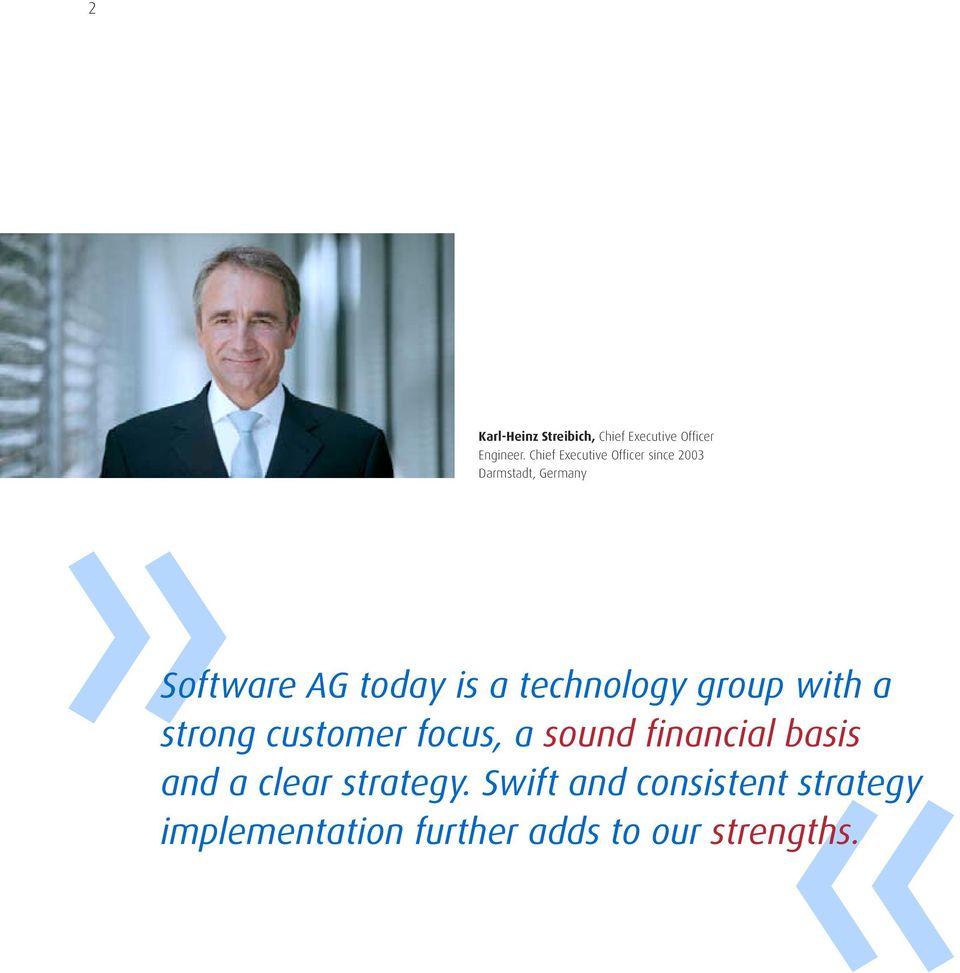
6 2 Karl-Heinz Streibich, Chief Executive Officer Engineer. Chief Executive Officer since 2003 Darmstadt, Germany Software AG today is a technology group with a strong customer focus, a sound financial basis and a clear strategy. Swift and consistent strategy implementation further adds to our strengths.
7 Letter to Shareholders 3 Geographical expansion is one of our key growth strategies. We therefore invest in new markets in up-and-coming economies around the globe. Dear Shareholders, 2005 was a very good year for Software AG. With a revenue increase of 6.5 percent we put the sales decline of recent years behind us and returned to growth. Our new strategy, which initially resulted in a strong increase in profitability, is now also paying off in an expansion of business volume. Once again, we increased our earning power in parallel with sales, achieving an EBIT margin of 22 percent, the upper range of our target corridor. Geared towards continuing growth We also made significant operational advances in 2005, creating the basis for our ongoing development. We intend to accelerate our profitable growth in Software AG s positive performance rests on three strategic pillars: We are further extending our portfolio based on customer requirements. We are expanding our direct sales team and strengthening our cooperation with distributors. We are also strengthening our market access globally by expanding into up-and-coming markets, in Eastern Europe, Latin America, Russia, the Middle East and Asia.
8 4 Software AG has two major, complementary product areas. On the one hand Adabas and Natural are a result of our more than 36 years of experience in data base applications and in the management of critical company data. On the other hand, our innovative integration products are used for automating and modernizing processes an IT concept today known as serviceoriented architecture (SOA). Product portfolio meets core customer demands There has been a positive market response to the new Software AG, and our customers have confirmed that our new strategy and product portfolio has put us on the right track. Globally, companies must adapt quickly to market changes to remain competitive. It is crucial that their IT infrastructures do not prevent or delay the process of change. IT infrastructures should act as an agent of change, actively enabling and promoting any necessary adaptation. Our focus on core competencies make Software AG a strong partner in assisting companies in effectively bringing their IT systems and databases in line with key business processes, allowing them to quickly take advantage of business opportunities whenever they arise. Dividend policy to continue Software AG s success in 2005 is the result of its globally networked team. On behalf of the entire Executive Board, I wish to thank all of our employees for their commitment. As in the previous year, we plan to pay out a substantial portion of our profit to our shareholders. The Executive and Supervisory Boards are recommending to the Annual Shareholders Meeting that a dividend of 0.80 per share be paid for fiscal Businesses must be quick to adapt to changing markets. They should not be held back by the limitations of their existing IT infrastructure.

9 Letter to Shareholders 5 Integration business continues to drive growth We are aiming for growth of approximately 10 percent for While our achievements in 2005 have laid the groundwork for a promising future, this does not guarantee success. We are therefore currently increasing our efforts in all divisions to ensure a broader basis for Software AG s growth. We will continue to focus on organic growth in We made three acquisitions in 2005 to widen our product portfolio and gain direct access to growth markets. Our strong operating cash flow will allow us to make further acquisitions, offering us the opportunity to actively benefit from the market consolidation expected during the next few years. The integration business continues to be our main growth driver. We plan to strengthen this area through technology partnerships that will make our product portfolio even more competitive. We want our strong earning power to remain a characteristic feature of Software AG in the future. Accordingly, we have targeted an EBIT ratio of 21 to 23 percent of sales for Software AG is characterized Software AG achieved a lot in Our promising by its clear customer focus at growth potential, favorable market position and all Group levels. high efficiency rates give us all we need to look to the future with optimism. We are convinced that our company is only at the beginning of its success story and would be pleased to have you accompany us along the way. Karl-Heinz Streibich Chief Executive Officer

10 6 Software AG s global market orientation is demonstrated by the international composition of the Executive Board with each region having a representative. The importance of the integration business is also highlighted by having a dedicated Executive Board member. Our international group of companies combines experience, knowledge and ability. We use a best-practice approach: taking models developed for a particular country and adapting them to benefit our global activities for the good of both our customers and the company. Mark Edwards, North America/Northern Europe, Businessman. Executive Board member since 2003 Derby, England Software AG products are a significant part of the IT systems of more than 3,000 customers in business and administration. Our stable customer base is a key asset for future growth. Alfred Pfaff, Central and Eastern Europe/Asia, Engineer. Executive Board member since 2005 Darmstadt, Germany
11 The Executive Board 7 Our business is to make our customers successful. We support companies in improving their performance and increasing competitiveness. This is why our products and services are in demand worldwide. Christian Barrios Marchant, Southern and Western Europe/Latin America, Engineer and Executive MBA. Executive Board member since 2003 Madrid, Spain Generating added-value from existing applications is at the top of the priority list for many customers. By offering suitable integration products, we are positioning Software AG in a future-oriented growth market. Dr. Peter Kürpick, Research and Development, Marketing Business Integration, Physicist. Executive Board member since 2005 Darmstadt, Germany Our accounting and forecasts are transparent. This highlights Software AG as value-oriented company and assures Software AG of the confidence of the capital markets. Arnd Zinnhardt, Finance, Controlling, M&A, IT, Legal, Internal Audit and Administration, Business administration graduate. Executive Board member since 2002 Darmstadt, Germany

12 8 Southern and Western Europe/Latin America: Case study: Barcelona, Spain At Sant Joan de Déu Hospital in Barcelona, approximately 4,000 patients receive medical care each day. As a result, a great number of documents accumulate, ranging from lab reports to x-rays. Software AG has created an IT architecture that ensures compatibility for all of the hospital s systems and diverse data formats. Patient files are now readily available and always up to date. Advantages for the Sant Joan de Déu hospital include: Improved exchange of information between the various hospital departments thanks to a single view of electronic patient data files; Reliable data based on reviews of all hospital wards and solution-oriented plausibility checks; Quick access to the contents of electronic patient data files in all hospital departments while maintaining data protection; Stability and high performance ensure absolute security and access to data at all times.
13 Customers & Markets 9 Regional growth: Attractive markets in Latin America Geographic expansion is an effective growth strategy. We therefore intensified our involvement in Latin America in The countries of this region are expected to see a significant increase in IT investment, from which we intend to benefit in the long term. In expanding our market presence, we are using the close cultural and economic ties between the countries of Latin America and Spain, the head office of our regional segment of Southern and Western Europe. The acquisition of the APS Group has greatly expanded our market position in Latin America.
14 10 Product portfolio: Innovation drives growth Business success depends on satisfying core customer requirements. In response to client demands we added innovative features to our products in 2005, to allow our customers to better gear their IT systems to dynamic markets. Our rapidly expanding software licensing business proves our success in meeting these demands. Our maintenance business should also benefit from this growth.

15 Customers & Markets 11 North America/Northern Europe: Case study: Tulsa County, Oklahoma, USA With around 580,000 citizens, Tulsa County is the second largest county by population in the State of Oklahoma. The county Administration wanted to improve their automated processes and user interfaces through a modern IT infrastructure. Software AG s ApplinX enabled Tulsa County to modernize and optimize applications without having to replace the valuable mainframebased system. Combining systems running on different platforms into one web-based portal provided realtors, banks, and county residents with quicker and more convenient access to property records and related legal documents. The advantages for Tulsa County include: Protection of current IT investments through modernization of existing systems; The web based system gives businesses and citizens direct access to property information; Constant data availability, simplified internal processes and long-term cost savings; Reduced risk to critical data through continued use of existing applications.
16 12 Central and Eastern Europe/Asia: Case study: Vienna, Austria UNIQA, an Austrian insurance group with over 4 million customers, handles a total of 13 million insurance contracts. The company s 11,000 employees face the challenge of managing an immense amount of data. In order to strengthen its leading position within the insurance industry, UNIQA sought the expertise of Software AG. We developed industry-specific systems that help UNIQA to optimize its business processes and expand its customer service. The advantages for UNIQA include: Automation and accelerated business processes and more efficient use of communication paths; Multi-channel systems allowing insurance policies to be taken out and modified online; Increased networking and higher employee mobility giving enhanced customer service; required data can be accessed in real time; Integration of various applications and system platforms guarantying a uniform view of customer data and improved consulting services.
17 Customers & Markets 13 Distribution channels boost business expansion Close customer contact is the best way to optimize business opportunities. In addition to regional sales strategies that are uniquely tailored to the needs of each country, Software AG also makes sure that there is enough room for personal contacts with clients. In 2005, we strengthened our sales channels both by expanding our own sales team and by reinforcing our cooperation with distributors. This allowed us to solidify our business while developing additional sales opportunities.

18 14 Additional opportunities arise in up-and-coming markets Software AG has customers in more than 70 countries. We are intensifying our business activities in the countries of Latin America, Eastern Europe and the Middle East. Our focus is on countries with a solid infrastructure and promising economic growth. The upward trend of these emerging markets and their increasing need for information technology opens up added sales opportunities, which are already contributing to our growth. Expanding our market position in Latin America With an office already in Mexico, Software AG further established itself in the Latin American market with the establishment of a second office, in Chile. This was followed by offices in Brazil, Colombia, Venezuela, Panama, Costa Rica and Puerto Rico. We are quickly expanding our market presence utilizing the expertise of the APS Group, our long-time distributor, acquired in June of This has ensured a sound basis for successful market development from the start. Puerto Rico We supported the Department of Treasury of the Commonwealth of Puerto Rico in implementing a project that brings together the data of all taxpayers nationwide. State-of-the-art income tax processing has been integrated with methods for tax collection and payment. Our products Adabas, Natural, EntireX and Tamino are the mainstays of the system architecture. Chile The Chilean revenue agency benefits from the competence of Software AG in business process management. Building on existing systems, we designed a solution that optimizes all steps of creating, editing and forwarding electronically stored documents. The innovative model is seen as a model for administrative bodies in the entire region. Panama As a government institution, the Registro Publico is responsible for registering all land, buildings, ships and companies in Panama. The government commissioned us with modernizing the applications of the state register. Besides Adabas and Natural, EntireX Communicator is also integrated in this project. Nicaragua In Nicaragua, taxes are collected by the Dirección General de Ingresos, a department of the Finance Ministry. Software AG is implementing a comprehensive IT project for the Dirección. The objective is to combine all data of the organization in a central location, to increase the efficiency of the entire system and make online access possible via EntireX Communicator and Natural web.

19 Customers & Markets 15 Favorable outlook for Eastern Europe The countries of Eastern Europe have instituted wide-ranging reforms and are accelerating their integration into the global market, fueled by the strong growth of their economies. The demand for information technology that will support further progress is increasing accordingly. We can benefit directly from involvement with the new EU countries, the Balkans, Romania and Bulgaria. Slovenia The Supreme Court of the Republic of Slovenia approved a case management system that stores court and trial records in a central location. All persons involved now have direct access to needed information. The solution implemented with Software AG accelerates the workflows in the court and serves as a reliable distribution and archiving system. Romania We developed a service-oriented architecture for the Romanian Finance Court, the Court of Accounts. This architecture integrates numerous areas of activity. As a result, the court is able to reduce the work expense for control and monitoring tasks and considerably increase its volume of services. At the same time, permanent documentation of the records offers greater transparency in budgetary control. Growth opportunities in the Middle East The wealth of the Middle Eastern countries stems from oil. In order to reduce their dependence on oil exports, countries in the Middle East are increasingly using their revenues to build up their own manufacturing industries and new economic sectors. Using networked IT solutions to network all company departments is a key to this expansion. Software AG is developing a growing customer base in Oman, Qatar, Kuwait, the United Arab Emirates and Saudi Arabia via the representative office in Bahrain. Kuwait The Public Authority of Applied Education and Training maintains 24 colleges in Kuwait. The public sector institution wanted a practicable solution for managing the data of all 40,000 students and chose Natural in spring Software AG technology will replace the previous system within three years. We will also support this project with services. Qatar As part of their egovernment services the Qatar Ministry of Civil Service and Housing has chosen to standardize on XML as to exchange intra-governmental data. After a detailed search for the best XML server, they choose Tamino.
20 16 Technology Service-oriented architecture (SOA) IT systems suited to market demands Successful companies have one thing in common: Their business processes are geared to the customer. The right IT landscape helps them to remain flexible and react quickly to changes in market demands. Accordingly, there is a high level of interest in IT solutions that help align information technology with business requirements. Rise in productivity and profitability Both companies and government agencies are increasingly relying on service-oriented architecture (SOA) in developing their IT systems. Software-oriented architecture uses Web-capable applications to integrate existing services with new applications. In this way, information and software functions are available to all users at any time, whether within their own organization or in cooperation with partners. This leads to significant advantages for customers: Existing system architecture has more versatility and better performance Systems, processes and procedures can be managed more effectively and with greater flexibility Clients can be sure their IT investments provide greater benefits and will be continuously supported and updated XML competence brings competitive advantage SOA satisfies key customer criteria for IT investments. As a result, demand for SOA is high. Software AG plays a significant role in the advancement of service-oriented architecture, since SOA can only be implemented using web services, Internet standards, and, in particular, extensible Markup Language (XML). XML is the key to integration and data exchange, and Software AG is an international leader in XML technology. Moreover, the core strengths of our products are integration and modernization. These advantages put us in a pole position to profit from rising demand for SOA components. Rapidly growing market Software AG is using its strong position in the XML environment to steadily expand its product portfolio for service-oriented architecture to accommodate the swiftly growing SOA demand. Experts such as Gartner Group analysts anticipate that approximately 80 percent of companies will be basing their IT on SOA as early as Service-oriented architecture is an attractive topic for the future for our customers and for Software AG.

21 Software AG stock 17 Share performance continues to improve Software AG stock was one of the big winners in 2005, outperforming its benchmark index, the TecDAX, as well as the NASDAQ 100 with a share price increase of 73 percent was a good year for European equities. While the most important Wall Street share price indices barely gained in value, European stock markets developed positively throughout the year. German blue chips were among the top performers: The DAX rose by 27 percent, reaching its highest level in four years shortly before the end of Raw materials and energy stocks made particularly high gains. Investors were initially cautious about technology stocks, with the TecDAX showing only modest gains in the first two quarters. In the second half of the year, the market environment for German technology shares improved steadily. The TecDAX surged, supported by high demand for telecommunications and solar energy stocks. A significantly improved performance over 2004 was achieved with a rise of 12,5 percent at the end of the year. The index for the U.S. technology sector, the NASDAQ 100, was almost unchanged compared to the end of 2004 with a rise of 1.5 percent. Software AG shares nearly double in value Software AG was one of the most successful stocks in the TecDAX in On December 30, 2005 the stock closed at in Xetra trading, a gain of 73 percent compared to December 30, 2004 ( 23.80). Market capitalization surpassed the historic high of 1 billion for the first time since This places Software AG in the mid-cap range, sparking more attention and opening up access to new investor circles, both of which support our goal of broadening our shareholder base.
22 18 Key stock figures Shareholder structure by countries (percentage of free float) High* Low* Closing price* Total numbers of shares (Dec 31) 28,036,009 27,266,752 Market capitalization (Dec 31), millions 1, Diversified holdings (free float), % as of December 2005; sources: Thomson Financial Germany 24% United Kingdom 11% Rest of Europe 17% North America 3% Private investors and not identified institutional investors 45% Average daily trading volume (Xetra) 97, ,161 * Xetra closing price in Euro Dividend continuity In addition to price gains, our investors also benefited from a resumption of dividend payments in Software AG paid out a total of million ( 0.75 per share) to shareholders as resolved by the Annual Shareholders Meeting. This corresponds to a dividend ratio of more than 38 percent of net operating income. We expect to maintain this dividend policy in the future, depending on earnings and liquidity. The Executive and Supervisory Boards are recommending to the Annual Shareholders Meeting that dividends of 0.80 be paid for each share entitled to dividends. Based on the share price at the end of the year 2005 ( 41.15), this represents a dividend yield of 1.94 percent. Appealing combination of value and growth Our main goal is to widen Software AG s investor circle to further decrease stock volatility. Our investor relations activities are aimed at expanding and intensifying contact with investors and financial analysts. Software AG stock is followed regularly by over twenty brokerage firms, including an increasing number of global brokerages as international interest picks up. One of our primary aims for 2006 is to raise coverage by U.S. brokers. Our return to growth will also shift our stock back into the focus of growth investors, opening up a new investor target group. Software AG stock will also continue to appeal to value investors due to its dividend yield and high cash flows. We intensified our direct contact with investors in the past year by holding approximately 50 days of road shows, primarily in Europe and America, though also for the first time in Asia. We presented Software AG in over 300 individual discussions with potential investors and analysts as well as 16 conferences with brokerage firms. We continue to be involved in the investor relations community. This includes work on committees of the German Investor Relations Association (DIRK), the European Council of Investor Relations, and the International Investor Relations Federation (IIRF).
23 Software AG stock 19 Please refer to page 99 of the notes to the financial statements for additional information on stock options. Changes in share capital The upward share price trend permitted employees and executives to exercise stock options based on the programs of 1999 to 2001 during the year under review. As a consequence, the number of outstanding shares rose by 2.8 percent to 28,036,009. An additional 81,000 options may be exercised from the same programs by mid Furthermore, an additional 790,000 options are outstanding from an additional program, which, however, may not be exercised during ADR program increases access to the U.S. stock market and improves name recognition for Software AG We initiated an ADR program in October of American Depositary Receipts (ADRs) are deposit certificates issues by a U.S. depository bank. They document ownership of shares in non-u.s. companies and make it possible to buy and sell non-u.s. securities in U.S. dollars. Software AG ADRs are traded on the over-the-counter market as part of a Sponsored Level I ADR program and are therefore not subject to the reporting requirements of the Sarbanes-Oxley Act. Since only existing shares are converted to ADRs, the program has not necessitated a capital increase. Share price comparison (indexed values) Dec 30, 2004 March 1, 2005 May 1, 2005 July 1, 2005 Sep 1, 2005 Nov 1, 2005 Dec 30, 2005 Software AG TecDAX Nasdaq 100
24 20 Together with the Executive Board, the necessary steps were implemented to once again comply in full with the recommendations of the Code during the year under review. Frank F. Beelitz, Chairman of the Supervisory Board Report of the Supervisory Board During fiscal 2005, the Supervisory Board of Software AG oversaw the performance and activities of management and closely monitored all key business events as well as the development of the Company and the Group. The Supervisory Board met at least once per quarter for a total of six meetings during the year under review, with full attendance at all meetings. Each meeting involved comprehensive analysis of current business performance and the discussion of strategy with the Executive Board. Any transactions requiring Supervisory Board approval in accordance with the Articles of Incorporation or applicable legislation were examined in detail, carefully considered, and where appropriate, approved. The meetings covered the current status of Software AG and its subsidiaries, prospects for individual business segments and the corresponding strategies for products, sales, and marketing. The Chairman of the Supervisory Board also received written reports on business development from the Executive Board on a monthly basis. The Supervisory Board includes the following committees: The Committee for Compensation and Succession Issues The Audit Committee The Committee for Compensation and Succession Issues met four times, and the Audit Committee met once during the year under review. Executive Board membership changed as follows during 2005: Andreas Zeitler, Managing Director for the Central and Eastern Europe/Asia region, left the Executive Board effective August 22, Responsibility for this region was assumed by Alfred Pfaff, who was appointed to the Executive Board by the Supervisory Board effective November 1, 2005.
25 Report of the Supervisory Board 21 There were no changes in the membership of the Supervisory Board of Software AG. The Supervisory Board held detailed deliberations on the subject of corporate governance and the German Corporate Governance Code during several meetings in Together with the Executive Board, the necessary steps were implemented to once again comply in full with the recommendations of the Code during the year under review. The financial statements have been prepared in accordance with IFRS since 2004, and remuneration for members of the Executive and Supervisory Boards was again reported individually in The declaration pursuant to Section 161 of the German Stock Corporation Act (AktG) submitted jointly with the Executive Board stated that Software AG complied in 2005 with the recommendations of the Code as amended on May 21, 2003 without exception and will continue to do so in the future. The declaration of compliance is available to Company share-holders on the website of Software AG. The new remuneration system for Executive Board members, passed by the Supervisory Board at the end of 2004, was applied for the first time in The fixed salary component of the Board members remuneration was reduced to approximately 30 percent of target salary. Twothirds of the variable salary component is linked to the sales and earnings targets of the Software AG Group on a uniform basis for all Executive Board members. The remaining one-third depends on attainment of individual targets in the functional areas of each Executive Board member. Approximately 30 percent of the variable remuneration actually earned in 2005 will be paid out over a period of three years based on a phantom share plan. In 2005, the meetings of the Supervisory Board of Software AG focused on discussing and adopting a growth strategy for the Company: The development strategy for South America was adopted at the meeting in January The meeting in March 2005 involved preparations for the Annual Shareholders Meeting, which was held in Frankfurt on May 13, 2005, as well as the strategic partnership with Fujitsu. The continuing development of the product portfolio of the Company s two business lines, ETS and XMLi, was discussed at the meeting in July 2005, and the acquisition of Casabac Technologies GmbH was resolved a step which has provided Software AG with core technology for its XMLi portfolio. The long-term growth strategy of Software AG was discussed at a special session in December. In accordance with the wishes of the Annual Shareholders Meeting, the Supervisory Board assigned BDO Deutsche Warentreuhand Aktiengesellschaft, Frankfurt am Main, to audit the financial statements and the consolidated financial statements of Software AG for fiscal BDO Deutsche Warentreuhand Aktiengesellschaft examined the financial statements and the consolidated financial statements for the year ended December 31, 2005, including consideration of the accounting policies and the management report, and issued an unqualified audit opinion.
26 22 The results of the audit were submitted to the Supervisory Board. The head of the auditing team explained the results in person to the Audit Committee as well as the entire Supervisory Board and the Executive Board. The Audit Committee and the Supervisory Board thoroughly reviewed the audit results in their meeting of March 10, The Supervisory Board declared its agreement with the results of the audit and approved the financial statements and the consolidated financial statements. We concur with the recommendation of the Executive Board with respect to the appropriation of profits. The Supervisory Board would like to thank the Executive Board and all employees for their commitment as well as their achievements in fiscal Darmstadt, March 2006 The Supervisory Board Frank F. Beelitz Chairman Members of the Supervisory Board: Frank F. Beelitz (Chairman) Karl Heinz Achinger (Deputy Chairman) Dr. Ing. Andreas Bereczky Justus Mische Monika Neumann (employee representative) Reinhard Springer (employee representative) Please see the notes to the consolidated financial statements of Software AG for further information on the members of the Supervisory Board.
27 Corporate Governance 23 Corporate Governance Report for 2005 The Corporate Governance Report of Software AG has been prepared jointly by the Executive Board and the Supervisory Board pursuant to Section 3.10 of the German Corporate Governance Code. In 2005, as in previous years, Software AG took additional steps to continue implementing the standards for good, responsible corporate governance, extending them and ensuring that they are respected throughout the Company. Due to new European and German regulations, we implemented additional organizational measures to facilitate adherence to and monitoring of responsible conduct. Even before the European Market Abuse Directive became binding national law (Investor Protection Act), we began our preparations for the entire Group: Firstly, we established which employees internationally have access to insider information of relevance to the capital markets. These employees were informed of the requirements for responsible handling of insider information and the relevant legal provisions. In addition, the management staff was familiarized with the provisions of the Investment Protection Act as part of a continuing education program and urged to inform employees of the particular significance of insider information as part of the day-to-day business. Employees, management staff and service providers were included in a new registry of persons with access to insider information to the extent required by the Investor Protection Act. Software AG implements new Corporate Governance Code On February 23, 2006, The Executive and Supervisory Boards submitted a declaration of compliance pursuant to Section 161 of the German Stock Corporation Act (AktG). This declaration states that in fiscal year 2005, Software AG complied with all recommendations of the German Corporate Governance Code as amended on May 21, The amendments to the Code of June 2, 2005 were also complied with in essence, with two formal exceptions: Firstly, earlier declarations of compliance were not provided until the Company s investor relations page had been technically converted and redesigned, and secondly, the Corporate Governance Report could not be published in the Annual Report as recommended until the current year due to the date of enactment of the amended Code. The Executive and Supervisory Boards also agreed to comply with the recommendations of the Code in fiscal For the most part, Software AG follows the suggestions of the Code. In the event specific suggestions are not adhered to, for example due to corporate requirements, this is explained on the Company s website.
28 24 Shareholder-friendly organization of Annual Shareholders Meeting Significant changes have been made with regard to the Shareholders Meeting. In the future, the meetings will be transmitted in their entirety via the Internet. In the past, only the opening address and the report of the Executive Board were made public in consideration of the privacy rights of the participants. However, we are of the opinion that broadcasting the meeting to the public will not only improve transparency, but will also lead to a responsible and efficient use of the right to address the meeting and is thus in the interest of the majority of the shareholders. The necessary amendment to the Company s Articles of Incorporation will be presented to the 2006 Annual Shareholders Meeting for approval. Shareholders who do not wish to attend the Shareholders Meeting in person may authorize a member of the Company to exercise their voting rights by proxy in accordance with the instructions of the shareholder. All proxies must be executed in writing. The invitation to the Annual Shareholders Meeting and related documents and information such as the agenda, the financial statements, the Articles of Incorporation, and explanations of draft resolutions are published on the Company website on the date of the invitation. In addition, shareholders may also view the resolutions adopted by previous shareholders meetings as well the quarterly financial statements for the preceding financial year and earlier financial years. The new Law on Corporate Integrity and Modernization of the Right of Avoidance ( UMAG ) went into effect on November 1, This law requires changes in registration and legitimization procedures. With regard to the Annual Shareholders Meeting of Software AG on May 12, 2006, the record date will be changed to the 21st day prior to the Shareholders Meeting. Furthermore, the UMAG will enable the meeting chair to conduct the Shareholders Meeting more efficiently. For instance, the chairperson will be able to cut short speakers who stray from the topic at hand and to refer to information already published in the case of extensive answers. See page 41 of the Management Report for the risk factors. Executive Board and Supervisory Board The Executive Board makes regular, prompt and comprehensive reports to the Supervisory Board regarding all relevant issues of corporate planning and strategic development as well as the course of business and the situation of the Group, including the risk situation. For instance, in the meeting of December 15, 2005, the Supervisory Board adopted the long-term strategic plan for Software AG until Any significant business transactions must be approved by the Supervisory Board pursuant to the rules of procedure of the Executive Board. In fiscal year 2005, the Supervisory Board approved three acquisitions to promote expansion of the product portfolio and the Company s market presence in Latin America. The Company has taken out D&O insurance with a deductible of 5,100 for board members and management staff of the Company.
29 Corporate Governance 25 Composition of the Supervisory Board and the committees The Supervisory Board elections have already complied with the new recommendations of the Corporate Governance Code: Supervisory Board members were elected individually and at different times. If Supervisory Board members left the board prior to expiration of their terms of office, their successors were appointed until the next Shareholders Meeting only. This procedure will continue to be practiced and will be set down in the rules of procedure of the Supervisory Board. Good corporate governance requires the chairperson of the audit committee to have special knowledge of, and experience with, the application of accounting principles and internal review procedures. Software AG also complies with this recommendation in full: Karl Heinz Achinger holds a university degree in business administration (Diplom-Kaufmann) and is a self-employed management consultant. He has accumulated extensive knowledge and experience in his approximately 30 years of entrepreneurial activity in the international IT market. He was the founder of Debis Systemhaus, for example, which he ran until shortly before it was taken over by Deutsche Telekom. During this time, he spent several years as a member of the international management team of Cap Gemini. Mr. Achinger has been a member of the Supervisory Board of Software AG since January 1, From December 2002 to October 2003, he managed Software AG on an interim basis until a successor Karl-Heinz Streibich was appointed to replace the departing Executive Board chairman. Mr. Achinger acquired in-depth knowledge of the business processes and key financial parameters of Software AG during this period. His involvement with supervisory boards of other companies gave him an insight into various internal control procedures, enabling him to help Software AG select the best practice on the market. Software AG maintains no direct or indirect business relationships with Supervisory Board members. In particular, no consulting agreements or other contracts for work or services have been entered into. The employee representatives on the Supervisory Board are all employees of the Company. Remuneration of Supervisory Board members for fiscal 2005 is composed as follows: in EUR Fixed Variable Remuneration for remuneration remuneration committee activities Frank F. Beelitz (Chairman) 20, , , Karl Heinz Achinger (Deputy Chairman) 15, , , Justus Mische 10, , , Dr. Andreas Bereczky 10, , Monika Neumann 10, , , Reinhard Springer 10, , ,500.00
30 26 Total remuneration for members of the Supervisory Board amounted to 260 thousand in the year under review. Remuneration of the Supervisory Board members is made up of fixed and variable components. The variable components are linked to the success of the Company, measured by the ratio of earnings before taxes as a percentage of sales (EBT margin). Members receive separate remuneration for work on the personnel committee (Committee for Compensation and Succession Issues) and the audit committee. The basis of assessment was determined by the Shareholders Meeting on April 29, Open and transparent communication Our investor relations communications policy is to offer a level playing field to all current and potential investors. This is why we provide the same information to all target groups at the same time. We have adopted comprehensive written instructions on a corporate-wide basis ( Disclosure Policy ) to ensure globally uniform handling of information of relevance to investors. The Disclosure Policy includes rules for the publication of financial results and significant events as well as internal processes for evaluating the relevance of information. Accordingly, the Executive Board immediately publishes all information that directly affects the Company, unless exempt from the publication requirement in specific cases. In addition, in accordance with legal stipulations, our Disclosure Policy ensures that lists are kept specifying any persons with access to insider information, also guaranteeing that such persons are required to maintain confidentiality. Shareholders, analysts and journalists are dealt with in accordance with uniform criteria in a manner that is transparent for all capital market participants. All ad hoc announcements and press releases as well as presentations from press or analysts conferences and investor road shows are published immediately on the website of Software AG. Our disclosure policy is also published on the Company website. The purchase or sale of shares in the Company or related financial instruments, particularly derivatives, by members of the Executive and Supervisory Boards of the Company as well as certain other related parties are published on the Company website as soon as Software AG acquires knowledge of any such transactions. In fiscal 2005, the following transactions subject to reporting requirements were disclosed: the acquisition of shares in Software AG by Karl-Heinz Streibich (Chairman of the Executive Board) on November 28, The total of the shareholdings known to the Company are not subject to the reporting requirements of Section 6.6 of the German Corporate Governance Code (reporting is required if the Executive Board and Supervisory Board jointly hold more than 1 percent of the stock issued by the Company).
31 Corporate Governance 27 See page 99 of the notes for details on the stock option plan and the method of calculation used. Stock option plans Software AG has two different stock option plans for Executive Board members, management staff and employees of the Group. In fiscal 2005, these stock option plans resulted in personnel expenses totaling million. The first stock option plan was established at the time of the IPO in Most of the resulting subscription rights were exercised by December 31, 2005 (approximately 1.95 million). This led to an increase in the number of shares in issue from million to approx million. Another 82,183 options may be exercised no later than July 31, 2008 by employees and management staff at a price of 28.12, provided the share price exceeds at the time of exercise. In connection with the second stock option plan (established in 2001), as of December 31, ,875 subscription rights had been issued to Executive Board members and 663,300 to management staff. None of the options from this plan, which is geared toward long-term incentives and will run until the end of 2011, have been exercised to date. No new options have been issued under this plan since January 1, In order to exercise the options, net income of the Group must have increased at least 10 percent from the previous year, and profit from ordinary activities must have amounted to at least 10 percent of sales. Accordingly, options from this plan may not be excised until 2007 at the earliest, provided the aforementioned targets are met. The average exercise price is currently (calculated from the weighted average share price at the time of issue of the options). Auditor The Annual Shareholders Meeting of Software AG appointed BDO Deutsche Warentreuhand Aktiengesellschaft, Frankfurt am Main, as Company auditor. No business, financial, personal or other relationships existed at any time between the audit company and its corporate bodies and audit managers on the one hand and Software AG and the members of its corporate bodies on the other which could establish any doubt as to the independence of the audit firm. BDO also advised Software AG in tax matters and will continue to do so in fiscal Based on the appointment of the auditor by the Annual Shareholders Meeting, the Supervisory Board of Software AG has assigned BDO to audit the Company s financial statements and has agreed upon a fee for services. In connection with the audit engagement, the Supervisory Board has also agreed with the auditor to comply with the reporting duties pursuant to the German Corporate Governance Code. The auditor participates in Supervisory Board meetings concerning the financial statements and consolidated financial statements and report on key audit findings.
32 28 The Software AG Group is managed globally by the parent company, Software AG, acting as an operating holding. As the financial position of the parent company is shaped by the Group s financial position, the Executive Board has decided to incorporate the management reports of the Group and the parent company into a combined management report. On a profitable growth path with rising sales Software AG s growth gained momentum in 2005: Driven by the licensing business, sales rose by 6.5 percent. Increases in earnings, a stronger market presence and a wider product portfolio assure that the Company will continue to develop positively. Economic trends Global economy shows strong performance In 2005, the world economy expanded by 4.3 percent, again reflecting growth exceeding the average of recent years. The United States and Asia provided the greatest stimuli to this expansion. According to OECD calculations, the real gross domestic product rose in the U.S. by 3.6 percent. Adverse economic effects from the hurricanes were compensated by high domestic demand and a monetary policy designed to stimulate the economy. A similar upward trend was witnessed in Asia, where the emerging economies propelled the continuing growth in the region. China was in first place with an increase of 9.3 percent. The Japanese economy proved unexpectedly stable, profiting primarily from corporate investment. Revival in Latin America The South American economy revived considerably due to high demand for raw materials and agricultural products. Chile was among the countries showing higher than average economic growth, with a rise in GDP of 6.0 percent. In Latin America, growth exceeded 4 percent for the second consecutive year. Panama and Venezuela both achieved extraordinary increases of 6 percent and 9 percent respectively. According to the United Nations Economic Commission for Latin America and the Caribbean (CEPAL), corporate investment surged in particular in Latin America, where capital spending now accounts for 22 percent of the gross domestic product. Differing trends in Europe The flourishing global economy also bolstered the European economy. The new EU countries, which grew by 4 percent on average, performed better than the established member states of the European Union. Above all the Eastern European economies gained significantly in strength, with the Russian economy surging by 5.5 percent.
33 Management Report 29 While the eurozone countries benefited from slightly improved exchange rate parities, the rise in GDP still fell short of the previous year. The growth rate of 1.4 percent reflects the weak domestic market and the influence of higher export figures. German economic output rose by approximately 1 percent during 2005 in response to strong export growth. In the second half of the year, the German economy benefited from a renewed rise in capital spending. Market climate in the IT sector IT market outpaces general economy According to calculations of the European Information Technology Observatory (EITO), the global market volume for information technology and telecommunications (ITC) grew during 2005 by 4.2 percent. Europe and the U.S. are the most important regions in this global market, each generating one-third of the total volume. Within the technology sector, information technology has evidenced especially high growth rates. According to Gartner Research, the IT market increased by 5.5 percent in North America and by 2.5 percent in Europe. EITO has estimated an increase of 3.7 percent to 290 billion for the European Union. The new EU member states of Central and Eastern Europe exhibited extraordinary growth rates, some in double digits. EITO attributes a 3.3 percent rise to the German market. IT spending focused primarily on software purchases. According to EITO analyses, the European software market expanded by 4.8 percent while the German IT industry association, Bitkom, is projecting a 5 percent increase to 16.1 billion for the German software market. Emphasis on integration Today, more than ever, companies are facing the challenge of rapidly changing demands. In order to respond quickly to changing markets and requirements, companies need flexible IT systems that are specifically designed for change. Companies use IT systems to improve the efficiency of their business processes. That is why customers are increasingly turning to software products that are capable of networking and integrating existing applications, as talks with customers in all of our sales regions reveal. In response to this challenge, there is a clear trend towards service-oriented architectures. According to a recent study by Gartner, the IT integration market grew by 8 percent in 2005.
34 30 Return on IT investment is a key factor Despite the high level of interest in modernizing IT structures, companies continue to exercise restraint in their IT budgets. Investments are linked with specific business processes and contracts awarded on a modular basis. Companies that are currently investing in IT tend to expect a short-term return on their investment. Sales trends Group sales increase significantly Within the general economic and specific market conditions described above, Software AG increased its Group sales to million (prior year: million). The marked improvements in earning power during previous years were again followed in 2005 by a significant increase in sales. As 51 percent of total Group sales is generated outside of the eurozone, the sales figures are impacted by currency ratios. The most important foreign currencies for the Company include the U.S. dollar, which rose 12 percent against the Euro, as well as the British Pound, the South African Rand and the Canadian Dollar. Total Group sales rose by 6.5 percent; currency-adjusted Group sales climbed 5.8 percent. Impact of exchange rates on the presentation of sales figures in percent USD GBP Rand CAD Total foreign currencies Share in sales Exchange rate impact Average Euro exchange rate differences based on monthly averages of the exchange rates weighted according to corresponding monthly sales Significant increase in licensing business The licensing business was again a key growth driver. Total licensing revenues climbed 15 percent to million (prior year: million) accelerated by an optimized portfolio and intensified marketing efforts. Licensing revenue accounted for 30 percent of group sales and at a high margin. This is a promising sign for the future, as service and maintenance revenues tend to follow in the wake of licensing sales. We consider our licensing business to be of strategic importance for the Group. It focuses on two business lines:
35 Management Report 31 Products for modern data management and for the development of applications on mainframes (Enterprise Transaction Systems, ETS) Products for the integration of different corporate applications (XML Business Integration). Both business lines contributed to the significant increase in the licensing business, attesting to the successful sharpening of Software AG s focus on its true strengths and its rigorous customer orientation. Modernization requirements drive ETS sales Licensing sales of products designed for mainframe systems rose to 96.0 million (prior year: 85.9 million). We selectively developed the portfolio in order to benefit from the high demand for modernization solutions from our Enterprise Transaction Systems business line. Software AG s strong position in the mainframe market is a distinct advantage in this area: Adabas and Natural, our data management products, are still considered among the most stable and reliable mainframe products on the global market. Both products are established worldwide as essential components of IT architecture, an advantage that translates into a stable customer base that has generated new projects in addition to expansion and replacement investment in the year under review. Strong growth in XML Business Integration The products in our integration suite facilitate the modernization, integration and automation of existing systems and provide Software AG with a high profile in the promising integration market. In fiscal 2005, licensing sales from the XML Business Integration line rose by 16 percent to 30.3 million. The core of this growth area is our integration portfolio that primarily includes inhouse development but is complemented by components acquired through partnerships and acquisitions. In addition, we also use several external products primarily for content management solutions which are currently being phased out. This impacted growth in licensing sales in the year under review, but was more than offset by high growth rates in internally developed products. In the year as a whole, 86 percent (prior year: 76 percent) of licensing sales resulted from in-house software and strategic components from partners. Licensing revenue by product line millions Change (in percent) Software AG proprietary XML products External XML products ETS
36 32 Product sales marked by higher licensing revenues Product sales, encompassing the licensing and maintenance segments, rose to million (prior year million). The increase of 16.2 million is solely due to the licensing business. Revenues from maintenance amounted to million (prior year: million), just under the level of the previous year. Reliable contributions to sales are a characteristic feature of the maintenance business, where we service a broad and global customer base. This is a significant asset for Software AG, since the market for mainframe maintenance not only has high entry barriers, but also opens up possibilities for sales of related products and services. Professional services rebound The demand for professional services was on the rebound in 2005, gathering momentum over the course of the year. Sales climbed 9 percent to million (prior year: million), with Northern Europe/North America as well as Central and Eastern Europe/Asia posting doubledigit growth rates. Sales by product segment millions Change (in percent) Licensing Maintenance Professional services Other Total Sales by segment (in percent) Maintenance 41% Licensing 30% Professional services 28% Other 1%
37 Management Report 33 Sales growth in all regions Software AG generates most of its sales in the regional segment of North America/Northern Europe. In 2005, this region, which includes the United States, Canada, United Kingdom, Scandinavia and South Africa, contributed more than 40 percent, or million (prior year: million) to total Group sales. Licensing revenues in the region rose to 58.4 million, while professional services revenues climbed to 23.4 million. The regional segment of Southern and Western Europe, which also includes our activities in Latin America, increased its sales by 9 percent to million (prior year: million), with licensing revenues rising strongly by 16 percent to 37.5 million. In contrast to the remaining regions, maintenance revenues in Southern and Western Europe also improved. In the Central and Eastern Europe/Asia segment, sales rose to million (prior year: million) in response to strong demand for professional services and higher licensing sales. Professional services improved primarily in Germany. Sales by regional segment (prior to consolidation) in millions North America/Northern Europe Southern and Western Europe/ Latin America Central and Eastern Europe/Asia Regional sales 2005 by product segment (prior to consolidation) in millions North America/ Southern and Central and Northern Europe Western Europe/ Eastern Europe/ Latin America Asia Licensing Maintenance Professional services Considerable increase in growth markets Higher than average sales growth in the emerging countries confirm the success of our strategic decision to expand into these regions. In Software AG s target markets in Latin America, Eastern Europe, the Near East and Asia, sales jumped 71 percent to 37.9 million (prior year: 22.1 million).
38 34 Position in the market further strengthened Software AG strengthened and expanded its international market position in In industry comparisons, Software AG is the second-largest German software firm and among the largest European software providers. Our Company is the largest European provider in the infrastructure software market and a global leader in XML technology. In the business line of Enterprise Transaction Systems, we are dealing with clients who frequently have worked with Software AG products for 20 or 30 years. Due to the high level of customer satisfaction and the fact that customers are equipped with our constantly updated products, we are operating in a less competitive segment in this area. In the integration business, on the other hand, the market is extremely fragmented and marked by intense competition. The market advantages of Software AG are based on high levels of competence in XML and the unique selling propositions of our portfolio. In this environment, the SAG Group benefits primarily from its strong position in the mainframe environment, as mainframes frequently have to be incorporated into web-capable automated processes. As a result of its size and long-term experience, the Company is also in a good position to take on complex and/or highly international projects, which are unsuitable to smaller competitors. Earnings position Operating margin rises again Greater sales volumes, particularly in the high-margin licensing business, have enhanced our earnings. Furthermore, expansion of our product range and consistent cost management have also contributed to income. With growth of 4 percent to million (prior year: million), production costs have risen more slowly than revenues. The Group s operating income (EBIT) improved by 15 percent to 96.4 million (prior year: 83.9 million after adjustment for the sale of the stake in SAP SI). The operating EBIT margin rose to 22 percent (prior year 20 percent). Net income for fiscal 2005 amounted to 61.8 million as compared to 77.2 million a year earlier, when income from disposals had significantly contributed to earnings. Adjusted for this extraordinary income, net income in 2005 exceeded the prior year s figure by 16 percent. Earnings per share Earnings per share reached 2.24 based on the weighted average number of shares outstanding. This number rose from 27.3 million to 27.5 million shares as the result of the exercise of options under two stock option programs for employees and management due to expire in the summer of Compared to the previous year s EPS figure of 1.95, earnings per share rose 14.9 percent after adjustment for extraordinary income from the sale of the SAP SI-shares in 2004.
39 Management Report 35 Key earnings indicators in millions Operating EBIT Income from the sale of SAP SI-shares Interest result Income before taxes Taxes Net income Earnings per share (in, adjusted) Average number of shares outstanding (in millions) excluding proceeds from the sale of investments in 2004 (sale of SAP SI shares) North America continues as the most profitable region EBITA from the North America/Northern Europe region rose by 11 percent to 54.2 million, primarily due to the strong licensing business. An operating EBITA margin of almost one-third can be calculated from these figures. This favorable relationship also serves to position Software AG s major sales market as the most profitable region. In Southern and Western Europe/Latin America, EBITA declined by 3.0 million despite the rise in sales. Among other factors, earnings were impacted by planned start-up costs associated with the penetration of the Latin American market. However, EBITA of the Central and Eastern Europe/Asia region grew to 20.2 million. Software AG s broader geographic positioning contributed directly to the increase in income. At 7.5 million (prior year: 3.5 million), EBITA in our expansion markets of Latin America, Eastern Europe, the Near East and Asia more than doubled. Operating EBITA by region in millions North America/Northern Europe Southern and Western Europe/Latin America Central and Eastern Europe/Asia
40 36 Cash flow almost doubled Group cash flow from operating activities improved to 55.7 million, almost doubling the previous year s figure of 28.9 million. Operating cash flow was approximately 13 percent of total sales. Capital expenditure benefits both business lines Up to 14 percent of our product sales are allocated to research and development. We employ these funds evenly to develop our integration portfolio as well as Adabas and Natural. The acquisitions of Sabratec and Casabac during 2005 should be seen in this context. As targeted technology acquisitions, we regard them as part of our R&D investments. Further improvements in cash position and equity Sustained high cash flow levels served to further improve the Group s strong balance sheet in As of December 31, Software AG s cash and cash equivalents had surged 36 percent to million (prior year: million) despite a total dividend payment of 20.5 million in fiscal Equity rose to 393 million (prior year: million), resulting in an equity-toassets ratio of 66 percent (prior year: 63 percent) despite a significant increase in total assets to million. As in the past, the Company holds no bank debt. Earnings of the parent company, Software AG (separate HGB financial statements) The parent s revenues of 110 million primarily include royalty income from subsidiaries. Income of 10.2 million was due to profit transfers and 0.4 million reflected income from investments. Net income of the parent company amounted to 18 million. Strategic progress Consistent implementation of growth strategy We intend to accelerate Software AG s profitable growth and position it on an increasingly broad base. We focused on three strategic areas during 2005: Continued development of the product portfolio Expansion of our partner network Extension of our market presence worldwide. The Company s financial strength allows investment in business expansion. This creates favorable conditions for implementing our growth strategy and certainty in achieving our long-term corporate goals.
41 Management Report 37 Market-oriented enhancement of product portfolio Both of our business lines Enterprise Transaction Systems and XML Business Integration have launched innovative products, with an emphasis on new products and functional expansions to modernize existing systems, integrate business applications, accelerate business processes and adapt IT systems to corporate work flows. Solutions that help customers in building serviceoriented architecture (SOA) form the core of our product portfolio. SOA provides higher productivity and economy for users, thus fulfilling key criteria for IT investment. As a future-oriented and highly marketable subject, SOA affects both our integration products and the modernization of Adabas and Natural environments. Significant innovations in the ETS area include Adabas 2006 and Natural These new versions of proven products are distinguished by a series of additional functions developed on the basis of customer requirements. We are therefore expecting a very positive market reception. In the business domain of XML Business Integration, highlights included the new Composite Application Integrator and the launch of the Enterprise Information Integration package. The market introduction of the BPM range expanded our integration business by adding products for process control. Software AG also relies on acquisitions for the rapid and efficient expansion of solution competence. The focus here is on the acquisition of technologies that will allow us to advance our range of integration and modernization products immediately. For this reason, Software AG acquired Sabratec Ltd., Israel, a specialist in integration software for host systems, at the beginning of The ApplinX technology gained by this acquisition has now been incorporated into our portfolio. Another company, Casabac Technologies GmbH, Germany, was acquired effective August 1. This company s Java-based technology allows efficient development of sophisticated Internet applications utilizing reusable components. Our product certification underlines the fact that our products conform to the most stringent norms. Certification allows us to broaden both our cooperation with the certifying companies and to enhance Software AG s footprint amongst their customers. In 2005, for instance, Tamino, Software AG s global leader in XML servers, was awarded the YES certification by Novell. SAP provided our XI adapter to link mainframes with the new SAP platform Netweaver with the distinction of the XI certificate. Partnerships promote fast innovation cycles Alliances can consolidate strengths and allow for significant progress within short periods of time. In the integration business in particular, this approach enables highly efficient and marketable solutions. Software AG is therefore involved in a global network of renowned partners. In order to enhance this strategic network, we formed several alliances during the year under review. These include:
42 38 Fujitsu (Japan): Developing and marketing components for the implementation of BPM solutions and SOA IDS Scheer (Germany): Supplementing our business process management solution with design and monitoring functionality Danet Group (Germany): Creating a new industry solution for the telecommunications industry Active Endpoints, Inc., (USA): Innovations geared to the SOA and web services market Sales channels extended for the long term This enhanced partner network also serves to extend our sales channels. The alliance with Fujitsu, for instance, includes the sale of two of Software AG s integration products via the Japanese company. Software AG s market strength in Europe and Fujitsu s strength in Asia are utilized in tandem. As part of our cooperation with SAP, we offer integration services and now also act as software and service partners for SAP Germany. Presence in global markets The three regional segments of Software AG service more than 70 countries through our own branches or sales partners. Growth in our traditional markets is increasingly being supplemented by activities in emerging markets. We perceive promising potential in particular in Latin America, Eastern Europe (including Russia) as well as in the Middle East and Asia. In order to develop new sales areas in Central America and the Caribbean, we acquired APS Venezuela in 2005, including its affiliates in Panama and Puerto Rico and additional subsidiaries in Costa Rica and Panama. In terms of organization, the group of companies reports to the newly established Software AG Latinoamérica S.L. headquartered in Spain. In order to further develop this expanding business area, we have opened additional offices, including offices in Chile and Brazil. Research and Development Market proximity assures customer-oriented innovation We have linked our research and development closely to the demand profiles of our customers. Networking the market with the sales, research and development functions enables companies to quickly respond to changing customer demands and offer appropriate products. In the innovative integration business, this is a key advantage. Software AG s R&D sites are distributed through five countries. As a result, we exploit the specific innovative potential and cost advantages of the different countries. In the area of mainframe modernization, our portfolio covers all key client requirements. In expanding our integration line, we focus on innovations that address our clients major integration problems. Software AG builds on proven competence in all those technologies that are of significance for service-oriented architecture. Comprehensive utilization of available solution elements and standardized components facilitates the rapid and efficient launch of new products.
43 Management Report 39 CentraSite sets new standards for SOA Our strategic alliance with Fujitsu is particularly important in this context. In 2005, we jointly developed CentraSite, a product that manages integrated business processes in a service-oriented architecture. The product, available since October, combines metadata from both partners integration products, thereby fulfilling the elementary prerequisites for successful SOA implementation. CentraSite will be marketed and developed further by both companies. Industry awards furnish proof of the high standard of our R&D activities and the resulting products. During the year under review, one of the distinctions received by Software AG was for the Best Enterprise Solution. This prestigious award is conferred every year by America s top system integrators, value-added resellers and providers of corporate applications and Internet services. Sales and Marketing Global initiatives foster excellence in sales Customer proximity is a key characteristic of our sales and marketing activities, which are allocated to country managers for organizational purposes. In strengthening direct sales, we apply measures that standardize our sales activities internationally and support them with high competence levels. Active customer management and an exchange of best practice models are significant parts of this process. Cornerstones of our go-to-market model have been accumulated in our Corporate Business Excellence Center (CBEC) since 2005.The objective of the center is to promote profitable business growth for Software AG in all regions by higher degrees of customer satisfaction and intensified sales activities. Individual initiatives can be effectively coordinated under one roof and quickly implemented. Core elements of the CBEC include: High Performance Sales Culture Project: The program encompasses all regions and aims at enhancing the effectiveness of the sales division, stimulating the exchange of information between countries. Customer Briefing Center: The contact hub for international key accounts. In 2005, the center installed a community platform for our user groups worldwide. Executive Customer Visits: A program that optimizes global customer contacts through management visits. The Customer Knowledge Base: For worldwide information, experience and best-practice transfers.
44 40 Executive Board and Supervisory Board Additional area of responsibility in the Executive Board Dr. Peter Kürpick has been a member of the Executive Board since April 1, He is responsible for the new department of XML Business Integration and consequently Software AG s integration business. Andreas Zeitler left the Executive Board in May. Alfred Pfaff, previously director of the German SAG Systemhaus GmbH, was appointed as successor for the sales region Central and Eastern Europe/Asia in October. There were no changes to the Supervisory Board. Personnel Number of employees on the rise As of December 31, 2005, Software AG had 2,750 full-time equivalents throughout the world, up 13 percent from 2,438 persons a year earlier. Headcount increased primarily in the Southern and Western Europe/Latin America region, in response to the expansion of our activities in South and Central America and the acquisition of the APS Group. The new hirings focused on the following activity areas: Research and Development, Professional Services, Sales and Pre-Sales. Given the strong international orientation of Software AG, approximately 72 percent of staff works outside Germany. Headcount by function (full-time positions) in millions Change in percent Sales and pre-sales Marketing R&D Customer service, administration and other Professional services 1, Temporary project staff Above and beyond our claims to technological leadership, we want to further knowledge and performance. We therefore seek to promote and support our employees in numerous ways. A central element of this approach is our Corporate University, which was instituted in 2005 and coordinates internal training requirements worldwide. Given Software AG s rigorous market orientation, the fields of Technology, Sales and Marketing are the main focus of training. The syllabus encompasses global management development, customer-first seminars, technical training weeks as well as an evening academy.
45 Management Report 41 Risk report Risk policy centered on a high degree of security Profitable growth is Software AG s primary goal. We follow a strategy that is geared to security and to sustainably increasing corporate value. The combination of established and consistent business activities with a future-oriented involvement in promising market segments and regions are characteristic of this strategy. We place high value on a balanced risk-opportunity ratio in all of our ventures. As a result, we only take on risk in the event that the related opportunities have a high probability of enhancing the value of the Company. A prerequisite in this respect is that the risks appear manageable and controllable on close examination. Risk management system implemented throughout the Group Software AG s risk management system is designed to identify discernible risks early on, to assess them accurately and to either avoid them entirely or limit them to the greatest extent possible. Continuous risk observation identifies possible threats, promotes the systematic and timely assessment of the probable overall status and appropriately supports the effectiveness of countermeasures. Operational risks as well as financial, economic and market threats are all included in our risk observation. Risk areas that have been identified are monitored on an ongoing basis. One of our tools is a balanced scorecard system. The Executive Board is kept continuously informed of all conceivable current and future risks as well as the overall risk structure via established communication channels. In order to prevent and reduce threats, specifications exist that are applicable throughout the Group; these specifications are constantly updated and compliance is monitored regularly. Control system with central responsibility Software AG s risk management system encompasses our headquarters and our regions. Risk prevention throughout the Group is managed and controlled centrally at corporate headquarters. This is where risk reports are prepared, development of the risk management system initiated and guidelines for the entire Group that serve to mitigate risk elaborated. The areas mentioned are also required to review that risk management as well as risk reporting to the Executive Board are both functional and reliable.
46 42 Operational risks Software AG has operationalized business risk by way of internal guidelines on business policy and practice as well as via components of the Internal Control System (ICS). During fiscal 2005 all existing internal guidelines were comprehensively revised based on the criteria of effectiveness and control. Guidelines (Policies) are part and parcel of the internal control system; they are classified in accordance with the various domains (General, Professional Services, Financial Powers and Financial Markets). The policies defined regulate internal processes at a global and local level and assist in monitoring Software AG Group s operating business risks as well as providing a service to management. In order to enhance transparency, these policies are administered and published centrally. Another component of risk management is the transfer of operating risks to insurance carriers. The General Services department in corporate headquarters coordinates this function worldwide. Market risks The growing global presence of Software AG increases our independence from individual regional submarkets. By building up our integration business we are, moreover, decreasing our reliance on developments in the mainframe market. Technical innovations and the expanding integration range increase satisfaction on the part of ETS customers, thereby assuring a broad customer base for Software AG. Product risks Software AG s Research and Development uses constant feedback vis-à-vis customer requirements. This ensures market-driven and also highly marketable products. Nevertheless, as in all IT companies, the challenge of optimal allocation of our R&D resources persists. We reduce this risk by implementing the functional triangle (Sales Marketing R&D) and by close contact with customers in all industries and countries. Performance risks In the area of professional services, orders are frequently generated based on price. In order to counteract the resulting margin reductions, we are currently implementing a process approach that centralizes and considerably tightens the approval process for service contracts. Sales risks The complexity of our products requires a high level of experience and expertise on the part of our sales force. In order to assure these requirements, also with respect to indirect sales via our partners, we offer intensive training and favor long-term partnerships.
47 Management Report 43 Litigation risks As case law on patent rights continues to develop in the U.S. and the European Union, software is increasingly covered by patent protection. Consequent legal proceedings with regard to patents may also impact Software AG. Furthermore, the risk of being involved in litigation in connection with sales disputes also exists. A settlement was made in a lawsuit with a U.S. software company in April The related risks can therefore be regarded as eliminated. Risks arising from U.S. export regulations One of our locations in the U.S. is part of Software AG s R&D network. Development that occurs there is subject to U.S. export regulations. Restrictions exist against exports to countries under U.S. embargo or to companies that are on the U.S. black list. United States export regulations also apply to products in which the provenance of component parts greater than a certain minimum can be traced back to development undertaken in the United States. Failure to respect these export regulations may result in sanctions from the U.S. administration. Software AG, with customers in over 70 countries around the globe, has eliminated this risk by implementing an internal monitoring system. Safeguarding acquisitions Software AG is expanding its technological product range by means of selective corporate acquisitions. In order to successfully integrate the companies that have been acquired, we have defined safeguarding processes for the time prior to and after acquisition: Pre-acquisition phase: Prior to a takeover, an intensive review is conducted to ascertain whether the technology of the company in question effectively expands Software AG s product portfolio. Every acquisition is preceded by a precise analysis of the financial condition of the target company. Moreover, the question of whether its corporate culture is compatible with ours is explored. Post-acquisition phase: Control mechanisms are used in order to identify possible problem areas as quickly as possible. They affect key areas of the acquired company, including Finance, Legal Affairs, Research and Development, Sales, Marketing and Internal Communication. Personnel risks Software AG is a technological leader in the business areas in which it operates. As a result, those with expertise in this area are also in demand at other software companies. In order to prevent our employees from being enticed to join other employers, we bind them closely to our company by means of profit-sharing, opportunities in continuing education, and non-competition agreements. Staff turnover in Software AG, both at the Group level and at corporate headquarters, is low.
48 44 Exchange rate risks As an international company, the Software AG Group operates in a variety of currencies and is therefore subject to exchange rate risk. Based on internal guidelines, we utilize derivative financial instruments in order to lessen the impact of exchange rate changes. In addition to hedging existing foreign currency receivables and payables, we also use hedging instruments to protect planned payment streams and income of individual Group companies against changes in value due to exchange rate fluctuations. All exchange rate risks are monitored centrally. Other financial risks Due to Software AG s diversified markets and customer structure, no cluster risks exist. Default risks are marginal as a result of the generally high level of credit-worthiness on the part of our customers. No major impact risks This overview indicates that risks in the Software AG Group are limited and manageable. No risks have been identified that are likely to jeopardize the continued existence of the Company now or in the future. Outlook Economic forecasts continue positive According to initial calculations, the global economy will again grow by more than 4 percent in A rise in key interest rates or further increases in oil prices may slow this growth. Less influence, however, is attributed to energy prices than in the previous year, since in 2005 the global economy proved to offer greater resistance to this influence factor than anticipated. High growth rates on the American continent Despite rising interest rates, a production increase of 3.4 percent is expected for the United States, Software AG s most important regional market. This again shows the significant role of the U.S. in driving the world economy. In South America, rising domestic demand and a supportive monetary policy have stimulated growth. Chile may be in the lead; CEPAL, the UN research institute, anticipates an expansion rate of 5.5 percent. Economic development in the countries of Latin America will also progress, with a forecasted increase of 3.7 percent. In Asia, the Chinese economy shows early indications of cooling. This is expected to be expressed in a flatter upward trend in emerging East Asian countries. With its rise of 9 percent in terms of gross domestic product, however, China remains the world s most rapidly growing economy for the time being.
49 Management Report 45 Accelerated economic growth in Europe The European Commission is forecasting economic growth of 1.5 percent for the EU countries. It is expected that after a long hiatus, private consumption will once again contribute to economic revival in 2006, in addition to export and higher capital expenditures. This is particularly true for Germany, where the gross domestic product at 1.7 percent may grow more significantly according to predictions made by the Institut für Wirtschaftsforschung (Institute for Economic Research). Eastern Europe is expanding faster than the Western European countries. IT market is benefiting from higher budgets Global IT growth is picking up in Growth in the U.S. market may be above average, with Gartner Research assuming a potential rise of 5.5 percent. The market for information technology may also evidence higher growth rates in Europe. Increases in IT budgets amounting to 3 percent are estimated for Western European countries. EITO estimates a market growth rate of 4.2 percent for the European Union. This upswing includes the German market, for which EITO forecasts an increase of 3.6 percent. IDC even considers growth of 4.5 percent to 73 billion dollars within the realm of possibility. Integration is driving the software market Companies intentions to modernize, network and update IT systems will gather force in A survey conducted by the consulting firm AMR Research among 300 U.S. companies revealed that 71 percent of IT managers place software investment at the top of their lists. According to IDC, key customer interests are in the fields of business process outsourcing, open source and SOA. This dovetails with the results of a Capgemini survey, according to which 82 percent of European and American firms are focused on SOA. Gartner has already revised its prognosis for our market upwards and now expects an average rise of 2.5 percent from now until 2009 for the Application Integration and Middleware (AIM) market in Europe. The European market volume for integration solutions would then be at a level of 2.33 billion dollars. Until now, analysts had assumed an increase of 0.8 percent a year until With respect to the global market, Gartner is forecasting an annual increase of 2.7 percent until 2009 to a total of 7.13 billion dollars. Software AG continues on growth course Software AG s emphasis is on profitable growth. We are assuming a rise in Group sales by 10 percent and an EBIT margin of between 21 and 23 percent for For the medium term, we anticipate sales rises approaching 10 percent. Our operating margins are likely to be between 20 and 25 percent. In expanding our business, we are focusing on organic growth. Further technological acquisitions are also possible.
50 46 The licensing business will increase significantly in future. We expect sales growth of 18 to 20 percent in The maintenance business will continue to be stable for the time being; revenues from services are likely to be 12 to 15 percent higher from our current perspective than in the year under review. Both business divisions evidence further growth potential for Total ETS revenues should increase by 5 to 7 percent. We are expecting a sales surge of 20 to 30 percent for the XML Business Line. These high rates of increase highlight the integration business as an important contributor to growth for Software AG. Our competence in integrating systems and applications places us in a promising position in this market, which is growing at breakneck speed. Rising demand for SOA components will further extend our market opportunities. Against this backdrop, we anticipate being able to expand our integration solutions business further. In order to effectively exploit our potential, we aspire to enter into future partnerships with other companies in the integration business. We expect stable sales at the current high level for our mainframe modernization products. Here, too, however, portfolio expansions may lead to further growth, particularly in the BPM division. Strategic focus in 2006 In order to broaden the base of our profitable growth, we will continue our expansion into emerging markets. The focus will continue to be on countries that have a balanced riskopportunity profile. In addition, we will continue to add to our strategic alliances, thereby intensifying the positive effects from our network of renowned software companies. We will push forward with completion of our integration suite in the area of XML Business Integration. Key priorities in the ETS area are continued supplementation of our portfolio and initiatives to attract new customers and enhance customer loyalty. Initiatives started in the year under review with a view to further developing our internal potential will move into a central focus: Human Resources: The emphasis in this area is on the selective advancement of employees engaged in the fields of Marketing, Sales and Professional Services. Development programs for management will also play a part. Programs designed for global implementation will ensure that competence standards are maintained in all areas of Software AG. Business Excellence: Within our Global Networked Company we continue to work on improved concepts, processes and work flows. A key starting point is the global implementation of proven processes and methods.
51 Management Report 47 Events after the balance sheet date On February 23, Software AG established a new subsidiary in Japan, Software AG Ltd., with a share capital of 72,000. In order to strengthen our market position in the SOA area, Software AG introduced a new integration suite on February 28, The announcement went hand in hand with a rebranding of the XMLi business line and all associated products under the name crossvision.
52 48 Consolidated Financial Statements 49 Consolidated income statement 50 Consolidated balance sheet 51 Consolidated statement of cash flows 52 Consolidated statement of recognized income and expense 52 General 59 Accounting policies 65 Notes to the consolidated income statement 69 Notes to the consolidated balance sheet 80 Consolidated statement of changes in equity 87 Notes on segment reporting 89 Other disclosures
53 Financial Statements 49 Consolidated income statement for the fiscal year ended December 31, 2005 thousands Note Licensing 131, ,214 Maintenance 181, ,565 Professional services 122, ,828 Other 2,238 1,764 Total revenue [1] 438, ,371 Cost of sales [2] 143, ,402 Gross profit 294, ,969 Research and development costs [3] 43,193 49,004 Selling expenses [4] 109,093 89,095 General and administrative expenses [5] 48,334 45,298 Operating result 93,912 90,572 Income from sale of SAP SI-shares 0 24,539 Other operating income [6] 13,477 13,557 Other operating expenses [7] 10,984 18,310 Earnings before interest, taxes and goodwill amortization 96, ,358 Goodwill amortization 0 1,881 Earnings before interest and taxes 96, ,477 Net interest income [8] 4,736 3,253 Earnings before taxes 101, ,730 Income taxes [9] 37,768 33,049 Other taxes [10] 1,607 1,442 Net income for the year 61,766 77,239 of which: attributable to Software AG shareholders 61,625 77,125 of which: attributable to minority interests [11] Earnings per share (basic) [12] Earnings per share (diluted) [12] Average number of shares outstanding (basic) 27,529,560 27,266,752 Average number of shares outstanding (diluted) 27,610,743 27,266,752
54 50 Consolidated balance sheet Assets thousands Note December 31, 2005 December 31, 2004 Current assets Cash on hand and bank balances [13] 151,767 89,397 Securities [13] 9,811 29,695 Inventories Trade receivables [14] 138, ,674 Other receivables and other assets [15] 4,766 4,015 Prepaid expenses [16] 4,549 5, , ,387 Non current assets Intangible assets [17] 6,093 1,516 Goodwill [18] 188, ,591 Property, plant and equipment [19] 46,324 44,274 Financial assets [20] 2,233 1,592 Trade receivables [14] 11,780 14,648 Deferred taxes [21] 35,083 35, , , , ,685 Equity and Liabilities thousands December 31, 2005 December 31, 2004 Current liabilities Financial liabilities [22] 2,654 3,349 Trade payables [23] 22,760 21,192 Other liabilities [24] 27,711 22,279 Other provisions [25] 25,437 33,257 Tax provisions [27] 15,711 14,291 Deferred income [28] 58,579 47, , ,613 Non-current liabilities Financial liabilities [22] 1,698 3,490 Other liabilities [24] 4, Provision for pensions [26] 25,108 22,149 Other provisions [25] 2, Deferred taxes [21] 15,502 12,443 Deferred income [28] 4,444 6,183 53,497 45,470 Shareholders equity [29] Share capital 84,108 81,800 Capital reserves 20, Retained earnings 208, ,032 Net income attributable to shareholders of Software AG 61,625 77,125 Currency translation differences 15,203 41,574 Other reserves [30] 33,506 51,847 Minority interest [31] , , , ,685
55 Financial Statements 51 Consolidated statement of cash flows January 1, 2005 to December 31, 2005 thousands Note [32] Net income for the year 61,766 77,239 Income taxes 37,768 33,049 Net interest income 4,736 3,253 Amortization/depreciation of non-current assets 7,937 11,152 Result from sale of SAP SI-shares 0 24,539 Result from sale of other assets Operating result before changes in working capital 102,881 93,936 Changes in inventories, receivables and other assets 23,936 3,753 Changes in payables and other liabilities 5,395 48,907 Income taxes paid 33,651 22,920 Interest paid 4,194 2,360 Interest received 9,207 5,353 Net cash provided by operating activities 55,702 28,855 Proceeds from the sale of property, plant and equipment/intangible assets Investments in property, plant and equipment/intangible assets 9,559 6,031 Proceeds from the sale of financial assets 3,430 27,371 Investments in financial assets 4, Investments in affiliated companies 8,989 0 Net cash (used in) provided by investing activities 19,043 20,660 Proceeds from the issuance of share capital 22,604 0 Dividends paid 20,450 0 Repayments of current acquisition-related liabilities and repayments of financial liabilities 1,959 3,170 Net cash provided by (used in) financing activities 195 3,170 Change in cash and cash equivalents from cash relevant transactions 36,854 46,345 Effect of foreign exchange rate changes on cash and cash equivalents 5,632 1,412 Net change in cash and cash equivalents 42,486 44,933 Cash and cash equivalents at beginning of period 119,092 74,159 Cash and cash equivalents at end of period 161, ,092
56 52 Consolidated statement of recognized income and expense thousands Currency translation differences 26,371 9,234 Net loss from fair value measurement of financial instruments not recognized in income 1,250 17,345 Net gain/loss from fair value measurement of net investments in foreign operations not recognized in income 17,091 6,043 Net loss from the measurement of pension obligations not recognized in income 2,564 2,422 Total income and expense directly recognized in equity 5,466 22,958 Net income for the year 61,766 77,239 Total recognized income and expense 67,232 54,281 General Basis of presentation Software AG s consolidated financial statements are prepared in accordance with the International Financial Reporting Standards (IFRS) as promulgated by the International Accounting Standards Board (IASB). The IAS/IFRSs applicable as of December 31, 2005 were observed, as were the corresponding interpretations of the International Financial Reporting Interpretations Committee (IFRIC formerly SIC). The same accounting policies have been applied in these interim financial statements as in the 2004 financial statements. Software AG is a registered stock corporation under German law with registered offices in Darmstadt. The Company is the parent company of a Group which is active in the fields of software development, software licensing, software maintenance and IT services. The consolidated financial statements of Software AG are expressed in thousands of euros unless otherwise stated. Principles of consolidation The separate financial statements of the companies included in the consolidated financial statements were prepared in accordance with uniform accounting policies pursuant to IFRS as of the balance sheet date of the consolidated financial statements (December 31, 2005). All annual financial statements of the subsidiaries were audited by independent auditors who issued unqualified audit opinions in each case.
57 Financial Statements 53 With regard to companies founded by Software AG itself, the initial consolidation method applied to business combinations was based on the respective date of foundation. The date of first inclusion in the consolidated financial statements is taken as the date of consolidation for the companies initially consolidated in 1994, i.e. SAG-E, SAG-P, SAG-CH and SIH for the Asian subsidiaries, for SQL and for SAG-IRL. The date of acquisition was selected as the consolidation date for all other companies included in the consolidated financial statements. The initial consolidation of the companies which were first consolidated prior to December 31, 2002 was performed on the basis of the book value method in accordance with Section 301 (1) Sentence 1 of the German Commercial Code (HGB). Accordingly, the acquisition and start-up costs were offset against the Group s share in equity of the consolidated subsidiaries. Initial consolidation after the transition to IFRS on January 1, 2003 was performed in accordance with IFRS 3 regulations. Subsequent consolidations were derived from the relevant initial consolidation. Goodwill arising from business combinations was offset against retained earnings for acquisitions prior to January 31, 2001 in accordance with Section 309 (1) of the Commercial Code. Goodwill arising after January 31, 2001 was capitalized in accordance with previously applicable HGB accounting principles and amortized over 10 years, using the straight-line method. In accordance with the option set out in IFRS 1.14, the Company continues to account for business combinations and the resulting goodwill on the date of transition to IFRS in accordance with the German Commercial Code. Since the transition to IFRS on January 1, 2003 (date of transition), goodwill previously capitalized in line with the Commercial Code is measured in accordance with IAS 36. Thus goodwill was frozen at the carrying amount stated on the date of transition from HGB to IFRS on January 1, 2003 and only written down in case of actual impairments. Goodwill reported on the balance sheet is tested annually for impairment. Revenue, expenses and income, receivables and payables arising between consolidated companies have been eliminated. Intercompany earnings are eliminated where these were not realized from services to third parties. Group equity and net income attributable to minority interests are reported separately from equity and net income attributable to the parent company. Scope of consolidation The consolidated financial statements include Software AG and all of the companies it controls. Control is generally considered to exist if Software AG directly or indirectly controls the majority of voting rights of a company s subscribed capital and/or is in a position to determine the financial and operating policies of a company.
58 54 The following affiliated companies are part of Software AG as the parent company: a) Domestic companies Share in % Company code Software GmbH Marketing, Darmstadt 100 SAG-MK SAG East GmbH A Software Company, Darmstadt 100 SAG-ME SQL Datenbanksysteme GmbH, Berlin 100 SQL SAG Systemhaus GmbH, Darmstadt 100 SAG-D b) Foreign companies Share in % Company code Software AG (UK) Limited, Derby/United Kingdom 100 SAG-UK with its subsidiary Software AG Belgium S.A., Brussels/Belgium, 76 SAG-B in which Software AG also has a direct stake 24 Software AG France S.A.S, Gentilly/France 100 SAG-F Software AG Italia S.p.A, Cassina de Pecchi (MI)/Italy 100 SAG-I Software AG Nederland B.V., Nieuwegein/Netherlands 100 SAG-NL Software AG Nordic A/S, Taastrup/Denmark 100 SAG-DK with its subsidiaries Software AG Norge A/S, Oslo/Norway 100 SAG-N Software AG Nordic AB, Kista/Sweden 100 SAG-S OY Software AG Finland, Helsinki/Finland 100 SAG-SF Software AG Österreich, Vienna/Austria 100 SAG-A Software AG Polska Sp. z o.o., Warsaw/Poland 100 SAG-PL Software AG s.r.o., Prague/Czech Republic 100 SAG-CZ Software AG Bilgi Sistemleri Ticaret A.S., Istanbul/Turkey 100 SAG-TR Softinterest Holding AG, Zug/Switzerland 100 SIH with its subsidiary SAG Software Systems AG, Dietikon/Switzerland 100 SAG-CH Software AG España S.A., Unipersonal, Tres Cantos (Madrid)/Spain 100 SAG-E with its subsidiaries Software AG España Systemhaus, S.L., Unipersonal, Tres Cantos (Madrid)/Spain 100 SAG-ESYS Software AG Portugal, Alta Tecnologia Informática, Lda., Lisboa/Portugal 100 SAG-P Software AG Factoria S.A., Santiago/Chile 100 SAG-CHILE Software AG Latinoamérica, S.L., Tres Cantos (Madrid)/Spain 100 SAG-LATAM and an indirect stake in Software AG Brasil Informática e Serviços Ltda, São Paulo/Brazil 100 SAG-BRAS Software AG de Puerto Rico, Inc., San Juan/Puerto Rico 100 SAG-PUER Software AG Venezuela, C.A., Chacao Caracas/Venezuela 100 SAG-VEN A. Zancani & Asociados, C.A., Chacao Caracas/Venezuela 100 AZA Software AG de Panamà, S.A., Clayton/Panama 100 SAG-PAN and an indirect stake in Sinsa Móvil, S.A., Clayton/Panama 100 SINSA Soluciones de Integración de Negocios, S.A., San José/Costa Rica 100 SAG-CR
59 Notes 55 b) Foreign companies Share in % Company code Software AG, Inc., Reston, VA/USA 100 SAG-USA with its subsidiaries Software AG, LLC, Reston, VA/USA 100 SAG-LLC and an indirect stake in Software AG Australia (Holdings) Pty Ltd., North Sydney/Australia 100 SAG-AUS (Holding) with its subsidiary Software AG Australia Pty Ltd., North Sydney/Australia 100 SAG-AUS Software AG Funding Corporation, Reston, VA/USA 100 SAG-FUN Software AG International, Inc., Reston, VA/USA 100 SAG-INT Software AG (Canada) Inc., Ontario/Canada 100 SAG-CAN Software AG, S.A. de C.V. (Mexico), Mexico D.F./Mexico 100 SAG-MEX SGML Technologies Limited, Derby/United Kingdom 100 SGML Software AG R&D Ireland, Ltd., Wicklow-Town/Ireland 100 SAG-IRL Software AG (Hong Kong) Limited, Hong Kong/PR of China 100 SAG-HK Software AG (Singapore) Pte Ltd, Singapore/Singapore 100 SAG-SIN with its subsidiary Software AG (Asia Pacific) Support Centre Pte Ltd, Singapore/Singapore 100 SAG-AP Software AG (M) Sdn. Bhd., Kuala Lumpur/Malaysia 100 SAG-MAL Software AG (Philippines), Inc., Pasig City/Philippines 100 SAG-PHI Software AG South Africa (Pty) Ltd, Bryanston/South Africa 100 SAG-ZA Software AG (India) Private Limited, Pune/India 51 SAG-IN Software AG (Shenzhen) Co Ltd, Shenzhen/PR of China 100 SAG-CHINA Software A.G. (Israel) Ltd, Or-Yehuda/Israel 100 SAG-ISR and an indirect stake in Sabratec Technologies, Inc., New York, USA 100 SAG-ISRUS SAG Systems RUS Limited Liability Company, Moscow/Russia 100 SAG-RUS Changes in consolidated group The following changes in the consolidated group have occurred since December 31, 2004: The following companies were established in fiscal year 2005: Effective as of January 6, 2005, Software AG Factoria S.A., Santiago, Chile, with a share capital of 8 thousand, wholly owned by its parent company, SAG España. Effective as of May 27, 2005, Software AG Latinoamérica, S.L., Tres Cantos (Madrid), Spain, with a share capital of 50 thousand, wholly owned by its parent company, SAG España. Effective as of July 25, 2005, Software AG (Shenzhen) Co. Ltd., Shenzhen, People s Republic of China, with a share capital of 200 thousand, wholly owned by its parent, company Software AG. Effective as of August 3, 2005, SAG Systems RUS Limited Liability Company, Moscow, Russia, with a share capital of 50 thousand, wholly owned by its parent company, Software AG.
60 56 Effective as of August 11, 2005, Software AG Brasil Informática e Serviços LTDA, São Paulo, Brazil, with a share capital of 421 thousand, wholly owned by its parent company, Software AG Latinoamérica. In addition, the following companies were acquired in fiscal year 2005: Effective as of February 3, 2005, Software AG acquired two companies of the Sabratec Group, Software AG Israel (formerly Sabratec Ltd., Israel) and its subsidiary Sabratec Technologies, Inc., USA. These companies were initially consolidated as of the closing date. The fixed purchase price including ancillary costs for 100 percent of the shares was 6,159 thousand. In addition, the purchase price includes a variable portion based on future sales. At the time of their acquisition, these companies contributed equity of 1,213 thousand to the consolidated accounts. In fiscal 2004, these acquisitions generated revenues in the amount of 2,185 thousand. Effective as of June 29, 2005, the Company acquired the six companies of the APS Group in Central and South America. Two of these companies are located in Venezuela (SAG Venezuela, formerly Análisis Programación y Software, C.A. (APS) and A. Zancani & Asociados, C.A. (AZA)), two in Panama (SAG Panama, formerly Soluciones de Integración de Negocios, S.A. (SINSA) and its subsidiary, Soluciones de Integración Movil, S.A. (SINSA MOVIL)), and one company each in Costa Rica (another subsidiary of SINSA, SAG Costa Rica, formerly Soluciones de Integración Movil, S.A. (SINSA Costa Rica)) and in Puerto Rico (SAG PTO. RICO, formerly XML Partners, Inc. (XML)). These companies were initially consolidated as of the closing date. The fixed purchase price including ancillary costs for 100 percent of the shares was 4,102 thousand. In addition, the purchase price contains a variable portion based on future sales and earnings. At the time of acquisition, these companies diminished the Group s equity by 415 thousand. They generated revenues of 3,551 thousand in fiscal year With effect from August 1, 2005, Software AG acquired Casabac Technologies GmbH in Bammental near Heidelberg, Germany, including its U.S. subsidiary, Casabac Technologies, Inc. These companies were initially consolidated as of the closing date (August 1, 2005). Casabac Technologies GmbH was merged with Software AG, retrospectively effective as of August 1, 2005, as stipulated in the contract dated November 7, As of December 31, 2005, the company was not yet registered in the commercial register. The fixed purchase price including ancillary costs for 100 percent of the shares was 1,531 thousand. In addition, the purchase price includes a variable portion based on future sales. At the time of their acquisition, these companies contributed equity of 75 thousand to the consolidated accounts. In fiscal year 2004, these acquisitions generated revenues in the amount of 270 thousand.
61 Notes 57 The following companies were wound up in fiscal year 2005: Effective as of January 31, 2005, SAG Taiwan, Taiwan Effective as of December 8, 2005, IC Group B.V., Netherlands Effective as of December 21, 2005, SAG Management Services B.V., Netherlands There were no other changes in the consolidated group compared to December 31, With the approval of the relevant shareholders meetings, SAG Systemhaus GmbH, Darmstadt; SAG East GmbH A Software Company, Darmstadt; and SQL Datenbanksysteme GmbH, Berlin, which are included in the consolidated financial statements of Software AG, are exempt from the duty to prepare and publish annual financial statements in compliance with provisions applicable to corporations in accordance with Section 264 (3) Sentence 4 of the German Commercial Code. Use of estimates In the preparation of the consolidated financial statements, estimates and assumptions were made for certain items which have an impact on the recognition and measurement of assets, liabilities, income, expenses and contingent liabilities reported. The actual amounts may differ from these estimates. Currency translation Financial statements of foreign subsidiaries are translated in accordance with the functional currency concept using the modified closing rate as set out in IAS 21. Since the subsidiaries operate independently from an organizational, financial and business standpoint, the respective local currency is identical with the functional currency. Income and expenses are translated at the relevant monthly average rate; assets and liabilities are translated at the closing rate, and the respective equity of the subsidiaries is translated at historical rates. Currency translation differences arising from business combinations are offset against equity and reported in a separate column in the statement of changes in equity. Currency translation differences related to the elimination of intragroup balances are recognized under other operating income and expenses on the income statement. In the fixed assets schedule, the balances at the beginning and the end of the fiscal year are translated at the applicable closing rates, and the other items are translated at average rates. Any differences arising from exchange rate changes are shown in a separate column under both cost and accumulated depreciation/amortization as exchange rate differences.
62 58 In the local separate financial statements of the consolidated companies, foreign currency receivables and payables are translated at the closing rate. Exchange rate gains and losses not yet realized on the balance sheet date are included in profit or loss for the period, except for translation differences from long-term, inter-company monetary items that are part of a net investment in a foreign company. These differences are recognized directly in equity as other reserves. The exchange rates used for the translation of the most important currencies have changed as follows compared to the previous year: Closing rate ( 1) Dec. 31, 2005 Dec. 31, 2004 Exchange rate change in % US dollar Pound sterling Swiss franc South African rand Australian dollar Average rate ( 1) Exchange rate change in % US dollar Pound sterling Swiss franc South African rand Australian dollar
63 Notes 59 Accounting policies Revenue The revenue of Software AG primarily consists of revenue from granting software licenses which usually have unlimited time usage, maintenance revenue and revenue from the provision of services. Revenue from granting perpetual licenses is only recognized once a contract has been signed with the customer, any rights to return have expired, the software has been delivered in accordance with the contract, a price has been agreed or can be established, and there is sufficient probability that payment will be made. Revenue from maintenance business is recognized proportionally over the period of service provision. Service agreements which are invoiced on the basis of hours performed are recognized in relation to the services performed by the SAG companies. Pursuant to IAS 11 and IAS 18, revenues and expenses from fixed-price service contracts are recognized in accordance with the percentage-of-completion method if the revenues can be reliably measured, there is sufficient probability that Software AG will receive the economic benefits from the transaction, and all costs incurred for the transaction and all costs expected to be incurred by completion of the service can be reliably established. Revenues are reported net of discounts, price rebates, customer bonuses and allowances. Cost of sales Cost of sales includes all production-related full costs based on normal capacity utilization. In particular, the cost of sales includes the individual unit costs directly allocable to the orders as well as fixed and variable overheads. Borrowing costs are not capitalized as part of cost. No write-downs on inventories were required during the reporting period. Research and development costs Research and development costs are recognized as an expense in the income statement as they are incurred. The creation and development of software involves the use of closely linked, iterative processes between the research and development phases. As a result, expenses incurred for research cannot be strictly separated from those incurred for development. The criteria for the capitalization of development expenses defined in IAS in conjunction with (revised in 2004) are therefore not fulfilled. Software acquired for a consideration in connection with business combinations is capitalized at cost.
64 60 Selling expenses Selling expenses include costs for personnel, materials, depreciation allocated to the sales cost center as well as advertising costs. Administrative expenses Administrative expenses include costs for personnel, materials and depreciation allocated to the administration cost center. Borrowing costs In accordance with the provisions contained in IAS 23, interest expenses are recognized in income in the period in which they are incurred. Cash on hand and bank balances Software AG classifies cash on hand, bank balances and term deposits with a maturity of up to 3 months as well as current securities as cash and cash equivalents. The securities item includes only current, highly liquid financial instruments which are readily convertible to known amounts of cash and which are only subject to an insignificant risk of changes in value. The Company classifies all current securities as assets held for trading. The securities are initially recognized at cost on the settlement date. As of the balance sheet date, they are measured at their fair value, with fair value changes being recognized in income. Inventories Inventories are recognized at the lower of cost or net realizable value. The net realizable value is the estimated selling price in the ordinary course of business less the estimated costs until completion and the estimated costs necessary to make the sale. Trade accounts receivable Receivables are carried at the fair value applicable at the time the revenues or the consideration given are realized. They are measured at amortized cost less any allowances for bad debt. Receivables from granting software licenses are recognized only if a contract has been signed with the customer, any rights of return have expired and the software has been delivered in accordance with the contract. Trade receivables are carried at their nominal value unless specific valuation allowances were necessary to account for credit risks. Longer maturities (more than 1 year) are taken into account by means of market discount rates.
65 Notes 61 This item also includes services performed under fixed-price contracts which have not yet been invoiced and which are recognized in accordance with the percentage-of-completion-method. Other receivables and other assets Other receivables and other assets are measured at cost, written down to the relevant market price. Prepaid expenses Prepaid expenses are recognized for prepayments of expenses relating to future periods. Intangible assets Intangible assets for which a useful life can be established are measured at cost less any accumulated amortization and any accumulated impairment losses. Intangible assets with an indefinite useful life are measured at cost less any accumulated impairment losses. Goodwill In accordance with IFRS 3, goodwill is not amortized, but tested for impairment on an annual basis and written down to its fair value in case of impairment. Property, plant and equipment Property, plant and equipment is carried at cost less any accumulated depreciation and any accumulated impairment losses. When items of property, plant and equipment are sold or scrapped, the corresponding cost and any accumulated depreciation are derecognized, and any realized gain or loss from the disposal is recognized in the consolidated income statement. The cost of items of property, plant and equipment consists of the purchase price, including any import duties and non-refundable purchase taxes and any directly attributable costs required to prepare the asset for its intended use. Any subsequent expenditures, such as service and maintenance charges arising once the asset is put into operation, are recognized as expenses in the period in which they are incurred. Subsequent expenditures relating to an item of property, plant and equipment are only added to the carrying amount of the asset if the expenditure improves the condition of the asset beyond its originally assessed standard of performance. Financing costs are not capitalized as part of the cost. Items of property, plant and equipment are generally depreciated using the straight-line method in accordance with their useful economic lives. Buildings Improvements to buildings/leasehold improvements Operating and office equipment Computer hardware and accessories 50 years 8 10 years 3 13 years 1 4 years
66 62 The terms of the useful economic life and the methods of depreciation are reviewed on a regular basis to ensure that they are in accordance with the expected economic life of the asset in question. Assets under construction are recorded as such and are recognized at cost. Depreciation on these items begins only after they have been completed and put into operation. Impairment of intangible assets and property, plant and equipment As soon as there are indications that an intangible asset or an item of property, plant and equipment is impaired, the carrying amount of the asset is reduced to its recoverable amount and an impairment loss is recognized in income. The recoverable amount is the higher of the asset s fair value less costs to sell and its value in use. The value in use is the present value of estimated future cash flows expected to arise from the continued use of the asset and from its disposal at the end of its useful life. Impairments losses are reported under costs of the relevant functional area or under other operating expenses. Depreciation, amortization and impairment of non-current assets amounted to 7,937 thousand in fiscal year Financial assets Investment securities relate to shares in securities funds created to cover the value of employee time accounts in case of insolvency and amount to 187 thousand. Leases Non-current assets also include assets provided under lease contracts. Software AG leases computer equipment as well as operating and office equipment. The lease contracts are classified in accordance with IAS 17, under which the lease agreement is evaluated on the basis of the risks and rewards, with the leased asset being allocated to the lessee (finance leases) or the lessor (operating leases). Finance leases Leased assets are recognized on the balance sheet as both assets and lease obligations in equal amounts. They are carried at the lower of the fair value of the leased asset at the inception of the lease and the present value of the minimum lease payments. The capitalized leased assets are depreciated in accordance with the straight-line method over the useful economic lives of the asset or, if shorter, the lease term. The payment obligations resulting from future lease payments are recognized as financial liabilities.
67 Notes 63 Operating leases The lease payments under operating leases are recognized as an expense over the term of the lease. Financial assets and derivative hedging instruments Generally, financial assets are initially recognized at cost, including transaction costs. Subsequent measurement depends on the classification of the financial assets. Available-for-sale financial instruments are recognized at their fair value on the balance sheet date (market value). Gains or losses resulting from changes in the market price are recognized directly in equity as other reserves. Items of financial assets are recognized individually at their fair values if they can be reliably determined. Loans and receivables included in this item that are not held for trading purposes, and financial assets with no published price quotation on an active market and for which the fair value cannot be reliably determined are measured at amortized cost. The carrying amounts are regularly reviewed to determine whether there is significant objective evidence of impairment. Impairments losses are charged against profit or loss for the period. Deferred taxes Deferred tax assets and liabilities are recognized for temporary differences between the carrying amounts of the tax base and the consolidated balance sheet as well as with respect to business combinations with an impact on income. The deferred tax assets also include claims for tax reductions resulting from the anticipated use of tax loss carryforwards in subsequent years, the realization of which is deemed reasonably certain. Deferred taxes are calculated on the basis of tax rates which are anticipated to apply in the relevant countries in accordance with the legal situation prevailing at the time of realization (reversal of tax deferrals). Deferred tax assets and liabilities are not discounted. The carrying amounts of the recognized assets and liabilities are regularly examined and adjusted if necessary. Liabilities Current liabilities are recognized at their repayment or settlement amount. Non-current liabilities are recorded at amortized cost. Amortized cost is determined using the effective interest rate method by discounting the repayment amount.
68 64 Provisions Provisions are reported if the Company has a current legal or constructive obligation towards a third party due to a past event which is likely to result in a future outflow and for which the amount of the obligation can be reliably estimated. Estimates are regularly reviewed and adjusted. If the interest rate impact is significant, the present value of expenditures expected to be required to perform the obligation is reported. Provisions for pensions and similar obligations Defined benefit plans and defined contribution plans exist with respect to pensions. The pension provisions are calculated using actuarial principles in accordance with the projected unit credit method set out in IAS 19. This approach takes into account anticipated future increases in pensions and salaries in addition to the pensions known at the balance sheet date. Provisions for pensions are measured in accordance with the amendment to IAS 19 issued in December Accordingly, they are reported at the full present value of the defined obligation, adjusted for the present value of the reinsurance cover taken out for defined benefit obligations, and reduced by the present value of the plan assets accumulated to ensure pension payments. The changes in the actuarial gains/losses compared to the previous year are excluded from income and allocated directly to retained earnings. German pension obligations are calculated on the basis of the biometric calculations in the 2005G mortality tables of Prof. Dr. Klaus Heubeck. Since employees do not receive illness-related allowances either in Germany or abroad, calculation of costs related to health care plans is not required. Software AG does not incur any obligations for defined contribution plans other than premium payments to life insurance policies and contributions to special-purpose funds. These payments are recognized in profit or loss for the period. Deferred income Deferred income consists of advance payments received from customers relating to maintenance revenue. The deferred item is reversed and the income is recognized in the period in which Software AG provides the services.
69 Notes 65 Notes to the consolidated income statement (1) Revenue License and maintenance revenues can be broken down by business line as follows: thousands XML ETS Other Total Licensing 30,272 26,080 96,026 85,907 5,331 2, , ,214 Maintenance 22,852 21, , ,738 2,453 4, , ,565 Product sales 53,124 47, , ,645 7,784 6, , ,779 Service revenues Service revenues include sales of 15,315 thousand, recognized in accordance with the percentage-of-completion method. The individual revenue and expense components of this item can be broken down as follows: thousands Costs accumulated over the term of a project (multi-year) and not yet invoiced 21,801 12,868 Expenses recognized in ,625 11,943 Advance payments received 1, Recognized profits 690 2,587 Revenue recognized under the POC method in ,315 14,530 Retentions 0 28 (2) Cost of sales Cost of sales amounted to 143,501 thousand (2004: 137,402 thousand) and primarily consist of personnel expenses of the customer support and professional services business as well as purchased services in the service business. (3) Research and development expenses The research and development expenses of 43,193 thousand (2004: 49,004 thousand) mainly contain personnel expenses for product development and the related IT expenses.
70 66 (4) Selling expenses Selling expenses amounted to 109,093 thousand (2004: 89,095 thousand). In addition to the personnel expenses relating to the sales division, these costs mainly include marketing expenses. The large increase compared to the prior year resulted mainly from the expansion of marketing activities. (5) General and administrative expenses General and administrative expenses amounted to 48,334 thousand (2004: 45,298 thousand). They include administrative expenses which are attributable neither to cost of sales nor to sales activities. (6) Other Operating Income Other operating income includes the following items: thousands Foreign exchange gains 5,653 5,589 Income from the reversal of provisions 3,370 2,087 Rental income 2,659 2,868 Other income 1,795 3,013 13,477 13,557 (7) Other operating expenses Other operating expenses result from the following items: thousands Foreign exchange losses 5,740 3,912 Legal costs 1,371 11,080 Costs related to vacant premises 0 2,130 Other expenses 3,873 1,188 10,984 18,310 The legal costs of 1,371 thousand relate to expenses for litigation settled in Legal costs are generally shown under general and administrative expenses, except for legal proceedings which are likely to incur high costs. Such costs are reclassified as other operating expenses.
71 Notes 67 (8) Net interest income Due to a further increase of the net cash position and increasing market interest rates, higher net interest income of 4,736 thousand was generated compared to the previous year. Net interest income consists of: thousands Interest income 8,929 5,612 Interest expense 4,193 2,359 4,736 3,253 (9) Income Taxes Taxes on income can be broken down as follows: thousands Current domestic taxes 9,718 2,674 Current foreign taxes 24,701 21,575 34,419 24,249 Deferred domestic taxes 3,602 9,800 Deferred foreign taxes 253 1,000 3,349 8,800 37,768 33,049 Deferred taxes are calculated on the basis of tax rates which have been enacted or substantively enacted in accordance with tax laws in the relevant countries at the expected date of realization. In Germany, the uniform corporate income tax rate is 25 percent. Taking into account an average municipal trade tax collection rate and a solidarity surcharge of 5.5 percent on corporate tax, the income tax rate for domestic companies is 39.9 percent (2004: 39.9 percent). Tax rates abroad range between 4.3 percent and 38 percent (previous year: between 4.3 percent and 37 percent). As in the previous year, there were no material gains from claiming tax loss carrybacks in No material changes occurred as a result of the change in the respective local tax rates. The introduction of new local taxes did not have an impact on deferred taxes. In addition, the consistent application of the Company s accounting policies did not result in any additional tax expenses or tax credits.
72 68 The income tax expense of 37,768 thousand reported in fiscal year 2005 (2004: 33,049 thousand) is 1,946 thousand less than the expected income tax expense of 39,714 thousand (2004: 44,005 thousand) which would result from applying the domestic tax rate of 39.9 percent (2004: 39.9 percent) at Group level. The difference between the expected and current tax expense can be attributed to the following: thousands Earnings before income tax 99, ,288 Expected income tax (39.9%; 39.9%) 39,714 44,005 Tax rate-related adjustments 3,272 15,505 Tax back payment 4, Tax decreases ( )/tax increases (+) due to tax-exempt income or non-tax deductible expenses Other adjustments 3,246 3,889 Reported income tax expense 37,768 33,049 Other adjustments primarily include changes due to remeasurement of deferred tax assets related to tax loss carryforwards of 4,385 thousand (2004: 737 thousand). In the previous year, other adjustments included 1,166 thousand for resolved dividend payments of subsidiaries for the subsequent year. (10) Other taxes Other taxes mainly include property taxes, vehicle tax and non-deductible value added tax. (11) Minority interests Minority interests relate to the 49 percent stake in the joint venture, Software AG (India) Pvt., Pune, India (SAG-IN), which was established together with igate Solution Limited in (12) Earnings per share Earnings per share were calculated by dividing net income for the period attributable to Software AG s shareholders by the weighted average number of shares outstanding during the reporting period and have been presented accordingly. Software AG has only issued common shares. In the fourth quarter of 2005, the weighted average number of shares amounted to 27,984,683. In fiscal year 2005, the weighted average number of shares amounted to 27,529,560.
73 Notes 69 Since all three criteria for exercising options as set out in the first stock option plan for members of the Executive Board, officers and other employees were met in the course of 2005, 666,605 stock options were exercised during the third quarter and 102,652 stock options during the fourth quarter. Thus a total of 769,257 stock options was exercised in The exercising criteria for another 81,183 options were also met. These options may therefore be exercised until 2008, provided the share price at the time of exercised is at least 30. Therefore, diluted earnings per share were calculated for these potential shares using the treasury stock method and presented for the reporting period. Diluted earnings per share were calculated by dividing net income for the period attributable to Software AG shareholders by the number of shares in issue and the exercisable stock options. Notes to the balance sheet (13) Cash on hand and bank balances, securities Cash and cash equivalents consist of cash on hand and bank balances as well as current securities. In 2005, cash and cash equivalents increased by 42,486 thousand to 161,578 thousand. This increase mainly resulted from the positive cash flow from operating activities amounting to 55,702 thousand, reduced by the negative cash flow from investing activities of thousand. The Company received additional cash inflows of 22,604 thousand in the form of a capital increase resulting from the exercise of employee stock options. Dividends amounting to 20,450 thousand were paid to shareholders. (14) Trade receivables Trade receivables contained: thousands Dec. 31, 2005 Dec. 31, 2004 Trade receivables with a maturity of less than 1 year 129, ,282 Uninvoiced services 8,726 6, , ,674 Trade receivables with a maturity of more than 1 year 11,780 14, , ,322 (15) Other receivables and other assets Other receivables and other assets mainly consist of receivables due from tax authorities based on input taxes as well as rent deposits.
74 70 (16) Prepaid expenses Prepaid expenses primarily include advance payments made by Software AG under license and lease agreements. This item is reversed and the expense recorded in the period in which the services are provided by the corresponding contracting party. Non-current assets Fixed asset schedule in fiscal year 2005 Goodwill Intangible Land Operating Financial Total assets and and office assets thousands buildings equipment Cost Balance as of Jan. 1, ,245 29,914 58,825 46,228 6, ,565 Currency translation differences ,376 1, ,211 Additions from consolidated group 11,404 4, ,078 Additions 2,146 1,195 3,439 4,776 4,072 15,628 Disposals ,522 8,445 3,431 23,573 Balance as of Dec. 31, ,756 36,015 52,152 44,992 6, ,909 Accumulated depreciation/amortization Balance as of Jan. 1, ,654 28,398 25,171 35,608 4, ,592 Currency translation differences ,160 1, ,809 Additions from consolidated group Additions 0 1,302 2,069 4, ,937 Disposals ,467 8, ,794 Balance as of Dec. 31, ,654 29,922 16,948 33,872 4, ,157 Net book value as of Jan. 1, ,591 1,516 33,654 10,620 1, ,973 Net book value as of Dec. 31, ,102 6,093 35,204 11,120 2, ,752 (17) Intangible assets This item mainly includes software licenses and customer bases gained in connection with acquisitions. (18) Goodwill As of December 31, 2005, goodwill of 174,591 thousand had resulted from the acquisition of the Software AG USA Group as of February 1, 2001 as well as the acquisition of the two Sabratec companies in Israel and in the USA on February 3, 2005 resulting in goodwill of 6,723 thousand, the acquisition of the APS Group in South America on June 29, 2005 resulting in goodwill of 4,642 thousand, and the acquisition of Casabac Technologies GmbH, Bammental near Heidelberg, including its U.S. subsidiary, resulting in goodwill of 2,146 thousand. Goodwill related to the Software AG USA Group had been fully amortized over ten years by December 31, 2002 in accordance with the HGB accounting regulations applicable at that time.
75 Notes 71 (19) Land and buildings Land and buildings are exclusively reported in the non-current assets of the parent company as well as the Spanish subsidiary. In both cases, this refers to the central administrative buildings of these companies. Capital expenditure of 3,473 thousand primarily relates to expenses for leasehold improvements in connection with the relocation of the U.S. subsidiary to new office buildings. (19) Operating and office equipment Operating and office equipment mainly includes office furniture and IT equipment acquired under finance leases. The capital expenditure of 5,438 thousand primarily relates to expenses for the relocation of the U.S. subsidiary as well as ongoing renovation measures at the main administrative building in Darmstadt. (20) Financial assets Financial assets mainly reflect assets held to cover the value of long-term employee time accounts in case of insolvency. (21) Deferred tax assets and liabilities Deferred tax assets and liabilities, which were determined for the individual balance sheet items using the liability method, are as follows: Deferred tax assets Deferred tax liabilities thousands Securities Current assets 3, Goodwill 6,157 5, Intangible assets 0 0 1,831 0 Property, plant and equipment 1,873 1,514 3,438 3,471 Tax loss carryforwards 20,901 27, Current liabilities 3,926 5,667 8,271 6,813 Non-current liabilities 6,923 7,746 16,119 22,015 Business combinations 6,157 5,482 14,825 20,979 37,083 42,277 15,502 12,443 Write-downs 2,000 6, ,083 35,677 15,502 12,443 Deferred tax assets on tax loss carryforwards decreased over the prior year by 6,120 thousand (2004: 2,762 thousand). This mainly resulted from the continued utilization of loss carryforwards, especially at Software AG.
76 72 Write-downs on deferred tax assets are made when some uncertainty exists as to their recoverability. To determine these write-downs, all positive and negative factors that might impact the future taxable profit are taken into consideration. The related estimates may be subject to changes depending on future developments. In 2005 and 2004, write-downs exclusively related to tax loss carryforwards of the parent company, which were reversed in 2005 in the amount of 4,600 thousand since the negative influencing factors ceased to exist. The tax loss carryforwards in the Group totaled 74,608 thousand as of December 31, 2005 (2004: 87,386 thousand). Generally, these items may be carried forward to future periods without limit of time, except for a partial amount of 8,634 thousand (2004: 6,269 thousand). Deferred taxes on retained profits at foreign subsidiaries have not been taken into account since it is planned to use these profits to maintain the companies value and to expand their business volumes. Tax provisions of 1,166 thousand were recognized as of December 31, 2004 for tax liabilities resulting from resolved dividend payments of foreign subsidiaries in fiscal year In fiscal year 2005, deferred tax liabilities totaling 1,168 thousand were recognized directly in equity. These tax liabilities mainly resulted from actuarial gains/losses recognized directly in equity based on changes in the present value of defined benefit obligations as well as from financial instruments also recognized directly in equity. (22) Financial liabilities Financial liabilities can be broken down as follows: thousands Dec. 31, 2005 Dec. 31, 2004 Current financial liabilities Liabilities from finance leases 2,032 2,114 Bills payable 622 1,235 2,654 3,349 Non-current financial liabilities Liabilities from finance leases 1,698 3,490 1,698 3,490
77 Notes 73 As of December 31, 2005, financial liabilities resulting from finance leases consisted of: Up to 1 year 1 5 years More than 5 years Total Contractually agreed payments 2,236 1, ,001 Interest received Present value of lease payments 2,032 1, ,730 (23) Trade Payables Trade payables can be broken down as follows: thousands Dec. 31, 2005 Dec. 31, 2004 Payables to suppliers 21,933 19,787 Payments received on account of orders 827 1,405 22,760 21,192 (24) Other liabilities Other liabilities include the following items: thousands Dec. 31, 2005 Dec. 31, 2004 Other current liabilities Liabilities due to employees 8,547 6,671 Tax liabilities 8,459 7,614 Liabilities for social security 3,544 2,746 Remaining liabilities 7,161 5,248 27,711 22,279 Other non-current liabilities Tax liabilities Liabilities due to employees Outstanding purchase price payments (acquisitions) 3,672 0 Remaining liabilities ,
78 74 (25) Other provisions Other provisions Restructuring Miscellaneous Total for personnel provisions other other thousands expenses provisions provisions Balance on Jan. 1, ,689 7,506 13,968 34,163 Currency translation ,375 Changes in scope of consolidation Additions 12,906 1,070 7,891 21,867 Utilizations 10,060 3,604 6,651 20,315 Reversals 894 3,511 4,711 9,116 Balance on Dec. 31, ,196 1,544 11,241 27,981 of which with a remaining term of more than 1 year 1, ,308 2,544 Miscellaneous other provisions Miscellaneous other provisions include: thousands Dec. 31, 2005 Dec. 31, 2004 Bonuses 5,229 1,610 Litigation risks 1,478 4,673 Rental payment obligations 1,014 4,857 Guarantee obligations for PS projects Impending losses for PS projects Asset retirement obligations Auditing fees Other taxes Miscellaneous 1, ,241 13,968
79 Notes 75 (26) Provisions for pensions thousands Dec. 31, 2005 Dec. 31, 2004 Balance on January 1 22,149 19,666 Currency translation Additions 3,527 2,940 Utilizations Reversals 0 27 Balance on December 31 25,108 22,149 thousands Dec. 31, 2005 Dec. 31, 2004 Provisions for pensions (abroad) 14,790 13,317 Provisions for pensions (domestic) 10,318 8,832 25,108 22,149 Pension commitments in Germany consist of fixed commitments to a selected group of people. These commitments are partly covered by life-insurance policies. The remaining defined benefit obligations abroad are covered to a large extent by external funds. Actuarial assumptions in % German plans* Non-German plans Discount rate Future salary increases Future pension increases Expected return on plan assets *) weighted average for individual plans Since fixed pension commitments independent of individual salaries are granted in the case of German plans, salary increases are assumed to be 0.0 percent. Pension commitments outside of Germany are calculated according to country-specific accounting principles and parameters.
80 76 Due to the fact that pension commitments in Germany are exclusively invested in life-insurance policies, the expected return on plan assets corresponds to the minimum return stated by the insurance company. The expected return on plan assets for non-german plans was calculated as an expected weighted average of the individual asset classes. The expected returns on such asset classes was determined on the basis of the relevant local capital market conditions. The computation of the pension expenses is based on planned service cost and the expected return on plan assets. The changes in the defined benefit obligations and plan assets are as follows: Changes in defined benefit obligations (DBO) German plans Non-German plans thousands DBO on January 1 9,464 9,257 31,263 25,749 Service cost ,402 1,386 Past service cost Interest expense ,632 1,455 Actuarial gains ( )/losses (+) 1, ,262 2,998 Pension payments Exchange differences DBO on December 31 11,179 9,464 38,158 31,263 Changes in plan assets German plans Non-German plans thousands Fair value of plan assets as of January ,946 15,069 Return on plan assets ,254 1,129 Employer contributions ,996 1,708 Employee contributions Compensation for pension entitlements Actuarial gains ( )/losses (+) 3 3 1, Pension payments Exchange differences Fair value of plan assets as of December ,368 17,946 Provisions for pensions 10,318 8,832 14,790 13,317
81 Notes 77 The differences between the expected defined benefit obligations, plan assets and pension provisions, and the actual values are as follows: thousands Dec. 31, 2006 Dec. 31, 2005 Dec. 31, 2004 Dec. 31, 2003 Dec. 31, 2002 DBO 49,337 40,727 35,006 32,642 Expected DBO 52,534 48,546 40,805 35,949 33,760 Difference between expected DBO and actual DBO in thousands ,118 Difference between expected DBO and actual DBO in % Plan assets 24,229 18,578 15,340 13,208 Expected plan assets 25,912 24,675 19,640 16,218 17,691 Difference between expected plan assets and actual plan assets in thousands 446 1, ,483 Difference between expected plan assets and actual plan assets in % Provisions for pensions 25,108 22,149 19,666 19,434 Expected provisions for pensions 26,622 23,871 21,165 19,731 16,069 Difference between expected provisions and actual provisions in thousands 1, ,365 Difference between expected provisions and actual provisions in % With regard to provisions for pensions, the differences between expected and actual figures were always below 5 percent, with the exception of fiscal year 2002 where the expected amount of plan assets could not be achieved due to the weakness of the capital markets. The defined benefit obligations by type of funding are as follows: thousands Dec. 31, 2005 Dec. 31, 2004 Dec. 31, 2003 Jan. 1, 2003 DBO fully funded 38,158 30,657 24,954 23,379 DBO partly funded 9,335 7,704 7,863 7,574 DBO without funding 1,844 2,366 2,189 1,689 49,337 40,727 35,006 32,642
82 78 The plan assets used to fund the pension provisions can be broken down as follows: thousands Dec. 31, 2005 Dec. 31, 2004 Dec. 31, 2003 Jan. 1, 2003 Shares 17,760 9,546 7,518 4,872 Bonds 5,141 5,328 6,220 5,390 Life insurance policies Other 467 3,072 1,331 2,760 24,229 18,578 15,340 13,208 In total, the pensions provisions have changed as follows since the date of transition (January 1, 2003): thousands Dec. 31, 2005 Dec. 31, 2004 Dec. 31, 2003 Jan. 1, 2003 Defined benefit obligation (DBO) 49,337 40,727 35,006 32,642 Present value of plan assets 24,229 18,578 15,340 13,208 Provisions for pensions 25,108 22,149 19,666 19,434 The realized gains on plan assets changed as follows: thousands Realized gains 1,286 1, Since the realized gains on plan assets differ only insignificantly from the planned gains, an analysis of planned and actual data is not presented here. Expected contributions from the Software AG Group to plan assets for fiscal year 2006 amounted to 1,704 thousand.
83 Notes 79 Actuarial gains and losses, taking into account deferred taxes, changed as follows since the date of transition (January 1, 2003): thousands Accumulated Actuarial gains 1,826 1, Actuarial losses 7,026 3,891 2, Net actuarial loss 5,200 2,564 2, of which included in retained earnings 4,986 2,564 2,422 0 of which recognized as an expense Expenses related to pension obligations recognized in income can be broken down as follows: thousands * Service cost 1,562 1,551 Past service cost 77 0 Interest cost less income return on plan assets ,379 2,251 *) Prior-year figures have been adjusted by the returns on plan assets. This expense was recognized in the income statement as follows: thousands * Cost of sales Research and development costs Selling expenses General and administrative expenses Net interest income ,379 2,251 *) Prior-year figures have been adjusted by the returns on plan assets.
84 80 (27) Tax provisions thousands Balance on January 1 14,291 10,929 Currency translation Additions 10,363 8,475 Utilizations 9,128 5,140 Reversals 0 1 Balance on December 31 15,711 14,291 (28) Deferred income Deferred income consists of advance payments received from customers relating to revenue from maintenance contracts. The deferred item is reversed and the income recognized in the period in which Software AG provides the services. (29) Shareholders equity The change in shareholders equity is shown in the statement of changes in equity as of December 31, 2005, as follows. Consolidated statement of changes in equity in fiscal year 2004 thousands Ordinary shares Capital Retained Net income Currency Other Minority Total Number Share reserve earnings attributable to translation reserves interest capital shareholders differences of Software AG Equity as of Jan. 1, ,266,752 81, , ,340 63, ,321 Net income 77, ,239 Currency translation differences 9,234 9,234 Net loss from fair value measurement of financial instruments not recognized in income 17,345 17,345 Net gains from fair value measurement of net investments in foreign operations not recognized in income 6,043 6,043 Net loss from fair value measurement of pension obligations not recognized in income 2,422 2,422 Equity as of Dec. 31, ,266,752 81, ,032 77,125 41,574 51, ,602
85 Notes 81 Consolidated statement of changes in equity in fiscal year 2005 thousands Ordinary shares Capital Retained Net income Currency Other Minority Total Number Share reserve earnings attributable to translation reserves interest capital shareholders differences of Software AG Equity as of Jan. 1, ,266,752 81, , ,574 51, ,602 Issuance of new shares 769,257 2,308 19,242 21,550 Stock options (IFRS 2) 1,054 1,054 Net income for the year 61, ,766 Dividend payment -20,450-20,450 Currency translation differences 26,371 26,371 Net loss from fair value measurement of financial instruments not recognized in income -1,250-1,250 Net loss from fair value measurement of net investments in foreign operations not recognized in income -17,091-17,091 Net loss from the measurement of pension obligations not recognized in income -2,564-2,564 Equity as of Dec. 31, ,036,009 84,108 20, ,143 61,625-15,203 33, ,988 Conditional capital The following conditional capital existed as of December 31, 2005: 1.) Up to 2,766,000 divided into up to 921,866 bearer shares to provide for subscription rights under the first stock option plan (Management Incentive Plan I, or MIP I) for members of the Executive Board and officers in the Group. The requirements of this program and the status of allocations and exercising options are presented under other disclosures/stock-based compensation programs. As a result of the options being exercised by Company officers and former members of the Executive Board during 2005, the Executive Board made partial use of this authorization for a conditional capital increase in the amount of 591 thousand, divided into 197,096 bearer shares. 2.) Up to 3,000,000 into a maximum of 1,000,000 bearer shares to provide for subscription rights under the second stock option plan (Management Incentive Plan II, or MIP II) for members of the Executive Board and officers of the Software AG Group. The requirements of this program and the status of allocations and exercising options are presented under other disclosures/stock-based compensation programs. The Executive Board did not make use of the authorization to service the options granted under MIP II prior to December 31, 2005.
86 82 3.) Up to 33,000,000 divided into a maximum of 11,000,000 bearer shares, each with a proportional share in the share capital of 3, for the purpose of granting option rights and agreeing on option obligations arising from bonds with warrants or granting conversion rights and agreeing on conversion obligations to bearers of convertible bonds in a total nominal amount of up to 500,000,000 and a term not exceeding 15 years in accordance with the terms and conditions of the bonds, as resolved at the Annual Shareholders Meeting on May 13, Pursuant to this authorization, the Executive Board may, with the consent of the Supervisory Board, resolve until May 12, 2010 that the rights presented may be issued by Software AG or a directly or indirectly held wholly-owned affiliate of Software AG. In this respect, the shareholders are to be granted subscription rights except in the following cases: The Executive Board is authorized to exclude fractional amounts from the shareholders subscription rights. Subject to the consent of the Supervisory Board, the Executive Board is authorized to exclude the shareholders subscription rights in full provided it has come to the conclusion that the issue price of the bonds with warrants or convertible bonds is not significantly lower than their hypothetical market value arrived at by using accepted methods, in particular financial calculation methods, after having conducted a review in accordance with its professional duties. However, this authorization to exclude subscription rights only applies to bonds with warrants and convertible bonds with option or conversion rights or with sharebased option or conversion obligations at a proportional amount of the registered share capital not to exceed 8,180 thousand, or 10 percent of the registered share capital in existence at the time the authorization is acted upon. The Executive Board did not make use of this authorization prior to December 31, Authorized capital As of December 31, 2005, the Executive Board is also authorized, with the consent of the Supervisory Board, to increase the Company s registered share capital on one or more occasions on or before April 27, 2006 by up to a total of 36,273 thousand by issuing up to 12,090,875 new bearer shares against cash contributions and/or contributions in kind (authorized capital). In this respect, the shareholders are to be granted subscription rights except in the following cases: The Executive Board is authorized to exclude fractional amounts from the shareholders subscription rights. Subject to the consent of the Supervisory Board, the Executive Board is further authorized to exclude subscription rights for capital increases against contributions in kind for purposes of acquiring equity investments or companies in part or in whole.
87 Notes 83 Subject to the consent of the Supervisory Board, the Executive Board is also authorized to exclude subscription rights for capital increases against cash contributions if the capital increases resolved on the basis of this authorization do not, in total, exceed 10 percent of the registered share capital at the time the authorization is first acted upon and if the issue price is not significantly lower than the stock market price. Finally, the Executive Board is authorized, with the consent of the Supervisory Board, to exclude subscription rights for a nominal amount not exceeding 4,787 thousand in total for the purpose of offering the new shares to the employees of the Company and its affiliated companies as defined in Sections 15 et seq. of the German Stock Corporation Act (AktG) as part of an employee stock ownership plan. The new shares may also be transferred to a bank, provided they will be held exclusively for the purpose of being acquired by entitled employees in accordance with the Company s instructions. As a result of the options being exercised by employees during 2005, the Executive Board made partial use of this authorization for a conditional capital increase in the amount of 1,716 thousand, divided into 572,161 bearer shares. Acquisition of Company shares Pursuant to the resolution adopted at the Annual Shareholders Meeting on May 13, 2005, the Company is authorized to purchase on or before November 12, 2006 Company shares having a proportional interest in the registered share capital of up to a total of 8,180 thousand. The Company shares may be purchased on the stock market or through a public purchase offer directed to all shareholders of the Company. If the shares are purchased on the stock market, the consideration for the purchase of the shares may not be more than 10 percent higher or lower than the average listed price on the Frankfurt Stock Exchange over the five trading days prior to the purchase. If the shares are purchased via a public purchase offer, the consideration for the purchase of the shares may be up to 20 percent higher or lower than the average listed price on the Frankfurt Stock Exchange on the fifth to ninth trading days prior to publication of the offer. The offer may stipulate a preferential acceptance of a smaller number of shares of up to 100 units per shareholder. The Executive Board is authorized, subject to the Supervisory Board s consent, to take the following action in relation to Company shares acquired: It may sell Company shares in a manner other than via the stock market or by means of a public offer to all shareholders, if the shares are sold at a price that is not significantly lower than the stock market price of Company shares which have the same terms and features as of the date of sale. This authorization is limited to shares with a proportional interest in the registered share capital not exceeding a total of 8,180 thousand.
88 84 The Executive Board is further authorized, subject to the exclusion of the shareholders subscription rights, to sell the shares to third parties, provided such sale takes place for the purpose of acquiring companies in part or in whole and/or equity investments. The Executive Board may offer the shares for purchase by the members of the Executive Board and officers of the Company and affiliated companies as part of the second stock option plan for members of the Executive Board and officers of the Company. In compliance with the terms and conditions of the bonds, the Executive Board may deliver the shares to the holders of warrants or convertible bonds issued by the Company or by a wholly-owned direct or indirect subsidiary of the Company. In the event of a sale of Company shares acquired by way of an offering to all shareholders, the Executive Board will be authorized to grant the holders of the warrants and convertible bonds issued by the Company or by a wholly-owned direct or indirect subsidiary of the Company a subscription right to the shares equivalent to that to which the warrant or bondholders would be entitled after exercising the option or conversion rights or after the performance of the option or conversion obligation. The Executive Board may redeem Company shares acquired in whole or in part without any additional resolution by the Annual Shareholders Meeting. The authorization to purchase or use the Company s own shares may be exercised either in whole or in part (and in the latter case, more than once). Company shares may be purchased for one or more of the aforementioned purposes. The Executive Board had not made use of its authorization to acquire Company shares prior to December 31, Dividend payment Pursuant to the proposal of the Executive Board and the Supervisory Board, the Annual Shareholders Meeting resolved on May 13, 2005 to appropriate 20,450 thousand of the net retained profits of 62,955 thousand for 2004 of Software AG, the parent company of the Group, for the payment of dividends, corresponding to a dividend of 0.75 per share, and to carry forward 42,505 thousand of such amount. Executive Board and the Supervisory Board propose to the Annual Shareholders Meeting to appropriate 22,429 thousand of the net retained profits of 60,465 thousand for 2005 of Software AG, the controlling Group company, for the payment of dividends, corresponding to a dividend of 0.80 per share, and to carry forward 38,036 thousand of such amount.
89 Notes 85 (30) Other reserves Other reserves include differences resulting from the currency translation of the financial statements of economically independent foreign subsidiaries into the reporting currency. The effects from the measurement of financial instruments not recognized in profit or loss are also included in this item. Translation differences from monetary items primarily consisting of net investments in an economically independent foreign entity are also recorded under this item. The amounts are recognized on an after-tax basis. 1,157 thousand of the unrealized minority interests recognized in other reserves as of December 31, 2004 were recognized in income in the year under review. (31) Minority interest Minority interests relate to the 49 percent stake in a joint venture, Software AG (India) Pvt., Pune, India (SAG-IN), which was established together with igate Global Solutions Limited in (32) Notes to the statement of cash flows Cash and cash equivalents of 161,578 thousand are composed of the balance sheet items Cash on hand and bank balances ( 151,767 thousand) and the item Securities ( 9,811 thousand). The securities item includes predominantly current, highly liquid financial instruments which are only subject to an insignificant risk of changes in value. Cash flow from operating activities includes payments for restructuring totaling 3,604 thousand, as well as interest paid ( 4,194 thousand) and interest received ( 9,207 thousand). Cash outflows for investments in property, plant and equipment and intangible assets primarily result from reconstruction measures in the main administrative building and the building of SAG-USA, the purchase of operating and office equipment as well as hardware and software. Changes of financial assets mainly result from regular adjustments of securities funds used to cover the value of existing employee time accounts in case of insolvency. In 2005, the Company made acquisitions under finance leases in a volume of 32 thousand. These non-cash transactions are not included in the statement of cash flows. In fiscal year 2005, the items Repayments of current acquisition-related liabilities and Repayments of financial liabilities totaling 1,959 thousand exclusively relate to the repayment of liabilities under finance leases. Changes in the value of cash and cash equivalents resulting from the increase of key exchange rates are reported separately in the item Effect of foreign exchange rate changes on cash and cash equivalents ( 5,632 thousand).
90 86 Software AG defines free cash flow as cash flow from operating activities less payments for property, plant and equipment. Organic cash flow results from eliminating special effects in accordance with the following table: thousands Net cash provided by operating activities 55,702 28,855 Investments in property, plant and equipment/ intangible assets 9,559 6,031 Investments in financial assets Free cash flow 45,445 21,978 + Repayment of factoring + 2, ,200 + Payments related to restructuring + 3, ,429 Tax refunds for prior periods 0 1,930 + Tax backpayments for prior periods + 3,292 0 Organic cash flow 55,149 54,677 Segment report as of December 31, 2005 thousands Northern Southern and Central and Total Central Group Europe, Western Eastern regions functions, total USA Europe Europe, R&D and Asia elimination Licensing 58,360 37,524 35, , ,629 Maintenance 97,679 34,093 50, , ,428 Professional services 23,378 69,114 31, ,456 1, ,738 Other , ,238 Total revenue 179, , , ,504 1, ,033 Operating result (EBITA) 54,180 9,864 20,157 84,201 12,204 96,405 Net interest income 4,736 Earnings before taxes 101,141 Taxes 39,375 Net income 61,766 Minority interest 141 Net income attributable to Software AG shareholders 61,625 Depreciation and amortization 1,883 1, ,599 3,338 7,937 Segment assets 267, ,184 36, , , ,337 Equity investments Segment liabilities 88,524 33,741 18, ,441 65, ,349 Segment investments 4,257 8,248 10,301 22,806 5,834 28,640 Non-cash income 2, ,160 4,855 6,011 10,866 Non-cash expenses 17,541 13,121 6,986 37,648 26,796 64,444 Employees 489 1, , ,750
91 Notes 87 Segment report as of December 31, 2004 thousands Northern Southern and Central and Total Central Group Europe, Western Eastern regions functions, total USA Europe Europe, R&D and Asia elimination Licensing 49,720 32,290 32, , ,214 Maintenance 100,252 31,378 51, , ,565 Professional services 20,912 65,486 26, , ,828 Other , ,764 Total revenue 171, , , ,376 1, ,371 Operating result (EBITA) 48,996 12,876 19,412 81,284 4,535 85,819 Income from the sale of equity investments 24,539 24,539 EBITA as reported in the income statement 48,996 12,876 19,412 81,284 29, ,358 Goodwill amortization 1,881 1,881 1,881 EBIT 48,996 10,995 19,412 79,403 29, ,477 Net interest income 3,253 Earnings before taxes 111,730 Taxes 34,491 Net income 77,239 Minority interest 114 Net income attributable to Software AG shareholders 77,125 Depreciation and amortization 2,909 3, ,051 4,101 11,152 Segment assets 254,478 75,359 26, , , ,685 Equity investments Segment liabilities 77,177 30,317 17, ,468 61, ,083 Segment investments 824 1, ,978 3,341 6,319 Non-cash income ,218 3,410 4,319 7,729 Non-cash expenses 16,017 6,266 5,611 27,894 10,369 38,263 Employees , ,438 Notes on segment reporting Segment reporting is prepared in accordance with IAS 14 (Segment Reporting). Segmentation is defined along internal control and reporting lines in the Group. Since the parent company, Software AG, the research and development companies, SAG-IN and SAG-ISR, and the non-operational sub-holding, SIH, as well as the non-operational companies, SAG-MK, SQL and SAG-IRL, almost exclusively report inter-company sales, these companies were included in the column Central functions, R&D and elimination.
92 88 Regions 2005: (1) The Northern Europe/USA segment includes the SAG-USA Group (excluding revenues from sales partners in Israel, Japan and the Latin American division), SAG-CAN, SAG-UK, SAG-DK, SAG-N, SAG-S, SAG-SF, SAG-ZA as well as revenues from the sales partner in South Africa. (2) The Southern and Western Europe segment includes SAG-E and its subsidiaries, SAG-P and SAG-ESYS, SAG-F, SAG-I, SAG-B, SAG-NL, SAG-TR, SAG-MEX as well as the Greece division of the company, SAG-ME, and the Latin American division of the SAG-USA Group. Starting in the second half of 2005, the Latin American division was replaced by a newly established company, SAG-LATAM and its subsidiaries, SAG-VEN, AZA, SAG-BRA, SAG-PUER as well as SAG-PAN and its subsidiaries, SINSA and SAG-CR. (3) The Central and Eastern Europe/Asia segment includes SAG-D, SAG-ME (excluding revenues from the Greece division), SAG-PL, SAG-CS, SAG-A, SAG-CH, SAG-AUS (holding company), SAG-AUS, SAG-PHI, SAG-HK, SAG-SIN, SAG-AP, SAG-MAL and revenues from sales partners in Israel and Japan of the SAG-USA Group. Starting in the second quarter of 2005, this segment also included SAG-ISR and its subsidiary, SAG-ISRUS. Content of the individual items reported: External sales represent sales of the regions outside the Group. Since there are no significant inter-segmental relationships, internal and external sales have not been reported separately. The key performance indicator for segments is operating EBITA, which represents the net income for the period before interest, taxes, extraordinary items and goodwill amortization. Segment assets are comprised of non-current assets (intangible assets, property, plant and equipment, investments in associated companies) and current assets (excluding cash on hand, bank balances and current securities as well as intra-group receivables and income tax receivables). Goodwill is allocated to the segments. Segment liabilities relate to non-interest-bearing liabilities (excluding financial liabilities, income tax liabilities and intra-group liabilities). Segment investments relate to tangible and intangible assets as well as equity investments. Depreciation and amortization relate to segment assets allocated to the individual business areas.
93 Notes 89 Other disclosures Market risk and the use of derivative financial instruments As an internationally operating company, Software AG is active in a variety of currency zones and therefore subject to exchange rate risks. Management continuously monitors these risks. Derivative financial instruments are used according to internal guidelines in order to reduce risks arising from changes in interest rates, exchange rates or the value of financial investments. Hedging transactions using derivatives are only entered into to cover existing risk positions or business events that are highly likely to materialize. a) Interest rate risks The Company is subject to interest rate fluctuations. Since there are no loan liabilities, interest rate risks only apply to cash and cash equivalents held by the Group. Changes in the market interest rates result in changes in net interest income due to the focus on financial investments with short-term maturities and investments. In order to mitigate this dependency, interest rate derivatives, primarily forward rate agreements, are used to a limited degree. These are measured at their market value, with changes being recognized in profit or loss. b) Exchange rate risks In order to hedge the risk of future fluctuations in exchange rates, the Company enters into currency forward and currency option transactions. Foreign currency receivables and liabilities are offset if possible, and only the remaining net exposure is hedged. Expected cash flows are also hedged in accordance with internal guidelines. Hedging transactions are measured at their market value. The amounts are reported in the balance sheet under other assets/current liabilities. Changes in the market value of derivative financial instruments designated to hedge future foreign currency cash flows are reported under other reserves until the hedged item has to be recognized in income. The ineffective portions of cash flow hedges as well as changes in the value of hedging instruments which do not meet the requirements of hedge accounting are recognized in profit or loss for the year in which they are incurred. c) Risk of changes in value In line with the Group s policy, assets are controlled in terms of maturity, interest type and rating such that the Company does not expect any significant fluctuations in value.
94 90 d) Credit risk Software AG is exposed to default risk if contracting parties fail to meet their obligations. All financial instruments are entered into with banks with very good credit ratings. The Company considers the default risk of our business partners to be extremely low. Volume and measurement of derivative financial instruments The following tables show the transaction volumes as well as the market values of the derivatives as of December 31, 2005 and The market values of these financial instruments are determined on the basis of the values provided by the relevant banks and correspond to the replacement costs as of the balance sheet date. Effects on income/expense resulting from the market valuation of financial instruments: Financial instruments (fair value hedges) thousands Currency Transaction volume Positive market value Negative market value Forward currency contracts USD 2,458 1, Currency options USD 2, Forward rate agreements EUR The financial instruments presented in the table above are designated as hedges of the fair value of recognized assets or liabilities. Changes in the fair value are recognized in profit or loss. In addition, the Company has entered into hedges for forecast transactions (cash flow hedges). The changes in the fair value of such financial instruments are reported under other reserves. As soon as the expected hedged item has been realized, the changes in the fair values reported under other reserves are reclassified and recognized in profit or loss. Effects on other reserves resulting from the market valuation of financial instruments: Financial instruments (cash flow hedges) thousands Currency Transaction volume Positive market value Negative market value Forward currency contracts GBP USD 9,885 13, , Currency options exclusively consist of unstructured EURO put options, so-called plain vanilla options.
95 Notes 91 The maximum default risk from existing hedging transactions is equivalent to the market values recognized in the balance sheet. All financial instruments have a remaining term of less than one year. Derivative financial instruments are exclusively used to hedge existing or expected interest rate, currency or other market risks. Financial investment policy Software AG follows a conservative approach with regard to its financial investments. The Company primarily acquires time deposits and short-term fixed-income securities with a credit rating of at least investment grade. The average return on capital invested was approx. 3.5 percent in fiscal year Legal proceedings The following legal proceedings were pending in 2005: 1.) Israeli software company vs. Software AG Software AG took over global product distribution for an Israeli software company in The relevant sales agreement ended in The parties negotiated a subsequent agreement running over a longer period of time. However, the agreement was not concluded. Product distribution was continued during this period under mutual agreement until 1996, when the business relationship was finally terminated. After termination of the business relationship, the Israeli company claimed payment of license fees and damages due to the failure to complete the successor agreement and the alleged improper termination of the business relationship. The plaintiff brought the case before the International Court of Arbitration and sued for millions. The legal dispute was settled in January The amount to be paid in settlement was recognized in its full amount in the 2004 financial statements. 2.) Software AG Inc. and Software AG vs. a U.S. software company Software AG Inc. and Software AG filed a complaint against a U.S. software company in July 2003 seeking damages and a permanent injunction for a violation of a patent granted to Software AG in 1994 after out-of-court negotiations had failed. In November 2004, the defendant company in turn filed a complaint alleging a patent violation before the U.S. District Court of Alexandria. The case was settled in April The claims of both parties under the alleged patent infringements were offset against each other. This settlement did not adversely impact income of Software AG.
96 92 Operating leases Rental agreements or operating leases in the Group primarily relate to office space, vehicles and IT equipment. The lease payments under operating lease contracts are recognized as an expense over the term of the lease. thousands Up to 1 year 1 5 years More than 5 years Total Contractually agreed payments 11,118 25,905 17,815 54,838 Expected income from subleases Contingent liabilities As of December 31, 2005, no provisions were recognized for the following contingent liabilities, expressed at nominal value, because it appeared unlikely that claims would be asserted: thousands Guarantees 8,113 4,361 Other 1, ,430 5,291 Seasonal influences Revenues and pre-tax earnings were distributed over fiscal year 2005 as follows: Q Q Q Q Total revenue 100, , , , ,033 in % of annual revenue Earnings before taxes 19,156 27,821 24,630 29, ,141 in % of net income for the year The distribution of revenues was similarly structured in previous years, primarily due to the purchasing behavior of our customers. As a result, the Company expects that the revenue and earnings development will have a similar structure in the future.
97 Notes 93 Notes on significant business events 1. Payments related to restructuring In 2005, a total of 3,604 thousand was paid for restructuring measures. This amount was included in the restructuring provisions of 30,682 thousand recognized for this purpose in fiscal year Licensing of non-exclusive source code rights In the third quarter of 2005, Software AG granted a customer a non-exclusive source code right related to one of its products. The Company generates licensing revenue of 3.3 million on the basis of this agreement. 3. Acquisition of Sabratec Ltd. Israel Components of purchase price: Software AG acquired 100 percent of the shares in Software AG Israel (formerly Sabratec Ltd., Israel) and its subsidiary, Sabratec Technologies, Inc., USA, effective as of February 3, The fixed purchase price including ancillary costs for 100 percent of the shares was 6,159 thousand. In addition, the purchase price includes a variable portion based on future sales. In initial consolidation, this variable portion was estimated at 2,803 thousand. Ancillary costs reflected fees paid for legal and tax advice as well as auditing fees. The first fix purchase price payment in the amount of 5,720 thousand was made at the time of acquisition. A further installment amounting to 245 thousand was made on June 2, The purchase price was paid for the balance of the following assets and liabilities: Preliminary carrying Revised carrying Deviation Carrying amount thousands amount amount before acquisition Cash and cash equivalents Trade receivables and other current assets 1,120 1,120 1,120 Intangible assets software 1,900 2, Intangible assets customer base Goodwill 3,250 6,209 2,959 0 Property, plant and equipment Non-current financial assets Deferred tax assets Trade payables and other current liabilities Non-current liabilities Deferred tax liabilities 958 1, Deferred income Currency translation differences Purchase price (fixed portion) 6,159 6,159 0 Purchase price (estimated variable portion based on future sales) 2,803 2,803 0 Total purchase price 5,909 8,962 3,053 0 Carrying amount of the assets acquired 1,213
98 94 Initial consolidation pursuant to IFRS 3.62: As a result of the close proximity in time between the date of acquisition (February 3, 2005) and the balance sheet date of the quarterly financial statements (March 31, 2005), initial consolidation of Software AG Israel was made on the basis of preliminary carrying amounts. In the third quarter of 2005, the amounts so determined were revised, resulting in deviations from the amounts stated in the report for the first quarter of These final carrying amounts were also used in the financial statements as of December 31, The deviations resulted primarily from sales of products of the acquired company which exceeded initial expectations. Therefore, the carrying amounts for the sales-dependent portion of the purchase price were increased. Goodwill: Since Sabratec has an excellent reputation in the market for integration technology and mainframe modernization and since it was possible to retain the company s excellent software development team following the acquisition, it was necessary to recognize goodwill. There was no evidence of other factors contributing to goodwill. Contribution to earnings since the date of acquisition (February 3, 2005): Since the date of acquisition, the acquired company, Software AG Israel, has contributed 277 thousand to Software AG Group s earnings for fiscal year Contribution to sales and earnings in initial consolidation on January 1, 2005: Software AG Group revenues arising from sales of Sabratec products are primarily reported in the financial statements of the sales companies. The relevant share of these sales reported by Software AG Israel (previously Sabratec Ltd., Israel) amounted to 903 thousand in fiscal year If this company had been part of the Software AG Group since January 1, 2005, it would have contributed 277 thousand to the Group s net income. Expenses in connection with the acquisition of Software AG Israel: The software products ApplinX and Guidance capitalized in connection with the acquisition of Software AG Israel will be amortized over a period of five years. This resulted in amortization expenses of 399 thousand in Expenses resulting from the amortization of the acquired customer base over a period of five years came to 105 thousand in fiscal year The deferred tax liabilities related to the accounting treatment of the software and the customer base are being reversed in line with the amortization period of five years. This has resulted in deferred tax assets of 201 thousand for fiscal year No other income or expense from the consolidation was incurred, nor is any such income or expense anticipated for the future.
99 Notes Acquisition of the APS Group On June 29, 2005 (closing date), the Company acquired the six companies of the APS Group in Central and South America. Two of these companies are located in Venezuela (SAG Venezuela, formerly Análisis Programación y Software, C.A. (APS) and A. Zancani & Asociados, C.A. (AZA)), two in Panama (SAG Panama, formerly Soluciones de Integración de Negocios, S.A. (SINSA) and its subsidiary, Soluciones de Integración Movil, S.A. (SINSA MOVIL)), and one company each in Costa Rica (another subsidiary of SINSA, SAG Costa Rica, formerly Soluciones de Integración Movil, S.A. (SINSA Costa Rica)) and in Puerto Rico (SAG PTO.RICO, formerly XML Partners, Inc. (XML)). Components of purchase price: The fixed purchase price including ancillary costs for 100 percent of the shares was 4,102 thousand. In addition, the purchase price contains a variable portion based on future sales and earnings. In initial consolidation, this portion was estimated at 1,065 thousand. The first purchase price payment in the amount of 2,187 thousand was made at the time of acquisition. A further installment amounting to 78 thousand was made on August 16, The purchase price was paid for the balance of the following assets and liabilities: Preliminary carrying Revised carrying Deviation Carrying amount thousands amount amount before acquisition Cash and cash equivalents Other securities Trade receivables and other current assets 1,707 1, ,422 Intangible assets customer base 1,780 1, Goodwill 3,978 4, Property, plant and equipment Deferred tax assets Trade payables and other current liabilities 3,176 2, ,923 Financial liabilities Deferred tax liabilities Deferred income Currency translation differences Purchase price (fixed portion) 4,126 4, Purchase price (estimated variable portion based on future sales and earnings) 500 1, Total purchase price 4,626 5, Carrying amount of the assets acquired 415
100 96 Initial consolidation pursuant to IFRS 3.62: As a result of the close proximity in time between the date of acquisition (June 29, 2005) and the balance sheet date of the quarterly financial statements (June 30, 2005), initial consolidation of the APS Group was made on the basis of preliminary carrying amounts. The final figures were recognized in the annual financial statements. Goodwill: It was necessary to recognize goodwill due to the good market positions of these companies and the possibility of leveraging these positions to penetrate new market segments. Customer base: It was necessary to recognize the customer base in initial consolidation since these established sales companies have distributed Software AG s products in South and Central America for more than 25 years and have more than 50 key accounts in the financial services, production, oil and mining industries as well as in the public sector. Contribution to earnings since the date of acquisition (June 29, 2005): The companies acquired by the APS Group have contributed 791 thousand to Software AG Group s earnings since the date of acquisition. Contribution to sales and earnings in initial consolidation on January 1, 2005: If the APS Group had been part of the Software AG Group since January 1, 2005, it would have contributed 5,861 thousand to Group sales and 2,291 thousand to the Group s net income for fiscal year Expenses in connection with the acquisition of the APS Group: The customer base capitalized in connection with the acquisition of the APS Group will be amortized over a period of five years. In the year under review, expenses related to the amortization of the customer base came to 187 thousand. The deferred tax liabilities resulting from the accounting treatment of the customer base are being reversed in line with the amortization period of five years. This has resulted in deferred tax assets of 75 thousand for fiscal year No other income or expense from the consolidation was incurred, nor is any such income or expense anticipated for the future. 5. Acquisition of Casabac Technologies GmbH and its subsidiary With effect from August 1, 2005, Software AG acquired all the shares of Casabac Technologies GmbH in Bammental near Heidelberg, Germany, including its U.S. subsidiary, Casabac Technologies, Inc. Founded in 2001, Casabac specializes in software for designing interactive, web-based interfaces. The Casabac GUI Server is used by approximately 100 organizations as a core technology for developing web-enabled enterprise applications.
101 Notes 97 Components of purchase price: The fixed purchase price including ancillary costs for 100 percent of the shares was 1,531 thousand. In addition, the purchase price contains three variable portions based on sales. These variable portions are to be paid from 2007 to 2009 and shall not exceed a total of thousand on a discounted basis. The first purchase price payment was made on August 1, The purchase price was determined for the balance of the following assets and liabilities: Preliminary carrying Revised carrying Deviation Carrying amount thousands amount amount before acquisition Cash and cash equivalents Trade receivables and other current assets Intangible assets software Intangible assets customer base Goodwill 2,116 2, Property, plant and equipment Trade payables and other current liabilities Deferred tax liabilities Fixed purchase price incl, ancillary costs 1,531 1,531 0 Purchase price (estimated variable portion based on future sales and earnings) 1,131 1,131 0 Total purchase price 2,662 2,662 0 Carrying amount of the assets acquired 75 Initial consolidation pursuant to IFRS 3.62: As a result of the close proximity in time between the date of acquisition (August 1, 2005) and the balance sheet date of the quarterly financial statements (September 30, 2005), initial consolidation of Casabac Technologies GmbH and its subsidiaries was made on the basis of preliminary carrying amounts. The final figures were recognized in the annual financial statements. Goodwill: This technology-related acquisition represents a further step in the expansion of our Integration and Business Process Management business. Casabac s Java-based technology will further expand the application possibilities and increase the attractiveness of Software AG s integration solutions. Furthermore, the product range of the XML Business Integration line will be expanded. As a result, it was necessary to recognize goodwill. Customer base: The Casabac GUI Server is used by more than 100 organizations as a core technology for developing web-enabled enterprise applications. Software AG and Casabac have been cooperating since mid For these reasons, it was necessary to recognize the customer base in initial consolidation.
102 98 Contribution to earnings since the date of acquisition (August 1, 2005): The employees of Casabac were taken over by Software AG as of August 1, Casabac has discontinued its operating activities since its products are now directly marketed by Software AG companies. As a result, the company will no longer contribute to Group earnings. The remaining shell company was merged in the fourth quarter with Software AG, retrospectively effective as of August 1, Contribution to sales and earnings in initial consolidation on January 1, 2005: If Casabac had been part of the Software AG Group since January 1, 2005, it would have contributed 295 thousand to Group sales and 45 thousand to the Group s net income for fiscal year Expenses in connection with the acquisition of Casabac: The software products capitalized in connection with the acquisition of Casabac will be amortized over a period of five years. This resulted in amortization expenses of 57 thousand in Amortization resulting from the acquired customer base over a period of five years led to amortization expenses of 4 thousand in The deferred tax liabilities related to the accounting treatment of the software and the customer base are being reversed in line with the amortization period of five years. This has resulted in deferred tax assets of 24 thousand for fiscal year Employees As of December 31, 2005, the effective number of employees (i. e. part-time employees are taken into account on a pro-rata basis only) by employee qualification was as follows: thousands Dec. 31, 2005 Dec. 31, 2004 Professional services 1, Administration and other Sales Research and development Customer service Marketing Executive staff ,750 2,438 The average absolute number of employees (i. e., part-time employees are recorded in full) of the Software AG Group in 2005 was 2,717 (2004: 2,512). In absolute terms, the Group employed 2,836 people (2004: 2,505) as of the balance sheet date.
103 Notes 99 Personnel expenses Personnel expenses in fiscal years 2005 and 2004 were as follows: thousands Dec. 31, 2005 Dec. 31, 2004 Wages and salaries 178, ,616 Social security contributions 29,942 27,535 Pensions 5,457 5, , ,346 Stock option plans Software AG has different stock option plans for members of the Executive Board, officers and other Group employees. This resulted in personnel expenses of 1,054 thousand in 2005 due to the transition regulations set out in IFRS Stock option plan for Executive Board members, officers and employees As of December 31, 2005, a total of 23,901 subscription rights had been issued to officers. Members of the Executive Board do not hold any options from this program. The number of options decreased by 197,096 compared to December 31, 2004 as a result of the options exercised by officers and former members of the Executive Board during the third and fourth quarter In addition, 57,282 subscription rights were granted to the other employees of the Software AG Group as of December 31, Compared to December 31, 2004, the number of subscription rights of the other employees as of December 31, 2005 decreased by 328,293 due to employee fluctuation and by 572,161 due to the options exercised during the third and fourth quarter The options have a term of seven years from the time of issue. They may be exercised on a quarterly basis after publication of the annual results, the semi-annual results or the quarterly results. In addition, the options may only be exercised during their term, which commences after a 24-month waiting period following the date of granting the options. When exercising an option, the subscription price per share is In order for the options to be exercised, the following three conditions must be met: (1) The Group s profit from ordinary activities as reported under the German Commercial Code (HGB) must have increased by a total of 30 percent in the years 1997 to (2) The Group s profit from ordinary activities must be equivalent to at least 10 percent of revenue in the year prior to exercise of the option. (3) The share price must exceed the minimum price of 30 per share at the time the option is exercised.
104 100 The first condition was fulfilled based on the results achieved in the years from 1997 to The return on sales of 27 percent in fiscal 2004 fulfilled the second criteria. The third condition was met based on the excellent performance of Software AG s shares in fiscal year As a result, stock options were exercisable in the third quarter 2005, of which were exercised at an average share price A further 102,652 stock options were exercised in the fourth quarter. The market price of the shares exercised during the fourth quarter averaged The remaining 81,183 options may be exercised until July 31, The stock option program led to personnel expenses of 195 thousand in fiscal year The 150,267 stock options granted after November 7, 2002 were measured in accordance with the transition regulations set out in IFRS 2.53, recognized as personnel expenses of 195 thousand and taken to the capital reserve. The remaining 700,173 stock options had been issued prior to November 7, 2002 and were not measured in accordance with IFRS The underlying average market value of the options was determined to be 3.28 per stock option on the basis of the Black-Scholes model. The calculation was based on the following parameters: Expected average term until exercise of the options (in years) 2.8 Risk-free interest rate 2.81 % Expected volatility for three years as of the valuation date 50 % Expected dividend yield 3 % Weighted average share price upon exercise Euro Exercise price Euro The calculation of the average term until the exercise of the options was based on experience with previously exercised options. This calculation took into account the previous average holding periods of the employee options as well as expected future share price development. The expected volatility was calculated as the average three-year volatility of Software AG s shares as of the dates the options were granted. No additional parameters were used for the calculation of fair value other than the market conditions described above.
105 Notes Stock option plan for Executive Board members and officers As of December 31, 2005, a total of 125,875 subscription rights had been issued to Executive Board members, and 663,300 subscription rights had been issued to officers; these subscription rights could not, however, be exercised prior to December 31, In fiscal year 2005, 37,500 stock options (37,500 of which in the fourth quarter) issued to members of the Executive Board were withdrawn since they left the Company. 140,775 subscription rights were issued to officers. 43,500 stock options (21,500 of which in the fourth quarter 2005) were withdrawn due to employee turnover. Based on the new compensation model, which took effect on January 1, 2005, no further subscription rights were issued in The subscription price per share upon exercise of the option corresponds to the average price in the XETRA closing auction over the last five trading days on the Frankfurt Stock Exchange prior to the date of the offer to grant the subscription rights. In order for the options to be exercised, the following two conditions must be met: (1) In the fiscal year preceding exercise of the options, the Group s revenue must have increased by at least 10 percent over the previous year. (2) The Group s profit from ordinary activities must be equivalent to at least 10 percent of the revenue in the year prior to exercise of the option. Terms, waiting periods and exercise intervals correspond to the conditions of the first stock option plan. No stock options could be exercised in fiscal year 2005 given that the criteria for the second stock option plan were not met. If the Company manages to fulfill the criteria of the second stock option plan, 456,660 stock options of a total of 789,175 stock options issued are expected to be exercised by December 31, Of the remaining stock options, 269,715 stock options have not been measured due to expectations of eligible employees leaving the Company. A further 62,800 stock options had been issued prior to November 7, 2002 and were not measured in accordance with the transition regulations set out in IFRS The remaining options of the second stock option plan may be exercised by December 31, The stock option program led to personnel expenses of 859 thousand in fiscal year This amount was taken to the capital reserve. The underlying average market value per option determined on the basis of the Black-Scholes model was 6.80.
106 102 The measurement was based on the following parameters: Expected average term until exercise of the options (in years) 4.0 Risk-free interest rate 3.58 % Expected volatility for four years as of the valuation date 50 % Expected dividend yield 3 % Weighted average share price upon exercise Euro Exercise price Euro The calculation of the average term until the exercise of the options was based on experience with previously exercised options. This calculation took into account the previous average holding periods of the employee options as well as expected future share price development. The expected volatility was calculated as the average four-year volatility of Software AG s shares as of the dates the options were granted. No additional parameters were used for the calculation of fair value other than the market conditions described above. Remuneration of Executive Board and Supervisory Board members Starting in fiscal 2005, Executive Board remuneration was restructured and is now geared even more closely to Company profits. Since January 1, 2005, two-thirds of the remuneration has been directly linked to revenue, earnings and other Company targets. A portion of the variable remuneration is paid as a longterm component on the basis of a phantom share plan. Under this program, the portion accruing for the fiscal year 2005 is converted into virtual (phantom) shares using the average share price for Software AG stock in February 2006 less 10 percent. The resulting number of shares will become due in three identical tranches with terms of one, two and three years. As of the due dates in March 2007, 2008 and 2009 the number of phantom shares is multiplied with the then applicable average share price for February of the relevant year. This amount is adjusted in accordance with the amount (measured in percent) by which the shares outperform or underperform the TecDAX30 index and will be paid to the members of the Executive Board. The members of the Executive Board will receive an amount per phantom share equal to the dividends paid to Software AG shareholders until payment of a phantom share tranche. The stock option plan previously in effect will not be continued. The remuneration of former Executive Board members totaled 2,091 thousand.
107 Notes 103 Pension provisions for former Executive Board members amounted to 2,888 thousand. Remuneration of active Executive Board members for fiscal 2005 is composed as follows: Fixed Variable Long-term Other remuneration remuneration/ components remuneration in bonus components Karl-Heinz Streibich (Chief Executive Officer) 360, ,037, , , Christian Barrios Marchant 231, , , , Mark Edwards 236, , , , Dr. Peter Kürpick 1 150, , , , Alfred Pfaff 2 41, , , , Andreas Zeitler 3 149, , , Arnd Zinnhardt 226, , , , since April 1, since November 1, until August 22, 2005 Total remuneration for members of the Executive Board amounted to 7,255 thousand in the year under review. Remuneration of Supervisory Board members for fiscal 2005 is composed as follows: Fixed Variable Remuneration remuneration remuneration for committee in activities Frank F. Beelitz (Chairman) 20, , , Karl Heinz Achinger (Deputy Chairman) 15, , , Dr. Andreas Bereczky 10, , Justus Mische 10, , , Monika Neumann 10, , , Reinhard Springer 10, , , Total remuneration for members of the Supervisory Board amounted to 260 thousand in the year under review. Auditors fees General and administrative expenses include auditor s fees for BDO Deutsche Warentreuhand AG totaling 351 thousand. 246 thousand of this amount relate to the audit of the domestic companies and the Group s financial statements; 105 thousand to tax advisory services.
108 104 Events after the balance sheet date Effective as of February 23, 2006 the new subsidiary Software AG Ltd. Japan was established with a share capital of 72 thousand. On February 28, 2006, the new crossvision Integration Suite was presented to the public. This entails a rebranding of XMLi business line and all related crossvision products. Declaration of compliance with the German Corporate Governance Code The Company published the declaration of compliance in accordance with the German Corporate Governance Code and Section 161 of the German Stock Corporation Act on February 23, Date and authorization for issue Software AG s Executive Board approved the consolidated financial statements on February 28, Members of the Supervisory Board: Frank F. Beelitz Chairman Supervisory Board seats: Independent investment banker (Beelitz & Cie., Frankfurt am Main) resident of Bad Homburg v.d.h. Member of the Supervisory Board Syntec Capital AG, Munich Member of the Supervisory Board Südwestbank AG, Stuttgart Member of the Board of Directors Eon Labs. Inc., New York, N.Y., USA (until June 30, 2005) Karl Heinz Achinger Graduate in business administration Deputy Chairman Supervisory Board seats: Independent management consultant resident of Seefeld Member of the Supervisory Board Magix AG, Munich Member of the Supervisory Board Dosch & Amand Systems AG, Munich- Unterföhring (until February 1, 2005) Member of the Supervisory Board Euro-Product-Services AG, Munich- Unterföhring (since August 12, 2005) Member of the Supervisory Board RWE Systems AG, Dortmund Member of the Supervisory Board TDS Informationstechnologie AG, Neckarsulm
109 Notes 105 Member of the Supervisory Board teleson AG, Munich Chairman of the Supervisory Board Tiscon AG, Neu-Ulm (until June 29, 2005) Dr. Andreas Bereczky Supervisory Board seats: Director of Production ZDF, Mainz resident of Eschweiler Member of the Supervisory Board gedas operational services GmbH & Co. KG, Frankfurt am Main (since July 1, 2005) Justus Mische Supervisory Board seats: Graduate in business administration resident of: Kelkheim/Ts. Member of the Supervisory Board Altana AG, Bad Homburg v.d.h. Chairman of the Supervisory Board B. Braun Melsungen AG, Melsungen Monika Neumann Employee representative Supervisory Board seats: Employee of SAG Systemhaus GmbH Chairman of the General Works Council resident of Schliersee none Reinhard Springer Employee representative Supervisory Board seats: Employee of Software AG Global Information Services Department resident of Fränkisch-Crumbach none Members of the Executive Board: Karl-Heinz Streibich Chief Executive Officer Supervisory Board seats: Graduate engineer in communications engineering resident of Radolfzell none Christian Barrios Marchant Member of the Executive Board Supervisory Board seats: Executive MBA resident of La Moraleja, Alcobendas, Madrid, Spain Member of the Board of Directors Visual Century S.A., Barcelona, Spain
110 106 Mark Edwards Member of the Executive Board Supervisory Board seats: Businessman resident of Buckhurst Hill, Essex, UK Member of the Board of Directors (Company Secretary) Claremont Consulting Ltd., London, UK (until June 15, 2005) Dr. Peter Kürpick Member of the Executive Board (since April 1, 2005) Supervisory Board seats: Physicist resident of Frankfurt am Main none Alfred Pfaff Member of the Executive Board (since November 1, 2005) Supervisory Board seats: Degree in electrical engineering resident of Bodenheim none Andreas Zeitler Member of the Executive Board (until August 22, 2005) Supervisory Board seats: Businessman resident of Kelkheim/Ts. none Arnd Zinnhardt Member of the Executive Board Supervisory Board seats: Graduate in business administration resident of Kelkheim/Ts. none Darmstadt, February 28, 2006 Software AG K.-H. Streibich C. Barrios Marchant M. Edwards A. Pfaff A. Zinnhardt Dr. P. Kürpick
111 Auditor s report 107 Auditors report We have audited the consolidated financial statements prepared by Software Aktiengesellschaft and consisting of the balance sheet, the income statement, the presentation of recorded income and expenses, the cash flow statement and the notes to the consolidated financial statements of Software Aktiengesellschaft, Darmstadt, as well as the report on the Group s position and the position of Software Aktiengesellschaft for the financial year from 1 January 2005 to 31 December The preparation of the consolidated financial statements and the report on the Group s position and the position of Software Aktiengesellschaft in accordance with IFRS as approved by the EU and the supplementary provisions defined in Section 315a (1) HGB are the responsibility of the Company's management. Our responsibility is to express an opinion on the consolidated financial statements and the report on the Group s position and the position of Software Aktiengesellschaft on the basis of the audit performed by us. We conducted our audit of the consolidated financial statements in accordance with Section 317 HGB and the generally accepted standards for the audit of financial statements promulgated by the Institut der Wirtschaftsprüfer (IDW). These German audit standards require that we plan and perform the audit so that misstatements materially affecting the presentation of net assets, financial position and results of operations in the consolidated financial statements in accordance with German accounting principles and the report on the Group s position and the position of Software Aktiengesellschaft are detected with reasonable assurance. Knowledge of the business activities and the economic and legal environment of the Group and evaluations of possible misstatements are taken into account in the determination of audit procedures. The effectiveness of the accounting-related internal control system and the evidence supporting the disclosures in the books and records, the consolidated financial statements and the report on the Group s position and the position of Software Aktiengesellschaft are examined primarily on a test basis within the framework of the audit. The audit includes assessing the annual financial statements of companies included in the consolidated financial statements, the definition of the consolidated group, the accounting and consolidation principles used and significant estimates made by management, as well as evaluating the overall presentation of the consolidated financial statements and the report on the Group s position and the position of Software Aktiengesellschaft. We believe that our audit provides a reasonable basis for our opinion. Our audit has not led to any reservations. Our evaluation based on information arising from our audit indicates that the consolidated financial statements were prepared in accordance with IFRS as applied in the EU, and in compliance with the supplementary provisions of Section 315a (1) HGB. The consolidated financial statements present a true and fair view of the net assets, financial position and results of the Group. The report on the position of the Group and the position of Software Aktiengesellschaft is consistent with the consolidated financial statements. As a whole, it provides a suitable understanding of the Group s position and suitably presents the opportunities and risks of future developments. Frankfurt am Main, 28 February 2006 BDO Deutsche Warentreuhand Aktiengesellschaft Wirtschaftsprüfungsgesellschaft sgd. Schumacher Wirtschaftsprüfer sgd. Dr. Rosien Wirtschaftsprüfer
112 108 At a glance ApplinX For the modernization of mainframe and other IT environments. 11, 37, 94 Financial calendar 110 Fixed Assets Movement 70 Auditor s report 107 Group structure 54 Balance sheet 36, 50, 69 Income after taxes 36, 49, 52, 86 BPM Business Progress Management For continuous increase in process efficiency along the full length of the value chain. 37, 46 Income statement 49, 65 Investor relations 18 Cash flow 51, 69, 85 Market development 16, 29, 45 Corporate governance 21, 23, 104 Marketing 39 Customers 8, 11, 12, 14 Market position 34 Development of income 34, 49, 65 Outlook 44 Dividend 18, 84 Portfolio 37 Earnings per share 34, 69 Regions 33, 35, 86, 88 Employees 40, 43, 99 Research and Development 38 Events after the balance sheet date 47 Risks 41, 89 Executive Board 2, 6, 20, 23, 102, 105
113 Glossary/Index 109 Imprint Sales 34 Sales trend 30, 33, 45, 49 Segment report 33, 86 Publisher: Software AG Susanne Eyrich VP Corporate Communications Shareholders equity 36, 50, 80 SOA Service Oriented Architecture An IT systems architecture for linking system components based on business criteria. Information and functionality can be then used by different applications. 4, 16, 37, 39, 45 Tel Fax Statement of cash flows 51, 85 Stock 17 Strategy 20, 36, 41 Supervisory Board 20, 23, 40, 102, 104 Valuation principles 59 XML extensible Markup Language Universal language for describing data. XML enables independent online transfer of business and other data. 16, 31, 34, 37, 46
114 Financial Calendar* March 13 Corporate Conference CeBIT 2006, Small and MidCap Day, Hanover, Germany March 14 April 28 May 12 May 31 June 06 June 07 July 28 September October 27 November November UBS Global Software & IT Services Conference, London, UK Q Financial Figures Annual General Meeting, Frankfurt/Main, Germany 9th German Corporate Conference, Deutsche Bank AG, Frankfurt, Germany 9th Pan-European Technology, Media and Telecommunications Conference, Merrill Lynch, London, UK European Small & MidCap Conference, Crédit Agricole Cheuvreux S.A., London, UK Q2/H Financial Figures HVB German Investment Conference, Munich, Germany Q Financial Figures 6th Annual Technology, Media & Telecoms Conference, Morgan Stanley, Barcelona, Spain German Equity Forum, Deutsche Börse AG, Frankfurt, Germany * Status: March 2006 For further details concerning Investor Relations Events please visit our homepage: Software AG Corporate Headquarters Uhlandstraße Darmstadt, Germany Tel Fax
Annual General Meeting of Fresenius SE on May 12, 2010. Speech of Dr. Ulf M. Schneider, Chairman of the Management Board
 Annual General Meeting of Fresenius SE on May 12, 2010 Speech of Dr. Ulf M. Schneider, Chairman of the Management Board The spoken word has precedence. Chart: Welcome Good morning, ladies and gentlemen.
CENIT AG Systemhaus. Industriestraße 52-54 D-70565 Stuttgart Tel: + 49 711 7825-30 Fax: + 49 711 7825-4000 Internet: http://www.cenit.
 9 Months Report 2007 CENIT AG Systemhaus Industriestraße 52-54 D-70565 Stuttgart Tel: + 49 711 7825-30 Fax: + 49 711 7825-4000 Internet: http://www.cenit.de Investor Relations: ISIN:DE0005407100 Fabian
Consolidated Financial Results for the First Two Quarters of the Fiscal Year Ending March 31, 2016 (Japan GAAP)
 Consolidated Financial Results for the First Two Quarters of the Fiscal Year Ending March 31, 2016 (Japan GAAP) Name of Listed Company: Yokogawa Electric Corporation (the Company herein) Stock Exchanges
BMW Group. Corporate Governance Code. Principles of Corporate Governance.
 BMW Group Corporate Governance Code. Principles of Corporate Governance. - 2 - Contents Page Introduction 3 1. Shareholders and Annual General Meeting of BMW AG 5 1.1 Shareholders of BMW AG 5 1.2 The Annual
German Corporate Governance Code
 (as amended on May 26, 2010) Government Commission German Corporate Governance Code 1. Foreword 1 This German Corporate Governance Code (the "Code") presents essential statutory regulations for the management
Travel24.com AG. Quarterly Report Q1 2015
 Travel24.com AG Quarterly Report Q1 2015 2 Selected Key Group Data January 1 - March 31 Change In thousands of euro 2015 2014 % Revenue 4,494 7,810-42 % EBIT 806 1,231-35 % Net profit 66 518-87 % Earnings
Consolidated Financial Results for the First Three Quarters of the Fiscal Year Ending March 31, 2016 (Japan GAAP)
 Consolidated Financial Results for the First Three Quarters of the Fiscal Year Ending March 31, 2016 (Japan GAAP) Name of Listed Company: Yokogawa Electric Corporation (the Company herein) Stock Exchanges
HALF YEAR REPORT AS OF JUNE 30
 2 0 1 4 HALF YEAR REPORT AS OF JUNE 30 T O O U R S H A R E H O L D E R S Dear shareholders, ladies and gentlemen, The Nemetschek Group continued its successful development in the second quarter of 2014
TO OUR SHAREHOLDERS PROFITABLE GROWTH COURSE INTERNATIONALIZATION FURTHER EXTENDED US MARKET IN FOCUS
 QUARTERLY STATEMENT AS OF MARCH 31, 2015 TO OUR SHAREHOLDERS Patrik Heider, Spokesman of the Executive Board and CFOO The Nemetschek Group has made a dynamic start in the 2015 financial year and continues
Makita Corporation. Consolidated Financial Results for the nine months ended December 31, 2007 (U.S. GAAP Financial Information)
 Makita Corporation Consolidated Financial Results for the nine months ended (U.S. GAAP Financial Information) (English translation of "ZAIMU/GYOSEKI NO GAIKYO" originally issued in Japanese language) CONSOLIDATED
Convenience Translation the German version is the only legally binding version. Articles of Association. Linde Aktiengesellschaft.
 Convenience Translation the German version is the only legally binding version Articles of Association Linde Aktiengesellschaft Munich 9 March 2015 Page 1 of 12 I. General Rules 1. Company Name, Principal
ARTICLES OF INCORPORATION. Miba Aktiengesellschaft. I. General provisions. Section 1 Name and seat of the company
 ARTICLES OF INCORPORATION of Miba Aktiengesellschaft I. General provisions Section 1 Name and seat of the company (1) The name of the company is Miba Aktiengesellschaft (2) The company is based in Laakirchen,
TO OUR SHAREHOLDERS DYNAMIC FIRST HALF YEAR
 HALF YEAR REPORT AS OF JUNE 30, 2015 TO OUR SHAREHOLDERS Patrik Heider, Spokesman of the Executive Board and CFOO The Nemetschek Group maintained its dynamic development from the first quarter of 2015
IDENTIFY THE CHANCES SHAPE THE FUTURE
 Status: june 2015 Complete text of Memorandum and Articles of Association of DMG MORI Aktiengesellschaft Bielefeld IDENTIFY THE CHANCES SHAPE THE FUTURE 1 (1) The Company exists under the name DMG MORI
CORPORATE GOVERNANCE PRINCIPLES ZEAL NETWORK SE. (as adopted by the Supervisory Board and Executive Board on 19 November 2014)
 CORPORATE GOVERNANCE PRINCIPLES OF ZEAL NETWORK SE (as adopted by the Supervisory Board and Executive Board on 19 November 2014) FOREWORD ZEAL Network SE ("Company") transferred its registered office from
Articles of Association. SQS Software Quality Systems AG
 Status: 10 November 2015 Articles of Association of SQS Software Quality Systems AG III. General Provisions 1 Name, Registered Office, Fiscal Year 1. The name of the company is SQS Software Quality Systems
Articles and Memorandum of Association - English convenience translation -
 Articles and Memorandum of Association - English convenience translation - as of April 08, 2015 This is the convenience translation of the German original version of the Articles and Memorandum of Association
Corporate Governance Code for Shareholding Companies Listed on the Amman Stock Exchange
 Corporate Governance Code for Shareholding Companies Listed on the Amman Stock Exchange CONTENTS Topic Page Preamble 3 Chapter One: Definitions 5 Chapter Two: The Board of Directors of the Shareholding
EP Asia Small Companies Fund EP Latin America Fund EP China Fund Each a series of Investment Managers Series Trust
 EP Asia Small Companies Fund EP Latin America Fund EP China Fund Each a series of Investment Managers Series Trust Supplement dated June 30, 2015, to the Summary Prospectus dated March 5, 2015, and the
Unaudited Financial Report
 RECRUITING SERVICES Amadeus FiRe AG Unaudited Financial Report Quarter I - 2015 Temporary Staffing. Permanent Placement Interim Management. Training www.amadeus-fire.de Unaudited Amadeus FiRe Group Financial
Deutsche Bank Global Transaction Banking. Securities Services. Overview
 Deutsche Bank Global Transaction Banking Direct Securities Services Securities Services Overview Finding the right custodian with a long-term commitment to supporting its clients business is critical for
Corporate Governance Report and Declaration Pursuant to Section 289a of the German Commercial Code (HGB)
 Corporate Governance Report and Declaration Pursuant to Section 289a of the German Commercial Code (HGB) Good and responsible corporate governance geared towards sustainable, long-term value creation is
Annual General Meeting of Fresenius SE & Co. KGaA on May 13, 2011. Speech of Dr. Ulf M. Schneider, Chairman of the Management Board
 Annual General Meeting of Fresenius SE & Co. KGaA on May 13, 2011 Speech of Dr. Ulf M. Schneider, Chairman of the Management Board The spoken word has precedence. Chart: Welcome Good morning, ladies and
Consolidated Financial Results for the First Quarter of the Fiscal Year Ending March 31, 2016 (Japan GAAP)
 Consolidated Financial Results for the First Quarter of the Fiscal Year Ending March 31, 2016 (Japan GAAP) Name of Listed Company: Yokogawa Electric Corporation (the Company herein) Stock Exchanges Where
Articles of Association of MTU Aero Engines AG. Last revised: June 2015
 Articles of Association of MTU Aero Engines AG Last revised: June 2015 First Part: General Section 1 Company name, registered office, financial year (1) The Company operates under the name of: MTU Aero
QIAGEN N.V. Corporate Governance
 118 QIAGEN N.V. Corporate Governance Corporate Governance 119 Corporate Governance Decl ar ation of Com pliance of Q IAGEN N.V. regarding the Ger m an Corpor ate Governance Code In QIAGEN s 2001 Annual
Fabasoft AG INVITATION ANNUAL GENERAL MEETING. Agenda
 Fabasoft AG Honauerstraße 4 4020 Linz ISIN AT 0000785407 WKN 922 985 INVITATION to the ANNUAL GENERAL MEETING of Fabasoft AG, 4020 Linz, Austria to be held on Monday, 6 July 2015, 10 am (CEST) at the Courtyard
Herzogenaurach, Germany, July 27, 2004 PUMA AG announces its consolidated nd
 P Quarter P Half-Year For immediate release MEDIA CONTACT: INVESTOR CONTACT: U.S.A.: Lisa Beachy, Tel. +1 617 488 2945 Europe: Ulf Santjer, Tel. +49 9132 81 2489 Dieter Bock, Tel. +49 9132 81 2261 Herzogenaurach,
Articles of Association of. GESCO Aktiengesellschaft, headquartered in Wuppertal
 Articles of Association of GESCO Aktiengesellschaft, headquartered in Wuppertal 1 I. General Provisions (1) The name of the company is Section 1 Company Headquarters Term GESCO Aktiengesellschaft. (2)
2015 Quarterly Report II
 2015 Quarterly Report II 2 Key data Eckert & Ziegler 01 06/2015 01 06/2014 Change Sales million 69.0 61.9 + 11 % Return on revenue before tax % 16 % 9 % + 87 % EBITDA million 15.6 9.7 + 61 % EBIT million
Financial Summary. as a % of balance sheet total
 InVision AG Financial Report 6M 2015 Consolidated Interim Financial Statements of InVision AG as of 30 June 2015 in accordance with IFRS and 315a of the German Commercial Code as well as the Group management
A R T I C L E S O F A S S O C I A T I O N X I N G AG XING AG
 A R T I C L E S O F A S S O C I A T I O N OF X I N G AG 1. Name and place of incorporation of the Company 1.1. The name of the Company is: XING AG 1.2. The place of incorporation of the Company is Hamburg.
Emerging Markets Value Stock Fund
 SUMMARY PROSPECTUS PRIJX March 1, 2016 T. Rowe Price Emerging Markets Value Stock Fund A fund seeking long-term growth of capital through investments in undervalued stocks of companies in emerging market
Overview of the key figures for the first half of the year
 Half-Year Report 2015 Q2 Revenues increase in the first half of the year by 23% EBIT increased by 1.5 million euros compared to the previous year Order book is growing Overall annual forecast remains unchanged
Financial Report 9M 2014
 Financial Report 9M 2014 1 von 10 12.11.14 13:19 1. Financial Summary Income (in TEUR) 9M 2014 9M 2013 Revenues 9,485 9,992 Software & Subscriptions 8,668 8,127 Services 817 1,865 EBIT 2,926 1,051 as a
PRESS RELEASE. Ana Botín: Santander is well positioned to face the challenges. We will lead change GENERAL SHAREHOLDERS MEETING
 PRESS RELEASE GENERAL SHAREHOLDERS MEETING Ana Botín: Santander is well positioned to face the challenges. We will lead change Banco Santander has room for growth within our customer base and in our ten
InVision AG Workforce Management Cloud Services Call Center Training. Financial Report 9M 2014
 Financial Report 9M 2014 Seite 1 von 7 1. Financial Summary Income (in TEUR) 9M 2014 9M 2013 Revenues 9,485 9,992-5% Software & Subscriptions 8,668 8,127 +7% Services 817 1,865-56% EBIT 2,926 1,051 +178%
adidas AG Herzogenaurach ISIN: DE000A1EWWW0 Annual General Meeting which takes place on Thursday, May 10, 2012, 10:30 hrs AGENDA
 adidas AG Herzogenaurach ISIN: DE000A1EWWW0 We are herewith inviting our shareholders to the Annual General Meeting which takes place on Thursday, May 10, 2012, 10:30 hrs in the Stadthalle Fuerth, Rosenstrasse
Logwin AG. Interim Financial Report as of 31 March 2015
 Logwin AG Interim Financial Report as of 31 March 2015 Key Figures 1 January 31 March 2015 Earnings position In thousand EUR 2015 2014 Revenues Group 274,433 278,533 Change on 2014-1.5% Solutions 101,821
GRENKELEASING AG Group Financial Report 2013
 GRENKELEASING AG Group Financial Report 2013 GRENKELEASING AG Consolidated Group Key Figures GRENKE Group New business GRENKE Group Leasing + Factoring + Business start-up Jan. 1, 2013 to Dec. 30, 2013
Notice of Annual Shareholders. Meeting. Meeting of Siemens AG on January 27, 2009. www.siemens.com
 Notice of Annual Shareholders Meeting Notice of Annual Shareholders Meeting of Siemens AG on January 27, 2009 www.siemens.com Siemens Aktiengesellschaft Berlin and Munich Berlin and Munich December 2008
Q1 / 2015: INTERIM REPORT WITHIN THE FIRST HALF-YEAR OF 2015. Berentzen-Gruppe Aktiengesellschaft Haselünne / Germany
 Q1 / 2015: INTERIM REPORT WITHIN THE FIRST HALF-YEAR OF 2015 Berentzen-Gruppe Aktiengesellschaft Haselünne / Germany Securities Identification Number 520 163 International Securities Identification Numbers
The Warsaw Stock Exchange Rules
 (text consolidated at 20 June 2012)* * 1) The Rules adopted by the Supervisory Board by Resolution No. 1/1110/2006 dated 4 January 2006, as amended by the Exchange Supervisory Board: - by Resolution No.
Management s Discussion and Analysis
 Management s Discussion and Analysis 6 Financial Policy Sysmex regards increasing its market capitalization to maximize corporate value an important management objective and pays careful attention to stable
www.pwc.com/ua/capital-markets
 www.pwc.com/ua/capital-markets Which market? An overview of London, New York and Hong Kong stock exchanges Capital Markets The process of selecting the most appropriate exchange for your business to list
ARTICLES OF ASSOCIATION
 ARTICLES OF ASSOCIATION OF STRÖER MEDIA SE I. GENERAL CONDITIONS ARTICLE 1 COMPANY, REGISTERED OFFICE AND TERM (1) The Company has the name Ströer Media SE. (2) The Company s registered office is in Cologne.
Remuneration of the Executive and Non-executive Members of the Board
 Corporate Governance Remuneration of the Executive and Non-executive Members of the Board 77 Remuneration of the Executive and Non-executive Members of the Board Tables Summarizing the Remuneration and
Interim report as at 30 September 2014
 Interim report as at 30 September 2014 Fielmann increases unit sales, revenue and profit Result registers significant growth in the 3 rd quarter of 2014 Fielmann trains more than 2,900 opticians Fielmann
CONFERENCE CALL PRELIMINARY FIGURES FISCAL YEAR 2013
 WELCOME DÜRR AKTIENGESELLSCHAFT CONFERENCE CALL PRELIMINARY FIGURES FISCAL YEAR 2013 Ralf W. Dieter, CEO Ralph Heuwing, CFO Bietigheim-Bissingen, February 25, 2014 www.durr.com DISCLAIMER This presentation
METRO GROUP increases sales 2012 in a challenging consumer environment
 METRO GROUP increases sales in a challenging consumer environment Sales rose by 1.2% to 66.7 billion (adjusted for portfolio measures: +2.3%); EBIT before special items reached around 2.0 billion Operating
Unaudited Nine Months Financial Report
 RECRUITING SERVICES Amadeus FiRe AG Unaudited Nine Months Financial Report January to September 2015 Temporary Staffing. Permanent Placement Interim Management. Training www.amadeus-fire.de Unaudited Nine
Draft of resolutions of the Ordinary General Meeting of 24 June 2014
 Attachment to the Report No 12/2014 Draft of resolutions Draft Resolution to Item 2 of the Agenda held on 24 June 2014 Resolution No 1/2014 concerning election of Chairman the Ordinary General Meeting
STATEMENT OF COMPLIANCE WITH CORPORATE GOVERNANCE PRINCIPLES
 STATEMENT OF COMPLIANCE WITH CORPORATE GOVERNANCE PRINCIPLES The Board of Impexmetal S.A., pursuant to Article 91 Section 5 and 4 of the 19 February 2009 Regulation of the Minister of Finance Regarding
3-month report January - March 2007 Published on August 10, 2007
 3-month report January - March 2007 Published on August 10, 2007 3-month report January March 2007 1. Group management report for the first quarter of 2007 Overview of the first quarter in 2007 Continued
German Corporate Governance Code
 1 German Corporate Governance Code SAF-HOLLAND S.A. is a Luxembourg société anonyme (S.A.) which is listed solely on a stock exchange in Germany. Therefore, we are not required to adhere to the Luxembourg
In a Search for Regulations on Risk Management, Internal Control and Internal Audit
 In a Search for Regulations on Risk Management, Internal Control and Internal Audit Jacek Socha IAS Conference 17 October 2006 pwc Agenda Background Sarbanes-Oxley Act lessons learnt and benefits EU response
Letter from the Management Board 3. Key Financial Figures 4. Management Report 5. Consolidated Income Statement (IFRS) 9
 3-Months Report 2015 Content Letter from the Management Board 3 Key Financial Figures 4 Management Report 5 Consolidated Income Statement (IFRS) 9 Consolidated Statement of Comprehensive Income (IFRS)
Consolidated Settlement of Accounts for the First 3 Quarters Ended December 31, 2011 [Japanese Standards]
![Consolidated Settlement of Accounts for the First 3 Quarters Ended December 31, 2011 [Japanese Standards]](/thumbs/37/17704792.jpg "Consolidated Settlement of Accounts for the First 3 Quarters Ended December 31, 2011 [Japanese Standards]") The figures for these Financial Statements are prepared in accordance with the accounting principles based on Japanese law. Accordingly, they do not necessarily match the figures in the Annual Report issued
The figures for these Financial Statements are prepared in accordance with the accounting principles based on Japanese law. Accordingly, they do not necessarily match the figures in the Annual Report issued
Interim report as at 31 March 2015
 Interim report as at 31 March 2015 Increase of unit sales, revenue and profit Dividend raises to 1.60 per share Fielmann expects continuation of positive business performance Fielmann Aktiengesellschaft
Interim report as at 31 March 2014. Unit sales, revenue and profit increase Dividend increases to 2.90 per share Stock split ratio of two-for-one
 Interim report as at 31 March 2014 Unit sales, revenue and profit increase Dividend increases to 2.90 per share Stock split ratio of two-for-one Fielmann Aktiengesellschaft Group interim report as at 31
Interim consolidated financial statements as of September 30, 2007
 1 Interim consolidated financial statements as of September 30, 2007 January 1 through September 30, 2007 MeVis Medical Solutions AG laying the foundation for further dynamic growth: Sales plus other operating
Ströer continuing on its profitable course of digital growth in Q3 and significantly raising its guidance for both 2015 and 2016
 PRESS RELEASE Ströer continuing on its profitable course of digital growth in Q3 and significantly raising its guidance for both 2015 and 2016 Ströer anticipating consolidated revenue of between EUR 1.1b
Ordina does not have a one-tier board. In view of the above, a limited number of the Code s best practices do not apply.
 CORPORATE GOVERNANCE STATEMENT This is a statement regarding corporate governance as meant in article 2a of the decree on additional requirements for annual reports (Vaststellingsbesluit nadere voorschriften
Ahlers AG, Herford. ISIN DE0005009708 and DE0005009732 INTERIM REPORT
 Ahlers AG, Herford ISIN DE0005009708 and DE0005009732 I N T E R I M R E P O R T for the first six months of the 2006/07 financial year (December 1, 2006 to May 31, 2007) BUSINESS DEVELOPMENT IN THE FIRST
CONSOLIDATED INTERIM FINANCIAL STATEMENTS
 CONSOLIDATED INTERIM FINANCIAL STATEMENTS AND GROUP INTERIM MANAGEMENT REPORT SECOND QUARTER OF 2008 JUNE 30, 2008 FRANCONOFURT AG FRANKFURT AM MAIN FRANCONOFURT AG, FRANKFURT AM MAIN CONSOLIDATED INTERIM
Section 162(m): Limit on Compensation Regina Olshan, Skadden, Arps, Slate, Meagher & Flom LLP and Paula Todd, Towers Watson
 Section 162(m): Limit on Compensation Regina Olshan, Skadden, Arps, Slate, Meagher & Flom LLP and Paula Todd, Towers Watson This Practice Note is published by Practical Law Company on its PLC Employee
Corporate Governance Regulations
 Corporate Governance Regulations Contents Part 1: Preliminary Provisions Article 1: Preamble... Article 2: Definitions... Part 2: Rights of Shareholders and the General Assembly Article 3: General Rights
Quarterly Report Q2 Financial Year 2014 / 2015 NEW
 Quarterly Report Q2 Financial Year 2014 / 2015 150 NEW ISRA VISION Quarterly Report Q2 Financial Year 2014 / 2015 2 ISRA VISION AG: 1st half year 2014 / 2015 revenues rose by 9 %, EBT increased by 10 %
GERRY WEBER International AG Report on the first three months of 2005/2006 Report on the three-month period ended January 31, 2006 ISIN: DE0003304101
 GERRY WEBER International AG Report on the first three months of 2005/2006 Report on the three-month period ended January 31, 2006 ISIN: DE0003304101 The GERRY WEBER share Building on its excellent price
PRESS RELEASE. Loyal customers grew by 1.2 million, to 13.8 million, and digitally active customers by 2.5 million, to 16.6 million.
 2015 RESULTS Banco Santander delivers on its targets and earns EUR 5.966 million (+3%), with strong underlying performance of 13% based on increasing customer satisfaction and loyalty PRESS RELEASE In
Quarterly Report II/2004
 Quarterly Report II/ Foreword Group management report Dear Shareholders, Result of operations Stagnating share prices and declining trading volumes dominated the German stock exchanges in Q2. The hike
Wirecard AG Investor Presentation. Results 1st. quarter of fiscal 2011
 Wirecard AG Investor Presentation Results 1st. quarter of fiscal 2011 Agenda 1 Results, Company and Stock 2 Growth Drivers, Trends and Outlook 2011 3 Financial Data 2011 Wirecard AG 2 Key Figures 1 st
Corporate Governance Guidelines
 Corporate Governance Guidelines Fuji Heavy Industries Ltd. Chapter 1. General Provisions Article 1. Purpose These guidelines set out the basic policy, framework and operating policy of the corporate governance
Zebra Technologies Announces Record Sales for Second Quarter of 2006
 FOR IMMEDIATE RELEASE Zebra Technologies Announces Record Sales for Second Quarter of 2006 Vernon Hills, IL, July 26, 2006 Zebra Technologies Corporation (NASDAQ: ZBRA) today announced that net income
Financial Information
 Financial Information Solid results with in all key financial metrics of 23.6 bn, up 0.4% like-for like Adjusted EBITA margin up 0.3 pt on organic basis Net profit up +4% to 1.9 bn Record Free Cash Flow
THE SHARE. Share price performance in 2015 (indexed) 30 Deutsche Wohnen AG ANNUAL REPORT 2015. Deutsche Wohnen 1) EPRA Europe EPRA Germany MDAX.
 30 Deutsche Wohnen AG ANNUAL REPORT 2015 THE SHARE Share price performance in 2015 (indexed) in % 140 130 120 110 100 90 Jan. Febr. March April May June July Aug. Sept. Oct. Nov. Dec. Deutsche Wohnen EPRA
AMERISAFE INC FORM 8-K. (Current report filing) Filed 04/29/15 for the Period Ending 04/29/15
 AMERISAFE INC FORM 8-K (Current report filing) Filed 04/29/15 for the Period Ending 04/29/15 Address 2301 HIGHWAY 190 WEST DERIDDER, LA 70634 Telephone 337-463-9052 CIK 0001018979 Symbol AMSF SIC Code
Announcement of Completion of Heraeus Holding GmbH s Dental Materials Business Share Purchase
 July 1, 2013 Mitsui Chemicals, Inc. Announcement of Completion of Heraeus Holding GmbH s Dental Materials Business Share Purchase Mitsui Chemicals, Inc. (Toshikazu Tanaka, President & CEO) announced in
Management s Discussion and Analysis
 Management s Discussion and Analysis 64 Financial Policy Sysmex regards increasing its market capitalization to maximize corporate value as an important management objective and pays careful attention
Summary of Consolidated Financial Statements for the First Quarter of Fiscal Year Ending December 31, 2016 (Japanese GAAP)
 This document is a translation of the Japanese financial statements and is not in conformity with accounting principles of the United States. Summary of Consolidated Financial Statements for the First
Part II Corporate Governance System and the Duties of the Board of Directors, etc
 Note: This is a translation of the Japanese language original for convenience purposes only, and in the event of any discrepancy, the Japanese language original shall prevail. Corporate Governance Policy
RULES FOR THE BOARD OF DIRECTORS WRIGHT MEDICAL GROUP N.V. ST\ASD\13635703.1
 RULES FOR THE BOARD OF DIRECTORS OF WRIGHT MEDICAL GROUP N.V. These Rules were adopted by the Board of Directors on 26 August 2010 and have been amended on 30 April 2013, 29 October 2013 and 1 October
Invitation Annual General Meeting 2011. Nabaltec AG, Schwandorf. We hereby invite our shareholders to attend our. Annual General Meeting
 Invitation Annual General Meeting 2011 Nabaltec AG, Schwandorf We hereby invite our shareholders to attend our Annual General Meeting to be held at 10.00 a.m. on Thursday, June 09, 2011 in the Amberger
Aalberts Industries Net profit and earnings per share +15%
 PRESS RELEASE 1 ST HALF YEAR 2015 Aalberts Industries Net profit and earnings per share +15% Langbroek, 13 August 2015 Highlights o Revenue EUR 1,244 million, increase +18% (organic +2%). o Operating profit
The Warsaw Stock Exchange Rules
 The Warsaw Stock Exchange Rules (text according to legal condition at 1 June 2015)* *The Warsaw Stock Exchange Rules adopted in Resolution No. 1/1110/2006 of the Exchange Supervisory Board dated 4 January
German Corporate Governance Code. (as amended on June 24, 2014 with decisions from the plenary meeting of June 24, 2014)
 (as amended on June 24, 2014 with decisions from the plenary meeting of June 24, 2014) 1 Foreword 1 The German Corporate Governance Code (the "Code") presents essential statutory regulations for the management
Corporate Governance Principles
 2 Corporate Governance Principles Preamble Trust in the corporate policy of Bayerische Landesbank (BayernLB) is largely dependent on the degree to which there are responsible, transparent management and
CATAMARAN CORPORATION CORPORATE GOVERNANCE GUIDELINES
 CATAMARAN CORPORATION CORPORATE GOVERNANCE GUIDELINES Approved by the Board on December 12, 2012, as amended on March 6, 2013 and September 3, 2014 The following Corporate Governance Guidelines have been
Ahlers AG, Herford. ISIN DE0005009708 and DE0005009732 INTERIM REPORT
 Ahlers AG, Herford ISIN DE0005009708 and DE0005009732 on the first nine months of fiscal 2005/06 (December 1, 2005, to August 31, 2006) BUSINESS DEVELOPMENT IN THE FIRST NINE MONTHS OF FISCAL 2005/06 According