
Care Programme Approach (CPA)
|
|
|
- Erin Hall
- 9 years ago
- Views:
Transcription
1 Care Programme Approach (CPA) Version: Ratified by: 5.0 FINAL Date ratified: July 2011 Clinical Governance Group Name of originator/author: Clinical Governance Manager and Director of Performance and Service Development Name of responsible committee/individual: Medical Director Date issued: July 2011 Review date: Target audience: Document Reference: September 2012 (or if legislation changes) All clinical staff TWC12

2 Version Control Summary Version Date Status Comment/Changes 1.0 November 08 Draft Previous policy amended to incorporate revised DoH guidance for CPA 2.0 February 09 Draft RiO functions incorporated following initial consultation 3.0 April 09 Draft Comments from wider consultation incorporated. Guidance for service users not on CPA removed. 4.0 May 09 Final Amendments following further comments from CRG members 5.0 July 11 Final Clustering incorporated and amendments to discharge/transfer Inclusion of more information for service users not on CPA 5.1 May 12 Final Extended review date agreed for full consultation in September Contents Page Number 1.0 Introduction Definition of Patient Groups Purpose Duties 5 Medical Director Service Directors All Clinicians Care Co-ordinators Team Managers/Leaders Consultant Psychiatrist/Responsible Clinician 5.0 Ratification Process Consultation Process Care Programme Approach (CPA) 6 Assigning CPA Status Allocation and Change of a Care Co-ordinator Core Assessment HoNOS and Clustering Risk Assessment Formulation and Provisional Diagnosis Development and Review of a Care Plan Crisis, Relapse and Contingency Plan Advance Directives 8.0 Carers and Families Information Sharing and Copying Correspondence to Relevant 11 Professionals in other organisations 10.0 Recording Details about Children of Service Users Admission to and Discharge from Hospital 12 Admission to Hospital Discharge from Hospital: For All Service Users; For Service Users Discharged on CPA; Named Nurse Responsibilities, Care Co-ordinators Responsibilities, Hospital Doctor Responsibilities; For Service Users Discharged not on CPA 12.0 Information given to the Service User on Discharge Discharge of Service Users Out of Hours Section 117 Aftercare 16 What is Section 117? Implementing Section 117 Secondary Care Patients Not on CPA and Section 117 Discharge from Section 117 If a service user moves 15.0 Multi Agency Public Protection Arrangements (MAPPA) Supervised Community Treatment (SCT) and CPA 18 2

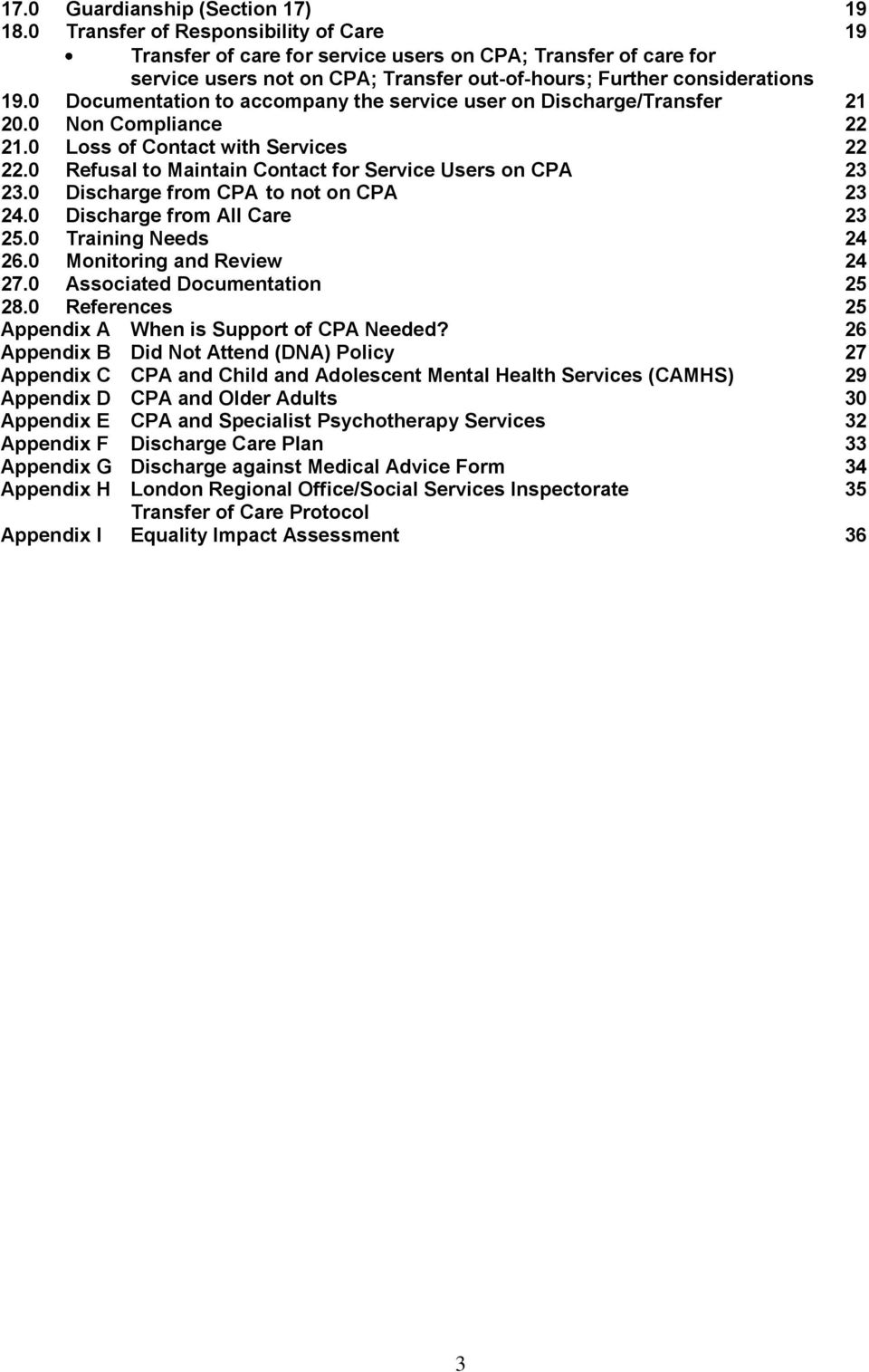
3 17.0 Guardianship (Section 17) Transfer of Responsibility of Care 19 Transfer of care for service users on CPA; Transfer of care for service users not on CPA; Transfer out-of-hours; Further considerations 19.0 Documentation to accompany the service user on Discharge/Transfer Non Compliance Loss of Contact with Services Refusal to Maintain Contact for Service Users on CPA Discharge from CPA to not on CPA Discharge from All Care Training Needs Monitoring and Review Associated Documentation References 25 Appendix A When is Support of CPA Needed? 26 Appendix B Did Not Attend (DNA) Policy 27 Appendix C CPA and Child and Adolescent Mental Health Services (CAMHS) 29 Appendix D CPA and Older Adults 30 Appendix E CPA and Specialist Psychotherapy Services 32 Appendix F Discharge Care Plan 33 Appendix G Discharge against Medical Advice Form 34 Appendix H London Regional Office/Social Services Inspectorate 35 Transfer of Care Protocol Appendix I Equality Impact Assessment 36 3
4 1. Introduction 1.1 This document sets out the policy governing the operation of the Care Programme Appraoch (CPA) at South West London and St George s Mental Health NHS Trust. The policy has been developed incorporating the following principles of personalised mental health care: Ensuring services are appropriate to the needs and expectations of the individual Promoting recovery, social inclusion and participation in valued social roles Engaging with the carers, families, friends and dependent children of people using our services, providing appropriate support and information whilst ensuring the confidentiality and rights of the service users are protected. Recognising integration of care provided by health and social care staff working together Ensuring appropriate and effective partnership working with statutory, voluntary or independent agencies and also relatives, carers and advocates 1.2 The policy considers the Department of Health guidance Refocusing the Care Programme Approach: Policy and Positive Practice Guidance (2008). The term CPA is no longer used to describe the usual system of provision of mental health services to those with more straightforward needs in secondary mental health services (formerly standard ). This is to reduce needless bureaucracy and ensure a focus on good professional care for service users with straightforward needs. 1.3 The term CPA,,is only used to describe the approach in secondary care to assess, plan, review and co-ordinate the range of treatment, care and support needs for service users in contact with secondary mental health services who have complex characteristics. The characteristics to consider when deciding if support of CPA is needed are outlined in Appendix A. Active service user involvement and engagement is at the centre of the CPA, alongside a focus on reducing distress and promoting social inclusion and recovery. 1.4 Key groups of service users requiring CPA are those who have the following: parenting responsibilities significant caring responsibilities a dual diagnosis (substance misuse and mental health) a history of violence or self harm and/or who live in unsettled accommodation 1.5 The needs of individuals from these key groups should be fully explored to make sure that the range of their needs are examined, understood and addressed when deciding their need for support under CPA. The default position for individuals from these groups would normally be under CPA unless a thorough assessment of need and risk shows otherwise. The decision and reasons not to include individuals from these groups should be clearly documented. 1.6 All service users subject to Supervised Community Treatment (SCT) or subject to Guardianship under the MH Act should be supported by CPA. If this is not considered appropriate for any particular individual the reasons should be clearly documented. See section 13 for guidance on SCT and refer to the Trusts SCT policy. See section 14 for guidance on Guardianship. 1.7 Services should consider at every formal review whether the support provided by CPA continues to be provided. Similarities and differences between service responses to users needing the support of CPA and those that do not are outlined in Appendix B. 1.8 CPA could apply to service users in the community, but also to those in hospital, in day care provision and other residential settings, including prisons. It does not apply to: Service users not accepted for treatment by secondary or tertiary services; Service users who, after assessment, are referred back for treatment to a referring team; Service users who are formally discharged from all Trust treatment and care to another service, such as primary care. 4

5 1.9 For specific guidance for CPA and Child and Adolescent Mental Health Services (CAMHS) refer to Appendix D 1.10 For specific guidance for CPA and Older Adults refer to Appendix E 1.11 For specific guidance on implementing CPA in specialist psychological services see Appendix F. 2. Definition of Patient Groups Service Users Needing CPA An individuals characteristics Complex needs: multi-agency input; higher risk. See detailed definition in Appendix A What the service users should expect Support from CPA care co-ordinator (trained, part of job description, co-ordination support recognised as significant part of caseload) A comprehensive multi-disciplinary, multi-agency assessment covering the full range of needs and risks An assessment of social care needs against FACS eligibility criteria (plus Direct Payments) Comprehensive formal written care plan: including risk and safety/contingency/crisis plan On-going review, formal multi-disciplinary, multiagency review at least once a year but likely to be needed more regularly At review, consideration of on-going need for CPA support Increased need for advocacy support Carers identified and informed of rights to own assessment Other Service Users More straightforward needs; one agency or no problems with access to other agencies/support; lower risk Support from professional(s) as part of clinical/practitioner role. Lead professional identified. Service User self-directed care, with support A full assessment of need for clinical care and treatment, including risk assessment An assessment of social care needs against FACS eligibility criteria (plus Direct Payments) Clear understanding of how care and treatment will be carried out, by whom, and when (can be clinicians letter) On-going review as required On-going consideration of need for move to CPA if risk or circumstances change Self-directed care, with some support if necessary Carers identified and informed of rights of own assessment 3. Purpose 3.1 To describe how and for whom CPA is to operate in South West London and St George s Mental Health NHS Trust following the publication of revised CPA guidance from the Department of Health in 2008 Refocusing the Care Programme Approach: Policy and Positive Practice Guidance 4. Duties 4.1 Medical Director To undertake the role of Trust Executive Lead for CPA. 4.2 Service Directors To ensure all teams operate the revised CPA in a way which delivers optimum care for service users. 4.3 All Clinicians To ensure the process of CPA is used as a basic principle for all care delivered by the Trust. 5

6 4.4 Care Co-ordinators To co-ordinate the continuing assessment of the service user s mental and physical health, needs and risk. To involve service users and carers in devising and agreeing the care plan. To take into account any Advance Directives the service user may have made under the Mental Capacity Act. To ensure and monitor the implementation of all parts of the care plan; To ensure that the care plan is regularly reviewed; To act as a reference point for other professionals, relatives, carers and advocates; To take action when the care plan is not being implemented; and, To keep in contact with the service user wherever they are, for example, whilst in hospital or attending the day hospital. To ensure a risk assessment is undertaken and a crisis, relapse and contingency plan is established To record care plan assessment and review discussions, decisions and changes together with the names of present at the review in the care record. 4.5 Team Managers/Leaders To ensure all service users receiving care through their service are assessed to evaluate if they meet the criteria for CPA To ensure all service users requiring CPA are allocated an appropriate care co-ordinator To ensure service users under the care of their team are appropriately reviewed To monitor training and support for care co-ordinators To monitor the quality of care plans and CPA process for care co-ordinators in their team 4.6 Consultant Psychiatrist/Responsible Clinician Most service users under CPA will have a Consultant Psychiatrist involved in their care. A Consultant Psychiatryst may be consulted by a Care Co-ordinator on relation to the care delivered to the service user. The Consultant Psychiatrist may not, however, be clinically responsible for all decisions taken by the Care Co-ordinator. Service users may not need a named Consultant Psychiatrist involved in their care. The medical care of these service users may be undertaken by their GP. 5 Ratification process Key Area Lead Director Working Group Ratification Body Clinical Dr Ben Nereli, Medical CPA Policy Review Clinical Governance Director Group Group 6 Consultation 6.1 This policy has been widely consulted on by a number of staff groups including those working in wards, community teams, recovery and social inclusion, service development and IM&T. The members of the Health Clinical Governance Group have contributed to the consultation. 7. Care Programme Approach (CPA) 7.1 Assigning CPA status A CPA status should be recorded on RiO after the first face-to-face contact. There are several options available in the drop down list and the table below indicates how the Trust has decided these should be used. RiO has not been updated in line with new CPA guidance and so Standard and enhanced are still used. 6

7 Table: CPA status field use RiO label Trust use Nothing recorded Liaison psychiatry teams should not complete the CPA status field at assessment and it should be left blank. No care Not applicable Standard CPA All other teams should complete the field after first face-to-face contact and this field should not be left blank for any client Should only be used if the Trust is not providing any support to the individual but is providing advice to other agencies. CAMHS services should use tier 2 for this purpose Should only be used for national clients, where secondary care (and CPA responsibility) is wholly managed outside the Trust. The Trust is providing support but has not taken over CPA responsibility This will allow this activity to be excluded from local performance measurement Equates to Not on CPA All service users (except CAMHS) should be recorded as standard, unless the presentation is complex and required CPA levels of care. Enhanced CPA If the client is on Standard CPA, the care coordinator field needs to be completed, but this does not mean that there are the same levels of responsibility required for people on CPA. The field identifies the key person involve in care and support. Equates to On CPA This denotes the full responsibility for CPA as outlined in the CPA policy Tier 2 Tier 3 Tier 4 For use by CAMHS only. To indicate clients for whom we mainly provide advice to other agencies For use by CAMHS only. To indicate clients for whom we mainly provide direct support to the child and their family For use by CAMHS only. To indicate clients for whom we complex and inpatient support 7.2 Allocation and Change of a Care Co-ordinator A care co-ordinator must be appointed. This will usually be the person who has most contact with the service user. The care co-ordinator will be appointed at a multi-disciplinary meeting and should be the member of the team who is most appropriate to meet the service user s needs. A named care co-ordinator cannot usually be appointed without that named person being present at the meeting, unless the proposed appointment has been discussed and accepted by the named person in advance or if the person agrees after a discussion with the team manager Wherever possible, the service user s views about the choice of care co-ordinator should be taken into account. Where there is more than one clinical team involved with a service user, the respective teams will explicitly agree who holds care co-ordinator and consultant psychiatrist responsibility. The responsibilities of the care co-ordinator include: If a service user is subject to a Guardianship Order made to the local authority, a social work professional is likely to be the most suitable care co-ordinator Any change of care co-ordinator must be discussed with the multidisciplinary team and the decision to change recorded in the service user s care record. The service user must also be informed, preferably well in advance and a handover period agreed to allow the service user to get to know their new care-co-ordinator Allocation of a care co-ordinator or changes to a care co-ordinator must be recorded on RiO. 7

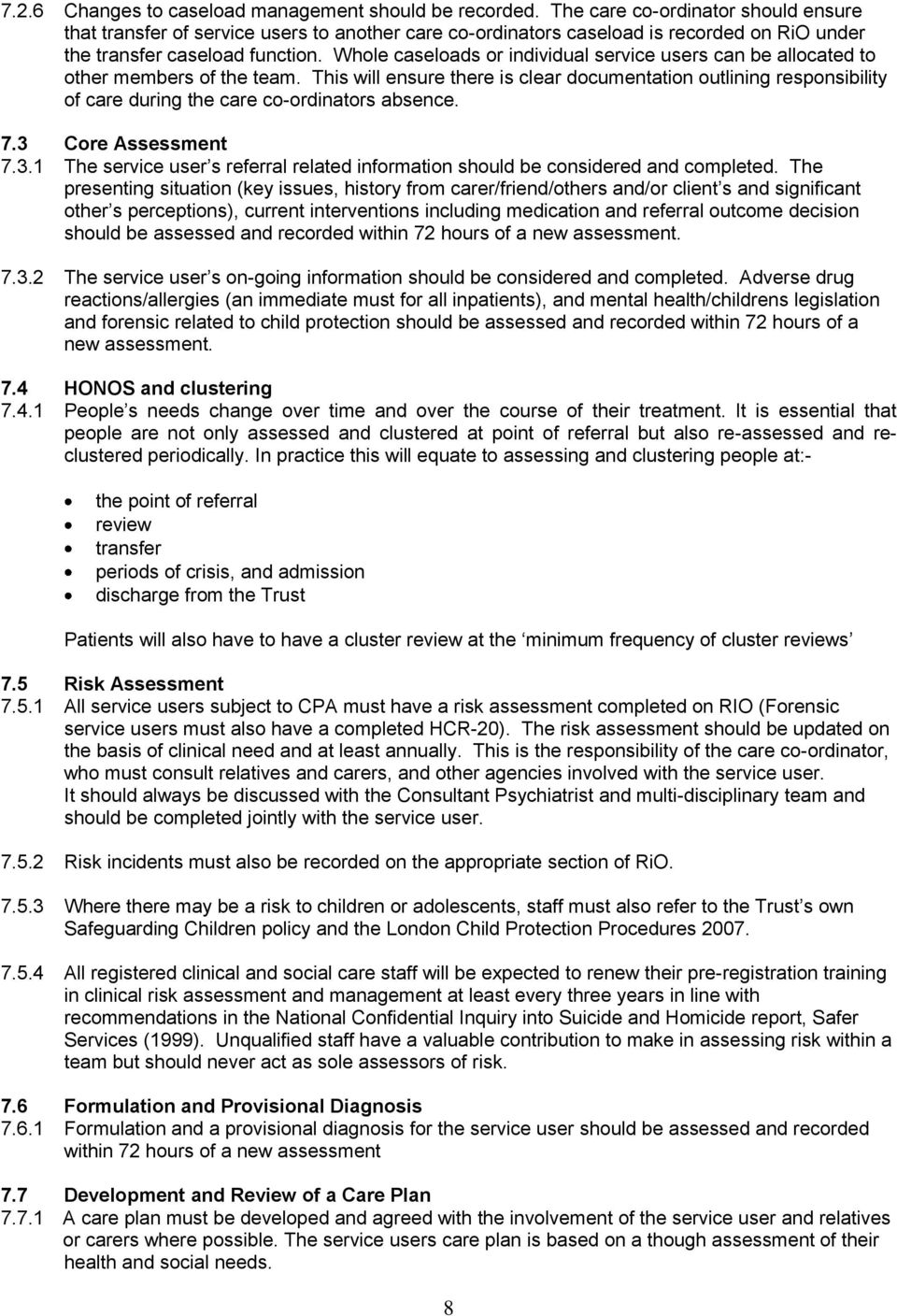
8 7.2.6 Changes to caseload management should be recorded. The care co-ordinator should ensure that transfer of service users to another care co-ordinators caseload is recorded on RiO under the transfer caseload function. Whole caseloads or individual service users can be allocated to other members of the team. This will ensure there is clear documentation outlining responsibility of care during the care co-ordinators absence. 7.3 Core Assessment The service user s referral related information should be considered and completed. The presenting situation (key issues, history from carer/friend/others and/or client s and significant other s perceptions), current interventions including medication and referral outcome decision should be assessed and recorded within 72 hours of a new assessment The service user s on-going information should be considered and completed. Adverse drug reactions/allergies (an immediate must for all inpatients), and mental health/childrens legislation and forensic related to child protection should be assessed and recorded within 72 hours of a new assessment. 7.4 HONOS and clustering People s needs change over time and over the course of their treatment. It is essential that people are not only assessed and clustered at point of referral but also re-assessed and reclustered periodically. In practice this will equate to assessing and clustering people at:- the point of referral review transfer periods of crisis, and admission discharge from the Trust Patients will also have to have a cluster review at the minimum frequency of cluster reviews 7.5 Risk Assessment All service users subject to CPA must have a risk assessment completed on RIO (Forensic service users must also have a completed HCR-20). The risk assessment should be updated on the basis of clinical need and at least annually. This is the responsibility of the care co-ordinator, who must consult relatives and carers, and other agencies involved with the service user. It should always be discussed with the Consultant Psychiatrist and multi-disciplinary team and should be completed jointly with the service user Risk incidents must also be recorded on the appropriate section of RiO Where there may be a risk to children or adolescents, staff must also refer to the Trust s own Safeguarding Children policy and the London Child Protection Procedures All registered clinical and social care staff will be expected to renew their pre-registration training in clinical risk assessment and management at least every three years in line with recommendations in the National Confidential Inquiry into Suicide and Homicide report, Safer Services (1999). Unqualified staff have a valuable contribution to make in assessing risk within a team but should never act as sole assessors of risk. 7.6 Formulation and Provisional Diagnosis Formulation and a provisional diagnosis for the service user should be assessed and recorded within 72 hours of a new assessment 7.7 Development and Review of a Care Plan A care plan must be developed and agreed with the involvement of the service user and relatives or carers where possible. The service users care plan is based on a though assessment of their health and social needs. 8
9 The care plan must be written in a way in which the service user understands; identify the planned interventions and the expectations of such interventions and record who is going to carry out such interventions. The care plan should be based on the principles of recovery and social inclusion. It should also recognise the diverse needs of the service user, reflecting cultural and ethnic background, as well as gender and sexuality The needs of service user s vary and for a personalised care plan the following could be considered: Mental Health; Medication; Living skills; Forensic History; Risks; Cultural Factors; Spiritual Needs; Physical Health; Employment and Daytime Activity; Social Network; Alcohol/drug History; Housing/Finance/Legal issues; Service User Preference and Advance Directives This must be completed once a decision to place the service user on CPA has been made, and after each review As part of the 2011/12 CQUIN requirement, part of the care plan should be written in the first person singular and have at least two recovery-orientated goals outlined identified by the service user. To identify where the service user has been directly quoted, the section of the care plan should be in quotation marks When a service user who was not subject to the CPA is admitted to hospital, a meeting will take place before discharge to decide what level of support is required. If the service user is discharged on CPA a care co-ordinator should be allocated and a care plan agreed and entered onto RiO. A copy of the care plan must be given to the service user and sent to the GP There is a statutory responsibility for the local authority to provide a comprehensive assessment of the needs of mentally ill adults and their carers. This is delegated to the Trust in line with the integrated single management arrangements. The assessment should be integrated into the care plan, or, if there is separate documentation, a copy of this should be attached to it The care plan must be reviewed regularly. There is no set format for this. Some reviews might be fitted into routine clinical meetings, while others will need a separate meeting. All those involved in a service user s care, where appropriate, (for example, carers; the GP; an allocated social worker; a probation officer; day centre or residential staff, also other staff, such as those working in Physical Therapies and Psychological Therapies) should be invited to the review and given reasonable notice of the date and time. A record must be kept by the care co-ordinator of who was invited to and who attended the review Reviews must be held at least once a year. A change in a service user s care setting, legal status, or changes in the level of risk, or in his or her mental or physical health, will mean they happen more frequently. A change in care co-ordinator, or transfer to another service, will also trigger a review. People on inpatient wards should have a CPA review at least every six months. It is proposed that the CPA review periods should to be in line with cluster review periods. Therefore people on CPA will be expected to be reviewed within the timescales outlined in the table below. Table: Cluster (and CPA) review periods Cluster Cluster 0: Variance (Unable to allocate a cluster) Cluster 1: Common Mental Health Problems (low severity) Cluster 2: Common Mental Health Problems Cluster 3: Non-Psychotic (Moderate Severity) Cluster 4: Non-Psychotic (Severe) Cluster 5: Non-Psychotic (very severe) Cluster 6: Non-Psychotic Disorders of overvalued Ideas Cluster 7: Enduring Non-Psychotic Disorders (high disability) Cluster 8: Non-Psychotic Chaotic and Challenging Disorders Cluster 9: Blank Cluster Cluster 10: First Episode in Psychosis Minimum frequency of reviews: 4 weeks 8 weeks 12 weeks 4 months 6 months 6 months 6 months Annually Annually N/A Annually 9

10 Cluster 11: Ongoing Recurrent Psychosis (low symptoms) Cluster 12: Ongoing or Recurrent Psychosis (high disability) Cluster 13: Ongoing or Recurrent Psychosis (high symptom and disability) Cluster 14: Psychotic Crisis Cluster 15: Severe Psychotic Depression Cluster 16: Dual Diagnosis Cluster 17: Psychosis and Affective Disorder Difficult to Engage Cluster 18: Cognitive impairment (low need) Cluster 19: Cognitive impairment or Dementia Complicated (Moderate need) Cluster 20: Cognitive impairment or Dementia Complicated (High need) Cluster 21: Cognitive impairment or Dementia (High physical or engagement needs) Annually Annually Annually 4 weeks 4 weeks 6 months 6 months Annually Annually 6 months 6 months Reviews, including reviews when a service user is discharged from the ward should not be conducted in the service user s absence, if possible. At this review, the community services, including home treatment should be present and the cluster should be reviewed and updated. If the service user is not present at the review, the care-coordinator should look into the reasons and together with the multidisciplinary team a plan should be made to encourage the service user to attend. However, if the service user does not attend the second time, the review can take place The service user must always be involved in the planning and provision of his or her care. Relatives and/or carers must also be involved wherever possible. 7.8 Crisis, Relapse and Contingency Plan A crisis, relapse and contingency plan is required for all service users on CPA. The plan describes what action should be taken if part of the care plan cannot be provided (for example, the care co-ordinator is away, it is known from local and National inquiries that absence of keyworkers can be a high risk period in patient safety incidents occurring): it also explains what action should be taken if a service user becomes very ill or his/her mental health is deteriorating quickly. 7.9 Advance Directives An advance directives should be discussed with the service user. If the service user would like an advance directive it should be developed in collaboration with mental health professionals involved in the service users care and relatives or carers 8. Carers and Families 8.1 Staff should always be aware of the potential value of sharing information with carers, friends and families, involving them throughout a service user s care and treatment, whilst also always ensuring the confidentiality and rights of the service user are protected. Even if details cannot be shared, staff should always consider what information would help a service user s carer, friend or family in their own right and in their supportive role with the service user. Staff should consider how appropriate openness can be promoted whilst taking account of the service user s wishes and the nature of their relationship with the family member, carer or friend. 8.2 Staff should discuss with service users whether and how to involve family, friends and carers in their treatment and support, how this could be beneficial and what information might be shared with them. It is quite usual for people to agree to a certain amount of disclosure and to ask for other information to be kept confidential. People may change their minds over time as to what can or cannot be shared. This should be respected and carefully documented in the service user s care record. The situation-specific capacity of the service user to consent to any information sharing should be ascertained immediately prior to any disclosure. 8.3 Staff should always be alert to the possible risks inherent in decisions to share or not share information with families, friends and carers. Staff should follow information sharing and confidentiality protocols when information needs to be share with family, friends or carers against the express wishes of a service user in order to manage significant risks. 10

11 8.4 Providers of substantial informal care are entitled to an assessment of their own needs and may be entitled to receive funded social care services in their own right. Carers support or care plans should be developed, implemented and reviewed in collaboration between staff and carers as appropriate. The carers of service users on CPA should be identified and given information about available services and entitlements they may have access to. 9. Information Sharing and Copying Correspondence to Relevant Professionals in other Organisations 9.1 Service users do have a right to confidentiality. The presumption made throughout this policy is that of full disclosure of clinical information to all Trust professionals directly involved in a service user s care and relevant professionals in other organisations with which the Trust has an information sharing agreement and disclosure is justified for the safety of the service user or others. This must be fully explained to the service user by the care co-ordinator, if, however a service user objects to this, this must be:- recorded in the service users RiO record and ensure the Consent to Share Indicator is set to red handled with sensitivity but with regard to the reasons for disclosure. i.e. to ensure good communication; the effective co-ordination of care; and/or the safety of the service users and others 9.2 In situations where the service user does not consent to share information the course of action to be taken should be agreed with the consultant psychiatrist. The consultant psychiatrist can discuss any concerns they have with the relevant Associate Medical Director / Clinical Lead and the Trust Caldicott Guardian, the Medical Director. In exceptional cases, and over the twentyfour hour period, Capsticks, the Trust s Solicitors, can be consulted. Their Emergency Number is In all cases the decision not to disclose clinical information, and the reasons for this, must be recorded in the service users care record. Staff should also have regard to Sections 132 and 133 of the Act concerning the duty to give information to detained service users and nearest relatives. 9.3 All letters written by Trust professionals to other professionals within or outside the Trust, for example a GP, should be copies to the person to whom they refer except where: the letter contains personal data that would reveal information that relates to and identifies another person, unless the person has consented to the disclosure, or can be fully anonymised in the letter, or it is reasonable to provide the information without consent (this exception does not apply where the person identified is a healthcare professional permitting access to the information contained in the letter would be likely to cause serious harm to the physical or mental health of the person to whom the letter relates or another person the person indicates they do not wish to receive copies of correspondence relating to their care If correspondence is not copied to the service user the reason for this should be recorded in their care record. 10. Recording Details about Children of Service Users who are in the care of Adult Working Age and Older Peoples Services 10.1 This section should be read in conjunction with the Trust Safeguarding Children [TWC03] and 2003 Department of Health guidance What to do if you are worried about a child being abused 10.2 The following must be recorded for each child: name address Date of birth GP (of child) School attended Primary carer The above information on dependants should be recorded within contacts section of RiO adding the school, date of birth and other relevant information in the comments field in this section. 11

12 10.3 This information for each child must be recorded for: All people on CPA People not on CPA where the assessment indicates potential risk is present. Indicators might include: o Drug/alcohol abuse o Domestic violence o Forensic history (schedule 1 offender) o Past history of severe mental illness o Past history of sexual/physical abuse o Serious self harm attempts o A child with a severe physical illness or learning disability in the family o Unsettled family circumstances (frequent moves, short contacts with many services) o Any other circumstances where the assessing health or social care professional is o Concerns about the welfare of children in the family Anyone admitted to an inpatient unit. In this case the information required above must be recorded and the relevant Social Services Department Child and Family Team informed if there are any identified concerns(see above) 10.4 Reasons for gaps in information should be specified, and should be explored further. If there are continued concerns, these must be shared with Children s and Families Services The above may also apply to other family members who have significant contact with children in the family such as grandparents who provide childcare to the family, step parents or parents with access rights, siblings or other family members acting as primary carer In depth assessment of child protection issues should only be attempted by someone trained in children s issues. If in any doubt consult: Team child protection lead On call CAMHS consultant psychiatrist Child Protection Named Professional 10.7 Due consideration must be given to child protection issues in completing and updating a risk assessment, and, if required, the crisis and contingency plan for all patients where the above indicates that any of the above factors are present. This should include consideration of information sharing across agencies when considering both leave and discharge arrangements. 11. Admission to and Discharge from Hospital 11.1 Admission to hospital If admission for a service user is being considered the local crisis and home treatment team (CHTT) needs to be contacted for gate-keeping inpatient beds. Service users can only be admitted to hospital after CHTT agreement. Where a service user is assessed as requiring hospital admission, the CHTT will assist organising inpatient admission in conjunction with the CMHT or the CHTT medical staff where indicated Where possible, there should be a joint assessment with a member of the referring team and the CHTT, prior to admission to hospital It is important that prior to the service user s planned admission to hospital that CHTT and ward staff are given as much information as possible by the care co-ordinator or another member of the referring team to prepare for admission. This will include key information on previous history, Mental Health Act status, the reasons that have led to this current admission and other mental and physical care needs, including current medication. This will allow the CHTT and ward team to consider the most appropriate input. This will be dependent on risk, gender, and health care needs. 12

13 A named nurse must be allocated as soon as possible after the ward is notified of the admission. The Named Nurse will be responsible for co-ordinating the care of the service user whilst they are in hospital. The Named Nurse will induct the service user to the ward and address any questions or concerns regarding the ward environment or treatment processes. They will formulate a care plan with the service user and meet with them on a regular basis to review process. If the service user is subject to the Mental Health Act the Named Nurse will ensure that they are fully aware of their legal rights. The Named Nurse will also empower the service user to manage their own recovery by helping them to identify their own triggers and early warning signs Where possible, if the service user is well known to the service, the care coordinator should be present on the ward when the service user is admitted to facilitate good understanding of the service user s needs. In any case early dialogue between the named nurse, the service user s care coordinator and the service user should take place to draw up or revise the care plan to take account of the admission The following actions are required on the service user s admission and entered onto RiO (where appropriate): Formulation of key problems that led to the current crisis Early mental state assessment by the admitting doctor Risk assessment by nursing and medical staff HONOS Assessment undertaken and clustering if necessary Decision on the level of observation required for the service user (See Observation Policy TWC25) Physical health monitoring (Temperature, Blood Pressure, Height and Weight) by nursing staff and physical health examination by medical staff (See Physical Healthcare Policy TWC54) Orientate the service user to the ward environment and give any helpful information that would alleviate any anxieties that the service user is experiencing at that time. It is important not to overload the service user with information. Giving and offering information must be ongoing and may need to be repeated. Information must be given on the Mental Health Act, Advocacy, PALS, and information about the ward, benefits advice, meeting cultural and spiritual needs and support for carers. A property and personal search for dangerous items such as sharps and medicines not already handed in. Complete an inventory of belongings and receive any cash and valuables personal belongings for safe keeping (See Personal Search Policy TWC29) Inform next of kin and other agencies of the admission with the agreement of the service user. Helpful advice can be given to families on what essential belongings should be brought in and when visiting times are The inpatient care plan should be a seamless record of the service user s ongoing treatment. The care plan will be developed with the service user and their carer wherever possible. A comprehensive range of interventions for patients and carers will be made available and tailored to the individual circumstances. These will include: Medication review and prescription including helping service users manage any side effects Psycho Social Interventions Physical health and dietary requirements Cognitive Behavioural Therapy Family Therapy Occupational Focused Therapy Peer Support Community Meetings Recreational Activities. The care plan should be individually tailored to meet the service users specific needs and wishes. This planning process will take into account any advance directives that the service user may have drawn up at a time when they were well After an assessment of the service users need and risk has been undertaken zoning must be implemented. The service user must be allocated to a particular zone which is defined by certain criteria and best fits their level of need or risk. 13

14 The Named Nurse (or nominated deputy e.g charge nurse, or ward manager) should agree a regular time to communicate with the service users care co-ordinator (either face-to-face or by telephone) The care coordinator should keep regular contact with the service user whilst they are in hospital. Support and reassurance should be provided to the service user by the team relating to any social care issues including maintaining employment, mortgages and rent, bills, securing the property and tenancy arrangements. If the service user has been made homeless early contact with the Homeless persons unit is vital so that the service user has access to all the necessary information and options early on Discharge from Hospital All Service Users Planning for discharge should underlie the service user s plan of care throughout their inpatient stay with the goal that they reach the highest possible level of health and independence. Where appropriate, a referral to the CHTT should be considered as they can facilitate early discharge with high intensity support provided in the community. For detained patients short periods of section 17 leave or the use of Supervised Community Treatment may be considered where appropriate in line with legislation and least restrictive principles The multi-disciplinary team should work with the service user to begin developing a care plan orientated to discharge as soon as possible after admission. The following general headings are some of the areas to consider: Own expectations of the admission and plans for discharge Assessed risk Ability to function independently Home situation Employment Support system Need for continuing support and treatment Needs of the carer or significant others There may be specific needs and support systems to consider for service users on discharge, for example, requirements for service users under Home Office Restrictions and packages of care jointly managed by Social Services such as mobile meals and day care. For Service Users discharged on CPA If a service user is to be discharged on CPA a care co-ordinator should be allocated and a care plan agreed and entered onto RiO. A copy of the care plan must be given to the service user and sent to the GP. The care co-ordinator should meet the service user, named nurse and CHTT staff regularly throughout the service user s stay in hospital. This is especially important where the care coordinator has not met the service user and his/her carers before An initial meeting between the care co-ordinator and named nurse should be arranged soon after admission to identify possible areas where aftercare services are needed. These include needs for medication, therapy, supervision, accommodation, day care, ongoing rehabilitation and engagement in employment The service users carer(s) where appropriate should be asked about any progress or problems during periods of leave to assist with the plan for care on discharge The named nurse and care co-ordinator have a joint responsibility for ensuring that discharge arrangements are complete before the service user leaves hospital. The community worker responsible for 7-day follow up should be identified and introduced to the service user this will 14

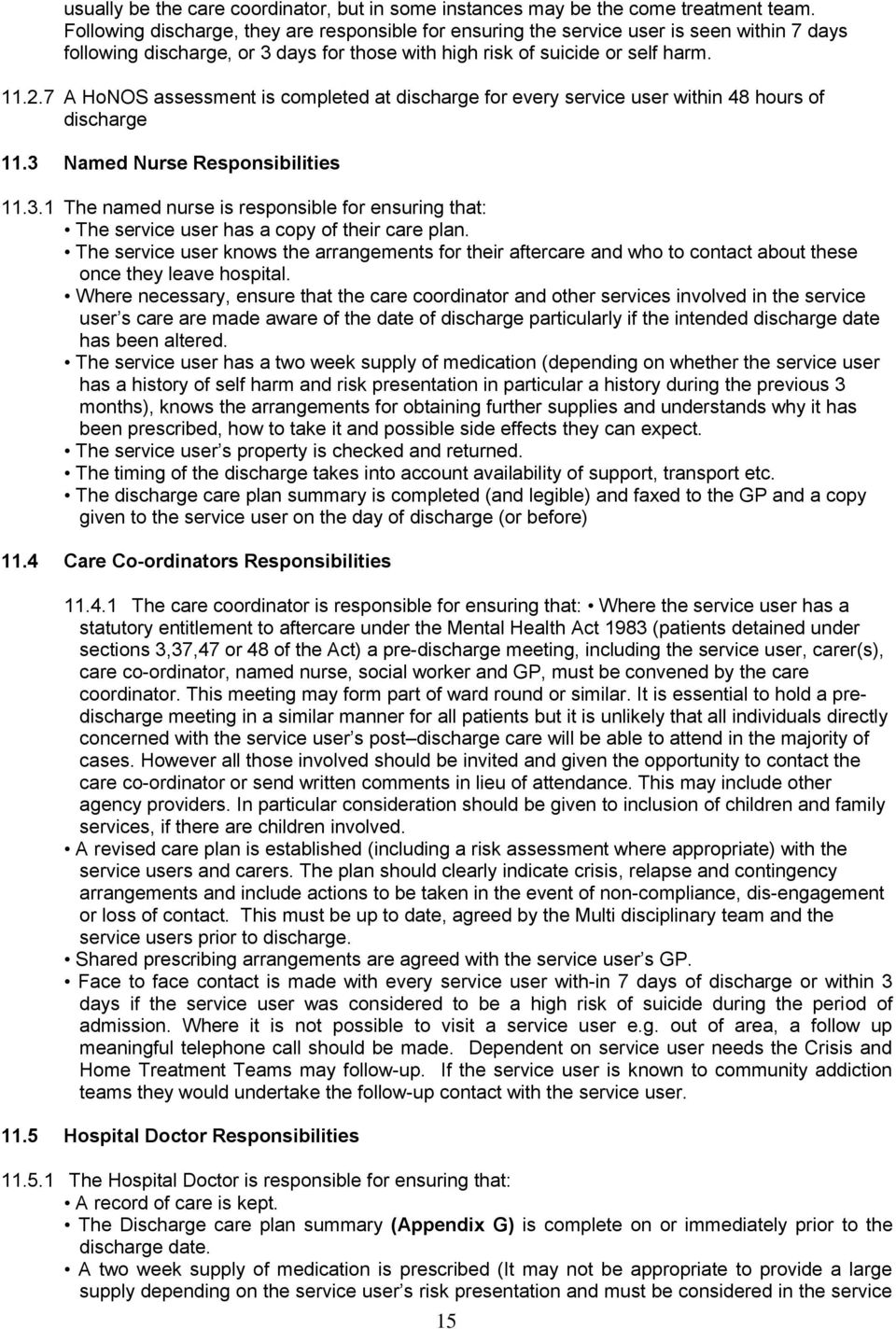
15 usually be the care coordinator, but in some instances may be the come treatment team. Following discharge, they are responsible for ensuring the service user is seen within 7 days following discharge, or 3 days for those with high risk of suicide or self harm A HoNOS assessment is completed at discharge for every service user within 48 hours of discharge 11.3 Named Nurse Responsibilities The named nurse is responsible for ensuring that: The service user has a copy of their care plan. The service user knows the arrangements for their aftercare and who to contact about these once they leave hospital. Where necessary, ensure that the care coordinator and other services involved in the service user s care are made aware of the date of discharge particularly if the intended discharge date has been altered. The service user has a two week supply of medication (depending on whether the service user has a history of self harm and risk presentation in particular a history during the previous 3 months), knows the arrangements for obtaining further supplies and understands why it has been prescribed, how to take it and possible side effects they can expect. The service user s property is checked and returned. The timing of the discharge takes into account availability of support, transport etc. The discharge care plan summary is completed (and legible) and faxed to the GP and a copy given to the service user on the day of discharge (or before) 11.4 Care Co-ordinators Responsibilities The care coordinator is responsible for ensuring that: Where the service user has a statutory entitlement to aftercare under the Mental Health Act 1983 (patients detained under sections 3,37,47 or 48 of the Act) a pre-discharge meeting, including the service user, carer(s), care co-ordinator, named nurse, social worker and GP, must be convened by the care coordinator. This meeting may form part of ward round or similar. It is essential to hold a predischarge meeting in a similar manner for all patients but it is unlikely that all individuals directly concerned with the service user s post discharge care will be able to attend in the majority of cases. However all those involved should be invited and given the opportunity to contact the care co-ordinator or send written comments in lieu of attendance. This may include other agency providers. In particular consideration should be given to inclusion of children and family services, if there are children involved. A revised care plan is established (including a risk assessment where appropriate) with the service users and carers. The plan should clearly indicate crisis, relapse and contingency arrangements and include actions to be taken in the event of non-compliance, dis-engagement or loss of contact. This must be up to date, agreed by the Multi disciplinary team and the service users prior to discharge. Shared prescribing arrangements are agreed with the service user s GP. Face to face contact is made with every service user with-in 7 days of discharge or within 3 days if the service user was considered to be a high risk of suicide during the period of admission. Where it is not possible to visit a service user e.g. out of area, a follow up meaningful telephone call should be made. Dependent on service user needs the Crisis and Home Treatment Teams may follow-up. If the service user is known to community addiction teams they would undertake the follow-up contact with the service user Hospital Doctor Responsibilities The Hospital Doctor is responsible for ensuring that: A record of care is kept. The Discharge care plan summary (Appendix G) is complete on or immediately prior to the discharge date. A two week supply of medication is prescribed (It may not be appropriate to provide a large supply depending on the service user s risk presentation and must be considered in the service 15
16 user s risk assessment) and that the service users and their carers know why this has been prescribed, how to take it and possible side effects they can expect. A medical certificate is completed, if required. A formal discharge summary is sent to the GP within 7 days of the discharge date. This should include a discharge medication summary Informal service user s discharged against medical advice The service user s GP, the consultant and the social worker should be informed as soon as possible by telephone. Service users discharging themselves against medical advice must have arrangements pursued for aftercare where appropriate and practicable. Service users who are assessed not to require detention under the Mental Health Act will need to complete the Discharge against Medical Advice form (Appendix H) after being seen by the consultant/designated Deputy/ Duty Doctor. This must be faxed to the service user s GP on the same day and uploaded onto RiO. Service users under CPA are subject to the face to face contact within 7 days post discharge or within 3 days if the service user was considered to be a high risk of suicide during the period of admission. Where it is not possible to visit a service user e.g. out of area, a follow up meaningful telephone call should be made. Dependent on service user needs the Crisis and Home Treatment Teams may follow-up. If the service user is known to community addiction teams they would undertake the follow-up contact with the service user. For Service Users Discharged who are not on CPA 11.6 The responsibilities of the Named Nurse and Hospital Doctor remain the same. A discharge letter is completed and sent to the GP within 7 days of the discharge date. This is copied to the service user. A RiO care plan is not required, but best practice is to document a plan of care within the notes. The discharge letter should be scanned into the RiO record. A HoNOS assessment is completed within 48 hours of discharge and the reason for discharge is recorded. Service users discharged from hospital who are not on CPA are still subject to the face to face contact within 7 days post discharge. Dependent on service user needs this would be undertaken by the Community Mental Health Team, Crisis and Home Treatment Team or community alcohol services if the service user is known to them Information to be given to the Service User on Discharge 12.1 The service user should be provided with the following information: Who to contact in an emergency. The Trusts crisis line number should be given to the service user. A copy of their care plan A copy of their discharge summary/discharge letter Information on the medication prescribed, how to take it and what side effects may be experienced 13.0 Discharge of Service Users Out of Hours 13.1 Service users detained under the Mental Health Act 1983 (revised 2007) would not be discharged from hospital out of hours unless there was a planned CPA or Section 117 meeting where this had been agreed. Informal service users agree to a specific time period as an inpatient under assessment or receiving treatment. Service users who request discharge out of hours against medical advice and who are assessed not to require detention under the Mental Health Act 1983 (revised 2007) will need to complete the Discharge against Medical Advice form (Appendix H) after being seen by the consultant/designated Deputy/ Duty Doctor The Trust does not expect to discharge service users before in the morning and in the evening. If a service user is discharged between at weekends or on a bank holiday they are discharged into the care of the crisis and home treatment team. 14. Section 117 Aftercare 14.1 What is Section 117? 16

17 The CPA, Care Management and Risk Assessment and Management policy is applicable to service users who have been discharged from hospital into the community who are subject to Section 117 of the Act The provisions of Section 117 of the Act apply to all service user s who have been detained under Sections 3, 37, 45A, 47 or It is the duty of the Trust and social services to provide aftercare services for a service user to whom this Section applies until the multidisciplinary team (on behalf of health and social services) are satisfied that they are no longer needed Implementing Section The Trust keeps an up to date register in the Mental Health Act Office of all those service users being looked after under Section All Section 117 service users must have a named person responsible for their care Service users on Section 117 will normally be on CPA (see below) Copies of the care plans for service users being cared for under Section 117 will be entered on RIO. A copy must also be given to the service user and the carer Section 117 reviews will always involve all those providing services to the service user. The format of such reviews will follow that of reviews for service users under CPA Normally service users on Section 117, who are discharged into twenty-four hour long-term care, will be reviewed initially at six weeks; within the three months following; and then six monthly. The three monthly, six monthly, and ongoing reviews will be formally regarded as Section 117 review meetings Specific to each Borough and as the Trust evolves as a single health and social care organisation, the Care Coordinator will be representing the involvement of both health and social services. In CMHTs where this model of working is being developed, social services and health inputs will be represented by staff with the appropriate professional backgrounds Until Pooled Budgets are created, services required, over and above those which were being received at the time of a service user s admission as part of a previous Section 117 care plan, will be the financial responsibility of the respective Local Authority. The care co-ordinator and the responsible clinician will clearly identify the additional services required to facilitate a service user s discharge from hospital Secondary Care Patients Not on CPA and Section Discharge from Section 117 is, normally, discharge from the CPA and therefore Specialist Mental Health Services (see below). However, there may be occasions when a service user needs less intensive follow up by the Trust without being on CPA. This decision, and the reasons for it, must be recorded in the service users care record Discharge from Section Service Users can only be discharged from Section 117 after a Section 117 review meeting has taken place with all those involved with the service user including the carer being invited. The decision to discharge a service user from Section 117 can only be taken if the key professionals are in agreement. Each case must be carefully reviewed; all section 117 service users must remain under the care of a CMHT. However not all section 117 service users will require a regular review by a Responsible Clinician (RC). The decision to discharge a service user from Section 117 should only be made after the following questions are fully addressed: 17

18 Does this person continue to need mental Health aftercare services? And if aftercare were to be withdrawn is their mental state likely to deteriorate? Prior to discharge from Section 117, the care co-ordinator or, where applicable, the care manager will ensure that changes in the service user s financial situation are assessed The Termination of Section 117 Form will be signed off at the review meeting. A copy of the letter must be forwarded to the Mental Health Act Office to enable the Section 117 Register to be updated Following a decision to discharge a service user from Section 117 the service user should be sent a letter giving one month s notice of the discharge date On occasion, such as in the Older People s Directorate, there may be instances when a service user is discharged from the CPA and Section 117 but may still need to continue to receive social service provision, such as mobile meals and day care. In such cases a Care Manager from Social Services needs to be appointed. Depending on the circumstances and whether single management structures apply this may still be a social worker in a CMHT. The handover of responsibilities will be arranged within one month of the decision to discharge the service user from the CPA/Section If a Service User Moves If a service user moves to another Borough, the originating Borough will initially retain responsibility for the service user s social care, but the Trust will transfer clinical responsibility for the service user to local mental health services in line with the London Regional Office/ Social Services Inspectorate (London Region) transfer protocol (Appendix I). Ahead of the transfer of clinical responsibility being affected, it must be decided if a service user will continue to need aftercare under Section 117, as well as the CPA, in the future. If this is the case the care coordinator must identify who will be responsible for what in the receiving local mental health service/social services department. This must be recorded in the service users care record. 15. Multi Agency Public Protection Arrangements Panel (MAPPA) 15.1 The care coordinator must ensure that when a service user has been identified as requiring management through the MAPPA that the local MAPPA is notified of the service user s discharge and this is recorded in the service user s discharge care plan ensuring effective two-way communication between Trust and MAPPA services. Referrals to MAPPA should take place via the Borough Service Director. (See MAPPA Policy TWC44) 16. Supervised Community Treatment (SCT) and CPA 16.1 This guidance on the delivery of Supervised Community Treatment (SCT) should be read and implemented in conjunction with section 17A of the Mental Health Act 1983, as amended by the Mental Health Act 2007; the Trust SCT policy and the National Institute for Mental Health in England (NIMHE) publication, SCT: A Guide for Practitioners (October 2008) Service users can be considered for SCT by their Responsible Clinician if they are: Currently subject to Section 3 of the Act, including those on leave under Section 17 of the Act Detained under Section 37, Section 45A, Section 47 or Section 48 of the Act 16.3 There are no age restrictions for SCT 16.4 The purpose of SCT is to ensure that a relatively small number of service users who are anticipated in the judgement of their care team, to default from treatment, will continue to receive the treatment that they need to prevent deterioration in their mental disorder necessitating a further period of detention in hospital. 18

19 16.5 SCT is aimed to allow service users suffering from a mental disorder to live in the community by providing treatment that could: Reduce the risk of service users mental health deteriorating and Reduce the likelihood of someone else s health and safety being placed at risk 16.6 The decision to proceed with SCT should whenever possible be made within a Section 117 planning meeting (see section 11). The decision should result from consultation with: The service user Any carers Any attorney (authorised by Lasting Power of Attorney Personal Welfare) or court Appointed Deputy under the Mental Capacity Act 2005 Member of the multi-disciplinary team involved in the service users care The service users GP An Approved Mental Health Act Professional (AMHP). The AMHP must agree in writing that a Community Treatment Order (CTO) is appropriate and any conditions attached to the order are necessary to ensure service user receives treatment, to prevent risk of harm to the service user health or safety, to protect other persons 16.7 The Section 117 meeting must be minuted and the minutes uploaded on RiO in the Mental Health Act folder 16.8 The CTO and its condition should be recorded in the care plan on RiO and should form the basis of the risk assessment and crisis, relapse and contingency plans The CTO should be recorded in the Mental Health element of the care plan All service users subject to a CTO will be subject to CPA The decision to revoke or extend a CTO should take place within a Section 117 planning meeting. Consultation should follow the process described in paragraph Guardianship (Section 17) Mental Health Act A Guardianship order can be imposed on any service user over 16 with a specified form of mental disorder. They do not need to be detained in hospital. An Application is made by an Approved Mental Health Professional (AMHP) with 2 medical practitioners recommendations to the Director of Social Services or a panel and a guardian is appointed. Please refer to local Borough policies. 18. Transfer of Responsibility of Care Transfer of Care for Service Users on CPA 18.1 Transfer is a time of vulnerability and risk for service users and the Trust aims to provide well planned, timely transfers, essential to ensure safe, effective and efficient transfer of service users between teams and services. Communication and negotiation must begin immediately a move is anticipated For service users on CPA, all decisions about transfer to another team or service must be discussed with the service user and/or carer(s) If a service user detained under the Mental Health Act 1983 (revised 2007) is being transferred to an acute hospital a decision is required about what section is used. Section 17 enables staff to put the service user on leave from the ward for a given period. Section 19 enables staff to transfer the services users care to another hospital. The receiving hospital will become the detaining authority and will be responsible for the administration of the service user s care under the Mental Health Act 1983 (revised 2007). Section 17 should be used if a short term intervention is required by an acute hospital. 19

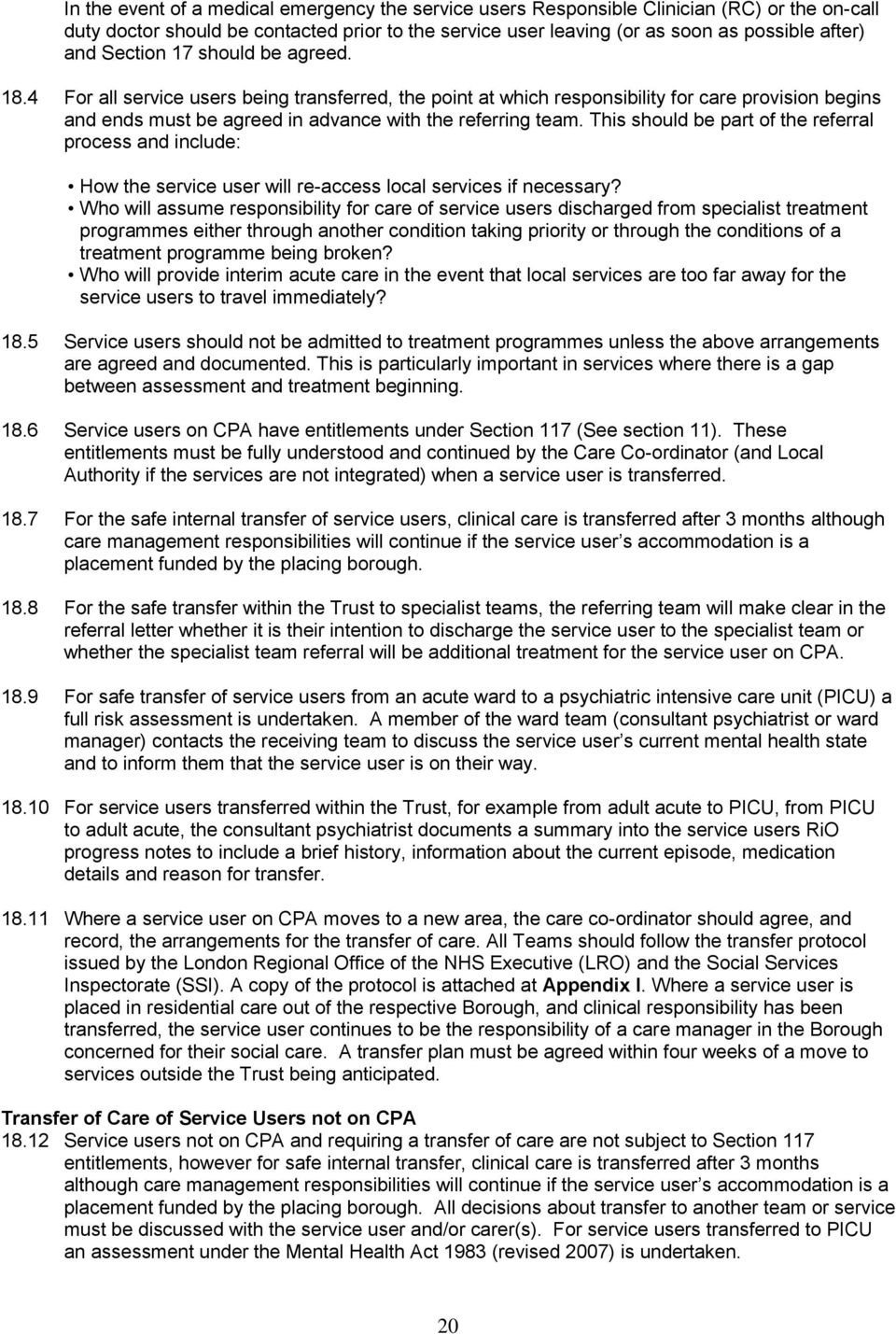
20 In the event of a medical emergency the service users Responsible Clinician (RC) or the on-call duty doctor should be contacted prior to the service user leaving (or as soon as possible after) and Section 17 should be agreed For all service users being transferred, the point at which responsibility for care provision begins and ends must be agreed in advance with the referring team. This should be part of the referral process and include: How the service user will re-access local services if necessary? Who will assume responsibility for care of service users discharged from specialist treatment programmes either through another condition taking priority or through the conditions of a treatment programme being broken? Who will provide interim acute care in the event that local services are too far away for the service users to travel immediately? 18.5 Service users should not be admitted to treatment programmes unless the above arrangements are agreed and documented. This is particularly important in services where there is a gap between assessment and treatment beginning Service users on CPA have entitlements under Section 117 (See section 11). These entitlements must be fully understood and continued by the Care Co-ordinator (and Local Authority if the services are not integrated) when a service user is transferred For the safe internal transfer of service users, clinical care is transferred after 3 months although care management responsibilities will continue if the service user s accommodation is a placement funded by the placing borough For the safe transfer within the Trust to specialist teams, the referring team will make clear in the referral letter whether it is their intention to discharge the service user to the specialist team or whether the specialist team referral will be additional treatment for the service user on CPA For safe transfer of service users from an acute ward to a psychiatric intensive care unit (PICU) a full risk assessment is undertaken. A member of the ward team (consultant psychiatrist or ward manager) contacts the receiving team to discuss the service user s current mental health state and to inform them that the service user is on their way For service users transferred within the Trust, for example from adult acute to PICU, from PICU to adult acute, the consultant psychiatrist documents a summary into the service users RiO progress notes to include a brief history, information about the current episode, medication details and reason for transfer Where a service user on CPA moves to a new area, the care co-ordinator should agree, and record, the arrangements for the transfer of care. All Teams should follow the transfer protocol issued by the London Regional Office of the NHS Executive (LRO) and the Social Services Inspectorate (SSI). A copy of the protocol is attached at Appendix I. Where a service user is placed in residential care out of the respective Borough, and clinical responsibility has been transferred, the service user continues to be the responsibility of a care manager in the Borough concerned for their social care. A transfer plan must be agreed within four weeks of a move to services outside the Trust being anticipated. Transfer of Care of Service Users not on CPA Service users not on CPA and requiring a transfer of care are not subject to Section 117 entitlements, however for safe internal transfer, clinical care is transferred after 3 months although care management responsibilities will continue if the service user s accommodation is a placement funded by the placing borough. All decisions about transfer to another team or service must be discussed with the service user and/or carer(s). For service users transferred to PICU an assessment under the Mental Health Act 1983 (revised 2007) is undertaken. 20
21 Transfer Out of Hours Transfer out of hours (before 09.00, after 17.00, weekends and bank holidays) should only occur in a psychiatric or medical emergency (to a Psychiatric Intensive Care Unit or an acute hospital). The ward staff should inform the on-call duty doctor. The same principles above apply. In all cases the service user and carer(s) where appropriate are given an explanation for the reasons for transfer and what will happen next Urgent transfers of care due to change in mental state or medical condition should take place as soon as possible within a timeframe deemed as safe by the nurse in charge and on-call duty doctor The Nurse in Charge should arrange for the ward manager, responsible clinician, care coordinator and any other professional involved in the care of the service user to be informed as soon as possible within the next working day. Further considerations For further considerations on the transfer of service users, for example, escorts staff should refer to the guidance on transfer between wards and transfer from the Trust to other acute/pcts in the South West London Sector. 19. Documentation to accompany a Service User on Discharge and Transfer 19.1 Information should be shared with all appropriate agencies on discharge or transfer. The latest care plan, relevant copies of correspondence or events from RiO, and medication details are shared. The GP should always be informed and where appropriate other involved agencies Discharge care plans should specify arrangements for promoting compliance and engagement with treatment and services. The service user should be provided with a copy of their discharge care plan (see section 11: Information to be given to the service user on discharge) 19.3 If a service user is transferred to an acute hospital a verbal handover will occur between the Consultant Psychiatrist and A&E Doctor. A fax is sent to the receiving team to alert them that the service user is on the way. The following information should accompany the service user or be sent to the receiving team as soon as possible: demographic information; one week of progress notes; care plan; risk assessment; level of observation and Mental Health Act Section papers (if applicable), medication details and infection control status. Any prescribed drugs or equipment required by the service user must accompany them on transfer For service users transferred within the Trust the consultant psychiatrist documents a summary into the service users RiO progress notes to include a brief history, information about the current episode, medication details and reason for transfer. 20. Non-Compliance 20.1 People in contact with mental health services have a right to make their own informed choices The issue of capacity should be considered using the following as guidance:- The assessment of a service user's capacity to make a decision about his or her treatment is a matter for clinical judgement, guided by current professional practice and subject to legal requirements An individual is presumed to have the capacity to make a treatment decision unless he or she is unable to take in and retain the information material to the decision, especially as to the likely consequences of having or not having the treatment; or Is unable to believe the information; or Is unable to weigh the information in the balance as part of a process of arriving at the decision. (Mental Health Act, Code of Practice 2007) Any actions should be undertaken based on best practice principles 21
22 The use of contingency plans and advanced directives is recognised in assisting individuals to be actively involved in stating preferred treatment approaches. Acknowledgement of the role of compliance strategies and supporting staff in developing these through educational opportunities. Acknowledgement of the Human Rights Act 1998, Data Protection Act The following guidance should be considered: The possible consequences of non-compliance with treatment should be clearly outlined in the service user s crisis, relapse and contingency plan All efforts to explore possible reasons for non-compliance should be pursued particularly in light of any previous history of non- compliance. Records should be carefully reviewed to identify any medication which the service user was receiving which caused side effects and non-compliance or where the service user identified other explanations for their decision not to comply. Consideration of alternatives should be explored including alternatives to the care plan, second opinions, transfer to another team and the role of non-statutory agencies. It is very important to provide clear information to the service user that is understandable and it avoids jargon. Consideration should be given to checking that not complying may be due to poor or inadequate information about the treatment provided in the first instance. Where there are language difficulties and English is not the service user s first language involving the use of the interpreting service at the earliest stage will be important. Consideration of the role of a third party such as advocacy services. Consideration of the role of partnership working through multi-agency procedures such as Multi- Agency Risk Management Assessment. People should be provided with information about their condition and the likely benefits and possible side effects of treatments offered (see policy on Copying Correspondence to Clients). Service user information leaflets, which reinforce these points, have been shown to improve concordance. 21. Loss of Contact with Services 21.1 If the service user has lost contact with services, a review meeting should be held. The review meeting should establish what steps are to be taken to re-establish contact. Each member of the team should make effort to re-establish contact and document actions taken Consideration should be given to contacting the carer/family, GP, local A&E departments, community teams in other Trusts and the police. Relevant paper work should be made available such as the latest CPA care plan (inclusive of crisis, relapse and contingency plans), recent risk assessment and a description of the service user. The care co-ordinator is responsible for coordinating this If the service user poses immediate risk then the police should be informed If after all the above actions contact with the service user is not re-established, they should not be removed from CPA, but designated as out of contact. 22
23 22. Refusal to Maintain Contact for Service Users on CPA 22.1 This applies to service users whose whereabouts are known and who have made it clear that they do not want contact with services Refusal to engage with services should be discussed urgently in the relevant clinical meeting. It may be appropriate to contact the Consultant Psychiatrist and Team Manager before the next scheduled clinical meeting. The care co-ordinator, in-conjunction with the team, must make an assessment in relation to risk posed by the service user not engaging with services and make plans accordingly. Consideration may be given to referring the service user to their local assertive outreach team if one is available Once assessment of risk has been completed, it may be deemed appropriate to assess the service user under the Mental Health Act 1983 with a view to compulsory admission to hospital If the service user poses immediate risk then the police should also be informed. A decision must also be made with the clinical team as to whether to inform any carer/significant other In all cases documentation must be written clearly in the service user s care record with clear specific action plans. 23. Discharge from CPA to not on CPA 23.1 Services should consider at every formal review whether the support provided by CPA continues to be needed. As a service user s needs change or the need for co-ordination support is minimised, moving towards self-directed support will be the natural progression and the need for intensive care co-ordination support and CPA will end Service users and carers should be reassured that with the support provided by CPA is no longer needed this will not remove their entitlement to receive any services for which they continue to be eligible and need A risk assessment, with service user and carer involvement should be undertaken before a decision is made that the support CPA is no longer needed There must be a process for changing arrangements when the need for CPA ends. The additional support of CPA should not be withdrawn without: An appropriate review or handover (e.g. to the lead professional or GP) Exchange of appropriate information with all concerned, including the carers Plans for review, support and follow-up as appropriate A clear statement about the action to take, and who to contact in the event of a relapse or change with a potential negative impact on that person s mental wellbeing. A HoNOS assessment and review of cluster allocation 23.5 When CPA is appropriate in prison or hospital the same safeguards should be continued for an appropriate period when the service user is released or discharged. 24. Discharge from All Care 24.1 Before a service user is discharged from all care (no longer receiving care from any of the Trust s services), the care coordinator should be satisfied that the service user and carers are clear about any continuing care arrangements and how to re-access the service. All others directly involved in the service user s care should be informed When a service user is discharged from all care: This must be formally documented in the service users care record and all of those named on the care plan should be informed 23
24 The service user must be given information about how to re-access services. This will often be through consultation with their GP, however, certain individuals may be given information about re-access specific to their circumstances in order to fast track the usual referral route. These individuals may already be well known to specialist services. Re-access would be agreed with the service user prior to discharge as part of the discharge planning process and communicated to carers and GP. Re-access may then simply be a matter of contacting the care coordinator / other nominated person well know to the service user by telephone or being seen on the ward A discharge review (under the CPA Review module) must be completed to ensure the service user is removed from the care co-ordinator caseload. A discharge letter should be sent to the GP within 7 days A HoNOS assessment and review of cluster allocation 24.3 Those service users discharged from the care of the consultant but who continue to require social care will remain under the responsibility of the care coordinator/ CMHT manager. This also refers to those service users placed out of borough where the service user will remain on the care management caseload for purposes of placement review. 25. Training Needs 25.1 In order to ensure the health, safety and well-being of our service users and staff, the Trust aims to address the needs and impact of its corporate, mandatory and statutory training with a comprehensive and robust training needs analysis procedure. To this end, all Trust procedural documents which have risk management training needs for permanent staff are included in the Training and Development Policy which includes comprehensive Training Needs Analysis for all staff as managed by the Training and Development Department. This document is available on the Trust intranet, under Training and Development Duties within this area are as follows: Author Responsible for informing the Training and Development Department of amendments to policy training needs Management Responsibility Staff responsibility Training and Development Department To ensure all permanent staff are adequately trained as appropriate to the employees duties and work location and to follow up on refresher training needs To ensure they attend all relevant training as detailed in their induction and annual Performance Appraisal and Development Review To provide access to training for all permanent staff. To maintain monitoring, reporting and review systems as per the Training and Development Policy 26. Monitoring compliance with all of the above 26.1 There are a number of elements of this policy that are monitored on a individual basis by managers and clinicians using PULSE, the Trust data warehouse for RiO available on desktops, for example, service user demographics; care plan; CPA status; diagnosis; CPA review; risk assessment, crisis plan, accommodation; employment status; and settled accommodation. This can be drilled down to individual service users Key performance indicators are presented to the Trust Board on a quarterly basis. The KPIs include transfer of service users between wards; Health of the Nation Outcome Scale (HoNOS), CPA reviews within 12 months and follow up within 7 days from inpatient discharges. 24
25 26.3 Monitoring Compliance Table Element to be monitored Policy Sections 7.2, 7.3, 7.5, 7.6, 7.7, 7.8, 11, 12, 13, 18 Lead Tool Frequency Reporting arrangements Nursing and Governance Team An audit tool to monitor key standards in the stated sections of the policy is available as an appendix to the Health and Social Care Records Policy An annual audit is undertaken by the Governance Team Clinical Audit Group and Clinical Governance Group Acting on recommendations and Lead(s) Required actions will be identified and completed in a specified timeframe.. Change in practice and lessons to be shared Required changes to practice will be identified and actioned within a specific time frame. A lead member of the team will be identified to take each change forward where appropriate. Lessons will be shared with all the relevant stakeholders. 27. Associated Documentation Mental Capacity Act 2005 and Advance Decisions SWLStG s Recovery and Social Inclusion Pack RiO Core Assessment Guidance of key data to be entered within hours Multi Agency Public Protection Arrangements Policy Supervised Community Treatment Policy Mental Health Act Policies and Procedures Safeguarding Vulnerable Adults Policy Safeguarding Children Shared Protocol for Prescribing for CMHT Patients in Primary Care Policy Information Sharing Policy Clinical Risk Training Policy Guidance on Transfer between Wards and Sites Guidance on Transfer of Service Users from the Trust to other Acute/PCT Trusts within the South West Sector Training and Development Policy and Training Needs Analysis Operational Policies Crisis and Home Treatment, Adult Acute Inpatient Ward, Community Mental Health Team 29. References Refocusing the Care Programme Approach Policy and Positive Practice Guidance (2008) Department of Health 25
26 Appendix A When is Support of CPA Needed? Characteristics to consider when deciding if support of CPA is needed (as outlined in the Department of Health Refocusing the Care Programme Approach March 2008) 1. Severe mental disorder (including personality disorder) with high degree of clinical complexity 2. Current or potential risk(s), including: Suicide, self harm to others (including history of offending) Relapse history requiring urgent response Self neglect/non concordance with treatment plan Vulnerable adult: adult/child protection e.g. Exploitation e.g. financial/sexual Financial difficulties related to mental illness Dis-inhibition Physical/emotional abuse Cognitive impairment Child protection issues 3. Current or significant history of severe distress/instability of disengagement 4. Presence of on-physical co-morbidity e.g. substance/alcohol/prescription drugs misuse, learning disability 5. Multiple service provision from different agencies, including housing, physical care, employment, criminal justice, voluntary agencies 6. Currently/recently detained under the Mental Health Act or referred to crisis/home treatment team 7. Significant reliance on carer(s) or has own significant caring responsibilities 8. Experiencing disadvantage or difficulty as a result of: Parenting responsibility Physical health problems/disability Unsettled accommodation/housing issues Employment issues when mentally ill Significant impairment of function due to mental illness Ethnicity (e.g. immigration status; race/cultural issues; language difficulties; religious practices); sexuality or gender issues 26
27 Appendix B Did Not Attend Policy (DNA) 1.0 Background 1.1 The Trust has a Did Not Attend (DNA) Policy that aims to reduce the level of DNAs and encourage attendance at appointments within the service. There are distinct differences between the nature of referrals to the Specialist Teams and Community and Mental Health Teams. There are two separate systems to encourage service users not to DNA at the first appointment. 2.0 Community Mental Health Team CMHT 2.1 All referrals should be made to the Community Mental Health Team base. The referrer, as outlined in the CMHT operational policy, will classify referrals. All telephone calls and contacts should be recorded. 2.2 Referrals received by a CMHT from GP or other referrer Team Manager/senior clinician/duty clinician will screen referral in the CMHT system on the day that it is received. Basic details of all referrals will be recorded on the Trust Clinical Information System? Referrers will be contacted the next day if referral is considered to be inappropriate Referral classified as EMERGENCY by referrer related to referrals which requires assessment within 24 hours or assessment under the Mental Health Act Referrals classified as URGENT will be given an appointment within 5 working days of receipt of the referral. Referrals classified, as ROUTINE will be given an appointment within 28 days. 2.3 A person fails to attend: A second appointment will not be automatically offered. Attempts will be made to make a contact with the person/family by telephone. If contact is made and a person has decided that they do not wish to attend, then the referrer should be contacted and informed of the decision. In the event that it is not possible to contact the person by telephone, the action will depend upon the risk factors involved. Following discussion in the team and the case can be considered low risk, a letter will be sent to the person inviting them to contact the team if they wish for a new appointment. The letter should be copied to the referrer. In high-risk cases, further action will be taken after the multi-disciplinary team discussion involving the senior members of the team. 2.4 DNA for Subsequent Appointments: The designated key-worker/assessor will make an initial decision as to whether to contact the person/family by telephone or send a further appointment. If this does not produce an attendance, then in low risk cases, the case is likely to be closed with a letter to the person/family (where appropriate) with a copy to the referrer. In higher risk cases, there will be a further multi-disciplinary team discussion around the action that should be taken. Note that DNAs may be a sign of relapse or disengagement. 2.5 The GP should be informed of all DNAs. 3.0 Specialist Team (Tertiary Services) 3.1 Referrals received by a Specialist Team 27
28 The multi-disciplinary team will discuss the referral within the agreed weeks, depending which service received the referral letter. Referrers will be contacted the day after the meeting if the referral is considered appropriate. Letter (1) will be sent to the person with an appointment date and requesting them to contact the team to confirm the attendance or to arrange an alternative if this appointment is not convenient. This should be copied to the referrer. If there is no response within six weeks of the first letter, the referrer should be contacted by letter (2) explaining that the person will not be sent an alternative appointment unless the referrer indicates a second attempt should be made. It should also be indicated that the case will be closed if no contact is made within (agreed) weeks. If there is no response within (agreed) weeks of letter 2 being sent, the person should be contacted and informed that the appointment offered has now been cancelled. The case should then be closed 4.0 Difficult to engage patients 4.1 If an existing client fails to attend a pre-arranged appointment: The designated key-worker/assessor will make an initial decision as to whether to contact the person/family by telephone send a further appointment or make an urgent visit. If this does not produce an attendance, then in low risk cases the case is likely to be discussed at the next multi-disciplinary team meeting around the action that should be taken. In higher risk cases there will be an immediate multi-disciplinary team discussion which must include the team manager, the designated key worker and a senior member of the medical team to agree a course of action to be taken. 4.2 The full DNA policy is incorporated into the Trust Management of Waiting Times policy (TWC42). 28
29 Appendix C 1 Introduction CPA and Child and Adolescent Mental Health Services (CAMHS) (Ian Higgins, Nurse Consultant/Honorary Lecturer, CAMHS) 1.1 From October 2008 the term CPA will be amended to describe the approach used to assess, plan, review and coordinate the treatment, care and support needs of people with complex needs within the secondary mental health services. 1.2 The division of standard and enhanced will no longer be applied. Where a service user has more straightforward needs that can be met by one agency, or where there are no problems with accessing support with other agencies, their care will be managed by the professional responsible or coordinating the case. 1.3 In these circumstances formal designated paperwork for care planning and the review process is not required. 1.4 CPA has previously applied to any person over the age of 16 years but the new guidance and the CAMHS specific annex does not specify a lower age limit. 1.5 Standard 9 of the National Service Framework for Children, Young People and Maternity Services noted that CPA, modified to meet the needs of younger people, supports transition and continuity of care. 2. Actions for CAMHS 2.1 Threshold guidelines for applying the CPA will need to be agreed for CAMHS across the trust. These should be based on the level of complexity from mental and physical health, social care and education perspectives. The new guidelines provide a range of eligibility criteria that may be applied. 2.2 Local teams and individuals should adapt and apply the guidelines on an individual, case by case basis. 2.3 Teams should also consider the role of other agencies and collaborative working to ensure that there is clarity regarding roles and responsibilities. 2.4 Where CPA is not applicable each young person should have a lead professional who manages the case through a documented and accessible RIO care plan and Zoning. 2.5 A RIO risk assessment should be completed for every young person. If no risk is identified this should be documented on the assessment. 29
30 1 Introduction CPA and Older Adults (Steve Frith, Day Hospital Manager, Amyand House) Appendix D 1.1 There are some specialised considerations and issues in relation to the assessment, care planning, and Care co-ordination of older adults in secondary mental health services. These have been informed by key documents Everybody s Business and Securing Better Mental Health for Older Adults. 2 Background 2.1 Older people experience wider range mental health problems in later life including depression, anxiety, delirium, dementia, schizophrenia and other severe and enduring mental health problems such as drug and alcohol misuse. 2.2 The complex health and social care needs experienced by older people in response to ageing, complex physical and mental health co-morbidity must be met across all relevant services and address their broader health and social care needs, in addition to those associated with mental health. 2.3 Due to these complex needs and presentation of an older persons combined mental health, physical health and social care needs the assessment process involved can be highly complex, require longitudinal assessment and/or require several re-assessments. This necessitates a coordinated and focused response across disciplines and agencies. 3 The Single assessment process and CPA. 3.1 The DH 2002 Guidance of the Single Assessment Process (SAP) outlined a generic assessment framework, with a tiered model of contact, overview, specialist and comprehensive assessment, and the sharing of information from these assessments with appropriate agencies and professionals, designed to reduce unnecessary duplication or repetition. 3.2 When an Older Person s needs are met and managed predominantly in primary and social care, and they have a mental health need which is not complex or is without significant risk, Trust specialist secondary CMHT mental health care will form part of the overall assessment and care plan. Care Management will be co-ordinated through existing SAP Care Managers or (Key involved social care staff). CPA would not be required. 3.3 For those clients (not) requiring CPA, mental health assessments, care plans and reviews will be communicated to the identified person (from primary or social care) taking the lead in management (SAP Care Manager). 3.4 The identified professional from primary or social care (SAP Care Manager) should ensure that an identified lead from the Trust is informed of the overall plan of care and facilitate ongoing communication. 3.5 There will be some older adults who may not have had an assessment prior to their referral to the CMHT, do not have a primary health need but do require CPA, will be co-ordinated and managed by a member of the CMHT. 4 Variations in SAP response across the 5 Borough catchments of the Trust 4.1 Despite this guidance having been introduced since 2002 the 5 Boroughs within the Trust s catchments area follow the national pattern of wide variations in their response to this framework. (Kingston Borough is unique in fully implementing SAP). 30
31 4.2 It should therefore be understood that for Boroughs that have not implemented SAP and may be unfamiliar with the term SAP co-ordinator, this role should be allocated to the primary professional taking a lead in co-ordinating their overall care (i.e. Community Matron). 5 When to use CPA. 5.1 When an Older Person s mental and social care package is complex, predominantly mental health related and demonstrates the characteristics in Appendix A of this policy, their care will normally require care co-ordination using CPA and a mental health lead co-ordinator should be allocated. 5.2 A person s needs change over time, and from time to time, and can move up and down in terms of the degree of risk and complexity of need. The appropriateness CPA must be reviewed in line with these changes. 6 New Roles in Dementia Care 6.1 The Dementia care Strategy has created a now role in the field of Dementia care, the (Dementia Navigator). The function of this role is to help guide the person with Dementia and their Carer to source relevant and useful information and also services that might be of use in the creation of a tailor made care package. The Dementia Navigator should be included in the care planning and documentation process. 6.2 Under Mental Capacity Act (2005) legislation, some older adults may have an independent Mental Capacity Advocate (IMCA) instructed to support and represent the person in particular circumstances. It is essential that the lead co-ordinator communicates with and assists the IMCA to carry out their role. 7 Transfer from Adult to Older adults services 7.1 Current policy should be followed that makes clear that care should be offered on the basis of need and not age or service configuration. In this regard transfer to older adult services should only occur when professionals working with Older Adults will better meet the needs of a person, and not just because an individual reaches a certain age. 7.2 When transfer to another service lead is appropriate it will necessitate a transfer of care coordinator and care plan. If the person has formerly required the support of secondary mental health services then this should continue following reassessment at transfer, with the SAP forming the assessment framework (if applicable) or the existing care plan. 31
32 Appendix E Implementing CPA in Specialist Psychological Services (Chris Gilleard, Director of Psychology & Psychotherapies) 1 Multi agency (new) CPA and specialist psychotherapy services 1.1 Clients referred to specialist psychotherapy services by Step 4 [CMHT] secondary care services will not need to have CPA documentation or a designated care coordinator if the referral is part of a referral on and the client is discharged from the CMHT. 1.2 Under these circumstances, even if the client was subject as a CMHT client to CPA, the discharge from the CMHT (or equivalent Step 4 secondary mental health service) will constitute a change in the service user s needs towards self-directed support. Such a transfer will not remove their entitlement to receive any services for which they continue to be eligible and need, either from the NHS, local council or other services. 1.3 In short, if a client/user is transferred to the care of specialist psychotherapy services, the assumption is that they are indeed moving toward self directed care and can and have chosen to make use of formal psychotherapy. 1.4 Users/clients of secondary mental health services that require CPA should not be discharged to specialist psychotherapy services by the Step 4 [CMHT] services. If specialist psychotherapy services are needed, these will be provided as part of a broader multi-agency care programme, and the care coordinating responsibilities of the team will continue until such time as the need for intensive care co-ordination support is ended. 2 Conclusion 2.1 Clients with multiple clinical problems, dual diagnoses, a significant reliance upon a carer and/or who are receiving multiple service provision from different agencies will need CPA. If their care is to include specialist psychotherapy, this should form part of their care plan, and should continue to be coordinated by the team referring the client to specialist psychotherapy services. Such clients should not be discharged to specialist psychotherapy services if they still need to be on CPA. Referrals to specialist psychotherapy services should clearly identify the client s care coordinator. 2.2 Clients without dual diagnoses, who are not dependent upon a formal or informal carer, and who are not receiving multiple service provision from different agencies will not need CPA. If their care requires specialist psychotherapy, whether or not they are also receiving clinical input from an MDT referral could be either by a transfer of care from the CMHT or other Step 4 secondary mental health service to specialist psychotherapy or could form an additional part of the treatment provided. Just because clinical input comes from more than one team is no longer sufficient to apply CPA. Where specialist psychotherapy services are an additional, rather than an alternative form of treatment, an agreed lead professional should take responsibility for keeping the client informed of their treatment. This would normally be the professional most involved in providing treatment. 32
33 Appendix F DISCHARGE CARE PLAN TO THE HOSPITAL DOCTOR Please complete all sections in full using a ballpoint pen. Press firmly. HOSPITAL: WARD DISCHARGED FROM: CONSULTANT: DATE OF FINAL DISCHARGE: CMHT DISCHARGED TO ICD 10 DIAGNOSIS Surname: First name(s): Patient s Hospital No: Date of birth: Address Postcode.. Key points of Care Plan: Contingency Plan for Emergencies: Name of Key Worker Telephone No. GP Name Telephone No. Date of first follow up appointment: Drug Name (Approved) Dose Frequency No. of days (14 days max.) Prescription continued by GP (yes/no) Quantity Supplied PHARMACY Date Cost Centre Screened by Dispensed by Checked by (use further sheet if necessary) Is the patient on prescribed Depot Medication? (Please delete as appropriate): YES/NO If so, please state drug, dose, frequency, and date injection is due: Signed.. Hospital Doctor Name (Please print) 33
34 Date Appendix G Discharge against Medical Advice Form I hereby give notice that I am discharging myself against medical advice, and that I fully understand the consequences of this action. Full name:.. Signed:.. Dated:.. 34
35 Appendix H LONDON REGIONAL OFFICE / SOCIAL SERVICES INSPECTORATE TRANSFER OF CARE PROTOCOL TRANSFERS 1. The transfer of service users between different areas has become a particular problem for London Health Authorities and Boroughs. There needs to be greater clarity around how patient transfers are agreed and funded. PRINCIPLES 2. The responsibility for dealing with any situation lies with the professional faced with the service user in their catchment area. This includes providing all necessary care in the short term to prevent deterioration pending contact with the former service to obtain further information. This broadly reflects the Good practice note for ASW assessments out of the Borough of Ordinary Residence. In circumstances of ambiguity this immediate professional responsibility always takes precedence. 3. In routine, planned, transfers the referring team retains responsibility for providing and coordinating care until the transfer has been affected and agreed. 4. In some cases ongoing responsibility for care management will remain with the Borough of ordinary Residence. This needs to be agreed and made clear in any information transferred. Clarity will also be needed about any other funding arrangements (e.g. between health authorities). 5. Transfers of care need to be agreed/negotiated with NHS/SSDs and not solely with residential homes etc. PROCESS Unplanned transfers 6. It is the duty of any service (either the current or the new) whichever is first aware of the movement of an individual subject to CPA, to contact the other service promptly to establish the relevant facts and provide/request the necessary transfer summary form and CPA documentation. 7. The possible risks of delay involved in obtaining information or contacting distant key workers etc, need to be part of the clinical decision making process. Planned transfers 8. It is the duty of the referring service to provide adequate notice and information, which must include the transfer summary form and a referral letter, and should also include full CPA documentation. 9. Where there is significant risk (either to the service user or others including potential assessors) direct contact must be made either in person or by phone to advise the receiving services, 10. In complex cases suitably senior clinicians (e.g. Consultant, CMHT manager or their equivalent) should be involved. Negotiations should take into account: Current mental state and legal status; Perceived permanency of the move; Ongoing financial responsibility for social care; Interim arrangements for monitoring care; The need for a transfer meeting. 11. Communication and negotiation must begin immediately a move is anticipated. A transfer plan must be agreed within four weeks. 12. Acceptance of transfer of responsibility cannot be delayed beyond four weeks from the move without joint agreement. 13. Services failing to follow these arrangements will first use their own senior management processes, but ultimately the London Regional Office/SSI will provide arbitration between authorities. NHS Executive London Region Social Services Inspectorate London Region February
36 Appendix I Equality Impact Assessment Tool To be completed and attached to any procedural document when submitted to the appropriate committee for consideration and approval. 1. Does the policy/guidance affect one group less or more favourably than another on the basis of: Yes/No Comments Race Ethnic origins (including gypsies and travellers) Nationality Gender Culture Religion or belief Sexual orientation including lesbian, gay and bisexual people Age Disability - learning disabilities, physical disability, sensory impairment and mental health problems 2. Is there any evidence that some groups are affected differently? 3. If you have identified potential discrimination, are any exceptions valid, legal and/or justifiable? 4. Is the impact of the policy/guidance likely to be negative? No No No No No No No No No No N/A No 5. If so can the impact be avoided? N/A 6. What alternatives are there to achieving the policy/guidance without the impact? N/A 7. Can we reduce the impact by taking different action? If you have identified a potential discriminatory impact of this procedural document, please refer it to Claire Alexander, Clinical Governance Manager, together with any suggestions as to the action required to avoid/reduce this impact. N/A 36
Making the components of inpatient care fit
 Making the components of inpatient care fit Named nurse roles and responsibillities booklet RDaSH Adult Mental Health Services Contents 1 Introduction 3 2 Admission 3 3 Risk Assessment / Risk Management
Standard Operating Procedure for the role of the. Named Nurse within. Adult Mental Health Inpatient Services
 Standard Operating Procedure for the role of the Named Nurse within Adult Mental Health Inpatient Services DOCUMENT CONTROL: Version: 1 Ratified by: Clinical Quality and Standards Group Date ratified:
Goal setting and interventions to improve engagement in self care, productivity (i.e., work) & leisure (e.g., sports, exercise, hobbies) activities.
 Care Cluster: 2 Non-psychotic (Low Severity with greater need) self engage in & interaction engage in Work Assessment Work Work readiness productivity (work) & engage in & interaction within engagement
Your local specialist mental health services
 Your local specialist mental health services Primary Care Liaison Service B&NES Primary Care Mental Health Liaison service is a short-term support service to help people with mental health difficulties
APPENDIX 3 SERVICES LINKED WITH DUAL DIAGNOSIS TEAM
 APPENDIX 3 SERVICES LINKED WITH DUAL DIAGNOSIS TEAM Community Mental Health Teams (CMHTs)- five teams operate across RBKC offering assessment and care management services to people with severe and enduring
Detention under the Mental Health Act
 Detention under the Mental Health Act This factsheet gives information about detention under the Mental Health Act. This is also known as being sectioned. It explains what the Mental Health Act is, why
Policy for the Management of People with Dual Diagnosis. Document Title NTW(C)44. Reference Number. Executive Director of Nursing and Operations
 Document Title Policy for the Management of People with Dual Diagnosis Reference Number Lead Officer Author(s) (Name and Designation) Ratified by Executive Director of Nursing and Operations David Crawford
CHILDREN AND YOUNG PEOPLE SERVICE ALCOHOL, DRUG OR OTHER SUBSTANCE MISUSE OR ABUSE POLICY
 CHILDREN AND YOUNG PEOPLE SERVICE ALCOHOL, DRUG OR OTHER SUBSTANCE MISUSE OR ABUSE POLICY KirkleesEdnet/Management/HumanResources APRIL 2008 Prepared by: Human Resources Strategy Unit Revised: November
NOTTINGHAM UNIVERSITY HOSPITALS NHS TRUST POLICIES AND PROCEDURES MANAGEMENT OF ATTENDANCE AND SICKNESS ABSENCE POLICY. Documentation Control
 NOTTINGHAM UNIVERSITY HOSPITALS NHS TRUST POLICIES AND PROCEDURES MANAGEMENT OF ATTENDANCE AND SICKNESS ABSENCE POLICY Documentation Control Reference HR/P&C/003 Date approved 4 Approving Body Trust Board
NHS STANDARD CONTRACT FOR MEDIUM AND LOW SECURE MENTAL HEALTH SERVICES (ADULTS)
 C03/S/a NHS STANDARD CONTRACT FOR MEDIUM AND LOW SECURE MENTAL HEALTH SERVICES (ADULTS) SCHEDULE 2 - THE SERVICES - A SERVICE SPECIFICATIONS Service Specification No. Service Commissioner Lead Provider
Mental Health Needs Assessment Personality Disorder Prevalence and models of care
 Mental Health Needs Assessment Personality Disorder Prevalence and models of care Introduction and definitions Personality disorders are a complex group of conditions identified through how an individual
Care Programme Approach (CPA)
 Care Programme Approach (CPA) The Care Programme Approach (CPA) is the system that is used to organise many people s care from 'secondary mental health services'. This factsheet explains what you should
Replacement. Replaces: C/YEL/cm/18 (Dual Diagnosis Policy 2011) Kenny Laing Deputy Director of Nursing
 Clinical Dual Diagnosis Policy Document Control Summary Status: Replacement. Replaces: C/YEL/cm/18 (Dual Diagnosis Policy 2011) Version: v1.0 Date: March 2016 Author/Owner/Title: Kenny Laing Deputy Director
Care Programme Approach (CPA)
 Care Programme Approach (CPA) The Care Programme Approach (CPA) is used to plan many people s mental health care. This factsheet explains what it is, when you should get and when it might stop. The Care
2. The Aims of a Dual Diagnosis Accommodation Based Support Service
 SERVICE SPECIFICATION FOR: Dual Diagnosis Mental Health and Substance Misuse Supported Housing Service The specification describes the Service to be delivered under the Steady State Contract for Provision
Antisocial personality disorder
 Understanding NICE guidance Information for people who use NHS services Antisocial personality disorder NICE clinical guidelines advise the NHS on caring for people with specific conditions or diseases
Decision Support Tool for NHS Continuing Healthcare User Notes
 Decision Support Tool for NHS Continuing Healthcare User Notes July 2009 1 Decision Support Tool for NHS Continuing Healthcare We have developed the Decision Support Tool (DST) to support practitioners
Performance Standards
 Performance Standards Outpatient Performance Standards are intended to provide a foundation and serve as a tool to promote continuous quality improvement and progression toward best practice performances,
Occupational Therapy - Urgent Care Service South Tyneside
 Occupational Therapy - Urgent Care Service South Tyneside Profile of Learning Opportunities February 2010 GUIDANCE FOR STUDENTS AND EDUCATORS This profile is a comprehensive document, detailing all the
CARE PROGRAMME APPROACH (CPA) POLICY
 Trust Headquarters, Greater London House, Hampstead Road, London NW1 7QY Tel: 020-3214- 5871 Fax: 020-3214-5892 CARE PROGRAMME APPROACH (CPA) POLICY Document Reference: John Duguid, Acting CPA Compliance
PROTOCOL FOR DUAL DIAGNOSIS WORKING
 PROTOCOL FOR DUAL DIAGNOSIS WORKING Protocol Details NHFT document reference CLPr021 Version Version 2 March 2015 Date Ratified 19.03.15 Ratified by Trust Protocol Board Implementation Date 20.03.15 Responsible
Borderline personality disorder
 Understanding NICE guidance Information for people who use NHS services Borderline personality disorder NICE clinical guidelines advise the NHS on caring for people with specific conditions or diseases
Operational Policy Panel. Acute Adult Inpatient Wards
 Operational Policy Acute Adult Inpatient Wards Authorising Officer Keith Moullin, Head of Service Delivery Version: 3 Ratified By: Operational Policy Panel Date Ratified: August 2011 Name Of Originator/Author
The Recovery Pathway Service forms a key component of the Sunderland Integrated Substance Misuse Service, as illustrated below:
 SERVICE SPECIFICATION LOT 1 RECOVERY PATHWAY 1.0 SERVICE MODEL The Recovery Pathway Service forms a key component of the Sunderland Integrated Substance Misuse Service, as illustrated below: Recovery Outcomes
asist The Mental Health Act and You advocacy services in staffordshire asist making advocacy a right not a privilege
 asist advocacy services in staffordshire The Mental Health Act and You asist making advocacy a right not a privilege Contents 2 2 The Mental Health Act and you The Mental Health Act What you have a right
A - DASH 15 Forest Lane Shenley, Nr Radlett Hertfordshire WD7 9HQ 01923 427 288 [email protected]
 A-DASH is commissioned by the Joint Commissioning Group for Young People s Substance Misuse, a sub group of Hertfordshire Children s Trust Partnership. The service is based within Hertfordshire Partnership
Alcohol and drugs. Introduction. The legal position
 Alcohol and drugs Introduction There are no reliable figures for the misuse of drugs and alcohol by NHS staff but a survey in 2001 by Alcohol Concern and Drugscope suggested that 60 per cent of employers
BRISTOL SPECIALIST CHILD and ADOLESCENT MENTAL HEALTH SERVICES (CAMHS) REFERRAL GUIDELINES FOR ACCESS TO THE SPECIALIST NHS-BASED CAMHS TEAMS
 BRISTOL SPECIALIST CHILD and ADOLESCENT MENTAL HEALTH SERVICES (CAMHS) REFERRAL GUIDELINES FOR ACCESS TO THE SPECIALIST NHS-BASED CAMHS TEAMS The specialist NHS-based CAMHS teams are part of a wider Bristol
Loss of. focus. Report from our investigation into the care and treatment of Ms Z
 A Loss of focus Report from our investigation into the care and treatment of Ms Z Contents Who we are 1 What we do 1 Introduction 1 How we conducted the investigation 3 Summary of Ms Z s Circumstances
SOMERSET DUAL DIAGNOSIS PROTOCOL OCTOBER 2011
 SOMERSET DUAL DIAGNOSIS PROTOCOL OCTOBER 2011 This document is intended to be used with the Somerset Dual Diagnosis Operational Working guide. This document provides principles governing joint working
Mental Health Services Follow-up
 Mental Health Services Follow-up REGIONAL SUMMARY Performance Review Unit Department of Health, Social Services and Public Safety CONTENTS page BACKGROUND... 3 STRATEGIC DIRECTION... 6 PROVISION OF SERVICES...
Partial Hospitalization - MH - Adult (Managed Medicaid only Service)
 Partial Hospitalization - MH - Adult (Managed Medicaid only Service) Definition Partial hospitalization is a nonresidential treatment program that is hospital-based. The program provides diagnostic and
POLICY FOR ALCOHOL, DRUG AND OTHER SUBSTANCE ABUSE IN EMPLOYMENT
 POLICY FOR ALCOHOL, DRUG AND OTHER SUBSTANCE ABUSE IN EMPLOYMENT Approved By: Trust Executive Date Approved: 10 March 2004 Trust Reference: B6/2004 Version: V2 Supersedes: V1 (Approved by Trust Executive
Refocusing the Care Programme Approach. Policy and Positive Practice Guidance
 Refocusing the Care Programme Approach Policy and Positive Practice Guidance March 2008 DH INFORMATION READER BOX Policy HR/Workforce Management Planning / Performance Clinical Estates Commissioning IM
Protocol for Accessing Residential Detoxification & Rehabilitation
 Protocol for Accessing Residential Detoxification & Rehabilitation Protocol - working group members: Julie Murray, Alcohol & Drugs Partnership Co-ordinator Lynda Mays, Clinical Services Manager, Addictions,
Substance misuse and behavioural addictions
 Substance misuse and behavioural addictions Information about our services for primary healthcare professionals PROVIDING QUALITY INSPIRING INNOVATION DELIVERING VALUE Our substance misuse and behavioural
CLINICAL RISK ASSESSMENT AND MANAGEMENT FOR INDIVIDUAL SERVICE USERS POLICY AND PROCEDURES
 CLINICAL RISK ASSESSMENT AND MANAGEMENT FOR INDIVIDUAL SERVICE USERS POLICY AND PROCEDURES Authorising Officer Oliver Shanley, Executive Director of Quality and Safety Version: V6 Ratified By: Risk Management
Borderline personality disorder
 Issue date: January 2009 Borderline personality disorder Borderline personality disorder: treatment and management NICE clinical guideline 78 Developed by the National Collaborating Centre for Mental Health
MANAGING SICKNESS ABSENCE POLICY
 MANAGING SICKNESS ABSENCE POLICY Policy Devised: March 2013 Adopted on: 5 th December 2013 Review date: December 2014 1. BACKGROUND 1.1 From time to time employees may suffer ill health and it is essential
Policy Document Control Page
 Policy Document Control Page Title Title: Covert Administration of Medicines Version: Version 6 Reference Number: CL37 Supersedes Supersedes: Version 5 Description of amendment(s): Originator 3.5 Clarification
SAFEGUARDING CHILDREN AND CHILD PROTECTION POLICY
 SAFEGUARDING CHILDREN AND CHILD PROTECTION POLICY Our setting will work with children, parents and the community to ensure the rights and safety of children and to give them the very best start in life.
CHILDREN ADMITTED TO HOSPITAL WITH SUSPECTED OR CONFIRMED ABUSE OR NEGLECT
 Schedule 1 CHILDREN ADMITTED TO HOSPITAL WITH SUSPECTED OR CONFIRMED ABUSE OR NEGLECT PURPOSE 1. This schedule sets out the agreement between the District Health Board (DHB), Child, Youth and Family (CYF)
Printed on recycled paper. Print ISBN 978 0 7504 7203 0 Digital ISBN 978 0 7504 7205 7 Crown copyright 2012 WG14643
 to Parts 2 and 3 of the Mental Health (Wales) Measure 2010 Printed on recycled paper Print ISBN 978 0 7504 7203 0 Digital ISBN 978 0 7504 7205 7 Crown copyright 2012 WG14643 Contents Foreword by the Minister
REFERRAL. Single Point of Referral for CLDTs (Meets weekly) LD Forensic Panel (Meets monthly) Triage. Access Assessment.
 REFERRAL Tier 1 to 3 service Tier 4 service Single Point of Referral for CLDTs (Meets weekly) LD Forensic Panel (Meets monthly) Triage (Follow Core Pathway Guidelines) Access Assessment Regional Guidance
Rethink 2008 www.rethink.org. the mental health act. essential information for parents and carers
 Rethink 2008 www.rethink.org the mental health act essential information for parents and carers 1 About Rethink Rethink, the leading national mental health membership charity, works to help everyone affected
Borderline personality disorder
 Borderline personality disorder Treatment and management Issued: January 2009 NICE clinical guideline 78 guidance.nice.org.uk/cg78 NICE 2009 Contents Introduction... 3 Person-centred care... 5 Key priorities
Joint Commissioning Panel for Mental Health
 Joint Commissioning Panel for Mental Health www.jcpmh.info Guidance for commissioners of rehabilitation services for people with complex mental health needs 1 Guidance for commissioners of rehabilitation
Mental Health Act 2009
 Version: 29.3.2015 South Australia Mental Health Act 2009 An Act to make provision for the treatment, care and rehabilitation of persons with serious mental illness with the goal of bringing about their
MENTAL HEALTH AND LEARNING DISABILITY ANNOUNCED INSPECTION. Downe Acute Inpatient Unit. South Eastern Health and Social Care Trust
 MENTAL HEALTH AND LEARNING DISABILITY ANNOUNCED INSPECTION Downe Acute Inpatient Unit South Eastern Health and Social Care Trust 9 and 10 May 2012 1 Table of Contents 1.0 Introduction... 3 2.0 Ward Profile...
NICE Pathways bring together all NICE guidance, quality standards and other NICE information on a specific topic.
 bring together all NICE guidance, quality standards and other NICE information on a specific topic. are interactive and designed to be used online. They are updated regularly as new NICE guidance is published.
We are the regulator: Our job is to check whether hospitals, care homes and care services are meeting essential standards.
 Inspection Report We are the regulator: Our job is to check whether hospitals, care homes and care services are meeting essential standards. Borough of Poole - Civic Centre Borough of Poole, Civic Centre,
Below you will find information relevant to CCPS members which has been taken from the Single Outcome Agreement published in June 2009.
 East Ayrshire Below you will find information relevant to CCPS members which has been taken from the Single Outcome Agreement published in June 2009. Information is ordered in the following topic groups:
SCDLMCB2 Lead and manage service provision that promotes the well being of individuals
 Lead and manage service provision that promotes the well being of Overview This standard identifies the requirements associated with leading and managing practice that supports the health and well being
!!!!!!!!!!!! Liaison Psychiatry Services - Guidance
 Liaison Psychiatry Services - Guidance 1st edition, February 2014 Title: Edition: 1st edition Date: February 2014 URL: Liaison Psychiatry Services - Guidance http://mentalhealthpartnerships.com/resource/liaison-psychiatry-servicesguidance/
Improving the Rehabilitation and Recovery Service Model in Leeds
 Improving the Rehabilitation and Recovery Service Model in Leeds Presenters: Emma Brown (Care Coordinator) James Byrne (Recovery Worker Leeds Mind) Nigel Whelan (Care Coordinator) Introduction Provide
WRITTEN QUESTION TO THE MINISTER FOR HEALTH AND SOCIAL SERVICES BY DEPUTY M.R. HIGGINS OF ST. HELIER ANSWER TO BE TABLED ON TUESDAY 14th APRIL 2015
 3 1240/5(8729) WRITTEN QUESTION TO THE MINISTER FOR HEALTH AND SOCIAL SERVICES BY DEPUTY M.R. HIGGINS OF ST. HELIER ANSWER TO BE TABLED ON TUESDAY 14th APRIL 2015 Question Further to question (8633) of
Section 117 after-care
 Section 117 after-care Free services for people who have been sectioned This factsheet explains if you can get free after-care under section 117 (pronounced one-one-seven ) of the Mental Health Act 1983.
AVOIDING UNPLANNED ADMISSIONS ENHANCED SERVICE: PROACTIVE CASE FINDING AND CARE REVIEW FOR VULNERABLE PEOPLE GUIDANCE AND AUDIT REQUIREMENTS
 April 2014 AVOIDING UNPLANNED ADMISSIONS ENHANCED SERVICE: PROACTIVE CASE FINDING AND CARE REVIEW FOR VULNERABLE PEOPLE GUIDANCE AND AUDIT REQUIREMENTS A programme of action for general practice and clinical
DUAL DIAGNOSIS PARTNERSHIP FRAMEWORK
 DUAL DIAGNOSIS PARTNERSHIP FRAMEWORK Authors Debra Bretherton Howard Thistlethwaite Gary Nichols Roy Butterworth Yvonne Guilfoyle Acknowledgements Leeds Dual Diagnosis Network C) 2009 Lancashire Care NHS
Corl Kerry - Referral and Assessment for Residential Treatment (Tier 4) Introduction Types of Tier 4 Services Services provided at Tier 4
 Corl Kerry - Referral and Assessment for Residential Treatment (Tier 4) This document seeks to name the criteria that can guide referrals to residential tier 4 facilities (Part A). It provides guidance
Simon Community Northern Ireland welcomes the opportunity to respond to the Alcohol and Drug Commissioning Framework for Northern Ireland 2013-2016
 Simon Community Northern Ireland welcomes the opportunity to respond to the Alcohol and Drug Commissioning Framework for Northern Ireland 2013-2016 About the Simon Community Simon Community Northern Ireland
Program Plan for the Delivery of Treatment Services
 Standardized Model for Delivery of Substance Use Services Attachment 5: Nebraska Registered Service Provider s Program Plan for the Delivery of Treatment Services Nebraska Registered Service Provider s
Alcohol and Other Drug Youth Clinician. Fixed Term (until 30 June 2015) Part time (0.6 EFT) Negotiable. From $57,500 $63,400
 Position Details Position Title Mode of Employment Time Fraction Award/EBA Classification Remuneration Salary Packaging Unit Location Reports to Direct Reports Probationary Period Working with Children
Intermediate care and reablement
 Factsheet 76 May 2015 About this factsheet This factsheet explains intermediate care, a term that includes reablement. It consists of a range of integrated services that can be offered on a short term
WEST LOTHIAN ADDICTION SERVICES DIRECTORY INFORMATION
 WEST LOTHIAN ADDICTION SERVICES DIRECTORY INFORMATION PARENTING SUPPORT FOR FAMILIES WITH SUBSTANCE USING PARENTS Circle West Lothian Circle West Lothian, c/o Blackburn Homeless Unit, Blackburn, West Lothian
Sickness Absence Policy
 Human Fertilisation & Embryology Authority Sickness Absence Policy In this policy: 1 Introduction 2 Notification 3 Paid sick leave 4 Statutory sick pay 5 Short term sickness absence 6 Long term sickness
Process for reporting and learning from serious incidents requiring investigation
 Process for reporting and learning from serious incidents requiring investigation Date: 9 March 2012 NHS South of England Process for reporting and learning from serious incidents requiring investigation
Contents. Section/Paragraph Description Page Number
 - NON CLINICAL NON CLINICAL NON CLINICAL NON CLINICAL NON CLINICAL NON CLINICAL NON CLINICAL NON CLINICA CLINICAL NON CLINICAL - CLINICAL CLINICAL Complaints Policy Incorporating Compliments, Comments,
Performance Standards
 Performance Standards Co-Occurring Disorder Competency Performance Standards are intended to provide a foundation and serve as a tool to promote continuous quality improvement and progression toward best
General Hospital Information
 Inpatient Programs General Hospital Information General Information The Melbourne Clinic is a purpose built psychiatric hospital established in 1975, intially privately owned by a group of psychiatrists
Policy Document Control Page. Title: Protocol for Mental Health Inpatient Service Users who require care in the Pennine Acute Hospital
 Policy Document Control Page Title: Protocol for Mental Health Inpatient Service Users who require care in the Pennine Acute Hospital Version: 5 Reference Number: CL25 Supersedes Supersedes: Protocol for
Use of the Mental Health Act 1983 in general hospitals without a psychiatric unit
 Use of the Mental Health Act 1983 in general hospitals without a psychiatric unit This guidance relates to England only Previously issued by the Mental Health Act Commission; revised April 2010 1 Introduction
1. Glossary Some information in this factsheet is quite technical. This glossary gives an explanation of some of the phrases and words that are used:
 Nearest Relative This factsheet looks at the role of the nearest relative. This is a term used in the Mental Health Act. It covers who someone s nearest relative would be, what the nearest relative s rights
ATTENDANCE MANAGEMENT POLICY
 ATTENDANCE MANAGEMENT POLICY Co-ordinator: Director of HR Reviewer: Grampian Area Partnership Forum Approver: Grampian Area Partnership Forum Signature Signature Signature Identifier: NHSG/POL/39/HR Review
LEICESTERSHIRE COUNTY COUNCIL PERMANENCE POLICY 2013
 LEICESTERSHIRE COUNTY COUNCIL PERMANENCE POLICY 2013 1. PURPOSE 1.1 This Permanence Policy updates Leicestershire County Council s response to the requirement of the Children Act 1989 that local authorities
Day Treatment Mental Health Adult
 Day Treatment Mental Health Adult Definition Day Treatment provides a community based, coordinated set of individualized treatment services to individuals with psychiatric disorders who are not able to
Tier 3/4 Social Work Services
 Children s Services key guidelines 2010 Information from Southampton City Council The threshold criteria for accessing Tier 3/4 Social Work Services Introduction Information sharing is as important as
JOB DESCRIPTION & PERSON SPECIFICATION Clinical / Counselling/Educational Psychologist
 JOB DESCRIPTION & PERSON SPECIFICATION Clinical / Counselling/Educational Psychologist Job Title : Salary Hours Location Reports to Principal / Clinical Psychologist / Counselling/ Educational Psychologist
Title 10 DEPARTMENT OF HEALTH AND MENTAL HYGIENE
 Title 10 DEPARTMENT OF HEALTH AND MENTAL HYGIENE Subtitle 21 MENTAL HYGIENE REGULATIONS Chapter 26 Community Mental Health Programs Residential Crisis Services Authority: Health-General Article, 10-901
Subacute Inpatient MH - Adult
 Subacute Inpatient MH - Adult Definition Subacute Inpatient hospital psychiatric services are medically necessary short-term psychiatric services provided to a client with a primary psychiatric diagnosis
Specialist mental health service components
 Specialist mental health service components The specialist public mental health system consists of clinical services and psychiatric disability rehabilitation and support services (PDRSS). Clinical mental
OPERATIONAL GUIDELINES FOR THE ACCESS TO ALLIED PSYCHOLOGICAL SERVICES INITIATIVE (ATAPS) SUICIDE PREVENTION SERVICE
 OPERATIONAL GUIDELINES FOR THE ACCESS TO ALLIED PSYCHOLOGICAL SERVICES INITIATIVE (ATAPS) SUICIDE PREVENTION SERVICE JANUARY 2012 Mental Health Services Branch Mental Health and Drug Treatment Division
Technical Assistance Document 5
 Technical Assistance Document 5 Information Sharing with Family Members of Adult Behavioral Health Recipients Developed by the Arizona Department of Health Services Division of Behavioral Health Services
DUAL DIAGNOSIS PARTNERSHIP FRAMEWORK
 DUAL DIAGNOSIS PARTNERSHIP FRAMEWORK Authors Debra Bretherton Howard Thistlethwaite Gary Nichols Roy Butterworth Yvonne Guilfoyle Acknowledgements Leeds Dual Diagnosis Network C) 2009 Lancashire Care NHS
Northside West Clinic
 Northside West Clinic Contents Overview Treatments Inpatient Services Day Programs The Clinic What are the Costs? How to Get Started The Northside Group of Clinics How to Find Us Overview At some point
TREATMENT RISK ASSESSMENT AND MANAGEMENT OF TREATMENT RISK TRAINING
 SECTION: 15 RISK MANAGEMENT POLICY AND PROCEDURE: 15.09 NATURE AND SCOPE: SUBJECT: POLICY TRUSTWIDE TREATMENT RISK ASSESSMENT AND MANAGEMENT OF TREATMENT RISK TRAINING Training in the management of risk
Report of the Overview and Scrutiny Committees on Health and on Housing, Environmental Health and Adult Social Care
 Report of the Overview and Scrutiny Committees on Health and on Housing, Environmental Health and Adult Social Care Review of Services for Adults at the Interface of Mental Health and Drugs September 2006