
Flattening the Data Center Network
|
|
|
- Horatio Hoover
- 10 years ago
- Views:
Transcription
1 Ethernet Fabric Revolutionizes Data Center Network Design A Technology Validation Report Prepared for Brocade

2 i

3 Contents About DeepStorage iii The Bottom Line Introduction The Emergence of Ethernet Fabrics 3 Ethernet Fabrics 3 VM Mobility 4 Converged Networking 4 Our Modest Proposal 5 The Requirements 6 Brocade VCS Fabric Technology 7 Cost Analysis 8 Bandwidth and Failure Analysis Management and Expansion Applicability of the Model Design for Smaller and Larger Configurations Conventional Spanning Tree Solution Cost Analysis Bandwidth and Failure Analysis 3 Management and Expansion 3 Cisco Nexus 7000 with Cisco Nexus 000 Fabric Extenders 3 Cost Analysis 4 About the Cisco Nexus 000 Fabric Extender 5 Bandwidth and Failure Analysis 6 Management and Expansion 6 Lab Testing 7 Our Test Configuration 0 vsphere Host Server Hardware 0 Virtual DVD Store Server Configuration Conclusions Appendix A Network Configuration Bills of Materials 4 Brocade VCS Configuration 4 Cisco 650-E/Cisco 4500-X Configuration 5 Notes on Cisco 650-E/Cisco 4500-X Configuration 5 Cisco Nexus 7000/Cisco Nexus ii

4 About DeepStorage DeepStorage, LLC is dedicated to revealing the deeper truth about storage, networking, and related data center technologies to help information technology professionals deliver superior services to their users and still get home at a reasonable hour. DeepStorage Reports are based on our hands-on testing and more than 5 years of experience making technology work in the real world. Our philosophy of real-world testing means we configure systems as we expect most customers will use them, thereby avoiding Lab Queen configurations designed to maximize benchmark performance. This report was sponsored by Brocade. But we always retain final editorial control over our publications. iii

5 The Bottom Line In recent years, the Ethernet market has evolved significantly. Part of that evolution has been the differentiation of data center networks from campus and metro Ethernet networks. New technologies have been developed specifically to address some of the unique challenges that each type of network presents. Vendors, including Brocade, have developed a new class of Ethernet switches based on fabric technology specifically designed for use within today s dynamic virtualizationdriven data centers. These switches are equipped with new features that make better use of inter-switch links, scale out linearly, automatically configure, ensure Quality of Service (QoS), and dynamically adapt to topology changes. This paper proposes that these technological advances most specifically the development of Ethernet fabrics based on Transparent Interconnection of Lots of Links (TRILL) or comparable technologies allow network architects designing networks of moderate scale, up to 00 or so servers, to forgo the large, expensive core switches required by classic Ethernet architectures, replacing them with a fabric of more costeffective data center switches. The benefits of an Ethernet fabric in the data center network are compelling, including more effective bandwidth utilization, improved network failure recovery, and lower cost of ownership compared to networks using traditional Ethernet architectures. The paper compares several data center network designs, each supporting physical servers. Those designs are outlined below: A full-mesh network using Brocade VCS Fabric technology A network using Cisco 650E and Cisco 4500X switches and a conventional Spanning Tree Protocol (STP) A network using Cisco Nexus 7000 core switches with Cisco Nexus 000 Fabric Extenders After comparing both cost and performance benchmarks for the three network designs, it was found that a full-mesh network comprising Brocade switches was 43 percent less expensive to acquire than the Cisco Nexus 7000/Cisco Nexus 000 solution and less than half the cost of the traditional Cisco Catalyst 6500/ Cisco Catalyst 4500X configuration. In addition, the Brocade network design provided far greater east-west bandwidth between servers and resiliency. * Purchase Price 5-Year Support and Maintenance 5-Year Power 5-Year Total Cost Rack Units Devices to Manage Uplink Oversubscription Brocade VC Fabric $30,60 $3,45 $3,5 $564, ( with BNA) 5.5: Cisco Catalyst 650-E/ Cisco Catalyst 4500X $767,874 $575,06 $34,553 $,478,333 4: Cisco Nexus 7000/ Cisco Nexus 000 $56,00 $46,00 $0,000 $,06, 4 4:

6 FOUNDRY NETWORKS Link A c t ivity Console Power FOUNDRY NETWORKS FastIron Workgroup ServerIron 400 FOUNDRY NETWORKS Link A c t ivity Console Power F O U N D R Y F O U N D R Y N E T W O R K S BigIron 5000 N E T W O R K S BigIron 5000 FOUNDRY NETWORKS FastIron Workgroup ServerIron 400 FOUNDRY NETWORKS Link A c t ivity Console Power FOUNDRY NETWORKS FastIron Workgroup ServerIron 400 FOUNDRY NETWORKS Link A c t ivity Console Power FOUNDRY NETWORKS ServerIron 400 FastIron Workgroup FOUNDRY NETWORKS Link A c t ivity Console Power FastIron Workgroup Flattening the Data Center Network Introduction First-generation local area networks (LANs) were designed primarily to carry data directly between client PCs and file servers or protocol gateways that, in turn, connected to mainframe or supermini computers (for example, DEC s VAX). This traffic pattern, with most traffic flowing directly between clients and servers, was the de facto standard through the 0s, when two-tier client server applications were the norm. As data changed from file requests to SQL transactions and queries, the vast majority of traffic flowed north to south between clients and servers with little traffic, other than backups, flowing among servers. The flow of traffic in today s data center is markedly different. Applications have been redesigned to allow access from Web browsers and lightweight clients, extending their reach well beyond the traditional fat-client applications of yesteryear. As a result, more network traffic flows between the Web/application servers, where applications run, and database servers, which hold the data, than between the application servers and users. Virtualization also drives traffic in the east-to-west, server-to-server direction as users run low-bandwidth connections to virtual PCs on VDI servers, and as server administrators migrate virtual servers from host to host. The conventional data center Ethernet design comprising two core switches at the top, an optional layer of aggregation switches below, and edge switches connected to servers, was mandated by the limitations of the Spanning Tree Protocol (STP). STP prevents loops in Ethernet networks by disabling all but one path between each switch in the network at the root bridge. Figure below illustrates those disabled links in red. Core X X X X Aggregation X X X X X Edge Servers Figure A Conventional Network

7 As a result of STP disabling all but one path from each downstream bridge to the STP root bridge, at least half the uplink bandwidth in any STP network is consumed by idle backup links until something goes wrong. This behavior also makes it impractical to use more than two core switches, since one switch will still be serving as the STP root bridge. Because additional uplinks to incremental core switches are disabled in this model, adding a third or fourth core switch simply increases cost without actually increasing scalability or bandwidth. The limitations of the spanning tree protocol, including its hierarchical nature, force network architects to build inefficient networks, adding redundant links and components that remain idle and are used only in case of another device s or link s failure. The multiple layers of switches also cause each packet traveling from server A to server B to traverse multiple switch hops, adding latency to the overall network. The Emergence of Ethernet Fabrics Not satisfied with the functionality of standard Ethernet, networking vendors have developed a new technology designed to optimize Ethernet for the today s new data center environment: Ethernet Fabric. Ethernet Fabrics Ethernet fabrics in the data center address the limitations of the 5-year-old STP. While STP solves some of the loop problems present in Ethernet networks, it creates issues of its own. The most obvious of these shortcomings is the waste of potential bandwidth caused by simply blocking paths to prevent loops. STP also has the annoying tendency to choose non-optimal paths, sending data over the river and through the woods because the most direct path is blocked. Even the latest Rapid Spanning Tree Protocol can take several seconds to converge when an active link or device fails. Ethernet fabrics based on TRILL eliminate STP, allowing all links in the network to be active, and take full advantage of the enormous increases in compute power available in today s switches. These switches recognize not just the active path to any other switch but all other available paths. Like Layer 3 routers, fabric switches use a routing protocol to build an internal map of all the other switches in the network. Also, like a router, fabric switches can balance traffic loads across all equal-length paths throughout the network from point A to point B. Ethernet fabrics make more efficient use of both the intelligence in each switch and the links connecting the switches providing: More east-west bandwidth Faster network convergence on topology changes like link or switch failures Fully automatic convergence on link or switch additions Reduced impact of switch failures through distributed rather than hierarchical topologies 3

8 VM Mobility As organizations make the transition to server virtualization, they soon discover that they not only get the expected hardware savings that result from server consolidation, they also realize the possibility of significant flexibility gains based on the ability to dynamically migrate virtual servers from host to host. But dynamic placement of workloads does present a problem for traditional networks that use port profiles including traffic QoS and Access Control Lists (ACLs) to deliver the network performance and security required by each workload. When a hypervisor moves a virtual machine (VM) from one host to another, it will now be connected to ports running the wrong profile for that workload. Switches that incorporate Brocade VCS Fabric technology detect virtual machine movements and automatically migrate port profiles as VMs move, a feature Brocade calls AMPP (automatic migration of port profiles). While AMPP is hypervisor agnostic, Brocade has integrated AMPP with VMware s vsphere Management Server to automatically create virtual server profiles that define the QoS, security settings, and vlans for virtual machines. Converged Networking A new series of Ethernet extensions collectively called Data Center Bridging (DCB) adds the option of lossless transport to Ethernet networks in the data center. The DCB standards define eight priority levels for Ethernet traffic, with a per-priority pause mechanism stopping packets from entering the network if the network is overly congested, along with the protocols that switches use to negotiate their DCB features. This lossless transport mode is used in large networks to support Fibre Channel over Ethernet (FCoE), which encapsulates Fibre Channel Protocol (FCP), into Ethernet frames converging the SAN and LAN into a single network. In today s network, DCB s lossless transport emulates the traffic light at a freeway entrance smoothing traffic on the network and improving efficiency not just for FCoE but for all network traffic. Any slight delays on ingress to the network introduce less latency than waiting for Transmission Control Protocol (TCP) timeout and subsequent retransmission required when a packet is dropped in a traditional Ethernet. 4

9 Our Modest Proposal Most data centers today use the top-of-rack switching topology, which places fixedconfiguration switches at the top of each server rack. These switches serve as the edge and/or aggregation layer(s) in the data center network. Top-of-rack architectures make even more sense as data centers make the transition from Gbps to 0Gbps architectures, since the economics of 0Gbps Ethernet dictate keeping cable lengths relatively short. 0Gbase-T promises to address this cable length limitation, but it hasn t yet reached widespread adoption. For short distances (up to 5 meters), 0Gbps network architects have the option of using preconfigured direct-attach cables with SFP+ connectors at a cost of $50-$300 each. For longer distances, fiber optic transceivers can be plugged into the same SFP+ socket using fiber optic cable. But 0Gbps transceivers still can cost on the order of $,000 each or more than $,000 per link. As a result, a 0Gbps top-of-rack switch can pay for itself simply based on the reduced cost of optics. As top-of-rack switches like Brocade VDX switches were coming to market, we realized that a fabric comprising top-of-rack switches could function as the entire data center network in moderate-sized environments with fewer than roughly 00 servers with the fabric replacing the function of the traditional core switches. This design promised to not only significantly reduce expenses when compared with a more traditional design, it also had the potential to deliver greater east-west bandwidth at lower latency than a hierarchical network especially in case of a device failure. 5

10 The Requirements To test our theory, we set out to design a data center network for a fictional enterprise Acme Inc. Its data center contains x86 servers, about half of which are currently vsphere hosts. Acme Inc. s CIO mandated the following simple set of requirements for the new data center. physical servers 00 0Gbps converged connections (all dual-homed) Gbps Intelligent Platform Management Interface (IPMI) connections An additional 50 /0Mbps ports for incremental device management connections A simple upgrade path to 50 servers Each server is to be dual-homed to different switches, so switch failures and firmware upgrades are non-disruptive A minimum of 60Gbps of inter-switch bandwidth, with at least 40Gbps remaining after any single device failure. Initial configurations must provide 40Gbps of bandwidth from the data center network to the campus network. This must be upgradeable to 80Gbps as needed. If they are no longer going to the core of the overall network, Acme Inc. will repurpose two Cisco Catalyst 650-E switches that currently serve as the core of the network to be the core of the campus network. Higher-level services from inter-vlan routing to load balancing, firewalls, and other security services will be provided by the campus network as Acme Inc. expects the majority of east-west traffic to travel on the same vlan. Acme Inc. s servers are connected to a small number of vlans/subnets: User connections to the majority of servers DMZ servers Secure servers (holding sensitive data) Hypervisor and other management traffic vmotion/live Migration traffic iscsi storage traffic FCoE storage traffic Backup traffic The above specifications will be used to test our theory that a set of top-of-rack fabric switches can provide a reliable, high-performance data center network without the expense of traditional modular core switching gear. This will allow us to compare and contrast this new network design with the following alternatives: A 0Gbps network using traditional STP architecture A network using Cisco Nexus 7000 Series core switches and Cisco Nexus 000 Series Fabric Extenders 6
11 For each network design, we will examine: Available east-west bandwidth How the network can be expected to behave in case of a device failure How complex the initial system configuration will be Ongoing cost of vendor maintenance and support Data center rack space consumption Acquisition cost * Power consumption The expansion path for each solution to 50 and 300 servers A network design using a pair of Cisco Nexus 5500 switches with Cisco Nexus 000 fabric extenders was considered, but as each Nexus 5500 switch would have to carry half the total network traffic. Since the Nexus 5500 doesn t support high-availability operations like online firmware upgrades or redundant supervisor modules, Acme s management didn t feel it offered a high enough level of resiliency. Juniper s QFabric was originally considered for this comparison until it was determined that QFabric would cost significantly more than the other options. Creating a QFabric with no single point of failure would require a pair of QFabric Interconnects, the modular switching engine, and a pair of QFabric Directors acting as control servers. With a price tag of more than $300,000 for these central management devices, this network design could be competitive only if amortized over more network ports than were required for this test case. Brocade VCS Fabric Technology Our proposed network design connects five 60-port Brocade VDX Switches in a fullmesh fabric using two 0Gbps links between each switch. By enabling Brocade VCS fabric technology to create a Layer multipath fabric from the switches, traffic is load balanced across all equal-length paths through the network. The core of the network is comprised of three Brocade VDX port 0Gbps Ethernet Switches and two Brocade VDX 6730 Switches,which also have Fibre Channel ports. The network will have two vlans dedicated to FCoE traffic, with each Brocade VDX 6730 being responsible for connecting one FCoE vlan to the Fibre Channel switch for Acme Inc s SAN A and the other connecting the second vlan to SAN B. * Cost analyses are based on manufacturer s suggested retail prices (MSRP) as published by respective vendors. (While we are fully aware that enterprise customers may receive significant discounts from their suppliers, these discounts are not predictable and are usually comparable from vendor to vendor. Volume discounts and customer retention discounts may be available from an incumbent vendor, but prospective vendors may offer similar discounts to get new business. Therefore, MSRP will be used in all comparisons to level the playing field.) 7

12 Flattening the Data Center Network Brocade VDX RLOM Brocade VDX RLOM Brocade VDX 670 Brocade VDX Brocade VDX 670 RLOM Brocade VDX Brocade VDX Brocade VDX 670 RLOM RLOM Brocade VDX Brocade VDX Brocade VDX RLOM Brocade VDX 670 Brocade VDX RLOM Brocade VDX 670 Brocade VDX 670 Brocade VDX RLOM RLOM Brocade VDX Brocade VDX Figure The Fabric as Core Additional Brocade VDX 670 Switches will support lower-speed devices as well as Intelligent Platform Management Interface (IPMI) management ports for the servers. Since these switches will participate in the Layer multipath fabric, they can be connected in a full- or partial-mesh configuration and can also serve lower-value, or older, servers that don t require more than Gbps per connection. The Ethernet fabric is attached to Acme Inc. s campus core with two 0Gbps connections from each of two Brocade VDX 670 Switches. These are combined to form a single Link Aggregation Control Protocol (LACP) trunk to the core using the Brocade vlag feature, which allows LACP trunking with connections to separate switches in the fabric. Cost Analysis MSRP for the Ethernet fabric solution is $30,60, or $3,0 per server, as of October 0. Pricing includes twinax cables for Inter-Switch Links (ISLs) and optics for the 40Gbps connection to the campus network. Since the interconnections between the Brocade VDX top-of-rack switches run between adjacent server racks, we can assume that the vast majority of these connections are less than 5 meters long and can therefore be made with low-cost twinax direct attach cables. By contrast, most core switches are across the data center from servers, necessitating much more expensive fiber optic ISLs. Each Brocade VDX 670 and Brocade 6730 Switch will consume two rack units in the server racks where they re installed. Each Brocade VDX 670 Gbps Switch will take U, for a total rack space requirement of 3U for the solution. 8 Brocade VCS Fabric Purchase Price $30,60 5-Year Support and Maintenance $3,45 5-Year Power $3,5 5-Year Total Cost $564,330 Rack Units 0 Devices to Manage 5 ( with BNA) Uplink Oversubscription 5.5: 5-Year TCO $564,330
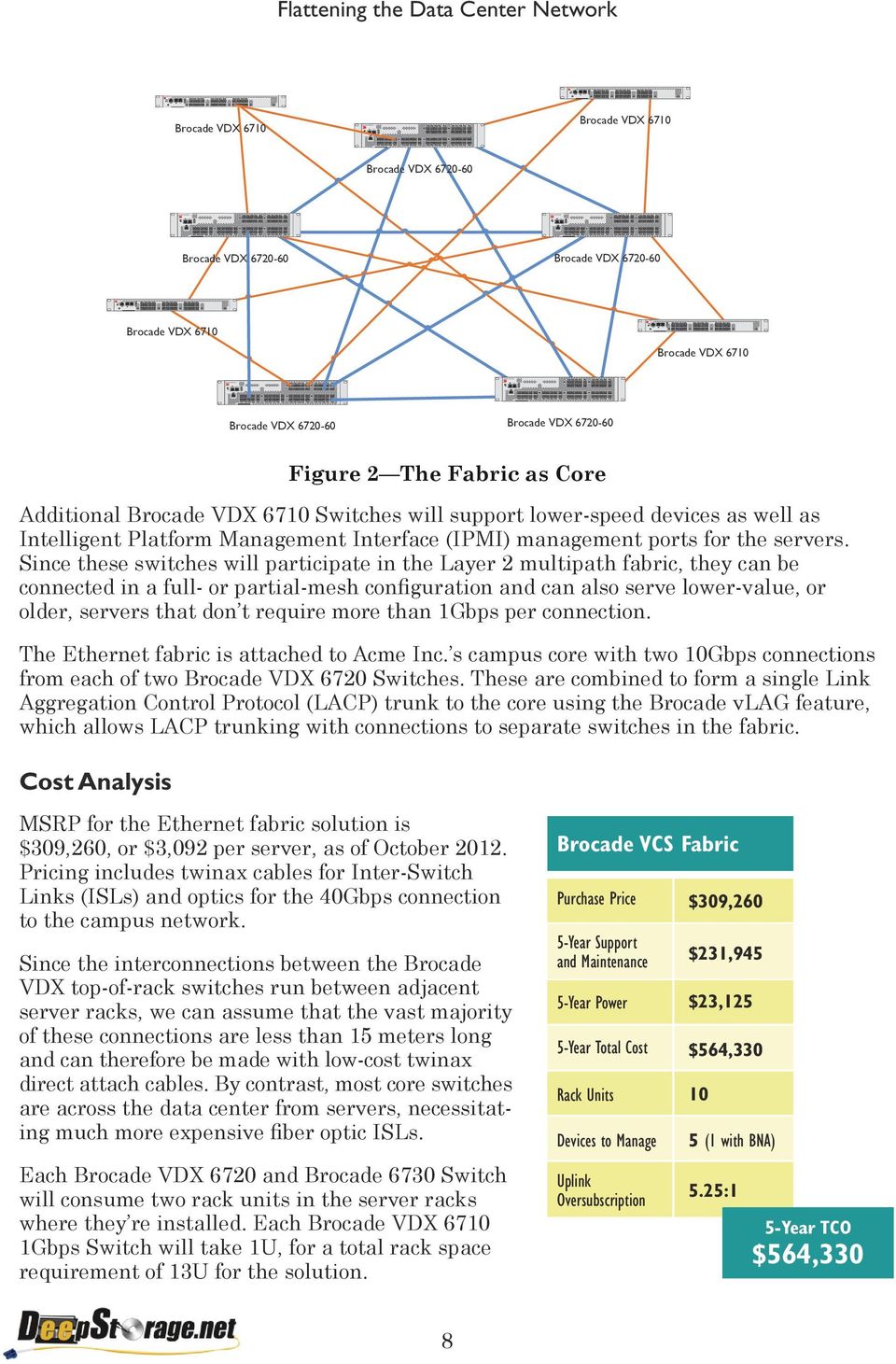
13 Assuming an industry standard support and maintenance cost of 5 percent of MSRP, annual maintenance for the solution will be $46,38. Brocade VCS Fabric technology will use a maximum of 00 watts of power. Assuming a power usage effectiveness (PUE) of and a power cost of $0. per Kwh, the system will cost $4,65 per year for power and cooling. Based on the above assumptions, the five-year total cost for this network design is $564,330. Bandwidth and Failure Analysis Traffic from one server to another across a common switch is forwarded at full wire speed across the Brocade VDX switch s non-blocking architecture. Traffic between servers that don t share an active connection to a common switch has access to 80Gbps of aggregate bandwidth 0Gbps of bandwidth from each switch to every other switch. As the switches are connected in a full mesh, the longest data path through the fabric is just two switch hops resulting in total latency of.µs. With 40 server connections and eight fabric connections per switch, the solution is 5: oversubscribed. When all available ports are used for servers, the oversubscription rate rises to 6.5: (5 servers per switch). Increasing fabric bandwidth is simply a matter of adding more ISLs, since Brocade VCS Fabric technology will automatically recognize additional links and begin load balancing traffic across them seconds after they re installed. Adding a third link to each connection in the Ethernet fabric would boost bandwidth to 0Gbps at a cost of around $,500. Five 60-port switches with 40Gbps interconnects would make 40 0Gbps Ethernet ports available for use, increase fabric bandwidth to 60Gbps, and increase cost by only about percent more than the starting configuration. In case of a switch or link failure, the network will reroute traffic over the surviving portion of the network. Since every switch knows the topology of the entire network, the network reconverges many times faster than a STP network, which must rediscover paths whenever a path fails. This reconvergence occurs in a small fraction of a second, allowing standard TCP or SCSI retries to recover with minimal performance impact. A switch failure in a full-mesh network reduces the available fabric bandwidth by /(n-) where n equals the number of switches in the fabric. For our five-switch fabric, bandwidth will be reduced by 5 percent, to 60Gps, a significantly smaller impact than the 50 percent bandwidth loss if a traditional core switch failed. The impact on a larger, nine-switch fabric would be only.5 percent of the available bandwidth of 60Gbps. Management and Expansion Brocade VCS Fabric technology is self-configuring, automatically rebalancing traffic across all available switches and inter-switch links. Network engineers don t have to spend time designing and configuring multiple Link Aggregation Control Protocol (LACP) connections between the fabric switches, though the campus core to fabric


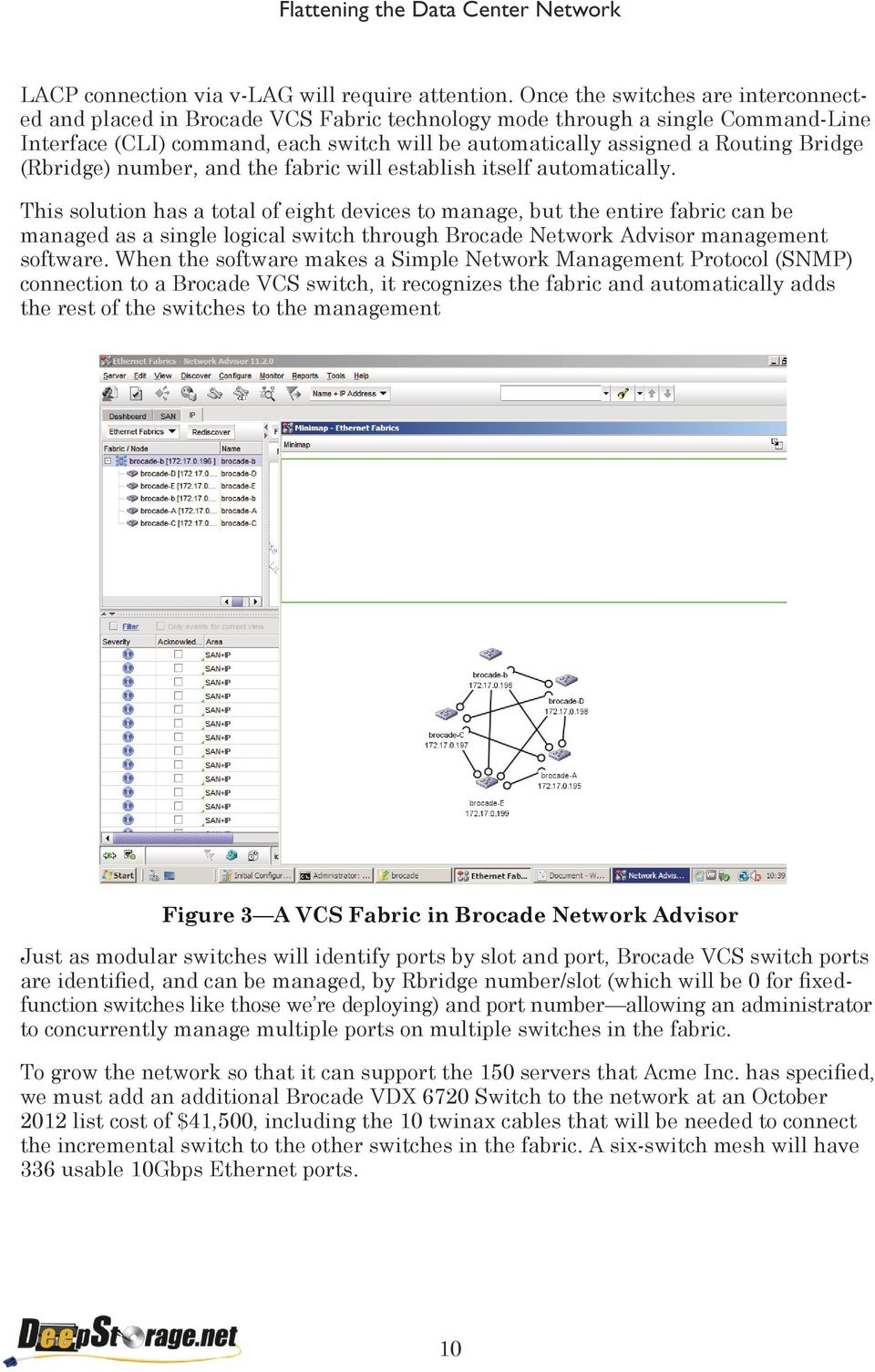
14 LACP connection via v-lag will require attention. Once the switches are interconnected and placed in Brocade VCS Fabric technology mode through a single Command-Line Interface (CLI) command, each switch will be automatically assigned a Routing Bridge (Rbridge) number, and the fabric will establish itself automatically. This solution has a total of eight devices to manage, but the entire fabric can be managed as a single logical switch through Brocade Network Advisor management software. When the software makes a Simple Network Management Protocol (SNMP) connection to a Brocade VCS switch, it recognizes the fabric and automatically adds the rest of the switches to the management Figure 3 A VCS Fabric in Brocade Network Advisor Just as modular switches will identify ports by slot and port, Brocade VCS switch ports are identified, and can be managed, by Rbridge number/slot (which will be 0 for fixedfunction switches like those we re deploying) and port number allowing an administrator to concurrently manage multiple ports on multiple switches in the fabric. To grow the network so that it can support the 50 servers that Acme Inc. has specified, we must add an additional Brocade VDX 670 Switch to the network at an October 0 list cost of $4,500, including the 0 twinax cables that will be needed to connect the incremental switch to the other switches in the fabric. A six-switch mesh will have 336 usable 0Gbps Ethernet ports. 0
15 Applicability of the Model Design for Smaller and Larger Configurations The Ethernet fabric model scales down very well, allowing users with smaller networks to choose between a pair of 60-port switches or a fabric comprising three or four 4-port switches. In this reduced configuration, the failure of a single switch has a smaller impact on network bandwidth. As the number of switches grows, the number of interconnections in a full-mesh network grows according to the formula n*(n-) where n equals the number of switches in the mesh. Using 60-port switches and 0Gbps interconnections in a full mesh, the interconnect overhead reaches 30 percent for a 0-switch network ultimately providing 40 useable ports out of 600. For networks that need to support 00 or more servers and 400+ connections, the fullmesh architecture is less attractive. For these environments, partial-mesh solutions are more appropriate, most specifically a spine and leaf architecture with several switches making up a central spine and servers connected to leaf switches around the periphery. A group of four 60-port switches in a 60Gbps full mesh could support an outer ring of 4 switches with each switch connected to each of the core switches at 0Gbps to provide 36 server access ports. For 300 servers, we would deploy three Brocade VDX 670 Switches as the spine, with 4 edge switches to provide 67 server- and storage-facing ports. Conventional Spanning Tree Solution Since the Acme Inc. network team didn t have experience with new data center networking technologies, its first thought was to build a 0Gbps server network using conventional switches. This Cisco-based solution used the 3-port model from the new Cisco 4500X switch line, with the optional 8-port expansion module. Each Cisco 4500X would use four ports as an LACP trunk (which Cicso calls EtherChannel) to each Cisco Catalyst 650-E core switch leaving 3 ports per switch for server connections. This configuration couldn t meet the minimum bandwidth requirements using industrystandard switches and STP, since each edge switch would then have only 40Gbps of uplink bandwidth. Cisco does offer two configuration options that would allow all eight uplinks to be active: The Cisco virtual switching system (VSS), which allows a pair of Cisco Catalyst 6500 Series Switches to function as one spanning tree bridge or Virtual port channel, which allows LACP links to be homed across multiple servers Either option will require a few hours of a skilled network engineer s time to configure.

16 Figure 4 Cisco 650-E and Cisco 4500-X Solution Providing the specified 6 0Gbps ports will require seven Cisco Catalyst 4500-X Series Switches, which will, in turn, require 8 ports on each Cisco Catalyst 650 Switch to be delivered through two 6-port 0Gbps Ethernet cards in each switch. The required Gbps ports are provided by a pair of 48-port Gigabit Ethernet cards Since Cisco 0Gbps line cards for the Cisco Catalyst 6500 Series Switches use the older XENPAK-style optics, direct-attach twinax cables cannot be used to connect the Cisco Catalyst 4500-X top-of-rack switches to the core. In this deployment scenario, fiber-optic connections must be used adding significantly to the overall cost. Cost Analysis Brocade The total VCS acquisition Fabric cost for this solution is $767,874 or $7,678 per server including a new Purchase Cisco Price 650-E $30,60 chassis. Assuming an industry standard support and maintenance cost of 5 5-Year percent Support of MSRP, annual maintenance for the and Maintenance $3,45 solution will total $5,8. 5-Year Power $3,5 Each Cisco 650-E chassis occupies 5U of rack 5-Year space, Total Cost while the $564,330 Cisco Catalyst 4500-X Switches occupy U each. Total rack space consumed is Rack therefore Units U. 0 Devices Each to Manage Cisco 650-E 5 ( with BNA) chassis will draw somewhere around 5000W while the Cisco Catalyst 4500-X Uplink switches draw up to 400W each for a total power Oversubscription 5.5: consumption of,800w. Assuming a PUE of and a power cost of $0. 5-Year per TCOKwh, the system will cost $6,0 per year for power and cooling. $564,330 Cisco Catalyst 650-E Cisco Catalyst 4500X Purchase Price 5-Year Support and Maintenance 5-Year Power 5-Year Total Cost Rack Units Devices to Manage Uplink Oversubscription $767,874 $575,06 $34,553 $,478,333 4: 5-Year TCO $,478,333

17 Based on the above assumptions, the five-year total cost for this network design is $,478,333. If Acme Inc. chooses to upgrade the supervisors and install line cards in its existing Cisco Catalyst 6500 chassis to continue to have a single network core, it could save approximately $40,000. This would make sense only if its current switches had sufficient slots available for line cards. Bandwidth and Failure Analysis Traffic among servers connected to the same Cisco Catalyst 4500-X Series Switch can run at wire rate, while all other traffic will take three switch hops as it passes through the source, core, and destination switches over the 40Gbps trunk to each core switch. These links are 4: oversubscribed under normal conditions (3 servers:8 uplinks), creating a potential bottleneck. Even worse, the Cisco WS-X686 line card is itself 4: oversubscribed, so the end-to-end path could be as much as 8: oversubscribed. An alternative design would use an 8-port Cisco WS-X608 line card, which is not oversubscribed to the switch fabric, but that would necessitate using a Cisco Catalyst 653-E Switch Chassis to have any slots free for future growth raising the cost of the solution to almost $ million. In case of a core switch failure, the oversubscription rate for the whole network will double to 8:. In case of an edge switch failure, the server s Network Interface Controller (NIC) teaming or LACP connection will failover to the server s connection to another switch. Management and Expansion This solution has nine devices to manage and approximately 60 inter-switch connections that must be manually configured into LACP trunks. Initial configuration of the network will require at least a full day s work by a skilled engineer. Expanding the network to 50 servers will require two additional Cisco Catalyst 4500-X Series edge switches and two additional 0Gbps line cards for the core Cisco Catalyst 650 Switches. This expansion will cost $0,64. Expanding to 300 servers would add five Cisco Catalyst 4500-X Series Switches and another pair of 0Gbps line cards. Cisco Nexus 7000 with Cisco Nexus 000 Fabric Extenders The Nexus series represents Cisco s entry into the market for next-generation data center switches. The first Nexus design we will evaluate comprises a pair of Cisco Nexus 7000 modular switches and the Cisco Nexus 000 Fabric Extender. These solutions work together to provide connectivity to servers and other devices on the data center network. Each Cisco Nexus 3 has 3 useable ports and eight 0Gbps Ethernet ports for upstream connections to one or two Cisco Nexus 7000 or Cisco Nexus 5000 switches. We used seven Cisco Nexus 3s to provide 4 0Gbps Ethernet ports for server and storage connections. 3
18 NK- 3TM STAT ID NK- M800P NK- 3TM STAT ID PORT GROUP PORT GROUP PORT GROUP STATUS ID NK- M800P NK- 3TM STAT ID PSU FAN SUP FAB IOM Cisco Nexus 7000 Series STATUS N7K-F48XP-5 PORT GROUP PORT GROUP 3 PORT GROUP 4 PORT GROUP 5 PORT GROUP 6 PORT GROUP 7 PORT GROUP 8 PORT GROUP PORT GROUP STATUS N7K-M48GT N7K-M48GT ID STATUS SYSTEM ACTIVE PWR MGMT CONSOLE SERIAL PORT COM/AUX SERIAL PORT LINK ACT USB DEVICE PORT HOST PORTS CMP STATUS CMP MGMT ETH RESET LINK ACT N7K-SUP HOST PORTS ID STATUS SYSTEM ACTIVE PWR MGMT CONSOLE COM/AUX SERIAL PORT SERIAL PORT CMP MGMT ETH USB DEVICE PORT LINK ACT RESET CMP STATUS LINK ACT N7K-SUP NK- M800P NK- 3TM STAT ID NK- M800P NK- 3TM STAT ID PORT GROUP PORT GROUP PORT GROUP STATUS ID NK- M800P NK- 3TM STAT ID PSU FAN SUP FAB IOM Cisco Nexus 7000 Series STATUS N7K-F48XP-5 PORT GROUP PORT GROUP 3 PORT GROUP 4 PORT GROUP 5 PORT GROUP 6 PORT GROUP 7 PORT GROUP 8 PORT GROUP PORT GROUP STATUS N7K-M48GT N7K-M48GT ID STATUS SYSTEM ACTIVE PWR MGMT CONSOLE SERIAL PORT COM/AUX SERIAL PORT CMP MGMT ETH LINK ACT RESET USB DEVICE PORT HOST PORTS CMP STATUS LINK ACT N7K-SUP ID STATUS SYSTEM ACTIVE PWR MGMT CONSOLE COM/AUX SERIAL PORT SERIAL PORT CMP MGMT ETH USB DEVICE PORT HOST PORTS LINK ACT RESET CMP STATUS LINK ACT N7K-SUP NK- 3TM STAT ID NK- M800P NK- M800P Flattening the Data Center Network 48-port 0//0 line cards in the Cisco Nexus 7000 were used to provide a total of twisted-pair Ethernet ports. While Acme Inc. s design requirement called for only 40 lower-speed Ethernet ports, which would require only three cards, in our experience, most network designers would add the matching Brocade cards to VCS both Fabric of the core switches rather than use two cards in one switch and one in the other. Purchase Price $30,60 5-Year Support and Maintenance $3,45 5-Year Power Nexus 000 Fabric Extenders $3,5 5-Year Total Cost Rack Units $564,330 0 Nexus 700 Devices to Manage Uplink Oversubscription Nexus ( with BNA) 5.5: 5-Year TCO $564,330 Figure 5 Cisco Nexus 700 and Cisco Nexus 3 Network Even though it s not required, with just two Cisco Nexus 7000 switches, we are configuring the core switches to use Cisco FabricPath (a Cisco pre-standard TRILL implementation that automatically configures the inter-switch links and load balances across them). Cost Analysis MSRP for this solution is $56,00 or $5,6 per server. The Cisco Nexus 700 switches are each rack units tall, while the Cisco Nexus 3s are U each. The total solution will require 4 rack units, including a full 4U rack for each Cisco Nexus 700 alone. Assuming the industry standard 5 percent annual cost for support and maintenance, a support contract for this solution will cost $85,380 a year or $46,00 over the five-year projected life of the network. Cisco Nexus 7000 Cisco Nexus 000 Purchase Price 5-Year Support and Maintenance 5-Year Power 5-Year Total Cost Rack Units Devices to Manage Uplink Oversubscription $56,00 $46,00 $0,000 $,06, 4 4: 5-Year TCO $,06, 4

19 About the Cisco Nexus 000 Fabric Extender While the Cisco Nexus 3 Fabric Extender is a U box with SFP+ 0Gbps Ethernet ports, it is not an Ethernet switch. Fabric extenders function more like remote line cards than true switches; all traffic from the 3 downlink ports on the Cisco Nexus 3 is sent upstream to the Cisco Nexus 7000 or Cisco Nexus 5000 parent switch for processing even if the source and destination are ports on the same fabric extender. As a result, while it may appear that a solution based on the Cisco Nexus 3 with 3 server-facing ports and eight uplinks, and a solution based on the Cisco Catalyst 4500-X, which also has 3 user ports and eight ports for inter-switch links, are both 4: oversubscribed the switch actually offers significantly more bandwidth. If two servers connected to the same switch want to exchange data, the switch forwards packets between ports, consuming none of the bandwidth on its inter-switch link ports. If those two servers were connected to a Cisco Nexus 000, traffic would be routed first to the parent switch and then back to the Cisco Nexus 000. In fact, traffic between ports on the same Cisco Nexus 000 uses twice the ISL bandwidth as traffic going to a port on another Cisco Nexus 000 since it travels to the parent switch and back again. Since we can t quantify the amount of traffic that exists between ports on the same switch, and because the advantages of workload mobility in today s data center make keeping related workloads on the same switch counterproductive we use a worst-case scenario when describing a switch such as Cisco Catalyst 4500-X or a Brocade VDX 670, as 4: oversubscribed, which makes this comparison somewhat misleading. Each Cisco Nexus 700 will consume around 5000W of power and each Cisco Nexus 3 about 5W. The total power use for the system is 575W. Assuming a PUE of and power costs of $0. per Kwh, the system will cost $4,000 for power and cooling. Based on the above assumptions, the five-year total cost for this network design is $,06,. An alternative configuration would use six Cisco Nexus 4 fabric extenders to provide low-speed connections. This approach would reduce the cost of the two Cisco Nexusbased configurations by $,000. While it s likely that the Cisco Nexus 3s at the top of each server rack will be across the data center from the Cisco Nexus 700s and require fiber-optic connections, we ve priced this configuration using twinax cables for all inter-switch links to avoid inflating the cost for those data centers where the longest links are less than 5 meters. 5
20 An alternative configuration would use six Cisco Nexus 4 fabric extenders to provide low-speed connections. This approach would reduce the cost of the two Cisco Nexusbased configurations by $,000. Bandwidth and Failure Analysis Each Cisco Nexus 3 has 3 ports for server connections and eight uplinks to the Cisco Nexus 700s, making each link oversubscribed 4:. Since all traffic to and from servers will pass over the Cisco Nexus 3 uplinks, these connections are likely to become congested. In case of a core switch failure, half of the network s east-west bandwidth is lost, bringing the oversubscription rate to 8:. It s common practice to connect the first Ethernet port on servers in racks A and B to the switch in rack A, and the second to the switch in rack B. As a result, a failure of a fabric extender would cause all server traffic in both racks to be shifted to the same fabric extender again raising the oversubscription rate to 8:. Management and Expansion Since fabric extenders are seen and managed as if they were remote line cards for their parent switches, this configuration really has only two points of management the Cisco Nexus 700 Switches. Since we ve chosen to use Cisco FabricPath, the interswitch TRILL will detect the inter-switch links and configure them. Growing to 50 servers will require adding two more Cisco Nexus 3 Fabric Extenders. Since Cisco FabricPath creates fabrics of Cisco Nexus 7000 Switches (each with Cisco Nexus 000s attached), this architecture can be expanded to thousands of 0Gbps Ethernet ports. This alternative approach would reduce the cost of the two Cisco Nexus-based configurations by $,000. As in the first Cisco Nexus configuration we ve priced, this configuration uses twinax cables for all inter-switch links to avoid inflating the cost for those data centers where the longest links are less than 5 meters. 6
21 Lab Testing Our testing concentrated on the behavior of an application running across a Brocade VCS fabric technology-based switch cluster during a switch failure. We ran the Dell DVD Store application to provide a realistic application load simulating users connecting to an Internet store selling DVDs. Like many Web applications, the DVD Store uses an application server to handle the business processes and user interface, combined with a database server. For our testing, we used virtual application and database servers on separate physical servers running VMware vsphere 4.. The physical servers were configured to use the network interface on each server that was connected to a common switch as the primary interface, with failover to secondary interfaces on different switches. We started up the DVD Store application and then cut the power to the common switch that was carrying the data to see how quickly the VCS fabric and VMware vsphere NIC teaming would recover and how this failure would impact the application. Figure 6 DVD Store Performance Next, we created a modified version of the DVD Store application to record the number of operations per second, the maximum round-trip transaction latency, and the average round-trip transaction latency once per second (rather than the default every 0 seconds). Note that what DVD Store is reporting here is transaction latency including SQL server access, not just network latency. 7

22 As you can see in Figure 6 above, when the switch that was in the data path was powered down, the maximum latency jumped to ms, which indicated that some frames were lost as the switch failed, but the system failed over to the alternate path so quickly that while latency peaked at ms, average latency for that second remained ms, indicating a very small number of lost frames. More important, the rate at which the application processed DVD sales was essentially unchanged at 5,87 operations per second compared to an average of 5,83 per second for the 0-minute test run. Given the low impact of the switch failure on application performance, we set up Solarwinds Real-Time Bandwidth Monitor to make sure data were actually taking the paths we had configured them to take. When we graphed the traffic levels for the four ports connected to our test servers and ran our test again, we saw the screen shown below as Figure 7. Figure 7 SNMP Traces of Network Traffic During Test In this screenshot, the top two graphs illustrate the traffic running through the common switch, and the bottom two graphs show the ports on the switch for the backup connections on the servers. As the primary switch goes offline, you can see the traffic rerouted to the alternate path. Since these graphs are generated from SNMP data collected in each switch, there are no data for the period when the default switch is powered down. Also, note when it comes back online, the traffic is rerouted back to its default path. 8
23 When analyzing the data, we calculated that for a peak latency of 0ms to have no effect on the average latency of ms, there must have been only a very small number of packets lost and retransmitted. To figure out exactly how many, we used Windows Performance Monitor to log TCP retransmits per second and TCP segments per second on both virtual servers. On each system, the peak number of retransmissions was four, reinforcing our view that very few frames were dropped in the failover. Figure 8 SQL Server TCP Counters
24 Brocade VDX 670 RLOM Brocade VDX 670 RLOM UID RESET Brocade VDX 670 RLOM Brocade VDX 670 RLOM Brocade VDX 670 RLOM UID RESET Flattening the Data Center Network Our Test Configuration We connected three Brocade VDX 670 Switches and two Brocade VDX 6730 Switches to create a fully meshed Brocade VCS cluster with a single 0Gbps link from each switch to all other switches. We then connected a pair of SuperMicro 507C-TF servers running VMware vsphere 4.U to the cluster. One 0Gbps Ethernet port on each server was connected to a common switch, which we called Brocade switch E and the second port on each of the two servers was connected to a different switch. Application Server Host SQL Server Host E Brocade VDX D A Brocade VDX Brocade VDX C B Brocade VDX Brocade VDX Figure Lab Test Configuration Both ports of the 0Gbps card in each host were assigned to a dedicated vswitch in that host. We configured VMware vsphere NIC teaming to use the connection to Brocade switch E as the primary connection, and use the other connection for failover. vsphere Host Server Hardware Processor Intel Xeon E3-30 (3.Ghz Quad-Core) Memory 6Gb DDR Gbps NIC Emulex OCe00 (SQL Server) Intel X50 (Application Server) A virtual Windows 008 R server running Microsoft SQL Server 008 was placed on one host as the only active guest. A similar virtual server running the Dell DVD Store application server was the only active guest on the second host server. 0
25 Virtual DVD Store Server Configuration Processor 4 vcpu Memory Network Interface 0Gb vnic to management vswitch vnic to vswitch connected to VCS mesh We modified the DVD Store application to report statistics once per second, rather than the default of once every 0 seconds. We ran the application for five minutes to establish baseline performance, powered down the Brocade switch E and then powered it back on. We used the DVD Store application s logging SNMP data from the switches and Windows Performance Monitor to examine the system s behavior throughout the process. About the DVD Store Application Dell DVD Store application simulates an online store selling DVDs. An application server makes requests simulating users connecting to the store s website and accesses the database server to retrieve titles and record sales. The DVD Store application has been widely used as a benchmarking tool and is included as part of the VMware VMark benchmark suite. A Dell white paper describing the DVD Store application in detail can be downloaded at and an overview video is available on YouTube at 5TOrDQ. The application can be downloaded at
26 Conclusions The development of Ethernet fabric technologies has freed data center network architects from the limitations imposed by the Spanning Tree Protocol. By using a fabric of top-of-rack switches, network architects can build a network that provides all the performance and reliability of a conventional edge, aggregation, and core network at a much lower cost. We compared the cost, performance, and complexity of several data center network designs to support servers each with two 0Gbps Ethernet connections. The Brocade VCS fabric solution was generally half the cost of the more conventional networks, based on either Cisco s traditional Catalyst or data center-oriented Nexus switches, while providing a comparable amount of server-to-server bandwidth. The Brocade solution also allows users to simply and inexpensively add more interswitch bandwidth, at any time, by simply adding more interconnects, while the other solutions were at their respective limits. Purchase Price 5-Year Support and Maintenance 5-Year Power 5-Year Total Cost Rack Units Devices to Manage Uplink Oversubscription Brocade VC Fabric $30,60 $3,45 $3,5 $564, ( with BNA) 5.5: Cisco Catalyst 650-E/ Cisco Catalyst 4500X $767,874 $575,06 $34,553 $,478,333 4: Cisco Nexus 7000/ Cisco Nexus 000 $56,00 $46,00 $0,000 $,06, 4 4: Summary of the Three Network Configurations Even the least expensive Cisco configuration, using Cisco Nexus 7000 switches with Cisco Nexus 000 Fabric extenders, was almost twice the cost of the Brocade VCS solution. Readers should also note that this cost analysis does not include soft costs such as staff or data center real estate. These costs are too user specific to be easily quantifiable. Also, while the ease of configuration and smaller size of the fabric network may save users additional money, we haven t included these potential savings in our analysis. Cost isn t the only advantage of an Ethernet fabric-as-core solution. The Ethernet fabric approach lets network architects create small and large networks from the same building blocks. Using a spine and leaf architecture, an Ethernet fabric network of 60-port Brocade VDX 6730 switches could support several hundred ports, with a maximum of three switch hops from point to point rather than the five hops of a traditional edgeaggregation-core design. The Ethernet fabric network is also more resilient than a hierarchical network. Total network bandwidth in a traditional network, or one based on fabric extenders, can be cut in half when a critical device like a core switch goes offline. Since all the switches in the fabric are peers, the loss of one switch in a five-switch network causes only a 0 percent loss of capacity.
27 Since it doesn t rely on Spanning Tree Protocol, the Ethernet fabric network also converges faster than a traditional network. Even with the latest Rapid Spanning Tree implementation, it can take up to six seconds for a network to recover from a switch or link loss. Our testing showed that the Brocade VCS fabric network recovers in a matter of milliseconds. Faster recovery means less lost data for higher-layer protocols like TCP or SCSI to recover. In our testing, only one frame was lost when the switch serving the active connection between our servers failed. In short, an Ethernet fabric network using only top-of-rack switches can perform better than a traditional network using modular switches in the core. This architecture is: Approximately half the cost to: Purchase Power Maintain More flexible Cross-network bandwidth can be added by increased connections The same building blocks can be used for networks small and large More resilient Less bandwidth loss on failure Faster convergence on failure 3
28 Appendix A Network Configuration Bills of Materials Brocade VCS Configuration Product Description Qty Unit Price Discount % Final Price Total Price BR-VDX F Brocade VDX 670, 48P GbE, 6P SFP+, AC, non-port side exhaust airflow 3, , , BR-VDX670-54VCS-0 VCS software license for Brocade VDX , , , BR-VDX F Brocade VDX 670, 60P SFP+, AC, non-port side exhaust airflow 3 40, , , BR-VDX670-60VCS-0 VCS software license for Brocade VDX , Brocade VDX , , , BR-VDX FCOE-0 FCoE software license for 40- and 60-port SKU 3 6, , , BR-VDX F Brocade VDX 6730, 60P SFP+, AC, non-port side exhaust airflow 40, , , BR-VDX VCS-0 VCS software license for Brocade VDX , Brocade VDX , , ,0.00 0G-SFPP-SR (-pack) 0 Gbps SR Optics 4, , , G-SFPP-TWX-030 (-pack) 0 Gbps SFP+ direct-attached cables, 3 m Twinax copper , Data Products and Services Total 30,60.00 First year Maintenance (at 5%) $46,38.00 First year Power $4,65.8 First year Total $360,74.8 Maintenance years -5- $85, Power years -5 $8,50. Five year total cost $564,
29 Cisco 650-E/Cisco 4500-X Configuration Product Description Qty Unit Price Discount % Final Price Total Price VS-ST-0G Supervisor T for C6500 5, , , VS-650E-SUPT Catalyst 650-E Supervisor T bundle 38, , , WS-X686-0G-T 6 Port XENPAK 0Gbps Ethernet line card 4 38, , , KW Power supply for , , WS-C4500X-3SFP+ Catalyst 4500-X ToR switch 3 ports 7 40, , , C4KX-NM-8SFP+ 8 port expansion module for C450-X 7 7, , , C4KX-PWR-750AC-F C4500-X redundant power supply 7, , , X-0GB-SR X 0GBase-SR transceiver 56 3, , , SFP-0G-SR= 0GBase-SR SFP+ 56, , Fiber-Optic Cables , WS-X6748-GE-TX 48 port 0//0 Ethernet module 4 0, , , Data Products Total $774,74.00 First year maintenance (at 5%) $6,4.0 First year Power $6,0.7 First Year Total $7,35.8 Maintenance years -5 $464, Power years -5 $07,64.88 Five year total costs $,48,533.0 Notes on Cisco 650-E/Cisco 4500-X Configuration This configuration includes optics and fiber cables for connecting the Cisco 650-E and Cisco 4500-X Switches as twinaxial cables cannot be used with the Cisco 650-E s XEN- PACK interfaces. The discounts shown for those components are roughly those that can be found on the Web. 5
30 Cisco Nexus 7000/ Cisco Nexus 000 Product Description Qty N7K-C700-BUN Unit Price Discount % Final Price Total Price Nexus 700 Bundle (Chassis,SUP,(5)FAB, ()AC-6KW PSU) 7, , , N7KSK-60 Cisco NX-OS Release N7K-ADVK Nexus 7000 Advanced LAN Enterprise License (VDC, CTS ONLY) 0, , , N7K-F48XP-5 Nexus 7000 F-Series 48 Port 0GbE (req. SFP+) 44, , , N7K-M48GT- Nexus Port 0//0, RJ , , , N7K-SUP Nexus Supervisor, Includes External 8GB Log Flash 5, , , N7K-SUP-8GBUPG Nexus 7000 Supervisor 8GB Memory Upgrade Kit Included 0.00 Included Included N7K-SUP-BUN Nexus Supervisor, Includes External 8GB Flash Included 0.00 Included Included N7K-C700-FAB- Nexus Slot Chassis - 0Gbps/Slot Fabric Module 0 Included 0.00 Included Included N7K-AC-6.0KW Nexus KW AC Power Supply Module 6, ,000.00, N7K-AC-6.0KW Nexus KW AC Power Supply Module Included 0.00 Included Included CAB-753AC AC Power Cord North America (0V) N7K-ELK Nexus 7000 Enhanced Layer License (FabricPath) 5, , , CAB-KA-NA Power Cord, 5VAC 3A NEMA 5-5 Plug, North America SFP+ Cables , NK-C3PP-0GE NK 0GE, AC PS, Fan (Std Air), 3x/0GE+8x0GE 7, ,, , Data Products Total 5, First Year Maintenance 78,50.00 First Year Power 4,335.8 First Year Total 667,875.8 Maintenance years Power years -5 7,34. Five year total costs,,
Ethernet Fabrics: An Architecture for Cloud Networking
 WHITE PAPER www.brocade.com Data Center Ethernet Fabrics: An Architecture for Cloud Networking As data centers evolve to a world where information and applications can move anywhere in the cloud, classic
Brocade One Data Center Cloud-Optimized Networks
 POSITION PAPER Brocade One Data Center Cloud-Optimized Networks Brocade s vision, captured in the Brocade One strategy, is a smooth transition to a world where information and applications reside anywhere
Brocade Solution for EMC VSPEX Server Virtualization
 Reference Architecture Brocade Solution Blueprint Brocade Solution for EMC VSPEX Server Virtualization Microsoft Hyper-V for 50 & 100 Virtual Machines Enabled by Microsoft Hyper-V, Brocade ICX series switch,
Deploying Brocade VDX 6720 Data Center Switches with Brocade VCS in Enterprise Data Centers
 WHITE PAPER www.brocade.com Data Center Deploying Brocade VDX 6720 Data Center Switches with Brocade VCS in Enterprise Data Centers At the heart of Brocade VDX 6720 switches is Brocade Virtual Cluster
Top of Rack: An Analysis of a Cabling Architecture in the Data Center
 SYSTIMAX Solutions Top of Rack: An Analysis of a Cabling Architecture in the Data Center White paper Matthew Baldassano, Data Center Business Unit CommScope, Inc, June 2010 www.commscope.com Contents I.
Migrate from Cisco Catalyst 6500 Series Switches to Cisco Nexus 9000 Series Switches
 Migration Guide Migrate from Cisco Catalyst 6500 Series Switches to Cisco Nexus 9000 Series Switches Migration Guide November 2013 2013 Cisco and/or its affiliates. All rights reserved. This document is
Expert Reference Series of White Papers. Planning for the Redeployment of Technical Personnel in the Modern Data Center
 Expert Reference Series of White Papers Planning for the Redeployment of Technical Personnel in the Modern Data Center [email protected] www.globalknowledge.net Planning for the Redeployment of
BUILDING A NEXT-GENERATION DATA CENTER
 BUILDING A NEXT-GENERATION DATA CENTER Data center networking has changed significantly during the last few years with the introduction of 10 Gigabit Ethernet (10GE), unified fabrics, highspeed non-blocking
FlexNetwork Architecture Delivers Higher Speed, Lower Downtime With HP IRF Technology. August 2011
 FlexNetwork Architecture Delivers Higher Speed, Lower Downtime With HP IRF Technology August 2011 Page2 Executive Summary HP commissioned Network Test to assess the performance of Intelligent Resilient
Data Center Networking Designing Today s Data Center
 Data Center Networking Designing Today s Data Center There is nothing more important than our customers. Data Center Networking Designing Today s Data Center Executive Summary Demand for application availability
10GBASE T for Broad 10_Gigabit Adoption in the Data Center
 10GBASE T for Broad 10_Gigabit Adoption in the Data Center Contributors Carl G. Hansen, Intel Carrie Higbie, Siemon Yinglin (Frank) Yang, Commscope, Inc 1 Table of Contents 10Gigabit Ethernet: Drivers
The Future of Computing Cisco Unified Computing System. Markus Kunstmann Channels Systems Engineer
 The Future of Computing Cisco Unified Computing System Markus Kunstmann Channels Systems Engineer 2009 Cisco Systems, Inc. All rights reserved. Data Centers Are under Increasing Pressure Collaboration
Simplify Virtual Machine Management and Migration with Ethernet Fabrics in the Datacenter
 Simplify Virtual Machine Management and Migration with Ethernet Fabrics in the Datacenter Enabling automatic migration of port profiles under Microsoft Hyper-V with Brocade Virtual Cluster Switching technology
A Platform Built for Server Virtualization: Cisco Unified Computing System
 A Platform Built for Server Virtualization: Cisco Unified Computing System What You Will Learn This document discusses how the core features of the Cisco Unified Computing System contribute to the ease
全 新 企 業 網 路 儲 存 應 用 THE STORAGE NETWORK MATTERS FOR EMC IP STORAGE PLATFORMS
 全 新 企 業 網 路 儲 存 應 用 THE STORAGE NETWORK MATTERS FOR EMC IP STORAGE PLATFORMS Enterprise External Storage Array Capacity Growth IDC s Storage Capacity Forecast = ~40% CAGR (2014/2017) Keep Driving Growth!
FIBRE CHANNEL OVER ETHERNET
 FIBRE CHANNEL OVER ETHERNET A Review of FCoE Today ABSTRACT Fibre Channel over Ethernet (FcoE) is a storage networking option, based on industry standards. This white paper provides an overview of FCoE,
Introducing Brocade VCS Technology
 WHITE PAPER www.brocade.com Data Center Introducing Brocade VCS Technology Brocade VCS technology is designed to revolutionize the way data center networks are architected and how they function. Not that
STATE OF THE ART OF DATA CENTRE NETWORK TECHNOLOGIES CASE: COMPARISON BETWEEN ETHERNET FABRIC SOLUTIONS
 STATE OF THE ART OF DATA CENTRE NETWORK TECHNOLOGIES CASE: COMPARISON BETWEEN ETHERNET FABRIC SOLUTIONS Supervisor: Prof. Jukka Manner Instructor: Lic.Sc. (Tech) Markus Peuhkuri Francesco Maestrelli 17
Data Center Convergence. Ahmad Zamer, Brocade
 Ahmad Zamer, Brocade SNIA Legal Notice The material contained in this tutorial is copyrighted by the SNIA unless otherwise noted. Member companies and individual members may use this material in presentations
SummitStack in the Data Center
 SummitStack in the Data Center Abstract: This white paper describes the challenges in the virtualized server environment and the solution that Extreme Networks offers a highly virtualized, centrally manageable
Private cloud computing advances
 Building robust private cloud services infrastructures By Brian Gautreau and Gong Wang Private clouds optimize utilization and management of IT resources to heighten availability. Microsoft Private Cloud
A Whitepaper on. Building Data Centers with Dell MXL Blade Switch
 A Whitepaper on Building Data Centers with Dell MXL Blade Switch Product Management Dell Networking October 2012 THIS WHITE PAPER IS FOR INFORMATIONAL PURPOSES ONLY, AND MAY CONTAIN TYPOGRAPHICAL ERRORS
Building Tomorrow s Data Center Network Today
 WHITE PAPER www.brocade.com IP Network Building Tomorrow s Data Center Network Today offers data center network solutions that provide open choice and high efficiency at a low total cost of ownership,
Data Center Evolution without Revolution
 WHITE PAPER www.brocade.com DATA CENTER Data Center Evolution without Revolution Brocade networking solutions help organizations transition smoothly to a world where information and applications can reside
Simplify VMware vsphere* 4 Networking with Intel Ethernet 10 Gigabit Server Adapters
 WHITE PAPER Intel Ethernet 10 Gigabit Server Adapters vsphere* 4 Simplify vsphere* 4 Networking with Intel Ethernet 10 Gigabit Server Adapters Today s Intel Ethernet 10 Gigabit Server Adapters can greatly
Juniper Networks QFabric: Scaling for the Modern Data Center
 Juniper Networks QFabric: Scaling for the Modern Data Center Executive Summary The modern data center has undergone a series of changes that have significantly impacted business operations. Applications
CCNA DATA CENTER BOOT CAMP: DCICN + DCICT
 CCNA DATA CENTER BOOT CAMP: DCICN + DCICT COURSE OVERVIEW: In this accelerated course you will be introduced to the three primary technologies that are used in the Cisco data center. You will become familiar
Ethernet: THE Converged Network Ethernet Alliance Demonstration as SC 09
 Ethernet: THE Converged Network Ethernet Alliance Demonstration as SC 09 Authors: Amphenol, Cisco, Dell, Fulcrum Microsystems, Intel, Ixia, JDSU, Mellanox, NetApp, Panduit, QLogic, Spirent, Tyco Electronics,
How the Port Density of a Data Center LAN Switch Impacts Scalability and Total Cost of Ownership
 How the Port Density of a Data Center LAN Switch Impacts Scalability and Total Cost of Ownership June 4, 2012 Introduction As data centers are forced to accommodate rapidly growing volumes of information,
Whitepaper. 10 Things to Know Before Deploying 10 Gigabit Ethernet
 Whitepaper 10 Things to Know Before Deploying 10 Gigabit Ethernet Table of Contents Introduction... 3 10 Gigabit Ethernet and The Server Edge: Better Efficiency... 3 SAN versus Fibre Channel: Simpler and
SN0054584-00 A. Reference Guide Efficient Data Center Virtualization with QLogic 10GbE Solutions from HP
 SN0054584-00 A Reference Guide Efficient Data Center Virtualization with QLogic 10GbE Solutions from HP Reference Guide Efficient Data Center Virtualization with QLogic 10GbE Solutions from HP Information
Evaluation Report: HP Blade Server and HP MSA 16GFC Storage Evaluation
 Evaluation Report: HP Blade Server and HP MSA 16GFC Storage Evaluation Evaluation report prepared under contract with HP Executive Summary The computing industry is experiencing an increasing demand for
Cisco Data Center 3.0 Roadmap for Data Center Infrastructure Transformation
 Cisco Data Center 3.0 Roadmap for Data Center Infrastructure Transformation Cisco Nexus Family Provides a Granular, Cost-Effective Path for Data Center Evolution What You Will Learn As businesses move
iscsi Top Ten Top Ten reasons to use Emulex OneConnect iscsi adapters
 W h i t e p a p e r Top Ten reasons to use Emulex OneConnect iscsi adapters Internet Small Computer System Interface (iscsi) storage has typically been viewed as a good option for small and medium sized
Multi-Chassis Trunking for Resilient and High-Performance Network Architectures
 WHITE PAPER www.brocade.com IP Network Multi-Chassis Trunking for Resilient and High-Performance Network Architectures Multi-Chassis Trunking is a key Brocade technology in the Brocade One architecture
TRILL for Service Provider Data Center and IXP. Francois Tallet, Cisco Systems
 for Service Provider Data Center and IXP Francois Tallet, Cisco Systems 1 : Transparent Interconnection of Lots of Links overview How works designs Conclusion 2 IETF standard for Layer 2 multipathing Driven
VMDC 3.0 Design Overview
 CHAPTER 2 The Virtual Multiservice Data Center architecture is based on foundation principles of design in modularity, high availability, differentiated service support, secure multi-tenancy, and automated
Virtual PortChannels: Building Networks without Spanning Tree Protocol
 . White Paper Virtual PortChannels: Building Networks without Spanning Tree Protocol What You Will Learn This document provides an in-depth look at Cisco's virtual PortChannel (vpc) technology, as developed
over Ethernet (FCoE) Dennis Martin President, Demartek
 A Practical Guide to Fibre Channel over Ethernet (FCoE) Dennis Martin President, Demartek Demartek Company Overview Industry analysis with on-site test lab Lab includes servers, networking and storage
Fibre Channel over Ethernet in the Data Center: An Introduction
 Fibre Channel over Ethernet in the Data Center: An Introduction Introduction Fibre Channel over Ethernet (FCoE) is a newly proposed standard that is being developed by INCITS T11. The FCoE protocol specification
Blade Switches Don t Cut It in a 10 Gig Data Center
 Blade Switches Don t Cut It in a 10 Gig Data Center Zeus Kerravala, Senior Vice President and Distinguished Research Fellow, [email protected] Introduction: Virtualization Drives Data Center Evolution
SummitStack in the Data Center
 SummitStack in the Data Center Abstract: This white paper describes the challenges in the virtualized server environment and the solution Extreme Networks offers a highly virtualized, centrally manageable
The Road to Cloud Computing How to Evolve Your Data Center LAN to Support Virtualization and Cloud
 The Road to Cloud Computing How to Evolve Your Data Center LAN to Support Virtualization and Cloud Introduction Cloud computing is one of the most important topics in IT. The reason for that importance
Cloud Networking: A Novel Network Approach for Cloud Computing Models CQ1 2009
 Cloud Networking: A Novel Network Approach for Cloud Computing Models CQ1 2009 1 Arista s Cloud Networking The advent of Cloud Computing changes the approach to datacenters networks in terms of throughput
Cisco Nexus 5000 Series Switches: Decrease Data Center Costs with Consolidated I/O
 Cisco Nexus 5000 Series Switches: Decrease Data Center Costs with Consolidated I/O Introduction Data centers are growing at an unprecedented rate, creating challenges for enterprises. Enterprise-level
Data Center Network Evolution: Increase the Value of IT in Your Organization
 White Paper Data Center Network Evolution: Increase the Value of IT in Your Organization What You Will Learn New operating demands and technology trends are changing the role of IT and introducing new
Intel Ethernet Switch Load Balancing System Design Using Advanced Features in Intel Ethernet Switch Family
 Intel Ethernet Switch Load Balancing System Design Using Advanced Features in Intel Ethernet Switch Family White Paper June, 2008 Legal INFORMATION IN THIS DOCUMENT IS PROVIDED IN CONNECTION WITH INTEL
Course. Contact us at: Information 1/8. Introducing Cisco Data Center Networking No. Days: 4. Course Code
 Information Price Course Code Free Course Introducing Cisco Data Center Networking No. Days: 4 No. Courses: 2 Introducing Cisco Data Center Technologies No. Days: 5 Contact us at: Telephone: 888-305-1251
How To Evaluate Netapp Ethernet Storage System For A Test Drive
 Performance evaluation sponsored by NetApp, Inc. Introduction Ethernet storage is advancing towards a converged storage network, supporting the traditional NFS, CIFS and iscsi storage protocols and adding
VMware Virtual SAN 6.2 Network Design Guide
 VMware Virtual SAN 6.2 Network Design Guide TECHNICAL WHITE PAPER APRIL 2016 Contents Intended Audience... 2 Overview... 2 Virtual SAN Network... 2 Physical network infrastructure... 3 Data center network...
The Future of Cloud Networking. Idris T. Vasi
 The Future of Cloud Networking Idris T. Vasi Cloud Computing and Cloud Networking What is Cloud Computing? An emerging computing paradigm where data and services reside in massively scalable data centers
Scalable Approaches for Multitenant Cloud Data Centers
 WHITE PAPER www.brocade.com DATA CENTER Scalable Approaches for Multitenant Cloud Data Centers Brocade VCS Fabric technology is the ideal Ethernet infrastructure for cloud computing. It is manageable,
Chapter 3. Enterprise Campus Network Design
 Chapter 3 Enterprise Campus Network Design 1 Overview The network foundation hosting these technologies for an emerging enterprise should be efficient, highly available, scalable, and manageable. This
Cisco Unified Computing System: Meet the Challenges of Virtualization with Microsoft Hyper-V
 White Paper Cisco Unified Computing System: Meet the Challenges of Virtualization with Microsoft Hyper-V What You Will Learn The modern virtualized data center is today s new IT service delivery foundation,
Dell PowerEdge Blades Outperform Cisco UCS in East-West Network Performance
 Dell PowerEdge Blades Outperform Cisco UCS in East-West Network Performance This white paper compares the performance of blade-to-blade network traffic between two enterprise blade solutions: the Dell
Brocade and EMC Solution for Microsoft Hyper-V and SharePoint Clusters
 Brocade and EMC Solution for Microsoft Hyper-V and SharePoint Clusters Highlights a Brocade-EMC solution with EMC CLARiiON, EMC Atmos, Brocade Fibre Channel (FC) switches, Brocade FC HBAs, and Brocade
Virtualizing the SAN with Software Defined Storage Networks
 Software Defined Storage Networks Virtualizing the SAN with Software Defined Storage Networks Introduction Data Center architects continue to face many challenges as they respond to increasing demands
VMware and Brocade Network Virtualization Reference Whitepaper
 VMware and Brocade Network Virtualization Reference Whitepaper Table of Contents EXECUTIVE SUMMARY VMWARE NSX WITH BROCADE VCS: SEAMLESS TRANSITION TO SDDC VMWARE'S NSX NETWORK VIRTUALIZATION PLATFORM
VCS Monitoring and Troubleshooting Using Brocade Network Advisor
 VCS Monitoring and Troubleshooting Using Brocade Network Advisor Brocade Network Advisor is a unified network management platform to manage the entire Brocade network, including both SAN and IP products.
WHITE PAPER. Copyright 2011, Juniper Networks, Inc. 1
 WHITE PAPER Network Simplification with Juniper Networks Technology Copyright 2011, Juniper Networks, Inc. 1 WHITE PAPER - Network Simplification with Juniper Networks Technology Table of Contents Executive
The Advantages of Multi-Port Network Adapters in an SWsoft Virtual Environment
 The Advantages of Multi-Port Network Adapters in an SWsoft Virtual Environment Introduction... 2 Virtualization addresses key challenges facing IT today... 2 Introducing Virtuozzo... 2 A virtualized environment
Non-blocking Switching in the Cloud Computing Era
 Non-blocking Switching in the Cloud Computing Era Contents 1 Foreword... 3 2 Networks Must Go With the Flow in the Cloud Computing Era... 3 3 Fat-tree Architecture Achieves a Non-blocking Data Center Network...
Microsoft SQL Server 2012 on Cisco UCS with iscsi-based Storage Access in VMware ESX Virtualization Environment: Performance Study
 White Paper Microsoft SQL Server 2012 on Cisco UCS with iscsi-based Storage Access in VMware ESX Virtualization Environment: Performance Study 2012 Cisco and/or its affiliates. All rights reserved. This
Using High Availability Technologies Lesson 12
 Using High Availability Technologies Lesson 12 Skills Matrix Technology Skill Objective Domain Objective # Using Virtualization Configure Windows Server Hyper-V and virtual machines 1.3 What Is High Availability?
VERITAS Backup Exec 9.0 for Windows Servers
 WHITE PAPER Data Protection Solutions for Network Attached Storage VERITAS Backup Exec 9.0 for Windows Servers VERSION INCLUDES TABLE OF CONTENTS STYLES 1 TABLE OF CONTENTS Background...3 Why Use a NAS
Storage Area Network Design Overview Using Brocade DCX 8510. Backbone Switches
 Storage Area Network Design Overview Using Brocade DCX 8510 Backbone Switches East Carolina University Paola Stone Martinez April, 2015 Abstract The design of a Storage Area Networks is a very complex
Configuring Cisco Nexus 5000 Switches Course DCNX5K v2.1; 5 Days, Instructor-led
 Configuring Cisco Nexus 5000 Switches Course DCNX5K v2.1; 5 Days, Instructor-led Course Description Configuring Cisco Nexus 5000 Switches (DCNX5K) v2.1 is a 5-day ILT training program that is designed
DCICT: Introducing Cisco Data Center Technologies
 DCICT: Introducing Cisco Data Center Technologies Description DCICN and DCICT will introduce the students to the Cisco technologies that are deployed in the Data Center: unified computing, unified fabric,
Navigating the Pros and Cons of Structured Cabling vs. Top of Rack in the Data Center
 May 2013 Navigating the Pros and Cons of Structured Cabling vs. Top of Rack in the Data Center Executive Summary There is no single end-all cabling configuration for every data center, and CIOs, data center
An Oracle White Paper October 2013. How to Connect Oracle Exadata to 10 G Networks Using Oracle s Ethernet Switches
 An Oracle White Paper October 2013 How to Connect Oracle Exadata to 10 G Networks Using Oracle s Ethernet Switches Introduction... 1 Exadata Database Machine X3-2 Full Rack Configuration... 1 Multirack
Over the past few years organizations have been adopting server virtualization
 A DeepStorage.net Labs Validation Report Over the past few years organizations have been adopting server virtualization to reduce capital expenditures by consolidating multiple virtual servers onto a single
Layer 3 Network + Dedicated Internet Connectivity
 Layer 3 Network + Dedicated Internet Connectivity Client: One of the IT Departments in a Northern State Customer's requirement: The customer wanted to establish CAN connectivity (Campus Area Network) for
Global Headquarters: 5 Speen Street Framingham, MA 01701 USA P.508.872.8200 F.508.935.4015 www.idc.com
 Global Headquarters: 5 Speen Street Framingham, MA 01701 USA P.508.872.8200 F.508.935.4015 www.idc.com W H I T E P A P E R O r a c l e V i r t u a l N e t w o r k i n g D e l i v e r i n g F a b r i c
How To Write An Article On An Hp Appsystem For Spera Hana
 Technical white paper HP AppSystem for SAP HANA Distributed architecture with 3PAR StoreServ 7400 storage Table of contents Executive summary... 2 Introduction... 2 Appliance components... 3 3PAR StoreServ
DATA CENTER. Brocade VDX/VCS Data Center Layer 2 Fabric Design Guide for Brocade Network OS v2.1.1
 Brocade VDX/VCS Data Center Layer 2 Fabric Design Guide for Brocade Network OS v2.1.1 CONTENTS Introduction...4 Building a Multi-Node VCS Fabric...4 Design Considerations...4 Topology...4 Clos Fabrics...4
M.Sc. IT Semester III VIRTUALIZATION QUESTION BANK 2014 2015 Unit 1 1. What is virtualization? Explain the five stage virtualization process. 2.
 M.Sc. IT Semester III VIRTUALIZATION QUESTION BANK 2014 2015 Unit 1 1. What is virtualization? Explain the five stage virtualization process. 2. What are the different types of virtualization? Explain
Cloud-ready network architecture
 IBM Systems and Technology Thought Leadership White Paper May 2011 Cloud-ready network architecture 2 Cloud-ready network architecture Contents 3 High bandwidth with low latency 4 Converged communications
Converged Networking Solution for Dell M-Series Blades. Spencer Wheelwright
 Converged Networking Solution for Dell M-Series Blades Authors: Reza Koohrangpour Spencer Wheelwright. THIS SOLUTION BRIEF IS FOR INFORMATIONAL PURPOSES ONLY, AND MAY CONTAIN TYPOGRAPHICAL ERRORS AND TECHNICAL
Windows TCP Chimney: Network Protocol Offload for Optimal Application Scalability and Manageability
 White Paper Windows TCP Chimney: Network Protocol Offload for Optimal Application Scalability and Manageability The new TCP Chimney Offload Architecture from Microsoft enables offload of the TCP protocol
White Paper. Network Simplification with Juniper Networks Virtual Chassis Technology
 Network Simplification with Juniper Networks Technology 1 Network Simplification with Juniper Networks Technology Table of Contents Executive Summary... 3 Introduction... 3 Data Center Network Challenges...
Remote PC Guide Series - Volume 1
 Introduction and Planning for Remote PC Implementation with NETLAB+ Document Version: 2016-02-01 What is a remote PC and how does it work with NETLAB+? This educational guide will introduce the concepts
Simplifying Virtual Infrastructures: Ethernet Fabrics & IP Storage
 Simplifying Virtual Infrastructures: Ethernet Fabrics & IP Storage David Schmeichel Global Solutions Architect May 2 nd, 2013 Legal Disclaimer All or some of the products detailed in this presentation
Network Virtualization and Data Center Networks 263-3825-00 Data Center Virtualization - Basics. Qin Yin Fall Semester 2013
 Network Virtualization and Data Center Networks 263-3825-00 Data Center Virtualization - Basics Qin Yin Fall Semester 2013 1 Walmart s Data Center 2 Amadeus Data Center 3 Google s Data Center 4 Data Center
Data Center Design IP Network Infrastructure
 Cisco Validated Design October 8, 2009 Contents Introduction 2 Audience 3 Overview 3 Data Center Network Topologies 3 Hierarchical Network Design Reference Model 4 Correlation to Physical Site Design 5
Juniper / Cisco Interoperability Tests. August 2014
 Juniper / Cisco Interoperability Tests August 2014 Executive Summary Juniper Networks commissioned Network Test to assess interoperability, with an emphasis on data center connectivity, between Juniper
Networking Topology For Your System
 This chapter describes the different networking topologies supported for this product, including the advantages and disadvantages of each. Select the one that best meets your needs and your network deployment.
Optimizing Data Center Networks for Cloud Computing
 PRAMAK 1 Optimizing Data Center Networks for Cloud Computing Data Center networks have evolved over time as the nature of computing changed. They evolved to handle the computing models based on main-frames,
Using a Fabric Extender with a Cisco Nexus 5000 Series Switch
 CHAPTER Using a Fabric Extender with a Cisco Nexus 5000 Series Switch This chapter describes the Cisco Nexus 000 Series Fabric Extenders (FEXs) and includes these sections: Information About, page - Cisco
Simplifying the Data Center Network to Reduce Complexity and Improve Performance
 SOLUTION BRIEF Juniper Networks 3-2-1 Data Center Network Simplifying the Data Center Network to Reduce Complexity and Improve Performance Challenge Escalating traffic levels, increasing numbers of applications,
Deliver Fabric-Based Infrastructure for Virtualization and Cloud Computing
 White Paper Deliver Fabric-Based Infrastructure for Virtualization and Cloud Computing What You Will Learn The data center infrastructure is critical to the evolution of IT from a cost center to a business
IP ETHERNET STORAGE CHALLENGES
 ARISTA SOLUTION GUIDE IP ETHERNET STORAGE INSIDE Oveview IP Ethernet Storage Challenges Need for Massive East to West Scalability TCP Incast Storage and Compute Devices Interconnecting at Different Speeds
Unified Storage Networking
 Unified Storage Networking Dennis Martin President Demartek Demartek Company Overview Industry analysis with on-site test lab Lab includes servers, networking and storage infrastructure Fibre Channel:
Flexible Modular Data Center Architecture Simplifies Operations
 Flexible Modular Data Center Architecture Simplifies Operations INTRODUCTION In today s ever changing IT world, technology moves at the speed of light. In response, IT and Facility stakeholders need data
The evolution of Data Center networking technologies
 0 First International Conference on Data Compression, Communications and Processing The evolution of Data Center networking technologies Antonio Scarfò Maticmind SpA Naples, Italy [email protected]