
Electronic Clinical Transfusion Management System
|
|
|
- Roxanne Wood
- 9 years ago
- Views:
Transcription
1 The Chief Medical Officer s National Blood Transfusion Committee Electronic Clinical Transfusion Management System Supporting the automated tracking of blood products right patient right blood

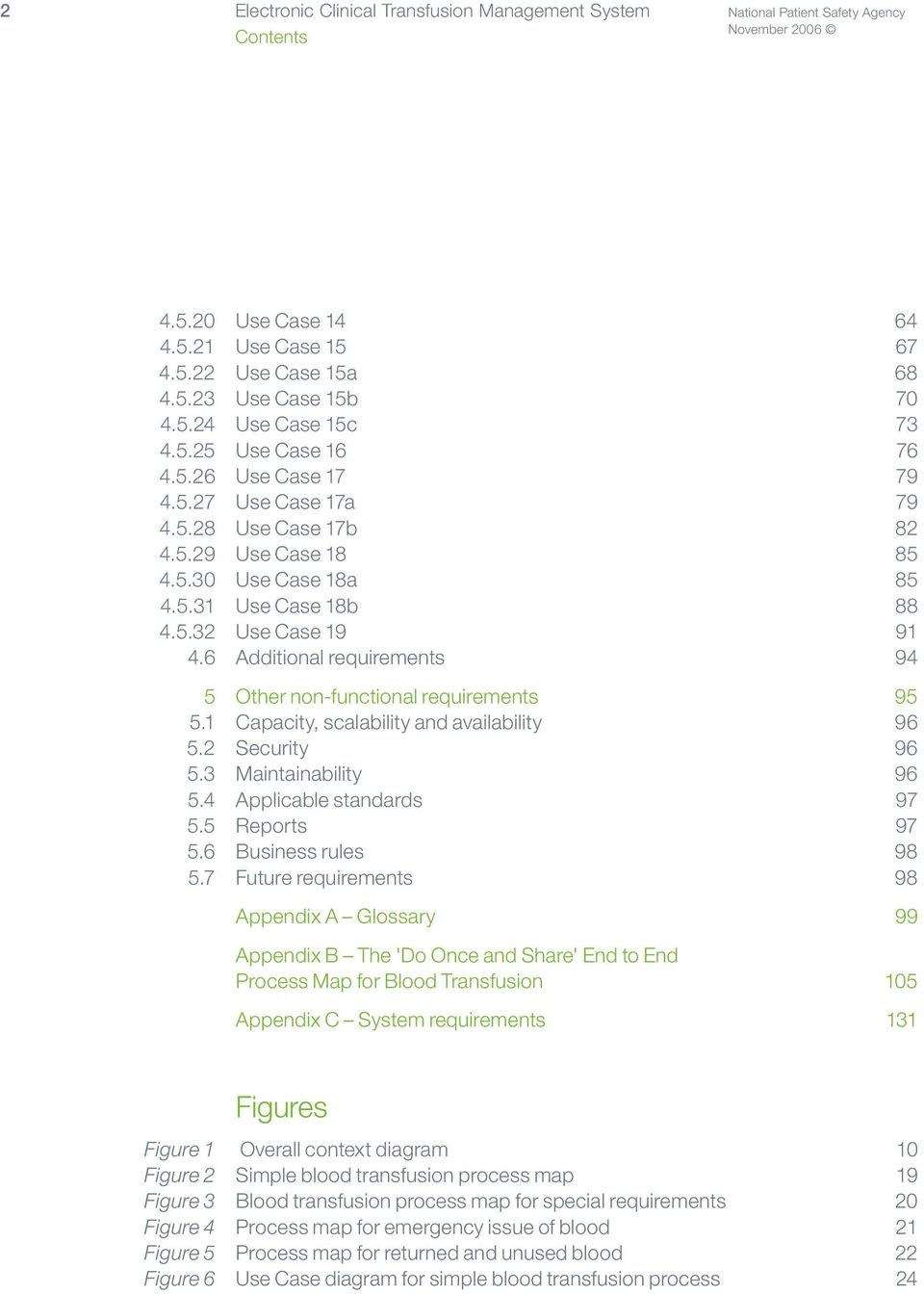
2 National Patient Safety Agency Electronic Clinical Transfusion Management System Contents 1 Contents Format Purpose Scope and objectives Intended audience Background Further work Abbreviations, acronyms and references Useful documents 7 2 Description System overview Features User types and characteristics Design and implementation constraints 13 3 External interface requirements Software interfaces 16 4 Specific requirements System requirements Blood transfusion process Access rights Blood transfusion process Use Cases Use Cases Use Cases Use Case UseCase Use Case Use Case 4a Use Case 4b Use Case Use Case Use Case Use Case Use Case Use Case Use Case Use Case 11a Use Case 11b Use Case Use Case 12a Use Case 12b Use Case 13 61

3 2 Electronic Clinical Transfusion Management System National Patient Safety Agency Contents UseCase Use Case Use Case 15a UseCase15b Use Case 15c Use Case Use Case Use Case 17a Use Case 17b Use Case Use Case 18a Use Case 18b Use Case Additional requirements 94 5 Other non-functional requirements Capacity, scalability and availability Security Maintainability Applicable standards Reports Business rules Future requirements 98 Appendix A Glossary 99 AppendixB The'DoOnceandShare'EndtoEnd Process Map for Blood Transfusion 105 Appendix C System requirements 131 Figures Figure 1 Overall context diagram 10 Figure 2 Simple blood transfusion process map 19 Figure 3 Blood transfusion process map for special requirements 20 Figure 4 Processmapforemergencyissueofblood 21 Figure 5 Process map for returned and unused blood 22 Figure 6 Use Case diagram for simple blood transfusion process 24
4 National Patient Safety Agency Electronic Clinical Transfusion Management System 3 1

5 4 Electronic Clinical Transfusion Management System National Patient Safety Agency 1 Blood transfusions involve a complex sequence of activities, with a correspondingly high opportunity for error. To ensure the right patient receives the right blood, there must be strict checking procedures in place at each stage. The National Patient Safety Agency (NPSA), the Chief Medical Officer s National Blood Transfusion Committee (NBTC) and Serious Hazards of Transfusion (SHOT) have collaborated to develop and evaluate a series of national initiatives to improve blood safety.thenpsahassetatargetofreducingthenumberofaboincompatibleblood transfusionincidentsby50percentoverthreetofiveyears,asmeasuredbytheshot database. Following a blood safety stakeholder workshop, four initiatives to improve blood safety were selected for further testing and development. One of these initiatives was the use ofbarcodetechnologytohelppreventfinalidentitycheckscarriedoutatthepatient's side (at the bedside) from failing. This national specification, which is part of the NPSA's blood safety initiative, Right patient, right blood, has been developed with the following objectives: to address the patient safety risks in the transfusion process; to identify IT requirements for a blood tracking system; to provide an initial specification for IT suppliers. This specification for an Electronic Clinical Transfusion Management System (ECTMS) focuses on the steps in the transfusion pathway taking place outside the laboratory and is relevant to both bar coding and Radio Frequency Identification (RFID) technology. This document also addresses the requirement of the 2005 Blood Safety and Quality Regulations (Medicines and Healthcare products Regulatory Agency, MHRA) to maintain a complete record for all blood components and products from donor to recipient for 30 years. 1.1 Format This specification for an ECTMS is based on a widely-used Software Requirements Specification (SRS) template (Weigers et al, 2003; see Section 1.8) with some minor modifications by the NPSA. The implementation of an ECTMS will require more than the development of software, as it will need to be integrated with, for example, server hardware,clientdevicesandremoteterminals.inthisrespecttheprojectcanbeseen as one of systems engineering rather than software engineering per se. However, for the purposes of this initial specification, the Wiegers SRS template is more than adequate. Thespecificationgivesanoverallcontextofthedevelopment,givesauser s perspective of the system through the use of use-case driven modelling processes,

6 National Patient Safety Agency Electronic Clinical Transfusion Management System 5 based largely on the Unified Modelling Language (UML), and specifies functional and non-functional requirements. 1.2 Purpose ThepurposesofthisspecificationforanECTMSareto: specify the steps in the blood transfusion pathway; address the patient safety risks identified in the blood transfusion pathway; inform Hospital Blood TransfusionCommitteesandITmanagersofthe requirements identified; form the basis of an initial requirements specification for IT suppliers; provide an initial specification that can be extended to cover other clinical tracking applications. This document does not in itself provide sufficient detail for IT suppliers to develop the systems and software required for a complete blood tracking solution. 1.3 Scope and objectives The specification builds on the experience of users of IT technology in blood transfusion that is currently available and informs both Connecting for Health (CfH) and commercial companies producing both hardware and software. The main objective of this specification is to support the automated tracking of blood products from the initial ordering of a blood transfusion for a patient, through to the taking of a blood sample for cross matching, to administration of a blood transfusion and subsequent updates to care records. The scope of the specification includes the following scenarios: routine blood transfusion; transfusion for special requirements (for example, cytomegalovirus (CMV) seronegative blood, irradiated blood or antigen negative blood); emergency issue of blood; management of returned and unused blood units. This specification focuses on the actual requirements for an IT tracking system to work. It does not attempt to define or include any additional business processes or guidelines that may need to be in place, for example, the administration of users on the system, or transferring or transporting data to or from local systems. The requirements described in this document are specifications for the tracking of blood products from arrival at hospital through to administration. In addition, it is anticipated that any system designed to meet the requirements in this document could be extended to cover other clinical tracking applications such as, for example, tracking drugs and pharmaceuticals.

7 6 Electronic Clinical Transfusion Management System National Patient Safety Agency 1.4 Intended audience This specification is aimed at: IT suppliers; CfH; Informing Healthcare; external stakeholders. 1.5 Background The requirements detailed in this document have been derived from: theoutcomesofthecfh DoOnceandShare bloodtransfusionproject ( thenpsa sbloodsafetyittrackingusergroupheldinseptember2005; discussions with various members of staff at the NPSA and Oxford Radcliffe Hospital. 1.6 Further work Starting in March 2007, CfH (with the support of the NPSA) will carry out a pilot with one or more acute healthcare organisations to build on and improve the requirements of the IT specification that will be delivered to Local Service Providers. The NPSA will also work with Informing Healthcare to facilitate introduction of similar technology in the acute sector in Wales. 1.7 Abbreviations, acronyms and references All abbreviations and acronyms used in this document are consistent with the standards used elsewhere and are defined in the Glossary (Appendix A). For the purposes of traceability of the requirements in the subsequent development phases, the requirements specified in this document have been identified and numbered using the RQ-xx notation.

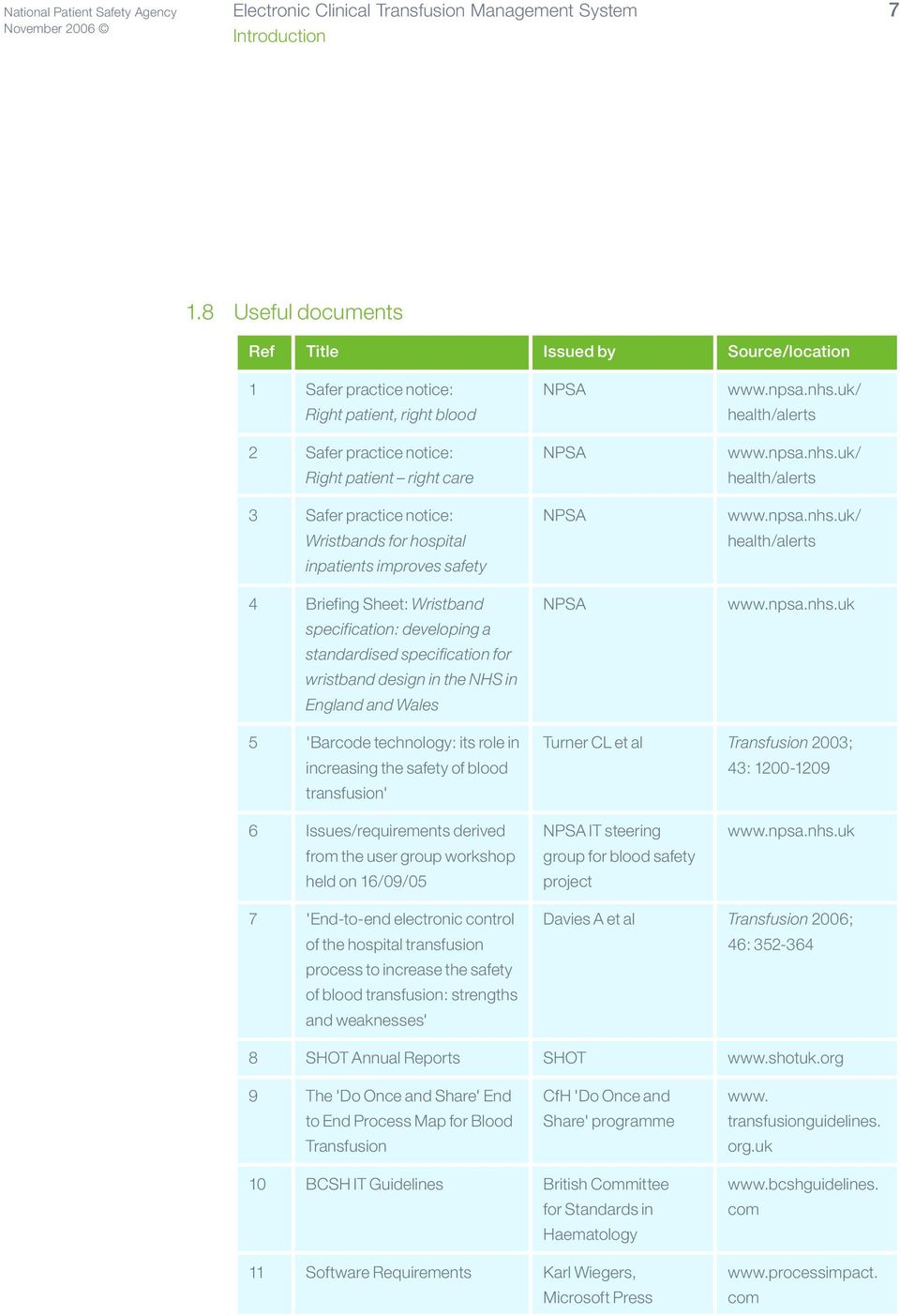
8 National Patient Safety Agency Electronic Clinical Transfusion Management System Useful documents Ref Title Issued by Source/location 1 Safer practice notice: Right patient, right blood 2 Safer practice notice: Right patient right care 3 Safer practice notice: Wristbands for hospital inpatients improves safety 4 Briefing Sheet: Wristband specification: developing a standardised specification for wristband design in the NHS in England and Wales NPSA NPSA NPSA NPSA health/alerts health/alerts health/alerts 5 'Barcode technology: its role in increasing the safety of blood transfusion' Turner CL et al Transfusion 2003; 43: Issues/requirements derived from the user group workshop held on 16/09/05 NPSA IT steering group for blood safety project 7 'End-to-end electronic control of the hospital transfusion processtoincreasethesafety of blood transfusion: strengths and weaknesses' DaviesAetal Transfusion 2006; 46: SHOT Annual Reports SHOT 9 The 'Do Once and Share' End to End Process Map for Blood Transfusion CfH 'Do Once and Share' programme www. transfusionguidelines. org.uk 10 BCSH IT Guidelines British Committee for Standards in Haematology 11 Software Requirements Karl Wiegers, Microsoft Press com com
Guideline on the Administration of Blood Components
 Guideline on the Administration of Blood Components British Committee for Standards in Haematology Address for correspondence: BCSH Secretary British Society for Haematology 100 White Lion Street London
Guidelines for Validation & Qualification, including Change Control, for Hospital Transfusion Laboratories
 Guidelines for Validation & Qualification, including Change Control, for Hospital Transfusion Laboratories British Committee for Standards in Haematology Address for correspondence: BCSH Secretary British
Transfusion Medicine GUIDELINES SUMMARY BACKGROUND
 Transfusion Medicine GUIDELINES UK Transfusion Laboratory Collaborative: minimum standards for staff qualifications, training, competency and the use of information technology in hospital transfusion laboratories
Issue Management Plan Preparation Guidelines
 Issue Management Plan Preparation Guidelines TABLE OF CONTENTS 1. Purpose of Document 1 2. Definition of Issue Management 1 3. Objectives of Issue Management 1 4. Terms, Acronyms and Abbreviations 1 5.
Guidelines for the specification, implementation and management of information technology (IT) systems in hospital transfusion laboratories
 Guidelines for the specification, implementation and management of information technology (IT) systems in hospital transfusion laboratories Date for guideline review June 2017 Address for correspondence:
Electronic Prescriptions, Dashboards and MyHealth @ University Hospital Birmingham
 Electronic Prescriptions, Dashboards and MyHealth @ University Hospital Birmingham Thursday 25 th July 2013 Digital Health: design: develop: deploy: evaluate Electronic Prescribing & Medication Administration
Alert. Patient safety alert. Actions that can make anticoagulant therapy safer. 28 March 2007. Action for the NHS and the independent sector
 Patient safety alert 18 Alert 28 March 2007 Immediate action Action Update Information request Ref: NPSA/2007/18 4 Actions that can make anticoagulant therapy safer Anticoagulants are one of the classes
Efficient Data Sharing in Healthcare
 Efficient Data Sharing in Healthcare More and more efforts are underway in different countries on sharing data among doctors and hospitals in healthcare for achieving higher quality and efficiency of clinical
Implementing Nurse Authorisation of Blood Components. Liz Pirie MSc BSc RGN PgCert ITL
 Implementing Nurse Authorisation of Blood Components Liz Pirie MSc BSc RGN PgCert ITL 1 Background Fragmentation of patient care for patients who require blood transfusion support A collaborative project
The risk assessment confirms that these materials are fit for the purpose as stated above. Further information can be obtained from:
 Introduction to Blood Transfusion Competencies Blood transfusion is a complex multi-step process involving personnel from diverse background with different levels of knowledge and understanding. In order
High Integrity Systems in Health Environment. Mark Nicholson
 High Integrity Systems in Health Environment Mark Nicholson Introduction National Patient Safety Agency (NPSA - 2003) has described patient safety as process by which an organisation makes patient care
RFID in a nutshell. Colin Jervis, Director, Kinetic Consulting Ltd
 Colin Jervis, Director, Kinetic Consulting Ltd Enthusiasts in healthcare fields suggest that one day a tiny RFID (or radio-frequency identification) tag implanted under your skin could transmit your NHS
Implementation of ANSI/AAMI/IEC 62304 Medical Device Software Lifecycle Processes.
 Implementation of ANSI/AAMI/IEC 62304 Medical Device Software Lifecycle Processes.. www.pharmout.net Page 1 of 15 Version-02 1. Scope 1.1. Purpose This paper reviews the implementation of the ANSI/AAMI/IEC
 ABSTRACT List of tables List of figures List of abbreviations CHAPTER 1 INTRODUCTION 1.1 Background 1.2 Problem Statement 1.3 Objective 1.4 Scope 1.5 Thesis Organization Chapter 2 2.1 Automatic Identification
Software Requirements, Third Edition
 j Microsoft Software Requirements, Third Edition Karl Wiegers and Joy Beatty Contents Introduction Acknowledgments xxv xxxi PART I SOFTWARE REQUIREMENTS: WHAT, WHY, AND WHO Chapter 1 The essential software
Sofware Requirements Engineeing
 Sofware Requirements Engineeing Three main tasks in RE: 1 Elicit find out what the customers really want. Identify stakeholders, their goals and viewpoints. 2 Document write it down (). Understandable
<Project Name> Quality Assurance Plan
 Version [Note: The following template is provided for use with the Rational Unified Process. Text enclosed in square brackets and displayed in blue italics (style=infoblue) is included
Safe Blood Sampling Training Package
 Better Blood Transfusion - Education Programme Safe Blood Sampling Training Package SBS Training Package version 2010 to SNBTS www.learnbloodtransfusion.org.uk Learning Outcomes Following this session
Safety indicators for inpatient and outpatient oral anticoagulant care
 Safety indicators for inpatient and outpatient oral anticoagulant care 1 Recommendations from the British Committee for Standards in Haematology (BCSH) & National Patient Safety Agency (NPSA) Address for
Guideline. Records Management Strategy. Public Record Office Victoria PROS 10/10 Strategic Management. Version Number: 1.0. Issue Date: 19/07/2010
 Public Record Office Victoria PROS 10/10 Strategic Management Guideline 5 Records Management Strategy Version Number: 1.0 Issue Date: 19/07/2010 Expiry Date: 19/07/2015 State of Victoria 2010 Version 1.0
SCR Expert Advisory Committee
 SCR Expert Advisory Committee Terms of Reference Judith Brodie, Chair August 2015 1 Copyright 2015, Health and Social Care Information Centre. Contents Contents 2 1. Background and Strategic Justification
<Project Name> Deployment Plan
 Version [Note: The following template is provided for use with the Rational Unified Process. Text enclosed in square brackets and displayed in blue italics (style=infoblue) is included
A Review of the NHSLA Incident Reporting and Management and Learning from Experience Standards. Assessment Outcomes. April 2003 - March 2004
 A Review of the NHSLA Incident Reporting and Management and Learning from Experience Standards Assessment Outcomes April 2003 - March 2004 September 2004 1 Background The NHS Litigation Authority (NHSLA)
PHARMACEUTICAL QUALITY SYSTEM Q10
 INTERNATIONAL CONFERENCE ON HARMONISATION OF TECHNICAL REQUIREMENTS FOR REGISTRATION OF PHARMACEUTICALS FOR HUMAN USE ICH HARMONISED TRIPARTITE GUIDELINE PHARMACEUTICAL QUALITY SYSTEM Q10 Current Step
Type of change. V02 Review Feb 13. V02.1 Update Jun 14 Section 6 NPSAS Alerts
 Document Title Reference Number Lead Officer Author(s) (name and designation) Ratified By Central Alerting System (CAS) Policy NTW(O)17 Medical Director Tony Gray Head of Safety and Patient Experience
AATB/ICCBBA Interim Guidance Document. For use of ISBT 128 by North American Tissue Banks
 AATB/ICCBBA Interim Guidance Document For use of ISBT 128 by North American Tissue Banks Version 1.2.0 September 2012 Published by: ICCBBA PO Box 11309, San Bernardino, California, USA 1.909.793.6516 [email protected]
Project Plan for <project name>
 Note: Text displayed in blue italics is included to provide guidance to the author and should be deleted or hidden before publishing the document. This template can be used at it is, or to complete and
Guide to Regulatory Requirements for the Procurement of Human Tissues and Cells intended for Human Application
 Guide to Regulatory Requirements for the Procurement of Human Tissues and Cells intended for Human AUT-G0102-1 3 JANUARY 2013 This guide does not purport to be an interpretation of law and/or regulations
Electronic Prescription Service. Guidance for community pharmacy contractors on implementing Release 1
 Electronic Prescription Service The Electronic Prescription Service Guidance for community pharmacy contractors on implementing Release 1 Contents With about 1.3 million prescriptions now being issued
NATIONAL QUALITY BOARD. Human Factors in Healthcare. A paper from the NQB Human Factors Subgroup
 NQB(13)(04)(02) NATIONAL QUALITY BOARD Human Factors in Healthcare A paper from the NQB Human Factors Subgroup Purpose 1. To provide the NQB with a near final version of the Concordat on Human Factors
Triennial Review of NHS Blood and Transplant (NHSBT) A Review of NHS Blood and Transplant (NHSBT) Call for Evidence
 Triennial Review of NHS Blood and Transplant (NHSBT) A Review of NHS Blood and Transplant (NHSBT) Call for Evidence August 2015 Title: Triennial Review of NHS Blood and Transplant Call for Evidence Author:
Use Cases. Reference: Craig Larman, Applying UML and Patterns, Ch. 6
 Use Cases Reference: Craig Larman, Applying UML and Patterns, Ch. 6 Use Case What it is: Text story Widely used to discover and record (mostly functional) requirements What is it about: Some actor(s) using
KNOWLEDGE BASE SDN BHD innovation through knowledge engineering
 KBASE LIFE the complete solution for blood bank management KNOWLEDGE BASE SDN BHD innovation through knowledge engineering Knowledge is information that changes something or somebody - either by becoming
Clinical Audit Procedure for NHS-LA and CNST Casenote Audit
 Clinical Audit Procedure for NHS-LA and CNST Casenote Audit NHS Litigation Authority (NHS-LA) Risk Management Standards for Acute Trusts Pilot Clinical Negligence Scheme for Trusts (CNST) Maternity Clinical
Time Monitoring Tool Software Development Plan. Version <1.1>
 Time Monitoring Tool Software Development Plan Version Revision History Date Version Description Author 10/01/01 1.0 First Draft Sabrina Laflamme 12/01/01 1.1 Completion of Document John Lemon Page
The policy applies to all members of staff employed within the Trust who are involved in any aspect of alert dissemination, action, and /or review.
 The Newcastle upon Tyne Hospitals NHS Foundation Trust Central Alert System (CAS) Policy and Procedure Version No.: 4.2 Effective From: 26 th May 2015 Expiry Date: 26 th May 2018 Date Ratified: 11 th May
VAIL-Plant Asset Integrity Management System. Software Development Process
 VAIL-Plant Asset Integrity Management System Software Development Process Document Number: VAIL/SDP/2008/008 Engineering For a Safer World P u b l i c Approved by : Ijaz Ul Karim Rao Revision: 0 Page:2-of-15
Wrong Blood In Tube The Tip of the Iceberg
 Wrong Blood In Tube The Tip of the Iceberg Dr Paula Bolton-Maggs SHOT Medical Director 14 th IHS Montréal SHOT Mission Statement (Serious Hazards of Transfusion) To improve patient safety in blood transfusion
The patient journey. Typical healthcare applications:
 Healthcare Zebra Printing Solutions The patient journey Zebra s proven printer and media solutions are being used to improve safety, comfort and efficiency at every stage of a patient s hospital journey.
Towards pervasive ICT solutions in the healthcare sector: an integrated technology approach to safer and efficient clinical processes in organizations
 Fondazione IRCCS Istituto Nazionale dei Tumori Towards pervasive ICT solutions in the healthcare sector: an integrated technology approach to safer and efficient clinical processes in organizations April
Informatics: The future. An organisational summary
 Informatics: The future An organisational summary DH INFORMATION READER BOX Policy HR/Workforce Management Planning/Performance Clinical Document Purpose Commissioner Development Provider Development Improvement
Right blood, right patient, right time. RCN guidance for improving transfusion practice
 Right blood, right patient, right time RCN guidance for improving transfusion practice Acknowledgements We would like to thank everyone who reviewed this edition of Right blood, right patient, right time:
Software Design Document (SDD) Template
 (SDD) Template Software design is a process by which the software requirements are translated into a representation of software components, interfaces, and data necessary for the implementation phase.
Information Governance. A Clinician s Guide to Record Standards Part 1: Why standardise the structure and content of medical records?
 Information Governance A Clinician s Guide to Record Standards Part 1: Why standardise the structure and content of medical records? Contents Page 3 A guide for clinicians Pages 4 and 5 Why have standards
Clinical Risk Management: Agile Development Implementation Guidance
 Document filename: Directorate / Programme Document Reference NPFIT-FNT-TO-TOCLNSA-1306.02 CRM Agile Development Implementation Guidance v1.0 Solution Design Standards and Assurance Project Clinical Risk
<Project Name> Bill of Materials
 Version [Note: The following template is provided for use with the Rational Unified Process. Text enclosed in square brackets and displayed in blue italics (style=infoblue) is included
How To Improve Safety In The Nhs
 PS035 Original research completed in 2010 Briefing Paper Introduction: Principal Investigator: Professor John Clarkson Should the NHS adopt a new system for predicting possible risks to patient safety?
Requirement Management with the Rational Unified Process RUP practices to support Business Analyst s activities and links with BABoK
 IBM Software Group Requirement Management with the Rational Unified Process RUP practices to support Business Analyst s activities and links with BABoK Jean-Louis Maréchaux Software IT Specialist IBM Rational
Safety Alerts Management Policy
 Safety Alerts Management Policy Version Number 1.1 Version Date February 2014 Policy Owner Author First approval or date last reviewed Staff/Groups Consulted Director of Nursing and Clinical Governance
ICH guideline Q10 on pharmaceutical quality system
 September 2015 EMA/CHMP/ICH/214732/2007 Committee for Human Medicinal Products Step 5 Transmission to CHMP May 2007 Transmission to interested parties May 2007 Deadline for comments November 2007 Final
The South Staffordshire and Shropshire Health Care NHS Foundation Trust Digital Strategy 2014 2019
 The South Staffordshire and Shropshire Health Care NHS Foundation Trust Digital Strategy 2014 2019 Peter Kendal Associate Director for Information Management and Technology Development 01/12/2014 1 Page
Computer System Validation for Clinical Trials:
 Computer System Validation for Clinical Trials: Framework Standard Operating Procedure (F-SOP) Author: Tim Cross Version History: 0.1di DRAFT 24-April-2013 0.2 DRAFT 12-June-2013 Current Version: 1.0 17-June-2013
www.gov.uk/monitor The maternity pathway payment system: Supplementary guidance
 www.gov.uk/monitor The maternity pathway payment system: Supplementary guidance Contents Introduction... 3 Inclusions and exclusions from the pathway payments... 4 Early pregnancy unit and emergency gynaecology
Information for patients needing irradiated blood
 Information for patients needing irradiated blood Patient information I am at risk of transfusion-associated graft-versus-host disease If I need to have a blood transfusion, cellular blood components (Red
Use Cases. Massimo Felici. Massimo Felici Use Cases c 2004 2011
 Use Cases Massimo Felici Use Cases 1 Support requirements engineering activities and the requirement process Capture what a system is supposed to do, i.e., systems functional requirements Describe sequences
What is a life cycle model?
 What is a life cycle model? Framework under which a software product is going to be developed. Defines the phases that the product under development will go through. Identifies activities involved in each
Keeping patients safe when they transfer between care providers getting the medicines right
 PART 1 Keeping patients safe when they transfer between care providers getting the medicines right Good practice guidance for healthcare professions July 2011 Endorsed by: Foreword Taking a medicine is
Software Requirements Specification. Task Management System. for. Prepared by. Version 1.0. Group Name: Pink and Purple. Date:
 Software Requirements Specification for Task Management System Version 1.0 Prepared by Group Name: Pink and Purple Kathrynn Gonzalez 11387240 [email protected] Tina Roper 11380457 [email protected]
Safe and integrated transfusion process
 Fondazione IRCCS Istituto Nazionale dei Tumori Elena Sini CIO Safe and integrated transfusion process Agenda Background and objectives Transfusion safety The reengineered transfusion process Key Performance
Sub Code: CP7007 Sub Name: SOFTWARE REQUIREMENTS ENGINEERING Branch / Year: ME CSE / I Year Staff in charge: Dr.M.Senthil Kumar
 VALLIAMMAI ENGINEERING COLLEGE S.R.M. Nagar, Kattankulathur DEPARTMENT OF COMPUTER SCIENCE AND ENGINEERING Sub Code: CP7007 Sub Name: SOFTWARE REQUIREMENTS ENGINEERING Branch / Year: ME CSE / I Year Staff
Specialty Selection Test (SST) Pilot INFORMATION PACK
 Specialty Selection Test (SST) Pilot INFORMATION PACK Page 1 of 18 Contents Section 1: Introduction... 2 Section 2: One-page overview... 2 Section 3: FAQs for Applicants... 3 Section 2: FAQs for LETBs/Deaneries/Specialties...
3C05: Unified Software Development Process
 3C05: Unified Software Development Process 1 Unit 5: Unified Software Development Process Objectives: Introduce the main concepts of iterative and incremental development Discuss the main USDP phases 2
Software Requirements Specification. <Project> for. Version 1.0 approved. Prepared by <author> <organization> <date created>
 Software Requirements Specification for Version 1.0 approved Prepared by Copyright 1999 by Karl E. Wiegers. Permission is granted to use, modify, and distribute
Software Requirements. Specification. Day Health Manager. for. Version 1.1. Prepared by 4yourhealth 2/10/2015
 Software Requirements Specification. for Day Health Manager Version 1.1 Prepared by 4yourhealth Senior Project 2015 2/10/2015 Table of Contents Table of Contents Revision History Introduction Purpose Document
Design Document Version 0.0
 Software Development Templates Design Document Version 0.0 Description of Project DOCUMENT NO: VERSION: CONTACT: EMAIL: Ivan Walsh DATE: 4/13/2004 Distribution is subject to copyright. Design Document
K-Series Guide: Guide to digitising your document and business processing. February 2014 LATEST EDITION
 K-Series Guide: Guide to digitising your document and business processing February 2014 LATEST EDITION Kefron are the Document Kefron & simplifies the document and Information information management world
Document Details Title. Early Warning Score Protocol for Community Hospitals and Prisons to detect the Deteriorating Patient
 Document Details Title Early warning Score Protocol for community Hospitals and Prisons to Detect the Deteriorating Patient Trust Ref No 1558-29748 Local Ref (optional) Main points the document This protocol
National Institute for Health Research Coordinated System for gaining NHS Permission (NIHR CSP)
 National Institute for Health Research Coordinated System for gaining NHS Permission (NIHR CSP) Operating Manual Please check the CRN Website for the latest version. Version: 6.0 Status: Consultation in
CASE STUDY: E-PHARMACY AT CHELSEA AND WESTMINSTER HOSPITAL, UK
 e-business W@tch European Commission, DG Enterprise & Industry E-mail: [email protected], [email protected] This document is based on sector studies, special reports or other publications
How to effectively report to SABRE and SHOT. Richard Haggas Transfusion Quality Manager [email protected]
 How to effectively report to SABRE and SHOT Richard Haggas Transfusion Quality Manager [email protected] Remit To explain how to successfully report to both MHRA and SHOT through the SABRE
Software Requirement Specifications V1.0
 V1.0 1. Introduction 1.1 Purpose... 1 1.2 Document Conventions... 1 1.3 Intended Audience and Reading Suggestions... 1 1.4 Project Scope... 1 1.5 References... 1 2. Overall 2.1 Product Perspective... 2
TRIAL MASTER FILE- SPONSORED
 gsop-06-04 - Management of TMF for ENHT/ WHHT Sponsored CTIMPs Page 1 of 16 Hertfordshire Hospitals R&D Consortium Incorporating West Herts Hospitals NHS Trust and East & North Herts NHS Trust TRIAL MASTER
BUSINESS CONTINUITY MANAGEMENT POLICY
 BUSINESS CONTINUITY MANAGEMENT POLICY Version No: 1 Issue Status: awaiting Trust Board approval Date of Ratification: 11th April 2012 Ratified by: Risk Management Committee Policy Author(s): Stuart Coalwood
Defining the boundaries between NHS and Private Healthcare
 West Midlands Strategic Commissioning Group Commissioning Policy (WM/13) Defining the boundaries between NHS and Private Healthcare Version 1 April 2010 1. Definitions Private patients are patients who
510(k) SUMMARY. Epic s Blood Product Administration Module version 0.9
 510(k) SUMMARY Epic s Blood Product Administration Module version 0.9 Contact Person: Maggie Francis Phone: (608) 271 9000 Facsimile: (608) 271 7237 Date Prepared: January 30, 2014 Trade Name: Blood Product
What you should know about Data Quality. A guide for health and social care staff
 What you should know about Data Quality A guide for health and social care staff Please note the scope of this document is to provide a broad overview of data quality issues around personal health information
Business Continuity Policy and Business Continuity Management System
 Business Continuity Policy and Business Continuity Management System Summary: This policy sets out the structure for ensuring that the PCT has effective Business Continuity Plans in place in order to maintain