
SCHOOL FINANCE IN COLORADO
|
|
|
- Amanda Reed
- 9 years ago
- Views:
Transcription
1 STATE OF COLORADO LEGISLATIVE COUNCIL COLORADO GENERAL ASSEMBLY STATE CAPITOL BUILDING RM EAST COLFAX AVENUE DENVER CO M SCHOOL FINANCE IN COLORADO Legislative Council Staff State Capitol Building, Room East Colfax Avenue Denver, CO Phone: (303) January 2014

2 FOREWORD The purpose of this booklet is to help readers understand how Colorado finances its public elementary and secondary schools. The major focus of this booklet is an explanation of the funding formula included in the Public School Finance Act of 1994, including amendments made to the act in Several illustrations are provided to help readers calculate funding under the formula. The booklet also describes several other provisions of law that relate to school district funding. These provisions include a description of revenue that is earmarked for specific functions, other local sources of revenue, categorical programs, and the Colorado Preschool Program. Please note that this booklet is intended to provide a summary overview of programs that affect funding for schools; state law should be consulted for more specific details on the operation of the programs or for information on other programs that provide money to school districts. This booklet was prepared by the Colorado Legislative Council Staff, the nonpartisan research staff of the Colorado General Assembly. It is available on the Internet at:
3 TABLE OF CONTENTS Page SUMMARY OF SCHOOL FINANCE FUNDING...1 COLORADO'S SCHOOL FINANCE ACT...3 THE FUNDING FORMULA...3 How are Pupils Counted?... 4 How is Per Pupil Funding Calculated?...5 What is At-Risk Funding?...8 How are Online and ASCENT Students Funded? What is the Negative Factor?...11 LOCAL SHARE AND STATE AID...11 How is the Local Share Calculated?...12 How is State Aid Calculated?...13 MODIFICATIONS TO THE FUNDING FORMULA...15 EARMARKED REVENUE...17 UNEQUALIZED LOCAL REVENUE...17 CASH FLOW LOAN PROGRAM...20 STATE CONTINGENCY RESERVE...21 CAPITAL CONSTRUCTION...21 CALCULATION EXAMPLES...25 A HISTORY OF SCHOOL FINANCE ACT FUNDING...31 CATEGORICAL PROGRAMS...33 SPECIAL EDUCATION...33 PUBLIC SCHOOL TRANSPORTATION...35 VOCATIONAL EDUCATION...35 ENGLISH LANGUAGE PROFICIENCY...36 SMALL ATTENDANCE CENTERS...37 EXPELLED/AT-RISK STUDENT SERVICES GRANT PROGRAM...37 COMPREHENSIVE HEALTH EDUCATION...38 COLORADO PRESCHOOL PROGRAM...41 APPENDIX A...43 GLOSSARY...45

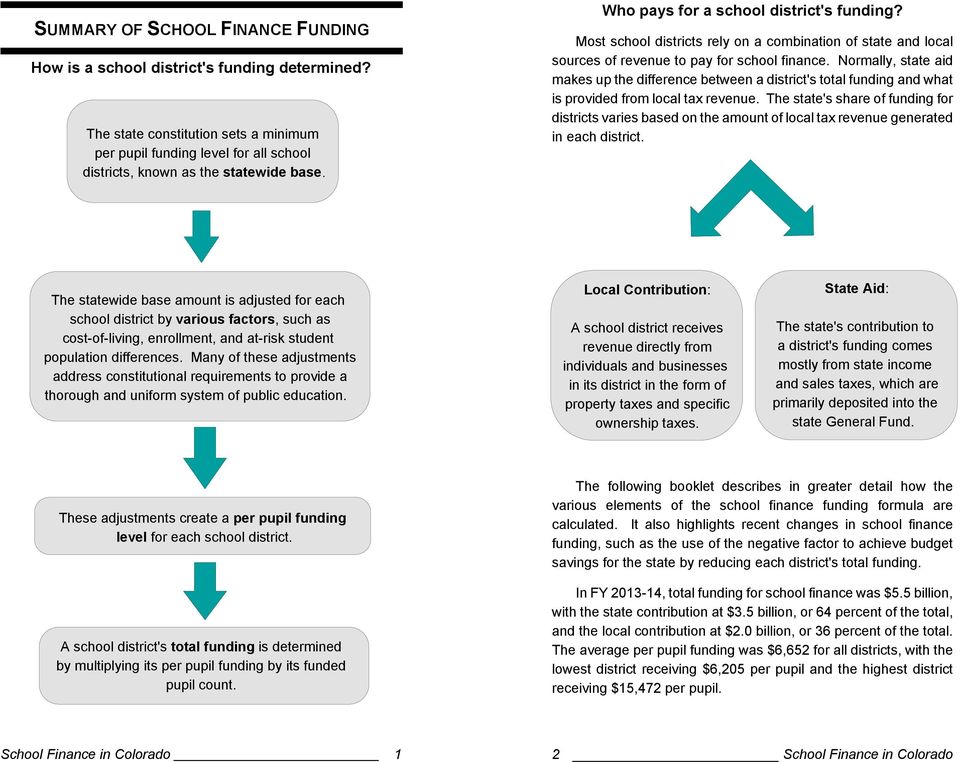
4 SUMMARY OF SCHOOL FINANCE FUNDING How is a school district's funding determined? The state constitution sets a minimum per pupil funding level for all school districts, known as the statewide base. Who pays for a school district's funding? Most school districts rely on a combination of state and local sources of revenue to pay for school finance. Normally, state aid makes up the difference between a district's total funding and what is provided from local tax revenue. The state's share of funding for districts varies based on the amount of local tax revenue generated in each district. The statewide base amount is adjusted for each school district by various factors, such as cost-of-living, enrollment, and at-risk student population differences. Many of these adjustments address constitutional requirements to provide a thorough and uniform system of public education. Local Contribution: A school district receives revenue directly from individuals and businesses in its district in the form of property taxes and specific ownership taxes. State Aid: The state's contribution to a district's funding comes mostly from state income and sales taxes, which are primarily deposited into the state General Fund. These adjustments create a per pupil funding level for each school district. A school district's total funding is determined by multiplying its per pupil funding by its funded pupil count. The following booklet describes in greater detail how the various elements of the school finance funding formula are calculated. It also highlights recent changes in school finance funding, such as the use of the negative factor to achieve budget savings for the state by reducing each district's total funding. In FY , total funding for school finance was $5.5 billion, with the state contribution at $3.5 billion, or 64 percent of the total, and the local contribution at $2.0 billion, or 36 percent of the total. The average per pupil funding was $6,652 for all districts, with the lowest district receiving $6,205 per pupil and the highest district receiving $15,472 per pupil. 1 2
5 COLORADO'S SCHOOL FINANCE ACT Colorado's school finance act distributes just over $5.5 billion annually in state and local dollars to the state's 178 school districts for K-12 public education. Currently, this money is allocated under a law called the "Public School Finance Act of 1994." The school finance act contains a formula that calculates a per pupil funding amount for each school district based on the individual characteristics of the district, such as the cost to live in the district and the number of students enrolled. The act is explained in detail on the following pages, including amendments made under the most recent school finance bill, Senate Bill Appendix A also provides an overview of Senate Bill This bill will replace the Public School Finance Act of 1994 only if voters approve a statewide citizen-initiated ballot measure that provides new tax revenue for K-12 public education. Voters must approve the measure on or before November THE FUNDING FORMULA A district's funding under the school finance act is the number of pupils in the district multiplied by the district's preliminary per pupil funding level, plus an amount of money provided to a district to compensate for the presence of at-risk pupils, online students, and pupils participating in the accelerating students through concurrent enrollment (ASCENT) program. pupil funding is adjusted by certain factors. Most recently, because of ongoing state budget constraints, what is known as the negative factor was implemented to reduce each school district's funding by a fixed percentage. This reduction is made after all other adjustments in the funding formula are calculated. An example of this adjustment is illustrated on page 30. How Are Pupils Counted? Funding under the school finance act is based on the number of pupils enrolled in the school district on October 1. Thus, the number of pupils counted on October 1, 2013, determines funding for the budget year beginning July 1, Because the fiscal year begins before the count date, state aid is distributed based on estimated pupil counts. After October 1, state aid is adjusted to reflect the actual count. The act provides an alternative to the October 1 count date in certain instances, such as when students in a year-round educational program will be on vacation on October 1. This alternative count date must be within 45 calendar days of the first school day after October 1. The pupil count is expressed in full-time equivalent (FTE) pupils to reflect the amount of time a student spends in an instructional setting. Preschool students are usually counted half time, and kindergarten students are counted as 0.58 of a pupil. A school district's pupil count also includes students who are enrolled in online programs and students who are eligible to complete a fifth year of high school while enrolled concurrently in higher education courses. The latter is called the ASCENT program. School District Funding = (Pupils x Per Pupil Funding) + At-Risk Funding + Online and ASCENT Funding The following describes elements contained in state law that determine how pupils are counted and how a school district's per Funded Pupil Count = Preschool Count + Online/ASCENT Counts +.08 Kindergarten Count + the Greater of: the Current Year's K-12 Count or a Two-year, Three-year, Four-year, or Five-year Average of the October Counts 3 4

6 The formula also makes enrollment allowances for districts that lose pupils from one year to the next, recognizing that such districts may have difficulty budgeting for fewer pupils. The pupil count for declining enrollment districts is the greater of a two-year, three-year, four-year, or five-year average of the October counts. Preschool, online, ASCENT, and a portion of kindergarten students are not included in the averaging formula. The number of pupils for which a district receives funding is called the funded pupil count. How Is Per Pupil Funding Calculated? A district's preliminary per pupil funding is the result of adjusting the statewide base by various elements, such as the district's cost-of-living, personnel and nonpersonnel costs, and enrollment size. Per Pupil Funding = Statewide Base Is Starting Point [(Statewide Base x Personnel Costs Factor x Cost of Living Factor) + (Statewide Base x Nonpersonnel Costs Factor)] x District Size Factor The calculation of each district's per pupil funding starts with a statewide base per pupil funding amount, which is set annually by the General Assembly. The statewide base for FY is $5,954.28, an increase of 1.9 percent ($111.02) over the prior year. Base funding accounts for about $4.8 billion of the $5.5 billion allocated under the formula in FY , or about 74.3 percent of total funding before application of the negative factor. Although the General Assembly sets the base annually, Article IX, Section 17, of the Colorado Constitution, commonly referred to as Amendment 23, contains minimum increases for the base. At a minimum, the General Assembly must increase the base each year by the rate of inflation. Because the inflation rate for calendar year 2012 was 1.9 percent, that was the minimum increase for FY required by Amendment 23. The Statewide Base Is Adjusted for Cost of Living Each school district is assigned a factor to indicate the cost of living in the district relative to the cost of living in other districts in the state. For FY , the cost of living factors for school districts range from about 1 percent to 65 percent. Statewide, an estimated $949 million in FY school finance funding is attributed to the cost-of-living factor, or 14.6 percent of total funding, before application of the negative factor. State law contains the method for calculating cost-of-living factors, but not the actual factors themselves. Cost-of-living factors are certified to the Colorado Department of Education by the Legislative Council Staff every two years following a study that measures the cost in each district of an identical set of items, such as housing, goods and services, transportation, and taxes. The 2011 study set factors for the and budget years. Under state law, a district's factor from the prior two-year cycle is increased when the cost of living in the district increases by a greater percentage than the increase in the statewide average teacher salary used in the study. For instance, the 2011 study was based on an average teacher salary of $49,200, an increase of 3.6 percent from the $47,500 used in the study two years earlier. For 83 of 178 school districts, the cost of living increased by more than 3.6 percent, and those districts saw an increase in cost-of-living factors for FY and FY The increase in the factor is equal to the percentage change in the district's cost of living divided by the percentage change in the salary level divided by 1,000. The increase in the factor is rounded to three decimal places. District "Personnel Costs Factor" Defines the Portion of the Statewide Base Adjusted for Cost of Living The formula recognizes that differences in the cost of living primarily affect the salaries that must be paid to hire and retain qualified personnel. Therefore, the cost-of-living factor is applied 5 6

7 only to the portion of the base that relates to personnel, as defined by the personnel costs factor. The personnel costs factor ranges from 79.9 to 90.5 percent and differs by district according to enrollment. Smaller districts have smaller factors and, therefore, a smaller portion of the base is increased for cost of living. Larger districts spend a higher proportion of their budgets on personnel costs than smaller districts and thus receive a larger increase to their base from the cost-of-living factor. The formula for determining district personnel costs factors is illustrated on page 27. Each district's "nonpersonnel costs factor" is the difference between 100 percent and the district's personnel costs factor. It is the portion of the base that is not adjusted for cost of living and ranges from 20.1 percent to 9.5 percent. Enrollment Size Factor Adjusts for Economies of Scale The act includes an enrollment size factor that provides additional money to all school districts, but particularly small school districts unable to take advantage of economies of scale. In FY , approximately $281 million is allocated through the size factor, or about 4.3 percent of total funding, before application of the negative factor. Like the personnel costs factor, a size factor is calculated under a formula using district enrollment. The smallest districts districts with enrollments of less than 4,023 receive the largest size factors and, therefore, more funding per pupil. All other districts receive a size factor, which provides an increase in per pupil funding of just under 3 percent. The formula for calculating a school district's size factor appears on page 27. Since the formula for determining the size factor is based on a district's enrollment, the act acknowledges that the formula inherently provides incentives and disincentives for districts to reorganize and take advantage of the formula. For example, when a reorganization results in a lower size factor, and less funding per pupil, the lower size factor is phased in over six years. When a reorganization results in a higher size factor, and more funding per 7 pupil, the district or districts involved in the reorganization receive the lower size factor of the original district. Thus, the act lessens the negative fiscal impact of reorganization, while prohibiting a district from taking advantage of a higher size factor following a reorganization. The act also attempts to minimize the effect that charter schools may have on the size factor of small school districts. The size factor for districts with fewer than 500 pupils is calculated using the district's enrollment minus 65 percent of the pupils enrolled in charter schools. What Is At-Risk Funding? Colorado's school finance act provides additional funding for school districts that serve students who are at risk of failing or dropping out of school. The additional funding depends on the district's per pupil funding that is based on the adjustments previously described, the number of at-risk students, and the proportion of at-risk students in the district. In FY , the act provides $320 million in at-risk funding statewide, or 4.9 percent of total funding, before application of the negative factor. At-risk funding is determined according to the following formula. At-Risk Funding = At-Risk Pupils x 12% x Per Pupil Funding + At-Risk Funding Premium Definition of At-Risk Pupils Follows the Federal Free Lunch Program and Includes Some Students with Limited English Skills Under the act, at-risk pupils are defined as students from low-income families, as measured by eligibility for free lunches under the National School Lunch Act. The definition of at-risk pupils also includes a limited number of non-english-speaking students. 8

8 Students qualify for free meals at school based on their family's income. The act defines at-risk pupils as those who are eligible for free lunches so districts can receive funding for students that do not actually participate in the federal program. As an alternative, the act allows districts to use the proportion of free-lunch students in grades one through eight multiplied by the district's enrollment if it produces a larger number than the actual count. This alternative count is provided because some high schools do not offer free lunches, and some students choose not to participate in the free lunch program, especially at the high school level. A student with limited English skills, as defined by the English Language Proficiency Act, can be included in the at-risk count if the student meets one of two criteria. First, a student can be counted if he or she took the Transitional Colorado Assessment Program (TCAP) test in a language other than English in the preceding year. Second, a student can be counted if the student took the regular, English TCAP, but the student has been in a Colorado public school for less than three years. In either case, a student can be counted as at-risk only once; therefore, a student who is counted under the income guidelines of the free lunch program cannot be counted because of limited proficiency in English. Preschool students are not included in a district's at-risk count. The official date for counting at-risk pupils is October 1. Proportion of At-Risk Students Determines At-Risk Funding The proportion of at-risk students in a district determines the amount of funding a district receives for its at-risk pupils. Every district receives at least 12 percent of its preliminary per pupil funding for each at-risk pupil. Districts with higher-than-average proportions of at-risk students receive a premium above the 12 percent increase in per pupil funding for those at-risk pupils. The amount of this premium depends upon enrollment in the district and the degree to which the district's share of at-risk students exceeds the statewide average. For districts with enrollments between 459 and 50,000, the premium is equal to 12 percent plus 0.30 of a percentage point for each percentage point that the district's at-risk percentage exceeds the statewide average. Thus, if the statewide average is 30 percent, and 41 percent of a particular district's students qualify for at-risk funding, the district would receive a premium of 15.3 percent ( (0.3 x 11) = 15.3) for qualifying students. For districts with enrollments greater than 50,000, the premium is equal to 12 percent plus 0.36 of a percentage point for each percentage point that the district's at-risk percentage exceeds the statewide average. The premium is capped at 30 percent, so 18 percentage points is the maximum that can be added to the existing 12 percent of per pupil funding provided for each at-risk student. The at-risk funding premium is provided only for pupils over the statewide average percentage of at-risk pupils. So, the district described above with 41 percent at-risk students would receive 12 percent more in per pupil funding for 30 percent of its students and 15.3 percent more in per pupil funding for the other 11 percent of its students who are at risk. In addition, only districts with more than 459 pupils qualify for the at-risk funding premium. How Are Online and ASCENT Students Funded? Students who participate in public online education programs or the ASCENT program are funded through the school finance act. Online students participate either in programs that serve students from multiple districts (multi-district programs) or in a program offered by the student's home district (single-district program). The vast majority of online students participate in multi-district programs. Both online and ASCENT students were funded at a uniform $7,180 per pupil in FY , accounting for about $112 million in school finance funding, before application of the negative factor. After the negative factor, this amount was reduced to $6,068, which compares with statewide average per pupil funding of $6,

9 Online + ASCENT Funding What Is the Negative Factor? = (Online + ASCENT Pupil Count) x Per Pupil Funding for Online and ASCENT Students In an effort to generate budget savings for the state, House Bill included a new factor called the budget stabilization factor for FY and FY For most districts, after all the funding adjustments required by the school finance act are calculated, this factor reduced total funding proportionately across districts. Senate Bill changed the name of this factor to the negative factor and extended its applicability indefinitely. For most districts, the factor reduced total funding by approximately percent, or a total of $1.006 billion compared to what would have been funded without the factor. Per pupil funding fell by a similar percentage, although certain districts with limited state aid did not lose as much funding. Districts with limited state aid were instead required to contribute through a buyout of state spending on categorical programs, which is described on page 16. LOCAL SHARE AND STATE AID The money to fund the school finance act comes from a combination of local and state sources. In FY , local taxes contributed 36 percent of total funding, while state sources accounted for the remaining 64 percent. These percentages vary widely among individual school districts, however, because districts have different amounts of property wealth and different tax rates. Under the act, each district's local portion is calculated first, and state aid makes up the difference between the local portion and the total funding need identified through the formula. The principle of using state aid to make up for differences in local property wealth is called "equalization." How Is the Local Share Calculated? A district's local share comes from two sources property taxes and specific ownership taxes. Property taxes are paid on real estate and business equipment; specific ownership taxes are paid on motor vehicles. Of the two taxes, property taxes produce the vast majority of the local contribution, roughly 93 percent of the total. Both of these taxes are described in greater detail below. Local Share = Current Year Property Taxes + Prior Year Specific Ownership Taxes Property Taxes Provide Most Local Revenues Statewide, property taxes contributed almost $1.84 billion in funding for school finance in FY , or 34 percent of total school district funding. A school district's property taxes are the result of multiplying a district's taxable property (assessed value) by its property tax rate (mill levy). The assessed value of a district is determined each year, and it includes all taxable property in the district. Based on the Colorado Supreme Court decision regarding Senate Bill , commonly referred to as the mill levy freeze or stabilization bill, state law requires most districts to impose the mill levy from the prior budget year. In cases where a school district has not obtained voter approval to retain and spend revenues in excess of the constitutional property tax revenue limit, a modified mill levy formula applies: the change in a school district's property tax revenue is limited to the sum of the state inflation rate and the percentage change in the district's enrollment. If a district's property taxes will exceed that amount with the prior year's levy, the district must reduce its mill levy so that property tax revenue does not grow more than the maximum allowed. The law also includes a ceiling on mill levies. A district's levy cannot be higher than the levy required to cover the district's total funding less specific ownership tax revenue. This levy calculation, 11 12

10 designed for districts with very high property wealth, affects two districts in the current budget year. In any case, for all districts, the maximum mill levy for school finance is set at 27 mills. Specific Ownership Taxes Supplement Property Taxes Specific ownership taxes provided about $131 million for school finance in FY , bringing the local share to 36 percent of total school district funding. Specific ownership taxes are paid annually on motor vehicles instead of property taxes. Counties collect specific ownership taxes and distribute them to all governments in the county that collect property taxes, such as school districts, cities, special districts, and the county itself. By law, counties distribute specific ownership tax revenue to these governments in proportion to the amount of property taxes collected by each. Thus, a school district that receives 50 percent of all the property taxes collected in a county would receive 50 percent of the specific ownership taxes collected in the county. The funding formula does not count all specific ownership tax revenue against the district's local share, however. Some districts collect more specific ownership taxes than others because the voters in those districts have approved additional property taxes. The formula specifically does not count any specific ownership taxes attributable to a bond redemption (debt) or override (operating) mill levy, if the mill levy was approved by the district's voters. The formula uses specific ownership taxes collected in the previous fiscal year because they are the most recent actual figures. Thus, the local share in FY reflects the FY specific ownership tax revenue. How Is State Aid Calculated? State aid provides the difference between a district's total funding and the district's local share. In school finance, this concept of state assistance supplementing local resources is called "equalization." An equalized school finance system allows similar districts to spend similar amounts regardless of property wealth. For FY , the school finance act drives state aid of $3.5 billion, or 64 percent of total funding. State Aid = Total Funding - Local Share Districts that produce less from property taxes receive a greater proportion of state aid, while districts that produce more from property taxes receive a smaller proportion of state aid. Before FY , some districts with relatively high amounts of property taxes received a minimum level of state aid, but this provision was suspended through FY by House Bill The state distributes money to school districts in 12 approximately equal monthly payments. In the first half of the fiscal year, the payments are based upon pupil count and assessed value estimates, because the state does not know exact pupil counts and district assessed values during that time period. The payments are later adjusted to reflect actual pupil counts and assessed values. These approximately equal monthly payments may cause some districts to experience cash flow problems at certain times of the year, so the state offers a loan program to qualifying school districts. This loan program is discussed in further detail on page 20. State Aid Comes Primarily from Three Sources Three sources of revenue provide money for the state aid appropriation for school finance. The state General Fund provides the vast majority of money: in FY , 83.1 percent of the appropriation, or $2.9 billion, was provided by the General Fund. The State Education Fund also contributes to the state aid appropriation. The State Education Fund, created by Article IX, Section 17, of the Colorado Constitution (Amendment 23), receives revenue equal to a tax of one-third of 1 percent on federal taxable income. Its contribution to the state aid appropriation 13 14

11 was about $524 million in FY , or 14.8 percent of the state aid package. Finally, a portion of rent from state school lands and federal mineral lease money, as well as other miscellaneous sources of money, provided the remaining 2.1 percent (about $75 million) of state aid. Transfer of General Fund Surplus Legislation enacted in 2012 and 2013 transferred part or all of the General Fund surplus into the State Education Fund. For FY , $59 million was transferred and all of the General Fund surplus in FY , currently estimated at $1.1 billion, will be transferred to the State Education Fund. Senate Bill will transfer 75 percent of the General Fund surplus for FY into the State Education Fund. This amount is currently estimated at $362 million. MODIFICATIONS TO THE FUNDING FORMULA The state's basic funding formula applies to nearly all districts. However, the act makes modifications to the formula to account for unusual situations or to achieve policy objectives. These modifications may cause a district's total funding to be computed differently than the formula described in the preceding pages. In addition, the act contains modifications that may alter the share of a district's funding that comes from state or local sources. These modifications include the following. The law guarantees that all districts receive a minimum level of per pupil funding. Minimum per pupil funding applies to any school district that would have a lesser per pupil funding amount under the formula described on the preceding pages. The minimum per pupil funding level is benchmarked to the state average per pupil funding, excluding online funding. In FY , state law set minimum per pupil funding at 95 percent of the state average, or $7,467.68, before application of the negative factor. Fourteen districts are benefitting from the minimum per pupil funding by a total of $15.8 million prior to application of the negative factor. Increases in total program for districts are capped at a district's constitutional spending limit percentage (inflation plus the percentage change in district enrollment). The law allows a district to receive the total amount of funding from the school finance act if it can certify that the money will not cause the district to exceed its constitutional spending limit. Most districts have held elections that automatically allow such certification. Increases in per pupil funding for individual districts are capped at 25 percent per year. The categorical buyout provisions of the school finance act require certain districts to offset or "buy out" state aid for categorical programs with local property tax revenue. This requirement applies when a district can raise enough money from local property taxes to cover its total funding, less specific ownership taxes, with a levy less than the prior year's levy. Two districts are in this position in FY , collecting a total of $444,000 from all of these districts as an offset against state categorical funding. A school district may have to buyout additional state support for categorical programs if it does not have enough state aid to rescind the full amount of the negative factor, specified in Senate Bill Seven districts are in this position in FY , refunding a total of $759,000 as a further offset against state categorical funding. State aid to school districts may be reduced if the General Assembly's appropriation is not sufficient to pay for its share of the cost of the school finance act. In these instances, state aid is reduced by the same percentage of total funding in all districts, but no district loses more state aid than it actually receives.

12 A district's enrollment is modified to prevent a school district from using enrollment averaging to increase its funded pupil count when a charter school originally authorized by the district is subsequently converted to an institute charter school. EARMARKED REVENUE School districts are no longer required to earmark revenue for instructional supplies, materials, capital outlay, capital reserve, and risk management. However, districts are still required to allocate a portion of the at-risk moneys they receive for specific purposes. Seventy-five percent of at-risk moneys must be allocated for instructional programs or staff development efforts that relate directly to at-risk pupils. All other money distributed to school districts under the school finance act can be spent at the discretion of districts. UNEQUALIZED LOCAL REVENUE The bulk of school district revenues are equalized, meaning that the state provides funding to equalize property wealth. However, the school finance act also allows local school districts some discretion to raise additional local revenue, for which the state provides no equalization. A description of these unequalized local revenue sources follows. School Districts May Raise Additional Property Taxes for Operating Purposes With voter approval, the act allows districts to raise and spend property taxes over and above those that support the school finance act. These additional property taxes are called overrides. The act limits overrides to 25 percent of a district's total funding, prior to application of the negative factor, or $200,000, whichever is greater, plus the supplemental cost-of-living adjustment. (The supplemental cost-of-living adjustment is a flat dollar amount in 104 districts that resulted from a calculation required by law based on the results of the 1999 cost-of-living study.) The school finance act counts other revenue sources against a district's override limit. These other sources of revenue may limit a district's ability to request voter approval for a property tax increase equal to the full amount of the limit. For example, the override for 34 districts includes approximately $21 million in property taxes relating to hold harmless provisions that used to be in the law. This funding was designed to hold districts harmless from any decrease in per pupil funding resulting from the passage of the 1994 act. In FY , 114 school districts authorized $820 million in override property taxes. Since some districts are phasing in overrides, the amount of taxes collected may be somewhat less than the amount authorized by voters. Unequalized District Property Taxes Also Pay for Debt Independent of the school finance act, state law permits school districts to request voter approval to incur debt by issuing bonds. This is known as bonded debt. Districts repay the debt with a dedicated mill levy. Bonded debt is generally used by school districts for major capital construction projects. Revenue collected from a bonded debt mill levy must be credited to the district's bond redemption fund and used to repay the bondholders. In FY , 134 school districts collected about $760 million from bonded debt mill levies. State law imposes a limit on the amount of bonded debt a school district may incur. Districts are prohibited from issuing bonded debt in excess of 20 percent of the district's assessed valuation or 6 percent of market value, whichever is greater. For districts that meet specified enrollment growth criteria, the limit is the greater of 25 percent of assessed value or 6 percent of market value. Although state law permits bonded debt up to 6 percent of market value, school districts have typically not pursued this option

13 "Growth" Districts May Raise Additional Property Taxes for Capital Improvements Growth districts may request voter approval to levy additional property taxes for capital projects. The money must be deposited into the district's capital reserve fund and can be used to pay for capital projects outright or to repay loans from the Public School Fund or the Colorado Educational and Cultural Facilities Authority. Growth districts are districts in which the supplemental enrollment count grows by at least 1 percent or 50 students, whichever is less, over the October count. The number of mills a growth district may levy is based on a district's property wealth relative to the statewide average. A district with an assessed value per pupil that exceeds the statewide average may impose an additional levy of up to one mill. The number of mills a district may levy increases as district property wealth decreases below the state average, up to a maximum of five mills. For instance, a district with an assessed value per pupil of $20,000 could impose five mills, if the statewide average assessed value per pupil was $100,000. Transportation Levies Require Voter Approval State law permits school districts to request voter approval to impose a levy to pay for transportation costs not reimbursed by the state. The proceeds from this levy must be deposited in the district's transportation fund. Full-day Kindergarten May be Funded from Voter-Approved Property Taxes State law requires school districts to offer kindergarten to children who are eligible for first grade the next year. The school finance act counts kindergarten students at 0.58, thus providing a little more than one-half the amount of per pupil funding for each kindergarten student. With voter approval, school districts may raise additional property taxes to pay for full-day kindergarten programs and the associated capital costs. For the operational costs of full-day kindergarten programs, property taxes cannot exceed the cost of the program less one-half of the district's per 19 pupil funding multiplied by the number of students enrolled. Property taxes must be deposited in a full-day kindergarten fund and, if an election includes a levy for capital purposes, the proceeds of such a levy must be deposited in the capital construction account of the fund. Voters May Also Approve Special Building or Technology Levies School districts may also request voter approval to levy up to ten mills for up to three years to maintain and construct schools or to purchase and install instructional technology. The proceeds from such a levy are deposited in the district's special building and technology fund. CASH FLOW LOAN PROGRAM School districts may participate in an interest-free cash flow loan program sponsored by the state. Under this program, the state borrows money on behalf of school districts and pays the interest costs of the loan. In some circumstances, the state may lend money directly to school districts, charging the district interest. Participating school districts are required to pledge their property taxes toward the loan's repayment. The loan program was created to help districts deal with the fact that property tax collections occur late in the budget year. A school district applies to the State Treasurer for a loan. The loan is provided if the district meets the eligibility criteria specified in law. A district is eligible for a loan from the state in any month in which the district can demonstrate that a cash deficit will exist in its general fund and that it has the capacity to repay the loan by June 25 of the state fiscal year in which the loan was made. A loan may not be made to provide assistance for matters eligible for payment from the contingency reserve or to cover a foreseeable level of uncollectible property taxes, nor may a loan be used by a district for arbitrage. 20

14 STATE CONTINGENCY RESERVE State law requires the General Assembly to annually determine the amount to appropriate to a contingency reserve fund to provide supplemental assistance to school districts. Money in the fund can be allocated by the State Board of Education to school districts for certain types of financial emergencies. Money may also be allocated in the following situations: if a district's abatement levy is insufficient to refund property taxes; if children placed in the district by a court create an unusual financial burden; to offset the impact of a decline in enrollment resulting from a detachment and annexation; or to offset the cost of pupils moving to a district after the count date. This last option is only available for districts under 2,000 pupils and only for the cost of the additional pupils. In cases of extreme emergency, the state board may consider factors that are not specifically delineated in law and may provide financial aid from the contingency reserve to districts that could not maintain their schools without such additional assistance. In determining which districts receive payments from the contingency reserve and the amount of the payment, the state board must consider the amount of assistance requested as a percentage of each district's total funding. In some situations, such as when disputed property taxes are eventually paid to a district, districts reimburse the state, thereby providing a source of revenue for the fund. For FY , the General Assembly appropriated $1.0 million from the fund. The revenue source for this appropriation is district repayments. CAPITAL CONSTRUCTION The state offers several programs to assist with school district capital construction projects. Depending on the program, the state provides assistance as a grant or a matching grant. The Public School Capital Construction Assistance Fund Provides Matching Grants to School Districts Through the Building Excellent Schools Today (BEST) Act, the Public School Capital Construction Assistance Fund provides matching grant money to school districts, charter schools, and boards of cooperative services to ensure that the condition and capacity of public school facilities are sufficient to provide a safe and uncrowded environment that is conducive to learning. The State Treasurer is authorized to enter into lease-purchase agreements and to sell certificates of participation to raise money to finance public school capital construction. Under the law, a board within the Colorado Department of Education is responsible for establishing construction guidelines. These guidelines, which are used to assess and prioritize capital construction needs and evaluate requests for assistance, are required to identify construction, renovation, and equipment standards that meet educational and safety needs at reasonable cost. In addition, the board is responsible for the conduct of a financial assistance priority assessment. For purposes of awarding assistance, the law prioritizes projects as follows: projects that address safety hazards and health or security concerns at existing public school facilities; projects that relieve overcrowding; and projects that are designed to incorporate technology into the educational environment. Recipients of assistance from the BEST program are expected to pay a portion of the cost of the project unless a waiver is granted. Among the criteria taken into account in determining the local share of a project's cost are the property and income wealth of a district and current efforts of districts and schools to finance capital improvements. The Public School Capital Construction Assistance Fund is capitalized from a variety of revenue sources: public school lands income, the proceeds from the sale of certificates of participation, some lottery money, and local matching money. In addition, 21 22

15 starting in FY , the fund will receive the first $40 million collected annually from an excise tax on retail marijuana. The fund is used to provide financial assistance for projects, pay the administrative costs of the program, and to make lease payments. The amount of the annual lease payments is limited by law to $20 million in FY , $40 million in FY , $60 million in FY , and $80 million thereafter. Charter Schools Receive Money for Capital The General Assembly appropriated $7 million from the State Education Fund for charter school capital construction in FY A charter school qualifies for money if it has costs associated with constructing, demolishing, remodeling, financing, purchasing or leasing land, buildings, or facilities. Each charter school receives its proportionate share of the appropriation based on the number of pupils enrolled in the charter school. 23

16 CALCULATION EXAMPLES ILLUSTRATION 2: CALCULATING TOTAL AND PER PUPIL FUNDING Total Funding = (Preliminary Per Pupil Funding x Funded Pupil Count) + At-Risk Funding + Online and ASCENT Funding. The following tables are provided for two purposes: first, to help illustrate the calculations included in the formula; and second, to provide data on how to determine the factors used in the formula. The two hypothetical districts used in these illustrations represent (A) a large district with a relatively high percentage of at-risk students; and (B) a small district with a relatively low percentage of at-risk students. Both districts are assumed to have the same cost-of-living factor. ILLUSTRATION 1: CALCULATING PRELIMINARY PER PUPIL FUNDING Preliminary Per Pupil Funding = [(Base x Personnel Costs Factor x Cost-of-Living Factor) + (Base x Nonpersonnel Costs Factor)] x District Size Factor Base Per Pupil x Cost-of-Living Factor x Personnel Costs Factor Base Per Pupil x Nonpersonnel Costs Factor District A District B $5, x x $6, $5, x.095 $ Total Adjustment Per Pupil $6, $ $7, Total Adjustment Per Pupil x Size Factor = Preliminary Per Pupil Funding $7, x $7, $5, x x $5, $5, x.1745 $1, $5, $1, $6, $6, x $8, Preliminary Per Pupil Funding (see Illustration 1) x Pupils* District A District B $7, x 30,000 $8, x 450 =$217,725,036 =$3,867,371 + At-Risk Funding (see Illustrations 5 and 6) $9,640,865 $103,130 + Online/ASCENT Funding (see Illustration 7) $538,500 $143,600 Total Funding $227,904,401 $4,114,101 Funded Pupil Count** Final Per Pupil Funding *Excludes Online and ASCENT pupils. **Includes Online and ASCENT pupils. 30,075 $7, $8,753 Illustration 1 shows how base per pupil funding is multiplied by the cost-of-living, personnel and nonpersonnel costs, and size factors to determine preliminary per pupil funding (last row). District A (larger district) benefits more from the cost-of-living factor because of its higher personnel costs factor, but District B (smaller district) benefits more from the size factor. As a result, the smaller district's preliminary per pupil funding is $1,336 higher than the larger district ($8,594 versus $7,258). Illustration 2 multiplies preliminary per pupil funding by pupil count and adds the amount of at-risk funding and online/ascent funding to determine total funding. The larger district benefits more from the at-risk funding element because they have more at-risk students. This narrows the per pupil funding difference to $1,

17 ILLUSTRATION 3: DETERMINING THE PERSONNEL COSTS FACTOR For a pupil count of: Less than or more but less than 1,568 1,567.5 or more but less than 6,682 The district's personnel cost factor is: ( x the difference between the pupil count and 453.5) ( x the difference between the pupil count and 1,567.5) ( x the difference between the pupil count and 6,682) ILLUSTRATION 5: DETERMINING THE AT-RISK FACTOR At-Risk Factor = 12.0% for pupils below the statewide average; 12.0% plus 0.3 (0.36 for districts with pupil counts greater than 50,000) for each percentage point over the statewide average. At-Risk Pupils Divided by Total Pupils District A 10,800 30,075 = 35.9% District B = 21.3% State Average At-Risk Percent 30.0% 30.0% 6,682 or more but less than 30,000 30,000 or more ( x the difference between the pupil count and 30,000) Does District Percentage Exceed Statewide Average? Yes: 35.9% % = 5.9% pts. over No: 21.3% % = (8.7% pts. under) For a pupil count of: Less than 276 ILLUSTRATION 4: DETERMINING THE SIZE FACTOR The district's size factor is: ( x the difference between the district's pupil count and 276) District Receives 0.3 Percentage Points for Each Percentage Point Over Statewide Average At-Risk Factor for Pupils > State Average 5.9% x 0.3 = % + 1.8% = 13.80% 0.0% x 0.3 = % + 0.0% = 12.0% 276 or more but less ( x the difference than 459 between the district's pupil count and 459) 459 or more but less ( x the difference than 1,027 between the district's pupil count and 1,027) 1,027 or more but less ( x the difference than 2,293 between the district's pupil count and 2,293) 2,293 or more but less ( x the difference than 4,023 between the district's pupil count and 4,023) 4,023 or more Illustration 5 shows how the at-risk factor is determined, with District A getting additional funding for at-risk students that exceed the statewide average. In this example, District A's percentage of at-risk students exceeds the statewide average by 5.9 percentage points. As a result, District A's at-risk funding for students above the statewide average is equal to 13.8 percent of its preliminary per pupil funding (last row). Illustration 6 shows how the at-risk factor is applied to these two school districts, with District A receiving additional funding for the number of at-risk students exceeding the statewide average (last row). Note: The size factor for districts with fewer than 500 pupils is calculated using the district's enrollment minus 65 percent of the district's pupils in charter schools. Illustrations 3 and 4 show how the personnel costs and size factors are set in state law, based on a district's pupil count

18 ILLUSTRATION 6: CALCULATING AT-RISK FUNDING At-Risk Pupils Divided by Total Pupils District A District B 10,800 30,075 = 36.0% State Average At-Risk Percent 30% (9,000 pupils) Funding for Students Below State Average (12.0 % x Per Pupil Funding x Pupils Below Average) Funding for Students Above State Average (At-Risk Factor x Per Pupil Funding x Pupils Above Average) Below Average + Above Average = Total At-Risk Funding 12.0% x $7, x 9,000 $7,838, % x $7, x 1,800 $1,802,763 $7,838,101 + $1,802,763 $9,640, = 21.3% 30% (135 pupils) 12.0% x $8, x 100 $103, % x $8, x 0 $0 $103,130 + $0 $103,130 Illustration 7 shows how a district's funding for online and ASCENT students is determined, before application of the negative factor. ILLUSTRATION 7: DETERMINING ONLINE and ASCENT STUDENT FUNDING Online/ASCENT Per Pupil Funding x Online and ASCENT Pupils District A $7,180 x 75 $538,500 District B $7,180 x 20 $143,600 ILLUSTRATION 8: DETERMINING TOTAL PROGRAM WITH NEGATIVE FACTOR* Before Negative Factor Total Program Funding from Illustration 2 Funded Pupil Count (includes Online and ASCENT pupils) District A District B $227,904,401 $4,114,101 30, Final Per Pupil Funding $7,578 $8,753 After Negative Factor Assuming a 15.49% factor applied to a district s total program Total Program with negative factor % change ($35,302,392) $192,602,009 (15.49%) ($637,274) $3,476,827 (15.49%) $6,404 $7,398 Total Per Pupil Funding with negative factor % change (15.49%) (15.49%) *Assumes enough state aid to enact full percent rescission. Illustration 8 shows how the negative factor is applied to each school district. For most districts, total program funding is reduced proportionately, or by percent in this example. The reduction in total program funding for a district decreases its amount of state aid by the same amount. This results in the same proportional cut in per pupil funding for each district. A small number of districts with limited state aid are unable to realize the full proportional reduction (see page 16)

19 31

20 CATEGORICAL PROGRAMS School districts in Colorado receive state revenue through a variety of programs designed to serve special groups of students or student needs. The state constitution designates a specific group of these programs as "categorical programs." Article IX, Section 17, of the Colorado Constitution, commonly referred to as Amendment 23, defines categorical programs as programs for transportation, English language proficiency, expelled and at-risk students, children with disabilities and gifted children, suspended students, vocational education, small attendance centers, comprehensive health education, and any other accountable program specifically identified in law as a categorical program. The General Assembly is required to increase the sum of funding for all of these programs by the rate of inflation. The General Assembly may use money in the State Education Fund to provide the increased funding. The state appropriation figures in the descriptive paragraphs below are limited to the appropriations that are regulated by Amendment 23, which are primarily paid from the General Fund and State Education Fund. However, federal and local funds are also used to pay for these services. Table 1 at the end of this section summarizes state funding for these categorical programs. Special Education The state provides special education funding for disabled students as well as for gifted and talented students. The Exceptional Children's Educational Act (ECEA) dictates how funding is distributed. The State Provides $157.2 Million in Funding for Students with Disabilities State funding for the education of students with disabilities totals $157.2 million in FY This money is used to provide special services to about 86,700 Colorado public school students with disabilities, or roughly 10.5 percent of total pupil membership. Funding to provide educational services to students with disabilities is distributed to administrative units. An administrative unit could be a school district, a board of cooperative services, or a combination of school districts. Under the law, an administrative unit receives $1,250 for each student with a disability. Any money remaining in the appropriation after the $1,250 per student is distributed to administrative units based on each unit's proportion of students with specific disabilities compared to the number of students statewide with these disabilities. These specific disabilities include vision or hearing disabilities, autism, a significant identifiable emotional disability, a traumatic brain injury, multiple disabilities, or significant limited intellectual capacity. These distribution mechanisms account for about $150.4 million of the special education appropriation. The remaining $6.8 million is set aside for three specific purposes. Administrative units that pay tuition to facilities to provide special education services to students whose parents cannot be located or are incarcerated or whose parents' rights have been relinquished or terminated receive $500,000 of the appropriation for services for children with disabilities. Four million dollars is distributed in grants to administrative units for "high cost" students. Administrative units also receive funding about $2.3 million in FY to identify children who may benefit from early intervention services

21 The State Provides Funding for Programs to Serve Gifted and Talented Students For FY , the General Assembly appropriated about $9.6 million for district gifted and talented programs. This money is used to provide staff, activities, and educational materials and equipment to serve gifted students. Public School Transportation School districts are reimbursed for some of the cost of transporting pupils between their home and school. The reimbursement formula is two-pronged; it takes into account mileage and costs. The formula provides cents for each mile traveled, plus percent of the difference between district transportation expenditures and the mileage allowance. Transportation expenditures that are reimbursable include items such as motor fuel and oil, vehicle maintenance costs, equipment, facilities, driver employment costs, and insurance. Districts are not eligible for reimbursement for the cost of purchasing buses or for field trips. The law sets a minimum funding level equal to the amount a district was entitled to receive in the prior year. However, the law also applies a cap of 90 percent of allowable district transportation expenditures. For FY , the General Assembly appropriated just under $52.9 million for the transportation program. Each district's funding is prorated if the appropriation is less than the required amount. Vocational Education Unlike the school finance act and the other categorical programs discussed in this booklet, which are administered by the Colorado Department of Education, the vocational education program is administered by the State Board for Community Colleges and Occupational Education. Vocational education courses are designed to provide students with entry-level occupational skills and knowledge required by business and industry. Any school district conducting approved vocational education courses is entitled to funding from moneys appropriated by the General Assembly. Vocational education aid is disbursed to districts according to the full-time equivalent (FTE) cost of a program. The state provides funding for instructional personnel, contracted educational services, books and supplies, and equipment. Each district is required to pay its program costs per FTE at 70 percent of its per pupil revenue. For costs exceeding 70 percent, the state pays 80 percent of the first $1,250 per FTE and 50 percent of any additional costs above the $1,250 level. If the state appropriation is less than the amount required by the funding formula, district allocations are prorated. The FY appropriation for this program is $24.5 million. English Language Proficiency The English Language Proficiency Act (ELPA) provides financial assistance to districts with students whose dominant language is not English. Districts are required to identify, assess, and provide programs for students in the following classifications: (a) (b) (c) students who do not comprehend or speak any English; students who comprehend or speak some English but whose predominant language is not English; and students who comprehend and speak English and at least one other language, whose dominant language is difficult to determine, and who score at or below average on state or national tests or below an acceptable level on a state-developed test. ELPA funding is disbursed to districts for up to two years for each participating student. The state appropriation for this program in FY is $15.2 million. Of this total, 95 percent is distributed to districts with students in classifications (a) and (b). The remainder is distributed to districts with students in category (c). Money is allocated to districts on a per pupil basis: the respective 35 36
22 portions of the appropriation are divided by the total number of students in categories (a) and (b) and the total number of students in category (c); each district receives the per pupil funding amount for qualifying students. Small Attendance Centers The state provides additional funding for school districts that operate small attendance centers, which are defined as schools with fewer than 200 pupils that are at least 20 miles from a similar school in the same district. To receive funding for such a school, a district must have received funding prior to the budget year. Eligible districts receive 35 percent of the difference between the district's per pupil funding and the per pupil funding the school would receive if it were a separate school district. This amount is further refined to take into account the size of the school relative to the cut-off point of 200 pupils for small attendance center funding. Smaller schools receive a higher percentage of the calculated per pupil funding, while larger schools receive a smaller percentage. The General Assembly appropriated $959,379 for this program in FY Thirteen schools in 11 districts qualify for funding this year. In awarding grants, the state board must consider, among other issues, the quality and cost-effectiveness of the services to be provided, the demonstrated effectiveness of services funded by previous grants to an applicant, and the number of students receiving services. Forty-five percent of the appropriation must be awarded to applicants who provide services to students from more than one school district. Comprehensive Health Education School districts and boards of cooperative services may receive grants to provide a local comprehensive health education program, a component of which must be a law-related education program to reduce the incidence of gang involvement and substance abuse, and a local student wellness program. State law requires that student wellness programs be coordinated with health education to receive funding. One revenue source for the grant program is money appropriated, but not spent, for school finance; the program receives 50 percent of any unspent money. For FY , the General Assembly appropriated $1.0 million for this program. Expelled and At-Risk Student Services Grant Program For FY , the General Assembly appropriated about $7.5 million to the Colorado Department of Education to distribute as grants for programs to serve expelled and truant students and students at risk of expulsion or suspension. The department may distribute money to school districts, charter schools, public alternative schools, non-parochial private schools whose programs have been approved by the state board, boards of cooperative services, the state Department of Military and Veterans Affairs, and pilot schools under contract with the state board to serve expelled and at-risk students
23 Table 1 State Funding for Categorical Programs, Millions of Dollars Categorical Program FY FY % Chg. Special Education $134.6 $ % Gifted and Talented Children Public School Transportation $9.5 $ % $52.0 $ % Vocational Education $24.2 $ % English Language Proficiency Small Attendance Centers $14.5 $ % $1.0 $ % Comprehensive Health Education $1.0 $ % Expelled and At-Risk Student Services $7.5 $ % TOTAL $244.3 $ % 39
24 COLORADO PRESCHOOL PROGRAM The Colorado Preschool Program, which has been in operation since 1989, serves children aged three to five years who lack overall learning readiness, who are in need of language development, or who participate in state programs for neglected or dependent children. A school district may provide the program itself, or contract with a Head Start or local child care agency to provide all or a portion of the program. School districts must meet specific state requirements regarding class size, parental involvement, and teacher training and planning to participate in the program. The Colorado Preschool Program is funded through the school finance act. Children participating in the program are counted as half-day pupils. For FY , state law caps the number of children who are funded in the program at 23,360. Funding provided for the program may be used to fund a full day of either preschool of kindergarten. In FY , approximately $84 million may be attributed to school finance funding, prior to application of the negative factor. Prior to FY , the Colorado Preschool Program had a full-day kindergarten component through which a specified proportion of preschool slots were set aside for full-day kindergarten. When this set aside was eliminated, a "hold harmless" provision was established that essentially provides funding in perpetuity for the 2,454 full-day kindergarten slots in existence at the time of the program's repeal. In FY , the hold harmless provision is estimated to cost $7.1 million. 41
25 APPENDIX A The General Assembly approved Senate Bill during the 2013 legislative session. This bill creates a new school finance act that is contingent on voter approval of a statewide citizen-initiated ballot measure that provides new state tax revenue for K-12 public education. Voters must approve the measure on or before November A citizen-initiated measure, Amendment 66, was on the ballot in November 2013, but did not receive voter approval. Consequently, the provisions of SB were not implemented. Another citizen-initiated ballot measure providing new state tax revenue for K-12 public education will have to be approved by the voters on or before November 2017 to implement the provisions of SB This new school finance act will become effective in the second budget year following voter approval of the state tax increase. New Funding Formula School district funding under the new act begins with the statewide base per pupil amount, which is adjusted by each district's size factor. However, the size factor is eliminated for districts with more than 4,300 students. Districts will receive additional funding for each at-risk student and English language learner, ranging from 20 percent to 40 percent of the statewide base per pupil amount. Districts that exceed the statewide average percentage of at-risk students or English language learners receive a higher percentage of the statewide base per pupil amount. At-risk students are defined as those who qualify for free or reduced-price lunch, and the same at-risk student can also be counted as an English language learner under the formula. The bill also provides per pupil funding for teaching and leadership investment (TLI). This amount was initially set at $441 per student to be paid by the state. New State and Local Shares The state share of total program for a district is determined by the difference between its total program as specified by the new formula and its calculated local share. The calculated local share is derived based on a district's assessed value per pupil, adjusted for median family income differences, and a district's percentage of at-risk students. Generally, a district with a higher assessed value per pupil and a lower percentage of at-risk students will have a higher calculated local share. A district with a higher calculated local share than current law is not required to impose a higher mill levy, but it may see a reduction in state aid. School districts that receive less money in state aid, including TLI funding, compared with current law, will receive hold-harmless funding under SB Other Funding Provisions The bill contains other provisions that increase school district funding under certain circumstances. Supplemental per pupil funding (or floor funding) is provided to ensure that each district receives 95 percent of the statewide average per pupil funding before the TLI. The bill also provides supplemental at-risk funding for school districts or CSI schools that are subject to floor funding and have an at-risk student percentage that is less than the statewide percentage of at-risk students, but within 10 percentage points. These districts receive at-risk supplemental funding equal to 23 percent of the district's calculated at-risk funding. The formula for funding CSI schools is similar to school districts, and is based on the number of at-risk students and English language learners attending the school. CSI schools also receive mill levy equalization money from the state, equal to the amount of per pupil override revenue authorized by the accounting district in which the school is located. CSI schools and districtauthorized charter schools can also receive per pupil capital construction funding ranging from $100 to $450 per pupil, depending on ownership of the school and a demonstrated need for capital construction money
26 GLOSSARY Accelerating Students through Concurrent Enrollment (ASCENT): A program that allows eligible students to complete a fifth year of high school while enrolled concurrently in higher education courses. Districts that choose to offer an ASCENT program receive a fixed amount of per pupil funding for those students. (See pp. 3, 4, 10, 11) Amendment 23: A constitutional amendment adopted in 2000 that sets minimum levels of increase in the statewide base per pupil funding amount and in categorical program funding and sets a minimum increase in the state General Fund appropriation for school finance. It also creates the State Education Fund and earmarks a portion of income tax revenue for the fund. Amendment 23 is codified as Article IX, Section 17, Colorado Constitution. Assessed Value: The taxable value of property as determined by a tax assessor or government agency. Property taxes are paid on the basis of a property's assessed valuation, which represents only a fraction of a property's market value. (See p. 12) At-Risk Pupils: Students who are eligible for the federal free lunch program because they come from families with incomes below a certain level or who lack proficiency in English. The act provides additional funding based on the number of at-risk pupils enrolled in each district. (See pp. 8, 28, 29) At-Risk Factor: The percentage increase in a district's per pupil funding for the presence of at-risk pupils. Each district starts with an at-risk factor of 12.0 percent. Districts with more than the statewide average proportion of at-risk pupils receive an at-risk factor of 12.0 percent plus three-tenths of one percentage point 0.36 percentage point for a district with a pupil count greater than 50,000 for every percentage point that the district's proportion exceeds the statewide average, up to 30 percent. (See pp. 9, 28, 29) Base Funding Amount: See Statewide Base Per Pupil Funding Amount. (See p. 5) Bonded Indebtedness: Obligations of a school district to make payments on a loan, generally for major capital construction projects. With voter approval, districts can issue bonded debt and impose a mill levy to repay the debt over time. (See p. 18) Budget Year: Same as a fiscal year, the period beginning on July 1 of each year and ending on the following June 30. Capital Outlay: Money spent to acquire fixed assets that can be expected to last for more than one year. Fixed assets include land, buildings, machinery, and furniture. Capital Reserve Fund: A fund used by school districts for long-term capital outlay expenditures. Districts can only use the capital reserve fund to acquire land and buildings, construct new buildings or additions to buildings, purchase equipment and furnishings, alter or improve existing buildings when the cost exceeds $2,500, acquire school buses or other equipment with a per unit cost of at least $1,000, enter into long-term lease agreements, or purchase software licenses that cost at least $1,000. Starting in FY , districts are no longer required to allocate a specified amount of money per pupil to the capital reserve fund or the risk management fund. (See p. 17) Categorical Programs: Programs that are funded separately from the school finance act and are identified in the state constitution. Examples include vocational education, special education, and transportation. (See p. 33) Charter School: A public school operated by a group of parents, teachers and/or community members as a semi-autonomous school of choice within a school district, operating under a charter between the members of the charter school community and an authorizer, which is either the local board of education or the state Charter School Institute
27 Constitutional Spending Limit: The maximum allowable change in a school district's spending from one year to the next. The limit for school districts is equal to the percentage change in a district's enrollment plus the Denver-Boulder inflation rate in the prior calendar year. (See p. 16) Cost-of-Living Factor: One of the three main factors used in calculating a district's per pupil funding. The cost-of-living factor reflects the relative differences among the state's 178 districts in the costs of housing, goods, and services for the regions in which districts are located. (See pp. 6, 25, 26) District Per Pupil Funding: The amount that results from combining the statewide base with the components of the formula. A district's per pupil funding is multiplied by its pupil count to determine funding, before accounting for online and at-risk students. (See pp. 5, 25) Enrollment: The number of pupils enrolled on October 1 within the budget year. (See p. 4) Equalization Aid: State funding provided to equalize the property wealth of districts. (See pp. 13, 14) Growth Districts: School districts whose February enrollment count grows by at least 1 percent or 50 students, whichever is less, over the October count. Growth districts can request voter approval to levy additional property taxes for capital projects. (See p. 19) Local Share: The portion of a district's total program contributed directly by local taxpayers of the district. A district's local share includes revenue from property taxes and specific ownership taxes. (See p. 12) Maximum Increase in Per Pupil Funding: The statutory cap that limits annual increases in per pupil funding to 25 percent. (See p. 16) Mill Levy: A property tax rate based on dollars per thousand of assessed valuation. One mill is the same as one tenth of one percent (.001). Thus, one mill will generate $1 when levied on $1,000 of a property's assessed value. (See p. 12) Minimum Per Pupil Funding: A minimum funding level guaranteed to each district. In FY , the law guarantees 95 percent of statewide average per pupil funding, or $7, per pupil before application of the negative factor. (See p. 15) Minimum State Aid District: A district that can generate its entire total program from local property and specific ownership taxes and, thus, only receives the minimum amount of state aid per pupil. House Bill eliminated minimum state aid through FY (See p. 14) Negative Factor: A new factor introduced in House Bill and extended indefinitely in Senate Bill , to achieve budget savings for the state. In FY , the factor reduced total funding for school finance by $1.0 billion, or percent. (See pp. 4, 11, 30) Nonpersonnel Costs Factor: A percentage representing the difference between 100 percent and a district's personnel costs factor. (See pp. 7, 25) Online Students: Students enrolled in an online education program that provides a sequential program of instruction through the use of technology via the Internet in a virtual or remote setting. Some students participate in programs that serve students from more than one school district (multi-district programs) and some participate in programs offered by their own district (single district programs). (See pp. 3, 4, 10, 29) Override: Local voter-approved property tax revenue in excess of funding provided through the school finance act. (See pp. 17, 18) Personnel Costs Factor: One of the three main factors used in calculating a district's per pupil funding. The personnel costs factor is a percentage that represents the estimated portion of a district's budget that is attributed to personnel costs
28 It is formula-driven and differs by district based on enrollment. (See pp. 6, 27) Per Pupil Revenues/PPR: A district's total funding divided by its funded pupil count. It represents a district's final per pupil funding. Preliminary Per Pupil Funding: The amount that results from combining the statewide base with the components of the formula. A district's preliminary per pupil funding is multiplied by its pupil count to determine funding, before accounting for online, ASCENT, and at-risk students. (See pp. 5, 25, 26) Property Tax: A local tax that is calculated by applying a mill levy to assessed value. Revenue from the property tax represents the primary source of local funding for K-12 public education. (See p. 12) Statewide Base Per Pupil Funding Amount: The dollar amount to which the factors are applied in determining each district's per pupil funding level. Each district receives the same base per pupil funding amount. For FY , the base is $5, (See p. 5) Supplemental Enrollment Count: A pupil count on February 1 of students who are dependents of full-time active duty members of the U.S. military or military reserve and were not enrolled on October 1 of the applicable budget year. (See p. 19) Total Program: The official, statutory name for total funding received under the school finance act. It is calculated by multiplying the preliminary per pupil funding by the number of pupils, and adding online, ASCENT, and at-risk funding. (See pp. 25, 26) Pupil Count/Funded Pupil Count: The number of pupils for which a school district receives funding under the school finance act. For funding purposes, pupils are counted on October 1 within the applicable budget year. (See p. 4) Size Factor: One of the three main factors used in calculating a district's per pupil funding. The size factor is designed to compensate smaller districts for being unable to realize economies of scale. It is formula-driven and based on enrollment. (See pp. 7, 27) Specific Ownership Tax: A tax paid annually on motor vehicles instead of property taxes. Specific ownership taxes are part of a district's local contribution to school funding. (See p. 13) Small Attendance Center: A school of fewer than 200 students that is located more than 20 miles from a similar school in the same district. Small attendance centers are eligible for categorical program funding. (See p. 37) State Aid: Funding provided by the state under the school finance act. State aid is the difference between a district's total funding and what is provided from local property and specific ownership taxes. (See pp. 13, 14) 49 50
SCHOOL FINANCE IN COLORADO
 SCHOOL FINANCE IN COLORADO Legislative Council Staff State Capitol Building, Room 029 200 East Colfax Avenue Denver, CO 80203 Phone: (303) 866-3521 April 2012 STATE OF COLORADO LEGISLATIVE COUNCIL COLORADO
SCHOOL FINANCE IN COLORADO
 SCHOOL FINANCE IN COLORADO Legislative Council Staff State Capitol Building, Room 029 200 East Colfax Avenue Denver, CO 80203 Phone: (303) 866-3521 March 2011 STATE OF COLORADO LEGISLATIVE COUNCIL COLORADO
Understanding Senate Bill 13-213
 Understanding Senate Bill 13-213 Proposed Future School Finance Act August 2013 Colorado Department of Education Public School Finance 201 E. Colfax Ave., Denver, CO 80203 UNDERSTANDING SENATE BILL 13-213
Informational Issue: School Finance Funding Case Studies
 Informational Issue: School Finance Case Studies The school finance formula directs the distribution of total program funding to Colorado school districts based on factors designed to recognize the characteristics
Financing Education In Minnesota 2013-14. A Publication of the Minnesota House of Representatives Fiscal Analysis Department
 Financing Education In Minnesota 2013-14 A Publication of the Minnesota House of Representatives Fiscal Analysis Department November 2013 Financing Education in Minnesota 2013-14 A Publication of the Minnesota
MISSOURI. Gerri Ogle Coordinator, School Administrative Services Department of Elementary and Secondary Education I. GENERAL BACKGROUND.
 MISSOURI Gerri Ogle Coordinator, School Administrative Services Department of Elementary and Secondary Education I. GENERAL BACKGROUND State The major portion of state funds for elementary and secondary
SCHOOL LOCAL PROPERTY TAX OPTION 1999 Legislation
 STATE OF OREGON LEGISLATIVE REVENUE OFFICE H-197 State Capitol Building Salem, Oregon 97310-1347 Research Report (503) 986-1266 Research Report # 5-99 SCHOOL LOCAL PROPERTY TAX OPTION 1999 Legislation
State Property Tax Credits (School Levy, First Dollar, and Lottery and Gaming Credits)
 State Property Tax Credits (School Levy, First Dollar, and Lottery and Gaming Credits) Informational Paper 21 Wisconsin Legislative Fiscal Bureau January, 2013 Wisconsin Legislative Fiscal Bureau January,
LEGISLATIVE SERVICES AGENCY OFFICE OF FISCAL AND MANAGEMENT ANALYSIS 301 State House (317) 232-9855
 LEGISLATIVE SERVICES AGENCY OFFICE OF FISCAL AND MANAGEMENT ANALYSIS 301 State House (317) 232-9855 FISCAL IMPACT STATEMENT LS 7482 DATE PREPARED: Mar 30, 2001 BILL NUMBER: SB 199 BILL AMENDED: Mar 29,
The NEVADA PLAN For School Finance An Overview
 The NEVADA PLAN For School Finance An Overview Fiscal Analysis Division Legislative Counsel Bureau 2013 Legislative Session Nevada Plan for School Finance I. Overview of Public K-12 Education Finance
Local Government Expenditure and Revenue Limits
 Local Government Expenditure and Revenue Limits Prepared by Russ Kava and Rick Olin Wisconsin Legislative Fiscal Bureau One East Main, Suite 301 Madison, WI 53703 Local Government Expenditure and Revenue
CHAPTER 16-7.2 The Education Equity and Property Tax Relief Act 1
 CHAPTER 16-7.2 The Education Equity and Property Tax Relief Act 1 SECTION 16-7.2-1 16-7.2-1 Legislative findings. (a) The general assembly recognizes the need for an equitable distribution of resources
Understanding School Choice in Alachua County: Funding School Choice in Florida
 Understanding School Choice in Alachua County: Funding School Choice in Florida Florida has been a leader in developing both public and private school alternative programs to address the challenges of
(1) Bases the computations for steps 1, 2 and 5 on net enrollment only, eliminating the adjusted enrollment limits;
 STATE OF WEST VIRGINIA EXECUTIVE SUMMARY OF THE PUBLIC SCHOOL SUPPORT PROGRAM BASED ON THE FINAL COMPUTATIONS FOR THE 2011-12 YEAR The Public School Support Program (PSSP) is a plan of financial support
TAX TO FUND EDUCATION AND EARLY CHILDHOOD PROGRAMS. INITIATIVE STATUTE.
 PROPOSITION 30 TAX TO FUND EDUCATION AND EARLY CHILDHOOD PROGRAMS. OFFICIAL TITLE AND SUMMARY PREPARED BY THE ATTORNEY GENERAL TAX TO FUND EDUCATION AND EARLY CHILDHOOD PROGRAMS..Increases personal income
STATE OF WEST VIRGINIA EXECUTIVE SUMMARY OF THE PUBLIC SCHOOL SUPPORT PROGRAM BASED ON THE FINAL COMPUTATIONS FOR THE 2014-15 YEAR
 STATE OF WEST VIRGINIA EXECUTIVE SUMMARY OF THE PUBLIC SCHOOL SUPPORT PROGRAM BASED ON THE FINAL COMPUTATIONS FOR THE 2014-15 YEAR The Public School Support Program (PSSP) is a plan of financial support
Proposition 38. Tax for Education and Early Childhood Programs. Initiative Statute.
 Proposition 38 Tax for Education and Early Childhood Programs. Initiative Statute. OVERVIEW This measure raises personal income taxes on most California taxpayers from 2013 through 2024. The revenues raised
STATE OF WEST VIRGINIA PUBLIC SCHOOL SUPPORT PROGRAM EXECUTIVE SUMMARY For the 2000-01 Year
 STATE OF WEST VIRGINIA PUBLIC SCHOOL SUPPORT PROGRAM EXECUTIVE SUMMARY For the 2000-01 Year The Public School Support Program is a plan of financial support for the public schools in the State of West
School District Bond Issues
 MICHIGAN DEPARTMENT OF TREASURY BUREAU OF STATE AND AUTHORITY FINANCE SCHOOL BOND QUALIFICATION AND LOAN PROGRAM 2014 Annual Report Table of Contents 1 Program Overview 3 Statewide Perspective 4 School
Capital Outlay State Aid and Tribal Education - FY 2014
 Arizona Community Colleges ACTUAL FY 2013 ESTIMATE FY 2014 APPROVED SPECIAL LINE ITEMS Operating State Aid Cochise 5,572,000 5,784,600 5,710,100 Coconino 1,836,000 1,847,900 1,840,400 Gila 428,100 410,000
School Finance 101. MASA / MASE Spring Conference Joel Sutter Ehlers Greg Crowe - Ehlers
 School Finance 101 MASA / MASE Spring Conference Joel Sutter Ehlers Greg Crowe - Ehlers 3/13/2014 1 Overview Minnesota has one of the most complex school funding systems of any state It is not a logical,
VIRGINIA. Description of the Formula
 VIRGINIA Description of the Formula The foundation formula is based on pupils in average daily membership (ADM) for the current year. Basic program funding is determined by multiplying total ADM by a per
SB0001 Enrolled - 2 - LRB098 05457 JDS 35491 b
 SB0001 Enrolled LRB098 05457 JDS 35491 b 1 AN ACT concerning public employee benefits. 2 Be it enacted by the People of the State of Illinois, 3 represented in the General Assembly: 4 Section 1. Legislative
Issue Brief. Illinois School Funding Formula and General State Aid. August 2006
 70 East Lake Street Suite 1700 Chicago, IL 60601 312-332-1041 www.ctbaonline.org Issue Brief Illinois School Funding Formula and General State Aid August 2006 For more information please contact Chrissy
2005 SCHOOL FINANCE LEGISLATION Funding and Distribution
 2005 SCHOOL FINANCE LEGISLATION Funding and Distribution RESEARCH REPORT # 3-05 Legislative Revenue Office State Capitol Building 900 Court Street NE, H-197 Salem, Oregon 97301 (503) 986-1266 http://www.leg.state.or.us/comm/lro/home.htm
Essential Programs & Services State Calculation for Funding Public Education (ED279):
 Essential Programs & Services State Calculation for Funding Public Education (ED279): Maine s Funding Formula for Sharing the Costs of PreK-12 Education between State and Local: 1. Determine the EPS Defined
LEGISLATIVE REVENUE OFFICE H-197 State Capitol Building Salem, Oregon 97310-1347 http://www.leg.state.or.us/comm/lrohome.htm
 STATE OF OREGON LEGISLATIVE REVENUE OFFICE H-197 State Capitol Building Salem, Oregon 97310-1347 http://www.leg.state.or.us/comm/lrohome.htm Research Report (503) 986-1266 Research Report #6-99 The New
Informational Paper 21. State Property Tax Credits (School Levy and Lottery and Gaming Credits)
 Informational Paper 21 State Property Tax Credits (School Levy and Lottery and Gaming Credits) Wisconsin Legislative Fiscal Bureau January, 2007 State Property Tax Credits (School Levy and Lottery and
NEW PHILADELPHIA CITY SCHOOLS FIVE-YEAR FORECAST 2013-2017
 Real Estate Tax Assumptions NEW PHILADELPHIA CITY SCHOOLS FIVE-YEAR FORECAST 2013-2017 REVENUE ASSUMPTIONS Real estate taxes had increased at approximately 1.1% to 2.0% through 2012 and a 1.5% increase
Colorado Legislative Council Staff FISCAL IMPACT STATEMENT LIMITS ON STATE AND LOCAL GOVERNMENT BORROWING
 Colorado Legislative Council Staff FISCAL IMPACT STATEMENT Amendment 61 Date: Fiscal Analyst: Fiona Sigalla, 303-866-3556 BALLOT TITLE: LIMITS ON STATE AND LOCAL GOVERNMENT BORROWING Fiscal Impact Summary*
HOW TO READ A FIVE-YEAR FORECAST. Tips and Explanations on Understanding a School District s Forecast
 HOW TO READ A FIVE-YEAR FORECAST Tips and Explanations on Understanding a School District s Forecast INTRODUCTION Recognizing the importance of discussing school district finances, the Ohio Department
GUIDE TO THE TEXAS SCHOOL EMPLOYEES UNIFORM GROUP HEALTH COVERAGE ACT (HOUSE BILL 3343)
 L E G I S L A T I V E B U D G E T B O A R D GUIDE TO THE TEXAS SCHOOL EMPLOYEES UNIFORM GROUP HEALTH COVERAGE ACT (HOUSE BILL 3343) M A Y 2 0 0 2 CONTENTS PROGRAM DESCRIPTION... 1 Summary... 1 Statewide
City of Missoula Debt Management. Major Bond Issues. Outstanding Debt DEBT MANAGEMENT. City of Missoula FY 2015 Annual Budget Page I - 1
 City of Missoula Debt Management Debt in a governmental entity is an effective financial management tool. Active debt management provides fiscal advantages to the City of Missoula and its citizens. Debt
SCHOOL FUNDING COMPLETE RESOURCE
 [Type text] LEGISLATIVE SERVICE COMMISSION SCHOOL FUNDING COMPLETE RESOURCE Updated February 2011 [Type text] TABLE OF CONTENTS INTRODUCTION... 4 STATE OPERATING REVENUE... 8 Adequacy State Model Amount...
Components 127th General Assembly 128th General Assembly
 League of Women Voters of Ohio Comparison of the Components of the Education Provisions of Am. Sub. HB 119 (127th General Assembly) and Am. Sub. HB 1 (128th General Assembly) Updated February 2010 Components
ATTACHMENT D CHARTER SCHOOLS IN MICHIGAN
 ATTACHMENT D CHARTER SCHOOLS IN MICHIGAN Introduction In December of 1993, Michigan became the ninth state to pass charter school legislation. The current charter school statute applicable to this RFP
The primary focus of state and local government is to provide basic services,
 Tax Relief and Local Government The primary focus of state and local government is to provide basic services, such as public safety, education, a safety net of health care and human services, transportation,
TENNESSEE BASIC EDUCATION PROGRAM 2.0
 TENNESSEE BASIC EDUCATION PROGRAM 2.0 HANDBOOK FOR COMPUTATION Revised April 2014 TENNESSEE DEPARTMENT OF EDUCATION OFFICE OF LOCAL FINANCE 710 JAMES ROBERTSON PARKWAY NASHVILLE, TENNESSEE 37243-0381 FY
Issue Paper PAPERS EXAMINING CRITICAL ISSUES FACING THE MICHIGAN LEGISLATURE SCHOOL CAPITAL EXPENDITURE FINANCE IN MICHIGAN ISSUES AND ALTERNATIVES
 Senate Fiscal Agency Issue Paper PAPERS EXAMINING CRITICAL ISSUES FACING THE MICHIGAN LEGISLATURE SCHOOL CAPITAL EXPENDITURE FINANCE IN MICHIGAN ISSUES AND ALTERNATIVES by Elizabeth Pratt, Fiscal Analyst
Florida Education Finance Program (FEFP)
 F l o r i d a H o u s e o f R e p r e s e n t a t i v e s Florida Education Finance Program (FEFP) EDUCATION FACT SHEET 2010-11 What is the Florida Education Finance Program? The Florida Education Finance
FUNDING AND FINANCIAL MANAGEMENT OF FLORIDA S PUBLIC CHARTER SCHOOLS
 T TECHNICAL ASSISTANCE PAPER No: 2009-03 FUNDING AND FINANCIAL MANAGEMENT OF FLORIDA S PUBLIC CHARTER SCHOOLS This manual describes the funding of Florida s public charter schools and related budget issues.
AD VALOREM TAX ADOPTED BUDGET
 AD VALOREM TAX ADOPTED BUDGET AGGREGATE TAX RATE AMENDMENT APPROPRIATION ASSESSED VALUE BALANCE FORWARD BALANCE FORWARD - CAPITAL A tax levied on the assessed value of real property (also known as "property
DEBT MANAGEMENT. Overview of Debt Management. Gallatin County Debt Management. Approved Bond Issues
 373 Gallatin County Debt Management Debt, in a governmental entity, is an effective financial management tool. Active debt management provides fiscal advantages to the County and its citizens. Debt can
Moss Adams Introduction to ESOPs
 Moss Adams Introduction to ESOPs Looking for an exit strategy Have you considered an ESOP? Since 1984, we have performed over 2,000 Employee Stock Ownership Plan (ESOP) valuations for companies with as
SKAGIT COUNTY DEBT POLICY. Page 1 of 12
 SKAGIT COUNTY DEBT POLICY Page 1 of 12 SKAGIT COUNTY DEBT POLICY INDEX Page I. Roles and Responsibilities 3 II. Debt and Capital Planning 3-4 III. Credit Objectives 4-5 IV. Purpose, Type and Use of Debt
Michigan League for Human Services. Proposal A, School Aid, and the Structural Deficit
 Michigan League for Human Services November 2004 Proposal A, School Aid, and the Structural Deficit This year marks the 10 th anniversary of the passage of school finance reform, known as Proposal A. Proposal
I. GENERAL BACKGROUND
 VIRGINIA Kent Dickey Brian Logwood Department of Education Commonwealth of Virginia I. GENERAL BACKGROUND State In 1998 99, 85% of state funds allocated for K 12th grade education supported the Standards
The Corporate Income Tax Credit Scholarship Program Saves State Dollars
 December 2008 Report No. 08-68 The Corporate Income Tax Credit Scholarship Program Saves State Dollars at a glance The corporate income tax credit scholarship program produces a net savings to the state.
How To Get Rid Of Property Tax In Pennsylvania
 Personal Property Tax Reform Legislation By David Zin, Chief Economist On December 27, 2012, the Governor signed Public Acts (PAs) 397 through 404 of 2012, as well as PAs 406, 407, and 408. Public Acts
Scheduled for a Public Hearing Before the SUBCOMMITTEE ON SELECT REVENUE MEASURES of the HOUSE COMMITTEE ON WAYS AND MEANS on June 28, 2005
 PRESENT LAW AND BACKGROUND RELATING TO MULTIEMPLOYER DEFINED BENEFIT PENSION PLANS AND RELATED PROVISIONS OF H.R. 2830, THE PENSION PROTECTION ACT OF 2005 Scheduled for a Public Hearing Before the SUBCOMMITTEE
DEFINITIONS OF IOWA SCHOOL FINANCE TERMS
 DEFINITIONS OF IOWA SCHOOL FINANCE TERMS Accounting Accrual year-end reporting required by the Department of Education on the certified annual financial report. A district may be operating on a cash accounting
FLORIDA HIGH SCHOOL FOR ACCELERATED LEARNING - WEST PALM BEACH CAMPUS, INC. d/b/a QUANTUM HIGH SCHOOL
 LEARNING - WEST PALM BEACH CAMPUS, INC. Financial Statements with Independent Auditors Reports Thereon June 30, 2015 CONTENTS Page Management s Discussion and Analysis 1 6 Report of Independent Auditors
STATE OF OKLAHOMA. 2nd Session of the 49th Legislature (2004) AS INTRODUCED
 STATE OF OKLAHOMA 2nd Session of the 49th Legislature (2004) HOUSE BILL HB2698: Ferguson AS INTRODUCED An Act relating to schools; amending 70 O.S. 2001, Section 14-108, as last amended by Section 1, Chapter
NEW PHILADELPHIA CITY SCHOOLS FIVE-YEAR FORECAST 2015-2019
 Real Estate Tax Assumptions NEW PHILADELPHIA CITY SCHOOLS FIVE-YEAR FORECAST 2015-2019 REVENUE ASSUMPTIONS Real estate taxes had increased at approximately 1.1% to 2.0% through 2013 and a 0.5% increase
Minnetonka Independent School District 276 Levy Adoption Taxes Payable in 2012
 Minnetonka Independent School District 276 Levy Adoption Taxes Payable in 2012 Public Schools Established by Minnesota Constitution ARTICLE XIII MISCELLANEOUS SUBJECTS Section 1. UNIFORM SYSTEM OF PUBLIC
State Board of Directors for Community Colleges A.R.S. 15-1424
 State Board of Directors for Community Colleges A.R.S. 15-1424 Executive Director: Donald E. Puyear FY 2000 Actual FY 2001 JLBC Analyst: Bruce Groll FY 2002 FY 2003 Approved Approved PROGRAM BUDGET State
Unemployment Compensation (UC) and the Unemployment Trust Fund (UTF): Funding UC Benefits
 Unemployment Compensation (UC) and the Unemployment Trust Fund (UTF): Funding UC Benefits Julie M. Whittaker Specialist in Income Security March 12, 2014 The House Ways and Means Committee is making available
150-303-405 (Rev. 6-09)
 A Brief History of Oregon Property Taxation 150-303-405-1 (Rev. 6-09) 150-303-405 (Rev. 6-09) To understand the current structure of Oregon s property tax system, it is helpful to view the system in a
Your Pension Benefits from The City of Atlanta and The Atlanta Board of Education
 Rev. 12/05 Your Pension Benefits from The City of Atlanta and The Atlanta Board of Education Summary Plan Description for the General Employees Pension Plan Police Officer s Pension Plan Firefighter s
How To Limit A Tax Extension In The United States
 Page 2 The Property Tax Extension Limitation Law, A Technical Manual Table of Contents Introduction Purpose... 6 Summary The PTELL does not cap individual property assessments... 7 The PTELL limits the
Tipp City Exempted Village Schools. Miami County
 Tipp City Exempted Village Schools Miami County Assumptions for Five-Year Financial Forecast Projected Fiscal years July 1, 2014 through June 30, 2019 Forecast provided by: Tipp City Exempted Village School
Glossary of Assessment Terms:
 Glossary of Assessment Terms: Abatement A reduction or elimination of a tax or charge imposed by a governmental unit, applicable to property tax bills, motor vehicle excise taxes, fees, charges, and special
PROPOSED FY 2015-16 MINIMUM FOUNDATION PROGRAM FORMULA
 PROPOSED FY 2015-16 MINIMUM FOUNDATION PROGRAM FORMULA The FY 2015-16 Minimum Foundation Program (MFP) formula was adopted by the State Board of Elementary and Secondary Education on March 6, 2015. The
Employees Retirement System (ERS) Old Plan, New Plan, GSEPS Plan Guide E RSGA. Employees Retirement System of Georgia. Serving those who serve Georgia
 Employees Retirement System (ERS) Old Plan, New Plan, GSEPS Plan Guide Serving those who serve Georgia E RSGA Employees Retirement System of Georgia Updated 09/2013 Table of Contents Introduction... 3
FY2003. By Jay F. May. Introduction
 UT D MA F AR F MD F HI FY2003 FY2007 FY2011 FY2003 FY2007 FY2011 F AZ D D D B C D DE Gra CA FY2003 FY2007 FY2011 FY2003 FY2007 FY2011 F F C F NM Minnesota B C B FL Gr CO CT ID IL FY2003 FY2007 FY2011 FY2003