
For personal use only
|
|
|
- Philippa Mathews
- 10 years ago
- Views:
Transcription
1 AUSTOFIX GROUP LIMITED ABN ANNUAL FINANCIAL REPORT 30 JUNE 2011

2 Corporate directory Directors Mark Balnaves Chairman Tony Ingman Greg Bittar Chief Executive Officer Mark Szolga Company Secretary Alex Porter Financial Controller Scott Blake Registered office 18 Kinkaid Avenue, North Plympton SA 5037 Share register Computershare Limited Postal: GPO Box 242, Melbourne VIC 3001 Physical: Level 5, 115 Grenfell Street, Adelaide SA 5001 Phone: (outside Australia ) Fax: (outside Australia ) Website: Auditor Solicitors Grant Thornton South Australian Partnership, Adelaide Johnson, Winter & Slattery, Adelaide Kelly & Co, Adelaide Bankers Securities exchange listings National Australia Bank, Adelaide shares are listed on the Australian Securities Exchange ASX code - AYX Website address

3 Directors' report Directors' report Your Directors are pleased to present their report, together with the financial statements of the Group, being the Company and its controlled entities, for the financial year ended. Directors The following persons were Directors of during the whole of the financial year, unless otherwise stated, and up to the date of this report: M N Balnaves A M Ingman G J Bittar J Michaelis (resigned 21 September 11) Operating Results Continued investment in bringing a total hip replacement to market has contributed to recording a 2010/11 loss from continuing operations after tax of $580,461 up from $341,312 in 2009/10. Sales of the Company s total hip replacement product have occurred in 2011/12 and are expected to grow as markets are developed. Revenue was $1,603,805 comprising mainly sales of Austofix manufactured trauma products in Australia and international markets; The high Australian dollar reduced export sales in 2010/11 compared with 2009/10; Costs for 2010/11 were down by $780,000 compared with 2009/10. G L Driscoll (resigned 22 March 11) A C Andreyev (resigned 13 March 11) Company Secretary The following person was secretary of during the financial year, unless otherwise stated, and up to the date of this report: A R Porter (commenced 16 March 11) C Latham (resigned 16 March 11) Principal activities During the year the principal activities of the Group consisted of the design, manufacture and sale of orthopaedic trauma devices. There have been no significant changes in the nature of these activities during the year. Review of operations Company overview and strategy Austofix is an Australian orthopaedic device company that designs, develops and distributes orthopaedic implants. In 2010/11 the Company was focused on delivering a range of hip prostheses into the Australian market; and maintaining sales of Austofix trauma products. In 2011/12 we will continue this focus with particular emphasis on improving security of supply, reducing cost of goods sold and securing quality distribution personnel to drive sales in 2011/12 and beyond. The Directors note that: A number of the new total hip replacement prostheses have now been successfully implanted and surgeon users have provided positive feedback on the products; In 2010/11 three new Austofix products received private health rebates, taking the number of Austofix products with private health rebates in Total Hip replacement, Trauma and Spine to 68; The Company has the infrastructure and systems in place to underpin total hip replacement sales and to continue marketing trauma products; and In 2010/11 the Company sold products in all States of Australia and into 9 countries through our international network of distributors. Investing Activities The Company invested in the Austofix range of hip prostheses and Austofix trauma products during the year. During the year Austofix s investment in stock was $1,103,894 ($2,368,980 as at up from $1,265,086 as at 30 June 2010), with the majority of the increase comprising hip implants and instruments. Instruments for implanting Austofix products are capitalised as non-current inventories upon acquisition, as they are generally retained by Austofix and loaned (in accordance with normal industry practice) to the hospitals carrying out the implant procedures. There was also significant investment in research and development in the year in the amount of $1,132,890. These investing activities were funded by the issue of convertible notes to a value of $1,125,000, the issue of shares to the value of $105,000 and related party loans to the value of $270,000. The Company intends to seek shareholder approval to convert the majority of the convertible notes to equity at the Company AGM in November

4 Directors' report Financial Position The net assets of the consolidated entity rose by $111,514 to $3,919,640 at from $3,808,126 at 30 June Investment in product development, stock and instruments has been funded by the convertible notes detailed above. Upon the conversion of convertible notes the net asset position of the consolidated entity will rise by the value of the notes converted. The deferred income amounts in the statement of financial position (totaling $684,537 in current and non-current liabilities) relate to a grant received by the Company from the Commonwealth Government. The amounts required to be included in the statement of financial position as a liability reduce to $nil over a 5 year period ending in Austofix has approved bank facilities of $1,025,000 of which $414,000 was drawn as at. The amount available to be drawn is dependent upon the levels of specific assets held. Significant changes in the state of affairs The following significant changes in the state of affairs of the group occurred during the financial year: There was significant increase in stock holdings ($2,368,980 as at up from $1,265,086 as at 30 June 2010), with the majority of the increase comprising hip implants and instruments. The Directors are looking forward to an increase in revenue from the Group s hip products. Disclosure of further information regarding likely developments in the operations of the consolidated entity in future financial years and the expected results of those operations is likely to result in unreasonable prejudice to the consolidated entity. Accordingly this information has not been disclosed in this report. Environmental regulation The Group holds licences to operate the manufacturing processes required to produce its products. It is not subject to significant environmental regulation or reporting requirements. There have been no known significant breaches of the Group s licence conditions. Share options As at the date of this report there were 1,463,130 (2010: 2,113,410) unissued ordinary shares under option. Details are set out in note 25(c) and (d) and note 37 to the financial statements. 650,280 options have lapsed since the reporting date. The working capital finance facility with National Australia Bank (NAB) was utilised periodically through the year, being drawn on a needs basis; and The Company issued convertible notes to a value of $1,125,000 and shares to the value of $105,000; and The Company entered into related party loans to the value of $270,000. Dividends No dividends have been declared, paid or recommended during or since the end of the financial year. Matters subsequent to the end of the financial year Subsequent to the reporting date additional unsecured loans have been advanced by related parties to the Company in the amount of $240,000. The directors note the expected conversion of the majority of the $1,125,000 of convertible notes to equity, subject to shareholder approval, in November Likely developments and expected results of operations In 2011/12 we will continue our focus on improving security of supply and reducing cost of goods sold for our hip products, and securing quality distribution personnel to drive sales in 2011/12 and beyond. 6
5 Directors' report Information about the Directors and senior management Mark Neilson Balnaves BEc, LLb, MFin (London) Chairman - non-executive. Age 40. Experience and expertise Mr Mark Balnaves has over 15 years of advisory experience in financial and strategy consulting and is a Director of advisory firm Evans & Ayers. Mark chairs the Board of two other high growth private companies and has long-term advisory engagements for five private companies based in Melbourne and Adelaide. Mark has a strong track record of achieving sustained growth and shareholder value for his clients. Mark has a Masters in Finance from London Business School as well as undergraduate degrees in Economics and Law. Mark has been actively involved in structuring and repositioning Austofix since November His focus has been on attracting human and financial resources to the Company to ensure the Company can deliver on its Strategic Plan. Mark has been Chairman of Austofix since July Special responsibilities Chair of the Board. Anthony Mark Ingman MB.BS(Syd), FRACS, FAOrthA Non-executive Director. Age 70. Experience and expertise Dr Tony Ingman has 34 years of experience as an orthopaedic surgeon, both in private practice and as a Visiting Orthopaedic Surgeon to a number of hospitals. Products developed by Tony have been the subject of a number of academic papers published in the Journal of Bone and Joint Surgery, International Journal of the Care of the Injured and Australian and New Zealand Journal of Surgery. As the founder and current non-executive Technical Director of Austofix, Tony provides advice and assistance on the clinical and manufacturing aspects of new product design and development. Tony is a Fellow of the Royal Australasian College of Surgeons and the Australian Orthopaedic Association, and a member of Australian Standards Committee for Medical Devices. Special responsibilities Technical Director Member of Finance Committee. Chair of Finance Committee. Gregory John Bittar Masters in Finance (London) BEc, LLb(Hons II) Non-executive Director. Age 40. Experience and expertise Mr Greg Bittar was appointed as a non-executive director of the company on 26 March He is a former Executive Director of bankers Morgan Stanley and has extensive knowledge of capital markets and mergers and acquisitions, including both public market and private treaty transactions. He also has extensive relevant experience with major participants in the health industry, which will be critical for Austofix going forward. Greg has degrees in law and economics from the University of Sydney as well as a Masters in Finance from the London Business School. Special responsibilities Member of Finance Committee. Member of Capital Raising Committee. Jurgen Michaelis PhD, BSc (Hons), GradDipMktg Non-executive Director. Age 53. Resigned 22 September 2011 Experience and expertise Dr Jurgen Michaelis has more than 21 years experience as a senior executive in the international life science industry, having worked in Europe, Australia and New Zealand. He has raised more than $100 million in private equity and venture capital for biotechnology companies, as well as participated in the full lifecycle of technology development and commercialisation (including R&D facilitation and technology licensing). Jurgen is a Director and Chair of the Investment Committee of Terra Rossa Capital Pty Ltd which manages the $35 million South Australian Life Science Advancement Fund. In addition, he is the CEO of Bio Innovation SA, the South Australian Government s biotechnology industry development organisation. Jurgen holds a Bachelor of Science (Hon) in Biology, a Doctorate of Philosophy in Biochemistry and a Graduate Diploma Marketing Management. Jurgen has provided valuable guidance in identifying and focusing strategy around Austofix s core strengths and competencies, and positioning the Company within the broader bioscience sector. Special responsibilities Member of Finance Committee. Member of Capital Raising Committee 7

6 Directors' report Information about the Directors and senior management (continued) Andrew Carey Andreyev B.Comm, LL.M Non-executive Director. Age 39. Resigned 13 March 11 Experience and expertise Mr Andrew Andreyev has over 15 years of experience across a broad range of corporate, finance and legal disciplines. He has gained this experience in a number of different capacities, including as an accountant in public practice, as an executive with an investment bank (in structured finance and technology investment banking) and as a solicitor in both Australia and the United Kingdom. Andrew has a Masters in Tax and Investment Law from Melbourne University, as well as undergraduate degrees in Commerce and Law. Andrew has been involved in Austofix since November His key areas of contribution have been longer-term strategy definition, risk identification and mitigation, and organisational and operational structuring. Company Secretary: Alexander Robert Porter LLb GDLP - Age 23 Mr Alexander Porter was appointed to the role of Company Secretary on 16 March He has experience in the areas of corporate governance and company secretarial matters, mergers and acquisitions, legal structuring and taxation, and corporate fundraising. He has previously advised a diverse range of businesses, from small companies, to large widely held private companies and other public companies in his capacity as an Associate Lawyer at Andreyev Doman. During his time at Austofix, he has implemented new systems and procedures to ensure sound corporate governance. Directorships of other listed companies None of the Directors has held a directorship of any other listed company in the 3 years immediately before the end of the financial year. Interests in shares and options Geoffrey Laurence Driscoll MB.BS(Syd), FRCSED, FRCOG, FRANZCOG, MAICD Non-executive Director. Age 64. Resigned 22 March 2011 Experience and expertise Professor Geoff Driscoll brings to the Company a wealth of experience in major commercial operations of health businesses and the health sector in general. Based in Sydney, he sits on a number of private company and charitable boards and is a member of the Australian Institute of Company Directors. Professor Driscoll established numerous clinics (public and private) and was the initiator and founding Medical Director of IVF Australia. Chief Executive Officer: Mark Szolga MBA, BBus. Age 45 Experience and expertise Mr Mark Szolga brings to Austofix an expert background in commercialising and licensing innovation and developing businesses into people and profit driven organisations. He gained this experience as Managing Director of a leading commercialisation organisation with a life-science focus, Adelaide Research and Innovation, for the period prior to joining Austofix. Between 1988 and 2000, Mark worked for a number of international, sales driven organisations in Europe and the United States, including Zimmer, Oracle and Thorn EMI, focusing on roll-outs of new sales and distribution networks,. Mark has a Masters of Business Administration from the Imperial College of London and a Bachelor of Business. Mark commenced as CEO of Austofix on 1 March Interests in shares and options in the Company are set out in the notes to the financial statements. Directors attendance at meetings Meetings of Directors held during the financial year: Meetings attended Meetings held while a Director Mark Balnaves Tony Ingman Greg Bittar Jurgen Michaelis Andrew Andreyev Geoff Driscoll

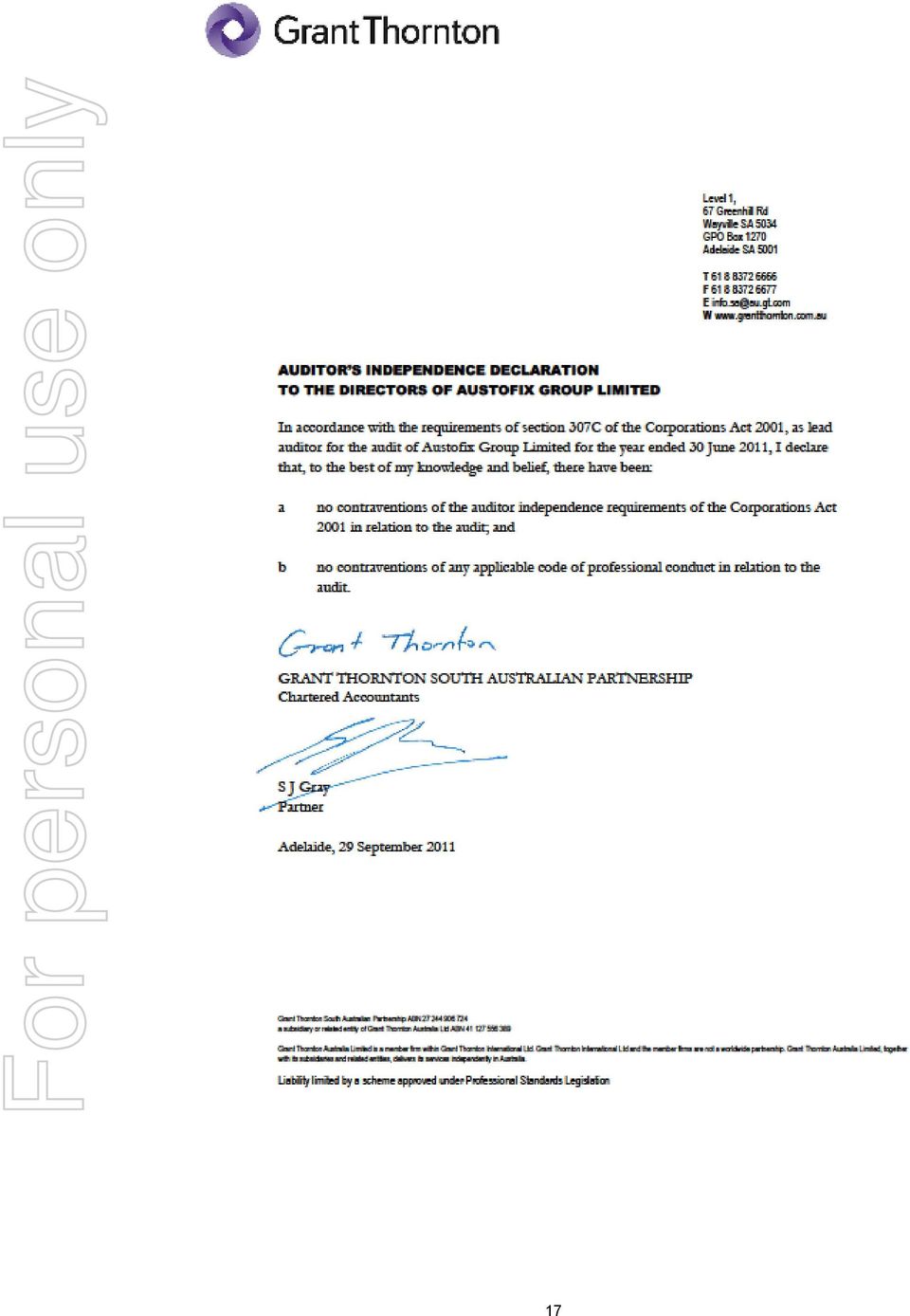
7 Directors' report Indemnifying Officers or Auditor During the financial year, paid a premium of $7,747 to insure the Directors, officers and secretaries of the Company and its controlled entities, and the senior executives of the Group. The liabilities insured are fidelity, crisis loss, OH&S defence / investigations costs, pecuniary penalties, pollution defence / investigation costs and publicity. Throughout the financial year the Company paid for a key person insurance policy to cover its Chief Executive Officer Mark Szolga against death, total permanent disability and trauma. Premiums were payable monthly at the rate of $435 per month. Proceedings on behalf of the Company No person has applied for leave of Court to bring proceedings on behalf of the Company or intervene in any proceedings to which the Company is a party for the purposes of taking responsibility on behalf of the Company for all or any part of those proceedings. The Company was not a party to any such proceedings during the year. Non-audit services The Company may decide to employ the auditor on assignments additional to their statutory audit duties where the auditor's expertise and experience with the Company and/or the Group are important. The Directors are satisfied that the provision of non-audit services is compatible with the general standard of independence for auditors imposed by the Corporations Act The nature and scope of non-audit services provided means that auditor independence was not compromised. During the year there were non-audit services provided by the current auditor of the parent entity (Grant Thornton South Australian Partnership). The services related to review and lodgement of FBT return and tax services at the fee of $4,150. Auditor's independence declaration The auditor s independence declaration for the year ended 30 June 2011 as required under section 307C of the Corporations Act 2001 has been received and can be found on page 17. 9

8 Directors' report Remuneration report (Audited) This Remuneration Report, which forms part of the Directors Report, sets out information about the remuneration of Austofix s Directors and senior executives in accordance with the requirements of the Corporations Act 2001 and its Regulations. It also provides the remuneration disclosures required by paragraphs Aus 25.4 to Aus of AASB 124 Related Party Disclosures. For the purposes of this report Key Management Personnel (KMP) of the Group are defined as those persons having authority and responsibility for planning, directing and controlling the major activities of the Company and the Group, directly or indirectly, including any Director (whether executive or otherwise) of the parent company, and includes the five executives in the Parent and the Group receiving the highest remuneration. For the purposes of this report, the term 'executive' encompasses the Chief Executive Officer, senior executives and secretaries of the Parent and the Group. Key Management Personnel The key management personnel of and the Group include the Directors as set out in the Directors Report above and the following executive officers who have authority and responsibility for planning, directing and controlling the activities of the entity: Mark Szolga Chief Executive Officer Ewen Laird Research and Development Director David Entwistle Director of Manufacturing Christine Mauriello National Sales Manager Scott Blake Financial Controller (commenced 7 March 2011) Remuneration Policy The Board of Directors of the Company is responsible for determining and reviewing remuneration arrangements for the Directors and executives. The Board of Directors assesses the appropriateness of the nature and amount of remuneration of executives on a periodic basis by reference to relevant employment market conditions with the overall objective of ensuring maximum stakeholder benefit from the retention of a high quality, high performing Director and executive team. The Corporate Governance Statement provides further information on the role of the Board. Remuneration Philosophy The performance of the Company depends upon the quality of its Directors and executives. To prosper, the Company must attract, motivate and retain highly skilled Directors and executives. To this end, the Company embodies the following principles in its remuneration framework: provide competitive rewards to attract high calibre executives; link executive rewards to shareholder value; have a significant portion of executive remuneration 'at risk'; and establish appropriate, demanding performance hurdles for variable executive remuneration. Remuneration Structure In accordance with best practice corporate governance, the structure of non-executive Director and executive remuneration is separate and distinct. Non-Executive Director Remuneration Objective The Board seeks to set aggregate remuneration at a level that provides the Company with the ability to attract and retain Directors of the highest calibre, whilst incurring a cost that is acceptable to shareholders. Structure The Constitution and the ASX Listing Rules specify that the aggregate remuneration of non-executive Directors shall be determined from time to time by a general meeting. The maximum aggregate remuneration is $220,000 per annum. The amount of aggregate remuneration sought to be approved by shareholders and the fee structure is reviewed annually. The Board considers the time commitment required as well as the fees paid to non-executive Directors of comparable companies when undertaking the annual review process. On appointment to the Board, all non-executive Directors enter into a service agreement with the Company in the form of a letter of appointment. The letter summarises the Board policies and terms, including compensation, relevant to the office of Director. Each non-executive Director did not receive a base fee in 2011 for being a Director of the Group, previously set at $30,000. An additional fee of $10,000 is also paid if the Director is the Chair of the Board, this was waived in These fees commenced from 1 March 2008 following the ASX listing. The payment of additional fees for serving as Chair recognises the additional time commitment required by non-executive Directors who serves in this capacity. The Chair is not present at any discussions relating to determination of his own remuneration. At the request of the Board of Directors all directors remuneration has been cancelled from 1 June 2010 to. 10
9 Directors' report Remuneration report (Audited) (continued) Non-executive Directors are encouraged by the Board to hold shares or options in the Company. The Company facilitates this through the Austofix Group Share Option Plan. Under the plan, non-executive Directors may be invited to accept an offer of options to acquire shares in the Company. The non-executive Directors do not receive retirement benefits, other than compulsory superannuation contributions, nor do they participate in any incentive programs. The remuneration of non-executive Directors for the years ended and 30 June 2010 is detailed in Table 1 and 2 respectively of this report. Executive Remuneration Objective The Group aims to reward executives with a level and mix of remuneration commensurate with their position and responsibilities within the Group so as to: reward executives for Group, business unit and individual performance against targets set by reference to appropriate benchmarks; Structure Executives are given the opportunity to receive their fixed (primary) remuneration in a variety of forms including cash and fringe benefits such as motor vehicles. It is intended that the manner of payment chosen will be optimal for the recipient without creating additional cost for the Group. The fixed remuneration component of executives is detailed in tables 1 and 2. Variable Remuneration Short Term Incentive (STI) Objective The objective of the STI program is to link the achievement of the Group's operational targets with the remuneration received by the executives charged with meeting those targets. The total potential STI available is set at a level so as to provide sufficient incentive to the executive to achieve the operational targets and such that the cost to the Group is reasonable in the circumstances. Structure align the interests of executives with those of shareholders; and ensure total remuneration is competitive by market standards. Structure In determining the level and make-up of executive remuneration, the Board of Directors engages external consultants as needed to provide independent advice. The Board of Directors has entered into a detailed contract of employment with the Chief Executive Officer and all senior executives. Details of these contracts are provided below. Remuneration consists of the following key elements: Fixed remuneration (base salary, superannuation and nonmonetary benefits); Variable remuneration, being o o short term incentive (STI); and long term incentive (LTI). The proportion of fixed remuneration and variable remuneration (potential short term and long term incentives) for each executive is set out in tables 1 and 2. Fixed Remuneration Objective Actual STI payments granted to each executive depend on the extent to which specific targets set at the beginning of the financial year are met. The targets consist of a number of Key Performance Indicators (KPIs) covering both financial and nonfinancial, corporate and individual measures of performance. Typically included are measures such as contribution to sales growth, meeting research and development milestones, staff retention, net profit after tax, customer service, risk management, product management, and leadership/team contribution. These measures were chosen as they represent the key drivers for the short term success of the business and provide a framework for delivering long term value. The Group has predetermined benchmarks that must be met in order to trigger payments under the STI scheme. On an annual basis, after consideration of performance against KPIs, the Board of Directors, in line with its responsibilities, determines the amount, if any, of the short term incentive to be paid to each executive. This process usually occurs within 3 months after the reporting date. The aggregate of annual STI payments available for executives across the Group is subject to the approval of the Board of Directors. Payments made are delivered as a cash bonus as soon as possible after the STI is approved by the Board of Directors. The STI payments may be adjusted up or down in line with under or over achievement against the target performance levels. This is at the discretion of the Board. Fixed remuneration is reviewed annually by the Chair. The process consists of a review of Company, business unit and individual performance, relevant comparative remuneration externally and internally and, where appropriate, external advice on policies and practices. As noted above, the Chair has access to external advice independent of management. 11
10 Directors' report Remuneration report (Audited) (continued) STI bonus for 2011 and 2010 financial years For the 2011 financial year, STI cash bonus of $NIL (including the compulsory superannuation element) vested to executives during the 2011 financial year. For the 2010 financial year, STI cash bonuses of $7,000 (including the compulsory superannuation element) vested to executives and were paid during the 2010 financial year. There were no forfeitures. The Board of Directors will consider the STI payments for the 2011 financial year in August The maximum STI cash bonus for the 2011 financial year is yet to be determined. The minimum amount of the STI cash bonus assuming that no executives meet their respective KPIs for the 2011 financial year is nil. There have been no alterations to the STI bonus plans since their grant date. Variable Remuneration Long Term Incentive (LTI) Objective The objective of the LTI plan is to reward executives in a manner that aligns remuneration with the creation of shareholder wealth. As such, LTI grants are only made to executives who are able to influence the generation of shareholder wealth and thus have an impact on the Group's performance. Structure LTI grants to executives are delivered in the form of share options under the Austofix Group Share Option Plan. Share options may be granted to executives at the discretion of the Board. The share options will vest over a period of 5 years. Executives are able to exercise the share options at any time after vesting before the options lapse. Options expire 10 years after the grant date. These options function as a team incentive: If option holders perform their duties well and that is reflected in the Company s share price then the benefits flow to the holders of the options. Where a participant ceases employment prior to the vesting of their share options, the share options are forfeited unless cessation of employment is due to death. In the event of a change of control of the Group, all options granted but not yet exercisable will become exercisable for a period of 90 days after which they shall lapse, unless the Company opts to buy or cancel the Options, in which case a payment will be made to the Option holder that amounts to the difference between the price offered by the acquirer and the exercise price attaching to the particular options. Table 3 provides details of LTI options granted and Table 4 shows the value of options granted, exercised and lapsed during the year. Employment Contracts Chief Executive Officer The CEO, Mr Mark Szolga, is employed under a rolling contract. The current employment contract commenced on 1 March Under the terms of the present contract: Mr Szolga receives fixed remuneration of $204,750 per annum, including compulsory superannuation. This was increased from $195,000 effective from 1 July Mr Szolga may resign from his position and thus terminate this contract by giving 6 months written notice. On resignation any unvested options will be forfeited. The Company may terminate this employment agreement by providing 6 months written notice or providing payment in lieu of the notice period (based on the fixed component of Mr Szolga's remuneration). On termination on notice by the Company, any LTI options that have vested or that will vest during the notice period will be released. LTI options that have not yet vested will be forfeited. The Company may terminate the contract at any time without notice if serious misconduct has occurred. Where termination with cause occurs the CEO is only entitled to that portion of remuneration that is fixed, and only up to the date of termination. On termination with cause any unvested options will immediately be forfeited. Other Executives All executives have rolling contracts. The Company may terminate the executive's employment agreement by providing 2 or 3 months written notice or providing payment in lieu of the notice period (based on the fixed component of the executive's remuneration). On termination on notice by the Company, any LTI options that have vested or that will vest during the notice period will be released. LTI options that have not yet vested will be forfeited. The Company may terminate the contract at any time without notice if serious misconduct has occurred. Where termination with cause occurs the executive is only entitled to that portion of remuneration that is fixed, and only up to the date of termination. On termination with cause any unvested options will immediately be forfeited. The Company prohibits executives from entering into arrangements to protect the value of unvested LTI awards. This includes entering into contracts to hedge their exposure to options or shares granted as part of their remuneration package. 12

11 Remuneration report (Audited) (continued) Key management personnel and other executives of Table 1: Remuneration for the year ended Non-executive Directors Cash salary and fees Longterm benefits Sharebased payments Directors' report Total Cash bonus Nonmonetary benefits Superannuation Retirement benefits $ $ $ $ $ $ $ $ $ M N Balnaves - Chairman A M Ingman A C Andreyev G Bittar J Michaelis G L Driscoll Sub-total non-executive directors ### Other key management personnel M Szolga ^ # 190, , , ,009 - E Laird ^ 145, , ,139 - D Entwistle ^ 95, , ,621 - S Blake 33, , ,666 - C Latham ^ # * (resigned ) 74, , , ,578 - C Mauriello ^ ## 128, , ,000 - Total key management personnel compensation Short-term employee benefits Post-employment benefits 667, , , ,385 - % performance related ^ denotes one of the 5 highest paid executives of the Company, as required to be disclosed under the Corporations Act # Options issued to Messrs Szolga, Latham were issued in 2007 and 2009 when the reference price for the underlying shares was 84 cents, whereas the other options were issued to KMP in September 2006 when the underlying share price was only 10 cents. This has a significant effect on the share-based payments component of remuneration set out above. * The options issued to Mr Latham lapsed after 16 April 2011 when he ceased to be employed by the company. ## Mrs Mauriello became a key management person on 20 April 2010 upon promotion to her present position. ### At the request of the Board of Directors all directors remuneration has been cancelled from 1 June 2010 to. 13
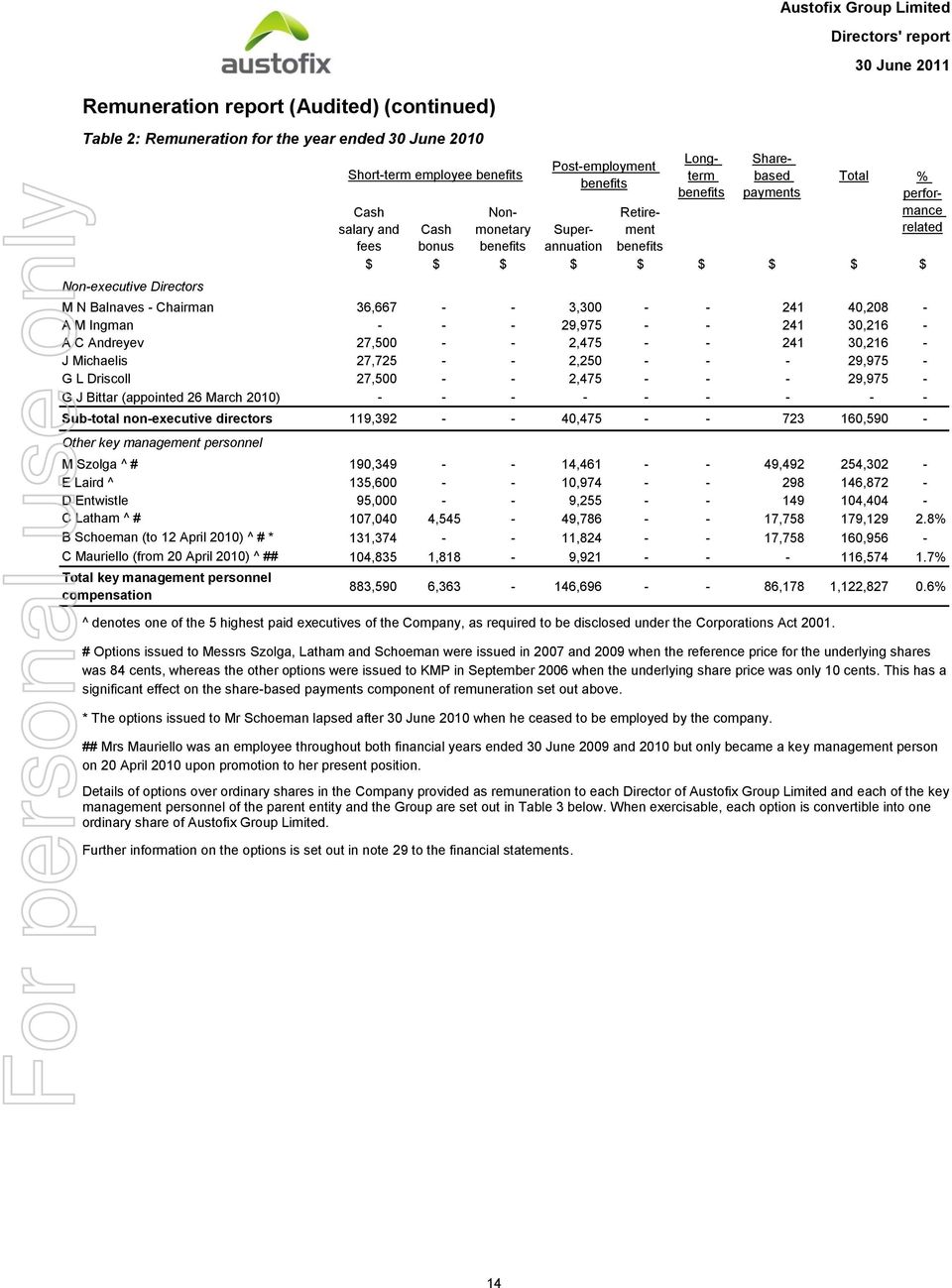
12 Directors' report Remuneration report (Audited) (continued) Table 2: Remuneration for the year ended 30 June 2010 Non-executive Directors Cash salary and fees Longterm benefits Sharebased payments Total Cash bonus Nonmonetary benefits Superannuation Retirement benefits $ $ $ $ $ $ $ $ $ M N Balnaves - Chairman 36, , ,208 - A M Ingman , ,216 - A C Andreyev 27, , ,216 - J Michaelis 27, , ,975 - G L Driscoll 27, , ,975 - G J Bittar (appointed 26 March 2010) Sub-total non-executive directors 119, , ,590 - Other key management personnel M Szolga ^ # 190, , , ,302 - E Laird ^ 135, , ,872 - D Entwistle 95, , ,404 - C Latham ^ # 107,040 4,545-49, , , % B Schoeman (to 12 April 2010) ^ # * 131, , , ,956 - C Mauriello (from 20 April 2010) ^ ## 104,835 1,818-9, , % Total key management personnel compensation Short-term employee benefits Post-employment benefits % performance related 883,590 6, , ,178 1,122, % ^ denotes one of the 5 highest paid executives of the Company, as required to be disclosed under the Corporations Act # Options issued to Messrs Szolga, Latham and Schoeman were issued in 2007 and 2009 when the reference price for the underlying shares was 84 cents, whereas the other options were issued to KMP in September 2006 when the underlying share price was only 10 cents. This has a significant effect on the share-based payments component of remuneration set out above. * The options issued to Mr Schoeman lapsed after 30 June 2010 when he ceased to be employed by the company. ## Mrs Mauriello was an employee throughout both financial years ended 30 June 2009 and 2010 but only became a key management person on 20 April 2010 upon promotion to her present position. Details of options over ordinary shares in the Company provided as remuneration to each Director of and each of the key management personnel of the parent entity and the Group are set out in Table 3 below. When exercisable, each option is convertible into one ordinary share of. Further information on the options is set out in note 29 to the financial statements. 14
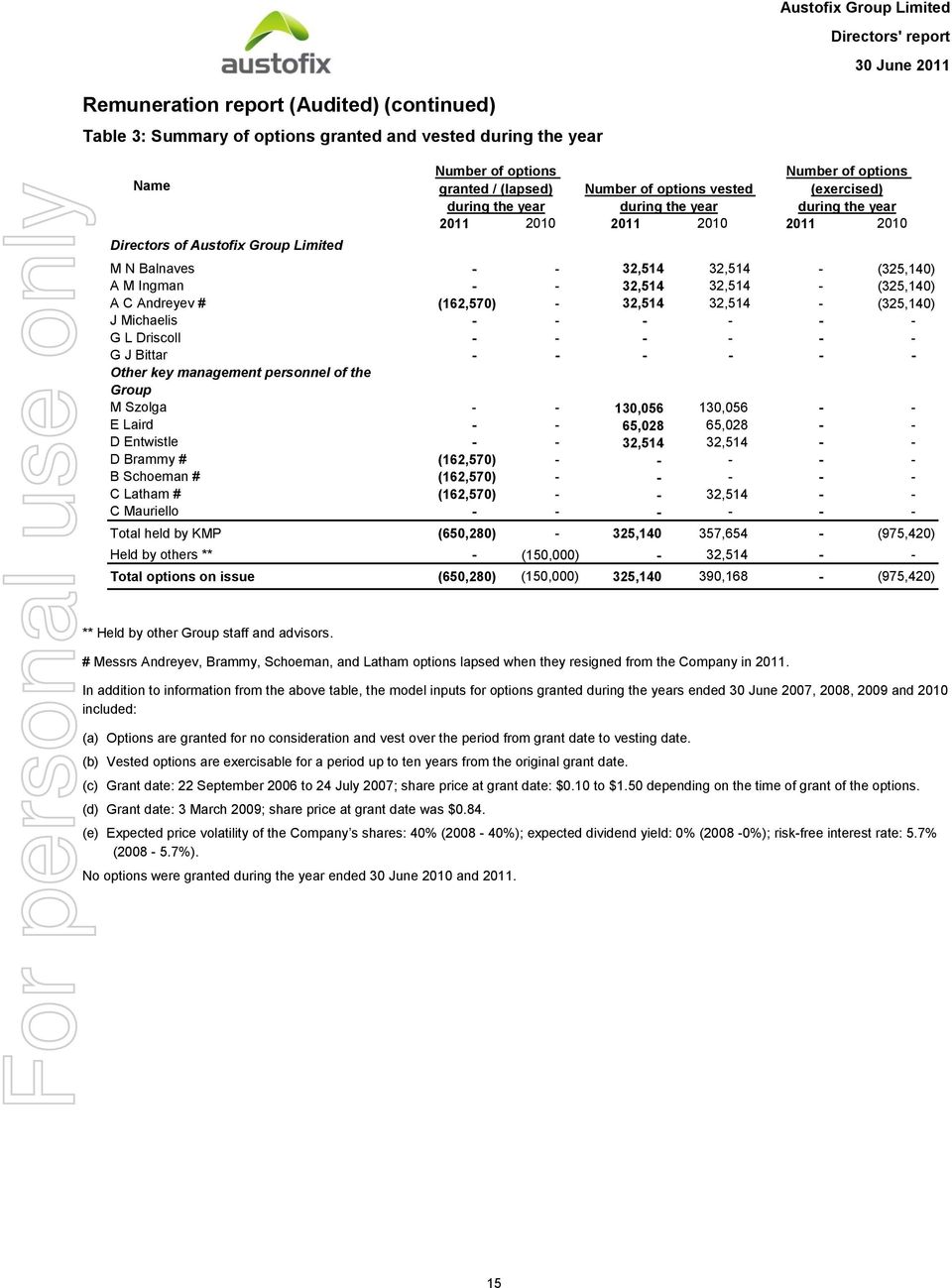
13 Directors' report Remuneration report (Audited) (continued) Table 3: Summary of options granted and vested during the year Name Directors of Number of options Number of options granted / (lapsed) Number of options vested (exercised) during the year during the year during the year M N Balnaves ,514 32,514 - (325,140) A M Ingman ,514 32,514 - (325,140) A C Andreyev # (162,570) - 32,514 32,514 - (325,140) J Michaelis G L Driscoll G J Bittar Other key management personnel of the Group M Szolga , , E Laird ,028 65, D Entwistle ,514 32, D Brammy # (162,570) B Schoeman # (162,570) C Latham # (162,570) , C Mauriello Total held by KMP (650,280) - 325, ,654 - (975,420) Held by others ** - (150,000) - 32, Total options on issue (650,280) (150,000) 325, ,168 - (975,420) ** Held by other Group staff and advisors. # Messrs Andreyev, Brammy, Schoeman, and Latham options lapsed when they resigned from the Company in In addition to information from the above table, the model inputs for options granted during the years ended 30 June 2007, 2008, 2009 and 2010 included: (a) Options are granted for no consideration and vest over the period from grant date to vesting date. (b) Vested options are exercisable for a period up to ten years from the original grant date. (c) Grant date: 22 September 2006 to 24 July 2007; share price at grant date: $0.10 to $1.50 depending on the time of grant of the options. (d) Grant date: 3 March 2009; share price at grant date was $0.84. (e) Expected price volatility of the Company s shares: 40% ( %); expected dividend yield: 0% (2008-0%); risk-free interest rate: 5.7% ( %). No options were granted during the year ended 30 June 2010 and
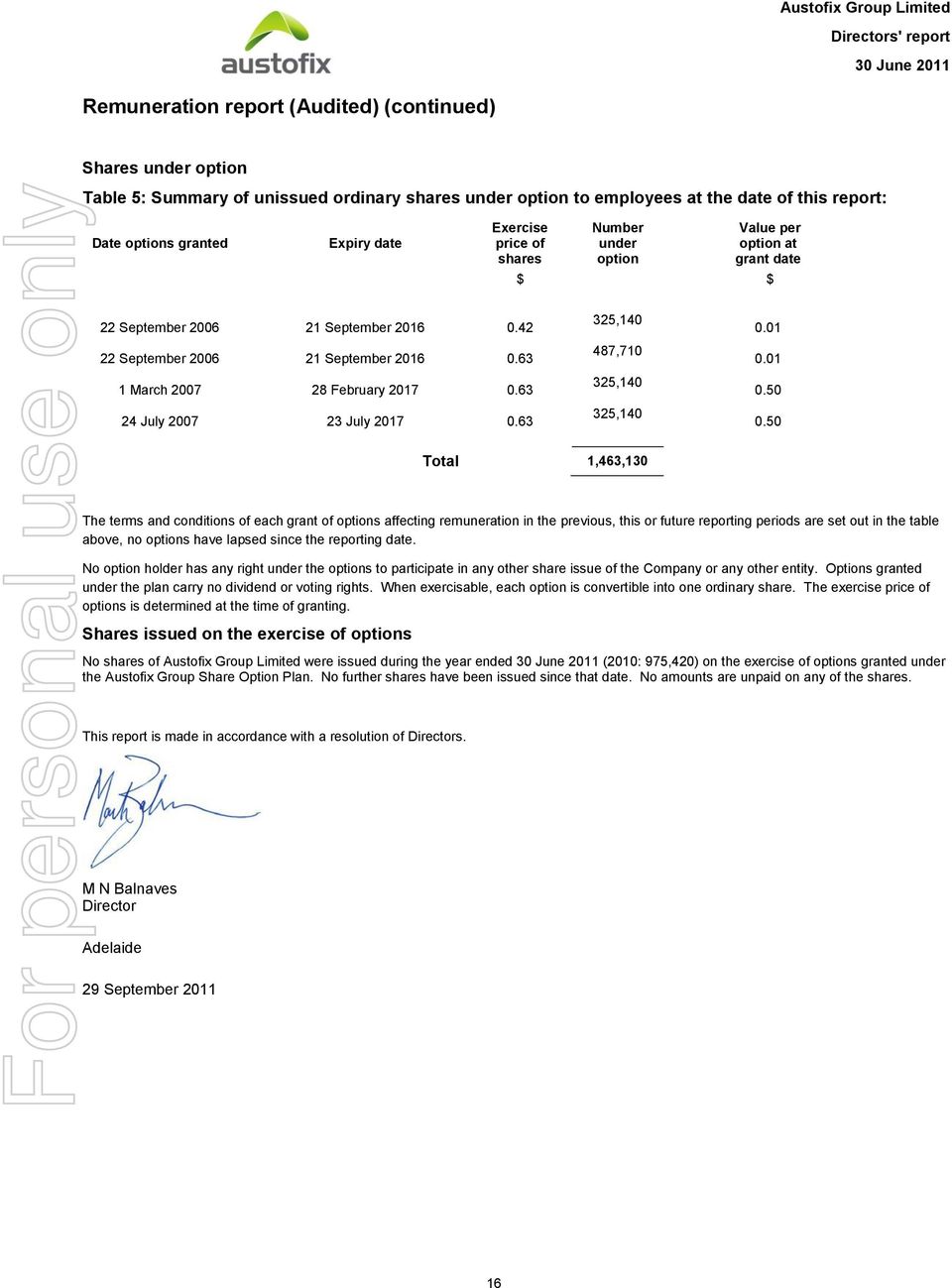
14 Directors' report Remuneration report (Audited) (continued) Shares under option Table 5: Summary of unissued ordinary shares under option to employees at the date of this report: Date options granted Expiry date Exercise price of shares Number under option Value per option at grant date $ $ 22 September September September September March February July July , , , , Total 1,463,130 The terms and conditions of each grant of options affecting remuneration in the previous, this or future reporting periods are set out in the table above, no options have lapsed since the reporting date. No option holder has any right under the options to participate in any other share issue of the Company or any other entity. Options granted under the plan carry no dividend or voting rights. When exercisable, each option is convertible into one ordinary share. The exercise price of options is determined at the time of granting. Shares issued on the exercise of options No shares of were issued during the year ended (2010: 975,420) on the exercise of options granted under the Austofix Group Share Option Plan. No further shares have been issued since that date. No amounts are unpaid on any of the shares. This report is made in accordance with a resolution of Directors. M N Balnaves Director Adelaide 29 September
15 17
16 Corporate Governance Statement Corporate governance statement The Austofix Group supports the principles of effective corporate governance and is determined to engage the highest standards of performance and accountability commensurate with the size of the Company and the resources available to it. Accordingly, the Board has adopted corporate governance practices designed to promote responsible management and conduct of the Company s business. The practices apply equally to the Company s wholly owned subsidiaries. The Directors are aware of their duties and responsibilities and have adopted a Code of Conduct to promote ethical and responsible decision making. A description of the Company's main corporate governance practices is set out below. All these practices, unless otherwise stated, were in place for the whole of the 2011 financial year. A review of the practises was conducted in September 2011 and an updated policy is now published on the Company website. The Board of Directors The Board operates in accordance with the broad principles set out in its charter, which is available from the investors corporate governance information section of the Company website at The charter details the Board s role, composition and responsibilities. Board composition The charter states that the Board supports the principle of having a majority of non-executive and independent Directors. However, it is mindful that in the early stages of the Company s development other competing priorities that may impact on the Board s structure could be of greater importance, in terms of increasing shareholder value, than the independence of Directors. There were a majority of non-executive Directors on the Board during the relevant financial year, including the Chair, who is elected by the Board. The Board s policy is to review its performance and composition on a regular basis to ensure that there is an appropriate balance of experience and skills to match the size, scope and nature of the Company s activities. When a vacancy arises, for whatever reason, or where it is considered the Board would benefit from the appointment of a Director with particular skills and experience, the Board s policy is to select potential candidates, with advice from an external consultant if necessary. The most suitable candidate is then appointed subject to election at the next general meeting of shareholders. Directors are appointed by rotation for three years after which they retire and may seek re-election by shareholders. It is the Board s intention to meet on a monthly basis. In addition, special or strategy meetings will be held at such other times as may be necessary to address specific significant matters that may arise. This occurred in relation to the relevant financial year. Board members Details of the members of the Board, their experience, expertise, qualifications, term of office and independent status are set out in the Directors Report under the heading ''Information on Directors''. There were five Directors (all non-executive Directors) at the beginning of the relevant financial year. There were three Directors at the date of signing the Directors Report. Chair and Chief Executive Officer (CEO) The Chair is responsible for leading the Board, ensuring Directors are properly briefed in all matters relevant to their role and responsibilities, facilitating Board discussions and managing the Board s relationship with the Company s senior executives. The CEO is responsible for implementing Group strategies and policies as determined by the Board. The Board charter specifies that these are separate roles to be undertaken by separate people. Performance assessment The remuneration of executive and non-executive Directors is reviewed by the Board with the exclusion of the Director concerned. The remuneration of management and employees is reviewed by the Board and approved by the Chair. Remuneration levels are determined by the Board on an individual basis at reasonable but competitive market rates, with the size of the Company dictating that individual assessment is more appropriate than formal remuneration policies. External advice on remuneration matters will be sought whenever it is deemed necessary. Details concerning the remuneration policy as it applies to Directors and other key management personnel of the Group are set out in the Remuneration Report in the Directors Report which precedes this Corporate Governance Statement. Nomination committee Austofix does not have a separate nomination committee. Being a smaller company, Austofix has included in its Board Charter the policy to review its performance and composition on a regular basis as well as seeking advice from an external consultant if necessary. Remuneration committee Austofix does not have a remuneration committee as its small size enables the Board to take on the responsibility for the roles that would otherwise rest with the remuneration committee. All matters which might properly be dealt with by special committees are subject to regular scrutiny at full Board meetings. The Board may, from time to time, constitute a committee to advise the Board. Audit committee Austofix has not been and is not listed on the S&P All Ordinaries Index and as such is not required to have an Audit Committee. The Board does understand the importance of integrity over the financial statements and independence of the external auditor. To this extent, the Board Charter dictates that the Board instigates internal procedures designed to provide reasonable assurance as to the reliability of financial reporting. 18

17 Corporate Governance Statement Corporate governance statement (continued) Finance Committee Austofix formed a Finance Committee after 30 June 2010 to focus on detailed financial analysis of the Austofix Group. It continues to meet regularly up to and including the date of the signing of the Directors Report. Capital Raising Committee As the Board of Austofix reduced in number over the relevant financial year, and due to the small size of the Company, a capital raising committee was not formed. The Company will consider whether or not to form a Capital Raising Committee in the future. Disclosures To ensure Austofix complies with the relevant ASX listing rule disclosure requirements, a continuous disclosure policy has been included in the corporate governance statement. This policy outlines the requirement to have a designated ASX communications officer. Duties of this officer include: communicating with ASX in relation to Listing Rule matters; ensuring that the Company complies with the continuous disclosure obligations; To improve the effectiveness of communication, the policy will be updated as and when appropriate to ensure that technological advances and additional features on the Company s website are utilised in the Company s communication with its shareholders and recognised in this policy. Risk assessment and management The Board acknowledges that a sound framework of risk oversight, risk management and internal control is fundamental to good corporate governance. It supports reliable financial reporting, compliance with relevant laws and regulations, and effective and efficient operations. The Company s process of risk management, including implementation of appropriate internal controls and compliance, is to: establish the Company s goals and objectives; design, implement and monitor strategies and policies to achieve the Company s goals and objectives; continually identify potential material business risks and measure their possible impact upon the achievement of the Company s goals and objectives; and formulate risk management strategies to manage identified risks and monitor/assess the performance of the risk management system. overseeing and co-ordinating disclosure of information to ASX, analysts, brokers, shareholders, the media and the public; and educating Directors, officers and employees on the Company s disclosure obligations, policies and procedures and raising awareness of the principles underlying continuous disclosure. To ensure accountability at a senior level, the policy prescribes the ASX Communications Officers to be the CEO and the Company Secretary. The Secretary will be the primary ASX Communications Officer for the purpose of administering notifications to the ASX. The ASX Communications Officer should be made aware of all proposed disclosures to the ASX in advance. Shareholder Communications Policy The role of Communications Officer extends to the Shareholder Communications Policy, included in the Corporate Governance Statement. This policy ensures the Company website will be updated with material released to the market as soon as practicable after confirmation of receipt by the ASX. The Company acknowledges that communicating with shareholders by electronic means, particularly through its website, is an efficient way of distributing information in a timely and convenient manner. To this end the Company has endeavored to provide links on its website to information relevant to shareholders. Furthermore, the Company may write a letter directly or publish a periodical newsletter to shareholders during a financial year to keep shareholders informed on a more frequent basis. The Board and the CEO are responsible for establishing the Company s goals and objectives and overseeing the establishment, implementation and review of the Company s material business risk management system. The CEO and the Company s senior executives are responsible for establishing and implementing the risk management system to identify, control and manage strategic, technical, operational and other material business risks. The CEO, Secretary and other senior executives meet regularly to discuss the achievement of the Company s goals and objectives. Any material risks would be tabled at these meetings and procedures are implemented to monitor and deal with these identified material risks. The CEO has undertaken to inform the Board of any new material risks and outline the actions that have been undertaken to manage such material risks. Code of Conduct The Board recognises that their primary responsibility is to the owners of the Company, its shareholders, while simultaneously having regard for the interests of all stakeholders of the Company and the broader community. Austofix has included a Code of Conduct in its Corporate Governance statement, a summary of which is included below. All Directors, staff, regular consultants and contractors, when acting on behalf of the Austofix Group, are expected to act with the utmost integrity and objectivity in their dealings with other parties, striving at all times to enhance the reputation and performance of the Company. 19
18 Corporate Governance Statement Corporate governance statement (continued) The Board accordingly encourages the following principles to be adhered to by all employees at all times. Employee in this context includes Directors, staff, and regular consultants and contractors when acting on behalf of the Company: act with and promote the highest standards of ethics and integrity in carrying out duties on behalf of the Company; respect and observe the laws and other regulations of Australia, complying at all times with the spirit as well as the letter of the law, particularly those within the communities in which the Company operates; commit to adherence to health and safety standards, both of products, through compliance with manufacturing and other best practice standards, and in the provision of safe employee work environments; where concerns arise, the Chairman, CEO or any Director should be advised before any decision is taken; respect the rights of employees of the Company; respect the rights of all shareholders, acknowledging that they are the owners of the Company; respect the rights of the Company s stakeholders, including its customers, suppliers end consumers and the broader community in which they operate; By promoting Director and employee ownership of shares, the Board hopes to encourage Directors and employees to become long-term holders of Company shares, aligning their interests with those of the Company. The Company adopted a new share trading policy in January 2011, which has been complied with up until the date of signing the Directors Declaration. A copy of that policy is on the Company s website. Independent of the above, Directors and other officers (including staff and regular consultants and contractors) should not deal in (buy or sell) the Company s shares when they are in possession of price-sensitive information that is not generally available to shareholders and the public and which information could induce shareholders or the public to deal in the Company s shares. No Director will deal in any of the Company s shares without first complying with the procedures set out in the share trading policy. The Company will release its half-yearly and annual reports to the ASX and the Australian Securities and Investments Commission (ASIC) in February and September of each year. Other announcements are made at times when the Board deems it appropriate in accordance with the Listing Rules and the Corporations Act. Any staff, officers, consultants or contractors who have any queries or concerns relating to the share trading policy will, in the first instance, comply with the provisions of that policy. never make improper use of knowledge, information, documents or other Company resources obtained in the course of employment with the Company. Information about the Company that is not publicly available (inside information) should not be used by employees for their private gain, or that of others; and when any real or perceived conflict of interest arises, when acting on behalf of the Company, advice should be sought from the Chairman, CEO or any Director. Share Trading Policy Directors, executives and other officers and employees cannot make use of information acquired through their position within the Company in order to make a profit for themselves. This general duty is supplemented by sections 182 and 183 of the Corporations Act 2001 which prohibits Directors, executives and other officers and employees from making improper use of their position to gain an advantage for themselves or for anyone else by dealing in the Company s shares where that information is not generally available to the public. This prohibition applies to all companies, whether listed on the Australian Securities Exchange ( ASX ) or not. Section 1043A of the Corporation Act provides a broader prohibition of insider trading. The essence of that provision is that a person who is in the possession of information that is not available to other shareholders or the public which, if other shareholders or the public were aware of such information it may induce them to deal in the Company s shares, then that person in possession of the information should not deal in the Company s shares. 20
19 Corporate Governance Statement Corporate governance statement (continued) Diversity Policy The Company did not have a formally documented diversity policy until September The reason for not having a formal policy was because the Company was not considering appointing significant new employees over the relevant financial year..for personal use only The diversity policy explains Austofix's: commitment to promoting a positive workplace culture and employment based on merit free from discrimination and harassment; the measures in place with regard to appointments, promotions and other opportunities; and the internal review process (which is to be conducted annually) of diversity within the Company. When the Board or CEO is considering an appointment, employment, promotion, termination or other career event in relation to an employee, Austofix (or its representatives) will consider: the merit for internal promotion, leadership development and flexible work arrangements with regard to the employee; qualifications and experience of the employee relevant to the career event; whether there is an opportunity to enhance the diversity of Austofix, with a particular focus on addressing the imbalance of gender at the senior executive and Board level; and any other value that Austofix thinks fit provided that such consideration is in the best interests of the shareholders of Austofix and is not discriminatory. There was one female senior executive but no female board members in Austofix at the date of signing the Directors Declaration. The current percentage of female workers in the Company as a proportion of the whole workforce was 37% at the date of signing the Directors Declaration. The diversity policy is available on the Company s website. 21

20 Consolidated statement of comprehensive income For the Financial Year Ended Note $ $ Revenue 5 1,603,305 2,648,021 Cost of sales (1,025,099) (1,016,114) Gross profit 578,206 1,631,907 Other income 6 234, ,612 Expenses: Marketing, selling and distribution expenses (923,629) (1,300,443) Research and development expenses (80,366) (258,869) Occupancy expenses (90,439) (92,108) Share-based payments expenses (36,464) (86,250) Corporate expenses (211,320) (340,079) Administration expenses (344,711) (486,239) Other expenses - (68,534) Finance expenses (198,591) (70,651) (Loss) / profit before income tax 7 (1,073,106) (943,654) Income tax benefit 8 492, ,342 (Loss) / profit for the year (580,461) (341,312) Other comprehensive income Other comprehensive income for the year, net of tax - - Total comprehensive income for the year (580,461) (341,312) (Loss) / profit attributable to: Members of the parent entity (580,461) (341,312) Non-controlling interests - - (580,461) (341,312) Total comprehensive income attributable to: Members of the parent entity (580,461) (341,312) Non-controlling interests - - (580,461) (341,312) Earnings per share Cents Cents from continuing and discontinued operations: Basic earnings per share 35 (4.5) (3.0) Diluted earnings per share 35 (4.5) (3.0) The above statement of comprehensive income should be read in conjunction with the accompanying notes. 22

21 Consolidated statement of financial position as at Note ASSETS $ $ Current assets Cash and cash equivalents 9 107, ,728 Trade and other receivables , ,742 Other assets 11 89, ,677 Inventories 12 2,368,980 1,265,086 Income tax receivable , ,520 Total current assets 3,248,003 2,658,753 Non-current assets Other financial assets 14-12,409 Trade and other receivables 10-9,000 Medical instruments held in store , ,978 Property, plant and equipment 16 1,754,521 1,945,038 Intangible assets 18 2,955,523 1,956,652 Total non-current assets 4,875,125 4,357,077 TOTAL ASSETS 8,123,128 7,015,830 LIABILITIES Current liabilities Trade and other payables , ,268 Borrowings , ,443 Provisions , ,132 Deferred income , ,065 Total current liabilities 1,481,179 1,033,908 Non-current liabilities Borrowings 20 2,173,300 1,511,149 Provisions 24 38,310 33,654 Deferred income , ,993 Total non-current liabilities 2,722,309 2,173,796 TOTAL LIABILITIES 4,203,488 3,207,704 NET ASSETS 3,919,640 3,808,126 EQUITY Issued capital 25 6,472,572 5,817,061 Reserves , ,137 Retained earnings 27 (3,314,533) (2,734,072) TOTAL EQUITY 3,919,640 3,808,126 The above statement of financial position should be read in conjunction with the accompanying notes. 23
22 Consolidated statement of changes in equity For the Financial Year Ended Issued capital Asset revaluation reserve Employee equity benefits reserve Retained earnings $ $ $ $ Balance at 1 July ,621, , ,388 (2,392,760) Total comprehensive income for the year (341,312) New shares issued during the year 195, Employee share options - value of employee services ,250 - Balance at 30 June ,817, , ,638 (2,734,072) Balance at 1 July ,817, , ,638 (2,734,072) Total comprehensive income for the year (580,461) New shares issued during the year 655, Employee share options - value of employee services ,464 - Balance at 6,472, , ,102 (3,314,533) The above statement of changes in equity should be read in conjunction with the accompanying notes. 24
23 Consolidated statement of cash flows For the Financial Year Ended Note $ $ Cash flows from operating activities Receipts from customers 1,751,899 2,822,141 Payments to suppliers and employees (2,980,763) (3,494,773) Government revenue grants received 23,638 23,647 Income tax received 619, ,689 Interest and other costs of finance paid (146,073) (70,651) Net cash outflow from operating activities 34 (a) (732,158) (441,947) Cash flows used in / (provided by) investing activities Purchase of property, plant and equipment (106,149) (903,359) Purchase of medical instruments - (61,626) Government grants received for acquisition of plant and equipment 83, ,607 Development expenditure capitalised (1,073,143) (1,157,892) Interest received 1,161 5,619 Net cash outflow from investing activities (1,094,309) (1,619,651) Cash flows from financing activities Proceeds from issues of share capital 205, ,084 Proceeds from related party borrowings 1,395, ,000 Proceeds from other borrowings 1,725,989 2,498,602 Repayment of other borrowings (1,644,237) (1,434,030) Net cash inflow from financing activities 1,682,263 1,709,656 Net decrease in cash and cash equivalents (144,204) (351,942) Cash and cash equivalents at the beginning of the financial year 251, ,670 Cash and cash equivalents at end of the financial year 9 107, ,728 The above statement of cash flows should be read in conjunction with the accompanying notes. 25
24 Notes to the Financial Statements 1 Corporate information (the Company) is a company limited by shares, incorporated and domiciled in Australia. Its registered office and principal place of business is: 18 Kinkaid Avenue North Plympton SA 5037 The shares are publically listed and traded on the Australian Securities Exchange (ASX: AYX). This financial report includes as a consolidated entity consisting of and its controlled entities. The financial report is presented in the Australian currency. A description of the nature of the consolidated entity's operations and its principal activities is included in the review of operations and activities in the Directors Report, which is not part of this financial report. The financial report for the year ended was authorised for issue in accordance with a resolution of the Directors on 29 September The Company has the power to amend and reissue the financial report if required. Through the use of the internet, the Company has ensured that its corporate reporting is timely, complete, and available globally at minimum cost to the Company. All press releases, financial reports and other information are available at our Shareholders Centre on our website: 26
25 2 Summary of significant accounting policies The principal accounting policies adopted in the preparation of the financial report are set out below. These policies have been consistently applied, unless otherwise stated. When the group restructured in 2006, Austofix Surgical Pty Ltd was deemed to be the acquiring entity under AASB 3: Business Combinations and therefore is treated as having acquired for the purposes of determining the split of share capital and pre-acquisition retained earnings of the Group. The effect of this determination in the Group financial statements is a $9,000 increase in share capital and $9,000 decrease in retained earnings. (a) Basis of preparation This general purpose financial report has been prepared in accordance with Australian Accounting Standards, Australian Accounting Interpretations, other authoritative pronouncements of the Australian Accounting Standards Board, and the Corporations Act Compliance with IFRS Australian Accounting Standards set out accounting policies that the Australian Accounting Standards Board has concluded would result in a financial report containing relevant and reliable information about transactions, events and conditions. Compliance with Australian Standards ensures that the financial statements and notes also comply with International Financial Reporting Standards (IFRS). Historical cost convention These financial statements have been prepared on an accruals basis and are based on the historical cost convention, except for manufacturing plant and equipment which is carried at fair value following a revaluation as at 30 June Critical accounting estimates The preparation of financial statements requires the use of certain critical accounting estimates. It also requires management to exercise its judgement in the process of applying the Group s accounting policies. The areas involving a higher degree of judgement or complexity, or areas where assumptions and estimates are significant to the financial statements are disclosed in note 4. 27
26 2 Summary of significant accounting policies (continued) (b) New accounting standards and interpretations Adoption of new and revised Accounting Standards During the current year the Group adopted all of the new and revised Australian Accounting Standards and Interpretations issued by the Australian Accounting Standards Board (the AASB) that are relevant to its operations and effective for the current annual reporting period. New and Revised Accounting Standards The Group has adopted the following revisions and amendments to AASB s issued by the Australian Accounting Standards Board and IFRS issued by the International Accounting Standards Board, which are relevant to and effective for the Group's financial statements for the annual period beginning 1 July 2010: Further Amendments to Australian Accounting Standards arising from the Annual Improvements Project- AASB Improvements to IFRSs- AASB The adoption of new and revised Accounting Standards effective for the financial statements for the annual period beginning 1 July 2010 did not have a material impact on the Group's financial statements. Accounting standards not yet effective AASB 9 Financial Instruments and AASB Amendments to Australian Accounting Standards arising from AASB 9 (Effective from 1 January 2013) AASB 9 introduces new requirements for the classification and measurement of financial assets and liabilities. AASB 9 uses a single approach to determine whether a financial asset is measured at amortised cost or fair value, replacing the many different rules in AASB 139 and removes the impairment requirement for financial assets held at fair value. In addition, the majority of requirements from AASB 139 for the classification and measurement of financial liabilities has been carried forward unchanged, except in relation to own credit risk where an entity takes the option to measure financial liabilities at fair value. AASB 9 requires the amount of the change in fair value due to changes in the entity s own credit risk to be presented in other comprehensive income (OCI), unless there is a accounting mismatch in the profit or loss, in which case all gains or losses are to be presented in the profit or loss. The amendment is not expected to have any impact on the group s financial statements. AASB 124 Related Party Disclosures and AASB Amendments to Australian Accounting Standards arising from AASB 124 (Effective from 1 January 2011) The amendment clarifies and simplifies the definition of a related party and removes the requirement for government-related entities to disclose details of all transactions with the government and other government-related entities. The group will apply the amended standard from 1 July When the amendments are applied, the group will need to disclose any transactions between its subsidiaries and it associated. However, there will be no impact on any of the amounts recognised in the financial statements. 28
27 2 Summary of significant accounting policies (continued) (c) Principles of consolidation The consolidated financial statements incorporate the assets and liabilities of all subsidiaries of as at and the results of all subsidiaries for the year then ended. and its subsidiaries together are referred to in this financial report as the Group or the consolidated entity. Subsidiaries are all those entities (including special purpose entities) over which the Group has the power to govern the financial and operating policies, generally accompanying a shareholding of more than one-half of the voting rights. The existence and effect of potential voting rights that are currently exercisable or convertible are considered when assessing whether the Group controls another entity. Subsidiaries are fully consolidated from the date on which control is transferred to the Group. They are de-consolidated from the date that control ceases. The acquisition method of accounting is used to account for the acquisition of subsidiaries by the Group (refer to note 2(d)). Intercompany transactions, balances and unrealised gains on transactions between Group companies are eliminated. Unrealised losses are also eliminated unless the transaction provides evidence of the impairment of the asset transferred. Accounting policies of subsidiaries are consistent with the policies adopted by the Group. (d) Business combinations Where settlement of any part of cash consideration is deferred, the amounts payable in the future are discounted to their present value as at the date of exchange. The discount rate used is the entity s incremental borrowing rate, being the rate at which a similar borrowing could be obtained from an independent financier under comparable terms and conditions. (e) Financial instruments Initial recognition and measurement Financial assets and financial liabilities are recognised when the entity becomes a party to the contractual provisions to the instrument. For financial assets, this is equivalent to the date that the company commits itself to either the purchase or sale of the asset (i.e. trade date accounting is adopted). Financial instruments are initially measured at fair value plus transaction costs, except where the instrument is classified at fair value through profit or loss, in which case transaction costs are expensed to profit or loss immediately. Classification and subsequent measurement Finance instruments are subsequently measured at either fair value, amortised cost using the effective interest rate method, or cost. Fair value represents the amount for which an asset could be exchanged or a liability settled between knowledgeable, willing parties. Where available, quoted prices in an active market are used to determine fair value. In other circumstances, valuation techniques are adopted. The acquisition method of accounting is used to account for all business combinations, including business combinations involving entities or businesses under common control, regardless of whether equity instruments or other assets are acquired. Cost is measured as the fair value of the assets given, equity instruments issued or liabilities incurred or assumed at the date of exchange plus costs directly attributable to the acquisition. Where equity instruments are issued in an acquisition, the fair value of the instruments is their published market price as at the date of exchange unless, in rare circumstances, it can be demonstrated that the published price at the date of exchange is an unreliable indicator of fair value and that other evidence and valuation methods provide a more reliable measure of fair value. Transaction costs arising on the issue of equity instruments are recognised directly in equity. Identifiable assets acquired and liabilities and contingent liabilities assumed in a business combination are measured initially at their fair values at the acquisition date, irrespective of the extent of any minority interest. The excess of the cost of acquisition over the fair value of the Group s share of the identifiable net assets acquired is recorded as goodwill. If the cost of acquisition is less than the Group's share of the fair value of the identifiable net assets of the subsidiary acquired, the difference is recognised directly in the income statement, but only after a reassessment of the identification and measurement of the net assets acquired. Amortised cost is calculated as a. the amount at which the financial asset or financial liability is measured at initial recognition; b. less principal repayments, c. plus or minus the cumulative amortisation of the difference, if any, between the amount initially recognised and the maturity amount calculated using the effective interest method; and d. less any reduction for impairment. The effective interest method is used to allocate interest income or interest expense over the relevant period and is equivalent to the rate that exactly discounts estimated future cash payments or receipts (including fees, transaction costs and other premiums or discounts) through the expected life (or when this cannot be reliably predicted, the contractual term) of the financial instrument to the net carrying amount of the financial asset or financial liability. Revisions to expected future net cash flows will necessitate an adjustment to the carrying value with a consequential recognition of an income or expense in profit or loss. The Group does not designate any interests in subsidiaries. associates or joint venture entities as being subject to the requirements of accounting standards specifically applicable to financial instruments. 29
28 2 Summary of significant accounting policies (continued) (e) Financial instruments (continued) (i) Financial assets at fair value through profit or loss Financial assets are classified at fair value through profit or loss when they are either held for trading for the purpose of shortterm profit taking, derivatives not held for hedging purposes, or when they are designated as such to avoid an accounting mismatch or to enable performance evaluation where a Group of financial assets is managed by key management personnel on a fair value basis in accordance with a documented risk management or investment strategy. Such assets are subsequently measured at fair value with changes in carrying value being included in profit or loss. (ii) Loans and receivables Loans and receivables are non-derivative financial assets with fixed or determinable payments that are not quoted in an active market and are subsequently measured at amortised cost. Loans and receivables are included in current assets. except for those which are not expected to mature within 12 months after the end of the reporting period (All other loans and receivables are classified as non-current assets). Impairment At each reporting date, the Group assesses whether there is objective evidence that a financial instrument has been impaired. Impairment losses are recognised in the statement of comprehensive income. (f) Foreign currency transactions and balances (i) Functional and presentation currency Items included in the financial statements of each of the Group s entities are measured using the currency of the primary economic environment in which the entity operates ( the functional currency ). Both the functional and presentation currency of the Group is Australian dollars (A$). (ii) Transactions and balances Transactions in foreign currencies are initially recorded in the functional currency at the exchange rates ruling at the date of the transaction. Monetary assets and liabilities denominated in foreign currencies are retranslated at the rate of exchange ruling at the reporting date, with any gain or loss on translation recognised in the statement of comprehensive income for the year. Non-monetary items that are measured in terms of historical cost in a foreign currency are translated using the exchange rate as at the date of the initial transaction. Non-monetary items measured at fair value in a foreign currency are translated using the exchange rates at the date when the fair value was determined. (g) Cash and cash equivalents Cash and cash equivalents in the statement of financial position and statement of cash flows comprise cash at bank and in hand and short-term deposits with an original maturity of three months or less. (h) Trade receivables A sale is recorded when goods have been despatched to a customer pursuant to a sales order and the associated risks have passed to the carrier or customer. All trade receivables are recognised at the amounts receivable as they are due for settlement between 15 and 60 days. Collectability is continually reviewed and uncollectible debts are written off. A provision for doubtful debts is raised where there is objective evidence that the Group will not be able to collect the debt. The carrying amount of the asset is reduced through the use of an allowance account and the amount of the loss is recognised in the income statement within other expenses. When a trade receivable is uncollectible, it is written off against the allowance account for trade receivables. Subsequent recoveries of amounts previously written off are credited against other expense in the income statement. (i) Inventories Inventories including raw materials, work in progress and finished goods are valued at the lower of cost and net realisable value. Costs incurred in bringing each product to its present location and condition are accounted for as follows: Raw Materials - purchase cost on a first in, first-out basis. The cost of purchase comprises the purchase price of raw materials, import duties and other taxes (other than those subsequently recoverable by the entity from the taxing authorities), transport, handling and other costs directly attributable to the acquisition of raw materials. Volume discounts and rebates are included in determining the cost of acquisition. Finished goods and work-in-progress - Costs are assigned to individual items of finished goods on a standard-cost basis. Cost comprises direct materials and labour and an appropriate portion of variable and fixed overhead expense allocated based on normal operating capacity. Costs are assigned on the basis of weighted average costs. Net realisable value is the estimated selling price in the ordinary course of business less the estimated costs of completion and the estimated costs necessary to make the sale. 30
29 2 Summary of significant accounting policies (continued) (j) Non-current inventories Medical instruments not yet in use Medical instruments used in operating procedures are initially treated as inventories of medical instruments not yet in use while they are held in the Group s stores. As instruments are supplied to hospitals they are transferred to depreciable assets to properly reflect their being brought into use. (k) Property, plant and equipment Property, plant and equipment is stated at historical cost less accumulated depreciation and any impairment in value except for manufacturing plant and equipment which is carried at fair value following a revaluation as at 30 June Such cost includes the cost of replacing parts that are eligible for capitalisation when the cost of replacing the parts is incurred. Depreciation Depreciation is calculated on either a straight-line basis or a diminishing value basis as appropriate over the estimated useful lives of the assets as follows: Plant and equipment over 3 to 10 years Medical instrument sets in use over 5 years Office equipment over 3 to 10 years Furniture and fittings over 5 to 10 years Instrument sets are not depreciated until they are put into use. Impairment The carrying values of plant and equipment are reviewed for impairment when events or changes in circumstances indicate the carrying value may not be recoverable. For an asset that does not generate largely independent cash inflows, the recoverable amount is determined for the cashgenerating unit to which the asset belongs. If any such indication exists and where the carrying values exceed the estimated recoverable amount, the assets or cashgenerating units are written down to their recoverable amount. The recoverable amount of property, plant and equipment is the greater of fair value less costs to sell and value in use. In assessing value in use, the estimated future cash flows are discounted to their present value using a pre-tax discount rate that reflects current market assessments of the time value of money and the risks specific to the asset. Derecognition (l) Leases Leases are classified at their inception as either operating or finance leases based on the economic substance of the agreement so as to reflect the risks and benefits incidental to ownership. Operating Leases The minimum lease payments of operating leases, where the lessor effectively retains substantially all of the risks and benefits of ownership of the leased item, are recognised as an expense on a straight-line basis over the lease term. Finance Leases Leases which effectively transfer substantially all of the risks and benefits incidental to ownership of the leased item to the Group are capitalised at the fair value of the leased property, or if lower, the present value of the minimum lease payments and disclosed as property, plant and equipment under lease. A lease liability of equal value is also recognised. Capitalised lease assets are depreciated over the shorter of the estimated useful life of the assets and the lease term. Minimum lease payments are allocated between interest expense and reduction of the lease liability with the interest expense calculated using the interest rate implicit in the lease and charged directly to the statement of comprehensive income. (m) Impairment of assets At each reporting date, the Group assesses whether there is any indication that an asset may be impaired. Where an indicator of impairment exists, the Group makes a formal estimate of recoverable amount. Where the carrying amount of an asset exceeds its recoverable amount, the asset is considered impaired and is written down to its recoverable amount. Recoverable amount is the greater of fair value less costs to sell and value in use. It is determined for an individual asset, unless the asset's value in use cannot be estimated to be close to its fair value less costs to sell and it does not generate cash inflows that are largely independent of those from other assets or groups of assets, in which case, the recoverable amount is determined for the cash-generating unit to which the asset belongs. In assessing value in use, the estimated future cash flows are discounted to their present value using a pre-tax discount rate that reflects current market assessments of the time value of money and the risks specific to the asset. An item of property, plant and equipment is derecognised upon disposal or when no future economic benefits are expected to arise from the continued use of the asset. Any gain or loss arising on derecognition of the asset (calculated as the difference between the net disposal proceeds and the carrying amount of the item) is included in the statement of comprehensive income in the year the item is derecognised. 31
30 2 Summary of significant accounting policies (continued) (n) Intangible assets Research and development Research expenditure is recognised as an expense as incurred. Costs incurred on development projects (relating to the design and testing of new or improved products) are recognised as intangible assets when it is probable that the project will, after considering its commercial and technical feasibility, be completed and generate future economic benefits and its costs can be measured reliably. The expenditure capitalised comprises all directly attributable costs, including costs of materials, services, direct labour and an appropriate proportion of overheads. Other development expenditures that do not meet these criteria are recognised as an expense as incurred. Development costs previously recognised as an expense are not recognised as an asset in a subsequent period. Capitalised development costs are recorded as intangible assets and amortised from the point at which the asset is ready for use on a straight-line basis over its useful life, which varies from 5 to 10 years. The useful lives of intangible assets are assessed to be either finite or indefinite. Intangible assets with finite lives are amortised over the useful life and tested for impairment whenever there is an indication that the intangible asset may be impaired (see note 2(m) for methodology). The amortisation period and the amortisation method for an intangible asset with a finite useful life are reviewed at least at each financial year-end. Changes in the expected useful life or the expected pattern of consumption of future economic benefits embodied in the asset are accounted for prospectively by changing the amortisation period or method, as appropriate, which is a change in accounting estimate. The amortisation expense on intangible assets with finite lives is recognised in the statement of comprehensive income in the expense category consistent with the function of the intangible asset. (o) Trade and other payables Trade and other payables are carried at amortised cost: due to their short term nature they are not discounted. They represent liabilities for goods and services provided to the Group prior to the end of the financial period that are unpaid and arise when the Group becomes obliged to make future payments in respect of the purchase of these goods and services. The amounts are unsecured and are usually paid within 45 days of recognition. (p) Interest-bearing loans and borrowings All loans and borrowings are initially recognised at the fair value of the consideration received less directly attributable transaction costs. After initial recognition, interest-bearing loans and borrowings are subsequently measured at amortised cost using the effective interest method. Fees paid on the establishment of loan facilities that are yield related are included as part of the carrying amount of the loans and borrowings. Borrowings are classified as current liabilities unless the Group has an unconditional right to defer settlement of the liability for at least 12 months after the reporting date. Borrowing Costs Borrowing costs are recognised as expenses in the period in which they are incurred. The Group does not currently hold qualifying assets, but if it did, the borrowing costs directly associated with this asset would be capitalised (including any other associated costs directly attributable to the borrowing and temporary investment income earned on the borrowing). Borrowing costs include interest on bank overdrafts and shortterm and long-term borrowings. (q) Provisions Provisions are recognised when the Group has a present obligation (legal or constructive) as a result of a past event, it is probable that an outflow of resources embodying economic benefits will be required to settle the obligation and a reliable estimate can be made of the amount of the obligation. (r) Employee benefits (i) Wages and salaries, annual leave and sick leave Liabilities for wages and salaries, including non-monetary benefits and annual leave expected to be settled within 12 months of the reporting date are recognised in provisions in respect of employees' services up to the reporting date and are measured at the amounts expected to be paid when the liabilities are settled. Sick leave does not accumulate. (ii) Long service leave The liability for long service leave is recognised in the provision for employee benefits and measured as the present value of expected future payments to be made in respect of services provided by employees up to the reporting date using the projected unit credit method. Consideration is given to expected future wage and salary levels, experience of employee departures and periods of service. Expected future payments are discounted using market yields at the reporting date on national government bonds with terms to maturity and currency that match, as closely as possible, the estimated future cash outflows. 32
31 2 Summary of significant accounting policies (continued) (s) Share-based payment transactions Austofix provides benefits to Directors and senior employees (including KMP) in the form of share-based payments, whereby employees render services in exchange for shares or rights over shares (equity-settled transactions). The fair value of options granted under the Austofix Group Share Option Plan is recognised as an employee benefit expense with a corresponding increase in equity. The fair value is measured at grant date and recognised over the period during which the employees become unconditionally entitled to the options. The fair value is determined by an external valuer using a binomial model: further details of which are given in note 37. In valuing equity-settled transactions, no account is taken of any vesting conditions, other than conditions linked to the price of the shares of (market conditions) if applicable. The cost of equity-settled transactions is recognised, together with a corresponding increase in equity, over the period in which the performance and/or service conditions are fulfilled (the vesting period), ending on the date on which the relevant employees become fully entitled to the award (the vesting date). At each subsequent reporting date until vesting, the cumulative charge to the statement of comprehensive income is the product of: the grant date fair value of the award; the current best estimate of the number of awards that will vest, taking into account such factors as the likelihood of employee turnover during the vesting period and the likelihood of non-market performance conditions being met; and (t) Revenue and other income Revenue is measured at the fair value of the consideration received or receivable to the extent that it is probable that the economic benefits will flow to the Group and the revenue can be reliably measured. Amounts disclosed as revenue are net of returns, trade allowances, rebates and amounts collected on behalf of third parties. The following specific criteria must also be met before revenue is recognised for the major business activities as follows: (i) Sale of goods The Group manufactures and sells a range of orthopaedic devices. Revenue is recognised when the significant risk and rewards of ownership of the goods have passed to the buyer and can be measured reliably. Risks and rewards are considered passed to the buyer when goods have been dispatched to a customer pursuant to a sales order. (ii) Rendering of services Revenue from consulting services provided is recognised by reference to the stage of completion of a contract or the time of completion of the contract and billing of the customer. (iii) Interest Revenue is recognised as interest accrues using the effective interest method, which is the rate that exactly discounts estimated future cash receipts through the expected life of the financial instrument to the net carrying amount of the financial asset. the expired portion of the vesting period. The charge to the statement of comprehensive income for the period is the cumulative amount as calculated above less the amounts already charged to previous periods. There is a corresponding entry to equity. 33
32 2 Summary of significant accounting policies (continued) (u) Income tax Current tax assets and liabilities for the current year and prior years are measured at the amount expected to be recovered from or paid to the taxation authorities based on the current year s taxable income. The tax rates and tax laws used to compute the amounts are those that are enacted or substantively enacted by the end of the reporting period. Deferred income tax is provided on all temporary differences at the reporting date between the tax bases of assets and liabilities and their carrying amounts for financial reporting purposes. Deferred income tax liabilities are recognised for all taxable temporary differences except: when the deferred income tax liability arises from the initial recognition of an asset or liability in a transaction that is not a business combination and that, at the time of the transaction, affects neither the accounting profit nor taxable profit or loss; or when the taxable temporary difference is associated with investments in subsidiaries, associates and interests in joint ventures, and the timing of the reversal of the temporary differences can be controlled and it is probable that the temporary difference will not reverse in the foreseeable future. Deferred income tax assets are recognised for all deductible temporary differences, carry-forward of unused tax assets and unused tax losses, to the extent that it is probable that taxable profit will be available against which the deductible temporary differences, and the carry-forward of unused tax assets and unused tax losses can be utilised, except: when the deferred income tax asset relating to the deductible temporary difference arises from the initial recognition of an asset or liability in a transaction that is not a business combination and, at the time of the transaction, affects neither the accounting profit nor taxable profit or loss; or when the deductible temporary difference is associated with investments in subsidiaries, associates and interests in joint ventures, in which case a deferred tax asset is only recognised to the extent that it is probable that the temporary difference will reverse in the foreseeable future and taxable profit will be available against which the temporary difference can be utilised. The carrying amount of deferred income tax assets is reviewed at each reporting date and reduced to the extent that it is no longer probable that sufficient taxable profit will be available to allow all or part of the deferred income tax asset to be utilised. Unrecognised deferred income tax assets are reassessed at each reporting date and are recognised to the extent that it has become probable that future taxable profit will allow the deferred tax asset to be recovered. Deferred income tax assets and liabilities are measured at the tax rates that are expected to apply to the year when the asset is realised or the liability is settled, based on tax rates (and tax laws) that have been enacted or substantively enacted at the reporting date. Deferred tax assets and deferred tax liabilities are offset only if a legally enforceable right exists to set off current tax assets against current tax liabilities and the deferred tax assets and liabilities relate to the same taxable entity and the same taxation authority. Income taxes relating to items recognised directly in equity are recognised in equity and not in the statement of comprehensive income. (v) Tax consolidation The company and all its wholly-owned Australian resident entities are part of a tax consolidated group under Australian taxation law. is the head entity in the taxconsolidated group. Tax expense/income, deferred tax liabilities and deferred tax assets arising from temporary differences of the members of the tax-consolidated group are recognised in the separate financial statements of the members of the tax-consolidated group using the stand alone taxpayer approach by reference to the carrying amounts in the separate financial statements of each entity and the tax values applying under tax consolidation. Current tax liabilities and assets and deferred tax assets arising from unused tax losses and relevant tax credits of the members of the tax-consolidated group are recognised by the Company (as head entity in the tax-consolidated group). (w) Other taxes Revenues, expenses and assets are recognised net of the amount of GST except: when the GST incurred on a purchase of goods and services is not recoverable from the taxation authority, in which case the GST is recognised as part of the cost of acquisition of the asset or as part of the expense item as applicable; and receivables and payables in the statement of financial position are stated with the amount of GST included. Cash flows are included in the statement of cash flows on a gross basis and the GST component of cash flows arising from investing and financing activities, which is recoverable from, or payable to, the taxation authority is classified as part of operating cash flows. 34
33 2 Summary of significant accounting policies (continued) (x) Government grants Government capital grants are recognised in the statement of financial position as a liability when the grant is received. When the grant relates to an expense item, it is recognised as income over the periods necessary to match the grant on a systematic basis to the costs that it is intended to compensate. They are not credited directly to shareholders equity. When the grant relates to an asset (investment grants relating to capital equipment), the fair value is credited to deferred income and is released to the statement of comprehensive income over the expected useful life of the relevant asset by equal annual instalments. (y) Earnings per share (i) Basic earnings per share Basic earnings per share is calculated by dividing the profit attributable to equity holders of the Company, excluding any costs of servicing equity other than ordinary shares, by the weighted average number of ordinary shares outstanding during the financial year, adjusted for bonus elements in ordinary shares issued during the year. (ii) Diluted earnings per share Diluted earnings per share adjusts the figures used in the determination of basic earnings per share to take into account the after income tax effect of interest and other financing costs associated with dilutive potential ordinary shares and the weighted average number of additional ordinary shares that would have been outstanding assuming the conversion of all dilutive potential ordinary shares. (z) Issued capital Ordinary shares are classified as equity. Incremental costs directly attributable to the issue of new shares or options are shown in equity as a deduction, net of tax, from the proceeds. Incremental costs directly attributable to the issue of new shares or options for the acquisition of a business are not included in the cost of the acquisition as part of the purchase consideration. (aa) Significant accounting judgements The preparation of the financial statements requires management to make judgements, estimates and assumptions that affect the reported amounts in the financial statements. Details regarding those judgements are set out in note 4 below. (ab) Comparative figures When required by Accounting Standards, comparative figures have been adjusted to conform to changes in presentation of the current financial year. (ac) Impact of the Carbon Tax Legislation On 10 July 2011, the Commonwealth Government announced the Securing a Clean Energy Future the Australian Government s Climate Change Plan. Whilst the announcement provides further details of the framework for a carbon pricing mechanism, uncertainties continue to exist on the impact of any carbon pricing mechanism on the Group as legislation must be voted on and passed by both Houses of Parliament. In addition, as the Group will not fall within the Top 500 Australian Polluters, the impact of the Carbon Scheme will be through indirect effects of increased prices on many production inputs and general business expenses as suppliers subject to the carbon pricing mechanism are likely to pass on their carbon price burden to their customers in the form of increased prices. Directors expect that this will not have a significant impact upon the operation costs within the business, and therefore will not have an impact upon the valuation of assets and/or going concern of the business. 35
34 3 Financial risk management objectives and policies The Group's principal financial instruments comprise receivables, payables, loans, finance leases, cash and shortterm deposits. The Group's activities expose it to a low level of a variety of financial risks: market risk (including currency risk and interest rate risk), credit risk and liquidity risk. The Board provides strategic direction which focuses on its core activities of the development, manufacture and sale of orthopaedic devices. As sales expand into offshore markets, the currency risk is controlled by sales being denominated almost exclusively in Australian dollars. The Group manages its exposure to key financial risks in accordance with the Group's financial risk management policy. The objective of the policy is to support the delivery of the Group's financial targets whilst protecting future financial security. The Group's overall risk management program focuses on minimising the level of risk across the board, which is in line with the Group s operational and strategic direction. The Group uses different methods to measure and manage different types of risks to which it is exposed. These include monitoring levels of exposure to interest rate and foreign exchange risk and assessments of market forecasts for interest rate, foreign exchange and commodity prices. Ageing analyses and monitoring of specific credit allowances are undertaken to manage credit risk. Liquidity risk is monitored through the development of future rolling cash flow forecasts. Primary responsibility for identification and control of financial risks rests with the Executive Team under the authority of the Board. The Board reviews and agrees policies for managing each of the risks identified below, including foreign currency and interest rate risk, credit allowances, and future cash flow forecast projections. Capital Management The Board s policy is to maintain a strong capital base so as to maintain investor, creditor and market confidence and to sustain future development of the business. The Board seeks to maintain a balance between the higher returns that might be possible with higher levels of borrowings and the advantages and security afforded by a sound capital position. There were no changes to the Group s approach to capital management during the period. The Group's and the parent entity's objectives when managing capital are to safeguard their ability to continue as a going concern, so that they can continue to provide returns for shareholders and benefits for other stakeholders and to maintain an optimal capital structure to reduce the cost of capital. In order to maintain or adjust the capital structure, the Group may adjust the amount of dividends paid to shareholders, return capital to shareholders, issue new shares or sell assets to reduce debt. The company entered into several director loan agreements during the year, both convertible to shares and non-convertible: On 1 June 2010 the Company entered into agreements whereby, subject to shareholder approval at the 2010 AGM, 450,000 new fully paid ordinary shares will be issued. Parties related to three of the directors contributed $450,000 in debt funds convertible into equity at $1.00 per share to provide working capital to allow the Company to take advantage of certain growth opportunities. The loans were converted to shares at the AGM on 26 November 2010; On 29 November 2010 the Company entered into agreements whereby, subject to shareholder approval at the 2011 AGM, 2,230,760 new fully paid ordinary shares will be issued. Parties related to three of the directors contributed $725,000 in debt funds convertible into equity at $0.325 per share to provide working capital to allow the Company to take advantage of certain growth opportunities. The loans are unsecured. Should the issues of shares not be approved, the loans are repayable on 15 December 2011 or such other date as the parties may agree; On 7 March 2011, 29 March 2011, and 5 April 2011 the Company entered into agreements whereby, subject to shareholder approval at the 2011 AGM, 1,230,760 new fully paid ordinary shares will be issued. The Party related to one of the directors who contributed $400,000 in debt funds convertible into equity at $0.325 per share to provide working capital to allow the Company to take advantage of certain growth opportunities. The loans are unsecured. Should the issues of shares not be approved, the loans are repayable on 31 July 2012 or such other date as the parties may agree; During the year two Directors entered into non-convertible loan agreements on 13 March 2011 and 16 June 2011, these loans represent $270,000 contributed to provide working capital to allow the Company to take advantage of certain growth opportunities. The loans are unsecured, expiring on 31 July 2012 or other such date as the parties may agree. The Group is not subject to any externally imposed capital requirements. The gearing ratio is 74.8% total (2010: 55.1%), 19.1% of which comprises current debt (2010: 11.8%). Assuming the related party loans are converted to equity at the 2011 AGM the ratio the gearing ratio becomes 35.7%. 36
35 3 Financial risk management objectives and policies (continued) Risk Exposures and Responses (a) Market risk Interest rate risk The Group's exposure to market interest rates relates primarily to the Group's cash on deposit and renewals of fixed term interest-bearing loans and borrowings. The level of cash is disclosed in note 9. Financial assets $ $ Cash and cash equivalents 107, ,728 Financial liabilities Interest-bearing loans and borrowings 2,919,648 1,961,592 (i) Cash flow and fair value interest rate risk The Group had interest rate risk on its cash deposits, including those denominated in US dollars. If interest rates had been on average 1% higher or lower during the financial year the operating loss of the Group would have been $1,075 lower or $1,075 higher respectively (2010: $1,250 lower or $1,250 higher respectively). The Group does not have any other interest rate risk despite having long-term borrowings. This is because the borrowings held by the group are for hire purchase agreements and other equipment loans, where the interest rate is fixed for the life of the agreement. (a) Market risk (continued) (ii) Foreign exchange risk The Group operates primarily within Australia; however it does have some exposures internationally. The Group is exposed to foreign exchange risk arising from various currency exposures, with respect to the US dollar, the Euro, the Pound and the Swiss Franc. Foreign exchange risk arises from future commercial transactions and recognised assets and liabilities denominated in a currency that is not the entity s functional currency. The risk is mitigated as only raw materials and product components purchased are denominated in foreign currency and some cash is held on deposit denominated in US dollars. Purchases in foreign currency during the year totalled $795,028 (2010: $669,188). The carrying amounts of the Group s financial assets and liabilities are denominated in Australian dollars except as set out below (expressed in Australian dollars): Cash and cash equivalents - US Dollars Trade receivables - US Dollars $ $ ,352 13,285 20,637 Trade payables - US Dollars (8,279) (3,239) Trade payables - Pound (GBP) (143,260) - Trade payables - Euro (29,754) (153,764) Sensitivity (181,293) (75,599) Based on the financial instruments held at and the purchase transaction made throughout the year, had the Australian dollar weakened/strengthened by 10% against the US dollar, with all other variables held constant, the Group's post-tax loss for the year would have been $7,859 lower/$7,859 higher (2010 $4,397 higher/$4,397 lower), mainly as a result of foreign exchange gains/losses on translation of US dollar denominated financial instruments. Similarly, had the Australian dollar weakened/strengthened by 10% against the Euro, with all other variables held constant, the Group's post-tax loss for the year would have been $7,095 higher/$7,095 lower (2010: $7,494 higher/$7,494 lower), mainly as a result of foreign exchange gains/losses on translation of Euro denominated purchases. Had the Australian dollar weakened/strengthened by 10% against the Swiss Franc, with all other variables held constant, the Group's post-tax loss for the year would have been $5,804 higher/$5,804 lower (2010: $6,424higher/$6,424 lower), mainly as a result of foreign exchange gains/losses on translation of Swiss Franc denominated purchases. Finally, had the Australian dollar weakened/strengthened by 10% against the British Pound, with all other variables held constant, the Group's post-tax loss for the year would have been $38,055 higher/$38,055 lower (2010: $nilhigher/$nil lower), mainly as a result of foreign exchange gains/losses on translation of British Pound denominated purchases. (b) Credit risk Credit risk is managed on a group basis. Credit risk arises from cash and cash equivalents, deposits with banks, as well as credit exposures to wholesale customers, including outstanding receivables and committed transactions. For banks and financial institutions, only large listed Australian banking institutions are used, namely National Australia Bank and Commonwealth Bank of Australia. The sales department assesses the credit quality of the customer, taking into account its financial position, past experience and other factors as well as trialling the customer before taking them on board completely. The compliance with credit limits by wholesale customers is regularly monitored by the accounts receivable staff. There are no concentrations of credit risk as the majority of sales are to Australian hospitals, which manage their own cash flows. 37
36 3 Financial risk management objectives and policies (continued) (c) Liquidity risk Prudent liquidity risk management implies maintaining sufficient cash and marketable securities, the availability of funding through an adequate amount of committed credit facilities and the ability to close out market positions. The Group manages liquidity risk by continuously monitoring forecast and actual cash flows. Financing available The Group and the parent entity had access to cash and term deposits at the reporting date as set out in note 9. (d) Maturity analysis of financial assets and liabilities. These assets are considered in the Group's overall liquidity risk. To monitor existing financial assets and liabilities as well as to enable an effective controlling of future risks, the Group has established comprehensive risk reporting covering its business operations that reflects contracted settlement of financial assets and liabilities. Fair value The methods for estimating fair value are outlined in the relevant notes to the financial statements. The Directors consider that the carrying amounts of financial assets and financial liabilities recorded in the financial statements approximate their fair value. The risk implied from the values shown in the table below, reflects a balanced view of cash inflows and outflows. Leasing obligations, trade payables and other financial liabilities mainly originate from the financing of assets used in our ongoing operations such as property, plant, equipment and investments in working capital e.g. inventories and trade receivables. $ $ $ $ Financial assets Cash & cash equivalents 107, ,524 Trade & other receivables 208, ,456 Other financial assets 89, ,037 Income tax receivable 474, , , ,023 Financial liabilities Trade & other payables 453, ,090 Interest bearing loans & borrowings 746,348 2,173,300-2,919,648 Deferred income 173, , ,537 1,373,276 2,683,999-4,057,275 Net (outflow)/inflow on financial instruments (494,253) (2,683,999) - (3,178,252) Year ended 30 June 2010 Financial assets Cash & cash equivalents 251, ,728 Trade & other receivables 352, ,742 Other financial assets 188, ,677 Income tax receivable 600, ,520 1,393, ,393,667 Financial liabilities Trade & other payables 333, ,268 Interest bearing loans & borrowings 450,443 1,511,149-1,961,592 Deferred income 146, , , ,776 2,140,142-3,069,918 Net (outflow)/inflow on financial instruments 463,891 (2,140,142) - (1,676,251) The fair value and net fair value of financial assets and financial liabilities are determined as follows: - the fair values of financial assets and financial liabilities with standard terms and conditions and traded on active liquid markets are determined with reference to quoted market prices; and - the fair values of other financial assets and financial liabilities are determined in accordance with generally accepted pricing models based on discounted cash flow analyses. Transaction costs are included in the determination of net fair value. 38
37 4 Significant accounting judgements, estimates and assumptions The preparation of the financial statements requires management to make judgements, estimates and assumptions that affect the reported amounts in the financial statements. Management continually evaluates its judgements and estimates in relation to assets, liabilities, contingent liabilities, revenue and expenses. Management bases its judgements and estimates on historical experience and on other various factors it believes to be reasonable under the circumstances, the result of which form the bases of the carrying values of assets and liabilities that are not readily apparent from other sources. Actual results may differ from these estimates under different assumptions and conditions. Management has identified the following critical accounting policies for which significant judgements, estimates and assumptions are made. Actual results may differ from these estimates under different assumptions and conditions and may materially affect financial results or the financial position reported in future periods. Further details of the nature of these assumptions and conditions may be found in the relevant notes to the financial statements. (a) Significant accounting judgements Impairment of non-financial assets The Group assesses impairment of all assets at each reporting date by evaluating conditions specific to the Group and to the particular asset that may lead to impairment. These include product and manufacturing performance, technology, economic and political environments and future product expectations. Management do not consider any non-financial assets to be impaired as at. Capitalised development costs Development costs are only capitalised by the Group when it can be demonstrated that the technical feasibility of completing the intangible asset is valid so that the asset will be available for use or sale. Taxation The Group's accounting policy for taxation requires management's judgement as to the types of arrangements considered to be a tax on income in contrast to an operating cost. Judgement is also required in assessing whether deferred tax assets and certain deferred tax liabilities are recognised on the balance sheet. Deferred tax assets, including those arising from unrecouped tax losses, capital losses and temporary differences, are recognised only where it is considered more likely than not that they will be recovered, which is dependent on the generation of sufficient future taxable profits. Assumptions about the generation of future taxable profits and repatriation of retained earnings depend on management's estimates of future cash flows. These depend on estimates of future production and sales volumes, operating costs, restoration costs, capital expenditure, dividends and other capital management transactions. Judgements are also required about the application of income tax legislation. These judgements and assumptions are subject to risk and uncertainty, hence there is a possibility that changes in circumstances will alter expectations, which may impact the amount of deferred tax assets and deferred tax liabilities recognised on the balance sheet and the amount of other tax losses and temporary differences not yet recognised. In such circumstances, some or all of the carrying amounts of recognised deferred tax assets and liabilities may require adjustment, resulting in a corresponding credit or charge to the income statement. (b) Significant accounting estimates and assumptions The Group makes estimates and assumptions concerning the future. The resulting accounting estimates will, by definition, seldom equal the related actual results. The estimates and assumptions that have a significant risk of causing a material adjustment to the carrying amounts of assets and liabilities within the next financial year are discussed below. Share-based payment transactions The Group measures the cost of equity-settled transactions with employees by reference to the fair value of the equity instruments at the date at which they are granted. The fair value is determined by an external valuer using a binomial model, with the assumptions detailed in note 37. The accounting estimates and assumptions relating to equity-settled share-based payments would have no impact on the carrying amounts of assets and liabilities within the next annual reporting period but may impact expenses and equity. The Group measures the cost of cash-settled share-based payments at fair value at the grant date using the Black-Scholes formula taking into account the terms and conditions upon which the instruments were granted. See note 37. Estimation of useful lives of tangible assets The estimation of the useful lives of tangible assets has been based on historical experience as well as manufacturers' warranties (for plant and equipment) and lease terms (for leased equipment). In addition, the condition of the assets is assessed at least once per year and considered against the remaining useful life. Adjustments to useful lives are made when considered necessary. 39
38 4 Significant accounting judgements, estimates and assumptions Estimation of capitalisation amounts of intangible assets Estimation of useful lives of intangible assets The estimation of the amounts of product development expenditure to be capitalised as intangible assets is based on the cost of the work done and the ongoing value of the products being created by that work. The estimation of the useful lives of intangible assets has been based on historical experience of product life cycles. In addition, the continuing value of the assets is assessed at least once per year and considered against the remaining useful life of the products to which the assets relate. Adjustments to useful lives are made when considered necessary. 5 Revenue $ $ Revenue Sales of goods to hospitals and distributors 1,488,831 2,518,612 Sales of goods made for other manufacturers 114, ,409 6 Other income 1,603,305 2,648,021 Interest income 1,464 2,334 Currency exchange gain 58,402 4,362 Government grant income (a) 174, , , ,612 (a) Government grants Austofix received a government grant for the purpose of purchasing numerous items of plant and equipment. The sum of $0.083 million (2010: $0.50 million) was received during the year from the $1.6 million grant available to the Company pursuant to the Innovation and Investment Fund for South Australia ( IIFSA Grant ). The money received is credited to the statement of financial position as deferred income, from where it is progressively amortised in proportion to the depreciation of the items purchased (see note 22). $174,342 was brought into income in the current financial year (2010: $74,346). 40
39 7 Loss for the year Loss for the year includes the following expenses: $ $ (a) Depreciation, impairment and amortisation Depreciation and amortisation 373, , , ,783 (b) Finance costs Interest paid including finance charges payable under finance leases and hire purchase contracts 198,591 70, ,591 70,651 (c) Lease payments and other expenses included Minimum lease payments - operating leases 17,243 72,123 17,243 72,123 (d) Employee benefits expense Wages and salaries 1,107,841 1,850,154 Defined contribution superannuation expense 114, ,766 Share-based payments expense 36,464 86,250 Other employee benefits expense 70, ,967 (e) Research and development expense 1,330,132 2,224,137 Total research and development expenditure incurred 1,359,744 1,381,101 Less capitalised into product development (1,113,068) (1,157,892) 246, ,209 (f) Bad debt provision Provision for bad debt 42,678-42,
40 8 Income tax benefit (a) Income tax benefit $ $ The major components of income tax benefit in the statement of comprehensive income are: Current income tax Current income tax benefit (475,825) (600,542) Adjustments in respect of current income tax of previous years (16,800) (1,800) Income tax benefit reported in the statement of comprehensive income (492,625) (602,342) (b) Numerical reconciliation of income tax benefit to prima facie tax payable Loss from continuing operations before income tax benefit (1,073,106) (943,654) Tax at the Australian tax rate of 30% ( %) (321,932) (283,096) Adjustments in respect of permanent differences: Prior year tax losses not recognised brought forward (137,812) (355,222) Share-based payments (equity settled) (10,939) (25,875) Research and development tax offsets at 30% (2010: 30%) (166,960) (190,251) Tax losses not recognised 161, ,902 (475,825) (600,542) Adjustments for current tax benefit from prior periods (16,800) (1,800) Income tax benefit (492,625) (602,342) (c) Tax losses Unused tax losses for which no deferred tax asset has been recognised 379, ,287 Potential tax 30% 113,747 91,886 All unused tax losses were incurred by Australian entities. (d) Recognised deferred tax assets and liabilities (i) Analysis of the components of deferred tax liabilities is set out in note 23. (ii) Deferred tax assets are only recognised to the extent that they are matched by deferred tax liabilities in the same entity. Analysis of the components of deferred tax assets is set out in note Current assets cash and cash equivalents $ $ Cash at bank and on hand 107, ,728 Interest rate risk exposure The Group s exposure to interest rate risk is discussed in note , ,728 42
41 10 Current assets trade and other receivables Current $ $ Trade receivables (i) 187, , , ,742 Other receivables 21,277 20,000 Total current 208, ,742 Non-current Trade receivables - 9,000 Total trade and other receivables 208, ,742 (i) In 2011 Trade receivables $187,179 included the provision for bad debt $42,678 (2010: $NIL). (a) Foreign exchange and interest rate risk Information about the Group's exposure to foreign currency risk and interest rate risk in relation to trade and other receivables is provided in note 3. (b) Allowance for impairment loss Trade receivables are non-interest bearing (2010: non-interest bearing) and are generally on day terms. A provision for impairment loss is recognised when there is objective evidence that an individual trade receivable is impaired. An impairment loss was recognised by the Group in (c) Credit risk trade and other receivables The Group has no significant concentration of credit risk with respect to any single counter party or group of counter parties. The class of assets described as trade and other receivables is considered to be the main source of credit risk related to the Group. The following table details the Group s trade and other receivables exposed to credit risk with ageing analysis and impairment provided for thereon At 30 June the ageing analysis of receivables is as follows: $ $ not yet due 14,732 37, days 76, , days past due not impaired 71, , days past due not impaired 11,629 2,229 Over 90 days past due not impaired 56,181 25,937 Total 229, ,742 Total receivables considered past due but not impaired 96, ,373 Total receivables considered past due and impaired 42, Current assets trade and other receivables (continued) Deferred terms have been arranged for a number of customers. Accordingly $14,732 of the amounts above were not yet due at 30 June 2011 (2010: $37,743). Payment terms on amounts 90+ days have not been re-negotiated however, credit has been stopped until full payment is made. Direct contact has been made with the relevant debtor and management is satisfied that payment will be received in full. (e) Related party receivables For terms and conditions of related party receivables refer to notes 28 and 29. (f) Fair value and credit risk Due to the short term nature of these receivables, their carrying value is assumed to approximate their fair value. The maximum exposure to credit risk is the fair value of receivables. Collateral is not held as security, nor is it the Group s policy to transfer (on-sell) receivables to special purpose entities. 43
42 (g) Collateral pledged A floating charge over the trade receivables has been provided in relation to certain debt of the Group. 11 Current assets other assets $ $ Prepayments 87,132 13,621 Deposits paid 1, , Current assets inventories $ $ Raw materials 162, ,686 Work in progress 57, ,633 Finished goods - own manufacture 1,150, ,857 Finished goods - bought in 999, ,910 2,368,980 1,265,086 All inventory is carried at cost with $nil (2010:$nil) at net realisable value. 13 Current assets income tax receivable Income tax refunds and research and development tax offset $ $ 474, , Non-current assets other financial assets Rental bonds - 12, $ 2010 $ 15 Non-current assets medical instruments held in store Medical instruments not yet in use $ $ At 1 July 433, ,611 Additions - 61,626 Transfers to medical instruments in use - (54,680) Transfers to current inventories (instruments to be sold) (268,897) (163,579) At 30 June 165, ,978 44
43 16 Non-current assets property, plant and equipment (a) Reconciliation of carrying amounts at the beginning and end of the year Furniture & fixtures Office equipment Plant & equipment Medical instrument sets in use Total $ $ $ $ $ Year ended 30 June 2010 Opening net book value 59,607 52, , ,161 1,245,955 Additions 35, , , ,359 Transfer from non-current instrument inventories ,680 54,680 Depreciation charge (6,993) (31,744) (167,900) (52,319) (258,956) Closing net book value 88, ,639 1,485, ,522 1,945,038 At 30 June 2010 Cost or fair value 124, ,109 2,582, ,031 3,296,184 Accumulated depreciation (36,211) (90,470) (1,096,956) (127,509) (1,351,146) Net book value at 30 June , ,639 1,485, ,522 1,945,038 Year ended Opening net book value 88, ,639 1,485, ,522 1,945,038 Additions - 103,716 2, ,073 Transfer from non-current instrument inventories Depreciation charge (10,125) (104,473) (125,282) (56,710) (296,590) Closing net book value 77, ,882 1,362, ,812 1,754,521 At Cost or fair value 124, ,825 2,585, ,031 3,402,257 Accumulated depreciation (46,336) (194,943) (1,222,238) (184,219) (1,647,736) Net book value at 77, ,882 1,362, ,812 1,754,521 (b) Revaluation of plant and equipment In June 2008 the Group engaged MGS Valuation Pty Ltd, an accredited independent valuer and member of the Society of Auctioneers and Appraisers (SA) Inc, as a reference to determine the fair value of its plant and equipment. Fair value is the amount for which the assets could be exchanged between a knowledgeable willing buyer and a knowledgeable willing seller in an arm s length transaction as at the valuation date. Fair value is determined on the basis of market value for existing use (or continued use). Continued use assumes that the buyer and seller contemplate retention of the facilities at their present location for continuation of the current operations. The effective date of the revaluation was 30 June Under the cost model the carrying values would have been: Consolidated Medical Furniture Office Plant & instrument & fixtures equipment equipment sets in Total use $ $ $ $ $ Cost or fair value 124, ,825 2,585, ,031 3,402,257 Accumulated depreciation (46,336) (194,943) (1,487,737) (184,219) (1,913,235) Net book value at 77, ,882 1,097, ,812 1,489,022 (c) Plant and equipment pledged as security for liabilities Manufacturing plant and office equipment that is subject to hire purchase agreements is pledged as security for the related finance lease liabilities. Refer to note
44 17 Non-current assets deferred tax assets. Reconciliation of carrying amounts at the beginning and end of the year $ $ The balance comprises temporary differences attributable to: Tax losses 498, ,691 Other Deferred revenue (note 22) 199, ,885 Research and development offsets on capitalised assets 265,997 - Sub-total other 465, ,885 Total deferred tax assets 963, ,576 Deferred tax assets not recognised due to insufficient probability of recovery (964,572) (742,195) Deferred tax assets offset against deferred tax liabilities Net deferred tax assets - - * The deferred tax asset attributable to tax losses does not exceed taxable amounts arising from the reversal of existing assessable temporary differences. 46
45 18 Non-current assets intangible assets (a) Reconciliation of carrying amounts at the beginning and end of the year Consolidated Product development costs Patents and licences Total $ $ $ At 30 June 2010 Cost or fair value 2,051,443 38,106 2,089,549 Accumulated amortisation (132,897) - (132,897) Net book value at 30 June ,918,546 38,106 1,956,652 Year ended Opening net book value 1,918,546 38,106 1,956,652 Additions 1,073,143 39,925 1,113,068 Amortisation charge (114,197) - (114,197) Net book value 2,877,492 78,031 2,955,523 At Cost or fair value 3,124,586 78,031 3,202,617 Accumulated amortisation (247,094) - (247,094) Net book value at 2,877,492 78,031 2,955,523 (b) Description of the Group's intangible assets (i) Development costs Development costs are carried at cost less accumulated amortisation and accumulated impairment losses. This intangible asset has been assessed as having a finite life and is amortised using the straight line method over a period of 10 years. The amortisation is recognised in the statement of comprehensive income in the line item 'administrative expense'. If an impairment indication arises, the recoverable amount is estimated and an impairment loss is recognised to the extent that the recoverable amount is lower than the carrying amount. (ii) Patents and licences Patents and licences have been acquired through patent applications relating to the Group s research and development activities and are carried at cost less accumulated impairment losses. These intangible assets have been determined to have useful lives that mirror the development costs to which they relate. The patents and licences applied for will have grants of use for a minimum of 10 years by the relevant government agency with the option of renewal without significant cost at the end of this period provided that the entity meets certain predetermined targets. Patents and licences are subject to impairment testing on an annual basis or whenever there is an indication of impairment. 47
46 19 Current liabilities trade and other payables $ $ Trade payables 269, ,355 Customer deposits - 74,978 Other payables 184, ,345 GST liabilities - 7,158 Related party payables - 10, , ,268 Fair value Due to the short term nature of these payables, their carrying value is assumed to approximate their fair value. Related party payables For terms and conditions relating to related party payables refer to note 28. Interest rate, foreign exchange and liquidity risk Information regarding interest rate, foreign exchange and liquidity risk exposure is set out in note Borrowings Current $ $ Secured - at amortised cost Bank loans 421, ,762 Hire purchase liabilities 324, ,681 Non-current Unsecured - at amortised cost 746, ,443 Related party loans 1,453, ,000 Secured - at amortised cost Hire purchase liabilities 719,960 1,061,149 Fair value 2,173,300 1,511,149 Unless disclosed below, the carrying amount of the group s current and non-current borrowings approximates their fair value. The fair values have been calculated by discounting the expected future cash flows at the contracted interest rates. Interest rate, foreign exchange and liquidity risk Information regarding interest rate, foreign exchange and liquidity risk exposure is set out in note 3. Assets pledged as security A fixed and floating charge over the assets of the Group has been granted to National Australia Bank as security for the bank loan included in secured liabilities above. The carrying amounts of assets pledged as security for current and non-current interest bearing liabilities under hire purchase agreements are: $ $ Total assets pledged as security 5,167,606 5,059,178 48
47 21 Current liabilities provisions $ $ Employee benefits - annual leave 107, ,132 (a) Nature and timing of provisions Refer to note 2 for the relevant accounting policy and a discussion of the significant estimations and assumptions applied in the measurement of this provision. 22 Deferred income Government capital grants Current liabilities: $ $ Deferred grant income related to assets 173, ,065 Non-current liabilities: 173, ,065 Deferred grant income related to assets 510, ,993 Total government grants deferred 684, ,058 The accounting policies adopted and the description of government capital grants received by the Group, including conditions attached to the grants, have been disclosed in note 2. Movement in government capital grants At 1 July 775, ,963 Received during the year 83, ,607 Receivable at 30 June and received after reporting date - 26,834 Released to the statement of comprehensive income during the year (174,342) (74,346) At end of period 626, , Non-current liabilities deferred tax liabilities $ $ Balance 1 July - - Development costs capitalised (net of amortisation) 456, ,224 Offset against deferred tax assets (456,433) (430,224) Balance at 30 June - - Refer to note 8 for calculations of the income tax benefits and deferred income tax balances. 24 Non-current liabilities provisions $ $ Employee benefits - long service leave 38,310 33,654 (a) Nature and timing of provisions Refer to note 2 for the relevant accounting policy and a discussion of the significant estimations and assumptions applied in the measurement of this provision. 49
48 25 Issued capital $ $ Ordinary shares 6,472,572 5,817,061 (a) Ordinary shares Ordinary shares entitle the holder to participate in dividends and the proceeds on winding up of the Company in proportion to the number of and amounts paid on the shares held. On a show of hands every holder of ordinary shares present at a meeting in person or by proxy, is entitled to one vote, and upon a poll each share is entitled to one vote. Movements in ordinary share capital: Details Notes Number of shares Issue price $ At 1 July ,388,006 5,621,977 Year ended 30 June 2010 Changes during the year Transaction costs (i) 975,420 $ ,084 At 30 June 2010 Balance 12,363,426 5,817,061 Year ended 30 June 2011 Changes during the year shares subscribed shares subscribed (ii) (iii) 550,000 $ , ,650 $ ,511 At Balance 13,238,076 6,472,572 (i) 975,420 new shares were issued at $0.20 upon exercise of employee share options. (ii) 550,000 new fully paid ordinary shares were issued at $1.00 each for cash. (iii) 324,650 new fully paid ordinary shares were issued to new and existing shareholders at $
49 25 Issued capital (continued) (b) Options Information relating to the Austofix Group Share Option Plan, including details of options issued, exercised and lapsed during the financial year and options outstanding at the end of the financial year, is set out below. Name Directors of Number of options Number of options granted / (lapsed) Number of options vested (exercised) during the year during the year during the year M N Balnaves ,514 32,514 - (325,140) A M Ingman ,514 32,514 - (325,140) A C Andreyev # (162,570) - 32,514 32,514 - (325,140) J Michaelis G L Driscoll G J Bittar Other key management personnel of the Group M Szolga , , E Laird ,028 65, D Entwistle ,514 32, D Brammy # (162,570) B Schoeman # (162,570) C Latham # (162,570) , C Mauriello Total held by KMP (650,280) - 325, ,654 - (975,420) Held by others ** - (150,000) - 32, Total options on issue (650,280) (150,000) 325, ,168 - (975,420) ** Held by other Group staff and advisors. # Messrs Andreyev, Brammy, Schoeman, and Latham options lapsed when they resigned from the Company in (c) Reconciliation of total options issued and vested number number number number Options on issue at 1 July 2,113,410 3,238,830 1,040,448 1,658,214 Options granted in year Options vested in year , ,654 Options exercised in year - (975,420) (260,112) (975,420) Options lapsed inyear (650,280) (150,000) - - Options on issue at 30 June 1,463,130 2,113,410 1,105,476 1,040,448 (d) Capital risk management The Group's objectives when managing capital are set out in note 3. Management has no current plans to issue further shares on the market. The Group is not subject to any externally imposed capital requirements. 51
50 26 Reserves $ $ Revaluation reserve 265, ,499 Employee equity benefits reserve 496, , , ,137 (a) Movements in reserves Asset revaluation reserve Balance 1 July 265, ,499 Balance at 30 June 265, ,499 Employee equity benefits reserve Balance 1 July 459, ,388 Value of optons issued during the year 36,464 86,250 Balance at 30 June 496, ,638 (b) Nature and purpose of reserves (i) Asset revaluation reserve The asset revaluation reserve is used to record increments and decrements in the fair value of plant and equipment to the extent that they offset each other. The reserve can only be used to pay dividends in limited circumstances. (ii) Employee equity benefits reserve The employee equity benefits reserve is used to recognise the fair value of share-based payments provided to employees, including key management personnel, as part of their remuneration. Refer to note 29 for further details regarding options issued to employees. In the Group accounts these recognise the fair value of options issued to employees of the Group. In the parent entity these recognise the fair value of shares and options issued to employees of subsidiaries. 27 Retained earnings/(accumulated losses) Movements in retained earnings/(accumulated losses) were as follows: $ $ Balance 1 July (2,734,072) (2,392,760) Comprehensive income for the year (580,461) (341,312) Balance at 30 June (3,314,533) (2,734,072) 52
51 28 Related party transactions (a) Parent entities is the ultimate Australian parent entity and the ultimate parent of the Group. (b) Controlled entities The consolidated financial statements incorporate the financial statements of and the controlled entities listed in the following table Name of entity Country of incorporation Class of shares Equity holding % % Austofix Surgical Pty Ltd Australia Ordinary Australian Orthopaedic Fixations Pty Ltd Australia Ordinary (c) Key management personnel Disclosures relating to key management personnel, including remuneration paid, are set out in note 29. (d) Transactions with related parties Transactions that were entered into with related parties for the relevant financial year are disclosed in note 29. For information regarding outstanding balances on related party trade receivables and payables at year-end, refer to note 29. No provisions for doubtful debts have been raised in relation to any outstanding balances, and no expense has been recognised in respect of bad or doubtful debts due from related parties. (e) Loans to/from related parties and key management personnel On 1 June 2010 the Company entered into agreements whereby, subject to shareholder approval at the 2010 AGM, 450,000 new fully paid ordinary shares will be issued. Parties related to three of the directors contributed $450,000 in debt funds convertible into equity at $1.00 per share to provide working capital to allow the Company to take advantage of certain growth opportunities. The loans were converted to shares at the AGM on 26 November On 29 November 2010 the Company entered into agreements whereby, subject to shareholder approval at the 2011 AGM, 2,230,760 new fully paid ordinary shares will be issued. Parties related to three of the directors contributed $725,000 in debt funds convertible into equity at $0.325 per share to provide working capital to allow the Company to take advantage of certain growth opportunities. The loans are unsecured. Should the issues of shares not be approved, the loans are repayable on 15 December 2011 or such other date as the parties may agree. On 7 March 2011, 29 March 2011, and 5 April 2011 the Company entered into agreements whereby, subject to shareholder approval at the 2011 AGM, 1,230,760 new fully paid ordinary shares will be issued. The Party related to one of the directors who contributed $400,000 in debt funds convertible into equity at $0.325 per share to provide working capital to allow the Company to take advantage of certain growth opportunities. The loans are unsecured. Should the issues of shares not be approved, the loans are repayable on 31 July 2012 or such other date as the parties may agree. During the year two Directors entered into non-convertible loan agreements on 13 March 2011 and 16 June 2011, these loans represent $270,000 contributed to provide working capital to allow the Company to take advantage of certain growth opportunities. The loans are unsecured, expiring on 31 July 2012 or other such date as the parties may agree. There were no loans made to related parties or key management personnel of the group, including their personally related parties, during the current or prior financial year. (f) Guarantees At the parent entity provided a guarantee to the National Australia Bank Limited in respect of Austofix Surgical Pty Ltd. (g) Terms and conditions All transactions were made on normal commercial terms and conditions and at market rates, except that there are no fixed terms for the repayment of loans between the parties and interest is not charged on loans between members of the wholly-owned group. Outstanding balances are unsecured and are repayable in cash. 53
52 29 Key management personnel disclosures (a) Directors The following persons were Directors of during the financial year: (i) Chair - non-executive Mark Balnaves (ii) Non-executive-Directors Dr Tony Ingman Greg Bittar Dr Jurgen Michaelis Andrew Andreyev (resigned 13 March 11) Prof Geoff Driscoll (resigned 24 March 11) (b) Other key management personnel The following persons also had authority and responsibility for planning, directing and controlling the activities of the Group, directly or indirectly, during the financial year: Name Position Employer Mark Szolga Chief Executive Officer Ewen Laird Research Director Australian Orthopaedic Fixations Pty Ltd David Entwistle Production Director Australian Orthopaedic Fixations Pty Ltd Charlie Latham Chief Financial Officer and Company Secretary (resigned 16 March 11) Austofix Surgical Pty Ltd Scott Blake Financial Controller Austofix Surgical Pty Ltd Christine Mauriello National Sales Manager Austofix Surgical Pty Ltd All of the above persons were also key management persons during the year ended 30 June 2010, except for Scott Blake who commenced employment with the Group on 7 March (c) Key management personnel compensation $ $ Short-term employee benefits 667, ,953 Post-employment benefits 85, ,696 Long-term benefits - - Termination benefits - - Share-based payments 39,442 86, ,385 1,122,827 54
53 29 Key management personnel disclosures (continued) (d) Share and option holdings of key management personnel (i) Options provided as remuneration and shares issued on exercise of such options 2011 Name Details of options provided as remuneration and shares issued on the exercise of such options, together with terms and conditions of the options, can be found in the remuneration report section of the Directors Report. (ii) Option holdings The numbers of options over ordinary shares in the Company held during the financial year by each Director of and other key management personnel of the Group, including their personally related parties, are set out below. Balance at start of the year Granted as compensation Exercised Other changes Balance at end of the year Vested and exercisable Unvested Directors of M N Balnaves 162, , ,056 32, A C Andreyev * 162, (162,570) A M Ingman 162, , ,056 32, J Michaelis G L Driscoll G J Bittar Other key management personnel of the Group M Szolga 650, , , , E Laird 325, , ,112 65, D Entwistle 162, , ,056 32, C Latham * 162, (162,570) B Schoeman * 162, (162,570) C Mauriello ,950, (487,710) 1,463,130 1,105, ,654 * The options issued to Messrs Andreyev, Latham, and Schoeman lapsed when they ceased to be employed by the company Name Balance at start of the year Weighted average exercise price Directors of M N Balnaves 487,710 - (325,140) - 162,570 97,542 65, A C Andreyev 487,710 - (325,140) - 162,570 97,542 65, A M Ingman 487,710 - (325,140) - 162,570 97,542 65, J Michaelis G Driscoll G J Bittar (appointed 26 march 2010) Other key management personnel of the Group M Szolga 650, , , , E Laird 325, , , , D Entwistle 162, ,570 97,542 65, C Latham 162, ,570 32, , B Schoeman 162, ,570 32, , C Mauriello All options are exercisable as soon as vested. Granted as compensation Exercised Other changes Balance at end of the year Vested and exercisable Unvested 2,926,260 - (975,420) - 1,950, , ,420 Weighted average exercise price 55
54 29 Key management personnel disclosures (continued) d) Share and option holdings of key management personnel (continued) (iii) Share holdings The numbers of shares in the Company held during the financial year by each Director of and other key management personnel of the Group, including their personally related parties, are set out below Balance at start of the year Granted as compensation Issued during the year on the exercise of options Other changes during the year Balance at the end of the year Name Directors of Ordinary shares M N Balnaves 2,492, ,000 2,592,746 A C Andreyev 2,495, (2,495,446) - A M Ingman 2,492, ,000 2,692,743 J Michaelis # 2,357, ,357,143 G L Driscoll 20, (20,000) - G J Bittar 181, ,350 Other key management personnel of the Group Ordinary shares M Szolga E Laird 1, ,350 D Entwistle 1, ,350 C Latham C Mauriello S Blake , ,000 10,042, (2,115,446) 7,926, Name Balance at start of the year Granted as compensation Issued during the year on the exercise of options Other changes during the year Balance at the end of the year Directors of Ordinary shares M N Balnaves 2,167, ,140-2,492,746 A C Andreyev 2,167, ,140 2,700 2,495,446 A M Ingman 2,167, ,140-2,492,745 J Michaelis # 2,357, ,357,143 G L Driscoll 20, ,000 G J Bittar (appointed 26 March 2010) , ,350 Other key management personnel of the Group Ordinary shares M Szolga E Laird 1, ,350 D Entwistle 1, ,350 C Latham B Schoeman(to 12 April 2010) C Mauriello (from May 2010) Interests in shares were already held by the Director at the time of his appointment 8,882, , ,050 10,042,130 # Interest in shares held by Terra Rossa Capital Pty Ltd as trustee for South Australian Life Science Advancement Partnership LP. 56
55 29 Key management personnel disclosures (continued) (e) Other transactions with key management personnel A Director, Mr Mark Balnaves, has a 50% interest in the firm Evans & Ayers Chartered Accountants. The Company entered into a contract with Evans & Ayers Chartered Accountants during 2008 for the rental of office space, this office space has now expired. The contract is based on normal commercial terms and conditions. Evans & Ayers Chartered Accountants also provided tax accountancy and lodgement services to the Company based on normal commercial terms and conditions. A Director, Dr Tony Ingman, holds a beneficial interest in Ampli Superannuation Fund. The Company has rented its factory and office building at North Plympton from Ampli Superannuation Fund for several years. The rental agreement is based on normal commercial terms and conditions. Aggregate amounts of each of the above types of other transactions with key management personnel: $ $ Amounts recognised as revenue - - Amounts recognised as expenses Rent of factory and office building 52,114 50,662 Rent of office accommodation, including outgoings 12,568 17,345 Accountancy services 1,000 2,069 65,682 70,076 Aggregate amounts payable to key management personnel of the Group at balance date relating to the above types of other transactions: Other related parties 4,489 5,491 57
56 30 Remuneration of auditors During the year the following fees were paid or payable for services provided by the auditor of the Group, their related practices and non-related audit firms: Amounts received or receivable by Grant Thornton South Australia Partnership for: Audit and review of financial reports of the entity and any other entity in the consolidated group $ $ 30,000 30,000 Total remuneration 30,000 30, Contingencies (a) Contingent liabilities The Group had no contingent liabilities at. (b) Contingent assets The Group had no contingent assets at. 32 Parent company information Details relating to the parent entity,, are as follows $ $ Total current assets 4,717,776 6,152,628 Total assets 5,367,158 6,765,546 Total non-current liabilities 1,447, ,000 Total liabilities 1,447, ,000 Net assets 3,919,640 6,315,546 Issued capital 6,463,572 5,808,061 Employee equity benefits reserve 496, ,638 Retained earnings / (accumulated losses) (3,040,034) 47,847 Shareholders' equity 3,919,640 6,315,546 Net profit for the year (3,087,882) 1,193 Total comprehensive income for the year (3,087,882) 1,193 Since the parent entity has guaranteed the debts of its wholly-owned subsidiary companies Austofix Surgical Pty Ltd and Australian Orthopaedic Fixations Pty Ltd. The parent entity has no contingent liabilities and no contractual commitments for the acquisition of property, plant or equipment. 58
57 33 Commitments (a) Lease commitments (i) Non-cancellable operating leases The Group leases various offices and a production facility under non-cancellable operating leases expiring within one to four years. The leases have varying terms, escalation clauses and renewal rights. On renewal, the terms of the leases are renegotiated $ $ Commitments for minimum lease payments in relation to non-cancellable operating leases are payable as follows: Within one year 70,290 90,825 Later than one year but not later than five years 26,600 21,835 Later than five years - - (ii) Finance leases and hire purchase commitments 96, ,660 Commitments in relation to finance leases are payable as follows: Within one year 396, ,362 Later than one year but not later than five years 796,673 1,215,405 Later than five years - - Minimum lease payments 1,193,512 1,639,767 Less amounts representing future finance charges (148,637) (254,937) Present value of minimum lease payments 1,044,875 1,384,830 Representing lease liabilities: Current (note 20) 324, ,681 Non-current (note 20) 719,960 1,061,149 Present value of minimum lease payments 1,044,875 1,384,830 59
58 34 Cash flow reconciliation statement (a) Reconciliation of loss after income tax to net cash in/(out) flow from operating activities $ $ Operating loss after income tax (580,461) (341,312) Depreciation and amortisation 373, ,783 Allowance for doubtful debts 45,810 - Share based payments 36,464 86,250 Grants received prior now taken to income (173,838) (74,346) Interest income (1,464) (2,334) Changes in net assets and liabilities: Trade and other receivables 144,286 (175,822) Other assets 99,640 (151,814) Inventories (1,103,894) 51,322 Current tax assets 126,514 (324,653) Other financial assets 12,409 (638) Instrument spares held in store 268, ,633 Deferred tax balances - (9,000) Trade and other payables 119,822 (40,001) Provisions 8, Other current liabilities (107,923) 30,494 Net cash used in operating activities (732,158) (441,947) (b) Non-cash financing and investing activities Share-based payments 36,464 86,250 (c) Credit standby arrangements with banks Credit facility 700,000 - Amount utilised 421,433 - Unused facility 278,567 - (d) The Group s major finance facilities: Secured hire purchase facilities: Amount used - 15,720 Amount unused ,720 Secured bank lease facilities: Amount used 1,035,063 1,116,938 Amount unused - - 1,035,063 1,116,938 Secured bank loan facilities: Amount used 245, ,172 Amount unused , ,172 Secured bank invoice finance facility Amount used 89, ,762 Amount unused 610, , , ,000 Unsecured convertible shareholder loans Amount used 1,181, ,000 Amount unused - - 1,181, ,000 60
59 35 Earnings per share The following reflects the income used in the basic and diluted earnings (i) For basic earnings per share Net loss from continuing operations attributable to the ordinary equity holders of the parent $ $ (580,461) (341,312) (ii) For diluted earnings per share Net loss from continuing operations attributable to the ordinary equity holders of the parent (from basic EPS) (580,461) (341,312) (b) Weighted average number of shares Number Number Weighted average number of ordinary shares used in calculating basic earnings per share 12,867,705 11,622,285 Adjustments for calculation of diluted earnings per share: Share options - - Weighted average number of ordinary shares adjusted for the effect of dilution 12,867,705 11,622,285 * As the Group made a loss in 2011 and 2010 the options are not dilutive for both the 2011 and 2010 financial years. (c) Information concerning the classification of securities (i) Options Options granted to employees under the Employee Option Plan are considered to be potential ordinary shares and have been included in the determination of diluted earnings per share to the extent to which they are dilutive. The options have not been included in the determination of basic earnings per share. Details relating to the options are set out in note
60 36 Operating segments (i) Segment information Identification of reportable segments The Group has identified its operating segments based on the internal reports that are reviewed and used by the board of directors (chief operating decision makers) in assessing performance and determining the allocation of resources. The Group is managed primarily on the basis of product category offerings within a single primary industry segment, being health care equipment. Operating segments are therefore determined on the same basis. Reported segments disclosed are based on aggregating operating segments where the segments are considered to have similar economic characteristics and are also similar with respect to the following: The products sold provided by the segment; The manufacturing process; The type or class of customer for the products; The distribution method; and external regulatory requirements. Types of products and services by segment Manufacturing of implants The manufacturing segment manufactures metal plates, screws and nails for implanting into patients, instruments for the use of surgeons and components for other manufacturers. All products produced are aggregated as one reportable segment as the products are similar in nature, they are manufactured and distributed to similar types of customers and they are subject to a similar regulatory environment. Distribution The distribution segment distributes Austofix products around Australia and internationally. Significant medical equipment and inventories are the major operating assets in this segment. (ii) Basis of accounting for purposes of reporting by operating segments Accounting policies adopted Unless stated otherwise, all amounts reported to the board of directors as the chief decision maker with respect to operating segments are determined in accordance with accounting policies that are consistent with those adopted in the annual financial statements of the Group. Inter-segment transactions An internally determined transfer price is set for all inter-entity sales. The price is re-set half-yearly and is based on a fully absorbed cost of manufacture so that value of inventory held in the acquiring company approximates cost to the Group. All such transactions are eliminated on consolidation for the Group s financial statements. Corporate charges are allocated to reporting segments based on the segment s overall proportion of revenue generation within the Group. The board of directors believes this is representative of likely consumption of head office expenditure that should be used in assessing segment performance and cost recoveries. Inter-segment loans payable and receivable are initially recognised at the consideration received net of transaction costs. Segment assets Where an asset is used across multiple segments, the asset is allocated to the segment that receives the majority of economic value from the asset. In the majority of instances, segment assets are clearly identifiable on the basis of their nature and physical location. Unless indicated otherwise in the segment assets note, investments in financial assets, deferred tax assets and intangible assets have not been allocated to operating segments. Segment liabilities Liabilities are allocated to segments where there is a direct nexus between the incurrence of the liability and the operations of the segment. Borrowings and tax liabilities are generally considered to relate to the Group as a whole and are not allocated. Segment liabilities include trade and other payables and certain direct borrowings. Unallocated items The following items of revenue, expense, assets and liabilities are not allocated to operating segments as they are not considered part of the core operations of any segment. 62
61 36 Operating segments (continued) (ii) Basis of accounting for purposes of reporting by operating segments (continued) Deferred tax assets and liabilities Intangible assets (iii) Segment Performance Total segment revenue 892, , ,528 2,381,458 Reconciliation of segment revenue to Group revenue: Inter-segment elimination (778,153) Total Group revenue 1,603,305 Segment net profit / (loss) before tax 249,810 (1,025,501) 15,373 (760,318) Reconciliation of segment result to group net loss before tax Unallocated items Amortisation (114,197) Finance costs (198,591) Net loss before tax from continuing operations (1,073,106) For the Financial Year Ended Manufacturing Domestic International Distribution - Distribution - Total Revenue $ $ $ $ External sales 114, , ,528 1,603,305 Inter-segment sales 778, ,153 For the Financial Year Ended 30 June 2010 Manufacturing Domestic International Distribution - Distribution - Total Revenue $ $ $ $ External sales 127,673 1,891, ,403 2,648,021 Inter-segment sales 650, ,290 Total segment revenue 777,963 1,891, ,403 3,298,311 Reconciliation of segment revenue to Group revenue: Inter-segment elimination (650,290) Total Group revenue 2,648,021 Segment net profit / (loss) before tax (216,966) (668,366) 106,156 (779,176) Reconciliation of segment result to group net loss before tax Unallocated items Amortisation (93,827) Finance costs (70,651) Net loss before tax from continuing operations (943,654) 63
62 36 Operating segments (continued) (iv) Segment Assets Reconciliation of segment assets to group assets Inter-segment eliminations (843,990) Unallocated assets: Current tax assets 474,006 Intangibles 2,955,523 Total Group assets in continuing operations 8,123,128 As at 30 June 2010 Segment assets 2,574,456 2,435, ,724 5,143,244 Reconciliation of segment assets to group assets Inter-segment eliminations (684,586) Unallocated assets: Current tax assets 600,520 Intangibles 1,956,652 Total Group assets in continuing operations 7,015,830 All assets are held in Australia (v) Segment Liabilities Manufacturing Domestic International Distribution - Distribution - Total As at $ $ $ $ Segment assets 2,476,273 2,990,190 71,126 5,537,589 Manufacturing Domestic International Distribution - Distribution - Total As at $ $ $ $ Segment liabilities 4,094,672 7,856,671-11,951,343 Reconciliation of segment liabilities to group liabilities Inter-segment eliminations (7,747,855) Total Group liabilities in continuing operations 4,203,488 As at 30 June 2010 Segment liabilities 4,027,490 6,017,477-10,044,967 Reconciliation of segment liabilities to group liabilities Inter-segment eliminations (6,837,263) Total Group liabilities in continuing operations 3,207,704 (vi) Segment Revenue Geographical The Group s geographical segments are determined based on the locations of customers. The following table presents revenue by geographic location of end customers: $ $ Australia 1,112,777 2,019,618 South America - 31,228 Europe 204, ,799 Asia 166,763 70,169 Africa 4,130 59,824 Middle East 115, ,383 Total revenue 1,603,305 2,648,021 (vii) Major Customers There were no sales to one single customer in the domestic distribution segment amounted to more than 10% of total external revenue and sales to one single customer in the international distribution segment amounted to 24% of total external revenue (2010: sales to one single customer in the manufacturing segment amounted to 31% of total external revenue, in the international distribution segment amounted to 8% of total external revenue). 64
63 37 Share-based payments (a) Option Plan The establishment of the Austofix Group Share Option Plan was approved by shareholders in The Option Plan is designed to provide long-term incentives for Directors and senior managers to deliver long-term shareholder returns. Under the plan, participants are granted options which vest over a five year period. Participation in the plan is at the Board s discretion and no individual has a contractual right to participate in the plan or to receive any guaranteed benefits. All options expire 10 years after grant date. Once vested, the options remain exercisable at any time up to the expiry date. Options are granted under the plan for no consideration. Options granted under the plan carry no dividend or voting rights. When exercisable, each option is convertible into one ordinary share. The exercise price of options is set at the time the options are granted. Set out below is a summary of options granted under the plan: Options at 1 July Number of options Grant Date Exercise Price Options issued during , September 2006 $ , September 2006 $ , September 2006 $ ,140 1 March 2007 $0.63 Total options granted during ,601,120 $0.416 Options at 30 June 2007 and 1 July ,601,120 $0.416 Options issued during 2008: 325, July 2007 $ , July 2007 $ ,000 1 March 2008 $1.50 Total options granted during ,065,140 $0.756 Options lapsed during 2008 (130,056) $0.63 Options exercised during 2008 (32,514) $0.63 Total options at 30 June 2008 and 1 July ,503,690 $0.53 Options lapsed during 2009 (590,000) $0.67 Options issued during 2009 * 325,140 3 March 2009 $0.84 Total options at 30 June 2009 and 1 July ,238,830 $0.61 Options expired during 2010 (150,000) $1.50 Options exercised during 2010 (975,420) $0.20 Total options at 30 June ,113,410 $0.61 Options lapsed during 2011 (650,280) $0.68 Total options at 1,463,130 $0.58 No options were issued during the 2011 financial year (2010: NIL). During the 2011 financial year no options were exercised (2010: 975,420 options were exercised with a weighted average exercise price of $0.20). During the 2011 financial year no options were forfeited (2010: Nil). During the 2011 financial year 650,280 options lapsed with a weighted average exercise price of $0.68 (2010: 150,000 options lapsed with a weighted average exercise price of $1.50). The weighted average remaining contractual life of share options outstanding at the end of the financial year was 5.52 years (2010 : 6.81 years). 65
64 37 Share-based payments (continued) Fair value of options granted The assessed fair value at of all the options has been calculated to be $334,222 (2010: $428,636) as at was 22.8 cents per option 2010: 20.3 cents). The fair value was independently determined in 2009 by Leadenhall independent valuation research group using the Black-Scholes option pricing model. The value has not been reassessed during the 2011 financial year as no new options were issued. In addition to the information set out above, the model inputs for options granted included: (a) Options are granted for no consideration and vest over a pre-determined period ranging from immediately to five years. (b) Expected price volatility of the Company s shares: 40% ( %) (c) (d) (e) Austofix expects to be raising capital over the life of the options, which is 10 years from date of issue. There is no expectation that dividends will be paid during the life of the options. The following risk-free interest rates and underlying share prices were used: Grant date Rate Underlying share price September % $0.10 March % $0.84 July % $0.84 February % $1.50 March % $0.55 The expected price volatility is based in part on the historic volatilities of comparable companies, as at the time of the original report, Austofix was yet to list on ASX. b) Expenses arising from share-based payment transactions Total expenses arising from share-based payment transactions recognised during the financial year as part of employee benefit expense were as follows: $ $ Options issued under employee share scheme Expense on options on issue 36,464 86,250 36,464 86, Going concern The financial report has been prepared on the basis of a going concern. The financial report shows the group incurred a loss of $580,461 and an operating cash outflow of $732,158 for the year ended. The company s ability to continue as a going concern is contingent upon achievement of increased revenue of products and/or successfully raising additional capital. If increased revenue is not achieved and/or additional funds are not raised, the going concern basis may not be appropriate, with the result that the group may have to realise its assets and extinguish its liabilities, other than in the ordinary course of business and at amounts different from those stated in the financial report. No allowance for such circumstances has been made in the financial report. 39 Events occurring after the balance date Subsequent to the reporting date additional unsecured loans have been advanced by related parties to the Company in the amount of $240,000. The directors note the expected conversion of the majority of the $1,125,000 of convertible notes to equity, subject to shareholder approval, in November
65 Directors' Declaration The Directors of the Company declare that: (a) the financial statements and notes, as set out on pages 22 to 66, are in accordance with the Corporations Act 2001 and: (i) (ii) comply with Accounting Standards; give a true and fair view of the financial position as at and of the performance for the year ended on that date of the consolidated group. (b) the Chief Executive Officer and Financial Controller have each declared that: (i) the financial records of the Group for the financial year have been properly maintained in accordance with section 286 of the Corporations Act 2001; (ii) (iii) the financial statements and notes for the financial year comply with the Accounting Standards; and the financial statements and notes for the financial year give a true and fair view; (c) in the directors opinion there are reasonable grounds to believe that the Group will be able to pay its debts as and when they become due and payable. (d) these financial statements also comply with International Financial Reporting Standards as disclosed in note 1. This declaration is made in accordance with a resolution of the Board of Directors: On behalf of the Board M N Balnaves Director/Chairman Adelaide 29 September
66 Level 1, 67 Greenhill Rd Wayville SA 5034 GPO Box 1270 Adelaide SA 5001 T F E [email protected] W INDEPENDENT AUDITOR S REPORT TO THE MEMBERS OF AUSTOFIX GROUP LIMITED Report on the financial report We have audited the accompanying financial report of (the Company ), which comprises the consolidated statement of financial position as at 30 June 2011, the consolidated statement of comprehensive income, consolidated statement of changes in equity and consolidated statement of cash flows for the year then ended, notes comprising a summary of significant accounting policies and other explanatory information and the directors declaration of the consolidated entity comprising the Company and the entities it controlled at the year s end or from time to time during the financial year. Directors responsibility for the financial report The Directors of the Company are responsible for the preparation of the financial report that gives a true and fair view of the financial report in accordance with Australian Accounting Standards and the Corporations Act This responsibility includes such internal controls as the Directors determine are necessary to enable the preparation of the financial report to be free from material misstatement, whether due to fraud or error. The Directors also state, in the notes to the financial report, in accordance with Accounting Standard AASB 101 Presentation of Financial Statements, that compliance with the Australian equivalents to International Financial Reporting Standards ensures that the financial report, comprising the financial statements and notes, complies with International Financial Reporting Standards. Auditor s responsibility Our responsibility is to express an opinion on the financial report based on our audit. We conducted our audit in accordance with Australian Auditing Standards which require us to comply with relevant ethical requirements relating to audit engagements and plan and perform the audit to obtain reasonable assurance whether the financial report is free from material misstatement. Grant Thornton South Australian Partnership ABN a subsidiary or related entity of Grant Thornton Australia Ltd ABN Grant Thornton Australia Limited is a member firm within Grant Thornton International Ltd. Grant Thornton International Ltd and the member firms are not a worldwide partnership. Grant Thornton Australia Limited, together with its subsidiaries and related entities, delivers its services independently in Australia. Liability limited by a scheme approved under Professional Standards Legislation
67 An audit involves performing procedures to obtain audit evidence about the amounts and disclosures in the financial report. The procedures selected depend on the auditor s judgement, including the assessment of the risks of material misstatement of the financial report, whether due to fraud or error. In making those risk assessments, the auditor considers internal control relevant to the Company s preparation and fair presentation of the financial report in order to design audit procedures that are appropriate in the circumstances, but not for the purpose of expressing an opinion on the effectiveness of the Company s internal control. An audit also includes evaluating the appropriateness of accounting policies used and the reasonableness of accounting estimates made by the Directors, as well as evaluating the overall presentation of the financial report. We believe that the audit evidence we have obtained is sufficient and appropriate to provide a basis for our audit opinion. Independence In conducting our audit, we have complied with the independence requirements of the Corporations Act Auditor s opinion In our opinion: a the financial report of is in accordance with the Corporations Act 2001, including: i giving a true and fair view of the consolidated entity s financial position as at 30 June 2011 and of its performance for the year ended on that date; and ii complying with Australian Accounting Standards and the Corporations Regulations 2001; and b the financial report also complies with International Financial Reporting Standards as disclosed in the notes to the financial statements. Material uncertainty regarding continuation as a going concern Without qualifying our opinion, we draw attention to Note 38 in the financial report which indicates that the consolidated entity incurred a loss of $580,461 and an operating cash outflow of $732,158 for the year ended. These conditions, along with other matters as set forth in Note 38, indicate the existence of a material uncertainty which may cast significant doubt about the consolidated entity s ability to continue as a going concern and therefore the consolidated entity may be unable to realise its assets and extinguish its liabilities in the ordinary course of business and at the amounts stated in the financial report.
68 Report on the remuneration report We have audited the remuneration report included in the directors report for the year ended. The Directors of the Company are responsible for the preparation and presentation of the remuneration report in accordance with section 300A of the Corporations Act Our responsibility is to express an opinion on the remuneration report, based on our audit conducted in accordance with Australian Auditing Standards. Auditor s opinion on the remuneration report In our opinion, the remuneration report of for the year ended 30 June 2011, complies with section 300A of the Corporations Act GRANT THORNTON SOUTH AUSTRALIAN PARTNERSHIP Chartered Accountants S J Gray Partner Adelaide, 29 September 2011
Progen Pharmaceuticals Limited ABN 82 010 975 612
 Progen Pharmaceuticals Limited ABN 82 010 975 612 Corporate Governance - 2015 Progen Pharmaceuticals Limited (the Company or Progen ) is a dual listed Australian company. Our primary listing is on the
Corporate Governance Statement
 Corporate Governance Statement The Board of Directors of Sandon Capital Investments Limited (Sandon or the Company) is responsible for the corporate governance of the Company. The Board guides and monitors
Corporate Governance Statement
 Corporate Governance Statement August 2015 Ethane Pipeline Income Fund comprises two registered investment schemes, Ethane Pipeline Income Trust and Ethane Pipeline Income Financing Trust (together the
Corporate Governance Statement 21 October 2015
 Minotaur Exploration Limited (the Group) and its Board adheres to superior standards of corporate governance. The Board reviews the governance framework and practices to ensure they meet the interests
Corporate Governance Statement
 Corporate Governance Statement The Board of Directors of APN Outdoor Group Limited (APO) is responsible for the overall corporate governance of APO, including establishing the corporate governance framework
Corporate governance charter
 Corporate governance charter Corporate Travel Management Limited ACN 131 207 611 Adopted on 27 October 2015 Level 11 Central Plaza Two 66 Eagle Street Brisbane QLD 4000 GPO Box 1855 Brisbane QLD 4001 Australia
In accordance with Listing Rule 12.10, Computershare Limited attaches its updated Share Trading Policy.
 MARKET ANNOUNCEMENT Computershare Limited ABN 71 005 485 825 Yarra Falls, 452 Johnston Street Abbotsford Victoria 3067 Australia PO Box 103 Abbotsford Victoria 3067 Australia Telephone 61 3 9415 5000 Facsimile
DataDot Technology Limited Corporate Governance Statement. Introduction. Recommendation 1.1. Recommendation 1.2
 DataDot Technology Limited Corporate Governance Statement Introduction This Corporate Governance Statement discloses the extent to which in 2015 DataDot Technology Limited adopted the 29 recommendations
Corporate Governance. Coca-cola amatil limited annual report 2009 7
 Corporate Governance At Coca-Cola Amatil (CCA), the Board of Directors is committed to achieving the highest standards in the areas of corporate governance and business conduct. This Corporate Governance
Securities Trading Policy
 M2 Group Ltd Securities Trading Policy 1. Purpose and Objective 1.1 M2 is a listed public company. The ASX Listing Rules require M2 to: (d) (e) have a securities trading policy to regulate the Dealing
Corporate Governance Statement
 Corporate Governance Statement Mesoblast Limited (the Company or Mesoblast) and its Board of Directors (the Board) are committed to implementing and achieving an effective corporate governance framework
For personal use only
 Statement of Corporate Governance for the Year Ended 30 June 2015 This Corporate Governance Statement is current as at 1 September 2015 and has been approved by the Board of Equus Mining Limited ( the
CORPORATE GOVERNANCE STATEMENT
 CORPORATE GOVERNANCE STATEMENT CORPORATE GOVERNANCE PRINCIPLES AND RECOMMENDATIONS In determining what those standards should involve, Sundance has considered the 3 rd Edition of ASX Corporate Governance
PARMELIA RESOURCES LIMITED ABN 48 142 901 353 AND ITS CONTROLLED ENTITIES
 PARMELIA RESOURCES LIMITED AND ITS CONTROLLED ENTITIES ANNUAL REPORT 30 JUNE 2015 CONTENTS Corporate Directory 2 Corporate Governance Statement 3 Directors Report 12 Auditor s Independence Declaration
CORPORATE GOVERNANCE STATEMENT
 CORPORATE GOVERNANCE STATEMENT EMECO HOLDINGS LIMITED (ACN 112 188 815) For the year ended 30 June 2015 Emeco Holdings Limited (Company or Emeco) has followed each of the principles and recommendations
Notice of Meetings 2013
 Notice of Meetings 2013 Ingenia Communities Group Annual General Meeting Tuesday 19 November 2013 Ingenia Communities Group (ASX: INA) Ingenia Communities Holdings Limited (ACN 154 444 925) Ingenia Communities
CORPORATE GOVERNANCE TREASURY WINE ESTATES ANNUAL REPORT FY2014 / 33
 CORPORATE GOVERNANCE This corporate governance statement outlines the corporate governance framework that has been established by Treasury Wine Estates Limited (the Company) and its group of companies
2009 Annual Report 28 September 2009
 Companies Announcement office Australian Stock Exchange Limited 20 Bridge Street Sydney NSW 2000 2009 Annual Report 28 September 2009 The Company is pleased to conclude the 2009 Financial Year with a pleasing
AMP Limited Trading Policy
 AMP Limited Trading Policy Approved by the AMP Limited Board on 28 March 2012 AMP Limited ABN 49 079 354 519 Contents 1. Trading Policy... 3 1.1 Guiding principles... 3 1.2 General trading restrictions
Key to Disclosures Corporate Governance Council Principles and Recommendations
 Rules 4.7.3 and 4.10.3 1 Appendix 4G Key to Disclosures Corporate Governance Council Principles and Recommendations Name of entity: Gindalbie Metals Limited ABN / ARBN: Financial year ended: 24 060 857
For personal use only
 Australian Securities Exchange Notice 19 February 2016 ILUKA RESOURCES LIMITED (ILU) APPENDIX 4G AND 2015 STATEMENT Please find attached the Appendix 4G and 2015 Corporate Governance Statement in accordance
Securities trading policy
 Securities trading policy Corporate Travel Management Limited ACN 131 207 611 Level 11 Central Plaza Two 66 Eagle Street Brisbane QLD 4000 GPO Box 1855 Brisbane QLD 4001 Australia ABN 42 721 345 951 Telephone
FLEXIROAM LIMITED ( COMPANY ) (ACN 143 777 397) SECURITY TRADING POLICY ( POLICY )
 FLEXIROAM LIMITED ( COMPANY ) (ACN 143 777 397) SECURITY TRADING POLICY ( POLICY ) 1. Introduction 1.1 This document sets out the Company s policy on the sale and purchase of its securities by its Directors,
Corporate Governance Statement 2015. REA Group Corporate Governance Statement 2015 1
 Corporate Governance Statement 2015 REA Group Corporate Governance Statement 2015 1 2 REA Group Corporate Governance Statement 2015 Corporate Governance Statement 2015 Introduction REA Group is committed
SHARE TRADING POLICY
 SHARE TRADING POLICY 1. Background 1.1 Murchison Holdings Limited ( MCH ) has adopted a corporate governance policy taking into account: 1.1.1 the Corporations Act 2001 (Cth); 1.1.2 the guidelines set
Statement of Corporate Governance Practices 2015
 Statement of Corporate Governance Practices 2015 Introduction The Board of Directors of Coventry Group Ltd(CGL) is responsible for the corporate governance of the Company. The practices outlined in this
WORLEYPARSONS LIMITED (WOR) APPENDIX 4G AND CORPORATE GOVERNANCE STATEMENT
 Level 12, 141 Walker Street North Sydney NSW 2060 Australia Telephone: +61 2 8923 6866 Facsimile: +61 2 8923 6877 worleyparsons.com WorleyParsons Limited ABN 17 096 090 158 26 August 2015 Manager, Market
Telephone (03) 8646 6444 Facsimile (03) 8646 6441 ABN 66 005 585 811
 Level 15, 380 St Kilda Road Melbourne VIC 3004 www.skilledgroup.com.au Telephone (03) 8646 6444 Facsimile (03) 8646 6441 ABN 66 005 585 811 23 December 2010 Manager Companies Company Announcements Office
For personal use only
 Oz Brewing Limited ABN 24 118 159 881 Financial Statements for the Year Ended 30 June 2015 Page 1 CORPORATE DIRECTORY Board of Directors Mr David Wheeler Non-Executive Chairman Mr Joe Graziano Non-Executive
SHARE TRADING POLICY
 SHARE TRADING POLICY 1 PURPOSE 1.1 SCOPE This policy summarises the law relating to insider trading and sets out the Company s trading policy on buying and selling securities of the Company including shares,
Challenger Limited Staff Trading Policy
 Challenger Limited This version: Version 9 Jurisdiction: All Date of Version: May 2015 Review of Policy Due by: Policy Owners: Prepared By: Authorised By: May 2016 General Counsel General Manager, Compliance
Securities Trading Policy Billabong International Limited
 Securities Trading Policy Billabong International Limited This is an important document. If you do not understand any aspect of this policy, it is strongly recommended that you contact the Company Secretary.
Board means the Board of Directors of each of Scentre Group Limited, Scentre Management Limited, RE1 Limited and RE2 Limited.
 Board Charter SCENTRE GROUP LIMITED ABN 66 001 671 496 SCENTRE MANAGEMENT LIMITED ABN 41 001 670 579 AFS Licence No: 230329 as responsible entity of Scentre Group Trust 1 ABN 55 191 750 378 ARSN 090 849
Key to Disclosures Corporate Governance Council Principles and Recommendations
 Rules 4.7.3 and 4.10.3 1 Appendix 4G Name of entity Key to Disclosures Corporate Governance Council Principles and Recommendations WHITE ROCK MINERALS LTD ABN/ARBN Financial year ended 64 142 809 970 30/06/2015
corporategovernance twothousandfourteen
 corporategovernance twothousandfourteen 2014 1 Corporate governance This Corporate Governance Statement for IOOF Holdings Limited (IOOF) sets out as required by the ASX Listing Rules details of IOOF s
Sydney Brisbane Perth Adelaide Melbourne
 CORPORATE GOVERNANCE CHARTER Pacific Environment Limited ABN: 42 122 919 948 Adpoted 13 March 2008 DOCUMENT CONTROL V1 - Adopted 13 March 2008 V2 - Adopted 16 February 2010 Sydney Brisbane Perth Adelaide
Corporate Governance. Approach to Governance. Principle 1 Lay solid foundations for management and oversight. ASX Best Practice Recommendations
 Approach to Governance Tap is committed to conducting business in accordance with a high standard of corporate governance. This statement outlines the key principles and practices the Board has adopted
Share trading policy. Mortgage Choice Limited ABN 57 009 161 979 ME_89157250_10 (W2003)
 Share trading policy Mortgage Choice Limited ABN 57 009 161 979 2 Share trading policy 1. Introduction 1.1 The shares of Mortgage Choice Limited ABN 57 009 161 979 (the Company) are quoted on the Australian
- - - - - - - - - - - - - - - - - - - - - - - - - - - - - - - - - - - - - - - - - - - - - - - - - - - - - - - - - - - - - - -
 . Board Charter - - - - - - - - - - - - - - - - - - - - - - - - - - - - - - - - - - - - - - - - - - - - - - - - - - - - - - - - - - - - - - - 1. Interpretation 1.1 In this Charter: Act means the Companies
Rolls Royce s Corporate Governance ADOPTED BY RESOLUTION OF THE BOARD OF ROLLS ROYCE HOLDINGS PLC ON 16 JANUARY 2015
 Rolls Royce s Corporate Governance ADOPTED BY RESOLUTION OF THE BOARD OF ROLLS ROYCE HOLDINGS PLC ON 16 JANUARY 2015 Contents INTRODUCTION 2 THE BOARD 3 ROLE OF THE BOARD 5 TERMS OF REFERENCE OF THE NOMINATIONS
Isentia Group Limited ACN 167 541 568 Corporate Governance Statement Year ended 30 June 2015
 The of Isentia Group Limited and its subsidiaries (referred to hereafter as the 'company' or Isentia ) was approved by the Board of Directors (the Board ) on 20 August 2015. 1. Principle 1 Lay solid foundations
Securities Dealing Policy
 Securities Dealing Policy WorleyParsons Limited Revision: 24 February 2015 Adopted: 24 February 2015 Level 12, 141 Walker Street Sydney NSW 2060 Australia Tel: +61 2 8923 6866 Fax: +61 2 8923 6877 Web:
1.2 The conduct of the Board is also governed by the Company's Constitution (Constitution).
 1. Purpose of the Charter 1.1 This Board Charter (Charter) sets out the role, composition and responsibilities of the Board of Directors of Atlantic Ltd (Atlantic or Company) within the governance structure
Nomination, Remuneration and Human Resources Committee Charter
 Nomination, Remuneration and Human Resources Committee Class Limited (ACN 116 802 054) As approved by the Board on 6 October 2015 1. Purpose of this The purpose of this is to specify the authority delegated
provide a brief and high level summary of the law on insider trading; set out the restrictions on dealing in the Company s securities; and
 Share Trading Policy 1. Purpose of this policy The purpose of this policy is to: provide a brief and high level summary of the law on insider trading; set out the restrictions on dealing in the Company
Please find attached an announcement for release to the market.
 QBE Insurance Group Limited ABN 28 008 485 014 Lev el 27, 8 Chif ley Square, SYDNEY NSW 2000 Australia GPO Box 82, Sy dney NSW 2001 telephone + 612 9375 4444 f acsimile + 612 9231 6104 www.qbe.com 24 September
ACTINOGEN LIMITED ACN 086 778 476 NOTICE OF ANNUAL GENERAL MEETING
 ACTINOGEN LIMITED ACN 086 778 476 NOTICE OF ANNUAL GENERAL MEETING The Annual General Meeting of the Company will be held at the boardroom of PKF, Level 8, 1 O Connell Street, Sydney, New South Wales on
APPENDIX 4G CORPORATE GOVERNANCE
 25 August 2015 The Manager Company Announcements Office Australian Securities Exchange Exchange Plaza 2 The Esplanade PERTH WA 6000 By: e-lodgement (ASX code SBI) APPENDIX 4G CORPORATE GOVERNANCE Please
UPDATED SHARE TRADING POLICY
 ASX Announcement 27 June 2014 The Company Announcement Officer ASX Ltd via electronic lodgement UPDATED SHARE TRADING POLICY Strike Energy Limited ( Strike ) (ASX:STX) would like to advise that after a
DIRECTORS REMUNERATION POLICY
 DIRECTORS REMUNERATION POLICY Directors Remuneration Policy PageGroup is a global business that operates in a cyclical industry in which the retention of key executives and management continuity is critical
Infratil Limited - Board Charter. 1. Interpretation. 1.1 In this Charter:
 Infratil Limited - Board Charter 1. Interpretation 1.1 In this Charter: Act means the Companies Act 1993. Board means the Board of Directors of Infratil Limited. Business means the business of Infratil
In this policy: AASB124 means the Australian Accounting Standards Board 124 December 2012 including its subsequent replacements.
 1 Definitions In this policy: AASB124 means the Australian Accounting Standards Board 124 December 2012 including its subsequent replacements. ASX Board Chair Company Secretary Corporations Act Director
PURPOSE OF THIS POLICY
 BACKGROUND Transfield Services Limited (Transfield Services) is a public company, whose shares are listed on the Australian Securities Exchange (ASX). Transfield Services is committed to responsible corporate
Notice of Meeting 2012 AGM Unity Mining Limited
 Notice of Meeting 2012 AGM Unity Mining Limited ABN 61 005 674 073 Notice is given that the 2012 Annual General Meeting of Unity Mining Limited ABN 005 674 073 (Company) will be held at the offices of
CORPORATE GOVERNANCE STATEMENT 2013 14
 CORPORATE GOVERNANCE STATEMENT 2013 14 1 CORPORATE GOVERNANCE STATEMENT Corporate Governance Statement Aurizon Holdings Limited and the entities it controls (Aurizon Holdings or Company) believe corporate
IOOF Group Securities Trading Policy
 IOOF Group Securities Trading Policy Reviewed and updated March 2015 Table of Contents 1. Overview 3 2. Part A: Personal Trading Guidelines for IOOF Securities 4 2.1 Scope of Part A 4 2.2 Insider Trading
July 2012. Objectives and key requirements of this Prudential Standard
 Prudential Standard CPS 510 Governance Objectives and key requirements of this Prudential Standard The ultimate responsibility for the sound and prudent management of an APRA-regulated institution rests
Corporate Governance Report
 The Company is committed to maintaining a high standard of corporate governance to enhance shareholders interests and promote sustainable development. The Company emphasises a quality board of directors
Corporate Governance Guidelines
 Corporate Governance Guidelines A. Introduction The Board of Directors (the Board ) of (the Company ) has adopted these corporate governance guidelines to provide a framework within which the Board may
January 29, 2015 1. Role of the Board of Directors ( The Board ) and Director Responsibilities 2. Selection of Chairman 3.
 January 29, 2015 1. Role of the Board of Directors ( The Board ) and Director Responsibilities The role of the Board is to oversee the management of the Corporation and to represent the interests of all
THE COMBINED CODE PRINCIPLES OF GOOD GOVERNANCE AND CODE OF BEST PRACTICE
 THE COMBINED CODE PRINCIPLES OF GOOD GOVERNANCE AND CODE OF BEST PRACTICE Derived by the Committee on Corporate Governance from the Committee s Final Report and from the Cadbury and Greenbury Reports.
GREAT PLAINS ENERGY INCORPORATED BOARD OF DIRECTORS CORPORATE GOVERNANCE GUIDELINES. Amended: December 9, 2014
 GREAT PLAINS ENERGY INCORPORATED BOARD OF DIRECTORS CORPORATE GOVERNANCE GUIDELINES Amended: December 9, 2014 Introduction The Board of Directors (the Board ) of Great Plains Energy Incorporated (the Company
SHARE TRADING POLICY Asciano Limited
 SHARE TRADING POLICY Asciano Limited ABN 26 123 652 862 UPDATES 4 June 2007 Adopted by the Board 22 July 2008 Reviewed and minor amendments made 22 September 2009 Reviewed and minor amendments made 25
Principle 1: Lay solid foundations for management and oversight
 Amcor Limited ( Amcor or the Company ) is committed to achieving and demonstrating the highest standards of corporate governance. The Board continues to refine and improve the governance framework and
This statement sets out the policy of Amcor Limited ( Amcor ) for trading in Securities of Amcor. It applies to:
 Share Trading Policy SHARE TRADING POLICY Trading in securities of Amcor Limited 1. Overview and Definitions This statement sets out the policy of Amcor Limited ( Amcor ) for trading in Securities of Amcor.
CORPORATE GOVERNANCE GUIDELINES (as amended through February 21, 2014)
 1. Director Qualifications CENTURYLINK, INC. CORPORATE GOVERNANCE GUIDELINES (as amended through February 21, 2014) The Board will have a majority of independent directors. The Nominating and Corporate
ASX RELEASE 20 August 2015
 ASX RELEASE 20 August 2015 SECURITIES TRADING POLICY In accordance with ASX Listing Rule 12.10, attached is an updated Woolworths Limited (ASX:WOW) Securities Trading Policy. WOOLWORTHS LIMITED Securities
ADVANCED DRAINAGE SYSTEMS, INC. CORPORATE GOVERNANCE GUIDELINES
 ADVANCED DRAINAGE SYSTEMS, INC. CORPORATE GOVERNANCE GUIDELINES These Corporate Governance Guidelines have been adopted by the Board of Directors (the Board ) of Advanced Drainage Systems, Inc. (the Company
Bendigo and Adelaide Bank Limited
 Bendigo and Adelaide Bank Limited ACN 068 049 178 ABN 11 068 049 178 Employee Share Grant Scheme Adopted September 2008; amended February 2010 3.005484354.18 Bendigo and Adelaide Bank Employee Share Grant
Oceaneering International, Inc. Corporate Governance Guidelines
 Oceaneering International, Inc. Corporate Governance Guidelines 1. Director Qualifications The Company s Bylaws provide that the Board of Directors (the Board ) will not be less than three nor more than
Corporate Governance Statement
 Corporate Governance Statement As at 30 August 2013 The Board of Directors of Geodynamics Limited is responsible for the corporate governance of the Company and is committed to achieving and demonstrating
How To Write A Book
 Consolidated financial statements For the Year Ended 30 June 2015 Contents for the year ended 30 June 2015 Consolidated Financial Statements Corporate governance statement 3 Director's report 12 Auditors
BOARD CHARTER Link Administration Holdings Limited ("Company") ABN 27 120 964 098
 1. Role of the Board BOARD CHARTER Link Administration Holdings Limited ("Company") ABN 27 120 964 098 This Board Charter sets out the principles for the operation of the board of directors of the Company
HARVEY NORMAN HOLDINGS LIMITED A.C.N. 003 237 545 (the "Company") SHARE TRADING POLICY
 HARVEY NORMAN HOLDINGS LIMITED A.C.N. 003 237 545 (the "Company") SHARE TRADING POLICY 1. BACKGROUND AND DEFINITIONS 1.1 The Company is a public company, listed on the ASX. 1.2 The Company is committed
Governance Principles
 Governance Principles copyright 201 general electric company Governance Principles The following principles have been approved by the board of directors and, along with the charters and key practices of
Corporate Governance Statement
 ASX and Media Release 2 October 2015 Black Oak Minerals Limited (ASX: BOK) releases its current as referenced in the Annual Report to Shareholders and Appendix 4G which were released to ASX on 29 September
Macquarie Group Limited Trading Policy
 = = Macquarie Group Limited Trading Policy This Policy sets out the trading restrictions that apply to trading in Macquarie securities (as defined in this Policy) by Macquarie Employees, including Key
MAXSEC GROUP LIMITED
 MAXSEC GROUP LIMITED 2015 Annual Financial Report ABN 89 000 029 265 Intelligence Services Airports & Transport Hotels Laboratories & Pharmaceutical Military & Defence Police Education Government Prisons
CODE OF CONDUCT FOR TRANSACTIONS IN SECURITIES
 LandMark White Limited ABN: 50 102 320 329 ACN: 102 320 329 Level 15, 55 Clarence Street Sydney NSW 2000 GPO Box 3359 Sydney NSW 2001 Telephone: 02 8823 6300 Facsimile: 02 8823 6399 CODE OF CONDUCT FOR
AVON PRODUCTS, INC. CORPORATE GOVERNANCE GUIDELINES. As amended by the Board of Directors as of December 9, 2013
 I. Purpose of Guidelines AVON PRODUCTS, INC. CORPORATE GOVERNANCE GUIDELINES As amended by the Board of Directors as of December 9, 2013 These corporate governance guidelines are intended to set a proper
AUDIT AND RISK MANAGEMENT COMMITTEE CHARTER
 MASTERMYNE GROUP LIMITED AUDIT AND RISK MANAGEMENT COMMITTEE CHARTER Purpose of Charter 1. The Audit and Risk Management Committee Charter (Charter) governs the operations of the Audit and Risk Management
Governance Principles
 Governance Principles copyright 2013 general electric company Governance Principles The following principles have been approved by the board of directors and, along with the charters and key practices
A B N 4 7 1 1 6 6 4 8 9 5 6 2015 NOTICE OF ANNUAL GENERAL MEETING, EXPLANATORY STATEMENT AND PROXY FORM
 A B N 4 7 1 1 6 6 4 8 9 5 6 2015 NOTICE OF ANNUAL GENERAL MEETING, EXPLANATORY STATEMENT AND PROXY FORM The Annual General Meeting of the Company will be held at the office of Chalice Gold Mines Limited,