
PROFINET with STEP 7 V13 SIMATIC. PROFINET PROFINET with STEP 7 V13. Preface. Documentation guide 1. Description 2. Parameter assignment/addressing
|
|
|
- Joy Elliott
- 10 years ago
- Views:
Transcription
1 Preface Documentation guide 1 SIMATIC PROFINET Function Manual Description 2 Parameter assignment/addressing 3 Diagnostics 4 Functions 5 A Service & Support 12/2014 A5E AF

2 Legal information Warning notice system This manual contains notices you have to observe in order to ensure your personal safety, as well as to prevent damage to property. The notices referring to your personal safety are highlighted in the manual by a safety alert symbol, notices referring only to property damage have no safety alert symbol. These notices shown below are graded according to the degree of danger. DANGER indicates that death or severe personal injury will result if proper precautions are not taken. WARNING indicates that death or severe personal injury may result if proper precautions are not taken. CAUTION indicates that minor personal injury can result if proper precautions are not taken. NOTICE indicates that property damage can result if proper precautions are not taken. If more than one degree of danger is present, the warning notice representing the highest degree of danger will be used. A notice warning of injury to persons with a safety alert symbol may also include a warning relating to property damage. Qualified Personnel The product/system described in this documentation may be operated only by personnel qualified for the specific task in accordance with the relevant documentation, in particular its warning notices and safety instructions. Qualified personnel are those who, based on their training and experience, are capable of identifying risks and avoiding potential hazards when working with these products/systems. Proper use of Siemens products Note the following: Trademarks WARNING Siemens products may only be used for the applications described in the catalog and in the relevant technical documentation. If products and components from other manufacturers are used, these must be recommended or approved by Siemens. Proper transport, storage, installation, assembly, commissioning, operation and maintenance are required to ensure that the products operate safely and without any problems. The permissible ambient conditions must be complied with. The information in the relevant documentation must be observed. All names identified by are registered trademarks of Siemens AG. The remaining trademarks in this publication may be trademarks whose use by third parties for their own purposes could violate the rights of the owner. Disclaimer of Liability We have reviewed the contents of this publication to ensure consistency with the hardware and software described. Since variance cannot be precluded entirely, we cannot guarantee full consistency. However, the information in this publication is reviewed regularly and any necessary corrections are included in subsequent editions. Siemens AG Industry Sector Postfach NÜRNBERG GERMANY A5E AF P 12/2014 Subject to change Copyright Siemens AG All rights reserved

3 Preface Purpose of the documentation This function manual provides an overview of the PROFINET communication system with SIMATIC STEP 7 V13. STEP 7 V13 is integrated into the powerful graphical Totally Integrated Automation Portal (TIA Portal), the new integration platform for all automation software tools. This function manual supports you in planning a PROFINET system. The manual is structured into the following subject areas: PROFINET basics PROFINET diagnostics PROFINET functions Basic knowledge required The following knowledge is required in order to understand the manual: General knowledge of automation technology Knowledge of the industrial automation system SIMATIC Knowledge about the use of Windows-based computers Knowledge about how to use STEP 7 (TIA Portal) Scope This documentation is the basic documentation for all SIMATIC products from the PROFINET environment. The product documentation is based on this documentation. The examples are based on the functionality of the S automation system. Changes compared to previous version Changes / amendments described in this manual, compared to the previous version (version 06/2014): Addition of the function "Configuration control of PROFINET IO systems" to the description "Standard machine projects". Amendment of description "Connect DP slave via the IE/PB Link to a PROFINET IO system". New description of the function "Configuring PROFIenergy with I-devices". New sample program for I-device configuring and programming. Function Manual, 12/2014, A5E AF 3

4 Preface Conventions STEP 7: We refer to "STEP 7" in this documentation as a synonym for the configuration and programming software "STEP 7 as of V12 (TIA Portal)" and subsequent versions. This documentation contains pictures of the devices described. The figures may differ slightly from the device supplied. You should also pay particular attention to notes such as the one shown below: Note A note contains important information on the product, on handling of the product and on the section of the documentation to which you should pay particular attention. Additional support You will find information about available technical support in the appendix Service & Support (Page 226). The range of technical documentation for the individual SIMATIC products and systems can be found on the Internet ( The online catalog and the ordering system are available on the Internet ( Security information Siemens provides products and solutions with industrial security functions that support the secure operation of plants, solutions, machines, equipment and/or networks. They are important components in a holistic industrial security concept. With this in mind, Siemens products and solutions undergo continuous development. Siemens recommends strongly that you regularly check for product updates. For the secure operation of Siemens products and solutions, it is necessary to take suitable preventive action (e.g. cell protection concept) and integrate each component into a holistic, state-of-the-art industrial security concept. Third-party products that may be in use should also be considered. You can find more information about industrial security on the Internet ( To stay informed about product updates as they occur, sign up for a product-specific newsletter. You can find more information on the Internet ( 4 Function Manual, 12/2014, A5E AF

5 Table of contents Preface Documentation guide Description Introduction to PROFINET PROFINET terms Basic terminology of communication PROFINET interface Implementation of the PROFINET device model in SIMATIC Setting up PROFINET Active Network Components Cabling technology Wireless design Basics Tips on assembly Network security Basics Network components and software Application example Parameter assignment/addressing Assigning an IO device to an IO controller Device name and IP address Device name IP address Assigning a device name and IP address Permitting changes to the device name and IP address directly on the device Configuring topology Topology view in STEP Interconnecting ports in the topology view Interconnecting ports - Inspector window Automatic assignment of devices by offline/online comparison Apply the devices identified online in the project Diagnostics Diagnostics mechanisms of PROFINET IO Diagnostics levels in PROFINET IO I&M data (identification and maintenance) Diagnostics using status LEDs Diagnostics via the display of the S CPUs Diagnostics via Web server Diagnostics in STEP Function Manual, 12/2014, A5E AF 5

6 Table of contents 4.6 Extended maintenance concept Diagnostics of the network topology Diagnostics in the user program Diagnostics and configuration data records Evaluate diagnostics in the user program Functions Connecting other bus systems Connecting other bus systems Linking PROFINET and PROFIBUS Connect the DP slave via the IE/PB Link to a PROFINET IO system Intelligent IO devices (I-devices) I-device functionality Properties and Advantages of the I-Device Characteristics of an I-Device Data Exchange between higher- and lower-level IO system Configuring the I-device Program examples Diagnostics and interrupt characteristics Rules for the Topology of a PROFINET IO System with I-Device Boundary conditions when using I-devices Configuring PROFIenergy with I-devices Shared device Useful information on shared devices Configuring a shared device (GSD configuration) Configuring an I-device as a shared device Module-internal shared input/shared output (MSI/MSO) Media redundancy (ring topologies) Media Redundancy Protocol (MRP) Configuring media redundancy Real-time communication Introduction RT IRT Comparison of RT and IRT Configuring PROFINET IO with IRT Setup recommendations for optimizing PROFINET Isochronous mode What is isochronous mode? Use of isochronous mode Isochronous applications Time sequence of synchronization Basics of Programming Program processing according to the IPO model with application cycle = Program execution according to the IPO model with application cycle > Configuring isochronous mode Setting the application cycle and delay time Function Manual, 12/2014, A5E AF

7 Table of contents 5.7 Device replacement without exchangeable medium Device replacement without exchangeable medium/pg function Replacing an IO device without exchangeable medium Permit overwriting of PROFINET device name Standard machine projects Multiple use IO systems What you should know about multiple use IO systems Configuring multiple use IO systems Adapt multiple use IO systems locally Configuration control for IO systems Information about configuration control of IO systems Configuring IO devices as optional Enabling optional IO devices in the program Configuring flexible order of IO devices Customizing arrangement of IO devices in the program System behavior and rules Saving energy with PROFIenergy Docking systems Configuring docking systems Accelerating startup Options for accelerating the startup of IO devices Prioritized startup Configuring prioritized startup Optimizing port settings for accelerated startup Optimizing the cabling for accelerated startup Optimizing the user program for accelerated startup A Service & Support Glossary Index Function Manual, 12/2014, A5E AF 7
8 Documentation guide 1 The documentation for the SIMATIC S automation system and the SIMATIC ET 200MP, ET 200SP and ET 200AL distributed I/O systems is divided into three areas. This division allows you easier access to the specific information you require. Basic information System manuals and Getting Started describe in detail the configuration, installation, wiring and commissioning of the SIMATIC S7-1500, ET 200MP, ET 200SP and ET 200AL systems. The STEP 7 online help supports you in the configuration and programming. Device information Product manuals contain a compact description of the module-specific information, such as properties, terminal diagrams, characteristics and technical specifications. General information The function manuals contain detailed descriptions on general topics such as diagnostics, communication, Motion Control, Web server. You can download the documentation free of charge from the Internet ( Changes and additions to the manuals are documented in product information sheets. 8 Function Manual, 12/2014, A5E AF
9 Documentation guide Manual Collections The Manual Collections contain the complete documentation of the systems put together in one file. You will find the Manual Collections on the Internet: S7-1500/ET 200MP ( ET 200SP ( ET 200AL ( My Documentation Manager The My Documentation Manager is used to combine entire manuals or only parts of these to your own manual. You can export the manual as PDF file or in a format that can be edited later. You can find the My Documentation Manager on the Internet ( Applications & Tools Applications & Tools supports you with various tools and examples for solving your automation tasks. Solutions are shown in interplay with multiple components in the system - separated from the focus in individual products. You can find Applications & Tools on the Internet ( CAx Download Manager The CAx Download Manager is used to access the current product data for your CAx or CAe systems. You configure your own download package with a few clicks. In doing so you can select: Product images, 2D dimension drawings, 3D models, internal circuit diagrams, EPLAN macro files Manuals, characteristics, operating manuals, certificates Product master data You can find the CAx Download Manager on the Internet ( Function Manual, 12/2014, A5E AF 9
10 Documentation guide TIA Selection Tool With the TIA Selection Tool, you can select, configure and order devices for Totally Integrated Automation (TIA). This tool is the successor of the SIMATIC Selection Tool and combines the known configurators for automation technology into one tool. With the TIA Selection Tool, you can generate a complete order list from your product selection or product configuration. You can find the TIA Selection Tool on the Internet ( 10 Function Manual, 12/2014, A5E AF

11 Description Introduction to PROFINET What is PROFINET IO? Within the framework of Totally Integrated Automation (TIA), PROFINET IO is the logical further development of: PROFIBUS DP, the established fieldbus and Industrial Ethernet PROFINET IO is based on 20 years of experience with the successful PROFIBUS DP and combines the normal user operations with the simultaneous use of innovative concepts of Ethernet technology. This ensures the integration of PROFIBUS DP into the PROFINET world. PROFINET IO as the Ethernet-based automation standard of PROFIBUS/PROFINET International defines a cross-vendor communication, automation, and engineering model. Objectives of PROFINET The objectives of PROFINET: Industrial networking, based on Industrial Ethernet (open Ethernet standard) Compatibility of Industrial Ethernet and standard Ethernet components High robustness due to Industrial Ethernet devices. Industrial Ethernet devices are suited to the industrial environment (temperature, noise immunity, etc.). Use of IT standards such as TCP/IP, http. Real-time capability Seamless integration of other fieldbus systems Function Manual, 12/2014, A5E AF 11
12 Description 2.1 Introduction to PROFINET Implementation of PROFINET in SIMATIC PROFINET is implemented in SIMATIC as follows: We have implemented communication between field devices in SIMATIC with PROFINET IO. Installation technology and network components are available as SIMATIC NET products. Ethernet standard protocol and procedures (e.g., SNMP = Simple Network Management Protocol for network parameter assignment and diagnostics) are used for remote maintenance and network diagnostics. Figure 2-1 PROFINET overview configuration 12 Function Manual, 12/2014, A5E AF

13 Description 2.1 Introduction to PROFINET STEP 7 The STEP 7 engineering tool supports you in setting up and configuring an automation solution. STEP 7 provides a uniform application view over all bus systems. Documentation from PROFIBUS & PROFINET International on the Internet You will find numerous documents on the topic of PROFINET at the Internet address ( of the "PROFIBUS & PROFINET International" PROFIBUS user organization, which is also responsible for PROFINET. Additional information can be found on the Internet ( PROFINET terms Definition: Devices in the PROFINET environment In the PROFINET environment, "device" is the generic term for: Automation systems (PLC, PC, for example) Distributed I/O systems Field devices (for example, hydraulic devices, pneumatic devices) Active network components (for example, switches, routers) Gateways to PROFIBUS, AS interface or other fieldbus systems Function Manual, 12/2014, A5E AF 13

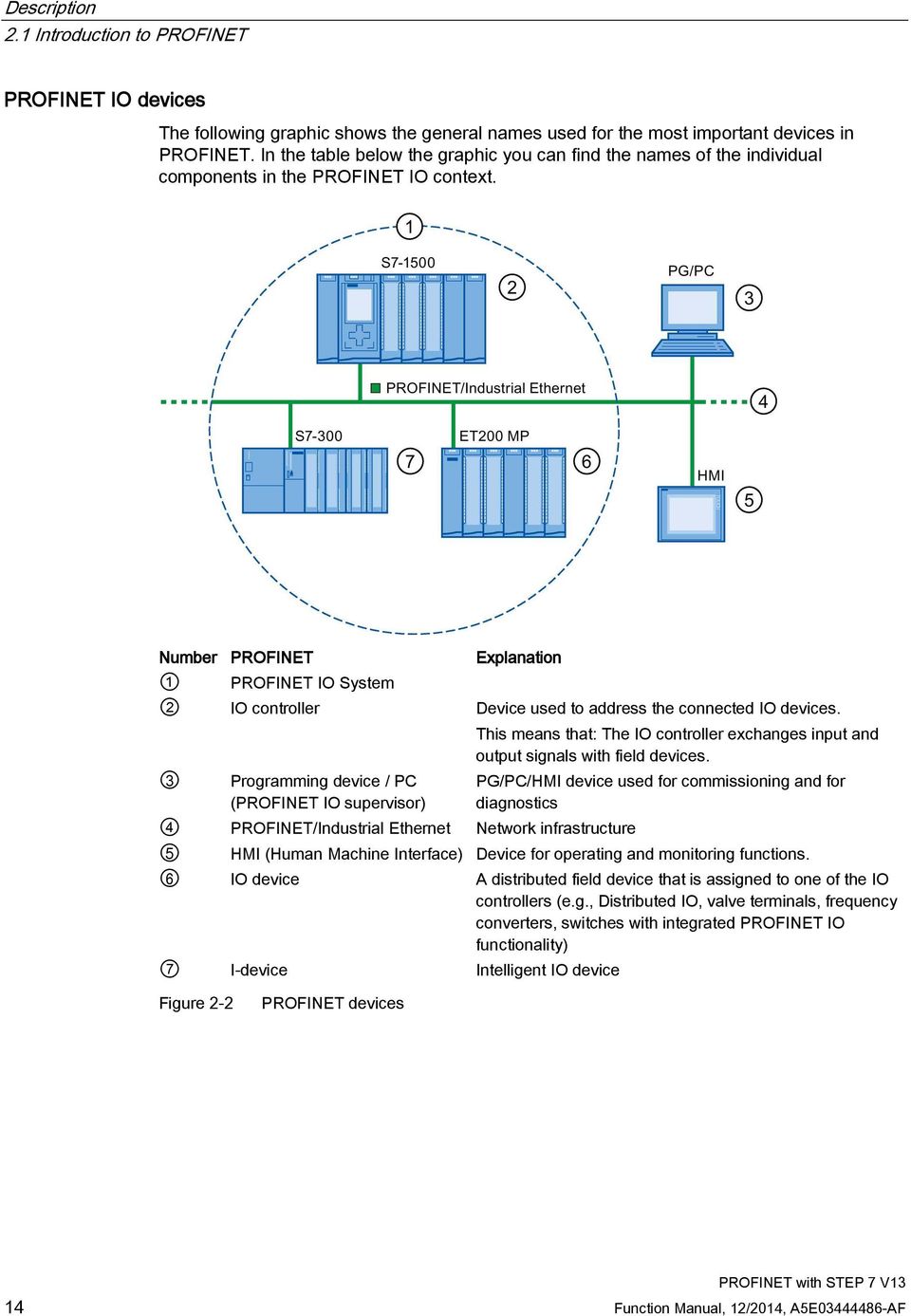
14 Description 2.1 Introduction to PROFINET PROFINET IO devices The following graphic shows the general names used for the most important devices in PROFINET. In the table below the graphic you can find the names of the individual components in the PROFINET IO context. Number PROFINET Explanation 1 PROFINET IO System 2 IO controller Device used to address the connected IO devices. This means that: The IO controller exchanges input and output signals with field devices. 3 Programming device / PC (PROFINET IO supervisor) PG/PC/HMI device used for commissioning and for diagnostics 4 PROFINET/Industrial Ethernet Network infrastructure 5 HMI (Human Machine Interface) Device for operating and monitoring functions. 6 IO device A distributed field device that is assigned to one of the IO controllers (e.g., Distributed IO, valve terminals, frequency converters, switches with integrated PROFINET IO functionality) 7 I-device Intelligent IO device Figure 2-2 PROFINET devices 14 Function Manual, 12/2014, A5E AF
15 Description 2.1 Introduction to PROFINET IO communication via PROFINET IO The inputs and outputs of distributed I/O devices are read and written by means of PROFINET IO using what is referred to as IO communication. The following figure provides an overview of IO communication by means of PROFINET IO. A B C IO controller - IO controller communication via PN/PN coupler IO controller - I-device communication IO controller - IO-device communication Figure 2-3 IO communication via PROFINET IO Function Manual, 12/2014, A5E AF 15

16 Description 2.1 Introduction to PROFINET IO communication via PROFINET IO Table 2-1 IO communication via PROFINET IO Communication between... IO controllers and IO devices IO controller and I-device IO controller and IO controller Explanation The IO controller sends data cyclically to the IO devices of its PROFINET IO system and receives data from these devices. A fixed quantity of data is transferred cyclically between the user programs in CPUs of IO controllers and I-devices. The IO controller does not access the I/O module of the I-device, but instead accesses configured address ranges, i.e. transfer ranges, which may be located inside our outside the process image of the CPU of the I-device. If parts of the process image are used as transfer ranges, it is not permitted to use these for real I/O modules. Data transfer takes place using load- and transfer operations via the process image or via direct access. A fixed quantity of data is cyclically transferred between the user programs in CPUs of IO controllers. A PN/PN coupler is required as additional hardware. The IO controllers mutually access configured address ranges, i.e. transfer ranges, which may be located inside or outside the process image of the CPU. If parts of the process image are used as transfer ranges, it is not permitted to use these for real I/O modules. Data transfer takes place using load- and transfer operations via the process image or via direct access. See also Network security (Page 34) Functions (Page 89) Communication ( Basic terminology of communication PROFINET communication PROFINET communication takes place via Industrial Ethernet. The following transmission types are supported: Acyclic transmission of engineering and diagnostics data and interrupts Cyclic transmission of user data The PROFINET-IO communication takes place in real-time. For additional information on the real-time communication, refer to chapter Real-time communication (Page 153). 16 Function Manual, 12/2014, A5E AF

17 Description 2.1 Introduction to PROFINET Transparent data access Access to process data from different levels of the factory is supported by PROFINET communication. By using Industrial Ethernet, standard mechanisms of communication and information technology such as OPC/XML can now be used along with standard protocols such as UDP/TCP/IP and HTTP in automation engineering. This allows transparent access from company management level directly to the data from the automation systems at the control level and production level Management level Control level Production level Figure 2-4 Access to process data Function Manual, 12/2014, A5E AF 17

18 Description 2.1 Introduction to PROFINET Update time The update time is a time interval. IO controller and IO device/i-device exchange IO data cyclically in the IO system within this time interval. The update time can be configured separately for each IO device and determines the interval at which output data is sent from the IO controller to the IO device (output module/submodule) as well as input data from the IO device to the IO controller (input module/submodule). STEP 7 calculates the update time automatically in the default setting for each IO device of the PROFINET IO system, taking into account the volume of data to be exchanged as well as the set send clock. For additional information on the update time, refer to section Real-time communication (Page 153). Watchdog time The watchdog time is the time interval that an IO controller or IO device permits, without receiving IO data. If the IO device is not supplied by the IO controller with data within the watchdog time, the device detects the missing frames and outputs substitute values. This is reported in the IO controller as a station failure. In STEP 7, the watchdog time is made up from an integral multiple of the update time and can be set by the user. Send clock The period of time between two consecutive communication cycles. The send clock is the shortest possible interval in data exchange. Relationship between the update time and send clock The calculated update times are reduction ratios (1, 2, 4, 8,..., 512) of the send clock. The minimum possible update time thus depends on the minimum send clock of the IO controller that can be set and the efficiency of the IO controller and IO device. Depending on the send clock, it can be that only some of the reduction ratios are available (STEP 7 guarantees this through a pre-selection). The following tables illustrate the dependency of the update time that can be set on the send clock, using an example of the CPU PN/DP. The update times satisfy the requirements of the PROFINET standard IEC Table 2-2 With real-time communication the following applies: Send clock Update time Reduction ratios 250 μs 250 μs to 128 ms 1,2,..., μs 500 μs to 256 ms 1,2,..., ms 1 ms to 512 ms 1,2,..., ms 2 ms to 512 ms 1,2,..., ms 4 ms to 512 ms 1,2,..., Function Manual, 12/2014, A5E AF

19 Description 2.1 Introduction to PROFINET Additional information For information on real-time communication, refer to the section Real-Time Communication (RT) (Page 154) PROFINET interface Overview PROFINET devices of the SIMATIC product family have one or more PROFINET interfaces (Ethernet controller/interface). The PROFINET interfaces have one or more ports (physical connection options). In the case of PROFINET interfaces with multiple ports, the devices have an integrated switch. PROFINET devices with two ports on one interface allow you to configure the system in line or ring topology. PROFINET devices with three and more ports on one interface are also ideal for setting up tree topologies. Properties and rules for naming the PROFINET interface and its representation in STEP 7 are explained in the following. Properties Every PROFINET device on the network is uniquely identified via its PROFINET interface. For this purpose, each PROFINET interface has: A MAC address (factory default) An IP address A PROFINET device name Function Manual, 12/2014, A5E AF 19
20 Description 2.1 Introduction to PROFINET Identification and numbering of the interfaces and ports Interfaces and ports for all modules and devices in the PROFINET system are identified with the following characters: Table 2-3 Identification for interfaces and ports of PROFINET devices Element Symbol Interface number Interface X In ascending order starting from number 1 Port P In ascending order starting from number 1 (for each interface) Ring port R Examples of identification Three examples illustrate the rules for identifying PROFINET interfaces: Table 2-4 Examples for identifying PROFINET interfaces Sample labeling Interface number Port number X2 P1 2 1 X1 P2 1 2 X1 P1 R 1 1 (ring port) Representation of PROFINET Interfaces in the Topology Overview in STEP 7 You can find the PROFINET interface in the topology overview in STEP 7. The PROFINET interface for an IO controller and an IO device is represented as follows in STEP 7: Number Description 1 PROFINET interface of an IO controller in STEP 7 2 PROFINET interface of an IO device in STEP 7 3 These lines represent the PROFINET interface. 4 These lines represent the "ports" of a PROFINET interface. Figure 2-5 Representation of the PROFINET interfaces in STEP 7 20 Function Manual, 12/2014, A5E AF

21 Description 2.1 Introduction to PROFINET Schematic Representation of a PROFINET Interface with Integrated Switch The following schematic diagram shows the PROFINET interface with integrated switch and its ports for all PROFINET devices. Figure 2-6 PROFINET interface with integrated switch Functional differences of the PROFINET interfaces PROFINET interfaces can provide different functions. PROFINET interface functions include identification, configuration, diagnostics and communication services (e.g., open communication). PROFINET interfaces that provide PROFINET IO functions and network security functions are also available. The following table illustrates the differences using the example of the CPU PN/DP, which features two PROFINET interfaces with different functionality. Table 2-5 Differences of the PROFINET interfaces of the CPU PN/DP PROFINET interface (X1) PROFINET interface (X2) 2 ports with PROFINET IO functionality: 1 port with PROFINETfunctionality: Identification, configuration and diagnostics PG communication HMI communication S7 communication Time-of-day synchronization Web server Open communication IO controller - I-device - RT/IRT - Isochronous mode - Media redundancy - Prioritized startup - Function Manual, 12/2014, A5E AF 21
22 Description 2.1 Introduction to PROFINET Additional Information on the Functionality of PROFINET interfaces You can find information on the number and functionality of the interfaces of a PROFINET device in the documentation for the specific PROFINET device. PROFINET communication services are described in the Communication function manual. In the Network security section you can find components that are used to protect networks against hazards. The Functions section describes the PROFINET IO functions. 22 Function Manual, 12/2014, A5E AF
23 Description 2.1 Introduction to PROFINET Implementation of the PROFINET device model in SIMATIC Slots and modules A PROFINET device can have a modular and compact structure. A modular PROFINET device consists of slots into which the modules are inserted. The modules have channels which are used to read and output process signals. A compact device has the same design and can include modules, however, it cannot be physically expanded, which means that no modules can be inserted. This is illustrated by the following graphic. Figure 2-7 Configuration of a PROFINET device Number Description Slot with bus interface Slot with module Subslot with submodule Channel A module can contain multiple submodules. Function Manual, 12/2014, A5E AF 23
24 Description 2.1 Introduction to PROFINET Representation of PROFINET Device Model in the Device View of STEP 7 The following figure shows the representation of the PROFINET device model in the device view of STEP 7, based on the example of a distributed I/O system ET 200MP: Figure 2-8 PROFINET device model in the device view of STEP 7 24 Function Manual, 12/2014, A5E AF
25 Description 2.2 Setting up PROFINET 2.2 Setting up PROFINET Contents of this chapter The following chapter provides background information on building your communication network. Overview of the most important passive network components: These are network components that forward a signal without the possibility of actively influencing it, for example, cables, connectors, etc. Overview of the most important active network components: These are network components that actively affect a signal, for example switches, routers, etc. Overview of the most common network structures (topologies). Physical connections of industrial networks PROFINET devices can be networked in industrial systems in two different physical ways: Connected line By means of electrical pulses via copper cables By means of optical pulses via fiber-optic cables Wireless via wireless network using electromagnetic waves PROFINET devices and cabling technology in SIMATIC are suited for industrial use, as they are based on Fast Ethernet and Industrial Ethernet. Fast Ethernet You can use Fast Ethernet to transfer data at a speed of 100 Mbps. This transmission technology uses the 100 Base-T standard for this. Industrial Ethernet Structure of Ethernet in industrial environment. The biggest difference from standard Ethernet is the mechanical current carrying capacity and noise immunity of the individual components. Function Manual, 12/2014, A5E AF 25
26 Description 2.2 Setting up PROFINET Active Network Components Introduction The following active network components are available for PROFINET: Switch Router Switched Ethernet PROFINET IO is based on switched Ethernet with full-duplex operation and a transmission bandwidth of 100 Mbps. As a result, the network can be used very efficiently through the simultaneous data transfer of several devices. The PROFINET IO frames are processed with high priority. Switches Switches are network components used to connect several terminal devices or network segments in a local network (LAN). For the communication of a device with several other devices on PROFINET, the device is connected to the port of a switch. Other communication devices (including switches) can then be connected to the other ports of the switch. The connection between a communication device and the switch is a point-to-point connection. A switch has the task of receiving and distributing frames. The switch "learns" the Ethernet address(es) of a connected PROFINET device or additional switches and only forwards those frames that are intended for the connected PROFINET device or the connected switch. Switch variants Switches are available in two models: Integrated into a PROFINET device For PROFINET devices with multiple ports (two or more), we are dealing with devices with an integrated switch (for example, CPU PN/DP). As autonomous device (for example, switches of the SCALANCE product family) 26 Function Manual, 12/2014, A5E AF
27 Description 2.2 Setting up PROFINET Selection Guide for Switches To use PROFINET with the RT class "RT", you can use any switch of "PROFINET Conformance Class A" or higher. All switches of the SCALANCE product family meet these requirements. If you want to use PROFINET functions that provide an additional value, such as topology recognition, diagnostics, device exchange without exchangeable medium/programming device, you have to use a switch of the "PROFINET Conformance Class B" or higher. To use PROFINET with the RT class "IRT", you must use a switch of "PROFINET Conformance Class C". With switches of the SCALANCE product family, watch out for the catalog feature "IRT PROFINET IO switch". To select appropriate switches, we recommend the SIMATIC NET Selection Tool on the Internet ( Switches of the SCALANCE product family Use the switches of the SCALANCE product family if you want to use the full scope of PROFINET. They are optimized for use in PROFINET IO. In the SCALANCE X device family, you will find switches with electrical and optical ports and with a combination of both variants. SCALANCE X202-2IRT, for example, has two electrical ports and two optical ports and supports IRT communication. With STEP 7, you can configure and perform diagnostics on and address switches from the SCALANCE X device family as PROFINET IO devices. Router A router connects separated network segments with each other (e.g. management level and control level). The volume of data volume must be coordinated with the services of the respective network segment. A router also separates two networks and acts as a mediator between both networks. It thus reduces the network load. Routing functionality is provided in the SCALANCE X device family, with SCALANCE X300 or higher. Communication devices on different sides of a router can only communicate with one another if you have explicitly enabled communication between them via the router. If you want to access manufacturing data directly from SAP, for example, use a router to connect your Industrial Ethernet in the factory with the Ethernet in your office. Note If devices need to communicate beyond the limits of a network, you must configure the router so that it allows this communication to take place. Information on routing with STEP 7 is available in the function manual Communication ( Function Manual, 12/2014, A5E AF 27
28 Description 2.2 Setting up PROFINET Cabling technology Cables for PROFINET Electrical and optical cables are available for PROFINET. The type of cable depends on the data transfer requirements and on the ambient conditions. Simple method for the prefabrication of twisted pair cables When you set up your PROFINET system, you can cut the twisted-pair cable to the required length on site, strip it with the stripping tool (for Industrial Ethernet), and fit the Industrial Ethernet Fast Connect RJ45 plugs using the cut-and-clamp method. For more information on installation, refer to the installation instructions in the "SIMATIC NET Industrial Ethernet Network Manual" ( Note A maximum of six plug-in connections are allowed between two switches per Ethernet path. Simple method for the prefabrication of fiber-optic cables The FastConnect FO cabling system is available for the easy, fast and error-free prefabrication of fiber-optic cables. The glass-fiber optic cable consists of: FC FO Termination Kit for SC and BFOC plug (cleave tool, Kevlar scissors, buffer grip, fiber remains container) FC BFOC Plug FC SC Duplex plug FO FC Standard cable FO FC Trailing cable Simple method for the prefabrication of POF and PCF cables The following special tools provide an easy and safe way to prefabricate POF / PCF cables and fit the SC RJ POF plugs: POF cable Prefabrication case IE Termination Kit SC RJ POF plug PCF cable Prefabrication case IE Termination Kit SC RJ PCF plug 28 Function Manual, 12/2014, A5E AF
29 Description 2.2 Setting up PROFINET Overview of transmission media with PROFINET The following table summarizes the technical specifications of a PROFINET interface with integrated switch or an external switch, and possible transmission media. Table 2-6 Transmission media with PROFINET Physical properties Electrical Connection methods RJ45 connector ISO Optical SCRJ 45 ISO/IEC Electromagnetic waves BFOC (Bayonet Fiber Optic Connector) and SC (Subscriber Connector) ISO/IEC Cable type / transmission medium standard 100Base-TX 2x2 twisted, symmetrical and shielded copper cable, CAT 5 transmission requirement IEEE Base-FX POF fiber-optic cable (Polymer Optical Fiber, POF) 980/1000 µm (core diameter / external diameter) ISO/IEC Plastic-cladded glass fiber (Polymer Cladded Fiber, PCF) 200/230 µm (core diameter / external diameter) ISO/IEC Monomode glass fiber optic cable 10/125 µm (core diameter / external diameter) ISO/IEC Multimode glass fiber optic cable 50/125 µm and 62.5/125 µm (core diameter / external diameter) ISO/IEC Transmission rate / mode 100 Mbps, full duplex 100 Mbps, full duplex 100 Mbps, full duplex 100 Mbps, full duplex 100 Mbps, full duplex - IEEE x Depends on the extension used (a, g, h, etc.) Max. segment Advantages length (between two devices) 100 m Simple and cheap cable connection 50 m Use when there are large differences in potential Insensitive towards electromagnetic 100 m radiation Low line attenuation Considerably longer segments possible 26 km m 100 m Greater mobility Cost-effective networking to remote, difficult to access devices 1 Applies for fiber-optic cables only Function Manual, 12/2014, A5E AF 29
30 Description 2.2 Setting up PROFINET See also PROFINET interface (Page 19) Assembly Instructions for SIMATIC NET Industrial Ethernet ( PROFINET Installation Guideline ( Wireless design Basics What is Industrial Wireless LAN? In addition to data communication in accordance with the IEEE standard, the SIMATIC NET Industrial Wireless LAN provides a number of enhancements which offer significant benefits for industrial customers. IWLAN is particularly suitable for demanding industrial applications that require reliable wireless communication. This is supported by the following properties: Automatic roaming when the connection to Industrial Ethernet is interrupted (Forced Roaming) Cost savings generated by using a single wireless network for reliable operation of a process with both process-critical data (alarm message, for example) and non-critical communication (service and diagnostics, for example) Cost-effective connection to devices in remote environments that are difficult to access Predictable data traffic (deterministic) and defined response times Cyclical monitoring of the wireless link (link check) Objectives and advantages of Industrial Wireless LAN Wireless data transmission achieves the following objectives: Seamless integration of PROFINET devices into the existing bus system via the wireless interface Mobile use of PROFINET devices for different production-linked tasks Flexible configuration of the system components for fast development in accordance with customer requirements Maintenance costs are minimized by savings in cables 30 Function Manual, 12/2014, A5E AF
31 Description 2.2 Setting up PROFINET Application examples Communication with mobile subscribers (mobile controllers and devices, for example), conveyor lines, production belts, translation stages, and rotating machines Wireless coupling of communication segments for fast commissioning or cost-effective networking where routing of wires is extremely expensive (e.g. public streets, railroad lines) Stacker trucks, automated guided vehicle systems and suspended monorail systems The following graphic illustrates the many possible applications and configurations for SIMATIC device family wireless networks. Figure 2-9 Application example for the use of Industrial Wireless LAN Data transmission rate In Industrial Wireless LAN, gross data transmission rates of 11 Mbps or 54 Mbps without full duplex are permitted. Function Manual, 12/2014, A5E AF 31
32 Description 2.2 Setting up PROFINET Range With SCALANCE W (access points), wireless networks can be set up indoors and outdoors. Multiple access points can be installed to create large wireless networks in which mobile subscribers are transferred seamlessly from one access point to another (roaming). As an alternative to a wireless network, point-to-point connections of Industrial Ethernet segments can also be set up over large distances (several hundred meters). In this case, the range and characteristics of the RF field are determined by the antennas used. Note Range The range can be considerably less, depending on spatial factors, the wireless standard used, the data rate, and the antennas on the send and receive sides Tips on assembly Wireless networks, SCALANCE device family With PROFINET, you can also set up wireless networks with Industrial Wireless Local Area Network (IWLAN) technology. We recommend implementing the SCALANCE W device line for this. Update time in STEP 7 If you set up PROFINET with Industrial Wireless LAN, you may have to increase the update time for the wireless devices. The IWLAN interface provides lower performance than the wired data network: Several communication stations have to share the limited transmission bandwidth. For wired solutions, 100 Mbps is available for each communication device. The Update time parameter can be found in the "Realtime settings" section in the Inspector window of IO devices in STEP 7. Figure 2-10 Update time in STEP 7 32 Function Manual, 12/2014, A5E AF
33 Description 2.2 Setting up PROFINET Additional information More information about SCALANCE W Industrial Wireless LAN components can be found in the manual SIMATIC NET SCALANCE W-700 ( More information about wired data transmission can be found in the manual SIMATIC NET Twisted Pair and Fiber Optic Networks ( More information about wireless data transmission can be found in the manual Basics for configuring an industrial wireless LAN ( You should also read the PROFINET installation guideline of the PROFIBUS User Organization on the Internet ( Various documents that assist with the setting up of your PROFINET automation solution are available here: PROFINET planning guideline PROFINET installation guideline PROFINET commissioning guideline Additional documents for setup of PROFINET Function Manual, 12/2014, A5E AF 33
34 Description 2.2 Setting up PROFINET Network security Basics Introduction The topic of data security and access protection (Security) has become increasingly important in the industrial environment. The increased networking of entire industrial systems, vertical integration and networking of levels within a company and new techniques such as remote maintenance all result in higher requirements for protecting the industrial plant. Data security solutions for office environments cannot simply be transferred one-to-one to industrial applications to protect against manipulation in sensitive systems and production networks. Requirements Additional security requirements arise from the specific communication requirements in the industrial environment (real-time communication, for example): Protection against interaction between automated cells Protection of network segments Protection against faulty and unauthorized access Scalability of network security Must not influence the network structure Definition of security Generic term for all the measures taken to protect against: Loss of confidentiality due to unauthorized access to data Loss of integrity due to manipulation of data Loss of availability due to destruction of data, for example, through faulty configuration and denial-of-service attacks 34 Function Manual, 12/2014, A5E AF
35 Description 2.2 Setting up PROFINET Threats Threats can arise from external and internal manipulation. The loss of data security is not always caused by intentional actions. Internal threats can arise due to: Technical errors Operator errors Defective programs Added to these internal threats there are also external ones. The external threats are not really any different to the known threats in the office environment: Software viruses and worms Trojans Man-in-the-middle attacks Password Phishing Denial of Service Protective measures The most important precautions to prevent manipulation and loss of data security in the industrial environment are: Filtering and control of data traffic by means of firewall A virtual private network (VPN) is used to exchange private data on a public network (Internet, for example). The most common VPN technology is IPsec. IPsec (Internet Protocol Security) is a collection of security protocols that are used as the basis for the IP protocol at the mediation level and allow a secured communication via potentially unsecure IP networks. Segmenting in protected automation cells This concept has the aim of protecting the lower-level network devices by means of security modules. A group of protected devices forms a protected automation cell. Authentication (identification) of the devices The security modules identify each other over a safe (encrypted) channel using authentication procedures. It is therefore impossible for unauthorized parties to access a protected segment. Encrypting the data traffic The confidentiality of data is ensured by encrypting the data traffic. Each security module is given a VPN certificate which includes the encryption key. Function Manual, 12/2014, A5E AF 35
36 Description 2.2 Setting up PROFINET Network components and software Protection against unauthorized access The following solutions may be used to connect industrial networks to the intranet and Internet to protect against internal and external threats: Communication processors, such as the SIMATIC CP SCALANCE X-300 and SCALANCE S - the data security components of the SIMATIC NET product family SOFTNET security client for use on PCs Features Both of these products have a wide variety of features, such as: Easy integration of existing networks without configuration, with integrated firewall. Segmenting in protected automation cells Authentication (identification) of the devices Encrypting the data traffic 36 Function Manual, 12/2014, A5E AF
37 Description 2.2 Setting up PROFINET Application example Data security at the office and production levels The following graphic contains an application example with protected areas at different levels of the company created using SCALANCE S and the security client. The protected areas are highlighted in light gray. Figure 2-11 Network configuration with the SCALANCE S security module and the SOFTNET security client Function Manual, 12/2014, A5E AF 37
38 Description 2.2 Setting up PROFINET Additional information Additional information on the configuration of a security standard in PROFINET, is available: In the PROFINET security guideline. These guidelines can be found on the homepage of the PROFIBUS user organization on the Internet ( In the Industrial Ethernet Security ( manual In the SCALANCE S and SOFTNET Security Client ( manual You can find general information on industrial security concepts, functions and news on the Industrial Security website ( 38 Function Manual, 12/2014, A5E AF
39 Parameter assignment/addressing 3 To set up an automation system, you will need to configure, assign parameters and interlink the individual hardware components. In STEP 7, the work needed for this is undertaken in the device, topology and network view. Configuring "Configuring" is understood to mean arranging, setting and networking devices and modules within the device, topology or network view. An I/O address is automatically assigned to each module. The I/O addresses can be subsequently modified. The CPU compares the configuration preset in STEP 7 with the actual current configuration of the system. In this way, potential errors can be detected and reported straight away. The exact procedure for configuring devices is described in detail in the STEP 7 online help. Assigning parameters "Assigning parameters" is understood to mean setting the properties of the components used. The settings for the hardware components and for data communication are configured at the same time. In STEP 7, you can "assign parameters" for the following settings PROFINET: Device names and IP address parameters Port interconnection and topology Module properties / parameters The parameters are loaded into the CPU and transferred to the corresponding modules when the CPU starts up. Modules are easy to replace from spare parts, as the parameters assigned for the SIMATIC CPUs are automatically loaded into the new module at each startup. Function Manual, 12/2014, A5E AF 39
40 Parameter assignment/addressing Adjusting the hardware to the project requirements You need to configure hardware if you want to set up, expand or change an automation project. To do this, add hardware components to your structure, link these with existing components, and adapt the hardware properties to the tasks. The properties of the automation systems and modules are preset such that in many cases they do not have to be assigned parameters again. Parameter assignment is however needed in the following cases: You want to change the default parameter settings of a module. You want to use special functions. You want to configure communication connections. 40 Function Manual, 12/2014, A5E AF
41 Parameter assignment/addressing 3.1 Assigning an IO device to an IO controller 3.1 Assigning an IO device to an IO controller PROFINET IO System A PROFINET IO system is comprised of a PROFINET IO controller and its assigned PROFINET IO devices. After these devices have been placed in the network or topology view, STEP 7 assigns default values for them. Initially, you only have to worry about the assignment of IO devices to an IO controller. Requirement You are in the network view of STEP 7. A CPU has been placed (e.g., CPU PN/DP). An IO device has been placed (e.g., IM PN ST). Procedure To assign IO devices to an IO controller, proceed as follows: 1. Place the pointer of the mouse over the interface of the IO device. 2. Press and hold down the left mouse button. 3. Move the pointer. The pointer now uses the networking symbol to indicate "Networking" mode. At the same time, you see the lock symbol on the pointer. The lock symbol disappears only when the pointer is over a valid target position. 4. Now move the pointer onto the interface of the IO controller. You can keep the left mouse button pressed or release it when performing this action. 5. Now release the left mouse button or press it again (depending on your previous action). Figure 3-1 Assigning an IO device to an IO controller in the network view of STEP 7 Result You have assigned an IO device to an IO controller. Function Manual, 12/2014, A5E AF 41
42 Parameter assignment/addressing 3.1 Assigning an IO device to an IO controller Checking the assignment You can find an overview of the communication relationships in the "IO communication" tab in the tabular area of the network view. This table is context-sensitive for selection in the graphic area: Selection of the interface shows the I/O communication of the respective interface. Selection of the CPU shows all I/O communication of the CPU (including PROFIBUS). Selection of the station (as in the above figure) interface shows the I/O communication of the complete station. 42 Function Manual, 12/2014, A5E AF
43 Parameter assignment/addressing 3.2 Device name and IP address 3.2 Device name and IP address Introduction In order that the PROFINET device can be addressed as node on PROFINET, the following are required: A unique PROFINET device name A unique IP address in the relevant IP subnet STEP 7 assigns a device name during the arrangement of a PROFINET device in the hardware and network editor. The IP addresses are typically assigned automatically by STEP 7 and assigned to the devices based on the device name. You can change the name and IP address manually. In STEP 7 You can find the device name and the IP address under "Ethernet addresses" in the properties of the PROFINET interface in the Inspector window. Figure 3-2 Device name and IP address in STEP 7 The function, the assignment and the changing of the device name and the IP address are described in the following sections. Function Manual, 12/2014, A5E AF 43
44 Parameter assignment/addressing 3.2 Device name and IP address Device name Device names Before an IO device can be addressed by an IO controller, it must have a device name. In PROFINET, this method was selected because it is simpler to work with names than with complex IP addresses. The assignment of a device name for a specific IO device can be compared to setting the PROFIBUS address of a DP slave. In delivery state, an IO device does not have a device name. A device name must first be assigned with the programming device or PC before an IO device can be addressed by an IO controller, for example, for transferring configuration data during startup or for user data exchange in cyclic operation. IO devices that have a slot for removable storage media provide the option of writing the device name directly to the removable storage medium in the programming device. When a device is replaced by a device without removable medium, the IO controller assigns the device name based on topological configuration (see section Configuring topology (Page 55)). Structured device names The device name is automatically assigned by default for PROFINET devices S7-1200, S7-1500, ET 200MP, ET 200SP and ET 200AL when these are configured in STEP 7. The device names are formed from the name of the CPU or the name of the interface module. For devices with several PROFINET interfaces, the name of the interface is enhanced, for example, "plc_1.profinet-interface_2" or "io-device_1". You can structure the device names using DNS conventions. These conventions are defined by "Internationalizing Domain Names in Applications (IDNA). According to this, device names are written in lower case. The "Domain Name System" (DNS) is a distributed database ( which manages the name space on the Internet. To structure the names, you use the dot ("."). The hierarchy is shown in ascending order from left to right....<subdomain name>.<domain name>.<top-level domain name> If the name is not DNS-compliant, the name will be converted by STEP 7, for example, to "plcxb1.profinet-schnittstellexb2022c" or "io-devicexb15b32". 44 Function Manual, 12/2014, A5E AF
45 Parameter assignment/addressing 3.2 Device name and IP address Device number In addition to the device name, STEP 7 also assigns a device number beginning with "1" when an IO device is allocated. The device number is located in the Inspector window in the properties of the PROFINET interface, under "Ethernet addresses" in the area PROFINET. Figure 3-3 Device number This device number can be used to identify an IO device in the user program (for example, with the instruction "LOG2GEO") IP address IP address To allow a PROFINET device to be addressed as a device on Industrial Ethernet, this device also requires an IP address that is unique on that network. The IP addresses are typically assigned automatically by STEP 7 and assigned to the devices based on the device name. If it is a standalone network, you can apply the IP address and subnet mask suggested by STEP 7. If the network is part of an existing Ethernet company network, obtain the information from your network administrator. Configuration of the IP address In accordance with Internet Protocol version 4 (IPv4), the IP address is made up of four decimal numbers, each with a range of values from 0 through 255. The decimal numbers are separated from one another by a period (for example, ). The IP address consists of the following: Address of the network Address of the device (PROFINET interface of the IO controller/io device) Function Manual, 12/2014, A5E AF 45
46 Parameter assignment/addressing 3.2 Device name and IP address Generating IP addresses The IP addresses of the IO devices are generated by STEP 7 and first assigned to the IO devices when the CPU starts up. In addition, for some IO devices (e.g., SCALANCE X, S7-300 CPs), it is possible not to obtain the IP address during startup of the IO controller, but rather to set it beforehand on the device (see Permitting changes to the device name and IP address directly on the device (Page 53)). The IP addresses of the IO devices always have the same subnet mask as the IO controller and are assigned from the IP address of the IO controller in ascending order. The IP address can be changed manually, if necessary. For devices with several PROFINET interfaces (e.g., CPU PN/DP), the IP addresses must be located in different subnets. Subnet mask The bits set in the subnet mask decide the part of the IP address that contains the address of the network. In general, the following applies: The network address is obtained from the AND operation of the IP address and subnet mask. The device address is obtained from the AND NOT operation of the IP address and subnet mask. Example of the subnet mask Subnet mask: (decimal) = (binary) IP address: (decimal) = (binary) Meaning: The first 2 bytes of the IP address determine the network - i.e., The last two bytes address the device, i.e Default router The default router is used when data has to be forwarded via TCP/IP or UDP to a partner located outside the local network. In STEP 7, the default router is named Router. You can activate the use of a router in the Inspector window of a CPU with the "Use router" check box in the"ip protocol" section. STEP 7 assigns the local IP address to the default router by default. The router address that is set on the PROFINET interface of the IO controller is automatically transferred for the configured IO devices. 46 Function Manual, 12/2014, A5E AF
47 Parameter assignment/addressing 3.2 Device name and IP address Relation between IP address and default subnet mask An agreement exists relating to the assignment of IP address ranges and so-called "Default subnet masks". The first decimal number (from the left) in the IP address determines the structure of the default subnet mask with respect to the number of "1" values (binary) as follows: IP address (decimal) IP address (binary) Address class Default subnet mask 0 to 126 0xxxxxxx.xxxxxxxx... A to xxxxxx.xxxxxxxx... B to xxxxx.xxxxxxxx... C Note Range of values for the first decimal point A value between 224 and 255 is also possible for the first decimal number of the IP address (address class D etc.). However, this is not recommended because there is no address check for these values. Masking other subnets You can use the subnet mask to add further structures and form "private" subnets for a subnet that is assigned one of the address classes A, B or C. This is done by setting other, less significant bits of the subnet mask to "1". For each bit set to "1", the number of "private" networks doubles and the number of devices they contain is halved. Externally, the network continues to function as an individual network. Example: You have a subnet of address class B (for example, IP address xxx.xxx) and change the default subnet mask as follows: Masks Decimal Binary Default subnet mask Subnet mask Result: All devices with addresses from to are located in a subnet, all devices with addresses from to in a different subnet. Function Manual, 12/2014, A5E AF 47
48 Parameter assignment/addressing 3.2 Device name and IP address Assigning a device name and IP address Assigning an IP address and subnet mask for an IO controller for the first time You have the following options: Using a programming device or PC: Connect your programming device/pc to the same network as the relevant PROFINET device. The interface of the programming device/pc must be set to TCP/IP mode. During the download, first of all display all available devices via the "Accessible devices" download dialog box. Select the target device via its MAC address and then assign its IP address before you download the hardware configuration including the configured IP address (IP address is saved retentively). Using the display of a S CPU: The S CPUs have a front cover with a display and operating keys. You can use this display to assign or change the IP address. To set the IP address, navigate on the display via the menu items "Settings" > "Addresses" > "X1 (IE/PN)" > "Parameters". Using a memory card: If your PROFINET device is equipped for a memory card (Micro Memory Card/SIMATIC memory card), plug this into your programming device/pc and save the hardware configuration together with the configured IP address on this memory card. Then plug the memory card into the PROFINET device. Once inserted, the PROFINET device automatically applies the IP address. If you have saved a configuration to the memory card with the "IP address is set directly at the device" option, you must assign the IP address using a different method after inserting the memory card. (See chapter Permitting changes to the device name and IP address directly on the device (Page 53)) Assigning device names and IP address for "Device replacement without exchangeable medium/programming device" For devices without exchangeable medium (e.g., ET 200MP, ET 200SP) and devices that support "Device replacement without exchangeable medium/pg" (e.g., ET 200S), the IO controller can identify the device without name from the neighbor relationships specified by the set topology and from actual neighbor relationships determined by the real PROFINET devices. The IO controller then assigns the PROFINET device the configured name and incorporates the PROFINET device in the user data traffic. (See also Device replacement without exchangeable medium (Page 176)). 48 Function Manual, 12/2014, A5E AF
49 Parameter assignment/addressing 3.2 Device name and IP address IP address assignment when replacing IO devices with exchangeable medium PG The following is contained on the memory card of the programmable logic controller: On the IO controller: Device name and IP address On the IO device: Device name When you remove the memory card from a PROFINET device and insert it in another PROFINET device with exchangeable medium (e.g., ET 200S), device-specific information and the device name are loaded to the device. If an IO device has to be replaced in its entirety due to a device or module defect, the IO controller automatically assigns parameters and configures the replaced device or module. The cyclic exchange of user data is then restarted. In addition to this, before the power ON of the IO device, the memory card with the valid name must be removed from the faulty IO device and added to the replaced device. In the event of an error in the PROFINET device, the memory card allows you to replace a module without a programming device/pc. You can also transfer the device data directly from the programming device/pc to the memory card. Procedure: Changing the device name using properties of the PROFINET interface You can change the PROFINET name via the properties of the PROFINET interface. This is useful when the PROFINET device has not received its previous name from the automatic generation, for example, in the case of a migration. 1. In the network or device view of the STEP 7 hardware and network editor, select the PROFINET interface of a PROFINET device. 2. In the Inspector window, go to "Ethernet addresses" in the PROFINET area. 3. Clear the "Generate PROFINET device name automatically" check box. 4. Enter the new PROFINET device name in the relevant field. Figure 3-4 Changing the device name of a PROFINET device in the properties Function Manual, 12/2014, A5E AF 49
50 Parameter assignment/addressing 3.2 Device name and IP address Alternative procedure: Changing the device name of a PROFINET device in the network view Requirement: The "Generate PROFINET device name automatically" check box is selected. 1. In STEP 7, select the "Network overview" tab in the tabular area of the network view. 2. In the "Device" column, overwrite the name in the row of the relevant PROFINET device. The name is also changed accordingly in the graphic area of the network view. Figure 3-5 Changing the device name of a PROFINET device in STEP 7 50 Function Manual, 12/2014, A5E AF
51 Parameter assignment/addressing 3.2 Device name and IP address Procedure: Changing the IP address To change the IP address, follow these steps: 1. In the network or device view of the STEP 7 hardware and network editor, select the PROFINET interface of a PROFINET device. 2. In the Inspector window, go to "Ethernet addresses" in the "IP protocol" area. 3. Check that the option "Set IP address in the project" is selected. 4. Enter the new IP address in the relevant field. Figure 3-6 Changing the IP address of a PROFINET device in STEP 7 Downloading configured device name to IO device To place the configured device names in the IO device, follow these steps: 1. Connect your programming device/pc to the same network as the relevant IO device. The interface of the programming device/pc must be set to TCP/IP mode. 2. In STEP 7, select the relevant IO device in the "Accessible devices" dialog based on the MAC address. 3. Click "Assign name" to download the configured device name to the IO device. The IO controller recognizes the IO device automatically by its device name and automatically assigns the configured IP address to it. Function Manual, 12/2014, A5E AF 51
52 Parameter assignment/addressing 3.2 Device name and IP address Identification of the PROFINET device To clearly identify a device from several identical devices in a control cabinet, for example, you can flash the link LED of the PROFINET device. To do this, select the menu command Online > Accessible devices... in STEP 7. In the "Accessible devices" dialog, set the PG/PC interface by means of which you are connected to the devices. STEP 7 will now automatically search for the accessible devices and display them in the "Accessible devices in target subnet" table. Select the desired PROFINET device and click on the "Flash LED" button. The PROFINET device is identified based on its MAC address. Figure 3-7 "Accessible devices" dialog Using an different way to assign IP addresses for IO devices Various IO devices, for example, SCALANCE X,S7-300 CPs, support the option of not having the IP addresses assigned by the IO controller during startup. In this case, the IP address is assigned in a different way. For additional information, refer to the manual of the respective PROFINET device of the SIMATIC device family. 52 Function Manual, 12/2014, A5E AF
53 Parameter assignment/addressing 3.2 Device name and IP address Additional information You can find a detailed description of the operation and functions of the display of the S CPUs in the system manual S7-1500, ET 200MP ( Permitting changes to the device name and IP address directly on the device Introduction Machines are frequently commissioned on site or integrated into the existing infrastructure without STEP 7. You can find typical applications in all areas of the series machine building. Alternative means for assigning the IP address are available for this. Procedure 1. In the network or device view of the STEP 7 Hardware and Network editor, select the PROFINET interface of an IO controller. 2. Navigate in the Inspector window to "Ethernet addresses". 3. Select the "IP address is set directly at the device" option in the "IP protocol" area. 4. In the "PROFINET" area, select the " PROFINET device name is set directly at the device" check box. Figure 3-8 Setting the device name and IP address on the device Function Manual, 12/2014, A5E AF 53
54 Parameter assignment/addressing 3.2 Device name and IP address Note Gateway When you operate a PROFINET device with the option "Allow adaption of the device name/ip address directly on device", you cannot use this PROFINET device as gateway for S7 routing. Options for assigning IP addresses and device names Apart from the known address and device name assignment in the "Ethernet addresses" section of the Inspector window, there are other ways in which the IP address and name can be assigned: Assigning by means of the user program with the instruction "T_CONFIG" Assignment when downloading the configuration to the target system via the "Extended download to device" dialog box. Assignment via the Primary Setup Tool (PST) Assignment via the PRONETA ("PROFINET network analysis") commissioning and diagnostics tool Additional information For information on the "T_CONFIG" instruction and on downloading to the target system, refer to the STEP 7 online help. A free Download ( of the Primary Setup Tool (PST) can be found on the Internet. On this Internet page, you will also find a list of devices for which the PST is approved. 54 Function Manual, 12/2014, A5E AF
55 Parameter assignment/addressing 3.3 Configuring topology 3.3 Configuring topology Introduction If an IO device is assigned to an IO controller, this does not yet specify how the ports are connected to each other. A port interconnection is not required to use RT, but it provides the following advantages: A set topology is assigned with the port interconnection. Based on an online-offline comparison, it is possible to conduct a set-actual comparison with all devices that support this function. The "Device replacement without exchangeable medium" function can be used. A port interconnection is an essential requirement for using IRT. An overview of various options for setting up a PROFINET network is given below. Line All the communication devices are connected in a linear bus topology. In PROFINET, the linear bus topology is implemented with switches that are already integrated into the PROFINET devices. Therefore, the linear bus topology at PROFINET is merely a special form of tree / star topology. If a link element (switch, for example) fails, communication across the failed link element is no longer possible. The network is then divided into 2 subsegments. Linear bus topology structures require the least cabling. Star If you connect communication devices to a switch with more than two PROFINET ports, you automatically create a star network topology. If an individual PROFINET device fails, this does not automatically lead to failure of the entire network, in contrast to other structures. It is only if a switch fails that part of the communication network will fail as well Tree If you interconnect several star structures, you obtain a tree network topology. Function Manual, 12/2014, A5E AF 55
56 Parameter assignment/addressing 3.3 Configuring topology Ring In order to increase the availability of a network, use ring structures. In principle, a linear bus topology is connected to a ring through a so-called redundancy manager. The task of the redundancy manager is managed by an external switch SCALANCE X, a CPU that supports the Media Redundancy Protocol MRP (e.g., CPU PN/DP) or a CP (e.g., CP Lean). If there is a break in the network, the redundancy manager ensures that the data is redirected over an alternative network connection in the ring. 56 Function Manual, 12/2014, A5E AF
57 Parameter assignment/addressing 3.3 Configuring topology Example for topology The following example shows a combination of different topologies. Number Meaning S as IO controller S7-300 as IO controller Industrial WLAN with SCALANCE W SCALANCE X with seven electrical and three optical ports ET 200SP with integrated 2-port switch SCALANCE X 204 with four electrical ports PROFINET/Industrial Ethernet IE/PB-Link PN IO PROFIBUS DP ET 200S with two optical ports Star topology Linear bus topology The combination of topology forms results in a tree topology. Figure 3-9 Combined topology Function Manual, 12/2014, A5E AF 57
58 Parameter assignment/addressing 3.3 Configuring topology Additional information Observe the PROFINET Installation Guideline ( of the PROFIBUS User Organization when planning your PROFINET topology. For more detailed information, see the SIMATIC NET Twisted Pair and Fiber Optic Networks ( manual. You can find basic information in the Communication with SIMATIC ( manual. 58 Function Manual, 12/2014, A5E AF
59 Parameter assignment/addressing 3.3 Configuring topology Topology view in STEP 7 Introduction The topology view is one of three working areas of the hardware and network editor. You undertake the following tasks here: Displaying the Ethernet topology Configuring the Ethernet topology Identify and minimize differences between the set and actual topology (online) The topology view in STEP 7 consists of a graphic area and a table area. Graphic area The graphic area of the topology view displays PROFINET devices with their appropriate ports and port connections. Here you can add more PROFINET devices. The following figure shows the graphic area of the topology view Figure 3-10 Selector: Device view/network view/topology view Toolbar Graphic area of the topology view Overview navigation Selector for the table area of the topology view Graphic area of the topology view Overview navigation Click in the overview navigation to obtain an overview of the created objects in the graphic area. By holding down the mouse button, you can quickly navigate to the desired objects and display them in the graphic area. Function Manual, 12/2014, A5E AF 59
60 Parameter assignment/addressing 3.3 Configuring topology Table area This displays the Ethernet or PROFINET devices with their appropriate ports and port connections in a table. This table corresponds to the network overview table in the network view Selector for the graphic area of the topology view Selector: Device view/network view/topology view Toolbar Table area of the topology view Figure 3-11 Table area of the topology view 60 Function Manual, 12/2014, A5E AF
61 Parameter assignment/addressing 3.3 Configuring topology Interconnecting ports in the topology view Requirement You are in the graphic view of the topology view. Procedure To interconnect ports in the topology view, follow these steps: 1. Place the pointer of the mouse on the port you want to interconnect. 2. Press and hold down the left mouse button. 3. Move the pointer. The pointer now uses the networking symbol to indicate "Interconnecting" mode. At the same time, you see the lock symbol on the pointer. The lock symbol disappears only when the pointer is over a valid target position. 4. Now drag the pointer to the target port. You can keep the left mouse button pressed or release it when performing this action. 5. Now release the left mouse button or press it again (depending on your previous action). Figure 3-12 Interconnecting ports in the topology view Result You have created a port interconnection. Function Manual, 12/2014, A5E AF 61
62 Parameter assignment/addressing 3.3 Configuring topology Interconnecting ports - Inspector window Interconnecting ports in the Inspector window To interconnect ports, follow these steps: 1. In the device or network view, select the PROFINET device or PROFINET interface. 2. In the Inspector window, navigate to the port property "Port interconnection". When the PROFINET interface is selected, you can find this setting in the Inspector window as follows: "Properties > General > Advanced Options > Port [...] > Port Interconnection." 3. In the "Local port" section, you can find the settings at the local port. In the case of fiber-optic cable you can, for example, set the cable names here. In the "Partner port" area, select the drop-down list for "Partner port" in order to display the available partner ports and make a selection. Figure 3-13 Interconnecting ports in the Inspector window in STEP 7 If the PROFINET interface was disconnected, it is automatically connected by this action. In the properties of the subnet you can set whether this subnet should or should not be used for the networking. 62 Function Manual, 12/2014, A5E AF
63 Parameter assignment/addressing 3.3 Configuring topology Automatic assignment of devices by offline/online comparison Overview During the offline/online comparison, the configured topology is compared with the actually existing topology. Devices identified online are automatically assigned to configured devices as far as this is possible. The assignment of the devices is a requirement to apply the port interconnection in the project. (Apply the devices identified online in the project (Page 64)) Requirements A device identified in the offline/online comparison is automatically assigned to a configured device if the following properties of the two devices match up: Device name Order number Number of ports Procedure To perform an online/offline comparison, follow these steps: 1. Click the "Compare offline/online" button in the tabular area of the topology view. 2. You restart the offline/online comparison by clicking the "Update" button. Note The offline/online comparison takes a few seconds. During this time, no user input is possible. The status bar shows the progress of the offline/online comparison. No automatic assignment In the following situations, no automatic assignment is possible: No device can be identified online to match a configured device. This means that the corresponding columns in the "Online topology" area of the topology overview table are empty. In this case, you should add the already configured device to your system or delete the configured device from the configuration. A device identified online cannot be assigned to any configured device. In this case the corresponding columns in the "Offline topology" area of the topology overview table are empty. In this case, you can apply the device identified online in the project. Function Manual, 12/2014, A5E AF 63
64 Parameter assignment/addressing 3.3 Configuring topology Apply the devices identified online in the project Requirements You have run an offline/online comparison in the topology view. The result of this is that at least one device identified online was assigned to a configured device and that there are differences relating to the interconnection. Procedure To manually apply one or more port interconnections identified online in the project, follow these steps: 1. Select the value "Apply" in the "Action" column for a port of a configured device to which a device identified online was assigned. 2. Repeat the step if necessary for other ports of the same configured device. 3. Repeat the steps up to now if necessary for other configured devices to which devices identified online were assigned and for which there are differences relating to the interconnection. 4. Click the "Synchronize" button. Figure 3-14 Apply the devices identified online in the project Result The port interconnections identified online and the cable information for the corresponding devices are applied in the project. Successful application is indicated by the diagnostics icon "Identical topology information" for each port. Note If other port interconnections are recognized for a device identified online and these differ from those in the project, applying these in the project means that the port interconnections that were previously in the project are replaced by those identified online. If no interconnections are detected for a device identified online, applying in the project means that all the port interconnections of this device are deleted in the project. 64 Function Manual, 12/2014, A5E AF
65 Diagnostics Diagnostics mechanisms of PROFINET IO Totally Integrated Diagnostics Concept All SIMATIC products have integrated diagnostics functions that they can use to detect and remedy faults. The components automatically flag a potential fault in the operation and provide detailed information. Each individual error or several errors occurring concurrently are transferred from the IO device to the IO controller. If you require the full status of the IO device including any pending errors, you can also read the status directly from the IO device. The following sections provide basic information on using diagnostics via PROFINET IO. You can find a detailed description of the system diagnostics for S7-1500, ET 200MP, ET 200SP and ET 200AL in the Diagnostics ( function manual. Function Manual, 12/2014, A5E AF 65
66 Diagnostics 4.1 Diagnostics mechanisms of PROFINET IO Accessing the status of an IO device with a PG/PC or an HMI device If you are connected to the Industrial Ethernet via a PG/PC with STEP 7 or an HMI device, you can also call up diagnostics information online. This is illustrated by the following graphic. Number Description The IO device detects an error and sends diagnostics data to the IO controller. The IO controller notifies the programming/hmi device. The display of the system diagnostics is updated. In STEP 7, you can read the station status for "Accessible devices" directly from the IO device regardless of the IO controller. This is only possible if the programming device/hmi is connected to the Industrial Ethernet. This means that you can access diagnostics information during the commissioning phase or for servicing even if the IO controller is not operational. Figure 4-1 PROFINET IO diagnostics with PG/PC or HMI device 66 Function Manual, 12/2014, A5E AF
67 Diagnostics 4.1 Diagnostics mechanisms of PROFINET IO Diagnostics levels in PROFINET IO Concept The IO device sends all error messages that occur to the IO controller. The scope and volume of diagnostics information varies according to the level of diagnostics data evaluation and the PROFINET devices you are using. Diagnostics levels You can evaluate diagnostics data at different levels. The number and type of channels is selected, for example, at the diagnostics level 4. The following figure shows the diagnostics levels with PROFINET IO. Figure 4-2 Diagnostics levels with PROFINET IO Function Manual, 12/2014, A5E AF 67
68 Diagnostics 4.1 Diagnostics mechanisms of PROFINET IO Representation of diagnostics levels in the device view in STEP 7 The following figure shows the representation of the PROFINET device model in the device view of STEP 7, based on the example of a distributed I/O system ET 200MP: Number Description 1 Level 1: Error(s) in the device 2 Level 2: Error(s) in the module Figure 4-3 Diagnostics levels in the device view of STEP 7 68 Function Manual, 12/2014, A5E AF
69 Diagnostics 4.1 Diagnostics mechanisms of PROFINET IO I&M data (identification and maintenance) Definition and properties Identification and maintenance data (I&M) is information saved to module memory in order to provide support when: Checking the plant configuration Locating hardware changes in a plant Identification data (I data) is module information (some of which may be printed on the module housing) such as the order and serial number. I data is read-only vendor-specific module data. Maintenance data (M data) is plant-specific information such as the location identifier and installation date. M data is created during configuration. The modules can be uniquely identified in online mode by means of the I&M data. Further information To find out whether and to what extent a PROFINET device supports I&M data, refer to the documentation of the relevant device. Function Manual, 12/2014, A5E AF 69
70 Diagnostics 4.2 Diagnostics using status LEDs 4.2 Diagnostics using status LEDs LEDs for diagnostics on PROFINET Each port of a PROFINET interface of a SIMATIC device has one LED. The following table shows a summary of the meaning of these LEDs in the S7-1500, ET 200MP, ET 200SP and ET 200AL systems. Table 4-1 S7-1500, ET 200MP, ET 200SP, ET 200AL: LEDs for diagnostics on PROFINET Meaning LED image S ET 200MP ET 200SP ET 200AL LINK/TX/RX LED LK LED P1 Link LED P2 Link LED There is no connection between the PROFINET interface of your PROFINET device and a communication partner (for example, IO controller). There is a connection between the PROFINET interface of your PROFINET device and a communication partner (for example, IO controller). The "Node flash test" is performed. There is active data traffic (sending/receiving) via the Ethernet connection. LED off LED green LED flashes green LED yellow X X X X X X X X X X X X X X - - Additional information You can find a detailed description of all LEDs of the module with cause of the error and remedies in the relevant documentation for the module. 70 Function Manual, 12/2014, A5E AF
71 Diagnostics 4.3 Diagnostics via the display of the S CPUs 4.3 Diagnostics via the display of the S CPUs Display of the S CPUs Each CPU in the S automation system has a front cover with a display. Control and status information is shown in various menus on the display. You use the operating keys to navigate through the menus. Diagnostics via the display The following indicators can be evaluated for diagnostics purposes on the display: Error and alarm texts (system diagnostics, alarm messages) Module status for central and distributed modules In the following example of a display of the CPU PN/DP, you can see a warning on the diagnostics icon and an exclamation mark on the icon for module. Figure 4-4 Display of overview Function Manual, 12/2014, A5E AF 71
72 Diagnostics 4.3 Diagnostics via the display of the S CPUs Module status To show the module status, navigate on the display through the menu items "Module" > "PROFINET I/O (X1)" > "Station" > "Slot" > "Status" > "Module status". The module status indicates that a fault has occurred in the module. The "lower-level status" is the status of the module in the diagnostics level below this. In the example, the status is "good", i.e., the fault is not in the lower diagnostics level submodule or channel, but instead in the module. Figure 4-5 Display of module status 72 Function Manual, 12/2014, A5E AF
73 Diagnostics 4.3 Diagnostics via the display of the S CPUs Error and alarm texts You can show diagnostics buffer entries and alarm messages for the relevant automation system on the display. To show the diagnostics buffer entries of the CPU, navigate on the display via the menu items "Diagnostics" > "Diagnostics buffer". Figure 4-6 Display of diagnostics buffer Function Manual, 12/2014, A5E AF 73
74 Diagnostics 4.3 Diagnostics via the display of the S CPUs To show the alarm messages of the automation system, navigate through the menu items "Diagnostics" > "Alarms" > "Alarm text" on the display. Note Updating the alarm display The display shows the currently read status of the CPU in static form, the display is not automatically updated. The alarm display is updated after it has been exited and opened again. You set the automatic updating of the diagnostics information under: "Display" > "DiagnosticRefresh". Figure 4-7 Display of alarms Figure 4-8 Display of alarm message 74 Function Manual, 12/2014, A5E AF
75 Diagnostics 4.4 Diagnostics via Web server Additional information You can find the description of the operation and functions of the display in the system manual S7-1500, ET 200MP ( 4.4 Diagnostics via Web server The CPUs belonging to the S7 family have their own integrated Web server with a wide range of functions. For diagnostics, the Web server supports you with the following displays: Contents of the diagnostic buffer Module status Actual topology of the PROFINET system Set topology of the PROFINET system (from the configuration) Function Manual, 12/2014, A5E AF 75
76 Diagnostics 4.4 Diagnostics via Web server Set topology and actual topology - graphic view Requirements for displaying the set and actual topology: You have configured the PROFINET ports in the topology editor of the hardware and network editor of STEP 7. You have loaded the entire project with STEP 7 in the CPU. The following shows an example of the graphic view. Figure 4-9 Topology - graphic view via the Web server 76 Function Manual, 12/2014, A5E AF
77 Diagnostics 4.4 Diagnostics via Web server Meaning of the colored connections in the set/actual topology: Table 4-2 Connection green red yellow Meaning of the colored connections in the set/actual topology: Set topology Meaning The current actual connection matches the configured set connection. The current actual connection does not match the configured set connection (e.g., port interchanged). The connection cannot be diagnosed. Causes: The communication to an IO device has been disrupted (e.g., cable removed) Connection to a passive component Connection to PROFINET devices of another IO controller or PROFINET system Actual topology detected connections Configured and accessible PROFINET devices Configured and accessible PROFINET devices are displayed dark-gray. Connections show the ports through which the PROFINET devices of a station are connected. 1 Configured but not accessible PROFINET devices The configured but not accessible PROFINET devices are displayed in pink with red border (e.g., device has failed, cable disconnected). 3 Disabled devices All disabled, configured PROFINET devices are displayed light-gray. 4 Interchanged ports Interchanged ports are marked red in the set topology view. The currently connected ports are displayed in the actual topology, the configured set connection in the set topology. Function Manual, 12/2014, A5E AF 77
78 Diagnostics 4.4 Diagnostics via Web server 5 PROFINET devices of another PROFINET IO system In the set topology: A PROFINET device of another PROFINET IO system is displayed with a green connection (or red connected if the ports have been interchanged), when it is directly adjoining a configured and accessible PROFINET device 1 and it is also accessible. When the PROFINET device of another PROFINET IO system is not accessible, a yellow connection line is displayed. The connection between two PROFINET devices that both belong to a different PROFINET IO system, cannot be determined and is always displayed in yellow. In the actual topology: A PROFINET device of another PROFINET IO system is only displayed if the PROFINET device is in direct proximity to a configured PROFINET device. The PROFINET device is displayed light-gray and with dashed line. For PROFINET devices of a different PROFINET IO system, no status display is shown on the device head. 6 Representation of faulty neighbor relations The devices whose neighbor relations cannot be read out completely or correctly are displayed light-gray with red border. Additional information The tabular view of the actual topology and the status overview of the PROFINET devices in the project are possible. You can find these views, additional topology examples, and detailed information on the operation and the functions of the Web server in the Web server ( manual. 78 Function Manual, 12/2014, A5E AF
79 Diagnostics 4.5 Diagnostics in STEP Diagnostics in STEP 7 For PROFINET, you have the following options to evaluate diagnostics in STEP 7: Online & diagnostics - Devices & networks Online & diagnostics - diagnostics of PROFINET ports Online & diagnostics network view In the hardware and network editor (launched from the "Project tree" by double-clicking "Devices & networks"), you can get an overview of the current state of your system by clicking on the "Go online" button. It also shows the configuration information (for example, non-configured modules). This option is also available in the topology view in similar form. Schematic drawing of the network view (online): Figure 4-10 Online & diagnostics network view Function Manual, 12/2014, A5E AF 79
80 Diagnostics 4.5 Diagnostics in STEP 7 Online & diagnostics device view In STEP 7, you can display an overview of the modules in which faults have occurred. To do this, select the menu command "Online > Online & diagnostics". Once you are connected, you can see the status of the accessible devices in the project tree. Double-click the device which displays an alarm message to access the faulty module directly. The device view is opened in the work area. In the device view of the device that reports the fault you can see directly in which module the fault occurs. Open the "Diagnostics" tab and the subordinate "Device information" tab in the Inspector window for a more detailed error description. Schematic drawing of the device view (online): Figure 4-11 Online & diagnostics device view 80 Function Manual, 12/2014, A5E AF
81 Diagnostics 4.5 Diagnostics in STEP 7 Diagnostics of PROFINET ports If you select "PROFINET interface > Ports" in the Diagnostics area in the online & diagnostics device view of a PROFINET device, the ports of the PROFINET interface are listed in a table. The table provides you with the following information about the ports of the PROFINET interface. Name Status Settings Operating mode Figure 4-12 Diagnostics of PROFINET ports in STEP 7 Additional information You can find information on the system diagnostics for S7-1500, ET 200MP, ET 200SP and ET 200AL in the Diagnostics ( function manual and online help for STEP 7. Function Manual, 12/2014, A5E AF 81
82 Diagnostics 4.6 Extended maintenance concept 4.6 Extended maintenance concept Extended maintenance concept The PROFINET interfaces with integrated switch of the SIMATIC devices support the fourlevel diagnostics concept in accordance with PROFINET specification Version V2.3 or higher with the following status: Table 4-3 Classification of the diagnostic status Diagnostic status Symbol Severity of the error Good Green checkmark Maintenance required Green wrench Maintenance demanded Yellow wrench Bad Red wrench The aim of the diagnostics concept is the early detection and elimination of potential faults - before they cause a production outage. Other status information is defined in addition to the Good (no fault) and Bad (fault) status information for a PROFINET device. The maintenance information is generated with the following system alarms: Maintenance required (symbolized by a green wrench) and Maintenance demanded (symbolized by a yellow wrench) The times at which the two system alarms are generated can be customized for most wear parameters. 82 Function Manual, 12/2014, A5E AF
83 Diagnostics 4.6 Extended maintenance concept Example: Maintenance demanded for a PROFINET cable The following graphic illustrates how diagnostics information is exchanged when the transmission quality on the optical cable decreases due to ageing, for example. In this example, the scenario is considered after a maintenance required has already been diagnosed. Number Figure 4-13 Description The system reserve of the fiber-optic cable drops below 0 db. Both the ET 200S PN FO and the switch send the maintenance demanded alarm to the IO controller. Based on the interrupts, the IO controller detects the maintenance demanded from the switch and from the IO device. The module information data is updated in the IO controller and the corresponding error OBs are called. Note: To be able to start the error OBs in the IO controller, the "Call the user program if communication errors occur" property must be selected in STEP 7 for the relevant IO controller. In STEP 7 (on the programming device/pc), the maintenance demanded message is indicated on the IO device and at the switch by a yellow wrench symbol. STEP 7 can also read out detailed information directly from the switch. Maintenance demanded for a PROFINET cable Function Manual, 12/2014, A5E AF 83
84 Diagnostics 4.7 Diagnostics of the network topology 4.7 Diagnostics of the network topology Availability As an open standard, you can use any SNMP based systems or software solutions for diagnostics in PROFINET. Network diagnostics The network management protocol SNMP (Simple Network Management Protocol) uses the wireless UDP transport protocol. It consists of two network components, similar to the client/server model. The SNMP manager monitors the network nodes and the SNMP clients collect the various network-specific information in the individual network nodes and store it in a structured form in the MIB (Management Information Base). This information allows a network management system to run detailed network diagnostics. MIB The MIB (Management Information Base) is the database of a device. SNMP clients access this database in the device. The S7 device family supports the following standard MIBs: MIB II, standardized in the RFC 1213 LLDP-MIB, standardized in the international standard IEC 802.1AB LLDP-PNIO-MIB, standardized in the international standard IEC Detecting the network topology LLDP (Link Layer Discovery Protocol) is a protocol that is used to detect the closest neighbor. LLDP enables a device to send information about itself and to receive information from its neighbor devices. This information is then saved in the LLDP MIB, for example, and can be queried using SNMP. This information allows a network management system to determine the network topology. Use of SNMP (Simple Network Management Protocol) SNMP can be used as follows: By users to integrate network diagnostics into a central HMI/SCADA system using the SIMATIC NET OPC server By the IT administration of machine and plant operators to monitor their Industrial Ethernet network using standard network management systems. By the IT administration, to monitor the automation network, alongside the office network, using standard network management systems. 84 Function Manual, 12/2014, A5E AF
85 Diagnostics 4.8 Diagnostics in the user program Use of SNMP in the SIMATIC NET environment SNMP-compliant devices from the SIMATIC NET family can be monitored and operated via a conventional standard Internet browser. The management system known as web-based management offers a wide range of device-specific information (network statistics, status of redundant supply, for example). 4.8 Diagnostics in the user program Diagnostics and configuration data records Diagnostics mechanism The IO device outputs a diagnostics interrupt to the IO controller when it detects faults such as wire break on an IO module. This interrupt calls a corresponding organization block in the user program (diagnostics interrupt OB82), in order to generate a defined (programmed) response to the fault and passes a diagnostics data record. Diagnostics data records in PROFINET IO There are two different types of diagnostics data record: 1. Channel diagnostics data records Channel diagnostics data records are generated if a channel is in an error state and / or has triggered an interrupt. A diagnostics data record of length 0 is returned if there is no fault. 2. Vendor-specific diagnostics data records The structure and size of vendor-specific diagnostics data records depend on the vendor's settings. For information about vendor-specific diagnostics data records, refer to the appropriate device manual. Function Manual, 12/2014, A5E AF 85
86 Diagnostics 4.8 Diagnostics in the user program Addressing levels of diagnostics data records Diagnostics and configuration data is evaluated at the following addressing levels: Device level AR (Application Relation) API (Application Process Identifier) Slot Subslot A group of diagnostics and configuration data records are available for each address level (exception: device level always 0xF80c). In HEX representation, the individual groups of data records are distinguished by the first letter of the data record number. Figure 4-14 Addressing levels of diagnostics data records The information for each IO device (addressing level AR), module (addressing level slot) or submodule (addressing level subslot) is always transferred in separate diagnostics or configuration data records. The data record returns diagnostics data or configuration data for one or more subslots, slots and APIs, depending on the addressing level. Note The diagnostics information is only generated for configured modules / submodules / channels. 86 Function Manual, 12/2014, A5E AF
87 Diagnostics 4.8 Diagnostics in the user program Evaluate diagnostics in the user program Diagnostics in the user program For PROFINET IO, a cross-vendor structure of data records with diagnostics information applies. Diagnostics information is created only for channels on which a fault has occurred. With PROFINET, there are two basic ways to obtain diagnostics information. 1. Evaluating the diagnostics status Read out the diagnostics of your PROFINET IO system using the instructions "DeviceStates" and "ModuleStates", to localize those stations / modules or station / modules with maintenance demanded or maintenance required that have faults within a PROFINET IO system. The instruction RDREC (read data record) is then used to read various diagnostics data records directly from the module concerned and thus obtain detailed information about the error. Number 1 2 Description All individual errors are collected in a single data record on the interface module. In your user program, the instruction "RDREC" reads the entire station status asynchronously directly from the IO device. Figure 4-15 Example: Evaluating diagnostics data records with the instruction "RDREC" Function Manual, 12/2014, A5E AF 87
88 Diagnostics 4.8 Diagnostics in the user program 2. Evaluation of interrupts When the error OB (OB 82) is called, the OB's start information provides you with information on the cause and location of the error. Detailed information on the error event can be obtained in the error OB using the instruction "RALRM" (read additional interrupt information). Number Description Every error is sent to the IO controller individually as channel diagnostics information in the form of an interrupt. In the IO controller, the module status data is updated automatically and the error OB (OB 82) is started. In your user program in the error OB (OB 82), the instruction "RALRM" reads the error synchronously from the IO controller without addressing the IO device. Figure 4-16 Diagnostics with OB 82 and the instruction "RALRM" Instructions and OBs You will find information on the instructions and OBs in the STEP 7 online help. 88 Function Manual, 12/2014, A5E AF
89 5 Introduction The following section describes the PROFINET IO functions for field of application, properties and configuration in STEP 7. Refer to the documentation for the respective device to see to what extent the PROFINET devices support the described functions. You can find a tabular overview of the PROFINET devices and the functions these support on the Internet ( Function Manual, 12/2014, A5E AF 89
90 5.1 Connecting other bus systems 5.1 Connecting other bus systems Connecting other bus systems Fieldbus integration PROFINET allows you to use a proxy-capable PROFINET device to integrate existing fieldbus systems (for example, PROFIBUS, AS interface). The devices of these fieldbus systems are mapped on proxy PROFINET devices. In this way, you can set up any hybrid systems consisting of fieldbus and Ethernet-based subsystems. This allows a continuous exchange of information. Figure 5-1 Gateways on PROFINET IO 90 Function Manual, 12/2014, A5E AF
91 5.1 Connecting other bus systems Linking PROFINET and PROFIBUS Linking PROFINET and PROFIBUS With a proxy-capable PROFINET device which is equipped with a PROFINET interface in addition to a PROFIBUS interface (for example, IE/PB Link PN IO), you can integrate existing PROFIBUS configurations into the PROFINET configuration. The following figures shows how a PROFIBUS system is connected via IE/PB Link to a CPU S (as of firmware version 1.7). Figure 5-2 Gateway from PROFINET and PROFIBUS via IE/PB link Function Manual, 12/2014, A5E AF 91
92 5.1 Connecting other bus systems PROFINET device with proxy functionality The PROFINET device with proxy functionality is the substitute for a PROFIBUS device on Ethernet. The proxy functionality allows a PROFIBUS device to communicate not only with its master but also with all devices on PROFINET. With PROFINET you can connect an existing PROFIBUS system to an IO controller, for example with the help of an IE/PB Link PN IO. From the IO controller perspective, the PROFIBUS DP slaves are connected to the same network as the IE/PB Link PN IO. These slaves have the same device name and IP address as the IE/PB Link PN IO, but different device numbers. Furthermore, each also has a specific PROFIBUS address. In this way, you can link both DPV0 and DPV1 slaves to PROFINET. For information on how to connect a DP slave to a PROFINET IO system, refer to section Connect the DP slave via the IE/PB Link to a PROFINET IO system (Page 93). Diagnostic options with a CPU S as IO controller The CPU S (as of firmware version 1.7) as IO controller detects disrupted DP slaves behind the IP/PB link. 92 Function Manual, 12/2014, A5E AF
93 5.1 Connecting other bus systems Connect the DP slave via the IE/PB Link to a PROFINET IO system Requirement STEP 7 as of V12 S CPU as of firmware version 1.7 ET 200SP CPU as of firmware version 1.7 S software controller S7-300/400 CPU Procedure for connecting a DP slave via an IE/PB Link To connect a DP slave to a PROFINET IO system via an IE/PB Link in STEP 7, follow these steps: 1. Drag a PROFINET CPU, e.g PN, from the hardware catalog to the network view of STEP Drag an IE/PB Link PN IO from the hardware catalog to the network view of STEP 7. You will find the IE/PB Link PN IO under Network components > Gateways > IE/PB Link PN IO. 3. Assign the IE/PB Link PN IO to the CPU. 4. Drag a PROFIBUS interface module e.g. IM155-6 DP HF, from the hardware catalog to the network view. 5. Assign the interface module to the IE/PB Link. Figure 5-3 Configuring an IE/PB link 6. Select the IE/PB Link PN IO in the network view of STEP 7. Function Manual, 12/2014, A5E AF 93
94 5.1 Connecting other bus systems 7. In the Inspector window, go to the "Gateway" area and select the "Network gateway as PROFINET IO proxy" option. Figure 5-4 Setting a gateway 8. In the PROFINET device number area, you can assign a PROFINET device number for the DP slave. If you have selected the "Device number = PB address" check box (default), STEP 7 automatically assigns the device number according to the PROFIBUS address of the slave. In addition, you no longer need to update the device number if the PROFIBUS address changes. Figure 5-5 Assigning PN device numbers for IE/PB link Result You have connected the DP slave to the PROFINET IO system. Reference Additional information on the IE/PB link is available in the manual Gateway IE/PB Link PN IO ( 94 Function Manual, 12/2014, A5E AF
95 5.2 Intelligent IO devices (I-devices) 5.2 Intelligent IO devices (I-devices) I-device functionality I-device functionality The "I-device" (intelligent IO device) functionality of a CPU facilitates data exchange with an IO controller and operation of the CPU as intelligent preprocessing unit of sub processes, for example. The I-device is linked as an IO device to a "higher-level" IO controller. The preprocessing is handled by the user program in the I-device. The process values acquired in the centralized or distributed (PROFINET IO or PROFIBUS DP) I/O are preprocessed by the user program and made available to the IO controller. Figure 5-6 I-device "I-device" naming conventions In the remainder of this description, a CPU or a CP with I-device functionality is simply called an "I-device". Function Manual, 12/2014, A5E AF 95
96 5.2 Intelligent IO devices (I-devices) Properties and Advantages of the I-Device Fields of application Fields of application of the I-device: Distributed processing A complex automation task can be divided into smaller units/subprocesses. This results in manageable processes which lead to simplified subtasks. Separating subprocesses Complicated, widely distributed and extensive processes can be subdivided into several subprocesses with manageable interfaces by using I-devices. These subprocesses can be stored in individual STEP 7 projects if necessary, which can later be merged to form one master project. Know-how protection Components can only be delivered with a GSD file for the I-device interface description instead of with a STEP 7 project. The know-how of the user program may no longer be published. Properties Properties of the I-device: Unlinking STEP 7 projects Creators and users of an I-device can have completely separated STEP 7 automation projects. The GSD file forms the interface between the STEP 7 projects. This allows a link to standard IO controllers via a standardized interface. Real-time communication The I-device is provided with a deterministic PROFINET IO system via a PROFINET IO interface and therefore supports RT (real-time communication) and IRT (isochronous real time). Advantages The I-device has the following advantages: Simple linking of IO controllers Real-time communication between IO controllers Relieving the IO controller by distributing the computing capacity to I-devices. Lower communication load by processing process data locally. Manageable, due to processing of subtasks in separate STEP 7 projects 96 Function Manual, 12/2014, A5E AF
97 5.2 Intelligent IO devices (I-devices) Characteristics of an I-Device Principle An I-device is included in an IO system like a standard IO device. I-device without lower-level PROFINET IO system The I-device does not have its own distributed I/O. The configuration and parameter assignment of the I-devices in the role of an IO device is the same as for a distributed I/O system (for example ET 200). Figure 5-7 I-device without lower-level PROFINET IO system Function Manual, 12/2014, A5E AF 97
98 5.2 Intelligent IO devices (I-devices) I-device with lower-level PROFINET IO system Depending on the configuration, an I-device can also be an IO controller on a PROFINET interface in addition to having the role of an IO device. This means that the I-device can be part of a higher-level IO system via its PROFINET interface and as an IO controller can support its own lower-level IO system. The lower-level IO system can, in turn, contain I-devices (see figure below). This makes hierarchically structured IO systems possible. In addition to its role as IO controller, an I-device can also be used via a PROFIBUS interface as DP master for a lower-level PROFIBUS system. Figure 5-8 I-device with lower-level IO system 98 Function Manual, 12/2014, A5E AF
99 5.2 Intelligent IO devices (I-devices) I-device as a shared device An I-device can also be used simultaneously by multiple IO controllers as a shared device. Figure 5-9 I-device as a shared device Function Manual, 12/2014, A5E AF 99
100 5.2 Intelligent IO devices (I-devices) Example - the I-device as IO device and IO controller The I-device as IO device and IO controller is explained based on the example of a print process. The I-device controls a unit (a subprocess). One unit is used, for example, to insert additional sheets such as flyers or brochures in a package of printed material. Figure 5-10 Example - the I-device as IO device and IO controller Unit 1 and unit 2 each consist of an I-device with centralized I/O. The I-device along with the distributed I/O system (for example ET 200) forms unit 3. The user program on the I-device is responsible for preprocessing the process data. For this task, the user program of the I-device requires default settings (for example control data) from the higher-level IO controller. The I-device provides the higher-level IO controller with the results (for example status of its subtask). 100 Function Manual, 12/2014, A5E AF
101 5.2 Intelligent IO devices (I-devices) Data Exchange between higher- and lower-level IO system Introduction The next chapter shows the data exchange between the higher- and lower-level IO system. Transfer areas Transfer areas are an interface to the user program of the I-device CPU. Inputs are processed in the user program and outputs are the result of the processing in the user program. The data for communication between IO controller and I-device is made available in the transfer areas. A transfer area contains an information unit that is exchanged consistently between IO controller and I-device. You can find more information on configuration and use of transfer areas in the section Configuring the I-device (Page 103). The next figure shows the data exchange between the higher- and lower-level IO system. The individual communication relations are explained below based on the numbers. Function Manual, 12/2014, A5E AF 101
102 5.2 Intelligent IO devices (I-devices) Figure 5-11 Data exchange between higher- and lower-level IO system 1 Data exchange between higher-level IO controller and normal IO-device In this way, the IO controller and IO devices exchange data through PROFINET. 2 Data exchange between higher-level IO controller and I-device In this way, the IO controller and the I-device exchange data through PROFINET. The data exchange between a higher-level IO controller and an I-device is based on the conventional IO controller / IO device relationship. For the higher-level IO controller, the transfer areas of the I-devices represent submodules of a preconfigured station. The output data of the IO controller is the input data of the I-device. Analogously, the input data of the IO controller is the output data of the I-device. 102 Function Manual, 12/2014, A5E AF
103 5.2 Intelligent IO devices (I-devices) 3 Transfer relationship between the user program and the transfer area In this way, the user program and the transfer area exchange input and output data. 4 Data exchange between the user program and the I/O of the I-device In this way, the user program and the centralized / distributed I/O exchange input and output data. 5 Data exchange between the I-device and a lower-level IO device In this way, the I-device and its IO devices exchange data. The data transfer is via PROFINET Configuring the I-device Introduction There are basically two possibilities for configuration: Configuration of an I-device within a project Configuration of an I-device that is used in another project or in another engineering system. STEP 7 allows you to configure an I-device for another project or for another engineering system by exporting a configured I-device to a GSD file. You import the GSD file in other projects or engineering systems as with other GSD files. The transfer areas for the data exchange, among other data, are stored in this GSD file. Function Manual, 12/2014, A5E AF 103
104 5.2 Intelligent IO devices (I-devices) Configuration of an I-device within a project 1. Drag-and-drop a PROFINET CPU from the hardware catalog into the network view. 2. Drag-and-drop a PROFINET CPU, which can also be configured as an IO device, from the hardware catalog into the network view. This device is configured as I-device (e.g., CPU PN/DP). 3. Select the PROFINET interface for the I-device. 4. In the Inspector window in the area navigation choose "Operating mode" and select the check box "IO device". 5. Now you have the option of choosing the IO controller in the "Assigned IO controller" drop-down list. Once you have chosen the IO controller, the networking and the IO system between both devices are displayed in the network view. Figure 5-12 Configuring the I-device 6. With the "Parameter assignment of PN interface by higher-level IO controller" check box, you specify whether the interface parameters will be assigned by the I-device itself or by a higher-level IO controller. If you operate the I-device with a lower-level IO system, then the parameters of the I-device PROFINET interface (for example, port parameter) cannot be assigned with the higher-level IO controller. 104 Function Manual, 12/2014, A5E AF
105 5.2 Intelligent IO devices (I-devices) 7. Configure the transfer areas. The transfer areas are found in the area navigation section "I-device communication". Click in the first field of the "Transfer area" column. STEP 7 assigns a default name which you can change. Select the type of communication relation: you can currently only select CD or F-CD for "Controller-device communication relation". Addresses are automatically preset; you can correct addresses if necessary, and determine the length of the transfer area which is to be consistently transferred. Figure 5-13 Configuring the transfer areas 8. A separate entry is created in the area navigation for each transfer area. If you select one of these entries, you can adjust the details of the transfer area, or correct them and comment on them. Configuring an I-device with a GSD file If you use an I-device in another project, or if the I-device is used in another engineering system, then configure the higher-level IO controller and the I-device as described above. However, click on the "Export" button after configuring the transfer areas so a new GSD file is created from the I-device. This GSD file represents the configured I-device in other projects. The "Export" button is found in the "I-device communication" section of the Inspector window. The hardware configuration is compiled and the export dialog opened. Assign a name for the I-device proxy as well as a description in the fields provided. Click the "Export" button to complete your process. Finally, import the GSD file, for example, in another project. Function Manual, 12/2014, A5E AF 105
106 5.2 Intelligent IO devices (I-devices) Program examples Introduction This simple program example shows how you use the transfer areas of an I-device. Requirement You have configured an I-device. Task The result of an "AND logic operation" of two inputs (preprocessing) in the I-device is to be provided to the higher-level IO controller. This result is to be assigned to a local output in the IO master (further processing). Use a transfer area with the following addresses for this purpose: Address in the I-device: Q568 Address in the IO controller: I68 Required steps The following steps to solve the task: 1. Configuring the transfer area 2. Programming I-device 3. Programming IO controller 106 Function Manual, 12/2014, A5E AF
107 5.2 Intelligent IO devices (I-devices) Configuring the transfer area Configure a transfer area with the following properties in the I-device: Figure 5-14 I-device transfer area, sample program Function Manual, 12/2014, A5E AF 107
108 5.2 Intelligent IO devices (I-devices) Programming I-device To program the sample program for the I-device, follow these steps: 1. Using the SCL programming language, create a new function with the name "preprocessing" in the project tree in "Program blocks" > "Add new block". Open the function. 2. In the interface of the function "preprocessing", create the following tags: Name Data type Input / output type input 1 bool Input input 2 bool Input result bool Output 3. In the instruction window of the function "preprocessing", write the following program code: #result:=#input 1&#input 2; 4. Call the function "preprocessing" in a program cycle OB, for example, in OB1. 5. Wire the function "preprocessing" in the program cycle OB as follows: Figure 5-15 I-device sample program 108 Function Manual, 12/2014, A5E AF
109 5.2 Intelligent IO devices (I-devices) Programming IO controller To program the sample program for the IO controller, follow these steps: 1. Using the SCL programming language, create a new function with the name "further processing" in the project tree in "Program blocks" > "Add new block". Open the function. 2. In the interface of the function "further processing", create the following tags: Name Data type Input / output type result bool Input output bool Output 3. In the instruction window of the function "further processing", write the following program code: #output:=#result; 4. Call the function "further processing" in a program cycle OB, for example, in OB1. 5. Wire the function "further processing" in the program cycle OB as follows: Figure 5-16 IO controller sample program Result You mastered the task successfully. Function Manual, 12/2014, A5E AF 109
110 5.2 Intelligent IO devices (I-devices) Diagnostics and interrupt characteristics Diagnostics and interrupt characteristics S7 CPUs have numerous diagnostics and interrupt functions that can, for example, report errors or failures of lower-level IO systems. These diagnostics messages reduce down times and simplify localization and elimination of problems. Diagnostics options in the higher-level IO controller and in the I-device The following diagnostics functions are available to the higher-level IO controller and the I-device CPU: OB 83 (pull/plug) OB 86 (rack failure) OB 122 (I/O access error) Note The diagnostics messages of the I/O can be processed in the user program of the I-device CPU and passed on from there to the higher-level IO controller via transfer areas. Operating state changes and station failure / station return In the following table, you can see which consequences an operating state change or the failure of an IO controller / I-device of the SIMATIC family has on the respective other(s): Table 5-1 Operating state changes and station failure / station return Initial status Event I-device response Higher-level IO controller I-device CPU is in RUN, higher-level IO controller is in RUN I-device CPU is in STOP higherlevel IO controller is in RUN The I-device CPU changes to STOP The I-device CPU is starting up - During the updating of the process image with the instructions "UPDAT_PI" and "UPDAT_PO" an error report is returned at the parameter RET_VAL. With direct IO access to all transfer areas to the I-device: depending on the type of error handling, e.g., call of OB 122 (IO access error). Call of OB 100 (startup). Call of OB 83 (pull/plug) for input transfer areas to the higher-level IO controller. Until call of OB 83 in the case of direct access to the input transfer areas to the higher-level IO controller: depending on the type of error handling, e.g., call of OB 122 (IO access error). Call of OB 83 (pull/plug) for all transfer areas to the I-device. Until call of OB 83 in the case of direct access to the transfer areas to the I-device: depending on the type of error handling, e.g., call of OB 122 (IO access error). 110 Function Manual, 12/2014, A5E AF
111 5.2 Intelligent IO devices (I-devices) Initial status Event I-device response Higher-level IO controller I-device CPU is in RUN, higherlevel IO controller is in RUN Higher-level IO controller is in STOP, I-device CPU in RUN I-device CPU is in RUN, higherlevel IO controller is in RUN I-device CPU is in RUN, higherlevel IO controller is in RUN, communication connection between IO controller and I-device is interrupted (bus interruption). The higher-level IO controller changes to STOP The higher-level IO controller starts up Station failure I-device, for example, through bus interruption The bus connection between the IO controller and I-device has been reestablished and the I-device is again included in the user data traffic. During the updating of the process image with the instructions "UPDAT_PI" and "UPDAT_PO" an error report is returned at the parameter RET_VAL. With direct IO access to the input transfer areas to the higher-level IO controller: depending on the type of error handling, e.g., call of OB 122 (IO access error). Note: Output transfer areas can still be accessed. Call of OB 83 (pull/plug) for input transfer areas to the higher-level IO controller. Until call of OB 83 in the case of direct access to the input transfer areas to the higher-level IO controller: depending on the type of error handling, e.g., call of OB 122 (IO access error). If the I-device continues to run without a bus connection: Call of OB 86 (rack failure). During the updating of the process image with the instructions "UPDAT_PI" and "UPDAT_PO" an error report is returned at the parameter RET_VAL. With direct IO access to all transfer areas to the higher-level IO controller: depending on the type of error handling, e.g., call of OB 122 (IO access error). Call of OB 86 (rack failure). Call of OB 83 (pull/plug) for input transfer areas to the higher-level IO controller. Until call of OB 83 in the case of direct access to the input transfer areas to the higher-level IO controller: depending on the type of error handling, e.g., call of OB 122 (IO access error). - Call of OB 100 (startup). Call of OB 86 (rack failure). During the updating of the process image with the instructions "UPDAT_PI" and "UPDAT_PO" an error report is returned at the parameter RET_VAL. With direct IO access to all transfer areas to the I-device: depending on the type of error handling, e.g., call of OB 122 (IO access error). Call of OB 86 (rack failure). Until reporting of station re-integration by OB 86 with direct IO access to all transfer areas to the I-device: depending on the type of error handling, e.g., call of OB 122 (IO access error) Function Manual, 12/2014, A5E AF 111
112 5.2 Intelligent IO devices (I-devices) Note Special characteristic during startup of the higher-level IO controller In contrast to the station return message from IO devices in the IO controller, which are covered completely by the call of the OB 86, the station return message of a higher-level IO controller in the I-device is separated into 2 parts: 1. Call of the OB 86: The initial values for the outputs of the I-device are set. However, the input values are not yet valid. These values will first be valid with the opening of OB 86 in the higher-level IO controller. 2. Call of OB 83 for each input transfer area; with this call, the validity of an input transfer area is displayed. The starting up of the I device is first complete when the OB 83 has been called for the input transfer areas. This step can be delayed or not occur at all in the following situations: Higher-level IO controller is in STOP: OB 83 is first called at the STOP-RUN transition of the higher-level IO controller. The IRT communication has been disrupted (sync-master failure, topology error,...). OB 83 is opened only after the IRT communication has taken place. Reference For more information on error handling in the case of direct I/O access, refer to "Error handling" in the STEP 7 online help. 112 Function Manual, 12/2014, A5E AF
113 5.2 Intelligent IO devices (I-devices) Rules for the Topology of a PROFINET IO System with I-Device Introduction The following recommendations for the structure and configuration of an IO system when using I-devices will help you to keep the bandwidths required for keeping communication small. The following communication paths should not overlap: Communication paths between the IO controller and the IO device of its IO system. Communication paths of the I-device CPU and the IO devices of your IO system. I-device with one port Connect an I-device with only one port to a PROFINET switch that is uncoupled from the higher-level IO system. Connect the lower-level IO system to another port of the switch as shown in the following figure. Figure 5-17 I-device with one port Function Manual, 12/2014, A5E AF 113
114 5.2 Intelligent IO devices (I-devices) I-device with two ports With an I-device with two ports, connect one port, uncoupled from the higher-level IO system, to the port of the PROFINET switch. Use the second port for the lower-level IO system as shown in the following figure. Figure 5-18 I-device with two ports 114 Function Manual, 12/2014, A5E AF
115 5.2 Intelligent IO devices (I-devices) I-device with three or more ports If you have an I-device with three or more ports, connect the I-device to one or both ports to the higher-level IO system in a linear bus topology. Connect the third port to the lower-level IO system uncoupled from the linear bus topology as shown in the following figure. Figure 5-19 I-device with three or more ports Function Manual, 12/2014, A5E AF 115
116 5.2 Intelligent IO devices (I-devices) Boundary conditions when using I-devices Note the following boundary conditions when using I-devices: Bandwidth The number of addresses of the configured transfer areas affects the usable bandwidth of the I-device: Bandwidth of the transfer areas + bandwidth of the lower-level IO system = total bandwidth used on the I-device If the address space of the transfer areas is too large, this indicates a larger bandwidth requirement and can thus lead to longer update times. Tip: Keep the address space of the transfer area as small as possible. Rules for RT and IRT communication. IO systems with I-devices are also suitable for setting up real-time applications with RT and IRT communication. The following rules must be followed for this: Both the higher-level and the lower-level IO system support RT communication. You can use RT communication for both IO systems at the same time. IRT communication can be combined with RT communication. IRT communication, however, cannot be used in both IO systems at the same time. IRT is possible where the parameters of the IO interface are set. 116 Function Manual, 12/2014, A5E AF
117 5.2 Intelligent IO devices (I-devices) Configuring PROFIenergy with I-devices The requirement for program-controlled pauses for saving energy with PROFINET devices is that the PROFINET devices support the PROFIenergy protocol. Only if a PROFINET device (I/O device) supports the PROFIenergy protocol does an I/O controller actually send PE commands to this I/O device, for example to start or stop pauses. If an I/O device supports the PROFIenergy protocol, this property is saved in its PROFINET GSD file and is available for configuration in an engineering system. For S CPUs as intelligent I/O devices (I-devices), you have the option with STEP 7 V13 service pack 1 or later to set PROFIenergy support for each transfer area. If you have enabled the option "Use PROFIenergy to save energy" for a transfer area and import the generated PROFINET GSD file into another project, you can handle an I-device as a PE entity there. Requirement STEP 7 as of V13 service pack 1 S7-15XX-CPU as of firmware version 1.7 configured as I-device with transfer areas The user program on the I-slave handles PROFIenergy commands Background: You need to program PROFIenergy functions with I-devices in the user program using the "PE_I_DEV" instruction and corresponding auxiliary blocks; this is different compared with IO devices for which this functionality is made available by the firmware. This means that you can only enable PROFIenergy support for transfer areas if the user program on the I-slave is suitably designed. Function Manual, 12/2014, A5E AF 117
118 5.2 Intelligent IO devices (I-devices) Enabling PROFIenergy for transfer areas of I-devices Proceed as follows to assign parameters for the support of PROFIenergy: 1. Select the PROFINET interface (X1) of the CPU. 2. Select the required transfer area in the area navigation, for example: Operating mode > I-device communication > Transfer_area_1. 3. Select the "Use PROFIenergy for energy savings" check box. Figure 5-20 Configuring PROFIenergy with I-devices Once the I-device is fully configured, generate the GSD file for the I-device and import this file in the project for the I/O controller. The GSD file generated is compatible with GSD version 2.31 and contains an entry that specifies that the I-device supports the PROFIenergy profile. To address the I-device, for example for the PE command "PE_START_END", use the hardware identifier of the "PROFIenergy supporting" transfer area in the I-device. To address the IO controller for the PE command "PE_I_DEV", use the hardware identifier of the transfer area that is supplied with the data for PROFIenergy on the IO controller. 118 Function Manual, 12/2014, A5E AF
119 5.3 Shared device 5.3 Shared device Useful information on shared devices shared device functionality Numerous IO controllers are often used in larger or widely distributed systems. Without the "Shared Device" function, each I/O module of an IO device is assigned to the same IO controller. If sensors that are physically close to each other must provide data to different IO controllers, several IO devices are required. The "Shared Device" function allows the modules or submodules of an IO device to be divided up among different IO controllers. Thus allowing flexible automation concepts. You have, for example, the possibility of combining I/O modules lying near other into an IO device. 1 2 PROFINET Logical assignment Function Manual, 12/2014, A5E AF 119
120 5.3 Shared device Principle Access to the submodules of the shared device is then divided up among the individual IO controllers. Each submodule of the shared device is assigned exclusively to one IO controller. Requirement (GSD configuration) STEP 7 V12 Service Pack 1 or higher CPU as of FW 1.1 as IO controller IO device supports the shared device function, e.g. interface module IM PN ST GSD file for configuring the IO device is installed Explanatory notes: An S CPU configured as an I-device supports the Shared Device functionality as of firmware version V1.5. The I-device must be integrated by GSD import into the IO system of the IO controller. An S7-300-CPU or S7-400-CPU configured as an I-device supports the Shared Device functionality. You must export the PROFINET GSD file for the I-device from STEP 7 (as of V5.5) and then import it into STEP 7 (TIA Portal). An ET 200SP-CPU configured as an I-device supports the Shared Device functionality as of firmware version V1.6. The I-device must be integrated by GSD import into the IO system of the IO controller. Configuring the access The IO device must be present in several projects so that the modules or submodules of an IO device can be assigned to different IO controllers. A separate project is required for each IO controller. You use the "Shared device" parameter of the interface module to determine the modules or submodules to which the IO controller has access: If the local IO controller has access to the configured module, select the name of the IO controller from the list. If the IO controller from a different project and not the local IO controller is to have access to the configured module, select the entry "---". The configuration is consistent regarding access if each module or submodule in exactly one project is assigned to an IO controller. 120 Function Manual, 12/2014, A5E AF
121 5.3 Shared device Module or submodule is assigned to another IO controller The paragraph below describes the consequences of the "---" setting of the "Shared device" parameter from the point of view of the local IO controller. In this case, the local IO controller does not have access to the module configured in this way. Specifically, this means: No data exchange with the module or submodule No reception of alarms or diagnostics, which means no display of the diagnostics status in the online view No parameter assignment of the module or submodule Setting of the real-time properties STEP 7 calculates the communication load and thus the resulting update times. You must enter the number of project-external IO controllers in the project in which the PROFINET interface of the shared device is assigned to the IO controller so that a calculation is possible with shared device configurations. The maximum possible number of IO controllers for the shared device depends on the device. This number is stored in the GSD file of the shared device. You can set a very short send clock with a CPU as IO controller. The send clock can be shorter than the shortest send clock supported by the shared device. In this case, the shared device is operated by the IO controller with a send clock that it supports (send clock adaptation). Example: A CPU supports send clocks starting from 0.25 ms. A configured IO device also supports send clocks starting at 0.25 ms; another IO device supports send clocks starting at 1 ms. In this case, you have the option of setting the short send clock of 0.25 ms for the CPU. The CPU operates the "slow" IO device with the send clock of 1 ms, for example. Function Manual, 12/2014, A5E AF 121
122 5.3 Shared device Rules for the configuration IO controllers that use the shared device are created in different projects. In each project, care must be taken that the shared device is configured identically in each station. Only one IO controller may ever have full access to a submodule. Inconsistencies in the configuration result in a failure of the shared device. I/O addresses of a module or submodule can only be edited if a module or submodule is assigned to the IO controller in the same project. The shared device must have the same IP parameters and the same device name in each project. The send clock must be identical for all IO controllers that have access to the shared device. The S7 subnet ID of the subnet to which the shared device is connected must be identical in all projects. The following functions are only available if the PROFINET interface of the shared device is assigned to the local IO controller: IRT operation Prioritized startup Parameter assignment of the port properties Boundary conditions The following boundary conditions result because a shared device configuration is distributed across several projects: The addresses of modules or submodules that are not assigned to this IO controller are missing in the address overview of each IO controller that has access to a shared device. The modules or submodules that are not assigned are not taken into consideration in the configuration limit calculation for the shared device during the consistency check. For this reason, you must verify for yourself that the maximum number of submodules or the maximum amount of cyclic IO data for the shared device will not be exceeded. For information on the maximum quantities, refer to the documentation for the devices you are using. Configuration errors such as the assignment of a module or submodule to several IO controllers are not detected in STEP 7. CPUs that are loaded with a shared device configuration do not have any information on whether the IO device is a shared device. Modules or submodules that are assigned to other IO controllers and therefore other CPUs are missing in the loaded configuration. These modules or submodules are therefore displayed neither in the CPU web server nor in the CPU display. 122 Function Manual, 12/2014, A5E AF
123 5.3 Shared device Configuring a shared device (GSD configuration) Below, you will find a description of how to configure a distributed I/O system as a shared device with STEP 7 V12, Service Pack 1 or higher. A "distributed" configuration with different engineering tools for different IO controller families is always possible. However, the description of the procedure is exclusively based on STEP 7 as of V12, Service Pack 1. The description is limited to two IO controllers of the S series that share one shared device. Two projects are created (Shared-Device-1 and Shared-Device-2), each with one IO controller (PLC1 and PLC2). You must create the shared device in both projects, even though it is physically one and the same IO device. Requirement STEP 7 V12 Service Pack 1 or higher IO device supports shared device functionality, e.g., interface module IM PN ST V2.0. GSD file for configuring the IO device as a shared device is installed. Procedure - Creating project 1 To create the first project with a shared device, follow these steps: 1. Start STEP Create a new project with the name "Shared-Device-1". 3. Insert, for example, a CPU PN from the hardware catalog in the network view. Name it "PLC1". 4. Insert an IO device with the "Shared Device" function from the hardware catalog (hardware catalog: Other field devices > PROFINET IO > I/O). 5. Assign the IO controller "PLC1" to the IO device. 6. Double-click the IO device and insert all required modules and submodules from the hardware catalog in the device overview table. 7. Assign the module parameters. 8. Save the project. Function Manual, 12/2014, A5E AF 123
124 5.3 Shared device Procedure - Creating project 2 To create the second project with a shared device, follow these steps: 1. Start STEP 7 once again. A new instance of STEP 7 opens. 2. In the new instance, create a new project with the name "Shared-Device-2". 3. Insert, for example, a CPU PN in the network view. Name it "PLC2". 4. Copy the IO device from the project "Shared-Device-1" and insert it in the network view of project "Shared-Device-2". 5. Assign the IO controller "PLC2" to the IO device. 6. Save the project. Both projects now have an identically structured IO device that must be configured in the next step for the different types of IO controller access. Procedure - Configuring access to the shared device The modules and submodules you insert in the shared device are automatically assigned to the local CPU. To change the assignment, follow these steps: 1. Select the interface module in the network view or device view of project "Shared-Device-1". 2. Select the "Shared Device" area in the Inspector window. A table shows which CPU has access to the respective module or submodule for all configured modules. The default setting is that the local CPU has access to all modules and submodules. 3. Keep the "PLC1" setting for all modules and submodules that are to remain in the address range of the local CPU. Select the setting "---" for all modules and submodules that are to be located in the address range of the CPU from the "Shared-Device-2" project (PLC2). This means that an IO controller outside the project is to have access to the module or submodule. Figure 5-21 Configuring shared device 124 Function Manual, 12/2014, A5E AF
125 5.3 Shared device 4. Select the interface module in the network view or device view of project "Shared-Device-2". 5. Select the "Shared Device" area in the Inspector window. A table shows which CPU has access to the respective module or submodule for all configured modules. 6. Select the setting "---" for all modules and submodules that are to be located in the address range of the CPU from the "Shared-Device-1" project (PLC1). 7. Finally, check whether the settings for access are "complementary" for each module or submodule in both projects. This means that if the local CPU has access in one project, the option "---" must be set in the other project and vice versa. Special consideration: The option "---" for the PROFINET interface and therefore for the ports makes the associated parameters read-only and not changeable. Parameters of the PROFINET interface and port parameters can only be edited in the project in which the PROFINET interface is assigned to the local CPU. The ports can be interconnected in both projects regardless of this. 8. Check whether the same IP address parameters and device name are set for the shared device in all projects. Check whether the same S7 subnet ID is set in all projects for the subnet to which the shared device is connected (subnet properties, "General" area in the Inspector window). Note If you make changes to the shared device: Make the same changes in each project on the shared device. Make sure that only one IO controller has access to a module or submodule. Function Manual, 12/2014, A5E AF 125
126 5.3 Shared device Procedure - Adjusting the real-time settings To ensure that all IO controllers and shared devices are operated with the appropriate send clock and that the update times are calculated correctly based on the communication load, you must adjust and check the following settings: 1. Select the project whose IO controllers have access to the PROFINET interface and the ports of the shared device. 2. Select the interface module of the shared device in the network view. 3. In the Inspector window, navigate to the "PROFINET interface > Advanced options > Real time settings > IO cycle" area. 4. In the "Shared Device" area, set the number of project-external IO controllers. The maximum number depends on the IO device (specification in GSD file). 5. You must set the same send clock for each IO controller that has access to modules and submodules of the shared device: If you configure the IO controller with STEP 7 (TIA Portal): Open the corresponding project. Select the PROFINET interface of the IO controller. Select the "Advanced options > Real time settings > IO communication" area in the Inspector window and set the shared send clock. If you configure the IO controller with a different engineering tool: Select the PROFINET interface of the shared device in STEP 7 (TIA Portal) and read out the send clock on the shared device ("Advanced options > Real time settings" area) Enter the read send clock in the engineering tool. Special consideration: If you configure all IO controllers that have access to the shared device in STEP 7 (TIA Portal or V5.5), you can set shorter send clocks on the IO controller than supported by the shared device (send clock adaptation). 126 Function Manual, 12/2014, A5E AF
127 5.3 Shared device Compiling and loading You must compile the configurations for the different IO controllers and load them to the CPUs one after the other. Due to the distributed configuration with separate projects, STEP 7 does not output consistency errors in the case of incorrect access parameter assignment. Example for incorrect access parameter assignment: Several IO controllers have access to the same module IP address parameters or send clocks are not identical These errors do not show up until operation and are output as configuration errors, for example. Note After a configuration has been loaded in the IO controller, non-assigned modules or submodules retain their current parameterization state to ensure the independence from the parameterizations of other IO controllers Configuring an I-device as a shared device Below, you will find a description of how you configure an S as an I-device with STEP 7 Version V13 or higher and then use it in two projects as a shared device. A "distributed" configuration with different engineering tools for different IO controller families is generally also possible here. The procedure described below is based on STEP 7 V13 and is limited to a configuration with two IO controllers of the S family that share the transfer areas of an I-device as a shared device. The I-device itself is also an S CPU. Three projects are created with one IO controller each (PLC-I-Device, PLC_1, and PLC_2). PLC-I-Device is used to configure the I-device. The PROFINET GSD variant of PLC-I-Device is used in the PLC_1 and PLC_2 projects in order to assign the transfer areas in the respective higher-level IO controller. Shared I-device concept For the introduction of the shared I-device concept, two roles are distinguished: The role of manufacturer (e.g., machine manufacturer): The manufacturer configures and programs an I-device that performs a particular automation task. Transfer areas are defined as the I/O interface to the operator of the machine. These transfer areas can be assigned to different IO controllers. For the connection to higher-level IO controllers, the manufacturer provides a PROFINET GSD file and discloses the transfer areas via which the I-device can be accessed. The role of the operator: The operator uses the I-device as a PROFINET GSD variant during configuration of the PROFINET IO system and, in this process, specifies the I/O addresses under which the IO controllers access the transfer areas. Function Manual, 12/2014, A5E AF 127
128 5.3 Shared device Manufacturer view You assign the following parameters for an S CPU as an I-device: centralized and distributed I/O, the desired transfer areas, and the number of IO controllers having access to this I-device (always greater than 1 for a shared device!). Special consideration: The I-device is configured without a higher-level IO controller. As a result, only the local I/O addresses of the transfer area are available (= "Address in the I-device") in order to create the user program for editing the addresses from the transfer area. The I-device that has been completely configured except for the connection to the higher-level IO controller is loaded to the S CPU. You export a PROFINET GSD file from the I-device configuration. 128 Function Manual, 12/2014, A5E AF
129 5.3 Shared device Operator view You must install the PROFINET GSD file created from the I-device configuration in all engineering systems that are involved in configuring a PROFINET IO system with this shared I-device. If all uses of this I-device will be configured with STEP 7 V13, it is sufficient to install the GSD file in STEP 7. You configure the I-device as a GSD variant on the PROFINET IO system in the projects involved. In STEP 7 V13, this I-device can be found under "Other field devices > PROFINET IO > PLCs & CPs" following installation. Function Manual, 12/2014, A5E AF 129
130 5.3 Shared device In each of the projects involved, you define which transfer areas are assigned exclusively to the higher-level IO controller (default setting: all). You set the other transfer areas to "---" (not assigned). As a result of this setting, the local IO controller has no access to this transfer area and it can therefore be assigned to another IO controller in another project. You adapt the addresses from the view of the IO controller in the device overview. To open the device overview, double-click the I-device. Requirement STEP 7 as of V Function Manual, 12/2014, A5E AF
131 5.3 Shared device Procedure - Creating the PLC-I-device project To create the project with a shared I-device, follow these steps: 1. Start STEP Create a new project with the name "PLC-I-device". 3. Insert, for example, a CPU PN/DP from the hardware catalog in the network view. Assign the name "PLC-I-device". 4. Double-click the IO device and configure all required modules and submodules. Function Manual, 12/2014, A5E AF 131
132 5.3 Shared device 5. Assign the module parameters. In particular, the following settings for the CPU are necessary in the area of the PROFINET interface [X1]: Enable the "IO device" option in the "Operating mode" area. Configure the transfer areas in the "Operating mode" > "I-device configuration" area. The "Address in IO controller" column remains empty because no IO controller is assigned. Note: To change an input area to an output area, and vice versa, you must navigate to the area of the corresponding transfer area. Select the number of IO controllers (at least two) that will access the shared I-device during operation ("Operating mode" > "Real time settings" area, "Shared Device" area). 132 Function Manual, 12/2014, A5E AF
133 5.3 Shared device 6. Save the project. 7. Click the "Export" button ("Mode" > "I-device configuration" area, "Export general station description file (GSD)" section). If you do not change the name in the Export dialog, the GSD file has a name in the form "GSDML-V2.31-#Siemens-PreConf_PLC-I-Device ", for example. Procedure - Creating the PLC_1 project To create the first project with a shared I-device, follow these steps: 1. Start STEP Install the PROFINET GSD file from the export of the I-device CPU (PLC-I-Device). 3. Create a new project with the name "PLC_1". 4. Insert, for example, a CPU PN/DP in the network view. The name of the CPU should be "PLC_1". 5. Insert the I-device from the hardware catalog (Hardware catalog: Other field devices > PROFINET IO > PLCs & CPs). 6. Assign the IO controller "PLC_1" to the I-device. 7. Select the "Shared Device" area in the properties of the I-device. In the table, all transfer areas and the PROFINET interface are assigned to the local IO controller (PLC_1). 8. Define the transfer areas to which the PLC_1 CPU should not have access. Select the "---" entry for these areas. These transfer areas are provided for PLC_2. 9. Save the project. Function Manual, 12/2014, A5E AF 133
134 5.3 Shared device Procedure - Creating the PLC_2 project To create the second project with a shared device, follow these steps: 1. Start STEP 7 once again. A new instance of STEP 7 opens. 2. In the new instance, create a new project with the name "PLC_2". 3. Insert, for example, a CPU PN/DP in the network view. Assign the name "PLC_2". 4. Insert the I-device from the hardware catalog (Hardware catalog: Other field devices > PROFINET IO > PLCs & CPs). 5. Assign the IO controller "PLC_2" to the I-device. 6. Adapt the access to the transfer areas as in the PLC_1 project. Ensure that no duplicate assignments result. 7. Adapt the parameters of the subnet and PROFINET interface. Because the shared I-device involves the same device in different projects, these data must match. 8. Save the project. Both projects now have an identically configured shared I-device. The IO controller access and the parameters of the PROFINET interface should still be checked in the different projects during the next step. 134 Function Manual, 12/2014, A5E AF
135 5.3 Shared device Summary - Assigning parameters for access to the shared device The transfer areas are automatically assigned to the local IO controller. To change the assignment, follow these steps: 1. Click the "PLC_I-Device" device in the network view of the "PLC_1" project, and select the "Shared Device" area. 2. A table shows which CPU has access to each of the configured transfer areas. The default setting is that the local CPU has access to all modules and submodules. 3. Keep the setting "PLC_1" for all transfer areas that are to remain in the address range of the local CPU Select the setting "---" for all transfer areas that are to be located in the address range of the "PLC_2" CPU from the "PLC_2" project. This means that an IO controller outside the project is to have access to the transfer area. 4. Follow the same procedure for the remaining projects. 5. Finally, check whether the settings for access are "complementary" for each module or submodule in both projects. This means that if the local CPU has access in one project, the option "---" must be set in the other project and vice versa. Special consideration: The option "---" for the PROFINET interface and therefore for the ports makes the associated parameters read-only and not changeable. Parameters of the PROFINET interface and port parameters can only be edited in the project in which the PROFINET interface is assigned to the local CPU. The ports can be interconnected in both projects regardless of this. 6. Check whether the same IP address parameters and device name are set for the shared device in all projects. Check whether the same S7 subnet ID is set in all projects for the subnet to which the shared device is connected (subnet properties, "General" area in the Inspector window). Note If you make changes to the I-device (e.g., change the number or length of the transfer areas): Export the I-device as a GSD file again. Re-install the GSD file in each project that uses the I-device as a shared device. Make sure that only one IO controller has access to a transfer area. Function Manual, 12/2014, A5E AF 135
136 5.3 Shared device Procedure - Adjusting the real-time settings To ensure that all IO controllers and shared devices are operated with the appropriate send clock and that the update times are calculated correctly based on the communication load, you must adjust and check the following settings: 1. You must set the same send clock for each IO controller that has access to modules and submodules of the shared device: If you configure the IO controller with STEP 7 (TIA Portal): Open the corresponding project. Select the PROFINET interface of the IO controller. Select the "Advanced options > Real time settings > IO communication" area in the Inspector window and set the shared send clock. If you configure the IO controller with a different engineering tool: Select the PROFINET interface of the shared device in STEP 7 (TIA Portal) and read out the send clock on the shared device ("Advanced options > Real time settings" area) Enter the read send clock in the engineering tool. Special consideration: If you configure all IO controllers that have access to the shared I-device in STEP 7 (TIA Portal or V5.5), you can set shorter send clocks on the IO controller than supported by the shared device (send clock adaptation). Compiling and loading You must compile the configurations for the different IO controllers and load them to the CPUs one after the other. Due to the distributed configuration with separate projects, STEP 7 does not output consistency errors in the case of incorrect access parameter assignment. Example for incorrect access parameter assignment: Several IO controllers have access to the same module IP address parameters or send clocks are not identical These errors do not show up until operation and are output as configuration errors, for example. Note After a configuration has been loaded in the IO controller, non-assigned modules or submodules retain their current parameterization state to ensure the independence from the parameterizations of other IO controllers. 136 Function Manual, 12/2014, A5E AF
137 5.3 Shared device Module-internal shared input/shared output (MSI/MSO) Introduction This chapter describes the module-internal shared input/shared output (MSI/MSO) functionality for I/O modules that are operated on PROFINET. Module-internal shared input/shared output functionality The module-internal shared input (MSI) function allows an input module to make its input data available to up to four IO controllers. Each controller has read access to the same channels. The following figure shows the MSI functionality CPU PN/DP as IO controller CPU PN as IO controller Input module with MSI Read access to the input channels of the input module Write access to the channels of the I/O module (only with MSO) The module-internal shared output (MSO) function allows an output module to make its output data available to up to four IO controllers. An IO controller has write access to the channels of the output module. Up to three IO controllers can additionally have read-access to the channels. Function Manual, 12/2014, A5E AF 137
138 5.3 Shared device The following figure shows the MSO functionality CPU PN/DP as IO controller CPU PN as IO controller Output module with MSO Write access to the output channels of the output module Read access to the output channels of the output module Figure 5-22 MSO functionality Advantages of MSI/MSO Module-internal shared input/shared output (MSI/MSO) offers the following advantages: Real-time acquisition in multiple CPUs Lower costs due to saving on additional IO devices and modules Lower space requirements due to saving on additional IO devices and modules Reduced communication load because no CPU-CPU communication is needed No additional programming effort is needed for CPU-CPU communication 138 Function Manual, 12/2014, A5E AF
139 5.3 Shared device Requirements for the use of MSI/MSO Observe the following requirements: MSI/MSO can only be used with PROFINET IO Configuration software: STEP 7 (TIA Portal) as of V12 SP1 with GSD file; the modules are integrated in the hardware catalog as of V13. The IM PN ST interface module and the modules support MSI/MSO as of firmware version V Boundary conditions for the use of MSI/MSO Note the following boundary conditions: The use of MSI/MSO is not possible in the case of module grouping. Modules with MSI/MSO cannot be operated in isochronous mode. The maximum number of IO controllers is dependent on the interface module. To find out how many IO controllers the interface module supports, refer to the manual for the respective interface module. Function Manual, 12/2014, A5E AF 139
140 5.3 Shared device MSI submodules The input values of all channels are copied to a basic submodule and up to three other MSI submodules during MSI configuration of an input module. The channels of the module are then available with identical input values in the basic submodule and the MSI submodules. The MSI submodules can be assigned to up to three IO controllers when the module is used in a shared device. Each IO controller has read access to the same channels. The following figure shows a digital input module with the basic submodule and three MSI submodules. Each submodule is assigned to an IO controller. Diagnostics and parameter assignment of the digital input module can be performed from the IO controller 1 via the basic submodule. 1 2 Read access Parameter assignment and system diagnostics Value status (Quality Information, QI) The meaning of the value status depends on the submodule to which it pertains. For the basic submodule (= submodule 1), the value status "0" indicates that the value is incorrect. For an MSI submodule (submodules 2 to 4), the value status "0" indicates that the value is incorrect or the basic submodule parameters have not yet been assigned (not ready for operation). 140 Function Manual, 12/2014, A5E AF
141 5.3 Shared device MSO submodules During MSO configuration of an output module, the output values of all channels of the module are copied from a basic submodule to up to three other MSO submodules. The channels of the module are then available with identical values in the basic submodule and the MSO submodules. The MSO submodules can be assigned to up to three IO controllers when the module is used in a shared device. The IO controller to which the basic submodule is assigned has write access to the outputs of the module. The basic submodule therefore occupies output addresses in the process image of the IO controller. The IO controllers to which the MSO submodules are assigned have read access to the outputs of the module. MSO submodules therefore occupy input addresses in the process image of the IO controller. The following figure shows a digital output module with the basic submodule and three MSO submodules. Each submodule is assigned to an IO controller. Diagnostics and parameter assignment of the digital output module can be performed from IO controller 1 via the basic submodule Write access Read access Parameter assignment and system diagnostics Function Manual, 12/2014, A5E AF 141
142 5.3 Shared device Value status (Quality Information, QI) The meaning of the value status depends on the submodule to which it pertains. For the basic submodule (= submodule 1), the value status "0" indicates that the value is incorrect. For an MSO submodule (submodules 2 to 4), the value status "0" indicates that the value is incorrect or one of the following errors has occurred: The basic submodule parameters have not yet been assigned (not ready for operation). The connection between the IO controller and the basic submodule has been interrupted. The IO controller of the basic submodule is in STOP or POWER OFF state. 142 Function Manual, 12/2014, A5E AF
143 5.3 Shared device Configuring I/O modules with MSI/MSO submodules Requirement STEP 7 (TIA Portal) configuration software as of V12 Service Pack 1 GSD file for I/O modules with MSI/MSO IO device supports MSI/MSO (e.g., IM PN ST as of firmware version V2.0.0) Procedure 1. In the network view of STEP 7, insert an interface module IM PN ST V2.0 (hardware catalog: Other field devices > PROFINET IO > I/O > Siemens AG > ET 200MP) 2. Double-click the IO device. You are now in the device view. 3. Insert the modules with MSI/MSO from the hardware catalog into the device overview table. The modules are created with the basic submodule in the device overview. 1 2 Module with MSI in the hardware catalog Module with MSO in the hardware catalog Figure 5-23 Configuring I/O modules with MSI/MSO Function Manual, 12/2014, A5E AF 143
144 5.3 Shared device 4. Add the modules in the device overview table for MSI/MSO submodules. You can find the MSI/MSO submodules in the hardware catalog MSO submodule in the hardware catalog MSI submodule in the hardware catalog Configured module (MSI) with basic submodule in the device overview Configured MSI submodules in the device overview Configured module (MSO) with basic submodule in the device overview Configured MSO submodules in the device overview Figure 5-24 Configuring MSI/MSO submodules Assigning MSI/MSO submodules to an IO controller You can assign the submodules in a shared device to an IO controller. For more information, refer to Configuring a shared device (GSD configuration) (Page 123). 144 Function Manual, 12/2014, A5E AF
145 5.4 Media redundancy (ring topologies) 5.4 Media redundancy (ring topologies) In order to increase the network availability of an Industrial Ethernet network with optical or electrical linear bus topologies, you can convert a linear bus topology to a ring topology by joining the ends together. Media redundancy in ring topologies Devices in a ring topology can be IO devices, IO controllers, external switches and/or the integrated switches of communication modules. To set up a ring topology with media redundancy, you need to bring together the two free ends of a linear bus topology in one device. Closing the linear bus topology to form a ring is achieved with two ports (ring ports) of a device in the ring. One device of the resulting ring then takes over the role of the redundancy manager. All other devices in the ring are redundancy clients Figure 5-25 Redundancy manager Test frames Redundancy clients Media redundancy in ring topology The ring ports of a device are the ports that establish the connection to the two neighboring devices in the ring topology. The ring ports are selected and set in the configuration of the relevant device (is also preset, if applicable). Function Manual, 12/2014, A5E AF 145
146 5.4 Media redundancy (ring topologies) How media redundancy works in a ring topology The data paths between the individual devices are automatically reconfigured if the ring is interrupted at any point. The devices are available again after reconfiguration. In the redundancy manager, one of the two ring ports is blocked in uninterrupted network operation for normal communication so that no data frames are circulated. In terms of data transmission, the ring topology is a linear bus topology. The redundancy manager monitors the ring for interruptions. It does this by sending test frames both from ring port 1 and ring port 2. The test frames run round the ring in both directions until they arrive at the other ring port of the redundancy manager. An interruption of the ring can be caused by loss of the connection between two devices or by failure of a device in the ring. If the test frames of the redundancy manager no longer arrive at the other ring port during an interruption of the ring, the redundancy manager connects its two ring ports. This substitute path once again restores a functioning connection between all remaining devices in the form of a linear bus topology. The time between the ring interruption and restoration of a functional linear topology is known as the reconfiguration time. As soon as the interruption is eliminated, the original transmission paths are established again, the two ring ports of the redundancy manager are disconnected and the redundancy clients informed of the change. The redundancy clients then use the original paths again to the other devices. Media redundancy method The standard method of media redundancy in SIMATIC is MRP (Media Redundancy Protocol) with a typical reconfiguration time of 200 ms. Up to 50 devices can participate per ring. 146 Function Manual, 12/2014, A5E AF
147 5.4 Media redundancy (ring topologies) Media Redundancy Protocol (MRP) Media Redundancy Protocol (MRP) The "MRP" process works in conformity with Media Redundancy Protocol (MRP), which is specified in IEC Type 10 "PROFINET". Requirements The following requirements must be met for error-free operation with the media redundancy protocol MRP: The ring in which you want to use MRP may only consist of devices that support this function. "MRP" must be activated for all devices in the ring. All devices must be interconnected via their ring ports. At least one redundancy manager (role "Manager (Auto)") must be available. The ring must contain not more than 50 devices. Otherwise, reconfiguration times of greater than or equal to 200 ms may occur. All partner ports within the rings must have the identical settings. Function Manual, 12/2014, A5E AF 147
148 5.4 Media redundancy (ring topologies) Topology The following schematic shows a possible topology for devices in a ring with MRP. The devices inside the shaded oval are in the redundancy domain. Example of a ring topology with the MRP media redundancy protocol: Figure 5-26 Example of a ring topology with the MRP media redundancy protocol: The following rules apply to a ring topology with media redundancy using MRP: All devices in the ring belong to the same redundancy domain. One device in the ring has the role of a redundancy manager. All other devices in the ring are redundancy clients. Non MRP-compliant devices can, for example, be connected to the ring via a SCALANCE X switch or via a PC with a CP Function Manual, 12/2014, A5E AF
149 5.4 Media redundancy (ring topologies) Boundary conditions MRP and RT RT operation is possible with the use of MRP. Note The RT communication is disrupted (station failure) if the reconfiguration time of the ring is greater than the selected response monitoring time of the IO device. This is why you should select a response monitoring time of the IO devices that is sufficiently large. MRP and IRT IRT mode is not possible together with MRP. MRP and TCP/IP (TSEND, HTTP,...) The TCP/IP communication with MRP is possible, because lost data packages are resent, if applicable. MRP and prioritized startup If you configure MRP in a ring, you cannot use the "prioritized startup" function in PROFINET applications on the devices involved. If you want to use the "prioritized startup" function, then you must disable MRP in the configuration (the device may also not be part of the ring). MRP on PROFINET devices with more than two ports If you operate a PROFINET device with more than two ports in a ring, you should set a sync boundary on the ports that are not in the ring. By setting the sync boundary, you define a boundary for a sync domain. No forwarding of sync frames transmitted to synchronize devices within a sync domain. Function Manual, 12/2014, A5E AF 149
150 5.4 Media redundancy (ring topologies) Configuring media redundancy Requirements for media redundancy with MRP The involved components must support the media redundancy protocol (MRP). No IRT communication is configured. Procedure To configure media redundancy, proceed as follows: 1. Establish a ring by means of appropriate port interconnections (e.g., in the topology view). 2. Select a PROFINET device for which you want to configure media redundancy. 3. In the Inspector window, navigate to "PROFINET" interface [X1]">"Advanced options">"media redundancy". Figure 5-27 Configuring media redundancy 150 Function Manual, 12/2014, A5E AF
151 5.4 Media redundancy (ring topologies) 4. Under "Media redundancy role", assign the "Manager (Auto)", "Client", or "Not device in the ring" role to the device. 5. Repeat steps 2 to 4 for all PROFINET devices in the ring. Or 1. Highlight the PROFINET IO system in the network view. 2. Click on the PROFINET IO system. 3. Navigate to the device of the required MRP domain in the inspector window. Figure 5-28 MRP domain 4. For the PROFINET devices, set the "Manager (Auto)", "Client", or "Not device in the ring" role. Function Manual, 12/2014, A5E AF 151
152 5.4 Media redundancy (ring topologies) "Media redundancy" setting options Media redundancy role Depending on the device used, the roles "Manager", "Manager (Auto)", "Client" and "Not device in the ring" are available. Rules: A ring must have precisely one device with the role "Manager". No additional devices with the role "Manager" or "Manager (Auto)" are permissible. All other devices may only have the role "Client" or "Not device in the ring". If a ring has no device with the "Manager" role, the ring must at least have a device with the role "Manager (Auto)". A ring may have any number of devices with the roles "Client" and "Not device in the ring". Ring port 1 / Ring port 2 Select one at a time those ports you want to configure as ring port 1 or ring port 2. The dropdown list box shows the selection of possible ports for each device type. If the ports are set at the factory, then the fields are unavailable. Diagnostic interrupts If diagnostic interrupts to the MRP state are to be output in the local CPU, select the "Diagnostic interrupts" check box. The following diagnostic interrupts can be configured: Wiring or port error Diagnostic interrupts will be generated for the following errors in the ring ports: A neighbor of the ring port does not support MRP. A ring port is connected to a non-ring port A ring port is connected to the ring port of another MRP domain. Interruption / return (redundancy manager only) If the ring is interrupted and the original configuration is returned, diagnostic interrupts will be generated. If both of these interrupts occur within 0.2 seconds, this indicates an interruption of the ring. You can respond to these events in the user program by programming the appropriate response in the diagnostic error interrupt OB (OB 82). Note Third-party devices as redundancy manager To assure error-free operation when a third party device is used as redundancy manager in a ring, you must assign the fixed role of "Client" to all other devices in the ring before you close the ring. Otherwise circulating data frames and network failure could occur. 152 Function Manual, 12/2014, A5E AF
153 5.5 Real-time communication 5.5 Real-time communication Introduction Properties PROFINET IO is a scalable real-time communication system based on the Layer 2 protocol for Fast Ethernet. With the RT transmission method, two real-time-support performance levels are available for time-critical process data and IRT for high-accuracy and also isochronous processes. Figure 5-29 Real-time communication performance Real-time communication and IT communication Industrial communication, especially in the factory automation and process automation, requires a punctual and deterministic data transmission. This is why, for the cyclic exchange of time-critical IO user data, PROFINET IO does not use TCP/IP, it uses real-time communication (RT) or isochronous real-time communication (IRT) for the synchronized data exchange in reserved time intervals. Fields of application of PROFINET with RT PROFINET with RT is suited for: Time-critical applications in factory automation The implementation of large quantity structures in line process plants Function Manual, 12/2014, A5E AF 153
154 5.5 Real-time communication Fields of application of PROFINET with IRT PROFINET with IRT is particularly suitable for: Considerable deterministics with large quantity structures concerning the I/O user data communication (productive data) Considerable performance also with many devices concerning the I/O user data communication (productive data) Parallel transfer of productive and TCP/IP data via a cable, even with considerable data traffic whilst ensuring the forwarding of productive data by reserving the transmission bandwidth. International standard IEC The communication procedures RT and IRT are standardized in the international standard IEC RT PROFINET IO with real-time communication (RT) is the ideal solution for integrating IO systems. This is a solution that also uses standard Ethernet in the devices and commercially available industrial switches as infrastructure components. A special hardware support is not required. If you want to use PROFINET functions that provide an additional value, such as topology detection, diagnostics, device exchange without exchangeable medium/pg, you have to use switches that support the PROFINET standard according to the IEC standard. In the integrated switches of PROFINET devices and PROFINET switches (e.g., the SCALANCE product family), PROFINET functions in accordance with the PROFINET standard are implemented and can be used without restriction for integration in the PROFINET IO system (see also section Active network components (Page 26). Real-time communication (RT) PROFINET IO frames have priority over standard frames in accordance with IEEE802.1Q. This ensures the required determinism in the automation technology. The data is transferred via prioritized Ethernet frames. With RT, you can achieve update times 250 μs with RT. Switching mechanisms Switches in SIMATIC meet the real-time requirements with two mechanisms on PROFINET: "Store and forward" and "Cut through". Store and forward In the Store and forward method, the switch stores the frames completely and places them in a queue. If the switch supports the international standard IEEE 802.1Q, then the data is sorted according to its priority in the queue. The frames are then forwarded selectively to the specific port that can access the addressed node (Store and forward). 154 Function Manual, 12/2014, A5E AF
155 5.5 Real-time communication Cut through In the Cut through process the entire data package is not stored temporarily in a buffer, it is passed directly onto the target port as soon as the target address and the target port have been determined. The times required by the data package to pass through the switch are then minimal and independent of the frame length. The data are only stored temporarily in accordance with the Store and forward process as per priority when the section between the target segment and the port of the next switch is occupied IRT Isochronous real-time communication (IRT) IRT is a synchronized communication protocol for cyclic exchange of IRT data between PROFINET devices. A reserved bandwidth is available in the send cycle for IRT data. The reserved bandwidth ensures that the IRT data can be transferred at reserved synchronized intervals, without being influenced also by higher other network loads (such as TCP/IP communication, or additional real-time communication). Advantages PROFINET with IRT is synchronized communication in reserved time intervals. With IRT you have the option to be able to control time-critical applications such as motion control via PROFINET. With IRT you use further advantages: High-precision deterministics allow highest control quality and thus, for example, exact positioning of axes Simple and flexible integration of PROFINET devices for real-time applications in existing company networks Shortest response times and highest deterministics by means of bandwidth reservation and thus also for applications that have to satisfy highest performance requirements (e.g., printing control/position control for presses, print-mark recognition with packaging machines) Secured standard communication parallel to real-time communication via the same transmission medium You can continue to use standard components for your PROFINET IO system outside of the sync domain Function Manual, 12/2014, A5E AF 155
156 5.5 Real-time communication Properties of isochronous real-time Topology configuration is a prerequisite for IRT. In addition to the reserved bandwidth, the telegrams from defined transmission paths are exchanged for the further optimization of data transfers. For this, the topological information from the configuration is used for planning the communication. Thus, transmission and reception points of every individual data telegram at every communication node are guaranteed. This allows you to achieve optimal usage of the bandwidth and reach the best possible performance in the PROFINET IO system. Use of IRT allows you to achieve update times with highest deterministics 250 µs and a jitter accuracy of the send clock < 1 µs. Isochronous applications are possible with IRT (see section Isochronous mode (Page 164)). Note IWLAN and IRT PROFINET devices that are connected to PROFINET IO via access points, do not support IRT. Synchronization The prerequisite for the IRTcommunication is a synchronization cycle for all PROFINET devices in a sync domain for distributing a mutual time basis. A synchronism of the transmission cycle of the PROFINET devices within a sync domain is achieved with this basic synchronization. A sync master specifies the clock to which sync slaves are synchronized. An IO controller or an IO device can have the role of sync master. If the sync master fails, all IO devices with IRT will fail. Sync master and sync slaves are always devices in a sync domain. Bandwidth is reserved within the sync domain for IRT communication. Real-time and non-real-time communication (TCP/IP communication) is possible outside of the reserved bandwidth. Default sync domain If you have created a PROFINET subnet, a special sync domain is automatically created, the default sync domain. All PROFINET devices configured for the PROFINET subnet automatically belong to this sync domain. For additional information on creating sync domains, refer to the STEP 7 online help. 156 Function Manual, 12/2014, A5E AF
157 5.5 Real-time communication Time ranges of the communication cycle The communication cycle is divided into three time ranges, which are shown in the following chart: Figure 5-30 Reserving bandwidth IRT data (synchronized communication) This time range can be reserved in specific steps, depending on the send clock. Only IRT data is transmitted during this time range. RT data (real-time communication) The cyclic RT data is transmitted in this time range. RT data has a higher priority than "normal" TCP/IP data. TCP/IP data or Ethernet frames can have a priority between 1 and 7. RT data has a priority of 6. TCP/IP data (standard communication) Standard communication (e.g., TCP/IP) is transmitted in the remaining interval of the communication cycle. Function Manual, 12/2014, A5E AF 157
158 5.5 Real-time communication Comparison of RT and IRT The most important differences between RT and IRT Table 5-2 Comparison between RT and IRT Property RT IRT Transmission method Determinism Hardware support through special Ethernet controllers is required Prioritizing the RT frames through Ethernet priority (VLAN tag) Variance of the duration of transmission by the shared use of the transmission bandwidth with other protocols (e.g., TCP/IP) Not required Path-based switching on the basis of a communication path plan; no transmission of TCP/IP frames in the time range with IRT communication. Exact, planned transmission, transmission and reception times are guaranteed for all topologies. Required Isochronous application - Yes (only for the integrated PROFINET IO interface of the CPU) Starting time of the isochronous application - The point in time for the reception of the data is planned exactly. Application can be started synchronized to the cycle Configuring PROFINET IO with IRT Introduction If you want to configure a PROFINET IO system with IRT, you have to configure the PROFINET IO devices. These PROFINET devices must support IRT. Set which device acts as the sync master and synchronizes the other devices. This is done by configuring a sync domain with a sync master and at least one sync slave. Requirement There is an IO system with an IO controller and at least one IO device. You have configured the topology for the IO system. The devices support IRT. 158 Function Manual, 12/2014, A5E AF
159 5.5 Real-time communication Procedure Proceed as follows to enable an existing IO system for the use of IRT: 1. Select the PROFINET interface of the IO controller. 2. In the Inspector window, navigate to "Advanced options > Real time settings > Synchronization". Figure 5-31 IRT configuring sync master Function Manual, 12/2014, A5E AF 159
160 5.5 Real-time communication 3. Assign the IO controller the role of sync master under "Synchronization role". 4. Select the PROFINET interfaces of an associated IO device. 5. In the Inspector window, navigate to "Advanced options > Real time settings > Synchronization". Figure 5-32 IRT configuring sync slave 160 Function Manual, 12/2014, A5E AF
161 5.5 Real-time communication 6. Activate the RT class "IRT". The IO device will then automatically be assigned the synchronization role "sync slave". 7. You can check and correct your settings at any time using the "Domain settings" button. Or 1. Highlight the PROFINET IO system in the network view. 2. Click on the PROFINET IO system. 3. Navigate to the device of the required sync domain in the Inspector window. Figure 5-33 IRT configuring sync domain 4. Enter all necessary settings in the tables: Select an IO system. Set the synchronization role "sync master" for the IO controller. Set the RT class for the IO devices to "IRT". The IO devices will then automatically be assigned the synchronization role "sync slave". You can now load the configuration to the relevant devices with PROFINET IRT. Function Manual, 12/2014, A5E AF 161
162 5.5 Real-time communication Setup recommendations for optimizing PROFINET Optimizing PROFINET with RT PROFINET provides you with high-performance communication on all levels. The following figure shows an example of an optimized PROFINET topology. Figure 5-34 Optimized PROFINET topology When setting up your PN network topology, take care that the various automation applications are distributed among separate network branches so that a sufficient bandwidth reserve will be available for future expansions. If you integrate standard Ethernet devices into the network topology or use standard Ethernet communication, take into account the network load caused by standard Ethernet and adapt the network topology as appropriate (max. bandwidth 100 Mbps). 162 Function Manual, 12/2014, A5E AF
163 5.5 Real-time communication For communication with higher-level networks with a high data volume, use the most direct paths possible to the higher-level network infrastructure. Also observe the Installation Guideline ( of the PROFIBUS User Organization. Setting up PROFINET with IRT Keep in mind the following rules for setting up and operating a PROFINET IO system in IRT mode. These rules will ensure best possible operation of your PROFINET IO system. When using IRT, you must configure the topology. This will enable exact calculation of the update time, bandwidth, and other parameters. If you would like to use multiple sync domains, configure a sync boundary for the port which is currently connected to the PROFINET device of another sync domain. In a sync domain, you can only configure one sync master at a time. A PROFINET IO system may only be part of a single sync domain. If you configure PROFINET devices in a sync domain and want to synchronize with IRT, the PROFINET devices concerned must support IRT communication. Wherever possible, use the same PROFINET device as the PROFINET IO controller and sync master. If only some of the PROFINET devices in a PROFINET IO system are synchronized, please keep in mind the following: Assign PROFINET devices that are not participating in the IRT communication to the RT class "RT" and the synchronization role "unsynchronized" in the sync domain. Installation guidelines of the PROFIBUS user organization The installation guidelines can be found on the Internet ( Function Manual, 12/2014, A5E AF 163
164 5.6 Isochronous mode 5.6 Isochronous mode What is isochronous mode? Objectives of isochronous operation Assuming public transport were to operate at maximum speed while reducing stop times at the passenger terminals to absolute minimum, the last thing many potential passengers would notice of the departing contraption are its red tail lights. The overall travel time is, however, decided by the train, bus or underground-railway clock, because well adjusted timing is essential to a good service. This also applies to distributed automation engineering. Not only fast cycles but also the adaptation and synchronization of the individual cycles result in optimum throughput. Just-In-Time Figure 5-35 System cycle The high speed and reliable reaction time of a system operating in isochronous mode is based on the fact that all data are provided just-in-time. The constant bus cycle time PROFINET IO cycle beats the time here. 164 Function Manual, 12/2014, A5E AF
165 5.6 Isochronous mode Advantages of isochronous mode The use of isochronous mode allows high-precision control. Optimized control Determinism Consistent (simultaneous) reading in of input data Consistent (simultaneous) output of output data Use of isochronous mode With the "Isochronous mode" system property, measured values and process data can be acquired in a fixed system clock. The signal processing up to the switching-through to the "output terminal" occurs within the same system clock. Isochronous mode thus contributes to high-quality control and hence to greater manufacturing precision. With isochronous mode, the possible fluctuations of process response times are drastically reduced. The timeassured processing can be utilized to improve machine cycle times. In principle, isochronous mode is worthwhile whenever measured values must be acquired synchronously, movements must be coordinated, and process responses must be defined and simultaneously executed, as in the following example. There are thus numerous areas in which isochronous mode can be used. Function Manual, 12/2014, A5E AF 165
166 5.6 Isochronous mode Isochronous applications Example: Isochronous measurement at several measuring points Quality assurance requires precise measurement of dimensions within a camshaft production process. Figure 5-36 Measuring of camshafts Isochronous workflow When the isochronous mode property of the system is used, the measured value acquisition is clocked and occurs simultaneously at the various measuring points. The time required for measurement is reduced. Resultant workflow: Continuous machining of the camshaft Synchronous measurement of the camshaft positions and gradients within a continuous rotation. Machining of the next camshaft All camshaft positions and the corresponding measured values (red) are measured synchronously within a single rotation of the camshaft. This increases machine output and maintains or enhances precision of the measurement. 166 Function Manual, 12/2014, A5E AF
167 5.6 Isochronous mode Time sequence of synchronization From reading-in of input data to outputting of output data The basic time sequence of all components involved in synchronization is explained in the following: Reading-in of input data in isochronous mode Transport of input data to the IO controller (CPU) via the PROFINET subnet Further processing in the isochronous application of the CPU Transport of output data to the outputting IO device via the PROFINET subnet Outputting of output data in isochronous mode T_DC TI TO Data cycle (Time_DataCycle) Time for reading in the input data Time for outputting the output data Figure 5-37 Time sequence of synchronization The start of the I/O read cycle is advanced by the amount of a bias time TI in order to make all input data available for transfer on the PROFINET IO line at the start of the next PROFINET IO cycle. TI is the "flashlight" for the inputs; at this instant all synchronized inputs are read in. TI is necessary in order to compensate for analog-to-digital conversion, backplane bus times, and the like. The bias time TI can be configured by STEP 7 or by the user. We recommend automatically assigning the bias time TI of STEP 7. The PROFINET IO line transports the input data to the IO controller. The application can be started synchronized to the cycle, i.e., the isochronous mode interrupt OB is called after a parameterizable delay time. The user program in the isochronous mode interrupt OB decides the process reaction and provides the output data in time for the start of the next data cycle. The length of the data cycle is always configured by the user. Function Manual, 12/2014, A5E AF 167
168 5.6 Isochronous mode TO is the compensation arising from the backplane bus and the digital-to-analog conversion within the IO device. TO is the "flashlight" for the outputs; at this instant the synchronized outputs are output. The time TO can be configured by STEP 7or by the user. We recommend automatically assigning the bias time To of STEP 7. Isochronous mode and non isochronous mode distributed I/O It is possible to combine isochronous mode distributed I/O with non isochronous mode distributed I/O on one IO controller Basics of Programming Programming in the isochronous mode interrupt OBs The isochronous elements of the program are always programmed in the isochronous mode interrupt OBs OB 61 to OB 64. As the isochronous mode interrupts are processed at higher priority, only the time-sensitive elements of the program should be processed in OB 6x. The isochronous mode interrupt is called with a configured delay time. Accessing isochronous I/O by calling system functions The isochronous I/O are updated exclusively by calling the "SYNC_PI" and "SYNC_PO" instructions and therefore in the corresponding process image partition. Direct access to the I/O areas returns current values of the process that do not, however, necessarily relate to other values. The "SYNC_PI" and "SYNC_PO" instructions can update the process image partition only within the permitted execution window. The execution window for the possible call of the "SYNC_PI" and "SYNC_PO" instructions stretches from the end of the cyclical data exchange on the PROFINET IO until the point in time before the end of T_DC at which the outputs can still be copied on time. The data exchange must be started within this time window. If the "SYNC_PI" and "SYNC_PO" instructions are not processed within the execution window, the system functions will indicate this with a corresponding error message. An image in which the execution window and the corresponding times are displayed can be found in the next chapter. Note To prevent inconsistent data from being returned for OB6x, you should avoid using the "DPRD_DAT" and "DPWR_DAT" instructions (direct data access) in the isochronous mode OB. Note In order to ensure trouble-free isochronous operation, you should not call any data record services for IO devices in isochronous mode and there should not be any interrupts configured if possible. 168 Function Manual, 12/2014, A5E AF
169 5.6 Isochronous mode Program processing models Depending on the order of the "SYNC_PI" and "SYNC_PO instructions in OB6x and the application cycle factor used, the program processing can be divided into two basic models: IPO model (read Inputs - Processing - write Outputs), CACF = 1 IPO model (read Inputs - Processing - write Outputs), CACF > Program processing according to the IPO model with application cycle = 1 Characteristics of the IPO-model with application cycle factor = 1 The IPO model with application cycle factor = 1 is characterized by the fact the processing of the I/O data is complete within one system clock cycle T_DC. The shortest response times are achieved with this model. IPO model with application cycle factor = 1 With the IPO model with application cycle factor = 1, there is a constant processing time from the "input terminal" to the "output terminal" of TI + T_DC + TO. TI + 2 T_DC + TO can be guaranteed for the process response time. The figure shows the IPO model with the application cycle factor = 1 from acquisition through processing on the CPU to output of the process values. STEP 7 calculates the delay time or you can enter it yourself (see chapter Setting the application cycle and delay time (Page 174)). In this time, the read input data is on its way on PROFINET IO. The start is the transfer with the instruction "SYNC_PI" and the end is reached with the instruction "SYNC_PO". The delay time is set as a default to the start of the execution window. The "SYNC_PI" and "SYNC_PO" instructions may only be processed within the execution window. The processing of the data must be completed within the data cycle T_DC. When the application cycle factor is set to a value >1, the "SYNC_PI" and "SYNC_PO" instructions must be completed within the first data cycle T_DC; only the processing of the data may still occur in the following data cycles. Function Manual, 12/2014, A5E AF 169
170 5.6 Isochronous mode Program execution according to the IPO model with application cycle > 1 Characteristics of the IPO-model with application cycle factor > 1 The IPO model with application cycle factor > 1 is an IPO model over multiple data cycles T_DC. In this case, it is an IPO model with an output delayed by one application cycle (OB6x). The input and processing take place in the same application clock cycle. Output is performed at the start of the next application clock cycle, directly before the next input. The "SYNC_PI" and "SYNC_PO" instructions may only be processed within the execution window of the first data cycle T_DC of the application clock cycle. (With application cycle factor > 1, is available only there). The other user program processing in OB 6x then occurs in the next data cycle or over the following data cycles T_DC. The figure shows the signals of the IPO model with application cycle factor = 2 over time from the acquisition through the processing on the IO controller to the output of the process values. STEP 7 calculates the delay time TM. In this time, the read input data is on its way on PROFINET IO. The IPO model with application cycle factor > 1 is particularly ideal for large IO infrastructures with a comprehensive user program in the OB6x. With this model, longer calculation times are possible when processing the input data and obtaining the corresponding output data. With the IPO model with application cycle factor > 1, there is a constant processing time from the "input terminal" to the "output terminal" of TI + (application cycle factor + 1) x T_DC + TO. TI + (2 x application cycle factor + 1) x T_DC + TO can be guaranteed for the process response time. 170 Function Manual, 12/2014, A5E AF
171 5.6 Isochronous mode Configuring isochronous mode Introduction The configuring of isochronous mode for a module is described as IO device in the following based on the ET 200MP distributed I/O system. The procedure described also applies to other distributed I/O systems (e.g., ET 200S or ET 200SP). The IO controller is an S CPU. Requirements The STEP 7 network view is open. A S CPU has been placed (e.g., CPU PN/DP). An interface module IM PN HF (ET 200MP) has been placed and networked with the CPU. All requirements for an IRT configuration are met, namely: The ports of the CPU and the interface module are interconnected. The RT class of the interface module is set to "IRT" (area "Advanced options > Real time settings > Synchronization"). You have assigned the "sync master" and "sync slave" roles. Function Manual, 12/2014, A5E AF 171
172 5.6 Isochronous mode Procedure To create an isochronous connection between the I/O and user program, follow these steps: 1. Select the "IM PN HF" in the network view of STEP 7 and switch to the device view. 2. Insert an IO module that can be operated in isochronous mode (module with the extension "HF"). 3. Go to the "I/O addresses" area in the Inspector window of the selected I/O module. Figure 5-38 Configuring isochronous mode in STEP Function Manual, 12/2014, A5E AF
173 5.6 Isochronous mode 4. Make the following settings in the I/O addresses area: Select the "Isochronous mode" option. Select a process image partition, e.g., process image partition 1. Click on the "Assigned organization block" in the drop-down list and click the "Add object" button, or select an already existing OB. Figure 5-39 Creating the organization block for programming isochronous mode A dialog box for selecting organization blocks opens. Select the "Synchronous Cycle" OB and confirm the selection with "OK". In the case of automatic number assignment, OB 61 will be generated and opened. The "Isochronous mode" area is selected in the Inspector window, and you can continue directly with the setting of the application cycle and delay time and start the programming of the OB in the instruction section. 5. Add other IO devices as required in the network view and adapt the configuration and the isochronous mode settings. 6. To retrieve information about calculated bandwidths or to adapt the send clock, select the subnet and navigate to the corresponding area of the domain management in the Inspector window. Programming isochronous mode The user program must be set up accordingly in order to operate your plant in isochronous mode. To do this, you must create an isochronous mode interrupt OB (OB 6x) in an I/O module (see above). You access the isochronous I/O via a process image partition, i.e., the addresses of isochronous modules must be in a process image partition. You have to program accesses to the isochronous IO with the instructions SYNC_PI and SYNC_PO in the isochronous mode interrupt OB. You call the SYNC_PI instruction at the start of the isochronous mode interrupt OB provided you have selected the automatic setting for the delay time. You call the instruction SYNC_PO at the end of the OB 6x. Function Manual, 12/2014, A5E AF 173
174 5.6 Isochronous mode Setting the application cycle and delay time Requirement You have created an isochronous mode configuration in STEP 7. You have created an isochronous mode interrupt OB. The isochronous mode interrupt OB is open. Setting the application cycle and delay time To set the application cycle for your isochronous mode application, follow these steps: 1. Open the "Properties" dialog associated with the relevant isochronous mode interrupt OB. 2. In the area navigation, click the "Isochronous mode" group. 3. Set the application cycle in "Application cycle (ms)". Open the drop-down list box and select the application cycle. The drop-down list box offers multiples of the PROFINET send cycle clock as possible values for the application cycle. The PROFINET send cycle clock is set to 2 ms in the following figure. Figure 5-40 Setting the application cycle 174 Function Manual, 12/2014, A5E AF
175 5.6 Isochronous mode Setting the delay time STEP 7 sets the delay time automatically to the start of the execution window by default. As a result, the isochronous mode update of the process image partition automatically falls within the execution window of the application cycle. You can also set the delay time manually. A shorter delay time enables you to increase the processing time for your user program in the isochronous mode interrupt OB. If a manual setting is made, note that you must call the "SYNC_PI" and "SYNC_PO" instructions in the execution window of the application cycle. To set the delay time for your isochronous mode application, follow these steps: 1. Open the "Properties" dialog associated with the relevant isochronous mode interrupt OB. 2. In the area navigation, click the "Isochronous mode" group. 3. Clear the "Automatic setting" check box. 4. Enter your desired delay time in "Delay time (ms)". Figure 5-41 Setting the delay time Function Manual, 12/2014, A5E AF 175
176 5.7 Device replacement without exchangeable medium 5.7 Device replacement without exchangeable medium Definition IO devices which have no slot for exchangeable medium (e.g. ET 200SP, ET 200MP) or IO devices which support the PROFINET functionality "Device replacement without exchangeable medium/pg" can be replaced without having an exchangeable medium with saved device names inserted and without having to assign the device name with the PG. The new IO device is given a device name by the IO controller and not by the exchangeable medium or the PG. To assign the device name, the IO controller uses the configured topology and the neighborhood relations established from the IO devices. Figure 5-42 Device replacement without exchangeable medium Note When you exchange a device, make sure that the PROFINET cable is again inserted into the correct port, as it is configured in STEP 7. Otherwise, the system will not run. Advantages With the Device replacement without exchangeable medium/pg PROFINET functionality, you can profit from the following advantages: After the replacement of the IO device, it automatically obtains its device name from the IO controller. You no longer have to assign device names with the PG or exchangeable medium. You can save on the storage medium for the IO device that replaces the removed one. Simple device name allocation with series machines that have the same configuration and set topology. It is no longer necessary to assign device names via exchangeable medium/pg. 176 Function Manual, 12/2014, A5E AF
177 5.7 Device replacement without exchangeable medium Device replacement without exchangeable medium/pg function Neighborhood Neighborhood is the physical relationship between two ports of adjacent PROFINET devices. A PROFINET device is connected in this case through one of its ports over a physical Ethernet line to a specific port of the second PROFINET device in close proximity (neighbors). Both terminal devices, for example, IO controllers and IO devices with a port, and network components, for example, switches, IO controllers and IO devices with multiple ports, are considered PROFINET devices. Failure and replacement of an IO device The following example describes device replacement without exchangeable medium in the case of failure of an IO device. Figure 5-43 Example configuration of device replacement without exchangeable medium For the device replacement, the following information is available to the IO controller: PROFINET device Controller Switch Press Mill Pump Device alias "port-001.switch" "port-002.controller", "port-001.press", "port-001.pump" "port-002.switch", "port-001.mill" "port-002.press" "port-004.switch" The IO device with the device name "Mill" fails in this example: Requirement The PROFINET device replacing the removed one has no device name. Function Manual, 12/2014, A5E AF 177
178 5.7 Device replacement without exchangeable medium Principles of name assignment The failure of the "Mill" IO device is considered here. 1. The IO controller queries the device name of the replaced IO device. 2. The IO controller detects that the IO device with the device alias "port-002.press" does not have a device name. 3. The IO controller assigns the device name "Mill" to the replaced IO device via the device alias "port-002.press" of the failed IO devices. Note If you insert a device with the Device replacement without exchangeable medium/pg PROFINET functionality at a different location than the configuration, a different device name is then assigned to the device. Reset a wrongly inserted device to delivery state before you use it again. 178 Function Manual, 12/2014, A5E AF
179 5.7 Device replacement without exchangeable medium Replacing an IO device without exchangeable medium Introduction Replacement of IO devices is sometimes frequently required in automation systems. The IO devices are generally assigned a device name by either inserting an exchangeable medium or via the programming device. The CPU identifies the IO device by using these device names. Under certain circumstances, replacing an IO device can be done without inserting an exchangeable medium or without the PG. Requirements The topology of the PROFINET IO system with the respective IO devices must be configured. By configuring the topology, the neighbor relationships of all the PROFINET devices located in the PROFINET IO system are announced to the PROFINET IO system or the IO controller. From the neighbor relationships specified by the set topology and the actual neighbor relationships established by the real PROFINET devices, the IO controller can identify the replaced IO device without a name and assign to it the configured name and the IP address and then again list it in the user data traffic. The affected IO devices in the automation system must support device replacement without exchangeable medium. If the individual IO devices in the automation system do not support device replacement without exchangeable medium, a corresponding alarm is output for the IO device. Note Use only new IO devices as replacements or restore configured IO devices to their delivery state. Activating/deactivating device replacement without exchangeable medium The "Device replacement without exchangeable medium" function is activated in the IO controller by default. To deactivate device replacement without exchangeable medium, follow these steps: 1. In the device or network view of the STEP 7, select the PROFINET interface in the corresponding IO controller. 2. In the interface properties under "Advanced options > Interface options", clear the "Support device replacement without exchangeable medium" check box. To reactivate device replacement without exchangeable medium, you must select the "Support device replacement without exchangeable medium" check box again. Function Manual, 12/2014, A5E AF 179
180 5.7 Device replacement without exchangeable medium Permit overwriting of PROFINET device name With an S CPU as of firmware version V1.5 or with an ET 200SP CPU as of firmware version V1.6, you can overwrite PROFINET device names of IO devices during startup of the CPU. This option reduces the effort during automatic commissioning, for example, when replacing a device. Effect of "Permit overwriting of PROFINET device name" option The IO controller (CPU) can overwrite the PROFINET device names of IO devices in the IO system when the "Permit overwriting of PROFINET device name" option is enabled. Multiple use IO systems can only be operated when this option is enabled. The IO controller checks prior to overwriting if the type of the IO device matches the configured type. WARNING Wrong PROFINET device name When the "Permit overwriting of PROFINET device name" option is selected, incorrectly connected devices can receive an incorrect PROFINET device name from the configuration. Depending on the connected I/O, there is risk of death, severe injuries or damage caused by malfunctions. To rule out any danger, check whether the suitable replacement device has been connected in case of a device replacement and whether the port interconnection matches the configured preset topology. If the option is not selected, the IO controller cannot overwrite the device names of the IO devices. In this case, you must manually assign the PROFINET device name on the IO device if the PROFINET device name changes in the configuration or when a device is replaced, or delete the device names of the IO devices prior to an automatic commissioning. 180 Function Manual, 12/2014, A5E AF
181 5.7 Device replacement without exchangeable medium Typical source of danger When replacing an IO device ("standard case"), it is almost guaranteed that the replaced device will be connected according to the configured port interconnection. The figure below shows a scenario whereby the connections of two identical PROFINET cables are swapped at two switch ports. Because the IO controller assigns the device names according to the preset topology, the incorrect connection of the devices has serious effects on the naming. Due to the control of different actuators, the plant could become hazardous in this case. 1 Switch with connected PROFINET cables 2 Device A, device name "IOD-1": controls motor 1 3 Device B, device name "IOD-10": controls motor 10 4 Device A controls motor 10! 5 Device B controls motor 1! Function Manual, 12/2014, A5E AF 181
182 5.8 Standard machine projects Procedure To change the "Permit overwriting of PROFINET device name" option, follow these steps: 1. Select the PROFINET interface of the CPU for which you want to change the option in the network view or in the device view. 2. Select the area "Advanced options", section "Interface options". 3. Change the option. 5.8 Standard machine projects Introduction Standard machine projects are STEP 7 projects that use a set of innovative functions allowing simple configuration and commissioning of flexible automation solutions for standard machines or for machines with a modular structure. A hardware configuration consisting of an S CPU as the IO controller and any connected IO devices represents a "PROFINET IO system master". This master is configured with a maximum configuration based on a template from which various options can be derived for different standard machines, for example with different configuration variants of the IO system. Greater flexibility at all levels Standard machine projects have the following central characteristics: Different variants of a standard machine can be loaded from precisely one project with an engineered maximum configuration (IO system options). The standard machine project covers all variants (options) of the IO system. An IO system option can be integrated in an existing network locally using simple tools. Flexibility is provided in more ways than one: With suitable configuration, adaptation of the IP address parameters of the IO controller is possible locally using simple tools. This allows a standard machine to be integrated in different plants with little effort or to be included in a network several times. IO systems with this property are known as multiple use IO systems. With suitable configuration and programming, different setups of IO system options can be operated locally that differ in terms of the selection of IO devices used or in terms of the arrangement of the IO devices. Since the specific configuration of the IO system is controlled by the user program, this is known as configuration control for IO systems. Independently of the functions described above, with suitable configuration and programming, you can use different station options of central devices or distributed I/O devices in one project. The devices can be different in terms of the selection and arrangement of the modules. Since the concrete configuration of the station is controlled by the user program, this is also known as configuration control. 182 Function Manual, 12/2014, A5E AF
183 5.8 Standard machine projects Additional information For more information on multiple use IO systems, refer to section Multiple use IO systems (Page 184). For more information on the configuration control for IO systems, refer to section Configuration control for IO systems (Page 193). For more information on configuration control, refer to the system manual S7-1500, ET 200MP ( Function Manual, 12/2014, A5E AF 183
184 5.8 Standard machine projects Multiple use IO systems What you should know about multiple use IO systems Multiple use automation solutions For a flexible reusable automation solution as is the case with series machines, the following use cases are typical: The machine (and therefore also the PROFINET IO system) is used more than once by the customers. The machine is used in different plants by various customers. For this to be possible, the automation solution must meet the following requirements: A project (configuration and program) can be loaded on various machines of the same type without changes. Only a few easy adaptations need to be performed locally to integrate the machine into an existing network infrastructure. The following figure shows how an automation solution with a multiple use IO system is loaded on different automation systems and then one automation system is adapted to the existing network infrastructure locally. 1 2 Load configuration with multiple use IO system Set IP address and device name locally on the IO controller 184 Function Manual, 12/2014, A5E AF
185 5.8 Standard machine projects Principle The automation components for a machine include a PROFINET IO system, consisting of an IO controller (PROFINET interface of a CPU) and the IO devices assigned to it. With the "Multiple use IO system" setting for the IO system, you turn a STEP 7 project into a "Standard machine project". The "Multiple use IO system" setting triggers various settings and checks of the configuration by STEP 7. The settings ensure that the IO system is self-contained and there are no dependencies on components outside the IO system. Requirement STEP 7 as of V13 An CPU S as of firmware version V1.5 as IO controller or An ET 200SP CPU as of firmware version V1.6 as IO controller Function Manual, 12/2014, A5E AF 185
186 5.8 Standard machine projects Rules The following rules apply to a multiple use IO system: No IO device can be configured as shared device. The ports of the devices must be interconnected. Devices for which no port interconnection is configured, for example, interface module IM IWLAN (ET 200pro PN), cannot be operated with STEP 7 V13 as IO devices on a multiple use IO system. If an IO device in a multiple use IO system is an I-device (CPU as an "intelligent" IO device): If the I-device has a lower-level IO system, this I-device cannot be connected to the same PROFINET interface as the higher-level IO controller. Note: If the I-device is configured using a PROFINET GSD, STEP 7 cannot check for compliance with this rule. In this case, you are responsible for ensuring compliance with the rule. 1 2 I-device in multiple use IO system. The PROFINET interface is operated as IO device. No other IO system is connected here. A lower-level IO system on the I-device is connected to another PROFINET interface. The PROFINET interface of the I-device must be set to Parameter assignment of PN interface by higher-level controller. If MRP (Media Redundancy Protocol) is configured: All IO devices on multiple use IO systems must belong to the same MRP domain. If IRT (Isochronous Real Time) is configured: All IO devices in multiple use IO systems must belong to the same sync domain. The sync domain must not include any other IO devices. IE/PB Links cannot be operated as an IO device in a multiple use IO system with STEP 7 V Function Manual, 12/2014, A5E AF
187 5.8 Standard machine projects Configuration You specify whether or not a configuration can be used multiple times in the properties of the IO system. All other parameter settings for the configured devices are then set automatically by STEP 7 and checked during compilation. Boundary conditions To prevent a standard machine project from having dependencies on other devices outside of the machine, observe the following: A standard machine project consists of an IO controller and the corresponding IO devices. You should therefore configure only one CPU as IO controller and the corresponding IO devices in the standard machine project. Do not use connection configured at both ends for the communication. Instead, use only a connection configured at one end or unspecified connections if necessary. Background: To configure the communication in a STEP 7 project, it is always possible to set the IP address parameters in the project. For multiple use IO systems, however, this strategy is not possible since the IP address parameters of the IO controller and the assigned IO devices are assigned locally. At the time of the configuration, the IP address parameters are therefore unknown. If you nevertheless want to configure communication with devices on PROFINET, for example with a central coordinator, you can only use communications mechanisms that allow dynamic assignment of the IP address parameters in the user program. Example: Open User Communication If, for example, the device is configured as an active end point (initiator of the connection), the IP address parameters can be stored, for example, in a data block. You then supply the data block with the currently valid IP address parameters during commissioning. For this dynamic type of IP address parameter assignment, there is no system support; in other words, if you change the configuration of the system, the IP address parameters are not automatically adapted. You will find a description of handling instructions for Open User Communication under this keyword in the STEP 7 online help. Function Manual, 12/2014, A5E AF 187
188 5.8 Standard machine projects Configuring multiple use IO systems Requirement An CPU S as of firmware version V1.5 as IO controller or An ET 200SP CPU as of firmware version V1.6 as IO controller Procedure The following describes the configuration of a series machine using an S CPU as an example. To create a standard machine project, follow these steps: 1. Create a project. 2. Configure an S CPU firmware version V1.5 or higher as IO controller. 3. Configure the required IO devices and assign the IO devices to the IO controller. 4. Configure the port interconnection between the devices. 5. Select the IO system so that you can edit the properties in the inspector window. 6. Select the "Multiple use IO system" check box in the "General" area of the inspector window. Result: The following settings are made by STEP 7: The device name of the IO controller (CPU) in the standard machine project is set to "PROFINET device name is set directly at the device". The IO controller (CPU) has no PROFINET device name initially. The IP protocol of the IO controller (CPU) is set to "IP address is set directly at the device". The CPU has no IP address initially. The "Support device replacement without exchangeable medium" option is selected automatically. This option enables automatic commissioning. A commissioning engineer does not have to assign device names to the IO devices locally. The IO controller assigns the device name and IP address to the IO devices based on the preset topology and other settings during startup. The device name of the IO devices is set to "Generate PROFINET device name automatically" (from the configured name of the IO device). 188 Function Manual, 12/2014, A5E AF
189 5.8 Standard machine projects The IP protocol of the IO devices is set to "IP address is set by the IO controller during runtime". The IO devices have no IP address initially. If an IO device is not a typical distributed I/O system (e.g., ET 200 systems), but rather another device such as an HMI device, change the option to "IP address is set directly at the device"; see below. The device number for the IO devices is automatically assigned and is used locally for making the IP address unique. The option "Permit overwriting of PROFINET device name" must be selected (CPU parameters, properties of the PROFINET interface, Ethernet addresses area) so that the IO controller can adapt the device name later at the operator. This option is disabled by default. The following figure shows the above-described settings for the IP address and PROFINET device name. 1 2 After the configuration is loaded from the standard machine project, the IO controller has no device name and no IP address. Following loading, the IO devices have a device name and a device number but no IP address. Figure 5-44 Settings for the IP address and the PROFINET device name Function Manual, 12/2014, A5E AF 189
190 5.8 Standard machine projects How an IO device obtains an IP address locally Below, you will find an explanation of the "Adapt IP address" and "IP address is set directly at the device" options, which can generally be configured for a multiple use IO system. If you have set the "Multiple use IO system" option for the IO system, STEP 7 automatically sets the "IP address" option for the IO devices. In this case, the IO controller assigns the IO device an IP address that results from the locally assigned IP address of the IO controller (see next section). This option is appropriate if the IO device is a field device, e.g., ET 200MP, ET 200SP, ET 200AL, or another distributed I/O system. If the IO device is not a "standard" field device, e.g., an HMI device for a Windows operating system, the "IP address" option described above does not work. In this case, choose the "IP address is set directly at the device" option. You must then assign the IP address to the device locally and take steps to ensure that this address is suitable for the IP addresses of the other IO devices and the IP address of the IO controller Adapt multiple use IO systems locally A few steps are needed to adapt the machine that was loaded with the standard machine project. Only the device name and IP address of the IO controller must be adapted locally. The device names and IP addresses of the IO devices result from these adaptations. In this example, the effects of local settings are described for two specific machine modules. The local settings are possible, for example, with the CPU display and commissioning tools such as Primary Setup Tool (PST) or PRONETA. You do not need a programming device with STEP 7 to make these settings, even though it is possible to do so. Requirement The machine was loaded with a standard machine project (see Configuring multiple use IO systems (Page 188)). The display is ready for operation and the desired tool for assigning the IP address and device name is available (e.g., PST Tool, STEP 7). The ports of the IO controller and IO devices are interconnected according to the configuration. 190 Function Manual, 12/2014, A5E AF
191 5.8 Standard machine projects Procedure Observe the boundary conditions and instructions for commissioning an S For more information on commissioning an S CPU, refer to the system manual S7-1500, ET 200MP ( To adapt a standard machine locally, follow these steps: 1. Integrate the machine into the network. 2. Connect the device for assigning the IP address and device name to the CPU, for example a PG/PC with the appropriate software. 3. Assign the desired device name and IP address to the IO controller. 4. Start up the CPU. The IO controller then assigns the adapted PROFINET device name and a unique IP address to the IO devices. The following rules apply to the assignment: The device names of the IO devices are formed by chaining together the following name components, separated by a period: <configured name of the IO device from the standard machine project>.<name of the associated IO controller set on the device> The IP addresses of the IO devices result from the locally configured IP address of the associated IO controller and the device number (sum). Note Make sure that duplicate IP addresses cannot be created on the subnet during the assignment. The IO controller does not assign a new IP address in this case. Function Manual, 12/2014, A5E AF 191
192 5.8 Standard machine projects In the following figure, the device name "m1" and the IP address have been assigned to the IO controller of the first machine. The device name "m2" and the IP address has been assigned for the second machine. Refer to the figure for the resulting device names and IP addresses. 1 2 Set device name and IP address on the IO controller After startup, the IO devices have an updated device name (<configured device name>.<device name of IO controller>) and an adapted IP address (= <IP address of IO controller> + <device number>) See also Configuring multiple use IO systems (Page 188) 192 Function Manual, 12/2014, A5E AF
193 5.8 Standard machine projects Configuration control for IO systems Information about configuration control of IO systems Configuration control of IO systems makes it possible to generate several concrete versions of a standard machine from a standard machine project. You are given the flexibility to vary the configuration of an IO system for a specific application as long as the real configuration can be derived from the set configuration. The configured configuration therefore represents the superset of all real configurations that can be derived from it. The following figure shows an example of how two IO systems with a different number of IO devices arise from one standard machine project. Figure 5-45 Example of configuration control for PROFINET IO systems In the following sections, you find a description of how to configure and program a PROFINET IO system to commission, for example, a standard machine on-site without using configuration software. Function Manual, 12/2014, A5E AF 193
194 5.8 Standard machine projects Concept The principle of configuration control is already known at the device level for the flexible use of submodules/modules ("option handling"). Different configurations can be derived from one engineering project both for central as well as for distributed I/O. With S CPUs as of firmware version V1.7, this principle can also be applied at the IO system level. You have the option of omitting, adding or changing the order of stations (IO devices) of a PROFINET IO system in a specific plant. Configuration control for devices and configuration control for IO systems can be combined; the functions are independent of each other. It is possible to operate variants deviating from a maximum configuration of an IO system. In a standard machine project, you can prepare a kit of IO devices which can be flexibly customized for various configurations using configuration control. The following variations are available: Variation of the number of IO devices involved You include optional IO devices for the configuration control in the configuration by transferring a suitable data record with the required configuration in the user program. Variation of the order of IO devices involved You adapt the port interconnection of the IO devices to the topology being used by transferring a suitable data record with the required topology in the user program. 194 Function Manual, 12/2014, A5E AF
195 5.8 Standard machine projects The following figure shows how you serve two different configurations with an IO device marked as optional in the network view of STEP 7. Configuration without the optional IO device: In this case, you use the instruction "ReconfigIOSystem" to transfer a data record to the PROFINET interface containing the information that no optional IO device is to be included in the configuration. Configuration with the optional IO device: In this case, you use the instruction "ReconfigIOSystem" to transfer a data record to the PROFINET interface adding the optional IO device to the configuration Determined through parameter assignment: IO Device_2 is optional IO device Configuration without the optional IO device Configuration with the optional IO device Function Manual, 12/2014, A5E AF 195
196 5.8 Standard machine projects Summary: The procedure in principle The following phases are distinguished when it comes to the implementation of a standard machine concept: 1. Engineering phase: Creating a standard machine project and loading into specific machine or plant: Completely configuring all IO devices (options) ever required in a specific machine or plant Configuring as optional those IO devices that will be omitted in specific machines or plants Configuring the interconnection of ports with respect to various arrangements of IO devices Preparing user program (see Configuring flexible order of IO devices (Page 205)) with the possibility of selecting on-site the actually existing configuration via switch or HMI device 2. Commissioning phase: Preparing specific machine or plant for operation: Integrating machine or plant in the on-site network (see Adapt multiple use IO systems locally (Page 190)) Selecting the currently existing configuration of the IO system via configured option 196 Function Manual, 12/2014, A5E AF
197 5.8 Standard machine projects Configuring IO devices as optional Requirement S CPU firmware version V1.7 or higher as IO controller STEP 7 V13 SP1 or higher The rules (Page 210) for the establishment and operation of a standard machine project have been considered. Procedure To configure an IO device as optional IO device, proceed as follows: 1. Create a project. 2. Configure an S CPU firmware version V1.7 or higher as IO controller. 3. Configure the required IO devices and assign the IO devices to the IO controller. 4. Configure the port interconnection between the devices. Note A port interconnection between the devices of the IO system is mandatory for IO systems to be customized with the user program. Otherwise, no order would be defined for the interconnected IO devices. The following settings are possible for the partner port: Specific partner port of an IO device (selection via the "Partner port" drop-down list in the port properties or interconnection with drag-and-drop in the topology view) "Setting partner port by user program" (selection via the "Partner port" drop-down list in the port properties). 5. Select the IO device you want to mark as optional. 6. Select the area "PROFINET interface [X1]" > Advanced options". 7. Enable the "Optional IO device" option. 8. Repeat steps 5 to 7 for all IO devices to be configured as optional. 9. Load the configuration onto the CPU. Function Manual, 12/2014, A5E AF 197
198 5.8 Standard machine projects Result: Once this configuration is loaded, the system behavior is as follows: The CPU is prepared for the configuration control of the IO system. All IO devices are disabled. Irrespective of whether you customize the configuration with the user program (adding optional IO devices) or make no changes to the loaded configuration: You must call the instruction "ReconfigIOSystem" in the user program and notify the current configuration to the system! The system will not be operational without calling the instruction "ReconfigIOSystem". For further information on the proceeding see Enabling optional IO devices in the program (Page 198). Fast parameter assignment in the "IO communication" table You can also specify whether or not an IO device is optional in the "IO communication" tab. In an additional "Optional IO device" column, a selectable check box is available for each IO device that indicates whether or not an IO device is optional. Here, you can adjust the setting centrally Enabling optional IO devices in the program Requirement CPU S firmware version V1.7 or higher as IO controller. STEP 7 V13 SP1 At least one IO device was configured as optional IO device. The rules (Page 210) for the establishment and operation of a standard machine project have been considered. 198 Function Manual, 12/2014, A5E AF
199 5.8 Standard machine projects Procedure Please note the information on and rules for commissioning an S system in the documentation for SIMATIC S7-1500! The following description of the proceeding only includes steps required to understand the program-controlled activation of an optional IO device. To activate or deactivate IO devices, follow these steps: 1. Create a data record "CTRLREC" for the instruction "ReconfigIOSystem". You can find information on the structure of the data record in the STEP 7 online help. 2. Call the instruction "ReconfigIOSystem" and select MODE 1 to deactivate all IO devices. If you set the CPU to STOP or POWER OFF state in order to modify the plant in this status (for example to add an optional IO device), explicit deactivation using "ReconfigIOSystem" with mode 1 is not necessary. In this case, i.e. following a STOP-RUN transition and following a POWER-OFF > POWER-ON transition, all IO devices are deactivated automatically. 3. When you have brought the plant to a safe status that allows restructuring without any danger: Put the plant together according to your intended application. Add the required optional IO devices at the points at which you planned this in the configuration (observe the order!) or remove optional IO devices that you no longer require. 4. Network the IO devices. 5. Startup the S system and call again the instruction "ReconfigIOSystem". Select MODE 2 to transfer the data record CTRLREC. 6. Following successful transfer of the data record, call again the instruction "ReconfigIOSystem". Select MODE 3 to activate all IO devices forming part of the current configuration. Result: The CPU activates the following IO devices: All IO devices that you have not set as optional IO devices. All optional IO devices listed in the control data record (CTRLREC). The following IO devices remain disabled: Docking units (IO devices changing during operation). Optional IO devices that are not listed in the control data record. Note Call the instruction "ReconfigIOSystem" for all values of the parameter MODE with the same control data record (CTRLREC)! If you use different data records for the values of the MODE parameter, this results in an inconsistent customization of the configuration and thus to rather incomprehensible error messages. Function Manual, 12/2014, A5E AF 199
200 5.8 Standard machine projects Example: Data record structure for the activation of an IO device The IO device "IO-Device_2" is to be activated as the only IO device in the user program. To do this, you only require the hardware identifier of "IO-Device_2". Recommendation: Use the system constants of the hardware identifiers instead of the absolute values as shown in this example. With this procedure, the content of the DB is not influenced by changes to the hardware identifiers as the result of changes to the configuration. The data record is to be stored in a data block and to be transmitted to the PROFINET interface of the IO controller in the user program using the instruction "ReconfigIOSystem". 1 2 IO device_2 is configured as optional IO device. Once the data record is transmitted and the configuration is activated using the instruction "ReconfigIOSystem" IO device_2 is included in the configuration and participates in the data exchange with the IO controller. 200 Function Manual, 12/2014, A5E AF
201 5.8 Standard machine projects Creating data block In this example, the control data record is created in a data block. The data block is structured as follows: Line 2: Array definition: Array of type Word with 4 elements. Array of Word is permitted as the data type. Line 3: Version of the data record (currently: V1.0). Line 4: Number of optional IO devices to be activated (here: 1). Line 5: List of the hardware identifiers of the IO devices, inserted here as a system constant. Line 6: Number of port interconnections that are set in the user program (here: 0). Line 7: Additional data records (optional) Function Manual, 12/2014, A5E AF 201
202 5.8 Standard machine projects Parameter MODE of instruction "ReconfigIOSystem" You control how the "ReconfigIOSystem" instruction works with the MODE parameter. The following values are possible for the MODE input parameter: MODE Description 1 All IO devices of the IO system can be disabled by calling the instruction with MODE 1. The "ReconfigIOSystem" instruction uses the "D_ACT_DP" instruction internally. "ReconfigIO- System" returns errors that are detected by D_ACT_DP in the following output parameters: STATUS (error code) ERR_INFO (hardware identifier of the IO device causing the error). In STATUS and ERR_INFO, the CPU enters the last determined error/hw identifier and in so doing overwrites an existing error code. For this reason, additional errors can be present besides the entered error. 2 For controlling the actual configuration of the IO system, the instruction transfers the data record to the PROFINET interface, which is addressed with LADDR block parameter (HW identifier of the PROFINET interface). 3 All non-optional IO devices in the IO system and optional IO devices that are listed in the control data record CTRLREC are enabled. The optional IO devices that are not listed in the CTRLREC data record remain disabled. If IO devices that are part of docking units (alternating IO devices in operation) are listed in the CTRLREC control data record, the PN IO system reacts as follows: IO devices of the docking units remain disabled when ReconfigIOSystem is called with MODE 3. This reaction corresponds to the reaction of a configuration without configurationcontrolled IO devices. IO devices of docking units are disabled by default and must be enabled in the user program. For more information on docking units, refer to the section Docking systems (Page 214). 202 Function Manual, 12/2014, A5E AF
203 5.8 Standard machine projects Rules for the call sequence of "ReconfigIOSystem" Always supply the instruction "ReconfigIOSystem" with the same control data record (CTRLREC input parameter)! Call sequence following POWER OFF -> POWER ON transition: ReconfigIOSystem call with MODE 1 (optional). ReconfigIOSystem call with MODE 2 (mandatory, even without previous reconfiguration!). ReconfigIOSystem call with MODE 3 (mandatory). Call sequence following STOP > RUN transition: ReconfigIOSystem call with MODE 1 (optional). ReconfigIOSystem call with MODE 2 (mandatory, even when configuration was modified in STOP state). Otherwise not required). ReconfigIOSystem call with MODE 3 (mandatory). Call sequence for reconfiguration in RUN state: ReconfigIOSystem call with MODE 1 (mandatory). ReconfigIOSystem call with MODE 2 (mandatory). ReconfigIOSystem call with MODE 3 (mandatory). Explanations and recommendations concerning the rules If you do not list an IO device to be configured as optional IO device in the control data record or data block resp. this IO device does not form part of the configuration and does not take part in data exchange with the CPU. If you do not activate any optional IO device at all and work with the loaded configuration without reconfiguration, you still have to follow the proceeding described in the above section and transmit the control data record to the CPU. The control data record has the simple structure with the following tags: Version (High Byte =1, Low Byte = 0) Number of optional devices to be activated = 0 Number of port interconnections that are set in the user program = 0 Following a STOP > RUN transition and following a POWER-OFF > POWER-ON transition, all IO devices are deactivated automatically. For this reason, no ReconfigIOSystem call with MODE 1 is required for configuration control to function properly. If you use your project as a universally valid sample for programming the configuration control, we still recommend to perform the ReconfigIOSystem call with MODE 1 prior to any reconfiguration. This way, the sample can also be used for reconfigurations in RUN mode. Function Manual, 12/2014, A5E AF 203
204 5.8 Standard machine projects Commissioning extensive I/O systems (more than 8 optional IO devices) while using IRT at the same time: To keep the startup times short when activating the optional IO devices (ReconfigIOSystem, mode 3), note the following tip: Check the device numbers of the IO devices. The device numbers should follow the topological interconnection starting at the IO controller in ascending order. The further an IO device is from the IO controller topologically, in other words the more IO devices there are between the IO controller and the IO device in question, the higher the device number should be. You set the device numbers in the "Ethernet addresses - PROFINET" area in the Inspector window with the PROFINET interface selected. Example of the assignment of device numbers with a linear topology: The CPU processes the instruction "ReconfigIOSystem" to transfer the control data record asynchronously. For this reason, you must call "ReconfigIOSystem" in a loop repeatedly when calling the instruction in the startup program until the output parameter "BUSY" or "DONE" indicate that the data record has been transferred. Tip: To program the loop, use the SCL programming language with the instruction REPEAT... UNTIL. REPEAT "ReconfigIOSystem"(REQ := "start_config_ctrl", MODE := 1, LADDR := 64, UNTIL NOT "conf_busy" END_REPEAT; CTRLREC := "myctrlrec".arrmachineconfig0, DONE => "conf_done", BUSY => "conf_busy", ERROR => "conf_error", STATUS => "conf_status"); Additional information For information on the basic structure of the data record and on using the instruction "ReconfigIOSystem" see the STEP 7 online help. 204 Function Manual, 12/2014, A5E AF
205 5.8 Standard machine projects See also Configuring IO devices as optional (Page 197) Configuring flexible order of IO devices The following section shows how you can create the conditions required to change the order of IO devices in a PROFINET IO system. This function is also supported with optional IO devices. For simplicity, a maximum configuration without optional IO devices is shown below. Concept A typical application for a standard machine project consists of composing an entire plant from a set of various plant units which only differ with respect to the different arrangement of the units, e.g. in the case of transport systems. Each plant unit consists of a functional unit of mechanics (rails or conveyor belts) and electrics (power supply, IO device with IO modules, sensors, actuators, motors, PROFINET port for data exchange with central control...). The following figure shows how, simply by exchanging two rail segments, a new transport system is created that is adapted with an upstream points to the local conditions. From the automation viewpoint, no change in the project is required for the flexible adjustment of the PROFINET configuration. The order of the IO devices is determined by the port interconnection. For each IO device, you define in the port properties the partner port and thus the neighboring device connected at the respective local port. If the partner port is to be defined by the user program, the option "Partner set by user program" is to be selected as partner port. Function Manual, 12/2014, A5E AF 205
206 5.8 Standard machine projects The figure below shows the initial configuration of the transport system shown above, which is to permit the order of the connected IO devices to be changed via the user program. In the example, the order of IO-Device_2 and IO-Device_3 is to be controlled via the user program. To determine how the partner port settings are to be selected, you must note for each device and each port of a device which partner can be interconnected. If the partner is always the same in the different configurations provided, you select the partner port for this partner. If the partners vary in the different configurations, you select "Setting partner by user program". For the example in the figure above, the following port settings result: Device Local port Partner port setting Explanation PLC_1 p1 p1 (IO device_1) Partner of PLC_1 at port 1 is IO device_1 (always) IO device_1 p1 p1 (PLC_1) Partner of IO device_1 at port 1 is PLC_1 (always) IO device_1 p2 Partner is set by user program Partner of IO device_1 at port 2 is either IO device_2 or IO device_3 => Setting partner by user program IO device_2 p1 IO device_2 p2 IO device_3 p1 IO device_3 p2 IO device_4 p1 Partner is set by user program Partner is set by user program Partner is set by user program Partner is set by user program Partner is set by user program Partner of IO device_2 at port 1 is either IO device_1 or IO device_3 => Setting partner by user program Partner of IO device_2 at port 2 is either IO device_3 or IO device_4 => Setting partner by user program Partner of IO device_3 at port 1 is either IO device_2 or IO device_1 => Setting partner by user program Partner of IO device_3 at port 2 is either IO device_4 or IO device_2 => Setting partner by user program Partner of IO device_4 at port 1 is either IO device_3 or IO device_2 => Setting partner by user program IO device_4 p2 Any partner No partner planned at port Function Manual, 12/2014, A5E AF
207 5.8 Standard machine projects Requirement S CPU firmware version V1.7 or higher as IO controller. STEP 7 V13 SP1 or higher The rules (Page 210) for the establishment and operation of a standard machine project have been considered. Procedure To set the partner port for a program controlled interconnection, proceed as follows: 1. Select the PROFINET interface of the device (IO controller or IO device) whose port you want to set. 2. In the properties of the PROFINET interface, select the area "Port interconnection" (Extended options > Port [...] > Port interconnection). 3. From the drop-down list, select "Setting partner by user program" as partner port. 4. Repeat steps 1 to 3 for each port to be interconnected via the user program. See also Customizing arrangement of IO devices in the program (Page 207) Customizing arrangement of IO devices in the program Requirement CPU S firmware version V1.7 or higher as IO controller. STEP 7 V13 SP1 At least one partner port was configured as "Partner set by user program". The rules (Page 210) for the establishment and operation of a standard machine project have been considered. Procedure The proceedings corresponds to the proceeding for activating optional IO devices. Only the structure of the data record must be extended for the program-controlled assignment of the ports. The extension is described in the following sections. Function Manual, 12/2014, A5E AF 207
208 5.8 Standard machine projects Example: Data record structure for the assignment of partner ports For the data record structure, you need the HW identifications of the ports. The data record is to be stored in a data block and to be transmitted to the PROFINET interface of the IO controller in the user program using the instruction "ReconfigIOSystem". As the input parameter RECORD of the instruction "ReconfigIOSystem" is of the VARIANT data type, you first have to create a data type for the data block. In the following sections, you find a description of the structure of the PLC data type as well as of the structure of the data block based on this type. Selecting derived configuration For the following selected configuration it is shown below what the data record must look like so that the IO devices are interconnected in the planned order by the user program. This example is based on the flexible configuration from the previous section (Page 205) with the settings for the respective partner ports described there. The partner ports in the specific derived configuration have been defined so that it is possible to name the HW identifications of the ports involved. The following table only contains those devices whose ports can be defined by the user program. Only these devices are relevant for the data record structure. Device Local port Partner port setting Partner port of the selected configuration IO device_1 p2 = Port 2 HW identifier: 251 IO device_2 p1 = Port 1 HW identifier: 281 IO device_2 p2 = Port 2 HW identifier: 311 Partner is set by user program Partner is set by user program Partner is set by user program Port 1 of IO device_3 HW identifier: 261 Port 2 of IO device_3 HW identifier: 291 Port 1 of IO device_4 HW identifier: Function Manual, 12/2014, A5E AF
209 5.8 Standard machine projects Creating data block For the derived configuration, the structure of the data block "DB-IO-SYSTEM-Port- Interconnections" is explained as an example. This data block is used when calling the instruction "ReconfigIOSystem" at input parameter "CTRLREC". Instead of the absolute values for the hardware identifiers of the ports, the system constants of the hardware identifiers are used here. The data block is structured as follows: Line 2: Declaration of an Array of Word (only this data type is possible). Line 3: Version of the control data record: V1.0. Line 4: Number of optional IO devices: 0. Line 5: Number of specified port interconnections: 3. Line 6: Port interconnection 1, local port. Line 7: Port interconnection 1, partner port. Line 8: Port interconnection 2, local port. Line 9: Port interconnection 2, partner port Line 10: Port interconnection 3, local port. Line 11: Port interconnection 3, partner port. Interconnection not listed in data block If the partner port was configured as "Setting partner by user program" in the port properties and this port is not listed in the data record or data block resp., then the CPU sets this port to the setting "any partner". If no data record is transmitted at all, the CPU sets this "any partner" setting for all program-controlled assignments. Additional information For information on the basic structure of the data record and on using the instruction "ReconfigIOSystem" see the STEP 7 online help. Function Manual, 12/2014, A5E AF 209
210 5.8 Standard machine projects System behavior and rules Below, you find a description of how an IO system whose configuration is controlled by the user program behaves in operation. In addition, rules and restrictions are listed here which must be considered when configuring the maximum structure of the configuration in a standard machine project. System behavior System diagnostics: If an optional IO device is deactivated, the IO device is displayed as "deactivated" from the system diagnostics viewpoint (online view or Online & Diagnostics). Topology view: Offline view: As configured. No interconnection is shown for ports with partner ports configured as "Setting partner by user program". Online view: Ports and interconnections with deactivated IO devices are shown in a different shade of green as error-free ports and interconnections of activated IO devices. Representation in the Web server: The names of devices are shown as configured (Properties > General > Project information). The assigned PROFINET device name for the CPU is shown on the "Communication" website, at the "Parameter" tab. IP address parameters: Currently assigned IP address parameters are shown on the site "Module state". Topology: The current topology resulting from any customizations via user program is shown in the Web server. IO devices configured as optional are shown as "deactivated" IO devices in the Web server. 210 Function Manual, 12/2014, A5E AF
211 5.8 Standard machine projects Rules The rules for standard machine projects as described here (Page 184) apply. For configuration-controlled IO systems, the following additional rules apply: When configuring MRP (Media Redundancy Protocol): The ports configured as ring ports must not be interlinked via user program. However, devices with ring ports (devices of an MRP domain) can be optional IO devices. When configuring docking stations (= IO devices changing during operation): Neither the docking station nor the first IO device of a docking unit may be optional IO devices. The ports of the docking units must not be interlinked via user program. When configuring IRT: The order of synchronized IO devices ("IRT devices") must be defined by the configuration and must not be changed in the different variants of a standard machine. For this reason, the ports of the IRT devices must not be interlinked via user program. However, you have the possibility to configure IRT devices primarily as optional IO devices. You also have the option to interconnect, by user program, RT devices that are, for example, separated from this line by a switchport (see figure). Function Manual, 12/2014, A5E AF 211
212 5.9 Saving energy with PROFIenergy 5.9 Saving energy with PROFIenergy Saving energy with PROFIenergy PROFIenergy is a PROFINET-based data interface for switching off consumers centrally and with full coordination during pause times regardless of the manufacturer or device type. Through this, the process should only be provided with the energy that is absolutely required. The majority of the energy is saved by the process; the PROFINET device itself only contributes a few watts of savings potential. Figure 5-46 Energy savings during pauses with PROFIenergy Basic information Turning off the PROFINET devices or the power modules occurs through special commands in the user program of the PROFINET IO controller. No additional hardware is needed; the PROFIenergy commands are directly interpreted by the PROFINET devices. Principle of operation At the beginning and end of pauses, the system manager enables or disables the pause function of the system; then the IO controller sends the PROFIenergy command "Start_Pause"/"End_Pause" to the PROFINET devices. The device interprets the contents of the PROFIenergy command and switches off or back on. Through other PROFIenergy functions, device information can be accessed during pauses. The user can use this information in order to optimally time the transfer of the "Start_Pause"/"End_Pause" command. 212 Function Manual, 12/2014, A5E AF
213 5.9 Saving energy with PROFIenergy PROFIenergy instructions for IO controllers Two instructions are needed for controlling and monitoring the PROFIenergy functions. The instruction PE_START_END allows you to easily activate and deactivate the idle state of PROFINET devices. This occurs by means of an incoming edge or outgoing edge. The instruction PE_START_END provides a simple interface for implementing the PROFIenergy commands Start_Pause and End_Pause. The instruction PE_CMD allows you to transmit all PROFIenergy commands, including Start_Pause and End_Pause. The other commands can be used, for example, to query the current status of the PROFINET device or the behavior during the pauses. The instruction PE_CMD is a convenient means for handling all PROFIenergy functions. PROFIenergy instruction for I-devices The instruction PE_I_DEV allows you to also implement PROFIenergy on I-devices. The instruction receives PROFIenergy commands on the I-device and forwards these to the user program for processing. After processing the command, the user program calls the PE_I_DEV instruction again in order to send the acknowledgment to the IO controller. For these replies, each command offers you a helper instruction that supplies the reply data to the instruction. The instructions can be found in the "Instructions" task card of the STEP 7 program editor. An application example can be found on the Internet ( in the Service and Support portal. Configuration and programming The functions can be comfortably integrated into existing systems. No configuration is required for the use of PROFIenergy. However, amendments to the user program are required: Before the "Start_Pause" command, you must ensure that your system is brought into a condition that is suitable for a pause. A sequential control system for the beginning of the pause of the devices and for the punctual restarting of the device on break must be programmed (depending on the required startup times that the respective PROFINET device demands). The error messages of the PE_CMD instruction must be evaluated, and the required reaction must be programmed (for example, cancellation or continuation of further commands on lower-level PROFINET devices). Note In the case of the ET 200S distributed I/O system, you have to configure the application of PROFIenergy in STEP 7. You configure PROFIenergy by selecting the "Use energy saving for this potential group" check box in the PM-E DC24V/8A RO power module. For I-devices, you have to configure the application of PROFIenergy in STEP 7. You will find more information in the section Configuring PROFIenergy with I-devices (Page 117). Function Manual, 12/2014, A5E AF 213
214 5.10 Docking systems 5.10 Docking systems Using alternating IO devices ("alternating partners") during operation in a docking station The following figure shows an automation cell with a docking station and several docking units. Figure 5-47 Alternating IO devices (partner ports) in a docking system Area of application for alternating IO devices during operation You can use the PROFINET function "Alternating IO devices during operation" ("alternating partners"), for the tool changeover for robots, for example. Typical tools include: Welding guns Positioning tools for manufacturing parts 214 Function Manual, 12/2014, A5E AF
215 5.10 Docking systems Requirements for interconnecting alternating partner ports during operation You can interconnect IO devices with alternating partner ports during operation in the following situations: The alternating IO device (docking unit) has no IRT communication configured. The PROFINET interface is connected to the Ethernet subnet. The PROFINET devices support topology configuration. The IO controller, the alternating IO devices (docking unit) and the switch (docking station) on which the alternating IO devices are to be operated support this feature. Note Unique IP address Each docking unit of a docking system must be configured with a unique IP address in a shared project and operated on the same IO controller as all other docking units of the system. Function Manual, 12/2014, A5E AF 215
216 5.10 Docking systems Applicative conditions The following points should be observed when implementing a docking system with alternating IO devices during operation: The IO devices of all docking units must be deactivated by default in the configuration. At any time, only one docking unit can be active, i.e., only the IO devices of one docking unit can be activated. All IO devices of other docking units must be deactivated or become deactivated before the IO devices of a docking unit can be activated. You activate an IO device with the "D_ACT_DP" instruction. A physical connection to this docking unit and its IO devices must be created in order to activate a docking unit. The IO devices are then switched on (power on). At the same time, all the IO devices of this docking unit must be activated in the user program with the "D_ACT_DP" instruction. Note Automatic deactivation in "Startup" mode of the CPU If the CPU is in "Startup" mode, IO devices of a docking system that alternate during operation are deactivated automatically. After the feedback "IO device activated", you can access the IO device by means of direct I/O access. Call the "D_ACT_DP" instruction to activate and deactivate the IO device as close as possible to the start of the OB 1 cycle. Note Number of alternating IO devices during operation ("alternating partner port") - number of docking units If you wish to achieve the shortest possible tool changeover times, you must observe the following points that are dependent on the CPU or the CP that is being used: Only those IO devices that have been configured with the PROFINET function "Prioritized startup" can start up in an optimized fashion. The number of IO devices with configuration for this PROFINET function is restricted. Only a limited number of IO devices can be activated at the same time. This number depends on the available "D_ACT_DP" resources. A docking unit should not contain more than the corresponding number of IO devices. If more IO devices are operated in a docking unit, the IO devices must be activated one after the other, which takes correspondingly longer. Example: An S7-CPU PN/DP can operate a maximum of 32 IO devices with prioritized startup and can simultaneously activate 8 IO devices by means of "D_ACT_DP". Therefore, for a scheduled optimum use, a docking unit should include no more than 8 IO devices and no more than 32 IO devices should be used in all the alternating docking units. 216 Function Manual, 12/2014, A5E AF
217 5.10 Docking systems Configuring docking systems Configuring docking systems The possible connections to the individual IO devices must be configured in STEP 7. Procedure in STEP 7 1. Configure your system as usual, but do not yet configure the topological interconnections of the individual PROFINET devices. 2. Navigate to the "Topology view" tab. 3. Select the port which you want to operate with alternating partners during operation. 4. Navigate to the "Properties" tab of the inspector window and select "Port interconnection" in the area navigation. 5. Under "Partner port", select the "Alternative partners" option. 6. Select the desired partner ports: To do this, click "<Add alternative partners... and choose a partner port. Repeat this process until all required partner ports are connected. Figure 5-48 Configuring docking systems in STEP 7 Tip:You can also use drag-and-drop operation to connect alternative partner ports in the topology view. Result You have interconnected the respective port with one or more alternating IO devices. The connections with the individual alternating partner ports during operation are shown in the topology view by a green, dashed line. Function Manual, 12/2014, A5E AF 217
218 5.10 Docking systems Multiple IO devices as a docking unit ("Alternating partner port") A docking unit may also consist of several IO devices connected in series. If you use IO devices connected in series as a docking unit, ensure that the topology of the IO devices is configured. A docking unit consisting of two IO devices connected in series (Tool_3_1 and Tool_3_2) is shown at the bottom right in the figure below. Figure 5-49 Docking system in the topology view of STEP 7 Restriction in the interconnection The interconnection with a partner port is not possible in the following cases: The partner port does not have a suitable type of cable. In this case, a media convertor from the catalog must be inserted. The partner port is blocked (deactivated). The two ports that are to be interconnected belong to the same interface (it is only possible to interconnect the ports from different interfaces in a station). The two ports that are to be interconnected belong to different Ethernet subnets. Deleting interconnections Select the port of the alternating partner and remove the interconnection with the "Remove" button. 218 Function Manual, 12/2014, A5E AF
219 5.11 Accelerating startup 5.11 Accelerating startup Options for accelerating the startup of IO devices The time needed for the startup of IO devices depends on various factors and can be reduced in different ways. You can achieve a significant reduction in the startup time using the "Prioritized startup" function. Dependencies The length of the startup time for an IO device (distributed I/O) with the "Prioritized startup" PROFINET function depends on the following factors: IO devices (distributed I/O) IO structure of the IO device (distributed I/O) Modules of the IO device (distributed I/O) IO controller Switch Port setting Cabling Configured RT class of the IO device Note Startup time and RT class of the IO device An IO device with IRT communication requires longer than an IO device with RT communication for the accelerated startup. The longer startup for IRT is due to the necessity of synchronizing the IO device before the communication can be set up. Note IWLAN and prioritized startup PROFINET devices which are connected via access points to PROFINET IO do not support the "Prioritized startup" PROFINET function. Function Manual, 12/2014, A5E AF 219
220 5.11 Accelerating startup Further acceleration To achieve the shortest possible startup time, you need to implement the following measures: Correct port settings on the IO device Optimizing the cabling of the ports Measures in the user program (for docking systems only) These steps will accelerate the startup of IO devices even without the "Prioritized startup" PROFINET function. However, you can only achieve the fastest startup times of about 500 ms by combining all the measures with "Prioritized startup". Note Startup time up to 8 s In the following situation, despite prioritized startup, a startup time of up to 8 s may occur: On a docking point, multiple physical IO devices dock as an IO device with identical device names and identical IP configurations (for example, docking point for automatic transport system) Prioritized startup Definition Prioritized startup refers to the PROFINET function for accelerating the startup of IO devices in a PROFINET IO system with RT communication. It shortens the time that the respective configured IO devices require in order to reach the cyclic user data exchange in the following cases: After the power supply has returned After a station has returned After activation of IO devices WARNING Data exchange despite multiple use IP addresses/device names in PROFINET IO system To achieve higher ramp-up times, the IO controller checks the uniqueness of device name of IP address parallel to the device ramp-up. In the case of incorrect or double assignment of device name or IP address, a short-time data exchange is possible until the IO controller reacts to the error. In this time the IO controller can exchange IO data with the false device. During commissioning, ensure that no IP addresses / device names are assigned multiple times in the PROFINET IO system. 220 Function Manual, 12/2014, A5E AF
221 5.11 Accelerating startup Advantages The PROFINET functionality "prioritized startup" enables PROFINET IO applications in which machine parts or tools and their IO devices have been permanently replaced. Waiting times of several seconds between the scheduled processes of the restart are reduced to a minimum by this optimization. This accelerates the production process with alternating IO devices (PROFINET functionality "docking systems"), e.g. in tool changer applications, and enables a greater throughput in production. The PROFINET functionality "prioritized startup" also offers a considerable increase in performance for applications where a quick startup time of the IO devices after "power on" or after station failure / station return is required, or when activating IO devices. Area of application You can use prioritized startup, for example, for changing tools for robots in the automotive industry. Typical tools are, for example: Welding guns Positioning tools for the manufacture of car body parts Figure 5-50 Example configuration of a tool changer: Tools 1-3 configured with "Prioritized startup". Function Manual, 12/2014, A5E AF 221
222 5.11 Accelerating startup Configuring prioritized startup Requirements You can enable the "Prioritized startup" PROFINET function for the IO devices (distributed I/O) only in the following cases: The IO controller used can prioritize selected IO devices during startup. The IO device used supports prioritization. Procedure 1. Select the IO device in the network view or device view for which you wish to accelerate startup. 2. Open the IO device properties in the Inspector window. 3. Select "PROFINET interface > Advanced options > Interface options". 4. Select the "Prioritized startup" check box. Figure 5-51 Configuring prioritized startup in STEP 7 5. Download the configuration to the IO controller. Note Prioritized startup after a startup for the first time A prioritized startup of the IO device is always available to you after the first configuration of this IO device in the very first startup of the PROFINET IO system. Even in the case of spare parts or a reset to factory settings, the first startup is a standard startup for the respective configured IO devices. Note Number of IO devices (distributed I/O) with prioritized startup You can only start up a maximum number of IO devices with the "Prioritized startup" PROFINET functionality within one PROFINET IO system. This maximum number depends on the IO controller used. 222 Function Manual, 12/2014, A5E AF
223 5.11 Accelerating startup Optimizing port settings for accelerated startup Optimizing port settings on the IO device and IO controller The transfer medium and the duplex option are checked during startup of the IO device for control unit cabling. These checks require time, but with specific presets of these options you can save the time the check requires. Make certain that the settings made correspond to the actual conditions (using the correct cables). Optimizing port settings for accelerated startup To optimize port settings for accelerated startup, follow these steps: 1. Select the ports of the IO controller or the partner port of the corresponding IO device. 2. Navigate to "Port options > Connection" in the Inspector window. Select the setting "TP 100 Mbps full duplex" under "Transmission rate/duplex" 3. Clear the "Enable autonegotiation" check box. Figure 5-52 Optimizing port settings for accelerated startup in STEP 7 These settings are automatically applied during topology configuration for the partner port. Function Manual, 12/2014, A5E AF 223
224 5.11 Accelerating startup Optimizing the cabling for accelerated startup Requirements You have made the following settings for the port in question to accelerate the startup time of the IO device: Fixed transmission rate Autonegotiation deactivated The time for negotiating the transmission rate during startup is saved. If you have disabled autonegotiation, you must observe the cabling rules. Properties of ports PROFINET devices have the following two types of ports: Type of port PROFINET devices Switch port with crossed pin assignment For IO devices: Port 2 For S7-CPUs with two ports: Ports 1 and 2 Terminal device port with normal pin assignment For IO devices: Port 1 For S7-CPUs with one port: Port 1 Crossed pin assignment means that the pin assignment for the ports for sending and receiving between the respective PROFINET devices is inverted internally. Validity of the cabling rules The cabling rules described in the following paragraph apply exclusively for the situation in which you have specified a fixed port setting in STEP 7. Rules for cabling You can connect several IO devices in series using patch cables. To do this, connect port 2 of the IO device (distributed I/O) with port 1 of the next IO device. The following graphic provides an example with two IO devices. Figure 5-53 Optimized cabling for accelerated startup 224 Function Manual, 12/2014, A5E AF
225 5.11 Accelerating startup Optimizing the user program for accelerated startup Introduction You can make certain changes in the user program to accelerate the startup for IO devices of docking systems that alternate during operation. Making the required changes to the user program To accelerate the startup by making changes to the user program, follow these steps: 1. Call the "D_ACT_DP" instruction to activate and deactivate the IO device at the start of the OB 1 cycle. If the IO device is replaced, the device that is no longer required must be deactivated and the new device must be activated. 2. If you control the "Power ON" command of the IO devices via the application, then start the activation of the IO devices via the corresponding call of the "D_ACT_DP" instruction as near to the same time as possible. The IO device has to be physically connected for this. 3. You access the IO device using direct access commands after the "D_ACT_DP" instruction has provided the feedback "IO device activated". Function Manual, 12/2014, A5E AF 225
226 Service & Support A The unmatched complete service for the entire life cycle For machine constructors, solution providers and plant operators: The service offering from Siemens Industry Automation and Drive Technologies includes comprehensive services for a wide range of different users in all sectors of the manufacturing and process industry. To accompany our products and systems, we offer integrated and structured services that provide valuable support in every phase of the life cycle of your machine or plant from planning and implementation through commissioning as far as maintenance and modernization. Our Service & Support accompanies you worldwide in all matters concerning automation and drive technology from Siemens. We provide direct on-site support in more than 100 countries through all phases of the life cycle of your machines and plants. You have an experienced team of specialists at your side to provide active support and bundled know-how. Regular training courses and intensive contact among our employees even across continents ensure reliable service in the most diverse areas 226 Function Manual, 12/2014, A5E AF
227 Service & Support Online Support The comprehensive online information platform supports you in all aspects of our Service & Support at any time and from any location in the world. You can find Online Support on the Internet at the following address: Internet ( Technical Consulting Support in planning and designing your project: From detailed actual-state analysis, definition of the goal and consultation on product and system questions right through to the creation of the automation solution. Technical Support Expert advice on technical questions with a wide range of demand-optimized services for all our products and systems. You can find Technical Support on the Internet at the following address: Internet ( Training Extend your competitive edge through practical know-how directly from the manufacturer. You can find the training courses we offer on the Internet at the following address: Internet ( Engineering Support Support during project engineering and development with services fine-tuned to your requirements, from configuration through to implementation of an automation project. Field Service Our Field Service offers you services for commissioning and maintenance to ensure that your machines and plants are always available. Spare parts In every sector worldwide, plants and systems are required to operate with constantly increasing reliability. We will provide you with the support you need to prevent a standstill from occurring in the first place: with a worldwide network and optimum logistics chains. Repairs Downtimes cause problems in the plant as well as unnecessary costs. We can help you to reduce both to a minimum with our worldwide repair facilities. Function Manual, 12/2014, A5E AF 227
228 Service & Support Optimization During the service life of machines and plants, there is often a great potential for increasing productivity or reducing costs. To help you achieve this potential, we are offering a complete range of optimization services. Modernization You can also rely on our support when it comes to modernization with comprehensive services from the planning phase all the way to commissioning. Service programs Our service programs are selected service packages for an automation and drives system or product group. The individual services are coordinated with each other to ensure smooth coverage of the entire life cycle and support optimum use of your products and systems. The services of a Service Program can be flexibly adapted at any time and used separately. Examples of service programs: Service contracts Plant IT Security Services Life Cycle Services for Drive Engineering SIMATIC PCS 7 Life Cycle Services SINUMERIK Manufacturing Excellence SIMATIC Remote Support Services Advantages at a glance: Reduced downtimes for increased productivity Optimized maintenance costs due to a tailored scope of services Costs that can be calculated and therefore planned Service reliability due to guaranteed response times and spare part delivery times Customer service personnel will be supported and relieved of additional tasks Comprehensive service from a single source, fewer interfaces and greater expertise Contact At your service locally, around the globe: your partner for consultation, sales, training, service, support, spare parts... for the entire range of products supplied by Industry Automation and Drive Technologies. You will find your personal contact in our contacts database at: Internet ( 228 Function Manual, 12/2014, A5E AF
229 Glossary API API (Application Process Identifier) is a parameter, the value of which specifies the IO data processing process (application). The PROFINET standard IEC assigns profiles to specific APIs (PROFIdrive, PROFIsave), which are defined by the PROFINET user organization. The standard API is 0. Application An application is a program that runs directly on the MS-DOS/Windows operating system. An application on the PG is STEP 7, for example. AR AR (Application Relation) is an addressing level for diagnostics data records. Automation system Programmable logic controller for the open-loop and closed-loop control of process chains of the process engineering industry and manufacturing technology. The automation system consists of different components and integrated system functions according to the automation task. Backplane bus The backplane bus is a serial data bus for module intercommunication and the distribution of the necessary power to the modules. Bus connectors interconnect the modules. Bus A bus is a transfer medium that interconnects several devices. Data transmission can be performed electrically or via optical fibers, either in series or in parallel. Communications Cycle and Reservation of Transmission Bandwidth PROFINET IO is a scalable real-time communication system based on the Layer 2 protocol for Fast Ethernet. With the RT transmission method, two real-time-support performance levels are available for time-critical process data and IRT for high-accuracy and also isochronous processes. Function Manual, 12/2014, A5E AF 229
230 Glossary Communications processor Communication processors are modules used for point-to-point and bus connections. Configuring Selecting and putting together individual components of an automation system or installing necessary software and adapting it for a specific application (for example, by configuring the modules). Consistent data Data which belongs together in terms of content and must not be separated is known as consistent data. For example, the values of analog modules must always be handled as a whole, that is, the value of an analog module must not be corrupted as a result of reading out at two different points in time. CP Communications processor CPU Central Processing Unit - Central module of the S7 automation system with a control and arithmetic unit, memory, operating system and interface for programming device. DCP DCP (Discovery and Basic Configuration Protocol). Enables the assignment of device parameters (for example, the IP address) using manufacturer-specific configuration/programming tools. Default router The default router is used when data has to be forwarded via TCP/IP to a partner located outside the local network. Determinism Determinism means that a system responds in a predictable (deterministic) manner. 230 Function Manual, 12/2014, A5E AF
231 Glossary Device In the PROFINET environment, "device" is the generic term for: Automation systems (for example, PLC, PC) Distributed I/O systems Field devices (for example, PLC, PC, hydraulic devices, pneumatic devices) Active network components (for example, switches, routers) Gateways to PROFIBUS, AS interface or other fieldbus systems Device name (PROFINET device name) In the PROFINET IO environment, the device name is a unique identifier for the PROFINET IO interface of a device. Diagnostics System diagnostics Diagnostics buffer The diagnostics buffer represents a backup memory in the CPU, used to store diagnostics events in their order of occurrence. Diagnostics error interrupt Modules capable of diagnostics operations report detected system errors to the CPU by means of diagnostics interrupts. See also CPU DP master A master which behaves in accordance with EN 50170, Part 3, is known as a DP master. See also Master DP slave A slave operated on PROFIBUS with PROFIBUS DP protocol and in accordance with EN 50170, Part 3 is referred to as DP slave. See also Slave DPV1 The designation DPV1 refers to the functional extension of acyclic services (to include new interrupts, for example) provided by the DP protocol. The DPV1 functionality is integrated in IEC 61158/EN 50170, Volume 2, PROFIBUS. Function Manual, 12/2014, A5E AF 231
232 Glossary Duplex Half duplex: One channel is available for alternating exchange of information. Full duplex: Two channels are available for simultaneous exchange of information in both directions. Ethernet Ethernet is an international standard technology for local area networks (LAN) based on frames. It defines types of cables and signaling for the physical layer and packet formats and protocols for media access control. GSD file As a Generic Station Description, this file contains all properties of a PROFINET device that are necessary for its configuration in XML format. I-device The "I-device" (intelligent IO device) functionality of a CPU facilitates data exchange with an IO controller, for example, as intelligent preprocessing unit of sub-processes. In its role as an IO device, the I-device is accordingly integrated into a "higher-level" IO controller. Industrial Ethernet Industrial Ethernet is a guideline for installing an Ethernet in an industrial environment. The biggest difference from standard Ethernet is the mechanical current carrying capacity and noise immunity of the individual components. Interrupt An interrupt is an event that causes the operating system of an S7-CPU to automatically call an assigned organization block (interrupt OB) in which the user can program the desired reaction. Interrupt, diagnostics Diagnostics error interrupt 232 Function Manual, 12/2014, A5E AF
233 Glossary IP address To allow a PROFINET device to be addressed as a device on Industrial Ethernet, this device also requires an IP address that is unique on that network. The IP address is made up of 4 decimal numbers with a range of values from 0 through 255. The decimal numbers are separated by dots. The IP address is made up of the following components: Address of the network Address of the device (generally called the host or network node). IRT IRT is a synchronized communication protocol for cyclic exchange of IRT data between PROFINET devices. A reserved bandwidth is available in the send cycle for IRT data. The reserved bandwidth ensures that the IRT data can be transferred at reserved synchronized intervals, without being influenced also by higher other network loads (such as TCP/IP communication, or additional real-time communication). LAN Local Area Network - a local network to which multiple computers within a company are connected. The LAN therefore has a limited geographical span and is only available to the company or institution. Line depth Designates the number of external switches or integrated switches interconnected in series. MAC address Worldwide unique device identification for all Ethernet devices. It is assigned by the manufacturer and has a 3-byte vendor ID and 3-byte device ID as a consecutive number. Every PROFINET device is assigned a worldwide unique device identifier at the factory. This 6-byte long device identifier is the MAC address. Maintenance Required / Maintenance Demanded A "Maintenance required" system message can be defined for different wear parameters and an inspection of a component can be recommended, for example, when a certain number of operating hours has elapsed. The "Maintenance demanded" alarm is sent when the part involved needs to be replaced within a foreseeable period. (Example printer: The maintenance demanded alarm is sent when the ink/printer cartridges have to be replaced immediately.) Function Manual, 12/2014, A5E AF 233
234 Glossary Master Higher-level, active participant in the communication/on a PROFIBUS subnet. It has rights to access the bus (token), sends data and requests it. Media redundancy The so-called Media Redundancy Protocol (MRP) enables the configuration of redundant networks. Redundant transmission links (ring topology) ensure that an alternating communication path is made available if a transmission link fails. The PROFINET devices that are a part of this redundant network form an MRP domain. Micro Memory Card (MMC) Micro Memory Cards are memory media for CPUs and CPs. Their only difference to the SIMATIC memory card is the smaller size. S and ET 200SP-CPUs use SIMATIC memory cards. MPI The multipoint interface (Multi Point Interface,MPI) represents the programming device interface of SIMATIC S7. It enables multiple devices (programming devices, text-based displays, OPs) to be operated simultaneously by one or more CPUs. Each device is identified by its unique (MPI) address. Network A network consists of one or more interconnected subnets with any number of devices. Several networks can exist alongside each other. OB Organization block OPC OPC (OLE for Process Control) refers to a standard interface for communication in automation technology. Operating mode Operating modes known to SIMATIC S7 automation systems: STOP, STARTUP, RUN Organization block Organization blocks (OBs) form the interface between the CPU operating system and the user program. The order in which the user program is executed is defined in the organization blocks. 234 Function Manual, 12/2014, A5E AF
235 Glossary Parameter 1. Tag of a STEP 7 code block: 2. Tag used to set one or several characteristics of a module In delivery state, every module has practical basic settings, which can be modified by configuration in STEP 7. There are static and dynamic parameters PG Programming device PLC Programmable logic controller Prioritized startup Prioritized startup denotes the PROFINET functionality for accelerating the startup of IO devices operated on a PROFINET IO system with RT and IRT communication. It reduces the time that the correspondingly configured IO devices require in order to return to cyclic user data exchange in the following cases: After the power supply has returned After a station has returned After activation of IO devices Process image The process image is part of CPU system memory. At the start of cyclic program execution, the signal states of the input modules are transferred to the process image of the inputs. At the end of cyclic program execution, the process image of the outputs is transferred to the output modules as signal state. See also System memory PROFIBUS Process Field Bus - European Fieldbus standard. PROFIBUS device A PROFIBUS device has at least one PROFIBUS interface with an electrical (RS485) or optical (polymer optical fiber, POF) interface. Function Manual, 12/2014, A5E AF 235
236 Glossary PROFIBUS DP A PROFIBUS with DP protocol that complies with EN DP stands for distributed I/O (fast, real-time capable, cyclic data exchange). From the perspective of the user program, the distributed I/Os are addressed in exactly the same way as the centralized I/Os. PROFIBUS Users Organization Technical committee dedicated to the definition and development of the PROFIBUS and PROFINETstandard. Additional information can be found on the Internet. PROFIenergy Function for energy saving in the process, for example, during pause times by briefly switching off the entire system via standardized PROFIenergy commands. PROFINET Open component-based industrial communication system based on Ethernet for distributed automation systems. Communication technology promoted by the PROFIBUS Users Organization. PROFINET device A PROFINET device always has a PROFINET interface (electrical, optical, wireless). A lot of devices also have a PROFIBUS DP interface to connect PROFIBUS devices. PROFINET IO Communication concept for the realization of modular, distributed applications within the scope of PROFINET. PROFINET IO is based on switched Ethernet with full-duplex operation and a bandwidth of 100 Mbps. PROFINET IO Controller Device used to address the connected IO devices. This means that the IO controller exchanges input and output signals with assigned field devices. The IO controller is often the controller on which the automation program runs. PROFINET IO Device A distributed field device that is assigned to one of the IO controllers (e.g. remote IO, valve terminals, frequency converters, switches) PROFINET IO System PROFINET IO controller with assigned PROFINET IO devices. 236 Function Manual, 12/2014, A5E AF
237 Glossary Programmable logic controller Programmable logic controllers (PLCs) are electronic controllers whose function is stored as a program in the control unit. The structure and wiring of the device does not therefore depend on the controller's function. A programmable logic controller is structured like a computer. It consists of a CPU with memory, input/output modules and an internal bus system. The IOs and the programming language are oriented to the requirements of the control technology. Programming device Programming devices are essentially compact and portable PCs which are suitable for industrial applications. They are identified by a special hardware and software configuration for programmable logic controllers. Proxy The PROFINET device with proxy functionality is the substitute for a PROFIBUS device on Ethernet. The proxy functionality allows a PROFIBUS device to communicate not only with its master but also with all devices on PROFINET. With PROFINET, existing PROFIBUS systems can be integrated into the PROFINET communication with the aid of an IE/PB link, for example. The IE/PB Link PN IO then handles communication via PROFINET on behalf of the PROFIBUS components. In this way, you can link both DPV0 and DPV1 slaves to PROFINET. Real-time Real-time means that a system processes external events within a defined time. Real-time communication Group error for RT and IRT. PROFINET uses its own real-time channel (RT) rather than TCP/IP for communication of time-critical IO user data. Router A router interconnects two subnets. A router works in a similar way to a switch. With a router, however, you can also specify which communication devices may communicate via the router and which may not. The communication devices on various sides of a router can only communicate with one another if you have explicitly enabled communication between these devices via the router. Real-time data cannot be exchanged beyond subnet boundaries. Function Manual, 12/2014, A5E AF 237
238 Glossary RT PROFINET IO with real-time communication (RT) is the optimal transmission method for time-critical applications in factory automation. PROFINET IO frames have priority over standard frames in accordance with IEEE802.1Q. This ensures the required determinism in the automation technology. Security Generic term for all the measures taken to protect against Loss of confidentiality due to unauthorized access to data Loss of integrity due to manipulation of data Loss of availability due to the destruction of data Send clock Period between two consecutive intervals for IRT or RT communication. The send clock is the shortest possible transmit interval for exchanging data. For IRT, any multiples of 125 μs can be set as "uneven" send clocks in addition to the "even" send clocks (250 μs, 500 μs, 1 ms, 2 ms, 4 ms) in the range from 250 μs to 4 ms: 375 μs, 625 μs to ms. With "uneven" send clocks, the following is valid for all PROFINET IO devices: Update time = send clock It is not possible to extend IRT using RT devices SIMATIC The term denotes Siemens AG products and systems for industrial automation. SIMATIC NET Siemens Industrial Communication division for Networks and Network Components. SIMATIC PC Station A "PC station" is a PC with communication modules and software components within a SIMATIC automation solution. SIMATIC Memory Card (SMC) Micro Memory Card (MMC) 238 Function Manual, 12/2014, A5E AF
239 Glossary Slave A slave can only exchange data after being requested to do so by the master. See also DP slave SNMP The network management protocol SNMP (Simple Network Management Protocol) uses the wireless UDP transport protocol. It consists of two network components, similar to the client/server model. The SNMP manager monitors the network nodes and the SNMP agents collect the various network-specific information in the individual network nodes and stores it in a structured form in the MIB (Management Information Base). This information allows a network management system to run detailed network diagnostics. STEP 7 STEP 7 is an engineering system and contains programming software for the creation of user programs for SIMATIC S7 controllers. Subnet All the devices interconnected by switches are nodes of the same network or subnet. All the devices in a subnet can communicate directly with each other. All devices in the same subnet have the same subnet mask. A subnet is physically restricted by a router. Subnet mask The bits set in the subnet mask decide the part of the IP address that contains the address of the network. In general, the following applies: The network address is obtained from the AND operation of the IP address and subnet mask. The device address is obtained from the AND NOT operation of the IP address and subnet mask. Switch Network components used to connect several terminal devices or network segments in a local network (LAN). Function Manual, 12/2014, A5E AF 239
240 Glossary Sync domain All PROFINET devices to be synchronized with IRT via PROFINET IO must belong to a sync domain. The sync domain consists of exactly one sync master and at least one sync slave. An IO controller or switch generally handles the role of the sync master. Non-synchronized PROFINET devices are not part of a sync domain. System diagnostics System diagnostics refers to the detection, evaluation, and signaling of errors that occur within the automation system, for example, programming errors or module failures. System errors can be indicated by LEDs or in STEP 7. TCP/IP The Ethernet itself is only a transport system for data - similar to a highway, which is a transport system for people and goods. The actual data transport is performed by so-called protocols - similar to cars and trucks, which transport people and goods on the highway. The two basic protocols TCP (Transmission Control Protocol) and IP (Internet Protocol) - TCP/IP for short - perform the following tasks: 1. The data is broken down into packets at the sender. 2. The packets are transported over the Ethernet to the correct recipient. 3. At the recipient, the packets are reassembled in the correct order. 4. Corrupt packets continue to be sent until they are received correctly. Most higher-level protocols use TCP/IP to perform their duties. Hyper Text Transfer Protocol (HTTP), for example transfers documents written in Hyper Text Markup Language (HTML) in the World Wide Web (WWW). This technique is what enables you to view web pages in your Internet browser in the first place. Topology Structure of a network. Common structures include: Linear bus topology Ring topology Star topology Tree topology Topology configuration All the interconnected ports of the PROFINET devices in the STEP 7 project and their relationships to each other. 240 Function Manual, 12/2014, A5E AF
241 Glossary Twisted-pair Fast Ethernet via twisted-pair cables is based on the IEEE 802.3u standard (100 Base-TX). The transmission medium is a shielded 2x2 twisted-pair cable with an impedance of 100 Ω (AWG 22). The transmission characteristics of this cable must meet the requirements of category 5. The maximum length of the connection between the terminal and the network component must not exceed 100 m. The connectors are designed according to the 100Base-TX standard with the RJ45 connector system. Update time An IO device / IO controller in the PROFINET IO system is supplied cyclically with new data from the IO controller / IO device within this time interval. The update time can be configured separately for each IO device and determines the interval at which data is sent from the IO controller to the IO device (outputs) as well as from the IO device to the IO controller (inputs). User program In SIMATIC, we distinguish between the CPU operating system and user programs. The user program contains all instructions, declarations and data by which a plant or process can be controlled. The user program is assigned to a programmable module (for example, CPU, CM) and can be structured in smaller units. WAN A network that extends beyond LAN boundaries and enables, for example, intercontinental network communication. Legal rights do not belong to the user but to the provider of the communication network. XML XML (Extensible Markup Language) is a flexible, easy to understand and easy to learn data description language. Information is exchanged using readable XML documents. These include continuous text supplemented by structure information. Function Manual, 12/2014, A5E AF 241
242 Index A Accelerating startup, 220, 220 Adapting the user program, 225 Optimizing cabling, 224 Optimizing port settings, 223 Alarm texts, 73 Alternating IO devices during operation, 214 Alternating partner ports during operation, 214 Assigning parameters, 39 Assignment IO device - controller, 41 Automatic device assignment, 63 B Bandwidth, 116 C Cables, 28 Calling status from IO device, 66 Channel, 23 Communication, 16 Compare offline/online, 63 Configuration control, 182 Configuration control for IO systems, 182, 194, 210 Configuring, 39 Configuring docking system, 217 Configuring hardware and assigning parameters for hardware, 39 CPU display Diagnostics, 71 IP address, 48 Cut through, 155 D D_ACT_DP, 216 Data access, 17 Data exchange between IO systems, 101 Data security Basics, 34 Example, 37 SCALANCE, 36 Security, 34 Default router, 46 Device name, 44, 182 Automatically assign, 43 Changing, 50 Exchanging without removable storage medium, 48 Permitting changes directly on the device, 53 Structured, 44 Device number, 45 Device replacement Assign device name, 178 Configuring, 179 Failure and replacement of an IO device, 177 Neighborhood detection, 177 Without exchangeable medium/programming device, 176 Device replacement without exchangeable medium/programming device, 48, 176 Devices & networks, 79 DHCP, 54 Diagnostics, 65 Diagnostics status, 87 Evaluation of interrupts, 88 I-device, 110 PROFINET ports, 81 STEP 7, 79 User program, 87 via CPU display, 71 via LEDs, 70 via Web server, 76 Diagnostics buffer, 73 Diagnostics data record, 85 Channel-specific, 85 Vendor-specific, 85 Diagnostics levels, 67 Diagnostics status, 87 Display Diagnostics, 71 IP address, 48 DNS conventions, 44 Docking station, 214 Docking unit, 214 E Evaluation of interrupts, 88 Exchangeable medium, Function Manual, 12/2014, A5E AF
243 Index F Fast Ethernet, 25 Fiber-optic cable (FOC), 28 Fieldbus integration, 90 Full-duplex mode, 26 Functionality I-device, 95 PROFINET IO, 21 G Gateway, 54 Go online, 79 GSD file, 105 H Hardware and network editor Assign device name, 43 Assign IP address, 43 Topology view, 59 I I&M data, 69 I/O communication, 42 Identification data, 69 Identification of the PROFINET device, 52 I-device, 118 Configuring with GSD file, 105 I-device (intelligent IO device) Alarm response, 110 Configuring, 103 Diagnostics, 110 Functionality, 95 Lower-level PN IO system, 97 Properties, 96 Topology rules, 113 IE/PB link, 91 Industrial Ethernet, 11, 25 Industrial Wireless LAN, 30 Application examples, 31 Range, 32 Instruction SYNC_PI, 173 SYNC_PO, 173 T_CONFIG, 54 Interconnecting ports Automatically apply interconnection, 64 In the Inspector window, 62 In topology view, 61 IO controller, 41 IO device Activating and deactivating during change, 216 Assigning, 41 Calling status, 66 Configuring alternating partners, 217 IO system, 184, 188, 191, 194, 197, 199, 207, 207 Checking the assignment, 42 Data exchange, 101 IP address, 45 Assigning for the first time, 48 assigning using an different way, 52 Changing, 51 Permitting changes directly on the device, 53 IPO model CAFC = 1 Isochronous mode, 169 IPO model CAFC > 1 Isochronous mode, 170 IRT Area of application, 154 Communication, 155 Communication cycle, 157 Configuring, 159 Definition, 155 Differences of RT, 158 Properties, 156 Rules, 116 Setup recommendations, 163 Synchronization, 156 Isochronous mode Configuring, 172 Definition, 164 Example, 166 IPO model CAFC = 1, 169 IPO model CAFC >1, 170 Programming, 173 Time synchronization, 167 Isochronous mode interrupt OB OB61 to OB64, 168 Isochronous real-time, (see IRT) L LEDs for diagnostics, 70 Linking PROFINET and PROFIBUS, 91 LLDP, 84 Function Manual, 12/2014, A5E AF 243
244 Index M Machine tailoring, (see Configuration control for IO systems) Maintenance concept, 82 Maintenance data, 69 Maintenance demanded, 82 Maintenance required, 82 Media redundancy Configuring, 150 Functions in ring topology, 146 Media Redundancy Protocol (MRP), 147 MIB, 84 Module, 23 Module status, 72 Module-internal shared input (MSI), 137 Module-internal shared output (MSO), 137 MRP, 147 MSI/MSO, 137 Multiple use IO system, 182, 184, 188, 191 Multiple use IO systems, 182 N Neighborhood detection, 177 Network limits, 27 O OB 6x, 173 OB 82, 88 Online & diagnostics network view, 79 Option handling in the network see Configuration control for IO systems, 194 Optional IO device, 197 Overwriting the PROFINET device name, 182 P Port Alternating partners, 214 Automatically apply interconnection, 64 Diagnostics, 81 Switchport, 224 Terminal port, 224 Prefabricating PCF cables, 28 Prefabricating POF cables, 28 Primary Setup Tool (PST), 54 Prioritized startup, 216 Configuring, 222 Definition, 220 PROFIBUS, 11 PROFIBUS & PROFINET International, 13 PROFIenergy, 118, 212 PROFINET, 11 Communication, 16 Device model, 23 Devices, 13 Equipment designations, 14 Implementation, 12 Interface, 13, 19 Objectives, 11 Optimizing with IRT, 163 Optimizing with RT, 162 Send clock, 18 Topology rules with I-device, 113 Transmission media, 29 Update time, 18 Watchdog time, 18 PROFINET device name, 182 PROFINET interface Properties, 19 Topology overview, 20 PROFINET IO, 12 Diagnostics levels, 67 Functionality, 21, 89 System, 41 Proxy functionality, 92 PST, 54 R Real-time class, 27 Real-time communication, 153, 154 Redundancy, 145 Redundancy clients, 145 Redundancy domains, 148 Redundancy manager, 145 Redundancy manager, 145 Ring port, 145, 152 Ring topology, 145 Router, 27, 46 RT Area of application, 153 Communication cycle, 157 Definition, 154 Differences of IRT, 158 Rules, Function Manual, 12/2014, A5E AF
245 Index S Saving energy, 212 SCALANCE, 27, 32, 36 Security Definition, 34 Example of data security, 37 Protective measures, 35 Send clock, 18 Set/actual topology, 76 SFC 126 "SYNC_PI, 168 SFC 127 "SYNC_PO", 168 Shared device, 119, 137 SNMP, 84 MIB, 84 Network diagnostics, 84 Standard machine project, 182, 182, 184, 188, 191, 197, 199, 207, 207 Startup of IO devices, 216, 219 Store and forward, 154 Submodule, 23, 137 Subnet, 42 Subnet mask, 46 Assigning for the first time, 48 Example, 46 Switch, 26 Integrated, 21 Selection guide, 27 Switched Ethernet, 26 Switchport, 224 Sync domain, 156 SYNC_PI, 173 SYNC_PO, 173 System diagnostics, 65 Topology view Hardware and network editor, 59 Interconnecting ports, 61 Transfer area, 118 Transmission bandwidth, 26 Transmission media with PROFINET, 29 Twisted-pair, 28 U Update time, 18, 32 V Value status, 137 W Watchdog time, 18 Wire break, 83 Wireless networks, 32 T T_CONFIG, 54 TCP/IP in the communication cycle, 157 Terminal port, 224 Ti, 167 To, 167 Tool changer, 214 Topology Example, 57 Line, 55 Ring, 56, 145, 147 Rules about the IO-system with I-device, 113 Set/actual, 76 Star, 55 Tree, 55 Topology overview, 20 Function Manual, 12/2014, A5E AF 245
Visualization SIMATIC. Visualization. Present sample project. HMI configuration. Insert HMI device from libraries 3. Configuring HMI connection 4
 Present sample project 1 HMI configuration 2 SIMATIC Getting Started Insert HMI device from libraries 3 Configuring HMI connection 4 Configuring system diagnostics 5 Simulating an HMI device 6 05/2014
Security basics and application SIMATIC NET. Industrial Ethernet Security Security basics and application. Preface. Introduction and basics
 Preface Introduction and basics 1 SIMATIC NET Industrial Ethernet Security Configuration Manual Configuring with the Security Configuration Tool 2 Creating modules and setting network parameters 3 Configure
CPU 317-2 PN/DP: Configuring an ET. 200S as PROFINET IO device SIMATIC. PROFINET CPU 317-2 PN/DP: Configuring an ET 200S as PROFINET IO device
 CPU 317-2 PN/DP: Configuring an ET 200S as PROFINET IO device SIMATIC PROFINET CPU 317-2 PN/DP: Configuring an ET 200S as PROFINET IO device Introduction 1 Preparation 2 Learning units 3 Further Information
WinCC Runtime Professional Readme SIMATIC HMI. WinCC V11 SP1. Readme WinCC Runtime Professional. Special considerations for Windows 7.
 WinCC Runtime Professional Readme SIMATIC HMI WinCC V11 SP1 Special considerations for Windows 7 1 Installation 2 Runtime 3 Options 4 HMI devices 5 Readme WinCC Runtime Professional System Manual Online
PROFINET the Industrial Ethernet standard. Siemens AG 2013. Alle Rechte vorbehalten.
 the Industrial Ethernet standard is 100% Ethernet is Ethernet Ethernet is the established standard in the IT world for fast exchange of data (IEEE 802.3) is always full duplex simultaneous communication
Web server SIMATIC. S7-1500 Web server. Preface. Documentation guide. General information. Websites 3. Function Manual 12/2014 A5E03484625-AD
 Preface Documentation guide 1 SIMATIC S7-1500 General information 2 Websites 3 Function Manual 12/2014 A5E03484625-AD Legal information Warning notice system This manual contains notices you have to observe
Creating the program. TIA Portal. SIMATIC Creating the program. Loading the block library. Deleting program block Main [OB1] Copying program blocks
![Creating the program. TIA Portal. SIMATIC Creating the program. Loading the block library. Deleting program block Main [OB1] Copying program blocks](/thumbs/37/17675850.jpg "Creating the program. TIA Portal. SIMATIC Creating the program. Loading the block library. Deleting program block Main [OB1] Copying program blocks") Loading the block library 1 Deleting program block Main [OB1] 2 TIA Portal SIMATIC Getting Started Copying program blocks 3 Cyclic interrupt OB 4 Copying tag tables 5 Compiling a project 6 Load project
Loading the block library 1 Deleting program block Main [OB1] 2 TIA Portal SIMATIC Getting Started Copying program blocks 3 Cyclic interrupt OB 4 Copying tag tables 5 Compiling a project 6 Load project
Configuration limits for products of the SIMATIC NET PC Software V12 SIMATIC NET. Configuration limits for products of the SIMATIC NET PC Software V12
 Configuration limits for products of the SIMATIC NET PC Software V12 Communications partners and configuration limits for HARDNET-PB DP-Base 1 software Configuration limits, SOFTNET-PB DP 2 SIMATIC NET
PROFINET IO Diagnostics 1
 PROFINET IO is a very cost effective and reliable technology. However, extensive installations can have thousands of PROFINET IO devices operating on many networks. The reliable operation of these networks
Validity 1. Improvements in STEP 7 2. Improvements in WinCC 3. Simatic. Readme. Readme
 Validity 1 Improvements in STEP 7 2 Simatic Improvements in WinCC 3 2012 Legal information Warning notice system This manual contains notices you have to observe in order to ensure your personal safety,
PROFINET Diagnostics Software and Tools
 PROFINET Diagnostics Software and Tools Dr. Xiu Ji Static wiring test, diagnostics Live system diagnostics Basics of PROFINET Content PROFINET Diagnostics by Dr. Xiu Ji, Page 2 What is PROFINET? PROFINET
Network Design. Yiannos Mylonas
 Network Design Yiannos Mylonas Physical Topologies There are two parts to the topology definition: the physical topology, which is the actual layout of the wire (media), and the logical topology, which
Validity 1. Installation 2 SIMATIC. WinCC flexible Tag simulator Update 1. Readme
 Validity 1 Installation 2 SIMATIC WinCC flexible Readme 05/2011 Legal information Warning notice system This manual contains notices you have to observe in order to ensure your personal safety, as well
SIMATIC NET. CP 243-2 AS-Interface Master B C. Preface Contents. Technical Description and Installation Instructions Interface to the User Program
 Preface Contents SIMATIC NET CP 243-2 AS-Interface Master Manual Technical Description and Installation Instructions Interface to the User Program 2 in the S7-200 CPU Access to the Data of the AS-i Slaves
Validity 1. Improvements in STEP 7 2. Improvements in WinCC 3 SIMATIC. Readme. Programming and Operating Manual
 Validity 1 Improvements in STEP 7 2 SIMATIC Improvements in WinCC 3 Readme Programming and Operating Manual 07/2013 Legal information Warning notice system This manual contains notices you have to observe
SIMATIC. ET 200S distributed I/O 2AO I ST analog electronic module (6ES7135-4GB01-0AB0) Preface. Properties 1. Parameters 2.
 SIMATIC ET 200S distributed I/O SIMATIC ET 200S distributed I/O 2AO I ST analog electronic module (6ES7135-4GB01-0AB0) Manual Preface Properties 1 Parameters 2 Diagnostics 3 Analog value representation
SIMATIC. Process Control System PCS 7 Configuration Symantec Endpoint Protection (V12.1) Preface 1. Virus scanner administration 2.
 Preface 1 Virus scanner administration 2 SIMATIC Configuration 3 Process Control System PCS 7 Configuration Symantec Endpoint Protection (V12.1) Commissioning Manual 04/2013 A5E03874574-02 Legal information
S7 CPs for Industrial Ethernet - SIMATIC NET. S7-300 - Industrial Ethernet S7 CPs for Industrial Ethernet - CP 343-1 Advanced.
 S7 CPs for Industrial Ethernet - CP 343-1 Advanced SIMATIC NET S7-300 - Industrial Ethernet S7 CPs for Industrial Ethernet - CP 343-1 Advanced Manual Preface Properties and services 1 Performance data
DANGER indicates that death or severe personal injury will result if proper precautions are not taken.
 Multi-User Systems 1 ArchiveServer 2 SIMATIC HMI WinCC V7.0 SP1 File Server 3 WinCC ServiceMode 4 Redundant Systems 5 System Manual Print of the Online Help 11/2008 Legal information Warning notice system
PROFIBUS with STEP 7 V12 SIMATIC. PROFIBUS PROFIBUS with STEP 7 V12. Preface. Documentation guide. Description. Parameter assignment/addressing
 Preface Documentation guide 1 SIMATIC PROFIBUS Function Manual Description 2 Parameter assignment/addressing 3 Diagnostics 4 Functions 5 A Service & Support 01/2013 A5E03775446-01 Legal information Warning
Getting Started - SINAMICS Startdrive. Startdrive. SINAMICS Getting Started - SINAMICS Startdrive. Introduction 1
 Introduction 1 Connecting the drive unit to the PC 2 Startdrive SINAMICS Getting Started - SINAMICS Startdrive Getting Started Creating a project 3 Going online and incorporating devices 4 Commissioning
PROFINET. Design Guideline
 PROFINET Design Guideline Version 1.04 November 2010 PROFINET Design Guideline Version 1.04 November 2010 Order No: 8.062 Page 1 / 190 Introduction PROFINET Order No: 8.062 Identification: TC2-10-0002
SIMATIC NET Industrial Ethernet switches MM900 media modules for SCALANCE XR-500M
 SIMATIC NET Industrial Ethernet switches MM900 media modules for SCALANCE XR-500M Compact Operating Instructions Legal information Qualified Personnel The product/system described in this documentation
EtherCAT Cutting Costs with High-speed Ethernet
 EtherCAT Cutting Costs with High-speed Ethernet The real-time Ethernet fieldbus for automati 2 Real-time Ethernet down to the I/O level Low system costs Flexible topology Maximum performance Easy configuration
Overview and Applications of PROFINET. Andy Verwer Verwer Training & Consultancy Ltd
 Overview and Applications of PROFINET Andy Verwer Verwer Training & Consultancy Ltd What exactly is PROFINET? PROFINET is an open Industrial Ethernet standard developed by the PROFIBUS Organisation. PROFINET
Chapter 9A. Network Definition. The Uses of a Network. Network Basics
 Chapter 9A Network Basics 1 Network Definition Set of technologies that connects computers Allows communication and collaboration between users 2 The Uses of a Network Simultaneous access to data Data
PROFINET. The leading. Industrial. Ethernet. Standard. The Benefits of PROFINET
 PROFINET The leading The Benefits of PROFINET Industrial Ethernet Standard Automation Structure 2 ))) Automation system Industrial Ethernet Automation Structure 3 Network standard Ethernet High transmission
CP 1242-7 SIMATIC NET. S7-1200 - Telecontrol CP 1242-7. Preface. Application and properties. Displays and connectors 2
 Preface Application and properties 1 SIMATIC NET S7-1200 - Telecontrol Operating Instructions Displays and connectors 2 Installation, connecting up, commissioning 3 Notes on operation and configuration
Workshop PROFINET in Process Automation. Intern / Siemens AG 2014. Alle Rechte vorbehalten.
 Workshop PROFINET in Process Automation siemens.com/answers Workshop: PROFINET in Process Automation Agenda PROFINET in Process Automation Requirements of the Process Industrie PROFINET - One solution
DATA COMMUNICATION BETWEEN PROGRAMMABLE LOGIC CONTROLLERS IN THE INDUSTRIAL DISTRIBUTION APPLICATIONS
 DATA COMMUNICATION BETWEEN PROGRAMMABLE LOGIC CONTROLLERS IN THE INDUSTRIAL DISTRIBUTION APPLICATIONS Anna BYSTRICANOVA 1, Andrej RYBOVIC 1 1 Department of Mechatronics and Electronics, Faculty of Electrical
HARTING mcon 1000 Introduction and features
 Introduction and features HARTING mcon 1000 es, managed, for mounting onto top-hat mounting rail in control cabinets General Description Features Supporting Ethernet (10 Mbit/s), Fast Ethernet (100 Mbit/s)
Security all around. Industrial security for your plant at all levels. siemens.com/industrialsecurity. Answers for industry.
 Security all around Industrial security for your plant at all levels siemens.com/industrialsecurity Answers for industry. A systematic approach to minimize threats With the increased use of Ethernet connections
Applications & Tools. Configuration of Messages and Alarms in WinCC (TIA Portal) WinCC (TIA Portal) Application description December 2012
 Cover Configuration of Messages and Alarms in WinCC (TIA Portal) WinCC (TIA Portal) Application description December 2012 Applications & Tools Answers for industry. Siemens Industry Online Support This
SIMATIC NET. DP Base Programming Interface for CP 5613/CP 5614. Preface, Contents. Basic Steps in Creating a DP Application 1
 SIMATIC NET DP Base Programming Interface for CP 5613/CP 5614 Manual Preface, Contents Basic Steps in Creating a DP Application 1 Overview of PROFIBUS DP 2 Overview of the DP Base Interface 3 Description
Patch management and security. updates SIMATIC. Process Control System PCS 7 Patch management and security updates. Preface 1
 Patch management and security updates SIMATIC Preface 1 Patch management and security updates 2 Practical information 3 Process Control System PCS 7 Patch management and security updates Commissioning
SIMATIC S7-300. Getting Started for First Time Users. Order No.: 6ZB5310-0NC02-0BA0 04/2007 A5E01094750-01
 SIMATIC S7-300 Getting Started for First Time Users Order No.: 6ZB5310-0NC02-0BA0 04/2007 A5E01094750-01 Safety Guidelines This manual contains notices you have to observe in order to ensure your personal
SIMATIC NET. PROFIBUS Network Manual. PROFIBUS networks 1. Topologies of SIMATIC NET PROFIBUS networks. Network configuration 3. Active components 4
 PROFIBUS networks 1 Topologies of SIMATIC NET PROFIBUS networks 2 SIMATIC NET System Manual Network configuration 3 Active components 4 Cables for PROFIBUS RS- 485 networks 5 Bus connectors and preassembled
Information Server Documentation SIMATIC. Information Server V8.0 Update 1 Information Server Documentation. Introduction 1. Web application basics 2
 Introduction 1 Web application basics 2 SIMATIC Information Server V8.0 Update 1 System Manual Office add-ins basics 3 Time specifications 4 Report templates 5 Working with the Web application 6 Working
Creating the project and hardware. TIA Portal. SIMATIC Creating the project and hardware. Introduction to the TIA Portal 1. Creating a project
 Introduction to the TIA Portal 1 Creating a project 2 TIA Portal SIMATIC Getting Started Creating an S7-1500 CPU 3 Running the hardware detection 4 Creating ET 200 interface modules 5 Networking ET 200
Applications & Tools. Remote Control Concept with SCALANCE S Modules over IPsec-secured VPN Tunnel SCALANCE S. Application Description February 2010
 Cover Remote Control Concept with SCALANCE S Modules over IPsec-secured VPN Tunnel SCALANCE S Application Description February 2010 Applications & Tools Answers for industry. Industry Automation and Drives
Quick Installation Guide 24-port PoE switch with 2 copper Gigabit ports and 2 Gigabit SFP ports (af Version 15.4W)
 Quick Installation Guide 24-port PoE switch with 2 copper Gigabit ports and 2 Gigabit SFP ports (af Version 15.4W) Table of Contents Introduction.. Power Over Ethernet (PoE) & Features.... Unpacking and
FIBER OPTIC APPLICATION IN A PROFIBUS NETWORK
 FIBER OPTIC APPLICATION IN A PROFIBUS NETWORK Field busses are industrial control systems using Programmable Logic lers (PLC) to control and manage field devices found in industrial environments. The communication
Introduction to PROFIBUS and PROFINET
 Introduction to PROFIBUS and PROFINET Andy Verwer Technical Officer for PROFIBUS UK Verwer Training & Consultancy Ltd Gold distributor PROFIBUS Characteristics PROFIBUS is a bi-directional digital communication
Chapter 4 Connecting to the Internet through an ISP
 Chapter 4 Connecting to the Internet through an ISP 1. According to Cisco what two things are essential to gaining access to the internet? a. ISPs are essential to gaining access to the Internet. b. No
Using Industrial Ethernet Networks for PROFInet
 Using Industrial Ethernet Networks for PROFInet Can I use ordinary Ethernet Switches for PROFInet? Yes and No Profinet communications use IEEE 802.3 Ethernet packets Profinet can be used for many different
4-Port 10/100Mbps with PoE + 1-Port 100FX Industrial Ethernet Switch Wide Temperature
 4-Port 10/Mbps with + 1-Port FX Industrial Ethernet Switch Wide Temperature 15 F Fiber Optic Link Capability for Flexible Distance Extension The series equips one Base-FX port that provides more flexibility
Computer Network. Interconnected collection of autonomous computers that are able to exchange information
 Introduction Computer Network. Interconnected collection of autonomous computers that are able to exchange information No master/slave relationship between the computers in the network Data Communications.
Efficient remote access to machines and plants with SIMATIC
 Efficient remote access to machines and plants with SIMATIC Telecontrol and teleservice solutions modular, flexible and secure SIMATIC NET siemens.com/industrial-remote-access Industrial remote access
Support and Remote Dialup SIMATIC. Process Control System PCS 7. Support and Remote Dialup. Preface 1. Support and Remote Dialup.
 Preface 1 2 SIMATIC Process Control System PCS 7 Dialup 3 Practical information 4 Commissioning Manual 12/2011 A5E02657554-02 Legal information Legal information Warning notice system This manual contains
SIMATIC NET. S7-CPs for Industrial Ethernet Configuring and Commissioning
 SIMATIC NET S7-CPs for Industrial Ethernet Configuring and Commissioning Manual Part A - General Application Preface, Contents Communication in S7 Stations 1 Characteristics of the Ethernet CPs 2 Commissioning
SIMATIC HMI. WinCC V7.3. WinCC/DataMonitor. WinCC/DataMonitor. Installation Notes 1. WinCC/DataMonitor Release Notes 2
 Installation Notes 1 Release Notes 2 SIMATIC HMI WinCC V7.3 Getting Started 3 Documentation 4 System Manual Print of the Online Help 06/2014 A5E34330046-AA Legal information Warning notice system This
CPU 319-3 PN/DP. Function
 CPU 319-3 PN/DP Function Password protection; a password concept protects the user program from unauthorized access. Block encryption; the functions (FCs) and function blocks (FBs) can be stored in the
High Speed Industrial Ethernet for Semiconductor Equipment
 High Speed Industrial Ethernet for Semiconductor Equipment Martin Rostan EtherCAT Technology Group Ostendstr. 196, 90482 Nuremberg, Germany [email protected] Presented at the SEMI Technology Symposium:
Configuring PROFINET
 CHAPTER 9 This chapter describes how to configure the PROFINET feature on the Cisco IE 3000 switch. Understanding PROFINET, page 9-1, page 9-4 Displaying the PROFINET Configuration, page 9-5 Troubleshooting
s Preface SIMATIC Configuring Hardware and Communication Connections with STEP 7 Contents Basics of Configuring Hardware with STEP 7 1
 s Preface SIMATIC Configuring Hardware and Communication Connections with STEP 7 Manual This manual is part of the documentation package with the order number: 6ES7810-4CA08-8BW0 Contents Basics of Configuring
PROFINET CPU 314C-2 PN/DP, 315-2 PN/DP, 317-2 PN/DP, 319-3 PN/DP: Configuring the PROFINET interface
 CPU 314C-2 PN/DP, 315-2 PN/DP, Introduction 1 317-2 PN/DP, 319-3 PN/DP: Configuring the PROFINET interface SIMATIC PROFINET CPU 314C-2 PN/DP, 315-2 PN/DP, 317-2 PN/DP, 319-3 PN/DP: Configuring the PROFINET
Chapter 5. Data Communication And Internet Technology
 Chapter 5 Data Communication And Internet Technology Purpose Understand the fundamental networking concepts Agenda Network Concepts Communication Protocol TCP/IP-OSI Architecture Network Types LAN WAN
C o v e r. Thin Client Application Options. SIMATIC Thin Client s FAQ h April 2009 e et. Service & Support. Answers for industry.
 C o v e r SIMATIC Thin Client s FAQ h April 2009 e et Service & Support Answers for industry. Question This entry originates from the Service & Support Portal of Siemens AG, Sector Industry, Industry Automation
DB Administration COMOS. Platform DB Administration. Trademarks 1. Prerequisites. MS SQL Server 2005/2008 3. Oracle. Operating Manual 09/2011
 Trademarks 1 Prerequisites 2 COMOS Platform MS SQL Server 2005/2008 3 Oracle 4 Operating Manual 09/2011 A5E03638301-01 Legal information Legal information Warning notice system This manual contains notices
User Guide. MC100CM MC110CS Fast Ethernet Media Converter. MC111CS MC112CS WDM Fast Ethernet Media Converter
 User Guide MC100CM MC110CS Fast Ethernet Media Converter MC111CS MC112CS WDM Fast Ethernet Media Converter COPYRIGHT & TRADEMARKS Specifications are subject to change without notice. is a registered trademark
Industrial RS-232/ RS-422/ RS-485 over Ethernet Media Converter
 ICS-2 S15 Industrial RS-232/ RS-422/ RS-485 over Ethernet Media Converter Cost Effective Solution for RS-232 / RS-422 / RS-485 to Industrial Ethernet Application PLANET ICS-210x series Smart Media Converter
A Division of Cisco Systems, Inc. GHz 2.4 802.11g. Wireless-G. USB Network Adapter with RangeBooster. User Guide WIRELESS WUSB54GR. Model No.
 A Division of Cisco Systems, Inc. GHz 2.4 802.11g WIRELESS Wireless-G USB Network Adapter with RangeBooster User Guide Model No. WUSB54GR Copyright and Trademarks Specifications are subject to change without
How To Write A Profibus Dpl (Profibus) Program
 SIMATIC NET DP Base Programming Interface for CP 5613/CP 5614 Manual Preface, Contents Basic Steps in Creating a DP Application 1 Overview of PROFIBUS DP 2 Overview of the DP Base Interface 3 Description
COMOS. Lifecycle COMOS Snapshots. "COMOS Snapshots" at a glance 1. System requirements for installing "COMOS Snapshots" Database management 3
 "" at a glance 1 System requirements for installing "COMOS Snapshots" 2 COMOS Lifecycle Operating Manual Database management 3 Configuring "COMOS Snapshots" 4 Default settings for "COMOS Snapshots" 5 Starting
The CP 342-5 FO provides access to different communication services of the PROFIBUS bus system:
 CP 342-5 FO Function The CP 342-5 FO provides access to different communication services of the PROFIBUS bus system: PROFIBUS DP (according to IEC 61 158/61784, master or slave) PG/OP communication S7
Security & Surveillance Cabling Systems
 Security & Surveillance Cabling Systems Security and Surveillance Cabling Systems The video security industry is growing and ever-changing, offering a wealth of opportunity for today s security professionals.
FOUNDATION Fieldbus High Speed Ethernet Control System
 FOUNDATION Fieldbus High Speed Ethernet Control System Sean J. Vincent Fieldbus Inc. Austin, TX, USA KEYWORDS Fieldbus, High Speed Ethernet, H1, ABSTRACT FOUNDATION fieldbus is described in part by the
PROFINET The Solution Platform for Process Automation
 PROFINET The Solution Platform for Process Automation PROFINET will gain more importance in process automation due to both its actual capabilities, and its newly developed and planned properties. PI is
Local Area Networks (LANs) Blueprint (May 2012 Release)
 Local Area Networks (LANs) The CCNT Local Area Networks (LANs) Course April 2012 release blueprint lists the following information. Courseware Availability Date identifies the availability date for the
Power network telecommunication
 www.siemens.com Power network telecommunication Teleprotection Answers for infrastructure and cities. Binary I/O The best protection against high-voltage grid failures When it comes to managing power networks,
SIMATIC NET. Functions (FC) and function blocks (FB) for SIMATIC NET S7 CPs. Preface. Overview and general information on working with FCs and FBs
 Preface Overview and general information on working with FCs and FBs 1 SIMATIC NET Functions (FC) and function blocks (FB) for SIMATIC NET S7 CPs Programming Manual FCs / FBs for Industrial Ethernet 2
Training Document for Comprehensive Automation Solutions Totally Integrated Automation (T I A) MODUL E04
 Training Document for Comprehensive Automation Solutions Totally Integrated Automation (T I A) MODUL PROFINET with IO Controller CPU 315F-2 PN/DP and IO Device ET 200S T I A Training Document Page 1 of
SIMATIC The Process Device Manager Manual Edition 12/2004 A5E00325944-01
 s SIMATIC Manual Preface, Contents Product Introduction and Installation 1 Starting SIMATIC PDM 2 Configuring Networks and Devices 3 SIMATIC PDM Integrated 4 Working with SIMATIC PDM 5 Loading of Data
Programmable set for Ethernet Modbus/TCP in IP20 TI-BL20-PG-EN-8
 CoDeSys-programmable acc. to IEC 61131-3 Cable max. 50 m between interface and read/write head 10/100 Mbps LEDs for display of supply voltage, group and bus errors as well as status and diagnostics Connection
Siemens AG 2013. SCALANCE X - Industrial Ethernet Switches
 X - Industrial Ethernet Switches Industrial Ethernet Industrial Ethernet Networking Contents With Totally Integrated Automation, Siemens is the only manufacturer to offer an integrated range of products
SIMATIC. ET 200S distributed I/O Digital electronic module 8DI DC24V (6ES7131-4BF00-0AA0) Preface. Properties 1. Diagnostics 2.
 SIMATIC ET 200S distributed I/O SIMATIC Preface Properties 1 Diagnostics 2 ET 200S distributed I/O Digital electronic module 8DI DC24V (6ES7131-4BF00-0AA0) Manual 04/2007 A5E01077339-01 Safety Guidelines
DVPPF02-H2. PROFIBUS DP Slave Communication Module Application Manual
 DVPPF02-H2 PROFIBUS DP Slave Communication Module Application Manual Warning Please read this instruction carefully before use and follow this instruction to operate the device in order to prevent damages
SIMATIC NET. S7-CPs for PROFIBUS Configuring and Commissioning
 SIMATIC NET S7-CPs for PROFIBUS Configuring and Commissioning Manual Part A General Application Preface, Contents Communication over S7-CPs 1 Characteristics of the PROFIBUS CPs 2 NCM S7 for PROFIBUS CPs
SIMATIC. WinCC V7.0. Getting started. Getting started. Welcome 2. Icons 3. Creating a project 4. Configure communication 5
 SIMATIC WinCC V7.0 SIMATIC WinCC V7.0 Printout of the Online Help 1 Welcome 2 Icons 3 Creating a project 4 Configure communication 5 Configuring the Process Screens 6 Archiving and displaying values 7
Network Security 網 路 安 全. Lecture 1 February 20, 2012 洪 國 寶
 Network Security 網 路 安 全 Lecture 1 February 20, 2012 洪 國 寶 1 Outline Course information Motivation Introduction to security Basic network concepts Network security models Outline of the course 2 Course
Networks. The two main network types are: Peer networks
 Networks Networking is all about sharing information and resources. Computers connected to a network can avail of many facilities not available to standalone computers: Share a printer or a plotter among
Industrial Requirements for a Converged Network
 Industrial Requirements for a Converged Network IEEE 802.3 SG DMLT Phoenix (AZ) Albert Tretter, Siemens AG Ethernet captures more and more Applications Traditional Markets - Industrial Automation - Factory
FSW-0505TX/0805TX 5/8 Port SOHO 10/100Mbps NWay Switch FSW-0505TX FSW-0805TX. 5/8 Port SOHO 10/100Mbps NWay Switch. User s Manual. (Revision 1.
 FSW-0505TX FSW-0805TX 5/8 Port SOHO 10/100Mbps NWay Switch User s Manual (Revision 1.0) FCC Class A Appliance This equipment generates and uses radio frequency energy. If it is not installed and used
DI 16x24VDC HF Digital Input Module (6ES7521-1BH00-0AB0) SIMATIC. S7-1500/ET 200MP DI 16x24VDC HF Digital Input Module (6ES7521-1BH00-0AB0) Preface
 DI 16x24VDC HF Digital Input Module (6ES7521-1BH00-0AB0) SIMATIC S7-1500/ET 200MP DI 16x24VDC HF Digital Input Module (6ES7521-1BH00-0AB0) Manual Preface Documentation guide 1 Product overview 2 Wiring
MICROSENS. Installation Switch with PoE (5x10/100Base-TX) and fiber uplink (1x100Base-FX) General. Features
 Installation Switch with PoE (5x10/100Base-TX) and fiber uplink (1x100Base-FX) MICROSENS General The MICROSENS Installation Switch enables the connection of 5 end devices via twisted pair cable which also
WinCC. Communication Manual. Manual 2. This manual is part of the documentation package with the order number: 6AV6392-1CA05-0AB0 C79000-G8276-C156-01
 WinCC Communication Manual Manual 2 This manual is part of the documentation package with the order number: 6AV6392-1CA05-0AB0 Release: September 1999 WinCC, SIMATIC, SINEC, STEP are trademarks of Siemens.
S7-1500 SIMATIC S7-1500. Welcome. Automation task. Hardware section 2. Software section 3. Security. Getting Started 05/2014 A5E03981761-AC
 Welcome Automation task 1 SIMATIC Hardware section 2 Software section 3 Security 4 Getting Started 05/2014 A5E03981761-AC Legal information Warning notice system This manual contains notices you have to
Siemens AG 2010. Fieldbus solutions with the SIMATIC PCS 7 distributed control system. Brochure April 2010 SIMATIC PCS 7. Answers for industry.
 Fieldbus solutions with the SIMATIC PCS 7 distributed control system Brochure April 2010 SIMATIC PCS 7 Answers for industry. Fieldbus solutions with SIMATIC PCS 7 OS multi-clients Engineering station Maintenance/
Contents. Load balancing and high availability
 White Paper Load Balancing in GateDefender Performa The information contained in this document represents the current view of Panda Software International, S.L on the issues discussed herein as of the
SIMATIC. SIMATIC Logon. User management and electronic signatures. Hardware and Software Requirements. Scope of delivery 3.
 SIMATIC SIMATIC SIMATIC User management and electronic signatures 1 Hardware and Software Requirements 2 Scope of delivery 3 Installation 4 5 Configuration Manual 08/2008 A5E00496669-05 Legal information
CCNA 1: Networking Basics. Cisco Networking Academy Program Version 3.0
 CCNA 1: Networking Basics Cisco Networking Academy Program Version 3.0 Table of Contents CCNA 1: NETWORKING BASICS...1 TARGET AUDIENCE...3 PREREQUISITES...3 COURSE DESCRIPTION...3 COURSE OBJECTIVES...3
SIMATIC. ET 200S distributed I/O Digital electronic module 8DO DC24V/0.5 A (6ES7132-4BF00-0AA0) Preface. Properties 1. Diagnostics 2.
 SIMATIC ET 200S distributed I/O SIMATIC Preface Properties 1 Diagnostics 2 ET 200S distributed I/O Digital electronic module 8DO DC24V/0.5 A (6ES7132-4BF00-0AA0) Manual 04/2007 A5E01077385-01 Safety Guidelines
PROFINET IRT: Getting Started with The Siemens CPU 315 PLC
 PROFINET IRT: Getting Started with The Siemens CPU 315 PLC AN-674 Application Note This document shows how to demonstrate a working design using the PROFINET isochronous real-time (IRT) device firmware.
CPUs - CPU 315-2 PN/DP
 Overview The CPU with a medium program memory and quantity framework High processing performance in binary and floating-point arithmetic Used as a central controller on production lines with central and
Using Innominate mguard over BGAN
 Using Innominate mguard over BGAN Version 2 6 June 2008 inmarsat.com/bgan Whilst the information has been prepared by Inmarsat in good faith, and all reasonable efforts have been made to ensure its accuracy,
Data Link Protocols. TCP/IP Suite and OSI Reference Model
 Data Link Protocols Relates to Lab. This module covers data link layer issues, such as local area networks (LANs) and point-to-point links, Ethernet, and the Point-to-Point Protocol (PPP). 1 TCP/IP Suite
PROFIBUS diagnostics and network monitoring
 PROFIBUS diagnostics and network monitoring Andy Verwer Verwer Training & Consultancy Ltd Dale Fites Hitex UK www.verwertraining.com www.hitex.co.uk PROFIBUS PROFIBUS is a very reliable and cost effective
Things You Must Know About Gigabit Ethernet 1. Understanding Gigabit Ethernet
 Things You Must Know About Gigabit Ethernet 1. Understanding Gigabit Ethernet Today s network managers know that modern demands on a network by its users can shrink bandwidth dramatically. Faster computers,
19 Comparison of Ethernet Systems
 Frithjof Klasen Ever since the end of the 90 s, the usage of industrial Ethernet in automation has been a pursued target. Along with this, the desire emerged to have a universal and standard communication
I.S. 1 remote I/O system Redundant coupling via PROFIBUS DP
 I.S. 1 remote I/O system Redundant coupling via PROFIBUS DP 1. Functions An I. S. 1 fieldstation can be equipped with a primary and a redundant central unit (), whereby each has its own independent PROFIBUS