
THE RP-2000 MORTALITY TABLES
|
|
|
- Austin Powers
- 10 years ago
- Views:
Transcription
1 THE RP-2000 MORTALITY TABLES Chapter Page Executive Summary 1 1 Background and Collection of Data 4 2 Validation of Data and Final Data Set 8 3 Construction of Basic Table 20 4 RP-2000 Tables 30 5 Relative Mortality 43 6 Differences in Mortality Rates by Plan within Industry 58 7 Projections of Mortality Improvement after Comparison of RP-2000 to Other Tables 69 Table Description Page 2-1 Exposures Excluded from RP-2000 Base Tables Distribution of Exposures by Industry Male Employee Basic Data Female Employee Basic Data Male Retiree Basic Data Female Retiree Basic Data Male Beneficiary Basic Data Female Beneficiary Basic Data Male Disabled Annuitant Basic Data Female Disabled Annuitant Basic Data Summary of Basic Data Base Year Rates Annualized Recent Mortality Improvement Trends Male Annualized Recent Mortality Improvement Trends Female Male Employee and Healthy Retiree Mortality Improvement Factors 33 Projection of Study Rates To Weighting Factors to Produce Combined Healthy Participant Table Male RP-2000 Rates Female RP-2000 Rates Relative Amount Weighted Mortality by Collar and Amount 44 Male Healthy Annuitants, Ages 65 to Relative Mortality by Size of Pension Relative Mortality by Blue or White Collar Relative Mortality for Healthy Annuitants by Industry Code 46
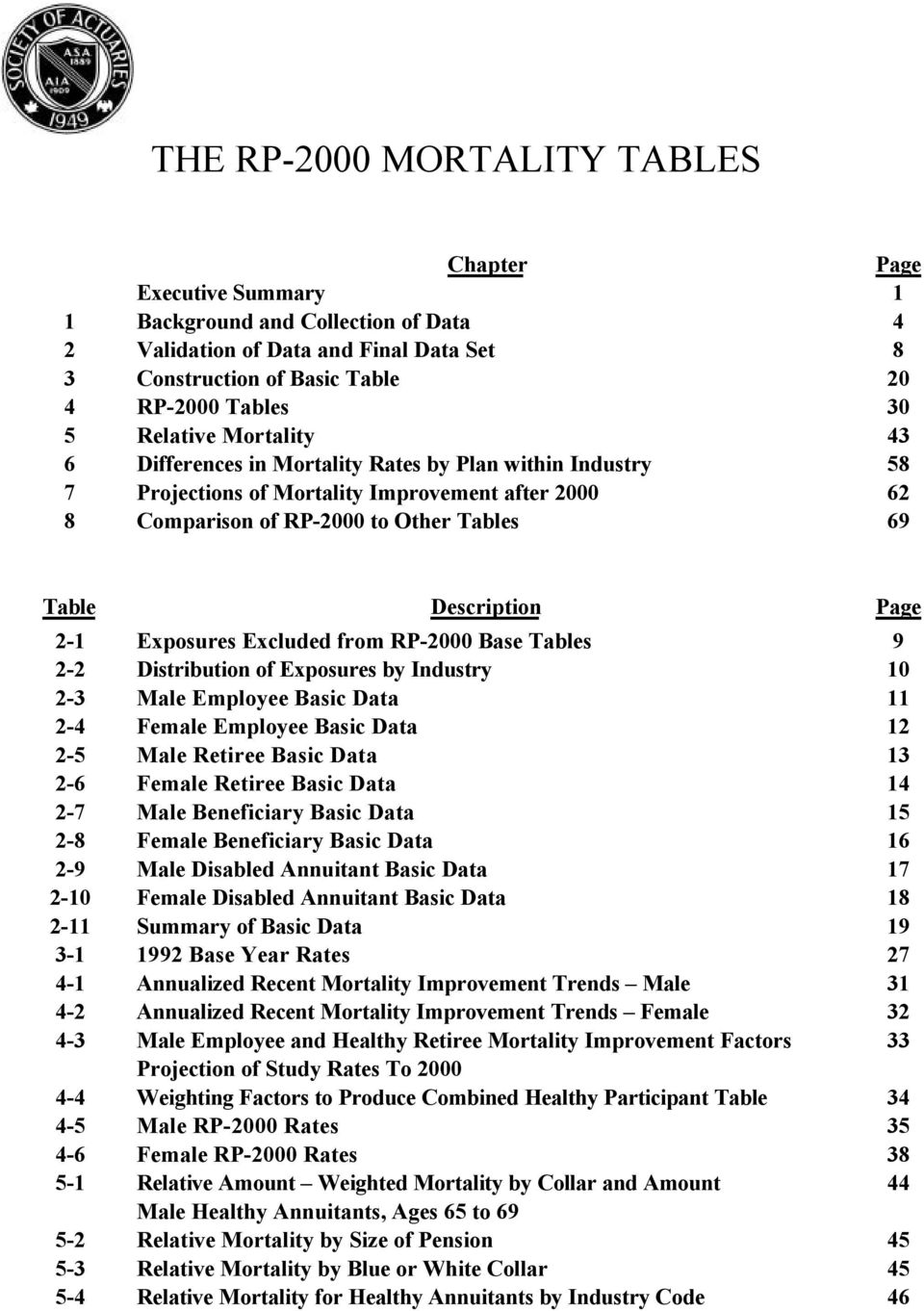
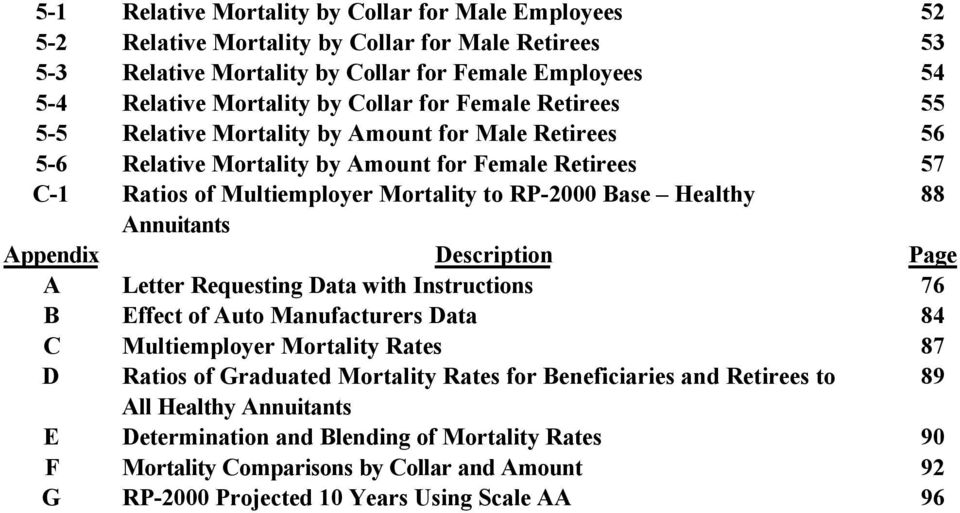
2 5-5 Ratio of Graduated Mortality Rates by Collar to Overall Mortality 49 for Employees 5-6 Ratio of Graduated Mortality Rates by Collar and Amount to Overall 50 Mortality for Healthy Annuitants Male Lives 5-7 Ratio of Graduated Mortality Rates by Collar and Amount to Overall 51 Mortality for Healthy Annuitants Female Lives 6-1 Variation of Mortality by Plan Within Industry - 23 Plans in 4 59 Industries 6-2 Variation of Mortality by Plan Within Industry - 9 Plans with 61 Amount Information In One Industry 7-1 Annualized Long Term Mortality Improvement Trends Male Annualized Long Term Mortality Improvement Trends Female Mortality Projection Scale AA Comparison of GAM-83, UP-94, UP-94 Projected to 2000, and 70 RP-2000 Annuity Values - 5% Interest 8-2 Comparison of GAM-83, UP-94, UP-94 Projected to 2000, and 71 RP-2000 Annuity Values - 7% Interest 8-3 Comparison of GAM-83, UP-94, UP-94 Projected to 2000, and 72 RP-2000 Annuity Values - 9% Interest 8-4 Comparison of Current Liabilities Using PIMS Census Assuming 50% 74 Male 50% Female 8-5 Comparison of Current Liabilities Using PIMS Census Assuming 75% 75 Male 25% Female 8-6 Comparison of Current Liabilities Using PIMS Census Assuming 75% 75 Female 25% Male B-1 Volume Summary 84 B-2 Raw Employee Death Rates 85 B-3 Raw Healthy Retiree Death Rates 85 B-4 Raw Beneficiary Death Rates 86 B-5 Raw Disabled Retiree Death Rates 86 C-1 Ratios of Multiemployer Mortality to RP-2000 Base Healthy 87 Annuitants F-1 Mortality Comparison for Males Age F-2 Mortality Comparison for Males Age F-3 Mortality Comparison for Males Age F-4 Mortality Comparison for Males Age F-5 Mortality Comparison for Females Age F-6 Mortality Comparison for Females Age F-7 Mortality Comparison for Females Age F-8 Mortality Comparison for Females Age Figure Description Page 3-1 Female Retiree Raw and Graduated Amount Adjustment Factors Male Retiree Raw and Graduated Amount Adjustment Factors Comparison of RP-2000 Mortality Rates by Participant Status Males 41 Ages Comparison of RP-2000 Mortality Rates by Participant Status Females Ages

3 5-1 Relative Mortality by Collar for Male Employees Relative Mortality by Collar for Male Retirees Relative Mortality by Collar for Female Employees Relative Mortality by Collar for Female Retirees Relative Mortality by Amount for Male Retirees Relative Mortality by Amount for Female Retirees 57 C-1 Ratios of Multiemployer Mortality to RP-2000 Base Healthy 88 Annuitants Appendix Description Page A Letter Requesting Data with Instructions 76 B Effect of Auto Manufacturers Data 84 C Multiemployer Mortality Rates 87 D Ratios of Graduated Mortality Rates for Beneficiaries and Retirees to 89 All Healthy Annuitants E Determination and Blending of Mortality Rates 90 F Mortality Comparisons by Collar and Amount 92 G RP-2000 Projected 10 Years Using Scale AA 96
4 The RP-2000 Mortality Tables Executive Summary The Retirement Protection Act of 1994 (RPA) established mortality assumptions to be used when calculating Current Liabilities for pension plans. This was the first time that standard tables had been mandated for this purpose. The Secretary of the Treasury has the authority to promulgate a new table in the year The Society of Actuaries (SoA) conducted this study of uninsured pension plan mortality in response to RPA and to ensure that the Treasury Department would have current and thorough information available when it considers updating the mandatory mortality table. The SoA charged the Retirement Plans Experience Committee (RPEC) with the responsibility for conducting this study. The purpose of this report is to provide actuaries with all of the significant findings of the RPEC along with full explanation of when and how these should be used in reviewing or setting mortality rates for specific plans. The report does not recommend specific tables to the Secretary of Treasury to adopt in conformance to RPA. The SoA believes it is appropriately the role of the American Academy of Actuaries to recommend tables to the Secretary based on this mortality study and other pertinent information. This report presents the RP-2000 Tables, new graduated basic amount-adjusted mortality tables projected to the year 2000, and explains how the tables were developed. Scale AA is recommended for projecting the proposed mortality rates beyond the year The report compares experience by type of employment, amount of annuity, and industry. Actuaries should keep in mind that these tables were developed from experience on mortality for uninsured pension plans and are only recommended for use for those types of plans. The final database used for this study reflects nearly 11 million life-years of exposure and more than 190,000 deaths, all from uninsured pension plans subject to RPA Current Liability rules. More than 100 pension plans submitted data in response to the request from the RPEC for experience from plan years 1990 through The RPEC determined that this volume of data was sufficient to produce valid mortality tables. The contributors were asked to provide data defined by several characteristics including Standard Industrial Classification (SIC) and amount. The contributors indicated whether the plan covered hourly or salaried workers, and whether the plan was collectively bargained or not. Based on this information, plans were categorized as blue collar, white collar, or mixed collar. The data contributors summarized their mortality experience into cells by age, gender, and status (employees, retirees, disableds, and beneficiaries). For each cell, the RPEC asked the submitter to provide the number of participants on the valuation date, the amounts of annual pay or annuities, the number of deaths during the year following the valuation date, and the amounts associated with those deaths. While all data contributors included the number of participants and the number of deaths, many did not provide information on amounts. About 60 percent of the exposed employee lives and 40 percent of the exposed annuitant lives included

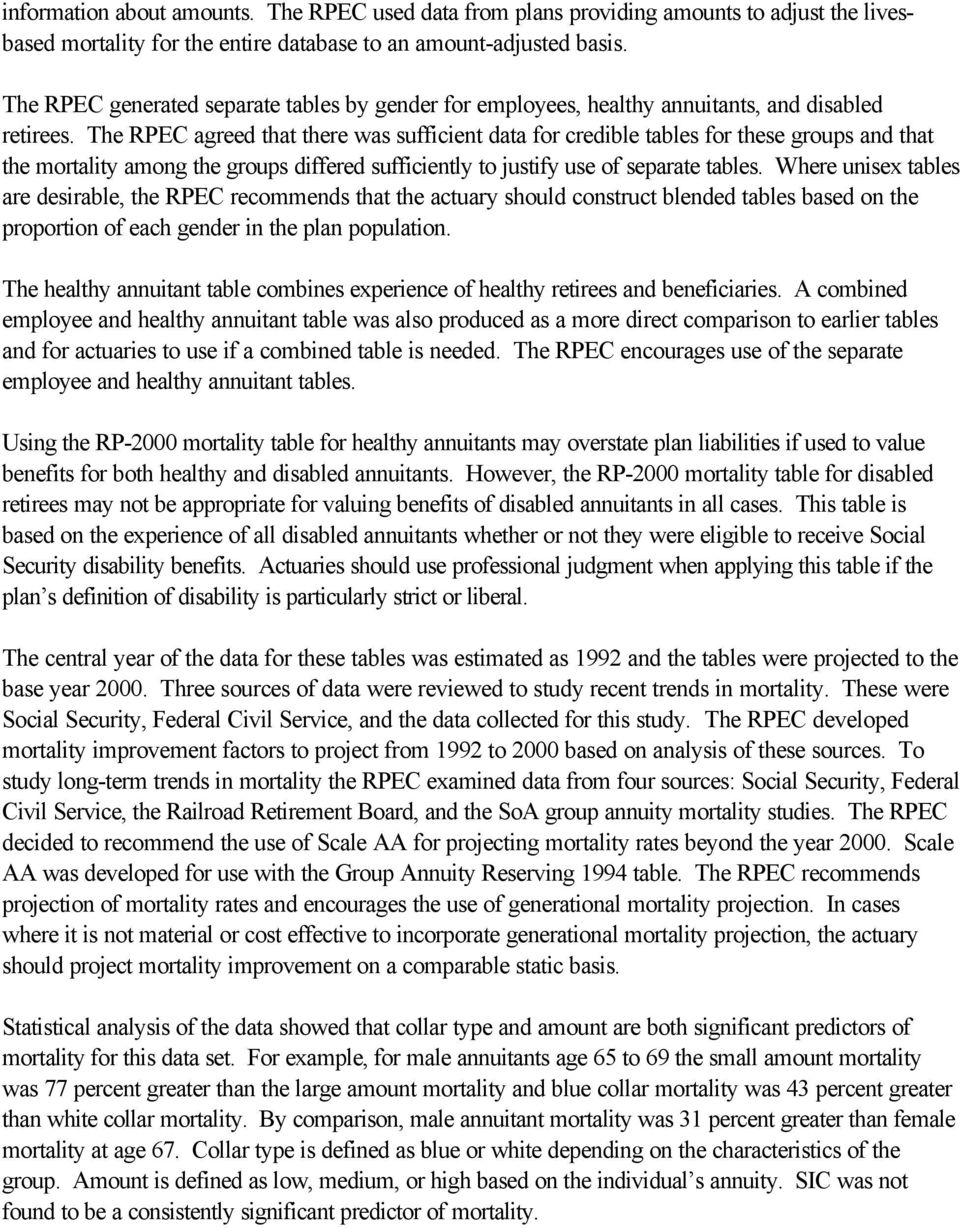
5 information about amounts. The RPEC used data from plans providing amounts to adjust the livesbased mortality for the entire database to an amount-adjusted basis. The RPEC generated separate tables by gender for employees, healthy annuitants, and disabled retirees. The RPEC agreed that there was sufficient data for credible tables for these groups and that the mortality among the groups differed sufficiently to justify use of separate tables. Where unisex tables are desirable, the RPEC recommends that the actuary should construct blended tables based on the proportion of each gender in the plan population. The healthy annuitant table combines experience of healthy retirees and beneficiaries. A combined employee and healthy annuitant table was also produced as a more direct comparison to earlier tables and for actuaries to use if a combined table is needed. The RPEC encourages use of the separate employee and healthy annuitant tables. Using the RP-2000 mortality table for healthy annuitants may overstate plan liabilities if used to value benefits for both healthy and disabled annuitants. However, the RP-2000 mortality table for disabled retirees may not be appropriate for valuing benefits of disabled annuitants in all cases. This table is based on the experience of all disabled annuitants whether or not they were eligible to receive Social Security disability benefits. Actuaries should use professional judgment when applying this table if the plan s definition of disability is particularly strict or liberal. The central year of the data for these tables was estimated as 1992 and the tables were projected to the base year Three sources of data were reviewed to study recent trends in mortality. These were Social Security, Federal Civil Service, and the data collected for this study. The RPEC developed mortality improvement factors to project from 1992 to 2000 based on analysis of these sources. To study long-term trends in mortality the RPEC examined data from four sources: Social Security, Federal Civil Service, the Railroad Retirement Board, and the SoA group annuity mortality studies. The RPEC decided to recommend the use of Scale AA for projecting mortality rates beyond the year Scale AA was developed for use with the Group Annuity Reserving 1994 table. The RPEC recommends projection of mortality rates and encourages the use of generational mortality projection. In cases where it is not material or cost effective to incorporate generational mortality projection, the actuary should project mortality improvement on a comparable static basis. Statistical analysis of the data showed that collar type and amount are both significant predictors of mortality for this data set. For example, for male annuitants age 65 to 69 the small amount mortality was 77 percent greater than the large amount mortality and blue collar mortality was 43 percent greater than white collar mortality. By comparison, male annuitant mortality was 31 percent greater than female mortality at age 67. Collar type is defined as blue or white depending on the characteristics of the group. Amount is defined as low, medium, or high based on the individual s annuity. SIC was not found to be a consistently significant predictor of mortality.
6 The RPEC found that both collar and amount can bear a relationship to the underlying mortality characteristics of a retirement plan. The RPEC recommends that the individual characteristics and experience of a retirement plan be considered in selecting the mortality table. In certain cases either collar or amount may be appropriate factors to consider, subject to the theoretical concerns outlined in Chapter 5. While either factor was found to be a statistically significant indicator of differences in mortality, the RPEC recognizes that for the majority of plans subject to RPA legislation, adjustment of the standard mortality tables in a manner consistent with the data collection method and results of this study will be considerably more practical if the collar factor is used. An analysis of the variability of mortality experience among plans in the same industry showed that differences were statistically significant in most cases tested. Actual deaths by plan ranged from about 20 percent below industry average to 30 percent above industry average. Significant differences were found even after adjusting for collar type and annuity size group. Annuity values based on the RP-2000 Tables were calculated and compared to annuity values based on the GAM-83 and UP-94 tables. In general, the RP-2000 values are between two and nine percent higher for males and between three and five percent lower for females than the GAM-83 values. The RP-2000 values for males under age 80 are within two percent of the values based on the UP-94 table projected to For males at ages 80 and 90 the RP-2000 values are substantially lower than the projected UP-94 values. For females the RP-2000 values are lower than the projected UP-94 values by about two to four percent.

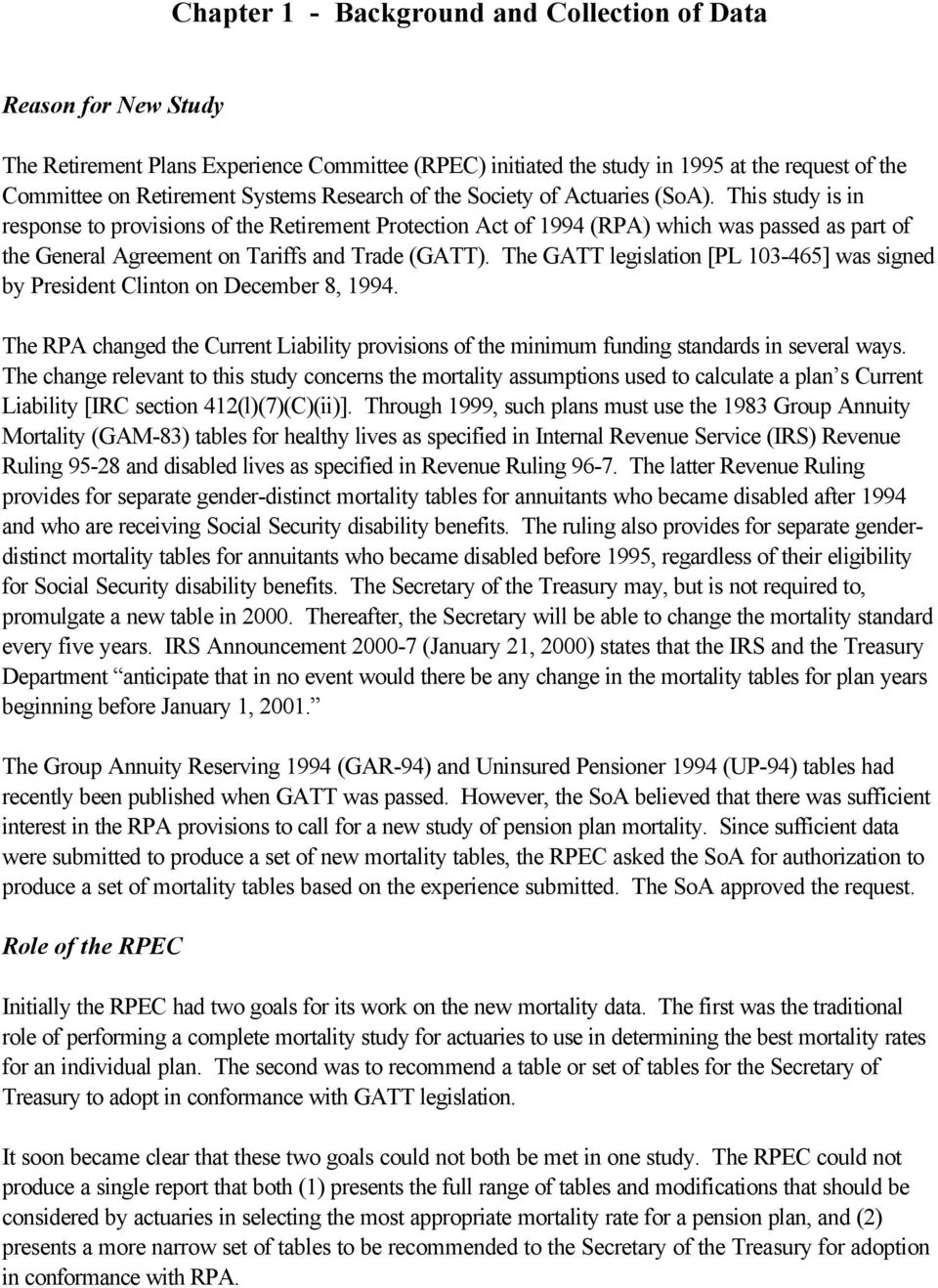
7 Chapter 1 - Background and Collection of Data Reason for New Study The Retirement Plans Experience Committee (RPEC) initiated the study in 1995 at the request of the Committee on Retirement Systems Research of the Society of Actuaries (SoA). This study is in response to provisions of the Retirement Protection Act of 1994 (RPA) which was passed as part of the General Agreement on Tariffs and Trade (GATT). The GATT legislation [PL ] was signed by President Clinton on December 8, The RPA changed the Current Liability provisions of the minimum funding standards in several ways. The change relevant to this study concerns the mortality assumptions used to calculate a plan s Current Liability [IRC section 412(l)(7)(C)(ii)]. Through 1999, such plans must use the 1983 Group Annuity Mortality (GAM-83) tables for healthy lives as specified in Internal Revenue Service (IRS) Revenue Ruling and disabled lives as specified in Revenue Ruling The latter Revenue Ruling provides for separate gender-distinct mortality tables for annuitants who became disabled after 1994 and who are receiving Social Security disability benefits. The ruling also provides for separate genderdistinct mortality tables for annuitants who became disabled before 1995, regardless of their eligibility for Social Security disability benefits. The Secretary of the Treasury may, but is not required to, promulgate a new table in Thereafter, the Secretary will be able to change the mortality standard every five years. IRS Announcement (January 21, 2000) states that the IRS and the Treasury Department anticipate that in no event would there be any change in the mortality tables for plan years beginning before January 1, The Group Annuity Reserving 1994 (GAR-94) and Uninsured Pensioner 1994 (UP-94) tables had recently been published when GATT was passed. However, the SoA believed that there was sufficient interest in the RPA provisions to call for a new study of pension plan mortality. Since sufficient data were submitted to produce a set of new mortality tables, the RPEC asked the SoA for authorization to produce a set of mortality tables based on the experience submitted. The SoA approved the request. Role of the RPEC Initially the RPEC had two goals for its work on the new mortality data. The first was the traditional role of performing a complete mortality study for actuaries to use in determining the best mortality rates for an individual plan. The second was to recommend a table or set of tables for the Secretary of Treasury to adopt in conformance with GATT legislation. It soon became clear that these two goals could not both be met in one study. The RPEC could not produce a single report that both (1) presents the full range of tables and modifications that should be considered by actuaries in selecting the most appropriate mortality rate for a pension plan, and (2) presents a more narrow set of tables to be recommended to the Secretary of the Treasury for adoption in conformance with RPA.
8 We discussed this issue with officials of the Society of Actuaries and agreed that our report should focus on the traditional role of providing full information with appropriate caveats on the source and potential use of the mortality tables. This report is not a recommendation to the Secretary of the Treasury for tables to adopt in conformance with RPA. The SoA believes it is appropriately the role of the American Academy of Actuaries to recommend tables to the Secretary based on this mortality study and other pertinent information. RPEC Process All of the RPEC meetings have been open. Representatives of the four government agencies with a potential interest in the work were kept informed of the meetings throughout and often attended the meetings. The four agencies are the Office of Tax Policy of the Treasury Department, the Internal Revenue Service (IRS), the Pension Benefit Guaranty Corporation (PBGC), and the Pension and Welfare Benefits Administration (PWBA) of the Department of Labor. Other interested parties, including representatives of the American Academy of Actuaries and other committees of the SoA have attended meetings. The minutes of all of the meetings have been published in the Pension Section News. RPEC Membership The members of the RPEC are Vincent Amoroso, Kevin Binder, John Kalnberg, Lindsay Malkiewich, Julie Pope, Barthus Prien, Gregory Schlappich, and Diane Storm. The Chair is Edwin Hustead and the Vice-Chair is Michael Virga. Four of the members had participated in the committees that had developed the UP-94 and GAR-94 mortality tables. Call for Data The RPEC developed a set of data submission instructions, along with an explanatory cover letter requesting the data (see Appendix A). These were sent to all members of the Pension Section of the Society of Actuaries on September 29, A letter from representatives of four large industrial companies to many of their colleagues encouraged participation in the study. The original deadline for submissions of December 31, 1995 was extended twice to allow for the submission of major sets of data that were being prepared. Eventually data collection was closed on June 1, Data Requested For each plan, actuaries were asked to provide a plan number assigned by the submitter, the plan sponsor s Standard Industrial Classification (SIC) code, and the type of participants (salaried, hourly, union, non-union, or a combination). If the participants were not all of one type, the submitter was asked to estimate the percentage of each type in the plan. Submitters were also asked to provide a

9 brief summary of eligibility and benefit formulas, the disability provisions, and any other information that would be helpful in interpreting the data.

10 Actuaries were asked to submit data celled according to the following characteristics: Valuation date Age nearest valuation date Gender Participant status - employee, non-disabled retiree, disabled retiree, or beneficiary Annuity size for retirees and beneficiaries - small (annuity of less than $6,000 a year), medium ($6,000 to $14,400 a year) or large (more than $14,400 a year) For each cell, the submitter was asked to provide the following information: The number of participants on the valuation date Total annual pay for employees Total annual benefit for retirees and beneficiaries Number and annual pay for deaths among employees during the year following the valuation date Number and annual benefit for deaths among retirees and beneficiaries during the year following the valuation date The preferred period of measurement was plan years ending in 1990 through Data Collection Process To ensure confidentiality, submissions were first received by Tom Edwalds, FSA, of the Society of Actuaries. The SoA staff checked that each submission contained both a computer diskette and hard copy of the data, along with a description of pertinent plan benefits. The three automobile industry submitters were concerned about confidentiality and asked for special processing of their data. The automobile industry submitted data split up into many small files in order to mask the identity of the contributor. The SoA staff verified that all of the small files used identical formats, that the hard copies all had the same appearance, and that the sum of the exposures and deaths by gender, collar, and status for the files submitted by each company matched the control totals provided. The small files were then copied onto four diskettes in such a way that each diskette contained some of the files submitted by each manufacturer. The hard copies of the data were placed into binders in the same order as the small files were organized on the diskettes. The list of plan numbers used by each manufacturer has been kept strictly confidential by SoA staff. The data were then forwarded to the research team contracted to code, review, and summarize the data. The research team consisted of Kathleen S. Elder, FSA, and Laxman Hegde, Ph.D., at Frostburg State University. Ms. Elder is an Associate Professor of Actuarial Science with over 14 years experience in the pension field. Dr. Hegde is a statistician with extensive consulting experience in statistical analysis and expertise in major statistical software. Development of Data Base

11 Elder consolidated the type categories into blue or white collar. The type was set as blue collar if more than 70 percent of the participants were hourly or union. The type was set as white collar if more than 70 percent of the participants were salaried and non-union. If the type could not be determined from the available information, Elder called the submitting actuary to determine if one of the two types could be assigned. If the type still could not be determined, it was set as mixed collar. Annuity size was coded as small, medium, or large based on the designation by the submitter using the definition provided by the RPEC. Other data were coded as unknown amount. Submitters were asked to use the straight-life equivalents of annuities, if possible. Only one plan submitted data that were specifically converted to the straight-life equivalent and most of the other submitters stated that the conversion was not made. The RPEC decided that combining all amounts as reported would not significantly distort the analysis. In order to maintain the confidentiality of the data, Elder then stripped the plan identifiers from the database prepared for the RPEC. Every cell accessible to the RPEC contained data from at least two plans, so the RPEC had no way of analyzing data by plan or of identifying or reconstructing the experience of any plan. Industry code was the initial two digits of the SIC code. Since there was only one plan in SIC 35xx (machinery except electrical) it was merged with the plans in industry code 36 (electrical and electronic machinery) to preserve confidentiality. After this combination and the exclusion of plans in two other codes for the reasons discussed in Chapter 2, there remained 35 industry codes in the data set. Thirty-eight percent of the submissions, including 58 percent of the exposure years, were for all plan years from 1990 through The rest covered a mix of years with some plans providing fewer than five years and others using a period that extended up to a year before or after the 1990 through 1994 plan years. The RPEC deemed a midpoint of 1992 to be appropriate for the combined data. A summary of plan provisions, including eligibility for early retirement and disability benefits, was submitted for almost all of the plans. This information was used to check for data inconsistencies such as retirees who were too young to retire under the plan provisions.
12 Chapter 2 - Validation of Data and Final Data Set The members of the RPEC and the research team reviewed all data for reasonableness. Elder discussed questions concerning potential errors with the submitters. Questions about the automobile industry data were relayed through Edwalds. Reasonableness checks were applied to the data received for each pension plan, including: aging of participant population by category from year to year significant increase/decrease in participant count by category from year to year unusual ages (e.g. old employees or young retirees) proportions of population in various groups (e.g. male/female, active/retiree) increases in salary from year to year After the initial review, the number of deaths in each of the individual pension plans was compared to the expected number of deaths based on the total experience of the entire group by category as defined by participant gender, collar, and status. Submitters of pension plans with data outside a 95 percent confidence interval were contacted to determine if a correction should be made. Some of the data sets were accepted as valid based on explanations by the submitters. Other data sets were corrected by the submitters. This procedure was used for all data contributions, including the auto manufacturers data. The reasonableness checks on the automobile data were performed by Edwalds because of the confidentiality agreement. All questioned data were corrected to the satisfaction of the RPEC. One of the auto manufacturers was among those who decided to resubmit corrected data. In order to maintain the confidentiality of all of the automobile contributors, Edwalds stripped the valuation date from the corrected submission and the submissions of the other firms from the automobile industry and combined them before forwarding the corrected data to the researchers. The RPEC voted to accept the auto manufacturers data, as corrected, into the final data set. Results were later compared with and without the auto manufacturers data. The RPEC found that the raw quinquennial death rates were quite similar both ways. Appendix B shows the effect of the auto manufacturers data. Some data were submitted with ages based on attained age rather than nearest age on respective valuation dates. These data were adjusted to an age nearest birthday basis by assigning one-half of the exposures and deaths to the age shown and one-half of exposures and deaths to the next age. Exclusions The primary reason for excluding data was incomplete information. Data submissions that combined all inactive statuses (healthy retirees, beneficiaries, and/or disability retirees) or combined active employees

13 with one or more inactive statuses were excluded. Data submitted in 5-year groups rather than single ages were also excluded. Data with unknown participant status were excluded. One plan was excluded because the measurement period for the deaths did not match the measurement period for the corresponding valuation cells of exposure. In other words, deaths reported by that plan included persons who were not in the exposure at the beginning of the year or who were included in the exposure at the end of the year of death. Records of retirees under age 28 and active employees under age 16 were excluded from the database. In addition, the RPEC excluded data of pension plans that are not directly affected by the RPA Current Liability rules so that the resulting mortality experience would be more appropriate for purposes of the Act. This resulted in the exclusion of data submitted for two large multiemployer pension plans in the transportation industry (industry code 42) and a large government pension plan (industry code 99). Table 2-1 summarizes the exposures excluded from the study by reason for exclusion. Table 2-1 Exposures Excluded from RP-2000 Base Tables Exposures Percent (000s) Multi-employer 1, % Government % Statuses not differentiated 1, % Exposure mismatch % Quinquennial ages 9 0.1% Ages out of range 1 0.0% Total excluded 3, % Total included 10, % Total submitted 14, % Appendix C compares the mortality of the multi-employer data that was excluded from the final data base. Since the total multi-employer data were only from two plans, the comparison is presented as information only and should not be used to establish multi-employer mortality tables.

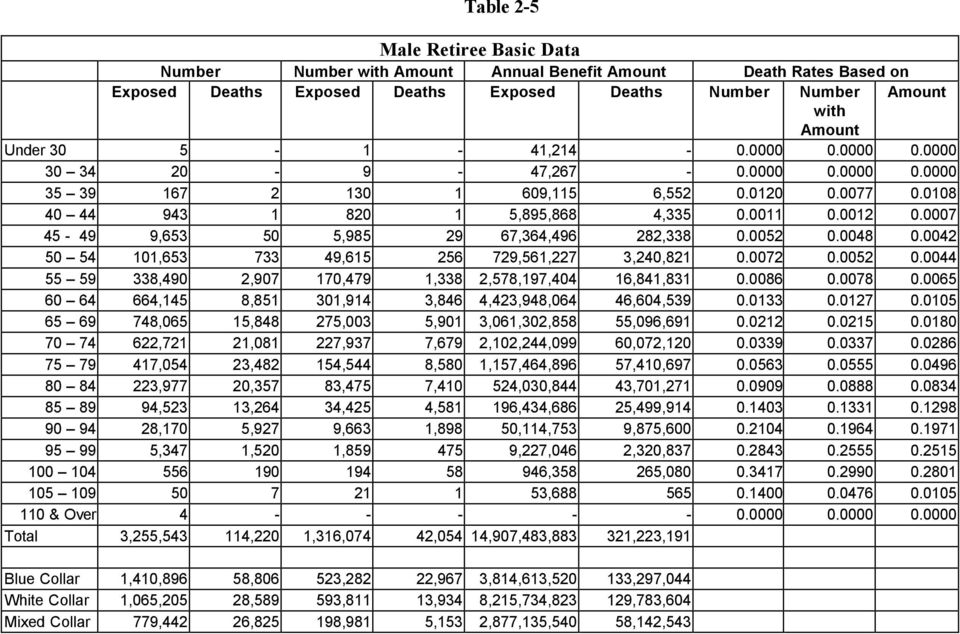
14 Resulting Data Set The data set accepted by the RPEC as the basis for the mortality tables in this report included 10,957,103 exposed life-years and 190,928 deaths. Table 2-2 shows the distribution of these exposures by industry and gender. Table 2-2 Distribution of Exposures by Industry Males Females Total SIC Industry Name Exposures Percent Exposures Percent Exposures Percent (000s) (000s) (000s) 37 Transportation 3,119 42% 1,142 33% 4,261 39% 36 Electronic Equipment 1,310 18% % 1,825 17% 48 Communications 552 7% % 1,080 10% 29 Petroleum 377 5% 101 3% 477 4% 33 Primary Metal Industries 373 5% 92 3% 465 4% 28 Chemicals 266 4% 148 4% 414 4% 26 Paper 120 2% 71 2% 192 2% 13 Oil and Gas Extraction 110 1% 43 1% 153 1% All Other 1,216 16% % 2,089 19% Total 7, % 3, % 10, % Table 2-2 shows that the Transportation industry data were 39 percent of the total and a substantial portion of the data in Transportation came from the auto industry. None of the auto industry data included the amount of salary or annuity. The RPEC reviewed the results with and without the auto industry to determine if the experience would have been substantially different without the auto industry. Results of that review are shown in Appendix B. Tables 2-3 through 2-10 summarize the data for male and female exposures for employees, healthy retirees, beneficiaries, and disabled lives. Table 2-11 aggregates all data. Amounts were reported for 50 percent of the exposures. About 60 percent of the exposed employee life-years and 38 percent of the exposed annuitant life-years included information about amounts. Tables 2-3 through 2-10 compare raw death rates computed by dividing deaths by exposures within age groups for three categories. The first is the death rates based on number from the entire data base. The second is the death rates based on number only for data for which amount was reported. The third is the death rates based on amount. The comparison of the two death rates determined by number shows that, in general, there was not a substantial difference between the death rates for the entire data base and the data base limited to those with amount reported.

15 Table 2-3 Male Employee Basic Data Number Number with Amount Annual Pay Amount Death Rates Based on Exposed Deaths Exposed Deaths Exposed Deaths Number Number Amount with Amount Under 20 4, ,818-14,944, , , ,849, , , , ,432,400,241 2,322, , , ,381,451,767 6,957, , , ,380,265,328 15,810, , , ,015,234,526 23,428, ,397 1, , ,965,721,062 36,256, ,545 1, , ,290,300,385 41,822, ,072 1, , ,952,868,958 32,159, ,549 1,027 59, ,255,013,808 19,797, , , ,454,515 4,409, , , ,851,106 1,031, ,849, , ,838, , ,019,298 70, , & Over Total 3,872,245 7,911 2,159,681 4, ,263,288, ,929,921 Blue Collar 1,587,710 4, ,458 1,482 23,759,818,389 50,406,611 White Collar 1,853,701 3,063 1,469,965 2,407 79,398,379, ,855,193 Mixed Collar 430, , ,105,090,637 4,668,117

16 Table 2-4 Female Employee Basic Data Number Number with Amount Annual Pay Amount Death Rates Based on Exposed Deaths Exposed Deaths Exposed Deaths Number Number Amount with Amount Under 20 5,538-2,776-21,462, , , ,146,112, , , , ,352,463, , , , ,409,980,625 2,716, , , ,465,073,137 5,190, , , ,885,989,499 7,472, , , ,673,208,286 9,271, , , ,932,203,561 7,814, , , ,853,462,893 5,130, , , ,337,381 2,879, , , ,074, , , ,371, , ,163, , , , & Over Total 1,862,358 1,911 1,294,513 1,310 43,594,133,184 42,507,164 Blue Collar 628, , ,775,671,329 13,922,012 White Collar 926, , ,608,349,947 26,500,749 Mixed Collar 307, , ,210,111,908 2,084,403

17 Table 2-5 Male Retiree Basic Data Number Number with Amount Annual Benefit Amount Death Rates Based on Exposed Deaths Exposed Deaths Exposed Deaths Number Number Amount with Amount Under , , ,115 6, ,895,868 4, , , ,364, , , , ,561,227 3,240, ,490 2, ,479 1,338 2,578,197,404 16,841, ,145 8, ,914 3,846 4,423,948,064 46,604, ,065 15, ,003 5,901 3,061,302,858 55,096, ,721 21, ,937 7,679 2,102,244,099 60,072, ,054 23, ,544 8,580 1,157,464,896 57,410, ,977 20,357 83,475 7, ,030,844 43,701, ,523 13,264 34,425 4, ,434,686 25,499, ,170 5,927 9,663 1,898 50,114,753 9,875, ,347 1,520 1, ,227,046 2,320, , , , & Over Total 3,255, ,220 1,316,074 42,054 14,907,483, ,223,191 Blue Collar 1,410,896 58, ,282 22,967 3,814,613, ,297,044 White Collar 1,065,205 28, ,811 13,934 8,215,734, ,783,604 Mixed Collar 779,442 26, ,981 5,153 2,877,135,540 58,142,543
18 Table 2-6 Female Retiree Basic Data Number Number with Amount Annual Benefit Amount Death Rates Based on Exposed Deaths Exposed Deaths Exposed Deaths Number Number Amount with Amount Under , , ,550 1, ,056,493 2, , , ,822, , , , ,335, , , , ,810,725 2,198, ,898 1,312 81, ,923,617 5,716, ,458 2,386 68, ,788,435 5,207, ,995 3,447 52,357 1, ,630,042 5,685, ,048 3,932 32,526 1, ,371,546 4,767, ,361 3,959 20,779 1,190 81,625,350 4,572, ,215 3,217 10, ,612,321 3,506, ,078 1,745 3, ,885,158 1,735, , ,680, , ,494 18, ,232 2, & Over , Total 865,117 20, ,136 6,714 2,536,846,962 34,445,224 Blue Collar 266,590 7, ,929 2, ,319,008 12,737,913 White Collar 324,791 7,975 72,071 1, ,338,533 7,098,717 Mixed Collar 273,736 5, ,136 2,716 1,279,189,421 14,608,594

19 Table 2-7 Male Beneficiary Basic Data Number Number with Amount Annual Benefit Amount Death Rates Based on Exposed Deaths Exposed Deaths Exposed Deaths Number Number Amount with Amount Under , , , , ,446 4, ,048 3, ,343 27, ,884,893 13, , ,478,958 37, , , ,617,797 91, , , ,214, , , , ,150, , , , ,501, , , , ,354, , ,818, , ,997 75, ,190 10, , & Over Total 23,034 1,138 11, ,551,237 1,434,078 Blue Collar 11, , ,954, ,096 White Collar 8, , ,019, ,814 Mixed Collar 2, , ,577, ,168

20 Table 2-8 Female Beneficiary Basic Data Number Number with Amount Annual Benefit Amount Death Rates Based on Exposed Deaths Exposed Deaths Exposed Deaths Number Number Amount with Amount Under , ,900 2, , ,807 4, , ,834, , , ,350,227 22, , , ,072,133 20, , , ,105, , , , ,115, , , , ,017, , ,110 2,138 43, ,641,568 2,044, ,516 3,918 53,526 1, ,397,319 3,444, ,176 5,398 46,355 1, ,269,138 3,490, ,254 5,597 28,425 1,579 58,171,801 3,019, ,665 4,316 12,568 1,084 24,356,125 2,055, ,800 2,243 3, ,359, , , ,518, , ,091 30, , & Over Total 709,175 25, ,983 7, ,137,356 16,909,407 Blue Collar 435,866 16, ,870 3, ,855,451 5,437,415 White Collar 199,065 6,382 78,256 2, ,509,858 6,094,324 Mixed Collar 74,244 2,973 55,857 2, ,772,047 5,377,668

21 Table 2-9 Male Disabled Annuitant Basic Data Number Number with Amount Annual Benefit Amount Death Rates Based on Exposed Deaths Exposed Deaths Exposed Deaths Number Number Amount with Amount Under , , , ,908 22, , ,854, , , , ,464, , , , ,936,344 1,235, ,001 1,325 7, ,729,312 2,326, ,231 2,280 12, ,975,061 3,919, ,983 3,191 14, ,038,223 5,041, ,139 3,439 12, ,031,912 5,403, ,661 2,742 7, ,206,389 3,957, ,371 1,521 3, ,280,919 2,212, , ,856, , ,031, , ,615 85, & Over , Total 292,182 16,584 67,810 4, ,473,665 26,009,939 Blue Collar 213,502 12,006 40,967 2, ,086,285 12,721,277 White Collar 46,605 2,517 11, ,952,954 5,402,883 Mixed Collar 32,075 2,061 15, ,434,426 7,885,779
22 Table 2-10 Female Disabled Annuitant Basic Data Number Number with Amount Annual Benefit Amount Death Rates Based on Exposed Deaths Exposed Deaths Exposed Deaths Number Number Amount with Amount Under , , ,811 12, , ,176,023 69, , , ,660, , , , ,876, , , , ,335, , , , ,931, , , , ,861, , , , ,247, , , , ,768, , , , ,271, , , , ,075, , ,081, , ,362 21, & Over , Total 77,463 2,652 23, ,073,866 4,290,155 Blue Collar 53,656 1,792 8, ,410,784 1,482,027 White Collar 11, , ,229,344 1,067,199 Mixed Collar 11, , ,433,738 1,740,929
23 Table 2-11 Summary of Basic Data Number Number with Amount Annual Benefit Amount Percent with Amounts Exposed Deaths Exposed Deaths Exposed Deaths Exposed Deaths Employees Male 3,872,245 7,911 2,159,681 4, ,263,288, ,929, % 50.87% Female 1,862,358 1,911 1,294,513 1,310 43,594,133,184 42,507, % 68.55% Total 5,734,603 9,822 3,454,194 5, ,857,421, ,437, % 54.31% Healthy Retirees Male 3,255, ,220 1,316,074 42,054 14,907,483, ,223, % 36.82% Female 865,117 20, ,136 6,714 2,536,846,962 34,445, % 32.09% Total 4,120, ,141 1,655,210 48,768 17,444,330, ,668, % 36.09% Beneficiaries Male 23,034 1,138 11, ,551,237 1,434, % 43.67% Female 709,175 25, ,983 7, ,137,356 16,909, % 29.87% Total 732,209 26, ,611 8, ,688,593 18,343, % 30.45% Disabled Retirees Male 292,182 16,584 67,810 4, ,473,665 26,009, % 25.25% Female 77,463 2,652 23, ,073,866 4,290, % 35.03% Total 369,645 19,236 90,964 5, ,547,531 30,300, % 26.60% Total Annuitants 5,222, ,115 2,000,785 62,028 18,709,566, ,311, % 34.25%
24 Chapter 3 - Construction of Basic Table Selection and Production of Basic Tables The primary tables produced by the RPEC are the following gender distinct tables: Employees Healthy Annuitants (healthy retirees and beneficiaries combined) Disabled Retirees The RPEC elected to publish separate tables for healthy annuitants and employees because the data for ages with substantial experience from both data sets indicated that mortality is significantly lower for employees than for healthy annuitants. The RPEC found that there was a significant difference between the mortality for female beneficiaries and healthy female retirees. However, the RPEC decided that there was not enough data on male beneficiaries to determine male beneficiary mortality rates. While separate tables could have been produced for female retirees and beneficiaries, the RPEC believes that the practicing actuary need not use distinct tables for these groups. For the purpose of calculating Current Liabilities, RR 96-7 mandates the use of the same mortality table for healthy annuitants and disabled annuitants when Social Security disability status is unknown and the disabilities occurred after This precludes the use of separate mortality tables for disabled annuitants in that case. The data contributors for this study did not provide information on the subgroup of disabled retirees who were also receiving Social Security benefits. Therefore, the RP-2000 mortality table for disabled annuitants presented in this report is not appropriate to predict the mortality of either of the post-1994 disabled subgroups specified in RR 96-7 but it may be appropriate for mortality of those disabled before However, using the RP-2000 mortality table for healthy annuitants may overstate plan liabilities if used to value benefits for both healthy and disabled annuitants. The tables were produced through the following steps, described in this chapter: The raw q x s were determined based on lives Amount-adjusted q x s were determined by applying amount adjustment factors Healthy retiree and beneficiary rates were blended to produce healthy annuitant rates The amount-adjusted q x s were graduated
25 Tables were extended to extreme ages
26 Selection of Graduation Methods Selection of an appropriate graduation method is critical to the production of an actuarial mortality table. In this case, as for previous published tables, the final rates were graduated to produce a set of rates that change continuously to reflect underlying mortality patterns. Graduation was also used to determine the amount-adjusted q x s. The selection of a graduation method involves a compromise between smoothness and fit. The task of the RPEC was to use methods that produced reasonably smooth tables but did not mask major underlying characteristics of mortality. For instance, the use of a Gompertz or Makeham formula creates very smooth rates but masks the deceleration of mortality increases at the very old ages. The two methods used by the actuarial profession in the United States have been Whittaker- Henderson Type B and Karup-King. Whittaker-Henderson Type B is more precise for large bodies of data. Since the data set was very large, the RPEC decided to use the Whittaker- Henderson Type B graduation method for all graduation purposes. The key parameters for this method are the number of differences, and the h value. In particular, higher values of h result in greater smoothness. [London, Dick Graduation: The Revision of Estimates] Figures 3-1 and 3-2 show the raw amount adjustment factors (ratios of average amount for deaths to average amount exposed) and two different graduations of the raw rates. This highlights the differences between using the regular graduation that is often used for final smoothing and heavy graduation. The heavy graduation (achieved with fewer differences and higher h values) produces very smooth results but masks some of the key underlying trends. In the graph, the regular graduation uses third differences and an h value of 1,000,000. The heavy graduation uses second differences and an h value of 100,000,000. The RPEC reviewed graduation tables within all of the reasonable ranges of h values and differences to select the graduation method most appropriate to each purpose and each set of data. Rates for healthy annuitants needed little graduation so the lightest variables were selected. At the other extreme, since graduation for amount-adjustment purposes was only to establish a smooth range of relative factors, a much heavier graduation was used. The RPEC used the following criteria in selection of Whittaker-Henderson variables for the final graduation process: There should be no or a minimum number of occurrences of q x <0 There should be no or a minimum number of occurrences of q x >1 There should be no or a minimum number of occurrences of q x > q x+1 Variation between the smoothed q x s and the ungraduated q x s should be minimized
27 Figure 3-1 Female Retiree Raw and Graduated Amount Adjustment Factors Amount Adjustment Factor Age Ungraduated Graduated (Regular) Graduated (Heavy)
28 Figure 3-2 Male Retiree Raw and Graduated Amount Adjustment Factors Amount Adjustment Factor Age Ungraduated Graduated (Regular) Graduated (Heavy)
29 Determination of Raw q x s for Lives For each age the number of deaths was divided by the number of life-years exposed to produce the raw q x value. Separate tables were produced by gender and status. Amount-adjusted q x s As with mortality tables for life insurance, the GAM-83, GAR-94, and UP-94 mortality tables were developed using amounts rather than lives, i.e. they were determined by dividing total annuity amounts for those who died by total annuity amounts for all exposed by age. This approach is equivalent to liability weighting. Liability-weighted mortality has been the general practice in developing mortality tables for the measurement of actuarial liabilities. Life insurance tables, for instance, are developed based on face amount of insurance as the base rather than number of individuals. The reason for using liability-weighted measures can be seen through an example. Assume that a plan covers two groups of 1,000 annuitants age 65. The members of the first group all have a monthly annuity of $100 and the members of the second group all have a monthly annuity of $1,000. If the true present value of an annuity of $1 per year is 10.0 for members of the first group and 12.0 for members of the second group (resulting from lower mortality) then the total liability for the plan will be $156 million. A table that was not adjusted for differences in amount would produce an average present value factor of 11.0, which would result in an estimated liability of $145 million, thereby understating plan liabilities by $11 million or 7 percent. A liability-weighted present value factor of applied to the entire group would produce the correct liability of $156 million. Since the data for previous mortality studies were gathered predominately from group annuity data supplied by insurance companies, amount data were readily available. The data for the current study presented a new problem. A substantial portion of the submitters supplied only the number of lives exposed and the number of deaths and did not supply information on amounts. As with previous studies, the current data set shows significantly higher mortality based on number of lives than based on amount of benefits for retirees or amount of salary for employees. Liabilities for pension plans are automatically weighted by amounts. Therefore, the RPEC decided to determine the mortality rates based on amounts. The amount of salary was included for 60 percent of the employees but only 54 percent of employee deaths. The amount of benefit was included for 38 percent of the annuitants but only 34 percent of annuitant deaths. In total, information about amounts was included for 50 percent of participants and 35 percent of deaths. For the submissions that provided information on amounts, the RPEC determined:
30 a) Amount-based q x s, which are the total annuity amounts for deaths divided by total annuity amounts exposed, and b) Life-based q x s, which are numbers of deaths divided by numbers of life-years exposed.
31 The RPEC assumed that the relationship between (a) and (b) for the subset of submissions that supplied information on amounts was representative of the entire data set (including submissions that did not provide information on amounts). After a thorough review of the data, the RPEC believed this assumption to be practical and plausible. Accordingly the RPEC adjusted the data for submissions which did not provide information on amounts. The quotient of (a) divided by (b) is the "amount adjustment factor." The amount adjustment factor represents the difference of analyzing pension mortality data based on amounts versus analyzing only the number of deaths and exposures. Amount adjustment factors by age were determined separately for employees, healthy retirees, survivors, and disabled lives. For the submissions that only supplied the number of deaths and exposures, mortality rates were multiplied by the amount adjustment factors. Since there was considerable variation in amount adjustment factors from one age to the next, the RPEC decided to first graduate these factors separately before applying them to the q x values for lives. The amount adjustment factors were graduated using the Whittaker-Henderson method with second differences and an h value of 100,000,000. The ungraduated mortality rates based on number of lives were then multiplied by the graduated amount adjustment factors to produce ungraduated amount-adjusted mortality rates. Blending of Healthy Retiree and Beneficiary Data The graduated amount adjustment factors and ungraduated amount-adjusted mortality rates were determined separately for healthy retirees and beneficiaries. The RPEC decided to combine the healthy retiree and beneficiary rates into one healthy annuitant table. There were not sufficient data for a separate male beneficiary table but there were sufficient data for a separate female beneficiary table. However, the RPEC believed that a separate female beneficiary table would have added unnecessary complexity to valuations without substantially increasing validity. Appendix D shows the ratios of the graduated mortality rates for beneficiaries and retirees to the graduated mortality rates for retirees and beneficiaries combined. The ungraduated amount-adjusted mortality rates for healthy retirees and beneficiaries combined were then determined as a weighted average of the corresponding amount-adjusted mortality rates. The weights for healthy retirees and beneficiaries, respectively, at each age were the product of the total number of lives exposed at that age times the average amount exposed for those plans that did provide data on amounts. An example of how this blended rate is determined is given in Appendix E.
32 Graduation of Amount-adjusted q x s The resulting amount-adjusted mortality rates for employees, healthy annuitants, and disabled annuitants were graduated using Whittaker-Henderson with third differences and h values of 1,000,000 for healthy annuitants and 10,000,000 for employees and disabled lives. Mortality rates for disabled annuitants were set equal to the mortality rates for healthy annuitants at and after the point at which the graduated rates for disabled annuitants dropped below those for healthy annuitants. This occurred at age 89 for males and 91 for females. Extension to Extreme Ages The above process produced mortality rates between the following ages: Employee ages 30 through 70 Healthy annuitant ages 50 through 100 Disabled retiree ages 45 through 100 Mortality rates for employees were extended below age 30 to blend with the UP-94 table. Rates for ages 1 through 10 were set equal to the UP-94 table. Rates for ages 11 through 29 were interpolated from the UP-94 rate at age 10 to the current study rates at age 30 using cubic interpolation formulas that were designed to reproduce the general shape of the 1990 U.S. Life table at these ages. The RPEC did not find any reliable data for mortality rates over age 100. However, they agreed with the developers of the GAR-94 and UP-94 tables that the mortality curve decelerates at the older ages resulting in a limiting mortality rate below The rate of increase in the q x s diminishes after age 90 but the q x s are still increasing in the late 90s. The RPEC decided that there should be an upper limit to the mortality rate that would be the same for males and females and that would form a reasonable extrapolation of the rate of increase after age 95. A limiting q x of 0.4 fit these criteria. A cubic polynomial was selected for each gender such that the polynomial reproduced the value of q x at age 99 and 100 and attained the limiting value of.4 at an age where the slope was 0, with no inflection points between age 100 and that age. This resulted in rates that hit the 0.4 limit at age 106 for males and 115 for females. Since there was no discernible pattern of mortality rates for disabled retirees below age 45, these rates for disabled retirees from ages 21 to 44 were set equal to the rate at age 45. Other sets of data show that the mortality rates for young disabled retirees sometimes decline as age increases. However, this effect is usually related to the number of years after disability rather than age. As a result, the RPEC agreed that a table that used the same rate at all ages under 45 would be reasonable.
33 Table 3-1 shows the resulting mortality rates by age, gender, and status.
34 Table Base Year Rates Age Employees Healthy Annuitants Disabled Retirees Males Females Males Females Males Females
35
36 Table Base Year Rates Age Employees Healthy Annuitants Disabled Retirees Males Females Males Females Males Females
37 Table Base Year Rates Age Employees Healthy Annuitants Disabled Retirees Males Females Males Females Males Females and over
38 Chapter 4 - RP-2000 Tables Projection to 2000 The rates of Table 3-1 were projected to 2000 based on a review of three sets of data. These were Social Security data, federal retiree data, and the study data. The RPEC analyzed the data Social Security actuaries used to prepare Actuarial Study 110, Social Security Area Population Projections 1996 from the Office of the Actuary of the Social Security Administration (SSA) 1. Mortality rates by gender and five-year age groups through 1994 were available. The RPEC used the Social Security data covering 1990 to 1994 because that was the subset of rates that centered on 1992, the mid-year of the experience period, and ended with 1994, the latest year in the data set. The Federal Office of Personnel Management (OPM) provided mortality experience for Federal Civil Service annuitants through These data have the advantages of spanning a long time period and containing a large number of exposures confined to pension plan participants only. The RPEC used the Federal Civil Service data covering 1988 to 1996 because that was the subset of rates that centered on 1992, the mid-year of the experience period, and ended with 1996, the latest year in the data set. The RPEC analyzed the data collected for this study for trends in mortality rates for employees, beneficiaries, and healthy retirees separately, as well as all data combined, including only data for plans that submitted data for all five years. There were not sufficient consistent data to analyze trends for disabled retirees. The subset of study data that encompassed all years from 1990 through 1994 was approximately 8,000,000 exposures. Even for very large data sets, such as Social Security data, clear mortality trends are difficult to observe from raw year-to-year data. To better observe the trends, the RPEC calculated leastsquares regression lines through the logarithms of the raw mortality rates by year for each quinquennial age group for each gender for each data set. The best-fit log-linear mortality improvement trends were calculated using the slopes of these regression lines. For each regression line, the best-fit log-linear mortality improvement trend equals one minus the antilog of the slope. Tables 4-1 and 4-2 compare the best-fit log-linear mortality improvement trends by data source. These tables compare recent mortality improvement from the data collected for this study on employees and healthy annuitants combined ( ), from Social Security data ( ), and from Federal Civil Service data ( ). For illustrative purposes, these tables also include the comparable factors used to construct the GAR-94 table. As with the current study, the 1 Death rates for ages under 65 were calculated using the number of deaths as tabulated in Vital Statistics of the United States and using the latest census estimates of the population. For ages 65 and over, records of the Medicare program were used to determine the rates by age and gender.
39 developers of the GAR-94 table determined that there was a difference between the short-term projection trends needed to bring the table to the date of publication and the longer-term trends needed to project the table beyond the date of publication. Age Table 4-1 Annualized Recent Mortality Improvement Trends Male Study Data Social Security Federal Civil Service GAM % 1.70% % 0.99% -0.10% % -1.58% -1.00% % -1.41% 0.70% % -2.85% 1.90% % 0.06% 1.70% % 0.47% 1.80% % 1.83% 1.13% 1.80% % 1.26% 1.72% 1.80% % 0.96% 0.93% 1.20% % 1.06% 1.22% 1.70% % 1.08% 1.59% 2.30% % 0.47% 1.43% 1.80% % -0.49% 0.78% 1.30% % -0.82% 0.41% 0.70% Study Data: Best-fit log-linear mortality improvement for 1990 to 1994 from combined healthy data from study. Social Security: Best-fit log-linear mortality improvement for 1990 to 1994 from data supplied by Social Security used to prepare Actuarial Study 110 for all employees and retirees. Federal Civil Service: Best-fit log-linear mortality improvement for graduated mortality tables for 1988 to 1996 based on healthy retirees. GAM 88-94: Factors used to project GAR-94 tables from 1988 to 1994.
40 Age Table 4-2 Annualized Recent Mortality Improvement Trends Female Study Data Social Security Federal Civil Service GAM % 1.60% % -0.59% 0.90% % -1.24% 0.50% % -2.19% 0.80% % -1.42% 1.30% % 0.56% 1.90% % 0.94% 0.80% % 1.09% 0.92% 0.80% % 0.49% 0.10% 0.00% % -0.07% 0.44% 0.70% % 0.06% 1.07% 2.00% % -0.13% 1.10% 1.50% % -0.30% 0.64% 1.00% % -0.49% 0.30% 0.90% % -0.47% 0.08% 0.90% Study Data: Best-fit log-linear mortality improvement for 1990 to 1994 from combined healthy data from study. Social Security: Best-fit log-linear mortality improvement for 1990 to 1994 from data supplied by Social Security used to prepare Actuarial Study 110 for all employees and retirees. Federal Civil Service: Best-fit log-linear mortality improvement for graduated mortality tables for 1988 to 1996 based on healthy retirees. GAM 88-94: Factors used to project GAR-94 tables from 1988 to The five-year age groupings did not produce a pattern that could be directly applied to a graduated mortality table. However, it did enable the RPEC to develop a general pattern of mortality to project results from the mid-year of the experience, 1992, to the date of the table, Measurement of mortality improvement requires voluminous, consistent data covering many years. While interesting, the study data were not subjected to the rigorous, consistent methodology applied by SSA and OPM in the tracking of mortality trends. The study data also were not consistently submitted for all five years and even many of those plans that did have five years of data had sharp differences in exposure through the period. Therefore, the basis for selecting mortality improvement focussed on the Social Security and Federal Civil Service data. Mortality improvement trends for males from age 55 through age 80 for Social Security and Federal Civil Service were all significantly positive. Trends for males at other ages and trends for females at all ages produced mixed results including many negative and insignificant trends. The RPEC decided to use trends only for male employees and male healthy retirees. The average improvement trend for males between ages 55 and 80 was close to 1.0 percent a year for the Social Security and Federal Civil Service data. The RPEC selected an annual
41 improvement factor of 1.0 percent for male employees and healthy retirees aged 55 through 80. Some of the improvement trends calculated for ages in that range are greater than 1.0 but the RPEC believed that use of factors that varied within that set of ages would give a false sense of precision. The 1.0 percent factor was graded down to zero below age 46 and above age 89 to avoid a discontinuity in the projected rates. The complete set of factors is shown in Table 4-3. The improvement factors discussed here are only to project the data to the year 2000 based on recent short-term experience. Chapter 7 discusses projection beyond the year 2000 based on long-term experience. Thus the improvement factors in Table 4-3 are different from the improvement factors in Table 7-3. Table 4-3 Male Employee and Healthy Retiree Mortality Improvement Factors Projection of Study Rates to 2000 Age Annual Improvement Rate Age Annual Improvement Rate Under 46 0% 81.9% 46.1% 82.8% 47.2% 83.7% 48.3% 84.6% 49.4% 85.5% 50.5% 86.4% 51.6% 87.3% 52.7% 88.2% 53.8% 89.1% 54.9% Over 89 0% 55 to % Combined Healthy Participant Table The RPEC also produced a combined Healthy Participant Table by blending the employee and healthy annuitant tables, primarily to permit a direct comparison to previously published tables including the UP-94 table. Comparisons of liabilities are shown at the end of Chapter 8. The RPEC was also concerned that some computer programs and systems could not readily adopt separate employee and annuitant tables. The RPEC encourages use of the separate employee and healthy annuitant tables when possible. For employees over the age of 70, healthy annuitant mortality rates should be used. Since many contributors submitted retiree data but no employee data, direct use of all of the study data would have weighted retiree data too heavily. Therefore, the RPEC determined the weighting factors using the subset of data for which both active and retired experience had been submitted. The resulting weights are shown in Table 4-4. Where unisex tables are desirable, the RPEC recommends that the actuary should construct blended tables based on the proportion of each gender in the plan population.
42 Table 4-4 Weighting Factors to Produce Combined Healthy Participant Table Accumulative Percent Retired Percent Retiring in Year Age Male Female Male Female % 0.00% 4.98% 5.86% % 5.86% 1.98% 1.68% % 7.44% 2.87% 2.19% % 9.47% 3.70% 2.67% % 11.89% 8.93% 8.04% % 18.97% 13.95% 11.85% % 28.57% 8.89% 7.64% % 34.03% 9.98% 7.20% % 38.78% 10.45% 7.87% % 43.60% 12.90% 10.53% % 49.54% 16.14% 16.86% % 58.05% 20.89% 18.90% % 65.98% 27.58% 27.10% % 75.20% 21.59% 21.09% % 80.43% 29.00% 26.01% % 85.52% 41.87% 39.09% % 91.18% 27.84% 28.23% % 93.67% 26.33% 24.64% % 95.23% 20.78% 21.80% % 96.27% % % % % % % RP-2000 Rates The rates of Table 3-1, when projected to 2000, are the final RP-2000 tables shown in Tables 4-5 and 4-6. The RPEC decided to modify the age 120 rate to 1.0 to produce an artificial terminal age for the table. The tables also show the combined healthy rates. Actuaries should keep in mind that these tables were developed from experience on mortality for uninsured pension plans subject to the RPA Current Liability rules and are only recommended for use for those types of plans.
43 Table 4-5 Male RP-2000 Rates Age Employees Healthy Annuitant Combined Healthy Disabled Retiree
44 Table 4-5 Male RP-2000 Rates Age Employees Healthy Annuitant Combined Healthy Disabled Retiree
45 Table 4-5 Male RP-2000 Rates Age Employees Healthy Annuitant Combined Healthy Disabled Retiree
46 Table 4-6 Female RP-2000 Rates Age Employees Healthy Annuitant Combined Healthy Disabled Retiree
47 Table 4-6 Female RP-2000 Rates Age Employees Healthy Annuitant Combined Healthy Disabled Retiree
48 Table 4-6 Female RP-2000 Rates Age Employees Healthy Annuitant Combined Healthy Disabled Retiree
49 2.5% Figure 4-1 Comparison of RP-2000 Mortality Rates by Participant Status Males Ages % 1.5% 1.0% Employees Combined Healthy Annuitants 0.5% 0.0% Age
50 1.6% Figure 4-2 Comparison of RP-2000 Mortality Rates by Participant Status Females Ages % 1.2% 1.0% 0.8% 0.6% 0.4% Employees Combined Healthy Annuitants 0.2% 0.0% Age
51 Differences by Collar and Amount Chapter 5 - Relative Mortality The RPEC performed a number of analyses that showed a significant difference in mortality by collar type and amount of annuity, but found that industry code (first two digits of SIC) was not a consistent predictor of differences. The RPEC defined collar type based on information from the data contributors about whether participants were hourly or salaried and union or non-union. If more than 70 percent of the participants were hourly or union then the type was set as blue collar. If more than 70 percent of the participants were salaried and non-union then the type was set as white collar. If the type could not be determined, either by these rules or by contacting the submitting actuary, it was set as mixed collar. Data contributors were asked to stratify their annuitant data by amount of annuity. The RPEC defined small amounts to be less than $6,000 a year and large amounts to be more than $14,400 a year. Contributors split their annuitant data into separate cells for large, medium, and small amounts based on this definition. The RPEC was not able to either determine the correlation between collar and amount or to produce a practical approach to using the two factors together to adjust mortality. As a result, the RPEC contracted with a research team from the University of Connecticut to analyze the statistical relationship between mortality and the characteristics of plan beneficiaries. Their investigation considered collar type, annuity amount group, and industry code. The researchers confirmed that both collar type and annuity amount groupings are statistically significant indicators of differences in annuitant mortality experience and that industry is not a consistent indicator of differences. The researchers were unable to find a practical model to apply the combined effect of collar and amount. The RPEC recommends that the Society of Actuaries conduct further research on multivariate models for variations in mortality. [See Multivariate Analysis of Pension Plan Mortality Data by G. Rasoanaivo, N. Ravishankar, J. Vadiveloo, and C. Vinsonhaler, North American Actuarial Journal, Volume 4, Number 4, October 2000.] The RPEC reviewed extensive data on mortality controlled for amount and collar variables. Appendix F shows, by gender, for quinquennial age groups from 60 to 79, the ratios of mortality rates by collar (white, blue, and mixed) and by annuity amount group (small, medium, and large) to the mortality rate for the entire healthy annuitant population. It also shows for each cell the average amount of the annuity, the total number of lives exposed, and the percentage of exposure by amounts. These tables are based on data for all healthy annuitants from plans with amounts reported. The percentage of exposure by amounts for each cell is shown to better indicate the relative degree to which the mortality for each cell is reflected in the overall mortality rate for the entire age group. As an example, Table 5-1 compares the amount-weighted mortality for male healthy annuitants ages 65 to 69 by amount and collar. The table illustrates the correlation of large amounts with white collar and smaller amounts with blue collar. Large annuities account for 68 percent of the exposure by amounts for healthy white collar annuitants compared to 26 percent of the
52 exposure by amounts for healthy blue collar annuitants. Only 5 percent of the exposure by amounts for healthy white collar annuitants is for small annuities compared to 15 percent for healthy blue collar annuitants. Similarly, healthy white collar annuitants account for 64 percent of the exposure by amount for large annuities but only 34 percent of the exposure by amount for small annuities. Healthy blue collar annuitants account for only 15 percent of the exposure by amount for large annuities yet account for 56 percent of the exposure by amount for small annuities.
53 Table 5-1 Relative Amount Weighted Mortality by Collar and Amount* Male Healthy Annuitants, Ages 65 to 69 Annuity Amount Category Small Medium Large Total White Collar Mortality Ratio Average Amount $2,428 $10,221 $22,993 $12,933 Number Exposed 33,918 41,002 46, ,386 Percent of Exposure 2.70% 13.70% 34.80% 51.20% Blue Collar Mortality Ratio Average Amount $3,107 $8,927 $23,754 $8,032 Number Exposed 45,741 64,096 10, ,520 Percent of Exposure 4.60% 18.60% 8.30% 31.60% Mixed Collar Mortality Ratio Average Amount $2,828 $10,308 $25,375 $15,046 Number Exposed 6,287 14,762 14,208 35,257 Percent of Exposure 0.60% 5.00% 11.70% 17.30% Total Mortality Ratio Average Amount $2,819 $9,540 $23,581 $11,071 Number Exposed 85, ,860 71, ,163 Percent of Exposure 7.90% 37.30% 54.80% % *Small amounts are less than $6,000 a year and large amounts are more than $14,400 a year. Table 5-2 shows that mortality for small amounts is significantly greater than for medium and large amounts at all age groups. Differences are smaller for females than for males. Table 5-3 shows similar results for blue and white collar. The differences by amount had been expected because of a number of prior studies that show a clear inverse correlation between income and mortality. The differences by collar had also been expected because, to a large extent, white collar annuitants have greater income than blue collar annuitants and there are differences in the health environment of the categories of employment.
54 Table 5-2 Relative Mortality by Size of Pension* Age Group Small Medium Large Small/Large Male Female Note: All healthy annuitants with amounts *Small pensions are less than $6,000 a year and large pensions are more than $14,400 a year. Table 5-3 Relative Mortality by Blue or White Collar Age Group Blue Collar White Collar Blue/White Male Female Note: All healthy annuitants with amounts For the eight industry codes with the largest exposures, Table 5-4 shows the ratios of industry healthy annuitant mortality to overall healthy annuitant mortality by gender and quinquennial age groups from 60 to 79. These are the ratios of the raw quinquennial death rates (based on number of lives) by industry to the overall quinquennial death rates shown in Tables 2-5 and 2-6. The industries are ranked by the number of lives in the database for the industry. Table 5-4 shows that the mortality ratios by industry are not consistent across age and gender. It is difficult to draw conclusions from Table 5-4, since comparisons of these ratios are confounded by differences in factors other than industry, such as collar type and amount of annuity. Furthermore, for some industries, the ratios are heavily influenced by the experience of a single plan. Therefore, the RPEC does not believe that these ratios should be used to adjust plan valuation mortality assumptions.
55 Table 5-4 Relative Mortality for Healthy Annuitants by Industry Code Age Band Industry Code and Name Male 37 Transportation Electronic Equipment Communications Petroleum Primary Metal Industries Chemicals Paper Oil and Gas Extraction Female 37 Transportation Electronic Equipment Communications Petroleum Primary Metal Industries Chemicals Paper Oil and Gas Extraction The actuary should consider collar and amount differences as possible explanatory factors but should not adopt them for a specific group without careful consideration of whether the particular difference is the best predictor of mortality for that group. While collar is easier to observe than amount, it is recognized that both factors are only indicators of possible mortality differences. In particular, the relationship between collar and mortality level may be offset by other factors. For example, a substantial portion of the data for Petroleum is for blue collar plans with amounts. These plans have amounts that are significantly higher than average, and also have mortality that is significantly lower than blue collar mortality generally. There are several concerns about the validity of using amount as an indicator of differences of mortality for annuitants. For example, some annuitants, including deferred vested annuitants, would have lower amounts not because of lower salary but because of shorter service or other factors. Another concern was that use of an absolute dollar amount does not reflect the fact that annuities tend to decrease in real value as age increases because few employers provide full automatic cost-of-living adjustments. Furthermore, benefits indexed to inflation still decrease relative to benefits for new retirees since inflation does not fully reflect increases in real wages. For example, Appendix F shows that the proportion of large amounts of annuities declines with age. Finally, annuity amount differences are related to plan design. The RPEC was fortunate to have a detailed database on Federal Civil Service annuitants to help analyze these effects. The series of reports by the RPEC and its predecessors since 1958 have shown that Federal Civil Service mortality is very close to the mortality of private sector
56 uninsured pensioners. When short service and duration since retirement were controlled for using this data set, the RPEC found that very significant differences in mortality by amount were still observed. [See Earn More, Live Longer Variation in Mortality by Income Level by M. Virga, Pension Section News, Number 28, March 1996.] This extensive analysis convinced the RPEC that mortality does differ by amount throughout the retirement years until the very oldest ages. At the oldest ages, mortality differences based on any variable except gender (e.g. health, amount, or collar) tend to disappear. Table 5-5 shows ratios of graduated mortality rates by collar to overall mortality rates for employees from age 30 to age 70 separately for males and females. Comparable ratios by amount could not be calculated since the RPEC did not collect stratified data by amount for employees. Tables 5-6 and 5-7 show ratios of graduated mortality rates by collar and amount categories to overall mortality rates for healthy annuitants from age 50 to age 95. Each of the sets of data was graduated separately by the method used for the entire table and explained in Chapter 3. The table shows that white collar mortality is generally below average except at the youngest ages. Blue collar mortality is generally above average except at the oldest ages for males and youngest ages for females. The greatest differences are observed for males in the 60s with white collar almost 20 percent below average and blue collar almost 30 percent above average. The mortality ratios for white and blue collar can both be less than for two reasons: First, there is also a mixed collar category for which results are not shown. Second, the rates are graduated so the relationships at one age can be affected by relationships at other ages. This is especially due to the heavy graduation of the amount adjustment factors. Since the exposures are small at the youngest and oldest ages, the graduated amount adjustment factors are influenced by trends at the middle ages where the exposures are much larger. The exposures at the very youngest and oldest ages may be too small to provide statistically significant results. The mortality ratios for small, medium, and large amounts can all be less than because of the graduation as explained above and also because the mortality rates for small, medium, and large amounts are only based on data for plans that provided amounts. As shown in Table 2-11, the plans that provided amounts accounted for only 40% of exposures for healthy annuitants. The overall amount-adjusted mortality rates for these plans could be less than the amount-adjusted mortality rates for all healthy annuitants. Large amount mortality is below average at all points and small amount mortality is above average except at the older ages. For males in the 50s and early 60s, the large amount mortality is between 18% and 41% below average and small amount mortality is between 34% and 53% above average. Large amount female mortality is between 4% and 20% below average and small amount female mortality is between 9% and 92% above average at ages in the 50s and 60s. Conclusion
57 The RPEC recommends that the individual characteristics and experience of a retirement plan be considered in selecting the mortality table. In certain cases either collar or amount may be appropriate factors to consider subject to the theoretical concerns outlined earlier in this chapter. The RPEC's research has found that both factors are statistically significant indicators of differences in mortality for this data set. Use of either of these indicators may be inappropriate for certain plans. In the absence of a rigorous but practical multivariate model, approximation methods could be used to reflect differences in mortality by plan. The RPEC recognizes that for the majority of the plans subject to RPA legislation, adjustment of the standard mortality tables in a manner consistent with the data collection method and results of this study will be considerably more practical if the collar factor is used. An adjustment of the standard mortality tables to reflect the collar factor would be to multiply the standard rates by the adjustment factors in Tables 5-5 through 5-7. An adjustment of the standard mortality tables to reflect the level of a plan's annuities in a manner consistent with the data collection method and results of this study would be considerably more complex. It would require stratification of the underlying data as well as potential adjustments of that data for items such as retirement dates, plan formulas, and inflation levels.
58 Table 5-5 Ratio of Graduated Mortality Rates by Collar To Overall Mortality for Employees Males Females White Blue White Blue Age Collar Collar Collar Collar
59 Table 5-6 Ratio of Graduated Mortality Rates by Collar and Amount* To Overall Mortality for Healthy Annuitants Male Lives White Blue Small Medium Large Collar Collar Amount Amount Amount *Small amounts are less than $6,000 a year and large amounts are more than $14,400 a year.
60 Table 5-7 Ratio of Graduated Mortality Rates by Collar and Amount* To Overall Mortality for Healthy Annuitants Female Lives White Blue Small Medium Large Collar Collar Amount Amount Amount *Small amounts are less than $6,000 a year and large amounts are more than $14,400 a year.
61 Figure 5-1 Relative Mortality by Collar for Male Employees White Collar Blue Collar Age
62 Figure 5-2 Relative Mortality by Collar for Male Retirees White Collar Blue Collar Age
63 Figure 5-3 Relative Mortality by Collar for Female Employees White Collar Blue Collar Age
64 Figure 5-4 Relative Mortality by Collar for Female Retirees White Collar Blue Collar Age
65 Figure 5-5 Relative Mortality by Amount for Male Retirees Small Amount Medium Amount Large Amount Age
66 Figure 5-6 Relative Mortality by Amount for Female Retirees Small Amount Medium Amount Large Amount Age
67 Chapter 6 - Differences in Mortality Rates by Plan within Industry The RPEC also investigated the question of whether or not plans in the same industry could have significantly different mortality. Statistically significant differences were found between plans in each of four industries investigated. These differences could not be explained by the collar types of the plans or any other available variables. Due to the confidentiality agreements with the data contributors, this investigation was done by Society of Actuaries (SoA) staff. Process SoA staff extracted the data for four SIC codes from the database collected for the Pension Plan Mortality Study: 3710 (motor vehicle manufacturing), 3725 (aircraft and missile manufacturing), 4210 (trucking), and 4825 (telephone, telegraph, and other communications services). These SIC codes were selected because each of them included data from at least two very large employers. SoA staff reassembled the data for the auto manufacturers into six plans, a blue collar and a white collar plan for each of the Big Three. The resulting dataset had 23 plans with the number of plans in each industry varying from two to eleven. All 23 plans were clearly identified as either white collar or blue collar; there were no mixed collar plans in this dataset. For each industry the exposures and deaths were summed by age, gender, and participant status (healthy annuitants, employees, and disabled) to create six raw mortality tables. The exposures and deaths for each industry were also subtotaled by collar type, resulting in 18 raw experience mortality tables for each industry. No attempt was made to graduate the 72 raw tables in any way. The mortality experience of each plan was then compared to the average experience for its own industry. Expected deaths were calculated by applying the raw q x values from the appropriate raw experience mortality tables to the exposures of the plan by gender and participant status. The variance of the expected deaths at each age was calculated by multiplying the expected deaths by the corresponding value of p x. The expected deaths and their variance were summed for each plan, with subtotals by gender and participant status. This process was repeated using the collar-specific raw experience mortality tables for the industry instead of the overall average raw experience mortality tables for the industry.
68 Analysis The ratio of the actual deaths for the plan to the expected deaths was calculated and called the Plan to Industry Ratio (P/I). The probability, p, that the actual deaths would deviate from the expected deaths by at least as much as the Plan to Industry Ratio was then calculated assuming that the actual deaths were normally distributed with the mean and variance of the expected deaths. These calculations were first done using the overall average experience for the industry ( industry average ) and then repeated using the collar-specific raw mortality rates for the industry. After calculating these probabilities for all 23 plans on both mortality bases (industry average and collar-specific), the plans were stratified into four groups based on the value of p. Since the value of p can also be interpreted as the probability that the experience of the plan is due to random fluctuations from the mortality basis, a small value of p indicates strong statistical significance. The number of plans in each stratum was counted and the range of Plan to Industry Ratios was noted. Table 6-1 presents the results of this summarization. For each of the mortality bases, the number of plans, the lowest Plan to Industry Ratio, and the highest Plan to Industry Ratio are shown for each of the four strata. Table 6-1 Variation of Mortality by Plan Within Industry 23 Plans in 4 Industries Mortality Significance Stratum Basis p <=.0001 p <=.01.01< p <=.1 p >.1 p >.0001 Industry # plans Average Lowest P/I 82.0% 91.5% 92.9% Highest P/I 129.5% 108.7% 101.4% Collar # plans Specific Lowest P/I 90.2% 86.3% 97.2% 97.3% Highest P/I 110.3% 106.0% 115.7% 108.4%
69 It is worth noting here that these calculations assumed that the raw experience mortality tables represent the true underlying mortality for each plan. In fact these raw experience mortality tables are actually only estimates of the true underlying mortality. For any given plan, the experience of the plan was combined with the experience of other plans from the same industry to calculate this estimate of the true underlying mortality. This results in overfitting the model to the data. Therefore, the calculations tend to overstate the probability that actual deaths would deviate from expected by as much as it did and therefore understate the statistical significance of the difference. Table 6-1 shows that there is less than a 10% probability that the mortality experience of 17 of the 23 plans was due to random fluctuations from the industry average. For 13 of these plans, the probability of the differences being random was less than 0.01%. Even when collar-specific raw experience mortality tables are used, for 14 of the 23 plans the probability that the differences are purely random is less than 10% and for 6 of the plans this probability is less than 0.01%. Using collar-specific tables narrows the range of Plan to Industry Ratios from % to %. This provides very strong evidence that mortality does vary substantially by plan within industry, and that this variation is not purely random. Even mortality tables that are specific for the collar type and industry of the plan are unlikely to match the true underlying mortality of the plan. Effect of Size of Annuity Most of the plans in this extract did not provide information on annuity amounts. However, in one of the industries there were nine plans (five white collar, four blue collar) that provided complete information on annuity amounts. For this industry, the exposures and deaths of annuitants from these plans were subtotaled by annuity size group (small, medium, and large) and the healthy annuitants were separated into beneficiaries and retirees. This resulted in a refined mortality basis for comparing the experience of the plans. The mean and variance of the expected deaths for these plans were then calculated using these refined raw experience mortality tables. The results of this analysis are shown in Table 6-2. The comments made above concerning overfitting apply here as well, and the magnitude of the potential overstatement of p is even greater. Furthermore the difference between actual and expected deaths on the industry average basis was significant for only four of the nine plans in this extract. Therefore, the fact that two of these nine plans show significant differences between actual and expected deaths on this refined fully adjusted basis is noteworthy.
70 Table 6-2 Variation of Mortality by Plan Within Industry 9 Plans with Amount Information in One Industry Mortality Significance Stratum Basis p <=.0001 p <=.01.01< p <=.1 p >.1 p >.0001 Industry # plans Average Lowest P/I 118.4% 91.5% 92.9% Highest P/I 129.5% 108.7% 99.1% Collar # plans Specific Lowest P/I 86.3% 115.7% 98.4% Highest P/I 106.0% 115.7% 108.4% Fully # plans 2 7 Adjusted * Lowest P/I 88.4% 97.4% Highest P/I 111.7% 101.0% * Adjusted for gender, status, collar, and annuity size group Conclusion Statistically significant differences in mortality between plans were found in all four of the industries investigated. The majority of plans had mortality experience that differed from the average experience of plans of the same collar type in the same industry. Adjusting for differences in annuity size explained some of the variation, but statistically significant differences of about plus or minus 12% were still found even after this adjustment.
71 Chapter 7 - Projections of Mortality Improvement after 2000 Chapter 4 discusses short term projection to the year 2000 based on recent experience. This chapter discusses projection beyond the year 2000 based on long-term experience. Thus the improvement factors observed and recommended in Chapter 4 are different from the improvement factors observed and recommended in this chapter. Data Sources The RPEC examined available data on long term trends in non-disabled mortality rates from four sources as bases for projecting future mortality improvements. These trends were compared with Scale AA which had been used to create the GAR-94 generational tables and recommended by the UP-94 Committee for projections of mortality from the basic tables. The results, shown in Table 7-1, are from the following sources: Federal Civil Service healthy retiree mortality, 1980 through 1997 Social Security, all lives, 1980 through 1994 Railroad Retirement healthy annuitant mortality, 1979 through 1994 Healthy annuitant and employee mortality from the SoA group annuity mortality studies, 1981 through 1994, based on number of lives Healthy annuitant and employee mortality from the SoA group annuity mortality studies, 1981 through 1994, based on amount of benefits Scale AA The Social Security, Railroad Retirement, and SoA group annuity mortality study trends were computed directly using the data for each five-year age group. The underlying Federal Civil Service improvement trends were for individual ages, but were averaged into five-year age groups using a weighted average of the trends for individual ages, where the weights are the expected deaths at the individual ages using Federal Civil Service mortality rates and exposures. Scale AA trend rates were averaged into 5 year age groups beginning at age 20 using a weighted average of the trends for individual ages, where the weights are the number of deaths that would occur for a closed group under the UP-94 mortality table.
72 Table 7-1 Annualized Long Term Mortality Improvement Trends - Male Ages Federal Civil Service Social Security Railroad Retirement Group Annuitant Lives Group Annuitant Amounts Scale AA % 1.58% % 0.58% % 0.50% % 0.57% % 1.02% % 1.51% % 1.94% % 1.86% 1.87% 2.44% 1.70% % 1.49% 2.69% 1.49% 1.35% 1.45% % 1.28% 2.00% 1.22% 1.61% 1.36% % 1.52% 1.35% 1.40% 2.10% 1.50% % 1.21% 0.92% 1.10% 1.59% 1.28% % 0.72% 0.62% 0.60% 0.74% 0.85% % 0.29% 0.32% 0.24% 0.45% 0.61% % -0.19% -0.07% 0.47% 0.35% % -1.29% -1.02% 0.18% Federal Civil Service: Best-fit log-linear mortality improvement for graduated mortality tables for 1980 to 1997 based on healthy retirees. Social Security: Best-fit log-linear mortality improvement for 1980 to 1994 from data supplied by Social Security used to prepare Actuarial Study 110 for all employees and retirees. Railroad Retirement: Best-fit log-linear mortality improvement for 1979 to 1994 from data on healthy annuitants supplied by the Railroad Retirement Board. Group Annuitant Lives: Best-fit log-linear mortality improvement for 1981 to 1994 from the SoA group annuity mortality studies, based on number of lives. Group Annuitant Amounts: Best fit log linear mortality improvement for 1981 to 1994 from the SoA group annuity mortality studies, based on amount of benefits. Scale AA: Weighted average of individual age improvement factors.
73 Table 7-2 Annualized Long Term Mortality Improvement Trends Female Ages Federal Civil Service Social Security Railroad Retirement Group Annuitant Lives Group Annuitant Amounts Scale AA % 1.62% % 1.22% % 0.90% % 1.32% % 1.50% % 1.74% % 1.39% % 0.94% 1.50% 1.90% 0.57% % 0.65% -0.24% 1.51% 1.90% 0.50% % 0.34% 0.69% 0.26% 0.82% 0.50% % 0.60% 0.38% -0.08% 0.84% 0.62% % 0.61% 0.08% -0.27% 0.31% 0.74% % 0.74% 1.13% -0.31% 0.07% 0.70% % 0.69% -0.57% -0.24% 0.29% 0.45% % 0.28% -0.73% 0.17% 0.27% % -1.77% -1.63% 0.16% Federal Civil Service: Best-fit log-linear mortality improvement for graduated mortality tables for 1980 to 1997 based on healthy retirees. Social Security: Best-fit log-linear mortality improvement for 1980 to 1994 from data supplied by Social Security used to prepare Actuarial Study 110 for all employees and retirees. Railroad Retirement: Best-fit log-linear mortality improvement for 1979 to 1994 from data on healthy annuitants supplied by the Railroad Retirement Board. Group Annuitant Lives: Best-fit log-linear mortality improvement for 1981 to 1994 from the SoA group annuity mortality studies, based on number of lives. Group Annuitant Amounts: Best fit log linear mortality improvement for 1981 to 1994 from the SoA group annuity mortality studies, based on amount of benefits. Scale AA: Weighted average of individual age improvement factors
74 Scale AA had been based on a blend of Federal Civil Service and Social Security experience from 1977 through 1993, with the following adjustments in addition to smoothing the trends: A minimum improvement trend of 0.5 percent per year before age 85. A maximum improvement trend of 2.0 percent per year. Trend graded to 0.1 percent at age 100 The RPEC noted that Scale AA mortality improvement trends are close to the Social Security trends and reasonably consistent with the data for the other groups. The RPEC questioned the validity of a trend greater than zero at ages older than 95, but decided that the data were too limited to make an accurate assessment at these ages. While minor adjustments could have been made, the RPEC concluded that these adjustments were not significant enough to justify a new mortality improvement scale, especially since Scale AA was fairly new. Scale AA is reproduced on the next page as Table 7-3. The RPEC recommends that, in view of the long history of improvement in non-disabled mortality rates in all of these sets of data, pension valuations should take trends in long term mortality improvement into account. From a theoretical standpoint, the RPEC believes that the use of generational mortality improvement, as in the GAR-94 table, is an appropriate way of reflecting this improvement. In cases where it is not material or cost effective to incorporate generational mortality improvement into a calculation, the actuary should project mortality improvement on a comparable static basis. The production of a generational table is performed by selecting values from a series of static tables. The static table for year 2000 is the base table shown in this report. The static table for year 2001 is the base table projected one year by Scale AA, and so forth. Mortality rates are selected from the series of static tables based on the year in which an individual reaches the specified age. For example, the mortality rate for an annuitant reaching age 80 in 2010 would be the rate defined by those two parameters. A fuller explanation of the generational mortality process can be found in the report on the 1994 Group Annuity Mortality Table and 1994 Group Annuity Reserving Table in Volume XLVII of the Transactions of the Society of Actuaries.
75 Table 7-3 Mortality Projection Scale AA Age Male Female Age Male Female Age Male Female
76 Approximation of Generational Mortality One method for approximating the effect of full generational mortality improvement is to project the current table for a specified number of years and use the resulting table without further projection. In order to arrive at a similar liability amount, the number of years of projection is approximately equal to (a) the years to the valuation date plus (b) the duration of the liabilities. The duration of the liabilities is the negative of the first derivative of the liability with respect to the valuation interest rate, divided by the liability. It can be approximated by the following formula: Duration pvb(i) - pvb(i+.001), pvb(i) x.001 where pvb(i) is the present value of benefits at the valuation interest rate i, and pvb(i+.001) is the present value of benefits determined with the interest rate increased by one-tenth of one percentage point, that is, by ten basis points. This calculation should be done separately for male and female. While a direct theoretical connection between duration of liabilities and mortality projection under Scale AA has not been established, the duration of liabilities for different plans moves in the same direction as the years for projecting mortality. For example, if participants are young with mainly deferred annuities, the duration will be higher than for an older, longer-service group. This corresponds to the additional number of years of mortality improvement that a younger group will experience before receiving benefits. Similarly, a retired group with immediate annuity payments will not experience as many years of mortality improvement as an employee group. The effect of future mortality will also vary inversely with the investment return rate. In a low interest environment, the impact of future mortality improvement is greater, due to smaller discounts for deferred payments. On the other hand, increasing payments, such as under an automatic COLA plan or post-retirement medical plan, greatly increase the effect of mortality improvement. When projecting the RP-2000 base table using Scale AA, use of this approximation technique involving duration generally results in present values that are within 0.5 percent of the values using full generational mortality improvement. Although this particular approximation technique works fairly well for Scale AA, it may not be as accurate for other mortality improvement scales, or for populations with very unusual age distributions. Use of this static projection method would normally result in the need to project the mortality table a different number of years each time the valuation is performed. To avoid this, it would be appropriate for the actuary to consider how long the table is expected to be in use after 2000, and, for purposes of the static projection, to assume a valuation date that is the midpoint of this period.
77 For example, suppose that a valuation is done each year for a group of retired lives, where the duration of liabilities is 7 years. Assume that the actuary expects to use the RP-2000 Table for valuations to be done in the years 2001 through The midpoint of this period is 2003, which is three years beyond Assuming that the composition of the group is not expected to change significantly over this period, the duration of liabilities would remain about the same. The RP-2000 Table could be projected on a static basis for the duration of seven years plus the three years period, or a total of ten years, and this projected table would then be used for the valuations for each year, 2001 through Appendix G contains a projection of the RP table for ten years using Scale AA.
78 Chapter 8 - Comparison of RP-2000 to Other Tables Comparison to GAM-83 and UP-94 Tables Tables 8-1 through 8-3 compare annuity values at ten-year age intervals from age 30 to age 90, and at age 65, for the GAM-83, UP-94 without projection, UP-94 projected to 2000, and the RP with and without projection. Tables 8-1A through 8-3A use the RP2000 combined healthy table. Tables 8-1B through 8-3B use the RP-2000 employee table for ages below 65 and the healthy annuitant tables for ages 65 and older. The lower section of each table gives the percentage change in the annuity values if the mortality assumption for non-disabled lives was changed to the RP-2000 table without projection. Comparisons are also made between the RP without projection and the RP-2000 with generational projection. The annuities in the table are annuities due, paid monthly. Before age 65, the annuities are deferred to age 65. At and above age 65, the annuities are immediate. Values are presented at 5, 7, and 9 percent interest rates. In general, the RP-2000 values are between 2 and 11 percent higher for males and between 3 and 5 percent lower for females than the GAM-83 values. The RP-2000 values for males under age 80 are within 4 percent of the values based on the UP-94 table projected to For males at ages 80 and 90 the RP-2000 values are substantially lower than the projected UP-94 values. For females the RP-2000 values are lower than the projected UP-94 values by about 2 to 4 percent. On average, the male mortality experience used to develop the RP-2000 Table is similar to that of the UP-94 table with projection Scale AA. The female mortality is higher than the projected UP-94 table. This suggests that the mortality improvement predicted by Scale AA between the mid-point of the two female tables did not occur. The GAM-83 table included a 10 percent margin for mortality improvement so the differences between GAM-83 and RP-2000 are lower than would be produced by applying the full mortality improvement for the 17 years between the two tables. Also, the GAM-83 female mortality rates were estimated based on relatively little actual experience so these are not as comparable to the RP-2000 tables as are the male rates. April 25, 2001 P. 68B
79 Males Females Males Females Table 8-1A Comparison of GAM-83, UP-94, UP-94 Projected to 2000, and Combined Healthy RP-2000 Annuity Values 5% Interest Monthly Annuity Due, Deferred to Age 65 Age GAM-83 UP-94 UP-94 Projected to 2000 RP-2000 Combined Healthy RP-2000 Generational Combined Healthy Age From GAM-83 to RP-2000 Percent Change in Monthly Annuity Due From UP-94 to RP-2000 From UP-94 Projected to 2000 to RP-2000 From RP-2000 to RP-2000 Generational % 4.71% 1.42% 16.54% % 4.50% 1.25% 12.64% % 4.27% 1.15% 8.53% % 3.14% 0.56% 4.57% % 2.01% -0.07% 2.88% % 1.13% -1.24% 2.52% % -1.86% -3.97% 1.39% % -6.40% -7.67% 0.46% % -2.35% -3.46% 7.72% % -2.41% -3.48% 5.85% % -2.36% -3.34% 4.02% % -2.13% -2.99% 2.38% % -1.94% -2.71% 1.65% % -2.58% -3.55% 1.59% % -2.05% -3.34% 1.04% % 0.86% -0.06% 0.37% April 25, 2001 p. 69
80 Males Females Males Females Table 8-1B Comparison of GAM-83, UP-94, UP-94 Projected to 2000, and Employee/Healthy Annuitant RP-2000 Annuity Values 5% Interest Monthly Annuity Due, Deferred to Age 65 Age GAM-83 UP-94 UP-94 Projected to 2000 RP2000 Employee/ Healthy Annuitant RP-2000 Generational Employee/ Healthy Annuitant Age From GAM-83 to RP-2000 Percent Change in Monthly Annuity Due From UP-94 to RP-2000 From UP-94 Projected to 2000 to RP-2000 From RP-2000 to RP-2000 Generational % 6.78% 3.43% 15.68% % 6.57% 3.25% 12.04% % 6.33% 3.15% 8.22% % 4.50% 1.88% 4.53% % 1.82% -0.26% 2.88% % 1.13% -1.24% 2.52% % -1.86% -3.97% 1.39% % -6.40% -7.67% 0.46% % -1.22% -2.34% 7.53% % -1.28% -2.37% 5.72% % -1.23% -2.23% 3.96% % -1.27% -2.14% 2.38% % -2.12% -2.89% 1.65% % -2.58% -3.55% 1.59% % -2.05% -3.34% 1.04% % 0.86% -0.06% 0.37% April 25, 2001 p. 70
81 Males Females Males Females Table 8-2A Comparison of GAM-83, UP-94, UP-94 Projected to 2000, and Combined Healthy RP-2000 Annuity Values 7% Interest Monthly Annuity Due, Deferred to Age 65 Age GAM-83 UP-94 UP-94 Projected to 2000 RP-2000 Combined Healthy RP-2000 Generational Combined Healthy Age From GAM-83 to RP-2000 Percent Change in Monthly Annuity Due From UP-94 to RP-2000 From UP-94 Projected to 2000 to RP-2000 From RP-2000 to RP-2000 Generational % 4.65% 1.62% 14.57% % 4.44% 1.45% 11.08% % 4.20% 1.35% 7.37% % 3.08% 0.75% 3.83% % 1.94% 0.12% 2.35% % 1.19% -0.96% 2.13% % -1.58% -3.56% 1.24% % -6.16% -7.38% 0.42% % -2.08% -3.07% 6.56% % -2.14% -3.10% 4.92% % -2.09% -2.95% 3.33% % -1.86% -2.60% 1.92% % -1.67% -2.32% 1.30% % -2.35% -3.20% 1.31% % -1.98% -3.18% 0.91% % 0.52% -0.36% 0.34% April 25, 2001 p. 71
82 Males Females Males Females Table 8-2B Comparison of GAM-83, UP-94, UP-94 Projected to 2000, and Employee/Healthy Annuitant RP-2000 Annuity Values 7% Interest Monthly Annuity Due, Deferred to Age 65 Age GAM-83 UP-94 UP-94 Projected to 2000 RP2000 Employee/ Healthy Annuitant RP-2000 Generational Employee/ Healthy Annuitant Age From GAM-83 to RP-2000 Percent Change in Monthly Annuity Due From UP-94 to RP-2000 From UP-94 Projected to 2000 to RP-2000 From RP-2000 to RP-2000 Generational % 6.73% 3.63% 13.69% % 6.50% 3.45% 10.47% % 6.26% 3.36% 7.07% % 4.44% 2.08% 3.80% % 1.76% -0.06% 2.35% % 1.19% -0.96% 2.13% % -1.58% -3.56% 1.24% % -6.16% -7.38% 0.42% % -0.95% -1.95% 6.38% % -1.00% -1.97% 4.80% % -0.96% -1.83% 3.26% % -1.00% -1.74% 1.91% % -1.85% -2.49% 1.30% % -2.35% -3.20% 1.31% % -1.98% -3.18% 0.91% % 0.52% -0.36% 0.34% April 25, 2001 p. 72
83 Males Females Males Females Table 8-3A Comparison of GAM-83, UP-94, UP-94 Projected to 2000, and Combined Healthy RP-2000 Annuity Values 9% Interest Monthly Annuity Due, Deferred to Age 65 Age GAM-83 UP-94 UP-94 Projected to 2000 RP-2000 Combined Healthy RP-2000 Generational Combined Healthy Age From GAM-83 to RP-2000 Percent Change in Monthly Annuity Due From UP-94 to RP-2000 From UP-94 Projected to 2000 to RP-2000 From RP-2000 to RP-2000 Generational % 4.57% 1.76% 12.92% % 4.36% 1.57% 9.78% % 4.12% 1.49% 6.43% % 2.99% 0.89% 3.24% % 1.86% 0.26% 1.92% % 1.22% -0.74% 1.81% % -1.34% -3.21% 1.10% % -5.93% -7.11% 0.40% % -1.85% -2.78% 5.66% % -1.90% -2.77% 4.18% % -1.86% -2.62% 2.78% % -1.63% -2.27% 1.56% % -1.44% -1.99% 1.03% % -2.14% -2.89% 1.08% % -1.90% -3.02% 0.81% % 0.24% -0.59% 0.32% April 25, 2001 p. 73
84 Males Females Males Females Table 8-3B Comparison of GAM-83, UP-94, UP-94 Projected to 2000, and Employee/Healthy Annuitant RP-2000 Annuity Values 9% Interest Monthly Annuity Due, Deferred to Age 65 Age GAM-83 UP-94 UP-94 Projected to 2000 RP2000 Employee/ Healthy Annuitant RP-2000 Generational Employee/ Healthy Annuitant Age From GAM-83 to RP-2000 Percent Change in Monthly Annuity Due From UP-94 to RP-2000 From UP-94 Projected to 2000 to RP-2000 From RP-2000 to RP-2000 Generational % 6.64% 3.77% 12.08% % 6.43% 3.60% 9.19% % 6.18% 3.50% 6.13% % 4.36% 2.23% 3.20% % 1.69% 0.08% 1.93% % 1.22% -0.74% 1.81% % -1.34% -3.21% 1.10% % -5.93% -7.11% 0.40% % -0.69% -1.63% 5.46% % -0.76% -1.64% 4.07% % -0.72% -1.49% 2.71% % -0.76% -1.40% 1.55% % -1.61% -2.16% 1.03% % -2.14% -2.89% 1.08% % -1.90% -3.02% 0.81% % 0.24% -0.59% 0.32% April 25, 2001 p. 74
85 Comparison of Blended and Separate Employee and Healthy Annuitant Tables The RPEC suggests that a blended healthy lives mortality table can be used if it is not practical to use the separate employee and healthy retiree tables. This section shows the effect of using the blended tables. The section also compares both results to those using the GAM-83 table without projection. Tables 8-4 to 8-6 compare the present value of accrued benefits using the RP-2000 with separate active and annuitant tables to values using the RP-2000 blended table for different interest rates and proportion female. For comparison, present values assuming GAM-83 and UP-94 mortality are also included. The sample population and accrued benefits were obtained from PBGC s Pension Information Management System (PIMS) Model. The PIMS model was developed based on Form 5500 data for 265 large pension plans. The following assumptions were selected with variations for interest and the proportion of females: Terminated vested employees were valued using the employee mortality table. Retirement rates were 2 percent a year for ages 50-54, 3 percent a year for ages 55-59, 10 percent a year for ages 60-61, 15 percent a year for ages 62-64, and 100 percent at age 65. Early retirement reductions were 1/15 for each of the first 5 years before age 65 and 1/30 for each of the next 5 years, i.e., half of the accrued benefit is paid at age 55. The liabilities for the RP-2000 blended are quite close to the results of using the RP-2000 separate tables for all variations of interest and male/female mix. The RP-2000 results are also close to the GAM-83 and UP-94 tables for a 50% male/female mix. The RP-2000 results are higher than the earlier tables for the 75% male population and lower for the 75% female population.
86 Table 8-4 Comparison of Current Liabilities Using PIMS Census Assuming 50% Male 50% Female Interest 7.5% Active/Retiree Blended GAM-83 UP-94 w/o projection w/o projection Current Liability Actives (4599) 168,742, ,461, ,644, ,650,000 Current Liability Retirees & Terms (4625) 303,373, ,475, ,212, ,965,000 Current Liability Total (9224) 472,115, ,936, ,856, ,615,000 Interest 7% Active/Retiree Blended GAM-83 UP-94 w/o projection w/o projection Current Liability Actives 183,610, ,297, ,405, ,434,000 Current Liability Retirees & Terms 314,864, ,968, ,778, ,559,000 Current Liability Total 498,474, ,265, ,183, ,993,000 Interest 8% Active/Retiree Blended GAM-83 UP-94 w/o projection w/o projection Current Liability Actives 155,438, ,201, ,449, ,436,000 Current Liability Retirees & Terms 292,687, ,809, ,462, ,189,000 Current Liability Total 448,125, ,010, ,911, ,625,000 Interest 9% Active/Retiree Blended GAM-83 UP-94 w/o projection w/o projection Current Liability Actives 132,802, ,623, ,992, ,948,000 Current Liability Retirees & Terms 273,441, ,573, ,102, ,778,000 Current Liability Total 406,243, ,196, ,094, ,726,000
87 Table 8-5 Comparison of Current Liabilities Using PIMS Census Assuming 75% Male 25% Female Interest 7.5% Active/Retiree Blended GAM-83 w/o projection UP-94 w/o projection Current Liability Actives (4599) 166,162, ,813, ,684, ,244,113 Current Liability Retireds & Terms (4625) 296,554, ,652, ,276, ,998,275 Current Liability Total (9224) 462,716, ,465, ,961, ,242,388 Table 8-6 Comparison of Current Liabilities Using PIMS Census Assuming 75% Female 25% Male Interest 7.5% Active/Retiree Blended GAM-83 UP-94 w/o projection w/o projection Current Liability Actives (4599) 171,300, ,106, ,584, ,041,624 Current Liability Retireds & Terms (4625) 310,196, ,327, ,150, ,937,623 Current Liability Total (9224) 481,497, ,434, ,735, ,979,247
88 Appendix A SOCIETY OF ACTUARIES 475 N. MARTINGALE RD., SUITE 800, SCHAUMBURG, IL / / FAX September 29, 1995 Dear Pension Section Member: The Retirement Plans Experience Committee of the Society of Actuaries is collecting pension mortality data to evaluate mortality experience in the first half of the 1990s. The Committee hopes to gather sufficient data from each type of plan to determine if the mortality for that type of plan is significantly different from mortality for other types of plans. The Committee will develop adjustments to a standard, which could be a new table developed by the Committee. The Retirement Protection Act of 1994 [RPA], passed as part of the GATT legislation, imposes the requirement to use a prescribed mortality table for certain pension funding calculations. Current liability for affected plans must be calculated using the 1983 GAM table through The Secretary of Treasury can promulgate a new table in the year Thereafter, the Secretary will be able to change the mortality standard every five years. During the legislative debate leading up to enactment of RPA, federal regulators argued that a standard mortality table was needed to minimize a company s ability to reduce its minimum funding obligation by using inappropriate tables. Industry groups pointed out that a standard table would have the effect of overstating calculated liabilities for some plans while understating them for others. The Society of Actuaries believes it is in everyone s best interests to have standard mortality tables that credibly reflect the expected experience of the participant population. This suggests having different tables for groups with significant differences in mortality experience such as hourly and salaried groups, for example. As part of an ongoing effort, the Society of Actuaries Retirement Plans Experience Committee is collecting pension data to evaluate trends in mortality experience. The Committee is periodically briefing federal regulators on its work and will complete this round of analysis in In addition to providing pension actuaries with current mortality information, the Committee hopes that federal regulators will consider its work product in developing the next RPA mortality tables. For previous mortality experience review cycles the Committee has had relatively little private employer data and has had to rely largely on data provided by the U.S. Civil Service retirement
89 programs. In order to measure mortality differences between types of workers and types of industries, the Committee will need a large volume of data for each. Companies that sponsor plans affected by the current liability funding provisions would be well advised to send their data. The likely alternative to tailored tables is a one-size-fits-all table that will overstate or understate calculated liabilities for many plans. For example, an overstatement would result in front-loading minimum funding requirements. The enclosed Data Submission Instructions describe the data and format being requested. As noted, a separate chart for each year, gender and participant status group [for example, employee and retiree or beneficiary] for each plan should be submitted. Please submit data both on hardcopy and IBM PC compatible diskette (ASCII text), if possible. Submissions with all requested data are preferred but partial submissions are acceptable. The most important data is the non-disabled retiree data with an indication of the hourly, salaried and union composition of the group and the sponsor s Standard Industrial Code applicable to the participant group. Data should be mailed by December 31, 1995, to Mr. Thomas Edwalds, Society of Actuaries, 475 N. Martingale Road, Suite 800, Schaumburg, IL [ ]. He will record submissions received and then forward them to an outside contractor for analysis. The contractor will likely be a university, the assigned staff employees of which will sign confidentiality agreements, and the identity of the data will be masked the Committee will not have access to information that could be used to link specific data to a contributing company. If you have any question about the data submission process or would like to discuss alternatives, call the Committee chairman, Edwin Hustead at Sincerely, Edwin Hustead, Chairman Retirement Plans Experience Committee
90
91
92
93
94
95
96 Appendix B Effect of Auto Manufacturers Data Table B-1 Volume Summary Data Excluding Auto Auto as % of Total Data % of Data Excluding Auto with Amounts Exposures Deaths Exposures Deaths Exposures Deaths Employees Male 2,842,144 5, % 34.2% 76.0% 77.4% Female 1,670,376 1, % 13.2% 77.5% 79.0% Total 4,512,520 6, % 30.2% 76.5% 77.8% Healthy Retirees Male 2,057,171 69, % 39.5% 64.0% 60.9% Female 661,714 15, % 27.1% 51.3% 44.0% Total 2,718,885 84, % 37.6% 60.9% 57.8% Beneficiaries Male 14, % 42.8% 80.4% 76.3% Female 278,840 8, % 65.4% 87.1% 86.4% Total 293,304 9, % 64.5% 86.8% 85.7% Disabled Retirees Male 103,033 6, % 61.0% 65.8% 64.7% Female 27,396 1, % 59.6% 84.5% 86.7% Total 130,429 7, % 60.8% 69.7% 67.8% Total Annuitants 3,142, , % 44.0% 63.7% 61.2%
97 Table B-2 Raw Employee Death Rates Database Excluding Auto Industry Compared to Total Database Males Females Data Excluding Auto Total Data Data Excluding Auto Total Data Age Exposures Deaths Death Rate Death Rate Exposures Deaths Death Rate Death Rate Under 20 3, , , , , , , , , , , , , , ,978 1, , , , , , , , , , & Over Total 2,842,144 5,202 1,670,376 1,658 Table B-3 Raw Healthy Retiree Death Rates Database Excluding Auto Industry Compared To Total Database Males Females Data Excluding Auto Total Data Data Excluding Auto Total Data Age Exposures Deaths Death Rate Death Rate Exposures Deaths Death Rate Death Rate Under , , , , ,370 1, , ,793 5, ,378 1, ,718 9, ,829 1, ,978 12, ,878 2, ,802 14, ,538 2, ,203 12, ,573 2, ,686 7, ,537 2, ,540 3, ,002 1, & over 3, , Total 2,057,171 69, ,714 15,259
98 Table B-4 Raw Beneficiary Death Rates Database Excluding Auto Industry Compared To Total Database Males Females Data Excluding Auto Total Data Data Excluding Auto Total Data Age Exposures Deaths Death Rate Death Rate Exposures Deaths Death Rate Death Rate Under , , , , , , , , , , ,816 1, , ,308 1, , ,592 1, ,036 1, , & over Total 14, ,840 8,852 Table B-5 Raw Disabled Retiree Death Rates Database Excluding Auto Industry Compared To Total Database Males Females Data Excluding Auto Total Data Data Excluding Auto Total Data Age Exposures Deaths Death Rate Death Rate Exposures Deaths Death Rate Death Rate Under , , , , , , , , , ,330 1, , ,316 1, , ,931 1, , , , , , & Over Total 103,033 6,472 27,396 1,072
99 Appendix C Multiemployer Mortality Rates Table C-1 shows graduated ratios of multiemployer healthy annuitant mortality to the 1992 base year mortality rates underlying the RP-2000 Mortality Tables. Only two multiemployer plans submitted data for this study, so these results may not be representative of all multiemployer plans. Both of these plans were from SIC code 4210 (trucking). While the total exposure is large, the exposure for females is much smaller than the exposure for males. Table C-1 Ratios of Multiemployer Mortality to RP-2000 Base Healthy Annuitants Age Male Female Age Male Female
100 Figure C-1 Ratios of Multiemployer Mortality to RP-2000 Base Healthy Annuitants Male Female Age
101 Appendix D Ratios of Graduated Mortality Rates for Beneficiaries and Retirees to All Healthy Annuitants Female Male Beneficiaries Retirees Beneficiaries Retirees
102 Appendix E Determination and Blending of Mortality Rates The following is an example of how the mortality rates for healthy retirees and beneficiaries were determined and blended. Healthy Retirees (Male age 70) Entire Population Portion of Population Submitting Data by Amount Number Number Average Amount Deaths: $8,470 Exposure: $9,923 Ungraduated Amount Adjustment Factor (The mortality rate based on total amount of benefits divided by the mortality rate based on numbers, for the plans submitting data with amounts) 1360 $ $ = $8470 $9923 Let GR represent the heavily graduated value of the amount adjustment factor ($8470 / $9923), where heavy graduation means a smoothing coefficient of 100,000,000 and second differences Ungraduated Amount-Adjusted Mortality Rate (The mortality rate based on numbers times the heavily graduated amount adjustment factor) 3860 GR
103 Beneficiaries (Male age 70) Entire Population Portion of Population Submitting Data by Amount Number Number Average Amount Deaths: $2,648 Exposure: $2,902 Ungraduated Amount Adjustment Factor (The mortality rate based on total amount of benefits divided by the mortality rate based on numbers, for the plans submitting data with amounts) 16 $ $ = $2648 $2902 Let GS represent the heavily graduated value of the amount adjustment factor ($2648 / $2902) where heavy graduation means a smoothing coefficient of 100,000,000 and second differences Ungraduated Amount-Adjusted Mortality Rate (The mortality rate based on numbers times the heavily graduated amount adjustment factor) 42 GS 995 Blended Healthy Retiree and Beneficiary Rate: (The weighted average of the ungraduated amount-adjusted mortality rates for annuitants and beneficiaries, where the weights are are the total number of exposures for all plans times the average amount exposed for those plans with amounts) 3860 GR ( $9923) + 42 GS (995 $2902) ( $9923) + (995 $2902)
104 Appendix F Mortality Comparisons by Collar and Amount Table F-1 Mortality Comparison for Males Age Small Medium Large Total White Collar Mortality Ratio Average Amount $2,597 $10,639 $23,869 $17,553 Number Exposed Amount of Exposure 1.2% 10.2% 51.5% 62.9% Blue Collar Mortality Ratio Average Amount $3,000 $9,348 $22,697 $8,908 Number Exposed Amount of Exposure 1.9% 10.2% 5.4% 17.6% Mixed Collar Mortality Ratio Average Amount $2,879 $11,214 $22,652 $15,106 Number Exposed Amount of Exposure 0.3% 7.8% 11.4% 19.5% Total Collar Mortality Ratio Average Amount $2,833 $10,272 $23,561 $14,603 Number Exposed Amount of Exposure 3.4% 28.2% 68.4% 100.0% Table F-2 Mortality Comparison for Males Age Small Medium Large Total White Collar Mortality Ratio Average Amount $2,428 $10,221 $22,993 $12,933 Number Exposed Amount of Exposure 2.7% 13.7% 34.8% 51.2% Blue Collar Mortality Ratio Average Amount $3,107 $8,927 $23,754 $8,032 Number Exposed Amount of Exposure 4.6% 18.6% 8.3% 31.6% Mixed Collar Mortality Ratio Average Amount $2,828 $10,308 $25,375 $15,046 Number Exposed Amount of Exposure 0.6% 5.0% 11.7% 17.3% Total Collar Mortality Ratio Average Amount $2,819 $9,540 $23,581 $11,071 Number Exposed Amount of Exposure 7.9% 37.3% 54.8% 100.0%
105 Table F-3 Mortality Comparison for Males Age Small Medium Large Total White Collar Mortality Ratio Average Amount $2,442 $9,819 $22,348 $9,829 Number Exposed Amount of Exposure 4.1% 16.0% 22.4% 42.5% Blue Collar Mortality Ratio Average Amount $3,258 $8,557 $24,620 $7,313 Number Exposed Amount of Exposure 7.6% 21.4% 9.1% 38.2% Mixed Collar Mortality Ratio Average Amount $2,960 $10,194 $24,173 $14,040 Number Exposed Amount of Exposure 0.8% 6.2% 12.4% 19.4% Total Collar Mortality Ratio Average Amount $2,918 $9,201 $23,289 $9,158 Number Exposed Amount of Exposure 12.5% 43.6% 43.8% 100.0% Table F-4 Mortality Comparison for Males Age Small Medium Large Total White Collar Mortality Ratio Average Amount $2,517 $9,234 $23,773 $7,674 Number Exposed Amount of Exposure 5.9% 15.6% 13.9% 35.4% Blue Collar Mortality Ratio Average Amount $3,383 $8,085 $24,218 $6,105 Number Exposed Amount of Exposure 13.9% 22.3% 7.6% 43.8% Mixed Collar Mortality Ratio Average Amount $3,094 $9,865 $23,889 $12,491 Number Exposed Amount of Exposure 1.1% 8.3% 11.5% 20.8% Total Collar Mortality Ratio Average Amount $3,070 $8,736 $23,915 $7,435 Number Exposed Amount of Exposure 20.8% 46.3% 32.9% 100.0%
106 Table F-5 Mortality Comparison for Females Age Small Medium Large Total White Collar Mortality Ratio Average Amount $2,609 $9,763 $19,682 $8,982 Number Exposed Amount of Exposure 5.5% 21.6% 21.5% 48.5% Blue Collar Mortality Ratio Average Amount $2,513 $8,923 $18,809 $5,721 Number Exposed Amount of Exposure 5.9% 16.2% 2.5% 24.5% Mixed Collar Mortality Ratio Average Amount $3,300 $8,964 $19,419 $7,909 Number Exposed Amount of Exposure 3.4% 19.5% 4.0% 26.9% Total Collar Mortality Ratio Average Amount $2,696 $9,237 $19,563 $7,635 Number Exposed Amount of Exposure 14.7% 57.3% 28.0% 100.0% Table F-6 Mortality Comparison for Females Age Small Medium Large Total White Collar Mortality Ratio Average Amount $2,499 $9,223 $19,226 $6,230 Number Exposed Amount of Exposure 10.8% 22.1% 13.2% 46.1% Blue Collar Mortality Ratio Average Amount $2,455 $8,827 $18,391 $4,714 Number Exposed Amount of Exposure 13.5% 22.2% 2.7% 38.4% Mixed Collar Mortality Ratio Average Amount $2,610 $9,055 $19,000 $5,202 Number Exposed Amount of Exposure 5.2% 7.6% 2.7% 15.5% Total Collar Mortality Ratio Average Amount $2,497 $9,025 $19,066 $5,398 Number Exposed Amount of Exposure 29.5% 51.9% 18.7% 100.0%
107 Table F-7 Mortality Comparison for Females Age Small Medium Large Total White Collar Mortality Ratio Average Amount $2,324 $8,846 $19,869 $4,732 Number Exposed Amount of Exposure 15.1% 20.0% 8.3% 43.4% Blue Collar Mortality Ratio Average Amount $2,263 $8,470 $19,016 $3,558 Number Exposed Amount of Exposure 18.9% 15.8% 2.0% 36.8% Mixed Collar Mortality Ratio Average Amount $2,508 $8,981 $18,585 $4,299 Number Exposed Amount of Exposure 8.9% 8.5% 2.5% 19.8% Total Collar Mortality Ratio Average Amount $2,332 $8,733 $19,469 $4,146 Number Exposed Amount of Exposure 42.9% 44.3% 12.8% 100.0% Table F-8 Mortality Comparison for Females Age Small Medium Large Total White Collar Mortality Ratio Average Amount $2,161 $8,385 $20,060 $3,566 Number Exposed Amount of Exposure 19.9% 15.9% 4.6% 40.4% Blue Collar Mortality Ratio Average Amount $2,108 $7,762 $18,027 $2,652 Number Exposed Amount of Exposure 26.0% 9.3% 0.7% 36.0% Mixed Collar Mortality Ratio Average Amount $2,254 $8,655 $20,475 $3,333 Number Exposed Amount of Exposure 13.6% 8.4% 1.6% 23.6% Total Collar Mortality Ratio Average Amount $2,157 $8,266 $19,924 $3,126 Number Exposed Amount of Exposure 59.5% 33.6% 6.9% 100.0%
108 Appendix G RP-2000 Projected 10 Years using Projection Scale AA Age Employees Healthy Annuitant Male Combined Healthy Disabled Employees Healthy Annuitant Female Combined Healthy Disabled
109 Age Employees Healthy Annuitant Male Combined Healthy Disabled Employees Healthy Annuitant Female Combined Healthy Disabled
110 Age Employees Healthy Annuitant Male Combined Healthy Disabled Employees Healthy Annuitant Female Combined Healthy Disabled
EDUCATION AND EXAMINATION COMMITTEE OF THE SOCIETY OF ACTUARIES COURSE EA-2, SEGMENT A, STUDY NOTE
 EDUCATION AND EXAMINATION COMMITTEE OF THE SOCIETY OF ACTUARIES COURSE EA-2, SEGMENT A, STUDY NOTE ASSESSMENT AND SELECTION OF ACTUARIAL ASSUMPTIONS FOR MEASURING PENSION OBLIGATIONS by Marilyn Oliver,
TRANSACTIONS OF SOCIETY OF ACTUARIES 1995 VOL. 47 1994 GROUP ANNUITY MORTALITY TABLE AND 1994 GROUP ANNUITY RESERVING TABLE
 TRANSACTIONS OF SOCIETY OF ACTUARIES 1995 VOL. 47 1994 GROUP ANNUITY MORTALITY TABLE AND 1994 GROUP ANNUITY RESERVING TABLE SOCIETY OF ACTUARIES GROUP ANNUITY VALUATION TABLE TASK FORCE* EXECUTIVE SUMMARY
Selecting and Documenting Mortality Assumptions for Pensions
 A Public Policy Practice note Selecting and Documenting Mortality Assumptions for Pensions Revised October 2011 American Academy of Actuaries Pension Committee A PUBLIC POLICY PRACTICE NOTE Selecting and
How will the new RP-2014 mortality tables affect my DB plan strategy?
 PRACTICE NOTE How will the new RP-2014 mortality tables affect my DB plan strategy? Justin Owens, EA, FSA, Asset Allocation Strategist ISSUE: The Society of Actuaries (SOA) recently released new mortality
U.S. DEPARTMENT OF LABOR. Office of Inspector General. PWBA Needs to Improve Oversight of Cash Balance Plan Lump Sum Distributions
 U.S. DEPARTMENT OF LABOR Office of Inspector General PWBA Needs to Improve Oversight of Cash Balance Plan Lump Sum Distributions U.S. Department of Labor Office of Inspector General Report No. 09-02-001-12-121
COUNTY EMPLOYEES' ANNUITY AND BENEFIT FUND OF COOK COUNTY ACTUARIAL VALUATION AS OF DECEMBER 31,2011
 COUNTY EMPLOYEES' ANNUITY AND BENEFIT FUND OF COOK COUNTY ACTUARIAL VALUATION AS OF DECEMBER 31,2011 GOLDSTEIN & ASSOCIATES Actuaries and Consultants 29 SOUTH LaSALLE STREET CHICAGO, ILLINOIS 60603 PHONE
1. Introduction. 1.1 Objective
 Second International Comparative Study of Mortality Tables for Pension Fund Retirees T.Z.Sithole (Kingston University London), S.Haberman (Cass Business School, City University London) and R.J.Verrall
West Virginia Department of Public Safety Death, Disability and Retirement Fund (Plan A)
 West Virginia Department of Public Safety Death, Disability and Retirement Fund (Plan A) Actuarial Valuation As of July 1, 2013 Prepared by: for the West Virginia Consolidated Public Retirement Board January
Canadian Insured Payout Mortality Table 2014 (CIP2014)
 Mortality Table Canadian Insured Payout Mortality Table 2014 (CIP2014) Annuitant Experience Subcommittee Research Committee February 2015 Document 215006 Ce document est disponible en français 2015 Canadian
LDI for DB plans with lump sum benefit payment options
 PRACTICE NOTE LDI for DB plans with lump sum benefit payment options Justin Owens, FSA, CFA, EA, Senior Asset Allocation Strategist Valerie Dion, CFA, FSA, Senior Consultant ISSUE: How does a lump sum
Final Report. Canadian Pensioners Mortality. Pension Experience Subcommittee Research Committee. February 2014. Document 214013
 Final Report Canadian Pensioners Mortality Pension Experience Subcommittee Research Committee February 2014 Document 214013 Ce document est disponible en français 2014 Canadian Institute of Actuaries To:
Canada Pension Plan Retirement, Survivor and Disability Beneficiaries Mortality Study
 f Canada Pension Plan Retirement, Survivor and Disability Beneficiaries Mortality Study Actuarial Study No. 16 June 2015 Office of the Chief Actuary Office of the Chief Actuary Office of the Superintendent
Preneed Insurance Mortality Study
 Preneed Insurance Mortality Study by the Deloitte-UConn Actuarial Center May 2008 Revised July 2008 Table of contents Introduction... 2 1. Background and Collection of Data... 3 2. Validation of Data and
MACOMB COUNTY, MICHIGAN Notes to Basic Financial Statements December 31, 2014
 Notes to Basic Financial Statements Note 8 Employees Retirement System Plan Description and Provision The County sponsors the Macomb County Employees Retirement System (the System ), a single employer
Domestic Relations. Journal of Ohio
 Domestic Relations Stanley Morganstern, Esq. Editor-in-Chief Journal of Ohio Laurel G. Streim Esq. Associate Editor July / August 2006 Volume 18 Issue 4 IN THIS ISSUE: Valuing Pension Benefits in Divorce
ACTUARIAL REPORT. 31 March 1997. Life Insurance Plan. Canadian Forces
 ACTUARIAL REPORT 31 March 1997 Life Insurance Plan Canadian Forces 27 February 1998 The Honourable Marcel Massé, P.C., M.P. President of the Treasury Board Ottawa, Canada K1A 0R5 Dear Minister: Pursuant
Report on the Actuarial Valuation of the Health Insurance Credit Program
 Report on the Actuarial Valuation of the Health Insurance Credit Program Prepared as of June 30, 2013 Cavanaugh Macdonald C O N S U L T I N G, L L C The experience and dedication you deserve December 19,
Multiple annuity starting dates.
 August 11, 2005 Ms. Linda S. F. Marshall Office of the Division Counsel/Associate Chief Counsel CC:PA:LPD:PR (REG-130241-04) Room 5203 Internal Revenue Service POB 7604 Ben Franklin Station Washington,
Attention: Michelle Schulz, Finance Director. The date of the valuation was December 31, 2014. The purpose of the actuarial valuation is to:
 March 2, 2015 The Board of Trustees Retiree Health Care Trust Fund, Michigan 48326-2753 Attention: Michelle Schulz, Finance Director This report contains the results of an actuarial valuation of the liabilities
Major Changes to Mortality Assumptions in 2014
 Major Changes to Mortality Assumptions in 2014 The Financial and Strategic Implications for Pension Plan Sponsors February 2014 2014 Aon plc Aon Hewitt, the global talent, retirement and health solutions
Employees Retirement Fund Plan Amendments
 Employees Retirement Fund Plan Amendments An ordinance amending Chapter 40A of the Dallas City Code to revise certain provisions of the City of Dallas employees retirement fund plan to comply with federal
ACTUARIAL REPORT. on the Pension Plan for the PUBLIC SERVICE OF CANADA
 on the Pension Plan for the PUBLIC SERVICE OF CANADA Office of the Chief Actuary Office of the Superintendent of Financial Institutions Canada 12th Floor, Kent Square Building 255 Albert Street Ottawa,
Generic Local School District, Ohio Notes to the Basic Financial Statements For the Fiscal Year Ended June 30, 2015
 Note 2 - Summary of Significant Accounting Policies Pensions For purposes of measuring the net pension liability, information about the fiduciary net position of the pension plans and additions to/deductions
Report on the Lapse and Mortality Experience of Post-Level Premium Period Term Plans (2014)
 Report on the Lapse and Mortality Experience of Post-Level Premium Period Term Plans (2014) REVISED MAY 2014 SPONSORED BY Society of Actuaries PREPARED BY Derek Kueker, FSA Tim Rozar, FSA, CERA, MAAA Michael
Memorandum. I means the improvement rate in mortality for persons aged x nearest birthday at the start of. To: From:
 Memorandum To: From: Pension Experience Subcommittee Bob Howard Date: February 13, 2014 Subject: 1. BACKGROUND CPM 2014 Mortality Tables Document 214014 This memorandum sets out the method that I used
Life Assurance (Provision of Information) Regulations, 2001
 ACTUARIAL STANDARD OF PRACTICE LA-8 LIFE ASSURANCE PRODUCT INFORMATION Classification Mandatory MEMBERS ARE REMINDED THAT THEY MUST ALWAYS COMPLY WITH THE CODE OF PROFESSIONAL CONDUCT AND THAT ACTUARIAL
The McClatchy Company. Retirement Plan. April 1, 2009 SUMMARY PLAN DESCRIPTION. April 1, 2009. Table of Contents. Rev. 08/10
 The McClatchy Company Retirement Plan April 1, 2009 SUMMARY PLAN DESCRIPTION April 1, 2009 Table of Contents Rev. 08/10 Table of Contents I. INTRODUCTION... 4 PLAN HIGHLIGHTS... 5 II. LEGACY MCCLATCHY
Report on the Actuarial Valuation of the Group Life Insurance Program
 Report on the Actuarial Valuation of the Group Life Insurance Program Prepared as of June 30, 2014 Cavanaugh Macdonald C O N S U L T I N G, L L C The experience and dedication you deserve December 19,
2014 ANNUAL FUNDING NOTICE FOR CENTRAL STATES, SOUTHEAST AND SOUTHWEST AREAS PENSION PLAN
 2014 ANNUAL FUNDING NOTICE FOR CENTRAL STATES, SOUTHEAST AND SOUTHWEST AREAS PENSION PLAN Introduction This notice includes important information about the funding status of your multiemployer pension
Report of the Actuary on the Annual Valuation of the Retirement System for Employees of the City of Cincinnati. Pension Report
 Report of the Actuary on the Annual Valuation of the Retirement System for Employees of the City of Cincinnati Pension Report Prepared as of December 31, 2011 and Approved by the Board of Trustees on May
Title IV Treatment of Rollovers from Defined Contribution Plans to Defined Benefit Plans
 [Billing Code 7709-02-P] PENSION BENEFIT GUARANTY CORPORATION 29 CFR Parts 4001, 4022, and 4044 RIN 1212-AB23 Title IV Treatment of Rollovers from Defined Contribution Plans to Defined Benefit Plans AGENCY:
Actuarial Speak 101 Terms and Definitions
 Actuarial Speak 101 Terms and Definitions Introduction and Caveat: It is intended that all definitions and explanations are accurate. However, for purposes of understanding and clarity of key points, the
REHABILITATION PLAN OF THE GRAPHIC COMMUNICATIONS CONFERENCE OF THE INTERNATIONAL BROTHERHOOD OF TEAMSTERS NATIONAL PENSION FUND
 GCC/IBT-NPF REHABILITATION PLAN OF THE GRAPHIC COMMUNICATIONS CONFERENCE OF THE INTERNATIONAL BROTHERHOOD OF TEAMSTERS NATIONAL PENSION FUND I. INTRODUCTION On August 17, 2006, the Pension Protection Act
Overview of Hybrid Plans (Cash Balance and Pension Equity Plans)
 Overview of Hybrid Plans (Cash Balance and Pension Equity Plans) By: Al Reich Reviewers: Steve Klubock, Anita Bower, and Bill Anderson Overview INTERNAL REVENUE SERVICE TAX EXEMPT AND GOVERNMENT ENTITIES
ACTUARIAL REPORT. on the Pension Plan for the
 on the Pension Plan for the PUBLIC SERVICE OF CANADA Office of the Chief Actuary Office of the Superintendent of Financial Institutions Canada 16 th Floor, Kent Square Building 255 Albert Street Ottawa,
Second International Comparative Study of Mortality Tables for Pension Fund Retirees
 Second International Comparative Study of Mortality Tables for Pension Fund Retirees T.Z.Sithole (Kingston University), S.Haberman (Cass Business School, City University London) and R.J.Verrall (Cass Business
How To Pay Out Of Work
 PEPCO HOLDINGS, INC. EXECUTIVE PERFORMANCE SUPPLEMENTAL RETIREMENT PLAN The Potomac Electric Power Company Executive Performance Supplemental Retirement Plan (the "Pepco plan") was established, effective
The Impact of Pension Reform Proposals on Claims Against the Pension Insurance Program, Losses to Participants, and Contributions
 The Impact of Pension Reform Proposals on Claims Against the Pension Insurance Program, Losses to Participants, and Contributions Pension Benefit Guaranty Corporation October 26, 2005 Contents Introduction
Introduction. Valuation Policy. Employee Contributions. Employer Contributions. Actuarial Cost Method
 95 At LACERA we're committed to customer service. It drives everything we do, from taking members' calls, responding to correspondence, leading workshops, and counseling individuals in one-on-one sessions
Memorandum. To: Pension Experience Subcommittee From: Bob Howard Date: July 31, 2013 Subject: CPM-RPP14 Mortality Tables Document 213060
 Memorandum To: Pension Experience Subcommittee From: Bob Howard Date: July 31, 2013 Subject: CPM-RPP14 Mortality Tables Document 213060 1 BACKGROUND This memorandum sets out the method that I used for
South Dakota Retirement System. Actuarial Valuation As of June 30, 2014
 South Dakota Retirement System Actuarial Valuation As of June 30, 2014 2014 Xerox Corporation and Buck Consultants, LLC. All rights reserved. Xerox and Xerox and Design are trademarks of Xerox Corporation
Actuarial Speak 101 Terms and Definitions
 Actuarial Speak 101 Terms and Definitions Introduction and Caveat: It is intended that all definitions and explanations are accurate. However, for purposes of understanding and clarity of key points, the
Basics of Corporate Pension Plan Funding
 Basics of Corporate Pension Plan Funding A White Paper by Manning & Napier www.manning-napier.com Unless otherwise noted, all figures are based in USD. 1 Introduction In general, a pension plan is a promise
CORRESPONDENCE MEMORANDUM
 STATE OF WISCONSIN Department of Employee Trust Funds Robert J. Conlin SECRETARY 801 W Badger Road PO Box 7931 Madison WI 53707-7931 1-877-533-5020 (toll free) Fax 608-267-4549 etf.wi.gov CORRESPONDENCE
CITY OF AURORA, ILLINOIS POLICE PENSION FUND ANNUAL FINANCIAL REPORT. For the Year Ended December 31, 2014
 ANNUAL FINANCIAL REPORT For the Year Ended December 31, 2014 TABLE OF CONTENTS Page(s) INDEPENDENT AUDITOR S REPORT... 3-4 MANAGEMENT S DISCUSSION AND ANALYSIS... MD&A 1-5 BASIC FINANCIAL STATEMENTS Statement
How To Use This Booklet
 How To Use This Booklet This booklet describes the pension benefits available from the Western Metal Industry Pension Plan. It summarizes your benefits, describes when they begin and explains how to use
VALUATION OF LIFE INSURANCE POLICIES MODEL REGULATION (Including the Introduction and Use of New Select Mortality Factors)
 Table of Contents Model Regulation Service October 2009 VALUATION OF LIFE INSURANCE POLICIES MODEL REGULATION (Including the Introduction and Use of New Select Mortality Factors) Section 1. Section 2.
Alcatel-Lucent Retirement Income Plan
 Alcatel-Lucent Retirement Income Plan Alcatel USA, Inc. Retirement Plan for Production Employees Provisions of the Alcatel USA, Inc. Consolidated Retirement Plan Summary Plan Description June 1, 2013 DISCLAIMER
Changing Discount Rates for Determining Lump Sums An Analysis by the Pension Committee of the American Academy of Actuaries
 Changing Discount Rates for Determining Lump Sums An Analysis by the Pension Committee of the American Academy of Actuaries Donald J. Segal, FSA, MAAA, Chair Ron Gebhardtsbauer, FSA, MAAA, Senior Pension
Defining Issues. New Mortality Data May Affect Retirement Benefit Obligations. September 2014, No. 14-42. Key Facts. Key Impacts
 Defining Issues September 2014, No. 14-42 New Mortality May Affect Retirement Benefit Obligations The Society of Actuaries (SOA) plans to issue updated versions of its mortality tables and mortality improvement
Report. of the. Society of Actuaries. Group Life Insurance. Experience Committee
 Report of the Society of Actuaries Group Life Insurance Experience Committee August 2006 Society of Actuaries 475 N. Martingale Rd., Ste. 600 Schaumburg, IL 60173 Phone: 847-706-3500 Fax: 847-706-3599
ACTUARIAL REPORT on the GOVERNMENT ANNUITIES
 ACTUARIAL REPORT on the GOVERNMENT ANNUITIES as at 31 March 2014 Table of Contents Page I. Executive Summary... 4 II. Introduction... 6 III. Data... 7 IV. Methods and Assumptions... 9 V. Results... 10
New York State Department of Financial Services
 New York State Department of Financial Services Instructions for Preparation of Structured Settlement Annuity and Immediate Annuity Files for Year-End Reserve Reporting ann_inst05.doc 10/31/05 Intro -
EAC PV Tools Excel Add-in
 is an (EAC_PV.XLA) with a large collection of functions for actuarial present value of various types of annuities, plus many other mortality functions including: 1. present value of single and joint life
GM Pension Settlement Actions
 Consulting Retirement GM Pension Settlement Actions And Considerations for Plan Sponsors June 2012 On June 1, 2012, General Motors Co. (GM) announced a program that will settle approximately $26 billion
GASB STATEMENT NO. 68 REPORT FOR THE SHERIFFS RETIREMENT FUND OF GEORGIA
 GASB STATEMENT NO. 68 REPORT FOR THE SHERIFFS RETIREMENT FUND OF GEORGIA PREPARED AS OF JUNE 30, 2014 Cavanaugh Macdonald C O N S U L T I N G, L L C The experience and dedication you deserve May 7, 2015
Employee Benefits and Compensation Consulting
 Employee Benefits and Compensation Consulting December 27, 2006 Name Title Company X 23 Main Street Anytown, USA 2345-6789 Re: Sabbatical Benefits Assumption Alternatives Initial Discussion Dear Name:
Benefits Handbook Date September 1, 2015. Marsh & McLennan Companies Retirement Plan
 Date September 1, 2015 Marsh & McLennan Companies Retirement Plan Marsh & McLennan Companies Marsh & McLennan Companies Retirement Plan The (also referred to as the Plan ) is the central part of the Company
PENSION MATHEMATICS with Numerical Illustrations
 PENSION MATHEMATICS with Numerical Illustrations Second Edition Howard E. Winklevoss, Ph.D., MAAA, EA President Winklevoss Consultants, Inc. Published by Pension Research Council Wharton School of the
Vested Termination Lump Sum Window Right for your company? September 25, 2014
 Vested Termination Lump Sum Window Right for your company? September 25, 2014 Agenda Background Considerations Administration Communications Wrap Up Q&A 2 Speakers Dean Aloise, ASA, FCA, EA, MAAA Managing
2010 Instructions for Schedule SB (Form 5500) Single-Employer Defined Benefit Plan Actuarial Information
 2010 Instructions for Schedule SB (Form 5500) Single-Employer Defined Benefit Plan Actuarial Information General Instructions Note. Final regulations under certain portions of Code section 430 (sections
High Cost Insurance Plans Excise Tax
 High Cost Insurance Plans Excise Tax Summary: Levies an excise tax of 40 percent on insurance companies and plan administrators for any health coverage plan that is above the threshold of $10,200 for single
AMENDED REHABILITATION PLAN OF THE GRAPHIC COMMUNICATIONS CONFERENCE OF THE INTERNATIONAL BROTHERHOOD OF TEAMSTERS NATIONAL PENSION FUND
 GCC/IBT-NPF AMENDED REHABILITATION PLAN OF THE GRAPHIC COMMUNICATIONS CONFERENCE OF THE INTERNATIONAL BROTHERHOOD OF TEAMSTERS NATIONAL PENSION FUND I. INTRODUCTION On August 17, 2006, the Pension Protection
Report on the Lapse and Mortality Experience of Post-Level Premium Period Term Plans
 Report on the Lapse and Mortality Experience of Post-Level Premium Period Term Plans Sponsored by The Product Development Section and The Committee on Life Insurance Research of the Society of Actuaries
Estimation of. Union-Nonunion Compensation Differentials. For State and Local Government Workers
 Estimation of Union-Nonunion Compensation Differentials For State and Local Government Workers William Even Raymond E. Glos Professor of Economics Miami University Oxford, OH 45056 David Macpherson E.M.
EXPOSURE DRAFT CONSOLIDATED STANDARDS OF PRACTICE PRACTICE-SPECIFIC STANDARDS FOR POST-EMPLOYMENT BENEFIT PLANS
 EXPOSURE DRAFT CONSOLIDATED STANDARDS OF PRACTICE PRACTICE-SPECIFIC STANDARDS FOR POST-EMPLOYMENT BENEFIT PLANS COMMITTEE ON CONSOLIDATED STANDARDS OF PRACTICE MARCH 2002 2002 Canadian Institute of Actuaries
Important Annuity Information that May Have an Impact on Your Benefits
 Important Annuity Information that May Have an Impact on Your Benefits Caring For Those Who Serve The economic realities of the investment market have caused the General Board of Pension and Health Benefits
58-58-50. Standard Valuation Law.
 58-58-50. Standard Valuation Law. (a) This section shall be known as the Standard Valuation Law. (b) Each year the Commissioner shall value or cause to be valued the reserve liabilities ("reserves") for
Pension Protection Act of 2006 Changes Affect Single-Employer Defined Benefit Plans in 2008
 Important Information Legislation June 2007 Pension Protection Act of 2006 Changes Affect Single-Employer Defined Benefit Plans in 2008 This is one of a series of Pension Analyst publications providing
Chapter 3 Basic concepts-415(b) and 417(e)
 Chapter 3 Basic concepts-415(b) and 417(e) By Julie Heckler (Cincinnati) And John Almquist (Pacific Coast), and Donna Prestia,(CE&O) Reviewers INTERNAL REVENUE SERVICE TAX EXEMPT AND GOVERNMENT ENTITIES
100% Lump-Sum Payment Option Frequently Asked Questions
 Employees Retirement Plan (ERP) 1. Can I elect to take a 100% lump-sum distribution from the Employees Retirement Plan? 2. Is the 100% lump sum distribution a permanent option? 3. When I leave the University
Preventing Disastrous DB Distributions Sunday, April 28, 2013
 Preventing Disastrous DB Distributions Sunday, April 28, 2013 David B. Farber, ASA, COPA, EA, MSPA Defined Benefit Distributions Participant must elect form of benefit prior to payment from plan Types
NORTH STAR SCHOOL GASB 68 Notes to the Financial Statements For the Year Ended June 30, 2015. The employer s proportionate share associated with TRS
 NORTH STAR SCHOOL GASB 68 Notes to the Financial Statements For the Year Ended June 30, 2015 Pension Amounts Total for Employer Employer s proportion of TRS and PERS pension amounts combined 74 The employer
PERSONAL RETIREMENT SAVINGS ACCOUNTS PRODUCT INFORMATION
 ACTUARIAL STANDARD OF PRACTICE PRSA-2 PERSONAL RETIREMENT SAVINGS ACCOUNTS PRODUCT INFORMATION Classification Mandatory MEMBERS ARE REMINDED THAT THEY MUST ALWAYS COMPLY WITH THE CODE OF PROFESSIONAL CONDUCT
ANNUAL REPORT TO THE COMPTROLLER ON ACTUARIAL ASSUMPTIONS
 New York State and Local Employees' Retirement System Police and Fire Retirement System Public Employees Group Life Insurance Plan Thomas P. DiNapoli, Comptroller ANNUAL REPORT TO THE COMPTROLLER ON ACTUARIAL
SOCIETY OF ACTUARIES THE AMERICAN ACADEMY OF ACTUARIES RETIREMENT PLAN PREFERENCES SURVEY REPORT OF FINDINGS. January 2004
 SOCIETY OF ACTUARIES THE AMERICAN ACADEMY OF ACTUARIES RETIREMENT PLAN PREFERENCES SURVEY REPORT OF FINDINGS January 2004 Mathew Greenwald & Associates, Inc. TABLE OF CONTENTS INTRODUCTION... 1 SETTING
Sample: Proposal Letter and Specifications
 Sample: Proposal Letter and Specifications September 29, 20xx Mr. John Consultant XYZ Corporatio n 123 Mai n Street Anywhere, IL 99999 RE: Retirement Plan for the Employees of XYZ Corporation Non-Participating
This paper reviews the legal requirements governing the splitting of the US pension plan assets, in conjuction with a corporate sale or spinoff.
 SPLITTING U.S. PENSION PLAN ASSETS IN A CORPORATE TRANSACTI~ Mary S. Riebold, U.S.A. This paper reviews the legal requirements governing the splitting of the US pension plan assets, in conjuction with
Benefit Reductions in the Central States Multiemployer DB Pension Plan: Frequently Asked Questions
 Benefit Reductions in the Central States Multiemployer DB Pension Plan: Frequently Asked Questions John J. Topoleski Analyst in Income Security Gary Sidor Technical Information Specialist January 28, 2016
The Benefits of Mandatory Distributions
 The Benefits of Mandatory Distributions A WHITE PAPER BY FRED REISH AND BRUCE ASHTON C. Frederick Reish (310) 203-4047 [email protected] www.drinkerbiddle.com/freish Bruce L. Ashton (310) 203-4048 [email protected]
Christian Brothers Employee Retirement Plan
 7.1.2014.SummaryPlanDescription.001018 Christian Brothers Employee Retirement Plan July 1, 2014 Christian Brothers Retirement Planning Services 1205 Windham Parkway, Romeoville, IL 60446-1679 800.807.0700
Notice to Participants in the Visa Retirement Plan
 Notice to Participants in the Visa Retirement Plan In August, Visa announced that the Visa International and Visa USA Boards recently endorsed a new retirement plan formula that replaces the current benefit
COLLEGE RETIREMENT EQUITIES FUND RULES OF THE FUND
 COLLEGE RETIREMENT EQUITIES FUND RULES OF THE FUND Effective as of April 24, 2015 Attached to and made part of the CREF Contract or Certificate at its Date of Issue Note to participants: CREF's rules of
Society of Actuaries Middle Market Life Insurance Segmentation Program (Phase 1: Young Families)
 Society of Actuaries Middle Market Life Insurance Segmentation Program (Phase 1: Young Families) September 2012 Sponsored By: SOA Marketing and Distribution Section SOA Product Development Section SOA
Defined Benefit Retirement Plan. Summary Plan Description
 Defined Benefit Retirement Plan Summary Plan Description This booklet is not the Plan document, but only a summary of its main provisions and not every limitation or detail of the Plan is included. Every