
Pasadena City College
|
|
|
- Martina Black
- 10 years ago
- Views:
Transcription
1 Pa s a d e n a C i t y C o l l e g e Catalog edward eddie Van Halen Rock and Roll Hall of Fame inductee Pasadena City College Class of 1974 John singleton Filmmaker, screenwriter, Producer Pasadena City College Class of

2 Catalog available in alternate formats (Braille, enlarged text, e-text, etc.) Please contact the Disabled Student Programs & Services at (626) or Room D209

3 PASADENA CITY COLLEGE Catalog and Announcement of Courses Pasadena Area Community College District Pasadena City College 1570 East Colorado Boulevard Pasadena, California Telephone (626) Web site: ACCREDITATION Pasadena City College is accredited by the Accrediting Commission for Community and Junior Colleges of the Western Association of Schools and Colleges (10 Commercial Boulevard, Suite 204, Novato, CA 94949, (415) ), an institutional accrediting body recognized by the Commission on Recognition of Postsecondary Accreditation and the U.S. Department of Education. Accreditation reports are available in the Pasadena City College Library. CAMPUS LOCATION The Pasadena City College main campus occupies a 53-acre site centrally located in Pasadena at 1570 East Colorado Boulevard (between Hill and Bonnie Avenues). The Community Education Center is located at 3035 East Foothill Boulevard in Pasadena. The Child Development Center is located at 1324 East Green Street, just west of the main campus. Courses offered through Continuing Education and the Office of Economic Development are offered at other sites throughout the Community College District. PASADENA CITY COLLEGE
4 ADDENDUMS Click on link below to view page. A. Associate in Arts in PSyChology for Transfer Degree Requirements B. Associate in Arts in SoCIology for Transfer Degree Requirements C. Associate in Arts in CoMMUNICATIoN STUDIES for Transfer Degree Requirements D. Associate in Science in MAThEMATICS for Transfer Degree Requirements

5 2 PASADENA CITY COLLEGE

6 WELCOME FROM ThE PRESIDENT Message from the President The mission of Pasadena City College is to provide a high quality, academically robust learning environment that encourages, supports and facilitates student learning and success. Pasadena City College Mission Statement On behalf of our entire faculty and staff, I warmly welcome you to Pasadena City College. Here you will encounter a patient, nurturing faculty and staff who stand ready to help you turn your dreams into reality. I also want to congratulate you on making the good decision to enroll at PCC. You are now part of a long, proud tradition of excellence. Since 1924, the good people of Pasadena City College have dedicated themselves to student success. Indeed, the roll call of PCC alumni reads like a Who s Who of American success stories, including of course the pioneering Jackie Robinson who helped change the course of American history. In commending you on your good decision to enroll at PCC, I also expect you to honor your decision by working hard in your chosen field of study. If you work hard and never give up, we will get you through to your educational goal. Your first important step on your journey is to read this catalog carefully and learn about PCC s programs and support services, as well as your responsibilities. Research studies show that a student who has identified a clear programmatic goal at the outset is much more likely to graduate. So, make a promise to yourself to identify a clear goal and to know where you are going. And make sure to obtain help from a counselor or any of our faculty and staff to make sure you have your own road map to success. My own door is always open if you should ever have a question or need assistance. I ll be looking for you out in the Quad and I look forward to hearing how you are doing and how we can help you. Together, we are partners working for that commencement day when you will celebrate your achievement with family and friends as I award you your degree or certificate. Imagine that! Do good work and never tire. In hope and heart, Dr. Mark W. Rocha Superintendent-President PASADENA CITY COLLEGE

7 Pasadena City College Administration 4 PASADENA CITY COLLEGE

8 ThE PASADENA AREA COMMUNITY COLLEGE DISTRICT ORGANIZATION The Pasadena Area Community College District is composed of the communities represented by the following school districts: Arcadia, a portion of El Monte, La Cañada Flintridge, Pasadena, Rosemead, San Marino, South Pasadena, and Temple City. It is governed by an elected seven-member Board of Trustees representing the seven trustee areas and a Student Trustee elected by the student body. The Superintendent/President of the College is the chief administrative officer of the District. BOARD OF TRUSTEES Pasadena City College Administration Geoffrey Baum... Area 1 Dr. Jeanette W. Mann.... Area 2 Berlinda Brown... Area 3 William E. Thomson, Jr Area 4 Linda Wah... Area 5 John H. Martin... Area 6 Dr. Anthony Fellow... Area 7 Alexander Soto... Student Trustee COLLEGE ADMINISTRATION OFFICE OF ThE SUPERINTENDENT-PRESIDENT Superintendent-President.... Director of Public Relations... Executive Director, Pasadena City College Foundation... Dr. Mark W. Rocha Juan Gutierrez Vacant EXECUTIVE OFFICERS General Counsel... Vice President, Administrative Services.... Vice President, Educational Services.... Vice President, Human Resources.... Vice President, Information Technology... Vice President, Academic Affairs and Instruction... Vice President, Student & Learning Services... Gail S. Cooper Dr. Richard P. van Pelt Robert B. Miller Dr. Benedict Lastimado Dwayne P. Cable Dr. Jacqueline W. Jacobs Dr. Robert H. Bell PASADENA CITY COLLEGE
9 Table of Contents 6 PASADENA CITY COLLEGE
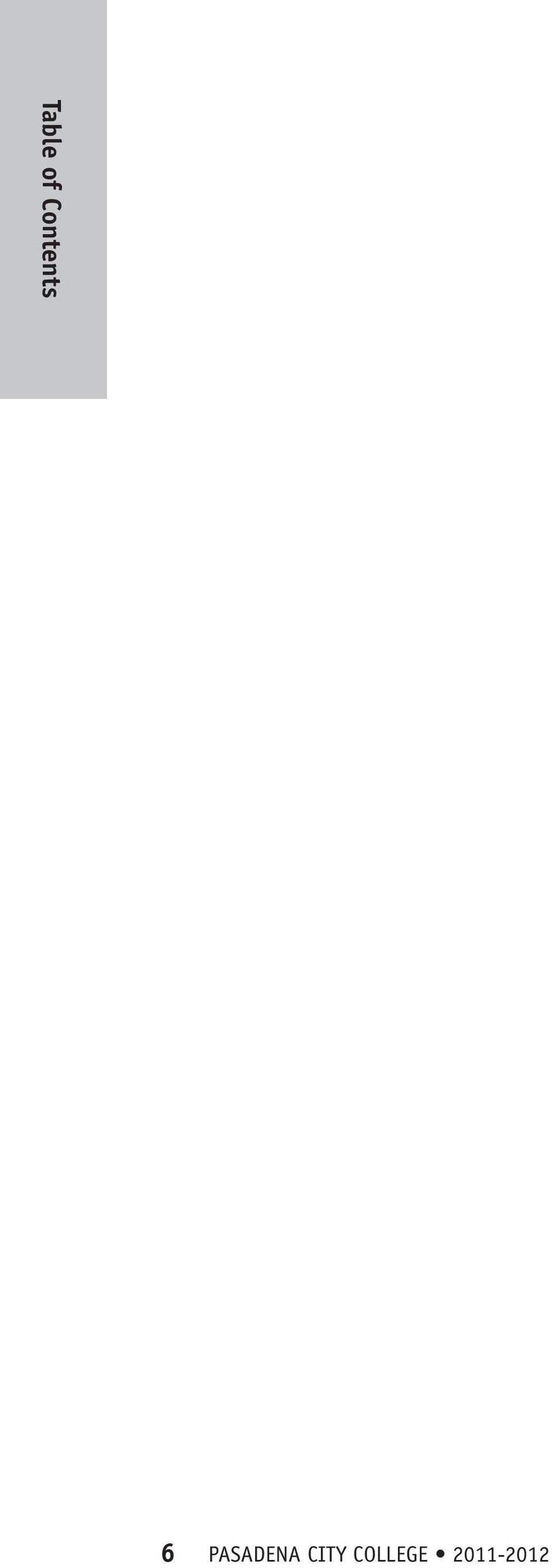
10 TABLE OF CONTENTS Accreditation... 1 Campus Location... 1 Welcome From The President... 3 Board Of Trustees College Administration... 4 Official Academic Calendar General Information A Brief History Of Pasadena City College Mission Of The College Institutional Core Values General Education Outcomes Functions Of The College Pasadena City College Foundation Disclaimer Catalog Section I Admissions And Registration Matriculation Admissions Registration Prerequisites, Corequisites, Limitations On Registration And Advisories Residence Determination Costs Of Attending The College Section II Student Support And Learning Services Empowerment Programs Scholarships And Financial Aid Student Activities And Organizations Learning Resources Library Support Services Academic Information Special Interest Programs Grading System Probation Course Repetition Transcripts Of Record Credit By Examination And Advanced Placement Section III Policies And Regulations Section IV Associate Degree Requirements The Associate Degrees Catalog Rights Philosophy Of General Education Associate In Arts Degree (AA) Associate In Arts General Information Competency Requirements General Education Requirements Major Or Area Of Emphasis Requirements: Global Studies Associate In Arts Degree For Transfer (AA-T) Associate In Science Degree For Transfer (AS-T) to CSU Section V Transfer Information Transfer Curricula Transferring To A Four-Year College Or University PCC Transfer Requirement Tool Systemwide General Education Agreements Intersegmental General Education Transfer Curriculum (IGETC) IGETC Courses California State University General Education Certification Program Transfer Vocabulary Transfer-Related Websites Transfer Curricula Sample Information For Transfer Pre-Professional Programs Associate In Science Degree Section VI Career And Technical Education Requirements For The Certificate Of Achievement/Associate In Science Degree Certificate Of Achievement Programs Other Occupational Curricula Accounting Accounting Clerk Accounting Bookkeeping Assistant Accounting Bookkeeping Accounting Occupational Skills Certificate Cashier Administration Of Justice Anesthesia Technician Archaeological Field Work Occupational Skills Certificate Automotive Technology Automotive Technology All Automotive Systems Automotive Technology Air Conditioning Technician Table of Contents PASADENA CITY COLLEGE
11 Table of Contents Automotive Technology Electrical/Electronics Systems Automotive Technology Engine Performance Technician Automotive Technology Powertrain Technician Automotive Technology Undercar Technician Automotive Technology Underhood Technician Biological Technology Computational Biology Laboratory Assistant Option Stem Cell Culture Biological Technology Occupational Skills Certificate Biological Technology Laboratory Skills Building Construction Building Construction Occupational Skills Certificates Cabinetmaking And Millwork Construction Law Business Information Technology Business Information Technology Administrative Assistant Business Information Technology Business Software Specialist Business Information Technology Data Entry Technician Business Information Technology Occupational Skills Certificates Executive Assistant Office Applications Specialist I Office Applications Specialist II Office Assistant Business Administration Business Administration Entrepreneurship Business Administration Financial Investments Business Administration International Business/Trade Business Administration Management Business Administration Retail Management Business Administration Marketing Merchandising (With Field Practice) Business Administration Occupational Skills Certificates Customer Service E-Commerce Child Development Child Development Occupational Skills Certificate Options Child Development Instructional Assistant Music And Movement Education For Young Children School Age Instructional Assistant Special Education Assistant Computer Information Systems Computer Information Systems Microcomputer Support Computer Information Systems Operations Computer Information Systems Programming Computer Information Systems Small Computer Applications Computer Information Systems Occupational Skills Certificates E-Commerce CISCO Certified Network Associate (CCNA) Preparation CISCO Certified Network Professional (CCNP) Preparation Microsoft Certified Systems Engineer Preparation (MCSE) Interactive Software Development Oracle Database Fundamentals Construction Inspection Cosmetology Cosmetology Instructional Techniques In Cosmetology Culinary Arts Culinary Arts Occupational Skills Certificates Culinary Arts Baking And Pastry Culinary Arts Catering Dental Assisting Dental Hygiene Dental Laboratory Technology Digital Media Digital Media Computer Assisted Photo Imaging Digital Media Graphic Design Digital Media Interactive Multimedia Design Electrical Technology Electrical Technology Occupational Skills Certificates Applied Circuits Basic Photovoltaic Design And Installation Electronics Technology Occupational Skills Certificates Basic Digital Technician CISCO Certified Network Associate (CCNA) Preparation Emergency Medical Technician I-A PASADENA CITY COLLEGE

12 Engineering Design Technology Engineering Design Technology CAD/CAM Technician Engineering Design Technology Occupational Skills Certificates CAD Modeling And Animation Architecture/Engineering/Construction CAD Designer Architectural/ Engineering/Construction CAD Technician Architectural/ Engineering/Construction CAD Technician Mechanical Design And Manufacturing Fashion Fashion Design Fashion Assistant Fashion Occupational Skills Certificates Fashion Custom Clothing Fashion Fashion Marketing Fashion Historical Costume Making Fire Technology Fire Technology Occupational Skills Certificate Fire Academy Preparation Graphic Communications Technology Graphic Communications Technology Computer Imaging And Composition Graphic Communications Technology Screen Printing Graphic Communications Technology Occupational Skills Certificates Graphic Communications Technology Apparel Graphics And Printing Graphic Communications Technology Electronic Prepress Graphic Communications Technology Screen Printing For Small Business Hospitality Management Journalism Journalism Photojournalism Journalism Printed Media Journalism Public Relations Library Technology Machine Shop Technology Machine Shop Technology Occupational Skills Certificates Manufacturing Technology I Manufacturing Technology II Medical Assisting Medical Assisting (Administrative-Clinical) Medical Office Administrative Medical Office Insurance Biller Medical Office Occupational Skills Certificate Options Medical Office Receptionist Medical Office Transcription Nursing Programs Registered Nursing Vocational Nursing Certified Nursing Assistant Paralegal Studies Photography Photography Occupational Skills Certificates Cinema Cinematography Cinema Cinema Production/Filmmaking Foundation In Photography Portrait Photography Product Design Product Design Product Design Technology Product Design Graphics Radiologic Technology Speech-Language Pathology Assistant Television And Radio Broadcast Journalism Television Operations Television Operations Technology Television Production Audio Production Television And Radio Occupational Skills Certificates Broadcast Journalism Media Programming And Management Radio Broadcast Operations Radio Production Television Production Television Post Production Video Operations Writing For Film, Television & Radio Theater Technology Theater Technology Makeup Technology Welding Metal Processes Technology Construction Welding Gas Tungsten & Gas Metal Welding Welding Occupational Skills Certificate Basic Welding High School Articulation With Occupational Curricula Section VII Instructional Divisions Of The College Applied Arts Business And Computer Technology Engineering And Technology Health Sciences Fine Arts Performing And Communication Arts Visual Arts And Media Studies Table of Contents PASADENA CITY COLLEGE

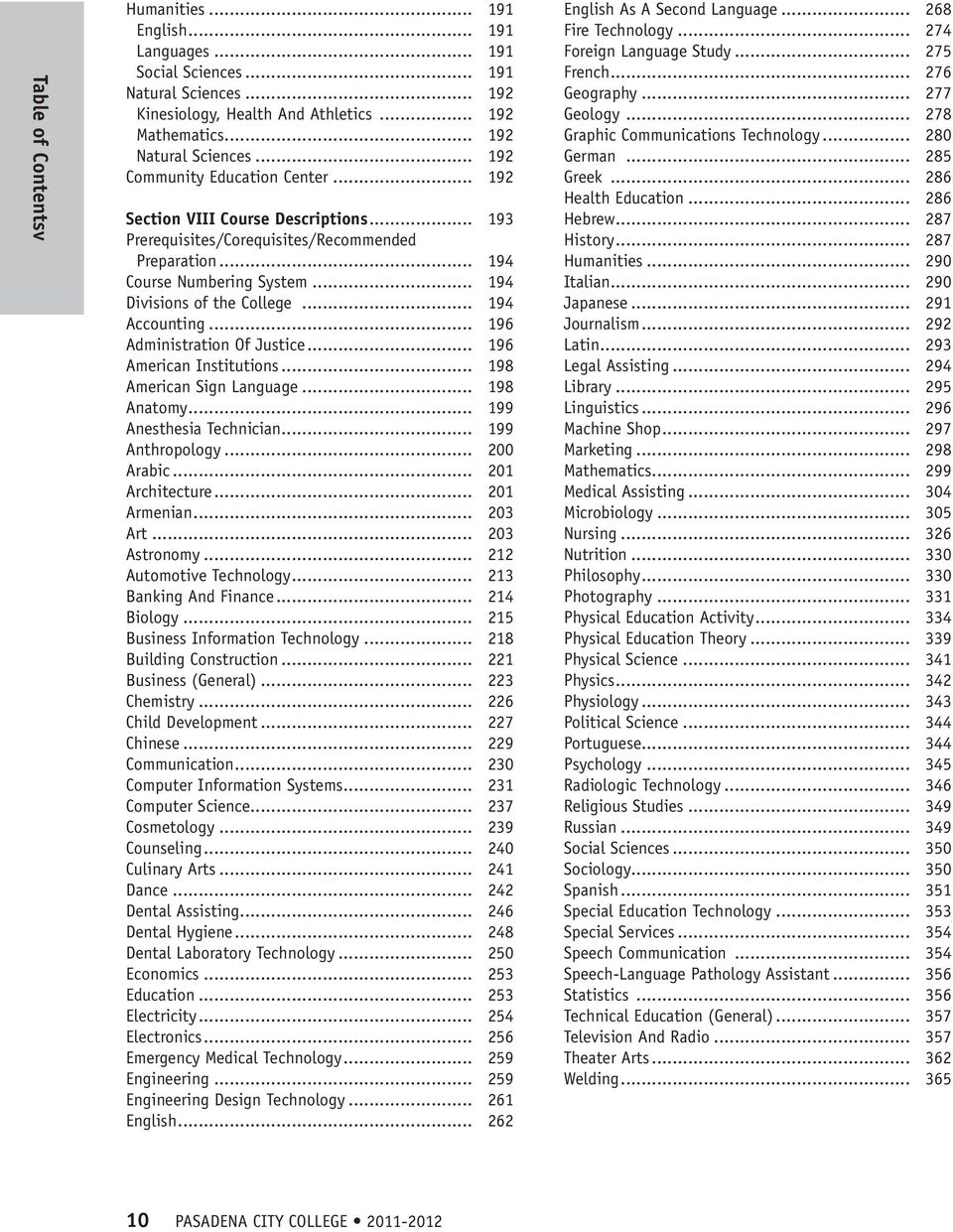
13 Table of Contentsv Humanities English Languages Social Sciences Natural Sciences Kinesiology, Health And Athletics Mathematics Natural Sciences Community Education Center Section VIII Course Descriptions Prerequisites/Corequisites/Recommended Preparation Course Numbering System Divisions of the College Accounting Administration Of Justice American Institutions American Sign Language Anatomy Anesthesia Technician Anthropology Arabic Architecture Armenian Art Astronomy Automotive Technology Banking And Finance Biology Business Information Technology Building Construction Business (General) Chemistry Child Development Chinese Communication Computer Information Systems Computer Science Cosmetology Counseling Culinary Arts Dance Dental Assisting Dental Hygiene Dental Laboratory Technology Economics Education Electricity Electronics Emergency Medical Technology Engineering Engineering Design Technology English English As A Second Language Fire Technology Foreign Language Study French Geography Geology Graphic Communications Technology German Greek Health Education Hebrew History Humanities Italian Japanese Journalism Latin Legal Assisting Library Linguistics Machine Shop Marketing Mathematics Medical Assisting Microbiology Nursing Nutrition Philosophy Photography Physical Education Activity Physical Education Theory Physical Science Physics Physiology Political Science Portuguese Psychology Radiologic Technology Religious Studies Russian Social Sciences Sociology Spanish Special Education Technology Special Services Speech Communication Speech-Language Pathology Assistant Statistics Technical Education (General) Television And Radio Theater Arts Welding PASADENA CITY COLLEGE
14 Section IX Community Education Center General Information Location Student Services And Matriculation Admissions and Records Placement Tests and Assessment Counseling Student Success Center Instruction Foster Care Program Adult Basic Education (ABE) English As A Second Language (ESL) Program High School Outreach Programs CAHSEE Preparation Program GED Preparation Program High School Diploma Program Short-Term Career and Technical Education Programs Apparel Skills And Drapery Construction Apprenticeship Preparation Program Broadcast Media Program Business Office Systems Program Career Planning And Student Development Program Electronic Assembly And Wiring Program Entrepreneur Success Program Fashion Retail Academy Program Fitness Lifestyle Trainer Program Health Promotions Program Parent Education Program Printing Technology Program Description Of Courses Prerequisites/Corequisites/Recommended Preparation Americanization Business (General) Computer Informaton Systems Civics English As A Second Language High School Diploma Program Parent Education Vocational Education Additional Student Services And Matriculation Table of Contents Section X Pasadena City College Faculty Index Campus Map PASADENA CITY COLLEGE

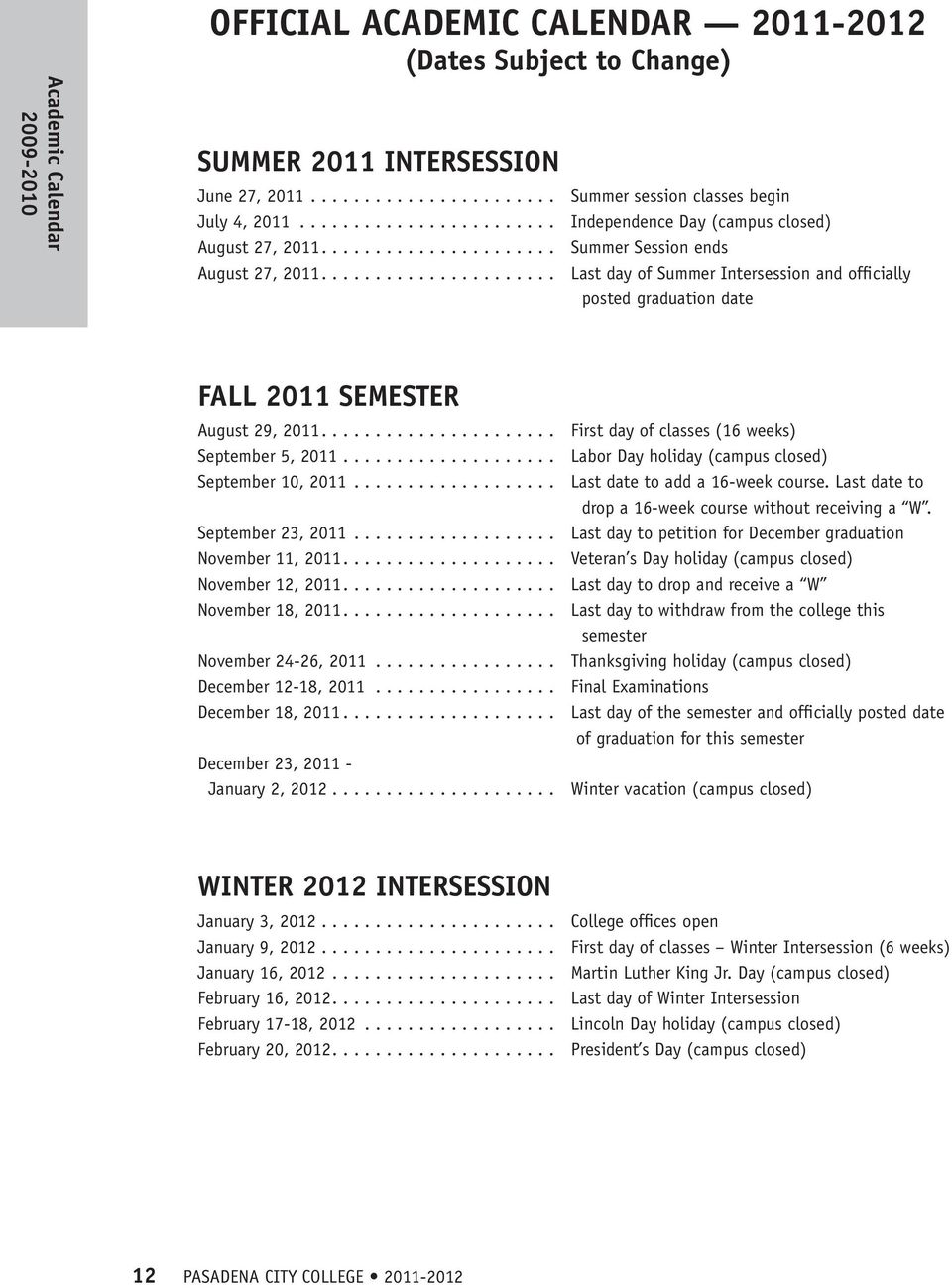
15 Academic Calendar OFFICIAL ACADEMIC CALENDAR (Dates Subject to Change) SUMMER 2011 INTERSESSION June 27, Summer session classes begin July 4, Independence Day (campus closed) August 27, Summer Session ends August 27, Last day of Summer Intersession and officially posted graduation date FALL 2011 SEMESTER August 29, First day of classes (16 weeks) September 5, Labor Day holiday (campus closed) September 10, Last date to add a 16-week course. Last date to drop a 16-week course without receiving a W. September 23, Last day to petition for December graduation November 11, Veteran s Day holiday (campus closed) November 12, Last day to drop and receive a W November 18, Last day to withdraw from the college this semester November 24-26, Thanksgiving holiday (campus closed) December 12-18, Final Examinations December 18, Last day of the semester and officially posted date of graduation for this semester December 23, January 2, Winter vacation (campus closed) WINTER 2012 INTERSESSION January 3, College offices open January 9, First day of classes Winter Intersession (6 weeks) January 16, Martin Luther King Jr. Day (campus closed) February 16, Last day of Winter Intersession February 17-18, Lincoln Day holiday (campus closed) February 20, President s Day (campus closed) 12 PASADENA CITY COLLEGE
16 Academic Calendar SPRING 2012 SEMESTER February 20, President s Day holiday (campus closed) February 21, First day of classes (16 weeks) March 3, Last day to add a 16-week course. Last day to drop a 16-week course without receiving a W. March 16, Last day to petition for Winter and Spring Graduation March 30-31, Cesar Chavez Day holiday (campus closed) April 16-22, Spring Break Classes not in session April 20-21, Campus Closed May 11, Last day to drop and receive a W May 18, Last day to withdraw from the college this semester May 28, Memorial Day (campus closed) June 11-17, Final Examinations June 15, Commencement ceremony for all graduates June 17, Last day of the semester and officially posted date of graduation for this semester PASADENA CITY COLLEGE

17 General Information 14 PASADENA CITY COLLEGE

18 General Information General Information PASADENA CITY COLLEGE

19 General Information A BRIEF history OF PASADENA CITY COLLEGE In 1924, in response to this community s need for higher education facilities, one year of college work was added to the program offered by Pasadena High School. Soon after, another year was added. In 1928, Pasadena High School and Pasadena Junior College merged into a four-year junior college with grades 11 to 14 inclusive. By 1946, increased enrollment justified the establishment of a second four-year junior college John Muir. In 1947 the official names of the two schools became Pasadena City College and John Muir College. During the school year , the Board of Education modified the school system organization from the plan to the plan and combined the two junior colleges into a single college, Pasadena City College, to serve freshmen and sophomores. Thus, the present college is heir to the development of junior collegelevel work in Pasadena since In 1966, local voters in affected communities approved a greater Pasadena Area Junior College District, effective July 1, The name was changed to the Pasadena Area Community College District on Sept. 10, Well over one million individuals have taken classes at Pasadena City College since its formation. Today, enrollment has grown to more than 30,000 students. A number of new buildings were added during the 1990s. PCC continues to offer state-of-the-art resources for its students and the Greater Pasadena community. With voter-approved Measure P bonds totaling $150 million, PCC has constructed a new two-story bookstore, Industrial Technologies Building, and parking structure, as well as renovated the Campus Center. In 2009, ground was broken on a new Center for the Arts which will house an art gallery, recital hall, and theater, and serve as the home of the Visual Arts and Media Studies and Performing and Communication Arts divisions. PCC has made unique contributions to its community over the years. The Observatory on campus was dedicated by Albert Einstein. PCC s registered nursing program, founded in 1953 as one of only five pilot programs in the nation, continues to address the need for qualified nurses in Southern California. The Artist-in-Residence program, which brings prominent professionals to work with and teach PCC students, will again be offered this spring. Career and Technical and academic programs have evolved with the times, supporting the development of radio and television, filmmaking, dentistry, computer science, journalism, business, industrial and consumerproduct design, manufacturing, home construction, military and aviation science, music, fashion technology, and much more. The Community Education Center has showcased the College s commitment to Career and Technical Education and basic skills education. Similarly, the PCC Child Development Center has strengthened PCC s involvement in early childhood education. In Fall 2002, the College modified its academic structure to reflect a more contemporary and accessible view of its offerings. The former Communications, Music and Art divisions were blended into two new divisions. Visual Arts and Media Studies incorporate classes in the arts, photography, computer-aided graphic design, and journalism. Performing and Communication Arts includes music and dance as well as debate and speech pathology. At the same time, English and Languages became separate divisions; the life and physical sciences merged into a Natural Sciences division, and Health Sciences combined the practical trades of nursing, dentistry, medical assisting, and others. The College today actively fosters partnerships with other institutions of higher learning. The Teacher Preparation Program at PCC creates educational pathways to California State University, Los Angeles; University of California, Riverside; Mount St. Mary s; and Pacific Oaks to help students earn both a bachelor s degree and teaching credential within four years. The Transfer Center at PCC now welcomes more than 100 public and private colleges to campus each year. The Center s FAST TRACK program also helps high school students enroll in PCC classes in order to accelerate their transfer to fouryear institutions. For more information about the history and evolution of Pasadena City College, visit the College Web site MISSION OF ThE COLLEGE The mission of Pasadena City College is to provide a high quality, academically robust learning environment that encourages, supports and facilitates student learning and success. The College provides an academically rigorous and comprehensive curriculum for students pursuing educational and career goals as well as learning opportunities designed for individual development. The College is committed to providing access to higher education for members of the diverse communities within the District service area and to offering courses, programs, and other activities to enhance the economic conditions and the quality of life in these communities. At Pasadena City College we serve our students by: Providing courses and programs, in a variety of instructional modalities, which reflect academic excellence and professional integrity; 16 PASADENA CITY COLLEGE

20 Fostering a dynamic and creative learning environment that is technologically, intellectually and culturally stimulating; Challenging our students to participate fully in the learning process and encouraging them to be responsible for their own academic success; Respecting them as individuals who may require diverse and flexible learning opportunities; Supporting organizational practices that facilitate student progress towards their goals; and Encouraging and supporting continuous learning and professional development in those who serve our students: faculty, staff, managers, and administrators. INSTITUTIONAL CORE VALUES As an institution committed to successful student learning in an environment of intellectual freedom, Pasadena City College is guided by the following essential, enduring and shared values: A PASSION FOR LEARNING We recognize that each one of us will always be a member of the community of learners. A COMMITMENT TO INTEGRITY We recognize that ethical behavior is a personal, institutional and societal responsibility. AN APPRECIATION FOR DIVERSITY We recognize that a diverse community of learners enriches our educational environment. A RESPECT FOR COLLEGIALITY We recognize that it takes the talents, skills and efforts of the entire campus community, as well as the participation of the broader community, to support our students in their pursuit of learning. A RECOGNITION OF OUR heritage OF EXCELLENCE We recognize that we draw upon the College s rich tradition of excellence and innovation in upholding the highest standard of quality for the services we provide to our students and community. PASADENA CITY COLLEGE GENERAL EDUCATION OUTCOMES 1. Communication: Use creative expression to communicate acquired knowledge or skills effectively. Competencies: 1.1 Reading: Read and comprehend written material critically and effectively at the appropriate program level. 1.2 Writing: Write in a clear, coherent, and organized manner, at the appropriate academic level, to explain ideas; to express feelings; and to support conclusions, claims, or theses. 1.3 Listening: Listen actively, respectfully, and critically. 1.4 Creative Communication: Create or communicate through speech, music, art and/or performance. 2. Cognition: Use critical thinking skills to observe, analyze, synthesize, and evaluate ideas and information. Competencies: 2.1 Problem Solving: Identify and analyze real or potential problems and develop, test, apply, and evaluate possible solutions, using the scientific method where appropriate. 2.2 Critical Thinking and Application: Formulate and apply knowledge, skills, ideas, and concepts to appropriate contexts. 2.3 Quantitative Reasoning: Apply appropriate mathematical concepts and methods to understand, analyze, and explain issues in quantitative terms. 3. Information Competency: Use research and technical skills effectively and ethically to achieve an objective. Competencies: 3.1 Information Literacy: Locate, retrieve, and evaluate information using appropriate research tools. 3.2 Research Proficiency: Conduct research and present findings effectively and ethically including the use of correct source citations. General Information PASADENA CITY COLLEGE

21 General Information 3.3 Technological Literacy: Apply technology effectively to locate, evaluate, interpret, organize, and present information using appropriate research tools. 4. Social Responsibility: Demonstrate sensitivity to and respect for others. Competencies: 4.1 Respect for Diversity: Demonstrate an understanding of the beliefs, opinions, and values of other people and cultures. 4.2 Effective Citizenship: Demonstrate an understanding of the requirements for being an informed, ethical, and active citizen of the local community, California, the nation, and the world. 5. Personal Development: Demonstrate an understanding of practices that promote physical, psychological, and emotional well-being. Competencies: 5.1 Awareness of Mind and Body: Demonstrate knowledge and practices that promote a sense of self as an integrated physiological, psychological, and social being. 5.2 Aesthetic Appreciation: Show an informed appreciation for artistic and individual expression. FUNCTIONS OF ThE COLLEGE GENERAL EDUCATION General education provides students with the knowledge, attitudes and skills needed to be effective individuals in our society. Pasadena City College has established graduation requirements that are intended to achieve the objectives of general education. In addition to class work, students are also encouraged to participate in student government, public and departmental forums, radio and television presentations, concerts, art gallery exhibits and other College-sponsored events. COLLEGE TRANSFER Students may qualify for transfer with Junior status to an accredited college or university if they follow the lower division pattern of study required of them by the four-year institution, and transfer with a minimum of 60 transferable units. Acceptance to a particular college or university depends upon conditions at the four-year institution, which are subject to change. CAREER AND TEChNICAL EDUCATION The Office of Career and Technical Education supports the expansion of area businesses and industries, and economic growth in the community by promoting educational programs, training, and services that contribute to a quality workforce. Career and Technical Education provides leadership and coordination for all vocational education programs offered at Pasadena City College. PCC s many career programs prepare students for entry-level employment, as well as occupational skills upgrading for those already employed. The curricula are developed in coordination with industry advisory committees that provide input to ensure the training is consistent with industry standards. Responsibilities also include coordination of articulation between PCC s occupational programs and area high schools. The office administers federal programs for career and technical education and job training and manages special grants and projects related to occupational programs and economic development services. NONCREDIT EDUCATION The College offers a variety of courses to meet the needs of students who do not desire or need to obtain college unit credit. The Community Education Center offers noncredit (state funded) classes, and Extended Learning offers not-for-credit, fee-based classes. These classes are open to the community and are designed to provide learning opportunities, for personal interest, cultural enrichment and recreational enjoyment. COMMUNITY EDUCATION CENTER The Community Education Center (CEC) provides noncredit education, training, and services designed to continuously improve California s workforce. The Center offers vocational, technical, and academic courses including High School Diploma Program, GED, Business Office Systems, Printing Technology, Apparel Skills, Fashion Retail, ESL, Adult Basic Education, Parent Education, enrichment classes for Seniors and disabled students, and a wealth of support programs. The cosmetology credit program is offered at the Center. The Community Education Center is a satellite center to the main campus, with shuttle services to and from the main campus every 20 minutes. It is located at 3035 East Foothill Boulevard, Pasadena, CA, For more information, call (626) PASADENA CITY COLLEGE
22 EXTENDED LEARNING Extended Learning operates the not-for-credit, fee-based program designed for the community at large. Classes are primarily; geared toward adults and are complemented by Youth College offerings for those under 18. Classes are held on and off campus and grade credit is not earned. Extended Learning is a self-supporting entity of the College and is not funded by taxpayer dollars. For additional information or to register, please visit the website at pcclearn.org, or call (626) PASADENA CITY COLLEGE FOUNDATION Incorporated as a nonprofit, charitable, public-benefit foundation in 1979, the Pasadena City College Foundation exists to support the growth and development of Pasadena City College. The PCC Foundation raises money, accepts donations, is the beneficiary of bequests, and realizes interest income, and accepts designated in-kind gifts all of which benefit the collage and enable it to better serve the students of the Pasadena Area Community College District. The Board of Directors of the PCC Foundation is composed of citizens from the community and representatives of the College. The PCC Foundation is organized as a 501(c)(3). For further information, please call (626) DISCLAIMER Pasadena City College has made every reasonable effort to determine that everything stated in the Catalog is accurate. Courses offered, together with other matters contained herein, are subject to change without notice by the administration of Pasadena City College for reasons related to student enrollment, level of financial support, or for any other reason, at the discretion of the College. The College further reserves the right to add, amend or repeal any of their rules, regulations, policies and procedures, consistent with applicable laws. The College reserves the right to change any provision in this Catalog at any time, with or without notice. CATALOG The Catalog provides students with the necessary information for planning their course of study. Copies may be purchased at the College Bookstore or ordered by mail. The Catalog is also available online at: www. pasadena.edu. Educational institutions and other agencies wishing to be placed on the mailing list to receive a Catalog should provide the Office of Admissions and Records with the name and address to which it is to be mailed. The Catalog is available in alternate formats (Braille, enlarged text, e-text, etc.). Please contact the Disabled Student Programs and Services at (626) or Room D209. General Information PASADENA CITY COLLEGE
23 General Information 20 PASADENA CITY COLLEGE
24 SECTION I Admissions and Registration Admissions and Registration PASADENA CITY COLLEGE
25 SECTION I ADMISSIONS AND REGISTRATION Admissions and Registration MATRICULATION Matriculation is a process to help each student in achieving his/her educational goal. The matriculation process includes services throughout the entire educational experience including: Admission Orientation to College Assessment tests to identify which English, math and science courses to select for registration Advising to interpret test scores; review transcripts to clear pre-requisites Counseling to assist with developing an educational plan and selecting courses Academic Probation Counseling Early Alert to help students who are not progressing successfully through courses Matriculation is a partnership between the student and the College to work together until goal completion. Students take responsibility for goals which means identifying educational goals and participating in these services. Some students are exempt from certain components of the process, but all students are encouraged to participate. Who Participates in Matriculation? Depending on your background and educational goals, you may be exempt from some parts of the matriculation process. The following will help you decide which parts of matriculation apply to you. Admission All students must file an application with the College. No one is exempt. Orientation Orientation is a valuable experience. You are exempt from orientation if any of the following describes you: 1. Already have an associate or higher degree from a regionally accredited educational institution. 2. Are currently enrolled at a four-year college or university. 3. Are currently enrolled in the 12th grade or below AND will enroll in nine or fewer units at PCC. 4. Have an educational goal of educational development/personal development/interest AND will enroll in six or fewer units. 5. Were in attendance within the past two semesters. Orientation Orientation familiarizes students with important College policies and expectations, as well as the range of services and programs available. An on-line orientation is now available on the Web. at: Click on Apply and Register. Assessment Services Assessment Services administers a variety of tests, inventories, surveys, and other assessment instruments to provide current information about student achievement, abilities, and skills. Placement testing is offered in the areas of Chemistry, English, English as a Second Language (ESL) and Mathematics. Services also include competency testing in English and Mathematics for the A.A. and A.S. degrees. Assessment services are available for admitted and currently enrolled students and for applicants specifically referred for assessment. Pasadena City College placement exam results are valid for two years. Importance of Placement Exam: Taking a placement exam is very important because it will assist students and their Counselor in identifying the appropriate level of Chemistry, English, ESL and Math courses they should enroll in at PCC. Students should review BEFORE taking a placement exam so they can become familiar with the exam format an on what to expect on the exam. Review materials are available on the Assessment Center website: assessment/. Consequences of Not Taking Placement Exam Seriously Students may be placed in a course that is either too easy or too difficult for them. Students may spend more time taking courses that do not count toward a degree. 22 PASADENA CITY COLLEGE
26 Students may spend additional money to take these courses. Items to Bring For Assessment New and Returning Students 1. A valid photo ID (driver s license, State ID, high school ID, passport, etc.). Please note: no photocopies of identification will be accepted. 2. Current Permit to Register (issued once a student is admitted to PCC). Continuing Students PCC Lancer Card ID. Policies Course Enrollment Policy The placement exams are designed for initial placement in a course sequence for Chemistry, English, ESL and Math courses. Once a student is enrolled in the course, the professor s evaluation and grade will determine whether or not a student advances to the next level. Students may not retest to challenge or skip a course in a sequence. Retest Policy Students must wait a minimum of eight weeks to retake the placement exam. Exams may be retaken once in a one-year period. Assessment and Counseling If you are in good standing, are not enrolled in precollegiate basic skills courses, are not seeking admission to a selective program, and meet either one of the following criteria, you are exempt from both the counseling, advisement and assessment components: 1. Have a bachelor s or higher degree from a regionally accredited educational institution; or 2. Have an educational goal of educational development/personal development/interest AND enroll in courses with no prerequisites AND enroll in 6 units or fewer. Testing Placement testing may be waived if you have a recent (taken within one year) comparable or equivalent test score which the College accepts. Optional Initial Placement in Courses Although placement exams are offered, students seeking initial placement in a sequence of courses are strongly advised to participate in the assessment process, in which a counselor will help evaluate skills, experience, aptitudes, and motivation. Based on information such as the student s goals, high school grades, test scores, work experience, and other measures, the counselor will recommend placement at the level which meets the student s needs and in which he or she has a reasonable chance of success. Matriculation Rights Prerequisite/Corequisite Enrollment Limitation Challenge Process A student may file the Pasadena City College Prerequisite/Corequisite/Enrollment Limitation Challenge, with supporting documentation, if he or she believes one or more of the following: 1. The student has the knowledge or ability to succeed in the course or program despite not meeting the prerequisite or corequisite. 2. The student will be subject to undue delay in attaining his/her educational goal because of the enrollment limitation or because the prerequisite or corequisite course has not been made reasonably available. 3. The prerequisite, corequisite, or limitation on enrollment has not been established in accordance with applicable PCC policies and procedures. 4. The prerequisite or corequisite is in violation of Title 5, Sections of the California Code of Regulations. 5. The prerequisite, corequisite, or enrollment limitation is either unlawfully discriminatory or is being applied in an unlawfully discriminatory manner. Challenge forms are available in the Counseling Office (room L104) or the Advising Center (L103D). The student bears the initial burden of showing that grounds exist for the challenge. The challenge will be resolved in a timely manner, and if it is upheld, the student will be permitted to enroll in the course or program in question, provided that space was available at the time the challenge was filed. It is to the student s advantage to file the form as soon as he or she becomes aware of the alleged grounds for the challenge. The student should review the challenge form itself for more detailed information and required procedures. A link to the Prerequisite Challenge Form can be found at: procedures/index.cfm. Please bring the form to Advising, L103D, or fax it to (626) with the appropriate documentation. Forms received without documentation will be denied. Admissions and Registration PASADENA CITY COLLEGE
27 Admissions and Registration ADMISSIONS Application for Admission Individuals who wish to enroll in Pasadena City College for credit in day or evening classes must submit an application for admission and any required official documents with complete and accurate information to the Admissions and Records Office. Some curricula have special admissions procedures and deadlines. Application forms may be obtained in the Admissions and Records Office. Applications may also be completed and submitted online, through the PCC website. A re-entering student with a lapse of enrollment in a Fall or Spring semester must submit a new application. Students who withdrew from the College prior to the third week of the previous semester must also submit a new application. Once submitted, the application and any submitted supporting documents become the permanent property of the College and will not be returned to the applicant. Applicants who do not provide accurate information will not be considered for admission nor allowed to remain in attendance if discrepancies are discovered after enrollment. Deliberate falsification of information is a basis for disciplinary action or dismissal from the College. Processing of applications for the Summer intersession and Fall semester begins April 1 each year, and on October 1 for the following Winter intersession and Spring semester. Registration for classes is based on a priority system; for new and re-entering students, registration times are assigned based in part upon the admission date. It is advantageous to apply early. Program of Study Following clearance of admission requirements, students are advised about the availability of College orientations, financial aid, assessment services and counseling, all of which will assist them in planning their complete programs while at the College. Deadlines for Submitting Applications The last date to apply for admission to the College and have all required documents on file is the Friday immediately prior to the opening date of the College term. Nongraduates of high School Nongraduates of high school who are 18 years of age or older may be admitted to Pasadena City College if it appears that they can profit from instruction at the college level. However, it is recommended that students who have not had a semester lapse in high school attendance contact the Community Education Center regarding alternatives to completing their high school graduation requirements. Students who completed the California High School Proficiency Examination with satisfactory scores will be admitted to Pasadena City College. Accredited high School Graduates Graduates of accredited high schools are eligible for admission to Pasadena City College. Many courses have prerequisites, or academic preparation that are strongly recommended. Certain two-year curricula have special admission requirements. See Curriculum section. Concurrent Enrollment Students Qualified students who have not yet graduated from high school may be admitted for concurrent enrollment at Pasadena City College in advanced scholastic or vocational courses based on the approval of the school principal (parental approval required if under 18). Such students must have availed themselves of all alternate sources for obtaining the desired instruction within the student s school district, have the approval of the parent(s) and the Associate Dean of Admissions and Records, and meet special admission criteria. Such students are limited to 9 units during the Fall or Spring semester and 6 units during the Winter or Summer session. English as a Second Language (ESL) Students A placement test is strongly recommended if English is not the native language of the student. Based on the results of this test and other measures, Counseling Services helps the student choose courses in which he or she will be most likely to succeed. Open Enrollment Policy It is the policy of Pasadena City College that, unless specifically exempted by statute, every course supported by state funds shall be open for enrollment to any person who has been admitted to the College, except that students may be required to meet prerequisites established pursuant to Title 5 of the California Code of Regulations (Sections ). Each class is allowed a maximum number of students which is based on the special nature of the course and/ or physical limitations of the facilities. Whenever preenrollment in such a class reaches this number, the class is designated as closed. Admission to the College does not guarantee space in any class. Many, not all, classes have Wait Lists. Students may choose to be placed on a Wait List when registering for the term. If a space in a closed class opens prior to the start of the class, the first student on the Wait List will be contacted by and given an Add Code. The stu- 24 PASADENA CITY COLLEGE
28 dent must add/register for the class promptly. As space becomes available, Wait List students are contacted in numerical order based on their placement on the list. Students remaining on the Wait List must attend the first class meeting to find out if space becomes available. If so, students obtain a Late Add Code from the instructor and add/register for the course prior to the late add deadline. Counseling Room L104, (626) Students have access to the counselor of their choice. Each counselor is well-informed in fields such as art, business, engineering, liberal arts, life sciences, mathematics, music, physical education, physical sciences, social sciences, technology and Career & Education. Counselors can advise students regarding educational plans, career goals and personal problems. They interpret tests and analyze interests, abilities, failures and successes. Although counselors assist in long-range planning and in checking specific requirements, the responsibility for meeting graduation requirements, course prerequisites or requirements for transfer to other colleges or universities is one which must be assumed by each student. In the counseling offices, as well as the College Library and the Transfer Center, students have access to a reference library of catalogs from various colleges and universities. Changes in the Student s Schedule (Adding or Dropping Classes) Students should exercise great care when planning their semester schedules. If a schedule change is unavoidable, required procedures must be completed before the change becomes official. Classes may be added to the student s schedule, subject to available class space, by following required procedures. A class drop is defined as an action which removes a student s name from enrollment in a specific class. The following sections concerning voluntary class drops and drops for absence apply to regular semesterlength Fall or Spring semester classes. Deadlines are different for short-term or intersession classes. Specific deadline dates are available in the semester Schedule of Classes and on PCC s website. A drop from a 16-week class is not recorded on the student s Permanent Record if the effective date is within the first two weeks of the semester. A W entry is recorded from the third week through the 11th week when such a class is dropped. Short-term courses will have different dates. The final date to drop a regular semester-length class, whether initiated by student or instructor, is Friday of the 11th week of the semester. Short-term and intersession classes will have different dates. Refer to the calendar at the beginning of this Catalog or in the semester Schedule of Classes for specific deadlines. Class Drops Upon Faculty Recommendation Drops Absence Students considered as no-shows will be dropped during the census period of classes. Students must make arrangements with instructors prior to any planned absences from class. Census for semester-length courses is the time frame before the third Monday of the semester for 16 week courses. Census periods for short-term courses vary. Students may be dropped from a semester-length class for continuous or cumulative absences which total the number of hours the class is scheduled to meet in a two-week period. For short-term courses students may be dropped after missing 11% of the total class hours. Three tardies may be considered the equivalent of one absence. REGISTRATION With the exception of concurrent enrollment students, all students receive an appointment to register. Students register by using the online Lancerlink Services. For information concerning the registration process, consult the current semester schedule of classes which is available online at and for purchase at the College Bookstore. Drops for Other Causes a. Drop for Unsafe Performance A student whose classroom, clinical, or laboratory actions are dangerous to the health or welfare of the student or other persons may be dropped from the class. b. Drop for Unsatisfactory Conduct or Citizenship A student may be dropped from class for unsatisfactory conduct or citizenship related to the class. This includes, but is not limited to, conduct in a classroom or other setting such as a laboratory, clinic, or work station. Unsatisfactory conduct or citizenship includes, but is not limited to, cheating, plagiarism, other forms of academic dishonesty, flagrant violation of instructor direction, and actions disruptive to the on-going teaching and learning process. A student subject to class drops for condition(s) noted in (a) or (b) above will be counseled by the instructor and the division dean and given a chance to improve, except when the violation is so flagrant that immediate suspension from class is in order. If a student is counseled for improvement but there is insufficient improvement in the judgment of the instructor and the division dean, or if immediate suspension appears to be in order, a signed class drop form and a written report on the incident will be submitted to the Vice President of Student and Learning Services. Admissions and Registration PASADENA CITY COLLEGE
29 The Vice President of Student and Learning Services will obtain and review information available and take action deemed appropriate. The Vice President of Student and Learning Services will inform the student of due process rights if the class drop or other discipline is imposed. Study Load Regulations Maximum Load Full-time students are expected to carry 15 units per semester for normal progress. Those who would like to take more than 19. per semester may apply to the Petitions Committee through a counselor. Ordinarily, such petitions will not be considered unless the student s cumulative GPA is 2.0 or above. Students on probation are limited to 12 units during the Fall and Spring semesters. Such students should speak with a counselor frequently regarding progress and further program limitations. Concurrently enrolled high school students are limited to 9 units during Fall or Spring semesters and 6 for Winter or Summer sessions. Maximum credit in field practice or similar courses is 16 units with no more than one course enrollment per semester. Admissions and Registration Withdrawal from College Students who need to withdraw from the College (drop all courses in a given session) must go to the Registration Office to obtain specific information on the procedure. Withdrawals according to the regulations of the College and clearance of all obligations will provide the student with a withdrawal in good standing. This clearance includes payment of funds owed to the College such as library fines and breakage fees, locker key return. The final date for completely withdrawing from the College is Friday of the 12th week of the Fall or Spring semester for semester-length classes. Short-term and intersession classes have proportionate deadlines. A grade of W is recorded for all courses in which the student is enrolled at the time of withdrawal. Continuous Enrollment For purposes of admissions and registration, students maintain continuous enrollment by being enrolled in a minimum of one class on the census day for the class for both Fall and Spring semesters. Such students will receive priority registration over new and re-entering students. For purposes of meeting IGETC or CSU General Education Certification, continuous enrollment is defined as attending PCC at least one semester during each academic year without missing two consecutive semesters. Change of Address Any changes in contact information must be reported immediately to the Records Office (L113). Students may also update their contact information online through PCC s website. The maximum load for a six-week intersession is 8.. Each unit of community college work is approximately three hours of recitation, study or laboratory work per week in a semester-length course. All students are expected to devote the full time indicated above for each unit of work. Students employed part time are advised to limit their college program accordingly. It is recommended that the total of college and work hours not exceed 60 hours per week. The following is a suggested guideline: College Academic hours of Employment Load per Week 15 Units...15 Hours 12 Units...24 Hours 9 Units...33 Hours 6 Units...40 Hours Minimum Load The college does not specify a minimum load except when the student desires to meet certain requirements such as those below. 1. Certification that a student is attending full time. Requirement: 12 or more units in a Fall or Spring semester. 2. Full-time load to maintain status as an F-1 visa (international) student. Requirement: 12 or more units per Fall or Spring semester. 3. Eligibility to participate in California Community College intercollegiate athletics. Requirement: Be enrolled in 12 or more units during the season of competition, complete 24 units between each season of competition in that sport and maintain an overall grade-point average of Contact the Director of Kinesiology, Health and Athletic Division or the Assistant Dean, Student Affairs, for additional California Community College and/ or conference requirements. 4. Eligibility to participate in student government as an office holder. Requirement: Be enrolled in 9 or more units in the Fall or Spring semester of participation, and have an overall 2.00 gradepoint average. 5. The load requirements for Chapter 30, 31, 32, 33, 1606, and 1607 (Veterans), and for Chapter 35 (Dependents) is given below. 26 PASADENA CITY COLLEGE
30 Semester Full-time...12 or more units Three-fourths time units One-half time units Less than one-half time units One-fourth time units Summer/Winter Intersession Load To determine the equivalent semester unit load for certification purposes during the Summer and Winter intersessions, multiply the number of Summer or Winter units for each course taken by 16 and divide by the number of weeks the class meets. Add the calculated equivalent units. This result may be compared to the units required during a Fall or Spring semester to determine the equivalent Winter or Summer load. Student Classification: Freshman, first semester: fewer than 15 units of college credit. Freshman, second semester: at least 15 units of college credit and fewer than 30. Sophomore, first semester: at least 30 units of college credit and fewer than 45. Sophomore, second semester: 45 to 60 units of college credit. Minimum Scholastic Requirements Scholastic standards at Pasadena City College have been maintained at a consistently high level since establishment of the institution. While all students are expected to maintain the highest scholastic standard of which they are capable, the College interprets an average grade of C as acceptable scholarship. PREREQUISITES, COREQUISITES, LIMITATIONS ON REGISTRATION AND ADVISORIES PLAN AHEAD! All prerequisites, corequisites, and limitations on enrollment stated in the course descriptions listed in this Catalog will be strictly enforced at the time of registration. Students who do not meet the prerequisite requirements according to College records will not be permitted to register for the course. Students who believe they have met the prerequisite at another institution are strongly advised to have all transcripts of prior college work evaluated and on file well in advance of registration to minimize registration delays. Note: Unofficial transcripts are accepted for prerequisite clearance. Initial Placement in Courses Students seeking initial placement in a sequence of courses are strongly advised to participate in the assessment process, in which a counselor will help evaluate skills, experience, aptitudes, and motivation. Based on information such as the student s goals, high school grades, test scores, work experience, and other measures, the counselor will recommend placement at the level which meets the student s needs and in which he or she has a reasonable chance of success. Prerequisites/Corequisites/Recommended Preparation A prerequisite is a condition of enrollment, such as successful completion of another course (with a grade of A, B, C, or P), that must be met BEFORE a student can register for a course or an educational program. Successful completion of a prerequisite demonstrates readiness for the subsequent course or program. By meeting the prerequisite, the student shows that he or she knows certain skills, concepts, and/or information without which the college considers success in the subsequent course or program highly unlikely. A corequisite is a course in which a student is required to enroll AT ThE SAME TIME that he or she is enrolled in another course. In the corequisite course, the student acquires certain skills, concepts, and/or information without which the College considers success in the concurrent course highly unlikely. A recommended preparation statement in a course description means that a student is advised, but not required, to complete the identified course(s) prior to enrollment in another course or educational program. The skills, concepts, and/or information gained in the recommended preparation in another course or educational program will prepare students for success in the subsequent course or program. All prerequisites, corequisites, and recommended preparation statements listed in the course descriptions are periodically reviewed. Students especially those new to Pasadena City College should consult the Schedule of Classes and Counseling Services for the most current information. Students are expected to meet valid and necessary course prerequisites and corequisites. Prerequisite/Corequisite Enrollment Limitation Challenge Process A student may file the Pasadena City College Prerequisite/Corequisite/Enrollment Limitation Challenge, with supporting documentation, if he or she believes one or more of the following: Admissions and Registration PASADENA CITY COLLEGE
31 Admissions and Registration 1. The student has the knowledge or ability to succeed in the course or program despite not meeting the prerequisite or corequisite. 2. The student will be subject to undue delay in attaining his/her educational goal because of the enrollment limitation or because the prerequisite or corequisite course has not been made reasonably available. 3. The prerequisite, corequisite, or limitation on enrollment has not been established in accordance with applicable PCC policies and procedures. 4. The prerequisite or corequisite is in violation of Title 5, Sections of the California Code of Regulations. 5. The prerequisite, corequisite, or enrollment limitation is either unlawfully discriminatory or is being applied in an unlawfully discriminatory manner. Challenge forms are available in the Counseling Office (room L104) or the Advising Center (L103D). The student bears the initial burden of showing that grounds exist for the challenge. The challenge will be resolved in a timely manner, and if it is upheld, the student will be permitted to enroll in the course or program in question, provided that space was available at the time the challenge was filed. It is to the student s advantage to file the form as soon as he or she becomes aware of the alleged grounds for the challenge. The student should review the challenge form itself for more detailed information and required procedures. A link to the Prerequisite Challenge Form can be found at: Submit the completed form to Advising, L103D, or fax it to (626) with the appropriate documentation. Forms received without documentation will be denied. RESIDENCE DETERMINATION A student who does not qualify as a resident according to the policies and procedures described herein, must pay nonresident tuition at the rate per unit in effect for the term the student plans to attend. It is the student s responsibility to read and adhere to the following rules and procedures for residence determination as set forth in the applicable laws and regulations. A student seeking reclassification from nonresident to resident status must complete a Supplemental Residency Questionnaire (available in the Admissions Office, L113) and attach legible copies of documents in support of the claim for resident status. The questionnaire and all supporting documentation must be submitted in the office of the associate dean of admissions and records (room l113) as early as possible to avoid delays in processing, but no later than 4 p.m. Friday before the applicable residence determination date. (The residence determination date for a given semester or intersession is the last Saturday before the semester or intersession opening date.) Additional information may be required during the residency review. The burden of proof is on the student to prove that California residence has been established. Students classified incorrectly as residents or incorrectly granted an exception from nonresident tuition are subject to reclassification as nonresidents and payment of nonresident tuition in arrears. Applications for a change in classification with respect to a previous term are not accepted. After a final decision on residency classification is made, a student may appeal in writing to the Associate Dean of Admissions and Records (room L113) within 30 days. General Summary of Residency Rules Students are cautioned that the following statement of the rules regarding residence determination is not a complete discussion of the law, but a summary of the principal rules and their exceptions. Students should also note that changes may have been made in policies, statutes and regulations between the time this information is published and the applicable residence determination date. For the text of relevant laws and regulations, refer to the California Education Code Civil Code Section 25.1 and to California Code of Regulations, Title 5. The State of California requires the following before a student may be classified a resident for tuition purposes: (1) evidence of one year s physical presence in California prior to the residence determination date; (2) evidence (in the words of the state, objective manifestations ) of one year s intent to make California the home for other than a temporary purpose (the permanent residence ) prior to the residence determination date; and (3) for any student seeking reclassification from nonresident to resident status, evidence of financial independence from any nonresident of California. A student classified as a nonresident cannot be reclassified as a resident merely because he or she has maintained continuous attendance for one year at a California institution while paying nonresident tuition. The student must meet all three criteria of presence, intent and financial independence. 28 PASADENA CITY COLLEGE
32 For an adult student (e.g., a student 18 years of age or older) the evidence produced in support of the claim for California residence must apply directly to the student. That is, the name of the student must appear on the documents submitted. Documentation pertaining to parents, other relatives, or friends is not sufficient. If the student s residence is legally derived from (and thus is the same as) that of another person (see below), the evidence produced must apply to that other person. Spouses A person s residence is not derived from that of his or her spouse; each person must establish residence separately. Minors The residence of a minor is determined in accordance with the following: 1. The residence of the natural or legally adoptive parent with whom an unmarried minor lives is the residence of that minor, regardless of the length of time the minor has resided with that parent. This rule applies equally to the minor child of permanently separated parents. 2. A married minor may establish his or her own residence. A minor who was married but thereafter divorced, retains the capacity to establish his or her own residence. A minor whose marriage has been annulled must be treated as an unmarried minor since for all intents and purposes a marriage has not occurred. 3. If the minor lives alone, he or she takes the residence status of the parent with whom he or she last lived. 4. If both parents are deceased and there is no court-appointed guardian, the minor may establish residence as though he or she were an adult. 5. The residence of an unmarried minor who has a parent living cannot be changed by the minor s own act, by the appointment of a legal guardian, or by relinquishment of a parent s right of control. 6. A student who has been an adult for less than a full year (e.g., one under 19 years of age) may under certain circumstances combine the immediate pre-majority derived California residence with the immediate post-majority California residence to satisfy the one year necessary for resident classification. Meeting the Criteria of Presence and Intent The burden is on the student to demonstrate clearly both physical presence in California and intent to establish permanent California residence. Presence and intent may be manifested in many ways - no one factor is controlling - but all those ways fall into two main categories. 1. An individual who is 19 years of age or over, and who can provide sufficient evidence that he or she has maintained a home in California continuously for the two years prior to the residence determination date, and has not been a student during the two years, is presumed to have met the presence and intent criteria, unless the individual has taken any action inconsistent with the claim of intent as described below. An individual who is under 19 years of age is presumed to have met the presence and intent criteria if both the individual and his or her parents can show that they have resided in California continuously for the two years prior to the residence determination date, unless the student has taken any action inconsistent with the claim of intent as described below. Evidence of two continuous years residence of a home in California can take the same form as evidence of presence and intent as described below. However, the documents presented must show continuity over the two-year period. 2. Students who are not in the two-year category described above must present evidence of one year s presence and intent. A list of acceptable items is available in the Admissions and Records Office. Some examples of such items include: California state income tax form, voter registration, driver s license, or automobile registration; active resident membership in a California professional, service, or social organization; and utility deposit or installation receipts. The more of these items presented, and the higher their relative weight, the stronger the case for classification as a California resident becomes. All documents presented must be valid, readable, dated at least one year before the residence determination date, and properly identified with respect to student name and address. Actions inconsistent with a claim of intent to remain a permanent California resident will be counted against that claim. Such actions include, but are not limited to, doing the following in a state other than California: registering to vote, entering into a legal agreement, attending an educational institution as a resident of the other state or maintaining a driver s license or automobile registration in another state. In some cases, financial independence may also be considered in the evaluation of intent as indicated below. Admissions and Registration PASADENA CITY COLLEGE
33 Admissions and Registration Meeting the Criterion of Financial Independence In addition to meeting the presence and intent criteria as outlined above, the student seeking reclassification from nonresident to resident status must show financial independence from any nonresident of California according to guidelines set forth by the State of California. In order to establish financial independence, a student seeking reclassification must show the extent to which he or she has met the following criteria for the current and each of the immediately preceding three calendar years: 1. That the student has not been claimed as an exemption for state and federal tax purposes by his or her nonresident parents; 2. That the student has not received more than $750 from his or her nonresident parents; and 3. That the student has not lived in the home of his or her nonresident parents for more than six weeks in any given year. Inability to prove all the financial independence criteria for the entire period will not necessarily result in classification as a nonresident if the showing of one year s presence and intent is sufficiently strong. However, a student who is unable to satisfy all three financial independence criteria for the current and immediately preceding calendar years will be classified as a nonresident, since financial independence is of greater significance for those years. Financial independence for the second and third calendar years immediately preceding the year in which reclassification is requested will be considered together with all other relevant factors in determining intent, with no special weight attached to the financial independence factor. Evidence of financial independence may be presented in the form of (1) affidavits signed by student and parent indicating the extent to which the three criteria listed above have been met, and (2) copies of the federal and state income tax returns filed by student and/ or parent for the current and any applicable preceding calendar years. Exceptions There are several exceptions to the laws regarding residency. If it appears that any of these exceptions might be applicable, the student should discuss the matter with the Associate Dean of Admissions and Records or designee. In any case where an exception is claimed, proper documentation of the basis for that claim must be presented. Some of the exceptions follow: A. A minor student remaining in California, whose parent has established residence outside California within one year prior to the residence determination date and had legal California residence for at least one year before leaving, is entitled to resident classification until the student has attained the age of majority and has resided in the state the minimum time necessary to become a resident, so long as, once enrolled, the student maintains continuous attendance at an institution. B. A student under 19 years of age on the residence determination date who has been entirely selfsupporting for more than one year immediately preceding that date and who can meet the regular adult presence and intent criteria outlined above is entitled to resident classification until the student has resided in the state the minimum time necessary to become a regular adult resident. C. A minor student is entitled to resident classification if, immediately prior to enrolling at an institution, the student has lived with and has been under the continuous direct care and control of any adult or adults, other than a parent, for a period of not less than two years, provided that the adult or adults having such control have had legal California residence during the year immediately prior to the residence determination date. This exception continues until the student has resided in the state the minimum time necessary to become a resident, so long as continuous attendance is maintained at an institution. D. A student who is an adult alien is entitled to resident classification if the student has been lawfully admitted to the United States for permanent residence in accordance with all applicable laws of the United States, provided that the student has met all the legal requirements for California residence for more than one year after such admission and prior to the residence determination date. In other words, the one-year period for showing presence and intent cannot begin until the date lawful admission for permanent residence is established. (Holders of valid A, E, G, H-1, H-4, I, K, L, O-1, R or V visas should contact the Associate Dean of Admissions and Records or his or her designee regarding their residence status.) E. A student who is a minor alien is entitled to resident classification if both the student and his or her parent have been lawfully admitted to the United States for permanent residence in accordance with all applicable laws of the United States, provided that the parent has met all the legal requirements for California residence for more than one year after such admission and prior to the residence determination date. (Holders of valid A, E, G, H-1, H-4, I, K, L, O-1, R and V visas see note under D above.) 30 PASADENA CITY COLLEGE
34 F. A student who was admitted to the United States as a refugee, asylee or parolee and produces proper documentation of that status and who produces appropriate evidence of having met the presence and intent criteria described above may be entitled to resident classification. G. A student who is a full-time employee of a California public institution of higher learning or whose parent or spouse is such a full-time employee may at the option of the institution which the student proposes to attend be entitled to resident classification until the student has resided in the state the minimum time necessary to become a resident. H. A student who left California due to a job transfer made at the request of the employer of the student or the employer of the student s spouse, or in the case of a student who resided with and was a dependent of his or her parent, made at the request of the parent s employer; who was absent from California for less than four years; and who would qualify as a resident if the period of absence was disregarded may be entitled to resident classification. I. Other exceptions pertain to certain members of the armed forces and their dependents, apprentices (as defined in Labor Code Section ), certain agricultural laborers, and certain employees of California public schools. More detailed information about these categories is available in the Admissions and Records Office. Students seeking additional information concerning residence requirements for tuition purposes should contact the Admissions Office, room L113, or the Associate Dean of Admissions and Records or designee. California Nonresident Tuition Exemption (AB 540) Any student, other than a nonimmigrant alien, who meets all of the following requirements, shall be exempt from paying nonresident tuition at the California Community Colleges, the California State University and the University of California (all public colleges and universities in California): 1. The student must have attended a high school (public or private) in California for three or more years. 2. The student must have graduated from a California high school or attained the equivalent prior to the start of the term (for example, passing the GED or California High School Proficiency exam). 3. An alien student who is without lawful immigration status must file an affidavit with the college or university stating that he or she has filed an application to legalize his or her immigration status, or will file an application as soon as he or she is eligible to do so. Students who are nonimmigrants (for example, those who hold valid F [student] visas, B [visitor] visas, J [exchange visitor visas], etc.) are not eligible for this exemption. The student must file an exemption request including a signed affidavit with the college that indicates the student has met all applicable conditions described above. Student information obtained in this process is strictly confidential unless disclosure is required under law. Students eligible for this exemption who are transferring to another California public college or university must submit a new request (and documentation if required) to each college under consideration. For procedures on requesting the exemption from nonresident tuition at Pasadena City College, please contact the Admissions and Records Office or go online to PCC s website and click on Steps to Register. Residence Categories Applicants for admission are divided into the following categories: 1. Applicants whose legal residence is in the Pasadena Area Community College District. This consists of the following school districts: Arcadia, a portion of El Monte, La Cañada Flintridge, Pasadena, Rosemead, San Marino, South Pasadena and Temple City. 2. Applicants whose legal residence is in California but not within the area of a California community college. 3. Applicants whose legal residence is within another California community college district. 4. Applicants who do not qualify as legal California residents for tuition purposes and are determined to have nonresident status. Such applicants will be required to pay nonresident tuition fees. International Students (F-1 Visa Status Students) The policy of the Board of Trustees of the Pasadena Area Community College District is that provision of an adequate program for international students on campus makes a significant contribution to the education of students at the college and the promotion of international understanding in the community and throughout the world. Under federal law of the United States, Pasadena City College is authorized to enroll non-immigrant alien students on F-1 student visas for the first two years of an accredited Baccalaureate Degree program. Admission is Admissions and Registration PASADENA CITY COLLEGE
35 Admissions and Registration subject to the requirements stated below and to the approval of the Assistant Director, International Student Office. An international student interested in applying should write to the International Student Office for application materials, or access the college website (www. pasadena.edu/internationalstudents). All transcripts (submitted in English translation if the original is in another language), English language test results and other required documents must be on file in the International Student Admissions Office by the deadline dates (please see the ISO website for deadline dates). All F-1 visa students are subject to nonresident tuition as set by the PCC Board of Trustees. Current tuition rates may be obtained from the Office of Admissions and Records, the Office of the Vice President of Student and Learning Services, or the College website ( F-1 visa student must carry illness and accident insurance purchased through Pasadena City College. A. Admissions Requirements for Admission in F-1 Visa Status 1. General All Applicants a. An applicant must have English language ability adequate to enable the student to profit from instruction at the college level. An international student is not admitted solely for special training in English. Adequacy of English proficiency is determined by a satisfactory score on the Test of English as a Foreign Language (TOEFL), administered worldwide by the Educational Testing Service, Box 899, Princeton, New Jersey 08540; if the test is not available in the applicant s area, results of a standardized test administered at a U.S. consulate may be substituted. PCC also accepts the STEP Test, Level 2, and International English Language Testing System (IELTS) 4.0 minimum score. b. An applicant must offer evidence of academic achievement equivalent to an American high school education. c. An applicant must present evidence of financial resources to cover costs during the period of attendance at the college. Estimated costs include: nonresident tuition fee of $4,560 (24 units); enrollment and other fees, $1,492; health and accident insurance, $876; living expenses, $10,000; textbooks and supplies, estimated at $572, for a total of about $16,500 per year. Students should anticipate increases each year. Fees are due at registration. The above figures do not include the Summer or Winter intersession. 2. Limitations and Exceptions a. An international student attending by another collegiate institution in the United States must obtain a SEVIS Record release from the other collegiate institution before acceptance to Pasadena City College. b. An applicant for admission in F-1 visa status who has completed college or university work in excess of that usually offered at a community college level in the United States (first two years of a four-year collegiate program) will be considered overly qualified and not eligible for admission to Pasadena City College. Such students should apply at institutions more appropriate to their needs. B. Additional Information 1. Orientation An on-campus international student orientation is provided both in the Fall and Spring semesters. 2. Employment An international student must attend the College full time; a permit to work on campus is issued only if there is urgent financial need. For off-campus employment, approval of the United States of Citizenship and Immigration Services (USCIS) is required. 3. Housing International students must arrange for their own housing. 4. Maximum Period of Enrollment An international student is expected to complete a program in the most expeditious manner possible, generally in four to six semesters. 5. Regulations An international student should become familiar with the United States Citizenship and Immigration Services regulations as well as College regulations on student conduct and enrollment and comply with those regulations. A student who drops below full-time enrollment or fails to maintain normal progress towards his/her goal is subject to dismissal from the College. The United States Citizenship and Immigration Services will be notified in such cases. International Students Other Than F-1 Visa Some alien students with visas other than F-1 may be eligible for admission subject to approval of the Associate Dean of Admissions and Records. If admitted, such students will be subject to nonresident tuition and may be limited in their enrollment. Individuals holding F-2, B1/B/2 visas are not admitted to PCC and are ad- 32 PASADENA CITY COLLEGE
36 vised that they will be in violation of their visa status by attending school. Questions related to this should be directed to the International Student Office. COSTS OF ATTENDING ThE COLLEGE The fees and tuition costs are subject to change by State law or at the discretion of the College. The information listed below was correct at the time of Catalog publication, January Fees State law prescribes payment of the following enrollment fee each semester or session: Enrollment Fee...$26 per unit Refund Policy A student who has paid fees and withdraws from all or part of his/her enrollment by the deadline date may request a refund. Refunds are not automatic. Refund requests must be submitted based on the deadlines published in the semester Schedule of Classes. A Refund Application is available at the Cashier s Office, online or in the Schedule of Classes. The refund amount is determined by the date the class first meets and the date the class is officially recorded as dropped. A minimum service fee of $5.00 (or more in the case of out-of-state tuition) will be charged for processing each refund request. Detailed information regarding the refund policy and procedure is available at the Cashier s Office, room L113. Please call (626) for further information. Students classified as California residents pay only the enrollment fee, a mandatory health fee of $13.00 per semester, a $10.00 student activity fee and a $1.00 per semester student representation fee. During the Summer and Winter intersessions the health fee is $10.00 and the student activity fee is $5.00. Students who are not California residents pay these fees as well as nonresident tuition. Certain students may qualify for an exemption on the basis of verified religious reasons or enrollment in apprentice programs. Nonresident Tuition Students who are nonresidents of California for tuition purposes (see page 28) are required to pay a fee as established each year by the Pasadena Area Community College District Board of Trustees. Beginning in Fall 2010, all non-residents and non-citizens will be required to pay out-of-state tuition of $183 per unit and $35 per unit in Capital Outlay. However, nonresident students who attended high school in California for three or more years; graduated from a California high school or attained the equivalent (e.g., passed the high school proficiency or GED exam); and are U.S. citizens, immigrant aliens, or never-documented aliens may be eligible for exemption from nonresident tuition. Such students should contact the Admissions Office for more information. Instructional Materials Fee Students enrolled in credit or noncredit courses and programs may be required to provide certain instructional and other materials including, but not limited to, textbooks, tools, equipment and clothing. Admissions and Registration PASADENA CITY COLLEGE
37 Admissions and Registration 34 PASADENA CITY COLLEGE
38 SECTION II Student Support and Learning Services Student Support and Learning Services PASADENA CITY COLLEGE
39 SECTION II Student Support and Learning Services STUDENT SUPPORT AND LEARNING SERVICES Counseling - Room L104, (626) or Students have access to the counselor of their choice. Each counselor is well-informed in fields such as art, business, engineering, liberal arts, life sciences, mathematics, music, Kinesiology, Health & Athletics, physical sciences, social sciences, technology, and Career & Technical Education. Counselors can advise students regarding educational plans, career goals and personal problems. They interpret tests and analyze interests, abilities, opportunities for improvement, and successes. Although counselors assist in long-range planning and in checking specific requirements, the responsibility for meeting graduation requirements, course prerequisites or requirements for transfer to other colleges or universities is one which must be assumed by each student. In the counseling offices, as well as the College Library and the Transfer Center, students have access to a reference library of catalogs from various colleges and universities. Degree and Transfer Center - Room L110, (626) Services provided by the Degree and Transfer Center include advisement by representatives from CSU, UC and independent institutions; application, essay and other transfer-related workshops; degree and transcript prescreening; information fairs, and tours to universities. Resources include an interactive tool listing transfer requirements specific to universities or majors to facilitate transfer course planning; a library containing university catalogs and transfer resources in text, software and videotape. Career Center - Room L103, (626) The Career Center provides resources and assistance for students exploring career goals or looking for employment or internships. New job listings are posted daily and there is a weekly Hot Jobs bulletin. Our monthly Focus calendar lists jobs on campus, Job Club meetings and workshops offerings on topics such as resume writing, interviewing, skills clarification, and career choice. There is a large selection of books, videos, software programs, career counselors and student employment interviewers available to help students. For more information, go to EMPOWERMENT PROGRAMS The Stan Gray Academic Athletic Zone - Room GM112, (626) The Stan Gray Academic Athletic Zone is a comprehensive tutorial and counseling program that is designed to meet the specific needs of student athletes at Pasadena City College. The program offers new student athlete orientations, individual and group tutoring, academic advisement, personal counseling, financial aid assistance, and transfer workshops. The primary functions of the program are to provide timely and accurate academic support and improve basic skills. This program works within the division of student services to support the student athletes of the College. For further information see the website at Puente Project - Room L104, (626) The Puente Project is a one-year transfer program open to all students. The content of the Puente Project focuses on Mexican American/Latino authors and issues. The program includes writing instruction in developmental and transfer level English composition, complemented by both an in-class counselor and a community mentor. Puente students also take part in regular and state-wide conferences and workshops, as well as visit universities and meet university representatives in preparation for transfer. For further information see the website at Ujima Program - Room L104, (626) The Pasadena City College Ujima Program is studentcentered, small learning community dedicated to the success of African-American students in higher education. The word Ujima (pronounced oo-jee-ma) is a Swahili word that means collective work and responsibility. Ujima provides an environment that seeks to nurture student development and connection to the greater academic community by serving as a conduit for students social and academic adjustment during the first year of college. 36 PASADENA CITY COLLEGE
40 This Program seeks to improve the basic skill levels and overall success and academic achievement of its African American student population by offering a unique and rigorous learning experience designed to integrate this population into the greater College community and to thrive successfully in the world of academia. Ujima offers a structured academic, personal, and social support system geared toward increasing the retention, basic skill level persistence and completion, as well as the transfer rates of students. The Ujima learning community addresses these and other significant areas influencing the academic and personal success, growth and development of students in higher education within the context of a culturally sensitive, intimate, and collectively responsible learning cohort. For additional information please visit the Ujima Program website at services/ujima/ Extended Opportunity Programs and Services - Room L107, (626) The purpose of EOP&S is to actively encourage the enrollment and retention of students who are economically and educationally disadvantaged, and to facilitate their successful participation in meaningful educational opportunities. EOP&S provides such services as outreach, recruitment, tutoring, counseling and limited financial assistance. Cooperative Agencies Resources for Education - Room L107, (626) C.A.R.E. is an EOP&S Program designed to recruit and assist single parents with children under the age of fourteen who would like to attend college on a full-time basis. C.A.R.E. provides such services as counseling, career assessment, self-development workshops, and financial assistance. Program for Academic Support Services (P.A.S.S.) - Room L107, (626) The Program for Academic Support Services (PASS) is funded by the U.S. Department of Education to increase the retention, graduation and transfer rates of lowincome, first generation and disabled college students. PASS assists participants with counseling, academic preparation, skill development and the degree/transfer process from Pasadena City College to a four-year institution. PASS services focus on a holistic approach to student development and student success. Participants will gain knowledge and skills to achieve their educational goals and ultimately obtain a Bachelor s degree. CalWORKs Partnership Program - Room U246, (626) With funding from the California Community College Chancellor s Office and in partnership with the Los Angeles Department of Social Services, the PCC CalWORKs Partnership Program is designed to assist eligible students phase off welfare and become self-sufficient. Eligible students must currently be receiving cash assistance (welfare) and have children. PCC CalWORKs students are enrolled in county-approved education/training programs and participate in work-study employment that will not reduce their cash aid. Students received assistance with GAIN and county paperwork, counseling and job placement assistance, and may receive financial assistance with child care fees. Access our website by going to services/calworks. SChOLARShIPS AND FINANCIAL AID - Room L114, (626) Financial aid is available from federal, state, and institutional programs in the form of scholarships, grants, loans and work study to assist in meeting the educational costs associated with attending PCC. Most financial aid awards are based on financial need which is the difference between the cost of attendance and the student/family s expected contribution. Generally, scholarships are based on merit. Scholarship opportunities for incoming freshmen include the PCC President s Award, Honors at Entrance, Board of Trustees and Principals Scholarship. Information about PCC s financial aid programs can be obtained at the Office of Scholarships and Financial Aid or at our website: Below is a brief description of the financial aid application procedures and programs. A. Applications The Free Application for Federal Student Aid (FAF- SA) is the primary application for all sources of federal and state financial aid. Students should apply in January of each year for the next academic school year. The Cal Grant Entitlement Program is a State funded program. The deadline is March 2. Cal Grant requires a supplemental GPA Verification Form and the FAFSA. The Competitive Cal Grant program is for community college students only. To apply for the Competitive Cal Grant, students must have their FAFSA processed by March 2. The deadline for priority consideration for campusbased funding is usually in May. Students are encouraged to submit all requested forms and documents to the Financial Aid Office by the deadline. Student Support and Learning Services PASADENA CITY COLLEGE
41 Student Support and Learning Services B. Board of Governors Grants Fee Waiver application is used to cover enrollment fees at PCC. Students must be California residents, and there is no limit to the number of registered units. Students can download a copy of the fee waiver application from the PCC website. C. The Pasadena City College General Scholarship application offers competitive scholarships to eligible, currently enrolled students and those planning to transfer to four-year institutions. The General Scholarship application is generally available October through February. Other scholarships from campus and private sources are also listed in the Campus Crier and the PCC website. Generally, PCC does not offer federal, state or institutional aid to non-citizens. Financial Aid Programs Grants are federal or state funds that do not have to be repaid. PCC participates in the Federal Pell, the Academic Competiveness (ACG) grant, and Federal Supplemental Educational Opportunity Grants (FSEOG) programs. State grants such as the Cal Grants B or C and EOPS are also available to eligible applicants. Loans such as the Federal Perkins Loan, the Nursing Loan or the Federal Direct Loan are available to students in various amounts. Students must meet the specific criteria of each of the loan programs. Nursing and Direct Loans are not automatically offered in the initial financial aid award package. Work Study offers employment opportunities at competitive rates through the Federal Work-Study Program. The work-study jobs are on or off campus and eligibility is subject to financial need. Scholarships are available from college and private sources. Check the weekly Campus Crier for the many scholarship opportunities and our website. Short-term and emergency loans are available for books or other special needs throughout the year. These are short-term loans that must be repaid in 30 days. The Bureau of Indian Affairs awards grants to needy students who possess at least 25 percent American Indian, Eskimo or Aleut blood as recognized by a tribal group. Contact the Bureau of Indian Affairs for information about the BIA Grant. Veterans Benefits information and details are available at the Veterans Office, room L113. Disabled Student Programs and Services (DSP&S) - Room D209, (626) The Disabled Student Programs and Services is designed to enable eligible students with verified disabilities to participate fully in all of the College s general education, transfer, certificate, and associate degree programs and activities for which they qualify. Students who have learning, physical, visual, speech/language, hearing, and/or psychological disabilities are encouraged to inquire about services in the appropriate offices. Supportive educational services may include: psycho educational assessment, sign language interpreting, test accommodation, real-time captioning, and access to printed material in alternate formats, assistive technology training, registration assistance and consultation with faculty and staff. Anyone interested in applying for services or obtaining further information may visit DSP&S or access the website For information on services for students with psychological disabilities, please contact the Psychological Services Office in room L108. Student health Services - Room U104, (626) (Hours vary depending on intersession/semester) Student Health Services includes first aid and emergency services, treatment of short-term illnesses, sexual health counseling and treatment, and education in health promotion and disease prevention. Students who have significant health conditions are strongly encouraged to inform the Student Health Services staff of their health needs. Confidential health services are provided by a professional staff of health counselors, registered nurses, nurse practitioners and physicians. An overview of low cost and no cost services: First aid and emergency care Tuberculosis screening and testing Immunizations, prescription and over-the-counter medications Laboratory services Nutritional counseling Cessation of smoking services Sexual health screening and treatment Women s health care (PAP smears, birth control) Health clearance for health sciences programs Health promotion and disease prevention activities and education Substance abuse prevention information Referral to community health resources and agencies For a more detailed review of the services please visit: 38 PASADENA CITY COLLEGE
42 Psychological Services - Room L108, (626) Psychological services are provided by the counseling psychology staff to give more specialized help than can be made available through regular counseling channels. Services include individual counseling, crisis intervention, information, and, when appropriate, referrals to community agencies. The services emphasize short-term consultations on specific problems affecting success in college. Students may schedule a confidential appointment with a counseling psychology staff member by coming to L108, Office of Psychological Services. Related website: studentservices/psychservices. Child Development Center The Child Development Center, located at 1324 East Green Street, Pasadena, CA 91106, operates under the supervision of the Division of Social Sciences. It provides student parents who are enrolled at Pasadena City College and at the Community Education Center the opportunity to pursue their educational goals while their children are receiving quality child care in an enriched educational program. PCC faculty, staff, and community members are also eligible to use the Center. The Center serves as a laboratory facility for students in the Child Development Program at the College. For more information about fees and enrollment, contact the Center at (626) Veterans Services - Room W108, (626) ext. 4 Pasadena City College is approved as an institution for higher learning for veterans and veterans dependents entitled to educational assistance. In addition to filing an application for admission, a veteran wishing to attend under one of the assistance bills must submit certain documents to the Veterans Office. For example, within the first term of attendance at PCC, veterans must submit for evaluation, official transcripts of all college and military training. In addition to the academic standards required of all students, certain additional restrictions apply to students receiving Veterans Administration (VA) educational benefits. In accordance with VA regulations, a student on academic probation will be terminated from receiving VA benefits after two semesters on probation. A monthly housing allowance for Chapter 33 is available for students attending at more than 50% of fulltime. They will also receive an allowance for books and supplies up to $1,000 per year depending upon units taken. Tuition and mandatory fees will be paid by the VA to the College. The College will refund this money to the student once it has been received from the VA. Chapter 33 recipients training at 50% of full-time or less will receive payments for books and supplies and tuition and fees. No monthly housing allowance is paid to Chapter 33 participants for training at 50% of full-time or less. A monthly assistance allowance for Chapters 30, 31, 32, 1606, 1607 and 35 is available for full-time, threequarter-time or half-time students. Chapters 30, 32, 1606 and 1607 recipients training at less than half time will receive a one-time payment for the amount they have paid in tuition and fees. No monthly assistance is paid to Chapter 30, 1606 or 1607 participants for less than halftime enrollment. Chapter 35 recipients enrolled for less than half time will receive the total they have paid in tuition and fees. The total will be divided by the number of months enrolled and the resulting amount will be sent monthly. The veterans website is edu/veterans/ Reserve Officers Training Corps Pasadena City College students wishing to participate in a Reserve Officers Training Corps program may enroll concurrently in such a program in a neighboring institution. Project L.E.A.P. (Links to Educational Achievement and Progress) - (626) Project L.E.A.P. is a mentoring program developed by Pasadena City College Partnership for Excellence Program. It is designed to increase the retention rate of probationary, under-represented students and returning students. Students are matched one-on-one with volunteer mentors who meet with them once each week to listen, care, motivate, and encourage them to maximize their potential. Mentors in the program are administrative staff, faculty and classified staff who represent a cross section of the campus community. In addition to weekly meetings between mentors and students, a guidance seminar and special programs are offered to foster student success. STUDENT ACTIVITIES AND ORGANIZATIONS Office of Student Affairs Room CC105 Located in the Campus Center, the Office of Student Affairs offers a wide variety of activities, programs and services to assist students in achieving a balanced educational experience. The Office includes Student Activities, the Cross-Cultural Center, the Volunteer Center, Service Learning, Commencement, Athletic Eligibility, Project Student Support and Learning Services PASADENA CITY COLLEGE
43 Student Support and Learning Services LEAP, the Pep Squad, the PCC Flea Market, and the Campus Connections. To respond to the needs and interests of students, annual cross-cultural and student leadership residential retreats are conducted each year. The Student Affairs Office provides an array of student leadership opportunities, involves students in college governance, provides support and guidance in co-curricular activities, and produces and supports cultural awareness activities and services. Further, the office sponsors and assists in educational, recreational and club programs and events, offers volunteer opportunities on campus and in the community, provides financial assistance in the funding of programs and individual student scholarships, and more. Small emergency and book loans are also available. Definitions: Consciousness of Self means being aware of the beliefs, values, attitudes and emotions that motivate one to take action. Congruence refers to thinking, feeling and behaving with consistency, genuineness, authenticity and honesty towards others. Congruent persons are those whose actions are consistent with their most deeply held beliefs and convictions. Commitment is the psychic energy that motivates the individual to serve that drives the collective effort. Commitment implies passion, intensity, and duration. Athletic Program The College offers intercollegiate competition in the following sports: Men Women Baseball X Badminton X Basketball X X Cross Country X X Football X Soccer X X Softball X Swimming Track & Field X X X X Volleyball Water Polo X X Athletic teams at Pasadena City College are members of the Southern California Football Association-National Division Northern Conference and the South Coast Conference. Both are affiliated with the California Community College Athletic Association/Commission on Athletics. Student Government Student government at Pasadena City College is an integral part of the educational program. It gives students the opportunity to develop leadership skills, enhance cultural awareness, work with others in formal and social situations, enhance interpersonal communications skills, pursue special interests, develop critical thinking skills, and support involvement opportunities for all PCC students. Student government is not intended to take the place of other educational endeavors. Instead, its purpose is to enrich the student s total educational experience. It is intended to complement coursework and other activities. Students are urged to improve study habits and to manage their time well. The structure of the government is based on its major functions: activities production, representation, legislation, and administration and finance. Student government includes the ASPCC Executive Board, the Supreme Council, Commissioners, and various committees. As well, the student member of the Board of Trustees plays an active role in student government. Clubs and Organizations Pasadena City College offers a broad spectrum of involvement opportunities through approximately 50 student clubs and organizations. There are recreational, vocational, political, cultural, religious, educational and service clubs, as well as other interest groups. Students enrolled at PCC are encouraged to consider membership in the clubs and organizations of their choice. Students may form additional organizations to meet special needs or interests. All student organizations must have a faculty advisor and be chartered by the InterClub Council, as outlined in Associated Students policies. Information and required forms are available in the Office of Student Affairs located in the Campus Center, CC105. Commencement Held in the College s Robinson Stadium, commencement exercises take place during the last week of the Spring semester. The formal ceremony, followed by a hosted reception, is a special tradition at Pasadena City College. An official diploma cover is presented to each graduate participating in the ceremony. The diploma, certifying that requirements for the Associate in Arts or the Associate in Science Degree have been met, is mailed to the graduate as soon as possible after the close of the semester. Commencement is an impressive tradition. Members of the graduating classes from the Fall, Winter, Spring and Summer terms are encouraged to participate in the annual event. 40 PASADENA CITY COLLEGE
44 Campus Publications The Campus Crier is published weekly during the Fall and Spring semesters, as well as the Winter intersession, for all students and personnel. The Crier provides timely information on official deadlines, financial aid and scholarship announcements, special events, club meetings, and more. The Guide to Leadership and Involvement is designed to guide student leaders, prospective student leaders, and student clubs and organizations in producing successful activities and programs. As a companion to the Advisors Handbook, it covers areas to be considered when planning an event financial aspects, scheduling, publicity set-up, preparation, evaluation and follow-up and it includes useful sections with necessary forms, contact telephone numbers, and more. The College newspaper, the Courier, is published weekly by the Visual Arts and Media Studies Division (except during examination weeks) and is distributed to students and faculty on Thursdays. Students who wish to work on the Courier must enroll in the appropriate journalism class. Inscape, an anthology of student literary work, publishes meritorious stories, essays and poems each year. Under the direction of the English Division, it is edited by a board of student editors and draws its written and art materials from the entire student body. the Tournament of Roses Honor Band, symphony orchestra, large and small choral groups, Gospel choir, opera/ musical theater productions, ethnic music ensembles, and chamber ensembles for strings, woodwinds, brass, percussion, piano and guitar. These ensembles, under the imaginative leadership of prominent directors, have created a reputation for musical excellence. Theater Arts The Pasadena City College Theater Arts Department presents five major stage productions, four sets of oneacts, two sitcoms, and musical theater workshop productions, stand-up comedy at the Ice House, improvisational performances and a mime show each school year. The department also emphasizes media performance and technical skills in television and film with the extensive use of video to complement traditional stage work. All shows are taped and edited for student use. Dance The Dance Department offers a wide variety of classes, including dance techniques classes in the areas of ballet, modern, jazz and tap; social dance, salsa and Latin social dance; dance history; and dance production and choreography. Students in the production classes present a formal dance concert each semester. LEARNING RESOURCES Student Support and Learning Services Spotlight is a slick feature magazine published each year by students in the magazine and small publications class. Students must sign up for Journ 5 to work as writers or editors on Spotlight. Performing Arts - Room C121, (626) Forensics Forensics, or competitive intercollegiate speech and debate, provides students at Pasadena City College with an opportunity to compete with major colleges and universities at local, state and national tournaments. Students will develop speaking, research and critical thinking skills as they participate in individual events, debate and Reader s Theater. The program is open to all students with or without prior experience in speech or Forensics. Music The Pasadena City College Music Department offers a wide variety of performance ensembles, including instrumental and jazz ensembles, wind bands, marching band, Learning Assistance Center - Room D300, (626) The Learning Assistance Center (LAC) provides academic support services for Pasadena City College students and faculty to complement classroom learning and college success. Located on the 3rd floor of the D building (D300), the LAC operates Monday through Thursday 7am-9:45pm, Friday 7am-3:45pm, and Saturday 9am- 2:45pm. During winter and summer sessions, the Center closes at 8:45pm, Monday through Thursday. A valid PCC Lancer Card is required to utilize center services. Tutoring for a wide variety of subjects is provided, free of charge, on a walk-in basis. Certified peer tutors assist students with learning skills and course-related assignments. Subjects tutored include math and statistics, English, ESL, and foreign languages. Tutoring for courses in the Natural, Social, and Computer Sciences is available as well. Students enrolled in Career and Technical Education programs and courses receive tutoring in the LAC and labs and classrooms across the campus. Visit the LAC website ( lac) for updated schedules and other useful information. PASADENA CITY COLLEGE
45 Student Support and Learning Services Center resources include a 42-computer network with applications, Internet access, and basic skills software (English, math, and English as a Second Language). A number of assistive devices are available to students with disabilities. A wide variety of audio-visual materials for ESL, foreign languages, and study skills are available for on-site use. Students and faculty can access handouts for English skills and learning strategies at the entrance to the center. Professional full-time staff and a trained team of student workers are on hand to assist students with direction to appropriate learning materials and resources. Library - LL, (626) The Shatford Library is the College s gateway to a world of information resources. In this progressive library, students find a substantial collection of print and online resources that have been carefully selected to meet research needs. Access to the Library s online catalog and subscription databases is available on the Web at: Current students, faculty and staff will need their PCC network ID and password to access the library s subscription databases from off campus. Reference and research help is available all the hours the library is open and questions may be asked by phone or from the library s website. The library also provides chat reference as well as a 24/7 Reference Service. The library offers workshops, credit classes in basic library and Internet research skills and a Library Technology Certificate vocational program. The library has computer labs for student use with access to the Internet and a variety of software applications. Wireless Internet access is available on the second and third floors of the library. Library Borrowing Privileges Library borrowing privileges are granted to all current PCC students, faculty and staff with a PCC LancerCard ID. In addition, borrowing privileges are extended to residents of the Pasadena Area Community College District and to people who work in the District. Register at the Circulation Desk with a driver s license and one other item showing the same address as your driver s license, such as a recent utility bill or bank statement. Students who attend high school within the District s boundaries may register for borrowing privileges at the Circulation Desk with a current high school ID card. Library telephone numbers: Circulation desk (including renewals) (626) Reference desk (626) Computer labs/ Periodicals desk (626) General Information (626) (recording) Tutorial Services Tutoring is provided for students in a variety of locations on campus. The Learning Assistance Center (LAC) offers tutoring to all students declared as career and technical education majors or working on certificate programs. The LAC also offers tutoring for transfer and basic skills courses in subjects such as accounting, business, mathematics, economics, English, ESL, and foreign languages, as well as computer, life and social sciences. Tutoring support is available to eligible students through the Teaching and Learning Center (TLC), EOP&S and PASS programs. Several academic divisions provide tutoring services in areas such as the Writing Center, Math Resource Center, Social Sciences Learning Center, and the Music Lab. Tutoring is performed by qualified student peers and designated staff. These services are designed to meet the needs of the individual student and to develop learning communities. Computer Learning Center - Room D , (626) During day, evening, and weekend hours, the CLC labs in D101, D104, and D105 provide PCC students with access to the campus network which includes a wide variety of applications and instructional software. In addition, students can utilize the Web to carry out college-related assignments requiring Internet access. Faculty can reserve time in computer classrooms D101 and D105 for class instruction or orientation. Students may receive guidance in exploring their personal learning styles, time management and study strategies offered through workshops and personal appointments. Walk-in tutoring for CIS, CS, and BIT classes is also available at scheduled times. Media Services - Room LL120, (626) Media Services is located in the New Media Center in the Shatford Library building and provides technology support for the College s instructional programs and events. Media Services maintains a collection of more than 4,000 DVD and VHS titles, films, audiotapes, and slides for use by PCC faculty and staff. A major component of Media Services is the booking and delivery of instructional equipment and media to classrooms. Media Services is a one-stop media resource facility for faculty and staff providing audio and videotape dubbing, instructional materials research and acquisition, technology training, and lamination. Workshops are held in the 42 PASADENA CITY COLLEGE
46 Technology Training Lab on various software programs, which have been upgraded to include the Microsoft Office 2007 and the Adobe CS3 Web Premium Software Systems including Outlook, Fireworks, Contribute, Illustrator, Acrobat 8, Photoshop, Dreamweaver and word processing software. Media Services also offers videoconferencing, teleconferencing, and supports smart classrooms that provide technological equipment, e.g., data projectors and screens installed in classrooms to support and enhance instruction. Staging Services - Room C230, (626) Staging Services supports the instructional programs of the College by providing technical assistance to the various departments. Staging Services is responsible for the operation of Sexson Auditorium, the Forum and all of the other lecture halls, as well as other special events both on campus and at the Community Education Center. In addition to meeting the needs of the instructional program, Staging Services supports the cultural activities of the surrounding community by providing facilities and assistance to off-campus organizations. Video Production Services Video Production Services Department is responsible for all video productions that concern the College. These services may range from the documentation of campus events to departmental and college-wide promotional productions. Video Production Services also assists in the editing of educational video productions, and will either oversee or train instructors and staff to edit these programs. Programs of general interest, various campus activities and special announcements are provided for viewing in student areas. SUPPORT SERVICES Food Services A wide selection of dining options are available campus-wide. The ground floor of the Campus Center houses food services for students, faculty and staff. The Campus Center cafeteria serves made-to-order breakfasts and a variety of hot meals, deli sandwiches, beverages and bakery items. The Lancer s Pass is located in the center of campus, adjacent to the swimming pool, for hot meals, beverages, snacks and sandwiches. The Java Garden, located near the Shatford Library and the C, E and U buildings at the Galloway Plaza, offers gourmet coffees, sandwiches, selected cold beverages, and coffeehouse snacks. Dining facilities in the Physical Education complex for Robinson Stadium and the Hutto-Patterson Gymnasium provide services during selected events. Full-service catering, from casual snack service to fine dining, is available for College functions and events. Bookstore and Student Business Services - Room B101 & B203, (626) The Pasadena City College Bookstore is a facility where students and faculty members may purchase books, supplies, and miscellaneous items. Student Business Services serves faculty, staff and student groups by maintaining accounts, records, expenditures and budgets of student activities. It also handles the collection of all student fees. No personal banking services are available. PCC Community Business Center (626) The Community Business Center (CBC) offers live scan & ink fingerprinting, notary, child ID and passport application services. We are located in a bungalow behind the PCC Community Education Center at 3035 East Foothill Blvd, Pasadena Hours of operation are Monday through Friday 8:00 am 7:00 pm & Saturday 9:00 am 5:00 pm. Cash, credit card, personal & business checks, and money orders are accepted. More information is available online at Pasadena City College Police Department - Room B210, (626) The Pasadena City College Police Department is staffed with sworn Police Officers. The Department is located in the B Building (room B210). The Department is responsible for providing police services, enhancing safety, enforcing traffic and parking laws, and provides transportation for field trips and athletic events. Students who have a concern for their safety while on campus are encouraged to contact the Department for assistance. Emergency telephones are located in all elevators, parking lots, and most buildings. Please do not hesitate to use these telephones if you have a concern for your safety. The Department offers an escort service for students and staff from classrooms to vehicles. Students and staff are encouraged to use this available service. The District s crime awareness and crime statistics are available in the B Building, room B210 and can also be located in the Schedule of Classes. Transportation and Parking - Room B210, (626) The College is located near downtown Pasadena and is easily accessible by car, bus or the Gold Line train. On- Student Support and Learning Services PASADENA CITY COLLEGE
47 Student Support and Learning Services campus parking is limited and is available by displaying a semester or daily permit. Handicapped parking is available for people displaying a handicapped placard or handicapped license plates in addition to the semester or daily permit. Shuttle vans are available every fifteen minutes for transportation to and from the Community Education Center. Parking Permits Room B210, (626) Semester parking permits for staff and students are available for purchase online ( A temporary parking pass will be issued at the time ofh the purchase and the actual permit will arrive via mail within 5 business days. Permits can also be purchased at the 411 Trolley located in the Quad on a limited basis. Hours of operation are Monday-Thursday, 9 a.m. 3 p.m. Exact cash, checks or credit cards are accepted. More information and the fee schedule are available online at (click on Parking). housing The College maintains no dormitories and assumes no responsibility for off-campus student housing. Housing information is available in the Office of Student Affairs, located in the Campus Center, CC105. ACADEMIC INFORMATION Attendance Students at Pasadena City College are expected to attend every class meeting. It is especially important to attend the first two class meetings or make prior arrangements with the instructor because nonattendance may result in being dropped from the class. See Drops- Absence section. If absence is due to a contagious disease, the student must be cleared through the Health Services office in room U104. Course Examinations Final semester examinations are required in each course. All students must take these examinations at the scheduled time and place. Examinations, other than the final examination, are given during class with the requirement that a midsemester grade can be determined and reported to the student. Distance Education - Room LL148, (626) Distance Education consists of online and video-based courses referred to as telecourses. Distance Education courses are offered through the College s instructional divisions and is supported by the Distance Education Department located in room LL148. The office provides course information, conducts orientations and trainings, schedules facilities, and prepares courses for online, broadcast, cablecast and other forms of distribution. Available online courses and telecourses can be found on the College s website and in the Schedule of Classes. Independent Study Under the independent study program, the student may pursue topics or problems of special interest beyond the scope of a regular course under the supervision of a faculty advisor. The work is of a research or creative nature, and normally culminates in a research paper, production or comprehensive examination. Regular progress meetings and reports are required throughout the semester. Completion of the project is required before credit is earned. Before registering for independent study, the supervising instructor and division dean must approve the student s plan or project. Textbooks Students are required to buy books needed for courses and may do so at the College Bookstore. Although costs vary depending upon the classes in which students enroll, expenses for books generally range from $300 to $500 per semester. Supplies for specialized curricula such as drafting, cosmetology, nursing, photography and sign arts will require additional expenditures. PCC Scholars Program The PCC Scholars Program provides highly motivated students with an intellectually challenging educational experience designed to prepare them for a successful transition from community college to university. The Program includes partnerships between PCC and UCLA (Transfer Alliance Program), Pomona College (PATH), Occidental College (Preferred Admission Agreement), UC Riverside (HART), UC Irvine (Honors Transfer Program) and other institutions. The program offers high-achieving students strong academic preparation and curriculum planning to help them succeed in their major and achieve the B.A./B.S. degree after transfer. In addition to the academically enriched program, Scholars students receive support services from a specially designated counselor and faculty coordinator at the College. Students also begin to forge links with the transfer institutions by attending special orientation programs at the universities. 44 PASADENA CITY COLLEGE
48 honors honors at Entrance are granted to selected graduates of accredited United States high schools. Students, who must apply for the honor as first-time freshmen, must have achieved an overall grade-point average of or above (excluding physical education and military courses) in grades 10 through 12. The student must be enrolled in the College full-time and must apply for the honor by the published deadline date. If granted, it is recorded when the student has completed one semester in residence. The Dean s honors List is posted to the student s transcript each semester. It includes all students whose semester grade-point average is or higher, with A, B, or C grades in 12 or more units of courses other than those in the 400 series. Administration honors are awarded to graduates who have completed at least 36 units at Pasadena City College and who have achieved a grade-point average of or above in work at Pasadena City College and in all work attempted. Courses taken on a pass/no pass (P/NP) basis are not included in the required 36 units at Pasadena City College. Non-degree applicable courses numbered 400 and above are also excluded from the required 36 units. Valedictorian Award recognition is given to the graduate(s) with the highest grade-point average among the recipients of Administration Honors. Alpha Gamma Sigma is a California state honor organization the purpose of which is to encourage and recognize scholarship on the community college level. Pasadena City College has the Alpha Chapter. Counseling Services is responsible for providing students with the membership requirements. Honors at Entrance, Dean s Honor List, Administration Honors and Alpha Gamma Sigma are recorded on the student s transcript. Study Abroad Programs - Room C223, (626) The College offers both short-term and semester-long Study Abroad Programs in a variety of study locations. Information about these programs is available on the College website, the Schedule of Classes and from the Study Abroad Office. Fall Semester Study Abroad: Florence, Italy. PCC offers a semester of study in the Renaissance city of Florence, Italy. Students select a program of units of transferable credit. Field-study excursions include such places as Rome, Siena, Pisa, and other sites. Students live in shared apartments. The program is accepted by the PCC Scholars Program. For more information, call (626) Spring Semester Study Abroad: Oxford, England. PCC offers a semester of study in the rich cultural environment of Oxford, a center of learning since the 13th century. The program offers 12 to 18 transferable units and includes field-study excursions to such places as London, Stratford-Upon-Avon, Bath, Stonehenge, Coventry, Edinburgh, Blenheim, the Lake District and Bronte country. Students live in British home stays. This program is accepted by the PCC Scholars Program. For more information, call (626) Winter and Summer Study Abroad Programs. PCC offers 2-4 week summer study abroad programs in various locations. Previous programs have traveled to Spain, Ireland, Vienna, Viet Nam, China, Costa Rica, Austria, and Mexico. For information about future programs and study locations, call (626) SPECIAL INTEREST PROGRAMS From Page to Performance Offered through the English Division and conducted in the Renaissance setting of the Oregon Shakespeare Festival in Ashland, Oregon, this one-week summer program includes theater tickets for plays, backstage tours, and daily class sessions with professional actors and directors from the 150-member company. Students can earn one unit of transfer credit or take the course on a credit/no credit basis. Theater in London Offered through the English Division, this one-week program takes place in London, England, during spring break. Students attend plays; have escorted tours in London, including backstage tours; and spend one day visiting a site in the English countryside. Students can earn one unit of transfer credit. Theater in New York Offered through the English Division, this one-week program takes place in the heart of Broadway during spring break. Students attend plays, meet with faculty for post-theater discussions, and tour Manhattan and its various neighborhoods. Students can earn one unit of transfer credit. Student Support and Learning Services PASADENA CITY COLLEGE
49 Student Support and Learning Services MESA Program - Room V103, (626) The Mathematics, Engineering, Science Achievement (MESA) program is designed to assist educationally disadvantaged students attain degrees in math, engineering and science from four-year institutions. MESA is based on a rigorous academic program that uses various components to support educationally and financially disadvantaged students majoring in math, engineering and science. The program s components help build an academically-based peer community to provide student motivation. This community of learners is what sets MESA apart from other programs. The MESA Lab is located in V105. Teaching and Learning Communities Program - Room V102, (626) PCC s Teaching and Learning Communities (TLC) Program was created in 2000 to serve the needs of basic skills math, English, and ESL students and faculty. Since then, the program has expanded to include a variety of summer bridge/first-year experience programs, career pathways, ESL blocks, transfer and probation workshops, faculty development projects, and campus-wide initiatives. The TLC has been the recipient of several public and private grants which have supported a variety of programs: XL; Math Jam; Math and Science (MaS); MathPath; Math, Engineering, and Science Achievement (MESA); and Conexion Tutoring and Mentoring. The TLC center, including a computer lab and staff offices, is located in V102. Writing Across the Curriculum The Writing Across the Curriculum (WAC) Program is a faculty development program that teaches strategies for incorporating writing as a tool for learning to increase student success in all instructional areas. In many PCC classes, WAC faculty implement motivating techniques to help their students learn the course material and to complete assignments. WAC classes give students opportunities to become engaged in their learning through a write-to-learn approach. Students in WAC classes also improve their writing of class assignments. Teaching Assistants work in WAC classes to provide supportive instruction and assistance with writing that helps students to succeed in the class. GRADING SYSTEM Unit of Credit The standard unit represents one hour per week of classroom work or its equivalent carried for one semester of not less than 16 weeks of class work. The unit is also referred to as the semester hour. In the case of academic subjects, the general rule is that not less than two hours (120 minutes) per week of preparation outside class are expected for each unit of class work. This conforms to the provision in the Education Code that one credit hour of community college course work is approximately three hours of recitation, study or laboratory work per week throughout a term of 16 weeks. In some courses, such as physical education, drafting, and laboratory, more than one hour in class each week is required for each unit. Course descriptions show the minimum number of hours that must be completed in order to earn the number of units of credit associated with each course. Grades and Grade Points Pasadena City College uses the letter system of grading to evaluate the quality of work done by students. The interpretation of each grade or symbol, with its value in grade points, is described below. Grade Points Per Grade or Symbol Meaning Semester Unit A Excellent...4 HONOR GRADE indicating EXCELLENCE earned as a result of consistently superior examination scores; consistently accurate and prompt completion of assignments; ability to deal resourcefully with abstract ideas; superior mastery of pertinent skills; promise of success in a field relating to the subject. B Good... 3 HONOR GRADE indicating COMPETENCE earned as a result of high examination scores; accurate and prompt completion of assignments; ability to deal well with abstract ideas; commendable mastery of pertinent skills; promise of continued success in sequential courses. C Satisfactory... 2 STANDARD COLLEGE GRADE indicating SUCCESS- FUL PERFORMANCE earned as a result of satisfactory examination scores; generally accurate and prompt completion of assignments; ability to deal with abstract ideas; fair mastery of pertinent skills; sufficient evidence of ability to warrant entering sequential courses. A C is the minimum course grade necessary to meet a prerequisite. D Less Than Satisfactory... 1 SUBSTANDARD GRADE indicating the MEETING OF MINIMUM REQUIREMENTS ONLY earned as a result of low examination scores; generally inaccurate, incomplete or late assignments; inadequate grasp of abstract ideas; barely acceptable mastery of pertinent skills; insufficient evidence of ability 46 PASADENA CITY COLLEGE
50 to make advisable the enrollment in sequential courses. A grade of D would indicate the student is not likely to be successful in a higher level course and would not meet prerequisite requirements. I Incomplete... 0 This symbol identifies UNFINISHED WORK OTHER- WISE PASSING at a C or better level, indicating that an important assignment such as term paper, final examination or experiment is missing (for illness or other sufficient reason) but can be submitted to complete the course. An I is not assigned as a withdrawal grade and is not considered in grade-point average but it is included in the computation of progressive probation. A course for which an I has been assigned must be completed within one year from the end of the semester in which the I grade was assigned. After one year, a default grade will be assigned. F Failing... 0 NON-PASSING GRADE indicating FAILURE TO MEET MINIMUM REQUIREMENTS earned as a result of non-passing examination scores; inaccurate, incomplete or late assignments; failure to cope with abstract ideas; inadequate mastery of pertinent skills, repeated absence from class. W Withdrawn... 0 A symbol recorded for a course when a student voluntarily withdraws; student is dropped from class by teacher; or petition is approved for a withdrawal. It is not considered in grade-point average but it is included in the computation of progressive probation. MW Military Withdrawal... 0 A symbol used to record a student withdrawal due to unexpected military obligations. P Passing PASSING GRADE, level of C or better, not considered in grade-point average but it is included in the computation of progressive probation. NP No Pass CREDIT NOT ALLOWED; performance less than average quality; not considered in grade-point average but it is included in the computation of progressive probation. IP In Progress... 0 Indicates work in progress but not considered in grade-point average. This symbol is intended for courses which may extend beyond the end of the normal semester. RD Report Delayed... 0 Used when there is a delay in reporting grades. It is a temporary notation not considered in the grade-point average. Grade-Point Average The grade-point average (GPA) is computed by dividing the total grade points earned by the total number of units attempted. As an example, if in any given semester the number of grade points earned is 28 and the total number of units attempted is 14, the grade-point average is Pass/No Pass Grading Most, but not all courses of the College are offered on a pass/no pass grading basis. The following provisions shall apply for pass/no pass credit grading: 1. A maximum of 12 units may be taken on this basis, with a limit of one class per semester. 2. Pass/no pass classes must be taken in areas outside the student s Baccalaureate Degree major. 3. The decision to take a class on a pass/no pass basis should be made at the time of registration. However, it is possible to make a request for pass/no pass grading through the first 28% of the course duration. For semester-length courses this is Friday of the fourth week. Request deadlines in short-term classes and Summer and Winter intersessions are considerably earlier; check with the Registration Office for details. 4. The pass/no pass grading option is not available through telephone registration. You must go to the Registration Office to complete a Request For Pass/No Pass Grading Form. 5. A grade of P (pass) represents satisfactory achievement which would have been graded C or better on the regular grading scale. A grade of NP (no pass) indicates unsatisfactory achievement which would have been graded with a D or lower on the regular grading scale. 6. Sequential courses may be taken on a pass/no pass basis. 7. Instructors are notified as to which students have elected the pass/no pass option in their courses. 8. Any restriction listed above does not apply when a class is offered only on a pass/no pass basis. Incomplete Grades A grade of I is given by a teacher only in cases where a student is doing passing work at a C or higher level, but for reasons beyond the student s control, is unable to complete the requirements of the course. The Student Support and Learning Services PASADENA CITY COLLEGE
51 Student Support and Learning Services student must contact the teacher before the end of the semester and make arrangements for completing the required assignments. When a grade of I is given, a Contract for the Assignment of an Incomplete Grade must be completed and signed by the teacher and the student. This contract lists specific conditions for removal of the I and the default grade to be recorded if the conditions are not met within one year from the end of the semester in which the I was assigned. A student must complete the remaining course assignments within one year, or the default grade will be recorded on the transcript. Re-enrollment in the class as a way to make up the I is not allowed except in exceptional situations, such as a laboratory class. When required work is made up, the grade earned is entered on the student s transcript. I grades are not used in computing the grade-point average. To meet graduation requirements, a student must achieve a minimum C average (2.000 GPA) for all lower division college units attempted in degree applicable courses, including transferred courses and grades. Students should be aware that I grades are computed as F grades when a student s records are being evaluated for graduation. A student s overall degree applicable GPA must be 2.00 to be eligible to graduate. Authority on Grades The teacher is the final authority on assignment of grades. When reported to the Records Office on the Permanent Class Roster, grades represent the teacher s final decision as to a student s achievement. Grades are not given as a warning, punishment or reward and are not subject to revision for purposes of determining eligibility for office or honors, college transfer or for any other reason except the subsequent discovery of an error (as a result of mistake, fraud, bad faith, or incompetence). Any change of grade submitted after the normal threeyear holding period for backup materials will require documentation as to the nature of the error in the first grade. Grade Reports At midsemester the instructor issues progress reports to all students. Final semester grades are available to students on the Web approximately twelve days after the end of the semester. Resolution of grade disputes must be made within three years after completion of the course. Grade Appeal Process The purpose of the academic grade appeal procedures is to provide a process by which a dispute in the assigned final grade for a course may be resolved in a full and efficient manner as provided in section 76224a of the California Education Code and section 55760a in the California Code of Regulations. The Grade Appeal Process can be found in the PACCD procedures No The process and appropriate forms are available in the Office of the Vice President of Instruction (C231) and the Office of the Vice President of Student Learning Services (L112). PROBATION Academic Probation Students who achieve less than a cumulative 2.00 grade-point average in 12 or more units attempted are placed on academic probation. Although a student on probation is limited to a maximum load of 12 units per semester, such students should consider limiting their enrollment to fewer units. Academic probation may be removed and regular status attained by achieving a cumulative grade-point average of or higher. Probationary status is based upon grades received during or after Spring Academic Dismissal Students enrolled on academic probation are subject to dismissal if they do not achieve a cumulative gradepoint average of 1.75 in each of the two subsequent semesters of enrollment. Dismissal calculations are based upon classes taken from Spring 1982 to the present. If a student has a semester grade-point average of 2.00 or higher in the semester in which the student would be dismissed, the student will not be dismissed but instead will continue on probation. Students are notified of their dismissal by the telephone and Web grade reporting systems. Dismissal students who are enrolled for the following semester are withdrawn from the College. A dismissed student may petition for readmission after a lapse of one semester or more. The student must present positive evidence of a serious intent to succeed and have a realistic academic goal identified. If the petition is granted, the student will be admitted on a second stage academic probation and may have enrollment limitations. If the student is subsequently dismissed a second time due to continued substandard academic performance, a petition for readmission will not be considered until two or more semesters have lapsed. If readmitted following a second dismissal, the student will be placed on a second stage academic probation. If the student is subsequently dismissed a third time, a petition for readmission will not be considered until five years have lapsed. 48 PASADENA CITY COLLEGE
52 Probation for Unsatisfactory Citizenship Each student should be thoroughly familiar with the Standards of Student Conduct and with regulations of the College. Students attending the College are expected to maintain satisfactory standards of citizenship at all times on the campus and in the community. Satisfactory citizenship includes conduct which respects the rights of all individuals, which avoids actions disruptive to the on-going educational program and which does not violate specific prohibitions outlined in the Education Code. When it is indicated that citizenship is unsatisfactory, the student may be subject to the following: reprimand, disciplinary probation, administrative class withdrawal, suspension or expulsion, as conditions warrant. Unsatisfactory citizenship includes, among other things, cheating, plagiarism, hazing and conduct disruptive to the teaching-learning process. In addition, falsification of information provided to the Admissions Office is basis for dismissal from a class or from the College. Individuals engaged in destructive activities involving any kind of physical or psychological mistreatment of students are subject to prosecution under the California State Law banning hazing and to dismissal from the College. Penalties for individuals, organizations and institutions can be severe. Progress Probation Students will be placed on progress probation when 12 or more cumulative units are attempted and W, I and NP units reach or exceed half the cumulative units attempted. Students may be removed from progress probation status when the cumulative number of W, I and NP units recorded is less than half the cumulative units attempted. Although a student on progress probation is limited to a maximum load of 12 units per semester, such students should consider limiting their enrollment to fewer units. Probation calculations are based upon courses taken from Spring 1982 to the present. Progress Dismissal Students enrolled on progress probation are dismissed when the cumulative number of W, I and NP units reaches or exceeds half the cumulative units attempted for two consecutive semesters. Dismissal calculations are based upon classes taken from Spring 1982 to the present. If a student attempts over six units during a semester while on progress probation and is graded in over one-half of them, the student is not dismissed and is continued on probation. Students will be notified of the progress dismissal by the telephone and Web grade reporting systems. Students enrolled for the following semester will be withdrawn from the College. After a lapse of one semester or more, a dismissed student may petition for readmission. The student must present positive evidence of a serious intent to succeed and have a realistic academic goal identified. If the petition is granted, the student will be admitted on progress probation and may have enrollment limitations. If the student is subsequently dismissed a second time, a petition for readmission will not be considered until two or more semesters have lapsed. If readmitted, following a second dismissal, the student will be placed on a second stage academic probation. If the student gets dismissed a third time, a petition for readmission will not be considered until five years have lapsed. Course Repetition The general rules for repetition of courses are as follows (see exceptions below in Courses Repeatable for Credit): 1. A student may not repeat a class in which he or she earned a grade of C or better. Only under exceptional circumstances may a student petition to repeat a previously completed class in which a C grade or better was earned. If such a petition is approved, only the original grade is calculated in the cumulative grade-point average. 2. A student maybe allowed up to two repeats (3 enrollments in the course) to earn credit for a course when previous grades earned were substandard (D, F. NP). The third enrollment requires a petition. 3. No student may enroll in two sections of the same course in any one semester, regardless of whether or not the course is repeatable for credit. Repetition of courses (other than those noted below in Courses Repeatable for Credit below) is subject to the following conditions: 1. A course may be taken twice without petition when the previous grade earned was substandard (D, F or NP). Exceptions for an additional repeat may be granted by petition where the previous grade was the result of extenuating circumstances (defined as verified cases of accident, illness, or similar difficulties). If a substandard grade is received for the second enrollment (first repetition), a petition must be filled to request a third and final enrollment. Student Support and Learning Services PASADENA CITY COLLEGE
53 Student Support and Learning Services 2. No additional units of credit will be allowed for repeated courses. 3. For courses in which D or F grades were earned, a C or better must be earned to have the substandard grade disregarded from calculating in the grade-point average. Although the original substandard grades will not be calculated in the student s GPA, they will appear on the student s transcript and will not be removed. The student s PCC transcript is considered a true history of coursework completed at PCC. Courses Repeatable for Credit Certain courses may be repeated for additional experience and credit, and are so identified in their course descriptions by a maximum credit notation. A student may enroll in one of these exception courses once per semester and as many times as allowable until the maximum credit is earned. For repeatable courses, a maximum of two substandard grades may be alleviated to improve a student GPA. 3. If and when the petition is granted, the student s PCC Permanent Record will be annotated so that it is readily evident to all users of the record that no units taken during the disregarded term(s), even if satisfactory grades were received, will apply toward units for graduation or any other educational objective. All work will remain legible on the record, ensuring a true and complete academic history. 4. The student seeking Academic Renewal is responsible for presenting evidence to the effect that the previously recorded work was substandard academic performance (less than 2.00) and is not reflective of more recently demonstrated academic ability. Evidence of recent academic ability may include one of the following: a. 15 semester units attempted with a minimum 3.00 GPA. b. 30 semester units attempted with a minimum 2.50 GPA. c. 45 semester units attempted with a minimum 2.00 GPA. Academic Renewal Without Course Repetition The purpose of Academic Renewal, Title 5 (Sections and of the California Code of Regulations), is to disregard students previously recorded substandard academic performance when such work does not reflect current demonstrated ability. As a result, Academic Renewal allows students the benefits of their current level of ability and performance and does not permanently penalize them for poor performance in past semesters. Academic Renewal encourages students to continue their efforts toward their educational objectives when the weight of previously recorded substandard work would otherwise make the achievement of those objectives unlikely. Academic Renewal is intended only to facilitate graduation from Pasadena City College (2.00 grade-point average) and/or enable qualified students to transfer to a four-year college or university (2.00 to 2.40 gradepoint average). It is not applicable to students who wish to raise their grade-point averages beyond these stated goals. 1. A student may be granted Academic Renewal only once in an academic career at the College. 2. A student may request Academic Renewal for not more than two semesters of work accomplished at PCC. Course work completed at PCC as well as other accredited colleges or universities will be considered in the Academic Renewal evaluation. 5. Student must present evidence that he or she is enrolled in a defined educational program. 6. There must be a minimum 18-month time lapse between the end of the most recent semester to be renewed and the date of initiation of the request for such renewal. 7. Academic Renewal by Pasadena City College does not guarantee that other institutions outside the District will approve such action. This determination will be made by the respective transfer institutions. Petitions for Academic Renewal are submitted to the Petitions Committee through the Office of the Vice President, Student Services, Building L, room 112. Transcripts of Record At the request of a student and in the absence of any outstanding financial obligation to the College (see Financial Obligations of Students section), official transcripts of record bearing the seal of the College and signature of the Associate Dean of Admissions and Records will be forwarded to designated institutions or individuals. Such requests may be submitted in the Office of Admissions and Records or online ( Under no circumstances will partial transcripts of the record earned at Pasadena City College be sent either to the student or to another institution. Pasadena City College will accept responsibility for providing transcripts of record for course work completed at Pasadena City College only. 50 PASADENA CITY COLLEGE
54 Student Support and Learning Services Grades and Transfer Units Only those lower division college level courses transferred from accredited colleges and universities are evaluated for applicability to the Associate in Arts or Associate in Science Degree. There is no guarantee that courses taken at another college will be accepted for credit at Pasadena City College. Many factors are considered when evaluating a course for credit such as: the accreditation status of the college, the course content, educational quality and rigor, level of credit earned and appropriateness of the other college courses to programs offered at Pasadena City College. A passing score on a competency examination administered by Pasadena City College may be required before credit is granted for courses in mathematics or English taken at other colleges. Transcripts from other accredited colleges are not evaluated until the student has completed 15 units at Pasadena City College. Students may request an evaluation in the Counseling Office. Official transcripts of all previous college work must be submitted. To graduate, a student must achieve at least a C average (2.00 GPA) for all lower division college units attempted, including transferred grades and a 2.00 GPA in all courses taken at Pasadena City College which can be counted toward the degree for which the student has applied. (See Catalog sections on The Associate in Arts Degree and The Associate in Science Degree. ) Grade points in excess of those used in calculating a 2.00 GPA for units attempted at another collegiate institution cannot be used in calculating the C average at Pasadena City College. Grade points earned at other institutions, however, may be counted the same as Pasadena City College grade points in awarding scholarships and loans, in determining membership in honor societies and in computing GPA for graduation. Credit by Examination and Advanced Placement Advanced Placement Policy Students who have completed Advanced Placement Examinations of the College Entrance Examination Board (Box 592, Princeton, New Jersey 08540) shall receive credit for Pasadena City College courses as listed below. A grade of Pass will be assigned to each student who obtains a score of 3, 4, or 5, except as noted. Credit earned by Advanced Placement may be counted towards Associate Degree requirements, IGETC, and CSU General Education Breadth Requirements. The units earned from Advanced Placement do not apply toward the Pasadena City College residency requirements for graduation. (See page 28.) To request credit, students must submit official copies of Advanced Placement Examination test scores with a Student Petition form to the Office of the Vice President for Student and Learning Services, L112. The following list has been approved by PCC s Curriculum and Instruction Committee with restrictions as indicated: PASADENA CITY COLLEGE
55 Student Support and Learning Services College Credit for Advanced Placement (AP) Tests Students may earn credit for College Entrance Examination Board (CEEB) Advanced Placement (AP) Tests with scores of 3, 4, or 5. AP credit can be used to meet IGETC, CSU GE, and Associate degree general education and/or major requirements. Students must have the College Board send AP exam results to the Admissions and Records Office (unopened hand carried copies will be accepted) for use on the Associate degree or transfer patterns. Course credit and units granted at Pasadena City College may differ from course credits and units granted by a transfer institution or by another community college. EXAM PCC (MAJOR AND/OR GE) CSU GE CSU- UNITS EARNED TOWARD TRANSFER IGETC UC-UNITS EARNED TOWARD TRANSFER Art History Score of 4 or 5 - Art 1A or 1B Area C1 or C2 6 semester units Area 3A 8 quarter/ (3 semester units) 3 semester units or 3B 3 semester units 5.3 semester units Art (Studio) Drawing Portfolio - Art 11A General Portfolio - Art Elective Subject to division recommendation (3 semester units) N/A 3 semester units N/A 8 quarter/ 5.3 semester units Biology Score of 3, 4, or 5 - Biology 11 Area B2 and B3 6 semester units Area 5B 8 quarter/ (4 semester units) 4 semester units (with lab) 4 semester units 5.3 semester units Calculus AB Score of 3 or 4 - Math 9 (5 semester units) and placement into Math 5A Score of 5 - Math 5A (5 semester units) and placement into Math 5B Area B4 3 semester units 3 semester units* Area 2A 3 semester units 4 quarter/ 2.7 semester units** Calculus BC Score of 3 or 4 - Math 5A (5 semester units) and placement into Math 5B Score of 5 - Math 5B (5 semester units) and placement into Math 5C Area B4 3 semester units 6 semester units* Area 2A 3 semester units 8 quarter/ 5.3 semester units** AP CALCULUS *Only one exam **Maximum credit EXAM may be used 8 quarter/5.3 LIMITATIONS toward transfer semester units for both Chemistry* Score of 3 or 4 - Chemistry 22 (4 semester units) and placement into Chem 1A Score of 5 - Chemistry 1A (5 semester units) Areas B1 and B3 4 semester units 6 semester units Area 5A (with lab) 4 semester units 8 quarter/ 5.3 semester units Chinese Area C2 6 semester units Area 3B 8 quarter/ Language & 3 semester units and 6A 5.3 semester units Culture 3 semester units Computer Science A Score of 3, 4, or 5 - CS 1 (5 semester units) N/A 3 semester units** N/A 2 quarter/ 1.3 semester units 52 PASADENA CITY COLLEGE
56 EXAM PCC (MAJOR AND/OR GE) CSU GE Computer Science AB AP CS EXAM LIMITATIONS Score of 3,4, or 5 - CS 2 (5 semester units) CSU- UNITS EARNED TOWARD TRANSFER IGETC UC-UNITS EARNED TOWARD TRANSFER N/A 6 semester units** N/A 4 quarter/ 2.7 semester units*** **Maximum one exam toward transfer ***Maximum 4 quarter/ 2.7 semester units for both Student Support and Learning Services Economics - Macroeconomics Score of 3, 4, or 5 - Economics 1A (3 semester units) Area D2 3 semester units 3 semester units Area 4B 3 semester units 4 quarter/ 2.7 semester units Economics - Macroeconomics Score of 3, 4, or 5 - Economics 1B (3 semester units) Area D2 3 semester units 3 semester units Area 4B 3 semester units 4 quarter/ 2.7 semester units English - Language & Composition Score of 4 or 5 - English 1A (4 semester units) Area A2 3 semester units 6 semester units Area 1A 3 semester units 8 quarter/ 5.3 semester units* English - Literature & Composition Score of 4 or 5 - English 1A (4 semester units) Area A2 and C2 6 semester units 6 semester units Area 1A or 3B 3 semester units 8 quarter/ 5.3 semester units* AP ENGLISH EXAM LIMITATIONS *8 quarter/ 5.3 semester units maximum for both Environmental Science Score of 3, 4, or 5 - Biology 37 or Physical Science 37 (4 semester units) Area B2 and B3 (if taken prior to Fall 2009) or Area B1 and B3 (regardless of when taken) 4 semester units Area 5A (with lab) 3 semester units 4 quarter/ 2.7 semester units French Language Score of 3 - French 1 (5 semester units) Score of 4 - French 2 (5 semester units) Score of 5 - French 3 (5 semester units) Area C2 3 semester units 6 semester units Area 3B and 6A 3 semester units 8 quarter/ 5.3 semester units French Literature Area C2 3 semester units 6 semester units Area 3B and 6A 3 semester units 8 quarter/ 5.3 semester units German Language Score of 3 - German 1 (5 semester units) Score of 4 - German 2 (5 semester units) Score of 5 - German 3 (5 semester units) Area C2 3 semester units 6 semester units Area 3B and 6A 3 semester units 8 quarter/ 5.3 semester units PASADENA CITY COLLEGE
57 Student Support and Learning Services EXAM PCC (MAJOR AND/OR GE) CSU GE Government and Politics - Comparative Government Government and Politics - U.S. Government Score of 3, 4, or 5 - Political Science 2 (3 semester units) Score of 3, 4, or 5 - Political Science 1 Also requires passing California state and local exam - Social Sciences Division (3 semester units) Area D8 3 semester units Area D8 and US 2* 3 semester units CSU- UNITS EARNED TOWARD TRANSFER IGETC 3 semester units Area 4H 3 semester units 3 semester units Area 4H 3 semester units UC-UNITS EARNED TOWARD TRANSFER 4 quarter/ 2.7 semester units 4 quarter/ 2.7 semester units *Does not fulfill AHI California Government requirement Student can satisfy the AHI requirement after transfer History - European Score of 3, 4, or 5 - History 1B (3 semester units) Area C2 or D6 3 semester units 6 semester units Area 3B or 4F 3 semester units 8 quarter/ 5.3 semester units History - U.S. Score of 3, 4, or 5 - History 7A (3 semester units) Area C2 or D6 3 semester units 6 semester units Area 3B or 4F 3 semester units 8 quarter/ 5.3 semester units History - World Area C2 or D6 3 semester units 6 semester units Area 3B or 4F 3 semester units 8 quarter/ 5.3 semester units Human Geography Area D5 3 semester units 3 semester units Area 4E 3 semester units 4 quarter/ 2.7 semester units Italian Language & Culture Area C2 3 semester units 6 semester units Area 3B and 6A 3 semester units 8 quarter/ 5.3 semester units Japanese Language & Culture Area C2 3 semester units 6 semester units Area 3B and 6A 3 semester units 8 quarter/ 5.3 semester units Latin - Vergil Area C2 3 semester units 3 semester units Area 3B and 6A 3 semester units 4 quarter/ 2.7 semester units Latin - Literature Area C2 3 semester units 6 semester units Area 3B and 6A 3 semester units 4 quarter/ 2.7 semester units 54 PASADENA CITY COLLEGE
58 EXAM PCC (MAJOR AND/OR GE) CSU GE CSU- UNITS EARNED TOWARD TRANSFER IGETC UC-UNITS EARNED TOWARD TRANSFER Music Theory Score of 3, 4, or 5 - Music 1 Area C1 6 semester units N/A 8 quarter/ (3 semester units) (if taken prior to Fall 2009) 3 semester units 5.3 semester units Physics B Score of 3, 4, or 5 - Physics 10 B1 and B3 6 semester units* Area 5A 8 quarter/ (3 semester units) 4 semester units (with lab) 4 semester units 5.3 semester units** Student Support and Learning Services Physics C - Score of 3, 4, or 5 - Physics 31A Area B1 and B3 4 semester units* Area 5A 4 quarter/ Mechanics* (4 semester units) 4 semester units* (with lab) 3 semester units 2.7 semester units** Physics C - Score of 3, 4, or 5 - Physics 31B Area B1 and B3 4 semester units* Area 5A 4 quarter/ Magnetism* (4 semester units) 4 semester units* (with lab) 3 semester units 2.7 semester units** AP PHYSICS *Maximum **Maximum EXAM 4 semester units 8 quarter/ LIMITATIONS toward GE and 6 semester units toward transfer 5.3 semester units for both Psychology Score of 3, 4, or 5 - Psychology 1 (3 semester units) Area D9 3 semester units 3 semester units Area 4I 3 semester units 4 quarter/ 2.7 semester units Spanish Score of 3 - Spanish 1 Area C2 6 semester units Area 3B 8 quarter/ Language (5 semester units) 3 semester units and 6A 5.3 semester units Score of 4 - Spanish 2 3 semester (5 semester units) units Score of 5 - Spanish 3 (5 semester units) Spanish Area C2 6 semester units Area 3B 8 quarter/ Literature 3 semester units and 6A 3 semester units 5.3 semester units Statistics Score of 3 or 4 - Statistics 15 or 18 (4 semester units) Score of 5 - Statistics 50 (4 semester units) Maximum credit - one Statistics course only Area B4 3 semester units 3 semester units Area 2 3 semester units 4 quarter/2.7 semester units PASADENA CITY COLLEGE
59 Student Support and Learning Services Associate degree: Students should be aware that AP test credit is evaluated by corresponding it to an equivalent PCC course, e.g., History 7A. A student who receives AP credit and then takes the equivalent PCC course will have the unit credit for such duplication deducted prior to being awarded the Associate degree. Credit by Advanced Placement exam is noted and listed on a student s transcript, with units assigned and a grade of Passing. CSU GE: The Advanced Placement examinations may be incorporated into the certification of CSU General Education-Breath requirements by any certifying institution. All CSU campuses will accept the minimum units shown and apply them toward fulfillment of the designated General Education-Breath area if the examination is included as part of a full or subject-area certification. Please note that individual CSU campuses may choose to grant more units than those specified toward completion of General Education-Breath requirements. IGETC: AP exams must be used in area indicated regardless of where the certifying CCC s discipline is located. *Pre-med Students: Even though AP scores may place students into a higher level chemistry or physics course, many medical schools do not accept AP credit in lieu of college level course credit to fulfill admissions requirements. Students interested in medical school should consult directly with the medical schools they are considering for information on their credit policies. Students may also want to refer to or College Level Examination Program The College will grant a maximum of 6 units elective credit based on scores recommended by the American Council of Education in each General Examination of the College Level Examination Program (CLEP) of the College Entrance Examination Board (Box 1821, Princeton, New Jersey 08540). Subject credit, rather than elective credit, may be granted upon recommendation of the division. Credit-by-Examination Pasadena City College Courses Granting of credit-by-examination must meet the following criterion: 1. The student is currently enrolled and attending the College in at least one graded course (the requested credit-by-exam course does not meet these criteria). 2. The course is listed in the PCC College Catalo g and is not primarily of an activity nature and is not in the qualifying or remedial category. Credit-by-examination is not available for the native language of a student or for subjects which appear on the student s high school transcript. Credit is not available for any course which is lower in a sequence than a course in which credit has already been granted. Unique situations may be referred to the Petitions Committee. 3. The student is in good standing, has all required transcripts on file at the College and has completed 15 or more units in residence with an overall 2.00 or higher grade-point average. 4. The student has never failed the course and has not been enrolled in the class during the semester for which the examination is being requested. 5. The student may attempt credit-by-examination only once in a particular course. 6. Maximum credit-by-examination for courses of the College is 12 units. The credit will be recorded in the term in process when the examination results are submitted to the Records Office. Credit will not be posted to prior terms. 7. Credit by examination courses are graded on a pass or no pass basis. 8. Approval is required from the division dean responsible for the area in which credit will be given and the Associate Dean of Admissions and Records. Students will be required to pay all applicable fees (enrollment, non-resident tuition, etc.) at Student Business Services before any credit-by-examination is taken. Recording and Utilization of Credit-by- Examination, CLEP and AP Credit will be recorded with a grade of P after the student satisfactorily completes 15 or more units at Pasadena City College. It may be utilized in meeting requirements for the Associate in Arts or Associate in Science Degree. Units granted will not be used in determining eligibility for College activities, or in certifying for financial aid, Veteran s Educational Assistance, or in certifying enrollment to an outside agency. Transfer students should be aware that four-year colleges may have different criteria for recognizing elective academic credit from nonclassroom sources and that a new evaluation of experiences will often be required upon transfer. 56 PASADENA CITY COLLEGE
60 Credit for Military Training and Experience: Pasadena City College strives to serve our nation s military members by offering a comprehensive review of all previous academic and military education and training to earn maximum credit toward degree and certificate programs at Pasadena City College. Depending on your military training, Pasadena City College can apply college credit to your degree program. For service members and veterans of the U.S. Army, we ll need an AARTS transcript. Credit Limitations in Basic Skills Students are limited to enrolling in a maximum of 30 units of Basic Skills courses (e.g., those numbered 400 and above.) Students enrolled in ESL courses and students who have learning disabilities are exempt from this limitation. Credit Limitations in Foreign Language Students will not receive credit in elementary courses (semesters 1 and 2) of a foreign language offered at PCC if that language is the primary language in which they received their secondary education. Students may petition for exceptions based on special circumstances. Student Support and Learning Services For service members and veterans of the U.S. Navy & Marine Corps, we ll need a SMART transcript. For service members and veterans of the U.S. Air Force, we ll need a transcript from the Community College of the Air Force. ccaf/ For service members and veterans of the U.S. Coast Guard, we ll need a transcript from the U.S. Coast Guard Institute. For service members who left the military before 1986, the college can apply credits from a notarized DD 214. Evaluation of Credit From Military and Other Service All veteran students wishing to receive veteran educational benefits must submit for evaluation official transcripts of all prior college and military training within the first term of attendance at Pasadena City College. Documentation of military training (DD2586 Army/American Council on Education Registry Transcript [AARTS], DD295, DD214, Community College of the Air Force transcript) should be submitted to the Veteran s Office, Building L, Room 113. Credit for experiences in the military service (to a maximum of 16 units) and USAFI/DANTES tests may be allowed as recommended by the American Council on Education and in accordance with the provisions of the Pasadena City College Catalog. Maximum Credit-by-Examination and Other Nontraditional Education A student may be granted no more than 30 units through any combination of credit-by-examination (AP, CLEP, or PCC examinations) and evaluation of military service. Same Course Enrollment Students are not permitted to enroll in two sections of the same course during any semester or intersession. Auditing of Classes Pasadena City College does not permit attending classes without being officially registered. It is the responsibility of the student to register officially in courses. Financial Obligations of Students Students or former students are expected to meet proper financial obligations due to the District. Pursuant to California Education Code, Section 72237, college services such as grades, transcripts, diplomas, registration privileges or any combination thereof may be withheld from any student or former student who has not made satisfactory arrangements to meet his or her financial obligation to the District. A student may appeal in writing the decision to withhold College services to the Vice President of Student and Learning Services or designee, who shall review the matter and make a determination on behalf of the District. When, in the judgment of the District, the financial obligation has been satisfied, College services will be reinstated. Student Records The following are College policies relating to the Family Educational Rights and Privacy Act of 1974, Public Law P.L , and Chapter 816, Statutes of 1975, State of California. I Definition of Education Records Education records consist of those files maintained by the following offices: Admissions and Records, Assessment, Financial Aid, Counseling, Health Services, Office of Student and Learning Services and those files maintained for individual students by academic divisions. PASADENA CITY COLLEGE
61 Student Support and Learning Services II Access to Education Records All students have the right to inspect and review their records. A student who follows the established procedure of the Records Office shall be granted access to his or her records within 15 days of the request. Expressly exempt from the right of review and inspection are the following materials: A. Financial records of the parents of the students. B. Confidential letters and statements of recommendation which were placed in the education records prior to Jan. 1, C. Records of instructional, supervisory, counseling and administrative personnel which are in their sole possession and are not accessible or revealed to any other person except a teacher substituting for the one in sole possession. D. Records of students made and maintained by the College Health Center and the Learning Disabilities Center, which are used in the treatment of students and which are not available to persons other than those providing such treatment; except that such records can be reviewed by an appropriate professional of the student s choice. III Procedure for a Student s Access to Records A. A student may review his or her records upon appropriate identification and in conference with a College Counselor or other certificated Student Services staff member. B. A former student may request in writing a review of his or her records. The request should be directed to the Associate Dean of Admissions and Records who is the designated Records Officer acting for the President of the College. C. Any student request for review shall be granted within 15 days following the request. IV Procedure for Challenge of Accuracy or Content of Education Records A. Informal A student may submit to the Associate Dean of Admissions and Records a Student Petition to challenge the accuracy or content of education records maintained by the College. The Student Petition must be supported with verifying documentation. The Petition Committee will rule on the request and notify the student. Any student not satisfied with the decision of the Petitions Committee may discuss the matter with the Vice President of Student and Learning Services. B. Formal If the student is not satisfied with the determination made by the Vice President of Student and Learning Services, the student may, within 30 days, appeal the decision in writing to the President of the College. V Release of Education Records Information A. Any release of a student s education records, with the exceptions listed, must be with the student s written consent or request. B. Directory information In accordance with the Federal Family Educational Rights and Privacy Act of 1974 and the California Educational Code, Pasadena City College will make public upon request and without student consent certain directory information. This information consists of the following: a student s name; city of residence; major field of study; participation in officially recognized activities and sports; if a member of an athletic team, weight, height and age; dates of attendance; degree and awards received; and the most recent previous educational institution attended by the student. Any student desiring to withhold directory information and who did not indicate such at the time of admission to the College may submit a written request to the Records Office in the L Building. The College is required to release student names, addresses, and telephone numbers to armed forces recruiters, per the Solomon Act, without first obtaining a student s permission. In addition, the College is required to release information to the U.S. Department of Education and the Federal Internal Revenue Services regarding fees paid and financial aid received based on the Hope and Opportunity for Postsecondary Education Act of C. Without the student s written consent and upon authorization of the Associate Dean of Admissions and Records or his/her designee, the College may release copies of, or otherwise divulge, material in student education records to the following agencies and individuals who are expressly forbidden from permitting access of said education records to third parties: 58 PASADENA CITY COLLEGE
62 1. College and District staff with a need to know. Authorized representatives of the Comptroller General of the United States, the Secretary of Education, an administrative head of an education agency, state education officials, or their respective designees of the United States Office of Civil Rights, where such information is necessary to audit or evaluate a state or federally supported education program or pursuant to a federal or state law provided that, except when collection of personally identifiable information is specifically authorized by federal law, any data collected by such officials shall be protected in a manner which will not permit the personal identification of students or their parents by other than those officials. Such personally identifiable data shall be destroyed when no longer needed for such audit, evaluation and enforcement of federal legal requirements. 2. Other state and local officials or authorities to the extent that information is specifically required to be reported pursuant to state law adopted prior to Nov. 19, Officials of other public or private schools or school systems, including local county, or state correctional facilities where educational programs are provided, where the student seeks or intends to enroll, or is directed to enroll, subject to the rights of students. 4. Agencies or organizations in connection with a student s application for, or receipt of, financial aid; provided that information permitting the personal identification of students may be disclosed only as may be necessary for such purposes as to determine the eligibility of the student for financial aid, to determine the amount of the financial aid, to determine the conditions which will be imposed regarding the financial aid, or to enforce the terms or conditions of the financial aid. 6. Organizations conducting studies for, or on behalf of, educational agencies or institutions for the purpose of developing, validating, or administering predictive tests, administering student aid programs and improving instruction, if such studies are conducted in such a manner as will not permit the personal identification of students or their parents by persons other than representatives of such organizations. Such information will be destroyed when no longer needed for the purpose for which it is collected. 7. Appropriate persons in connection with an emergency if the knowledge of such information is necessary to protect the health or safety of a student or other persons, or subject to such regulations as may be issued by the Secretary of Education. 8. Those who have obtained a subpoena or judicial order. The student is given notice by mail of the College s compliance with the order. VI Record of Access The College will maintain an access list which includes the identity of persons who have requested and have been denied or who have had access to student records, the dates of said requests, and the reasons for such access. The access list is not required of College officials. VII Transfer of Information by Third Parties Education records or personal information transferred to a third party will include a notice that such party shall not permit access by any other party without the written consent of the student. VIII Notice of Student Rights Students will be informed at least annually through the Pasadena City College Catalog of their rights under the Act. Student Support and Learning Services 5. Accrediting organizations in order to carry out their accrediting functions. PASADENA CITY COLLEGE
63 Student Support and Learning Services 60 PASADENA CITY COLLEGE
64 SECTION III Policies and Regulations Policies and Regulations PASADENA CITY COLLEGE
65 SECTION III Policies and Regulations POLICIES AND REGULATIONS Sexual harassment and Discrimination It is the policy of the College to provide a work and study environment that is free of sexual harassment and discrimination. The policy and procedures on sexual harassment and discrimination are in PACCD Policies 2200 and 2230 and Procedures and are available in the Human Resources Office (C204). The Policies and Procedures can also be found at policies/pcc2230 and pcc Pasadena City College Sexual harassment Policy It is the policy of the College to provide a work and study environment free of sexual harassment. All students and District employees should be aware that the College prohibits any conduct that constitutes sexual harassment and will take disciplinary measures to ensure compliance. All complaints will be investigated and appropriate action taken. Managers and supervisors have an obligation to maintain a positive and productive work and study environment for students and employees. They are expected to halt any harassment by calling attention to this policy or, if necessary, by taking more direct disciplinary action. When a situation involving sexual harassment is discovered, corrective action must be taken immediately. Unwelcome sexual advances, requests for sexual favors, and other verbal or physical conduct of a sexual nature constitute sexual harassment when (1) submission to such conduct is made either explicitly or implicitly a term or condition of a student s continuation or a grade in a class or other activity; (2) submission to or rejection of such conduct by an individual is used as the basis for an employee s decision affecting such an individual; or (3) such conduct has the purpose or effect of unreasonably interfering with an individual s performance or creating an intimidating, hostile or offensive study environment. Individuals who experience sexual harassment are encouraged to make it clear to the offending party that such behavior is offensive and contrary to College policy. If the behavior continues, it should be brought to the attention of an appropriate supervisor, dean or the Equal Employment Opportunity Officer, Associate Dean of Counseling, Dean of Human Resources, Section 504 coordinator, or Title IX officer. The Student Grievance Procedure also may be used. The full policy, definitions and procedures are available from the Equal Employment Opportunity Office, Room C204, (626) Affirmative Action/Equal Opportunity Policy Pasadena Area Community College District is committed to the protection of all members of the College community from violation of human rights and discrimination. The Board of Trustees has adopted a policy and procedure pursuant to Government Code et. seq. to ensure that its programs and activities are available to all persons without regard to ethnic group identification, religion, age, gender, sexual orientation, color, physical or mental disability. For more specific information on this policy, please contact the Dean of Human Resources in the Human Resources Office, Room C204, (626) The lack of English language skills will not be a barrier to admission and participation in the College s vocational education programs. El distrito de Pasadena Area Community College se compromete a proteger todos los miembros de la comunidad de Pasadena City College de violaciones a los derechos humanos y discriminación. La Junta Directiva del colegio ha adoptado la politica según el código gubernamental, comenzando con la sección numero 11135, de ofrecer a la comunidad sus programas y actividades sin distinción de raza, religión, edad, genero, color, y/o impedimento mental o físico. Para más información acerca de esta politica, favor de dirigirse al Director de Recursos Humanos en la oficína encargada de Recursos Humanos, edeficio C, cuarto 204, (626) La falta de habilidad en inglés no impedirá admisión y participación en los programas de educación vocacional de College. Academic Regulations Academic Freedom Policy No. 3100: It is the policy of the Pasadena Area Community College District that academic free- 62 PASADENA CITY COLLEGE
66 dom is a right enjoyed by all members of the Pasadena City College community: faculty (tenured, non-tenured, and adjunct), students, classified and administrative staff, and Trustees. Academic freedom is defined as the freedom to teach and learn in an atmosphere of free inquiry and expression. The right to academic freedom, however, cannot be separated from the equally important responsibility, which each individual has, to uphold professional ethics or, in the case of students, to abide by the Policy on Student Conduct and Academic Honesty. The District encourages and supports a healthy and constructive debate of campus issues, and respects the right of all members of the Pasadena City College community to freely evaluate, criticize, and/or advocate personal points of view regarding such issues. However, every member of the College community also has the right to work and study in an environment that is free from unlawful discrimination and harassment. The right to academic freedom shall be protected and supported through the establishment and use, when necessary, of appropriate due process procedures. Policies and Regulations Student Conduct and Academic honesty Policy No. 4520: It is the policy of the Pasadena Area Community College District that PCC seeks to maintain a safe, orderly, and constructive campus environment in which there is freedom to learn and respect for the dignity of all members of the College community. Students are expected to be responsible, honest, and non-violent in exercising their rights to free inquiry and free speech. The Student Conduct Code identifies conduct that is prohibited by College policy. Students who violate the Student Conduct Code will be subject to disciplinary action under the Student Discipline Process Procedures. Disciplinary sanctions depend on the nature of the offense, the past pattern of behavior of the student, and other relevant factors. In addition, student drug or alcohol offenses or other criminal acts, may be referred to law enforcement officials. Grievance and Complaint Procedures The purpose of this procedure is to provide a prompt and equitable means of resolving student grievances. These procedures shall be available to any student who reasonably believes a College decision or action has adversely affected his or her status, rights or privileges as a student. Student grievance resolution information is found in the Manual for Student Conduct, Due Process, and Dispute Resolution. Students may obtain a copy of this manual from the Vice President of Student and Learning Services Office in Room L112. PASADENA CITY COLLEGE
67 Policies and Regulations 64 PASADENA CITY COLLEGE
68 SECTION IV Associate Degree Requirements Associate Degree Requirements PASADENA CITY COLLEGE
69 SECTION IV ASSOCIATE DEGREE REQUIREMENTS Associate Degree Requirements ThE ASSOCIATE DEGREES Pasadena City College offers the following Associates degrees: Associate in Arts Degree (AA), (p.67) Associate in Arts for Transfer (AA-T), (p.83) Associate in Science for Transfer (AS-T), (p.83) Associate in Science Degree (AS) (p.111) with the Certificate of Achievement (p.114) 1) General Education Requirements: a broad exposure to a variety of areas of study 2) Major Preparation: an in-depth study of a particular field or area of emphasis 3) Electives: courses selected by a student to meet the required units for a degree These are the rules pertaining to degrees: All of the Associate degrees require at least sixty (60) units. Upon completion of requirements, a student will be granted an Associate in Arts, Associate in Arts for Transfer, or an Associate in Science for Transfer and/or an Associate in Science Degree with Certifiate of Achievement. Students may earn multiple Associate in Arts degrees as long they complete the major requirements for the various degrees. Students may earn only one Associate in Science (AS) degree with a Certificate of Achievement. (NOTE: Students may earn multiple Certificates of Achievement, see page 114). Responsibility for filing a petition for graduation rests with the student, and all transcripts for high school and prior college work attempted must be on file for the petition to be considered. File the petition for graduation in the Counseling Division by the published deadline date. CATALOG RIGhTS When graduation requirements are revised, a student with continuous enrollment may graduate under the new requirements or the requirements in effect at the time of the student s initial enrollment. Continuous enrollment is defined as attending PCC at least one semester during each academic year without missing two consecutive semesters. A student whose first term of enrollment at Pasadena City College is the Summer of 2009 may elect to graduate under the provisions of the Catalog if he/she maintains continuous enrollment. Students whose first term is the Fall of 2009, or any term thereafter, must follow the provisions of the appropriate subsequent Catalog. PhILOSOPhY OF GENERAL EDUCATION General education requirements guide the student toward an intelligent understanding of the whole self and of the physical and social world. These requirements encourage the student to explore different areas of human inquiry not only to gain a basic understanding of these areas, but also to comprehend and use the principles, methods, values and thought processes of these disciplines. These explorations include an examination of the physical universe, its life forms and natural phenomena, human behavior and artistic and creative accomplishments. Basic to these studies and to the student s effectiveness in society is the capacity to think clearly, logically and analytically; to communicate clearly both orally and in writing; to perform quantitative functions; to find information; and to examine and evaluate that information using critical thinking skills. After completing the general education requirements, the graduate should have the skills, knowledge, and insights to evaluate and appreciate the physical environment, culture, and society. To promote these skills and knowledge, Pasadena City College has developed Institutional Learning Outcomes and Competencies. The major areas of knowledge and skills that these outcomes seek to address are found on PAGE 17 of this Catalog. 66 PASADENA CITY COLLEGE
70 ASSOCIATE IN ARTS DEGREE (AA) The Associate in Arts is awarded by Pasadena City College in recognition of completion of a minimum of 60 units which include the following: 4. A minimum grade point average of 2.00 must be obtained in courses numbered 1 to 99 completed at PCC and in comparable courses completed at other regionally accredited institutions. Major or area of emphasis in one of the disciplines listed below, and detailed listings beginning on page 69. One of the following general education patterns: a. Traditional AA Degree The PCC general education pattern, which is detailed in the section below. b. The CSU General Education Requirements (CSU Breadth) detailed on page 90. c. The Intersegmental General Education Transfer Curriculum (IGETC) detailed on page 89. The Associate in Arts is awarded in the following disciplines: Business Chinese Communication Arts Engineering and Technology English Literature French Gender, Ethnicity, and Multicultural Studies German Humanities Italian Japanese Kinesiology and Wellness Linguistics Music Natural Sciences Russian Social and Behavioral Sciences Spanish Speech Communication ASSOCIATE IN ARTS: GENERAL INFORMATION 1. A minimum of 60 units, 18 of which must be in one major or area of emphasis. 2. Only courses numbered 1-99 may be counted toward the 60 units. 3. All competency and general educational requirements must be completed. 5. At least 15 units of the required 60 units, in courses numbered 1-99, must be completed at PCC. No more than 6 units may be transferred from another college if earned after the student s last enrollment at PCC. Active-duty servicemembers can complete PCC s academic residency at any time they are enrolled. Reservists and National Guardsmen on active-duty are covered in the same manner. 6. Courses may not be counted more than once to meet the general education requirements (Areas A-G). A course may be used to satisfy the requirements of a major as well as the general education requirements, but the units shall count only once. 7. The AA general education pattern explained below does not prepare students for transfer. Students who intend to transfer to a CSU, UC, or private school are advised to complete the CSU general education requirements, IGETC, or the unique general education pattern of the private school. COMPETENCY REQUIREMENTS 1. Reading One course (with grade C or better) from the following: English 1A, 1C, 14, 100, 130, any English course which fulfills Area C (Humanities), or by satisfactory score on equivalency exam. 2. Written Expression One course (with grade C or better) from the following: English 1A or by satisfactory score on equivalency exam. 3. Mathematics Complete one course (with grade C or better) from one of the following: Business 14A, 14B, Computer Science 45, Mathematics 131, 133AB, 134AB, 139, 141, Statistics 15, 18, 50, or a Math course that fulfills the general education requirement in Critical Thinking or by satisfactory score on an equivalency exam. 4. Diversity Complete three (3) units in courses designated as either Global Studies or Ethnic and Gender Studies as listed in this College Catalog starting on page 80. The courses which can satisfy the diversity requirement and are also general eduction are designated by the ( ) symbol in the list below. Associate Degree Requirements PASADENA CITY COLLEGE
71 Associate Degree Requirements GENERAL EDUCATION REQUIREMENTS A. Natural Sciences (lecture and lab must be in the same discipline.).... Anatomy 25 Anthropology 1 and 1L Astronomy 1 Biology 1A, 1B, 1C, 2, 3, 4, 11, 14, 16, 30, 37, 38, 39, 40 Chemistry 1A, 1B, 2A, 2B, 8A, 8B, 10 and 10L, 22 Envs 1, 3, 30, 40 Geography 1and 1L Geology 1, 1F, 2, 2F, 3, 3F, 4 and 40, 6, 8, 12 and 12 F or 12L, 16 and 40, 22 and 40, 30A-M, 40 Microbiology 2 Physical Science 3 and 3L, 37 Physics 1A, 1B, 1C, 1D, 2A, 2B, 10 and 10L, 31A, 31B Physiology 1, 2A, 2B B. Social and Behavioral Sciences... Anthropology 1, 1L, 2, 3, 4, 5, 12, 31 Communication 1 Economics 1A, 1B English 12 Envs 2 Geography 2, 3, 5, 10 History 1A, 1B, 2A, 2B, 5A, 5B, 7A, 7B, 8, 9A, 9B, 12, 16, 18, 19, 25A, 25B, 25C, 25D, 25F, 25I, 27A, 27B, 29A, 29B, 30, 31, 38, 41, 50 Linguistics 12, 14, 17 Political Science 1, 2, 6, 7, 21, 22 Psychology 1, 2, 5, 21, 22, 23, 24, 25, 29, 31, 33, 41 Sociology 1, 2, 14, 15, 16, 22, 24, 25, 29, 31, 41 C. humanities... American Sign Language 10A, 10B Arabic 1, 2 Armenian 1, 2 Architecture 24A, 24B Art 1A, 1B, 2, 3A, 3B, 4A, 4B, 4C, 4D, 5, 7, 8, 9 Chinese 1, 2, 2A, 3, 4, 10, 12, 22 Dance 21A, 21B English 1B, 5A, 5B, 9, 10, 11, 12, 24, 25A, 25C, 25D, 25E, 25F, 25G, 25H, 25I, 25J, 26, 30A, 30B, 30C, 44A, 44B, 44C, 45A, 45B, 46A, 46B, 47, 48, 49A, 50, 51, 52, 53, 54, 57, 59, 60, 61, 78A, 78B, 82A, 82B, 82C French 1, 2, 3, 4, 5A, 5B, 10, 12, 16, 50 German 1, 2, 3, 4, 5, 10 Greek 1, 2 Hebrew 1, 2, 3 Humanities 1, 2, 3, 4 Italian 1, 2, 3, 4, 10, 12, 50 Japanese 1, 2, 3, 4, 5, 10, 12 Latin 1, 2 Linguistics 10, 11, 12 Music 7A, 7B, 21, 22, 23, 24A, 24B, 25, 26, 27, 28 Philosophy 1, 3, 7, 8, 20A, 20B, 31, 37 Portuguese 1, 2, 3, 4 Religious Studies 1, 2, 3 Russian 1, 2, 3, 4, 11 Spanish 1, 2, 2A, 3, 4, 5, 6A, 6B, 12, 25, 42A, 42B, 44A, 44B, Theater Arts 5, 7A, 7B D. Language and Rationality units... each 1. English Composition... English 1A, 1B 2. Oral Communication... Speech 1, Critical Thinking... **Business 14A, 14B Computer Information Systems 62 Computer Science 2, 4, 6, 8, 10, 12, 43, 45 English 1C **Mathematics 3, 5A, 5B, 5C, 7A, 7B, 8, 9, 10, 12, 15, 22, 38, 55 Philosophy 25, 30, 33 Physical Science 2 Speech 6, 12 **Statistics 15, 18, and 50 **These courses also meet the mathematics competency requirement E. American Institutions... 6 units 1. History 7A, 7B, 25A, 25B, 29A, 29B, 31, or AND 2. Political Science 1... F. health Education... 2 units Biology 19 Counseling 12 Health Education 2A, 2E, 44 Nutrition 11 G. Physical Activity... 2 units A maximum of 4 units of Physical Education Activity or Dance Activity (Dance 21A and 21B are excluded) 68 PASADENA CITY COLLEGE
72 may be counted toward the degree. Music 61 may be substituted for of PE activity each semester. Exemption is granted if the student has a physical limitation and submits a physician s recommendation which is approved by PCC Health Services. PLEASE NOTE: The courses that universities and colleges require for transfer vary. When selecting courses for transfer purposes, students should consult with Counseling Services to determine the particular transfer requirements of specific transfer institutions. MAJOR OR AREA OF EMPhASIS REQUIREMENTS: Major or Area of Emphasis units minimum Choose a major or area of emphasis from among the choices listed below: PLEASE NOTE: The courses that universities and colleges require for transfer vary. When selecting courses for transfer purposes, students should consult with Counseling Services to determine the particular transfer requirements of specific transfer institutions. Business Associate in Arts Degree Responsible Division: Business and Computer Technology This area of emphasis is primarily intended to prepare students to transfer to a university and earn a bachelor s degree in Business Administration. The study of Business gives the student an understanding of the social and economic environment in which we live and provides a common body of knowledge for all students who specialize in any business field. It is the purpose of this area of emphasis to develop in students the interpersonal, technical, and managerial competence necessary for successful performance in business, industry, government, and education. Students who choose this field of study will accomplish several objectives. The first of these is to prepare for lifelong professional careers in commerce, finance and industry, as well as for management careers in the public and non-profit sectors. A second objective is to provide students with the knowledge and skills needed to obtain professional, entry level positions in one or another functional area of the business enterprise, or in some particular field of business. The primary objective, however, is transfer in the field of Business Administration. Specialized options in a bachelors degree program such as accounting, finance, entrepreneurship, information systems, and other specializations are widely available in CSU, UC, and private schools. Program Outcomes: 1. Demonstrate a productive working knowledge of the basic functions of a business enterprise, including: accounting, entrepreneurship, economics, business law, finance, human resource management, ethics and marketing. 2. Demonstrate an understanding of the communication process in a business and professional setting, including: written, oral, non-verbal, electronic communication, and active listening. Requirements for the area of emphasis (18 units minimum) Courses must be completed with a grade of C or better. All courses must be numbered Students must complete at least 18 units chosen from the courses listed below: Accounting: Acctg 1A, 1B, 10 Business: Bus 2, 9, 10, 11A, 12A, 12B, 14A, 14B, 16 Business Information Technology and Computer Information Systems: BIT 25 or CIS 1 or CIS 10 Economics: Econ 1A, 1B Math: Math 5A Statistics: Stat 15 or 50 Chinese Associate in Arts Degree Responsible Division: Languages The Chinese program offers a broad spectrum of courses, ranging from language instruction to studies of civilization, culture, literature, and the arts. Language courses focus on all four skills reading and listening comprehension, writing, and speaking. Non-language courses Associate Degree Requirements PASADENA CITY COLLEGE
73 Associate Degree Requirements provide training in critical thinking while exploring cultural and literary themes in a historical context. The purpose of this major is twofold: to develop proficiency in written and spoken communication as well as to foster an understanding and appreciation of cultural diversity. The skills acquired will prepare students to pursue careers in education, journalism, business, linguistics, art, music, and international relations. PLEASE NOTE: The courses that universities and colleges require for transfer vary. When selecting courses for transfer purposes, students should consult with Counseling Services to determine the particular transfer requirements of specific transfer institutions. Program Outcomes: 1. Demonstrate language skills and cultural knowledge in Chinese by submission of a portfolio of completed work. Requirements for the major in Chinese (18 units minimum) Courses must be completed with a grade of C or better. Students must complete a minimum of eighteen (18) units selected from the courses listed below. Chinese: Chnse 2, 2A, 3, 4, 8A, 8B, 9A, 9B, 9C, 10, 12, 22 face-to-face interaction, group process, organizational communication, rhetoric, advocacy, intercultural communication, political communication, and performance studies. Communication Arts students can expect to develop skills essential for leadership and career development, and for understanding and interpreting events. PLEASE NOTE: The courses that universities and colleges require for transfer vary. When selecting courses for transfer purposes, students should consult with Counseling Services to determine the particular transfer requirements of specific transfer institutions. Program Outcomes: 1. Read and critically analyze argumentative contexts using written and performative techniques. 2. Use relevant examples in support of a thesis. 3. Communicate using college-level grammar/syntax. 4. Demonstrate an awareness of cultural diversity and audience perceptions. Requirements for the area of emphasis (18 units minimum) Courses must be completed with a grade of C or better. All courses must be numbered Students must complete 18 units with at least in three of the disciplines listed below. Communication Arts Associate in Arts Degree Responsible Divisions: Performing and Communication Arts, Visual Arts and Media Studies, English This area of emphasis is intended to align with preparation for transfer to universities in such majors as Art, Communication, English, Journalism, Television and Radio, Theatre Arts, and other similar fields of study. Communicating well and understanding the communication process are essential to professional success in many fields. People communicate to influence, to persuade, and to express. Learning to communicate effectively is one important reason for the study of Communication Arts. Studying the communication process helps one understand how the human mind works. Analyzing the messages in advertisements, television programs, and political speeches helps one to understand our society. Studying communication in everyday relationships, groups, and organizations shows us how these systems are created and maintained. Areas of study include Art/Design: Art 1A, 1B, 11A, 15, 16, 18, 24, 31A, 31B, 32A, 34A, 40, 50A, 50B, 50C, 51A, 51B, 52, 56 Communication: Comm 1 English: Engl 3, 5A, 5B, 6, 7, 8, 9, 10, 11, 12, 15, 24, 25A, 25C, 25D, 25E, 25F, 25G, 25H, 25I, 25J, 26, 30A, 30B, 30C, 34, 35, 36, 37, 44A, 44B, 44C, 45A, 45B, 46A, 46B, 47, 48, 49A, 49B, 50, 51, 52, 53, 54, 57, 59, 60, 61, 78A, 78B, 82A, 82B, 82C Journalism: Journ 2, 4A, 4B, 5, 7A, 7B, 9, 21, 22, 23 Photography: Photo 21, 22A, 22B, 23A, 23B, 24A, 24B, 25, 26A, 26B, 26C, 27, 30, 31 Speech: Speech 2, 3, 4, 5A, 5B, 6, 8, 9, PASADENA CITY COLLEGE
74 Television and Radio: TVR 1, 2A, 2B, 7, 12, 14A, 14B, 15, 16A, 16B, 17A, 17B, 18, 19, 21, 24 Theatre Arts: Thart 2A, 2B, 2C, 4A, 4B, 5, 6, 8, 10A, 10B, 12A, 12B, 13, 15, 26, 29, 30, 41, 75 Engineering and Technology Associate in Arts Degree Architecture: Arch 10A, 10B, 11, 12A, 12B, 14, 20A, 20B, 22A, 22B, 24A, 24B Computer Information Systems: CIS 1, 2, 10, 11, 14, 16, 22, 30, 31, 36, 38, 40, 50, 55, 60, 62, 64, 66, 70, 74, 80, 81 Computer Science: CS 1, 2, 3A, 3B, 4, 6, 8, 10, 12, 18, 38, 39, 43, 45, 50, 66, 80 Responsible Divisions: Business and Computer Technology, Engineering and Technology, Mathematics, Natural Sciences The Engineering and Technology area of emphasis allows students the opportunity to pursue multidisciplinary programs of study at the university level. This area of emphasis provides a flexible environment for high-achieving students to study complex engineering disciplines such as architectural engineering, biochemical engineering, computer sciences, electromechanical engineering, mathematics, mechanical engineering, engineering mathematics, engineering physics, and other similar disciplines at CSU, UC, and private universities. Electricity and Electronics: Eltry 12, Eltrn 9, 15, 25, 31, 32 Engineering: Engr 1A, 1B, 2, 6, 10, 14, 15A, 15B, 16, 17 Engineering Design Technology: EDT 8A, 8B, 8C, 17 Mathematics: Math 3, 5A, 5B, 5C, 7A, 7B, 8, 9, 10, 22, 55 Physcis: Phys 1A, 1B, 1C, 1D, 2A, 2B, 31A, 31B Associate Degree Requirements PLEASE NOTE: The courses that universities and colleges require for transfer vary. When selecting courses for transfer purposes, students should consult with Counseling Services to determine the particular transfe r requirements of specific transfer institutions. Program Outcomes: 1. Cognition / Curriculum: Analyze and evaluate disciplinary concepts and principles to solve complex problems 2. Information Competency / Resource Planning: Synthesize research findings, disciplinary techniques and technology in the resolution of a capstone assessment 3. Student Goals: Successfully realize cumulative achievement to achieve Degree attainment or transfer. Requirements for the area of emphasis (18 units minimum) Courses must be completed with a grade of C or better. All courses must be numbered Students must complete 18 units with at least in three of the disciplines listed below. English Literature Associate in Arts Degree Responsible Division: English This area of emphasis is intended to align student course work with preparation for transfer to universities in such majors as English, Literature, Comparative Literature, World Literature, and other similar disciplines in CSU, UC, and private schools. Courses in this major encompass traditional literary history and interpretation as well as cross-cultural inquiry and current theoretical debates. Literature majors are trained in critical reading, writing, and thinking, as well as in literary interpretation. Literature is the study of representation, ideas, language, and culture. As such, it is a source of knowledge and pleasure, as well as a field of study. Literary texts are social documents in artistic form which speak to us as much about historical issues as about aesthetic matters. Literature students learn to think critically and to understand the role that texts play in a given society, past or present. PLEASE NOTE: The courses that universities and colleges require for transfer vary. When selecting courses for transfer purposes, students should consult with Counseling Ser- PASADENA CITY COLLEGE
75 Associate Degree Requirements vices to determine the particular transfer requirements of specific transfer institutions. Program Outcomes: 1. Demonstrate sensitivity to and an analytical grasp of the nuances of literary language 2. Demonstrate critical thinking skills, specifically in relation to poetry, drama, fiction, or other types of literature 3. Demonstrate an understanding of the ways that literature helps to illuminate the human condition 4. Demonstrate reading skills relevant to literary study 5. Demonstrate writing skills relevant to literary study. Requirements for the area of emphasis (18 units minimum) Courses must be completed with a grade of C or better. All courses must be numbered Students must complete English 1C or English 26 and 15 units consisting of courses from at least three of the five categories listed below and including a minimum of two Literary Survey courses. Literary Survey (2 courses): Engl 30A, 30B, 30C, 44B, 44C, 46A, 46B Literary Origins: Engl 44A, 45A, 45B, 78A, 78B, 82A, 82B, 82C Gender and Ethnic Literature: Engl 24, 25C, 47, 48, 50, 51, 52 Genre and Modes in Literature: Engl 25A, 25D, 25E, 25F, 25G, 34, 35, 36, 37, 49A, 49B, 53, 57, 60, 61 Special Topics in Literature: Engl 25H, 25I, 25J, 26, 54, 59 French Associate in Arts Degree Responsible Division: Languages The French program offers a broad spectrum of courses, ranging from language instruction to studies of civilization, culture, literature, and the arts. Language courses focus on all four skills reading and listening comprehension, writing, and speaking. Non-language courses provide training in critical thinking while exploring cultural and literary themes in a historical context. The purpose of this major is twofold: to develop proficiency in written and spoken communication as well as to foster an understanding and appreciation of cultural diversity. The skills acquired will prepare students to pursue careers in education, journalism, business, linguistics, art, music, and international relations. PLEASE NOTE: The courses that universities and colleges require for transfer vary. When selecting courses for transfer purposes, students should consult with Counseling Services to determine the particular transfer requirements of specific transfer institutions. Program Outcomes: 1. Demonstrate language skills and cultural knowledge in French by submission of a portfolio of completed work. Requirements for the major in French (18 units minimum) Courses must be completed with a grade of C or better. Students must complete a minimum of eighteen (18) units selected from the courses listed below. French: Frnch 2, 3, 4, 5A, 5B, 6, 8A, 8B, 9A, 9B, 10, 11, 12, 14, 15, 16, 50 Gender, Ethnicity, and Multicultural Studies Associate in Arts Degree Responsible Division: Performing and Communication Arts, Visual Arts and Media Studies, English, Languages, Social Sciences, Natural Sciences In this area of emphasis history, culture, and contemporary issues are explored and analyzed through the intersecting perspectives of ethnicity, race, class, and gender. The curriculum combines an interdisciplinary knowledge of our socio-cultural world. Courses are open to all students in the College. Enrollment is encouraged for those who are seriously concerned about diversity and the quality of life in the 21st century. This area of emphasis prepares students for Gender, Ethnicity, and Multicultural Studies; Ethnic Studies; Women s Studies; and similar disciplines at CSU, UC, and private schools. Fields in which such concerns can find application are teaching, urban planning, social services, politics, recreation, law, the ministry, and many others. Such fields of study typically require advanced degrees. 72 PASADENA CITY COLLEGE
76 PLEASE NOTE: The courses that universities and colleges require for transfer vary. When selecting courses for transfer purposes, students should consult with Counseling Services to determine the particular transfer requirements of specific transfer institutions. Requirements for the area of emphasis (18 units minimum) Courses must be completed with a grade of C or better. All courses must be numbered Students must complete at least one course from at least three of the categories listed below: Multicultural Studies: Anthr 2, Geog 2, 3, Engl 12, 25I, Hist 8, Ling 12, Music 23, Socio 14 Gender Studies: Hist 25B, Engl 25C African American Studies: Art 2, Dance 4A, Engl 50, Hist 27A, 27B, 29A, 29B, Music 25, Psych 29, Socio 29 American Indian/Native American Studies: Anthr 12, Engl 51, Hist 12 Asian America/Pacific Islander Studies: Art 3A, 3B, Chnse 10, 12, Dance 4C, 4E, Engl 48, 52, Hist 18, 19, 41, Jpnse 10, 11, 12, Music 27, Psych 41, Socio 41 Mexican American/Chicano/Latino Studies: Anthr 31, Art 7, 8, Dance 4B, 4H, Engl 47, Hist 9A, 9B, 30, 31, Music 26, Psych 31, Philo 31, Socio 31, Span 31, 42A, 42B, 44A, 44B German Associate in Arts Degree Responsible Division: Languages The German program offers a broad spectrum of courses, ranging from language instruction to studies of civilization, culture, literature, and the arts. Language courses focus on all four skills reading and listening comprehension, writing, and speaking. Non-language courses provide training in critical thinking while exploring cultural and literary themes in a historical context. The purpose of this major is twofold: to develop proficiency in written and spoken communication as well as to foster an understanding and appreciation of cultural diversity. The skills acquired will prepare students to pursue careers in education, journalism, business, linguistics, art, music, and international relations. PLEASE NOTE: The courses that universities and colleges require for transfer vary. When selecting courses for transfer purposes, students should consult with Counseling Services to determine the particular transfer requirements of specific transfer institutions. Program Outcomes: 1. Demonstrate language skills and cultural knowledge in German by submission of a portfolio of completed works. Requirements for the major in German (18 units minimum) Courses must be completed with a grade of C or better. Students must complete a minimum of eighteen (18) units selected from the courses listed below. German: Grman 2, 3, 4, 5, 8A, 8B, 8C, 9A, 9B, 9C, 10, 12 humanities Associate in Arts Degree Responsible Divisions: Engineering and Technology, Performing and Communication Arts, Visual Arts and Media Studies, English, Languages, Social Sciences The term Humanities refers to a broad range of subjects, including art, architecture, history, music, dance, languages, literature, philosophy, ethics, and religion. Students who select Humanities as an area of emphasis study the achievements of the human heart and mind; they work within a variety of disciplines in order to acquire a deeper understanding of themselves, civilization, and the world. Students have the opportunity to study the diverse strands of human thought and culture. They train for a career where a broad humanistic understanding is appropriate, or acquire self cultivation through interdisciplinary study. This area of emphasis is intended to align student course work with preparation for transfer to universities in such majors as Architecture, Art, English, Foreign Languages, History, Humanities, Music, Philosophy, Religious Studies, Theatre Arts, and other similar fields of study. Such majors are widely available in most CSU, UC, and private schools. Associate Degree Requirements PASADENA CITY COLLEGE
77 PLEASE NOTE: The courses that universities and colleges require for transfer vary. When selecting courses for transfer purposes, students should consult with Counseling Services to determine the particular transfer requirements of specific transfer institutions. Humanities: Human 1, 2, 3, 4 Music: Music 7A, 7B, 21, 22, 23, 24A, 24B, 25, 26, 27, 28 Associate Degree Requirements Program Outcomes: 1. Students will have demonstrated a broad understanding of the Humanities and their relation to themselves and their own goals, world civilization, and the natural world. 2. Students will have demonstrated an understanding of the achievements of the human mind and heart in a variety of disciplines, such as Art, English Literature, Theatre Arts, Foreign Languages, History, Philosophy, and Religious Studies. 3. Students will be prepared to pursue their preferred areas of study at transfer universities enriched by a strong background in the Humanities. Requirements for the area of emphasis (18 units minimum) Courses must be completed with a grade of C or better. All courses must be numbered Students must complete 18 units with at least in three of the disciplines listed below. Architecture: Arch 10A, 11, 12A, 24A, 24B Art: Art 1A, 1B, 2, 3A, 3B, 4A, 4B, 4C, 4D, 5, 7, 8, 9 English: Engl 5A, 5B, 6, 8, 9, 10, 11, 12, 24, 25A, 25C, 25D, 25E, 25F, 25G, 25H, 25I, 25J, 26, 30A, 30B, 30C, 34, 35, 36, 37, 44A, 44B, 44C, 45A, 45B, 46A, 46B, 47, 48, 49A, 49B, 50, 51, 52, 53, 54, 57, 59, 60, 61, 78A, 78B, 82A, 82B, 82C Foreign Language: (includes all courses numbered between 1-99 in American Sign Language, Arabic, Armenian, Chinese, French, German, Hebrew, Italian, Japanese, Latin, Portuguese, Russian, and Spanish) Philosophy: Philo 1, 3, 7, 8, 20A, 20B, 25, 30, 31, 33, 37 Religious Studies: Relgs 1, 2, 3 Theatre Arts: Thart 2A, 2B, 2C, 5, 6, 7A, 7B, 8, 12A, 12B Italian Associate in Arts Degree Responsible Division: Languages The Italian program offers a broad spectrum of courses, ranging from language instruction to studies of civilization, culture, literature, and the arts. Language courses focus on all four skills reading and listening comprehension, writing, and speaking. Non-language courses provide training in critical thinking while exploring cultural and literary themes in a historical context. The purpose of this major is twofold: to develop proficiency in written and spoken communication as well as to foster an understanding and appreciation of cultural diversity. The skills acquired will prepare students to pursue careers in education, journalism, business, linguistics, art, music, and international relations. PLEASE NOTE: The courses that universities and colleges require for transfer vary. When selecting courses for transfer purposes, students should consult with Counseling Services to determine the particular transfer requirements of specific transfer institutions. Program Outcomes: 1. Demonstrate language skills and cultural knowledge in Italian by submission of a portfolio of completed work. Requirements for the major in Italian (18 units minimum) History: Hist 1A, 1B, 2A, 2B, 5A, 5B, 7A, 7B, 8, 9A, 9B, 12, 16, 18, 19, 24A-G, 25A-F, 25I, 27A, 27B, 29A, 29B, 30, 31, 38, 41, 50 Courses must be completed with a grade of C or better. Students must complete a minimum of eighteen (18) units selected from the courses listed below. Italian: Italn 2, 3, 4, 8A, 8B, 9A, 9B, 9C, 10, 12, PASADENA CITY COLLEGE
78 Japanese Associate in Arts Degree Responsible Division: Languages The Japanese program offers a broad spectrum of courses, ranging from language instruction to studies of civilization, culture, literature, and the arts. Language courses focus on all four skills reading and listening comprehension, writing, and speaking. Non-language courses provide training in critical thinking while exploring cultural and literary themes in a historical context. The purpose of this major is twofold: to develop proficiency in written and spoken communication as well as to foster an understanding and appreciation of cultural diversity. The skills acquired will prepare students to pursue careers in education, journalism, business, linguistics, art, music, and international relations. PLEASE NOTE: The courses that universities and colleges require for transfer vary. When selecting courses for transfer purposes, students should consult with Counseling Services to determine the particular transfer requirements of specific transfer institutions. Program Outcomes: 1. Demonstrate language skills and cultural knowledge in Japanese by submission of a portfolio of completed work. the Greek, kinesis, which means to move. Kinesiology is the study of the art and science of human movement. The discipline of Kinesiology is dedicated to the study of human movement as it relates to sport, dance, and exercise. This area of emphasis is intended to align student course work with preparation for transfer to universities in such bachelor degree majors as Kinesiology, Exercise Science, Physical Education, and other similar fields of study. Kinesiology and Wellness is designed for the student preparing, in the long run, to become a physical education teacher, to study a health-related profession, or to pursue a career in other related fields that typically require a bachelor s degree. PLEASE NOTE: The courses that universities and colleges require for transfer vary. When selecting courses for transfer purposes, students should consult with Counseling Services to determine the particular transfer requirements of specific transfer institutions. Program Outcomes: 1. Demonstrate a competence in human anatomy, chemistry, physiology, and biomechanical movement. 2. Understand the behavioral, historical and sociological aspects of human movement. 3. Comprehend theoretical approaches and major concepts of health and nutrition. 4. Have knowledge and apply the fundamentals, rules and regulations of a variety of sports. Associate Degree Requirements Requirements for the major in Japanese (18 units minimum) Courses must be completed with a grade of C or better. Students must complete a minimum of eighteen (18) units selected from the courses listed below. Japanese: Jpnse 2, 3, 4, 5, 8A. 8B, 9A, 9B, 9C, 10, 11, 12 Kinesiology and Wellness Associate in Arts Degree Responsible Divisions: Kinesiology, health and Athletics, Natural Sciences, Social Sciences, Counseling, health Sciences The area of emphasis in Kinesiology and Wellness provides for a student with an understanding of physical education, health promotion, and the mechanics of human bodily movement. The word kinesiology comes from Requirements for the area of emphasis (22 units minimum) Courses must be completed with a grade of C or better. All courses must be numbered Students must complete 22 units with a minimum number of units in each of the categories listed below. Required Course (9 units minimum): Hed 44, Peth 3, 97 Physical Education and Movement ( minimum): Peth 5, 6, 27C, 31A, 31B, 48, Hed 20, Peact 3A 95C Any Physical Education Activity Course ( Maximum credit 4 units) Behavioral Development and Diversity ( minimum): Psych 1, 5, 25, Socio 1, 14, 29, 31, 41, Coun 10, 11, 12, 17 PASADENA CITY COLLEGE
79 Scientific and Nutrition Background (7 units minimum): Anat 25 or Physo 2A Physo 1 or Physo 2B Chem 10 and 10L, Chem 1A or Chem 2A Biol 11, Biol 1A, Biol 1B or Biol 1C Micro 2, Nutri 11 Phys 10 and 10L, Phys 1A, 2A or 31A Additional requirements: Students must complete three courses (9 units) from the following: Linguistics: Ling 11 or Engl 11 Ling 12 or Engl 12 Ling 14, 16, 17, Anthr 5, SLPA 18 Associate Degree Requirements Linguistics Associate in Arts Degree Responsible Divisions: Languages, English, Social Sciences, Performing and Communications Arts This program of study provides students with insight into the study of language and language behavior. The theoretical foundations of linguistics provide the basis for gaining insight into language structure and use. Multidisciplinary in nature, this area of emphasis includes social, psychological, and historical aspects of language. The goal of this field of study is to develop a student s capacity to observe, assess, and analyze how language operates. Students who complete this area of emphasis are prepared for advanced study in Linguistics and Foreign Languages at CSU, UC, and private universities. Employment in education, research, communication, psychology, speech pathology, cultural studies, and child development typically requires an advanced degree. PLEASE NOTE: The courses that universities and colleges require for transfer vary. When selecting courses for transfer purposes, students should consult with Counseling Services to determine the particular transfer requirements of specific transfer institutions. Program Outcomes: 1. Demonstrate understanding of the systems and functions of human languages. 2. Use critical thinking skills to analyze and synthesize various aspects of human languages. Requirements for the area of emphasis (18 units minimum) Students must complete the core course and additional requirements. All courses must be completed with a grade of C or better. Core course (required): Ling 10 or Engl 10 Students are strongly encouraged to take this course before other linguistic courses. Additional Options: Students must also take either two additional courses (at least 6 units) listed above or two foreign language courses (at least 6 units) listed below. Students must take foreign language courses from the same language, if choosing a foreign language as an additional option. American Sign Language: ASL 10A, 10B, 10C, 10D Arabic: Arbic 1, 2 Armenian: Armen 1, 2 Chinese: Chnse 1, 2, 2A, 3, 4 French: Frnch 1, 2, 3, 4 German: Grman 1, 2, 3, 4 Greek: Greek 1, 2 Hebrew: Hebrw 1, 2, 3 Italian: Italn 1, 2, 3, 4 Japanese: Jpnse 1, 2, 3, 4, 5 Latin: Latin 1, 2 Portuguese: Port 1, 2, 3, 4 Russian: Russ 1, 2, 3, 4 76 PASADENA CITY COLLEGE
80 Spanish: Span1, 2, 2A, 3, 4, 25, 31 Music Associate in Arts Degree Responsible Division(s): Performing and Communication Arts Requirements for the major (38 units minimum) Courses must be completed with a grade of C or better. All courses must be numbered Students must complete all of the following courses: Music: Music 1, 2A, 2B, 2C, 3A, 3B, 3C, 4A, 4B, 4C, 4D, 7A, 7B, 10 (Music 10 must be completed 4 times) A degree in the Music major from Pasadena City College enables students to develop musical proficiency and prepares students to successfully audition on their primary instrument for acceptance into a university music department or to fulfill the needs of students who wish to have career goals in the field of music. This major is intended to align student course work with preparation for transfer to universities in Music, Music (Performing), Music Education, Music Industry and Technology, Musical Theatre, and other similar fields of study. Such majors are widely available in many CSU, UC, and private schools. Students completing this degree typically continue in the fields of music performance and/or teaching. PLEASE NOTE: The courses that universities and colleges require for transfer vary. When selecting courses for transfer purposes, students should consult with Counseling Services to determine the particular transfer requirements of specific transfer institutions. Program Outcomes: 1. Present successful solo performances using appropriate repertoire for their chosen instrument/voice with technical proficiency, musicality and stylistic awareness. 2. Perform and/or participate successfully in small and large ensembles, using time management and interpersonal skills to assist in the production of a collaborative musical work. 3. Write analytical, historical, critical, biographical, and research oriented projects on topics in music, covering each of the musical-historical periods from the Middle Ages to the modern era. 4. Use standard music references and resources (reference works, periodicals, software, etc.) in both their on and off line formats. 5. Use a variety of technological resources and tools to enhance their performing, composing and music production. Students must complete four additional units from the following courses: Music: Music 8, 9A-L Recommended: Music: Music 5A, 5B Natural Sciences Associate in Arts Degree Responsible Division(s): Natural Sciences, Mathematics This area of emphasis offers a broad and interdisciplinary foundation in the sciences necessary for continued training at the upper division (or advanced) level for many bachelor degree programs in the natural sciences including biology, chemistry, geology, mathematics, physics, and many others. It is a starting point for students who are preparing for careers in business, industry, medicine, health sciences, education, and government, where scientific and technical skills are in great demand. PLEASE NOTE: The courses that universities and colleges require for transfer vary. When selecting courses for transfer purposes, students should consult with Counseling Services to determine the particular transfer requirements of specific transfer institutions. Program Outcomes: 1. Successfully apply the scientific method to solve problems and act as a responsible global citizen. 2. Synthesize the major paradigms in 3 of the 5 disciplines in the Natural Sciences Division. 3. Demonstrate adequate preparation for advanced study in one focal discipline within the Natural Sciences Division. Associate Degree Requirements PASADENA CITY COLLEGE
81 Associate Degree Requirements Requirements for the area of emphasis (18 units minimum) Courses must be completed with a grade of C or bet- ter. All courses must be numbered Students must complete 18 units with at least in three of the following five categories listed below: Biological Sciences: Anthr 1 and 1L Anat 25 or Physo 2A Biol 1A, 1B, 1C, 2, 3, 4, 5A-B, 11, 14, 16, 19, 25, 26, 28, 30, 35, 36, 37, 38, 39, 40 Micro 2, Nutri 11 Physo 1 or Physo 2B Psych 2 Chemistry: Chem 1A, 1B, 2A, 2B, 8A, 8B, 10, 10L, 22 Environmental Studies: Envs 1, 2, 3, 30, 40 Geosciences: Geog 1 & 1L, 10, 30, Geol 1 & 1F, 2 & 2F, 3 & 3F, 4, 6, 8, 16, 22, 23, 24, 30A-M, 40 Geol 12 & 12F & 12L PLEASE NOTE: The courses that universities and colleges require for transfer vary. When selecting courses for transfer purposes, students should consult with Counseling Services to determine the particular transfer requirements of specific transfer institutions. Program Outcomes: 1. Demonstrate language skills and cultural knowledge in Russian by submission of a portfolio of completed work. Requirements for the major in Russian (18 units minimum) Courses must be completed with a grade of C or better. Students must complete a minimum of eighteen (18) units selected from the courses listed below. Russian: Russ 2, 3, 4, 11 Social and Behavioral Sciences Associate in Arts Degree Responsible Division(s): Social Sciences Mathematics and Statistics: Math 3, 5A, 5B, 5C, 7A, 7B, 8, 9, 10, 22, 55, Stat 50 Physics & Physical Sciences: Astron 1, 12 Physc 3 & 3L, 37 Phys 1A, 1B, 1C, 1D, 2A, 2B, 10 & 10L, 31A, 31B Russian Associate in Arts Degree Responsible Division: Languages The Russian program offers a broad spectrum of courses, ranging from language instruction to studies of civilization, culture, literature, and the arts. Language courses focus on all four skills reading and listening comprehension, writing, and speaking. Non-language courses provide training in critical thinking while exploring cultural and literary themes in a historical context. The purpose of this major is twofold: to develop proficiency in written and spoken communication as well as to foster an understanding and appreciation of cultural diversity. The skills acquired will prepare students to pursue careers in education, journalism, business, linguistics, art, music, and international relations. The degree in social and behavioral sciences is concerned with providing a broad understanding of the social, cultural, and intellectual world in which we live. Social and behavioral science students have a diverse interest in human problems and seek a liberal education in a broad spectrum of understandings, insights, and appreciations. Multidisciplinary in nature, this area of emphasis seeks to provide an understanding of the interrelationships and varied methodologies of its many subject areas. The goal of this area of emphasis is to develop students intellectual and emotional understanding, appreciation, insights, and flexibility in order for them to succeed in government services, commerce or industry, and teaching. Students who receive an associate degree in the Social and Behavioral Sciences typically continue their studies at a university to receive a bachelor s degree in such disciplines as Anthropology, Economics, Geography, History, Linguistics, Political Science, Psychology, or Sociology. PLEASE NOTE: The courses that universities and colleges require for transfer vary. When selecting courses for transfer purposes, students should consult with Counseling Services to determine the particular transfer requirements of specific transfer institutions. 78 PASADENA CITY COLLEGE
82 Requirements for the area of emphasis (18 units minimum) Courses must be completed with a grade of C or better. All courses must be numbered Students must complete 18 units with at least in three of the disciplines listed below. Anthropology: Anthr 1 and 1L, 2, 3, 4, 5, 12, 30A-H, 31 Child Development: Chdv 10, 11 Economics: Econ 1A, 1B Geography: Geog 2, 3, 5 History: Hist 1A, 1B, 2A, 2B, 5A, 5B, 7A, 7B, 8, 9A, 9B, 12, 16, 18, 19, 24A-G, 25A-F, 25I, 27A, 27B, 29A, 29B, 30, 31, 38, 41, 50 Linguistics: Ling 10, 11, 12, 14, 16, 17 Political Science: Polsc 1, 2, 6, 7, 21, 22 purpose of this major is twofold: to develop proficiency in written and spoken communication as well as to foster an understanding and appreciation of cultural diversity and knowledge of the rich cultural and literary tradition of Spain and Latin America. The skills acquired will prepare students to pursue careers in education, journalism, business, linguistics, art, music, and international relations. PLEASE NOTE: The courses that universities and colleges require for transfer vary. When selecting courses for transfer purposes, students should consult with Counseling Services to determine the particular transfer requirements of specific transfer institutions. Program Outcomes: 1. Demonstrate language skills and cultural knowledge in Spanish by submission of a portfolio of completed work. Requirements for the major in Spanish (18 units minimum) Courses must be completed with a grade of C or better. Students must complete a minimum of eighteen (18) units selected from the courses listed below. Spanish: Span 2, 2A, 3, 4, 5, 6A, 6B, 12, 25, 31, 42A, 42B, 44A, 44B Associate Degree Requirements Psychology: Psych 1, 2, 5, 21, 22, 23, 24, 25, 29, 31, 33, 41 Religious Studies: Relgs 1, 2, 3 Sociology: Socio 1, 2, 14, 15, 16, 22, 24, 25, 29, 31, 41 Spanish Associate in Arts Degree Responsible Division(s): Languages The Spanish program offers a broad spectrum of courses, ranging from language instruction to studies of civilization, culture, literature, and the arts. Language courses focus on all four skills reading and listening comprehension, writing, and speaking. Non-language courses provide training in critical thinking while exploring cultural and literary themes in a historical context. The Speech Communication Associate in Arts Degree Responsible Division(s): Performing and Communication Arts A degree in Speech Communication from Pasadena City College prepares students for upper division (advanced level) coursework and several entry level positions within the field. This area of emphasis is primarily intended to prepare students to transfer and earn a bachelor s degree in Speech Communication or Communication Studies. Students develop verbal, nonverbal and interpersonal communication skills, apply critical thinking skills, and learn about human communication in multiple contexts. The Speech Communication major helps students to improve their relationship skills in both personal and professional life as well as prepares them for advancements in their careers. PASADENA CITY COLLEGE
83 Associate Degree Requirements PLEASE NOTE: The courses that universities and colleges require for transfer vary. When selecting courses for transfer purposes, students should consult with Counseling Services to determine the particular transfer requirements of specific transfer institutions. Program Outcomes: 1. Articulate the role of communication in multiple contexts. 2. Demonstrate competencies for ethical communication. 3. Critically analyze various communication practices. 4. Demonstrate effective verbal, nonverbal and written communication in diverse forms and contexts. Requirements for the major in Speech Communication (18 units minimum) All courses must be completed with a grade of C or better. All courses must be numbered Required Courses: Students must compete all of the following: Speech: Speech 1, 6, 10 Additional Courses: Students must complete at least 9 additional units from the following courses: Speech: Speech 2, 3, 4, 5A, 5B, 8, 9, 12 Diversity Requirements PCC Policy #4060 on Degrees, Certificates and Transfer Certifications states that a student who applies for either an AA or AS degree must demonstrate competency in reading, writing, mathematics and diversity. The Diversity Requirement states that a student must complete in courses designated as either Global Studies or Ethnic and Gender Studies. GLOBAL STUDIES Pasadena City College and the community it serves have long been identified as closely tied to international, cultural and educational affairs. The College provides outstanding opportunities for students wishing to emphasize international education. 1. Africa: Anthropology 1 (Physical Anthropology) Art 2 (History of African and African-American Art) Dance 4A (World Ethnic Dance: Africa) History 2A/2B (History of World Civilizations To/From 1500) History 24A (Special Topics in History-Africa) History 27A (Traditional Africa) History 27B (Modern Africa) Music 38B (African Drumming) 2. Asia: Art 3A-B (History of Asian Art) Chinese 8A-B (Introduction to Chinese Conversation - Mandarin) Chinese 9A-C (Chinese Conversation - Mandarin) Chinese 10 (Chinese Civilization) Chinese 12 (Chinese Literature in Translation) Dance 4C (World Ethnic Dance: Central and Southeast Asia) Dance 4E (World Ethnic Dance: India) English 48 (Asian Literature) History 2A/B (History of World Civilization To/From 1500) History 18 (History of South Asia, Southeast Asia and the Pacific) History 19 (History of China, Japan, and Korea) History 24B (Special Topics in History Asia) History 24G (Special Topics in History-World) Japanese 5 (Reading and Composition) Japanese 8A-B (Introduction to Japanese Conversation) Japanese 9A-C (Japanese Conversation) Japanese 10 (Japanese Civilization) Japanese 11 (Inside Japan) Japanese 12 (Japanese Literature in Translation) Music 27 (Asian Music) Music 38C (Chinese Music Ensemble) Religious Studies 2 (Comparative Religions: Far East) 3. Europe: Art 4B (History of European Medieval Art) Art 4C (History of European Renaissance and Baroque Art) Anthropology 30E (Anthropological Field Studies England) Anthropology 30F (Anthropological Field Studies Italy) Dance 4D (World Ethnic Dance: British Isles/Europe) English 44A-C (Masterpieces of Literature) English 46A-B (English Literature) French 5A-B (Survey of French Literature) French 9A-B (French Conversation) French 10 (French Civilization) 80 PASADENA CITY COLLEGE
84 German 5 (Introduction to German Literature) German 8 A-C (Introduction to German Conversation) German 10 (German Civilization) History 1A-B (History of European Civilization To/From 1715) History 2A/B (History of World Civilizations To/From 1500) History 5A-B (History of Great Britain To/From 1714) History 24C (Special Topics in History Europe) History 24G (Special Topics in History World) Italian 8A-B (Introduction to Italian Conversation) Italian 10 (Italian Civilization) Italian 50 (Italian Film as Dramatic Literature) Music 21 (Music Appreciation) Philosophy 20A (History of Ancient Philosophy) Philosophy 20B (History of Modern Philosophy) Religious Studies 3 (Comparative Religions: Near East) Russian 11 (Russian Civilization) Spanish 5 (Introduction to Spanish Literature) Spanish 6A (Introduction to Spanish-American Literature) Spanish 6B (Introduction to Spanish-American Literature) Spanish 9A-C (Spanish Conversation) Spanish 25 (Spanish Composition) Spanish 42 A-B (Civilization of Spain and Portugal) 4. Latin America: Art 7 (Pre-Columbian Art) Art 8 (History of Mexican and Chicano Art) Dance 4B (World Ethnic Dance The Americas) Dance 4H (World Ethnic Dance: Spain/Portugal) History 8 (History of California) History 9A (Latin America: Pre-Columbian to 1825) History 9B (Latin America: 1825 to the Present) History 24D (Special Topics in History Latin America) History 24G (Special Topics in History World) History 30 (History of Mexico) Music 26 (Latin American Music) Spanish 44 A-B (Civilization of Latin America) EThNIC AND GENDER STUDIES Pasadena City College promotes cross cultural understanding and an appreciation of diversity in all its forms. The courses listed below have been identified as providing that understanding and appreciation. Students wishing to study American Indian, Asian American, Chicano and African American cultures are referred to the following general education courses: (Courses preceded with an asterisk (*) are college courses approved by the California State Department of Education for school staff preparation in the history, culture and current problems of racial and ethnic minorities in accordance with Article 3.3, Education Code Section ) 1. African American Studies: *Art 2 (History of African and African-American Art) *English 50 (Afro-American Literature) History 29A (African American History to 1865) History 29B (African American History from 1865) *Music 25 (Afro-American Music) *Psychology 29 (Psychology of the Afro-American) *Sociology 29 (Sociology of the African-American) 2. Asian American Studies: English 52 (Asian American Literature) *History 41 (History of Asian Pacific Americans) *Psychology 41 (Psychology of the Asian American) *Sociology 41 (Sociology of the Asian American) 3. Chicano/Latina/o Studies: *Anthropology 31 (Mexican and Chicano Culture) *Art 8 (History of Mexican and Chicano Art) *English 47 (Mexican and Chicano Literature) History 8 (History of California) *History 31 (History of Mexican Americans in the United States) *Philosophy 31 (Contemporary Chicano Philosophy) *Psychology 31 (Studies in Chicano Behavior) *Sociology 31 (Chicano Sociology) *Spanish 31 (Language of the Barrio) Associate Degree Requirements 5. Middle East: Art 4A (History of Ancient Art in the West) Art 9 (History of Islamic Art) Dance 4G (World Ethnic Dance: Mediterranean/ Middle East) History 16 (History of the Middle East) History 24E (Special Topics in History Middle East) Music 38D (Middle East Music Ensemble) Religious Studies 3 (Comparative Religions: Near East) 4. Cross Cultural Studies: Anthropology 2 (Cultural Anthropology) Child Development 24E (Special Topics Multicultural Issues) Geography 2 (Cultural Geography) Geography 3 (World Regional Geography) Dance 21A-B (Dance History: Cultural and Social Heritage) English 12/Linguistics 12 (Intercultural Communication) PASADENA CITY COLLEGE
85 English 25I (Post-Colonial Literatures) Linguistics 12 (Intercultural Communication) Music 23 (Music Cultures of the World) Sociology 14 (Introduction to Ethnic Studies) 5. Gender Studies: English 25C (Images of Women in Literature) History 25B (Women in American Society) Associate Degree Requirements 6. health Sciences Diversity Courses: Anesthesia Technician 118 (Anesthesia Technician Clinical Seminar) Dental Assisting 111 (Applied Human Behavior) Dental Assisting 110 (Introduction to Dental Essentials) Dental Assisting 123A (Chairside Techniques) Dental Hygiene 104B (Clinical Dental Hygiene Theory and Practice) Dental Hygiene 104C (Clinical Dental Hygiene Theory and Practice) Dental Hygiene 119A (Community Dental Health) Dental Hygiene 109 (Dental Health Education and Communication) Dental Hygiene 121 (Clinical Practice in Alternative Settings) Medical Assisting 111A (Medical Office Procedures I) Nursing 50 (Foundational Nursing Care) Nursing 51 (Beginning Nursing) Nursing 52 (Intermediate Nursing Care) Nursing 53 (Advanced Medical-Surgical Nursing) Nursing 125 (Fundamental of Vocational Nursing Theory) Nursing 126 (Intermediate Vocational Nursing Theory) Radiologic Technology 113B (Clinical Learning Experience) 7. Native American Studies: Anthropology 12 (American Indian Cultures) *English 51 (Native American Mythology and Literature) *History 12 (The North American Indian) 82 PASADENA CITY COLLEGE
86 ASSOCIATE IN ARTS DEGREE FOR TRANSFER (AA-T) AND ASSOCIATE IN SCIENCE DEGREE FOR TRANSFER (AS-T) TO CSU The Student Transfer Achievement Reform Act (Senate Bill 1440, now codified in California Education Code sections ) guarantees admission to a California State University (CSU) campus for any community college student who completes an associate degree for transfer, a newly established variation of the associate degrees traditionally offered at a California community college. The Associate in Arts for Transfer (AA-T) or the Associate in Science for Transfer (AS-T) is intended for students who plan to complete a bachelor s degree in a similar major at a CSU campus. Students completing these degrees (AA-T or AS-T) are guaranteed admission to the CSU system, but not to a particular campus or major. In order to earn one of these degrees, students must complete a minimum of 60 required semester units of CSU-transferable coursework with a minimum GPA of 2.0. Students transferring to a CSU campus that does accept the AA-T or AS-T will be required to complete no more than 60 units after transfer to earn a bachelor s degree (unless the major is a designated high-unit major). This degree may not be the best option for students intending to transfer to a particular CSU campus or to university or college that is not part of the CSU system. Students should consult with a counselor when planning to complete the degree for more information on university admission and transfer requirements. Completion of a minimum of 18 semester units in an AA-T or AS-T major as detailed in the catalog catalog or addenda. All courses in the major must be completed with a grade of C or better or a P if the course is taken on a Pass/No Pass basis. At least 15 units of the required 60 units, must be completed at PCC. No more than 6 units may be transferred from another college if earned after the student s last enrollment at PCC. Certified completion of the CSU General Education-Breadth, see page 90 or the Intersegmental General Education Eransfer Curriculum (IGETC), see page 89. Associate Degree Requirements At the time of catalog publication, no majors for the aa-t or as-t have been approved. Majors are under development. For more information, see the college catalog addendum. The counseling division should be consulted for the most up-to-date information. The degree requires completion of: A minimum of 60 CSU-transferable units (courses numbered 1-99) A minimum grade point average (GPA) of 2.0 Must be obtained in all CSUtransferable coursework completed at PCC and in comparable courses at other regionally accredited institutions. While a minimum 2.0 Is required for admission, some majors may require a higher GPA. PASADENA CITY COLLEGE
87 Associate Degree Requirements 84 PASADENA CITY COLLEGE
88 SECTION V Transfer Information Transfer Information PASADENA CITY COLLEGE
89 SECTION V TRANSFER INFORMATION Transfer Information TRANSFER CURRICULA TRANSFERRING TO A FOUR-YEAR COLLEGE OR UNIVERSITY Information on a wide variety of transfer programs is available in the PCC Counseling Department and in the Transfer Center. Students are also encouraged to consult the Web to investigate the many transfer options currently available throughout California and out of state. The following information will be helpful for use in developing a transfer plan to a four-year college or university. Students are encouraged to work with a member of Pasadena City College s counseling faculty and to utilize the services of the Transfer Center in order to make the transition from PCC to a four-year college or university easier. Counseling and Career Services Prospective transfer students are encouraged to meet with a counselor in order to develop and refine educational plans and career goals. PCC counselors are highly trained and experienced professionals who are also wellinformed in many fields of study and who work closely with PCC instructional divisions in order to provide students with current information about course offerings, curriculum changes, and transfer requirements. Each counselor is well-equipped to assist students in planning transfer-related coursework. In addition to serving students in the Counseling Center, the counseling faculty offers a number of counseling courses as part of the College s curriculum. These courses include skill-building activities to enhance program planning, personal and professional development, study and time management skills, and strategies for problem-solving and decision making. Please refer to page 245 in this Catalog for additional information. The Counseling and Career Services office is located in room L-104 of the Student Services Center. The Transfer Center The Pasadena City College Transfer Center has resources and services to make the transition from PCC to a four-year college or university easier. Representatives from many public and private universities, including UCLA, USC, CSU Los Angeles, Cal Poly Pomona, CSU Northridge, and UC Riverside meet regularly with prospective students to advise them regarding admissions, program planning, and other support services. The Transfer Center also contains resources in text, software, and videotape for student use in planning transfer programs. Several transfer-related workshops as well as regularly scheduled orientations are offered throughout the year to assist and inform students about transfer issues and application procedures. Presentations on selected topics critical to the transfer process are conducted by personnel from four-year institutions and PCC staff regularly, during both day and evening hours. Topics covered include how to select a college, university admission requirements, common transfer terms, and other areas critical to the transfer process. The Transfer Center also hosts transfer information fairs on the PCC campus and provides frequent university campus tours, which give students an opportunity to meet with college and university admissions representatives. For additional information on these and other transfer-related activities, visit the Transfer Center, located in L110, in the PCC Student Services Center. Project ASSIST (Articulation System Stimulating Interinstitutional Student Transfer) is a Web-based articulation and transfer planning system that provides a wide variety of information about California s public institutions of higher education. ASSIST addresses student concerns about transferring between institutions by providing specific information that indicates which PCC courses are transferable and how they can be applied at any number of CSU and UC campuses. In many instances, ASSIST also offers current major-specific information which may be helpful to students planning lower-division coursework for transfer into specific majors at a CSU or UC campus. ASSIST also provides access to system-wide general education patterns such as the IGETC (Intersegmental General Education Transfer Curriculum) and the CSU General Education Course List, as 86 PASADENA CITY COLLEGE
90 well as general education patterns for selected CSU and UC campuses. Because Assist.org is considered the official repository of articulation information, it may be considered the primary source of articulation information; all other sources should be consistent with the information on Assist. The Internet address for the ASSIST website is www. assist.org. Students may access this website in the PCC Transfer Center, or they may retrieve ASSIST information by meeting with a counselor. PCC s Transfer Requirements Tool The Pasadena City College Transfer Center has developed an easily accessible interactive transfer tool which lists transfer requirements for either a selected four-year college or university, a specific major, or a general education plan. Students interested in a specific major, for example, may access a listing of PCC courses that are recommended in preparation for fulfilling lower-division requirements for a wide variety of majors at numerous four-year colleges and universities. Such information is useful in working with a counselor to develop an educational plan to transfer to a four-year institution. The Intersegmental General Education Transfer Curriculum (IGETC) is a series of courses that prospective transfer students may complete at PCC to satisfy lower division breadth/general education requirements at both the University of California and the California State University. IGETC is most helpful to students who want to transfer but have not yet decided upon a particular CSU or UC campus. It is applicable to many but not all majors, and students should consult the specific UC or CSU campus for additional information on IGETC acceptability, particularly for high-unit majors such as engineering, architecture, and a number of the physical and life sciences. The CSU General Education Breadth Requirements have been developed by the CSU system and the community colleges to enable a prospective transfer student to satisfy the lower-division general education requirements for many CSU campuses. The CSU General Education Breadth Requirements List specifies community college courses that may be used to satisfy each of the CSU subject areas for general education at the lower division. The IGETC and the CSU General Education systemwide requirements as well as the PCC courses that satisfy them are listed on the next few pages. Students are encouraged to meet with a counselor for additional information, as well as to develop a transfer plan that includes both general education and major preparation components. In order to provide the most current transfer information, the Transfer Requirements Tool is updated on a regular basis, since lower-division requirements at a given college or university are subject to change. It is the student s responsibility to check the Transfer Tool on line periodically for updates, and to consult the catalog of the college or university to which they expect to transfer, for additional information. Students may access the Transfer Requirements Tool on the PCC Transfer Center website at edu/transfer/. See the next page for a sample transfer tool major preparation sheet. SYSTEMWIDE GENERAL EDUCATION AGREEMENTS The California State University and the University of California systems have developed system-wide general education agreements which enable community college transfer students to complete lower division courses that satisfy general education requirements at many CSUs and UCs. INTERSEGMENTAL GENERAL EDUCATION TRANSFER CURRICULUM (IGETC) The Intersegmental General Education Transfer Curriculum permits a student to transfer from a community college to a campus in either the California State University or the University of California system without the need, after transfer, to take additional lower division, general education courses to satisfy campus GE requirements. Completion of the IGETC is not a requirement for transfer to a CSU or a UC, nor is it the only way to fulfill the lower division, general education requirements of the CSU or UC prior to transfer. As an alternative, students transferring to the CSU may choose to follow the General Education Certification Program. Students may also elect to fulfill the graduation requirements listed in the catalog of any specific CSU or UC campus. Due to substantial lower division prerequisites in high-unit majors such as engineering, architecture, and the physical and natural sciences, IGETC may be an inappropriate option. Please consult a PCC counselor for additional information. If IGETC is chosen as the option to fulfill the general education requirements, all areas must be met with minimum grades of C prior to transfer. Transfer Information PASADENA CITY COLLEGE
91 PCC Transfer Requirements Tool Pasadena City College Transfer Curricula For History Major Any Pasadena City College courses listed below are recommended for the following selected transfer institution(s). It is the student s responsibility to check the listed college s current catalog an articulation agreements for any changes tat may occur. Transfer Information School G.E. Plans Lower-Division Major Requirements California State University IGETC or Engl 1C Los Angeles CSU GE General Option: Hist 1A & 1B or Hist 2A & 2B Hist 7A, 7B Teacher Preparation Option: Engl 1C, Hist 1A & 1B or Hist 2A & 2B, Hist 7A, Hist 7B, Geog 2, PolSc 1, Philo 37 or Relgs 1 California State University IGETC or Hist 2A or 1A, Hist 2B or 1B Northridge CSU GE Hist 7A, 7B Choose 1 course or sequence: Hist 27A & 27B, 9A, 16, 19 California State University IGETC or Track A - Teaching Credential Option: Hist 2A & 2B, Hist 7A, Hist 7B,Geog 1 & 1L, San Bernardino CSU GE Econ 1A, Econ 1B, Geog 2 Track B - General Option; Hist 2A & 2B, Hist 7A, 7B Track C - Public and Oral History Option: Hist 2A & 2B, Hist 7A, 7B SAMPLE Loyola Marymount Follow the Hist 1A & 1B University specific Hist 7A, 7B requirements Choose 1 course: Hist 9B or Hist 27B of the Note: In addition to the above requirements, LMU recommends the study of institution geography and foreign languages. University of California IGETC Hist 1A or Hist 1B Berkeley Hist 7A or 7B Choose 1 course: Hist 9A, 19, 27A, 27B, 30 University of California IGETC Choose 5 courses: Hist 1B, 7A, 7B, 19, 25B, 27B Davis University of California IGETC Choose 2 courses from 2 differnet regions: Hist 16, 18, 19, 1A, 1B, 2A, 2B, 7A, 7B, Irvine 9A, 9B, 27A, 27B Up to three additional transferable courses in history. For additional requirements, please refer to Assist.org University of California IGETC Choose 1 course: Hist 1A, 1B, 2A or 2B Los Angeles Choose 2 courses: Hist 5A, 5B, 7A, 7B, 8, 9A, 9B, 12, 16, 18, 19, 25A-I, 27A, 27B, 29A, 29B, 30, 31, 38, 41 University of California IGETC Hist 2A or 2B Riverside Hist 7A & 7B Administrative Studies Option: Bus 9, Acctg 1A, CS 1 or CIS 1 or CIS 10, Stat 50 Law & Society Option: Philo 30, Hist 2A or 2B, Hist 7A & 7B, Psych 5 (Recommended) University of California IGETC Select 2 of the following 3 sequences: Hist 1A & 1B, Hist 2A & 2B, Hist 7A & 7B Santa Barbara Choose 1 course: Hist 9A, 9B, 18, 19, 27A, 27B, or 30 + one additional UC transferable history course. This major may be impacted at some campuses. Please contact the individual campus for more information. This is not a complete listing of transfer institutions. Counselors can help you explore other colleges for transfer. Requirements revised 09/27/10 88 PASADENA CITY COLLEGE
92 IGETC COURSES AREA 1 ENGLISH COMMUNICATION All students must complete two courses (6 semester units), one from Group A and one from Group B. Students transferring to a CSU must also complete a course (3 semester units) from Group C. GROUP A: English Composition... English 1A GROUP B: Critical Thinking/English Composition... English 1C Philosophy 25 Physical Science 2 GROUP C: Oral Communication (CSU Only)... Speech 1, 10 AREA 2 MATHEMATICAL CONCEPTS AND QUANTITATIVE REASONING... Math 3, 5A, 5B, 5C, 7A, 7B, 9, 10, 12, 15, 22, 55 Statistics 18, 50 AREA 3 ARTS AND HUMANITIES... 9 units Complete three courses, 9 semester units; at least one course from the Arts and one course from the Humanities. ARTS Architecture 24A, 24B Art 1A, 1B, 2, 3A, 3B, 4A, 4B, 4C, 4D, 7, 8, 9 Dance 21A, 21B French 50 Italian 50 Music 7A, 7B, 21, 22, 23, 24A, 24B, 25, 26, 27, 28 Theater Arts 1, 5, 7A, 7B HUMANITIES Chinese 10, 12 English 1B, 10, 11, 24, 25A, 25C, 25D, 25E, 25F, 25G, 25H, 25I, 25J, 26, 30A, 30B, 30C, 44A, 44B, 44C, 45A, 45B, 46A, 46B, 47, 48, 49A, 50, 51, 52, 53, 54, 57, 59, 60, 61, 78A, 78B, 82A, 82B, 82C French 5A, 5B, 6, 10, 12, 16 German 5, 10, 12 History 1A, 1B, 2A, 2B, 5A, 5B, 7A, 7B, 8, 9A, 9B, 12, 16, 18, 19, 25A, 25B, 25C, 25D, 25F, 25I, 27A, 27B, 29A, 29B, 30, 31, 38, 41, 50 Humanities 1, 2, 3, 4 Italian 10, 12 Japanese 5, 10, 12 Linguistics 10, 11, 16 Philosophy 1, 3, 7, 8, 20A, 20B, 31, 37 Religious Studies 1, 2, 3 Russian 11 Spanish 5, 6A, 6B, 12, 25, 42A, 42B, 44A, 44B AREA 4 SOCIAL AND BEHAVIORAL SCIENCES... 9 units Complete three courses, 9 semester units from at least two disciplines. Anthropology 1, 1L, 2, 3, 4, 5, 12, 31 Economics 1A, 1B English 12* Geography 2, 3, 5, 10 *History 1A, 1B, 2A, 2B, 5A, 5B, 7A, 7B, 8, 9A, 9B, 12, 16, 18, 19, 25A, 25B, 25C, 25D, 25F, 25I, 27A, 27B, 29A, 29B, 30, 31, 38, 41 Linguistics 12*, 14, 16 Political Science 1, 2, 6, 7, 21, 22 Psychology 1, 2, 21, 22, 23, 24, 25, 29, 31, 33, 41 Sociology 1, 2, 14, 15, 16, 22, 29, 31, 41 AREA 5 PHYSICAL AND BIOLOGICAL SCIENCES... 7 units Complete at least two courses, 7 to 9 semester units; one Physical Science course and one Biological Science course; at least one must include a laboratory. Physical Sciences Astronomy 1, 12 Biology 37 Chemistry 1A, 1B, 2A, 2B, 8A, 8B, 10, 10L, 22 Geography 1, 1L Geology 1, 1F, 2, 2F, 3, 3F, 4, 6, 8, 12, 12F, 12L, 16, 22 Physical Sciences 3, 3L, 37 Physics 1A, 1B, 1C, 1D, 2A, 2B, 10, 10L, 31A, 31B Biological Sciences Anatomy 25 Anthropology 1, 1L Biology 1A, 1B, 1C, 2, 3, 4, 11, 14, 16, 35, 38, 39, 40 Microbiology 2 Physiology 1, 2A, 2B Psychology 2 Transfer Information PASADENA CITY COLLEGE
93 Transfer Information ADDITIONAL REQUIREMENTS I. FOREIGN LANGUAGE UC REQUIREMENT ONLY Students must provide proof of proficiency equivalent to two years of high school study in the same language. A copy of high school transcript(s) must be submitted for IGETC certification. The following courses fulfill this requirement: American Sign Language 10B, 10C, 10D Arabic 2; Armenian 2; Chinese 2, 2A, 3, 4; French 2, 3, 4; German 2, 3, 4; Greek 2; Hebrew 2, 3; Italian 2, 3, 4; Japanese 2, 3, 4; Latin 2; Portuguese 2, 3, 4; Russian 2, 3, 4; Spanish 2, 2A, 3, 4 II. UNITED STATES HISTORY, CONSTITUTION AND AMERICAN IDEALS CSU REQUIREMENT ONLY Not part of IGETC. May be completed prior to transfer; however, courses used to meet this requirement may also be used in areas 3 and/or 4 of this document with the approval of the CSU campus where a student is accepted. 6 units required: one course from (A) and one course from (B) *(A) Political Science 1 *(B) History 7A, 7B, 25A, 25B, 29A, 29B, 31, 41 *Courses listed in more than one area may be certified only in a single area. Courses designated with a ( ) have credit limitations for UC. Consult a counselor or Select PCC/UC Transferable courses. CALIFORNIA STATE UNIVERSITY GENERAL EDUCATION CERTIFICATION PROGRAM California State University requirements for advanced undergraduate standing and general education are listed below. Requirements for the individual CSU campuses are similar, but students should consult specific catalogs as each may have additional requirements. For instance, a given campus may have added general education requirements so long as the requirement applies equally to native as well as transfer students. Under this program, candidates for the Baccalaureate Degree at a California State University must meet the general education requirement of 48 units. A student may currently meet 39 units of this requirement at Pasadena City College. The remaining 9 units must be completed at the upper division level. Students expecting to request general education certification should complete 39 units distributed among categories A through E as noted with no less than 30 units for areas A through D. Areas A and B4 must be fully completed with minimum grades of C prior to transfer. A single course may not meet more than one area requirement. Students whose majors require more than 30 units should consult Counseling Services regarding the advisability of completing all major requirements instead of all general education requirements. AREA A - COMMUNICATION IN THE ENGLISH LANGUAGE AND CRITICAL THINKING... 9 units Students must complete 9 semester units with at least one course each from A1, A2, and A3. A1 - ORAL COMMUNICATION... Speech 1, 10 A2 - WRITTEN COMMUNICATION... English 1A A3 - CRITICAL THINKING... English 1C Philosophy 25, 30, 33 Physical Science 2 Speech 6, 12 AREA B - PHYSICAL UNIVERSE AND ITS LIFE FORMS... 9 units Students must complete 9 semester units with at least one course each from B1, B2, and B4. At least one of the science courses must contain a laboratory component from B3. B1 - PHYSICAL SCIENCE Astronomy 1, 12 Biology 37 Chemistry 1A, 1B, 2A, 2B, 8A, 8B, 10, 22 Geography 1 Geology 1, 1F, 2, 2F, 3, 3F, 4, 6, 8, 12, 16, 22, 30A-M Physical Sciences 3, 37 Physics 1A, 1B, 1C, 1D, 2A, 2B, 10, 31A, 31B B2 - LIFE SCIENCE Anatomy 25 Anthropology 1 Biology 1A, 1B, 1C, 2, 3, 4, 11, 14, 16, 30, 35, 36, 37, 38, 39, 40 Microbiology 2 90 PASADENA CITY COLLEGE
94 Physical Science 37 Physiology 1, 2A, 2B Psychology 2 B3 - LABORATORY ACTIVITY Anatomy 25 Anthropology 1L Astronomy 1 Biology 1A, 1B, 1C, 2, 3, 4, 11, 14, 16, 30, 37, 38, 39, 40 Chemistry 1A, 1B, 2A, 2B, 8A, 8B, 10L, 22 Geography 1L Geology 1, 1F, 2, 2F, 3, 3F, 6, 8, 12F, 12L, 30A-M Microbiology 2 Physical Sciences 3L, 37 Physics 1A, 1B, 1C, 1D, 2A, 2B, 10L, 31A, 31B Physiology 1, 2A, 2B French 1, 2, 3, 4, 5A, 5B, 6, 10, 12, 16 German 1, 2, 3, 4, 5, 10, 12 Greek 1, 2 Hebrew 1, 2, 3 History 1A, 1B, 2A, 2B, 5A, 5B, 7A*, 7B*, 8, 9A, 9B, 12, 16, 18, 19, 25A*, 25B*, 25C, 25D, 25F, 25I, 27A, 27B, 29A*, 29B*, 30, 31*, 38, 41*, 50 Humanities 1, 2, 3, 4 Italian 1, 2, 3, 4, 10, 12, Japanese 1, 2, 3, 4, 5, 10, 11, 12 Latin 1, 2 Linguistics 10, 11 Philosophy 1, 3, 7, 8, 20A, 20B, 31, 37 Portuguese 1, 2, 3, 4 Religious Studies 1, 2, 3 Russian 1, 2, 3, 4, 11 Spanish 1, 2, 2A, 3, 4, 5, 6A, 6B, 12, 25, 42A, 42B, 44A, 44B B4 - MATHEMATICS / QUANTITATIVE REASONING Business 14B Computer Science 2, 4, 6, 8, 10, 12, 43, 45 Mathematics 3, 5A, 5B, 5C, 7A, 7B, 8, 9, 10, 12, 15, 22, 38, 55 Statistics 15, 18, 50 AREA C - ARTS, LITERATURE, PHILOSOPHY, AND FOREIGN LANGUAGE... 9 u n i t s Students must complete 9 semester units with at least one course each in Arts and Humanities areas. C1 - ARTS (Art, Dance, Music, Theater) Architecture 24A, 24B Art 1A, 1B, 2, 3A, 3B, 4A, 4B, 4C, 4D, 5, 7, 8, 9 Chinese 22 Dance 21A, 21B French 50 Italian 50 Music 7A, 7B, 21, 22, 23, 24A, 24B, 25, 26, 27, 28, 38A Theater Arts 1, 5, 7A, 7B C2 - HUMANITIES (Literature, Philosophy, Foreign Languages) American Sign Language 10A, 10B Arabic 1, 2 Armenian 1, 2 Chinese 1, 2, 2A, 3, 4, 10, 12 English 1B, 5A, 5B, 9, 10, 11, 24, 25A, 25C, 25D, 25E, 25F, 25G, 25H, 25I, 25J, 26, 30A, 30B, 30C, 44A, 44B, 44C, 45A, 45B, 46A, 46B, 47, 48, 49A, 50, 51, 52, 53, 54, 57, 59, 60, 61, 78A, 78B, 82A, 82B, 82C AREA D - SOCIAL, POLITICAL, AND ECONOMIC INSTITUTIONS AND BEHAVIOR, HISTORICAL BACKGROUND... 9 units Students must complete 9 semester units with courses in at least two areas. D0 - SOCIOLOGY AND CRIMINOLOGY Sociology 1, 2, 14, 15, 16, 22, 24, 25, 29, 31, 41 D1 - ANTHROPOLOGY AND ARCHAEOLOGY Anthropology 1, 1L, 2, 3, 4, 5, 12, 31 D2 - ECONOMICS Economics 1A, 1B Geography 5 D3 - ETHNIC STUDIES Anthropology 12, 31 History 12, 29A, 29B, 31*, 41* Psychology 29, 31, 41 Sociology 14, 29, 31, 41 D5 - GEOGRAPHY Geography 2, 3, 5, 10 D6 - HISTORY History 1A, 1B, 2A, 2B, 5A, 5B, 7A*, 7B*, 8, 9A, 9B, 12, 16, 18, 19, 25A*, 25B*, 25C, 25D, 25F, 25I, 27A, 27B, 29A*, 29B*, 30, 31*, 38, 41*, 50 D7 - INTERDISCIPLINARY SOCIAL OR BEHAVIORAL SCIENCE Communication 1 English 12 Linguistics 12, 14 Transfer Information PASADENA CITY COLLEGE
95 Transfer Information D8 - POLITICAL SCIENCE, GOVERNMENT, AND LEGAL INSTITUTIONS Political Science 1*, 2, 6, 7, 21, 22 D9 - PSYCHOLOGY Psychology 1, 2, 5, 21, 22, 23, 24, 25, 29, 31, 33, 41 American Institutions Requirement *All CSU campuses require a U.S. History and an American government course for CSU graduation. This requirement may be met with one asterisked (*) course in U.S. history within area C2 or D6, AND with Political Science 1 (area D8). Six units required: one course from (A) and one course from (B) *(A) Political Science 1 *(B) History 7A, 7B, 25A, 25B, 29A, 29B, 31, 41 AREA E - LIFELONG LEARNING AND SELF-DEVELOPMENT... 3 u n i t s Students must complete 3 semester units. Anthropology 2 Biology 19 Counseling 12 Dance 1, 2, 3, 4A-H, 5A-B, 6A-B, 7A-B, 8A-C, 9A-C, 10, 11A-C, 13, 15A-B, 19A-C, 22A-C, 37A-C (maximum of ) English 6, 8 Health Education 2A, 2E, 44 Nutrition 11 Physical Education Activity 3A-E, 27, 28A- B, 29A-C, 30, 32A-C, 33, 34A, 34B, 36, 37, 38, 39A-B, 46A-C, 48A-C, 49A-B, 53, 54A-C, 65A-C, 69, 81A-C (maximum of ) Psychology 1, 21, 22, 23, 24 Sociology 2, 22, 24 NOTE: Courses may not be used in more than one area. TRANSFER VOCABULARY Articulation Agreements Guides to equivalency between PCC courses and those at many CSU, UC, and California independent colleges and universities. ASSOCIATE OF ARTS/SCIENCE FOR TRANSFER - The Student Transfer Achievement Reform Act (Senate Bill 1440, now codified in California Education Code sections ) guarantees admission to a California State University (CSU) campus for any community college student who completes an associate degree for transfer, a newly established variation of the associate degrees traditionally offered at a California community college. The Associate in Arts for Transfer (AA-T) or the Associate in Science for Transfer (AS-T) is intended for students who plan to complete a bachelor s degree in a similar major at a CSU campus. Students completing these degrees (AA-T or AS-T) are guaranteed admission to the CSU system, but not to a particular campus or major. In order to earn one of these degrees, students must complete a minimum of 60 required semester units of CSU-transferable coursework with a minimum GPA of 2.0. Students transferring to a CSU campus that does accept the AA-T or AS-T will be required to complete no more than 60 units after transfer to earn a bachelor s degree (unless the major is a designated high-unit major). This degree may not be the best option for students intending to transfer to a particular CSU campus or to university or college that is not part of the CSU system. Students should consult with a counselor when planning to complete the degree for more information on university admission and transfer requirements. At the time of catalog publication, no majors for the AA-T or AS-T have been approved. Majors are under development. For more information, see the college catalog addendum. The Counseling Division should be consulted for the most up-to-date information. Basic Skills Courses, Precollegiate Courses numbered in the 400s, 300s or 100s designed as preparation for college-level work. PCC offers these courses in reading, writing, English as a second language, other English skills, and mathematics. Certification The process in which four-year institutions recognize the general education courses taught at California community colleges as meeting particular general education (GE) requirements. Corequisite A course in which a student is required to enroll at the same time that he or she is enrolled in another course. In the corequisite course, the student acquires certain skills, concepts and/or information which are essential to success in the concurrent course. Elective A course which is not specifically required for a major, but which may be taken by choice for unit credit. General Education (GE) Requirements A specific group of courses taken outside of a student s major to meet the need for broad knowledge of the world and to satisfy either PCC degree requirements or requirements for transfer to UC, CSU, or an independent college or university. 92 PASADENA CITY COLLEGE
96 Grade-Point Average (GPA) The GPA is on a 4-point scale and is computed by dividing the total grade points earned by the number of units attempted. For example, if the number of grade points earned is 28 and the number of units attempted is 14, then the GPA would be 2.0. High-Unit Majors High-unit majors are those areas of study that place more emphasis on preparatory courses within the major rather than the completion of general education courses. Usually these are majors in the physical and life sciences and engineering. Examples of these majors include: biology, chemistry, physics, geology, mechanical engineering, civil engineering, computer science, mathematics, and many others. Students who choose a high-unit major should place their primary focus on completion of courses in mathematics and the appropriate science courses. General education courses based on the Intersegmental General Education Transfer Curriculum (IGETC) should be completed as they can be fitted into one s schedule. It is not necessary to complete all GE courses prior to transfer, but upon transfer it will be required that a student complete the general education requirements of the particular school where they have been accepted. Impacted Major or Program An impacted major or program at a four-year college or university is one where more applications are received from students than the campus can enroll. As a result, sometimes those highdemand majors or programs may have additional admission or selection criteria. See a counselor for additional information. Independent Institutions Private colleges and universities such as USC or Art Center, as opposed to public institutions such as CSUs or UCs. Prerequisite A condition of enrollment, such as satisfactory completion of another course (defined as a grade of A, B, C, or CR) that must be met before a student can register for a course or educational program. By meeting the prerequisite, the student demonstrates readiness for that course or program. a student agrees to complete a specific set of courses and a minimum grade point average with the provision that he/she will be accepted to a particular school upon successful completion of the plan. Information about TAGs is available in the Transfer Center and in the Counseling Division. Transfer Course A course accepted for credit toward a bachelor s degree at a four-year institution. Transcript The official historical record of a student s high school or college work. UC Transfer Paths If you re unsure which UC campus you will attend, or if you want to prepare for as many UC campuses as possible, the UC Statewide Transfer Preparation Paths will help you identify coursework that will prepare you for multiple UC campuses. These paths summarize the requirements and major preparation coursework at each UC campus for similar majors, and highlight the common requirements shared by a majority of UC campuses. The UC Statewide Transfer Preparation Paths provides information about Transfer Admission Eligibility, general education, what s generally required for a UC degree, and becoming a competitive applicant. Information can be accessed at: universityofcalifornia.edu/admissions/transferpreparation-paths/major/index.html. Undergraduate, Lower Division Fewer than 60 semester units towards completing general education requirements. Lower division courses are usually taken during the first and second years of study at a university. Undergraduate, Upper Division 60 or more semester units with concentration in an academic major. Upper division courses are usually taken during the third and fourth years of study at a university. Unit The amount of college credit given for a course based upon the number of hours the course meets weekly. One (1) unit represents one hour per week of actual class time in a lecture or discussion section. Transfer Information Recommended Preparation A Recommended Preparation statement in a course description means that a student is advised, but not required, to complete the identified course(s) prior to enrollment in another course or educational program. TAG Transfer Admission Guarantee agreement. These are an alternative to completing the normal transfer pattern. Various CSU and UC schools provide plans whereby TRANSFER-RELATED WEBSITES Internet Search Engines and Websites for College Exploration Search engines are a type of software available on the Web which search for a specific word or phrase on millions of Web pages and websites. The following is a sampling of search engines and websites that may be of interest to students planning to transfer to a four-year college or university. PASADENA CITY COLLEGE
97 Transfer Information The following search engines provide directories of college information: PCC s Shatford Library website Yahoo.com The following websites provide links with many college and university home pages: California Colleges The University of California The California State University The Association of Independent California Colleges and Universities (AICCU) Historically Black Colleges, Hispanic Serving Institutions, and Tribal Colleges html University Links Princeton Review s College Service US News & World Report College Rankings TRANSFER CURRICULA The following list of transfer curricula includes those majors most commonly selected by Pasadena City College students for the purpose of transfer to a university. A qualified student can complete all the lower division requirements for almost any major. Students should consult Counseling Services. Additional programs, majors, and colleges for transfer are located on the Web at www. Assist.org. as well as other websites listed above. Accounting African American Studies Animation Arts Anthropology Architecture Art Art History Asian American Studies Biochemistry Biology Business Administration Chemical Engineering Chemistry Child Development Civil Engineering Classics Communication Computer Engineering Computer Information Systems Computer Science Criminal Justice Dance Dental Hygiene (Transfer) Economics Education (Teacher Preparation Programs) Electrical Engineering Engineering Technology English Environmental Science European Studies Fashion Design Fashion Marketing French Geography Geology Global Studies History Hotel and Restaurant Management Humanities International Relations Latin American Studies Liberal Studies Mathematics Mechanical Engineering Mexican American Studies Music Nursing (Transfer) Nutrition and Dietetics Occupational Therapy Philosophy Physical Education/Physiological Sci. Physics Political Science 94 PASADENA CITY COLLEGE
98 Psychology Public Policy and Administration Radio, Television, and Film Religious Studies Sociology Spanish Speech- Language, Pathology and Audiology Theater Arts Tourism Urban Studies SAMPLE INFORMATION FOR TRANSFER Below is a sample listing of appropriate preparatory classes for transfer. Lower-division requirements for the majors listed in this section can differ significantly among four-year colleges and universities. For more specific details, students should visit Assist.org, the Transfer Center website, and the Transfer Requirements Tool for information on any major listed. Most of the definitions provided below are taken in whole or in part from Assist.org Exploring Majors. Extensive information can be obtained at www. assist.org. Students should meet with a counselor for help in planning course work. ACCOUNTING The accounting program is a very demanding, competitive, and rigorous course of study that develops skills in critical and creative thinking, problem solving, written and oral communication, and decision making in the field of business. The program also develops an understanding of accounting theory, technical procedures, and the professional standards and ethics essential to becoming a successful accountant in public, industry, government, and not-for-profit accounting. PCC students preparing to transfer in the field of Accounting typically take: Accounting 1A, 1B Business 12A, 12B Computer Info Systems 10 Economics 1A, 1B AFRICAN AMERICAN STUDIES This curriculum is designed to promote an awareness of African-American culture, history, and contributions that make up the African-American population of today, and to illuminate the relationships existing between the African-American community and other ethnic groups. PCC students preparing to transfer in the field of African American Studies typically take: English 50 History 29A, 29B Music 25 Psychology 29 Sociology 14, 29 ANIMATION ARTS The study of animation is a professional program providing directed education and in-depth preparation in the creative, practical and historical uses of animation. PCC students preparing to transfer in the field of Animation typically take: Art 1A, 1B, 11A, 12A, 12B, 31A, 31B ANTHROPOLOGY Anthropology is the study of humans and human cultures. Branches of anthropology include cultural anthropology, physical anthropology, linguistic anthropology, and archaeology. An anthropologist may enter vocations varying from archaeological excavation, exploration, and museum management to the analysis of various cultures, linguistics, teaching, and consulting with governmental and educational institutions. PCC students preparing to transfer in the field of Anthropology typically take: Anthropology 1, 2, 3 Biology 1A, 1B Chemistry 1A, 1B ARCHITECTURE Architecture is the art and science of designing and building structures and spaces for human use. The architectural program prepares students for transfer to fourand five-year professional architectural degree programs, as well as programs in landscape architecture, environmental design, and interior architecture. Architectural education and the profession require a comprehensive background of creative design, engineering, and critical problem-solving skills. PCC s program consists of comprehensive architectural education developed around four fundamental components: architectural drawing, structures, history, and design. Students are advised to keep a portfolio of projects. Transfer placement in architectural degree programs is often dependent upon evaluation of student portfolios of projects from all architecture classes. Architecture is a high-unit major. Transfer Information PASADENA CITY COLLEGE
99 PCC students transferring in the field of Architecture typically take: Architecture 10A, 10B, 12A, 12B, 20A, 20B, 24A, 24B Mathematics 7B or 8, 5A Physics 1A, 1B, 1C or 2A, 2B ART At most universities art is an interdisciplinary program that emphasizes a critical approach to artistic production. Preparation is available in the following specialty areas: photography, digital art, video, two- and three-dimensional media (painting, drawing, printmaking, installation), and critical theory. This major is primarily for students who plan to continue professionally as artists. PCC students transferring in the field of Art typically take: Art 1A, 1B, 4A, 4B, 4C, 4D, 11A, 11B, 12A, 12B, 20A, 20B, 20C, 31A, 31B, 38A, 38B, 38C Photography 21 ART HISTORY This major is designed for the student with a strong professional interest in the history of art or museum work. The Art History major takes an interdisciplinary and intercultural approach to art history of all periods and places. BIOCHEMISTRY Biochemistry prepares students to enter careers in chemical, material science, pharmaceutical, biochemical and molecular life sciences industries. Students in this major will study the composition, structure, and properties of substances, the transformations of these substances into others by reactions, and the kinds of energy changes that accompany these reactions. The major is appropriate for students who are interested in attending graduate school in biochemistry or related areas, and may also satisfy the needs of pre-medical and other preprofessional students. Biochemistry is a high-unit major PCC students transferring in the field of Biochemistry typically take: Biology 1A, 1B, 1C Chemistry 1A, 1B, 8A, 8B Mathematics 5A Physics 31A, 31B or 1A, 1B, 1C or 2A, 2B BIOLOGICAL SCIENCES The study of biology includes various aspects of life, including basic organization (molecular, cellular, tissues, organs), how organisms function, their roles in the natural environment, how hereditary information is transferred, and development of biotechnology. Among major specialties in biology are bacteriology, botany, physiology, zoology, entomology, molecular biology, immunology, ecology, and biological oceanography. Biology is a high-unit major. Transfer Information PCC students transferring in the field of Art History typically take: Art 1A, 1B, 2, 3A, 3B, 4A, 4B, 4C, 4D, 7, 8, 9, 11A ASIAN AMERICAN STUDIES This curriculum focuses upon the history, culture, and contemporary status of this diverse group of Americans of Asian origin, and promotes the understanding of race relations on local, national, and international levels. Students majoring in Asian-American Studies may choose from a wide variety of careers, including social work, law, journalism or political science. PCC students transferring in the field of Asian American Studies typically take: English 52 History 24B, 41 Music 27 Psychology 41 Sociology 14, 41 PCC students transferring in the field of Biological Sciences typically take: Biology 1A, 1B, 1C Chemistry 1A, 1B, 8A, 8B Mathematics 5A Physics 31A, 31B or 1A, 1B, 1C or 2A, 2B BUSINESS ADMINISTRATION Business Administration prepares students who seek administrative and executive positions in business in fields such as accounting, data processing, finances, insurance, labor relations, marketing, office administration, and real estate. An education in business challenges students to develop creative and innovative solutions to contemporary business problems and to develop leadership skills. PCC students transferring in the field of Business Administration typically take: 96 PASADENA CITY COLLEGE
100 Accounting 1A, 1B Business 12A, 12B, 14A, 14B Computer Information Systems 10 Economics 1A, 1B Statistics 15 or 50 CHEMICAL ENGINEERING Chemical Engineering is the branch of engineering that includes the development and application of industrial processes which involve chemical and physical changes of material. Chemical Engineers create products which are useful and essential to the modern world including fuels and petrochemicals, plastics, fibers, paper, foods, building materials and pharmaceuticals. A chemical engineering degree is also good preparation for careers in pollution prevention or waste minimization. Chemical Engineering is a high-unit major. PCC students transferring in the field of Chemical Engineering typically take: Chemistry 1A, 1B, 8A, 8B Mathematics 5A, 5B, 5C, 10, 55 Physics 1A, 1B, 1C, 1D or 31A, 31B Engineering 15A, 15B, 16 CHEMISTRY Chemistry addresses problems raised in related fields such as biology, geology, physics and engineering. Chemists attack such problems, by analyzing substances, synthesizing new materials, and by measuring their properties. They also investigate biochemical systems. The curriculum in chemistry exposes students to the principal areas of modern chemistry, including organic, inorganic, physical, analytical, and biochemistry. Chemistry is a high-unit major. PCC students transferring in the field of Chemistry typically take: Chemistry 1A, 1B, 8A, 8B Mathematics 5A, 5B, 5C, 10, 55 Physics 1A, 1B, 1C, 1D CHILD DEVELOPMENT A degree in Child Development can offer opportunities for careers in teaching, child and family service agencies, home care programs, Head Start, bilingual education programs, child research and support services, and graduate work leading to teaching or research at the college and university level. PCC students transferring in the field of Child Development typically take: Psychology 1, 21, 24 Sociology 1, 24 Child Development 10, 11, 13A, 13B, 15 CIVIL ENGINEERING Civil Engineering is selected by students who desire to attain a broad background in various aspects of the civil engineering profession. Students will learn the technical, professional and social responsibilities that real engineers need in order to succeed when working on such projects as freeways, highways, major buildings, dams, bridges, pipelines, airports and more. Civil Engineering is a high-unit major. PCC students transferring in the field of Civil Engineering typically take: Engineering 1A, 1B,15A, 15B, 17 Chemistry 1A, 1B Mathematics 5A, 5B, 5C, 10, 55 Physics 1A, 1B, 1C, 1D CLASSICS The Classics major provides a working knowledge of the origins and heritage of Greco-Roman civilization. In addition to their training in the languages, students increase their knowledge of the literature, history, and thought of the ancient world through the close study of some of its finest writers in order to aid students appreciation of the Greek and Roman contributions to later Western civilization. PCC students transferring in the field of Classics typically take: Art 1A History 1A Greek 1, 2 Latin 1, 2 COMMUNICATION The study of Communication focuses on how people produce and process messages, and how their message options and decisions affect others thoughts, attitudes, and behaviors. Those who seek more specialization may also complete one of several options such as advertising, broadcasting, journalism, photo communication, and public relations. Transfer Information PASADENA CITY COLLEGE
101 PCC students transferring in the field of Communications typically take: Communication 1 Journalism 4A, 7A Speech 1 Sociology 1 COMPUTER ENGINEERING Computer Engineering s objective is to educate broadly based engineers with an understanding of digital electronics, computer architecture, system software and integrated circuit design. These topics bridge traditional electrical engineering and computer science curricula. Computer engineers are able to design and build integrated digital hardware and software systems in a wide range of applications areas. Computer Engineering is a high-unit major. managers, programmers, network specialists, and webmasters. Computer Science is a high-unit major. PCC students transferring in the field of Computer Science typically take: Computer Information Systems 14,16, 66 Computer Science 2, 6, 8 Mathematics 5A, 5B, 5C, 10, 55 Physics 1A, 1B, 1C, 1D CRIMINAL JUSTICE The Criminal Justice major provides opportunities for men and women in all branches of law enforcement federal, state, local, and private agencies in preventing crime, enforcing law, detecting and apprehending criminals, deterring delinquency, correcting and rehabilitation offenders, and facilitating justice under the law. Transfer Information PCC students transferring in the field of Computer Engineering typically take: Computer Information Systems 16 Computer Science 2, 3A, 6, 8 Engineering 16 Mathematics 5A, 5B, 5C, 10, 55 Physics 1A, 1B, 1C, 1D COMPUTER INFORMATION SYSTEMS Computer Information Systems involves educating its students in the various aspects of organizational information systems software, hardware, networking, procedures and people. This major is designed to produce a person with technical and managerial skills in business application development, enterprise architecture planning, infrastructure, and operations. Graduates qualify for and are productive in careers that include technology/ business analyst, programmer/analyst, database analyst/administrator, network administrator, and help desk/technical support specialist. PCC students transferring in the field of Computer Information Systems typically take: Accounting 1A, 1B Bus 12A Computer Information Systems 10, 16 Economics 1A, 1B COMPUTER SCIENCE Computer Science is the study of computers, their design and use. It is a highly technical field requiring strong preparation in mathematics, physical sciences, and electronics, as well as other areas of study, which may lead to career positions such as computer systems PCC students transferring in the field of Criminal Justice typically take: Administration of Justice 10, 12, 18, 19 DANCE The transfer program in Dance prepares students for upper division study at a university and in a variety of professional and educational career options, including dance choreography, performance, teaching and therapy. It also serves related careers in musical theater, film, television, costume, stage and lighting design. Dance students may find that the combination of a liberal arts education and technical and choreographic dance training opens the door to a large variety of professional careers in dance and dance-related fields. PCC students transferring in the field of Dance typically take: Dance 2, 6A, 6B, 8A, 8B, 8C, 9A, 9B, 9C, 12A, 12B DENTAL HYGIENE (Transfer) Dental Hygienists work in dental offices in the practice of oral disease prevention and in promoting oral health. They also have many opportunities for employment in public schools, public health, and hospitals. Dental Hygienists can practice with either an associate s degree or a bachelor s degree. The Bachelor of Science in Dental Hygiene may provide advanced career opportunities. PCC students transferring in the field of Dental Hygiene typically take: 98 PASADENA CITY COLLEGE
102 Anatomy 25 & Physiology 1 or Physiology 2A& 2B Chemistry 1A, 1B or 2A, 2B Anthropology 2 Biology 1A Microbiology 2 English 1A, 1B Psychology 1 Sociology 1 Speech 1 ECONOMICS Economics is the study of how a society uses its limited resources to produce, trade and consume goods and services. Courses in economics examine how markets and organizations allow individuals and societies to achieve their material goals. The majors draw upon math, history and philosophy to further our understanding of human interaction. PCC Students transferring in the field of Economics typically take: Economics 1A, 1B Mathematics 5A, 5B Statistics 15 or 50 EDUCATION (TEACHER PREPARATION PROGRAMS) The Federal No Child Left Behind Act (NCLB) of 2001 contains specific teacher requirements that must be met by all public school teachers who teach core academic subjects. All teachers must meet the Highly Qualified Teacher (HQT) requirement. The State of California, in compliance with the federal mandate, revised the requirements to teach in California. Currently, students who wish to teach may choose from two options. The first option is a five-year traditional program leading to the basic teaching credential after the baccalaureate degree. In the second option, students may find it possible to complete the requirements for the bachelor s degree and preliminary credential in a standard fouryear, full-time college program and may be employed at that point. These programs are referred to as Blended or Integrated Teacher Education Programs (ITEP) and are available at several universities and colleges. These types of programs provide avenues for students to complete their baccalaureate degree and receive a Preliminary Multiple Subject Teaching Credential or Preliminary Education Specialist Credential at the same time. Students will complete their professional education courses AND student teaching while completing their bachelor s degree. Attainment of one of the preliminary credentials and successful passing of State mandated standardized tests allows for immediate employment as a classroom teacher after graduation. Currently, PCC maintains partnerships with Cal State Los Angeles (Major areas: Child Development, Liberal Studies, Mexican American Studies and Urban Learning), Cal State Fullerton ( Liberal Studies), Cal State Northridge (Liberal Studies), Cal Poly Pomona (Liberal Studies and Gender, Ethnicity and Multicultural Studies GEMS - *see concentrations listed below), University of California, Riverside (Liberal Studies), Mount St. Mary s College (Liberal Studies), Pacific Oaks College (Human Development.), and University of La Verne (Liberal Studies). For teaching at the high school level, a Single Subject Teaching Credential and a B.A. degree with subject matter preparation in the subject is required. Currently, Pasadena City College has a Blended partnership for the Single Subject Teaching Credential with CSULA in the subject area of Natural Sciences; a STEP plan in the subject area of English with CSUF; and an Integrated route with a major in Mathematics and Science at UCR. For teaching at the college/university level, Pasadena City College Teacher Preparation Programs Office is currently designing a Blended Three Degree /Internship program (A.A. B.A. M.A.). Currently PCC Teacher Prep Programs has an active multidisciplinary college teaching internship program with many colleges and universities in the area. Within GEMS are concentrations in Chicano Studies, Asian American Studies, African American Studies, Native American Studies and Women s Studies. Specific program and major course requirement sheets for the various colleges/universities, for all levels of teaching mentioned above, are available in the Teacher Preparation Programs Office in C350 in Counseling Services (L-104), and at the Pasadena City College Teacher Preparation website: I TEACHING CREDENTIALS Multiple Subject: For instruction in multiple subjects as commonly taught in California elementary schools. Junior (Middle) School Teaching Goal With a Multiple Subject Credential: Some students decide to teach at the middle school level after earning a B.A. degree in, for example, Liberal Studies and a Multiple Subjects Teaching Credential. In order to teach at the middle school level, a student must meet the NCLB Highly Qualified Teacher (HQT) requirements in the area they wish to teach. To meet the HQT requirements a student must: a) complete subject matter preparation in the major area of 32 units (which is considered to be equivalent to a B.A. degree); and b) pass the CSET Transfer Information PASADENA CITY COLLEGE
103 (California Subject Examination for Teachers) exam to establish subject matter competency. Of course, if a student has earned units in a concentration/ depth area of the Liberal Studies major which is one that is taught in the middle school, such as mathematics, English, Civics, etc., the additional units in the area may not be as many as 32 because subject matter and major prerequisites may have already been earned prior to the B.A. degree. Single Subject: For instruction in a single subject as commonly taught in California junior (middle) and senior high schools. Areas for single core subjects of instruction (per NCLB) are: Arts, Foreign Languages, English, Reading and Language Arts, Mathematics, Sciences (all arts and sciences treated under one umbrella heading) History, Geography, Economics, and Government (four of the Social Sciences are individually identified.) Other majors may include: physical education, industrial arts, home economics, and agriculture. Caution is advised for students who choose a general major in Social Sciences, to assure that the major has State approval and fulfills the Highly Qualified mandate of the federal government. III Areas of Specialization are: 1. Early Childhood 2. Bilingual/Cross-Cultural Studies 3. Mathematics 4. Reading and Language Arts 5. Agriculture SERVICES CREDENTIAL The State of California provides for five categories of non-teaching credentials, which authorize their holders to provide specific non-classroom services to public schools. All require advanced preparation after the baccalaureate degree. Service credentials are issued in: 1. Counseling Services 2. Psychological Services 3. Social Work Services 4. Administrative Services 5. Health Services (School Nurse) 6. Library Services 7. Clinical-Rehabilitative Services (primarily speech and hearing therapists and audiologists, orientation and mobility specialists) Education Specialist: For instruction in one of the following areas: communication handicapped, mild/moderate disabilities, moderate/ severe disabilities, physically handicapped, visually handicapped. NOTE: A teaching credential may be attained at both public and independent colleges and universities. Current information may be obtained at the Teacher Preparation Office (C350) or at Counseling Services (L104). Transfer Information II College and University Level: At the college/ university level a credential is not issued by the State. A minimum of a Master s degree is necessary in the subject matter to be taught. A Ph.D. is often required for teaching at the university level. Attainment of credentials requires: 1. A baccalaureate degree in a federal/state approved major (other than education) from an approved institution. 2. Completion of subject mater preparation and a program of professional education including student teaching. 3. Passage of the State mandated standardized examinations with some exceptions. SPECIALIST CREDENTIAL Specialist Credentials are advanced credentials which require a valid teaching credential as a prerequisite. They authorize teaching in specific specialization areas at any grade level, pre-school through secondary and adult education. ELECTRICAL ENGINEERING This major trains undergraduate students in the fundamental principles of Electrical Engineering. These programs typically offer instruction in the basic sciences and in engineering analysis and design. The major areas of course concentrations are circuits, communications, computers, controls, electronics, and power. Electrical Engineering is a high-unit major. PCC Students transferring in the field of Electrical Engineering typically take: Chemistry 1A Mathematics 5A, 5B, 5C, 10, 55 Physics 1A, 1B, 1C, 1D Engineering 15A, 15B, 16 ENGINEERING TECHNOLOGY Engineering Technology is that part of the engineering field which requires the application of scientific and engineering knowledge and methods combined with 100 PASADENA CITY COLLEGE
104 technical skills in support of engineering activities; it lies in the occupational area in between the craftsman and the engineer, closest to the engineer. Engineering Technology is a high-unit major. Chemistry 1A Computer Information Systems 16 Computer Science 12 EDT 8A, 8B, 8C Electronics 10 Engineering 15A, 17 Mathematics 3, 5A, 8 Physics 2A, 2B EUROPEAN STUDIES The European Studies major gives students a multidisciplinary view of Europe as a whole and its historical, political and cultural formations and global implications. It provides an opportunity to study Europe from the vantage points of several disciplines in the humanities and social sciences. The curriculum is designed to serve the needs of students who wish to orient their professional life toward European affairs in fields such as law, business, diplomacy, journalism, and human services. PCC students transferring in the field of European Studies typically take: ENGLISH Literature may offer the greatest personal enrichment of all the disciplines because it includes them all; literature explores human life and the universe in which it exists. In addition, a major in English prepares students for careers in teaching, research, publishing, writing, business, law, and many other fields which use writing skills and a broad background in the humanities. PCC students transferring in the field of English typically take: English 1A, 1B, 1C, 30A, 30B, 30C, 44A, 44B, 46A, 46B Foreign Language study ENVIRONMENTAL SCIENCE Environmental Studies is a field of inquiry exploring living systems and their complex relationships with the world s diverse human cultures. Understanding such relationships is an inherently interdisciplinary endeavor, requiring insights from the natural sciences, the social sciences, and the humanities. Environmental science studies air, water and landscape pollution; the depletion of finite natural resources such as fossil fuels; and the destruction of pristine wild environments. They study current problems to understand patterns of resource use and misuse. They draw from all disciplines to find new ways to manage and decrease the impact our activities have on the environment. PCC students transferring in the field of Environmental Science typically take: Chemistry 2A, 2B or 1A, 1B Biology 11 Physical Science 37 or Biology 37 or ENVS 1 History 1A, 1B Foreign Language Study FASHION DESIGN Fashion Design involves the study of concepts and their application related to the design and production of textiles and clothing. Basic knowledge from the physical and social sciences, technology, aesthetics and business is applied to the principles of the design, production, and manufacturing of textiles, apparel, and accessories. PCC students transferring in the field of Fashion Design typically take: Art 1A, 1B, 11A Economics 1A Fashion 1A, 1B, 1C, 2, 9 FASHION MARKETING Fashion Marketing focuses on the many facets of the apparel industry, display techniques, social and psychological aspects of marketing clothing, clothing construction, and fashion analysis, as well as practical applications in the industry. PCC students transferring in the field of Fashion Marketing typically take: Accounting 1A, 1B Art 11A, 31B Econ 1A Fashion 1A, 2, 9 FRENCH The study of French is conducive to proficiency in oral and written communication in the French language and provides training in a humanistic discipline. It enhances Transfer Information PASADENA CITY COLLEGE
105 enjoyment of travel abroad, foreign films, and great literary works. Students who achieve a mastery of French may enter the teaching profession or work as translators, interpreters, or bilingual specialists. PCC students transferring in the field of French typically take: French 1, 2, 3, 4, 9A, 9B GEOGRAPHY Geography is the study of the earth s features: location, distribution, and relationship to one another. Geographers use knowledge drawn from life, physical, and social sciences to explain human interactions with natural systems. Geography is subdivided into physical, cultural, and technological areas. The last of these, often called techniques, involves the application of technology in geography, utilizing such systems as GIS (Geographic Information Systems), cartography, and remote sensing. It is based on knowledge of computer sciences, engineering technology, mathematics, statistics, and surveying. GLOBAL STUDIES The Global Studies major is designed to provide students with a rigorous interdisciplinary education in the major issues confronting today s globalized world, as well as its historical antecedents. Global Studies provides an opportunity to explore the ways in which local and global political, economic, and other social processes are intertwined. PCC students transferring in the field of Global Studies typically take: History 2A, 2B HISTORY The study of history is the interpretation of human affairs and institutions as they change in time, and provides a necessary perspective on the contemporary world. A major in history can lead to careers in education, the foreign service, journalism, public administration, and law. Transfer Information PCC student transferring in the field of Geography typically take: Geography 1, 1L, 2, 3, 5 Statistics 18 or 50 Foreign Language study GEOLOGY Geology is a multidisciplinary science that applies the concepts of biology, chemistry, physics, mathematics, and engineering to the natural world around us. The rich variety of its fields of study includes oceanography, paleontology, geophysics, geochemistry, hydrogeology, engineering geology, and more. A geologist applies the study of rocks, minerals, earthquakes, volcanoes, and other aspects of the solid earth to the location of natural resources, as well as to the development of suitable building sites for a variety of structures, and solutions to environmental problems. Geology is a high-unit major. PCC students transferring in the field of History typically take: History 1A, 1B, 2A, 2B, 7A, 7B HOTEL AND RESTAURANT MANAGEMENT Hotel and Restaurant Management provides a combination of hospitality management, business, and general education coursework designed to assure that students understand the economic, legal, and social forces that shape the hospitality industry. Course work in this field emphasizes qualitative and quantitative analysis, marketing and human resources. PCC students transferring in the field of Hotel and Restaurant Management typically take: Accounting 1A Business 11A, 12A Hospitality 1, 2, 4 PCC students transferring in the field of Geology typically take: Geology 1, 1F, 2, 2F, 6 Chemistry 1A, 1B Mathematics 5A, 5B Physics 1A, 1B, 1C or 2A, 2B or 31A, 31B HUMANITIES Humanities includes history; literature; philosophy and ethics; foreign languages and cultures; linguistics; jurisprudence or philosophy of law; archaeology; comparative religion; the history, theory, and criticism of the arts; and those aspects of the social sciences (anthropology, sociology, psychology, political science, government, and economics) that use historical and interpretive rather than quantitative methods. The humanities 102 PASADENA CITY COLLEGE
106 enable us to reflect upon our lives and ask fundamental questions of value, purpose, and meaning in a rigorous and systematic way. PCC students transferring in the field of Humanities typically take: Humanities 1, 2, 3, 4 Foreign Language Study LIBERAL STUDIES The Liberal Studies major provides an appropriate foundation for professional training in education, law, government, social services, and other fields. It is an interdisciplinary major which includes studies in natural and social sciences, humanities, the language arts, mathematics, and the visual and performing arts. The Liberal Studies curriculum emphasizes the development of an individual s capacity for self-understanding, critical thinking, the evaluation of ethical issues, and for insight into the world in which we live. PCC students transferring in the field of Liberal Studies typically take: INTERNATIONAL RELATIONS An International Relations major will draw from a variety of academic disciplines to gain a more complete picture of the issues and traditions that shape regions and nations. This major combines intensive study of international politics with political science and related departments. In addition to gaining a broad liberal arts education, students receive excellent preparation for graduate study, the foreign service, or careers in international affairs, business, or non-profit institutions. PCC students transferring in the field of International Relations typically take: Econ 1A, 1B History 2B, 1B Political Science 6, 7 LATIN AMERICAN STUDIES Latin American Studies blends coverage of methodological and theoretical approaches to the study of Latin America with a broad foundation in the humanities and social sciences. It is a multidisciplinary major that draws upon anthropology, art, economics, geography, history, political science, sociology, Spanish/Portuguese, and women s studies. Its goals are to provide a better understanding of the cultures and governments of the Western hemisphere and to offer basic education and training for business or professional careers requiring an understanding of Latin America. PCC students transferring in the field of Latin American Studies typically take: English 1A, 1B, 1C Foreign Language Study Refer to PCC s Transfer Tool or Assist.org for more information MATHEMATICS Mathematics is the science of numbers and their operations, interrelations, combinations, generalizations, and abstractions and of space configurations and their structure, measurement, transformations, and generalizations. Majoring in mathematics could lead to occupations such as mathematician, computer engineer, computer programmer, telecommunications expert, robotics programmer, teacher, or statistician. Mathematics is a high-unit major. PCC students transferring in the field of Mathematics typically take: Computer Information Systems 16 Computer Science 2, 12 Mathematics 5A, 5B, 5C, 10, 22, 55 Physics 1A, 1B, 1C, 1D MECHANICAL ENGINEERING Mechanical Engineering students are trained in all traditional areas of mechanical engineering including mechanics, machine design, computer-aided engineering, energy systems, fluid dynamics, heat transfer and thermodynamics. Mechanical Engineering is a high-unit major. PCC students transferring in the field of Mechanical Engineering typically take: Transfer Information History 9A, 30 Music 26 Spanish 3, 4, 44A, 44B Chemistry 1A, 1B Engineering 2, 14, 15A, 15B 16, 17 Mathematics 5A, 5B, 5C, 10, 22, 55 Physics 1A, 1B, 1C, 1D MEXICAN AMERICAN STUDIES This curriculum is designed to promote an awareness of Mexican American culture, history, and contributions that make up the Chicano/Latino culture of today, and PASADENA CITY COLLEGE
107 Transfer Information to illuminate the relationships existing between the Mexican Americans and other ethnic groups. This major prepares students for teaching, journalism, law, and other professions requiring a broad liberal arts background. PCC student transferring in the field of Mexican American Studies typically take: Anthropology 31 English 47 History 8, 9A, 30, 31 Music 26 Sociology 14, 31 Spanish 1, 2 or 2A, 3, 4 Philosophy 31 MUSIC A major in music provides a student the opportunity to explore and understand the history, theory and performance of music. A good music program is distinguished by the wide range of possible experiences it offers a student: performance, composition, conducting, music history, world music, music for children, electronic music synthesis, audio recording, music for the theater, jazz, etc. PCC students transferring in the field of Music typically take: Music 1, 2A, 2B, 2C, 3A, 3B, 3C, 4A, 4B, 4C, 7A, 7B NURSING (Transfer) The Bachelor s degree in Nursing is designed to enable registered nurses to expand their scope of practice, function both independently and interdependently with other health care providers in a wide variety of settings, and assume greater responsibility in meeting present and future health care needs of society. Licensed registered nurses may practice with either an associate s degree or a bachelor s degree. The BSN is designed for those who wish to enter advanced practice in the field. Further information can be obtained at: PCC students transferring in the field of Nursing typically take: Anatomy 25 & Physiology 1 or Physiology 2A & 2B Chemistry 2A, 2B English 1A Microbiology 2 Nutrition 11 Psychology 1, 24 Sociology 1 Statistics 50 NUTRITION AND DIETETICS The Nutrition and Dietetics major offers a comprehensive study of the fundamental principles of food use and nutritional requirements of the individual. The major includes the areas of food science, nutrition, biochemistry, physiology, psychology, management, and the behavioral and social sciences. Emphasis is placed upon food sources, food evaluation and selection, the relationship of food to nutrition and good health, and the role nutrients play in the prevention, treatment and cause of diseases. PCC students transferring in the field of Nutrition and Dietetics typically take: Chemistry 2A, 2B or 1A, 1B Nutrition 11 Microbiology 2 Physiology 1 Psychology 1 Statistics 50 OCCUPATIONAL THERAPY The term occupation means all the activities that occupy meaningful day-to-day living, including work, self-care, and leisure. Occupational Therapy is a health profession that helps people who have been affected by accident or injury, disease, aging, developmental delay, or psychological disability to make the necessary lifestyle changes to become more self-sufficient and independent. PCC students transferring in the field of Occupational Therapy typically take: Anthropology 2 Anatomy 25 & Physiology 1 or Physiology 2A & 2B Physics 10 & 10L Psychology 1, 24 Sociology 1 Speech 1 Statistics 18 or 50 PHILOSOPHY Philosophy is a quest for a comprehensive understanding of human existence. The objective of philosophy is to consider the rational justification of logical inferences, human values, criteria for establishing the claims of knowledge and certainty, and interpretations of the nature of reality. A major in philosophy prepares a student for a career in teaching and writing in the field. It provides valuable background for any student interested in social or natural sciences or humanities, and particularly careers in law, theology, and education. 104 PASADENA CITY COLLEGE
108 PCC students transferring in the field of Philosophy typically take: Philosophy 1, 7, 20A, 20B, 25, 30, 33 Foreign Language study PHYSICAL EDUCATION (PHYSIOLOGICAL SCIENCE) Physical Education is a multifaceted field of study in which movement or physical activity is the intellectual focus. Kinesiology or Physiological Science is a common name for college and university academic departments that examine physical activity. This field of study is based on knowledge of human growth, development, and behavior. This major prepares students to teach or coach sports at all age levels, and can also lead to careers in athletic training, sports medicine, and exercise physiology. PCC students transferring in the field of Physical Education typically take: PCC students transferring in the field of Political Science typically take: Economics 1A History 7A, 7B Political Science 1, 2, 6, 7 PSYCHOLOGY Psychology is the study of the nature of human beings. It is useful in understanding oneself and others, either in daily social and business contacts or in a vocational area. Psychologists study the biological, physiological and genetic causes of behavior, as well as the emotional, social, and developmental factors involved. PCC students transferring in the field of Psychology typically take: Psychology 1, 2, 5, 21, 22, 24 Statistics 18 or 50 Sociology 1 Physiology 2A & 2B or Anatomy 25 & Physiology 1 Chemistry 1A or 2A Psychology 1 Physical Education Theory 3, 5 PHYSICS Physics is the study of the most fundamental interactions between time, space, energy and matter. It provides the foundation for all of the physical sciences, modern biology, and engineering, as well as the other natural sciences. Knowledge of computer programming is highly recommended. Physics is a high-unit major. PCC students transferring in the field of Physics typically take: Chemistry 1A, 1B Mathematics 5A, 5B, 5C, 10, 55 Physics 1A, 1B, 1C, 1D POLITICAL SCIENCE Political Science is a division of the social sciences which deals with the theory and practice of politics, government, and administration. As an academic discipline, political science includes the fields of political theory, governmental institutions, public law, politics and public policy, public administration, and international relations and foreign policy. PUBLIC POLICY AND ADMINISTRATION Public Policy and Administration is designed to provide professional preparation for administrative or managerial positions in public service organizations and government agencies. Students may be employed in fields such as law enforcement, human services, education, public transportation, nonprofit organizations, utility companies, some private firms, and hospitals. The degree also provides a strong base for those pursuing a career in law. PCC students transferring in the field of Public Policy and Administration typically take: Economics 1A, 1B History 7A, 7B Political Science 1 RADIO, TELEVISION, AND FILM The Radio, Television, and Film major provides students with academic and professional training for careers in the entertainment industries and corporate media fields. The major prepares students for creative and management careers in commercial or public radio, television, film, and multimedia positions, as well as related scholarly areas. Transfer Information PASADENA CITY COLLEGE
109 Transfer Information PCC students transferring in the field of Radio, Television, and Film typically take: Communications 1 Theatre Arts 7A, 7B Television and Radio 1, 2A, 7, 14A, 16A, 17 Photography 21 RELIGIOUS STUDIES Religious Studies majors explore the relationship between religion and the social, political, and economic life of human communities. They seek to understand how values influence cultures, and examine the role of religion in determining thought and behavior. As religious studies majors, students gain knowledge of a variety of religious traditions. They study the many religious traditions such as Islam, Hinduism, Buddhism, Confucianism, Taoism, Judaism, and Christianity. PCC students transferring in the field of Religious Studies typically take: Religious Studies 1, 2, 3 Philosophy 7, 37 Anthropology 2 SOCIOLOGY Sociologists study the patterns of behavior that characterize human interaction in society. They seek to discover the main forces that unite and separate social groups and to determine the conditions that transform social life. Sociology is the study of human society in all its manifestations. The major in sociology is intended to serve as preparation for careers in teaching, delivery and administration of social and health services, urban and environmental studies, law, and government service. The major also provides training for advanced graduate work in sociology, social work and other social sciences. PCC students transferring in the field of Sociology typically take: Anthropology 2 Philosophy 7 Psychology 1 Sociology 1, 2, 14, 16 Statistics 18 or 50 SPANISH The study of Spanish is conducive to proficiency in oral and written communication in the Spanish language and provides training in a humanistic discipline. It enhances enjoyment of travel abroad, foreign films, and great literary works. Students who achieve a mastery of Spanish may enter the teaching profession or work as translators, interpreters, or bilingual specialists. PCC students transferring in the field of Spanish typically take: Spanish 1, 2 or 2A, 3, 4 SPEECH- LANGUAGE, PATHOLOGY AND AUDIOLOGY Speech pathology prepares the student to work in the field of communicative disorders in hospitals, schools, and other community agencies. Speech pathologists often help both adults and children with speech, language, or hearing problems by determining the existence of a disorder and then providing treatment. They may also conduct programs to improve communication skills, provide counseling, teach, or direct research. American Sign Language 10A, 10B, 10C, 10D Statistics 18 or 50 THEATER ARTS Theatre Arts offers comprehensive training in performance, technical theatre and design, and theatre studies, all intended to prepare students for careers in professional theatre or related fields. The requirements are flexible enough to allow each student to specialize or generalize as appropriate. Related careers include actor, director, costumer, drama coach, set designer, business manager, and instructor. PCC students transferring in the field of Theatre Arts typically take: Theater Arts 2A, 2B, 2C Dance 11A TOURISM A major in Tourism studies a curriculum that is both practical and visionary, which ensures students graduate with a strong business foundation in the travel and tourism industry and a real understanding of industry complexities and demands. PCC students transferring in the field of Tourism typically take: Accounting 1A,1B Business 11A, 12A, 14A Economics 1A, 1B Hospitality PASADENA CITY COLLEGE
110 URBAN STUDIES Urban Studies offers students the opportunity to develop a broad liberal arts education focused upon the task of addressing critical issues in contemporary urban life. The major is intended to broaden students understanding of cities and to equip them with the planning and management skills needed in a broad range of public, private, and nonprofit urban organizations. PCC students transferring in the field of Urban Studies typically take: Economics 1A Sociology 1, 16 Statistics 18 or 50 PRE-PROFESSIONAL PROGRAMS: The following lists of courses prepare students for study at the graduate level in many universities. It is either required or strongly recommended that a student complete a bachelor s degree in a related field of study prior to entry into one of these programs. See a counselor for additional information. Pre-Chiropractic Pre-Dentistry Pre-Law Pre-Medicine Pre-Optometry Pre-Pharmacy Pre-Physical Therapy Pre-Physician Assistant Pre-Veterinary Medicine The general information provided here reflects those courses that may be completed at Pasadena City College in preparation for these fields of study. CHIROPRACTIC (pre-chiropractic classes) Chiropractic is a distinct profession in the field of health based on the principle of neurogenic control of physiological processes. The educational program is designed to instruct students in nutritional, manipulative, psychological and allied approaches to healing. Preparation for the major generally includes such coursework as biology, chemistry, anatomy, physics, psychology, and English composition. Lower-division requirements may vary among colleges of chiropractic. In Southern California there are two chiropractic schools: Cleveland Chiropractic College and Southern California University of Health Sciences. For more specific details, students should see a counselor in order to plan a program to complete the necessary coursework before transfer. Students should also visit: Pre-Chiropractic courses at PCC include the following: Anatomy 25 Biology 1A, 1B, 1C Chemistry 1A, 1B, 8A, 8B English 1A, 1B Physics 1A, 1B, 1C or 2A, 2B or 31A, 31B Physiology 1 Psychology 1 DENTISTRY (pre-dental classes) There are six dental schools in California: the University of California, San Francisco; the University of California, Los Angeles, the University of Southern California, Loma Linda University, University of the Pacific, and Western University of Health Sciences. Dentistry requires excellent scholastic ability and a high degree of manipulative skill. Except in unusual cases, three or four years of pre-dental work are required, making dentistry a seven- or eight-year program. Lower-division requirements for the major may differ widely among four-year colleges and universities. For more specific details, students should plan to meet with a counselor to plan transfer coursework, and should also visit the following website: or Pre-Dental courses at PCC include the following: Biology 1A, 1B, 1C Chemistry 1A, 1B, 8A, 8B Physics 1A, 1B, 1C or 2A, 2B or 31A, 31B LAW (pre-law classes) The majority of law schools require a bachelor s degree prior to entry. However, there is no set of specific pre-law courses. Law school admission personnel commonly ask pre-law students to choose a major in which a student will develop writing and critical thinking skills. Therefore, many pre-law students choose to finish a bachelor s degree in fields like political science, history, philosophy, and English. However, a student may pursue a degree in business, psychology, biology, or any major that he or she believes is best in terms of preparation for future study and life-long goals. For more information, students may wish to visit: stu.findlaw.com Pre-Law courses at PCC include the following: English 1C Philosophy 3, 7, 25, 30, 33 Physical Science 2 Transfer Information PASADENA CITY COLLEGE
111 Transfer Information MEDICINE (pre-med classes) There are more than ten medical schools in California: The Universities of California at San Francisco, Los Angeles, Davis, Irvine, and San Diego; the University of Southern California; Loma Linda University; Stanford University; the Western University of the Health Sciences, Touro University, and UC- Riverside. The study of medicine requires excellent scholastic ability and good human interaction and communication skills. Except in unusual cases, four years of pre-med work are required, making medicine an eight-year program. Preparatory classes for this field of study may differ among medical schools. For more specific details, students should plan to meet with a counselor to plan transfer coursework, and should also visit the following websites: org, Pre-Med courses at PCC include the following: Biology 1A, 1B, 1C Chemistry 1A, 1B, 8A, 8B Physics 1A, 1B, 1C or 2A, 2B or 31A, 31B OPTOMETRY (pre-optometry classes) Optometry curricula are four years in duration and require three to four years of preparatory college work, much of which may be completed at Pasadena City College. There are two schools in California: the University of California, Berkeley and the Southern California College of Optometry. Many students interested in pursuing optometry receive undergraduate degrees in such majors as biological sciences prior to admission. For more information, students should visit: www. aaopt.org. Also, students should see a counselor. Pre-Optometry courses at PCC include the following: Biology 1A, 1B, 1C Chemistry 1A, 1B, 8A, 8B Physics 1A, 1B, 1C or 2A, 2B or 31A, 31B Mathematics 5A Microbiology 2 Psychology 1 Statistics 15, 18, or 50 PHARMACY (pre-pharm classes) There are eight schools of Pharmacy in California: the University of California, San Francisco; the University of California, San Diego; the University of the Pacific; the University of Southern California; Western University of Health Sciences; Touro University; Loma Linda University: and California Northstate College. Pharmacy curricula are four years in duration and require three to four years of preparatory college work that may be completed at Pasadena City College. Lower-division requirements for the major may vary among these four colleges and universities. For more specific details, students should see a counselor and visit Pre-Pharmacy courses at PCC include the following: Anatomy 25 & Physiology 1 or Physiology 2A & 2B Biology 1A, 1B, 1C Chemistry 1A, 1B, 8A, 8B Economics 1A or 1B Mathematics 5A Microbiology 2 Physics 1A, 1B, 1C or 2A, 2B or 31A, 31B Psychology 1 Speech 1 or 10 PHYSICAL THERAPY (pre-physical therapy classes) Physical Therapy is the treatment of disease or injury by the use of physical means such as heat, cold, sunlight, water, electricity, massage, and exercise. Physical therapists help people overcome or adjust to disabilities caused by illness, injury, or birth defects. They also plan and administer treatments, on referral by physicians. Physical therapy programs are master s and doctoral degree programs. Entrance requirements are highly competitive and vary widely among schools. Generally, a bachelor s degree in any field is required for admission. For more specific details, students should see a counselor and visit Physical therapy schools in California approved by the American Physical Therapy Association include Azusa Pacific University; Chapman University; Loma Linda University; the University of Southern California; the University of the Pacific; Western University of Health Sciences; Samuel Merritt College; Mount Saint Mary s College; the University of California, San Francisco; and California State Universities at Fresno, Long Beach, Northridge, and Sacramento. Pre-Physical Therapy courses at PCC include the following: Anatomy 25 & Physiology 1 or Physiology 2A & 2B Biology 11 or 1A & 1B Chemistry 2A, 2B or 1A, 1B Mathematics 3, 8, or 5A Microbiology 2 Physics 2A, 2B or 31A, 31B Psychology 1, 24 Statistics 18 or PASADENA CITY COLLEGE
112 PHYSICIAN ASSISTANT (pre-pa classes) There are several fully accredited physician assistant programs in California: the University of California, Davis; Stanford University; the University of Southern California; Charles R. Drew University of Medicine and Science; Western University of Health Sciences; Samuel Merritt College; and Riverside Community College. Most of these programs are master s degree programs; others offer bachelor or associate degrees. A physician assistant is a skilled health care professional who, under the supervision of a physician, performs a variety of medical, diagnostic, and therapeutic services. A bachelor s degree or higher is recommended but not required to practice in this profession. Physician Assistants must pass preadmission competency tests in the sciences as well as the National Certifying Examination. A grade of C or better is required in all prerequisite courses. Lower-division requirements for the major may differ widely among fouryear colleges and universities. For more specific details, students should see a counselor and visit VETERINARY MEDICINE (pre-veterinary classes) This profession offers opportunities in private practice, government service, state or municipal service, teaching and commercial work, such as production and testing of vaccines and serums. Veterinary medicine or science deals with prevention, control, care, and treatment of disease of domesticated animals and poultry, and supply and control of food and other products derived from them for human use. State laws regulate the practice of veterinary medicine and must be complied with before veterinarians can legally practice. An undergraduate major should be selected on the basis of individual interest and aptitude; there is no advantage gained toward admission by selecting one major over another. Experience with animals is considered an important part of the professional training. There are two veterinary medicine programs in California: the University of California, Davis and Western University of the Health Sciences. Candidates must complete the equivalent of at least three full academic years of college or the baccalaureate degree before applying to the professional school. Students should see a counselor for specific information, and visit or org. Pre-Veterinary courses at PCC include the following: Biology 1A, 1B, 1C Chemistry 1A, 1B, 8A, 8B Physics 1A, 1B, 1C or 2A, 2B or 31A, 31B Pre-Physician Assistant courses at PCC include the following: Anatomy 25 & Physiology 1 or Physiology 2A & 2B Biology 1A, 1B Chemistry 1A, 1B or 2A, 2B Mathematics 3 or 8 or 5A Microbiology 2 Anthropology 2 Psychology 1 Sociology 1 Transfer Information PASADENA CITY COLLEGE
113 Transfer Information 110 PASADENA CITY COLLEGE
114 ASSOCIATE IN SCIENCE DEGREE GENERAL INFORMATION 1. A minimum of 60 units and completion of a Certificate of Achievement (see pp ). 2. Only courses numbered may be counted towards the general education requirements as indicated in Areas A-G. 3. Courses numbered may be counted towards the 60 units. 4. All competency and general educational requirements must be completed. 5. A minimum grade point average of 2.00 both in courses numbered 1 to 399 completed at PCC and in comparable courses completed at other regionally accredited institutions. 6. At least 15 units of the required 60 units, in courses numbered 1-399, must be completed at PCC. No more than 6 units may be transferred from another college if earned after the student s last enrollment at PCC. 7. Courses may not be counted more than once to meet the general education requirements (Areas A-G). A course may be used to satisfy both the requirements of a major and of general education requirements, but the units shall count only once. COMPETENCY REQUIREMENTS 1. Reading One course (with grade C or better) from the following: English 1A, 1C, 14, 100, 130, any English course which fulfills Area C (Humanities), or by satisfactory score on equivalency exam. 2. Written Expression One course (with grade C or better) from the following: English 1A, or by satisfactory score on equivalency exam. satisfy the diversity requirement and are also general education are designated by the ( ) symbol in the lists below. GENERAL EDUCATION REQUIREMENTS: A. Natural Sciences (Lecture and lab must be in the same discipline)... Anatomy 25 Anthropology 1 and 1L Astronomy 1 Biology 1A, 1B, 1C, 2, 3, 4, 11, 14, 16, 30, 37, 38, 39, 40 Chemistry 1A, 1B, 2A, 2B, 8A, 8B, 10 and 10L, 22 Envs 1, 3, 30, 40 Geography 1 and 1L Geology 1, 1F, 2, 2F, 3, 3F, 4 and 40, 6, 8, 12 and 12F or 12L, 16 and 40, 22 and 40, 30A-M, 40 Microbiology 2 Physical Science 3 and 3L, 37 Physics 1A, 1B, 1C, 1D, 2A, 2B, 10 and 10L, 31A, 31B Physiology 1, 2A, 2B, 100 B. Social and Behavioral Sciences... Anthropology 1, 1L, 2, 3, 4, 5, 12, 31 Communication 1 Economics 1A, 1B English 12 Envs 2 Geography 2, 3, 5, 10 History 1A, 1B, 2A, 2B, 5A, 5B, 7A, 7B, 8, 9A, 9B, 12, 16, 18, 19, 24A, 24B, 24C, 24D, 24E, 24F, 24G, 25A, 25B, 25C, 25D, 25E, 25F, 25I, 27A, 27B, 29A, 29B, 30, 31, 38, 41, 50 Linguistics 12, 14, 17 Political Science 1, 2, 6, 7, 21, 22 Psychology 1, 21, 22, 23, 24, 25, 29, 31, 33, 41, 120(2 units) Sociology 1, 2, 14, 15, 16, 22, 24, 25, 29, 31, 41, 130 Transfer Information 3. Mathematics One course (with grade C or better) from the following: Business 14A, 14B, Computer Science 45, Math 131, 133AB, 134AB, 139, 141, Statistics 15, 18, 50, or a math course which fulfills the general education requirement in Critical Thinking, or by satisfactory score on equivalency exam. 4. Diversity Complete three (3) units in courses designated as either Global Studies or Ethnic and Gender Studies as listed in this College Catalog starting on page 80. The courses which can C. Humanities... American Sign Language 10A, 10B, 10C, 10D Arabic 1, 2 Architecture 24A, 24B Armenian 1, 2 Art 1A, 1B, 2, 3A, 3B, 4A, 4B, 4C, 4D, 5, 7, 8, 9, 104, 105, 106 Chinese 1, 2, 2A, 3, 4, 10, 12, 22 Dance 21A, 21B English 1B, 5A, 5B, 9, 10, 11, 12, 24, 25A, 25C, 25D, 25E, 25F,25G, 25H, 25I, 25J, 26, 30A, 30B, PASADENA CITY COLLEGE
115 30C, 34, 35, 36, 37, 44A, 44B, 44C, 45A, 45B, 46A, 46B, 47, 48, 49A, 49B, 50, 51, 52, 53, 54, 57, 59, 60, 61, 78A, 78B, 82A, 82B, 82C, 119 French 1, 2, 3, 4, 5A, 5B, 10, 12, 16, 50 German 1, 2, 3, 4, 5, 10 Greek 1, 2 Hebrew 1, 2, 3 Humanities 1, 2, 3, 4 Italian 1, 2, 3, 4, 10, 12, 50 Japanese 1, 2, 3, 4, 5, 10, 11, 12 Latin 1, 2 Linguistics 10, 11, 12 Music 7A, 7B, 21, 22, 23, 24A, 24B, 25, 26, 27, 28 Philosophy 1, 3, 7, 8, 20A, 20B, 31, 37 Portuguese 1, 2, 3, 4 Religious Studies 1, 2, 3 Russian 1, 2, 3, 4, 11 Spanish 1, 2, 2A, 3, 4, 5, 6A, 6B, 12, 25, 31, 42A, 42B, 44A, 44B Theater Arts 5, 7A, 7B E. American Institutions units May be satisfied by one of the following options: OPTION I (one History and one Political Science course - 6 units) History 7A, 7B, 25A, 25B, 25C, 25D, 29A, 29B, 31, or AND Political Science 1 or 7... OPTION II (one course - ) American Institutions F. Health Education units Biology 3, 19, 100 Counseling 12 Dental Hygiene 109 Health Education 2A, 2E, 44 Nursing 50, 51, 52, 53, 125, 126, 127, 137, 138 Nutrition 11 Physiology 1, 2A, 2B, 100 Transfer Information D. Language and Rationality units.. ( each) 1. English Composition... Business 11A English 1A, 1B, 1C 2. Oral Communication... Speech 1, 2, 10, Critical Thinking... **Business 14A, 14B Computer Information Systems 62 Computer Science 2, 4, 6, 8, 10, 12, 43, 45 English 1C **Mathematics 3, 5A, 5B, 5C, 7A, 7B, 8, 9, 10, 12, 15, 22, 38, 55, 131, 133AB, 134AB, 139, 141 Philosophy 25, 30, 33 Physical Science 2 Speech 6, 12 **Statistics 15, 18, and 50 **These courses also meet the mathematics competency requirement G. Physical Activity... 2 units A maximum of 4 units of Physical Education Activity or Dance (Dance 21A and 21B are excluded) may be counted toward the degree. Music 61 may be substituted for of PE Activity each semester. Exemption is granted if the student has a physical limitation and submits a physician s recommendation which is approved by PCC Health Services. MAJOR REQUIREMENTS: Major units Students must select a major from among the choices listed in the PCC Catalog listed under Career and Technical Education/Certificates of Achievement beginning on page 95. Completing multiple Certificates of Achievement in the same field of study does not result in multiple Associate in Science degrees being awarded. 112 PASADENA CITY COLLEGE
116 SECTION VI Career and Technical Education Career and Technical Education PASADENA CITY COLLEGE
117 Career and Technical Education SECTION VI CAREER AND TECHNICAL EDUCATION At Pasadena City College, Career and Technical Education (CTE) programs have a primary goal of preparing students for employment or upgrading of job skills. This is done through the issuance of a Certificate of Achievement or an Occupational Skills Certificate. REQUIREMENTS FOR THE CERTIFICATE OF ACHIEVEMENT/ASSOCIATE IN SCIENCE DEGREE Students interested in developing advanced levels of proficiency in a career and technical area may pursue a Certificate of Achievement, which requires the completion of 18 units or more. Pasadena City College currently offers 75 Certificate of Achievement Programs in 37 subject areas. Employer feedback suggests that strong academic skills are critical for success in today s highperformance workplace. It is, therefore, strongly recommended that students also complete the requirements for the Associate in Science Degree (see page 111). Students may earn only one Associate in Science Degree with a Certificate of Achievement. Some programs will include certain subjects required by the College or by state law. Beyond these minimum requirements, programs will vary widely depending upon the vocational or professional goal of the student. Students who change their vocational goals during their course of study may find it impossible to complete the curriculum in the customary span of time and may need to take additional courses. Students should consult counseling services for information about specific requirements, any pre-requisites or co-requisites, and to develop an education plan that will assist them in reaching their goal. Upon completion of the specified curriculum for a Career and Technical Education program students may petition in the appropriate division office for issuance of the Certificate of Achievement. Students may earn multiple Certificates of Achievement. All courses are described in Section VIII, Course Descriptions. In instances where the help of a counselor is necessary for proper understanding of requirements, the student should not hesitate to contact the office of Counseling and Career Services. For more information about our graduation rates, the median debt of students who completed the program, and other important information, please visit our website at CERTIFICATE OF ACHIEVEMENT PROGRAMS Students who want to earn a Certificate of Achievement and/or an Associate in Science Degree may choose a major from the following list of programs: Accounting - Bookkeeping Accounting Clerk Accounting Bookkeeping Assistant Accounting Bookkeeping Administration of Justice Anesthesia Technician Automotive Technology All Automotive Systems Air Conditioning Technician Electrical/Electronics Systems Engine Performance Technician Powertrain Technician Undercar Technician Underhood Technician Biological Technology Computational Biology Laboratory Assistant Stem Cell Culture Building Construction Business Information Technology Administrative Assistant Business Software Specialist Data Entry Technician Business Administration Entrepreneurship Administration Financial Investment Administration International Business/Trade Administration Management Administration Retail Management Administration Marketing Merchandising Child Development Computer Information Systems Microcomputer Support 114 PASADENA CITY COLLEGE
118 Operations Programming Small Computer Applications Construction Inspection Cosmetology Cosmetology Instructional Techniques in Cosmetology Culinary Arts Dental Assisting Dental Hygiene Dental Laboratory Technology Digital Media Computer Assisted Photo Imaging Graphic Design Interactive Multimedia Design Electrical Technology Engineering Design Technology CAD/CAM Technician Fashion Fashion Design Fashion Assistant Fire Technology Graphic Communications Technology Computer Imaging and Composition Screen Printing Hospitality Management Journalism Photojournalism Printed Media Public Relations Library Technology Machine Shop Technology Medical Assisting Administrative Clinical Medical Office Administrative Medical Office Insurance Biller Nursing Registered Vocational Paralegal Studies Photography Product Design Graphics Technology Radiologic Technology Speech-Language Pathology Assistant Television and Radio Broadcast Journalism Television Operations Television Operations Technology Television Production Audio Production Theater Arts Theater Technology Theater Technology - Makeup Technology Welding Construction Welding Gas Tungsten and Gas Metal Welding OTHER OCCUPATIONAL CURRICULA Students, who want to develop job skills in a special area of occupational education in a short period of time, can earn an Occupational Skills Certificate, which requires 17 units or less in one of the following programs: Accounting Cashier Archaeological Field Work BIT Executive Assistant BIT Office Assistant BIT Office Applications Specialist I BIT Office Applications Specialist II Biological Technology Laboratory Skills Building Construction Cabinetmaking and Millwork Building Construction Construction Law Business Administration Customer Service Business Administration E-Commerce Certified Nursing Assistant Child Development Instructional Assistant Child Development Music and Movement Education for Young Children Child Development Special Education Assistant CISCO Certified Network Associate (CCNA) Preparation (Interdisciplinary Occupational Skills Certificate: Business Administration, Computer Information Technology) CISCO Certified Network Professional (CCNP) Preparation Culinary Arts Baking and Pastry Culinary Arts Catering Culinary Arts Kitchen Assistant E-Commerce (Interdisciplinary Occupational Skills Certificate: Business Administration, Computer Information Technology) Electrical Technology Applied Circuits Electrical Technology Basic Photovoltaic Design and Installation Electronic Technology Basic Digital Technician Emergency Medical Technician I-A Engineering Design Technology CAD Modeling and Animation Architecture/Engineering/Construction Engineering Design Technology CAD Designer Architectural/Engineering/Construction Engineering Design Technology CAD Technician Architectural/Engineering/Construction Engineering Design Technology CAD Technician Mechanical Design and Manufacturing Career and Technical Education PASADENA CITY COLLEGE
119 Career and Technical Education Fashion Custom Clothing Fashion Fashion Marketing Fashion Historical Costume Making Fire Technology Fire Academy Preparation Foundation in Photography Graphic Communications Technology Apparel Graphics and Printing Graphic Communications Technology Electronic Prepress Graphic Communications Technology Screen Printing for Small Business Interactive Software Development Manufacturing Technology I Manufacturing Technology II Medical Office Receptionist Medical Office Transcription Microsoft Certified Systems Engineer Preparation (MCSE) Oracle Database Fundamentals Photography Cinema-Cinematography Photography Cinema Production/Filmmaking Portrait Photography Television and Radio Broadcast Journalism Television and Radio Media Programming and Management Television and Radio Radio Broadcast Operations Television and Radio Audio Production Television and Radio Television Production Television and Radio Television Post Production Television and Radio Video Operations Television and Radio Writing for Film, Television and Radio Welding Basic Welding ACCOUNTING CLERK The curriculum prepares students to do such tasks as recording daily transactions in journals, posting figures into ledgers, and handling payments and receipts. Positions may require doing general office work. Knowledge of business math and the principles of bookkeeping, as well as skills in the operation of 10-key calculators and computers, are essential. A Certificate of Achievement is awarded upon completion of all required courses with a grade of C or better. Program Outcomes: 1. The student should be able to perform data entry/clerk duties for an accounting department. 2. The student should be able to perform basic General Ledger, Accounts Receivable and Accounts Payable data entry/clerk duties. Requirements for the Certificate of Achievement (18 units): Recommended sequence: Semester I Acctg 10* or Acctg 1A BIT 11A Bus 16 Semester II Acctg 1A or Acctg 1B Acctg 104A Bus 11A *Students who qualify to enroll in Acctg 1A their first semester should do so and enroll in Acctg 1B in their second semester. ACCOUNTING BOOKKEEPING ASSISTANT The curriculum prepares students to work in smaller organizations with full-charge bookkeepers to record debits and credits, compare current and past balance sheets, summarize details of ledgers, and prepare reports for supervisors and managers. In large offices bookkeeper assistants are more specialized and their titles may reflect the type of bookkeeping they do, such as accounts payable clerk or accounts receivable clerk. Knowledge of accounting and spreadsheet software is necessary. A Certificate of Achievement is awarded upon completion of all required courses with a grade of C or better. Program Outcomes: 1. The student should be able to fulfill the entry level job requirements in an accounting department. 2. The student should be able to perform basic General Ledger, Accounts Receivable and Accounts Payable duties. Requirements for the Certificate of Achievement (30-3s): Recommended sequence: Semester I Acctg 10* or Acctg 1A BIT 11A Bus 16 Semester II Acctg 1A or Acctg 1B Acctg 104A Bus 11A 116 PASADENA CITY COLLEGE
120 Semester III Acctg 104B BIT 25 Bus 9 Bus 114 or Bus 115 or Bus 14A *Students who qualify to enroll in Acctg 1A their first semester should do so and enroll in Acctg 1B their second semester. ACCOUNTING BOOKKEEPING The curriculum prepares students to seek employment as accountant-bookkeepers for public, private and governmental institutions. Emphasis is on compiling and analyzing business records and preparing financial data, such as profit and loss statements, balance sheets, cost studies and tax reports. Application of accounting software packages for general ledger, accounts receivable, accounts payable, payroll and income tax. Accounting majors desiring to transfer to a four-year college or university should follow the Business Administration curriculum. A Certificate of Achievement is awarded upon completion of all required courses with a grade of C or better. Program Outcomes: 1. The student should be able to fulfill the entry level job requirements in an accounting department. 2. The student should be able to perform basic General Ledger, Accounts Receivable and Accounts Payable duties. 3. The student should have enough general business skills to assist in the business management process. Requirements for the Certificate of Achievement (40-4s): Recommended sequence: Semester I Acctg 10* BIT 11A Bus 16 Semester II Acctg 1A Acctg 104A Bus 11A Bus 12A Semester III Acctg 1B Acctg 104B Bus 9 Semester IV Acctg 104C BIT 25 Bus 114 or Bus 115 or Bus 14A Recommended elective: Bus 13 *Students who have already taken Acctg 1A and Acctg 1B do not need to take Acctg 10. ACCOUNTING OCCUPATIONAL SKILLS CERTIFICATE Cashier The curriculum prepares students to work in a wide variety of businesses. Emphasis on basic mathematical skills, good manual dexterity, oral and written communication skills, ability to deal tactfully and pleasantly with customers, problem solving, business etiquette and ethics. An Occupational Skills Certificate is awarded upon successful completion of all required courses with a grade of C or better. Requirements of the Occupational Skills Certificate (1s): Acctg 10 BIT 11A Bus 16 Bus 11A ADMINISTRATION OF JUSTICE The curriculum prepares students for entry-level positions as police officers, police reserve officers, police assistants and community service officers in police and sheriffs departments and for positions in private security, as well as preparation for careers in probation, parole and federal law enforcement agencies. Emphasis is on critical thinking, oral communication skills and writing skills essential to today s law enforcement employees. Students are kept informed of changes in law enforcement such as community policing, laws of arrest, search and seizure and updates to the State penal code. Role-playing and Moot Court participation Career and Technical Education PASADENA CITY COLLEGE
121 Career and Technical Education are included to enhance oral communication skills and preparation of written reports. Training is also provided in the area of crime analysis and use of computer technology in law enforcement. A Certificate of Achievement is awarded upon completion of all required courses with a grade of C or better. Program Outcomes: 1. Identify the education stages to successfully enter a law enforcement Academy consisting of academics, physical training, firearms, Code of Ethics requirements for the law enforcement officer as a professional. 2. Demonstrate a fundamental knowledge of the law enforcement profession consisting of the role of the police, the courts and corrections. 3. Explain an understanding of the role of the community in a partnership with law enforcement including interpersonal skills of effective written and oral communications plus critical thinking required of a law enforcement officer (i.e., community policing). 4. Outline and discuss the moral/legal aspects of the use of firearms, impact weapons, chemical agents, Laws of Evidence, the preparation of Search and Arrest Warrants and the collection of physical evidence at a crime scene. Requirements for the Certificate of Achievement (37 units): Recommended sequence: Semester I AdJus 10 AdJus 12 Engl 100 or 1A Semester II AdJus 14 AdJus 16 AdJus 185 PEAct 37 Semester III AdJus 18 AdJus 19 Speech 1 or 10 Semester IV AdJus 22 AdJus 128 AdJus 130 AdJus 190 Recommended electives: AdJus 122 Fire 110 ANESTHESIA TECHNICIAN The Anesthesia Technician program prepares the student to be an integral member of the anesthesia patient care team. Emphasis is on fundamental and advanced clinical procedures to assist licensed anesthesia providers in the acquisition, preparation, and application of various types of equipment required for the delivery of anesthesia care. Anesthesia technicians are integral members of the anesthesia patient care team. Their role is to assist licensed anesthesia providers in the acquisition, preparation and application of various equipment required for the delivery of anesthesia care. This may be performed in a variety of clinical settings such as: the operating room, interventional and diagnostic radiology, post anesthesia care unit, intensive care unit, cardiac cath lab, emergency room, endoscopy, dental suites, and ambulatory surgery centers. Job responsibilities may include equipment maintenance and servicing such as cleaning, sterilizing, assembling, calibrating, testing, troubleshooting, and recording of inspections and maintenance. In addition, the anesthesia technician will assist licensed anesthesia providers with patient assessments, evaluations, transport, positioning, insertion of intravenous and other invasive lines, and airway management. Certification/Accreditation/Eligibility: A Certificate of Achievement and an Associate of Science degree is awarded upon completion of all required courses with a C or better. The two-year program includes one summer session. Upon successful completion of the program, the student is eligible to take the American Society of Anesthesia Technicians/Technologists (ASATT) National Certification Examination to become certified as an Anesthesia Technician (Cer. A.T.) Highlights of the PCC program include professional, experienced academic and clinical instructors, and a multitude of clinical sites with state-of-the-art technology and hands-on instruction. The Anesthesia Technician program is a partnership program with Kaiser Permanente. Requirements for Admission: 1. Graduation from an accredited high school or equivalent. 2. Overall minimum GPA of 2.0 in all required prerequisite courses. An overall minimum GPA of 2.5 in the following prerequisite courses: Speech 10, 118 PASADENA CITY COLLEGE
122 Physiology 2A/2B or Anatomy 25 and Physiology 1, English 1A, and Chemistry 2A. 3. Current CPR/ Basic Cardiac Life Support (BCLS) certification. 4. Completion of application for admission into the program. Program Outcomes: 1. Apply theory and knowledge of social sciences in effective communication with anesthesia care providers in the delivery of patient care. 2. Apply theory and knowledge of chemistry and biology to assist the anesthesia provider in the selection and operation of appropriate anesthesia equipment for patient care. 3. Apply theory and concepts in pharmacology specific to anesthesia surgical procedure in preparation of patient care. 4. Apply theory and knowledge of basic anatomy/ physsiology, and pathophysiology in assisting the anesthesia provider in the development of patient care plans. Recommended Preparation: High school courses in biology, anatomy/physiology, and chemistry with a laboratory. Requirements for the Certificate of Achievement (67-72 units): AT 110 AT 111 AT 112 AT 113 AT 114 AT 115 AT 116 AT 117 AT 118 ARCHAEOLOGICAL FIELD WORK OCCUPATIONAL SKILLS CERTIFICATE The curriculum prepares an individual for the workplace environment with skills that apply to archaeological field excavation techniques, artifact analysis and preparation of the required governmental documentation associated with cultural resource management. The student may choose to work for either a private or a governmental agency as a cultural resource specialist. An Occupational Skills Certificate is awarded upon completion of all required courses with a grade of C or better. Requirements for the Occupational Skills Certificate (17 units): Recommended sequence: Semester I Anthr 1 Anthr 1L Anthr 2 Semester II Anthr 3 Anthr 12 One of the following: Anthr 30A-H Semester III Anthr 30H Recommended electives: Biol 2 Biol 30 AUTOMOTIVE TECHNOLOGY ALL AUTOMOTIVE SYSTEMS The curriculum prepares the student for entry-level employment in the automotive areas such as an apprentice mechanic, assistant technician, mechanic s helper, predelivery technician, installer, service technician, service attendant, or trainee smog technician. Students enrolling in the curriculum of Automotive Technology will have the opportunity to receive instruction and hands-on experience in diagnosis and repair of late model automobiles. Students must provide or purchase their own required hand tools. Instruction includes automotive engines, transmissions and drive lines (RWD & FWD) for both automatics and manual, suspension systems, braking systems (including ABS), air conditioning systems, engine performance, California State automotive emission laws, and diagnostic testing of computer control automotive systems. Upon successful completion of the curriculum a student receives credit for one year of work experience when applying for certification by the National Institute of Automotive Service Excellence (ASE). A Certificate of Achievement is awarded upon completion of all required courses with a grade of C or better. Program Outcomes: 1. Describe automotive systems fundamentals of operation in order to apply the theory to practical diagnostic scenarios encountered during automotive service and repair. Career and Technical Education PASADENA CITY COLLEGE
123 Career and Technical Education 2. Demonstrate and integrate the safe set-up and operation of diagnostic, hand, special service and machine tools utilized by standard automotive repair industry. 3. Develop diverse skill sets pertaining to the National Automotive Technician Education Foundation (NATEF) standards and performance tasks. 4. Develop a technician with the knowledge of basic customer service and writing skills to follow the legal aspects outlined by the State of California Bureau of Automotive Repair standards. 5. Prepare students to successfully complete Automotive Service Excellence examinations. Requirements for the Certificate of Achievement (59-6s): Recommended sequence: Semester I Auto 32 Auto 220 Auto 221 Eltrn 109A or Tech 107A Semester II Auto 222 Auto 223 Eltrn 130 Semester III Auto 50 or 151 Auto 226 Auto 227 Semester IV Auto 224 Auto 225 Mach 220A Weld 44A Weld 44B Recommended electives: Auto 214A, 214B, 214C Auto 215 Bus 11A, 116, 121, 160 EDT 8A Engl 434 Lib 10A The following are options to the All Automotive Systems Certificate of Achievement. AUTOMOTIVE TECHNOLOGY AIR CONDITIONING TECHNICIAN The curriculum prepares the student for entry-level employment in automotive air conditioning repair. Students will receive instruction and hands-on experience in servicing, repair and diagnosis of automotive air conditioning systems. The Refrigerant Handlers Certification Examination given by International Mobile Air Conditioning Society (IMAC) is included in this training. The use of precision equipment and specialty tools is emphasized. Students are encouraged to take the Automotive Service Excellence (ASE) Exam for Heating and Air Conditioning (A7). A Certificate of Achievement is awarded upon completion of all required courses with a grade of C or better. Program Outcomes: 1. Prepare students for successful completion of the Automotive Service Excellence examination, A7 Heating and Air Conditioning. 2. Describe automotive heating and air conditioning system fundamentals of operation and apply these theories to practical diagnostic scenarios encountered during automotive heating and air conditioning service repairs. 3. Demonstrate and integrate the proper set up and operation of automotive air conditioning systems refrigerant identification, recovery and recharging equipment. 4. Prepare students to obtain the United States Clean Air Act Section 609 Certification through examination from the International Mobile Air Conditioning Society (IMAC). 5. Apply skill sets pertaining to the National Automotive Technician Education Foundation (NA- TEF) standards and performance tasks for automotive air conditioning. Requirements for the Certificate of Achievement (19-2s): Recommended sequence: Semester I Auto 32 Eltrn 130 Eltrn 109A or Tech 107A 120 PASADENA CITY COLLEGE
124 Semester II Auto 50 or Auto 151 Auto 215 Engl 435 AUTOMOTIVE TECHNOLOGY ELECTRICAL/ELECTRONICS SYSTEMS The curriculum prepares the students for entry level employment in Automotive electrical/electronics systems. This certificate is also available to automotive professionals who wish to update and/or upgrade their knowledge in automotive electrical/electronic systems. Students will receive instruction and hands-on experience in proper service and diagnostic techniques used to repair automotive electrical/electronic systems. The use of precision measuring equipment and specialty tools are emphasized. Students are encouraged to take the Automotive Service Excellence (ASE)exam for electrical/ electronic systems (A6). A Certificate of Achievement is awarded upon completion of all required courses with a grade C or better. Program Outcomes: 1. Describe electrical/electronic systems fundamentals of operation in order to apply the theory to practical diagnostic scenarios encountered during electrical/electronic automotive service and repair. 2. Demonstrate and integrate the safe set up and operation of diagnostic, hand, special service, and machine tools utilized by electrical/electronic automotive repair industry. 3. Develop diverse skill sets pertaining to the electrical/electronic systems (A6) tasks as it pertains to the National Automotive Technician Education Foundation (NATEF). 4. Develop an electrical/electronic systems technician with the knowledge of basic customer service and writing skills to follow the legal aspects, outlined by the California Bureau of Automotive Repay standards. 5. Prepare students to successfully complete and pass the automotive service excellence exam on electrical/electronics systems (A6). Requirements for the Certificate of Achievement: (19-20 units) Recommended sequence: Semester II Auto 151 Eltrn 109A or Tech 107A Engl 435 Recommended Electives Eltry 12 Eltrn 109B or Eltrn 117 or Lib 10A or Lib 10B AUTOMOTIVE TECHNOLOGY ENGINE PERFORMANCE TECHNICIAN The curriculum prepares the student for entry-level employment in automotive engine performance. Students enrolling will have the opportunity to receive instruction and hands-on experience in diagnosing and repairing automotive engine drivability problems, carburetion, electronic fuel injection, ignition systems, emission testing and applicable laws. The use of precision equipment including lab scopes, engine and emission analyzers and other specialty tools is emphasized. Students must provide or purchase, if necessary, their own required hand tools. Students are encouraged to take the Automotive Service Excellence (ASE) Exams for Engine Performance (A8) and Advanced Engine Performance (L1). A Certificate of Achievement is awarded upon completion of all required courses with a grade of C or better. Program Outcomes: 1. Prepare students for successful completion of the Automotive Service Excellence examination, A8 Engine Performance. 2. Demonstrate and integrate the proper set up and operation of engine diagnostic tools used in the automotive industry. 3. Describe fuel system, ignition system and emission system fundamentals of operation and apply these theories to practical diagnostic scenarios encountered during engine performance repairs. 4. Apply skill sets pertaining to the National Automotive Technician Education Foundation (NA- TEF) standards and Career and Technical Education Semester I Auto 32 Eltrn 130 Auto 50 Requirements for the Certificate of Achievement (31-32 units): PASADENA CITY COLLEGE
125 Career and Technical Education Recommended sequence: Semester I Auto 32 Auto 50 Auto 220 Eltrn 109A or Tech 107A Eltrn 130 Semester II Engl 435 Auto 226 Auto 227 Weld 44A or Weld 44B Recommended electives: Auto 214A, 214B, 214C AUTOMOTIVE TECHNOLOGY POWERTRAIN TECHNICIAN The curriculum prepares the student for entry-level employment in transmission repair. Students will receive instruction and hands-on experience in removing, rebuilding, and adjusting manual and automatic transmissions and transaxles, clutches, drivelines, universal joints, constant-velocity (CV) joints, and differentials. The use of precision equipment and specialty tools is emphasized. Students must provide or purchase their own required hand tools. Students are encouraged to take the Automotive Service Excellence (ASE) Exams for Automatic Transmission/ Transaxle (A2), and Manual Drive Train and Axles (A3). A Certificate of Achievement is awarded upon completion of all required courses with a grade of C or better. Program Outcomes: 1. Prepare students for successful completion of the Automotive Service Excellence examinations, A2 Automatic Transmissions and Transaxles, and A3 Manual Transmissions and Drive Trains. 2. Demonstrate and integrate the proper set up and operation of transmission diagnostic and service tools used in the automotive industry. 3. Describe automatic transmission and manual transmission fundamentals of operation in order to apply these theories to practical diagnostic scenarios encountered during service and repairs of automatic and manual transmissions/transaxles and drive trains. 4. Apply skill sets pertaining to the National Automotive Technician Education Foundation (NA- TEF) standards and performance tasks for automatic and manual transmissions, transaxles, and drive trains. Requirements for the Certificate of Achievement (23-24 units): Recommended sequence: Semester I Auto 32 Engl 435 Weld 44A or Weld 44B Eltrn 109A or Tech 107A Semester II Eltrn 130 Auto 222 Auto 223 AUTOMOTIVE TECHNOLOGY UNDERCAR TECHNICIAN The curriculum prepares the student for entry-level employment in brake and suspension repair. Students will receive hands-on instruction experience in removing, rebuilding, adjusting and re-installing brake systems and components of both foreign and domestic vehicles. A wide variety of vehicle models are discussed and used during the lab portion of the class. Both early and late model vehicles are covered during the course of the semester for both the brakes class and the steering and suspension class. Antilock brake systems (ABS) are discussed and service procedures are demonstrated. The use of precision equipment such as computerized alignment racks, brake disc and drum lathes and diagnostic scan tools keep students current with the latest industry standards. All applicable machining procedures and technical calculations are covered. Students are encouraged to take the Automotive Service Excellence (ASE) exams for Suspension and Steering (A4), and Brakes (A5). A Certificate of Achievement is awarded upon completion of all required courses with a grade of C or better. Program Outcomes: 1. Describe the theory, operation, and fundamentals of automotive brakes, suspension, and steering systems to apply a practical diagnosis, service, maintenance, and repair. 2. Demonstrate and integrate the safe set up and operation of tools and equipment required by 122 PASADENA CITY COLLEGE
126 the automotive industry as it relates to automotive brakes, suspension, and steering systems. 3. Develop the ideology and core fundamental skills and values outlined by the National Automotive Technician Education Foundation (NATEF), Automotive Youth Education Services (AYES), and Automotive Service Excellence (ASE) organizations as they relate to automotive brakes, suspension, and steering systems. 4. Develop the basic skills and writing processes necessary for conforming to the legal aspects outlined by the State of California Bureau of Automotive repair standards. 5. Prepare students to successfully take and complete the Automotive Service Excellence exam in the areas of automotive brakes (A5), suspension, and steering systems (A4). Requirements for the Certificate of Achievement (23-24 units): Recommended sequence: Semester I Auto 32 Eltrn 109A or Tech 107A Eltrn 130 Weld 44A 2. Demonstrate and integrate the proper set up and operation of engine mechanical system diagnostic tools used in the automotive industry. 3. Describe engine mechanical operating systems and control assemblies, their theories of operation and practical diagnostic scenarios used to track failed components or systems encountered during engine repair. 4. Apply skill sets pertaining to the National Automotive Technician Education Foundation (NA- TEF) standards and performance tasks for automotive engine repair. Requirements for the Certificate of Achievement (24-25 units): Recommended sequence: Semester I Auto 32 Auto 220 Eltrn 109A or Tech 107A Engl 435 Semester II Eltrn 130 Auto 221 Weld 44A or Weld 44B Career and Technical Education Semester II Engl 435 Auto 224 Auto 225 AUTOMOTIVE TECHNOLOGY UNDERHOOD TECHNICIAN The curriculum prepares the student for entry-level employment in automotive engine repair. Students will receive instruction and hands-on experience in removing, measuring, rebuilding, adjusting and reinstalling automotive engines. The use of precision equipment and specialty tools is emphasized. Students must provide or purchase their own required hand tools. Students are encouraged to take the Automotive Service Excellence (ASE) Exam for Engine Repair (A1). A Certificate of Achievement is awarded upon completion of all required courses with a grade of C or better. Program Outcomes: 1. Prepare students for successful completion of the Automotive Service Excellence examination; A1 Engine Repair. BIOLOGICAL TECHNOLOGY The curriculum prepares students to work in entry level positions in the field of biotechnology in hightech industry and institutions. This is an interdisciplinary program including courses and practical training in math, chemistry, biology, computer skills and English. This program prepares students using SCANS guidelines. Emphasis is on practical laboratory skills combined with training in quality assurance and quality control in a working laboratory setting. Students are kept informed on current advances in biotechnology by speakers from industry, internet assignments and tours of local biotech facilities. This program offers classroom instruction plus supervised work experience in the biotechnology industry. Students must be willing to spend time working on longterm projects and participating in outreach programs. Students must be able to provide their own transportation in the final semester to an internship site. Employment opportunities include: biomedical industry, academic research labs, pharmaceuticals, agriculture, food science labs, genetic engineering labs. PASADENA CITY COLLEGE
127 Career and Technical Education Students who have previously completed coursework required for the Certificate of Achievement and need only the Biology 102A-D courses may take a fast track and complete the certificate in one year. A Certificate of Achievement is awarded upon completion of all required courses with a grade of C or better. Program Outcomes: 1. Understand, interpret and write laboratory documents, SOPs, protocols and notebook documentation. 2. Be able to use, maintain, calibrate and/or validate standard laboratory equipment. 3. Be prepared for entry level technician positions in the biological technology industry and in research laboratories. Prerequisites: Math 131 Chem 1A, 22 Recommended preparation: Computer literacy Requirements for the Certificate of Achievement (49-55 units): Recommended sequence: Semester I Engl 1A Chem 1B Biol 1A Biol 102A Semester II Biol 1B Biol 102B PhysSc 2 Semester III Chem 8A Micro 2 Stat 18 or Stat 50 Students who have previously completed coursework required for the Laboratory Assistant Option and need only the Biology 102A-D courses may take a fast track and complete the certificate in one year. COMPUTATIONAL BIOLOGY Today s biotechnology companies depend on the ability of their employees to understand and use computational skills to handle large amounts of research data. This curriculum provides interdisciplinary skills required to seek employment at an entry level in performing data acquisition, management, and analysis in laboratory environments. The certificate program can also benefit working professionals seeking to advance or change their careers. Students will learn programming, statistics, basic concepts of molecular biology, and use of bioinformatics applications and resources. The program emphasizes the skills necessary to become creative and flexible team members and leaders who can work with others in the dynamic interdisciplinary team environment found in today s biotechnology companies. Students in the certificate program will be required to complete a programming project in the Biology 28 class. A Certificate of Achievement is awarded upon completion of all required courses with a grade of C or better. Program Outcomes: 1. Demonstrate an understanding of the fundamental concepts of molecular biology, including DNA, genes, proteins, and genomes. 2. Use online resources such as NCBI (National Center for Biotechnology Information) and bioinformatics applications to research and analyze biological data. 3. Write computer programs to perform customized analyses of biological data, using statistical measures to determine the significance of results. Requirements for the Certificate of Achievement (18-19 units): Recommended sequence: Semester IV Biol 1C Biol 102C Summer Biol 102D Semester I CIS 20 One of the following: Biol 102A Biol 39 Biol 1A Biol 1B Biol 1C 124 PASADENA CITY COLLEGE
128 Semester II Stat 18 or Stat 50 CS 10 or CS 12 or CIS 36 Semester III Biol 28 LABORATORY ASSISTANT OPTION The curriculum prepares students to work in entry level positions in the field of biotechnology where a biology or chemistry degree is not required. This is an interdisciplinary program including courses and practical training in math, chemistry, biology, computer skills and English. This program prepares students using scans guidelines. Emphasis is on practical laboratory skills combined with training in quality assurance and quality control in a working laboratory setting. Students are kept informed on current advances in biotechnology by speakers from industry, internet assignments and tours of local biotech facilities. This program offers classroom instruction plus supervised work experience in the biotechnology industry. Students must be willing to spend time working on long term projects and participating in outreach programs. Students must be able to provide their own transportation in the final semester to an internship site. Employment opportunities include: biomedical industry, academic research labs, pharmaceuticals, agriculture, food science labs, genetic engineering labs. A Certificate of Achievement is awarded upon completion of all required courses. Students who have previously completed coursework required for the laboratory assistant option and need only the Biology 102A-D courses may take a fast track and complete the option in 1 year. Program Outcomes: 1. Understand, interpret and write laboratory documents, SOPs protocols and notebook documentation. 2. Be able to use, maintain, calibrate and/or validate standard laboratory equipment. 3. Be prepared for entry level technician positions in the biological technology industry and in research laboratories with an emphasis in the medical environment. Prerequisite: Math 125 Requirements for the Certificate of Achievement (39-45 units): Recommended sequence: Semester I Engl 1A Chem 2A Biol 11 or Bio 39 Biol 102A Semester II Biol 102B Chem 2B PhySc 2 Semester III Micro 2 Stat 18 or Stat 50 Semester IV Biol 102C Summer Biol 102D STEM CELL CULTURE The curriculum prepares students to work in entry level positions in the field of cell culture including stem cell culture. Emphasis is on practical laboratory skills combined with training in a working laboratory setting. A Certificate of Achievement is awarded upon completion of all required courses with a grade of C or better. Program Outcomes: 1. Understand, interpret and write laboratory documents, SOPs, protocols and notebook documentation. 2. Be able to use, maintain, calibrate and/or validate standard laboratory equipment. 3. Be prepared for entry level technician positions in laboratories performing stem cell research in the biological technology industry and in research institutes. Requirements for the Certificate of Achievement (33-39 units): Recommended sequence: Semester I Math 131 Chem 22 Biol 102A Career and Technical Education PASADENA CITY COLLEGE
129 Career and Technical Education Semester II Chem 1A Biol 102B Semester III Biol 102C Biol 2 or Micro 2 Semester IV Biol 38 Biol 102D BIOLOGICAL TECHNOLOGY OCCUPATIONAL SKILLS CERTIFICATE Biological Technology Laboratory Skills The curriculum prepares students to work in entry level positions in the field of biotechnology in hightech industry and institutions. Emphasis is on practical laboratory skills combined with training in a working laboratory setting. An Occupational Skills Certificate is awarded upon completion of all required courses with a grade of C or better. Program Outcomes: 1. Understand, interpret and write laboratory documents, SOPs, protocols and notebook documentation. 2. Be able to use, maintain, calibrate and/or validate basic laboratory equipment. 3. Be prepared for entry level technician positions in the biological technology industry and in research laboratories. Requirement for the Occupational Skills Certificate (16 units): Recommended Sequence: Semester I Biol 102A Semester II Biol 102B BUILDING CONSTRUCTION The curriculum prepares students for working in the construction industry. The program qualifies graduates to seek employment as apprentice carpenters and journey-level carpenters. Students may also complete at least two years experience which can be applied towards the required four years experience needed to qualify for a Class B State of California Contractors License. Instruction is offered in all phases of construction from demolition of an existing structure to grading of land to, ultimately, a turn-key situation. Studies include safety, materials of construction, mathematics, print reading, builders level and transit, site work, foundation and floors, rough framing, roof framing, stair building, exterior finish, and interior finish. Additional studies included are timber construction, steel stud construction, grading of land, plumbing, HVAC, and various other specialty items that vary from project to project. The culminating student experience is the building of a single family dwelling. A Certificate of Achievement is awarded upon completion of all required courses with a grade of C or better. Program Outcomes: 1. Identify the training/educational requirements and describe the role of the apprentice carpenter. 2. Demonstrate the safe practices in the shop and on the job site and the safe/proper use of hand and power tools used in construction. 3. Interpret trade technical calculations using addition, subtraction, multiplication, and division for estimating material take-off costs. 4. Explain the importance of measuring tools and their use in calculating building layout and estimation of materials used for construction. 5. Describe and explain residential print reading and interpret the use of the related local and international building codes used for construction. 6. Demonstrate the skills of an apprentice carpenter in the construction field to build a singlefamily residence from foundation to roofing including framing, plumbing, heating and air conditioning, stairs, windows, doors and the application of interior and exterior finish. Semester III Biol 102C Semester IV Biol 39 Summer Biol 102D Requirements for the Certificate of Achievement (40 units): Recommended sequence: Semester I Bldg 230A 126 PASADENA CITY COLLEGE
130 Semester II Bldg 230B Semester III Bldg 230C Semester IV Bldg 230D Recommended electives: Arch 14 Bldg Tech 107A BUILDING CONSTRUCTION OCCUPATIONAL SKILLS CERTIFICATES Cabinetmaking and Millwork The curriculum prepares students for working in the construction industry in cabinetmaking and millwork. The program qualifies graduates to seek employment as an apprentice cabinetmaker and finish carpenter and journey-level cabinetmaker and finish carpenter. Students may also complete at least two (2) additional years experience which all related work can be applied towards the required four (4) years needed to qualify for a C-6 State of California Contractors License. Instruction is offered in cabinetmaking, cabinet installation and millwork. Studies include safety in hand, pneumatic and power tools in the shop and on the jobsite, materials and take-off list, mathematics, print reading, cutting list, and cabinet assembly. Additional studies included are cabinet finishing and installation, interior door installation, moulding making, and installation and estimating. The culminating student experience is the fabrication of cabinets and millwork and their installation in the residential home project. An Occupational Skills Certificate is awarded upon completion of all required courses with a grade of C or better. Program Outcomes: 1. Interpret a complete set of prints for cabinet layout and cabinet construction. 2. Practice safe construction techniques in both the shop and jobsite according to OSHA standards. 3. Demonstrate the proper sequence of cabinet construction and millwork. Requirements for the Occupational Skills Certificate (14 units): Bldg 152A Bldg 152B Bldg 212 Bldg 220 Recommended electives: Bldg 210A Bldg 230A Tech 107A Construction Law Details in the areas of construction law, printreading and estimating. Legal and contractual aspects of the construction industry including California contractors license law, business ethics, lien laws, health and safety regulations, workers compensation, employment insurance and taxes. Also residential and commercial printreading and estimating. An Occupational Skills Certificate is awarded upon completion of all required courses with a grade of C or better. Program Outcomes: 1. Interpret the legal and contractual aspects of the construction industry. 2. Compare the difference of construction laws versus contractor s license laws. Requirements for the Occupational Skills Certificate (9 units): Bldg 122 Bldg 212 Bldg 220 Recommended electives: Tech 107A BUSINESS INFORMATION TECHNOLOGY ADMINISTRATIVE ASSISTANT The curriculum prepares students for business positions such as administrative assistant, secretary, executive assistant, and office assistant. Employees in these types of positions perform a variety of administrative tasks including document processing, using computer applications such as presentation graphics and spreadsheets, scheduling appointments, researching and organizing information, and arranging meetings and travel. A Certificate of Achievement is awarded upon completion of all required courses with a grade of C or better. Career and Technical Education PASADENA CITY COLLEGE
131 Career and Technical Education Program Outcomes: 1. Manage administrative responsibilities including document processing and use computer applications such as presentation graphics and spreadsheets. 2. Schedule appointments, research and organize information, and arrange travel and meetings. Requirements for the Certificate of Achievement (35 units): Recommended sequence: Semester I BIT 11A BIT 25 Bus 9 Bus 112 or Bus 11A Semester II BIT 11B BIT 107 BIT 115 BIT 128A BIT 128B BIT 133A BIT 133B Semester III BIT 108 BIT 122 BIT 123 BIT 124 BIT 105A BIT 105B BIT 109 Recommended electives: Acctg 10 Acctg 104A Bus 10, 117 BUSINESS INFORMATION TECHNOLOGY BUSINESS SOFTWARE SPECIALIST The curriculum prepares students to apply commonly used computer applications to business tasks; for example, word processing, spreadsheets, presentation graphics, databases, desktop publishing, , Internet research, and the design and maintenance of websites. Emphasis is on the use of computer systems to collaborate with others to solve business problems. A Certificate of Achievement is awarded upon completion of all required courses with a grade of C or better. Program Outcomes: 1. Accurately and efficiently apply commonly used computer applications to solve business tasks including presentation, document, and Web site development, database and spreadsheet development and maintenance, and Internet research. 2. Use computers to collaborate with others to solve business problems. Requirements for the Certificate of Achievement (25 units): Recommended sequence: Semester I BIT 11A BIT 128A BIT 128B BIT 25 BIT 133A BIT 133B BIT 107 BIT 109 Semester II BIT 11B BIT 105A BIT 105B BIT 108 BIT 122 BIT 123 BUSINESS INFORMATION TECHNOLOGY DATA ENTRY TECHNICIAN The curriculum prepares students for office positions such as data entry technician, in which data is entered using a keyboard or alternative input technologies. Employees in these types of positions manipulate data such as customers personal information, medical records, and membership lists. A Certificate of Achievement is awarded upon completion of all required courses with a grade of C or better. Program Outcomes: 1. Accurately enter information on a computer and use other input technologies in a variety of organizational environments. 2. Develop appropriate reports to disseminate information. Requirements for the Certificate of Achievement (19-20 units): 128 PASADENA CITY COLLEGE
132 Recommended sequence: Semester I Acctg 10 BIT 11A Bus 16 BIT 107 BIT 100 or BIT 128A or BIT 128B Semester II BIT 115 BIT 25 BIT 124 BIT 102 or BIT 133A or BIT 133B BIT 110 BUSINESS INFORMATION TECHNOLOGY OCCUPATIONAL SKILLS CERTIFICATES Executive Assistant The curriculum prepares individuals with administrative support experience to advance to positions such as Executive Assistant, Senior Administrative Assistant, and Administrative Coordinator. Employees in these types of positions usually report directly to and work solely for a single high-level executive and typically earn substantially more than Administrative Assistants and Secretaries. Employees in these types of positions perform a variety of tasks common to Administrative Assistants such as document processing, meeting coordination, business computer applications, and travel arrangements. Additionally, Executive Assistants are assigned high-level tasks such as preparing proposals, monitoring budgets, tracking data, researching special topics and projects for the executive on the Internet, developing the content of an executive s presentations, creating correspondence for an executive, tracking and following through on action items for an executive s meeting reports, placing calls on an executive s behalf, serving as a liaison for an executive with other departments, and developing meeting agendas. An Occupational Skills Certificate is awarded upon completion of all required courses with a grade of C or better. Program Outcomes: 1. Prepare proposals, monitor budgets, track data, and research special projects for a single highlevel executive. 2. Develop and create an executive s presentations, create correspondence, place calls on an executive s behalf, and develop meeting agendas. Requirements for the Occupational Skills Certificate (16 units): BIT 104 BIT 106 BIT 107 BIT 108 BIT 122 BIT 123 BIT 132 Office Applications Specialist I The curriculum prepares individuals who have some work experience to use computer software to perform common tasks in a variety of businesses and organizations. An Occupational Skills Certificate is awarded upon completion of all required courses with a grade of C or better. Program Outcomes: 1. Use business computer software to perform common tasks in a variety of businesses and organizations. 2. Communicate with customers, employees, and other individual to disseminate or explain information. 3. Operate office equipment such as a photocopier, fax machine, and printer. Requirements for the Occupational Skills Certificate (12 units): BIT 128A BIT 128B BIT 133A BIT 133B BIT 105A BIT 105B BIT 109 BIT 107 Office Applications Specialist II The curriculum prepares individuals who have some work experience to use word processing, spreadsheet, presentation, desktop publishing, communication, and Web design software in a business environment and also to integrate various types of software applications. Career and Technical Education PASADENA CITY COLLEGE
133 Career and Technical Education An Occupational Skills Certificate is awarded upon completion of all required courses with a grade of C or better. Program Outcomes: 1. Apply the knowledge and skills of word processing, spreadsheet, presentation graphics, desktop publishing, communication, and Web design in a variety of organizational settings. 2. Review files, records and other documents to obtain information to respond to requests. Requirements for the Occupational Skills Certificate (12 units): BIT 128A BIT 128B BIT 133A BIT 133B BIT 109 BIT 123 BIT 108 Office Assistant The curriculum prepares students for positions such as general office assistant, receptionist, records clerk, and file clerk. Employees in these types of positions perform a variety of tasks including typing and document processing, greeting visitors, handling telephone calls, using office equipment, and managing of business records. An Occupational Skills Certificate is awarded upon completion of all required courses with a grade of C or better. Program Outcomes: 1. Perform a variety of tasks including document processing, greeting visitors, handling telephone calls, using office equipment, and managing business records. 2. Apply appropriate business software to complete tasks. 3. Compute, record, and proofread records or reports; review files, records, and other documents to obtain information. Requirements for the Occupational Skills Certificate (16-16 ½ units): Semester I BIT 11A BIT 25 BIT 107 BIT 102 or BIT 133A or BIT 133B Semester II BIT 11B BIT 128A BIT 128B BIT 115 BIT 124 Recommended elective: Bus 9 BUSINESS ADMINISTRATION ENTREPRENEURSHIP The curriculum prepares students for owning or operating small businesses. Instruction includes all aspects of business creation, start-up strategies, product/service development, legal and financial components of a new business. A Certificate of Achievement is awarded upon completion of all required courses with a grade of C or better. Program Outcomes: 1. Identify the various types of business organizations. 2. Write effective business letters and memos, and give clear, concise oral presentations. 3. Achieve mastery and confidence working with whole numbers, fractions, and percents so that they can use these skills in everyday situations to reconcile bank statements, read financial tables to calculate loan rates and house payments, develop a personal budget, determine house and credit card payments, verify pay check etc. 4. Identify the kinds of assets and liabilities commonly found in a small business. 5. Compare the advantages and disadvantages of buying an existing business instead of starting one from scratch. Requirements for the certificate (28-30 units): Recommended sequence: Semester I Acctg 1A or Acctg 10 BIT 25 Bus 9 Bus 116 or Bus 10 Bus 2 or Bus PASADENA CITY COLLEGE
134 Semester II Bus 11A Bus 12A Bus 13 Mrktg 123 or Mrktg 20 Bus 114 or Bus 115 or Bus 14A or Bus 16 or Stat 15 Recommended electives: BIT 105A Bus 114, 128, 160, 161 BUSINESS ADMINISTRATION FINANCIAL INVESTMENTS The curriculum prepares students for careers in investment banks, stock brokerage firms, insurance companies, and firms providing financial advice in buying and selling of stocks, bonds, or shares in mutual bonds. A Certificate of Achievement is awarded upon completion of all required courses with a grade of C or better. Program Outcomes: 1. Identify the various ways by which business enterprises are financed. Explain the legal elements of financing a business. 2. Write effective business letters and memos, and give clear, concise oral presentations. 3. Achieve mastery and confidence working with whole numbers, fractions, and percents so that they can use these skills in everyday situations to reconcile bank statements, read financial tables to calculate loan rates and house payments, develop a personal budget, determine house and credit card payments, verify paycheck, etc. 4. Identify the tools of business investments: liquidity, short-term and long-term investments, return vs. risk, and leverage. 5. Describe financial controls that may be used to keep a business successful. Requirements for the certificate (25-27 units): Recommended sequence: Semester II Bus 11A Bus 13 Bus 118 Bus 160 or Bus 117 Bus 114 or Bus 115 or Bus 14A or Bus 16 or Stat 15 Recommended electives: Acctg 104A Bus 121 Mrktg 30 BUSINESS ADMINISTRATION INTERNATIONAL BUSINESS/TRADE The curriculum prepares students for competing in the international global marketplace. Emphasis is on importing, exporting and establishing an overseas business presence. This curriculum is designed for the individual international entrepreneur, as well as the established company executive. A Certificate of Achievement is awarded upon completion of all required courses with a grade of C or better. Program Outcomes: 1. Identify the various ways by which business enterprises are financed. Explain the legal elements of financing a business. 2. Write effective business letters and memos, and give clear, concise oral presentations. 3. Achieve mastery and confidence working with whole numbers, fractions, and percents so that they can use these skills in everyday situations to reconcile bank statements, read financial tables to calculate loan rates and house payments, develop a personal budget, determine house and credit card payments, verify paycheck, etc. 4. Identify the tools of business investments: liquidity, short-term and long-term investments, return vs. risk, and leverage. 5. Describe financial controls that may be used to keep a business successful. Career and Technical Education Semester I Acctg 1A or Acctg 10 BIT 25 Bus 9 or Bus 10 Bus 2 or Bus 122 PASADENA CITY COLLEGE
135 Career and Technical Education Requirements for the certificate (24-26 units): Recommended sequence: Semester I Acctg 1A or Acctg 10 BIT 25 Bus 9 Bus 150 or Bus 151 or Bus 152 Semester II Bus 11A Bus 2 or Bus 122 Bus 13 Bus 161 Bus 114 or Bus 115 or Bus 14A or Bus 16 or Stat 15 Recommended electives: Bus 114, 116, 153, 160 Mrktg 30 BUSINESS ADMINISTRATION MANAGEMENT The curriculum prepares students to seek employment as managers or supervisors in medium or large corporations, emphasizing leadership skills. The business supervisor coordinates the operation, production, distribution and sales divisions within an organization by planning, organizing, directing, controlling resources and executing administrative policies through support personnel. A Certificate of Achievement is awarded upon completion of all required courses with a grade of C or better. Requirements for the certificate (27-29 units): Recommended sequence: Semester I Acctg 1A or Acctg 10 BIT 25 Bus 2 Bus 13 Bus 9 Semester II Bus 10 or Bus 128 Bus 11A Bus 128 Bus 160 or Bus 117 Bus 161 Bus 114 or Bus 115 or Bus 14A or Bus 16 or Stat 15 Recommended electives: Bus 3, 114, 121, 170 Mrktg 30, 123 BUSINESS ADMINISTRATION RETAIL MANAGEMENT The curriculum prepares students for marketing careers in the retail industry in market research, promotion, advertising, distribution and pricing. Curriculum was developed in cooperation with the Western Association of Food Chains. A Certificate of Achievement is awarded upon completion of all required courses with a grade of C or better. Program Outcomes: 1. Identify the five functions of management. Identify the four skills of management. 2. Write effective business letters and memos, and give clear, concise oral presentations. 3. Achieve mastery and confidence working with whole numbers, fractions, and percents so that they can use these skills in everyday situations to reconcile bank statements, read financial tables to calculate loan rates and house payments, develop a personal budget, determine house and credit card payments, verify paycheck, etc. 4. Demonstrate the ability to work cooperatively with others. Program Outcomes: 1. Write effective business letters and memos, and give clear, concise oral presentations. 2. Achieve mastery and confidence working with whole numbers, fractions, and percents so that they can use these skills in everyday situations to reconcile bank statements, read financial tables to calculate loan rates and house payments, develop a personal budget, determine house and credit card payments, verify pay check etc. Calculate percentage discounts. 3. Identfy the five mental stages of a sale. Write a features and benefits analysis on a product. 132 PASADENA CITY COLLEGE
136 Requirements for the certificate (27-29 units): Recommended sequence: Semester I BIT 25 Bus 16 or Bus 115 or Bus 14A or Stat 15 or Bus 114 Semester II Bus 11A Speech 1 or 10 Semester III Mrktg 20 Acctg 10 or 1A Semester IV Mrktg 125 or Mrktg 123 Bus 117 or Bus 160 Bus 128 or Bus 10 Recommended electives: Mrktg 128 Bus 13, 161 BUSINESS ADMINISTRATION MARKETING MERCHANDISING (With Field Practice) The curriculum prepares students for careers as managers in the merchandising division of a retail store. Merchandising managers can own their own businesses, work for a major department store chain, work for a small independent retailer or any number of retail, wholesale and/or service businesses. The program offers classroom instruction plus supervised work experience in businesses in the community. Students must provide their own transportation to off-campus sites. A Certificate of Achievement is awarded upon completion of all required courses with a grade of C or better. Program Outcomes: 1. Explain three methods of artistic merchandise display. 2. Present a 5-minute sales demonstration. Requirements for the certificate (38 units): Recommended sequence: Semester I Mrktg 30 or 126 Bus 160 Bus 13 Mrktg 128 Semester II Mrktg 125 Bus 114 Mrktg 128 Semester III Mrktg 20 or 133 Acctg 1A or 10 Bus 10 Semester IV Bus 11A Bus 128 Bus 117 Recommended electives: BIT 25 Bus 161 BUSINESS ADMINISTRATION OCCUPATIONAL SKILLS CERTIFICATES Customer Service The curriculum prepares students to work with diverse groups of customers, responding to them with courtesy and tact. Emphasis on customer skills, effective oral and written communication, interpersonal skills, workplace attitude and conduct, stress and time management, conflict resolution, business etiquette, and problem solving. An Occupational Skills Certificate is awarded upon completion of all required courses with a grade of C or better. Program Outcomes: 1. Write effective Business letters and memos. Give clear concise oral presentations. 2. Achieve mastery and confidence working with whole numbers, fractions, and percents so that they can use these skills in everyday situations to reconcile bank statements, read financial tables to calculate loan rates and house payments, develop a personal budget, determine house and credit card payments, verify paycheck, etc. Career and Technical Education PASADENA CITY COLLEGE
137 Career and Technical Education 3. Identify the customer service factors involved in obtaining customer goodwill, enhancing the company image and communicating with customers. 4. Demonstrate knowledge of the elements necessary in establishing a successful customer service program. Requirements for the Occupational Skills Certificate (11-12 units): Bus 9 Bus 11A Bus 160 or Bus 117 BIT 11A or BIT 25 E-Commerce (Interdisciplinary Occupational Skills Certificate: Business Administration, Computer Information Technology) This curriculum prepares the student to enter the industry as an entry level E-Commerce developer, or as an entrepreneur seeking to move an existing business to the internet. Fundamental concepts of the technology and business practices used to build a successful business on the Internet are stressed during the course of this program. Program Outcomes: 1. Given a simple and clearly defined common business need, students will be capable of recommending one or more potential e-commerce hardware and/or software solution to meet the needs of the client. 2. Apply skills needed to: Develop a fully-functioning e-commerce website Create a marketing and advertising program for a client business utilizing industry-standard e- commerce tools. 3. Obtain an entry-level position in industry developing e-commerce capable websites. Requirements for the Occupational Skills Certificate (17 units): CIS 10 BUS 199 CIS 55 CIS 60 CIS 50 Recommended electives: Bus 9, 12A, 12B, 116, 151, 153 CIS 190 CHILD DEVELOPMENT The curriculum focuses on children, from infancy through school age. Courses provide foundations and prepare students for careers in child care, sociology, social work, education, special education and psychology. Opportunities are available for work with children in a variety of settings including homes, schools, hospitals, and public and non-profit agencies concerned with the development and welfare of children. CPR, First-aid training, TB and fingerprint clearances are required for certificates in child development. Requirements for the Associate Teacher Child Development Permit*: Completion of 16 core units as follows: Psych 21 or Psych 121, CHDV 10, CHDV 15 and CHDV 120 or CHDV 116, and CHDV 13A. Completion of these courses with a C or better must be verified by official transcripts. Requirements for the Teacher Child Development Permit*: Completion of the Certificate of Achievement requirements plus 16 additional general education units as follows: at least one course each in Humanities, Social Sciences, Math and/or Science, and English. Completion of these courses with a C or better must be verified by official transcripts. The Administration Specialization (CHDV 112A and CHDV 112B) does not meet the State of California Child Development Permit requirements for the Teacher permit. Requirements for the Master Teacher Child Development Permit*: Completion of the Certificate of Achievement requirements plus 16 additional general education units as follows: at least one course each in Humanities, Social Sciences, Math and/or Science, and English; a minimum (6 unit) specialization option, and CHDV 119, Child Development Mentor Teacher Practices. Completion of these courses with a C or better must be verified by official transcripts. The Administration Specialization (CHDV 112A and CHDV 112B) does not meet the State of California Child Development Permit requirements for the Master Teacher permit. Requirements for the Site Supervisor Child Development Permit* Completion of the Certificate of Achievement requirements including A.A., CHDV 112A, Administrative Issues, CHDV 112B, Advanced Administrative Issues and 134 PASADENA CITY COLLEGE
138 CHDV 119, Child Development Mentor Teacher Practices. Completion of these courses with a C or better must be verified by official transcripts. *Permits are issued by the California Commission on Teacher Credentialing. Program Outcomes: 1. Students will demonstrate through original written and/or oral presentations their ability to identify the theories and practices of the social, emotional, creative, cognitive and physical development of young children. 2. Students will demonstrate an awareness of and evaluate important factors in planning in childcare facilities and the ethical issues involved in working with young children. 3. Students will demonstrate responsibility as selfdirected learners and facilitators of the practical application of theoretical concepts through structured interaction in child care settings. 4. Students will demonstrate an understanding for the planning and guiding of learning activities. 5. Students will demonstrate competency upon completion of structured mentoring experiences in approved learning partnerships with private industry. 6. Students will compare and contrast the skills necessary in working with and supporting families, diversity and program practices. Requirements for the Certificate of Achievement (37 units): Recommended sequence: *Depending on initial placement, students may be required to take additional English and ESL courses. AND 6 units from the electives listed below: Art 6 CHDV 11, 24A-H, 117, 118, 128, 196 Dance 25 Educ 30, 132 Engl 59 Music 30, 130, 131, 135 PETh 27C SET 100, 105 OR select a specialization. Specialization Options: Infant/Toddler (6 units) CHDV 11, CHDV 128 Multicultural Awareness (6 units) CHDV 117, Music 131 Language/Literacy (6 units) CHDV 118, Engl 140 School Age Children (6 units) Educ 131, Educ 132 Children with Special Needs (8 units) SET 100, SET 105, SET 122 Preschool Music Education (14 units) Music 30 or Music 130; Music 131; Music 134; Music 135; Dance 25 or PETh 27C Career and Technical Education Semester I CHDV 10 Engl 100* or ESL 33B* or Engl 1A* Psych 21 or Psych 121 Semester II CHDV 13A CHDV 120 Semester III CHDV 13B CHDV 15 Semester IV CHDV 13C CHDV 116 *Administration (6 units) CHDV 112A, CHDV 112B * This option does not qualify for the State of California Child Development Permit for Teacher and Master Teacher, but does qualify for the Pasadena City College Certificate of Achievement. CHILD DEVELOPMENT OCCUPATIONAL SKILLS CERTIFICATE OPTIONS Child Development Instructional Assistant The Child Development Instructional Assistant curriculum provides students with the necessary skills to seek employment as assistants in instructional programs for young children. Opportunities are available for work with children in a variety of settings including: homes, schools, and public or private agencies concerned with PASADENA CITY COLLEGE
139 Career and Technical Education the development and welfare of young children. The program focuses on child psychology, curriculum planning, developmentally appropriate practices, safety, anti-bias environment, and provides practical experience. CPR, First-Aid training, TB and fingerprint clearances are required. Completion of this curriculum with a C or better grade allows the student to apply for the California Child Development permit at the Associate Teacher level. Requirements for the Occupational Skills Certificate (16 units): Semester 1 Psych 21 CHDV 10 Engl 59 Semester 2 CHDV 15 CHDV 120 Semester 3 *CHDV 13A *Enrollment in 7 units or more including field practice. Recommended electives: CHDV 118, 24A-H, 116*, 117, 128, 196 Educ 30 Engl 59 Music 30 or 130 PETh 27C Art 6 *This class meets the CPR and First-Aid requirements. Requirements for the Occupational Skills Certificate (12 units): Music 30 or Music 130 Music 131 Music 134 Music 135 Recommended electives: Dance 25 or PETh 27C School Age Instructional Assistant The Instructional Assistant curriculum provides students with the necessary skills to seek employment working with school age children. Opportunities are available for work in a variety of settings including: parks and recreational facilities, before and after school programs, tutoring centers, public and private schools, and community agencies providing services for school age children and their families. The program focuses on child psychology, discipline techniques, curriculum planning, developmentally appropriate practices, safety, anti-bias environment, along with practical experience. CPR, Firstaid training, TB and fingerprint clearances are required. Requirements for the Occupational Skills Certificate (13-14 units): Semester I Educ 131 Educ 132 Music and Movement Education for Young Children The program offers extensive hands-on training in music and movement education targeted specifically for early childhood (birth to 8 years old). Participants learn a comprehensive body of musical activities and games in four areas singing, movement, playing instruments and listening. Students practice effective teaching techniques, explore the musical development of young children, and become acquainted with invaluable, stateof-the-art teaching materials. This certificate prepares students to teach music and movement in preschools, childcare centers, primary classrooms and private studios. An Occupational Skills Certificate is awarded upon completion of all required courses with a grade of C or better. Semester II CHDV 10 Educ 100 Semester III CHDV 13A or Educ 13* *Enrollment in 7 units or more including field practice. Recommended electives: HED 44 CHDV 118, 24A-H, 116*, 117, 196 Educ 30 Engl 59 Music 30 or 130 PETh 27C Art 6 *This class meets the CPR and First-Aid requirements. 136 PASADENA CITY COLLEGE
140 Special Education Assistant This curriculum is designed to train and place individuals within one year into a special education paraprofessional position in the public *or* private sector. Individuals will be provided guidance as to what type of setting would most closely match their needs and aptitudes. Settings vary significantly in the age of student served (infants, toddlers, preschoolers, elementary age, secondary age, and adults) and types of disabilities served (acquired brain injury, learning disabilities, developmental disabilities, deaf, blind, visually-impaired, severely emotionally disturbed, mobility-impaired, communication disorders, etc.). The sites also differ in their requirements for employment. Employment sites may require a high school diploma, passing of a basic skills and special education concepts test, passing of an oral interview, bilingualism, fluency in sign language, ability to lift 50 pounds, CPR and First-aid training, passing of a TB and fingerprinting test, a driver s license, a specific amount of experience working with individuals with disabilities, and clerical skills. Students would select electives, as needed, to prepare themselves for job requirements. Note: Semester II requires a minimum of 2 units selected from the Recommended Electives. Requirements for the Occupational Skills Certificate (15 units): Semester I Psych 21 SET 100 SET 122 SpSv 400 Speech 1, 120, 121, 125 SLPA 18, 119 *This class meets the CPR and First-Aid requirements. COMPUTER INFORMATION SYSTEMS MICROCOMPUTER SUPPORT The curriculum prepares students with entry-level skills to seek employment in microcomputer support for business or technical support staff and networking technologies. Instruction includes training in the fields of microcomputer hardware and software with an emphasis on Local Area Networks (LANs). A Certificate of Achievement is awarded upon completion of all required courses with a grade of C or better. Program Outcomes: 1. Demonstrate an understanding of basic microcomputer support and networking technologies and techniques. 2. Apply skills needed to: Troubleshoot hardware and software systems for a desktop as well as a network. Install, maintain, and repair hardware and software systems for a desktop as well as a network. Set up and maintain a network within a smallto medium-sized business. Set up and maintain application software on a desktop as well as on a network within a smallto medium-sized business. 3. Be able to secure employment as an entry-level microcomputer support specialist. Career and Technical Education Semester II SET 105 SET 122 Minimum 2 units from recommended electives Recommended electives: ASL 10A-D BIT 10, 11A, 100, 122 Bus 160 CHDV 116*, 117, 118, 128 Coun 111, 112 Educ 100, 132 Engl 110, 400, 403, 410, 411, 412, 413, 415, 434, 450 Math 402 PETh 5 Psych 22, 24 Socio 130 SET 108 Span 1 Requirements for the Certificate of Achievement (22 units): Recommended sequence: Semester I CIS 10 CIS 62 Semester II CIS 11 CIS 30 CIS 137 Semester III CIS 115 CIS 139 PASADENA CITY COLLEGE
141 Career and Technical Education Recommended electives: CIS 40, 114, 133, 135, 136, 138, 141, 190 Engl 100 Speech 125 COMPUTER INFORMATION SYSTEMS OPERATIONS This curriculum prepares students with entry-level skills to seek employment in client/server operations for business or technical support staff. Instruction includes training in the fields of client/server applications, database, SQL, and operating systems. Students must be willing to spend time outside of class working on assignments. A Certificate of Achievement is awarded upon completion of all required courses with a grade of C or better. Program Outcomes: 1. Demonstrate an understanding of basic computer operations and industry-standard operation systems utilized on personal computers. 2. Apply skills needed to: Keep track of all processing on a CPU and respond to the needs of the system. Use computer-based technology to locate, access, evaluate, store and retrieve information. Create and maintain a basic spreadsheet. Execute Operating System commands, use utility programs as needed, and maintain information storage and retrieval systems. 3. Secure employment in an entry-level operations position to support a client-server network. Recommended electives: BIT 105A CIS 30, 81 Engl 100 Speech 125 COMPUTER INFORMATION SYSTEMS PROGRAMMING The curriculum prepares students with entry-level skills to seek employment in programming. Emphasis will be on providing students with practical experience in utilizing at least two programming languages. Instruction will cover such topics as operating systems, applications and common programming languages. Students must be willing to spend considerable time outside of class working on assignments. A Certificate of Achievement is awarded upon completion of all required courses with a grade of C or better. Program Outcomes: 1.Demonstrate an understanding of computer programming 2. Apply skills needed to: Design and layout the sequence of steps to solve a problem. Write program code using the syntax of the programming language skills obtained during the course of this program. Test program code, using different sets of data. Maintain documentation to communicate the purpose of the program steps. 3. Secure an entry-level programming job. Requirements for the Certificate of Achievement (20 units): Recommended sequence: Semester I CIS 10 CIS 62 Semester II CIS 11 CIS 132 Semester III CIS 31 CIS 115 CIS 135 Requirements for the Certificate of Achievement (2s): Recommended sequence: Semester I CIS 10 CIS 62 Semester II CIS 11 CIS 36 CIS 16 or CIS 38 Semester III CIS 14 CIS 20 Recommended electives: CIS 30, 64, 81, 114, 132, 181, 182, 190, 192, 195 Engl 100 Speech PASADENA CITY COLLEGE
142 COMPUTER INFORMATION SYSTEMS SMALL COMPUTER APPLICATIONS This curriculum prepares students with entry-level skills to seek employment in the field of small computer application use of Internet, Web development/publishing, and use of multimedia in creating Web pages. Instruction includes training in general understanding of information systems and applications with an emphasis on programming with HTML, Java, and JavaScript. Students must be willing to spend considerable time outside of class working on assignments. A Certificate of Achievement is awarded upon completion of all required courses with a grade of C or better. Program Outcomes: 1. Demonstrate an understanding of how to use the Internet and how to create web-page content using HTML, Java and JavaScript. 2. Apply skills needed to: Operate a personal computer with industrystandard operating systems. Install and maintain common application software packages, Troubleshoot hardware and software for desktops, Use multimedia software to design and maintain a web site, Use Desktop Publishing Software to create professional documents, Use Database Management software to set up and maintain a database, 3. Be able to secure an entry-level position as a computer applications specialist. Requirements for the Certificate of Achievement (22 units): Recommended sequence: Semester I CIS 10 CIS 62 Semester II CIS 11 CIS 36 Semester III CIS 16 CIS 115 CIS 192 COMPUTER INFORMATION SYSTEMS OCCUPATIONAL SKILLS CERTIFICATES E-Commerce (Interdisciplinary Occupational Skills Certificate: Business Administration, Computer Information Technology) This curriculum prepares the student to enter the industry as an entry level E-Commerce developer, or as an entrepreneur seeking to move an existing business to the internet. Fundamental concepts of the technology and business practices used to build a successful business on the Internet are stressed during the course of this program. Program Outcomes: 1. Given a simple and clearly defined common business need, students will be capable of recommending one or more potential e-commerce hardware and/or software solution to meet the needs of the client. 2. Apply skills needed to: Develop a fully-functioning e-commerce website. Create a marketing and advertising program for a client business utilizing industry-standard e- commerce tools. 3. Obtain an entry-level position in industry developing e-commerce capable websites. Requirements for the Occupational Skills Certificate (17 units): CIS 10 BUS 199 CIS 55 CIS 60 CIS 50 Recommended electives: Bus 9, 12A, 12B, 116, 151, 153 CIS 190 CISCO Certified Network Associate (CCNA) Preparation (Interdisciplinary Occupational Skills Certificate: Business & Computer Technology, Engineering & Technology) Career and Technical Education Recommended electives: CIS 14, 30, 38, 114, 132, 135, 136, 190 Engl 100 Speech 125 This Cisco Academy curriculum provides a student with the necessary skills to seek entry to mid-level employment in the information technology field, especial- PASADENA CITY COLLEGE
143 Career and Technical Education ly, in the configuring, installing, and maintaining Cisco routers and switches in either a LAN, WAN, or switched LAN environment. This certificate course is designed to follow the CCNP program, and is the second level of three level Cisco certification designations. Students completing this certification program will have the ability to install, configure, and maintain more complicated LAN, WAN, and switched LAN networks. To become a CCNP a student must pass four industry level certificate exams offered by Cisco. An Occupational Skills Certificate is awarded upon completion of all required courses with a grade of C or better. Program Outcomes: 1. Demonstrate an understanding network management and design utilizing CISCO products. 2. Apply skills needed to: Construct a CISCO-based network from the ground up. Manage a CISCO-based network. Design and develop network routes and virtual networks. 3. Obtain the appropriate CISCO certification and an entry-level position within industry. Requirements for the Occupational Skills Certificate (17 units): Summer CIS 10 Semester I First 8 Weeks: CIS 161 or Eltrn 161 Second 8 Weeks: CIS 162 or Eltrn 162 Semester II First 8 Weeks: CIS 163 or Eltrn 163 CISCO Certified Network Professional (CCNP) Preparation This Cisco Academy curriculum provides a student with the necessary skills to seek entry to mid-level employment in the information technology field, especially, in the configuring, installing, and maintaining Cisco routers and switches in either a LAN, WAN, or switched LAN environment. This certificate course is designed to follow the CCNP program, and is the second level of three level Cisco certification designations. Students completing this certification program will have the ability to install, configure, and maintain more complicated LAN, WAN, and switched LAN networks. To become a CCNP a student must pass four industry level certificate exams offered by Cisco. An Occupational Skills Certificate is awarded upon completion of all required courses with a grade of C or better. Program Outcomes: 1. Demonstrate an understanding of basic network management utilizing CISCO products. 2. Apply skills needed to: Construct a CISCO-based network from the ground up. Manage a CISCO-based network. Establish appropriate routing and virtual networks for any given situation utilizing CISCO products. 3. Obtain the appropriate CISCO certification and an entry-level position within industry. Requirements for admission into the Cisco Certified Network Professional Preparation program: CIS 164 or ELTRN 164 OR Obtain CCNA certificate by passing Cisco Certified Network Associate industry certificate exam. Requirements for the Occupational Skills Certificate (16 units): CIS 165 CIS 166 CIS 167 CIS 168 Recommended electives: CIS 169A, 169B, 170 Second 8 Weeks: CIS 164 or Eltrn 164 Microsoft Certified Systems Engineer Preparation (MCSE) The Microsoft Certified Systems Engineer Preparation occupational skills certificate provides a student with the necessary skills and knowledge for entry-level employment in the Information Technology (IT) field. The Microsoft Certified Systems Engineer certification is one of the most popular and recognized industry certifica- 140 PASADENA CITY COLLEGE
144 tions in the Information Technology (IT) field. The following sequence of courses is designed to fulfill the core requirements of Microsoft s MCSE program. To become an MCSE a student must pass on industry level certification examination. An Occupational Skills Certificate is awarded upon completion of all required courses with a grade of C or better. Program Outcomes: 1. Establish the necessary environment to manage a small to medium sized business utilizing Microsoft products for networking, servers, and so forth. 2. Apply skills needed to: Establish and maintain a Windows Server. Establish and maintain an Exchange server. Establish and maintain a proper desktop environment for a small to medium sized business. Establish and maintain a SQL database. 3. Obtain the corresponding Microsoft certifications and an entry-level position within industry. Requirements for the Occupational Skills Certificate (14-16 units): Summer Session I CIS 10 Summer Session II CIS 137 Fall Semester CIS 139 Spring Semester CIS 136 or CIS 138 or CIS 141 or CIS 142 Interactive Software Development This curriculum provides foundational skills required to seek employment as an entry level developer in the interactive media, Web, performance systems, and information technology industries. The certificate program can also benefit working professionals seeking to advance or change their careers. Students will learn programming, human factors, and software management. The program emphasizes the skills necessary to become creative and flexible team members and leaders who can work with others in a dynamic interdisciplinary team environment. An Occupational Skills Certificate is awarded upon completion of all required courses with a grade of C or better. Program Outcomes: 1. Develop software for the interactive media, web, performance systems, and information technology industries. 2. Apply skills needed to: Identify and correct human factors related issues with software on the desktop or on the web. Construct a website for a small or medium sized business. Develop a software project management plan for a small to medium sized business. 3. Obtain employment as an entry level developer in the interactive media, web, performance systems, and information technology industries. Requirement for the Occupational Skills Certificate (17 units): CIS 10 CIS 192 CIS 194 CIS 196 CIS 198 Oracle Database Fundamentals This curriculum prepares students for entry level Oracle database design and programming in SQL, PL/SQL, and Forms. Oracle database concepts and technology are specifically emphasized. Content of the courses prepares students for industry level certification. An Occupational Skills Certificate is awarded upon completion of all required courses with a grade of C or better. Program Outcomes: 1. Demonstrate an understanding of how to use the Oracle Database Engine. 2. Demonstrate an understanding of the SQL query language. 3. Apply skills needed to: Demonstrate an ability to form SQL query statements to generate reports. Demonstrate an ability to combine SQL statements with a programming language. Demonstrate an ability to establish Oracle database tables. 4. Be able to secure an entry-level position as an Oracle Database specialist Career and Technical Education PASADENA CITY COLLEGE
145 Career and Technical Education Requirements for the Occupational Skills Certificate (1): CIS 180 CIS 181 CIS 182 CIS 183 CIS 20 Recommended electives: CIS 16, 31, 38 CONSTRUCTION INSPECTION The curriculum prepares students to seek employment as construction inspectors. The focus is on the responsibility of construction inspectors to verify that contractors and subcontractors comply with the architect s plans. A Certificate of Achievement is awarded upon completion of all required courses with a grade of C or better. Requirements for the Certificate of Achievement (30-3s): Recommended sequence: Semester I Bldg 212 Tech 107A Semester II Bldg 214 Bldg 215 Bldg 221 Semester III Bldg 218 Eltry 217 or 218 Bldg 222 Semester IV Bldg 213 Bldg 223 Bldg 224 Recommended electives: Bldg 220, 210AB Fire 142 COSMETOLOGY The curriculum prepares students to seek employment as cosmetologists in beauty salons. The program includes all phases of Cosmetology. Upon successful completion of this full-time day program (1,600 hours), a student is eligible to take the State Bureau of Barbering and Cosmetology Examination for licensure as a cosmetologist. Continuous enrollment until completion of the program is required. Cosmt 114A-D and 117AB are offered each semester. New day students may enter at the beginning of each eight-week period. Cosmt 115 and 116 are offered in an eight-week Summer session. Continuing or returning students who do not attend the Summer session will be readmitted in the Fall semester on a space-available basis only, starting with the second nine weeks of instruction. Eligibility for an subsequent enrollment is based on a grade of C or better in each prior cosmetology course. A student must have proof of completion of 10th grade in high school, good finger dexterity and coordination, and show evidence of good physical and emotional health. An approved uniform is required for the program. Tuition, books, uniforms, and cosmetology supplies totaling approximately $1,200 will be needed in the first week of the program. A student who is dropped from a cosmetology class for unsafe practices and/or inappropriate conduct, or withdraws twice from the course, and/or drops twice for excessive absences is not eligible to re-enroll except upon approval of the college Petitions Committee. Students who have acquired 300 or less hours in another cosmetology program may be admitted to the program subject to availability of space. Requirements for the Certificate of Achievement (44 units/1600 hours): Recommended sequence: Semester I Cosmt 114A Cosmt 114B Semester II Cosmt 114C Cosmt 114D Summer Session Cosmt 115 (new students) or 116A or 116B (continuing students) Recommended electives: Bus 112 Cosmt 117AB (Recommended for students to meet required hours.) Speech 121 COSMETOLOGY INSTRUCTIONAL TECHNIQUES IN COSMETOLOGY The curriculum will prepare licensed cosmetologists who want to become cosmetology instructors. Upon 142 PASADENA CITY COLLEGE
146 successful completion of this program, Cosmt 150 and Cosmt 151 (600 hours), a student will be eligible to take the California State Board Instructors Examination for licensure as an instructor. Students must hold a valid State of California Cosmetology license to enroll in this program. Continuous enrollment until completion of the program is required. Students will be responsible, during the first week of school, to pay for their tuition, books, CD-ROM, cosmetology supplies and a black lab coat. A Certificate of Achievement is awarded upon completion of all required courses with a grade of C or better. Requirements for the Certificate of Achievement (20 units/600 hours): Recommended sequence: Semester I Cosmt 150 Semester II Cosmt 151 CULINARY ARTS The curriculum prepares students for working in various food services industries. Graduates of the program qualify to seek employment in restaurants, cafeterias, hotels, health care facilities, and educational institutions as cooks, bakers, and assistant and training managers. Instruction is offered in all phases of food preparation and presentation. Studies emphasize foods, terms and techniques, safety and sanitation, baking, catering, food preparation, menu planning, merchandising, and restaurant management. Students are kept informed of industry trends through guest speakers, trade publications, and field trips to local industries and culinary shows. All students participate daily in the kitchen lab in planning, preparing and serving cafeteria and special event meals. A Certificate of Achievement is awarded upon completion of all required courses with a grade of C or better. Program Outcomes: 1. Demonstrate the academic skills and abilities to enter a career in the Food Services and Culinary Arts fields. 2. Demonstrate the recognition of the need for lifelong learning in the fields of Food Services and Culinary Arts. 3. Demonstrate knowledge of the sanitation requirements, ethical and social responsibilities of a career in Food Services and Culinary Arts fields. 4. Demonstrate the value of teamwork in the fields of Food Services and Culinary Arts. 5. Demonstrate an understanding of the career paths available in Cooking, Baking and Catering professions. 6. Produce quality food using the manipulative skills and technical training they received at Pasadena City College. Requirements for the Certificate of Achievement (40 units): Recommended sequence: Semester I Cul 145A Semester II Cul 145B Semester III Cul 145C Semester IV Cul 145D Recommended electives: Cul 154A, 154B, 158, 160A, 160B CULINARY ARTS OCCUPATIONAL SKILLS CERTIFICATES Culinary Arts Baking and Pastry This program offers students study in baking and pastry techniques for seeking entry-level employment in the industry. The curriculum includes: introduction to small-scale baking and pastry, and techniques for large quantity baking and pastry procedures; kitchen safety and sanitation; tools and equipment identification, usage and care; product identification; measurements and temperature controls; time management; product costing for retail sales; proper mixing and baking techniques for breads, cakes, cookies, laminated doughs, and fancy pastries; assembling three-layer cakes to multiple-tiered cakes and intricate decorating. An Occupational Skills Certificate is awarded upon completion of all required courses with a grade of C or better. Program Outcomes: 1. Demonstrate culinary arts skills in the baking and cake decorating field. Career and Technical Education PASADENA CITY COLLEGE
147 Career and Technical Education 2. Identify usage of baking products by types for making high quality and large quantity baked goods. 3. Practice sanitation regulations established by the local Department of Environmental Health, pertaining to personal hygiene, kitchen and equipment management. 4. Explain the value of teamwork required in the food service industry. 5. Demonstrate the manipulative skills and technical requirements in the baking and cake decorating field. Requirements for the Occupational Skills Certificate (6 units): Recommended sequence: Semester I Cul 154A 3. Develop the business skills of record-keeping in all aspects of a professional business; as well develop professional standards of conduct and attitudes necessary to operate a catering business. 4. Practice safe food handling/packing and transportation of customers ordered products necessary to operate a catering business. 5. Demonstrate the ability to organize on site dining/serving, setup/takedown of catered facilities in an orderly and timely manner. 6. Explain all legal documentation for a facility rental, sanitation certification, business licenses, and employee compensation, as required by local authorities. Requirements for the Occupational Skills Certificate (6 units): Recommended sequence: Semester II Cul 154B Culinary Arts Catering This program offers students training in two aspects of the catering business: entry level employment skills and small business operation/ownership. The curriculum includes: introduction to catering for small-scale events and advanced catering business practices for large-scale events; kitchen safety and sanitation; tools and equipment identification, usage and care; product identification and costing for catered events; time management for seeking employment with catering facilities at hotels, casinos, resorts and country clubs. For seekers of self-employment, studies will include employment/ workers compensation requirements (Employment Department); safe packing and transportation of products; event rentals; site dining/serving setup/take down; time management; commissary development and leasing; legal liabilities and responsibilities; contract negotiations and customer service relations. An Occupational Skills Certificate is awarded upon completion of all required courses with a grade of C or better. Program Outcomes: 1. Demonstrate the capability to acquire and operate a catering business. 2. Explain the skills to establish professional contacts with reputable purveyors of qualified and quantity products in the operation of a catering business. Semester I Cul 160A Semester II Cul 160B Culinary Arts Kitchen Assistant This program prepares students for employment in the food service industry at an entry-level. Employment in restaurants, hospitals, hotels, casinos, resorts, and country clubs may include: prep cooks, line cooks, salad/sandwich preparers, baking and dessert cooks, catering servers, and banquet coordinators. Students will learn to use these skills to support concurrent industry requirements through laboratory training in food preparation/presentation, participation in on- and off-premise campus catered events for faculty/staff, and private entities; and baking products for daily requirements and special occasions. An Occupational Skills Certificate is awarded upon completion of all courses with a grade of C or better. Program Outcomes: 1. Demonstrate acquired professional skills and attitudes employers require of employees serving the general public. 2. Demonstrate both personal and professional knowledge of sanitation requirements. 3. Explain the importance of team work, in a manner that is necessary for all aspects of food preparation. 4. Explain the importance of maintaining good personal health, good attendance, and adher- 144 PASADENA CITY COLLEGE
148 ence to work schedules in the success of maintaining their employment in the food service industry. Requirements for the Occupational Skills Certificate (16 units): Recommended sequence: Semester I Cul 145A Semester II Cul 154A Cul 160A Recommended electives: Engl 434 Tech 107A DENTAL ASSISTING The Dental Assisting curriculum prepares the student to take on significant responsibility as a member of the dental health care team. Employment positions are available in dental offices, hospitals, clinics, dental schools and professional sales. Dental Assistants greatly increase the efficiency of the dentist in delivery of quality oral health care. A career in dental assisting offers many challenges and a variety of procedures. Specific tasks may be performed such as: assisting with and providing direct patient care, taking and developing dental radiographs (x-rays), sterilizing instruments, taking impressions, and performing office management tasks. Dental assisting offers a variety, flexibility, excellent working conditions and personal satisfaction. Students must provide their own transportation to off-campus clinical sites. A selected uniform is required for the program. The program is accredited by the Commission on Dental Accreditation of the American Dental Association and approved by the Committee on Dental Auxiliaries in California. Upon successful completion of the program, a student is eligible to take the Dental Assisting National Board examination to obtain a certificate as a Certified Dental Assistant (CDA); and the California Registered Dental Assistant (RDA) examination to obtain a license as a Registered Dental Assistant. Fingerprinting is mandatory with the RDA examination. A Certificate of Achievement is awarded upon completion of all required courses with a grade of C or better. Requirements for Admission into the Dental Assisting Program are: 1. Graduation from an accredited high school or equivalent with a 2.0 grade point average. 2. Grade point average (GPA) of 2.0 for all college work. 3. Two sets of high school and college transcripts. 4. Completed application of admission to the program. 5. Current CPR/Basic Life Support (BLS) card, which must be maintained while in the program. CPR training can be obtained from the American Heart Association. The AHA can be contacted at (877) CPR training can also be completed at PCC by taking Nurs After acceptance into the program, submit a completed health data form evidencing good health including required immunizations/chest x-ray or Mantoux test. The Application Process: Applications are accepted on a year-round basis. Students interested in the part-time Dental Assisting Program or additional program information should consult with the program director at (626) Recommended Preparation: Eligibility for English 100 or equivalent. Additional Courses Required for the Associate in Science Degree: Consult with a Counselor to determine which classes qualify to receive credit in the general education categories of Natural Sciences, Behavioral Sciences, Humanities, Language and Rationality, American Institutions, Health Education, and Physical Activity for the Associate in Science degree. Program Outcomes: 1. Demonstrate technical skills and abilities, safety and infection control procedures as outlined by the California Dental Practice Act. (DA 100, 108, 110, 123A, 123B, 125, 127, 135, 140, 142). 2. Exhibit professional growth, behavior, knowledge and development; foster empathy and concern; and work toward a commitment of excellence at all times (all DA courses). 3. Exhibit communication and conflict skills and strategies that are effective with individuals and groups who are diverse in age, gender or culture (all DA courses). Career and Technical Education PASADENA CITY COLLEGE
149 Career and Technical Education Requirements for the Certificate of Achievement (3s): DA 100 DA 108 DA 110 DA 111 DA 123A DA 123B DA 124 DA 127 DA 135 DA 140 Recommended electives: DA 125, 142, 200A, 200B BIT 25 DENTAL HYGIENE The curriculum prepares a student to provide educational, clinical and therapeutic services supporting oral health. Studies include the biological basis of the health of the teeth and oral cavity, as well as procedures used to prevent decay and to maintain dental health. Employment opportunities include working as a licensed dental hygienist in dental offices, public clinics, schools, industry, research and community health. Students must provide their own transportation to some off-campus clinical sites. The program is approved by the California Board of Dental Examiners and is accredited by the Commission on Dental Accreditation of the American Dental Association. Upon successful completion of the curriculum, a student is eligible to take the National Board Dental Hygiene written examination and the California State Board practical examination to obtain licensure as a Dental Hygienist. Applicants for Dental Hygiene licensure are required to submit official fingerprints. The law provides for denial of licensure for crimes or acts which are related to dental hygiene, qualifications and/or duties. A Certificate of Achievement is awarded upon completion of all required courses with a C or better. 2. Minimum grade of C in these science courses (It is recommended that they be taken within the last five years): Micro 2 Nutri 11 Anat 25 and Physo 1 or Physo 2A, 2B, Chem 1A and B or Chem 2A and Chem 2B 3. Current CPR/Basic Life Support (BLS) card that must be maintained while in the program. 4. Completed application for selection and acceptance into the program. 5. After acceptance into the program, submit a completed health data form evidencing physical and emotional health, including required immunizations/chest x-ray or Mantoux test. 6. Graduation from high school or the equivalent. 7. Overall GPA of 2.0 for all college work (or a grade of C or better in all college work). Students who complete the program usually enter with at least a 2.8 GPA. 8. Dental Hygiene students must have the ability to communicate effectively. Recommended preparation: High school courses in biology or physiology, algebra and chemistry with a laboratory. It is strongly recommended that general education requirements for the Associate in Science Degree be satisfied prior to enrolling in the program. Degree requirements must be met to be eligible to sit for licensure exams. Acceptance to the program is competitive. Selection is based upon a combination of academic work completed, and grades earned. Other criteria such as work experience may also be considered. Program Outcomes: 1. Develop communication, clinical, and professional skills that will allow them to provide safe and comprehensive dental health care to their clients/patients. 2. Provide competent dental care under general and direct supervision within the scope of their practice as specified in the Dental Practice Act. Requirements for selection and acceptance into the Dental Hygiene program are: 1. Minimum grade of C in: Engl 1A Psych 1 Speech 1 Socio 1 Requirements for the Certificate of Achievement (58 units): Recommended sequence: Semester I Anat 115 DH 101A DH 109 DH 117 DH PASADENA CITY COLLEGE
150 Winter Intersession I DH 200 Semester II DH 101B DH 105 DH 116 DH 141 Summer Intersession I DH 104A DH 107 Semester III DH 104B DH 108 DH 113A DH 119A Winter Intersession II DH 200 Semester IV DH 104C DH 111 DH 113B DH 119B DH 121 Summer Intersession II (Optional) DH 200 American Dental Association, a specialized accrediting body recognized by the United States Department of Education. The College is also a member of the National Association of Dental Laboratories (NADL). Upon successful completion of the curriculum, a student is eligible to take the written Recognized Graduate Examination given by the National Board for Certification. A Certificate of Achievement is awarded upon completion of all required courses with a grade of C or better. Pasadena City College will also award an Associate in Science Degree with a major in Dental Laboratory Technology upon successful completion of courses prescribed for the Certificate of Achievement in the Dental Laboratory Technology Program and completion of certain general education classes. Please consult with a College counselor or the College Catalog for more information. Students must provide their own transportation to off-campus laboratory sites for their Winter session Clinical Experience course in their second year. Fabricating a dental prosthesis is a tremendously detailed procedure that requires a knowledge of structural mechanics, metallurgy, materials science, chemistry, biology, physiology, physics, head and neck anatomy, colorimetry and esthetics. A good dental laboratory technician not only possesses working knowledge in these areas, but also has great manual and perceptual skills. The Pasadena City College Dental Laboratory Technology Program has been providing a well rounded education in dental technology since Career and Technical Education Recommended electives: Art 11A BIT 100 Engl 110 MA 115 Span 1 DENTAL LABORATORY TECHNOLOGY The PCC Dental Laboratory Technology curriculum prepares a student for employment in a private or commercial dental laboratory or dental office performing dental laboratory techniques and procedures. Emphasis is on fundamental and advanced laboratory procedures and concepts in all five specialized areas: complete dentures, crown and fixed partial dentures, ceramics, removable partial dentures, and orthodontics and pedodontics. Instruction includes courses in dental morphology, materials, anatomy, and dental laboratory management. Students will learn in a fully equipped, state-of-the-art laboratory and will be instructed by caring and experienced faculty. The Dental Laboratory Technology program is accredited by the Commission on Dental Accreditation of the Requirements for admission into the Dental Laboratory Technology Program are: 1. Verification of graduation from an accredited high school, or GED, or equivalent with a 2.0 or better grade point average. 2. Satisfactory scores on manual dexterity and hand/ eye coordination tests which are given by appointment. To schedule an appointment contact the program director or test coordinator by calling (626) Submission of a completed Application for Admission to the program. 4. Health clearance by a physician. Program Outcomes: 1. Perform as competent entry-level dental laboratory technicians. 2. Demonstrate marketable knowledge and skills to secure employment as a dental technician. 3. Successfully complete the [National] Recognized Graduate (R/G) Examination. 4. Uphold the ethics of the dental laboratory technology profession. PASADENA CITY COLLEGE
151 Career and Technical Education 5. Demonstrate pursuit of lifelong professional growth and development. 6. Assume leadership roles in the dental laboratory community. Requirements for the Certificate of Achievement (6): Recommended sequence: Semester I DLT 113A DLT 114A DLT 115 DLT 116A DLT 200A Winter Intersession (First Year) DLT 116B DLT 200B Semester II DLT 109 DLT 113B DLT 114B DLT 116C DLT 200C Semester III DLT 116D DLT 117 DLT 118A DLT 119A DLT 201A Recommended electives: Art 25, 31A, 34A Bus 13, 116, 121 DA 110 Engl 450 Nurs 201 Coun 10, 11, 12, 17 DIGITAL MEDIA COMPUTER ASSISTED PHOTO IMAGING The curriculum prepares students with entry-level skills to seek employment in electronic photo imaging fields. The emphasis is on computer literacy to work with Adobe Photo Shop, as well as transparency and print scanning. Program Outcomes: 1. Demonstrate a strong vocabulary related to the computer assisted photo imaging field. 2. Create advanced level original computer assisted photo imaging projects that analyze, define, and solve problems in visual communications. 3. Analyze the effectiveness of visual communications on computer assisted photo imaging projects utilizing the critique process. 4. Demonstrate competency in the operation of computer graphics software and hardware to produce computer assisted photo imaging projects. 5. Create and present a portfolio of original student work that represents an advanced understanding of visual communication and computer assisted photo imaging principles. Winter Intersession (Second Year) DLT 125 DLT 201B Semester IV DLT 118B DLT 119B DLT 124 DLT 126 DLT 201C Required electives: Summer Intersession (First Year) Speech 1 or Speech 10 Requirements for the Certificate of Achievement (3): Recommended sequence: Semester I Art 1B Art 31A Photo 21 Semester II Art 11A Art 50A Photo 23A Semester III Art 32A Photo 24A or Photo 24B Photo PASADENA CITY COLLEGE
152 Semester IV Art 50B Photo 130 Recommended electives: Art 110A, 110C and 110D for qualified students Note: See Photography certificate program. DIGITAL MEDIA GRAPHIC DESIGN The curriculum prepares students to seek employment in the advertising/graphic design industry as entry-level production designers or junior graphic designers. Emphasis is on a solid foundation in the area of commercial art. Students will develop a portfolio. Program Outcomes: 1. Demonstrate a command of the vocabulary of the graphic design field, and a thorough understanding of the components of graphic design/ advertising. 2. Create advanced original design projects that analyze, define, and solve problems in visual communications. 3. Utilize the critique process to analyze the effectiveness of visual communications on graphic design/advertising projects. 4. Demonstrate competency in the operation of computer graphics applications and hardware to produce graphic design and advertising projects. 5. Create and present a portfolio of original student work that represents an advanced understanding of visual communication and design principles. Requirements for the Certificate of Achievement (48 units): Recommended sequence: Semester I Art 11A Art 15 Art 31A Photo 21 Semester II Art 16 Art 32A Art 50A Art 51A Semester III Art 18 Art 50B Art 56 Photo 30 Semester IV Photo 130 Art 50C Art 52 AND one of the following: Art 1A or Art 1B *See Recommended Electives Recommended electives: *Art 40 (recommended for students with no Macintosh computer or graphic software experience) Art 110A for qualified students Art 24, 31B, 34A, 51B, 118 Bus 2, 9, 10, 11A Mrktg 20, 133 Photo 23A, 24A, 26A-C GRCOM 10 DIGITAL MEDIA INTERACTIVE MULTIMEDIA DESIGN This curriculum prepares the student to enter the interactive multimedia design industry as an entry level designer and/or multimedia technician. The program stresses the creative process as well as the professional and production methods used currently in industry. Projects will emphasize content development, interface and information design, authoring environments, programming for multimedia, and repurposing and output of materials to various platform and delivery systems including video, CD-ROMs, portable disks, and the Web. Students completing this program will have developed a portfolio as well as participate in an advanced team project. Program Outcomes: Students completing this program will have developed a portfolio, as well as participated in an advanced team project. 1. Demonstrate various modes of communication appropriate to enter the interactive multimedia design industry as an entry level designer and/ or multimedia technician. 2. Use critical thinking skills to analyze, synthesize, and evaluate ideas and information in the creative design and problem solving process. 3. Employ research skills to achieve educational, professional and personal objectives. 4. Demonstrate sensitivity to and respect for others while participating in group decision making. 5. Demonstrate self-management, maturity, and growth through practices that emphasize content development and interface and information design. Career and Technical Education PASADENA CITY COLLEGE
153 Career and Technical Education Requirements for the Certificate of Achievement (48 units): Recommended sequence: Semester I Art 11A Art 31A Photo 21 Art 1A Semester II Art 32A Art 50A Art 56 Photo 30 Semester III Art 12A or Art 15 or Art 18 Art 156 Music 129A or Photo 130 Art 50B Semester IV Art 154 Art 155A Art 158 Art 198 Recommended electives (select according to emphasis): Fine Arts, Graphic Design, Interface Design, Animation: Art 1AB, 4D, 12AB, 15, 20A-C, 23A-C, 25, 31B, 33A-C, 40, 51AB, 52, 118, 124, 155B Art 110A-D for qualified students Programming: CIS 10 CS 2, 4 Music, Sound, and Audio: Music 94, 96AB Film and Narration: Photo 25, 26A-C, 126 Video, Television, and Broadcasting: TVR 2A, 7, 17A, 103AB, 107, 141B ELECTRICAL TECHNOLOGY The Electrical Technology program provides leading edge technical training, which will prepare students for career opportunities in the electrical industry. The curriculum offers technical training to acquire knowledge and skills related to the design and installation of electrical equipment, materials, devices and lighting fixtures for the Building Construction Program. Hands on laboratory experiments will offer the necessary experience for safe use and operation of electrical hand and power tools. Technical training includes the study and implementation of alternate energy sources and electrical codes and standards. The program offers basic concepts and principals of electricity, magnetic circuits, programming programmable logical controllers, blueprint reading, as well as interpretation of the related residential, commercial and industrial electrical code(s) and standards. Students will be instructed with state of the art technology along with test and measurement instruments including industrial solid state device and measurement instruments including solid state device and controls, digital and analog devices, and switching logical circuits. This program also meets the standards set by the California Department of Apprenticeship Standards towards the current California Electrician Certification testing. Once a student has completed the program, that student will be allowed to register to take the Electrician s Certificate Exam. California Division of Apprenticeship Standards approved School: #133. Employment opportunities may include positions such as electrical assistant, electrical technician, maintenance technician public utilities and sales representative, engineering technician along with purchasing and project administrator. A Certificate of Achievement is awarded upon completion of all required courses with a grade of C or better. Recommended Preparation: High school algebra, geometry, physics, and general electricity Program Outcomes: 1. Demonstrate knowledge and skills required to perform basic apprentice-level electrical duties per electrical codes, standards and related codes. 2. Apply and understand Material Safety Data Sheet, Occupational Safety and Health Administration, manufacturers instructions and safety directions for all electrical systems. 3. Demonstrate an understanding of the basic principles of electricity, electrical laws, alter- 150 PASADENA CITY COLLEGE
154 nate current, circuit concepts, electron flow and the application of DC and AC series, parallel and combination circuits. 4. Differentiate and apply the proper selection of tools and materials for electrical service, installation and repairs. 5. Demonstrate an understanding of the basic applications of single and polyphase systems for transformers, motors and generators. 6. Demonstrate an understanding of the principles of power production, generation, transmission and distribution of electrical energy. 7. Demonstrate an understanding of battery terminology, classification and characteristics in order to connect batteries in series and parallel to obtain the desired output voltage and current. 8. Differentiate between the operation of solar cells, thermocouples and the piezoelectric effects of electrical energy. 9. Design and evaluate the use of Programmable Logic Controller systems and their use in the manufacturing process. Requirements for the Certificate of Achievement (39 units): Recommended sequence: Semester I Eltry 240A Eltrn 109A Semester II Eltry 240B Eltrn 109B Semester III Eltry 240C Semester IV Eltry 240D Recommended electives: Eltry 12, 217, 218 EDT 8A Phys 10, 10L ELECTRICAL TECHNOLOGY OCCUPATIONAL SKILLS CERTIFICATES Applied Circuits The curriculum prepares the student for employment and career development in the Electrical industry. Students enrolling will have the opportunity to receive instruction and hands-on laboratory experience in theory and applications of direct current and alternating current circuits. Explanation of electrical terms, components, electrical codes and standards and applications and interaction of power distribution, energy management, cogeneration and alternate energy will be covered. Additional studies include print and specifications, electrical code requirements and standards, conduits, lighting systems, control and protective devices, grounding systems, transformers, specialty systems and power generation and distribution systems. The use of precision test and measurement instruments such as analyzer and diagnostic scan tools keep students current with the latest industry standards. All related applicable specifications and technical calculations are covered. This program also meets the standards set by the California Department of Apprenticeship Standards towards the current California Electrician Certification testing. Once a student has completed the program, that student will be allowed to register to take the Electrician s Certificate Exam. California Division of Apprenticeship Standards approved School: #133. An Occupational Skills Certificate is awarded upon completion of all required courses with a grade of C or better. Program Outcomes: 1. Demonstrate an understanding of the basic principles of electricity, electrical laws, circuit concepts, application of DC and AC, and series/ parallel/combination circuits. 2. Demonstrate knowledge and skills required to perform basic apprentice level electrical duties per electrical codes, and safety practices. 3. Differentiate and apply the proper selection of tools and materials for electrical service, installation and repairs. 4. Demonstrate an understanding of the principles of power production, generation, transmission and distribution of electrical energy. 5. Demonstrate an understanding of hardware/ software and application of Programmable Logic Controller (PLC) Systems and their use in the manufacturing process. Requirements for the Occupational Skills Certificate (16 units): Recommended sequence: Career and Technical Education Eltry 248A Eltry 248B Eltry 248C Eltry 248D PASADENA CITY COLLEGE
155 Career and Technical Education Recommended electives: Eltry 217 Bldg 212, 213 Basic Photovoltaic Design and Installation This program provides a comprehensive introduction to solar photovoltaic (PV) energy systems, including system sizing, design and installation. Basic electrical theories and National Electrical Code related to photovoltaic will be studied. Hands-on experiments and laboratory assignments with state-of-the-art test instruments will provide testing and troubleshooting techniques. Successful participants will also be qualified to sit for the North American Board of Certified Energy Practitioners (NABCEP) PV Installer Entry Level Certificate of Knowledge examination. An Occupational Skills Certificate is awarded upon completion of all required courses with a grade of C or better. Requirements for the Occupational Skills Certificate (1s): Recommended sequence: Eltry 250 Eltry 251 Tech 107A ELECTRONICS TECHNOLOGY OCCUPATIONAL SKILLS CERTIFICATES Basic Digital Technician The curriculum contained in this certificate of completion provides a student with the necessary skills to seek entry-level employment as an electronics technician working on digital electronics systems. Students completing this certificate program will have the basic skills needed to work with electronic digital and microprocessor based equipment. In addition to the ability to use common electronics test equipment, such as oscilloscopes and digital multimeters, they will have an understanding of microcontroller hardware and software and the ability to prototype, test, and debug simple microcontroller based systems. A Certificate of Completion is awarded upon completion of all required courses with a grade of C or better. Requirements for the Occupational Skills Certificate (12 units): Semester II Eltrn 117 Semester III Eltrn 132 CISCO Certified Network Associate (CCNA) Preparation (Interdisciplinary Occupational Skills Certificate: Engineering & Technology, Business & Computer Technology) This Cisco Academy curriculum provides a student with the necessary skills to seek entry-level employment in the configuration and installation of Cisco routers in either a LAN, WAN, or switched LAN environment. This certificate course is designed to follow the CCNA program, and is the first level of three Cisco certification designations. Students completing this certification program will have the ability to install, configure, and operate simple-routed LAN, WAN, and switched LAN networks. To become a CCNA a student must pass an industry level certification examination. An Occupational Skills Certificate is awarded upon completion of all required courses with a grade of C or better. Program Outcomes: 1. Demonstrate an understanding network management and design utilizing CISCO products. 2. Apply skills needed to: Construct a CISCO-based network from the ground up. Manage a CISCO-based network. Design and develop network routes and virtual networks. 3. Obtain the appropriate CISCO certification and an entry-level position within industry. Requirements for the Occupational Skills Certificate (17 units): Summer CIS 10 Semester I First 8 Weeks: CIS 161 or Eltrn 161 Semester I Eltrn 115 Eltrn 130 Second 8 Weeks: CIS 162 or Eltrn PASADENA CITY COLLEGE
156 Semester II First 8 Weeks: CIS 163 or Eltrn 163 Second 8 Weeks: CIS 164 or Eltrn 164 EMERGENCY MEDICAL TECHNICIAN I-A The EMT curriculum provides the student with the necessary skills to seek employment with ambulance service companies as an Emergency Medical Technicians I-A. Emphasis is on the fundamental principles and skills required to provide emergency medical care for patients at the scene of an accident or the onset of sudden illness and during transport to a medical care facility. Upon completion of the EMT I-A curriculum the student will receive an Occupational Skills Certificate and is eligible to take the Los Angeles County examination for an Emergency Medical Technician I-A. A grade of C or better must be achieved to receive an Occupational Skills Certificate. as entry level designers, virtual prototype builders, or Computer-Aided Design (CAD)/Computer-Aided Manufacturing (CAM) technicians. The emphasis is on designing CAD parametric solid models for analysis, engineering drawings, and prototyping in the design of mechanical devices. Entry level students will learn to create engineering drawings which range from sketches used in preliminary design to finished working drawings that document mechanical designs based on current industry standards. Intermediate courses prepare students to use complex CAD models of parts and assemblies in advanced material analysis, CAM programming to generate CNC code and extracting complex engineering drawings from these models. In the advanced course sequence, students learn to apply methodologies of the engineering design process in the development of design ideas for prototyping as a Stereolithography or a machined model. Graduating students work under supervision by qualified engineers at professional offices meeting customer requirements and deadlines by realizing products in a production system. A Certificate of Achievement is awarded upon completion of all courses with a grade of C or better. Career and Technical Education Prerequisites: 1. Minimum age of A completed health form evidencing good physical and emotional health including required immunizations. Program Outcomes: 1. Develop the necessary skills and knowledge in human anatomy and physiology, diagnostic signs and interpretations of illness and injuries, and procedures of emergency rescue and care. 2. Be able to provide emergency medical care at the scene of an accident, at the onset of sudden illness, and during transport to a medical facility. 3. Be prepared to take the certification examination for employment as an Emergency Medical Technician (EMT-1) for ambulance service companies, law enforcement agencies, and fire departments in California. Required course for the Occupational Skills Certificate (5 units): EmMed 101A ENGINEERING DESIGN TECHNOLOGY CAD/CAM TECHNICIAN The Engineering Design Technology CAD/CAM Technician program prepares students to work in mechanical design, industrial design, or manufacturing areas Program Outcomes: 1. Communicate effectively using technical, graphical, oral and written formats. 2. Demonstrate appropriate mastery of industry drawing standards and Computer-Aided Design techniques in the design of components, systems or processes of mechanical design or architectural design. 3. Demonstrate an ability to conduct, analyze and interpret experiments using emerging applications of mathematics, science, engineering and technology to improve processes. 4. Demonstrate an ability to function effectively on teams to identify, analyze and solve technical problems of contemporary professional, societal and global issues while respecting diversity. 5. Demonstrate an ability to function effectively on teams to identify, analyze and solve technical problems of contemporary professional, societal and global issues while respecting diversity. Requirements for the Certificate of Achievement (3s): Recommended sequence: Semester I EDT 8A EDT 150 MACH 220A TECH 107A PASADENA CITY COLLEGE
157 Career and Technical Education Semester II EDT 8B EDT 140 EDT 240 WELD 44A Semester III EDT 220 EDT 230 ENGL 100 Semester IV EDT 8C ENGINEERING DESIGN TECHNOLOGY OCCUPATIONAL SKILLS CERTIFICATES CAD Modeling and Animation Architecture/Engineering/Construction The curriculum prepares students to apply CAD systems to model industry specific architectural and engineering projects. Job functions include creating models of engineering designs and structures, creating associative drawings to models, generating computerized visualizations of architectural models. An Occupational Skills Certificate is awarded upon completion of all required courses with a grade of C or better. Program Outcomes: 1. Demonstrate appropriate fluency of industry specific drawing standards and Computer-Aided-Design techniques in the development of architectural plans. 2. Demonstrate appropriate mastery of industry specific drawing standards through the analysis of written and tabular code data, and building processes. 3. Demonstrate an ability to effectively communicate through the use of two-dimensional appropriate and three-dimensional graphics, oral and written presentations. 4. Perform basic mathematical calculations in units of measure consistent with the architectural/engineering/construction industry. Requirements for the Occupational Skills Certificate (12 units): Semester II EDT 17 Semester III EDT 118 EDT 114 CAD Designer Architectural/ Engineering/Construction The curriculum prepares students to be advanced users of three-dimensional CAD systems to solve building and construction design problems. A CAD designer leads design activities with knowledge of production processes and industry standards. Job functions include interpreting formulas or data for engineering design, geometric problem solving, presentations of design reviews, and collaborating in design projects. An Occupational Skills Certificate is awarded upon completion of all required courses with a grade of C or better. Program Outcomes: 1. Demonstrate appropriate fluency of industry specific drawing standards and Computer-Aided-Design techniques in the development of architectural plans. 2. Demonstrate appropriate mastery of industry specific drawing standards through the analysis of written and tabular code data, and building processes. 3. Demonstrate an ability to effectively communicate through the use of two-dimensional appropriate and three-dimensional graphics, oral and written presentations. 4. Perform basic mathematical calculations in units of measure consistent with the architectural/engineering/construction industry. Requirements for the Occupational Skills Certificate (15 units): Semester I EDT 8A Tech 107A Semester II EDT 17 Bldg 213 or Bldg 214 Semester I EDT 8A Semester III EDT PASADENA CITY COLLEGE
158 CAD Technician Architectural/ Engineering/Construction The curriculum prepares students to be functional within two-dimensional CAD systems used in the architecture/engineering/construction industry. A CAD technician is an entry level position working in a team of architects or engineers. Job functions would include generating drawings from existing designs, plotting drawings, and electronic file handling and file management. An Occupational Skills Certificate is awarded upon completion of all required courses with a grade of C or better. Program Outcomes: 1. Demonstrate appropriate mastery of basic orthographic projection techniques. 2. Demonstrate an ability to effectively communicate through the use of two-dimensional graphics, oral and written presentations. 3. Perform basic mathematical calculations in units of measure consistent with the architectural/engineering/construction industry. Requirements for the Occupational Skills Certificate (9 units): Semester I EDT 8A Tech 107A Semester II EDT 17 CAD Technician Mechanical Design and Manufacturing The curriculum prepares students to read and create engineering drawings for the design of mechanical components within a manufacturing process. Technologies utilized in the program include parametric solid modeling CAD systems to generate 3D models, drawings and analysis. Interpretation of engineering drawings is based on American Society of Mechanical Engineers (ASME) Y14 standards. An Occupational Skills Certificate is awarded upon completion of all required courses with a grade of C or better. Program Outcomes: 1. Students will demonstrate an ability to communicate effectively using technical, graphical, oral and written formats. 2. Students will demonstrate appropriate mastery of industry drawing standards and Computer- Aided Design techniques in the design of components, systems or processes of mechanical design. 3. Students will demonstrate appropriate mastery of industry drawing standards in the analysis of technical drawings of mechanical design components, systems or processes. Requirements for the Occupational Skills Certificate (1s): Semester I EDT 8A EDT 150 Tech 107A Semester II EDT 8B EDT 240 FASHION Design The curriculum prepares students for the apparel industry. Instruction is offered in all phases of industrial clothing construction, patternmaking, fashion design, and technical sketch. Computer studies are also part of the required curriculum. Studies include fashion trends, design principles, ethnic costume, color theory and the understanding of the apparel industry. Marker making, cost sheets, and production sketches are part of the technical skills learned. The Fashion Design option will prepare the graduate to work in a design room as assistant designer, junior designer, merchandiser, stylist, illustrator or graphic artist. A design room internship is part of this training program in design. Studies include advanced design and illustration, computer assisted illustration, historical and ethnic costume studies, along with current color and textile trends in the apparel industry. A portfolio of designs and a fashion collection is part of the final requirements. A Certificate of Achievement is awarded upon completion of all required courses with a grade of C or better. Program Outcomes: 1. Design groups of advanced level fashion garments using external and historical fashion influences and appropriate fabric selection. 2. Create a professional portfolio and industry marketing materials and production documents. 3. Utilize current draping and drafting methods to create original well-fitting patterns. Career and Technical Education PASADENA CITY COLLEGE
159 Career and Technical Education 4. Demonstrate an advanced level proficiency in operating industrial equipment for apparel industry garment construction and fabric selection. Requirements for the Certificate of Achievement (44 units): Recommended sequence: Semester I Fash 1A Fash 21 Fash 2 Fash 110 Semester II Fash 1B Fash 107A Fash 108 Fash 111A Semester III Fash 9 Fash 107B Fash 111B Fash 115 Semester IV Fash 111C Fash 124 or Fash 109 Fash 130 Recommended electives: Fash 1C, 128A, 128B, 128G, 128I FASHION ASSISTANT The curriculum prepares students for the workplace environment with skills required to work as an assistant to a fashion designer, merchandiser, stylist, production manager, or design room manager. The coursework covers essential skills in apparel construction, flat pattern and draping. Introduction to apparel industry concepts and design principles will also be taught. Fashion sketch, spec sheets, production flats, and costing are part of the training program. Upon completion of the required courses, the student will have a working vocabulary and basic knowledge of the apparel industry. A Certificate of Achievement is awarded upon completion of all required courses with a grade of C or better. Program Outcomes: 1. Design entry level fashion garments using external and historical fashion influences and appropriate fabric selection. 2. Create a design portfolio and industry marketing materials and production documents. 3. Utilize current draping and drafting methods to create original patterns. 4. Demonstrate an intermediate proficiency in operating industrial equipment for apparel industry garment construction and fabric selection. Requirements for the Certificate of Achievement (24 units): Recommended sequence: Semester I Fash 1A Fash 2 Fash 21 Fash 110 Semester II Fash 1B Fash 107A Fash 108 Fash 111A Recommended electives: Fash 9, 115, 124 BIT 10, 11A, 25, 100, 102 BUS 9, 170 Mrktg 20, 125, 128 Thart 10A, 10B, 15 FASHION OCCUPATIONAL SKILLS CERTIFICATES Fashion Custom Clothing Upon completion of the requirements, the student will be able to pattern and construct original garments to fit a specific customer or dress size. Employment as a custom sewing technician, bridal or formalwear, alterations and personal fit patternmaker would be attainable for work in an existing business, free-lance or as a self-employed entrepreneur. The curriculum emphasizes clothing construction, alterations, patternmaking by both the flat and draped methods. An Occupational Skills Certificate is awarded upon completion of all required courses with a grade of C or better. 156 PASADENA CITY COLLEGE
160 Program Outcomes: 1. Create a sample garment that demonstrates an understanding of custom clothing concepts. 2. Utilize current draping and drafting methods to create original patterns that are used to make garments that fit the human body properly. 3. Demonstrate an advanced proficiency in operating industrial equipment for apparel industry garment construction and fabric selection. Requirements for the Occupational Skills Certificate (16 units): Fash 1A Fash 1B Fash 107A Fash 1C or Fash 107B Fash 108 Fash 128I Recommended electives: Bus 116 Fash 21, 107C, 109 Fashion Fashion Marketing The curriculum prepares an individual for the workplace environment with skills that apply to the business of apparel sales, assistant in a manufacturing or marketing business or other position where knowledge of the apparel industry and general business principles are an advantage. With this background, the student may choose to work in retail or wholesale buying or sales, prepare visual presentations, and contribute to styling, display, and marketing ventures. An Occupational Skills Certificate is awarded upon completion of all required courses with a grade of C or better. Program Outcomes: 1. Demonstrate an understanding of entry level fashion merchandising concepts that integrate fashion with business technologies. 2. Demonstrate a command of the basic vocabulary of the fashion industry. 3. Create entry level original projects that analyze, define, and solve problems in fashion marketing. 4. Demonstrate an understanding of entry level business concepts and their relationship to the fashion industry. 5. Demonstrate a command of basic business vocabulary. Requirements for the Occupational Skills Certificate (17 units): Fash 2 Fash 21 Fash 9 or Fash 124 BIT 102 BIT 109 Bus 9 Bus 10 or Mrktg 20 or Mrktg 125 Recommended electives: Fash 1A Fashion Historical Costume Making Upon completion of the requirements, the costume student will be prepared to pattern, cut and sew historical costumes. The use of industrial sewing equipment, patternmaking, tools and materials are part of the training program. Historical costumes will be studied and created by the student as part of the program to train students to enter the field of costume technician or sewer. This training serves to offer the basic skills required to qualify for employment in a costume bu siness, or as a costume assistant. Studies in the history of fashion, both modern and historical clothing construction, alterations, and patternmaking by draped methods are part of the course of study. An Occupational Skills Certificate is awarded upon completion of all required courses with a grade of C or better. Program Outcomes: 1. Design and create an historical costume based on historical research using appropriate fabric selection. 2. Utilize current draping and drafting methods to create original patterns that become garments that fit the human body well. 3. Demonstrate an intermediate proficiency in operating industrial equipment for apparel industry garment construction and fabric selection. Requirements for the Occupational Skills Certificate (17 units): Fash 1A Fash 1B Fash 108 Fash 124 Fash 128G Fash 107A or Fash 1C Career and Technical Education PASADENA CITY COLLEGE
161 Career and Technical Education Recommended electives: Fash 107B, 107C Thart 15 FIRE TECHNOLOGY The curriculum prepares students to seek employment in fire protection and related fields in federal, state, local and private fire protection agencies. Instruction is offered in all phases of the fire service and provides the student with a thorough understanding of fire science and the fireground. A Certificate of Achievement is awarded upon completion of all required courses with a grade of C or better. Program Outcomes: 1. Discuss the role of the fire service in the community and the importance of its Mission Statement. 2. Identify variables that impact the growth/ spread/hazards of structure fires. 3. Describe different safeguards for fire prevention risks in flammable liquids, solid storage and storage of gasses. 4. Demonstrate the ability to recognize a hazardous materials incident based on auditory and visual clues. 5. Define typical fire detection and alarm systems. Requirements for the Certificate of Achievement (4s): Recommended sequence: Semester I Fire 110 Fire 112 Tech 107A Engl 1A or 100 Semester II Fire 114 Fire 116 Fire 120A Speech 1 or 10 Semester III Fire 124 Fire 128 PEAct 37 Recommended electives Bldg 213 Eltry 217 Fire 120B FIRE TECHNOLOGY OCCUPATIONAL SKILLS CERTIFICATE Fire Academy Preparation This certificate program is designed to prepare future firefighters for the academic rigors of a fire academy. Though this certificate does not guarantee admission into a fire academy, the program is designed to: (1) meet the course requirements specified by local fire academies, (2) significantly enhance the student s ability to compete for academy positions, and (3) increase the student s probability of success while in the fire academy. Using the knowledge and courses from this program, the students can continue their training to the next level which is the Certificate of Achievement in Fire Technology. An Occupational Skills Certificate is awarded upon completion of all required courses with a grade of C or better. Program Outcomes: 1. Discuss the role of the fire service in the community and the importance of its Mission Statement. 2. Identify variables that impact the growth/ spread/hazards of structure fires. 3. Describe the ten standard firefighting orders and their application during a wildland fire. 4. Define typical fire detection and alarm systems. 5. Recognize the elements of building construction and conditions under which they are likely to fail. Requirements for the Occupational Skills Certificate (15 units): Recommended sequence: Fire 110 Fire 112 Fire 115 Fire 128 Fire 142 Semester IV Fire 115 Fire 142 Fire 146 Recommended electives: EmMed 101A Peact PASADENA CITY COLLEGE
162 GRAPHIC COMMUNICATIONS TECHNOLOGY Students with an interest in graphics, advertising, printing, type and many forms of visual print media will benefit from study in the Graphic Communications Technology Program at Pasadena City College. Skills are taught that lead to employment in the screen printing, commercial printing and publishing industries. Graduates of this program may seek employment as screen printers, in their own or other businesses, and as production employees in a wide range of areas within the electronic and digital production areas. The Graphic Communications Technology classes emphasize instruction in the current technical skills needed to succeed in these areas, as well as in the problem-solving techniques that make a valuable and successful employee or business owner. The PCC program is affiliated with major printing industry corporations and associations, and with advanced Graphic Communications degree programs at the university level. We offer two Certificates of Achievement and three one-year (fast-track) Occupational Skills Certificates. These certificates are awarded upon completion of all required courses with a grade of C or better. Instruction is provided on Macintosh computers and specialized imaging equipment typically found in the production and prepress areas of the printing industry. Emphasis is on technical skills, common software applications and proper use of scanners, computers and digital output systems. A Certificate of Achievement is awarded upon completion of all required courses with a grade of C or better. Program Outcomes: 1. Demonstrate an understanding of the academic and technical skills required to enter a career in Graphic Communications Technology. 2. Explain the ethical and social responsibilities that apply to a career in the Graphic Communications Technology field. 3. Explain the safety aspects of teamwork as it applies to the production requirements in the field of Graphic Communications Technology. 4. Demonstrate an understanding of the career paths available in Screen Printing, Electronic Prepress and Digital Imaging professions. 5. Understand the technical steps to good typographical and imaging skills for high-end print production. Career and Technical Education Program Outcomes: 1. Demonstrate the academic skills and have abilities to enter a career in Graphic Communications Technology with a foundation in the certificate area of their choice: Screen Printing or Digital Composition and Imaging, or both. 2. Demonstrate critical thinking skills necessary to problem-solve situations and challenges and recognize the need for lifelong learning in the field of Graphic Communications Technology. 3. Demonstrate knowledge of the ethical and social responsibilities and understand and apply safe working procedures to a career in Graphic Communications Technology. 4. Demonstrate the value of teamwork in the field of Graphic Communications Technology. 5. Demonstrate an understanding of the career paths available in Screen Printing, Electronic Prepress and Digital Imaging professions. GRAPHIC COMMUNICATIONS TECHNOLOGY COMPUTER IMAGING AND COMPOSITION The curriculum prepares students to work in the imaging and electronic prepress areas of Graphic Communications industry. The program qualifies students to seek employment in entry-level and intermediate positions as electronic prepress technicians, digital color specialists and digital prepress operators. Requirements for the Certificate of Achievement (29-3s): Recommended sequence: Semester I GRCOM 10 GRCOM 30 or GRCOM 220 and GRCOM 221 GRCOM 199 BIT 10 BIT 107 Semester II GRCOM 31 GRCOM 35 Semester III GRCOM 245A GRCOM 222 Semester IV GRCOM 36 GRCOM 190 Recommended electives: Bus 112 CIS 10 Photo 30, 130 GRCOM 103, 104, 192, 300AB PASADENA CITY COLLEGE
163 Career and Technical Education GRAPHIC COMMUNICATIONS TECHNOLOGY SCREEN PRINTING This curriculum prepares students in the state-of-theart techniques used to apply text, graphics and other images to a wide variety of surfaces and materials. Our goal is to prepare students to plan, anticipate, accurately prepare for and print, and thoroughly clean up a job in any one of the many printing areas. Students can learn the basics or expand on skills they have already attained. Instruction covers a wide range of techniques, inks and surfaces; safety and health issues; and training on common types of equipment. Employment opportunities are vast, in local sign, t-shirt and supply firms, both large and small. Many students opt to open their own businesses. A Certificate of Achievement is awarded upon completion of all required courses with a grade of C or better. Program Outcomes: 1. Demonstrate basic and advanced techniques for screen printing on a variety of standard substrates. 2. Discuss organization, clean up and safety issues for a screen printing shop. 3. Produce accurately registered multiple color graphics on a variety of standard substrates with appropriate inks. 4. Demonstrate an understanding of the career paths available in Screen Printing. Requirements for the Certificate of Achievement (36 units): Recommended sequence: Semester I Art 31A GRCOM 115 GRCOM 132A or GRCOM 13 and GRCOM 134A Semester II GRCOM 116 GRCOM 135 GRCOM 132B or GRCOM 113 and GRCOM 134B Semester III GRCOM 137 GRCOM 220 GRCOM 133A or GRCOM 114A and GRCOM 134C Semester IV GRCOM 221 GRCOM 133B or GRCOM 114B and GRCOM 134D Recommended electives: Art 50A Bus 112, 116 GRCOM 245A GRAPHIC COMMUNICATIONS TECHNOLOGY OCCUPATIONAL SKILLS CERTIFICATES Graphic Communications Technology Apparel Graphics and Printing Students learn the parameters and printing applications for various types of textiles and ready-made apparel. Interdisciplinary classes that are part of this certificate broaden the student s knowledge of fabrics, garment construction, computer software used in the fashion industry, and design considerations for garment printing. An Occupational Skills Certificate is awarded upon completion of all required courses with a grade of C or better. Program Outcomes: 1. Discuss standard printing applications related to the garment industry. 2. Perform necessary functions to prepare screens and inks for textile printing. 3. Produce single- and multi-color graphic designs appropriate to screen printing on textiles. Requirements for the Occupational Skills Certificate (14 units): Art 31A Art 56 Fash 110 Fash 115 GRCOM 115 GRCOM 116 GRCOM 135 Recommended electives: Bus 116 Fash 128B GRCOM 13, 245A, 245B 160 PASADENA CITY COLLEGE
164 Graphic Communications Technology Electronic Prepress Accelerated course of study leading to an Occupational Skills Certificate in Electronic Prepress. This program is designed for an individual to enter or return to the workplace. This occupational skills certificate curricula responds to the knowledge and skills required by the industry for the electronic preflighting and imaging operations. In this segment of the printing industry current technical knowledge and software knowledge are required in order to gain employment. Program Outcomes: 1. Evaluate the components and specifications of a Graphic communications product, relating to the technical requirements of its final reproduction process(es). 2. Edit, combine and compose the text, graphic, and art components into a graphic product that fulfills the client s communication needs. 3. Demonstrate production flow skills to image, deliver, proof and archive the final print, document file. Requirements for the Occupational Skills Certificate (17 units): GRCOM 220 GRCOM 35 GRCOM 245A GRCOM 36 GRCOM 221 GRCOM 245B Graphic Communications Technology Screen Printing for Small Business This is an accelerated course of study designed for the individual seeking to understand the basic requirements of owning and operating a small business in Screen Printing. Current approaches emphasize accurate and efficient printing of various jobs, including flatwork and textiles; good business planning and practices; and successful client relations. An Occupational Skills Certificate is awarded upon completion of all required courses with a grade of C or better. Program Outcomes: 1. Perform independently basic functions for a standard variety of screen printing applications. 2. Describe the equipment, studio layout and safety issues related to a screen printing business. 3. Identify key concerns for owning, promoting and managing a screen printing business. Requirements for the Occupational Skills Certificate (16 units): GRCOM 13 GRCOM 113 GRCOM 220 ART 31A BUS 116 HOSPITALITY MANAGEMENT The Hospitality Management curriculum offers the student the opportunity to receive an Associate Degree and/or a Hospitality Management Certificate of Achievement, as well as fulfill many of the required coursework of existing four-year Hospitality Management Programs throughout the country. The curriculum prepares students to seek entry-level management positions in the hospitality management industry. Related career opportunities abound in the industry, both locally and on a global basis, and include such titles as Front Desk Manager, Social Director, Caterer, Hospitality Supervisor, Meeting Planner, Recreational Director and Travel Director. Graduates of the program have the potential of working throughout the world for major hotel, motel and restaurant companies, private clubs, business and industry food-service providers, theme parks and recreational facilities, consulting firms and other related industries. The curriculum within this program includes a survey of the hospitality industry: operations management, financial management, human resource management, marketing and sales, accounting, business communications, mathematics, leadership, computer technology applications, and more, providing a practical base of hospitality management knowledge and abilities. The Program provides a work site/internship component providing the student with on-the-job experience with local employers while attending Pasadena City College. A Certificate of Achievement is awarded upon completion of all required courses with a grade of C or better. Program Outcomes: 1. Work with a group of people committed to a common purpose and approach for which they hold themselves accountable and, as a result, improve their collective performance. 2. Use purposeful and reflective judgment to formulate rational solutions to organizational problems and to make cogent business decisions. 3. Demonstrate the knowledge of fundamental principles of leadership and model the behavior of effective leaders. Career and Technical Education PASADENA CITY COLLEGE
165 Career and Technical Education Recommended sequence of courses (44-45 units): Semester I Hosp 1 Bus 10 BIT 25 Engl 100 or Engl 1A Semester II Bus 117 Hosp 2 Speech 1 Bus 114 or Bus 115 or Bus 14A or Stat 15 Semester III Hosp 130 Acctg 10 or Acctg 1A Hosp 101 Bus 11A Semester IV Hosp 4 Hosp Produce a portfolio of photographs appropriate for professional publication that demonstrates the ability to gather, organize, report and interpret newsworthy events and information. Requirements for the Certificate of Achievement (32 units): Recommended sequence: Semester I Journ 2 Journ 21 or Photo 21 Journ 199 Semester II Journ 4A Journ 7A Journ 22 Semester III Journ 7A Journ 23 Semester IV Journ 22 or Journ 23 Journ 110 Recommended electives: Acctg 104A, 104B, 104C Bus 13, 160 Econ 1A Engl 12 Psych 33 JOURNALISM PHOTOJOURNALISM The curriculum prepares students for employment in newspapers, magazines or public relations firms as still photographers. Emphasis is on hands-on applications of journalistic style photography, including dark room experience, computerized photo manipulation, basic writing and layout. Program Outcomes: 1. Work as self-directed individuals and team members to produce and publish a weekly campus newspaper. 2. Demonstrate an awareness of the principles and responsibilities of the professional photojournalist, including a commitment to accuracy, fairness, depth, and social conscience. Recommended electives: Art 31A, 32A or 32B Comm 1 Journ 5, 9 Photo 30 JOURNALISM PRINTED MEDIA The curriculum prepares students to seek employment with newspapers, magazines, and organizational publications such as house organs, newsletters, and annual reports. Graduates will be prepared to work as news researchers, reporters and writers, feature article writers, editorial and layout specialists. The curriculum features computerized desktop publishing/editing. Program Outcomes: 1. Demonstrate skills in writing news, feature, opinion and sports stories by producing a portfolio showing a range of published stories. 2. Contribute to production of a weekly newspaper by participating in story assignment, editing, page design and production. 162 PASADENA CITY COLLEGE
166 Requirements for the Certificate or Achievement (23-24 units): Recommended sequence: Semester I Journ 2 Journ 21 or Photo 21 Journ 199 Semester II Journ 4A Journ 7A Semester III Journ 7A or 7B Semester IV Journ 7B or Journ 110 Recommended electives: Comm 1 Journ 5, 9 JOURNALISM PUBLIC RELATIONS This curriculum prepares students to seek employment as public relations or organizational communications specialists in mass communications media as well as in specialty occupational areas such as corporate, entertainment, marketing, community/non-profit, academic and other targeted fields. Program Outcomes: 1. Demonstrate skills in writing news releases, and news stories, features and sports stories by producing a portfolio of published stories. Requirements for the Certificate of Achievement (34-35 units): Recommended sequence: Semester III Journ 5 or Journ 7B TVR 18 Bus 10 Semester IV Journ 110 Speech 1 Recommended electives: BIT 25 Bus 11A Journ 4A LIBRARY TECHNOLOGY The curriculum prepares students to work in the dynamic information-based world of libraries. Highly skilled paraprofessionals are needed for various levels of employment in public, academic, special and school libraries and information centers. Instruction is offered in all phases of library services and provides training and use of automated systems (public access catalogs, cataloging, circulation, database search techniques, and the Web). A Certificate of Achievement is awarded upon completion of all required courses with a grade of C or better. Program Outcomes: 1. Apply knowledge and skills gained through all required courses to perform library technician level tasks in various types of libraries. 2. Indentify and differentiate the roles and be able to perform job duties of technicians in a library organization. 3. Experience and reflect on activities, problemsolving exercises and assignments simulating read job situations. 4. Communicate clearly and effectively on the job, verbally, in writing and online (i.e. using word processing and ) Career and Technical Education Semester I Journ 2 Journ 9 Journ 199 Mrktg 123 Semester II Journ 7A Mrktg 30 Requirements for the Certificate of Achievement (20 units): Recommended sequence: Semester I Lib 1 Lib 10A BIT 25 or CIS 1 Semester II Lib 101 Lib 102 PASADENA CITY COLLEGE
167 Career and Technical Education Semester III Lib 104 Semester IV Lib 103 Lib 105A Recommended electives: Lib 10B, 20, 105B, 106, 111 Engl 59 Speech, 10, 124 BIT 107 MACHINE SHOP TECHNOLOGY The curriculum prepares students to work in the metal processing trades. Emphasis is on basic manufacturing principles. The program qualifies students to seek employment in the areas of instrumentation, mold making, tool and die general machining, industrial maintenance and research and development. The curriculum includes: basic manufacturing principles, technical mathematics including trigonometry, principles of metallurgy, quality assurance practices, tool design and manufacturing, physics of metal processing, computer numerical control machining (CNC), principles and operations of the electro-discharge machine (EDM), and product design. A Certificate of Achievement is awarded upon completion of all required courses with a grade of C or better. Program Outcomes: 1. Demonstrate an understanding of basic manufacturing principles. 2. Apply the skills need for: Instrumentation, mold making, tool and die general machining, industrial maintenance, and research and development. 3. Secure employment in the metal processing trades. Requirements for the Certificate of Achievement (42 units): Recommended sequence: Semester I Mach 220 or 220A-C Tech 107A Semester II Mach 220D Mach 220E Mach 220F EDT 8A Semester III Mach 220G Mach 220H Mach 220I Semester IV Mach 220J Mach 220K Mach 220L Recommended electives: EDT 8B-C, 17, 118 Mach 230 Phys 10, 10L Weld 44A-B MACHINE SHOP TECHNOLOGY OCCUPATIONAL SKILLS CERTIFICATES Manufacturing Technology I This curriculum prepares students to seek employment as an entry-level machine operator. Emphasis is on entry level skills: drill press, lathes, horizontal and vertical milling machine operation, part set up, basic inspection. Technical mathematics applications for industry. Theory of tool sharpening. Use of shop measuring tools. Note: Mach 220B-L requires enrollment in or completion of the preceding course in this sequence. An Occupational Skills Certificate is awarded upon completion of all required courses with a grade of C or better. Program Outcomes: 1. Demonstrate skills and knowledge at the beginning level in: drill press, lathes, horizontal and vertical milling machine operation, setting up parts, basic inspection, use of shop measuring tools, and theory of tool sharpening. 2. Secure entry-level employment as a machine operator. Requirements for the Occupational Skills Certificate (15 units): Mach 220 or Mach 220A and Mach 220B and Mach 220C Mach 220D Tech 107A Recommended electives: EDT 8A-C, 17, 118 Mach 230 Phys 10, 10L Weld 44AB 164 PASADENA CITY COLLEGE
168 Manufacturing Technology II This curriculum prepares students to seek employment as an intermediate entry-level machine operator. Emphasis is on intermediate skills: milling and lathe operations including long tapers, inside and outside radius, single point threading, counter bores, steps, knurling. Production drilling of multiple parts introduction to surface grinding including grinding multiple parts parallel in size. Intermediate inspection techniques. Note: Mach 220B-L requires enrollment in or completion of the preceding course in this sequence. An Occupational Skills Certificate is awarded upon completion with a grade of C or better. Program Outcomes: 1. Demonstrate skills and knowledge at the intermediate level in: milling and lathe operations including long tapers, inside and outside radius, single point threading, counter bores, steps, knurling, and drilling and grinding of multiple parts. 2. Secure employment as an intermediate-level machine operator. Requirements for the Occupational Skills Certificate (15 units): Mach 220E Mach 220F Mach 220G Mach 220H EDT 8A Recommended electives: EDT 8B-C, 17, 118 Mach 230 Phys 10, 10L Weld 44AB MEDICAL ASSISTING (Administrative-Clinical) The program prepares students to seek employment in medical offices or clinics performing administrative and clinical duties including records management, financial systems, laboratory procedures and medical transcription. Students must provide their own transportation to off-campus clinical sites. The program is accredited by the Commission on Accreditation of Allied Health Education Programs (CAA- HEP) in coordination with the American Association of Medical Assistants. Upon successful completion of the curriculum, a student is eligible to take the certification examination to become a Certified Medical Assistant offered by the American Association of Medical Assistants (convicted felons may not be eligible). A Certificate of Achievement is awarded upon completion of all required courses with a grade of C or better. Requirements for admission into the Medical Assisting Program are: 1. Completed application for admission to the program. 2. Graduation from an accredited high school or equivalent with a 2.0 grade point average as well as in all college work. 3. Keyboarding speed of wpm. 4. Eligibility for Engl 1A. 5. After acceptance into the program, submit a completed health form evidencing physical and emotional health including required immunizations/ chest x-ray or Mantoux test. 6. Current CPR/BLS (Basic Life Support) card, which must be maintained while in the program. Recommended preparation: High school courses in human physiology, algebra, bookkeeping and typing. Program Outcomes: 1. Demonstrate and perform technical skills related to administrative and clinical duties utilizing current technology and OSHA/CLIA standards required in the medical ambulatory settings. 2. Exhibit professionalism, skills required for employment and interpersonal skills in a culturally diverse community. 3. Apply cognitive skills to analyze, synthesize and evaluate ideas and information in a medical ambulatory setting. Requirements for the Certificate of Achievement (39 units): Recommended sequence: Semester I MA 109 MA 110 MA 111A MA 115 MA 122A MA 122B Physo 100 Career and Technical Education PASADENA CITY COLLEGE
169 Career and Technical Education Semester II MA 111B MA 113 MA 122C MA 124 MA 127 Winter Intersession MA 126 Summer Intersession MA 128 MEDICAL OFFICE ADMINISTRATIVE The medical assisting administrative curriculum prepares students with entry-level skills to seek employment as administrative medical office personnel. The student will learn about the front office including medical insurance billing, bookkeeping and beginning transcription. A Certificate of Achievement is awarded upon completion of all required courses with a grade of C or better. MA 109 MA 110 MA 111A MA 111B MA 113 MA 115 MA 127 Physo 100 MEDICAL OFFICE OCCUPATIONAL SKILLS CERTIFICATE OPTIONS The short-term Medical Office options prepare students with entry-level skills to seek employment in doctor s offices or clinics, performing specific tasks. These courses can be applied toward the requirements for the Certificate of Achievement in Medical Assisting, Administrative and Clinical. Students successfully completing an option are eligible to receive an Occupational Skills Certificate. Requirements for the Certificate of Achievement (27 units): MA 109 MA 110 MA 111A MA 111B MA 113 MA 115 MA 122A MA 127 Physo 100 Psych 24 Recommended elective: MA 120 MEDICAL OFFICE INSURANCE BILLER The medical insurance biller curriculum prepares students with entry-level skills to seek employment as medical office insurance billers. Instruction includes the universal claim form, state disability, private insurance billing, workers compensation, Medicare, Medi-Cal and basic coding using the CPT and ICD coding books. A Certificate of Achievement is awarded upon completion of all required courses with a grade of C or better. Requirements for the Certificate of Achievement (22 units): Medical Office Receptionist The medical receptionist option prepares students with entry-level skills to seek employment in medical reception areas. Instruction includes interpersonal communication skills, greeting patients, scheduling appointments, computer data entry, initial processing of managed care patients, telephone techniques, interpersonal relations, oral communication, medical ethics and law, Occupational Health and Safety regulations, medical asepsis, vital signs and height-weight measurements, and initial medical record documentation. An Occupational Skills Certificate is awarded upon completion of all required courses with a grade of C or better. Requirements for the Occupational Skills Certificate (12 units): MA 109 MA 110 MA 111A MA 120 MA 122A Physo 100 Medical Office Transcription The medical office transcription option prepares students with entry-level skills to seek employment as medical office transcriptionists. Instruction includes formatting documents including the history and physical, 166 PASADENA CITY COLLEGE
170 correspondence, discharge summaries, operative reports and special laboratory reports using a transcriber and word processing program. An Occupational Skills Certificate is awarded upon completion of all required courses with a grade of C or better. Requirements for the Occupational Skills Certificate (14 units): MA 109 MA 110 MA 113 MA 115 MA 125A Physo 100 NURSING PROGRAMS I. General admissions requirements for the Registered Nursing and Vocational Nursing Programs: II. 1. The student must formally apply to the College and is encouraged to make an appointment to see a counselor before enrolling in nursing prerequisite courses. 2. The student must be a United States high school graduate or have a G.E.D. or equivalent. 3. The student must have and maintain a current AHA CPR/Basic Life Support Card for health care providers while in a nursing program. 4. Students who have completed previous college nursing coursework and are requesting advanced placement must provide transcripts, a copy of course syllabi and/or catalog descriptions and a letter of clinical safety signed by previous Nursing Division Dean/Director. A petition for advanced placement must be filed in Student Services. If the petition is approved, an examination in theory and lal skills may be administered. A grade of C or better must be achieved on this examination. Note: A copy of course syllabi and/or catalog description must be attached to the petition. Other Requirements 1. Admission to and continuation in a nursing program requires the student to maintain a grade of C or better in all required nursing courses (prerequisites, requisites, and corequisites). 2. Once accepted into a nursing program, the student is required to submit evidence of good health documented by a recent physical examination (within the last year), with the required immunizations. 3. Students are expected to comply with the division s clinical uniform standards. 4. Students must provide their own transportation to all on- and off-campus clinical sites. Assignments are scheduled between the hours of 6:30 a.m. and 11:30 p.m., daily. 5. Each theory course has two corequisites, a seminar course and a laboratory course that must be taken concurrently with the theory course. 6. Nursing students must have the ability to communicate effectively. To enhance success in a nursing program, students who have English as a second language are encouraged to enroll in Speech 3, 10, and MA The California Board of Registered Nursing and the California Board of Vocational Nurses and Psychiatric Technician Examiners are required to protect the public by screening applicants for licensure to identify potentially unsafe practitioners. The law provides for denial of licensure for crimes or acts which are related to nursing qualifications, functions and/or duties. Program applicants who have questions related to eligibility for licensure may contact the Health Sciences Division for referral to the appropriate licensing board. III. Selection of Students: ALL ELIGIBLE APPLICANTS WHO MEET THE ABOVE REQUIREMENTS AND COURSE PREREQUISITES WILL BE SELECTED ACCORDING TO THE FOLLOWING CRITERIA: BASIC RN PROGRAM 1. ENGL 1A, MICRO 2, PHYSO 2A and PHYSO 2B or ANAT 25 and PHYSO Students who were previously admitted to the program and are eligible for readmission. 3. Transfer students. (See I.4.) VOCATIONAL NURSING 1. New applicants to the VN program. 2. Students who withdrew from the VN program a year ago and are eligible for readmission. 3. Transfer students. CAREER LADDER LVN TO REGISTERED NURSING 1. Completion of all prerequisites and general education requirements. 2. Completion of all life sciences courses. The Division of Health Sciences will inform RN, LVN to RN, LVN and approved CNA candidates of the results by mail approximately six weeks after the application deadline. Career and Technical Education PASADENA CITY COLLEGE
171 Career and Technical Education Program Outcomes: The PCC Nursing Program s outcomes reflect standards of competency as delineated by the California State Boards of Nursing and the Department of Health Services. SLOs are synthesized in all courses as noted: 1. Apply theoretical knowledge and concepts of nursing roles through foundations of nursing care, beginning nursing care, intermediate care, and advanced nursing care, ending with the program outcomes of advocate, clinician, critical thinker, leader and teacher. (Nurs 50/50L, 51/51L, 52/52L, 53/53L, 125/125L, 126/126L, 127/127L) 2. Communicate theoretical knowledge and concepts of nursing roles through foundations of nursing care, beginning nursing care, intermediate care, and advanced nursing care, ending with the program outcomes of advocate, clinician, critical thinker, leader and teacher. (All Nurs courses) 3. Demonstrate safe and effective basic procedural skills with emphasis on elderly patients. (Nurs 103) REGISTERED NURSING The Registered Nursing Program is accredited by the California Board of Registered Nursing: BRN, 400 R Street, Suite 4030, Sacramento, CA, , (916) The Registered Nursing curriculum provides and enhances the student s opportunity to seek employment in hospitals, clinics, private physician s offices, and skilled nursing in extended and long-term care. Emphasis is placed on nursing theory and concepts to promote, maintain, and restore health in individuals with common and complex health problems throughout the life span. Additionally the development and application of nursing skills and concepts utilizing the nursing process in the care of individuals is emphasized. Upon completion of the Registered Nursing curriculum, the student receives a Certificate of Achievement, an Associate Degree of Science, and is eligible to take the National Council Licensing Examination-Registered Nurse (NCLEX-RN) and if successful will qualify to receive a license from the Board of Registered Nursing to practice nursing in the State of California. THE FOLLOWING SEQUENCE MUST BE FOLLOWED: These courses must be completed prior to taking the NCLEX-RN and licensure as required by the State of California Board of Registered Nursing: Required Courses Prerequisites: Engl 1A Micro 2 Physo 2A and 2B (or Anat 25 and Physo 1) Math 400A and B or Math 402 or higher Valid AHA CPR/Basic Life Support Card Course for health care providers Required Non-nursing Courses: Nutri 11 Psych 24 Speech 10 (preferred) or Speech 1 Humanities Political Science and U.S. History or American Institutions 125 Critical Thinking (See Associate in Science Degree requirements, page 90) It is recommended that the student complete as many of these non-nursing classes as possible prior to beginning the program. Program Outcomes: 1. Apply theoretical knowledge and concepts of nursing roles through foundations of nursing care, beginning nursing care, intermediate care, and advanced nursing care, ending with the program outcomes of advocate, clinician, critical thinker, leader and teacher. (Nurs 50/50S/50L, 51/51S/51L, 52/52S/52L, 53/53S/53L) 2. Communicate theoretical knowledge and concepts of nursing roles through foundations of nursing care, beginning nursing care, intermediate care, and advanced nursing care, ending with the program outcomes of advocate, clinician, critical thinker, leader and teacher. (All Nurs courses) Registered Nursing Curriculum Requirements for the Certificate of Achievement (38 units): Sequence to be followed: Semester I Nurs 50 Nurs 50L Nurs 50S Nurs 137 Nurs PASADENA CITY COLLEGE
172 Semester II Nurs 51 Nurs 51L Nurs 51S Semester III Nurs 52 Nurs 52L Nurs 52S Semester IV Nurs 53 Nurs 53L Nurs 53S Recommended electives: Nurs 200, 201, 202, 211, 213 Anat 110 Chem 2A VOCATIONAL NURSING The Vocational Nursing curriculum provides students with skills that will afford them the opportunity to seek employment in hospitals, clinics, private physicians offices, and skilled nursing in extended and long-term care facilities. Emphasis is on nursing theory, development and application of nursing skills in the basic care of individuals throughout the lifespan. Upon completion of this curriculum the student will receive a Certificate of Achievement and will be eligible to take the National Council Licensing Examination-Vocational Nurse (NCLEX-VN) and if successful will qualify to receive a license from the Board of Vocational Nurse and Psychiatric Technician Examiners regulations to practice in the State of California. A grade of C or better in all Vocational Nursing coursework is required to meet the California Board of Vocational Nurse and Psychiatric Technician Examiners regulations. Program Outcomes: 1. Apply theoretical knowledge and concepts of nursing roles through foundations of nursing care, beginning nursing care, intermediate care, and advanced nursing care, ending with the program outcomes of advocate, clinician, critical thinker, leader and teacher. (Nurs 125/125S/125L, 126/126S/126L, 127/127L.) 2. Communicate theoretical knowledge and concepts of nursing roles through beginning nursing care, intermediate care, and advanced nursing care, ending with the program outcomes of advocate, clinician, critical thinker, leader and teacher. (All Nursing courses.) NOTE: The following sequence must be followed. Vocational Nursing Curriculum Requirements for the Certificate of Achievement (56 units includes prerequisites): Sequence must be followed: Prerequisites: Nurs 103 or a valid CNA Certificate Nutri 11 Math 400A or B or 402 or higher Physo 100 Psych 24 Valid AHA CPR/Basic Life Support Card Course for health care providers Semester I Nurs 108A Nurs 123A Nurs 125 Nurs 125L Nurs 125S Semester II Nurs 108B Nurs 123B Nurs 126 Nurs 126L Nurs 126S Summer Session Nurs 127 Nurs 127L Licensed Vocational Nurse to Registered Nurse Associate Degree The Licensed Vocational Nurse to Registered Nurse curriculum enhances and provides the student with additional theoretical and clinical skills to seek employment in hospitals, clinics, private physician offices, and skilled nursing in extended and long-term care facilities as Registered Nurses. Emphasis is on building nursing theory and reinforcing concepts to promote, maintain, and restore health in individuals with common and complex health problems, throughout the life span. Additionally, the development and application of nursing skills and concepts utilizing the nursing process in the care of these individuals throughout the life span is further emphasized. Upon completion of the Licensed Vocational Nurse to Registered Nurse Curriculum, the student will receive a Certificate of Achievement, an Associate of Science Degree, and will be eligible to take the National Council nical Education Career and Tech PASADENA CITY COLLEGE
173 Career and Technical Education Licensing Examination-Registered Nurse (NCLEX-RN) and if successful will qualify to receive a license from the Board of Registered Nursing to practice nursing in the State of California. A grade of C or better in all Licensed Vocational Nurse to Registered Nurse coursework is required to meet the California Board of Registered Nursing regulations. Program Outcomes: 1. Apply theoretical knowledge and concepts of nursing roles through foundations of nursing care, beginning nursing care, intermediate care, and advanced nursing care, ending with the program outcomes of advocate, clinician, critical thinker, leader and teacher. (Nurs 210, 52/52S/52L, 53/53S/53L.) 2. Communicate theoretical knowledge and concepts of nursing roles through intermediate care, and advanced nursing care, ending with the program outcomes of advocate, clinician, critical thinker, leader and teacher. (All Nurs courses.) The following sequence must be followed by students enrolling as of Fall 2003: Prerequisites: Micro 2 Physo 2A and Physo 2B (or Anat 25 and Physo 1) Math 400A and B or Math 402 or higher Psych 24 Engl 1A Speech 10 (preferred) or Speech 1 Humanities Political Science and U.S. History or American Institutions 125 Critical Thinking (See Associate in Science Degree requirements, page 90) Valid AHA CPR/Basic Life Support Card Course for health care providers Licensed Vocational Nurse to Registered Nurse (A.S. Degree) Curriculum Required Nursing Classes (19 1 / 2 units): Sequence must be followed: Intersession Nurs 210 Semester III Nurs 52 Nurs 52L Nurs 52S Semester IV Nurs 53 Nurs 53L Nurs 53S Recommended electives: Nurs 200, 201, 202, 211, 213 Chem 2A Anat 110 Licensed Vocational Nurse to Registered Nurse 30-Unit Option Non-Degree The Licensed Vocational Nurse to Registered Nurse 30-Unit Option curriculum provides the student with the theory and skills to seek employment in hospitals, clinics, private physician offices, and skilled nursing in extended and long-term care facilities as Registered Nurses in California. There are limitations with this license as it is not accepted in all states. Emphasis is on building nursing theory and reinforcing concepts to promote, maintain and restore health in individuals with common and complex health problems throughout the lifespan. Additionally the development and application of nursing skills and concepts utilizing the nursing process in the care of these individuals is emphasized. The Licensed Vocational Nurse to Registered Nurse 30-Unit Option student will receive a Certificate of Achievement and will be eligible to take the National Council Licensing Examination-Registered Nurse (NCLEX- RN) and if successful will qualify to receive a license from the Board of Registered Nursing to practice nursing in the State of California. A grade of C or better in all program coursework is required to meet the California Board of Registered Nursing regulations. Program Outcomes: 1. Apply theoretical knowledge and concepts of nursing roles through foundations of nursing care, beginning nursing care, intermediate care, and advanced nursing care, ending with the program outcomes of advocate, clinician, critical thinker, leader and teacher. (Nurs 210, 52/52S/52L, 53/53S/53L.) 2. Communicate theoretical knowledge and concepts of nursing roles through foundations of nursing care, beginning nursing care, intermediate care, and advanced nursing care, ending with the program outcomes of advocate, clinician, critical thinker, leader and teacher. (All Nurs courses.) 170 PASADENA CITY COLLEGE
174 Licensed Vocational Nurse to Registered Nurse Curriculum Physo 1 Micro 2 Required Nursing Classes (19 1 / 2 units): Intersession Nurs 210 Semester III Nurs 52 Nurs 52L Nurs 52S Semester IV Nurs 53 Nurs 53L Nurs 53S Recommended electives: Nurs 200, 201, 202, 211, 213 Anat 110 Chem 2A MA 109, 115 CERTIFIED NURSING ASSISTANT The Certified Nursing Assistant course provides the student with the necessary skills to seek employment in long-term care facilities as Certified Nursing Assistants. Emphasis is on basic principles of nursing, development and application of nursing skills in long-term care facilities. Upon completion of the Certified Nursing Assistant course the student will receive a Certificate of Course Completion and is eligible to take the State of California Department of Health Services written and practical examination to obtain a certificate as a Certified Nursing Assistant. A grade of C or better must be achieved to receive the Occupational Skills Certificate. Selection of Students: CANDIDATES MUST SUBMIT WRITTEN APPLICATION IN THE NURSING DIVISION AND WILL BE SELECTED AND PRIORITIZED IN THE FOLLOWING ORDER: 1. Students who have been accepted into the Vocational Nursing program. 2. Students accepted into Registered Nursing program (Fall semester). 3. Vocational Nursing program applicants who have not been admitted into the program. 4. Applicants for CNA only. Prerequisites: Completion of 10th grade in high school Minimum age of 16 Valid AHA CPR/Basic Life Support Card Course for health care providers Certified Nursing Assistant Curriculum Required course for the Occupational Skills Certificate (5 units): Nurs 103 PARALEGAL STUDIES The curriculum prepares students to assist attorneys as paralegals (legal assistants) in administrative agencies, corporations, insurance companies, private law firms, government, and other legal environments. Emphasis is on training students in both civil and criminal matters. Some of the services that the paralegal (legal assistant) provides are legal research, development of law office systems, client interviews, drafts pleadings, briefing cases, legal calendaring, preparing discovery for litigated cases, preparing wills and trusts, maintaining corporate records and minutes. This program has been approved by the American Bar Association. A Certificate of Achievement is awarded upon completion of all required Paralegal Studies core courses with a grade of C or better. Program Outcomes: 1. The ability to cope with case management, complete paralegal tasks, and understand the client relationship. 2. The people skills to be a competent paralegal. 3. Competence to work in the legal environment. NOTE: A Paralegal (Legal Assistant) may not engage in, encourage, or contribute to any act which could constitute the unauthorized practice of law. In order to be eligible to receive a Certificate of Achievement in Paralegal Studies (Legal Assisting), a student must (1) be a graduate of an accredited high school, or have a G.E.D., and (2) complete a total of 60 units, consisting of the following courses: 1. All required Legal core courses listed below (32 units): Bus 12A, Business Law () Legal 134, Introduction to Paralegal Studies () Legal 135A, Wills, Trusts, and Probate Administration () Career and Technical Education PASADENA CITY COLLEGE
175 Career and Technical Education Legal 137, Legal Writing and Drafting () Legal 138, Paralegal Studies Field Practice (4 units) Legal 139, Tort Law and Claims Investigation () Legal 141, Civil and Criminal Evidence () Legal 142, Law Office Procedure and Ethics () Legal 145A, Legal Research () Legal 145B, Computer Aided Research (s) Legal 146, Computer Use for the Law Office (2 units) Legal 150, Paralegal Studies Graduate Seminar () Recommended sequence: a. Category Two, A, Natural Sciences, b. Category Two, B, Social & Behavioral Sciences, c. Category Two, C, Humanities, d. Category Two, D, Language & Rationality, 9 units chosen from: (1) English Composition (4 units) (2) Oral Communication () (3) Mathematics/Critical Thinking () General Education courses that are excluded from the list of acceptable courses are: Micro 108, Bus 11A, Bus 14A-B, Bus 115, CS 6, CIS 62, Eltrn 10, Eltrn 109B. Note: Courses taken to complete the 18 units required in #2 above may not be used to satisfy any of the optional General Education course selections. Semester I Bus 12A Legal 134 Legal 135A Legal 139 Semester II Legal 137 Legal 138 Legal 146 Elective Semester III Legal 141 Legal 142 Legal 145A Elective Semester IV Legal 145B Legal 150 Elective Elective NOTE: Those students enrolling in the Paralegal Studies (Legal Assisting) program with a Bachelor s degree need to complete only the Paralegal (Legal Assisting) core courses listed under #1 above; items #2 and #3 below are not required units of General Education courses, listed in the Pasadena City College Catalog, in the section titled, Associate in Sciences Degree Requirements, to be chosen from the following categories: It is strongly recommended that students complete the general education course requirements prior to taking the legal specialty courses elective units, chosen from the following elective courses (any combination of General Education or Paralegal Studies [Legal Assisting]): General Education: American Institutions 125 () Health Education, any (2 units) History 7A-B, 25A-D, 29A-B, 41 ( each) Physical Education, any (2 units) Political Sciences 1, 7 ( each) Paralegal Studies (Legal Assisting) core courses: Bus 12B, Business Law () Legal 135B, Wills, Trusts and Probate Administration () Legal 136, Property Law, Bankruptcy and Creditor s Rights () Legal 138, Paralegal Studies Field Practice repeat (4 units) Legal 140, Family Law and Dissolution Procedures () Legal 143, Workers Compensation Law () Legal 148, Immigration Law () Program Outcomes: 1. Cope with case management, complete paralegal tasks, and understand the client relationship. 2. Should have the people skills to be a competent paralegal. 172 PASADENA CITY COLLEGE
176 3. Should be competent to work in the legal environment. PHOTOGRAPHY The curriculum prepares students for work in commercial photography. The two-year certificate program qualifies graduates to seek employment in news, portrait, fashion and architectural photography. Instruction is offered in camera, darkroom procedures and aesthetics. Studies include color and black and white, architectural, product, experimental, portrait, fashion and zone system. Students completing the program will have developed a portfolio. Program Outcomes: 1. Demonstrate technical knowledge through the effective use of tools. 2. Analyze aesthetic and cultural values inherent in photographic works. 3. Demonstrate through the creation of a portfolio of work (for transfer or entry-level employment) the ability to communicate effectively. Requirements for the Certificate of Achievement (3): Recommended sequence: Semester I Art 11A Art 1B Photo 21 Semester II Art 31A Photo 23A Photo 122A Semester III Photo 23B Photo 22A Photo 31 Semester IV Art 32A Photo 135 Recommended electives: Art 5, 16, 50A-C, 104 Bus 116 Journ 21, 22 Photo 24A, 24B, 30, 100, 122B, 131 GRCOM 80 Note: See Digital Media - Computer Assisted Photo Imaging certificate program. PHOTOGRAPHY OCCUPATIONAL SKILLS CERTIFICATES Cinema Cinematography The curriculum prepares students for entry-level employment in motion picture camera crews for dramatic, documentary, advertising, or industrial films. The program introduces students to the responsibilities of, and skills needed for the Director of Photography, Camera Operator and Camera Assistants. Emphasis is placed on understanding cinematography as a part of a holistic approach to filmmaking. An Occupational Skills Certificate is awarded upon completion of all required courses with a grade of C or better. Program Outcomes: 1. Operate the tools of the medium. 2. Acquire fundamental technical knowledge and creative principles. 3. Demonstrate critical thinking, i.e., recognize the technical qualities, cultural elements, and aesthetic values of their own and others work. 4. Demonstrate ability to communicate effectively using a visual medium. Requirements for the Occupational Skills Certificate (15 units): Recommended sequence: Photo 26A Photo 27 Photo 26B Photo 126 Photo 127 Recommended electives: Art 11A, 15, 155A, 156 Photo 21, 25, 26C, 30 ThArt 7A, 7B Cinema Cinema Production/Filmmaking The curriculum prepares students with entry-level skills to seek employment in the motion picture (cinema and other forms of media distribution) industry. The program introduces students to a broad range of knowledge and skills required to be successful in the industry. Emphasis is placed on development of creative thinking and processes alongside current professional practices. Career and Technical Education PASADENA CITY COLLEGE
177 Career and Technical Education An Occupational Skills Certificate is awarded upon completion of all required courses with a grade of C or better. Program Outcomes: 1. Operate the tools of the medium. 2. Acquire fundamental technical knowledge and creative principles. 3. Demonstrate critical thinking, i.e., Recognize the technical qualities, cultural elements, and aesthetic values of their own and others work. 4. Demonstrate ability to communicate effectively using a visual medium. Requirements for the Occupational Skills Certificate (15 units): Recommended sequence: Semester I Photo 26A Semester II Photo 26B Photo 126 Semester III Photo 26C Semester IV Photo 26C Recommended electives: Art 11A, 15, 31A, 32A Photo 21, 25, 30 ThArt 7A, 7B Foundation in Photography This certificate provides students with general photographic skills required to work in a freelance capacity or as an assistant to a portrait, wedding, event, headshot, product, food, industrial, news, or fine art photographer. Skills acquired include digital photography, digital workflow, professional lighting, working with models/subjects, and large format photography. If students decide to pursue the more in depth Photography Certificate of Achievement, many of the courses from the Portrait Photography Occupational Skills Certificate will apply to the Photography Certificate of Achievement. Program Outcomes: 1. Demonstrate thorough understanding of film and digital cameras, exposure controls, and photographic principles. 2. Produce a portfolio of images that exhibits knowledge of natural and artificial lighting techniques, large format photography, and portraiture techniques. Requirements for the Occupational Skills Certificate (12 units): Required Courses: Photo 21 Photo 31 Photo 33 Photo 40 Photo 22A Portrait Photography This certificate provides students with the skills to work in a freelance capacity or as an assistant to a portrait, wedding, event, or headshot photographer. Skills acquired include digital photography, digital workflow, professional lighting, and working with models/subjects. If students decide to pursue the more in depth Photography Certificate of Achievement, many of the courses from the Portrait Photography Occupational Skills Certificate will apply to the Photography Certificate of Achievement. Program Outcomes: 1. Demonstrate thorough understanding of film and digital cameras, exposure controls, and photographic principles. 2. Produce a portfolio of images that exhibits knowledge of natural and artificial lighting techniques and portraiture techniques. Requirements for the Occupational Skills Certificate (9 units): Required Courses: Photo 21 Photo 31 Photo 33 or Photo 40 PRODUCT DESIGN The curriculum prepares students with a portfolio to enter the product design profession as an entry level designer. The courses develop a broad range of required skills including an understanding of the creative process. Projects emphasize function, environmental and social concerns, and the art form as related to product 174 PASADENA CITY COLLEGE
178 design. The certificate program provides an overview of the field with an emphasis on design fundamentals and creative problem solving. The fourth semester offers three options that represent areas of professional responsibilities. Many Product Design certificate completers utilize their portfolios to gain admittance to public or private four-year colleges. This curriculum focuses on concept development and prepares students for an entry-level product design position. PRODUCT DESIGN This curriculum focuses on concept development and prepares students for an entry-level product design position. Program Outcomes: 1. Students understand the innovative purpose of the product design profession and its integral role in the business world. 2. Create hands-on projects that demonstrate product design processes which include problem definition, research, concept development and refinement, and final presentation. 3. Analyze, evaluate and improve designs through the critique process. Requirements for the Certificate of Achievement (48 units): Recommended sequence: Semester I Art 11A Art 15 Art 31A EDT 8A Semester II Art 16 Art 18 Art 32A Art 33A Semester III Art 33B Art 34A Photo 21 Choose one of the following: Art 1A or Art 1B Semester IV Art 25 Art 33C Art 36A Art 38A Recommended electives: Art 4D, 26, 27, 34B, 36B-C, 38B-C, 50A-C, 118, 136 Art 110A for qualified students Bus 2, 9, 10, 11A EDT 8B-C, 118 Engr 2, 15A Mach 220A Mrktg 20, 133 Weld 44A PRODUCT DESIGN TECHNOLOGY The curriculum prepares students with a portfolio to enter the product design profession as an entry level designer. The courses develop a broad range of required skills including an understanding of the creative process. Projects emphasize function, environmental and social concerns, and the art form as related to product design. The certificate program provides an overview of the field with an emphasis on design fundamentals and creative problem solving. The fourth semester offers three options that represent areas of professional responsibilities. Many Product Design certificate completers utilize their portfolios to gain admittance to public or private four-year colleges. The curriculum focuses on the drafting and technical aspects of product design. Students completing the program will develop a portfolio. Program Outcomes: 1. Understand the technical aspects of the industrial design profession. 2. Create hands-on projects that demonstrate basic technical design processes which include computer-aided drafting (CAD) and 3-dimensional modeling and animation. 3. Analyze, evaluate and improve design projects through the critique process. Requirements for the Certificate of Achievement (48 units): Recommended sequence: Semester I Art 11A Art 15 Art 31A EDT 8A Career and Technical Education PASADENA CITY COLLEGE
179 Career and Technical Education Semester II Art 16 Art 18 Art 32A Art 33A Semester III Art 33B Art 34A Photo 21 Choose one of the following: Art 1A or Art 1B Semester IV Art 33C Arch 10A EDT 17 EDT 228 PRODUCT DESIGN GRAPHICS The curriculum prepares students with a portfolio to enter the product design profession as an entry level designer. The courses develop a broad range of required skills including an understanding of the creative process. Projects emphasize function, environmental and social concerns, and the art form as related to product design. The certificate program provides an overview of the field with an emphasis on design fundamentals and creative problem solving. The fourth semester offers three options that represent areas of professional responsibilities. Many Product Design certificate completers utilize their portfolios to gain admittance to public or private four year colleges. This curriculum enables students to concentrate on graphic skills related to products. Students completing the program will develop a portfolio. Program Outcomes: 1. Understand the fundamental purpose of graphic design with application to product design. 2. Create projects that demonstrate productgraphic design processes which include branding/identity, packaging, computer assisted drawing and painting. 3. Analyze, evaluate and improve designs through the critique process. Recommended sequence: Semester I Art 11A Art 15 Art 31A EDT 8A Semester II Art 16 Art 18 Art 32A Art 33A Semester III Art 33B Art 50A Photo 21 Choose one of the following: Art 1A or Art 1B Semester IV Art 33C Art 56 EDT 228 Recommended elective: Art 110C for qualified students. RADIOLOGIC TECHNOLOGY The curriculum prepares students to work as a Radiologic Technologist. Employment opportunities are in offices, clinics and hospitals. Students must provide their own transportation to off-campus clinical or laboratory sites. The program is accredited by the Joint Review Commission on Education in Radiologic Technology (JR- CERT), in coordination with the California Department of Public Health, Radiologic Health Branch (CDPH-RHB). Upon successful completion of the program the student is eligible to sit for the State of California examination to become certified as a Radiologic Technologist and the American Registry of Radiologic Technologist Examination. A Certificate of Achievement is awarded upon completion of all required courses with a grade of C or better. Requirements for the Certificate of Achievement (45 units): Requirements for admission into the Radiologic Technology program are: 1. It is recommended that all of the General Education classes that lead to an Associate in Science degree in be completed prior to admission to the program. 176 PASADENA CITY COLLEGE
180 2. Graduation from an accredited high school or equivalent with a 2.0 grade point average and a 2.0 in all college work. 3. Math 125, Physics 10/10L or Chemistry 2A and Physiology 2A and 2B or any community college equivalent course. These courses must be completed within the last three years. If math, physics or physiology course(s) are older than three years, the student is strongly recommended to take a refresher course. 4. Minimum grade of C in MA 115 or equivalent course. This course must be completed within two years prior to entering program. A one-year recency for medical terminology is preferred. 5. Current CPR/BLS(Basic Life Support) for the American Heart Association Health Care Provider card that must be maintained while enrolled in the program. 6. After acceptance into the program, submit a completed health form evidencing physical and emotional health including required immunizations/ chest x-ray or Mantoux test. 7. Minimum age of 18 years, as mandated by State Health Code, Title 17. Prerequisites: Math 125 or equivalent course Physics 10/10L or equivalent course Physo 2 A & B or equivalent course MA 115 or equivalent course All AS or AA degree general education courses Program Outcomes: 1. Maintain clinical competency and ability to produce radiographic images of acceptable quality. 2. Demonstrate problem-solving skills and effective communication skills that are required of entry level Radiological Technologists. 3. Successfully complete the AART and CRT licensing exams 4. Demonstrate pursuit of lifelong professional growth and development. 5. Assume leadership roles in the Radiologic Technology professional community. Requirements for the Certificate of Achievement (70 1 / 2 units): Recommended sequence: Semester I Radtc 102 Radtc 103A Radtc 110 Radtc 112A Radtc 117A Winter Intersession I Radtc 113A Semester II Radtc 103B Radtc 104 Radtc 112B Radtc 114 Radtc 117B Summer Session II Radtc 119 Semester III Radtc 103C Radtc 105 Radtc 111 Radtc 117C Winter Intersession II Radtc 113B Semester IV Radtc 116 Radtc 118 Radtc 117D Radtc 121 or Radtc 123 Electives for Radiologic Technology students may also be offered to Radiologic Technologists (CRTs). SPEECH-LANGUAGE PATHOLOGY ASSISTANT This curriculum prepares students for employment as Speech-Language Pathology Assistants (SLPAs) in public and private schools, special education sites, community agencies, hospitals and healthcare facilities, and private practices under the supervision of a licensed and AS HAcertified Speech-Language Pathologist (SLP). Students will be trained to assist the SLP in the assessment and treatment of articulation, language, voice, fluency and other communicative disorders in children and adults. Career and Technical Education Summer Session I Radtc 100 Radtc 101 This certificate, when coupled with the A.S. degree, will qualify the student for registration as a SLPA with the Speech-Language Pathology and Audiology and Hearing Aid Dispensers Board of the State of Califor- PASADENA CITY COLLEGE
181 Career and Technical Education nia Department of Consumer Affairs. All courses must be completed with a grade of C or better. Students with a B.A. degree should call the Performing and Communication Arts Division to discuss articulation of course work. The Licensing Board recognizes Pasadena City College as an approved training program. SLPA courses must be taken in the following order: SLPA 18, 119, 123A, 123B and 126. Eligibility for Engl 1A is a prerequisite for SLPA 18. Program Outcomes: 1. Communicate orally and in writing at accepted levels of best practices as an assistive service delivery provider in the field of Speech Pathology. 2. Demonstrate the ability to be a valued paraprofessional member of a treatment team in any clinical setting. 3. Accept and respond appropriately to supervisory feedback in all clinical settings. 4. Demonstrate the ability to critically think and problem solve with changing caseload assignments in varying clinical settings and within legal and ethical guidelines. 5. Demonstrate accepted competencies in all areas of clinical service delivery as a paraprofessional and maintain professional conduct and continuing education standards as specified by the Speech Pathology and Audiology Licensing Board for Speech-Language Pathology Assistants in Sacramento, California. Requirements for the Certificate of Achievement (47 units): Required sequence: SLPA 18 SLPA 119 SLPA 123A SLPA 123B SLPA 126 Speech 3 Speech 10 SET 100 SET 105 SET 122 ASL 10A CHDV 15 Psych 24 Engl 1A Eng 10 or Ling 10 Engl 12 or Ling 12 TELEVISION AND RADIO The Television and Radio curriculum provides students with the broad, foundational preparation necessary for transfer to a four-year university or entry-level occupations in the entertainment industry and related fields. Several Certificates of Achievement are offered. Students continuing in the program beyond their first semester are encouraged and expected to complete at least one of these certificates. TVR 1, 2A, and 7 are core courses required for all Certificates of Achievement. Students should strive to complete these courses as soon as possible. Short Occupational Skills Certificates are offered in specialized areas to allow industry professionals to update or expand their skills and undecided majors to determine if the program is a good fit for them. Courses taken for these certificates can be applied to the longer Certificates of Achievement. Some courses are only offered once a year. Therefore, it is strongly recommended that students meet with a faculty member during their first semester to discuss their course of study. Program Outcomes: 1. Demonstrate collaborative skills and abilities. 2. Apply production techniques to aural and visual media. 3. Demonstrate professional conduct. 4. Demonstrate technological proficiency. BROADCAST JOURNALISM The curriculum prepares students in the field of electronic journalism. Students are prepared for positions such as news researcher, assignment editor, news producer, news writer or reporter. A Certificate of Achievement is awarded upon completion of all required courses with a grade of C or better. Program Outcomes: 1. Demonstrate collaborative skills and abilities. 2 Apply production techniques to aural and visual media. 3. Demonstrate professional conduct. 4. Demonstrate technological proficiency. Requirements for the Certificate of Achievement (32-3): Recommended sequence: Semester I TVR 1 TVR 2A TVR 7 TVR PASADENA CITY COLLEGE
182 Semester II BIT 25 TVR 14A TVR 16A TVR 18 Semester III TVR 21 TVR 24 TVR 128C or TVR 129C Recommended electives: Comm 1 Journ 2, 4A, 7A Speech 3, 4 TVR 14B, 19 TELEVISION OPERATIONS The curriculum prepares students for employment as commercial, corporate, and cable television operators. With the growth of cable and satellite distribution and the continuing development of new communication technologies (high definition television, fiber optics and digital media), expanding opportunities will be available for well-trained individuals. A Certificate of Achievement is awarded upon completion of all required courses with a grade of C or better. Program Outcomes: 1. Apply production techniques to aural and visual media. 2. Demonstrate technological proficiency. 3. Demonstrate professional conduct, including collaborative skills and abilities. Requirements for the Certificate of Achievement (37-38 units): Recommended sequence: Semester IV TVR 141A CIS 30 TVR 128A or TVR 129A Recommended electives: TVR 2B, 16A, 21, 103A, 103B, 124, 127, 141B, 142, 143 TELEVISION OPERATIONS TECHNOLOGY (This program will become inactive Summer 2012) The curriculum prepares students for employment as commercial, corporate, and cable television operators with an emphasis on the technical aspects of television and television electronics. With the growth of cable and satellite distribution and the continuing development of new communication technologies (high definition television, fiber optics and digital media), expanding opportunities will be available for well trained individuals. A Certificate of Achievement is awarded upon completion of all required courses with a grade of C or better. Program Outcomes: 1. Apply production techniques to aural and visual media. 2. Demonstrate technological proficiency. 3. Demonstrate professional conduct, including collaborative skills and abilities. Requirements for the Certificate of Achievement (43-44 units): Recommended sequence: Semester I TVR 2A TVR 7 Eltrn 109A CIS 10 Career and Technical Education Semester I TVR 1 TVR 2A TVR 7 Semester II TVR 106B TVR 107 CIS 10 Semester III TVR 24 TVR 106A Semester II TVR 106B TVR 107 Eltrn 109B CIS 30 Semester III Eltrn 113 Eltrn 130 TVR 106A TVR 128A or TVR 129A Recommended electives: TVR 2B, 16A, 21, 102, 124 PASADENA CITY COLLEGE
183 Career and Technical Education TELEVISION PRODUCTION The curriculum prepares students to work in various areas of broadcasting and electronic media. Coursework covers basic aspects of audio and video production, announcing/writing for commercial, educational and cable companies. Practical internships are offered in professional facilities, including commercial and public broadcast companies, cable television, production and post-production companies. Students are prepared for such positions as production assistants, production coordinators, associate directors, stage managers, camera operators, editors, and on-air talent. A Certificate of Achievement is awarded upon completion of all required courses with a grade of C or better. Program Outcomes: 1. Demonstrate collaborative skills and abilities. 2. Apply production techniques to aural and visual media. 3. Demonstrate professional conduct. 4. Demonstrate technological proficiency. Requirements for the Certificate of Achievement (36-37 units): Recommended sequence: Semester I TVR 1 TVR 2A TVR 7 TVR 12 Semester II TVR 14A TVR 16A TVR 24 BIT 25 Semester III TVR 16B TVR 21 Semester IV TVR 15 TVR 128E or TVR 129E Recommended electives: Bus 9 Comm 1 Speech 3, 4, 8, 125 TVR 17A, 17B, 18, 19, 124, 125B, 131 AUDIO PRODUCTION The curriculum prepares students to work in various areas of broadcasting and electronic media. Coursework covers basic aspects of audio and video production, announcing/writing for commercial, educational and cable companies. Practical internships are offered in professional facilities, including commercial and public broadcast companies, cable television, production and post-production companies. Radio students are prepared for such positions as disc jockeys, news reporters, production assistants, and program producers. Students will have the opportunity to become certified as radio station operators by the Society of Broadcast Engineers. A Certificate of Achievement is awarded upon completion of all required courses with a grade of C or better. Program Outcomes: 1. Apply production techniques to aural and visual media. 2. Demonstrate professional conduct, including collaborative skills and abilities. 3. Demonstrate technological proficiency. Requirements for the Certificate of Achievement (32-35 units): Recommended sequence: Semester I TVR 1 TVR 2A TVR 14A Semester II TVR 7 TVR 12 Semester III TVR 14B TVR 15 TVR 143 Semester IV TVR 21 TVR 117 or TVR 119 or TVR 120 TVR 128F or TVR 129F Recommended electives: Additional from: MUSIC 129A or TVR 2B or TVR 103A 180 PASADENA CITY COLLEGE
184 TELEVISION AND RADIO OCCUPATIONAL SKILLS CERTIFICATES Broadcast Journalism This curriculum prepares students in the field of electronic journalism. Students are prepared for positions such as news researcher, assignment editor, news producer, news writer, reporter, newscaster, field producer, news videographer, and news video editor. An Occupational Skills Certificate is awarded upon the completion of all required courses with a grade of C or better. Program Outcomes: 1. Demonstrate collaborative skills and abilities. 2. Apply production techniques to aural and visual media. 3. Demonstrate professional conduct. 4. Demonstrate technological proficiency. Requirements for the Occupational Skills Certificate (15 units): TVR 1 TVR 7 TVR 18 TVR 24 Required Electives ( any ONE of the following electives): TVR 2A TVR 12 TVR 14A TVR 15 TVR 16A TVR 19 TVR 21 Journ 2 Media Programming and Management This curriculum prepares students for entry-level positions in the managerial areas of commercial, corporate, and public media. With ever expanding media outlets, professional opportunities will continue to grow. Account executives, account executive assistants, program directors, assistant program directors, station managers, audience researchers and other administrative staff will find increased demand. An Occupational Skills Certificate is awarded upon completion of all required courses with a grade C or better. Requirements for the Occupational Skills Certificate (15 units): TVR 1 TVR 19 TVR 21 Required Electives (6 units any TWO of the following electives): Bus 10 TVR 2A, 7, 12, 14A, 15, 16A, 17A, 18 Radio Broadcast Operations The curriculum prepares students to work in radio broadcast operations. Coursework covers operation of radio broadcast master control consoles and associated equipment; operation of radio automation systems; preparation and administration of the Radio Operator s Certification exam offered by the Society of Broadcast Engineers; operation of field recording equipment. Radio students are prepared for employment as disc jockeys, radio master controls operators, and field technicians. An Occupational Skills Certificate is awarded upon completion of all required courses with a grade of C or better. Requirements for the Occupational Skills Certificate (13-15 units): TVR 1 TVR 2A TVR 2B TVR 104 TVR 117 or TVR 119 or TVR 120 Recommended electives: CIS 30 Eltrn 130 TVR 7 Radio Production The curriculum prepares students to work in radio production. Coursework covers basic aspects of audio production announcing for commercial, educational and cable companies. Radio students are prepared for employment as disc jockeys, production assistants, and program producers. An Occupational Skills Certificate is awarded upon completion of all required courses with a grade of C or better. Career and Technical Education PASADENA CITY COLLEGE
185 Career and Technical Education Program Outcomes: 1. Demonstrate collaborative skills and abilities. 2. Apply production techniques to aural and visual media. 3. Demonstrate professional conduct. 4. Demonstrate technological proficiency. Requirements for the Occupational Skills Certificate (15 units): TVR 2A TVR 12 TVR 14A TVR 14B TVR 143 Recommended electives: Speech 3 TVR 1, 7, 15 Television Production This curriculum prepares students for entry-level positions in the commercial, corporate, and public television industries. It also prepares students for entry level positions in related media jobs. The need for broadcast TV, cable, and Internet program content continues to grow. Career opportunities in content creation, development, production, and programming will also expand. Well-trained production assistants, camera grips, associate directors, assistants to producers, production coordinators, programming assistants, assistants to cast and talent agents, non-union directors and studio staff will find increased demand. An Occupational Skills Certificate is awarded upon completion of all required courses with a grade of C or better. Program Outcomes: 1. Demonstrate collaborative skills and abilities. 2. Apply production techniques to aural and visual media. 3. Demonstrate professional conduct. 4. Demonstrate technological proficiency. Requirements for the Occupational Skills Certificate (17 units): TVR 7 TVR 16A TVR 16B Required Electives (6 units any TWO of the following electives): TVR 15 TVR 17A TVR 18 TVR 19 TVR 21 TVR 24 Television Post Production The program will prepare students for employment as video editors and assistant editors. An Occupational Skills Certificate is awarded upon completion of all required courses with a grade of C or better. Requirements for the Occupational Skills Certificate (15 units): TVR 7 TVR 141A TVR 141B TVR 142 TVR 24 Video Operations This curriculum prepares students for entry-level positions in the commercial and corporate television industries. Cable and satellite TV distribution continues to expand. Qualified master control operators, tape operators, duplication technicians and ingestion operators will be required for both new and traditional forms of television distribution. An Occupational Skills Certificate is awarded upon completion of all required courses with a grade of C or better. Requirements for the Occupational Skills Certificate (16 units): TVR 7 TVR 106A TVR 106B TVR 107 Writing for Film, Television & Radio This curriculum prepares students for entry-level positions in the commercial, independent, public and corporate film, television and radio industries. Such positions include editorial assistant, assistant copy editor, script reader, script supervisor, researcher, promotions, casting assistant and assistant to a literary agent. 182 PASADENA CITY COLLEGE
186 An Occupational Skills Certificate is awarded upon completion of all required courses with a grade of C or better. Program Outcomes: 1. Research, structure, and write dramatic and non-dramatic content for radio, television, and multimedia. Requirements for the Occupational Skills Certificate (15 units): TVR 15 TVR 17A TVR 17B TVR 18 Required Electives ( any ONE of the following electives): TVR 1 TVR 16A TVR 19 TVR 21 THEATER TECHNOLOGY The curriculum prepares students for technical careers in professional and educational theater, stage lighting, scenic arts, stage management and related vocations. There are two courses of study offered. A Certificate of Achievement is awarded upon completion of all required courses with a grade of C or better. Program Outcomes: 1. Collaborate with others in the production of theatrical works. 2. Research, analyze, interpret and evaluate dramatic literature and theatre arts. Requirements for the Certificate of Achievement (30 units): Recommended sequence: Semester IV ThArt 10A ThArt 30 ThArt 41 Recommended electives: ThArt 2A, 110, 131 TVR 104 THEATER TECHNOLOGY MAKEUP TECHNOLOGY The curriculum prepares students for technical careers in professional and educational theater, stage lighting, scenic arts, stage management and related vocations. There are two courses of study offered. A Certificate of Achievement is awarded upon completion of all required courses with a grade of C or better. Program Outcomes: 1. Understand theater concepts, elements and terminology. 2. Collaborate with others in the production of theatrical works. 3. Research, analyze, interpret and evaluate dramatic literature and theater arts. Requirements for the Certificate of Achievement (26-27 units): Recommended sequence: Semester I ThArt 2A ThArt 5 ThArt 12A ThArt 30 Semester II ThArt 12B ThArt 30 ThArt 41 Career and Technical Education Semester I ThArt 5 ThArt 12A ThArt 30 Semester II ThArt 12B ThArt 30 TVR 2A Semester III ThArt 13 ThArt 15 TVR 7 Semester III ThArt 10A ThArt 30 Semester IV Comm 101 or Comm 102 ThArt 10B TVR 2A Recommended elective: ThArt 125 PASADENA CITY COLLEGE
187 Career and Technical Education WELDING Metal Processes Technology CONSTRUCTION WELDING The curriculum prepares students to seek employment in the welding/metal working trades as welders, welder s helpers, cutting torch operators, or apprentice fitters. The focus of instruction and practical welding experience is on the Shielded Metal Arc Welding (SMAW), semi-automatic Flux Cored Arc Welding (FCAW) and oxyacetylene welding, brazing and cutting processes. These processes are used in the construction and manufacturing industries. Welding practice prepares the student for the Structural Steel Groove and Light Gauge Structural Certifications. Certification is now considered a mandatory requirement for successful employment in the construction and manufacturing industries. Metal fabrication skills including blueprint reading, shop math, metal fit-up and production welding techniques. Instruction includes structural steel welding codes and welding theory. Students are required to purchase welding materials and protective clothing. A Certificate of Achievement is awarded upon completion of all required courses with a grade of C or better. Program Outcomes: 1. Perform shielded metal arc (SMAW), flux cored arc welding (FCAW)and oxy-acetylene welding and cutting. 2. Select appropriate equipment and processes for metal/welding operations and demonstrate safe set-up and operations of welding equipment. 3. Evaluate welds to industry standards and prepare inspections reports including welding defects and solutions. 4. Fabricate a part from a blueprint including the layout, assembly, cutting of material guided by welding symbols. 5. Prepare to successfully pass the practical and written L.A. City Structural Steel Certification exam for shielded metal arc (SMAW) and flux cored arc welding (FCAW). Requirements for the Certificate of Achievement (26 units): Recommended sequence: Semester I Weld 200A Tech 107A Semester II Weld 200B EDT 8A Recommended electives: BIT 10, 11A EDT 17, 118 Mach 220A-L PEAct 32A Weld 44A-C, 145, 150A-D GAS TUNGSTEN & GAS METAL WELDING The curriculum prepares students to seek employment in the welding/metal working trades as welders, welder s helpers, cutting torch operators, or apprentice fitters. The focus of instruction and practical welding experience is on the Shielded Metal Arc Welding (SMAW), semiautomatic Gas Metal Arc Welding (GMAW), Gas Tungsten Arc Welding (GTAW) and oxy-acetylene welding, brazing and cutting processes. These processes are used in the aero-space and manufacturing industries. Welding practice prepares the student for the Structural Steel Groove and Light Gauge Structural Certification. Gas Tungsten Arc Welding (GTAW) will include the welding of steel, aluminum and stainless steel as used in the aero-space industry. Metal fabrication skills including blueprint reading, shop math, metal fit-up and production welding techniques. Instruction includes structural steel welding codes and welding theory. Students are required to purchase welding materials and protective clothing. A Certificate of Achievement is awarded upon completion of all required courses with a grade of C or better. Program Outcomes: 1. Demonstrate the necessary skills to enter the job market as welders, metal workers or transfer to a four-year school. 2. Demonstrate knowledge of the ethical and social responsibilities, understand and apply safe working procedures to a career in Welding Technology. 3. Demonstrate the value of teamwork in the field of Welding Technology. 4. Demonstrate appropriate mastery of the knowledge, techniques, skills and modern tools used in Welding Technology. 5. Demonstrate skills in Gas Welding, Tungsten Inert Gas, Gas Metal Welding, Electric Arc Welding, Shielded Metal Arc Welding and Flux Cored Arc Welding. 6. Demonstrate the skills required to obtain the American Welding Societies Structural Steel Welding Certification and the Los Angeles City Structural Steel Welding Licenses. 7. Demonstrate the proper use of related reference tables, diagrams, symbols, abbreviation graphics and charts for analysis for the interpretation of blueprints and specifications. 184 PASADENA CITY COLLEGE
188 Requirements for the Certificate of Achievement (29 units): Recommended sequence: Semester I Weld 200A Tech 107A Semester II Weld 200C Mach 220A EDT 8A Recommended electives: BIT 10, 11A EDT 17, 118 Mach 220B-L PEAct 32A Weld 44A-C, 145, 150A-D Requirements for the Occupational Skills Certificate (4 units): Weld 44A Weld 44B Weld 145 Weld 44C Recommended electives: EDT 8A Mach 220A Tech 107A Career and Technical Education WELDING OCCUPATIONAL SKILLS CERTIFICATE Basic Welding The basic welding skills developed in this certificate program will help an individual stand out when applying for employment in fields such as building construction, automotive technology, truck repair, plumbing, air conditioning, sheet metal, plant maintenance, and other manufacturing trades. This program includes practice with oxy-acetylene welding, brazing and cutting, Shielded Metal Arc Welding (SMAW) in all positions and Gas Tungsten Arc Welding also known as Tungsten Inert Gas Welding (TIG). An Occupational Skills Certificate is awarded upon the completion of all courses with a grade of C or better. Program Outcomes: 1. Demonstrate the skills required by industry to perform oxy-acetylene welding and cutting. 2. Demonstrate the skills required by industry to perform shielded metal arc welding and gas tungsten arc welding. 3. Interpretation and performance of welding projects from verbal and or drawings provided. 4. Demonstrate safe set-up and operations of welding equipment. 5. Demonstrate the skills required by industry to perform welds on special materials. PASADENA CITY COLLEGE
189 Career and Technical Education High School Articulation With Occupational Curricula Articulation is a collaborative process with PCC faculty/ administration and secondary instructors/administration which aligns courses and programs in a manner that creates seamless transition to college. Pasadena City College has established course articulation with the following high schools (to view specific articulation agreements go to: org): Alhambra High School (Alhambra, CA) PCC Course High School Course ACCT 101 Computerized Accounting AUTO 32 Auto 1/2, Auto 3/6, Auto ROP BIT 11A Computer Keyboarding BIT 25 Computer Literacy/Computer Applications CHDV 13C Childcare CUL145A Culinary Arts PHOTO 31 Digital Photography Eagle Rock High School (Eagle Rock, CA) PCC Course High School Course GRCOM 134A Graphic Arts 1 A & B Franklin High School (Los Angeles, CA) PCC Course High School Course GRCOM 10 Graphic Communications 1 & 2 GRCOM 134A Graphic Communications A & B GRCOM 220 Graphic Communications Introduction A & B Gabrielino High School (San Gabriel, CA) PCC Course High School Course EDT 8A Engineering Design Technology Garfield High School (Los Angeles, CA) PCC Course High School Course GRCOM 10 Graphic Communications 1 & 2 GRCOM 134A Graphic Communications A & B GRCOM 220 Graphic Design Fundamentals A & B Arcadia High School (Arcadia, CA) PCC Course High School Course BIOL 102A Biotechnology CIS 16 AP Computer Science CIS GRCOM 220 Graphic Design 142 TVR 7 Beginning, Intermediate, and Advanced Video Production Blair High School (Pasadena, CA) PCC Course High School Course BIOL 102A Biotechnology CUL 145A Culinary Arts GRCOM 115 Graphic Arts/Screen Printing 142 GRCOM 199 Graphic Arts 1 & 2 Crescenta Valley High School (La Crescenta, CA) PCC Course High School Course BIOL 102A Biotechnology John Marshall High School (Pasadena, CA) PCC Course High School Course BIT 11A Information Technology I, II, III BIT 25 Information Technology I, II, III John Muir High School (Pasadena, CA) PCC Course High School Course BIOL 102A Biotechnology BIT 11A Office Occupations, Financial Obligations, Computerized Acounting, Marketing BIT 25 Office Occupations, Financial Occupations, Computerized Accounting, Marketing GRCOM 10 Graphic Communications 1 & 2 GRCOM 220 Graphic Communications A & B CUL 145A Culinary Arts 186 PASADENA CITY COLLEGE
190 Mark Keppel High School (Alhambra, CA) PCC Course High School Course ACCT 101 Computerized Accounting AUTO 32 Auto 1/2, Auto 3/6, Auto ROP BIT 11A Computer Keyboarding BIT 25 Computer Literacy/Computer Applications CHDV 13C Childcare CUL 145A Culinary Arts EDT 8A Drafting 1 & 2 Computer Aided Design GRCOM 134A Printing 1 & 2 GRCOM 220 Graphic Design 1 & 2 PHOTO 31 Photo 2 San Gabriel High School (San Gabriel, CA) PCC Course High School Course ACCT 101 Computerized Accounting AUTO 32 Auto 1/2, Auto 3/6, Auto ROP BIT 11A Computer Keyboarding BIT 25 Computer Literacy/ Computer Applications CHDV 13C Childcare South El Monte High School (South El Monte, CA) PCC Course High School Course EDT 8A Architectural Design I & II EDT 8A Engineering Design (CAD) I & II Career and Technical Education Lincoln High School (Los Angeles, CA) PCC Course High School Course GRCOM 10 Graphic Communications 1 & 2 GRCOM 134A Graphic Communications A & B GRCOM 220 Graphic Design Fundamentals A & B GRCOM 220 Graphic Communications Introduction A & B Temple City High School (Temple City, CA) PCC Course High School Course EDT 8A Drafting Monrovia High School (Monrovia, CA) PCC Course High School Course AUTO 32 Automotive Specialization ROP Pasadena High School (Pasadena, CA) PCC Course High School Course GRCOM 10 Graphic Communications 1 & 2 GRCOM 134A Graphic Communications A & B GRCOM 220 Graphic Communications A & B PHOTO 31 Commercial Photography Pasadena Unified School District Education Center (Pasadena, CA) PCC Course High School Course CHDV 13C Childcare PASADENA CITY COLLEGE
191 Career and Technical Education 188 PASADENA CITY COLLEGE
192 SECTION VII Instructional Divisions of the College Instructional Divisions of the College PASADENA CITY COLLEGE
193 SECTION VII INSTRUCTIONAL DIVISIONS OF THE COLLEGE APPLIED ARTS Business and Computer Technology (Room R201) Additional information: (626) Architecture, Engineering Design Technology, Electrical Technology, Electronics, Engineering, and Graphic Communications Technology. Specific certificate program outcomes can be found in the Career and Technical Education section of this Catalog. Instructional Divisions of the College A variety of programs is offered in the Business and Computer Technology Division. Each specialization provides students with the knowledge and background necessary to progress in a business (vocational) career or toward an educational degree. Courses may be taken individually or as part of a planned program leading to a Certificate of Achievement, Occupational Skills Certificate, and/or an Associate degree. In addition, many of the courses are transferable to the California State and University of California systems. The following occupational curricula are offered in the Business and Computer Technology Division and are appropriate for those individuals who are interested in increasing their job skills and obtaining both stable and gainful employment in the business community: Accounting and Bookkeeping, Business Information Technology, Business Administration, Computer Information Systems, Computer Science, Fashion, Hospitality Management, and Paralegal Studies. Engineering and Technology (Room IT200) Additional information: (626) ; [email protected] The Engineering and Technology Division is composed of a diverse group of career and technical education and professional disciplines. The Division curriculum focuses on technical certificates for lifelong careers as well as training/retraining for specific technical jobs in the following disciplines: Administration of Justice, Automotive Technology, Building Construction and Inspection, Engineering Design Technology, Electrical Technology, Electronics, Engineering, Fire Technology, Culinary Arts, Graphic Communications Technology, Manufacturing Technology and Welding Technology. Transfer programs to selected universities and colleges are also available in: Health Sciences (Room U202) Additional information: (626) ; [email protected] The Health Sciences Division offers an array of programs for students interested in entering the health care provider workforce. Programs lead to a certificate and/or degree as an Anesthesia Technician, Certified Nursing Assistant, Dental Assistant, Dental Hygienist, Dental Laboratory Technologist, Emergency Medical Technician, Licensed Vocational Nurse, Medical Assistant, Radiologic Technologist, and Registered Nurse. There is also a Career Ladder option from the Licensed Vocational Nurse program to the Registered Nurse program and from the Dental Assisting to Dental Hygiene programs. Program offerings range from six weeks to one and two years and are fully accredited. Students may have clinical experiences on as well as off campus in professional hospital and educational settings. Specific certificate program outcomes can be found in the Occupational Curricula section of this Catalog. FINE ARTS Performing and Communication Arts (Room C121) Additional information: (626) ; [email protected] The Performing and Communication Arts Division provides comprehensive and challenging courses that prepare students for professional and vocational careers in the performing arts and communication fields. The division provides transfer programs for majors in Music, Theater Arts, and Dance; performance opportunities in a wide variety of musical ensembles, theater productions and dance ensembles; and techniques courses for adult beginners in the performing arts. 190 PASADENA CITY COLLEGE
194 The Speech Communication Department offers important core courses required for transfer while the Forensics program provides students opportunities to excel in intercollegiate speech and debate competitions. The Speech-Language Pathology Assistant Program prepares students for work as assistants to qualified Speech-Language Pathologists. The Television and Radio Department provides academic and vocational training in the fields of television and radio. Students are prepared for transfer to four-year schools or for entry-level positions in the television, video, radio, and media industries. Visual Arts and Media Studies (Room R118) Additional information: (626) ; The Visual Arts and Media Studies Division offers more than 140 courses in the areas of studio arts, design, photography, journalism and theater arts. A sequence of five core classes is recommended for studio, design and photography majors. These programs serve students seeking to transfer and work toward an Associate in Arts degree or earn career and technology education certificates in the areas of Advertising Graphic Design, Product Design, Photography, Computer-Assisted Graphic Design, Computer- Assisted Photo Imaging, Graphic Design and Journalism. Studies in Art include art history, drawing, painting, printmaking, sculpture, illustration, ceramics, jewelry and crafts. Analog and digital photography studies are offered, as well as courses in filmmaking, film art and the history of film. The Media Studies area includes classes in theatre arts, journalism, photojournalism and communications. The College Art Gallery presents eight exhibitions per year consisting of professional work representing the disciples taught by the division. These include guest-curated exhibitions, faculty and student shows, the Artist in Residence exhibition and a summer exhibition series of advanced student work. The Gallery hosts guest lecturers throughout the year and a film festival each year. The Artist in Residence program each year brings a renowned artist for a weeklong stay on campus to interact closely with students, faculty and the community. During their residency, each artist produces works of art and presents studio demonstrations and lectures. Other division programs include a contemporary art collection housed at the Shatford Library and the George Boone Sculpture Garden where major pieces of sculpture are permanently installed. HUMANITIES English (Room C245) Additional information: (626) ; [email protected] The English Division provides the core reading, writing, and literature courses for all certificate, degree, and transfer students at PCC. Courses range from basic reading and writing skills to advanced composition and critical thinking, from literature courses for the non-major to British and American literature survey courses for the English major, from how to read a poem to how to write a poem. The English Division also offers study/travel programs including an annual summer trip to the Oregon Shakespeare Festival and regular theatre trips over spring break to London and New York. The Division s longstanding commitment to student excellence and success and diversity is exemplified in its major areas: Composition, Reading, Literature, and Creative Writing. Languages (Room C247) Additional information: (626) ; [email protected] The Languages Division brings together 13 foreign languages, English as a Second Language (ESL), American Sign Language (ASL), and Linguistics. The Division envisions equipping each student with the resources necessary to recognize the value of different cultures and approaches, and to appreciate diversity. The foreign language program has a broad spectrum of classes ranging form language courses to courses in civilization, culture and literature. The intermediate level courses cater to practical use of language from films to business. The program in English as a Second Language builds the communicative foundation for all students who need to master the language in order to successfully perform at the College. It encompasses both a transfer curriculum and learning activities designed to improve the economic condition and quality of life of the diverse communities within the College service area. Social Sciences (Room C321) Additional information: (626) ; [email protected] The Social Sciences Division is made up of three primary areas: the Social Sciences consisting of American Institutions, anthropology, economics, political sciences, psychology, and sociology; the Humanities: philosophy and religious studies; Education consisting of education, child development, special educa- Instructional Divisions of the College PASADENA CITY COLLEGE
195 Instructional Divisions of the College tion technology and the Child Development Center. In addition there are cross discipline programs such as ethnic studies and statistics for the behavioral sciences. The division offers introductory courses to students that satisfy the general education requirements for the College s associate degrees, and for both the Cal State College and University system and the University of California through the IGETC program. In addition more specialized courses are offered for students to satisfy the major requirement in the various certificate and transfer programs. The Child Development Program in conjunction with the Child Development Center offers eight certificates of completion or achievement in vocational programs. NATURAL SCIENCES Kinesiology, Health and Athletics (Room GM201) Additional information: (626) ; [email protected] The Kinesiology, Health and Athletics Division promotes the trichotomy development of the students through conceptual learning and active participation in health, kinesiology and athletics. The division believes that health, kinesiology and athletics are important components of the total educational process. Opportunities are provided for students cognitive growth concerning healthy lifestyles, social skills, mental and emotional values and physical development through physical activity and competition. Mathematics (Room R322) Additional information: (626) ; [email protected] Natural Sciences (Room U402) Additional information: (626) ; [email protected] The Natural Sciences Division serves a dual mission of educating students majoring in Science to meet the increasing demand for a well-trained scientific workforce as well as preparing general education students to be members of a scientifically literate citizenry. The Division encompasses 11 different disciplines: biology, chemistry, geography, geology, physics, physiology, anatomy, microbiology, astronomy, physical science, and biotechnology certificate program. Nearly all courses include hands-on laboratory experience and many include fieldwork. Community Education Center Additional information: (626) ; [email protected] The Community Education Center (CEC) provides noncredit education, training, and services designed to continuously improve California s workforce. The Center offers vocational, technical, and academic courses including High School Diploma Program, GED, Business Office Systems, Printing Technology, Apparel Skills, Fashion Retail, ESL, Adult Basic Education, Parent Education, enrichment classes for Seniors and disabled students, and a wealth of support programs. The cosmetology credit program is offered at the Center. The Community Education Center is a satellite center to the main campus, with shuttle services to and from the main campus every 20 minutes. It is located at 3035 East Foothill Boulevard, Pasadena, CA, The Mathematics Division provides courses for students at all levels of computational ability, from numerical foundations to calculus to differential equations and statistics. The division offers 40 courses in mathematics for students who need review in basic math skills, who need to meet graduation or transfer requirements, and who have mathematical requirements related to their individual majors. In addition to the traditional methods of offering instruction, selected courses are offered as individual computer-assisted programs and as hybrid-online experiences. The Division of Mathematics has a long history of excellence, many of its students winning awards in competition with those from both two- and four-year institutions. 192 PASADENA CITY COLLEGE
196 SECTION VIII Course Descriptions Course Descriptions PASADENA CITY COLLEGE
197 SECTION VIII COURSE DESCRIPTIONS Course Descriptions All credit courses are listed in the Catalog. Following the course number and title are the units of credit that may be earned. The course descriptions describe the total number of lecture and/or laboratory hours that are required for that course per semester. The following section presents a description of every course offered in the College. Each description is self-contained, i.e., each contains important information on prerequisites, units and hours, limitations on enrollment, recommendations, scheduling by semesters and other data which may be required in making a decision to include the course in the student s program of studies. Prerequisites/Corequisites/Recommended Preparation A prerequisite is a condition of enrollment, such as successful completion of another course (with a grade of A, B, C, or P), that must be met BEFORE a student can register for a course or an educational program. Successful completion of a prerequisite demonstrates readiness for the subsequent course or program. By meeting the prerequisite, the student shows that he or she knows certain skills, concepts, and/or information without which the College considers success in the subsequent course or program highly unlikely. A corequisite is a course in which a student is required to enroll AT THE SAME TIME that he or she is enrolled in another course. In the corequisite course, the student acquires certain skills, concepts, and/or information without which the College considers success in the concurrent course highly unlikely. A recommended preparation statement in a course description means that a student is advised, but not required, to complete the identified course(s) prior to enrollment in another course or educational program. The skills, concepts, and/or information gained in the recommended preparation in another course or educational program will prepare students for success in the subsequent course or program. All prerequisites, corequisites, and recommendation preparation statements listed in the course descriptions are periodically reviewed. Students especially those new to Pasadena City College should consult the Schedule of Classes and the Counseling Department for the most current information. Students are expected to meet valid and necessary course prerequisites and corequisites. For information on challenging prerequisites, corequisites, and enrollment limitations, see pages Course Numbering System Classification I Courses Numbered 1-99 These Freshman and Sophomore courses generally correspond to university or senior college lower division courses. Pasadena City College recommends that universities and senior colleges grant subject or elective credit toward Junior standing for courses in this classification. Specific course credit, however, depends upon articulation with the senior institution. Students should consult the catalog of the institution to which they plan to transfer. Some courses numbered 1-99 can be accepted only as meeting elective requirements at four-year colleges or universities. For further clarification, students should consult counseling services. Classification II Courses Numbered These courses are technical, semiprofessional or occupationally oriented or they meet community college general education needs. Classification III Courses Numbered These courses are non-degree applicable and are review and foundation-building courses which are used primarily to qualify students for courses in the transfer classification by satisfying subject or grade deficiencies. Except for certain sequential arrangements, courses in this group are open to all students. Basic skills coursework provides opportunities for students to improve their skills in the areas of mathematics, reading, and writing. These foundation level courses are designed to prepare students for success in further academic work. Classification IV Courses Numbered These courses are non-degree applicable corequisite courses for specific skills development. DIVISIONS Courses are listed alphabetically by sub-department. Divisions of the College, with their sub-departments, are: 194 PASADENA CITY COLLEGE
198 BUSINESS AND COMPUTER TECHNOLOGY Accounting Banking and Finance Business (General) Business Information Technology Computer Information Systems Computer Science Fashion Hospitality Legal Assisting Marketing Statistics COUNSELING Counseling ENGINEERING AND TECHNOLOGY Administration of Justice Architecture Automotive Technology Building Construction Culinary Arts Electricity Electronics Engineering Engineering Design Technology Fire Technology Graphic Communications Technology Machine Shop Plumbing Technical Education (General) Welding ENGLISH English HEALTH SCIENCES Anesthesia Technician Dental Assisting Dental Hygiene Dental Laboratory Technology Emergency Medical Technology Medical Assisting Nutrition Nursing Radiologic Technology KINESIOLOGY, HEALTH AND ATHLETICS Health Education Physical Education Activity Physical Education Theory LANGUAGES American Sign Language Arabic Armenian Chinese English as a Second Language Foreign Language Study French German Greek Hebrew Italian Japanese Latin Linguistics Portuguese Russian Spanish LIBRARY Library MATHEMATICS Mathematics Statistics NATURAL SCIENCES Anatomy Astronomy Biology Chemistry Environmental Studies Geography Geology Microbiology Physical Science Physics Physiology PERFORMING AND COMMUNICATION ARTS Communication Dance Music Speech Communication Speech Language Pathology Assistant Television and Radio Theater Arts SOCIAL SCIENCES American Institutions Anthropology Child Development Economics Education Course Descriptions PASADENA CITY COLLEGE
199 History Humanities Philosophy Political Science Psychology Religious Studies Social Sciences Sociology Special Education Technology Statistics SPECIAL SERVICES Special Services VISUAL ARTS AND MEDIA STUDIES Art Communication Journalism Photography Theater Arts COMMUNITY EDUCATION CENTER Cosmetology ACCOUNTING (Business and Computer Technology Division) ACCTG 10 BOOKKEEPING ACCOUNTING 4 units Basic accounting principles and methods of recording business transactions, maintaining a general ledger system, and preparing financial statements. Emphasis on service and merchandising systems for sole proprietorships. No credit if taken after Acctg 1A. For preparation for Acctg 1A and office support, marketing-merchandising majors and those who want a knowledge of bookkeeping for personal use, but open to all qualified students. Total of 90 hours lecture. Formerly Accounting 101. Transfer credit: CSU; UC under review. ACCTG 104A MICROCOMPUTER APPLICATIONS Prerequisite: Acctg 1A or 101. Recommended Preparation: BIT 25. Introduction to accounting systems concepts and software with PC packages such as Quickbooks and Peachtree. Topics include general ledger, accounts payable, accounts receivable, inventory, and basic payroll. Recommended BIT 25. Total of 54 hours lecture and 18 hours laboratory. ACCTG 104B PAYROLL ACCOUNTING Prerequisite: Acctg 104A. Concepts of payroll accounting, including microcomputer application. The course is based on the curriculum for the Fundamental Payroll Certification provided by the American Payroll Association. Total of 54 hours lecture and 18 hours laboratory. Course Descriptions ACCTG 1A FINANCIAL ACCOUNTING 4 units Prerequisite: One of the following: Acctg 10, Bus 14A, Bus 115, Math 125, 126C, 127B, 128B or placement based on the Accounting assessment process. Study of the concepts and techniques for measurement and communication of financial information and interpretation of financial statements. Total of 90 hours lecture. ACCTG 1B MANAGERIAL ACCOUNTING 4 units Prerequisite: Acctg 1A Principles of managerial accounting. Use of accounting data for planning, budgeting and control. Total of 90 hours lecture. ACCTG 104C MICROCOMPUTER APPLICATIONS - INCOME TAX PREPARATION Introduction to federal and California individual tax preparation. The curriculum follows the guidelines developed by the California Tax Education Council. Total of 54 hours lecture and 18 hours laboratory. ADMINISTRATION OF JUSTICE (Engineering and Technology Division) ADJUS 10 INTRODUCTION TO THE ADMINISTRATION OF JUSTICE History and philosophy of administration of justice in America from its inception to its role in a culturally diverse society. Identification and explanation of the various components of the criminal justice system; theories of crime, punishment and rehabilitation; examination of the contemporaneous hiring processes of law enforcement agencies, including but not limited to preparation of the application, oral board analysis and overall examination of the system requirements. Total of 54 hours lecture. 196 PASADENA CITY COLLEGE
200 ADJUS 12 CONCEPTS OF CRIMINAL LAW Prerequisite: Enrollment in or completion of AdJus10. Historical development of criminal law; legal research methods; classification of crime through critical thinking analysis as seen through the eyes of the investigator and the trier of fact; in-depth analysis of homicide and related crimes against persons; survey of property crimes and drug and alcohol related offenses; thorough exposure to legal concepts for those considering careers in law enforcement and related legal professions. Total of 54 hours lecture. ADJUS 14 LEGAL ASPECTS OF EVIDENCE Prerequisites: AdJus 10, 12. Origin, development, philosophy and constitutional basis of evidence; constitutional and procedural considerations affecting arrest, search and seizure; kinds and degrees of evidence and rules governing admissibility; judicial decisions interpreting individual rights and case studies; evidentiary requirements justifying the use of force or deadly weapons by peace officers. Total of 54 hours lecture. ADJUS 16 PRINCIPLES AND PROCEDURES OF THE JUSTICE SYSTEM Prerequisites: AdJus 10, 12. Structure, jurisdiction and procedures of different courts; functions of various administrative agencies; criminal procedures from apprehension to conviction, including bail, extradition, search and seizure, examination, modes of accusation, appeals and writs. Total of 54 hours lecture. ADJUS 18 COMMUNITY RELATIONS Prerequisite: AdJus 10. Survey of the relationships of the criminal justice system and the community; symptomatic aspects of community mistrust, lack of cooperation and misunderstanding. The process of interaction between the criminal justice practitioner and the citizen. Analysis of how relationships are developed, maintained and changed. Total of 54 hours lecture. ADJUS 19 PRINCIPLES OF INVESTIGATION Prerequisites: AdJus 10, 12. Basic principles of all types of investigations utilized in the justice system. Includes human aspects in dealing with the public, specific knowledge necessary for handling crime scenes; interviews, evidence, surveillance, follow-up, technical resources and case preparation. Total of 54 hours lecture. ADJUS 22 CONCEPTS OF ENFORCEMENT SERVICES Prerequisite: AdJus 12. Theories, philosophies and concepts related to the role expectations of the enforcement officer. Emphasis on patrol, and public service responsibilities and their relationship to the administration of justice system. Total of 54 hours lecture. ADJUS 107A RESERVE AND LIMITED PEACE OFFICER TRAINING Arrest, search and seizure. Principles of peace officer professionalism, laws of evidence, investigation, community relations, communication, arrest and control. Course partially meets Penal Code 832 and Level III Reserve Officer Training requirements, but does not meet the Administration of Justice certificate of achievement requirements. Total of 54 hours lecture. ADJUS 107D RESERVE AND LIMITED PEACE OFFICER TRAINING Prerequisite: Enrollment in or completion of AdJus 107A. Per Senate Bill 1442 (Rainey) student must be cleared by the California Department of Justice through the fingerprinting process before enrollment in course is allowed. Firearms safety, handgun familiarization, care and cleaning. Shooting principles, and firing at a range. Course partially meets Penal Code 832 and Level III Reserve Officer Training requirements, but does not meet the Administration of Justice certificate of achievement requirements. Short term class. Total of 24 hours lecture. ADJUS 121 FIELD PRACTICE IN ADMINISTRATION OF JUSTICE Prerequisite: AdJus 12 and maintain enrollment in 7 units or more including field practice. Supervised field experience or employment in Administration of Justice, on-the-job training with local crimi- Course Descriptions PASADENA CITY COLLEGE
201 Course Descriptions nal justice agency. Student must meet all requirements of participating agency. Maximum credit 4 units, each semester. Pass/no pass grading. Total of 90 hours lecture. ADJUS 122 FIELD PRACTICE IN ADMINISTRATION OF JUSTICE 2 units Prerequisite: AdJus 12 and maintain enrollment in 7 units or more including field practice. Supervised field experience or employment in Administration of Justice, on-the-job training with local criminal justice agency. Student must meet all requirements of participating agency. Maximum credit 8 units, 2 units each semester. Pass/no pass grading. Total of 180 hours lecture. ADJUS 128 USE OF FORCE Prerequisite: AdJus 10. Methods required for the use-of-force in the law enforcement field. Preparation for taking law enforcement self-defense test. Protection against persons armed with dangerous and deadly weapons. Demonstration and drill in limited number of holds and come alongs. Restraint of prisoners and mentally ill persons. Use of baton and application of self-defense kicks and handcuffing techniques. Total of 27 hours lecture and 27 hours laboratory. ADJUS 130 FIREARMS Prerequisite: AdJus 14. Moral aspects, legal provisions, safety precautions and restrictions covering use of firearms; firing of sidearms and shotguns; related first aid. Total of 9 hours lecture and 27 hours laboratory. ADJUS 185 HOMELAND SECURITY Prerequisites: AdJus 10, AdJus 12. History, ideology and tactics used by foreign and domestic terrorist organizations. The United States response to the terrorist threat, countermeasures to prevent or mitigate and recover from acts of terrorism. Case studies of previous terrorist attacks; a working knowledge of weapons of mass destruction; a study of the religious, social and political paradigms which motivate global terrorism and the impact on American law enforcement. Total of 54 hours lecture. ADJUS 190 INTRODUCTION TO FORENSICS Prerequisites: AdJus 10 and 12. Basic concepts and overview of the Forensic Science field. Topics include terminology, crime scene processing protocols and techniques, types of evidence, lab techniques available for the recovery of fingerprints, fingerprint identification, an overview of criminalistics, and of specializations within the discipline. Required instructional trips. Total of 54 hours lecture. AMERICAN INSTITUTIONS (Social Sciences Division) AMERI 125 AMERICAN INSTITUTIONS Constitution of United States; American history, including American institutions and ideals; principles of state and local government established under California constitution; present-day applications and interpretation. No credit if taken after AmerI 5 or PolSc 1. Total of 54 hours lecture. AMERICAN SIGN LANGUAGE (Languages Division) ASL 10A-D AMERICAN SIGN LANGUAGE 12 units Prerequisite: ASL 10B-D each requires the preceding course in this sequence. A basic study of American Sign Language as used by deaf individuals; development of receptive and expressive skills. Each course, and a total of 72 hours lecture. ASL 109 FINGERSPELLING Principles of fingerspelling. Emphasis on receptive and expressive skills, including the proper handshape, clarity, speed, smoothness and correct English spelling. Total of 18 hours lecture. ASL 110 METHODS OF COMMUNICATION HEARING IMPAIRED Methods of communication with the K-12 hearing impaired student and the application of these methods for the paraprofessional working in the classroom setting. Total of 54 hours lecture. 198 PASADENA CITY COLLEGE
202 ANATOMY (Natural Sciences Division) ANAT 25 GENERAL HUMAN ANATOMY 4 units Prerequisite: Biol 11 or placement based on the Anatomy assessment process. Introduction to gross and microscopic anatomy of the systems of the human body: emphasis on skeletal, muscular and nervous systems. Observations of prosected cadaver. Recommended sophomore standing. For students whose majors require separate courses in human anatomy and physiology, but open to all qualified students. Total of 36 hours lecture and 108 hours laboratory. credit limitations. See counselor. ANAT 110 DISSECTION ANATOMY 2 units Prerequisite: Anat 25 or Physo 2A and Physo 2B. Study of gross anatomy by dissection of a human cadaver with emphasis on musculature and neurovascular supply of extremities and organs of the thoracic and abdominal cavities. Total of 18 hours lecture and 54 hours laboratory. ANAT 115 HEAD AND NECK ANATOMY, HISTOLOGY AND EMBRYOLOGY Prerequisites: Anat 25 and Physo 1 or Physo 2A and Physo 2B and enrollment in Dental Hygiene program. Anatomy, histology and embryology of the head and neck with emphasis on the structures of the oral cavity. Total of 36 hours lecture and 54 hours laboratory. ANESTHESIA TECHNICIAN (Health Sciences Division) AT 110 INTRODUCTION TO ANESTHESIA TECHNICIAN 2 units Prerequisite: Acceptance into the Anesthesia Technology program. Co-requisite: AT 111. Introduction to Anesthesiology s contribution to quality patient care and the relationship of the Anesthesia Technician to other Healthcare professionals. Focus is on patient safety, universal precautions, and student safety in the Healthcare environment. Total of 36 hours lecture. AT 111 ANESTHESIA TECHNICIAN FUNDAMENTALS I Prerequisite: Acceptance into the Anesthesia Technology program. Co-requisite: AT 110. Introduction to the theory and concepts of functioning in a surgical environment including a fundamental understanding of a variety of anesthesia equipment and basic case set-up utilizing anesthesia supplies and equipment. Total of 54 hours lecture. AT 112 ANESTHESIA TECHNICIAN FUNDAMENTALS II Prerequisite: AT 111. Co-requisites: AT 113, 114, 116. Introduction to the theory and concepts of the use and function of anesthesia supplies and equipment used for various surgical procedures to include cases in: General, regional, and conscious sedation. Total of 54 hours lecture. AT 113 ANESTHESIA PHARMACOLOGY Prerequisites: AT 110, 111. Co-requisites: AT 112, 114, 116. Introduction to the theory and concepts in the proper use and safe practice of delivery and storage of anesthesia medications which includes: Stocking of the drug cart and assisting anesthesia care provider in the preparation of medications. Total of 54 hours lecture. AT 114 ANESTHESIA TECHNICIAN INSTRUMENTATION I Prerequisite: AT 111. Co-requisites: AT 112, 113, 116. Introduction to the theories and concepts in the adequate function of anesthesia equipment to include, maintaining equipment, repairing defects and troubleshooting complications. Total of 54 hours lecture. AT 115 ANESTHESIA TECHNICIAN INSTRUMENTATION II Prerequisite: AT 114. Co-requisites: AT 117, 118. Introduction to the theory and concepts of advanced anesthesia equipment used in cardiac, neurological, and trauma anesthesia. Total of 54 hours lecture. Course Descriptions PASADENA CITY COLLEGE
203 AT 116 ANESTHESIA TECHNICIAN CLINICAL EXPERIENCE I 5 units Prerequisite: AT 111. Co-requisites: AT 112, 113, 114. Introduction to the theory and concepts of clinical practice in Obstetrical, Pediatric, and Outpatient anesthesia to include: General, regional and conscious sedation techniques. Total of 270 hours laboratory. AT 117 ANESTHESIA TECHNICIAN CLINICAL EXPERIENCE II 5 units Prerequisite: AT 116. Co-requisites: AT 115, 118. Introduction to the theory and concepts of advanced clinical practice skills. Students operate independently as anesthesia technicians in all aspects of patient care including: preoperative, intraoperative, and postoperative surgical phases. Total of 270 hours laboratory. living primates, and human paleontology. Total of 54 hours laboratory. ANTHR 2 CULTURAL ANTHROPOLOGY Origin, development and extensiveness of socio-economic groups such as tribe, clan and family; religious phenomena such as ritual, belief and worship; language phenomena and thought processes. Total of 54 hours lecture. ANTHR 3 INTRODUCTION TO ARCHAEOLOGY Prehistory and culture growth; contributions to understanding of human culture; major archaeological discoveries and methods; relation to anthropology and other social disciplines. Total of 54 hours lecture. Course Descriptions AT 118 ANESTHESIA TECHNICIAN CLINICAL SEMINAR Prerequisite: AT 116. Co-requisites: AT 115 and 117. Capstone course utilizing theory and concepts of the clinical practicum for demonstrating safe and effective anesthesia care for all surgical patients to include: preoperative, intraoperative, and postoperative management. Total of 54 hours lecture. ANTHROPOLOGY (Social Sciences Division) ANTHR 1 PHYSICAL ANTHROPOLOGY Explore the field of physical anthropology, emphasizing the evolution of the human species. Topics include human heredity, mechanisms of human change, human variation, and the reconstruction of human evolutionary history through examination of the fossil record and comparative studies of our closest biological relatives, the living apes. Total of 54 hours lecture. ANTHR 1L LABORATORY IN PHYSICAL ANTHROPOLOGY Prerequisite: Enrollment in or completion of Anthr 1. Laboratory to explore selected topics in physical anthropology including genetics human variation, the ANTHR 4 ANTHROPOLOGY OF RELIGION, MAGIC, WITCHCRAFT An introduction to anthropology through analysis of the origins and development of supernatural beliefs from prehistoric people to contemporary societies using archaeological examples, cross-cultural ethnographic studies. Total of 54 hours lecture. ANTHR 5 INTRODUCTION TO LINGUISTIC ANTHROPOLOGY Overview of human languages, their unique nature, characteristics, the varied social and cultural uses of language, the ways culture and communication mutually influence each other, including language socialization, social variation in language use and cross cultural communication. Total of 54 hours lecture. ANTHR 12 AMERICAN INDIAN CULTURES Introduction to the societies and cultures of Native North America, their beliefs and behaviors. Topics include social organization, marriage and kinship, subsistence strategies, political organization and cultural change. Total of 54 hours lecture. 200 PASADENA CITY COLLEGE
204 ANTHR 20 INDEPENDENT STUDY Prerequisite: Anthr 1 or Anthr 2. Individual research project; emphasis on field work or on library research techniques; written reports. Maximum credit, each semester. Total of 54 hours laboratory. credit limitations. See counselor. ANTHR 30A-I ANTHROPOLOGICAL FIELD STUDIES 2 units Prerequisite: Enrollment in or completion of Anthr 1, 2, 3 or 4. Field investigation of the regional cultures and cultural artifacts in selected areas of the world. Required instructional trips (an average of two hours each week). Maximum credit 6 units, 2 units each semester. Each course 2 units; total of 18 hours lecture, 54 hours laboratory.. ANTHR 30A MESA VERDE, COLORADO ANTHR 30B RIO GRANDE PUEBLOS, NEW MEXICO ANTHR 30C CALIFORNIA ANTHR 30D ROCKY MOUNTAINS ANTHR 30E ENGLAND ANTHR 30F ITALY ANTHR 30G SOUTHERN CALIFORNIA ANTHR 30H APPLICATIONS OF ARCHEOLOGICAL FIELD WORK ANTHR 30I BAJA CALIFORNIA ANTHR 31 MEXICAN AND CHICANO CULTURE Analysis of Mexican-American culture and society; religion, political interests, economy, customs, institutions; cultural adaptation of the Mexican-American to the dominant culture. Total of 54 hours lecture. ANTHR 110 SKILLS FOR COLLEGE SUCCESS IN ANTHROPOLOGY Development of essential study techniques for success in anthropology courses; orientation to applications of computer-based technology in anthropology; time management; textbook mastery, lecture outlining, test taking, and critical analysis. Maximum credit 4 units, 1 unit each semester. Total of 18 hours lecture. ARABIC (Languages Division) ARBIC 1 ELEMENTARY ARABIC 5 units Pronunciation and grammar, practical vocabulary, useful phrases; reading, writing and speaking. Introduction to geography, customs and culture of Arabic-speaking people. Corresponds to first year of high school Arabic. Total of 90 hours lecture. ARBIC 2 ELEMENTARY ARABIC 5 units Prerequisite: Arbic 1, or the first year of high school Arabic, or placement based on the foreign language assessment process. Grammar, oral training, written composition and reading of elementary Arabic texts; customs and culture. Total of 90 hours lecture. ARCHITECTURE (Engineering and Technology Division) ARCH 10A ARCHITECTURAL DESIGN FUNDAMENTALS Recommended preparation: Enrollment in or completion of Arch 11 and Arch 12A. Introduction to formal visual principles through design exercises. Emphasis on developing creativity and effectiveness in communicating a comprehensive design concept. Analysis of the built environment focusing on the interaction between art and architecture and their environment. Application of investigation techniques and ideas to the analysis of built form focusing on the connection between built form and its meaning. Execution of projects using a variety of communication skills including: traditional drawing, model making, computer illustration and digital imaging. Required field trips. Total of 36 hours lecture and 72 hours laboratory. ARCH 10B DESIGN FUNDAMENTALS Prerequisites: Arch 10A, Arch 11, Arch 12A. Application of three-dimensional design principles to the execution of simple architectural projects. Emphasis on developing a structured architectural design process that will lead to solutions that are firmly based on concepts. Field trips for active research and exploration of project sites. Study and application of abstract archi- Course Descriptions PASADENA CITY COLLEGE
205 Course Descriptions tectural theories of three-dimensional form, space, order, program and site in design projects. Required field trips. Total of 36 hours lecture and 72 hours laboratory.. ARCH 11 INTRODUCTION TO ARCHITECTURE 2 units An exploration of architectural education and the design professions through topics such as design, drawing, contemporary philosophies of design, and theory. A study of the past, present, and future of the architectural profession and an examination of various related design professions including landscape architecture, interior design, industrial design, city planning, and urban design. Survey of the various roles these designers play in effecting the built environment as individuals and how they interrelate as a design team. Observation of significant architectural examples will present architecture as a unified expression of an architect s dream. Required field trips. Total of 36 hours lecture. ARCH 12A VISUAL COMMUNICATIONS I Recommended Preparation: Enrollment in or completion of Arch 11, Arch 10A. Development of two and three-dimensional drawing concepts, principles and techniques using mechanical and digital methods. Critically examine an iconic work of architecture through hand drawn orthographic paraline and perspective drawings as well as state of the art twodimensional CAD drawing and three-dimensional digital modeling and rendering. Study of presentation types and how they can be utilized to communicate architectural ideas using state of the art digital imaging/ illustration/composition software. Development of skill sets required in corresponding design studio courses. Required field trips. Total of 18 hours lecture and 108 hours laboratory. ARCH 12B VISUAL COMMUNICATIONS II Prerequisite: Arch 10A, 12A. Development of advanced digital communications representation techniques using state of the art computer software including: two-dimensional drawing, threedimensional digital model building, digital rendering and digital imaging/illustration/composition. A critical examination of iconic architecture using conceptual and analytical three-dimensional diagramming of architectural systems, concepts and theory. Development of skill sets required in design studio courses. Required field trips. Total of 18 hours lecture and 108 hours laboratory. ARCH 14 MATERIALS AND PROCESSES OF CONSTRUCTION 2 units Recommended preparation: Enrollment in or completion of Arch 20A. Hands on exploration of materials and methods of construction, properties, assembly and fabrication of basic construction materials as they relate to building design. Examination of historic and contemporary architecture focusing on building materials and structural systems as they relate to design concepts. Review of the basic types of governmental regulatory constraints that architects must understand to design a building. Analysis of the basic structural forces that operate on buildings. In depth examination of the sequential processes of construction of a building. Required field trips. Total of 18 hours lecture and 54 hours laboratory. ARCH 20A ARCHITECTURAL DESIGN 6 units Prerequisites: Arch 10B, Arch 12B. Recommended Preparation: Enrollment in or completion of Arch 14. Exploration and development of concepts through architectural issues such as site, circulation, program, building structure and enclosure. Critical examination of architectural issues and ideas discussed in the context of student projects in the design studio. Application of critical structural and building material knowledge to architectural design projects. Required field trips. Total of 54 hours lecture and 162 hours laboratory. credit limitations. See counselor. ARCH 20B ARCHITECTURAL DESIGN 6 units Prerequisites: Arch 14, Arch 20A. Development of principles and processes of architecture through more complex architectural design projects. Exploration of complex programmatic relationships through concepts. Comparative analysis of a broad range of architectural building types as they relate to student design projects. Examination of sustainability and environmental issues of climate and lighting and how these issues can be addressed as integral components of an architectural design solution. Field trips for active exploration of project sites. Required field trips. Total of 54 hours lecture and 162 hours laboratory. ARCH 22A ARCHITECTURAL PRACTICE 5 units Architectural drafting conventions. Relationship of drawings and their functions, schedules and related detail drawings. Preparation of working drawings for a 202 PASADENA CITY COLLEGE
206 wood frame building involving light framing and heavy timber construction. Total of 54 hours lecture and 108 hours laboratory. ARCH 22B ARCHITECTURAL PRACTICE 5 units Prerequisite: Arch 22A. Continuation of architectural drafting involving more complex structural systems and materials. Preparation of working drawings for a structure involving steel reinforced concrete and unit masonry materials. Emphasis is on detailing. Total of 54 hours lecture and 108 hours laboratory. ARCH 24A HISTORY OF ARCHITECTURE Development of architecture from ancient Egypt through ancient Greece and Rome to Renaissance period. Influence of geography, religion and socio-economic movements on architecture. Total of 54 hours lecture. ARCH 24B HISTORY OF ARCHITECTURE Basis and development of modern architecture from the Renaissance to the present day; the effects of ecological, environmental and socio-economic factors on architecture; trends in environmental design. Total of 54 hours lecture. ARCH 100 ARCHITECTURAL PORTFOLIO PREPARATION 2 units Prerequisites: Arch 10B, 12B. A study of advanced individual student architectural design projects for portfolio preparation. Development of individual student portfolios which emphasize student accomplishments, instructional objectives and unique portfolio content required by different accredited schools of architecture. Subsequent portfolio development for interviews in industry. Exploration and analysis of portfolio presentation principles and techniques. Development of digital portfolios using computer illustration, photo imaging and page layout programs. Evaluation of printing and binding techniques. Course may be repeated up to 2 times with new content and/or enhanced skill development. Maximum credit 6 units, 2 units each semester. Total of 18 hours lecture and 72 hours laboratory. ARMENIAN (Languages Division) ARMEN 1 ELEMENTARY ARMENIAN 5 units Pronunciation, reading, speaking and writing; customs and culture. Corresponds to first year of high school Armenian. Total of 90 hours lecture. ARMEN 2 ELEMENTARY ARMENIAN 5 units Prerequisite: Armen 1, or the first year of high school Armenian, or placement based on the foreign language assessment process. Continuation of grammar essentials; practice in reading, speaking and writing Armenian; customs and culture. Total of 90 hours lecture. ART (Visual Arts and Media Studies Division) Art courses are frequently required, regardless of transferability, in order to develop an acceptable portfolio necessary for admission to selective four-year college art programs. ART 1A HISTORY OF WESTERN ART Survey of the history of architecture, sculpture, painting and the minor arts representative of prehistoric, ancient, classical and medieval periods of Western civilizations. Total of 54 hours lecture. ART 1B HISTORY OF WESTERN ART Survey of the history of architecture, sculpture, painting and the minor arts from Renaissance to present day in Western civilizations. Total of 54 hours lecture. ART 2 HISTORY OF AFRICAN AND AFRICAN-AMERICAN ART A survey presenting major monuments of sculpture, architecture, painting and other cultural traditions of Sub-Saharan African art from prehistoric times to the contemporary period. Includes the interrelationship of African and European artistic forces, African influences on American art, and the development of African-American artists. Total of 54 hours lecture. Course Descriptions PASADENA CITY COLLEGE
207 ART 3A HISTORY OF ASIAN ART Architecture, sculpture, painting and minor arts of India and Southeast Asia; includes religious and philosophical influences on art forms. Total of 54 hours lecture. ART 3B HISTORY OF ASIAN ART Architecture, sculpture, painting and the minor arts of China, Korea and Japan; includes religious and philosophical influences on art forms. Total of 54 hours lecture. ART 4A HISTORY OF ANCIENT ART IN THE WEST A survey of the history of Western and Ancient Near Eastern architecture, sculpture, painting and the minor arts from prehistoric times through the fifth century A.D. Includes prehistoric, Mesopotamian, Egyptian, Aegean, Greek, Hellenistic and Roman art. Total of 54 hours lecture. ART 4B HISTORY OF EUROPEAN MEDIEVAL ART A survey of the history of architecture, sculpture, painting and the minor arts from the fifth century A.D. through the 13th century A.D. Includes Early Christian, Byzantine, Islamic, Carolingian, Ottonian, Romanesque and Gothic art. Total of 54 hours lecture. ART 5 ART FUNDAMENTALS A general art appreciation survey that offers a broad introduction to works of art through the study of theory, terminology, themes, design principles, media and the history of the visual arts across time and diverse cultures. Total of 54 hours lecture. ART 6 ART MEDIA FOR EARLY CHILDHOOD EDUCATION Art media techniques and theory for the creative development of the young child; applicable to the preschool and elementary school settings. Total of 36 hours lecture and 72 hours laboratory. ART 7 PRE-COLUMBIAN ART A survey of the major monuments of sculpture, architecture, painting and the minor arts of Mesoamerica and the Andean region of western South America from ca B.C. until the Conquest. Total of 54 hours lecture. ART 8 HISTORY OF MEXICAN AND CHICANO ART A survey of Mexican art from its beginning to the present. Includes pre-columbian, colonial and modern art in Mexico as well as contemporary Mexican-American expression. Total of 54 hours lecture. Course Descriptions ART 4C HISTORY OF EUROPEAN RENAISSANCE AND BAROQUE ART A survey of the history of architecture, sculpture, painting and the minor arts in Western Europe from the 13th century through the early 18th century. Total of 54 hours lecture. ART 4D HISTORY OF MODERN ART IN EUROPE AND AMERICA A survey of the history of architecture, sculpture and painting from the late 18th century through early 20th century in Western Europe and America. Total of 54 hours lecture. ART 9 HISTORY OF ISLAMIC ART A survey of the history of art and architecture of the Islamic world from its beginnings in the seventh century through the eighteenth century. Total of 54 hours lecture. ART 10 TOOLS FOR THE ARTIST Introduction to processes most commonly used by art majors, including use, care and safety of hand and power tools. Total of 36 hours lecture and 72 hours laboratory. ART 11A FOUNDATION DRAWING Theories of, and techniques in, drawing with pencil, pen, brush, charcoal, pastel and experimental drawing 204 PASADENA CITY COLLEGE
208 media leading to acute observation of form and to its expressive representation through line, tone and shape organization. Total of 36 hours lecture and 72 hours laboratory. ART 11B CONCEPTS IN DRAWING Prerequisite: Art 11A. Exploration of advanced drawing concepts and techniques using both traditional and contemporary media. Total of 36 hours lecture and 72 hours laboratory. ART 11C PORTFOLIO DEVELOPMENT OF DRAWING Prerequisite: Art 11B. To develop an advanced portfolio of drawings using techniques and concepts learned for previous art experiences. Total of 36 hours lecture and 72 hours laboratory. ART 12A LIFE DRAWING BEGINNING Prerequisite: Art 11A or placement based on the art assessment process. Drawing from the professional model, emphasizing structural organization and expressive drawing. Total of 36 hours lecture and 72 hours laboratory. ART 12B LIFE DRAWING ADVANCED Prerequisite: Art 12A. A continuation of the exploration of basic principles; contemporary emphasis, dealing with 20th century solutions to figure drawing. Maximum credit 6 units, each semester. Total of 36 hours lecture and 72 hours laboratory. ART 15 SKETCHING FOR DESIGN Introduction to quick sketching techniques for beginning design and illustration students utilizing a variety of media including pencil, pen, markers and a variety of papers. Emphasis on developing visual communication skills for advertising, graphics, illustration, jewelry, product and interior design. Total of 36 hours lecture and 72 hours laboratory. ART 16 PERSPECTIVE Prerequisites: Art 11A, 31A. Beginning elements of one-and/or two-point perspective utilizing the grid and freehand methods. Maximum credit 6 units, each semester. Total of 36 hours lecture and 72 hours laboratory. ART 18 RENDERING Prerequisite: Art 11A or 16. Recommended preparation: Art 15. Graphic visualization for convincing representation emphasizing contemporary presentation techniques with markers, chalk and pencil. Total of 36 hours lecture and 72 hours laboratory. ART 20 INDEPENDENT STUDY 2 units Prerequisites: Completion of art specialty sequence or enrollment in last course of sequence and permission of department chairperson. Individual projects in art. Maximum credit 6 units, 2 units each semester. Total of 108 hours laboratory. credit limitations. See counselor. ART 20A PAINTING Prerequisite: Enrollment in or completion of Art 11A. Application of principles, theories and techniques of painting to problems of imaginative and representational expression. Total of 36 hours lecture and 72 hours laboratory. ART 20B PAINTING Prerequisite: Art 20A. Development of experimental and intuitive approaches to still life, landscape, figurative subject matter. Emphasis on abstract theories. Total of 36 hours lecture and 72 hours laboratory. ART 20C PAINTING Prerequisite: Art 20B. Exploration of advanced concepts and ideas. Emphasis on composition and color and a variety of materials and techniques. Total of 36 hours lecture and 72 hours laboratory. Course Descriptions PASADENA CITY COLLEGE
209 ART 21 PAINTING Prerequisite: Art 20C or placement based on the art assessment process. Experimentation with traditional and contemporary methods of painting. Composition, interpretation and expression using figure, still life and landscape. See department chairperson. Maximum credit 6 units, each semester. Total of 36 hours lecture and 72 hours laboratory. ART 22A WATERCOLOR PAINTING Prerequisite: Enrollment in or completion of Art 11A or placement based on the art assessment process. Introduction to the fundamentals of watercolor painting. Emphasis on the basic techniques and principles of painting. See department chairperson. Total of 36 hours lecture and 72 hours laboratory. ART 22B WATERCOLOR PAINTING Prerequisite: Art 22A. Advanced techniques and experimental uses of watercolor painting. Total of 36 hours lecture and 72 hours laboratory. ART 23C PRINTMAKING MONOTYPE Exploration of printing unique images using a variety of painterly and direct drawing techniques on plexiglass and metal plates. Introduction to stencil, viscosity, texture, and transfer methods. Maximum credit 6 units, 3 units each semester. Total of 36 hours lecture and 90 hours laboratory. ART 24 PRINTMAKING SILK SCREEN Basic fine art screen printing incorporating paper stencils, screen filler, drawing fluid, and photographic emulsion. Introduction to edition and monoprinting techniques with an emphasis on color printing. Maximum credit 6 units, each semester. Total of 36 hours lecture and 90 hours laboratory. ART 25 SCULPTURE An introduction to materials, methods and techniques with an emphasis on the development of ideas and personal expression. Materials include clay, plaster, cement, stone carving, wood utilized for both carving and construction, metal, plastics and mixed media. Total of 36 hours lecture and 90 hours laboratory. Course Descriptions ART 22C WATERCOLOR PAINTING Prerequisite: Art 22B. Individualized, project-based continued exploration of technical and aesthetic aspects of watercolor painting. Total of 36 hours lecture and 72 hours laboratory. ART 23A PRINTMAKING INTAGLIO AND RELIEF Basic intaglio and relief fine art printing processes. Introduction to wood and linoleum cut, drypoint, etching, and color printing techniques. Maximum credit 6 units, each semester. Total of 36 hours lecture and 90 hours laboratory. ART 23B PRINTMAKING LITHOGRAPHY Basic black and white and color hand lithographic printing from plate and stone. Introduction to direct drawing with dry and liquid materials, transfer, and photo-lithographic techniques. Maximum credit 6 units, each semester. Total of 36 hours lecture and 90 hours laboratory. ART 26 SCULPTURE Prerequisite: Art 25. Expansion of Art 25 with emphasis on discovering the medium that best relates to the student s individual expression. Maximum credit 6 units, each semester. Total of 36 hours lecture and 90 hours laboratory. ART 27 SCULPTURE TECHNOLOGY METAL CASTING AND MOLD MAKING Prerequisite: Art 25. Sculpture methods and techniques in bronze, aluminum casting and mold making. Work in wax, mixed media for direct casting and drop casting. Maximum credit 6 units, each semester. Total of 36 hours lecture and 90 hours laboratory. ART 28 FIGURE SCULPTURE A study and exploration of the basic principles, materials and techniques in dealing with expressive contemporary 206 PASADENA CITY COLLEGE
210 solutions to figure sculpture. Recommended: Art 25. Maximum credit 6 units, each semester. Total of 36 hours lecture and 90 hours laboratory. ART 31A COLOR AND COMPOSITION TWO DIMENSIONAL DESIGN Beginning foundation course in design theory; applications to problems involving study and interpretation of natural and human-made objects. Total of 36 hours lecture and 72 hours laboratory. ART 31B DESIGN ADVANCED TWO DIMENSIONAL Prerequisite: Art 31A. Advanced knowledge of design elements and principles with special emphasis on color. Experiments with ideas and materials in creating visual form. Disciplines on the use of art elements and materials for appropriate usage or need of art form. Total of 36 hours lecture and 72 hours laboratory. ART 33B PRODUCT DESIGN APPLICATION Prerequisite: Art 33A. Continued study in application of three-dimensional design to industry with emphasis on product development. Total of 36 hours lecture and 90 hours laboratory. ART 33C PRODUCT DESIGN APPLICATION Prerequisite: Art 33B. Emphasis on corporate product and graphic planning; development of student portfolio. Total of 36 hours lecture and 90 hours laboratory. ART 34A CRAFTS - MATERIALS AND PROCESSES Basic and exploratory experiences in crafts selected from the following processes and materials: metal jewelry, enameling, stained glass and small wood objects. Recommended completion of Art 31A. Total of 36 hours lecture and 90 hours laboratory. ART 32A DESIGN THREE DIMENSIONAL Application of design principles to three-dimensional form. Experimental and creative studies in spatial construction using variety of materials. Total of 36 hours lecture and 90 hours laboratory. ART 32B METAL FABRICATION DESIGN Exploration of the characteristics of non-ferrous metals (gold, silver, copper and brass) through the use of basic metalsmithing fabrication and casting techniques toward the study of three-dimensional design concepts. Recommended Art 32A. Maximum credit 6 units, 3 units each semester. Total of 36 hours lecture and 72 hours laboratory. ART 33A PRODUCT DESIGN APPLICATION Prerequisite: Art 31A. Introduction to the product design profession. Two and three dimensional design problems with emphasis on creative problem solving, marketing trends, drawing and presentation techniques. Analysis of the design industry, career opportunities, and the role and responsibilities of industrial designers. Total of 36 hours lecture and 90 hours laboratory. ART 34B CRAFTS - MATERIALS AND PROCESSES Prerequisite: Art 34A. Advanced experiences and research in wood, glass, and metal. Total of 36 hours lecture and 90 hours laboratory. ART 36A JEWELRY/METAL FABRICATION Basic and experimental approaches to jewelry structure. Work with aluminum, titanium, copper, brass and silver; creative combination of materials and basic stone setting. Total of 36 hours lecture and 90 hours laboratory. ART 36B JEWELRY/METAL FABRICATION Prerequisite: Art 32B or 36A. Expressive use of metal techniques. Study of hollow jewelry construction using nonferrous metals. Simple faceted stone setting. Maximum credit 6 units, each semester. Total of 36 hours lecture and 90 hours laboratory. ART 36C JEWELRY CASTING Prerequisite: Art 36B. Creative use of mold casting techniques. Basic and exploratory techniques in jewelry casting using non-fer- Course Descriptions PASADENA CITY COLLEGE
211 Course Descriptions rous metals and lost wax casting techniques. Maximum credit: 6 units, each semester. Total of 36 hours lecture and 90 hours laboratory. ART 38A CERAMICS Interpretation of ceramic techniques and methods of surface enrichment using clay, engobe and glaze. Work in various techniques of hand and wheel construction. Development of the concept of clay and glaze materials and firing. Total of 36 hours lecture and 90 hours laboratory. ART 38B CERAMICS Prerequisite: Art 38A. Expressive use of ceramic techniques. Individual experimentation in clay forms; experience in firing. Total of 36 hours lecture and 90 hours laboratory. ART 38C CERAMICS Prerequisite: Art 38B. Individual projects integrating the aesthetics of materials and ideas as may be considered in utilitarian and sculptural ware. Total of 36 hours lecture and 90 hours laboratory. ART 38D CERAMICS Prerequisite: Art 38C. Advanced projects in ceramics, integrating multiple techniques used to produce a cohesive body of work. Total of 36 hours lecture and 90 hours laboratory. ART 39A HANDBUILT CERAMICS Development of handbuilt ceramic forms. Experimentation in historical forms of decorating and firing as they relate to non-wheel thrown forms. Total of 36 hours lecture and 90 hours laboratory. ART 39B HANDBUILT CERAMICS Prerequisite: Art 39A. Experimental approaches in the development of handbuilt ceramic forms. Total of 36 hours lecture and 90 hours laboratory. ART 39C HANDBUILT CERAMICS Prerequisite: Art 39B. Individual projects in handbuilt ceramics focusing on the development of personal aesthetics. Total of 36 hours lecture and 90 hours laboratory. ART 39D HANDBUILT CERAMICS Prerequisite: Art 39C. Advanced projects in ceramics, integrating multiple handbuilding techniques used to produce a cohesive body of work. Total of 36 hours lecture and 90 hours laboratory. ART 40 INTRODUCTION TO DIGITAL TOOLS Introduction to the computer as an effective visual communication and presentation tool. Familiarity with current design software, hardware, input, and output devices will be established. Assignments integrate digital tools, techniques, and creative page composition using text and image. Foundational class for Art, Design, Journalism, Photography, and classes requiring presentations. Recommended enrollment in Art 110A. Total of 36 hours lecture and 72 hours laboratory. ART 41A INTERIOR DESIGN: SPACE PLANNING AND MATERIALS I Prerequisite: Art 31A. Recommended Preparation: Enrollment in or completion of Art 32A. An introduction to the design of interior spaces through study of space planning, and an understanding of historical interior styles, materials and furnishings. Emphasis placed on application of principles and elements of design in three-dimensional space, ranging from domestic to small commercial projects. Design communication and visualization skills are developed using hand drawings and model building. Total of 36 hours lecture and 90 hours laboratory. credit under review. ART 41B INTERIOR DESIGN: SPACE PLANNING AND MATERIALS II Prerequisite: Art 41A. Recommended Preparation: Enrollment in or completion of EDT 8A. Intermediate course in Interior Design. Emphasis on 208 PASADENA CITY COLLEGE
212 space planning, and selection, use, and detailing of materials. Design communication and visualization skills are developed using hand drawings, model building, and computer assisted design software. Maximum credit 6 units, each semester. Total of 36 hours lecture and 90 hours of laboratory. credit under review. ART 41C INTERIOR DESIGN: SPACE PLANNING AND MATERIALS III Prerequisite: Art 41B. Recommended Preparation: EDT 8A. Emphasis on space planning for commercial and institutional interiors, and the selection, use, and detailing of materials and furniture. Design communication and visualization skills are developed using computer assisted design software, as well as hand drawings and model building. Maximum credit 6 units, each semester. Total of 36 hours lecture and 90 hours laboratory. credit under review. ART 50A INTRODUCTION TO ADVERTISING GRAPHIC DESIGN Prerequisite: Art 31A. Recommended preparation: Art 15. Introduction to the fields of advertising and graphic design. Development of the creative design process, production and presentation techniques. Exploration of various media including the use of computer and computer software with an emphasis on concept development as related to graphic and advertising design. Total of 36 hours lecture and 72 hours laboratory. ART 50B INTERMEDIATE ADVERTISING/GRAPHIC DESIGN Prerequisite: Art 50A. Recommended preparation: Previous art course using the computer or Art 40. Intermediate computer assisted studies in the theories and techniques of advertising and graphic design. Principles of concept and design development combined with emphasis on the use of computer based electronic page layout software and hardware. Scanning and importing of text and images, electronic refinement of graphic elements in one, two and four color assignments, printing, storing and presentation of digital designs. Projects selected from the following: advertising and/or small publication layouts, posters, corporate logo design and implementation, menus, CD covers and others. Recommended enrollment in Art 110A. Total of 36 hours lecture and 72 hours laboratory. ART 50C ADVANCED ADVERTISING/GRAPHIC DESIGN Prerequisite: Art 50B. Advanced studies and projects for use in seeking employment or application to a university or professional school. Emphasis on advanced concepts and presentation techniques. The application of visual communication concepts to print and digital media (web design) projects. Utilization of both traditional and computer techniques. Recommended enrollment in Art 110A. Maximum credit 6 units, each semester. Total of 36 hours lecture and 72 hours laboratory. ART 51A LETTERING FUNDAMENTALS Recommended preparation: Art 31A. Introduction to the history and fundamentals of lettering through the study of written, calligraphic and handdrawn forms. Emphasis on developing hand skills, layout knowledge and an appreciation of letter forms through the use of historical and contemporary techniques and materials. Total of 36 hours lecture and 72 hours laboratory. ART 51B LETTERING AND TYPOGRAPHY Prerequisite: Art 51A. Advanced studies in lettering and typography as related to graphic design and advertising. Emphasis on concept development, craftsmanship, and preparation of artwork for printing and using both traditional methods and computers. Projects include lettering and typography design for film titles, restaurants, corporate logotypes, books and other graphic applications. Recommended enrollment in Art 110A. Total of 36 hours lecture and 72 hours laboratory. ART 52 ILLUSTRATION Prerequisites: Art 11A. Examination of various aspects of contemporary illustration. Production of creative illustrations with an emphasis on story, editorial and institutional applications. Recommended: Art 31A. Maximum credit 6 units, 3 units each semester. Total of 36 hours lecture and 72 hours laboratory. Course Descriptions PASADENA CITY COLLEGE
213 Course Descriptions ART 56 COMPUTER ASSISTED DRAWING & PAINTING Prerequisite: Art 31A or 11A. Recommended preparation: Previous course using computer or Art 40. Introduction to drawing and painting concepts, skills and techniques using the computer. Investigation of a vector and object-oriented drawing program (Adobe Illustrator) and a bit mapped painting program simulating traditional artist s tools and media (Fractal Design Painter). Exploration of experimental and new technological approaches to create original visual imagery for use in design, illustration and fine arts. Overview of career opportunities. Recommended enrollment in Art 110C. Total of 36 hours lecture and 72 hours laboratory. ART 75 PORTFOLIO/EXHIBITION PRESENTATION Color transparency photography and digital photography of personal work and the development of the artist statement, resume, cover letter and press release for individual student portfolio presentation. Introduction to installation techniques and curatorial practices for gallery/museum presentation of various art media. Recommended: Previous art-related experience desirable. Maximum credit 6 units, each semester. Total of 36 hours lecture and 72 hours laboratory. ART 80 FOUNDATIONS OF INTERACTIVE GAME DESIGN Surveys history, technology, narrative, ethics, and design of interactive computer games. Work in teams to develop novel game-design story boards. Exploration of the interplay of narrative, graphics, rule systems, and artificial intelligence in the creation of interactive games. Total of 54 hours lecture and 36 hours laboratory. Transfer credit CSU; UC credit under review. ART 100 ART LABORATORY Further technical and aesthetic development of a project assigned in a concurrent studio arts course. Required concurrent enrollment in another studio arts class. Maximum credit. Total of 54 hours laboratory. ART 104 HISTORY OF AMERICAN ART American art and architecture from the colonial period to the present. A survey of the artistic and philosophical currents that make up American art, including European influences, indigenous traditions, folk art and modern popular culture. Total of 54 hours lecture. ART 105 HISTORY OF WOMEN IN VISUAL ARTS History of women as artists in the western world. Emphasis on their contributions to content, technique and aesthetics. Analysis of the artists role in contemporary society. Total of 54 hours lecture. ART 106 ART SINCE 1945 A survey of major developments in 20th century European and American art since the Second World War. Total of 54 hours lecture. ART 110A SKILLS FOR SUCCESS IN DESIGN DIGITAL MEDIA Corequisite: One of the following: Art 40, 50A, 50B, 50C, 51B. Practice in computer based technology skills for success in graphic design digital art courses. Maximum credit 4 units, each semester. Pass/no pass grading. Total of 54 hours laboratory. ART 110B SKILLS FOR SUCCESS IN MULTIMEDIA DIGITAL MEDIA Corequisite: One of the following: Art 154, 156, 158, 198. Practice in computer based technology skills for success in multimedia digital art courses. Maximum credit 4 units, each semester. Pass/no pass grading. Total of 54 hours laboratory. ART 110C SKILLS FOR SUCCESS IN DIGITAL MEDIA Corequisite: One of the following: Art 56, 155A, 155B. Practice in computer based technology skills for success in digital art courses. Maximum credit, each semester. Pass/no pass grading. Total of 54 hours laboratory. ART 110D SKILLS FOR SUCCESS IN PHOTOGRAPHY DIGITAL MEDIA Corequisite: Enrollment in one of the following: Photo 30, 31, 120, 130, 122B, 126, 135. Practice in computer based technology skills for success, in photography digital art courses. Maximum credit 4 units, each semester. Pass/no pass grading. Total of 54 hours laboratory. 210 PASADENA CITY COLLEGE
214 ART 118 ADVANCED RENDERING Prerequisite: Art 18. Advanced graphic visualization for convincing representation emphasizing advanced presentation techniques and styles by use of marker, pencil, chalk and guache. Total of 36 hours lecture and 72 hours laboratory. ART 122 THE FIGURE IN WATERCOLOR PAINTING Representational study of the human figure and animal forms utilizing advanced techniques of watercolor painting. Emphasis on the stationary figure, the figure in motion, the composing of multi-figures and portraiture. Total of 36 hours lecture and 72 hours laboratory. ART 123 WATERCOLOR PORTRAITURE Study of the human head both anatomically and compositionally in order to produce solo and group portraits. Total of 36 hours lecture and 72 hours laboratory. ART 130 ART IN PUBLIC PLACES Collaborative projects in mural painting, sculpture and other disciplines appropriate to public spaces. Instruction on materials, techniques, scale and organization of process and idea. Total of 36 hours lecture and 72 hours laboratory. ART 131A ENVIRONMENTAL ART Prerequisite: Enrollment in or completion of Art 11A or 31A or placement based on the art assessment process. History and planning of environmental art. Relationships of nature and architecture to images, objects and signs. Scale of human anatomy to the site. Development of drawings and blueprints, enlargements, marquettes or cartoons, appropriate materials/construction techniques, environmental impact and budgeting. Total of 36 hours lecture and 72 hours laboratory. ART 131B ENVIRONMENTAL ART Prerequisite: Art 130 or enrollment in or completion of Art 131A or placement based on the art assessment process. Construction of environmental art for interior/exterior designated settings. Implementation of design/construction methods. Total of 36 hours lecture and 72 hours laboratory. ART 135 PORTFOLIO DEVELOPMENT OF JEWELRY AND METAL FABRICATION Prerequisite: Art 36C. To develop an advanced portfolio of metal work and jewelry using metal fabrication, lost wax casting, and stone setting techniques. Exploring advanced project techniques such as custom cabinet pulls, multiple metal castings, and bi-metal fabricated containers. Maximum credit 6 units, each semester. Total of 36 hours lecture and 72 hours laboratory. ART 137 CERAMIC CASTING To develop an awareness of mold making as an art process applicable to the casting of other materials. Lowfire clay and glaze methods and firing and maintenance of electric kilns. Maximum credit 6 units, each semester. Total of 36 hours lecture and 90 hours laboratory. ART 138 KILN CONSTRUCTION Theory and application of kiln construction. Includes introduction to the theory of firing, history of kilns, basic materials, types of kilns and kiln design. Maximum credit 6 units, each semester. Total of 36 hours lecture and 90 hours laboratory. ART 145 PORTFOLIO DEVELOPMENT Develop and assemble individual portfolios for application to four year colleges or for entry level employment. Practice in verbal and visual presentation techniques; photographing and presentation of three-dimensional and over-sized art; design of stationery, resume, cover letter and business forms. Total of 36 hours lecture and 72 hours laboratory. ART 154 MULTIMEDIA PRESENTATION Prerequisite: One of the following: Art 40, 50A, Journ 199, GRCOM 199 or portfolio of intermediate computer skills with experience in computer graphics of digital video or music. Introduction to the theories, techniques, and practices of presentation graphics and their integration in design, media, and production, using microcomputer systems. Development of overhead transparencies, on-screen presentations, photographic slide presentations, animated and interactive presentation using videos, laser-discs, CD-ROMs or a combination of these methods. Evaluation of multimedia techniques for effective design presentations and productive marketing, through lecture, dis- Course Descriptions PASADENA CITY COLLEGE
215 Course Descriptions cussion and projects. Recommended one of the following: Art 56, Photo 30. Recommended enrollment in Art 110B. Total of 36 hours lecture and 72 hours laboratory. ART 155A 3 D MODELING AND ANIMATION Prerequisite: Art 50B or Photo 30 or portfolio of intermediate computer skills with experience in computer graphics or digital video or music. Introduction to three-dimensional rendering, modeling and animation and its integration in the fields of graphics design, product design, photography, filmmaking, illustration, architecture, and environmental design, using microcomputer systems. Development of object modeling and rendering techniques including creating shapes or objects, placing them in space and defining other aspects of the object s appearance such as lighting, spatial delineation, surface texturing, fractal surfacing and simple spatial manipulation of the objects and their surfaces. Analysis of the applications of threedimensional modeling and animation in packaging logos, spatial design, graphic design layouts, product development, and graphics presentations. Recommended enrollment in Art 110C. Total of 36 hours lecture and 72 hours laboratory. ART 155B ADVANCED 3 D MODELING AND ANIMATION Prerequisite: Art 155A. Continued study of the applications of three-dimensional modeling and animation in the design industry and its related areas with emphasis on advanced techniques. Exploration of extruding and beveling techniques, morphing, animated sequence including walk-throughs and fly-bys, transparency of object and scene and video input and output. Projects include animation of text and objects, simultaneous zoom, rotation, and movement of an object along a path, creation of a video, and investigation of interactive programs and virtual reality as used in video, CD-ROM, and laser-disc. Recommended enrollment in Art 110C. Total of 36 hours lecture and 72 hours laboratory. ART 156 MOTION GRAPHICS Prerequisite: Photo 30. Recommended preparation: Photo 25 or Photo 26A. Exploration of experimental and new technological approaches to creating original visual imagery for use in design, fine arts, animation, and interactive multimedia. Introduction to the integration of sound, graphics, video, and text on the desktop. Exploration of motion design and dynamic storytelling to create movies, animation and professional special effects for digital output. Overview of career opportunities. Recommended enrollment in Art 110B. Maximum credit 6 units, 3 units each semester. Total of 36 hours lecture and 72 hours laboratory. ART 158 INTERACTIVITY FOR THE INTERNET Prerequisite: Art 56 or Photo 30. Introduction to the design and creation of interactive multimedia web sites that incorporate animation, graphics, text, and sound. Exploration of interface, navigation, and information design as well as creation of customized interactivity in web sites and user experience. Using multimedia elements and vector-based animation and interactivity, exploration of simple to complex interactive environments for output to the Web. Overview of career opportunities. Recommended enrollment in Art 110B. Total of 36 hours lecture and 72 hours laboratory. ART 198 DESIGN FOR THE INTERNET Prerequisite: Photo 30 or portfolio. Introduction to the design and creation of websites. Exploration of usability, interface, navigation, and information design as well as creation of dynamic content in websites. Use of HTML, server side applications, and interactive multimedia elements (Macromedia Dreamweaver, UltraDev, Fireworks, ColdFusion) to explore simple to complex interactive projects for the Web. Creation of a real world website designed in an interdisciplinary team environment. Emphasis on project management and conceptual skills that comprise well-designed websites; an interdisciplinary course. Recommended enrollment in Art 110B. Total of 36 hours lecture and 72 hours laboratory. ASTRONOMY (Natural Sciences Division) ASTRON 1 ELEMENTARY ASTRONOMY 4 units Prerequisites: Math 139; Math 131 or Math 132C. Recommended preparation: A high school or college physical science course. Methods of investigation used by astronomers. Positional and practical astronomy, dynamical astronomy and modern astro-physics. Use of instruments, techniques of observation. Night lab occasionally substitutes for a lecture period. Total of 54 hours lecture and 36 hours laboratory. credit limitations. See counselor. 212 PASADENA CITY COLLEGE
216 ASTRON 12 DESCRIPTIVE INTRODUCTION TO ASTRONOMY Recommended preparation: Math 125 or Math 127B or Math 128B. Origin, characteristics and evolution of the solar system, the stars, the galaxies and the universe. No credit if taken after Geol 16 or Astron 1. Total of 54 hours lecture. credit limitations. See counselor. ASTRON 20 INDEPENDENT STUDY 2 units Prerequisite: Astron 1. Faculty-guided independent study of a topic in Astronomy. Maximum credit 6 units, 2 units each semester. Total of 36 hours laboratory. AUTOMOTIVE TECHNOLOGY (Engineering and Technology Division) AUTO 32 AUTOMOTIVE FUNDAMENTALS 4 units Theories and fundamentals of the automobile s major operating systems including: four-cycle internal combustion engine, ignition, fuel, transmission, driveline, chassis, suspension, brakes, heating and air conditioning. Techniques of measurement, terminology, tools and safety issues related to the automotive trade are discussed and practices. Maximum credit 8 units, 4 units each semester. Total of 54 hours lecture and 54 hours laboratory. AUTO 50 AUTOMOTIVE ELECTRICAL SYSTEMS Prerequisite: Enrollment in or completion of Eltrn 130. Theory, maintenance and operations of basic automotive electrical systems; circuits and lights, electronic devices, starting motors, charging systems, batteries and indicating devices. Preparation for the Automotive Service Excellence (ASE) certification program. Total of 36 hours lecture and 72 hours laboratory. AUTO 214A BASIC AREA CLEAN AIR CAR COURSE Prerequisites: Auto 226, 227. Emphasizes basic theory, operation and testing of automotive emission controls, vehicle test procedures, Onboard Diagnostics II (OBD-II) and the Bureau of Automotive Repair (BAR) laws, rules and regulations for the Smog Check II program. This course meets the minimum 68 hours training requirement for the State of California and is required by the State of California before applying for either a Basic (EB) or Advanced (EA) Smog Technician license. Total of 54 hours lecture and 18 hours laboratory. AUTO 214B ADVANCED CLEAN AIR COURSE Prerequisite: Auto 214A or unexpired (within two years of issue date) certification of Basic Clean Air Car Course or current State of California Smog Check Technician license. Emphasis on Digital Storage Oscilloscope (DSO) operation, catalytic converter theory, operation, and testing, operation of the Acceleration Simulated Mode (ASM) dynamometer and BAR 97 test procedures, and five gas emission analysis. This course is required by the Bureau of Automotive Repair (BAR) before candidates can apply for an Advanced (EA) Smog Technician License. Total of 18 hours lecture and 18 hours laboratory. AUTO 214C UPDATE TRAINING COURSE SMOG CHECK PROGRAM / 2 unit Prerequisites: Auto 214B or current unexpired State of California Smog Check Technician License. Mandatory update training for currently licensed Smog Check technicians and is a prerequisite to renewing a Smog Check license. Covers current automotive diagnostic procedures, and Bureau of Automotive Repair (BAR) procedures that affect the inspection, diagnosis, and repair of vehicles subject to the Smog Check Inspection and Maintenance program. Mandatory for any smog check technician renewing their license, and for all initial applicants for a Smog Check Technician s license. Short term class. Total of 8 hours lecture and 12 hours laboratory. Course Descriptions AUTO 151 AUTOMOTIVE ELECTRONICS 4 units Prerequisite: Eltrn 130. Theory, operation, and maintenance of microprocessorbased automotive control systems. Electronic fuel injection ignition and carburetion systems. Body computer modules and on-board diagnostic systems. Sensors, instruments, voice-alert systems. Use of digital and analog test equipment and trouble-shooting procedures. Total of 54 hours lecture and 54 hours laboratory. AUTO 215 AUTOMOTIVE AIR CONDITIONING 4 units Recommended preparation: Auto 32, 50. Air conditioning theory, methods of testing, diagnosing and servicing various types of automotive air conditioners. Introduction to new technologies in automotive air conditioning systems. Handling, recordkeeping, service (reclaiming and recycling) and storage of coolants and PASADENA CITY COLLEGE
217 Course Descriptions refrigerants. Preparation for the certification examination of automotive air conditioning technologies required by the Environmental Protection Agency (EPA) and the South Coast Air Quality Management District (SCAQMD). Total of 54 hours lecture and 54 hours laboratory. AUTO 220 ENGINE OPERATION AND TESTING 5 units Prerequisite: Enrollment in or completion of Auto 32. Technical lectures and hands on experience related to automobile engine theory of operation and methods of testing. Practice in disassembly measurement and reassembly of various four cycle engines. Testing of running engine assemblies required to evaluate internal operating conditions. Total of 72 hours lecture and 54 hours laboratory. AUTO 221 ENGINE MACHINING AND REBUILDING 6 units Prerequisite: Enrollment in or completion of Auto 220. Technical lectures and hands-on experience related to automobile engine machining and rebuilding. Practice in disassembly, cleaning, inspection, measurement, machining, reassembly and adjustment of automobile engines. Total of 54 hours lecture and 162 hours laboratory. AUTO 222 MANUAL TRANSMISSION, TRANSAXLE AND DRIVETRAIN 5 units Prerequisite: Enrollment in or completion of Auto 32. Theory of operation and diagnosis of manual transmissions, transaxles, clutches, differentials, driveshafts, constant velocity joints and drive axles. Laboratory procedures includes removal, disassembly, inspection, rebuilding, installation and adjustment of manual transmissions and related assemblies. Total of 54 hours lecture and 108 hours laboratory. AUTO 223 AUTOMATIC TRANSMISSIONS AND TRANSAXLES 5 units Prerequisite: Enrollment in or completion of Auto 32. Theory of operation and diagnosis of automatic transmissions and transaxles available in automobiles and light trucks. Laboratory procedures include removal, disassembly, inspection, reassembly, installation and adjustments. Total of 54 hours lecture and 108 hours laboratory. AUTO 224 AUTOMOTIVE BRAKE SYSTEMS 5 units Prerequisite: Enrollment in or completion of Auto 32. Automotive brakes systems, relining of brakes, hydraulic system repair and component diagnosis including antilock brake systems. Preparation for the Automotive Service Excellence (ASE) certification program. Total of 54 hours lecture and 108 hours laboratory. AUTO 225 SUSPENSION AND STEERING 5 units Prerequisite: Enrollment in or completion of Auto 32. Automotive suspension and steering rebuilding, repairing and adjusting. Four wheel computerized alignment procedures including shock, strut and tire wear diagnosis Preparation for the Automotive Service Excellence (ASE) certification program. Total of 54 hours lecture and 108 hours laboratory. AUTO 226 ENGINE PERFORMANCE 5 units Prerequisite: Auto 220. Corequisite: Auto 227. Theory and operation of basic fuel systems, including carburetors and mechanical fuel injection, ignition systems, including contact point and electronic distributors and basic emission systems. The laboratory practice presents proper diagnosis, service and maintenance utilizing primary engine diagnosis tools. Total of 54 hours lecture and 108 hours laboratory. AUTO 227 ADVANCED ENGINE PERFORMANCE 5 units Corequisite: Auto 226. Theory and operation of electronic engine controls and includes: electronic fuel injection, electronic ignitions, on-board diagnostics and current emission systems. Laboratory practice includes proper set up and use of digital storage oscilloscopes, scan tools, engine analyzer, four and five-gas emission analyzers, and dynamometer. Total of 54 hours lecture and 108 hours laboratory. BANKING AND FINANCE (Business and Computer Technology Division) BANK 131 PRINCIPLES OF BANKING Economic functions of banks. Legal considerations and industrial requirements. Bank investments. Computer, corporate and other specialized services. Federal Reserve System and governmental controls. Total of 54 hours lecture. 214 PASADENA CITY COLLEGE
218 BANK 132 CONSUMER LENDING Principles of credit evaluation in consumer lending and open-end credit. Interest rate and cost analysis. Leasing and benefits. Collection policies and procedures. Marketing and legal aspects of consumer lending. Total of 54 hours lecture. BANK 134 MONEY AND BANKING Money functions, financial intermediaries, structure of the commercial banking system. Bank management, reserves and liquidity. Federal Reserve System, treasury market operations and international monetary system. Total of 54 hours lecture. BIOLOGY (Natural Sciences Division) Recommended concurrent enrollment in Chem 1B. Total of 54 hours lecture and 72 hours laboratory. BIOL 1C PRINCIPLES OF BIOLOGY INTRODUCTION TO MOLECULAR BIOLOGY 4 units Prerequisites: Biol 1B, Chem 1B. The third course in a 3-course sequence for Biology majors (Biol 1ABC). The degree of rigor and amount of independent learning required are designed to meet the preparation needs of students transferring to upper division biology studies. Investigates biochemistry and molecular biology; covering bioenergetics, molecular genetics, cell signaling, cell reproduction, immunology, and cancer. Laboratory investigations use current molecular techniques. For majors in biological sciences but open to all qualified students. Total of 54 hours lecture and 72 hours laboratory. credit limitations. See counselor. BIOL 1A PRINCIPLES OF BIOLOGY EVOLUTION, DIVERSITY, AND ECOLOGY 4 units Prerequisite: Eligibility for Chem 1A. The first course in a 3 course sequence for Biology majors (Biol 1ABC). The degree of rigor and amount of independent learning required are designed to meet the preparation needs of students transferring to upper division Biology study. Describes the scientific method; studies the history, evidence, and mechanisms of evolution; investigates the classification and diversity of living organisms; investigates the population, community, and ecosystem ecological principles with an emphasis on the connection between ecology and evolution. For majors in biological sciences but open to all qualified students. Recommended concurrent enrollment in Chem 1A. Total of 54 hours lecture and 72 hours laboratory. credit limitations. See counselor. BIOL 1B PRINCIPLES OF BIOLOGY CELLULAR AND ORGANISMAL BIOLOGY 4 units Prerequisite: Biol 1A, Chem 1A. The second course in a 3 course sequence for Biology majors (Biol 1ABC). The degree of rigor and amount of independent learning required are designed to meet the preparation needs of students transferring to upper division biology study. Investigates the basic principles of cell biology; describes and explores patterns of heredity including Mendelian genetics and linkage analysis; studies organismal physiology through investigations of plant and animal form and function. For majors in biological sciences but open to all qualified students. BIOL 2 ANIMAL BIOLOGY 4 units Major zoological principles, both invertebrate and vertebrate. Animal development, form and function, natural history and economic relationship to human society. Recommended: a 1-99 lab science course. Total of 54 hours lecture and 54 hours laboratory. BIOL 3 TOPICS IN HUMAN BIOLOGY 4 units Reproduction, cell biology, immune systems, genetics, population genetics, ecology, evolution and behavior. Labs include computer simulations as well as traditional skills. Recommended: a 1-99 lab science course. No credit if taken after Biol 1A, 2, or 11. Total of 54 hours lecture and 54 hours laboratory. credit limitations. See counselor. BIOL 4 PLANT BIOLOGY 4 units Basic botanical principles; plant evolution and diversity, the cell, photosynthesis, respiration, reproduction, heredity, ecology, and importance of plants to humans. Recommended: a 1-99 lab science course. For non-botany majors, but open to all students. Total of 54 hours lecture and 54 hours laboratory. credit limitations. See counselor. Course Descriptions PASADENA CITY COLLEGE
219 Course Descriptions BIOL 5A-C TOPICS IN APPLIED BOTANY 2 units Lecture, laboratory and field investigations focusing on topics of current and general interest in applied botany. Each course, and a total of 9 hours lecture and 27 hours laboratory. BIOL 5A URBAN TREE IDENTIFICATON AND BIOLOGY BIOL 5B BOTANY FOR SCHOOL GARDENS BIOL 5C MEDICINAL PLANTS BIOL 11 GENERAL BIOLOGY 4 units Basic concepts of biology; the cell, nutrition, a survey of physiological systems, reproduction, heredity, development, diversity of organisms, evolution and environmental biology. Recommended: a 1-99 lab science course. No credit if taken after Biol 1A, 2, 3, 4 or 5. For nonbiology majors, but open to all qualified students. Total of 54 hours lecture and 54 hours laboratory. credit limitations. See counselor. BIOL 14 FIELD BIOLOGY 4 units Birds, mammals, amphibians, reptiles, trees and shrubs of Southern California. Identification, ecology methods of observing and recording. Required instructional trips. Total of 54 hours lecture and 54 hours laboratory. BIOL 16 MARINE BIOLOGY 4 units Marine organisms and their relationship to such environmental factors as temperature, salinity, oxygen, minerals, ocean currents and depth; introduction to measurement of some of these factors. Collection and identification of marine organisms. Laboratory study of preserved specimens. Recommended: a 1-99 lab science course. Required instructional trips. Total of 54 hours lecture and 54 hours laboratory. credit limitations. See counselor. BIOL 20 INDEPENDENT STUDY 2 units Prerequisites: One of the following: Anat 25, Biol 1A, Biol 4, Biol 14, Biol 16, Micro 2, Physo 1; and approval of student project. Student research on topics in biology: review of literature, design and execution of the experiments. Maximum credit 4 units, 2 units each semester. Total of 108 hours laboratory. credit limitations. See counselor. BIOL 25 FIELD STUDIES Investigations of biological organisms in their natural habitats with an emphasis on ecological relationships. Recommended: a 1-99 lab science course. Maximum credit 2 units, each semester. Required instructional trips. Total of 54 hours laboratory. BIOL 26 BIOLOGY FIELD STUDIES 2 units Investigations of animals and plants in their natural habitats with an emphasis on ecological relationships. Recommended completion of a college biology course. Required instructional trips. Maximum credit 4 units, 2 units each semester. Total of 18 hours lecture and 54 hours laboratory. BIOL 28 INTRODUCTION TO BIOINFORMATICS Introduction to the structure and function of proteins and nucleic acids including molecular modeling, sequence alignment, database management. Computer programming with Perl or comparable programming language. Designing and managing biological database using relational database applications. Data gathering and analysis using spreadsheet applications. Recommended basic computer skills. Total of 54 hours lecture and 36 hours laboratory. BIOL 19 SEXUALLY TRANSMITTED DISEASES Current biological knowledge in the area of sexually transmitted diseases. Methods of transmission, detection, treatment and prevention of STD s are discussed. Students are required to use computers to access current information and data concerning specific STD s. Cultural, racial, ethnic and economic dimensions of STD s are discussed. Discussion with health care workers. Total of 54 hours lecture. BIOL 30 FIELD BOTANY 4 units Collection, identification and classification of native California flowering plants. Field identification of trees, shrubs and wildflowers common in California plant communities. Recommended: a 1-99 lab science course. Required instructional trips. Total of 54 hours lecture and 54 hours laboratory. 216 PASADENA CITY COLLEGE
220 BIOL 35 INTRODUCTORY OCEANOGRAPHY Fundamentals of oceanography including physical, biological and economic aspects. No credit if taken after Geol 12. Total of 54 hours lecture. credit limitations. See counselor. BIOL 36 HUMANS AND THE ENVIRONMENT Interaction of human populations with local and global environments. Interrelationships of ecosystem and biosphere components. Total of 54 hours lecture. credit limitations. See counselor. BIOL 37 INTRODUCTION TO ENVIRONMENTAL SCIENCE 4 units Relationship of living organisms to the environment, including human impact on the atmosphere, hydrosphere, lithosphere and biosphere. Emphasis is placed on understanding of biological and physical science issues currently faced by society; an interdisciplinary course. Includes biology laboratory and field investigation of ecosystems and the environment. May not be taken concurrently with or after Physc 37. No credit if taken after Biol 40. Total of 54 hours lecture and 54 hours laboratory. BIOL 38 CELL AND MOLECULAR BIOLOGY 4 units Prerequisites: Chem 1A and Biol 102C and one of the following: Biol 2, 3, 4, 11 or Micro 2. Theory of cell structure, types, chemistry and function. Lab procedures for the isolation, purification and analysis of cells, cell fractions and cell molecules, Particular attention given to the methods used in research, commercial and forensic labs. Total of 54 hours lecture and 72 hours laboratory. credit limitations. See counselor. BIOL 39 MODERN HUMAN GENETICS 4 units An introductory course exploring the theoretical and practical applications of human heredity, genetics and biotechnology. Introduction to cellular and molecular biology, Mendelian and molecular genetics, evolution, human genetics, applications of genetic engineering including biotechnology, forensics and molecular medicine. Total of 54 hours lecture and 54 hours laboratory. BIOL 40 HUMANS AND THE BIOLOGICAL ENVIRONMENT 4 units Relationship of living organisms with the environment. Current issues use pollution, water use, extinction, species diversity, and global warming. Human population issues will be examined. Includes field trips and laboratory investigations of local ecosystems. No credit if taken after Biol 37 or Physc 37. Total of 54 hours lecture and 54 hours laboratory. credit limitations. See counselor. BIOL 71A EXPLORING TOPICS IN BIOLOGY Exploratory course: Specific topic identified in Schedule of Classes. Lecture focusing on topics of current and general interest. Maximum credit 12 units, each semester. Total 54 hours lecture. credit limitations. BIOL 71B EXPLORING TOPICS IN BIOLOGY Exp loratory course: Specific topic identified in Schedule of Classes. Lecture focusing on topics of current and general interest. Maximum credit 4 units, s each semester. Total of 18 hours lecture. credit limitations. BIOL 71C EXPLORING TOPICS IN BIOLOGY Exploratory course: Specific topic identified in Schedule of Classes. Lecture focusing on topics of current and general interest. Maximum credit 4 units, each semester. Total of 18 hours lecture and 18 hours laboratory. credit limitations. BIOL 102A BIOLOGICAL TECHNOLOGY Introduction to the fundamental skills necessary for any biotechnology laboratory. Skills include preparation of an industry standard notebook, preparation, solution and media making, sterile technique, use and maintenance of basic laboratory equipment, quality control protocols and lab safety. Total of 36 hours lecture and 72 hours laboratory. BIOL 102B BIOLOGICAL TECHNOLOGY Prerequisite: Biol 102A. Advanced skills in applied biological technology. Skills include PAGE electrophoresis techniques, column chro- Course Descriptions PASADENA CITY COLLEGE
221 Course Descriptions matography, PCR, ELISA, lyophilization, DNA sequencing, and the production of an industry standard laboratory notebook. Internet databases will be used for instruction in bioinformatics. Total of 36 hours lecture and 72 hours laboratory. BIOL 102C BIOLOGICAL TECHNOLOGY Prerequisite: Biol 102A. Advanced skills in applied biological technology. Skills include cell culture techniques for both plant and mammalian cell cultures and the production of an industry standard laboratory notebook. Total of 36 hours lecture and 72 hours laboratory. BIOL 102D BIOLOGICAL TECHNOLOGY - LABORATORY INTERNSHIP Prerequisite: Biol 102B or Biol 102C. Advanced skills in applied biological technology. Internship in a biochemistry laboratory. Maximum credit 9 units, each semester. Total of 234 hours laboratory. BIOL 103 BIOETHICS Introduction to basic ethical principles through investigation of ethical issues resulting from scientific research and the development of emerging biotechnologies. Total of 54 hours lecture. BIOL 105 BIOLOGICAL MOLECULES FOR HEALTH SCIENCES Introductory biological chemistry course covering basic aspects of atomic structure, elements, molecules, bonding, and carbon chemistry. Emphasis on aspects of biochemistry dealing with cell structure and function; an interdisciplinary course. For students preparing for a 2-year degree in nursing, but open to all students. Total of 54 hours lecture. BIOL 171A EXPLORING TOPICS IN BIOLOGY Exploratory course: Specific topic identified in Schedule of Classes. Lecture focusing on topics of current and general interest. Maximum credit 12 units, each semester. Total 54 hours lecture. BIOL 171B EXPLORING TOPICS IN BIOLOGY Exploratory course: Specific topic identified in Schedule of Classes. Course focuses on topics of current and general interest. Maximum credit 4 units, each semester. Total of 18 hours lecture. BIOL 171C EXPLORING TOPICS IN BIOLOGY Exploratory course: Specific topic identified in Schedule of Classes. Lecture focusing on topics of current and general interest. Maximum credit 4 units, each semester. Total of 18 hours lecture and 18 hours laboratory. BUSINESS INFORMATION TECHNOLOGY (Business and Computer Technology Division) BIT 10 BASIC COMPUTER KEYBOARDING Touch control of the microcomputer keyboard, basic keyboarding skills and numeric keypad operations. Total of 9 hours lecture and 27 hours laboratory. BIT 11A COMPUTER KEYBOARDING AND DOCUMENT PROCESSING 2 units Touch control of the computer keyboard and preparation of basic business documents using word processing software. Basic keyboarding skills, and numeric keypad operations with emphasis on keyboard mastery, development of technique, speed and accuracy. Total of 18 hours lecture and 54 hours laboratory. BIT 11B ADVANCED COMPUTER KEYBOARDING AND DOCUMENT PROCESSING 2 units Recommended preparation: BIT 11A. Formatting and production of complex business documents including proper grammar and punctuation, using word processing software. Development of technique, speed and accuracy. Recommended minimum keyboarding speed of 22 words per minute. Total of 18 hours lecture and 54 hours laboratory. BIT 25 SURVEY OF COMPUTER TECHNOLOGY IN BUSINESS Survey of business computer technology, business software environments, and commonly used business software applications, including word processing, spreadsheets, graphics and database management. Total of 54 hours lecture. 218 PASADENA CITY COLLEGE
222 BIT 100 WORD PROCESSING BASICS Recommended preparation: Enrollment in or completion of BIT 107. Introduction to basic concepts and software to create, edit, store, retrieve and print letters, reports and simple tables. Recommended BIT 10, 11A, or keyboarding/typing speed of 20 wpm. No credit if taken after or concurrently with BIT 128A, 128B, 12A, 12B, 12C, or 12D. Total of 18 hours lecture and 18 hours laboratory. BIT 102 SPREADSHEET BASICS Recommended preparation: Enrollment in or completion of BIT 107. Introduction to basic concepts and use of spreadsheet software to create, edit, store, retrieve and print simple spreadsheets and charts. No credit if taken after or concurrently with BIT 103A or BIT 103B, BIT 133A, or BIT 133B. Total of 18 hours lecture and 18 hours laboratory. BIT 104 BUSINESS SOFTWARE ADVANCED MICROSOFT EXCEL Recommended preparation: BIT 133A, BIT 133B. Advanced spreadsheet applications including working with multiple worksheets, using lists and analyzing list data, enhancing charts and data using What-If analysis tools, summarizing data, retrieving data from and exchanging data with other programs, macro development. Total of 54 hours lecture and 18 hours laboratory. BIT 105A BUSINESS SOFTWARE MICROSOFT ACCESS LEVEL / 2 units Introduction to database management concepts and software. Creating, updating, linking and extracting information from database files. Producing business reports and labels. Includes creation of tables, forms, queries, advanced forms and subforms. Recommended enrollment in or completion of BIT 107. Total of 27 hours lecture and 9 hours laboratory. BIT 105B BUSINESS SOFTWARE MICROSOFT ACCESS LEVEL / 2 units Recommended Preparation: BIT 107 and BIT 105A. Advanced relational database concepts, reports and queries. Includes exporting, macros, switchboard creation, data access pages, archiving, and XML. Total of 27 hours lecture and 9 hours laboratory. BIT 106 BUSINESS SOFTWARE COMPREHENSIVE MICROSOFT OFFICE SYSTEM Comprehensive overview of the Microsoft Office System applications including Word, Excel, PowerPoint, and Access; integration of applications to create reports and presentations. Total of 54 hours lecture and 18 hours laboratory. BIT 107 BUSINESS SOFTWARE WINDOWS Management of the environment and files within the Windows operating system. Concepts and terminology; end-user techniques for basic diagnostic and troubleshooting procedures. Total of 18 hours lecture and 18 hours laboratory. BIT 108 MICROSOFT OUTLOOK AND PRODUCTIVITY TOOLS Recommended preparation: BIT 11A, BIT 105A, BIT 107, BIT 109, BIT 128, BIT 133A. Use and features of office productivity software and emerging office technologies including Microsoft Outlook, electronic document routing, organizers, calendars, meeting and facility schedulers; collaborate software; cross application integration. Total of 18 hours lecture and 18 hours laboratory. BIT 109 BUSINESS SOFTWARE MICROSOFT POWERPOINT Recommended preparation: BIT 107. Concepts and use of presentations presentation graphics software to plan and develop effective oral and written presentations for business. Creating graphics, transparencies, and computer slide shows for meetings, sales and business presentations. Assessing feedback on a presentation. Total of 36 hours lecture and 18 hours laboratory. BIT 110 SPEECH AND HANDWRITING RECOGNITION TECHNOLOGIES Recommended preparation: BIT 11A and BIT 107. Uses speech and handwriting recognition software in place of the computer keyboard to create documents and input data. Includes dictation procedures and voice commands to input text, access program menus, and activate keyboard commands. Uses speech and handwriting input to create memorandums, letters, and other business documents. Total of 9 hours lecture and 27 hours laboratory. Course Descriptions PASADENA CITY COLLEGE
223 Course Descriptions BIT 113 KEYBOARDING FOR SPEED AND ACCURACY Recommended preparation: BIT 10 or 11A. For students with prior keyboarding experience. Review touch control of keyboard and basic keyboarding skills; preparation of business documents; development of technique, speed, and accuracy. Maximum credit 2 units, each semester. Total of 9 hours lecture and 27 hours laboratory. BIT 115 BUSINESS RECORDS SKILLS 2 units Recommended preparation: ESL 122 or Engl 400 and BIT 107. Introduction to records management concepts and database software using Microsoft Access. Records management systems for organizing business information, materials, and records by applying standard indexing rules and using manual and electronic filing systems (alphabetic, numeric, geographic, chronologic, and subject). Total of 36 hours lecture. BIT 122 INTERNET RESEARCH AND OFFICE COMMUNICATIONS 2 units Business research using the Internet and the use and features of office communications technologies including: Web meetings and conferencing, video conferencing, telephone systems, voice mail, , document and package mail systems, facsimile, duplicating systems, and teleconferencing. Composition of and etiquette for electronic communications. Total of 36 hours lecture and 18 hours laboratory. BIT 123 BUSINESS SOFTWARE MICROSOFT FRONTPAGE AND PUBLISHER Recommended Preparation: BIT 107, BIT 128A and BIT 11A. Use and features of office publication software to create newsletters, brochures, flyers and business stationery. Creation of Web sites suitable for publication on the World Wide Web. Overview of issues and methods dealing with Web page development. Total of 54 hours lecture and 18 hours laboratory. BIT 124 ADMINISTRATIVE BUSINESS PROCEDURES 2 units Recommended preparation: BIT 107, BIT 11A, BIT 128A. Administrative support procedures, task organization, time management, team concepts and skills, business travel and meeting arrangements, effective personal interactions to facilitate office work flow, and making ethical choices in the office. Simulated on-the-job training. Total of 36 hours lecture and 18 hours laboratory. BIT 128A BUSINESS SOFTWARE MICROSOFT WORD LEVEL / 2 units Recommended Preparation: Enrollment in or completion of BIT 107 and BIT 11A. Application of word processing concepts to create, edit, store, retrieve and print business documents. Includes formatting and organizing text; using clip art and tables; creating columns and special formats; using charts, special effects and styles; and tracking documents used in a group environment. Total of 27 hours lecture and 9 hours laboratory. BIT 128B BUSINESS SOFTWARE-MICROSOFT WORD LEVEL / 2 units Recommended Preparation: Completion of BIT 11A, BIT 107, and BIT 128A. Application of word processing concepts to create, edit, store, retrieve and print business documents. Includes complex tables and graphics; integration with other software; mass mailings; long documents; standardized forms and documents; Web page creation; and document management and XML. Total of 27 hours lecture and 9 hours laboratory. BIT 132 BUSINESS SOFTWARE ADVANCED MICROSOFT ACCESS Recommended preparation: BIT 105A and BIT 105B. Application of complex Access skills using a businessfocused case problem approach, integration of a database with a Web site, automation of database processing using macro groups, customizing queries and their results, and the development of reports that summarize business activities for the purpose of decision making and data analysis. Total of 54 hours lecture and 18 hours laboratory. BIT 133A BUSINESS SOFTWARE-MICROSOFT EXCEL LEVEL / 2 units Recommended Preparation: BIT 107. Application of spreadsheet and graphics software to prepare budgets, record accounting information, and conduct financial analysis; includes formula creation, basic financial functions, and charting. Total of 27 hours lecture and 9 hours laboratory. 220 PASADENA CITY COLLEGE
224 BIT 133B BUSINESS SOFTWARE-MICROSOFT EXCEL LEVEL 2 Recommended Preparation: BIT 107 and BIT 133A. Application of spreadsheet and graphics software to prepare budgets, record accounting information, and conduct financial analysis. Includes advanced financial functions, database, integration with other applications, PivotTables and PivotCharts, macros, Visual Basic and XML. Total of 27 hours lecture and 9 hours laboratory. BUILDING CONSTRUCTION (Engineering and Technology Division) BLDG 122 CONTRACTOR S LICENSING Rules and regulations of State Contractor s License Board; legal aspects of business. Total of 54 hours lecture. BLDG 151 CABINET AND MILLWORK FOR MODEL HOME CONSTRUCTION 4 units Fabrication and installation of cabinets and millwork (door jambs, doors and moldings) for Model Home Construction projects. Safety instruction with hand and power tools in wood shop and at building site. Tools, processes and materials used in cabinetmaking and millwork. Basic blueprint reading, drawing, estimating and preparation of materials take-off list. Use of measurement, layout tools, laminates and lumber substitutes. Installation of cabinet and door hardware. Trade technical calculations. Related local and Uniform Building Codes and standards. Maximum credit 8 units, 4 units each semester. Total of 36 hours lecture and 108 hours laboratory. BLDG 152A CABINETMAKING FOR THE STUDENT BUILT HOME CONSTRUCTION 4 units Recommended Preparation: Bldg 212, Bldg 220. Fabrication of cabinets (kitchen, bath and laundry, etc.) for student built home construction project. Safety instruction with hand pneumatic and power tools in shop and at building site. Tools, processes and materials used in cabinetmaking. Reading and understanding of working drawings for estimating and preparation of materials take-off. Use of measurement and layout tools, laminates and lumber substitutes. Trade technical calculations and related local and International Building Codes and standards and Title 24. Total of 36 hours lecture and 108 hours laboratory. BLDG 152B CABINET INSTALLATION & MILLWORK FOR HOME CONSTRUCTION 4 units Prerequisite: Bldg 152A. Recommended Preparation: Bldg 212, Bldg 220. Installation of cabinets, hardware, interior door jambs, interior doors and mouldings for student built home construction projects. Safety instruction with hand, pneumatic and power tools in shop and at building site. Tools, processes and materials used in cabinet installation and millwork. Reading and understanding of working drawings for estimating and preparation of materials take-off. Use of measurement, layout tools, laminates and lumber substitutes. Trade technical calculations. Related local and International Building Codes and Standards and Title 24. Total of 36 hours lecture and 108 hours laboratory. BLDG 210A-B BUILDING CONSTRUCTION 10 units Prerequisite: Bldg 210B requires Bldg 210A. Design and building of structures. Safety problems; blueprint reading, laying of foundations, building forms; concrete mixes and estimates of quantities; setting mud sills, girders, floor joists and plates; roughing in complete buildings, laying of bracing and bridging, laying of all rafters from blueprints. Each course 5 units, 10 hours. Total of 54 hours lecture and 126 hours laboratory. BLDG 212 PRINT READING FOR CONSTRUCTION Review of basic drafting symbols as they appear on prints, analysis of multi-view and isometric drawings. Interpretation of working drawings, specifications and symbols on typical construction documents. Total of 54 hours lecture. BLDG 213 BUILDING CONSTRUCTION CODES AND STANDARDS Codes and standards for building construction and design; fire protection features; shear paneling, steel hardware connections and design for earthquake mitigation; disabled accessibility design; reporting and clearance of asbestos containing materials (ACM); energy conservation. Total of 54 hours lecture. BLDG 214 MATERIALS AND PROCESSES OF CONSTRUCTION: SUB GRADE TO FLOOR FRAMING Principles of engineering, structural plan reading, site layout, site grading, foundations, concrete construction, pre-stressed concrete, gunite. Disabled access design; Course Descriptions PASADENA CITY COLLEGE
225 Course Descriptions earthquake mitigation design, reporting and clearance of asbestos containing materials (ACM) and other hazardous waste; energy conservation design. Total of 54 hours lecture. BLDG 215 MATERIALS AND METHODS OF CONSTRUCTION: FLOOR THROUGH ROOF FRAMING Properties and erection of structural materials; lumber framing, structural metals, masonry and use of other materials. Insulation and glazing for energy conservation. Hardware and shear paneling for seismic reinforcement. Construction inspector s duties. Total of 54 hours lecture. BLDG 218 INSPECTION OF ARCHITECTURAL DETAILS Properties of architectural materials, lumber, roofing, wall finishes, flooring and covering, glass and glazing, finishes. Engineering principles pertaining to heat, acoustics, humidity, roof construction, interior and exterior materials, finish carpentry, hardware and trim. Final inspection procedures. Total of 54 hours lecture. BLDG 220 ESTIMATING FOR BUILDING CONSTRUCTION Prerequisites: Bldg 212 or Bldg 230A, or Bldg 210A & Bldg 210B. Theory of estimating; structure of plans and specifications estimates; quantity surveying; unit cost synthesis and analysis; bid organization and preparation; competitive simulations and exercises; the estimator s qualifications, responsibilities and ethics. Total of 54 hours lecture. BLDG 221 ELEMENTS OF GRADING INSPECTION Earth moving operations: Site investigations, soil analysis and soil mechanics. Plan reading; review of soils, engineer s foundation inspection reports. Foundation and steel reinforcement inspection requirements. Hillside construction and inspection requirements. Total of 54 hours lecture. BLDG 222 PRINCIPLES OF HOUSING AND ZONING REQUIREMENTS Purpose and intent of Zoning and Housing regulations. Land use, buildable areas, yards and allowable projections. History of parking requirements. Reading and interpretation of plans. Non-conforming rights, Code enforcement, Criminal Complaint Applications, Administrative Abatement of dangerous building and the appeal process. Total of 54 hours lecture. BLDG 223 PRINCIPLES OF PLUMBING INSPECTION Plan reading and inspection for underground plumbing (water, gas, drains and vents); above-ground plumbing and venting; finished plumbing systems. The Uniform Plumbing Code enforcement process. Total of 54 hours lecture. BLDG 224 PRINCIPLES OF HEATING AND REFRIGERATION INSPECTIONS Plan reading and inspection of heating, air conditioning, refrigeration and ventilation systems. Ducts, conductors, fuel supply, controls, insulation and refrigeration. The Uniform Mechanical Code enforcement process. Total of 54 hours lecture. BLDG 230A BUILDING CONSTRUCTION 10 units Introduction of apprentice carpentry and the building construction trade. Safety orientation in the shop and on the job site including safety practices in demolition. Grading, site development and use of builder s level. Orientation to and application of building layout, materials used in construction, estimation of materials, concrete form work, placing of concrete under floor framing, girder and floor joist layout. Trade technical calculations. Introduction of local and Uniform Building Codes, standards and Title 24. Required instructional trips. No credit if taken after Bldg 210A-B. Total of 90 hours lecture and 270 hours laboratory. BLDG 230B BUILDING CONSTRUCTION 10 units Prerequisite: Bldg 230A. Introduction of residential blueprint reading; construction site work; builder s level and transit application. Construction of foundation and floors. Related safety practices in shop and construction site; material takeoff, rough plumbing. Under floor insulation and subfloor installation. Lay out of exterior and interior walls. Trade technical calculations. Related local and Uniform Building Codes, standards, and Title 24. Required instructional trips. Total of 90 hours lecture and 270 hours laboratory. BLDG 230C BUILDING CONSTRUCTION 10 units Prerequisite: Bldg 230B. Introduction to rough framing, roof framing, and stair building. Related safety practices in shop and on con- 222 PASADENA CITY COLLEGE
226 struction site. Importance of the measuring tools and their use. Stud, joist, and rafter layout. Roof rafters of equal, unequal or odd sloped roofs; roof sheathing and coverings. Framing to allow for plumbing, electrical, heating, ventilation, and air conditioning (HVAC). Drywall construction. Interior and exterior stair building. Trade technical calculations. Related local and Uniform Building codes, standards and Title 24. Required instructional trips. Total of 90 hours lecture and 270 hours laboratory. BLDG 230D BUILDING CONSTRUCTION 10 units Prerequisite: Bldg 230C. Application of interior and exterior finish. Related safety in shop and construction site. Taping and finishing dry wall application. Completion of exterior finish, plumbing fixtures, painting, and ceramic tile. Application of floor covering, cabinet and mill work. Form and place concrete drive. Completion of heating, ventilation, and air conditioning (HVAC). Trade technical calculations. Related local and Uniform Building Codes, standards, and Title 24. Required instructional trips. Total of 90 hours lecture and 270 hours laboratory. BLDG 232A-D ADDITIONS AND REMODELING 40 units Prerequisite: Bldg 232B-D each requires the satisfactory completion of preceding course in this sequence. Remodeling carpentry and related mechanical and electrical work. Blueprint reading, permits and codes, materials take-off, carpentry mathematics, foundation work, rough framing, heavy timber, exterior and interior finish, hardware, hand and power tools, safety and security. Each course 10 units, 20 hours. Total of 90 hours lecture and 270 hours laboratory. BUSINESS (GENERAL) (Business and Computer Technology Division) BUS 2 FINANCIAL MANAGEMENT Consumer and family money management: maintaining financial records and budgets; purchasing housing, automobiles and other consumer goods; managing credit; buying insurance; planning and managing investments. Total of 54 hours lecture. BUS 3 PERSONAL LAW Introduction to the principles that relate to rights and responsibilities under the law. Covers law dealing with crimes, torts, contracts, motor vehicles, employment, sales, insurance and family matters. Total of 54 hours lecture. BUS 9 INTRODUCTION TO BUSINESS Survey of business stressing fundamental concepts in the areas of production, marketing, advertising, accounting and finance, human resources, decision making, legal and regulatory environment, ethics, international business, computers and robotics, career opportunities. Total of 54 hours lecture. BUS 10 INTRODUCTION TO MANAGEMENT Concepts and theories of management with a focus on the five managerial functions: planning, organizing, staffing, directing and controlling. Total of 54 hours lecture. BUS 11A BUSINESS COMMUNICATIONS Recommended preparation: Bus 112 or Engl 100. Application of the theories and techniques involved in expository writing of such business communications as inquiry, request, adjustment, and claim letters and memorandums; persuasive claim, refusal, credit and collection, and sales letters; employment-related correspondence, approaches to argumentative writing. Total of 54 hours lecture. BUS 12A BUSINESS LAW Development and functions of common law. Definitions and classifications of law, court systems and procedures. Law of torts: intentional torts, negligence, defenses, strict liability. Law of intellectual property and cyberlaw. Criminal law and procedures. Law contracts: requirement for enforceable agreements, defenses, third parties, performance and remedies. Law of sales and lease contracts: formation, title, risk, insurable interest, performance, remedies and warranties. Total of 54 hours lecture. credit limitations. See counselor. BUS 12B BUSINESS LAW 3 unit Prerequisite: Bus 12A. Ethics, principles and application of rules of law relating to business organizations. Negotiable instruments; creditor s rights and bankruptcy; agency and labor rela- Course Descriptions PASADENA CITY COLLEGE
227 Course Descriptions tions; partnerships and LLP s; corporations; government regulations; personal property, bailments, real property, and landlord-tenant; insurance; wills, trusts and estates. Total of 54 hours lecture. credit limitations. See counselor. BUS 13 BUSINESS LECTURES Weekly lectures by business and professional men and women to present a comprehensive idea of the business field and its vocational opportunities. Planned to keep students abreast of growth, development, changes and opportunities in business. Maximum credit 2 units, 1 unit each semester. Pass/no pass grading. Total of 18 hours lecture. BUS 14A MATHEMATICAL ANALYSIS FOR BUSINESS FINITE 4 units Prerequisites: Math 131, 133B, 134B, or placement based on the Business Mathematics assessment process. Algebraic and geometric concepts in the solution of business and economic problems. Special emphasis on mathematics of finance, linear and quadratics functions, break-even analysis, supply/demand curves, matrices, determinants, linear programming geometric and simplex methods theory of equations, set theory, probability, Markov chains, and game theory. Total of 90 hours lecture. BUS 14B MATHEMATICAL ANALYSIS FOR BUSINESS CALCULUS 4 units Prerequisite: Bus 14A. Techniques of limits, differentiating; maximum-minimum problems; curve sketching; derivatives and applications of exponential and logarithmic functions; implicit differentiation; total differentials; techniques of integration; simple differential equations; the calculus of multivariable functions including partial derivatives, Lagrange multipliers and multiple integration. Special emphasis on business applications related to system optimization, cost and revenue analysis, marginal analysis, elasticity, and consumer producers surplus. Recommended enrollment in Stat 15. Total of 90 hours lecture. BUS 16 OFFICE MACHINES 2 units Operation of electronic printing and display calculators. Application of common business problems including discounts, auditing, markdown, markup, payroll, commissions, interest and prorating. Total of 36 hours lecture and 18 hours laboratory. BUS 20 INDEPENDENT STUDY Prerequisite: Completion of two courses in the Business Education Division. Individual business-related projects; research techniques; written reports. Maximum credit, each semester. Pass/no pass grading. Total of 54 hours laboratory. BUS 112 BUSINESS ENGLISH Recommended preparation: Engl 400 or ESL 33B. Review of grammar mechanics; writing effective business communications through study of word usage, punctuation, sentence pattern and structure, and paragraphing. Total of 54 hours lecture. BUS 114 BUSINESS MATHEMATICS Use of formulas to solve problems dealing with base, rate and portion, trade and cash discounts, retail merchandising, interest, consumer credit, payroll, taxes, stocks and bonds, depreciation and distribution of overhead and statistics. Total of 54 hours lecture. BUS 115 BUSINESS ALGEBRA 4 units Emphasis on fundamental concepts of algebra within the Real number system including order of operations, linear equations and inequalities, polynomials, rational expressions, exponents and radicals, quadratic equations. Focus on business application problems and use of the graphing calculator. Total of 90 hours lecture. BUS 116 SMALL BUSINESS MANAGEMENT Introduction of management principles applied to starting and operating a small business. Includes franchising; market research; site selection; sales and advertising; pricing and credit policies; managing human resources; financial planning, accounting and budgeting. Total of 54 hours lecture. BUS 117 HUMAN RELATIONS FOR BUSINESS Principles of human behavior with emphasis on the development of those personality and character traits needed to succeed in the business world. Total of 54 hours lecture. 224 PASADENA CITY COLLEGE
228 BUS 118 INVESTMENTS Principles of investments; types of investment programs and securities. Analysis of financial statements. Total of 54 hours lecture. BUS 121 WORKPLACE PREPARATION AND SKILLS 2 units Techniques for getting and keeping a job; workplace conduct; business ethics and values; effective work relationships; advancing on the job; and presenting a professional image. Total of 36 hours lecture. BUS 122 PRINCIPLES OF FINANCE Recommended preparation: Acctg 1A, 10, or 105. Financing the business enterprise: source of funds, short- and long-term funding, fixed and circulating capital, solvency, legal elements. Investments: liquidity, short- and long-term, return and risk, leverage. Financial controls. Total of 54 hours lecture. BUS 128 HUMAN RESOURCES MANAGEMENT Human resource administration of public and private organizations including personnel administration, supervision and training. Emphasis on actual personnel problems; principles and methods involved in recruitment, selection and placement of employees with regard to affirmative action programs, training, experience and aptitudes. Total of 54 hours lecture. BUS 150 SURVEY OF INTERNATIONAL BUSINESS An introduction to international business management principles with an overview of multinational and global organizations, international law, international human resource problems, operational issues, marketing, decisions, strategic planning and competitiveness, and cross-cultural problems. Total of 54 hours lecture. BUS 151 INTERNATIONAL MARKETING An introduction to concepts and principles of international marketing through the use of realistic examples and actual case studies of international marketing organizations, both U.S. and foreign. Studies include international marketing position of the U.S., market entry strategies, analysis of foreign markets, culture and marketing, product design, pricing, distribution, promotion and sales. Total of 54 hours lecture. BUS 152 PRINCIPLES OF IMPORTING AND EXPORTING An introduction to various aspects of importing and exporting, including essential terms and techniques. Studies include marketing, organization, regulation, terms of access, documentation, shipment, duty rate structure and determination, currency exchange, and financing involved with international movement of merchandise. Total of 54 hours lecture. BUS 153 INTERNATIONAL BUSINESS LAW An introduction to the legal aspects and ramifications of international trade. Topics include multinational enterprises, sovereignty, technology transfer, arbitration, negotiation and diplomacy. Total of 54 hours lecture. BUS 160 CUSTOMER SERVICE Analysis of customer service factors in dealing with clients to enhance goodwill and achieve customer service excellence. Theory and skills include building customer rapport, handling problems and complaints, communicating, dealing with difficult customers and projecting a professional image. Development of relationship between the company and the competition. Total of 54 hours lecture. BUS 161 APPLIED BUSINESS PRINCIPLES AND PRACTICIES 2 units A study of appropriate business policies, practices and procedures; business etiquette/protocol; cultural diversity in the global workplace; and conflict resolution. Total of 36 hours lecture. BUS 170 BUSINESS INTERNSHIP Prerequisite: Maintain enrollment in 7 units or more including internship and one or more courses in the Business and Computer Technology Division. Supervised work experience in a business organization. Maximum credit 12 units, each semester. Total of 36 hours lecture and 234 hours laboratory. BUS 199 E-Commerce Business Fundamentals Survey of business stressing fundamental concepts in the areas of marketing, advertising, and decision making relating to E-Commerce. Principles and applications of rules of law relating to business organizations. Recommended: Bus 9, Bus 12B. Total of 54 hours lecture. Course Descriptions PASADENA CITY COLLEGE
229 Course Descriptions CHEMISTRY (Natural Sciences Division) CHEM 1A GENERAL CHEMISTRY AND CHEMICAL ANALYSIS 5 units Prerequisites: (1)Math 131 or its equivalent, and (2) Chem 22 or equivalent skills as demonstrated through placement based on the chemistry assessment process. Standard general chemistry for science and engineering majors, with emphasis on quantitative methods and calculations. Atomic structure and chemical bonding, stoichiometry, gases, liquids, solids and solution chemistry. Introductions to equilibrium and kinetics. Quantitative analysis using analytical balances, gravimetric and volumetric procedures, spectrophotometry and calorimetry. Total of 54 hours lecture and 108 hours laboratory. credit limitations. See counselor. CHEM 1B GENERAL CHEMISTRY AND CHEMICAL ANALYSIS 5 units Prerequisite: Chem 1A. Standard general chemistry for science and engineering majors, with emphasis on quantitative methods and calculations. Equilibrium, thermochemistry, introduction to organic chemistry, electrochemistry, coordination compounds, nuclear chemistry, and the chemistry of selected metals and nonmetals. Qualitative analysis, potentiometric titrations and electrochemical cells. Total of 54 hours lecture and 108 hours laboratory. credit limitations. See counselor. CHEM 2A CHEMISTRY GENERAL, ORGANIC AND BIOCHEMISTRY 4 units Prerequisite: Math 125 or Math 127B or Math 128B. Principles of chemistry for health science majors. Atomic and molecular structure, chemical bonding, nomenclature, chemical reactions and stoichiometry, gases, solutions, acids and bases, ph, buffers, nuclear and organic chemistry. Recommended Chem 105 or equivalent. No credit if taken after Chem 1A. Total of 54 hours lecture and 72 hours laboratory. credit limitations. See counselor. CHEM 2B CHEMISTRY GENERAL, ORGANIC AND BIOCHEMISTRY 4 units Prerequisite: Chem 2A. Principles of chemistry for health science majors. Organic and biochemistry: reaction mechanisms, kinetics, enzymes, protein synthesis and metabolism. Total of 54 hours lecture and 72 hours laboratory. credit limitations. See counselor. CHEM 8A ORGANIC CHEMISTRY 5 units Prerequisite: Chem 1B. Standard organic chemistry for science majors. Structure, bonding, nomenclature, isomerism, stereochemistry and physical properties of organic compounds. A mechanistic approach to the reaction of hydrocarbons, alkyl halides, alcohols, ethers, epoxides, organometallic IR and NMR spectroscopy and mass spectrometry. Introduction to organic laboratory techniques; preparation, isolation and identification of organic compounds. No credit if taken after Chem 14A or 16A. Total of 54 hours lecture and 108 hours laboratory. CHEM 8B ORGANIC CHEMISTRY 5 units Prerequisite: Chem 8A. Standard organic chemistry for science majors. A mechanistic approach to the reactions of aldehydes, ketones, carboxylic acids and their derivatives, amines and phenols. Photochemistry, organic redox, polymerization, rearrangements, synthesis and an introduction to biochemical molecules. Qualitative analysis, natural products and kinetics. No credit if taken after Chem 14B or 16B. Total of 54 hours lecture and 108 hours laboratory. CHEM 10 CHEMISTRY AND THE ENVIRONMENT Prerequisite: Math 125 or the equivalent. A general introduction to the basics of chemistry for the non-science major, with emphasis on how chemical principles relate to everyday experiences. Topics include: natural resources, acid rain, air pollution, synthetic fibers, food additives, pesticides, food additives, pesticides, batteries, drugs, nuclear power and alternative energy sources. Recommended enrollment in Chem 10L. Total of 54 hours lecture. credit limitations. See counselor. CHEM 10L LABORATORY FOR CHEMISTRY AND THE ENVIRONMENT Prerequisite: Enrollment in or completion of Chem 10. Laboratory investigations of everyday chemistry for the non-science major. Topics include: vitamins, antacids, soaps, polymers, hard water, cosmetics, drugs, dyes, enzymes and the fermentation of sugars. Total of 54 hours laboratory. credit limitations. See counselor. 226 PASADENA CITY COLLEGE
230 CHEM 20 INDEPENDENT STUDY Prerequisites: Chem 1B or 2B. Faculty-guided research. Each topic includes library research, design and execution of the experiment and the preparation of a summary report. Maximum credit 3 units, each semester. Total of 54 hours laboratory. credit limitations. See counselor. CHEM 22 INTRODUCTORY CHEMISTRY 4 units Prerequisite: Enrollment in or completion of Math 131 or equivalent. Introduction to principles of chemistry with emphasis on quantitative methods and calculations. For science and engineering majors needing preparation for Chem 1A, but open to all qualified students. Total of 54 hours lecture and 72 hours laboratory. credit limitations. See counselor. CHILD DEVELOPMENT (Social Sciences Division) CHDV 10 FOUNDATIONS OF CHILD DEVELOPMENT Recommended preparation: Psych 21 or 121. Introduction to the social, emotional, cognitive and physical development of young children as factors in program planning in a variety of care facilities; guidelines and ethical issues of observing young children; visits to child care facilities; techniques for positive discipline and the teacher s role in working with young children. Total of 54 hours lecture. CHDV 11 PRINCIPLES OF INFANT AND TODDLER DEVELOPMENT Prerequisites: CHDV 10 and Psych 21 or 121. Introduction to curriculum planning for infant and toddler programs in a child care center; environmental factors in young children s learning; materials, activities and teaching techniques. Field site observations included. Recommended enrollment in CHDV 13A, B or C. Total of 54 hours lecture. CHDV 13A CHILD DEVELOPMENT FIELD PRACTICE 4 units Prerequisites: CHDV 10 and Psych 21 or 121; enrollment in one or more CHDV courses and maintain enrollment of 7 units or more including field practice. Beginning supervised field practice in approved group programs for children from infancy through school age, planning and guiding their learning and routine activities; practical application of theoretical concepts. Meets partial fulfillment of the state requirement for sthe California Child Development Permit. Total of 18 hours lecture and 270 hours laboratory. CHDV 13B CHILD DEVELOPMENT FIELD PRACTICE 4 units Prerequisites: CHDV 13A and enrollment in one or more CHDV courses and maintain enrollment of 7 units or more including field practice. Intermediate supervised field practice in approved group programs for children from infancy through school age, planning and guiding their learning and routine activities; practical application of theoretical concepts. Meets partial fulfillment of the state requirement for the California Child Development Permit. Total of 18 hours lecture and 270 hours laboratory. CHDV 13C CHILD DEVELOPMENT FIELD PRACTICE 4 units Prerequisites: CHDV 13B and enrollment in one or more CHDV courses and maintain enrollment of 7 units or more including field practice. Advanced supervised field practice in approved group programs for children from infancy through school age, planning and guiding their learning and routine activities; practical application of theoretical concepts. Meets partial fulfillment of the state requirement for the California Child Development Permit. Total of 18 hours lecture and 270 hours laboratory. CHDV 15 PRINCIPLES OF HOME, SCHOOL AND COMMUNITY Recommended preparation: CHDV 10 and Psych 21 or 121. Introduction to individual development and socialization processes for children with emphasis on the interaction among the child, the family and community in a multi-cultural environment. Total of 54 hours lecture. CHDV 24A SPECIAL TOPICS IN CHILD DEVELOPMENT HEALTH AND SAFETY 2 units Readings, discussions, papers and exercises focusing on topics of current and general interest in health and safety. Focus on critical thinking and analytic skills. Total of 36 hours lecture. Course Descriptions PASADENA CITY COLLEGE
231 CHDV 24B SPECIAL TOPICS IN CHILD DEVELOPMENT CURRICULUM 2 units Readings, discussions, papers and exercises focusing on topics of current and general interest in curriculum. Focus on critical thinking and analytic skills. Total of 36 hours lecture. CHDV 24H SPECIAL TOPICS IN CHILD DEVELOPMENT ADMINISTRATION 2 units Readings, discussions, papers and exercises focusing on topics of current and general interest in administration of childcare centers. Focus on critical thinking and analytic skills. Total of 36 hours lecture. Course Descriptions CHDV 24C SPECIAL TOPICS IN CHILD DEVELOPMENT THE YOUNG CHILD 2 units Readings, discussions, papers and exercises focusing on topics of current and general interest regarding the young child. Focus on critical thinking and analytic skills. Total of 36 hours lecture. CHDV 24D SPECIAL TOPICS IN CHILD DEVELOPMENT WORKING WITH PARENTS 2 units Readings, discussions, papers and exercises focusing on topics of current and general interest in working with parents. Focus on critical thinking and analytic skills. Total of 36 hours lecture. CHDV 24E SPECIAL TOPICS IN CHILD DEVELOPMENT MULTICULTURAL ISSUES 2 units Readings, discussions, papers and exercises focusing on topics of current and general interest in multicultural issues. Focus on critical thinking and analytic skills. Total of 36 hours lecture. CHDV 24F SPECIAL TOPICS IN CHILD DEVELOPMENT DISCIPLINE 2 units Readings, discussions, papers and exercises focusing on topics of current and general interest in disciplining young children. Focus on critical thinking and analytic skills. Total of 36 hours lecture. CHDV 24G SPECIAL TOPICS IN CHILD DEVELOPMENT ENVIRONMENT 2 units Readings, discussions, papers and exercises focusing on topics of current and general interest in childcare environment. Focus on critical thinking and analytic skills. Total of 36 hours lecture. CHDV 110 SKILLS FOR COLLEGE SUCCESS IN CHILD DEVELOPMENT Development of essential study techniques for success in the child development program; orientation to applications of computer-based technology; time management; textbook mastery, lecture outlining, test taking, and critical analysis. Maximum credit 4 units, each semester. Total of 18 hours lecture. CHDV 112A ADMINISTRATION Prerequisites: CHDV 10 and Psych 21 or 121. History and growth of nursery schools and day care centers; laws governing these institutional administrative functions; budgeting, personnel selection, records, policies; relationship of these schools to community resources, regulating agencies, parents and teachers. Recommended enrollment in CHDV 113A, B or C. Total of 54 hours lecture. CHDV 112B ADVANCED ADMINISTRATIVE ISSUES Prerequisite: CHDV 112A. Current issues in administration, continuing education, schedules, state regulations, financial planning, budgeting, fees, salaries, insurance. Total of 54 hours lecture. CHDV 116 HEALTH AND SAFETY FOR YOUNG CHILDREN Prerequisites: CHDV 10 and Psych 21 or 121. Focuses on the special needs of young children in regard to nutrition, health, safety and sanitation in group settings; CPR techniques, pediatric first aid; prevention and detection of child abuse. Recommended enrollment in CHDV 13A, B or C. Total of 54 hours lecture and 15 hours laboratory. CHDV 117 CHILDREN IN A MULTI-CULTURAL SOCIETY Principles and methods of working with multi-cultural young children; focuses on strategies, materials and resources designed to develop and enhance the multi-cultural experiences for young children in group settings. Recommended Socio 1. Total of 54 hours lecture. 228 PASADENA CITY COLLEGE
232 CHDV 118 LANGUAGE ARTS AND LITERACY FOR YOUNG CHILDREN Survey of young children s literature, strategies and activities for developing language and emerging literacy, birth through age eight. Total of 54 hours lecture. CHDV 119 CHILD DEVELOPMENT ADULT SUPERVISION Prerequisites: Psych 21 or 121; and CHDV 10, 13A, 15, 120. A study of the methods and principles of supervising adults in early childhood/child development programs. Emphasis is on the role of experienced classroom teachers who function as mentors/supervisors to new teachers while simultaneously addressing the needs of children, parents and other staff members. Upon completion of this class, students may be eligible to apply to participate in the Early Childhood Mentor Teacher Program. Total of 54 hours lecture. CHDV 120 CURRICULUM PLANNING Prerequisites: CHDV 10 and Psych 21 or 121. Planning and development of appropriate experiences for children, as playing and learning; emphasis on application of principles based on child development; attention to such curricular studies as sciences, language, literature and cooking. Recommended concurrent enrollment in CHDV 13A, B or C. Total of 54 hours lecture. CHDV 128 AT-RISK INFANTS AND TODDLERS Prerequisites: CHDV 10 and Psych 21 or Psych 121. Early intervention strategies, curriculum and programs for infants and toddlers identified as at-risk for delays in growth and development. Effects of birth complications, child abuse and neglect, chronic poverty, undernourishment, violence and stressors that compromise development. Working with and supporting families, diversity and program practices. For educators and paraprofessionals. Total of 54 hours lecture. CHINESE (Languages Division) CHNSE 1 ELEMENTARY CHINESE (Mandarin) 5 units Pronunciation and grammar; reading and writing Chinese characters; vocabulary building. Introduction to geography; customs and culture of China. Corresponds to first year of high school Chinese. Total of 90 hours lecture. CHNSE 2 ELEMENTARY CHINESE (Mandarin) 5 units Prerequisite: Chnse 1, or the first year of high school Chinese, or placement based on the foreign language assessment process. Grammar; oral and written composition; customs and culture. No credit if taken after Chnse 2A. Total of 90 hours lecture. credit limitations. See counselor. CHNSE 2A ELEMENTARY CHINESE (Mandarin) FOR ADVANCED BEGINNERS 5 units Intensive training in oral and written Chinese. Designed for students who already have some degree of fluency in spoken Chinese, but have had little or no formal training in reading and writing of Chinese characters. Improvement of oral expression. Introduction to Chinese grammar essentials, readings of simple contemporary Chinese stories; oral and written composition. No credit if taken after Chnse 1 or 2. Total of 90 hours lecture. credit limitations. See counselor. CHNSE 3 INTERMEDIATE CHINESE (Mandarin) 5 units Prerequisite: Chnse 2 or Chnse 2A, or two years of high school Chinese, or placement based on the foreign language assessment process. Grammar; oral and written composition; reading of intermediate texts, including those on Chinese history, geography and culture. Total of 90 hours lecture. Course Descriptions CHDV 196 CHILD DEVELOPMENT LABORATORY Opportunity for child development and education students to study in their chosen specialization in child development at the advanced level by performing guided laboratory applications and exercises. Maximum credit 4 units, each semester. Total of 9 hours lecture and 27 hours laboratory. CHNSE 4 INTERMEDIATE CHINESE (Mandarin) 5 units Prerequisite: Chnse 3 or, three years of high school Chinese, or placement based on the foreign language assessment process. Continuation of grammar, oral and written composition; reading of texts of moderate difficulty, including modern Chinese literature. Total of 90 hours lecture. PASADENA CITY COLLEGE
233 CHNSE 8A INTRODUCTION TO CHINESE CONVERSATION (Mandarin) 2 units Prerequisites: Chnse 2, Chnse 2A, or placement based on the foreign language assessment process. Practice in oral self-expression and understanding spoken Chinese. No credit if taken after Chnse 3 or Chnse 9A-B. Total of 36 hours lecture. CHNSE 8B INTRODUCTION TO CHINESE CONVERSATION (Mandarin) 2 units Prerequisites: Chnse 2, Chnse 2A, or placement based on the foreign language assessment process. Practice in oral self-expression and understanding spoken Chinese. No credit if taken after Chnse 3 or Chnse 9A-B. Total of 36 hours lecture. CHNSE 12 CHINESE LITERATURE IN TRANSLATION Prerequisite: Eligibility for Engl 1A. Reading and discussion of major works of Chinese literature in translation from different historical periods. Selected readings will be made from different genres: poetry, drama, essays and the novel. (Course conducted in English.) Total of 54 hours lecture. CHNSE 22 CHINESE CALLIGRAPHY 2 units History, development, aesthetics, and appreciation of Chinese calligraphy. An examination of Chinese character formation, evolution and etymology as well as a survey of varieties of Chinese scripts and hands-on practice of Chinese calligraphy. (Course conducted in English.) Total of 36 hours lecture. Course Descriptions CHNSE 9A CHINESE CONVERSATION (Mandarin) 2 units Prerequisite: Chnse 3, Chnse 8A-B, or placement based on the foreign language assessment process. Intensive practice in oral expression and comprehension of spoken Chinese. Total of 36 hours lecture. CHNSE 9B CHINESE CONVERSATION (Mandarin) 2 units Prerequisite: Chnse 3, Chnse 8A-B, or placement based on the foreign language assessment process. Intensive practice in oral expression and comprehension of spoken Chinese. Total of 36 hours lecture. CHNSE 9C CHINESE CONVERSATION (Mandarin) 2 units Prerequisite: Chnse 3, Chnse 8A-B, or placement based on the foreign language assessment process. Intensive practice in oral expression and comprehension of spoken Chinese. Total of 36 hours lecture. CHNSE 10 CHINESE CIVILIZATION The study of Chinese literature, arts, philosophy, geography, religion and the social and political environment; Chinese contributions to civilization from the classical period to modern times. (Course conducted in English.) Total of 54 hours lecture. CHNSE 150A CHINESE FOR BUSINESS AND TRAVEL 2 units Practical conversational Chinese for business and travel. Contemporary culture in Chinese-speaking areas. Total of 36 hours lecture. CHNSE 150B CHINESE FOR BUSINESS AND TRAVEL 2 units Prerequisite: Chnse 150A or placement based on the foreign language assessment process. Further instruction in conversational Chinese for business and travel. Contemporary culture in Chinese-speaking areas. Total of 36 hours lecture. COMMUNICATION COMM 1 SURVEY OF MASS COMMUNICATION (Visual Arts and Media Studies Division) Mass media as information distributors; print media, radio and television broadcasting, motion pictures, public relations, sales and advertising. Rights and responsibilities under the First Amendment. Total of 54 hours lecture. COMM 20 INDEPENDENT STUDY (Performing and Communication Arts Division) Prerequisite: Permission of department chairperson. Individual projects in the communication arts and sciences. Maximum credit, each semester. Total of 54 hours laboratory. 230 PASADENA CITY COLLEGE
234 COMM 101 COMMUNICATION FIELD PRACTICE (Performing and Communication Arts Division) Prerequisites: Maintain enrollment in 7 units or more including field practice; enrollment in or completion of at least one of the following: Speech 5AB,18, TVR 2B, 14A-B, 16A, 18, 21, 106A-B, ThArt 12A. Student projects and supervised on-campus experience in speech pathology, telecommunications, theater arts (including on-campus radio and television production), engineering, newswriting, theater arts technology. Maximum credit 2 units, each semester. Pass/no pass grading. Total of 90 hours field practice. COMM 102 COMMUNICATION FIELD PRACTICE 2 units (Performing and Communication Arts Division) Prerequisites: Maintain enrollment in 7 units or more including field practice; enrollment in or completion of at least one of the following: Speech 5AB, 18, TVR 2B, 14A-B, 16A, 18, 21, 106A-B, ThArt 12A. Student projects and supervised on-campus experience in speech pathology, telecommunications, theater arts (including on-campus radio and television production), engineering, newswriting, theater arts technology. Maximum credit 4 units, 2 units each semester. Pass/no pass grading. Total of 180 hours field practice. COMPUTER INFORMATION SYSTEMS (Business and Computer Technology Division) CIS 1 INTRODUCTION TO COMPUTERS Use of integrated software: word processing, spreadsheets and databases. Computer hardware and software, data representation and programming languages. The computer as a problem-solving tool: algorithms, flowcharts and documentation. History of the computer, social issues and future trends. No credit if taken after CIS 10. Total of 54 hours lecture. credit limitations. See counselor. CIS 2 INTRODUCTION TO INFO SYSTEMS AND PROGRAMMING 5 units The history of computing, basic computer operation, the notion of an algorithm, and programming constructs such as variables, expressions, input/output, branches, loops, functions, parameters, arrays, and strings. Basic manipulation of data via scripting languages or highlevel programming languages. Alternative entry for CIS majors who have had previous computer courses in high school. No credit if taken after CIS 10, CS 1, or CS 2. Total of 72 hours lecture and 54 hours laboratory. credit limitations. See counselor. CIS 10 INTRODUCTION TO INFORMATION SYSTEMS 5 units Foundation course for business/computer information systems majors. Information and computer literacy concepts that include: hardware and components, system and application software, programming principles, applications of information technology and ethics. Exposure to word processing, presentation, and database software. Use of spreadsheets. Information systems development. Usage of the Internet, especially as a research tool. Total of 90 hours lecture. : UC credit limitations. See counselor. CIS 11 OPERATING SYSTEMS THEORY AND PRACTICE Prerequisite: CIS 10. Operating systems such as Windows XP, Linux, UNIX; memory management; concurrent processing and multiprogramming; backup and recovery; data and physical security; software installation; ethics. Total of 90 hours lecture. CIS 14 C++ PROGRAMMING Prerequisite: CS 2; or CIS 10 and one of the following: CS 10, CS 12, CS 43, CIS 36, CIS 64, CIS 66, CIS 134. Foundations of C and C++. Operators, functions, arrays, pointers, structures, unions, classes, C++ data types, polymorphism, inheritance, encapsulation, virtual functions, templates, file processing, control structures, and an emphasis on object oriented program design. Total of 54 hours lecture and 36 hours laboratory. CIS 16 JAVA PROGRAMMING Prerequisite: CS 2; or CIS 10 and one of the following: CS 10, CS 12, CS 43, CIS 14, CIS 34, CIS 36, CIS 64, CIS 66. Foundations of the Java language: Classes, methods, operators, encapsulation, polymorphism, inheritance, dynamic binding, file processing, control structures, function overloading, use of AWT, creation and use of applets in Internet applications, and an emphasis on object oriented program design. Total of 54 hours lecture and 36 hours laboratory. Course Descriptions PASADENA CITY COLLEGE
235 Course Descriptions CIS 20 INDEPENDENT STUDY Prerequisites: Minimum grades of C in 12 units of computer science or computer information systems courses. Individual projects; problem formulation, design, documenting, programming and testing. Maximum credit 3 units, each semester. Total of 54 hours laboratory. credit limitations. See counselor. CIS 22 INTRODUCTION TO THE INTERNET Prerequisite: CIS 10. General overview of computer systems, networking, and the Internet. World Wide Web, , telnet, ftp, newsgroups, finding information on the Internet, and basic Web page creation. Legal, ethical, privacy and security issues on the Internet. Total of 90 hours lecture. CIS 30 NETWORKS AND COMMUNICATIONS Prerequisite: CIS 10. Introduction to network applications; fundamental communication concepts; data communication hardware; protocols and software; microcomputers and communications; network configurations, management and security. Total of 90 hours lecture. CIS 31 DATABASE SYSTEMS Prerequisite: Enrollment in or completion of CIS 10. Concepts of a database management system with emphasis on the relational model. Data independence, data security, data integrity, access control, database architecture, database sublanguages, data dictionary; future technology and trends. Total of 54 hours lecture. CIS 36 INTRODUCTION TO VISUAL BASIC Prerequisite: CIS 10. An introduction to programming using Visual Basic. Coverage will include: programming design tools, use of variables and constants, selection, looping, data validation, sub and function procedures, manipulating strings, and creating and accessing arrays. Also presented will be guidelines for application and user interface design and data file manipulation. Total of 54 hours lecture and 36 hours laboratory. CIS 38 ADVANCED VISUAL BASIC Prerequisite: One of the following: CIS 14, CIS 36, CIS 64, CIS 66, CS 2, CS 10, CS 12, CS 43. Applications of advanced techniques in the use of VISU- AL BASIC, such as user-friendly menus, internal program documentation and program structure. Subroutines, file manipulation, special functions, problem solving and graphics. Total of 54 hours lecture. CIS 40 UNIX ADMINISTRATION Prerequisite: CIS 11. Understanding the UNIX operating system. Coverage of common installation and configuration issues in networking environments. Coverage of the UNIX architecture including the use of utilities, file handling, text editors, job control, and printing. Coverage of Telnet, FTP, Gopher, and other UNIX tools. Prepares students for Industry-level certification. Total of 54 hours lecture and 36 hours laboratory. CIS 50 SURVEY OF E-COMMERCE/ E-BUSINESS TECHNOLOGY Prerequisite: CIS 10. Fundamentals of E-commerce technologies which will build student skills and knowledge in developing, designing and managing a business on the internet. Topics include, but are not limited to, current technical issues, such as internet, intranet, extranet, tools, and technology; and business issues such as the application of business concepts, current practice, and strategic opportunities that surround the emergence of E-Commerce. Students will develop an understanding of technology infrastructure that enables e-commerce and the impact to e-commerce on business and the economy. Total of 90 hours lecture. CIS 55 INTRODUCTION TO E-BUSINESS PRACTICES Prerequisite: CIS 10. Plan, design, build, tune, troubleshoot, secure, and manage a fully operational e-commerce site; client-server configuration, website evaluation strategies, electronic data interchange, revenue models, encryption, and security. Total of 90 hours lecture. 232 PASADENA CITY COLLEGE
236 CIS 60 E-COMMERCE FUNDAMENTALS Prerequisite: CIS 10. Basic rules of business, law, and marketing will be expanded, contracted, and applied for E-commerce, as well as an investigation of rules created specifically for internet business. Total of 90 hours lecture. CIS 62 INTRODUCTION TO SYSTEMS ANALYSIS Case studies of solutions to a variety of realistic problem situations; identifying and applying constraints to determine feasibility; applying criteria to select the best solution from alternatives. Total of 54 hours lecture. CIS 64 STRUCTURED PROGRAMMING I WITH COBOL 4 units Prerequisite: CIS 10. Principles of problem solving using structured techniques. Top-down design of problem solutions using structure charts, flowcharts, pseudocode and other forms of documentation. Typical business applications implemented using COBOL. Total of 90 hours lecture. CIS 66 ASSEMBLY LANGUAGE PROGRAMMING Prerequisites: CS 2 or CIS 10; and one of the following: CS 10, CS 12, CS 43, CIS 36, CIS 64, CIS 134. Computer organization and data structures; machine instruction sets; macros; subroutines; input/output control system; binary, octal and hexidecimal numbers systems; 8088 assembly mnemonics. Total of 90 hours lecture. CIS 70 STRUCTURED PROGRAMMING II WITH COBOL 4 units Prerequisite: CIS 64. Advanced structured techniques of applications program design using multi-level control breaks, multi-dimensional tables, sort, search, library, subprogram linkage files, merging and updating of files. Typical business applications. Total of 90 hours lecture. CIS 74 INTRODUCTION TO OBJECT ORIENTED SYSTEMS ANALYSIS AND DESIGN Prerequisite: CIS 16. Introduction to object-oriented systems analysis and design using an object-oriented case tool. Determination of user system requirements. User/computer interface design. Class hierarchies, structures, and collaborations of objects. Class and interaction diagrams. Four lectures/ problem-solving. Total of 90 hours lecture. CIS 80 MICROCOMPUTER APPLICATIONS IC3 Certification training and preparation. Includes an overview of computers as well as introduction to Microsoft Word, Excel, PowerPoint, Access, Internet and E- mail. Total of 54 hours lecture. CIS 81 ADVANCED MICROCOMPUTER APPLICATIONS Prerequisite: CIS 10 or CIS 80. The study and analysis of integrated software, multifunction software and advantages in using one of these over a single application program. Experience with two database application programs and how to create userfriendly software programs with menus, prompts and screens. Total of 54 hours lecture. CIS 114 MICROCOMPUTER HARDWARE/ SOFTWARE EVALUATION Prerequisite: CIS 111. Performance evaluation of computer systems based on both hardware and software measurements. Total of 36 hours lecture and 54 hours laboratory. CIS 115 MICROCOMPUTER FIELD PRACTICE 2 units Prerequisites: CIS 30 and maintain enrollment of 7 units or more, including field practice. Work in industry installing hardware and software; training users on uses of the microcomputer. Pass/no pass grading. Total of 180 hours field practice. CIS 132 FOURTH GENERATION LANGUAGES Prerequisite: Any other CIS course. An introduction to common non-procedural languages with emphasis on SQL. Table creation, queries, reporting from files, building systems, accessing a database. Total of 54 hours lecture. CIS 133 LOCAL AREA NETWORKS (LANs) Prerequisite: CIS 10. A comprehensive overview of LANs. Analysis of transmission media, systems architectures, and cost/benefit Course Descriptions PASADENA CITY COLLEGE
237 tradeoffs. Interconnectivity issues. Prepares students for Industry-level certification. Total of 54 hours lecture and 36 hours laboratory. CIS 135 CLIENT/SERVER DEVELOPMENT Systems development guidelines and principles that govern the client/server environment, what they are, and how they are implemented. Practical solutions to building sound and stable client/server applications. Hardware and software components relevant to a client/ server architecture and application implementation. Total of 18 hours lecture and 36 hours laboratory. CIS 136 TRANSMISSION CONTROL PROTOCOL INTERNET PROTOCOL (TCP/IP) 5 units Prerequisite: CIS 137 or CIS 139. Understanding the TCP/IP protocol suite. Coverage of common installation and configuration issues in networking environments. Coverage of the protocol s architecture including the use of utilities, addressing, bridging, routing and other topics. Discussion of common networking operating systems. Identification and evaluation of common network operating system resources. Prepares students for Industry-level certification. Total of 90 hours lecture. CIS 139 WINDOWS SERVER Prerequisite: CIS 137. Understanding the Windows Server operating system. Coverage of Windows Server architecture and features. Installation and configuration of Windows Server. Security, administration, and implementation in a networking environment. Managing groups, folders, files, and object security. Remote access and virtual private networks. Managing internet and network interoperability. Prepares students for industry-level certification. Total of 54 hours lecture and 36 hours laboratory. CIS 141 EXCHANGE SERVER Prerequisite: CIS 137 or CIS 139. Install, configure, and administer Exchange Server. Installation and integration of clients. Develop an infrastructure for Exchange Server. Develop long-term administration strategies. Configure connectivity to a mail system other than Exchange Server. Configure synchronization of directory information between Exchange Server and other mail systems. Configure directory replication. Manage site security, users, distribution lists, and the directory. Backup and restore the Exchange Server organization. Prepares students for Industry-level certification. Total of 54 hours lecture and 36 hours laboratory. Course Descriptions CIS 137 WINDOWS WORKSTATION Recommended preparation: CIS 10. Understanding the Windows Workstation operating system. Coverage of Windows Workstation architecture and features. Installation and configuration of Windows Workstation. Security, administration, and implementation in a networking environment. Prepares students for industry-level certification. Total of 54 hours lecture and 36 hours laboratory. CIS 138 ADMINISTERING WINDOWS DIRECTORY SERVICES Prerequisite: CIS 139. Install, configure, administer, monitor and troubleshoot Windows 2000 Active Directory. Configure Domain Name System to manage name resolution. Use of Active Directory to centrally manage users, groups, shared folders, and network resources and administer the user environment and software with group policy. Implement and troubleshoot security in a directory services infrastructure. Monitor and optimize Active Directory performance. Deploying Windows 2000 using RIS. Prepares students for industry-level certification. Total of 54 hours lecture and 36 hours laboratory. CIS 142 ADMINISTERING MICROSOFT SQL SERVER DATABASES Prerequisite: CIS 139. Install, configure, and support Microsoft SQL Server and database including, managing storage, setting up user accounts, assigning permissions, securing SQL Server, backing up and restoring databases, performing other administrative tasks, transferring data in and out of SQL Server databases, diagnosing system problems, and ensuring high-availability. Total of 54 hours lecture and 36 hours laboratory. CIS 161 NETWORK DESIGN AND INTERNETWORKING FUNDAMENTALS Interdisciplinary course: Electronics, CIS Prerequisite: CIS 10. Basic network design and internetworking fundamental concepts with an emphasis on CISCO technology. The OSI model, industry protocol standards, use of IP addressing, subnet masks, and basic networking components. May not be taken concurrently with or after Eltrn 161. Total of 54 hours lecture and 36 hours laboratory. 234 PASADENA CITY COLLEGE
238 CIS 162 ROUTER FUNDAMENTALS Interdisciplinary course: Electronics, CIS Prerequisite: CIS 161 or Eltrn 161. Basic router installation and configuration with an emphasis on CISCO technology. Network standards, dynamic routing, safety and regulatory issues, the use of networking software, and the care of networking hardware and software. May not be taken concurrently with or after Eltrn 162. Total of 36 hours lecture and 54 hours laboratory. CIS 163 NETWORK DESIGN AND CONFIGURATION Interdisciplinary course: Electronics, CIS Prerequisite: CIS 162 or Eltrn 162. Advanced knowledge and experience with switches, bridges and routers; local area networks (LAN); introduction of virtual local area networks (VLAN) design including configuration and operation maintenance. Novell networks, Internetwork Packet Exchange (IPX), routing and Interior Gateway Routing Protocol (IGRP), network management, security and troubleshooting with emphasis toward preparing for the Cisco Certified Network Associate (CCNA) examination. May not be taken concurrently with or after Eltrn 163. Total of 54 hours lecture and 36 hours laboratory. CIS 164 WIDE AREA NETWORK FUNDAMENTALS Interdisciplinary course: Electronics, CIS Prerequisite: CIS 163 or Eltrn 163. Instruction and experience with wide area networks (WAN), integrated services data networks (ISDN), pointto-point protocols (PPP) and frame relay design, configuration and operational maintenance on routers. Network management and security. Emphasis toward preparing for the Cisco Certified Network Associate (CCNA) examination. May not be taken concurrently with or after Eltrn 164. Total of 54 hours lecture and 36 hours laboratory. CIS 165 CCNP: BUILDING SCALABLE CISCO INTERNETWORKS 4 units Prerequisite: CCNA Certificate or equivalent. Recommended preparation: CCNA Certificate. Authorized Cisco Networking Academy semester course with lecture and hands-on lab. Advanced topic in Cisco routing including how to design, configure, maintain and scale routed networks that are growing in size and complexity. Using Cisco routers connected in LANs and WANs typically found at medium to large network sites. Emphasis toward preparing for the Cisco Certified Network Professional (CCNP) examination. Maximum credit: 8 units, 4 units each semester. Total of 54 hours lecture and 72 hours laboratory. CIS 166 CCNP: BUILDING CISCO REMOTE ACCESS NETWORKS 4 units Prerequisite: CIS 165. How to design, configure, maintain, and scale a remote access network using Cisco routers and switches. Build and configure a remote access network to interconnect central sites to branch offices and home office/telecommuters, control access to the central site, and maximize bandwidth utilization over the remote links. Emphasis toward preparing for the Cisco Certified Network Professional (CCNP) examination. Maximum credit: 8 units, 4 units each semester. Total of 54 hours lecture and 72 hours laboratory. CIS 167 BUILDING CISCO MULTILAYER SWITCHED NETWORKS 4 units Prerequisite: CIS 166. How to build and manage campus networks using multilayer switching technologies. Covers campus network design, VLANs, Spanning-Tree Protocol (STP), inter- VLAN routing, Multilayer Switching (MLS), Cisco Express Forwarding (CEF), Hot Standby Router Protocol (HSRP). Securing the switched network model, including setting passwords, local and remote login, modifying default privilege levels, and applying Layer 3 traffic management techniques to the campus network. Very detailed information regarding the role of switches in multicasting. Emphasis toward preparing for the Cisco Certified Network Professional (CCNP) examination. Maximum credit: 8 units, 4 units each semester. Total of 54 hours lecture and 72 hours laboratory. CIS 168 CISCO INTERNETWORK TROUBLESHOOTING 4 units Prerequisite: CIS 167. Diagnose, isolate, and correct network failures and performance problems. How to identify troubleshooting targets, use troubleshooting tools, and manage IP, IPX, AppleTalk, Catalyst, Frame Relay, and ISDN BRI connections. Emphasis toward preparing for the Cisco Certified Network Professional (CCNP) examination. Maximum credit: 8 units, 4 units each semester. Total of 54 hours lecture and 72 hours of laboratory. CIS 169A NETWORK SECURITY 1 4 units Prerequisite: CIS 166. Design and implement security solutions that will protect the network from outside attacks. Emphasis on security policy design and management, security technologies, products, and solutions, firewall and secure router design, installation, configuration, and maintenance, implementation of AAA and VPN using routers and fire- Course Descriptions PASADENA CITY COLLEGE
239 walls. A part of Cisco Networking Academy Program preparing students for CCSP (Cisco Certified Security Professional) certificate. Maximum credit 12 units, 4 units each semester. Total of 72 hours of lecture and 54 hours of laboratory. CIS 169B NETWORK SECURITY 2 4 units Prerequisite: CIS 169A. Focuses on the overall security process in a network including security policy design and management, security technologies, products, and solutions. Firewall and secure router design, installation, configuration, and maintenance along with intrusion prevention system implementation using routers and firewall will be covered. VPN implementation using routers and firewalls will be covered. A part of Cisco Networking Academy Program preparing students for CCSP (Cisco Certified Security Professional) certificate. Maximum credit 12 units, 4 units each semester. Total of 72 hours lecture and 54 hours laboratory. CIS 182 ORACLE PL/SQL Recommended preparation: CIS 181. Programming using the Oracle procedural language (PL) extension in conjunction with SQL. Handling data in Oracle PL/SQL blocks. Creating PL/SQL processes and procedures. Utilizing Oracle PL/SQL functions, packages, and database triggers. Oracle database performance tuning. Total of 54 hours of lecture and 36 hours of laboratory. CIS 183 ORACLE FORMS DEVELOPMENT Recommended preparation: CIS 181. The Oracle Forms development environment. Programming techniques for developing data entry and query screens utilizing Oracle databases. Coverage of Oracle Forms objects, Forms Wizards. Form Builder, and Layout Editor. Application design using database triggers, menus, and multiple forms. Total of 54 hours lecture and 36 hours laboratory. Course Descriptions CIS 170 CISCO IP TELEPHONY 4 units Prerequisite: CIS 166. Introduction to converged voice and data networks as well as the challenges faced by its various technologies. Presents Cisco solutions and implementation considerations to address those challenges. Maximum credit 8 units, 4 units each semester. Total of 72 hours lecture and 54 hours laboratory. CIS 180 ORACLE DATABASE FUNDAMENTALS Recommended preparation: CIS 31. Oracle database architectural components including: configuring an Oracle server, managing an Oracle instance, creating an Oracle database, and defining the data dictionary s content and usage. Course also covers Oracle database security with an emphasis on roles and privileges. Total of 54 hours of lecture and 36 hours laboratory. CIS 181 ORACLE SQL Recommended preparation: CIS 31. Programming with Oracle SQL for defining, maintaining, and managing an Oracle database environment. Use of Oracle SQL to query databases, define tables, join tables, and manipulate table data. Creation of users, roles, and appropriate system and object database privileges. Total of 54 hours of lecture and 36 hours of laboratory. CIS 190 WEB SERVER DEVELOPMENT Prerequisite: CIS 111 or CIS 136. Foundations of the Internet and the World Wide Web: Intranets, technical aspects of the Web, Internet and Web Servers, hypermedia, HTML, scripting languages, Web page development, basic data communication and networking, Web browsers, search engines, file transferring, , FTP, HTTP, POP, SMTP, TCP/IP, URL s, Web Security, and emphasis on the development of a Web site. Total of 54 hours lecture and 36 hours laboratory. CIS 192 INTRODUCTION TO WEB AUTHORING Interdisciplinary course: CIS, Graphic Communications Technology Prerequisite: CIS 10. The development guidelines and principles that govern the Web Designing and Publishing environment, what they are, and how they are implemented. Practical solutions to building multimedia-based Web pages/site and related topics. The main concepts of Internet and applications of telecommunication. An introduction to JavaScript and its application in HTML and emerging technologies. May not be taken concurrently with or after GRCOM 192. Total of 54 hours lecture and 36 hours laboratory. CIS 194 INTERACTIVE SOFTWARE PRODUCTION Prerequisite: CIS 10 or CIS 192. Object oriented programming for interactive software 236 PASADENA CITY COLLEGE
240 using an authoring language. Integration of images, video, text, and audio for multimedia applications. Includes discussion of compression and streaming strategies and creative problem-solving. Total of 54 hours lecture and 36 hours laboratory. CIS 195 TEAM APPLICATIONS PROJECTS Prerequisites: CIS 70 or 178; and enrollment in or completion of CIS 74. Designing, documentary programming, testing and implementing computer-based solutions to actual problem situations. Maximum credit 6 units, each semester. Total of 54 hours lecture. CIS 196 INTERACTIVE SOFTWARE PRINCIPLES Prerequisite: CIS 194. Design of interactive software emphasizing principles of interactivity, human factors, user testing, humancomputer interface concerns and the development of prototypes and specifications. Includes discussion of innovative and successful interactive products such as CD-ROMs, DVDs, games, and web sites. Total of 54 hours lecture and 36 hours laboratory. CIS 198 INTERACTIVE SOFTWARE MANAGEMENT Prerequisite: CIS 194. Managing the interactive software design and development process from analysis through evaluation. Includes discussions of process models, needs analysis, task management, teamwork skills, digital asset management, cost engineering, documentation, and performance technology concerns. Includes case studies of software projects such as CD-ROMs, DVDs, games, and web sites. Total of 54 hours lecture and 36 hours laboratory. COMPUTER SCIENCE (Business and Computer Technology Division) CS 1 INTRODUCTION TO COMPUTERS AND PROGRAMMING 5 units The history of computing, basic computer operation, the notion of an algorithm, variable definitions, expressions, input/output, branches, loops, functions, parameters, selection, iterative techniques, arrays, strings. For nonengineering and non-science majors or for students considering taking CS 2 but needing additional preparation. No credit if taken after CS 2. Total of 72 hours lecture and 54 hours laboratory. CS 2 FUNDAMENTALS OF COMPUTER SCIENCE 5 units Prerequisite: Math 9. Introduction to the science of computers, algorithms, computer organization, flowchart design, computing systems, programming concepts, data structures, nonnumerical applications, introductory numerical methods. For Computer Science, Computer Engineering, Mathematics, and Science majors but open to all qualified students. Total of 72 hours lecture and 54 hours laboratory. CS 3A INTRODUCTION TO OBJECT ORIENTED PROGRAMMING IN C++ 5 units Prerequisite: CS 2. Variables, expressions, input/output (I/O), branches, loops, functions, parameters, arrays, strings, file I/O, classes, polymorphisms, inheritance and multiple inheritance, recursion, pointers, linked lists, abstract data types, libraries, software design, testing, and debugging. May be taken concurrently with CS 3B. For Computer Science, Computer Engineering, Mathematics, and Science majors but open to all qualified students. Total of 72 hours lecture and 54 hours laboratory. Transfer credit: CSU; UC CS 3B INTRODUCTION TO OBJECT ORIENTED PROGRAMMING IN JAVA 5 units Prerequisite: CS 2. Topics include variables, expressions, input/output, branches, loops, functions, parameters, arrays, strings, file I/O, and classes. Also covers recursion, pointers, linked lists, abstract data types, libraries, software design, testing, and debugging. May be taken concurrently with CS 3A. For Computer Science, Computer Engineering, Mathematics, and Science majors but open to all qualified students. Total of 72 hours lecture and 54 hours laboratory. Transfer credit: CSU; UC CS 4 PROGRAMMING LANGUAGES Prerequisite: CS 2. Introduction to programming languages. Data description, syntax and semantics. Classification of languages. Comparison of concepts such as subroutines, variables and their scope, arguments and parameters, storage allocation, iteration and recursion, character strings. Examples from BASIC, COBOL, FORTRAN, PASCAL, LISP, SNOBOL. Total of 54 hours lecture. Course Descriptions PASADENA CITY COLLEGE
241 Course Descriptions CS 6 INTRODUCTION TO APPLIED LOGIC DESIGN 4 units Prerequisite: CS 2. Characteristics of digital systems, truth functions, Boolean algebra, switching devices, minimization of Boolean functions, single and multiple output circuits, Mealy and Moore networks. Karnaugh maps, state tables. Design and optimization of combinational circuits and sequential circuits. Recommended completion of or concurrent enrollment in Math 22. For Computer Science, Computer Engineering, Mathematics, and Science majors, but open to all qualified students. Total of 54 hours lecture and 54 hours laboratory. CS 8 FUNDAMENTALS OF DATA STRUCTURES 4 units Prerequisite: CS 3A or 3B. Data structure concepts in designing and implementing algorithms. Lists, arrays, trees and graphs. Storage media and storage allocation. Searching, sorting and merging algorithms. Introduction to tape and disk files. For Computer Science, Computer Engineering, Mathematics, and Science majors, but open to all qualified students. Total of 54 hours lecture and 54 hours laboratory. CS 10 PASCAL 4 units Prerequisite: CS 2. Basic control structures; variables, constants and expressions; procedures and functions; data types; dynamic data structures. For Computer Science, Computer Engineering, Mathematics, and Science majors, but open to all qualified students. Total of 54 hours lecture and 54 hours laboratory. CS 12 C PROGRAMMING Prerequisite: CS 10 or CIS 66. Syntax, data types; operations and expressions; functions; formatted I/0; files; data structures. Total of 54 hours lecture. CS 18 UNIX SCRIPTING WITH BASH 4 units Prerequisite: CS 2. Shell scripting, script parameters, looping, piping, background processing, pattern manipulation, functions, subroutines, process forking, major BASH utilities, AWK scripting. For Computer Science, Computer Engineering, Mathematics, and Science majors, but open to all qualified students. Total of 54 hours lecture and 72 hours laboratory. CS 20 INDEPENDENT STUDY Prerequisites: Completion of three other computer science courses. Individual projects; problem formulation, design, documenting, programming and testing. Maximum credit 3 units, each semester. Total of 54 hours laboratory. credit limitations. See counselor. CS 38 INTRODUCTION TO SOFTWARE ENGINEERING 5 units Prerequisite: CS 8. Introduction to the concepts, methods, and current practice of software engineering and the software life cycle. Study of large-scale software production; software life cycle models as an organizing structure; principles and techniques appropriate for each stage of production. Laboratory work involves a group project illustrating these elements. Total of 90 hours lecture. CS 39 INTRODUCTION TO COMPUTER ARCHITECTURE 4 units Prerequisite: CS 66. Assembly level computer organization. Basic machine representation of numeric and non-numeric data. Assembly level instruction sets, address modes and the underlying computer architecture. Multilevel view of system hardware and software. Operation and interconnection of hardware elements. Instruction sets and addressing modes. Virtual memory and operating systems. For Computer Science, Computer Engineering, Mathematics, and Science majors, but open to all qualified students. Total of 90 hours lecture. CS 43 FORTRAN 4 units Prerequisite: Math 9 or 4A. FORTRAN programming techniques, including flowcharts, problem formulation and solution. Applications from mathematics and science. Total of 90 hours lecture. CS 45 DISCRETE STRUCTURES WITH COMPUTER SCIENCE APPLICATIONS 5 units Prerequisite: CS 2. Specification, development and analysis of algorithms. Sets, relations and functions. Logic and mathematical 238 PASADENA CITY COLLEGE
242 structures used in computer science. Introduction to combinatorics. Programming projects to exemplify these concepts. For Computer Science, Computer Engineering, Mathematics, and Science majors, but open to all qualified students. Total of 72 hours lecture 54 hours laboratory. CS 50 INTRODUCTION TO NUMERICAL METHODS 5 units Prerequisite: CS 2. Recommended Preparation: Math 5B. Numerical methods and analysis of computational errors; iterative and recursive methods for finding zeros of equations; Matrix methods; numerical solutions to simultaneous equations; Curve Fitting and Interpolation, Newton s Method; evaluating integrals; determining derivatives; solving ordinary differential equations; boundary value problems. For Computer Science, Computer Engineering, Mathematics, and Science majors, but open to all qualified students. Total of 72 hours lecture and 54 hours laboratory. CS 66 ASSEMBLY LANGUAGE PROGRAMMING FOR THE SCIENCES AND MATHEMATICS 4 units Prerequisite: CS 2. Number systems and their rules for arithmetic; basic computer organization concepts; register manipulation, pseudocode development; instruction formats, addressing modes, parameter passing using a stack frame; assemblers and linkage editors; modular program design and development. For Computer Science, Computer Engineering, Mathematics, and Science majors, but open to all qualified students. Total of 54 hours lecture and 54 hours laboratory. CS 80 SEMINAR IN COMPUTER SCIENCE AND COMPUTER ENGINEERING 2 units Introduces students to current topics, career paths, and current research topics within Computer Science and Computer Engineering disciplines. For Computer Science, Computer Engineering, Mathematics, and Science majors but open to all qualified students. Total of 36 hours lecture. COSMETOLOGY (Community Education Center) COSMT 114A-D COSMETOLOGY THEORY AND LABORATORY 36 units Prerequisite: Cosmt 114B-D each require the satisfactory completion of the preceding course in this sequence. Cosmt 115 may be substituted for Cosmt 114A. Principles of cosmetology including sanitation, state regulations, business methods and chemistry. Related theory and procedures for hair shaping, hair styling, chemical hair treatments, scalp treatments, hair coloring, manicuring, facials and makeup. Each course 9 units, and a total of 90 hours lecture and 270 hours laboratory. COSMT 115 COSMETOLOGY THEORY AND LABORATORY 8 units Principles of cosmetology including sanitation, state regulations, business methods and chemistry. Related theory and procedures for hair shaping, hair styling, chemical hair treatments, scalp treatments, hair coloring, manicuring, facials and makeup. Eight weeks. Summer intersession. Total of 80 hours lecture and 240 hours laboratory. COSMT 116A ADVANCED PRINCIPLES OF COSMETOLOGY 8 units Prerequisite: Cosmt 114A or 115. Principles of cosmetology including sanitation, state regulations, business methods and chemistry. Related theory and procedures for hair shaping, hair styling, chemical hair treatments, scalp treatments, hair coloring, manicuring, facials and makeup. Eight weeks. Maximum credit 16 units, 8 units each summer. Summer intersession. Total of 80 hours lecture and 240 hours laboratory. COSMT 116B ADVANCED PRINCIPLES OF COSMETOLOGY 4 units Prerequisite: Cosmt 114A. Principles of cosmetology including sanitation, state regulations, business methods and chemistry. Related theory and procedures for hair shaping, hair styling, chemical hair treatments, scalp treatments, hair coloring, manicuring, facials and makeup. Eight weeks. Maximum credit 8 units, 4 units each summer. Summer intersession. Total of 40 hours lecture and 120 hours laboratory. Course Descriptions PASADENA CITY COLLEGE
243 COSMT 117A COSMETOLOGY THEORY AND LABORATORY Prerequisite: Cosmt 114A-D. Principles of cosmetology including sanitation, state regulations, business methods and chemistry. Related theory and procedures for hair shaping, hair styling, chemical hair treatments, scalp treatments, hair coloring, manicuring, facials and makeup. Three weeks. Total of 15 hours lecture and 45 hours laboratory. COSMT 117B COSMETOLOGY THEORY AND LABORATORY Prerequisite: Cosmt 117A. Principles of cosmetology including sanitation, state regulations, business methods and chemistry. Related theory and procedures for hair shaping, hair styling, chemical hair treatments, scalp treatments, hair coloring, manicuring, facials and makeup. Three weeks. Total of 15 hours lecture and 45 hours laboratory. COUNSELING (Counseling) COUN 10 INTRODUCTION TO COLLEGE Orientation to the structures of higher education. Exposure to college resources and educational planning. Introduction to students matriculation rights and responsibilities. Completion of placement assessment recommended. Short term class. Total of 18 hours lecture. COUN 11 LEARNING STRATEGIES AND COLLEGE SKILLS DEVELOPMENT Analysis of college success factors and learning styles of student achievement. Development of strategies for success in educational and work environments. Organizing tasks involved when studying and the tools to do it. Short term class. Total of 18 hours lecture. Course Descriptions COSMT 150 INSTRUCTIONAL TECHNIQUES IN COSMETOLOGY 10 units Prerequisite: State of California Cosmetology License. Course is designed for licensed cosmetologists who want to become cosmetology instructors. Introduces principles of learning, effective teaching methods and techniques, classroom management, and organizational skills. Emphasis is placed on planning, presenting, and evaluating lessons in both the classroom and clinic/ laboratory setting. Total of 80 hours lecture and 240 hours laboratory. COSMT 151 INSTRUCTIONAL TECHNIQUES IN COSMETOLOGY 10 units Prerequisite: Cosmt 150. This course is designed for licensed cosmetologists who want to become cosmetology instructors. Continues the principles of learning, effective teaching methods, techniques and organizational skills, and introduces lesson presentation, classroom management and use of technology for curriculum delivery. Emphasis is placed on classroom delivery and evaluation of student performance. Total of 80 hours lecture and 240 hours laboratory. COUN 12 PERSONAL GROWTH AND DEVELOPMENT A comprehensive course that integrates personal and professional growth through the development of effective communication skills, positive self-image and selfesteem, and strategies for problem solving and decision making. Analysis of life course events, such as the development of career and educational objectives. Emphasis is on personal health assessment and strategies for coping with stress. Total of 54 hours lecture. COUN 17 CAREER PLANNING 2 units Career research and planning using assessments of interests, values, skills, and temperament. Exploration of job duties and educational/training requirements. Job search skills. Total of 36 hours lecture. COUN 20 INDEPENDENT STUDY Prerequisite: Coun 10. Individualized projects, research techniques, written reports. Maximum credit 2 units, each semester. Total of 54 hours laboratory. COUN 30 PERSONAL EXPLORATION OF LEADERSHIP Introduction to the fundamental elements of leadership. Exploration of leadership theories and models as well as individual values and beliefs with which to develop 240 PASADENA CITY COLLEGE
244 a personal philosophy of leadership. Exploration of how the roles of culture, diversity and gender can play in leadership. Application of course content to daily life and leadership contexts. Maximum credit: 6 units, 3 units each semester. Total of 54 hours lecture. credit under review. COUN 103 PEER COUNSELING SKILLS Principles and practices of peer counseling opportunities and requirements in higher education. Matriculation rights and responsibilities. Application of applied skills to the helping profession. Total of 54 hours lecture. COUN 111 EDUCATIONAL PLANNING AND STUDY SKILLS 1 / 2 unit Educational planning, study skills and transfer requirements. Testing to identify interests and abilities. Maximum credit, 1/2 unit each semester. Pass/no pass grading. Total of 9 hours lecture. COUN 112 STUDENT DEVELOPMENT Effective personal and social relations in the academic and social environment. Problem solving techniques. Maximum credit, each semester. Pass/no pass grading. Total of 18 hours lecture. CUL 145C QUANTITY COOKING TECHNIQUES 10 units Prerequisite: CUL 145B. Designed to develop techniques and skills for cooking for large groups. Emphasis is on menu setup, basic food production including cold and hot buffets, vegetable preparation, entree preparation, and fine dining service. Development of team leadership and supervisory skills. Required instructional trips. Total of 90 hours lecture and 270 hours laboratory. CUL 145D SPECIAL EVENTS MANAGEMENT 10 units Prerequisite: CUL 145C. Event scheduling, training and supervision of food service workers in a dining setting. Banquet, fine dining, and theme events setup and take-down. Food and beverage purchasing, dining ware storage and upkeep, written contract development, and common business practices. Required instructional trips. Total of 90 hours lecture and 270 hours laboratory. CUL 154A INTRODUCTION TO FOOD SERVICE BAKING AND PASTRY Quantity baking for the beginner; quick breads, rolls and fancy pastries. No credit if taken after Food 154. Total of 36 hours lecture and 54 hours laboratory. CULINARY ARTS (Engineering and Technology Division) CUL 145A INTRODUCTION TO CULINARY ARTS/ FOOD SERVICES 10 units This course introduces the student to basic tool usage and cooking skills that can be applied in any level or type of food service operation. History of the food services industry, sanitation and safety requirements, food terminology through lecture, demonstration and handson practice. Required instructional trips. Total of 90 hours lecture and 270 hours laboratory. CUL 145B INTRODUCTION TO FOOD SERVICES PRODUCTION 10 units Prerequisite: CUL 145A. This course is designed to develop skills in garnishing, sauces, soups, and breakfast cookery preparation and presentation. It includes development of recipes and menus for breakfast and lunch service. Required instructional trips. Total of 90 hours lecture and 270 hours laboratory. CUL 154B ADVANCED BAKING AND PASTRY Prerequisite: CUL 154A. Large quantity baking for the advanced student: designer pastries, tiered and decorated cakes, Artisan breads, and laminated doughs. Total of 36 hours lecture and 54 hours laboratory. CUL 158 FIELD PRACTICE IN FOOD SERVICES 4 units Prerequisite: Maintain enrollment in 7 units or more including field practice and enrollment in or completion of Culinary Arts course. Supervised field experience or employment in food services, on-the-job training with local firm. Maximum credit 16 units, 4 units each semester. Total of 360 hours field practice. CUL 160A INTRODUCTION TO CATERING Small-scale catering; menu planning, food preparation, sanitation, food display, party theme presentations; cost analysis, purchasing, legal responsibilities and liabilities and time management. No credit if taken after Food 160. Total of 36 hours lecture and 54 hours laboratory. Course Descriptions PASADENA CITY COLLEGE
245 CUL 160B ADVANCED CATERING Prerequisite: CUL 160A. Advanced catering technique applications for off-premise services of special occasions for large groups; menu development for gourmet/international foods, specialty desserts, special dietary needs. Catering business strategies; cost analysis, time management, purchasing requirements, legal responsibilities/liabilities, safety and sanitation requirements. Total of 36 hours lecture and 54 hours laboratory. DANCE 4A-H WORLD ETHNIC DANCE 8 units Dance skills and techniques specific to traditional dance forms of various world cultures; history; music, rhythms and accent, instruments and tonal qualities; body carriage and style; steps, patterns and combinations; part/ sections of and whole dances. Section may concentrate on one country/dance form or include combination of regional dances and dance forms. Maximum credit 2 units, each semester for each course. Each course and a total of 54 hours laboratory. credit limitations. See counselor. Course Descriptions DANCE (Performing and Communication Arts Division) DANCE 1 INTRODUCTION TO DANCE The basics of dance as an art form, a cultural expression, and an activity. Overview of dance history from primitive times to the present. Lecture, demonstration and class performance of basic dance movements from ballet, modern, jazz, tap, ethnic, and social dance. Maximum credit 2 units, each semester. Total of 27 hours lecture and 27 hours laboratory. credit limitations. See counselor. DANCE 2 HEALTH AND FITNESS FOR DANCERS 2 units Physical, psychological and professional health and fitness issues and needs of dancers and dance related activities. Analysis and exploration of effective training and conditioning, diet and fitness, injury prevention and care, and positive behaviors for career and lifelong wellness. Assessment skills regarding diet and training products and the impact of substance abuse. For dancers and individuals interested (in careers) in dance and dance-related alternatives, including, but not limited to, performance, choreography, teaching, training and physical therapy; open to all students. Total of 36 hours lecture and 18 hours laboratory. credit limitations. See counselor. DANCE 3 CONDITIONING FOR DANCERS Exercises as mental and physical preparation for dance. Use of floor mat exercises and a floor barre to increase flexibility, balance, strength, body alignment and use of turn out. Relaxation and visualization techniques. Maximum credit 4 units, each semester. Total of 54 hours laboratory. credit limitations. See counselor. DANCE 4A AFRICA DANCE 4B THE AMERICAS DANCE 4C ASIA (CENTRAL/SOUTHEAST) DANCE 4D BRITISH ISLES/EUROPE DANCE 4E INDIA DANCE 4F ISLAND CULTURES DANCE 4G MEDITERRANEAN/MIDDLE EAST DANCE 4H SPAIN/PORTUGAL DANCE 5A SOCIAL DANCE Skills in popular social dances of the late 19th to mid- 20th century; a chronological survey including, but not limited to, waltz, foxtrot, Charleston, swing, cha cha cha, rhumba, samba, mambo, merengue, tango. Maximum credit 2 units, each semester. Total of 54 hours laboratory. credit limitations. See counselor. DANCE 5B SOCIAL DANCE Skills in popular dances of the latter part of the 20th century including, but not limited to twist, salsa, hip hop, country/western line dancing, Latin, swing, tango. Maximum credit 2 units, each semester. Total of 54 hours laboratory. Transfer credit: CSU; UC credit limitations. See counselor. DANCE 6A BEGINNING TAP Beginning fundamentals of tap dance technique; basic traditional tap steps and combinations, elementary rhythmic and syncopated structures and stylistic patterns. Historical and cultural influences, basic vocabulary of the idiom. Maximum credit 2 units, each semester. Total of 54 hours laboratory. credit limitations. See counselor. 242 PASADENA CITY COLLEGE
246 DANCE 6B INTERMEDIATE TAP Recommended preparation: Dance 6A. Continued study of tap dance technique with more complex steps, variations, sequences and rhythmic patterns, increased tempo and duration. Exploration of different tap styles; emphasis on technique and expressive styling including introduction to improvisation. Maximum credit 2 units, each semester. Total of 54 hours laboratory. credit limitations. See counselor. DANCE 7A MUSICAL/THEATRICAL TAP DANCE WORKSHOP Prerequisite: Dance 6B. Recommended preparation: Dance 6A. Exploration of classic and contemporary theatrical tap styles; varied rhythms, interpretive and performance skills emphasized. Introduction to compositional elements and choreography for solo and groups pieces. Study and analysis of classic performers, their styles and contributions, significant works and productions. Choreography, staging, costuming and demonstration/performance opportunities including interdisciplinary projects and programs, and Dance Department demonstrations, concerts, productions. Maximum credit 2 units, each semester. Total of 54 hours laboratory. Transfer credit: CSU; UC credit limitations. See counselor. DANCE 7B MUSICAL/THEATRICAL TAP DANCE WORKSHOP Prerequisite: Dance 6B. Recommended preparation: Dance 7A. Continued exploration with classic and contemporary theatrical tap styles; use of more complex musical rhythms and current trends with swing and Latin beats and jazz tap, rock and hip hop rhythms; choreography, staging, costuming and performing; emphasis on developing performance quality routines/compositions and presentation skills. Demonstration/performance opportunities including interdisciplinary projects and programs, and Dance Department demonstrations, concerts and productions. Maximum credit 2 units, each semester. Total of 54 hours laboratory. Transfer credit: CSU; UC credit limitations. See counselor. DANCE 8A BEGINNING COMPOSITION AND CHOREOGRAPHY Introduction to the elements and basic principles of dance composition and choreography and their application to all styles of dance, including, but not limited to ballet, ethnic, jazz, modern and tap; exploration and experimentation through improvisation and problem solving with varied literal and nonliteral themes, differing forms, working methods and processes, musical forms and alternative accompaniments in order to design and create movement phrases and compositions for individual and group arrangements. Final projects presentation/ performance. Recommended completion of at least one dance technique course. Maximum credit 2 units, each semester. Total of 54 hours laboratory. Transfer credit: CSU; UC credit limitations. See counselor. DANCE 8B INTERMEDIATE COMPOSITION AND CHOREOGRAPHY Prerequisite: Dance 8A. Continued exploration and application of compositional elements in designing and creating movement phrases and compositions of greater length and complexity with emphasis on technique and presentation; experimentation with self-constructed/designed accompaniment of nontraditional style including sounds, silence, voice, words and phrases. Solo or group composition presentation/performance. Maximum credit 2 units, each semester. Total of 54 hours laboratory. credit limitations. See counselor. DANCE 8C ADVANCED COMPOSITION AND CHOREOGRAPHY Prerequisite: Dance 8B. Continued exploration with designing and creating dance compositions with emphasis on complete choreographed works; exploration with costume, props, special effects, including, but not limited to, lighting, film and video, photography /slides, art and sign language. Final presentation/performance. Maximum credit 2 units, 1 unit each semester. Total of 54 hours laboratory. credit limitations. See counselor. DANCE 9A BEGINNING MODERN DANCE Beginning fundamentals of modern dance. Techniques to develop the body as an expressive instrument (muscular control, endurance, balance, strength, flexibility). Study and analyze movement in space and time through exploration of force/effort, rhythm, form; experiments with basic movement, design and the structure of movement patterns and phrases. Maximum credit 2 units, each semester. Total of 54 hours laboratory. credit limitations. See counselor. Course Descriptions PASADENA CITY COLLEGE
247 Course Descriptions DANCE 9B INTERMEDIATE MODERN DANCE Recommended preparation: Dance 9A. Creative and traditional modern dance techniques with continuing emphasis on developing the body as a expressive instrument. Exploration, analysis and organization of essential elements utilized in the art and craft of modern dance. Experiments of increasing complexity (movement, design and structure). Maximum credit 2 units, each semester. Total of 54 hours laboratory. credit limitations. See counselor. DANCE 9C ADVANCED MODERN DANCE Recommended preparation: Dance 9B. Advanced techniques and continued exploration of elements of modern dance. Maximum credit 2 units, each semester. Total of 54 hours laboratory. credit limitations. See counselor. DANCE 10 MODERN DANCE PRODUCTION 2 units Recommended preparation: Audition or completion of Dance 9C. Participation in dance performance and staging. Maximum credit 4 units, 2 units each semester. Total of 108 hours laboratory. credit limitations. See counselor. DANCE 11A BEGINNING BALLET Beginning ballet technique: development of balance, strength, flexibility, timing; analysis and development of turnout, alignment, placement. Recommended previous dance experience. Maximum credit 2 units, each semester. Total of 54 hours laboratory. credit limitations. See counselor. DANCE 11B INTERMEDIATE BALLET Recommended preparation: Dance 11A. Development and maintenance of balance, flexibility, strength and stamina through the execution of ballet techniques. Analysis of movement, rhythm, timing, alignment and placement. Maximum credit 2 units, 1 unit each semester. Total of 54 hours laboratory. credit limitations. See counselor. DANCE 11C ADVANCED BALLET Recommended preparation: Dance 11B. Development of advanced-level ballet technique, combinations and expressive styling. Emphasis on techniques and combinations of increasing complexity and duration, leading to increased endurance, control, and progressively refined and dynamic execution and performance. Maximum credit 2 units, each semester. Total of 54 hours laboratory. credit limitations. See counselor. DANCE 13 PILATES-BASED METHOD FOR ALIGNMENT AND CORRECTION Alignment and correctives work based on exercises and concepts developed by Joseph H. Pilates. Mat work with emphasis exercises on improved body alignment, strength, flexibility, control, coordination and breathing. Maximum credit 4 units, each semester. Total of 54 hours laboratory. credit limitations. See counselor. DANCE 15A BEGINNING JAZZ DANCE Techniques, steps, combinations and routines in jazz dance to develop muscular control, endurance and flexibility. Maximum credit 2 units, each semester. Total of 54 hours laboratory. credit limitations. See counselor. DANCE 15B INTERMEDIATE JAZZ DANCE Recommended preparation: Dance 15A. Intermediate techniques, steps, combinations and routines in jazz dance. Dance studies of the elements of movement: form, rhythm, space and expression. Maximum credit 2 units, each semester. Total of 54 hours laboratory. credit limitations. See counselor. DANCE 19A CONTEMPORARY BALLET WORKSHOP Recommended preparation: Dance 11B or 11C. Basic advanced-level barre and centre work; introduction to experimentation with classical technique to include nontraditional combinations and music; analysis of contemporary trends and styles; choreography, staging, costuming and demonstration/performance options. Maximum credit 2 units, each semester. Total of 54 hours laboratory. credit limitations. See counselor. DANCE 19B CONTEMPORARY BALLET WORKSHOP Recommended preparation: Dance 19A. Continued study of basic advanced-level barre and centre work; experimentation with classical technique to include nontraditional combinations and music; analysis 244 PASADENA CITY COLLEGE
248 of contemporary trends and styles; choreography, staging, costuming and demonstration/performance options. Maximum credit 2 units, each semester. Total of 54 hours laboratory. credit limitations. See counselor. DANCE 19C CONTEMPORARY BALLET WORKSHOP Recommended preparation: Dance 19B. Continued study of basic advanced-level barre and centre work; experimentation with classical and modern technique to include nontraditional combinations and music; analysis of contemporary trends and styles; choreography, staging, costuming and demonstration/performance options. Maximum credit 2 units, each semester. Total of 54 hours laboratory. credit limitations. See counselor. DANCE 20 INDEPENDENT STUDY Prerequisite: Completion of two dance courses and approval of student project. Individual projects relating to dance including, but not limited to research, written reports or papers, community project, choreography, demonstration, master class, recital or concert. Maximum credit 2 units, each semester. Total of 54 hours laboratory. DANCE 22A DANCE PERFORMANCE 2 units Recommended preparation: Completion of one or more dance technique courses and Dance 8A, 8B or 8C. Preparation, rehearsal and performance of individual and group works in all styles of dance, including, but not limited to ballet, ethnic, jazz, modern, tap, choreographed by faculty, guest artist/teachers and students for demonstrations, master classes, concerts and interdisciplinary projects/programs to be performed at one or more various venues on campus and in the community. Emphasis on performance skills. Requires participation in a dance performance. Maximum credit 2 units, each semester. Total of 108 hours laboratory. credit limitations. See counselor. DANCE 22B DANCE PERFORMANCE 2 units Prerequisite: Dance 22A. Continuing experience with preparation, rehearsal and performance of individual and group works in all styles of dance, choreographed by faculty, guest artist/teachers and students, performed for various programs and at various venues. Emphasis on performance skills. Requires participation in a dance performance. Maximum credit 2 units, each semester. Total of 108 hours laboratory. credit limitations. See counselor. DANCE 21A DANCE HISTORY: CULTURAL AND SOCIAL HERITAGE Chronological survey of dance including analysis of styles, forms and roles of dance in diverse cultures from earliest rituals to contemporary developments in education and therapy; influences of geography, folklore, cultural aesthetics and social values on the development of folk and nationalistic forms. Total of 54 hours lecture. DANCE 21B DANCE HISTORY: SPECTACLE AND PERFORMANCE ART Survey of dance as performance and art form in varying cultural and historical contexts, including spectacle, theater and theatricals, entertainment, performance and concert art; dance as literature, criticism, theory and choreographic design; relationship to other art forms; study of prominent and influential choreographers, productions, performers and writers and collaborative projects with composers and artists. Total of 54 hours lecture. DANCE 22C DANCE PERFORMANCE 2 units Prerequisite: Dance 22B. Advanced level experience with preparation, rehearsal and performance of individual and group works in all styles of dance, choreographed by faculty, guest artist/ teachers and students, performed for various programs and at various venues. Emphasis on performance skills. Requires participation in a dance performance. Maximum credit 2 units, each semester. Total of 108 hours laboratory. credit limitations. See counselor. DANCE 25 MOVEMENT FOR CHILD DEVELOPMENT 2 units Creative, noncompetitive movement activities, including perceptual-motor, dance and rhythmic experiences intended to promote fundamental skills. Focus on the whole child within a multicultural and non-biased program, enhancing physical, cognitive, conceptual, social and emotional development through exploration and problem solving challenges designed for individuals and groups. Emphasis on developing skills to assess and adapt activities for individual needs and stages, planning and conducting developmentally appropriate expe- Course Descriptions PASADENA CITY COLLEGE
249 Course Descriptions riences, assessing and selecting materials, spaces and equipment for safe and active learning. For teachers, caregivers, recreational leaders and parents in home, community and school settings and childcare centers. Total of 36 hours lecture and 18 hours laboratory. DANCE 37A LEVEL II FLAMENCO Prerequisite: Dance 4H or retention based on successful audition. Continued development of dance skills and techniques specific to flamenco and classical Spanish dance forms. Footwork, rhythms and accent, music, body carriage, arm and hand work, turns and combinations. Introduction to the use of castanets and other flamenco dance accessories. Historical and cultural context. Application of concepts through practice of a partial and/or whole dance. Maximum credit 2 units, each semester. Total of 54 hours laboratory. credit limitations. See counselor. DANCE 37B LEVEL III FLAMENCO Prerequisite: Dance 37A or retention based on successful audition. Development of advanced level dance skills and techniques specific to flamenco and classical Spanish dance forms. Footwork, rhythms and accent, music, body carriage, arm and hand work, turns and combinations. Continued study in the use of castanets and other flamenco dance accessories. Historical and cultural context. Application of concepts through practice of partial and/ or whole dances. Maximum credit 4 units, each semester. Total of 54 hours laboratory. credit limitations. See counselor. DANCE 37C FLAMENCO PERFORMANCE ENSEMBLE 2 units Prerequisite: Enrollment in or completion on Dance 37B. Application of flamenco dance skills learned in Level II and III Flamenco for the purpose of live performances. Participation in an ensemble dancing prepared choreographies. Preparation of flamenco and Spanish dance pieces to live guitar and singing and/or recorded music. Exploration of improvisation and artistic interpretation. Maximum credit 8 units, 2 units each semester. Total of 108 hours laboratory. credit limitations. See counselor. DENTAL ASSISTING (Health Sciences Division) DA 100 DENTAL MATERIALS Prerequisite: Enrollment in Dental Assisting program. Composition, characteristics, physical properties and uses of metallic alloys and non-metallic agents such as gypsum, cements, aesthetic restorations, impression materials and new products currently used in dentistry. Includes practical laboratory experiences and chairside procedures involved in the use of these materials. Total of 36 hours lecture and 72 hours laboratory. DA 108 INFECTION CONTROL IN DENTISTRY 2 units Prerequisite: Enrollment in Dental Assisting Program. Introduction to microbiology, infectious diseases, immunity, infection control in the dental office, agencies concerned with disease control, OSHA standards and guidelines and hazard communication management. Total of 36 hours lecture. DA 110 INTRODUCTION TO DENTAL ESSENTIALS Introduction to dental essentials, to include the oral cavity, bones of the face, fundamentals of preventive dentistry, vital signs, principles of professionalism, the dental health team and selected dental office lab procedures. Total of 54 hours lecture and 18 hours laboratory. DA 111 APPLIED HUMAN BEHAVIOR 2 units Prerequisite: Enrollment in Dental Assisting program. Principles of applied human behavior, psychology, and interpersonal communication. Total of 36 hours lecture. DA 120 INDEPENDENT STUDY Prerequisite: DA 140. Research or clinical project including experience in clinical practice settings, practical laboratory assignment, lecture attendance, literature review and community projects. Maximum credit 2 units, each semester. Total of 54 hours laboratory. DA 123A CHAIRSIDE TECHNIQUES 4 units Prerequisite: Enrollment in Dental Assisting program. Basic medical emergency procedures. Application of chairside techniques to include charting, oral inspection, nomenclature and medical health history. Practical application of preclinical/clinical techniques in patient/ 246 PASADENA CITY COLLEGE
250 client management. Identification and care of rotary and hand instruments. Total of 36 hours lecture and 108 hours laboratory. DA 123B CHAIRSIDE TECHNIQUES 4 units Prerequisite: DA 123A. Application of advanced dental assisting chairside techniques, principles of anesthesiology, pharmacology and dental therapeutics, product evaluation and dental specialties. Total of 54 hours lecture and 72 hours laboratory. DA 124 OFFICE ADMINISTRATION Prerequisite: Enrollment in Dental Assisting program. Office administration skills that will include but not be limited to; Office management, patient records, bookkeeping, patient accounts, collections, telephone technique, dental insurance and new technology used in the dental offices. Total of 54 hours lecture and 18 hours laboratory. DA 125 CLINICAL EXPERIENCE Prerequisite: Enrollment in the Dental Assisting program. Clinical experience(s) to include but not limited to: chairside skills and techniques, new technology, and specialty practices. Students must provide their own transportation and meet all the clinical guidelines. Recommended DA 123A. Pass/no pass grading. Six weeks. Total of 96 hours laboratory. DA 127 CLINICAL EXPERIENCE 4 units Prerequisites: DA 100, 108, 123A, 140; enrollment in or completion of DA 123B, 124, 135. Practical clinical experience in basic chairside procedures, radiology techniques, expanded functions and office procedures. Development of resume and selected projects. Total of 18 hours lecture and 288 hours laboratory. DA 135 REGISTERED DENTAL ASSISTANT TECHNIQUES Prerequisite: Enrollment in or completion of DA 108 and 127. Development of skills, knowledge and techniques required by the Dental Board of California/COMDA to become a Registered Dental Assistant. Didactic, preclinical and clinical performance of specific duties as outlined in the Dental Practice Act. Course includes but not limited to duties performed by the dental assistant, registered restorative assistant, registered orthodontic assistant and the registered surgery assistant. Total of 36 hours of lecture and 72 hours of laboratory. DA 140 ORAL RADIOLOGY Prerequisite: Enrollment in or completion of DA 100, 110, 123A. Theory and basic principles of intraoral and extraoral radiography; characteristics and methods of controlling X-radiation; hazards of radiation; safety procedures. Laboratory and clinical experience in care and operation of dental X-ray unit; processing, mounting films. Intraoral film placement and exposure techniques; use of film holders. Extraoral exposure techniques. Identification and interpretation of radiographs. Board of Dental Examiners approved course. Total of 36 hours lecture and 90 hours laboratory. DA 142 ADVANCED ORAL RADIOLOGY TECHNIQUES 1 / 2 unit Prerequisite: Enrollment in the Dental Assisting program. Advance theory and specialized principles of intraoral radiography techniques to include but not limited to: digital, endodontic, pedo, film placement, processing and exposure techniques. Recommended DA 140. Six weeks. Total of 18 hours lecture and laboratory discussion. DA 200A DENTAL ASSISTING LAB 1 / 2 unit Corequisite: Enrollment in Dental Assisting program. Development of dental assisting skills, techniques and concepts in a laboratory or clinical setting. Maximum credit 2 units, 1/2 unit each semester. Recommended for students who need to use laboratory and require instructional assistance to facilitate learning. Total of 27 hours laboratory. DA 200B DENTAL ASSISTING LAB 1 / 2 unit Corequisite: DA 200A. Development of dental assisting skills, techniques and concepts in a laboratory or clinical setting. May be taken more than one semester. Maximum credit 2 units. Recommended for students who need additional laboratory experience and require instructional assistance to facilitate learning. Total of 27 hours laboratory. Course Descriptions PASADENA CITY COLLEGE
251 DENTAL HYGIENE (Health Sciences Division) DH 101A FUNDAMENTALS OF DENTAL HYGIENE 5 units Prerequisite: Acceptance into the Dental Hygiene program. Co-requisites: DH 109, DH 117, Anat 115. Orientation and role of the dental hygienist in maintaining oral health. Introduction to dental hygiene procedures and techniques. Selected services on patients, partners and/or laboratory manikins. Emphasis on the United States Occupational Safety and Health Administration Rules and Regulations and infection control in the dental office. Total of 36 hours lecture and 108 hours laboratory. DH 104C CLINICAL DENTAL HYGIENE THEORY AND PRACTICE 7 units Prerequisite: DH 104B. Co-requisites: DH 111, 113B, 119B, and 121. Integration of Dental Hygiene Theory and Practice into preventive, educational and therapeutic care to clinical competency on a diverse range of patients. Advanced techniques and procedures. Total of 36 hours lecture and 270 hours laboratory. DH 105 PATHOLOGY Corequisites: DH 101B, 116 and 141. Principles of general pathology, with special emphasis on oral pathology. Total of 54 hours lecture. Course Descriptions DH 101B FUNDAMENTALS OF DENTAL HYGIENE THEORY 5 units Corequisites: DH 105, 116 and 141. Fundamentals of Dental Hygiene Theory and Practice including preventive, educational and therapeutic services provided by the dental hygienist. Practical application on selected patients. Total of 36 hours lecture and 162 hours laboratory. DH 104A CLINICAL DENTAL HYGIENE THEORY AND PRACTICE 2 units Prerequisite: DH 101B. Clinical application of dental hygiene Theory and Practice with primary emphasis on pain control. Assessment of patient needs, treatment planning, oral disease control, delivery and evaluation of preventive, educational and therapeutic services. Total of 18 hours lecture and 54 hours laboratory. DH 104B CLINICAL DENTAL HYGIENE THEORY AND PRACTICE 6 units Prerequisite: DH 104A. Co-requisites: DH 108, 113A, 119A. Clinical application of dental hygiene Theory and Practice including assessment of patient needs, treatment planning, pain control, oral disease control, delivery and evaluation of preventive, educational and therapeutic services. Total of 36 hours lecture and 270 hours laboratory. DH 107 INTRODUCTION TO ORAL HEALTH RESEARCH 2 units Prerequisites: DH 101B, 109. Designed to provide students with the skills necessary to critically evaluate current product research information and scientific literature as it relates to the practice of dental hygiene. Students will be encouraged to pose their own research questions, design and present research projects and evaluate research. Total of 36 hours lecture. DH 108 PHARMACOLOGY 2 units Corequisites: DH 104B, 113A, 119A. Basic principles of pharmacology, pharmacokinetics, toxicology and pharmacodynamics. Pharmacology of drugs used in dentistry, drug interactions and medical emergencies. Total of 36 hours lecture. DH 109 DENTAL HEALTH EDUCATION AND COMMUNICATION 2 units Prerequisite: Acceptance into the Dental Hygiene program. Co-requisites: Anat 115, DH 101A, DH 117. Principles of communication and learning for the dental health professional. Patterns of human development, cultural pluralism and health behaviors. Health education strategies. Total of 36 hours lecture. DH 111 CURRENT ISSUES IN DENTAL HYGIENE Co-requisites: DH 104C, 113B and 121. Ethics and jurisprudence in dentistry, professional relations and responsibilities, dental hygiene practice management, trends and current issues in dental hygiene. Total of 54 hours lecture. 248 PASADENA CITY COLLEGE
252 DH 113A PERIODONTICS 2 units Corequisites: DH 104B, 108, and 119. Normal periodontium, gingival and periodontal diseases, types and degrees of periodontal disease, therapy and maintenance. Total of 36 hours lecture. DH 113B PERIODONTICS Corequisites: DH 104C, 111, and 121. Advanced topics in clinical periodontology. Diagnosis of and influences on disease activity, emergencies, treatment modalities, maintenance and legal aspects. Total of 18 hours lecture. DH 116 DENTAL MATERIALS 2 1 / 2 units Corequisites: DH 101B, 105 and 141. Composition, characteristics, physical properties and uses of dental non-metallic and metallic agents; practical laboratory and clinical applications involved in the use of these materials. Total of 36 hours lecture and 36 hours laboratory. DH 117 DENTAL MORPHOLOGY AND OCCLUSION 2 units Prerequisite: Acceptance into the Dental Hygiene program. Co-requisites: Anat 115, DH 101A, DH 109. Oral terminology, dental anatomy and root morphology with emphasis on the relationships of form, function and occlusion. Includes laboratory experience in instrument adaptation to root morphology, pulp vitality testing as related to RDH duties of the California Dental Practice Act. Total of 18 hours lecture and 54 hours laboratory. DH 119A COMMUNITY DENTAL HEALTH 2 units Co-requisites: DH 104B, 108, 113A. Principles, objectives and techniques of oral disease prevention and control; oral health promotion through organized community efforts. Includes epidemiology, literature review, planning, implementation and evaluation of a community-based oral health program. Total 36 of hours lecture. DH 120 INDEPENDENT STUDY Prerequisite: DH 101A. Research or clinical project including experience in clinical practice settings, practical laboratory assignment, lecture attendance, literature review and community projects. Maximum credit 2 units, each semester. Total of 54 hours laboratory. DH 121 CLINICAL PRACTICE IN ALTERNATIVE SETTINGS Corequisite: DH 104B or DH 104C. Practicum in dental hygiene in non-traditional settings. Includes institutional, management and community health experiences. Emphasis on dental hygienist as educator, resource professional and provider in dental care delivery. Maximum credit, each semester. Total of 90 hours laboratory. DH 122 MEDICAL EVALUATION OF DENTAL HYGIENE PATIENTS 2 units Corequisites: DH 101A, 109, 117, Anat 115. Dental management of medically compromised patients. Emphasis placed on patient assessment, treatment planning, patient management, patient motivation and interpersonal communications of medically compromised patients, special needs patients, and geriatric patients. Total of 36 hours lecture. DH 141 ORAL RADIOLOGY Prerequisites: Enrollment in or completion of DH 101B, 105, and 116. Theory and basic principles of intraoral and extraoral radiography; characteristics and methods of controlling X-radiation; hazards of radiation; safety procedures. Laboratory and clinical experience in care and operation of dental X-ray unit; processing, mounting films. Intraoral film placement and exposure techniques; use of film holders. Extraoral exposure techniques. Identification and interpretation of radiographs. Board of Dental Examiners approved course. Total of 36 hours lecture and 90 hours laboratory. Course Descriptions DH 119B COMMUNITY DENTAL HEALTH LABORATORY 1 / 2 unit Prerequisites: DH 101B, 109, 119A. Designed to deliver dental health education to the community. Field experience includes providing a variety of dental health education classes to a diverse population at a prearranged time. Total of 36 hours laboratory. DH 200 DIRECTED STUDIES IN CLINICAL DENTAL HYGIENE Prerequisite: DH 101A. Development of dental hygiene clinical skills in a laboratory or clinical setting. Maximum credit, each semester. Pass/no pass grading. Total of 54 hours laboratory. PASADENA CITY COLLEGE
253 Course Descriptions DENTAL LABORATORY TECHNOLOGY (Health Sciences Division) DLT 109 DENTAL MATERIALS 2 units Corequisites: DLT 113B, 114B. The history of dentistry, its beginnings and progress to date. The composition, characteristics and uses of nonmetallic agents such as gypsum products, waxes, resins, impression materials and polishing compounds; metallic agents such as gold and chromium-cobalt alloys. A comprehensive study of the chemical, physical and biological requirements of modern day dental materials. Total of 36 hours lecture. DLT 113A DENTURE TECHNIQUES 4 units Corequisites: DLT 114A, 115, 116A. Theory and fundamental applied techniques for constructing preliminary and master casts to include: the applications of autopolymerizing and heat cured acrylic resins, custom trays, record bases and occlusion rims; articulation utilizing semi-adjustable articulators in fabrication of balanced complete dentures (maxillary and mandibular) encompassing: tooth-set-up, working/ balancing contacts, and waxing procedures. Total of 36 hours lecture and 108 hours laboratory. DLT 113B DENTURE TECHNIQUES 4 units Prerequisite: DLT 113A, or the equivalent knowledge and experience. Corequisites: DLT 109 and 114B. Theory and applied techniques for processing balanced complete dentures to include: investing, boil-out, packing, curing, recovery, remounting, selective grinding and finishing/polishing procedures. Semi-adjustable articulators will be employed during these steps. Perform procedures to repair individual teeth and denture bases utilizing cold cure techniques. Reline and rebase ill-fitting complete dentures. Fabricate a surgical splint for immediate dentures. Total of 36 hours lecture and 108 hours laboratory. DLT 114A CROWN AND BRIDGE 4 units Corequisites: DLT 113A, 115, 116A. Professional relationships of the dental team. Theory and fundamental applied techniques for inlay and crown construction; model and die fabrication, articulation, wax up, direct spruing and investing, of single inlays, crowns and onlays. Basic study of occlusion, tooth contour and anatomy. Total of 36 hours lecture and 108 hours laboratory. DLT 114B CROWN AND BRIDGE 4 units Prerequisite: DLT 114A, or the equivalent knowledge and experience. Corequisites: DLT 109, 113B. Theory and applied techniques for crown and bridge construction. Application of procedural steps in the lost wax process, casting and finishing both single and multi-unit restorations. Principles of bridge design. Study of bridge components. Design and construction of the broken stress bridge and post crown restoration. Application of procedural steps for gold soldering. Study of tooth form and functional occlusion utilizing a full arch model and semi adjustable articulator. Total of 36 hours lecture and 108 hours laboratory. DLT 115 DENTAL MORPHOLOGY 1 / 2 unit Corequisites: DLT 113A, 114A and 116A. Fundamentals of anatomical and physiological structure affiliated with cranial, facial and intraoral anatomy in relation to construction of fixed and removable prosthetic devices. Inclusive of bone, muscle and tooth structure interrelated movements. Total of 9 hours lecture. DLT 116A BEGINNING DENTAL ANATOMY 1 1 / 2 units Corequisites: DLT 113A, 114A and 115 and 200A. Relationship of tooth form and function to dental health. Basic principles of occlusion, introduction to Cusp-to-Fossa and Cusp-to-Occlusal Embrasure occlusal schemes. Related nomenclature. Wax carving exercises of 14 teeth. Total of 9 hours lecture and 54 hours laboratory. DLT 116B INTERMEDIATE DENTAL ANATOMY 1 1 / 2 units Prerequisite: DLT 116A or the equivalent knowledge and experiences. Corequisite: DLT 200B. Intermediate dental anatomy principles to include studies in Cusp-to-Fossa and Cusp-to-Occlusal Embrasure occlusal schemes. Emphasis shall be on maxillary and mandibular molars. Axial and occlusal features unique to the molar group of teeth. Posterior tooth nomenclature. Wax carving exercises of selected molars and mounting of study models. Short term class. Total of 9 hours lecture and 54 hours laboratory. DLT 116C ADVANCED DENTAL ANATOMY 2 1 / 2 units Prerequisite: DLT 116B, or the equivalent knowledge and experiences. Corequisites: DLT 109, 113B, 114B and 200C. 250 PASADENA CITY COLLEGE
254 An intense study of anterior and posterior tooth anatomy. Detailed sculpting of anterior and posterior teeth in wax carving blocks and on study models mounted to an articulator. Includes anatomic tooth drawings of posteriors. Special emphasis on individual tooth contour and detailed occlusal anatomy. Total of 27 hours lecture and 54 hours laboratory. DLT 116D HIGHLY ADVANCED DENTAL ANATOMY 2 1 / 2 units Prerequisite: DLT 116C, or the equivalent knowledge and experiences. Corequisites: DLT 117, 118A, 119A, and 201A. Knowledge and skills acquired in DLT 116A, B, and C as well as all other first year dental technology courses shall be expanded in this course. Studies of various occlusal records such as pantographs, axiographs, check bites, transfer models and various facebows, as well as various occlusal schemes. Focus on functional movement, esthetics, and advanced instrumentation. Principles of occlusal equilibration. Gnathological principles including occlusal determinants. Related nomenclature. Precision waxing techniques. Total of 27 hours lecture and 54 hours laboratory. DLT 117 ORTHODONTICS AND PEDODONTICS 2 units Prerequisite: DLT 119A; or the equivalent knowledge and experience. Corequisites: DLT 118B, 119B, 124, 125. Basic principles and applied technical procedures in the construction of orthognathic study casts and orthodontic appliances with emphasis on design and wire contouring of various types of arch wires, clasps and springs. Autopolymerizing acrylic resin processing procedures, soldering and minor repairs. Total of 18 hours lecture and 54 hours laboratory. DLT 118A CERAMICS 4 units Prerequisite: DLT 116A or the equivalent. Corequisites: DLT 116B, 119A. Theory and fundamental applied techniques for model and die preparation and cast evaluation. Design and construction of the single unit ceramic alloy framework. Opaque procedures; porcelain manipulation; basic shade control; firing cycles; shaping and glazing single unit ceramic restorations utilizing metal ceramic technology. Total of 36 hours lecture and 108 hours laboratory. DLT 118B ADVANCED CERAMICS 6 units Prerequisite: DLT 125, or the equivalent knowledge and experiences. Corequisites: DLT 119B, 124, 126, and 201C. Theory and applied techniques for constructing metal ceramic restorations for crowns and multi-unit fixed partial dentures. Multi-unit framework design, various porcelain build-up techniques, extrinsic and intrinsic staining, corrections and additions. Fabrication of porcelain shoulder margin and porcelain laminate veneer. Instruction in both pre and post soldering, and troubleshooting. Principles of color theory, usage of the shade guide, and esthetic considerations. Introduction of allceramic restorations and dental implants. Total of 45 hours lecture and 189 hours laboratory. DLT 119A PARTIAL DENTURES 4 units Prerequisite: DLT 116A, or the equivalent knowledge and experience. Corequisites: DLT 116B, 118A. Theory and fundamental applied techniques in the construction of gold and nickel-chromium partial dentures to include: elementary principles of survey and design, model preparation and refractory cast production. Technique and procedural application of preformed patterns, spruing, investing, casting and finishing metal frameworks. Total of 36 hours lecture and 108 hours laboratory. DLT 119B PARTIAL DENTURES 2 units Prerequisite: DLT 119A, or the equivalent knowledge and experience. Corequisites: DLT 117, 118B, 124 and 125. Theory and applied advanced techniques in the construction of nickel-chromium cast partial dentures. Engineering principles in the design of tooth/tissue borne and tooth borne removable partial denture prosthesis to include: repairs, arrangement of artificial teeth, wax-up, processing and finishing of partial denture bases. Total of 9 hours lecture and 81 hours laboratory. DLT 120 INDEPENDENT STUDY Prerequisite: DLT 113A. Research or clinical project including experience in clinical practice settings, practical laboratory assignment, lecture attendance, literature review and community projects. Maximum credit 2 units, each semester. Total of 54 hours laboratory. DLT 124 DENTAL LABORATORY MANAGEMENT 2 units Corequisites: DLT 117, 118B, 119B, 125. Ethics and laws governing professional relationships of dentists and dental technicians. Study of human resource management, decision making, written communication, resume and interview preparation. Organization of a Course Descriptions PASADENA CITY COLLEGE
255 Course Descriptions new dental laboratory business; marketing and research, laboratory design, business forms, equipment, supplies, purchasing, staffing and inventory management. Development of a business plan. Introduction to the computer in a laboratory environment. Professional organizations. Certified Dental Technician (CDT), and Recognized graduate (RG) Programs. Total of 36 hours lecture. DLT 125 CLINICAL EXPERIENCE 3 1 / 2 units Prerequisite: DLT 116D, or the equivalent knowledge and experience. Corequisite: DLT 201B. Advanced skills in applied dental laboratory technology. Clinical experience in a commercial dental laboratory or dental laboratory setting where practical experience in dental laboratory techniques may be obtained. Fabrication of prostheses for patients currently under treatment, or from actual casts or impressions and occlusal records from previously fabricated prostheses. Completion of a personal portfolio to include resume, sample letters, sample projects, photographs, and letters of recommendation. Completion of the Cost-of-Living Report. Students will need to provide their own transportation to field laboratory sites. Pass/no pass grading. Short term course. Total of 27 hours lecture and 108 hours laboratory. DLT 126 TRANSITION TO DENTAL LABORATORY INDUSTRY 2 units Prerequisite: DLT 125, or the equivalent knowledge and experiences. Corequisites: DLT 118B, 119B, 124, and 201C or the equivalent knowledge and experiences. Capstone course in dental laboratory technology providing a comprehensive review of all concepts and techniques studied throughout the two-year Dental Laboratory Technology Program. Provides students with an opportunity to become proficient in needed critical thinking skills and judgments practiced in commercial dental laboratories such that students may transition from being student technicians to certified technicians. The course is also open to professional dental technicians in the industry either as a refresher or for possible job advancement. Includes development of skills essential for success specific to the dental laboratory career. Pass/no pass grading. Maximum credit 4 units, 2 units each semester. Total of 36 hours lecture. DLT 200A DIRECTED STUDIES IN BASIC DENTAL LABORATORY TECHNIQUES Prerequisite: Enrollment in the Dental Laboratory Technology Program or the equivalent knowledge and experiences. Corequisites: DLT 113A, 114A, 115, 116A, or the equivalent knowledge and experiences. Development and enhancement of basic dental laboratory techniques, skills and concepts for first year students in the Dental Laboratory Technology Program. Highly focused studies in first year content. Pass/no pass grading. Maximum credit 2 units, each semester. Total of 54 hours laboratory. DLT 200B DIRECTED STUDIES IN INTERMEDIATE DENTAL LABORATORY TECHNIQUES Prerequisite: DLT 200A, or the equivalent knowledge and experiences. Corequisite: DLT 116B, or the equivalent knowledge and experiences. Development and enhancement of intermediate dental laboratory techniques, skills and concepts for first year students in the Dental Laboratory Technology Program. Highly focused studies in first year content. Short term course. Maximum credit 2 units, each semester. Pass/no pass grading. Total of 54 hours laboratory. DLT 200C DIRECTED STUDIES IN ADVANCED DENTAL LABORATORY TECHNIQUES Prerequisite: DLT 200B, or the equivalent knowledge and experiences. Corequisites: DLT 109, 113B, 114B, and 116C, or the equivalent knowledge and experiences. Development and enhancement of advanced dental laboratory techniques, skills and concepts for first year students in the Dental Laboratory Technology Program. Highly focused studies in first year content. Maximum credit 2 units, each semester. Pass/no pass grading. Total of 54 hours laboratory. DLT 201A DIRECTED STUDIES IN BASIC DENTAL LABORATORY TECHNIQUES Prerequisite: DLT 116C, or the equivalent knowledge and experiences. Corequisites: DLT 116D, 117, 118A, and 119A, or the equivalent knowledge and experiences. Development and enhancement of basic dental laboratory techniques, skills and concepts for second year students in the Dental Laboratory Technology Program. 252 PASADENA CITY COLLEGE
256 Highly focused studies in second year content. Maximum credit 2 units, each semester. Pass/no pass grading. Total of 54 hours laboratory. DLT 201B DIRECTED STUDIES IN INTERMEDIATE DENTAL LABORATORY TECHNIQUES Prerequisite: DLT 201A, or the equivalent knowledge and experiences. Corequisite: DLT 125, or the equivalent knowledge and experiences. Development and enhancement intermediate dental laboratory techniques, skills and concepts for second year students in the Dental Laboratory Technology Program. Highly focused studies in second year content. Maximum credit 2 units, each semester. Pass/no pass grading. Short term course. Total of 54 hours laboratory. ECON 20 INDEPENDENT STUDY Prerequisites: One semester of economics and permission of department chairperson. Individual projects; research techniques; written reports. Maximum credit, each semester. Total of 54 hours laboratory. credit limitations. See counselor. ECON 110 SKILLS FOR COLLEGE SUCCESS IN ECONOMICS Development of essential study techniques for success in economics courses; orientation to applications of computer-based technologies in economics; time management; textbook mastery, lecture outlining, test taking, and critical analysis. Maximum credit 4 units, each semester. Total of 18 hours lecture. DLT 201C DIRECTED STUDIES IN ADVANCED DENTAL LABORATORY TECHNIQUES Prerequisite: DLT 201B, or the equivalent knowledge and experiences. Corequisites: DLT 118B, 119B, 124, and 126, or the equivalent knowledge and experiences. Development and enhancement of advanced dental laboratory techniques, skills and concepts for second year students in the Dental Laboratory Technology Program. Highly focused studies in second year content. Maximum credit 2 units, each semester. Pass/no pass grading. Total of 54 hours laboratory. ECONOMICS (Social Sciences Division) ECON 1A PRINCIPLES OF ECONOMICS Macro-economics. Introduction to concepts and tools of economic analysis; economic principles, problems and policies; nature and characteristics of economic systems, business organizations; aggregative economics, including national income, monetary and fiscal policy and international trade. Total of 54 hours lecture. ECON 1B PRINCIPLES OF ECONOMICS Prerequisite: Econ 1A. Micro-economics. Price analysis, income distribution, comparative economic systems, international trade and economic problems of public utilities, transportation and agriculture. Total of 54 hours lecture. EDUCATION (Social Sciences Division) EDUC 13 TEACHER PREPARATION FOUNDATIONS AND FIELD EXPERIENCE Prerequisite: Maintain enrollment in 7 or more units including field experience. Theoretical concepts. Observation methodology. Social, philosophical and political foundations of education. Fundamental knowledge of the American educational system in urban multicultural schools. Supervised field experience in approved educational settings from kindergarten through high school. Observation, planning and guiding learning. Routine classroom activities. Practical application of theoretical concepts. Field experience hours may be used to meet CSU Teacher Preparation admissions requirements. Serves as a foundation for future induction into the classroom. Maximum credit 6 units, each semester. Total of 36 hours lecture and 90 hours field experience. EDUC 20 INDEPENDENT STUDY Prerequisite: Minimum grade of C in a 1-99 social science course. Individual projects; research techniques; written reports. Maximum credit, each semester. Pass/no pass grading. Total of 54 hours laboratory. Course Descriptions PASADENA CITY COLLEGE
257 Course Descriptions EDUC 30 TEACHING AS A PROFESSION For prospective teachers: professional responsibilities and duties; classroom visitation, assisting. Total of 54 hours lecture. EDUC 100 TUTORING TECHNIQUES Introduction to various learning styles, tutorial strategies and techniques; selected problems encountered by those rendering tutorial service. Recommended tutor eligibility requirements, which include faculty referral and satisfactory score on any required department diagnostic test. Total of 18 hours lecture. EDUC 113 SCHOOL AGE FIELD PRACTICE 4 units Prerequisite: Maintain enrollment in 7 or more units, including field practice; concurrent enrollment in other education courses. Supervised field practice in approved educational programs or relevant community agency settings for school age children. Planning, supervising and guiding the learning environment, practical application of theoretical concepts. Total of 18 hours lecture and 270 hours field practice. EDUC 131 INTRODUCTION TO THE SCHOOL-AGE CHILD Focus on the physical, social, emotional and cognitive development of the school-age child. Emphasis will be placed on the interaction between the child and teacher in the child care setting. Total of 54 hours lecture. EDUC 132 CURRICULUM FOR SCHOOL-AGE CHILDREN Preprofessional training of teacher aides and teaching assistants for elementary school. Orientation to teaching with special emphasis on extended day programs, activities both before and after school, developmental tasks for different age levels, coordination with classroom activities. Total of 54 hours lecture. EDUC 150 EDUCATIONAL THEORY IN INTERACTIVE MULTIMEDIA Introduction to educational theory as it applies to the design of interactive multimedia. The emphasis is on the role of the learner and his/her approach to learning, the roles of visual and sound elements, educational theory, motor skills, cultural biases, and learner motivation. Portfolio project. An interdisciplinary course. For students enrolled in the Multimedia Certificate Program, but open to all. Total of 54 hours lecture and 18 hours laboratory. ELECTRICITY (Engineering and Technology Division) ELTRY 12 BASIC ELECTRICITY ELECTRONICS (Industrial Arts) 2 units Fundamental concepts, theories, laws and devices used in the technical industry. Circuit analysis using testing and measuring procedures. Troubleshooting procedures using schematic, measurement instruments and handson laboratory experience. Required instructional trips. Total of 18 hours lecture and 54 hours laboratory. ELTRY 217 ELECTRICAL INSPECTION AND CODES 2 units Inspection using the national, state and local codes. Duties of the electrical inspector with emphasis on code enforcement, inspection procedures, plan reading, electrical symbols and terminology. Methods of performing electrical inspections and interpreting electrical systems based on the current electrical codes and standards. Emphasis on the importance of safety, asbestos abatement awareness, anchoring and supporting for earthquake mitigation. Quality workmanship, efficient and welldesigned electrical systems and retrofitting. Required instructional trips. Recommended Eltry 240ABCD or 248ABCD. No credit if taken after Eltry 217A or B. Total of 36 hours lecture. ELTRY 218 ELECTRICAL INSPECTION AND CODES - UPDATE Prerequisite: Eltry 217. Review of recent changes and revisions to local, state and national electrical codes and standards. Emphasis on new methods of code applications and calculations. Code reference on installation of new electrical hardware and materials. Discussion of future trends of electrical design concepts. Maximum credit, each semester. Total of 18 hours lecture. ELTRY 240A INTRODUCTION TO ELECTRICAL TECHNOLOGY 8 units Introduction to direct current circuits, theory, practices, applications, DC electrical systems and troubleshooting techniques. Use state-of-the-art equipment, compo- 254 PASADENA CITY COLLEGE
258 nents, devices, power sources for hands-on laboratory experiments. Identify commonly used electrical symbols, abbreviations, circuits, diagrams, wiring methods, and test measuring instruments. Formulas used in electrical theory, offering a review and application of various functions: principles of magnetism and electromagnetic applicable to electrical components, proper use and selection of tools and electrical specifications, codes and standards. Required instructional trips. Total of 90 hours lecture and 180 hours laboratory. ELTRY 240B ELECTRICAL POWER GENERATION AND CONTROL CIRCUITS 8 units Prerequisite: Eltry 240A. Introduction to alternating current circuits, theory, practices and applications for electrical power generation and control circuits. Fundamental theory, calculations, formulas and applications of AC and DC power generation, transmission and distribution systems, transformers, motors and generators. Study complex networks such as RC, RL and RLC circuits, motor controllers, electromagnetic circuits and Poly-Phase systems. Course will include explanation of electrical specifications, codes, standards, terms, abbreviations, components, safety and wiring requirements. Hands-on-laboratory assignments with state-of-the art test and measurement instruments will provide testing techniques and troubleshooting procedures. Required instructional trips. Total of 90 hours lecture and 180 hours laboratory. ELTRY 240C ELECTRICAL POWER DISTRIBUTION SYSTEMS AND MACHINERY 8 units Prerequisite: Eltry 240B. An advanced course that requires knowledge of AC and DC theory, practices and applications. Investigates the theory and applications of motors, generators, electromagnetic, systems and their interaction in power distribution systems and machinery. Covers principles of AC, installation of devices in AC circuits and response to circuits of AC excitation; concepts of electrical symbols, abbreviations, diagrams, specifications, safety procedures, codes and standards. Provides a technical, theoretical, practical and multidisciplinary approach to a broad understanding of electrical formulas, calculations for power technology and alternative energy sources. Hands-on and computer aided laboratory experiments to develop knowledge and skills in programmable controllers for electrical machinery used the in electrical industry. Required instructional trips. Total of 90 hours lecture and 180 hours laboratory. ELTRY 240D PROGRAMMABLE CONTROLLERS/SOLID STATE DEVICES AND ELECTRONIC APPLICATIONS 8 units Prerequisite: Eltry 240C. Advanced course provides theoretical and practical principals concerning DC and AC circuits and systems, electric machinery and automated systems. Design of programmable logic control circuits and systems, ladder logic and diagram, systems wiring, sequencers, numbering systems, timing and counters, logic and math instruction, and program mapping. Machine control functions consisting of; relay type instructions, solid state devices, software development, programming language and diagnostic analyst, using test and measuring instruments. Applications of programmable logic controls include; wire management, management of co-generations systems, alternate energy sources, communication and sensor program management, integrated network systems and uninterrupted power systems. Hands-on laboratory provide applications for installation specifications, system wiring, systems inspection procedures for safety and related codes and standards. Required instructional trips. Total of 90 hours lecture and 180 hours laboratory. ELTRY 248A INTRODUCTION TO ELECTRICAL TECHNOLOGY 4 units Fundamental theory and application of DC circuits for the electrical industry. Explanation of electrical terms, codes and components. Measuring electrical parameters with state-of-the-art measurement instruments. Hands-on laboratory assignments with instruments, test techniques, troubleshooting procedures and schematic reading. Required instructional trips. Total of 54 hours lecture and 54 hours laboratory. ELTRY 248B ELECTRICAL POWER GENERATION AND CONTROL CIRCUITS 4 units Prerequisite: Eltry 248A. Fundamental theory and application of AC and DC power generation, distribution and control circuits for the electrical industries. Explanation of electrical codes, standards, terms and components. Hands-on laboratory assignments with state-of-the-art measurement instruments, test techniques and troubleshooting procedures. Required instructional trips. Total of 54 hours lecture and 54 hours laboratory. Course Descriptions PASADENA CITY COLLEGE
259 ELTRY 248C ELECTRICAL POWER DISTRIBUTION SYSTEMS AND MACHINERY 4 units Prerequisite: Eltry 248B. Theory and application of electromagnetic interaction in power distribution systems and machinery for the electrical industry. Concepts of electrical codes and standards. Laboratory investigations of electrical and magnetic circuits, programmable controllers and stateof-the-art devices. Required instructional trips. Total of 54 hours lecture and 54 hours laboratory. ELTRY 248D PROGRAMMABLE CONTROLLERS/SOLID STATE DEVICES AND ELECTRONIC APPLICATION 4 units Prerequisite: Eltry 248C. Study and performance of programmable controllers for machinery, energy management, cogeneration, alternate energy and uninterrupted power source. Hands-on laboratory assignments with state-of-the-art measurement instruments and troubleshooting concepts. Required instructional trips. Total of 54 hours lecture and 54 hours laboratory. Entry Level Certificate of Knowledge examination. Required instructional trips. Total of 54 hours lecture and 54 hours laboratory. ELECTRONICS (Engineering and Technology Division) ELTRN 9 PRINCIPLES OF DC AND AC NETWORK ANALYSIS 5 units Prerequisite: Enrollment in or completion of Math 8. Measuring units of physics and electricity, nature and laws of the atom, resistance, voltage and current. Network theorems in simple to complex circuits. Theories of magnetism and statics leading to understanding of inductance and capacitance. sine wave analysis, series and parallel impedance circuits, vector solutions of AC, reactive and resonant circuit problems. Laboratory measurements and test techniques with instruments and computer simulation. Total of 72 hours lecture and 72 hours laboratory. Course Descriptions ELTRY 250 INTRODUCTION TO PHOTOVOLTAIC SYSTEMS 4 units This course in solar electricity introduces students to the field of photovoltaic (PV). Introduction to photovoltaic terminology, concepts, vocabulary, techniques and safety. History, applications and benefits of the different PV systems. Basic Electrical theories related to photovoltaic. PV system sizing and cost estimating. Voltage, current, resistance and power calculation and measurements. Specification of the components such as inverter, charge controller, combiner, battery and generator. Recommended high school algebra Math 125 or Math 127B or Math 128B. Required instructional trips. Total of 54 hours lecture and 54 hours laboratory. ELTRY 251 PHOTOVOLTAIC THEORY AND INSTALLATION TECHNIQUES 4 units Prerequisite: Eltry 250. This course in solar electricity will prepare students for entry level employment in photovoltaic (PV) industry. Instruction includes solar electricity fundamentals, PV safety, site analysis, PV system sizing and design, required components and equipment. Product installation, troubleshooting, net metering laws and National Electrical Code for PV requirements. Successful participants will be qualified to sit for the North American Board of Certified Energy Practitioners (NABCEP) PV Installer ELTRN 15 COMPUTER AIDED ELECTRONIC DRAFTING Prerequisites: Enrollment in or completion of Eltrn 9 and Math 3. Computer aided drafting of electronic (CAED) circuits. Standards, electronic rules check, JEDEC specifications. Computer commands necessary to install and operate the CAED program. Practice in using the CAED programs with emphasis on current limitations and decoupling problems. PC board routing. Multilayer boards. Total of 36 hours lecture and 108 ho urs laboratory. ELTRN 25 LOGIC AND MICROCOMPUTER ELECTRONICS 4 units Prerequisite: Eltrn 32. Introduction to microcomputer systems, functional elements, organization, instruction sets. Preparation of assembly language programs, elements of structure, stack operations, timing analysis of bus operations. Microprocessor system interfacing, time considerations, interrupts. Multiprocessing and bus-sharing applications. Intel microprocessors with emphasis on 8085 and 8086-type microprocessors. Introduction to embedded controllers, interface design, single-chip controllers. Software development systems and diagnostics. Development and maintenance of microcomputer-based systems. No credit if taken after Eltrn 125. Total of 54 hours lecture and 54 hours laboratory. 256 PASADENA CITY COLLEGE
260 ELTRN 31 CIRCUIT ANALYSIS 5 units Prerequisites: Eltrn 9. Recommended preparation: Math 8. Field effect and bipolar transistor theory, audio preamplifiers and power amplifiers, coupling and bias stabilization techniques. Analysis of small-signal models, application of Kirchhoff s laws to multi-mesh active circuits, matrix methods. Mathematical analysis of feedback systems, stability considerations, elementary transforms. Applications of electro-optical devices, operational amplifiers. Complex operator in frequency response measurements. Total of 72 hours lecture and 72 hours laboratory. ELTRN 32 DIGITAL AND CONTROL ELECTRONICS 4 units Prerequisites: Eltrn 9 and Math 8. Introduction to logic circuit design and microprocessors. Design and analysis of digital, combinatorial logic, and sequential circuits. Minimization techniques using Boolean algebra and Karnaugh maps. Interfacing requirements, truth tables, multiplexers, demultiplexers, A/D converters and DAC s. Computer arithmetic and preparation of assembly language programs. Laboratory experience using digital circuits and microprocessors. Total of 54 hours lecture and 54 hours laboratory. ELTRN 109B APPLIED MATHEMATICS FOR ELECTRONICS Prerequisite: Eltrn 109A. Application of trigonometry, number systems and Boolean algebra in electronics. Right angle trigonometry, identities, vector algebra, imaginary operator, impedance, logarithms, solution of exponential equations and use of a scientific calculator. Number systems and theorems of Boolean algebra. Total of 54 hours lecture. ELTRN 113 PRINCIPLES OF DC AND AC NETWORK ANALYSIS 5 units Prerequisites: Eltrn 130 and enrollment in or completion of Eltrn 109B. Measuring units of physics and electricity, nature and laws of the atom, resistance, voltage and current. Network theorems in simple to complex circuits. Theories of magnetism and statics leading to understanding of inductance and capacitance. Sine wave analysis, series and parallel impedance circuits, vector solutions of AC, reactive and resonant circuit problems. Laboratory measurements and test techniques with instruments. Total of 72 hours lecture and 72 hours laboratory. ELTRN 115 PRINTED CIRCUIT DESIGN AND FABRICATION 2 units Prerequisite: Enrollment in or completion of Eltrn 130. Printed circuit board layout, design and construction. Conversion of schematic diagram to printed circuit board layout, photographic reduction, developing and etching and soldering techniques for production. No credit if taken after Eltrn 15. Total of 18 hours lecture and 54 hours laboratory. ELTRN 109A APPLIED ALGEBRA FOR ELECTRONICS 4 units Prerequisite: Enrollment in or completion of Eltrn 130 or Eltry 240A. Application of algebra to the analysis of electronic circuits. Review of measurement accuracy, precision and tolerance, and the use of scientific notation and scientific calculators. Solution of linear algebraic equations, factoring polynomials, rules of exponents, radicals, simultaneous equations and quadratic equations. Direct current network analysis using electronic laws and algebraic principles applied to problems arising in the laboratory. Use of electronic test equipment, measurements, collection of data and preparation of written reports. Recommended high school algebra or Math 125. Total of 54 hours lecture and 54 hours laboratory. ELTRN 116 C++ PROGRAMMING FOR ELECTRICITY AND ELECTRONICS Prerequisites: CIS 10 and Eltrn 109A. Development of C++ programs with particular application to problems in electricity and electronics. Program structure, library and programmer defined functions, arrays, recursive and inline functions. Pointer variables and dynamic memory allocation. Object-oriented programming, uses of classes, inheritance and derived classes. Preparation of C++ programs for solution of simultaneous linear equations and in finding roots of nonlinear equations. Recommended CIS 36. Total of 36 hours lecture and 54 hours laboratory. ELTRN 117 SURVEY OF DIGITAL ELECTRONICS AND MICROCONTROLLERS Prerequisite: Eltrn 130. Introduction to digital circuits including gates, sequential circuits, memory circuits and microcontrollers. Boolean algebra concepts as applied to gaming logic, introduction to programming concepts and computer numbering systems. Embedded microcontrollers and inter- Course Descriptions PASADENA CITY COLLEGE
261 facing requirements, A/D and D/A conversion, sensors, operational amplifiers and actuator interfacing. Writing and debugging microcontroller programs. Laboratory experiments in the application of embedded microcontrollers and interfacing with digital and analog systems. Total of 36 hours lecture and 54 hours laboratory. ELTRN 131 CIRCUIT ANALYSIS 5 units Prerequisite: Eltrn 113. Field effect and bipolar transistor theory, audio preamplifiers and power amplifiers, coupling and bias stabilization techniques. Analysis of small-signal models, application of Kirchhoff s laws to multi-mesh active circuits, matrix methods. Mathematical analysis of feedback systems, stability considerations, elementary transforms. Applications of electro-optical devices, operational am- plifiers. Complex operator in frequency response mea- surements. No credit if taken after Eltrn 31 or 121A or 131A. Total of 72 hours lecture and 72 hours laboratory. Course Descriptions ELTRN 125 LOGIC AND MICROCOMPUTER ELECTRONICS 4 units Prerequisite: Eltrn 32 or 132. Introduction to microcomputer systems, functional elements, organization, instruction sets. Preparation of assembly language programs, elements of structure, stack operations, timing analysis of bus operations. Microprocessor system interfacing, time considerations, interrupts. Multiprocessing and bus-sharing applications. Intel microprocessors with emphasis on 8085 and 8086-type microprocessors. Introduction to embedded controllers, interface design, single-chip controllers. Software development systems and diagnostics. Development and maintenance of microprocessor-based systems. No credit if taken after Eltrn 25. Total of 54 hours lecture and 54 hours laboratory. ELTRN 130 INTRODUCTION TO ELECTRONICS Introduction to the field of Electronics. Electronics safety. Electronics and the environment. Atomic structure, electric charge, current, voltage, resistance. Battery technologies. Simple DC circuits. Ohm s law and Kirchoff s laws. Reading schematic diagrams. Use of electronics test equipment for measurement, evaluation and troubleshooting. Simple mathematical formulas, scientific notation, use of scientific calculators. Selected automotive electrical systems and sensors. Introduction to AC electricity. Introduction to DC and AC electric motors. Controlling remote motion with servos. Drive by wire automotive systems. Motor speed control. Wireless data transmission. Radio control. Automotive remote controls. Some uses of motors in modern vehicles including hybrid and electric vehicles. Introduction to digital circuits. Introduction to microcontrollers and microprocessors. Recommended high school algebra or Tech 107A or Math 125 or Math 127B or Math 128B. Total of 36 hours lecture and 54 hours laboratory. ELTRN 132 DIGITAL AND CONTROL ELECTRONICS 4 units Prerequisites: Eltrn 109B and 113; or Eltrn 117. Introduction to logic circuit design and microprocessors. Design and analysis of digital, combinatorial logic, and sequential circuits. Minimization techniques using Bool- ean algebra and Karnaugh maps. Interfacing require- ments, truth tables, multiplexers, demultiplexers, A/ D converters and DAC s. Computer arithmetic and prepa- ration of assembly language programs. Laboratory ex- perience using digital circuits and microprocessors. No credit if taken after Eltrn 32. Total of 54 hours lecture and 54 hours laboratory. ELTRN 133 RADIO COMMUNICATIONS AND MICROWAVES 5 units Prerequisites: Eltrn 31 or 131 and 32 or 132. Modulation techniques and sideband analysis, transmit- ters and receivers, introduction to microwave funda- mentals including: transmission lines and Smith charts, antennas and microwave devices, microwave digital modulation and transmission methods, coding and chan- nel capacity, networks and interaction protocols, fiber optic principles and data transmission methods. Labora- tory experiments with network analyzer, active circuits, antennas and microwave devices. Total of 72 hours lec- ture and 72 hours laboratory. ELTRN 134 ANTENNA FIELD TEST Prerequisite: Enrollment in or completion of Eltrn 133. Individual projects encompassing transmission lines, ra- diation and propagation, antennas and communication systems. Required instructional trip. Total of 18 hours lecture and 18 hours laboratory. ELTRN 142 COMPUTER SYSTEM MAINTENANCE AND REPAIR 4 units Prerequisite: Eltrn 32 or 132. Theory of computer operating systems, interface standards and networks. Maintenance and repair of computer systems, peripherals, networks including use of diagnostic software. Use of laboratory test equipment in preventive maintenance, troubleshooting and repair. Computer hardware upgrades, RAM and cache memory 258 PASADENA CITY COLLEGE
262 installations, disk usage optimization and introduction to test programming. Total of 54 hours lecture and 54 hours laboratory. ELTRN 161 NETWORK DESIGN AND INTERNETWORKING FUNDAMENTALS Interdisciplinary course: CIS, Electronics Prerequisite: CIS 10. Basic network design and internetworking fundamental concepts with an emphasis on CISCO technology. The OSI model, industry protocol standards, use of IP addressing, subnet masks, and basic networking components. May not be taken concurrently with or after CIS 161. Total of 54 hours lecture and 36 hours laboratory. EMERGENCY MEDICAL TECHNOLOGY (Health Sciences Division) EMMED 101A EMERGENCY MEDICAL TECHNOLOGY 5 units Prerequisite: Age 18 or older. Selected topics in human anatomy and physiology. Diagnostic signs and interpretations of illness and injuries. Development of skill in procedures of emergency rescue and care. Preparation for certification as Emergency Medical Technician-I (Ambulance). Scope of practice not to exceed requirements as outlined under Title 22. Minimum grade of C required for Occupational Skills Certificate. Total of 54 hours lecture and 108 hours laboratory. ELTRN 162 ROUTER FUNDAMENTALS Interdisciplinary course: CIS, Electronics Prerequisite: Eltrn 161 or CIS 161. Basic router installation and configuration with an emphasis on CISCO technology. Network standards, dynamic routing, safety and regulatory issues, the use of networking software, and the care and maintenance of networking hardware and software. May not be taken concurrently with or after CIS 162. Total of 36 hours lecture and 54 hours laboratory. ELTRN 163 NETWORK DESIGN AND CONFIGURATION Interdisciplinary course: Electronics, CIS Prerequisite: CIS 162 or Eltrn 162. Advanced knowledge and experience with switches, bridges and routers; local area networks (LAN); introduction of virtual local area networks (VLAN) design including configuration and operation maintenance. Novell networks, Internetwork Packet Exchange (IPX), routing and Interior Gateway Routing Protocol (IGRP), network management, security and troubleshooting with emphasis toward preparing for the Cisco Certified Network Associate (CCNA) examination. May not be taken concurrently with or after CIS 163. Total of 54 hours lecture and 36 hours laboratory. ELTRN 164 WIDE AREA NETWORK FUNDAMENTALS Interdisciplinary course: Electronics, CIS Prerequisite: CIS 163 or Eltrn 163. Instruction and experience with wide area networks (WAN), integrated services data networks (ISDN), pointto-point protocols (PPP) and frame relay design, configuration and operational maintenance on routers. Network management and security. Emphasis toward preparing for the Cisco Certified Network Associate (CCNA) examination. May not be taken concurrently with or after CIS 164. Total of 54 hours lecture and 36 hours laboratory. ENGINEERING (Engineering and Technology Division) ENGR 1A SURVEYING Prerequisite: Math 8. Elementary operations employed in making surveys for engineering work, including the use of both optical and electronic instruments. Distance and angle measurements, stadia surveys, leveling and traversing using optical instruments, electronic Distance Measuring (EDM) instruments and Total Stations. Field methods, note keeping, and determination of errors in measurements. Determination of azimuths and bearing, topographic mapping. Computer solutions of survey problems. Total of 36 hours lecture and 54 hours laboratory. ENGR 1B SURVEYING Prerequisite: Engr 1A. Recommended preparation: Math 8 or Eltrn 109B or equivalent course in trigonometry. Advanced problems in surveying: calibration of chains, baseline measurements, triangulation, curves, crosssections, profiles, earthwork estimates, plane table surveys, machine computations and principles of tunnel and mine surveying. Determination of latitude and true meridian by sun and circumpolar star observations. Total of 36 hours lecture and 54 hours laboratory. ENGR 2 ENGINEERING GRAPHICS Interdisciplinary Course: Engineering, Engineering Design Technology Introduction to engineering and technical drawings through the use of sketching, computer-aided drafting (CAD) and dimensioning. Techniques covered include Course Descriptions PASADENA CITY COLLEGE
263 Course Descriptions geometric construction, orthographic projection, pictorial methods, section and auxiliary views, basic descriptive geometry, 2D CAD, and 3D CAD parametric solid modeling. May not be taken concurrently with or after EDT 8A or DRFTG 8A. Recommended MATH 402 or MATH 400B. Total of 27 hours lecture and 81 hours laboratory. ENGR 6 ENGINEERING DRAWING 2 units Prerequisites: EDT 8A; mathematics through trigonometry. Sketching, layout, details, assembly and installation drawings prepared in accordance with ASA standards. Machine elements, fits and tolerances. Total of 108 hours laboratory. ENGR 10 INTRODUCTION TO ENGINEERING 2 units Introduction to the field of engineering with emphasis on engineering activities characterized in different engineering disciplines and functions. Topics include education and training requirements, ethical and environmental concerns, historical and engineering design activities. Recommended enrollment in or completion of Math 9 or preparation to enter Math 5A. Total of 18 hours lecture and 54 hours of laboratory. ENGR 14 MATERIALS OF CONSTRUCTION Prerequisites: Chem 1A and mathematics through trigonometry. Physical properties of engineering materials; their reactions to conditions encountered in various uses; processes by which they are produced and treated. Total of 54 hours lecture. ENGR 15A APPLIED MECHANICS STATICS Prerequisites: Math 5B, Phys 1A. Composition and resolution of co-planar and non-planar force systems; equilibrium of rigid bodies; distributed forces; forces in trusses; frames and cables; shear and bending moments in beams; moments of inertia of areas and bodies. Total of 54 hours lecture. ENGR 15B APPLIED MECHANICS Prerequisite: Math 5B. States of stress and strain; analysis and design of structural elements; pressure vessels, beams, torsion bars, springs, columns, riveted and welded connections; inelastic behavior; strength under combined loading; statically indeterminate structures. Total of 54 hours lecture. ENGR 16 ENGINEERING CIRCUITS Prerequisite: Math 5B. Mesh and nodal analysis of electric circuits using Ohm s and Kirchhoff s Laws; Thevenin and Norton Theorems; superposition; transient analysis of RL and RC circuits; steady state analysis of AC circuits; analysis of passive two-port networks; polyphase circuits. Total of 54 hours lecture. ENGR 17 DYNAMICS Prerequisite: Engr 15A. Kinematics of particles; coordinate systems; relative motion; Newton s Second Law; work and kinetic motion; linear and angular impulse and momentum; impact applications; central force motion; conservation of energy and momentum; steady and variable mass flow; rotational motion relative to rotating axis systems; central equation of motion; angular momentum. Total of 54 hours lecture. ENGR 105 INTRODUCTION TO GIS APPLICATIONS Introduction to the applications of Geographical Information Systems (GIS). Use of GIS to formulate, analyze, interpret and present spatial data. Applications to various disciplines, including engineering. Required instructional trips. Total of 27 hours lecture and 81 hours laboratory. ENGR 106 INTERMEDIATE GIS APPLICATIONS Introduction to intermediate level Geographic Information Systems (GIS) applications. Use of GIS to execute spatial and network analysis as well as 3D analysis in order to formulate, analyze, interpret and present spatial data at a greater level. Total of 27 hours lecture and 81 hours laboratory. 260 PASADENA CITY COLLEGE
264 ENGINEERING DESIGN TECHNOLOGY (Engineering and Technology Division) EDT 8A ENGINEERING GRAPHICS Interdisciplinary Course: Engineering Design Technology, Engineering Introduction to engineering and technical drawings through the use of sketching, computer-aided drafting (CAD) and dimensioning. Techniques covered include geometric construction, orthographic projection, pictorial methods, section and auxiliary views, basic descriptive geometry, 2D CAD, and 3D CAD parametric solid modeling. May not be taken concurrently with or after ENGR 2. Total of 27 hours lecture and 81 hours laboratory. Recommended MATH 402 or MATH 400B. credit under review. EDT 8B MECHANICAL DESIGN Prerequisite: EDT 8A or ENGR 2. Production of professional working drawings for engineered parts and assemblies using parametric solid models. Development of orthographic projections, intermediate section and auxiliary views based on professional drawing standards. Understanding of manufacturing processes for geometric dimensioning and tolerancing. Development of working knowledge of standards parts through project driven assignments. Total of 27 hours lecture and 81 hours laboratory. EDT 8C DESIGN ENGINEERING 4 units Prerequisites: EDT 8B, EDT 140, EDT 230, and EDT 240. Design, develop and manufacture of CAD parametric solid models and assemblies through material selection and product development. Course focus on higher order solid modeling tools in a systematic design process for rapid prototyping. Application of strength and motion analysis tools leading to the development and manufacturing of a prototype for a student design project. Total of 27 hours lecture and 135 hours laboratory. EDT 17 CONSTRUCTION DRAWING PRACTICES Prerequisite: EDT 8A. Use of Computer-Aided Drafting (CAD) in the preparation of two-dimensional Architectural/Engineering/Construction drawings. Hands-on assignments using the most common CAD drawing and editing commands and viewing options; automatic dimensioning, text placement and area patterning; CAD productivity tools and techniques including arraying features, creating symbol libraries and acquiring existing designs from internet resources, and referencing multiple drawings together; plotting drawings on paper, public presentations of drawing projects. Maximum credit 6 units, each semester. Total of 27 hours lecture and 81 hours laboratory. EDT 113 ENGINEERING DIMENSIONING AND CALCULATIONS Prerequisite: Enrollment in or completion of EDT 8B. Basic and complex geometric constructions and trigonometric calculations; emphasis on practical mechanical design, dimensioning and machine shop metrology applications; advanced geometric dimensioning and tolerancing based on professional standards. Total of 27 hours lecture and 81 hours laboratory. EDT 114 BUILDING INFORMATION MODELING Prerequisite: EDT 17. Introduction to parametric building modeling for creation of associativity between model components and drawings. Conceptual design features include mass modeling, rendered walk-through visualizations, creating floor slices, outside-in space planning and creating perspective views. Functional design features include floor slabs, work with curtain walls, use and modification of window and door features, creating and editing stairs/railings; creation of roofs and ceiling grids. Formalization of architectural designs into the form of dimensioned construction drawings to include sections, interior/exterior elevations, and door/window schedules. Preparation of a portfolio and public presentation of it will be required. Maximum credit 6 units, each semester. Total of 27 hours lecture and 81 hours laboratory. EDT 118 A/E/C MODELING Prerequisite: EDT 17. Three-dimensional computer-aided surface modeling, with a focus on Architectural/Engineering/Construction industry applications. Coursework includes 3-D geometry creation using rectangular, polar and auxiliary coordinate systems; Boolean operations; advanced use of layers; production of working drawings from 3-D models; referencing multiple drawings to create assembly drawings. Collaborative project/exercises within a networked environment. Classroom presentation of project portfolio required. Maximum credit 6 units, each semester. Total of 27 hours lecture and 81 hours laboratory. Course Descriptions PASADENA CITY COLLEGE
265 Course Descriptions EDT 120 ENGINEERING SURFACING TECHNOLOGY Prerequisite: EDT 8C. Introduction to Non-uniform rational B-splines (NURBS) to represent 3-D surfaces for engineered products. Curves and surfaces under Cartesian coordinate system and edited with degree control, point control, knot multiplicity, and evaluation techniques. Collaboration with solid modelers using translation practices. Total of 27 hours lecture and 81 hours laboratory. EDT 140 MATERIAL SELECTION Prerequisite: Tech 107A. Recommended Preparation: Math 131 or Math 133B or Math 134B. Introduction to material science and technology in the study of structure, properties, processing, and applications of materials. Emphasis will be on the materials synthesis, selection, processing and economics in engineering practices of design, testing, failure analysis, inspection, and manufacturing. Total of 54 hours lecture. EDT 150 READING ENGINEERING DRAWINGS Introduction to ANSI Y14.5M drawing standards for engineering and technical drawings of mechanical components. Topics covered include interpretation of titleblocks, symbols, dimensional and geometric fits and tolerances, view representation, standard fasteners, machine elements, and weldments. Total of 18 hours lecture. EDT 220 CAD TECHNICIAN INTERNSHIP 2 units Prerequisites: EDT 140, EDT 150, and EDT 8B and maintain enrollment in 7 units or more including internship. Supervised, practical experience in an industry related professional environment. Maximum credit 4 units, 2 units each semester. Pass/no pass grading. Total of 108 hours field practice. EDT 230 COMPUTER-AIDED MANUFACTURING Prerequisites: EDT 8A, Mach 220A. Production of machining operations on CAM software to produce numerical control programming (G-Code) in order to automate numerically controlled machinery (CNC). Topics include CAD, solid modeling, work piece set-up, toolpath generation, G&M Codes, machine set-up, contour, pocket and surface machining. Total of 27 hours lecture and 81 hours laboratory. EDT 240 GEOMETRIC DIMENSIONING AND TOLERANCING Prerequisite: EDT 150. Introduction to ANSI Geometric Dimensioning and Tolerancing through the analysis of part function and mating relationships to determine functional geometric dimensioning and tolerance. Topics covered include tolerancing, form controls, datums, orientations controls, tolerance of position, concentric, symmetry, runout and profile controls. Total of 18 hours lecture. ENGLISH (English Division) ENGL 1A READING AND COMPOSITION 4 units Prerequisite: One of the following: (1) Engl 100; (2) ESL 33B; (3) placement based on the English assessment process. Corequisite: Engl 900. Development of expository and argumentative essays. Instruction in writing annotated papers. Analysis of various forms of writing with emphasis on expository and argumentative essays. Recommended enrollment in Engl 14. Total of 72 hours lecture. ENGL 1B READING AND COMPOSITION 4 units Prerequisite: One of the following: (1) Engl 1A; (2) score of 4 on Advanced Placement Test given by the College Entrance Examination Board. Writing of argumentative and persuasive essays about literary works. Critical analysis, interpretation, and evaluation of literary works. Elements and principles of literature as exemplified in major literary forms. Total of 72 hours lecture. ENGL 1C INTERMEDIATE COMPOSITION CRITICAL THINKING AND ARGUMENT 4 units Prerequisite: Engl 1B. Principles of critical thinking applied to writing and reading on complex issues which incorporate logic, reasoning, persuasion, analysis and evaluation of appropriate prose models, including those employing argument, other rhetorical modes, and critical thinking strategies specific to various modes of thought; selective use of citation and documentation. Total of 72 hours lecture. Transfer credit: CSU; UC 262 PASADENA CITY COLLEGE
266 ENGL 3 TECHNICAL WRITING ADVANCED EXPOSITION Prerequisite: Engl 1A. Development of writing skills which can be applied to any career or profession. Emphasis on types of writing required to communicate facts and ideas in a technological society. Total of 54 hours lecture. ENGL 5A CREATIVE WRITING Prerequisite: Eligibility for Engl 1B. Creative literary expression; short story, poetry and essay. Individual experimentation with various forms; students evaluate their work and work of classmates in light of contemporary writings. Total of 54 hours lecture. ENGL 5B CREATIVE WRITING Prerequisite: Engl 5A, 6, 7 or 8. Creative literary expression such as: short story, poetry, dramatic form and essay. The focus is on in-depth criticism of student work and professional writers. Maximum credit 6 units, each semester. Total of 54 hours lecture. ENGL 6 SHORT STORY WRITING Prerequisite: Eligibility for Engl 1B. Theory and practice in writing the short story. Maximum credit 9 units, each semester. Total of 54 hours lecture. ENGL 7 INSCAPE MAGAZINE PUBLICATION Prerequisite: Engl 1A. Critical review and selection of creative material; design and layout of a literary magazine. Maximum credit 6 units, each semester. Total of 54 hours lecture. ENGL 8 WRITING POETRY Prerequisite: Eligibility for Engl 1A. Writing of poetry in all forms. Reading of traditional and current work. Maximum credit 9 units, each semester. Total of 54 hours lecture. ENGL 9 CREATIVE NONFICTION Prerequisite: English 1A. Writing and analysis of creative nonfiction such as memoirs, reviews, profiles, and nature writing. Maximum credit 9 units, each semester. Total of 54 hours lecture. ENGL 10 INTRODUCTION TO LINGUISTICS Interdisciplinary course: English, Languages Recommended preparation: Eligibility for Engl 1A. Survey of sounds, structure and development of language in connection with its social and cultural function. Differences and relationships among languages. No credit if taken after Ling 10. Recommended for English and foreign languages majors, but open to all qualified students. Total of 54 hours lecture. ENGL 11 HISTORY OF ENGLISH LANGUAGE Interdisciplinary course: English, Languages Recommended preparation: Eligibility for Engl 1A. Origins and development of the English language, from its Germanic ancestors to present-day American English. No credit if taken after Ling 11. Total of 54 hours lecture. ENGL 12 INTERCULTURAL COMMUNICATION Interdisciplinary course: English, Languages Recommended preparation: Eligibility for Engl 1A. Linguistic and cultural patterns; how and what people communicate. Designed to aid both Americans and foreign students in the development of intercultural understanding and communication skills. No credit if taken after Ling 12. Total of 54 hours lecture. ENGL 14 CRITICAL READING Prerequisite: One of the following: (1) Eligibility for Engl 1A; (2) Engl 130; or (3) satisfactory reading placement assessment. Development of comprehension and critical thinking skills to increase ability to analyze critically and evaluate different types of writing. Analysis of writing with attention to the accuracy and adequacy of evidence, the logical structure of argument and definitions, persuasive and expressive language and common fallacies. Cannot be taken concurrently with ESL 460, 432, Engl 415 or 130. Total of 54 hours lecture. Course Descriptions PASADENA CITY COLLEGE
267 Course Descriptions ENGL 15 THE RESEARCH PAPER Prerequisite: Engl 1A. Application of principles and practices introduced in Engl 1A to a major research paper in the student s field of study, using system of documentation preferred in the student s field. Total of 18 hours lecture. ENGL 20 INDEPENDENT STUDY Prerequisites: Engl 1A and permission of department chairperson. Individual projects; research techniques; written reports. Maximum credit, each semester. Total of 54 hours laboratory. credit limitations. See counselor. ENGL 24 A LITERATURE IN TRANSLATION Recommended preparation: Eligibility for Engl 1A. Reading and discussion of the literature of a specific nationality/culture, emphasizing the unique qualities of that national/cultural identity. Historical, social, cultural and geographic background. Maximum credit 9 units, each semester. Total of 54 hours lecture. Transfer credit: CSU; UC ENGL 25A-J UNDERSTANDING LITERATURE 27 units Prerequisite: Eligibility for Engl 1A. Reading and discussion of poetry, fiction, drama and film, chiefly modern. Techniques involved in these literary forms. Each course. Total of 54 hours lecture. ENGL 25A INTERPRETING MODERN LITERATURE ENGL 25C WOMEN IN LITERATURE ENGL 25D SCIENCE FICTION AND FANTASY ENGL 25E LITERATURE OF HORROR (GOTHIC NOVEL) ENGL 25F COMEDY AND LITERATURE ENGL 25G MYSTERY AND CRIME FICTION ENGL 25H AMERICAN JOURNEYS ENGL 25I POST-COLONIAL LITERATURES ENGL 25J UTOPIAN AND DYSTOPIAN LITERATURE ENGL 26 INTRODUCTION TO LITERARY THEORY AND CRITICISM Prerequisite: Engl 1B. Introduction to theory and practice of literary criticism. Application of major critical theories to selected texts. Total of 54 hours lecture. ENGL 30A AMERICAN LITERATURE Prerequisite: Eligibility for Engl 1B. Significant works of American poetry and prose from the colonial period through the Civil War. Total of 54 hours lecture. ENGL 30B AMERICAN LITERATURE Prerequisite: Eligibility for Engl 1B. Significant works of American poetry and prose from the Civil War to Total of 54 hours lecture. ENGL 30C AMERICAN LITERATURE Prerequisite: Eligibility for Engl 1B. Significant works of American poetry and prose from 1945 to the present. Total of 54 hours lecture. ENGL 34 MAJOR NOVELIST Prerequisite: Eligibility for Engl 1A. Intensive study of a single novelist. Maximum credit 2 units, each semester. Total of 18 hours lecture. credit limitations. See counselor. ENGL 35 MAJOR DRAMATIST Prerequisite: Eligibility for Engl 1A. Intensive study of a single dramatist. Maximum credit 2 units, each semester. Total of 18 hours lecture. credit limitations. See counselor. ENGL 36 MAJOR POET Prerequisite: Eligibility for Engl 1A. Intensive study of a single poet. Maximum credit 2 units, each semester. Total of 18 hours lecture. credit limitations. See counselor. ENGL 37 MAJOR CRITIC Prerequisite: Eligibility for Engl 1A. Intensive study of a single critic. Maximum credit 2 units, each semester. Total of 18 hours lecture. credit limitations. See counselor. 264 PASADENA CITY COLLEGE
268 ENGL 44A WORLD LITERATURE: ANTIQUITY TO 1500 Prerequisite: Engl 1B. Reading and discussion of Western and non-western literature from the Ancient era through 1500 A.D. Total of 54 hours lecture. ENGL 44B WORLD LITERATURE: A.D. Prerequisite: Engl 1B. Reading and discussion of Western and non-western literature written between approximately A.D. Total of 54 hours lecture. ENGL 46B ENGLISH LITERATURE Prerequisite: Engl 1B. Survey: Romantic movement (1798) to the present. Total of 54 hours lecture. ENGL 47 MEXICAN AND CHICANO LITERATURE Prerequisite: Eligibility for Engl 1A. Literary, social and historical aspects of essay, novel, drama, short story and poetry in English translation written by Mexican and Chicano writers with a survey of other relevant Latin American literary works. Total of 54 hours lecture. : UC ENGL 44C WORLD LITERATURE: MID 20TH CENTURY Prerequisite: Engl 1B. Reading and discussion of world literature written between 1800 A.D. and the mid 20th century. Total of 54 hours lecture. ENGL 45A LITERATURE OF THE BIBLE Prerequisite: Eligibility for Engl 1B. Reading and discussion of books of the Old and New Testaments selected from among the following: Genesis, Exodus, Joshua, Ruth, I and II Samuel, I Kings, Job, Proverbs, Isaiah, Amos, Jonah; Matthew, Luke, Acts, Romans, II Corinthians, other Letters. Religious-social-political ideas, literary qualities and textual problems. Total of 54 hours lecture. ENGL 45B LITERATURE OF THE BIBLE Prerequisite: Eligibility for Engl 1B. Reading and discussion of books of the Old and New Testaments selected from among the following: Genesis, Deuteronomy, Judges, Esther, I and II Chronicles, II Kings, Psalms, Ecclesiastes, Jeremiah, Hosea, Ezekiel, Daniel; Mark, John, Acts, I Corinthians, Hebrews, Revelation, other Letters. Religious- social-political ideas, literary qualities and textual problems. Total of 54 hours lecture. ENGL 46A ENGLISH LITERATURE Prerequisite: Engl 1B. Survey: Beowulf to Johnson. Total of 54 hours lecture. ENGL 48 ASIAN LITERATURE Prerequisite: Eligibility for Engl 1A. Reading and discussion of selected works of historical and/or modern imaginative literature from one or more Asian cultures. Total of 54 hours lecture. ENGL 49A FILM AS DRAMATIC LITERATURE Prerequisite: Eligibility for Engl 1A. Critical analysis of film types, directors, movements, national cinemas. Close examination of films through lecture, discussion and writing. No credit if taken after Engl 49. Total of 54 hours lecture. ENGL 49B FILM AS DRAMATIC LITERATURE Prerequisite: Eligibility for Engl 1A. Critical analysis of film types, directors, movements, national cinemas as they reflect societal issues, historical periods, ethnic and cultural views, and values systems through documentary and dramatic presentation. Close examination of films through lecture, discussion, and writing. Total of 54 hours lecture. ENGL 50 AFRO-AMERICAN LITERATURE Prerequisite: Eligibility for Engl 1A. Literary, social and historical aspects of essay, novel, drama, short story, poetry and oral tradition authored by African-Americans. Total of 54 hours lecture. Course Descriptions PASADENA CITY COLLEGE
269 Course Descriptions ENGL 51 NATIVE AMERICAN MYTHOLOGY AND LITERATURE Prerequisite: Eligibility for Engl 1A. Reading and discussion of selected works from mythology and literature of Native Americans; some discussion of history and art, but major emphasis on mythology, fiction, poetry and autobiography. Total of 54 hours lecture. ENGL 52 ASIAN AMERICAN LITERATURE Prerequisite: Eligibility for Engl 1A. Literary, social and historical aspects of essay, novel, drama, short story and poetry written by Asian American authors. Total of 54 hours lecture. ENGL 53 INTERPRETING POETRY Prerequisite: Eligibility for Engl 1B. Reading and discussion of traditional, modern and contemporary poems. Total of 54 hours lecture. ENGL 54 CALIFORNIA LITERATURE Prerequisite: Eligibility for Engl 1A. Literary and historical perspectives of fiction, biography, journals, and letters about California by California writers. Total of 54 hours lecture. ENGL 57 MODERN DRAMA Prerequisite: Eligibility for Engl 1B. Reading and discussion of continental, British and American drama from Ibsen to the present. Representative plays by Strindberg, Chekhov, Pirandello, O Neill, Shaw, Brecht, Beckett, Genet, Pinter, Albee. Major theatrical movements: naturalism, symbolism, expressionism. Total of 54 hours lecture. ENGL 59 CHILDREN S LITERATURE Prerequisite: Eligibility for Engl 1A. Reading and analysis of selected stories for young children and of selected critical evaluations of children s literature. For Child Development students, library tech students, writers of children s literature and parents, but open to all students. Total of 54 hours lecture. ENGL 60 MASTERPIECES OF DRAMA Prerequisite: Eligibility for Engl 1A. Representative dramatic literature from the ancient Greeks to contemporary theater. Form, content, philosophical and historical perspectives and criticism. Discussion, written analysis and instructional trips. Total of 54 hours lecture. ENGL 61 INTRODUCTION TO THE NOVEL Prerequisite: Engl 1A. Reading and analysis of selected classic and contemporary novels. Total of 54 hours lecture. ENGL 78A INTRODUCTION TO SHAKESPEARE Prerequisite: Eligibility for Engl 1B. Reading and discussion of 12 to 16 tragedies, comedies and histories, including the following: Love s Labor s Lost; Twelfth Night; Richard II; Henry IV, parts I and II; Henry V; Hamlet; Othello. Selections from the Sonnets. Total of 54 hours lecture. ENGL 78B INTRODUCTION TO SHAKESPEARE Prerequisite: Eligibility for Engl 1B. Reading and discussion of 12 to 16 tragedies, comedies and histories, including the following: The Merchant of Venice; As You Like It; Henry VI, parts I, II, III; Richard III; King Lear; Macbeth. Selections from the Sonnets. Total of 54 hours lecture. ENGL 82A INTRODUCTION TO MYTHOLOGY Prerequisite: Eligibility for Engl 1B. Fertile Crescent (Old European, Minoan, Greek, Sumerian, Hebrew, Egyptian) mythologies. Emphasis on development of consciousness as reflected in archaeological artifacts and literary texts. Total of 54 hours lecture. credit limitations. See counselor. ENGL 82B INTRODUCTION TO MYTHOLOGY Prerequisite: Eligibility for Engl 1B. Historical and thematic exploration of mythology of one major cultural or geographical area other than Fertile Crescent. Total of 54 hours lecture. credit limitations. See counselor. 266 PASADENA CITY COLLEGE
270 ENGL 82C INTRODUCTION TO MYTHOLOGY Prerequisite: Eligibility for Engl 1B. Intensive study of a single body of traditional narrative, such as the Arthurian cycle; double, motifs; quest motifs; folk tales; fairy tales. Total of 54 hours lecture. credit limitations. See counselor. ENGL 100 READING AND WRITING SKILLS 4 units Prerequisite: One of the following: (1) Engl 400 or Bus 112; (2) placement based on the English assessment process. Corequisite: Engl 901. Writing expository, analytical, and argumentative essays; developing critical reading research skills. Review of sentence structure and grammar. Required concurrent enrollment in Engl 901. Recommended enrollment in Engl 130. No credit if taken after Engl 1A. Total of 72 hours lecture. ENGL 110 SKILLS FOR COLLEGE SUCCESS 2 units Development of essential study techniques and critical thinking skills related to time management, textbook mastery, test taking, and memory. Total of 36 hours lecture. ENGL 130 ADVANCED READING FOR ACADEMIC SUCCESS Prerequisite: One of the following: (1) Engl 415; (2) eligibility for Engl 100 or ESL 33B; or (3) satisfactory reading placement assessment. Development of reading skills, vocabulary and study techniques. Recommended enrollment in ESL 33B or Engl 100. Maximum credit in Engl 130 is 6 units, 3 units each semester. No credit if taken after Engl 14. Cannot be taken concurrently with ESL 460, 432, Engl 415 or 14. Total of 54 hours lecture and 18 hours laboratory. ENGL 135 FROM PAGE TO PERFORMANCE Reading and viewing of plays performed in off-campus locations. Approaching the printed text; approaching the stage performance; relationship of text to performance. Maximum credit, each semester. Pass/no pass grading. Total of 18 hours lecture. ENGL 400 ENGLISH ESSENTIALS 4 units Corequisite: Engl 902. Basic essay writing skills; reading for understanding; grammar and mechanics. Required concurrent enrollment in Engl 902. Recommended enrollment in Engl 415 or 130. No credit if taken after Engl 100 or 1A. For native speakers of English whose English placement assessment does not qualify them for Engl 100 or 1A. Not recommended for ESL students. Total of 72 hours lecture. ENGL 403 READING AND WRITING Improvement of reading, writing, vocabulary and spelling. Individualized assessment. Maximum credit 4 units, each semester. Pass/no pass grading. Total of 54 hours laboratory. ENGL 410 BASIC GRAMMAR Parts of speech; sentence structure; subject-verb agreement; pronoun case and agreement. Recommended for students in Engl 1A and 100 who have difficulty with grammar. No credit if taken after Engl 1A. Total of 18 hours lecture. ENGL 411 PUNCTUATION Standard punctuation; troublesome problems and common errors in English usage. Recommended enrollment in or completion of Engl 410. No credit if taken after Engl 1A. For students who have difficulty with punctuation. Total of 18 hours lecture. ENGL 412 SPELLING Systematic approach to mastery of American English spelling through applied learning techniques. No credit if taken after Engl 1A. Total of 18 hours lecture. ENGL 413 VOCABULARY BUILDING High-frequency words essential for success in college; analysis of root words, prefixes and suffixes to assist in vocabulary development. No credit if taken after Engl 1A. Total of 18 hours lecture. ENGL 415 READING FOR ACADEMIC SUCCESS 3 unit Introduction to word attack skills, vocabulary, study skills, and basic reading techniques. Recommended enrollment in ESL 33A or Engl 400. Maximum credit in Engl 415 is 6 units, each semester. No credit if taken after Engl 130 or 14. Cannot be taken concurrently with ESL 460, 432, Engl 130 or 14. Total of 54 hours lecture and 18 hours laboratory. Course Descriptions PASADENA CITY COLLEGE
271 ENGL 434 TECHNICAL/VOCATIONAL READING Development of basic reading and vocabulary skills for students enrolled in occupational curricula. Individualized instruction. Maximum credit in Engl 434 is 6 units, each semester. A total of 9 units, each semester, in Engl 130 or 132A-C, 14, 432A-B and 434. Total of 54 hours lecture and 18 hours laboratory. instruction with Writing Center tutors and computer software. Pass/no pass grading. Total of 18 hours laboratory. ENGLISH AS A SECOND LANGUAGE (Languages Division) Course Descriptions ENGL 435 VOCATIONAL ENGLISH AND INFORMATION TECHNOLOGY (BASIC) 2 units Job-related writing and basic research skills appropriate to the workplace. Technical vocabulary used in the student s vocational area. Library and web-based research, critical thinking and problem-solving specifically focused on workplace needs. Recommended concurrent enrollment in a vocational course. Maximum credit 8 units, 2 units each semester. Total of 36 hours lecture. ENGL 450 INTRODUCTION TO ENGLISH ESSENTIALS Introduction to basic writing skills with emphasis on simple sentence structure, English usage, mechanics and spelling. Integrated with basic study techniques, time management, textbook introduction, test taking, problem solving and memorization. Pass/no pass grading. Not recommended for ESL students. Total of 72 hours lecture. ENGL 900 WRITING CENTER LAB.30 units Corequisite: Engl 1A. Development of writing skills for students in English 1A through the use of the Writing Center. Individualized instruction with Writing Center tutors and computer software. Pass/no pass grading. Total of 18 hours laboratory. ENGL 901 WRITING CENTER LAB.30 units Corequisite: Engl 100. Development of writing skills for students in English 100 through the use of the Writing Center. Individualized instruction with Writing Center tutors and computer software. Pass/no pass grading. Total of 18 hours laboratory. ENGL 902 WRITING CENTER LAB.30 units Corequisite: Engl 400. Development of writing skills for students in English 400 through the use of the Writing Center. Individualized The English as a Second Language curriculum has been developed sequentially for students to achieve the reading and writing skills necessary for academic success. Placement within the sequence depends upon multiple measures. The recommended sequence is: ESL 420 ESL 422 ESL 122 ESL 33A ESL 33B No credit will be given for the higher level English as a Second Language course if a student is concurrently enrolled in two different levels of this sequence. No credit will be given for a lower level course in this sequence if a student has successfully completed a higher level course or an English composition course (English 100, 1A, 1B, 1C). ESL 33A ESL READING AND WRITING LEVEL 4 4 units Prerequisite: ESL 122, or satisfactory ESL placement assessment. Reading and composition to prepare students for college classes. Practice in advanced sentence structure; methods of paragraph and essay development; reading of college-level material. Recommended enrollment in Engl 415. No credit if taken after ESL 33B, Engl 1A, 1B, 1C or 100. Cannot be taken concurrently with ESL 33B, 122, 422, 420, Engl 1A, 1B, 1C, 100, 400. Total of 90 hours lecture. credit limitations. See counselor. ESL 33B READING AND WRITING LEVEL 5 4 units Prerequisite: ESL 33A or satisfactory ESL placement assessment. Readings in college-level texts including fiction and non-fiction; methods of essay and annotated paper development. Designed to prepare students for success in English composition classes. Recommended enrollment in Engl 130. No credit if taken after Engl 1A, 1B, 1C, 100. Cannot be taken concurrently with ESL 33A, 122, 422, 420, Engl 1A, 1B, 1C, 100, 400. Total of 90 hours lecture. credit limitations. See counselor. 268 PASADENA CITY COLLEGE
272 ESL 40 LITERATURE IN A SECOND LANGUAGE Prerequisite: Enrollment in or completion of ESL 33A. Introduction to the diversity of fiction, poetry and drama in English and other languages. Designed for cultural expression and the development of reading skills in English. Maximum credit 2 units, each semester. Total of 18 hours lecture. ESL 106 SPEAKING AND LISTENING FOR ACADEMIC SUCCESS 4 units Recommended Preparation: ESL 136 or 146, and eligibility for ESL 33B or Engl 100. Development of advanced speaking and listening skills for achieving academic goals. Task activities include group discussion, individual presentations, evaluation of lectures and media broadcasts. Attention will be given to building college-level skills. Maximum credit 8 units, 4 units each semester. Total of 72 hours lecture. ESL 110 STUDY SKILLS FOR COLLEGE SUCCESS FOR ESL STUDENTS 2 units Development of essential academic survival skills: study techniques, time management, textbook mastery, testtaking, and note taking. Maximum credit 4 units 2 units each semester. Total of 36 hours lecture. ESL 113 ADVANCED ESL VOCABULARY WORKSHOP 2 units Prerequisites: Eligibility for ESL 33A, ESL 33B, Engl 100, or Engl 1A. Academic vocabulary focused on advanced prefixes, roots, suffixes; two- and three-word verbs. Review of word families, dictionary use, useful idioms. Recommended for advanced ESL students who need to improve their academic vocabulary in order to read, write, and understand unsimplified academic English, as well as to gain confidence in understanding and using two- and three-word verbs in professional, academic, and nonacademic speaking situations. Maximum credit 4 units, 2 units each semester. Total of 36 hours lecture. ESL 122 GRAMMAR AND WRITING LEVEL 3 4 units Prerequisite: ESL 422, 490B, SPSV 490B or placement based on the ESL assessment process. Development of grammar and writing skills for academic purposes. Reading of low-intermediate fiction and nonfiction; written practice in sentence patterns and compositions. Recommended enrollment in ESL 432. Maximum credit 8 units, 4 units each semester. No credit if taken after ESL 33A, 33B, Engl 1A, 1B, 1C, 100. Cannot enroll concurrently in ESL 33A, 33B, 420, 422, Engl 1A, 1B, 1C, 100 or 400. Total of 90 hours lecture. ESL 132 READING LEVEL 3 Prerequisite: ESL 432 or placement based on the ESL reading assessment process. Development of word attack skills, vocabulary, study skills, and intermediate reading techniques. Recommended enrollment in ESL 122. Maximum credit in ESL 132 is 6 units, each semester. No credit if taken after Engl 415, 130, 114. Cannot be taken concurrently with ESL 460, ESL 432, Engl 415, 130, 14. Total of 54 hours lecture and 18 hours laboratory. ESL 133 ADVANCED ESL GRAMMAR WORKSHOP 2 units Review of advanced grammar structures, including adverb, adjective, and noun clauses, and conditional forms. Recommended for ESL students in ESL 33B who need to review grammar. Maximum credit 4 units, 2 units each semester. Total of 36 hours lecture. ESL 136 AMERICAN CULTURE THROUGH SPEAKING AND LISTENING Recommended preparation: ESL 446 or 442, and enrollment in ESL 33A or Engl 415. Development of high intermediate to advanced speaking and listening skills through the discussion of current events and American cultural and social issues as well as the study of regionalisms. Movies, songs, TV and radio programs will be used to enhance cultural competency and to build fluency in aural comprehension and spoken communications skills. Activities include oral reports, group and panel discussions, in-class and out-of-class interviews. Some library research and reading assignments. Maximum credit 6 units, each semester. Total of 54 hours lecture. ESL 146 PRONUNCIATION OF AMERICAN ENGLISH - LEVEL 2 Recommended preparation: Completion of ESL 246 (Level 1) or equivalent, current enrollment in ESL 152 for eligibility for ESL 33A. Further development of pronunciation skills through practice of American consonant blends and advanced stress and intonation patterns. Use of phonetic alphabet reduced forms and advanced features of vowel and consonant sounds. Maximum credit 6 units, each semester. Total of 54 hours lecture. Course Descriptions PASADENA CITY COLLEGE
273 ESL 150 SUPPLEMENTARY SKILLS FOR COLLEGE COMPOSITION Individualized instruction to help non-native speakers overcome problems in composition. Recommended for non-native students enrolled in Engl 1A. Total of 36 hours lecture. ESL 171A EXPLORING TOPICS IN ESL Exploratory course: Specific topic identified in Schedule of Classes. Lecture focusing on topics of current and general interest. Maximum credit 12 units, each semester. Total of 54 hours lecture. ESL 171B EXPLORING TOPICS IN ESL 2 units Exploratory course: Specific topic identified in Schedule of Classes. Lecture focusing on topics of current and general interest. Maximum credit 8 units, 2 units each semester. Total of 36 hours lecture. ESL 171C EXPLORING TOPICS IN ESL Exploratory course: Specific topic identified in Schedule of Classes. Lecture focusing on topics of current and general interest. Maximum credit 4 units, each semester. Total of 18 hours lecture. ESL 246 PRONUNCIATION OF AMERICAN ENGLISH - LEVEL 1 Recommended preparation: ESL 442 or 446; or enrollment in ESL 446, or eligibility for ESL 422. Introduction to American speech sounds, basic stress and intonation patterns. Study of selected suffix endings, speech mechanism and phonetic alphabet. Maximum credit 6 units, each semester. Total of 54 hours lecture. ESL 403 ESL SKILLS WORKSHOP Individualized instruction in writing, vocabulary, and spelling to assist non-native speakers of English concurrently enrolled in a core ESL course. Maximum credit 4 units, each semester. Total of 18 hours lecture. ESL 410A BASIC ESL GRAMMAR REVIEW Basic sentence structure, word order, parts of speech, coordination. Recommended for ESL students who need review of basic grammar. Maximum credit 2 units, 1 unit each semester. Total of 18 hours lecture. ESL 410B INTERMEDIATE GRAMMAR REVIEW Review of the English verb system: verb tenses, active/ passive, infinitives and gerunds. Recommended for ESL students who need review of verbs. Maximum credit 2 units, each semester. Total of 18 hours lecture. Course Descriptions ESL 172 ESL FOR THE WORKPLACE Prerequisite: Required eligibility for ESL 122 or above. English communication skills appropriate to a workplace setting, including workplace terminology, safety issues, reports and memos, job search skills, communicating with coworkers, and an understanding of workplace ethics. Maximum credit 6 units, each semester. Total of 54 hours lecture. ESL 176 EFFECTIVE SPEAKING AND LISTENING II Continuing development of conversation skills in a variety of social situations. Practice and use of intermediate language skills. Listening activities to help students understand natural speech. Vocabulary, idiomatic expressions, and grammatical patterns common to spoken English. Recommended for students who have completed ESL 446 and/or are enrolled in ESL 122 and/or ESL 132. Maximum credit 6 units, each semester. Total of 54 hours lecture. ESL 413 ESL VOCABULARY DEVELOPMENT Word families, idioms, prefixes and suffixes, dictionary use. Recommended for ESL students who need basic vocabulary development. Maximum credit 2 units, each semester. Total of 18 hours lecture. ESL 420 GRAMMAR AND WRITING LEVEL 1 4 units Intensive practice in basic English sentence structure for students who wish to prepare for college-level work. Introduction to spelling, punctuation, vocabulary development and English writing conventions. Recommended enrollment in ESL 460 and 456. Maximum credit 8 units, 4 units each semester. No credit if taken after ESL 33A, 33B, 122, 422, Engl 1A, 1B, 1C, 100 or 400. Cannot enroll concurrently in ESL 33A, 33B, 122, 422, Engl 1A, 1B, 1C, 100 or 400. Total of 90 hours lecture and 18 hours laboratory. 270 PASADENA CITY COLLEGE
274 ESL 422 GRAMMAR AND WRITING LEVEL 2 4 units Prerequisite: ESL 420 or satisfactory ESL placement assessment. Development of reading and writing skills for academic purposes. Readings in short essays and fiction; written practice in sentence patterns, paragraphs, and short essays. Recommended enrollment in ESL 432. Maximum credit 8 units, 4 units each semester. No credit if taken after ESL 33A, 33B, 122, Engl 1A, 1B, 1C, or 100. Cannot enroll concurrently in ESL 33A, 33B, 122, 420, Engl 1A, 1B, 1C, 100, or 400. Total of 90 hours lecture. software use. Maximum credit 4 units, each semester. Total of 18 hours lecture. ESL 460 ESL READING - LEVEL 1 Introduction to vocabulary building, word attack skills, and basic reading techniques. Recommended enrollment in ESL 420 and 421. Maximum credit in ESL 460 is 6 units, each semester. No credit if taken after ESL 432, Engl 415, 130 or 14. Cannot be taken concurrently with ESL 432, Engl 415, 130 or 14. Total of 54 hours lecture and 18 hours laboratory. ESL 432 ESL READING - LEVEL 2 Prerequisite: ESL 460 or satisfactory reading placement assessment. Development of word attack skills, vocabulary, study skills, and basic reading techniques. Recommended enrollment in ESL 422 or 122. Maximum credit in ESL 432 is 6 units, each semester. No credit if taken after Engl 415, 130, or 14. Cannot be taken concurrently with ESL 460, Engl 415, 130 or 14. Total of 54 hours lecture and 18 hours laboratory. ESL 446 EFFECTIVE SPEAKING AND LISTENING Recommended preparation: ESL 456, 420 or 460; and enrollment in ESL 432, 422, 246 or 122. Practice of casual and formal dialogues in commonplace situations. Everyday language functions and conversation management skills. Listening activities to enhance comprehension of daily topics. Idiomatic expressions and grammatical patterns common to spoken English. Maximum credit 6 units, between any combinations of ESL 442 and 446; each semester. Total of 54 hours lecture. ESL 456 BASIC SPEAKING AND LISTENING 6 units An introductory course in spoken English to develop basic communication skills for everyday life in the U.S. Listening and conversation practice around daily topics, extensive vocabulary building and practice of basic grammatical structures. Recommended: Concurrent enrollment in ESL 420 and ESL 460. Maximum credit 12 units, 6 units each semester. Pass/no pass grading. Total of 108 hours lecture. ESL 459 ESL LEARNING THROUGH COMPUTERS Improvement of English skills through hands-on computer use. Word processing, Internet research, online grammar quizzes, Webpage creation and multimedia ESL 472 ESL IN THE WORKPLACE Recommended Preparation: Eligibility for ESL 420 or 422. English communication skills appropriate to a workplace setting, including workplace terminology, instructions and procedures, safety issues, telephone and skills, and an understanding of workplace ethics. Maximum credit 6 units, each semester. No credit if taken after ESL 172. Total of 54 hours lecture. ESL 480A READING FOR DEAF STUDENTS LEVEL 1 Introduction to vocabulary building, word attack skills, and basic reading techniques. Recommended enrollment in SPSV 490A or ESL 490A. No credit if taken after ESL 432 or SPSV 480B, Engl 415, 130, or 14. Cannot be taken concurrently with ESL 432, SPSV 480B or ESL 480B, Engl 415, 130 or 14. Total of 54 hours lecture and 18 hours laboratory. ESL 480B READING FOR DEAF STUDENTS LEVEL 2 Prerequisite: ESL 480A, ESL 460, SPSV 480A, or placement based on reading assessment. Development of work attack skills, vocabulary, study skills and basic reading techniques. Recommended enrollment in ESL 490A or ESL 490B or SPSV 490A or SPSV 490B. Maximum credit in ESL 480B or 432 is 6 units, 3 units each semester. No credit if taken after ESL 432, Engl 415, 130 or 14. Cannot be taken concurrently with SPSV 480A or ESL 480A, Engl 415, 130 or 14. Total of 54 hours lecture and 18 hours laboratory. ESL 490A ESL READING AND WRITING FOR DEAF STUDENTS LEVEL I 4 units Interdisciplinary course: SPSV 490A Intensive practice in basic English sentence structure for students who are deaf or hard-of-hearing. Introduction spelling, punctuation, vocabulary development and Course Descriptions PASADENA CITY COLLEGE
275 Course Descriptions English writing conventions. Recommended enrollment in ESL 460. No credit if taken after ESL 33A, 33B, 122, Engl 1A, 1B, 1C or 100. May not be taken concurrently with or after ESL 490B, SPSV 490A, SPSV 490B. (Course conducted in American Sign Language.) Total of 90 hours lecture. ESL 490B ESL READING AND WRITING FOR DEAF STUDENTS LEVEL II 4 units Interdisciplinary course: SPSV 490A Prerequisite: ESL 490A, SPSV 490A, or placement based on the ESL assessment process. Development of reading and writing skills for academic purposes for students who are deaf or hard-of-hearing. Reading of low intermediate fiction and non fiction; written practice in sentence patterns and compositions. Recommended enrollment in ESL 432. No credit if taken after ESL 33A, 33B, 122, Engl 1A, 1B, 1C or 100. Cannot enroll concurrently in ESL 33A, 33B, 122, 420, 422, Engl 1A, 1B, 1C, 100 or 400. May not be taken concurrently with or after ESL 490A, SPSV 490A or SPSV 490B. (Course conducted in American Sign Language.) Total of 90 hours lecture. ENVIRONMENTAL STUDIES (Natural Sciences Division) ENVS 1 INTRODUCTION TO ENVIRONMENTAL SCIENCE 4 units Relationship of living organisms to the environment, including human impact on the atmosphere, hydrosphere, lithosphere and biosphere. Emphasis is placed on understanding of biological and physical science issues currently faced by society. Includes laboratory and field investigation of ecosystems and the environment. No credit if taken after Biol 37, Biol 40 or Physc 37. Total of 54 hours lecture and 54 hours laboratory. Transfer credit: CSU; UC under review. ENVS 2 HUMAN IMPACT ON THE ENVIRONMENT Interaction of human populations with local and global environments. Interrelationships of ecosystem and biosphere components. No credit if taken after Biol 36 or Geog 10. Total of 54 hours lecture. under review. ENVS 3 CHEMISTRY AND THE ENVIRONMENT 4 units Prerequisite: Math 125 or Math 127B or Math 128B. Introduction to basic chemistry for the non-science major, with an emphasis on how chemical principles relate to the everyday environment. Topics include: natural resources, acid rain, air pollution, synthetic fibers, food additives, pesticides, batteries, drugs, nuclear power and alternative energy sources. No credit if taken after Chem 10. Total of 54 hours lecture and 54 hours laboratory. credit under review. ENVS 20 INDEPENDENT STUDY Prerequisite: Enrollment in or completion of ENVS 1, 2 or 3. Faculty-guided student research; laboratory experiments and/or field investigations. Maximum credit, 1 unit each semester. Total of 54 hours laboratory. under review ENVS 30 ENVIRONMENTAL FIELD INVESTIGATIONS 2 units Prerequisite: Enrollment in or completion of ENVS 1 or ENVS 2. Field investigation of the environment in an area of selected interest. Required instructional trips (an average of two hours each week). Total of 36 hours lecture and 18 hours laboratory. under review. ENVS 40 ENVIRONMENTAL FIELD LABORATORY Observation and interpretation of environmental phenomena in the field. Required instructional trips. Recommended enrollment in or completion of any Environmental Studies lecture or lecture/lab course. Maximum credit, each semester. Total of 18 hours lecture and 18 hours laboratory. under review. FASHION (Business and Computer Technology Division) FASH 1A FASHION SURVEY Introduction to fashion, career concepts, research and clothing construction. Orientation to fashion careers, aptitude to fashion, life, skills, time management, and education planning. Industrial sewing equipment, tools, and materials will be used to produce samples of elementary level garment construction as foundation to the understanding of pattern construction, fashion design, manufacturing, and production. Industry research will include orientation to online research. Preparation of a research project. Total of 36 hours lecture and 72 hours laboratory. 272 PASADENA CITY COLLEGE
276 FASH 1B INTERMEDIATE CLOTHING CONSTRUCTION Prerequisites: Fash 1A and enrollment in or completion of Fash 108. Apparel construction using industrial sewing techniques. Samples and garments demonstrating intermediate apparel construction skills for womenswear, sportswear, and knits. Total of 36 hours lecture and 72 hours laboratory. FASH 1C ADVANCED CLOTHING CONSTRUCTION Prerequisite: Fash 1B. Recommended preparation: Fash 21, 101, 107A, 111A. Advanced construction methods and techniques; emphasis selected from fashion, costume, wearable art or hand tailoring. Evaluation and implementation of solutions to advanced clothing construction problems. Total of 36 hours lecture and 72 hours laboratory. FASH 2 INTRODUCTION TO FASHION INDUSTRY Factors affecting fashion development and design. Apparel production, marketing, distribution, retail merchandising, promotion and the consumer. Understanding career opportunities in the fashion industry. No credit if taken after Fash 101. Total of 54 hours lecture. FASH 9 BEGINNING TEXTILES Textile identification, methods, production, historical background, investigation of new fibers, fabric constructions and finishes. Total of 54 hours lecture. FASH 21 PRINCIPLES OF FASHION Analysis of clothing and fashion including interrelationships among social, psychological, cultural, economic, aesthetic and physical factors. Analysis of wardrobe, color selection, image and line for the individual. Total of 54 hours lecture. FASH 107A PATTERN DRAFTING Prerequisites: Fash 1A and enrollment in or completion of Fash 108. Drafting basic patterns. Flat pattern manipulation for a variety of designs. Construction of basic sloper and selected samples. Introduction to the application of computer patternmaking. Total of 36 hours lecture and 72 hours laboratory. FASH 107B INTERMEDIATE PATTERN DRAFTING Prerequisites: Fash 1B, 107A. Intermediate patternmaking by drafting, flat pattern manipulation, and draping on dress forms. Development of tailoring slopers. Construction of tailored samples of intermediate difficulty. Computer concepts relating to the development of sleeve slopers and pattern charts. Total of 36 hours lecture and 72 hours laboratory. FASH 107C ADVANCED PATTERN DRAFTING AND DRAPING Prerequisites: Fash 1B, 107A. Patternmaking by flat pattern manipulation and draping on dress forms. Development of production patterns. Construction of samples of blouses, shirts, dresses and knits. Computer applications in grading the pattern size. Total of 36 hours lecture and 72 hours laboratory. FASH 108 PATTERNMAKING BY DRAPING Prerequisite: Fash 1A. Designs created by draping on dress forms. Patternmaking from completed drapes. Construction of basic slopers and samples. Maximum credit 6 units, each semester. Total of 36 hours lecture and 72 hours laboratory. FASH 109 COMPUTER AIDED FASHION DESIGN Prerequisite: Fash 108. Beginning study of computer applications in patternmaking grading, pattern development, flat pattern manipulation and the sizing of patterns. Pre-production technologies and production documents will be prepared utilizing computer applications current to the industry. Total of 36 hours lecture and 72 hours laboratory. FASH 110 FASHION ILLUSTRATION Recommended preparation: Fash 1A. Sketch techniques for the design room using croqui in an exaggerated fashion proportion. Emphasis on the rendering of apparel, texture and color of fabric. Color media will be explored to recreate accurate textile representations. Production flat drafting and accurate garment sketch in back ink, showing the exact proportions and measurements. Presentation boards and portfolio techniques will be explored. Total of 36 hours lecture and 72 hours laboratory. Course Descriptions PASADENA CITY COLLEGE
277 Course Descriptions FASH 111A INTRODUCTION TO FASHION DESIGN Prerequisites: Fash 1A and Fash 110. Recommended preparation: Fash 2, 21 and 108. Fashion design concepts involving research. Trend prediction, fashion influences, target customer buying trends and trade publications will be utilized in the production of fashion designs that focus on a specific category, season, price range and target customer. Influences such as historical costume, ethnic clothing and textiles, military uniforms and fine art will be researched and the results applied to create original fashion designs. Artwork will take several forms suitable for inclusion in final portfolio: full color renderings, presentation boards, line pages, and sales portfolios. Emphasis will be on women s and junior s apparel, with some discussion on men s, children s and boy s apparel. Total of 36 hours lecture and 72 hours laboratory. FASH 111B INTERMEDIATE FASHION DESIGN Prerequisites: Fash 111A, enrollment in or completion of Fash 107B and Fash 115. Study of design applications related to category, target customer, and commercial producers of fashion apparel. Creation of apparel lines, presented in one or more formats: presentation board, line page, full-color illustration, sample garments and patterns. All project suitable for inclusion in final portfolio. Total of 36 hours lecture and 72 hours laboratory. FASH 111C ADVANCED FASHION DESIGN Prerequisite: Fash 111B, Fash 107B or 107C. Recommended preparation: Fash 1C, 9, 124, 107B or 107C. Development of a professional-quality portfolio. Preparation of a resume. Design and create sample garments as shown in the portfolio. Attend an internship to observe and experience on-the-job practices creating a term project as a result of this experience. Total of 36 hours lecture and 72 hours laboratory. FASH 124 HISTORY OF COSTUME Historic study and research of dress from prehistoric to present period; relationships of related arts in evolution of garments. Total of 54 hours lecture. FASH 128A-J FASHION PROCESSES 10 units Studies in apparel processes and concepts. Instruction on materials, techniques, and organization of process and idea. Each course. Total of 9 hours lecture and 27 hours laboratory. FASH 128A ADVANCED FASHION ILLUSTRATION METHODS FASH 128B SURFACE DESIGN TECHNIQUES - DYEING, PAINTING, BATIK FASH 128C WEARABLE ART FASH 128D APPLIED DESIGN - BEADING AND SEQUINS FASH 128E TEXTILE CONSTRUCTION - WEAVING, KNITTING, CROCHET FASH 128F ACCESSORY CRAFT - HAT, GLOVES, SHOES FASH 128G HISTORICAL REPRODUCTIONS FASH 128H ADVANCED FABRIC TECHNIQUES - LEATHER, KNITS FASH 128I ADVANCED CONSTRUCTION TECHNIQUES - COUTURE, MENSWEAR FASH 128J FABRIC MANIPULATION - QUILTING, APPLIQUE, SHIBOURI FASH 130 FASHION WORKSHOP Prerequisite: Fash 108. Recommended preparation: Fash 111A. Creation of a fashion line for design through pattern making, construction and finishing. Pattern charts, costing, and spec sheets will be part of the process, as well as portfolio preparation. Maximum credit 6 units, each semester. Total of 36 hours lecture and 72 hours laboratory. FASH 115 COMPUTER ASSISTED FASHION DRAWING 2 units Recommended preparation: Fash 110. Introduction to fashion drawing, production flats, colorization, and scanning of images using the computer. Exploration of computer techniques and methods suitable for use in the apparel industry design room. Processes will apply to design courses and will utilize skills learned in previous Fashion department courses. Adobe Illustrator and Photoshop will be used as the vehicle for these processes. Total of 36 hours lecture and 36 hours laboratory. FIRE TECHNOLOGY (Engineering and Technology Division) FIRE 110 INTRODUCTION TO FIRE TECHNOLOGY Provides an introduction to fire protection; career opportunities in fire protection and related fields; history of fire protection; fire loss analysis; public, quasi-public and private fire protection services; specific fire protection functions; basic fire chemistry and physics. Total of 54 hours lecture. 274 PASADENA CITY COLLEGE
278 FIRE 112 FUNDAMENTALS OF FIRE BEHAVIOR AND CONTROL Theories and fundamentals of how fires start, spread and are controlled. In depth study of fire chemistry and physics, fire characteristics of materials, extinguishing agents and fire control techniques. Total of 54 hours lecture. FIRE 114 FUNDAMENTALS OF FIRE PREVENTION Prerequisite: Enrollment in or completion of Fire 110 or 112. Organization and function of fire prevention agencies; inspection, surveying and mapping procedures; recognition of fire hazards; engineering a solution to hazards; enforcement of solution; public relations. Total of 54 hours lecture. FIRE 115 FUNDAMENTALS OF PERSONAL SAFETY AND EMERGENCY ACTION Provides basic skills in assessing fire dangers, handling common fire situations in the home and/or industry, basic CPR and standard first aid education. Study and investigate a lifestyle that promotes health, fitness, mental and physical preparation for and in an emergency profession. Does not meet CPR certification. Total of 54 hours lecture. FIRE 116 FIRE FIGHTING TACTICS AND STRATEGY Prerequisite: Fire 110 or 112. Review of fire chemistry, equipment and manpower, basic fire fighting tactics and strategy; methods of attack; preplanning fire problems. Total of 54 hours lecture. FIRE 120A HAZARDOUS MATERIALS Review of basic chemistry; storage, handling, laws, standards and fire fighting practices pertaining to hazardous materials. Total of 54 hours lecture. FIRE 120B HAZARDOUS MATERIALS Prerequisite: Fire 120A. Flammable metals, hazardous plastics, explosives, exotic fuels and oxidizers, radiation hazards, organic phosphate insecticides. Total of 54 hours lecture. FIRE 124 APPLIED CHEMISTRY Applied chemistry for fire fighting and arson investigation. Atomic and molecular structure of materials; characteristics of chemical compounds; types of chemical reactions; nature of gaseous materials; organic chemicals and fuels, nuclear activity of atoms and atomic radiation; chemistry of fire prevention and suppression and human physiology and survival. Total of 54 hours lecture. FIRE 128 FUNDAMENTALS OF FIRE PROTECTION EQUIPMENT AND DETECTION Prerequisite: Enrollment in or completion of Fire 110 or 112. This course covers the basic knowledge of fire protection within occupancies and applicable fire protection laws. Student will gain understanding in occupancy fire detection and alarms systems, heat and smoke controls, special protection systems, fire sprinklers, water supply, and portable fire extinguishers. Student will understand the installation, maintenance, operation and testing of fire protection systems. Required instructional trips. Total of 54 hours lecture. FIRE 142 BUILDING CONSTRUCTION FOR FIRE PROTECTION Fundamental building construction and design, fire protection features, special considerations. Total of 54 hours lecture. FIRE 146 FIRE INVESTIGATION Introduction to arson and incendiarism, arson laws and types of incendiary fires. Methods of determining fire causes, recognizing and preserving evidence, interviewing and detaining witnesses. Procedures in handling juveniles, court procedures and giving court testimony. Total of 54 hours lecture. FOREIGN LANGUAGE STUDY (Languages Division) FLANG 20 INDEPENDENT STUDY Prerequisites: Level 4 of a foreign language and permission of department chairperson. Individual projects such as readings in literature, theater, history, philosophy; written reports. Maximum credit, each semester. Total of 54 hours laboratory. credit limitations. See counselor. Course Descriptions FLANG 21A-M FOREIGN LANGUAGE DEVELOPMENT 1 Prerequisite: Enrollment in or completion of Level 1 of the foreign language or placement based on the foreign language assessment process. PASADENA CITY COLLEGE
279 Development of the foreign language skills for teacher preparation through listening, speaking, and reading in a practical laboratory setting related to the foreign language course enrolled in or previously completed. This course is applicable toward the state requirement for CLAD (Crosscultural Language Academic Development) for the multiple subject teaching credential. For teacher preparation majors but open to all qualified students. Each course, and a total of 54 hours laboratory. FRNCH 4 INTERMEDIATE FRENCH 5 units Prerequisite: Frnch 3 or three years of high school French or placement based on the foreign language assessment process. Further development of communication skills based on 19th and 20th century French readings; finish review of basic structure of French; customs and culture. Total of 90 hours lecture. Course Descriptions FLANG 21A FLANG 21B FLANG 21C FLANG 21D FLANG 21E FLANG 21F FLANG 21G FLANG 21H FLANG 21I FLANG 21J FLANG 21K FLANG 21L FLANG 21M FRENCH (Languages Division) ARMENIAN ARABIC CHINESE FRENCH GERMAN GREEK HEBREW ITALIAN JAPANESE LATIN RUSSIAN SPANISH PORTUGUESE FRNCH 1 ELEMENTARY FRENCH 5 units Pronunciation, speaking, reading and writing. Introduction to French culture. Corresponds to first year of high school French. Total of 90 hours lecture. FRNCH 2 ELEMENTARY FRENCH 5 units Prerequisite: Frnch 1, or the first year of high school French, or placement based on the foreign language assessment process. Conversational French: grammar essentials; introduction to modern France. Total of 90 hours lecture. FRNCH 3 INTERMEDIATE FRENCH 5 units Prerequisite: Frnch 2 or two years of high school French or placement based on the foreign language assessment process. Development of communication skills based on 19th and 20th century French readings; review of basic structure of French; customs and culture. Total of 90 hours lecture. FRNCH 5A SURVEY OF FRENCH LITERATURE Prerequisite: Frnch 4 or placement based on the foreign language assessment process. Survey of French literature with particular emphasis on the outstanding authors of the Middle Ages, the Renaissance and the 17th century. Total of 54 hours lecture. FRNCH 5B SURVEY OF FRENCH LITERATURE Prerequisite: Frnch 4 or placement based on the foreign language assessment process. Survey of French literature with particular emphasis on the outstanding authors of the 18th and 19th centuries. Total of 54 hours lecture. FRNCH 6 INTRODUCTION TO THE STUDY OF FRENCH AND FRANCOPHONE LITERATURE 4 units Prerequisite: Frnch 4 or placement based on the foreign language assessment process. Selected readings in French from major Francophone authors that illustrate the French literary tradition from the Middle Ages to the present in both France and other French-speaking countries. Total of 72 hours lecture. credit under review. FRNCH 8A FRENCH CONVERSATION 2 units Prerequisite: Frnch 2 or placement based on the foreign language assessment process. Practice in oral expression and comprehension of spoken French. Total of 36 hours lecture. credit under review. FRNCH 8B FRENCH CONVERSATION 2 units Prerequisite: Frnch 2 or placement based on the foreign language assessment process. Practice in oral self-expression and understanding spoken French. Total of 36 hours lecture. credit under review. 276 PASADENA CITY COLLEGE
280 FRNCH 9A-B FRENCH CONVERSATION 4 units Prerequisite: Frnch 3 or three years of high school French or placement based on the foreign language assessment process. Intensive practice at an advanced level in oral expression and comprehension of spoken French. Each course 2 units, and a total of 36 hours lecture. FRNCH 10 FRENCH CIVILIZATION Customs, language, literature, geography, arts and sciences; contributions of France to civilization. French institutions from earliest to modern times. (Course conducted in English.) Total of 54 hours lecture. FRNCH 11 TRANSLATING FROM FRENCH TO ENGLISH 2 units Prerequisite: Frnch 2 or two years of high school French, or placement based on the foreign language assessment process. Grammar and structure of French; vocabulary building, acquisition of basic translation skills through reading authentic text selections from the Humanities, the Arts and Sciences. This course is designed for students in many disciplines. (Course conducted in English.) Total of 36 hours lecture. FRNCH 12 FRENCH LITERATURE IN TRANSLATION Prerequisite: Eligibility for Engl 1A or placement based on the foreign language assessment process. Readings in English translation of key works of French and Francophone literature from the Middle Ages to the present. (Course conducted in English). Total of 54 hours lecture. credit under review. FRNCH 14 WRITING IN FRENCH Prerequisite: Frnch 2 or two years of high school French or placement based on the foreign language assessment process. Intensive practice in French writing. Students acquire the techniques and strategies necessary to write French at an intermediate level. Total of 54 hours lecture. credit under review. FRNCH 15 READING IN FRENCH Prerequisite: Frnch 2 or placement based on the foreign language assessment process. Intensive training in reading authentic texts of a broad variety of genres in French. Reading of varied short texts; establishing a steadily increasing vocabulary. Introduction to literary texts. Total of 54 hours lecture., UC credit under review. FRNCH 16 FRENCH CULTURE AND COMMUNICATION Prerequisite: Frnch 2 or placement based on the foreign language assessment process. A second year course to build proficiency in listening, speaking, reading and writing while exploring the culture of France and the Francophone world. (Course conducted in French.) Total of 54 hours lecture. credit under review. FRNCH 50 FRENCH CINEMA Prerequisite: Eligibility for Engl 1A or placement based on the foreign language assessment process. Introduction to French cinema. The historical evolution of French cinema as an art form, with emphasis on major themes and directors including recent developments in French and Francophone film. (Course conducted in English.) Total of 54 hours lecture., UC credit under review. FRNCH 140 FRENCH PRONUNCIATION 2 units Prerequisite: Enrollment in or completion of any other French course. Sounds of French; imitation of good pronunciation and intonation; reading of French texts. For those wishing to gain additional proficiency in pronunciation. Total of 36 hours lecture. GEOGRAPHY (Natural Sciences Division) Students planning to take more than six units of Geography should consult counselors. Some colleges allow full credit for the first six units only. GEOG 1 PHYSICAL GEOGRAPHY Introduction to the natural environment from a geographical perspective. Topics include geographic techniques, and their use to study air, water, land and life forms, with emphasis on their interconnections, interactions and world location patterns. Total of 54 hours lecture. Course Descriptions PASADENA CITY COLLEGE
281 Course Descriptions GEOG 1L PHYSICAL GEOGRAPHY LABORATORY Prerequisite: Enrollment in or completion of Geog 1. Observation and interpretation of meteorological phenomena including statistical analysis of climatic data. Cartographic techniques and map interpretation. Global patterns of the biosphere, hydrosphere and lithosphere, showing their regional interrelationships. Required instructional trips. Total of 18 hours lecture and 36 hours laboratory. GEOG 2 CULTURAL GEOGRAPHY Cultural elements: population, economic activities, problems, analysis and interpretations of regional differences based on cultural and natural features and conditions. Total of 54 hours lecture. GEOG 3 WORLD REGIONAL GEOGRAPHY Introductory study of the world s countries, cultures and cultural regions from a geographic perspective. Focus on individual countries, with topics including history, culture, society, economy, government, environment, and current issues. Total of 54 hours lecture. GEOG 5 ECONOMIC GEOGRAPHY World s principal economic activity patterns and their relation to elements of human and physical environment, emphasis on interdependence of world s economic regions. Total of 54 hours lecture. GEOG 10 HUMAN IMPACT ON THE ENVIRONMENT A world survey through time of the role of humans in the modification of the natural environment. Topics include human impact on plants, animals, soils, landforms, oceans, the atmosphere and global systems. Total of 54 hours lecture. GEOG 30 FIELD STUDIES AND METHODS IN GEOGRAPHY Recommended preparation: Geog 1. Introduction to research methods and field investigation techniques in geography from selected sites and environments in the local Southern California area. Topics include spatial and site analysis, field mapping, remote sensing, measurement and classification, and writing field reports. Required instructional trips. Total of 18 hours lecture and 18 hours laboratory. GEOLOGY (Natural Sciences Division) GEOL 1 PHYSICAL GEOLOGY 4 units Dynamic processes governing the origin and development of the features of the earth s surface and interior. Identification of common rocks and minerals; introduction to topographic maps. Recommended enrollment in Geol 1F. Total of 54 hours lecture and 54 hours laboratory. credit limitations. See counselor. GEOL 1F PHYSICAL GEOLOGY FIELD STUDIES Prerequisite: Enrollment in or completion of Geol 1. Observation and interpretation of geological phenomena with emphasis on the origin and development of the geology of Southern California. Required four day of instructional trips each week). Total of 18 hours lecture and 18 hours laboratory. credit limitations. See counselor. GEOL 2 HISTORICAL GEOLOGY 4 units Prerequisite: Geol 1 or Geol 3. History of earth and evolution of animals and plants including fossil specimens; emphasis on geology of North America. Recommended enrollment in Geol 2F. Total of 54 hours lecture and 54 hours laboratory. GEOG 20 INDEPENDENT STUDY Prerequisite: Permission of department chairperson. Individual field and library-based research projects chosen by the student with the approval of the department chair. Regular periodic meetings with the department chair or assigned faculty member are required. Maximum credit, each semester. Total of 54 hours laboratory. GEOL 2F HISTORICAL GEOLOGY FIELD STUDIES Prerequisite: Enrollment in or completion of Geol 2. Observation and interpretation of geologic phenomena with emphasis on the geologic history of selected areas. Required four days of instructional trips (an average of two hours each week). Maximum credit 2 units; each semester. Total of 18 hours lecture and 18 hours laboratory. 278 PASADENA CITY COLLEGE
282 GEOL 3 EARTH AND SPACE SCIENCE 4 units Introduction to the principles and processes of earth and space sciences emphasizing the structure and composition of the solid earth, oceans and atmosphere and Earth s place within the solar system. For students planning on becoming K-12 teachers, but open to all qualified students. Recommended enrollment in Geol 3F. No credit if taken after Geol 1 or Geol 12. Total of 54 hours lecture and 54 hours laboratory. credit limitations. See counselor. GEOL 3F EARTH AND SPACE SCIENCE FIELD LABORATORY Prerequisite: Enrollment in or completion of Geol 3. Field observation and interpretation of Geologic, Oceanographic, Atmospheric and Astronomic phenomena. Required four days of instructional trips (equal to 2 hours of trips each week). Total of 18 hours lecture and 18 hours laboratory. credit limitations. See counselor. GEOL 4 GEOLOGY OF CALIFORNIA Prerequisite: Geol 1 or 3. Geologic evolution of California and western United States. Emphasis on geologic history of national and state parks. Recommended enrollment in Geol 40. Total of 54 hours lecture. GEOL 6 MINERALOGY 4 units Prerequisite: Geol 1. Identification of minerals by physical properties and optical properties. Introduction to crystal chemistry and X-ray diffraction. Recommended enrollment in Geol 40. Total of 54 hours lecture and 90 hours laboratory. GEOL 8 PETROLOGY 4 units Prerequisite: Geol 1. Origin, occurrence, identification and classification of igneous, sedimentary, and metamorphic rocks; emphasis on hand lens identification and field occurrences. Recommended enrollment in Geol 40. Total of 54 hours lecture and 54 hours laboratory. GEOL 12 PHYSICAL OCEANOGRAPHY Principles and practices of marine geology and physical oceanography. Plate tectonics and sea-floor spreading; oceanic volcanism and earthquakes. Study of man s use and misuse of the ocean: human needs vs. ecological limits. Total of 54 hours lecture. GEOL 12F PHYSICAL OCEANOGRAPHY FIELD STUDIES Prerequisite: Enrollment in or completion of Geol 12. Observation and interpretation of oceanographic phenomena with emphasis on the marine environment of the Southern California area. Required four days of instructional trips (equal to an average of two hours each week). Total of 18 hours lecture and 18 hours laboratory. credit limitations. See counselor. GEOL 12L PHYSICAL OCEANOGRAPHY LABORATORY Prerequisite: Enrollment in or completion of Geol 12. Laboratory investigations of oceans, ocean basins and ocean margins. Oceanographic map and chart interpretation, rates of marine processes, ocean-atmosphere interactions, ocean structure and dynamics and coastal hazards. Total of 54 hours laboratory. GEOL 16 INTRODUCTION TO PLANETARY SCIENCE Recommended preparation: High school or college physical science course. Descriptive introduction to planetary geology. Origin of the solar system including formation of elements and their condensation to form the different types of planets, asteroids and comets. Surface processes and internal evolution of the earth-like planets including meteoroid bombardment, erosion and crustal deformation. Characteristics of the gas giants including atmospheric phenomena, planetary rings, the Jovian and Saturnian satellites. Total of 54 hours lecture. Transfer credit: CSU; UC GEOL 20 INDEPENDENT STUDY Prerequisites: Geol 1. Faculty-guided student research; laboratory experiments and field investigations. Maximum credit, each semester. Total of 54 hours laboratory. credit limitations. See counselor. GEOL 22 THE AGE OF DINOSAURS The historical geology and paleobiology of the Mesozoic era, including dinosaur origins, evolution, lifestyles, habitat and extinction. Total of 54 hours lecture. Course Descriptions PASADENA CITY COLLEGE
283 Course Descriptions GEOL 23 NATURAL DISASTERS The geologic origin and human impact of natural disasters. No credit if taken after Geol 1 or 3. Total of 54 hours lecture.. GEOL 24 SCIENCE OF ATMOSPHERE Introduction to weather and climate, the science of weather, weather forecasting and interpretation of meteorological information available over the internet. Total of 54 hours lecture. GEOL 30A-M GEOLOGICAL FIELD INVESTIGATION 26 units Prerequisite: Enrollment in or completion of Geol 1 or 3. Field investigation of the regional geology in a national or international area of selected interest. Required instructional trips (an average of two hours each week). Each course 2 units and a total of 36 hours lecture and 18 hours laboratory. credit limitations. See counselor. GEOL 30A GEOL 30B GEOL 30C GEOL 30D GEOL 30E GEOL 30F GEOL 30G GEOL 30H GEOL 30I GEOL 30J GEOL 30K GEOL 30L GEOL 30M CHANNEL ISLANDS - COASTAL CALIFORNIA PENINSULAR RANGES - SALTON DEPRESSION COAST RANGES - SAN ANDREAS FAULT SIERRA NEVADA OWENS VALLEY - DEATH VALLEY ROCKY MOUNTAINS KLAMATH MOUNTAINS - NORTHERN CALIFORNIA INTERNATIONAL STUDY AREAS PROBLEMS IN STRUCTURAL GEOLOGY COLORADO PLATEAU PROBLEMS IN REGIONAL STRATIGRAPHY APPLICATIONS OF GLOBAL POSITIONING SYSTEM PACIFIC RIM/PACIFIC ISLANDS GEOL 40 GEOLOGICAL FIELD LABORATORY Observation and interpretation of geological phenomena in the field. Required four days of instructional trips. Recommended: a 1-99 lab science course. Maximum credit, each semester. Total of 18 hours lecture and 18 hours laboratory. credit limitations. See counselor. GRAPHIC COMMUNICATIONS TECHNOLOGY (Engineering and Technology Division) GRCOM 10 INTRODUCTION TO GRAPHIC COMMUNICATIONS TECHNOLOGY 2 units Introduction to printing and graphic arts. History of printing. Orientation to typesetting, camera, stripping and plates, presswork and bindery operations. Evaluation of printing processes: letterpress, gravure, screen printing, flexography, plateless printing and lithography. Required instructional trips. Total of 36 hours lecture. GRCOM 13 BASIC SCREEN PRINTING History and industry overview. Survey of the safe use of inks, solvents and equipment, ink and stencil system compatibility, preparation of mechanicals, screen fabric and frames. Color and design for the commercial screen printer. Printing on a variety of surfaces. Use of the process camera and micro computer for screen printing stencil applications. Required instructional trips. Total of 27 hours lecture and 81 hours laboratory. GRCOM 21 PRINTING MANAGEMENT PRODUCTION Prerequisite: GRCOM 105. Theory and practical experience in production and quality control methods in a printing plant manufacturing situation. Projects in plant and department layout and organization. Maintenance and inventory control systems. Safety procedures. Applied organizational and management theory. New developments in the graphics arts industry. Required instructional trips. Total of 54 hours lecture. GRCOM 30 BASIC COMPOSITION AND IMAGING 6 units Introduction to document production methods and digital imaging techniques required in the graphic communications technology industry. Introduction to system operations and typographic principles. Graphic computer systems operation, terminology, system components, and principles. Emphasis on document production using text and image components. Use of industry standard Postscript electronic publishing systems. Required instructional trips. Total of 54 hours lecture and 162 hours laboratory. 280 PASADENA CITY COLLEGE
284 GRCOM 31 ADVANCED COMPOSITION AND IMAGING 6 units Prerequisite: GRCOM 30 or 220. Advanced document production methods and digital imaging techniques. Use of electronic publishing systems and software applications for image capture and manipulation as practiced in the graphic communications technology industry. Advanced system operation and typographic principles. Emphasis on document development using image processing systems. Maximum credit 12 units, 6 units each semester. Required instructional trips. Total of 54 hours lecture and 162 hours laboratory. GRCOM 35 INTRODUCTION TO ELECTRONIC PREPRESS 2 units Recommended preparation: GRCOM 199. Proper use of document layout, illustration and imageediting software necessary to prepare files for transfer or digital imaging. Terminology, materials, and methods used in electronic prepress. Introduction to preflighting, imposing, trapping, and correcting files used in electronic prepress operation. Strategies for font and color management, re-purposing images for the production of plates and proofs suitable for use in various printing operations. Maximum credit 4 units, 2 units each semester. Required instructional trips. Total of 27 hours lecture and 36 hours laboratory. GRCOM 36 ELECTRONIC IMAGE ASSEMBLY Prerequisite: GRCOM 35. Procedures using electronic prepress applications to eliminate or repair errors in digital files. Skills in multiple page document construction, imposition and trapping required in modern digital workflows. Advanced study in Postscript imaging requirements for document output or transfer required in the graphic communications field. Maximum credit 2 units, each semester. Required instructional trips. Total of 18 hours lecture and 36 hours laboratory. GRCOM 80 GRAPHIC REPRODUCTION FUNDAMENTALS 2 units Graphic art skills, design, composition, printing and photographic processes. Total of 18 hours lecture and 54 hours laboratory. GRCOM 102 TYPOGRAPHY 2 units Terminologies of the typesetting/typography of the lithographic trade; exchange values and appropriate applications of numerical systems. Basic characteristics of type: styles, classifications, compatibilities, uses for emphasis, copyfitting, proofreading, spacing and design considerations. Required instructional trips. Total of 36 hours lecture. GRCOM 103 INK, PAPER AND QUALITY CONTROL 2 units Classification of papers, common paper terms and calculation of press sheet cuts. Manufacture and uses of lithographic inks. Common quality control devices. Required instructional trips. Total of 36 hours lecture. GRCOM 104 BINDERY AND FINISHING OPERATIONS 2 units Theory and demonstration of bindery and finishing operations: paper cutting, folding devices, assembling processes, including gathering, collating and inserting. Common binding processes: adhesive binding, side binding, saddle binding, self covers, soft covers and case bound covers. Required instructional trips. Total of 36 hours lecture. GRCOM 105 INTRODUCTION TO PRINTING MANAGEMENT 2 units Printing plant supervision and management techniques. Principles of sales, manufacturing, finance, trade customs, organizational patterns, personnel practices and estimating procedures. Safety procedures, quality control, production scheduling, computer applications and technical developments. Required instructional trips. Recommended enrollment in or completion of Print 10. Total of 36 hours lecture. GRCOM 113 INTERMEDIATE SCREEN PRINTING Prerequisite: GRCOM 13. History and industry overview. Safe use of inks, solvents and equipment. Process camera operation and photographic techniques for screen printing. Preparation of mechanicals using tight registration and printing on standard and unusual surfaces. Required instructional trips. No credit if taken after GRCOM 132B or 134B. Total of 27 hours lecture and 81 hours laboratory. GRCOM 114A PRODUCTION SCREEN PRINTING Prerequisite: GRCOM 113. Advanced work with color and design for commercial screen printing. Halftones and other advanced camera Course Descriptions PASADENA CITY COLLEGE
285 Course Descriptions projects. Posters and ads. Required instructional trips. Total of 27 hours lecture and 81 hours laboratory. GRCOM 114B ADVANCED SCREEN PRINTING Prerequisite: GRCOM 114A. Production of screen printing using the semi-automatic press and one-arm squeegee. Advanced work incorporating several stencil and/or ink systems. Principles of setup and operation of the small screen printing business. Required instructional trips. Total of 27 hours lecture and 81 hours laboratory. GRCOM 115 BEGINNING SCREEN PRINTING FOR TEXTILE APPLICATIONS A basic course for the beginning screen printing student. Emphasis on artwork preparation, registration systems for multiple colors, screen selection and preparation for simple textile applications. Use of four-color rotary press, flash and belt dryers, pin systems for accuracy of registration. Safe use of materials and equipment. Required instructional trips. Total of 18 hours lecture and 36 hours laboratory. GRCOM 116 ADVANCED SCREEN PRINTING FOR TEXTILE APPLICATIONS Prerequisite: GRCOM 115. An intense course for the advanced screen printing student. Emphasis on a wide variety of textile substrates, including production of printed yardage. Use of specialized inks required for textile applications. Advanced techniques for printing tight register of halftones and multiple colors. Safe use of materials and equipment. Required instructional trips. Maximum credit 2 units, each semester. Total of 18 hours lecture and 36 hours laboratory. GRCOM 132A INTRODUCTORY SCREEN PRINTING 5 units History and description of present-day developments in the industry. In-depth work with safe use of inks, solvents and equipment. Thorough investigation of inkstencil system compatibility, preparation of mechanicals for screen process, screen fabrics and frames. Intensive work with color and design for the commercial screen printer. Application of various inks to a variety of substrates. Introduction to the use of the process camera and microcomputer in the preparation of stencils. Required instructional trips. Total of 54 hours lecture and 108 hours laboratory. GRCOM 132B INTERMEDIATE SCREEN PRINTING 5 units Prerequisite: GRCOM 132A. In-depth work with frames and proper tensing of fabrics. Screen repair. Thorough investigation. Intensive trouble-shooting. Further work in producing more complex, tightly registered mechanicals. Required instructional trips. Total of 54 hours lecture and 108 hours laboratory. GRCOM 133A ADVANCED SCREEN PRINTING 5 units Prerequisite: GRCOM 132B. Intensive work with color and design for commercial screen printing. Halftones and other advanced camera projects. Posters and advertisements. Required instructional trips. Total of 54 hours lecture and 108 hours laboratory. GRCOM 133B PRODUCTION SCREEN PRINTING 5 units Prerequisite: GRCOM 133A. Production, using the semi-automatic press and one-arm squeegee. Printing modular design advanced work incorporating several stencil and/or ink systems. Discussions on setting up and operation of a small screen printing business. Required instructional trips. Total of 54 hours lecture and 108 hours laboratory. GRCOM 134A SCREEN PRINTING FUNDAMENTALS 2 units Overview and history of the screen printing industry. Safe use of screen printing materials and equipment. Design, preparation of mechanicals, color mixing and matching for screen printing. Emphasis on printing multiple colors. Screen meshes, proper tensioning and repair. Required instructional trips. Total of 18 hours lecture and 54 hours laboratory. GRCOM 134B SCREEN PRINTING 2 units Prerequisite: GRCOM 134A. Discussion and demonstration of various individual commercial projects appropriate for printing with basic equipment. Hand-cut and photo stencils for standard substrates, color mixing and matching, screen building and repair. Required instructional trips. Total of 18 hours lecture and 54 hours laboratory. GRCOM 134C SCREEN PRINTING - TWO AND THREE COLORS 2 units Prerequisite: GRCOM 134B. Design, layout and preparation of film and mechanicals for production printing. Correct selection and prepara- 282 PASADENA CITY COLLEGE
286 tion of screens for commercial work. Establish proper printing procedures for a variety of substrates and ink systems used in the fine arts or industrial setting. Emphasis on proper registration of multiple colors and quality of printed goods. Safe use of materials and equipment. Required instructional trips. Total of 18 hours lecture and 54 hours laboratory. GRCOM 134D SCREEN PRINTING - FOUR AND SIX COLORS 2 units Prerequisite: GRCOM 134C. Advanced concepts of layout and design as applied to preparation of mechanicals and screens for advanced production printing. Emphasis on precise registration of multiple colors, quality of ink application to substrate and printing of fine detail. Discussion of current trends in the industry. Use of the 4-color rotary textile printer, belt dryer and semi-automatic press for high quality production. Safe use of materials and equipment. Required instructional trips. Total of 18 hours lecture and 54 hours laboratory. GRCOM 135 INTRODUCTION TO ELECTRONIC PREPRESS TECHNIQUES FOR SCREEN PRINTING Prerequisite: One of the following: GRCOM 132A or GRCOM 13 or GRCOM 134A or GRCOM 115. Recommended Preparation: GRCOM 199. Introduction to methods used to prepare electronic files for screen printing applications. File preparation and management, problem-solving techniques, font and color management production methods. Exposure to current hardware options and software applications used in the screen printing and graphic communications industry. Planning, resolution, proofing, digital imaging, and final film production techniques. Maximum credit 2 units, each semester. Required instructional trips. Total of 18 hours lecture and 36 hours laboratory. GRCOM 137 SCREEN PRINTING TECHNIQUES FOR FLAT STOCK 2 units Recommended Preparation: GRCOM 135. A specialized course designed to prepare students for screen printing careers in the production of posters, signs, and other flat stock. Techniques and procedures for printing by hand on tables and on a semi-automatic press. Use of letterpress equipment for poster production. Advanced techniques in design for impact, volume production and accurate registration of multiple color work. Safe use of materials and equipment. Maximum credit 4 units, 2 units each semester. Required instructional trips. Total of 27 hours lecture and 45 hours laboratory. GRCOM 161 INTRODUCTION TO OFFSET PRESS TECHNIQUES 2 units Prerequisite: GRCOM 10. Evaluation of photo offset lithography from press to bindery. History of printing, types of sheet-fed duplicators/presses and configurations of web-fed equipment. Characteristics of fountain solutions, feeding, dampening, inking and delivery systems. Paper and ink considerations for offset lithography. Common bindery procedures related to offset printing. Required interviews, demonstrations and instructional trips. No credit if taken after Print 162 or 260. Total of 36 hours lecture. GRCOM 165 ON-DEMAND PRINTING AND PUBLISHING SYSTEMS The proper use and functions of on-demand printing systems. Operation, programming and running of the DocuTech and digital color publishing systems. Overview of the size, scope and career opportunities found in the printing and publishing industry. Use and selection of papers, bindery methods, computers, safety practices and finishing operations required in the on-demand publishing field. Training in customer service techniques, job planning and quality aspects used in this segment of the printing field. Maximum credit 2 units, each semester. Required instructional trips. Total of 18 hours lecture and 18 hours laboratory. GRCOM 190 IMAGING TECHNIQUES FOR LARGE FORMAT PRINTING 2 units Prerequisite: GRCOM 30 or GRCOM 220. Digital imaging techniques for production of large format graphics, including banners and vehicle wraps. File preparation, troubleshooting, Raster Imaging Processor issues, work flow concepts. Estimating, production planning, and material selection are also covered. Maximum credit 4 units, 2 units each semester. Required field trips. Total of 18 hours lecture and 54 hours laboratory. GRCOM 192 INTRODUCTION TO WEB AUTHORING Interdisciplinary course: CIS, GRCOM Prerequisite: CIS 10. The development guidelines and principl4es that govern the Web Designing and Publishing environment, what they are, and how they are implemented. Practical solutions to building multimedia-based Web pages/site and Course Descriptions PASADENA CITY COLLEGE
287 related topics. The main concepts of Internet and applications of telecommunication. An introduction to JavaScript and its application in HTML and emerging technologies. May not be taken concurrently with or after CIS 192. Total of 54 hours lecture and 36 hours laboratory. character recognition software. Techniques for processing and evaluation of imagesetter film, digital/analog proofs and final film/files required by printers and publishers. Required instructional trips. Total of 45 hours lecture and 81 hours laboratory. Course Descriptions GRCOM 199 INTRODUCTION TO DESKTOP PUBLISHING Interdisciplinary course: Journalism, GRCOM Introduction to desktop publishing. Basic DTP components. Written, visual and computer skills used to create and produce original documents specific to the student s major. Overview of career opportunities by faculty from various disciplines. Recommended enrollment in Art 110A. May not be taken concurrently with or after Journ 199. Total of 36 hours lecture and 54 hours laboratory. GRCOM 202 PRINTING MANAGEMENT ESTIMATING 5 units Theory and practice in planning for print production. Estimating for printing including art preparation, photographic procedures, image assembly, press selection and finishing methods. Analysis of printing orders from sales through invoicing, use of trade customs, computers in estimating and sales management for the printing industry. Proper uses of forms, pricing books and estimating standards for the printing industry. Total of 90 hours lecture. GRCOM 220 BASIC DIGITAL IMAGING 4 units Introduction to desktop computer techniques for the printing and publishing industries. Proper use of popular page layout and scanning software in preparing files for the prepress production environment. Practical experience preparing customer s files for imaging by service bureaus. Typographical training in font, style, kerning and specifications for producing complete documents necessary for imaging. Precise use and safe operation of micro-computers, understanding of the file formats, fonts and trade customs used in the professional desktop publishing field. Required instructional trips. Total of 45 hours lecture and 81 hours laboratory. GRCOM 221 ADVANCED DIGITAL IMAGING 4 units Prerequisite: GRCOM 30 or 220. Advanced image processing and desktop publishing techniques for the printing and publishing industries. Proper use of flatbed and drum scanners and software. Use of popular photo-manipulation and page assembly, raster image processor, image acquisition and optical GRCOM 222 BOOK AND MAGAZINE PRODUCTION 2 units Prerequisite: GRCOM 30 or GRCOM 220. Techniques used in production of publications and multipage documents such as booklets, catalogs, books, and magazines. Related terminology and production procedures as used in the printing and publishing industries. Techniques in layout, typography, type specification, and image manipulation as they relate to manufacturing methods. Preparation, delivery, and archiving of computer files necessary in publication production. Review of manufacturing processes such as printing and binding of printed booklets, books, catalogs, and magazines. Instruction in basic letterpress skills and techniques. Required instructional trips. Total of 18 hours lecture and 54 hours laboratory. GRCOM 244 COLOR SEPARATION THEORY AND PRINTING PRODUCTION Prerequisite: GRCOM 240 or 146. An introduction to color theory, separation methods and productions techniques using the electronic scanner, desktop technology and photo-manipulation software. Principles of analog and digital color proofing. Examination of color vision, color calibration, evaluation, color originals, correction methods and printing production standards employed in the printing field. Review of scanner formats, digital color systems, and imagesetting for the color service bureau and printing industry. Required instructional trips. Total of 54 hours lecture. GRCOM 245A BASIC PHOTOSHOP TECHNIQUES FOR GRAPHIC COMMUNICATIONS TECHNOLOGY Prerequisite: GRCOM 30 or 35 or 220. Recommended preparation: GRCOM 244. Training in the proper techniques to adjust and modify images based upon the workflow and output requirements using PhotoShop software tools. Study of color theory models, separation requirements, resolution issues, proofing methods and file formats necessary in a digital workflow. Correct techniques in the operation of both the hardware and software of a flatbed scanners. Practice in the correction for quality reproduction of scanned images. Instruction in the electronic mask- 284 PASADENA CITY COLLEGE
288 ing techniques in conjunction with the use of channels, masks and layers for image-editing, special effects and color correction as required in the printing industry. Required instructional trips. Total of 18 hours lecture and 108 hours laboratory. GRCOM 245B ADVANCED PHOTOSHOP TECHNIQUES FOR GRAPHIC COMMUNICATIONS COMMUNICATIONS Prerequisite: GRCOM 245A. Advanced techniques focusing on color correction, image editing and image preparation using PhotoShop application software. Instruction on digital editing methods to achieve color enhancements required in the production of printing images. Training in advanced PhotoShop applications for masking, the use of channels or layers as required by various digital-imaging systems. Use of color management systems and the evaluation of digital color proofing systems. Required instructional trips. Maximum credit 9 units, each semester. Total of 18 hours lecture and 108 hours laboratory. GRCOM 300A-G PRODUCTION PRINTING 14 units Prerequisite: One of the following: GRCOM 31, 113, 132B, 134B, 147, or 163. Production experience working with a wide variety of jobs. Individualized production training on live printing jobs. Deadlines, quality levels and production responsibilities expected from employees outside of the educational environment. Each course 2 units, 4 hours. Maximum credit: 14 units, 10 units each semester. Maximum concurrent enrollment in 10 units of GRCOM 300A-G. Total of 18 hours lecture and 54 hours laboratory. GERMAN (Languages Division) GRMAN 1 ELEMENTARY GERMAN 5 units Pronunciation, reading, speaking and writing German; customs and culture. Corresponds to first year of high school German. Total of 90 hours lecture. GRMAN 2 ELEMENTARY GERMAN 5 units Prerequisite: Grman 1, or the first year of high school German, or placement based on the foreign language assessment process. Continuation of grammar essentials; practice in reading, speaking and writing German; customs and culture. Total of 90 hours lecture. GRMAN 3 INTERMEDIATE GERMAN 5 units Prerequisite: Grman 2 or two years of high school German or placement based on the foreign language assessment process. Development of communication skills based on 19th and 20th century German readings; review of basic structure of German: customs and culture. Total of 90 hours lecture. GRMAN 4 INTERMEDIATE GERMAN 5 units Prerequisite: Grman 3 or three years of high school German or placement based on the foreign language assessment process. Further development of communication skills based on 19th and 20th century German readings; finish review of basic structure of German; customs and culture. Total of 90 hours lecture. GRMAN 5 INTRODUCTION TO GERMAN LITERATURE Prerequisite: Grman 4. German drama, prose and poetry. Total of 54 hours lecture. GRMAN 8A-C INTRODUCTION TO GERMAN CONVERSATION 6 units Prerequisite: Grman 2 or two years of high school German or placement based on the foreign language assessment process. Practice in oral self-expression and understanding spoken German. Each course 2 units, and a total of 36 hours lecture. GRMAN 9A-C GERMAN CONVERSATION 6 units Prerequisite: Grman 3 or three years of high school German or placement based on the foreign language assessment process. Intensive practice at an advanced level in oral expression of spoken German. Each course 2 units, and a total of 36 hours lecture. Course Descriptions PASADENA CITY COLLEGE
289 GRMAN 10 GERMAN CIVILIZATION Geography, history and institutions; customs, language, literature, arts and sciences; German contributions to civilization. (Course conducted in English.) Total of 54 hours lecture. GRMAN 12 GERMAN LITERATURE IN TRANSLATION Reading and discussion of representative works of German literature in translation from different historical periods. Analysis of major themes and literary movements. Selected readings will be made from different genres, including poetry, drama, and prose. (Course conducted in English.) Total of 54 hours lecture., UC GRMAN 140 GERMAN PRONUNCIATION 2 units Introduction to the German sound system, basic stress and intonation patterns. Imitation and practice of proper pronunciation; reading of German texts. For beginners and those wishing to gain additional proficiency in pronunciation. Total of 36 hours lecture. GRMAN 150A GERMAN FOR BUSINESS AND TRAVEL 2 units Practical conversational German for business and travel. Contemporary culture in German-speaking countries. Total of 36 hours lecture. GREEK 2 ELEMENTARY MODERN GREEK 5 units Prerequisite: Greek 1, or the first year of high school Greek, placement based on the foreign language assessment process. Completion of grammar essentials: reading of elementary Greek texts; Greek ideals, institutions, songs, poetry. Total of 90 hours lecture. HEALTH EDUCATION (Kinesiology, Health and Athletics Division) HED 2A, E HEALTH EDUCATION-CONTEMPORARY HEALTH ISSUES 2 units General aspects of personal and community health issues. Maximum credit 2 units. No credit if taken after HED 44. Each course 2 units and a total of 36 hours lecture. credit limitations. See counselor. HED 2A HED 2E CONTEMPORARY HEALTH ISSUES Includes drug education and the effects of the use of tobacco, alcohol, narcotics and other drugs, and sex education. HUMAN SEXUALITY; SELF-ESTEEM Course Descriptions GRMAN 150B GERMAN FOR BUSINESS AND TRAVEL 2 units Prerequisite: GRMAN 150A or placement based on the foreign language assessment process. Further practice in practical conversational German for business and travel. Contemporary culture in Germanspeaking areas. Total of 36 hours lecture. GREEK (Languages Division) GREEK 1 ELEMENTARY MODERN GREEK 5 units Speaking, reading and writing modern Greek. Introduction to geography. Customs and culture of Greece. Corresponds to first year of high school Greek. Total of 90 hours lecture. HED 20 INDEPENDENT STUDY Prerequisites: One semester in health education and permission of department chairperson. Student project on topics in health; emphasis on research techniques, written reports. Maximum credit 2 units, each semester. Total of 54 hours laboratory. HED 44 HEALTH EDUCATION Physical and mental health factors; individual, community and school health concepts; the effects of the use of tobacco, alcohol, narcotics and other drugs and dangerous substances; effects of sexually transmitted diseases and the importance of health and nutrition. Recommended for majors in physical education, health education, and elementary education, and for students seeking a teaching credential but open to all qualified students. Total of 54 hours lecture. Transfer credit: CSU; UC credit limitations. See counselor. 286 PASADENA CITY COLLEGE
290 HEBREW (Languages Division) HEBRW 1 ELEMENTARY HEBREW 5 units Practice in speaking, reading and writing simple Hebrew. Introduction to the culture of Israel, its geography, history, customs and songs. Corresponds to first year of high school Hebrew. Total of 90 hours lecture. HEBRW 2 ELEMENTARY HEBREW 5 units Prerequisite: Hebrw 1, or the first year of high school Hebrew, or placement based on the foreign language assessment process. More advanced patterns of speech and grammar essentials. Oral work. Israeli culture, modern and ancient history. Total of 90 hours lecture. HEBRW 3 INTERMEDIATE HEBREW 5 units Prerequisite: Hebrw 2 or two years of high school Hebrew, or placement based on the foreign language assessment process. Grammar, conversation, reading of prose and poetry. Further study of the culture of Israel. Total of 90 hours lecture. HISTORY (Social Sciences Division) HIST 1A HISTORY OF EUROPEAN CIVILIZATION TO 1715 Prehistoric man; ancient Near Eastern civilizations; Greeks and Hellenization; the Roman Empire. Emergence of European, Byzantine and Islamic civilizations; manorialism and feudalism. Crusades, cities, medieval kingdoms. Humanism and Reformation. No credit if taken after Hist 3A or 3B. Total of 54 hours lecture. HIST 1B HISTORY OF EUROPEAN CIVILIZATION FROM 1715 Survey of European history from Course includes the Enlightenment, Scientific Revolution, French Revolution, Napoleon, Western Imperialism, two World Wars, Cold War and the political, social and economic consequences of each. No credit if taken after Hist 3C or 3D. Total of 54 hours lecture. HIST 2A HISTORY OF WORLD CIVILIZATIONS TO 1500 Survey of emerging regional cultures from the earliest civilizations to Focus on cultural evolutionary parallels, and the diffusion of ideas through migration and trade on a global scale. Total of 54 hours lecture. HIST 2B HISTORY OF WORLD CIVILIZATIONS FROM 1500 Survey of world history from 1500 s regional isolation to modern day globalism and its issues and problems. Focus on the interrelatedness of historical events and on the comparisons of cultures in a historical perspective. Total of 54 hours lecture. HIST 5A HISTORY OF GREAT BRITAIN TO 1714 Formation and expansion of early English governmental institutions, social systems and economic organizations; relations with continental Europe. Total of 54 hours lecture. HIST 5B HISTORY OF GREAT BRITAIN FROM 1714 Development of British political institutions, formation of the empire, social and economic progress, relations with other nations, influence of English law and literature on American institutions. Total of 54 hours lecture. HIST 7A UNITED STATES HISTORY TO 1876 Pre-colonial and colonial eras focusing on the indigenous peoples, how the meeting of cultures affected both the newcomers and those who were here, and what immigrants came here, both slave and free; American Revolution and the creation of the United States democracy; problems and promises of the first seventy years leading up to the Civil War; Civil War and its legacies, including Reconstruction. Total of 54 hours lecture. credit limitations. See counselor. HIST 7B UNITED STATES HISTORY FROM 1876 Industrial growth and its effects on American society and culture; U.S. development into a world power with the wars and responsibilities that went along with it; growing tension and strife of the 20th century attribut- Course Descriptions PASADENA CITY COLLEGE
291 able to race, gender, and class, prospects for the future of the United States. Total of 54 hours lecture. credit limitations. See counselor. HIST 8 HISTORY OF CALIFORNIA Geographical and anthropological backgrounds; political, economic, social and cultural developments; California and the United States; California and the Pacific Coast. Total of 54 hours lecture. HIST 9A LATIN AMERICA: PRE-COLUMBIAN TO 1825 Latin American history from pre-columbian times to the independence of Latin American lands; emphasis on institutions of the past which have shaped conditions of the present; relations between Latin America and the United States. Total of 54 hours lecture. to the present; the geographic characteristics of these area; emphasis on the cultural, religious and social development of the peoples in these regions. Total of 54 hours lecture. HIST 19 HISTORY OF CHINA, JAPAN AND KOREA Civilizations of China, Japan and Korea from prehistoric times to the present; emphasis on cultural, religious and social developments. Total of 54 hours lecture. HIST 20 INDEPENDENT STUDY Prerequisite: One semester of history and permission of department chairperson. Individual projects; research techniques; written reports. Maximum credit, each semester. Total of 54 hours laboratory. credit limitations. See counselor. Course Descriptions HIST 9B LATIN AMERICA: 1825 TO THE PRESENT The social, economic and political history of Latin America from independence to the present. The legacy of colonialism; the development of cultural, political, and economic institutions; relations between Latin America and the United States foreign policies. Total of 54 hours lecture. HIST 12 THE NORTH AMERICAN INDIAN Ethnic history of North American Indians; major native groups; social and cultural organizations; political and economic systems; U.S. government policies; reservation status; contemporary issues and problems. Total of 54 hours lecture. HIST 16 HISTORY OF THE MIDDLE EAST The Middle East from pre-historic times to the present; the geographic characteristics of the region; emphasis on the cultural, religious and social development of the various peoples of this area. Total of 54 hours lecture. HIST 24A-G SPECIAL TOPICS IN HISTORY Readings, discussions, and papers focusing on topics of current and general interest in history. Each special topics course will emphasize critical thinking and analytical skills. Maximum credit: May be repeated with different topic in History 24A-G to a maximum of 6 units, each semester. Each course and a total of 54 hours lecture. credit limitations. See counselor. HIST 24A HIST 24B HIST 24C HIST 24D HIST 24E HIST 24F HIST 24G AFRICA ASIA EUROPE LATIN AMERICA MIDDLE EAST UNITED STATES WORLD HIST 25A-I STUDIES IN AMERICAN HISTORY 2s Selected themes, problems and personalities which have been associated with the creation of American democratic institutions. Each course and a total of 54 hours lecture. HIST 18 HISTORY OF SOUTH ASIA, SOUTHEAST ASIA AND THE PACIFIC An examination of southern Asia, India and Pakistan, southeastern Asia and the Pacific from pre-historic times HIST 25A HIST 25B HIST 25C HIST 25D GREAT PERSONALITIES IN U.S. HISTORY WOMEN IN AMERICAN SOCIETY THE AMERICAN WEST AMERICA S RELATIONS WITH OTHER NATIONS 288 PASADENA CITY COLLEGE
292 HIST 25E HIST 25F HIST 25I ARTS AND CRAFTS MOVEMENT IN THE U.S. AMERICA AND THE TWO WORLD WARS ISSUES OF THE VIETNAM ERA HIST 27A TRADITIONAL AFRICA The history of Africa from scientific origins of humans through the 19th century with focus on the Nile Valley civilizations, the Agekoyo and Maasai of East Africa, Angola, the kingdoms of the Western Sudan, Uganda, the Swahili city states, and the Zulu empire; influence of Islam and Christianity on Africa. Total of 54 hours lecture. HIST 27B MODERN AFRICA The history of Africa from partition to colonialism in the 19th century to modern day developments; nationalistic movements, independence, and nation building; development of Pan-Africanism; African relations with the United States and in the global arena. Total of 54 hours lecture. HIST 29A AFRICAN AMERICAN HISTORY TO 1865 Legacy of African Americans from origins in Africa through the Civil War; African heritage; slave trade and slavery in colonial America; African Americans and the American Revolution, the new nation, and westward expansion, slave revolts, abolition, and the Civil War. Total of 54 hours lecture. credit limitations. See counselor. HIST 29B AFRICAN AMERICAN HISTORY FROM 1865 African American experience from Reconstruction to modern days; end of Reconstruction and beginning of Black Codes and Jim Crow policies; Washington, DuBois, and the Harlem Renaissance; pan-africanism; African Americans and the world wars; civil rights movement and nationalistic movements. Total of 54 hours lecture. credit limitations. See counselor. HIST 30 HISTORY OF MEXICO Mexico from pre-columbian times to the early national period; political, economic, social and cultural developments; inter-american relations. Total of 54 hours lecture. HIST 31 HISTORY OF MEXICAN AMERICANS IN THE UNITED STATES A survey of U.S. history from the Mexican American perspective covering historical periods from pre-european settlements to 21st century. Emphasis is placed on the experiences, problems, and contributions of Mexican Americans and the formation of Mexican American societies within the context of U.S. history. Total of 54 hours lecture. HIST 38 HISTORY OF RELIGION IN AMERICA Significant religious groups, leaders, issues and trends from colonial times to the present. Growth of religious liberty, relation of religion to social protest, religion and the courts, religious concerns of various ethnic and national groups. Contemporary religious developments. Total of 54 hours lecture. HIST 41 HISTORY OF ASIAN PACIFIC AMERICANS Asian Pacific American experiences and contributions to United States history spanning the years from the pioneering 49ers through the Japanese American internment camp experience to the post-1965 immigration waves and refugees in an era of globalization. Total of 54 hours lecture. HIST 50 HISTORY AND THE HISTORIANS Introduction to the study of history as one of the liberal arts and social sciences with an emphasis on historical theory and research methods. Total of 54 hours lecture. HIST 110 SKILLS FOR COLLEGE SUCCESS IN HISTORY Development of essential study techniques for success in history courses; orientation to applications of computerbased technologies in history; time management; textbook mastery, lecture outlining, test taking, and critical analysis. Maximum credit 4 units, each semester. Total of 18 hours lecture. Course Descriptions PASADENA CITY COLLEGE
293 HOSPITALITY (Business and Computer Technology Division) HUMANITIES (Social Sciences Division) Course Descriptions HOSP 1 INTRODUCTION TO THE HOSPITALITY INDUSTRY Overview of the structure and operation of the hospitality industry with an emphasis on hotels, restaurants, casinos, and resorts. History of the industry; relationship between various components of the hospitality industry. Career search and resume preparation. Total of 54 hours lecture. HOSP 2 HOSPITALITY SUPERVISION AND HUMAN RESOURCES MANAGEMENT Supervision of hospitality personnel through the application of management concepts and techniques, including planning, organizing, staffing, directing, controlling, delegation, and decision-making. Total of 54 hours lecture. HOSP 4 HOSPITALITY SANITATION, SAFETY AND ENVIRONMENTAL ISSUES MANAGEMENT Introduction to food service sanitation and safety as it relates to hospitality management. Food-borne illness identification and its prevention, OSHA s current regulations, safety maintenance and prevention, basic first aid, fire control, safety and prevention. Total of 54 hours lecture. HOSP 101 HOSPITALITY INTERNSHIP Prerequisite: Maintain enrollment in 7 units or more, including field practice and enrollment in one or more required courses in the Hospitality Management program. Approved professional broad-based work experience in the hospitality industry. Experience can be either paid or unpaid internship. Maximum credit 12 units, each semester. Total of 270 hours field practice. HOSP 130 HOSPITALITY MARKETING, SALES AND ADVERTISING Application of marketing principles and techniques in the hospitality industry. Emphasis on developing and understanding of consumers. Using consumer knowledge to provide value and create customer satisfaction while meeting financial goals, a focus on practical sales techniques proven approaches to selling to targeted markets and advertising s role in sales. Total of 54 hours lecture. HUMAN 1 INTRODUCTION TO THE HUMANITIES How present-day ideas, beliefs, values and practices are grounded in the artistic, literary, philosophical and religious contributions to modern living from the most creative epochs and individuals of various cultures; an interdisciplinary course. Total of 54 hours lecture. HUMAN 2 HUMANITIES, SCIENCE AND TECHNOLOGY Interrelationships between the humanities, the sciences and technology in modern society; an interdisciplinary course. Total of 54 hours lecture. HUMAN 3 HUMANITIES AND THE SOCIAL SCIENCES Interdisciplinary approach to major economic, political and social forces which have influenced the interrelationships between the individual and society. Total of 54 hours lecture. HUMAN 4 HUMANITIES THROUGH THE ARTS Survey of the development of concepts of self and human values through film, drama, music, literature, painting, sculpture and architecture. Total of 54 hours lecture. HUMAN 20 INDEPENDENT STUDY Prerequisites: Enrollment in or completion of Human 1, 2, or 3 and permission of department chairperson. Individual projects; research techniques; written reports. Maximum credit, each semester. Total of 54 hours laboratory. credit limitations. See counselor. ITALIAN (Languages Division) ITALN 1 ELEMENTARY ITALIAN 5 units Pronunciation and grammar. Speaking, reading and writing. Introduction to Italian geography, history, culture and music. Corresponds to first year of high school Italian. Total of 90 hours lecture. 290 PASADENA CITY COLLEGE
294 ITALN 2 ELEMENTARY ITALIAN 5 units Prerequisite: Italn 1, or the first year of high school Italian, or placement based on the foreign language assessment process. Grammar essentials, especially irregular verbs; reading of simple prose stories; practice in conversation. Institutions, customs, culture, songs and poems of Italy. Total of 90 hours lecture. ITALN 3 INTERMEDIATE ITALIAN 5 units Prerequisite: Italn 2, or two years of high school Italian, or placement based on the foreign language assessment process. Development of communication skills based on 19th and 20th century Italian readings; review of basic structure of Italian; customs and culture. Total of 90 hours lecture. ITALN 4 INTERMEDIATE ITALIAN 5 units Prerequisite: Italn 3, or three years of high school Italian, or placement based on the foreign language assessment process. Further development of communication skills based on 19th and 20th century Italian readings; finish review of basic structure of Italian; customs and culture. Total of 90 hours lecture. ITALN 8A-B INTRODUCTION TO ITALIAN CONVERSATION 4 units Prerequisite: Italn 2 or two years of high school Italian or placement based on the foreign language assessment process. Practice in oral self-expression and understanding spoken Italian. For majors in music, fine arts and humanities, but open to all qualified students. Each course 2 units, and a total of 36 hours lecture. ITALN 9A-C ITALIAN CONVERSATION 6 units Prerequisite: Italn 3 or three years of high school Italian or placement based on the foreign language assessment process. Intensive practice at an advanced level in oral expression and comprehension of spoken Italian. Each course 2 units, and a total of 36 hours lecture. ITALN 10 ITALIAN CIVILIZATION Customs, language, literature, geography, arts and sciences; contributions of Italy to civilization, from earliest to modern times. (Course conducted in English.) Total of 54 hours lecture. ITALN 12 ITALIAN LITERATURE IN TRANSLATION Prerequisite: Eligibility for Engl 1A. Investigation of main topics, genres, and authors of Contemporary Italian Literature. Cultural, social and historical background of significant works in twentieth century Italian fiction, poetry, prose. (Course conducted in English.) Total of 54 hours lecture. ITALN 50 ITALIAN FILM AS DRAMATIC LITERATURE Prerequisite: Eligibility for Engl 1A. Italian culture, society, politics and historical periods through the viewing and discussion of Italian films from Neorealism to contemporary cinema. Critical analysis of film types, directors, movements through lecture, discussion, and writing. (Course conducted in English.) Total of 54 hours lecture. JAPANESE (Languages Division) JPNSE 1 ELEMENTARY JAPANESE 5 units Basic vocabulary, useful phrases; reading, writing and speaking. Introduction to geography, customs and culture. Corresponds to first year of high school Japanese. Total of 90 hours lecture. JPNSE 2 ELEMENTARY JAPANESE 5 units Prerequisite: Jpnse 1, or the first year of high school Japanese, or placement based on the foreign language assessment process. Grammar; oral and written composition; reading of elementary texts; customs and culture. Total of 90 hours lecture. Course Descriptions PASADENA CITY COLLEGE
295 JPNSE 3 INTERMEDIATE JAPANESE 5 units Prerequisite: Jpnse 2 or two years of high school Japanese or placement based on the foreign language assessment process. Grammar; oral and written composition; reading of intermediate texts; customs and culture. Total of 90 hours lecture. JPNSE 4 INTERMEDIATE JAPANESE 5 units Prerequisite: Jpnse 3 or three years of high school Japanese or placement based on the foreign language assessment process. Continuation of grammar, oral and written composition; reading of texts of moderate difficulty; customs and culture. Total of 90 hours lecture. JPNSE 11 INSIDE JAPAN Modern Japan; the culture, business and industry, education, politics, foreign affairs. (Course conducted in English.) Total of 18 hours lecture. JPNSE 12 JAPANESE LITERATURE IN TRANSLATION Reading and discussion of Japanese literature and its traditions from the 9th century to the present. The emphasis is placed on the unique qualities of its cultural identity. Selected readings will reveal both the stereotypes and anti-stereotypical Japanese characters. A comparative analysis is applied to many genres such as oral traditions, performing arts, films, comics, and animation (anime). Total of 54 hours lecture. Course Descriptions JPNSE 5 ADVANCED READING AND COMPOSITION Prerequisite: Jpnse 4 or placement based on the foreign language assessment process. Reading and discussion of Japanese fictional and nonfictional texts. Total of 54 hours lecture. JPNSE 8A-B INTRODUCTION TO JAPANESE CONVERSATION 4 units Prerequisite: Jpnse 2 or two years of high school Japanese or placement based on the foreign language assessment process. Practice in oral self-expression and understanding spoken Japanese. Each course 2 units, and a total of 36 hours lecture. JPNSE 9A-C JAPANESE CONVERSATION 6 units Prerequisite: Jpnse 3, 8A-B, three years of high school Japanese, or placement based on the foreign language assessment process. Intensive practice in oral expression and comprehension of spoken Japanese. Each course 2 units, and a total of 36 hours lecture. JOURNALISM (Visual Arts and Media Studies Division) JOURN 2 BEGINNING JOURNALISM Fundamental principles and practices of newswriting. Standards, ethics, rights, responsibilities and laws of libel. Total of 54 hours lecture. JOURN 4A REPORTING AND NEWSWRITING Prerequisite: Journ 2. Fundamentals of newswriting and reporting: language, style, organization and structure. Recommended enrollment in Journ 7A; keyboarding ability. Total of 54 hours lecture. JOURN 4B REPORTING AND NEWSWRITING Prerequisite: Journ 4A. Detailed methods of gathering and writing news. Instruction and practice in writing more complex and special story types. Total of 54 hours lecture. JPNSE 10 JAPANESE CIVILIZATION Geography, history and institutions; customs, language, literature, arts and sciences; Japanese contributions to civilization. (Course conducted in English.) Total of 54 hours lecture. JOURN 5 MAGAZINE AND SMALL PUBLICATIONS Introduction to magazine and small publication production with emphasis on developing, researching, interviewing and writing non-fiction articles. Includes com- 292 PASADENA CITY COLLEGE
296 plete presentation of stories, photos, design and layout. Maximum credit 6 units, each semester. Total of 36 hours lecture and 54 hours laboratory. JOURN 7A NEWSWRITING AND MAKE-UP 4 units Prerequisite: Journ 2. Recommended preparation: Journ 199. Opportunity to work on the campus newspaper, the Courier. Interviewing, writing copy and mastering the processes connected with the publication of a newspaper. Required of all members of newspaper staff. Maximum credit 8 units, 4 units each semester. Total of 54 hours lecture and 54 hours laboratory. JOURN 7B NEWSWRITING AND MAKE-UP 4 units Prerequisite: Journ 7A. Opportunity to work as an editor on the campus newspaper, the Courier. Writing and editing copy and headlines, laying out pages for publication, and mastering the editing processes connected with the publication of a weekly newspaper. Required of all members of the newspaper s editorial board. Maximum credit 8 units, 4 units each semester. Total of 54 hours lecture and 54 hours laboratory. JOURN 9 PUBLIC RELATIONS AND ORGANIZATIONAL COMMUNICATION Basic aspects of public relations and organizational communication for corporate, entertainment, non-profit, and other targeted organizations. Total of 54 hours lecture. JOURN 21 BEGINNING PRESS PHOTOGRAPHY Basic photography for photojournalism. Designed to provide visual communication skills directed to the needs of individuals working in photojournalism and public relations: taking pictures that communicate information, developing film, making enlargements and meeting deadlines. Total of 36 hours lecture and 72 hours laboratory. JOURN 22 ADVANCED PRESS PHOTOGRAPHY Prerequisite: Journ 21 or Photo 21. News, feature and sports photography, with introduction to picture scanning and digital manipulation techniques. Assignments on all college publications. Maximum credit 6 units, each semester. Total of 36 hours lecture and 72 hours laboratory. JOURN 23 PHOTOJOURNALISM Prerequisite: Journ 21 or Photo 21. Picture series, essays and stories with assignments on various college publications. Historic and current trends in photojournalism and contemporary publications. Maximum credit 6 units, each semester. Total of 36 hours lecture and 72 hours laboratory. JOURN 104A FEATURE ARTICLE WRITING Writing nonfiction articles and special features for magazines and newspapers. Market analysis, legal requirements/copyright and manuscript packaging. Total of 54 hours lecture. JOURN 110 JOURNALISM FIELD PRACTICE Prerequisites: Maintain enrollment in 7 units or more including field practice. Supervised field experience in selected public and private journalism enterprises. Minimum of 15 hours of field practice each week. Maximum credit 6 units, 3 units each semester. Total of 270 hours field practice. JOURN 199 INTRODUCTION TO DESKTOP PUBLISHING Interdisciplinary course: Journalism, Graphic Communications Technology Introduction to desktop publishing. Basic DTP components. Written, visual and computer skills used to create and produce original documents specific to the student s major. Overview of career opportunities by faculty from various disciplines. Recommended enrollment in Art 110A. May not be taken concurrently with or after GRCOM 199. Total of 36 hours lecture and 54 hours laboratory. LATIN (Languages Division) Course Descriptions LATIN 1 ELEMENTARY LATIN 5 units Basic vocabulary and grammatical forms for reading simple Latin prose. Introduction of linguistic foundation PASADENA CITY COLLEGE
297 Course Descriptions for further study of European languages; brief survey of philosophy and life of ancient Rome. Corresponds to first year of high school Latin. Total of 90 hours lecture. LATIN 2 ELEMENTARY LATIN 5 units Prerequisite: Latin 1 or the first year of high school Latin or satisfactory score on placement test. Intensive study of vocabulary, grammar and syntax. Translation from English into Latin; reading from Roman authors. Customs and culture. Total of 90 hours lecture. LEGAL ASSISTING (Business and Computer Technology Division) LEGAL 134 INTRODUCTION TO PARALEGAL STUDIES The career as a paralegal. Relationship of attorney and paralegal in decision making and systems procedures. Introduction to law; composition, location and jurisdiction of courts; legal terminology; bibliography, social forces and effect of law. Total of 54 hours lecture. LEGAL 135A WILLS, TRUSTS, PROBATE ADMINISTRATION Prerequisite: Enrollment in or completion of Legal 134. Overview of property, wills and general estate planning; overview of probate and probate court, guardianships, conservatorships, elder law, tax-related issues, probate alternatives; probate litigation. Total of 54 hours lecture. LEGAL 135B WILLS, TRUSTS, PROBATE ADMINISTRATION Prerequisite: Legal 135A. Probate administration and mechanics, summary administration, family allowance and homestead, estate planning and use of trusts. Total of 54 hours lecture. LEGAL 136 PROPERTY LAW, BANKRUPTCY AND CREDITORS RIGHTS Prerequisite: Enrollment in or completion of Legal 134. Law of personal, real and community property, joint tenancy leases, deeds, contracts, escrows, deeds of trust; drafting problems in real estate transactions; systems of recording, search of public documents, bankruptcy laws and forms; creditors rights, debtors exemptions and secured transactions. Total of 54 hours lecture. LEGAL 137 LEGAL WRITING AND DRAFTING Prerequisite: Legal 134 or 145A. Advanced legal drafting and writing; special research and projects. Preparation of course papers; general papers. Total of 54 hours lecture. LEGAL 138 PARALEGAL STUDIES FIELD PRACTICE 4 units Prerequisite: Maintain enrollment in 7 units or more including field practice and in Paralegal Studies curriculum. Supervised field experience or employment in legal office leading to training in systems approach for paralegals (legal assistants). Maximum credit 16 units, 4 units each semester. Total of 360 hours field practice. LEGAL 139 TORT LAW AND CLAIMS INVESTIGATION Prerequisite: Enrollment in or completion of Legal 134. Intentional torts and negligence, including insurance claims procedures; evaluation of personal injury claims and pleadings used in law offices either in settlement or litigation. Total of 54 hours lecture. LEGAL 140 FAMILY LAW AND DISSOLUTION PROCEDURES Prerequisite: Enrollment in or completion of Legal 134. Law and procedure relative to marriage, dissolution, adoption and community property. Total of 54 hours lecture. LEGAL 141 CIVIL AND CRIMINAL EVIDENCE Prerequisite: Enrollment in or completion of Legal 134. Rules of civil and criminal evidence and the admissibility of such evidence in court, deposition comprehension and interrogatory summarizing. Total of 54 hours lecture. LEGAL 142 LAW OFFICE PROCEDURES AND ETHICS Prerequisite: Enrollment in or completion of Legal 134. Basic objectives of law office management procedures. Coordination of operational skills in a law office. Ethics of the legal profession and the judiciary. Total of 54 hours lecture. LEGAL 143 WORKER S COMPENSATION LAW Background of Worker s Compensation Law. Relevant statutory and case law, substantive and procedural issues including compensability, benefit structure and tort law relationships of Worker s Compensation. Total of 54 hours lecture. 294 PASADENA CITY COLLEGE
298 LEGAL 145A LEGAL RESEARCH Prerequisite: Enrollment in or completion of Legal 134. Introduction to the technical skills of legal research. Use of a case digest, interpretation of statutes, Shepardizing authorities, prioritizing authorities. Total of 54 hours lecture. LEGAL 145B COMPUTER AIDED RESEARCH Prerequisite: Enrollment in or completion of Legal 134 and 145A. On-line computer research with West Publishing Company. Composing queries, researching case law, statutes, and legal periodicals with the computer. Total of 9 hours lecture and 27 hours laboratory. LEGAL 146 COMPUTER USE FOR THE LAW OFFICE 2 units Prerequisite: Legal 134. An introduction to computer use in the law office. Applications will include software for judicial council form applications, jury instruction preparation, billing and accounting, legal calendaring, word processing applications for legal document preparation. Recommended: basic word processing skills. Total of 36 hours lecture and 18 hours laboratory. LEGAL 148 IMMIGRATION LAW Prerequisite: Enrollment in or completion of Legal 134. Historical background; administration of immigration law; citizenship and nationality; immigration preference system; non-immigrants; visas; refugees and asylum. Total of 54 hours lecture. LEGAL 150 PARALEGAL STUDIES GRADUATE SEMINAR Prerequisite: Enrollment in or completion of final semester of Paralegal Studies courses. Designed to help students bridge the gap between the educational institution and working field. Resume writing, interviewing for employment, application writing. Total of 18 hours lecture. LIBRARY LIB 1 BASIC LIBRARY RESEARCH SKILLS Organization and knowledge of academic libraries including online catalogs; periodical indexes, and online and web resources; application of the research process and research strategies; selection and evaluation of print and online resources; documenting sources and preparation of bibliographies. Total of 18 hours lecture. LIB 10A INTERNET AND WEB-BASED INFORMATION RESOURCES Use of the Internet and online resources for academic research. Focus on effective search strategies, resource selection and critical analysis. Includes basic techniques and creation of a basic web page. Overview of the organization the Internet, web browsers and discussion of the ethical, social, and legal issues of the Internet. Recommended: Basic computer skills including familiarity with Windows, a keyboard and mouse. Total of 18 hours lecture. LIB 10B ADVANCED INTERNET AND WEB-BASED RESOURCES Focuses on advanced Internet and web-based applications and resources including browser functions, functions, search engines, online databases, advanced search techniques, information evaluation, privacy protection, discussion forums, file transfer, Internet infrastructure, and web authoring software. Recommended: Lib 10A. Total of 18 hours lecture. LIB 20 INDEPENDENT LIBRARY STUDY Prerequisites: Completion of two Library courses and approval of student project. Individual projects related to the understanding and utilization of libraries and their resources; faculty conferences and direction. Maximum credit, each semester. Total of 54 hours laboratory. LIB 101 INTRODUCTION TO LIBRARY SERVICES FOR PARAPROFESSIONALS 2 units Theory and basic principles of library services, types of libraries, library services and functions. Emphasis on the library technicians role in the delivery of services, the tools and terminology of library services and the relationships of libraries to the communities they serve. Discussion of library missions and ethical issues related to library services. Review of online resources that support paraprofessional activities. Explore strategies for successful job placement. Total of 54 hours lecture. Course Descriptions PASADENA CITY COLLEGE
299 LIB 102 INTRODUCTION TO REFERENCE AND INFORMATION SERVICES Prerequisite: LIB 1 Recommended Preparation: LIB 101 Introduction to reference services and information resources appropriate for paraprofessionals working in libraries and information centers. Use of basic reference tools in print and non-print formats. Focus on the philosophy of reference/information services; criteria for the evaluation of quality services and resources; reference interview techniques; service to diverse populations. Total of 54 hours lecture. LIB 103 INTRODUCTION TO CIRCULATION SERVICES Principles and practices of library circulation and access services, including online circulation modules, policies, reserve collections, shelving, inventory, statistics, training staff, interlibrary loan, customer service, and patron privacy issues. Total of 54 hours lecture. Emphasis is on creating and evaluating accurate classification numbers, name authority and subject authority records. Total of 54 hours lecture. LIB 106 LIBRARY TECHNOLOGY INTERNSHIP Prerequisites: Lib 101, Lib 104. Supervised on-the-job experience in an approved library setting information. Pass/no pass grading. Maximum credit, each semester. Total of 60 hours field practice. LIB 111 BASIC SURVIVAL SKILLS FOR THE INFORMATION AGE 1 / 2 unit Introduces students to basic computer and research skills needed to be able to access, evaluate, save, retrieve and use information resources for academic, vocational and online courses and lifelong learning. For students with no or limited computer skills. Short term class. Total of 9 hours lecture. Course Descriptions LIB 104 TECHNICAL SERVICES: ACQUISITIONS, SERIALS AND PROCESSING Principles of acquiring, processing and preserving library materials including bibliographic searching, choosing vendors, ordering, receiving, physical processing, budget accounting, binding, repairing and preserving. Knowledge of basic terminology and processes in the technical services activities. Recommended: Lib 101. Total of 54 hours lecture. LIB 105A DESCRIPTIVE CATALOGING PROCEDURES IN ONLINE ENVIRONMENTS Prerequisite: Lib 104. Study of the basic principles of descriptive cataloging, Machine Readable Cataloging (MARC) formats, introduction to bibliographic control, and authority control. Emphasis on online copy cataloging using national standards for cataloging. Focus on the OCLC system and local cataloging modules. Introduction to basic principles of classification and subject headings. Total of 54 hours lecture. LIB 105B INTRODUCTION TO CLASSIFICATION AND SUBJECT ACCESS Prerequisite: Lib 105A. Study of the basic principles of classification systems and authority control systems, including the Dewey Decimal Classification, the Library of Congress Classification system and the Library of Congress subject headings. LINGUISTICS (Languages Division) LING 10 INTRODUCTION TO LINGUISTICS Interdisciplinary course: English, Languages Recommended Preparation: Eligibility for Engl 1A. Survey of sounds, structure and development of language in connection with its social and cultural function. Differences and relationships among languages. Recommended for English and foreign language majors, but open to all qualified students. No credit if taken after Engl 10. Total of 54 hours lecture. LING 11 HISTORY OF ENGLISH LANGUAGE Interdisciplinary course: English, Languages Recommended Preparation: Eligibility for Engl 1A. Origins and development of the English language, from its Germanic ancestors to present-day American English. No credit if taken after Engl 11. Total of 54 hours lecture. LING 12 INTERCULTURAL COMMUNICATION Interdisciplinary course: English, Languages Recommended Preparation: Eligibility for Engl 1A. Linguistic and cultural patterns; how and what people communicate. Designed to aid both Americans and for- 296 PASADENA CITY COLLEGE
300 eign students in the development of intercultural understanding and communication skills. No credit if taken after Engl 12. Total of 54 hours lecture. MACH 220A INTRODUCTION TO MANUFACTURING TECHNOLOGY Use of basic shop hand tools, theory of tool sharpening, tool grinding on the pedestal grinder. Introduction to lathe and mill operations. Lathe operations to include: facing, grooving, tapers using the compound, deep drilling, single point threading, chucking of rectangular material and use of the boring bar. Use of the slitting saw on the mill. Precision layout. Shop safety. Total of 27 hours lecture and 81 hours laboratory. LING 14 LANGUAGE IN SOCIETY Recommended preparation: Eligibility for Engl 1A. Language in culture and society. Focus on the role of language in power, ethnic, gender, generational, and ideological relationships. Analyses of regional differences, language change and loss, and multilingualism. Total of 54 hours lecture. LING 16 PSYCHOLINGUISTICS: LANGUAGE AND THE MIND Recommended Preparation: Eligibility for Engl 1A. Mental processes in production and comprehension of language. First and second language acquisition. Language breakdown due to neurological disease. Recommended for Psychology, English, Linguistics, and Foreign Language majors but open to all qualified students. Total of 54 hours lecture. LING 17 LANGUAGE ACQUISITION Recommended Preparation: Eligibility for Engl 1A. Language acquisition. Focus on how language is acquired through development of phonology, morphology, syntax, semantics, cognition and performance. Total of 54 hours of lecture. : UC credit under review. MACHINE SHOP (Engineering and Technology Division) MACH 220 MACHINE SHOP TECHNOLOGY 9 units Theory and operations on equipment such as drill presses, lathes, mills, grinders, numerical control mills and electrical discharge machines. No credit if taken after Mach 220A, B or C. Total of 81 hours lecture and 243 hours laboratory. MACH 220B INTERMEDIATE MACHINE TECHNOLOGY I Prerequisite: Enrollment in or completion of Mach 220A. Operation of the power hacksaw and band saw. Pocket milling on the vertical milling machine. Study of threaded fasteners: thread form, nomenclature and classification of thread fit. Produce threads with dies and inspect with thread measuring tools. Review of math skills. Use of shop measurement tools. Total of 27 hours lecture and 81 hours laboratory. MACH 220C INTERMEDIATE MACHINE TECHNOLOGY II Prerequisite: Enrollment in or completion of Mach 220B. Lathe operation including roughing and the use of a form tool to cut an internal and external radius. Pattern millwork using a 60-degree form cutter. Theory and practice of non-ferrous metal machining. Performance of multiple operations on the band saw, mill and lathe to produce and assemble a complete part. Application of Digital Read Outs (DRO) on the lathe and mill. Total of 27 hours lecture and 81 hours laboratory. MACH 220D ADVANCED MILLIING OPERATIONS I Prerequisite: Enrollment in or completion of Mach 220C. Milling machine operation using ball end mills and corner rounding cutters. Combined drilling, slotting and threading to complete a part. Perform knurling, threading and cross drilling of small components on the lathe. Bending and heat treatment of tool steel from round stock. Total of 27 hours lecture and 81 hours laboratory. MACH 220E ADVANCED MILLING OPERATIONS II Prerequisite: Enrollment in or completion of Mach 220D. Theory and technique on the use of slotting and single angle cutters on the horizontal milling machine. Use of T- slot cutters and the rotary table on the vertical mill. Production drilling: working with multiple parts. Surface grinding theory and wheel selection. Total of 27 hours lecture and 81 hours laboratory. MACH 220F ADVANCED LATHE OPERATIONS Prerequisite: Enrollment in or completion of Mach 220E. Production of long tapers on the lathe with an offset Course Descriptions PASADENA CITY COLLEGE
301 tailstock. Knurling a thin wall part. Use of a lathe radius attachment to cut inside and outside radii. Lathe deep drilling, cross drilling and threading of a round part. Total of 27 hours lecture and 81 hours laboratory. MACH 220G PRODUCTION TECHNOLOGY I Prerequisite: Enrollment in or completion of Mach 220F. Lathe techniques for multiple parts. Production line lathe roughing, tapering; threading; counter boring; stepping in diameter; and knurling. Production milling of angles, cross drilling and swedging. Total of 27 hours lecture and 81 hours laboratory. MACH 220H PRODUCTION TECHNOLOGY II Prerequisite: Enrollment in or completion of Mach 220G. Use of the milling machine in the preparation of stock for surface grinding. Production drilling techniques. Advanced milling to produce parallel and square parts. Develop surface grinder skills to produce multiple parts to parallel and a specific size. Verification of square with a high precision dial indicator. Total of 27 hours lecture and 81 hours laboratory. MACH 220L ADVANCED PROTOTYPE MACHINING Prerequisite: Enrollment in or completion of Mach 220K. Special projects to be selected by the student and presented to the instructor for approval. Student must provide a sketch of the project and a complete order of operations sheet. Total of 27 hours lecture and 81 hours laboratory. MACH 230 COMPUTER NUMERICAL CONTROL Recommended preparation: Experience on lathe and vertical mill. Lathe programming and operation of a CNC bandit control; program editing, tool offsets and cutter radius compensation, subroutines and nesting. CNC mill programming using standard G, M, F and T codes. Basic programming, tape preparation, practice setup and part making. Total of 27 hours lecture and 81 hours laboratory. MARKETING (Business and Computer Technology Division) Course Descriptions MACH 220I PRODUCTION TECHNOLOGY III Prerequisite: Enrollment in or completion of Mach 220H. Use of fixtures and the rotary table on the milling machine to produce multiple parts. Milling grooves, counter bores and swedging. Theory of production threading. Practical threading with a die. Use of gauges to inspect threads. Sine bar inspection methods. Total of 27 hours lecture and 81 hours laboratory. MACH 220J TOOL MAKING I Prerequisite: Enrollment in or completion of Mach 220I. Advanced lathe turning: radius, single point, internal and external threading. Milling a dovetail to size and the use of reamers. Milling machine engraving. Theory and operation of the electro discharge machine. Total of 27 hours lecture and 81 hours laboratory. MRKTG 20 MARKETING MANAGEMENT An introductory course to acquaint students with the business practices involved in the activities of moving goods and services from the producer to the ultimate consumer. Additional areas of interest include retailing, wholesaling, new product decisions, pricing, marketing research. Total of 54 hours lecture. MRKTG 30 PERSONAL SELLING Introduction of professional selling skills applicable to the sale of products and services in a contact selling environment. Practice demonstrations and sales presentations. Total of 54 hours lecture. MACH 220K TOOL MAKING II Prerequisite: Enrollment in or completion of Mach 220J. Advanced milling machine roughing and fly cutting. Milling parallel and square to close tolerances. Surface grinding: parallel, square and to size. Advanced part inspection. Total of 27 hours lecture and 81 hours laboratory. MRKTG 123 ADVERTISING Survey of advertising; major media and relationship of advertising to economy. Market research, copy layout, graphics, and art production. Coordinating and planning advertising campaigns. Total of 54 hours lecture. MRKTG 125 MERCHANDISING Types of retail outlets, store organizations, store location, selling and retail advertising. Basic principles 298 PASADENA CITY COLLEGE
302 of retailing introduced in student projects. Total of 54 hours lecture. MRKTG 126 RETAIL SALES MANAGEMENT Methods and management of retail selling. Techniques and attitudes for selling; human relations. Projects in product analysis and sales demonstrations. Total of 54 hours lecture. MRKTG 127A RETAIL DISPLAY Principles and methods of artistic merchandise display. Window and showcase decoration and interior mechandise arrangement. Total of 54 hours lecture and 18 hours laboratory. MRKTG 127B RETAIL DISPLAY Fashion merchandising principles, trends and cycles. Materials and methods analysis. Total of 54 hours lecture and 18 hours laboratory. MRKTG 128 MARKETING FIELD PRACTICE Prerequisites: Maintain enrollment in 7 units or more including field practice and one or more course in a Business Management curriculum. Supervised work experience in any firm engaged in the distribution of goods and/or services. Minimum of 15 hours of related work. Maximum credit 12 units, each semester. Total of 270 hours field practice. MRKTG 129 RETAIL BUYING Retail store buyer and management problems; buying plans, selection techniques, pricing, stock control, merchandising arithmetic, fashion, techniques of sales promotion. Total of 54 hours lecture. MRKTG 131 PRODUCT MERCHANDISING Textile and non-textile products sold in retail stores from raw materials to finished product. Includes manufacture, performance, methods of judging quality and benefits to customer. Total of 54 hours lecture. MRKTG 133 MARKETING TRENDS Survey of current relationship marketing practices toward customers related to product, price, promotion and channels of distribution. Planning, research and execution of a promotional program. Total of 54 hours lecture. MRKTG 134 SUPERVISION IN BUSINESS AND INDUSTRY Employee and administrative problem solving. Practice in conducting meetings and working with others. Total of 54 hours lecture. MRKTG 135 RETAIL SECURITY 2 units Internal and external theft, loss prevention, insurance and problem awareness in the retail store. Total of 36 hours lecture. MATHEMATICS (Mathematics Division) A student taking his/her first mathematics course at Pasadena City College must meet the course prerequisites. Once placed in the proper mathematics course, students advance in the sequence according to PCC class prerequisites. Initial math course placement is based on multiple measures of students readiness, including a placement exam, and the level, age and quality of their prior mathematics academic experience. If more than one year has elapsed since a student qualified for a course, it is recommended that the student see a counselor before enrolling into a math course. MATH 3 COLLEGE ALGEBRA 4 units Prerequisite: Math 131 or 132C or 133B or 134B or placement based on the Math assessment process. Recommended preparation: Math 139. Functions, relations and graphs; inverse functions; inequalities; theory of equations; introduction to matrices; determinants; binomial theorem; sequences and series; permutations and combinations; probability. For mathematics and science majors, but open to all qualified students. Total of 90 hours lecture. credit limitations. See counselor. MATH 5A CALCULUS 5 units Prerequisites: Math 7B, Math 9 or placement based on the Math assessment process. Limits and continuity; differentiation and integration of algebraic functions; applications. Total of 90 hours lecture. MATH 5B CALCULUS 5 units Prerequisite: Math 5A or placement based on the Math assessment process. Course Descriptions PASADENA CITY COLLEGE
303 Course Descriptions Differentiation and integration of trigonometric, exponential, logarithmic and hyperbolic functions, techniques of integration, indeterminate forms and infinite series. Total of 90 hours lecture. MATH 5C CALCULUS 5 units Prerequisite: Math 5B or placement based on the Math assessment process. Parametric equations, polar coordinates, vectors and vector calculus, partial differentiation, multiple integration, Green s theorem, divergence theorem of Gauss, Stokes theorem. Total of 90 hours lecture. MATH 7A MATHEMATICAL ANALYSIS 1 4 units Prerequisite: Math 131 or Math 133B or Math 134B, and Math 139; or placement based on the assessment process. Algebraic, exponential, logarithmic and trigonometric functions; inverses of functions; equations and inequalities involving transcendental functions; zeros of polynomials; graphing techniques; angle measure; mathematical modeling. For mathematics and science majors, but open to all qualified students. No credit if taken after Math 9. Total of 90 hours lecture. credit under review. MATH 7B MATHEMATICAL ANALYSIS 2 4 units Prerequisite: Math 7A. Trigonometric Identities and Equations, Solutions of Triangles, Polar Coordinates, Conic Sections, Parametric Equations, Sequences and Series, Mathematical induction, solutions to linear and non-linear systems, vectors and their applications. For mathematics and science majors, but open to all qualified students. Total of 90 hours lecture. No credit if taken after Math 9. credit under review. MATH 8 TRIGONOMETRY 4 units Prerequisite: Math 131 or Math 132C or Math 133B or Math 134B, and Math 139; or placement based on the assessment process. Recommended preparation: Math 3. Functions, relations and graphs, inverse functions; trigonometric functions, identities and equations; solution of triangles, inverse trigonometric functions; complex numbers, DeMoivre s Theorem; introduction to vectors; topics in analytic geometry including parametric equations and polar coordinates. For mathematics and science majors but open to all qualified students. No credit if taken after Math 7A or 7B. Total of 90 hours lecture. MATH 9 PRECALCULUS MATHEMATICS 5 units Prerequisite: Math 8 or placement based on Math assessment process. Algebraic, exponential, logarithmic and trigonometric functions; inverse functions; zeros and graphs of functions; inequalities; matrices; determinants; sequences and series; binomial theorem; mathematical induction; permutations, combinations and probability; topics in analytic geometry including curve sketching and conic sections. No credit if taken after Math 7A or 7B. Total of 90 hours lecture. credit limitations. See counselor. MATH 10 LINEAR ALGEBRA AND APPLICATIONS 5 units Prerequisite: Math 5B. Vector spaces, linear transformations, determinants, solutions of systems of equations, algebra of matrices. Total of 90 hours lecture. MATH 12 FINITE MATH 4 units Prerequisite: Math 131 or 132C or 133B or 134B or placement based on the Math assessment process. Equations, graphs and functions. Exponential and logarithmic functions. Compound interest, annuities, amortization. Systems of equations, matrix operations, inverses, Leontief input-output analysis. Linear inequalities, Linear Programming, the Simplex Method. Counting techniques, probability, random variables. Bayes Formula, Markov Chains. Strictly determined and mixed strategy games. Total of 90 hours lecture. credit limitations. See counselor. MATH 15 MATHEMATICS FOR LIBERAL ARTS MAJORS 4 units Prerequisite: Math 131 or 132C or 133B or 134B or placement based on the Math assessment process. Skills and techniques for problem solving using mathematical methods and reasoning, including: geometry and logic; probability and statistics; set theory, and finance math, and Algebra. Total of 90 hours lecture. MATH 20 INDEPENDENT STUDY 2 units Prerequisite: Enrollment in or completion of any college level math course; and permission of division dean. 300 PASADENA CITY COLLEGE
304 Faculty-guided survey of contemporary mathematical topics and student research. Maximum credit 6 units, 2 units each semester. Total of 108 hours laboratory. credit under review. MATH 22 DISCRETE MATHEMATICS Prerequisite: Math 3 or CS 2 or placement based on the Math assessment process. Study of finite mathematical systems. Includes set theory logic, combinatorics, relations and functions, matrix algebra, Boolean algebra, recursion, graph theory. For mathematics and computer science majors, but open to all qualified students. Total of 54 hours lecture. MATH 38 FOUNDATIONS OF ELEMENTARY SCHOOL MATHEMATICS 5 units Prerequisites: Math 15 and Math 139; or placement based on the Math assessment process. Meets the mathematics requirements for the elementary teaching credential by using problem-solving techniques to develop skills in the following categories: rational and real number systems; measurement; calculators; geometry; patterns and functions; statistics and probability; logic; algebra; and the teaching of mathematics through discovery-based learning. This course requires a great deal of writing, prior completion of English 1A is suggested. Total of 90 hours lecture and 54 hours of laboratory. MATH 55 DIFFERENTIAL EQUATIONS 5 units Prerequisites: Math 5C and Math 10. Ordinary differential equations with emphasis on the linear equation and its applications in engineering and physics, series solutions, Laplace transforms, Fourier series and their application in partial differential equations. Total of 90 hours lecture., UC MATH 110 SKILLS FOR COLLEGE SUCCESS IN MATH, ENGINEERING AND SCIENCE Development of essential study techniques for success in math, engineering, and science courses; orientation to computer based technologies, career planning, time management, textbook mastery, lecture outlining, test taking, and critical analysis. No credit if taken after Math 330 or Math 331. Total of 18 hours lecture. MATH 125 BEGINNING ALGEBRA 4 units Prerequisite: Math 402, 400B or placement based on the Math assessment process. Simplifying linear, polynomial, rational, and radical expressions. Using properties of exponents. Factoring polynomials. Applications and solving of linear, rational, radical, and quadratic equations. Graphing linear equations and solving systems of linear equations. Maximum credit for Math 125, 127AB, and 128AB is 4 units. No credit if taken after Math 127B or Math 128B. Total of 90 hours lecture. MATH 127A BEGINNING ALGEBRA I 2 units Prerequisite: Math 402 or 400B, or placement based on the Math assessment process. Simplifying linear, polynomial, rational, and radical expressions; using properties of exponents; factoring polynomials; applications and solving linear, rational, radical, and quadratic equations; graphing linear equations and solving systems of linear equations. Maximum credit for Math 125, 127AB, and 128AB is 4 units. No credit if taken after Math 125 or Math 128A. Total of 54 hours lecture. MATH 127B BEGINNING ALGEBRA II 2 units Prerequisite: Math 127A or Math 128A. Simplifying linear, polynomial, rational, and radical expressions; using properties of exponents; factoring polynomials; applications and solving linear, rational, radical, and quadratic equations; graphing linear equations and solving systems of linear equations. Maximum credit for Math 125, 127AB, and 128AB is 4 units. No credit if taken after Math 125 or Math 128B. Total of 54 hours lecture. MATH 128A BEGINNING ALGEBRA I 2 units Prerequisite: Math 402 or Math 400B, or placement based on the Math assessment process. A computer-assisted beginning algebra course. To satisfy the Beginning Algebra requirement, students must complete Math 128A and Math 128B. Topics include: simplifying linear, polynomial, rational, and radical expressions; using properties of exponents; factoring polynomials; applications and solving linear, rational, radical, and quadratic equations; graphing linear equations and solving systems of linear equations. Maximum credit for Math 125, 127AB, and 128AB is 4 units. No credit if taken after Math 125, or 127B. Total of 45 hours lecture. Course Descriptions PASADENA CITY COLLEGE
305 Course Descriptions MATH 128B BEGINNING ALGEBRA II 2 units Prerequisite: Math 128A or Math 127A. A computer-assisted beginning algebra course. To satisfy the Beginning Algebra requirement, students must complete Math 128A and Math 128B. Topics include: simplifying linear, polynomial, rational, and radical expressions; using properties of exponents; factoring polynomials; applications and solving linear, rational, radical, and quadratic equations; graphing linear equations and solving systems of linear equations. Maximum credit for Math 125, 127AB, and 128AB is 4 units. No credit if taken after Math 125, or 127B. Total of 45 hours lecture. MATH 131 INTERMEDIATE ALGEBRA 4 units Prerequisite: Math 125 or Math 127B or Math 128B or placement based on the Math assessment process. Solving nonlinear equations such as rational, radical, exponential and logarithmic equations. Applications of nonlinear equations. Operations on and graphs of functions. Maximum credit for Math 131, 133AB, and 134AB is 4 units. No credit if taken after Math 133B or 134B. Total of 90 hours lecture. MATH 133A INTERMEDIATE ALGEBRA I 2 units Prerequisite: Math 125 or Math 127B or Math 128B or placement based on the Math assessment process. Linear and absolute value equations and inequalities, factoring, rational expressions and applications, operations on and graphs of functions. No credit if taken after Math 131 or Math 134A. Total of 54 hours lecture. MATH 133B INTERMEDIATE ALGEBRA II 2 units Prerequisite: Math 133A or Math 134A. Radical expressions and applications, completing the square, exponential and logarithmic functions and applications, complex numbers. No credit if taken after Math 131 or Math 134B. Total of 54 hours lecture. MATH 134A INTERMEDIATE ALGEBRA I 2 units Prerequisites: Math 125 or Math 127B or Math 128B or placement based on the Math assessment process. A computer-assisted intermediate algebra course. Linear and absolute value equations and inequalities, factoring, rational expressions and applications, operations on and graphs of functions. Maximum credit for Math 131, 133AB, and 134AB is 4 units. No credit if taken after Math 131 or Math 133B. Total of 45 hours lecture. MATH 134B INTERMEDIATE ALGEBRA II 2 units Prerequisite: Math 133A or Math 134A. A computer-assisted intermediate algebra course. Radical expressions and applications, completing the square, exponential and logarithmic functions and applications, complex numbers. Maximum credit for Math 131, 133AB, and 134AB is 4 units. No credit if taken after Math 131 or Math 133B. Total of 45 hours lecture. MATH 139 PLANE GEOMETRY Prerequisite: Math 125 or Math 126C or Math 127B or Math 128B. Geometric facts necessary for advanced work in mathematics. Deductive process emphasized. Total of 90 hours lecture. MATH 141 SURVEY OF MATHEMATICAL IDEAS 4 units Prerequisite: Math 125 or Math 127B or Math 128B or placement based on the Math assessment process. Study of practical applications of mathematics, including topics in finance, probability and statistics, and geometry. Additional topics may include graph theory, health and nutrition, voting, history of mathematics, and logic. Total of 90 hours lecture. MATH 171A EXPLORING TOPICS IN MATHEMATICS Exploratory course: Specific topic identified in Schedule of Classes. Lecture focusing on topics of current and general interest. Maximum credit 12 units, each semester. Pass/no pass grading. Total of 90 hours lecture. MATH 171B EXPLORING TOPICS IN MATHEMATICS 2 units Exploratory course: Specific topic identified in Schedule of Classes. Lecture focusing on topics of current and general interest. Maximum credit 8 units, 2 units each semester. Pass/no pass grading. Total of 45 hours of lecture. MATH 171C EXPLORING TOPICS IN MATHEMATICS Exploratory course: Specific topic identified in Schedule of Classes. Lecture focusing on topics of current and general interest. Maximum credit 4 units, each semester. Pass/no pass grading. Total of 18 hours lecture and 18 hours laboratory. 302 PASADENA CITY COLLEGE
306 MATH 330 SKILLS FOR COLLEGE SUCCESS IN ELEMENTARY ALGEBRA 2 units Corequisite: Math 125. Development and rigorous practice of essential study techniques and course material for success in Elementary Algebra. Integration of web-based supplemental instruction, life management skills, strategies for successful classroom experience, and critical thinking/problem solving strategies. No credit if taken after Math 110. For students admitted to the Math Path program but open to all qualified students. Maximum credit 6 units. Pass/no pass grading. Total of 45 hours of lecture. MATH 331 SKILLS FOR COLLEGE SUCCESS IN INTERMEDIATE ALGEBRA 2 units Corequisite: Math 131. Development and rigorous practice of essential study techniques and course material for success in Intermediate Algebra. Integration of web-based supplemental instruction, life management skills, strategies for successful classroom experience, and critical thinking/problem solving strategies. No credit if taken after Math 110. For students admitted to the Math Path program but open to all qualified students. Maximum credit 6 units. Pass/no pass grading. Total of 45 hours of lecture. MATH 332 SKILLS FOR COLLEGE SUCCESS IN MATHEMATICAL ANALYSIS 1 2 units Corequisite: Math 7A. Development and rigorous practice of essential study techniques and course material for success in Mathematical Analysis 1. Integration of supplemental instruction, life management skills, and intermediate-level critical thinking/problem solving strategies. Pass/no pass grading. Total of 45 hours lecture. MATH 333 SKILLS FOR COLLEGE SUCCESS IN MATHEMATICAL ANALYSIS 2 2 units Corequisite: Math 7B. Development and rigorous practice of essential study techniques and course material for success in Mathematical Analysis 2. Integration of supplemental instruction, life management skills, and intermediate-level critical thinking/problem solving strategies. Pass/no pass grading. Total of 45 hours lecture. MATH 400A PREALGEBRA I 2 units Prerequisite: Math 450, or placement based on the Math assessment process. An individualized computer-based program in prealgebra; basic algebraic skills involving fundamental mathematical operations with integers, fractions, decimals, and percents. Simplifying algebraic expressions and solving equations. Maximum credit for Math 402, 401ABC, and 400AB is 4 units. No credit if taken after Math 402, 401B, 401C, or 400B. Math 400A and Math 400B are 2 units each with a total of 45 hours lecture per semester. MATH 400B PREALGEBRA II 2 units Prerequisite: Math 400A. An individualized computer-based program in basic algebraic skills involving fundamental mathematical operations with integers, fractions, decimals, and percents. Simplifying algebraic expressions and solving equations. Maximum credit for Math 402, 401ABC, and 400AB is 4 units. No credit if taken after Math 402, 401C, or 400B. Math 400A and Math 400B are 2 units each with a total of 45 hours lecture per semester. MATH 402 PREALGEBRA 4 units Prerequisite: Math 450, or placement based on the Math assessment process. Basic algebraic skills involving fundamental mathematical operations with integers, fractions, decimals, and percents. Simplifying algebraic expressions and solving equations. Maximum credit for Math 402 and 400AB is 4 units. No credit if taken after Math 400B. Total of 90 hours lecture. MATH 429 SKILLS FOR SUCCESS IN PREALGEBRA 2 units Corequisite: Math 402. Development and rigorous practice of essential study techniques and course material for success in Prealgebra; web-based supplemental instruction; life management skills; strategies for successful classroom experience, and critical thinking/problem solving strategies. No credit if taken after Math 110. Maximum credit 6 units, 2 units each semester. Pass/no pass grading. Total of 45 hours lecture. MATH 450 NUMERICAL FOUNDATIONS 4 units Building whole number arithmetic skills. Includes a brief introduction to fractions, decimals and percents and incorporates study skills for success in mathematics courses. Total of 90 hours lecture. Course Descriptions PASADENA CITY COLLEGE
307 MATH 490 PREALGEBRA HOMEWORK LAB Corequisite: Math 402. Development of basic math skills for students in prealgebra through the use of the Homework Lab. Individualized instruction using computer software and an instructor. Total of 54 hours laboratory. MEDICAL ASSISTING (Health Sciences Division) assessment and procedures; diagnostic tests; invasive procedures; medications; nutritional intervention and expected outcomes. Use of drug reference books. Total of 54 hours lecture. MA 115 MEDICAL TERMINOLOGY Physiological and anatomical terms referring to human tissues and organic systems; medical abbreviations; introduction to medical records and prescription writing; use of medical dictionaries. Recommended Physo 100. Total of 54 hours lecture. Course Descriptions MA 109 BASIC COMPUTER SKILLS FOR HEALTH SCIENCES MAJORS Basic computer usage of hardware components. Software used in medical documentation. Short term class. Total of 9 hours lecture and 27 hours laboratory. MA 110 MEDICAL OFFICE MICROCOMPUTER MANAGEMENT APPLICATION Spreadsheets, accounts receivable, insurance entry, patient demographic entry, and scheduling systems as they apply to the medical office. Recommended keyboarding speed of 30 WPM. Total of 9 hours lecture and 27 hours laboratory. MA 111A MEDICAL OFFICE PROCEDURES I 4 units Career opportunities; basic office procedures including patient reception, appointment scheduling, telephone techniques, interpersonal relations; computer data entry; initial processing of managed care patients; oral communication; medico-legal doctrines. Recommended minimum keyboarding speed of 30 words per minute. Total of 72 hours lecture and 36 hours laboratory. MA 111B MEDICAL OFFICE PROCEDURES II 4 units Prerequisite: MA 111A. Patient processing. Medical records maintenance. Written and oral communication. Patient instruction. Processing mail. Banking. Financial procedures including professional fees, billing, and collections. Meeting arrangements and travel itinerary. Marketing. Legal implications of medical practice. Total of 54 hours lecture and 54 hours laboratory. MA 113 HUMAN DISEASE Prerequisite: MA 115. Pathophysiology of body systems; integration of disease processes of organ systems with medical and nursing MA 120 INDEPENDENT STUDY Prerequisite: MA 122A. Research or clinical project including experience in clinical practice settings, practical laboratory assignment, lecture attendance, literature review and community projects. Maximum credit 2 units, each semester. Total of 54 hours laboratory. MA 122A CLINICAL ASSISTING TECHNIQUES I 2 units Prerequisites: Enrollment in or completion of MA 111A and MA 115 and Physo 100. Occupational Safety and Health Act regulations; medical asepsis and infection control; vital signs and height/ weight measurements; initial medical record documentation; maintenance of the clinical facility; specimen processing. Total of 27 hours lecture and 36 hours laboratory. MA 122B CLINICAL ASSISTING TECHNIQUES II 2 units Prerequisite: MA 122A. Patient history and interviewing; techniques of assisting the physician with patients; sterilization techniques; minor surgeries and sterile dressing change; staple and suture removal; theory of x-ray examination and treatment. Total of 27 hours lecture and 36 hours laboratory. MA 122C CLINICAL ASSISTING TECHNIQUES III 4 units Prerequisite: MA 122B; enrollment or completion of MA 124. Administration of medication and pharmacology. Patient education. Techniques of assisting in a medical specialist s office. Electrocardiographic methods. Bandaging and first aid. Nutrition and diet modification. Theory of physical therapy. Total of 54 hours lecture and 72 hours laboratory. 304 PASADENA CITY COLLEGE
308 MA 124 MEDICAL OFFICE LABORATORY PROCEDURES Prerequisites: MA 122B, Physo 100. Corequisite: MA 122C. Methods of specimen collection. Principles of assisting the physician with routine office laboratory tests. Techniques for blood tests and urinalysis. Microbiology pertaining to medical office procedures. Total of 36 hours lecture and 54 hours laboratory. MA 126 PHARMACOLOGY FOR MEDICAL ASSISTANTS 2 units Prerequisites: MA 115 and enrollment in medical assisting program. Introduction to the principles of pharmacology and medication administration in the ambulatory setting. Reading, interpreting and documenting medication orders. Calculating dosages for nonparenteral and parenteral medications used in the ambulatory setting. Common medications used in each body system. Total of 27 hours lecture and 27 hours laboratory. MA 127 MEDICAL INSURANCE Prerequisites: MA 110 and 115. Types of health insurance and billing procedures. Procedure codings. International Classification of Diseases Clinical Modifications. Total of 54 hours lecture. MA 128 CLINICAL EXPERIENCE 4 units Prerequisites: MA 122, 124, and 127. Supervised clinical experience in a medical office or clinic. Analysis of medical assisting clinical experience. Applied psychology in the medical office or clinic. Total of 18 hours lecture and 270 hours laboratory. MA 171A EXPLORING TOPICS IN MEDICAL ASSISTING s Exploratory course: Specific topic identified in Schedule of Classes. Lecture focusing on topics of current and general interest. Maximum credit 4 units, each semester. Total of 18 hours lecture. MA 171B EXPLORING TOPICS IN MEDICAL ASSISTING Exploratory course: Specific topic identified in Schedule of Classes. Course focusing on topics of current and general interest. Maximum credit 12 units, each semester. Total of 54 hours lecture. MA 171C EXPLORING TOPICS IN MEDICAL ASSISTING s Exploratory course: Specific topic identified in Schedule of Classes. Course focusing on topics of current and general interest. Maximum credit 4 units, each semester. Total of 18 hours lecture and 18 hours laboratory. MICROBIOLOGY (Natural Sciences Division) MICRO 2 MICROBIOLOGY 4 units Prerequisite: Biol 105 or Chem 2A or Chem 22 or Chem 1A, or placement based on the biochemistry placement process. Recommended preparation: Biol 3 or 11. Structure and function of bacteria, viruses, fungi, protozoa and algae. Elements of microbial physiology, genetics, control and nutrition; immunology and allergy. Survey of microbial infections. Aseptic techniques. Total of 54 hours lecture and 72 hours laboratory. MUSIC (Performing and Communication Arts Division) First semester music majors are expected to enroll in Introduction to Music Studies (Music 11). As a music major, students are expected to declare a performance area (voice, piano or other instrument) to participate in at least one large performing group each semester, to be enrolled in Concert Music (Music 10) each semester and to perform for faculty juries on their major instrument each semester unless special exemption has been allowed. In addition to studying their major instrument each semester AND enrolling in one of the following: Music 8, 9A-L, 18, 108 or 118, students are urged to develop as much facility on the piano as possible. All auditions are held during the first week of the fall semester and the weeks immediately prior to the spring semester. Consult the Performing and Communication Arts Division for the audition schedule. MUSIC 1 THEORY Prerequisite: Ability to read music in at least one clef as determined by the Music assessment process. Corequisites: Music 4A and 10. Recommended preparation: Music 41A and/or Music 102. Notation, time values, scales, intervals, rhythmic patterns, construction and uses of the three principal Course Descriptions PASADENA CITY COLLEGE
309 Course Descriptions chords; beginning work in ear training. Recommended enrollment for music majors in Music 11 and one of the following: Music 8, 9, 18, 108 or 118. Total of 54 hours lecture and 18 hours music laboratory. MUSIC 2A MUSICIANSHIP 2 units Prerequisite: Music 1. Corequisites: Music 3A, 4B and 10. Melodic, rhythmic, two- to four-part and harmonic ear training. Sight singing of easy music in treble and bass clefs. Total of 36 hours lecture and 36 hours music laboratory. MUSIC 2B MUSICIANSHIP 2 units Prerequisite: Music 2A. Corequisites: Music 3B, 4C and 10. Melodic, rhythmic, two- to four-part and harmonic ear training. Sight singing of moderately difficult music in treble, bass and movable C clefs, including all diatonic intervals and advanced rhythm patterns. Music terminology. Analysis of melody and form. Total of 36 hours lecture and 18 hours music laboratory. MUSIC 2C MUSICIANSHIP 2 units Prerequisite: Music 2B. Corequisites: Music 3C, 4D and 10. Advanced ear training with melodic, two- to four-part and harmonic materials parallel to Music 3C. Total of 36 hours lecture and 18 hours music laboratory. MUSIC 3A HARMONY Prerequisite: Music 1 or placement based on the Music assessment process. Corequisites: Music 2A, 4B and 10. Diatonic harmony, including primary and secondary triads with inversions. Nonchordal tones introduced. Harmonization of given and original melodies. Harmonic analysis of music literature. Study of figured bass. Recommended enrollment for music majors in Music 8, 9, 18, 108 or 118. Total of 54 hours lecture. MUSIC 3B HARMONY Prerequisite: Music 3A. Corequisites: Music 2B, 4C and 10. Includes 7th chords, all non-chordal tones and ornaments, elementary modulation and harmonic elaboration. Writing in choral and instrumental combinations of various sizes, including piano style writing. Composition, musical form and analysis. Recommended enrollment for music majors in Music 8, 9 or 18. Total of 54 hours lecture. MUSIC 3C HARMONY Prerequisite: Music 3B. Corequisites: Music 2C, 4D and 10. Advanced application of diatonic and chromatic harmony. Includes 9th, 11th and 13th chords. Modulation, altered chords, analysis of appropriate music. Integrated study of contrapuntal, 20th century and instrumentation techniques. Composition, musical form and analysis. Recommended enrollment for music majors in Music 8, 9, or 18. Total of 54 hours lecture. MUSIC 4A KEYBOARD SKILLS 2 units Corequisites: Music 1, 10. Primarily for music majors. Keyboard realization of theoretical and harmonic materials from Music 1 including melodic harmonization with basic chord patterns and transposition. Fundamentals of body, hand and finger control oriented to the keyboard using a first study book for piano. Development of sight-reading skills and elementary repertoire. Total of 54 hours lecture and 18 hours music laboratory. MUSIC 4B KEYBOARD SKILLS 2 units Prerequisite: Music 4A or placement based on the Music assessment process. Corequisites: Music 2A, 3A and 10. Primarily for music majors. Standard first-year piano book and appropriate supplementary materials. Transposition, improvisation and keyboard study of harmonic materials from Music 3A. Total of 54 hours lecture and 18 hours music laboratory. MUSIC 4C KEYBOARD SKILLS 2 units Prerequisite: Music 4B. Corequisites: Music 2B, 3B, 10. Primarily for music majors. Standard repertoire representative of music from the Baroque through the contemporary periods. Development of functional keyboard skills 306 PASADENA CITY COLLEGE
310 correlated with Music 3B. Total of 54 hours lecture and 18 hours music laboratory. MUSIC 4D KEYBOARD SKILLS 2 units Prerequisite: Music 4C. Corequisites: Music 2C, 3C, 10. Primarily for music majors. Standard repertoire and functional keyboard skills, correlated with Music 3C in preparation for the keyboard proficiency examination. Total of 54 hours lecture and 18 hours music laboratory. MUSIC 5A MODAL COUNTERPOINT 2 units Prerequisite: Music 3A. Principles of 16th century modal counterpoint in two, three and four parts. Analysis and composition of Renaissance motets. Fall semester. Total of 54 hours lecture. MUSIC 5B TONAL COUNTERPOINT 2 units Prerequisite: Music 3A. Principles of tonal counterpoint in two, three and four parts. Analysis and composition of inventions and fugues of the Baroque and Classic periods. Spring semester. Total of 54 hours lecture. MUSIC 7A MUSIC HISTORY AND LITERATURE Prerequisite: Music 3A. An intensive chronological study of musical techniques including instrumentation, styles and forms, through listening, performance and score analysis. Early Christian era through the Baroque era. For the music major and music teaching minor, but open to all qualified students. Fall semester. Total of 54 hours lecture and 18 hours music laboratory. MUSIC 7B MUSIC HISTORY AND LITERATURE Prerequisite: Music 3A. An intensive chronological study of musical techniques, including instrumentation, styles and forms, through listening, performance and score analysis. Enlightenment, romantic and contemporary periods. Recommended completion of Music 7A. For the music major and music teaching minor, but open to all qualified students. Spring semester. Total of 54 hours lecture and 18 hours music laboratory. MUSIC 8 APPLIED MUSIC Prerequisite: Retention based on successful audition. Corequisites: Music 10; enrollment in one of the following: Music 43, 44, 56, 57A-G, 59, 60, 61, 62, 63, 64, 65, 66, 70A-E, 75, 82; and current private study of classical voice, piano, guitar, organ, or a standard instrument of the concert band, orchestra, or jazz ensemble. In-class instrumental or vocal performance that reflects individual study with a private teacher (at student expense). Development of interpretational, technical, and presentational skills. Required end of semester jury performance. Recommended enrollment in smaller ensemble and/or jazz groups. Maximum credit 4 units, 1 unit each semester. For students performing at college level. Total of 18 hours lecture and 18 hours practice laboratory. MUSIC 9A INDIVIDUAL INSTRUCTION - WOODWINDS AND BRASS Prerequisite: Retention based on successful audition. Corequisites: Music 10 and one of the following: Music 59, 60, 61, 62, 65. Individual instruction in the classical study of the flute, oboe, clarinet, bassoon, or saxophone. One-half hour private lesson each week with an instructor on the Applied Music staff and participation in an Applied Music recital class. Emphasis on technique, repertoire and performance skills. Required end of semester jury performance. Recommended enrollment in smaller ensemble and/or jazz groups. Maximum credit 4 units in any combination of Music 9A-L, each semester. For students performing at college level. Total of 27 hours lecture and 90 hours practice laboratory. MUSIC 9B INDIVIDUAL INSTRUCTION - STUDIO JAZZ WOODWINDS AND BRASS Prerequisite: Retention based on successful audition. Corequisites: Music 10 and one of the following: Music 59, 60, 61, 62, 65. Individual instruction in the standard studio/jazz woodwind and brass instruments. One-half hour private lesson each week with an instructor on the Applied Music staff and participation in an Applied Music recital class. Emphasis on technique, repertoire and performance skills. Required end of semester jury performance. Recommended enrollment in smaller ensemble and/or jazz groups. Maximum credit 4 units in any combination of Music 9A-L, each semester. For students performing at college level. Total of 27 hours lecture and 90 hours practice laboratory. Course Descriptions PASADENA CITY COLLEGE
311 Course Descriptions MUSIC 9C INDIVIDUAL INSTRUCTION - PERCUSSION Prerequisite: Retention based on successful audition. Corequisites: Music 10 and one of the following: Music 60, 61, 62, 65. Individual instruction in the classical study of percussion instruments (snare drum, tympani, and mallet instruments). One-half hour private lesson each week with an instructor on the Applied Music staff and participation in an Applied Music recital class. Emphasis on technique, repertoire and performance skills. Required end of semester jury performance. Recommended enrollment in smaller ensemble and/or jazz groups. Maximum credit 4 units in any combination of Music 9A-L, 1 unit each semester. For students performing at college level. Total of 27 hours lecture and 90 hours practice laboratory. MUSIC 9D INDIVIDUAL INSTRUCTION - STRINGS Prerequisite: Retention based on successful audition. Corequisites: Music 10 and one of the following: Music 59, 60. Individual instruction in the classical study of violin, viola, violoncello, or double bass. One-half hour private lesson each week with an instructor on the Applied Music staff and participation in an Applied Music recital class. Emphasis on technique, repertoire and performance skills. Required end of semester jury performance. Recommended enrollment in smaller ensemble and/or jazz groups. Maximum credit 4 units in any combination of Music 9A-L, each semester. For students performing at college level. Total of 27 hours lecture and 90 hours practice laboratory. MUSIC 9E INDIVIDUAL INSTRUCTION - VOICE Prerequisite: Retention based on successful audition. Corequisites: Music 10, Music 73A or 73B and one of the following: Music 63, 64, 66. Individual instruction in the classical study of voice. One-half hour private lesson each week with an instructor on the Applied Music staff and participation in an Applied Music recital class. Emphasis on technique, repertoire and performance skills. Required end of semester jury performance. Recommended enrollment in smaller ensemble and/or jazz groups. Maximum credit 4 units in any combination of Music 9A-L, each semester. For students performing at college level. Total of 27 hours lecture and 90 hours practice laboratory. MUSIC 9F INDIVIDUAL INSTRUCTION - KEYBOARD Prerequisite: Retention based on successful audition. Corequisites: Music 10 and one of the following: Music 43, 59, 60, 63, 64, 66. Individual instruction in the classical study of piano, organ, or harpsichord. One-half hour private lesson each week with an instructor on the Applied Music staff and participation in an Applied Music recital class. Emphasis on technique, repertoire and performance skills. Required end of semester jury performance. Recommended enrollment in smaller ensemble and/or jazz groups. Maximum credit 4 units in any combination of Music 9A-L, each semester. For students performing at college level. Total of 27 hours lecture and 90 hours practice laboratory. MUSIC 9G INDIVIDUAL INSTRUCTION - GUITAR Prerequisite: Retention based on successful audition. Corequisites: Music 10 and one of the following: Music 63, 64, 66, 82. Individual instruction in the classical study of guitar. One-half hour private lesson each week with an instructor on the Applied Music staff and participation in an Applied Music recital class. Emphasis on technique, repertoire and performance skills. Required end of semester jury performance. Recommended enrollment in smaller ensemble and/or jazz groups. Maximum credit 4 units in any combination of Music 9A-L, each semester. For students performing at college level. Total of 27 hours lecture and 90 hours practice laboratory. MUSIC 9H INDIVIDUAL INSTRUCTION - STUDIO/JAZZ KEYBOARD Prerequisite: Retention based on successful audition. Corequisites: Music 10 and one of the following: Music 56, 57A-G. Individual instruction in the study of studio/jazz keyboard. One-half hour private lesson each week with an instructor on the Applied Music staff and participation in an Applied Music recital class. Emphasis on technique, repertoire, improvisation, and performance skills. Required end of semester jury performance. Recommended enrollment in smaller ensemble and/or jazz groups. Maximum credit 4 units in any combination of Music 9A-L, each semester. For students performing at college level. Total of 27 hours lecture and 90 hours practice laboratory. 308 PASADENA CITY COLLEGE
312 MUSIC 9I INDIVIDUAL INSTRUCTION - STUDIO/JAZZ ELECTRIC OR ACOUSTIC BASS Prerequisite: Retention based on successful audition. Corequisites: Music 10 and one of the following: Music 56, 57A-G. Individual instruction in the study of studio/jazz electric or acoustic bass. One-half hour private lesson each week with an instructor on the Applied Music staff and participation in an Applied Music recital class. Emphasis on technique, repertoire, improvisation, and performance skills. Required end of semester jury performance. Recommended enrollment in smaller ensemble and/or jazz groups. Maximum credit 4 units in any combination of Music 9A-L, each semester. For students performing at college level. Total of 27 hours lecture and 90 hours practice laboratory. MUSIC 9J INDIVIDUAL INSTRUCTION - STUDIO/JAZZ ELECTRIC OR ACOUSTIC GUITAR Prerequisite: Retention based on successful audition. Corequisites: Music 10 and one of the following: Music 56, 57A-G. Individual instruction in the study of studio/jazz electric or acoustic guitar. One-half hour private lesson each week with an instructor on the Applied Music staff and participation in an Applied Music recital class. Emphasis on technique, repertoire, improvisation, and performance skills. Required end of semester jury performance. Recommended enrollment in smaller ensemble and/or jazz groups. Maximum credit 4 units in any combination of Music 9A-L, each semester. For students performing at college level. Total of 27 hours lecture and 90 hours practice laboratory. MUSIC 9K INDIVIDUAL INSTRUCTION - STUDIO/JAZZ DRUM SET Prerequisite: Retention based on successful audition. Corequisites: Music 10 and one of the following: Music 56, 57A-G. Individual instruction in the study of studio/jazz drum set. One-half hour private lesson each week with an instructor on the Applied Music staff and participation in an Applied Music recital class. Emphasis on technique, repertoire, improvisation, and performance skills. Required end of semester jury performance. Recommended enrollment in smaller ensemble and/or jazz groups. Maximum credit 4 units in any combination of Music 9A-L, each semester. For students performing at college level. Total of 27 hours lecture and 90 hours practice laboratory.. MUSIC 9L INDIVIDUAL INSTRUCTION STUDIO/JAZZ VOICE Prerequisite: Retention based on successful audition. Corequisites: Music 10, and one of the following: Music 56, 57A-G, 63, 64, 66. Recommended preparation: Music 71A or 171A. Individual instruction in the study of studio/jazz voice. One-half hour private lesson each week with an instructor on the Applied Music staff and participation in an Applied Music recital class. Emphasis on techniques, repertoire, improvisation, and performance skills. Required end of the semester jury performance. Recommended enrollment in smaller ensemble and/or jazz groups. Maximum credit 4 units in any combination of Music 9A-L, each semester. For students performing at college level. Total of 27 hours lecture and 90 hours practice laboratory. MUSIC 10 CONCERT MUSIC 1 / 2 unit Development of techniques of critical listening through lectures and demonstration. Required attendance at concerts and recitals. Maximum credit 2 units, 1/2 unit each semester. For music majors and minors primarily, but open to all qualified students. Total of 18 hours lecture. MUSIC 11 INTRODUCTION TO MUSIC STUDIES An overview of the knowledge, skills, materials and courses necessary for the college music major. Assessment of student s performance and writing ability level for proper course placement, transfer needs and/or career goals. Brief survey of music history including styles, forms and terms. Development of basic aural and critical listening skills. For first year music majors. Total of 36 hours lecture. credit limitations. See counselor. MUSIC 13 TWENTIETH CENTURY TECHNIQUES Prerequisite: Music 3C or placement based on the music assessment process. Survey of and composition in the most important styles of the 20th century. Includes the music of Debussy, Ravel, Schoenberg, Stravinsky, Bartok and Murphy. Signifi- Course Descriptions PASADENA CITY COLLEGE
313 Course Descriptions cant developments in film music and song writing. No credit if taken after Music 125. Total of 54 hours lecture and 18 hours music laboratory. MUSIC 15 SEMINAR IN CONDUCTING Prerequisite: Music 3A or placement based on the music assessment process. A seminar in the art of gestural communication for the instrumental and choral conductor. Theory and history of conducting techniques. Conducting patterns, cueing, dynamics, and music analysis. Study and preparation of basic procedures in rehearsal pedagogy. Required end of semester jury performance. Maximum credit 4 units, 1 unit each semester. For students performing at college level. Total of 18 hours lecture and 18 hours laboratory. MUSIC 17 ADVANCED PERFORMANCE REPERTOIRE Prerequisite: Retention based on successful audition and one course from Music 9A-L. Corequisite: One of the following: Music 43, 44, 56, 57A-G, 60, 61, 62, 63, 64, 65, 66, 70A-E, 75, 82. Individual or small-group instruction in the standard literature for the students performing medium instrument or voice. Historical context, form and harmonic aspects, technical demands, stylistic nuances, and expressive considerations of the pieces studied. One half-hour weekly with an applied music instructor and participation in an Applied Music recital class. Required end of semester jury performance. Preparation for transferring to a four-year school or entering the music industry. Maximum credit 4 units, each semester. For students playing at the sophomore level. Total of 27 hours lecture and 90 hours laboratory. MUSIC 18 INDIVIDUAL PERFORMANCE SKILLS Prerequisite: Retention based on successful audition. Corequisite: Music 10. In-class instrumental or vocal performances that reflects the individual practice on selected materials under the guidance of a faculty advisor. Development of interpretational, technical, and presentational skills. Required end of semester jury performance. Maximum credit 4 units, each semester. For students performing at college level. Total of 18 hours lecture and 36 hours practice laboratory. MUSIC 20 INDEPENDENT STUDY 2 units Prerequisites: Completion of two semesters of a music sequence in the subject area, and approval of the student project. Primarily for music majors. Individual projects such as a concert recital, original composition, music arrangement, musicological research paper. Maximum credit 6 units, 2 units each semester. Total of 108 hours laboratory. credit limitations. See counselor. MUSIC 21 MUSIC APPRECIATION Introduction to Western classical music its understanding and enjoyment; music elements; performance media; style and literature. Emphasis on awareness and evaluation of music in everyday life. Required concert attendance. Total of 54 hours lecture and 18 hours music laboratory. MUSIC 22 MUSIC IN THE CONTEMPORARY WORLD Introduction to the music of current Western culture. Emphasis on contemporary classical, jazz, pop, music theater, film and TV media, electronic computer synthesizer. Study of prominent musicians, composers and performers. Required concert attendance. Total of 54 hours lecture and 18 hours music laboratory. MUSIC 23 MUSIC CULTURES OF THE WORLD Introduction to music as a worldwide phenomenon covering folk, popular, and art musics of major geographical areas. Emphasis on music as a component of culture and on the unique ways diverse cultures organize sound into music. Special attention on the musics of ethnic groups represented in Southern California. Required concert attendance. Total of 54 hours lecture and 18 hours music laboratory. MUSIC 24A THE JAZZ EXPERIENCE: EVOLUTION AND ESSENCE Introduction to jazz: its development, major styles, and innovators. Non-technical analysis of jazz s musical and multicultural elements through lecture, demonstration, reading, film, and required listening. Required concert attendance. Total of 54 hours lecture and 18 hours music laboratory. 310 PASADENA CITY COLLEGE
314 MUSIC 24B HISTORY OF ROCK Survey of rock music from the late 1940 s to the present its socio-cultural and historical development. Emphasis on the roots and early development of rock; its stylistic trends and influential artists throughout the years. The politics of rock and the impact of technology. Required concert attendance. No credit if taken after music 127. Total of 54 hours lecture and 18 hours music laboratory. MUSIC 25 AFRO-AMERICAN MUSIC Survey of the evolution and development of Afro- American music. Emphasis on African roots and influence of socio-economic factors. Slave songs and Negro spirituals, ragtime, blues, R & B, jazz from New Orleans through avant-garde, contemporary Black popular music. Required concert attendance. Total of 54 hours lecture and 18 hours music laboratory. MUSIC 26 LATIN AMERICAN MUSIC Survey of the evolution and development of Mexican and South American music from pre-columbian era through the 20th century. Fusion of native Indian, European and African influences in the folk, popular and symphonic traditions. Characteristics of salsa, mariachi and other regional styles. Required concert attendance. Total of 54 hours lecture and 18 hours music laboratory. MUSIC 27 ASIAN MUSIC Survey of the musics of Middle East, India, the Far East and Southeast Asia; historical and cultural influences, social and religious implications, instrumental and vocal styles. Required concert attendance. Total of 54 hours lecture and 18 hours music laboratory. MUSIC 28 HISTORY OF OPERA Analysis of representative operas by the major composers of each period from the Seventeenth through Twentieth centuries in Europe and the United States. Origin and development of related musical genres, forms, and styles. Emphasis on critical listening skills. Recommended ability to read music, but open to all interested students. Required concert attendance. Total of 54 hours lecture and 18 hours music laboratory. MUSIC 30 MUSIC EDUCATION FOR YOUNG CHILDREN Survey of music, teaching techniques and materials suitable for children ages 2-7. Functional skills in reading and performing children s music literature: development of principles for organizing a child development curriculum. Recommended enrollment in or completion of Music 41A, 101 or 102. No credit if taken after Music 30A or 30B. Total of 54 hours lecture and 36 hours music laboratory. MUSIC 32 INTRODUCTION TO MUSIC EDUCATION Basic technique for teaching K-12 instrumental and vocal music. Maximum credit 4 units, each semester. For students considering entering the field of music education. Total of 18 hours lecture and 36 hours field practice. MUSIC 34A JAZZ KEYBOARD SKILLS Prerequisite: Music 4A or 41A. Study of the harmonic and melodic materials of jazz, blues, standard tunes, and modal jazz. Emphasis on the ability to play with a jazz feel, create bass lines, accompany singers and instrumentalists, and effectively sight read lead sheets. Technical exercises to improve piano efficiency for jazz and other related styles. Recommended Music 36A. Maximum credit 2 units, each semester. Total of 36 hours lecture and 18 hours music laboratory. MUSIC 34B ADVANCED JAZZ KEYBOARD SKILLS Prerequisite: Music 34A or retention based on successful audition. Study on the keyboard of advanced techniques and materials of jazz such as: blues, ballads, standard tunes, and modal jazz. Emphasis on the advanced ability to play with a jazz feel, create bass lines, accompany singers and instrumentalists and effectively sight read lead sheets. Advanced technical exercises to improve piano efficiency for jazz and related styles. Maximum credit 2 units, each semester. Total of 36 hours lecture and 18 hours music laboratory. Transfer credit: CSU; UC Course Descriptions PASADENA CITY COLLEGE
315 Course Descriptions MUSIC 35 MUSIC PREPARATION AND MUSIC COPYING 2 units Prerequisite: Music 1 or placement based on the Music assessment process. Notating music with pen, pencil and computer software. Preparing lead sheets. Extracting parts and producing reduced scores. Reproduction techniques. Pertinent music business aspects. Maximum credit 4 units, 2 units each semester. Total of 36 hours lecture and 18 hours music laboratory. MUSIC 36A POP-JAZZ - THEORY Prerequisite: Music 1 or placement based on the Music assessment process. Major, minor, modal jazz scales. Chord construction: triads through 13th s with alterations, poly chords. Chord families and functions. The II-V-I progression with variations and voice leading. Ear training. Total of 54 hours lecture and 18 hours music laboratory. MUSIC 36B JAZZ - COMMERCIAL THEORY Prerequisite: Music 36A or placement based on the Music assessment process. Jazz-oriented scales and their applications, contemporary chord voicings, polychords, substitutions. Moving line patterns and harmonic counterlines. Basic chord progressions. Song forms. Four- part writing and arranging. Ear training. Total of 54 hours lecture and 18 hours music laboratory. MUSIC 37A-D SCORING AND ARRANGING 8 units Prerequisite: Music 36A or placement based on the Music assessment process. Scoring and arranging for instrumental and vocal ensembles in traditional and contemporary styles and formats. Each course 2 units and a total of 36 hours lecture and 36 hours laboratory. MUSIC 37A BIG BAND MUSIC 37B COMBOS MUSIC 37C VOCAL MUSIC 37D STRINGS MUSIC 38A WORLD BEAT - THEORY AND MUSICIANSHIP 2 units Recommended preparation: Music 23. Music theory, musicianship, and performance of music from various cultural perspectives including Africa, South and East Asia, Indonesia, Oceania, and the Americas. Music as an expression of its culture. The elements of music, development of reading, writing, and aural skills. Improvisation, part-singing, and instrument making. Application to each student s area of performance specialization. Maximum credit 4 units, 2 units each semester. No credit if taken after Music 38. Total of 18 hours lecture and 54 hours laboratory. MUSIC 38B AFRICAN DRUMMING Performance techniques within the cultural context of African music. Combining various drumming patterns for group performance. Includes ritual and social functions. For student interested in understanding and performing African music. Maximum credit 4 units, each semester. Total of 18 hours lecture and 36 hours laboratory. MUSIC 38C CHINESE MUSIC ENSEMBLE Performance techniques and cultural context of Chinese music. Playing techniques in the zheng (Chinese long zither) and other Chinese musical instruments. Music for duo and small ensemble performance. For students interested in understanding, appreciating, and performing Chinese music. Maximum credit 4 units, each semester. Total of 18 hours lecture and 36 hours laboratory. MUSIC 38D MIDDLE EASTERN MUSIC ENSEMBLE Performance techniques and cultural context of Middle Eastern music. Playing techniques in the ud (fretless lute) and other Middle Eastern instruments. Focus on common classical and folk genres. For students interested in understanding, appreciating and performing Middle Eastern music. Maximum credit 4 units, each semester. Total of 18 hours lecture and 36 hours laboratory. credit under review. 312 PASADENA CITY COLLEGE
316 MUSIC 40 PREPARATORY MUSIC THEORY A visual, aural, and kinesthetic introduction to music literacy. Reading and writing rhythmic, melodic, and harmonic notation in treble and bass clefs. Elementary theory, including major scales, the circle of fifths, intervals, and common triads. Fundamental aural skill development through rhythm drills, melodic dictation, singing, and creative exercises. Recommended enrollment in Music 41A. For pre-music majors, but open to all qualified students. Total of 54 hours lecture. credit under review. MUSIC 41A FIRST YEAR PIANO Primarily for non-music majors. Orientation to the keyboard with emphasis upon finger, hand and body control. Stress on music reading. Study of a first year piano book. Recommended enrollment in Music 101 or 102. Total of 36 hours lecture and 18 hours music laboratory. MUSIC 41B FIRST YEAR PIANO Prerequisite: Music 41A or retention based on successful audition. Primarily for non-music majors. Standard first book for piano including repertoire representative of various styles and periods. Total of 36 hours lecture and 18 hours music laboratory. MUSIC 42A SECOND YEAR PIANO Prerequisite: Music 41B or retention based on successful audition. Primarily for non-music majors. Study and performances of varied Grade II materials and standard repertoire. Stress on required instrumental skills. Total of 36 hours lecture and 18 hours music laboratory. MUSIC 42B SECOND YEAR PIANO Prerequisite: Music 42A or retention based on successful audition. Primarily for non-music majors. Continued study of Grade II materials and representative repertoire. Emphasis upon technical facility and musical interpretation. Total of 36 hours lecture and 18 hours music laboratory. MUSIC 42C INTERMEDIATE PIANO Prerequisite: Music 42B or retention based on successful audition. Primarily for non-music majors. Study and performance of varied intermediate materials and repertoire. Focus on comprehensive areas of development in accurate reading, technic, tonal control and efficient practice. Maximum credit 2 units, each semester. Total of 36 hours lecture and 18 hours music laboratory., UC MUSIC 43 PIANO ENSEMBLE Prerequisite: Music 42C or retention based on successful audition. Ensemble experience for the pianist. Varied levels of both duet, duo and multi-piano literature. A variety of musical styles and their interpretations. Maximum credit 4 units, each semester. For students playing at college level. Total of 72 hours laboratory. MUSIC 44 PIANO ACCOMPANYING Prerequisite: Music 9F or placement based on the Music assessment process. Introduction to the technique of accompanying vocalists and instrumentalists. Study and performance of accompaniment repertoire: art songs and instrumental literature. Maximum credit 4 units, each semester. Total of 18 hours lecture and 36 hours laboratory. MUSIC 45A INSTRUMENTAL IMPROVISATION Prerequisite: Music 144 or retention based on successful audition. Techniques of jazz improvisation including a background of theory and skills. Experience in combo performance. Maximum credit 2 units, each semester. Total of 54 hours lecture and 18 hours music laboratory. MUSIC 45B INSTRUMENTAL IMPROVISATION Prerequisite: Music 45A. Advanced techniques of jazz improvisation for small ensembles. Maximum credit 2 units, each semester. Total of 54 hours lecture and 18 hours music laboratory. Course Descriptions PASADENA CITY COLLEGE
317 Course Descriptions MUSIC 55 TOURNAMENT OF ROSES BAND 2 units Corequisite: Music 61. Rehearsal and performance of music and marching drill techniques appropriate to parade functions. Schedule of required rehearsals and performances published at first meeting. Required instructional trips. Maximum credit 8 units, 2 units each semester. Students currently enrolled in a high school band program are eligible to audition. Total of 108 hours lecture. credit limitations. See counselor. MUSIC 56 VOCAL JAZZ ENSEMBLE Prerequisite: Retention based on successful audition Rehearsal and performance of literature suitable to the vocal jazz ensemble. Vocal and choral techniques and improvisation. For students singing at college level. Required instructional trips. Maximum credit 4 units, 1 unit each semester. Total of 54 hours lecture and 18 hours laboratory. MUSIC 57A JAZZ COMBO Prerequisite: Retention based on successful audition. Theory, history, rehearsal and performance of all jazz styles from New Orleans to avant-garde using written arrangements and head charts. Opportunities for extended improvised soloing as part of a 10-piece group, typically five or six horns and rhythm section. Required instructional trips. Maximum credit 6 units in any combination of Music 57A-E. For students playing at college level. Total of 54 hours lecture and 18 hours laboratory. MUSIC 57B LANCER JAZZ BIG BAND Prerequisite: Retention based on successful audition. Theory, history, rehearsal and performance of traditional and contemporary literature for standard 17-piece big band. Development of reading, stylistic and ensemble skills. Instrumentation includes five saxophones, four trumpets, four trombones, piano, guitar, bass, drums. Required instructional trips. Maximum credit 6 units in any combination of Music 57A-E. For students playing at college level. Total of 54 hours lecture and 18 hours laboratory. MUSIC 57C STUDIO JAZZ ENSEMBLE Prerequisite: Retention based on successful audition. Theory, history, rehearsal and performance of compositions and arrangements by the important jazz writers. A 17- to 20-piece big band for the more advanced players. Development of aural, technical and interpretive skills. Required instructional trips. Maximum credit 6 units in any combination of Music 57A-E. For students playing at college level. Total of 54 hours lecture and 18 hours laboratory. MUSIC 57D SWING BAND Prerequisite: Retention based on successful audition. Theory, history, rehearsal and performance of music from and in the style of the Swing Era. A standard 17-piece big band with vocalist. Development of jazz and dance band interpretations. Required instructional trips. Maximum credit 6 units in any combination of Music 57A- E. For students playing at college level. Total of 54 hours lecture and 18 hours laboratory. MUSIC 57E JAZZ GUITAR ENSEMBLE Prerequisite: Retention based on successful audition. Theory, history, rehearsal and performance of compositions and arrangements for jazz guitar ensemble. Development of reading, technical and interpretive skills. Required instructional trips. Recommended completion of Music 111A-B. Maximum credit 6 units in any combination of Music 57A-E. For guitarists, bassists and drummers playing at college level. Total of 54 hours lecture and 18 hours laboratory. MUSIC 57F LATIN JAZZ ENSEMBLE Prerequisite: Retention based on successful audition. Theory, history, rehearsal and performance of music in the Latin jazz idiom. A conjunto (smaller band) typically consisting of 3-4 horns, rhythm section, timbales, congas, bongos, hand percussionists, and optional vocalist. Required instructional trips. Maximum credit 4 units, each semester. For students playing at college level. Total of 54 hours lecture and 18 hours laboratory. MUSIC 57G DIXIELAND/SWING COMBO Prerequisite: Retention based on successful audition. Theory, history, rehearsal and performance of jazz in New Orleans, Dixieland and Swing styles using written arrangements and head charts. Opportunities for extended improvised soloing as part of a 10-piece group, typically four to six horns and rhythm section. Required 314 PASADENA CITY COLLEGE
318 instructional trips. Maximum credit 4 units, each semester. For students playing at college level. Total of 54 hours lecture and 18 hours laboratory. MUSIC 63 CONCERT CHOIR Rehearsal and performance of literature suitable to the large ensemble (80-100). Extensive training in vocal and choral techniques. Required instructional trips. Maximum credit 4 units, each semester. For students singing at college level. Total of 54 hours lecture and 18 hours laboratory. MUSIC 59 CHAMBER ORCHESTRA Prerequisite: Retention based on successful audition. Study and performance of appropriate musical literature. Maximum credit 4 units, each semester. For students playing at college level. Total of 54 hours lecture and 18 hours laboratory. MUSIC 60 COLLEGE/COMMUNITY ORCHESTRA Prerequisite: Retention based on successful audition. Study and performance of standard and contemporary literature of the symphony orchestra. For students playing at college level. Maximum credit 4 units, each semester. Total of 54 hours lecture and 18 hours laboratory. MUSIC 61 LANCER MARCHING BAND 2 units Prerequisite: Retention based on successful audition. Recommended Preparation: Previous band experience. Rehearsal and performance of representative band literature. Emphasis on development of music reading, instrumental skills and marching techniques. Required instructional trips. Recommended previous band experience. Maximum credit 8 units, 2 units each semester. Fall semester. Satisfies one unit of Physical Education Activity credit each semester. Total of 81 hours lecture and 63 hours laboratory. credit limitations. See counselor. MUSIC 62 LANCER CONCERT BAND 2 units Prerequisite: Retention based on successful audition. Rehearsal and performance of representative band literature. Emphasis on development of music reading, instrumental skills. Required instructional trips. Maximum credit 8 units, 2 units each semester. Spring semester. Total of 81 hours lecture and 27 hours laboratory. MUSIC 64 CHAMBER SINGERS 2 units Prerequisite: Retention based on successful audition. Rehearsal and performance of representative major works suitable to the small ensemble (30-40). Advanced choral and vocal techniques. Required instructional trips. Maximum credit 8 units, 2 units each semester. For students singing at college level. Total of 54 hours lecture and 36 hours laboratory. MUSIC 65 COLLEGE/COMMUNITY CONCERT BAND Prerequisite: Retention based on successful audition. Rehearsal and performance of representative band literature. Emphasis on development of sight reading and instrumental performance skills. Maximum credit 4 units, each semester. For students performing at college level. Total of 54 hours lecture and 18 hours laboratory. MUSIC 66 MADRIGALS Prerequisite: Retention based on successful audition. Rehearsal and performance of representative vocal literature, for 4 and 5 part small ensemble (20), of the major historical periods, i.e., Renaissance, Baroque, 20th Century. Advanced choral and vocal techniques. For students performing at college level. Required instructional trips. Maximum credit 4 units, each semester. Total of 54 hours lecture and 18 hours laboratory. MUSIC 67 MUSIC THEATER PRODUCTION Prerequisite: Retention based on successful audition. Rehearsal and performance of literature from the musical theater. Required instructional trips. Maximum credit 4 units, each semester. For students performing at college level. Total of 18 hours lecture and 36 hours laboratory. MUSIC 69 GOSPEL CHOIR Study, rehearsal, and performance of choral music of the African-American gospel traditions. Development of stylistic and ensemble skills. For students singing at college level. Required instructional trips. Maximum Course Descriptions PASADENA CITY COLLEGE
319 Course Descriptions credit 4 units, each semester. Total of 54 hours lecture and 18 hours laboratory. MUSIC 70A WOODWIND ENSEMBLES Prerequisite: Enrollment in or completion of one of the following: Music 55, 57A-G, 59, 60, 61, 62, 65 or retention based on successful audition. Rehearsal and performance of standard and contemporary woodwind ensemble literature. Concert(s) each semester. For students playing at college level. Recommended: Music 8 or 9. Maximum credit 4 units, each semester. Total of 54 hours laboratory. MUSIC 70B BRASS ENSEMBLES Prerequisite: Enrollment in or completion of one of the following: Music 55, 57A-G, 59, 60, 61, 62, 65 or retention based on successful audition. Rehearsal and performance of standard and contemporary brass ensemble literature. Concert(s) each semester. For students playing at college level. Recommended: Music 8 or 9. Maximum credit 4 units, each semester. Total of 54 hours laboratory. MUSIC 70C PERCUSSION ENSEMBLE Prerequisite: Music 87A or 87B, or enrollment in or completion of one of the following: Music 55, 57A-G, 60, 61, 62, 65 or retention based on successful audition. Rehearsal and performance of traditional and contemporary percussion ensemble literature. Concert(s) given each semester. Recommended: Music 8 or 9. Maximum credit 4 units, each semester. For students playing at college level. Total of 54 hours laboratory. MUSIC 70D TROMBONE AND TUBA ENSEMBLES Prerequisite: Enrollment in or completion of one of the following: Music 55, 57A-G, 60, 61, 62, 65 or retention based on successful audition. Rehearsal and performance of standard and contemporary trombone and tuba ensemble literature. Concert(s) each semester. For students playing at college level. Recommended: Music 8 or 9. Maximum credit 4 units, each semester. Total of 54 hours laboratory. MUSIC 70E CHAMBER MUSIC Prerequisite: Enrollment in or completion of one of the following: Music 43, 55, 57A-G, 59, 60, 61, 62, 65, 70A- D, 82, or retention based on successful audition. Rehearsal and performance of standard and contemporary ensemble literature for strings with or without other instruments or voice. Concert(s) each semester. For students playing at college level. Recommended: Music 8 or 9. Maximum credit 4 units, each semester. Total of 54 hours laboratory. MUSIC 71A VOICE TECHNIQUES Posture, breath control, tone resonance, vowel placement, registration. Class singing and solo singing from basic text and supplementary materials. Recommended enrollment in Music 102. Maximum credit 2 units, 1 unit each semester. Total of 36 hours lecture and 18 hours music laboratory. MUSIC 71B VOICE TECHNIQUES Prerequisite: Music 71A or retention based on successful audition. Continued development of basic techniques of breath control, tone resonance, vowel placement, registration, diction, legato singing, performance technique and interpretation. Solo singing from basic text and supplementary materials. Maximum credit, each semester. Total of 36 hours lecture and 18 hours music laboratory. MUSIC 72 SECOND YEAR VOICE TECHNIQUES Prerequisite: Music 71B or retention based on successful audition. Further development of voice techniques, posture, breath control, tone resonance, vowel placement, registration. Emphasis on performance in class of vocal literature, including folk songs, musical theater, religious songs and elementary art songs. Materials adapted to individual needs. Maximum credit in Music 71A, 71B or 72, 4 units, each semester. Total of 36 hours lecture and 18 hours music laboratory. MUSIC 73A VOCAL PERFORMANCE TECHNIQUES Corequisite: Music 8 or 9E. The aspects of learning a song or aria: background, meaning, interpretation, poetic and character analysis. 316 PASADENA CITY COLLEGE
320 Communicating through performance. Maximum credit 2 units, each semester. Total of 18 hours lecture. MUSIC 73B VOCAL PERFORMANCE TECHNIQUES Corequisite: Music 8 or 9E. Continued development of communication through performance. Introduction to singer s diction and the International Phonetic Alphabet. Maximum credit 2 units, 1 unit each semester. Total of 18 hours lecture. MUSIC 74 OPERA WORKSHOP 2 units Prerequisite: Retention based on successful audition. Preparation, rehearsal, and performance of opera excerpts. Study of stage movement, musical styles, and dramatic techniques for the intermediate and advanced voice student. Recommended vocal training. Maximum credit 8 units, 2 units each semester. For students performing at college level. Total of 36 hours lecture and 54 hours laboratory. credit under review. MUSIC 75 MUSICAL THEATER WORKSHOP 2 units Interdisciplinary course: Music, Theater Arts Prerequisite: Retention based on successful audition. Techniques, skills, theory and practice of musical theater performance and audition. The practice of songs, scenes and dance for performance on the live stage. May not be taken concurrently with or after Thart 75. Maximum credit 8 units, 2 units each semester. Total of 18 hours lecture and 72 hours laboratory. credit under review. MUSIC 81A FIRST YEAR CLASSICAL GUITAR Use of right and left hands and simple strokes. Basic theory, elements of musicianship. Fingering and interpretation of elementary guitar music. Solo and class performance. Maximum credit 2 units, each semester. Total of 36 hours lecture and 18 hours music laboratory. MUSIC 81B FIRST YEAR CLASSICAL GUITAR Prerequisite: Music 81A or retention based on successful audition. Further development of right and left hands and fingering, shifting, arpeggios, legato, exchange technique. Major and minor scales, seventh and augmented chords. Fingering and interpretation of elementary and intermediate level guitar music. Solo and class performance. Maximum credit 2 units, each semester. Total of 36 hours lecture and 18 hours music laboratory. MUSIC 81C SECOND YEAR CLASSICAL GUITAR Prerequisite: Music 81B or retention based on successful audition. Continued development of the technical skills and musical understanding required to perform intermediate to advanced classical guitar literature. Legato and barring techniques, Segovia scale fingerings, tandem finger movements, sonorities, playing in seventh position and beyond. Form analysis, ornaments. Maximum credit 4 units, each semester. Total of 36 hours lecture and 18 hours music laboratory. MUSIC 82 GUITAR ENSEMBLE Prerequisite: Retention based on successful audition. Rehearsal and performance of original and transcribed guitar ensemble literature. Emphasis on preparation of music for performance, developing ensemble skills and improving sight reading. Maximum credit 4 units, each semester. For students playing at college level. Total of 54 hours laboratory. MUSIC 83A BEGINNING GUITAR Basic right and left hand playing techniques. Tuning, notation, basic music theory, reading and playing of simple melodies and accompaniments. Recommended enrollment in Music 101 or 102. Total of 36 hours lecture and 18 hours music laboratory. MUSIC 83B BEGINNING GUITAR Prerequisite: Music 83A or retention based on successful audition. Extended chords in first position, bar chords, movable scales, arpeggios, note reading in fifth position and simple solos. Total of 36 hours lecture and 18 hours music laboratory. MUSIC 84 INTERMEDIATE GUITAR Prerequisite: Music 83B or retention based on successful audition. Course Descriptions PASADENA CITY COLLEGE
321 Guitar literature and techniques. Emphasis on individual progress in execution and interpretation. Maximum number of units: 4 units, each semester in any combination of Music 84, 84A, 84B. Total of 36 hours lecture and 18 hours music laboratory. MUSIC 85A BEGINNING WOODWIND TECHNIQUES Fundamental techniques, care and maintenance of standard woodwind instruments. Reading elementary level music. Maximum credit 2 units, each semester. Total of 36 hours lecture and 18 hours music laboratory. MUSIC 85B BEGINNING WOODWIND TECHNIQUES Prerequisite: Music 85A. Continuing development of performance techniques of standard woodwind instruments. Reading intermediate level music. Maximum credit 2 units, each semester. Total of 36 hours lecture and 18 hours music laboratory. Performance aspects of keyboard percussion instruments and tympani. Maximum credit 2 units, each semester. Total of 36 hours lecture and 18 hours music laboratory. MUSIC 88A BEGINNING STRING TECHNIQUES Fundamental techniques, including position, fingering, bowing of violin, viola, cello and string bass. Reading elementary level music. Maximum credit 2 units, each semester. Total of 36 hours lecture and 18 hours music laboratory. MUSIC 88B BEGINNING STRING TECHNIQUES Prerequisite: Music 88A. Continued development of fundamental techniques, including position, fingering, bowing of violin, viola, cello and string bass. Maximum credit 2 units, each semester. Total of 36 hours lecture and 18 hours music laboratory. Course Descriptions MUSIC 86A BEGINNING BRASS TECHNIQUES Fundamental techniques, care and maintenance of standard brass instruments. Reading elementary level music. Maximum credit 2 units, each semester. Total of 36 hours lecture and 18 hours music laboratory. MUSIC 86B BEGINNING BRASS TECHNIQUES Prerequisite: Music 86A. Continued development of performance techniques standard brass instruments. Reading elementary intermediate level music. Maximum credit 2 units, each semester. Total of 36 hours lecture and 18 hours music laboratory. MUSIC 87A PERCUSSION INSTRUMENT TECHNIQUES Rudiments of standard percussion instruments with emphasis upon snare drum. Recommended ability to read music. Maximum credit 2 units, each semester. Total of 36 hours lecture and 18 hours music laboratory. MUSIC 87B MELODIC PERCUSSION Recommended preparation: Music 41A or 102. MUSIC 93 THE MUSIC BUSINESS 2 units Careers in the music industry: composing, arranging and publishing, performing and recording, manufacturing and sales. Focus on skill, education, and experience needed; promotional techniques; agents and managers; songwriters and publishers; record companies, producers, and artists. Copyright and other legalities. Total of 36 hours lecture. MUSIC 94 INTRO TO MUSIC TECHNOLOGY FOR MUSICIANS Prerequisite: One of the following: Music 1, 40, 41A or placement based on the music assessment process. Introduction to music technology tools commonly used by musicians and music educators. Basic computer notation, MIDI, recording, digital audio workstations, microphone techniques and sound reinforcement. Total of 54 hours lecture and 18 hours music laboratory. MUSIC 95A INTRODUCTION TO SOUND DESIGN AND SYNTHESIS Recommended preparation: Enrollment in or completion of one of the following: Music 41A, 101, or 102. Synthesis and sound design as it applies to television 318 PASADENA CITY COLLEGE
322 and films. Use of software and hardware for recording, sampling, and editing. Sound manipulation using filters, ring modulators, and envelope generators. Creating effects and original sounds. Maximum credit 2 units, 1 unit each semester. Total of 36 hours lecture and 18 hours music laboratory. MUSIC 95B ELECTRONIC MUSIC IN COMPOSITION 2 units Prerequisites: Music 101 or 102 and 95A or placement based on the Music assessment process. Application of electronic music to composition including tape manipulation, form analysis and mixing techniques. Maximum credit 4 units, 2 units each semester. Total of 36 hours lecture and 36 hours music laboratory. MUSIC 96A INTRODUCTION TO MUSIC RECORDING AND PRODUCTION Prerequisite: One of the following: Music 1, 40, 41A or placement based on the music assessment process. Introduction to computer music production. Use of MIDI (Musical Instrumental Digital Interface) as it is used to interface between synthesizers, sequencers, drum machines, electronic string and wind instruments and computers. History and development of MIDI, its components, function and application towards performance and composition. Basic music recording/digital audio theory. Maximum credit 6 units, each semester. Total of 54 hours lecture and 36 hours laboratory. MUSIC 96B MUSIC RECORDING & PRODUCTION APPLICATIONS Prerequisite: Music 96A. Production of music projects using modern recording techniques. Utilization of microphones & preamps, hardware & virtual mixers, outboard plug-in effects, and other associated digital audio workstation components. Music production values are studied through analytical listening. Maximum credit 6 units, each semester. Total of 54 hours lecture and 36 hours music laboratory. MUSIC 96C MUSIC RECORDING & PRODUCTION WORKSHOP Prerequisite: Music 96B. Strategies for mixing pre-recorded, multi-track music. Critical listening, musical aesthetics of recorded music. Room acoustics for critical listening. Extensive use of equalizers, dynamics and time-based effects. Advanced signal routing. Extensive hands-on projects. Maximum credit 6 units, each semester. Total 54 hours lecture and 36 hours laboratory. Transfer credit: CSU MUSIC 101 MUSIC FUNDAMENTALS 1 / 2 unit An individualized multi-media course; 27 hours of selfpaced study in the Music Laboratory. Introduction to music notation- melodic and rhythmic. Note values, meter, time signatures, the grand staff, major scales and keys. Recommended enrollment in Music 41A or study of a musical instrument or voice. Total of 27 hours music laboratory. MUSIC 102 INTRODUCTION TO MUSIC SIGHT READING 2 units Introduction to reading and singing melodies (pitch and rhythm). Fundamental aural skills. Music notation and elementary theory including keys, scales, and primary chords. Recommended enrollment in Music 41A or a beginning instrument or voice class or Concert Choir. For pre-music majors, but open to all qualified students. Total of 36 hours lecture and 18 hours music laboratory. MUSIC 105 POPULAR SONGWRITING Theory and practice in popular songwriting. Music fundamentals, lyric construction, and marketing techniques. For students interested in developing their songwriting capabilities for the commercial music industry. Recommended enrollment in Music 102 and/or Music 41A. Maximum credit 6 units, each semester. Total of 54 hours lecture and 18 hours music laboratory. MUSIC 108 APPLIED MUSIC Corequisites: Music 10 and current private study of voice, piano, guitar, organ or a standard instrument of the concert band, orchestra, or jazz ensemble. In-class instrumental or vocal performance that reflects individual study with a private teacher (at student expense). Maximum credit 2 units, each semester. For students performing below college level. Total of 18 hours lecture and 18 hours practice laboratory. MUSIC 112A ELECTRIC BASS TECHNIQUES Theory and technique of playing electric bass: hand position, fingering, tuning, and maintenance. Fundamentals of music theory including scales, intervals, and Course Descriptions PASADENA CITY COLLEGE
323 Course Descriptions triads. Reading and counting of contemporary and traditional music. Student must provide own instrument. Recommended enrollment in Music 101 or 102. Maximum credit 2 units, each semester. Total of 36 hours lecture and 18 hours music laboratory. MUSIC 112B ELECTRIC BASS REPERTOIRE Prerequisite: Music 112A or retention based on successful audition. Further development of reading skills. Emphasis on playing in time. Study of bass lines in Jazz, Latin, Rock and classical music. Seventh and altered chords, pedal tones, and chord progressions. Function of bass in traditional and contemporary music. Music business considerations. Recommended enrollment in Music 117 and 144. Maximum credit 4 units, each semester. Total of 36 hours lecture and 18 hours music laboratory. MUSIC 115 CONTEMPORARY GUITAR TECHNIQUES Recommended preparation: Music 83A. Intermediate level guitar techniques in each of four basic styles: Blues, Rock, Jazz, and Latin. Melody and chord reading, right and left hand technique, accompaniment patterns, and improvisation. Playing solos and rhythm section concepts in duos, trios, and quartets. Recommended ability to read melodies and play major and minor chords in first position. Maximum credit 2 units, each semester. Total of 36 hours lecture and 18 hours laboratory. MUSIC 116 DRUM SET TECHNIQUES Recommended preparation: Music 87A or enrollment as drummer/percussionist in one of the following: Music 57A-G 59, 61, 62, 65, 70C or retention based on successful audition. Basic techniques of drum set playing. Emphasis on handfoot coordination. Styles studied include jazz, Latin and rock. Maximum credit 2 units, each semester. Total of 36 hours lecture and 18 hours music laboratory. MUSIC 117 RHYTHM SECTION TECHNIQUES Prerequisite: Retention based on successful audition. Theory and techniques of playing in a rhythm section both as an independent unit and as the accompaniment to soloists, combos and big bands. Interpretation of individual function, style and written notation in jazz, rock, Latin and swing ensembles. Recommended enrollment in one of the following: Music 45A-B, 57A-G, 111A-B, 112A-B, 114A-B, 116 or 144. Maximum credit 4 units, each semester. For pianists, guitarists, bassists, set drummers, percussionists. Total of 36 hours lecture and 18 hours music laboratory. MUSIC 118 INDIVIDUAL PERFORMANCE SKILLS Prerequisite: Retention based on successful audition. Corequisite: Music 10. In-class instrumental or vocal performances that reflects individual practice on selected materials under the guidance of a faculty advisor. Development of interpretational, technical, and presentational skills. Maximum credit 2 units, each semester. For students performing below college level. Total of 18 hours lecture and 36 hours practice laboratory. MUSIC 121 LATIN PERCUSSION TECHNIQUES Theory and technique of performing Latin percussion. Afro-Cuban and Brazilian rhythms. Latin, Latin-Jazz, Latin-Rock and Latin-Soul styles. Technique and rhythm patterns on Latin percussion instruments including congas, bongos, timbales, claves, cowbell, guiro, and shekere. Recommended enrollment in or completion of Music 87A or 116, or percussion experience in an ensemble. Maximum credit 4 units, each semester. Total of 36 hours lecture and 18 hours music laboratory. MUSIC 122 EQUAL INTERVAL KEYBOARD TECHNIQUES Prerequisite: Music 4B or 42B or placement based on the music assessment process. Techniques of adapting polytonal progressions from Book XI of Lyle Murphy s Equal Interval System to the keyboard. Includes all 26 EIS scales, change of position, arpeggios, and finger exercises. Recommended enrollment in or completion of a course in the Music 124A-F sequence. Maximum credit 2 units, each semester. Total of 36 hours lecture and 18 hours music laboratory. MUSIC 124A EQUAL INTERVAL HARMONY I Recommended preparation: Music 1. The study and practice of writing music based on the Equal Interval System (EIS). Includes EIS Root Motion, scales, and System of Progressions with major and minor triads, seventh, ninth, eleventh and thirteenth chords. Total of 54 hours lecture. MUSIC 124B EQUAL INTERVAL HARMONY II Recommended preparation: Music 1 or 124A. Equal Interval applications of twelve-tonality in two, 320 PASADENA CITY COLLEGE
324 three, four and five parts, the pentatonic system, Harmony in Fourths, Fifths and Sixths. Total of 54 hours lecture. MUSIC 124C EQUAL INTERVAL HARMONY III Recommended preparation: Music 1 or 124B. The Diatonic System from the EIS perspective: The Equal Interval Polytonal System, Leading Tone Chords and Bitonal Chords. Total of 54 hours lecture. MUSIC 124D EQUAL INTERVAL HARMONY IV Recommended preparation: Music 1 or 124C. Horizontal composition using EIS runs, leading tones, patterns and ostinato forms. Contrapuntal methods using diatonic, tonal and EIS procedures. Total of 54 hours lecture. MUSIC 124E EQUAL INTERVAL HARMONY V Recommended preparation: Music 1 or 124D. Study of vertical Equal Intervals with voice leading, vertical scale intervals, system of eleven roots, clusters, theory of total dissonance, systems of thirds and fifths. Total of 54 hours lecture. MUSIC 124F EQUAL INTERVAL HARMONY VI Recommended preparation: Music 1 or 124E. Interval relations, enhanced dominants, reflective harmony, tropes, techniques for film scoring, coordination of modal patterns and Equal Intervals. Total of 54 hours lecture. MUSIC 128 EQUAL INTERVAL ORCHESTRATION Recommended preparation: Music 1 or 124A. Study of Woodwind, Brass, Saxophone, String and Percussion sections. Instrumental writing for various combinations using EIS techniques. Sketching an arrangement and an original composition for full orchestra. Total of 54 hours lecture. MUSIC 129A MUSIC IN MULTIMEDIA Recommended preparation: Music 101 or 102, or ability to read music, and one of the following: Music 21, 22, 24A, 24B, 25, 28, 7A, 7B. Survey of the uses of music with computer software and hardware in multimedia. The Power Macintosh computer and the internet. Software and use of multimedia in music and education. Copyright and legal issues. Hands on use of MIDI and recording studio hardware and software for creating sound in multimedia. Multimedia and the internet including music for web sites, CD ROMs and video production. Total of 54 hours lecture and 18 hours music laboratory. MUSIC 129B MUSIC AND AUDIO POST-PRODUCTION IN MULTIMEDIA Prerequisite: Music 129A. Recommended preparation: Music 96A. Theory, mechanics and aesthetics of placing digital audio and MIDI into multimedia. MIDI and digital audio recording techniques as applied to multimedia including the integration of digital audio synchronization. Production and recording of music including microphone techniques, plug-in effects, EQ, panning, tracking, overdubbing, mixdown, virtual mixing environments, automation, sound effects, sound design and ADR. Digital audio editing. Use of SMPTE timecode, MIDI timecode, and digital clock synchronization. Audio streaming and encoding and decoding. Extensive hands-on projects. Maximum credit 9 units, each semester. Total of 54 hours lecture and 18 hours music laboratory. MUSIC 129C MUSIC AND AUDIO POST-PRODUCTION USING PROTOOLS 2 units Prerequisite: Music 129B. Theory, mechanics, and aesthetics of placing music and other digital audio sounds into all types of media, focusing on audio recording, mixing and editing techniques using ProTools software and hardware in a postproduction environment. Recording advanced projects including techniques for vocals, music, applying plug-in effects, tracking, overdubbing, mixdown, virtual mixing environments, automation, sound effects, sound design, ADR (dialog replacement) and bouncing the final mix to disk. Extensive hands-on projects. Recommended enrollment Music 101. Maximum credit 6 units, per semester. Total of 36 hours lecture and 36 hours music laboratory. MUSIC 130 MUSIC EDUCATION FOR YOUNG CHILDREN Survey of music, teaching techniques and materials suitable for children ages 2-7. Functional skills in reading and performing children s music literature. Recommended enrollment in or completion of Music 41A, 101 or 102. No credit if taken after Music 30. Total of 54 hours lecture and 36 hours music laboratory. Course Descriptions PASADENA CITY COLLEGE
325 Course Descriptions MUSIC 131 MULTICULTURAL MUSIC MATERIALS FOR YOUNG CHILDREN Recommended preparation: Music 30 or 130. Introduction to the basic concepts of multicultural education as applied to music for young children. Focus on varied musical arts of worldwide cultures reflected in North American society. Development of age-appropriate teaching strategies, materials, and resources designed to enhance multicultural music experiences for young children in group settings. Meets partial fulfillment of the requirements for Child Development specialization in preschool music education. Total of 36 hours lecture and 54 hours music laboratory. MUSIC 132 PERFORMANCE MUSIC Prerequisite: Retention based on successful audition. Rehearsal and preparation for actual performance by soloists and ensembles. Maximum credit 4 units, each semester. For students unable to qualify for vocal or instrumental performance organizations, but open to all qualified students. Total of 36 hours lecture. MUSIC 133A-E PERFORMANCE ENSEMBLE 1 / 2 unit Prerequisite: Retention based on successful audition. Rehearsal and preparations for actual performance by soloists and ensembles. Each course 1/2 unit, 1 hour. Maximum credit 10 units in any combination of Music 133A-E, 2 units each semester. Pass/no pass grading. Total of 18 hours lecture. MUSIC 133A MUSIC 133B MUSIC 133C MUSIC 133D MUSIC 133E ORCHESTRA CONCERT BAND CHOIR JAZZ SMALL GROUPS MUSIC 134 MUSICAL DEVELOPMENT & ASSESSMENT FOR YOUNG CHILDREN Recommended preparation: Music 30 or 130. Research-based study of the way young children develop musical skills. Integration of the basics of child development, music development, and music teaching leading to the cultivation and retention of musical ability. Practical application of various strategies used in assessment and evaluation of children s musical behaviors. Meets partial fulfillment of the requirements for Child Development specialization in preschool music education. Total of 36 hours lecture and 54 hours laboratory. MUSIC 135 MUSIC CURRICULUM APPLICATIONS FOR YOUNG CHILDREN Recommended preparation: Music 30 or 130. Development and application of music curriculum in approved group programs for children from infancy through school age. Observing, planning, and guiding musical play and learning. Practical application of theoretical concepts. Meets partial fulfillment of the requirement for specialization in preschool music education. Total of 36 hours lecture and 54 hours laboratory. MUSIC 140 MUSIC LABORATORY For each verified 54 hours that the student spends in the rhythm lab, music library or practice room beyond the lab requirements of other music classes, of credit will be granted. Maximum credit in Music 140 and 147 is 4 units. Pass/no pass grading. Total of 54 hours music laboratory. MUSIC 143 PIANO ENSEMBLE Prerequisite: Retention based on successful audition. Ensemble experience for the pianist. Varied levels of both duet and duo piano literature. A variety of musical styles and their interpretations. Maximum credit 4 units, each semester. For students playing below college level. Total of 72 hours laboratory. MUSIC 144 INTRODUCTION TO IMPROVISATION Recommended preparation: Music 102. Performance oriented course. Application of basic music theory and reading concepts to an instrument. Development of fluency in all keys. Study of scales, arpeggios and melodic and rhythmic patterns with application to basic chord progressions. A preparation course for Music 45A. Maximum credit 2 units, each semester. Total of 54 hours lecture and 18 hours music laboratory. MUSIC 147 INTERSESSION MUSIC LABORATORY 1 / 2 unit For each verified 27 hours that the student spends in the rhythm lab, music library or practice room beyond the lab requirements of other music classes, 1/2 unit of credit will be granted. Maximum credit in Music 140 and 147 is 4 units. Pass/no pass grading. Summer and winter intersession. Total of 27 hours music laboratory. MUSIC 155 MARCHING PERCUSSION ENSEMBLE 2 units Prerequisite: Retention based on successful audition. Recommended preparation: Music 87A or high school or college ensemble experience. 322 PASADENA CITY COLLEGE
326 Rehearsal and performance of representative marching percussion literature. Emphasis on development of music reading, instrumental skills, and marching techniques. Required instructional trips. Maximum credit 8 units, 2 units each semester. Spring semester. Total of 54 hours lecture and 54 hours laboratory. MUSIC 156 VOCAL JAZZ ENSEMBLE Prerequisite: Retention based on successful audition. Rehearsal and performance of literature suitable to the vocal jazz ensemble. Vocal and choral techniques and improvisation. For students singing below college level. Required instructional trips. Maximum credit 4 units, each semester. Total of 54 hours lecture and 18 hours laboratory. MUSIC 157A JAZZ COMBO Prerequisite: Retention based on successful audition. Theory, history, rehearsal and performance of all jazz styles from New Orleans to avant-garde using written arrangements and head charts. Opportunities for extended improvised soloing as part of a 10-piece group, typically five or six horns, and rhythm section. Required instructional trips. Maximum credit 4 units, each semester. For students playing below college level. Total of 54 hours lecture and 18 hours laboratory. MUSIC 157B LANCER JAZZ BIG BAND Prerequisite: Retention based on successful audition. Theory, history, rehearsal and performance of traditional and contemporary literature for standard 17-piece big band. Development of reading, stylistic and ensemble skills. Instrumentation includes five saxophones, four trumpets, four trombones, piano, guitar, bass, drums. Required instructional trips. Maximum credit 4 units, 1 unit each semester. For students playing below college level. Total of 54 hours lecture and 18 hours laboratory. MUSIC 157C STUDIO JAZZ ENSEMBLE Prerequisite: Retention based on successful audition. Theory, history, rehearsal and performance of compositions and arrangements by the important jazz writers. A 17- to 20-piece big band for the more advanced players. Development of aural, technical and interpretive skills. Required instructional trips. Maximum credit 4 units, 1 unit each semester. For students playing below college level. Total of 54 hours lecture and 18 hours laboratory. MUSIC 157D SWING BAND Prerequisite: Retention based on successful audition. Theory, history, rehearsal and performance of music from and in the style of the Swing Era. A standard 17-piece big band with vocalist. Development of jazz and dance band interpretations. Required instructional trips. Maximum credit 4 units, each semester. For students playing below college level. Total of 54 hours lecture and 18 hours laboratory. MUSIC 157E JAZZ GUITAR ENSEMBLE Prerequisite: Retention based on successful audition. Theory, history, rehearsal and performance of compositions and arrangements for jazz guitar ensemble. Development of reading, technical and interpretive skills. Required instructional trips. Maximum credit 4 units, 1 unit each semester. For students playing below college level. Total of 54 hours lecture and 18 hours laboratory. MUSIC 157F LATIN JAZZ ENSEMBLE Prerequisite: Retention based on successful audition. Theory, history, rehearsal, and performance of music in the Latin jazz idiom. A conjunto (small band) typically consisting of 3-4 horns, rhythm section, timbales, congas, bongos, hand percussionists, and optional vocalist. Required instructional trips. Maximum credit 4 units, 1 unit each semester. For students playing below college level. Total of 54 hours lecture and 18 hours laboratory. MUSIC 157G DIXIELAND/SWING COMBO Prerequisite: Retention based on successful audition. Theory; history, rehearsal and performance of jazz in New Orleans, Dixieland and Swing styles using written arrangements and head charts. Opportunities for extended improvised soloing as part of a 10-piece group, typically four to six horns and rhythm section. Required instructional trips. Maximum credit 4 units, each semester. For students playing below college level. Total of 54 hours lecture and 18 hours laboratory. MUSIC 158 LANCER VARSITY BAND Maintenance of performance skills. Rehearsal and performance of selected band literature appropriate for sporting and community special events. Required instructional trips. Maximum credit 4 units, each semester. For students playing marching band instruments, drum set, and electric bass. Total of 9 hours lecture and 45 hours laboratory. Course Descriptions PASADENA CITY COLLEGE
327 Course Descriptions MUSIC 159 CHAMBER ORCHESTRA Prerequisite: Retention based on successful audition. Study and performance of appropriate musical literature. For students playing below college level. Maximum credit 4 units, each semester. Total of 54 hours lecture and 18 hours laboratory. MUSIC 160 COLLEGE/COMMUNITY ORCHESTRA Prerequisite: Retention based on successful audition. Study and performance of standard and contemporary literature of the symphony orchestra. For students playing below college level. Maximum credit 4 units, each semester. Total of 54 hours lecture and 18 hours laboratory. MUSIC 163 CONCERT CHOIR Rehearsal and performance of literature suitable to the large ensemble (80-100). Extensive training in vocal and choral techniques. Required instructional trips. Maximum credit 4 units, each semester. For students singing below college level. Total of 54 hours lecture and 18 hours laboratory. MUSIC 164 CHAMBER SINGERS Prerequisite: Retention based on successful audition. Rehearsal and performance of representative major works suitable to the small ensemble (30-40). Advanced choral and vocal techniques. Required instructional trips. Maximum credit 4 units, each semester. For students singing below college level. Total of 54 hours lecture and 36 hours laboratory. MUSIC 165 COLLEGE/COMMUNITY CONCERT BAND Prerequisite: Retention based on successful audition. Rehearsal and performance of representative band literature. Emphasis on development of sight reading and instrumental performance skills. Maximum credit 4 units, each semester. For students performing below college level. Total of 54 hours lecture and 18 hours laboratory. MUSIC 166 MADRIGALS Prerequisite: Retention based on successful audition. Rehearsal and performance of representative vocal literature, for 4 and 5 part small ensemble (20), of the major historical periods, i.e., Renaissance, Baroque, 20th Century. Advanced choral and vocal techniques. For students performing below college level. Required instructional trips. Maximum credit 4 units, each semester. Total of 54 hours lecture and 18 hours laboratory. MUSIC 167 MUSICAL THEATER PRODUCTION Prerequisite: Retention based on successful audition. Rehearsal and performance of literature from the musical theater. Required instructional trips. Maximum credit 4 units, each semester. For students performing below college level. Total of 18 hours lecture and 36 hours laboratory. MUSIC 169 GOSPEL CHOIR Study, rehearsal, and performance of choral music of the African-American gospel traditions. Development of stylistic and ensemble skills. For students singing below college level. Maximum credit 4 units, each semester. Total of 54 hours lecture and 18 hours laboratory. MUSIC 170A WOODWIND ENSEMBLES Recommended preparation: Music 85 or enrollment in one of the following: Music 55, 57A-G, 59, 61, 62, 65, 160 or audition. Rehearsal and performance of standard and contemporary woodwind ensemble literature. Concert(s) each semester. For students playing below college level. Maximum credit 4 units, each semester. Total of 54 hours laboratory. MUSIC 170B BRASS ENSEMBLES Recommended preparation: Music 86 or enrollment in one of the following: Music 55, 57A-G, 59, 61, 62, 65, 160 or audition. Rehearsal and performance of standard and contemporary brass ensemble literature. Concert(s) each semester. For students playing below college level. Maximum credit 4 units, each semester. Total of 54 hours laboratory. MUSIC 170C PERCUSSION ENSEMBLE Recommended preparation: Music 87A or 87B, or enrollment in one of the following: Music 55, 57A-G, 59, 61, 62, 65, 160 or audition. Rehearsal and performance of standard and contemporary percussion ensemble literature. Concert(s) each semester. For students playing below college level. Maximum credit 4 units, each semester. Total of 54 hours laboratory. 324 PASADENA CITY COLLEGE
328 MUSIC 170D TROMBONE AND TUBA ENSEMBLES Recommended preparation: Music 86, or enrollment in one of the following: Music 55, 57A-G, 61, 62, 65, 160 or audition. Rehearsal and performance of standard and contemporary trombone and tuba ensemble literature. Concert(s) each semester. For students playing below college level. Maximum credit 4 units, each semester. Total of 54 hours laboratory. MUSIC 170E CHAMBER MUSIC Recommended preparation: Music 85, 86, 87A, 87B and 88, or enrollment in one of the following: Music 55, 57A-G, 159, 61, 62, 160, 165, 170A-D, or acceptable instrumental skills. Rehearsal and performance of standard and contemporary ensemble literature for strings with or without other instruments or voice. Concert(s) each semester. Maximum credit 4 units, each semester. For students playing below college level. Total of 54 hours laboratory. MUSIC 171A TECHNIQUES OF POPULAR SINGING Development of basic techniques and skills appropriate for singing various styles of popular music. Emphasis on fundamental singing techniques, interpretation, and stage presence. Music technology and the business of music. Solo singing performance required. Recommended enrollment in Music 101 or 102. Maximum credit 2 units, each semester. Total of 36 hours lecture and 18 hours music laboratory. MUSIC 171B TECHNIQUES OF POPULAR SINGING Prerequisite: Music 171A. Development of intermediate level techniques and skills appropriate for singing various styles of commercial and popular music. Emphasis on fundamental singing techniques, song interpretation, and remembering how to enjoy performing. Music technology and the business of music. Ensemble and solo singing performance required. Maximum credit 2 units, each semester. Total of 36 hours lecture and 18 hours music laboratory. MUSIC 171C VOCAL JAZZ PERFORMANCE TECHNIQUES Recommended Preparation: Music 71A, 9E, 9L or choral music experience. Development of skills needed for the professional vocal jazz musician. Emphasis on fundamental singing techniques and vocal health, interpretation and stage presence. Study of the standard jazz repertoire, various singing styles, microphone technique, improvisation, preparing lead sheets and arrangements and working with a rhythm section. Recommended enrollment in Music 101 and 102. Maximum credit 4 units, each semester. Total of 36 hours lecture and 18 hours music laboratory. MUSIC 173 VOCAL REPERTOIRE Prerequisite: Music 72 or retention based on successful audition. Development and class performances of vocal repertoire including art songs, operatic arias and songs from the musical theater. Study of music from the Baroque to the 20th century, its characteristics, stylistic implications and performance techniques. Maximum credit 4 units, each semester. Total of 36 hours lecture and 18 hours music laboratory. MUSIC 175 OPERA/MUSIC THEATER WORKSHOP Prerequisite: Retention based on successful audition. Preparation, rehearsal, and performance of excerpts from opera and musical theater. Study of stage movement, musical styles, and dramatic techniques for the intermediate and advanced voice student. Recommended vocal and/or theater training. Maximum credit 4 units, each semester. For students performing below college level. Total of 36 hours lecture and 54 hours laboratory. MUSIC 180A BEGINNING FLAMENCO GUITAR Prerequisite: Music 81B, 83B or placement based on the Music assessment process. Introduction to Flamenco Guitar techniques, rhythms and song forms, including Tangos and Solea. Musical and cultural history of Flamenco including important artists. Maximum credit 2 units, each semester. Total of 36 hours lecture and 18 hours music laboratory. MUSIC 180B ADVANCED FLAMENCO GUITAR Prerequisite: Music 180A or retention based on successful audition. Advanced Flamenco guitar techniques. Musical and cultural history of Flamenco including important artists. Maximum credit 2 units, each semester. Total of 36 hours lecture and 18 hours music laboratory. MUSIC 182 GUITAR ENSEMBLE Recommended preparation: Retention based on successful audition. Course Descriptions PASADENA CITY COLLEGE
329 Course Descriptions Rehearsal and performance of original and transcribed guitar literature. Emphasis on preparation of music for performance, developing ensemble skills and improving sight reading. For students playing below college level. Maximum credit 4 units, each semester. Total of 54 hours laboratory. MUSIC 189 INTERMEDIATE INSTRUMENTAL READING LAB 1 / 2 unit Recommended preparation: Music 8, 83A, 85, 86, 87A, 87B, 88, 112A, or placement based on the Music assessment process. Rehearsal of beginning and intermediate level literature for instrumental groups. Theory and techniques of sight reading music. Development of performance skills for instrumentalists at intermediate level or students learning a second instrument. Maximum credit: 2 units, 1/2 unit each semester. For band and orchestral instrumentalists, guitarists, bassists. Total of 36 hours laboratory. NURSING (Health Sciences Division) NURS 50 FOUNDATIONAL NURSING CARE 5 units Prerequisites: Acceptance in the RN program, Engl 1A, Micro 2, Physo 2A and Physo 2B. Corequisites: Nurs 50L, Nurs 50S, Nurs 137, Nurs 138. Introduction of the foundation of nursing theory and concepts to promote and maintain safe, effective health care with culturally diverse patients. Integrate the professional nursing roles of clinician, teacher, leader, and advocate while demonstrating critical thinking and nursing process in the foundational care of patient response to physiological and psychosocial health conditions including gerontic health. Total of 72 hours lecture. NURS 50L FOUNDATIONAL NURSING CARE CLINICAL 4 units Corequisite: Nurs 50. Application of the foundation of nursing theory and concepts to promote and maintain safe, effective health care with culturally diverse patients. Implement the professional roles of clinician, teacher, leader, and advocate while demonstrating critical thinking and nursing process in the foundational care of patient response to physiological and psychosocial health conditions including gerontics health. Pass/no pass grading. Total of 216 hours laboratory. NURS 50S FOUNDATIONAL NURSING SEMINAR Corequisites: Nurs 50, Nurs 50L. Foundational nursing theory and concepts to promote and maintain safe and effective health care. Critical thinking and the nursing process in the foundational care of patient responses to physiological and psychosocial health conditions of adult and geriatric clients. Total of 18 hours lecture. NURS 51 BEGINNING NURSING 4 units Prerequisites: Nurs 50, 50L, Nurs 50S, 137, 138. Corequisites: Nurs 51L and Nurs 51S. Beginning nursing theory and concepts to promote and maintain safe, effective health care with culturally diverse patients. Integrate professional nursing roles of clinician, teacher, leader, and advocate while demonstrating critical thinking and nursing process in the beginning care of patient response to physiological and psychosocial health care conditions, including maternal, newborn, child, adolescent, and adult health. Total of 54 hours lecture. NURS 51L BEGINNING NURSING CLINICAL 5 units Corequisite: Nurs 51. Application of beginning nursing theory and concepts to promote and maintain safe, effective health care with culturally diverse patients. Implement professional roles of clinician, teacher, leader, and advocate while demonstrating critical thinking and nursing process in the beginning care of patient response to physiological and psychosocial conditions, including maternal, newborn, child, adolescent, and adult health. Pass/no pass grading. Total of 270 hours laboratory. NURS 51S BEGINNING NURSING SEMINAR Corequisites: Nurs 51, Nurs 51L. Beginning nursing theory and concepts to promote and maintain safe and effective health care. Critical thinking and the nursing process in the beginning care of patient responses to physiological and psychosocial health conditions, including maternal, newborn, child, adolescent, and adult health. Total of 18 hours lecture. Transfer credit: CSU 326 PASADENA CITY COLLEGE
330 NURS 52 INTERMEDIATE NURSING CARE Prerequisites: (1) Nurs 51, 51L, 51S and Physo 2B; or (2) Nurs 210, Physo 2B; and acceptance into the Career Ladder; or (3) 30-Unit Option. Corequisites: Nurs 52L, 52S. Intermediate nursing theory and concepts to promote and maintain safe and effective health care with culturally diverse patients. Integrate professional nursing roles of clinician, teacher, leader, and advocate while demonstrating critical thinking and nursing process in the intermediate care of patient response to physiological, psychosocial, and psychiatric-mental health conditions. Total of 54 hours lecture. NURS 52L INTERMEDIATE NURSING CARE CLINICAL 5 units Corequisite: Nurs 52. Application of intermediate nursing theory and concepts to promote and maintain safe and effective health care with culturally divers patients. Implement professional nursing roles of clinician, teacher, leader, and advocate while demonstrating critical thinking and nursing process in the intermediate care of patient response to physiological, psychosocial and psychiatric-mental health conditions. Pass/no pass grading. Total of 270 hours laboratory. NURS 52S INTERMEDIATE NURSING CARE SEMINAR Corequisites: Nurs 52, Nurs 52L. Intermediate nursing theory and concepts to promote and maintain safe and effective health care. Critical thinking and the nursing process in the intermediate care of patient responses to physiological, psychosocial and psychiatric-mental health conditions. Total of 18 hours lecture. NURS 53 ADVANCED MEDICAL-SURGICAL NURSING Prerequisites: Nurs 52, 52L, 52S. Corequisites: Nurs 53L, 53S. Advanced nursing theory and concepts to promote and maintain safe and effective health care with culturally diverse patients. Integrate professional nursing roles of clinician, teacher, leader and advocate while demonstrating critical thinking and nursing process in the advanced care of patient response to physiological and psychosocial health conditions. Total of 54 hours lecture. NURS 53L ADVANCED MEDICAL-SURGICAL NURSING CLINICAL 5 units Corequisite: Nurs 53. Application of advanced nursing theory and concepts to promote and maintain safe and effective health care with culturally diverse patients. Integrate the professional nursing roles of clinician, teacher, leader and advocate while demonstrating critical thinking and nursing process in the advanced care of patient response to physiological and psychosocial health conditions. Pass/ no pass grading. Total of 270 hours laboratory. NURS 53S ADVANCED NURSING SEMINAR Corequisites: Nurs 53 and Nurs 53L. Advanced nursing theory and concepts to promote and maintain safe and effective health care. Critical thinking and the nursing process in the advanced care of patient responses to physiologic and psychosocial health conditions of adult and geriatric clients. Total of 18 hours lecture. NURS 103 NURSING ASSISTANT 5 units Prerequisite: Completion of high school 10th grade; minimum age of 16. Introduction to basic principles of nursing, including the role of the certified nurse assistant on a health care team; gross anatomy and medical terminology; ethics and communication; basic procedural skills with emphasis on gerontology. Six weeks. Pass/no pass grading. For students accepted to the Vocational Nursing program but open to all students. Total of 54 hours lecture and 108 hours laboratory. NURS 108A NURSING SKILLS LABORATORY VN Corequisites: Nurs 125, 125L, 123A. Review of basic nursing skills. Development and laboratory practice of nursing procedural skills correlated with Nurs 125 and 125L. Utilization of the nursing process in demonstrating critical elements of procedures. Pass/no pass grading. Total of 54 hours laboratory. NURS 108B NURSING SKILLS LABORATORY VN Prerequisite: Nurs 108A. Continued development and progression in the practice of procedural skills associated with Nurs 126 and 126L. Application of the nursing process in the performance of complex technical skills. Pass/no pass grading. Short term class. Total of 54 hours laboratory. Course Descriptions PASADENA CITY COLLEGE
331 Course Descriptions NURS 123A ADMINISTRATION OF MEDICATIONS 2 units Prerequisite: Math 401C or 402. Corequisites: Nurs 108A, 125, 125L. Introduction to principles of medication administration, classification of drugs, drug actions, and side effects. Role and responsibilities of the vocational nurse in the interpretation of drug orders, dosage calculation, and administration of medications. Recommended: Pre- Algebra math skill; be able to compute basic math and do metric system conversions. Total of 36 hours lecture. NURS 123B ADMINISTRATION OF MEDICATIONS 2 units Prerequisite: Nurs 123A. Corequisites: Nurs 126, 126L. Continued studies in the administration of medications, classification of drugs, drug actions and side effects. Role and responsibilities of the vocational nurse in administration of medications. Calculation of intravenous rats and management of intravenous fluids for the vocational nurse. Total of 36 hours lecture. NURS 125 FUNDAMENTALS OF VOCATIONAL NURSING THEORY 5 units Prerequisites: Nurs 103, Nutri 11 or 125; Psych 102 or 24; and enrollment in or completion of Physo 100. Corequisites: Nurs 108A, 123A, 125L, 125S. Introduction to the fundamentals of vocational nursing. Theory common to the care of adult medical/surgical clients. Introduction to the components of the nursing process. Concepts of communication in a multicultural environment. Total of 90 hours lecture. NURS 125L FUNDAMENTALS OF VOCATIONAL NURSING CLINICAL 5 units Prerequisite: Nurs 137. Corequisites: Nurs 108A, 123A, 125. Introduction and application of basic vocational nursing skills. Application of nursing theory and the nursing process to the care of individuals in hospitals and community agencies. Pass/no pass grading. Total of 270 hours laboratory. NURS 125S FUNDAMENTALS OF VOCATIONAL NURSING SEMINAR s Corequisites: Nurs 125, 125L, 108A, 123A. Introduction to the concepts of communication necessary to the care of adult and geriatric medical, surgical, and psychiatric clients at the beginning vocational level. Total of 18 hours lecture. NURS 126 INTERMEDIATE VOCATIONAL NURSING CLINICAL 5 units Prerequisites: Nurs 108A, 123A, 125, 125L, 125S. Corequisites: Nurs 108B, 123B, 126L, 126S. Progression in vocational nursing. Theory common to adult medical/surgical clients. Elaboration on the nursing process and concepts of communication in a multicultural environment. Total of 90 hours lecture. NURS 126L INTERMEDIATE VOCATIONAL NURSING CLINICAL 5 units Corequisites: Nurs 126. Application of nursing theory and skills to the care of individuals experiencing complex medical/surgical conditions. Progressive use of the nursing process. Pass/no pass grading. Total of 270 hours laboratory. NURS 126S INTERMEDIATE VOCATIONAL NURSING SEMINAR Prerequisites: Nurs 108A, 123A, 125, 125L, 125S. Corequisites: Nurs 126, 126L, 108B, 123B. Continuation and progression in vocational nursing theory and concepts common to the care of complex adult medical/surgical clients at the intermediate vocational nursing level. Total of 18 hours lecture. NURS 127 ADVANCED VOCATIONAL NURSING THEORY 6 units Prerequisites: Nurs 108B, 123B, 126, 126L. Corequisite: Nurs 127L. Continuation and progression in vocational nursing. Theory common to the care of maternal-child, pediatric, and medical-surgical clients. Concepts of emergency and disaster nursing, leadership and supervision. Current trends in vocational nursing, legal, ethical issues and career opportunities. Twelve weeks. Total of 108 hours lecture. NURS 127L ADVANCED VOCATIONAL NURSING CLINICAL 4 units Corequisite: Nurs 127. Application of nursing theory to the care of maternal/ child, pediatric, and adult medical/surgical clients. Integration of nursing process into the role of vocational nurse leader. Role of the vocational nurse in an emergency setting. Twelve weeks. Pass/no pass grading. Total of 216 hours laboratory. 328 PASADENA CITY COLLEGE
332 NURS 136 DIRECTED LEADERSHIP IN NURSING The course provides a supplementary learning opportunity for students to develop leadership roles and enhance professional socialization for academic credit. Will allow students to take responsibility for leading and organizing within a flexible structure that will encompass and represent the diversities within nursing. Fundamental and current professional issues and concerns will be explored. Recommended for all pre-nursing and nursing students. Maximum credit 4 units. Pass/no pass grading. Total of 18 hours lecture. NURS 137 PHARMACOLOGY: DRUGS AND SOLUTIONS Prerequisite: Math 400B or 401C or 402 (or higher level). Corequisite: Nurs 50. Introduction to principles of drug administration in clinical nursing practice. Interpretation of drug orders, medication forms, and calculation of medicine doses. Short term class. Total of 13½ hours lecture and 13½ hours laboratory. NURS 138 PHARMACOLOGY: PROCESS AND PROBLEMS Prerequisite: Nurs 137. Corequisite: Nurs 50. The role of the nurse in medication administration. Focus on drug information to enhance safe and effective use of over-the-counter and prescription medications. Current issues related to drug therapy explored. Total of 18 hours lecture. NURS 200 NURSING LABORATORY Prerequisite: Enrollment or awaiting readmission in a Nursing, Emergency Medical Technology or Radiologic Technology course. Development of nursing skills and concepts in a laboratory setting. Maximum credit 6 units, each semester. Pass/no pass grading. Total of 54 hours laboratory. NURS 201 BASIC STRAGETIES FOR SUCCESS IN NURSING EDUCATION s Development of skills essential for success specific to nursing education including study habits, learning styles, time management, use of nursing texts, information organization, test taking strategies and utilization of resources. Total of 18 hours lecture. NURS 202 BASIC CLINICAL SKILLS Prerequisite: Enrollment in Nursing program. Development of nursing skills and concepts in a supervised clinical setting of an acute hospital. Includes review of clinical skills and principles of nursing care taught in previous course(s) as well as application of the nursing process to assigned patients. Maximum credit 12 units, each semester. Pass/no pass grading. Total of 18 hours lecture and 144 hours laboratory. NURS 210 ROLE TRANSITION TO REGISTERED NURSING 1 1 / 2 units Prerequisite: Acceptance into Licensed Vocational Nurse Based Registered Nursing program. Nursing concepts, judgments, and practices related to the role transition of the licensed vocational nurse to the registered nurse. Total of 27 hours lecture. NURS 211 BASIC CARDIAC DYSRHYTHMIAS Provides nurses, paramedics, and other health care providers with an opportunity to become proficient in interpreting and applying basic cardiac dysrhythmias in clinical practice. Pass/no pass grading. Total of 18 hours lecture. NURS 213 INTRAVENOUS THERAPY AND BLOOD WITHDRAWAL Prerequisites: Nurs 51, 51L or Nurs 126 or 126L. This course covers basic concepts, principles, and techniques of I.V. therapy and blood withdrawal. Emphasis is on the acquisition of venipuncture and blood withdrawal skills. Course approved by the BRN and BVNPTE for continuing education hours. Pass/no pass grading. Short term class. Total of 9 hours lecture and 27 hours laboratory. NURS 214 BASIC CARDIAC LIFE SUPPORT 1 / 2 unit Provides health care providers with the basic background on cardiac and respiratory diseases and technical skills to relieve cardiac arrest and airway obstruction. Leads to American Heart Association CPR/Basic Life Support Certificate. Short term class. Total of 9 hours lecture and 9 hours laboratory. NURS 215 ADVANCED CARDIAC LIFE SUPPORT 1 / 2 unit Provides a systematic approach to handle cardiorespiratory emergencies using the American Heart Association 2000 Advanced Cardiac Life Support Protocols. Gives in- Course Descriptions PASADENA CITY COLLEGE
333 Course Descriptions struction for the resuscitation team to know what to do and when to do it to minimize confusion that may occur in emergency situations. Covers the ten main arrest situations in a case based scenario, provides algorithms for managing each scenario including pharmacologic treatment, respiratory devices, AED s and defibrillators. Basic life support card highly recommended for enrollment. Pass/no pass grading. Short term class. Total of 16 hours lecture. NUTRITION (Health Sciences Division) NUTRI 11 HUMAN NUTRITION Nutrition from birth through old age. Relationship of diet to physical activity and body functions. Caloric foods, minerals and vitamins. Total of 54 hours lecture and 18 hours laboratory. credit limitations. See counselor. PHILOSOPHY (Social Sciences Division) PHILO 1 INTRODUCTION TO PHILOSOPHY Introduction to the most troublesome questions: meaning, existence, truth, reasoning, perception, intuition, morality, god, self, mind. Appropriate readings. Total of 54 hours lecture. PHILO 3 ETHICS An analysis from the philosophical point of view of the nature of morality and moral judgments; study of the major ethical systems; theories of conduct; theories of value; the moral virtues; science and morality; ethical relativism. Total of 54 hours lecture. PHILO 7 CONTEMPORARY MORAL PROBLEMS Nature of value. Concepts of choice, obligations, moral standards; types of ethical theory. Analysis of such concepts as justice, freedom, the state; various types of political theory. Total of 54 hours lecture. PHILO 8 PHILOSOPHY AND HUMANNESS The essence of human nature: reason, desire, work, freedom and organism; some deficiencies in human nature: sin, ignorance, neurosis, alienation; means for changing human nature: redemption, education, therapy, social reconstruction. Total of 54 hours lecture. PHILO 20 INDEPENDENT STUDY Prerequisites: One semester of philosophy and permission of department chairperson. Individual research projects; emphasis on library research and preparation of research papers. Maximum credit, each semester. Total of 54 hours laboratory. credit limitations. See counselor. PHILO 20A HISTORY OF ANCIENT PHILOSOPHY Beginnings of philosophy and science in Greece; Socrates, Plato, Aristotle; philosophies in Roman Empire; developments to St. Thomas Aquinas. Total of 54 hours lecture. PHILO 20B HISTORY OF MODERN PHILOSOPHY Philosophical systems of Renaissance; rationalism in Descartes, Spinoza and Leibniz; empiricism in Locke, Berkeley and Hume; Kant and post-kantian philosophers; 20th century developments. Total of 54 hours lecture. PHILO 25 INTRODUCTION TO CRITICAL THINKING Prerequisite: Engl 1A. An introduction to critical thinking skills and techniques of critical analysis in written form. Course will include applications of critical reasoning skills in everyday situations and seek to develop the ability to integrate the principles of critical thinking with the techniques of effective written argument. A total of 6,000 to 8,000 words will be required during the semester in a variety of written assignments. Total of 54 hours lecture. PHILO 30 LOGIC Elementary thought processes, both deductive and inductive, emphasis on definition, verification, evidence, validity, forms of argument and of fallacious reasoning. Total of 54 hours lecture. 330 PASADENA CITY COLLEGE
334 PHILO 31 CONTEMPORARY CHICANO PHILOSOPHY Survey of Mexican philosophy; emphasis on contemporary developments; implications of Mexican thought for the Mexican-American. Total of 54 hours lecture. white development, print retouching and toning. Fine arts and commercial assignments in large format photography including lighting techniques in the studio and environmental photography. Total of 36 hours lecture and 90 hours laboratory. PHILO 33 INTRODUCTION TO SYMBOLIC LOGIC Elements of symbolic logic; sentential and quantificational; forms of reasoning; structure of language. Total of 54 hours lecture. PHILO 37 PHILOSOPHY OF RELIGION Nature of the religious experience; content of religious studies. Relationship of religion to philosophy and science. Role of reason and faith; arguments for God s existence; meaning of evil; beliefs in immortality. Religion as a social and political force. Total of 54 hours lecture. PHILO 110 SKILLS FOR COLLEGE SUCCESS IN PHILOSOPHY Development of essential study techniques for success in philosophy courses; orientation to applications of computer-based technologies in philosophy; time management; textbook mastery, lecture outlining, test taking, and critical analysis. Maximum credit 4 units, each semester. Total of 18 hours lecture. PHOTOGRAPHY (Visual Arts and Media Studies Division) PHOTO 21 ELEMENTARY PHOTOGRAPHY Basic procedures in executing photographs with technical and artistic value. Cameras, exposure meters, films and development, contact printing, enlarging, still life, portraiture, flash photography, night photography and composition. Total of 36 hours lecture and 99 hours laboratory. PHOTO 22A BLACK AND WHITE LARGE FORMAT FINE ARTS PHOTOGRAPHY Prerequisite: Photo 21. Relationship between fine arts and commercial techniques in black and white photography. View camera, normal and wide angle lenses; chemistry of black and PHOTO 22B COLOR LARGE FORMAT FINE ARTS PHOTOGRAPHY Prerequisite: Photo 23A. Relationship between fine arts and commercial techniques in color photography. View camera, normal and wide angle lenses; chemistry of color development, print retouching. Fine arts and commercial assignments in studio and environmental photography with the large format camera. Contemporary trends in fine arts and commercial color photography. Total of 36 hours lecture and 90 hours laboratory. PHOTO 23A COLOR PHOTOGRAPHY Prerequisite: Photo 21. Color negative and print laboratory work with emphasis on both technical and aesthetic aspects of the color photography medium. Recommended Art 50A-B. Maximum credit 6 units, each semester. Total of 36 hours lecture and 90 hours laboratory. PHOTO 23B ADVANCED COLOR PHOTOGRAPHY Prerequisite: Photo 23A. Advanced color printing laboratory work: direct positive printing procedures, experimental color processes and advanced portfolio preparation and presentation. Total of 36 hours lecture and 90 hours laboratory. PHOTO 24A EXPERIMENTAL PHOTOGRAPHY Prerequisite: Photo 21. Principles of design and composition studied through representational and non-representational forms. Grain, blur, high contrast, soft focus, arbitrary color, b/w infrared film, sequential imagery, Sabattier and flashed printmaking, macro techniques, screens, photograms, magazine transfers and sequential strip imagery. Total of 36 hours lecture and 90 hours laboratory. Course Descriptions PASADENA CITY COLLEGE
335 Course Descriptions PHOTO 24B EXPERIMENTAL PHOTOGRAPHY Prerequisite: Photo 21. Design and composition through representational and non-representational forms. Multiple exposure, sandwiching, high key, step printing, Marshall s oils, constructive and modular imagery, b/w and color posterization, cyanotype, blending and photomontage, collaged positives and color key. Total of 36 hours lecture and 90 hours laboratory. PHOTO 25 FILM ART Aesthetic and technical analysis of camera, lighting, sound, direction and structure in short and feature films with an emphasis on innovation. Total of 54 hours lecture.. PHOTO 26A BEGINNING FILMMAKING - ELECTRONIC Introduction to basic motion picture procedures utilizing VHS video systems. Emphasis on film theory, camera and editing techniques, and script development. Short dramatic and documentary group projects. Total of 36 hours lecture and 72 hours laboratory. PHOTO 26B INTERMEDIATE FILMMAKING - ELECTRONIC Prerequisite: Photo 26A. Intermediate motion picture production. Editing of picture and sound utilizing adjustable iris camcorders. Individual and group projects selected from the following: commercials, experimental, documentary and dramatic film forms. Total of 36 hours lecture and 72 hours laboratory. PHOTO 26C ADVANCED FILMMAKING Prerequisite: Photo 26B. Advanced video or 16mm group motion picture production. Concentration on the roles of director of photography, camera operator, unit production manager, sound crew and editor in the production of short films. Maximum credit 6 units, each semester. Total of 36 hours lecture and 72 hours laboratory. PHOTO 27 CINEMATOGRAPHY Introduction to the fundamental technical and aesthetic principles of motion picture photography. Practical training in the use of motion picture cameras. Introduction to image control through exposure, lighting, and selection of film, camera, lens, and filters. Examination of the cinematographer as a visual storyteller to develop a broader understanding of the balance between artist and technician. Examination of the different crew positions and processes of the camera crew. Total of 36 hours lecture and 72 hours laboratory. PHOTO 30 INTRODUCTION TO DIGITAL IMAGE EDITING Prerequisite: Photo 21 or one of the following: Art 31A, Art 40, Art 50B, Art 56, GRCOM 30, GRCOM 35, GRCOM 220, GRCOM 245A or placement based on the Photography assessment process. Recommended Preparation: Photo 23A and either 24A or 24B. Introduction to artistic image editing using industry standard digital image editing software for photographers, illustrators and graphic designers. Techniques to scan, edit, retouch, paint, mask, manipulate, and output digital imagery. Recommended enrollment in Art 110D. Total of 36 hours lecture and 72 hours laboratory. PHOTO 31 BEGINNING DIGITAL PHOTOGRAPHY Prerequisite: Photo 21 or placement based on the Photography assessment process. Recommended preparation: Enrollment in Art 110D. Introduction to photography using a hand held digital camera. Develop concepts and skills in digital exposure, control of light, image editing and management, as well as output for print and screen. Emphasis on the aesthetic and conceptual issues of digital photography. Total of 36 hours lecture and 72 hours laboratory. PHOTO 33 PORTRAIT PHOTOGRAPHY Prerequisite: Photo 21 or placement based on the art assessment process. Exploration of the fundamentals of portrait photography in the context of a variety of locations. Emphasis on planning, interpreting, and presenting a portrait photographically. Medium format film cameras, advanced printing techniques as well as in studio lighting setups using hot lights, strobes, electronic metering will be covered. Total of 36 hours lecture and 90 hours laboratory. Transfer credit: CSU; UC credit under review. 332 PASADENA CITY COLLEGE
336 PHOTO 40 FASHION PHOTOGRAPHY Prerequisite: Photo 31 or placement based on the art assessment process. Commercially oriented course with assignments covering fashion and fashion specific product photography in the studio and on location to produce a photograph that sells an idea, product, or service. Fundamentals of studio photography including strobes, electronic metering, digital SLR and lighting for fashion. Business practices in commercial and editorial photography will be discussed. Students are expected to become visually and technically competent with artificial light sources in the studio. Maximum credit 6 units, each semester. Total of 36 hours lecture and 90 hours laboratory. credit under review. PHOTO 100 HISTORY OF PHOTOGRAPHY Historical trends of the medium from its inception to the present, including historical context, technical innovations and aesthetic concerns. Total of 54 hours lecture. PHOTO 120 COLOR SLIDE AND DIGITAL PHOTOGRAPHY 2 units Recommended preparation: Enrollment in Art 110D. Composing, lighting, shooting and presenting color transparencies; electronic flash, color temperature filters, push processing and lens variation; copying to improve composition and color balance. Theory of digital imaging: camera, scanning, importing and exporting of digital files. Total of 36 hours lecture and 72 hours laboratory. PHOTO 121 ELEMENTARY PHOTOGRAPHY Prerequisite: Photo 21 or placement based on the art assessment process. Multi-filter projection printing, lighting, aesthetics, lens variations and introduction to color. Total of 36 hours lecture and 90 hours laboratory. PHOTO 122A BLACK AND WHITE PORTRAIT AND FASHION PHOTOGRAPHY Prerequisite: Photo 21 or placement based on the art assessment process. Black and white fashion photography, portraiture, studio and portable strobe use, chemical enhancement of negative and positive retouching. Commercial black and white assignments in fashion photography and portraiture. Total of 36 hours lecture and 90 hours laboratory. PHOTO 122B COLOR PORTRAIT AND FASHION PHOTOGRAPHY Prerequisite: Photo 122A or placement based on the art assessment process. Recommended preparation: Enrollment in Art 110D. Color fashion photography, portraiture, studio and portable strobe use and color print retouching. Commercial assignments in fashion photography and portraiture both in color negative and transparency. Total of 36 hours lecture and 90 hours laboratory. PHOTO 126 DIGITAL FILM NARRATIVE Prerequisites: Photo 26A. Practical and aesthetic construction of motion pictures using the principles and techniques of computer based non-linear editing for film, video, and multimedia. Recommended enrollment in Art 110D. Maximum credit 6 units, each semester. Total of 36 hours lecture and 72 hours laboratory. PHOTO 127 ADVANCED CINEMATOGRAPHY Prerequisites: Photo 26A and Photo 27. Recommended preparation: Photo 126. Advanced training and study of techniques and aesthetics in use of motion picture cameras and lighting equipment for those considering a professional career in cinematography. Advanced study of scene creation as well as overall visual design of an entire film. In-depth examination of the different crew positions of the camera crew combined with practical experience. Creation of work for professional portfolio. Maximum credit 6 units, each semester. Total of 36 hours lecture and 72 hours laboratory. PHOTO 130 ADVANCED DIGITAL IMAGE EDITING Prerequisite: Photo 30. Advanced concepts and techniques in digital image editing for artists. An in depth examination of producing complex masks and selections from existing channel information. Students will explore many of the advanced features of industry standard digital image editing software. Emphasis is on students incorporating advanced digital image editing techniques into their existing art practice. Recommended enrollment in Art 110D. Total of 36 hours lecture and 72 hours laboratory. PHOTO 131 ZONE SYSTEM OF PHOTOGRAPHY Prerequisite: Photo 21 or high school photography or placement based on the art assessment process. Course Descriptions PASADENA CITY COLLEGE
337 Course Descriptions Application of zone-system to roll film; experience in grain-size control and compositional changes as a result of focal length variation; mixing of electronic flash and reciprocal light sources. Recommended enrollment in Art 110D. Total of 36 hours lecture and 90 hours laboratory. PHOTO 135 ADVANCED PHOTOGRAPHY Prerequisites: One of the following: 1) Photo 23A, 122A AND Photo 22A or 24A or 24B; OR 2) portfolio presentation; OR 3) placement based on the Photography assessment process. Recommended preparation: Enrollment in Art 110D. Creation of a portfolio leading to job training or fine arts school. Black and white, color, digital and studio and location photography with concept and technique both emphasized. Beginning research into editorial, commercial or fine arts job market. Maximum credit 6 units, each semester. Total of 36 hours lecture and 90 hours laboratory. PHYSICAL EDUCATION ACTIVITY (Kinesiology, Health and Athletics Division) Scope The program consists of intercollegiate activities and physical education activity courses. Credit Toward Associate Degrees In addition to the two units of physical education activity required for the Associate in Arts or Associate in Science degree, a student may elect additional courses. Unless otherwise noted, maximum credit in any one course is 2 units. Maximum allowable credit in any sequence is 4 units. Lockers and Towels Locker room and shower facilities are provided. Students must bring their own towel. Attire Students will be expected to change into clothes which allow freedom of movement and are appropriate to the activity. Tennis shoes are required for most classes. Requirements for registration in Intercollegiate Sports Any student desiring to compete in any intercollegiate sport should enroll in one of the sections of the intercollegiate sport in which he or she intends to participate. Athletic Eligibility Men and Women A student participating in intercollegiate athletic competition must present a certificate from the College physician stating that he or she is physically fit to participate in the activity for which he or she is a candidate. To be eligible for competition, a student must meet the rules and regulations of the Mission and South Coast Conferences and the Athletic Code of the California Association of Community Colleges. The Athletic Director and the Assistant Dean of Student Affairs maintain copies of the code in their respective offices. Athletic Equipment The department is charged with responsibility for buying, distributing, collecting and storing all athletic equipment provided for the teams and distributed to all candidates for athletic squads. Upon accepting any equipment, the student agrees to return it at the close of the athletic season or at the time of his or her withdrawal from the squad, or to pay for the article or articles if not returned. PEACT 3A BEGINNING SWIMMING I Basic swimming and safety skills for non-swimmers. Instruction to include orientation to the water, floating and kicking on front and back, arm stroking for front and back, and rhythmic breathing. Safety skills to include treading water, survival float, reaching techniques and pool safety rules. Total of 54 hours laboratory. credit limitations. See counselor. PEACT 3B ADVANCED BEGINNING SWIMMING II Recommended preparation: PEAct 3A or American Red Cross Level III Lifesaving certificate. Build on the foundations established in Beginning Swimming I. More emphasis will be placed on stroke development and breathing coordination. Underwater swimming, jumping into the pool, and basic rescue. Total of 54 hours laboratory. credit limitations. See counselor. PEACT 3C INTERMEDIATE SWIMMING Recommended preparation: PEAct 3B or American Red Cross Level IV Lifesaving certificate. Strokes included will be elementary backstroke, breaststroke, and sidestroke. Front crawl and back crawl for increased distances. Diving from the side of the pool, turns, and CPR are introduced. Total of 54 hours laboratory. credit limitations. See counselor. PEACT 3D ADVANCED SWIMMING AND DIVING Recommended preparation: PEAct 3C or American Red Cross Level IV Lifesaving certificate. 334 PASADENA CITY COLLEGE
338 All strokes taught in beginning, advanced beginning, and intermediate will be perfected. Diving from the board and the butterfly stroke will be taught. Introductory life guarding and rescue skills will be introduced. Total of 54 hours laboratory. credit limitations. See counselor. PEACT 3E DISTANCE SWIMMING FOR FITNESS Recommended preparation: PEAct 3C or 3D. A physical fitness program based on progressive distance swims using the front crawl. For students with the ability to swim 500 yards in 12 minutes or less. Total of 54 hours laboratory. credit limitations. See counselor. PEACT 27 ADAPTED FITNESS ACTIVITIES Prerequisite: Recommendation by Special Services or College physician. Emphasis on exercises to increase level of physical, motor and postural fitness through training with weights, stretching exercises and relaxation techniques. For students unable to participate in regular physical education activities because of temporary or permanent limitations. Total of 54 hours laboratory. credit limitations. See counselor. PEACT 28A BEGINNING AQUATIC FITNESS ACTIVITIES Physical fitness activities in the pool. Swimming skill not necessary. Total of 54 hours laboratory. credit limitations. See counselor. PEACT 28B INTERMEDIATE AQUATIC FITNESS ACTIVITIES Recommended preparation: PEAct 28A. Intermediate physical fitness activities in the pool. Swimming skills not necessary. Total of 54 hours laboratory. credit limitations. See counselor. PEACT 29A BODY BUILDING Improvement of muscular development and physical fitness through use of resistive exercises; training with barbells and dumbbells. Total of 54 hours laboratory. credit limitations. See counselor. PEACT 29B INTERMEDIATE BODY BUILDING Recommended preparation: PEAct 29A. Improvement of muscular development and physical fitness through the use of weight lifting and physical conditioning exercises. Total of 54 hours laboratory. credit limitations. See counselor. PEACT 29C ADVANCED BODY BUILDING Recommended preparation: PEAct 29B. Improvement of muscular development and physical fitness through use of resistive and isometric exercises and through circuit training. Total of 54 hours laboratory. credit limitations. See counselor. PEACT 30 FITNESS TESTING AND INDEPENDENT EXERCISE Testing to determine individual fitness level. Goals established and fitness program designed for each individual. Periodic retesting after independent exercise to determine if goals are being met. Total of 54 hours laboratory. credit limitations. See counselor. PEACT 32A BEGINNING FITNESS ACTIVITIES Emphasis on achieving an improved level of physical performance through basic training with weights, circuits, aerobics and stretching programs. Total of 54 hours laboratory. credit limitations. See counselor. PEACT 32B INTERMEDIATE FITNESS ACTIVITIES Recommended preparation: PEAct 32A. Emphasis on improving individual performance in the areas of strength and muscle tone, cardiovascular endurance, flexibility, relaxation and body composition. Total of 54 hours laboratory. credit limitations. See counselor. PEACT 32C ADVANCED FITNESS ACTIVITIES Recommended preparation: PEAct 32B. Improvement in individual fitness levels through advanced activities. Emphasis on a well balanced program of physical activities designed to enhance endurance, flexibility, strength, cardiovascular efficiency, and weight distribution based on a selected exercise program, aerobic work, nutritional information, circuit training, stretching and relaxation. Total of 54 hours laboratory. credit limitations. See counselor. Course Descriptions PASADENA CITY COLLEGE
339 Course Descriptions PEACT 33 STRETCHING FITNESS ACTIVITY Emphasis on achieving and improving level of flexibility through basic stretching exercises. Total of 54 hours laboratory. credit limitations. See counselor. PEACT 34A SELF DEFENSE Techniques to develop the basic knowledge, attitudes and skills of self defense. Total of 54 hours laboratory. credit limitations. See counselor. PEACT 34B INTERMEDIATE SELF-DEFENSE Intermediate techniques to increase the knowledge, attitudes, body movements and skills used in self-defense. Maximum credit 2 units, each semester. Total of 54 hours laboratory. credit limitations. See counselor. PEACT 36 AEROBIC FITNESS An introduction to the basic principles and techniques of cardiovascular fitness by using a combination of rhythmic movement and low impact aerobics. Students will also work to improve their muscular strength and tone through the use of calisthenics and/or hand weight circuits. Proper nutrition and a healthy diet for peak performance are emphasized. Total of 54 hours laboratory. credit limitations. See counselor. PEACT 37 POLICE-FIRE AGILITY TRAINING Instruction and practice in the skills required to complete police and fire departments physical agility tests. Techniques on how to scale a six foot smooth wall, an eight foot chain link fence, drag a 165 pound dummy from behind the steering wheel of a vehicle; unwind, drag and coil 150 pounds of fire hose. Weight lifting for upper body strength and general physical conditioning. Total of 54 hours laboratory. credit limitations. See counselor. PEACT 38 CARDIOVASCULAR CONDITIONING Achievement of physical fitness and efficiency of the cardiovascular system by utilizing aerobic point system, fartlek training, internal training, parcourse, obstacle course and various exercise techniques. Total of 54 hours laboratory. credit limitations. See counselor. PEACT 39A CYCLING FOR FITNESS - OUTDOOR Basic cardiovascular fitness through cycling: general cycling, fast cycling, sprints, intervals and hill climbing. Cycling safety, bike fit, minor repair instruction and cycling etiquette. Student must provide own bicycle. Total of 54 hours laboratory. credit limitations. See counselor. PEACT 39B CYCLING FOR FITNESS - STATIONARY, INDOOR Basic cardiovascular fitness through cycling: general cycling, fast cycling, sprints, intervals and hill climbing. Cycling safety, bike fit, heart rate training. Incorporates a choreographed workout on a specially designed stationary bicycle, using music and fundamental cycling techniques. Total of 54 hours laboratory. credit limitations. See counselor. PEACT 46A BEGINNING BADMINTON Instruction in the basic strokes of badminton: clears, drops, smash, around the head clear shot, short and long serves. Rules, strategy, playing terms and etiquette for singles and doubles play. Total of 54 hours laboratory. credit limitations. See counselor. PEACT 46B INTERMEDIATE BADMINTON Review of the basic skills presented in the beginning class: the overhead and underhand clears, the drop, the smash, and short and long serves. Introducing the flick serve, drive serve, the backhand serve, cross court net drops, half smash, the forehand and backhand drives and the round head smash and drop. Emphasis will be placed on conditioning and skill development. Total of 54 hours laboratory. credit limitations. See counselor. PEACT 46C ADVANCED BADMINTON Review previous strokes from beginning and intermediate levels of badminton. The backhand cross court drop, the fast drop, net brush shots and advanced service returns. Emphasis will be on deception in holding shots, execution and placement. Conditioning and on-court drills will be stressed. Court strategy for the game of mixed doubles and advanced strategy for singles and doubles play. Total of 54 hours laboratory. credit limitations. See counselor. 336 PASADENA CITY COLLEGE
340 PEACT 48A BEGINNING FENCING Basic foil fencing fundamentals and techniques. Conditioning for fencing. Emphasis on beginning bouting, strategy, etiquette, tournament fencing, directing, judging and scoring. Total of 54 hours laboratory. credit limitations. See counselor. PEACT 48B INTERMEDIATE FENCING Recommended preparation: PEAct 48A. Introduction to electric foil. Principles of strength and endurance. Intermediate foil skills: footwork, bladework and body mechanics. Emphasis on intermediate bouting strategy, etiquette, tournament fencing, directing, judging and scoring. Total of 54 hours laboratory. credit limitations. See counselor. PEACT 48C ADVANCED FENCING Recommended preparation: PEAct 48B. Advanced foil skills, techniques and conditioning. Introduction to electric epee and sabre. Emphasis on advanced electric and beginning epee bouting strategy, etiquette, tournament fencing, directing, judging and scoring. Total of 54 hours laboratory. credit limitations. See counselor. PEACT 49A BEGINNING GOLF Basic techniques, rules and etiquette. Off campus for driving range, putting practice and playing on a par 3 golf course. Required instructional trips. Total of 54 hours laboratory. credit limitations. See counselor. PEACT 49B INTERMEDIATE AND ADVANCED GOLF Recommended preparation: PEAct 49A. Review of basic techniques, rules and etiquette. Off campus for driving range, putting practice, advanced stroke practice, establishing handicaps, basics of team play and playing on a full golf course. Required instructional trips. Total of 54 hours laboratory. credit limitations. See counselor. PEACT 53 TABLE TENNIS Basic techniques for forehand and backhand strokes, the serve and volley. Strategy for doubles and singles play. Total of 54 hours laboratory. credit limitations. See counselor. PEACT 54A BEGINNING TENNIS Development of basic ground strokes: forehand and backhand drives; basic volley and serve; rules and scoring; court etiquette. Total of 54 hours laboratory. credit limitations. See counselor. PEACT 54B INTERMEDIATE TENNIS Recommended preparation: PEAct 54A. Development of strokes: forehand and backhand drives, spin serves, overhead strokes; ball, top and back spins; rules; strategy at the intermediate level. Total of 54 hours laboratory. credit limitations. See counselor. PEACT 54C ADVANCED TENNIS Recommended preparation: PEAct 54B. Development of strokes; lob, smash, spin; approach to net; advanced game strategy. Total of 54 hours laboratory. credit limitations. See counselor. PEACT 65A BEGINNING BASKETBALL Rules; techniques; passing, dribbling, pivoting, footwork and various types of shots; team play and strategy of game. Total of 54 hours laboratory. credit limitations. See counselor. PEACT 65B INTERMEDIATE BASKETBALL Recommended preparation: PEAct 65A. Rules; skills and techniques; passing, dribbling and shooting; strategy of team play. Total of 54 hours laboratory. credit limitations. See counselor. PEACT 65C ADVANCED BASKETBALL Recommended preparation: PEAct 65B. Rules; skills and techniques; passing, dribbling and shooting; zone, man to man, and pressing defense; high and low post and motion offense. Total of 54 hours laboratory. credit limitations. See counselor. PEACT 69 SOCCER Rules; techniques; passing, dribbling, footwork and various types of shots; team play and strategy of game. Total of 54 hours laboratory. credit limitations. See counselor. Course Descriptions PASADENA CITY COLLEGE
341 PEACT 81A BEGINNING VOLLEYBALL Basic techniques, rules and simple strategies. Total of 54 hours laboratory. credit limitations. See counselor. PEACT 81B INTERMEDIATE VOLLEYBALL Recommended preparation: PEAct 81A. Review of fundamental skills; strategies and techniques. Total of 54 hours laboratory. credit limitations. See counselor. PEACT 81C ADVANCED VOLLEYBALL Recommended preparation: PEAct 81B. Advanced skills: techniques, positions and strategies. High level of competition through tournament play. Total of 54 hours laboratory. credit limitations. See counselor. any combination of PEACT 85A-C, 2 units each semester. Each course 2 units and 180 hours laboratory. credit limitations. See counselor. PEACT 86A-C INTERCOLLEGIATE SPORTS FOOTBALL 6 units Basic and advanced techniques, strategy and rules. Required instructional trips. Maximum credit 6 units in any combination of PEACT 86A-C, 2 units each semester. Each course 2 units and 180 hours laboratory. credit limitations. See counselor. PEACT 87A-C INTERCOLLEGIATE SPORTS GOLF 6 units Basic and advanced techniques, strategy and rules. Required instructional trips. Maximum credit 6 units in any combination of PEACT 87A-C, 2 units each semester. Each course 2 units and 180 hours laboratory. credit limitations. See counselor. Course Descriptions PEACT 82A-E INTERCOLLEGIATE SPORTS 5 units Opportunity for improvement in fundamental skills of sports and knowledge of rules: baseball, basketball, cross country, football, golf, soccer, softball, swimming, tennis, track and field, volleyball and water polo. Maximum credit 5 units in any combination of PEACT 82A-E, each semester. Each course and 54 hours laboratory. credit limitations. See counselor. PEACT 83A-C INTERCOLLEGIATE SPORTS BASEBALL 6 units Basic and advanced techniques, strategy and rules. Required instructional trips. Maximum credit 6 units in any combination of PEACT 83A-C, 2 units each semester. Each course 2 units and 180 hours laboratory. credit limitations. See counselor. PEACT 84A-D INTERCOLLEGIATE SPORTS BASKETBALL 8 units Basic and advanced techniques, strategy and rules. Required instructional trips. Maximum credit 8 units in any combination of PEACT 84A-D, 2 units each semester. Each course 2 units and 180 hours laboratory. credit limitations. See counselor. PEACT 85A-C INTERCOLLEGIATE SPORTS CROSS COUNTRY 6 units Basic and advanced techniques, strategy and rules. Required instructional trips. Maximum credit 6 units in PEACT 89A-C INTERCOLLEGIATE SPORTS SOCCER 6 units Basic and advanced techniques, strategy and rules. Required instructional trips. Maximum credit 6 units in any combination of PEACT 89A-C, 2 units each semester. Each course 2 units and 180 hours laboratory. credit limitations. See counselor. PEACT 90A-C INTERCOLLEGIATE SPORTS SOFTBALL 6 units Basic and advanced techniques, strategy and rules. Required instructional trips. Maximum credit 6 units in any combination of PEACT 90A-C, 2 units each semester. Each course 2 units and 180 hours laboratory. credit limitations. See counselor. PEACT 91A-C INTERCOLLEGIATE SPORTS SWIMMING 6 units Basic and advanced techniques, strategy and rules. Required instructional trips. Maximum credit 6 units in any combination of PEACT 91A-C, 2 units each semester. Each course 2 units and 180 hours laboratory. credit limitations. See counselor. PEACT 92A-C INTERCOLLEGIATE SPORTS TENNIS 6 units Basic and advanced techniques, strategy and rules. Required instructional trips. Maximum credit 6 units in any combination of PEACT 92A-C, 2 units each semester. Each course 2 units and 180 hours laboratory. credit limitations. See counselor. 338 PASADENA CITY COLLEGE
342 PEACT 93A-C INTERCOLLEGIATE SPORTS TRACK AND FIELD 6 units Basic and advanced techniques, strategy and rules. Required instructional trips. Maximum credit 6 units in any combination of PEACT 93A-C, 2 units each semester. Each course 2 units and 180 hours laboratory. credit limitations. See counselor. PEACT 94A-C INTERCOLLEGIATE SPORTS VOLLEYBALL 6 units Basic and advanced techniques, strategy and rules. Required instructional trips. Maximum credit 6 units in any combination of PEACT 94A-C, 2 units each semester. Each course 2 u n i t s a nd ho u r s l a b o ra t o r y. credit limitations. See counselor. PEACT 95A-C INTERCOLLEGIATE SPORTS WATER POLO 6 units Basic and advanced techniques, strategy and rules. Required instructional trips. Maximum credit 6 units in any combination of PEACT 95A-C, 2 units each semester. Each course 2 units and 180 hours laboratory. credit limitations. See counselor. PHYSICAL EDUCATION THEORY (Kinesiology, Health and Athletics Division) PETH 2 INTRODUCTION TO ATHLETIC TRAINING The history of the athletic training profession, the role of the athletic trainer as part of the sports medicine team, nutrition, emergency management, risk management and injury assessment domains will be introduced. Lab: injury prevention principles and techniques for the application of protective taping/bracing, stretching, therapeutic exercise and testing, and environmental conditions/illnesses. Total 54 hours lecture and 18 hours laboratory. Maximum credit 6 units, each semester. Formerly PETh 101. under review PETH 3 INTRODUCTION TO HEALTH, PHYSICAL EDUCATION, RECREATION AND DANCE Introduction to the history and significance of health, physical education, recreation and dance. Total of 54 hours lecture. PEACT 96A INTERCOLLEGIATE SPORTS BADMINTON 2 units Basic and advanced techniques, strategy and rules. Required instructional trips. Maximum credit 6 units in any combination of PEACT 96A-B, 2 units each semester. Each course 2 units and 180 hours laboratory. Formerly PEACT 179. credit under review. PEACT 96B INTERCOLLEGIATE SPORTS BADMINTON 2 units Basic and advanced techniques, strategy and rules. Required instructional trips. Maximum credit 6 units in any combination of PEACT 96A-B, 2 units each semester. Each course 2 units and 180 hours laboratory. credit under review. PEACT 110 PEP SQUAD & CHEER Prerequisite: Audition. Basic techniques of cheerleading, songleading, and pep squad. Required instructional trips. Maximum credit 4 units, each semester. Total of 54 hours laboratory. PETH 5 FIRST AID - RESPONDING TO EMERGENCIES Provides the knowledge and skill necessary in an emergency to help sustain life, reduce pain, and minimize the consequences of injury or sudden illness until professional medical help arrives. American Red Cross certificates will be issued to successful candidates in First Aid Responding to Emergencies and Adult CPR. Total of 54 hours lecture. PETH 6 AQUATIC CERTIFICATION 4 units Prerequisites: Swimming skills equivalent to the ARC Swimmers Certificate, ability to swim 500 yards continuously, and ARC Basic or Emergency Water Safety Certificate or ARC Safety training for swim coaches. Theory and practice of swimming strokes, diving, lifesaving, teaching methods and emergency procedures. Preparation for and completion of tests for American Red Cross Lifeguarding, Water Safety Instructor, First Aid, Community CPR, CPR/BLS and Instructor Candidate Training Certificates. Total of 54 hours lecture and 54 hours laboratory. Course Descriptions PASADENA CITY COLLEGE
343 Course Descriptions PETH 14 WELLNESS FOR LIFE Emphasis on wellness through the lens of reduced obesity and body fat percentage, nutrition, personal responsibility, healthy lifestyle choices and positive behavioral change. Physical, emotional, psychological, spiritual, social, occupational and environmental influences. Maximum credit: 9 units, each semester. Total of 36 hours lecture and 54 hours laboratory. credit under review. PETH 20 INDEPENDENT STUDY Prerequisite: Completion of any PETh course and approval of student project on topics in physical education. Student project on topics in physical education; emphasis on research techniques; written reports. Maximum credit 2 units, each semester. Total of 54 hours laboratory. credit limitations. See counselor. PETH 27C EARLY CHILDHOOD PHYSICAL EDUCATION 2 units Creative movement, perceptual motor and rhythmic experiences suitable for preschool children; ideas for equipment; evaluating and individualizing activities, assessing and selecting equipment and creating a safe and active learning environment. Total of 36 hours lecture. PETH 31A PROFESSIONAL ACTIVITIES OFFICIATING 2 units Rules and advanced techniques of games in season: basketball, football, minor sports. Fall semester. Total of 36 hours lecture and 18 hours laboratory. credit limitations. See counselor. PETH 31B PROFESSIONAL ACTIVITIES OFFICIATING 2 units Rules and advanced techniques of games in season: baseball, track, minor sports. Spring semester. Total of 36 hours lecture, and 18 hours laboratory. credit limitations. See counselor. PETH 46A PROFESSIONAL ACTIVITIES BASEBALL 2 units Analysis of advanced and basic fundamentals; theory and philosophy of offensive and defensive strategy. Principles of practice and score keeping in baseball. Total of 36 hours lecture and 18 hours laboratory. Formerly PETh 46. credit under review. PETH 46B PROFESSIONAL ACTIVITIES BASEBALL 2 units Prerequisite: PETh 46A. Analysis of advanced theory and teaching of offensive and defensive strategy. Principles of practice and score keeping in baseball. Total of 36 hours lecture and 18 hours laboratory. credit under review. PETH 48 PROFESSIONAL ACTIVITIES PHYSICAL FITNESS 2 units Implementation of basic concepts of physical fitness. A wide variety of conditioning programs and techniques utilized in designing individual fitness programs. Total of 36 hours lecture, and 18 hours laboratory. credit limitations. See counselor. PETH 51 PROFESSIONAL ACTIVITIES TRACK AND FIELD 2 units Basic and advanced skills, rules and strategy in track and field events. Total of 36 hours lecture, and 18 hours laboratory. credit limitations. See counselor. PETH 52A PROFESSIONAL ACTIVITIES BASKETBALL 2 units Analysis of the fundamental skills of men s and women s basketball. Offensive and defensive strategy. Principles of scoring. Total of 36 hours lecture and 18 hours laboratory. Formerly PETh 52. credit under review. PETH 52B PROFESSIONAL ACTIVITIES BASKETBALL 2 units Prerequisite: PETh 52A. Analysis of advanced skills of men s and women s basketball. Offensive and defensive strategy. Principles of scoring. Total of 36 hours lecture and 18 hours laboratory. credit under review. PETH 53A PROFESSIONAL ACTIVITIES FOOTBALL 2 units Analysis of basic football fundamentals, theory and philosophy of offensive and defensive strategy, principles of the kicking game. Total of 36 hours lecture, and 18 hours laboratory. credit limitations. See counselor. 340 PASADENA CITY COLLEGE
344 PETH 53B PROFESSIONAL ACTIVITIES FOOTBALL 2 units Prerequisite: PETh 53A. Analysis of advanced football fundamentals, theory and philosophy of offensive and defensive strategy, principles of the kicking game. Total of 36 hours lecture, and 18 hours laboratory. credit limitations. See counselor. PETH 54 PROFESSIONAL ACTIVITIES - VOLLEYBALL 2 units Analysis of basic and advanced volleyball fundamentals, theory and philosophy of offensive and defensive strategy. Maximum credit 4 units, 2 units each semester. Total of 36 hours lecture and 18 hours laboratory. credit under review. PETH 55A PROFESSIONAL ACTIVITIES SOCCER 2 units Analysis of soccer fundamentals; theory and teaching of offensive and defensive strategy. Total of 36 hours lecture and 18 hours laboratory. credit under review. PETH 55B PROFESSIONAL ACTIVITIES SOCCER 2 units Prerequisite: PETh 55A. Analysis of advanced soccer fundamentals; theory and teaching of offensive and defensive strategies. Total of 36 hours lecture and 18 hours laboratory. credit under review. PETH 56A PROFESSIONAL ACTIVITIES SOFTBALL 2 units Analysis of softball fundamentals, theory, philosophy, and teaching these activities. Total of 36 hours lecture and 18 hours laboratory. credit under review. PETH 56B PROFESSIONAL ACTIVITIES SOFTBALL 2 units Prerequisite: PETh 56A. Analysis of advanced softball, theory, philosophy, and teaching these activities. Total of 36 hours lecture and 18 hours laboratory. credit under review. PETH 61 THEORY OF COACHING Designed for coaches at varying levels from youth league to high school varsity. Focuses on coaching issues and problems and includes the philosophy, theory, and principles of developing and maintaining an athletic program. Total of 54 hours lecture. credit under review. PETH 97 THEORY AND DEVELOPMENT OF FITNESS AND WELLNESS Mastering core skills in health and wellness, fitness, kinesiology of physical activity, goal setting, decision making, leadership, time management, achievement skills, education, attitudes and habits, and cognitive style preferences. Total of 54 hours lecture, and 18 hours laboratory. PHYSICAL SCIENCE (Natural Sciences Division) PHYSC 2 SCIENTIFIC METHOD AS CRITICAL THINKING Prerequisite: Engl 1A. Recommended preparation: Any transfer level course in the Physical Sciences. Written expression and analysis of ideas, arguments and issues in the Physical Sciences. Instruction in critical thinking, inductive and deductive reasoning, and the scientific method. Particular emphasis on compositional expression necessary in developing a complex scientific argument; an interdisciplinary course. Total of 54 hours lecture. PHYSC 3 PHYSICAL SCIENCES Prerequisite: Eligibility for Math 131 or higher. Basic principles of physics and chemistry and their applications to modern daily life with a primarily conceptual approach. Emphasis on critical thinking skills and general methods of scientific inquiry. Recommended for students in the California State Teacher s Preparation Program and other appropriate non-sciences majors but open to all qualified students. Total of 54 hours lecture. credit limitations. See counselor. PHYSC 3L LABORATORY FOR PHYSICAL SCIENCE Prerequisite: Enrollment in or completion of PHYSC 3. Laboratory investigation of the basic principles of physics and chemistry and their applications to modern daily life with a primarily conceptual approach, with emphasis on critical thinking skills and general methods of scientific inquiry. Recommended for students in the California State Teacher Preparation Program and other appropriate non-sciences majors. Total of 54 hours laboratory. credit limitations. See counselor. Course Descriptions PASADENA CITY COLLEGE
345 Course Descriptions PHYSC 37 INTRODUCTION TO ENVIRONMENTAL SCIENCE 4 units Relationship of living organisms to the environment, including human impact on the atmosphere, hydrosphere, lithosphere and biosphere. Emphasis is placed on understanding of biological and physical science issues currently faced by society; an interdisciplinary course. Includes physical sciences laboratory and field investigation of ecosystems and the environment. May not be taken concurrently with or after Biol 37. No credit if taken after Biol 40. Total of 54 hours lecture and 54 hours laboratory. credit limitations. See counselor. PHYSC 71A EXPLORING TOPICS IN PHYSICAL SCIENCE Exploratory course: Specific topic identified in Schedule of Classes. Lecture focusing on topics of current and general interest. Maximum credit 12 units, each semester. Total of 54 hours lecture. credit limitations. PHYSC 71B EXPLORING TOPICS IN PHYSICAL SCIENCE Exploratory course: Specific topic identified in Schedule of Classes. Lecture focusing on topics of current and general interest. Maximum credit 4 units, each semester. Total of 18 hours lecture. credit limitations. PHYSC 71C EXPLORING TOPICS IN PHYSICAL SCIENCE Exploratory course: Specific topic identified in Schedule of Classes. Lecture focusing on topics of current and general interest. Maximum credit 4 units, each semester. Total of 18 hours lecture and 18 hours laboratory. credit limitations. PHYSC 171A EXPLORING TOPICS IN PHYSICAL SCIENCE Exploratory course: Specific topic identified in Schedule of Classes. Lecture focusing on topics of current and general interest. Maximum credit 12 units, each semester. Total of 54 hours lecture. PHYSC 171B EXPLORING TOPICS IN PHYSICAL SCIENCE Exploratory course: Specific topic identified in Schedule of Classes. Lecture focusing on topics of current and general interest. Maximum credit 4 units, each semester. Total of 18 hours lecture. PHYSC 171C EXPLORING TOPICS IN PHYSICAL SCIENCE Exploratory course: Specific topic identified in Schedule of Classes. Lecture focusing on topics of current and general interest. Maximum credit 4 units, each semester. Total of 18 hours lecture and 18 hours laboratory. PHYSICS (Natural Sciences Division) PHYS 1A GENERAL PHYSICS 5 units Prerequisite: Math 5A. Mechanics. Total of 72 hours lecture and 72 hours laboratory. credit limitations. See counselor. PHYS 1B GENERAL PHYSICS 5 units Prerequisites: Phys 1A and Math 5A. Oscillations and waves, gravitation, thermodynamics. Recommended enrollment in or completion of Math 5B and familiarity with a computer language. Total of 72 hours lecture and 72 hours laboratory. credit limitations. See counselor. PHYS 1C GENERAL PHYSICS 5 units Prerequisites: Phys 1A, Phys 1B and Math 5B. Electricity and magnetism. Maxwell s equations, electromagnetic radiation and optics. Recommended enrollment in or completion of Math 5C and familiarity with a computer language. Total of 72 hours lecture and 72 hours laboratory. credit limitations. See counselor. PHYS 1D GENERAL PHYSICS 5 units Prerequisites: Phys 1C and Math 5C. Interaction of light with matter; introduction to modern physics, including relativity theory, atomic and nuclear 342 PASADENA CITY COLLEGE
346 physics. Recommended enrollment in or completion of Math 55 and familiarity with a computer language. Total of 72 hours lecture and 72 hours laboratory. : UC credit limitations. See counselor. PHYS 2A GENERAL PHYSICS 4 units Prerequisite: Math 131 or 132C. Recommended preparation: Math 4A or Math 8. Classical mechanics, wave motion and thermodynamics. Total of 54 hours lecture and 54 hours laboratory. credit limitations. See counselor. PHYS 2B GENERAL PHYSICS 4 units Prerequisite: Phys 1A or 2A. Electromagnetic interaction, radiation, relativity theory, cosmology, atomic and nuclear physics, elementary particle theory. Total of 54 hours lecture and 54 hours laboratory. credit limitations. See counselor. PHYS 10 DESCRIPTIVE INTRODUCTION TO PHYSICS Prerequisite: Math 125 or Math 127B or Math 128B. Application of physics to modern life with minimum of mathematical emphasis. No credit if taken after any other college physics. Total of 54 hours lecture. credit limitations. See counselor. PHYS 31A GENERAL PHYSICS 5 units Prerequisite: Math 5A. Classical mechanics and thermal physics. For life sciences majors but open to all qualified students. Total of 72 hours lecture and 72 hours laboratory. credit limitations. See counselor. PHYS 31B GENERAL PHYSICS 5 units Prerequisites: Phys 31A, Math 5B. Electricity and magnetism, optics, and modern physics. Recommended enrollment in or completion of Math 5C. For life sciences majors but open to all qualified students. Total of 72 hours lecture and 72 hours laboratory. credit limitation. See counselor. PHYSIOLOGY (Natural Sciences Division) PHYSO 1 HUMAN PHYSIOLOGY 4 units Prerequisites: Anat 25, Chem 2A. Introduction to human cellular and organ physiology, human genetics and embryology, current topics in health. Recommended sophomore standing. Total of 54 hours lecture and 54 hours laboratory., UC credit limitations. See counselor. PHYS 10L DESCRIPTIVE PHYSICS IN THE LABORATORY Prerequisite: Enrollment in or completion of Phys 10. Laboratory investigations of physical principles with a minimum of mathematical emphasis. Total of 54 hours laboratory. credit limitations. See counselor. PHYS 20 INDEPENDENT STUDY 2 units Prerequisite: Enrollment in or completion of any college physics course. Faculty-guided student research. Each topic includes library research, design and execution of the experiments and the preparation of a summary research report. Maximum credit 6 units, 2 units each semester. Total of 108 hours laboratory. credit limitations. See counselor. PHYSO 2A PHYSIOLOGY AND ANATOMY 4 units Prerequisite: Biol 105 or Chem 2A or Chem 22 or Chem 1A, or placement based on the biochemistry assessment process. Introduction to human anatomy and physiology; cells and tissues; skeletal, muscular and nervous systems; sense organs. Personal and community health. Recommended: a lab science course. Total of 54 hours lecture and 54 hours laboratory. credit limitations. See counselor. PHYSO 2B PHYSIOLOGY AND ANATOMY 4 units Prerequisite: Physo 2A. Anatomy and physiology of the human endocrine, circulatory, respiratory, digestive, urinary and reproductive systems; fluid, electrolyte, and acid-base balance; metabolism of nutrients. Total of 54 hours lecture and 54 hours laboratory. credit limitations. See counselor. Course Descriptions PASADENA CITY COLLEGE
347 PHYSO 100 BASIC PHYSIOLOGY AND ANATOMY Fundamentals of human physiology and anatomy. Structure and function of tissues, organs and organ systems. Emphasis on medical relationships. No credit if taken after Anat 25, Physo 1, 2A or 126A. For majors in medical assisting and vocational nursing, but open to all qualified students. Total of 54 hours lecture and 36 hours laboratory. POLITICAL SCIENCE (Social Sciences Division) Individual projects; research techniques; written reports. Maximum credit, each semester. Total of 54 hours laboratory. credit limitations. See counselor. POLSC 21 INTRODUCTION TO POLITICAL ECONOMY Political economy as a system; role of government; relationships among the public, quasi-public, and private sectors; strategies of government interventions; and the impact of government policies on the economy at the local, state, national, and global levels. Total of 54 hours lecture. Course Descriptions POLSC 1 INTRODUCTION TO AMERICAN GOVERNMENT Principles and problems of government with emphasis on national government in the United States. PolSc 1 and 2 usually required for advanced political science courses. No credit if taken after AmerI 5. Total of 54 hours lecture. POLSC 2 COMPARATIVE GOVERNMENT Comparative study of constitutional principles, governmental institutions and political processes in selected contemporary nations. Emphasis on the U.S. and major European governments. PolSc 1 and 2 usually required for advanced political science courses. Total of 54 hours lecture. POLSC 6 THE U.S. AND WORLD POLITICS The role of the president, Congress, public opinion, the media and special interest groups in the formation of U.S. foreign policy. Emphasis on U.S. governmental institutions. Total of 54 hours lecture. POLSC 7 PRINCIPLES OF POLITICAL SCIENCE Scope and methods of political science; basic political philosophies and ideologies; some concepts of the modern state, public law, public administration and government. Total of 54 hours lecture. POLSC 20 INDEPENDENT STUDY Prerequisites: One semester of political science and permission of department chairperson. POLSC 22 INTRODUCTION TO POLITICAL THEORY Introductory exploration of the nature and role of major political theories from ancient times to the present; central questions of political life, views of human nature, political organizations, power, justice, and revolutions. Total of 54 hours lecture. POLSC 110 SKILLS FOR COLLEGE SUCCESS IN POLITICAL SCIENCE Development of essential study techniques for success in political science courses; orientation to applications of computer-based technologies in political science; time management; textbook mastery, lecture outlining, test taking, and critical analysis. Maximum credit 4 units, 1 unit each semester. Total of 18 hours lecture. PORTUGUESE (Languages Division) PORT 1 ELEMENTARY PORTUGUESE LEVEL 1 5 units Practice in pronunciation, reading, writing, and speaking. Introduction to customs and culture of Portugal, Brazil, and the Portuguese diaspora. Corresponds to first year high school Portuguese. Total of 90 hours lecture. PORT 2 ELEMENTARY PORTUGUESE LEVEL 2 5 units Prerequisite: Port 1 or placement based on the foreign language assessment process. Completion of elementary essentials; stress on oral work; further study of Portuguese and Brazilian culture. Total of 90 hours lecture. 344 PASADENA CITY COLLEGE
348 PORT 3 INTERMEDIATE PORTUGUESE 5 units Prerequisite: Port 2 or two years of high school Portuguese or placement based on the foreign language assessment process. Development of communication skills based on 19th and 20th century Portuguese-language readings; review of basic structure of Portuguese. Customs and culture. Total of 90 hours lecture. Transfer credit: CSU; UC PORT 4 INTERMEDIATE PORTUGUESE 5 units Prerequisite: Port 3 or three years of high school Portuguese or placement based on the foreign language assessment process. Further development of communication skills based on 19th and 20th century Portuguese-language readings; finish review of the basic structure of Portuguese. Customs and culture. Total of 90 hours lecture. Transfer credit: CSU; UC PORT 140 PORTUGUESE PRONUNCIATION 2 units Introduction to the Portuguese sound system, basic stress and intonation patterns. Imitation and practice of proper pronunciation; reading of Portuguese texts. For beginners and those wishing to gain additional proficiency in pronunciation. Total of 36 hours lecture. PORT 150A PORTUGUESE FOR TRAVEL AND BUSINESS 2 units Practical conversational Portuguese for travel and business. Contemporary culture in Portuguese-speaking areas. Total of 36 hours lecture. PORT 150B PORTUGUESE FOR BUSINESS AND TRAVEL 2 units Prerequisite: Port 150A or placement based on the foreign language assessment process. Further practice in practical conversational Portuguese for travel and business. Contemporary culture in Portuguese-speaking countries. Total of 36 hours lecture. PSYCH 1 INTRODUCTORY PSYCHOLOGY Principles of human behavior; physiological foundations, influence of heredity and environment; sense-perception, attention, capacities and abilities; learning; emotion and motivation; special emphasis on personality development and adjustment. Total of 54 hours lecture. PSYCH 2 ELEMENTARY PHYSIOLOGICAL PSYCHOLOGY Prerequisite: Psych 1. Interrelationship of physiological mechanisms and behavior. Emphasis on the role of the brain and nervous system in perception, emotion, motivation, states of consciousness, language, memory and learning. Relevance of the biological perspective to an understanding of behavior and experience. Total of 54 hours lecture. PSYCH 5 RESEARCH METHODS IN PSYCHOLOGY 4 units Prerequisite: Psych 1. Introduction to the planning and execution of research in psychology, and to the analysis, interpretation and reporting of data. Total of 54 hours lecture and 36 hours laboratory. PSYCH 20 INDEPENDENT STUDY Prerequisites: One semester of psychology and permission of department chairperson. Laboratory research projects; library research; design and construction of research equipment; experiments; written reports. Maximum credit, each semester. Total of 54 hours laboratory. credit limitations. See counselor. PSYCH 21 DEVELOPMENTAL PSYCHOLOGY: THE CHILD Growth processes and dynamics of psychological development from conception through adolescence; physical, cognitive, emotional, personality, and social development of the child and adolescent. Total of 54 hours lecture. credit limitations. See counselor. Course Descriptions PSYCHOLOGY (Social Sciences Division) PSYCH 22 DEVELOPMENTAL PSYCHOLOGY: THE ADULT Dynamics of psychological development from young adulthood through maturity and old age; sensory, motor, neurological, and cognitive changes; development of personality and social behavior through the adult life PASADENA CITY COLLEGE
349 cycle; process of aging, dying, and bereavement. Total of 54 hours lecture. credit limitations. See counselor. PSYCH 23 SOCIAL PSYCHOLOGY The individual within a social context; the scientific study of how people think about, influence and relate to one another. Topics include: attitude development and change; conformity, persuasion, leadership; and interpersonal relations, prejudice, aggression, conflict resolution, liking and loving others. Total of 54 hours lecture. PSYCH 24 LIFESPAN DEVELOPMENTAL PSYCHOLOGY Process and dynamics of human development from conception through adult maturity, old age, and death; biological, cognitive, personality, sociocultural, and existential factors influencing the course of psychological development across the lifespan. Total of 54 hours lecture. credit limitations. See counselor. PSYCH 41 PSYCHOLOGY OF THE ASIAN AMERICAN Asian American behavior patterns in relationship to basic principles of psychology; search for identity in a multicultural society; roles of male and female in Asian American society. Total of 54 hours lecture. PSYCH 110 SKILLS FOR COLLEGE SUCCESS IN PSYCHOLOGY Development of essential study techniques for success in psychology courses; orientation to applications of computer-based technologies in psychology; time management; textbook mastery, lecture outlining, test taking, and critical analysis. Maximum credit 4 units, each semester. Total of 18 hours lecture. PSYCH 120 PARENTING Theories of parenting. Stages of human development. Effect of family relationships on children. Specific problems related to growth and learning in children. Total of 54 hours lecture. Course Descriptions PSYCH 25 HUMAN SEXUALITY Historical, psychological, sociological and biological aspects of love, intimacy and human sexuality. Total of 54 hours lecture. PSYCH 29 PSYCHOLOGY OF THE AFRO-AMERICAN Afro-American behavior patterns in relationship to dominant concepts in psychology. Analysis of psychological attitudes and problems of Afro-Americans resulting from racism, oppression and alienation. Total of 54 hours lecture. PSYCH 31 STUDIES IN CHICANO BEHAVIOR An examination of Mexican-American behavior patterns. Emphasis on attitudes, feelings and socio-psychological conflicts of the Mexican-American in relation to social situations. Total of 54 hours lecture. PSYCH 33 PSYCHOLOGY OF PERSONAL AND SOCIAL ADJUSTMENT Dynamics of personality; problems of adjustment to life stresses, theories of therapy. Total of 54 hours lecture. RADIOLOGIC TECHNOLOGY (Health Sciences Division) RADTC 100 BASIC RADIOLOGIC TECHNOLOGY PRACTICES 2 units Prerequisites: Physo 2A and B within 3 years, and completion of MA 115 within one year of acceptance in Radiological Technology Program. Corequisite: Radtc 101. Radiologic technology as a profession. Responsibilities of the radiologic technologist regarding ethics and the patient s emotional needs. Patient consents. Developing introductory positioning skills using anatomical landmarks, role-play in chest radiography. Total of 18 hours lecture and 18 hours laboratory. RADTC 101 MEDICAL PROCEDURES FOR THE TECHNOLOGIST Prerequisites: Valid CPR card and Physo 2A and B. Corequisite: Radtc 100. Physical needs of the X-ray patient with emphasis on aseptic technique, required preparations and ECG procedure. Responsibilities of the technologist during first aid and crash cart procedure. CPR review. Eight weeks. Total of 24 hours lecture and 24 hours laboratory. 346 PASADENA CITY COLLEGE
350 RADTC 102 RADIATION PROTECTION Prerequisites: Radtc 100, 101. Corequisites: Radtc 103A, 110, 112A, 117A. Radiologic protection for operator and patients complying with the State of California Administrative Code, Title 17. Use of X-ray equipment, X-ray machine circuitry with emphasis on devices and techniques to reduce ionizing radiation. Total of 54 hours lecture. RADTC 103A RADIOGRAPHIC ANATOMY AND POSITIONING 3 1 / 2 units Prerequisites: Radtc 100, 101. Corequisites: Radtc 102, 110, 112A, 117A. Positioning nomenclature, topographic anatomy emphasizing surface landmarks to locate organs within each body region. Positioning by use of phantoms. Radiography of the skeleton, thoracic cavity and abdominal cavity. Anatomy and positioning of the gastrointestinal and biliary tracts. Basic mobile radiography. Radiography of pediatric, geriatric and psychiatric patients. Types of contrast media. Total of 45 hours lecture and 72 hours laboratory. RADTC 103B RADIOGRAPHIC ANATOMY AND POSITIONING 3 1 / 2 units Prerequisites: Radtc 102, 103A, 110, 112A, 117A. Corequisites: Radtc 104, 112B, 114, 117B. Anatomy and positioning of the cervical, thoracic and lumbar spines, the salivary glands and skull. Anatomy and positioning of the genitourinary tract. Principles of tomography equipment. Opaque media, drug side effects and indications. Use of phantoms. Emphasis on skull positioning. Radiograph critique. Total of 45 hours lecture and 72 hours laboratory. RADTC 103C RADIOGRAPHIC ANATOMY AND POSITIONING Prerequisites: Radtc 103B and 119. Corequisites: Radtc 105, 111, 117C. Identification of sectional anatomy concentrating on brain, neck, thorax, abdomen, and pelvis, including the cervical, thoracic and lumbar spines. Correlation of axial, sagittal and coronal sections to positioning in CT scanning and some MRI scanning. Total of 54 hours lecture. RADTC 104 PRINCIPLES OF RADIOGRAPHIC EXPOSURE Prerequisites: Radtc 102, 103A, 112A, 113A, 117A. Corequisites: Radtc 103B, 112B, 114, 117B. Development and use of technique charts. Calculations to determine specific exposures. Processing techniques and other factors affecting radiographic quality. Use radiographic phantoms and accessory devices. Total of 36 hours lecture and 54 hours laboratory. RADTC 105 SPECIAL RADIOGRAPHIC PROCEDURES Prerequisites: Radtc 119. Corequisites: Radtc 103C, 111, 117C. Specialized technical procedures in radiography. Angiogram, equipment and accessories. Anatomy and physiology of involved areas. Emphasis on myelography, selective angiography and the technologist as part of the special procedures team. Total of 54 hours lecture. RADTC 110 PROFESSIONAL ETHICS 2 units Prerequisites: Radtc 100 and 101. Corequisites: Radtc 102, 103A, 112A, 117A. Integration of interpersonal skills while analyzing the medicolegal issues, professional and ethical values in radiologic technology. Total of 36 hours lecture. RADTC 111 COMPUTERIZED IMAGING 2 units Prerequisites: Radtc 119. Corequisites: Radtc 103C, 105 and 117C. Principles, components and functions of computerized imaging systems with emphasis on the application of computers in the radiology department. Brief introduction to computed tomography, magnetic resonance imaging. Total of 36 hours lecture. RADTC 112A RADIOLOGIC PHYSICS Prerequisites: Radtc 100, 101. Corequisites: Radtc 102, 103A, 110, 117A. Fundamentals of electrical and radiation physics. Emphasis on principles underlying optics, electromagnetic and other types of ionizing radiation. Total of 36 hours lecture and 54 hours laboratory. RADTC 112B RADIOLOGIC PHYSICS Prerequisites: Radtc 102, 103A, 112A, 113A, 117A. Corequisites: Radtc 103B, 104, 114, 117B. Function and use of basic radiologic physics in diagnostic radiology. Applied physical rules and laws in general physics, production of the X-ray beam, tubes and generators, circuitry and equipment. Quality assurance of special equipment. Total of 36 hours lecture and 54 hours laboratory. Course Descriptions PASADENA CITY COLLEGE
351 Course Descriptions RADTC 113A CLINICAL LEARNING EXPERIENCE 2 units Prerequisites: Radtc 102, 103A, 112A, and 117A. Intermediate Clinical Learning Experience in a Radiology Department of an affiliate hospital or medical center under the supervision of a licensed Radiologic Technologist. Participation will include observation, assistance and performance in basic radiographic procedures. Clinical practice shall be designed to provide standard patient care and assessment, integration and application of radiographic procedures learned during the first semester, which include the upper and lower limbs, and the gastrointestinal tract. Short term course. Total of 96 hours laboratory. RADTC 113B CLINICAL LEARNING EXPERIENCE 6 units Prerequisites: Radtc 103C, 105, 111, 113A, 117C. Intermediate clinical learning Experience that is designed for sequential development, application, integration, synthesis and evaluation of concepts and theories in the performance of radiographic procedures. Clinical practice shall be designed to provide patient care and assessment, competent performance of basic and advance radiographic procedures under the appropriate level of supervision of a licensed Radiologic Technologist, and enhance professional development. Short term course. Total of 192 hours of laboratory. RADTC 114 VENIPUNCTURE FOR TECHNOLOGISTS 2 units Prerequisites: Radtc 102, 103A, 112A, 113A, 117A. Corequisites: Radtc 103B, 104, 112B, 117B. Methods of specimen collection. Principles of assisting in the hospital laboratory with routine laboratory tests. Techniques for blood tests. Pharmacology pertaining to contrast media. Principles of contrast injection, site management and complications. Total of 18 hours lecture and 54 hours laboratory. RADTC 116 PERSPECTIVES IN RADIOLOGIC TECHNOLOGY 2 units Prerequisites: Radtc 103C, 105, 111, 113B, 117C. Corequisites: Radtc 117D; 118; and either Radtc 121 or 123. Utilization of advanced concepts, principles and skills of the radiologic technologist in an affiliated hospital as an extension of and related to classroom instruction. Emphasis on film critique. Total of 36 hours lecture. RADTC 117A CLINICAL EXPERIENCE 2 units Prerequisites: Radtc 100, 101, valid CPR card. Corequisites: Radtc 102, 103A, 110, 112A. Clinical experience in a radiology or medical imaging facility under the supervision of a licensed Radiologic Technologist. Participation will consist of observation, assistance and performance. Total of 288 hours laboratory. RADTC 117B CLINICAL EXPERIENCE 2 units Prerequisites: Radtc 102, 103A, 110, 112A, 113A, 117A. Corequisites: Radtc 103B, 104, 112B, 114. Clinical experience in the radiology department of affiliated hospitals under the supervision of a licensed radiologic technologist. Total of 288 hours laboratory. RADTC 117C CLINICAL EXPERIENCE 4 units Prerequisites: Valid CPR card, Radtc 113A, Radtc 119. Corequisites: Radtc 103C, 105, 111. Clinical experience in the radiology department of affiliated hospitals under the supervision of a licensed radiologic technologist. Total of 576 hours laboratory. RADTC 117D CLINICAL EXPERIENCE 4 units Prerequisites: Radtc 103C, 105, 111, 113B, 117C. Corequisites: Radtc 116, 118, and either Radtc 121 or Radtc 123. Clinical experience in the radiology department of affiliated hospitals under the supervision of a certified radiologic technologist. Total of 576 hours laboratory. RADTC 118 FLUOROSCOPY Prerequisites: Radtc 103C, 105, 111, 113B, 117C. Corequisites: Radtc 116; 117D; and either Radtc 121 or 123. Technical function and design of image intensification, recording monitoring systems, human anatomy and physiology of the eye. Emphasis on radiation protection and Quality Control testing. Total of 54 hours lecture. RADTC 119 CLINICAL EXPERIENCE 6 1 / 2 units Prerequisites: Radtc 103B, 104, 113A, 117B. Clinical experience in affiliated hospitals as an extension of and related to classroom instruction, and application of disease and injury changes. Emphasis on features of conditions in X-ray examinations. Ten weeks. Total of 20 hours lecture and 380 hours laboratory. RADTC 120 INDEPENDENT STUDY Prerequisite: Radtc PASADENA CITY COLLEGE
352 Research or clinical project including experience in clinical practice settings, practical laboratory assignment, lecture attendance, literature review and community projects. Maximum credit 2 units, each semester. Total of 54 hours laboratory. RADTC 121 MAMMOGRAPHIC PROCEDURES Prerequisites: Radtc 103C; 105; 111; 113B; 117C or a valid CRT certificate. Corequisites: Radtc 116, 118, 117D or documentation of current California certificate in Diagnostic Radiologic Technology approved by Program Director. Technical and procedural aspects of mammography including radiation protection, quality assurance, breast anatomy, pathology, film critique, positioning and mass localization procedures. Total of 54 hours lecture. RADTC 123 COMPUTERIZED TOMOGRAPHY Prerequisites: Radtc 103C; 105; 111; 113B; 117C or a valid CRT certificate. Corequisites: Radtc 116, 118, 117D or equivalent documentation submitted and approved by Program Director. Principles of computed tomography, including data acquisition, image reconstruction, image display system, image recording system, and image storage system. Quality assurance aspects of CT, and basic concepts of Spiral and Helical scanning. Total of 54 hours lecture. RELIGIOUS STUDIES (Social Sciences Division) RELGS 1 RELIGIOUS ISSUES, PERSONALITIES AND VALUES Origin and function of religion in its individual and sociological aspects; basic characteristics of major religions; outstanding personalities, sacred writings, historical foundations of basic religious traditions. Total of 54 hours lecture. RELGS 2 COMPARATIVE RELIGIONS: FAR EAST Cultural history and doctrinal interpretations of living religions of Far East, Hinduism, Jainism, Buddhism, Sikhism, Taoism, Confucianism and Shintoism. Brief introduction to representative dead religions; Babylonia, Egypt, Greece and Rome. Origin and nature of religion, symbolism and surviving values of scriptures. Total of 54 hours lecture. RELGS 3 COMPARATIVE RELIGIONS: NEAR EAST Cultural history and doctrinal interpretations of living religions of Near East: Zoroastrianism, Islam, Judaism and Christianity. Summary contrasts and comparisons with emphasis on present-day religious issues and their relationship to social and political problems. Total of 54 hours lecture. RUSSIAN (Languages Division) RUSS 1 ELEMENTARY RUSSIAN 5 units Pronunciation, reading, writing and speaking. Introduction to Russian geography, history and culture. Corresponds to first year of high school Russian. Total of 90 hours lecture. RUSS 2 ELEMENTARY RUSSIAN 5 units Prerequisite: Russ 1, or the first year of high school Russian, or placement based on the foreign language assessment process. Grammar essentials; oral work; aspects of Russian history and culture. Total of 90 hours lecture. RUSS 3 INTERMEDIATE RUSSIAN 5 units Prerequisite: Russ 2 or two years of high school Russian or placement based on the foreign language assessment process. Development of communication skills based on contemporary Russian readings; review of basic structure of Russian. Customs and culture. Total of 90 hours lecture. RUSS 4 INTERMEDIATE RUSSIAN 5 units Prerequisite: Russ 3 or three years of high school Russian or placement based on the foreign language assessment process. Further development of communication skills based on contemporary Russian readings; finish review of basic structure of Russian. Customs and culture. Total of 90 hours lecture. Course Descriptions PASADENA CITY COLLEGE
353 RUSS 11 RUSSIAN CIVILIZATION History, geography, language, literature and music; customs of the Soviet Union. (Course conducted in English.) Total of 54 hours lecture. RUSS 150A RUSSIAN FOR BUSINESS AND TRAVEL 2 units Practical conversation Russian for business and travel. Contemporary culture in Russian-speaking areas. Total of 36 hours lecture. RUSS 150B RUSSIAN FOR BUSINESS AND TRAVEL 2 units Prerequisite: Russ 150A or placement based on the foreign language assessment process. Further instruction in conversational Russian for business and travel. Contemporary culture in Russian-speaking areas. Total of 36 hours lecture. SOCIAL SCIENCES (Social Sciences Division) SOSC 110 SKILLS FOR COLLEGE SUCCESS IN SOCIAL SCIENCES Development of essential study techniques for success in social science courses; orientation to computer-based technologies, time management, textbook mastery, lecture outlining, test taking, and critical analysis. Maximum credit 4 units, each semester. Total of 18 hours lecture. SOCIO 14 INTRODUCTION TO ETHNIC STUDIES Major contributions of African Americans, American Indians, Asian Pacific Americans, and Chicanos/Latinos to American history and culture; identification and overview of major concerns and problems of these groups; major theories of race relations. Total of 54 hours lecture. SOCIO 15 CRIME, DELINQUENCY AND SOCIETY Analysis of crime theories, social control, and punishment. Examines the sociological impact, functions, and roles of the criminal and juvenile justice systems in the U.S. Emphasis on the sociological process and impact of law enforcement, courts, and correctional components of the criminal justice and juvenile justice process. Focuses on the interaction between the citizen, the community, and the components of the justice system. Total of 54 hours lecture. SOCIO 16 URBAN SOCIOLOGY The sociological nature, causes, theories, and consequences of urbanization along with its changing scale and complexity, demographics, and ecological patterns. The quality of life in urban areas, processes of decisionmaking in cities, and the bearing of sociological research on public policy and community are examined. Total of 54 hours lecture.. Course Descriptions SOCIOLOGY (Social Sciences Division) SOCIO 1 INTRODUCTORY SOCIOLOGY Human culture, social order and group memberships. Cultural growth and change; ecology, population, social institutions; group processes, social control, personality. Total of 54 hours lecture. SOCIO 2 CONTEMPORARY SOCIAL PROBLEMS Identification and analysis of major social problems: population pressures, crime and delinquency, race relations, mental illness and health, alcoholism and drug abuse, urbanization, political responsibilities. Total of 54 hours lecture. SOCIO 20 INDEPENDENT STUDY Prerequisites: One semester of sociology and permission of department chairperson. Individual projects; research techniques; written reports. Maximum credit, each semester. Total of 54 hours laboratory. credit limitations. See counselor. SOCIO 22 SOCIOLOGY OF AGING Examination of the physical, psychological and sociological aspects of aging in various cultures. Methods of dealing with aging for the individual. The family and society. Elders and the law. The sociology of grief in American culture and other cultures. Total of 54 hours lecture. 350 PASADENA CITY COLLEGE
354 SOCIO 24 MARRIAGE AND THE FAMILY The family as a social institution; social, economic, legal, psychological aspects of marriage and family life; patterns of courtship, marriage and family organization. Total of 54 hours lecture. responsibilities, goal setting, job needs, family issues, child care issues, family and work ethics. Total of 36 hours lecture. SPANISH (Languages Division) SOCIO 25 BRITISH LIFE AND CULTURE A survey of British culture and civilization. Total of 54 hours lecture. SOCIO 29 SOCIOLOGY OF THE AFRICAN-AMERICAN Sociological factors affecting African-American s relationships to major institutions, social movements, attitudes and values of American culture. Total of 54 hours lecture. SOCIO 31 CHICANO SOCIOLOGY Cultural background of Mexican-American; major differences between Anglo and Mexican-American values and attitudes; past and present intercultural problems; economic, educational, political, language, family; Mexican- American contributions to the United States. Total of 54 hours lecture. SOCIO 41 SOCIOLOGY OF THE ASIAN AMERICAN Analysis of sociological factors influencing Asian American experience in American society. Evaluation of effects of living in a dual culture with concomitant stresses upon Asian American psyche. Total of 54 hours lecture. SOCIO 110 SKILLS FOR COLLEGE SUCCESS IN SOCIOLOGY Development of essential study techniques for success in sociology courses; orientation to applications of computer-based technologies in sociology; time management; textbook mastery, lecture outlining, test taking, and critical analysis. Maximum credit 4 units, each semester. Total of 18 hours lecture. SOCIO 130 WORK AND FAMILY MANAGEMENT 2 units Time management, conflict resolution, budgeting, responsibility, stress management, employee rights and SPAN 1 ELEMENTARY SPANISH 5 units Practice in pronunciation, reading, writing and speaking. Introduction to customs and culture of Spain and Latin America. Corresponds to first year of high school Spanish. Total of 90 hours lecture. SPAN 2 ELEMENTARY SPANISH 5 units Prerequisite: Span 1 or 150B, or the first year of high school Spanish, or placement based on the foreign language assessment process. Completion of elementary grammar essentials; stress on oral work; further study of Spanish and Latin-American civilization. No credit if taken after Span 2A. Total of 90 hours lecture. SPAN 2A SPANISH FOR SPANISH SPEAKERS 5 units Intensive training in oral and written Spanish for those who speak it, but have had little or no formal training in the language. Improvement of oral expression; Spanish grammar; readings in contemporary Spanish prose; composition. No credit if taken after Span 1 or 2. Total of 90 hours lecture. : UC credit limitations. See counselor. SPAN 3 INTERMEDIATE SPANISH 5 units Prerequisite: Span 2 or 2A or two years of high school Spanish or placement based on the foreign language assessment process. Development of communication skills based on 19th and 20th century Spanish and Spanish-American readings; review of the basic structure of Spanish. Customs and culture. Total of 90 hours lecture. SPAN 4 INTERMEDIATE SPANISH 5 units Prerequisite: Span 3 or three years of high school Spanish or placement based on the foreign language assessment process. Further development of communication skills based on Course Descriptions PASADENA CITY COLLEGE
355 19th and 20th century Spanish and Spanish-American readings; finish review of the basic structure of Spanish. Customs and culture. Total of 90 hours lecture. SPAN 5 INTRODUCTION TO SPANISH LITERATURE Prerequisite: Span 4 or placement based on the foreign language assessment process. Reading and discussion of selections from Spanish literature. Total of 54 hours lecture. SPAN 12 SPANISH LITERATURE IN TRANSLATION Prerequisite: Eligibility for Engl 1A. Reading and discussion of major works of Spanish or Latin American literature in translation from different historical periods. Selections will be made from different genres: novel, drama, poetry and the essay. Students will learn to identify the unique traits of each work and become acquainted with the historical, cultural and artistic influences on them. (Course conducted in English.) Total of 54 hours lecture. Transfer credit: CSU; UC Course Descriptions SPAN 6A INTRODUCTION TO SPANISH-AMERICAN LITERATURE Prerequisite: Span 4 or placement based on the foreign language assessment process. Reading and discussion of selections from Spanish- American literature from the Conquest to the end of XIX Century. Total of 54 hours lecture. SPAN 6B INTRODUCTION TO SPANISH-AMERICAN LITERATURE Prerequisite: Span 4 or placement based on the foreign language assessment. Reading and discussion of XX Century selections from Spanish-American literature. Total of 54 hours lecture. SPAN 8A-B INTRODUCTION TO SPANISH CONVERSATION 4 units Prerequisite: Span 2 or two years of high school Spanish or placement based on the foreign language assessment process. Practice in oral self-expression and understanding spoken Spanish. No credit if taken after Span 3 or Span 9A-C. For non-native speakers of Spanish. Each course 2 units, and a total of 36 hours lecture. SPAN 9A-C SPANISH CONVERSATION 6 units Prerequisite: Span 3 or three years of high school Spanish or placement based on the foreign language assessment process. Intensive practice in oral expression and comprehension of spoken Spanish. Each course 2 units, and a total of 36 hours lecture. SPAN 25 SPANISH COMPOSITION Prerequisite: Span 4 or placement based on the foreign language assessment process. Practice in writing Spanish with appropriate vocabulary, syntactical structures and stylistic patterns. Emphasis on written expression which is grammatically correct, lexically sophisticated and rhetorically competent. Production of coherent expository prose. Total of 54 hours lecture. SPAN 31 LANGUAGE OF THE BARRIO Prerequisite: Span 1 or Spanish conversational ability. Study of the language that is used in the Mexican-American barrios. Emphasis given to how language reflects the uniqueness of the community. Total of 54 hours lecture. SPAN 42A CIVILIZATION OF SPAIN AND PORTUGAL Lectures and discussions on the geography, history and institutions of Spain and Portugal; life and customs, literature, music and art. (Course conducted in English.) No credit if taken after Span 42 or 42B. Total of 54 hours lecture. credit limitations. See counselor. SPAN 42B CIVILIZATION OF SPAIN AND PORTUGAL Prerequisite: Span 3 or placement based on the foreign language assessment process. Lectures and discussions on the geography, history and institutions of Spain and Portugal; life and customs, literature, music and art. (Course conducted in Spanish.) Recommended: intermediate Spanish skills. No credit if taken after Span 42 or 42A. Total of 54 hours lecture. credit limitations. See counselor. 352 PASADENA CITY COLLEGE
356 SPAN 44A CIVILIZATION OF LATIN AMERICA Geography, history, life, customs, literature, music and art of Spanish and Portuguese speaking peoples of Latin America. (Course conducted in English.) No credit if taken after Span 44 or 44B. Total of 54 hours lecture. credit limitations. See counselor. SPAN 44B CIVILIZATION OF LATIN AMERICA Prerequisite: Span 3 or placement based on the foreign language assessment process. Geography, history; life customs, literature, music and art of Spanish and Portuguese speaking peoples of Latin America. (Course conducted in Spanish.) No credit if taken after Span 44 or 44A. Total of 54 hours lecture. credit limitations. See counselor. SPAN 150A SPANISH FOR BUSINESS AND TRAVEL 2 units Practical conversational Spanish for business and travel. Contemporary culture in Spanish-speaking areas. Total of 36 hours lecture. SPAN 150B SPANISH FOR BUSINESS AND TRAVEL 2 units Prerequisite: Span 150A, or placement based on the foreign language assessment process. Further instruction in conversational Spanish for business and travel. Contemporary culture in Spanish-speaking areas. Total of 36 hours lecture. SET 105 BEHAVIOR MANAGEMENT IN SPECIAL EDUCATION Basic concepts of behavior management and their application in special education, residential and home settings for children and adults with disabilities. Recommended Psych 21 or 22. Total of 54 hours lecture. SET 108 INTRODUCTION TO LEARNING DISABILITIES Introduction to the concept of learning disabilities, the recognition of learning disorders in children and adults and the various approaches for remediating or coping with these difficulties. For individuals who have a general interest in the field of learning disabilities and/ or desire to help learning disabled individuals in the classroom, home or working world. Recommended enrollment in or completion of Psych 21 or 22 or SET 100. Total of 54 hours lecture. SET 111 INTRODUCTION TO DEVELOPMENTAL DISABILITIES Survey of developmental disabilities for which residential care facilities are designed with emphasis upon methods and strategies for behavior modification employed by residential care staff for infants, children and adults with developmental disabilities. Completion of SET 111 and SET 112 meets California Regional Center Certificate requirements. Total of 54 hours lecture. SPECIAL EDUCATION TECHNOLOGY (Social Sciences Division) SET 100 INFANTS AND CHILDREN WITH EXCEPTIONAL NEEDS Impact of exceptional needs on physical, mental and functional abilities of infants, preschool and school-age children, adolescents and their families; how these affect the child s emotional, social and educational development; specific techniques for the paraprofessional working in educational, clinical and recreational settings. Recommended enrollment in or completion of Psych 21. Total of 54 hours lecture. SET 102 ADULTS WITH DISABILITIES Exploration of the effects of disabilities and resulting functional limitations of adults on their personal relationships, behavior and roles in society. Recommended enrollment in or completion of Psych 22. Total of 54 hours lecture. SET 112 WORKING WITH THE DEVELOPMENTALLY DISABLED Practical applications of principles used in the administration of residential care facilities for persons with developmental disabilities; methods of accounting, licensing, health, safety and a review of programs available for the developmentally disabled. Completion of SET 111 and SET 112 meets California Regional Center Certificate requirements. Total of 54 hours lecture. SET 122 SPECIAL EDUCATION FIELD PRACTICE 2 units Prerequisite: Maintain enrollment in 7 or more units, including field practice; concurrent enrollment in other special education courses. Supervised field practice in approved special education or relevant community agency settings, working directly with children or adults with disabilities. Maximum credit 6 units, 2 units per semester. Pass/no pass grading. Total of 18 hours lecture and 90 hours field practice. Course Descriptions PASADENA CITY COLLEGE
357 SPECIAL SERVICES (Special Services Division) SPSV 480A READING FOR DEAF STUDENTS LEVEL 1 Introduction to vocabulary building, word attack skills, and basic reading techniques. Recommended enrollment in SPSV 490A or ESL 490A. No credit if taken after ESL 432 or SPSV 480B, Engl 415, 130, or 14. Cannot be taken concurrently with ESL 432, SPSV 480B or ESL 480B, Engl 415, 130 or 14. Total of 54 hours lecture, and 18 hours laboratory. written practice in sentence patterns and compositions. Recommended enrollment in ESL 432. No credit if taken after ESL 33A, 33B, 122, Engl 1A, 1B, 1C or 100. Maximum credit 8 units, 4 units each semester. Cannot enroll concurrently in ESL 33A, 33B, 122, 420, 422, Engl 1A, 1B, 1C, 100 or 400. May not be taken concurrently with or after ESL 490A, SPSV 490A or SPSV 490B. (Course conducted in American Sign Language.) Total of 90 hours lecture. SPEECH COMMUNICATION (Performing and Communication Arts Division) Course Descriptions SPSV 480B READING FOR DEAF STUDENTS LEVEL 2 Prerequisite: ESL 480A, ESL 460, SPSV 480A, or placement based on reading assessment. Development of work attack skills, vocabulary, study skills and basic reading techniques. Recommended enrollment in SPSV 490A or SPSV 490B or ESL 490A or ESL 490B. Maximum credit in ESL 480B or 432 is 6 units, 3 units each semester. No credit if taken after ESL 432, Engl 415, 130 or 14. Cannot be taken concurrently with SPSV 480A or ESL 480A, Engl 415, 130 or 14. Total of 54 hours lecture, and 18 hours laboratory. SPSV 490A ESL READING AND WRITING FOR DEAF STUDENTS LEVEL 1 4 units Interdisciplinary Course: ESL 490A Intensive practice in basic English sentence structure for students who are deaf or hard-of-hearing. Introduction to spelling, punctuation, vocabulary development and English writing conventions. Recommended enrollment in ESL 460. No credit if taken after ESL 33A, 33B, 122, Engl 1A, 1B, 1C or 100. Maximum credit 8 units, 4 units each semester. Cannot enroll concurrently in ESL 33A, 33B, 122, 420, 422, Engl 1A, 1B, 1C, 100 or 400. May not be taken concurrently with or after ESL 490B, SPSV 490A or 490B. (Course conducted in American Sign Language.) Total of 90 hours lecture. SPSV 490B ESL READING AND WRITING FOR DEAF STUDENTS LEVEL 2 4 units Interdisciplinary Course: ESL 490B Prerequisite: ESL 490A, SPSV 490A, or placement based on the ESL assessment process. Development of reading and writing skills for academic purposes for students who are deaf or hard-of hearing. Reading of low intermediate fiction and nonfiction; SPEECH 1 FUNDAMENTALS OF SPEECH Principles and practices of public speaking, speech composition, organization, audience analysis and listening skills. Recommended proficiency in spoken English. Total of 54 hours lecture. SPEECH 2 PERSUASION Speech composition and organization for special speaking situations. Emphasis on persuasion and application of persuasive theory. Audience analysis and attention to development of listening skills. Total of 54 hours lecture. SPEECH 3 VOICE AND DICTION Physiological and anatomical basis of voice production and articulation. Instruction in articulation, pronunciation and vocal quality. Recommended proficiency in reading aloud. For broadcasting, drama and communication majors, but open to all qualified students. Total of 54 hours lecture. SPEECH 4 ORAL INTERPRETATION Oral presentation of thought and feeling by an individual performer in various types of prose and poetry. Criticism and appreciation, analysis and evaluation. Total of 54 hours lecture. SPEECH 5A COMPETITIVE SPEECH Intercollegiate competitive speaking including oratory, informative, individual events, extemporaneous, impromptu, radio and television, oral interpretation and 354 PASADENA CITY COLLEGE
358 duo-acting events. Maximum credit 4 units, each semester. Total of 54 hours laboratory. SPEECH 5B FORENSICS Intercollegiate debate and/or Readers Theater. Maximum credit 4 units, each semester. Total of 54 hours laboratory. SPEECH 6 ARGUMENTATION AND DEBATE Principles and forms of argumentation and debate. Logical analysis and reflective thinking. Adaptation of materials to audience situations. Total of 54 hours lecture. SPEECH 100 PREPARATION FOR PUBLIC SPEAKING 1 / 2 unit Concentration on delivery, research, stress reduction techniques for success in public speaking courses. Six weeks. No credit if taken after Speech 1, 5, 6, 10 or 12. Total of 18 hours lecture and 36 hours laboratory. SPEECH 101 SPEECH LABORATORY Special projects and on-campus supervised performance in preparation for public speaking. Guided study activities, assigned readings, and research in the development of speaking skills for the Forensics team and other endeavors such as theater, student government and community activities. Maximum credit 4 units, each semester. Pass/no pass grading. Total of 54 hours laboratory. SPEECH 8 READERS THEATER Oral presentation of literary material with emphasis on ensemble performance using choral reading and body movement. Total of 54 hours lecture. SPEECH 9 COMMUNICATION AND GROUP LEADERSHIP Communication in business, civic and industrial organizations; management of small and large groups; parliamentary procedure. Total of 54 hours lecture. SPEECH 10 INTERPERSONAL COMMUNICATION Principles and practices in communication and communication theories. Intrapersonal, interpersonal and small group communication. Non-verbal communication, perception-information processing, attitude change and semantics. Recommended proficiency in spoken English. Total of 54 hours lecture. SPEECH 12 ARGUMENTATION AND CRITICAL THINKING Prerequisite: Engl 1A. Oral and extensive written analysis of propositions, tests of evidence, argumentation fields, critical analysis and interpretation and evaluation of contemporary public controversy. Total of 54 hours lecture. SPEECH 102 SPEECH LABORATORY 2 units Special projects and on-campus supervised performance in preparation for public speaking. Guided study activities, assigned readings, and research in the development of speaking skills for the Forensics team and other endeavors such as theater, student government and community activities. Maximum credit 8 units, 2 units each semester. Pass/no pass grading. Total of 108 hours laboratory. SPEECH 120 SPEECH-LANGUAGE LAB Correction of speech/language problems. Maximum credit 4 units, each semester. Pass/no pass grading. Total of 54 hours laboratory. SPEECH 121 PRACTICAL SPEECH Techniques of oral communication, with emphasis on developing communication skills relating to the work place. Total of 54 hours lecture. SPEECH 124 BOOKS AND STORYTELLING FOR CHILDREN Self-appraisal; techniques of and experiences in storytelling. Bibliography of children s books. Recommended enrollment in English 59. Total of 54 hours lecture. SPEECH 125 PROFESSIONAL COMMUNICATION Practical experience in communication skills used in the professions such as decisionmaking, group facilitation, leadership roles, status relationship communication, conflict resolution and communication networks as a variable in organizations. Total of 54 hours lecture. Course Descriptions PASADENA CITY COLLEGE
359 SPEECH-LANGUAGE PATHOLOGY ASSISTANT (Performing and Communication Arts Division) SLPA 18 SPEECH-LANGUAGE PATHOLOGY AND AUDIOLOGY Prerequisite: Eligibility for Engl 1A. Introduction to the field of communication disorders. Guidelines for determining the development of normal and pathological speech. Observation in various clinical sites. Recommended enrollment in Speech 3. For students pursuing a Certificate of Achievement in Speech- Language Pathology Assistant. Total of 54 hours lecture and 18 hours laboratory. SLPA 126 SPEECH LANGUAGE PATHOLOGY ASSISTANT FIELD WORK 2 units Prerequisite: Enrollment in or completion of SLPA 123B. Supervised fieldwork experience assisting with the clinical management of persons with communicative disorders. Opportunities to interact with clients/patients while implementing a prescribed remedial plan, assisting with screening or evaluation under the direction of a speech-language pathologist, record keeping and managing of clinical data, setting up clinical equipment and materials, and performing various clerical duties as needed. Maximum credit 4 units, 2 units each semester. Pass/no pass grading. Total of 180 hours field practice. Course Descriptions SLPA 119 SPEECH-LANGUAGE PATHOLOGY: PROFESSIONAL ISSUES Prerequisite: SLPA 18. Principles and procedures for management of individuals with communicative disorders with consideration for cultural and linguistic variations. Legal and ethical considerations as well as requirements for employment in various work settings, including interdisciplinary and supervisory relationships, and scope of responsibilities of a Speech-Language Assistant. Total of 54 hours lecture. SLPA 123A COMMUNICATION DISORDERS: ASSESSMENT AND REMEDIATION Prerequisite: SLPA 119. Examination of specific disorders of communication, including their characteristics, causes and the anatomical structures and physiological muscle functions related to normal speech and language development. Assessment and screening techniques; scope of practice and role of the Speech-Language Pathology Assistant. Data collection, clinical documentation and record-keeping. Required for all Speech-Language Pathology Assistant majors. No credit if taken after Speech 123. Total of 54 hours lecture and 18 hours laboratory. SLPA 123B COMMUNICATION DISORDERS: REMEDIATION Prerequisite: SLPA 123A. Remediation techniques, rationale for commonly used therapeutic approaches, including assistive and computer technology. Scope of practice and role of Speech-Language Pathology Assistant in intervention procedures including clinical documentation and appropriate use of therapeutic materials. Required for all Speech-Language Pathology Assistant majors. Total of 54 hours lecture and 18 hours laboratory. STATISTICS (Business and Computer Technology Division) STAT 15 STATISTICS FOR BUSINESS AND ECONOMICS 4 units (Business and Computer Technology Division) Prerequisite: Bus 14A or placement based on the Business assessment process. Descriptive and inferential statistics. Collection, analysis and presentation of business and economic data using frequency distributions, charts, number summaries and other graphic methods: Measures of central tendency, deviation and distribution shape. Basic probability theory and operations. Discrete and continuous distributions: Normal, binomial, hypergeometric, Poisson, chi square and F. Sampling theory, point and interval estimation, hypothesis testing (large and small samples,) analysis of variance, covariance, correlation, regression, and non-parametric methods using calculators and computers. No credit if taken after Stat 18 or 50. Total of 72 hours lecture. STAT 18 STATISTICS FOR BEHAVIORAL AND SOCIAL SCIENCES 4 units (Social Sciences Division) Prerequisite: Math 131 or 133B or 134B or placement based on the statistics assessment process. Basic statistics for majors in anthropology, economics, psychology and sociology; tables, charts, summary measures, regression and correlation, statistical inference, sampling, variance, nonparametric and parametric tests, simple multivariate analysis; use of calculators and EXCEL. No credit if taken after Stat 15 or 50. Total of 90 hours lecture. credit limitations. See counselor. 356 PASADENA CITY COLLEGE
360 STAT 50 ELEMENTARY STATISTICS 4 units (Mathematics Division) Prerequisite: Math 131 or 133B or 134B or 141 or placement based on the Math assessment process. Analysis of data relative to social and natural processes. Collecting, grouping and presenting numerical data by means of: frequency distributions, measures of central tendency and deviation, probability and sampling, measures of prediction and correlation, linear regression, hypothesis testing, including analysis of variance. No credit if taken after Stat 15 or 18. Total of 90 hours lecture. credit limitations. See counselor. TECHNICAL EDUCATION (GENERAL) (Engineering and Technology Division) TECH 107A TECHNICAL CALCULATIONS Review of basic arithmetic and geometric principles with application to solution of technical problems in the trades. Total of 54 hours lecture. TECH 120 INDEPENDENT STUDY Prerequisite: Completion of Engineering and Technology Division certificate or enrollment in last course of program sequence and permission of Division Dean. Individual internship, community service, field practice opportunities in technology; on-the-job experiences in selected fields. Maximum credit, each semester. Total of 54 hours of laboratory. TECH 196 TECHNOLOGY LABORATORY Opportunity for qualified students to do individual or group work in their chosen branch of technology. Maximum credit 4 units, each semester. Total of 9 hours lecture and 27 hours laboratory. TECH 197 TECHNOLOGY LABORATORY 2 units Opportunity for qualified students to do individual or group work in their chosen branch of technology. Maximum credit 8 units, 2 units each semester. Total of 18 hours lecture and 54 hours laboratory. TECH 198 TECHNOLOGY LABORATORY 5 units Opportunity for qualified students to do individual or group work in their chosen branch of technology. Maximum credit 10 units, 5 units each semester. Total of 45 hours lecture and 135 hours laboratory. TECH 199 TECHNOLOGY LABORATORY 10 units Opportunity for qualified students to do individual or group work in their chosen branch of technology. Maximum credit 20 units, 10 units each semester. Total of 90 hours lecture and 270 hours laboratory. TELEVISION AND RADIO (Performing and Communication Arts Division) TVR 1 SURVEY OF TELECOMMUNICATIONS Overview of the telecommunications industry. History, law, business operations, economics, new technology, career opportunities and the future of the telecommunications industry. Recommended Comm 1. Total of 54 hours lecture. TVR 2A FUNDAMENTALS OF AUDIO FOR MEDIA Physics of sound and characteristics of human hearing as applied to digital sound recording and production techniques used in radio broadcasting and related fields, microphone use, audio mixing, digital (computer workstation) editing, sound quality evaluation, signal flow, equipment interfacing, cabling, field production, digital formats, audio signal processing and program continuity. Total of 36 hours lecture and 54 hours laboratory. TVR 2B RADIO BROADCAST MASTER CONTROL OPERATIONS Prerequisite: TVR 2A. Introduction to operation of radio broadcast master control facilities and studio control facilities, FCC rules and regulations, mathematical calculations relating to proper transmitter operation, program logs, remote control systems, remote pickup units, EAS system requirement. All students will have the opportunity to become certified as radio station operators by the Society of Broadcast Engineers. Recommended: Eltrn 130 and high school algebra, Tech 107A or Eltrn 109A. Total of 36 hours lecture and 54 hours laboratory. TVR 7 VIDEO CONTROLS LABORATORY Introduction to video in a television studio environment. Operation of studio equipment including: cameras, lighting, audio, video switcher. Concepts of production and Advanced Television Systems Committee scanning. Max- Course Descriptions PASADENA CITY COLLEGE
361 Course Descriptions imum credit 6 units, each semester. Total of 36 hours lecture and 54 hours laboratory. TVR 12 ANNOUNCING AND PERFORMING IN ELECTRONIC MEDIA Performance for electronic media with emphasis on voice skills, communication of personality and ideas. Techniques for various microphones and environment. Recommended enrollment in Speech 3. Total of 54 hours lecture. TVR 14A PRODUCTION TECHNIQUES FOR ELECTRONIC MEDIA Recommended preparation: TVR 2A and TVR 12. Basic techniques of programming, writing, producing, directing and announcing. Recommended enrollment in TVR 15. Total of 54 hours lecture. TVR 14B ADVANCED RADIO PRODUCTION Prerequisite: TVR 14A. Advanced projects in production: news, public affairs, documentary and music programs. Recommended enrollment in or completion of TVR 18. Maximum credit 6 units, each semester. Total of 54 hours lecture and 18 hours laboratory. TVR 15 INTRODUCTION TO RADIO AND TELEVISION WRITING Creative and structural elements of broadcast writing including advertising, station promos, documentary, news and various live and taped television program formats. Maximum credit 6 units, each semester. Total of 54 hours lecture. TVR 16A TELEVISION PRODUCTION 4 units Recommended Preparation: TVR 7. Concepts and practices in scripting, producing and directing a variety of television program formats for multicamera studio production. Recommended concurrent enrollment in TVR 14A. Total of 72 hours lecture and 36 hours laboratory. TVR 16B TELEVISION PRODUCTION 4 units Prerequisites: TVR 7 and TVR 16A. Advanced television studio production. Includes such projects as interviews, music videos, and dramatic scenes. Maximum credit 8 units, 4 units each semester. Total of 54 hours lecture and 90 hours laboratory. TVR 17A TELEVISION AND FILM SCRIPT WRITING Script analysis and construction. Marketing of dramatic material for television and film productions. Methods, devices and forms of script writing. Total of 54 hours lecture. TVR 17B TELEVISION AND FILM SCRIPT WRITING Prerequisite: TVR 17A. Advanced script analysis, development and construction. Emphasis on solving problems in the writing process. Study and employment of various problem-solving approaches to rewriting and refinement of scripts. Maximum credit 6 units, each semester. Total of 54 hours lecture. TVR 18 RADIO AND TELEVISION NEWSWRITING Writing and editing radio and television news. Opportunities to participate in writing news copy for Lancer Radio and cable television. Recommended Comm 1 or Journ 4A. Maximum credit 6 units, each semester. Total of 54 hours lecture. TVR 19 TELEVISION AND SOCIETY The many dimensions of television; its role as a pervasive medium of mass communication; its effect on popular culture, attitudes, opinions and beliefs; guide to practical criticism. Total of 54 hours lecture. TVR 21 ELECTRONIC MEDIA MANAGEMENT Theory and practice of electronic media management. Advertising and other funding sources. Recommended enrollment in or completion of TVR 1. Total of 54 hours lecture. 358 PASADENA CITY COLLEGE
362 TVR 24 ELECTRONIC NEWS GATHERING AND EDITING Prerequisite: TVR 7 or 107. Fundamentals and aesthetics of electronic news gathering (ENG),single camera shooting style and basic editing techniques. Recommended TVR 18 and Photo 21. Total of 36 hours lecture and 54 hours laboratory. TVR 102 TELEVISION CONTROLS LABORATORY 2 units Prerequisites: TVR 2A and enrollment in or completion of TVR 106C. Practical experience in the use of TV controls; cameras, videotape, switchers, lighting, audio and telecine. Pass/ no pass grading. Total of 108 hours laboratory. TVR 103A ADVANCED AUDIO RECORDING TECHNIQUES Prerequisite: TVR 2A. Multi-channel recording techniques; studio set-ups; multitrack mixing systems; editing. Total of 36 hours lecture and 54 hours laboratory. TVR 103B ADVANCED AUDIO RECORDING TECHNIQUES Prerequisite: TVR 103A. Multi-channel mixdown methods, signal processing, stereo imaging. Light studio maintenance. Total of 36 hours lecture and 54 hours laboratory. TVR 106A TELEVISION OPERATIONS 4 units Definition, processing, distribution of audio and television signals, use of studio monitoring equipment and introduction to elementary test signals, FCC rules and regulations, color television scanning. Total of 72 hours lecture and 18 hours laboratory. TVR 106B TELEVISION OPERATIONS 4 units Modulation systems, magnetic tape theory and operation, system evaluation with test signals, video camera and encoding systems. Total of 72 hours lecture and 18 hours laboratory. TVR 107 VIDEO STUDIO CONTROLS 5 units Prerequisite: TVR 7. Recommended preparation: TVR 2A. Theory and application of television studio equipment in production: lighting, cameras, switchers, electronic graphics, videotape recording, audio mixer, and monitoring equipment. Maximum credit 10 units, 5 units each semester. Total of 72 hours lecture and 72 hours laboratory. TVR 110 BROADCAST CERTIFICATION REVIEW Review of material necessary to pass the Society of Broadcast Engineers Certification: Broadcast Technologist. Includes basic electronics, AM/FM radio and television systems. Maximum credit 6 units, each semester. Total of 54 hours lecture. TVR 104 LIVE SOUND REINFORCEMENT Recommended Preparation: TVR 2A. The elements of live sound reinforcement for front of house and monitor reinforcement including design and engineering, speaker and microphone types, placement of components, equalization methods, acoustics, wiring, AC power distribution, and mixing techniques. Emphasis on system engineering, component placement and mixing. Maximum credit 6 units, each semester. Total of 54 hours lecture and 54 hours laboratory. TVR 105 TELEVISION MASTER CONTROL OPERATIONS Prerequisite: TVR 106B. Experience in on-air television master control operations: Pasadena City College closed circuit television and community cable television head-end facility. Total of 18 hours lecture and 54 hours laboratory. TVR 112 VOICE-OVER TECHNIQUES Prerequisite: TVR 12 or audition. Development of skills in narration, dubbing and looping films. Techniques for industry, education, entertainment media and commercials. Total of 54 hours lecture. TVR 117 TELECOMMUNICATIONS WORKSHOP Prerequisite: One of the following: TVR 2B, 14A, 16A, 107. Faculty-selected projects permitting advanced students to work in any field of telecommunications. Maximum credit 4 units, each semester. Total of 54 hours laboratory. TVR 119 TELECOMMUNICATIONS WORKSHOP Prerequisite: One of the following: TVR 2B, 14A, 16A, 107. Course Descriptions PASADENA CITY COLLEGE
363 Course Descriptions Faculty selected projects permitting advanced students to work in any field of telecommunications. Maximum credit 12 units, each semester. Total of 162 hours laboratory. TVR 120 WORKSHOP 2 units Prerequisite: One of the following: TVR 2B, 14A, 16A, 107. Faculty selected projects permitting advanced students to work in any field of telecommunications. Maximum credit 8 units, 2 units each semester. Total of 108 hours laboratory. TVR 121 EQUIPMENT WORKSHOP Prerequisite: One of the following: TVR 2B, 16A, 103B, 107. Faculty selected projects for advanced work on selected equipment. Maximum credit 4 units, each semester. Total of 9 hours lecture and 27 hours laboratory. TVR 124 TELEVISION FIELD PRODUCTION Prerequisites: TVR 16A, TVR 107. Television production and operations techniques associated with field production. Total of 36 hours lecture and 54 hours laboratory. TVR 125A TELEVISION DRAMA PRODUCTION Prerequisite: TVR 7 or 107. Techniques associated with three-camera production of dramatic scripts. Directing, blocking, scene breakdown, lighting and post-production. Production of television drama or comedy. Total of 18 hours lecture and 108 hours laboratory. TVR 125B TELEVISION DRAMA PRODUCTION Prerequisite: TVR 7 or 107. Techniques associated with film-style production of dramatic scripts. Directing, blocking, scene breakdown, lighting and post-production. Production of television drama. Total of 18 hours lecture and 108 hours laboratory. TVR 127 ADVANCED ELECTRONIC GRAPHICS 2 units Prerequisite: TVR 7 or 16A. Techniques of electronic graphic displays and animation with advanced video graphics equipment. Maximum credit 4 units, 2 units each semester. Total of 18 hours lecture and 54 hours laboratory. TVR 128A TV OPERATIONS INTERNSHIP Prerequisites: TVR 107 and maintain enrollment in 7 units or more including internship. Supervised, practical experience in an industry related professional environment. Maximum credit 2 units, each semester. Pass/no pass grading. May not be taken concurrently with TVR 128B, C, D, E, F or TVR 129A, B, C, D, E, F. Total of 90 hours field practice. TVR 128B RADIO OPERATIONS INTERNSHIP Prerequisites: TVR 2B and maintain enrollment in 7 units or more including internship. Supervised, practical experience in an industry related professional environment. Maximum credit 2 units, each semester. Pass/no pass grading. May not be taken concurrently with TVR 128A, C, D, E, F or TVR 129A, B, C, D, E, F. Total of 90 hours field practice. TVR 128C BROADCAST NEWS/ADMINISTRATION INTERNSHIP Prerequisites: TVR 24 and maintain enrollment in 7 units or more including internship. Supervised, practical experience in an industry related professional environment. Maximum credit 2 units, 1 unit each semester. Pass/no pass grading. May not be taken concurrently with TVR 128A, B, D, E, F or TVR 129A, B, C, D, E, F. Total of 90 hours field practice. TVR 128D MUSIC RECORDING/AUDIO INTERNSHIP Prerequisites: TVR 103A and maintain enrollment in 7 units or more including internship. Supervised, practical experience in an industry related professional environment. Maximum credit 2 units, each semester. Pass/no pass grading. May not be taken concurrently with TVR 128A, B, C, E, F or TVR 129A, B, C, D, E, F. Total of 90 hours field practice. TVR 128E TELEVISION PRODUCTION INTERNSHIP Prerequisites: TVR 16A and maintain enrollment in 7 units or more including internship. Supervised, practical experience in an industry related professional environment. Maximum credit 2 units, 1 unit each semester. Pass/no pass grading. May not be taken concurrently with TVR 128A, B, C, D, F or TVR 129A, B, C, D, E, F. Total of 90 hours field practice. TVR 128F RADIO PRODUCTION INTERNSHIP Prerequisites: TVR 14A and maintain enrollment in 7 units or more including internship. 360 PASADENA CITY COLLEGE
364 Supervised, practical experience in an industry related professional environment. Maximum credit 2 units, 1 unit each semester. Pass/no pass grading. May not be taken concurrently with TVR 128A, B, C, D, E or TVR 129A, B, C, D, E, F. Total of 90 hours field practice. TVR 129A TV OPERATIONS INTERNSHIP 2 units Prerequisites: TVR 107 and maintain enrollment in 7 units or more including internship. Supervised practical experience in an industry related professional environment. Maximum credit 4 units, 2 units each semester. Pass/no pass grading. May not be taken concurrently with TVR 128A, B, C, D, E, F or TVR 129B, C, D, E, F. Total of 180 hours field practice. TVR 129B RADIO OPERATIONS INTERNSHIP 2 units Prerequisites: TVR 2B and maintain enrollment in 7 units or more including internship. Supervised practical experience in an industry related professional environment. Maximum credit 4 units, 2 units each semester. Pass/no pass grading. May not be taken concurrently with TVR 128A, B, C, D, E, F or TVR 129A, C, D, E, F. Total of 180 hours field practice. TVR 129C BROADCAST NEWS/ADMINISTRATION INTERNSHIP 2 units Prerequisites: TVR 24 and maintain enrollment in 7 units or more including internship. Supervised practical experience in an industry related professional environment. Maximum credit 4 units, 2 units each semester. Pass/no pass grading. May not be taken concurrently with TVR128A, B, C, D, E, F or TVR 129A, B, D, E, F. Total of 180 hours field practice. TVR 129D MUSIC RECORDING/AUDIO INTERNSHIP 2 units Prerequisites: TVR 103A and maintain enrollment in 7 units or more including internship. Supervised practical experience in an industry related professional environment. Maximum credit 4 units, 2 units each semester. Pass/no pass grading. May not be taken concurrently with TVR 128A, B, C, D, E, F or TVR 129A, B, C, E, F. Total of 180 hours field practice. TVR 129E TELEVISION PRODUCTION INTERNSHIP 2 units Prerequisites: TVR 16A and maintain enrollment in 7 units or more including internship. Supervised practical experience in an industry related professional environment. Maximum credit 4 units, 2 units each semester. Pass/no pass grading. May not be taken concurrently with TVR 128A, B, C, D, E, F or TVR 129A, B, C, D, F. Total of 180 hours field practice. TVR 129F RADIO PRODUCTION INTERNSHIP 2 units Prerequisites: TVR 14A and maintain enrollment in 7 units or more including internship. Supervised practical experience in an industry related professional environment. Maximum credit 4 units, 2 units each semester. Pass/no pass grading. May not be taken concurrently with TVR 128A, B, C, D, E, F or TVR 129A, B, C, D, E. Total of 180 hours field practice. TVR 131 ADVANCED TELEVISION OPERATIONS/ PRODUCTION 2 units Prerequisite: One of the following: TVR 2B, 16A, 24, 107. Supervised instruction at state-of-the-art professional television facilities. Maximum credit 4 units, 2 units each semester. Total of 108 hours laboratory. TVR 141A DIGITAL NON-LINEAR VIDEO EDITING Prerequisite: TVR 7. Introductory theory and application of editing techniques using the Avid Editing System. Study of the editing process. Digitizing, and editing scenes. No credit if taken after TVR 141. Total of 36 hours lecture and 54 hours laboratory. TVR 141B DIGITAL NON-LINEAR VIDEO EDITING Prerequisite: TVR 141A or placement based the Television and Radio assessment process. Intermediate theory and application of editing techniques using the Avid Editing System. Critical analysis of the editing process. Editing complex scenes. Creating visual effects. Introduction to editing system troubleshooting. Total of 36 hours lecture and 54 hours laboratory. TVR 142 ADVANCED NON-LINEAR EFFECTS EDITING Prerequisite: TVR 141B or placement based on the Television and Radio assessment process. Advanced visual effects editing using the Avid Editing System. Create, enhance, modify and treat stills, motion graphics and titling sequences (Adobe Photoshop, BorisFX). Troubleshoot system and peripheral devices and software. Total of 36 hours lecture and 54 hours laboratory. Course Descriptions PASADENA CITY COLLEGE
365 Course Descriptions TVR 143 DIGITAL AUDIO WORKSTATION SKILLS 2 units Prerequisite: TVR 2A or 141A. Theory and application of digital audio workstations used in media production and postproduction. Developing proficiency using Digidesign s Pro Tools in a project based learning environment. Total of 36 hours lecture and 54 hours laboratory. TVR 147 DIGITAL BROADCAST STUDIO FACILITIES Interdisciplinary course: Television and Radio, Electronics Prerequisites: Eltrn 31 or 131; Eltrn 32 or 132; TVR 2B. Planning, design specification and installation of digital audio studios for the broadcast services; setup and test evaluation of digital audio equipment; wiring, terminations, and documentation; electrical codes, workmanship and safety issues. Use and installation of satellite receivers, Remote Pickup Unit receivers, telephone interfaces, Emergency Alert Systems, transmitter remote controls, transmitter logging equipment and microphones. Configuration and use of computers typically used in digital studios. May not be taken concurrently with or after Eltrn 147. Total of 36 hours lecture and 54 hours laboratory. THEATER ARTS (Visual Arts and Media Studies Division) THART 7A EARLY FILM HISTORY Development of motion pictures from their inception to the 1940 s. Total of 54 hours lecture. THART 7B CONTEMPORARY FILM HISTORY Recommended preparation: ThArt 7A. Survey of national and international film movements and developments from the 1950 s to the present with special attention given to the influence of Hollywood studios and directors in the world of cinema, art and ideas. Total of 54 hours lecture. THEATER ARTS (Performing and Communication Arts Division) THART 1 INTRODUCTION TO THEATER Introduction to theatre as an art form through exploration of theatre in production, with an emphasis on the collaborative role of theatre artists and the active role of the audience. Understanding of, and access to, live theatrical events and enhanced appreciation of the value of theatre to society; development of critical skills through consideration of representative examples of theatrical productions from numerous genres and time periods. Attendance at selected college-sponsored and professional theatre events required. Required instructional trips. Total of 54 hours lecture. credit under review. THART 2A ACTING FUNDAMENTALS Principles of acting techniques: characterization, interpretation, movement and voice. Total of 54 hours lecture. THART 2B INTERMEDIATE ACTING Prerequisite: ThArt 2A. Acting techniques for stage and camera. Characterization through script interpretation and preparation for performance. Recommended enrollment in ThArt 29 and 30. Total of 36 hours lecture and 72 hours laboratory. THART 2C ADVANCED ACTING FUNDAMENTALS Prerequisite: ThArt 2B. Application of performance techniques and support activities for stage and camera productions. Advanced character development and the study of period styles and genres. Maximum credit 6 units, each semester. Recommended enrollment in ThArt 29 and 30. Total of 36 hours lecture and 72 hours laboratory. THART 4A MIME FUNDAMENTALS 2 units Fundamental work in developing the body as an expressive tool for non-verbal communication, ensemble work and exploration and use of space through basic pantomime technique. Maximum credit 4 units, 2 units each semester. No credit if taken after ThArt 4. Total of 27 hours lecture and 27 hours laboratory. 362 PASADENA CITY COLLEGE
366 THART 4B MIME FOR THE ACTOR 2 units Prerequisite: ThArt 4A. Advanced work in mime technique for the development of period or style movement for actors and performance level mime work. Maximum credit 4 units, 2 units each semester. Total of 27 hours lecture and 27 hours laboratory. THART 5 HISTORY OF THEATER ARTS Development of the stage from primitive theater to the present. Recommended Engl 60. Total of 54 hours lecture. THART 6 PLAY WRITING Basic view of dramatic structure in play writing designed to develop writing skills through study of professional models, writing scenes and plays, and workshop reading of material in progress. Recommended ThArt 2A. Maximum credit 9 units, each semester. Total of 54 hours lecture. THART 8 VOICE AND MOVEMENT FOR THE PERFORMER The development of vocal and physical expression of the performer in theater, film and television. Maximum credit 6 units, each semester. Total of 54 hours lecture. THART 10A MAKEUP FOR STAGE AND SCREEN Theory and practical application of makeup for stage, television and cinema. Required participation in rehearsals and performances. Recommended enrollment in ThArt 30. Total of 18 hours lecture and 36 hours laboratory. THART 12A TECHNICAL THEATER 4 units Theory of stage craft and advanced practical application; set construction, painting and audio techniques. Required stage crew activity. Recommended enrollment in ThArt 30. Total of 54 hours lecture and 54 hours laboratory. THART 12B ADVANCED TECHNICAL THEATER 4 units Prerequisite: ThArt 12A and enrollment in ThArt 30. Theory of stage craft and advanced practical applications. Students are required to assume technical and production responsibility for all department productions approved by instructor. Required stage crew activity. Total of 54 hours lecture and 54 hours laboratory. THART 13 INTRODUCTION TO SCENIC DESIGN Prerequisite: ThArt 12A. Aspects of scenic design; problems of translating a dramatic idea into stage production. Total of 54 hours lecture. THART 15 COSTUME CRAFTS Introduction to theatrical costume; tools, techniques, materials and construction. Recommended enrollment in ThArt 30. Total of 54 hours lecture and 54 hours laboratory. THART 26 IMPROVISATION TECHNIQUES 2 units Prerequisite: ThArt 2A. Principles of improvisation techniques, development of scenes, characterization and ensemble work. Maximum credit 4 units, 2 units each semester. Total of 27 hours lecture and 27 hours laboratory. Course Descriptions THART 10B ADVANCED MAKEUP FOR STAGE AND SCREEN Prerequisite: ThArt 10A. Theory and application of advanced techniques of makeup including hair makeup, principles of design for nonrealistic makeup, mask construction and introduction to prosthesis. Total of 18 hours lecture and 36 hours laboratory. THART 29 REHEARSAL AND PERFORMANCE Performance in film, television and theater performance. Maximum credit 4 units, each semester. Total of 162 hours lecture. PASADENA CITY COLLEGE
367 THART 30 STAGE TECHNIQUES Experience in technical theater as member of staff in lighting, scenery, costuming, makeup or props for College productions. Maximum credit 4 units, each semester. Total of 54 hours laboratory. THART 103 INTRODUCTION TO PERFORMANCE ARTS AND ARTISTS 2 units Survey of the performing arts media. Contribution of the producer, director, designer, actor, technical staff, facilities and unions. Emphasis on career opportunities. Total of 36 hours lecture. Course Descriptions THART 41 FUNDAMENTALS OF STAGE LIGHTING Theatrical lighting, theory, instruments, control and application. Required participation in rehearsals and performances. Total of 54 hours lecture. THART 75 MUSICAL THEATER WORKSHOP 2 units Prerequisite: Retention based on successful audition. Interdisciplinary course: Music, Theater Arts Techniques, skills, theory and practice of musical theater performance and audition. The practice of songs, scenes and dance for performance on the live stage. May not be taken concurrently with or after Music 75. Maximum credit 8 units, 2 units each semester. Total of 18 hours lecture and 72 hours laboratory. credit under review THART 101A-I TECHNIQUES FOR THE PERFORMING ARTS 9 units Various techniques designed to give the student an overview of the craft of acting. Each course. Six weeks. Total of 18 hours lecture. THART 101A TECHNIQUES FOR SITUATION COMEDY (No credit if taken after ThArt 127) THART 101B MIME FOR ACTORS (No credit if taken after ThArt 4A) THART 101C AUDITIONING TECHNIQUES THART 101D INTRODUCTION TO IMPROVISATION (No credit if taken after ThArt 126A) THART 101E SOAP OPERA TECHNIQUES THART 101F COMMERCIAL ACTING THART 101G GUEST ARTIST THART 101H STAND-UP COMEDY TECHNIQUES THART 101I LINE MEMORIZATION THART 104 MIME PRODUCTION Prerequisite: Enrollment in or completion of ThArt 4A. Participation in mime productions. Maximum credit 4 units, each semester. Total of 54 hours laboratory. THART 105 BEGINNING SHAKESPEARE WORKSHOP 2 units Scansion, interpretation, poetry, prose and performance techniques related to Shakespearean drama. Total of 27 hours lecture and 27 hours laboratory. THART 110 TELEVISION/MOTION PICTURE ACTING Prerequisite: ThArt 2A. Technical aspects of on-camera acting for television and film. Videotape recording of theatrical scenes and commercials. Business aspects for freelance actors. Development of audition techniques and tape. Maximum credit 6 units, each semester. Total of 54 hours lecture and 54 hours laboratory. THART 120 THEATER WORKSHOP Practical application of all aspects of theatrical production and repertory theater for children and adults. Required instructional trips. Maximum credit 6 units, 3 units each semester. Pass/no pass grading. Total of 162 hours laboratory. THART 121 DIRECTING Prerequisite: ThArt 2C. Application of the principles of directing. Maximum credit 6 units, each semester. Total of 162 hours laboratory. THART 125 MUSICAL THEATER PRODUCTION Experience in all aspects of musical theater: performance, technical and instrumental. Production of a large-scale musical. Recommended ThArt 2A or 12A or Music 67. Maximum credit 4 units, each semester. Total of 162 hours laboratory. 364 PASADENA CITY COLLEGE
368 THART 127 COMEDIC PERFORMANCE 2 units Prerequisite: ThArt 2A. Exploration of techniques unique to comedy acting that include character development, emotional range, overemphasis, under-emphasis, distortion, surprise and free association. Maximum credit 4 units, 2 units each semester. Total of 27 hours lecture and 27 hours laboratory. WELDING (Engineering and Technology Division) WELD 44A INTRODUCTION TO GAS WELDING Survey of major welding processes, nomenclature, types of joints. Study of oxy-acetylene welding, brazing and cutting. Welding safety. Total of 54 hours laboratory. THART 128 IMPROVISATION PERFORMANCE 2 units Prerequisite: ThArt 26. Improvisation techniques directed towards live performance. Total of 18 hours lecture and 90 hours laboratory. THART 129 REHEARSAL AND PERFORMANCE s Prerequisite: Audition. Participation in small-scale dramatic productions. Maximum credit 4 units, each semester. Total of 72 hours laboratory. THART 130 PRACTICAL ACTING STUDIES 2 units Prerequisite: ThArt 2A. The investigation and practical application of contemporary theories of acting as they relate to preparing for a role and their use in solving individual acting problems in film, television and theater. Maximum credit 6 units, 2 units each semester. Total of 27 hours lecture and 27 hours laboratory. THART 131 INTERSESSION PRODUCTION WORKSHOP 2 units Prerequisite: Retention based on successful audition. Practical experience in theatrical or television production: acting, directing, costuming, makeup, set design and construction. Six weeks. Maximum credit 8 units, 2 units each semester. Summer and winter intersessions. Total of 108 hours laboratory. THART 132 INTERSESSION PERFORMANCE TECHNIQUES WORKSHOP Various performance techniques in theater film or television. Six weeks. Maximum credit 4 units, each semester. Summer and winter intersessions. Total of 54 hours laboratory. WELD 44B INTRODUCTION TO ELECTRIC ARC WELDING Fundamentals of shielded metal arc welding; equipment, electrodes and basic procedures. Oxygen cutting. Arc welding safety. Total of 54 hours laboratory. WELD 44C ADVANCED ARC WELDING Prerequisite: Weld 44B. Techniques of out-of-position arc welding. Vertical and overhead filled welds. Study of welding symbols and blueprint reading. Total of 54 hours laboratory. WELD 145 INTRODUCTION TO TIG WELDING Prerequisite: Weld 44A or Weld 44B. Fundamentals of the Tungsten Inert Gas (TIG) or Gas Tungsten Arc (GTAW) welding process, equipment, welding of aluminum and other special metals. Filler rod selection and TIG welding safety. Total of 54 hours laboratory. WELD 150A OXY-ACETYLENE AND ARC WELDING 5 units Combined study of the oxy-acetylene and electric arc welding processes. Fundamentals of gas welding, brazing and cutting. Shielded metal arc welding of mild steel. Welding safety and nomenclature. Total of 54 hours lecture and 126 hours laboratory. WELD 150B ARC WELDING 5 units Prerequisite: Weld 150A. Advanced arc welding practice in the vertical overhead position using low-hydrogen electrodes. Welding equipment, blueprint reading and welding symbols. Total of 54 hours lecture and 126 hours laboratory. Course Descriptions PASADENA CITY COLLEGE
369 WELD 150C STRUCTURAL ARC WELDING 5 units Prerequisite: Weld 150B. Preparation for structural steel welding certification. Practical groove welding in all positions. Welding code requirements and weld testing. Total of 54 hours lecture and 126 hours laboratory. WELD 150D TUNGSTEN INERT GAS (TIG) WELDING 5 units Prerequisite: Weld 150C. Practical application of the TIG (heli-arc) and MIG welding processes. TIG welding of steel, stainless steel and aluminum. Filler metal selection and production welding techniques. Welding safety. Total of 54 hours lecture and 126 hours laboratory. WELD 200A INTRODUCTION TO WELDING 10 units Introduction to welding fabrication for the career welding student. Development of basic skills in oxy-acetylene welding, brazing and cutting. Emphasis on practical Shielded Metal Arc Welding (SMAW) in all positions. Blueprint reading, shop math and welding safety. Required instructional trips. Total of 90 hours lecture and 270 hours laboratory. WELD 200B CONSTRUCTION TRADE WELDING 10 units Prerequisite: Weld 200A. Structural steel welding for the construction trades. Performance of groove welds, in all positions, using Shielded Metal Arc Welding (SMAW) and Flux Cored Arc Welding (FCAW). Class preparation for the written and practical structural certification tests. Study of welding code, destructive testing of welds, layout and fabrication practice, shop math and welding safety. Required instructional trips. Total of 90 hours lecture and 270 hours laboratory. WELD 200C SEMI-AUTOMATIC AND GAS TUNGSTEN WELDING 10 units Prerequisite: Weld 200A. Study of advanced structural steel and aerospace welding. Class preparation of the semi-automatic light gage certification using Gas Metal Arc Welding (GMAW). Aerospace welding of steel, stainless steel and aluminum using Gas Tungsten Arc Welding (GTAW). Study of welding metallurgy, inspection and nondestructive testing, fabrication practice and welding safety. Required instructional trips. Total of 90 hours lecture and 270 hours laboratory. Course Descriptions 366 PASADENA CITY COLLEGE
370 SECTION IX Community Education Center Community Education Center PASADENA CITY COLLEGE
371 Community Education Center GENERAL INFORMATION SECTION IX COMMUNITY EDUCATION CENTER LOCATION The Community Education Center (CEC) is located at 3035 East Foothill Boulevard in Pasadena. The main College campus occupies a 53-acre site centrally located in Pasadena at 1570 East Colorado Boulevard (between Hill and Bonnie Avenues). The Child Development Center is located at 1324 East Green Street, just west of the main campus. Courses offered through Extended Learning Center and the Office of Economic Development are offered at other sites throughout the Community College District. STUDENT SERVICES AND MATRICULATION Admissions and Records The Admissions and Records Office admits and enrolls students into classes at CEC. No enrollment fees are required. The office provides a variety of services that include transcript requests, verification letters, grade reports, and issuance of high school diplomas and college career/technical education certificates. The office maintains all student records and files. Students who intend to enroll must submit a completed application to the Admissions and Records Office and upon acceptance, they will be given a Permit to Register, confirming the admissions process. Students must be 18 years of age, or older, for admission to any CEC program. A student who is younger than 18 can be admitted by filing a Student Petition, which can be obtained from the Counseling Office. A completed petition, along with an official high school transcript and letter of recommendation from a school counselor should be returned to the Counseling Office. Qualified students who have not yet graduated from high school may be admitted for concurrent enrollment. Credit(s) granted will be forwarded to the student s high school. Forms may be obtained in the Counseling Office East Foothill Boulevard Pasadena, California (626) Placement Tests and Assessment Students are required to take a placement test if they are planning to enroll in one of the following programs: High School Diploma, GED, ESL, or Business Office Systems Program. Following the placement test a counselor will meet with the student to discuss test scores, transcript evaluation, and proper placement in a program. Counseling Students have access to a counselor of their choice. The counselor will discuss educational plans, career goals, and personal barriers to education. Additionally, counselors interpret tests results, analyze interests and abilities, and refer students to needed services. New students are required to attend an orientation on the same date as the placement test. General orientations for all CEC students are conducted during Fall and Spring semesters. Students with verified disabilities who require academic adjustments in order to participate in the programs and activities at the CEC are encouraged to discuss their needs with the Counseling staff. Short-term psychological counseling services are available to enrolled students. Students may inquire about the services and schedule a confidential appointment by contacting the Counseling Office. STUDENT SUCCESS CENTER The Student Success Center uses Student Pathway Planning to apply intentional strategies enabling student transition to credit courses and programs, and career goals. This student-centered focus places the CEC student at the center of all activities, such as: Providing students with a head start in preparation for college level work in English and mathematics Offering students the ability to gain placement in credit courses and certificate programs at PCC Colorado Campus 368 PASADENA CITY COLLEGE
372 Motivating and encouraging students to take the needed steps of readiness for further education and workplace preparation Helping students achieve a Four Certificate Progression program, A full Colorado Campus tour with scheduled speakers and events, involvement with Student Services and Student Affairs to provide critical campus information about financial aid, admissions, counseling, transfer information, and certificate information Career Pathway Coffeehouse Sessions, focused on different industries, such as, Energy, Healthcare, Financial Services, Information Technology, International Business, and Manufacturing The Student Success Center is supported by a Student Success Council consisting of faculty, staff, students, and community representatives that spearhead the Center s activities. CEC s promise is to partner with students for success... to Explore, Discover, and Become what they choose to be! INSTRUCTION The Community Education Center (CEC) comprises 16 major program areas. CEC provides noncredit programs in the following categories: ESL/ABE and Civics Education, Adult Basic Education, Short-term Career and Technical Education Programs (Apparel Skills, Apprenticeship Preparation Program, Business Office Systems, Broadcast Media Program, Career Planning and Student Development Program, Electronic Assembly and Wiring, Entrepreneur Success Program, Fashion Retail Academy, Fitness Lifestyle Trainer Program, Health Promotions Program, High School Diploma Program, and GED, Parent Education/Seniors and Disabled Adults, and Printing Technology), as well as a Foster and Kinship Care Program. All noncredit programs are open entry, open exit programs, offered year round. The Center also offers a credit Cosmetology program at the site. FOSTER CARE PROGRAM This program provides preparation for foster, adoptive and kinship care providers. It helps prospective and caring families with the protection and nurturance of children in their care. This program currently operates six Foster Care programs through CEC. Foster and Kinship Care Education (FKCE) Independent Living Program (ILPA) Independent Living Program (ILPB) Early Start to Emancipation Preparation Program (ESTEP) Permanence and Safety Model Approaches to Partnerships in Parenting (PSMAPP) Kinship Education, Preparation, and Support (KEPS) ADULT BASIC EDUCATION (ABE) ABE is a non-credit program of self-improvement designed to improve basic skills for students whose abilities range from non-literate to pre-college level. Development of reading, writing, and math skills are emphasized, as well as life skills, employability, and technology. ENGLISh AS A SECOND LANGUAGE (ESL) AND CIVICS EDUCATION Individuals whose primary language is not English prepare with courses in conversation, advanced listening, speaking, pronunciation, reading, writing, and grammar, which are offered at pre-intermediate through advanced levels. Program Outcomes 1. Demonstrate improved grammatical and language development writing and speaking that can be successfully employed in everyday use. 2. Demonstrate an understanding of American cultural and sociological communities and the levels of communication as it occurs between citizens. 3. Demonstrate necessary abilities to integrate into American workplaces at entry levels and be able to communicate appropriately. 4. Demonstrate the beginnings of study skills practices necessary to successfully transition to programs of study leading to college degrees. English as a Second Language (ESL) Program The curriculum provides intensive English language instruction ranging from communicative life skills to basic academic preparation. The ESL Program (Levels 1-5) prepares students for the workplace and a seamless transition from the non-credit environment to the credit academic environment. The program provides students with increased opportunities for successful employment, social interaction and academic achievement. This program will also enable students to make a seamless transition into a credit course or program. A Certificate of Completion is awarded upon completion of all required courses. Community Education Center PASADENA CITY COLLEGE
373 Community Education Center Required courses: ESL 1010 or ESL 1010A ESL 1015 or ESL 1015A ESL 1020 or ESL 1020A ESL 1030 or ESL 1030A ESL 1031 or ESL 1040A Recommended electives: ESL 1040 ESL 1050 ESL 1051 ESL 1052 Program Outcomes: Students leaving our program will possess the content knowledge of English language skills necessary to understanding and converse in the language in social and workplace settings. Students completing Levels 1-5 will demonstrate English proficiency in listening, speaking, reading, and writing to meet most life and work-related demands. Students will be able to make a successful transition from the non-credit environment to credit academic coursework to pursue basic skills preparation, certificate programs, and/or degree programs of study. Students leaving the program will be able to distinguish some cultural practices/behaviors between local cultural groups and show understanding of appropriate cultural behavior in the United States and within the local region. high SChOOL OUTREACh PROGRAMS CAhSEE Preparation Program The program provides preparation courses in English and Math to help students pass the California High School Exit Exam (CAHSEE) in order to get their high school district diploma. GED Preparation Program The program prepares students in five subjects (writing, math, social studies, science, and reading) to be able to pass the GED high school equivalency exam, which is the equivalent of a high school diploma for those who did not finish high school. high School Diploma Program The program requires students to complete 170 units for graduation, which includes coursework in English, Mathematics, World Affairs, U.S. History, U.S. Government, Contemporary American Problems, Economics, Science, Fine Arts, Foreign Languages, Computer Education, Career Planning, and a selection of the listed required electives. Based on information such as student s high school grades, test scores, work experience, and other multiple measures, the counselor will recommend placement at the level which meets the student s needs. Students must register within the first two weeks of the beginning of the semester. Students are awarded a high school diploma upon completion of the course of study prescribed by the State of California and the Pasadena Area Community College District. Required courses: HSDP 5401 HSDP 5402 HSDP 5403 HSDP 5404 HSDP 5405 HSDP 5406 HSDP 5408 HSDP 5409 HSDP 5410 HSDP 5411 HSDP 5412 HSDP 5414 HSDP 5413 HSDP 5460 HSDP 5420 HSDP 5415 HSDP 5416 HSDP 5421 HSDP 5446 HSDP 5448 HSDP 5427 HSDP 5428 HSDP 5455 HSDP 5480 Required Electives: HSDP 5424 HSDP 5470 HSDP 5481 HSDP 6000 HSDP 6002 HSDP 5407 HSDP 5419 VOC 4070 VOC PASADENA CITY COLLEGE
374 VOC 4280 VOC 4282 VOC 9108 VOC 9113A VOC 9130 VOC 9132A VOC 9144A VOC 9220 VOC 9220A VOC 9230 VOC 9248 VOC 9296 Program Outcomes: 1. Demonstrate understanding of the concepts in core subjects that prepare them to receive a high school diploma. 2. Demonstrate study skill habits that enable them to make the transition to college level coursework. 3. Demonstrate familiarity with subjects and concepts that are likely to be a part of the CAHSEE test. ShORT-TERM CAREER AND TEChNICAL EDUCATION PROGRAMS APPRENTICEShIP PREPARATION PROGRAM Certificate program designed to prepare students for apprenticeships in building trades and entry-level positions in other occupations. Program consists of modules of varying lengths. Emphasis on introduction to the trades, math and reading, testing skills, job search skills, and some hands-on training. A 240 hour program. A certificate of completion will be awarded upon successful completion of all modules of the program. Required courses: VOC 9230 Program Outcomes 1. Safely perform duties as entry level crafts persons at an apprenticeship level. 2. Demonstrate fundamental construction trade skills. 3. Knowledge of health and safety rules and requirements at a construction work site. 4. Produce a complete employment resume and be able to obtain employment with the prepared skill sets. 5. Demonstrate math preparation and reading development applicable to an apprenticeship training level. Community Education Center The following curricula lead to a Certificate of Completion and prepare students for entry-level employment, and/or enable students to make a seamless transition into a credit course or program. APPAREL SKILLS AND DRAPERY CONSTRUCTION The curriculum prepares students for entry level positions in the fashion and garment industries. Students will develop skills in professional techniques of clothing construction and the use of trade machines, tools, and attachments. This program will also enable students to make a seamless transition into a credit course or program. A Certificate of Completion is awarded upon completion of all required courses. Required courses: VOC 4280 VOC 4282 Recommended electives: VOC 9296 BROADCAST MEDIA PROGRAM The Broadcast Media program exposes students to careers in television studios, video production companies, and media enterprises. The program covers the practices of broadcast media in many of its phases and provides students with hands-on experience in radio and television studio production. Students will gain experience in operating production equipment in the field and studio settings. The program will enable students to seek entry-level employment in broadcast operations and production. A Certificate of Completion is awarded upon completion of all required courses. Required courses: VOC 4271 VOC 4273 Program Outcomes 1. Use broadcast television and related media production terminology in a media production setting. 2. Apply relevant media marketing strategies in the development of broadcast programming. PASADENA CITY COLLEGE
375 Community Education Center 3. Develop portfolio of broadcast career profiles and chosen career path description. BUSINESS OFFICE SYSTEMS PROGRAM The curriculum prepares students for entry/ intermediate level clerical jobs and/or transitions into a credit business information technology program. Students may choose from three options: Clerical/ Receptionist, Administrative Assistant, and Bookkeeper. This program will also enable student to make a seamless transition into a credit course or program. A Certificate of Completion is awarded upon completion of all required courses. Required courses: BUS 2601A BUS 2601B BUS 2600 BUS 2605 BUS 2530 CAREER PLANNING AND STUDENT DEVELOPMENT PROGRAM The curriculum enables students to develop the basic skills, competencies, and knowledge required by employers for success in the contemporary workplace. This program will also enable students to make a seamless transition into a credit course or program. A Certificate of Completion is awarded upon completion of all required courses. Required courses: HSDP 5480 HSDP 5470 Program Outcomes 1. Acquire pre-employment workplace and/or occupational skills 2. Complete professional written documents for job placement, such as cover letters, resumes, and applications 3. Demonstrate critical thinking skills in interpersonal interactions with coworkers. ELECTRONIC ASSEMBLY AND WIRING PROGRAM The curriculum prepares students for entry level positions in the Electronics Assembly field. The requirements for program completion include wiring fundamentals, component assembly, NASA/DOD 2000A soldering techniques, harness making, printed circuitboard loading, color codes, component identification, schematic symbols, inspection skills, and rework skills. This program will also enable students to make a seamless transition into a credit course or program. Required courses: VOC 4070 VOC 9130 VOC 4298 ENTREPRENEUR SUCCESS PROGRAM The Entrepreneur Success Program prepares students for the formation of entrepreneurial opportunities and ventures. It will enable students to form and operate competitive businesses, develop entrepreneurial skills, and understand the procedures for becoming self employed. The program fosters deliverables that are authentic to business environments. Students will learn the fundamentals of launching a venture, creating and protecting intellectual property, raising capital and protecting equity, and developing a product/service through the formation of a business plan on a concept of their choice. A Certificate of Completion is awarded upon completion of all required courses. Required courses: BUS 2400 BUS 2850 BUS 2851 BUS 2852 Program Outcomes 1. Identify business start-up opportunities. 2. Define the characteristics of doing business in the local environment. 3. Complete a business start-up process from identifying an opportunity, determining funding sources, business planning, and culminating with marketing and sales. FAShION RETAIL ACADEMY PROGRAM The curriculum educates and empowers individuals by helping them prepare for the workplace, and improve confidence and image through self-presentation, dress, and appearance. Students will develop a sense of style and etiquette, learn how to choose suitable clothing, identify fabrics, learn merchandise marketing and makeup application and create a portfolio that demonstrates 372 PASADENA CITY COLLEGE
376 their understanding of individual needs, tastes and body types. This program will also enable students to make a seamless transition into a credit course or program. A Certificate of Completion is awarded upon completion of all required courses. Required courses: VOC 4270 VOC 4301 VOC 4303 VOC 4305 FITNESS LIFESTYLE TRAINER PROGRAM The Fitness Lifestyle Trainer Program provides theoretical and practical knowledge in exercise prescription and counseling techniques. Students prepare for the core competencies in motivation, and fitness, including exercise demonstration and technique, equipment selection, exercise prescription and modification, program design and planning. Students will receive practical knowledge in fitness assessment and counseling techniques. Students will apply techniques in exercise testing and prescription for individuals/groups. They will learn practical experiences being applied at local fitness centers. The program will prepare students to transition to credit programs. A Certificate of Completion is awarded upon completion of all required courses. Required courses: VOC 9400 VOC 9401 VOC 9402 Program Outcomes 1. Analyze health and fitness occupation choices for potential employment 2. Evaluate fitness environments, customer relations, public relations, and membership activity that drive health and fitness club businesses 3. Assess the exercise sciences and kinesiology that apply to client needs and goals health PROMOTIONS PROGRAM The program fosters a change in lifestyle and behaviors within exercise science, health psychology, nutrition, health communications and worksite health. The program includes planning, promoting and delivering services which enhance the health, fitness and well-being of individuals and groups in diverse settings. Students will learn about the human body and how it works, personal health and healthy lifestyle choices and habits, and educating others to make healthy choices for physically active lifestyles. The program will suit the needs of students wishing to pursue careers in community health promotion, community health development, and fitness training. A Certificate of Completion is awarded upon completion of all required courses. Required courses: VOC 4274 VOC 9403 Program Outcomes 1. Articulate an understanding of health and behavioral science occupations and how they influence individual and community health. 2. Critically analyze how U.S. health care and fitness services meet the needs of the local community. 3. Assess and evaluate one s own lifestyle to improve one s ability to be health conscious, professional, and a community health worker. PARENT EDUCATION PROGRAM Credentialed instructors provide information about child development and parenting skills in order to support the valuable role families play in establishing the basic principles for children s lives. Parent Ed outcomes are designed to: Offer encouragement and empowerment to a diverse student population. Help parents appreciate the uniqueness of each child. Provide parents with instruction that results in the development of the parenting skills necessary to respond effectively in real life situations. Create a supportive and stimulating environment for student learning and growth. PRINTING TEChNOLOGY PROGRAM The curriculum prepares students for in-house, entrylevel electronic printing jobs and/or transition to a credit program. Employment opportunities are available in both in-plant facilities and commercial printing shops. This program will also enable students to make a seamless transition into a credit course or program. A Certificate of Completion is awarded upon completion of all required courses. Community Education Center PASADENA CITY COLLEGE
377 Community Education Center Required courses: VOC 4110 VOC 9113A VOC 9132A Program Outcomes 1. Demonstrate the proper printing techniques to complete in-house entry level electronic printing jobs. Demonstrate entry level on-the-job skills in electronic publishing and designing. 2. Make a seamless transition into a credit course or program. Prepare and analyze screens of various size, mesh count and tension for production ready screen products. 3. Be prepared for employment in both in-plant facilities and commercial printing jobs. Analyze and differentiate between inks and mechanicals to create a multicolor graphic. SENIORS AND DISABLED ADULTS PROGRAM The Seniors and Disabled Adults Program serves the community by providing life skills training to disabled adults and mentally stimulating classes to seniors in order to improve the quality of life for these two student populations. Credentialed instructors provide instruction in an array of classes which include sewing, art, music, current events, and life review/journaling. The training for disabled adults fosters independent living through teaching and maintaining basic skills. met BEFORE a student can register for a course or an educational program in order to demonstrate readiness for that course or program. By meeting the prerequisite, the student shows that he or she has certain skills, concepts, and/or information without which the College considers success in the subsequent course or program highly unlikely. A corequisite is a course in which a student is required to enroll AT ThE SAME TIME that he or she is enrolled in another course. In the corequisite course, the student acquires certain skills, concepts, and/or information without which the College considers success in the concurrent course highly unlikely. A recommended preparation statement in a course description means that a student is advised, but not required, to complete the identified course(s) prior to enrollment in another course or educational program. The skills, concepts, and/or information gained in the recommended preparation in another course or educational program will prepare students for success in the subsequent course or program. All prerequisites, corequisites, and recommendation preparation statements listed in the course descriptions are periodically reviewed. Students especially those new to Pasadena City College should consult the Schedule of Classes and Counseling Services for the most current information. Students are expected to meet valid and necessary course prerequisites and corequisites. AMERICANIZATION Note: Cosmetology and Emergency Medical Technology (EMT) courses are offered as credit courses at the Community Education Center and are listed in Section VIII of the Pasadena City College Catalog. DESCRIPTION OF COURSES This section presents a description of non-credit courses offered at the Community Education Center. Each description is self-contained, i.e., each contains important information of prerequisites, hours, limitations on enrollment, recommendations, scheduling by semesters and other data which may be required in making a decision to include the course in the student s program of studies. Prerequisites/Corequisites/Recommended Preparation A prerequisite is a condition of enrollment, such as satisfactory completion of another course (defined as a grade of A, B, C, or CR), that must be AMER 1000 CITIZENShIP Preparation of non-citizens for naturalization. Short term class. Maximum repeats: 3. Total of 32 hours lecture. BUSINESS (GENERAL) BUS 2400 ENTREPRENEUR BUSINESS START-UP BASICS FOR SUCCESS Prepares students to be able to successfully start-up a small business and provides the skills for success as an entrepreneur. Provides the knowledge and skills to assess a business idea, create an individualized business plan, finance a business, open and market a business, and expand and manage business problems. Total of 32 hours lecture and 48 hours laboratory. BUS 2530 BUSINESS OFFICE SYSTEMS PROGRAM CERTIFICATE PROGRAM Prerequisite: Satisfactory score on assessment test (8th grade reading and math level). 374 PASADENA CITY COLLEGE
378 Curriculum prepares students for entry/intermediatelevel office careers. Choose from three certificate opportunities depending upon interest: Clerical/ Receptionist, Administrative Assistant, or Bookkeeping. In this self-paced program, students will review basic academic and workplace skills and will be trained to use industry-current computer software designed to increase office productivity. A certificate of completion will be awarded upon satisfactory completion of certificate requirements. A full-time student will take approximately three semesters to complete the program. Once certificate requirements have been met, students have the option to continue their education in an effort to obtain an additional certificate or to continue to acquire additional computer skills. Total of 252 hours lecture. BUS 2851 EFFECTIVE BUSINESS PLAN DEVELOPMENT This course provides the organizational plan for developing a full business plan that can be utilized to identify business goals, growth, and opportunity. The course focuses on each component of a complete business plan that is acceptable to a venture capitalist, lending institution or business partner. Total of 54 hours lecture. BUS 2852 BUSINESS OPPORTUNITY VENTURES Understanding the nature of a business opportunity, how the government regulates them, and the steps for developing, investing, or buying a business opportunity. Students will understand how to become a licensor or seller of a business opportunity and how statutes vary from state to state. Total of 54 hours lecture. Community Education Center BUS 2600 WORD PROCESSING Prerequisite: Minimum typing speed of 45 words a minute. An individualized study of processing words into printed form with the aid of mechanical devices. Recording and revising material and production of reports, outlines, standard paragraphs and form letters. Total of 216 hours lecture. BUS 2601A MICROCOMPUTER KEYBOARDING A Designed to develop basic skills in keyboarding techniques using the touch method. Emphasis on keyboard mastery and preparation of basic documents. Total of 216 hours lecture. BUS 2601B MICROCOMPUTER KEYBOARDING B For students with prior keyboarding experience. Emphasis on development of speed and accuracy, good keyboarding techniques, and correct formatting of business documents to produce documents that meet business standards. Recommended keyboarding speed of 25 words per minute. Total of 216 hours lecture. BUS 2605 WORD PROCESSING APPLICATIONS Word processing concepts for office support personnel and managers. Types of equipment, trends in industry, types of word processing centers, input and output phases and career opportunities. Total of 18 hours lecture. BUS 2850 PERSONAL FINANCING AND BUSINESS START UP This course provides the student with resources to identify capital to start a business or focus on a financial road map that can lead to positive business funding strategies. Total of 54 hours lecture. COMPUTER INFORMATON SYSTEMS CIS 1005Y SUPERVISED COMPUTER STUDY Individualized, self-paced study of computer applications and/or programming languages. Total of 450 hours lecture. CIVICS CIV 2900 SEWING TEChNIQUES FOR OLDER ADULTS Designed for adult students with beginning and limited sewing abilities, and students with some sewing experience ranging from intermediate to advanced. Emphasizes good sewing techniques, including the appropriate application of some speed-sewing techniques; the use of commercial patterns; and proper fit. Short term class. Maximum repeats: 3. Total of 48 hours lecture. CIV 2901 CREATIVE STITChERY FOR OLDER ADULTS Designed to cover a wide range of hand embroidery and stitchery techniques for seniors which include making wall hangings, pictures, pillows, and other decorative items. To enhance stitchery as an art form, various threads and materials will also be used in the finished item. Short term class. Maximum repeats: 3. Total of 32 hours lecture. CIV 3000 ADULT BASIC EDUCATION Review and reinforcement of basic skills in reading (to 8th grade level), writing, math (through ratios and percents), grammar and spelling. Brush up on conversational English and pronunciation for those in need. General survival skills reviewed. Total of 108 hours lecture. PASADENA CITY COLLEGE
379 Community Education Center CIV 3031 SUPERVISED TUTORING Individualized or small group tutoring for students needing additional knowledge and study skills to succeed in regular course work. CIV 3033 LEARNING ASSISTANCE Skills development for individual students through the use of technology in supervised learning centers. Designed to supplement classroom instruction through activities suggested by faculty to improve learning. CIV 3035 INDIVIDUALIZED SKILL DEVELOPMENT Skills development for individual students through the use of instructional media in supervised learning centers. Designed to supplement classroom instruction. CIV 3120 LIFE REVIEW Importance of life review, journaling for preservation of family history. Techniques for writing a life journal. Provides mental/memory stimulation for older adults. Short term class. Maximum repeats: 3. Total of 24 hours lecture. CIV 3314 PARAPROFESSIONAL MENTAL health WORKER TRAINING Designed to provide students with basic skills for employment as a paraprofessional Mental Health Worker. The course consists of 48 hours of practicum training supervised by a community-based behavioral health clinic or mental health center. Total of 120 hours lecture. CIV 3320 FUNCTIONAL LIVING FOR DEVELOPMENTALLY handicapped ADULTS Functional living skills for adults residing in residential care facilities. Designed for adults with special needs as they relate to living at home, within a group home, and transferring to independent living. Emphasis on health and safety, personal hygiene and grooming, and social interaction and conversation skills. Total of 288 hours lecture. CIV 3323 WORKPLACE SKILLS FOR DEVELOPMENTALLY DISABLED ADULTS This course is primarily for developmentally disabled students employed, or wish to become employed, in a workshop environment. This course covers independent living and basic employment techniques including resume writing and interviewing. Short term class. Maximum repeats: 3. Total of 48 hours lecture. CIV 3370 MUSIC APPRECIATION AND PARTICIPATION/PhYSICALLY DISABLED ADULTS Music appreciation and participation for physically disabled adults residing in a residential care facility. Emphasis on singing, rhythm, timing and listening. Short term class. Maximum repeats: 3. Total of 24 hours lecture. CIV 3371 MUSIC APPRECIATION AND PARTICIPATION FOR OLDER ADULTS Music appreciation and participation for seniors residing at retirement homes. Emphasis on development of music, relationship to art, culture, history and popular music. Short term class. Maximum repeats: 3. Total of 32 hours lecture. CIV 3374 ADAPTIVE ART FOR DISABLED ADULTS Adaptive art techniques for disabled adults residing in a residential care facility. Emphasis on techniques to encourage the creative and artistic process for adults who experience physical and emotional challenges. Short term class. Maximum repeats: 3. Total of 32 hours lecture. CIV 3375 LIFE SKILLS TRAINING FOR PSYChOLOGICALLY DISABLED ADULTS Group activities for psychologically disabled adults to improve personal/interpersonal skills for every day living. Short term class. Maximum repeats: 3. Total of 32 hours lecture. CIV 3377 DISCUSSION GROUPS FOR OLDER ADULTS Designed for adults residing in a residential care facility to stimulate mental agility through the use of films, the study of current events, and discussion of topics in social sciences, art and music. Short term class. Maximum repeats: 3. Total of 24 hours lecture. CIV 3379 history OF EUROPEAN ART FOR OLDER ADULTS A comprehensive survey of Europe s cultural achievements from Charlemagne and the Middle Ages, to World War II. This visually stimulating course meets a need for adventure while providing numerous opportunities to expand memory retention. Short term class. Maximum repeats: 3. Total of 24 hours lecture. CIV 3380 TAI-ChI ChU AN FOR OLDER ADULTS This course introduces older adults to a Chinese health exercise which is neither vigorous nor strenuous. It is suitable for older adults who want to exercise to gain or maintain good health. It will strengthen the muscles 376 PASADENA CITY COLLEGE
380 and organs, relax the mind and body, improve blood circulation, and increase memory and concentration. Short term class. Maximum repeats: 3. Total of 24 hours lecture. ENGLISh AS A SECOND LANGUAGE ESL 1010 ENGLISh AS A SECOND LANGUAGE LEVEL 1 Introduction to basic grammatical functions with an emphasis on the development of the language skills of listening with understanding and speaking to be understood. Listening, speaking, reading, and writing skills are integrated in basic life skills and basic work skills themes encountered in everyday context. Total of 216 hours lecture. ESL 1010A ENGLISh AS A SECOND LANGUAGE LEVEL 1 CONDENSED Introduction to basic grammatical functions with an emphasis on the development of language skills for listening with understanding and speaking to be understood. Listening, speaking, reading, and writing skills are integrated in basic life skills and basic work skills themes encountered in everyday context. Total of 72 hours lecture. ESL 1015 ENGLISh AS A SECOND LANGUAGE LEVEL 2 Further practice of basic grammatical functions by emphasizing accurate oral and written communication at the high-beginning level. Listening, speaking, reading, and writing skills are integrated for better understanding of English used in daily life and everyday work/job skills. Total of 216 hours lecture. ESL 1015A ENGLISh AS A SECOND LANGUAGE LEVEL 2 CONDENSED Further practice of basic grammatical functions by emphasizing accurate oral and written communication at the high- beginning level. Listening, speaking, and reading skills (some writing) are integrated for better understanding of English used in daily life and everyday work/job skills. Total of 72 hours lecture. ESL 1020 ENGLISh AS A SECOND LANGUAGE LEVEL 3 Emphasis on increased oral and written communication skills required to function independently in most situations beyond life and work-skills. Complex language functions and forms in listening, speaking, reading and writing are integrated with more general vocational and academic subjects. Total of 216 hours lecture. ESL 1020A ENGLISh AS A SECOND LANGUAGE LEVEL 3 CONDENSED Introduction to high-intermediate level English language basic skills in reading and writing. Emphasis continues to be fluency in communication for extended conversation on a variety of subjects. Total of 72 hours lecture. ESL 1030 ENGLISh AS A SECOND LANGUAGE LEVEL 4 Introduction to high-intermediate level English language basic skills in reading and writing. Emphasis continues to be fluency in communication for extended conversation on a variety of subjects. Total of 216 hours lecture. ESL 1030A ENGLISh AS A SECOND LANGUAGE LEVEL 4 CONDENSED Introduction to high-intermediate level English language basic skills in reading and writing. Emphasis continues to be fluency in communication for extended conversation on a variety of subjects. Total of 72 hours lecture. ESL 1031 ENGLISh AS A SECOND LANGUAGE LEVEL 5 Advanced English proficiency level in listening, speaking, reading, and writing to meet most life and work-related demands with little problem. Emphasis is on increased use of grammatical functions to prepare students for greater academic success at both high school and college levels. Total of 216 hours lecture. ESL 1040 ENGLISh AS A SECOND LANGUAGE CONVERSATION Oral communication skill development with emphasis on increased fluency in English conversation. Speaking and listening practice for daily future needs and academic goals is presented in a student-centered approach. Total of 54 hours lecture. ESL 1040A ENGLISh AS A SECOND LANGUAGE LEVEL 5 CONDENSED Advanced English proficiency level in listening, speaking, reading, and writing to meet most life and work-related demands with little problem. Emphasis is on increased use of grammatical functions to prepare students for greater academic success at both high school and college levels. Total of 72 hours lecture. ESL 1050 ESL AMERICAN CULTURE Basic knowledge of American culture required for nonnative speakers. Emphasis is on cultural aspects that enable students to adjust to the American way of life. Total of 54 hours lecture. Community Education Center PASADENA CITY COLLEGE
381 Community Education Center ESL 1051 ESL BASIC WRITING SKILLS Development of basic writing skills to the 8th grade level using computers and software. Emphasis is on basic proficiency in writing a directly developed cohesive paragraph and/or multiple paragraphs to increase success in future academic or other vocational goals. Total of 54 hours lecture and 36 hours laboratory. ESL 1052 ESL GRAMMAR AND VOCABULARY DEVELOPMENT Basic grammar and vocabulary review. Emphasis is on basic grammatical forms and functions. Vocabulary development consists of identifying key words and phrases for increased expression, especially in speaking, writing and reading. Total of 54 hours lecture. high SChOOL DIPLOMA PROGRAM hsdp 5401 GRAMMAR A Review the parts of speech, mnemonic spelling, basic sentence structure and mechanics, vocabulary building. Total of 54 hours lecture. hsdp 5402 GRAMMAR B Prerequisite: Minimum grade of C in HSDP English usage, spelling and mechanics. Intensive work in more complex sentence structures toward basic writing skills and increased vocabulary building. Total of 54 hours lecture. Successful completion of HSDP Total of 90 hours lecture. hsdp 5407 READING INSTRUCTION A Introduction to an individualized program to develop word attack skills and good reading habits. The student will also be able to increase vocabulary, reading speed, and comprehension. Total of 27 hours lecture. hsdp 5408 history A A survey of American history from the period of Pre- Colonialism through Reconstruction. Total of 54 hours lecture. hsdp 5409 history B A survey of the United States from the period of the Civil War to the present. Emphasis will be placed on instruction in the essential content of American history. Total of 54 hours lecture. hsdp 5410 CONTEMPORARY AMERICAN PROBLEMS Analysis of social, economic, political and ethical issues facing American society today. Total of 54 hours lecture. hsdp 5411 GOVERNMENT Economic and political aspects of American democratic government at the national, state, and local levels. Government problems of national and international scope. Individualized program. Total of 54 hours lecture. hsdp 5403 WRITING AND VOCABULARY SKILL BUILDING A Introduction to writing: Outlining, paragraph structure, grammar and vocabulary building. Total of 54 hours lecture. hsdp 5404 WRITING AND VOCABULARY SKILL BUILDING B Prerequisite: Minimum grade of C in HSDP Review steps of the writing process, outlining, style exploration and introduction to research paper writing. Grammar, vocabulary and oral presentation skills. Total of 54 hours lecture. hsdp 5405 AMERICAN LITERATURE A survey of American literature (fiction and non-fiction). Examine period material as related to contemporary issues. Reading and comprehension exercises. Total of 54 hours lecture. hsdp 5406 ENGLISh LITERATURE Survey of English literature (fiction and non-fiction). Examine style as compared to American literature. Reading and comprehension exercises. Recommended: hsdp 5412 ARIThMETIC Basic arithmetic skills; operations with whole numbers and rationales, the metric system; informal geometry, measurement, consumer arithmetic. Total of 54 hours lecture. hsdp 5413 PRE-ALGEBRA Prerequisite: Arithmetic or equivalent. Modern concepts in arithmetic; basic operations with whole numbers, integers, rationales and irrationals; structure of real number system; the metric system; equations. Total of 54 hours lecture. hsdp 5414 ELEMENTARY ALGEBRA A Prerequisite: Minimum grade of C in Pre-Algebra or satisfactory score on placement test. Basic operations with whole numbers and integers, exponential notation, order of operations, variables, solving first degree equations and inequalities, factoring monomials and polynomials, operations with rational expressions. Total of 54 hours lecture. hsdp 5415 LIFE SCIENCE A Introduction to the study of life, ecology and conservation within the context of the natural 378 PASADENA CITY COLLEGE
382 environment. Observations using scientific methods. Nature and composition of cells, tissues, organs and organ systems. Total of 54 hours lecture. hsdp 5416 LIFE SCIENCE B Prerequisite: Minimum grade of C in Life Science A or equivalent. Biological concepts related to the structure and function of the human body; plant and animal classification, reproduction, heredity and theories of evolution. Total of 54 hours lecture. hsdp 5419 READING INSTRUCTION B Development of word attack skills and good reading habits. The student will also be able to increase vocabulary, reading speed and comprehension. Total of 45 hours lecture. hsdp 5420 ECONOMICS A survey of economic principles, money, banking, GNP, consumerism, foreign and domestic exchange. Total of 54 hours lecture. hsdp 5421 WORLD AFFAIRS Fundamental principles of world affairs; customs, problems, and decision making. Total of 54 hours lecture. Investigation of the principles of general physics with emphasis on the scientific method. Selected laboratory demonstrations of experiments in physics. Total of 54 hours lecture. hsdp 5455 COMPUTER LITERACY 1 Overview of microcomputer hardware, software and operating systems. Survey of common computer applications including word processing, spreadsheets and data bases. Total of 54 hours lecture. hsdp 5460 ELEMENTARY ALGEBRA B Prerequisite: Minimum grade of C in Elementary Algebra A or equivalent. Solution of first degree equations and inequalities in two variables, graphical and algebraic solution to linear and quadratic equations; simplifying radical expressions. Total of 54 hours lecture. hsdp 5470 JOB PLACEMENT PREPARATION Principles of job placement preparation with emphasis on self esteem, completing job applications, resume writing, dress code, attendance, attitudes and interviewing techniques. Nine weeks, 3 hours each week. Total of 27 hours lecture. Community Education Center hsdp 5424 PREPARATION FOR GED/STEP III Introduction to (GED/STEP III) (General Education Development/Sequential Tests of Educational Progress) (Series III) with a review of grammar, spelling, reading comprehension and mathematics at a level comparable to the GED/STEP 3 tests. Total of 90 hours lecture. hsdp 5427 ART APPRECIATION A A survey of historical and contemporary art forms; perspective design, composition and color theory. Total of 54 hours lecture. hsdp 5428 ART APPRECIATION B Continuation of the survey of historical and contemporary art forms; perspective design, composition and color theory. Field trips and report writing required. Total of 54 hours lecture. hsdp 5446 PhYSICAL SCIENCE A Prerequisite: Minimum grade of C in pre-algebra or equivalent or satisfactory score on math placement test. Investigation of the principles of general chemistry with emphasis on the scientific method. Selected laboratory demonstrations of experiments in chemistry. Total of 54 hours lecture. hsdp 5448 PhYSICAL SCIENCE B Prerequisite: Minimum grade of C in Physical Science A and minimum grade of C in Algebra or equivalent. hsdp 5480 CAREER PLANNING AND STUDENT DEVELOPMENT Effective personal and social relations in the academic and social environments. Career planning using standardized test of aptitudes, vocational interests and temperament along with non-test information. Survey of occupational opportunities and requirements. Total of 90 hours lecture. hsdp 5481 PSYChOLOGY IN ThE WORKPLACE This course facilitates self-assessment in the areas of personality characteristics, cognition, anger and stress management and communication skills. The factors involved with problem-solving, emotional selfawareness and personal growth will be highlighted. The target experience is behavioral change. This is suitable for students who would like to enhance their emotional intelligence so that they can interact effectively in the workplace. Total of 54 hours lecture. hsdp 6000 CAhSEE PREPARATION (B) MAThEMATICS This course provides remediation for individuals preparing for the CAHSEE exam. It will provide instruction in (B) mathematics. Maximum enrollment: 2. Total of 64 hours lecture. PASADENA CITY COLLEGE
383 Community Education Center hsdp 6002 CAhSEE PREPARATION (A) ENGLISh This course provides remediation for individuals preparing for the CAHSEE exam. It will provide instruction in (A) English language arts. Maximum enrollment: 2. Total of 64 hours lecture. PARENT EDUCATION PAR 7603 PARENT EDUCATION DISCUSSION GROUPS PRESChOOL AGE Human growth and development with primary emphasis on the preschool age child. Parent roles and selfunderstanding; parental values and goals; family communication; analysis of varying philosophies of child rearing; health and nutrition; societal influences on the home. Total of 64 hours lecture. PAR 7608 PARENT EDUCATION DISCUSSION GROUPS ChILD, FAMILY, SChOOL Designed for parents who have a limited background in English. Parents learn and recognize basic daily English so that they can transmit improved literacy skills to their children and family. Provides an environment for adults with small children that promotes effective communication, child rearing, and family development in a contemporary American culture. Encourages a participatory role in the school and the community. Total of 36 hours lecture. PAR 7617A PARENT EDUCATION OBSERVATION: 2 YEARS OLD Parents learn about the reality of, and the reasons for the behavior of the two-year old - known as the first adolescence. The unique needs of that child and that child s caring adults, and ways to meet these needs will be discussed. An emphasis will be on communication and listening skills, as well as the uniqueness of each child, adult, and family. The child accompanying the enrolled adult student must be two years old by September 1 of the current school year. Short term class. Maximum repeats: 3. Total of 48 hours lecture. PAR 7617B PARENT EDUCATION OBSERVATION: 3 YEARS OLD Parents and their three-year old children attend classes together in a supportive, stimulating, age appropriate environment. Designed to emphasize effective communication and parenting skills that encourage positive family interaction. The child accompanying the adult student must be three years old as of December 2 of the current school year. Short term class. Maximum repeats: 3. Total of 48 hours lecture. PAR 7617C PARENT EDUCATION OBSERVATION: 4 YEARS OLD Parents and their four-year old children attend classes together in a supportive, stimulating, age appropriate environment. The stages of child development of the four-year old, aspects of child self-esteem and effective parenting skills are explored. Designed to emphasize the parental role in the school process and deciding if the child is kindergarten ready. The child accompanying the enrolled adult must be four-years old as of December 2 of the current school year. Short term class. Maximum repeats: 3. Total of 48 hours lecture. PAR 7618A PARENT EDUCATION PRESChOOL OBSERVATION A Parents and their three-year old children attend classes together in a supportive, stimulating, age appropriate environment. Designed to emphasize effective communication and parenting skills that encourage positive family interaction. The child accompanying the adult student must be three years old as of December 2 of the current school year. Total of 54 hours lecture. PAR 7618B PARENT EDUCATION PRESChOOL OBSERVATION B Parents and their four-year old children attend classes together in a supportive, stimulating, age appropriate environment. The stage of child development of the four-year old, aspects of child self-esteem and effective parenting skills are explored. Designed to emphasize the parental role in the school process and decide if the child is kindergarten ready. The child accompanying the enrolled adult must be four years old as of December 2 of the current school year. Total of 54 hours lecture. PAR 7680A PARENT EDUCATION INFANT OBSERVATION A Parents with infant children participate in weekly class meetings to learn principles of child development, communication, and problem solving, creating positive parent-child interaction. The child accompanying the enrolled adult student must be birth-6 months by September 1 of the current school year. Total of 54 hours lecture. PAR 7680B PARENT EDUCATION INFANT OBSERVATION B Parents with infant children participate in weekly class meetings to learn principles of child development, communication, and problem-solving, creating positive parent-child interaction. The child accompanying the enrolled adult student must be birth-6 months after September 1 of the current school year. Total of 54 hours lecture. 380 PASADENA CITY COLLEGE
384 PAR 7680C PARENT EDUCATION INFANT OBSERVATION C Parents observe, record, and discuss the development of the 7- through 12-month-old child to learn principles of child development, communication, and problem solving, creating positive parent-child interaction. The child actively explores every aspect of his/her world. The child accompanying the enrolled adult student must be 7 through 12 months by September 1 of the current school year. Total of 54 hours lecture. PAR 7681A PARENT EDUCATION TODDLER OBSERVATION A Parents with children ages 13 through 17 months participate in weekly class meetings to learn principles of child development, discipline philosophies, communication and strengthening family relationships. Particular emphasis will be given to learning to understand the child s emerging motor skills, language acquisition and drive to independence. The child accompanying the enrolled adult student must be 13 through 17 months by September 1 of the current school year. Total of 54 hours lecture. PAR 7681B PARENT EDUCATION TODDLER OBSERVATION B Parents observe, record, and discuss the development of the 18- through 23-month-old child to understand their child s needs and develop stronger and more positive parental skills to help the child build self-esteem and confidence. Parents will discover with the child in an age-appropriate environment the many ways of learning through music, creative activities, play, and social interaction. Parents will share ideas, resources, and information. The child accompanying the enrolled adult student must be 18 through 23 months by September 1 of the current school year. Total of 54 hours lecture. PAR 7682 PARENT EDUCATION MULTI-AGE GROUP OBSERVATION Parents and their pre-school children, ages two to pre-kindergarten, attend weekly classes together in a supportive, stimulating, anti-bias environment. Discussion on child growth and development, communication, and problem solving to create positive family interaction. Children accompanying the enrolled adult student must be 2 years to 4 years as of December 2 of the current school year. Total of 54 hours lecture. PAR 7683 PARENT EDUCATION FAMILY GROUP OBSERVATION Parents with pre-school age children participate in weekly class meetings to learn principles of child development, communication, problem-solving, and family interaction. The child accompanying the enrolled adult student must be birth to 4 years old by December 2 of current school year. Total of 54 hours lecture. PAR 7684 PARENT EDUCATION DISCUSSION GROUPS COURT MANDATED Designed for parents who have been assigned by the courts to attend a parent education discussion group. Emphasis on family dynamics, developmental stages of children, communication and discipline, developing selfesteem in children, and stress management for parents. Community resources of support and guidance. Meets court requirement. Total of 54 hours lecture. PAR 7685 PARENT EDUCATION DAD S CLASS Fathers or other male caregivers participate in weekly class meetings with children to learn principles of child development, discipline philosophies, communication and strengthening family relationships. Particular emphasis will be placed on the unique skills men bring to parenting as gender differences, societal expectations and family histories are addressed. Child accompanying the enrolled adult must be 18 months to 4 years old by September 1 of the current school year. Total of 54 hours lecture. PAR 7686 SYSTEMATIC TRAINING FOR EFFECTIVE PARENTING OF PRESChOOLERS Designed for parents of pre-school age children, birth to 5 years old. Parents learn to understand children and gain skills for effective parenting. Emphasis on parent interaction with materials and each other to learn sound child-rearing principles. Total of 54 hours lecture. PAR 7687 SYSTEMATIC TRAINING/EFFECTIVE PARENTING OF SChOOL AGE ChILDREN Designed for parents of pre-school age children, birth to 5 years old. Parents learn to understand children and gain skills for effective parenting. Emphasis on parent interaction with materials and each other to learn sound child-rearing principles. Total of 54 hours lecture. PAR 7688 SYSTEMATIC TRAINING FOR EFFECTIVE PARENTING OF TEENS Designed to provide systematic training for improving parent-teen relationships. Parent learns to understand teenagers and gain skills for effective parenting. The parenting program helps parents find realistic, effective, and enjoyable ways to relate to the emerging young adults in their family. Total of 16 hours lecture. Community Education Center PASADENA CITY COLLEGE
385 Community Education Center VOCATIONAL EDUCATION VOC 4070 ELECTRONICS ASSEMBLY AND WIRING An intensive course in NASA Electronic Assembly Techniques, harnessing, printed circuit board assembly, color code, schematic symbols, component identification and NASA soldering. Total of 72 hours lecture and 144 hours laboratory. VOC 4110 PhOTOCOPY TEChNOLOGY Theory and practice of photo copying procedures, duplicator press and related bindery operations. Papers, inks, equipment, terminology and paste up. Total of 54 hours lecture. crew roles, including producer, director, screenwriter, cinematographer, editor and others. Total of 20 hours lecture and 20 hours laboratory. VOC 4274 health CARE PROFESSIONS AND DELIVERY SYSTEMS Introduction to professions, organizations, services, and methods that are used in healthcare. Covers the history, development, and organization of healthcare systems and public health; an overview of disease control, environmental health, food safety, nutrition, social and behavioral determinants of health, public health services, health policy, health care law, and health care legal issues. Total of 48 hours lecture and 16 hours laboratory. VOC 4260 AUTOMOTIVE FUNDAMENTALS Theories and fundamentals of four-cycle internal combustion engines, ignition, carburetion, transmission, differentials, chassis suspension, brakes. Techniques of measurement related to automotive trade. Total of 90 hours lecture. VOC 4270 INTRODUCTION TO FAShION, COSMETICS AND FAShION RETAILING The course surveys the fashion, cosmetics, and fashion retail industries by concentration on fashion and cosmetic fundamentals as they relate to today s business. The course offers a career focus, with a review of the marketing, manufacturing, design, production, and promotion of fashion in retail business. This course emphasizes jobs and careers in fashion apparel and cosmetic industries. Total of 35 hours lecture and 5 hours laboratory. VOC 4271 INTRODUCTION TO CAREERS IN BROADCASTING A survey course designed to provide students with an understanding of the field of Broadcasting as a potential career. Examines the skills and training needed at work in Radio, Television and Studio Production in such areas as D-J, News Anchor/Reporter, Sports Reporter, Commercial Voice-Over Artist, Production Director and Writer. Students will explore their own potential in a variety of areas through class discussion and hands-on demonstration. Total of 35 hours lecture and 5 hours laboratory. VOC 4273 INTRODUCTION TO CINEMA/MOTION PICTURE PRODUCTION Introduction to the basic principles and processes of motion picture production. Examines career paths and the knowledge, skills and training needed for the field. Provides an introductory experience with the major VOC 4280 INTRODUCTION TO APPAREL SKILLS AND DRAPERY CONSTRUCTION Beginning techniques in apparel and drapery construction. Introduction to career opportunities in the fashion and drapery industry. Total of 360 hours lecture. VOC 4282 ADVANCED SKILLS AND DRAPERY CONSTRUCTION Advanced apparel and drapery construction techniques. Pattern making and professional techniques used in the fashion and drapery industry. Career opportunities in the apparel and drapery industries. Total of 360 hours lecture. VOC 4301 ETIQUETTE AND IMAGE MANAGEMENT The course will apply principles of workplace etiquette, personal grooming, elements of design and fabric, and accessory knowledge, focuses on grooming, image, and self-concept. Total of 54 hours lecture. VOC 4303 APPAREL, COLOR ThEORY AND WARDROBE PLANNING This course focuses on developing a career plan for job preparation through clothing selection, professional wardrobing, fashion elements, textiles, and apparel that reflects upward career mobility and opportunities. Total of 72 hours lecture. VOC 4305 MEDIA/BRIDAL COSMETIC FUNDAMENTALS The basics of cosmetic application and artistry with emphasis on practical make-up applications for black and white and color photography, television, video, and bridal and specialized looks for evening. Total of 54 hours lecture. VOC 9108 MEChANICAL DRAFTING Recommended: High school mathematics Basic orthographic projection, drafting tools and 382 PASADENA CITY COLLEGE
386 techniques, lettering, technical sketching, pictorial methods, dimensioning and sectioning, auxiliary views. Total of 108 hours lecture. VOC 9113A BASIC SCREEN PRINTING History and industry overview. Survey of the safe use of inks, solvents and equipment, ink and stencil system compatibility; preparation of mechanicals, screen fabric and frames. Color and design for the commercial screen printer. Printing on standard and unusual surfaces. Process camera and headliner. Required instructional trips. Total of 108 hours lecture. VOC 9130 INTRODUCTORY ELECTRONICS Fundamental concepts. Basic components and equipment orientation. Total of 90 hours lecture. VOC 9132A INTRODUCTORY SCREEN PRINTING History and description of present-day developments in the industry. In-depth work with safe use of inks, solvents and equipment. Thorough investigation of inkstencil system compatibility, preparation of mechanicals for screen process, screen fabrics and frames. Intensive work with color and design for the commercial screen printer. Application of various inks to a wide variety of substrates. Thorough introductory use of the process camera and headliner. Total of 162 hours lecture. VOC 9144A INTRODUCTION TO GAS WELDING Survey of major welding processes, nomenclature, types of joints, study of oxy-acetylene welding, brazing and cutting. Welding safety. Total of 54 hours lecture. VOC 9145A ORIENTATION TO FOOD SERVICE History of food services industry; sanitation, safety, terms, technology, food preparation, introduction to quantity food production and organization of the kitchen. Total of 360 hours lecture. VOC 9162 BASIC LIThO PRESS Practical experience in operation and maintenance of small duplicator presses; set-up, register, ink/water balance and press work on commercial type production jobs. Advanced experience on close register, two and three color work. Use of subtractive and camera generated plates. Required field trips. Total of 252 hours lecture. VOC 9220 MAChINE ShOP TEChNOLOGY Theory and operations on equipment such as drill presses, lathes, mills, grinders, numerical control mills and electrical discharge machines. Total of 324 hours lecture. VOC 9220A MAChINE ShOP TEChNOLOGY Theory and operations on equipment such as drill presses, lathes, mills/grinders, numerical control mill and electrical discharge machine. Total of 108 hours lecture. VOC 9230 APPRENTICEShIP PREPARATION PROGRAM Certificate program designed to prepare students for apprenticeships in building trades and entry-level positions in other occupations. Program consists of modules of varying lengths. Emphasis on introduction to the trades, math and reading, testing skills, job search skills, and some hands-on training. A 240 hour program. A certificate of completion will be awarded upon successful completion of all modules of the program. Total of 240 hours lecture. VOC 9248 INTRODUCTION TO ELECTRICAL TEChNOLOGY Fundamental theory and application of DC circuits for the electrical industry. Explanation of electrical terms, codes and components. Measuring electrical parameters with state-of-the-art measurement instruments, test techniques, trouble-shooting procedures and schematic reading. Total of 108 hours lecture. VOC 9260 QUICK PRINT AND IN-PLANT GRAPhICS Theory and practice in in-plant printing. Duplicator press and related bindery operations. Papers, inks, equipment and terminology; plate making. Total of 126 hours lecture. VOC 9261 ADVANCED QUICK PRINT AND IN-PLANT GRAPhICS Theory and practice in in-plant printing. Duplicator press and related bindery operations. Papers, inks, equipment and terminology; plate making. Total of 126 hours lecture. VOC 9296 DRAPERY CONSTRUCTION Professional drapery construction techniques used in the drapery industry. Introduction to career opportunities. Total of 108 hours lecture. VOC 9336 PARAPROFESSIONAL TRAINING FOR ChILD AND YOUThWORKERS IN OUT OF home CARE This course is designed to provide students with basic skills necessary for entry level employment in child and youth care in out of home care. Total of 36 hours lecture. Community Education Center PASADENA CITY COLLEGE
387 Community Education Center VOC 9400 PERSONAL FITNESS LIFESTYLE TRAINER This course teaches the student knowledge, skills, and abilities to implement a medically-based fitness model for their future or current clients. Learn how to systematically integrate the clients health history, goals, and abilities to exercise science curriculum and practical fitness training techniques through different training levels and phases. Total of 36 hours lecture and 18 hours laboratory. VOC 9401 health AND FITNESS OCCUPATIONS An overview of Fitness and Health occupations, including personal training, fitness instruction, health and fitness management, sports therapy, fitness consulting, fitness club occupations, nutrition and personal training, exercise science training, sales and business development, certifications, job profiles and marketing yourself as a trainer. Total of 36 hours lecture and 18 hours laboratory. VOC 9402 FITNESS, NUTRITION AND PERSONAL health Health and lifestyle training for potential personal health and fitness trainers; assessing lifestyle and its effects on well-being; the importance of a weight maintenance program; the relationship between energy and exercise; the importance of observing dietary guidelines; and energy requirements and carbohydrate needs of athletes and those in fitness programs. Total of 36 hours lecture and 18 hours laboratory. VOC 9403 PROMOTING PERSONAL health AND WELL-BEING IN A health CARE SETTING This course provides a foundation for promoting health enhancing behaviors for those interested in a career in health care. It focuses on basic health concepts, accessing valid health information and promoting the health of patients/clients. Total of 108 hours lecture and 36 hours laboratory. ADDITIONAL STUDENT SERVICES AND MATRICULATION Learning Assistance Center The Learning Assistance Center (LAC) at CEC offers students individualized support across the curriculum for noncredit instruction. Assistance, supplemental materials, and independent skill improvement are provided for students, particularly in ESL, Adult Basic Education (ABE), High School Diploma Program (HSDP), GED, and Career-Technical Education programs. Students can utilize tutoring, computerized educational programs, videos, audiocassettes, books, and other multimedia educational resources. Community Business Center The Community Business Center currently offers Notary and Child ID services as well as Ink and Live Scan Fingerprinting. In the near future, it will offer DMV and Passport Services. Since February, 2010 the center has provided live scan services for over 7,500 PCC and community volunteers, employees and applicants. Business hours are Monday-Friday, 8:00 a.m. - 5:00 p.m. Services are available 24 hours a day for after-hour services. It is located in a trailer unit at the northwest end of the CEC parking area. Scholarships Students should consider applying for PCC-sponsored scholarships. Scholarship eligibility varies. Most scholarships are based on merit (i.e., GPA), but not necessarily 3.0 or better. Normally, the PCC General Scholarship application is available in October and the deadline occurs mid-february. Additional scholarship opportunities are also advertised in the PCC Campus Crier publication. Parking Students may purchase semester or intersession parking permits for parking at the Community Education Center or at Student Business Services on the main PCC campus. A free shuttle service is available. NOTE: CEC Parking Permits NOT valid for parking on the PCC campus. Student Identification Cards All students are to obtain the LancerCard ID, student identification card. There is no fee for a student s first LancerCard ID. It provides services to: book buy-back and purchasing with checks at the PCC Bookstore, use of computer centers and labs, the Associated Students Computer Café, the Learning Assistance Center, math and music labs, physical fitness facilities, PCC s Shatford Library, and transactions at Student Business Services, Financial Aid, Fiscal Services. Additional Services at PCC Main Campus CEC students are encouraged to utilize available services to them at the main campus. A free shuttle service is available for students who wish to travel between the Community Education Center, the Allen 384 PASADENA CITY COLLEGE
388 Avenue Goldline Station, and the PCC Main Campus. The shuttle service operates between the hours of 6:30 a.m. and 10:45 p.m. and departs every minutes from each location. The Main Campus shuttle stop is located on the north east of the campus between Lots 6 and 7. The Community Education Center has two shuttle stop locations; one is in Lot C at the north end and one is in Lot D in the center. The shuttle can be met curbside at the Allen Avenue Goldline Station. Students may want to use main campus services such as Shatford Library (open Monday-Saturday), Campus Bookstore (open Monday-Friday), Child Development Center (open Monday-Friday), and the CalWORKs Office (California Work Opportunities and Responsibility to Kids program). Community Education Center PASADENA CITY COLLEGE
389 Community Education Center 386 PASADENA CITY COLLEGE
390 SECTION X Pasadena City College Faculty Faculty PASADENA CITY COLLEGE
391 SECTION X PASADENA CITY COLLEGE FACULTY Faculty ABEDZADEH, SAEED, Instructor, Division of Engineering and Technology. B.S., Howard University, Washington, DC; M.S., University of Memphis, Memphis, TN. AGUIRRE, MARYLYNN G., Professor, Division of Health Sciences. B.S.N., Brigham Young University; M.N., Ph.D., UCLA. ALDAS, SARA, Assistant Professor and Counselor, Counseling and Career Services. A.A., Mt. San Antonio College; B.A., M.S., CSU Fullerton. ALEXANDER, TAMEKA, Counselor (Outreach), Counseling and Career Services. B.S., Cal Polytechnic Pomona, Pomona, CA; M.S., University of LaVerne, LaVerne, CA. ARMSTRONG, AHNI D., Professor, Division of Business and Computer Technology. B.S.B.E., M.S.B.E., University of North Carolina, Greensboro; Ed.D., USC. ARMSTRONG, ALAN R., Assistant Professor, Division of Engineering and Technology. A.A., PCC. ARNWINE, JAMES A., Division Dean and Professor, Division of Performing and Communication Arts. B.A., M.F.A., UCLA; D.M.A., USC. AUTELLI, SALLY D., Instructor, Division of Health Sciences. A.A., PCC; B.S.N., M.S.N., CSU Los Angeles. AVILA, DOLORES, Instructor, Division of Performing and Communication Arts. A.A., East Los Angeles College; B.A., M.A., CSU Los Angeles. ANDERSON, SUZANNE J., Instructor, Division of Social Sciences. B.A., University of Oregon, Eugene; M.A., Claremont Graduate School; M.A., Ph.D., USC. ANDREASYAN, GRAYR, Instructor, Division of Mathematics. B.S., Yerevan State University, Armenia; M.S., Ph.D., Moscow State University, Russia. ANSARI, ALIREZA, Instructor, Division of Natural Sciences. B.S., UCLA; M.S., CSU Long Beach. APIAFI, GRACE, Instructor, Division of Kinesiology, Health, and Athletics. B.S.C., M.S.C., University of Wyoming. ARA, PILAR, Professor, Division of Languages. B.A., M.A., UC Irvine. ARAGON, JAMES, Assistant Professor, Counselor., Counseling and Career Services. B.S., CSU Fullerton; M.S., San Francisco State University. ARENSON, LAUREN, Professor, Division of Social Sciences. B.A., UC Santa Barbara; M.A., CSU Los Angeles; Ph.D., USC. BADEN, STANLEY, Assistant Professor, Division of Visual Arts and Media Studies. B.F.A., Columbia College; M.F.A., Otis Art Institute. BANERJEE, SUPRIO, Instructor, Division of Business and Computer Technology. B.A., Burdwan University, India; M.S., Bowie State University. BANKS, MICHELLE, Associate Professor, Division of English. B.A., UC Irvine; M.A., CSU Los Angeles. BANKS-SMITH, CHERYL, Assistant Professor, Division of Performing and Communication Arts. B.A., UC Berkeley; M.F.A., Ohio State University. BARKESHLI, SASSAN, Assistant Professor, Division of Business and Computer Technology. B.S., University of Kansas; M.S., Azusa Pacific University. BASTANI, SHAROKH, Associate Professor, Division of Social Sciences. B.A., M.A., Bombay University; Ph.D., Rice University. BEARD, CHERYL, Assistant Professor, Division of Social Sciences. B.A., UC Irvine; M.A., Ph.D., Claremont Graduate School. 388 PASADENA CITY COLLEGE
392 BERG, THOMAS M., Assistant Professor, Department of Health Sciences. A.A., Los Angeles City College; B.S.N., M.S.N., CSU Los Angeles. BEYER, RICHARD, Counseling Psychologist and Professor, Psychological Services. B.A., University of Redlands; Ph.D., United States International University. BHADHA, BAKHTAWAR, Instructor, Division of Social Sciences. Teacher s Diploma, Trinity College of Music, England; B.A., Bombay University, India; M.S., CSU Los Angeles; M.S., M.A., Ph.D., USC. BIRD, DEBORAH, Assistant Professor Division of Engineering and Technology. Diploma, Calvin Grove College, Australia; M.A., UCLA. BRONSTEIN, DEBRA, Instructor, Division of English. B.A., UC San Diego; M.A., UCLA; M.A., M.S., Oxford University, England. BUCZKO, JO A., College Health Nurse and Associate Professor. A.A., PCC; B.S.N., M.S., CSU Los Angeles. BURRES-JONES, CARA, Associate Professor, Division of Natural Sciences. B.A., M.A., University of Kansas. BURRUSS, LAURIE L., Professor, Division of Visual Arts and Media Studies. B.F.A., USC; M.F.A., USC. BUSTILLOS, ERNESTO, Assistant Professor, Division of Social Sciences. A.A., Pasadena City College; B.A., UCLA; M.A., M.P.A., University of Texas at Austin; M.A., Ph.D., UC Santa Cruz. BLOODGOOD, HARRY, Counselor and Associate Professor, Counseling and Career Services. A.B., University of Rochester; M.A., Cornell University. BOBER, SHARON, Instructor, Division of Mathematics. A.S., College of the Canyons; B.A., M.S., CSU, Northridge. CAIRO, EDUARDO A., Assistant Professor, Division of Social Sciences. B.A., UC Irvine; M.A., UCLA. CANFIELD, SARAH, Instructor, Division of Performing and Communication Arts. B.A., James Madison University, Harrisburg VA; M.F.A., Chapman University, Orange, CA. Faculty BOBICH, ANITA M., Instructor, Division of Health Sciences. A.A., L.A. Harbor College; B.A., UCLA. BOJARCZAK, ANDRZEJ Z., Associate Professor, Division of Languages. B.A., University of Wroclaw, Poland; M.S., CSU Fullerton. BONILLA, MARTHA, Instructor, Division of Languages. B.A., UC Berkeley; M.A., UC Santa Cruz. BORMAN, TERRI L., Assistant Professor, Division of Natural Sciences. B.S., UCLA; Doctor of Chiropractic, Cleveland Chiropractic College. BOWER, SUSAN L., Associate Professor, Division of Natural Sciences. B.S., UCLA; M.S., Ph.D., USC. BRANZBURG, JUDITH V., Professor, Division of English. B.A., University of Rochester; M.A., S.U.N.Y. Stony Brook; Ph.D., University of Massachusetts. BRIGGS, SUSAN, Teacher Coordinator, Community Education Center. B.A., CSU Sacramento; B.S., Weber State College, Utah; M.A., Ph.D., University of Hawaii, Hawaii. BRINEGAR, DONALD L., Professor, Division of Performing and Communication Arts. B.M., M.M., USC. CANNIS, ELIZABETH, Instructor, Division of Mathematics. B.S., M.Ed., M.S., UC Riverside. CANNON, SUNNY, Instructor, Division of Business and Computer Technology. A.A.S., B.S., Fashion Institute of Technology, State University of New York. CAPPARELLI, DEENA-LISA, Assistant Professor, Division of Visual Arts and Media Studies. B.F.A., CSU Long Beach; M.F.A., Claremont Graduate School. CARLISI, KAREN, Associate Professor, Division of Languages. B.A., M.A., SUNY, Fredonia. CARPENTER, CHARLES, Instructor, Division of Performing and Communication Arts. B.A., CSU Northridge; M.M., USC. CARRI, JOHN G., Assistant Professor, Division of Engineering and Technology. B.S., St. Xavier s (India); M.S., Indian Institute of Technology; M.S., Caltech. CATANESE, ERIKA, Instructor, Division of Natural Sciences. B.S., California Polytechnic State University, Pomona; M.S., CSU Fullerton. PASADENA CITY COLLEGE
393 CERVENKA, KATHY C., Associate Professor, Division of Health Sciences. A.A., PCC; B.S.N., CSU Los Angeles; M.S.N., Azusa Pacific University. CHAFFEE, LYMAN, Instructor, Division of Mathematics. B.A., Occidental College; M.A., Ph.D., UCLA. CHAMMAS, DANY H., Instructor, Division of Natural Sciences. B.S., The Lebanese University (Lebanon); M.S., CSU Los Angeles. CHANG-HOU, YU-CHUNG, Assistant Professor, Division of Mathematics. B.S., M.S., Fu-Jen University (Taiwan); M.S., Ph.D., UCLA. CRISMAN, LILLY, Professor, Teacher Specialist, DSP&S. B.A., Gallaudet University, Washington, D.C.; M.A., New York University, New York. CROOK, MARY-ERIN, Instructor, Division of Languages. B.A., University of Massachusetts; M.A. CSU Los Angeles. CUATT, DAVID A., Assistant Professor, Division of Engineering and Technology. B.S., Rochester Institute of Technology. CURTIS, CAROL L., Associate Professor, Division of Languages. B.A., UC Riverside; M.S., CSU Fullerton. Faculty CHEN, CHIA-WEI, Assistant Professor, Division of Natural Sciences. B.A., UC Berkeley; Ph.D., USC. CHENEY, KENNETH B., Professor, Division of Natural Sciences. B.A., UCLA; M.A., USC. CHESS, BARRY R., Associate Professor, Division of Natural Sciences. B.S., CSU Los Angeles; M.S., CSU Los Angeles. CHEUNG, AMY H., Counselor, Counseling and Career Services. B.A., CSU Los Angeles; M.A., UCLA. CHO, JAY, Assistant Professor, Division of Mathematics. B.S., M.S., UC Irvine. CHOATE-CILETTI, ELISABETH A., Associate Professor, Division of Natural Sciences. B.S., San Jose State University; Ph.D., USC. CHRISTENSEN, CARLA, Instructor, Division of Health Sciences. B.S.N., Loma Linda University. M.S., Azusa Pacific University. COLE, DANIEL, Instructor, Division of Performing and Communication Arts. B.M., University of Southern Maine; M.S., Indiana University; D.M.A., USC. D AMICO, RITA, Associate Professor, Division of Languages. Laurea Italian Doctorate; M.A., Ph.D., UCLA. DAVILA, JR., SALOMON, Associate Professor, Division of Engineering and Technology. B.S., MIT; Ed.M., Harvard. DAVIS, ANN, Associate Professor, Division of Mathematics, B.S., Brigham Young University; M.S., CSU Northridge. DAVIS-ANDERSON, CECILE, Counselor, Counseling and Career Services, and Associate Professor. B.A., San Jose State University; M.S., San Diego State University. DE CARVALHO, VALERIE, Professor, Division of Languages. B.A., CSU Long Beach; M.A., M.A. TESL, UCLA. DE LILLY, CAROL, Instructor, Division of Health Sciences. A.A., West Los Angeles College; B.S.N., M.S.N., CSU Los Angeles. DELMAN, ABBY, Instructor, Division of Social Sciences. B.A., UC Irvine; M.A., CSU Los Angeles. CONNER, JOE W., Associate Professor, Division of Natural Sciences. B.S., USC; Ph.D., UC San Diego. COOPER, REGENIA M., Counselor, Extended Opportunities Program and Services. B.A., UC Santa Barbara; M.S., CSU Los Angeles. CRAIG, PATRICIA, Career Specialist Counselor, Counseling and Career Services. B.A., University of Michigan, Ann Arbor; M.S., CSU Northridge. DIAZ, ANGELICA, Counselor and Assistant Professor, EOP&S. B.A., M.S., CSU Los Angeles. DI FIORI, RUSSELL E., Instructor, Division of Natural Sciences. B.S., UC Davis; M.S., San Diego State University. D ORANGE-MARTIN, PATRICIA, Counselor and Assistant Professor, Counseling and Career Services. A.A., San Bernardino Valley College; B.A., M.S., CSU Los Angeles. 390 PASADENA CITY COLLEGE
394 DOUGLAS, EARLIE B., Associate Professor, Division of Business and Computer Technology. B.S., M.S., Memphis State University. DOUGLASS, DAVID N., Division Dean and Professor, Division of Natural Sciences. B.S., UCLA; M.S., Ph.D., Dartmouth College. DURAN, ARMANDO, Counselor, Counseling and Career Services. B.S., CSU Northridge; M.S., CSU Los Angeles. DWYER, JANIS S., Counselor and Assistant Professor, Counseling and Career Services. B.A., Lewis and Clark College; M.S., CSU Los Angeles. ENCINAS, JORGE, Assistant Professor, Division of Mathematics. B.A., M.S., CSU Northridge. ENGELDINGER, LYLE K., Dean of Human Resources. B.A., M.B.A., University of Phoenix, Phoenix, Arizona. ENNIS, KELLI E., Assistant Professor, Division of Social Sciences. A.A., PCC; B.A., CSU Long Beach; M.A., CSU Los Angeles; M.A., CSU Northridge. ESTRADA-CEBALLOS, ANGELA, Instructor, Division of Mathematics. B.A., UCLA; M.A., CSU Fullerton. EVANS, DAVID, Assistant Professor, Division of Business and Computer Technology. B.S. Christopher Newport College; M.S., Azusa Pacific University; M.S., UCLA. FLEMING, JOSHUA, Instructor, Division of Performing and Communication Arts. B.S., Northern Arizona University, Flagstaff, AZ; M.A., California State University, Los Angeles. FLEMING, STEPHANIE, Instructor, Division of Performing and Communication Arts. B.S., Northern Arizona State University; M.A., CSU Los Angeles. FOLSOM, DEBRA, Assistant Professor, Division of Natural Sciences. B.A., Yankton College; Ph.D., University of Texas at Austin. FONG, ELAINE J., Associate Professor, Division of Business and Computer Technology. A.B., UC Berkeley; J.D., Hastings College of Law, UC San Francisco. FOSTER, VALERIE, Assistant Professor, Division of Natural Sciences, B.A., UC Berkeley; Ph.D., UC Irvine. FOSTER, WILLIAM R., Associate Professor, Division of Visual Arts and Media Studies. B.A., Chapman College. J.D., Western State University College of Law. FRANCISCO, DIANA M., Assistant Professor, Division of English. B.A., M.A., CSU Los Angeles. FRANK, RUSSELL A., Professor, Division of Languages. B.A., Northern Illinois University; M.A., Ph.D., UCLA. Faculty EVERSOLE-CIRE, PAMELA, Instructor, Division of Natural Sciences. B.S., M.S., UC Irvine; Ph.D., USC. FACCUSEH, MARIA, Associate Professor, Division of Mathematics. B.A., Mt. St. Mary s; M.S., USC. FERMI, RACHEL, Instructor, Division of Visual Arts and Media Studies. B.A., University of Derby (U.K.); M.F.A., Tyler School of Art, Temple University. FERRELL, JEROME, Instructor, Division of Business and Computer Technology. A.A., East Los Angeles College; B.A., CSU Los Angeles; M.S., Ph.D., USC. FESER, EDWARD, Associate Professor, Division of Social Sciences. B.A., CSU Fullerton; M.A., Claremont Graduate School; Ph.D., UC Santa Barbara. FINKENBINDER, MICHAEL A., Division Dean and Professor, Division of Social Sciences. B.A., M.A., CSU Los Angeles; Ph.D., USC. FREUND, BARBARA M., Division Dean, Division of Health Sciences. B.S.N., Clayton University, St. Louis; M.S.N., Bellarmine College; Ph.D., Walden University. FUKAZAWA, KEIKO, Assistant Professor, Division of Visual Arts and Media Studies. B.F.A., Musashino Art University; M.F.A., Otis-Parsons School of Art and Design. FUTTNER, JOSEPH L., Associate Professor, Division of Visual Arts and Media Studies. B.A., University of Hartford; M.A., Hunter College, C.U.N.Y.; M.Phil., City University of New York Graduate Center. GAGLIARDI, LORRAINE, Professor, Division of Health Sciences. A.A., PCC; B.S., USC; M.Ed., Ed.D., University of La Verne. GALLON, DONALD, Associate Professor, Division of Engineering and Technology. B.S., CSU Los Angeles; J.D., Glendale University College of Law. PASADENA CITY COLLEGE
395 GALLUP, DANIEL B., Instructor, Division of Mathematics. B.A., Occidental College; M.Div., Fuller Seminary; M.S., CSU Los Angeles. GANAPATHI, PADMA, Professor, Division of Natural Sciences. B.S., Nizam College, Osmania University, (India); M.S., Ph.D., University of Hyderabad, India. GARSON, JENNIFER, Instructor, Division of Languages. B.A., M.A., UCLA. GASKIN, SHELLEY L., Professor, Division of Business and Computer Technology. B.S., Robert Morris College, Pennsylvania; M.S., Northern Illinois University; Ed.D., Ball State University, Indiana. HALEY, DANIEL J., Associate Professor, Librarian II, Library Services. B.S., U.S. Naval Academy; M.L.S., UCLA. HAMMAN, DANIEL, Professor/Coordinator, Community Education Center. B.A., Wheaton College, Illinois; M.S.S., United States Sports Academy, Alabama; M.A., CSU Los Angeles; J.D., University of La Verne. HANDELMAN, LINDA S., Associate Professor, Division of Social Sciences. B.A., University of Chicago; M.A., Ph.D., Claremont Graduate School. HANVEY, DUSTIN, Assistant Professor, Division of English. B.A., UCLA; M.A., Ph.D., UC Riverside. Faculty GOGUEN, KRISTA F., Librarian II and Associate Professor, Library Services. B.S., Cornell University; M.L.S., UCLA. GOMEZ, JESSE, Instructor, Division of Kinesiology, Health, and Athletics. A.A., PCC; B.A., CSU Long Beach; M.A., Point Loma College. GONZALES, RITA, Instructor, Division of Performing and Communication Arts. B.A., UC San Diego; M.A., CSU Northridge. GONZALEZ, ALFRED J., Assistant Professor, Division of Visual Arts and Media Studies. B.A., M.A., San Francisco State University. GONZALEZ, OLGA M., Assistant Professor, Division of Languages. B.A., M.A., UCLA. GRAVES, JERROLD, Associate Professor, Division of Visual Arts and Media Studies. B.A., Art Center, Pasadena GREEN, KATHLEEN, Associate Professor, Division of English. B.A., Ohio State University; M.A., Ph.D., University of Wisconsin. GRIFFITH, C. COLEMAN, Assistant Professor, Division of Engineering and Technology. B.S.Arch., The Catholic University of America, Washington, D.C.; M.Arch., Ohio State University, Columbus, Ohio. HAINES, DOUGLAS, Division Dean and Assistant Professor, Division of Engineering and Technology. B.S., California Polytechnic State University, San Luis Obispo. HARRISON, ALLEN C., Instructor, Division of Visual Arts and Media Studies. B.F.A., California Institute of the Arts, Valencia; M.F.A., Otis Art Institute of Los Angeles. HAYNES, SANDRA C., Professor, Division of Visual Arts and Media Studies. A.A., PCC; B.A., San Diego State University; M.A., UCLA; M.A., CSU Los Angeles. HENES, MATTHEW, Instructor, Division of Mathematics. A.S., Riverside Community College, Riverside, CA; B.S., UC Riverside, Riverside, CA; M.A., CSU San Bernardino, CA. HERNANDEZ-HENDERSON, BLANCA I., Counselor, Community Education Center. A.A., PCC; B.S., M.S., University of La Verne. HILEMAN-FORD, DEBORAH, Instructor, Division of Health Sciences. B.S., M.S., University of La Verne; M.S.N., University of Phoenix. HINTZMAN, LINDA, Assistant Professor, Division of Mathematics. B.S., Oregon State University; M.S., UC Riverside. HIRAI, RITSUKO, Professor, Division of Languages. B.A., Kyoto University (Japan); M.A., Ph.D., USC. HODGE, RICK, Division Dean, Community Education Center. B.S., University of Oregon; B.A., Walla Walla College; M.Div., Andrew University. HOGAN, MONIKA, Associate Professor, Division of English. B.A., University of Michigan at Ann Arbor; M.A., Ph.D., University of Massachusetts at Amhurst. 392 PASADENA CITY COLLEGE
396 HOGUE, CHARLES N., Instructor, Division of Mathematics. A.A., Orange Coast College; B.S., California Polytechnic State University, San Luis Obispo; M.A., CSU Long Beach. HORTON, GLORIA, Instructor, Division of English. A.A., PCC; B.A., Pitzer College; M.A. Chapman College. HOULIHAN, WAYNE P., Assistant Professor, Division of Engineering and Technology. A.A., PCC; B.V.E., CSU Los Angeles. HOUSE, MARTHA, Associate Professor, Division of Natural Sciences. B.S., University of Michigan; Ph.D., M.I.T. JARRELL, PAUL E., Professor, Division of Natural Sciences. B.S., Ohio University; Ph.D., University of Oregon. JOHNSON, CATHY, Associate Professor, Division of Languages. B.A., University of Nebraska; M.A., UCLA. JORDAN, MATTHEW T., Assistant Professor, Division of Visual Arts and Media Studies. B.A., Yale University; M.F.A., UCLA. JUGE, TONY, Assistant Professor, Division of Social Sciences. A.A., Universite Paris XI, Sceaux, France; B.A., M.A., Universite Paris III, Sorbonne, France; M.A., CSU Fullerton; Ph.D., UC Riverside. HUBER, KERIN, Professor, Division of Natural Sciences. B.S., Caltech; M.S., CSU Los Angeles. HUFFMAN, MARY, Instructor, Division of Health Sciences. A.D.N., Rio Hondo College; B.S.N. CSU Long Beach; M.S., University of Phoenix. HUH, JASON Y., Assistant Professor, Division of Business and Computer Technology. B.E., Korea University; B.S., St. Edwards University; M.S., Purdue University. KAIAMA, ELIZABETH J., Counselor-Specialist and Assistant Professor, VEA. A.A., PCC; B.S., M.S., CSU Los Angeles. KASFY, HASSAN, Assistant Professor, Division of Natural Sciences. B.S., UCLA; M.A., California Polytechnic State University, Pomona. KEEHN, MARK A., Assistant Professor, Division of Engineering and Technology. A.A., Los Angeles Pierce College; B.A., CSU San Bernardino. Faculty HYATT, KRISTIN, Instructor, Division of Health Sciences. B.S.N., UCLA; M.S.N., University of Phoenix. IGOE, JESSICA C., Assistant Professor, Division of Natural Sciences. B.S., Walla Walla College, Washington; Ph.D., Loma Linda University. ILANO-TEAL, GILDA C., Assistant Professor, Division of Health Sciences. B.S., University of the Philippines; M.A., New York University. INGRAM, MICHELLE M., Instructor, Division of Mathematics. B.A., M.S., Northwestern University; M.A., CSU Fullerton. IRELAND-GALMAN, MICHELLE, Professor, Division of Social Sciences. A.A., PCC; B.A., M.A., CSU Long Beach; Ph.D., USC. JACOBS, JACQUELINE W., Vice President for Instruction. B.S., Alabama State University; M.A., Fisk University; Ph.D., University of Washington. JANG, LINDSEY, Instructor, Division of Visual Arts and Media Studies. B.A., UC Berkeley; M.F.A., USC. KEENE, FREDERICK W., Assistant Professor, Division of Mathematics. S.B., Massachusetts Institute of Technology; M.A., Ph.D., UC Berkeley. KELLOGG, CAROL D., Associate Professor, Division of Business and Computer Technology. B.A., University of La Verne; J.D., University of LaVerne, Law School. KENNEDY, BRIAN, Associate Professor, Division of English. B.A., Cedarville College, Ohio; M.A., Wright State University, Ohio; Ph.D., Miami University, Ohio. KETCHUM, ANNE M., Associate Professor, Division of Performing and Communication Arts. B.A., M.A., CSU Northridge. KETTLE, LAURINDA M., Assistant Professor, Division of Health Sciences. A.A., PCC; B.S.N., CSU Long Beach; M.S.N, Azusa Pacific University. KIM, JENNI K., Associate Professor, Division of Social Sciences. B.A., UC Berkeley; M.A., Ph.D., Columbia University, New York. PASADENA CITY COLLEGE
397 KIM, SUNG H., Assistant Professor, Division of Social Sciences. B.A., Seoul National University, Seoul, Korea; M.A., Columbia University, New York; M.S., Ph.D., Claremont Graduate University. LENG, XIAODAN, Professor, Division of Mathematics. B.S., Huazhong University of Science and Technology, China; M.S., CSU Los Angeles; Ph.D., UC Irvine. Faculty KIOTAS, ARGIRO (JULIE), Assistant Professor, Division of Social Sciences. B.A., UC Irvine; M.A., CSU Long Beach; Ph.D., University of Delaware. KISS, BOGLARKA, Instructor, Division of Performing and Communication Arts. B.A., Whittier College, Whittier, CA; M.F.A., UC Irvine, Irvine, CA. KISSEL, BARBARA, Instructor, Division of Health Sciences. A.A., PCC; B.S., University of St. Francis. KLEIN, BROCK, Associate Professor, Division of Languages. B.F.A., University of Michigan, Ann Arbor; M.S., USC; Ph.D., UCLA. KNOTT-SILVA, TAMARA, Instructor, Division of Kinesiology, Health, and Athletics. A.A., Citrus College; B.A., M.A., Southeastern Louisiana University. KONG, STAN Y., Instructor, Division of Visual Arts and Media Studies. B.A., The Art Center College of Design. KOUBEK, PAULETTE, Instructor, Division of Languages. B.A., Cleveland State University; M.A., University of Illinois at Urbana-Champaign. KUROKI, MIKAGE, Instructor, Division of English. B.S., B.A., USC; M.A., CSU Long Beach. LEGG, BEVERLY, Instructor, Division of Health Sciences. A.S., PCC; B.S., M.S., University of La Verne. LEON, BARBARA A., Assistant Professor, Division of Languages. B.A., Universidad Central Santa Clara (Cuba); M.A., Ph.D., UC Irvine. LING, SUSIE H., Associate Professor, Division of Social Sciences. B.A., M.A., UCLA; M.A., CSU Los Angeles. LIU, WAI-MIN, Professor, Division of Natural Sciences. B.S., M.S., CSU Northridge; Ph.D., Nankai University, Nankai, China. LUCK, KYLE, Instructor, Division of Performing and Communication Arts. B.M., CSU Northridge; M.M., USC. LUSK, WALTER, Associate Professor, Division of Business and Computer Technology. B.S., M.B.A., CSU Long Beach. LUTTRELL, HOLLIE, Instructor, Division of Business and Computer Technology. A.A., Fashion Institute of Design and Merchandising; B.A., B.S., CSU Los Angeles; M.S., CSU Northridge. LYNN, PATRICIA R., Professor, Division of Business and Computer Technology. A.A., PCC; B.A., M.A., CSU Los Angeles; Ed.D., USC. KURZE, HEATHER, Instructor, Division of Visual Arts and Media Studies. A.B., Columbia University; M.A., UCLA. LARSON, ERIC, Instructor, Division of Performing and Communication Arts. A.A., Santa Ana College; B,A., San Francisco State; M.F.A., UCLA. LAUN, MARY ANN, Division Dean, Library Services and Assistant Professor, Library Services. B.A., Loyola Marymount University; M.L.S., UCLA; M.A., CSU Los Angeles. LEE, DAEHWAN, Instructor, Division of Social Sciences. A.A., L.A. Valley College; B.A., M.A., UCLA. LEE, ROBERT, Instructor and Coordinator, Writing Center, Division of English. B.A., UCLA; M.A., USC. MACK, DARCY, Instructor, Division of Natural Sciences. B.S., M.S., UCLA. MAGEE, CATRELIA R., Professor, Division of Performing and Communication Arts. B.A., CSU Los Angeles; M.A., Mills College. MAHER II, THOMAS F., Instructor, Division of Kinesiology, Health, and Athletics. B.A., CSU Los Angeles. MARHEINE, ROGER C., Assistant Professor, Division of English. B.A., M.A., University of Wisconsin. MARTIN, PAUL D., Professor, Community Education Center. A.A., Long Beach City College; B.A., M.P.A., CSU Long Beach. 394 PASADENA CITY COLLEGE
398 MARTINEZ, JOSEPH EDWARD, Counselor, Articulation Officer, Associate Professor, Counseling and Career Services. B.A., University of Texas; M.A., UCLA; M.S., CSU Los Angeles. MATTES, JEFFREY R., Instructor, Division of Health Sciences. A.S., PCC. MAY, SIMONETTA T., Associate Professor, Division of Languages. Ph.D., University of Rome. MEIER, DANIEL B., Assistant Professor, Division of English. B.A., M.A., CSU Dominguez Hills. MELNARIK, TIM, Instructor, Division of English. B.A., UC Riverside; M.A., USC; Ph.D., Claremont Graduate University. MENDOZA, MARYROSE, Assistant Professor, Division of Visual Arts and Media Studies. B.A., CSU Los Angeles; M.F.A., Claremont Graduate School. McCABE, CHRISTOPHER, Assistant Professor, Division of English. B.A., CSU Long Beach; M.A., CSU Northridge. McCABE, DAVID, Teacher-Coordinator and Assistant Professor, Division of Social Sciences. B.A., UC Riverside; M.P.A., CSU San Bernardino. McCLELLAN, MICHAEL L., Counselor and Assistant Professor, Counseling and Career Services. B.A., University of Oregon; M.S., University of La Verne; M.A., University of Redlands; M.S., Azusa Pacific University. MICHAEL, PETER, Director of College Safety Services. B.S., Southern Illinois University. MICHEL, PATRICIA, Assistant Professor, Division of Mathematics. A.S., Santa Ana College; B.S., M.S., UC Irvine; Ph.D., Georgia Institute of Technology. MICHELSON, MELISSA, Instructor, Division of Languages. B.A., UC Berkeley; M.A., CSU, Los Angeles. MILES, KIM, Assistant Dean, Scholarships and Financial Aid. B.A., M.S., CSU Los Angeles. Faculty McCLENDON, LOLA, Instructor, Division of Mathematics. A.A., Del Mar College, Corpus Christi, TX; B.S., M.S., Lamar University, Beaumont, TX. McDONALD, LYDIA, Associate Professor, Division of Languages. A.B., A.M., USC. McGAHARN, ANGELA C., Instructor, Division of Languages. A.A. Santa Monica College; B.S., UC Davis; M.A., University of the Pacific, Stockton. McGILL, LAWRENCE J., Professor, Division of Performing and Communication Arts. B.A., Union College; M.A., Texas Christian University; M.A., CSU Los Angeles; Ph.D., University of Denver. McKAY, YOLANDA, Instructor, Division of Visual Arts and Media Studies. B.A., Cal Poly University, Pomona; M.F.A., CSU Fullerton. McLEAN, ROBERT E., Professor, Division of Social Sciences. B.A., M.A., UC Santa Barbara; M.A., UC Riverside. McQUEEN, MARK M., Assistant Professor, Division of English. B.A., UCLA; M.A., CSU Long Beach. MEEHAN, KATHLEEN, Associate Professor, Division of Business and Computer Technology. B.S., M.B.A., USC; J.D., Southwestern University School of Law. MILLER, ROBERT B., Interim Dean, Educational Services, Academic Support. A.A., PCC; B.A., University of La Verne; M.P.A., CSU Northridge. MILNE, DEREK, Assistant Professor, Division of Social Sciences. B.A., UC Santa Cruz; M.A., Bowling Green State University; M.A., UCLA. MITTONGTARE, CHURAIRAT, Instructor, Division of Health Sciences. B.S.N., M.S.N., Mahidol University (Bangkok, Thailand). MOORE, BILL, Assistant Professor, Division of Kinesiology, Health, and Athletics. B.S.E., Northwest Missouri State, M.S., Louisiana Tech University. MORPHESIS, JAMES G., Assistant Professor, Division of Visual Arts and Media Studies. B.F.A., Tyler School of Art, Temple University; M.F.A., California Institute of the Arts. MORRIS, REBECCA J., Professor, Division of Visual Arts and Media Studies. B.A., Smith College; M.F.A., The School of the Art Institute of Chicago. MORRISON, CHARLES F., Instructor, Division of Health Sciences. A.D.N., Santa Monica College, B.S.N., University of Phoenix; M.S.N., CSU Los Angeles. PASADENA CITY COLLEGE
399 Faculty MUNGEN, DONNA, Assistant Professor, Division of English. B.A., Howard University; M.F.A., Antioch University, Los Angeles. MURRAY, ANDREA, Instructor, Division of Social Sciences. B.A., San Diego State University; M.A., CSU Fullerton. MUYINGO, JOYCE, Instructor, Division of Health Sciences. A.A., PCC; M.S.N., UCLA. NAGY-SHADMAN, ELIZABETH, Instructor, Division of Natural Sciences. B.A., University of Colorado; M.S., Ph.D., California Institute of Technology. NAYLOR, BARBARA, Instructor, Division of Performing and Communication Arts. A.A., A.S., Pasadena City College; B.A., USC; M.A., CSU, Los Angeles. NEIDERER, THOMAS, Assistant Professor, Division of Health Sciences. A.A., San Diego City College; B.S., USC; M.P.H., CSU Long Beach. NEWMAN-GOMEZ, SHARON, Instructor, Division of Mathematics. B.S., B.A., M.A., CSU San Bernardino; M.S., UC Riverside. NIELSEN, DONNA M., Assistant Professor, Division of Health Sciences. A.A., Citrus College; B.S.N., M.S.N., University of Phoenix. NOBLE, JENNIFER, Instructor, Division of Social Sciences. B.A., Andrews University, Michigan; M.A., Ph.D., Alliant International University. NORDSTROM, DONNA E., Professor, Division of Mathematics. Wheaton College; M.A., UCLA; M.S., Azusa Pacific University. NORRIS, JASON R., Assistant Professor, Division of Engineering and Technology. A.S., PCC. NYONG, FRANCIS E., Assistant Professor, Division of Social Sciences. B.A., M.B.A., Azusa Pacific University; M.A., Ph.D., Claremont Graduate School. O, JEONG K., Instructor, Division of Health Sciences. B.S.N., Ewha Woman s University, (Korea); M.S.N., University of Hawaii. OBERLANDER, KEITH J., Professor, Division of Mathematics. B.S., Illinois State University; M.S., Purdue University; M.A., Northwestern University; Ph.D., USC. OGAZ, ANA, Counselor and Associate Professor, Counseling and Career Services. A.A., Chaffey College, Alta Loma; B.A., CSU San Diego; M.A., Pt. Loma College, San Diego. OGDEN, KRISTEN, Instructor, Division of English. A.A., Skyline Community College, San Bruno, CA; B.A., San Francisco State University; M.F.A., University of Alaska, Fairbanks, AK. O HORA, JILL, Professor, Division of English. B.A., University of Santa Clara; M.A., Ph.D., University of Toronto. OHYE, JUDY, Assistant Professor and Librarian II, Library Services. B.A., CSU Los Angeles; M.S.L.S., USC. OLIVO, CYNTHIA, Associate Dean, Counseling and Student Success Services. B.A., M.S., CSU, San Bernardino; Ph.D., Claremont Graduate University, Claremont. OROZCO, ENRIQUE C., Professor, Division of Social Sciences. B.A., CSU Northridge; Ph.D., USC. ORSINI, JENNIFER S., Instructor, Division of Business and Computer Technology. B.A., CSU Long Beach; M.A., CSU Los Angeles. O CONNOR, YUET-LING, Professor, Division of Natural Sciences. B.A., CUNY; Ph.D., USC. OSAKA, RICHARD, Instructor, Division of Visual Arts and Media Studies. A.A., PCC; B.F.A., Art Center College of Design. OVENTILE, ROBERT S., Assistant Professor, Division of English. B.A., UC Berkeley; M.A., UC Irvine. PANELLA, AMY C., Instructor, Division of Performing and Communication Arts. B.A., Sonoma State University, Rohnert Park, CA; B.A., M.A., San Francisco State University. PASTRAS, PHILIP J., Assistant Professor, Division of English. B.A., M.A., Ph.D., Rutgers University. PEACH, PATRICIA L., Assistant Professor, Division of Mathematics. B.A., Mundelein College; M.A.T., Colorado State University. PEDRINI, MICHELE, Instructor, Division of Languages. B.A., M.A., UCLA. 396 PASADENA CITY COLLEGE
400 PELL, STEVE, Associate Professor, Division of Languages. B.A., M.A., CSU Los Angeles; M.A., California Polytechnic State University, Pomona. QUAN, (JENNY) JIA, Professor, Division of Natural Sciences. B.S., Fudan University (China); M.S., CSU Los Angeles. PERALES, OTILIO, Instructor, Division of English. B.A., UCLA; M.A., CSU Los Angeles. PERCEY, ROLAND S., Associate Professor, Division of Visual Arts and Media Studies. A.A., PCC; B.A., M.A., CSU Los Angeles. PEREA, MANUEL, Instructor, Division of English. B.A., CSU Long Beach; M.A., CSU Los Angeles. PERON, JOSEPH, Instructor, Division of Kinesiology, Health, and Athletics. A.A., PCC; B.A., Biola University; M.A., Azusa Pacific University. PERSAUD, LOKNATH, Professor, Division of Languages. B.A., University of West Indies; M.A., Ph.D., State University of New York at Buffalo. PILON, KRISTIN F., Professor, Division of Engineering and Technology. B.A., St. Olaf College; M.A., California Lutheran University. RADDON, DANIEL, Instructor, Division of Business and Computer Technology. B.A., Brigham Young University; M.B.A., Arizona State University; M.I.M., American Graduate School of International Management. RAMEY, MARGARET, Associate Dean, Admissions and Records. B.S., University of Texas; M.Ed., Wayne State University; M.S., University of Utah; Ed.D., Texas Tech University. REGAN, PHILIP G., Assistant Professor, Division of Social Sciences. B.A., College of Wooster; M.A. Claremont Graduate University. RICARDS, PHILIP C., Professor, Division of Social Sciences. B.A., UC Santa Barbara; M.A., Ph.D., Claremont Graduate School. RICHARDS, BIANCA M., Counselor, DSP&S. A.A., PCC; B.S., M.S., CSU Los Angeles. Faculty PORRECA, CARMEN, Instructor, Division of Performing and Communication Arts. A.A., Pasadena City College. POTTER, CHARLENE, Instructor, Division of Languages. B.A., University of Ottawa, Ontario, Canada; M.A., Carleton University, Ontario, Canada. POTTER, DOROTHY F., Associate Professor and Librarian II, Library Services. A.A., PCC; B.A., UCLA; M.S.L.S., USC. POWERS, JAMES R., Associate Professor, Division of Business and Computer Technology. B.A., M.A., San Jose State University; Ph.D., UCLA. PRESIADO, RHEA, Instructor, Division of Natural Sciences. B.A., UC Berkeley; PhD., UC Davis. PRICE, PAUL, Associate Professor, Division of Social Sciences. B.A., University of Redlands; M.A., Fisk University, Tennessee; Ph.D., UCLA. PUGLIA, KAITZER, Assistant Professor, Division of Social Sciences. A.A., Glendale Community College; B.A., CSU Northridge; M.A., Pacific Oaks College. RICHARDS, JUSTUS A., Assistant Professor, Division of Social Sciences. B.A., Loma Linda University; M.A., Andrews University, Berrien Springs, Michigan; M.A., USC. RIVAS-GOMEZ, ELSIE, Assistant Professor, Division of English. B.A., B.S., Santa Clara University; M.F.A., San Diego State University. ROCHA, MARK W., President/Superintendent. B.A., Villanova University, Philadelphia, Pennsylvania; M.A., CSU Fullerton; Ph.D., USC. RODARTE, KATHLEEN M., Assistant Dean, Extended Opportunity Services. A.A., PCC; B.A., CSU Los Angeles; M.A., Point Loma College. RODRIGUEZ, BERNARDINO, Instructor, Division of Engineering and Technology. B.S., CSU Long Beach. RODRIGUEZ, KATHARINA, Instructor, Division of Natural Sciences. B.S., M.S., California Polytechnic State University. ROGACS, LYNORA, Instructor, Division of Social Sciences. B.A., Scripps College; M.A., Claremont Graduate University. PASADENA CITY COLLEGE
401 ROSAS, IVETTE H., Counselor, Counseling and Career Services. B.A., USC; M.S. San Francisco State. ROSE, PATRICIA C., Associate Professor, Division of English. B.A., George Mason College of the University of Virginia; M.A., University of Denver. ROSE, SHELAGH E., Assistant Professor, Division of Languages. B.A., UC San Diego; M.A., San Diego State University. RUTZEN, NANCY, Instructor, Division of Languages. B.A., CSU Los Angeles; M.A. Azusa Pacific University. SEPIKAS, JOHN P., Associate Professor, Division of Mathematics. B.S.,M.S., CSU Northridge; Ph.D., Claremont Graduate University. SHAMAM, ASHER, Instructor, Division of Mathematics. B.S., M.S., UCLA; M.A., Ph.D., USC. SHAROBIEM, MARY, Instructor, Division of Mathematics. B.S., M.S., California Polytechnic State University, Pomona. SHI, JIA, Professor, Division of Natural Sciences. B.S., Fudan University; M.S., Ph.D., UCLA. Faculty RYDBECK, WHITNEY, Assistant Professor, Division of Performing and Communication Arts. A.A., PCC; B.A., CSU Los Angeles; M.A., CSU Fullerton. SACHTJEN, TRACY, Instructor, Division of Social Sciences. B.A., Smith College, Northampton, MA; M.A., Ph.D., UC Irvine. SAKATA, MARK, Teacher/Specialist - Disabilities and Assistant Professor, DSP&S. B.A., M.S., University of North Carolina at Chapel Hill. SALAZAR-ROMO, CRISTINA, Assistant Professor, Division of Languages. A.A., Cerritos College; B.A., M.A., California Polytechnic State University, Pomona; Ed.D., USC. SIERRA, JOSEPH, Associate Professor, Division of English. B.A., M.A., UCLA. SLOCUM, RICHARD, Teacher Coordinator, Community Education Center. B.S., Ph.D., Massachusetts Institute of Technology. SMITH, JACQUELINE, Instructor, Division of Engineering and Technology. A.S., PCC. SMITH, MARJORIE, Instructor, Division of English. B.A., M.A., CSU Los Angeles. SMITH, PAULA, Instructor, Division of Health Sciences. A.D.N., Santa Ana College; B.S.N., CSU Dominguez Hills; M.S.N., University of Phoenix. SALOMON, PHIL M., Professor, Division of Engineering and Technology. A.A., Los Angeles City College; B.S., M.S., M.E., UCLA; M.A., CSU Northridge. SAVAS, DIANA N., Professor, Division of Languages. B.A., Oberlin College; M.S., Cornell University; Ph.D., UCLA. SCHMIDT, STEPHANIE, Assistant Professor, Division of Health Sciences. A.A., Los Angeles Mission College; B.A., CSU Dominguez Hills; M.S., Boise State University. SCHUBERT, JAMES R., Associate Professor, Division of Mathematics. B.A., UCLA; M.S., CSU Los Angeles. SCHWYZER, HUGO B., Instructor, Division of Social Sciences. B.A., UC Berkeley; M.A., Ph.D., UCLA. SCOTT, ROSEMARY, Associate Professor, Division of Performing and Communication Arts, DSP&S. B.A., University of Redlands; M.A., CSU Los Angeles. SOCRATES, JUDE THADDEUS, Professor, Division of Mathematics. B.S., University of the Philippines, Quezon City; M.S., University of the Philippines, Quezon City, and Caltech; Ph.D., Caltech. SOO HOO, PAULINE, Instructor, Division of Health Sciences. B.S.N., University of San Francisco; M.N., UCLA. STALEY, DOUGLASS W., Assistant Professor, Division of Business and Computer Technology. B.S., Pennsylvania State University; M.B.A., California Polytechnic University, Pomona. STARBIRD, CARRIE A., Assistant Professor, Division of Mathematics. B.S., Cal-Poly, San Luis Obispo; M.S., Cal-Poly, Pomona. STEED, BRAD, Instructor, Division of Performing and Communication Arts. A.A., Pasadena City College; B.A., M.M., CSU Los Angeles. 398 PASADENA CITY COLLEGE
402 STODDARD, TERRY W., Instructor, Division of Kinesiology, Health, and Athletics. B.S., M.A., Eastern Kentucky University. TATE, BEVERLY A., Division Dean, Division of Kinesiology, Health, and Athletics. B.A., M.A., Pepperdine University. STRINDEN, CHRISTOPHER N., Instructor, Division of Mathematics. B.A., M.S., Western Washington University. STROUD, LINDA J., Associate Professor, Division of Social Sciences. A.A., Butte College; B.A., CSU Chico; M.A., Pacific Oaks College. SUMITOMO, MIKI, Assistant Professor, Division of Languages. B.A., Kwansei Gakuin University (Japan); B.A., University of Oregon; M.Ed.,, Ph.D., Boston University. SURENYAN-KRECH, TATYANA, Instructor, Division of English. B.A., M.A., CSU Northridge. SWAIN, KATHERINE, Counselor, Counseling and Career Services. B.A., CSU Los Angeles; M.S.W., USC. SWAMINATHAN, VANITHA, Instructor, Division of English. B.A., Ranchi University, India; B.Ed., Bombay University, India; M.Ed., University of Sheffield, UK. SWANEGAN, MICHAEL, Instructor, Division of Kinesiology, Health and Athletics. A.S., Paris Junior College, Texas; B.S., Langston University, Oklahoma; M.A., Azusa Pacific University. TAYLOR, DARYL J., Associate Professor, Division of Business and Computer Technology. B.A. University of Pennsylvania, Philadelphia; M.B.A., Wharton School of Business, Philadelphia. THAYER, SCOTT, Assistant Dean, Student Affairs. A.A. Normandale Community College, Minnesota; B.A., Rollins College, Florida; M.A., Point Loma Nazerene University; Ed.D., USC. THOMAS, CHIARA, Counselor, Counseling and Career Services. B.A., University of Michigan; M.A. Eastern Michigan University. THONGTHIRAJ, DOOTSDEEMALACHANOK, Associate Professor, Division of English. B.A., M.A., Ph.D., UCLA. TIRAPELLE, LESLIE A., Associate Professor and Librarian II, Library Services. B.A., UC San Diego; M.L.I.S., San Jose State; Ed.D., USC. TRENDLER, TERESA A., Professor, Division of Natural Sciences. B.S., Biola University; M.S., San Diego State University. TRUONG, LAN, Counselor, Counseling and Career Services. B.A., M.S., CSU Long Beach. Faculty SWEIMEH, KHULOUD, Assistant Professor, Division of Natural Sciences. B.S., University of Jordan, Jordan; Ph.D., UC Irvine. SWIL, WARREN, Instructor, Division of Visual Arts and Media Studies. B.S., University of Cape Town, South Africa; B.A., San Diego State University; M.A., CSU, Los Angeles. SY, JAMES, Professor, Division of Natural Sciences. B.S., University of Santo Tomas (Philippines); M.S., Eastern Illinois University; Ph.D., Iowa State. TAKATA, YOJI, Assistant Professor, Division of Languages. B.A., M.A., Sophia University, Tokyo, Japan; M.A., Ph.D., University of Tennessee at Knoxville. TALAOC, SILVIA, Instructor, Division of Mathematics. A.A., College of the Canyons; B.A., M.S., CSU, Northridge. TSAO, MING-YAO, Instructor, Division of Health Sciences. B.S.N., CSU Los Angeles; M.S.N., UCLA. TUCKER, BRIAN, Associate Professor, Division of Visual Arts and Media Studies. B.A., Pitzer College; B.F.A., M.F.A., California Institute of the Arts. ULMER, AMY G., Division Dean and Assistant Professor, Division of English. B.A., UCLA; M.A., CSU Northridge. URANGA, DAVID J., Assistant Professor, Division of Social Sciences. B.A., CSU Northridge; M.A., UCLA. UYEKAWA, M. KATHLEEN, Professor, Division of Mathematics. B.S., California Polytechnic University, Pomona; M.A., UCLA. VALENTINE, JESSICA, Instructor, Division of Mathematics. B.S., M.S., Cal State Polytechnic University, Pomona. PASADENA CITY COLLEGE
403 VALENTINE, SONYA, Instructor, Division of Natural Sciences. B.S., M.S., CSU Los Angeles. VALLEJO, CESAR J., Assistant Professor, Division of Languages. B.A., Convento-Capuchinos, Pasto (n) Colombia S.A.; M.A., Collegio Internazionale dei Cappuccini, Palermo, Italy; M.A., USC. VAN CORVA, CLAUDIA, Professor, Division of Natural Sciences. B.A., CSU Northridge, M.A., USC; Ph.D., Caltech. VARGAS, ALICIA, Professor, Division of Business and Computer Technology. B.S., M.S., CSU Los Angeles. VILLANUEVA, SILVA, Assistant Professor, Division of English. A.A., Mount San Antonio College; B.A., M.A., CSU Los Angeles. WILKERSON, ANDREA L., Instructor, Division of Performing and Communication Arts. B.A., University of Tulsa, Oklahoma; M.A., Pittsburg State University, Kansas. WILKINSON, PAUL, Professor, Division of Business and Computer Technology. A.S., B.S., Loma Linda University; M.S. UC Riverside; Ph.D., University of Durham, United Kingdom. WILLHIDE, MELANIE, Instructor, Division of Visual Arts and Media Studies. A.S., Manchester Community College, CT; B.F.A., Rhode Island School of Design, RI; M.F.A., Yale University School of Art, CT. WILLIAMS, CHARLOTTE M., Assistant Professor, Division of Social Sciences. A.A., PCC; B.A., UCLA; M.P.A., American University. Faculty VIZER, GLORIA M., Instructor, Community Education Center. WALTER, KRISTA, Associate Professor, Division of English. B.A., University of Michigan; M.A., Ph.D., UC Irvine. WEI, CATHY J., Professor, Division of Languages. B.A., National Cheng-Kong University; M.S., Ph.D., USC. WELLER, EMY LU, Teacher/Specialist and Professor, Learning Disabilities, DSP&S. A.A., Eastern Wyoming College; B.A., M.A., University of Wyoming; Ph.D., UCLA. WEST, CHRISTOPHER D., Instructor, Division of Social Sciences. B.A., UC Berkeley; M.A., Ph.D., USC. WEYDAHL, ERLEND, Instructor, Division of Mathematics. B.S., M.S., Florida International University; M.S., CSU Los Angeles. WHEELER, RICHARD L., Instructor, Division of Engineering and Technology. A.A., PCC. WHITWORTH, MARK T., Instructor, Division of Performing and Communication Arts. B.A., M.A., CSU Los Angeles. WILBUR, BRYAN C., Instructor, Division of Natural Sciences. B.S., UCLA; Ph.D., University of Texas, Austin. WILLIAMS, NADEGE M., Instructor, Community Education Center. B.S., Southern Illinois University at Carbondale. WILSON, PAIGE L., Assistant Professor, Division of English. A.A., Los Angeles Valley College; B.A., M.A., CSU Northridge. WOOD, DEBRA W., Assistant Professor, Division of Natural Sciences. B.S., Columbia Union College; M.S., UC Riverside; M.A., CSU Los Angeles. WOODS, GARY L., Professor, Division of Business and Computer Technology. A.A., PCC; B.S., M.S., USC; J.D., Southwestern University. WRIGHT, LYNN, Professor, Division of English. B.A., CSU Northridge, M.A., Ph.D., USC. WU, EUGENIA, Associate Professor, Division of Languages. B.A., Tamkang University; M.A., CSU Northridge, CSU Sacramento. WU, RUOYI, Assistant Professor, Division of English. B.A., Inner Mongolia Teacher s University (China); M.A., Northeast Missouri State University; Ph.D., University of Louisville. WU, XIU-ZHI, Assistant Professor, Division of Languages. B.A., National Kaohsiung Normal University, Kaohsiung, Taiwan; M.A., National Taiwan Normal University, Taipei, Taiwan; M.A., Ph.D., USC. 400 PASADENA CITY COLLEGE
404 WURST, SONIA K., Professor, Division of Business and Computer Technology. B.S., University of Dubuque; M.A., Azusa Pacific University; M.A., CSU Fullerton; Ph.D., University of LaVerne. YEE, KAY Y., Associate Professor, Division of Visual Arts and Media Studies. A.A., San Francisco City College; B.F.A., California College of Arts and Crafts; M.F.A., CSU Long Beach. YAMATO, YOSHIKO Y., Assistant Professor, Division of Mathematics. B.A., CSU Los Angeles; M.A., USC. YAMAUCHI, KENT T., Assistant Dean and Associate Professor, Office of Special Services. B.A., M.S.W., USC; M.A., Ph.D., California School of Professional Psychology. YANAGA, BARRON, Assistant Professor, Division of Business and Computer Technology. B.S., M.A., USC; M.B.A., University of Rochester, N.Y.; J.D., USC. YANG, SEUNG, Instructor, Division of Business and Computer Technology. Bachelor of Landscape Architecture, Cal Poly, San Luis Obispo; M.S., Azusa Pacific University. YANG, ROGER, Assistant Professor, Division of Mathematics. B.A., Cornell University; Ph.D., UC Irvine. YEGANOV, NIKOLAY, Assistant Professor, Division of Mathematics. B.S., M.A., Azerbaijan Pedagogical Institute; M.S., CSU Los Angeles. YOUNG, PHILLIP, Instructor, Division of Performing and Communication Arts. B.M., University of the Pacific, Stockton, CA; M.M., Peabody Conservatory of Music, Baltimore, MA; D.M.A., USC. YOUNG, THEODORE R., Division Dean, Division of Languages. B.A., M.A., UC Santa Barbara; Ph.D., Harvard. ZARATE, ELOY, Assistant Professor, Division of Social Sciences. A.A., PCC; B.A., M.A., UC Riverside. ZARDOOST, VAHID, Associate Professor, Division of Business and Computer Technology. B.A., University of Tehran (Iran); M.S., George Washington University, Washington, D.C. Faculty EMERITI ABBEY, NORMAN C., Professor Emeritus, Division of Art. B.A., UCLA; M.A., CSU Los Angeles. ANDERSON, PAULINE C., Professor Emeritus, Chairperson, Department of Allied Health. C.D.A., USC; A.A., PCC; B.V.E., M.A., CSU Los Angeles. ANGELONI, ELVIO V., Professor Emeritus, Division of Social Sciences. B.A., M.A., UCLA; M.A., Loyola Marymount University. BALLARD, RAE G., Professor Emeritus, Division of English and Foreign Languages. B.A., Reed College; M.A., UC Berkeley; Ph.D., Claremont Graduate School. BARBER, DENNIES T., Professor Emeritus, Division of Performing and Communication Arts. B.A., M.A., USC; M.A., Pacific Oaks College. BAUM, LAUREL R., Professor Emeritus, Division of Mathematics and Computer Studies. A.A., PCC; B.A., UC Berkeley; M.A., CSU Los Angeles. BICKLEY, JAMES B., Professor Emeritus, Division of Social Sciences. B.A., UC Riverside; M.A., CSU Los Angeles; Ph.D., California School of Professional Psychology. BILICKI, CHRISTINE V., Professor Emeritus, Division of Natural Sciences. A.B., Indiana University, Bloomington; Ph.D., University of Nebraska-Lincoln, Lincoln. BLECKMANN, WILHELM A., Professor Emeritus, Division of Visual Arts and Media Studies. B.A., M.A., USC. BOWLUS, ROBERT G., Professor Emeritus, Division of Natural Sciences. B.S., Caltech; M.S. Ed., USC. BRAVENDER, SUZANNE A., Professor Emeritus, Division of Art. B.F.A., M.F.A., Otis Art Institute. BROWN, GORDON F., Professor Emeritus, Division of Social Sciences. A.A., PCC; B.A., M.A., CSU Los Angeles; Ph.D., USC. PASADENA CITY COLLEGE
405 BURCH, VANCE L., Professor Emeritus, Division of Social Sciences. B.S., M.S., Kansas State College. BURKARD, MARTHA R., Professor Emeritus, Division of Life Sciences and Allied Health. D.D.A, A.A., John Muir College; B.V.E., CSU Los Angeles; M.A. CSU Long Beach. DOUD, ROBERT E., Professor Emeritus, Division of Social Sciences. B.A., Cathedral College; M.A., DePaul University; Ph.D., Claremont Graduate School. EATON, JR., CLYDE B., Professor Emeritus, Division of Mathematics and Computer Studies. A.A., PCC; A.B., M.A., UC Berkeley; M.A., M.L.S., M.S., Ph.D., UCLA. Faculty CARTER, BRUCE A., Professor Emeritus, Division of Natural Sciences. B.S., M.S., Ph.D., Caltech. CHANDLER, FAY E., Professor Emeritus, Division of English and Foreign Languages. B.S., East Tennessee State College; M.A., East Tennessee State University. CHAPMAN, WILLIAM H., Professor Emeritus, Division English and Foreign Languages. B.A., University of Dayton; M.A., St. John s University. COLE, ROBERTA C., Professor Emeritus, Division of Health Sciences. A.A., Los Angeles Valley College; B.S., M.S., CSU Los Angeles. CONKLIN, BRUCE E., Professor Emeritus, Division of Social Sciences. B.S., M.A., University of Illinois; Ph.D., USC. CORDON, MARY JANE, Professor Emeritus, Division of Mathematics and Computer Studies. B.A., St. Maryof-the-Woods College; M.S., Dayton University; M.A., Loyola Marymount University. COREY, ALICE S., Professor Emeritus, Division of Natural Sciences. B.S., M.S., University of Michigan. FASTABEND, MARGARITA D., Professor Emeritus, Division of Foreign Languages. B.A., CSU Los Angeles; M.A., USC. GILES, BRYANT W., Professor Emeritus, Division of English and Foreign Languages. B.A., Stanford; M.A., Ph.D., Yale. GOLDMANN, WILLIAM E., Professor Emeritus, Division of Social Sciences. B.A., USC; M.A., CSU Los Angeles; Ph.D., USC. GRAINGER, WILLIAM K., Professor Emeritus, College Library Services. B.A., B.L.S., UC Berkeley; M.L.S., USC. GRAY, VELMA L., Professor Emeritus, Division of Health Sciences. R.N., Kahler School of Health Sciences; B.S., M.A., CSU Los Angeles. HAGER, MARTHA H., Professor Emeritus, Division of Health Sciences, B.S., M.S., M.A., CSU Los Angeles. HALLINGER, JANE L., Professor Emeritus, Division of English. B.A., DePauw University; M.A., Indiana University; M.A., CS U Los Angeles. CORNELIUS, PHILIP G., Professor Emeritus, Division of Art. A.B., CSU San Jose; M.F.A., Claremont Graduate School. DABELOW, KATHRYN W., Professor Emeritus, Division of Social Sciences. A.A., PCC; B.A., M.A., UC Santa Barbara. DAVIS, LAURA L., Professor Emeritus, Division of Social Sciences. B.A., M.A., CSU Los Angeles; M.A., USC DAVIS, LISA F., Professor Emeritus, Division of Social Sciences. B.A., M.A., CSU San Jose; Ph.D., USC. DI MASSA, JOSEPH F., Professor Emeritus, Division of Social Sciences. B.A., M.A., St. John s College; Ph.D., USC. HERINGER, VIRGINIA J., Professor Emeritus, Division of Languages. B.A., M.A., Ohio State University. HERTZ, HOWARD L., Professor, Division of English. B.A., University of Chicago; M.A., Boston University; Ph.D., University of Texas. HILL, H. STANTON, Professor Emeritus, Division of Natural Sciences. B.A., Pomona College; M.A., Claremont Graduate School. HOLGERSON, KAREN M., Professor Emeritus, Division of Languages. B.A., University of Wisconsin; M.A., University of Minnesota; M.A., Ph.D., Claremont Graduate School. JACKSON, BETTY R., Professor Emeritus, Division of Health Sciences. A.A., PCC; B.A., University of Redlands; M.S., University of LaVerne. 402 PASADENA CITY COLLEGE
406 JAMES, VIRGIL T., Professor Emeritus, Division of Engineering and Technology. A.A., PCC; B.A., CSU Los Angeles; M.A., CSU Long Beach. JOHANNSEN, LAWRENCE A., Professor Emeritus, Chairperson, Division of Engineering and Technology. B.S., University of Wisconsin; M.A., University of Redlands, Ed.D., UCLA. JOHNSON, LANCE K., Professor Emeritus, Division of Social Sciences. A.A., PCC; B.A., M.A., CSU Long Beach; Ph.D., USC. LEE, JO ANN, Professor Emeritus, Division of Business and Computer Technology. B.A., M.A., CSU Los Angeles; M.S., Pepperdine University; Ed.D., Nova University. MACFARLANE, RUTH, Professor Emeritus, Division of Social Sciences. B.A., University of Michigan; M.A., Stanford; Ph.D., Claremont Graduate School. McGUIRE, KAREN E., Professor Emeritus, Division of English. A.A., PCC; M.A., CSU Los Angeles; Ph.D., USC. JUSTER, NORMAN J., Professor Emeritus, Division of Natural Sciences. B.A., M.S., Ph.D., UCLA. KAWAHARA, HARRY, Professor Emeritus, Counseling Services. B.A., UC Berkeley; M. Div., Fuller Seminary and Graduate School. KEELER, TERESA F., Professor Emeritus, Division of English. B.A., Mount St. Mary s College; M.A., Ph.D., UCLA. KIM, JOANNE Y., Librarian III and Professor Emeritus, Library Services. B.A., M.A., Ewha Women s University (Korea); M.A., University of Colorado; M.L., University of South Carolina. MEYER, DIETRICH A., Professor Emeritus, Division of Mathematics and Computer Studies. B.A., UC Berkeley; M.A., CSU San Francisco; M.S., West Coast University. MIEDEMA, KENNON G., Professor Emeritus, Division of Social Sciences. B.A., M.A., CSU Los Angeles. MITOMA, DONA J., Professor Emeritus, Library Services. A.B., UCLA; M.S.L.S., USC; M.S., CSU Northridge; M.A., CSU Los Angeles. MOORE, JESSIE MAE, Professor Emeritus, Division of Kinesiology, Health, and Athletics. B.S., Tennessee State University; M.S., CSU Fullerton. Faculty KINGMAN II, JAMES, Professor Emeritus, Division of Social Sciences. A.A., John Muir College; B.A., M.A., UCLA. KOLTS, DOROTHY K., Professor Emeritus, Division of Communication. B.A., University of Oregon; M.A., USC. KOVACS, BETTY H., Professor Emeritus, Division of English and Foreign Languages. B.A., M.A., Ouachita Baptist Colleges (Arkansas); Ph.D., UC Irvine. LAMSON, ALAN M., Professor Emeritus, Division of English. B.A., UCLA; M.A., CSU Los Angeles. LAU, LILY H., Professor Emeritus, Division of Health Sciences. B.S., M.S., CSU Los Angeles; Ed.D., USC. LEARY, DAVID T., Professor Emeritus, Division of Social Sciences. A.B., A.M., Stanford; M.A., Ph.D., USC. LEE, GREGORY K., Professor Emeritus, Division of Business and Computer Technology. B.A. University of Arizona, Tucson; M.A., University of North Dakota, Grand Forks. MUNOZ, FLORENCE L., Professor Emeritus, Division of Health Sciences. B.S., Baguio Colleges Foundation, Philippines; M.S., CSU Los Angeles. MURPHY, MARION S., Professor Emeritus, Division of English and Foreign Languages. A.B., Marylhurst College; M.A., Claremont College. NAVARRO, ROBERT D., Professor Emeritus, Division of Engineering and Technology. B.A., M.A., CSU Los Angeles; M.A. Point Loma College. NORHEIM, CAROL J., Professor Emeritus, Division of Communications. B.A., Pasadena College; M.A., CSU Los Angeles. OHLSEN, H. WOODROW, Professor Emeritus, Division of English. B.A., Lawrence College; M.A., University of Michigan. ORTELL, EDWARD C., Professor Emeritus, Division of Business and Computer Technology. B.S., University of Dubuque; M.S., State University of New York; Ph.D., California Western University. PASADENA CITY COLLEGE
407 PINCHUK, EUGENE, Professor Emeritus, Division of Business and Computer Technology. B.S., M.B.A., CSU Los Angeles; Ed.D., Nova University. POLENZANI, ELIZABETH, Professor Emeritus, Division of Business and Computer Technology. B.A., Mundelein College; M.B.A., California State Polytechnic University, Pomona. PROANO-GOMEZ, MARIA, Professor Emeritus, Division of Languages. B.A., Catholic University, Quito, Ecuador; M.A., CSU Los Angeles; Ph.D., Catholic University, Quito, Ecuador; Ph.D., UC Irvine. PROBST, JOSEPH M., Professor Emeritus, Division of Performing and Communication Arts. B.A., M.A., CSU Long Beach. STAUB, PATRICIA J., Professor Emeritus, Division of Performing and Communication Arts. B.A., Arkansas State University; M.A., Southern Illinois University. TULLEY, JOHN E., Professor Emeritus, Special Services. B.A., UCLA; M.S., Ed.D., USC. VICKERS, MARJORIE H., Professor Emeritus, Division of Life Sciences. B.S., Ph.D., University of London. VOLCKMANN, JEAN P., Professor Emeritus, Division of Social Sciences. B.A., Grinnell College; Ph.D., Indiana University. WALDON, STENNIS H., Professor Emeritus, Division of Music. B.M., University of Redlands; M.M., University of Michigan. Faculty RAMIREZ, ARNOLD A., Professor Emeritus, Counseling Services. B.S., M.A., Northern Arizona University. REID, JOEL O., Professor Emeritus, Division of Social Sciences. B.S., New York University; M.A., Montclair State College; Ph.D., Claremont Graduate School. WATSON, S. CHRYSTAL, Professor Emeritus, Division of Performing and Communication Arts. A.A., PCC; B.A., M.A., CSU Los Angeles. WONG, DANIEL M., Professor Emeritus, Division of Natural Sciences. B.S., UC Berkeley; Ph.D., UCLA. REINHARTSEN, LEE L., Professor Emeritus, Division of English. B.A., CSU Humboldt; M.A., CSU Northridge. RIHERD, JAMES M., Professor Emeritus, Division of English. B.A., UCLA; M.A., CSU Los Angeles; Ph.D., USC. ROSENBERG, ELIZABETH K., Professor Emeritus, Division of Health Sciences. R.N., St. Barnabus Hospital School of Nursing (New Jersey); B.S., Rutgers University; M.A., Teachers College, Columbia University. SAVOIE, PATRICIA O., Professor Emeritus, Division of English. B.A., Luther College; M.A., University of Alabama. SILTEN, RUTH G., Professor Emeritus, Division of Foreign Languages. B.A., M.A., UCLA. SINK, ROLAND E., Professor Emeritus, Division of Business Education. B.S., M.S., USC. SMITH, PAUL W., Professor Emeritus, Division of Communication. B.A., Baker University; M.A., Ph.D., USC. SOGHOMONIAN, SAM M., Professor Emeritus, Division of Social Sciences. A.A., PCC; A.B., M.S., USC. WORLEY, MARGARET R., Professor Emeritus, Division of Social Sciences. A.B., Stanford University; M.A., CSU, Chico. WRIGHT, ROBERT L., Professor Emeritus, Division of Performing and Communication Arts. B.S., Northwestern University; M.A., Loyola University; Ph.D., UCLA. 404 PASADENA CITY COLLEGE
408 Index Index PASADENA CITY COLLEGE
409 INDEX Index A Academic Athletic Zone Academic Calendar Academic Dismissal Academic Freedom Academic Information Academic Probation Academic Regulations Academic Renewal Without Course Repetition Accounting Courses Accounting Curriculum... 95, 116 Accounting-Bookkeeping Accounting-Bookkeeping Assistant Accounting Clerk Accounting Occupational Skill Certificate Cashier Accreditation... 1 Accredited High School Graduates Adding or Dropping Classes Drops for Other Causes Faculty Recommendation Drops - Absence Administration... 4 Administration Honors Administration of Justice Courses Administration of Justice Curriculum Admissions Application Admissions and Registration, Section I Adult Basic Education (ABE) Advanced Placement Advanced Placement Policy College Credit for Advanced Placement (AP) Tests Affirmative Action/Equal Opportunity Policy African American Studies Curriculum American Institutions Courses Americanization Courses American Sign Language Courses Anatomy Courses Anesthesia Technician Courses Anesthesia Technician Curriculum Animation Arts Curriculum Anthropology Courses Anthropology Curriculum Apparel Skills and Drapery Construction Curriculum Applied Arts Apprenticeship Preparation Program Curriculum Arabic Courses Archaeological Field Work Occupational Skills Certificate Architecture Courses Architecture Curriculum Armenian Courses Art Courses Art Curriculum Art History Curriculum Asian American Studies Curriculum Assessment Services Associate Degree Requirements Associate Degree Requirements, Section IV Associate Degrees Associate in Arts Associate in Arts Degree (AA) Competency Requirements Diversity Requirements General Education Requirements General Information Associate in Arts Degrees Business Chinese Communication Arts Engineering and Technology English Literature French Gender, Ethnicity, and Multicultural Studies German Humanities Italian Kinesiology and Wellness Linguistics Music Natural Sciences Russian Social and Behavioral Sciences Spanish Speech Communication Associate in Arts Degree (Transfer) Associate in Science Degree... 83, 111 Competency Requirements General Education Requirements General Information Associate in Science Degree (Transfer) Associate of Arts/Science for Transfer PASADENA CITY COLLEGE
410 Astronomy Courses Athletic Program Attendance Auditing of Classes Automotive Technology Courses Automotive Technology Curriculum Air Conditioning Technician All Automotive Systems Electrical/Electronics Systems Engine Performance Technician Powertrain Technician Undercar Technician Underhood Technician B Banking and Finance Courses Biochemistry Curriculum Biological Sciences Curriculum Biological Technology Curriculum Computational Biology Laboratory Assistant Option Stem Cell Culture Biological Technology Occupational Skills Certificate Laboratory Skills Biology Courses Board of Governors Grants Board of Trustees... 4 Broadcast Media Program Curriculum Building Construction Courses Building Construction Curriculum Building Construction Occupational Skills Certificates Cabinetmaking and Millwork Construction Law Busines Information Technlology Courses Business Administration Curriculum... 96, 130 Entrepreneurship Financial Investments International Business/Trade Management Marketing Merchandising (With Field Practice) Retail Management Business Administration Occupational Skills Certificates Customer Service E-Commerce Business and Computer Technology Business (General) Courses , 374 Business Information Technology Curriculum Administrative Assistant Business Software Specialist Data Entry Technician Business Information Technology Occupational Skills Certificates Executive Assistant Office Applications Specialist I Office Applications Specialist II Office Assistant Business Office Systems Program Curriculum C CAHSEE Preparation Program CalWORKs Partnership Program Campus Location... 1 Campus Publications Career and Technical Education, Section VI Career Center Career Planning and Student Development Program Curriculum Catalog Rights Certificate of Achievement Certificate of Achievement/Associate in Science Degree Requirements Certificate of Achievement Programs Change of Address Chemical Engineering Curriculum Chemistry Courses Chemistry Curriculum Child Development Center Child Development Courses Child Development Curriculum... 97, 134 Child Development Occupational Skills Certificate Options Instructional Assistant Music and Movement Education for Young Children School Age Instructional Assistant Special Education Assistant Chinese Courses Chiropractic Curriculum Civics Courses Civics Education Civil Engineering Curriculum Classics Curriculum Clubs and Organizations College Level Examination Program Commencement Communication Courses Communications Curriculum Community Business Center... 43, 384 Community Education Center Additional Services at PCC Main Campus Additional Student Services and Matriculation Index PASADENA CITY COLLEGE
411 Index Admissions and Records Adult Basic Education CAHSEE Preparation Program Civics Education Community Business Center Counseling Description of Courses Foster Care Program GED Preparation Program General Information High School Diploma Program High School Outreach Programs Instruction Parking Placement Tests and Assessment Scholarships Short-Term Career and Technical Education Programs Student Services and Matriculation Student Success Center Community Education Center, Section IX Computer Engineering Curriculum Computer Information Systems Courses , 375 Computer Information Systems Curriculum... 98, 137 Microcomputer Support Operations Programming Small Computer Applications Computer Information Systems Occupational Skill Certificates CISCO Certified Network Associate (CCNA) Preparation CISCO Certified Network Professional (CCNP) Preparation E-Commerce Interactive Software Development Microsoft Certified Systems Engineer Preparation (MCSE) Oracle Database Fundamentals Computer Learning Center Computer Science Courses Computer Science Curriculum Concurrent Enrollment Students Construction Inspection Curriculum Continuous Enrollment Cooperative Agencies Resources for Education Corequisites... 27, 194 Enrollment Limitation Challenge Process Limitations Recommended Preparation Cosmetology Courses Cosmetology Curriculum Instructional Techniques in Cosmetology Cost of Attending The College Counseling... 25, 36 Counseling and Career Services Counseling Courses Course Descriptions, Section VIII Course Enrollment Policy Course Examinations Course Numbering System Course Repetition Courses Repeatable for Credit Credit by Examination... 51, 56 Maximum Credit Pasadena City College Courses Recording and Utilization Credit for Military Training and Experience Credit Limitations in Basic Skills Credit Limitations in Foreign Language Criminal Justice Curriculum Culinary Arts Courses Culinary Arts Curriculum Culinary Arts Occupational Skills Certificates Baking and Pastry Catering Kitchen Assistant D Dance Dance Courses Dance Curriculum Dean s Honors List Degree and Transfer Center Dental Assisting Courses Dental Assisting Curriculum Dental Hygiene Courses Dental Hygiene Curriculum Dental Hygiene (Transfer) Curriculum Dental Laboratory Technician Courses Dental Laboratory Technology Curriculum Dentistry Curriculum Digital Media Curriculum Computer Assisted Photo Imaging Graphic Design Interactive Multimedia Design Disabled Student Programs and Services (DSP&S) Distance Education Diversity Requirements Divisions of the College PASADENA CITY COLLEGE
412 E Economics Courses Economics Curriculum Education Courses Education Curriculum Electrical Engineering Curriculum Electrical Technology Curriculum Electrical Technology Occupational Skills Certificates Applied Circuits Basic Photovoltaic Design and Installation Electricity Courses Electronic Assembly and Wiring Program Curriculum Electronics Courses Electronics Technology Occupational Skills Certificates Basic Digital Technician CISCO Certified Network Associate (CCNA) Preparation Emergency Medical Technician I-A Emergency Medical Technology Courses Empowerment Programs Engineering and Technology Engineering Courses Engineering Design Technology Courses Engineering Design Technology Curriculum CAD/CAM Technician Engineering Design Technology Occupational Skills Certificates CAD Designer Architectural/ Engineering/Construction CAD Modeling and Animation Architecture/Engineering/Construction CAD Technician - Architectural/ Engineering/Construction CAD Technician Mechanical Design and Manufacturing Engineering Technology Curriculum English As A Second Language English As A Second Language Courses , 377 English as a Second Language (ESL) Placement Test English Courses English Curriculum Entrepreneur Success Program Curriculum Environmental Science Curriculum Environmental Studies Courses Ethnic and Gender Studies European Studies Curriculum Evaluation of Credit From Military and Other Service Extended Opportunity Programs and Services F Faculty, PCC Fashion Courses Fashion Curriculum Fashion Assistant Fashion-Design Fashion Design Curriculum Fashion Marketing Curriculum Fashion Occupational Skills Certificates Custom Clothing Fashion Marketing Historical Costume Making Fashion Retail Academy Program Curriculum Fees Instructional Materials Fee Nonresident Tuition Financial Aid Applications Board of Governors Grants Financial Aid Programs Financial Obligations of Students Fine Arts Fire Technology Courses Fire Technology Curriculum Fire Technology Occupational Skills Certificate Fire Academy Preparation Fitness Lifestyle Trainer Program Curriculum Food Services Foreign Language Study Courses Forensics Foster Care Program French Courses French Curriculum From Page to Performance G GED Preparation Program General Education Certification Program General Scholarship Application Geography Courses Geography Curriculum Geology Courses Geology Curriculum German Courses Global Studies Global Studies Curriculum Grade Appeal Process Grade-Point Average Grade Reports Grades and Grade Points Grades and Transfer Units Index PASADENA CITY COLLEGE
413 Index Grading System Authority on Grades Graphic Communications Technology Courses Graphic Communications Technology Curriculum Computer Imaging and Composition Screen Printing Graphic Communications Technology Occupational Skills Certificates Apparel Graphics and Printing Electronic Prepress Screen Printing for Small Business Greek Courses Grievance and Complaint Procedures h Health Education Courses Health Promotions Program Curriculum Health Sciences Hebrew Courses High School Articulation With Occupational Curricula High School Diploma Program High School Diploma Program Courses High School Outreach Programs History Courses History Curriculum Honors Honors at Entrance Hospitality Courses Hospitality Management Curriculum Hotel and Restaurant Management Curriculum Housing Humanities Humanities Courses Humanities Curriculum I IGETC Courses Incomplete Grades Initial Placement in Courses Instructional Division of the College, Section VII International Relations Curriculum International Students F-1 Visa Status Students Other than F-1 Visa Intersegmental General Education Transfer Curriculum (IGETC) Italian Courses J Japanese Courses Journalism Courses Journalism Curriculum Photojournalism Printed Media Public Relations K Kinesiology, Health and Athletics L Languages Latin American Studies Curriculum Latin Courses Law Curriculum Learning Assistance Center Learning Assistance Center (CEC) Learning Resources Legal Assisting Courses Liberal Studies Curriculum Library Library Courses Library Technology Curriculum Licensed Vocational Nurse - 30 Unit Option Linguistics Courses M Machine Shop Courses Machine Shop Technology Curriculum Machine Shop Technology Occupational Skills Certificates Manufacturing Technology I Manufacturing Technology II Major Area of Emphasis Requirements Marketing Courses Mathematics Mathematics Courses Mathematics Curriculum Matriculation Mechanical Engineering Curriculum Medical Assisting (Administrative-Clinical) Curriculum Medical Office - Administrative Medical Office Insurance Biller Medical Assisting Courses Medical Office Occupational Skills Certificates Medical Office Receptionist Medical Office Transcription PASADENA CITY COLLEGE
414 Medicine Curriculum MESA Program Mexican American Studies Curriculum Microbiology Courses Military Training and Experience Credit Minimum Scholastic Requirements Music Music Curriculum N Natural Sciences Nongraduates of High School Nonresident Tuition Exemption (AB 540) Nursing Courses Nursing Programs Licensed Vocational Nurse - 30 Unit Option Licensed Vocational Nurse to Registered Nurse - Associate Degree Registered Nursing Vocational Nursing Nursing (Transfer) Curriculum Nutrition and Dietetics Curriculum Nutrition Courses O Occupational Curricula, Other Occupational Therapy Curriculum Office of Student Affairs Open Enrollment Policy Optometry Curriculum Orientation Other Occupational Curricula P Paralegal Studies Curriculum Parent Education Courses Parent Education Program Parking Permits Pasadena Area Community College District Organization... 4 Pasadena City College Faculty, Section X Pass/No Pass Grading Performing and Communication Arts Performing Arts Pharmacy Curriculum Philosophy Courses Philosophy Curriculum Philosophy of General Education Photography Courses Photography Curriculum Photography Occupational Skills Certificates Cinema - Cinema Production/Filmmaking Cinema - Cinematography Foundation in Photography Portrait Photography Physical Education Activity Courses Physical Education (Physiological Science) Curriculum Physical Education Theory Courses Physical Science Courses Physical Therapy Curriculum Physician Assistant Curriculum Physics Courses Physics Curriculum Physiology Courses Police Department Policies and Regulations, Section III Political Science Courses Political Science Curriculum Portuguese Courses Pre-Professional Programs Prerequisites... 27, 194 Enrollment Limitation Challenge Process Limitations Recommended Preparation Printing Technology Program Curriculum Probation Academic Dismissal Academic Probation Progress Dismissal Progress Probation Unsatisfactory Citizenship Product Design Curriculum Product Design - Graphics Product Design - Technology Program for Academic Support Services (P.A.S.S.) Program of Study Progress Dismissal Progress Probation Project L.E.A.P. (Links to Educational Achievement and Progress) Psychology Courses Psychology Curriculum Public Policy and Administration Curriculum Puente Project R Radiologic Technology Courses Radiologic Technology Curriculum Radio, Television, and Film Curriculum Index PASADENA CITY COLLEGE
415 Index Recommended Preparation Refund Policy Registered Nursing Curriculum Registration Religious Studies Courses Religious Studies Curriculum Reserve Officers Training Corps Residence Categories Residence Determination Criteria of Presence and Intent Criterion of Financial Independence Exceptions Rules Retest Policy Russian Courses S Same Course Enrollment Sample Information for Transfer Scholarships and Financial Aid Applications Scholars Program Section I Admissions and Registration Section II Student Support and Learning Services Section III Policies and Regulations Section IV Associate Degree Requirements Section V Transfer Information Section VI Career and Technical Education Section VII Instructional Divisions of the College Section VIII Course Descriptions Section IX Community Education Center Section X Pasadena City College Faculty Seniors and Disabled Adults Program Sexual Harassment and Discrimination Sexual Harassment Policy Short-Term Career and Technical Education Programs Social Sciences Social Sciences Courses Sociology Courses Sociology Curriculum Spanish Courses Spanish Curriculum Special Education Technology Courses Special Interest Programs Special Services Courses Speech Communication Courses Speech-Language, Pathology and Audiology Curriculum Speech-Language Pathology Assistant Speech-Language Pathology Assistant Courses Staging Services Statistics Courses Student Activities and Organizations Student Affairs, Office of Student Classification Student Conduct and Academic Honesty Student Government Student Health Services Student Identification Cards Student Records Student Success Center Student Support and Learning Services, Section II Study Abroad Programs Study Load Regulations Maximum Load Minimum Load Summer/Winter Intersession Support Services Systemwide General Education Agreements T Teacher Preparation Programs Teaching and Learning Communities Teaching Credentials Technical Education (General) Courses Television and Radio Courses Television and Radio Curriculum Audio Production Broadcast Journalism Television Operations Television Operations - Technology Television Production Television and Radio Occupational Skills Certificates Broadcast Journalism Media Programming and Management Radio Broadcast Operations Radio Production Television Post Production Television Production Video Operations Writing for Film, Television & Radio Textbooks Theater Arts Theater Arts Courses Theater Arts Curriculum Theater in London Theater in New York Theater Technology Curriculum Makeup Technology Tourism Curriculum Transcripts of Record Transfer Center PASADENA CITY COLLEGE
416 Transfer Curricula... 86, 94 Transfer Information Transfer Information, Section V Transfer-Related Websites Transfer Requirement Tool Transferring to a Four-Year College or University Transfer Vocabulary Transportation and Parking Tutorial Services U Ujima Program Urban Studies Curriculum V Valedictorian Award Veterans Services Veterinary Medicine Curriculum Video Production Services Visual Arts and Media Studies Vocational Education Courses Vocational Nursing - Associate Degree Vocational Nursing Curriculum W Welcome from the President... 3 Welding Courses Welding Curriculum Construction Welding Gas Tungsten & Gas Metal Welding Welding Occupational Skills Certificate Basic Welding Withdrawal from College Writing Across the Curriculum Index PASADENA CITY COLLEGE
417 Notes Notes 414 PASADENA CITY COLLEGE
418 Notes Notes PASADENA CITY COLLEGE
419 Addendum A ASSOCIATE IN ARTS IN PSYCHOLOGY FOR TRANSFER DEGREE Psychology is the scientific study of human and animal behavior and mental processes, including cognition, emotion, sensation, perception and interaction. In pursuing the Associate in Arts in Psychology for Transfer Degree, students acquire skills in research, information gathering, and analytic thinking. Students majoring in psychology develop critical thinking, problem solving and written and verbal communication skills. As psychology majors, students have learning opportunities that are relevant to many types of careers, including business, education, government, nonprofit organizations and within health and human services etc. The Associate in Arts in Psychology for Transfer degree will be awarded upon completion of coursework totaling 60 California State University (CSU) transferable units including the major requirements and the Intersegmental General Education Transfer Curriculum (IGETC) or California State University General Education (CSUGE) requirements with a minimum grade point average of 2.0. All courses in the major must be completed with a grade of C or better. (Students completing this degree are not required to fulfill additional local graduation requirements) Pasadena City College may certify a maximum of 39 units as having fulfilled the CSU lower division general education requirements. Associate in Arts Degree in Psychology for Transfer REQUIRED COURSES (11 UNITS) PSYCH 1 Introductory Psychology (3) PSYCH 5 Research Methods In Psychology (4) STAT 18 Statistics For Behavioral And Social Sciences (4) OR STAT 50 Elementary Statistics (4) LIST A: SELECT ONE COURSE (3-4 UNITS) PSYCH 2 Elementary Physiological Psychology (3) BIOL 3 Topics In Human Biology BIOL 11 General Biology (4) LIST B: SELECT ONE COURSE FROM BELOW OR FROM ANY LIST A COURSE NOT USED (3 4 UNITS) PSYCH 21 Developmental Psychology: The Child (3) PSYCH 22 Developmental Psychology: The AdulT (3) PSYCH 24 Lifespan Developmental Psychology (3) LIST C: SELECT ONE COURSE (3 UNITS) PSYCH 23 Social Psychology (3) PSYCH 25 Human Sexuality (3) PSYCH 29 Psychology Of Afro-American (3) PSYCH 31 Studies In Chicano Behavior (3) PSYCH 33 Psychology Of Personal And Social Adjustment (3) PSYCH 41 Psychology Of The Asian American (3) REQUIRED SUBTOTAL CSU General Education or IGETC Pattern Transferable Electives (as needed to reach 60 transferable units) DEGREE TOTAL... 60
420 Addendum B ASSOCIATE IN ARTS IN SOCIOLOGY FOR TRANSFER DEGREE Sociology is the scientific study of society, social institutions and social relationships. A key contribution of the discipline is that social factors matter. Our lives are not only shaped by personal psychology, but also by our place in the social world. Sociology examines how social structures, such as the workplace, political, economic, educational and religious institutions affect individuals and how individuals influence these structures. Sociologists also explore how people s socioeconomic status, race, ethnicity, age, gender, sexualities and marital status affect their attitudes, behavior and chances in life. Sociologists organize their knowledge in theories which they both create and test through social research. Often such research is aimed at understanding important social issues and problems. Sociologists study the patterns of behavior that characterize human interaction. They seek to discover the main forces that unite and separate social groups and to determine the conditions that transform social life. The Associate in Arts in Sociology for Transfer degree will be awarded upon completion of coursework totaling 60 California State University (CSU) transferable units including the major requirements and the Intersegmental General Education Transfer Curriculum (IGETC) or California State University General Education (CSUGE) requirements with a minimum grade point average of 2.0. All courses in the major must be completed with a grade of C or better. (Students completing this degree are not required to fulfill additional local graduation requirements) Pasadena City College may certify a maximum of 39 units as having fulfilled the CSU lower division general education requirements. Associate in Arts Degree in Sociology for Transfer REQUIRED COURSES: (3 UNITS) SOCIO 1 Introductory Sociology (3) LIST A: SELECT 2 COURSES (7 UNITS) SOCIO 2 Contemporay Social Problems (3) STAT 18 Statistics For Behavioral And Social Sciences (4) OR STAT 50 Elementary Statistics (4) LIST B: SELECT ANY 2 COURSE (6 UNITS) SOCIO 15 Crime, Delinquency And Society (3) SOCIO 14 Introduction To Ethnic Studies (3) SOCIO 24 Marriage And The Family (3) PSYCH 23 Social Psychology (3) LIST C: SELECT ANY 1 COURSE FROM BELOW OR FROM ANY COURSE NOT USED FROM LIST B (3 UNITS) SOCIO 16 Urban Sociology (3) SOCIO 22 Sociology Of Aging (3) SOCIO 29 Sociology Of The African-American (3) SOCIO 31 Chicano Sociology (3) SOCIO 41 Sociology Of The Asian American (3) ANTHRO 2 Cultural Anthropology (3) PSYCH 1 Introductory Psychology (3) REQUIRED SUBTOTAL CSU General Education or IGETC Pattern Transferable Electives (as needed to reach 60 transferable units) DEGREE TOTAL... 60
421 Addendum C ASSOCIATE IN ARTS IN COMMUNICATION STUDIES FOR TRANSFER DEGREE This area of emphasis is intended to align with preparation for transfer to universities in such majors as Art, Communication, English, Journalism, Television and Radio, Theatre Arts, and other similar fields of study. Communicating well and understanding the communication process are essential to professional success in many fields. People communicate to influence, to persuade, and to express. Learning to communicate effectively is one important reason for the study of Communication Arts. Studying the communication process helps one understand how the human mind works. Analyzing the messages in advertisements, television programs, and political speeches helps one to understand our society. Studying communication in everyday relationships, groups, and organizations shows us how these systems are created and maintained. Areas of study include face to face interaction, group process, organizational communication, rhetoric, advocacy, intercultural communication, political communication, and performance studies. Communication Arts students can expect to develop skills essential for leadership and career development, and for understanding and interpreting events. The Associate in Arts Degree in Communication Studies for Transfer degree will be awarded upon completion of coursework totaling 60 California State University (CSU) transferable units including the above major requirements and the Intersegmental General Education Transfer Curriculum (IGETC) or California State University General Education (CSUGE) requirements with a minimum grade point average of 2.0. All courses in the major must be completed with a grade of C or better. (Students completing this degree are not required to fulfill additional local graduation requirements) Pasadena City College may certify a maximum of 39 units as having fulfilled the CSU lower division general education requirements. Associate in Arts Degree in Communication Studies for Transfer Degree REQUIRED CORE: 3 UNITS SPEECH 1 Fundamentals of Speech (3) LIST A: SELECT ANY 2 COURSES (6 UNITS) SPEECH 9 Communication And Group Leadership (3) SPEECH 10 Interpersonal Communication (3) SPEECH 12 Argumentation And Critical Thinking (3) OR SPEECH 6 Argumentation And Debate (3) LIST B: SELECT ANY 2 COURSES FROM BELOW OR FROM ANY LIST A COURSE NOT USED ABOVE (6 UNITS) SPEECH 3 Voice And Diction (3) SPEECH 4 Oral Interpretation (3) SPEECH 5A Competitive Speech (1) SPEECH 5B Forensics (1) SPEECH 8 Readers Theatre (3) COMM 1 Survey Of Mass Communication (3) ENGL 12 Intercultural Communication (3) OR LING 12 Intercultual Communication (3) LIST C: SELECT ANY 1 COURSE FROM BELOW OR FROM ANY LIST A OR B COURSE NOT USED ABOVE (3 UNITS) ANTHRO 2 Cultural Anthropology (3) SOCIO 1 Introductory Sociology (3) PSYCH 1 Introduction To Psychology (3) ENGL 1B Reading And Compostion (4) ENGL 1C Itermediate Composition-Critical Thinking And Argument (4) JOURN 4A Reporting And Newswriting (3) REQUIRED SUBTOTAL CSU General Education or IGETC Pattern Transferable Electives (as needed to reach 60 transferable units) DEGREE TOTAL... 60
422 Addendum D ASSOCIATE IN SCIENCE IN MATHEMATICS FOR TRANSFER DEGREE The Associate in Science Degree in Mathematics for Transfer (AS-T) prepares a student for transfer to a 4-year college or university for further study in pure or applied mathematics. Earning a 4-year degree in mathematics prepares students for careers in which mathematical skills are in great demand, such as science, technology, engineering, computer science, business, industry, medicine, education or government. PLEASE NOTE: The courses that universities and colleges require for transfer vary. When selecting courses for transfer purposes, students should consult with Counseling Services to determine the particular transfer requirements of specific institutions. Requirements for the Major. All courses must be completed with a grade of C or better. All courses must be numbered Students must complete a minimum of 18 units, as set forth in the two tables below. The Associate in Science Degree in Mathematics for Transfer degree will be awarded upon completion of coursework totaling 60 California State University (CSU) transferable units including the above major requirements and the Intersegmental General Education Transfer Curriculum (IGETC) or California State University General Education (CSUGE) requirements with a minimum grade point average of 2.0. All courses in the major must be completed with a grade of C or better. (Students completing this degree are not required to fulfill additional PCC graduation requirements) Pasadena City College may certify a maximum of 39 units as having fulfilled the CSU lower division general education requirements. New program requirements. Associate in Science Degree in Mathematics for Transfer REQUIRED COURSES (15 UNITS) MATH 5A Calculus (5) MATH 5B Calculus (5) MATH 5C Calculus (5) LIST A: SELECT 1 COURSE FROM BELOW (5 UNITS) MATH 10 Linear Algebra And Applications (5) LIST B: SELECT 1 COURSE FROM BELOW (4-5 UNITS) MATH 55 Differential Equations (5) MATH 22 Discrete Mathematics (5) CS 2 Fundamentals Of Computer Science (5) PHYS 1A General Physics (5) STAT 50 Elementary Statistics (4) REQUIRED SUBTOTAL CSU General Education or IGETC Pattern DEGREE TOTAL... 60
423 Pasadena City College - Campus Map STUDENT PARKING LOT No. 5 * PASADENA CITY COLLEGE 1570 E. COLORADO BLVD., PASADENA, CA (626) Campus Map Admissions and Records... L113 Alumni Relations... CC Assessment... D205 Art Gallery... G Bookstore... B Business & Computer Technology Division.... R201 Business Services... C215 CalWORKs... L107 Campus Center... CC Career and Technical Education... C241 Career Center... L103 Cashier... L Catherine J. Robbins Building... R Ceramics Lab... Z Circadian... CC Counseling Services... L104 Creveling Lounge... CC Disabled Students... D209 Engineering & Technology Division... IT200 English Division... C245 EOP&S... L107 Extended Learning... D108 Facilities Services/Shops... FS Financial Aid / Scholarships... L114 Fiscal Services... C203 Forum... UU Foundation... D203 Gymnasium... GM Harbeson Hall... HH Health Sciences Division... CEC Village Howard E. Marvin Technical Bldg.... V Human Resources... C204 Hutto-Patterson Gymnasium... GM Industrial Technologies Building... IT Information... C218 Information Technology Services... LL International Students... D204 Job Placement (Students)... L103 Kinesiology, Health and Athletics Division... GM201 Lancers Pass (Cafeteria)... LP Languages Division... C247 Learning Assistance Center... D300 Library... LL Lillian Vosloh Forum... UU Little Theatre... C106 Mathematics Division... R322 Natural Sciences Division... U402 Observatory/Planetarium... O/P Outreach, Degree & Transfer Services... L110 Performing & Communication Arts Division... C121 Photo ID... CC POLICE... B210 Pool... Aquatic Center President s Office... C235 Public Relations... C145 Publications Office... C145 Registration... L113 Robinson Stadium... S Sarafian Hall... U Sexson Auditorium... C230 Shatford Library... LL Social Sciences Division... C321 Stadium... S Student Affairs... CC105 Student & Learning Services... L112 Student Business Services... B203 Student Health Services... D105 Tennis Courts... TCOURT The Piazza (Cafeteria)... CC Track and Field... S Veterans Resource Center... W108 Veteran s Services... L113 Visual Arts & Media Studies Division... R118 Community Education Center Child Development Center 3035 E. Foothill Blvd., Pasadena, CA (626) E. Green St., Pasadena, CA (626) Community Business Center 3035 E. Foothill Blvd., Pasadena, CA (626) Revised 8/11 This catalog is prepared for publication by Instructional Administration and the Publications Office, Pasadena City College Catalog Design and Production: Jesus Ruiz, Elizabeth Wood Photography: Richshell Allen, Kenny Kimura, PCC Photo Archives 416 PASADENA CITY COLLEGE
424 Pasadena City College 1570 East Colorado Boulevard Pasadena, CA
PASADENA CITY COLLEGE CATALOG 2012-2013. www.pasadena.edu
 PASADENA CITY COLLEGE CATALOG 2012-2013 www.pasadena.edu Catalog available in alternate formats (Braille, enlarged text, e-text, etc.) Please contact the Disabled Student Programs & Services at (626) 585-3174
Catalog available in alternate formats (Braille, enlarged text, e-text, etc.) Please contact the Disabled Student Programs & Services at (626)
 CATALOG 2014-2015 Catalog available in alternate formats (Braille, enlarged text, e-text, etc.) Please contact the Disabled Student Programs & Services at (626) 585-3174 or Room D209 PASADENA CITY COLLEGE
Section 4 GRADUATION AND DEGREE REqUIREMENTS
 Section 4 GRADUATION and DEGREE Requirements 42 Catalog Rights marin.edu Catalog Rights The catalog sets forth graduation requirements for achieving an associate degree, and these requirements may change
ASSOCIATE IN ARTS DEGREE GENERAL EDUCATION 2010-2011
 ASSOCIATE IN ARTS DEGREE GENERAL EDUCATION 2010-2011 Revised 2.23.11 Graduation from Santa Monica College with the Associate in Arts degree is granted upon successful completion of a program of study of
Associate Degree Requirements
 70 L A N E Y C O L L E G E 2 0 0 1 2 0 0 3 Associate Degree Requirements Requirements for graduation with an Associate Degree are prescribed by the State Chancellor s Office and the Board of Trustees of
ASSOCIATE DEGREE General Education 2013-2014
 ASSOCIATE DEGREE General Education 2013-2014 Graduation from Santa Monica College with an Associate degree is granted upon successful completion of a program of study of a minimum of 60 semester units
ASSOCIATE DEGREE General Education 2015-2016
 ASSOCIATE DEGREE General Education 2015-2016 Graduation from Santa Monica College with an Associate degree is granted upon successful completion of a program of study of a minimum of 60 degree applicable
2015-2016 Articulation Manual
 2015-2016 Articulation Manual Ringling College of Art and Design For more information please visit: www.ringling.edu Mission Ringling College of Art and Design recognizes that artists and designers play
Second Associate Degree Certificate of Achievement Certificate of Training Graduation Requirements 1. Competency Requirements a. Reading and Writing
 APPENDIX B: MPC's Associates in Arts & Science, Certificate of Achievement, Certificate of Training, and IGETC & CSU general education program requirements as published in the College Catalog & sample
Requirements. Catalog Rights. Graduation Requirements. General Education Philosophy. General Education Courses
 Section 4 Graduation and Degree Requirements Catalog Rights Graduation Requirements General Education Philosophy General Education Courses Associate Degree Programs Associate in Arts and Associate in Science
Graduation Information
 Graduation Information 6 Section 6 - Graduation Information Palomar College 2012-2013 Catalog Section 6 Graduation Information - Associate Degree Certificate Palomar College provides occupational as well
NURSING - RN (AS) Associate Degree
 A Course of Study for NURSING - RN (AS) Associate Degree The objectives of this program are to prepare students to meet the standards of the California Board of Registered Nursing and employment in the
Associate Degree. 46 Associate Degree Graduation Requirements
 associate degree graduation requirements 46 Associate Degree Graduation Requirements Associate Degree Graduation Requirements City College of San Francisco is dedicated to the principle that the highest
BARBARA R. ALLEN, Dean
 1 THE COLLEGE OF GENERAL STUDIES BARBARA R. ALLEN, Dean THE COLLEGE of GENERAL STUDIES offers a baccalaureate and associate degree in General Studies for students who desire a plan of study not found in
ASSOCIATE DEGREE General Education 2016-2017
 ASSOCIATE DEGREE General Education 2016-2017 Graduation from Santa Monica College with an Associate degree is granted upon successful completion of a program of study of a minimum of 60 degree applicable
Regulation of Florida A&M University
 Regulation of Florida A&M University 2.015 Admissions. (1) General Policies. (a) Florida A&M University (FAMU) uses the common application form for undergraduate admission to any one of the state universities.
MINNESOTA CATALOG 2013-14
 MINNESOTA CATALOG 2013-14 MISSION Rasmussen College is dedicated to serving our communities by recognizing the diverse needs of individuals. We encourage personal and professional development through respect,
LIBERAL STUDIES MAJOR TRANSFER REQUIREMENTS
 LIBERAL STUDIES MAJOR TRANSFER REQUIREMENTS The following requirements are subject to change without notice. To ensure that this information is current, you should consult with a Liberal Studies counselor
College of Liberal Arts. Dr. Christina Murphy, Dean Dr. Samuel L. Dameron, Associate Dean www.marshall.edu/cola [email protected]
 College of Liberal Arts Dr. Christina Murphy, Dean Dr. Samuel L. Dameron, Associate Dean www.marshall.edu/cola [email protected] MISSION OF THE COLLEGE The College of Liberal Arts is committed to excellence
GENERAL EDUCATION AT SKYLINE COLLEGE. The Philosophy of General Education at Skyline College
 GENERAL EDUCATION AT SKYLINE COLLEGE General Education at Skyline College provides students with a foundation of knowledge and abilities useful to all programs of study. General Education gives students
COLLEGE OF ARTS AND SCIENCES
 COLLEGE OF ARTS AND SCIENCES 77 COLLEGE OF ARTS AND SCIENCES 217 VARNER HALL (248) 370-2140 Fax: (248) 370-4280 Dean: David J. Downing Office of the Dean: William A. Macauley, associate dean; Mary A. Papazian,
BALL STATE UNIVERSITY GRADUATE CATALOG
 BALL STATE UNIVERSITY GRADUATE CATALOG 2005 2007 BALL STATE UNIVERSITY BULLETIN (USPS 040-660) Volume LXXX, Number 2 Spring 2005 Ball State University Bulletin published four times a year by Ball State
ASSOCIATE DEGREE GRADUATION REQUIREMENTS
 44 Associate Degree Graduation Requirements ASSOCIATE DEGREE GRADUATION REQUIREMENTS City College of San Francisco is dedicated to the principle that the highest quality education possible be provided
2-Year Colleges Total Annual Graduates (2013) Program
 Fine and Applied Arts Associate in Arts for Transfer (A.A.-T) Degree Dramatic Arts 1 Humanities (Letters) Psychology Social Sciences Speech Communication 21 Psychology, General 98 Sociology 1 Associate
EL CAMINO COLLEGE 2013-2014 CATALOG ADDENDUM. El Camino Community College District A Public Community College
 EL CAMINO COLLEGE 2013-2014 CATALOG ADDENDUM El Camino Community College District A Public Community College Serving: El Segundo, Hawthorne, Hermosa Beach, Inglewood, Lawndale, Lennox, Manhattan Beach,
DEGREES AND PROGRAMS
 49 Catalog Rights... 50 Associate Degree Requirements... 50 General Education Requirement for the Associate Degree... 50 Requirements for the Certificate of Achievement... 52 Requirements for the Certificate
Approved Electives. Approved Humanities Transfer Electives. Educational Information. Minimum Requirements for Associate Degrees in the VCCS
 Educational Information General Education Minimum Requirements for Associate Degrees in the VCCS AA AS AA&S AAA/AAS Communication (a) 6 6 6 3 Humanities / Fine Arts 6 6 6 3 Foreign Language 6 0 0 0 (Intermediate
Admission to the College
 Admission to the College Admission of Curriculum Students College of The Albemarle follows the open door admissions policy of the State Board of Community Colleges. This policy provides for the admission
Administration and Professional Index Staff INDEX
 Administration and Professional Index Staff A ABOUT THE COLLEGE 5 ACADEMIC HONESTY 29 ACADEMIC RENEWAL (FORMER STUDENTS) 29 ACADEMIC SCHOOLS AND CONTINUING EDUCATION 27 ACADEMIC STANDING 29 ACCOUNTING
 CERT Computer ming Java Track AA English AA Journalism AA Speech CERT Administrative Management CERT Management Specialties Leadership CERT Marketing CERT Web Developer Specialist AAS Computer ming AA
Apparel Design and Merchandising (bulletin.sfsu.edu/colleges/health-social-sciences/consumer-family-studies-dietetics): Bachelor s Degree
 1 Academic Programs A (p. 1) B (p. 1) C (p. 2) D (p. 3) E (p. 3) F (p. 4) G (p. 4) H (p. 5) I (p. 5) J (p. 5) K (p. 5) L (p. 5) M (p. 6) N (p. 6) O (p. 6) P (p. 6) R (p. 7) S (p. 7) T (p. 8) U (p. 8) V
Requirements for Associate Degrees
 Requirements for Associate Degrees Associate Degrees are conferred to students who fulfill the requirements prescribed by the Board of Governors of the California Community Colleges and the West Kern Community
Coastal Carolina University Catalog 2004/2005 ADMISSIONS
 ADMISSIONS 25 ADMISSION INFORMATION The Office of Admissions is committed to marketing the University and attracting students who seek to attend a comprehensive liberal arts institution. As a team, we
Liberal Arts with an Emphasis in Arts and Humanities Associate in Arts Degree
 Liberal Arts with an Emphasis in Arts and Humanities Associate in Arts Degree The A.A. in Liberal Arts with an emphasis in Arts and Humanities provides students with a broad perspective on culture and
Graduation Requirements
 Graduation Requirements PROGRAMS OF INSTRUCTION The Lone Star College System offers courses and programs to suit the needs of individual students. In keeping with the mission of a community college, the
ASSESSMENT AND PLACEMENT POLICIES Los Angeles Pierce College
 ASSESSMENT AND PLACEMENT POLICIES Los Angeles Pierce College This report is part of a series of summaries that outlines the assessment and placement policies used across the nine community colleges that
International Student Admission Requirements
 International Student Admission Requirements Please use this checklist to help you keep track of these requirements. There is NO application fee. All documents must be originals. We are NOT accepting facsimile
ASSESSMENT AND PLACEMENT POLICIES Los Angeles City College
 ASSESSMENT AND PLACEMENT POLICIES Los Angeles City College This report is part of a series of summaries that outlines the assessment and placement policies used across the nine community colleges that
TRANSFER, DEGREES AND CERTIFICATES
 TRANSFER, DEGREES AND CERTIFICATES chapter three catalog 2014-2015 Transfer information 47 Transfer to the California State University (CSU) 47 Intersegmental General Education Transfer Curriculum (IGETC)
Godley High School Class of 2019 Course Selection Guide
 Godley High School Class of 09 Course Selection Guide 0-06 Plan for the future because that s where you are going to spend the rest of your life. ~Mark Twain~ TO THE STUDENTS Students: This Course Catalog
Undergraduate Catalog
 Undergraduate Catalog Contents This is the Introduction, Degree Program/Majors Directory, General Information, and Policies sections of the 2002-2004 Undergraduate Catalog for the University of Minnesota,
Transfer Degree Options. WVC Degree Requirements
 28 www.wvc.edu The Wenatchee Valley College Abilities Outcomes: Through the course of pursuing degrees and certificates from WVC, successful students will be able to: Think critically (analyze, synthesize,
The MiraCosta Community College District s programs are consistent with the college s mission, vision, and core values.
 ADMINISTRATIVE PROCEDURE 4025: Philosophy and Criteria for Associate Degrees and General Education The MiraCosta Community College District s programs are consistent with the college s mission, vision,
2015-2016 Transfer Student Academic Advising Guide
 2015-2016 Transfer Student Academic Advising Guide 1 2015-2016 Transfer Student Academic Guide The Center for Academic Success and Advising (CASA) What to expect at orientation At orientation you will:
Professional Programs in the Arts Degree Requirements for Students Fulfilling the REVISED General Education Curriculum
 Your Responsibility as a Student Professional Programs in the Arts Degree Requirements for Students Fulfilling the REVISED General Education Curriculum The following lists semester courses. For quarter
Independent Colleges & Universities
 PASADENA CITY COLLEGE TRANSFER CENTER California State University Independent Colleges & Universities University of California About this Guide Welcome to Pasadena City College! As a future transfer student
DEGREES AND PROGRAMS
 55 Catalog Rights... 56 Associate Degree Requirements... 56 General Education Requirement for the Associate Degree... 57 Requirements for the Certificate of Achievement... 58 Requirements for the Certificate
Pasadena City College Vocational Nursing Program Information Visit us on the web at: www.pasadena.edu/divisions/health-sciences/vn/
 Pasadena City College Vocational Nursing Program Information Visit us on the web at: www.pasadena.edu/divisions/health-sciences/vn/ Pasadena City College Health Sciences Division B6 303 East Foothill Blvd.
CALIFORNIA STATE UNIVERSITY, EAST BAY
 CALIFORNIA STATE UNIVERSITY, EAST BAY WELCOME TO THE SAN FRANCISCO BAY AREA! INTERNATIONAL PROGRAMS Welcome to San Francisco Bay Area California State University, East Bay is located in the beautiful and
College of Arts and Sciences
 Stetson University College of Arts and Sciences From its founding in 883, the College of Arts and Sciences has offered an energetic and imaginative approach to education in the liberal arts and sciences.
Degrees & Awards. Contents
 Degrees & Awards This section can be used for finding: the number of degrees and certificates awarded annually since ACC began. the number of degrees and certificates awarded by program area over the past
Programs of Study for the Associate in Applied Science Degree or Certificate
 Programs of Study for the Associate in Applied Science Degree or Certificate Students pursuing an Associate in Applied Science degree or a Certificate may select from the following programs listed below:
EASTMAN SCHOOL OF MUSIC University of Rochester. THE HUMANITIES AND SCIENCES REQUIREMENT for the Bachelor of Music (BM) Degree Program
 EASTMAN SCHOOL OF MUSIC University of Rochester THE HUMANITIES AND SCIENCES REQUIREMENT for the Bachelor of Music (BM) Degree Program POLICIES AND PROCEDURES The Eastman School expects all of its students
TABLE OF CONTENTS DEPARTMENT COURSES:
 TABLE OF CONTENTS Mission Statement of Educational Apostolate 02 Beckman System Exit Standards 03 Semester Hour Credit 04 Graduation Requirements 04 Graduation Ceremony Participation 04 Postsecondary Requirements
International Students, 68 admission of, 75 tuition rate schedule for 47 Intramural and Recreational Activities, 66
 Academic Records, release of, 92 Standing, 85 Accommodations, Living, for students, 66 Accounting and Information Systems Division of, 122 Accounting, course descriptions, 123 Master of Professional Accounting
Degrees & Certificates
 Degrees & Certificates Graduation requirements IGETC CHART CSU Chart AA Degree - Plan A Chart AA Degree - Plan B chart Associate Degrees, Certificates of Achievements & Skill certificates (General info)
OUTDATED. 1. A completed University of Utah admission application and processing fee.
 Policy 9-6 Rev 12 Date October 14, 2002 Subject: FACULTY REGULATIONS - Chapter VI UNDERGRADUATE ADMISSION SECTION 1. APPLICATION FOR ADMISSION All prospective undergraduate students must apply through
Associate Degree and Certificate Requirements
 Associate Degree and Certificate Requirements Preparing for Graduation Petitions to graduate with an associate degree or a certificate of achievement should be filed in the Admissions & Records Office.
UNDERGRADUATE APPLICATION AND REQUIREMENTS
 www.nku.edu E-Mail: [email protected] Office of Admissions, Lucas Administrative Center 400 Nunn Drive, Highland Heights, KY 41099 UNDERGRADUATE APPLICATION AND REQUIREMENTS Northern Kentucky University
RIVERSIDE COMMUNITY COLLEGE DISTRICT Associate Degree Requirements 2015-2016
 RIVERSIDE COMMUNITY COLLEGE DISTRICT Associate Degree Requirements 2015-2016 The governing board of the Riverside Community College District shall confer the degree of associate in one of the eight areas
College Transfer Two-Year Degree Programs
 College Transfer Two-Year Degree Programs Fairfax Community College http://www.lfcc.edu 55 Associate of Arts and Sciences Degree in Business Administration AREA: Business Administration PURPOSE: There
Admissions. Campus Visits and Admission Application
 Admissions Campus Visits and Admission Application Several opportunities are available for prospective students to gain a personal view of life on the Hannibal-LaGrange University campus. Tours, entertainment,
ST. JOHNS RIVER STATE COLLEGE ADMINISTRATIVE SALARY SCHEDULE 2015-2016
 ADMINISTRATIVE SALARY SCHEDULE ADMINISTRATIVE - 12 MONTH CONTRACT Twelve (12) month administrative salaries are determined by formal education, teaching or administrative experience, job responsibilities,
SECTION 5 TRANSFER INFORMATION
 SECTION 5 TRANSFER INFORMATION 50 California State University Transfer Information MARIN.EDU Students planning to transfer from College of Marin to another college or university should plan their program
50 / ADMISSION: TRANSFER STUDENTS CALIFORNIA STATE UNIVERSITY, SACRAMENTO
 ADMISSION TO THE UNIVERSITY: TRANSFER STUDENTS Pre-Enrollment Assistance CAN Numbering System Admission Requirements International Students TOEFL Requirement Special Admission Catalog Rights Auditors Transfer
Laralee Davenport. Students who do not meet one or more of the above requirements may be admitted as non-degree seeking.
 Dixie State University 1 Admissions Assistant Director: Office: Laralee Davenport Phone: (435) 652-7777 FAX: (435) 879-4060 Email: Website: Hours: Level 1, Holland Centennial Commons [email protected]
Admissions. Office of Admissions. Admission. When to Apply. How to Apply. Undergraduate Admission Directly from High School
 Iowa State University 2015-2016 1 Admissions Office of Admissions Director Katharine Johnson Suski Admission When to Apply Applicants for the fall semester are encouraged to apply during the fall of the
onlyone GORILL AN ATION Pittsburg State University A GUIDE FOR TRANSFER STUDENTS
 onlyone GORILL AN ATION Pittsburg State University A GUIDE FOR TRANSFER STUDENTS ADMISSION REQUIREMENTS Are You a Transfer Student? For admission purposes, you are considered a transfer student if you
Requirements for Admission
 Requirements for Admission 25 Requirements for Admission Admissions Office Cope Administration Building 208 Application Filing Deadlines The deadline for Fall Semester applications is July 1. The deadline
University of Toledo Catalog 2013 2014 COLLEGE OF ADULT AND LIFELONG LEARNING Rocket Hall 1300/Dean s Office Rocket Hall 1060, Main Campus
 COLLEGE OF ADULT AND LIFELONG LEARNING Rocket Hall 1300/Dean s Office Rocket Hall 1060, Main Campus Administration Dennis Lettman, Dean 419.530.3072 [email protected] Beth Gerasimiak, Senior Director
The Department of Bioengineering
 The Department of Bioengineering 226 Engineering Research Building Box 19138 817-272-2249 www.uta.edu/bioengineering Overview The Department of Bioengineering offers a Bachelor of Science (BS) degree in
College Survival Vocabulary Bingo
 College Survival Vocabulary Bingo Outcome (lesson objective) Students sort college terminology into categories and practice using vocabulary. Student/Class Goal Knowing the language used in the college
COMMUNITY COLLEGE 2013 & Occupational center guide ORGANIZED BY FIELD OF STUDY/ CAREER OPTION
 COMMUNITY COLLEGE 2013 & Occupational center guide ORGANIZED BY FIELD OF STUDY/ CAREER OPTION Courtesy of Ms. Hultman, College and Financial Aid Counselor Accounting: GCC, LACC, LATTC, PCC, SMC, West LA
DEGREES, CERTIFICATES AND TRANSFER PLANNING
 DEGREES, CERTIFICATES AND TRANSFER PLANNING General Education Through general education, students are encouraged to increase their skill level and expand their understanding of the physical world and the
2014-2015 ACADEMIC CATALOG ILLINOIS
 2014-2015 ACADEMIC CATALOG ILLINOIS MISSION Rasmussen College is an institution of higher learning dedicated to global enrichment and meeting the evolving needs of our diverse communities. With an emphasis
Discover your future YOUR GUIDE HIGHLINE IS NOW OFFERING APPLIED BACHELOR S DEGREES. SEE PAGE 6. highline.edu
 Discover your future YOUR GUIDE HIGHLINE IS NOW OFFERING APPLIED BACHELOR S DEGREES. SEE PAGE 6. highline.edu Find What s Right for You You will enjoy a vibrant, diverse environment at Highline. Step onto
I Don t Know a Thing about Going to College! Your Army Education Guide on College
 I Don t Know a Thing about Going to College! Your Army Education Guide on College THINGS TO KNOW AND ASK ABOUT Keep it simple You may want to complete a Bachelors degree in something, but you are here
General Education Requirements
 General Education Requirements The Board of Trustees of the State University of New York has mandated that students in baccalaureate degrees, as a condition of graduation, complete an academically rigorous
REQUIREMENTS FOR THE ASSOCIATE DEGREE
 DEGREES AND MAJORS Requirements for graduation with an Associate Degree are prescribed by the State Chancellor s Office and the Board of Trustees of the Peralta Colleges. It is the student s responsibility
California Schools and Transfer
 Updated 8/2012 California Schools and Transfer Over the past few years it has increasingly become more difficult to transfer to schools in California. Even some students at California community colleges
LOS ANGELES UNIFIED SCHOOL DISTRICT Policy Bulletin
 TITLE: NUMBER: ISSUER: Graduation Requirements for the Graduating Classes of 2014 and 2015 BUL-5186.0 DATE: February 11, 2011 Judy Elliott, Chief Academic Officer Office of Curriculum, Instruction, and