
Houston Area HIV Services Ryan White Planning Council
|
|
|
- Marianna Parrish
- 10 years ago
- Views:
Transcription
1 DRAFT Houston Area HIV Services Ryan White Planning Council Comprehensive HIV Planning Committee 2:00 p.m., Thursday, December 10, 2015 Meeting Location: 2223 W. Loop South, Room 532 Houston, Texas AGENDA I. Call to Order A. Welcome Nancy Miertschin and B. Moment of Reflection David Benson, Co-Chairs C. Adoption of the Agenda D. Approval of the Minutes (September 24, 2015) II. Public Comment and Announcements (NOTE: If you wish to speak during the Public Comment portion of the meeting, please sign up on the clipboard at the front of the room. No one is required to give his or her name or HIV/AIDS status. All meetings are audio taped by the Office of Support for use in creating the meeting minutes. The audiotape and the minutes are public record. If you state your name or HIV/AIDS status it will be on public record. If you would like your health status known, but do not wish to state your name, you can simply say: I am a person with HIV/AIDS, before stating your opinion. If you represent an organization, please state that you are representing an agency and give the name of the organization. If you work for an organization, but are representing yourself, please state that you are attending as an individual and not as an agency representative. Individuals can also submit written comments to a member of the staff who would be happy to read the comments on behalf of the individual at this point in the meeting. All information from the public must be provided in this portion of the meeting.) III. Report from the Chamber of Commerce Workgroup IV. Review 2012 Comprehensive Plan Year 3 Evaluation Report V. Update on 2017 Comprehensive Plan process John Lazo, Chamber of Commerce Liaison Amber Harbolt, Health Planner Office of Support VI. Update on 2016 Needs Assessment VII Committee Goals VIII. Announcements IX. Adjourn A. Quarterly Committee Report Nancy Miertschin and David Benson, Co-Chairs J:\Committees\Comprehensive HIV Planning\2015 Agenda & Minutes\Agenda docx

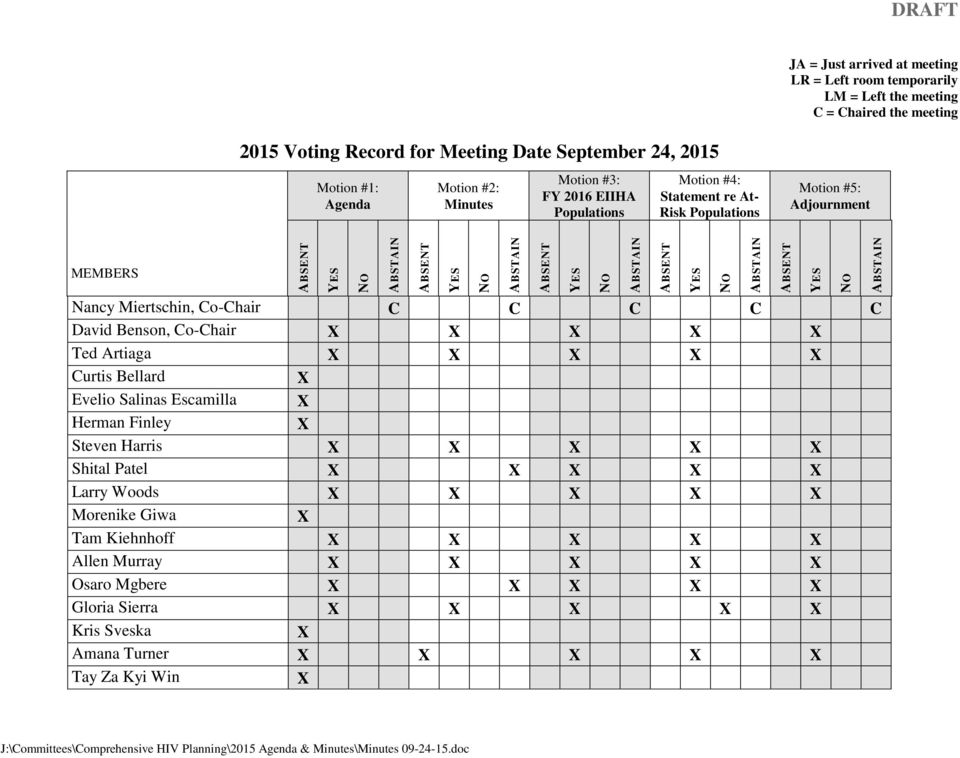
2 Houston Area HIV Services Ryan White Planning Council DRAFT Comprehensive HIV Planning Committee 2:00 p.m., Thursday, September 24, 2015 Meeting Location: 2223 West Loop South, Room 416; Houston, Texas Minutes MEMBERS PRESENT MEMBERS ABSENT OTHERS PRESENT Nancy Miertschin, Co-Chair Curtis Bellard, excused Robert Noble, RWPC David Benson, Co-Chair Evelio Salinas Escamilla, excused Gretchen Hollingsworth Ted Artiaga Herman Finley Denis Kelly Steven Harris Morenike Giwa Shital Patel Kris Sveska STAFF PRESENT Larry Woods Tay Za Kyi Win, excused Sha Terra Johnson-Fairley, TRG Tam Kiehnhoff Ka cha Tousant, TRG Intern Osaro Mgbere Amber Alvarez, Office of Support Allen Murray Diane Beck, Office of Support Gloria Sierra Amana Turner Call to Order: Nancy Miertschin, co-chair, called the meeting to order at 2:14 p.m. and asked for a moment of reflection. She then asked everyone to introduce themselves. Adoption of Agenda: Motion #1: it was moved and seconded (Harris, Artiaga) to adopt the agenda with one change: move VI. Needs Assessment Timelines up to IV. Motion carried. Approval of the Minutes: Motion #2: it was moved and seconded (Artiaga, Sierra) to approve the August 13, 2015 minutes. Motion carried. Abstentions: Mgbere, Patel. Public Comment: None. FY 2016 EIIHA Target Populations: Alvarez reviewed the Planning Process and Requirements, Planning Process Timeline, Target Populations Criteria Worksheet and Target Populations Selection Matrix; see attached. Motion #3: it was moved and seconded (Kiehnhoff, Woods) to approve the following target populations for the FY 2016 EIIHA plan: 1. African Americans 2. Hispanics/Latinos age 35 and over; and 3. Men who have Sex with Men (MSM) and the Office of Support is to include information on HIV and aging in the EIIHA section of the HRSA application. Motion carried unanimously. Motion #4: it was moved and seconded (Kiehnhoff, Mgbere) for the Office of Support to include a statement in the EIIHA section of the HRSA application recognizing that currently available epidemiologic data do not portray the need for testing, referral, and linkage in at-risk populations such as among those who are transgender, intersex, homeless, or post-release from J:\Committees\Comprehensive HIV Planning\2015 Agenda & Minutes\Minutes doc

3 incarceration. Motion carried unanimously. DRAFT Announcements: The Comprehensive Plan Leadership Team and the Needs Assessment Group will be meeting once the co-chairs have been appointed. There will be no regular committee meeting in October. Adjournment: The meeting was adjourned at 3:40 p.m. Submitted by: Approved by: Amber Alvarez, Office of Support Date Chair of Committee Date J:\Committees\Comprehensive HIV Planning\2015 Agenda & Minutes\Minutes doc
4 ABSENT YES NO ABSTAIN ABSENT YES NO ABSTAIN ABSENT YES NO ABSTAIN ABSENT YES NO ABSTAIN ABSENT YES NO ABSTAIN DRAFT JA = Just arrived at meeting LR = Left room temporarily LM = Left the meeting C = Chaired the meeting 2015 Voting Record for Meeting Date September 24, 2015 Motion #1: Agenda Motion #2: Minutes Motion #3: FY 2016 EIIHA Populations Motion #4: Statement re At- Risk Populations Motion #5: Adjournment MEMBERS Nancy Miertschin, Co-Chair C C C C C David Benson, Co-Chair X X X X X Ted Artiaga X X X X X Curtis Bellard X Evelio Salinas Escamilla X Herman Finley X Steven Harris X X X X X Shital Patel X X X X X Larry Woods X X X X X Morenike Giwa X Tam Kiehnhoff X X X X X Allen Murray X X X X X Osaro Mgbere X X X X X Gloria Sierra X X X X X Kris Sveska X Amana Turner X X X X X Tay Za Kyi Win X J:\Committees\Comprehensive HIV Planning\2015 Agenda & Minutes\Minutes doc
5 The Houston Area Comprehensive HIV Prevention and Care Services Plan for 2012 through 2014 Capturing the community s vision for an ideal system of HIV prevention and care for the Houston Area Year 3 Evaluation Report
6 Table of Contents Vision and Mission of the Houston Area Plan 3 Contributors... 4 Introduction Purpose... 5 Methods... 5 Summary of Year 3 Implementation. 6 The Houston Area Report Card: Overall Status of Activities and Benchmarks. 6 The Houston Area Dashboard: Progress Made in Year 3 7 Highlights of Year 3 Implementation. 8 Year 3 Progress in the Houston Area Treatment Cascade... 9 Moving Forward: Recommendations for 2015 and the Next Comprehensive Plan...10 Updates to Year 3 Activities and Benchmarks. 10 Recommendations for the 2017 Comprehensive Plan

7 Vision of the Houston Area Plan The greater Houston Area will become a community with a coordinated system of HIV prevention and care, where new HIV infections are rare, and, when they do occur, where every person, regardless of age, gender, race/ethnicity, sexual orientation, gender identity, or socio-economic circumstance, will have unfettered access to high-quality, life-preserving care, free of stigma and discrimination. Mission of the Houston Area Plan The mission of the Houston Area Comprehensive HIV Prevention and Care Services Plan for is to work in partnership with the community to provide an effective system of HIV prevention and care services that best meets the needs of populations infected with, affected by, or at risk for HIV. 3
8 Contributors Members of the Houston Area Comprehensive HIV Plan Evaluation Workgroup The following individuals conducted the evaluation of Year 3 implementation on April and June This report summarizes their findings and recommendations Ted Artiaga David Benson Evelio Salinas Escamilla Camden Hallmark Sha Terra Johnson-Fairley Nancy Miertschin Allen Murray Nicholas Sloop C. Bruce Turner Steven Vargas Tay Za Kyi Win Others The following individuals provided data, analysis, and other information used during the evaluation process and in this report Ryan White Planning Council Office of Support Tori Williams Diane Beck Amber Alvarez Georgette Monaghan Eric Moreno Harris County Public Health Services Ryan White Grant Administration Carin Martin Tasha Traylor Heather Keizman Dawn Meade The Houston Regional HIV/AIDS Resource Group, Inc. Patrick Martin Sha Terra Johnson-Fairley Houston Health Department Bureau of HIV/STD & Viral Hepatitis Prevention Marlene McNeese Camden Hallmark Amber David Tracy Ford Ereka Washington Philip Mike Thomas Lupita Thornton Cathy Wiley Houston Department of Health and Human Services Office of Surveillance and Public Health Preparedness Jeffrey Meyer Texas Department of State Health Services HIV Prevention and Care Branch Janina Vazquez Suggested citation: The Houston Area Ryan White Planning Council and the Houston HIV Prevention Community Planning Group. Houston Area Comprehensive HIV Prevention and Care Services Plan for 2012 through Evaluation Report for Year 3 Implementation (covering the period of January 2014 to December 2014). Conducted April 16 and June 18,

9 Introduction The Houston Area Comprehensive HIV Prevention and Care Services Plan for (also referred to as the 2012 Comprehensive Plan was revealed to the public on July 2, 2012, following a ten-month planning process that involved 111 individuals and 61 agencies. The final plan included 75 specific activities to be conducted over the next three years in order to make progress toward an ideal system of HIV prevention and care in the Houston Area. Sixty (60) benchmarks were included for use in measuring change over time. The 2012 Comprehensive Plan also included a three-year Evaluation and Monitoring Plan, which set forth the annual assessment of the plan s activities and progress made in achieving the plan s objectives and benchmarks. This report summarizes the findings of the evaluation and monitoring process for Year 3 of plan implementation, including highlights from the year and new directions for Year 3. Purpose The 2012 Comprehensive Plan s Evaluation and Monitoring Plan (Section IV) outlines specific goals and methods for assessing progress in both the short- and long-term aims of the plan: The goal of the evaluation plan is to determine the impact of the Comprehensive HIV Prevention and Care Services Plan for as measured by the extent of achievement of [system-wide] objectives (Section II) The goal of the monitoring plan is to monitor the implementation of the Plan as measured by (1) the extent of achievement of stated activities and efforts (Section III); and (2) the extent of achievement of stated benchmarks (Section III). Assessment of the status of proposed activities measures the extent of the community s implementation of the 2012 Comprehensive Plan each calendar year. Over time, assessment of the progression of objectives and benchmarks reveals the plan s larger impact on attaining stated goals, filling gaps in the HIV prevention and care system in the Houston Area, and, ultimately, alleviating the local HIV epidemic. Methods The methods used for evaluating Year 3 implementation are consistent with the Evaluation and Monitoring Plan (Section IV). In March 2015, each Responsible Party (RP) named in the 2012 Comprehensive Plan (Section III) completed a series of written checklists of assigned activities and benchmarks. For the former, the RP was asked to indicate the extent of achievement of each assigned activity for the time period of January December 2014 using a standard key [C = Complete, C3 = Complete for Year 3 (for annual activities), P = In Progress (P), NI = Not Initiated] and to provide process notes or other documentation to support and provide context for their conclusions. For the latter, the RP supplied the most current and complete year-end data point for each benchmark using approved data sources. All checklists and supporting documentation were cross-referenced and consolidated by support staff. Staff also gathered data on system-wide objectives and any benchmarks not assigned to a RP. The 2012 Comprehensive Plan s standing Evaluation Workgroup convened in April and June 2015 to review consolidated checklists and identify key findings. 5

10 Summary of Year 3 Implementation The Houston Area Report Card: Overall Status of Year 3 Activities and Benchmarks The 2012 Comprehensive Plan is organized into four topic-specific Strategies, each containing activities and benchmarks. While initially slated for completion by the end of 2014, outstanding activities and benchmarks were retained into 2015 and Across the four Strategies, a total of 53 distinct activities were designated for completion in Year 3, including activities to be conducted annually; and all 41 benchmarks were assigned Year 3 targets. Overall, 51 of the activities designated for Year 3 (or 96 percent) were completed or initiated. Twenty-two (22) of the benchmarks with Year 3 targets (or 43 percent) were met or exceeded. Only two (2) of activities (or 4 percent) that were designated for completion in Year 3 were not initiated. Data were not available or are still pending for seventeen of the Year 3 benchmarks (or 34 percent). (See Figure 1) Figure 1: Activities and Benchmarks Completion for Year Complete/Met In Progress Not Initiated/Not Met Data Pending Activities 17 Benchmarks Overall, the Strategy to Address the Needs of Special Populations saw the most activity progress with 92 percent of its activities completed. The Strategy to Fill Gaps in Care and Reach the Out- Of-Care saw the least overall activity progress with 71 percent of its activities completed by the end of Year 3. The Strategy for Prevention and Early Identification had the most benchmark progress with 50 percent of benchmarks met, 78 percent of which exceeded Year 3 targets. The Strategy to Address the Needs of Special Populations saw the least benchmark progress with 27% of benchmarks measures not met 1. (See Figure 2) 1 The Strategy to Address the Needs of Special Populations had four (4) Year 3 benchmarks, three (3) of which had benchmark indicator measures for special population groups, resulting in a total of 22 benchmark measures. 6

11 Figure 2: Percent of Activities and Benchmarks Completed/Met for Year 3, by Strategy Prevention & Early Identification Filling Gaps in Care Special Populations Coordination of Effort 100% 92% 90% 83% 86% 80% 71% 70% 60% 50% 50% 43% 40% 33% 27% 30% 20% 10% 0% Activities Completed Benchmarks Met The Houston Area Dashboard: Progress Made in Year 3 The 2012 Comprehensive Plan includes nine objectives intended to serve as measures of overall improvements in the Houston Area of HIV prevention and care system. The objectives include core epidemiological indicators of HIV infection, nationally defined benchmarks for HIV prevention and care services, and locally defined goals for the Houston Area Ryan White HIV/AIDS Program. Of these nine (9) objectives, three (3) had most current measurements that met or exceeded the 2012 Comprehensive Plan 2014 targets. (See Figure 3) Figure 3: Status of System-Wide Objectives for the Houston Area, 2014 Objective Baseline Y3 Y3 Target Status Actual 1.) Number of new HIV infections diagnosed 1,335 1,386 25% = 1,001 2.) Percent of PLWHA* informed of status through targeted testing 92.9% 94.4% Maintain = 93.0% 3.) Proportion of newly diagnosed PLWHA linked to clinical care 65.1% 78.0% 85% within three months 4.) Percent of new HIV diagnoses with an AIDS diagnosis within 34.5% 32.8% 25% = 27.0% one year 5.) Percent of RW Program clients who are in continuous HIV care 78.0% 75% 80% 6.) Proportion of PLWHA not in care 34.2% 26.7% 0.8% = 27.3% 7.) Proportion of RW Program clients with undetectable viral load 57.0% 80.4% + 10% = 62.7% 8.1) Reports of barriers to RW Program-funded Substance Abuse % = 32 Services 8.2) Reports of barriers to RW Program-funded Mental Health Services % = 85 *People Living with HIV/AIDS + Y3 actual measure is the proportion of RW Part A suppressed viral load (undetectable viral load unavailable). 7

12 Highlights of Year 3 Implementation Three (3) Core HIV Indicators Med or Exceeded Year 3 Targets As in Years 1 and 2, the 2012 Comprehensive Plan s outcome objectives measuring the overall improvement in the Houston HIV prevention and care system made progress in Year 3. Three (3) objectives had measures that met or exceeded 2014 targets. The percent of PLWHA informed of their positive HIV status through targeted testing exceeded its 2014 target maintenance target of 93.0 percent at 94.4 percent. The estimated proportion of PLWHA not in care (Unmet Need) fell from 34.2 percent at baseline to 26.7 percent for the 2014 actual measurement, surpassing the 2014 target. Finally, though the proportion of Ryan White Program clients with undetectable viral loads was not available, the proportion of clients with suppressed viral loads was 80.4 percent. (See Moving Forward: Recommendations for 2015 and the Next Comprehensive Plan). Two (2) additional objectives made progress toward their Year 3 targets from the baseline measurements. The proportion of newly diagnosed PLWHA linked to HIV clinical care within three months of diagnosis increased from 65.1 percent at the baseline to a 2014 actual measurement of 78 percent. The percent of new HIV diagnoses with an AIDS diagnosis within one year fell from 34.5 percent at the baseline to 32.8 percent for the 2014 actual measurement. Though it is not possible to determine whether the 2012 Comprehensive Plan is the sole source of this progress, the improvements observed in the plan s system objectives indicate that the Houston Area community has progressed toward the plan s goals since Twenty-Two (22) Benchmarks Met or Exceeded Year 3 Targets Of the 41 benchmarks set for Year 3, 22 had actual 2014 measurements that met their 2014 targets. Moreover, 17 of these benchmarks had actual 2014 measurements that exceeded the 2014 targets. The 2012 Comprehensive Plan s Strategy for Prevention and Early Identification benchmarks for the number of HIV/STD brochures distributed, the number of publicly-funded HIV tests, the positivity rate for publicly-funded opt-out HIV testing, the percentage of individuals with a positive HIV test result identified through targeted HIV testing who are informed of their HIVpositive status, the proportion of Ryan White HIV/AIDS Program clients with undetectable viral load 2, the number of condoms distributed, and the number of high-risk individuals receiving information on HIV risk reduction through community outreach surpassed their 2014 targets. The Strategy to Fill Gaps in Care and Reach the Out-Of-Care benchmarks for the proportion of individuals who have tested positive for HIV but who are not in HIV care as determined by the Ryan White HIV/AIDS Program Unmet Need Framework, the percentage of PLWHA reporting prior history of being out-of-care, and the proportion of Ryan White HIV/AIDS Program clients with undetectable viral load 3 exceeded their 2014 targets. Four (4) benchmark measurements exceeded 2014 targets for the Strategy to Address the Needs of Special Populations, with increases in the proportions of newly-diagnosed injection drug using (IDU) individuals and men who have sex with men (MSM) linked to clinical care within three months of their HIV diagnosis, decreases in the proportions of individuals who have tested positive for HIV but who are not in HIV care among IDU and MSM. Under the Strategy to Improve Coordination of Effort and Prepare for Health Care System Changes, the number of reports of barriers to Ryan White Support Services, and percentage of PLWHA reporting housing instability, and the percentage of PLWHA reporting seeking no medical care due to inability to pay all fell below Year 3 target measurements. Year 3 Progress in the Houston Area Treatment Cascade 2 Proportion of clients with suppressed viral loads was measured as undetectable viral loads were unavailable See Moving Forward: Recommendations for 2015 and the Next Comprehensive Plan 3 See footnote 2. 8

13 In addition to monitoring the system objectives in the plan s dashboard, the Evaluation Workgroup recommended during the Year 1 evaluation process to include monitoring of the Houston Area Treatment Cascade. Though the 2012 Comprehensive Plan cites and uses the cascade as a secondary data source in the Strategy to Fill Gaps in Care and Reach the Out-of-Care, a local iteration of the cascade was not incorporated into the plan itself as the plan was four months into development when the Centers for Disease Control and Prevention released Vital Signs: HIV Prevention Through Care and Treatment United States, which included estimates of the numbers of PLWHA in selected stages of the continuum of HIV care. While the 2012 Comprehensive Plan includes the Houston Health Services Delivery Area (HSDA) served through Ryan White Part B and States Services funds, and through CDC HIV prevention funding in the Houston Metropolitan Statistical Area (MSA), the data reflected in the local treatment cascade are derived only from data collected for the counties that comprise the Houston Eligible Metropolitan Area (EMA). (See Figure 4) Figure 4: The Houston EMA HIV/AIDS Treatment Cascade, % 90% 80% 70% 60% 50% 100% 100% 100% 27,875 28,401 30,204 82% 84% 83% 72% 73% 75% 51% 60% 67% % 46% 55% 40% 30% 20% 22,830 23,914 24,979 16,547 17,526 18, ,257 13,812 11,547 12,331 10,547 10% 0% HIV Infected* HIV Diagnosed** Met Need*** Retained in Care+ Virally Suppressed++ *No. person who are HIV positive in 2012, 2013, and 2014 in the Houston EMA (diagnosed + undiagnosed estimate). **No. persons who are HIV positive in 2012, 2013, and 2014 in the Houston EMA. ***No. persons with met need in 2012, 2013, and 2014 in the Houston EMA. +No. persons with retained in care (PLWHA with at least 2 visits, labs, or ARVs in 12 months, at least 3 months apart) in 2012, 2013, and 2014 in the Houston EMA. ++No. persons whose last viral load test of 2012, 2013, 2014 <=200 (among persons with >=1 VL test) in the Houston EMA. The Houston Area Treat Cascade reflects within the Houston EMA: the estimated total number of PLWHA (diagnosed and estimated status unaware); the number of PLWHA in who have been diagnosed; and, among the diagnosed, the numbers of PLWHA with records of linkage to HIV primary care, retention in care, and viral suppression within the 2012, 2013, and 2014 calendar years. The proportions of the diagnosed PLWHA with met need, retention in care, and who had suppressed viral loads at the end of the calendar year has increased consistently since (See Figure 4) 9

14 Moving Forward: Recommendations for 2015 and the Next Comprehensive Plan Updates to Year 3 Activities and Benchmarks Adjust Baseline and 2014 Targets for Objectives 1 and 4 Due to changes in data availability and ease of access for obtaining Year 3 actual measurements for Objective 1 (reduce the number of new HIV infections diagnosed in the Houston Area by 25%) and Objective 4 (reduce the percentage of new HIV diagnoses with an AIDS diagnosis within one year by 25%), the baseline measurement for each objective was adjusted to reflect the Houston EMA, rather than the Houston HSDA. As Objective 1 and Objective 4 call for a 25 % reduction in new diagnoses and late/concurrent diagnoses respectively, the 2014 targets for both Objectives were also adjusted. Evaluation Workgroup recommendation: change the baseline region to Houston EMA for Objective 1 and Objective 4 to align with Year 3 measure; change Year 3 targets to reflect new baselines. Changes to Activities, Including Retention of Activities Pending Completion into 2015 As in Year 2, each Year 3 Strategy had activities for which progress had been made, but some activities were not completed. Many of the outstanding activities in Year 3 related to the projects and programs of community partners that, for varying reasons, were unable to be synchronized with the plan s implementation schedule. Upon review, the Evaluation Workgroup suggested retaining activities scheduled for completion in Year 3 into 2015, per extension of the 2012 Comprehensive Plan into Evaluation Workgroup recommendation: retain the following pending activities into 2015: (Strategy 1, Activity 3/Strategy 2, Activity 2) Identify and disseminate a model protocol for a layperson system navigator program to assist newly-diagnosed HIV infected individuals to enter HIV care. o Rationale: An effectiveness study of the model peer mentor program identified yielded that there were no statistically significant nor clinically useful differences in primary outcomes between the control group and the test group receiving peer mentoring, though there was some positive effect on primary outcomes among newly-diagnosed individuals with shorter hospitalization times. Additional time is needed to identify a model protocol with greater effectiveness. (Strategy 1, Activity 4/Strategy 2, Activity 4) Develop a toolkit for private medical doctors for how to link newly-diagnosed HIV infected individuals into the Ryan White HIV/AIDS Program. o Rationale: A draft linkage to care brochure for providers was completed in December 2014, finalized in January 2015, and sent to the printer in March The linkage to care brochure will be featured the toolkit. (Strategy 3, Activity 2) Alter data collection and reporting methods in current local data collection systems (e.g., Testing 4 Tickets, Electronic Client-Level Integrated (ECLIPS), CPCDMS (Centralized Patient Care Data Management System), etc.) to provide information on Special Populations, in particular, 10
15 Homeless, Incarcerated and Recently Released, and Transgender, including standard definitions for data collection and reporting requirements. o Rationale: Rationale: The Texas Department of State Health Services upgrade of STD*MIS in Y4 will provide additional gender options; continue focus on developing reporting alignment among administrative agents and the Houston Health Department as this did not occur in Y3. (Strategy 4, Activity 6) Translate the Houston Area HIV/AIDS Resource Guide into a real-time web- and phone-based resource locator with accompanying mobile applications (if feasible) accessible by clients and providers. o Rationale: Substantial progress was made in developing an Android mobile application in Year 3, and development on an Apple/iPhone compatible application was pending at the time of the Evaluation Workgroup s review. Additional Evaluation Workgroup recommendation: Remove ECHPP component of activity (Strategy 4, Activity 13) Support ongoing regional efforts to operationalize HIV prevention and care integration as outlined by the Enhanced Comprehensive HIV Prevention Planning (ECHPP) and Early Identification of Individuals with HIV/AIDS (EIIHA) o Rationale: The ECHPP demonstration project was completed in Year 2. Recommendations for the 2017 Comprehensive Plan Recommendations for the 2017 Comprehensive Plan As the Evaluation Workgroup reviewed Year 3 implementation of the 2012 Comprehensive Plan, the Workgroup developed five (5) recommendations for development of the 2017 Comprehensive Plan: 1. In addition to Objective 1 (reduce the number of new HIV infections diagnosed in the Houston Area by 25%), consider including objectives and benchmarks for a local unaware/undiagnosed estimate and incidence estimate. a. Rationale: As this Objective and related benchmarks has remained relatively stable since the baseline, there is no clear indication as to whether the number of new HIV infections diagnosed has not reduced due to the number of new infections or improving detection through targeted and routine testing initiatives. A local unware/undiagnosed estimate and/or incidence estimate could supplement this measure. 2. Measure viral suppression rather than undetectable viral loads to align with state and national Treatment Cascades/HIV Care Continuums. a. Rationale: Viral suppression, rather than undetectable viral load, is used in the Texas Treatment Cascade and the national HIV Care Continuum. 3. Consider using epidemiologic data instead of Needs Assessment data to set baselines for morbidity-related special population benchmarks. a. Rationale: Using Needs Assessment data to quantify benchmarks such as the proportions of adolescent, homeless, transgender, or recently release individuals 11
16 linked to clinical care within three months of their HIV diagnosis or who are out-of-care is not appropriate given the intent, scope, and sample size of the Needs Assessment. 4. Include an activity similar to Strategy 1, Activity 3 that examines peer mentorship in a clinic setting. a. Rationale: The model peer mentor program identified for Strategy 1, Activity 3 yielded that there were no statistically significant or clinically useful differences in primary outcomes was hospital-based, and a clinic-based program may result in better outcomes. 5. Use the Continuum of Care as a framework for developing the plan if possible. If not possible, consider creating a crosswalk to the Continuum. a. Rationale: The HIV Care Continuum was not incorporated into the 2012 Comprehensive Plan. 12
17 For more information, contact: Houston Area Ryan White Planning Council 2223 West Loop South, #240 Houston, Texas Tel: (713) Fax: (713) Web: 13
18 2015 QUARTERLY REPORT COMPREHENSIVE HIV PLANNING COMMITTEE Status of Committee Goals and Responsibilities (*means mandated by HRSA): 1. *Assess, evaluate, and make ongoing recommendations for the Comprehensive HIV Plan. 2. *Determine the size and demographics of the estimated population of individuals who are unaware of their HIV status. 3. *Work with the community and other committees to develop a strategy for identifying those with HIV who do not know their status, make them aware of their status, and link and refer them into care. 4. *Explore and develop on-going needs assessment activities including the identification and prioritization of special studies. 5. If necessary, begin the planning process for the next HIV/AIDS needs assessment and comprehensive service plan. 6. *Review and disseminate the most current Joint Epidemiological Profile. Committee Chairperson Date J:\Committees\Comprehensive HIV Planning\2015 Documents\Quarterly Report 2015.doc
HIV/AIDS in the Houston Area
 HIV/AIDS in the Houston Area The 2013 Houston Area Integrated Epidemiologic Profile for HIV/AIDS Prevention and Care Services Planning Page 1 Disclaimer: This document is the most current HIV/AIDS epidemiologic
Quality Management Plan
 Quality Management Plan West Palm Beach Eligible Metropolitan Area 2015-2018 Revised April 2015 Page 1 QUALITY MANAGEMENT PLAN West Palm Beach EMA Prepared by: Shoshana Ringer, Quality Management Coordinator
2012-2015 STRATEGIC PLAN TO ADDRESS HIV IN IOWA
 SECTION 3. 2012-2015 STRATEGIC PLAN TO ADDRESS HIV IN IOWA This final section of the Iowa Comprehensive HIV Plan contains recommendations for a cascade of prevention and care activities that are designed
HIV Surveillance Update
 HIV Surveillance Update Presentation to: CAPUS Metro Atlanta Testing and Linking Consortium (MATLC) Presented by: Deepali Rane, MPH and Jane Kelly, MD Georgia Department of Public Health Epidemiology Date:
2012 2014 Maryland HIV Plan
 Maryland Department of Health & Mental Hygiene Prevention and Health Promotion Administration 2012 2014 Maryland HIV Plan Comprehensive HIV Plan Statewide Coordinated Statement of Need Maryland HIV Prevention
Understanding the HIV Care Continuum
 Understanding the HIV Care Continuum Overview Recent scientific advances have shown that antiretroviral therapy (ART) not only preserves the health of people living with HIV, but also dramatically lowers
Using HIV Surveillance Data to Calculate Measures for the Continuum of HIV Care
 Using HIV Surveillance Data to Calculate Measures for the Continuum of HIV Care Anna Satcher Johnson, MPH Symposium on Measuring the HIV Care Continuum Center for AIDS Research University of Washington
DC Comprehensive HIV Prevention Plan for 2012-2015: Goals and Objectives
 DC Comprehensive HIV Prevention Plan for 2012-2015: Goals and Objectives The Comprehensive Plan includes program goals and objectives, monitoring and evaluation, and capacity building activities specific
Health Insurance Premium & Co-Pay Assistance
 Health Insurance Premium & Co-Pay Assistance Pg Service Category Definition Part B/DSHS State Services 1 Service Category Definition Part A 4 Feasibility of a Pilot Project Using Ryan White Health Insurance
Quality Management Plan Vision Purpose II. Mission III. Principles of Quality Management (QM)
 J:HCC/Collaborative//QI Plan RWIII 1 FL DOH Monroe County Health Department (MCHD) Ryan White CARE Act Title III Early Intervention Services/Primary Care Vision Empowered people living healthy lives, self-managing
EXECUTIVE SUMMARY: INTEGRATED EPIDEMIOLOGIC PROFILE FOR HIV/AIDS PREVENTION AND CARE ELIGIBLE METROPOLITAN AREA PLANNING, PHILADELPHIA
 EXECUTIVE SUMMARY: INTEGRATED EPIDEMIOLOGIC PROFILE FOR HIV/AIDS PREVENTION AND CARE PLANNING, PHILADELPHIA ELIGIBLE METROPOLITAN AREA 2015 Prepared for the Philadelphia Eligible Metropolitan Area Ryan
Department of Veterans Affairs National HIV/AIDS Strategy Operational Plan 2011
 Department of Veterans Affairs National HIV/AIDS Strategy Operational Plan 2011 Table of Contents Purpose..3 Overview of HIV Health Care.....4 Goal 1: Reducing the Number of People who become infected
CONNECTICUT DEPARTMENT OF PUBLIC HEALTH HEALTH CARE AND SUPPORT SERVICES HIV MEDICATION ADHERENCE PROGRAM PROTOCOL
 CONNECTICUT DEPARTMENT OF PUBLIC HEALTH HEALTH CARE AND SUPPORT SERVICES HIV MEDICATION ADHERENCE PROGRAM PROTOCOL Revised July 2013 HIV MEDICATION ADHERENCE PROGRAM PROGRAM OVERVIEW People living with
Injection Drug Users in Miami-Dade: NHBS-IDU2 Cycle Preliminary Results
 Injection Drug Users in Miami-Dade: NHBS-IDU2 Cycle Preliminary Results David W. Forrest, Ph.D. Marlene LaLota, M.P.H. John-Mark Schacht Gabriel A. Cardenas, M.P.H. Lisa Metsch, Ph.D. National HIV Behavioral
Perspective Implications of the Affordable Care Act for People With HIV Infection and the Ryan White HIV/AIDS Program: What Does the Future Hold?
 Perspective Implications of the Affordable Care Act for People With HIV Infection and the Ryan White HIV/AIDS Program: What Does the Future Hold? There are numerous aspects of the Patient Protection and
QUALITY MANAGEMENT PLAN
 QUALITY MANAGEMENT PLAN 2012 BOSTON EMA Boston Eligible Metropolitan Area Ryan White Treatment Modernization Act Part A & MAI Boston Public Health Commission, Infectious Disease Bureau, HIV/AIDS Services
NEW YORK STATE REHABILITATION COUNCIL GUIDING PRINCIPLES
 NEW YORK STATE REHABILITATION COUNCIL GUIDING PRINCIPLES Article I. SHORT TITLE A. The name of this body shall be the New York State Rehabilitation Council (SRC). B. This document may be cited as the Guiding
The Ryan White CARE Act 2000 Reauthorization
 POLICY BRIEF january 2001 The Ryan White CARE Act 2000 Reauthorization Overview As the Ryan White CARE Act enters its second decade, it continues to be a critical source of care and services for people
Program Performance Indicators Revised Baseline & Target Setting Form January 1 June 30, 2004 Interim Progress Report
 ATTACHMENT B Program Performance Indicators Revised Baseline & Target Setting Form January 1 June 30, Interim Progress Report Overall HIV Indicator A.1: The number of newly diagnosed HIV infections Original
Medical Case Management State of Iowa RWHAP Part B. Holly Hanson, MA, CPM Ryan White Part B Program Manager Bureau of HIV,STD, and Hepatitis
 Medical Case Management State of Iowa RWHAP Part B Holly Hanson, MA, CPM Ryan White Part B Program Manager Bureau of HIV,STD, and Hepatitis What is Case Management? A client focused process that expands
St Johns County CoC Governance Charter St Johns County Continuum of Care St Johns County Continuum of Care Board Purpose of the CoC and CoC Board
 St Johns County CoC Governance Charter The name of this Continuum of Care (CoC) shall be the St Johns County Continuum of Care and the name of the CoC board shall be the St Johns County Continuum of Care
Integrating Medical Care Coordination Services into HIV Clinic Medical Homes
 Integrating Medical Care Coordination Services into HIV Clinic Medical Homes Carlos Vega-Matos, M.P.A. HIV Care Services Division Division of HIV and STD Programs Background DHSP funds HIV Clinics to provide
HIV Services Quality Management Plan San José, CA (Santa Clara County) Transitional Grant Area. January 1 to December 31, 2012
 HIV Services Quality Management Plan San José, CA (Santa Clara County) Transitional Grant Area January 1 to December 31, 2012 Plan developed and written by: Jeremy Holman, PhD Dianne Perlmutter, MPH, MSW
HIV Epidemiology in New York State
 HIV Epidemiology in New York State Lou Smith, MD, MPH Director, Division of Epidemiology, Evaluation and Research AIDS Institute, New York State Department of Health 2 HIV Surveillance in New York State
Estimates of New HIV Infections in the United States
 Estimates of New HIV Infections in the United States Accurately tracking the HIV epidemic is essential to the nation s HIV prevention efforts. Yet monitoring trends in new HIV infections has historically
CARE COORDINATION IN NEW YORK CITY
 CARE COORDINATION IN NEW YORK CITY Department of Health and Mental Hygiene Bureau of HIV/AIDS Prevention and Control Care and Treatment Unit 1 Funded Programs 28 agencies providing CCP in New York City
How To Prevent An Std
 As is true of other racial health disparities, the disproportional prevalence of STDs among American Indians does not reflect any biological difference in infection susceptibility, but rather inequalities
CITY OF NEW BEDFORD CONTINUUM OF CARE HOMELESS SERVICE PROVIDER NETWORK (HSPN)
 CITY OF NEW BEDFORD CONTINUUM OF CARE HOMELESS SERVICE PROVIDER NETWORK (HSPN) Bylaws - Established February 12, 2003; Amended April 25, 2013 Article I: Introduction, Purpose, and Mission Section 1.0:
Illustrating HIV/AIDS in the United States
 Illustrating HIV/AIDS in the United States Black Persons 2013 Update About AIDSVu AIDSVu is a compilation of interactive, online maps that allows users to visually explore the HIV epidemic in the U.S.
Tarzana Treatment Centers, Inc. Community Health Needs Assessment. TTC Acute Psychiatric Hospital SPA 2. Implementation Strategy
 Tarzana Treatment Centers, Inc Community Health Needs Assessment TTC Acute Psychiatric Hospital SPA 2 Implementation Strategy The implementation strategy for the Community Health Needs Assessment for TTC
SUBSTANCE ABUSE TREATMENT
 NEWARK EMA HIV HEALTH SERVICES PLANNING COUNCIL 315 NORTH 6TH STREET, 2ND FLOOR; P.O. BOX 7007 NEWARK, NJ 07107 PHONE: 973-485-5220 FAX: 973-485-5085 E-MAIL: [email protected] VISIT US AT WWW.NEWARKEMA.ORG
HPTN 073: Black MSM Open-Label PrEP Demonstration Project
 HPTN 073: Black MSM Open-Label PrEP Demonstration Project Overview HIV Epidemiology in the U.S. Overview of PrEP Overview of HPTN HPTN 061 HPTN 073 ARV Drug Resistance Conclusions Questions and Answers
HIV Continuum of Care Monitoring Framework 2014
 HIV Continuum of Care Monitoring Framework 2014 Addendum to meeting report: Regional consultation on HIV epidemiologic information in Latin America and the Caribbean HIV Continuum of Care Monitoring Framework
Prison and Jail Health January 18, 2007. Viewer Call-In. Evaluations. www.t2b2.org. Phone: 800-452-0662 Fax: 518-426-0696. 518-402-0330 www.t2b2.
 Prison and Jail Health January 18, 2007 Guthrie S. Birkhead, M.D., M.P.H Director, AIDS Institute and Center for Community Health New York State Department of Health (NYSDOH) Lester N. Wright, M.D., M.P.H.
Targeted HIV Testing & Enhanced Testing Technologies. HIV Prevention Section Bureau of HIV/AIDS
 Targeted HIV Testing & Enhanced Testing Technologies HIV Prevention Section Bureau of HIV/AIDS May 2012 1 Typing a Question in the Chat Box Type question in here 2 Completing the Webinar Evaluation (opened
PROJECT ARK CASE STUDY: EXPANDING PEER ROLES TO PROVIDE TREATMENT AND ADHERENCE SUPPORT IN A UNIVERSITY HOSPITAL SETTING ST.
 CASE STUDY: EXPANDING PEER ROLES TO PROVIDE TREATMENT AND ADHERENCE SUPPORT IN A UNIVERSITY HOSPITAL SETTING PROJECT ARK Main goals addressed by peer program: Capacity-building activities: Peer program
CASE MANAGEMENT STANDARDS TRANSITIONAL GRANT AREA REA (TGA)
 S OF CARE Oakland Transitional Grant Area Care and Treatment Services O C T O B E R 2 0 0 7 Office of AIDS Administration 1000 Broadway, Suite 310 Oakland, CA 94607 Tel: (510) 268-7630 Fax: (510) 768-7631
City of Los Angeles, 2003-2008 Consolidated Plan
 , 2003-2008 Consolidated Plan D. Other Special Needs Supportive and Housing Services The Mayor has identified residents with special needs as a top priority for the Consolidated Plan and Annual Action
2014-2016 ALAMEDA COUNTY, CALIFORNIA COMPREHENSIVE HIV PREVENTION PLAN
 2014-2016 ALAMEDA COUNTY, CALIFORNIA COMPREHENSIVE HIV PREVENTION PLAN JULY 2014 Prepared by the Oakland TGA Collaborative Community Planning Council HIV Prevention Committee & the Alameda County Office
Case Management Outcomes
 Outcomes Evaluation Technical Assistance Guide Case Management Outcomes Titles I and II of the Ryan White CARE Act Outcomes Evaluation Technical Assistance Guide Case Management Outcomes Titles I and II
National Center for HIV/AIDS, Viral Hepatitis, STD, and TB Prevention Division of HIV/AIDS Prevention
 National Center for HIV/AIDS, Viral Hepatitis, STD, and TB Prevention Division of HIV/AIDS Prevention U.S. Department of Health and Human Services Centers for Disease Control and Prevention National Center
EXPANDED HIV TESTING AND LINKAGE TO CARE (X-TLC) IN HEALTHCARE SETTINGS ON THE SOUTH SIDE OF CHICAGO
 EXPANDED HIV TESTING AND LINKAGE TO CARE (X-TLC) IN HEALTHCARE SETTINGS ON THE SOUTH SIDE OF CHICAGO R Eavou, M Taylor, C Bertozzi-Villa, D Amarathithada, R Buffington, D Pitrak and N Benbow HIV Prevention
Outpatient/Ambulatory Health Services
 Outpatient/Ambulatory Health Services Service Definition Outpatient/ambulatory medical care includes the provision of professional diagnostic and therapeutic services rendered by a physician, physician
A Ministry of the Archdiocese of Galveston-Houston A United Way Agency
 A Ministry of the Archdiocese of Galveston-Houston A United Way Agency Integrated Multidsciplinary Approach to Adapt Routine HIV Screening in a Safety Net Clinic Setting Sherri D. Onyiego MD, PhD Baylor
The Florida Department of Health in Broward County Addresses HIV Care Linkage, Retention, and Adherence
 The Florida Department of Health in Broward County Addresses HIV Care Linkage, Retention, and Adherence Abraham Feingold, Psy.D. Florida Department of Health in Broward County Where We Work Where We Play
SUBSTANCE ABUSE TREATMENT NEEDS ASSESSMENT AND RESOURCE INVENTORY FOR PEOPLE LIVING WITH HIV DISEASE IN THE ATLANTA EMA
 SUBSTANCE ABUSE TREATMENT NEEDS ASSESSMENT AND RESOURCE INVENTORY FOR PEOPLE LIVING WITH HIV DISEASE IN THE ATLANTA EMA July, 2002 Prepared for: Fulton County Government Metropolitan Atlanta HIV Health
Using Substance Abuse Prevention and Treatment (SAPT) Block Grant HIV Set- Aside Funds for Integrated Services
 Using Substance Abuse Prevention and Treatment (SAPT) Block Grant HIV Set- Aside Funds for Integrated Services ADP Training Conference, Sacramento, August 21, 2012 Rachel McLean, MPH, CA Dept. of Public
Houston Department of Health and Human Services Bureau of HIV/STD and Viral Hepatitis Prevention
 Houston Department of Health and Human Services Enhanced Comprehensive HIV Prevention Planning and Implementation for Metropolitan Statistical Areas Most Affected by HIV/AIDS (ECHPP) for Houston-Baytown-Sugarland,
Program Collaboration and Service Integration:
 Program Collaboration and Service Integration: Enhancing the Prevention and Control of HIV/AIDS, Viral Hepatitis, Sexually Transmitted Diseases, and Tuberculosis in the United States An NCHHSTP White Paper,
Seminole County Public Schools Business Advisory Board. Bylaws
 Seminole County Public Schools Business Advisory Board Bylaws I. Purpose The purpose of the Business Advisory Board ( BAB ) for the School Board of Seminole County ( School Board ) is to assist and advise
The HIV Epidemic in Broward County - Next Meeting
 200 Oakwood Lane, Suite 100, Hollywood, FL, 33020 - Tel: 954-561-9681 / Fax: 954-561-9685 JOINT CLIENT/COMMUNITY RELATIONS COMMITTEE Meeting Agenda Tuesday, December 4, 2012 at 1:00 P.M. 200 Oakwood Lane,
Protocol-Based Counseling Quality Assurance Standards
 Texas Department of State Health Services Protocol-Based Counseling Quality Assurance Standards HIV/STD Comprehensive Services Branch 1100 West 49th Street Austin, Texas 78756 Telephone: (512) 490-2505
Michael N. Joyner Director, Positive Action and Patient Advocacy. ViiV Healthcare
 Michael N. Joyner Director, Positive Action and Patient Advocacy ViiV Healthcare When Positive Action was created in 1992 it was the first pharmaceutical company program of its kind to support communities
National Center for HIV/AIDS, Viral Hepatitis, STD, and TB Prevention
 National Center for HIV/AIDS, Viral Hepatitis, STD, and TB Prevention Age Differences in Viral Suppression, Antiretroviral Therapy Use, and Adherence Among HIV-positive Men Who Have Sex With Men Receiving
STATE OF THE HIV/AIDS EPIDEMIC IN CHARLESTON
 STATE OF THE HIV/AIDS EPIDEMIC IN CHARLESTON 12/1/2015 A Crisis Among Lowcountry Youth The Charleston region is facing a serious issue of rising HIV rates, particularly among those under the age of 30.
Public Health - Seattle & King County
 - Seattle & King County Mission Statement Alonzo Plough, Director The mission of Public Health - Seattle & King County (Public Health) is to provide public health services that promote health and prevent
Las Vegas Transitional Grant Area Planning Council
 Las Vegas Transitional Grant Area Planning Council Emergency Financial Assistance Standards of Care Originated Ratified March 2011 November 2012 1. HRSA Service Definition Emergency financial assistance
Legal Issues for People with HIV
 Legal Issues for People with HIV Duke Legal Project Box 90360 Durham, NC 27708-0360 (919) 613-7169 (888) 600-7274 Duke Legal Project is a clinical legal education program of Duke Law School. Legal Representation
Ryan White Part A. Quality Management
 Quality Management Case Management (Non-Medical) Broward County/Fort Lauderdale Eligible Metropolitan Area (EMA) The creation of this public document is fully funded by a federal Ryan White CARE Act Part
HIV/AIDS policy. Introduction
 HIV/AIDS policy Introduction The International Federation of Red Cross and Red Crescent Societies (International Federation) has a long tradition of working in the area of health and care. National Red
Post-2015 Negotiation Briefs #8: Youth Friendly Services in Universal Health Coverage
 Post-2015 Negotiation Briefs #8: Youth Friendly Services in Universal Health Coverage Introduction Universal Health Coverage (UHC) is seen a key contributor to ensuring a healthy population and, in turn,
THE BOARD OF MANAGERS MEETING AGENDA
 THE BOARD OF MANAGERS MEETING 9:00 A.M. Thursday, BOARD ROOM 2525 Holly Hall Drive, Houston, Texas 77054 Mission We improve our community s health by delivering high quality healthcare to Harris County
Ryan White Part A. Quality Management
 Quality Management Minority AIDS Initiative Medical Case Management Broward County/Fort Lauderdale Eligible Metropolitan Area (EMA) The creation of this public document is fully funded by a federal Ryan