
Barrow Island Quarantine:
|
|
|
- Clarissa Terry
- 10 years ago
- Views:
Transcription
1 Barrow Island Quarantine: Terrestrial and Marine Quarantine Management System Document No: G1-PP-QRT-GDL-0001 Copy No: IP Security: Public
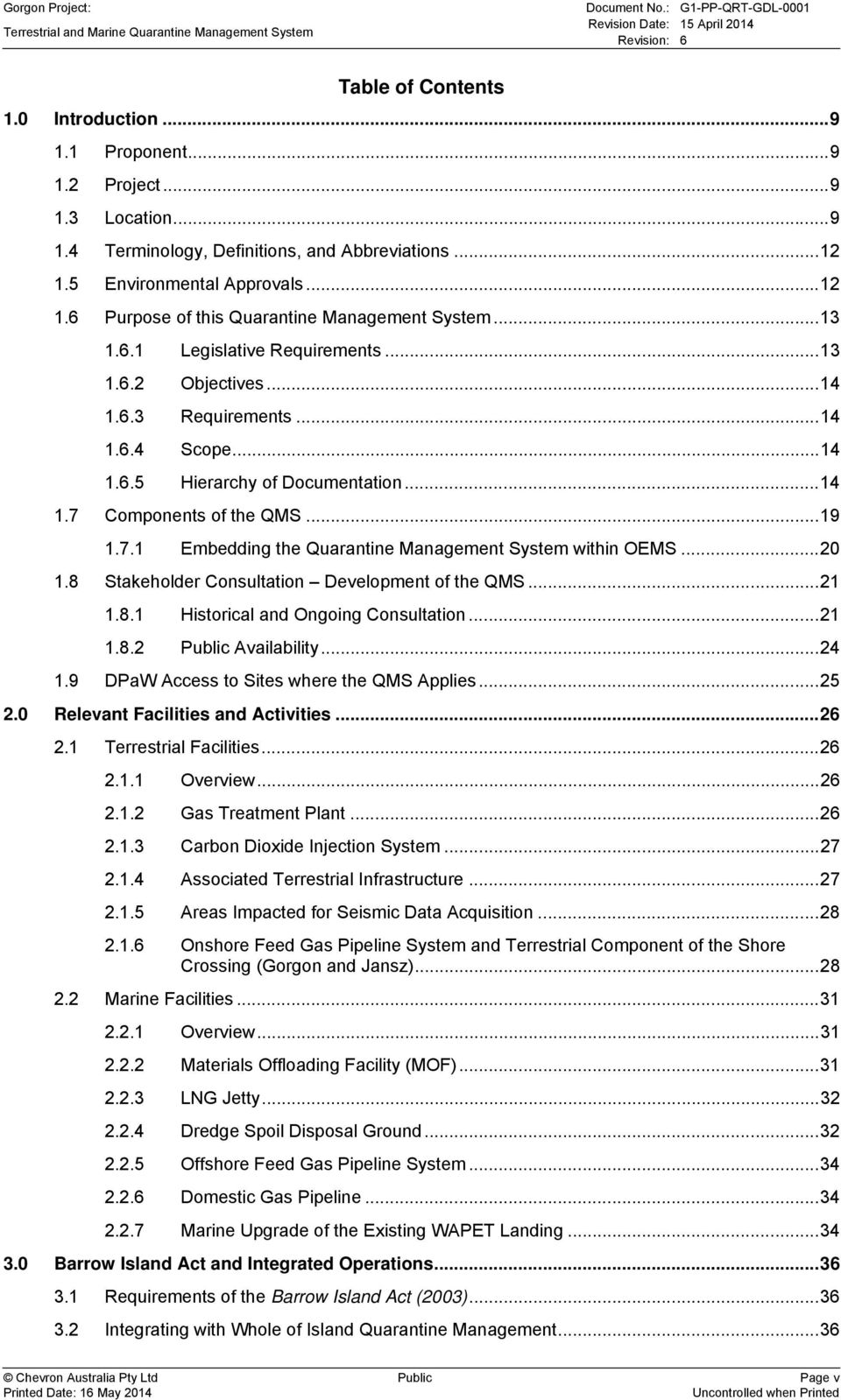
2 Gorgon Project: Document No.: G1-PP-QRT-GDL-0001 Table of Contents 1.0 Introduction Proponent Project Location Terminology, Definitions, and Abbreviations Environmental Approvals Purpose of this Quarantine Management System Legislative Requirements Objectives Requirements Scope Hierarchy of Documentation Components of the QMS Embedding the Quarantine Management System within OEMS Stakeholder Consultation Development of the QMS Historical and Ongoing Consultation Public Availability DPaW Access to Sites where the QMS Applies Relevant Facilities and Activities Terrestrial Facilities Overview Gas Treatment Plant Carbon Dioxide Injection System Associated Terrestrial Infrastructure Areas Impacted for Seismic Data Acquisition Onshore Feed Gas Pipeline System and Terrestrial Component of the Shore Crossing (Gorgon and Jansz) Marine Facilities Overview Materials Offloading Facility (MOF) LNG Jetty Dredge Spoil Disposal Ground Offshore Feed Gas Pipeline System Domestic Gas Pipeline Marine Upgrade of the Existing WAPET Landing Barrow Island Act and Integrated Operations Requirements of the Barrow Island Act (2003) Integrating with Whole of Island Quarantine Management Chevron Australia Pty Ltd Public Page v Printed Date: 16 May 2014 Uncontrolled when Printed
3 Gorgon Project: Document No.: G1-PP-QRT-GDL Barrow Island Quarantine Policy Quarantine Risk Management Quarantine Risk Assessment Quarantine Risk Assessment Methodology Quarantine Barrier Selection Quarantine Risk Register HES Risk Management Methodology Management Measures Supporting Environmental Stewardship Management Measures to Prevent Introductions of NIS and Marine Pests Quarantine Guidelines Quarantine Procedures Quarantine Specifications Quarantine Checklists Measures to Detect NIS and Marine Pests Early Enough to Consider Eradication Observation Surveillance Monitoring Measures to Control and Eradicate NIS and Marine Pests Quarantine Species Action Plan Framework Quarantine Species Action Plans Managing NIS and Marine Pests on Barrow Island and its Surrounding Waters Quarantine Management Plans Management Plans for EPCM and Contractors Management Plans for Specialised Activities Management Plans for Facilities Management Plans for Marine Vessels Zonation as a Management Measure Objectives, Performance Standards, and Relevant Documentation Overview Objectives Performance Standards Relevant Documentation Process for Determining Performance Standards Aspirational Targets Implementation Environmental Management Documentation Overview Page vi Public Chevron Australia Pty Ltd Uncontrolled when Printed Printed Date: 16 May 2014

4 Gorgon Project: Document No.: G1-PP-QRT-GDL Gorgon Gas Development and Jansz Feed Gas Pipeline Documentation Safe Operations Competency Development Structure, Roles and Responsibility Communication Quarantine Information Management Continuous Improvement Facility Design and Construction Buildings and Facilities Infrastructure and Equipment Associated with Facilities Third-party Contractors Contractor and Subcontractor Documentation Operation Control of Contractors and Subcontractors Procedural Deviations and Quarantine Intercepts Procedural Deviation Investigation and Corrective Action Intercepts Investigation and Corrective Action Incident Investigation Emergency Management Emergency Response Plan Quarantine Incursion Response Plan Management of Change Auditing, Reporting and Review Auditing Internal Auditing External Auditing Reporting Compliance Reporting Environmental Performance Reporting Quarantine Audit Reporting to DPaW and the Conservation Commission Routine Internal Reporting Incident Response and Reporting Review of this QMS Management Review References Appendix 1 Terminology, Definitions and Abbreviations Appendix 2 Chevron Integrated Risk Prioritization Matrix Appendix 3 Ministerial Condition Management Requirements Appendix 4 Species Action Plan Development Status Chevron Australia Pty Ltd Public Page vii Printed Date: 16 May 2014 Uncontrolled when Printed

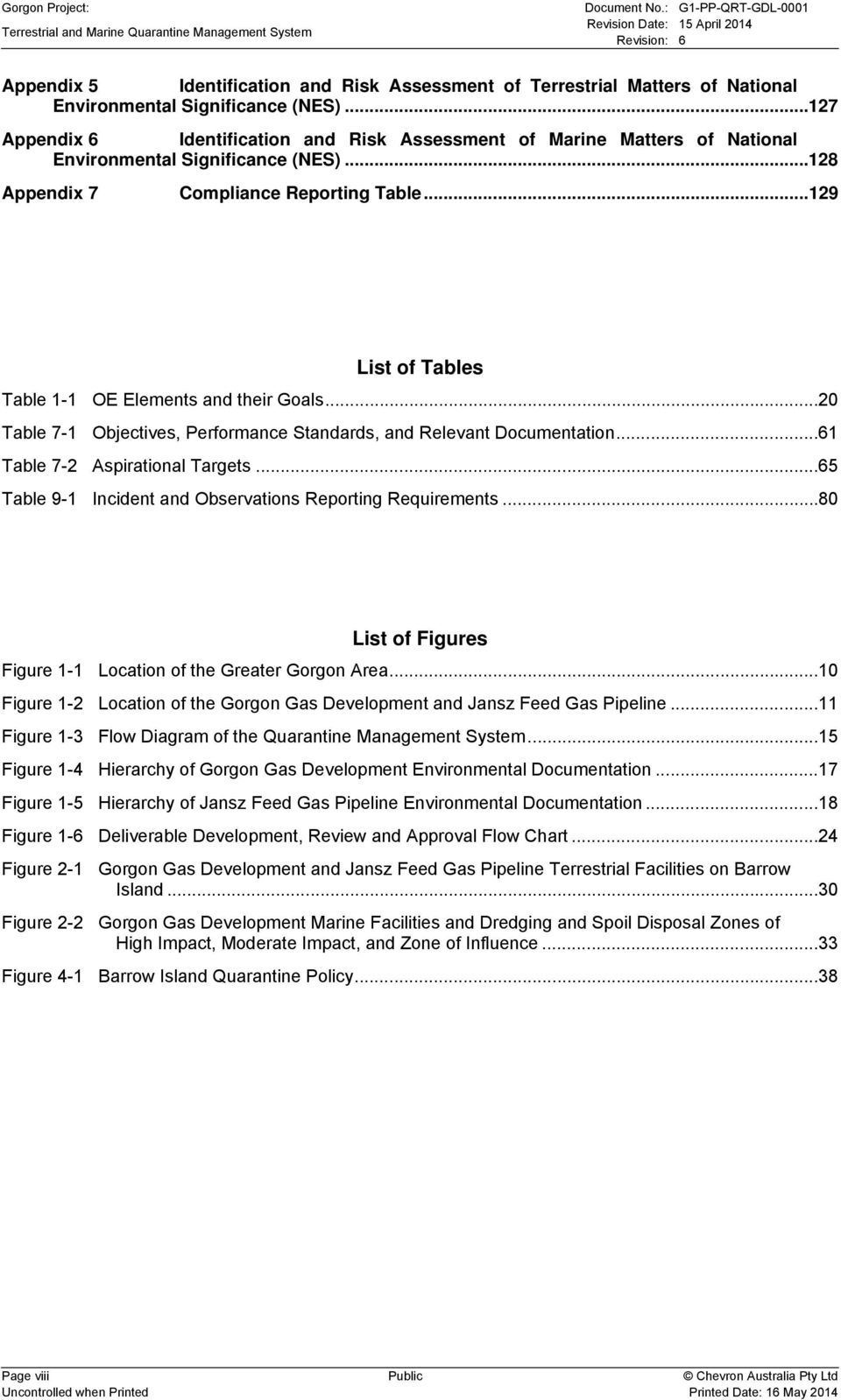
5 Gorgon Project: Document No.: G1-PP-QRT-GDL-0001 Appendix 5 Identification and Risk Assessment of Terrestrial Matters of National Environmental Significance (NES) Appendix 6 Identification and Risk Assessment of Marine Matters of National Environmental Significance (NES) Appendix 7 Compliance Reporting Table List of Tables Table 1-1 OE Elements and their Goals Table 7-1 Objectives, Performance Standards, and Relevant Documentation Table 7-2 Aspirational Targets Table 9-1 Incident and Observations Reporting Requirements List of Figures Figure 1-1 Location of the Greater Gorgon Area Figure 1-2 Location of the Gorgon Gas Development and Jansz Feed Gas Pipeline Figure 1-3 Flow Diagram of the Quarantine Management System Figure 1-4 Hierarchy of Gorgon Gas Development Environmental Documentation Figure 1-5 Hierarchy of Jansz Feed Gas Pipeline Environmental Documentation Figure 1-6 Deliverable Development, Review and Approval Flow Chart Figure 2-1 Gorgon Gas Development and Jansz Feed Gas Pipeline Terrestrial Facilities on Barrow Island Figure 2-2 Gorgon Gas Development Marine Facilities and Dredging and Spoil Disposal Zones of High Impact, Moderate Impact, and Zone of Influence Figure 4-1 Barrow Island Quarantine Policy Page viii Public Chevron Australia Pty Ltd Uncontrolled when Printed Printed Date: 16 May 2014
6 Gorgon Project: Document No.: G1-PP-QRT-GDL Introduction 1.1 Proponent Chevron Australia Pty Ltd (Chevron Australia) is the proponent and the person taking the action for the Gorgon Gas Development on behalf of the following companies (collectively known as the Gorgon Joint Venturers): Chevron Australia Pty Ltd Chevron (TAPL) Pty Ltd Shell Development (Australia) Pty Ltd Mobil Australia Resources Company Pty Limited Osaka Gas Gorgon Pty Ltd Tokyo Gas Gorgon Pty Ltd Chubu Electric Power Gorgon Pty Ltd pursuant to Statement No. 800 and EPBC Reference: 2003/1294 and 2008/4178. Chevron Australia is also the proponent and the person taking the action for the Jansz Feed Gas Pipeline on behalf of the Gorgon Joint Venturers, pursuant to Statement No. 769, and EPBC Reference: 2005/ Project Chevron Australia proposes to develop the gas reserves of the Greater Gorgon Area (Figure 1-1). Subsea gathering systems and subsea pipelines will be installed to deliver feed gas from the Gorgon and Jansz Io gas fields to the west coast of Barrow Island. The feed gas pipeline system will be buried as it traverses from the west coast to the east coast of the Island where the system will tie in to the Gas Treatment Plant located at Town Point. The Gas Treatment Plant will comprise three Liquefied Natural Gas (LNG) trains capable of producing a nominal capacity of five Million Tonnes Per Annum (MTPA) per train. The Gas Treatment Plant will also produce condensate and domestic gas. Carbon dioxide (CO 2 ), which occurs naturally in the feed gas, will be separated during the production process. As part of the Gorgon Gas Development, Chevron Australia will inject the separated CO 2 into deep formations below Barrow Island. The LNG and condensate will be loaded from a dedicated jetty offshore from Town Point and then transported by dedicated carriers to international markets. Gas for domestic use will be exported by a pipeline from Town Point to the domestic gas collection and distribution network on the mainland. 1.3 Location The Gorgon gas field is located approximately 130 km and the Jansz Io field approximately 200 km off the north-west coast of Western Australia. Barrow Island is located off the Pilbara coast 85 km north-north-east of the town of Onslow and 140 km west of Karratha. The Island is approximately 25 km long and 10 km wide and covers ha. It is the largest of a group of islands, including the Montebello and Lowendal Islands. Chevron Australia Pty Ltd Public Page 9 Printed Date: 16 May 2014 Uncontrolled when Printed
7 Barrow Island Quarantine: Document No.: G1-PP-QRT-GDL-0001 Figure 1-1 Location of the Greater Gorgon Area Page 10 Public Chevron Australia Pty Ltd Uncontrolled when Printed Printed Date: 16 May 2014

8 Document No: G1-PP-QRT-GDL-0001 Barrow Island Quarantine: Figure 1-2 Location of the Gorgon Gas Development and Jansz Feed Gas Pipeline Chevron Australia Pty Ltd Public Page 11 Printed Date: 16 May 2014 Uncontrolled when Printed

9 Barrow Island Quarantine: Document No.: G1-PP-QRT-GDL Terminology, Definitions, and Abbreviations Terms and definitions that apply to this Quarantine Management System (QMS) are listed in Appendix Environmental Approvals The initial Gorgon Gas Development was assessed through an Environmental Impact Statement/Environmental Review and Management Programme (EIS/ERMP) assessment process (Chevron Australia 2005, 2006). The initial Gorgon Gas Development was approved by the Western Australian State Minister for the Environment on 6 September 2007 by way of Ministerial Implementation Statement No. 748 (Statement No. 748) and the Commonwealth Minister for the Environment and Water Resources on 3 October 2007 (EPBC Reference: 2003/1294). In May 2008, under section 45C of the Western Australian Environmental Protection Act 1986 (EP Act), the Environmental Protection Authority (EPA) approved some minor changes to the Gorgon Gas Development that it considered not to result in a significant, detrimental, environmental effect in addition to, or different from, the effect of the original proposal (EPA 2008). The approved changes are: excavation of a berthing pocket at the Barge (WAPET) Landing facility installation of additional communications facilities (microwave communications towers) relocation of the seawater intake modification to the seismic monitoring program In September 2008, Chevron Australia sought both State and Commonwealth approval through a Public Environment Review (PER) assessment process (Chevron Australia 2008) for the Revised and Expanded Gorgon Gas Development to make some changes to Key Proposal Characteristics of the initial Gorgon Gas Development, as outlined below: addition of a five MTPA LNG train, increasing the number of LNG trains from two to three expansion of the CO 2 Injection System, increasing the number of injection wells and surface drill locations extension of the causeway and the Materials Offloading Facility (MOF) into deeper water The Revised and Expanded Gorgon Gas Development was approved by the Western Australian State Minister for the Environment on 10 August 2009 by way of Ministerial Implementation Statement No. 800 (Statement No. 800). Statement No. 800 also superseded Statement No. 748 as the approval for the initial Gorgon Gas Development. Statement No. 800 therefore provides approval for both the initial Gorgon Gas Development and the Revised and Expanded Gorgon Gas Development, which together are known as the Gorgon Gas Development. Amendments to Statement No. 800 Conditions 18, 20 and 21 under section 46 of the EP Act were approved by the Western Australian State Minister for the Environment on 7 June 2011 by way of Ministerial Implementation Statement No. 865 (Statement No. 865). Therefore, implementation of the Gorgon Gas Development will be in accordance with Statement No. 800 (as amended by Statement No. 865). On 26 August 2009, the then Commonwealth Minister for the Environment, Heritage and the Arts issued approval for the Revised and Expanded Gorgon Gas Development (EPBC Reference: 2008/4178) and varied the conditions for the initial Gorgon Gas Development (EPBC Reference: 2003/1294).Since the Revised and Expanded Gorgon Gas Development was approved, further minor changes have also been made and/or approved to the Gorgon Gas Page 12 Public Chevron Australia Pty Ltd Uncontrolled when Printed Printed Date: 16 May 2014
10 Document No: G1-PP-QRT-GDL-0001 Barrow Island Quarantine: Development and are now also part of the Development. Further changes may also be made/approved in the future. This QMS relates to any such changes, and where necessary will be specifically revised to address the impacts of those changes. Use of an additional 32 ha of uncleared land for the Gorgon Gas Development Additional Construction, Laydown, and Operations Support Area (Additional Support Area) was approved by the Western Australian State Minister for Environment on 2 April 2014 by way of Ministerial Implementation Statement No. 965 and by Variation issued by the Commonwealth Minister for the Environment. Statement No. 965 applies the conditions of Statement No.800 to the Additional Support Area and requires all implementation, management, monitoring, compliance assessment and reporting, environmental performance reporting, protocol setting and record keeping requirements applicable to the Additional Support Area under Statement No.800 to be carried out on a joint basis with the Gorgon Gas Development. The Jansz Feed Gas Pipeline was assessed via Environmental Impact Statement/Assessment on Referral Information (ARI) and EPBC Referral assessment processes (Mobil Australia 2005, 2006). The Jansz Feed Gas Pipeline was approved by the Western Australian State Minister for the Environment on 28 May 2008 by way of Ministerial Implementation Statement No. 769 (Statement No. 769) and the Commonwealth Minister for the Environment and Water Resources on 22 March 2006 (EPBC Reference: 2005/2184). This QMS covers the Gorgon Gas Development as approved under Statement No. 800, and as approved by EPBC Reference: 2003/1294 and EPBC Reference: 2008/4178, and including the Additional Support Area as approved by Statement No. 965 and as varied by the Commonwealth Minister for the Environment. In addition, this QMS covers the Jansz Feed Gas Pipeline as approved by Ministerial Implementation Statement No. 769 and EPBC Reference: 2005/2184. In respect of the Carbon Dioxide Seismic Baseline Survey Works Program, which comprises the only works approved under Statement No. 748 before it was superseded, and under EPBC Reference: 2003/1294 before the Minister approved a variation to it on 26 August 2009, note that under Condition 1A.1 of Statement No. 800 and Condition 1.4 of EPBC Reference: 2003/1294 and 2008/4178 this Program is authorised to continue for six months subject to the existing approved plans, reports, programs and systems for the Program, and the works under that Program are not the subject of this QMS. 1.6 Purpose of this Quarantine Management System Legislative Requirements State Ministerial Conditions This QMS is required under Condition 10.1 of Statement No. 800, which is quoted below: Prior to commencement of construction of any terrestrial facilities listed in Condition 6.3 and the marine facilities listed in Condition 14.3, the Proponent shall submit the Quarantine Management System (QMS) to the Minister, taking into account the advice of the Quarantine Expert Panel (QEP) that meets the aim and objectives set out in Condition 10.3 and the requirements of Condition 10.4, as determined by the Minister, unless otherwise allowed in Condition 10.2 This QMS is also required under Condition 10.1 of Statement No. 769; i.e. Prior to commencement of construction of any terrestrial facilities listed in Condition 6.3 and the marine facilities listed in Condition 12.3, the Proponent shall submit the QMS to the Minister, taking into account the advice of the QEP that meets the aim and objectives set out in Condition 10.3 and the requirements of Condition 10.4, as determined by the Minister, unless otherwise allowed in Condition Chevron Australia Pty Ltd Public Page 13 Printed Date: 16 May 2014 Uncontrolled when Printed
11 Barrow Island Quarantine: Document No.: G1-PP-QRT-GDL Commonwealth Ministerial Conditions This QMS satisfies Condition 8.1 of EPBC Reference: 2003/1294 and Condition 8.1 of EPBC Reference: 2008/4178, which is quoted below: Prior to commencement of construction of any terrestrial facilities listed in Condition 5.2 and the marine facilities listed in Condition 11.3, the person taking the action must submit the Quarantine Management System (QMS) to the Minister, for approval, taking into account the advice of the Quarantine Expert Panel (QEP) established under the Western Australian Minister s approval for the action, unless otherwise allowed in Condition Objectives The objective of this QMS, as stated in Condition 10.3 of Statement No. 800, Condition 10.3 of Statement No. 769, and Condition 8.3 of EPBC Reference: 2003/1294 and 2008/4178, is that the Proponent shall not introduce or proliferate Non-indigenous Terrestrial Species and Marine Pests to or within Barrow Island or the waters surrounding Barrow Island, as a consequence of the Proposal. The specific objectives of the QMS are to: prevent the introduction of Non-indigenous Terrestrial Species and Marine Pests detect Non-indigenous Terrestrial Species (including weed introduction and/or proliferation) and Marine Pests control and, unless otherwise determined by the Minister, eradicate detected Nonindigenous Terrestrial Species (including weeds) and Marine Pests mitigate adverse impacts of any control and eradication actions on indigenous species taken against detected Non-indigenous Terrestrial Species (including weeds) and Marine Pests Requirements The requirements of this QMS, as stated in Condition 10 of Statement No. 800, Condition 10 of Statement No. 769, and Condition 8 of EPBC Reference: 2003/1294 and 2005/2184, are listed in Appendix Scope The QMS governs all materials, personnel, vessels, and aircraft travelling to Barrow Island, the smaller surrounding islands, and surrounding waters. The QMS also ensures that quarantine is integrated into the initial planning of all projects on Barrow Island, the smaller surrounding islands, and surrounding waters. Any matter specified in the QMS is relevant to the Gorgon Gas Development or Jansz Feed Gas Pipeline only if that matter relates to the specific activities or facilities associated with that particular development Hierarchy of Documentation This QMS will be implemented for the Gorgon Gas Development and the Jansz Feed Gas Pipeline via the Chevron Australasia Business Unit (ABU) Operational Excellence Management System (OEMS). The OEMS is the standardised approach that applies across the ABU to continuously improve the management of safety, health, environment, reliability, and efficiency to achieve world-class performance. Implementation of the OEMS enables the Chevron ABU to integrate its Operational Excellence (OE) objectives, processes, procedures, values, and behaviours into the daily operations of Chevron Australia personnel and contractors working under Chevron Australia s supervision. The OEMS is designed to be consistent with and, in some respects, go beyond ISO 14001:2004 Page 14 Public Chevron Australia Pty Ltd Uncontrolled when Printed Printed Date: 16 May 2014

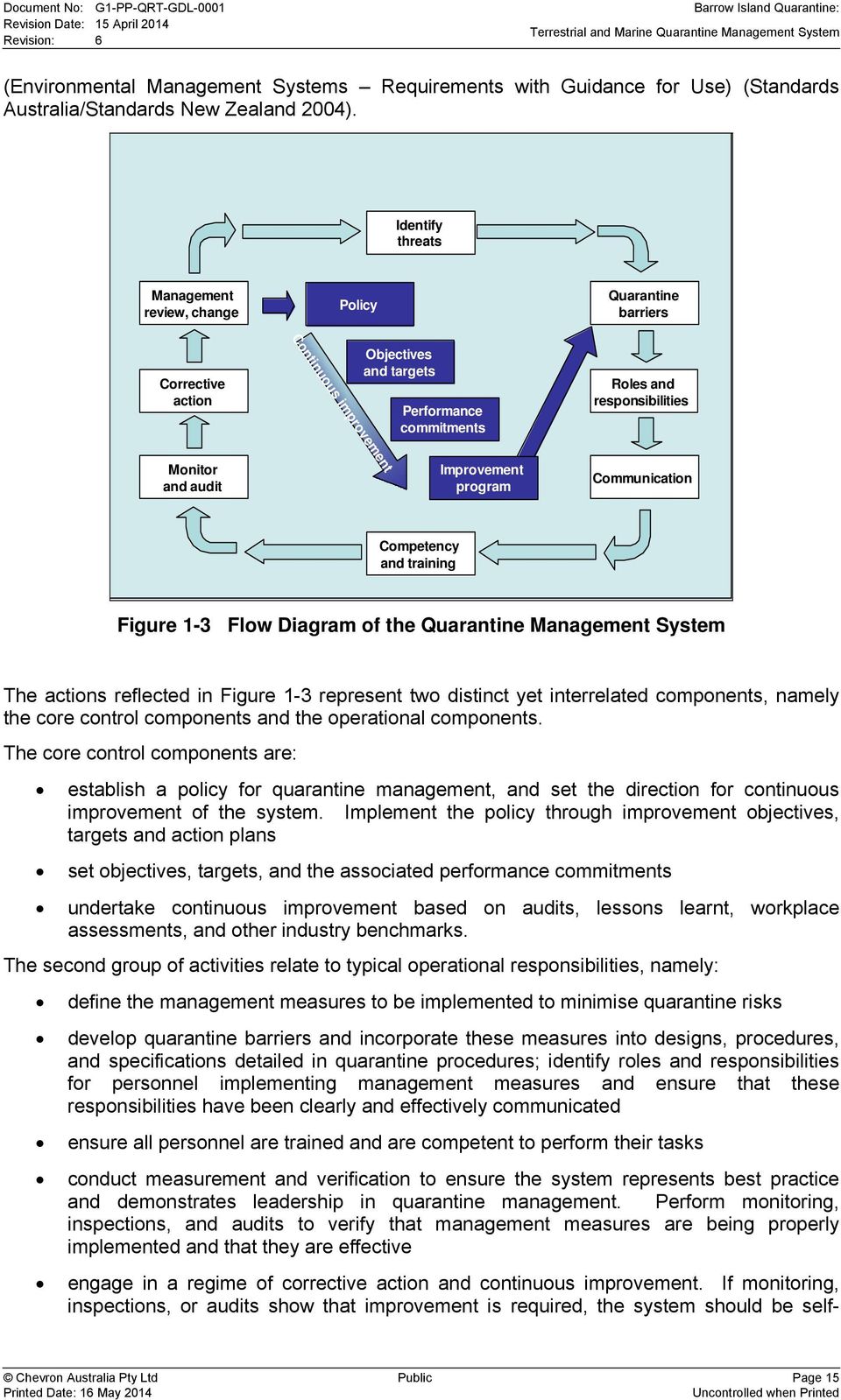
12 Document No: G1-PP-QRT-GDL-0001 Barrow Island Quarantine: (Environmental Management Systems Requirements with Guidance for Use) (Standards Australia/Standards New Zealand 2004). Identify threats Management review, change Policy Quarantine barriers Continuous improvement Corrective action Objectives and targets Performance commitments Roles and responsibilities Monitor and audit Improvement program Communication Competency and training Figure 1-3 Flow Diagram of the Quarantine Management System The actions reflected in Figure 1-3 represent two distinct yet interrelated components, namely the core control components and the operational components. The core control components are: establish a policy for quarantine management, and set the direction for continuous improvement of the system. Implement the policy through improvement objectives, targets and action plans set objectives, targets, and the associated performance commitments undertake continuous improvement based on audits, lessons learnt, workplace assessments, and other industry benchmarks. The second group of activities relate to typical operational responsibilities, namely: define the management measures to be implemented to minimise quarantine risks develop quarantine barriers and incorporate these measures into designs, procedures, and specifications detailed in quarantine procedures; identify roles and responsibilities for personnel implementing management measures and ensure that these responsibilities have been clearly and effectively communicated ensure all personnel are trained and are competent to perform their tasks conduct measurement and verification to ensure the system represents best practice and demonstrates leadership in quarantine management. Perform monitoring, inspections, and audits to verify that management measures are being properly implemented and that they are effective engage in a regime of corrective action and continuous improvement. If monitoring, inspections, or audits show that improvement is required, the system should be self- Chevron Australia Pty Ltd Public Page 15 Printed Date: 16 May 2014 Uncontrolled when Printed
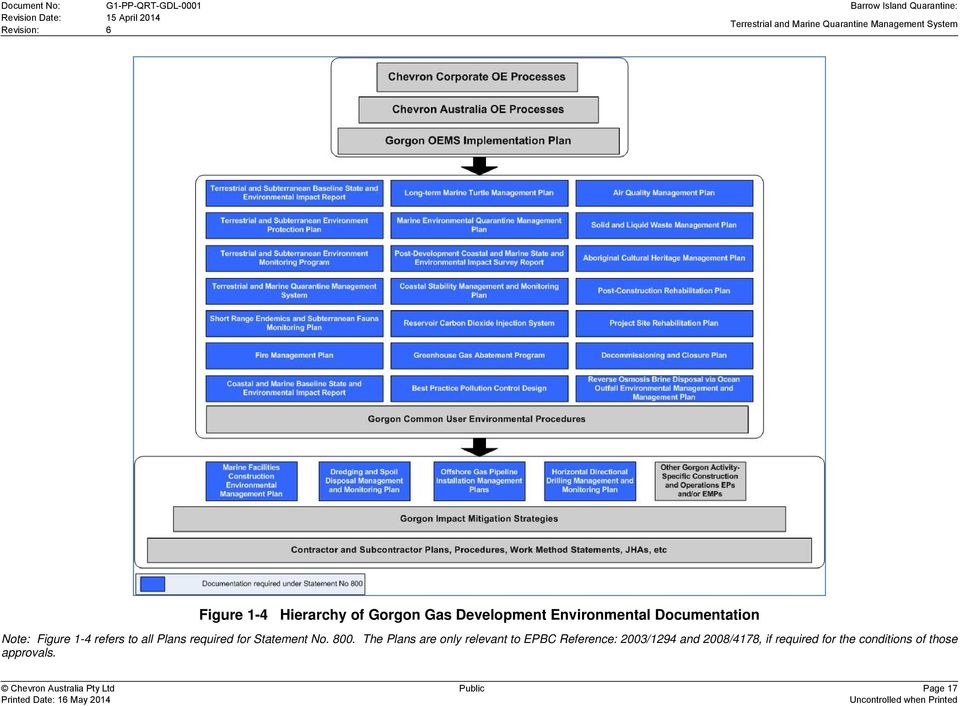
13 Barrow Island Quarantine: Document No.: G1-PP-QRT-GDL-0001 correcting. The system should also identify what actions need to be taken to improve performance and reduce risk incorporate a management of change process for identifying changes to operational activities or processes that could have an impact on quarantine, and for defining and implementing measures to minimise the quarantine risks associated with these changes. Figure 1-4 and Figure 1-5 provide an overview of the overall hierarchy of environmental management documentation within which this QMS exists. Further details on environmental management documentation for the Gorgon Gas Development and Jansz Feed Gas Pipeline are provided in Section 8.0 of this QMS. Page 16 Public Chevron Australia Pty Ltd Uncontrolled when Printed Printed Date: 16 May 2014

14 Document No: G1-PP-QRT-GDL-0001 Barrow Island Quarantine: Figure 1-4 Hierarchy of Gorgon Gas Development Environmental Documentation Note: Figure 1-4 refers to all Plans required for Statement No The Plans are only relevant to EPBC Reference: 2003/1294 and 2008/4178, if required for the conditions of those approvals. Chevron Australia Pty Ltd Public Page 17 Printed Date: 16 May 2014 Uncontrolled when Printed
15 Barrow Island Quarantine: Document No.: G1-PP-QRT-GDL-0001 Figure 1-5 Hierarchy of Jansz Feed Gas Pipeline Environmental Documentation Note: Figure 1-5 refers to all Plans required for Statement No They are only relevant to EPBC Reference: 2005/2184 if required for the conditions of that approval. Page 18 Public Chevron Australia Pty Ltd Uncontrolled when Printed Printed Date: 16 May 2014

16 Document No: G1-PP-QRT-GDL-0001 Barrow Island Quarantine: 1.7 Components of the QMS As part of the Chevron ABU, the Gorgon Gas Development and Jansz Feed Gas Pipeline is governed by the requirements of the ABU OEMS, within which a number of OE Processes exist. The Gorgon Gas Development and Jansz Feed Gas Pipeline will implement internally those OE Processes (and supporting OE Procedures) that apply to the Gorgon Gas Development and Jansz Feed Gas Pipeline s activities, where it is appropriate and reasonably practicable to do so. The key OE Processes taken into account during the development and subsequent revisions of this QMS, with a description of the intent of each Process, are: HES Risk Management Process Upstream and Gas (OE ; Chevron Australia 2012): The purpose of this process is to identify and address health, environment, and safety (HES) risks of facilities and activities related to the Gorgon Gas Development and Jansz Feed Gas Pipeline. Environmental Stewardship Process (OE ; Chevron Australia 2012a): This process applies during the operations phase of the Gorgon Gas Development and Jansz Feed Gas Pipeline. This process is designed to identify, assess, and manage potentially significant environmental impacts in a consistent manner and to continually improve environmental performance. A key business value objective is alignment with ISO (Standards Australia/Standards New Zealand 2004). Hazardous Communication Process (OE ; Chevron Australia 2012b): The purpose of this process is to establish the requirements for the communication of hazards associated with hazardous materials, and to eliminate or minimise the HES hazards associated with hazardous materials on ABU sites. Management of Change Process (OE ; Chevron Australia 2012c): This process focuses on ensuring an efficient and reliable process for implementing changes to organisational design, which includes the identification, control, and mitigation of OErelated incidents. Contractor Health, Environment, and Safety Management Process (CHESM) (OE ; Chevron Australia 2012d): The purpose of this process is to establish clear accountabilities, ensure active engagement of contractors, and provide a consistent CHESM program to eliminate HES incidents and injuries among contractors involved with the Gorgon Gas Development and Jansz Feed Gas Pipeline. Competency Development and Assurance Process (OE ; Chevron Australia 2012e): The purpose of this process is to provide a consistent and structured approach to building individual competency and overall organisational capability that will enable the ABU to achieve its business objectives. Incident Investigation and Reporting Process (OE ; Chevron Australia 2012f): The purpose of this process is to report and investigate incidents, including injury, operational, near miss, occupational illness, environmental (including quarantine), reliability, business disruption, and community concern. The lessons learnt can then be used to prevent future incidents. Emergency Management Process (OE ; Chevron Australia 2012g): This process provides the organisational structures, management processes, and tools necessary to respond to emergencies and to prevent or mitigate emergency and/or crisis situations. Compliance Assurance Process (OE ; Chevron Australia 2012h): This process addresses compliance with legal, internal and external safety, health, environment, reliability, and efficiency requirements. Chevron Australia Pty Ltd Public Page 19 Printed Date: 16 May 2014 Uncontrolled when Printed

17 Barrow Island Quarantine: Document No.: G1-PP-QRT-GDL Embedding the Quarantine Management System within OEMS Quarantine management is primarily a biodiversity strategy aimed at protecting the conservation values of Barrow Island and its surrounding waters. This is done by aligning all quarantine management measures with the applicable OE Processes and associated OE Expectations, which are arranged into OE Elements. OEMS has 47 OE Expectations organised within 13 OE Elements. OE Elements spell out specific requirements for the management of safety, health, environment, reliability, and efficiency. The expectations are met through processes and programs put in place by local business unit management (e.g. the Australasia Business Unit [ABU]). Of the 13 OE Elements, eight relate to and constitute the core of the Gorgon Gas Development QMS. These Elements, their respective QMS reference, and their goals are listed in Table 1-1. Table 1-1 OE Elements and their Goals OE Element Goal QMS Reference Environmental Stewardship Safe Operations Facilities Design and Construction Third-party Services Incident Investigation Emergency Management Management of Change Compliance Assurance Strive to continually improve environmental performance and reduce impacts from our operations Operate and maintain facilities to prevent injuries, illness, and incidents Design and construct facilities to prevent injury, illness, and incidents and to operate reliably, efficiently, and in an environmentally sound manner Systematically improve third-party service performance through conformance to Operational Excellence Investigate and identify root causes of incidents to reduce or eliminate systematic causes and to prevent future incidents Prevention is the first priority, but be prepared to respond immediately and effectively to all emergencies involving Chevron wholly owned or operated assets. For Chevron products of interests such as common carriers, chartered vessels, and facilities operated by others, be prepared to monitor the response and, if warranted, take appropriate actions Manage both permanent and temporary changes to prevent incidents Verify conformance with OE requirements in applicable Chevron Australia policy and Australian government laws and regulations. Train the workforce regarding their OE-related responsibilities Section 6.0 Section 8.2 Section 8.3 Section 8.4 Section 8.6 Section 8.7 Section 8.8 Section 9.0 The OE Elements and OE Processes relevant to quarantine management ensure that quarantine measures developed specifically for the Gorgon Gas Development and Jansz Feed Gas Pipeline remain aligned with the OE Vision, which is: To be recognised and admired by industry and the communities in which we operate as world-class in safety, health, environment, reliability and efficiency. Page 20 Public Chevron Australia Pty Ltd Uncontrolled when Printed Printed Date: 16 May 2014
18 Document No: G1-PP-QRT-GDL-0001 Barrow Island Quarantine: 1.8 Stakeholder Consultation Development of the QMS Regular consultation with stakeholders was undertaken by Chevron Australia throughout the initial development of the environmental impact assessment management documentation for the Gorgon Gas Development and Jansz Feed Gas Pipeline. This stakeholder consultation included engagement with the community, government departments, industry operators, and contractors to Chevron Australia via planning workshops, risk assessments, meetings, teleconferences, and the PER, EIS/ERMP and Environmental Review (Chevron Australia 2013) formal approval processes. This document has been prepared with input from: The Quarantine Expert Panel (QEP): Members of the QEP reviewed this document and their comments have been incorporated or otherwise resolved. The QEP is required to provide advice on quarantine matters including the development and implementation of the QMS. The QEP has endorsed this QMS and its advice was provided in the document : Report provided to the Minister for Environment and Chevron Australia Pty Ltd on the Adequacy of the Development of the Gorgon Quarantine Management System (Quarantine Expert Panel 2009). The QEP contains subject matter experts from Western Australian Department of Parks and Wildlife (DPaW), Western Australian Department of Agriculture and Food (DAFWA), Western Australian Department of Fisheries (DoF), independent experts, and representatives of Chevron Australia. The Western Australian Department of Environment and Conservation (DEC) (now Department of Parks and Wildlife [DPaW]): Workshops and meetings were held involving the DEC and Chevron Australia personnel to discuss the scope and content of this QMS during its development. The DEC reviewed a draft revision of this QMS along with the feedback of the QEP. The DEC s comments have been incorporated or otherwise resolved. The Commonwealth Department of Environment, Water, Heritage and the Arts (DEWHA) (now Department of the Environment [DotE]): DEWHA reviewed and commented on a draft revision of this QMS along with the feedback of the QEP. DEWHA s comments have been incorporated or otherwise resolved Historical and Ongoing Consultation Overview of Historical Consultation Since 2003, substantial and continuous consultation has occurred throughout the process of developing the quarantine management measures for the Gorgon Gas Development and Jansz Feed Gas Pipeline. In EPA Bulletin 1221 (EPA 2006), the EPA recognised this:...the EPA is satisfied as to the expertise of the people involved in both making the risk estimates in workshops and providing guidance via an expert advisory panel convened by the proponent. The Bulletin went on to record:...this activity has involved a large amount of work by the proponent, its consultants and officers of a number of government agencies participating in public meetings, workshops and expert panel briefings. It was also recorded that during the initial development phase of the QMS, and consistent with the EPA s recommendation in Bulletin 1101 (EPA 2003):... the proponent organised a number of community and expert meetings and supporting processes to develop standards acceptable to the community and expert representatives for risks from introduced organisms. The process was transparent and Chevron Australia Pty Ltd Public Page 21 Printed Date: 16 May 2014 Uncontrolled when Printed

19 Barrow Island Quarantine: Document No.: G1-PP-QRT-GDL-0001 rigorous involving experts and community members to define acceptable levels of risk for the establishment of Non-indigenous Species on Barrow Island. This was reflected in the public submissions where one responder congratulated Chevron Australia on this process. The EPA believes that the process was credible and helpful in establishing a public view on acceptable risk Public Consultation Historical Chevron Australia convened five comprehensive community consultation meetings during 2004 and These meetings were widely advertised and well attended, independently chaired, and provided clear evidence of community input into the development of standards for acceptable risk, the process for developing quarantine barriers to meet acceptable risk standards, the approach for the development of the QMS, and reports of studies and surveys of interest to stakeholders. Interested stakeholders, each of which reported back to the wider community consultation meetings, also convened four special community workshops. These lengthy workshops enabled stakeholders to provide direct assistance in the development of standards for acceptable risk, and provided input on the content and structure of the QMS. Chevron Australia regularly responded to the requests of community groups and nongovernment organisations to discuss the status and progress of activities during development of the QMS. Records of QEP and Quarantine Advisory Committee (QAC) meetings, workshop reports, community consultation reports, and community workshop reports were all published on a publicly accessible website that was accessed thousands of times during the development of the QMS Subject Matter Expert Consultation Historical and Ongoing Since 2003, Chevron Australia has consulted with a large community of independent technical experts from government, scientific organisations, and independent specialists. The QEP was convened nine times between 2003 and 2005, and involved representatives of State and Commonwealth government departments, independent risk assessment specialists, and independent conservation and biosecurity specialists. Following submission of the Draft EIS/ERMP (Chevron Australia 2005), the QAC was convened six times between 2006 and 2008 to continue consultation with experts on the development of the QMS. The involvement of independent experts included activities such as the preparation of desktop and field surveys to address information gaps identified by the QEP and QAC. A new QEP was convened in 2008 under Chevron Australia s commitment for continuing expert consultation, as directed by Statement No This panel meets quarterly. From 2004 to 2006, 30 independent experts were involved in 33 risk assessment workshops for identifying quarantine threats and developing barriers that were judged to reduce the risk of introduction of a Non-indigenous terrestrial Species (NIS) or Marine Pest to acceptable levels. These experts contributed 133 days of independent advice and analysis (not including their preparation and follow-up efforts, which were often substantial). Further consultations with experts continue to improve the effectiveness of selected barriers and contribute to the review of the QMS, consistent with Chevron Australia s commitment to do so. Since 2009, ongoing consultation with independent experts concerning the detection program continues to validate and improve Chevron Australia s capability for detection early enough to enable eradication without substantial consequences to native flora and fauna. Chevron Australia has also attended a number of scientific workshops and symposia to present their methodologies and gain helpful advice. The Cooperative Research Centre convened these events for National Plant Biosecurity, the Commonwealth Scientific and Industrial Research Organisation (CSIRO), the Australian Centre for Excellence in Risk Analysis, and DAFWA. Scientists from all over the world attended these events and the development of the QMS benefitted from their consultation. Page 22 Public Chevron Australia Pty Ltd Uncontrolled when Printed Printed Date: 16 May 2014
20 Document No: G1-PP-QRT-GDL-0001 Barrow Island Quarantine: In addition, several studies relating to the QMS have been peer-reviewed and published in scientific journals. The methodology for risk assessments have been widely presented at national and international conferences. This exposure to the wider scientific community has resulted in the methods developed for the Gorgon Gas Development and Jansz Feed Gas Pipeline being adopted as a new benchmark for biosecurity efforts elsewhere DPaW, DAFWA, and DoF Consultation Historical and Ongoing DEC (now DPaW) and DAFWA representatives were present at all community meetings and workshops, and DoF representatives were invited to and attended many of these events. In addition, the DEC was an observer at all Quarantine Hazard Analysis (QHAZ) workshops, which also involved DAFWA and DoF technical experts. DEC and DAFWA participated as observers in the QEP and QAC meetings. Chevron Australia frequently consulted with DEC, DAFWA, and DoF technical specialists during the development of the QMS, particularly with regard to the technical feasibility of quarantine barriers, surveys, and desktop studies to address information gaps, and the design and operation of government surveillance programs. Two consultative meetings were held with DEC; the first held on 18 December 2007, on the progress of the Gorgon Gas Development QMS, and the second in February 2009 on the progress of the CO 2 Baseline Survey QMS. The latter can be considered as a trial for the Gorgon Gas Development QMS. Since 10 December 2008, members of the QEP were offered the opportunity to review or comment on any aspect of the proposed QMS. DPaW (formerly DEC), DAFWA, and DoF have representatives on this panel. This offer resulted in numerous QMS documents being requested and reviewed for the purpose of providing advice to the Western Australian Minister for Environment on the adequacy of the QMS. This consultation is continuous, via the QEP, and when the need arises these departments participate in discussions, with Chevron Australia, pertaining to the performance of the QMS. The process for development, review, and approval of this QMS is shown in Figure Commonwealth Consultation Historical and Ongoing The Commonwealth government nominated a representative to the QEP from 2003 to 2005 and provided helpful input and advice as an observer. The Commonwealth government declined to nominate a representative to the subsequent QAC that met from 2006 to Chevron Australia has consulted with the Commonwealth government continuously since 2003 outside the QEP and QAC meetings, and has published all its QMS development activities on a publicly available website to enable review of progress by the Commonwealth government and other interested stakeholders. This consultation continues annually and when the need arises the Commonwealth government participates in discussions, with Chevron Australia, pertaining to the performance of the QMS. The process for development, review, and approval of this QMS is shown in Figure 1-6. Chevron Australia Pty Ltd Public Page 23 Printed Date: 16 May 2014 Uncontrolled when Printed

21 Barrow Island Quarantine: Document No.: G1-PP-QRT-GDL-0001 Figure 1-6 Deliverable Development, Review and Approval Flow Chart Public Availability This QMS will be made public as and when determined by the Minister, under Condition 35 of Statement No. 800, Condition 20 of Statement No. 769, and Condition 22 of EPBC Reference: 2003/1294 and 2008/4178. Page 24 Public Chevron Australia Pty Ltd Uncontrolled when Printed Printed Date: 16 May 2014
22 Document No: G1-PP-QRT-GDL-0001 Barrow Island Quarantine: 1.9 DPaW Access to Sites where the QMS Applies On-Island DPaW Staff DPaW may request access to any site where the QMS applies by applying to the Chevron Australia on-site Environmental/Quarantine Manager. Off-Island DPaW Staff DPaW may request access to any site where the QMS applies by applying to the Chevron Australia off-site Quarantine Manager. Where access relates to specific health, environment, and safety requirements, the DPaW must ensure that all its personnel comply with relevant Chevron Australia requirements. Note: Normal Barrow Island access arrangements apply and other statutory requirements may apply (see Memorandum of Understanding [MOU] and supporting documentation between DPaW and Chevron Australia: G1-CO-LTR-CVXPH-DECWH , G1-NT-REPX , and G1-CO-EML-CVXPH-DECWH ). Chevron Australia Pty Ltd Public Page 25 Printed Date: 16 May 2014 Uncontrolled when Printed
23 Barrow Island Quarantine: Document No.: G1-PP-QRT-GDL Relevant Facilities and Activities 2.1 Terrestrial Facilities Overview This QMS addresses issues associated with the Terrestrial Facilities of the Gorgon Gas Development and the Terrestrial Facilities of the Jansz Feed Gas Pipeline, which are shown in Figure 1-2 and Figure 2-1 of this QMS. The Gorgon Gas Development Terrestrial Facilities are defined in Condition 6.3 of Statement No. 800 and Condition 5.2 of EPBC Reference: 2003/1294 and 2008/4178, as the: Gas Treatment Plant Carbon Dioxide Injection System Associated Terrestrial Infrastructure forming part of the Proposal Areas impacted for seismic data acquisition the Onshore Feed Gas Pipeline System and terrestrial component. Terrestrial Facilities also include those defined in Condition 6.3 of Statement No. 769 (the Onshore Feed Gas pipeline system and the terrestrial component of the Shore Crossing) and Schedule 1 of Statement No. 965 (the Additional Support Area). Additional details on the Terrestrial Facilities can be found in the Draft EIS/ERMP (Chevron Australia 2005), the section 45C approval (EPA 2008), the PER (Chevron Australia 2008), and the Environmental Review (Chevron Australia 2013). Activities associated with the CO 2 Survey Program are briefly summarised in Section 2.1.3; however, more detailed information is provided in the Proposed Activity section of the CO 2 Seismic Baseline Survey Environmental Management Plan (G1-NT-REPX ). Please note that the description of the Terrestrial Facilities provided in subsequent sections is as currently proposed. More specific details are contained in various Gorgon Gas Development approval and assessment documents, which are issued from time to time Gas Treatment Plant The Gas Treatment Plant will be located near Town Point (Figure 2-1), on the east coast of Barrow Island. The Gas Treatment Plant includes: LNG trains: 3 5 MTPA (nominal) Gas Processing Drivers: 6 80 MW (nominal) gas turbines fitted with Dry Low NO x (DLN) burners Power Generation: MW (nominal) conventional gas turbines with DLN burners Flare design: Ground flare for the main plant flare; boil-off gas elevated flare in storage and loading area LNG Tanks: m 3 (nominal) Condensate Tanks: m 3 (nominal). The Gas Treatment Plant will produce three main products for export from Barrow Island: LNG for international export domestic gas for use on the Australian mainland hydrocarbon condensate (light oil). Page 26 Public Chevron Australia Pty Ltd Uncontrolled when Printed Printed Date: 16 May 2014
24 Document No: G1-PP-QRT-GDL-0001 Barrow Island Quarantine: Typical Gas Treatment Plant processes are described in Chapter 6 of the Draft EIS/ERMP (Chevron Australia 2005) Carbon Dioxide Injection System Reservoir carbon dioxide (CO 2 ) will be disposed of by injection into the Dupuy Formation more than 2000 m below Barrow Island to limit the greenhouse gas emissions and atmospheric pollutants associated with the Gorgon Gas Development and Jansz Feed Gas Pipeline s production of LNG. The CO 2 injection process is described in the Draft EIS/ERMP (Chevron Australia 2005). The CO 2 Injection System will consist of the mechanical components required to enable the injection of reservoir CO 2 and manage the performance integrity of the injection facilities and the Dupuy Formation. These include: CO 2 compression facilities located within the Gas Treatment Plant boundary an aboveground CO 2 pipeline (approximately 10 km long in an 8 ha easement) between the Gas Treatment Plant and the three CO 2 injection drill centres to the north nine CO 2 injection wells directionally drilled from the three CO 2 injection drill centres north of the Gas Treatment Plant site (Figure 1-2) observation wells for monitoring the subsurface spread of the CO 2 plume four pressure management water wells for managing pressure in the Dupuy Formation two pressure management water injection wells for the reinjection of water produced from the lower Dupuy formation by pressure management wells. The water will be reinjected into the Barrow Group from a vertical depth of 1200 to 1600 m shallow anode ground beds for the cathodic protection of all well types associated with the CO 2 Injection Project. Additional anode wells will be drilled for cathodic protection purposes for the pressure management wells and the pressure management water injection wells (one anode well pair for each water producer/injector pair). An anode well will also be required for each stand-alone observation well. Monitoring activities, including the acquisition of seismic data, will be undertaken as part of ongoing reservoir performance management. The total area occupied by the CO 2 Injection System outside the Gas Treatment Plant site will be approximately 12.5 ha Associated Terrestrial Infrastructure Terrestrial infrastructure associated with the Gorgon Gas Development consists of: the terrestrial component of the Barge (WAPET) Landing the Construction Village the Administration and Operations Complex the permanent Utilities Area located within the Gas Treatment Plant the Utilities Corridors between the Utilities Area and users within the Gas Treatment Plant and between the Utilities Area and the Construction Village, also servicing the Administration and Operations Complex road upgrades, including the road between WAPET Landing and Town Point, and from Town Point to the Airport (via the Construction Village), and road along the feed gas pipeline system route airport modifications, consisting of the extension of the existing runway to the south and associated vegetation clearing Chevron Australia Pty Ltd Public Page 27 Printed Date: 16 May 2014 Uncontrolled when Printed
25 Barrow Island Quarantine: Document No.: G1-PP-QRT-GDL-0001 communications, consisting of a microwave communications tower and associated communications infrastructure to be installed on Barrow Island onshore water supply infrastructure, consisting of a seawater demineralisation (reverse osmosis) plant, associated treated water and brine storage tanks, and treated water pumps and delivery piping to end users within the Gas Treatment Plant and utility corridors, reverse osmosis brine disposal pumps and the terrestrial component of the reverse osmosis brine pipeline Associated terrestrial infrastructure will be primarily located in the vicinity of, and south of, the Gas Treatment Plant site on the east coast of Barrow Island (Figure 2-1) Areas Impacted for Seismic Data Acquisition The expansion of the CO 2 plume injected into the Dupuy Formation below Barrow Island will be measured by comparing the reflection of vibrations through the subsurface. The terrestrial components of baseline seismic monitoring will use two vibration sources: subsurface explosives and vibroseis (Figure 2-1). Approximately 1300 shot holes will be drilled for the placement of subsurface explosives. These will be drilled at 100 m intervals along lines spaced 500 m apart. The placement of explosives below the surface karst limestone layer will be done by drilling the holes to a depth of approximately 15 m below sea level. Purpose-built drill rigs that combine both sonic and air percussion drilling technology will be used, reducing the need to use drilling fluids. The charges will be 4 kg each and double detonators will be used. Vibroseis consists of propagating energy signals into the earth from the surface via vibrator pads fitted to a truck. Vibroseis will be undertaken in the lower-lying, flatter terrain areas where good ground coupling is attainable and the effect on karst limestone is minimal. The vibroseis source lines will be spaced approximately 500 m apart, and the vibrator points will be every 12.5 m along these lines. Seismic data acquisition is expected to be repeated a number of times throughout the life of the Gorgon Gas Development, in order to map the extent of the CO 2 plume as it migrates. Differences between the data obtained during the baseline seismic monitoring and repeat seismic monitoring will be used to map the extent of the CO 2 plume over time Onshore Feed Gas Pipeline System and Terrestrial Component of the Shore Crossing (Gorgon and Jansz) The Onshore Feed Gas Pipeline System will traverse Barrow Island from the west coast at North Whites Beach to the Gas Treatment Plant site near Town Point on the east coast (Figure 2-1). The pipeline system will be approximately 14 km long and located within a right-of-way between 30 and 45 m wide. The pipelines will be buried with excavated material backfilled into the trench. The installation of the Onshore Feed Gas Pipeline System (including trenching, welding and pipe lowering) is expected to be completed at a rate of approximately 300 m to 350 m per day. The trench will be limited to approximately 2 km of open trench at any one time; however, the trench required for the pipeline systems (cables and tubes) will require the entire trench to be open for a relatively short period. The terrestrial component of the Shore Crossing will consist of infrastructure for drilling eight horizontally directionally drilled (HDD) holes from the shore to an exit point approximately 500 m offshore, and insertion of pipe strings into these holes. A ninth hole will be drilled for a seawater intake system, which will provide water required for the activities associated with drilling and pre-commissioning. The facilities required for construction of the Shore Crossing will include breakover supports and pipeline rollers for insertion of the pipelines. The HDD site will be approximately 80 m by 110 m. Page 28 Public Chevron Australia Pty Ltd Uncontrolled when Printed Printed Date: 16 May 2014
26 Document No: G1-PP-QRT-GDL-0001 Barrow Island Quarantine: The pipe stringing yard is located inland of the HDD site and includes a laydown area for the breakover supports and pipeline rollers. The portion of the stringing yard closest to the HDD site will be approximately 60 m wide and approximately 325 m long. The laydown area will extend an additional distance inland (up to 1010 m) at a narrower width (approximately 35 m). Chevron Australia Pty Ltd Public Page 29 Printed Date: 16 May 2014 Uncontrolled when Printed
27 Barrow Island Quarantine: Document No.: G1-PP-QRT-GDL-0001 Figure 2-1 Gorgon Gas Development and Jansz Feed Gas Pipeline Terrestrial Facilities on Barrow Island Page 30 Public Chevron Australia Pty Ltd Uncontrolled when Printed Printed Date: 16 May 2014
28 Document No: G1-PP-QRT-GDL-0001 Barrow Island Quarantine: 2.2 Marine Facilities Overview This QMS addresses issues associated with the Marine Facilities of the Gorgon Gas Development, which are shown in Figure 1-2 and Figure 2-2. The Gorgon Gas Development Marine Facilities are defined in Condition 14.3 of Statement No. 800 and Condition 11.3 of EPBC Reference: 2003/1294 and 2008/4178 as the: Materials Offloading Facility (MOF) LNG Jetty Dredge Spoil Disposal Ground Offshore Feed Gas Pipeline System and marine component of the shore crossing Domestic Gas Pipeline. For the purposes of Statement No. 800, Marine Facilities also include: marine upgrade of the existing WAPET Landing. In relation to Statement No. 769, Marine Facilities are the Offshore Feed Gas Pipeline System and marine component of the shore crossing. Additional details on the Marine Facilities can be found in the Draft EIS/ERMP (Chevron Australia 2005), the section 45C approval (EPA 2008), and the PER (Chevron Australia 2008). Please note that the description of the Marine Facilities provided in subsequent sections is as currently proposed. More specific details are contained in various Gorgon Gas Development approval and assessment documents, which are issued from time to time Materials Offloading Facility (MOF) Pioneer MOF A Pioneer MOF will initially be required to allow offloading of equipment and materials for construction of the onshore LNG plant and associated facilities on Barrow Island, via large barges and Roll-on/Roll-off (RORO) vessels. Construction activities will include: construction of a Pioneer MOF perimeter berm, using a combination of suitably sized dredged material and rock transported from the mainland placement of dredged material (approximately m 3 ) within the perimeter berm to form the Pioneer MOF Platform. Primary and secondary armour rock sourced from the mainland will be installed on the external face of the Pioneer MOF platform. The berm construction will include dredged rock material and will be pervious in parts. A geotextile filter cloth will line the bunds prior to the infill operation. The geotextile liner will be protected by a screening layer and will be maintained until buried by the reclamation. The fill material will be hydraulically placed by pumping via pipeline from the Trailer Suction Hopper Dredge positioned in the MOF turning basin. The placement of the fill will be primarily at or near high tides, limiting the hydraulic gradient between the inside and outside of the bund. This will limit the speed of the infill operation, thus allowing sufficient time for the fines within the MOF area to settle before subsequent loads. Given the characteristics of the materials present within the dredging areas and their subsequent behaviour after having passed through a dredge pump, priority will be given to placing the coarser sand fraction onshore. This will result in lower turbidity levels from tail water discharge, more usable engineering fill grade material, and generally a reclamation area that is easier to manage. Chevron Australia Pty Ltd Public Page 31 Printed Date: 16 May 2014 Uncontrolled when Printed
29 Barrow Island Quarantine: Document No.: G1-PP-QRT-GDL-0001 The berm wall will include a steel weir box placed on the temporary face adjacent to the dredge area. The steel box will provide an adjustable weir on the upstream side and pipe outflow on the downstream side to discharge at or near the seabed Full MOF Once the Pioneer MOF has been constructed, work will commence immediately on extending the MOF platform seaward and raising part of the existing MOF causeway, including: extending the MOF platform seaward, forming a breakwater that will protect tug pen moorings, the heavy lift facility, and other berths. This work will be completed using material excavated from Barrow Island. Suitable dredge material may be used in place of core fill material from Barrow Island, depending on the quality and quantity of material won from Barrow Island. Up to m 3 of dredged material may be required for this purpose constructing a heavy lift facility and tug pens raising the existing MOF causeway by adding an upper causeway section (upper causeway height varies between +12 m to m CD) to accommodate an all-weather access road to the LNG Jetty, a pipe rack containing LNG, condensate and other pipelines for export, and the operations of the jetty offloading facilities. This work will be completed using material excavated from Barrow Island installing armour comprising precast concrete units LNG Jetty The design of the LNG Jetty is based on caissons connected by prefabricated pipeline and road trusses ( 70 m) (Kellogg Joint Venture 2009). Jetty construction will include these activities: prefabrication of caissons and pipe racks / road trusses transport to Barrow Island placement of caissons on the seabed installation and hook up of pipe racks and road trusses placement of loading platform modules and some other prefabricated structures commissioning Dredge Spoil Disposal Ground The Sea Dumping Permit (No. SD2004/0030) provides approval to dispose up to 8.5 million m 3 of dredged material. The location of the approved spoil ground is defined by the following GDA94 MGA Zone 50 Coordinates: E N E N E N E N. To control the disposal of dredged materials, the Spoil Disposal Ground will be divided into cells, each with an individual grid reference. A log will be maintained on board each vessel that records the number of loads disposed into each cell. Regular hydrographic surveys of the dredged material relocation site will be undertaken to confirm the developing bathymetry and the location of the disposal material. Page 32 Public Chevron Australia Pty Ltd Uncontrolled when Printed Printed Date: 16 May 2014
30 Document No: G1-PP-QRT-GDL-0001 Barrow Island Quarantine: Figure 2-2 Gorgon Gas Development Marine Facilities and Dredging and Spoil Disposal Zones of High Impact, Moderate Impact, and Zone of Influence Chevron Australia Pty Ltd Public Page 33 Printed Date: 16 May 2014 Uncontrolled when Printed
31 Barrow Island Quarantine: Document No.: G1-PP-QRT-GDL Offshore Feed Gas Pipeline System The main offshore infrastructures (from the subsea manifold at the gas fields to the tail end of the HDD breakout point at North Whites Beach, Barrow Island) are: Gorgon feed gas pipeline nominal 34 diameter (800 mm internal diameter, wall thickness 42.5 mm) Gorgon monoethylene glycol (MEG) pipeline nominal 8 diameter (219 mm outer diameter, wall thickness 34.5 mm) Gorgon utility pipeline nominal 6 diameter (219 mm outer diameter, wall thickness 35 mm) Gorgon umbilicals nominal 5 diameter Jansz feed gas pipeline from 24 to 30 diameter from subsea facilities to the continental shelf then 34 diameter pipeline to the shore crossing (550 mm to 800 mm internal diameter, wall thickness 42.5 mm) Jansz MEG pipeline nominal 8 diameter (273 mm outer diameter, wall thickness 34.5 mm) Jansz utility pipeline nominal 6 diameter (219 outer diameter, wall thickness 35 mm) Jansz umbilicals nominal 5 diameter. The Offshore Feed Gas Pipeline systems will be installed on the seabed, via a pipelay vessel, from the subsea facilities at the Jansz gas field (approximately 1300 m water depth) and the Gorgon gas field (approximately 200 m water depth) to the shore crossing at North Whites Beach, on the west coast of Barrow Island. The pipelines will cross from Commonwealth waters to State waters in approximately 12.5 m water depth, at a distance of 3 nm from Barrow Island Domestic Gas Pipeline Domestic gas will be exported via a domestic gas pipeline from Barrow Island to tie into the Dampier to Bunbury Natural Gas Pipeline on the mainland. The pipeline construction method will be as described in the Draft EIS/ERMP (Chevron Australia 2005). The route for this pipeline has been designed to avoid sensitive benthic habitat, where reasonably practicable Marine Upgrade of the Existing WAPET Landing Prior to the completion of an operational Materials Offloading Facility (MOF), all vessel and freight movement (approximately freight tonnes) for import and export from Barrow Island will use WAPET Landing, which is the only available landing point. Following construction of the MOF, WAPET Landing will continue to be used as an alternative materials offloading facility for Gorgon during peak periods. The existing materials offloading facilities at WAPET Landing will be upgraded as described below Landing Craft Tank (LCT) Landing and Barge Berth Increase landing craft capacity by installing additional ramps on either side of the existing concrete ramp. The new ramps will be formed by placing Flexmats (flexible concrete mattress) on prepared subgrade (approximately 1000 m 3 of <75 mm) so as to achieve required ramp levels and grade. A transition ramp (sunken barge) will be installed to act as a bridging structure to provide access and berthing of a barge. Approximately 45 m of seabed measured from the toe line of the existing LCT ramp will be disturbed to allow for placement of the transition ramp. The ramp will be floated into position, ballasted, and stabilised. Prior to the positioning of the transition ramp, compacted subgrade (hard, durable, angular rock Page 34 Public Chevron Australia Pty Ltd Uncontrolled when Printed Printed Date: 16 May 2014
32 Document No: G1-PP-QRT-GDL-0001 Barrow Island Quarantine: fragments, free from deleterious matter such as clay lump) will be placed on the seabed by a dump truck to achieve required levels and grade. The transition ramp will then be placed on the top of the compacted subgrade. In addition to ballast, piles will most likely be required to stabilise the sunken barge. A steel ramp will be placed on the shore side of the barge to act as an approach ramp. A minimum of three breasting dolphins with fenders will be installed to assist berthing of the barges. Piles for breasting dolphins will be drilled, grouted, and installed using a work barge with crane and drilling assembly Land-backed Wharf Two stop fenders and one breasting dolphin with fender will be installed at the wharf to enable berthing of barges. Piles for stop fenders and the breasting dolphin will be drilled, grouted, and installed using a work barge with crane and drilling assembly. Excavation of the Land-backed Wharf berthing pocket will involve removal of rock and sediment within the berthing pocket to allow a graded surface for improved barge access and landings. A land excavator will undertake the work at low tide, with material being stockpiled on land for later re-use or disposal. The activity will take approximately one to two weeks to complete Groyne Barge Berth Rebuilding of the existing groyne and construction of a new barge berth is required to provide vehicle (truck) access to allow roll-on/roll-off (RORO) cargo transfers from barges. As a minimum, two stop fenders and three breasting dolphins with fenders will be required to assist barge berthing. Piles for stop fenders and breasting dolphins will be drilled, grouted, and installed using a work barge with crane and drilling assembly. Slumped material from the existing groyne (approximately 600 m 3 ) will be recovered for re-use in the new groyne profile. This material will be separated for use into armour and groyne ramp core fill. The material will be placed and compacted using a shore-based excavator and dump truck. For the groyne earth ramp, precast concrete retaining wall units and a precast concrete approach slab will be installed using a shore-based crane. Primary and secondary rock armour (approximately 5000 m 3 ) will be placed around the groyne earth ramp using dump trucks and excavators. Prior to the installation of secondary armour, a geo-fabric will be installed. Approximately 3000 m 3 of fill will be placed on the groyne by dump trucks. A small craft landing will be installed to serve small vessels. The existing landing will be removed and a new small craft landing will be constructed; it will be sheltered by the groyne and will be accessed by a gangway. The new landing will be located in deeper water, which will improve tidal availability. The small craft landing consists of a pontoon structure connected to the land by a steel gangway supported by piles. Piles for the pontoon and gangway will be drilled, grouted, and installed using a work barge with crane and drilling assembly. Pontoon and steel gangway will then be installed using the crane on the work barge. Two marine navigation aids will be installed to assist barge berthing. One navigation aid will be fitted to the easternmost Groyne Berth breasting dolphin. The other will be installed on a pile just north of the Groyne Berth. This pile will be installed using a work barge with crane and drilling assembly. Normal moorings and cyclone moorings may be installed to suit construction and operations requirements. Chevron Australia Pty Ltd Public Page 35 Printed Date: 16 May 2014 Uncontrolled when Printed
33 Barrow Island Quarantine: Document No.: G1-PP-QRT-GDL Barrow Island Act and Integrated Operations 3.1 Requirements of the Barrow Island Act (2003) The Western Australian (WA) Barrow Island Act 2003 and Schedule 1 (Gorgon Gas Processing and Infrastructure Agreement) define key aspects of the project and are the enabling legislation for the proposal. The Act is also the primary instrument by which intra-island coordination concerning quarantine management measures will be managed. The Barrow Island Act 2003 (WA) requires compliance in all respects with the Environmental Protection Act 1986 (WA). The Barrow Island Act 2003 (WA) also requires that grant of leases, licences, and easements necessary for the proposal to proceed on Barrow Island cannot occur unless a decision is made that the proposal may be implemented under the Environmental Protection Act 1986 (WA). Clause 13(e) (iii) and (iv) of Schedule 1 of the Barrow Island Act 2003 (WA) requires the following matters to be coordinated by the Barrow Island Coordination Council (BICC): (iii) establishing, monitoring and reviewing from time to time procedures to apply to quarantine of all people and materials brought to Barrow Island for the purposes of the operations of any of the BICC Participants; and (iv) planning and coordinating the BICC s role in emergency response to, and undertaking, where necessary, remediation of any suspected or actual noncompliance of quarantine in the operations of any of the BICC Participants. 3.2 Integrating with Whole of Island Quarantine Management This coordination and establishment of a common approach to quarantine management on Barrow Island that commits all BICC participants, as required by the Barrow Island Act 2003 (WA), is recorded in the Gorgon Project Barrow Island Coordination Council Development Proposal G1-NT-REPX (Commercial in Confidence). The following selected extracts from the Gorgon Project Barrow Island Coordination Council Development Proposal (Sections 6.0 and 6.1), record the requirements of Statement No. 800, Condition 10.4 v, stating that the QMS shall address Integrating with whole of Island Quarantine Management : s.6.0 Integrated Operations The Gorgon Joint Venture and the Barrow Island Joint Venture partners have made arrangements in the form of commercial agreements (Barrow Island Access Framework Agreement) and operating agreements for optimised integrated operations on Barrow Island. It is planned to adopt a single set of common operating procedures for activities on Barrow Island in addition to the emergency response and quarantine procedures. Both Venturers will still have dedicated resources for normal operations purposes and have agreed to make any and all resources available for integrated emergency response and quarantine operations. The new, as required by the Gorgon Project Environmental Protection Act Part IV approvals, will be implemented by the Gorgon Operator and adopted by the Barrow Island Joint Venture. The arrangements for integrated emergency response and quarantine operations are outlined in Section 6.2 of the Barrow Island Coordination Council Development Proposal as required under the Barrow Island Act Page 36 Public Chevron Australia Pty Ltd Uncontrolled when Printed Printed Date: 16 May 2014
34 Document No: G1-PP-QRT-GDL-0001 Barrow Island Quarantine: s.6.1 Quarantine Management To protect the conservation values of Barrow Island and thereby preserve the Island s unique conservation status, the Gorgon Joint Venturers have developed a risk-based Quarantine Management System. The Quarantine Management System focuses on all possible introduction pathways to Barrow Island and the exclusion of all NIS and Marine Pests on or in the waters surrounding Barrow Island. This includes all Barrow Island Joint Venture activities. Both the system and implementation process concentrate on the pre-border prevention of NIS and are supported by contingencies for border and post-border quarantine controls that will apply to all incursions to the island. A substantial factor in the success of the quarantine management strategy will be the human performance-related matters. A primary focus will be placed on the training of personnel, fit for purpose quarantine procedures and specification for all categories of goods destined for Barrow Island. For more detailed information on the material pathways, prescribed and systematic barriers designed to mitigate the risk of introduced species, and all other matters concerning the quarantine management strategy including training refer to the, as required by the Gorgon Project Environmental Protection Act 1986 approval. The includes measures and plans for the management of weeds on Barrow Island. Agreements and arrangements are in place for both the Gorgon Joint Venture and the Barrow Island Joint Venture to adopt and comply with the Terrestrial and Marine Quarantine Management System. Both Ventures will utilise and comply with the during normal operations. The party, who is the Gorgon Operator as the Integrated Emergency Response and Quarantine Operator will undertake emergency response activities related to any quarantine incidents, utilising Barrow Island Joint Venture resources as required. The Gorgon Gas Development will make available relevant information of the effectiveness of this Whole of Island Quarantine Management to DPaW and QEP as part of the annual management review. Chevron Australia Pty Ltd Public Page 37 Printed Date: 16 May 2014 Uncontrolled when Printed
35 Barrow Island Quarantine: Document No.: G1-PP-QRT-GDL Barrow Island Quarantine Policy Quarantine management is guided by the ABU Barrow Island Quarantine Policy (G1-PP-HES- POL-0002; Figure 4-1). The policy commits the ABU to the quarantine management of all its activities on Barrow Island and its surrounding waters. The Barrow Island Quarantine Policy is fit for purpose for the nature, scale, and impacts of Chevron Australia s activities on Barrow Island and its surrounding waters as well as the smaller islands near Barrow Island, and provides the framework for setting and reviewing quarantine objectives and targets. Figure 4-1 Barrow Island Quarantine Policy Page 38 Public Chevron Australia Pty Ltd Uncontrolled when Printed Printed Date: 16 May 2014
36 Document No: G1-PP-QRT-GDL-0001 Barrow Island Quarantine: 5.0 Quarantine Risk Management Threats of introducing Non-indigenous Terrestrial Species (NIS) and Marine Pests through the material supply chain, vessel, and people pathways were identified and analysed using a qualitative risk assessment methodology, as advised in EPA Bulletin 1101 (EPA 2003). In consultation with community stakeholders and independent experts, the Gorgon Gas Development developed a specific methodology to meet the expectation resulting from the EPA advice. Two specific outputs of the consultation were the qualitative Quarantine Risk Assessment and the Quarantine Risk Register. The Gorgon Gas Development and Jansz Feed Gas Pipeline quarantine risks have been assessed collectively and, as such, are considered the same. The risk assessment specific to matters of National Environmental Significance (NES), as required by EPBC Reference: 2003/1294 and 2008/4178, are listed in Appendix 5 and Appendix Quarantine Risk Assessment The methodology includes the agreed process for risk analysis; that is, Infection Modes and Effects Analysis (IMEA), Preliminary Barrier Analysis (PBA) and Quarantine Hazard Analysis (QHAZ). Full details of the methodology are published in the How to Guide for Conducting Risk- Based Assessments of Quarantine Threats to Barrow Island (E-Systems 2005) Quarantine Risk Assessment Methodology Infection Modes and Effects Analysis Workshops Infection Modes and Effects Analysis (IMEA) is a comprehensive identification of potential quarantine threats associated with each step in material pathways. The IMEA workshops involved independent experts and captured suggestions for possible quarantine barriers risk reduction measures to prevent the introduction of NIS and Marine Pests in the supply chain. The methodology is fully described in the How to Guide for Conducting Risk-based Assessments of Quarantine Threats to Barrow Island (E-Systems 2005) and is published in detail in Chapter 12 of the Final EIS/ERMP (Chevron Australia 2006). The IMEA was repeated for some pathways so as to complete the identification of potential quarantine threats. The potential threats identified from the assessed pathways were considered by independent experts to be sufficient for the development of quarantine barriers for all pathways. The IMEA workshops considered these material pathways: Barges, Tugs (G0-TE-H-0000-REPX015) Dredges and Large Vessels (G0-TE-H-0000-REPX017) Food and Perishables (G0-TE-H-0000-REPX012 and G0-TE-H-0000-REPX014) Marine Topsides (G0-TE-H-0000-REPX027) People and Skid Equipment (G0-TE-H-0000-REPX013) Skid Equipment (G0-TE-H-0000-REPX019) Plant, Aircraft, Skid Equipment and Accommodation Units (G0-TE-H-0000-REPX013 and G0-TE-H-0000-REPX023) Sand and Aggregate (G0-TE-H-0000-REPX011) Food and Perishables, Sand and Aggregate, Topside Marine, People (G0-TE-H REPX 020). Chevron Australia Pty Ltd Public Page 39 Printed Date: 16 May 2014 Uncontrolled when Printed
37 Barrow Island Quarantine: Document No.: G1-PP-QRT-GDL Preliminary Barrier Analysis Conceptual Workshops Preliminary Barrier Analysis (PBA) is a comprehensive risk analysis of material pathway steps to assess the adequacy of conceptual quarantine barriers to reduce the risk of introducing NIS and Marine Pests to Barrow Island and the surrounding waters. The PBA workshops involved independent experts and captured judgements of the adequacy of the conceptual barriers to be applied to material pathways. The methodology is fully described in the How to Guide for Conducting Risk-based Assessments of Quarantine Threats to Barrow Island (E-Systems 2005) and is published in detail in Chapter 12 of the Final EIS/ERMP (Chevron Australia 2006). The PBA was repeated for some pathways in order to complete the assessment of conceptual quarantine barriers, and to elicit suggestions for alternative barriers to be considered by the Gorgon Gas Development. The PBA workshops considered these material pathways: Food and Perishables (G0-TE-H-0000-REPX021) Barges, Tugs, Dredges, and Large Vessels (G0-TE-H-0000-REPX018) People and Accompanying Luggage (G0-TE-H-0000-REPX024) Sand and Aggregate (G0-TE-H-0000-REPX025) Quarantine Hazard Analysis Workshops and Workshop Records Quarantine Hazard Analysis (QHAZ) is a comprehensive risk analysis of material pathway steps to assess the adequacy of detailed quarantine barriers to reduce the risk of introducing NIS and Marine Pests on each of the material pathways. The QHAZ workshops involved independent experts and captured judgements of the adequacy of the detailed barriers to reduce the risk of introducing NIS and Marine Pests to Barrow Island and the surrounding waters. The methodology is fully described in the How to Guide for Conducting Risk-based Assessments of Quarantine Threats to Barrow Island (E-Systems 2005) and is published in detail in Chapter 12 of the Final EIS/ERMP (Chevron Australia 2006). The risk assessments and recommendations of the QHAZ workshops for each of the material pathways were published in the QHAZ Records. These documents are the ultimate arbiter on the methods required at each of the quarantine barriers in the supply chain to ensure that quarantine risks are reduced to an acceptably low value. Where recommendations prove to be impracticable, then alternative barriers were required to be approved. The reports listed below include both the QHAZ workshop documents and the QHAZ records considered by the QHAZ Committee for the workshop report under consideration; the reports list outcome recommendations: QHAZ Workshop Report No. 18: Food and Perishables (G0-TE-H-0000-REPX028) QHAZ Workshop Report No. 19: People and Luggage (Part 1 of 2) (G1-TE-H REPX001) QHAZ Workshop Report No. 20: Sand and Aggregate (G1-TE-H-0000-REPX002) QHAZ Workshop Report No. 21: People and Luggage (Part 2 of 2) (G1-TE-H REPX003) QHAZ Workshop Report No. 22: Plant and Mobile Equipment (G1-TE-H REPX014) QHAZ Workshop Report No. 23: Skid, Steel and Loose Equipment (G1-TE-H REPX015) QHAZ Workshop Report No. 24: Containerised Goods (G1-TE-H-0000-REPX016) QHAZ Workshop Report No. 25: Crated Goods (G1-TE-H-0000-REPX017) Page 40 Public Chevron Australia Pty Ltd Uncontrolled when Printed Printed Date: 16 May 2014
38 Document No: G1-PP-QRT-GDL-0001 Barrow Island Quarantine: QHAZ Workshop Report No. 26: Marine Vessels Topsides (G1-TE-H-0000-REPX018) QHAZ Workshop Report No. 27: Marine Vessels Wetsides (G1-TE-H-0000-REPX019) QHAZ Workshop Report No. 28: Transfer Flights and Passengers (G1-TE-H REPX020) QHAZ Workshop Report No. 29: Air Freight (G1-TE-H-0000-REPX021) QHAZ Workshop Report No. 30: Sensitive Equipment (G1-TE-H-0000-REPX022) QHAZ Workshop Report No. 31: Prefabricated Modules (Part 1 of 2) (G1-TE-H REPX023) QHAZ Workshop Report No. 32: Prefabricated Modules (Part 2 of 2) (G1-TE-H REPX024) QHAZ Workshop Report No. 33: Direct Shipments (G1-TE-H-0000-REPX025) QHAZ Workshop Report for Proposed Quarantine Barriers, Domestic Marine Topsides Pathway Night Loading Operations (G1-NT-REPX ) Quarantine Barrier Selection Following the QHAZ workshops, all proposed barriers were assessed in terms of the Feasibility Criteria and the Health, Environment, and Safety/Human Resources (HES-HR) Review Criteria published in the Draft EIS/ERMP (Chevron Australia 2005; Table 12-4). As a result of this assessment, a set of quarantine barriers were prepared for each of the identified material pathways. These documents are: Skid, Steel and Loose Equipment Pathway Quarantine Barriers (G1-NT-PLNKZ350001) Containerised Goods Pathway Quarantine Barriers (G1-NT-PLNKZ350002) Sand and Aggregate Pathway Quarantine Barriers (G1-NT-PLNKZ350003) Food and Perishables Pathway Quarantine Barriers (G1-NT-PLNKZ350004) Personnel and Luggage Pathway Quarantine Barriers (G1-NT-PLNKZ350005) Domestic Marine Vessels Pathway Quarantine Barriers (G1-NT-PLNKZ350006) Plant and Mobile Equipment Pathway Quarantine Barriers (G1-NT-PLNKZ350007) Special and Sensitive Goods and Equipment Pathway Quarantine Barriers (G1-NT- PLNK350010) Air Freight Pathway Quarantine Barriers (G1-NT-PLNK350011) Crated Goods Pathway Quarantine Barriers (G1-NT-PLNKZ350012) Direct Shipment Pathway Quarantine Barriers (G1-NT-PLNKZ350013) Modules Pathway Quarantine Barriers (G1-NT-PLNKZ350014) Domestic Marine Vessels Proposed Quarantine Barriers for Night Operations (G1-NT- PLNKB050002) Quarantine Risk Register The Barrow Island Quarantine Risk Register (G1-NT-LISX ) is a consolidation of all the risks identified in the QHAZ process and recorded as part of the QHAZ Record (refer to Section 5.1). This register records all the barriers to be applied, where such barriers are found to be practicable, safe, and support the schedule for the Gorgon Gas Development. The Quarantine Risk Register is a continually evolving record of all quarantine risks that have undergone a comprehensive risk analysis (QHAZ); it will be updated from time to time to represent the most Chevron Australia Pty Ltd Public Page 41 Printed Date: 16 May 2014 Uncontrolled when Printed
39 Barrow Island Quarantine: Document No.: G1-PP-QRT-GDL-0001 recent understanding of quarantine risk that activities of the Gorgon Gas Development pose to the conservation values of Barrow Island. 5.2 HES Risk Management Chevron Australia has prepared the HES Risk Management: ABU Standardized OE Process (OE ; Chevron Australia 2012) to assess and manage HES risks, which it internally requires its employees, contractors, etc. to comply with. A number of environmental risk assessments have been completed for the Gorgon Gas Development. A strategic risk assessment was undertaken during the preparation of the Draft EIS/ERMP to determine the environmental acceptability of the Gorgon Gas Development, and identify key areas of risk requiring mitigation (Chevron Australia 2005). This original assessment was reviewed as part of the development of the Gorgon Gas Development Revised and Expanded Proposal PER (Chevron Australia 2008), in light of the changes to the Gorgon Gas Development (described in Section 1.5). The outcomes of these assessments have been reviewed and considered during the preparation of this QMS. Impacts from the Jansz Gas Feed Pipeline on Barrow Island and the surrounding State territorial waters have been assessed in the Draft EIS/ERMP including the Jansz Feed Gas Pipeline in State waters and onshore (Chevron Australia 2005). Additional detailed risk assessments have been undertaken for specific scopes of work, using Chevron Corporation s Corporate RiskMan2 Procedure (Chevron Corporation 2009). The purpose of RiskMan2 is to identify the risks recorded in the QHAZ that apply to each scope and to ensure that the required mitigation measures assessed in the QHAZ are considered in the execution plans of each of scope of work Methodology The methodology for the environmental risk assessments undertaken during the EIS/ERMP assessment process is documented in Chapter 9 of the Draft EIS/ERMP (Chevron Australia 2005). The risk assessments were undertaken in accordance with these standards: Australian Standard/New Zealand Standard (AS/NZS) 4360:2004 Risk management (Standards Australia/Standards New Zealand 2004a) AS/NZS Handbook 203:2006 Environmental Risk Management Principles and Process (Standards Australia/Standards New Zealand 2006) AS/NZS 3931:1998 Risk Analysis of Technological Systems Application Guide (Standards Australia/Standards New Zealand 1998). The main components of the RiskMan2 risk assessment methodology include: Hazard Identification: Identifying potential hazards that are applicable to Gorgon Gas Development activities and determining the hazardous events to be evaluated. Hazard Analysis: Determining the possible causes that could lead to the hazardous events identified; the consequences of the hazardous events; and the safeguards and controls currently in place to mitigate the events and/or the consequences. Risk Evaluation: Evaluating the risks using the Chevron Integrated Risk Prioritization Matrix (Appendix 2). The risk ranking is determined by a combination of the expected frequency of the hazard occurring (likelihood) and the consequence of its occurrence. Note that when assessing the consequence no credit is given to the hazard controls; hazard controls are taken into account in determining the likelihood of the event. Page 42 Public Chevron Australia Pty Ltd Uncontrolled when Printed Printed Date: 16 May 2014
40 Document No: G1-PP-QRT-GDL-0001 Barrow Island Quarantine: Residual Risk Treatment: Reviewing the proposed management controls for each of the risks identified and proposing additional controls or making recommendations, if required. Using the Chevron Integrated Risk Prioritization Matrix (Appendix 2), identified risks are categorised into four groups, which determine the level of response and effort in managing the risks. The risk-ranking categories have been used in the development of this QMS to determine whether the residual risks are acceptable or whether further mitigation is required. Chevron Australia Pty Ltd Public Page 43 Printed Date: 16 May 2014 Uncontrolled when Printed
41 Barrow Island Quarantine: Document No.: G1-PP-QRT-GDL Management Measures Supporting Environmental Stewardship The goal of the OE element Environmental Stewardship is to continually strive to improve environmental performance and reduce the environmental impact of activities. This is accomplished by creating a biodiversity inventory (composition, structure, and function), assessing and mitigating significant risks, and managing environmental risks in an acceptable manner. Environmental Stewardship is the primary locale for quarantine management within the OEMS. Most of the prescribed activities relate to Environmental Stewardship. The rationale is that quarantine management is essentially a biodiversity strategy that aims to protect the conservation values of Barrow Island and its surrounding waters. Environmental Stewardship incorporates a subset of implementation documents relating to management measures. This subset represents all the prescribed quarantine procedures, quarantine specifications, and quarantine inspection guidelines. These requirements are effectively the quarantine management measures that are applied to the day-to-day tasks to achieve an acceptably low quarantine risk refer to Chapter 12 Standards for Acceptable Risk in the Draft EIS/ERMP (Chevron Australia 2005). 6.1 Management Measures to Prevent Introductions of NIS and Marine Pests Risk assessment originally resulted in 15 material pathways. However, these were consolidated over time into 13 material pathways. Each pathway has a series of management interventions called quarantine barriers, which aim to reduce the quarantine risks associated with each pathway. Quarantine management measures have been developed and designed to ensure the effective operation of the quarantine barriers. Contingencies may be approved and applied as a concession to accommodate abnormal or temporary conditions. These include, but are not limited to, human health and safety, pollution response, extreme weather (e.g. cyclone) and critical equipment breakdown (e.g. X-ray machines, desalination plant). Such measures are to be practicable in mitigating the residual risk to a level deemed acceptably low refer to Chapter 12 Standards for Acceptable Risk in the Draft EIS/ERMP (Chevron Australia 2005) Quarantine Guidelines Quarantine guidelines are a tool in the development of quarantine procedures, management plans, and quarantine specifications; they address the issues raised in the quarantine risk assessment process. There are five categories of guidelines, which relate to the mobilisation of material and people, quarantine inspections, compliance activities, design of quarantine facilities, and operation of quarantine facilities. These guidelines, which are all internal Chevron documents, are listed below. It is important to note that guidelines only act as a reference point and, as the QMS improves over time, guidelines will become redundant and will be superseded by procedures, specifications, corrective actions, and continuous improvement notices Quarantine Guidelines for the Mobilisation of People, Material and Vessels At first, quarantine guidelines were developed for all material pathways. Upon reassessment, two pathways (Vessel Wetsides and Topsides) were consolidated. Quarantine Guidelines for the Development of Procedures for the Food and Perishables Pathway (G1-NT-GDLX ) Page 44 Public Chevron Australia Pty Ltd Uncontrolled when Printed Printed Date: 16 May 2014
42 Document No: G1-PP-QRT-GDL-0001 Barrow Island Quarantine: Quarantine Guidelines for the Development of Procedures for the Plant and Mobile Equipment Pathway (G1-NT-GDLX ) Quarantine Guidelines for the Development of Procedures for the Pipe, Skid, Steel and Loose Equipment Pathway (G1-NT-GDLX ) Quarantine Guidelines for the Development of Procedures for the Marine Vessel Wetsides Pathway (G1-NT-GDLX ) Quarantine Guidelines for the Development of Procedures for the Containerised Goods Pathway (G1-NT-GDLX ) Quarantine Guidelines for the Development of Procedures for the Personnel and Luggage Pathway (G1-NT-GDLX ) Quarantine Guidelines for the Development of Procedures for the Crated Material, Equipment and Goods Pathway (G1-NT-GDLX ) Quarantine Guidelines for the Development of Procedures for the Sand and Aggregate Pathway (G1-NT-GDLX ) Quarantine Guidelines for the Development of Procedures for the Special and Sensitive Goods and Equipment Pathway (G1-NT-GDLX ) Quarantine Guidelines for the Development of Procedures for the Modules Pathway (G1-NT-GDLX ) Quarantine Guidelines for the Development of Procedures for the Air Freight Pathway (G1-NT-GDLX ) Quarantine Guidelines for the Development of Procedures for the Direct Shipments Pathway (G1-NT-GDLX ) (Note: This pathway was consolidated into the pathways covering vessels and the different goods, respectively) Quarantine Guidelines for the Development of Procedures for the Transfer of Passengers Pathway (G1-NT-GDLX ) Quarantine Guidelines for the Development of Procedures for the Domestic Vessel Topsides Pathway (G1-NT-GDLX ) (Note: This pathway was consolidated with the pathway covering Vessel Wetsides) Quarantine Guidelines for Inspections Inspection guidelines only exist to create a mindset for quarantine inspection staff to assist in segmenting the inspection task. These guidelines may be interpreted differently by each person but are designed to have the same outcome namely, an ability to inspect to a level where the inspection achieves material that is free from any discernible evidence of soil, plants, plant material, seeds, propagules, invertebrates, and vertebrates. Quarantine Inspection Guidelines for Air Freight (G1-NT-GDLX ) Quarantine Inspection Guidelines for Containerised Goods (G1-NT-GDLX ) Quarantine Inspection Guidelines for Crated Material, Equipment and Goods (G1-NT- GDLX ) Quarantine Inspection Guidelines for Domestic Marine Vessels (G1-NT-GDLX ) Quarantine Inspection Guidelines for Modules (G1-NT-GDLX ) Quarantine Inspection Guidelines for Personnel and Luggage (G1-NT-GDLX ) Quarantine Inspection Guidelines for Plant and Mobile Equipment (G1-NT- GDLX ) Chevron Australia Pty Ltd Public Page 45 Printed Date: 16 May 2014 Uncontrolled when Printed
43 Barrow Island Quarantine: Document No.: G1-PP-QRT-GDL-0001 Quarantine Inspection Guidelines for Sand and Aggregate (G1-NT-GDLX ) Quarantine Inspection Guidelines for Skid, Steel and Loose Equipment (G1-NT- GDLX ) Quarantine Inspection Guidelines for Special and Sensitive Goods and Equipment (G1- NT-GDLX ) Quarantine Inspection Guidelines for Transfer Flights via Barrow Island (G1-NT- GDLX ) Quarantine Inspection Guidelines for Food and Perishables (G1-NT-GDLX ) Quarantine Guidelines for Compliance Activities Quarantine procedures rely on supporting systematic activities to ensure quarantine compliance. Although these activities may differ from goods category to goods category, nevertheless guidelines were developed to provide a consistent approach, as far as is reasonably practicable, acknowledging that deviations will occur from time to time depending on the current situation. Quarantine Guidelines for Downstream Rock Supply on Barrow Island (G1-NT- GDLX ) Quarantine Guidelines for Containerisation, Crating, and Covering of Goods for Transhipment to Barrow Island (G1-NT-GDLX ) Quarantine Guidelines for Receival and Despatch of Goods at the Mainland Supply Bases and Marine Loading Facility (G1-NT-GDLX ) Quarantine Guidelines for Fumigation in Quarantine Management (G1-NT- GDLX ) Quarantine Guidelines for Chemical Applications in Quarantine Management (G1-NT- GDLX ) Quarantine Guidelines for Storage of Goods at Mainland Supply Bases and Marine Loading Facilities (G1-NT-GDLX ) Quarantine Guidelines for Non-indigenous Species Specimen Collection and Preservation (G1-NT-GDLX ) Quarantine Guidelines for Quarantine Cleaning (G1-NT-GDLX ) Quarantine Guidelines Requirements for Food Preparation and Consumption, and List of Prohibited Foods (G1-NT-GDLX ) Quarantine Guidelines for Quarantine Housekeeping (G1-NT-GDLX ) Quarantine Guidelines for Upstream Rock Supply in the Waters Surrounding Barrow Island (G1-NT-GDLX ) Quarantine Guidelines for Journey Management (G1-NT-GDLX ) Quarantine Guidelines for Design of Quarantine Facilities A quarantine facility, to allow remedial cleaning, on Barrow Island was designed and built to ensure the requirements of Statement No. 800 are met. Guidelines for the Design of the Quarantine Approved Premises (G1-NT- GDLX ). Page 46 Public Chevron Australia Pty Ltd Uncontrolled when Printed Printed Date: 16 May 2014
44 Document No: G1-PP-QRT-GDL-0001 Barrow Island Quarantine: Quarantine Guidelines for the Operation of Quarantine Facilities The Barrow Island facility will be maintained in a state of operational readiness for international and domestic shipments and managed consistent with the following guideline, as far as practicably possible: Quarantine Guidelines for the Operation of the Quarantine Approved Premises (G1-NT- GDLX ) Quarantine Procedures Quarantine procedures are documents that direct activities relating to the quarantine compliance of people travelling to Barrow Island and its surrounding waters; material mobilised for shipment to Barrow Island; and vessels and aircraft accessing Barrow Island and the waters surrounding Barrow Island, as far as reasonable and practicable. Variances to barriers in procedures may be permitted due to circumstances relating to the nature of equipment, material composition, or operational realities. In such cases, an appropriate contingency or procedure variance will apply (i.e. Concession Request G1-NT-FRMX ). Quarantine procedures fall into three categories: mobilisation procedures, operating procedures, and systematic procedures; these procedures shall be applied where practicable. If a non-approved deviation from an applicable procedure is identified, the Quarantine Event Analysis and Reporting Procedure (G1-PP-DWN-PRC-0005) shall be followed and alternative measures shall be taken to maintain the integrity of the QMS Mobilisation Procedures The mobilisation procedures for implementing quarantine barriers were developed using some of the quarantine guidelines for the mobilisation of people, material, and vessels. Each mobilisation procedure is specific to the corresponding material pathway to Barrow Island: Plant and Mobile Equipment Quarantine Procedure (G1-PP-QRT-PRC-0008) Skid, Steel and Loose Equipment Quarantine Procedure (G1-PP-QRT-PRC-0009) (Note: The Pipe and Steel Procedure was incorporated into this document) Special and Sensitive Goods Quarantine Procedure (G1-PP-QRT-PRC-0010) Barrow Island Marine Vessels Quarantine Procedure (G1-PP-QRT-PRC-0011) Modules Quarantine Procedure (G1-PP-QRT-PRC-0012) Personnel Mobilisation Quarantine Procedure (G1-PP-QRT-PRC-0013) Sand and Aggregate Quarantine Procedure (G1-PP-QRT-PRC-0015) Domestic Airfreight Quarantine Procedure (G1-PP-QRT-PRC-0016) Food and Perishables Quarantine Procedure (G1-PP-QRT-PRC-0017) Quarantine Procedure for Passengers Transferring via Barrow Island from Offshore Facilities (G1-PP-QRT-PRC-0034) Facilities Operating Procedures The successful mobilisation of material destined for Barrow Island or the waters surrounding Barrow Island requires operating procedures for Gorgon Gas Development and Jansz Feed Gas Pipeline facilities that support quarantine compliance through appropriate housekeeping practices, access control, custody, and operational readiness. The following procedures were developed to ensure quarantine compliance associated with people, material, and vessels is achieved, and unintentional cross-contamination of people, freight, and vessels is prevented to prevent the introduction of NIS and Marine Pests: Mainland Supply Base Quarantine Procedure (G1-PP-QRT-PRC-0018) Chevron Australia Pty Ltd Public Page 47 Printed Date: 16 May 2014 Uncontrolled when Printed
45 Barrow Island Quarantine: Document No.: G1-PP-QRT-GDL-0001 Marine Loading Facility Quarantine Procedure (G1-PP-QRT-PRC-0019) Barrow Island WAPET Landing Quarantine Procedure (G1-PP-QRT-PRC-0020) Barrow Island Quarantine Clearance Centre Quarantine Procedure (G1-PP-QRT-PRC- 0022) Barrow Island Materials Offloading Facility Quarantine Procedure (G1-PP-QRT-PRC- 0024). Marine Offloading Facilities Procedure (G1-PP-QRT-PRC-0054) Other Systematic Procedures Other systematic procedures have been developed to ensure the implementation of management measures that are common to all activities relating to mobilising people, material, and vessels/aircraft to Barrow Island. The Quarantine Barrier Documents and the quarantine guidelines are the reference documents for these procedures: Quarantine Procedure for the Receipt, Storage and Dispatch of Equipment/Materials (G1-PP-QRT-PRC-0014), which is applicable to mainland facilities (Mainland Supply Base [MSB], Marine Loading Facility [MLF]) Quarantine Procedure for the Acceptance and Rejection of Freight at Barrow Island (G1- PP-QRT-PRC-0023), which is applicable to Barrow Island facilities (MOF, Quarantine Clearance Complex [QCC], WAPET Landing, Airport) Quarantine Specifications The quarantine procedures consist of instructions on how to move through a series of steps; individual steps may require specific activities, which are described by specifications. For example, the specifications may require a recommended dosage, an exact delineation of a design, or the precise description of a barrier such as application of seals or treatment methods. Thus, the specifications are designed to support quarantine procedures. The specifications take into consideration the information included in the quarantine guidelines, industry standards, manufacturers requirements, and expert advice; these specifications shall be applied where practicable. Variances to barriers in specifications may be permitted due to circumstances relating to the nature of equipment, material composition, or operational realities. In such cases, an appropriate contingency or specification variance will apply (i.e. Concession Request G1-NT-FRMX ). If a non-approved deviation from an applicable specification is identified, the Quarantine Event Analysis and Reporting Procedure (G1-PP-DWN-PRC-0005) shall be followed and alternative measures shall be taken to maintain the integrity of the QMS. Quarantine specifications that support quarantine procedures include: Quarantine Specification Requirements for Contractors and Suppliers (G1-TE-B SPCX001) Quarantine Specification for Containerisation, Crating and Covering of Equipment/Material (G1-TE-B-0000-SPCX003) Quarantine Specification for Chemical Treatments and Fumigation (G1-TE-B SPCX004) Quarantine Specification for Quarantine Tagging (G1-TE-B-0000-SPCX005) Quarantine Specification for Wrapping of Equipment and Materials (G1-TE-B SPCX006) Quarantine Specification for Timber and Timber Products (G1-TE-B-0000-SPCX013) Specification for Lighting for Night Operations (G1-TE-B-0000-SPCX025) Page 48 Public Chevron Australia Pty Ltd Uncontrolled when Printed Printed Date: 16 May 2014
46 Document No: G1-PP-QRT-GDL-0001 Barrow Island Quarantine: Quarantine Specifications for Packing and Packaging Material (G1-TE-B SPCX026) Quarantine Specification for Marine Vessel Baiting and Trapping (G1-TE-B SPCX028). Note: Design specifications are embedded in the Facility Design and Construction element (Section 8.3) Quarantine Checklists The quarantine mobilisation procedures are supported by a suite of checklists that provide guidance for inspection. These checklists incorporate the risks identified in the IMEA) documents as well as the advice recorded in the QHAZ Workshop documents for each of the identified material pathways (see Section ). The following checklists have been developed for use by quarantine inspectors: Quarantine Inspection Checklist Housekeeping, Cleaning, Plant and Pest Control (G1- NT-FRMX ) Quarantine Inspection Checklist Clothing, Footwear and Luggage (G1-NT- FRMX ) Quarantine Inspection Checklist Vehicles and Mobile Equipment (G1-NT- FRMX ) Quarantine Inspection Checklist Trailer and Dolly (G1-NT-FRMX ) Quarantine Inspection Checklist Scaffold Equipment (G1-NT-FRMX ) Quarantine Inspection Checklist Structural Steel and Pipe (G1-NT-FRMX ) Quarantine Inspection Checklist Crated Goods and Pallets Receival (G1-NT- FRMX ) Quarantine Inspection Checklist Temporary Site Building (G1-NT-FRMX ) Quarantine Inspection Checklist Aircraft Maintenance (G1-NT-FRMX ) Quarantine Inspection Checklist Special and Sensitive Goods and Equipment including Distributed Control System (DCS) Panels (G1-NT-FRMX ) Quarantine Inspection Checklist Vessel, Tower, Column and Heat Exchanger (G1-NT- FRMX ) Quarantine Inspection Checklist Welders, Compressors and Generators and Skid or Trailer Mounted Equipment (G1-NT-FRMX ) Quarantine Inspection Checklist Vessel Wetsides (G1-NT-FRMX ) Quarantine Inspection Checklist Vessel Topside Cleaning and Pest Control (G1-NT- FRMX ) Quarantine Inspection Checklist Domestic Airfreight (G1-NT-FRMX ) Quarantine Inspection Checklist Module Cleaning and Inspection (G1-NT- FRMX ) Quarantine Inspection Checklist Module Yard Pest Baiting and Trapping (G1-NT- FRMX ) Quarantine Inspection Checklist MSB/MLF Security Gate (G1-NT-FRMX ) Chevron Australia Pty Ltd Public Page 49 Printed Date: 16 May 2014 Uncontrolled when Printed
47 Barrow Island Quarantine: Document No.: G1-PP-QRT-GDL-0001 Quarantine Inspection Checklist Refrigeration, Chiller and Cargo Containers (G1-NT- FRMX ) Quarantine Inspection Checklist Sand and Aggregate (G1-NT-FRMX ) Quarantine Inspection Checklist Tools and Toolboxes (G1-NT-FRMX ) Quarantine Inspection Checklist Food and Perishables (G1-NT-FRMX ) Quarantine Inspection Checklist Generic (G1-NT-FRMX ) Quarantine Inspection Checklist Vessel Quarantine Compliance Verification (G1-NT- FRMX ) Quarantine Inspection Checklist Air Freight Verification and Barrow Island (G1-NT- FRMX ) Quarantine Inspection Checklist Perth Supply Base White Tag Verification Runsheet (G1-NT-FRMX ) Quarantine Inspection Checklist Aircraft Verification at Barrow Island (G1-NT- FRMX ) Quarantine Inspection Checklist Food and Perishables Receival at Barrow Island (G1- NT-FRMX ). The following checklists have been developed for use by contractors: Contractor Quarantine Inspection Checklist Module Yard Pest Baiting and Trapping (G1-NT-FRMX ) Contractor Quarantine Inspection Checklist Trailer and Dolly (G1-NT-FRMX ) Contractor Quarantine Inspection Checklist Crated Goods and Pallets (G1-NT- FRMX ) Contractor Quarantine Inspection Checklist Special and Sensitive Goods and Equipment including Control System (DCS) Panels (G1-NT-FRMX ) Contractor Quarantine Inspection Checklist Vessel, Tower, Column and Heat Exchanger (G1-NT-FRMX ) Contractor Quarantine Inspection Checklist Welders, Compressors and Generators and Skid or Trailer Mounted Equipment (G1-NT-FRMX ) Contractor Quarantine Inspection Checklist Cargo Containers (G1-NT-FRMX ) Contractor Quarantine Inspection Checklist Housekeeping, Cleaning, Plant and Pest Control (G1-NT-FRMX ) Contractor Quarantine Inspection Checklist Generic (G1-NT-FRMX ) Contractor Quarantine Inspection Checklist Module Cleaning and Inspection (G1-NT- FRMX ) Contractor Quarantine Inspection Checklist Vehicles and Mobile Equipment (G1-NT- FRMX ) Contractor Quarantine Inspection Checklist Scaffold Equipment (G1-NT- FRMX ) Contractor Quarantine Inspection Checklist Structural Steel and Pipe (G1-NT- FRMX ) Page 50 Public Chevron Australia Pty Ltd Uncontrolled when Printed Printed Date: 16 May 2014
48 Document No: G1-PP-QRT-GDL-0001 Barrow Island Quarantine: Contractor Quarantine Inspection Checklist Temporary Site Building (G1-NT- FRMX ) Contractor Quarantine Inspection Checklist Packaging (G1-NT-FRMX ) Contractor Quarantine Inspection Checklist Sand and Aggregate (G1-NT- FRMX ) Contractor Quarantine Inspection Checklist Tools and Toolboxes (G1-NT- FRMX ). 6.2 Measures to Detect NIS and Marine Pests Early Enough to Consider Eradication The Detection Program has been designed to ensure that detection of NIS or Marine Pests occurs early enough to implement control and eradication programs before significant environmental consequences occur. To meet the objective of early enough detection, a robust methodology has been developed in consultation with numerous quarantine surveillance specialists (including DPaW officers), which provides a design with a statistical power of at least 0.8 to ensure the presence of a NIS or Marine Pest is likely to be detected on Barrow Island or in its surrounding waters. Baseline surveys were conducted as follows: Invertebrate Survey (G1-NT-PICX ) Mammal and Reptiles Technical Appendix C2 in the Draft EIS/ERMP (Chevron Australia 2005) Avifauna Technical Appendix C3 in the Draft EIS/ERMP (Chevron Australia 2005) Short Range Endemics Technical Appendix C4 in the Draft EIS/ERMP (Chevron Australia 2005) Plants Flora and Vegetation Technical Appendix C1 the Draft EIS/ERMP (Chevron Australia 2005) Weeds in Barrow Island Weed Management Plan (G1-NT-REPX ). The Detection Program is benchmarked against these baselines. The Detection Program incorporates three components: observation surveillance monitoring Observation Observation is defined as vigilance for the presence of introduced species and suspect organisms in a person s immediate environment. Observation is not solely restricted to the place of work, but is primarily focused on the terrestrial and marine disturbance footprints and the immediate surrounds. Therefore, observation can also be conducted in the native environment. Observations can be structured or unstructured. Structured observations refer to trained environmental and quarantine personnel conducting specific observation tasks to identify disturbances in the expected biodiversity pattern (e.g. a different pattern in the landscape; animal call recognition surveys in and around buildings; specimen collection in the vicinity of lights; and surveys of filtration contents of sumps and drains). Chevron Australia Pty Ltd Public Page 51 Printed Date: 16 May 2014 Uncontrolled when Printed
49 Barrow Island Quarantine: Document No.: G1-PP-QRT-GDL-0001 By contrast, unstructured observations relate to opportunistic observations by any personnel recorded during normal work or during free time (e.g. reporting an unusual growth form; episodic events such as seed dispersals and nuptial flights). Barrow Island personnel are made aware of the benefits that can flow from the observations process and personal contributions that can be made in detecting NIS and Marine Pests through quarantine induction and training, as noted in the Quarantine Awareness Strategy (G1- NT-PPRX ) Surveillance Surveillance is the periodic scientific measurement of ecosystem components using a variety of physical devices and specialist visual/auditory observation methods. The primary purpose of surveillance is early detection of NIS on Barrow Island and Marine Pests on marine infrastructure within the Quarantine Marine Controlled Access Zone and other Project disturbed areas (e.g. dredge spoil ground). These areas are selected based on a combination of risk factors, such as the likely points of entry, suitable habitat for initial survival, and areas of highlevel activity (e.g. storage, maintenance, and preparation areas). If an NIS or Marine Pest is detected, the Incursion Response Plan (Section 8.7.2), Incident Investigation (Section 8.6), and Emergency Management (Section 8.7) procedures are triggered Terrestrial Non-indigenous Species Surveillance The Quarantine Design of Detection Surveillance Systems for Non-indigenous Species of Terrestrial Invertebrates, Vertebrates and Plants on Barrow Island (Whittle et al. 2009) was designed as part of the Gorgon Gas Development QMS and consists of three components. These components address the integrated surveillance programs for NIS of terrestrial invertebrates, vertebrates, and plants on Barrow Island and were incorporated into an overarching surveillance program that was implemented six months before construction commenced Marine Pest Surveillance The waters surrounding Barrow Island are part of the Indo West Pacific Marine biome. As such, it is an open-access system, which the Gorgon Gas Development does not control. The marine infrastructure associated with the Gorgon Gas Development is the focus for Marine Pest surveillance. This surveillance is based on the Australian Marine Pest Monitoring Guidelines: Version 1 (Department of Agriculture, Fisheries and Forestry [DAFF] 2006). The National Introduced Marine Pest Coordination Group (NIMPCG), part of DAFF, developed these monitoring guidelines (which may be amended from time to time by the authority). DoF has trialled these guidelines and found them to be adequate. The methodology is designed to achieve a statistical power of 0.8 for detection of listed Marine Pests, and has been applied by DoF with regard to Western Australian conditions. DoF will be consulted concerning the implementation of these guidelines around the marine infrastructure associated with the Gorgon Gas Development Exotic Diseases Exotic animal, plant, and marine diseases to Barrow Island are specific quarantine risks. Independent subject matter experts advised that the manner in which people and material are managed present a low risk of diseases presenting a threat on Barrow Island or in the waters surrounding Barrow Island. An objective of ecosystem component surveillance is to detect the presence of disease. The Guideline for Generic Diseases Management Protocol (G1-NT- GDLX ) was developed in consultation with the QEP. This protocol will be implemented if disease is detected. Page 52 Public Chevron Australia Pty Ltd Uncontrolled when Printed Printed Date: 16 May 2014
50 Document No: G1-PP-QRT-GDL-0001 Barrow Island Quarantine: Monitoring From a quarantine perspective, monitoring involves the long-term observation of representative samples of the Barrow Island ecosystem to detect changes in its function, structure, and composition. These changes may be a result of the presence of NIS or Marine Pests and can act as indicators of the presence of NIS and Marine Pests otherwise not readily detected through the observation and surveillance processes previously outlined. The specific quarantine objective of monitoring is the detection of these changes early enough to allow control, eradication or containment of NIS and Marine Pests. Periodic monitoring of the smaller islands around Barrow Island may occur in consultation with DPaW and QEP. The monitoring outlined below includes monitoring required in respect of the matters of NES listed in Appendix 5 and Appendix 6, as required by EPBC Reference: 2003/1294 and 2008/ Terrestrial Monitoring The following standards and guidelines are relevant to the monitoring design: EPA Guidance Statement No. 51, Terrestrial Flora and Vegetation Surveys for Environmental Impact Assessment in Western Australia (EPA 2004a) EPA Guidance Statement No. 56, Terrestrial Fauna Surveys for Environmental Impact Assessment in Western Australia (EPA 2004b) Marine Monitoring In the event a Marine Pest is detected during surveillance (see Section ) the Australian Marine Pest Monitoring Guidelines: Version 1 (DAFF 2006) will be used to develop a monitoring program to determine if the presence of the Marine Pest is resulting in changes to the Barrow Island ecosystem (see Section 6.2.3). 6.3 Measures to Control and Eradicate NIS and Marine Pests Chevron Australia is committed to meeting its objective To control and, unless otherwise determined by the Minister, eradicate detected Non-indigenous Terrestrial Species (including weeds) and Marine Pests. The management measures outlined below include measures required in respect of the matters of NES listed in Appendix 5 and Appendix 6, as required by EPBC Reference: 2003/1294 and 2008/4178.The detection of NIS on Barrow Island or Marine Pests in its surrounding waters, following final quarantine clearance, shall be treated as an incident and an immediate first response mobilised to contain, control and eliminate the NIS and/or Marine Pests, as detailed in the Non-Indigenous Species (NIS) First Response Guide (G1-NT-GDLX ). In the event the immediate first response fails to contain, control and eliminate the NIS or Marine Pest the Quarantine Incursion Response Plan (G1-NT-PLNX ), in conjunction with the ABU Emergency Response Plan, will be implemented (see Section 8.7.2). As part of emergency response preparedness a series of Species Action Plans (SAPs) are available to guide the first response, incursion response, control and, unless otherwise determined by the Western Australian Minister for Environment, eradication of NIS and Marine Pests (see Section 6.3.2). Any rehabilitation required as a consequence of control or eradication measures will follow the guidelines detailed in the Gorgon Gas Development Post-Construction Rehabilitation Plan (G1- NT-PLNX ) Quarantine Species Action Plan Framework A Quarantine Species Action Plan Framework (G1-NT-PLNX ) has been developed as a template for the preparation of Quarantine SAPs. The framework is designed to ensure that Chevron Australia Pty Ltd Public Page 53 Printed Date: 16 May 2014 Uncontrolled when Printed
51 Barrow Island Quarantine: Document No.: G1-PP-QRT-GDL-0001 there is complete and up-to-date information on each species of known concern so as to enable the implementation of the most appropriate response for that organism. The framework requires a summary of: identifying characteristics and diagnostic resources required biological characteristics and ecological requirements of targeted NIS or Marine Pests locations/areas where the NIS or Marine Pests can potentially invade. The framework will also require: reviews of past eradication or control attempts development of the most appropriate control or eradication strategy for the NIS or Marine Pests concerned response caches training that will cover how to effectively implement the eradication or control activity. The framework also contains mitigation-related advice incorporating guidance in the development of mitigation plans for impacts caused by: the presence of NIS on Barrow Island or Marine Pests in the surrounding waters control or eradication actions on NIS or Marine Pests Quarantine Species Action Plans Quarantine SAPs are management plans that are available to guide the first response, incursion response, control and, unless otherwise determined by the Western Australian Minister for Environment, eradication of NIS and Marine Pests. Quarantine SAPs contain mitigating measures to limit the impact caused in the control or eradication of detected NIS on Barrow Island and Marine Pests in the waters surrounding Barrow Island. This ensures that the actions taken in the event of quarantine incidents are based on best-practice methods that have proven effective in similar circumstances. There are four categories of NIS and Marine Pests covering the development of SAPs: SAPs for all exemplar species identified as the major high risk taxa, which were completed before construction commenced (see Section ) SAPs for NIS and Marine Pests that were present before construction commenced and that are not covered by the exemplar SAPs, were completed within three months of commencement of construction (see Section ) SAPs for all species, unless covered by an exemplar SAP, detected after construction commenced will begin development within three months of positive identification as NIS and Marine Pests (see Section ) SAPs for newly identified high-risk species, unless covered by an exemplar SAP, that are located at mainland and overseas locations where cargo destined for Barrow Island mobilises from. Such plans will begin development within three months from the date of identification of the high-risk species (see Section ) Exemplar Species SAPs were developed before construction commenced for the exemplar species listed in Appendix 4. The selection of exemplar species is based on a risk assessment of representative taxa that are regarded as having the potential to be introduced to Barrow Island and its surrounding waters. Exemplar species were identified in the process of developing an integrated NIS and Page 54 Public Chevron Australia Pty Ltd Uncontrolled when Printed Printed Date: 16 May 2014
52 Document No: G1-PP-QRT-GDL-0001 Barrow Island Quarantine: Marine Pest surveillance program for Barrow Island and are recorded in Priority List for Quarantine Species Action Plans (G1-NT-PLNX ). The purpose of the exemplar species SAPs is to be prepared for an agreed list of known taxa that have the potential to impact on the conservation values of Barrow Island and its surrounding waters. These SAPs are prepared with the understanding that the measures contained in these SAPs are suitable for a range of species in the respective taxa. Table 1 in Appendix 4 lists the exemplar species and their preparation status Terrestrial NIS and Marine Pests Present on Barrow Island before Construction Commenced Within three months of construction commencing, quarantine SAPs were developed for all detected NIS and Marine Pests on Barrow Island and in its surrounding waters that were known at the date of Ministerial approval of the QMS (10 September 2009). Table 2 in Appendix 4 lists the detected species that were known as at 10 September These SAPs are to be implemented immediately for any introduced NIS or Marine Pest NIS and Marine Pests Detected after the Commencement of Construction SAPs for NIS and Marine Pests detected as a consequence of Gorgon Gas Development activities will commence development within three months following the positive identification of such NIS and Marine Pests, unless the species is covered by an exemplar SAP. Table 3 in Appendix 4 lists SAPs for detected NIS and Marine Pests Newly Identified High-risk Species at Mainland and Overseas Locations The Project conducts operations from several mainland and overseas locations, which may be threatened by invasive, high-risk species that present a high likelihood of introduction to Barrow Island. For these newly identified high-risk species, a SAP will be developed as a precaution; these species are listed in Table 4 in Appendix Managing NIS and Marine Pests on Barrow Island and its Surrounding Waters Chevron Australia has developed a Non-indigenous Species Management Procedure (G1-PP- QRT-POL-0001) for all species (NIS and Marine Pests) that, on the advice of the QEP, DoF, and DPaW, have a potential to impact on the conservation values of Barrow Island and its surrounding waters as the result of Project-related activities NIS and Marine Pest Management Procedure The NIS Management Procedure will be implemented for any NIS or Marine Pest that survives beyond the immediate first response and the incursion response (see Section 6.3), and that results in the establishment and/or expansion of the home range of a NIS or Marine Pest on Barrow Island or in its surrounding waters. The output of the procedure is an annual NIS or Marine Pest eradication program, which is supported by risk assessment, risk classification, decision-making model, program scoping exercise, funding and resourcing, assignment of responsibilities, performance monitoring and surveillance, progress reporting, auditing, and review. Following the annual review undertaken in consultation with and to the satisfaction of DPaW, the NIS and Marine Pest record will be updated and be fed into the next term, i.e. the new execution period Weeds The annual weed management program, which is an output of the NIS Management Procedure (see Section ), will incorporate the detailed activities and targets set for the current financial year in the context of a three-year plan. The program will document the weeds and weed locations targeted for the period; the control schedules for the specific species, incorporating the agreed measures approved in the respective SAP; the roles and Chevron Australia Pty Ltd Public Page 55 Printed Date: 16 May 2014 Uncontrolled when Printed
53 Barrow Island Quarantine: Document No.: G1-PP-QRT-GDL-0001 responsibilities for the program; and the approved expenditure for the first period and expected expenditure for the remaining period (two years). Any new discoveries of weed species introduced or proliferated as a result of Project-related activities will initially be subject to the Quarantine Incursion Response Plan (see Section 8.7.2) to contain, control, and eradicate the incursion/spread. Newly introduced NIS and Marine Pests that survived the immediate first response and the incursion response will be included in the annual NIS and Marine Pest management program for continued control and eradication. The weed management program will be submitted to the QEP and DPaW for review. Coordination between the WA Oil Weed Management Program and the Gorgon Weed Management Program will be a topic considered appropriate for coordination by the BICC. Such coordination may also be requested by the Western Australian Minister for Environment (see Section 3.0) NIS and Marine Pests (other than weeds) An annual NIS and Marine Pest management program will also be developed as an output of the NIS Management Procedure (see Section ), which will incorporate the detailed activities and targets set for the current financial year in the context of a three-year plan. The program will document the NIS and Marine Pests, and NIS and Marine Pest locations targeted for the period; the control schedules for the specific species, incorporating the agreed measures approved in respective SAP; the roles and responsibilities for the program; and the approved expenditure for the first period and expected expenditure for the remaining period (two years). Any new discoveries of NIS and Marine Pests will initially be subject to the Quarantine Incursion Response Plan (see Section 8.7.2) to contain, control and, unless otherwise determined by the Western Australian Minister for the Environment, eradicate the incursion/spread. The presence of suspected vagrant species will be referred to the DPaW and appropriate action will be determined. The QEP may also be consulted during scheduled meetings. It is recognised that other government agencies may also have an interest in such species; however, it is acknowledged that the DPaW will be the principal agency to be informed NIS and Marine Pest Hygiene Procedures Weed Hygiene Procedure To prevent the proliferation of weeds present on Barrow Island before the Gorgon Gas Development commenced, and introduced weeds that survive beyond the immediate first response and incursion response (see Section 6.3) and will impact the conservation values of BWI, the Weed Hygiene Common User Procedure (G1-PP-HES-PRC-0016) has been developed Other NIS and Marine Pest Hygiene Procedures Hygiene procedures will be developed for any other high-risk species that establishes on BWI and requires containment to prevent unconstrained proliferation. This includes Marine Pest hygiene measures. 6.4 Quarantine Management Plans The QMS provides an overarching management framework for the development of specific Quarantine Management Plans (QMPs). These include Engineering Procurement Construction Management (EPCM) (Downstream and Upstream) QMPs, Contractor QMPs, and QMPs for specialised activities, facilities, and vessels Management Plans for EPCM and Contractors The Gorgon Gas Development will be executed on behalf of Chevron Australia through two scopes of work: Downstream and Upstream. To ensure the two scopes of work interpret Page 56 Public Chevron Australia Pty Ltd Uncontrolled when Printed Printed Date: 16 May 2014
54 Document No: G1-PP-QRT-GDL-0001 Barrow Island Quarantine: quarantine management consistently, a Quarantine Management Plan Framework (G1-NT- PLNKZ350051) exists as the principal means of exercising control. The Quarantine Management Plan Downstream EPCM (G1-NT-PLNKZ350017) covers all work related to the construction of the LNG processing facility and includes the entire supply chain to Barrow Island. The Upstream Quarantine Management Plan (G1-NT-PLN-J0073) covers all work relating to the construction of pipelines to Barrow Island and the mainland, including the pipelines and support umbilicals on Barrow Island. All Upstream on-island supply needs will be delivered by the Downstream supply chain thus ensuring consistency in quarantine compliance. Each Downstream and Upstream contractor may be required to develop its own QMP, depending on the nature and location of its work, using the Quarantine Management Plan Framework (G1-NT-PLNKZ350051) for guidance. The purpose of the QMP is to ensure that quarantine management is aligned with the QMS and ABU OEMS Processes, and that it is incorporated in every aspect of EPCM work scopes Management Plans for Specialised Activities The Upstream and Downstream QMPs may be supported by specialised activity QMPs. These specialised project management plans detail the scope of work in relation to quarantine management and the respective interfaces for each scope of work. These plans include: Dredging QMP, to be guided by the Quarantine Management Plan Framework for Dredgers and their Support Vessels (G1-NT-PLNX ) Quarry QMP, to be guided by the Quarantine Management Plan Framework for Quarries (G1-NT-PLNX ) Management Plans for Facilities Several facilities have been developed specifically to accommodate quarantine management. The Facilities QMPs (or equivalent) will take the format of Facilities Standard Operating Procedures. The operating procedures will include the Quarantine Mobilisation Procedures and Quarantine Operating Procedures discussed in Section Management Plans for Marine Vessels Marine vessels on long-term charter operating in controlled access and limited access zones will have Marine Vessel QMPs. The Marine Vessel QMPs will be developed in accordance with the requirements of the Quarantine Management Plan Framework for Marine Vessels (G1-NT- PLNX ). 6.5 Zonation as a Management Measure Zonation of Barrow Island and its surrounding waters is a management measure that forms the basis of a number of QMS requirements relating to vessel usage, access authority, and incident classification Marine Quarantine Zonation Marine zonation is described and depicted in a series of maps in Phase 4 Marine Quarantine Zonation for Barrow Island (G1-NT-PPRX ). Marine quarantine zonation for Barrow Island is used as a management tool to specify fit-forpurpose quarantine requirements for vessels entering the waters surrounding Barrow Island. Specific quarantine requirements are triggered for Gorgon Gas Development marine vessels entering the Barrow Island Marine Management Area or the Barrow Island Port Area (the Chevron Australia Pty Ltd Public Page 57 Printed Date: 16 May 2014 Uncontrolled when Printed
55 Barrow Island Quarantine: Document No.: G1-PP-QRT-GDL-0001 outermost of three marine quarantine zones around Barrow Island as described in Phase 4 Marine Quarantine Zonation for Barrow Island [G1-NT-PPRX ]). Marine vessels approaching closer to the Barrow Island shoreline are subject to progressively more stringent quarantine requirements in each defined zone to reduce the risk of introducing terrestrial NIS and Marine Pests to acceptably low levels. Marine zonation refers to three quarantine zones: Marine Quarantine Controlled Access Zone is a line roughly 500 m from the mean of the highest of the high waters that stretches around Barrow Island Marine Quarantine Limited Access Zone is a line roughly 2.5 km from the Barrow Island shoreline Marine Quarantine Reporting Zone is a line that corresponds with the outer limits of the Montebello/Barrow Island Marine Conservation Areas Terrestrial Quarantine Zonation Terrestrial zonation is described and depicted in a series of maps in Terrestrial Quarantine Zonation for Barrow Island (G1-PP-QRT-PRC-0003). Terrestrial quarantine zonation is used as a management tool to specify fit-for-purpose Gorgon Gas Development quarantine access requirements for specific areas on Barrow Island. Zonation is generally accepted as a spatial orientation technique that delineates and designates activities in areas. Consistent with this view, the terrestrial area of Barrow Island has been zoned in terms of Gorgon Gas Development activities and the ability to exercise custody and control in the context of quarantine management. Terrestrial zonation refers to three quarantine zones: Terrestrial Quarantine Controlled Access Zone, which includes an area around the points of arrival the airport, WAPET Landing, and the MOF Terrestrial Quarantine Limited Access Zone includes the main construction areas, the office complex, the accommodation area, the road network, the pipeline corridor, the CO 2 drill sites access, and the shore crossing Terrestrial Quarantine Restricted Access Zone is the remainder of the native environment. Page 58 Public Chevron Australia Pty Ltd Uncontrolled when Printed Printed Date: 16 May 2014
56 Document No: G1-PP-QRT-GDL-0001 Barrow Island Quarantine: 7.0 Objectives, Performance Standards, and Relevant Documentation 7.1 Overview This section summarises the environmental objectives, performance standards, and relevant documentation that have been developed as part of a systematic approach to the management of environmental risks. Specific objectives, performance standards, and documentation will be used to assess the overall environmental performance for the Gorgon Gas Development and Jansz Feed Gas Pipeline against the stated environmental objectives. Table 7-1 details the objectives, performance standards, and documentation that relate to this QMS. 7.2 Objectives Chevron Australia is committed to conducting activities associated with the Gorgon Gas Development and Jansz Feed Gas Pipeline in an environmentally responsible manner, and aims to implement best practice environmental management as part of a program of continual improvement. To meet this commitment, objectives have been defined that relate to the management of the identified environmental risks for the Gorgon Gas Development. These objectives are those in Condition 10.3 of Statement No. 800, Condition 8.3 of EPBC Reference: 2003/1294 and 2008/4178, and Condition 10.3 of Statement No. 769, and where necessary, additional, more specific objectives have been developed. Table 7-1 details the objectives specific to this QMS. 7.3 Performance Standards Performance standards are the measures Chevron Australia will use to assess whether or not it is meeting its objectives. For each objective and element of each objective, Chevron Australia has described a matter ( description ) that will be measured, and a quantitative target or, where there is no practicable quantitative target, a qualitative target, which is to be measured against when assessing whether the objective has been met. These targets have been developed specifically for assessing performance, not compliance, and so failure to meet the target does not represent a non-compliance of this QMS. Rather, it indicates that an objective may not have been met and there may be a need for management action or review of this QMS. Condition 10.4.viii of Statement No 800 requires Performance Standards to be achieved by the QMS within the Terrestrial and Marine Quarantine Controlled Access Zones and Terrestrial and Marine Quarantine Limited Access Management Zones. Table 7-1 details the performance standards specific to this QMS. These include performance standards required in respect of the matters of NES listed in Appendix 5 and Appendix 6, as required by EPBC Reference: 2003/1294 and 2008/ Relevant Documentation Chevron Australia has defined the relevant documentation that contains information about whether the performance standards have been met. Table 7-1 details the relevant documentation specific to this QMS. 7.5 Process for Determining Performance Standards An agreement was reached with the QEP that the most desirable way to measure performance was to develop a framework, which sets out the performance measurements in three categories: adequacy of design of the QMS implementation of the QMS Chevron Australia Pty Ltd Public Page 59 Printed Date: 16 May 2014 Uncontrolled when Printed
57 Barrow Island Quarantine: Document No.: G1-PP-QRT-GDL-0001 effectiveness of the QMS. The proceedings of the Performance Management Workshop for the QMS, as agreed with the QEP, are detailed in the Outcomes of the Gorgon Quarantine Management System Performance Management Workshop document (G1-NT-REPX ). Note: The DEC (now DPaW) requested that its presence be recorded as an observer. This framework was followed; it was guided by the requirements of Condition 1 of EPBC Reference: 2003/1294 as well as the requirements of Condition 10 and the details contained in Schedules 3 and 4 of Statement No. 800 and Statement No Aspirational Targets As part of striving for best practice, the QMS includes aspirational targets as a measure of continuously improving its performance in quarantine management. These targets have been developed specifically as aspirational matters, not assessing compliance, and so failure to meet the target does not represent a breach of this QMS. These aspirations are qualitative statements of intent (see Table 7-2). Page 60 Public Chevron Australia Pty Ltd Uncontrolled when Printed Printed Date: 16 May 2014
58 Document No: G1-PP-QRT-GDL-0001 Barrow Island Quarantine: Table 7-1 Objectives, Performance Standards, and Relevant Documentation Aim: The overall aim of the QMS is that Chevron Australia shall not introduce or proliferate Non-indigenous Terrestrial Species and Marine Pests to or within Barrow Island or the waters surrounding Barrow Island, as a consequence of the Proposal. Objectives 1. Prevention: To prevent the introduction of Nonindigenous Terrestrial Species and Marine Pests Description 1. Review the adequacy of Proposalattributable pathways and risk assessments 2. Apply procedures and associated assessed barriers to all Proposalattributable pathways to reduce the risk of the introduction of NIS and Marine Pests 3. Test procedures and associated assessed barriers to demonstrate their effectiveness in preventing the introduction of NIS and Marine Pests 4. Implement procedures and plans to prevent the proliferation of NIS or Marine Pests to or within Barrow Island or the waters surrounding Barrow Island Performance Standards Target At nominated intervals based on performance of QMS, and at least annually All procedures were implemented Evidence/Relevant Documentation Chevron Australia s review of audit reports, Quarantine Intercept Register, and incident investigation reports QEP validation record of Chevron Australia s QMS review Documentation review Audit reports covering all Project-related material pathways Deviation requests that record any exemptions granted, conditional that risk is mitigated or remains acceptably low 100% of procedures are tested Audit reports for: Mobilisation procedures Facility management procedures Inspection methods Treatment methods Incident investigations Non-compliance investigations No proliferation of introduced NIS or Marine Pests within the Terrestrial and Marine Quarantine Controlled Access Zones and Terrestrial and Marine Quarantine Limited Access Management Zones Audit reports on the progress of implementing Species Action Plans in the context of preventing proliferation Chevron Australia Pty Ltd Public Page 61 Printed Date: 16 May 2014 Uncontrolled when Printed
59 Barrow Island Quarantine: Document No.: G1-PP-QRT-GDL-0001 Aim: The overall aim of the QMS is that Chevron Australia shall not introduce or proliferate Non-indigenous Terrestrial Species and Marine Pests to or within Barrow Island or the waters surrounding Barrow Island, as a consequence of the Proposal. Objectives 2. Detection: To detect Nonindigenous Terrestrial Species (including weed introduction and/or proliferation) and Marine Pests Description 1. Review the adequacy of the Detection Program designed to detect the presence of NIS and Marine Pests (to a statistical power of 0.8 or greater, or an alternative statistical power as determined by the Western Australian Minister for Environment) 2. Implement a Detection Program based on risk assessment relating to: risk of introduction habitat suitability establishment potential 3. Test the capability of the Detection Program to detect the presence of new NIS and Marine Pests early enough to consider eradication, i.e. accurate and consistent detection of existing NIS and Marine Pests early detection of unknown NIS and Marine Pests (based on organism s biology) Performance Standards Target Subject matter experts and end users will review annually all aspects of the integrated Surveillance Program to determine adequacy Achieve a statistical power of 0.8 for the detection of NIS (e.g. plants, invertebrates, vertebrates) and Marine Pests within the Terrestrial and Marine Quarantine Controlled Access Zones and Terrestrial and Marine Quarantine Limited Access Management Zones 100% detection of known NIS and Marine Pests on Barrow Island under test conditions 100% detection of planted NIS and Marine Pests on cargo, baggage, vessels and in/on project infrastructure such as buildings, walkways Evidence/Relevant Documentation Chevron Australia Detection Program audit report QEP record of the Chevron Australia review of the Detection Program Peer review report Audit reports Baseline data report Incident reports Audit reports on: detection under test conditions detection of planted contamination detection of any new introduced viable populations Page 62 Public Chevron Australia Pty Ltd Uncontrolled when Printed Printed Date: 16 May 2014
60 Document No: G1-PP-QRT-GDL-0001 Barrow Island Quarantine: Aim: The overall aim of the QMS is that Chevron Australia shall not introduce or proliferate Non-indigenous Terrestrial Species and Marine Pests to or within Barrow Island or the waters surrounding Barrow Island, as a consequence of the Proposal. Objectives 3. Eradication, Control and Mitigation: To control and, unless otherwise determined by the Western Australian Minister for Environment, eradicate detected Non-indigenous Terrestrial Species (including weeds) and Marine Pests; and Mitigate adverse impacts of any control and eradication actions on indigenous species taken against detected Nonindigenous Terrestrial Species (including weeds) and Marine Pests Description 1. Undertake a review of the adequacy of the Emergency Response and Eradication Protocols as applicable: Emergency Response Plan Incursion Response Plan Species Action Plan (SAP) 2. Develop plans and procedures ready for implementation as a part of any control and eradication program. These include the NIS Management Procedure (including weeds) and Species Action Plans 3. Progress toward the eradication of detected NIS and Marine Pests (if required) without significant impact on the environment Performance Standards Annual review Target Develop Species Action Plans for detected NIS and Marine Pests already established on Barrow Island and in its surrounding waters, unless otherwise determined by the Western Australian Minister for Environment Develop an NIS and Marine Pest management program consistent with the NIS Management Procedure before construction activities commence and at the commencement of each full year thereafter NIS Management Procedure and resultant programs implemented SAPs exercised as part of an annual readiness program No proliferation of existing NIS or Marine Pests to or within Barrow Island or in the waters surrounding Barrow Island as a consequence of the Proposal Reduction in the distribution and abundance of detected NIS and Marine Pests towards a long-term target of the eradication of the Evidence/Relevant Documentation Audit the implementation and effectiveness of: Quarantine Incursion Response Plan Eradication Programs Control Programs Mitigation measures as recorded in the annual NIS and Marine Pest management program Non-Indigenous Species (NIS) First Response Guide Quarantine Incursion Response Plan NIS Management Procedure NIS and Marine Pest management program Species Action Plans as approved by the Western Australian Minister for Environment Annual Readiness Exercise Program Audit report Annual progress report Chevron Australia Pty Ltd Public Page 63 Printed Date: 16 May 2014 Uncontrolled when Printed
61 Barrow Island Quarantine: Document No.: G1-PP-QRT-GDL-0001 Aim: The overall aim of the QMS is that Chevron Australia shall not introduce or proliferate Non-indigenous Terrestrial Species and Marine Pests to or within Barrow Island or the waters surrounding Barrow Island, as a consequence of the Proposal. Objectives Description Performance Standards Target Evidence/Relevant Documentation species unless otherwise determined by the Western Australian Minister for Environment Page 64 Public Chevron Australia Pty Ltd Uncontrolled when Printed Printed Date: 16 May 2014
62 Document No: G1-PP-QRT-GDL-0001 Barrow Island Quarantine: Table 7-2 Aspirational Targets Aim: To set aspirational qualitative statements of intent to which the Gorgon Gas Development aims to aspire. The overall aim of the QMS is that Chevron Australia shall not introduce or proliferate Non-indigenous Terrestrial Species and Marine Pests to or within Barrow Island or the waters surrounding Barrow Island, as a consequence of the Proposal. These targets have been developed specifically as aspirational matters, not assessing compliance, and so failure to meet the target does not represent a breach of this QMS. Objectives Description Aspirational Targets 1. Prevention: To prevent the introduction of Nonindigenous Terrestrial Species and Marine Pests 2. Detection: To detect Nonindigenous Terrestrial Species (including weed introduction and/or proliferation) and Marine Pests 3. Eradication, Control and Mitigation: To control and, unless otherwise determined by the 1. Review the adequacy of Proposalattributable pathways and risk assessments 2. Apply procedures and associated assessed barriers to all proposalattributable pathways to reduce the risk of the introduction of NIS and Marine Pests 3. Test procedures and associated assessed barriers to demonstrate their effectiveness in preventing the introduction of NIS and Marine Pests 4. Develop procedures and plans to prevent the proliferation of NIS or Marine Pests to or within Barrow Island or the waters surrounding Barrow Island 1. Review the adequacy of the Surveillance Program designed to detect the presence of NIS and Marine Pests (to a statistical power of 0.8 or greater, or an alternative statistical power as determined by the Western Australian Minister for Environment) 2. Implement a Surveillance Program based on risk assessment relating to: risk of introduction habitat suitability establishment potential 3. Test the capability of the Surveillance Program to detect the presence of new NIS and Marine Pests early enough to consider eradication 1. Review the adequacy of the Emergency Response and Eradication Protocols as applicable: Emergency Response Plan Incursion Response Plan Species Action Plans (SAPs) Quarterly reviews of the performance of the QMS 100% conformance (i.e. all procedures are implemented as intended; therefore, all barriers remain effective and in place) 100% compliance at the border (point of arrival) (i.e. goods vessels, aircraft, and people are free from discernable evidence of any contaminants) No proliferation of introduced NIS or Marine Pests to or within Barrow Island or the waters surrounding Barrow Island as the consequence of Proposal-related activities Following each survey, subject matter experts and end users will review all aspects of the integrated Surveillance Program to determine effectiveness Achieve a level of certainty that the probability of detecting the presence of NIS or Marine Pests exceeds what is considered best practice Conduct a parallel surveillance program to verify that the existing program detects NIS and Marine Pests with required certainty, i.e. statistical power greater than 0.8 In additional to the annual review, conduct a review following each emergency response to determine the effectiveness of the agreed management measures Chevron Australia Pty Ltd Public Page 65 Printed Date: 16 May 2014 Uncontrolled when Printed
63 Barrow Island Quarantine: Document No.: G1-PP-QRT-GDL-0001 Aim: To set aspirational qualitative statements of intent to which the Gorgon Gas Development aims to aspire. The overall aim of the QMS is that Chevron Australia shall not introduce or proliferate Non-indigenous Terrestrial Species and Marine Pests to or within Barrow Island or the waters surrounding Barrow Island, as a consequence of the Proposal. These targets have been developed specifically as aspirational matters, not assessing compliance, and so failure to meet the target does not represent a breach of this QMS. Objectives Description Aspirational Targets Western Australian Minister for Environment, eradicate detected Non-indigenous Terrestrial Species (including weeds) and Marine Pests; and Mitigate adverse impacts of any control and eradication actions on indigenous species taken against detected Non-indigenous Terrestrial Species (including weeds) and Marine Pests 2. Develop plans and procedures ready for implementation as a part of any control and eradication program. These include the NIS Management Procedure (including weeds) and Species Action Plans 3. Progress toward the eradication of detected NIS and Marine Pests (if required) without significant impact on the environment Develop Species Action Plans for an agreed range of exemplar species that may or may not be present on Barrow Island Barrow Island is free from weeds and any other NIS or Marine Pest that have the potential to impact on the conservation values of the Island and its surrounding waters Page 66 Public Chevron Australia Pty Ltd Uncontrolled when Printed Printed Date: 16 May 2014
64 Document No: G1-PP-QRT-GDL-0001 Barrow Island Quarantine: 8.0 Implementation 8.1 Environmental Management Documentation Overview Figure 1-4 and Figure 1-5 in Section of this QMS show the hierarchy of environmental management documentation within which this QMS exists. The following sections describe each level of documentation in greater detail Gorgon Gas Development and Jansz Feed Gas Pipeline Documentation Ministerial Plans and Reports In addition to this QMS, a number of other plans and reports have been (or will be) developed for the Gorgon Gas Development and Jansz Feed Gas Pipeline that are required under State and/or Commonwealth Ministerial Conditions (refer to Figure 1-4 and Figure 1-5). These documents address the requirements of specific conditions and provide standards for environmental performance for the Gorgon Gas Development and Jansz Feed Gas Pipeline Common User Procedures The Gorgon Gas Development and Jansz Feed Gas Pipeline Common User Procedures support the Ministerial plans and reports, and specify more detailed requirements and relevant considerations for specific environmental issues. These Common User Procedures support content within this QMS: NIS Management Procedure (G1-PP-QRT-POL-0001) Barrow Island Weed Hygiene Common User Procedure (G1-PP-HES-PRC-0016) Environmental Management Plans A number of activity-specific Environmental Management Plans (EMPs) are required under Ministerial Conditions (see Figure 1-4); however, other internal work scope EMPs are also being developed to effectively manage specific work scopes for the Gorgon Gas Development and Jansz Feed Gas Pipeline. These work scope EMPs will be developed and implemented such that any requirements specified in higher-level documents (such as this QMS) are met. Gorgon personnel, including contractors and subcontractors, involved in a particular scope of work for the Gorgon Gas Development and Jansz Feed Gas Pipeline are internally required to comply with the work scope EMP associated with that work scope, where reasonably practicable Impact Mitigation Strategies Impact Mitigation Strategies (IMS) are aspect-based management standards that accompany the activity-specific EMPs (see Figure 1-4). The IMSs document the detailed management requirements associated with potential impacts for the Gorgon Gas Development and Jansz Feed Gas Pipeline. Each IMS covers a particular environmental aspect that requires management (e.g. light, noise and vibration, atmospheric emissions, etc.). Personnel (including contractors and subcontractors) involved in that particular scope of work are internally required to comply with the IMSs where reasonably practicable. The IMSs also document requirements for contractors to develop internal work scope EMPs for the Gorgon Gas Development and Jansz Feed Gas Pipeline, which include work procedures (such as stepby-step procedures and work method statements) to mitigate their impacts. Chevron Australia Pty Ltd Public Page 67 Printed Date: 16 May 2014 Uncontrolled when Printed
65 Barrow Island Quarantine: Document No.: G1-PP-QRT-GDL Safe Operations The goal of the OE Element Safe Operations is to operate and maintain facilities to prevent injuries, illness, and incidents. The rationale is that informed individuals and teams will consistently make the correct decisions. The expectation is total commitment based on understanding and knowledge, good communication, and the effective control of documents and records. The characteristics and attributes associated with Safe Operations are clear and well-understood roles and responsibilities, a well-informed and empowered workforce, and an administrative system that supports effective management, including the demands of continuous improvement Competency Development All personnel (including contractors and subcontractors) are required to attend environmental inductions and training relevant to their role on the Gorgon Gas Development and Jansz Feed Gas Pipeline. Training and induction programs facilitate the understanding personnel have of their environmental responsibilities, and increase their awareness of the management and protection measures required to reduce potential impacts on the environment. Chevron Australia has prepared the ABU Competency Development Process (Chevron Australia 2012e) to deal with the identification and assessment of required competencies for environmental roles, which it internally requires its employees, contractors, etc. to comply with. Induction, training and awareness of personnel is the foundation for capacity building in the workforce. The successful implementation of the QMS requires identification of the awareness, understanding, and skills needed by any person with the responsibility and authority to perform quarantine tasks. This is achieved through a systematic training management regime outlined in the Quarantine Contractor Training Requirements Matrix (G1-NT-MTXX ), and an effective Quarantine Awareness Program that promotes a strong quarantine culture. Environmental training and competency requirements for personnel, including contractors and subcontractors, are maintained in a Gorgon Gas Development and Jansz Feed Gas Pipeline HES training matrix Induction All Barrow Island personnel will undergo quarantine induction. The induction comprises three distinct programs: general quarantine induction as a part of the two-day Project induction, quarantine induction to conduct work on Barrow Island, and quarantine induction for visitors to Barrow Island. Induction training will be conducted in the following areas, where applicable: Module 1.1 Quarantine Induction: Introduction to Quarantine (G1-NT-NOTX ), which is targeted at personnel not mobilising to Barrow Island Module 1.5 Quarantine and Personnel Mobilisation for Project Induction (G1-NT- PRSKZ350009), which is targeted at personnel mobilising to Barrow Island and is included in the two-day Project induction HES Module HM05: Gorgon Online Visitor Induction Training The purpose of training is to ensure personnel working on the Gorgon Gas Development and Jansz Feed Gas Pipeline who have the responsibility to prevent and control significant quarantine impacts, are competent and appropriately trained. Appropriate training records must also be maintained. Identification and provision of quarantine training, training material, and record keeping will be integrated into the ABU Learning Management System. Page 68 Public Chevron Australia Pty Ltd Uncontrolled when Printed Printed Date: 16 May 2014
66 Document No: G1-PP-QRT-GDL-0001 Barrow Island Quarantine: Specific quarantine training will be provided for personnel with key quarantine responsibilities, such as Quarantine Inspectors, MSB Operators, and MLF Operators. Quarantine training material will include the following: training required under environmental statutory requirements specific scope of work training for employees and contractors with responsibilities linked to the significant quarantine aspects/impacts (e.g. cleaning and inspection of plant and equipment, baiting for rodents, and other tasks requiring competent performance to achieve quarantine compliance) relating to individual scopes of work. Quarantine training emphasises: the significant quarantine aspects and impacts, and environmental objectives and targets associated with the worker s specific scope of work workers roles in achieving compliance with quarantine requirements (specific quarantine rules, standards, control measures, standard operating procedures) the environmental benefits of improved performance the consequences of departure from these requirements. Detailed training is developed for each critical location. This enables the training to include relevant quarantine management requirements that are specific and relevant to a particular category of work. Attendance at training is compulsory, as stated in the employee s contract. Required quarantine training must be completed within three months following commencement of employment. On completion of training, personnel will be assessed on their understanding of the quarantine training material. Supervisors may receive additional training applicable to the requirements of the supervisors role. Refresher training in the form of toolboxes, fact sheets and other relevant material will be provided, with periods between refresher training dependent on the quarantine risks associated with the responsibilities of the position. Refer to the Quarantine Contractor Training Requirements Matrix (G1-NT-MTXX ) for quarantine-specific training, including the schedule for refresher training. Quarantine training is broken up into the following areas: Training Module 2.0: Leadership in Quarantine Management (G1-NT-NOTX ) Training Module 3.0: Quarantine Management at Mainland Supply Bases (G1-NT- NOTX ) Training Module 5.0: Managing for Modules The Quarantine Way (G1-NT- NOTX ) Training Module 6.0: Quarantine Compliance for Suppliers and Contractors (G1-NT- NOTX ) Training Module 7.0: Quarantine for Quarries (G1-NT-NOTX ) Training Module 8.0: Quarantine Management for Marine Loading Facilities (G1-NT- NOTX ) Training Module 9.0: Quarantine Management for Quarantine Approved Premises (G1- NT-NOTX ) Training Module 12.0: Helicopter/Vessel Transfers (G1-NT-NOTX ) Training Module 13.0: Quarantine Management for Airport Facilities (G1-NT- NOTX ) Chevron Australia Pty Ltd Public Page 69 Printed Date: 16 May 2014 Uncontrolled when Printed
67 Barrow Island Quarantine: Document No.: G1-PP-QRT-GDL-0001 Training Module 14.0: Quarantine Management for Catering Facilities (G1-NT- NOTX ) Training Module 16.0: Quarantine Management for Marine Vessels (G1-NT- NOTX ) Training Module 18.0: Inspecting for Quarantine Compliance (G1-NT-NOTX ) Training Module 19.0 is now included in Training Module 20.0 Training Module 20.0: Quarantine Management for Field Work at Barrow Island (G1-NT- NOTX ) Awareness A Quarantine Policy goal is to develop and maintain a quarantine culture throughout the project. The Quarantine Awareness Program has been designed to develop a strong quarantine culture among personnel. This program consists of a series of inductions, refreshers, and educational programs such as newsletters, posters, Q-web (web-based information on the Gorgon Gas Development website), an in-flight quarantine movie, and slide presentations that aim to create a greater understanding of quarantine management. To develop a quarantine culture for the Project and Barrow Island, an approach based on Mentors, Champions, and Legends has been developed and implemented: Mentors: Personnel involved in quarantine-styled Behavioural Based Safety (BBS) Process tools such as Observing Safety Protects Resources, Environment and You (OSPREY) and Think Injury Free (TIF). Champions: Personnel who have done something outstanding regarding quarantine, or who have gone above standard practice for a positive quarantine outcome. Legends: Those that have been involved in Barrow Island quarantine for many years and are recognised by the organisation as custodians of the conservation values of Barrow Island. The quarantine awareness campaign is documented in the Quarantine Awareness Strategy (G1-NT-PPRX ) Structure, Roles and Responsibility All levels of personnel are important for the successful implementation of the QMS. Therefore, understanding of the respective roles, responsibilities, and associated authority is achieved by providing a Quarantine Responsibility and Interfacing Chart to all levels throughout Chevron Australia, the EPCM, and subcontractors. A responsibility is a policy directive and all personnel are subject to this requirement. Responsibilities will be recorded in the respective job descriptions of key project personnel. The quarantine responsibility includes: directing or stopping work allocating, co-opting, and assigning resources in the event of a quarantine noncompliance authority to verify quarantine compliance rejecting non-compliant freight refusing vessel entry to Barrow Island Port limits and Barrow Island waters refusing access to Barrow Island for people who do not meet quarantine compliance criteria Page 70 Public Chevron Australia Pty Ltd Uncontrolled when Printed Printed Date: 16 May 2014
68 Document No: G1-PP-QRT-GDL-0001 Barrow Island Quarantine: contingency or remedial action in the event of an incident, intercept, or procedural deviation emergency situations. Gorgon Gas Development organisational charts show reporting structures and are available on the Gorgon Gas Development intranet. Project-wide interfacing, roles, and responsibilities are available through the Gorgon Quarantine web page and key interfaces are entered into the respective QMPs and other procedural documents Communication Successful implementation of the components of the QMS relies on both internal and external communication to keep personnel and stakeholders informed of quarantine progress, updates, and changes. The QMS supports two-way communication within the ABU, government authorities, and stakeholders. This communication process is informed by the Guidelines for Quarantine Awareness Communications (G1-NT-GDLX ). This document also records the brand architecture for all quarantine communication External Communication An open and transparent quarantine process is a Chevron Australia Barrow Island Quarantine Policy requirement for stakeholder engagement and reporting. All external communication will occur through Chevron Australia. More specific communication with the DPaW will include: intercept or procedural deviation reporting incident reporting emergency management reporting audit reporting compliance reporting continuous improvement reporting management of change reporting Procedure to Access Information Listed and Relevant to the QMS Documents, such as guidelines, procedures, specifications, checklists and any other document that comprises the QMS, are made available to DPaW upon request using a Request for Information (RFI) Internal Communication The QMS was developed with an aim of facilitating effective communication about quarantine management philosophy, quarantine management performance, and constructive feedback in order to nurture the desired quarantine culture. Key elements of quarantine internal communication are: Top-down communication: Includes communication about roles and responsibilities, legal requirements, environmental commitments, stakeholder perceptions, and quarantine risks and associated controls (e.g. communicate performance expectations, demonstrate management commitment, and promote the quarantine culture) Bottom-up communication: Includes employee concerns and suggestions for improvement, requests for assistance to comply with quarantine requirements, and progress to meet stated objectives and targets (e.g. communication of actual performance, including monitoring and measuring, audit/inspection results, and progress versus goals) Chevron Australia Pty Ltd Public Page 71 Printed Date: 16 May 2014 Uncontrolled when Printed
69 Barrow Island Quarantine: Document No.: G1-PP-QRT-GDL-0001 Lateral communication: Includes company meetings, information sessions, lessons learnt, toolboxes, and OSPREYs Quarantine Information Management Control of Documents Tools for the management of all documentation, data, and company records related to the Gorgon Gas Development are also used for the management of QMS-generated documentation. This suite of tools works in tandem or parallel with one another to cover all requirements for storing, tracking, retrieving, updating, and maintaining Gorgon Gas Development information. The systems within the suite include: a document management system an information management system a learning management system a geographic information system. All records relating to intercepts, procedural deviations, incidents, locations relating to quarantine management, and other associated records including close-out reports, reside in the systems listed above Control of Records As with all records, it is critical that documents (both current and historical) can be reliably identified, recovered, and used. A document management system is established for the identification, storage, protection, retrieval, retention and disposal mechanism for critical electronic records. Records may include, but are not limited to: quarantine surveillance and monitoring records quarantine investigations and corrective actions taken in response to incidents, intercepts, and procedural deviations quarantine audits and continuous improvement opportunities implemented management of change inspection records maintenance records for critical equipment, including calibration records risk assessments relating to facilities and vessels regulatory reports internal management reports quarantine communication records (e.g. interactions with regulators, non-government organisations [NGOs] and other key external stakeholders) relevant meeting minutes (e.g. annual management review meetings, committee meetings), which involve quarantine management. Additionally, suppliers are to be provided with reports or checklists (as documented advice) as to the outcome of any inspection undertaken at their premises. Inspection outcomes will result in the release of goods if they are quarantine compliant. Any requirement for remedial action will be documented and presented to the supplier for action, preventing the release of goods to Page 72 Public Chevron Australia Pty Ltd Uncontrolled when Printed Printed Date: 16 May 2014
70 Document No: G1-PP-QRT-GDL-0001 Barrow Island Quarantine: the next step in the supply chain until reinspection determines that the material is quarantine compliant Continuous Improvement Continuous improvement is a process whereby audit outcomes, performance monitoring results, corrective actions, workplace assessments, and lessons learnt are incorporated into the quarantine management measures for the Gorgon Gas Development and Jansz Feed Gas Pipeline Additional Studies to Improve the Performance of the QMS The QEP may, from time to time, request Chevron Australia to undertake quarantine studies when audits and performance monitoring indicate the need to do so. The QEP must formalise this request, record it in terms of the Standard Operating Procedures of the panel, and communicate it in writing to Chevron Australia. Chevron Australia will consider all requests to commission such studies and reply to the QEP within 30 working days of the receipt of such requests and advise of the feasibility of conducting such studies, or, if appropriate, recommend alternatives. 8.3 Facility Design and Construction The objectives of the Facility Design and Construction OE Element are to prevent injury, illness, and incidents, and to operate reliably, efficiently, and in an environmentally sound manner. The expectation is improved custody and control, or a cost-effective design solution that ensures success every time. Where practicable, Chevron Australia is committed to using design solutions to remove quarantine risk. Detailed design for quarantine-specific facilities and other infrastructure was prepared during the Gorgon Gas Development Front End Engineering and Design (FEED). These designs refer to buildings, facilities, infrastructure, and equipment associated with facilities Buildings and Facilities It is a Project development philosophy to consider design solutions that minimise quarantine risk prior to developing procedural solutions. Quarantine features were included in the designs of these buildings and facilities: Barrow Island Kitchen Facility (G1-TD-A-8580-BDG0603) Barrow Island Airport Facility (G1-TE-C-7100-PDB5001) Barrow Island Crib Rooms (G1-TE-A-8500-SPC0502) Perth Supply Base (G1-TD-A-8000-BDG0600) Dampier Supply Base (G1-TD-C-0000-GAD0900) Australian Maritime Complex (AMC) Marine Loading Facility (G1-TD-A-8000-BDG0630) Quarantine Wash Bay Facility (G1-TD-A-8000-GEN0600) Quarantine Approved Premises QAP (G1-TD-A-8500-GAD0619) Barrow Island Waste Management Facility (G1-NT-REPKH250044) Infrastructure and Equipment Associated with Facilities Quarantine Design Requirements Some design features are not part of a particular facility and are included in: Chevron Australia Pty Ltd Public Page 73 Printed Date: 16 May 2014 Uncontrolled when Printed
71 Barrow Island Quarantine: Document No.: G1-PP-QRT-GDL-0001 quarantine fencing at selected facilities Project cargo container specification relating to seals and vents bulkhead storage specifications for rock, sand, and aggregate skeletal trailers for container transport as part of the trailer mix data imaging microscope for specimen identification on Barrow Island Additional Design Information The following additional designs were included in facility design or facility equipment. sealable docking bay, 12 C unpacking area, segregated areas (e.g. unpacking, processing, storage, freezers, cooking, and dining in the Barrow Island Kitchen Facility) separate area for all transit passengers, check-in, X-rays, detector dogs, dedicated inspection and cleaning facilities at Perth Airport designated dining or crib rooms/areas, dedicated waste collection processes for the elimination or decrease, if practicable, of the volume, concentration, or toxicity of waste streams including re-use, recycling/recovery, treatment, and/or responsible disposal quarantine fencing for all Barrow Island and mainland Gorgon Gas Development freight handling facilities, dedicated Project cargo containers, sand and aggregate bulkheads for rock, sand, and aggregate storage at all facilities secure and dedicated storage and treatment areas including truck washes and fumigation infrastructure at the AMC Marine Loading Facility Barrow Island Quarantine Wash Bay Facility specifically designed to accommodate large items, e.g. accommodation modules Barrow Island QAP DAFF Biosecurity-approved QAP that is contained by a purposebuilt, NIS-proof fence that is suitable for receipt of direct shipments for Australian Customs Service and DAFF Biosecurity inspections. 8.4 Third-party Contractors Contractor and Subcontractor Documentation A variety of internal contractor and subcontractor documentation will be developed, including documents such as task-specific work procedures, work method statements and Job Hazard Analyses. These detailed documents will specify in a step-by-step manner how activities shall be performed. These procedural documents are specific to the Gorgon Gas Development and Jansz Feed Gas Pipeline (where required) and include any environmental requirements that are detailed in higher-level documentation relevant to the contractors /subcontractors scope of work (i.e. the IMSs and EMPs described in the previous sections) Operation Control of Contractors and Subcontractors In the OEMS context, operational control applies when Chevron Australia has the authority to introduce and implement expectations of its operational and HES management systems at the facility. Contractor employees working on Gorgon Gas Development premises are within operational control. Gorgon Gas Development premises are locations, equipment, activities, or projects that Page 74 Public Chevron Australia Pty Ltd Uncontrolled when Printed Printed Date: 16 May 2014
72 Document No: G1-PP-QRT-GDL-0001 Barrow Island Quarantine: are owned, operated, leased, or controlled through rights secured by the ABU, or its Joint Venture Participants or consolidated subsidiaries. Contractor employees working outside Gorgon Gas Development premises are generally not within operational control unless their hours of work and incidents are reported as part of the Gorgon Gas Development HES statistics, or unless they are specifically declared to be within operational control. Operational control is exercised through the following documents: Contractor Quarantine Management Plans (see Section 6.4) Attachment R: Quarantine Management (G1-TE-B-0000-SPCX024) Specification for Project Quarantine Requirements Contractors (G1-TE-B SPCX001) Attachment 6: Project Quarantine Requirements for Suppliers (G1-TE-B SPCX015) Quarantine Pre-Qualification and Contract Award Procedure (G1-PP-QRT-PRC-0025) Upstream Quarantine Requirements (G1-NT-REPX ) Upstream Quarantine Specification (G1-TE-B-0000-SPCX022). 8.5 Procedural Deviations and Quarantine Intercepts Procedural Deviation Investigation and Corrective Action A quarantine procedural deviation occurring in the logistics supply chain prior to arrival on Barrow Island is to be recorded to ensure continuous improvement of underperforming barriers and pathways. Level 2 quarantine procedural deviations may be investigated depending on the seriousness of the event, to identify potential preventive measures, and occurrences of non-compliance are periodically communicated to management. If an investigation is undertaken the results of the investigation and any suggested corrective actions are to be recorded. The Quarantine Event Analysis and Reporting Procedure (G1-PP-DWN-PRC-0005) includes instructions for recording procedural deviations and quarantine events in the supply chain and on BWI Intercepts Investigation and Corrective Action A quarantine intercept occurring prior to or during final quarantine clearance on Barrow Island is to be recorded to ensure continuous improvement of underperforming barriers and pathways. Level 3 quarantine intercepts may be investigated depending on the seriousness of the event, to identify potential preventive measures, and occurrences of non-compliance are periodically communicated to management. If an investigation is undertaken the results of the investigation and any suggested corrective actions are to be recorded. The Quarantine Event Analysis and Reporting Procedure (G1-PP-DWN-PRC-0005) includes instructions for recording procedural deviations and quarantine events in the supply chain and on BWI. 8.6 Incident Investigation Any quarantine incident that occurs on Barrow Island or the waters surrounding Barrow Island will be classified according to the ABU Incident Investigation and Reporting Process (OE- Chevron Australia Pty Ltd Public Page 75 Printed Date: 16 May 2014 Uncontrolled when Printed
73 Barrow Island Quarantine: Document No.: G1-PP-QRT-GDL ; Chevron Australia 2012f), which Chevron Australia internally requires its employees and contractors to follow in the event of environmental incidents. Quarantine incidents are classified as Level 1, 2, or 3 as per the definitions in Appendix 1. The classification of a quarantine incident involves assessing the risk the NIS or Marine Pest poses to the biodiversity of Barrow Island. In this assessment, factors such as mobility and likelihood of survival on Barrow Island are considered. All incidents will be investigated to assess the cause of the incident and identify corrective actions to prevent the recurrence of the incident. Incidents will be investigated by Chevron Australia in accordance with the ABU Incident Investigation and Reporting Process (OE Chevron Australia 2012f) and the results of the investigation and any suggested corrective actions will be recorded. 8.7 Emergency Management The aim of emergency preparedness is to use the knowledge of quarantine threats gained in the risk-based assessment process to pre-plan immediate and effective response actions; to maintain appropriate response resources on Barrow Island; and to train personnel and practice response procedures Emergency Response Plan The ABU Emergency Response Plan (ERP) (OE ; Chevron Australia 2011) is designed to provide the members of the ABU Emergency Response Organisation (ERO) with the information needed to respond to incidents in a safe, rapid, effective, and efficient manner. For the purposes of the ERP, incidents are defined as events that happen within the ABU Asset (e.g. WA Oil, Gorgon); create unacceptable impacts on people, the environment or property; and require the conduct of emergency response operations. Quarantine incidents are such events. Emergency response operations involve actions taken at, or close to, the site of an incident that are designed to directly attack the situation and its consequences, establish command and control over the incident scene, ensure the safety of responders, develop plans of action, and facilitate communications. Emergency response operations also include actions that are undertaken away from the incident scene to support on-scene response operations, facilitate planning, address the concerns of external parties, and manage the financial aspects of response operations Quarantine Incursion Response Plan The Quarantine Incursion Response Plan (Chevron Australia 2010) is a contingency emergency response protocol, which is supplementary to the ABU Emergency Response Plan (Chevron Australia 2011). The Quarantine Incursion Response Plan has been developed to accommodate the uniqueness of a quarantine emergency. The Quarantine Incursion Response Plan can be implemented immediately to manage the control and eradication of detected NIS on Barrow Island and Marine Pests in the surrounding waters in a coordinated and controlled manner. A subject matter expert or suitably trained personnel will refer to the Species Action Plans (see Section 6.3.2), and use the pre-planned responses noted in these plans for an incursion response, if the immediate first response is unsuccessful. 8.8 Management of Change The ABU Management of Change Process (OE ; Chevron Australia 2012i) applies to permanent, temporary, and emergency changes affecting the normal, established operating state of the facility, operation, or product. Page 76 Public Chevron Australia Pty Ltd Uncontrolled when Printed Printed Date: 16 May 2014
74 Document No: G1-PP-QRT-GDL-0001 Barrow Island Quarantine: The ABU Management of Change Organisation Process (OE ; Chevron Australia 2012c) ensures an efficient and reliable process for implementing changes to organisational design, including the identification, control, and mitigation of OE-related incidents. Events that trigger the Management of Change procedure for the QMS include: proposed changes to the OEMS proposed changes to the implementation of the QMS (e.g. alternative contracting strategy, change in legal requirements or environmental commitments, change in quarantine organisation) proposed changes to the supply chain or logistics facilities that depart from the intent or performance of quarantine management requirements (including changes induced by perceptions of risk or innovation) proposed changes to detection and monitoring requirements for introduced species on Barrow Island and the waters surrounding marine infrastructure periodic changes to government requirements (e.g. acts of parliament, regulations, government policy) a quarantine incident, as a result of a systematic failure, that results in the introduction and establishment of NIS or Marine Pests a quarantine intercept or procedural deviation that requires corrective action or improvement to the QMS to prevent the introduction of NIS or Marine Pests. Note: Any change is subject to the requirements of Condition 36.2 of Statement No. 800, Condition 21 of Statement No. 769, Condition 2-3 of Statement No. 965, Conditions 25 and 26 of EPBC Reference: 2003/1294, and 2008/4178. Chevron Australia Pty Ltd Public Page 77 Printed Date: 16 May 2014 Uncontrolled when Printed
75 Barrow Island Quarantine: Document No.: G1-PP-QRT-GDL Auditing, Reporting and Review 9.1 Auditing Internal Auditing Chevron Australia has prepared the internal ABU Compliance Assurance Process (Chevron Australia 20012h) to manage compliance with legal, internal and external safety, health, environment (including quarantine), reliability, and efficiency requirements, and which it internally requires its employees and contractors to comply with. This Process will be applied to assess compliance of the Gorgon Gas Development and Jansz Feed Gas Pipeline against the requirements of Statement No. 800, Statement No. 769, and EPBC Reference: 2003/1294 and 2008/4178 where this is appropriate and practicable. In accordance with Condition 2-1 of Statement No. 965, assessment of compliance will be undertaken on a joint basis. An internal Audit Schedule has been developed and will be maintained for the Gorgon Gas Development and Jansz Feed Gas Pipeline (with input from the EPCM Contractors) that includes audits of the Development s environmental performance and compliance with the Ministerial Conditions. A record of all internal audits and the audit outcomes is maintained. Actions arising from internal audits are tracked until their close-out. Under EPBC Reference: 2003/1294 and 2008/4178, Condition 24 also requires that the person taking the action must maintain accurate records of activities associated with or relevant to the conditions of approval and make them available on request by SEWPaC (now DotE). Such documents may be subject to audit by SEWPaC (now DotE) and used to verify compliance with the conditions of approval. Any document that is required to be implemented under the QMS will be made available to the relevant DPaW/Office of the Environmental Protection Authority [OEPA]/DotE auditor upon request. Quarantine audits are based on the ABU Compliance Assurance Process (OE ; Chevron Australia 2012h) and the QMS and its components is audited both externally and internally External Auditing Audits and/or inspections undertaken by external regulators will be facilitated via the Gorgon Gas Development and Jansz Feed Gas Pipeline s Regulatory Approvals and Compliance Team. The findings of external regulatory audits will be recorded and actions and/or recommendations will be addressed and tracked. Chevron Australia may also undertake independent external auditing during the Gorgon Gas Development and Jansz Feed Gas Pipeline Project. Under EPBC Reference: 2003/1294 and2008/4178, Condition 23 also requires that upon the direction of the Minister, the person taking the action must ensure that an independent audit of compliance with the conditions of approval is conducted and a report submitted to the Minister. The independent auditor must be approved by the Minister prior to the commencement of the audit. Audit criteria must be agreed to by the Minister and the audit report must address the criteria to the satisfaction of the Minister. 9.2 Reporting Compliance Reporting Condition 4 of Statement No. 800 and Condition 2 of EPBC Reference: 2003/1294 and 2008/4178 requires Chevron Australia to submit a Compliance Assessment Report annually to address the previous 12-month period. Condition 4 of Statement No. 769 similarly requires that Chevron Australia submit an annual Audit Compliance Report, for the previous 12-month period. A compliance reporting table is provided in Appendix 7 to assist with auditing for Page 78 Public Chevron Australia Pty Ltd Uncontrolled when Printed Printed Date: 16 May 2014
76 Document No: G1-PP-QRT-GDL-0001 Barrow Island Quarantine: compliance with this QMS for Statement No. 800, EPBC Reference: 2003/1294 and 2008/4178, and Statement No In accordance with Conditions 2-1 and 2-2 of Statement No. 965, compliance assessment and compliance reporting will be carried out on a joint basis with Statement No Environmental Performance Reporting Condition 5.1 of Statement No. 800 and Statement No. 769, and Condition 4 of EPBC Reference: 2003/1294 and 2008/4178 require that Chevron Australia submits an annual Environmental Performance Report to the Western Australian Minister for the Environment and to the Commonwealth SEWPaC (now DotE) for the previous 12-month period. In addition, under Condition 5.3 of Statement No. 800 and Statement No. 769, and Condition 4.2 for EPBC Reference: 2003/1294 and 2008/4178, every five years from the date of the first annual Report, Chevron Australia shall submit to the Western Australian Minister for the Environment an Environmental Performance Report covering the previous five-year period. In accordance with Conditions 2-1 and 2-2 of Statement No. 965, performance reporting will be carried out on a joint basis with Statement No.800. Specific details on the content of the Environmental Performance Report are defined in Condition 5.2 and Schedule 3 of Statement No. 800, Condition 5.2 of Statement No. 769, and Schedule 3 of EPBC Reference: 2003/1294 and 2008/4178. The details that are specific to this QMS are located in Schedule 3 of Statement No. 800 and Condition 4 of EPBC Reference: 2003/1294 and 2008/ Quarantine Audit Reporting to DPaW and the Conservation Commission In accordance with Statement No. 800 Schedule 4, Section 4.iii, an annual report shall be prepared and submitted to the DEC (now DPaW) and the Conservation Commission detailing the results and outcomes of the audits referred to in Schedule 4.4.i and 4.4.ii Routine Internal Reporting The Gorgon Gas Development and Jansz Feed Gas Pipeline will use a number of routine internal reporting formats to effectively implement the requirements of this QMS. Routine reporting is likely to include daily, weekly, and/or monthly HES reports for specific scopes of work on the Development. These reports include information on a number of relevant environmental aspects, such as details of environmental incidents (if any), environmental statistics and records, records of environmental audits and inspections undertaken, status of environmental monitoring programs, tracking of environmental performance against performance indicators, targets and criteria, etc Incident Response and Reporting Chevron Australia has prepared the ABU Emergency Management Process (OE ; Chevron Australia 2012g) and Incident Investigation and Reporting Process (OE ; Chevron Australia 2012f), which it internally requires its employees and contractors to follow in the event of environmental incidents. These processes will also be internally applied to environmental incidents identified in this QMS, where this is appropriate and reasonably practicable. Note that under Condition of EPBC Reference: 2003/1294 and 2008/4178, reports will be made in respect of significant impacts detected by the monitoring programs under this QMS, whether or not the impact is caused by the Gorgon Gas Development. The environmental incidents, reporting requirements, and timing specific to this QMS are provided in Table 9-1. Chevron Australia Pty Ltd Public Page 79 Printed Date: 16 May 2014 Uncontrolled when Printed
77 Barrow Island Quarantine: Document No.: G1-PP-QRT-GDL-0001 Table 9-1 Incident and Observations Reporting Requirements Incident Reporting to Timing Material or Serious Environmental Harm outside the Terrestrial or Marine Disturbance Footprints (attributable to the Gorgon Gas Development) Significant Impacts detected by the monitoring program for Terrestrial or Marine matters of National Environmental Significance (attributable to the Gorgon Gas Development) All quarantine incidents (as appropriate) DPaW/ DER/ DotE DotE DPaW, DoF 1, DotE, OEPA, and QEP As soon as reasonably practicable or within 48 hours of detection Within 48 hours of detection As soon as reasonably practicable or within 48 hours of declaration Observation Reporting to Timing All procedural deviations (Level 2) recorded immediately prior to shipment to Barrow Island Results for control and/or eradication arising from annual management program (weeds, NIS or Marine Pests) will be reported DPaW/OEPA DPaW, DoF 1, DotE, OEPA, and QEP (as appropriate) On a request basis Annually until effectively remediated 1 Reporting to DoF directly is only in the event of a Marine Pest quarantine incident. All other quarantine incidents can be reviewed via the DoF QEP representative. Note: The reporting protocols outlined in Table 9-1 include all the reporting required in respect of the matters of NES listed in Appendix 5 and Appendix 6, as required by EPBC Reference: 2003/1294 and 2008/ Review of this QMS Chevron Australia is committed to conducting activities in an environmentally responsible manner and aims to implement best practice environmental management as part of a program of continuous improvement. This commitment to continuous improvement means that Chevron Australia will review and update this QMS annually during construction and every five years thereafter or more often as required (e.g. in response to new information). Reviews will address matters such as the overall design and effectiveness of the QMS, progress in environmental performance, changes in environmental risks, changes in business conditions, and any relevant emerging environmental issues. If the QMS no longer meets the aims, objectives or requirements of the QMS, if works are not appropriately covered by the QMS, or measures are identified to improve the QMS, Chevron Australia may submit an amendment or addendum to the QMS to the Minister for Environment for approval under Condition 36.2 of Statement No. 800, Condition 21 of Statement No. 769 and Condition 2-3 of Statement No The Minister for Environment may also direct Chevron Australia to revise the Plan/Report/Program under Condition 36.2 of Statement No If Chevron Australia wishes to carry out an activity other than in accordance with the QMS, Chevron Australia will update the QMS and submit it to the Commonwealth Minister for Environment for approval in accordance with Condition 25 of EPBC Reference: 2003/1294 and 2008/4178. The Commonwealth Minister for Environment may also direct Chevron Australia to revise the QMS under Condition 26 of EPBC Reference: 2003/1294 and 2008/4178. Page 80 Public Chevron Australia Pty Ltd Uncontrolled when Printed Printed Date: 16 May 2014
78 Document No: G1-PP-QRT-GDL-0001 Barrow Island Quarantine: Management Review The QMS will be subject to review to examine the system for adequacy, suitability, and effectiveness. The difference between the listed audits and this management review is that the review is focused on a series of audit outcomes for: specific activities, e.g. inspections, treatments facilities management, e.g. mainland supply bases, marine loading facilities supplier engagement, e.g. pre-qualification, bid clarification, pre-start meetings. The purpose of this review is to ensure the QMS delivers effective and efficient quarantine outcomes. The reviews are also designed to provide information in a timely manner to effect any changes to mitigate the risk of misappropriation of resources. Upon commissioning of the QMS, management reviews may occur annually to report on the implementation and the effectiveness of the QMS to date. After the first year of implementation of the QMS, pending the advice of management reviews and the QEP, a longer review period may be established as determined by the Western Australia Minister for Environment. The review will address the need for changes within the system in light of audit results, stakeholder perceptions, changing circumstances, and the commitment to continuous improvement. The management review process may consider the following information in its assessments: progress (success, effectiveness, comprehensiveness, compliance, and currency) in relation to objectives and the associated performance standards. This includes the Barrow Island Quarantine Policy consolidated internal audit results regarding procedures and specifications that: prevent introductions of NIS and Marine Pests detect introduced NIS and Marine Pests eradicate introduced NIS and Marine Pests assist in proliferation prevention outcomes quarantine incident, intercept, and procedural deviation investigation findings overall quarantine performance of selected quarantine barriers in terms of effectiveness advances in measures that prevent introductions, detection, and eradication of NIS and Marine Pests changes to legislation, regulations, and codes of practice that affect the QMS studies commissioned in response to requests from the DPaW and QEP, or as the result of opportunities for improvement. Chevron Australia Pty Ltd Public Page 81 Printed Date: 16 May 2014 Uncontrolled when Printed
79 Barrow Island Quarantine: Document No.: G1-PP-QRT-GDL References All internal Chevron Australia/Gorgon Gas Development documents are stored electronically in their respective Chevron Australia/Chevron Corporation/Gorgon Gas Development Document Management Systems; only the titles and internal document numbers of these types of documents are listed in the body of this document. These internal documents are not listed in this References list. Chevron Australia Draft Gorgon Environmental Impact Statement/Environmental Review and Management Programme for the Proposed Gorgon Development. Chevron Australia, Perth, Western Australia. Chevron Australia Final Environmental Impact Statement/Environmental Review and Management Programme for the Gorgon Gas Development. Chevron Australia, Perth, Western Australia. Chevron Australia Gorgon Gas Development Revised and Expanded Proposal Public Environmental Review. Chevron Australia, Perth, Western Australia. Chevron Australia Quarantine Incursion Response Plan. Chevron Australia, Perth, Western Australia. (G1-NT-PLNX ) Chevron Australia ABU Emergency Response Plan. Chevron Australia, Perth, Western Australia. (OE ) Chevron Australia HES Risk Management Process Upstream and Gas, ABU Standardized OE Process. Chevron Australia, Perth, Western Australia. (OE ) Chevron Australia. 2012a. ABU Environmental Stewardship, Standardised OE Process. Chevron Australia, Perth, Western Australia. (OE ) Chevron Australia. 2012b. Hazardous Communication, ABU Standardised OE Process. Chevron Australia, Perth, Western Australia. (OE ) Chevron Australia. 2012c. Management of Change Organisation, ABU Standardised OE Process. Chevron Australia, Perth, Western Australia. (OE ) Chevron Australia. 2012d. Contractor Health, Environment and Safety Management (CHESM) ABU Standardised OE Process. Chevron Australia, Perth, Western Australia (OE ) Chevron Australia. 2012e. Competency Development and Assurance, ABU Standardized OE Process. Chevron Australia, Perth, Western Australia. (OE ) Chevron Australia. 2012f. Incident Investigation and Reporting, ABU Standardised OE Process. Chevron Australia, Perth, Western Australia. (OE ) Chevron Australia. 2012g. Emergency Management Process, ABU Standardised OE Process. Chevron Australia, Perth, Western Australia. (OE ) Chevron Australia. 2012h. ABU Compliance Assurance Process. Chevron Australia, Perth, Western Australia. (OE ) Page 82 Public Chevron Australia Pty Ltd Uncontrolled when Printed Printed Date: 16 May 2014
80 Document No: G1-PP-QRT-GDL-0001 Barrow Island Quarantine: Chevron Australia. 2012i. Management of Change, ABU Standardized OE Process. Chevron Australia, Perth, Western Australia. (OE ) Chevron Australia Gorgon Gas Development, Additional Construction Laydown and Operations Support Area. Environmental Review. Chevron Australia, Perth, Western Australia. Chevron Corporation Corporate RiskMan2 Procedure. Chevron Corporation, San Ramon, California. (OE ) Commonwealth Government of Australia, Assistant Secretary Environmental Assessment Branch, Anne-Marie Delahunt Decision to Approve the taking of an Action Jansz Feed Gas Pipeline (EPBC Reference: 2005/2184), 22 March Canberra, Australian Capital Territory. Commonwealth Government of Australia, Minister for the Environment and Water Resources, Malcolm Turnbull Approval Gorgon Gas Development (EPBC Reference: 2003/1294), 3 October Canberra, Australian Capital Territory. Commonwealth Government of Australia, Minister for the Environment, Water, Heritage and the Arts, Peter Garrett Approval Gorgon Gas Development (EPBC Reference: 2008/4178), 26 August Canberra, Australian Capital Territory. Department of Agriculture, Fisheries and Forestry Australian Marine Pest Monitoring Guidelines: Version 1. Developed by the National Introduced Marine Pest Coordination Group (NIMPCG), Department of Agriculture, Fisheries and Forestry, Canberra, Australian Capital Territory. Environmental Protection Authority Bulletin 1101 Environmental Advice on the Principle of Locating a Gas Processing Complex on Barrow Island Nature Reserve Gorgon Venture: Section 16 Report and Recommendations of the Environmental Protection Authority. Environmental Protection Authority, Perth, Western Australia. Environmental Protection Authority. 2004a. Terrestrial Flora and Vegetation Surveys for Environmental Impact Assessment in Western Australia. Guidance Statement No. 51. Environmental Protection Authority, Perth, Western Australia. Environmental Protection Authority. 2004b. Terrestrial Fauna Surveys for Environmental Impact Assessment in Western Australia. Guidance Statement No. 56. Environmental Protection Authority, Perth, Western Australia. Environmental Protection Authority Gorgon Gas Development, Barrow Island Nature Reserve, Report and Recommendations of the Environmental Protection Authority, Bulletin 1221, June Environmental Protection Authority, Perth, Western Australia. Environmental Protection Authority Change to Gorgon Gas Development on Barrow Island Nature Reserve Statement No Approval under section 45C of the Environmental Protection Act Approval letter issued 21 May 2008, EPA Ref: DEC Doc Environmental Protection Authority, Perth, Western Australia. E-Systems How to guide for conducting risk-based assessments of quarantine threats to Barrow Island. Prepared for Chevron Australia, Perth, Western Australia. (G0-VE-H GENX001) Chevron Australia Pty Ltd Public Page 83 Printed Date: 16 May 2014 Uncontrolled when Printed
81 Barrow Island Quarantine: Document No.: G1-PP-QRT-GDL-0001 Government of Western Australia, Minister for the Environment, David Templeman MLA, Statement that a Proposal may be Implemented Gorgon Gas Development: Barrow Island Nature Reserve (Ministerial Statement No. 748), 6 September Perth, Western Australia. Government of Western Australia, Minister for the Environment, David Templeman MLA Statement that a Proposal may be Implemented Jansz Feed Gas Pipeline: Barrow Island Nature Reserve (Ministerial Statement No. 769), 28 May Perth, Western Australia. Government of Western Australia, Minister for the Environment, Water, Bill Marmion MLA Statement to Amend Conditions Applying to the Gorgon Gas Development Revised and Expanded Proposal Barrow Island Nature Reserve (Ministerial Statement No. 865) 7 June Perth, Western Australia. Government of Western Australia, Minister for the Environment, Youth, Donna Faragher JP MLC Statement that a Proposal may be Implemented Gorgon Gas Development Revised and Expanded Proposal: Barrow Island Nature Reserve (Ministerial Statement No. 800), 10 August Perth, Western Australia. Government of Western Australia, Minister for the Environment; Heritage. Albert P. Jacob JP MLA Statement that a Proposal may be Implemented Gorgon Gas Development Additional Construction Laydown and Operations Support Area (Ministerial Statement No. 965), Perth, Western Australia. Hayes, K., Sliwa, C., McEnnulty, F., Dunstan, P National Priority Pests: Part II ranking of Australian marine pests, CSIRO Division of Marine Research final report for the Australian Government Department of Environment and Heritage. Available at [Last accessed: 21 Jan 2013] IMCRA Interim Marine and Coastal Regionalisation for Australia: An Ecosystem Based Classification for Marine and Coastal Environments. Environment Australia, Canberra, Australian Capital Territory. Kellogg Joint Venture Scope of Work for LNG Jetty and Marine Structures. Kellogg Joint Venture, Perth, Western Australia. (G1-TE-T-7000-SOW5001) Mobil Australia Referral of a Proposal to the Environmental Protection Authority under Section 38(1) of the Environmental Protection Act Jansz Feed Gas Pipeline. 7 February 2005, Mobil Australia, Perth, Western Australia. Mobil Australia Referral of Proposed Action Jansz Feed Gas Pipeline. [Referral under EPBC Act to Department of Environment, Water, Heritage and the Arts]. 17 June 2005, Mobil Australia, Perth, Western Australia. Quarantine Expert Panel Report provided to the Minister for Environment and Chevron Australia Pty Ltd on the Adequacy of the Development of the Gorgon Quarantine Management System. Quarantine Expert Panel, Perth, Western Australia. (G1-NT- REPX ) Standards Australia/Standards New Zealand AS/NZS 3931:1998 Risk Analysis of Technological Systems Application Guide. Sydney, Australia/Wellington, New Zealand. Page 84 Public Chevron Australia Pty Ltd Uncontrolled when Printed Printed Date: 16 May 2014
82 Document No: G1-PP-QRT-GDL-0001 Barrow Island Quarantine: Standards Australia/Standards New Zealand ISO 14001:2004 Environmental Management Systems Requirements with Guidance for Use. Sydney, Australia/Wellington, New Zealand. Standards Australia/Standards New Zealand. 2004a. AS/NZS 4360:2004 Risk management. Sydney, Australia/Wellington, New Zealand. Standards Australia/Standards New Zealand AS/NZS Handbook 203:2006 Environmental Risk Management Principles and Process. Sydney, Australia/Wellington, New Zealand. Whittle, P., Barrett, S., Jarrad, F., Murray, J., Mengersen, K., Hardie, D., Nietrzeba, A., Stoklosa, R., Parkes, J. and Majer, J Design of Detection Surveillance Systems for Non-indigenous Species of Terrestrial Invertebrates, Plants and Vertebrates on Barrow Island. Report to Chevron Australia, Cooperative Research Centre for National Plant Biosecurity, Bruce, Australia Capital Territory. (G1-NT-REPX ) Chevron Australia Pty Ltd Public Page 85 Printed Date: 16 May 2014 Uncontrolled when Printed
83 Barrow Island Quarantine: Document No.: G1-PP-QRT-GDL-0001 Appendix 1 Terminology, Definitions and Abbreviations Terms, definitions and abbreviations used in this document are listed below. These align with the terms, definitions and abbreviations defined in Schedule 2 of the Western Australian Gorgon Gas Development and Jansz Feed Gas Pipeline Ministerial Implementation Statements No. 800 and No. 769 respectively (Statement No. 800 and 769) and the Commonwealth Gorgon Gas Development and Jansz Feed Gas Pipeline Ministerial Approvals (EPBC Reference: 2003/1294, 2008/4178 and 2005/2184). ABU Acceptably low risk ACS Additional Support Area AMC AQIS ARI AS/NZS At risk Barriers Barrow Island Coordination Council Participants BBS Berm Australasia Business Unit A risk which is judged to be not greater than 'a slight chance of infection' after final quarantine clearance, as per the community Standards for Acceptable Risk published in the Final EIS/ERMP for the Proposed Gorgon Development (Chevron Australia 2006). The interpretation of this qualitative statement is informed by the large body of evidence of such judgments made by independent experts in QHAZ risk assessments of all pathways. Australian Customs Service Gorgon Gas Development Additional Construction, Laydown, and Operations Support Area Australian Maritime Complex Former Australian Quarantine and Inspection Service; now known as Department of Agriculture, Fisheries and Forestry, Biosecurity (DAFF Biosecurity). Assessment on Referral Information (for the proposed Jansz Feed Gas Pipeline dated September 2007) as amended or supplemented from time to time. Australian Standard/New Zealand Standard Being at risk of Material Environmental Harm or Serious Environmental Harm and/or, for the purposes of the EPBC Act relevant listed threatened species, threatened ecological communities and listed migratory species, at risk of Material Environmental Harm or Serious Environmental Harm. Preventive quarantine measures applied to people, materials and vessels at a step in a supply chain pathway to prevent a nonindigenous species from being introduced to Barrow Island. The Gorgon Joint Venture Participants, the Barrow Island Joint Venture Participants and any other future Industry Participant. Behaviour Based Safety A narrow ledge or shelf typically at the top or bottom of a slope. Page 86 Public Chevron Australia Pty Ltd Uncontrolled when Printed Printed Date: 16 May 2014
84 Document No: G1-PP-QRT-GDL-0001 Barrow Island Quarantine: BICC Barrow Island Coordination Council, as established under Schedule 1 of the Barrow Island Act 2003 (WA) BICC Participants Biome Biosecurity Border Bund BWI Carbon Dioxide (CO 2 ) Injection System CD CHESM CO 2 Commonwealth Waters Compliant See Barrow Island Coordination Council Participants A climatically and geographically defined area of ecologically similar climatic conditions such as communities of plants, animals, and soil organisms; often referred to as ecosystems. The protection of plants and animals against harm from disease or from human exploitation. The location where final quarantine clearance occurs An area of containment, such as a dam, wall, or other artificial embankment. Barrow Island The mechanical components required to be constructed to enable the injection of reservoir carbon dioxide, including but not limited to compressors, pipelines and wells. Chart Datum Contractor Health, Environment, and Safety Management Carbon dioxide Waters stretching from three to 300 nautical miles from the Australian coast. Free from discernible evidence of contaminants and Marine Pests. Construction Construction includes any Proposal-related (or action-related) construction and commissioning activities within the Terrestrial and Marine Disturbance Footprints, excluding investigatory works such as, but not limited to, geotechnical, geophysical, biological and cultural heritage surveys, baseline monitoring surveys and technology trials. Chevron Australia Pty Ltd Public Page 87 Printed Date: 16 May 2014 Uncontrolled when Printed
85 Barrow Island Quarantine: Document No.: G1-PP-QRT-GDL-0001 Contaminant Contingency Continuous Improvement Control Cryptic Species CSIRO DAFF DAFF Biosecurity DAFWA Quarantine risk material (i.e. not originating from Barrow Island) including, but not limited to, soil, plants, plant material, seeds, propagules, invertebrates and vertebrates adhering to goods, including with goods or associated with packaging of accompanying goods. Other examples include: soil (not dust) webs, eggs or nests of any kind bark or any other wood or timber product not otherwise approved plants: live or dead including cuttings, leaves, twigs, grass, fruit, vegetables, seeds, nuts (raw), flowers (fresh and dried), moss, fungus and spores vertebrates: mammals, amphibians, fish, birds, reptiles invertebrates, such as worms, spiders (including ticks and mites), snails and insects (including flies, mosquitoes cicadas, moths, earwigs, fleas, bugs, cockroaches, bees, dragonflies, termites, ants, wood borers, and wasps) Quarantine measures approved and applied as a concession to accommodate abnormal or temporary conditions. These to include but not limited to human health and safety, pollution response, extreme weather (e.g. cyclone) and critical equipment breakdown (e.g. X-ray machines, desalination plant). Such measures to be practicable in mitigating the residual risk to a level deemed acceptably low. The process of enhancing the quarantine management system to achieve quarantine compliancy and alignment with the Barrow Island Quarantine Policy. Equivalent to terminology in ISO (continual improvement). Measures put in place to contain or restrict a population Invertebrates or vertebrates, that by their behaviour, colour, and/or size are able to actively conceal themselves thereby lowering detection likelihood Commonwealth Scientific and Industrial Research Organisation Commonwealth Department of Agriculture, Fisheries and Forestry Department of Agriculture, Fisheries and Forestry, Biosecurity (formerly known as AQIS) Western Australian Department of Agriculture and Food DEC Former Western Australian Department of Environment and Conservation (now DPaW and/or DER) DER Western Australian Department of Environment Regulation (formerly DEC) Page 88 Public Chevron Australia Pty Ltd Uncontrolled when Printed Printed Date: 16 May 2014
86 Document No: G1-PP-QRT-GDL-0001 Barrow Island Quarantine: DEWHA DLN DoF Dolphin (structure) DotE DPaW Former Commonwealth Department of the Environment, Water, Heritage and the Arts (now DotE) Dry Low NO x Western Australian Department of Fisheries A fixed man-made marine structure that extends above the water level and is not connected to shore. Typical uses include extending a berth (a berthing dolphin) or providing a point to moor to (a mooring dolphin). Dolphins are also used to display regulatory information like speed limits, navigation information, lighted aids to navigation, etc. Commonwealth Department of the Environment (formerly DEWHA and SEWPaC) Western Australian Department of Parks and Wildlife (formerly DEC) EIS/ERMP Environmental Impact Statement/Environmental Review and Management Programme (for the Proposed Gorgon Gas Development dated September 2005) as amended or supplemented from time to time. EMP Environmental Management Plan EP Act Western Australian Environmental Protection Act 1986 EPA EPBC Act EPBC Reference: 2003/1294 EPBC Reference: 2005/2184 EPBC Reference: 2008/4178 EPCM Eradicate ERO ERP Western Australian Environmental Protection Authority Commonwealth Environment Protection and Biodiversity Conservation Act 1999 Commonwealth Ministerial Approval (for the Gorgon Gas Development) as amended or replaced from time to time. Commonwealth Ministerial Approval (for the Jansz Feed Gas Pipeline) as amended or replaced from time to time. Commonwealth Ministerial Approval (for the Revised Gorgon Gas Development) as amended or replaced from time to time. Engineering Procurement Construction Management The complete removal of a species from Barrow Island such that it cannot re-establish either by dispersal or through dormant propagules, with consideration of an appropriate time period for detection based on the biology of the species. Emergency Response Organisation Emergency Response Process Chevron Australia Pty Ltd Public Page 89 Printed Date: 16 May 2014 Uncontrolled when Printed
87 Barrow Island Quarantine: Document No.: G1-PP-QRT-GDL-0001 Establish Exemplar FEED Final Quarantine Clearance GDA GIS Gorgon Gas Development Gorgon Gas Development Footprint ha HDD HES HR Hydrocarbons IMEA IMS Incursion Indeterminate Infection An introduced NIS or Marine Pest survives following the immediate first response and the incursion response, and maintains a population (i.e. self-sustaining) A species that represents (i.e. exemplifies) a group of species amongst the total pool of potential NIS or Marine Pest. Front End Engineering and Design Authorised release by Project Quarantine Inspectors for entry to or use on Barrow Island. In the case of marine vessels, authorised release by Project Quarantine Inspectors occurs prior to entry into any of the quarantine marine management zones. Geocentric Data of Australia Geographic Information System The Gorgon Gas Development as approved under Statement Nos. 800 and, and under EPBC Reference: 2003/1294, 2008/4178 (as varied by the Commonwealth Minister for Environment), as amended or replaced from time to time. Consists of the cleared areas and uncleared areas approved to be cleared on Barrow Island used for the construction and operation of the Gorgon Gas Development and Jansz Feed Gas Pipeline. Hectare Horizontal Directional Drilling Health, Environment, and Safety Human Resources A large class of organic compounds composed of hydrogen and carbon. Crude oil, natural gas, and natural gas condensate are all mixtures of various hydrocarbons. Infection Modes and Effects Analysis Impact Mitigation Strategy The introduction, establishment, and expansion of home range of a NIS or Marine Pest on Barrow Island or in its surrounding waters. Not capable of being precisely or definitely determined, decided, fixed or ascertained; lacking clarity or precision (i.e. vague), without result or ending. For example, species which cannot be taxonomically identified, species taxonomically ambiguous (i.e. identification unclear). The contamination by NIS and Marine Pests at any step in a pathway of people, cargoes, or vessels. Page 90 Public Chevron Australia Pty Ltd Uncontrolled when Printed Printed Date: 16 May 2014
88 Document No: G1-PP-QRT-GDL-0001 Barrow Island Quarantine: Introduced Species Introduction ISO ISO Jansz Feed Gas Pipeline JVP Karst kg km LCT LNG m 3 Marine Disturbance Footprint Marine Facilities A NIS in the Barrow Island terrestrial environment or a Marine Pest in the water surrounding Barrow Island. The presence of live NIS or Marine Pests in any of the Barrow Island quarantine terrestrial or marine management zones after final quarantine clearance, which have survived the initial incursion response, and which are present as a result of Gorgon Project activities. International Organization for Standardization International Standard that sets out the criteria for an environmental management system The Jansz Feed Gas Pipeline as approved in Statement No. 769 and EPBC Reference: 2005/2184 as amended or replaced from time to time. Joint Venture Participant An area of irregular limestone in which erosion has produced fissures, sinkholes, underground streams, and caverns. Kilogram Kilometre Landing Craft Tank Liquefied Natural Gas Cubic metre The area of the seabed to be disturbed by construction or operations activities associated with the Marine Facilities listed in Condition 14.3 of Statement No. 800 and Condition 12.3 of Statement No. 769 and Condition 11.3 in EPBC Reference: 2003/1294 and 2008/4178 (excepting that area of the seabed to be disturbed by the generation of turbidity and sedimentation from dredging and dredge spoil disposal). In relation to Statement No. 800 and EPBC Reference: 2003/1294 and 2008/4178, the Marine Facilities are the: Materials Offloading Facility (MOF) LNG Jetty Dredge Spoil Disposal Ground Offshore Feed Gas Pipeline System and marine component of the shore crossing Domestic Gas Pipeline For the purposes of Statement No. 800, Marine Facilities also include: Marine upgrade of the existing WAPET landing. Chevron Australia Pty Ltd Public Page 91 Printed Date: 16 May 2014 Uncontrolled when Printed
89 Barrow Island Quarantine: Document No.: G1-PP-QRT-GDL-0001 In relation to Statement No. 769, Marine Facilities are the Offshore Feed Gas Pipeline System and marine component of the shore crossing. Marine Pests MEG MGA Zone 50 MHHW MLF mm MOF MOU MSB MTPA MW NES NGO NIMPCG NIMPIS NIS NM Species other than the native species known or those likely to occur in the waters of the Indo West Pacific region and the Pilbara Offshore (PIO) marine bioregion in Interim Marine and Coastal Regionalisation for Australia: An Ecosystem Based Classification for Marine and Coastal Environments (IMCRA 1998), of which Barrow Island is a part, that do or may threaten biodiversity in the Pilbara Offshore (PIO) marine bioregion. As a minimum, the National Introduced Pest Information System Database (NIMPIS, Dept Environment and Water Resources, Commonwealth Government), National Priority Pests listed in the document National Priority Pests, Part II, Ranking of Australian Marine Pests (Hayes et al. 2005) will guide the interpretation of this definition. Additional species may be added on the advice of experts from the WA Department of Fisheries and the Quarantine Expert Panel. Monoethylene glycol Map Grid of Australia Zone 50 (WA); projection based on the Geocentric Datum of Australia Mean Higher High Water Mark Marine Loading Facility Millimetre Materials Offloading Facility Memorandum of Understanding Mainland Supply Base Million Tonnes Per Annum Megawatt National Environmental Significance Non-government Organisation National Introduced Marine Pest Coordination Group National Introduced Marine Pest Information System Non-indigenous terrestrial Species Nautical mile Page 92 Public Chevron Australia Pty Ltd Uncontrolled when Printed Printed Date: 16 May 2014
90 Document No: G1-PP-QRT-GDL-0001 Barrow Island Quarantine: Nominal Non-compliance Non-indigenous terrestrial Species Non-Project related marine quarantine incident Representative value of a measurable property determined under a set of conditions, by which a product may be described. The actual value will be close to, but may not be exactly the same, as this representative value once real world factors have been taken into account in accordance with standard engineering practice. An event that results in the requirements of the Minister in Statement No. 800 and Statement No. 769; and EPBC Reference: 2003/1294 and 2008/4178 not being met. Any species of plant, animal or microorganism not native to Barrow Island. Native: Species that are native to (naturally occurring in) a region. Detection of a Marine Pest in any of the quarantine marine management zones (of waters surrounding barrow island), but not around the project marine infrastructure NO x Nitrogen oxides (NO and NO 2 ) OE OEMS OEPA Operational Control Operations (Gorgon Gas Development) Operations (Jansz Feed Gas Pipeline) OSPREY Pathway PBA Operational Excellence Operational Excellence Management System Office of the Environmental Protection Authority Has the meaning given in Section of this document In relation to Statement No. 800 and EPBC Reference: 2003/1294 and 2008/4178, for the respective LNG trains, this is the period from the date on which the Gorgon Joint Venturers issue a notice of acceptance of work under the Engineering, Procurement and Construction Management (EPCM) contract, or equivalent contract entered into in respect of that LNG train of the Gas Treatment Plant; until the date on which the Gorgon Joint Venturers commence decommissioning of that LNG train. In relation to Statement No. 769, for the pipeline, this is the period from the date on which the Proponent issues a notice of acceptance of work under the Engineering, Procurement and Construction Management (EPCM) contract, or equivalent contract entered into in respect of that pipeline; until the date on which the Proponent commences decommissioning of that pipeline. The Observing Safety Protects Resources, Environment and You process is a behaviour-based program that identifies at risk behaviours during work tasks. A route of exposure that might enable NIS or Marine Pest to be introduced to a native environment outside their natural range. Preliminary Barrier Assessment Chevron Australia Pty Ltd Public Page 93 Printed Date: 16 May 2014 Uncontrolled when Printed
91 Barrow Island Quarantine: Document No.: G1-PP-QRT-GDL-0001 PER Performance Standards PIO Practicable Proliferation Propagules Putative QAC QAP QCC QDR QEP QHAZ QMP Public Environmental Review for the Gorgon Gas Development Revised and Expanded Proposal dated September 2008, as amended or supplemented from time to time. Are matters which are developed for assessing performance, not compliance, and are quantitative targets or where that is demonstrated to be not practicable, qualitative targets, against which progress towards achievement of the objectives of conditions can be measured. Pilbara Offshore (Marine Bioregion) For the purposes of Statements No. 769 and 800 means reasonably practicable having regard to, among other things, local conditions and circumstances (including costs) and to the current state of technical knowledge. For the purposes of EPBC Reference: 2003/1294 and 2008/4178, that include the term practicable, when considering whether the draft plan meets the requirements of these conditions, the Commonwealth Minister will determine what is practicable having regard to local conditions and circumstances including but not limited to personnel safety, weather or geographical conditions, costs, environmental benefit and the current state of scientific and technical knowledge. Increase of a species by frequent and repeated reproduction NIS plants (excluding those considered to be naturalised) proliferation is an increase in the distribution of NIS plants producing propagules outside existing Weed Hygiene Zones. NIS animals proliferation is an increase in reproductivelycapable offspring dispersing outside the known distribution. Marine Pests proliferation is an increase in reproductivelycapable offspring dispersing outside the known distribution. Propagating parts and life cycle stages of organisms, including zygotes, cysts, larvae, spores, seeds, and other self-regenerative material. Species of which distribution or taxonomic status is in question and awaits scientific resolve as to whether such species is native or nonindigenous to an area. Quarantine Advisory Committee Quarantine Approved Premise Quarantine Clearance Complex Quarantine Detection Report Quarantine Expert Panel Quarantine Hazard Analysis Quarantine Management Plan Page 94 Public Chevron Australia Pty Ltd Uncontrolled when Printed Printed Date: 16 May 2014
92 Document No: G1-PP-QRT-GDL-0001 Barrow Island Quarantine: QMS QNE Quarantine Approved Premises (QAP) Quarantine Management System Quarantine Non-event The area approved by DAFF Biosecurity for the receipt, handling, storage, and treatment of goods as a Class One Sea and Airfreight Depot (Materials Offloading Facility, warehouse, remedial facility, quarantine washdown bay, and first stage laydown). Quarantine Compliant The item has been inspected and is free from discernible evidence of contaminants and Marine Pests, and has met the Barrow Island quarantine requirements (e.g. chemical treatments, timber treatment). Quarantine Event Quarantine Event Report (QER) Quarantine Incident Quarantine Incident Level 1 Any case where a suspected NIS or Marine Pest, or quarantine procedural deviation, is observed and reported. A report that records quarantine observations prior to assessment and classification. A quarantine incident is declared (declaration is subject to positive identification of a suspect specimen as a NIS or Marine Pest) if: a) an NIS or a Marine Pest is detected after final quarantine clearance; or b) Project-related activities cause the proliferation of existing weed populations. i. The detection of a confirmed NIS on freight, people, vessels or aircraft, after final quarantine clearance, within the Quarantine Terrestrial Controlled Access Zone and confined to the Quarantine Terrestrial Controlled Access Zone ii. Declaration of a quarantine incident is subject to positive identification of a suspect specimen as NIS iii. The detection of species in the Limited Access Zone where the invasive risk of such species is assessed to be low. iv. Records of new populations of existing weed species on Barrow Island due to Gorgon Project activities (proliferation of existing weeds). Examples of Level 1 Quarantine Incidents are: Detection of introduced species (e.g. Italian White Snail) at the WAPET Landing hardstand area Serving of a prohibited food (e.g. guava, dried sultanas containing seeds) within the quarantine compliant diner in the Construction Village (not removed from the diner) Dispersal of Buffel Grass by Project earthmoving machines from a weed hygiene area to a previously weed-free area. Chevron Australia Pty Ltd Public Page 95 Printed Date: 16 May 2014 Uncontrolled when Printed
93 Barrow Island Quarantine: Document No.: G1-PP-QRT-GDL-0001 Quarantine Incident Level 2 Quarantine Incident Level 3 Quarantine Intercept i. The detection of a confirmed NIS in the Quarantine Terrestrial Limited Access Zone on Barrow Island except where the species assessed to be low risk (refer to Level 1) ii. Declaration of a quarantine incident is subject to positive identification of a suspect specimen as NIS. Examples of Level 2 Quarantine Incidents are: Detection of an introduced species (e.g. Portuguese Millipede, Black House Spider) in the Construction Village accommodation rooms Detection of an introduced species (e.g. Carpenter Ant, Common Garden Snail) in the LNG construction site (e.g. nest in hardstand, contamination of tool box). i. The detection of a confirmed NIS in the Quarantine Terrestrial Restricted Access Zone on Barrow Island, except where the species are assessed to be low risk (refer to level 1) ii. Declaration of a quarantine incident is subject to positive identification of a suspect specimen as NIS iii. The detection of NIS in any Access Zone on BWI where the invasive risk of such species is assessed to be high Examples of Level 3 Quarantine Incidents are: Observation of a rodent anywhere on Barrow Island, due to its high mobility and threat to biodiversity Detection of an introduced species of a mainland weed not previously observed on Barrow Island outside the construction footprint Detection of a Marine Pest on the rock armour of the Materials Offloading Facility. Any case where quarantine inspection prior to or during final quarantine clearance leads to the detection, containment and removal of contamination, NIS or Marine Pest. Page 96 Public Chevron Australia Pty Ltd Uncontrolled when Printed Printed Date: 16 May 2014
94 Document No: G1-PP-QRT-GDL-0001 Barrow Island Quarantine: Quarantine Intercept Level 1 Quarantine Intercept Level 2 Quarantine Intercept Level 3 Within the Quarantine Remediation Area, prior to final quarantine clearance by Project Quarantine Inspectors, a determination that an intercepted contaminant is likely to be a low biodiversity risk to Barrow Island, irrespective of its mobility. The classification may be changed subject to the assessment of a QDR and consultation with the DPaW (formerly DEC). Examples of Level 1 Quarantine Intercepts are: Soil on a container which is confined to a laydown area Heavy-bodied seeds Parachute seeds (e.g. Typha a type of bull rush common in Perth) Snails Stored food product pests (e.g. weevils, cockroaches, and silverfish). Within the Quarantine Remediation Area, prior to final quarantine clearance by Project Quarantine Inspectors, a determination that an intercepted contaminant is likely to be of high biodiversity risk but low mobility. The classification may be changed subject to the assessment of a QDR and consultation with the DPaW (formerly DEC). Examples of Level 2 Quarantine Intercepts are: Soil on mobile equipment that is confined to move only within the Gorgon Project construction footprint Invertebrates that could survive on Barrow Island (e.g. Chinese Auger Beetle, Tropical Fire Ant, Wharf Borer). Within the Quarantine Remediation Area, prior to final quarantine clearance by Project Quarantine Inspectors, a determination that an intercepted contaminant is likely to be of high biodiversity risk and is highly mobile. The classification may be changed subject to the assessment of a QDR and consultation with the DPaW (formerly DEC). Examples of Level 3 Quarantine Intercepts are: Soil on mobile equipment that is to move freely across BWI Reptiles A queen of any social invertebrate species (e.g. termite, ant, wasp) A viable egg parcel Wind-dispersed seeds of known invasive species (e.g. Buffel Grass, Kapok). Chevron Australia Pty Ltd Public Page 97 Printed Date: 16 May 2014 Uncontrolled when Printed
95 Barrow Island Quarantine: Document No.: G1-PP-QRT-GDL-0001 Quarantine Intercept Register Quarantine Marine Controlled Access Zone Quarantine Marine Limited Access Zone Quarantine Marine Reporting Zone Quarantine Nonevent Quarantine Procedural Deviation A report which documents the process of assessment and actions taken in response to a quarantine observation, completed in consultation with the DPaW (formerly DEC). The Marine Quarantine Controlled Access Zone extends 500 m offshore from the MHHW mark and encapsulates the entire coastline of Barrow Island. The zone also extends 500 m from all marine infrastructure contiguous with Barrow Island, measured from: The outer bund walls of the MOF The product loading jetty contiguous with the MOF The seaward boundary of all other marine infrastructure constructed from the Barrow Island shoreline (e.g. groynes, breakwaters, vessel landing ramps, reclaimed land). An area inside the Marine Quarantine Reporting Zone. The outer boundary of the Marine Quarantine Limited Access Zone is approximately 2.5 km offshore from the MHHW mark. The Gorgon Gas Development adopted the boundary of the Montebello/Barrow Islands Marine Conservation Reserves and the Barrow Island Port Limit as the seaward boundary of the Marine Quarantine Reporting Zone. A positive identification that a suspect NIS or Marine Pest is not an introduced species, therefore posing no risk to the biodiversity of Barrow Island, or is deemed to be not related to Gorgon Project activities. Examples of a Quarantine Non-event are: species that are indigenous to Barrow Island dead NIS or Marine Pest non-viable plant material NIS or Marine Pest that was established prior to Gorgon Project activities commencing a widely distributed insect species occurring in Australia but not previously recorded in the baseline surveys of invertebrates on Barrow Island; however expected to be present on Barrow Island on the advice of experts Any case where a quarantine observation, inspection, or audit detects a failure to comply with Barrow Island quarantine procedures, including quarantine specifications and checklists. Page 98 Public Chevron Australia Pty Ltd Uncontrolled when Printed Printed Date: 16 May 2014
96 Document No: G1-PP-QRT-GDL-0001 Barrow Island Quarantine: Quarantine Procedural Deviation Level 1 Quarantine Procedural Deviation Level 2 Quarantine Remediation Area Quarantine Terrestrial Controlled Access Zone Quarantine Terrestrial Limited Access Zone Within any of the quarantine terrestrial management zones, a determination that a quarantine procedure is not followed that has limited or no potential impact on the environment of Barrow Island. The classification may be changed subject to the assessment of a QER and consultation with the DPaW (formerly DEC). Examples of Level 1 Quarantine Procedural Deviations are: Incomplete or incorrect Gorgon Project quarantine documentation Container seals broken but doors still shut Quarantine status tags missing from cargo Loss of a completed checklist. Within any of the quarantine terrestrial management zones, a determination that a quarantine procedure is not followed that has significant potential impact on the environment of Barrow Island. The classification may be changed subject to the assessment of a QER and consultation with the DPaW (formerly DEC) over time. Examples of Level 2 Quarantine Procedural Deviations are: Importation of a prohibited material (e.g. road base, navel oranges) Incorrect tagging of cargo as quarantine compliant Mobilisation of a marine vessel that has not undergone a 48- hour stand-off for rodent baiting and trapping. The designated locations for remedial treatment just prior to final quarantine clearance. The designated locations include airport arrival facilities for transit passengers, kitchen/diner facility, WAPET Landing remedial cleaning areas, and the DAFF Biosecurity-approved QAP associated with the MOF. The Quarantine Terrestrial Controlled Access Zone (Zone 1) includes the points of entry to Barrow Island and their associated Quarantine Remediation Areas and QAPs. Quarantine Terrestrial Limited Access Zone (Zone 2) includes the boundaries of any site where construction is being undertaken on Barrow Island, including Gorgon administration sites, construction camp site, lay down areas within the construction site, HDD site, LNG construction site, and WA Oil infrastructure such as the accommodation camp, warehouses, administration areas, drill pads and laydown areas. Zone 2 also includes all Barrow Island corridors such as roads, pipelines, power lines, shore crossings, survey transects, and drill pads outside construction and operations sites. Chevron Australia Pty Ltd Public Page 99 Printed Date: 16 May 2014 Uncontrolled when Printed
97 Barrow Island Quarantine: Document No.: G1-PP-QRT-GDL-0001 Quarantine Terrestrial Restricted Access Zone Response Caches RFI RORO SAP SEWPaC Significant Impact Smaller Islands SME sp. (plural: spp.) State Waters Statement No. 748 Statement No. 769 Quarantine Terrestrial Restricted Access Zone (Zone 3) includes all terrestrial areas of Barrow Island that are not included in Zones 1 or 2. A store of equipment and chemicals kept on Barrow Island to enable a rapid response to incursions. The range of equipment and chemicals contained in caches includes items generic to all caches and those specific to the targeted species details will be identified in individual Species Action Plans. Request for Information Roll-on Roll-off vessel Species Action Plan Former Commonwealth Department of Sustainability, Environment, Water, Population and Communities (now DotE) An impact on a Matter of National Environmental Significance or their habitat, relevant to EPBC Reference: 2003/1294, 2005/2185 and 2008/4178 that is important, notable or of consequence having regard to its context or intensity. Defined as the islands close to Barrow Island (generally known as Boodie, Pascoe, Boomerang, Middle and Double, Pelican, Cormorant, Prince, and Mushroom Islands, and Oyster (or Taringa) Rocks) where the QMS will prevail should proposal-related impacts be recorded. Subject Matter Expert Species The marine environment within three nautical miles of the coast of Barrow Island or the mainland of Western Australia. Western Australian Ministerial Implementation Statement No. 748 (for the Gorgon Gas Development) as amended from time to time [superseded by Statement No. 800]. Western Australian Ministerial Implementation Statement No. 769 (for the Jansz Feed Gas Pipeline) as amended from time to time. Statement No. 800 Western Australian Ministerial Implementation Statement No. 800, issued for the Revised and Expanded Gas Development, as amended from time to time. Statement No. 800 supersedes the Gorgon Gas Development as originally approved by Statement No 748. The conditions of Statement No. 800 also apply to the Additional Support Area under Statement 965. Statement No. 865 Western Australian Ministerial Implementation Statement No. 865 (for the Gorgon Gas Development) as amended from time to time. Page 100 Public Chevron Australia Pty Ltd Uncontrolled when Printed Printed Date: 16 May 2014
98 Document No: G1-PP-QRT-GDL-0001 Barrow Island Quarantine: Statement No. 965 Statistical Power TAPL Taxon (plural: taxa) Terrestrial Disturbance Footprint Terrestrial Facilities TIF Topsides Vagrant Vibroseis WA WAPET Western Australian Ministerial Implementation Statement No. 965 (for the Additional Support Area) as amended from time to time. Statement No. 965 applies the conditions of Statement No. 800 to the Additional Support Area. The probability of detecting a meaningful difference or effect, if one was to occur. Texaco Australia Pty. Ltd. A taxon (plural taxa), or taxonomic unit, is a name designating an organism or a group of organisms. The area to be disturbed by construction or operations activities associated with the Terrestrial Facilities listed in Condition 6.3 of Statement No. 800, Condition 6.3 of Statement No. 769 and Condition 5.2 of EPBC Reference: 2003/1294 and 2008/4178, and set out in the Terrestrial and Subterranean Baseline State and Environmental Impact Report required under Condition 6.1 of Statement No. 800, Condition 6.1 of Statement No. 769 and Condition 5.1 of EPBC Reference: 2003/1294 and 2008/4178. In relation to Statement No. 800 and EPBC Reference: 2003/1294 and 2008/4178, the Terrestrial Facilities are the: Gas Treatment Plant Carbon Dioxide Injection System Associated Terrestrial Infrastructure forming part of the Proposal Areas impacted for seismic data acquisition Onshore Feed Gas Pipeline System and terrestrial component of the Shore Crossing. Terrestrial Facilities also include those defined in Condition 6.3 of Statement No. 769 (the Onshore Feed Gas pipeline system and the terrestrial component of the Shore Crossing) and Schedule 1 of Statement No. 965 (the Additional Support Area). Think Injury Free All parts of a vessel that are not regularly immersed or wetted with sea water during normal operation. A species not recognised as being resident of the area. A method of seismic exploration. The seismic energy source (ground vibration controlled by shaking the mass of the vibroseis truck) is distributed over a time of several seconds. Western Australia West Australian Petroleum Pty Ltd. Chevron Australia Pty Ltd Public Page 101 Printed Date: 16 May 2014 Uncontrolled when Printed
99 Barrow Island Quarantine: Document No.: G1-PP-QRT-GDL-0001 WAPET Landing Waters Surrounding Barrow Island Weed Hygiene Zone Wetsides Zone of High Impact Zone of Influence Zone of Moderate Impact Proper name referring to the site of the barge landing existing on the east coast of Barrow Island prior to the date of Statement No Refers to the waters of the Barrow Island Marine Park and Barrow Island Marine Management Area (approximately 4169 ha and ha respectively) as well as the port of Barrow Island representing the Pilbara Offshore Marine Bioregion, which is dominated by tropical species that are biologically connected to more northern areas by the Leeuwin Current and the Indonesian Through flow resulting in a diverse marine biota is typical of the Indo West Pacific flora and fauna. A Weed Hygiene Zone is an area within which non-indigenous plant species, assessed to be high risk species, have established weed populations and/or where a seed bank of a high risk species is present. All parts of a vessel that are regularly immersed or wetted with sea water during normal operation. An area where long-term impacts to corals are predicted to result directly from disturbance during horizontal directional drilling, dredging or construction of infrastructure on the seabed and burial during dredge spoil disposal, or indirectly from smothering due to elevated sedimentation and/or from deterioration in water quality. As set out in Schedule 1 of Statement No. 800 and Schedule 5 of EPBC Reference: 2003/1294 and 2008/4178. This area is predicted to be indirectly influenced by dredging and spoil disposal activities (e.g. marginal increases in turbidity and sedimentation), but at levels that will have no measurable impact on corals. As set out in Schedule 1 of Statement No. 800 and Schedule 5 of EPBC Reference: 2003/1294 and 2008/4178. An area where short-term moderate impacts (e.g. some partial mortality of corals) is predicted to result indirectly from horizontal directional drilling, dredging, dredge spoil disposal, due to deterioration in water quality and/or an increase in sedimentation rates. Moderate impacts are likely to include some partial mortalities among fast growing, more sensitive coral species (e.g. Acropora sp.) but less, if any, mortality of longer living, generally more resilient species (e.g. Porites sp., Turbinaria sp.). As set out in Schedule 1 of Statement No. 800 and Schedule 5 of EPBC Reference: 2003/1294 and 2008/4178. Page 102 Public Chevron Australia Pty Ltd Uncontrolled when Printed Printed Date: 16 May 2014
100 Document No: G1-PP-QRT-GDL-0001 Barrow Island Quarantine: Appendix 2 Chevron Integrated Risk Prioritization Matrix Chevron Australia Pty Ltd Public Page 103 Printed Date: 16 May 2014 Uncontrolled when Printed
101 Barrow Island Quarantine: Document No.: G1-PP-QRT-GDL-0001 Appendix 3 Ministerial Condition Management Requirements This table lists the requirements of this QMS, as stated in Condition 10 of Statement No. 800 and Statement No. 769; Conditions 3 and 8 of EPBC Reference: 2003/1294 and EPBC Reference: 2008/4178; Schedule 4 of Statement No. 800; and Schedule 4 of EPBC Reference: 2003/1294 and EPBC Reference: 2008/4178. Any matter specified in the QMS is relevant to the Gorgon Gas Development or Jansz Feed Gas Pipeline only if the matter relates to the specific activities or facilities associated with that particular development. Note: The sections in this QMS that are noted in the table to meet the conditions of EPBC Reference: 2003/1294 and 2008/4178 shall be read and interpreted as only requiring implementation under EPBC Reference: 2003/1294 and 2008/4178 for managing the impacts of the Gorgon Gas Development on, or protecting the EPBC Act matters listed in Appendix 5 (terrestrial species) and Appendix 6 (marine species). The implementation of matters required only to meet the requirements of Statement No. 800 (and Statement No. 769) are not the subject of the EPBC Reference: 2003/1294 and 2008/4178. Ministerial Document/ Condition No. Statement No. 800 Condition 10.1 Statement No. 769 Condition 10.1 EPBC Reference: 2003/1294 and 2008/4178 Condition 8.1 Ministerial Requirement Prior to commencement of construction of any terrestrial facilities listed in Condition 6.3 and the marine facilities listed in Condition 14.3, the Proponent shall submit the Quarantine Management System (QMS) to the Minister, taking into account the advice of the Quarantine Expert Panel (QEP) that meets the aim and objectives set out in Condition 10.3 and the requirements of Condition 10.4, as determined by the Minister, unless otherwise allowed in Condition Prior to commencement of construction of any terrestrial facilities listed in Condition 6.3 and the marine facilities listed in Condition 12.3, the Proponent shall submit the QMS to the Minister, taking into account the advice of the QEP that meets the aim and objectives set out in Condition 10.3 and the requirements of Condition 10.4, as determined by the Minister, unless otherwise allowed in Condition Prior to commencement of construction of any terrestrial facilities listed in Condition 5.2 and the marine facilities listed in Condition 11.3, the person taking the action must submit the Quarantine Management System (QMS) to the Minister, for approval, taking into account the advice of the Quarantine QMS Section Reference Supporting Documents 1.8 QEP Report provided to the Minister for Environment and Chevron Australia on the Adequacy of the Development of the Gorgon Quarantine Management System (G1-NT-REPX ) Page 104 Public Chevron Australia Pty Ltd Uncontrolled when Printed Printed Date: 16 May 2014
102 Document No: G1-PP-QRT-GDL-0001 Barrow Island Quarantine: Ministerial Document/ Condition No. Statements No. 800 and No. 769 Condition 10.2 EPBC Reference: 2003/1294 and 2008/4178 Condition 8.2 Statements No. 800 and No. 769 Condition 10.3 EPBC Reference 2003/1294 and 2008/4178 Condition 8.3 Ministerial Requirement Expert Panel (QEP) established under the Western Australian Minister s approval for the action, unless otherwise allowed in Condition 8.2. In the event that any portions of the QMS related to specific elements or sub-elements of the Proposal as approved under Statement No. 800 and Statement No. 769 are not submitted as required by Condition 10.1, the Proponent shall submit the QMS portions relevant to that element or sub-element to the Minister prior to the commencement of construction of that element or sub-element, taking into account the advice of the QEP that meets the aim and objectives set out in Condition 10.3 and the requirements of Condition 10.4, as determined by the Minister. In the event that any portions of the QMS related to specific elements or sub-elements (of the terrestrial facilities in Condition 5.2 and the marine facilities in Condition 11.3) of the action are not submitted as required by Condition 8.1, the person taking the action must submit the QMS portions relevant to that element or sub-element to the Minister prior to the commencement of construction of that element or sub-element, taking into account the advice of the QEP that meets the aim and objectives set out in Condition 8.3 and the requirements of Condition 8.4, as determined by the Minister. The overall aim of the QMS is that the Proponent shall not introduce or proliferate Non-indigenous Terrestrial Species and Marine Pests to or within Barrow Island or the waters surrounding Barrow Island, as a consequence of the Proposal. The specific objectives of the QMS are: The overall aim of the QMS is that the person taking the action must not introduce or allow to proliferate Non-indigenous Terrestrial Species and Marine Pests to or within Barrow Island or the Waters Surrounding Barrow Island, as a consequence of the action. The specific objectives of the QMS are: QMS Section Reference Supporting Documents 1.8 The QMS elements that relate to construction are complete and will be implemented once approved by the Minister for Environment. The completeness is recorded in the advice of the QEP via QEP Report provided to the Minister for Environment and Chevron Australia on the Adequacy of the Development of the Gorgon Quarantine Management System (G1-NT-REPX ) Overall aim including quarantine objectives of the QMS are listed below: Chevron Australia Pty Ltd Public Page 105 Printed Date: 16 May 2014 Uncontrolled when Printed
103 Barrow Island Quarantine: Document No.: G1-PP-QRT-GDL-0001 Ministerial Document/ Condition No. Statements No. 800 and No. 769 Condition 10.3i EPBC Reference: 2003/1294 and 2008/4178 Condition 8.3i Statements No. 800 and No. 769 Condition 10.3ii EPBC Reference: 2008/4178 Condition 8.3ii Statements No. 800 and No iii EPBC Reference: 2003/1294 and 2008/4178 Condition 8.3iii Statements No. 800 and No. 769 Condition 10.3iv EPBC Reference: 2003/1294 and 2008/4178 Condition 8.3iv Statements No. 800 and No. 769 Ministerial Requirement To prevent the introduction of Non-indigenous Terrestrial Species and Marine Pests; To detect Non-indigenous Terrestrial Species (including weed introduction and/or proliferation) and Marine Pests; To control and, unless otherwise determined by the Minister, eradicate detected Non-indigenous Terrestrial Species (including weeds) and Marine Pests; To control and, unless otherwise determined by the Western Australia Minister on the advice of the QEP, eradicate detected Non-indigenous Terrestrial Species (including weeds) and Marine Pests; and Mitigate adverse impacts of any control and eradication actions on indigenous species taken against detected Non-indigenous Terrestrial Species (including weeds) and Marine Pests. Mitigate adverse impacts of any control and eradication actions taken against detected Non-indigenous Terrestrial Species (including weeds) and Marine Pests. The QMS shall address the following topics. These topics are specified in more detail in Schedule 4. QMS Section Reference Supporting Documents 6.1 Quarantine Inspection Guidelines (refer to documents listed in Section 6.1.1) Quarantine Procedures (refer to documents listed in Section 6.1.2) Quarantine Specifications (refer to documents listed in Section 6.1.3) Quarantine Checklists (refer to documents listed in Section 6.1.4) 6.2 Observations (refer to documents listed in Section 6.2.1) Surveillance (refer to documents listed in Section 6.2.2) Monitoring (refer to documents listed in Section 6.2.3) 6.3 Quarantine Incursion Response Plan (G1-NT- PLNX ) Species Action Plan Framework (G1-NT- PLNX ) Quarantine Species Action Plans (refer to documents listed in Section 6.3.2) Weed Hygiene Common User Procedure (G1-PP- HES-PRC-0016) Quarantine Species Action Plan Framework (G1- NT-PLNX ) Quarantine Species Action Plans See below: Page 106 Public Chevron Australia Pty Ltd Uncontrolled when Printed Printed Date: 16 May 2014
104 Document No: G1-PP-QRT-GDL-0001 Barrow Island Quarantine: Ministerial Document/ Condition No. Condition 10.4 Ministerial Requirement QMS Section Reference Supporting Documents EPBC Reference: 2003/1294 and 2008/4178 Condition 8.4 Statements No. 800 and No. 769 Condition 10.4i EPBC Reference: 2003/1294 and 2008/4178 Condition 8.4i Statements No. 800 and No. 769 Condition 10.4ii EPBC Reference: 2003/1294 and 2008/4178 Condition 8.4ii The QMS shall address the following topics. Risk Assessment, Supply Chain Management, Vessel Management and Inspection Detection, Control and Eradication Program How to Guide for Conducting Risk-Based Assessments of Quarantine Threats to Barrow Island (G0-VE-H-0000-GENX001) Gorgon Gas Development Quarantine Risk Assessments Preventing introductions (refer to documents listed in Section 6.1) Surveillance of terrestrial NIS (refer to documents listed in Section ) Surveillance of Marine Pests (refer to documents listed in Section ) Quarantine Incursion Response Plan (G1-NT- PLNX ) NIS Management Procedure (G1-PP-QRT-POL- 0001) Quarantine Species Action Plans (refer to documents listed in Section 6.3.2) Weed Hygiene Common User Procedure (G1-PP- HES-PRC-0016) Chevron Australia Pty Ltd Public Page 107 Printed Date: 16 May 2014 Uncontrolled when Printed
105 Barrow Island Quarantine: Document No.: G1-PP-QRT-GDL-0001 Ministerial Document/ Condition No. Statements No. 800 and No. 769 Condition 10.4iii EPBC Reference: 2003/1294 and 2008/4178 Condition 8.4iii Statements No. 800 and No. 769 Condition 10.4iv Statement No. 965 Condition 2-1 and 2-2 EPBC Reference: 2003/1294 and 2008/4178 Condition 8.4iv Ministerial Requirement Mitigation (including a weed hygiene procedure) and any Control and Eradication Program Mitigation (of introductions or weed proliferations and any Control and Eradication) Program QMS Section Reference Reporting and Recording 9.2 Supporting Documents 6.3 Quarantine Species Action Plan Framework (G1- NT-PLNX ) Quarantine Species Action Plans (refer to documents listed in Section 6.3.2) Weed Hygiene Common User Procedure (G1-PP- HES-PRC-0016) Incident reporting (as described in Table 9-1) Procedural deviations reporting (as described in Table 9-1) Incident investigation reporting (as described in Section 8.6) Audit reporting (as described in Section 9.2) General reporting (as described in Section 9.2) Page 108 Public Chevron Australia Pty Ltd Uncontrolled when Printed Printed Date: 16 May 2014
106 Document No: G1-PP-QRT-GDL-0001 Barrow Island Quarantine: Ministerial Document/ Condition No. Statements No. 800 and No. 769 Condition 10.4v EPBC Reference: 2003/1294 and 2008/4178 Condition 8.4v Ministerial Requirement QMS Section Reference Supporting Documents Integrating with whole of Island Quarantine Management 3.2 Gorgon Project Barrow Island Coordination Council Development Proposal (Commercial in Confidence [G1-NT-REPX ]) (as described in Section 3.2) Chevron Australia Barrow Island Quarantine Policy (G1-PP-HES-POL-0002) (as described in Section 4.0) Module 1.1 Quarantine Induction: Introduction to Quarantine (G1-NT-NOTX ) Module 1.4 Quarantine Induction: Introduction to Quarantine for Visitors to Barrow Island (G1-NT- NOTX ) Module 1.5 Quarantine Induction: Introduction to Quarantine (G1-NT-PRSX ) Training Module 14.0: Quarantine Management for Catering Facilities (G1-NT-NOTX ) Training Module 16.0: Quarantine Management for Marine Vessels (G1-NT-NOTX ) Training Module 20.0: Quarantine Management for Field Work at Barrow Island (G1-NT- NOTX ) Quarantine Design of Detection Surveillance Systems for NIS (G1-NT-REPX ) Quarantine Awareness Strategy (G1-NT- PPRX ) Emergency Response Plan (refer to documents listed in Section 8.7.1) Quarantine Incursion Response Plan (G1-NT- PLNX ) (as described in Section 8.7.2) Chevron Australia Pty Ltd Public Page 109 Printed Date: 16 May 2014 Uncontrolled when Printed
107 Barrow Island Quarantine: Document No.: G1-PP-QRT-GDL-0001 Ministerial Document/ Condition No. Statements No. 800 and No. 769 Condition 10.4vi Statement No. 965 Condition 2-3 Ministerial Requirement QMS Section Reference Reviewing and further studies Supporting Documents Gorgon Gas Development Quarantine Internal Audit Guidelines (G1-NT-GDLX ) Review of this QMS Management review EPBC Reference: 2003/1294 and 2008/4178 Condition 8.4vi Statement No. 800 Condition 10.4vii EPBC Reference: 2003/1294 and 2008/4178 Condition 8.4vii Statements No. 800 and No. 769 Condition 10.4viii EPBC Reference: 2003/1294 and 2008/4178 Condition 8.4viii Statements No. 800 and No. 769 Condition 10.5 EPBC Reference: Weed Management Procedures Performance Standards to be achieved by the QMS within the Terrestrial and Marine Quarantine Controlled Access Zones and Terrestrial and Marine Quarantine Limited Access Management Zones. Measurable limits which specify the performance standards to be achieved by the QMS within the Terrestrial and Marine Quarantine Controlled Access Zones and Terrestrial and Marine Quarantine Limited Access Management Zones. The Proponent shall implement the QMS required by Condition 10.1 The person taking the action must implement the QMS required The Weed Management Procedure is part of the NIS Management procedure and is in turn supported by a series of prepared documents called Species Action Plans that collectively form the basis managing any non-indigenous species on the island. Preventing proliferation of NIS is covered by the Weed Hygiene Procedure NIS Management Procedure (G1-PP-QRT-POL- 0001) Quarantine Species Action Plans 7.0 Performance Measurements for the Quarantine Management System including Table Environmental Management Documentation Safe Operations Facility Design and Construction Third-party Contractors Page 110 Public Chevron Australia Pty Ltd Uncontrolled when Printed Printed Date: 16 May 2014
108 Document No: G1-PP-QRT-GDL-0001 Barrow Island Quarantine: Ministerial Document/ Condition No. 2003/1294 and 2008/4178 Condition 8.5 Statements No. 800 and No. 769 Condition 10.6 Statement No. 965 Condition 2-3 EPBC Reference: 2003/1294 and 2008/4178 Condition 8.6 Statement No. 800 Schedule 4 1i Ministerial Requirement QMS Section Reference by Condition The Proponent shall review and update the QMS required by Condition 10.1 annually during the construction phase of the Proposal and then at least every five years thereafter in accordance with Conditions 5.3 and 5.4 unless varied by the Minister. The Proponent shall review and update the QMS required by Condition 10.1 annually during the construction phase of the Proposal and then at least every five years thereafter unless varied by the Minister. The person taking the action must review and update the QMS required by Condition 8.1 annually during the construction phase of the action, and then at least every five years thereafter in accordance with Condition 4.2 (unless this time period is varied by the Minister in accordance with Condition 25). A qualitative risk assessment of all Proposal-attributable introduction pathways for entry of terrestrial NIS to Barrow Island and entry of Marine Pests to the waters surrounding Barrow Island; Supporting Documents Incident Investigation Emergency Management Management of Change 9.3 Gorgon Gas Development Quarantine Internal Audit Guidelines (G1-NT-GDLX ) Continuous Improvement Quarantine Guideline (G1-NT-REPX ) Guidelines for Review of the Quarantine Management System (G1-NT-GDLX ) 5.0 Gorgon Gas Development Quarantine Risk Assessments EPBC Reference: 2003/1294 and 2008/4178 Schedule 4 1i Statement No. 800 Schedule 4 1ii EPBC Reference: A qualitative risk assessment of all action-attributable introduction pathways for entry of terrestrial non-indigenous species to Barrow Island and entry of marine pests to the Waters Surrounding Barrow Island; Procedures and barriers to be applied at each potential introduction pathway that is directly attributable to the Proposal to ensure that the risk of introducing species is consistent with the objectives of the QMS; Procedures and barriers to be applied at each potential introduction pathway that is directly attributable to the action to 6.0 Quarantine Inspection Guidelines (refer to documents listed in Section 6.1.1) Quarantine Procedures (refer to documents listed in Section 6.1.2) Quarantine Specifications (refer to documents listed in Section 6.1.3) Chevron Australia Pty Ltd Public Page 111 Printed Date: 16 May 2014 Uncontrolled when Printed
109 Barrow Island Quarantine: Document No.: G1-PP-QRT-GDL-0001 Ministerial Document/ Condition No. 2003/1294 and 2008/4178 Schedule 4 1ii Statement No. 800 Schedule 4 1iii EPBC Reference: 2003/1294 and 2008/4178 Schedule 4 1iii Statement No. 800 Schedule 4 1iv EPBC Reference: 2003/1294 and 2008/4178 Schedule 4 1iv Statement No. 800 Schedule 4 1v EPBC Reference: 2003/1294 and 2008/4178 Schedule 4 1v Ministerial Requirement ensure that the risk of introducing species is consistent with the objectives of the QMS; Procedures and specification for the preparation, packing and shipment of all material destined for Barrow Island related to this Proposal; Procedures and specification for the preparation, packing and shipment of all material destined for Barrow Island related to this action; Procedures and checklists for the inspection of all material destined for Barrow Island related to this Proposal; Procedures and checklists for the inspection of all material destined for Barrow Island related to this action; Procedures for ensuring that any item related to this Proposal which is not approved by an authorised inspector approved according to the procedures specified in the QMS is denied entry to Barrow Island unless remedial cleaning in the Quarantine Approved Premises have made such item/s quarantine compliant; Procedures for ensuring that any item related to this action which is not approved by an authorised inspector approved according to the procedures specified in the QMS is denied entry to Barrow Island unless remedial cleaning in the Quarantine Approved Premises have made such item/s quarantine compliant; QMS Section Reference Supporting Documents Quarantine Checklists (refer to documents listed in Section 6.1.4) 6.0 Quarantine Inspection Guidelines (refer to documents listed in Section 6.1.1) Quarantine Procedures (refer to documents listed in Section 6.1.2) Quarantine Specifications (refer to documents listed in Section 6.1.3) Quarantine Checklists (refer to documents listed in Section 6.1.4) 6.0 Quarantine Inspection Guidelines (refer to documents listed in Section 6.1.1) Quarantine Procedures (refer to documents listed in Section 6.1.2) Quarantine Specifications (refer to documents listed in Section 6.1.3) Quarantine Checklists (refer to documents listed in Section 6.1.4) 6.0 Quarantine Inspection Guidelines (refer to documents listed in Section 6.1.1) Barrow Island WAPET Landing Quarantine Procedure (G1-PP-QRT-PRC-0020) Marine Loading Facility Quarantine Procedure (G1-PP-QRT-PRC-0019) Page 112 Public Chevron Australia Pty Ltd Uncontrolled when Printed Printed Date: 16 May 2014
110 Document No: G1-PP-QRT-GDL-0001 Barrow Island Quarantine: Ministerial Document/ Condition No. Statement No. 800 Schedule 4 1vi EPBC Reference: 2003/1294 and 2008/4178 Schedule 4 1vi Statement No. 800 Schedule 4 1vii EPBC Reference: 2003/1294 and 2008/4178 Schedule 4 1vii Statement No. 800 Schedule 4 2i EPBC Reference: 2003/1294 and 2008/4178 Schedule 4 2i Statement No. 800 Schedule 4 2ii Ministerial Requirement An accreditation program that all Proposal-related quarantine inspectors must complete before engaging in quarantine management activities related to this Proposal, in consultation with DEC (now DPaW), DAF (now DAFWA), and DoF (and AQIS in the event of Direct Shipments to the Quarantine Approved Premises on Barrow Island from overseas ports); and An accreditation program that all action related quarantine inspectors must complete before engaging in quarantine management activities related to this action, in consultation with DEC (now DPaW), DAF (now DAFWA), and DoF (and AQIS in the event of Direct Shipments to the Quarantine Approved Premises on Barrow Island from overseas ports; and Procedures for when DEC (now DPaW) officers require access to Proposal site. Identify and define the baseline location and extent of known, past and present, non-indigenous terrestrial species (including weeds) in the Terrestrial Quarantine Controlled Access Zone and the Terrestrial Quarantine Limited Access Management Zone; A detection program with the ability to detect at a statistical power of 0.8 or greater, or an alternative statistical power as determined by the Minister on advice of the QEP, detect the presence of non-indigenous species introduced to Barrow Island or proliferated within the terrestrial construction sites and marine pests in the waters surrounding the Proponent s marine facilities (as listed in Condition 14.3); QMS Section Reference Supporting Documents Module 18.0: Trainers Notes Inspecting for Quarantine Compliance (G1-NT-NOTX ) 1.9 DPaW access sites where the QMS applies (G1-CO-EML-CVXPH-DECWH ) 6.2 Measures to detect NIS and Marine Pests 6.2 Quarantine Design of Detection Surveillance Systems for Non-indigenous Species of Terrestrial Invertebrates, Vertebrates and Plants on Barrow Island (G1-NT-REPX ) Chevron Australia Pty Ltd Public Page 113 Printed Date: 16 May 2014 Uncontrolled when Printed
111 Barrow Island Quarantine: Document No.: G1-PP-QRT-GDL-0001 Ministerial Document/ Condition No. EPBC Reference: 2003/1294 and 2008/4178 Schedule 4 2ii Statement No. 800 Schedule 4 2iii EPBC Reference: 2003/1294 and 2008/4178 Schedule 4 2iii Statement No. 800 Schedule 4 2iv EPBC Reference: 2003/1294 and 2008/4178 Schedule 4 2iv Ministerial Requirement A detection program with the ability to detect at a statistical power of 0.8 or greater, or an alternative statistical power as determined by the Western Australian Minister on advice of the QEP, detect the presence of non-indigenous species introduced to Barrow Island or proliferated within the terrestrial construction sites and marine pests in the waters surrounding the person taking the action s marine facilities; NIS (including weeds) Management Procedure(s) which sets the management protocol for the development and implementation of specific actions that mitigate the risk of NIS (including weeds) detected from establishing on Barrow Island; Species Action Plans for all (unless otherwise determined by the Minister) detected terrestrial non-indigenous species on Barrow Island and marine pests in the waters surrounding Barrow Island that controls and, unless otherwise determined by the Minister, eradicates any introduced or proliferated non-indigenous species on the advice of the QEP. These Species Action Plans to include: Species Action Plans for all (unless otherwise determined by the Western Australian Minister on the advice of the QEP) detected terrestrial non-indigenous species on Barrow Island and marine pests in the Waters Surrounding Barrow Island that controls and (unless otherwise determined by the Western Australian Minister on the advice of the QEP) eradicates any introduced or proliferated non-indigenous species on the advice of the QEP. These Species Action Plans to include: QMS Section Reference Supporting Documents NIS Management Procedure (G1-PP-QRT-POL- 0001) Quarantine Incursion Response Plan (G1-NT- PLNX ) Quarantine Species Action Plan Framework (G1- NT-PLNX ) Quarantine Species Action Plans (refer to documents listed in Section 6.3.2) See below: Page 114 Public Chevron Australia Pty Ltd Uncontrolled when Printed Printed Date: 16 May 2014
112 Document No: G1-PP-QRT-GDL-0001 Barrow Island Quarantine: Ministerial Document/ Condition No. Statement No. 800 Schedule 4 2iv a) EPBC Reference: 2003/1294 and 2008/4178 Schedule 4 2iv a) Statement No. 800 Schedule 4 2iv b) EPBC Reference: 2003/1294 and 2008/4178 Schedule 4 2iv b) Statement No. 800 Schedule 4 2v EPBC Reference: 2003/1294 and 2008/4178 Schedule 4 2v Ministerial Requirement Contingency measures that can be immediately implemented to control and eradicate detected terrestrial non-indigenous species on Barrow Island and marine pests in the waters surrounding Barrow Island; Management measures that can be implemented to mitigate impact caused by detected terrestrial non-indigenous species on Barrow Island and marine pests in the waters surrounding Barrow Island, and mitigate impact caused in the management of detected terrestrial non-indigenous species on Barrow Island and marine pests in the waters surrounding Barrow Island. Emergency Response and Eradication Protocols to eliminate any Non-indigenous Species as determined by the Minister. Emergency Response and Eradication Protocols to eliminate any Non-indigenous Species as determined by the Western Australian Minister. QMS Section Reference Supporting Documents 6.3 Quarantine Incursion Response Plan (G1-NT- PLNX ) Quarantine Species Action Plan Framework (G1- NT-PLNX ) Quarantine Species Action Plans (refer to documents listed in Section 6.3.2) 6.3 Quarantine Incursion Response Plan (G1-NT- PLNX ) Quarantine Species Action Plan Framework (G1- NT-PLNX ) Quarantine Species Action Plans Emergency Response Plan (see Section 8.7.1) 6.3 Emergency Response Plan (see Section 8.7.1) Quarantine Incursion Response Plan (G1-NT- PLNX ) Quarantine Species Action Plan Framework (G1- NT-PLNX ) Quarantine Species Action Plans Weed Hygiene Common User Procedure (G1-PP- HES-PRC-0016) NIS Management Procedure (G1-PP-QRT-POL- 0001) Chevron Australia Pty Ltd Public Page 115 Printed Date: 16 May 2014 Uncontrolled when Printed
113 Barrow Island Quarantine: Document No.: G1-PP-QRT-GDL-0001 Ministerial Document/ Condition No. Statement No. 800 Schedule 4 3i EPBC Reference: 2003/1294 and 2008/4178 Schedule 4 3i Statement No. 800 Schedule 4 3ii EPBC Reference: 2003/1294 and 2008/4178 Schedule 4 3ii Statement No. 800 Schedule 4 3iii Statement No. 965 Condition 2-1 and 2-2 EPBC Reference: 2003/1294 and 2008/4178 Schedule 4 3iii Ministerial Requirement Procedures that will be used to maintain electronic records, including a geographic information system (GIS), of noncompliances of Proposal QMS procedures; quarantine incidents which resulted in the introduction of terrestrial non-indigenous species to Barrow Island and marine pests to waters surrounding Barrow Island; and corrective actions taken to rectify those non-compliances, close out incidents, and address introductions that are verifiably attributable to the Proposal; Procedures that will be used to maintain electronic records, including a geographic information system (GIS), of noncompliances of QMS procedures; quarantine incidents which resulted in the introduction of terrestrial non-indigenous species to Barrow Island and marine pests to Waters Surrounding Barrow Island; and corrective actions taken to rectify those noncompliances, close out incidents, and address introductions that are verifiably attributable to the action; Procedures to make information covered in Schedule 4 3 i accessible to DEC (now DPaW); Procedures to make information accessible to DEC (now DPaW); Provision for reporting detected terrestrial non-indigenous species on Barrow Island and marine pests in the waters surrounding the Proponent s marine infrastructure on Barrow Island to DEC (now DPaW); and Provision for reporting detected terrestrial non-indigenous species on Barrow Island and marine pests in the waters surrounding the person taking the action s marine infrastructure on Barrow Island to DEC (now DPaW; and QMS Section Reference Supporting Documents The following systems and procedures apply: a Document Management System an Incident Management System an Information Management System a Learning Management System a Geographic Information System The Request for Information (RFI) process is standard business practice for the Project and is available to the DEC to request access to information. 9.2 Quarantine Incident Investigation and Reporting Procedure (G1-PP-DWN-PRC-0006) Statutory Quarantine Reporting Procedures (G1- NT-REPX ) Page 116 Public Chevron Australia Pty Ltd Uncontrolled when Printed Printed Date: 16 May 2014
114 Document No: G1-PP-QRT-GDL-0001 Barrow Island Quarantine: Ministerial Document/ Condition No. Statement No. 800 Schedule 4 3iv EPBC Reference: 2003/1294 and 2008/4178 Schedule 4 3iv Statement No. 800 Schedule 4 4i EPBC Reference: 2003/1294 and 2008/4178 Schedule 4 4i Statement No. 800 Schedule 4 4ii EPBC Reference: 2003/1294 and 2008/4178 Schedule 4 4ii Statement No. 800 Schedule 4 4iii Statement No. 965 Condition 2-1 and 2-2 EPBC Reference: 2003/1294 and 2008/4178 Schedule 4 4iii Ministerial Requirement Provisions for ensuring that any information regarding quarantine management is available and provided to the DEC (now DPaW) in a timely manner. Protocols for regular audits of the Proponent s quarantine management measures in place under the QMS to determine their effectiveness and to determine if any corrective actions are required; Protocols for regular audits of the person taking the action s quarantine management measures in place under the QMS to determine their effectiveness and to determine if any corrective actions are required; The regular audits shall be conducted at six monthly intervals during the construction phase and at least biannually upon commissioning; The regular audits must be conducted at six monthly intervals during the construction phase and at least biennially upon commissioning; The Proponent shall prepare and submit a report to DEC (now DPaW) and the Conservation Commission detailing the results and outcomes of the audits referred to in 4i and 4ii; and QMS Section Reference Supporting Documents The Request for Information (RFI) process is standard business practice for the Project and is available to the DEC (now DPaW) to request access to information relating to Quarantine outcomes. 9.1 Gorgon Gas Development Quarantine Internal Audit Guidelines (G1-NT-GDLX ) Review of this QMS Management Review 9.0 Gorgon Gas Development Quarantine Internal Audit Guidelines (G1-NT-GDLX ) Gorgon Gas Development Quarantine Internal Audit Guidelines (G1-NT-GDLX ) Statutory Quarantine Reporting Procedures (G1- NT-REPX ) Quarantine Incident Investigation and Reporting Procedure (G1-PP-DWN-PRC-0006) Statement No. 800 The Proponent will undertake quarantine studies from time to Requests from the QEP will be considered for Chevron Australia Pty Ltd Public Page 117 Printed Date: 16 May 2014 Uncontrolled when Printed
115 Barrow Island Quarantine: Document No.: G1-PP-QRT-GDL-0001 Ministerial Document/ Condition No. Schedule 4 4iv EPBC Reference: 2003/1294 and 2008/4178 Schedule 4 4iii EPBC Reference: 2003/1294 and 2008/ EPBC Reference: 2003/1294 and 2008/ EPBC Reference: 2003/1294 and 2008/ EPBC Reference: 2003/1294 and 2008/ EPBC Reference: 2003/1294 and 2008/ EPBC Reference: 2003/1294 and 2008/ Ministerial Requirement time on advice of the QEP when audits and performance monitoring indicate the need to do so. The person taking the action will undertake quarantine studies from time to time on advice of the QEP when audits and performance monitoring indicate the need to do so. A description of the EPBC listed species and their habitat likely to be impacted by the components of the action, which are the subject of that System. An assessment of the risk to these species from the components of the action the subject of that System, relevant to that System. Details of the management measures proposed in relation to these species if it is a requirement of the condition requiring that System. Details of monitoring proposed for that species if it is a requirement of the condition requiring that System. Performance standards in relation to that species if it is a requirement of the condition requiring that System. Protocols for reporting impacts on the species to the Department. QMS Section Reference Appendix 5 Appendix 6 Appendix 5 Appendix 6 Supporting Documents additional studies/reviews not specifically referenced 6.3 Quarantine Incursion Response Plan (G1-NT- PLNX ) Quarantine Species Action Plan Framework (G1- NT-PLNX ) Quarantine Species Action Plans Emergency Response Plan (see Section 8.7.1) 6.2 Quarantine Design of Detection Surveillance Systems for Non-indigenous Species of Terrestrial Invertebrates, Vertebrates and Plants on Barrow Island (G1-NT-REPX ) 7.0 Performance Standards for the Quarantine Management System including Table Quarantine Incident Investigation and Reporting Procedure (G1-PP-DWN-PRC-0006) Statutory Quarantine Reporting Procedures (G1- NT-REPX ) Page 118 Public Chevron Australia Pty Ltd Uncontrolled when Printed Printed Date: 16 May 2014
116 Document No: G1-PP-QRT-GDL-0001 Barrow Island Quarantine: Appendix 4 Species Action Plan Development Status Chevron Australia has confirmed the presence of 13 invertebrate NIS, seven putative invertebrate NIS (a species for which the identification, or whether it is native to Barrow Island, is in question), and ten weed species currently present on Barrow Island. A further eight weed species have been historically recorded on Barrow Island, but there are no current populations. There is no vertebrate NIS or listed Marine Pests currently established on Barrow Island or in its surrounding waters. Historically, rats and mice have been eradicated from Barrow Island. In another past case, the Desert Tree Frog was transported to Barrow Island but was eradicated immediately. Most NIS invertebrates are known commensal species. They are strongly associated with human habitation and food, and have not been detected in the natural habitat. Most were assessed by experts as not posing a significant threat to the biodiversity of Barrow Island. Most NIS are presently restricted to disturbed areas. SAPs have been developed for all NIS currently on Barrow Island that are not covered by an exemplar species SAP, unless otherwise determined by the Western Australian Minister for Environment. Some of the SAPs for NIS on Barrow Island may recommend that no action be taken for reasons relating to the invasive properties of the species. Exemplar species were identified by independent experts, including experts representing the DEC (now DPaW), DAF (now DAFWA), and DoF for the purpose of developing management and contingency measures that can be implemented immediately for the control and eradication of a suite of high-risk taxa. This approach ensures the best-available knowledge is instantly accessible for a wide range of species in taxa, e.g. rats, mice, ants, wasps, termites, thrips, snails. There are a number of introduced species on Barrow Island that are covered by this approach. For example, Cenchrus ciliaris (Buffel Grass) is the chosen exemplar species and is fit-forpurpose for the management of Cynodon dactylon (Couch Grass), Dactylocteium aegyptium (Coast Button Grass) and Setaria verticillata (Whorled Pigeon Grass). The same applies to the rationale for the exemplar SAP for Rattus rattus (Black Rat), which will be representative for the management of three other invasive rat species, Rattus norvegicus, Rattus exulans, and Rattus tanezumi. Table 1 lists the exemplar species considered high-risk NIS or Marine Pests for Barrow Island for which SAPs were developed within three months of approval of this QMS. Table 2 lists the current NIS on Barrow Island (including those NIS considered putative) and the proposed SAP development program. Table 3 lists SAPs developed for NIS and Marine Pests detected, and positively identified, after the commencement of construction. Table 4 lists SAPs developed for high-risk species. Chevron Australia Pty Ltd Public Page 119 Printed Date: 16 May 2014 Uncontrolled when Printed
117 Barrow Island Quarantine: Document No.: G1-PP-QRT-GDL-0001 Table 1 Exemplar species considered high-risk NIS or Marine Pest for Barrow Island for which SAPs were developed within three months of approval of this QMS Exemplar Status of SAPs Document Number Invertebrates Pheidole megacephala (Big Headed Ant) Approved G1-NT-PLNX Coptotermes formosanus (Formosan Termite) Approved G1-NT-PLNX Polistes dominulus (Paper Wasp) Approved G1-NT-PLNX Ceratothipoides claratris (Oriental Tomato Thrips) Approved G1-NT-PLNX Theba pisana (White Italian Snail) Approved G1-NT-PLNX Porcellionides pruinosus, Forficula auricularia Ommatoiulus moreletii (slater, earwig, and millipede) Approved G1-NT-PLNX Stored Products Pests Approved G1-NT-PLNX Spiders Approved G1-NT-PLNX Vertebrates Rattus rattus (Black Rat) Approved G1-NT-PLNX Mus musculus (House Mouse) Approved G1-NT-PLNX Cryptoblepharus ustalatus (Redback Skink) Approved G1-NT-PLNX Litoria rubella (Little Red Tree Frog) Approved G1-NT-PLNX Lepidodactylus lugubis (Mourning Gecko) Approved G1-NT-PLNX Anaresia perthensis (Pygmy Python) Approved G1-NT-PLNX Plants Cenchrus ciliaris (Buffel Grass) Approved G1-NT-PLNX Alternanthera pungens (Khaki Weed) Approved G1-NT-PLNX Stylosanthes hamata (Pencil Flower) Approved G1-NT-PLNX Tridax procumbens (Coat Button Daisy) Approved G1-NT-PLNX Passiflora foetida (Stinking Passionflower) Approved G1-NT-PLNX Aerva javanica (Kapok) Approved G1-NT-PLNX Eucalyptus vitrix (Coolabah) Approved G1-NT-PLNX Setaria verticillata (Whorled Pigeon Grass) Approved G1-NT-PLNX Malvastrum americanum (Spiked Malvastrum) Approved G1-NT-PLNX Marine Pests Perna viridis (Asian Green Mussel) Approved G1-NT-PLNX Hemigrapsus spp. (Crab) Approved G1-NT-PLNX Hydroides spp. Sargassum muticum (Tubeworm) Approved G1-NT-PLNX Balanus spp. (Barnacle) Approved G1-NT-PLNX Mytilopsis sallei (Black Striped Mussel) Approved G1-NT-PLNX Page 120 Public Chevron Australia Pty Ltd Uncontrolled when Printed Printed Date: 16 May 2014
118 Document No: G1-PP-QRT-GDL-0001 Barrow Island Quarantine: Table 2 Current NIS on Barrow Island (including those NIS considered putative) and the proposed SAP development program Detected NIS Currently on Barrow Island or Eradicated from Barrow Island SAP Needed Covered by Exemplar? Reason for SAP Required/Not Required SAP Development Schedule ANIMALS Invertebrates SPIDERS Crossopriza lyoni (Daddy long-legs) Artema atlanta (Giant Daddy long-legs) Dictis striatipes (? Spitting Spider) Oecobius navus (? Urban Wall Spider) Latrodectus hasseltii (Redback Spider) SLATERS Porcellionides pruinosus (Woodlice/Delicate Slater) SPRINGTAILS Yes Yes Covered by Exemplar Spiders. Cosmopolitan, commensal with human habitation and only collected at base. Yes Yes Covered by Exemplar Spiders. Cosmopolitan, commensal with human habitation and only collected at base. The species is not considered invasive with no known impact on conservation values where it occurs. Yes Yes Covered by Exemplar Spiders. Commensal with human habitation, only collected from disturbed sites, and considered benign. Little is known of this species and it has no invasive characteristics. Yes Yes Covered by Exemplar Spiders. Cosmopolitan, commensal with human habitation and only collected at base and accommodation camp. Not known to be invasive. No No This is a putative species. There is no agreement amongst scientists and taxonomists as to whether this species is native to Barrow Island or not. No additional work will be done until taxonomic status is certain. Yes No Not common, only collected at accommodation camp and considered benign. The terrestrial isopod is commonly viewed as one of the most widespread species of woodlice, mainly because of its commensal nature. Unlikely to survive in native environment. Developed and approved Developed and approved Developed and approved Developed and approved Not required until known to be NIS Developed and approved Hemisotoma sp. cf. thermophila grp. No No This is a putative species. No additional work will be done until taxonomic status is certain. Not required until known to be NIS Hypogastrura sp. cf. vernalis No No This is a putative species. No additional work will be done until taxonomic Not required until Chevron Australia Pty Ltd Public Page 121 Printed Date: 16 May 2014 Uncontrolled when Printed
119 Barrow Island Quarantine: Document No.: G1-PP-QRT-GDL-0001 Detected NIS Currently on Barrow Island or Eradicated from Barrow Island SAP Needed Covered by Exemplar? Reason for SAP Required/Not Required status is certain. cf. Isotoma viridis No No This is a putative species No additional work will be done until taxonomic status is certain. Mesophorura sp. No No This is a putative species No additional work will be done until taxonomic status is certain. SAP Development Schedule known to be NIS Not required until known to be NIS Not required until known to be NIS BUGS Nesidiocoris tenuis (Tomato Mirid) Yes Yes Covered by Exemplar Stored Products Pests. Restricted distribution, highly mobile with periodic detection. Nesidiocoris tenuis is considered as a major natural enemy of insect pests on tomato e.g. white fly. It has a low ability to survive when solely herbivorous or when their natural prey is absent and has a low potential to cause damage on plant leaves, shoots and flowers. Therefore, not considered as a risk. Montandoniola sp. No No This is a putative species. No additional work will be done until taxonomic status is certain. Developed and approved Not required until known to be NIS COCKROACHES Periplaneta americana (American Cockroach) ANTS Paratrechina longicornis (Black Crazy Ant) Cerapachys longitarsus (Cannibal Ant) Cardiocondyla nuda (? Sneaking Ant) Yes Yes Covered by Exemplar Stored Products Pests. Cosmopolitan, commensal with human habitation. Yes Yes Covered by Exemplar Pheidole megacephala (Big Headed Ant). Generally found at disturbed and rehabilitated sites. Suggested presence on Barrow Island for some time. Potentially invasive. Yes Yes Covered by Exemplar Pheidole megacephala (Big Headed Ant). Only collected from accommodation site and not a known pest. No No This is a putative species. No additional work will be done until taxonomic status is certain. Developed and approved Developed and approved Developed and approved Not required until known to be NIS Page 122 Public Chevron Australia Pty Ltd Uncontrolled when Printed Printed Date: 16 May 2014
120 Document No: G1-PP-QRT-GDL-0001 Barrow Island Quarantine: Detected NIS Currently on Barrow Island or Eradicated from Barrow Island SAP Needed Covered by Exemplar? Reason for SAP Required/Not Required SAP Development Schedule BEETLES Necrobia rufipes (Red-legged Ham Beetle) Yes Yes Covered by Exemplar Stored Products Pests. Cosmopolitan, stored products pest and highly dependent on human habitation. Only collected near accommodation camp. Leucohimatium arundinaceum Yes Yes Covered by Exemplar Stored Products Pests. Little information available, restricted distribution, and only collected at disused rubbish tip. Considered benign. Dermestes haemorrhoidalis (Dermestid beetle) Yes Yes Covered by Exemplar Stored Products Pests. Cosmopolitan, stored products pest, and highly dependent on human habitation. Only collected near accommodation camp. Developed and approved Developed and approved Developed and approved THRIPS Frankliniella schultzei (Tomato Thrips) ANIMALS Vertebrates Rattus rattus (Black Rat) Mus musculus (House Mouse) Litoria rubella (Desert Tree Frog / Little Red Tree Frog) Yes Yes Covered by Exemplar Ceratothipoides claratris (Oriental Tomato Thrips). Widespread agricultural pest on Barrow Island. Subject to long-distance wind dispersal and considered benign. Yes Yes This is an Exemplar Species. Covered by Exemplar Rattus rattus (Black Rat). Rats are one of the top invaders of islands globally. Black Rats were successfully eradicated from their range on part of Barrow Island in Currently no Black Rats on Barrow Island. Yes Yes This is an Exemplar Species. Covered by Exemplar Mus musculus (House Mouse). Mice are good invaders and given that mice occur on the adjacent Thevenard Island, this species remains a species of interest. Currently no house mice on Barrow Island. Yes Yes This is the Exemplar Species. Covered by Exemplar Litoria rubella (Little Red Tree Frog). Currently no Desert Tree Frogs on Barrow Island. A recent introduction and successful eradication of the Desert Tree Frog highlight the need for a SAP for this species that is abundant in the Pilbara. The species will unlikely survive on Barrow Island due to absence of freestanding water required long enough to complete the life cycle from eggs, to Developed and approved Developed and approved Developed and approved Developed and approved Chevron Australia Pty Ltd Public Page 123 Printed Date: 16 May 2014 Uncontrolled when Printed
121 Barrow Island Quarantine: Document No.: G1-PP-QRT-GDL-0001 Detected NIS Currently on Barrow Island or Eradicated from Barrow Island SAP Needed Covered by Exemplar? Reason for SAP Required/Not Required SAP Development Schedule tadpoles to adult frogs. PLANTS Aerva javanica (Kapok) Cenchrus ciliaris (Buffel Grass) Conzya albida (Tall Fleabane) Cynodon dactylon (Couch Grass) Dactyloctenium aegyptium (Coast Button Grass) Eucalyptus victrix (Coolabah) Malvastrum americanum (Spiked Malvastrum) Setaria verticillata (Whorled Pigeon Grass) Solanum nigrum (Blackberry Nightshade) Sonchus oleraceus (Milk Thistle/Sowthistle) Yes No Collected at two sites, all plants removed. High-risk threat. Developed and approved Yes Yes This is the Exemplar Species. Covered by Exemplar Cenchrus ciliaris (Buffel Grass). Existing NIS first recorded in Located at disturbed sites and currently under control. Highly invasive. Yes Yes Covered by Exemplar Alternanthera pungens (Khaki Weed). Currently successfully managed. Yes Yes Covered by Exemplar Cenchrus ciliaris (Buffel Grass). Intentionally introduced, restricted to oval and has not spread. All topsoil at oval has been removed as part of oval accommodation upgrade. All topsoil being disposed on mainland. Site will be monitored for signs of regrowth. Yes Yes Covered by Exemplar Cenchrus ciliaris (Buffel Grass). Found in low numbers and restricted to oval and has not spread. All topsoil at oval has been removed as part of oval accommodation upgrade. All topsoil being disposed on mainland. Site will be monitored for signs of regrowth. Yes No Intentionally introduced; not currently subject to control but in principle, this species should be removed. Yes No First recorded in 1980; only found at disturbed sites and in drainage channels. Yes No First recorded in 1980; restricted distribution (at Whites Beach) and currently under management. Yes Yes Covered by Exemplar Stylosanthes hamata (Pencil Flower) First recorded in 1980; limited distribution. All known plants removed. Yes Yes Covered by Exemplar Alternanthera pungens (Khaki Weed) First recorded in 1980; limited distribution and currently under management. Developed and approved Developed and approved Developed and approved Developed and approved Developed and approved Developed and approved Developed and approved Developed and approved Developed and approved Page 124 Public Chevron Australia Pty Ltd Uncontrolled when Printed Printed Date: 16 May 2014
122 Document No: G1-PP-QRT-GDL-0001 Barrow Island Quarantine: Detected NIS Currently on Barrow Island or Eradicated from Barrow Island SAP Needed Covered by Exemplar? Reason for SAP Required/Not Required SAP Development Schedule Arctotheca calendula (Capeweed) Centaurium erythraea (Common Centaury) Emex australis (Doublegee) Eucalyptus gomphocephala (Tuart) Helichrysum luteoalbum (Jersey Cudweed) Lycopersicon esculentum (Tomato) Papaver somniferum (Common Poppy) Passiflora foetida var hispida (Stinking Passion Flower) No Yes Covered by Exemplar Tridax procumbens (Coat Button Daisy) Previously recorded in 1980; location on Barrow Island unknown. No current known populations. No Yes Covered by Exemplar Tridax procumbens (Coat Button Daisy) Previously recorded in 1980; location on Barrow Island unknown. No current known populations. No Yes Covered by exemplar Alternanthera pungens (Khaki Weed) Single plant recorded and removed from near Central Processing Facility site (Q46) in No current known populations. No No Intentionally planted on the Camp Oval and within the Base. Has since been removed from both locations. No current known populations. No Yes Covered by Exemplar Tridax procumbens (Coat Button Daisy) Previously recorded in 1980 and 1993; location on Barrow Island unknown. No current known populations. No Yes Covered by Exemplar Stylosanthes hamata (Pencil Flower) A single individual was most recently recorded at the Enviroflow Sewage plant (WA Oil Camp) in May No current known populations. No Yes Covered by Exemplar Stylosanthes hamata (Pencil Flower) A single plant was found in a moist shaded refuge adjacent to the Mess Hall in Camp in November WA Oil Camp single individual removed in November No other known populations. No Yes This is the Exemplar Species. Covered by Exemplar Passiflora foetida (Stinking Passion flower). Single plant removed from airport causeway drain in March No other known populations. Developed and approved Developed and approved Developed and approved Not required until known to be NIS Developed and approved Developed and approved Developed and approved Developed and approved Chevron Australia Pty Ltd Public Page 125 Printed Date: 16 May 2014 Uncontrolled when Printed
123 Barrow Island Quarantine: Document No.: G1-PP-QRT-GDL-0001 Table 3 SAPs developed for terrestrial NIS and Marine Pests detected, and positively identified, after the commencement of construction SAP Title Approval Date Document Number Vertebrates Lophognathus longirostris (Long-nosed Water Dragon) 15 Oct 2012 G1-NT-PLNX Malus pumila (Apple) 07 Jan 2013 G1-NT-PLNX Table 4 SAPs developed for High-risk species SAP Title Approval Date Document Number Invertebrates Paratrechina longicornis {Latreille} (Black Crazy Ant) 26 Jun 2012 G1-NT-PLNX Vertebrates Hemidactylus frenatus (Asian House Gecko) 02 Oct 2012 G1-NT-PLNX Plants Cortaderia spp. (Pampas Grass) 30 Jul 2012 G1-NT-PLNX Diplotaxis tenuifoila (Sand Rocket) 30 Jul 2012 G1-NT-PLNX Page 126 Public Chevron Australia Pty Ltd Uncontrolled when Printed Printed Date: 16 May 2014
124 Document No: G1-PP-QRT-GDL-0001 Barrow Island Quarantine: Appendix 5 Identification and Risk Assessment of Terrestrial Matters of National Environmental Significance (NES) Chevron Australia Pty Ltd Public Page 127 Printed Date: 16 May 2014 Uncontrolled when Printed
125 Barrow Island Quarantine: Document No.: G1-PP-QRT-GDL-0001 Appendix 6 Identification and Risk Assessment of Marine Matters of National Environmental Significance (NES) Page 128 Public Chevron Australia Pty Ltd Uncontrolled when Printed Printed Date: 16 May 2014
126 Document No: G1-PP-QRT-GDL-0001 Barrow Island Quarantine: Appendix 7 Compliance Reporting Table Section No. Actions Timing 3.2 The Gorgon Gas Development will make available relevant information of the effectiveness of this Whole of Island Quarantine Management to DPaW and QEP as part of the annual management review The Barrow Island Quarantine Facility will be maintained in a state of operational readiness for international and domestic shipments and managed consistent with the following guideline, as far as practicably possible: Quarantine Guidelines for the Operation of the Quarantine Approved Premises (G1-NT-GDLX ) Quarantine procedures fall into three categories: mobilisation procedures, operating procedures, and systematic procedures; these procedures shall be applied where practicable. If a nonapproved deviation from an applicable procedure is identified, the Quarantine Event Analysis and Reporting Procedure (G1-PP-DWN- PRC-0005) shall be followed and alternative measures shall be taken to maintain the integrity of the QMS The specifications take into consideration the information included in the quarantine guidelines, industry standards, manufacturers requirements and expert advice; these specifications shall be applied where practicable. If a non-approved deviation from an applicable specification is identified, the Quarantine Event Analysis and Reporting Procedure (G1-PP-DWN-PRC-0005) shall be followed, and alternative measures shall be taken to maintain the integrity of the QMS DoF will be consulted concerning the implementation of these guidelines (the Australian Marine Pest Monitoring Guidelines: Version 1) around the marine infrastructure associated with the Gorgon Gas Development The Guideline for Generic Diseases Management Protocol (G1- NT-GDLX ) was developed in consultation with the QEP. This protocol will be implemented if disease is detected In the event a Marine Pest is detected during surveillance (see Section ) the Australian Marine Pest Monitoring Guidelines: Version 1 (DAFF 2006) will be used to develop a monitoring program to determine if the presence of the Marine Pest is resulting in changes to the Barrow Island ecosystem (see Section 6.2.3). 6.3 The detection of NIS on Barrow Island or Marine Pests in its surrounding waters, following final quarantine clearance, shall be treated as an incident and an immediate first response mobilised to contain, control and eliminate the NIS and/or Marine Pests, as detailed in the Non-Indigenous Species (NIS) First Response Guide (G1-NT-GDLX ). 6.3 In the event the immediate first response fails to contain and eliminate the NIS or Marine Pest the Quarantine Incursion Response Plan, in conjunction with the ABU Emergency Response Plan, will be implemented (see Section 8.7.2). 6.3 Any rehabilitation required as a consequence of control or eradication measures will follow the guidelines detailed in the Gorgon Gas Development Post-Construction Rehabilitation Plan (G1-NT-PLNX ). Construction and Operations Construction and Operations Construction and Operations Construction and Operations Construction and Operations Construction and Operations Construction and Operations Construction and Operations Construction and Operations Construction and Operation There are four categories of NIS covering the development of All Phases Chevron Australia Pty Ltd Public Page 129 Printed Date: 16 May 2014 Uncontrolled when Printed
127 Barrow Island Quarantine: Document No.: G1-PP-QRT-GDL-0001 Section No. Actions Timing SAPs: SAPs for all species, unless covered by an exemplar SAP, detected after construction commenced will begin development within three months of positive identification as terrestrial NIS and Marine Pests (see Section ) SAPs for newly identified high risk species, unless covered by an exemplar SAP, that are located at mainland and overseas locations from where cargo destined for Barrow Island mobilises from. Such plans will begin development within three months from the date of identification of high risk species (see Section ) SAPs for NIS and Marine Pests detected as a consequence of Gorgon Gas Development activities will commence development within three months following the positive identification of such NIS and Marine Pests, unless the species is covered by an exemplar SAP The NIS Management Procedure will be implemented for any NIS or Marine Pest that survives beyond the immediate first response and the incursion response (see Section 6.3), and that results in the establishment and/or expansion of the home range of a NIS or Marine Pest on Barrow Island or in its surrounding waters Following the annual review (of the NIS eradication and control program) undertaken in consultation with and to satisfaction of DPaW, the NIS and Marine Pest record will be updated and be fed into the next term, i.e. the new execution period The annual weed management program, which is an output of the NIS Management Procedure (see Section ), will incorporate the detailed activities and targets set for the current financial year in the context of a three-year plan. The program will document the weeds and weed locations targeted for the period; the control schedules for the specific species, incorporating the agreed measures approved in the respective SAP; the roles and responsibilities for the program; and the approved expenditure for the first period and expected expenditure for the remaining period (two years) Any new discoveries of weed species introduced or proliferated as a result of Project-related activities will initially be subject to the Quarantine Incursion Response Plan (see Section 8.7.2) to contain, control and eradicate the incursion/spread. Newly introduced NIS and Marine Pests that survived the immediate first response and the incursion response will be included in the annual NIS and Marine Pest management program for continued control and eradication The weed management program will be submitted to the QEP and DPaW for review An annual NIS and Marine Pest management program will also be developed as an output of the NIS Management Procedure (see Section ), which will incorporate the detailed activities and targets set for the current financial year in the context of a threeyear plan. The program will document the NIS and Marine Pests, and NIS and Marine Pest locations targeted for the period; the control schedules for the specific species incorporating the agreed measures approved in respective SAP; the roles and responsibilities for the program; and the approved expenditure for the first period and expected expenditure for the remaining period (two years). Construction and Operations Construction and Operations Construction and Operations Construction and Operations Construction and Operations Construction and Operations Construction and Operations Page 130 Public Chevron Australia Pty Ltd Uncontrolled when Printed Printed Date: 16 May 2014
128 Document No: G1-PP-QRT-GDL-0001 Barrow Island Quarantine: Section No. Actions Timing Any new discoveries of NIS and Marine Pests will initially be subject to the Quarantine Incursion Response Plan (see Section 8.7.2) to contain, control, and, unless otherwise determined by the Western Australian Minister for Environment, eradicate the incursion/spread The presence of suspected vagrant species will be referred to the DPaW and appropriate action will be determined. The QEP may also be consulted during scheduled meetings Hygiene procedures will be developed for any other high-risk species that establishes on BWI and requires containment to prevent unconstrained proliferation. This includes Marine Pest hygiene measures All Upstream on-island supply needs will be delivered by the Downstream supply chain thus ensuring consistency in quarantine compliance Several facilities have been developed specifically to accommodate quarantine management. The Facilities QMPs (or equivalent) will take the format of Facilities Standard Operating Procedures. The operating procedures will include the Quarantine Mobilisation Procedures and Quarantine Operating Procedures discussed in Section Marine vessels on long-term charter operating in controlled access and limited access zones will have Marine Vessel QMPs. The Marine Vessel QMP will be developed in accordance with the requirements of the Quarantine Management Plan Framework for Marine Vessels (G1-NT-PLNX ). Construction and Operations Construction and Operations Construction and Operations Construction Construction and Operations Construction and Operations All Barrow Island personnel will undergo quarantine induction. Construction and Operations Induction training will be conducted in the following areas, where applicable: Module 1.1 Quarantine Induction: Introduction to Quarantine (G1-NT-NOTX ), which is targeted at personnel not mobilising to Barrow Island Module 1.5 Quarantine and Personnel Mobilisation for Project Induction (G1-NT-PRSKZ350009), which is targeted at personnel mobilising to Barrow Island and is included in the twoday Project induction HES Module HM05: Gorgon Online Visitor Induction. Construction and Operations Appropriate quarantine training records must also be maintained. Construction and Operations Specific quarantine training will be provided for personnel with key quarantine responsibilities, such as Quarantine Inspectors, MSB Operators, and MLF Operators. Quarantine training material will include the following: training required under environmental statutory requirements specific scope of work training for employees and contractors with responsibilities linked to the significant quarantine aspects/impacts (e.g. cleaning and inspection of plant and equipment, baiting for rodents, and other tasks requiring competent performance to achieve quarantine compliance) relating to individual scopes of work Required quarantine training must be completed within three months following commencement of employment. On completion of training, personnel will be assessed on their understanding of the Construction and Operations Construction and Operations Chevron Australia Pty Ltd Public Page 131 Printed Date: 16 May 2014 Uncontrolled when Printed
129 Barrow Island Quarantine: Document No.: G1-PP-QRT-GDL-0001 Section No. Actions Timing quarantine training material Refresher training in the form of toolboxes, fact sheets and other relevant material will be provided, with periods between refresher training dependent on the quarantine risks associated with the responsibilities of the position. Construction and Operations All external communication will occur through Chevron Australia. Construction and Operations Suppliers are to be provided with reports or checklists (as documented advice) as to the outcome of any inspection undertaken at their premises Any requirement for remedial action will be documented and presented to the supplier for action, preventing the release of goods to the next step in the supply chain until reinspection determines that the material is quarantine compliant The QEP may, from time to time, request Chevron Australia to undertake quarantine studies when audits and performance monitoring indicate the need to do so. The QEP must formalise this request, record it in terms of the Standard Operating Procedures of the panel, and communicate it in writing to Chevron Australia. Chevron Australia will consider all reasonable requests to commission such studies and reply to the QEP within 30 working days of receipt of such requests and advise of the feasibility of conducting such studies or if appropriate, recommend alternatives A quarantine procedural deviation occurring in the logistics supply chain prior to arrival on Barrow Island is to be recorded to ensure continuous improvement of underperforming barriers and pathways. 8.6 All incidents will be investigated to assess the cause of the incident and identify corrective actions to prevent the recurrence of the incident. Incidents will be investigated by Chevron Australia in accordance with the ABU Incident Investigation and Reporting Process (OE ; Chevron Australia 2012f) and the results of the investigation and any suggested corrective actions will be recorded A subject matter expert or suitably trained personnel will refer to the Species Action Plans (see Section 6.3.2), and use the pre-planned responses noted in these plans for an incursion response, if the immediate first response was unsuccessful Any document that is required to be implemented under the QMS will be made available to the relevant DPaW/Office of the Environmental Protection Authority [OEPA]/DotE auditor upon request The findings of external regulatory audits will be recorded and actions and/or recommendations will be addressed and tracked. Table 9-1 Table 9-1 Table 9-1 Material or Serious Environmental Harm outside the Terrestrial or Marine Disturbance Footprints (attributable to the Gorgon Gas Development) will be reported to DPaW/ DER/ DotE as soon as reasonably practicable or within 48 hours of detection. Significant Impacts detected by the monitoring program for Terrestrial or Marine matters of National Environmental Significance (attributable to the Gorgon Gas Development) will be reported to DotE within 48 hours of detection. All quarantine incidents will be reported (as appropriate) to DPaW, DoF, DotE, OEPA, and QEP as soon as reasonably practicable or Construction and Operations Construction and Operations From approval of QMS Construction and Operations Construction and Operations Construction and Operations Construction and Operations Construction and Operations Construction and Operations Construction and Operations Construction and Operations Page 132 Public Chevron Australia Pty Ltd Uncontrolled when Printed Printed Date: 16 May 2014
130 Document No: G1-PP-QRT-GDL-0001 Barrow Island Quarantine: Section No. Actions Timing Table 9-1 within 48 hours of declaration. All procedural deviations (Level 2) recorded immediately prior to shipment to Barrow Island will be reported to DPaW/OEPA on a request basis. Table 9-1 Results for control and/or eradication arising from annual management program (weeds, NIS or Marine Pests) will be reported to DPaW, DoF, DotE/OEPA and QEP annually until effectively remediated. Results for Marine Pests only will be reported to DoF annually until effectively remediated The review (of the QMS) will address the need for changes within the system in light of audit results, stakeholder perceptions, changing circumstances, and the commitment to continuous improvement. Construction and Operations Construction and Operations Construction and Operations Chevron Australia Pty Ltd Public Page 133 Printed Date: 16 May 2014 Uncontrolled when Printed
Gorgon Gas Development and Jansz Feed Gas Pipeline
 Gorgon Gas Development and Jansz Feed Gas Pipeline Document No: G1-NT-PLNX0000303 Copy No: IP Security: Public Chevron Australia Pty Ltd Document No: G1-NT-PLNX0000303 Gorgon Gas Development and Jansz
Health, Safety and Environment Management System
 Health, Safety and Environment Management System For Bridgeport Energy Ltd Level 7, 111 Pacific Highway North Sydney 2011 June, 2010 DOCUMENT CONTROL Title: Document Number: Health, Safety and Environmental
CHAPTER 24: ENVIRONMENTAL MANAGEMENT
 Central Eyre Iron Project Environmental Impact Statement CHAPTER 24: ENVIRONMENTAL MANAGEMENT CHAPTER 24 ENVIRONMENTAL MANAGEMENT COPYRIGHT Copyright Iron Road Limited, 2015 All rights reserved This document
Cliff Head Oil Field Development- 20 km south of Dongara, Shire of Irwin Roc Oil (WA) Limited
 Cliff Head Oil Field Development- 20 km south of Dongara, Shire of Irwin Roc Oil (WA) Limited Report and recommendations of the Environmental Protection Authority Environmental Protection Authority Perth,
15 Guiding Principles
 Health, Safety, Environment and Corporate Social Responsibility 15 Guiding Principles 2013 Message from President and CEO 0 New Gold has a complementary portfolio of assets in different countries and cultures
CORPORATE RESPONSIBILITY
 34 CAIRN ENERGY PLC ANNUAL REPORT 2009 1. Collecting water in Rajasthan During 2009, Cairn concentrated on eight key areas of business practice identified as having high significance through our business
Operational Excellence Management System
 Operational Excellence Management System Operational Excellence Management System FTO Services is committed to conducting business in a manner that is compatible with the environmental and economic needs
Health and Safety Management Standards
 Health and Safety Management Standards Health and Safety Curtin University APR 2012 PAGE LEFT INTENTIONALLY BLANK Page 2 of 15 CONTENTS 1. Introduction... 4 1.1 Hierarchy of Health and Safety Documents...
Operational Excellence Management System. An Overview of the OEMS
 Operational Excellence Management System An Overview of the OEMS Contents 2 4 6 8 14 16 17 Back Cover Operational Excellence Management System Leadership Accountability Management System Process OE Expectations
Barrow Island Quarantine: Beyond Best Practice
 Barrow Island Quarantine: Beyond Best Practice Chevron s quarantine regimen for Australia s Barrow Island is available to organizations around the world as a model for environmental stewardship. The QMS
VICTORIAN GOVERNMENT DEPARTMENT ENVIRONMENTAL MANAGEMENT SYSTEM MODEL MANUAL
 MODEL FINAL VERSION 1, MARCH 2003 ACKNOWLEDGMENTS This Manual is based on Environment Australia s Model EMS 1 and has been adapted for use by Victorian Government agencies by Richard Oliver International.
Exploration for natural gas
 FACT SHEET NO. 42 Exploration for natural gas Quick facts QGC holds licences from the Queensland Government called Authorities to Prospect that allow us to explore in areas known as tenements We work with
Health, Security, Safety and Environment (HSE)
 Health, Security, Safety and Environment (HSE) Content: 1 Objective 2 Application and Scope 21 Application of HSE Directive with underlying documents 22 Scope of HSE Management system 3 Framework for our
HEALTH SAFETY & ENVIRONMENT MANAGEMENT SYSTEM
 HEALTH SAFETY & ENVIRONMENT MANAGEMENT SYSTEM September 2011 OUR HEALTH, SAFETY AND ENVIRONMENT POLICY OUR PRINCIPLE OF DUE CARE We care about the wellbeing of our people and our impact on the environment.
SAFETY and HEALTH MANAGEMENT STANDARDS
 SAFETY and HEALTH STANDARDS The Verve Energy Occupational Safety and Health Management Standards have been designed to: Meet the Recognised Industry Practices & Standards and AS/NZS 4801 Table of Contents
COMPANY NAME. Environmental Management System Manual
 Revision No. : 1 Date : DD MM YYYY Prepared by : Approved by : (EMR) (Top Management) Revision History Revision Date Description Sections Affected Revised By Approved By Table of Content 0.0 Terms and
Proposal for a RECOMMENDATION OF THE EUROPEAN COMMISSION
 EUROPEAN COMMISSION Brussels, XXX [ ] (2013) XXX draft Proposal for a RECOMMENDATION OF THE EUROPEAN COMMISSION Providing minimum principles for the exploration and production of hydrocarbons (especially
Cultural Heritage Management Plan - Commissioning and Operations Phase. Pluto LNG. June 2012. Approved
 Cultural Heritage Management Plan - Commissioning and Operations Phase June 2012 Approved Aboriginal Cultural Heritage Management Plan Commissioning and Operations Phase TABLE OF CONTENTS 1. INTRODUCTION...
June 2010 HEALTH, SAFETY, AND ENVIRONMENT MANAGEMENT SYSTEM (HSEMS)
 June 2010 HEALTH, SAFETY, AND ENVIRONMENT MANAGEMENT SYSTEM (HSEMS) TABLE OF CONTENTS PAGE PART I INTRODUCTION Corporate Health, Safety and Environment Policy.. 1 Purpose... 2 HSEMS Framework... 3 PART
13 ENVIRONMENTAL AND SOCIAL MANAGEMENT SYSTEM
 13 ENVIRONMENTAL AND SOCIAL MANAGEMENT SYSTEM This ESIA has identified impacts (both positive and negative) to the physical, natural and socio-economic environments, as well as to community and worker
Title: Rio Tinto management system
 Standard Rio Tinto management system December 2014 Group Title: Rio Tinto management system Document No: HSEC-B-01 Standard Function: Health, Safety, Environment and Communities (HSEC) No. of pages: 23
ENVIRONMENTAL IMPACT ASSESSMENT PROCESS PROPOSED PHASE 2 EXPANSION OF THE TRANSNET IRON ORE HANDLING FACILITY, SALDANHA
 ENVIRONMENTAL IMPACT ASSESSMENT PROCESS PROPOSED PHASE 2 EXPANSION OF THE TRANSNET IRON ORE HANDLING FACILITY, SALDANHA BACKGROUND INFORMATION DOCUMENT 1 BACKGROUND Transnet Limited s (Transnet) existing
CODE OF PRACTICE. Safety Management. Occupational Safety and Health Branch Labour Department CODE OF PRACTICE ON SAFETY MANAGEMENT 1
 CODE OF PRACTICE On Safety Management Occupational Safety and Health Branch Labour Department CODE OF PRACTICE ON SAFETY MANAGEMENT 1 This Code of Practice is prepared by the Occupational Safety and Health
GENERAL SPECIFICATION
 R64 - PAVEMENT MARKING August 1996 GENERAL SPECIFICATION G10 CONSTRUCTION ENVIRONMENTAL MANAGEMENT PLAN Date JUNE 2012 Department 1 DOT Spec R64 of Infrastructure, Energy and Resources Index DEPARTMENT
Benchmark OHS Consulting Pty Ltd Self Assessment WHS Audit Tool
 Benchmark OHS Consulting Pty Ltd Self Assessment WHS Audit Tool This WHS Auditing System Tool is to be used as a self-assessment of YOUR COMPANY compliance with AS 4801 and the Work Health and Safety Act
Integrated Risk Management Solutions
 Integrated Risk Management Solutions Our services 2 RPS Integrated Risk Management Solutions provides specialist HSE & Risk Management consultancy services to the energy industry and other major hazard
Owner-User Pressure Equipment Integrity Management Requirements
 the pressure equipment safety authority Owner-User Pressure Equipment Integrity Management Requirements AB-512 Edition 2, Revision 0 Issued 2015-06-25 Owner-user Pressure Equipment Integrity Management
./01&2/M./T34 1MP36T ST3T.M./T. 1a$t3l$4 536e-al4 13$7363 83%3te9. Sol9ara 1 Pro;ect. !"l$%e ( Mai$ &e(ort. Te-t. )e*te%,e- 2//0 :; <//0=>=?
 ./01&2/M./T34 1MP36T ST3T.M./T 1a$t3l$4 536e-al4 13$7363 83%3te9 Sol9ara 1 Pro;ect!"l$%e ( Mai$ &e(ort Te-t )e*te%,e- 2//0 :; =?@ ENVIRONMENTAL IMPACT STATEMENT VOLUME A: MAIN REPORT TEXT CR 7008_09_v4
WHS Contractor Management Procedure
 Wudinna District Council 1. Overview Wudinna District Council as part of its commitment under its Policy recognises its obligation to: Ensure, so far as is reasonably practicable, the health and safety
Environmental Guidelines for Preparation of an Environmental Management Plan
 2013 Environmental Guidelines for Preparation of an Environmental Management Plan Environmental Management Division Environmental Protection Agency 3/13/2013 ENVIRONMENTAL GUIDELINES FOR PREPARATION OF
Commonwealth Heritage
 au s t r a l i a s Commonwealth Heritage MAKING A HERITAGE STR ATEGY What is a heritage strategy? Who needs to prepare a heritage strategy? When does a heritage strategy have to be prepared? When should
Compliance Audit Handbook
 Compliance Audit Handbook This Compliance Audit Handbook has been produced by the Compliance and Assurance Section of the Department of Environment and Conservation NSW (DEC). For technical information
Health, Safety and Environmental Management System
 Health, Safety and Environmental Management System At Phillips 66 we take the time to work safely, every job, every day. Contents Chairman s Message...1 Operational Excellence...2 HSE Management System
MP Plumbing & Heating Ltd Quality Policy Manual THE QUALITY POLICY STATEMENT OF:
 THE QUALITY POLICY STATEMENT OF: MP Plumbing & Heating Ltd Unit 8,The Metro Centre, Bridge Road, Orpington BR5 2BE Telephone: 01689 822188 Fax: 01689 897 733 E-Mail: [email protected] Web page:
Health & Safety Management System Manual
 Health & Safety Management System Manual Document Information Document Number Description HSMSM This manual describes the Health & Safety Management System elements of the Integrated Management System
Commonwealth of Australia 2003
 Import Risk Analysis Handbook Canberra, 2003 Commonwealth of Australia 2003 This work is copyright. You may download, display, print and reproduce this material in unaltered form only (retaining this notice)
Policy Number: 054 Work Health and Safety July 2015
 Policy Number: 054 Work Health and Safety July 2015 TRIM Ref: TD14/318 Policy Details 1. Owner Manager, Business Operations 2. Compliance is required by Staff, contractors and volunteers 3. Approved by
How To Manage Health, Safety, Security And Environment
 Health, Safety, Security and Environmental Management System Management Standards and take c&re of yourself, others and the environment Health, Safety, Security and Environment Policy E.ON Climate & Renewables
Measuring your capabilities in Workplace Safety Management
 Working with business Measuring your capabilities in Workplace Safety Management ACC Workplace Safety Management Practices Audit Standards Contents Section 1 Audit standards for ACC s Workplace Safety
SafetyMAP Initial Level User Guide
 SafetyMAP Initial Level User Guide Initial Level User Guide 4th Edition Introduction This User Guide has been produced to support SafetyMAP: Auditing Health and Safety Management Systems, 4 th Edition
Traffic Management Issue 1.0 Revision: v2 October 2014
 Disclaimer IMPORTANT: The information in this guide is of a general nature, and should not be relied upon as individual professional advice. If necessary, legal advice should be obtained from a legal practitioner
HEALTH, SAFETY, ENVIRONMENT AND COMMUNITY MANAGEMENT STANDARDS. OCTOBER 2011- ISSUE No 01. Doc No: HSEC MS 001
 HEALTH, SAFETY, ENVIRONMENT AND COMMUNITY MANAGEMENT S OCTOBER 2011- ISSUE No 01 Doc No: MS 001 Introduction Celtique Energie is in the business of exploring for oil and gas in proven basins in Europe.
The anglo american Safety way. Safety Management System Standards
 The anglo american Safety way Safety Management System Standards 2 The Anglo American Safety Way CONTENTS Introduction 04 Anglo American Safety Framework 05 Safety in anglo american 06 Monitoring and review
INTEGRATED RISK MANAGEMENT SOLUTIONS
 INTEGRATED RISK MANAGEMENT SOLUTIONS OUR SERVICES RPS Integrated Risk Management Solutions provides specialist HSE & Risk Management consultancy services to the energy industry and other major hazard industries.
1. Purpose and scope. 2. SEPA's role in hydropower and planning
 Page no: 1 of 10 1. Purpose and scope 1.1 The purpose of this note is to provide guidance on the approach that we will take when dealing with hydropower development management consultations. We welcome
Statoil (U.K.) Limited 2008 Offshore Environmental Statement
 Statoil (U.K.) Limited 2008 Offshore Environmental Statement 23 March 2009 Statoil (U.K.) Limited Statoil House 11a Regent Street London SW1Y 4ST (until 19 June 2009) Statoil (U.K.) Limited 1 Kingdom Street
Construction Services
 Construction Services Construction Turning innovative ideas into delivered solutions At Golder Associates we strive to be the most respected global company providing consulting, design, and construction
The world s leading sustainability consultancy. Sustainable Solutions for the Oil and Gas Industry
 The world s leading sustainability consultancy Sustainable Solutions for the Oil and Gas Industry The oil and gas industry currently faces the greatest environmental, health and safety challenges in its
OH&S MANAGEMENT SYSTEM CHECKLIST - AS 4801:2001 (STATUS A = Acceptable; N = Not Acceptable; N/A = Not Applicable)
 OH&S MANAGEMENT SYSTEM CHECKLIST - AS 4801:2001 (STATUS A = Acceptable; N = Not Acceptable; N/A = Not Applicable) 4.1 General Requirements 4.2 OHS policy Has the organisation an established and maintained
Accident/Incident Investigation & Reporting Procedure
 Accident/Incident Investigation & 1. Overview The recognises its obligation to ensure that all accidents and incidents are reported, recorded and investigated. We are committed to identifying corrective
Department of Infrastructure and Planning: Governance Framework for Infrastructure Delivery Special Purpose Vehicles
 Department of Infrastructure and Planning: Governance Framework for Infrastructure Delivery Special Purpose Vehicles Governance Framework for Special Purpose Vehicles Table of Contents Executive Summary...3
Comparison of HSESAP Revisions 2 and 3
 The structure of HSESAP Revision 3 is considerably modified from Revision 2. The following summary is provided to identify the comparative location of key information and any changes following the revision
Measuring your capabilities in Fleet Safety Management ACC Fleet Saver
 Measuring your capabilities in Fleet Safety Management ACC Fleet Saver Audit Standard 29 May 2014 Table of Contents Page 2 1. Getting Started...3 2. Critical element 1: Registered Owner Commitment to Safety
4 Adoption of Asset Management Policy and Strategy
 4 Adoption of Asset Management Policy and Strategy Abstract The report recommends the adoption of an updated Asset Management Policy 2014 and an Asset Management Strategy 2014-2019. Both documents are
WHS CONTRACTOR MANAGEMENT PROCEDURE
 1. Overview The Port Augusta City Council as part of its commitment under its WHS Contractor Management policy, recognises its obligation to: Ensure, so far as is reasonably practicable, the health and
CORPORATE POLICY STATEMENT NO. 12 MANAGEMENT OF PEST ANIMALS
 1. OBJECTIVE CORPORATE POLICY STATEMENT NO. 12 MANAGEMENT OF PEST ANIMALS August 2015 To provide direction and guidance for the management of pest animals on lands and waters managed by the Department
Import Health Standard
 Import Health Standard Ballast Water from All Countries 17 May 2016 Issued under the Biosecurity Act 1993 TITLE Import Health Standard: Ballast Water from All Countries COMMENCEMENT This Import Health
Operations Integrity Management System
 Operations Integrity Management System OPERATIONS INTEGRITY MANAGEMENT SYSTEM: chairman s message 3 ExxonMobil remains steadfast in its commitment to excellence in Safety, Security, Health and Environmental
Gas to the West INFORMATION LEAFLET. gastothewest.com. [email protected]. www
 Gas to the West INFORMATION LEAFLET 0800 975 2322 gastothewest.com @ [email protected] Gas to the West 1. INTRODUCTION This Gas to the West Project is a major energy infrastructure project to extend
SPECIALIST INSURANCE SERVICES
 SPECIALIST INSURANCE SERVICES energy WWW.PRICEFORBES.COM contents about us...5 our approach...6 five steps to service delivery...8 upstream & Mid-stream operations...13 downstream operations...14 claims...15
How To Monitor Safety Management System Performance
 Guidance Note Performance standards and indicators Advice for operators of major hazard facilities on developing meaningful and useful performance standards and indicators for the Safety Management System
HSE Management System Standard
 Wood Group January 2012 HSE Management System Standard Energy Supporting Energy Contents Introduction 1 Our core Values 2 Scope 3 The system structure 4 Wood Group Health, Safety and Environmental policy
Shell s Health, Safety and Environment (HSE) management system (see Figure 11-1) provides the framework for managing all aspects of the development.
 Section 11.1 APPLICATION FOR APPROVAL OF THE DEVELOPMENT PLAN FOR NIGLINTGAK FIELD PROJECT DESCRIPTION INTRODUCTION 11.1.1 HSE MANAGEMENT SYSTEM Shell s Health, Safety and Environment (HSE) management
Drinking Water Quality Management Plan Review and Audit Guideline
 Drinking Water Quality Management Plan Review and Audit Guideline This publication has been compiled by Queensland Water Supply Regulator, Department of Energy and Water Supply. State of Queensland, 2013.
CONSTRUCTION ENVIRONMENT MANAGEMENT PLAN. CLEARING AND CIVIL WORKS EPBC 2009/4796 and EPBC 2013/7032. July 2015
 CONSTRUCTION ENVIRONMENT MANAGEMENT PLAN CLEARING AND CIVIL WORKS EPBC 2009/4796 and EPBC 2013/7032 July 2015 Jandakot Airport Holdings Pty Ltd 16 Eagle Drive Jandakot WA 6164 Ref: Construction Environment
CALDER PARK PROJECT STAGE 1. EPBC Act Approval Compliance Report (EPBC 2012/6439)
 CALDER PARK PROJECT STAGE 1 EPBC Act Approval Compliance Report (EPBC 2012/6439) Prepared for: METRO TRAINS MELBOURNE Level 28, 80 Collins Street, Melbourne, VIC 3000 Prepared by: Kellogg Brown & Root
ENTERPRISE RISK MANAGEMENT FRAMEWORK
 ROCKHAMPTON REGIONAL COUNCIL ENTERPRISE RISK MANAGEMENT FRAMEWORK 2013 Adopted 25 June 2013 Reviewed: October 2015 TABLE OF CONTENTS 1. Introduction... 3 1.1 Council s Mission... 3 1.2 Council s Values...
Implementation of a Quality Management System for Aeronautical Information Services -1-
 Implementation of a Quality Management System for Aeronautical Information Services -1- Implementation of a Quality Management System for Aeronautical Information Services Chapter IV, Quality Management
Standard 1. Governance for Safety and Quality in Health Service Organisations. Safety and Quality Improvement Guide
 Standard 1 Governance for Safety and Quality in Health Service Organisations Safety and Quality Improvement Guide 1 1 1October 1 2012 ISBN: Print: 978-1-921983-27-6 Electronic: 978-1-921983-28-3 Suggested
AS/NZS 4801:2001. Safety Management Systems (SMS) Self-Assessment Checklist. Revision 1 (January 2014)
 AS/NZS 4801:2001 Safety Management Systems (SMS) Self-Assessment Checklist This document restates the requirements of AS/NZS 4801:2001 for Safety Management Systems (SMS) and has been developed to assist
1. INTRODUCTION... 1 2. PURPOSE OF THE ASSET MANAGEMENT STRATEGY... 2 3. ASSET MANAGEMENT... 3
 ASSET MANAGEMENT STRATEGY 2010-2020 November 2009 1. INTRODUCTION... 1 2. PURPOSE OF THE ASSET MANAGEMENT STRATEGY... 2 3. ASSET MANAGEMENT... 3 4. WESTERN AUSTRALIAN ASSET MANAGEMENT IMPROVEMENT PROGRAM
Social impact assessment. Guideline to preparing a social impact management plan
 Social impact assessment Guideline to preparing a social impact management plan September 2010 Looking forward. Delivering now. The Department of Infrastructure and Planning leads a coordinated Queensland
Excavation & Trenching Procedure
 Excavation & Trenching 1. Overview The will ensure, as far as is reasonably practicable, that the conduct of work relating to excavation and trenching will not be harmful to the health and safety of employees
Network Rail Infrastructure Projects Joint Relationship Management Plan
 Network Rail Infrastructure Projects Joint Relationship Management Plan Project Title Project Number [ ] [ ] Revision: Date: Description: Author [ ] Approved on behalf of Network Rail Approved on behalf
Flora and Fauna. Section 4.9: Flora and Fauna
 Flora and Fauna Section 4.9: Flora and Fauna BACK OF TAB 81 4.9 Flora and Fauna Objectives Ensure protection of the significant natural environment in and around Sydney Airport Minimise the propagation
Understanding Principles and Concepts of Quality, Safety and Environmental Management System Graham Caddies
 Understanding Principles and Concepts of Quality, Safety and Environmental Management System Graham Caddies Owner / Principal Advance Profitplan Understanding Principles & Concepts Page 1 of 10 Revision
WORKPLACE HEALTH AND SAFETY AUDITING GUIDELINES
 WHS UNIT WORKPLACE HEALTH AND SAFETY AUDITING GUIDELINES Contents 1 Purpose... 1 2 Scope... 1 3 Definitions... 1 4 Responsibilities... 1 4.1 WHS Unit... 1 4.2 Auditor(s)... 1 4.3 Managers of Faculties
Australian Transport Council. National Standard for the Administration of Marine Safety SECTION 4 SURVEYS OF VESSELS
 Australian Transport Council National Standard for the Administration of Marine Safety SECTION 4 SURVEYS OF VESSELS Edition 1 Draft for comment issued 20 December 2005 Endorsed by the Australian Transport
WORKING IN CONFINED SPACES GUIDELINES
 WORKING IN CONFINED SPACES GUIDELINES Contents 1 Introduction... 2 2 Scope... 2 3 Definitions... 2 4 Responsibilities... 3 4.1 Permit Authoriser... 3 4.2 Permit Receiver... 3 4.3 Responsible UOW Officer...
ENVIRONMENTAL AND SOCIAL RISK ASSESSMENT IN LENDING
 ENVIRONMENTAL AND SOCIAL RISK ASSESSMENT IN LENDING Barclays has a strong and longstanding commitment to managing the environmental and social risks associated with commercial lending. We recognise that
CONTRACTOR SAFETY AND ENVIRONMENTAL REQUIREMENTS
 CONTRACTOR SAFETY AND ENVIRONMENTAL REQUIREMENTS A. Purpose and Scope A.1 The purpose and scope of these requirements is to establish safety and environmental requirements for contractors to be able to
Our connection to the South Australian Strategic Plan and Economic Priorities
 General information Title: Principal Biosecurity Officer, Weeds Classification: PO4 Division: Biosecurity SA Type of appointment: Branch: NRM Biosecurity Ongoing Business NRM Biosecurity Term contract
CONFINED SPACE PROCEDURE
 Document uncontrolled when printed Procedure ID no 0460/05 CONFINED SPACE PROCEDURE This procedure is applicable to: All Department of Education and Children's Services employees. DOCUMENT CONTROL Managed
Native Vegetation Council. Strategic Plan 2014-16
 Native Vegetation Council Strategic Plan 2014-16 Foreword From the Presiding Member The Native Vegetation Council (NVC) is established under the Native Vegetation Act 1991, and exists to further the objects
Environmental Review Process
 The Saskatchewan Natural Gas Advantage Workshop Environmental Review Process Bernie Ryma Environment & Sustainability TransGas February 24, 2010 Presentation Outline The presentation today will provide
How To Write A Listing Policy For A Species At Risk Act
 Fisheries and Oceans Canada Species at Risk Act Listing Policy and Directive for Do Not List Advice DFO SARA Listing Policy Preamble The Fisheries and Oceans Canada (DFO) Species at Risk Act (SARA) Listing
OHSMS Implementation Guide
 OHSMS Implementation Guide Developed by the Employee Health Unit, Department of Education and Early Childhood Development and Marsh Pty Ltd. Published by the Employee Health Unit, Department of Education
Developing Ocean Energy in Ireland. Belmullet Wave Energy Test Site
 Developing Ocean Energy in Ireland Belmullet Wave Energy Test Site Where does our energy come from? Most of the energy we use in Ireland comes from fossil fuels such as oil, coal, peat and gas. We burn
2 Integrated planning. Chapter 2. Integrated Planning. 2.4 State highway categorisation and integrated planning
 2 Integrated planning Chapter 2 Integrated Planning This chapter contains the following sections: Section No. Topic 2.1 Introduction to integrated planning 2.2 Transit s Integrated Planning Policy 2.3
R000. Revision Summary Revision Number Date Description of Revisions R000 Feb. 18, 2011 Initial issue of the document.
 2 of 34 Revision Summary Revision Number Date Description of Revisions Initial issue of the document. Table of Contents Item Description Page 1. Introduction and Purpose... 5 2. Project Management Approach...
SUBMISSION Performance Benchmarking of Australian Business Regulation: Planning, Zoning and Development Assessments
 SUBMISSION Performance Benchmarking of Australian Business Regulation: Planning, Zoning and Development Assessments INTRODUCTION Cement Concrete and Aggregates Australia made a preliminary submission to
ENVIRONMENTAL, HEALTH & SAFETY MANAGEMENT SYSTEMS MANUAL
 September 7, 202 940. General Requirements (ISO 400 4.; OHSAS 800 4.).. Alcoa Fastening Systems Republic Operations (AFS Republic) has established, documented, implemented, maintains, and continuously
Nationwide House Energy Rating Scheme (NatHERS)
 Nationwide House Energy Rating Scheme (NatHERS) Administrative and Governance Arrangements August 2015 NatHERS Administrative and Governance Arrangements Page 1 Contents PURPOSE... 3 THE NATIONWIDE HOUSE
QUAๆASSURANCE IN FINANCIAL AUDITING
 Table of contents Subject Page no. A: CHAPTERS Foreword 5 Section 1: Overview of the Handbook 6 Section 2: Quality Control and Quality Assurance 8 2. Quality, quality control and quality assurance 9 2.1
COURSE INFORMATION BSB50415 Diploma of Business Administration
 COURSE INFORMATION BSB50415 Diploma of Business Administration What is the Australian Qualifications Framework? The Australian Qualifications Framework (AQF) establishes the quality of Australian qualifications.
Energy and Water Efficiency Management Practice Guide
 Carbonproof Energy and Water Efficiency Management Practice Guide The material provided in this guide has been produced in conjunction with our partner Energetics Pty Ltd. 2011 Energetics Pty Ltd and AgriFood