
Incentives. Businesses grow and prosper here. Families do the same.
|
|
|
- Claud Benson
- 10 years ago
- Views:
Transcription
1 Incentives Businesses grow and prosper here. Families do the same.

2 Incentives Targeted, performance-based incentive programs complement the state s competitive cost structure and low business tax burden to offer businesses a cost-effective place to locate or expand. The state s Article 3J Tax Credit Program offers eligible businesses credits on state corporate or franchise tax for creating jobs, investing in business property and in some cases, real property. Other tax credits available include those for technology development and the use of the state s deep-water ports. Infrastructure financing programs, including bonds, grants and loans, provide important resources necessary for some projects. North Carolina also offers funds to construct access roads and railroad access tracks required by a new or expanding industry. Finally, a number of important discretionary incentive programs, including the One North Carolina Fund and Job Development Investment Grants, are available to high-impact new and expanding businesses for which the grant is needed to carry out the project in the state and are applicable to competitive projects. Though simply an overview, this presentation is a valuable starting point to understanding the state s incentive programs. The expert counsel of competent advisors, including contacts at key North Carolina state agencies, is advised to address the needs of individual businesses. For more information about the state s targeted, performance-based incentives programs, contact the North Carolina Department of Commerce at or visit ThriveNC.com/incentives. Incentives 1
3 Incentives Article 3J Tax Credits In July 2006, the N.C. General Assembly passed legislation (House Bill 270) that created a new tax credit program, Article 3J Credits. Article 3J provides three types of tax credits to eligible taxpayers that undertake qualifying activities in North Carolina: Credit for creating jobs Credit for investing in business property Credit for investing in real property (Tier 1 only) These credits may be combined to offset up to 50 percent of the taxpayer s state income and franchise liability, and unused credits may be carried forward for up to five years (15-year carry-forwards apply to the credit for investing in real property and 20-year carry-forwards exist for taxpayers that invest at least $150 million over a two-year period). Eligibility Requirements The primary activity at the business establishment must be eligible. The average wage of all full-time workers employed by the taxpayer at the establishment during the taxable year must meet or exceed the applicable wage standard of the county in which the establishment is located. The taxpayer must offer qualifying health insurance for all full-time positions at the establishment and pay at least 50 percent of employee premiums. The taxpayer must not have received any significant environmental violations within the prior two years, or criminal penalty within the prior four years, from the N.C. Department of Environment and Natural Resources. The taxpayer must not have received any willful or failure to abate serious OSHA violations at the establishment within the prior three years. The taxpayer may not have overdue taxes. This summary is not meant to be exhaustive. Taxpayers should review the Article 3J statutes prior to claiming credits. Taxpayers that are uncertain about their eligibility or ineligibility to claim credits after reviewing the Article 3J statues should consult with the N.C. Department of Revenue. No application is required to claim Article 3J credits, but a $500 fee per credit generated is due prior to taking the credit. Incentives 2
4 Incentives Article 3J Tax Credits Eligible Business Type The primary activity of the business at the proposed project establishment must be one of the following: Aircraft maintenance and repair: The provision of specialized maintenance or repair services for commercial aircraft or the rebuilding of commercial aircraft. Air courier services hub: The furnishing of air delivery of individually addressed letters and packages for compensation in interstate commerce, except by the United States Postal Service. A hub is defined as an interstate air courier s principal airport located within the state of North Carolina. Company headquarters: A corporate, subsidiary or regional managing office, as defined by NAICS , that is responsible for strategic or organizational planning and decision making for the business on an international, national or multi-state regional basis. The business must create a minimum of 75 new headquarter jobs. Customer service call centers: The provision of support service by a business to its customers by telephone or other electronic means to support products or services of the business. For the purposes of this definition, an establishment is primarily engaged in providing support services by telephone or other electronic means only if at least 60 percent of its calls are incoming or at least 60 percent of its other electronic communications are initiated by its customers. Electronic shopping and mail-order houses: An industry in electronic shopping and mail-order houses industry group 4541, as defined by NAICS. Information technology and services: An industry in one of the following: a. Internet service providers, web search portals and data processing subsector 518, as defined by NAICS. b. Software publishers industry group 5112, as defined by NAICS. c. Computer systems design and related services industry group 5415, as defined by NAICS. Manufacturing: An industry in manufacturing sectors 31 through 33, as defined by NAICS, but not including quick printing or retail bakeries. Motorsports facility: A motorsports racetrack classified in the United States racetrack national industry , as defined by NAICS. Motorsports racing team: A professional racing team primarily engaged in the research and development, design, manufacture, repair, maintenance and operation of motor vehicles used in live motorsports racing events before a paying audience. Research and development: An industry in scientific research and development services industry group 5417, as defined by NAICS. Warehousing: An industry in warehousing and storage subsector 493, as defined by NAICS. Wholesale trade: An industry in wholesale trade sector 42, as defined by NAICS. NAICS: The North American Industry Classification System adopted by the United States Office of Management and Budget as of December 31, Incentives 3

5 Incentives Article 3J Tax Credits Credit for Creating Jobs Eligible taxpayers that meet a minimum threshold of new full-time jobs created during the taxable year may claim a credit for each new job created. The credit is taken in equal installments over four years following the year the jobs are created. The job threshold and the credit amount per job are determined by the tier designation of the county in which the jobs are created. County Tier Designation UPZ/AGZ Job Threshold $12,500 $5,000 $750 +$1,000* Credit per Job * If the job is filled by a resident of the zone or a long-term unemployed worker, add an additional $2,000. Credit for Investing in Business Property Eligible taxpayers may claim a credit based on a percentage of the cost of capitalized tangible personal property that is placed in service during the taxable year, in excess of an applicable threshold. This credit is taken in equal installments over four years, beginning the year after the property is first placed in service. The credit percentage and threshold are based on the tier designation of the county where the property is placed in service. County Tier Designation UPZ/AGZ $0 $1 million $2 million $0 Investment 7% 5% 3.5% 7% Credit % Credit for Investing in Real Property Eligible taxpayers that invest at least $10 million in real property within a three-year period and create at least 200 new jobs within two years at an establishment located in a Tier 1 county are allowed a credit equal to 30 percent of the eligible real property investment. This credit is taken in equal installments over seven years, beginning the year after the property is used in an eligible business. If employment maintains above 125 and if the taxpayer makes an investment equal to $5 million or greater than twice the amount of the remaining installments within two years of the employment level falling below 200, the company may still be eligible to take the remaining credits. Effective for years beginning after January 1, To qualify for this credit, the taxpayer must obtain a written determination from the N.C. Department of Commerce. Statute of Limitations and Sunset The taxpayer must claim Article 3J Tax Credits within six months after the date set by statute for the filing of the tax return. The taxpayer has up to three years to claim adjustments to previous tax returns. This article is repealed effective for business activities that occur on or after January 1, Incentives 4

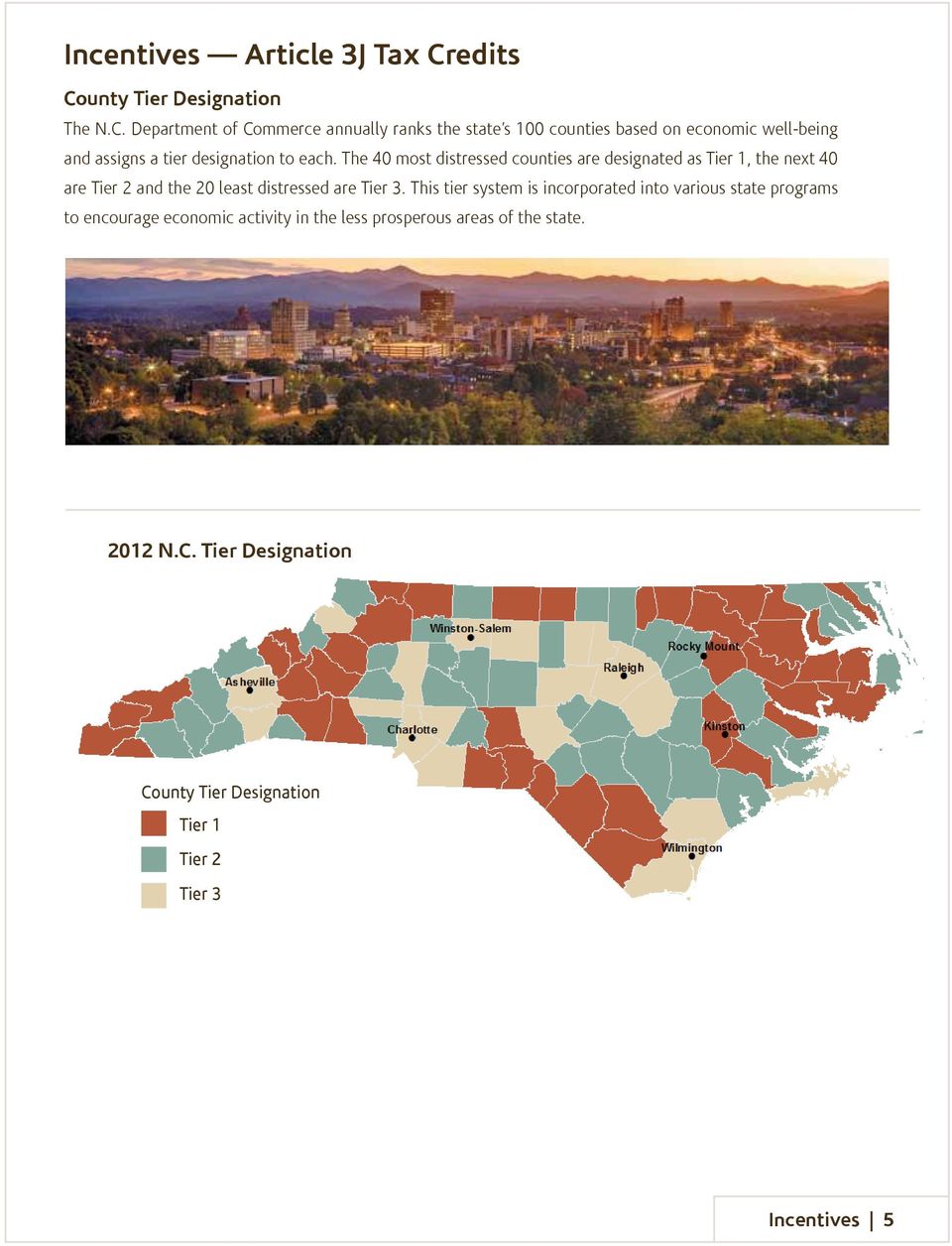
6 Incentives Article 3J Tax Credits County Tier Designation The N.C. Department of Commerce annually ranks the state s 100 counties based on economic well-being and assigns a tier designation to each. The 40 most distressed counties are designated as Tier 1, the next 40 are Tier 2 and the 20 least distressed are Tier 3. This tier system is incorporated into various state programs to encourage economic activity in the less prosperous areas of the state N.C. Tier Designation County Tier Designation Tier 1 Tier 2 Tier 3 Incentives 5
7 Incentives Article 3J Tax Credits 2011 Wage Standards and Average County Wage* The figures below are the lowest eligible wage alternatives (private sector) and represent a wage that is the lesser of 90 percent of the average county wage or 110 percent of the average state wage. County Tier 1 Tier 2 Tier 3 Wage Standard Avg. Wage Alexander None $514 Alleghany None $457 Anson None $595 Beaufort None $590 Bertie None $552 Bladen None $542 Burke None $592 Caldwell None $573 Camden None $747 Caswell None $527 Cherokee None $521 Clay None $492 Cleveland None $622 Columbus None $572 Edgecombe None $638 Gates None $522 Graham None $523 Greene None $476 Halifax None $527 Hertford None $600 Hyde None $402 Jones None $616 Lenoir None $563 Martin None $487 McDowell None $562 Mitchell None $580 Montgomery None $554 Northampton None $538 Richmond None $575 Robeson None $514 Rockingham None $597 Rutherford None $546 Scotland None $576 Surry None $558 Swain None $490 Tyrrell None $388 Vance None $577 Warren None $512 Washington None $642 Wilkes None $561 County Wage Standard Avg. Wage Alamance $576 $640 Ashe $476 $529 Avery $419 $465 Catawba $592 $658 Chowan $500 $555 Cumberland $564 $627 Currituck $473 $525 Dare $418 $464 Davidson $529 $588 Davie $499 $554 Duplin $481 $534 Franklin $588 $653 Gaston $588 $653 Granville $590 $656 Harnett $473 $525 Haywood $507 $563 Hoke $438 $487 Jackson $477 $530 Lee $634 $704 Lincoln $533 $592 Macon $489 $543 Madison $438 $487 Nash $569 $632 Pamlico $401 $446 Pasquotank $486 $540 Perquimans $425 $472 Person $556 $618 Pitt $530 $589 Polk $484 $538 Randolph $518 $576 Rowan $624 $693 Sampson $501 $557 Stanly $511 $568 Stokes $455 $505 Transylvania $468 $520 Watauga $464 $515 Wayne $517 $574 Wilson $643 $714 Yadkin $480 $533 Yancey $446 $496 County Wage Standard Avg. Wage Brunswick $563 $625 Buncombe $585 $650 Cabarrus $562 $624 Carteret $428 $475 Chatham $527 $585 Craven $536 $596 Durham $832 $1,178 Forsyth $725 $806 Guilford $684 $760 Henderson $558 $620 Iredell $629 $699 Johnston $545 $605 Mecklenburg $832 $992 Moore $558 $620 New Hanover $623 $692 Onslow $438 $487 Orange $586 $651 Pender $451 $501 Union $587 $652 Wake $779 $865 Note: Agrarian Growth Zones and Urban Progress Zones have the same wage standard as listed above, except for the following counties: Durham, Forsyth, Guilford, Mecklenburg and Wake. The wage standards within Agrarian Growth Zones and Urban Progress Zones in these five counties is $680. *2012 wage data will be available later in Q Incentives 6

8 Incentives Article 3J Tax Credits Urban Progress Zones (UPZ) and Agrarian Growth Zones (AGZ) Municipalities with a population of at least 10,000 have the ability to define qualifying areas of poverty as Urban Progress Zones. Counties that do not have a municipality with a population of at least 10,000 have the ability to define qualifying areas of poverty as Agrarian Growth Zones. Projects located within these zones receive enhanced Article 3J Credits. In order to establish a zone, a qualifying unit of local government must apply for zone designation to the N.C. Department of Commerce, Division of Community Assistance. Zones become effective on the date the zone application is approved and remain in effect through December 31 of the subsequent year. Agrarian Growth Zones: Urban Progress Zones: Chatham County Asheboro Lexington Rocky Mount Columbus County Fayetteville Mooresville Salisbury Franklin County Gastonia Morganton Sanford Montgomery County Greensboro Mount Airy Southern Pines Sampson County Hendersonville New Bern Thomasville Hickory Raleigh Wilmington Kannapolis Roanoke Rapids Winston-Salem Kinston County Tier Designation Tier 1 Tier 2 Tier 3 Agrarian Growth Zone (AGZ) Urban Progress Zone (UPZ) Ports Enhancement Zone (PEZ) Ports Enhancement Zone is similar to an Urban Progress or Agrarian Growth Zone. Ports Enhancement Zone is applicable to tracts within 25 miles of State ports. Within Ports Enhancement Zone borders, job creation thresholds, business investment thresholds and credit values are calculated as a Tier One Development Area, irrespective of the Development Tier of the Zone s surrounding county. In order to establish a zone, a qualifying unit of local government must apply for zone designation to the N.C. Department of Commerce, Division of Community Assistance. Incentives 7

9 Incentives Article 3J Tax Credits Technology Development Tax Credit As part of the Technology Development (TD) Tax Credit, taxpayers that have qualified North Carolina research expenses during a taxable year are allowed a credit equal to a percentage of those expenses determined in the following manner: Small business (annual receipts less than $1 million): If the taxpayer is a small business as of the last day of the taxable year, the business is allowed a credit of 3.25 percent. Low-tier research: For expenses for research performed in a Tier 1 county, a business is permitted a credit of 3.25 percent. Eco-Industrial Park: For expenses with respect to research performed in an Eco-Industrial Park certified under N.C. 143B , the business is allowed a credit of 35 percent. Other research: For expenses not covered above, the percentages provided in the table to the right apply to the taxpayer s qualified North Carolina research expenses during the taxable year: The TD credit incorporates the Internal Revenue Code definition of qualified research expenses. The expense must meet federal TD definitions of either qualified research or basic research. The credit is not limited to research increases, but applies to every dollar of research expense. In addition, there is no eligible business test for this credit. Any corporate taxpayer may claim the TD credits provided they meet certain wage standards, health insurance, environmental impact and safety and health program requirements. TD credits may be used to offset up to 50 percent of state income or franchise tax after all other credits against that tax are applied. Taxpayers may elect to claim the credit against either the income or the franchise tax. Any unused portion of the credits may be carried forward for 15 years. Those eligible for TD tax credits include small businesses as well as those conducting low-tier and other research. Qualified Expenses Rate $0 $50 million 1.25% $50 $200 million 2.25% More than $200 million 3.25% A taxpayer that has North Carolina university research expenses for the taxable year is allowed a credit equal to 20 percent of those expenses. Incentives 8

10 Incentives Article 3F Tax Credits Interactive Digital Media Tax Credit A North Carolina taxpayer that develops interactive digital media (IDM) within the state is allowed a tax credit. IDM products are defined by those used for electronic media distribution, including file download over the Internet; contain a computercontrolled virtual universe with which an individual who uses the program may interact in order to achieve a goal; and/or contain a significant amount of at least three of the following five types of data: animated images, fixed images, sound, text and 3D geometry. This includes game platforms, game engines and games that have both entertainment and serious applications. N.C Credits are awarded for taxpayer s expenses that exceed $50,000 that are paid during the taxable year in development phases and may not exceed $7.5 million.* The percentages that apply to the expenses are listed below: 15 percent of compensation and wages for a full-time employee, fringe contributions on compensation and wages and other allowable expenses. 20 percent of research expenses paid to a North Carolina university or participating community colleges. Products for the following activities are ineligible: Developed by the taxpayer for internal use. Interpersonal communications service, such as videoconferencing, wireless telecommunications, a text-based channel or a chat room. Internet site that is primarily static and primarily designed to provide information about one or more persons, businesses, companies or firms. Gambling or casino games. Political advertising. Contain material that is obscene or that is harmful to minors. N.C and *Expenses used to claim this credit may not be used to double claim toward another North Carolina incentive program. Tax program is effective on or after January 1, Incentives 9
11 Incentives Article 3B Tax Credits North Carolina s commitment to responsible stewardship and sustainable development of its environment and natural resources extends past legal guidelines. The state makes available to business and industry grants and tax credits related to renewable energy and waste reduction. In addition, there are numerous active support services that encourage environmentally conscious efforts. Renewable Energy Tax Credit Renewable energy expenditures eligible for a tax credit include the cost of equipment and associated design, construction costs and installation costs less any discounts, rebates, advertising, installation-assistance credits, name-referral allowances or other similar reductions. The credit is repealed for renewable energy property put in place on or after January 1, N.C A The credit is subject to various ceilings depending on the type of renewable energy technology. Eligible Technologies Available Credit (per each installation) Commercial/ Industrial Solar, wind, hydro, geothermal and biomass applications on commercial and industrial facilities, including photovoltaic, daylighting, solar water-heating and space-heating technologies; combined heat and power system property; and wind equipment including equipment required to relay the electricity by cable from the turbine motor to the power grid. Construction of and/or converted commercial facility for the manufacture of renewable energy property, or a major component subassembly for a solar array or wind turbine (credit expires for facilities placed in service after January 1, 2014). 35% up to $2,500,000 25% * Non-business/ Residential Renewable-energy systems for non-business use, which include wind equipment required to capture and convert wind energy into power. 35% up to $10,500 Geothermal equipment installation. 35% up to $8,400 Non-business solar energy equipment for active space heating, combined active space and domestic water-heating systems, and passive space heating. 35% up to $3,500 Non-business solar water-heating systems, including solar pool heating systems. 35% up to $1,400 *No Double Credit property that claims any other credit is not eligible for Renewable Energy Property Credit. Program is applicable in all counties. Incentives 10

12 Incentives Article 3B Tax Credits Renewable Fuels Tax Credits Biodiesel Production Tax Credit A biodiesel provider that produces at least 100,000 gallons of biodiesel during the taxable year is allowed a credit equal to the per-gallon excise tax the producer paid in accordance with the motor fuel excise tax rate. The credit does not apply to tax paid on the diesel portion of the biodiesel blends and the credit may not exceed $500,000. The credit is repealed for taxable years beginning on January 1, Alternative Fuel Production Tax Credit A tax credit for the processing of biodiesel, 100 percent ethanol or ethanol/gasoline blends consisting of at least 70 percent ethanol. The credit is equal to 25 percent of the cost of constructing and equipping the facility and a facility must be placed in service before January 1, Alternative Fuel Production Tax Credit In lieu of the above credit, a taxpayer that constructs and places into service, in North Carolina, three or more commercial facilities for processing renewable fuel and invests a total amount of at least $400 million in the facilities is allowed a credit equal to 35 percent of the cost to the taxpayer of constructing and equipping the facilities. The facility must be placed in service before January 1, Alternative Fuel Fueling Infrastructure Tax Credit A tax credit is available for qualified fueling facilities that dispense biodiesel, 100 percent ethanol or ethanol/gasoline blends consisting of at least 70 percent ethanol. The credit is equal to 15 percent of the cost of construction and installation of the dispensing facility, including pumps, storage tanks and related equipment that is directly and exclusively used for dispensing or storing the fuel. Historic Preservation Tax Credits: Owners or lessees of a certified historic structure, as designated by the State Historic Preservation Office or the National Park Service are eligible. Credits are available for the rehabilitation of income-producing historic properties and owner-occupied historic residences. A 20-percent state tax credit for rehabilitation of incomeproducing certified historic structures is awarded to rehabilitations that qualify for the 20-percent federal tax credit. A 30-percent state tax credit is available for rehabilitation of non-income-producing certified historic structures, including personal residences. Minimum rehabilitation expenses must be met in order to qualify. Recycling Facility Tax Credits An owner that purchases or leases machinery and equipment for a major recycling facility (at least $300 million investment and at least 250 new, full-time jobs) in the state during the taxable year is allowed a tax credit. The credit is equal to 50 percent of the amount payable by the owner during the taxable year of purchase or lease of the machinery and equipment. Over 1,300 certified rehabilitation projects have been completed. Incentives 11

13 Incentives North Carolina Ports Tax Credit Any customer business or individual of the N.C. Ports at Morehead City and Wilmington who is subject to payment of North Carolina income taxes can qualify for a tax credit. Basically, by increasing use of ports facilities, a customer new or existing can take a credit on income taxes due to the state. The tax credit is earned on cargo wharfage and handling fees in or out charged by the N.C. Ports Authority. The credit is the amount by which current-year fees exceed the average of the past three years. The credit applies directly to income taxes due to the state up to 50 percent of the total tax liability for each tax year. Any unused credit may be carried forward for five years. The maximum cumulative credit that may be taken may not exceed $2 million. There are some limitations to this credit. For example, bulk cargo through the Port of Wilmington is excluded. Additional details are available from the N.C. Ports Authority by calling or visiting Example 1 New North Carolina State Port User Year 1 $50,000 Year 2 $100,000 Year 3 (Current Year) $100,000 TOTAL FEES $250,000 $250,000 3 yrs. = AVERAGE FEE $83,333 Year-3 fees $100,000 - Avg. fees - 83,333 TAX CREDIT* $16,667 Example 2 Current User Increased Volume Year 1 $0 Year 2 $0 Year 3 (Current Year) $100,000 TOTAL FEES $100,000 $100,000 3 yrs. = AVERAGE FEE $33,333 Year-3 fees $100,000 - Avg. fees - 33,333 TAX CREDIT* $67,000 Incentives 12

14 Incentives Qualified Business Investment Tax Credit The Qualified Business Investment Tax Credit Program allows tax credits against individual income tax for qualifying investments made by individuals and pass-through entities in the equity securities or subordinated debt of a qualified business. The credit is 25 percent of the amount invested or $50,000, whichever is less. The total credits allowable to all taxpayers for each year may not exceed $7,500,000. In order for the investor to be eligible for the credit, the investment must be made on or after January 1, 2008 and in a business registered with the Secretary of State s Securities Division as a Qualified Business Venture or a Qualified Grantee Business. Qualified Business Venture (QBV) Business engaged primarily in manufacturing, processing, warehousing, wholesaling, research and development or a service-related industry. Business must have been organized in the same year as the year in which it applies for registration, or it must not have generated more than $5,000,000 in gross revenues as of its last fiscal year. Business cannot engage to any substantial degree in the following: providing professional services, contracting or construction, selling or leasing at retail, investing, entertainment or recreation or managing or operating real estate. Qualified Grantee Business (QGB) Must have received a grant from one of the following agencies three years prior to registration: the North Carolina Technological Development Authority, North Carolina First Flight, Inc., the North Carolina Biotechnology Center, the Microelectronics Center of North Carolina, the Kenan Institute for Engineering, Technology and Science or the Federal Small Business Innovation Research Program. This program is repealed for investments made on or after January 1, To receive the credit, you must file Form D-499 Application For Tax Credit For Qualified Business Investments on or before October 15 th in the year after the investment was made. Incentives 13

15 Incentives Sales and Use Tax Exemptions, Refunds and Discounts North Carolina offers reduced rate allowances for certain business items. For example: Data Center/Software Exemptions Sales of machinery and equipment to be located and used in an eligible data center are exempt from sales and use tax, but are subject to a privilege tax. Contractors are allowed to elect to pay the privilege tax on machinery and equipment for use in the performance of a contract with the owner of the data center. Subcontractors are allowed to elect to pay the privilege tax on machinery and equipment for use in the performance of a contract with the general contractor that has a contract with the owner of the data center. The privilege tax does not apply to equipment and machinery of an eligible Internet data center that is exempt from sales tax under N.C (55). An eligible data center is a facility that provides infrastructure for hosting or data processing services and that has power and cooling systems that are created and maintained to be concurrently maintainable and include redundant capacity components and multiple distribution paths serving the computer equipment at the facility. The privilege rate is one percent with a maximum of $80 per article and applies to eligible data center machinery equipment that is capitalized for tax purposes and used for: The provision of data center services, including equipment cooling systems for managing the performance of the data center property, hardware for distributed and mainframe computers and servers, data storage devices, network connectivity equipment and peripheral components and systems. For the generation, transformation, transmission, distribution or management of electricity, including exterior substations and other business personal property used for these purposes. North Carolina offers sales and use tax exemptions, refunds and discounts to eligible companies. A minimum capital investment of $150 million for a facility located in a Tier 1 county, or a minimum investment of $225 million in a Tier 2 or Tier 3 county, is required. Wage standard and health insurance requirements per N.C are certified. If an additional facility is constructed and is linked through a fiber-optic or similar connection, a minimum investment of $75 million is required for the second facility to be eligible. These investments must be made within five years of the date on which the qualifying investment is made. The sunset for this exemption is July 1, N.C C Sales of electricity to an eligible Internet data center and eligible business property to be located at the eligible Internet data center that is primarily engaged in the software publishing or Internet activity, as defined by NAICS and , are exempt from sales and use tax. N.C (55) The Secretary of Commerce must make a written determination that at least $250 million in private funds has been or will be invested in real property and/or eligible business property within five years after the commencement of construction of the facility. N.C (8e) Sales of computer software to a person who operates a data center and uses it within the data center are exempt from sales and use tax. N.C (43a) Incentives 14
16 Incentives Sales and Use Tax Exemptions, Refunds and Discounts Manufacturing Exemptions Mill machinery, mill machinery parts or accessories, and specialized equipment used to unload or process bulk cargo are exempt from sales and use tax, but are subject to a privilege tax. This rate is one percent with a maximum of $80 per article. N.C B Distribution machinery for storage, use or consumption at manufacturing and distribution facility, with an investment of at least $80 million in real and tangible personal property and 550 employees within five years after the facility is placed into service, is subject to a privilege tax. This rate is one percent of the eligible equipment with a maximum tax of $80 per article. N.C D Purchases of ingredients or component parts of a manufactured product that becomes an ingredient or component part of tangible personal property that is manufactured are exempt from sales and use tax. N.C (8) Packaging items that constitute a part of the sale at wholesale or retail and are delivered with the product to the customer are exempt from sales and use tax. N.C (23) Fuel and electricity sold to a manufacturer for use in connection with the operation of a manufacturing facility are exempt from sales and use tax. N.C (57) Fuel purchased by a manufacturer for use in connection with the operation of a manufacturing facility is not subject to the privilege tax. N.C A Special Exemptions Piped natural gas is exempt from sales and use tax, but is subject to an excise tax. This rate is based on the number of therms of gas consumed in a month. N.C (44) and N.C Motor vehicles are exempt from sales and use tax, but are subject to the highway use tax. Highway use tax is three percent of the retail value of the motor vehicle titled in the state, with the exceptions of a maximum tax of $1,500 per vehicle for recreational vehicles and $1,000 maximum tax for Class A or Class B motor vehicles. N.C Refunds The owner of an eligible facility is allowed an annual refund of sales and use taxes on purchases of building materials, fixtures and equipment if the facility costs at least $50 million in Tier 1 counties and $100 million in Tier 2 and 3 counties. Eligible industries include: air courier services; aircraft manufacturing; bioprocessing; financial services, securities operations and related systems development; motor vehicle manufacturing; paper-from-pulp manufacturing; pharmaceutical and medicine manufacturing and distribution of pharmaceuticals and medicines; semiconductor manufacturing; solar electricity generating materials manufacturing; and turbine manufacturing. N.C B provides more detailed industry descriptions and requirements. The sunset for the refund is January 1, Testing Labs or medical labs engaged in analytical services are eligible for a 50 percent refund on sales and use taxes paid on purchases of supplies used or consumed for analytical activities. The sunset for this refund is January 1, N.C A Discounts Aircraft and boats are taxed at three percent to a maximum of $1,500 per item. N.C (1b) Incentives 15
17 Incentives Job Development Investment Grant The Job Development Investment Grant (JDIG) is a discretionary incentive program that provides a limited number of cash grants directly to new and expanding businesses that will provide economic benefits to the state are competitive with other locations and need the grant to carry out the project in North Carolina. Grants are based on the job creation and investment commitment made by companies in their formal applications to the state prior to a location decision. Grant funds are disbursed annually to approved companies based on a percentage of withholding taxes paid by new employees, following satisfaction of performance criteria set out in grant agreements. In addition, state law requires that, with respect to every grant made under the JDIG program, the Department of Commerce must conduct an analysis to determine whether the total benefits of the project outweigh the costs to the state and a comprehensive model has been developed for this purpose. In addition to other statutory requirements, only grants that show a net state revenue benefit may be awarded. A five member Economic Investment Committee (EIC) evaluates projects and makes decisions regarding JDIG awards, funding levels, grant periods and other terms of the grants. The EIC is authorized to award grants to be disbursed annually for a period of up to 12 years, ranging from 10 to 75 percent of the withholdings associated with eligible positions created by a company over a specified period of time. For projects located in Tier 2 counties, 15 percent of the total JDIG grant is transferred to the state s utility account to fund infrastructure projects in the state s economically distressed counties. In Tier 3 counties, 25 percent of the total JDIG grant is transferred to the utility account. The JDIG program is subject to a legislative cap on grants made by the EIC in a given year, based on the cumulative financial impact of those grants in any future grant year. Up to 25 grants can be made annually. The maximum amount of total liability for grants provided for in agreements entered into in any single calendar year may not exceed $15 million. The amount of a grant associated with any specific position may not exceed $6,500 in any year. Currently, the authority of the EIC to enter into new agreements expires January 1, Governor Bev Perdue announces the expansion of Providencia USA, Inc. in Iredell County. Incentives 16

18 Incentives One North Carolina Fund The One North Carolina Fund consists of nonrecurring appropriations made available to the governor as a flexible and discretionary tool allowing North Carolina to respond quickly to enable job creation and/or retention for projects competitive with other locations. Awards are based on jobs created, economic impact of the project, the importance of the project to the state, quality of industry and environmental impact. Awards are allocated to local units of government as part of a negotiated challenge grant. Local governments are required to match the One North Carolina award with cash, fee waivers, in-kind services, donations of land, buildings or other assets or provisions of infrastructure. For a company to be considered for a grant, the company must agree to meet or exceed 100 percent of the average county wage. Funds allocated through One North Carolina are used for: Installing or purchasing equipment Structural repairs, improvements or renovations of existing buildings to be used for expansion Construction of or improvements to new or existing water, sewer, gas or electric utility distribution lines The One North Carolina Fund may provide financial assistance to businesses deemed by the governor to be vital to a healthy state economy. Incentives 17

19 Incentives One North Carolina Small Business Program The One North Carolina SBIR/STTR Phase I Incentive Program reimburses qualified North Carolina firms for a portion of the costs incurred in preparing and submitting Phase I proposals for the federal SBIR and STTR programs. The One North Carolina SBIR/STTR Phase I Matching Funds Program is designed to award matching funds to North Carolina firms who have been awarded a federal SBIR or STTR Phase I award. The federal SBIR and STTR programs are designed to help small businesses commercialize their innovative technologies. The North Carolina incentive program and the matching program comprise The One North Carolina Small Business Program, which is administered by the North Carolina Board of Science and Technology. The Board advises and makes recommendations to the governor, the General Assembly, the Secretary of Commerce and the Economic Development Board on the role of science and technology in the economic growth and development of North Carolina. The Board publishes a Solicitation and Announcement of the Availability of Funds for each program when they are offered; the solicitations incorporate the programs guidelines in addition to application forms, specific instructions and eligibility requirements for the programs. Applications for funding submitted before a solicitation is issued will not be considered; applications must conform to the requirements and procedures listed in both the guidelines and the solicitations to be eligible for funding under these programs. For more information, see The One North Carolina Small Business Program provides reimbursement or matching funds to businesses conducting feasibility research leading to the development of commercially viable innovations. Incentives 18

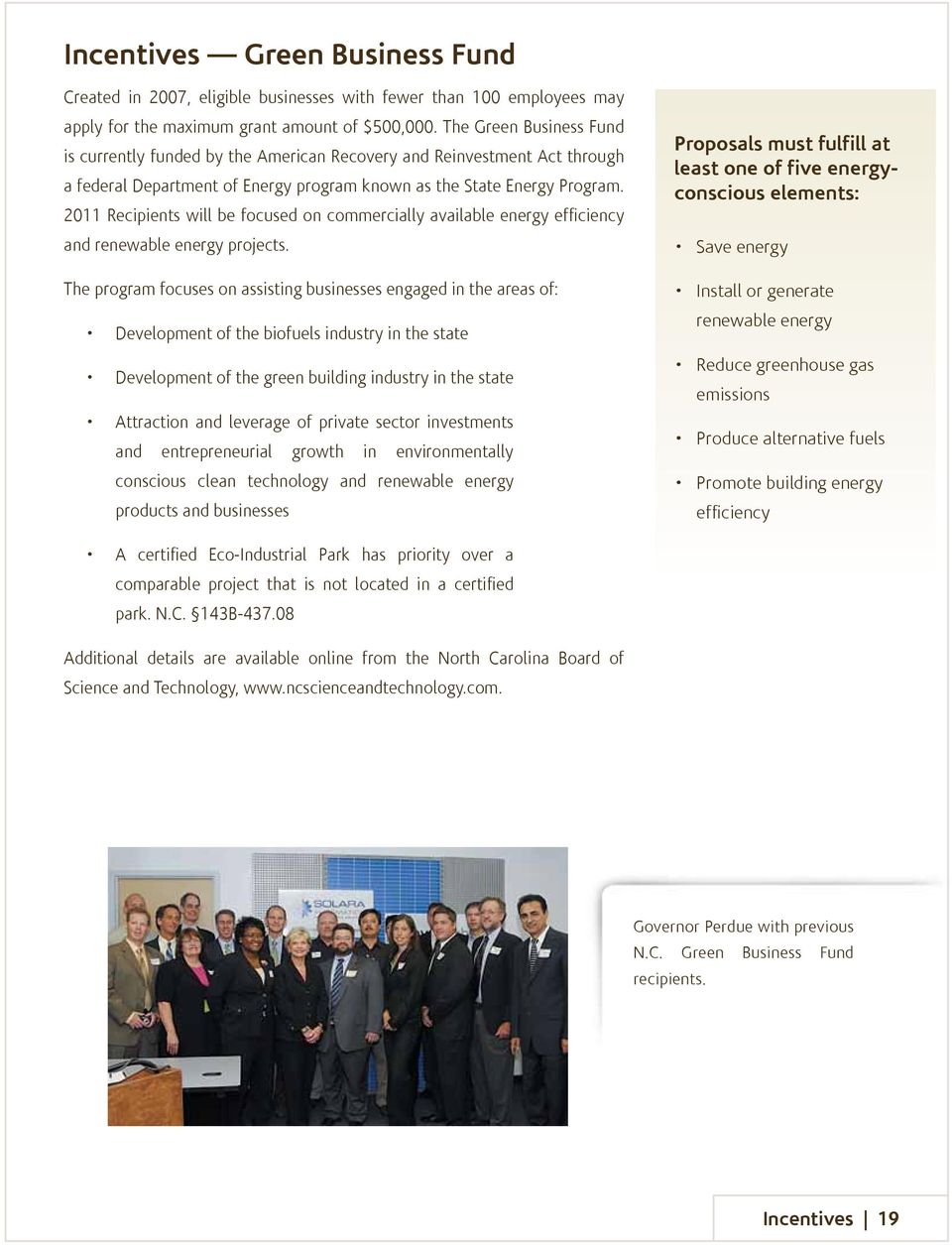
20 Incentives Green Business Fund Created in 2007, eligible businesses with fewer than 100 employees may apply for the maximum grant amount of $500,000. The Green Business Fund is currently funded by the American Recovery and Reinvestment Act through a federal Department of Energy program known as the State Energy Program Recipients will be focused on commercially available energy efficiency and renewable energy projects. The program focuses on assisting businesses engaged in the areas of: Development of the biofuels industry in the state Development of the green building industry in the state Attraction and leverage of private sector investments and entrepreneurial growth in environmentally conscious clean technology and renewable energy products and businesses Proposals must fulfill at least one of five energyconscious elements: Save energy Install or generate renewable energy Reduce greenhouse gas emissions Produce alternative fuels Promote building energy efficiency A certified Eco-Industrial Park has priority over a comparable project that is not located in a certified park. N.C. 143B Additional details are available online from the North Carolina Board of Science and Technology, Governor Perdue with previous N.C. Green Business Fund recipients. Incentives 19
21 Incentives Community Development Block Grant The Community Development Block Grant (CDBG) Program provides grants for infrastructure development. Funds available are based on an annual federal allocation to North Carolina from the U.S. Department of Housing and Urban Development and may be applied for by a local government for economic development projects. Private businesses cannot apply directly for this funding, but instead work collaboratively with a local government and receive a loan or grant through the local government for the project. Funded projects lead to the creation or retention of jobs. Economic development category projects involve assistance for public facilities needed to serve the target business. Other Eligibility Requirements Service or manufacturing industries must meet the Article 3J Tax Credits wage standards. Grants must be made to applicants for infrastructure improvements that are publicly owned and maintained, including construction or improvements to water, sewer, streets, gas lines, rail or municipal electrical utility systems. At least 60 percent of the jobs created or retained through the CDBG funds must be filled by persons who earned less than 80 percent of the median income for that county in the previous 12 months. A pre-application meeting is required for the CDBG program. A CDBG program officer should be contacted for assistance early in the incentive planning process. Jobs transferred within the state or from another state do not qualify as new jobs. In addition, CDBG funds may not be used to assist directly in the relocation of any industrial or commercial plant, facility or operation from one area to another area if the relocation is likely to result in a significant loss of employment in the area from which the relocation occurs. Incentives 20
22 Incentives Community Development Block Grant Funding Levels Businesses eligible for Article 3J Tax Credits can receive a maximum of $10,000 to $15,000 per job committed depending on the tier level of the county. Businesses not eligible for Article 3J Tax Credits can receive a maximum of $4,000 to $10,000 per job. Grant and loan amounts are determined by the cost of the project and the availability of funding. Tier 1 and 2 counties may apply for up to $1 million per project during the funding year. Tier 3 counties can receive a maximum of $750,000 per project per funding year. There is a $1.25 million limit on CDBG funds whether economic development, housing or a combination of the two, per fund year for each eligible government. Match Requirements Tier 2 and 3 counties must match the CDBG grant with local funds on a 1:3 ratio. The 25 most economically distressed counties and 21 st Century Communities are not required to provide a match. Eligible Applicants All county or municipal governments in the state are eligible to apply for CDBG funds, except those listed below. These entitlement communities go directly to HUD for assistance, because they are larger urban communities: Asheville, Burlington, Chapel Hill, Charlotte, Concord, Durham, Fayetteville, Gastonia, Greensboro, Greenville, Hickory, High Point, Jacksonville, Kannapolis, Lenoir, Morganton, Raleigh, Rocky Mount, Salisbury, Wilmington and Winston-Salem. Wake and Cumberland counties also are ineligible, except for the towns of Holly Springs and Linden, which opted to participate in the state s program instead of their county s program. Grants and loans for infrastructure development and to enhance a community s economy are also available to companies that apply in collaboration with a local government. Incentives 21
23 Incentives Industrial Development Fund The Industrial Development Fund (IDF) provides grants and loans for infrastructure development in the counties designated as Tier 1 or Tier 2 under G.S. 143B Eligible units of local government may apply for the funds in conjunction with a company that commits to create new jobs or retain existing jobs in North Carolina. To qualify, companies must meet the same eligibility requirements as those outlined in the Article 3J Tax Credits for Growing Businesses. Funding Level and Use Funding is based on the availability of monies and the merits of a project. IDF grants and loans for any one project cannot exceed a total of $10,000 per new job created or current job retained, up to a maximum of $500,000 per project. Grants may be awarded to local governments for infrastructure improvements that are publicly owned and maintained, including construction or improvement of water, sewer, gas, rail and electrical utility systems. Loans with a four-percent fixed interest rate may be awarded to the project business, through the unit of local government applicant, for investments in privately owned or maintained assets, such as the purchase of machinery and equipment or building renovations. IDF loan funds may not be used to acquire land or buildings or to construct new buildings. All IDF loans must be made in participation with a North Carolina bank that originates 50 percent of the loan and shares equal risk and collateral with the unit of local government. Match Requirements In the 25 most distressed counties, there is no local match requirement. Federal or state grant funds may not be used to meet the local match requirement, with the exception of funds granted through the N.C. Rural Economic Development Center. Utility Account Units of local government in the 80 most distressed counties may apply for utility account funding. Most requirements of the utility account are the same as the IDF. However, as there is no job commitment requirement, it is not necessary to apply for the funds in conjunction with a company. The applicant must demonstrate the project is expected to lead to job creation in eligible industries in the near future. No local match is required for utility account funding. North Carolina offers grants and loans for infrastructure development to eligible companies committed to creating new jobs in distressed counties. Incentives 22
24 Incentives Economic Infrastructure Program The Rural Center administers the North Carolina Economic Infrastructure Program, which provides funding to local governments for infrastructure projects that result in private-sector jobs. Eligible projects include: upgrade or repair of public drinking water or wastewater treatment plants upgrade or repair of public water or sewer lines natural gas line extension high-speed fiber extension stormwater infrastructure requirements on private property privately owned water storage tanks required for fire flow or process water pre-treatment facilities necessary for connection with public treatment system access roads such as interior industrial park roads not funded by the N.C. Department of Transportation rail spurs This program can award up to a $1 million or one-half of the eligible project cost, whichever is less, at $10,000 per job created. There is a local cash match requirement of five percent of the total eligible project cost. Eligible Applicants A unit of local government (county or municipality) in one of North Carolina s 85 rural counties, or A unit of local government in a Tier 1 urban county Additional information on the North Carolina Economic Infrastructure Program is available online from The Rural Center, In 2010, the N.C. Rural Economic Development Center awarded eleven Economic Infrastructure grants, totaling nearly $3.5 million, to assist projects that created jobs in rural areas. Incentives 23
25 Incentives Building Reuse and Restoration Grants Building reuse and restoration grants are offered with a goal to spur economic activity and job creation throughout the state by encouraging the productive reuse of vacant buildings. Grants for this purpose are available from two sources: Community Development Block Grant CDBG Building Reuse grants are available to local government applicants that propose a project in conjunction with a private, for-profit business that wishes to place a vacant building into economic use resulting in the creation or retention of permanent, full-time jobs by the project company. To be eligible, documentation must be provided showing the building has been vacant at least 30 consecutive days. The grant amount is calculated based on $20,000 per job for Article 3J Tax Credit eligible businesses and $12,000 per job for businesses not eligible for tax credits. The maximum amount is $750,000 per unit of government per program year. The project company must commit to creating 60 percent of the jobs for low- to moderate-income persons. For job retention projects, 60 percent of the existing jobs must be held by low- to moderate-income persons. A local cash match of 100 percent is required for each CDBG dollar loaned to the project company and the company must have a minimum contribution of 25 percent in the proposed building reuse project. CDBG funds provided to the company by the unit of local government will be in the form of a forgiven loan. If there is a default by the project company prior to the expiration of the term, 20 percent of the loan is forgiven for each year the jobs were held prior to the default. At the end of the five-year term, there is no repayment if the company has created 90 percent of the original job-creation pledge. Incentives 24
26 Incentives Building Reuse and Restoration Grants North Carolina Rural Economic Development Center Building Reuse and Restoration Grant Eligible recipients of the Rural Center s grants must be local government units located within North Carolina s 85 rural counties or within the most economically distressed urban counties, as designated by the N.C. Department of Commerce. Priority is given to eligible applicants from towns with a population of less than 5,000 people. There are two types of grants: Grants for vacant properties provide funding for renovation of vacant properties in preparation for new business uses. Eligible activities include renovation and rehabilitation, upfitting and brownfields remediation. Buildings must have been vacant for at least three months. The project must lead directly to the creation of private sector jobs in the building. The maximum grant amounht will be $480,000 or one-half the renovation cost, whichever is less. Grants for occupied properties may be used for building additions and renovations of properties occupied by certain types of businesses. Eligible buildings include those used for manufacturing, warehousing, distribution, data processing and software development. The business must create new jobs as a result of the renovation. The grant amount is $5,000 per job up to a maximum of $500,000 or one-half the renovation cost, whichever is less. Eligible applicants are units of local government located in a Tier 1 urban county. Grants must be matched by at least an equal amount in private and public funds. The local government must provide at least five percent of the total grant amount. Additional information on the Building Reuse and Restoration Grants is available online from The Rural Center, The application package is available online at Incentives 25
27 Incentives Access Road Improvements Funds are available through the N.C. Board of Transportation to construct roads to provide access to new or expanded industrial or manufacturing facilities, including mills, processing facilities and laboratories and other industrial research operations. The board also may consider requests for access road improvements to recreational facilities if they are expected to produce additional jobs and attract people to the facilities from other sections of North Carolina and from out of state. Other eligible projects include: Construction of public school drives Construction of driveways at public medical facilities and public airports Pavement of entrance aprons at volunteer fire departments and rescue squads that are located inside an incorporated municipality The N.C. Board of Transportation individually reviews the economic impact of the location of distribution facilities for manufactured goods. Approval primarily is based on a comparison of the initial number of jobs gained with the road improvement cost. The initial investment in the project, the precedent of past approvals by the board for similar projects and the economic development needs of the county involved factor into these approvals, as well. Access road improvements eligible to be approved by the board must be along an alignment determined by the N.C. Department of Transportation (DOT), and the right-of-way must be dedicated at no cost. Such access road improvements terminate at the property line of the project and become a part of the state maintained system. The N.C. Board of Transportation may consider adding an access road constructed by others to the state maintenance system if it is justifiable based on the existing access and public service road policy. The construction standards for such a road are dependent on the intended use of the roadway and determined by the division engineer. No matter where a business decides to locate in North Carolina, funds are available to create roads to and from it. Incentives 26
28 Incentives Rail Access Program The Rail Industrial Access Program provides grant funding to aid in financing the construction or rehabilitation of railroad access tracks required by a new or expanding industry that will result in a significant number of new jobs or capital investment. Organizations eligible to apply for funding include: Municipal and county governments Nonprofit or for-profit community development organizations Railroads Industries Program funding is an incentive to encourage firms to choose a location or expand in North Carolina as opposed to another state. It is not intended to fund projects when only an in-state location is considered or when an expansion will not have a significant economic impact. Application Process and Criteria The DOT s Rail Division receives and evaluates each application and makes recommendations for funding to the N.C. Board of Transportation, which decides upon the amount of funding to be awarded. Project applications are accepted any time during the year, but the DOT must receive a completed application by the first of the month in order for a project to be considered for N.C. Board of Transportation approval the following month. When recommending rail projects for funding, the DOT primarily considers the planned capital investment and expected employment to be created in the first two years of the project as well as annual rail traffic. Secondary considerations include whether or not the project is served by a shortline railroad, is eligible to receive Appalachian Regional Commission funding or is located in a Tier 1 county. Grantees must comply with all state laws, including environmental and competitive bidding, and the industry must certify that it will provide the jobs and the rail traffic or carloads indicated in the project application. Project Costs Eligible project costs include: Site preparation, including grading and drainage Track construction Switches Grade crossings and signals Ineligible project costs include relocation of utilities, acquisition of right-of-way and unloading facilities. Allocation of Funding Grant recipients may receive a maximum of 50 percent of total project costs depending on the DOT evaluation of economic benefits and the funding available. No more than 20 percent of the annual budgeted funding for this program may be allocated to any one project in any fiscal year. Ownership and Maintenance Responsibility The rail industrial access tracks, once constructed, are owned by the grantee or by the industry served. The track owner is responsible for maintenance and liability on the project tracks. Repayment If the project tracks are abandoned, relocated or sold without a grant assignment, the grantee will be required to repay, to the N.C. Board of Transportation, its contribution to the cost of construction and materials, less depreciation. The grantee may also be required to repay the N.C. Board of Transportation if rail use falls significantly below the commitment levels specified in the grant application during the first five years of the grant assignment or if job commitments are not met during the first two years of the grant assignment. Incentives 27
29 Incentives Industrial Revenue Bonds The state s bond program presents new and expanding industry with flexibility in securing financing and added tax benefits. North Carolina is one of the few states virtually unaffected by the state volume cap, and its anticipated annual volume of tax-exempt bonds for industrial purposes subject to the cap is less than the allowance of approximately $500 million. Unlike most conventional loans, industrial revenue bonds (IRBs) can offer businesses a convenient, long-term and often fixed-rate financing package. In addition, the interest earned on IRBs is exempt from federal income taxes. As a result, the bond buyer is willing to accept a lower rate of interest in exchange for tax-free income. Typically, interest rates on IRBs range between 1.5 and 2.5 percentage points below corporate bonds. Terms of the bond issue are negotiable, and the costs of issuing bonds can be spread out over the term of the bond issue. Eligibility and Statutory Requirements Only companies engaged in some type of manufacturing can use IRB funds. The proceeds of the bond issue may be used to finance the entire project, including the cost of land, construction of new or expanded facilities, purchase of equipment and the payment of certain costs incurred in the issuance of the bonds. Limitations Federal tax law imposes some limitations on IRBs. Capital expenditures at the business location(s) in the municipality during the three years before and after the date the bonds are issued cannot exceed $20 million. The total amount of IRBs outstanding at all related operations of the business, in all states, may not exceed $40 million. The regulations governing bond issuance are a combination of federal regulations and North Carolina statutes, and dictate several requirements be met before the issuance of IRBs: Jobs Test: The business must create or retain a certain number of jobs based on the size of the financing; currently, one job is required for every $250,000 in financing. Abandonment: The business must certify that in building the facility, it is not abandoning another facility in North Carolina (or, if it is, that it is impossible for it to remain at its present location because of limitations on land use, etc.). No Junk Bonds: Bonds must be sold to a sophisticated investor (e.g., a bank) or be backed by a letter of credit or other credit enhancement. Therefore, the company must be able to borrow on its own credit. Environmental Approval: The business must secure any required environmental certifications or permits. Bond programs offer new and expanding industry with financing flexibility and added tax benefits. Incentives 28
30 Incentives Industrial Revenue Bonds Other Types of Bond Issuances Tax Exempt (Exempt Facility/Solid Waste Disposal) These bonds are used to finance solid waste disposal facilities that include facilities for the collection, storage, treatment, utilization, processing or final disposal of solid waste (typically, either private landfills or solid waste disposal from manufacturing facilities). Volume cap is required, but there is no restriction on amount of issuance in any jurisdiction or nationwide. The interest paid on these bonds is exempt from federal and state income tax. Taxable (Industrial or Pollution Control Facilities) In North Carolina, taxable bonds can be issued to finance industrial or solid pollution control facilities that do not meet the requirements for tax exemption under federal law. These bonds are not exempt from federal tax, but are exempt from state income tax. The taxable bond interest rate is more costly to the borrower. There is no limit on bond account. Process: Typical bond applications take eight to 10 weeks to complete. Due to the complexity and documentation associated with revenue bonds, companies should consult with a legal representative and schedule a pre-application conference with the N.C. Department of Commerce Finance Center very early in the process. As part of the process, companies must: Secure an inducement agreement, which must be signed between the company and county before making financial commitments on the project. Obtain a bank letter of credit that is rated investment grade or better. The state supervises, approves and guides bond applications. Bonds are issued by the County Bond Authority where the facility will be located. Incentives 29
31 Incentives Foreign Trade Zones What is a Foreign Trade Zone? Development in Areas of Primary Concern A Foreign or Free Trade Zone is a neutral, secured area legally outside of U.S. Customs territory. Foreign or domestic merchandise may enter this enclave without a formal customs entry or the payment of customs duties or government excise taxes, and without a thorough examination. If the final product is exported from the United States, no Customs duty is levied. If the final product is imported into the U.S., duty and excise taxes are due at the time of transfer from the foreign trade zone and formal entry is made into the U.S. Duty is paid on the product itself or its imported parts, whichever is lower. Spoiled or damaged goods or waste materials may be disposed or re-exported without payment of duty. Economic Benefits of Foreign Trade Zones Foreign Trade Zones provide a myriad of economic advantages for businesses involved in international trade. Primarily, merchandise may be manipulated, used in a manufacturing process, inspected, combined with other domestic or foreign materials, displayed for sale and/or re-exported without payment of duty. Savings on personal property, sales and use taxes are possible since state and local governments generally do not impose such taxes on items in an FTZ. Additional savings on interest, labor and shipping costs may also result. Foreign Trade Zone Grantee Charlotte (Zone 57) Charlotte Regional Partnership Wilmington (Zone 66) N.C. Department of Commerce Morehead City (Zone 67) N.C. Department of Commerce Triangle (Zone 93) Triangle J Council of Governments Global TransPark (Zone 214) N.C. Global TransPark Authority Piedmont (Zone 230) Piedmont Triad Partnership N.C. Foreign Trade Zones Zone Piedmont Triad Zone 93 - Triangle Zone Global TransPark Zone 57 - Charlotte Foreign Trade Zones Zone 68 - Wilmington Zone 67 - Morehead City Incentives 30
Survey of North Carolina and Federal Tax Incentives for Real Property Investment and Disposition Conducive to Arts-Driven Economic Development
 Survey of North Carolina and Federal Tax Incentives for Real Property Investment and Disposition Conducive to Arts-Driven Economic Development Note: This survey is an outline of statutes and regulations
TABLE XXXVI. EMPLOYEE/RETIREE HEALTH INSURANCE Jan-15
 Alamance 300 $20 2,000 500.00 0.00 500.00 0% ne if hired after 6/30/2008 ne if hired after 1/1/2014 Alexander 3,500 $35 4,000 512.00 0.00 512.00 0% Alleghany 1,750 $20 1,750 755.94 0.00 755.94 0% 100%
NORTH CAROLINA RESIDENTIAL WEATHERIZATION WAGE DETERMINATION
 NORTH CAROLINA RESIDENTIAL WEATHERIZATION WAGE DETERMINATION This project wage determination is issued in response to a request from the Department of Energy (DOE) for prevailing wage rates specific to
EPIDEMIOLOGY Update. The ASTHMA. Asthma in North Carolina: Adult Prevalence, Emergency Department Visits, and Hospitalizations.
 The ASTHMA EPIDEMIOLOGY Update Summer 2011 Asthma in North Carolina: Adult Prevalence, Emergency Department Visits, and Hospitalizations Introduction This issue of The Asthma Epidemiology Update presents
Unrestrained Passenger Vehicle Occupant (Age>5) Fatalities by County North Carolina, 2006
 Unrestrained Passenger Vehicle Occupant (Age>5) Fatalities by County North Carolina, 2006 This Report Contains Data From the Following Sources: Fatality Data - NCSA Fatality Analysis Reporting System (FARS)
911 Fund Balances of PSAPs in North Carolina as of June 30, 2009
 911 Fund Balances of PSAPs in North Carolina as of June 30, 2009 February 23, 2010 Richard Taylor, Executive Director North Carolina 911 Board PSAP Revenue/Expenditure Report For the period July 1, 2008
Community Rehabilitation Program Counties Served Telephone State-Operated: WorkSource West WorkSource East
 State-Operated: WorkSource West WorkSource East (877) 344-7484 (877) 858-8467 Access Vocational Services, LLC Alamance, Cabarrus, Guilford, Iredell, Mecklenburg, Rockingham, Rowan, Stanly, Union, Warren
UNC Nursing Programs
 UNC Nursing Programs Task Force on the North Carolina Nursing Work Force February 12, 2003 Dr. Gretchen Bataille Senior Vice President for Academic Affairs Dr. Alan Mabe Vice President for Academic Planning
How To Increase Nursing Education In North Carolina
 The RIBN Project NC Nursing Education Programs 59 associate degree programs (ADN) 56 based in community colleges 18 pre-licensure BSN programs 1 pre-licensure MSN program 2 diploma programs 18 RN to BSN
Lenoir Rhyne University Master of Science in Physician Assistant Studies UNDER DEVELOPMENT
 Lenoir Rhyne University Master of Science in Physician Assistant Studies UNDER DEVELOPMENT Introduction Lenoir Rhyne - Developing PA Program The PA Profession Projected Changes Growth of Physician Assistant
State of North Carolina Department of Transportation
 State of North Carolina Department of Transportation Send completed form to: Office of Equal Opportunity & Workforce Services ATTN: SBE Program Manager Small Business Enterprise (SBE) Form 1511 Mail Service
AGED, BLIND, AND DISABLED MEDICAID MANUAL Transmitted by Change No.
 PUBLIC PROGRAMS FUNDED BY STATE, COUNTY, OR LOCAL FUNDS{ XE "PUBLIC PROGRAMS FUNDED BY STATE, COUNTY, OR LOCAL FUNDS 2360 FIGURE 3" } 1. Cancer Control Program DEPARTMENT OF ENVIRONMENT, HEALTH, AND NATURAL
Community Care of North Carolina Dual Innovation Proposal. Denise Levis Hewson Director, Clinical Programs and Quality Improvement
 Community Care of North Carolina Dual Innovation Proposal Denise Levis Hewson Director, Clinical Programs and Quality Improvement National Council of State t Legislatures August 7, 2012 What is CCNC? Private
Nurse Refresher Program for Registered Nurses
 Campus Box 1020 Chapel Hill NC 27599-1020 Nurse Refresher Program for Registered Nurses The Friday Center Self-paced Courses Credit Programs for Part-time Students Phone: 919-962-1134 fridaycenter.unc.edu/cp/catalog/nursing.html
Help for the Hardest Hit Homeowners
 A temporary setback doesn t have to mean a permanent loss Help for the Hardest Hit Homeowners For more information: www.ncforeclosureprevention.gov 1.888.623.8631 . The N.C. Foreclosure Prevention Fund
SCHOOL OF EDUCATION GRADUATE PROGRAMS: LICENSURE-ONLY STUDENT APPLICATION ($40.00 Fee)
 SCHOOL OF EDUCATION GRADUATE PROGRAMS: LICENSURE-ONLY STUDENT APPLICATION ($40.00 Fee) TERM OF EXPECTED ENTRANCE: Year_ Fall Spring Summer I Summer II HAVE YOU EVER BEEN A STUDENT AT NCCU? Yes No If so,
North Carolina Evidence-Based Healthy Aging Programs Department of Health & Human Services Division of Aging & Adult Services Spring 2014
 North Carolina Evidence-Based Healthy Aging Programs Department of Health & Human Services Division of Aging & Adult Services Spring 2014 Nicolle Miller, MS, MPH, RD, LDN [email protected] (919)
2014 Rankings. North Carolina
 2014 Rankings North Carolina INSIDE FRONT COVER INTENTIONALLY BLANK INTRODUCTION The County Health Rankings & Roadmaps program helps communities identify and implement solutions that make it easier for
The North Carolina TASC Network. North Carolina TASC
 The North Carolina TASC Network Treatment Accountability for Safer Communities TASC began during the 1970s as a criminal justice effort in response to the rising tide of substance-involved offenders revolving
SUBCHAPTER 3B - STATE BUREAU OF INVESTIGATION SECTION.0100 - ORGANIZATION AND GENERAL PROVISIONS
 SUBCHAPTER 3B - STATE BUREAU OF INVESTIGATION SECTION.0100 - ORGANIZATION AND GENERAL PROVISIONS 12 NCAC 03B.0101 PURPOSE The State Bureau of Investigation, hereinafter S.B.I., is established within the
North Carolina Weatherization Assistance Program
 North Carolina Weatherization Assistance Program What is Weatherization Assistance? The Weatherization Assistance Program helps low income North Carolinians save energy and reduce utility bills. The program
FFNE. Statewide. Nursing FOUNDATION FOR. Foundation for Nursing Excellence: Regionally Increasing Baccalaureate Nurses. North Carolina (RIBN)
 Nursing FOUNDATION FOR FFNE Statewide Regionally Increasing Baccalaureate Nurses RIBN Foundation for Nursing Excellence: Regionally Increasing Baccalaureate Nurses in North Carolina (RIBN) BUSINESS CASE
State-Funded County Level Programs for Victims of Domestic Violence
 State-Funded County Level Programs for Victims of Domestic Violence Alamance County Family Abuse Services P.O. Box 2191 Burlington, NC 27215 Office: (336) 226-5982 Crisis: (336) 226-5985 Fax: (336) 226-5902
2014 Ranking. Forsyth County. North Carolina. 2014 Rankings. North Carolina
 2014 Ranking Forsyth County North Carolina *With additional comments from the Forsyth County Department of Public Health 2014 Rankings North Carolina INTRODUCTION The County Health Rankings & Roadmaps
NC Division of Social Services Food Access in North Carolina
 NC Division of Social Services Food Access in North Carolina DHHS Programs Food and Nutrition Services (FNS) Supplemental Nutrition Assistance Program Education (SNAP-Ed) Food and Nutrition Services Outreach
Foreclosure Prevention
 NC Foreclosure Prevention Fund Hardest Hit Fund created by the U.S. Treasury under the Emergency Economic Stabilization ti Act of 2008 Purpose: To help stabilize housing markets and prevent foreclosures
Fawn Rehabilitation in North Carolina
 Fawn Rehabilitation in North Carolina Daron K. Barnes Permits Supervisor Wildlife Rehabilitators of NC Annual Symposium Raleigh, NC January 28, 2012 Purpose of the Program Rehabilitate and release orphaned
Community Care of North Carolina. Advancing Accountable Care in NC
 Community Care of North Carolina Advancing Accountable Care in NC Overview Progress means not repeating past mistakes ACOs, Center for Medicare and Medicaid Innovation and practical options State of the
High-Speed Internet Access In North Carolina
 High-Speed Internet Access In North Carolina Data as of 12/31/07 Cherokee Graham Clay Alleghany Northampton Ashe Gates Surry Stokes Rockingham Caswell Person Warren Vance Hertford Watauga Halifax Wilkes
North Carolina Department of Health and Human Services Division of Public Health. Annual Report to the North Carolina Medical Society.
 North Carolina Department of Health and Human Services Division of Public Health Annual Report to the North Carolina Medical Society October 2013 State of North Carolina Pat McCrory, Governor Department
North Carolina Education Research Data Center Technical Report #3B: Student Offenses Database, 2005-06 and 2006-07.
 North Carolina Education Research Data Center Technical Report #3B: Student Offenses Database, 2005-06 and 2006-07. June 17, 2008 This technical report serves as an update to Technical Report #3, which
ENERGY PROGRAMS WEATHERIZATION (WX) AND HEATING AND AIR REPAIR AND REPLACEMENT PROGRAM (HARRP)
 EP - 580 REPAIR AND REPLACEMENT PROGRAM (HARRP) The Weatherization Assistance Program (WAP) and Heating and Air Repair and Replacement Program (HARRP) provides funds to local community action agencies
FAMILY CAREGIVING IN NORTH CAROLINA
 FAMILY CAREGIVING IN NORTH CAROLINA A Guide for Family Caregivers Caregiving for a Relative or Friend North Carolina s network of caregiving service organizations has designed this guide to help you access
Find Your Local Workforce Office
 Find Your Local Workforce Office For your convenience, our local workforce offices are organized by county. (Please note: offices located on community college campuses may offer different summer hours
SENTENCING SERVICES PROGRAMS ADMINISTRATORS
 Page 1 Dis./ 1 7601 2 7602 3A 7603 3B 7631 4 7604 5 7605 Camden Chowan Currituck Dare Gates Pasquotank Perquimans Beaufort Hyde Martin Tyrrell Washington Pitt Carteret Craven Pamlico Duplin Jones Onslow
THE COMMUNITY COLLEGE SYSTEM
 THE COMMUNITY COLLEE SYSTEM 145 ASTON COLLEE (Dallas) [1963- ] 150 COLLEE OF THE ALBEMARLE (Elizabeth City) [1960-] 155 LENOIR COMMUNITY COLLEE (Kinston) [1969- ] [formerly: Lenoir County Community College,
NC State Opioid Treatment Authority (NC SOTA) Practice Challenges and Opportunities
 NC State Opioid Treatment Authority (NC SOTA) Practice Challenges and Opportunities Addiction Medicine 203 Conference Asheville, NC Friday, April 2, 203 Spencer Clark, MSW, ACSW NC SOTA Administrator Dolly
Summary of High School Reform Efforts in North Carolina
 Fiscal Research Division North Carolliina Hiigh Schooll Reform Education Fiscal Brief December 21, 2007 Summary of Reform Efforts in North Carolina Executive Summary Performance data, judicial pressure,
No. 113 www.schs.state.nc.us/schs. Childhood Asthma in North Carolina. Paul Buescher and Kathleen Jones-Vessey ABSTRACT
 SCHS Studies North Carolina Public Health A Special Report Series by the P.O. Box 29538, Raleigh, N.C. 27626-0538 No. 113 www.schs.state.nc.us/schs March 1999 Childhood Asthma in North Carolina by Paul
You Don t Have to Be Perfect to be a Perfect Parent
 You Don t Have to Be Perfect to be a Perfect Parent Foster a Child Adopt a Child NC Kids Adoption and Foster Care Network is a program of the North Carolina Division of Social Services You Don t Have
Highlights of the North Carolina Public School Budget February 2014
 Highlights of the North Carolina Public School Budget February 2014 Information Analysis Division of School Business North Carolina Department of Public Instruction Highlights of the N.C. Public School
2015-2016 NC AmeriCorps Programs
 2015-2016 NC AmeriCorps Programs Program Name: ACCESS (AmeriCorps Cross-Cultural Education Service Systems) University of North Carolina at Greensboro, Center for New North Carolinians Contacts: Khouan
North Carolina Tax Law Update. Presented by The NC Department of Revenue 2013
 North Carolina Tax Law Update Presented by The NC Department of Revenue 2013 Tax Simplification and Reduction Act House Bill 998 (S.L. 2013-316) reduces individual income and business tax rates. To help
Cardiac Rehabilitation Facilities
 1 Angel Medical Center Cardiopulmonary Rehab. Program P O Box 1209; Franklin, NC 28734- County: MACON Phone: (828)369-4232 Licensee: Angel Medical Center License No: CRP0113 Annie Penn Hospital CRP 618
TAX CREDITS FOR GROWING BUSINESSES ACT 2013 REPORT
 TAX CREDITS FOR GROWING BUSINESSES ACT 2013 REPORT June 1, 2013 State of North Carolina Department of Commerce Labor & Economic Analysis Division Secretary Sharon Decker TABLE OF CONTENTS EXECUTIVE SUMMARY
Revised January 21, 2016
 COMMUNITY CORRECTIONS FIELD OPERATIONS COMMUNITY CORRECTIONS ADMINISTRATIVE PERSONNEL: 2020 Yonkers Road, MSC-4250 Anne Precythe, Director Raleigh, North Carolina 27699-4250 Tony Taylor, Deputy Director
North Carolina Department of Public Safety
 rth Carolina Department of Public Safety Prevent. Protect. Prepare. Pat McCrory, Governor Frank L. Perry, Secretary TO: FROM: RE: MEMORANDUM Chairs of Joint Legislative Commission on Governmental Operations
C. Business & Energy Tax Credits (Article 3B) 1. General Information a. Franchise, Income, or Gross Premium Tax Election (G.S. 105-129.
 C. Business & Energy Tax Credits (Article 3B) 1. General Information (Applies to all credits under this article unless otherwise noted.) a. Franchise, Income, or Gross Premium Tax Election (G.S. 105-129.17(a))
Medicare Advantage plans
 2014 Blue Medicare HMO SM Blue Medicare PPO SM Medicare Advantage plans No additional cost! 1 Y0079_6204 CMS Approved 08132013 U5047a, 8/13 Contents The benefits of Original Medicare plus additional coverage...
2012-13 NC AmeriCorps Programs Contact Information
 2012-13 NC AmeriCorps Programs Contact Information Program Name: ACCESS (AmeriCorps Cross-Cultural Education Service Systems) UNCG - Center for New North Carolinians Contacts: Khouan M. Rodriguez, Cynthia
Arkansas Economic Development Commission. Incentive Programs
 Arkansas Economic Development Commission Incentive Programs Overview of Today s Presentation Incentive Eligibility - Which companies can legally receive incentives Statutory Incentives - Advantage Arkansas,
Examples of State Tax Credits and Incentive Programs for Renewable Energy Projects and Energy Efficiency Improvements
 TN TVA - Generation Partners Program i Performance-based incentive Tennessee Valley Authority (TVA) and participating power distributors of TVA power offer a production-based incentive program to Valley
ASA Section on Survey Research Methods
 Small Area Estimates of Diabetes and Smoking Prevalence in North Carolina Counties: 996-2002 Behavioral Risk Factor Surveillance System Akhil K. Vaish*, Neeraja Sathe, Ralph E. Folsom Research Triangle
Mental Health, Developmental Disabilities, and Substance Abuse Services in North Carolina: A Look at the System and Who It Serves
 Mental Health, Developmental Disabilities, and Substance Abuse Services in North Carolina: A Look at the System and Who It Serves by Aisander Duda with Mebane Rash Karen Tam 2 North Carolina Insight Executive
NORTH CAROLINA DEPARTMENT OF REVENUE 2012 TAX LAW CHANGES. OFFICE OF THE ASSISTANT SECRETARY FOR TAX ADMINISTRATION PO Box 871 Raleigh, NC 27602-0871
 NORTH CAROLINA DEPARTMENT OF REVENUE 2012 TAX LAW CHANGES OFFICE OF THE ASSISTANT SECRETARY FOR TAX ADMINISTRATION PO Box 871 Raleigh, NC 27602-0871 PREFACE This document is designed for use by personnel