
Keywords: - Software Product Lines (SPLs), Product Line Engineering (PLE), Core Assets, Software Product Line Development.
|
|
|
- Preston James
- 10 years ago
- Views:
Transcription


1 Volume 4, Issue 1, January 2014 ISSN: X International Journal of Advanced Research in Computer Science and Software Engineering Research Paper Available online at: Systematic Review on Software Product Line Engineering (SPLE) Manjinder Kaur (M.Tech. Scholar) Department of Computer Science and Engg Lovely Professional University, India Parveen Kumar (Asst. Professor) Department of Computer Science and Engg Lovely Professional University, India Abstract: - Software Engineering is a very broader term as it is not individually taken but involved with other area like Cloud Computing, Distributed Databases, Wireless Networking, Data Mining etc. Besides this, Software Engineering involves further sub areas or minor areas like Component-based engineering, Software Product Lines (SPLs), Software quality assurance, Software Reliability etc. This paper describes the concept of Software Product Lines. Software Product Lines are used in many areas, combining to form new technologies and products. A product line is a group of products that share a common development platform and vary by the composition and implementation method for the functionalities. Comparing with that per-product development approach, SPLs has the benefits of higher productivity and shorter time-to-market, more effective component reuse and reduced product development costs. Software product line development (SPLD) promotes component reuse and provides a clean separation of concerns between different layers in system architecture. Keywords: - Software Product Lines (SPLs), Product Line Engineering (PLE), Core Assets, Software Product Line Development. I. Introduction In today s scenario, every organization is following the concept of shifting from single software product development to product lines which is a new trend in the future times, as it is providing reduction in cost, quality enhancement and decreasing product development time. Software Product is very much expensive and complex to develop as it requires a broad range of user requirements. Therefore, with the product line strategy, thousands of features involving the most common ones including special features are taken or concerned for a particular customer needs. In product development, initial stages product lines take more time as compared to development of similar products using the singular system as it requires some efforts for planning, architecture and realization of the infrastructure. But with the infrastructure development, new product can be easily developed just by reusing that infrastructure due to which it will take less time in developing new products. A product derived from a software product line consists of various components selected from existing component libraries; these components communicate with a common platform to perform specific functionalities. Skilled software engineers use technologies and practices from a variety of fields to improve their productivity in creating software and to improve the quality of the delivered product. II. Software Product Lines A Software Product Lines are defined as a family of different products which shares same set of core assets or it can be said, a product line consists of multiple systems, which have same architecture and share common core assets with variability among systems. A core asset includes shared components, framework or infrastructure, tools, process, documentation, test cases as these are reused. Basically, SPL is a family of products designed to take advantage of their common aspects and predicted variability in order to improve quality, delivery time and reduction in cost. Product line engineering (PLE) helps to design, develop, deliver, and evolve a portfolio of common products, with feature variations and functions, through which each stage of the systems and the software development lifecycle from requirements to design, development and testing. Figure 1: Basic Arguments for Software Product Lines 2014, IJARCSSE All Rights Reserved Page 1096
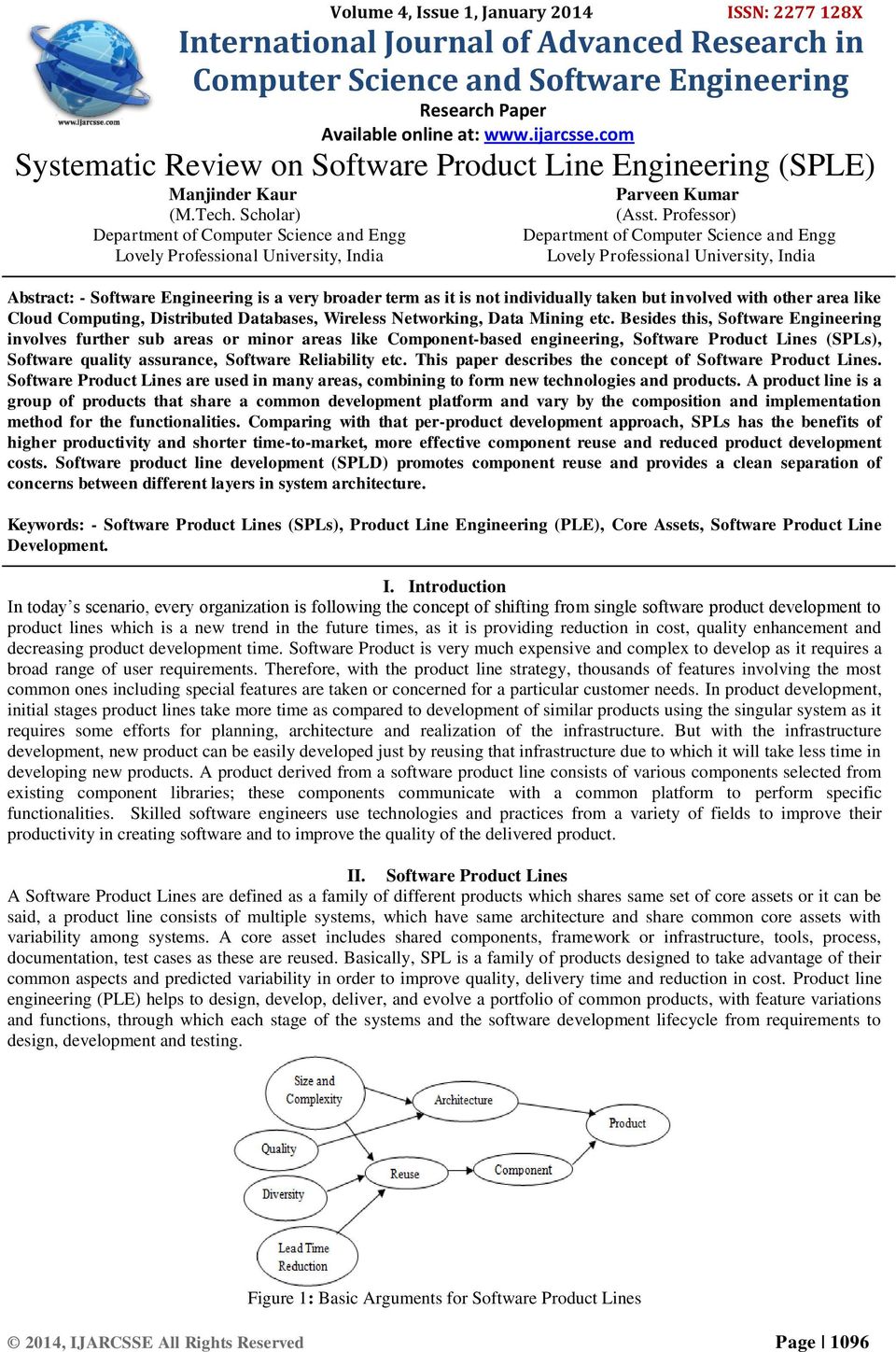
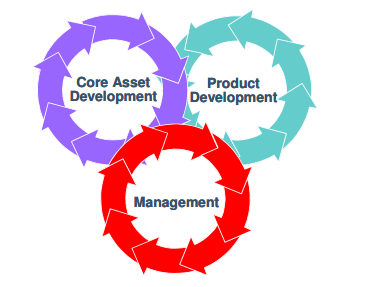

2 PLE is basically delivering efficiencies in design, development and deployment in products.to produce a product from a product line, and it should be instantiated through the following two steps: a) Selection: unneeded functionality (i.e., assets) is stripped, assets which are needed are selected, variation is also solved b) Extension: additional assets are added for the remaining variation points (possibly created from scratch) Each core asset is designed to create systems to match the quality criteria of product line. Core asset development is its designing and management in the product line. A product line is a collection of products addressing a particular objective. It builds different models of a product using common assets. Using this technique to build a product is economic and efficient. Basically, the idea is integration instead of creation. From time to time, organization will add new member in product line based on the products that has been developed. Product evolution comes from 2 sources: a) External Source: New element from produce/ manufacturer to be included in the product line and new product will be produce from it. b) Internal Source: For product function in the scope of product line will going use the function which already exits. If it is not present, then a new function will be generated, and it will be analyzed as whether it is to be added in the product line or not. Product Line Development: The Product Line Development three phases to work with the products: a) Core Asset Development: Core assets or artifacts are created and maintained in product line in order to create systems or products for matching quality criteria. b) Product Development: It is mainly development or the creation of products or systems out of the core assets from product line. If an asset which is required by the system is not in the core assets, then that core asset need to be created in order to satisfy the needs. c) Management: It is involved in order to make sure that the two parties are interacting correctly. Assets are also identified to know from which part of the product line it belongs and which are part of development of the individual product system. Also the management involves management of individual projects in the product line, and the universal product line managers. Figure 3: Product Line Development by Clements et al. (2002) III. SPLE Framework Software product line has two major development parts domain engineering and application engineering which are also called two stages for the development of the product under SPLs [5]. Figure 2: SPLE Framework proposed by Pohl et al. (2005) 2014, IJARCSSE All Rights Reserved Page 1097
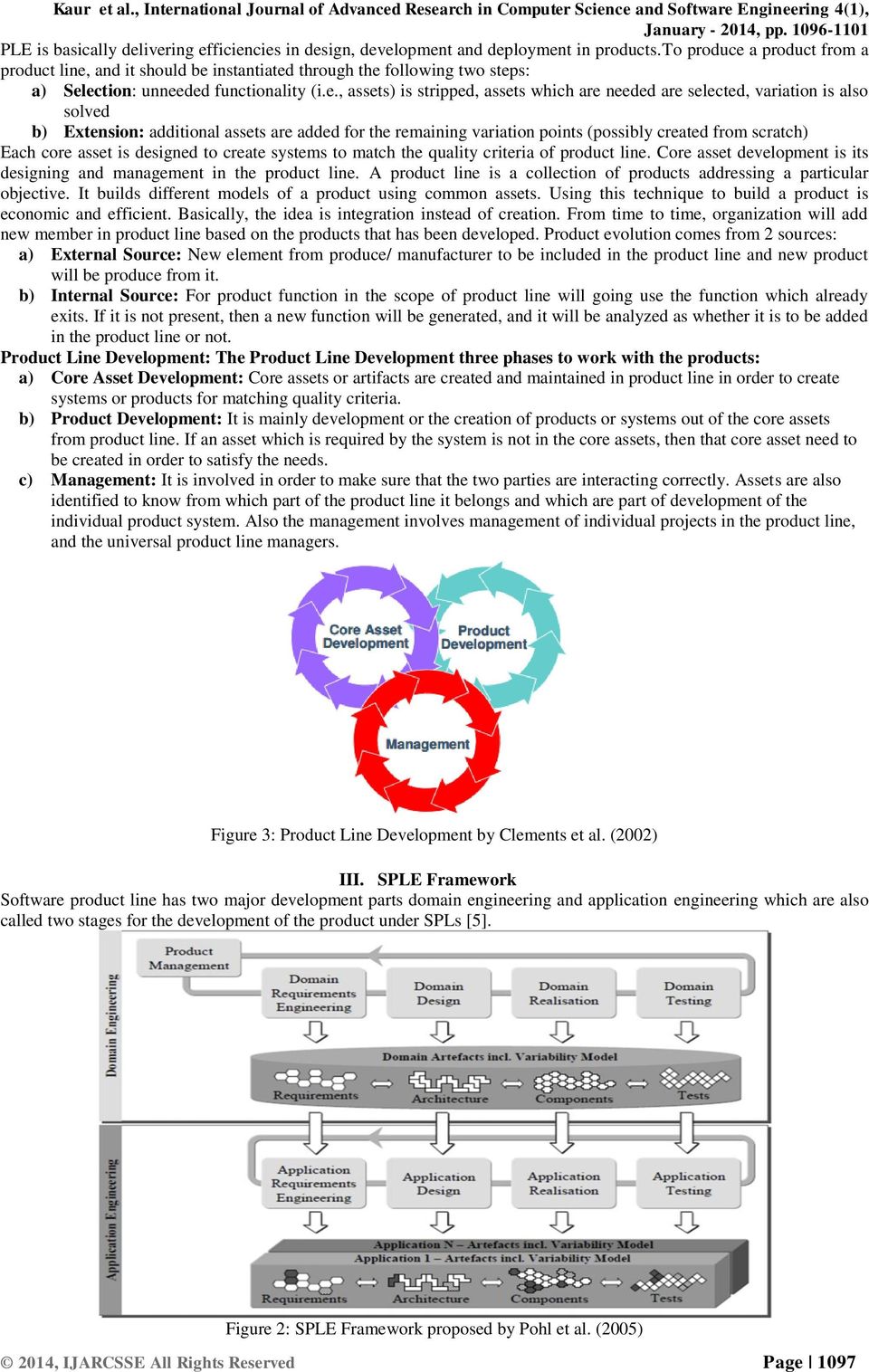
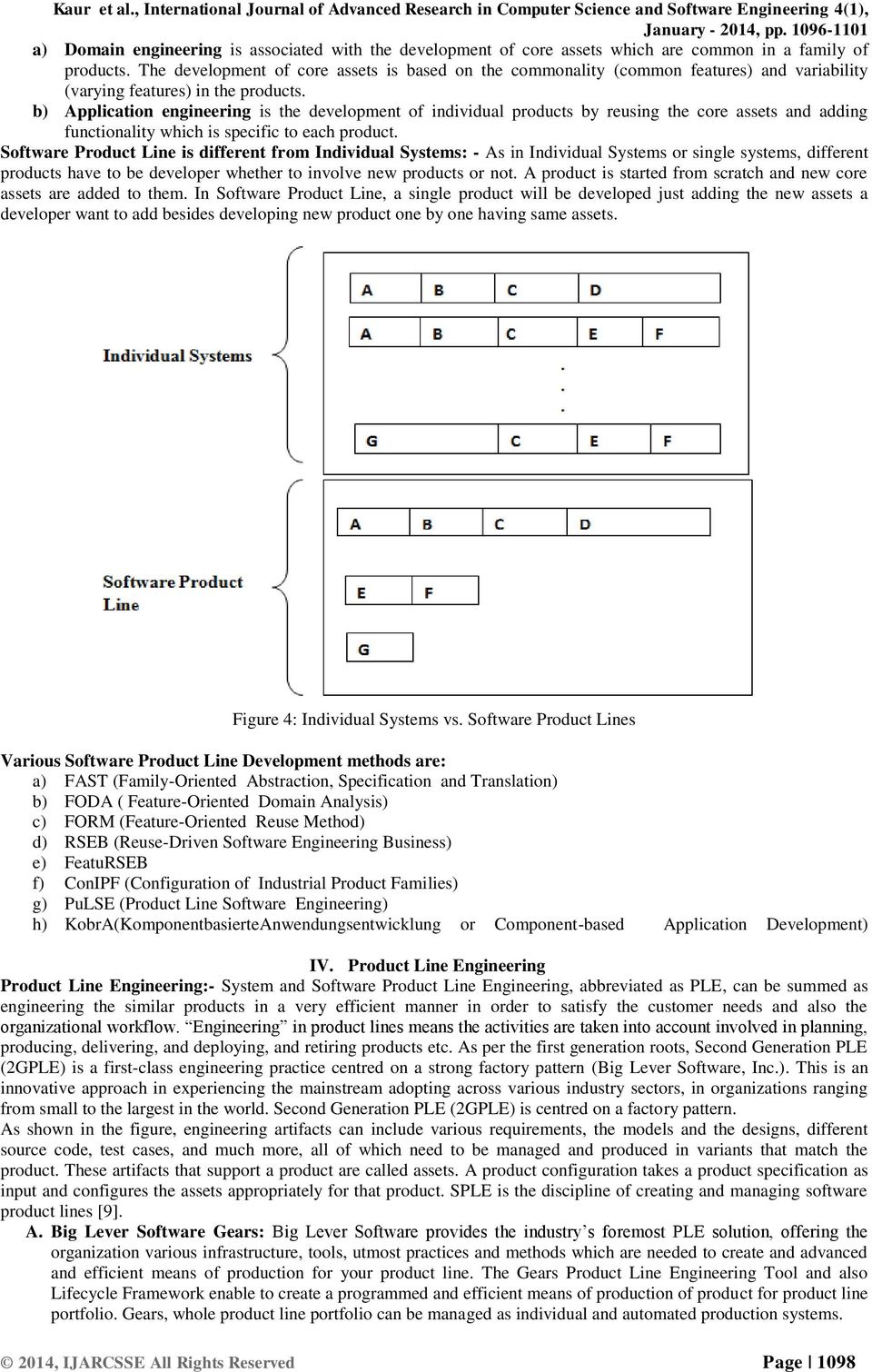
3 a) Domain engineering is associated with the development of core assets which are common in a family of products. The development of core assets is based on the commonality (common features) and variability (varying features) in the products. b) Application engineering is the development of individual products by reusing the core assets and adding functionality which is specific to each product. Software Product Line is different from Individual Systems: - As in Individual Systems or single systems, different products have to be developer whether to involve new products or not. A product is started from scratch and new core assets are added to them. In Software Product Line, a single product will be developed just adding the new assets a developer want to add besides developing new product one by one having same assets. Figure 4: Individual Systems vs. Software Product Lines Various Software Product Line Development methods are: a) FAST (Family-Oriented Abstraction, Specification and Translation) b) FODA ( Feature-Oriented Domain Analysis) c) FORM (Feature-Oriented Reuse Method) d) RSEB (Reuse-Driven Software Engineering Business) e) FeatuRSEB f) ConIPF (Configuration of Industrial Product Families) g) PuLSE (Product Line Software Engineering) h) KobrA(KomponentbasierteAnwendungsentwicklung or Component-based Application Development) IV. Product Line Engineering Product Line Engineering:- System and Software Product Line Engineering, abbreviated as PLE, can be summed as engineering the similar products in a very efficient manner in order to satisfy the customer needs and also the organizational workflow. Engineering in product lines means the activities are taken into account involved in planning, producing, delivering, and deploying, and retiring products etc. As per the first generation roots, Second Generation PLE (2GPLE) is a first-class engineering practice centred on a strong factory pattern (Big Lever Software, Inc.). This is an innovative approach in experiencing the mainstream adopting across various industry sectors, in organizations ranging from small to the largest in the world. Second Generation PLE (2GPLE) is centred on a factory pattern. As shown in the figure, engineering artifacts can include various requirements, the models and the designs, different source code, test cases, and much more, all of which need to be managed and produced in variants that match the product. These artifacts that support a product are called assets. A product configuration takes a product specification as input and configures the assets appropriately for that product. SPLE is the discipline of creating and managing software product lines [9]. A. Big Lever Software Gears: Big Lever Software provides the industry s foremost PLE solution, offering the organization various infrastructure, tools, utmost practices and methods which are needed to create and advanced and efficient means of production for your product line. The Gears Product Line Engineering Tool and also Lifecycle Framework enable to create a programmed and efficient means of production of product for product line portfolio. Gears, whole product line portfolio can be managed as individual and automated production systems. 2014, IJARCSSE All Rights Reserved Page 1098
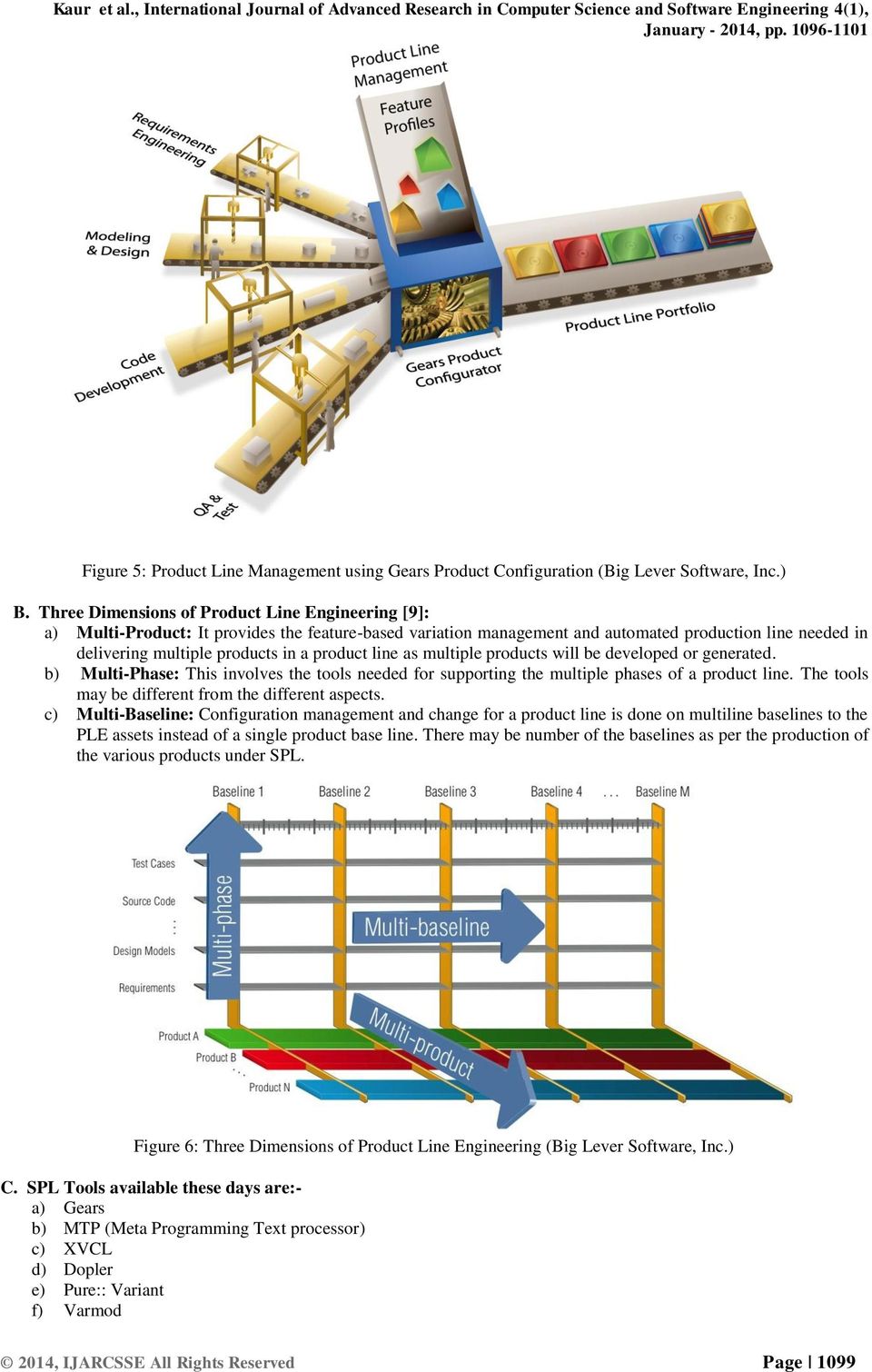
4 Figure 5: Product Line Management using Gears Product Configuration (Big Lever Software, Inc.) B. Three Dimensions of Product Line Engineering [9]: a) Multi-Product: It provides the feature-based variation management and automated production line needed in delivering multiple products in a product line as multiple products will be developed or generated. b) Multi-Phase: This involves the tools needed for supporting the multiple phases of a product line. The tools may be different from the different aspects. c) Multi-Baseline: Configuration management and change for a product line is done on multiline baselines to the PLE assets instead of a single product base line. There may be number of the baselines as per the production of the various products under SPL. Figure 6: Three Dimensions of Product Line Engineering (Big Lever Software, Inc.) C. SPL Tools available these days are:- a) Gears b) MTP (Meta Programming Text processor) c) XVCL d) Dopler e) Pure:: Variant f) Varmod 2014, IJARCSSE All Rights Reserved Page 1099
5 g) FAMA-FW h) FeatureIDE i) MetaEdit+ j) PULSE-BEAT k) Holmes l) FeatureMapper m) S.P.L.OT.(Software Product Line Online Tool) D. Advantages of software product line: a) Productivity gains (the core assets and architecture are reused) b) Quality gains (those reused are verified) c) Decrease time-to-market d) Decreased product risk e) Increased market agility f) Increased customer satisfaction g) More efficient use of human resources h) Ability to maintain market presence i) Decreases number of Defects j) Decrease development cost k) Large scale reuse E. Disadvantages of software product lines: a) Investors are reluctant to invest because product line as a software development technique is still under development phase. b) Only targeted to big industry (aerospace, automobile, military, mobile phone), need some case studies from small industry. c) Open source community should be involved in the development of product line tools and techniques except few bigger organizations d) There are some management and organizational risks involved which needs to mitigate. e) The area need equal attention from both academics and industry f) Lack of availability of tools, a PhD student in Linkoping University recently presented his thesis which shows a proof of the unavailability of the tools in the software product line. g) The problem has also been identified in Software Product Line Practices and Patters written by P. Clements and L. Northrop.[5] F. Application of SPLs a) Cummins, Inc., reports that as a result of building the software inside their engines used the PLE, software projects that take a year to perform now take about a week. b) The U.S. Army expects to save $584 million in development costs by procuring a family of live training systems as a product line rather than a series of separate acquisitions. c) Hewlett Packard with a product line approach have approached higher where they were able to build products 10 times as complex, with 1/4 of the staff, in 1/3 of the time, and with 1/25 the number of bugs of earlier products. d) Nokia has also followed the product line approach, thus producing 25 to 30 different phone models a year. e) Weather Stations are also following this approach of product line. V. Conclusion SPLs are under research in various areas. Developing of common asset that include test cases, architecture, requirements, design, test plans, reusable software components and many other different artifacts. Individual products are developed from a set of common assets which can lead to increase the productivity, decrease the development effort, cost and time to market. Here it is concluded that Software Product line as an emerging technology being used also bears some disadvantages besides advantages. It has various tools and applications now days. Various companies are involving SPLs. The area needs more attention from the industry as there are more tools available in the academics as compared to the commercial category. The tool support is also significant as there are no standards available to manage the variability among family of products. In the future I will work on the involvement of Software Product Lines with Software Architectures that is Product Line Architectures (PLA), with component model using SPL sample as a creating feature model. In the end I, would like to thank my god, my guide, my family and friends for supporting me in each and every step while working within these areas and supporting for research work to continue. References: [1] Atkinson. Colin, Bayer, Joachim and Muthig, Dirk (2000) Component-Based Product Line Development: The KobrA Approach SPLC. [2] Bayer Joachin et. al. (1999) PuLSE: A Methodology to Develop Software Product Lines, ACM Press. 2014, IJARCSSE All Rights Reserved Page 1100
6 [3] Chaudhary Ankit, Verma, Basant K.(Member IEEE), Raheja, Jagdish L. (2010) Product Line Development Architectural Model, IEEE. [4] J. Bosch, (2000) Design and Use of software Architectures, Adopting a Product-Line Approach, Addison-Wesley Publishing [5] Klaus Pohl, Günter Böckle, Frank van der Linden, (2005) Software Product Line Engineering, Foundations, Principles, and Techniques, Springer. [6] Munir Qaiser, Shahid Muhammad et. al., (2010) Software Product Line: Survey of Tools, LiU Electronic Press. [7] P. Clements and L. Northrop, (2002) Software Product Lines: Practices and Patterns, Addison- Wesley Publishing. [8] [9] [10] , IJARCSSE All Rights Reserved Page 1101
![Engineering, Foundations, Principles, and Techniques, Springer. [6] Munir Qaiser, Shahid Muhammad et. al., (2010) Software Product Line: Survey of Tools, LiU Electronic Press. [7] P. Clements and L.](/docs-images/43/15493361/images/page_6.jpg "Northrop, (2002) Software Product Lines: Practices and Patterns, Addison- Wesley Publishing. [8] http://www.productlineengineering.com/ [9] http://www.biglever.com/overview/software_product_lines.")
Software Product Line: Survey of Tools
 Institutionen för datavetenskap Department of Computer and Information Science Final Thesis Software Product Line: Survey of Tools By Qaiser Munir Muhammad Shahid LIU-IDA/LITH-EX-A 10/026 SE 2010-06-07
An Aspect-Oriented Product Line Framework to Support the Development of Software Product Lines of Web Applications
 An Aspect-Oriented Product Line Framework to Support the Development of Software Product Lines of Web Applications Germán Harvey Alférez Salinas Department of Computer Information Systems, Mission College,
Different Approaches used in Software Product Families
 Different Approaches used in Software Product Families Rafia Inam Mälardalens University. [email protected] Abstract The use of software in consumer products is growing tremendously in current era. Further
Tool Support for Software Variability Management and Product Derivation in Software Product Lines
 Tool Support for Software Variability Management and Product Derivation in Software s Hassan Gomaa 1, Michael E. Shin 2 1 Dept. of Information and Software Engineering, George Mason University, Fairfax,
A Systematic Approach for Configuration Management in Software Product Lines
 , March 18-20, 2015, Hong Kong A Systematic Approach for Configuration Management in Software Product Lines K.L.S. Soujanya,Member,IAENG, A. Ananda Rao, Member, IAENG Abstract Product lines achieve significant
Run-time Variability Issues in Software Product Lines
 Run-time Variability Issues in Software Product Lines Alexandre Bragança 1 and Ricardo J. Machado 2 1 Dep. I&D, I2S Informática Sistemas e Serviços SA, Porto, Portugal, [email protected] 2 Dep.
BigLever s 3-Tiered Product Line Engineering Methodology and Organizational Adoption Strategy! Report #200709261 (revised 2014)
 October 21, 2014 BigLever s 3-Tiered Product Line Engineering Methodology and Organizational Adoption Strategy Report #200709261 (revised 2014) Contact Information: [email protected] www.biglever.com 512-777-9552
SPLConfig: Product Configuration in Software Product Line
 SPLConfig: Product Configuration in Software Product Line Lucas Machado, Juliana Pereira, Lucas Garcia, Eduardo Figueiredo Department of Computer Science, Federal University of Minas Gerais (UFMG), Brazil
Reactive Variability Realization with Test-Driven Development and Refactoring
 Reactive Variability Realization with Test-Driven Development and Refactoring Glauco Silva Neves Informatics and Statistics Department - INE Federal University of Santa Catarina - UFSC Florianópolis, Brazil
Building Service-oriented User Agents using a Software Product Line Approach. Ingrid Oliveira de Nunes [email protected]
 Building Service-oriented User Agents using a Software Product Line Approach Ingrid Oliveira de Nunes [email protected] 2 Summary Introduction Objectives Integration of SOA, MAS and SPL Related Work
Elite: A New Component-Based Software Development Model
 Elite: A New Component-Based Software Development Model Lata Nautiyal Umesh Kumar Tiwari Sushil Chandra Dimri Shivani Bahuguna Assistant Professor- Assistant Professor- Professor- Assistant Professor-
A Configuration Management Model for Software Product Line
 A Configuration Management Model for Software Product Line Liguo Yu 1 and Srini Ramaswamy 2 1 Computer Science and Informatics Indiana University South Bend South Bend, IN 46634, USA [email protected] 2 Computer
Agile SPL SCM Agile Software Product Line Configuration and Release Management
 Agile SPL SCM Agile Software Product Line Configuration and Release Management Reto Kurmann Phonak AG, Switzerland [email protected] Abstract Software Product Line development techniques, as well
Towards a Product Derivation Process Reference Model for Software Product Line Organisations
 University of Limerick OLLSCOIL LUIMNIGH Towards a Product Derivation Process Reference Model for Software Product Line Organisations Submitted by Pádraig O Leary For the award of Doctor of Philosophy
JOURNAL OF OBJECT TECHNOLOGY
 JOURNAL OF OBJECT TECHNOLOGY Online at http://www.jot.fm. Published by ETH Zurich, Chair of Software Engineering JOT, 2007 Vol. 6, No. 1, January-February 2007 CM Configuration Change Management John D.
Software Product Lines
 Software Product Lines Software Product Line Engineering and Architectures Bodo Igler and Burkhardt Renz Institut für SoftwareArchitektur der Technischen Hochschule Mittelhessen Sommersemester 2015 Questions:
Variation Management for Software Production Lines 1
 Variation Management for Software Production Lines 1 Charles W. Krueger BigLever Software, Inc. 10500 Laurel Hill Cove Austin TX 78730 USA [email protected] Abstract. Variation in a software product
Employing the Second Generation Software Product-line for Live Training Transformation
 Employing the Second Generation Software Product-line for Live Training Transformation Jeremy T. Lanman, Brian E. Kemper U.S. Army PEO STRI Orlando, FL {jeremy.lanman,brian.e.kemper}@us.army.mil Jorge
An Approach to Detect the Origin and Distribution of Software Defects in an Evolving Cyber-Physical System
 An Approach to Detect the Origin and Distribution of Software Defects in an Evolving Cyber-Physical System Christian Manz, Michael Schulze 2, and Manfred Reichert Group Research & Advanced Engineering
Product Derivation Process and Agile Approaches: Exploring the Integration Potential
 Product Derivation Process and Agile Approaches: Exploring the Integration Potential Padraig O Leary, Muhammad Ali Babar, Steffen Thiel, Ita Richardson Lero, the Irish Software Engineering Research Centre,
MKS Integrity & CMMI. July, 2007
 & CMMI July, 2007 Why the drive for CMMI? Missed commitments Spiralling costs Late delivery to the market Last minute crunches Inadequate management visibility Too many surprises Quality problems Customer
Systems and software product lines: the new frontier for business innovation.
 Systems and software product line solutions To support your product delivery objectives Systems and software product lines: the new frontier for business innovation. 2 The key to business success depends
Trends in Embedded Software Development in Europe. Dr. Dirk Muthig [email protected]
 Trends in Embedded Software Development in Europe Dr. Dirk Muthig [email protected] Problems A software project exceeds the budget by 90% and the project time by 120% in average Project Management
Agile SPL-SCM: Agile Software Product Line Configuration and Release Management
 Agile SPL-SCM: Agile Software Product Line Configuration and Release Management APLE 2006 Workshop SPLC 2006, Baltimore, MD [email protected] Phonak Hearing Systems Presentation Roadmap 1. Introduction
Component-based Development Process and Component Lifecycle Ivica Crnkovic 1, Stig Larsson 2, Michel Chaudron 3
 Component-based Development Process and Component Lifecycle Ivica Crnkovic 1, Stig Larsson 2, Michel Chaudron 3 1 Mälardalen University, Västerås, Sweden, [email protected] 2 ABB Corporate Research,
A Framework for Software Product Line Engineering
 Günter Böckle Klaus Pohl Frank van der Linden 2 A Framework for Software Product Line Engineering In this chapter you will learn: o The principles of software product line subsumed by our software product
SOPLE-DE: An Approach to Design Service-Oriented Product Line Architectures
 SOPLE-DE: An Approach to Design -Oriented Product Line Architectures Flávio M. Medeiros, Eduardo S. de Almeida 2, and Silvio R.L. Meira Federal University of Pernambuco (UFPE) 2 Federal University of Bahia
Concern Driven Software Development
 Concern Driven Software Development Omar Alam School of Computer Science, McGill University, Montreal, Canada [email protected] Abstract Model Driven Engineering (MDE) has achieved success in many
Comparison of Software Product Line Architecture Design Methods: COPA, FAST, FORM, KobrA and QADA
 Comparison of Software Product Line Architecture Design Methods: COPA, FAST, FORM, KobrA and QADA Mari Matinlassi VTT Technical Research Centre of Finland, P.O Box1100, 90571-Oulu FIN [email protected]
Variability in Service-Oriented Systems: An Analysis of Existing Approaches
 Variability in -Oriented Systems: An Analysis of Existing Approaches Holger Eichelberger and Christian Kröher and Klaus Schmid 1 Software Systems Engineering, Institute of Computer Science, University
TRADITIONAL VS MODERN SOFTWARE ENGINEERING MODELS: A REVIEW
 Year 2014, Vol. 1, issue 1, pp. 49-56 Available online at: http://journal.iecuniversity.com TRADITIONAL VS MODERN SOFTWARE ENGINEERING MODELS: A REVIEW Singh RANDEEP a*, Rathee AMIT b a* Department of
Architecture Centric Development in Software Product Lines
 Architecture Centric Development in Software Product Lines Aurangzeb Khan DCE, College of E & ME National University of Science and Technology (NUST), Pakistan Farooque Azam DCE, College of E & ME National
Colligens: A Tool to Support the Development of Preprocessor-based Software Product Lines in C
 Colligens: A Tool to Support the Development of Preprocessor-based Software Product Lines in C Flávio Medeiros 1, Thiago Lima 2, Francisco Dalton 2, Márcio Ribeiro 2, Rohit Gheyi 1, Baldoino Fonseca 2
CMMI STANDARDS IN SOFTWARE DEVELOPING PROCESS
 CMMI STANDARDS IN SOFTWARE DEVELOPING PROCESS 1 2 C. SenthilMurugan, Dr. S. Prakasam. PhD Scholar Asst., Professor 1,2 Dept of Computer Science & Application, SCSVMV University, Kanchipuram 1 Dept of MCA,
Easing the Transition to Software Mass Customization 1
 Easing the Transition to Software Mass Customization 1 Charles W. Krueger BigLever Software, Inc., 10500 Laurel Hill Cove, Austin, TX, 78730, USA. Tel: +1 (512) 426.2227. Fax: +1 (512) 795.9854. [email protected]
Software Engineering
 1 Software Engineering Lecture 2: Software Life Cycles Stefan Hallerstede Århus School of Engineering 25 August 2011 2 Contents Naive Software Development Code & Fix Towards A Software Process Software
Basic Unified Process: A Process for Small and Agile Projects
 Basic Unified Process: A Process for Small and Agile Projects Ricardo Balduino - Rational Unified Process Content Developer, IBM Introduction Small projects have different process needs than larger projects.
A Study on Software Metrics and Phase based Defect Removal Pattern Technique for Project Management
 International Journal of Soft Computing and Engineering (IJSCE) A Study on Software Metrics and Phase based Defect Removal Pattern Technique for Project Management Jayanthi.R, M Lilly Florence Abstract:
Managing Variability in ALPR Software
 Managing Variability in ALPR Software Dr. Marco Sinnema Product Manager Video and ALPR, Q-Free ASA P.O. Box 180, 9410 AD Beilen, The Netherlands tel. +31 593 542055, fax. +31 593 542098 [email protected]
Umbrella: A New Component-Based Software Development Model
 2009 International Conference on Computer Engineering and Applications IPCSIT vol.2 (2011) (2011) IACSIT Press, Singapore Umbrella: A New Component-Based Software Development Model Anurag Dixit and P.C.
Component Based Software Engineering: A Broad Based Model is Needed
 Component Based Software Engineering: A Broad Based Model is Needed Allen Parrish ([email protected]) Brandon Dixon ([email protected]) David Hale ([email protected]) Department of Computer Science
Systems and software product line engineering with SysML, UML and the IBM Rational Rhapsody BigLever Gears Bridge.
 Global distributed development White paper July 2009 Systems and software product line engineering with SysML, UML and the IBM Rational Rhapsody BigLever Gears Bridge. Integrating MDD and SPL to effectively
focus Software product line engineering (SPLE) is a paradigm of software reuse Combining Service Orientation with Product Line Engineering
 focus s o f t w ar e pr o duc t lin e s Combining Orientation with Product Line Engineering Jaejoon Lee and Gerald Kotonya, Lancaster University Developing effective service-oriented product lines can
Layered Configuration Management for Software Product Lines
 Layered Configuration Management for Software Product Lines Master thesis Kroon, E. Graduation Committee Dr. P.M. van den Broek I. Galvão Lourenço da Silva, Msc. Prof.Dr.ir M. Aksit Research Group University
Product-Line Instantiation Guided By Subdomain Characterization: A Case Study
 Product-Line Instantiation Guided By Subdomain Characterization: A Case Study Patricia Pernich and Agustina Buccella and Alejandra Cechich and Maximiliano Arias and Matias Pol la GIISCO Research Group
Plan-Driven Methodologies
 Plan-Driven Methodologies The traditional way to develop software Based on system engineering and quality disciplines (process improvement) Standards developed from DoD & industry to make process fit a
A FRAMEWORK FOR INTEGRATING SARBANES-OXLEY COMPLIANCE INTO THE SOFTWARE DEVELOPMENT PROCESS
 A FRAMEWORK FOR INTEGRATING SARBANES-OXLEY COMPLIANCE INTO THE SOFTWARE DEVELOPMENT PROCESS Sushma Mishra Virginia Commonwealth University [email protected] Heinz Roland Weistroffer Virginia Commonwealth
Software Architecture
 Cairo University Faculty of Computers and Information Computer Science Department Premasters Studies Software Architecture Report on Software Product Line Submitted to: Dr. Hany Ammar Submitted by: Hadeel
The UML «extend» Relationship as Support for Software Variability
 The UML «extend» Relationship as Support for Software Variability Sofia Azevedo 1, Ricardo J. Machado 1, Alexandre Bragança 2, and Hugo Ribeiro 3 1 Universidade do Minho, Portugal {sofia.azevedo,rmac}@dsi.uminho.pt
A QUALITY-BASED COST ESTIMATION MODEL FOR THE PRODUCT LINE LIFE CYCLE
 By Hoh Peter In, Jongmoon Baik, Sangsoo Kim, Ye Yang, and Barry Boehm A QUALITY-BASED COST ESTIMATION MODEL FOR THE PRODUCT LINE LIFE CYCLE In reusing common organizational assets, Figure the 1. software
A Variability Viewpoint for Enterprise Software Systems
 2012 Joint Working Conference on Software Architecture & 6th European Conference on Software Architecture A Variability Viewpoint for Enterprise Software Systems Matthias Galster University of Groningen,
HP Service Manager software
 HP Service Manager software The HP next generation IT Service Management solution is the industry leading consolidated IT service desk. Brochure HP Service Manager: Setting the standard for IT Service
Component Based Development in Software Engineering
 Component Based Development in Software Engineering Amandeep Bakshi, Rupinder Singh Abstract--In today s world, Component Based development is an active research area for more than a decade in software
A Symptom Extraction and Classification Method for Self-Management
 LANOMS 2005-4th Latin American Network Operations and Management Symposium 201 A Symptom Extraction and Classification Method for Self-Management Marcelo Perazolo Autonomic Computing Architecture IBM Corporation
CREDENTIALS & CERTIFICATIONS 2015
 THE COMMUNITY FOR TECHNOLOGY LEADERS www.computer.org CREDENTIALS & CERTIFICATIONS 2015 KEYS TO PROFESSIONAL SUCCESS CONTENTS SWEBOK KNOWLEDGE AREA CERTIFICATES Software Requirements 3 Software Design
Non-Stop Manufacturing Excellence. Automotive. Answers for industry.
 Non-Stop Manufacturing Excellence. Automotive Answers for industry. Answers to your challenges How can the potential of emerging markets be best economically tapped? What possibilities are there of reducing
Tailoring the Scrum Development Process to Address Agile Product Line Engineering
 Tailoring the Scrum Development Process to Address Agile Product Line Engineering Jessica Díaz, Jennifer Pérez, Agustín Yagüe and Juan Garbajosa Technical University of Madrid (UPM) - Universidad Politécnica
Use software to define silicon p. 15
 April 2008 Use software to define silicon p. 15 >> Domain-specific modeling p.20 >> Efficient CRC calculation p.24 >> Linux development tools p.28 >> Verification enters the atomic age p.33 >> Advantages
Quality Management. Lecture 12 Software quality management
 Quality Management Lecture 12 Software quality management doc.dr.sc. Marko Jurčević prof.dr.sc. Roman Malarić University of Zagreb Faculty of Electrical Engineering and Computing Department of Fundamentals
Application of software product quality international standards through software development life cycle
 Central Page 284 of 296 Application of software product quality international standards through software development life cycle Mladen Hosni, Valentina Kirinić Faculty of Organization and Informatics University
3C05: Unified Software Development Process
 3C05: Unified Software Development Process 1 Unit 5: Unified Software Development Process Objectives: Introduce the main concepts of iterative and incremental development Discuss the main USDP phases 2
Change Management: Modeling Software Product Lines Evolution
 Change Management: Modeling Software Product Lines Evolution Samuel A. Ajila, Ph.D. MIEEE Department of Systems & Computer Engineering, Carleton University, 25 Colonel By Drive, Ottawa, Ontario, KS 5B6,
Managing Software Product Line
 * F 2 - Rules for Qualification of Developing and Managing Software Product Line F. Ahmed Electrical & Computer Engineering University of Western Ontario London Ontario, Canada, N5A5B9 [email protected] L.F.
Organization Transformation for Network Function Virtualization Infrastructure As A Service (NFVIaaS)
 Organization Transformation for Network Function Virtualization As A (NFVIaaS) Author: Enrico Montariolo Operations Architect VMware Global Professional s November 2015 Table of Contents Introduction...
7 Component-based Development Process and Component Lifecycle
 7 Component-based Development Process and Component Lifecycle The process of component and component-based system development differs in many significant ways from the classical development process of
Software: Driving Innovation for Engineered Products. Page
 Software: Driving Innovation for Engineered Products Software in products holds the key to innovations that improve quality, safety, and ease-of-use, as well as add new functions. Software simply makes
Open Group SOA Governance. San Diego 2009
 Open Group SOA Governance San Diego 2009 SOA Governance Aspects A comprehensive view of SOA Governance includes: People Organizational structures Roles & Responsibilities Processes Governing processes
Salion s Experience with a Reactive Software Product Line Approach
 Salion s Experience with a Reactive Software Product Line Approach Ross Buhrdorf Dale Churchett Salion, Inc., 720 Brazos St., Ste. 700 Austin TX 78701 USA [email protected] [email protected]
MDE Adoption in Industry: Challenges and Success Criteria
 MDE Adoption in Industry: Challenges and Success Criteria Parastoo Mohagheghi 1, Miguel A. Fernandez 2, Juan A. Martell 2, Mathias Fritzsche 3 and Wasif Gilani 3 1 SINTEF, P.O.Box 124-Blindern, N-0314
Component Based Development Methods - comparison
 Component Based Development Methods - comparison Dan Laurenţiu Jişa Abstract: This paper realizes a comparison among three of the best known component based development methods, emphazing on the earlier
INTEGRATED SERVICE ARCHITECTURE FRAMEWORK (ISAF) FOR ITIL V3
 INTEGRATED SERVICE ARCHITECTURE FRAMEWORK (ISAF) FOR ITIL V3 Akbar Nabiollahi Faculty of Computer science and Information System University Teknologi Malaysia 81310, Skudai, Johor [email protected] Rose