
Accounting: its foundations
|
|
|
- Clyde Payne
- 10 years ago
- Views:
Transcription
1

2 This is an electronic version of the print textbook. Due to electronic rights restrictions, some third party content may be suppressed. Editorial review has deemed that any suppressed content does not materially affect the overall learning experience. The publisher reserves the right to remove content from this title at any time if subsequent rights restrictions require it. For valuable information on pricing, previous editions, changes to current editions, and alternate formats, please visit to search by ISBN#, author, title, or keyword for materials in your areas of interest.
3 Accounting: its foundations Introduction The book will concentrate on the operation of a business which is owned by one person; that is, a sole trader, who operates a business that buys and sells goods with the intention of making a profit. The books of the business will evolve from the accounting equation to the entry of business transactions in the General journal and then Specialised journals. These journals are then summarised in the General ledger, a trial balance is made from those account balances and reports are prepared showing details of the sales, cost of goods sold, expenses and profit in the income statement as well as what the business owns and owes in the balance sheet.

4 Accounting: an introduction to principles and practice Business The business being considered is a small- to medium-sized sole trader; that is, a business owned by one person who often employs other people in the business. It is a trading business that buys and sells goods. A medium-sized sole trader s business might consist of the following departments or sections: sales: the selling of the goods to various customers despatch: the sending or delivering of goods that have been sold receiving: the accepting of goods that have been purchased warehouse: the holding or storage of goods before sale accounting: the recording and reporting of transactions human resources (personnel): the employment and payment of employees. Some sections, such as the receiving and warehouse sections, will often interact with each other. All sections, however, will interact with accounting as well as indirectly through accounting to each other (see figure.). These interactions will occur no matter which industry group the business belongs to: primary, secondary, transport or service. Figure. The business cycle SALES DESPATCH HUMAN RESOURCES ACCOUNTING PURCHASES WAREHOUSING RECEIVING Management The objective of the owner or manager of a business is to plan, lead, organise and control the business to enable a reasonable return of profit on the money put into the business by the owner. Accounting is an important part of this management system, which is sometimes referred to as the management information system, or MIS. If the business plans to expand into a new area, it has to consider whether there is a market, whether the goods can be supplied and if there are trained human resources or personnel available in the business. These are questions that accounting cannot directly answer. Accounting, however, needs to be able to place a money or dollar value on the cost or benefit of each of these areas and the results of the various alternatives considered. This financial information will help the owner decide whether it is worth expanding in an area or whether to look for different alternatives. 2 Accounting Accounting is not a science; neither is it an art. Perhaps the compromise is that accounting is an ongoing process, the details of which may change over time as the business either expands or contracts. Accounting is: a means to an end and not an end in itself important as an aid to the successful management of a business, and a service to the business.

5 Chapter : Accounting: its foundations Various interests: the users There are two user groups usually interested in the financial details of the business: namely, internal users and external users. Internal users include: the owner and managers of the business, who would want to know the sales, expenses and the resulting profit of the business so that decisions on the future for the business could be made. External users include: other businesses, such as suppliers, who are owed money (creditors, or accounts payable); these may be concerned if the business is making insufficient profit (or even a loss), in which case they may not be paid the money that is owed to them government departments, especially the Australian Taxation Office, which is required by law to make sure that the correct tax revenue is collected lenders, who are concerned that the money lent to the business together with interest will be repaid in full and on time employees, who are interested in the long-term financial viability of the business and the ability to pay leave entitlements when they fall due. Generally, the term users will refer to external users, as internal users have ready access to all available financial information or can require it to be prepared for them. Basic accounting terms Accounting Accounting is the process of collecting, classifying, recording, reporting, analysing and interpreting financial data to meet the information requirements of the various interests, or users, concerned with the operation of a business both internally (within the business) and externally (outside of the business). Accounting has evolved from a single-entry record-keeping system, dating from around 4000 BC and covering ownership of property and transactions between parties, to the doubleentry accrual accounting system used by businesses today. Basically, accrual accounting is the matching of sales and expenses to the accounting period, usually one year. As a process, accounting requirements for information are changing as business becomes more complex and the demands for accurate and frequent accounting information are imposed by the many users of accounting information. These users include owners, investors, lenders and governments. Assets An asset is an item of value to the business, which it can use in its operations. Assets are what the business owns; they are of economic value to the business, and can be expressed as a dollar value. There are two classifications of assets: current assets and non-current assets. Current assets Current assets are cash or other assets of the business that will be used, consumed or converted into cash within the next 2 months. Examples of current assets are: cash at bank, which is money that is held by a bank but owned and used by the business to buy and sell goods and services. The words cash and bank also mean the same as cash at bank inventory, which is the term used for all goods that a business has for sale. The words stock and stock on hand also mean the same as inventory accounts receivable, which includes details of all the amounts of money owed by customers who have bought goods or services from the business with the agreement that they will remit the money owing for that sale within the next month or two. The word debtors means the same as accounts receivable. 3
6 Accounting: an introduction to principles and practice Non-current assets Non-current assets are assets the business expects will still be in use after 2 months, and not consumed or converted into cash. Examples of non-current assets are: land, which is the area of earth, ground, soil or terrain that a business owns and uses in the business buildings or structures, which are usually built or constructed on land owned by the business and used in its operations machinery or machines, which are used by a business to make goods or products for sale as inventory, stock or goods motor vehicles, including cars, utilities, trucks, forklift trucks and motorbikes. Trucks bring inventory and goods from suppliers into the business, or deliver inventory to customers, while cars are used by salespeople to visit customers or by other employees while carrying out their work responsibilities. The business uses these motor vehicles, as it does all other assets (both current and non-current), to help carry on the business and make a profit office equipment, which is the equipment a business uses in the office or administration area. It includes such assets as tables, desks, chairs, cupboards, shelving, filing cabinets, photocopiers, fax machines and telephone systems computers (varying from one or two computer terminals or workstations to many hundreds), which form an integrated information and communication system between all areas of the business investments, which may arise where the business has paid for a part of another business or has purchased shares in another business and intends to maintain or hold on to this investment for more than one year. Liabilities A liability is an obligation of the business that it must eventually discharge or repay. Liabilities are what the business owes outside or external to the business. There are two classifications of liabilities: current liabilities and non-current liabilities. Current liabilities Current liabilities are obligations that the business is required to satisfy or pay within the next 2 months. An example of a current liability is: accounts payable, which includes details of all the amounts of money owed by the business to suppliers from whom it has purchased goods or services, with the expectation that it will pay the money owing for that purchase within the next month or two. The accounts payable include amounts owing to suppliers for inventory or stock purchased for resale, as well as amounts owing for expenses incurred or acquired by the business, such as electricity, telephone, postage and stationery. The word creditors means the same as accounts payable. Non-current liabilities Non-current liabilities are obligations that the business is required to satisfy or pay after or beyond 2 months. Examples of non-current liabilities are: loan or loans from a lending institution or other source; there is a requirement to repay the amount that has been received from the loan, but this is expected to occur beyond or after 2 months mortgage or mortgages: this is a special type of loan, but it is usually from a bank or other lending institution. The money is only given to the business if the business assigns the title or right to a valuable asset of the business as collateral, security or guarantees that the mortgage will be repaid. 4

7 Chapter : Accounting: its foundations Owners equity The owners equity is what the owners have put into or invested in the business; it is what the business is worth. It is an internal liability, as it shows what the business owes to the owner. The words proprietorship or equity mean the same as owners equity. Examples of owners equity are: capital, which shows the amount and details of what has been invested by the owner in the business. Any profit made by the business is added to this capital amount. Any loss incurred by the business is deducted from the capital amount drawings, which includes amounts of cash taken by the owner as well as the value of any inventory taken by the owner, which the business had originally purchased to sell to its customers. Revenue Revenue is the earnings, proceeds or takings from the operations of a business. The word income means the same as revenue. Examples of revenue are: sales, which includes the total amount or price obtained by the business when it sells its inventory or goods. This is the main revenue source for a business selling inventory or goods fees, which includes the total amount or price obtained by the business when it sells its services. This is the main revenue source for a business selling services commission received, which is revenue received from selling someone else s inventory, goods or property. It is not usually the main revenue source interest received, which is revenue received from investments that the business has made with money it has had available. This may include interest-bearing deposits with a bank or other borrowing institution. It is not usually the main revenue source rent received, which is revenue received from renting to a third party a part or portion of a building that the business owns or has available but does not need to use, and has therefore decided to earn revenue from by renting it out. It is not usually the main revenue source. Expense Expense is what is incurred or spent in making the sales, and in running the business. For our purposes, cost means the same as expense. Examples of expense are: cost of goods sold, which is the cost of the goods that have been sold by the business wages or salaries, which are paid to the people who work for the business; they are employees of the business rent expense, which is the amount paid to another business for the right to use an area of land and/or building to store inventory and carry out the activities of the business postage expense, which includes the cost of sending and receiving items through the mail that is, Australia Post stationery expense, which includes the cost of pens, pencils, biros, markers, paper and preprinted forms used by the business. If the total sales revenue is greater than the total expenses then the business has made a profit; this is added to the owners equity. Sales $0 000 Expense $8000 = Profit $2000 Owners Equity $ Profit $2000 = new Owners Equity $ If the total sales revenue is less than the total expenses then the business has made a loss; this reduces the owners equity. Sales $0 000 Expense $ 000 = Loss $000 Owners Equity $ Loss $000 = new Owners Equity $

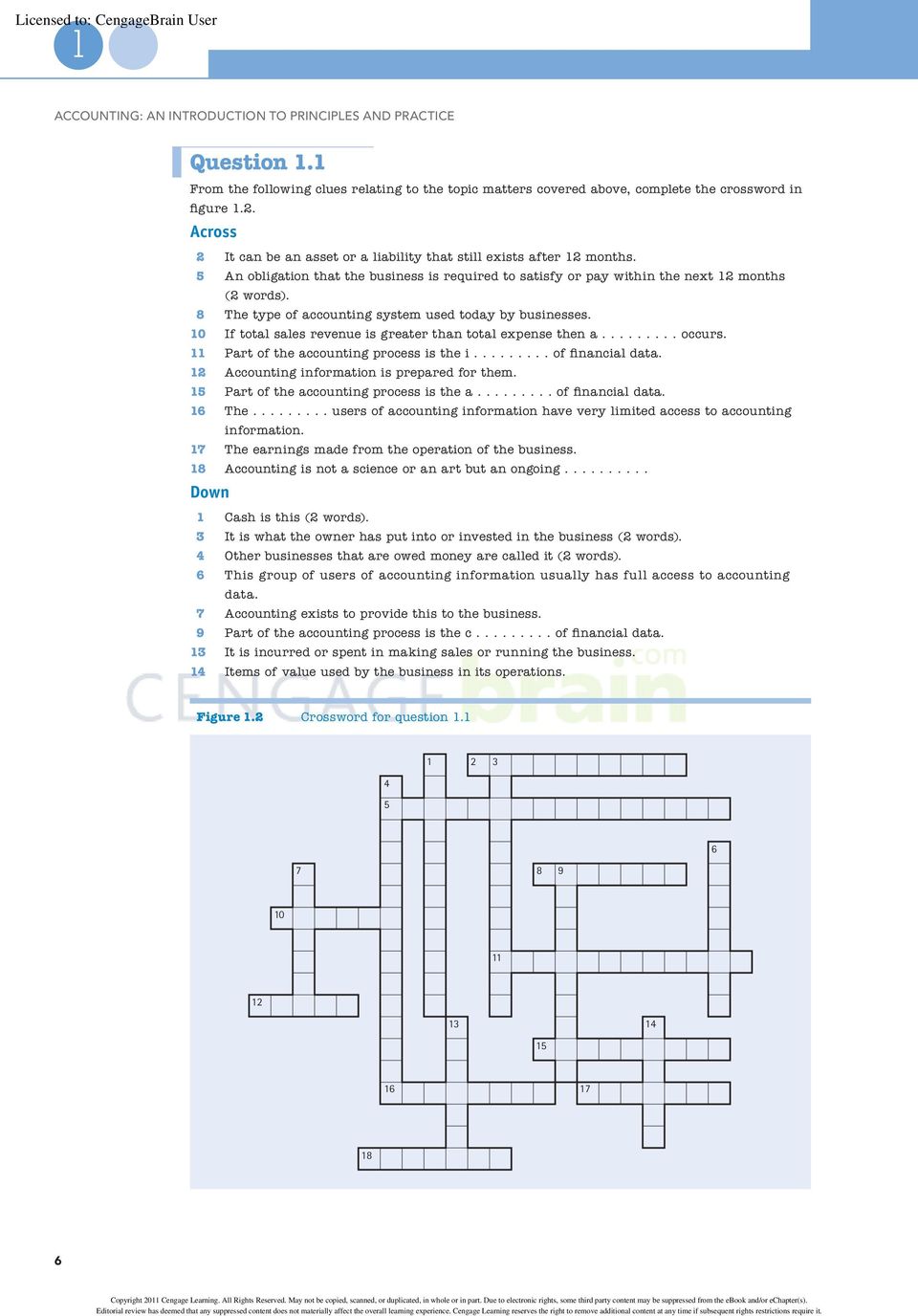
8 Accounting: an introduction to principles and practice Question. From the following clues relating to the topic matters covered above, complete the crossword in figure.2. Across 2 It can be an asset or a liability that still exists after 2 months. 5 An obligation that the business is required to satisfy or pay within the next 2 months (2 words). 8 The type of accounting system used today by businesses. 0 If total sales revenue is greater than total expense then a occurs. Part of the accounting process is the i of financial data. 2 Accounting information is prepared for them. 5 Part of the accounting process is the a of financial data. 6 The users of accounting information have very limited access to accounting information. 7 The earnings made from the operation of the business. 8 Accounting is not a science or an art but an ongoing Down Cash is this (2 words). 3 It is what the owner has put into or invested in the business (2 words). 4 Other businesses that are owed money are called it (2 words). 6 This group of users of accounting information usually has full access to accounting data. 7 Accounting exists to provide this to the business. 9 Part of the accounting process is the c of financial data. 3 It is incurred or spent in making sales or running the business. 4 Items of value used by the business in its operations. Figure.2 Crossword for question
9 Chapter : Accounting: its foundations Question.2 From the following clues relating to examples used above for assets, liabilities, owners equity, revenue and expenses, complete the crossword in figure.3. Across 2 The business owes them for purchases of goods and services not yet paid. 5 A current asset summarising details of what amount is owed to the business and by whom. 6 The printed word you are reading this from is on it and it is included in this expense. 0 This non-current asset is used in the administration area (2 words). A current asset that shows details of who and how much is owed by customers to the business (2 words). 4 An expense for using the mail system. 5 The business has this current asset to sell (3 words). 6 Amounts of cash and inventory taken by the owner. 7 This non-current liability provides money to the business but it has to be repaid. 9 The business uses this non-current asset to make goods or products for sale. 20 These non-current assets are sometimes referred to as work stations. 2 A business selling goods calls the goods this, and it s a current asset. Down This type of loan requires collateral or security and is a non-current liability. 3 The bank has this current asset but the business owns it. 4 If you don t like flying, this non-current asset is very good to keep your feet on. 7 A current liability that shows details of who and how much is owed to suppliers by the business (2 words). 8 This current asset is used to pay for goods and services (3 words). 9 Cars, utilities, trucks and forklifts are this non-current asset. 2 This owners equity shows what the business is worth and any profit adds to it. 3 A structure that the business may construct and use for its operations; a non-current asset. 8 The same meaning as inventory. Figure.3 Crossword for question

10 Accounting: an introduction to principles and practice Accounting conventions or assumptions and accounting doctrines Accounting theory The accounting process creates a common language that enables communication within and between different businesses, no matter which language is spoken or what the ethnic background. Accounting is used by all businesses. The accounting language is guided by basic accounting concepts, ideas or thoughts. There are ten concepts listed below that are often referred to as conventions or doctrines. Conventions are general agreements in accounting, which especially relate to standards or procedures. Doctrines or principles are fundamental or general truths upon which other truths depend. Conventions Accounting (or business) entity convention The accounting or financial information of the business is always treated as a separate unit or body from the owner s personal financial information. The business exists separately from the owner. For example, the owner has a business, which includes a warehouse and trucks used in the business, and these are both recorded (or shown) in the books of the business. However, the house where the owner lives and the boat that is used on the weekend is personal property and is not shown (or recorded) in the books of the business. Also, the bank account of the business is to be kept separate from any personal or private bank accounts. In accounting, the owner is treated as separate from the business. In a court of law, however, the owner of the business may not always be treated as separate from the business. Accounting period convention The life of a business, however long it lasts, is broken into equal time periods of at least one year. The accounting or financial reports are prepared for a specific period of time to enable two things: an assessment of the results from the buying and selling of goods, and a meaningful comparison with expected or past results. The new tax system that started in Australia from July 2000, which includes the 0% goods and services tax (GST), requires a business that has registered for the GST to complete and submit either a Business Activity Statement (BAS) or an Instalment Activity Statement every three months; that is, on a quarterly basis. A business with an annual turnover of $20 million or more must submit its BAS on a monthly basis. The GST is introduced in Chapter 3 and its effects are then covered throughout the book. A business must still prepare financial reports showing the business s profit or loss on an annual (yearly) basis to the Australian Taxation Office for final assessment of taxation owing to the government. The specific time period is usually the financial or fiscal year from July to 30 June. A business that has not registered for the GST would have an annual turnover (revenue or sales) of less than $ It is usually not wise for a business to rely only upon annual financial reports, even where the annual turnover is less than $ Monthly, quarterly or six-monthly reports can be more meaningful, and allow comparisons to be made and corrective action taken where necessary. A loss 8

11 Chapter : Accounting: its foundations of $0 000 revealed in an annual financial report might have been avoided if monthly reports had been prepared. Early corrective action could have been taken to change the loss for the year into a profit. Going concern (or continuity of activity) convention Financial reports or statements are prepared on the assumption that the life of the business will continue indefinitely. A business is regarded as a going concern as long as it can pay its bills when they have to be paid and the intention of the owner is not to cease business but to carry on with that business. A business is started because the owner expects it to be successful and to earn adequate profits. Even when the owner wants to retire, there may be an expectation that the business will be sold and will carry on indefinitely into the future. Monetary convention All financial business transactions or events are recorded in Australian dollars and cents. If a monetary value cannot be given to a transaction, then it cannot be recorded in the books of the business or, eventually, be included in an accounting financial statement or report. The sale of 000 goods or items for $5.00 each is recorded as sales of $5000. The 000 units are not shown, only the monetary value of those units. Historical cost (or historical record) convention The actual amount that a business receives, pays or costs is the amount that is recorded or written in the accounting books or records of that business. Non-current assets are recorded at their cost. This convention assumes that the buying capacity of a dollar is the same in the past as it is at present. However, this is not the case, as the purchasing power of a dollar is reduced over time by inflation. For instance, land that was purchased by a business 5 years ago for $8000 was recorded at its cost of $8000 and would still be recorded in the accounting records today at its cost of $8000. This is the case even though the land might be worth $ if it was sold; the accounting records will remain at $8000 and not $ This can lead to distortions of the worth of a business when only the accounting records are used to value items purchased by the business sometime in the past. In another example, a delivery truck that was advertised for $ is purchased at a special sale price of $ The delivery truck is recorded in the books of the business at its cost of $3 500 and not at the advertised price. Despite the valuation problem caused by inflation and the recording of items at their original cost to the business, the historical cost convention remains the most commonly used method of reporting the financial statements of the business. One of the alternatives to historical cost accounting is current cost accounting; however, this method has considerable problems of its own. Recognition of law convention Laws that affect the business and the accounting reports of that business are to be followed. This takes account of the taxation system, which includes the GST and its far-reaching impact on the recording and reporting of accounting transactions and financial statements. The requirement to comply with Australian Accounting Standards arises from the Corporations Act 200 (Cwlth). 9

12 Accounting: an introduction to principles and practice Doctrines Doctrine of consistency The accounting principles used to prepare financial statements should be applied in the same way for each accounting period, irrespective of whether the period is a month or a year. If a business is not consistent in its reporting from one period to another, then significant variances or differences may appear to have occurred which in fact did not happen. More seriously, a change in valuation or reporting may cover up a problem that the business is having. Doctrine of disclosure The accounting reports should contain information that ensures that the owner understands the financial position of the business. A loss should not be included with other figures if it has the effect of hiding or misleading an event of significance. A profit on the sale of a truck should not be included with the diesel and other running costs of the truck, as they are two different events. The cost, or expense of running trucks, and the profit on the sale of a truck should be shown as separate figures. The owner relies on the financial reports, and other interested parties the users may need to as well; all of them expect that full disclosure has taken place. The valuation of inventory or stock needs to be consistent, as it has a direct result on the profit of the business and any change in its method of valuation must be stated. Doctrine of materiality The significance, importance or materiality of an amount depends on both the size of a business and the importance of the item being considered. A shortage of $00 from inventory or stock held in a warehouse where the total cost was $ may not be considered material or significant, and very little effort may be made to try to find it. However, $00 missing from $250 that was to be deposited in the bank would be material. It would result in a significantly detailed investigation as to how and why the money went missing and what was required to prevent such an event happening again. The accounting reports often reflect the doctrine of materiality, where a large business may report in hundreds, thousands or millions of dollars, whereas a small business may report in dollars or even exact dollars and cents. Doctrine of conservatism When there is a choice or uncertainty in the results to be reported, the preference is to understate the profit results rather than to overstate them: the more conservative approach should be taken. Generally an expense in running the business should be included as an expense of the business when it is first anticipated. However, revenue would normally be included when it has been received, or when there is strong probability that it will be received when it is due. However, this should not lead to a distortion (or misunderstanding) of the financial reports, as there should be a full disclosure of why the conservative alternative has been taken. 0
13 Chapter : Accounting: its foundations Question.3 From the following clues relating to topic matters covered in Accounting conventions and doctrines, complete the crossword in figure.4. Across This doctrine depends on the size and importance of the item being considered. 3 There should be full so the owner understands the financial position. 4 The assumption that a business will continue to operate in the future is the of activity convention. 6 To record a non-current asset such as land at its cost rather than what it is now worth is applying the convention (2 words). 9 Accounting principles should be applied to the accounts To understate profit, rather than overstate it, is the doctrine of Entries recorded in the accounts are expressed in dollars. 5 The business life should be broken into periods of no more than (2 words). 6 Non-current assets are recorded in the accounts at their historical Down 2 The life of the business is usually expected to go on An assumption that the life of a business continues well into the future is the convention (2 words). 7 This accounting convention separates the business from the owner. 8 Unless a dollar value can be given to a transaction then it can t be entered into the accounts. This is an expression of the convention. 0 To enable an assessment of the results of buying and selling to be compared with the past and with present expectations, the accounting convention breaks the life of the business into equal time lengths. 3 If they affect the business or its reports then they are to be followed. 4 Accounting is used by businesses. Figure.4 Crossword for question

14 Accounting: an introduction to principles and practice 2 Accounting standards Establishment of standards Section 224 of the Australian Securities Commission Act 989 (Cwlth) established the Australian Accounting Standards Board (AASB). It succeeded the Accounting Standards Review Board (ASRB), which had been created in 983. The AASB s primary responsibility was to develop accounting standards (the AASB Standards) in respect of general-purpose financial reporting by reporting entities that are companies. The passage of the Corporations Law Economic Reform Program Act 999 (Cwlth) further empowered the AASB to develop accounting standards for the private and public sectors (effective from January 2000) with oversight responsibility being undertaken by a Financial Reporting Council. The AASB has adapted the accounting standards of the International Accounting Standards Board (IASB) applicable to annual reporting periods commencing on or after January Australian standards that were applicable before January 2005 have been replaced with Australian Standards equivalent to those of the IASB. Although you are not required to learn the names of each standard you should be broadly aware of the areas covered by the standards, which are listed below: AASB AASB 2 AASB 3 AASB 4 AASB 5 AASB 6 AASB 7 AASB 8 AASB 0 AASB 02 AASB 07 AASB 08 AASB 0 AASB AASB 2 AASB 6 AASB 7 AASB 8 AASB 9 AASB 20 AASB 2 AASB 23 AASB 24 AASB 27 AASB 28 AASB 29 AASB 3 AASB 32 AASB 33 First-Time Adoption of Australian Accounting Standards Share-based Payment Business Combinations Insurance Contracts Non-current Assets Held for Sale and Discontinued Operations Exploration for and Evaluation of Mineral Resources Financial Instruments: Disclosures Operating Segments Presentation of Financial Statements Inventories Statement of Cash Flows Accounting Policies, Changes in Accounting Estimates and Errors Events after the Reporting Period Construction Contracts Income Taxes Property, Plant and Equipment Leases Revenue Employee Benefits Accounting for Government Grants and Disclosure of Government Assistance The Effects of Changes in Foreign Exchange Rates Borrowing Costs Related Party Disclosures Consolidated and Separate Financial Statements Investments in Associates Financial Reporting in Hyperinflationary Economies Interests in Joint Ventures Financial Instruments: Presentation Earnings per Share

15 Chapter : Accounting: its foundations AASB 34 AASB 36 AASB 37 AASB 38 AASB 39 AASB 40 AASB 4 AASB 004 AASB 023 AASB 03 AASB 038 AASB 039 AASB 048 AASB 049 AASB 050 AASB 05 AASB 052 Interim Financial Reporting Impairment of Assets Provisions, Contingent Liabilities and Contingent Assets Intangible Assets Financial Instruments: Recognition and Measurement Investment Property Agriculture Contributions General Insurance Contracts Materiality Life Insurance Contracts Concise Financial Reports Interpretation of Standards Whole of Government and General Government Sector Financial Reporting Administered Items Land Under Roads Disaggregated Disclosures Legal recognition of standards When making standards, the AASB exercises its statutory powers under s. 334() of the Corporations Act. Standards have legal enforceability and are to be complied with by a business. Purpose or objective of standards The basic purpose of standards is to ensure that there is comparability of the financial reports of Australian businesses or entities within a prescribed format. These reports must be prepared and presented showing the entity in a true and fair view. The main requirements of AASB 0 Presentation of Financial Statements are that the financial statements must include five statements plus notes. A complete set of financial statements comprises: a statement of financial position as at the end of the period a statement of comprehensive income for the period a statement of changes in equity for the period a statement of cash flows for the period notes, comprising a summary of significant accounting policies and other explanatory information, and a statement of financial position as at the beginning of the earliest comparative period when an entity applies an accounting policy retrospectively or makes a retrospective restatement of items in its financial statements, or when it reclassifies items in its financial statements. AASB 0 also states that an entity may use titles for the statements other than those used in the standard. Note that a sole-proprietorship business would not be required to prepare the full range of statements and notes prescribed in the standard. The standard also prescribes the general considerations that an entity should make when presenting financial reports. The principal considerations are listed below. Fair presentation and compliance with IFRSs (International Financial Reporting Standards) Selection and application of appropriate accounting policies The entity s ability to continue as a going concern Accrual basis of accounting Materiality and aggregation 3

16 Accounting: an introduction to principles and practice Offsetting Frequency of reporting Comparative information Consistency of presentation The classification of items in the financial statements A range of disclosures about financial position and financial performance Detailed objectives are shown within each standard and make for informative, if sometimes wordy, reading. Statements of accounting concepts Since 990, there have been four Statements of Accounting Concepts (SACs) prepared by the Public Sector Accounting Standards Board of the Australian Accounting Research Foundation and the Australian Accounting Standards Board, and issued on behalf of CPA Australia 2 and the Institute of Chartered Accountants in Australia. These are listed below. SAC Definition of the Reporting Entity SAC2 Objective of General Purpose Financial Reporting SAC3 Qualitative Characteristics of Financial Information SAC4 Definition and Recognition of the Elements of Financial Statements Effective from January 2005, the Statements of Accounting Concepts SAC3 and SAC4 have been withdrawn and their content effectively included in the AASB s Framework (see later). However, SAC and SAC2 remain applicable. SAC Definition of the Reporting Entity The Statement of Accounting Concepts SAC exists to provide a benchmark that sets a minimum quality of financial reports for a business or entity. This first Statement of Accounting Concepts basically requires reports to provide the external users, including individuals, other businesses and governments, with information in the form of financial reports that can be relied upon to provide appropriate information. This information can help these users to make decisions that relate to their efficient allocation of scarce resources such as time and money. 4 SAC2 Objective of General Purpose Financial Reporting General purpose financial reports are different from detailed departmental reports used within a business. They are intended for external users and provide less detailed and summarised information of the business or entity as a whole. External users cannot require or command detailed departmental financial information and it is therefore essential that those general purpose financial reports, showing summarised financial information for the business as a whole, provide information that can be relied upon and can be compared with other general purpose financial reports issued by other businesses. Put simply, the basic aim is to be able to compare apples with apples and not apples with bananas. The users need to be able to compare reports that are similar in the presentation and reliability of the financial information provided. General purpose financial reports need to provide relevant information to enable users to assess: how the business has performed in relation to its potential what is its financial position where the business obtains its finance or money to operate, and on what does the business invest its finance to operate and provide a profit as well as a positive cash flow. Remember, if there is no cash or money then there is no business.

17 Chapter : Accounting: its foundations Framework for the Preparation and Presentation of Financial Statements (the Framework) The Framework for the Preparation and Presentation of Financial Statements is abbreviated to the term Framework. This Framework is issued by the Australian Accounting Standards Board (AASB) and is equivalent to the International Accounting Standards Board (IASB) Framework, with changes that make it more relevant and appropriate to Australia. The Framework sets out the financial reports : objective assumptions quality elements, and criteria for their recognition. Financial report The term financial report usually includes: the statement of financial position the statement of comprehensive income the statement of changes in equity, and the statement of cash flows. For the purposes of this book, the Statement of Financial Position will be titled the Balance Sheet, and the Statement of Comprehensive Income will be titled the Income Statement. The Statement of Changes in Equity and the Statement of Cash Flows are not covered in this book, as they relate to more advanced studies in accounting. Question.4 From the following clues involving topic matters covered that relate to accounting standards, concepts and the framework, complete the crossword in figure.5. Across 2 Since January 2000 the AASB has been empowered to develop accounting standards in the private and sectors. 5 AASB 0 is titled Presentation of (2 words). 7 SAC2 refers to general purpose financial reports as being provided to external An overall consideration by an entity in presenting financial reports is that the basis of accounting is used. 0 The AASB exercises its statutory powers under the Act. Standards have legal and are to be complied with by business. 4 The Framework for the Preparation and Presentation of Financial Statements is abbreviated to This type of user includes individuals and other businesses. 6 The Statement of Financial Position is referred to in this book as a (2 words). 7 Initially the AASB primary responsibility for general purpose financial reports was for reporting entities that were According to the AASB 0 standard, one of the considerations that an entity must take into account when presenting financial reports is the basis of accounting. 20 The Framework sets out the financial report objective, , quality, elements and criteria for their recognition. 5

18 Accounting: an introduction to principles and practice Down Australian Accounting Standards Board, its abbreviation. 3 An overall consideration by an entity in presenting financial reports is that each year there should be of presentation. 4 An overall consideration by an entity in presenting financial reports is that the presentation and compliance with Australian accounting standards should be The Statement of Comprehensive Income is referred to in this book as an (2 words). 9 An overall consideration by an entity in presenting financial reports is that the business is continuing into the future or that it is a (2 words). 2 From January 2005, the AASB has adapted the accounting standards of the Accounting Standards Board. 3 SAC is titled Definition of the Reporting SAC2 is titled Objective of General Purpose Reporting. 8 Standards applicable before January 2005 have been replaced with Australian Standards equivalent to those of the , its abbreviation. Figure.5 Crossword for question Types of business ownership, their advantages and disadvantages Sole trader A business that is carried on by a sole trader is owned by one person, who also usually runs and manages the business. There may or may not be people working in the business; these are referred to as employees of the business and the owner is the employer. This is the simplest form of ownership and numerically the most common. 6

19 Chapter : Accounting: its foundations The sole trader receives all profits and is legally required to bear and satisfy all losses personally. The sole trader has unlimited liability to repay amounts owing, or debts, of the business. The total amount of money and other assets brought into the business by the sole trader is the capital that the business owes to the owner and is called the owner s equity. The sole trader is free to run the business as he or she thinks best and is not answerable to a boss. Although such a business is inexpensive and easy to set up and run, additional finance may be difficult to obtain. The business name, if different from the owner s own name, must be registered. A business bank account would normally be set up. Partnership A business that is carried on by a partnership can generally be owned by between two and 20 people. The partners usually run and manage the business. However, there may be a silent partner who does not take any part in the running of the business even though they have contributed capital to the partnership. The amount of the capital that each partner brings to the partnership and the proportion in which the profits and losses are to be split amongst the partners is agreed between them and usually written in the Partnership Agreement. If a matter is not covered by the partnership agreement, then the position as set out in the partnership Act of the state or territory in which the business is registered applies. The partners share in the profits of the partnership. However, they also must share in the losses and can each be held personally liable for the debts of the partnership. There is unlimited liability on the partners to repay the debts of the partnership. The partners are able to use their individual skills and specialise in areas for the overall benefit of the partnership and therefore should be able to earn more collectively than would be possible if they operated individually as sole traders. It is easy and inexpensive to set up a partnership. The business name should be registered and a separate bank account must be used for the partnership. Corporation The most common type of corporation or company is one that is limited by shares. The shareholders hold shares in the company and therefore own it. Shareholders have limited liability; that is, their obligation is limited to the amount, if any, unpaid on their shares. Beyond this, the shareholder is not required to contribute to satisfying the debts of the company. The company has a separate legal identity and it can sue and be sued; the shareholders (the owners) cannot be sued. The name of a company limited by shares must end with Limited or its abbreviation Ltd. The Corporations Act 200 indicates that companies are either proprietary or public companies. Proprietary company A proprietary company is a company limited by shares and is sometimes referred to as a private company. The Corporate Law Economic Reform Program Act 999 (Cwlth), which became effective early in 2000, changed a number of the areas covering these types of companies. Since the Act came into force, a proprietary company need only have one member and one director, but must have no more than 50 non-employee shareholders and the transferability of shares is restricted. The word Proprietary or its abbreviation Pty must appear in the company name; for example, ABC Pty Ltd. A proprietary company can be either a small or a large proprietary company. 7

20 Accounting: an introduction to principles and practice To be defined as a small proprietary company, a company must satisfy at least two of the following conditions: gross operating revenue for the year of less than $25 million gross assets of less than $2.5 million fewer than 50 employees. To be defined as a large proprietary company, a company must satisfy at least two of the following conditions: gross operating revenue for the year of more than $25 million gross assets of more than $2.5 million more than 50 employees. Public company The Corporations Act 200 defines a public company as any company other than a proprietary company; it is a company limited by shares. Most public companies, although not all, are listed on the Australian Securities Exchange. A public company is able to ask the public for funds and its shares are readily transferable; it must have at least one member and at least three directors. A board of directors, who are elected by and act on behalf of the shareholders, manages the company. However, the board of directors recommends to the shareholders how much of the profit the company should retain and how much should be paid to shareholders as a dividend (a return on their investment in the company). Public companies are regulated by the Corporations Act, and they can be expensive to establish. Question.5 From the following clues relating to topic matters covered for the different types of businesses, complete the crossword in figure.6. Across 5 The liability of a sole trader and the partners in a partnership is They usually run and manage the partnership. 8 How much capital is contributed and how profits are shared among partners is usually written in the Partnership A Partner does not take part in the running of the partnership. 2 The company is owned by them. 3 A is owned by between two and 20 people. 4 A business owned by one person is a (2 words). 5 The last word in a company s name is Down This Act regulates companies. 2 Limited, its abbreviation. 3 They manage the company on behalf of the shareholders. 4 Proprietary, abbreviated. 7 The liability of a shareholder is limited to the amount, if any, unpaid on their A company owned by between one and 50 people is a limited company. If a sole trader operates a business using other than their own name as the business name, then the name of that business must be This type of company is listed on the Australian Securities Exchange. CONTINUED 8

21 Chapter : Accounting: its foundations Figure.6 Crossword for question Financial transactions and their documentation A business event or transaction occurs when the business agrees to either: buy goods, or other items of benefit to it, or sell goods or other items which it has and which can be expressed in money terms. Business event = Business transaction Written records arising from business transactions = Documents Every transaction or business event requires a document. There are two types of documents: source document: the originating (or starting) document, used to record required information in the accounting books of the business. It is expressed in money terms and indicates that a transaction has occurred; not as a unit of quantity that was sold or purchased control document: a document used in the business to control the use, or prevent the misuse, of the source documents. Control documents are documents that support a transaction; in other words, they provide information that can be used to verify the accuracy and validity of the relevant source document. With some exceptions, control documents are for use within the business and have no direct use outside of that business. Control documents are an integral component of a system of internal control, as they assist in the prevention of misappropriation and detection of errors in the processing of business transactions. Preparation of business documents The following pages contain a description of each of the more commonly occurring transactions of a business, together with an outline of how the related documents are prepared. Each business uses 9
22 Accounting: an introduction to principles and practice documents that are designed to suit its specific needs, and hence their format will be unique to that particular business. An organisation s accounting policies and procedures will generally stipulate procedures relating to the conduct of business transactions and the preparation and/or use of the relevant documents. These policies and procedures will generally be found in the organisation s operations manuals, and it is essential for employees to be aware of relevant policies and procedures. Purchase for cash and sale for cash When a business buys inventory or goods for resale or other items for use in the business it may have to pay cash at the time they are bought or delivered; that is, the goods or items are paid for at the time of purchase. When a business sells inventory or goods that it has previously purchased for resale, it may require the receipt of cash at the time of sale or delivery to the customer; that is, cash is received at the time the goods are sold or at the time of delivery. Purchase on credit and sale on credit When a business buys or sells a good or service, the business transaction may or may not be accompanied by the payment or receipt of money. When the business buys, it either pays money at that point or will pay in the near future. When the business sells, it either receives money at that point or expects to receive money in the near future. If money is not immediately involved with the buying or selling transaction then the paying or receiving of money will occur at a later date, usually within a month or two. This is referred to as buying on credit or selling on credit, as cash/ money is paid or received after the goods or other items of benefit have been exchanged. Transaction Transactions can be grouped under the following headings or categories: pay money to supplier (Business A pays money to business B for inventory/goods or other items purchased from business B at an earlier date.) Figure.7 Business A pays money to business B Business A $ Business B receive money from customer (Business A receives money from business C for inventory/goods sold to business C at an earlier date.) Figure.8 Business A receives money from business C Business A $ Business C invoice to customer for inventory sold on credit (Business A sells inventory to business D by sending inventory and tax invoice required by business D.) Figure.9 Business A sells on credit to business D Business A Tax Invoice Business D 20
23 Chapter : Accounting: its foundations invoice from supplier for goods and other items purchased on credit (Business A buys inventory from business E by receiving inventory and tax invoice requested from business E.) Figure.0 Business A purchases on credit from business E Business A Tax Invoice Business E credit note to customer for goods previously sold on credit (Business A receives inventory back, as agreed, which had previously been sold on credit to business D, as some were no longer required by business D. Business A then sends a credit note to business D, which reduces the amount owed to business A by business D. If there had been a problem with the pricing or quality of the inventory and all the actual inventory was still required by business D, then there would not have been the return of part of the inventory to business A. However, a credit note would still have been issued by business A to correct the pricing or quality problem agreed to with business D.) Figure. Business A sends credit note to business D Business A Credit Note Business D credit note from supplier for goods and other items previously purchased on credit (Business A returns inventory, as agreed, which had previously been purchased on credit from business E, as some were no longer required by business A. Having returned some of the inventory to business E, Business A should then receive a credit note from business E, which reduces the amount owed by business A to business E. If there had been a problem with the pricing or quality of the inventory and all the actual inventory was still required by business A, then there would not have been the return of part of the inventory to business E. However, a credit note would still have been received by business A to correct the pricing or quality problem agreed to with business E.) Figure.2 Business A receives credit note from business E Business A Credit Note Business E internal memorandum (Business A authorises in writing the internal adjustment to a customer s account.) Figure.3 Business A authorises adjustment by internal memo Business A Memo 2
24 Accounting: an introduction to principles and practice pay money for inventory or other items at the time of their purchase (Business A pays money to business F for inventory or other items at the time they are purchased; this is a cash purchase for business A.) Figure.4 Business A makes a cash purchase from business F Business A $ Business F receive money for inventory at the time of its sale (Business A receives money from business G for inventory at the time it is sold; this is a cash sale for business A.) Figure.5 Business A makes a cash sale to business G Business A $ Business G Pay money Transaction The business events (or transactions) are: buy (or purchase) goods costing $04.50 for cash (or cheque) from Brad Lewis Figure.6 Business A makes a cash purchase from Brad Lewis Business A $04.50 Brad Lewis pay Brad Lewis $04.50 for goods purchased at an earlier date. The purchase price includes the GST. Figure.7 Business A pays $04.50 to supplier Brad Lewis Business A $04.50 Brad Lewis Source document Cheque butt and cheque The cheque butt is a source document. The business completes the details, which show the date, the business or person being paid (the payee), why the cheque is being paid to the payee and the amount of the cheque (see figure.8). The cheque number is used as a reference number for this 22
25 Chapter : Accounting: its foundations source document. The cheque is signed by an authorised cheque signatory on behalf of the business paying (referred to as the drawer of the cheque). Figure.8 Cheque butt and cheque Butt Cheque The Growing Bank Pay... or bearer sum of...$ To For 23 March Brad Lewis Purchase of goods including GST 20 5 Balance Deposits sub total This cheque sub total Charges Balance $ When paying a supplier of goods or services it is normal business practice to provide the supplier with details of the payment. For a cheque payment, this information could be included in a remittance advice, which is a document listing the invoices and credit notes that are included in the payment. In some circumstances, an invoice and/or statement of account from a supplier will incorporate a tear-off remittance slip, which can serve as a remittance advice. In the case of electronic payments, a customer reference number will enable the supplier to identify the customer and the transaction/s to which the payment relates. Further discussion on the remittance advice can be found in Chapter 5, in the section dealing with accounts payable reconciliations. Control document Cheque request The cheque request form is known by a number of names, which include cheque requisition form, cheque voucher and payment request to mention a few. These forms have several features in common: the payee s name, address, amount, specific reason or justification for payment, the name and signature of the person making the request for the cheque and, most importantly, an authorising signature giving approval for a cheque to be prepared for the amount shown on the cheque request form. 23
26 Accounting: an introduction to principles and practice Part of the process of preparing a cheque request is the gathering and checking of supporting documents that provide evidence confirming the validity of the transaction for which the payment is being made. Such supporting documents could include, for example, a supplier s invoice, a purchase order, a supplier s delivery note and a receiving report (if any). These supporting documents are generally attached to the cheque request, which is then submitted for authorisation by a designated person. Once the cheque is prepared, the cheque and supporting documentation are forwarded to the cheque signatories. The payment by one business results in a receipt being prepared by the business receiving the cheque. Prepare a cheque butt and cheque In accounting it is important that you can record (or write) the payment details from a cheque butt into the Cash Payments journal. However, in practice, it is essential that you can write or prepare the cheque and the cheque butt to make a payment following a business transaction or event. The Cheques and Payment Orders Amendment Act 998 (Cwlth) amended the definition of a cheque in the Cheques Act 986 (Cwlth) to be: an unconditional order in writing that: (a) is addressed by a person to another person, being a financial institution; and (b) is signed by the person giving it; and (c) requires the financial institution to pay on demand a sum certain in money. There are two types of cheques that we will deal with: crossed cheques and open cheques. Crossed cheque A cheque is crossed when two parallel lines are drawn across the face of the cheque; it may also have the words Not negotiable written between the lines. The crossing is usually vertical or diagonal across the face of the cheque, as shown in figure.9. Figure.9 Not negotiable crossing Payments should normally be made with a crossed cheque as it provides some protection by ensuring that the cheque has to be deposited in a bank account. Deleting the words or bearer will ensure that the person or business named on the cheque (the payee) is the receiver of value for the cheque. Open cheque An open cheque is a cheque that is not crossed. It can be cashed at the bank branch shown on the cheque. An open cheque should not be mailed as it has no protection; it is almost the same as cash and there is nothing to stop a person from taking the cheque and cashing it. Open cheques are, however, necessary so that cash can be obtained from a bank to pay wages or for other reasons. Transactions and cheque preparation Crossed cheque Figure.20 gives an example of a blank or unused cheque (number 5432). It is crossed and so cannot be cashed; when completed and signed it will have to be deposited into a bank account. 24
27 Chapter : Accounting: its foundations Figure.20 Blank cheque butt and crossed cheque of Dale Prominence TO 20 Natural Australia Bank NITROGEN BRANCH 20 FOR PAY THE SUM OF $ OR BEARER $ DALE PROMINENCE 5432 In preparing (or drawing) a cheque there are a few dos and don ts to be followed. Do write clearly and legibly. Don t use pencil; use a ball-point pen or ink. Do start to write close to the words, Pay, The sum of and $. Do write in today s date. Do sign the cheque. Don t leave spaces that allow extra words or figures to be added. Do complete the details on the source document; that is, the cheque butt. Example Dale Prominence has already prepared (or drawn) the cheque, including the source document, the butt, to pay C Heights Stationery Store $8.40 for stationery items including pens, biros, markers and paper (see figure.2). Figure.2 Dale Prominence s crossed cheque payable to C Heights Stationery Store TO FOR 2 March 20 5 C Heights Stationery Store Stationery items purchased including GST PAY Natural Australia Bank C Heights Stationery Store NITROGEN BRANCH 20 Eighty one dollars 40 THE SUM OF $ 2 March 5 OR BEARER 8.40 $ 8.40 DALE PROMINENCE D Prominence Dale Prominence (drawer) has also drawn a cheque for $275 to Prosperous Electricity (payee) for three months electricity. You will notice that the number on the cheque (5432) follows on from the previous cheque (54320). These numbers are the source document reference numbers (see figure.22). 25
28 Accounting: an introduction to principles and practice Figure.22 Dale Prominence s crossed cheque payable to Prosperous Electricity TO FOR 2 March 20 5 Prosperous Electricity Three months electricity including GST PAY Natural Australia Bank Prosperous Electricity NITROGEN BRANCH 20 THE SUM OF $ 2 March 5 OR BEARER Two hundred and seventy five dollars $ DALE PROMINENCE D Prominence 5432 Open cheque Keep in mind An open cheque is not crossed and can be cashed at the branch shown on the cheque (see figure.23). Figure.23 Dale Prominence s blank open cheque and butt TO 20 Natural Australia Bank NITROGEN BRANCH 20 FOR PAY THE SUM OF $ OR BEARER $ DALE PROMINENCE Example 2 Draw an open (or cash) cheque for Dale Prominence for wages $200 so that the money can be obtained from the Nitrogen Branch of the Natural Australia Bank (see figure.24). Figure.24 Dale Prominence s open cheque payable to Wages, for cashing at the bank TO FOR 2 March 20 5 Wages Wages for the week ended 0 March PAY Wages Natural Australia Bank NITROGEN BRANCH 20 THE SUM OF $ 2 March 5 OR BEARER One thousand two hundred dollars $ DALE PROMINENCE D Prominence
29 Chapter : Accounting: its foundations Question.6 Write the missing word in the space provided, using the following words: cashed, deposited, drawer, payee. a A crossed cheque has to be in a bank account, but an open cheque can be at the branch shown on the cheque. b The business to whom a cheque is made payable is the and the person signing the cheque is the Question.7 Prepare the appropriate cheque and cheque butt at today s date for D Haren to: a Pay L Reyes $99 for the purchase of inventory or goods for resale. b Pay the rent of $220 for the next month to L J Booker. c Pay wages by cash for the past week of $990. Question.8 Prepare for A Rossana the appropriate source documents and cheques on the date shown in August 205: a August 0: Cash for wages $640. b August 5: Paid telephone account to Telstra $39. c August 2: Roads & Traffic Authority $56 for vehicle registration. d August 28: Payment of purchase for resale from M Solis of $242 worth of inventory. Cheque banking process A crossed cheque usually goes by mail to the payee (the business being paid). The business that is owed the money (the payee) puts (or deposits) the cheque in its bank account. The cheque is processed through the banking system and eventually ends back at the bank of the drawer (the person who signed the cheque) where it is shown as a reduction from the amount of money that the drawer holds at the bank. Other forms of payment In today s computer-based business environment, the cheque has become a less common means of payment. The advent of the Internet has resulted in the ability to transfer funds electronically between the bank accounts of individual parties. Banks and other financial institutions provide customers with access to electronic banking facilities, allowing them to conduct a range of transactions via electronic funds transfer (EFT). For example, most businesses pay employees salaries and wages by electronic transfer to their personal bank accounts, and many suppliers of goods and services offer facilities for electronic payment of amounts owing. In addition, businesses are able to use debit cards and credit cards to pay for goods and services purchased from another business. The use of a debit card or a bank-issued credit card (Visa or Mastercard) results in a transfer of funds from the business s bank account, normally within 24 hours, and is therefore recorded as a cash purchase. The method of recording payments in the accounting records of a business, whether by cash, cheque, debit card, bank-issued credit card or electronic funds transfer, is essentially the same. For this reason, and in the interests of simplicity, the processing of electronic payments is not dealt with in detail in this book. 27
30 Accounting: an introduction to principles and practice Receive money Transaction The business events (or transactions) are: receipt. Butler Engineering received a cheque for $48.50 from Nola Moxey for amount owing. The cheque must be made out to the business, Butler Engineering, dated and signed by Nola Moxey. The amount in words and the amount in figures must agree and be for the amount required. All of these would need to be confirmed as part of a checking process carried out on a daily basis for all cheques received by the business. Figure.25 Butler Engineering received money from customer Nola Moxey Butler Engineering $48.50 Nola Moxey cash sale. Butler Engineering received $93.50 for inventory or goods sold for cash including 0% GST. 3 Figure.26 Butler Engineering makes a cash sale Butler Engineering $93.50 Business X cash register. Butler Engineering received $ for inventory or goods sold for cash including 0% GST. credit card. Butler Engineering accepts various credit cards as payment from customers for amounts owing for previous credit sales as well as cash sales. The procedure to be followed must comply with the requirements of the specific bank that is providing access to the credit card facilities. This can involve obtaining authorisation for amounts over a specified level, which must be recorded on the documentation. Source documents Receipt and duplicate receipt There are many shapes and sizes of receipts. However, they all acknowledge the receipt of money and there are usually two copies: the original and a duplicate(see figure.27). The original receipt goes to the business or person from whom the money was received (the payer). The receipt shows: the business s or person s name what the money was received for the amount, both in words and in figures the signature of the person representing the business, who has received the money. The duplicate receipt is retained by the business and the receipt number is the reference for this source document. If the receipt is prepared because a cheque has been received, then the person making out the receipt must first confirm that the cheque is payable to the business receiving the cheque and that it is signed and dated. 28
31 Chapter : Accounting: its foundations Figure.27 Butler Engineering s receipt and duplicate receipt showing money received from customer Nola Moxey 5 July 205 Receipt No. 022 Nola Moxey One hundred and forty eight dollars 50ç June account B Butler Date 5 July 205 Receipt No. 022 Received from The sum of Nola Moxey One hundred and forty eight dollars 50ç Being for $ June account Signature B Butler on behalf of Butler Engineering Duplicate receipt Original receipt Cash sale docket and duplicate If a business uses cash sale dockets and they are being used as source documents, then it is necessary for a duplicate copy to be held by the business (see figure.28). The duplicate may be treated as an individual document, or the total of the day s duplicate cash sale dockets may be used as a bulk (or total) source document, with only the totals for the day being used. There are many variations specific to individual businesses. Figure.28 Cash sale docket HAY BROTHERS & CO. Irrigation & Machinery Dealers Date 27 September 20 Cash Sale 5 Pump Fittings 0% GST Cash Sale Docket No
32 Accounting: an introduction to principles and practice Cash register tape A cash register docket, usually given when goods are purchased and a cash register is used to hold the money, is but one of many transactions that would be made in a day. At the end of the day, that particular cash register is totalled (see figure.29). Figure.29 Cash register, daily tape totals REGISTER #258 7 July 205 Total of items i ii iii Total GST REGISTER TOTAL $ Question.9 Prepare receipts for J Lawson, whose business has received the following amounts: a 2 June 205: $00.0 cheque from J Adam for a cash sale. b 6 June 205: $83.60 cash from a sale of inventory for cash. This solution is used in question.0. Other ways of receiving money In today s computer-based business environment, not all money received by a business will be in the form of cash or cheques. For most businesses, the humble cash register has been replaced by a sophisticated point-of-sale (POS) input device that is able to process receipts from customers who use debit cards (EFTPOS) and bank-issued credit cards to pay for goods and services supplied by the business. Money received in this way is transferred directly into the business s bank account, normally within 24 hours. In addition, banks and other financial institutions provide customers with access to electronic banking facilities, allowing them to conduct a range of transactions via electronic funds transfer (EFT). For example, it is common for a business to receive an amount owing from a credit customer via an electronic funds transfer from the customer s bank account to the business s bank account. The method of recording receipts in the accounting records of a business, whether in the form of cash and cheques or through the use of debit cards, bank-issued credit cards or electronic funds transfer, is essentially the same. For this reason, and in the interests of simplicity, the processing of electronic receipts is not dealt with in detail in this book. Control documents Bank deposit, duplicate The money a business receives, both cash and cheques, should be banked. It should not be used to pay for any purchases. Payments should be made separately by cheque; otherwise it will not be 30
33 Chapter : Accounting: its foundations known how much has been received or how much has been paid by the business when reporting the profit or loss of the business. The total of all monies received is to be banked: the total of the receipts, the total of the cash sales, the total of the cash registers. Banking should occur on a regular basis, usually once a day. From a control basis, the bank deposit should be prepared with a duplicate and the bank should stamp the duplicate, which is then held by the business to indicate that the bank has received the money from the business for that day. This bank-stamped duplicate deposit must be sighted and signed by a senior authorised employee to confirm that there have been no alterations to the duplicate copy, which can be an indication that there may have been a substitution of cheques deposited. This could indicate an attempt to falsify business records for illegal reasons. The receipt of money by one business is due to a payment by another business. Bank deposit preparation Different banks have different deposit forms; the Natural Australia Bank deposit form is shown in figure.30. There would normally, but not always, be a duplicate for the business to keep. The deposit is completed, including the notes, coin and cheque details if necessary, and then totalled. Figure.30 Bank deposit, blank Natural Australia bank Phosphorous Branch CREDIT (Deposit to the account of) DEPOSIT DATE 20 NOTES COIN DRAWER BANK BRANCH CHEQUES TOTAL Bank deposit process and batching of receipts As stated earlier, when a business receives money it is desirable that this money be deposited in the business s bank account on a regular basis, preferably daily. An important part of this process is ensuring that the total money received on a particular day agrees with the total deposited for that day. In other words, amounts to be deposited constitute a batch of deposit items and the batch total must agree with the total amount shown on that day s bank deposit slip. A batch of deposit items could consist of a combination of: amounts received through the mail, evidenced by duplicate copies of receipts issued by the business cash sales, evidenced by duplicate copies of cash sale dockets issued by the business cash and cheques received through the cash register, evidenced by the daily cash register tape details. A typical method used to process a batch of deposit items is to generate a bank deposit batch report, listing and totalling the various categories of amounts received and agreeing this total with the total on the bank deposit slip. This method is illustrated in figure.3. Where a business is equipped to process electronic transactions through a POS input device, these transactions will result in a direct transfer of funds to the business s bank account. These items 3
34 Accounting: an introduction to principles and practice will not be included in a bank deposit slip but will appear in the next statement of account that the business receives from its bank. To document these transactions for internal control purposes, the business may generate a variety of reports, such as direct debit transactions listings and electronic transfer reports. T Payee has prepared a bank deposit batch report and a bank deposit slip for amounts received on 3 August, 205 (see figure.3). Figure.3 Bank deposit batch report and bank deposit slip for T. Payee Bank deposit batch report of T. Payee Date 3 August 205 Batch item Cheque details Cash Drawer Bank Amount Notes Coin $ c $ c $ c Receipts (Nos ) Cash Cheques H Bean Regal, Sydney 9 30 R Rogers Irish, Orange Cash sale dockets (Nos 3) Cash Cheques D Fleay Regal, Rye Cash register tape Cash Cheques N Poustie NSW, Sydney Totals Deposit details $ c Cash Cheques Total deposit Natural Australia Bank DEPOSIT Phosphorous Branch DATE 3 August 205 CREDIT (Deposit to the account of) Notes T Payee Coin DRAWER BANK BRANCH Cheques H Bean Regal Sydney 9 30 R Rogers Irish Orange D Fleay Regal Rye N Poustie NSW Sydney Total Deposit and banking process It is not the receipt but the bank deposit that is processed through the banking system. In Chapter 7 you will be comparing your records with those of the bank; this is a bank reconciliation (or agreement). Question.0 Using the information in question.9, prepare a bank deposit for each day for J Lawson to the Natural Australia Bank. The cheque for $00.0 was drawn on the Strate Bank, Hopeton Branch. 32
35 Chapter : Accounting: its foundations Question. Prepare the receipts and bank deposits of J Crowe for the dates shown in November 205. Banking is deposited at the end of each day. a November 6: Cash sale $209 cheque from T Timms drawn on Commonwealth Bank at Scone. b November 6: $65 cheque from S Byrne, drawn on ANZ bank at Yass, for rent now received. c November 7: Sale of goods for cash $88 from M Postma. d November 28: Sold goods to M Beatty having received her cheque for $220 drawn on Commonwealth Bank, Ulladulla. e November 28: Received cheque from Ukansel for commission received $330. Cheque drawn on National Bank, Port Kembla. f November 28: $98 cash for sale of goods from J Holt. Question.2 In a modern business environment: a list and briefly describe the additional forms of payment that can be used (i.e. other than cheques or cash) b list and briefly describe how money can be received by a business (other than in the form of cheques or cash). Question.3 Using the information below relating to Billie Taylor for 5 April 205, prepare: a a bank deposit batch report b a bank deposit slip. Details of amounts received for the day are: Cheque details $ c Name Bank Branch Receipts issued No 375 (cash) (cheque) M Eckett NSW Newcastle Cash sale dockets No 006 (cash) (cash) 5 00 Cash register tape Cash Cheques N Leighton Victoria Broken Hill J Walsh Regal Sydney M Ivetic NSW Hay Sell goods on credit Transaction The business event (or transaction) is: tax invoice to customer for goods sold on credit. Figure.32 Dubbo Book Nook sells on credit to Dunedoo Soil Co-op Dubbo Book Nook Tax Invoice $44.00 Dunedoo Soil Co-op 33
36 Accounting: an introduction to principles and practice The Dubbo Book Nook has sold goods, following the receipt of an authorised purchase order, to its customer Dunedoo Soil Co-op and has sent the original tax invoice. 4 The money has not yet been received for the goods, but if the money is received within ten days then Dubbo Book Nook will allow Dunedoo Soil Co-op a discount of 3% (or $.32); otherwise $44.00 should be received within 30 days from the end of June; that is, by 3 July. The tax invoice duplicate is number 893 and is the source document for Dubbo Book Nook to record the selling of goods on credit (see figure.33). A credit sale is a sale in which goods are given but cash is not immediately received in exchange for those goods. The selling business expects to receive the money by an agreed future date. Figure.33 Dubbo Book Nook s tax invoice on credit sale to Dunedoo Soil Co-op Dubbo Book Nook Phone/fax: (02) Main Street, Dubbo NSW 2830 SOLD TO ABN: Dunedoo Soil Co-op Tax Invoice No. 893 Mendooran Road 5 June 205 Dunedoo 2844 Customer No. Order Number Trading Terms 62 Phone V Nicholas 3% 0/net 30 days DESCRIPTION QTY UNIT PRICE AMOUNT How Can I Use Herbs in my Daily Life by Isabell Shipard Add 0% GST 4.00 TOTAL AMOUNT PAYABLE $44.00 E&OE Source document Tax invoice to customer The sale by one business (Dubbo Book Nook) is a purchase by the other business (Dunedoo Soil Co-op). When looking at the source document for buying goods, an invoice (or a tax invoice using GST terms) can be viewed in two ways: a credit sale; that is, from Dubbo s position. Dubbo Book Nook has sold to Dunedoo Soil Co-op and uses or processes a duplicate of the tax invoice it has retained in its records. The processing indicates that inventory has been sold and that it is awaiting receipt of a cheque from Dunedoo Soil Co-op 2 a credit purchase; that is, from Dunedoo s position. Dunedoo Soil Co-op has purchased from Dubbo Book Nook and processes the original of the tax invoice it received with the goods. The processing indicates that goods have been purchased and that it must pay Dubbo Book Nook. Control documents Part of the process of preparing a tax invoice for the sale of goods or other items on credit is the gathering and checking of supporting documents that provide key information relating to the 34
37 Chapter : Accounting: its foundations sale transaction. The thorough checking of these supporting documents is an important internal control mechanism that will ensure that the selling business supplies the required inventory to the right customer at the correct price, and that all information in the tax invoice is accurate. Errors detected during this checking process should be corrected. The supporting documents are as follows: Customer purchase order The purchase order from the customer will provide information relating to the nature and quantity of goods required, the address for delivery and billing and the required delivery date, if any. Inventory price list The selling business should maintain a detailed current price list covering all items of inventory that it has available for sale. Picking slip A picking slip is intended for use in a business that sells a large number of different goods, such as a bookshop or food distributor. It is used to help a storeperson select (or pick) the goods from the store or warehouse. Despatch docket A despatch docket is similar to a delivery docket, and is usually prepared as part of the invoice set of documents. It is signed by the business receiving the goods (Dunedoo Soil Co-op) and returned to the business selling the goods (Dubbo Book Nook) as evidence that the goods have been received. Sales to customers who use non-bank-issued credit cards As stated earlier in this chapter, when a business sells goods or other items to a customer who pays at the time of sale with a bank-issued credit card (Visa or Mastercard), the transaction is recorded as a cash sale as the amount is credited to the business s bank account within 24 hours. When a customer uses a non-bank-issued credit card (Diners Club or American Express) to pay for a sale, there is a delay of several days before the card provider settles the amount owing to the business by transferring the funds to the business s bank account. For this reason, such sales are treated by a business as credit sales, with the card provider recognised as a debtor to the business until the amount owing is settled. When processing these types of sales, a business is required to issue a tax invoice and receipt to the customer. The business retains a record of the transaction, which could be in electronic form or in the form of a copy of the tax invoice and receipt. Buy goods and other items on credit Transaction The business event (or transaction) is: tax invoice from supplier for goods and other items purchased on credit. Figure.34 Louth Purchasing Co purchases on credit from Bourke Suppliers Louth Purchasing Tax Invoice $66.00 Bourke Suppliers 35
38 Accounting: an introduction to principles and practice Louth Purchasing Co has bought (or purchased) inventory or goods from its supplier, Bourke Suppliers Co. The goods have not yet been paid for, but are to be paid for within 30 days; that is, 30 days from the end of the month, or 30 November 205. The tax invoice for $66 is the original and bears the number This numbered invoice is the source document for Louth Purchasing Co to record the purchase of inventory or goods on credit (or paying cash later). Figure.35 Louth Purchasing Co s tax invoice on credit purchase from Bourke Suppliers Co BOURKE SUPPLIERS Co Tax Invoice Supply Street, Bourke NSW (02) ABN: SOLD TO Louth Purchasing Co Wilcannia Road Louth NSW 2840 DELIVER TO Shed behind Shindy s Inn generator Date Customer Number Customer Order Number LPC 8597 Description Qty Unit Amount Price Payable LOU05 20 L Drums of Degreaser Nudger NG 4 Gate E&OE Add 0% GST TOTAL AMOUNT PAYABLE $66.00 Source document There are many shapes and sizes of tax invoices and again a business will adapt its source documents to meet the information needs of its owners and meet the requirements of its customers (see figure.35). A tax invoice can be viewed in two ways: a credit purchase; from Louth s position. Louth Purchasing Co has purchased from Bourke Suppliers Co and it processes the original tax invoice it has received with the goods. The processing indicates that goods have been purchased and that it needs to pay Bourke Suppliers Co 2 a credit sale; from Bourke s position. Bourke Suppliers Co has sold to Louth Purchasing Co and it processes a duplicate of the tax invoice it has retained in its records. The processing indicates that inventory has been sold and that it is awaiting payment from Louth Purchasing Co. The purchase by one business (Louth Purchasing Co) is a sale by the other business (Bourke Suppliers Co). 36
39 Chapter : Accounting: its foundations Control documents When a business receives a tax invoice for the purchase of goods or other items on credit, the invoice should be checked against supporting documents that provide key information relating to the purchase transaction. The thorough checking of these supporting documents is an important internal control mechanism that will ensure that the purchase invoice is valid and contains accurate information. Before the goods or other items included on the invoice are paid for, it is necessary for the purchasing business to confirm that it has ordered and received the goods, that the goods were received on time and in a saleable or useable condition, and that the price and other details on the invoice are correct. Errors detected during this checking process should be corrected and the supplier contacted if required. The supporting documents are as follows: Purchase request The purchase request form may be known by various names including the purchase order requisition and purchase approval form. These forms are intended to make sure that a business only purchases what it wants, at a price that it is prepared to pay by a specific date; and finally, that the purchase is authorised. Purchase order The purchase order, signed by an authorised business employee, is the official business document prepared by the customer/purchaser and given to the supplier, which advises the supplier that the specified goods are required by a particular date at a specified price. The order will show: a number, which is to be quoted on the supplier s tax invoice when the goods are invoiced (or charged) to the customer/purchaser the delivery address an indication whether the goods are GST-free or include GST any other details believed necessary by the business. Delivery docket The delivery docket is usually prepared as part of the supplier s tax invoice set of documents, but does not include the price or value of the tax invoice. It is included, as its name suggests, with the goods when they are delivered. The delivery docket is signed by the customer when the goods are received. It is usually held by the receiving business as well as the supplier, who keeps a signed copy to confirm that its customer received the goods. Both businesses can use the signed delivery docket to confirm that the buying business has received the goods shown on the tax invoice. Receiving report A receiving report (or goods received advice ) is a document generated by the Receiving (or Goods Inwards) section of a business. It is prepared as goods and other items are received from suppliers and its purpose is to notify various sections of the business (Purchasing, Storeroom, Accounting etc.) that inventory has arrived. As it is prepared independently of the delivery docket, it provides additional evidence of the receipt of goods from suppliers and therefore has an important place in a system of internal control over purchases. The use of receiving reports is normally restricted to larger business entities. 37
40 Accounting: an introduction to principles and practice Purchases from suppliers via non-bank-issued credit cards As stated earlier in this chapter, when a business uses a bank-issued credit card (Visa or Mastercard) to purchase goods or other items, the transaction is recorded as a cash purchase as the amount is debited to the business s bank account within 24 hours. When a non-bank-issued credit card (Diners Club or American Express) is used to pay for purchases, there is a delay of several days before the card provider settles the amount owing to the supplier. For this reason, such purchases are treated by a business as credit purchases, with the card provider recognised as a creditor of the business until the amount owing is settled. When processing these types of purchases, a business will receive a tax invoice and receipt from the supplier. The business retains these documents as a record of the transaction, for later entry into its accounting records. Return or allowance for inventory previously sold on credit Transaction The business event (or transaction) is: credit note issued to customer upon return of goods purchased. The return of inventory previously sold on credit arises when there is a physical return of the good/item by the customer to the warehouse/store. Figure.36 Business A received inventory back from business D and then sent a credit note to business D Business A Credit Note Business D An allowance arises where there is an overcharge arising from an error in pricing, quality or condition on receipt, or when it is uneconomic to have faulty goods returned and they are either kept or recycled/dumped by the customer. An approved credit note is issued by the supplying business to the customer when it is satisfied that the inventory has been received back into store in good order or condition, or that the allowance is appropriate. The issuing of a credit note is not an action that the business takes lightly; credit notes normally require the approval of a supervisor or other appropriate person. A credit note is often in a similar format to the business tax invoice except that it shows tax credit note or adjustment note and not tax invoice ; it has its own numerical sequence and is sometimes printed in red ink. Return or allowance for inventory or goods, expense items or non-current assets previously purchased on credit Transaction The business event (or transaction) is: credit note received from supplier upon return of goods purchased. The return of inventory or goods, expense item or non-current assets previously purchased on credit arises when there is a physical return of the good or item to the supplier. 38
41 Chapter : Accounting: its foundations Figure.37 Business A returned goods to business E and then received a credit note from business E Business A Credit Note Business E An allowance is where there is an overcharge arising from an error in pricing, quality or condition on receipt, or when the supplier indicates that the good/item can be either kept or recycled/dumped as it is uneconomic to have the faulty good/item returned to the supplier. A return is appropriate where the good/item is physically returned and allowance where there is no physical return. A credit note is received by the business from its supplier and this is often the signal for the tax invoice, which originally charged the inventory or goods, expense item or non-current asset to be processed and paid together with the credit note. If a tax invoice from a supplier is paid and then a credit note is requested, it is sometimes difficult to encourage the supplier to process a credit note. Internal memorandum Transaction An internal memorandum is an adjustment to the records or books of the business, which has no effect outside the business. It is essential that it is appropriately authorised, and that this authorisation is kept with any other relevant documentation to provide a reason for the action taken as a result. Source document Internal memo (or note) This final heading or category covers internal adjustments required by the business, which should be communicated in writing. Control document Internal memo, authorised It is important, from a control point of view, that the internal communication be signed by a person who is authorised (or allowed) to request that an internal adjustment be made. These internal adjustments will be discussed at length, later in the book. Statement of account As a service to its credit customers, a business will normally provide each customer with a monthly statement of account, which is a summary of all invoices, credit notes and remittances received during the period, together with the total amount owing. This document is a valuable tool that enables each customer to reconcile the final balance owing with details contained in its own accounts payable records. Further discussion on the statement of account can be found in Chapter 5, in the section dealing with accounts receivable reconciliations. 39
42 Accounting: an introduction to principles and practice Question.4 Write the missing word(s) in the space provided, using the following words: duplicate copy, cheque, control, duplicate receipt, memo, original, receipt, receives, sends, source. a An originating or starting document is called a document. b With some exceptions, the document is used within a business and does not go outside of the business. c To pay money the business could prepare a and the source document would be the cheque butt. d When the business receives money it could prepare a and the source document would be the e When the business buys on credit it the tax invoice from the supplier and processes it as the source document. f When the business sells goods on credit it the original invoice and the source document is the invoice g The source document for an internal adjustment to the books of the business is usually an authorised internal Question.5 List the supporting documents that must be checked by a business during the process of: a preparing a tax invoice for sale of goods or other items on credit b checking the validity and accuracy of a tax invoice received from a supplier for purchases of goods or other items on credit. Filing of documentation No matter how good internal controls are, or how well the procedures and authorisations exist and operate, if you cannot find the documentation when it is needed then the controls and procedures have been seriously impaired. Documentation will be needed when paying a supplier by cheque and when receiving a cheque from a customer, but it also may be needed months or even several years later as a result of an Australian Taxation Office (ATO) audit of the business accounts and records. An inability to locate documentation for the ATO can result in significant costs to the business, as expenses may not be allowed as deductions. This increases the profit, which increases the tax owed to the government and can result in the imposition of fines. Documentation may also need to be readily available for auditors on at least an annual basis if they are involved with verification of the business s annual accounts. Most documentation should be securely held by the business for a minimum of five (preferably seven) years, with each business having a clear policy on what is kept for what length of time. Documents can be retained in either hard copy or in electronic form. Hard-copy files should be securely stored in a logical and systematic manner to facilitate retrieval. Access should be restricted to authorised personnel. Similarly, electronic files should be stored in a logical and systematic manner, with access restricted through the use of computer user identification and passwords. In addition, a system of regular back-ups of electronic files should be in place to avoid the loss of vital information. Filing of payments Purchases on credit will eventually need to be paid, either by cheque or electronically. The payments can be filed by sequential cheque and/or electronic reference number. 40
43 Chapter : Accounting: its foundations The purchase tax invoice, checked, authorised and approved, should have attached to it: the business copy of the authorised purchase order, which should show: the account to which the purchase is to be allocated in the financial accounts, plus the price and quantity required, and the date the purchase is required to be delivered to the business a signed delivery docket indicating the receipt of the quantity on the purchase order. where applicable, a receiving report, confirming that the items purchased have been accepted and checked by staff in the Receiving department of the business. The number of the purchase tax invoice is listed on the cheque requisition or electronic payment request, together with any other purchase tax invoices being paid to the same supplier, and any related documents, such as supplier credit notes. All are filed together under the sequential cheque number or electronic reference number unique to that payment. Other payments should also be filed with the authorised and approved payment documentation so that cheque signatories or persons approving electronic payments can also check that all tax invoices are approved for payment before the cheque is signed or the electronic payment is processed. Filing of receipts Business copies of the sales tax invoices are usually filed sequentially by their tax invoice number. A credit sale should eventually result in a payment being received from the customer to whom the credit sale was made. If the payment is by cheque, it will be accompanied by a remittance advice indicating the tax invoice(s) being paid. If there is no remittance advice, one must be prepared internally, showing the total of the cheque and the details of what is being paid (it may be necessary to contact the customer to confirm which tax invoices are being paid by that cheque). The duplicate of the bank deposit must be stamped by the bank and signed by a senior accounting officer when it comes back from the bank. It is filed with the remittance advices and any duplicate receipts where they are prepared by the business. Remittance advice details, duplicate receipts, duplicate cash sales dockets and cash register tape details need to be agreed in total to the total of the day s banking. Documentation retained by a business for a cash sale is minimal, as there are usually no details of the person to whom the sale was made. The most important aspect is that all the money received by the business is banked to the business bank account. The total of the daily cash sales will need to be determined and filed chronologically on the day it is banked. All receipts, remittance details, cash sale dockets, cash register tapes and duplicate deposits are filed together in chronological order. If a customer pays for a credit sale using electronic means, there is generally a unique customer reference code, which allows the business to identify the customer and the details of the payment. Further details for internal controls for cash receipts are included in Chapter 7. Filing of customer quotes and sales orders Sales quotes and sales orders are filed by customer or in chronological order, depending upon the particular circumstances of the business. They are ideally referenced to the date when the inventory was shipped, probably with a copy of the customer tax invoice. 4
44 Accounting: an introduction to principles and practice Filing of data to support the preparation of journals and monthly accounts Information used as input for journals is filed chronologically. Working papers relating to monthly accounts are filed together for that particular month. Access to these working papers especially the working papers of annual accounts and the accuracy, cross-referencing and completeness of monthly accounts cannot be stressed enough. Working papers protect the employee who prepares the journal, as they provide readily accessible reasons for the preparation of each journal. It is assumed that every journal prepared in this book satisfies the accuracy requirements of data and authorisation, and that the filing of reports and working papers occurs accurately and in a timely manner. This applies to the General journal (first used in Chapter 3) and to the Specialised journals: Sales Distribution journal, Purchase Distribution journal, Cash Receipts journal, Cash Payments journal and Cash Book (first used in Chapter 4 and throughout the book). Employee environment The recognition of law convention includes laws that relate to occupational health and safety (OH&S) for all employees. These laws cover all areas of work in all industries, and are complex and very detailed. It is desirable that accounts are prepared in a well-appointed, smoke-free office with as much natural light as is possible, which is conducive to productive and meaningful work. Equipment and facilities are reliable, free of hazards and safe. Ethics as it applies to accounting The word ethics can mean many things to many people, but to accounting it has meaning similar to principles, morals and beliefs, as they relate to professional conduct. The Accounting Professional and Ethical Standards Board (APESB) has issued APES 0 Code of Ethics for Professional Accountants. 5 The code requires that accountants conduct themselves ethically and act in a professional manner in relation to behaviour in the areas of: integrity: the need to maintain a straightforward, honest, truthful and fair approach to professional work objectivity: the need to be fair and not allow conflicts of interest, undue influence of others or bias to override objectivity professional competence and due care: the need to perform professional services diligently in accordance with applicable technical and professional standards as well as to maintain a high level of professional knowledge and skill confidentiality: the need to respect the confidentiality of information acquired in the course of work and not to disclose information to a third party without specific authority or unless there is a legal or professional duty to disclose it; not using confidential information for personal advantage or the advantage of third parties professional behaviour: the need for conduct consistent with the good reputation of the profession and to refrain from any conduct that might bring discredit to the profession. 42
45 Chapter : Accounting: its foundations Question.6 Using the jumbled words below, unscramble the six areas that relate to the requirements of accountants to be ethical and act in a professional manner. The jumbled word may or may not relate to two words; however, the workbook indicates if there are one or two words. a CDEURAE d AFILOPRSENOS COEPECEMTN b IYTETNRGI e FDITLAIITNEOYNC c JTYIIBCOETV f REPNIFOSSAOL AOUVBIHER 43
46 Accounting: an introduction to principles and practice Revision questions Confirm your understanding of the relevant elements of competency and performance criteria by completing the following questions. Question.7 Write down how you would explain to a relative or friend what accounting is and what it is about. Question.8 Define the following accounting terms and provide examples of each: a b c d e assets liabilities owners equity revenue expense Question.9 Can you find the following 7 basic accounting terms in the find-a-word puzzle? Each word is in a straight line but the line can be in any direction, including diagonal and reverse. Where the word consists of more than one word it is shown as a joined word, for example current asset will be shown as currentasset. The words are: accounts payable current liability profit accrual analysing asset collecting current asset expense interpreting non-current owners equity process revenue service tax users J U B U H N G M P N D Z F L W A J S T F E E O G N I S Y L A N A T I E M I W R L S V P P K G S G W N O N C U R R E N T M R X V Q D P R R E V E N U E V S Z N E A Y O F A C C O U N T S P A Y A B L E L O S E R V I C E H P R O F I T U D V P E D M P O X O P Y P S Q Z A T E S S A M G O Z L T X U K C O L L E C T I N G Q S M W B D Y E X S S E C O R P W F J H K A M N F T E J S M R C I D R W K R D M C R W E C G O C H S Q H N R J M Y A Z C E E F R V I C I B M A W K A Q M C A R A B N P S H Y D S Y U O T N K T Q I U F C Q X W E E G R C U R R E N T L I A B I L I T Y Q K S A E C V X Q G E Y L R A S Q V T B U F Z N W N A I W F Z R B Y I Q A T U H I I J H E V V L F K P X R Z M G E A T C T D N B I P U F S R E S U U Q K H X G Q Y R I K Y T X J H Y D J H O C Y G I C X T C M X O A B E A G N I T E R P R E T N I 44
47 Chapter : Accounting: its foundations Question.20 From the 22 scrambled examples of current assets, non-current assets, current liabilities, noncurrent liabilities, owners equity, revenue and expenses you are required to unscramble the letters to create account names. a togesap i ihevtslcmeoro q iqeftefncuopemi b olan j igubdnil r yntvinroe c grwiadns k eyhamncri s rumetoscp d troegagm l taailpc t assel e eivtebcnascolrauec m hcas u cdantnshoko f ahbakncats n anbk v okcst g botserd o daln h etcirsrod p buepnltcacaoasy Question.2 For each of the following business transactions or events, indicate the name of the convention or doctrine that applies. Business Transaction or Event Name of Convention or Doctrine Annual accounts were prepared. 2 The business pays amounts owed, through the business bank account. 3 The business expects to remain in existence into the foreseeable future. 4 The business will be a law-abiding entity. 5 The payment of hockey fees for the owner s child is not a business expense. 6 The price of cars has increased from what the business paid last year. 7 The business was unsure how to record in its books the sale of goods to overseas, as the invoice was required to be in US$. 8 The business commenced in January and wanted to prepare its accounts in line with the fiscal year. 9 Almost identical land and buildings next to the one owned by the business were sold for $ more than the business had paid for its own premises three years earlier. 0 The business valued its inventory this year in the same way it had valued it last year. The business explained in its report the effects of changing the way it valued its inventory this year from the one used in previous years. 2 The loss on the sale of machinery was shown separately from the cost of maintaining and running all machinery during the year. 3 The $75 inventory loss was not treated as a separate expense. 45
48 Accounting: an introduction to principles and practice Question.22 There are six accounting conventions and four accounting doctrines but three of the conventions have acceptable alternative names. From the thirteen scrambled words you are to name the conventions and doctrines. a tiooiicyntutycnvitfa f eialrtymait k asoociitlcrtsh b oreiognngncc g dgoiocnrptiacnue l ntaoeyrm c drlactocrieriohs h ncosetincys m ytssuninetbies d tmeocvnraiss i teayctntiingnuco e eoitwlgnnacofori j dcsrieusol Question.23 What is the purpose or objective of standards and how does AASB 0 contribute to that? Question.24 What is the Framework and how is it involved with the financial report? Question.25 What are the names of the following Australian Accounting Standards Board standards? a AASB 0 e AASB 6 i AASB 38 b AASB 02 c AASB 07 d AASB 2 f AASB 27 g AASB 34 h AASB 37 j AASB 4 Question.26 Complete the following statements and locate the missing word(s) in the find-a-word puzzle. The answer is in a straight line but can be in any direction, including diagonal and reverse. a b c d e This Act regulates companies. Limited, its abbreviation. This type of company is listed on the Australian Securities Exchange. They manage the company on behalf of the shareholders. Proprietary, abbreviated. f The liability of a sole trader and the partners in a partnership is g They usually run and manage the partnership. h The liability of a shareholder is limited to the amount, if any, unpaid on their i j k l m n o How much capital is contributed and how profits are shared amongst partners is usually written in the Partnership A partner does not take part in the running of the partnership. A company owned by between and 50 people is a limited company. If a sole trader operates a business other than using their own name as the business name then the name of that business must be The company is owned by them. A is owned by between two and 20 people. A business owned by one person is a (2 words). p The last word in a company s name is CONTINUED 46
49 Chapter : Accounting: its foundations P M P O P F W D G S S X P R I I Q Y X W F P D T I I Z Q U A W L S P K Q P T F G D I B Q Y J V H D N T S M J J C P O Q T C H P Y W M Z Z P E L P I W B B U H S N I S E M C T W T B D R I G L B W A N R E L R T O J Q J U E O R E M T E U V B E M B E Y R Y T L Q P J S S T I S N Z M N E U N W M N B K R S K R N R S T D T A T E P T Z I U L I R A K E O R O I E B N R R F R S N A E O F N Y D I T L K G D C A G S A N A T T D H E Y L T U E T X E K P A S P X A C G T L S C O A M T A Z D R R X W W R E X H L X Q I H R Q R K L Z M S D K Y R T U R D O Y A E O V A X I W F N O J I A W S P P O L T R P N D N M H G K Y D T S P E T C A T C A R A E K I O U K J A Q F L R F Q P E Z H O X R S T L G G N S S K G A S D L U R S C R G D E F W G L S L W S H I P B L I C D W Y T D J D A A I A K H S K S C A V H X O H K H L M O S Question.27 On 0 January 205 Meredith Jane s Restaurant placed a purchase order for cleaning supplies for the business from Glenn Peters Cleaning Supplies. The goods and the original tax invoice, number 75963, for $ arrived on 3 January. However, on checking the prices on the invoice against the purchase order, Meredith Jane found there was an overcharge on one of the main items and she requested a credit note for $ The credit note, number 29045, for $74.80 arrived on 25 January. The payment terms were net 30 days; payment was made towards the end of February so that it would arrive at the supplier s address by 25 February. Prepare a cheque for the net amount owing by Meredith Jane s Restaurant to her supplier, Glenn Peters Cleaning Supplies. Question.28 Nicola Paige prepares a receipt for each of the amounts received during March 205. She prepares a deposit on the same day money is received and goes to the bank to deposit the total receipts for the day. What are the values of each of the deposits made for Nicola during the month of March, and what was the total deposited at the bank for the month of March? 3 March: Cheque received for goods sold on credit $ March: Cheque from a cash sale $ March: $ received from an account receivable for monies owed. 9 March: Cash sale $ March: Rent received of $ for rent owing by tenant. 2 March: $ cash received for cash sale. 2 March: Cheque received from customer $ March: Cash sale, received $ March: $ from cheque received for a cash sale. 28 March: Cash sale $ March: Received from an account receivable $
50 Accounting: an introduction to principles and practice Question.29 The Accounting Professional and Ethical Standards Board states that there are five areas in which accountants must display a certain standard of professional conduct or ethics. What are they? Explain the ethics and give a meaningful example of each area. Question.30 Define and give examples to explain the significance of the following conventions and doctrines used in accounting: a b c d e f g accounting entity convention accounting period convention going concern convention historical cost convention doctrine of consistency doctrine of materiality doctrine of conservatism Question.3 On 27 July 205 purchase order 59 was received for two (2) copies of the book How Can I Use Herbs in my Daily Life by Isabell Shipard at a unit price of $44 ($ $4.00 GST) from Dunedoo Soil Coop at Mendooran Road Dunedoo 2844, customer number 62. The books were sent and invoiced on the day the order was received. The purchasing officer from Dunedoo Soil Co-op was advised that from July 205 the trading terms were net 30 days and that was accepted. Complete the blank tax invoice shown in the Workbook. Question.32 Louth Purchasing Co in Wilcannia Road Louth 2840 purchased on credit 3 Nudger NG4 gates from its supplier, Bourke Suppliers Co on net 30 days terms. The purchase order number was LPC Tax invoice number 4987 is dated 6 April 205 and the customer number is LOU05 and the goods were correctly delivered. The selling price each of $48 ($380 + $38 GST) agrees with the purchase order. The purchase order indicated delivery as the shed behind Shindy s Inn generator in Louth. Complete the blank tax invoice shown in the Workbook. Question.33 Briefly outline the filing requirements for: a sales invoices b purchase invoices. In your answer you are to indicate the types of documents that should be filed and the sequence in which they should be filed. Endnotes The listing of standards is from Students are not required to add 0% GST to any values. All prices will include the GST unless specifically advised. As you will see from Chapter 3 onwards, there are special ways the GST has to be accounted for when processing transactions through the accounts of a business. 4 The term tax invoice rather than simply invoice is used to comply with the requirements of the GST. To satisfy these requirements, the tax invoice must also show various details, including the Australian Business Number of the supplier
INTERNATIONAL ACCOUNTING STANDARDS. CIE Guidance for teachers of. 7110 Principles of Accounts and. 0452 Accounting
 www.xtremepapers.com INTERNATIONAL ACCOUNTING STANDARDS CIE Guidance for teachers of 7110 Principles of Accounts and 0452 Accounting 1 CONTENTS Introduction...3 Use of this document... 3 Users of financial
Glossary of Accounting Terms Peter Baskerville
 Glossary of Accounting Terms Peter Baskerville Account for or 'bring to account': An accounting phrase used to describe the recording of a financial transaction that is required under the generally accepted
1 Money and income Currency currency notes (banknotes) coins cash bank deposits BrE: note or banknote; on paper AmE: bill
 1 A B Money and income Currency The money used in a country euros, dollars, yen, etc. is its currency. Money in notes (banknotes) and coins is called cash. Most money, however, consists of bank deposits:
Introduction. What is a business?
 1 Introduction to accounting By the end of this chapter you should be able to: define and classify businesses define accounting as a business activity state the main purpose of accounting list the qualities
RECORDING AND REPORTING FOR A TRADING BUSINESS
 UNIT 3 RECORDING AND REPORTING FOR A TRADING BUSINESS In Unit 3 of the VCE Accounting course, we will cover the following chapters: CHAPTER 1 THE ROLE OF ACCOUNTING 3 CHAPTER 2 THE ACCOUNTING EQUATION
G8 Education Limited ABN: 95 123 828 553. Accounting Policies
 G8 Education Limited ABN: 95 123 828 553 Accounting Policies Table of Contents Note 1: Summary of significant accounting policies... 3 (a) Basis of preparation... 3 (b) Principles of consolidation... 3
PREPARING FINAL ACCOUNTS. part
 15_1312MH_CH09 27/1/05 8:38 am Page 87 PREPARING part 3 FINAL ACCOUNTS 9 The final accounts of sole traders 10 Accounting principles, concepts and policies 11 Depreciation and fixed assets 12 Bad debts
Statutory Financial Reporting Policy
 Statutory Financial Reporting Policy Reference Number: 3.15 12/270185 Type: Council Category: Corporate Services Relevant Community Plan Outcome: Demonstrate effective leadership with strong community
Process Accounts Payable and Receivable
 Process Accounts Payable and Receivable UNIT PURPOSE On successful completion of this unit the learner will be able to maintain financial records of a business using both manual accounting processes and
EXPLANATORY NOTES. 1. Summary of accounting policies
 1. Summary of accounting policies Reporting Entity Taranaki Regional Council is a regional local authority governed by the Local Government Act 2002. The Taranaki Regional Council group (TRC) consists
POLICY MANUAL. Financial Management Significant Accounting Policies (July 2015)
 POLICY 1. Objective To adopt Full Accrual Accounting and all other applicable Accounting Standards. 2. Local Government Reference Local Government Act 1995 Local Government (Financial Management) Regulations
ESTABLISHING AND OPERATING A SERVICE BUSINESS
 UNIT 1 ESTABLISHING AND OPERATING A SERVICE BUSINESS In Unit 1 of the VCE Accounting course, we will cover the following chapters: CHAPTER 1 THE NATURE AND ROLE OF ACCOUNTING IN SMALL BUSINESS 3 CHAPTER
Preparing Agricultural Financial Statements
 Preparing Agricultural Financial Statements Thoroughly understanding your business financial performance is critical for success in today s increasingly competitive agricultural environment. Accurate records
Cash budget Predict the movements of cash received and paid for over a period of time. Financial statements
 Achievement Standard 90976 Demonstrate understanding of accounting concepts for small entities ACCOUNTING. Externally assessed 3 credits Accounting 90976 (Accounting.) involves the recognition, definition
Understanding A Firm s Financial Statements
 CHAPTER OUTLINE Spotlight: J&S Construction Company (http://www.jsconstruction.com) 1 The Lemonade Kids Financial statement (accounting statements) reports of a firm s financial performance and resources,
7. Explain the basic assumptions and principles underlying financial statements.
 CHAPTER 1 Introduction to Financial Statements Study Objectives 1. Describe the primary forms of business organization. 2. Identify the users and uses of accounting information. 3. Explain the three principal
TCS Financial Solutions Australia (Holdings) Pty Limited. ABN 61 003 653 549 Financial Statements for the year ended 31 March 2015
 TCS Financial Solutions Australia (Holdings) Pty Limited ABN 61 003 653 549 Financial Statements for the year ended 31 March 2015 Contents Page Directors' report 3 Statement of profit or loss and other
Sri Lanka Accounting Standard-LKAS 7. Statement of Cash Flows
 Sri Lanka Accounting Standard-LKAS 7 Statement of Cash Flows CONTENTS SRI LANKA ACCOUNTING STANDARD-LKAS 7 STATEMENT OF CASH FLOWS paragraphs OBJECTIVE SCOPE 1 3 BENEFITS OF CASH FLOW INFORMATION 4 5 DEFINITIONS
Preparing a Successful Financial Plan
 Topic 9 Preparing a Successful Financial Plan LEARNING OUTCOMES By the end of this topic, you should be able to: 1. Describe the overview of accounting methods; 2. Prepare the three major financial statements
ABN 17 006 852 820 PTY LTD (FORMERLY KNOWN AS AQUAMAX PTY LTD) DIRECTORS REPORT FOR THE YEAR ENDED 30 SEPTEMBER 2015
 DIRECTORS REPORT FOR THE YEAR ENDED 30 SEPTEMBER 2015 In accordance with a resolution of the Directors dated 16 December 2015, the Directors of the Company have pleasure in reporting on the Company for
Transition to International Financial Reporting Standards
 Transition to International Financial Reporting Standards Topps Tiles Plc In accordance with IFRS 1, First-time adoption of International Financial Reporting Standards ( IFRS ), Topps Tiles Plc, ( Topps
Statement of Cash Flows
 HKAS 7 Revised February November 2014 Hong Kong Accounting Standard 7 Statement of Cash Flows HKAS 7 COPYRIGHT Copyright 2014 Hong Kong Institute of Certified Public Accountants This Hong Kong Financial
NEPAL ACCOUNTING STANDARDS ON CASH FLOW STATEMENTS
 NAS 03 NEPAL ACCOUNTING STANDARDS ON CASH FLOW STATEMENTS CONTENTS Paragraphs OBJECTIVE SCOPE 1-3 BENEFITS OF CASH FLOWS INFORMATION 4-5 DEFINITIONS 6-9 Cash and cash equivalents 7-9 PRESENTATION OF A
Indian Accounting Standard (Ind AS) 7 Statement of Cash Flows
 Contents Indian Accounting Standard (Ind AS) 7 Statement of Cash Flows Paragraphs OBJECTIVE SCOPE 1 3 BENEFITS OF CASH FLOW INFORMATION 4 5 DEFINITIONS 6 9 Cash and cash equivalents 7 9 PRESENTATION OF
2 This Standard shall be applied by all entities that are investors with joint control of, or significant influence over, an investee.
 International Accounting Standard 28 Investments in Associates and Joint Ventures Objective 1 The objective of this Standard is to prescribe the accounting for investments in associates and to set out
Cash Flow Statements
 Compiled Accounting Standard AASB 107 Cash Flow Statements This compiled Standard applies to annual reporting periods beginning on or after 1 July 2007. Early application is permitted. It incorporates
Investments in Associates and Joint Ventures
 International Accounting Standard 28 Investments in Associates and Joint Ventures In April 2001 the International Accounting Standards Board (IASB) adopted IAS 28 Accounting for Investments in Associates,
ACCOUNTING 1 (ACN101- M)
 1 ACCOUNTING 1 (ACN101- M) STUDY UNIT 1: THE NATURE AND FUNCTION OF ACCOUNTING DEFINITION: Accounting can be defined as the orderly & systematic recording of the monetary values of financial transactions
Business finance. a practical guide BUILDING YOUR KNOWLEDGE. smallbusiness.wa.gov.au. The small business specialists
 Business finance a practical guide BUILDING YOUR KNOWLEDGE Small Business Development Corporation 13 12 49 smallbusiness.wa.gov.au The small business specialists A practical guide to business finance An
Basic Accounting. Supplement for Using Simply Accounting Version 8.0 for Windows by. M. Purbhoo and D. Purbhoo
 Basic Accounting Supplement for Using Simply Accounting Version 8.0 for Windows by M. Purbhoo and D. Purbhoo Basic Accounting Contents: Accounting Theory 3 Basic Accounting 3 Balance Sheet 3 Income Statement
STATEMENT OF CASH FLOWS AND WORKING CAPITAL ANALYSIS
 C H A P T E R 1 0 STATEMENT OF CASH FLOWS AND WORKING CAPITAL ANALYSIS I N T R O D U C T I O N Historically, profit-oriented businesses have used the accrual basis of accounting in which the income statement,
International Financial Reporting Standards (IFRS)
 FACT SHEET September 2011 IAS 7 Statement of Cash Flows (This fact sheet is based on the standard as at 1 January 2010.) Important note: This fact sheet is based on the requirements of the International
Large Company Limited. Report and Accounts. 31 December 2009
 Registered number 123456 Large Company Limited Report and Accounts 31 December 2009 Report and accounts Contents Page Company information 1 Directors' report 2 Statement of directors' responsibilities
IFRS IN PRACTICE. IAS 7 Statement of Cash Flows
 IFRS IN PRACTICE IAS 7 Statement of Cash Flows 2 IFRS IN PRACTICE - IAS 7 STATEMENT OF CASH FLOWS TABLE OF CONTENTS 1. Introduction 3 2. Definition of cash and cash equivalents 4 2.1. Demand deposits 4
Lesson 1. INTRODUCTION NATURE AND FUNCTION OF ACCOUNTING FOR SERVICE FIRMS
 Lesson 1. INTRODUCTION NATURE AND FUNCTION OF ACCOUNTING FOR SERVICE FIRMS Accounting provides a framework for the collection, preparation and recording of financial data from which information can be
How To Write A Budget For The Council
 FP5 SIGNIFICANT ACCOUNTING POLICIES - BUDGET Adopted: Audit Committee 20 June 2013 Committee Decision No. 10 Audit Committee Minutes endorsed by Council OMC 18 July 2013 Council Decision No. 2753 AASB
Ipx!up!hfu!uif Dsfeju!zpv!Eftfswf
 Ipx!up!hfu!uif Dsfeju!zpv!Eftfswf Credit is the lifeblood of South Louisiana business, especially for the smaller firm. It helps the small business owner get started, obtain equipment, build inventory,
Current liabilities and payroll
 Chapter 12 Current liabilities and payroll Current liabilities are obligations that the business has to discharge within 12 months or its operating cycle if longer than one year. Obligations that are due
(a) (i) Marking Scheme: 1 mark for definition and 1 mark for example.
 T A S M A N I A N Accounting C E R T I F I C A T E Subject Code ACC5C O F E D U C A T I O N Question 1 T A S M A N I A N Q U A L I F I C A T I O N S A U T H O R I T Y (a) (i) Marking Scheme: 1 mark for
Paper 2 Accounting (Syllabus 2008)
 Section A- FINANCIAL ACCOUNTING 1. Which of the following is not a Fixed Asset? (a) Building (b) Bank balance (c) Plant (d) Goodwill [Hints: (b) Fixed asset is an asset held with the intention of being
1 The Role of Accounting
 5 1 The Role of Accounting Accounting Information Accounting provides financial information for a variety of entities to enable them to make informed judgements and decisions. It is important that you
Accounting Norms and Principles January 7, 2003
 1 Accounting Norms and Principles January 7, 2003 The purpose of an accounting system is to provide credit union management with complete and accurate financial information that can be used to operate
International Financial Reporting Standards (IFRS)
 FACT SHEET June 2010 IFRS 3 Business Combinations (This fact sheet is based on the standard as at 1 January 2010.) Important note: This fact sheet is based on the requirements of the International Financial
AcuityAds Inc. Condensed Consolidated Interim Financial Statements. Three months ended March 31, 2014 and 2013 (Unaudited)
 AcuityAds Inc. Condensed Consolidated Interim Financial Statements Condensed Consolidated Interim Statements of Financial Position March 31, December 31, 2014 2013 Assets Current assets: Cash $ 446,034
CIMA Managerial Level Paper F2 FINANCIAL MANAGEMENT (REVISION SUMMARIES)
 CIMA Managerial Level Paper F2 FINANCIAL MANAGEMENT (REVISION SUMMARIES) Chapter Title Page number 1 The regulatory framework 3 2 What is a group 9 3 Group accounts the statement of financial position
Plan and Track Your Finances
 Plan and Track Your Finances 9.1 Financing Your Business 9.2 Pro Forma Financial Statements 9.3 Recordkeeping for Businesses Lesson 9.1 Financing Your Business Goals Estimate your startup costs and personal
Australian Ethical World Trust ARSN 123 618 520. Annual Financial Report for the year ended 30 June 2013
 ARSN 123 618 520 Annual Financial Report for the year ended 30 June 2013 (AEWT) Annual Financial Report for the year ended 30 June 2013 Contents Page Directors' Report 1 Statement of Profit or Loss and
Summary of Significant Accounting Policies FOR THE FINANCIAL YEAR ENDED 31 MARCH 2014
 46 Unless otherwise stated, the following accounting policies have been applied consistently in dealing with items which are considered material in relation to the financial statements. The Company and
International Accounting Standard 7 Statement of cash flows *
 International Accounting Standard 7 Statement of cash flows * Objective Information about the cash flows of an entity is useful in providing users of financial statements with a basis to assess the ability
SMALL BUSINESS TAX INTERVIEW CHECKLIST 2012 INCOME TAX RETURN
 The interview checklist is a series of questions to assist clients and tax practitioners complete tax returns efficiently and consistently and to help identify relevant tax issues for special consideration.
Investments in Associates and Joint Ventures
 STATUTORY BOARD FINANCIAL REPORTING STANDARD SB-FRS 28 Investments in Associates and Joint Ventures This standard applies for annual periods beginning on or after 1 January 2013. Earlier application is
Accounts payable Money which you owe to an individual or business for goods or services that have been received but not yet paid for.
 A Account A record of a business transaction. A contract arrangement, written or unwritten, to purchase and take delivery with payment to be made later as arranged. Accounts payable Money which you owe
Accounts Payable are the total amounts your business owes its suppliers for goods and services purchased.
 Accounts Payable are the total amounts your business owes its suppliers for goods and services purchased. Accounts Receivable are the total amounts customers owe your business for goods or services sold
FINANCE POLICY POLICY NO F.6 SIGNIFICANT ACCOUNTING POLICIES. FILE NUMBER FIN 2 ADOPTION DATE 13 June 2002
 POLICY NO F.6 POLICY SUBJECT FILE NUMBER FIN 2 ADOPTION DATE 13 June 2002 Shire of Toodyay Policy Manual FINANCE POLICY SIGNIFICANT ACCOUNTING POLICIES LAST REVIEW 22 July 2014 (Council Resolution No 201/07/14)
CASH FLOW STATEMENT. MODULE - 6A Analysis of Financial Statements. Cash Flow Statement. Notes
 MODULE - 6A Cash Flow Statement 30 CASH FLOW STATEMENT In the previous lesson, you have learnt various types of analysis of financial statements and its tools such as comparative statements, common size
STATEMENT OF COMPLIANCE AND BASIS OF MEASUREMENT
 Accounting policies REPORTING ENTITY The Waikato Regional Council is a territorial local authority governed by the Local Government Act 2002, and is domiciled in New Zealand. The main purpose of prospective
Volex Group plc. Transition to International Financial Reporting Standards Supporting document for 2 October 2005 Interim Statement. 1.
 Volex Group plc Transition to International Financial Reporting Standards Supporting document for 2 October 2005 Interim Statement 1. Introduction The consolidated financial statements of Volex Group plc
how to prepare a cash flow statement
 business builder 4 how to prepare a cash flow statement zions business resource center zions business resource center 2 how to prepare a cash flow statement A cash flow statement is important to your business
Small Business Tax Interview Checklist - 2011 Tax Return
 The interview checklist is a series of questions to assist clients and tax practitioners complete tax returns efficiently and consistently and to help identify relevant tax issues for special consideration.
WIPRO DOHA LLC FINANCIAL STATEMENTS AS AT AND FOR THE YEAR ENDED MARCH 31, 2016
 WIPRO DOHA LLC FINANCIAL STATEMENTS AS AT AND FOR THE YEAR ENDED MARCH 31, 2016 WIPRO DOHA LLC BALANCE SHEET (Amount in ` except share and per share data, unless otherwise stated) As at March 31, 2016
6.3 PROFIT AND LOSS AND BALANCE SHEETS. Simple Financial Calculations. Analysing Performance - The Balance Sheet. Analysing Performance
 63 COSTS AND COSTING 6 PROFIT AND LOSS AND BALANCE SHEETS Simple Financial Calculations Analysing Performance - The Balance Sheet Analysing Performance Analysing Financial Performance Profit And Loss Forecast
how to finance the business
 A DV I C E B O O K L E T how to finance the business HOW TO FINANCE THE BUSINESS Getting enough of the right funding is one of the more difficult tasks that you will face as a new entrepreneur. Typically,
International Accounting Standard 28 Investments in Associates
 International Accounting Standard 28 Investments in Associates Scope 1 This Standard shall be applied in accounting for investments in associates. However, it does not apply to investments in associates
JOINT INSOLVENCY EXAMINATION BOARD
 JOINT INSOLVENCY EXAMINATION BOARD Joint Insolvency Examination Monday 3 November 2008 LIQUIDATIONS (3.5 hours) ANSWER ALL FOUR QUESTIONS QUESTIONS 1 AND 2 CARRY TWENTY MARKS EACH QUESTIONS 3 AND 4 CARRY
Understanding Financial Statements. For Your Business
 Understanding Financial Statements For Your Business Disclaimer The information provided is for informational purposes only, does not constitute legal advice or create an attorney-client relationship,
IFrS. Disclosure checklist. July 2011. kpmg.com/ifrs
 IFrS Disclosure checklist July 2011 kpmg.com/ifrs Contents What s new? 1 1. General presentation 2 1.1 Presentation of financial statements 2 1.2 Changes in equity 12 1.3 Statement of cash flows 13 1.4
Dealing With Your Banker &
 Dealing With Your Banker & Other Lenders Your financing The success or failure of your business will depend on whether or not you have enough capital to: buy the equipment and inventory you need; pay overhead
SOLE TRADER FINAL ACCOUNTS
 6 SOLE TRADER FINAL ACCOUNTS CASE STUDY Starting out in business Olivia Boulton used to work as a buyer of kitchen and cookware goods for a large department store in central London. She was good at her
Financial Statements
 Financial Statements The financial information forms the basis of financial planning, analysis & decision making for an organization or an individual. Financial information is needed to predict, compare
Not-for-profit entity requirements in Australian Accounting Standards (Updated December 2008)
 Not-for-profit entity requirements in Australian Accounting Standards This document identifies requirements in Australian Accounting Standards that relate specifically to not-for-profit (NFP) entities.
Notes on the Small Business Tax Interview Checklist
 Notes on the Small Business Tax Interview Checklist The interview checklist are a series of questions to assist client sand tax practitioners complete tax returns efficiently and consistently and help
SHIRE OF CARNARVON POLICY
 SHIRE OF CARNARVON POLICY POLICY NO C010 POLICY SIGNIFICANT ACCOUNTING POLICIES RESPONSIBLE DIRECTORATE CORPORATE COUNCIL ADOPTION Date: 27.5.14 Resolution No. FC 5/5/14 REVIEWED/MODIFIED Date: Resolution
Exam 1 chapters 1-4 Needles 10ed
 Exam 1 chapters 1-4 Needles 10ed Multiple Choice Identify the choice that best completes the statement or answers the question. 1. Which of the following is the most appropriate definition of accounting?
Perriam & Partners Ltd Chartered Accountants & Business Advisors
 Perriam & Partners Ltd Chartered Accountants & Business Advisors 2014 BUSINESS QUESTIONNAIRE BUSINESS NAME: E-MAIL ADDRESS: CONTACT PERSON: HOME PHONE NUMBER: CELLPHONE NUMBER: ADDRESS: AUTHORITY AND TERMS
CASH FLOW STATEMENT (AND FINANCIAL STATEMENT)
 CASH FLOW STATEMENT (AND FINANCIAL STATEMENT) - At the most fundamental level, firms do two different things: (i) They generate cash (ii) They spend it. Cash is generated by selling a product, an asset
Analyzing Cash Flows. April 2013
 Analyzing Cash Flows April 2013 Overview Introductions Importance of cash flow in underwriting decisions Key attributes to calculating cash flow Where to obtain information to calculate cash flows Considerations
Accounting Is a Language. Financial Accounting: The Balance Sheet BALANCE SHEET. Accounting Information. Assets. Balance Sheet: Layout
 Accounting Is a Language Financial Accounting: The Balance Sheet Richard S. Barr Purpose: providing information Financial Statements Summarize accounting information Examples We need to know what the numbers
TRADING TRUST BUSINESS INFORMATION
 TRADING TRUST BUSINESS INFORMATION PLEASE NOTE: The Penalties Regime came into effect on 1 April 1997. It is the taxpayer s responsibility to ensure that all information is true and correct! Has the Trust
Registered No. xxxx. * Electrical Contracting Limited is a small company as defined by Section 350 of the Companies Act 2014.
 (SMALL COMPANY*) DIRECTORS REPORT & FINANCIAL STATEMENTS YEAR ENDED 31 DECEMBER 2014 Registered No. xxxx * Electrical Contracting Limited is a small company as defined by Section 350 of the Companies Act
The statements are presented in pounds sterling and have been prepared under IFRS using the historical cost convention.
 Note 1 to the financial information Basis of accounting ITE Group Plc is a UK listed company and together with its subsidiary operations is hereafter referred to as the Company. The Company is required
ASPE at a Glance. Standards Included in Topic
 ASPE AT A GLANCE ASPE AT A GLANCE This publication has been compiled to assist users in gaining a high level overview of Accounting Standards for Private Enterprises (ASPE) included in Part II of the CPA
Note 2 SIGNIFICANT ACCOUNTING
 Note 2 SIGNIFICANT ACCOUNTING POLICIES BASIS FOR THE PREPARATION OF THE FINANCIAL STATEMENTS The consolidated financial statements have been prepared in accordance with International Financial Reporting
In this chapter, we build on the basic knowledge of how businesses
 03-Seidman.qxd 5/15/04 11:52 AM Page 41 3 An Introduction to Business Financial Statements In this chapter, we build on the basic knowledge of how businesses are financed by looking at how firms organize
Illustrative financial statements
 IFRS Illustrative financial statements October 2012 kpmg.com/ifrs 1 Contents What s new 2 About this publication 3 Independent auditors report on consolidated financial statements 5 Consolidated financial
CHAPTER 25 ACCOUNTING FOR INTRAGROUP TRANSACTIONS
 CHAPTER 25 ACCOUNTING FOR INTRAGROUP TRANSACTIONS LEARNING OBJECTIVES Upon completing this chapter readers should be able to: LO1 explain the nature of intragroup transactions; LO2 describe how and why
Accounting Standard AASB 1041 July 2001. Revaluation of Non-Current Assets
 Accounting Standard AASB 1041 July 2001 Revaluation of Non-Current Assets Obtaining a Copy of this Accounting Standard Copies of this Standard are available for purchase from the Australian Accounting
Financial and statutory reports
 Financial and statutory reports Understanding our reports This financial report enables readers to assess the corporation s results for the year, including our present financial position, future outlook
Structure of the Standard
 INTERNATIONAL PUBLIC SECTOR ACCOUNTING STANDARD: FINANCIAL REPORTING UNDER THE CASH BASIS OF ACCOUNTING Structure of the Standard This Standard comprises two parts: Part 1 is mandatory. It sets out the
KOREAN AIR LINES CO., LTD. AND SUBSIDIARIES. Consolidated Financial Statements
 Consolidated Financial Statements December 31, 2015 (With Independent Auditors Report Thereon) Contents Page Independent Auditors Report 1 Consolidated Statements of Financial Position 3 Consolidated Statements
Introduction to Accounts
 Introduction to Accounts Copyright statement Sage (UK) Limited, 2012. All rights reserved We have written this guide to help you to use the software it relates to. We hope it will be read by and helpful
18 BUSINESS ACCOUNTING STANDARD FINANCIAL ASSETS AND FINANCIAL LIABILITIES I. GENERAL PROVISIONS
 APPROVED by Resolution No. 11 of 27 October 2004 of the Standards Board of the Public Establishment the Institute of Accounting of the Republic of Lithuania 18 BUSINESS ACCOUNTING STANDARD FINANCIAL ASSETS
Guide to Financial Statements Study Guide
 Guide to Financial Statements Study Guide Overview (Topic 1) Three major financial statements: The Income Statement The Balance Sheet The Cash Flow Statement Objectives: Explain the underlying equation
Financial Instruments
 Compiled AASB Standard AASB 9 Financial Instruments This compiled Standard applies to annual reporting periods beginning on or after 1 January 2015. Early application is permitted. It incorporates relevant
Consolidated and Separate Financial Statements
 Compiled Accounting Standard AASB 127 Consolidated and Separate Financial Statements This compiled Standard applies to annual reporting periods beginning on or after 1 July 2007. Early application is permitted.
Receipts and Payments Accounts Introductory Notes
 Receipts and Payments Accounts Introductory Notes Purpose of pro forma receipts and payments accounts These guidance notes reflect the requirements for accounting periods ending on or after 1 April 2009
Tax and Small Business: Navigating the ATO minefield as June 30 draws closer
 June 23, 2015 Tax and Small Business: Navigating the ATO minefield as June 30 draws closer The small business sector has variously been described as the engine room of the economy, as well as the biggest
Cork Institute of Technology. Autumn 2006 Advanced Financial Accounting (Time: 3 Hours)
 Cork Institute of Technology Bachelor of Business in Accounting Award Bachelor of Business in Management - Award Instructions Answer FOUR questions Answer all THREE questions in Section A and ONE question
Sri Lanka Accounting Standard LKAS 28. Investments in Associates
 Sri Lanka Accounting Standard LKAS 28 Investments in Associates CONTENTS SRI LANKA ACCOUNTING STANDARD LKAS 28 INVESTMENTS IN ASSOCIATES paragraphs SCOPE 1 DEFINITIONS 2 12 Significant influence 6 10 Equity