
StorageTek Host Software Component (HSC)
|
|
|
- Calvin Harrington
- 10 years ago
- Views:
Transcription
1 StorageTek Host Software Component (HSC) MSP Implementation Configuration Guide August 2010 Revision BA Submit comments about this document by clicking the Feedback [+] link at:
2 Host Software Component (HSC) Configuration Guide Copyright 1987, 2010, Oracle and/or its affiliates. All rights reserved. This software and related documentation are provided under a license agreement containing restrictions on use and disclosure and are protected by intellectual property laws. Except as expressly permitted in your license agreement or allowed by law, you may not use, copy, reproduce, translate, broadcast, modify, license, transmit, distribute, exhibit, perform, publish, or display any part, in any form, or by any means. Reverse engineering, disassembly, or decompilation of this software, unless required by law for interoperability, is prohibited. The information contained herein is subject to change without notice and is not warranted to be error-free. If you find any errors, please report them to us in writing. If this is software or related software documentation that is delivered to the U.S. Government or anyone licensing it on behalf of the U.S. Government, the following notice is applicable: U.S. GOVERNMENT RIGHTS Programs, software, databases, and related documentation and technical data delivered to U.S. Government customers are "commercial computer software" or "commercial technical data" pursuant to the applicable Federal Acquisition Regulation and agency-specific supplemental regulations. As such, the use, duplication, disclosure, modification, and adaptation shall be subject to the restrictions and license terms set forth in the applicable Government contract, and, to the extent applicable by the terms of the Government contract, the additional rights set forth in FAR , Commercial Computer Software License (December 2007). Oracle USA, Inc., 500 Oracle Parkway, Redwood City, CA This software or hardware is developed for general use in a variety of information management applications. It is not developed or intended for use in any inherently dangerous applications, including applications which may create a risk of personal injury. If you use this software or hardware in dangerous applications, then you shall be responsible to take all appropriate fail-safe, backup, redundancy, and other measures to ensure the safe use. Oracle Corporation and its affiliates disclaim any liability for any damages caused by use of this software or hardware in dangerous applications. Oracle is a registered trademark of Oracle Corporation and/or its affiliates. Oracle and Java are registered trademarks of Oracle and/or its affiliates. Other names may be trademarks of their respective owners. AMD, Opteron, the AMD logo, and the AMD Opteron logo are trademarks or registered trademarks of Advanced Micro Devices. Intel and Intel eon are trademarks or registered trademarks of Intel Corporation. All SPARC trademarks are used under license and are trademarks or registered trademarks of SPARC International, Inc. UNI is a registered trademark licensed through /Open Company, Ltd. This software or hardware and documentation may provide access to or information on content, products, and services from third parties. Oracle Corporation and its affiliates are not responsible for and expressly disclaim all warranties of any kind with respect to third-party content, products, and services. Oracle Corporation and its affiliates will not be responsible for any loss, costs, or damages incurred due to your access to or use of third-party content, products, or services. Please Recycle

3 Document Effectivity EC Number Date Doc Kit Number Type Effectivity May, Revision A This document applies to the Host Software Component for MSP, Version February, Revision B --- August, 2010 Revision BA Document Effectivity iii
4 iv HSC 6.1 (MSP) Configuration Guide

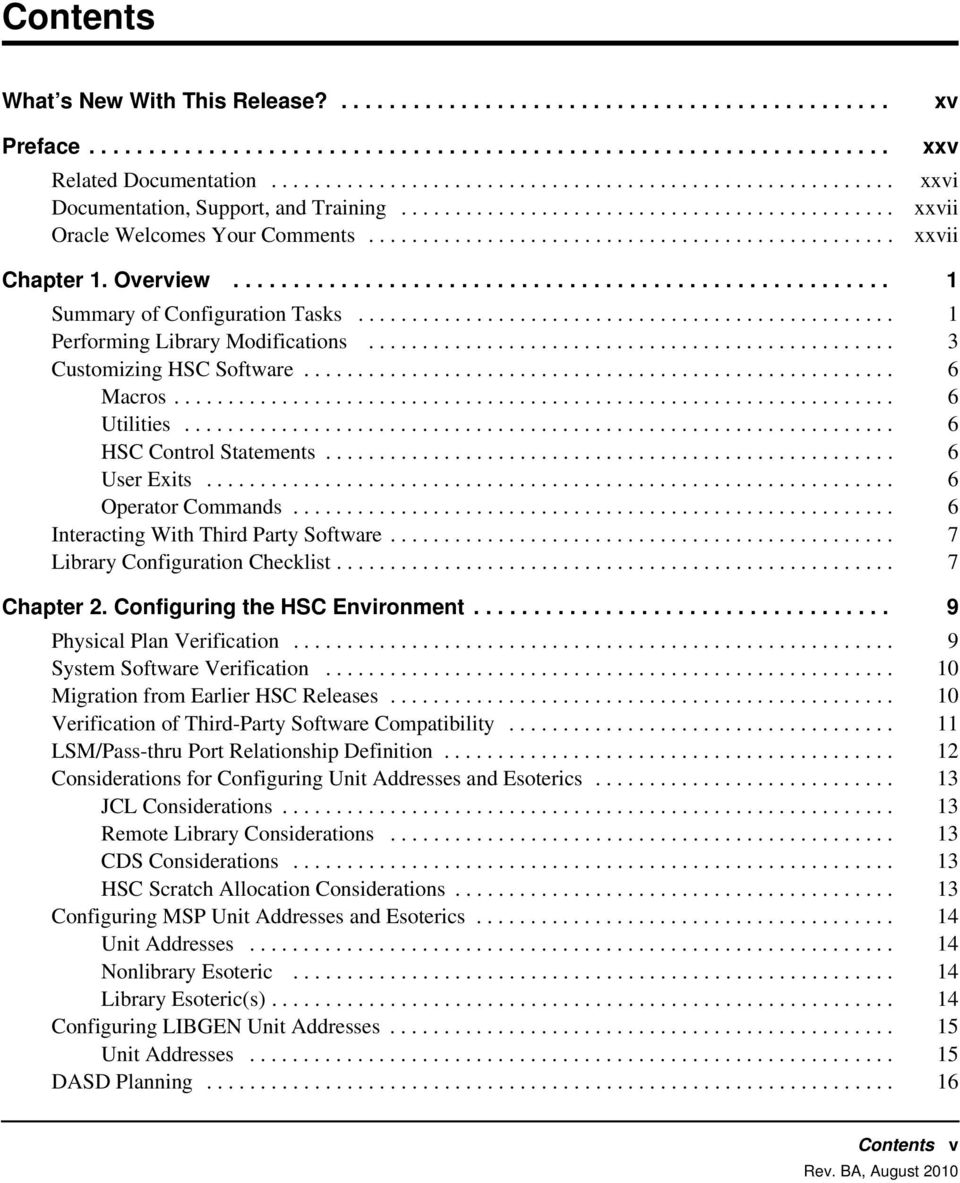
5 Contents What s New With This Release? Preface Related Documentation Documentation, Support, and Training Oracle Welcomes Your Comments xv xxv xxvi xxvii xxvii Chapter 1. Overview Summary of Configuration Tasks Performing Library Modifications Customizing HSC Software Macros Utilities HSC Control Statements User Exits Operator Commands Interacting With Third Party Software Library Configuration Checklist Chapter 2. Configuring the HSC Environment Physical Plan Verification System Software Verification Migration from Earlier HSC Releases Verification of Third-Party Software Compatibility LSM/Pass-thru Port Relationship Definition Considerations for Configuring Unit Addresses and Esoterics JCL Considerations Remote Library Considerations CDS Considerations HSC Scratch Allocation Considerations Configuring MSP Unit Addresses and Esoterics Unit Addresses Nonlibrary Esoteric Library Esoteric(s) Configuring LIBGEN Unit Addresses Unit Addresses DASD Planning Contents v
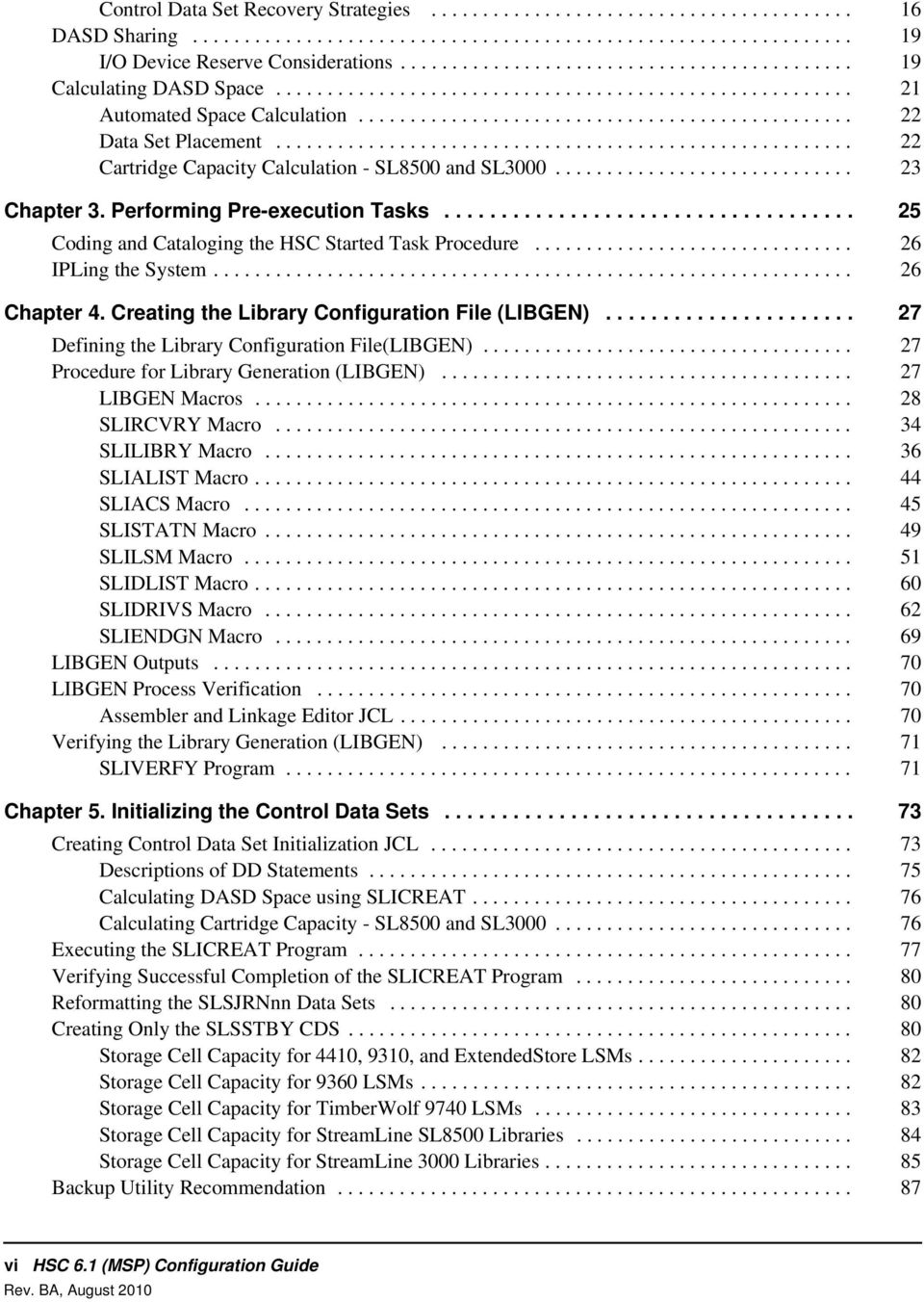
6 Control Data Set Recovery Strategies DASD Sharing I/O Device Reserve Considerations Calculating DASD Space Automated Space Calculation Data Set Placement Cartridge Capacity Calculation - SL8500 and SL Chapter 3. Performing Pre-execution Tasks Coding and Cataloging the HSC Started Task Procedure IPLing the System Chapter 4. Creating the Library Configuration File (LIBGEN) Defining the Library Configuration File(LIBGEN) Procedure for Library Generation (LIBGEN) LIBGEN Macros SLIRCVRY Macro SLILIBRY Macro SLIALIST Macro SLIACS Macro SLISTATN Macro SLILSM Macro SLIDLIST Macro SLIDRIVS Macro SLIENDGN Macro LIBGEN Outputs LIBGEN Process Verification Assembler and Linkage Editor JCL Verifying the Library Generation (LIBGEN) SLIVERFY Program Chapter 5. Initializing the Control Data Sets Creating Control Data Set Initialization JCL Descriptions of DD Statements Calculating DASD Space using SLICREAT Calculating Cartridge Capacity - SL8500 and SL Executing the SLICREAT Program Verifying Successful Completion of the SLICREAT Program Reformatting the SLSJRNnn Data Sets Creating Only the SLSSTBY CDS Storage Cell Capacity for 4410, 9310, and ExtendedStore LSMs Storage Cell Capacity for 9360 LSMs Storage Cell Capacity for TimberWolf 9740 LSMs Storage Cell Capacity for StreamLine SL8500 Libraries Storage Cell Capacity for StreamLine 3000 Libraries Backup Utility Recommendation vi HSC 6.1 (MSP) Configuration Guide
7 Chapter 6. Defining HSC Control Statements Definition Data Set Control Statements Parameter Library (PARMLIB) Control Statements Chapter 7. Initializing the HSC Starting the HSC Creating an HSC START Procedure Executing the HSC START Procedure Modifying LSMs Online Configuration Mismatches Multiple Hosts Startup Considerations Issuing the START Command Initializing the HSC Under the Master Subsystem Starting the HSC Using the SSYS Parameter Starting the HSC to the Full Service Level Starting the HSC at the Base Service Level Chapter 8. Terminating the HSC Stopping the HSC Orderly Termination of the HSC Forced Termination of the HSC Chapter 9. Testing the Installation Scope of Installation Verification Installation Verification Prerequisites IVP Functional Test Phases Basic Installation Integrity Test Recommended Test Procedure ACS and HSC Functionality Test Recommended Test Procedure HSC Utilities and Basic Commands Test Recommended Test Procedure Manual Mode Test Recommended Test Procedure Description of Test Programs SLIEERS Program Chapter 10. Planning Migration to the Library Tri-Optic Label Verification ECART External Media Label Requirements ZCART External Media Label Requirements Helical External Media Label Requirements STK1 (T9840A, T9840B, T9840C, or T9840D) External Media Label Requirements STK2 (T9940A or T9940B) External Media Label Requirements LTO, SDLT, T10000 External Media Label and Media Domain Requirements Loading Cartridges into the Library Contents vii

8 ENter Command Manually Loading Cartridges into LSM Initialize Cartridge Utility Using an Auto-mode CAP to Load Cartridges Migrating Applications to Library Use Appendix A. Library Configuration Checklist Appendix B. Library Configurations Example Configuration with LIBGEN Files One Host, One ACS, One SL3000 Library Configuration Hardware Components LIBGEN One Host, Two ACSs, One 9310 LSM, One SL8500 Library Configuration Hardware Components LIBGEN One Host, One ACS, One 9310, One 9360 LSM Configuration Hardware Components LIBGEN One Host, One ACS, Two 9360 WolfCreek LSM Configuration Hardware Components LIBGEN One Host, One ACS, One 9310 LSM, Dual LMU Configuration Hardware Components LIBGEN Two Host, One ACS, Two 9310 LSM Configuration Hardware Components LIBGEN Appendix C. Commands, Macros, Control Statements, and Utilities Syntax Conventions 155 Syntax Flow Diagrams Specifying Commands Variables Delimiters Flow Lines Single Required Choice Single Optional Choice Defaults Repeat Symbol Syntax Continuation (Fragments) Library Identification Ranges and Lists Control Statement Syntax Conventions Appendix D. Migration and Coexistence Processes Overview of Migration and Coexistence HSC Migration Scenarios viii HSC 6.1 (MSP) Configuration Guide
9 Software Support HSC Coexistence Scenarios HSC Installation Scenarios Installation in a Verification Environment Direct Installation into a Production Environment Hardware Support Dependencies Between HSC Releases HSC Support for Virtual Media Control Data Set and Journal Requirements Backup Requirements CDS Conversion Requirements (Up-Level Migration) CDS Conversion Requirements (Down-Level Migration) MERGEcds Utility Utility Usage Requirements Compatibility of Stand-Alone Utilities Compatibility of Utilities Requiring the HSC Subsystem Up-Level Migration Procedure for 5.1/6.0 to 6.1 Up-Level Migration Procedure to Verify HSC 6.1 Functions Against a Separate CDS Procedure to Verify HSC 6.1 Functions Without Library Hardware Procedure to Verify 6.1 Functions With Library Hardware Down-Level Migration De-installation of PTFs Procedure for 6.1 to 5.1/6.0 Down-Level Migration Glossary Index Contents ix
10 x HSC 6.1 (MSP) Configuration Guide

11 Figures Figure 1. Configuration/Installation Flow Diagram Figure 2. Required Order for Specifying the LIBGEN Macros Figure 3. Sample Library Configuration Figure 4. LIBGEN MACRO Relationship Figure 5. Example of Pass-thru Port Relationships Figure 6. SL3000 Drive Panel Layout Example Figure 7. Data Set Initialization Figure 8. Installation Verification Flow Diagram Figure 9. Cartridge with Tri-Optic label and ECART Media Type Indicator Figure 10. LIBGEN for One Host, One ACS, One SL3000 Library Configuration Figure 11. One Host, One ACS, One SL3000 Library Configuration Figure 12. LIBGEN for One Host, Two ACSs, One 9310 LSM, One SL8500 Library Configuration Figure 13. One host, Two ACSs, One 9310 LSM, One SL8500 LIbrary Configuration Figure 14. LIBGEN for One Host, One ACS, One 9310 LSM, One 9360 LSM Configuration Figure 15. One Host, One ACS, One 9310 LSM, One 9360 LSM Configuration Figure 16. LIBGEN for One Host, One ACS, Two 9360 LSM Configuration Figure 17. One Host, One ACS, Two 9360 LSM Configuration Figure 18. LIBGEN for One Host, One ACS, One 9310 LSM, Dual LMU Configuration Figure 19. One Host, One ACS, One 9310 LSM, Dual LMU Configuration Figure 20. LIBGEN for Two Host, One ACS, Two 9310 LSM Configuration Figure 21. Two Host, One ACS, Two 9310 LSM Configuration Figures xi
12 xii HSC 6.1 (MSP) Configuration Guide

13 Tables Table 1. Other Software Products Compatible with the HSC Table 2. Mapping of Command Prefix Codes to Characters Table 3. SL8500 Drive Panel Layout Example - Outside Library Table 4. SL8500 Drive Panel Layout Example - Inside Library Table 5. LIBGEN Job Step Return Codes Table 6. Storage Cell Capacity of 4410, 9310, ExtendedStore LSMs Table 7. Storage Cell Capacity of WolfCreek LSMs Table 8. Storage Cell Capacity of WolfCreek LSMs Table 9. Storage Cell Capacity of WolfCreek LSMs Table 10. Storage Cell Capacity of TimberWolf 9740 LSMs Table 11. Storage Cell Capacity of StreamLine (SL8500) Libraries Table 12. Storage Cell Capacity of StreamLine (SL3000) Libraries Table 13. HSC Initialization Table 14. Utilities Tested During Installation Verification Table 15. Commands Tested During Installation Verification Table 16. Job Processing Functions Tested During Installation Verification Table 17. Basic Installation Test Procedure Table 18. ACS and HSC Functionality Test Procedure Table 19. HSC Utilities and Basic Commands Test Procedure Table 20. ACS/HSC Detailed Functionality Test Procedure Table 21. Non-legacy Media Type/Domain Definitions Table 22. Library Configuration Checklist Table 23. HSC Library Hardware Dependencies Table 24. Procedure for 5.1/6.0 to 6.1 Up-Level Migration Table 25. Procedure to Verify 6.1 Functions without Library Hardware Table 26. Procedure to Verify 6.1 Functions with Library Hardware Tables xiii

14 Table 27. Procedure for 6.1 to 5.1/6.0 Down-Level Migration xiv HSC 6.1 (MSP) Configuration Guide
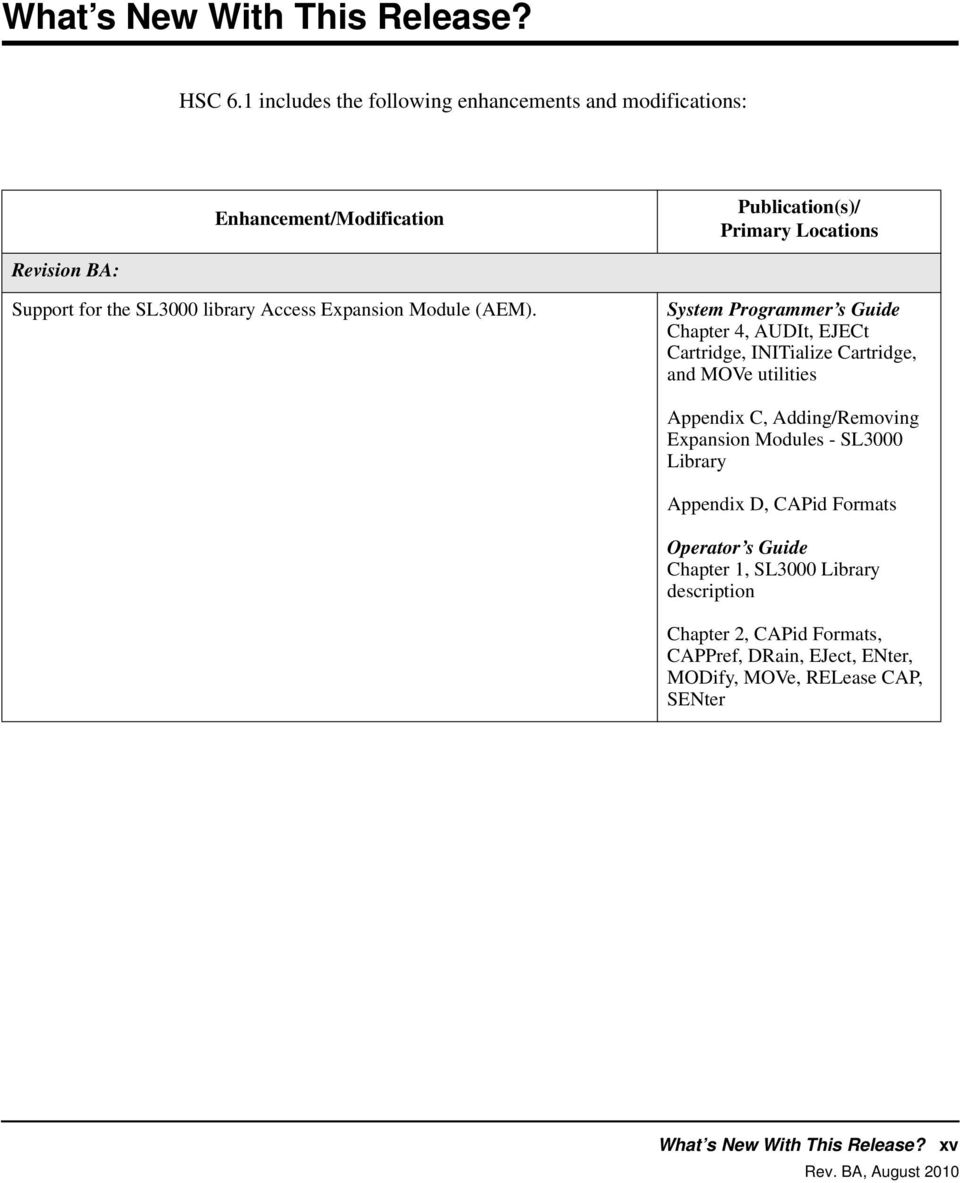
15 What s New With This Release? HSC 6.1 includes the following enhancements and modifications: Enhancement/Modification Publication(s)/ Primary Locations Revision BA: Support for the SL3000 library Access Expansion Module (AEM). System Programmer s Guide Chapter 4, AUDIt, EJECt Cartridge, INITialize Cartridge, and MOVe utilities Appendix C, Adding/Removing Expansion Modules - SL3000 Library Appendix D, CAPid Formats Operator s Guide Chapter 1, SL3000 Library description Chapter 2, CAPid Formats, CAPPref, DRain, EJect, ENter, MODify, MOVe, RELease CAP, SENter What s New With This Release? xv
16 Enhancement/Modification Publication(s)/ Primary Locations Revision B: Support for the SL3000 library. Configuration Guide Chapter 2, Calculating DASD Space Chapter 4, SLILSM, SLIDRIVS macros Chapter 5, Storage Cell Capacity for StreamLine SL3000 Libraries Appendix B, Library Configurations Operator s Guide Chapter 2, CAPPref, DRAin, EJect, ENter, MODify, MOVe, RELease CAP, VIew commands System Programmer s Guide Chapter 2, Mixing Media Types and Recording Techniques Chapter 4, AUDIt, EJECt Cartridge, Initialize Cartridge utilities Appendix B, HSC Support for the SL3000 Library xvi HSC 6.1 (MSP) Configuration Guide

17 Enhancement/Modification Publication(s)/ Primary Locations Revision B: SL8500 library LSM partitioning. System Programmer s Guide Chapter 3, LMUPATH control statement Chapter 4, SET FREEZE utility Appendix A, HSC Support for the SL8500 Library Operator s Guide Chapter 2, Display ACS, Display LSM, and Display Exceptions Messages and Codes Guide New messages: SLS0073I SLS0695I SLS4232I SLS4412I SLS4413I SLS4643I Changed messages: SLS0653I SLS0663I SLS1000I SLS2008I SLS4401I SLS4407I SLS4610I Multiple connections to an SL8500 library. System Programmer s Guide Appendix A, HSC Support for the SL8500 Library What s New With This Release? xvii

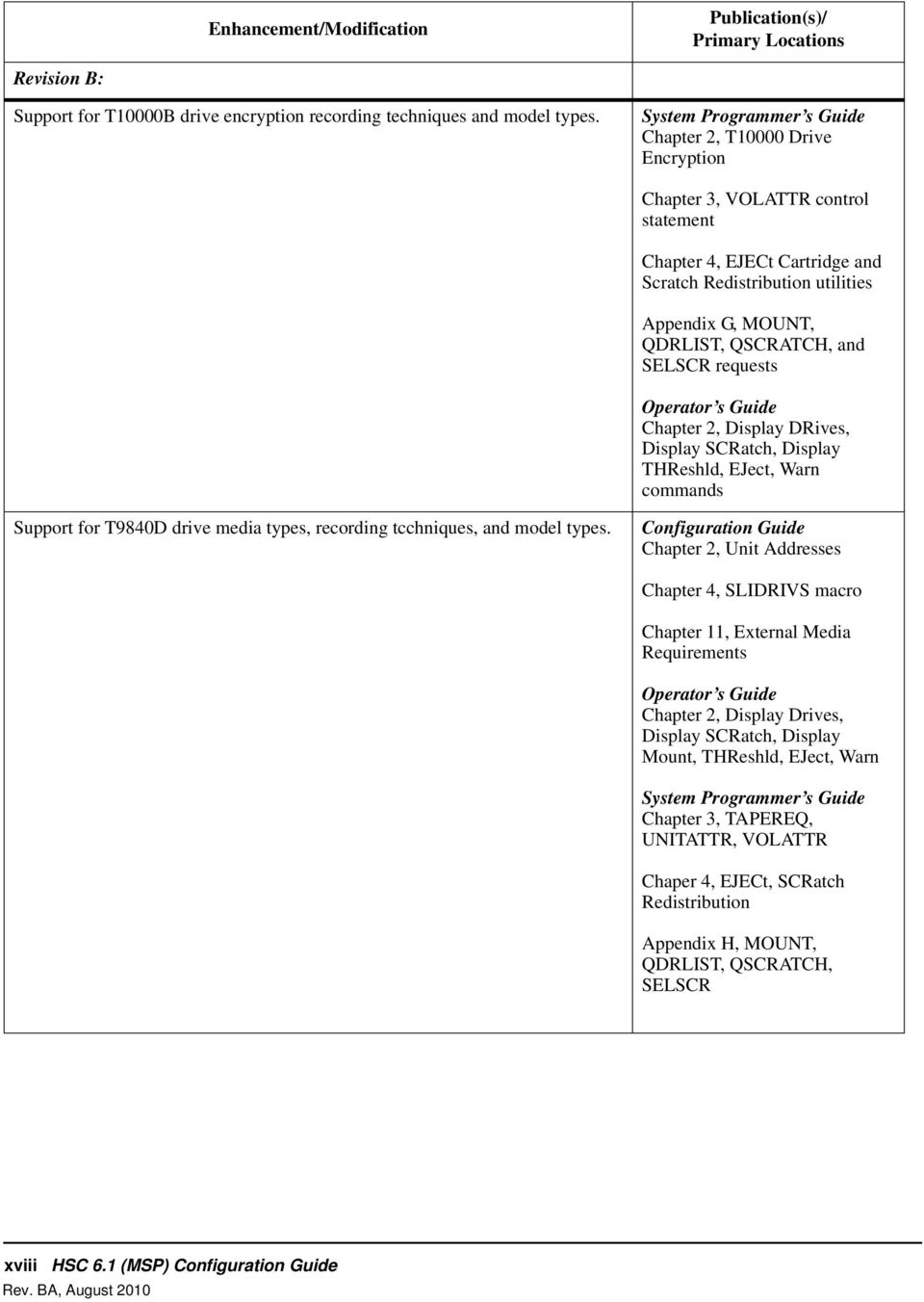
18 Enhancement/Modification Publication(s)/ Primary Locations Revision B: Support for T10000B drive encryption recording techniques and model types. System Programmer s Guide Chapter 2, T10000 Drive Encryption Chapter 3, VOLATTR control statement Chapter 4, EJECt Cartridge and Scratch Redistribution utilities Appendix G, MOUNT, QDRLIST, QSCRATCH, and SELSCR requests Operator s Guide Chapter 2, Display DRives, Display SCRatch, Display THReshld, EJect, Warn commands Support for T9840D drive media types, recording tcchniques, and model types. Configuration Guide Chapter 2, Unit Addresses Chapter 4, SLIDRIVS macro Chapter 11, External Media Requirements Operator s Guide Chapter 2, Display Drives, Display SCRatch, Display Mount, THReshld, EJect, Warn System Programmer s Guide Chapter 3, TAPEREQ, UNITATTR, VOLATTR Chaper 4, EJECt, SCRatch Redistribution Appendix H, MOUNT, QDRLIST, QSCRATCH, SELSCR xviii HSC 6.1 (MSP) Configuration Guide
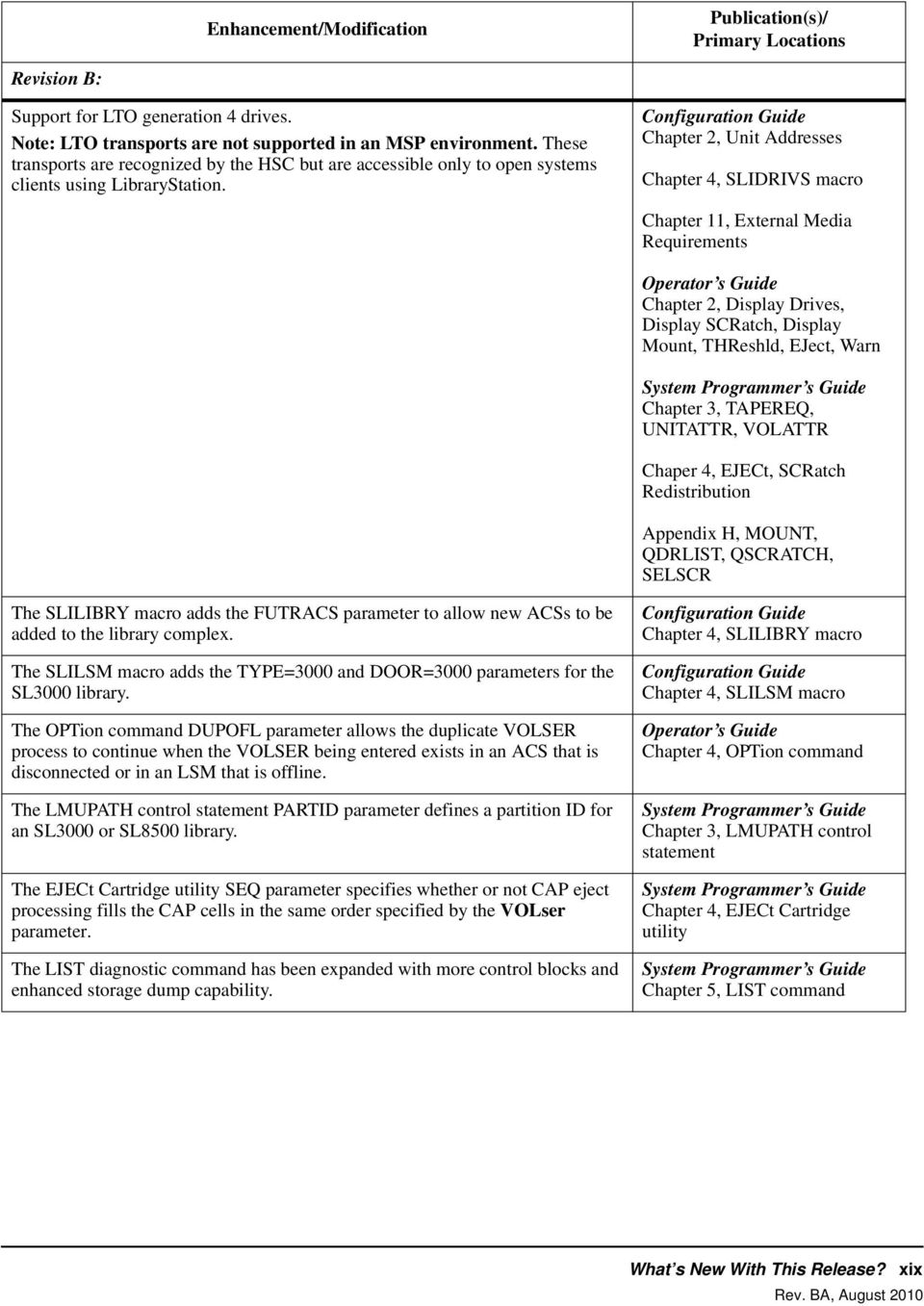
19 Enhancement/Modification Publication(s)/ Primary Locations Revision B: Support for LTO generation 4 drives. Note: LTO transports are not supported in an MSP environment. These transports are recognized by the HSC but are accessible only to open systems clients using LibraryStation. Configuration Guide Chapter 2, Unit Addresses Chapter 4, SLIDRIVS macro Chapter 11, External Media Requirements Operator s Guide Chapter 2, Display Drives, Display SCRatch, Display Mount, THReshld, EJect, Warn System Programmer s Guide Chapter 3, TAPEREQ, UNITATTR, VOLATTR Chaper 4, EJECt, SCRatch Redistribution Appendix H, MOUNT, QDRLIST, QSCRATCH, SELSCR The SLILIBRY macro adds the FUTRACS parameter to allow new ACSs to be added to the library complex. The SLILSM macro adds the TYPE=3000 and DOOR=3000 parameters for the SL3000 library. The OPTion command DUPOFL parameter allows the duplicate VOLSER process to continue when the VOLSER being entered exists in an ACS that is disconnected or in an LSM that is offline. The LMUPATH control statement PARTID parameter defines a partition ID for an SL3000 or SL8500 library. The EJECt Cartridge utility SEQ parameter specifies whether or not CAP eject processing fills the CAP cells in the same order specified by the VOLser parameter. The LIST diagnostic command has been expanded with more control blocks and enhanced storage dump capability. Configuration Guide Chapter 4, SLILIBRY macro Configuration Guide Chapter 4, SLILSM macro Operator s Guide Chapter 4, OPTion command System Programmer s Guide Chapter 3, LMUPATH control statement System Programmer s Guide Chapter 4, EJECt Cartridge utility System Programmer s Guide Chapter 5, LIST command What s New With This Release? xix
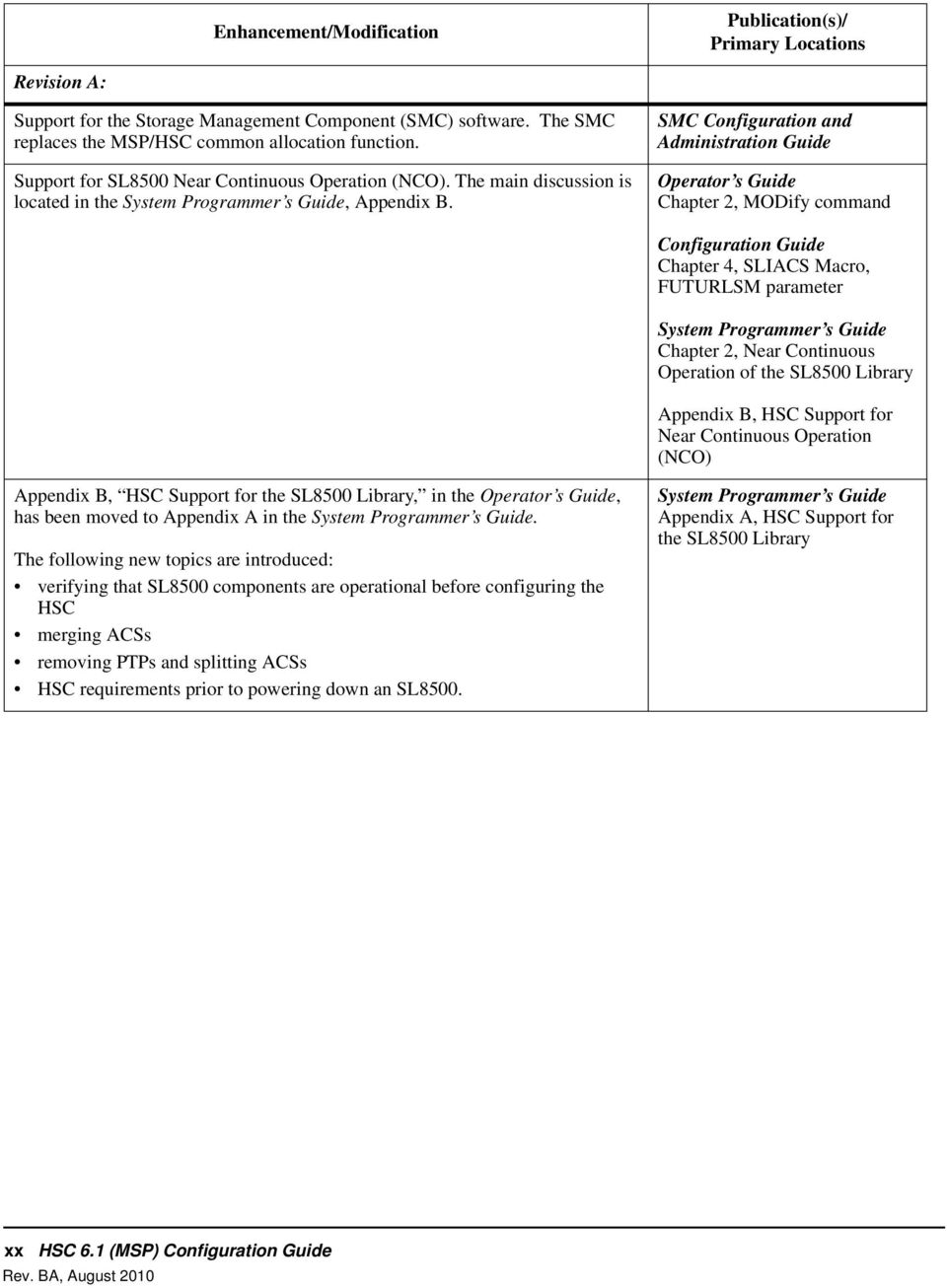
20 Enhancement/Modification Publication(s)/ Primary Locations Revision A: Support for the Storage Management Component (SMC) software. The SMC replaces the MSP/HSC common allocation function. Support for SL8500 Near Continuous Operation (NCO). The main discussion is located in the System Programmer s Guide, Appendix B. SMC Configuration and Administration Guide Operator s Guide Chapter 2, MODify command Configuration Guide Chapter 4, SLIACS Macro, FUTURLSM parameter System Programmer s Guide Chapter 2, Near Continuous Operation of the SL8500 Library Appendix B, HSC Support for Near Continuous Operation (NCO) Appendix B, HSC Support for the SL8500 Library, in the Operator s Guide, has been moved to Appendix A in the System Programmer s Guide. The following new topics are introduced: verifying that SL8500 components are operational before configuring the HSC merging ACSs removing PTPs and splitting ACSs HSC requirements prior to powering down an SL8500. System Programmer s Guide Appendix A, HSC Support for the SL8500 Library xx HSC 6.1 (MSP) Configuration Guide
21 Enhancement/Modification Publication(s)/ Primary Locations Revision A: Support for LTO and SDLT drives. Note: LTO and SDLT transports are not supported in an MSP environment. These transports are recognized by the HSC but are accessible only to open systems clients using LibraryStation. Configuration Guide Chapter 2, Unit Addresses Chapter 11, External Media Requirements Operator s Guide Chapter 2, Display Drives, Display SCRatch, Display Mount, THReshld, EJect, Warn System Programmer s Guide Chapter 2, Media Domain Support - LTO and SDLT Drives Chapter 3, TAPEREQ, UNITATTR, VOLATTR Chaper 4, EJECt, SCRatch Redistribution Appendix G, MOUNT, QDRLIST, QSCRATCH, SELSCR Support for the Significant Event Notification (SEN) facility, which allows users or an external product to request notification about specific HSC and VTCS events. System Programmer s Guide Appendix F, Significant Event Notification Facility (SEN) Operator s Guide Chapter 2, OPTion SEN command In the System Programmer s Guide, Chapter 8, User Exits, has been removed. This information now appears in the NCS User Exit Guide, along with SMC-managed and MSP/CSC user exits. In the System Programmer s Guide, Appendix B, Intercepted Messages List, has been removed. This information now appears in the SMC Configuration and Administration Guide. In the System Programmer s Guide, Appendix H, Affinity Separation and Location Policy Precedence, has been removed. The SMC now manages affinity separation. NCS User Exit Guide SMC Configuration and Administration Guide SMC Configuration and Administration Guide What s New With This Release? xxi
22 Enhancement/Modification Publication(s)/ Primary Locations Revision A: The requirement has been removed for the SMC to be initialized before the HSC. System Programmer s Guide Chapter 2, Initialization/Termination Functions Configuration Guide Appendix A, Library Configuration Checklist Appendix D, Procedure to Verify HSC 6.1 Functions Without Library Hardware The SLILIBRY LIBGEN macro contains a new parameter, DRVHOST, which maps drive hosts in a client/server environment. Configuration Guide Chapter 4, SLILIBRY macro Refer to the SMC Configuration and Administration Guide chapter titled SMC and StorageTek Library Management for client/server configuration and command information. The SET utility also includes a DRVHOST parameter, which sets the SLILIBRY DRVHOST parameter without rebuilding the CDS. The Display DRives operator command has added the BYDrive and BYLoc parameters. BYDrive displays drives by host device address; BYLoc displays drives by location. The SLILIBRY macro DELDISP parameter has been replaced by the SMC MOUNTDEF command. Also, the esoteric specified in the NNLBDRV parameter is no longer used in either the HSC or SMC. Refer to the SMC Configuration and Administration Guide for more information. The Defer, Fetch, Specvol, and Zeroscr parameters in the HSC ALLOC command have been replaced by the SMC ALLOCDEF command. These HSC parameters are still supported when an SMC 6.0 client is communicating with an HSC 6.1 server. Refer to the SMC Configuration and Administration Guide for more information. The MOuntmsg and VOLWatch parameters in the HSC MNTD command have been replaced by the SMC MOUNTDEF command. These HSC parameters are still supported when an SMC 6.0 client is communicating with an HSC 6.1 server. Refer to the SMC Configuration and Administration Guide for more information. System Programmer s Guide Chapter 4, SET DRVHOST Utility Operator s Guide Chapter 2, Display DRives command Configuration Guide Chapter 4, SLILIBRY macro SMC Configuration and Administration Guide Operator s Guide Chapter 2, Allocation (ALLOC) command and control statement SMC Configuration and Administration Guide Operator s Guide Chapter 2, MNTD (Mount/Dismount Options) command and control statement SMC Configuration and Administration Guide xxii HSC 6.1 (MSP) Configuration Guide
23 Enhancement/Modification Publication(s)/ Primary Locations Revision A: The TAPEREQ control statement and the TREQDEF command/control statement have been removed from the HSC and are now processed by the SMC TAPEREQ and TREQDEF commands. Refer to the SMC Configuration and Administration Guide for more information. The UNITDEF command/control statement has been removed from the HSC. The HSC now recognizes library and virtual drive characteristics from the LMU and CDS definitions. The UNITATTR control statement has been removed from the HSC and is now processed by the SMC UNITATTR statement. UNITATTR is still supported to allow users to define non-library drives and to exclude drives from allocation (MODel=IGNORE) when an SMC 6.0 client is communicating with an HSC 6.1 server. Refer to the SMC Configuration and Administration Guide for more information. The Display TREQDEF and Display UNITDEF commands are still supported, however, they only apply when an SMC 6.0 client is communicating with an HSC 6.1 server. The ENter command has added the TLSM parameter, which allows you to specify the LSM to receive entered cartridges. The TRace command has added component names for allocation volume lookup and ML interface. The Warn command threshold value has been increased from 9999 to 99,999. System Programmer s Guide Chapter 3, TAPEREQ control statement, TREQDEF command/control statement SMC Configuration and Administration Guide System Programmer s Guide Chapter 3, UNITDEF command/control statement System Programmer s Guide Chapter 3, UNITATTR control statement SMC Configuration and Administration Guide Operator s Guide Chapter 2, Display TREQDEF and Display UNITDEF commands Operator s Guide Chapter 2, ENter command Operator s Guide Chapter 2, TRace command Operator s Guide Chapter 2, Warn command. What s New With This Release? xxiii
24 xxiv HSC 6.1 (MSP) Configuration Guide
25 Preface This guide provides information about Oracle s StorageTek Host Software Component (HSC) and its use with the Automated Cartridge System. The Configuration Guide is intended primarily for systems programmers responsible for configuring and maintaining HSC software at their library sites. Library operators and computer system administrators may also find information contained in this guide useful on occasions to review or understand some HSC system concepts. Preface xxv
26 Related Documentation The following list describes the publications that provide additional information about the HSC. The online documentation is available at: Function Title HSC Publications Tasks for planning and configuring the HSC System operation, maintenance, and problem resolution Detailed HSC and library information, control statements, and utilities Messages and codes issued by the HSC Frequently used syntax information Configuration Guide Operator s Guide System Programmer s Guide Messages and Codes Guide Reference Summary Related Publications Installation tasks for the HSC Detailed descriptions of HSC user exits Interface between the HSC and the operating system that influences tape allocation Generate ML output for VTCS and NCS commands and utilities NCS Installation Guide NCS User Exit Guide Storage Management Component (SMC) Configuration and Administration Guide NCS ML Guide xxvi HSC 6.1 (MSP) Configuration Guide
27 Documentation, Support, and Training Function URL Documentation Customer: Employee: Partner: Downloads Customer Employee Support Training Online Account /usr/login /sun_select_country.html Oracle Welcomes Your Comments Oracle is interested in improving its documentation and welcomes your comments and suggestions. Submit your comments by clicking the Feedback[+] link at: Please include the title and part number of your document with your feedback: Configuration Guide, Preface xxvii
28 xxviii HSC 6.1 (MSP) Configuration Guide
29 Chapter 1. Overview This chapter defines the procedures to plan and complete the configuration of the Host Software Component (HSC) product. Refer to the NCS Installation Guide for information about installing the HSC software. Summary of Configuration Tasks There are a variety of tasks necessary to configure the HSC software and prepare the library for use. Figure 1 on page 4 illustrates the flow of the major tasks recommended for installing and configuring the HSC (refer to the NCS Installation Guide for installation information). The order for performing the tasks may vary depending upon various circumstances, such as hardware availability. A summary description follows for each chapter contained in this guide: Chapter 1, Overview This chapter summarizes the steps in planning for and configuring the HSC. Chapter 2, Configuring the HSC Environment This chapter discusses configuration planning issues that relate to ensuring that all hardware installation/environmental provisions, software, and installation requirements are predetermined and complete before installing the software. Chapter 3, Performing Pre-execution Tasks Preexecution tasks involve coding and cataloging the HSC started task procedure and IPLing the system. Chapter 4, Creating the Library Configuration File (LIBGEN) The LIBGEN process consists of defining the library configuration using LIBGEN macros. The LIBGEN macros define the hardware configuration, recovery requirements, global characteristics, and library control data sets and journals to the HSC software. In addition, the important process of verifying the LIBGEN is described. This verification process is performed to ensure that the library configuration defined in the LIBGEN is correct. Verification is performed by executing the SLIVERFY program. PARMLIB control statements for data set allocation (CDSDEF) and for any journaling (JRNDEF) are required. If you are upgrading from a prior release of the HSC or are adding hardware, it may be necessary to define the HSC 6.1 control data set (CDS) using the RECDEF control statement followed by an execution of the MERGEcds Utility (see MERGEcds Utility in the HSC/MSP System Programmer s Guide). Chapter 1. Overview 1
30 Chapter 5, Initializing the Control Data Sets The data set initialization process creates the library control data sets. The process results in the creation of a primary control data set, optional secondary and standby control data sets, and optional journal data sets. Chapter 6, Defining HSC Control Statements Definition data sets allow you to define tape request characteristics, volume attributes, and unit attributes for mixed media and mixed device support. Defining PARMLIB control statements involves specifying static operational parameters for the HSC that are invoked at installation and initialization. The control statements become members in a user-defined data set that is used by the HSC at startup. Chapter 7, Initializing the HSC Starting execution of HSC software involves issuing the MSP START command that activates the library software. Starting execution of HSC software involves executing a job file for starting the subsystem. Refer to Appendix D, Migration and Coexistence Processes on page 165 for related information. Chapter 8, Terminating the HSC Terminating HSC software involves issuing the MSP STOP command. Orderly and forced termination of the HSC are discussed. Chapter 9, Testing the Installation Testing the software installation involves ensuring that information specified in the LIBGEN process is fully operational with the HSC software as installed with a working library configuration. The tests involve exercising the operational phases of the HSC software using the SLIEERS program. The process includes exercising the library tape transports which mount, read, write to, and dismount tape cartridges. Refer to Appendix D, Migration and Coexistence Processes on page 165 for related information. Other tests are recommended to thoroughly test the installation. Each command and utility as well as every major HSC function should be fully verified to ensure that the HSC operates as intended. Since each library site has unique operating requirements, you should ensure that HSC defaults are properly set during the testing phase of HSC installation. To accomplish this, adjust your PARMLIB defaults to match the requirements for your library site. 2 HSC 6.1 (MSP) Configuration Guide
31 Chapter 10, Planning Migration to the Library Planning involves the following tasks: - determining the procedures necessary to place external Tri-Optic labels on cartridges before loading them into a Library Storage Module - determining the method of entering cartridges into the library - invoking the Audit utility to update the control data set. Refer to Loading Cartridges into the Library in the HSC/MSP System Programmer s Guide for performance considerations when loading cartridges into an LSM. Appendix A, Library Configuration Checklist The checklist helps ensure that all necessary steps are complete for installing the HSC software. Appendix B, Library Configurations Library configurations can be used as models to analyze how you can configure your library and provide for future expansion. Appendix C, Commands, Macros, Control Statements, and Utilities Syntax Conventions Provides an overview of conventions used for syntax diagrams, library identifiers, ranges and lists, and control statements. Appendix D, Migration and Coexistence Processes This appendix describes procedures for up-level and down-level migration and discusses coexistence requirements. Performing Library Modifications After installation and verification of a successful installation of the HSC, you may perform modifications to the library software configuration. These modifications cannot take place during the initial installation of the software. Library modifications may be made any time after the initial installation, when requirements at your site change. Typical library modifications are to alter the LIBGEN macros and use the Reconfiguration function to enable library configuration modifications. This type of modification can be done without requiring a full audit of the library. Chapter 1. Overview 3
32 ACTIVITY TASK MACROS, CONTROL STATEMENTS TEST PROGRAMS AND PROCEDURES PLANNING PLANNING THE CONFIGURATION PREINSTALLING PERFORMING PREINSTALLATION PROCEDURES INSTALLING INSTALLING THE HSC SOFTWARE PREEECUTION PERFORMING PREEECUTION TASKS DEFINING/INITIALIZING DEFINING THE LIBRARY CONFIGURATION LIBGEN INITIALIZING THE CONTROL DATA SETS VERIFYING VERIFYING THE LIBRARY CONFIGURATION SLIVERFY PROGRAM EECUTING STARTING HSC EECUTION TESTING TESTING THE INSTALLATION ADJUST PARMLIB DEFAULTS SLIEERS AND STKTSTnn TEST PROGRAMS MOVING VOLUMES PLANNING/EECUTING CARTRIDGE MIGRATION RECONFIGURING MODIFYING THE LIBRARY CONFIGURATION RECONFIGURATION FUNCTION SET UTILITY LIBGEN C29359 Figure 1. Configuration/Installation Flow Diagram 4 HSC 6.1 (MSP) Configuration Guide
33 Refer to MERGEcds Utility in the HSC/MSP System Programmer s Guide for detailed procedures for reconfiguring the library. See the SET Utility in the HSC/MSP System Programmer s Guide for information on setting or changing the library configuration without performing reconfiguration. Chapter 1. Overview 5
34 Customizing HSC Software Macros Utilities HSC Control Statements User Exits Operator Commands Macros, utilities, HSC control statements, user exits, and operator commands allow users to customize the HSC. Note: To assemble customized versions of HSC user exits or other modules, it is recommended that you use the High-Level Assembler. LIBGEN macros are used to establish the library configuration and recovery options for the HSC. These macros are discussed in Chapter 4, Creating the Library Configuration File (LIBGEN) on page 27. Utilities allow you to dynamically control library resources. Refer to Utility Functions in the HSC/MSP System Programmer s Guide. One utility, Scratch Conversion, calls three routines (SLUDRCA1, SLUDRTLM, and SLUDRRMM) that read tape management library systems (TLMS) scratch data and then format this information so that it can be used by the Scratch Update utility. See Scratch Conversion (SLUCONDB) Utility in the HSC/MSP System Programmer s Guide. Two types of control statements can be defined: PARMLIB, used to set system values at initialization, and definition data set, used to specify mixed media and devices. These control statements are discussed in Chapter 3, Performing Pre-execution Tasks on page 25. Default HSC user exits are installed as part of the HSC install process. If these defaults do not meet your operational requirements, you must create and install your own local HSC user exits. If you already use your own user exits, you must re-assemble and re-install them to validate the changes in the parameter lists. Refer to the NCS User Exit Guide for more information about HSC user exits. Operator commands allow system operators to perform daily library operations. In addition, operator commands can be specified as PARMLIB control statements. Refer to Commands, Control Statements, and Utilities in the HSC/MSP Operator s Guide for detailed information about each command. 6 HSC 6.1 (MSP) Configuration Guide
35 Interacting With Third Party Software The HSC operates with the following third-party software: Multi-Image Manager (MIM) CA-ASM2 Global Resource Sharing (GRS) Multi-Image Integrity Manager (MII) CONTROL-T Tape Management System. See Software Interaction in the HSC/MSP System Programmer s Guide for information about restrictions when using these products in conjunction with the HSC. Library Configuration Checklist A Library Configuration Checklist is provided to help you identify all of the steps involved in the configuration process for HSC software. This checklist is used to ensure that all of the tasks relating to the configuration process are performed. Refer to Appendix A, Library Configuration Checklist on page 127 for the checklist. Chapter 1. Overview 7
36 8 HSC 6.1 (MSP) Configuration Guide
37 Chapter 2. Configuring the HSC Environment Physical Plan Verification Configuration planning is an important phase of the installation process that must be completed to ensure smooth installation of the HSC software. The customer is responsible for ensuring that each task is successfully completed. Planning tasks include: physical plan verification system software verification migration from earlier HSC releases verification of third-party software compatibility LSM/pass-thru port (PTP) relationship definition(s) configuring MSP unit addresses and esoterics configuring LIBGEN unit addresses and esoterics DASD planning DASD sharing calculating DASD space. All of the installation activities should be thoroughly planned before proceeding with installation of the HSC. StorageTek recommends that the configuration plan be available at the beginning of the installation process. The completed physical plan is your installation blueprint. Ensure that provisions are made for the following requirements: floor space power environmental considerations. Note: All space requirements are computed using the StorageTek Nearline Physical Planning Guide and the templates provided. In the computations, provisions are made for each library component ordered, future components considered for growth of the system, service areas, personnel clearances, and furniture. Chapter 2. Configuring the HSC Environment 9
38 System Software Verification The MSP version of the HSC system supports JES. The specific MSP and JES levels supported coincide with Fujitsu s current support position on these operating system levels. That is, if Fujitsu currently provides program services for a particular level, then the HSC also supports it; however, StorageTek may require the customer to apply additional Fujitsu maintenance to ensure satisfactory HSC operation. If Fujitsu has dropped support for a particular level, then the HSC no longer supports that level. For newly announced Fujitsu operating system levels, it is our intent to support each such new level. Note: If you have installed third-party software at your site, refer to Third-Party Software Interaction in the HSC/MSP System Programmer s Guide for any restrictions that may apply to installing the HSC when such software is present. Refer to Verification of Third-Party Software Compatibility below for program product levels required for use with the HSC. Migration from Earlier HSC Releases If your installation plans to run a multiple-host environment including HSC 6.1 and earlier versions of the HSC on other hosts, only HSC 5.1 and 6.0 can run with HSC 6.1. Refer to Appendix D, Migration and Coexistence Processes on page 165 for more information. For information regarding the latest PTF and PUT levels, contact StorageTek Software Support. 10 HSC 6.1 (MSP) Configuration Guide
39 Verification of Third-Party Software Compatibility Caution: Initialization of the HSC subsystem in conjunction with initialization of third-party software and/or other subsystems may be order dependent. It may be necessary to initialize the HSC subsystem after third-party or other subsystem initialization. The software products shown in the following table are compatible for use with the HSC. Table 1. Other Software Products Compatible with the HSC Software Product CA-1 Release 4.7 CA DYNAM/TLMS Release 5.2 Minimum Level Required SORT Global Device Manager (GDM) V11L10 V10L10 SYNCSORT Release 2.5E Warning: Caution must be exercised if you use any third-party software that modifies the Eligible Device List (EDL) and therefore the MSP Device Allocation process. These products may compromise the functionality of the HSC and lead to unpredictable results. HSC provides limited support for the CONTROL-T tape management system. Refer to the BMC publication CONTROL-T for OS/390 Implementation Guide for more information. Chapter 2. Configuring the HSC Environment 11
40 LSM/Pass-thru Port Relationship Definition If your ACS contains only one LSM, you do not need to perform this installation step. If your ACS contains two or more connected LSMs, you must define the LSM/pass-thru port (PTP) relationships. PTPs are not designated as master or slave; the terms master and slave refer to the LSMs which share a common PTP. An LSM that controls the PTP is called the master LSM, and the LSM which shares that PTP and does not control it is called the slave LSM. All LSMs, except the SL8500, can be a master of only two PTPs. Even though an LSM may have more than two PTPs, it can control only two PTPs; therefore, it is possible for one LSM to be both a master and a slave. Notes: 1. SL8500 libraries can control eight PTPs 2. SL3000 libraries do not contain PTPs. The LSM/PTP relationships are defined in the Configuration Plan. Verify that the Configuration Plan defines these relationships. These relationships will be logically defined later in the LIBGEN. If verification is confirmed, continue with the installation. If verification of the LSM/PTP relationships is not confirmed, cease installation activity until resolution is achieved. Refer to the SLILSM Macro on page 51 for additional information about PTP relationship definition. 12 HSC 6.1 (MSP) Configuration Guide
41 Considerations for Configuring Unit Addresses and Esoterics JCL Considerations There is no need to change JCL. Continue to use the generic or esoteric which allows any library or nonlibrary device to be allocated. The Storage Management Component (SMC) influences MSP to allocate the correct transport within the specified generic or esoteric. Remote Library Considerations CDS Considerations For information about device allocation relating to the operation of remote-linked libraries, refer to Special Considerations for Control Data Sets Processing Independently in the HSC/MSP System Programmer s Guide. Unit Control Blocks (UCBs) for HSC CDS volumes can be defined either as LOCANY=NO or LOCANY=YES using the IBM Hardware Configuration Definition (HCD) facility. HSC Scratch Allocation Considerations HSC scratch allocation can be modified using the LSMPREF, SCRTECH, and LOWSCR keywords on the ALLOC operator command/parmlib statement. Chapter 2. Configuring the HSC Environment 13
42 Configuring MSP Unit Addresses and Esoterics Unit Addresses Nonlibrary Esoteric Library Esoteric(s) The IORGP facility is used to assign MSP unit addresses to the devices in your I/O configuration. Refer to the appropriate Fujitsu publications for more information about these facilities. An LMU Station emulates a terminal attached to a local controller and must be assigned an MSP unit address. The LMU must be defined as a 3x74 local controller. A 4480 cartridge tape transport is plug-compatible with an IBM 3480; 4490, 9490, and 9490EE cartridge tape transports are plug-compatible with an IBM 3490E; and SD-3, 9840, T9840B, T9840C, T9840D, T9940A, T9940B, LTO, SDLT, T10000A, and T10000B cartridge tape transports are plug-compatible with either an IBM 3490E or All cartridge tape transports must be assigned MSP unit addresses. Note: LTO and SDLT transports are not supported as direct-attach devices in an MSP environment. These transports are recognized by the HSC but are accessible only to open systems clients using LibraryStation. If unit addresses are generated for nonexistent library tape transports, ensure that these addresses are also defined in a SLIDRIVS macro. Such drives are treated by the HSC as incompatible with any media type and are excluded from HSC allocation counts. Nonlibrary esoterics are no longer used to control allocation processing, except when an SMC 6.0 client is communicating with an HSC 6.1 server. Device types for StorageTek tape transports outside the library can be defined by using the SMC UNITATTR command, which can also identify devices to be excluded from any allocation by specifying the MOdel(IGNORE) parameter. Refer to the SMC Configuration and Administration Guide for more information. Library esoteric names are no longer used to control allocation processing. 14 HSC 6.1 (MSP) Configuration Guide
43 Configuring LIBGEN Unit Addresses Unit Addresses For a given host, the unit address of each cartridge tape transport attached to an LSM is defined to the HSC using the ADDRESS parameter on the SLIDRIVS macro. Nonexistent devices can be defined in LIBGEN only if the LIBGEN and LMU panel types match. Changing an LMU panel type requires action by an Oracle Customer Service Engineer. When the new devices are actually installed, be sure to reconfigure your MSP unit address and esoteric definitions to accurately reflect the changes. StorageTek recommends specifying unit addresses for devices not defined on a host if that host may be used as a server for another host where device addresses have been configured. Chapter 2. Configuring the HSC Environment 15
44 DASD Planning The HSC uses some data sets resident on DASD devices: the primary control data set optional secondary and standby control data sets optional journal data sets backup data sets. As a result, some DASD planning is required. The following considerations must be made for DASD planning: control data set recovery strategies DASD space planning DASD sharing Each of these requirements is described in the following paragraphs. Control Data Set Recovery Strategies To guard against the destruction of the primary control data set, the following recovery techniques are available: optional multiple copies of the control data set, available at all times, to the library hosts optional multiple journals recording library transactions separately from the control data sets BACKup and RESTore utilities available that perform extensive checking and reporting automatic switching of control data sets in cases of failure or degradation operator controlled switching of control data sets to allow for uninterrupted library operation during problem investigation. The control data sets are important components relating to the recovery process. These data sets include: Primary Control Data Set The primary control data set resides on a DASD or solid state disk (SSD) device. The primary control data set must be accessible by all CPUs configured with the library. All configuration information about the ACS is stored in this data set, and it is continuously updated to reflect changes resulting from volume processing. Secondary Control Data Set This data set is an exact duplicate of the primary control data set and is also continuously updated to reflect changes in the library. In general, if the primary control data set becomes corrupted, the HSC continues to operate without interruption by automatically switching to the secondary control data set. Thus, the secondary control data set becomes the primary control data set. However, the data set name remains unchanged. 16 HSC 6.1 (MSP) Configuration Guide
45 Note: It is highly recommended that the secondary control data set reside on separate HDAs and separate strings from the primary control data set. The secondary control data set is commonly referred to as the Shadow CDS. The HSC allows for the SHADOW option to be specified at the time of product installation during library generation (LIBGEN). Refer to SLIRCVRY Macro on page 34 for instructions on specifying the use of a secondary control data set. Standby Control Data Set The standby control data set is optional. This data set is a formatted CDS containing only the first CDS record. If necessary, this data set is used for control data set disaster recovery. Refer to Software Diagnostics and Recovery in the HSC/MSP System Programmer s Guide for more information on recovery techniques. The HSC allows for the STANDBY option to be specified at the time of product installation during library generation (LIBGEN). Refer to the SLIRCVRY Macro on page 34 for instructions on specifying the use of a standby control data set. Journals Journals are data sets that record a running log of all transactions that affect the control data set(s). If journaling is used as a recovery technique, two journals must be specified for each host to record any activity affecting the primary control data set since the last HSC backup. One journal is used to record all activity until it becomes full; then, the HSC automatically switches to the other journal and issues a message to inform the operator. The operator should then offload the first journal or back up the control data set. Backing up the CDS resets the journals to empty when the backup is completed. By default, HSC abends when both journals become full. Warning messages are issued when the journals are more than 75 percent full. A second option can be specified by operator command or in the PARMLIB options to allow the HSC to continue to run without journals on all hosts, if both data sets become full on any one host. Caution: With this option, if journaling is disabled, none of the journals may be used for recovery purposes. Refer to Journal Definition (JRNDEF) Control Statement in the HSC/MSP System Programmer s Guide for a description of the CONTINUE option for the JRNDEF control statement. The control data set can be reconstructed by using the journals and the most recent CDS backup. All HSCs must be stopped before attempting recovery by this technique and must remain down until the restore operation is finished. The HSC allows for the journaling option to be specified at the time of product installation during library generation (LIBGEN). Refer to the SLIRCVRY Macro on page 34 for instructions on specifying the use of journaling. Chapter 2. Configuring the HSC Environment 17
46 Using a standby data set provides the best protection for the CDS. Journals should be used when the SHADOW and STANDBY techniques are not possible. Failure to specify any technique may require running an audit of the entire library to re-create the control data set. Note: If a VM host shares the library, then the journal offload data sets must also reside on shared DASD. 18 HSC 6.1 (MSP) Configuration Guide
47 DASD Sharing There are very stringent requirements for DASD volumes shared between multiple host systems and processors. Some data sets must be capable of being shared in read/write mode by all host systems which access the ACS. These data sets include: primary control data set optional secondary and standby control data sets optional journals for offload or backup reset. The primary, secondary, and standby control data sets must be accessible to all hosts sharing the ACS. If the data sets are required by only one system, then this sharing requirement can be disregarded. If you decide to use the optional journals and offload journals at your installation, a set of two journals (Journal 1 and Journal 2) is unique to each host. The same requirement applies for the optional offload journals. I/O Device Reserve Considerations StorageTek strongly recommends that you do not place copies of the control data set on the same volume(s) as other data sets that generate high I/O activity and excessive reserves to that volume during normal processing. This applies to all control data set copies including secondary (shadow) and standby. Warning: If you place data sets on volumes that contain CDSs, you must ensure programs that interact with each other do not access multiple CDS volumes concurrently, or a deadly embrace scenario can occur. The best solution is for you to place data sets that require reserve/release functions on disks that do not contain HSC CDS data sets. For example, TMS catalog and audit data sets are known to cause contention and lockout problems when on the same volume as HSC CDSs, while a backup copy of a data set that is used only occasionally for restore purposes normally does not cause a significant problem. However, if response problems or lockouts do occur, an examination should be made of all ENQ and I/O activity related to that volume. Various problems have been encountered when running the HSC on a VM host that shares the CDS with an HSC running on MSP. The DEFRAG utility running on MSP has caused problems with lockout conditions as well as moving a CDS copy while a VM HSC was running. HSM processing has caused problems with lockout conditions Chapter 2. Configuring the HSC Environment 19
48 In order to prevent errors caused by contention lockout situations with other hosts, it is recommended that the VM missing interrupt interval (MITIME) for the DASD volumes containing the primary, secondary, and standby control data sets be set to a value slightly greater than the length of the longest reserve that will be held on either pack. For backup utilities this is a minimum of thirty seconds and may take several minutes. Refer to the appropriate Fujitsu Command Reference for the syntax of the SET MITIME command. In order to prevent errors caused by contention lockout situations with other hosts when an MSP system is running as a guest under VM, it is recommended that the missing interrupt handler (MIH) for the DASD volumes containing the primary, secondary, and standby control data sets be set to a value slightly greater than the length of the longest reserve that will be held on either pack. Use the MIH parameter to set the time for specific devices in the MSP SYS1.IPLLIB member KHSDEVxx. Set the MSP MIH TIME value to either one half or two times the VM MITIME value, depending on which system you want to have control first. Set the value large enough so that a missing interrupt is not detected while a reserve is being held. 1 Then IPL the system. If you are running the HSC on a VM host that shares the CDS with an HSC running on MSP, make sure your command prefix does not conflict with any of the VM facilities, such as the CP line editing symbol. 1. If a reserve is being held, it can show up as a missing interrupt to other systems. 20 HSC 6.1 (MSP) Configuration Guide
49 Calculating DASD Space Instructions for computing the DASD space requirements for these data sets are contained in this section. The formula used for the computations calculates the number of 4K blocks required. Notes: 1. It is recommended that each data set reside on a different HDA. If possible, the primary, secondary, and standby control data sets should be on different control units and different channels. Each control data set must be allocated in a single DASD extent. 2. If you are running Virtual Storage Manager (VSM), refer to the VSM software documentation to determine DASD space requirements for VSM. Since the HSC uses hardware device reserve/release to control sharing, it is recommended for performance reasons that the library configuration allow device reserve/release to be issued. For DASD planning, use the following formula to estimate the number of 4K blocks (NUMBLKS) necessary to store the primary, secondary, and standby control data sets, and each journal data set: NUMBLKS = (130 * splsm) + (70 * wlsm) + (50 * tlsm) + (25 * sl8lsm) + (25 * sl3lsm) + (25 * future-lsms) where: splsm the total number of 4410 (Standard) or 9310 (PowderHorn) LSMs wlsm the total number of 9360 (WolfCreek) LSMs tlsm the total number of 9740 (TimberWolf) LSMs. sl8lsm the total number of real SL8500 LSMs. Each SL8500 library counts as four LSMs. sl3lsm the total number of real SL3000 LSMs. Chapter 2. Configuring the HSC Environment 21
50 future-lsms This parameter applies to SL3000 and SL8500 libraries only. It is the sum of the following two values: Notes: Include planned SL3000 or SL8500 libraries as if they were physically present. Refer to the FUTRACS parameter in the SLILIBRY Macro on page 36. The value is the number of future ACSs times the number of future LSMs as specified in the FUTRACS parameter. Each FUTRACS value represents an SL3000 or an SL8500 library. Note: To allow sufficient CDS space, assume each future ACS is an SL8500 and equals 4 LSMs. Include planned SL8500 libraries as if they were physically present. Refer to the FUTRLSM parameter in the SLIACS Macro on page 45. Each FUTRLSM value can represent only future SL8500 LSMs added to an existing ACS. 1. No additional space is required for an HSC 6.1 CDS. 2. The 225 constant in the DASD space calculation accounts for hosts and ACSs. Drives are attributed in the constant multiplier for each LSM type, for example, the 25 in the 25 * sl8lsm portion of the formula. The CDS size increase allows users to specify additional drives for each LSM and, in future releases, to dynamically define more hosts. Besides planning for the DASD space requirements for the primary, secondary, standby control data sets, and the unique set of journals to each host, you must ensure that enough DASD space exists for HSC authorized target and distribution libraries (refer to the NCS Installation Guide). Automated Space Calculation Data Set Placement You can automatically calculate DASD space when you run the SLICREAT program, which is used to create the control data sets. Refer to Calculating DASD Space on page 21 for more information. For performance and recovery considerations, each copy of the CDS should reside on a separate DASD HDA. Separate control units are also recommended to further ensure adequate recovery conditions. A CDS should not reside on the same volume as other high reserve or high I/O data sets. All journals for all hosts may be on the same volume as long as that volume does not contain a CDS. 22 HSC 6.1 (MSP) Configuration Guide
51 Cartridge Capacity Calculation - SL8500 and SL3000 Message SLS0557I displays the maximum cartridge capacity for the library. For the SL8500 and SL3000 libraries only, these numbers are not accurate, and you must first vary the library online (Vary ACS command) to see the actual capacity of the library rather than the maximum capacity of the library. The library type is specified in the SLILSM LIBGEN macro, however, the HSC cannot determine whether or not the SL8500 or SL3000 contains expansion panels. Until the library is varied online, the HSC assumes the maximum number of panels allowable or zero. After you vary the library online, enter the Display Acs or Display Lsm command to show the actual SL8500 or SL3000 library capacity. Refer to the HSC Operator s Guide for information about the Vary and Display commands. Chapter 2. Configuring the HSC Environment 23
52 24 HSC 6.1 (MSP) Configuration Guide
53 Chapter 3. Performing Pre-execution Tasks The following tasks must be performed as pre-execution tasks: coding and cataloging the HSC started task procedure IPLing the system. Note: The majority of the pre-execution tasks are installation-related. Refer to the NCS Installation Guide for a description of these items. If you are migrating from a previous HSC release, some of these tasks can be bypassed. Review each task and verify that it is properly completed before proceeding to the next task. Chapter 3. Performing Pre-execution Tasks 25
54 Coding and Cataloging the HSC Started Task Procedure Your system cataloged procedure library must contain a started task procedure for HSC 6.1. The following JCL is a sample cataloged procedure to run HSC 6.1. This JCL is also contained in HSC SAMPLIB member JCLPROC. Note: The PARMLIB control statement CDSDEF must be defined in your PARMLIB to allocate data sets. If journaling is desired, the JRNDEF control statement must also be defined in your PARMLIB. For more information, refer to Parameter Library (PARMLIB) Control Statements on page 90. //SLS0 PROC PROG=SLSBINIT,PRM= //* //IEFPROC EEC PGM=&PROG,TIME=1440, // PARM= &PRM E(E086) F(23) M(00) SSYS(SLS0),REGION=4M //* //STEPLIB DD DSN=SLS.SLSLINK,DISP=SHR //* //SLSSYS00 DD DSN=SLS.PARMS,DISP=SHR IPLing the System Refer to Creating an HSC START Procedure on page 93 for a complete description of the parameters that may be specified in the PARM operand. You must perform a COLD start at the first HSC startup. Subsequent HSC startups should not require a COLD start unless a problem is encountered. 26 HSC 6.1 (MSP) Configuration Guide
55 Chapter 4. Creating the Library Configuration File (LIBGEN) Defining the Library Configuration File(LIBGEN) LIBGEN is a process of defining the library configuration and recovery options to the HSC. LIBGEN provides HSC with information necessary to control the automated library. LIBGEN output is an object module created by the assembler and must be link-edited into a load module. This load module is loaded by the HSC during library control data set initialization and used to format the control data sets. Note: The LIBGEN module must reside in an APF-authorized library, but does not itself require APF authorization. The Installation Verification Process is used to verify information specified during the LIBGEN process. Procedure for Library Generation (LIBGEN) The LIBGEN process consists of the following steps: 1. Create a file to contain the assembler statements for the LIBGEN. The assembler file invokes a set of macros provided by StorageTek to describe the library configuration.the LIBGEN macros are described in LIBGEN Macros on page 28. Sample LIBGEN files are contained in Appendix B, Library Configurations on page Assemble and link-edit the LIBGEN file. 3. Allocate the library control data sets. Refer to Chapter 5, Initializing the Control Data Sets on page 73 for information on data set initialization. Note: If you are migrating from a prior release of the HSC, refer to Appendix D, Migration and Coexistence Processes on page 165 for information concerning updating the CDS for HSC 6.1. Upon the completion of these steps, the library generation is completed and the library control data sets are ready to use. Chapter 4. Creating the Library Configuration File (LIBGEN) 27
56 LIBGEN Macros The LIBGEN macros are provided in source format on the distribution tape in SLS.SLSMAC. Description of LIBGEN Macros Each LIBGEN macro has a specific function. Descriptions of the LIBGEN macros follow: Macro Description SLIRCVRY SLILIBRY SLIALIST SLIACS SLISTATN SLILSM SLIDLIST SLIDRIVS SLIENDGN This macro describes the recovery characteristics of the HSC. One SLIRCVRY macro is specified. It is the first macro of the LIBGEN. This macro describes all global characteristics of the library. One SLILIBRY macro is specified. It must follow the SLIRCVRY macro. This macro includes a list of all of the ACSs which comprise the library. One SLIALIST macro follows the SLILIBRY macro. This macro describes the characteristics of each ACS listed in the SLIALIST macro. One SLIACS macro is specified for each ACS listed in the SLIALIST macro. The ACSDRV parameter contains the esoterics of all attached transports. The STATION parameter contains label names used in SLISTATN macros. The LSM parameter contains label names used in SLILSM macros. This macro lists the stations (LMU interfaces) that connect a host to an ACS. One SLISTATN macro is specified for each station entry listed in the SLIACS macro. The SLISTATN macros follow the SLIACS macro in the order specified on the SLIACS macro STATION parameter. This macro describes the characteristics of each Library Storage Module (LSM) defined by the SLIACS macro. One SLILSM macro is specified for each LSM listed in the SLIACS macro LSM parameter. The SLILSM macro follows the SLISTATN macro and both are referenced by the SLIACS macro. The SLILSM macro contains a PASTHRU parameter defining the LSM/PTP relationships. The ADJACNT parameter defines the label of the SLILSM macro which is adjacent to this LSM. This macro lists the SLIDRIVS macro for each host. One SLIDLIST macro is specified for each DRVELST parameter entry listed in the SLILSM macro. The SLIDLIST macro follows the SLILSM macro which refers to it. This macro lists the transport device addresses used by each host attached to an LSM. The SLIDRIVS macro follows the SLIDLIST macro which refers to it. This macro specifies the end of the LIBGEN macros. 28 HSC 6.1 (MSP) Configuration Guide
57 Required Order for Specifying LIBGEN Macros Figure 2 on page 30 illustrates a list of LIBGEN macros in required order. LIBGEN Macro Relationship to a Library Configuration Figure 3 on page 31 is an example of a typical library configuration. Figure 4 on page 32 contains the corresponding LIGBEN components applicable to the example configuration. The illustration and corresponding LIBGEN definitions are provided to help you better understand the relationship of a LIBGEN to an actual configuration. Macro Syntax Conventions Syntax conventions are important when specifying macros in LIBGEN. Refer to Appendix C, Commands, Macros, Control Statements, and Utilities Syntax Conventions on page 155 for an explanation of macro syntax conventions. Chapter 4. Creating the Library Configuration File (LIBGEN) 29
58 SLIRCVRY SLILIBRY SLIALIST SLIACS SLISTATN SLILSM SLIDLIST SLIDRIVS SLIENDGN C27489 Figure 2. Required Order for Specifying the LIBGEN Macros 30 HSC 6.1 (MSP) Configuration Guide
59 CU CU EPANSION LSM CD DRV CD DRV LSM 0 7 EPANSION LSM ACSDRV=CTAPE LAN 0 LAN 1 LCU PANEL CD DRV CD 8 DRV LMU STN0=0A0 0A1 LMU ACSDRV=CTAPE 3274 HSC HOSTID HSC1 OPERATING SYSTEM HOSTID=HSC1 ACSLIST=ACS0 LSM=LSM0 = PASS-THRU PORT CD CU C27927 Figure 3. Sample Library Configuration Chapter 4. Creating the Library Configuration File (LIBGEN) 31
60 LABELS MACROS PARAMETERS/ADDRESSES/UNITNAMES SLIRCVRY ACSLIST=NAMEACS 1 SLILIBRY SMF=235 HOSTID=HSC1 MAJNAME=STKALSQN COMPRF=# SCRLABL=SL EJCTPAS-GOODDAY 1 NAMEACS SLIALIST ACS0 2 ACSDRV=CTAPE 2 ACS0 SLIACS STATION=STN0 3 LSM=LSM0 4 3 STN0 SLISTATN ADDRESS=(0A0,0A1) A TO SHEET 2 C27495 Figure 4. LIBGEN MACRO Relationship (1 of 2) 32 HSC 6.1 (MSP) Configuration Guide
61 FROM SHEET 1 A 4 LSM0 SLILSM DRIVE=1,2,9,10 DRVELST=PANEL1, PANEL2,PANEL9, PANEL TYPE=4410 DOOR=STD 5 PANEL1 SLIDLIST HOSTDRV=DRV0 9 9 DRV0 SLIDRIVS ADDRESS= 410,411,412,413 6 PANEL2 SLIDLIST HOSTDRV=DRV DRV1 SLIDRIVS ADDRESS= 414,415,416,417 7 PANEL9 SLIDLIST HOSTDRV=DRV DRV2 SLIDRIVS ADDRESS= 510,511,512,513 8 PANEL10 SLIDLIST HOSTDRV=DRV DRV3 SLIDRIVS ADDRESS= 514,515,516,517 SLIENDGN C27496 Figure 4. LIBGEN Macro Relationship (2 of 2) Chapter 4. Creating the Library Configuration File (LIBGEN) 33
62 SLIRCVRY SLIRCVRY Macro Syntax The SLIRCVRY macro defines criteria to determine when a control data set has become inoperable and requires recovery processing. Only one SLIRCVRY macro is specified, and it is the first macro in the LIBGEN. label SLIRCVRY TCHNIQE= BOTH NONE SHADOW JOURNAL STANDBY ALL Parameters label name of the CSECT generated by LIBGEN. If not specified, an unnamed CSECT is generated. SLIRCVRY name of this macro. TCHNIQE parameter that selects the form of recovery from a CDS failure. BOTH specifies that two distinct copies of the control data set (primary and secondary) and journals are specified for recovery purposes. The default is BOTH. NONE specifies no form of recovery is used for the control data set. Thus, the primary control data set must be rebuilt, if inaccessible. SHADOW specifies that there is to be two distinct copies of the control data set (primary and secondary) for recovery purposes. It is recommended that these data sets reside on separate HDAs and separate strings. A journal is not recorded. JOURNAL specifies that there is to be only one primary control data set and that journals are kept. These data sets are to be used for recovery purposes. The journals contain a record of all transactions that update the control data set. There are two journals per host. It is recommended that they are placed on separate HDAs from the primary control data set DASD volume. 34 HSC 6.1 (MSP) Configuration Guide
63 SLIRCVRY STANDBY specifies that primary, secondary, and standby control data sets are to be recorded for recovery purposes. No journals are recorded during HSC operation. ALL specifies that all control data sets (primary, secondary, and standby) and journals are to be kept and available for recovery purposes. Note: The SLIRCVRY LIBGEN macro TCHNIQE parameter determines how many CDS copies will be initialized by the SLICREAT program and whether or not journals will be initialized by SLICREAT. The number of CDS copies used by the HSC is dependent on the number of CDS copies defined in the CDSDEF PARMLIB control statement. It is not determined by the TCHNIQE parameter. The HSC uses all of the CDS copies defined in the CDSDEF control statement (whether this includes more or less CDS copies than are specified by the TCHNIQE parameter). However, if journaling is specified by the TCHNIQE parameter, journals must be defined for successful HSC initialization. Example SLIRCVRY Statement LIBGEN SLIRCVRY TCHNIQE=STANDBY Chapter 4. Creating the Library Configuration File (LIBGEN) 35
64 SLILIBRY SLILIBRY Macro Syntax The SLILIBRY macro defines the global characteristics of the library. Only one SLILIBRY macro is specified and immediately follows the SLIRCVRY macro. SLILIBRY HOSTID=(host-id0,host-id1,...,host-id15),ACSLIST=acslist Optional Parameters Optional Parameters: CLN 255,CLNPRF= prefix,smf= libtype STKALSQN. SL,MAJNAME= qname,comprf= commandchar,scrlabl= AL NL NSL,EJCTPAS=password,DRVHOST=(host-id) FUTRACS=(x,y) Parameters SLILIBRY name of this macro. HOSTID= host-id0, host-id1,..., host-id15 identifies each host that accesses the library. Valid characters for a HOSTID are A-Z, 0-9, #, $, JES Example: HOSTID=(MSPA,MSPB) where MSPA is Host0 and MSPB is Host1. Note: The order of the hosts specified is positional. This information is used by other LIBGEN macros. Any changes in host order here may affect other areas of your LIBGEN configuration. 36 HSC 6.1 (MSP) Configuration Guide
65 SLILIBRY ACSLIST= acslist is the assembler label of the SLIALIST macro that defines ACSs in the configuration. Example: ACSLIST=LACSLIST CLNPRF= prefix is the three-character prefix that applies to all types of cleaning cartridges. Valid characters are A-Z, 0-9, $, #, All cartridges having this prefix followed by numerics on their external labels are treated as cleaning cartridges. CLN is the default. Examples: CLNPRF=CLN CLNPRF=KCR Note: Cleaning cartridges defined by VOLATTR control statements must still use the cleaning prefix established in the LIBGEN. SMF= libtype is the System Management Facility (SMF) record type used by the HSC to record cartridge movement and library performance. The value specified must match the SUBSYS type specified for the HSC in SMFPRMxx. The default is 255. Example: SMF=235 MAJNAME= qname specifies the ENQ/DEQ/QNAME used by host software for serialization. It must conform to the requirements for an ENQ/RESERVE/DEQ QNAME as defined by the Fujitsu publication MSP Task Management Macro Instructions Reference Manual. The default is STKALSQN. Example: MAJNAME=STKALSQN Chapter 4. Creating the Library Configuration File (LIBGEN) 37
66 SLILIBRY COMPRF= commandchar specifies the command prefix character used to direct operator commands to the HSC. It is a single character. The default command prefix character is a period (.). Example command prefixes are:, #,! Note: Ensure that the prefix character used does not conflict with any of the following: another subsystem s command prefix character (such as $ for JES or ; the delimiter for TSS PFD) a JES line editing character as specified in the JES initialization statements or default. Descriptions of these statements and default values can be found in the Fujitsu publication Operations Guide (JES). If you are running the HSC on a VM host that shares the CDS with an HSC running on MSP, make sure that your command prefix does not conflict with any of the VM facilities, such as the CP line editing symbol. A null character can be specified as the command prefix character. During library operation, to specify an HSC command when the command prefix is a null character, you must use the MSP MODIFY command to issue commands to the HSC. Even if you have specified a command prefix, you may use either method for issuing commands to the HSC: Specify an HSC command with the command prefix preceding the command. Specify an HSC command using the MSP MODIFY command. The following formats for the MSP MODIFY command may be used: Example: or MODIFY hsc-subsystem-name,hsc-command F hsc-subsystem-name,hsc-command where hsc-subsystem-name is the HSC subsystem name specified in the HSC startup proc. Examples of how a specific HSC command can be issued are: or MODIFY hsc-subsystem-name,display CDS F hsc-subsystem-name,display CDS 38 HSC 6.1 (MSP) Configuration Guide
67 SLILIBRY Table 2. Mapping of Command Prefix Codes to Characters Hex Character Description 40 null blank 4A cent 4B. period 4C < less than 4D ( left parenthesis 4E + plus 4F vertical bar 50 & ampersand 5A! exclamation point 5B $ dollar sign 5C * asterisk 5D ) right parenthesis 5E ; semicolon 5F not symbol 60 - minus 61 / slash 6B, comma 6C % percent 6D _ underscore 6E > greater than 6F? question mark 7A : colon 7B # crosshatch at sign 7E = equals sign 7F double quote Note: If you specify a null command prefix (hex 40), you must use the MSP MODIFY command to perform any HSC operator command. Chapter 4. Creating the Library Configuration File (LIBGEN) 39
68 SLILIBRY Example: F SLS0, MOUNT EDU050, B30 where F an abbreviation for the MSP MODIFY command SLS0 an HSC subsystem MOUNT an HSC operator command EDU050 a VOLSER B30 a designated tape drive Because of Fujitsu assembler restrictions, a single ampersand (&) cannot be specified as a command prefix. However, if you want to use an ampersand (&) as the command prefix, specify two ampersands (&&). When the LIBGEN file is assembled, the assembler strips off the first ampersand and leaves the second one. The result is that the valid command prefix is a single ampersand. Example: COMPRF=&& If specifying a left parenthesis (4D) or right parenthesis (5D), the prefix character must be enclosed in single quotes. For example: COMPRF= ( COMPRF= ) Another example of specifying a valid command prefix is: COMPRF=@ 40 HSC 6.1 (MSP) Configuration Guide
69 SLILIBRY SCRLABL= specifies the magnetic label type of a library controlled scratch volume. The HSC assumes nonspecific requests with other than the SCRLABL label type are outside the library. If a nonspecific volume is requested with the label type specified, it is considered a scratch volume. Parameter options are: SL AL NL standard label. The default is SL. ANSI label nonlabeled NSL nonstandard label. Automated mounts of scratch volumes other than the SCRLABL label type can be performed by using user exits. Refer to the NCS User Exit Guide for information about invoking user exits. Example: SCRLABL=NSL EJCTPAS= password specifies that a password is required for the EJect operator command. The password is one to eight alphanumeric characters. Acceptable characters include A-Z (must be capitalized) and numbers 0-9. Note: Existing passwords do not need to be changed to conform to these restrictions, but any new passwords must follow the guidelines described above. If EJCTPAS is not specified, no password is used. An encrypted form of the password is maintained in the control data set. Example: EJCTPAS=GOODDAY Chapter 4. Creating the Library Configuration File (LIBGEN) 41
70 SLILIBRY DRVHOST hostid specifies a host ID to be used as the master host for drive address definitions in a client/server environment. This parameter provides a consistent server environment when a single SMC can communicate with multiple servers that have different defined drive addresses. DRVHOST is used in conjunction with the SMC DRIVEMAP command (refer to the SMC Configuration and Administration Guide). If DRVHOST is not specified, each HSC host reports its defined drive configuration to the SMC. Example: DRVHOST=MSPA FUTRACS= This parameter is used when new ACSs are to be added to the library complex. x specifies the number of ACSs, and y optionally specifies the number of LSMs to add for each added ACS. Caution: The additional CDS records you create can cause your system to generate an ABEND error if there is not enough space to hold the internal records for some operations. If you run out of space during the HSC INIT, you need to re-create your LIBGEN and lower these numbers. Notes: 1. The number of ACSs specified can be between 1 and 255, but the total number of real ACSs and FUTRACS must not exceed The number of LSMs for each FUTRACS must be a multiple of 4 and range between 4 and If you do not specify LSMs (y), it defaults to The FUTRACSs are generic, meaning you can use them to dynamically add an SL3000 or a string of SL8500s, not to exceed the number of LSMs generated. 5. You must specify REGION=0M on your HSC start JCL. 42 HSC 6.1 (MSP) Configuration Guide
71 SLILIBRY Example SLILIBRY Statement SLILIBRY HOSTID=(MSPA,MSPB), ACSLIST=LACSLIST, CLNPRF=CLN, SMF=235, MAJNAME=STKALSQN, COMPRF=0, SCRLABL=NSL, EJCTPAS=GOODAY, DRVHOST=MSPA Chapter 4. Creating the Library Configuration File (LIBGEN) 43
72 SLIALIST SLIALIST Macro Syntax The SLIALIST macro contains the assembler labels of the SLIACS macro(s). The first ACS listed has an ACSid of 00, the second 01, etc. acslist SLIALIST acs0, acs1,...acs255 Parameters Example acslist assembler label referred to by the SLILIBRY macro ACSLIST parameter. SLIALIST name of this macro. acs0,acs1,...,acs255 label name used by the SLIACS macro(s). One label name is specified for each ACS, and at least one label name is required. SLIALIST Statement ACSLIST SLIALIST ACS0,ACS1 44 HSC 6.1 (MSP) Configuration Guide
73 SLIACS SLIACS Macro Syntax The SLIACS macro defines the following items: the esoteric unit name used by tape transports attached to an ACS the communication paths between a host (or hosts) and an ACS the LSMs attached to an ACS preallocating space in the CDS for additional SL8500 LSMs. There must be one and only one SLIACS macro for each ACS. The SLIACS macro for the first ACS must appear immediately after the SLIALIST macro. The SLIACS macro for each subsequent ACS must appear immediately after the last SLIDRIVS macro for the prior ACS definition. acs0 SLIACS Additional Parameters Additional Parameters: ACSDRV=(esoteric0,...,esoteric15),STATION=(station0,...,station15),LSM=(lsm0,lsm1,...,lsm23),FUTRLSM=(8500,lsmnum) Parameters acs0 assembler label referred to by the SLIALIST macro ACS positional parameter. SLIACS name of this macro. ACSDRV= esoteric0,..., esoteric15 specifies the esoteric unit name defined by the I/O Configuration for each host which refers to the transports attached to this ACS. If an esoteric is omitted for a host, a comma is used in its place. If an esoteric is omitted for a host, the esoteric specified with the first host system is substituted. Chapter 4. Creating the Library Configuration File (LIBGEN) 45
74 SLIACS Notes: The ACSDRV operands are positional. The SLILIBRY macro HOSTID parameter determines the positional ordering of the operands specified in the ACSDRV parameter. The first operand specified in the ACSDRV parameter corresponds to the first host specified in the SLILIBRY macro HOSTID parameter, etc. Example: ACSDRV=CTAPE, where CTAPE corresponds to Host0. Example: ACSDRV=(CTAPEA,CTAPEB), where CTAPEA corresponds to Host0 and CTAPEB corresponds to Host1. The ACSDRV esoterics are not used by SMC allocation. STATION= station0,...,station15 are the assembler labels of the SLISTATN macro. They define the station numbers used to communicate between a host and an ACS. Multiple hosts (maximum of 16) may refer to the same SLISTATN macro. Note: To establish communication with an ACS if the LIBGEN SLISTATN macro has been omitted, use the SET SLISTATN utility to add station addresses for the ACS. See the HSC/MSP System Programmer s Guide for a description of this utility. This parameter is optional. If STATION is specified, parameters can be omitted for hosts that are not attached to the ACS by using the comma delimiter as follows: STATION=(,STN1) where Host0 does not have a defined connection and STN1 is a defined connection to Host1. Note: Users running TCP/IP LMU network attachment are not required to supply either SLIACS station number or SLISTATN station address statements. However, if you intend to transition between TCP/IP and 3270 station 46 HSC 6.1 (MSP) Configuration Guide
75 SLIACS connections, you should specify both the SLIACS STATION labels and SLISTATN ADDRESS settings. If STATION is omitted, the ACS has no defined connections to any host. Leaving out this parameter is desirable if the user wants to define a future ACS and automatically bypass the ACS acs-id is disconnected message. Caution: If a CDS is created using HSC 6.1 LIBGEN macros without STATION definitions, then HSC 5.1 and 6.0 systems cannot operate with this CDS. The HSC 2.1 systems will fail in initialization. Examples: If the SLILIBRY macro has been entered as: SLILIBRY HOSTID(MSP0,MSP1) and, if the STATION parameter is specified as: STATION=(STN0), STN0 corresponds to MSP0. If STATION is specified as: STATION=(STN0,STN1), STN0 corresponds to MSP0, and STN1 corresponds to MSP1. LSM= lsm0,...,lsm23 are the assembler labels of the SLILSM macro which define each LSM configured within the ACS. Examples: LSM=(LSM0) LSM=(LSM0,LSM1,LSM2) FUTRLSM= 8500 indicates to preallocate space in the CDS for SL8500 LSMs. This space is used when new LSMs are to be added to the ACS through PTP connections. lsmnum defines the number of future preformatted LSM records written to the CDS. The number specified must be between 4 and 124. This parameter is optional. Chapter 4. Creating the Library Configuration File (LIBGEN) 47
76 SLIACS Notes: 1. An SL8500 library contains four rails (LSMs), thus the lsmnum value must be in multiples of four (4, 8, 12, 16, and so on). 2. If the number specified in lsmnum is too small, another LIBGEN will be required to add additional LSMs. If the number entered for lsmnum is too large, the result is unused CDS space reserved for future expansion. Example SLIACS Statement ACS0 SLIACS ACSDRV=(CTAPEA,CTAPEB), STATION=(STN0,STN1), LSM=(LSM0,LSM1,LSM2), FUTRLSM=(8500,16) 48 HSC 6.1 (MSP) Configuration Guide
77 SLISTATN SLISTATN Macro Syntax The SLISTATN macro contains LMU station addresses that connect a host system to an ACS. One SLISTATN macro is used for each station label coded in the SLIACS macro STATION parameter. The SLISTATN macro must appear immediately following the SLIACS macro which references them and in the order specified on the SLIACS macro STATION parameter. Normally, the HSC waits for offline stations when it attempts to initiate communication. This means message JDJ238D is issued when the HSC allocates the station. However, if the HSC has already established communication with at least one station, the HSC does not wait for other stations to come on during initialization. Therefore, list the stations that are designated for backup usage last. These backup stations are normally offline. Note: If you are using only TCP/IP LMU connections, you can omit this macro statement, but if you are using 3270 or a combination of 3270 with TCP/IP, then you need to include the SLISTATN macro. station0 SLISTATN ADDRESS=(addr0,...,addr15) Parameters station0 assembler label referred to by the SLIACS macro STATION parameter. SLISTATN name of this macro. ADDRESS= addr0,...,addr15 specifies the LMU addresses that connect the ACS to the host system. A minimum of one and a maximum of 16 station addresses may be used by a single host to communicate with an ACS. A maximum of 16 connections per ACS is allowed. In a dual LMU configuration the maximum is 32 connections per ACS; 16 to each LMU in the dual LMU configuration. Examples: ADDRESS=(0A0) ADDRESS=(0A0,0A1) Chapter 4. Creating the Library Configuration File (LIBGEN) 49
78 SLISTATN Example SLISTATN Statement STN0 SLISTATN ADDRESS=(0A0,0A1) 50 HSC 6.1 (MSP) Configuration Guide
79 SLILSM SLILSM Macro Syntax This macro defines the panel numbers and relative position of cartridge drive panels around an LSM, the assembler labels for the SLIDLIST macro, the panel number for each pass-thru port in an LSM, and the assembler labels of SLILSM macros. The first SLILSM macro for an ACS must appear immediately after the last SLISTATN macro for an ACS. Subsequent SLILSM macros for the ACS must appear immediately after the last SLIDRIVS macro referred to by the preceding SLILSM macro. The SLILSM macros are coded in the same order as specified in the SLIACS macro LSM parameter. Note: For the SL3000 library, the only required parameter is TYPE=3000, although the other parameters are still valid. If you specify only TYPE=3000 and decompile the CDS, the other relevant parameters are shown in the decompile output. lsm0 SLILSM TYPE= , DRIVE=(drvpanel0,...,drvpanel3),DRVELST=(drvelst0,...,drvelst3),PASTHRU=((ptppanel0, S ),..., (ptppanel8, S M M )),ADJACNT=(lsm1,...,lsm4),DOOR= STD ECAP WC1 WC ,WINDOW=(wndpanel0,...,wndpanel3) Chapter 4. Creating the Library Configuration File (LIBGEN) 51
80 SLILSM Parameters lsm0 assembler label referred to by the SLIACS macro LSM parameter. SLILSM specifies the name of this macro. TYPE= specifies the LSM type. Caution: The value specified must match both the physical hardware configuration and the value coded by the Oracle CSE or panel mismatch errors appear at startup. Confirm the value you are specifying on the TYPE parameter with your CSE. Options include: 4410 standard LSM is the default specifies a PowderHorn TM LSM xxx specifies a WolfCreek TM LSM with a distinct cartridge capacity. Allowable values for xxx are: cartridge capacity WolfCreek. This is a WolfCreek LSM without cell arrays on panels 3 and cartridge capacity WolfCreek. This is a WolfCreek LSM without cell arrays on panel cartridge capacity WolfCreek. This is the default value specifies a TimberWolf LSM specifies an SL8500 library. 52 HSC 6.1 (MSP) Configuration Guide
81 SLILSM 3000 specifies an SL3000 library. Note: For the SL3000 library, the DRIVE and DRVELST parameters are optional. If you do not specify them, you must run the SET SLIDRIVS utility to add the MSP drive unit addresses. DRIVE= drvpanel0,...,drvpanel3 specifies the range of panel numbers. drvpanel0 specifies the panel number of the first cartridge drive panel moving clockwise from the door; drvpanel1 specifies the second cartridge drive panel, etc. The following are LSM-specific panel requirements: For the 4410 standard LSM and the 9310 PowderHorn LSM, drvpanel must be in the range from 1 through 10, with a maximum of four panels specified. For the ExtendedStore TM LSM, panel 10 must be defined as a drive panel because the SLIDRIVS macro requires a definition for panel 10 (see SLIDRIVS Macro on page 62 for additional information) (WolfCreek) LSMs must have one drive defined in panel 1, with the optional drive/viewing window available in panel 3. In 9740 (TimberWolf) LSMs, panel 1 is the drive panel (up to 10 drives can be specified), and panel 3 includes a viewing window if optional cells are not requested. For SL8500 libraries, panel 1 is the only drive panel. For SL3000 libraries, panels 10 and 12 are the only drive panels. Examples: DRIVE=(9,10) DRIVE=(1,2,9,10) DRIVE=(7,8,9,10) DRIVE=(1) (WolfCreek or TimberWolf DRIVE example) DRVELST= drvelst0,...,drvelst3 defines the assembler labels for the SLIDLIST macros. The positional ordering of the DRVELST parameter is determined by the DRIVE parameter. Example: DRVELST=(PANEL1,PANEL2,PANEL9,PANEL10) PASTHRU= ptppanel0 specifies the panel number for each pass-thru port in the LSM. This parameter is optional. Chapter 4. Creating the Library Configuration File (LIBGEN) 53
82 SLILSM For 4410 Standard, and 9310 PowderHorn LSMs, ptppanel0 is a decimal number in the range from 1 through 9 and identifies the panel number of a pass-thru port (PTP). For the 9360 WolfCreek and 9740 TimberWolf LSMs, the only valid values for ptppanel0 are 0 and 2. For SL8500, valid values for ptppanel0 are 0 (internal elevator) and 1 (external PTPs). Note: The SL8500 contains 3 internal PTPs (elevator) that move cartridges between LSMs (rails). The S or M specification defines LSM/PTP relationship.. S M indicates this LSM does not control the PTP (slave). indicates this LSM controls the PTP (master). There can be a total of four pass-thru port panels per 4410 and 9310 LSMs and a total of two pass-thru ports for the 9360, 9740, and SL8500 LSMs. A maximum of two master (M) pass-thru ports are allowed per LSM as shown in Figure 5 on page 55. For 9360 WolfCreek LSMs, panel zero (0) is always a master PTP. When a 9360 WolfCreek LSM is connected to a 4410 or 9310 LSM, the panel of the 9360 (panel 0 and or 2) connected to the 4410 or 9310 LSM is always a master. When 9360s are connected in a series with other 9360s, panel 0 is always a master and panel 2 is always a slave. For 9740 TimberWolf LSMs, panel 2 is the master PTP and panel 0 is the slave LSMs can attach only to other 9740s. For SL8500 libraries, the lowest numbered LSM is always the master PTP. If the PASTHRU parameter is specified, the ADJACNT parameter must also be specified. The order of PTPs listed must correspond to that specified in the ADJACNT parameter. Examples: PASTHRU=((5,M)) PASTHRU=((5,M),(7,S)) PASTHRU=((1,M),(3,M),(5,S)) PASTHRU=((0,M),(2,S)) (WolfCreek Example) PASTHRU=((2,M),(0,S)) (9740 Example) PASTHRU=((0,M),(0,M),(0,M)) (SL8500 Example) 54 HSC 6.1 (MSP) Configuration Guide
83 SLILSM LSM 1 1 S M 7 LSM 3 1 S M 7 LSM S M S M S M S M S M LSM 0 7 S M 1 LSM 2 7 S M 1 LSM 4 C29360 Figure 5. Example of Pass-thru Port Relationships Note: All of parentheses delimiters must be included in the macro statement even if only one PTP is specified. For example, if only one PTP is specified, the double parentheses must be indicated as shown in the following example. Example: PASTHRU=((6,M)) ADJACNT= lsm0,lsm1,lsm2,lsm3 specifies the assembler labels of SLILSM macros, as coded in the SLILSM macro, which are connected via PTPs to this LSM. If the ADJACNT parameter is specified, the PASTHRU parameter must also be specified. The order listed must correspond to that specified in the PASTHRU parameter. Examples: ADJACNT=(LSM1) 3 where LSM1 is ptppanel0 ADJACNT=(LSM2,LSM0) where LSM2 is ptppanel0 and LSM0 is ptppanel2 Chapter 4. Creating the Library Configuration File (LIBGEN) 55
84 SLILSM DOOR= optionally specifies the CAP configuration in the LSM access door. Note: The 9740 TimberWolf LSM contains either a 10-cell removable magazine or a 14-cell permanent rack. The HSC receives CAP configuration information directly from the LMU, so it is not necessary to specify this parameter for the STD indicates the LSM access door contains a standard CAP (capacity of twenty-one cartridges). ECAP indicates the LSM access door contains an enhanced CAP. The enhanced CAP door features two large CAPs (capacity of forty cartridges each), and one small CAP, referred to as the priority CAP or PCAP (capacity of one cartridge). WC1 indicates the LSM access door contains a WolfCreek CAP having a 20-cell capacity and a PCAP. WC2 indicates the LSM access door contains an optional WolfCreek CAP having a 30-cell capacity. This is in addition to the capacity provided by the WC1 CAP door. Thus a WolfCreek with an optional WC2 CAP has the following configuration: WC1 with 20-cell capacity and a PCAP plus a WC2 with 30-cell capacity indicates an SL8500 configured with one CAP (capacity of 39 cartridges) indicates an SL8500 configured with two CAPs (capacity of 39 cartridges each) is the default indicates an SL3000. WINDOW= wndpanel0,...,wndpanel3 specifies one or more panel numbers containing a viewing window. wndpanel0 specifies the panel number of the first window panel moving clockwise from the access door; wndpanel1 specifies the second window panel, etc. The panel number(s) designated for the viewing window(s) must be enclosed in parentheses. 56 HSC 6.1 (MSP) Configuration Guide
85 SLILSM Viewing windows are an available option on the following LSM types: PowderHorn (9310) WolfCreek (9360) TimberWolf (9740) SL available only on panel 13. If not specified, the HSC self-discovers the window at HSC INIT. Note: The standard LSM (TYPE=4410) does not allow the replacement of a panel with a viewing window. TYPE=4410 is the default LSM type. You must enter an LSM type of TYPE=9310 (PowderHorn), TYPE=9360-xxx (WolfCreek), or TYPE=9740 (TimberWolf) in order to specify a viewing window. Only one viewing window can be specified for a WolfCreek or a TimberWolf LSM, and it must be defined in panel number three (3). Selecting any panel number other than three causes an error message to be displayed. If the viewing window is defined for the WolfCreek LSM, panel three may not be designated as a DRIVE panel. The following example shows the WolfCreek and TimberWolf LSM viewing window selection: Example: WINDOW=(3) The PowderHorn LSM supports from one to four viewing windows. Panel numbers one (1) through nine (9) are eligible for designations as viewing windows. Panel numbers zero (0), ten (10), and eleven (11), are not eligible as viewing windows. If panels zero, ten, or eleven are designated as viewing windows, an error message is issued describing their ineligibility. The following examples show PowderHorn LSM viewing window selections: Examples: WINDOW=(2) WINDOW=(2,5,7,9) If more than one panel is designated as a viewing window, the panel numbers must be separated by commas and the entire list must be enclosed in parentheses. Panel numbers selected for viewing windows may not be designated as DRIVE panels or as PASTHRU panels. Chapter 4. Creating the Library Configuration File (LIBGEN) 57
86 SLILSM Examples SLILSM Statement for Standard LSM (4410) as Default LSM0 SLILSM DRIVE=(1,2,9,10), DRVELST=(PANEL1,PANEL2,PANEL9,PANEL10), PASTHRU=((5,M),(7,S)), ADJACNT=(LSM1,LSM2), DOOR=STD SLILSM Statement for LSM Model 9310-PowderHorn LSM4 SLILSM TYPE=9310, DRIVE=(1,2,9,10), DRVELST=(PANEL1,PANEL2,PANEL9,PANEL10), PASTHRU=((5,M),(7,S)), ADJACNT=(LSM1,LSM2), DOOR=STD SLILSM Statement Specifying LSM Model WolfCreek LSM4 SLILSM TYPE= , DRIVE=(1), DRVELST=(PANEL1), PASTHRU=((0,M)), ADJACNT=(LSM0), DOOR=WC2 WINDOW=(3) SLILSM Statement Specifying LSM Model TimberWolf LSM0 SLILSM TYPE=9740 DRIVE=(1), DRVELST=(PANEL1), PASTHRU=((2,M)), ADJACNT=(LSM1), WINDOW=(3) 58 HSC 6.1 (MSP) Configuration Guide
87 SLILSM SLILSM Statement Specifying LSM Model SL StreamLine LSM0 SLILSM TYPE=8500, DRIVE=(1), DRVELST=(PANEL1), PASTHRU=((0,M),(0,M),(0,M)), ADJACNT=(LSM1,LSM2,LSM3), DOOR= SLILSM Statement Specifying LSM Model SL StreamLine LSM0 SLILSM TYPE=3000 Chapter 4. Creating the Library Configuration File (LIBGEN) 59
88 SLIDLIST SLIDLIST Macro Syntax Each SLIDLIST macro specifies an assembler label corresponding to a SLIDRIVS macro which identifies the unique host addresses associated with the transports residing on a cartridge drive panel. The first SLIDLIST macro for an LSM must appear immediately after the SLILSM macro which refers to it. Subsequent SLIDLIST macros for the LSM must appear immediately after the last SLIDRIVS macro for the preceding SLIDLIST macro. drvelst0 SLIDLIST HOSTDRV= (drives0,...,drives15) Parameters drvelst0 specifies the assembler label that is referred to by the SLILSM macro DRVELST parameter. SLIDLIST name of this macro. HOSTDRV= (drives0,...,drives15) specifies the assembler label name of each SLIDRIVS macro which defines transport addresses. Note: The HOSTDRV operands are positional. The SLILIBRY macro HOSTID parameter determines the positional ordering of the operands specified in the HOSTDRV parameter. The first operand specified in the HOSTDRV parameter corresponds to the first host specified in the SLILIBRY macro HOSTID parameter, etc. Examples: HOSTDRV=(DRV0) where DRV0 is for Host0 HOSTDRV=(DRV0,DRV1) where DRV0 is for Host0 and DRV1 is for Host1 HOSTDRV=(DRV0,DRV0) where DRV0 is for Host0 and DRV0 is for Host1 60 HSC 6.1 (MSP) Configuration Guide
89 SLIDLIST Example SLIDLIST Statement PANEL1 SLIDLIST HOSTDRV=(DRV0,DRV0) Chapter 4. Creating the Library Configuration File (LIBGEN) 61
90 SLIDRIVS SLIDRIVS Macro Syntax The SLIDRIVS macro lists the transport device addresses used by a host, which correspond to a specific cartridge drive panel. A SLIDRIVS macro must be specified for each unique operand coded in the SLIDLIST macro HOSTDRV parameter. The SLIDRIVS macro(s) must appear immediately following the SLIDLIST macro which references it. drives0 SLIDRIVS ADDRESS=(addr0,addr1...) Parameters drives0 specifies the assembler label that is referenced by the SLIDLIST macro HOSTDRV parameter. SLIDRIVS name of this macro. ADDRESS= addr0,addr1,... specifies the host-unique device addresses associated with transports residing in a cartridge drive panel. Nonexistent transports are indicated by position-holding commas. Duplicate unit addresses are not allowed for a given host. Note: If addresses exceed more than one line, place a comma after the last address and a nonblank character in column 72 (e.g., an ). Continue on the next line starting in column 16. Unlike control statements, no plus (+) or minus (-) continuation characters are required after the last parameter value. Examples: ADDRESS=(410,411,412,413) for a 4480 M24, 4490 M34, 9490 M34, 9490EE M34, or SD-3 H34 device ADDRESS=(410,,412,) ADDRESS=(,B75,,B76) ADDRESS=(,B75,,) ADDRESS=(,B75,B76,B77) ADDRESS=(C10,C11,C12,C13,C14, C15,C16,C17,C18,C19) for a 4480 M22 or 4490 M32 device for a 9490 or 9490EE M32 or SD-3 H32 device for an SD-3 H31 device for an SD-3 H33 device for a T9840A, T9840B, T9840C, T9940A, or T9940B device (10-drive panel) 62 HSC 6.1 (MSP) Configuration Guide
91 SLIDRIVS ADDRESS=(C10,C11,C12,C13,C14, C15,C16,C17,C18,C19,C1A,C1B, C1C,C1D,C1E,C1F,C20,C21,C22, C23) for a T9840A, T9840B, T9840C, T9940A, or T9940B device (20-drive panel) ADDRESS=(,,,,9A01,,,,9A02,,,,9A03,,, 9A04) for an SL8500 device (16-drive panel) ADDRESS=(,,,,00CA,,,,00CB,,,,00CC,,,, 00CD,,,,00CE,,,) for an SL3000 device (24-drive panel) Notes: 1. If you are executing the HSC as a remote server for the SMC, and drive addresses are defined differently on different HSC server hosts, you may need to specify either or both the HSC SET DRVHOST utility or the SMC DRIVEMAP command to define client/server drive mapping. Refer to the SMC DRIVEMAP command in the SMC Configuration and Administration Guide and the SET DRVHOST utility in the HSC System Programmer s Guide. 2. You must specify at least one drive address for each ACS. For example, you cannot specify ADDRESS=(,,,) for all drive addresses in an ACS. Caution: If you fail to enter at least one drive address, the Database Decompile utility will fail against this CDS. 3. The total number of drive positions, including position-holding commas, must be 4, 10, 16, 20, 24, or 32 depending on the LSM type: 4410 or 9360 LSM: 4 drives per panel are supported LSM: 4 or 10 drives per panel are supported LSM: 4, 10, and 20 drives per panel are supported. SL3000: 32 drives per panel are supported for panel 10; 24 drives per panel are supported for panel 12 SL8500: 16 drives per panel are supported. Chapter 4. Creating the Library Configuration File (LIBGEN) 63
92 SLIDRIVS 4. Outside and back of the SL3000 library, drive panel numbering proceeds from top to bottom, right to left. Figure 6 shows an example of drive numbering for drive addresses on panels 12 and 10. Panel 12 Panel SL3000 Drive Panels as vewed from the outside back Figure 6. SL3000 Drive Panel Layout Example Refer to Appendix B, HSC Support for the SL3000, in the HSC System Programmer s Guide for more information. 64 HSC 6.1 (MSP) Configuration Guide
93 SLIDRIVS 5. Outside the SL8500 library, drive panel numbering proceeds from top to bottom, right to left, as viewed outside the structure from the drive end. Table 3 shows an example of drive numbering for drives on one LSM (LSM0) and drive addresses on drives 3 and 15. Table 3. SL8500 Drive Panel Layout Example - Outside Library LSM Drive Panel Row LSM0 (Rail 1) (1624) (1621) 4 Inside the library, drive panel numbering is top to bottom, left to right, as viewed inside the library from the CAP end. Table 4 shows the same drive configuration as Table 3. Table 4. SL8500 Drive Panel Layout Example - Inside Library LSM Drive Panel Row LSM0 (Rail 1) (1621) (1624) 4 To specify the drives above, the SLIDRIVs statement is: SLIDRIVS ADDRESS=(,,,1621,,,,,,,,,,,,1624) Refer to Appendix A, HSC Support for the SL8500, in the HSC System Programmer s Guide for more information. Chapter 4. Creating the Library Configuration File (LIBGEN) 65
94 SLIDRIVS 6. The total number of drive positions specified by all SLIDRIVS statements for a single panel must be the same. 7. For an ExtendedStore library, panel 10 must be defined using commas to indicate nonexistent transports. Example: ADDRESS=(,,,) On all LSMs except the 9740, drives are defined to the HSC from top to bottom, with addr0 representing the topmost drive and addrn the bottommost drive. On a drive panel LSM, the drives are populated and configured in the 9740 LSM from bottom to top. ( drive panels are configured to the 9740 LSM from top to bottom, as are all other LSM drive panels.) An example showing how to define a drive panel containing five T9840A drives is: ADDRESS=(,,,,,BD4,BD3,BD2,BD1,BD0) An example showing how to define a drive panel containing five 9840 drives is: ADDRESS=(,,,,,BD4,BD3,BD2,BD1,BD0) 66 HSC 6.1 (MSP) Configuration Guide
95 SLIDRIVS Examples SLIDRIVS Statement DRV0 SLIDRIVS ADDRESS=(410,411,412,413) SLILSM, SLIDLIST, SLIDRIVS Statements for ExtendedStore LSM The following example illustrates how to code drive specifications for an ExtendedStore LSM on a system with four hosts. LSM1 SLILSM DRIVE=(10), PASTHRU=((1,S)), ADJACNT=(LSM0), DRVELST=(PANL110), TYPE=4410, DOOR=STD PANL110 SLIDLIST HOSTDRV=(DRV110,DRV110,DRV110,DRV110) DRV110 SLIDRIVS ADDRESS=(,,,) SLILSM, SLIDLIST, SLIDRIVS Statements for a 9740 LSM The following example illustrates how to code drive specifications for a 9740 LSM that contains a 10-drive 9840 panel. LSM0 SLILSM TYPE=9740 DRIVE=(1), DRVELST=(PANEL1), PASTHRU=((2,M)), ADJACNT=(LSM1), WINDOW=(3), PANL1 SLIDLIST HOSTDRV=(P10DRV0) P10DRV0 SLIDRIVS ADDRESS=(D19,D18,D17,D16,D15,D14,D13, D12,D11,D10) Chapter 4. Creating the Library Configuration File (LIBGEN) 67
96 SLIDRIVS SLILSM, SLIDLIST, SLIDRIVS Statements for a 9310 LSM The following example illustrates how to code drive specifications for a 9310 LSM that contains a 20-drive 9840 panel. LSM1 SLILSM DRIVE=(10), PASTHRU=((5,S)), ADJACNT=(LSM0), DRVELST=(PANEL8), TYPE=9310, DOOR=STD PANEL8 SLIDLIST HOSTDRV=(DRV105) DRV105 SLIDRIVS ADDRESS=(C10,C11,C12,C13,C14,C15, C16,C17,C18,C19,C1A,C1B,C1C,C1D, C1E,C1F,C20,C21,C22,C23) 68 HSC 6.1 (MSP) Configuration Guide
97 SLIENDGN SLIENDGN Macro Syntax The SLIENDGN macro specifies the end of the LIBGEN macros. It must appear as the last statement of the LIBGEN. No comments or other statements can follow this macro because they generate assembler warning messages. SLIENDGN Parameters SLIENDGN name of this macro. The SLIENDGN macro has no parameters. Chapter 4. Creating the Library Configuration File (LIBGEN) 69
98 LIBGEN Outputs Job step return codes are listed in the following table. Table 5. LIBGEN Job Step Return Codes Return Code Description 0, x 00 Indicates a successful LIBGEN. 4, x 04 Indicates successful LIBGEN; however, warning messages have been issued. 12, x 0C Indicates that the LIBGEN failed. LIBGEN error messages are issued as assembler MNOTES. Refer to the HSC Messages and Codes Manual for an explanation of any error message encountered while running LIBGEN. LIBGEN Process Verification The LIBGEN macros must be assembled and link edited into a load module used by control data set initialization. (It is recommended that you use the High-Level Assembler.) Refer to Chapter 5, Initializing the Control Data Sets on page 73 for more information. Assembler and Linkage Editor JCL The assembler and linkage editor JCL for LIBGEN is shown in the following listing. //* //ASM EEC PGM=JLA00 //SYSPRINT DD SYSOUT=* //SYSTERM DD SYSOUT=* (optional) //SYSLIB DD DSN=SYS1.MACLIB,DISP=SHR // DD DSN=SLS.SLSMAC,DISP=SHR //SYSUT1 DD UNIT=SYSDA,SPACE=(CYL,(3,1)) //SYSLIN DD DSN=&&OBJ,UNIT=SYSDA, // SPACE=(CYL,(1,1)),DISP=(,PASS) //SYSIN DD * LIBGEN deck goes here /* //LKED EEC PGM=IEWL,PARM= LIST,REF,RENT,REUS,REFR,RMODE=24, // COND=(0,NE) //SYSPRINT DD SYSOUT=* //SYSLMOD DD DSN=SLS.your.hsc.linklib(lgenname),DISP=SHR //SYSUT1 DD UNIT=SYSDA,SPACE=(CYL,(3,1)) //SYSLIN DD DSN=&&OBJ,DISP=(OLD,DELETE) //* 70 HSC 6.1 (MSP) Configuration Guide
99 Verifying the Library Generation (LIBGEN) SLIVERFY Program Example After creation of the LIBGEN, it is important to verify that the configuration is correct. To verify the LIBGEN, execute the SLIVERFY program. Verification can be performed at this point or can be performed during installation verification when testing the basic installation (refer to Basic Installation Integrity Test on page 111). The SLIVERFY program must be installed in an APF-authorized library. The program validates the nonlibrary esoteric defined in the LIBGEN and compares it with the Eligible Device Table (EDT). The ACS esoteric names are not validated, since they are not used in allocation processing. Station and transport device addresses are verified against Unit Control Blocks (UCBs) for each of a host s defined LMU addresses and transports. This verifies that the LMU addresses, if supplied, are 3278 devices. If transports exist, SLIVERFY ensures that they are 3480, 3490, or 3590 devices. SLIVERFY must execute on a host defined to access the library. Sample JCL for SLIVERFY is contained in the HSC SAMPLIB member JCLVRFY. SLIVERFY Program JCL //SLIVERFY job (account), programmer,class=a //* //VERIFY EEC PGM=SLIVERFY,PARM= libgen-load-module-name //STEPLIB DD DSN=your.hsc.linklib,DISP=SHR //SYSPRINT DD SYSOUT=* //* SLIVERFY must be run on all hosts defined in the LIBGEN. Chapter 4. Creating the Library Configuration File (LIBGEN) 71
100 72 HSC 6.1 (MSP) Configuration Guide
101 Chapter 5. Initializing the Control Data Sets Data set initialization creates the library control data sets and must be performed before the library is operational. Steps required to initialize the library control data sets are: 1. Create data set definitions in the data set initialization JCL using the SLICREAT program. 2. Execute SLICREAT to create the library control data sets. 3. Verify successful completion of the SLICREAT program and note the library volume capacity displayed in a confirming message. Note: If you are migrating from a prior release of the HSC, refer to Appendix D, Migration and Coexistence Processes on page 165 for more information regarding control data set changes. Creating Control Data Set Initialization JCL Creating the definitions for the library control data set is done by coding JCL in a job file named SLICREAT. The following is an example of JCL for the SLICREAT program. This sample is also included in the HSC SAMPLIB as member JCLCRT. Chapter 5. Initializing the Control Data Sets 73
102 //SLICREAT JOB (account), programmer,class=a //CREATE EEC PGM=SLICREAT, CDS CREATE MODULE // PARM= libgen-load-module-name, // REGION=4096K //* //STEPLIB DD DSN=your.hsc.linklib,DISP=SHR //SYSPRINT DD SYSOUT=* MESSAGES //* //****************************************************************** //* LIBRARY PRIMARY CONTROL DATASET (CDS) //****************************************************************** //SLSCNTL DD DSN=SLS.SLSCNTL, PRIMARY CDS // SPACE=(4096,s,,CONTIG,ROUND), REPLACE s WITH YOUR // DISP=(NEW,CATLG,DELETE), SPACE CALCULATIONS // UNIT=SYSDA //****************************************************************** //* LIBRARY SECONDARY CONTROL DATASET (CDS) //****************************************************************** //SLSCNTL2 DD DSN=SLS.SLSCNTL2, SECONDARY CDS // SPACE=(4096,s,,CONTIG,ROUND), REPLACE s WITH YOUR // DISP=(NEW,CATLG,DELETE), SPACE CALCULATIONS // UNIT=SYSDA //****************************************************************** //* LIBRARY STANDBY CONTROL DATASET (CDS) //****************************************************************** //SLSSTBY DD DSN=SLS.SLSCNTL3, STANDBY CDS // SPACE=(4096,s,,CONTIG,ROUND), REPLACE s WITH YOUR // DISP=(NEW,CATLG,DELETE), SPACE CALCULATIONS // UNIT=SYSDA //****************************************************************** //* LIBRARY JOURNAL DATASET (INITIAL) //****************************************************************** //SLSJRN01 DD DSN=SLS.SLSJRN*1, INITIAL JOURNAL // SPACE=(4096,u,,CONTIG,ROUND), REPLACE u WITH YOUR // DISP=(NEW,CATLG,DELETE), SPACE CALCULATIONS // UNIT=SYSDA //****************************************************************** //* LIBRARY JOURNAL DATASET (ALTERNATE) //****************************************************************** //SLSJRN02 DD DSN=SLS.SLSJRN02, ALTERNATE JOURNAL // SPACE=(4096,u,,CONTIG,ROUND), REPLACE u WITH YOUR // DISP=(NEW,CATLG,DELETE), SPACE CALCULATIONS // UNIT=SYSDA //****************************************************************** //* ONE PAIR OF JOURNALS ARE REQUIRED FOR EACH GENED HOST //****************************************************************** //* Note: Refer to Calculating DASD Space using SLICREAT on page 76 for information about how to estimate DASD space before running SLICREAT. 74 HSC 6.1 (MSP) Configuration Guide
103 Descriptions of DD Statements The following are descriptions of the JCL DD statements that must be used to define the library control data sets. SYSPRINT output messages. Refer to the following criteria when allocating the control and journal data sets: Do not specify the DCB statement. The HSC defines the required blocksize (4K). The data set(s) must be allocated in a single contiguous extent. The CDS(s) must not include existing data sets containing records prior to running the SLICREAT process. StorageTek recommends that the CDSs do not reside on the same volume(s) as other CDSs or other data sets that generate high I/O activity. Refer to I/O Device Reserve Considerations on page 19 for more information. SLSCNTL primary library control data set. This is the initial data set that is used to control and synchronize all activities within the HSC. It is used by the HSC until the controlling data set is switched to the secondary, either automatically or manually. Refer to Control Data Set Recovery Strategies on page 16 for more information on multiple data set configurations. SLSCNTL also controls the SLICREAT process. If you do not include an SLSCNTL DD statement when you run SLICREAT, the CDSs will not be formatted, and the size requirement (in blocks) of the LIBGEN load module included in the PARM statement will be calculated and reported and journal formatting will be attempted. SLSCNTL2 secondary copy of the primary control data set. This is required only if the SLIRCVRY macro TCHNIQE parameter is SHADOW, STANDBY, BOTH, or ALL. SLSSTBY standby control data set. This data set is required only if the SLIRCVRY macro TCHNIQE parameter is STANDBY or ALL. A secondary data set is required if a standby control data set is specified. This data set is also required for STBYONLY processing (refer to Creating Only the SLSSTBY CDS on page 80). Chapter 5. Initializing the Control Data Sets 75
104 SLSJRNnn specifies the two journal DD statements for each host. This is required only if the SLIRCVRY macro TCHNIQE parameter is JOURNAL, BOTH, or ALL. The range if nn is from 01 to 32. During SLICREAT, two SLSJRNnn statements are used per host specified. For example, if you define three hosts in the SLILIBRY macro, SLICREAT formats only the first six SLSJRNnn statements (two for each host), SLSJRN01 through SLSJRN06. Any other SLSJRNnn statements are ignored by SLICREAT. SLICREAT always formats the SLSJRNnn statements in sequential order, thus you may not specify that your formatted journals begin with SLSJRN24 and end with SLSJRN29. Calculating DASD Space using SLICREAT You can determine the minimum DASD space required for the CDSs by executing SLICREAT without specifying the SLSCNTL and SLSJRNnn DD statements. The HSC generates a message that indicates the minimum space requirements in 4096-byte blocks. When you execute SLICREAT, you must specify the number of blocks for each of these data sets that is at least as large as this minimum. Note: If you are specifying multiple CDSs (SLSCNTL2, SLSSTBY), StorageTek recommends that you allocate the same amount of space (in blocks) for all your data sets when you define them. If the data sets are defined with different space allocations, the HSC uses the size of the smallest data set to determine the number of 4K blocks that it will use for the CDS. The additional space in the other CDS data sets, if any, will not be used by the HSC. The difference in space between the minimum space required (returned by SLICREAT) and the size of the smallest CDS copy is formatted as CDS free blocks. Note: HSC 6.1 creates a level CDS. Calculating Cartridge Capacity - SL8500 and SL3000 Message SLS0557I displays the total cartridge capacity for the library. For the SL8500 and SL3000 libraries, you must first vary the library online (Vary ACS command) to see the actual capacity of the library rather than the maximum capacity of the library. Before you vary the library, the maximum capacity is based on the highest possible number of panels that the HSC allows to be defined, not the number you defined in LIBGEN. After you vary the library online, enter the Display Acs or Display Lsm command to show the actual library capacity. Refer to the HSC Operator s Guide for information about the Vary and Display commands. 76 HSC 6.1 (MSP) Configuration Guide
105 Executing the SLICREAT Program The next step in initializing the control data sets is to execute the SLICREAT program. Figure 7 on page 79 illustrates execution of SLICREAT. The EEC statement to execute the SLICREAT program which creates the library control data sets is EEC Statement for the SLICREAT Program EEC PGM=SLICREAT,PARM= libgen-load-module-name The PARM value indicates the LIBGEN load module name. The steplib statement must point to the appropriate library in which the LIBGEN load module currently resides. Note: An HSC 6.1 SLICREAT requires a LIBGEN load module assembled with HSC 5.1, 6.0, or 6.1 macros, however, for greater than 16 LSM support, you must use only 6.1 macros. A LIBGEN load module created with earlier HSC releases cannot be used as input to an HSC 6.1 SLICREAT. The CDS files that are created by SLICREAT (SLSCNTL, SLSCNTL2, and SLSSTBY) are verified to be empty data sets prior to being formatted. If SLICREAT identifies any of these files as containing records, an error message is displayed and the creation process terminates. If this occurs, specify a different data set(s) or delete and redefine the data set(s) and reexecute SLICREAT. The journal files (all SLSJRNnn files) are also verified prior to being formatted. If SLICREAT identifies any journal file as an existing CDS prior to formatting, an error message is generated and that journal file is not formatted. If this occurs, specify a different data set or delete and redefine the data set and reexecute SLICREAT without specifying the SLSCNTL DD statement. Refer to Reformatting the SLSJRNnn Data Sets on page 80 for more information about formatting journals. If your installation previously installed the HSC and you have never created a standby control data set, you can run the SLICREAT program to create only the standby control data set. At least a primary control data set must exist before the SLICREAT program can be executed for this purpose. A standby control data set is created by specifying the PARM= STBYONLY statement. Note: For a standby data set to be recognized by the system, it must be defined by a CDSDEF statement in the PARMLIB. Chapter 5. Initializing the Control Data Sets 77
106 SLICREAT EEC Statement to Create Standby CDS EEC PGM=SLICREAT,PARM= STBYONLY This method does not create a backup of the primary control data set. The first record of the primary control data set is copied and the remainder of the data set is formatted to allow the standby CDS to be enabled. The following figure illustrates the dataset initialization process. 78 HSC 6.1 (MSP) Configuration Guide
107 SLSCNTL SLSCNTL2 DATA SET LOAD MODULES SLICREAT SLSJRN01 SLSJRN02 SYSPRINT SYSMSGS C29345 Figure 7. Data Set Initialization Chapter 5. Initializing the Control Data Sets 79
108 Verifying Successful Completion of the SLICREAT Program After the SLICREAT program is successfully processed, a message is generated indicating the status and the capacity of the library. An example is: SLICREAT Success Status Message SLS0557I DATABASE SUCCESSFULLY INITIALIZED; TOTAL CARTRIDGE CAPACITY: DDDDDDDDDDDD VOLUMES Refer to Calculating Cartridge Capacity - SL8500 and SL3000 on page 76 for information about how the total cartridge capacity is determined for SL8500 libraries. Reformatting the SLSJRNnn Data Sets SLICREAT can be used to reformat your HSC journal file(s). To reformat only the journal file(s), you can run SLICREAT without the SLSCNTL DD statement. You should also omit any journal files you do not wish to have reformatted. The PARM= libgen-load-module-name parameter is required. SLICREAT attempts to reformat any valid journal file it finds and issues a message for all omitted DD statements. Note: A backup must be run after you reformat any journal file(s). Creating Only the SLSSTBY CDS SLICREAT can be used to create an additional CDS. If the HSC was previously installed without a standby CDS, you can run the SLICREAT program to create one. Notes: You must have a primary CDS before you can run the STBYONLY option of SLICREAT. This method does not make a backup of the primary CDS. It formats the additional CDS and allows you to activate it with the CDS Enable command. A standby CDS is created by specifying the following EEC statement: 80 HSC 6.1 (MSP) Configuration Guide
109 SLICREAT EEC Statement to EEC PGM=SLICREAT,PARM= STBYONLY The SLSCNTL and SLSSTBY DD statements must be specified with the STBYONLY parameter. Note: For the additional CDS to be recognized by the HSC, it must be defined by a CDSDEF statement in the PARMLIB. Chapter 5. Initializing the Control Data Sets 81
110 Storage Cell Capacity for 4410, 9310, and ExtendedStore LSMs Refer to Table 6 to determine the cartridge storage capacity of a 4410 standard, 9310 PowderHorn, or ExtendedStore LSM. Refer to Table 7, Table 8, and Table 9 to determine the cartridge storage capacity of the three 9360 WolfCreek LSM models. Table 6. Storage Cell Capacity of 4410, 9310, ExtendedStore LSMs Number of PTPs Number of Drive Panels N/A N/A Notes: 1. If you have installed an enhanced CAP, reduce the number of cartridges by 240 for any given scenario listed in the table above. 2. If you have installed a PowderHorn (9310) window, reduce the number of cartridges by 288 for each window for any given scenario listed in the table above. Storage Cell Capacity for 9360 LSMs Storage capabilities for the 9360 WolfCreek LSMs is affected by the number of pass-thru ports, cartridge drives, CAPs, and whether a viewing window is desired. Certain options preclude each other. For instance, you may select the viewing window or add a second cartridge drive, but not both, since they both need the same panel for installation. Multiple CAPs will also affect cartridge storage volume as well as multiple pass-thru ports. The following tables illustrate the storage capacity available for each model, dependent on the options available and selected. Table 7. Storage Cell Capacity of WolfCreek LSMs WolfCreek PTPs 1 PTP 2 PTPs Base Unit Additional options do not affect capacity 82 HSC 6.1 (MSP) Configuration Guide
111 Table 8. Storage Cell Capacity of WolfCreek LSMs WolfCreek PTPs 1 PTP 2 PTPs 1 Cartridge Drive (CD) nd CD (optional) Viewing window (optional) Table 9. Storage Cell Capacity of WolfCreek LSMs WolfCreek PTPs 1 PTP 2 PTPs 1 CD, standard WolfCreek CAP 1 CD, standard and optional WolfCreek CAPs 2nd optional CD, standard WolfCreek CAP 2nd optional CD, standard and optional WolfCreek CAPs Viewing window, standard WolfCreek CAP Viewing window option, standard and optional WolfCreek CAPs Storage Cell Capacity for TimberWolf 9740 LSMs Storage capacity for the TimberWolf 9740 LSMs varies depending on the number of PTPs (two maximum) configured and whether or not a viewing window is present. The following table illustrates the storage capacity available. Table 10. Storage Cell Capacity of TimberWolf 9740 LSMs 9740 LSM 0 PTPs 1 PTP 2 PTPs Standard 9740 (window present) without window Chapter 5. Initializing the Control Data Sets 83
112 Storage Cell Capacity for StreamLine SL8500 Libraries Storage capacity for the SL8500 library varies depending on how many expansion frames are present. No viewing windows are included, and no PTPs exist for this release. The following table lists the storage capacity for the base library and expansion frames. Table 11. Storage Cell Capacity of StreamLine (SL8500) Libraries Module/Frame Type Cartridge Capacity Per Module/Frame Total Cartridge Capacity Control Module/Tape Drive Frame 0 Robotics Interface Module 800 Customer Interface Module 648 Base Library 1448 First Expansion Frame Second Expansion Frame Third Expansion Frame Fourth Expansion Frame Fifth Expansion Frame Note: Refer to Calculating Cartridge Capacity - SL8500 and SL3000 on page 76 for information about how the total cartridge capacity is determined for SL8500 libraries. 84 HSC 6.1 (MSP) Configuration Guide
113 Storage Cell Capacity for StreamLine 3000 Libraries As with the SL8500 library, you can reconfigure the SL3000 library capacity by adding modules.this library can contain a viewing window. Table 12 shows storage capacity for each module. Note: Refer to Calculating Cartridge Capacity - SL8500 and SL3000 on page 76 for information about how the total cartridge capacity is determined for SL3000 libraries. Table 12. Storage Cell Capacity of StreamLine (SL3000) Libraries Module Access Expansion Module - Panels 0, 1, 22, 23 Configuration Total Cartridge Capacity 0 Base Drive Module - Panel 12 8 Drives Drives Drives 78 Back Panel - Last on Left - 8 Drives 180 Back Panel - Last on Left - 16 Drives 125 Back Panel - Last on Left - 24 Drives 65 Base Drive Module - Panel 13 Front Panel - Full - With Window - With CAP 205 Front Panel - Full - No Window - With CAP 228 Front Panel - Last on Left - With Window - With CAP Front Panel - Last on Left - No Window - With CAP Drive Expansion Module - Panel 10 Back Panel - Full - 8 Drives 216 Back Panel - Full - 16 Drives 150 Back Panel - Full - 24 Drives 78 Back Panel - Full - 32 Drives 0 Back Panel - Last on Left - 8 Drives 180 Back Panel - Last on Left - 16 Drives 125 Back Panel - Last on Left - 24 Drives 65 Back Panel - Last on Left - 32 Drives 0 Chapter 5. Initializing the Control Data Sets 85
114 Table 12. Storage Cell Capacity of StreamLine (SL3000) Libraries Module Configuration Total Cartridge Capacity Drive Expansion Module - Panel 11 Front Panel - Full - With Window - With CAP 205 Front Panel - Full - No Window - With CAP 228 Front Panel - Full - With Window - No CAP 282 Front Panel - Full - No Window - No CAP 305 Front Panel - Last on Left - With Window - With CAP Front Panel - Last on Left - No Window - With CAP Front Panel - Last on Left - With Window - No CAP Front Panel - Last on Left - No Window - No CAP Cartridge Expansion Module - Panels (L) 2, 4, 6, 8; (R) 14, 16, 18, 20 Back Panel - Full 308 Back Panel - Last on Left 256 Cartridge Expansion Module - Panels (L) 3, 5, 7, 9; (R) 15, 17, 19, 21 Front Panel - Full - With CAP 234 Front Panel - Full - No CAP 312 Front Panel - Last on Left - With CAP 182 Front Panel - Last on Left - No CAP HSC 6.1 (MSP) Configuration Guide
115 Backup Utility Recommendation It is recommended that the BACKup utility be executed after data set initialization to maintain the integrity of the library system should a DASD failure occur. The primary control data set is backed up to a user-specified data set. At this point, in the event of CDS problem, it is quicker to rebuild a CDS from a backup than it is to execute a SLICREAT again. If journaling is enabled, all specified journal data sets are reset during backup processing, and the primary control data set is returned to support normal library processing. For additional instructions, refer to the BACKup Utility in the HSC/MSP System Programmer s Guide. Chapter 5. Initializing the Control Data Sets 87
116 88 HSC 6.1 (MSP) Configuration Guide
117 Chapter 6. Defining HSC Control Statements At this point in the installation process, you may want to consider setting up your definition data set and PARMLIB control statements. The following sections briefly discuss these two kinds of control statements: definition data set, which allow you to define mixed media and devices, and PARMLIB, which are used to define various operation parameters. Definition Data Set Control Statements Definition data sets contain control statements that can be used to define to the HSC the volume attributes, unit attributes, and tape request characteristics for your data center. The HSC uses this information to ensure: the correct media type is used to satisfy the request the cartridge is mounted on an appropriate device (i.e., 4480, 4490, 9490, 9490EE, SD-3, T9840A, T9840B, T9840C, T9840D, T9940A, T9940B, LTO, SDLT, T10000A, or T10000B). Definition data set control statements include: OPTion TITLE Scratch Subpool Definition (SCRPDEF). Tape Request (TAPEREQ) - controlled by the SMC Tape Request Definition (TREQDEF) - controlled by the SMC Unit Attribute (UNITATTR) - controlled by the SMC Unit Attribute Definition (UNITDEF) Volume Attribute (VOLATTR) Volume Attribute Definition (VOLDEF). Note: If your library contains more than one media type or device type, enter TAPEREQ, VOLATTR, and UNITATTR control statements to manage allocation of mixed media and/or devices. The TAPEREQ and UNITATTR statements are controlled by the SMC. Refer to the SMC Configuration and Administration Guide for detailed information. For VOLATTR statements, you must enter a statement for each media type so that the HSC can correctly determine scratch counts. Chapter 6. Defining HSC Control Statements 89
118 Some alternatives are available to using these control statements: create esoterics for each device type (4480, 4490, 9490, 9490EE, SD3, T9840A, T9840B, T9840C, T9840D, T9940A, T9940B, LTO, SDLT, T10000A, or T10000B) change the UNIT parameter in your JCL to specify the esoteric containing the devices you wish to use create scratch subpools for each media type define and invoke User Exit 01 and 02 to direct scratch mount requests to the scratch subpool you select. If you do not use any of these methods to manage allocation of mixed media and devices, unacceptable media/devices may be selected. For more detailed information about definition data sets, refer to HSC Control Statements and HSC Start Procedure in the HSC/MSP System Programmer s Guide. Parameter Library (PARMLIB) Control Statements PARMLIB consists of command and control statements that are executed during each time the HSC is initialized. PARMLIB control statements provide a way, at HSC initialization, to statically define various operation parameters. Identifying your system needs and then specifying various control statements permits you to tailor the HSC to the needs of your data center. PARMLIB control statements discussed in the HSC/MSP System Programmer s Guide include the following: CDS Definition (CDSDEF) EECParm Control Definition Journal Definition (JRNDEF) Reconfiguration CDS Definition (RECDEF). Additional control statements that can be entered as operator commands include: Allocation (ALLOC) CAP Preference (CAPPref) Communications Path (COMMpath) MNTD OPTion User Exit (UEIT). These are described in the HSC/MSP Operator s Guide. 90 HSC 6.1 (MSP) Configuration Guide
119 Some PARMLIB options can be altered after HSC initialization with the HSC executing. These options can be changed using an appropriate HSC operator command, which means that it is not necessary to stop the HSC and restart it to initialize the new or changed options. Note: PARMLIB control statements that can be altered with the HSC executing are identified as PARMLIB commands or control statements. Any operator command can be specified in a PARMLIB control statement. For a detailed discussion of the PARMLIB command and control statements, refer to HSC Control Statements and HSC Start Procedure in the HSC/MSP System Programmer s Guide. Chapter 6. Defining HSC Control Statements 91
120 92 HSC 6.1 (MSP) Configuration Guide
121 Chapter 7. Initializing the HSC Starting the HSC Starting the HSC has two requirements: creating an HSC START procedure executing the HSC START procedure. Creating an HSC START Procedure A procedure for starting the HSC must be created in the cataloged procedure library of the host system. The START command invokes the cataloged procedure. The procedure loads the initialization routine specified in the nucleus of the HSC into main storage, instructs the operating system to allocate data sets, and activates the library host software. This section describes how to create the procedure. A typical syntax for the EEC statement and full descriptions of each of the parameters follows. Chapter 7. Initializing the HSC 93
122 EEC Statement Syntax //stepname EEC PGM=SLSBINIT,PARM=' BASE SSYS(subsystem) INIT COLD RESET Eid(xxxx) Fid(xx) Member(xx) Dialog( Off Both Console Log ) RECONFIG ' EEC Statement Parameters PARM= defines the list of parameters passed to the HSC initialization routine. Note: If you enter more than one of the following parameters, you must separate them with a blank space (e.g., BASE SSYS(subsystem) RESET). BASE specifies that the HSC initialize and execute at the base service level. SSYS specifies that HSC initialization search for the subsystem name specified. If the name is not found or is not a valid name, the subsystem terminates. subsystem must be a 1- to 4-character name or problems can occur when initializing the HSC. This parameter permits you to symbolically specify the subsystem and retain the same startup procedure whether starting the HSC before or after JES. 94 HSC 6.1 (MSP) Configuration Guide
123 INIT specifies that only preinitialization of the HSC occur. Note: If PARM=INIT is specified, the HSC subsystem is only initialized. It is still necessary to issue an HSC Start command to start the HSC. If any other parameters are specified with INIT (except for SSYS), they are ignored. COLD specifies that any permanent in-memory data structures previously allocated by HSC are reallocated and reinitialized. On the first startup of the HSC after an IPL, this option is meaningless. If the HSC has been brought up previously for this IPL, use of this option results in the loss of a system linkage index for Program Call (PC) instructions. There are a limited number of system linkage indexes. Once exhausted, they can only be restored by IPLing. If COLD is not specified, the linkage index used previously by the HSC is reused. This parameter should be used only when absolutely necessary. (The installation instructions for some HSC maintenance may direct you to perform a COLD start.) Note: You do not need to include the COLD parameter when you are initializing an HSC that is at a different release level than the HSC that was previously running on a host. When an initializing HSC detects a release level difference, it performs an automatic internal cold start. For an automatic cold start, PC system linkage indexes are reused by the HSC. If error conditions persist, contact StorageTek Software Support before using this parameter. RESET specifies that all subsystem status flags in the MSP Subsystem Communications Vector Table (SSCVT) for the HSC are unconditionally reset. Use of this option may correct a situation in which the HSC was terminated abnormally without resetting the status flags; for example, if the HSC was terminated with the MSP FORCE command. Chapter 7. Initializing the HSC 95
124 One possible symptom of this situation is the message:... ACS subsystem CCCC is ACTIVE or... ACS subsystem CCCC is TERMINATING or... ACS subsystem CCCC is INITIALIZING at HSC startup, when a display of active jobs indicates that the subsystem is not, in fact, active. This parameter should only be used in extreme situations and may not correct all error conditions. Contact StorageTek Software Support before using this parameter. Eid Fid xxxx is 1 to 4 hex characters specifying the GTF event ID used for the duration of this subsystem. E is the abbreviation for this parameter. The default Eid value is E086. xx is 1 to 2 hex characters specifying the GTF format ID used for the duration of this subsystem. F is the abbreviation for this parameter. The default Fid value is 17. Note: Refer to EECParm Control Statement in the HSC/MSP System Programmer s Guide for an alternative method of specifying GTF Eid and Fid parameters. Member For MSP, xx is the suffix of the SLSSYSxx member in SYS1.PARMLIB, or an SLSSYSxx DD statement in the startup procedure used as the automatic commands (PARMLIB control statements) data set. M is the abbreviation for this parameter. Dialog specifies that messages can be displayed on the operator console and/or written to the system log. This option can be used to further restrict where messages are displayed based on the ROUTCDE. These messages indicate that the HSC is waiting for an active task to complete before the HSC terminates. For more information on Dialog, see OPTION Command and Control Statement in the HSC Operator s Guide. If Dialog is specified, one of the options must be selected. There is no default. The options for Dialog include: Off specifies that you do not want messages displayed on the operator console or written to the system log. 96 HSC 6.1 (MSP) Configuration Guide
125 Both specifies that messages are displayed on the operator console and written to the system log. Console specifies that messages are displayed on the operator console only. Log specifies that messages are written to the system log only. RECONFIG specifies this execution of the HSC will only run the Reconfiguration utility. Example The following listing is an example PROC for the START command. This sample is also included in the HSC SAMPLIB as member JCLPROC. Example PROC for START Command //SLS0 PROC PROG=SLSBINIT,PRM= //* //IEFPROC EEC PGM=&PROG,TIME=1440, // PARM= &PRM E(E086) F(23) M(00) SSYS(SLS0),REGION=4M //* //STEPLIB DD DSN=SLS.SLSLINK,DISP=SHR //* //SLSUEIT DD DSN=load.module.library,DISP=SHR //SLSSYS00 DD DSN=SLS.PARMS,DISP=SHR Chapter 7. Initializing the HSC 97
126 In this example, SLS0 is used as both the name of the started task procedure (line 1) and as the subsystem name defined in the SSYS parameter SSYS (SLS0) in line 4. Your site is not required to use these values. You can replace either or both of these values with more meaningful or useful names pertaining to your site specific needs. However, you must keep in mind the following: The subsystem name must be 4 characters in length. If the started task member name and the subsystem name are identical, the SSYS parameter is not necessary in the started task procedure. If the started task procedure name is not identical to the subsystem name, then the SSYS parameter must be used to point the started task procedure to the required HSC subsystem. For more information on using the SSYS parameter, refer to SSYS on page 94 and Starting the HSC Using the SSYS Parameter on page 103. Notes: 1. Control data sets are normally defined using the CDSDEF and RECDEF control statements. The CDSDEF statement must be present in your PARMLIB definitions. Control and journal data sets may no longer be defined in JCL. Refer to CDS Definition (CDSDEF) Control Statement in the HSC/MSP System Programmer s Guide for more information. When the HSC is started to run the Reconfiguration utility, the CDSDEF control statement identifies the old control data sets, while the RECDEF control statement designates the new control data sets. If the old and new CDSs are to be temporarily placed on VIO to reduce reconfiguration time during the reconfiguration, (see Minimizing I/O Time in the HSC/MSP System Programmer s Guide), JCL DD statements are required to identify the temporary VIO data sets. Refer to Reconfiguration Utility in the HSC/MSP System Programmer s Guide for more details. 2. The number of CDS copies used by the HSC is dependent on the number of CDS copies defined in the CDSDEF PARMLIB control statement. It is not determined by the TCHNIQE parameter of the LIBGEN SLIRCVRY macro. The HSC uses all of the CDS copies defined in the CDSDEF control statement (whether this includes more or less CDS copies than are specified by the TCHNIQE parameter). 3. Journals are defined using the JRNDEF control statement. The JRNDEF statement must be present in your PARMLIB definitions if you want to use journaling. Journal data sets may no longer be defined in JCL. Refer to and Journal Definition (JRNDEF) Control Statement in the HSC/MSP System Programmer s Guide for more information. 4. If journaling is specified by the TCHNIQE parameter of the LIBGEN SLILIBRY macro, journals must be defined in your PARMLIB definitions for successful HSC initialization. 98 HSC 6.1 (MSP) Configuration Guide
127 5. A control statement is terminated if the statement is not continued. Control statements must have a /*...*/ comment as the first control statement in the PARMLIB member. A PARMLIB member that does not begin with a /*...*/ style comment is assumed to be in the old format. Comments in old format members must begin with an asterisk in column 1. For additional information, refer to Control Statement Syntax Conventions on page TIME=1440 or TIME=NOLIMIT should be coded to ensure that the HSC does not time out and terminate. Descriptions of DD Statements The following are descriptions of the JCL DD statements used in the example PROC for the START command. SLSSYSxx statement that defines the data set containing the HSC PARMLIB. In the example procedure above, xx is replaced by the suffix 00. The SLSSYS00 DD statement matches the M(00) declaration and points to the PARMLIB member 00 that contains your start-up parameters. SLSUEIT statement that defines the data set containing HSC user exits. Chapter 7. Initializing the HSC 99
128 Executing the HSC START Procedure Modifying LSMs Online The HSC cataloged procedure is invoked by issuing the MSP START command. Refer to Issuing the START Command on page 102 for information about the MSP START command, syntax, and parameter descriptions. During HSC initialization, messages inform you when HSC base service level initialization completes and when full service level initialization completes. Note: When it is initialized, the HSC determines whether this release differs from the release level of the previous HSC subsystem. If there is a difference, an internal cold start is invoked. Before starting the internal cold start processing, however, the Program Call system linkage index is saved, and the HSC s main in-memory data structure is freed. This reduces the resources lost due to the cold start. If your SMF options for the HSC did not specify the SUBTYPE parameter, the HSC issues a message indicating that SMF record subtypes 1 through 6 are being recorded. If you did not specify GTF Eid and Fid parameters on the PARM operand in the HSC startup procedure, HSC issues a message indicating that default Eid and Fid values are being used. The HSC may be started prior to hardware arrival to ensure that it has been installed properly. The HSC subsystem comes up with the LMU stations offline. HSC operator commands may be entered, but any functions requiring interaction with the ACS hardware result in error messages. When the CDS is initialized, the status of all LSMs defined in the LIBGEN is OFFLINE. You must issue the HSC MODify ONline command to bring all of your LSMs online. For subsequent executions of the HSC, the last recorded status of the LSMs is obtained from the control data set. When an LSM is modified online for the first time, the drive types of all drives in the LSM are recorded in the CDS. Before an LSM is modified online, the drive type is determined from UNITATTR control statements, if any exist. If not, drive types are set to a model type of IGNORE, which is incompatible with all media types. 100 HSC 6.1 (MSP) Configuration Guide
129 Configuration Mismatches During HSC initialization, the HSC remains active if LSM or panel type configuration mismatches occur between the CDS and LMU. Specifically, these mismatches include: different numbers of LSMs different or unknown types of LSMs different or unknown panel types in an LSM. In these cases, the affected ACS(s) is forced offline. The HSC continues to support the unaffected ACS(s). While the unaffected ACS(s) remains online, the mismatched configuration can be corrected. If the hardware configuration is incorrect, the affected ACS(s) can then be brought online. Otherwise, the configuration can be changed through the LIBGEN/SLICREAT/MERGEcds process at your convenience. Multiple Hosts Startup Considerations In a multiple-host configuration, start one host at a time. Do not bring up multiple hosts simultaneously. Chapter 7. Initializing the HSC 101
130 Issuing the START Command The HSC software is initialized by issuing the MSP START command. Parameters associated with PARM= on the EEC statement of the HSC cataloged procedure (see Creating an HSC START Procedure on page 93) can also be supplied via PARM= on the START command. The PARM= specification on the START command overrides the PARM= specification in the HSC cataloged procedure. Note: Examples in this section relevant to single PARM= parameters may need to be accompanied by other parameters present in the HSC cataloged procedure. Alternately, a JCL substitution symbol may be specified in the HSC cataloged procedure, and additional parameters passed via the START command using the substitution symbol. The HSC can be initialized to a full or base service level by issuing the MSP START command. The HSC can also be initialized under the MSP Master Subsystem (MSTR) through the START command. The following table shows examples of the START command options introduced in this section. For further information about these options, refer to the paragraphs following the table. Table 13. HSC Initialization HSC Start Command Proc Name Same as SUBSYSxx Entry SLSBPREI in SUBSYSxx or Previous HSC Start With PARM= INIT HSC Started Under MSTR and PROC in SYS1.PROCLIB S SLS0 Yes No S SLS0,SUB=MSTR Yes Ignored S SLS0,PRM= SSYS(SLS0),SUB=MSTR No Ignored HSC Started Under JES and PROC in a PROCLIB S SLS0 Yes Yes S SLS0,PARM= INIT S SLS0 Yes No 102 HSC 6.1 (MSP) Configuration Guide
131 Initializing the HSC Under the Master Subsystem If you want to initialize the HSC under the Master subsystem (MSTR), the following circumstances must be considered: Subsystem Name is the same as Start Procedure Name S SLS0 Note: When running the HSC under the Master subsystem, JES services are not used. It is also possible to receive duplicate messages in the system log. If you want to initialize the HSC under JES later, the INIT parameter may be used to do the preinitialization when necessary. Starting the HSC Using the SSYS Parameter The HSC can be started against a particular subsystem by specifying the SSYS parameter. Refer to Creating an HSC START Procedure on page 93. Starting HSC Against a Subsystem Named SLS0 In this example, PARM overrides all other parameter values. S HSCPROC,PARM= SSYS(SLS0) Note: This example shows that the procedure name specified (HSCPROC) is more than four characters long. The SSYS parameter contains the subsystem name identified in the SUBSYSxx member of SYS1.PARMLIB. Note that the first four characters of the procedure name can be different than the subsystem name. Starting the HSC to the Full Service Level Normally, HSC software is initialized to the full service level when it is started. The syntax for the START command to initialize the HSC to the full service level is: Starting to Full Service Level S SLS0 Starting the HSC at the Base Service Level HSC software can be started only to the base level by coding the BASE parameter in the PARM field of the MSP START command. The syntax for the START command to initialize the HSC to the base service level is: Chapter 7. Initializing the HSC 103
132 Starting to Base Service Level S SLS0,PRM= BASE Note: PRM adds the parameter BASE to the startup PARMs. The BASE parameter should be used with other parameters in the START command since these parameters override whatever is specified in the HSC START Procedure. A sample START command with parameters is: S SLS0,PARM= BASE E(086) F(23) M(00) In this case, PARM overrides all parameters in the PARM field. Refer to Creating an HSC START Procedure on page 93 for a description of these and other related parameters. After initializing to this point, the HSC SRVlev command can be used to bring the subsystem up to full function. Refer to SRVlev (Service Level) Command in the HSC/MSP Operator s Guide for more information. 104 HSC 6.1 (MSP) Configuration Guide
133 Chapter 8. Terminating the HSC Stopping the HSC The HSC may be terminated by issuing MSP commands. Either an orderly or forced termination of the HSC can be accomplished depending upon the MSP command used. Orderly Termination of the HSC You may terminate execution of the HSC in an orderly manner by issuing the MSP STOP command at an operator console. An orderly termination causes the HSC to complete all outstanding processing for library activity known to the HSC before termination begins. The HSC is not aware of new activity while in termination processing. Ensure that tape allocation is not being performed by the operating system before executing termination of the HSC. During termination, the following actions occur: 1. The HSC waits for pending work to complete. This includes actions against the LMU such as current mounts and dismounts, utilities, active CAPs, operator commands, and station termination(s). 2. The control data sets and journals are updated as the outstanding processes are performed. 3. Resource cleanup and termination occurs. 4. An HSC message is displayed on the system console indicating that the HSC is terminated. Restart of the HSC is achieved by running the HSC startup procedure. After startup, the HSC executes and normal operation of the library occurs. See Executing the HSC START Procedure on page 100 for more information. Chapter 8. Terminating the HSC 105
134 Forced Termination of the HSC You may force the immediate termination of the HSC by issuing an MSP Cancel command at an operator console. If this does not work, issue a second Cancel command, and if this still does not terminate the HSC, issue the MSP FORCE command. Warning: Forced termination of the HSC is not recommended by StorageTek as a normal form of termination, and should be avoided if possible. Unpredictable results may occur on subsequent startups following forced terminations. Before executing forced termination of the HSC, ensure that tape allocation is not being performed by the operating system. Tape drive separation and device allocation for the library is not performed during the period that the HSC is down. A forced termination of the HSC causes all HSC processes to abort immediately and termination occurs. Any of the following conditions may exist: volumes may be left mounted in tape drives or may be left in transit outstanding utilities may abend the control data sets and journals may lose synchronization. An MSP message is displayed at an operator console indicating that the HSC subsystem was abnormally terminated. Restart of the HSC after a forced termination may produce unpredictable results and may affect subsequent operation of the library. Errant volume records are created for volumes left in drives, the playground, CAPs, or pass-thru ports. Operator intervention may be required to resolve the status of errant volumes when HSC execution is resumed. Tape transports may require operator intervention to satisfy mount requests. 106 HSC 6.1 (MSP) Configuration Guide
135 Chapter 9. Testing the Installation Testing the installation consists of executing the Installation Verification Process (IVP). The process consists of performing a set of recommended test procedures for testing of the Automated Cartridge System before introducing the library into the production environment. Individual procedures contain steps to test the basic functions of the HSC, the Automated Cartridge System (library), and the attached tape transports. The procedures also contain functional tests to exercise the main functions of the HSC and ACS components. Each program is contained in the HSC SAMPLIB on the HSC Base tape. Scope of Installation Verification Installation verification consists of the execution of planned tests to verify proper functioning of basic HSC operations. Figure 8 on page 108 illustrates the flow of a recommended verification process. Chapter 9. Testing the Installation 107
136 REVIEW INSTALLATION VERIFICATION PREREQUISITES PERFORM IVP FUNCTIONAL TESTS TEST BASIC INSTALLATION INTEGRITY TEST ACS AND HSC FUNCTIONALITY TEST HSC UTILITIES AND BASIC COMMANDS TEST ACS/HSC DETAILED FUNCTIONALITY TEST RECONFIGURATION, BASIC RECOVERY, MANUAL MODE OF OPERATION C29346 Figure 8. Installation Verification Flow Diagram The following tables provide a summary of recommended IVP tests. Table 14. Utilities Tested During Installation Verification Utility Description of Required Function ACTIvities Report AUDIt BACKup EJECt INITialize cartridge MOVe RESTore Produces a report presenting library activity. Causes the robot to scan all library cells and to update the control data sets with cartridge location information. Creates a backup copy of the HSC control data sets and analyzes data. Ejects tape cartridges from the library. Initializes tape cartridges through the CAP. Directs the robot to move cartridges to specified designations. Restores the HSC control data sets and generates control statements. 108 HSC 6.1 (MSP) Configuration Guide
137 Table 14. Utilities Tested During Installation Verification Utility Description of Required Function Scratch Conversion Scratch Update Volume Report (VOLRpt) Reads the TMS database and produces input of scratch VOLSERs to be used by the Scratch Update utility. Updates the scratch list contained in the control data sets. Produces a volume report by VOLSER and LOCATION sequence. SLIVERFY and SLIEERS are two additional utility-type testing programs used specifically during Installation Verification. Refer to SLIVERFY Program on page 71 and SLIEERS Program on page 117 for more information about these programs. Refer to Utility Functions in the HSC/MSP System Programmer s Guide for detailed information on each HSC utility. Table 15. Commands Tested During Installation Verification Command Description of Required Function CAP COMMPath DISMount Display DRAin EJect ENter MODify Mount MOVe Vary VIew Warn Pref Sets and resets CAP selection parameters. Establishes or changes the communication method for a host. Performs an operator requested dismount for a specific volume and for any volume. Display CDS displays control data set information. Other Display commands display status of an ACS, an LSM, a volume in the library, a detailed status of a volume in the library, a message, a command, a drive request, the status of a CAP, and so forth. Terminates an ENter or EJect command and releases the CAP from the enter mode. Ejects the labeled volumes (previously entered) from the library. Ejects one unlabeled volume from the library. Enters a number of labeled volumes into the library. Enters one unlabeled volume into the library. Changes status of an LSM or CAP from online to offline. Performs an operator requested mount. Directs the robot to move cartridges to specified designations. Varies a station online and offline. If video monitors are attached to the LSM, permits visual inspection of the interior of the LSM. Sets the scratch warning threshold values. Chapter 9. Testing the Installation 109
138 Table 16. Job Processing Functions Tested During Installation Verification Job Processing Function Description of Required Function Initialization Drive Exclusion Drive Prioritization Multi-unit DD statements Multi-volume file Performs the following: Successful initializations of the HSC Displays the ACS from all hosts Verifies that all station addresses indicate online. Verifies that library tape transports are selected for library volumes and that nonlibrary transports are selected for nonlibrary volumes. Verifies that tape transports allocated are attached to LSMs containing the requested volumes. Verifies successful execution of a job that contains multi-unit DD statements in the JCL. Verifies successful execution of a job that reads from and writes to a multi-volume file. Installation Verification Prerequisites There are certain initial requirements and considerations of which you should be aware before performing the verification. These include: IVP Functional Test Phases Ensure that you have the complete set of StorageTek documentation. Refer to the HSC publications shown in Preface on page xxv for a complete list. Ensure that you have all pertinent Fujitsu documentation. Prepare/setup JCL in advance for those HSC utilities being tested. Store the test JCL in a permanent library for future use. Installation Verification consists of several phases. Each phase is dependent on the previous phase; therefore, testing is executed in a required order. Some portions of the tests consist of simply verifying that all of the necessary installation tasks were completed. Other portions of the tests require that you run jobs or issue commands to insure that the HSC and the library function as intended. It is highly recommended that every procedure in the IVP be performed and completed to ensure absolute system functionality. Direct any questions or notification of problems to StorageTek Support Services. Use the tables contained in following sections as reference for running each testing step and as a check list to validate completion of each testing phase. IVP programs used for testing are described in Description of Test Programs on page 117. Refer to this section for a description of each test used in the IVP. 110 HSC 6.1 (MSP) Configuration Guide
139 Basic Installation Integrity Test The HSC must be installed but not started to perform the following recommended tests. Recommended Test Procedure Perform the steps listed in the following table to test the HSC and library basic functions. When you have completed this test phase, go to ACS and HSC Functionality Test on page 112 to continue the installation verification process. Table 17. Basic Installation Test Procedure Step Description of Action Checkmark to Verify Completion Person Responsible for Test / Verification Verify that the HSC software was installed as specified in the NCS Installation Guide. Verify that all PUT tapes to date were received and applied as specified in the NCS Installation Guide. Verify that LIBGEN modules are coded, assembled, and link-edited. The EJECt password will be changed in another testing phase. Verify that the SLIVERFY utility was executed to confirm a valid LIBGEN with the existing hardware configuration. Verify that the SLICREAT utility was executed to initialize the library control data sets. Chapter 9. Testing the Installation 111
140 ACS and HSC Functionality Test The HSC must be installed and running to perform the following recommended tests. Recommended Test Procedure Perform the steps listed in Table 19 to test ACS and HSC functionality. When you have completed this test phase, go to HSC Utilities and Basic Commands Test on page 114 to continue the installation verification process. Table 18. ACS and HSC Functionality Test Procedure Step Description of Action Checkmark to Verify Completion Person Responsible for Test / Verification Verify that the HSC was initialized on each host. The MSP START command (S hscprocname) was used. Issue the Display CDS command to display database information. Display the ACS from all attached hosts. Verify that all configured station addresses are online. 4 Display each LSM from each host. 5 Vary all LSMs online. 6 Display the CAP status. 7 Display the help text for any message (Display Message msg-id). 8 Issue the ENter command for a CAP. 9 Issue the DRAin command for a CAP. 10 Display, modify, and restore CAPPref parameters Display (Display THReshld), modify, and restore Warn parameters. Modify an LSM offline, display the LSM, modify the LSM back online. Display LSM status. Vary a station address offline. Vary the station back online. Use the TREQDEF, UNITDEF, and VOLDEF commands to load/reload the definition data sets. Then display information about the TREQDEF, UNITDEF, and VOLDEF data sets. 15 Display the drive status (Display DRives). 16 Display, modify, and restore COMMPath settings. 112 HSC 6.1 (MSP) Configuration Guide
141 Table 18. ACS and HSC Functionality Test Procedure (Continued) Step Description of Action Checkmark to Verify Completion Person Responsible for Test / Verification 17 Use the OPTion command to change output to uppercase and back to mixed case. Chapter 9. Testing the Installation 113
142 HSC Utilities and Basic Commands Test The HSC must be installed and running to perform the following recommended tests. Recommended Test Procedure Perform the steps listed in Table 19 to test the functionality of HSC utilities and basic operator commands. When you have completed this test phase, go to ACS/HSC Detailed Functionality Test Procedure on page 116 to continue the installation verification process. Table 19. HSC Utilities and Basic Commands Test Procedure Step Description of Action 1 Execute the BACKup utility. Verify that the backup of the control data sets was successful. 2 Execute the RESTore utility. Verify that the restore of the control data sets was successful. 3 Open the door to an LSM and place cartridges into a panel and row of the LSM. Close the LSM door. Note: If you enter an SL8500, all LSM activity for the library ceases. Execute the AUDIt utility for the LSM, panel, and row where the cartridges were placed. Specify APPly(YES). 4 Use the Initialize Cartridge utility to initialize several volumes through the CAP. 5 Execute the EJect command to eject half of the volumes that were entered in the previous step. 6 Execute the EJect utility to eject the remainder of the volumes that were entered through the CAP. 7 Use the ENter command to place volumes ejected in the previous two steps back into the LSM. 8 Use the DRAin command to terminate the ENter function. Checkmark to Verify Completion Person Responsible for Test / Verification 114 HSC 6.1 (MSP) Configuration Guide
143 Table 19. HSC Utilities and Basic Commands Test Procedure (Continued) Step Description of Action Checkmark to Verify Completion Person Responsible for Test / Verification 9 Make sure that there is at least one initialized volume in the ACS for each type of drive attached to the ACS (specifically, an STK1 volume for T9840A, T9840B, and T9840C, and T9840D drives; an STK2 volume for T9940A or T9940B drives; a helical volume for SD-3s; an 18-track volume for 4480s; and a 36-track volume for 4490s, 9490s, and 9490EEs; and LTO volume; an SDLT volume; and a T10000A or T10000B volume). These volumes are needed for the SLIEERS program (see below). If necessary, use the ENter command to enter the required volumes. 10 Use the SLIEERS program to automatically exercise each available transport in an ACS. Refer to SLIEERS Program on page 117 for more information. 11 Execute the VOLRpt utility to produce a volume report. 12 If your tape management system is CA-1 or CA-DYNAM/TLMS, use the Scratch Conversion utility to generate transactions for the Scratch Update utility. 13 Execute the SCRAtch utility to scratch designate the cartridges entered in Step 7 as scratch volumes. 14 Use the Mount, MSP UNLOAD, and DISMount commands to mount and dismount a selected volume. 15 Use the SET utility to change the EJect password. Use the EJect command to eject a volume. Use the SET utility to change the password back to its original setting. 16 Use the MOVe command to move some cartridges to a new location. 17 Use the MOVe utility to move other cartridges to a different panel. 18 Execute the VOLRpt utility to produce a volume report (again). Examine the entries for the scratch cartridges in the volume report. 19 If video monitors are attached to an LSM, use the VIew command to display a cartridge in its cell and in cells in a CAP. Chapter 9. Testing the Installation 115
144 Manual Mode Test The HSC must be installed and running to perform the following recommended tests. Recommended Test Procedure Perform the steps listed in Table 20 to test manual mode operation. When you have completed this test phase, the installation verification process is completed. Table 20. ACS/HSC Detailed Functionality Test Procedure Step Description of Action 1 Modify an LSM from automatic to manual mode. Verify that the LSM switched to the manual mode successfully. 2 Restore automatic mode from manual mode. Verify that the LSM switched to the Automatic mode successfully. Checkmark to Verify Completion Person Responsible for Test / Verification 116 HSC 6.1 (MSP) Configuration Guide
145 Description of Test Programs SLIEERS Program Various test programs are provided to verify performance of the HSC as installed on your system. These programs include: SLIVERFY (refer to SLIVERFY Program on page 71) SLIEERS hardware test programs allocation test programs. The following paragraphs describe the purpose for each program and the functions that the program tests. The SLIEERS program automatically exercises each available transport in an ACS. The ACS is defined by the PARM parameter of the EEC statement. It is recommended that SLIEERS be executed on each host and each ACS combination to verify library installation. This program must be executed from an APF-authorized library. SLIEERS dynamically allocates each library transport defined to the executing host. A compatible scratch cartridge is then retrieved from the ACS, mounted on the transport, opened, written to, read from, and closed. This process is repeated for each transport in the specified ACS. If no scratch tapes of the required media type are available, a WTOR is issued to the operator requesting a scratch cartridge VOLSER. Note: Make sure your TMC is configured to allow a scratch mount by VOLSER. For SLIEERS to execute properly, the HSC subsystem must be started. Refer to Issuing the START Command on page 102 for detailed information on the START command. SLIEERS DD Parameters SLIEERS JCL consists of the following statements: EEC statement Specify PGM=SLIEERS. The PARM parameter specifies one operand: the ID (range 00 to FF) of the ACS to be exercised. STEPLIB The partitioned data set name where the SLIEERS program resides. This data set must be APF-authorized. SYSPRINT Diagnostic messages. Chapter 9. Testing the Installation 117
146 Example JCL for SLIEERS Program //SLIEERS job (account), programmer,class=a //* //EERS EEC PGM=SLIEERS,PARM= 00,REGION=4096K //STEPLIB DD DSN=your.hsc.linklib,DISP=SHR //SYSPRINT DD SYSOUT=* //* 118 HSC 6.1 (MSP) Configuration Guide
147 Chapter 10. Planning Migration to the Library To ensure a successful movement and installation of cartridges into an LSM, a Tri-Optic label verification must be made and the cartridges must be loaded into the library. Tri-Optic Label Verification Verify that the Tri-Optic labels are placed correctly on the cartridge. When the cartridge is positioned so the customer label is on the left while the leader block is pointing up and away from the person verifying the label, a recessed area is visible on the cartridge surface. The Tri-Optic label should be centered in this area, without any edges extending beyond the recessed area, and the VOLSER characters must be to the left of the bar code. After the Tri-Optic labels have been visually verified, cartridges can be stored in the LSM, and the labels may be read by the machine-vision system. Refer to Figure 9 on page 120 for an illustration of cartridge with a Tri-Optic label attached. ECART External Media Label Requirements ECART cartridges require a volume serial number (VOLSER) but do not require a media type indicator in their external labels. StorageTek recommends, however, that customers provide a media type indicator for all ECARTs. The media type for ECARTs is E. The VOLSER occupies the first six positions of the external label. ZCART External Media Label Requirements Every ZCART cartridge requires both a volume serial number (VOLSER) and a media type indicator in its external label. The VOLSER occupies the first six positions of the external label; the media type indicator occupies the seventh position of the external label. The media type for ZCART cartridges is Z. Chapter 10. Planning Migration to the Library 119
148 Helical External Media Label Requirements Every helical cartridge requires both a volume serial number (VOLSER) and a media type indicator in its external label. The VOLSER occupies the first six positions of the external label; the media type indicator occupies the seventh position of the external label. The media type for helical cartridges must be one of the following: A (10 GB) B (25 GB) C (50 GB) D (cleaning cartridge). CUSTOMER LABEL Q VOLUME SERIAL NUMBER (VOLSER) LABEL C28516 Figure 9. Cartridge with Tri-Optic label and ECART Media Type Indicator STK1 (T9840A, T9840B, T9840C, or T9840D) External Media Label Requirements Every STK1 cartridge requires both a volume serial number (VOLSER) and a media type indicator in its external label. The VOLSER occupies the first six positions of the external label; the media type indicator occupies the seventh position of the external label. The media type for STK1 cartridges must be one of the following: R U (cleaning cartridge T9840A, B, and C) Y (cleaning cartridge T9840D). 120 HSC 6.1 (MSP) Configuration Guide
149 STK2 (T9940A or T9940B) External Media Label Requirements Every STK2 cartridge requires both a volume serial number (VOLSER) and a media type indicator in its external label. The VOLSER occupies the first six positions of the external label; the media type indicator occupies the seventh position of the external label. The media type for STK2 cartridges must be one of the following: P W (cleaning cartridge). Chapter 10. Planning Migration to the Library 121
150 LTO, SDLT, T10000 External Media Label and Media Domain Requirements Every LTO, SDLT, and T10000 cartridge requires a volume serial number (VOLSER) in its external label. The VOLSER occupies the first six positions of the external label. In addition, because the LTO, SDLT, and T10000 cartridges apply to non-legacy media types, media domains are supported in the HSC as a means to separate a logical collection of differing media into distinct pools known as a domain. The media domain is shown as part of the external label and is affixed to the outside of the cartridge following the volume serial label. This information is returned to the host as part of an LMU catalog response. Physical move requests for all volumes require a media domain to be supplied as part of the LMU request initiated by the controlling software. Failure to provide the correct domain results in the LMU failing the request. All legacy StorageTek media (e.g., ECARTs) belong to domain 0 ; non-legacy media belong to other domains as defined in Table 21. Table 21. Non-legacy Media Type/Domain Definitions Media Name Media Domain Media Type LTO-10G L C LTO-35G L B LTO-50G L A LTO-100G L 1 LTO-200G L 2 LTO-400G L 3 LTO-400W L T LTO-800G L 4 LTO-800W L U LTO-CLN1 C 1 LTO-CLN2 C 2 LTO-CLNU C U SDLT 1 S SDLT SDLT-S1 S 1 SDLT-S2 S 2 SDLT-S3 S 3 SDLT-S4 S 4 SDLT HSC 6.1 (MSP) Configuration Guide
151 Table 21. Non-legacy Media Type/Domain Definitions Media Name Media Domain Media Type T10000T1 T 1 T10000TS T S T10000CT C T Chapter 10. Planning Migration to the Library 123
152 Loading Cartridges into the Library ENter Command There are several ways to load cartridges into the library during initial installation of the system: Use the ENter command to load initialized cartridges into the LSM. Manually load initialized cartridges into LSM and invoke the AUDIt utility. Use the Initialize Cartridge utility to enter cartridges through the CAP. Use an auto-mode CAP to load cartridges into an LSM without using HSC commands or utilities. Manually load and run JSGINITT. The ENter command is used to move cartridges from the CAP to the LSM and to record the location data in the primary control data set. The operator types the ENter command at the system console; the CAP is then available for inserting cartridges. The operator can insert one or more cartridges into the LSM via the CAP (when free cells exist) placing them under library control. The HSC selects a storage cell location for the cartridge at the time of entry. Note: When a cartridge is entered, if the vision system does not detect a media label, the cartridge is entered and the media type defaults to Standard. If the media label is unreadable, a message is displayed prompting the operator to supply a valid media type or eject the cartridge. VOLATTR information is not used during ENter processing. The CAP remains in enter mode until the console operator terminates enter processing by issuing the DRAin command. Scratch volumes can also be placed into the LSM by specifying the SCRatch parameter for the ENter command. The scratch status of volumes previously entered into the LSM may be changed using the SCRatch Update utility. Manually Loading Cartridges into LSM Cartridges may be loaded into LSM cell storage locations by opening the LSM door and manually placing them into the cells. Note: If you enter an SL8500, all LSM activity for the library ceases. Refer to the appropriate hardware operator s guide for the location of reserved cells. Once the LSM has been filled with cartridges, the AUDIt utility may be invoked to update the control data set with physical volume location information. The SCRatch Update function may be executed to update scratch status for these volumes, if required. Refer to Overview of Library Utilities in the HSC/MSP System Programmer s Guide for a description of library utilities. Note: Before loading the LSM, verify that the cartridges have Tri-Optic labels. Cartridges without Tri-Optic labels are ejected by the AUDIt utility. 124 HSC 6.1 (MSP) Configuration Guide
153 Initialize Cartridge Utility The Initialize Cartridge utility permits batch entry of cartridges into the library through the CAP and the writing of magnetic labels for those cartridges. This program reads the external Tri-Optic labels and records them in the data set defined through the CNTLDD parameter. When there are no more cartridges to be labeled, and the empty CAP has been opened and closed, cartridge initialization begins. For additional information, refer to Initialize Cartridge (INITialize) Utility in the HSC/MSP System Programmer s Guide. Using an Auto-mode CAP to Load Cartridges An automatic mode CAP (referred to as an auto-mode CAP), allows cartridges to be entered into an LSM without using HSC commands or utilities. Any CAP can be placed in automatic mode, which unlocks the CAP making it available for entering cartridges. Note: An auto-mode CAP may be locked temporarily while another process is using it for enter/eject processing. When cartridges are entered into an LSM through an auto-mode CAP, the AUDit utility is run automatically. Refer to the HSC/MSP Operator s Guide for more information about using an auto-mode CAP. Migrating Applications to Library Use StorageTek recommends using TAPEREQ statements to direct new scratch allocations to the library. Alternatively, user exits can be used. Refer to the SMC Configuration and Administration Guide for information on TAPEREQ control statements and to the NCS User Exit Guide for information on user exits. Chapter 10. Planning Migration to the Library 125
154 126 HSC 6.1 (MSP) Configuration Guide
155 Appendix A. Library Configuration Checklist The following checklist can be used to ensure that all necessary steps for installing HSC software are complete. Table 22. Library Configuration Checklist Step Description of Action Planning the Configuration 1 Verify the physical plan, including floor space, power, environmental considerations. 2 Verify that the operating system release level is at the proper level. 3 If your installation utilizes application programs that will interface with the HSC, verify that custom routines have been considered and that program routines conform to the requirements specified in Programmatic Interface, in the HSC/MSP System Programmer s Guide. 4 Verify that LSM/pass-thru port relationships are properly defined. 5 Verify that MSP and LIBGEN esoterics are defined. 6 Verify that DASD space is planned and sufficient to accommodate library data sets. 7 Determine which control data sets and journals will be allocated and the locations on DASD. 8 Determine which control data sets are shared data sets; ensure that space calculations are completed. Performing Pre-execution Tasks 9 Code and catalog the HSC started task procedure. 10 IPL the system. Checkmark to Verify Completion Person Responsible for Test / Verification Defining the Library Configuration (LIBGEN) 11 Prepare the library configuration (LIBGEN file). 12 Assemble and link-edit the LIBGEN file. Appendix A. Library Configuration Checklist 127
156 Table 22. Library Configuration Checklist (Continued) Step Description of Action Verifying the Library Generation Checkmark to Verify Completion Person Responsible for Test / Verification 13 Execute SLIVERFY program to verify the library configuration created by the LIBGEN file. Initializing the Control Data Sets 14 Create JCL to initialize the library control data sets. 15 Execute SLICREAT program to initialize the data sets. 16 Verify completion of SLICREAT program. 17 Verify the storage capacity of the LSMs in the installation. 18 Execute the BACKup utility. Defining Definition Data Sets and PARMLIB Control Statements 19 Define TAPEREQ, UNITATTR, and VOLATTR control statements. Note: TAPEREQs and UNITATTRs are now defined and processed by the SMC. Refer to the SMC Configuration and Administration Guide for more information. 20 Define PARMLIB control statements applicable for your installation: Control data set definition Journal data set definition Device allocation CAP preference Communications path definition EECparm definition Mount processing control General purpose OPTions Scratch subpool definitions User exit execution control TREQDEF, UNITDEF, VOLDEF definition. Starting HSC Execution 21 Start the SMC software. Refer to the SMC Configuration and Administration Guide for more information about starting the SMC. Note: In previous releases, the SMC was required to be initialized before the HSC and to be running on the same host as the HSC. In HSC 6.1, this is no longer true. However, if the HSC is brought up without SMC, the HSC acts as a server only and cannot perform allocations or device preferencing. 128 HSC 6.1 (MSP) Configuration Guide
157 Table 22. Library Configuration Checklist (Continued) Step Description of Action 22 Start the HSC software. Determine and verify if system IPL is required and performed. 23 Modify LSMs and CAPs online. Checkmark to Verify Completion Person Responsible for Test / Verification Testing the Installation (Recommended Testing) 24 Perform each group of recommended test procedures. Verify completion of each test by completing the applicable test form contained in that section. Planning and Executing Cartridge Migration into the Library 25 Verify that Tri-Optic labels are correctly placed on each cartridge. 26 Load cartridges into the library. Appendix A. Library Configuration Checklist 129
158 130 HSC 6.1 (MSP) Configuration Guide
159 Appendix B. Library Configurations This appendix contains examples of library configurations that can be used as models for analyzing how you can configure your library and future expansion. Example LIBGEN files corresponding to each configuration are also provided. Example Configuration with LIBGEN Files Examples provided include the following: one host, one ACS, one SL3000 library configuration one host, two ACSs, one 9310 PowderHorn LSM, one SL8500 library configuration one host, one ACS, one 9310 LSM, one WolfCreek LSM configuration one host, one ACS, one LSM, one LSM configuration one host, one ACS, one 9310 LSM, dual LMU configuration two host, one ACS, two 9310 LSM configuration. Note: For two host configurations, it is absolutely necessary that host IDs be included in the LIBGEN for each host having access to the library CDS. An example is: SLILIBRY... HOSTID=(HSC1,HSC2) Be aware that the HSC does not distinguish the type of host; that is, production or test machine. The source code for the example LIBGENs shown in this appendix are included in the SAMPLIB as members LIBGENnn, where nn is the corresponding LIBGEN example number. Appendix B. Library Configurations 131
160 One Host, One ACS, One SL3000 Library Configuration Hardware Components This configuration consists of the following components: one host (EC20) one ACS (ACS00) library transport esoteric (TACS0) for ACS00 one SL3000 standalone library containing one LSM (LSM000). Figure 11 on page 133 illustrates a sample layout. LIBGEN An example LIBGEN for this configuration is shown in Figure 10. LIBGEN * SLIRCVRY TCHNIQE=SHADOW SLILIBRY SMF=245, ACSLIST=ACSLIST, FUTRACS=(3,12), HOSTID=(EC20), DELDISP=SCRTCH, MAJNAME=TESTING, CLNPRF=CLN, COMPRF=-, SCRLABL=SL * ACSLIST SLIALIST ACS00 * ACS00 SLIACS ACSDRV=(TACS0,TACS0,TACS0,TACS0), * ST000 * LSM000 * STATION=(ST000,ST000,ST000,ST000), LSM=(LSM000) SLISTATN ADDRESS=(00CC,00CD) SLILSM TYPE=3000 SLIENDGN, Figure 10. LIBGEN for One Host, One ACS, One SL3000 Library Configuration 132 HSC 6.1 (MSP) Configuration Guide
161 OPERATING SYSTEM HSC Control Path (TCP/IP Only) Data Path ESCD Optional Optional DRIVES AEM CEM CEM CEM CEM DEM BDM CEM CEM CEM CEM AEM SLC CAP CAP CAP 0 CAP 1 CAP 2 CAP 3 CAP 4 CAP 5 CAP 6 CAP 7 CAP 8 CAP 9 CAP A CAP B Figure 11. One Host, One ACS, One SL3000 Library Configuration Appendix B. Library Configurations 133
162 One Host, Two ACSs, One 9310 LSM, One SL8500 Library Configuration Hardware Components LIBGEN01 This configuration consists of the following components: one host (HSC1) manual transport esoteric (CARTAPE) two ACSs (ACS00 and ACS01) library transport esoteric (CTAPE) for ACS00 one 9310 LSM with: four cartridge drive panels (P000001, P000002, P000009, P000010) and an enhanced CAP two station addresses (0A0,0A1) sixteen transports ( and ) one SL8500 standalone library containing four LSMs (LSM0100, LSM0101, LSM0102, LSM0103) with: four cartridge drive panels (P010001, P010101, P010201, P010301) two station addresses (00CC, 00CD) eight transports ( ). Figure 13 on page 138 illustrates the current layout for this configuration. An example LIBGEN for this configuration is shown in Figure 12 on page HSC 6.1 (MSP) Configuration Guide
163 * Label definitions: * * ACS - 'ACSxx' where 'xx' is the ACS number in printable hex. * LSM - 'LSMxxyy' where 'xx' is the ACS number in printable hex, and 'yy' * is the LSM number within the ACS in printable hex. * STATION - 'STxxh' where 'xx' is the ACS number in printable hex, and 'h' * is the host index in printable hex. * PANEL - 'Pxxyypp' where 'xx' is the ACS number in printable hex, yy is * the LSM number in printable hex, and 'pp' is the panel * number in decimal. * DRIVE - 'Dxxyypph' where 'xx' is the ACS number in printable hex, 'yy' is * the LSM number in printable hex, 'pp' is the panel * number in printable hex, and 'h' is the host index in * printable hex. *********************************************************************************** LIBGEN01 SLIRCVRY TCHNIQE=BOTH * SLILIBRY HOSTID=HSC1, SMF=235, COMPRF=#, ACSLIST=NAMEACS, MAJNAME=STKALSQN, SCRLABL=SL, EJCTPAS=GOODAY, CLNPRF=CLN, * NAMEACS SLIALIST ACS00,ACS01 * ACS00 SLIACS ACSDRV=CTAPE, STATION=ST000, LSM=(LSM0000) * ST000 SLISTATN ADDRESS=(0A0,0A1) * LSM0000 SLILSM DRIVE=(1,2,9,10), DRVELST=(P000001,P000002,P000009,P000010), TYPE=9310, DOOR=ECAP * P SLIDLIST HOSTDRV=D * D SLIDRIVS ADDRESS=(410,411,412,413) * P SLIDLIST HOSTDRV=D * D SLIDRIVS ADDRESS=(414,415,416,417) * P SLIDLIST HOSTDRV=D * D SLIDRIVS ADDRESS=(510,511,512,513) * Figure 12. LIBGEN for One Host, Two ACSs, One 9310 LSM, One SL8500 Library Configuration (1 of 3) Appendix B. Library Configurations 135
164 P SLIDLIST HOSTDRV=D * D SLIDRIVS ADDRESS=(514,515,516,517) * ACS01 SLIACS ACSDRV=(SL8500,SL8500), STATION=(ST010,ST011), LSM=(LSM0100,LSM0101,LSM0102,LSM0103) * ST010 SLISTATN ADDRESS=(00CC,00CD) ST011 SLISTATN ADDRESS=(00CC,00CD) * LSM0100 SLILSM PASTHRU=((1,M),(2,M),(3,M)), ADJACNT=(LSM0101,LSM0102,LSM0103), DRIVE=(1), DRVELST=(P010001), TYPE=8500, DOOR= * P SLIDLIST HOSTDRV=(D ,D ) * D SLIDRIVS ADDRESS=(,,,9400,,,,9401,,,,,,,,) D SLIDRIVS ADDRESS=(,,,9400,,,,9401,,,,,,,,) * LSM0101 SLILSM PASTHRU=((0,S),(2,M),(3,M)), ADJACNT=(LSM0100,LSM0102,LSM0103), DRIVE=(1), DRVELST=(P010101), TYPE=8500, DOOR= * P SLIDLIST HOSTDRV=(D ,D ) * D SLIDRIVS ADDRESS=(,,,,,,,,,,,9402,,,,9403) D SLIDRIVS ADDRESS=(,,,,,,,,,,,9402,,,,9403) * LSM0102 SLILSM PASTHRU=((0,S),(1,S),(3,M)), ADJACNT=(LSM0100,LSM0101,LSM0103), DRIVE=(1), DRVELST=(P010201), TYPE=8500, DOOR= * P SLIDLIST HOSTDRV=(D ,D ) * D SLIDRIVS ADDRESS=(,,,,,,,,,,,9406,,,,9407) D SLIDRIVS ADDRESS=(,,,,,,,,,,,9406,,,,9407) * Figure 12. LIBGEN for One Host, Two ACSs, One 9310 LSM, One SL8500 Library Configuration (2 of 3) 136 HSC 6.1 (MSP) Configuration Guide
165 LSM0103 SLILSM PASTHRU=((0,S),(1,S),(2,S)), ADJACNT=(LSM0100,LSM0101,LSM0102), DRIVE=(1), DRVELST=(P010301), TYPE=8500, DOOR= * P SLIDLIST HOSTDRV=(D ,D ) * D SLIDRIVS ADDRESS=(,,,9404,,,,9405,,,,,,,,) D SLIDRIVS ADDRESS=(,,,9404,,,,9405,,,,,,,,) * * SLIENDGN Figure 12. LIBGEN for One Host, Two ACSs, One 9310 LSM, One SL8500 Library Configuration (3 of 3) Appendix B. Library Configurations 137
166 9310 CLUSTER(ACS00) CU CU EPANSION LSM CD DRV CD DRV LSM 0 7 EPANSION LSM ACSDRV=CTAP E LAN 0 LAN 1 LCU PANEL CD DRV CD 8 DRV LMU LMU ACSDRV=CTAPE STANDALONE SL8500(ACS01) Control Path 3274 = PASS-THRU PORT ESCD OPERATING SYSTEM HSC LMU Data Path Drive Panel CU CD C27927 LEGEND: In an SL8500 library, one data path connection exists for each drive. There are four LSMs (rails) in an SL8500 library. ESCD = ESCON Director Figure 13. One host, Two ACSs, One 9310 LSM, One SL8500 LIbrary Configuration 138 HSC 6.1 (MSP) Configuration Guide
167 One Host, One ACS, One 9310, One 9360 LSM Configuration Hardware Components LIBGEN02 This configuration consists of the following components: one host (HSC1) manual transport esoteric (CARTAPE) one Automated Cartridge System (ACS00) library transport esoterics (CTAPEA) for ACS00 Library Storage Modules one 9310 LSM designated as LSM0000 with four cartridge drive panels (1,2,9,10) and a standard 21-cell CAP one WolfCreek LSM designated as LSM01 with two cartridge drive panels (1 and 3) and a 20-cell WolfCreek CAP two station addresses (0A0,0A1) twenty-four tape transports ( , , ). Figure 15 on page 142 illustrates the layout for this configuration. An example LIBGEN for this configuration is shown in Figure 14 on page 140. Appendix B. Library Configurations 139
168 * Label definitions: * * ACS - 'ACSxx' where 'xx' is the ACS number in printable hex. * LSM - 'LSMxxyy' where 'xx' is the ACS number in printable hex, and 'yy' * is the LSM number within the ACS in printable hex. * STATION - 'STxxh' where 'xx' is the ACS number in printable hex, and 'h' * is the host index in printable hex. * PANEL - 'Pxxyypp' where 'xx' is the ACS number in printable hex, yy is * the LSM number in printable hex, and 'pp' is the panel * number in decimal. * DRIVE - 'Dxxyypph' where 'xx' is the ACS number in printable hex, 'yy' is * the LSM number in printable hex, 'pp' is the panel * number in printable hex, and 'h' is the host index in * printable hex. *********************************************************************************** LIBGEN02 SLIRCVRY TCHNIQE=SHADOW * SLILIBRY HOSTID=HSC1, SMF=235, COMPRF=#, ACSLIST=NAMEACS, MAJNAME=STKALSQN, SCRLABL=SL, EJCTPAS=GOODAY, CLNPRF=CLN, * NAMEACS SLIALIST ACS00 * ACS00 SLIACS ACSDRV=(CTAPEA), STATION=STN000, LSM=(LSM0000,LSM0001) * STN000 SLISTATN ADDRESS=(0A0,0A1) * LSM0000 SLILSM DRIVE=(1,2,9,10), DRVELST=(P000001,P000002,P000009,P000010), PASTHRU=((5,S)), ADJACNT=(LSM1), TYPE=9310, DOOR=STD * P SLIDLIST HOSTDRV=D * D SLIDRIVS ADDRESS=(410,411,412,413) * P SLIDLIST HOSTDRV=D * D SLIDRIVS ADDRESS=(414,415,416,417) Figure 14. LIBGEN for One Host, One ACS, One 9310 LSM, One 9360 LSM Configuration (1 of 2) 140 HSC 6.1 (MSP) Configuration Guide
169 P SLIDLIST HOSTDRV=D * D SLIDRIVS ADDRESS=(510,511,512,513) * P SLIDLIST HOSTDRV=D * D SLIDRIVS ADDRESS=(514,515,516,517) * LSM0001 SLILSM DRIVE=(1,3), DRVELST=(P000101,P000103), PASTHRU=((0,M)), ADJACNT=(LSM0), TYPE= , DOOR=WC1 * P SLIDLIST HOSTDRV=D * D SLIDRIVS ADDRESS=(610,611,612,613) * P SLIDLIST HOSTDRV=D * D SLIDRIVS ADDRESS=(614,615,616,617) * SLIENDGN Figure 14. LIBGEN for One Host, One ACS, One 9310 LSM, One 9360 LSM Configuration (2 of 2) Appendix B. Library Configurations 141
170 ACSDRV=CTAPEB CU CU CD DRV LSM1 ( ) 3 (WOLFCREEK) 0 M 4 CD DRV CD DRV S 6 WC1 CAP CU CD DRV LSM0 (9310-POWDERHORN) 7 ACSDRV=CTAPEA LAN 0 LAN 1 LCU PANEL 0 STD CAP CD DRV CD 8 DRV LMU STN0=0A0 0A1 LMU ACSDRV=CTAPEA 3274 HSC HOSTID HSC1 OPERATING SYSTEM HOSTID=HSC1 ACSLIST=ACS0 LSM=(LSM0,LSM1) WC1=20-CELL CAP CD CU = PASS-THRU PORT Figure 15. One Host, One ACS, One 9310 LSM, One 9360 LSM Configuration C HSC 6.1 (MSP) Configuration Guide
171 One Host, One ACS, Two 9360 WolfCreek LSM Configuration Hardware Components LIBGEN03 This configuration consists of the following components: one host (HSC1) manual transport esoteric (CARTAPE) one Automated Cartridge System (ACS00) library transport esoterics (CTAPEA) for ACS00 Library Storage Modules one WolfCreek LSM designated as LSM0000 with two cartridge drive panels (1,3) and a 20-cell CAP one WolfCreek LSM designated as LSM0001 with two cartridge drive panels (1,3) and an optional 30-cell WolfCreek CAP two station addresses (0A0,0A1) Figure 16 on page 144 illustrates the layout for this configuration. An example LIBGEN for this configuration is shown in Figure 16 on page 144. Appendix B. Library Configurations 143
172 * Label definitions: * * ACS - 'ACSxx' where 'xx' is the ACS number in printable hex. * LSM - 'LSMxxyy' where 'xx' is the ACS number in printable hex, and 'yy' * is the LSM number within the ACS in printable hex. * STATION - 'STxxh' where 'xx' is the ACS number in printable hex, and 'h' * is the host index in printable hex. * PANEL - 'Pxxyypp' where 'xx' is the ACS number in printable hex, yy is * the LSM number in printable hex, and 'pp' is the panel * number in decimal. * DRIVE - 'Dxxyypph' where 'xx' is the ACS number in printable hex, 'yy' is * the LSM number in printable hex, 'pp' is the panel * number in printable hex, and 'h' is the host index in * printable hex. *********************************************************************************** LIBGEN03 SLIRCVRY TCHNIQE=SHADOW * SLILIBRY HOSTID=HSC1, SMF=235, COMPRF=#, ACSLIST=NAMEACS, MAJNAME=STKALSQN, SCRLABL=SL, EJCTPAS=GOODAY, CLNPRF=CLN, * NAMEACS SLIALIST ACS00 * ACS00 SLIACS ACSDRV=(CTAPEA), STATION=ST000, LSM=(LSM0000,LSM0001) * ST000 SLISTATN ADDRESS=(0A0,0A1) * LSM0000 SLILSM DRIVE=(1,3), DRVELST=(P000001,P000003), PASTHRU=((2,S)), ADJACNT=(LSM0001), TYPE= , DOOR=WC1 Figure 16. LIBGEN for One Host, One ACS, Two 9360 LSM Configuration (1 of 2) 144 HSC 6.1 (MSP) Configuration Guide
173 * P SLIDLIST HOSTDRV=D D SLIDRIVS ADDRESS=(310,311,312,313) P SLIDLIST HOSTDRV=D D SLIDRIVS ADDRESS=(410,411,412,413) * LSM0001 SLILSM DRIVE=(1,3), DRVELST=(P000101,P000103), PASTHRU=((0,M)), ADJACNT=(LSM0000), TYPE= , DOOR=WC2 * P SLIDLIST HOSTDRV=D D SLIDRIVS ADDRESS=(510,511,512,513) P SLIDLIST HOSTDRV=D D SLIDRIVS ADDRESS=(610,,612,) * SLIENDGN Figure 16. LIBGEN for One Host, One ACS, Two 9360 LSM Configuration (2 of 2) Appendix B. Library Configurations 145
174 ACSDRV=CTAPEA 0A0 0A1 LMU CD 0 DRV LSM0 2 ( ) (WOLFCREEK) WC1 CAP 4 S 3 CD 0 M CD DRV DRV LSM1 ( ) (WOLFCREEK) WC2 CAP 4 CD DRV3 610&612 3 CU CU ACSDRV=CTAPEA 3274 HSC HOSTID HSC1 OPERATING SYSTEM HOSTID=HSC1 ACSLIST=ACS0 LSM=(LSM0, LSM1) WC1 CAP=20-CELL CAP WC2 CAP=30-CELL CAP CD CU = PASS-THRU PORT Figure 17. One Host, One ACS, Two 9360 LSM Configuration C HSC 6.1 (MSP) Configuration Guide
175 One Host, One ACS, One 9310 LSM, Dual LMU Configuration Hardware Components LIBGEN04 This configuration consists of the following components: one host (HSC1) manual transport esoteric (CARTAPE) one Automated Cartridge System (ACS00) Library transport esoteric (CTAPE) for ACS00 one 9310 Library Storage Module (LSM0000) four station addresses (0A0,0A1,0C0,0C1) four cartridge drive panels (1,2,9,10) sixteen transports ( and ). Figure 18 on page 148 illustrates the layout for this configuration. An example LIBGEN for this configuration is shown in Figure 18 on page 148. Appendix B. Library Configurations 147
176 * Label definitions: * * ACS - 'ACSxx' where 'xx' is the ACS number in printable hex. * LSM - 'LSMxxyy' where 'xx' is the ACS number in printable hex, and 'yy' * is the LSM number within the ACS in printable hex. * STATION - 'STxxh' where 'xx' is the ACS number in printable hex, and 'h' * is the host index in printable hex. * PANEL - 'Pxxyypp' where 'xx' is the ACS number in printable hex, yy is * the LSM number in printable hex, and 'pp' is the panel * number in decimal. * DRIVE - 'Dxxyypph' where 'xx' is the ACS number in printable hex, 'yy' is * the LSM number in printable hex, 'pp' is the panel * number in printable hex, and 'h' is the host index in * printable hex. *********************************************************************************** LIBGEN04 SLIRCVRY TCHNIQE=BOTH * SLILIBRY HOSTID=HSC1, SMF=235, COMPRF=#, ACSLIST=NAMEACS, MAJNAME=STKALSQN, SCRLABL=SL, EJCTPAS=GOODDAY, CLNPRF=CLN, * NAMEACS SLIALIST ACS00 * ACS00 SLIACS ACSDRV=CTAPE, STATION=ST000, LSM=(LSM0000) * ST000 SLISTATN ADDRESS=(0A0,0A1,0C0,0C1) * LSM0000 SLILSM DRIVE=(1,2,9,10), DRVELST=(P000001,P000002,P000009,P000010), TYPE=9310, DOOR=STD * P SLIDLIST HOSTDRV=D D SLIDRIVS ADDRESS=(410,411,412,413) P SLIDLIST HOSTDRV=D D SLIDRIVS ADDRESS=(414,415,416,417) P SLIDLIST HOSTDRV=D D SLIDRIVS ADDRESS=(510,511,512,513) P SLIDLIST HOSTDRV=D D SLIDRIVS ADDRESS=(514,515,516,517) * SLIENDGN Figure 18. LIBGEN for One Host, One ACS, One 9310 LSM, Dual LMU Configuration 148 HSC 6.1 (MSP) Configuration Guide
177 CU CU EPANSION LSM CD DRV M S 6 CD DRV LSM 0 S 7 M EPANSION LSM ACSDRV=CTAPE LAN 0 LAN 1 LCU PANEL CD DRV CD 8 DRV LMU A LMU B ACSDRV=CTAPE HSC HOSTID HSC1 OPERATING SYSTEM HOSTID=HSC1 ACSLIST=ACS0 LSM=LSM0 = PASS-THRU PORT CD CU C27932 Figure 19. One Host, One ACS, One 9310 LSM, Dual LMU Configuration Appendix B. Library Configurations 149
178 Two Host, One ACS, Two 9310 LSM Configuration Hardware Components LIBGEN05 This configuration consists of the following components: two hosts (HSC1,HSC2) two manual transport esoterics (CARTAPEA,CARTAPEB) one Automated Cartridge System (ACS00) two library transport esoterics (CTAPEA,CTAPEB) for ACS01 Library Storage Modules one 9310 LSM designated as LSM0000 with four cartridge drive panels (1,2,9,10) and a standard CAP. one 9310 LSM designated as LSM0001 with four cartridge drive panels (7,8,9,10) and an enhanced CAP four station addresses (0A0,0A1,0A2,0A3) thirty-two transports (410-41F and F). Figure 20 on page 151 illustrates the current layout for this configuration. An example LIBGEN for this configuration is shown in Figure 20 on page HSC 6.1 (MSP) Configuration Guide
179 * Label definitions: * * ACS - 'ACSxx' where 'xx' is the ACS number in printable hex. * LSM - 'LSMxxyy' where 'xx' is the ACS number in printable hex, and 'yy' * is the LSM number within the ACS in printable hex. * STATION - 'STxxh' where 'xx' is the ACS number in printable hex, and 'h' * is the host index in printable hex. * PANEL - 'Pxxyypp' where 'xx' is the ACS number in printable hex, yy is * the LSM number in printable hex, and 'pp' is the panel * number in decimal. * DRIVE - 'Dxxyypph' where 'xx' is the ACS number in printable hex, 'yy' is * the LSM number in printable hex, 'pp' is the panel * number in printable hex, and 'h' is the host index in * printable hex. *********************************************************************************** LIBGEN05 SLIRCVRY TCHNIQE=SHADOW * SLILIBRY SMF=235, HOSTID=(HSC1,HSC2), ACSLIST=NAMEACS, MAJNAME=STKALSQN, COMPRF=#, SCRLABL=SL, EJCTPAS=GOODDAY, CLNPRF=CLN, * NAMEACS SLIALIST ACS00 * ACS00 SLIACS ACSDRV=(CTAPEA,CTAPEB), STATION=(ST000,ST001), LSM=(LSM0000,LSM0001) * ST000 SLISTATN ADDRESS=(0A0,0A1) ST001 SLISTATN ADDRESS=(0A2,0A3) * LSM0000 SLILSM DRIVE=(1,2,9,10), DRVELST=(P000001,P000002,P000009,P000010), PASTHRU=((5,M)), ADJACNT=(LSM0001), TYPE=9310, DOOR=STD * P SLIDLIST HOSTDRV=(D ,D ) D SLIDRIVS ADDRESS=(410,411,412,413) P SLIDLIST HOSTDRV=(D ,D ) D SLIDRIVS ADDRESS=(414,415,416,417) P SLIDLIST HOSTDRV=(D ,D ) D SLIDRIVS ADDRESS=(418,419,41A,41B) P SLIDLIST HOSTDRV=(D ,D ) D SLIDRIVS ADDRESS=(41C,41D,41E,41F) * Figure 20. LIBGEN for Two Host, One ACS, Two 9310 LSM Configuration (1 of 2) Appendix B. Library Configurations 151
180 LSM0001 SLILSM DRIVE=(7,8,9,10), DRVELST=(P000107,P000108,P000109,P000110), PASTHRU=((5,S)), ADJACNT=(LSM0000), TYPE=9310, DOOR=ECAP * P SLIDLIST HOSTDRV=(D ,D ) D SLIDRIVS ADDRESS=(510,511,512,513) P SLIDLIST HOSTDRV=(D ,D ) D SLIDRIVS ADDRESS=(514,515,516,517) P SLIDLIST HOSTDRV=(D ,D ) D SLIDRIVS ADDRESS=(518,519,51A,51B) P SLIDLIST HOSTDRV=(D ,D ) D SLIDRIVS ADDRESS=(51C,51D,51E,51F) * SLIENDGN Figure 20. LIBGEN for Two Host, One ACS, Two 9310 LSM Configuration (2 of 2) 152 HSC 6.1 (MSP) Configuration Guide
181 CD CU CU CD DRV CD DRV B 9 DRV7 51C-51F LCU CD DRV LSM 1 1 ACSDRV=CTAPEB 6 2 CD DRV S M CD DRV LSM 0 7 EPANSION LSM ACSDRV=CTAPEA PANEL 0 8 LAN 0 LAN 1 LCU CD DRV3 41C-41F 9 CD DRV B CU CU ACSDRV=CTAPEA OPERATING SYSTEM HSC1 HSC HOSTID 0A0 0A A1 LMU 0A HSC HOSTID OPERATING SYSTEM HSC2 CU CD ACSLIST=ACS0 CD CU C27928 Figure 21. Two Host, One ACS, Two 9310 LSM Configuration Appendix B. Library Configurations 153
182 154 HSC 6.1 (MSP) Configuration Guide
183 Appendix C. Commands, Macros, Control Statements, and Utilities Syntax Conventions Syntax Flow Diagrams Specifying Commands Variables Delimiters Syntax is illustrated using flow diagrams. These can include the following elements: syntax the diagram itself items individual elements inside the diagram. Items can be keywords, variables, delimiters, operators, fragment references, and separators groups a collection of items or other groups The following sections describe syntax flow diagram features and include some generic examples. Commands are composed of command names, keyword parameters, and positional parameters. Command names initiate command execution, keyword parameters are operands that contain keywords and their related values, and positional parameters are operands that are identified by their position in the command string rather than by keywords. keyword parameters can be specified in any order. The HSC accepts (tolerates) multiple occurrences of a keyword. The value assigned to a keyword reflects the last occurrence of a keyword within a command. positional parameters must be entered in the order shown in the syntax diagram. uppercase letters indicate the minimum abbreviation for the command name, keyword, or positional parameter. Variables are italicized. If a comma (,), a semicolon (;), or other delimiter is shown with an element of the syntax diagram, it must be entered as part of the statement or command. Appendix C. Commands, Macros, Control Statements, and Utilities Syntax Conventions 155
184 Flow Lines Syntax diagrams consist of horizontal and vertical lines and the text of a command, control statement, macro, or utility. COMMAND/MACRO/UTILITY or Item1 Item2 Item3 Diagrams are read left to right and top to bottom. Arrows show flow and direction. A statement begins with A statement ends with Diagrams continuing to the next line begin with Fragments begin and end with COMMAND/UTILITY NAME Item1(variable) Item2( variable2 ) variable3 variable4 Item3(variable5) Single Required Choice Branch lines, without repeat arrows, indicate that a single choice must be made. If one of the items from which a choice is being made is on the base line of the diagram, a single choice is required. Item1 Item2 Item3 156 HSC 6.1 (MSP) Configuration Guide
185 Single Optional Choice If the first item is on the line below the base line, a single choice of items in the stack is optional. Item1 Item2 Item3 Defaults Default values and parameters appear above the syntax diagram line. In the following example, if a value is not specified with the command, Default Value is used by the HSC. Default Value Value2 Value3 Some keyword parameters provide a choice of values in a stack. When the stack contains a default value, the keyword and the value choices are placed below the baseline to indicate that they are optional, and the default value appears above the keyword line. In the following example, if the keyword is not specified with the command, Keyword (Default Value) is used by the HSC. Keyword Default Value Value2 Value3 Repeat Symbol, variable A repeat symbol indicates that more than one choice can be made or that a single choice can be made more than once. The repeat symbol shown in this example indicates that a comma is required as the repeat separator. Appendix C. Commands, Macros, Control Statements, and Utilities Syntax Conventions 157
186 Syntax Continuation (Fragments) Fragment references direct you to parts (fragments) of the syntax that contain more detail than can be shown in the main syntax diagram. COMMAND/UTILITY NAME Fragment Reference Fragment: Item1( variable1, variable3 ) variable2 variable4 Item2( variable5, variable7 ) variable6 variable8 158 HSC 6.1 (MSP) Configuration Guide
187 Library Identification Each ACS, LSM, and CAP is assigned a unique identification number during LIBGEN. Use this number in HSC commands and utilities when identifying a specific ACSid, LSMid, or CAPid. ACSid (acs-id) is a hexadecimal value from 00 through FF that identifies the LMU. An acs-id is the result of defining the SLIALIST macro during a LIBGEN. See LIBGEN Macros on page 28 for information about the SLIALIST macro. The first ACS listed in this macro acquires a hexadecimal identifier of 00, the second ACS listed acquires a hexadecimal identifier of 01, and so forth until all ACSs are identified. An LSM number (ll) is a hexadecimal value from 00 through 17. It differentiates an LSM from every other LSM connected to the same LMU. An LSM number is the result of defining the SLIACS macro LSM parameter. See LIBGEN Macros on page 28 for information about the SLIACS macro. The first LSM listed for an ACS acquires a hexadecimal number of 00, the second LSM listed for an ACS acquires a hexadecimal number of 01, and so forth. An LSMid (lsm-id) is made up of the ACSid and the LSM number separated by a colon (:). It differentiates an LSM from every other LSM in a library. A CAP number is a hexadecimal value from 00 to 02 for all existing libraries, except for SL3000 libraries. The CAP number for an SL3000 is a hexadecimal value from 00 to 0B. The CAP number identifies a specific CAP in an LSM that has more than one CAP. A CAPid (cap-id) is a hexadecimal value made up of the LSMid and the CAP number separated by a colon. Some HSC commands and utilities require, or optionally allow, the user to specify a host identifier or a VOLSER. The host-id for a given host is the identifier specified in the HOSTID parameter of the SLILIBRY macro in the LIBGEN, the SMF system identifier for JES. Valid characters for a HOSTID are A-Z, 0-9, #, $, A VOLSER (volser) identifies a volume serial number consisting of one to six characters. Valid characters are A-Z, 0-9, # (crosshatch), $, (yen character), and optional trailing blanks. Leading blanks are not allowed. Appendix C. Commands, Macros, Control Statements, and Utilities Syntax Conventions 159
188 Ranges and Lists HSC commands and utilities often allow the user to specify ranges and lists of elements. 1. An inclusive range is indicated by a pair of elements of the same length and data type, joined by a dash. The first element must be strictly less than the second element. A hexadecimal range consists of a pair of hexadecimal numbers (for example, 0A2-0AD, or 000-0FC). A decimal range consists of a pair of decimal numbers (for example, 1-9, or ). Leading zeros are not required. A numeric VOLSER range (vol-range) consists of a pair of VOLSER elements containing a decimal numeric portion of 1 to 6 digits (for example, ABC012-ABC025, or 123CB-277CB). The decimal portion is referred to as an incremental range. The following additional restrictions apply: - The character positions of the incremental portion of both range elements must match. - The non-incremental characters of the first element must be identical to those of the second element. - You cannot increment two portions of a range element. If 111AAA is the first element, you cannot specify 112AAB for the second element. - If a VOLSER range contains more than one decimal portion, any portion is valid as the incremental range. For example: A00B00 A0B0CC 000 the largest range that can be specified is A00B00 through A99B99. the largest range that can be specified is A0B0CC through A9B9CC. the largest range that can be specified is 000 through 999. Note: A VOLSER range for most operator commands is limited to 100 entries. If a larger range is entered, only the first 100 VOLSERs in the range are acted on. If HSC utilities are used, the entire range is processed. An alphabetic VOLSER range (vol-range) consists of a pair of VOLSER elements containing an incremental portion of 1 to 6 characters (for example, 000AAA-000ZZZ, or 9AAA55-9ZZZ55). This portion is referred to as an incremental range. The following additional restrictions apply: - The character positions of the incremental portion of both range elements must match. - The non-incremental characters of the first element must be identical to those of the second element. 160 HSC 6.1 (MSP) Configuration Guide
189 - You cannot increment two portions of a range element. If 111AAA is the first element, you cannot specify 112AAB for the second element. - The alphabetic portion of the VOLSER range is defined as being from character A to Z. To increment multi-character sequences, each character increments to Z. For instance, ACZ is part of the AAA-AMM range. Examples are: A00A0-A99A0 9AA9A-9ZZ9A 111AAA-111ZZZ 999AM8-999CM8 A3BZZ9- A3CDE9 AAAAAA- AAACCC CCCNNN- DDDNNN increments VOLSERs A00A0 through A09A0, then A10A0 through A99A0. increments VOLSERs 9AA9A through 9AZ9A, then 9BA9A through 9ZZ9A. increments VOLSERs 111AAA through 111AAZ, then 111ABA through 111ZZZ. increments VOLSERs 999AM8 through 999AZ8, then 999BA8 through 999CM8 increments VOLSERs A3BZZ9 through A3CAA9, then A3CAB9 through A3CDE9 increments VOLSERs AAAAAA through AAAAAZ, then AAAABA through AAACCC increments VOLSERs CCCNNN through CCCNNZ, then CCCNOA through DDDNNN * * Caution: This is a very large range. The number of volumes in an alphabetic VOLSER range depends on the number of elements in the incrementing portion of the VOLSER range. For an A to Z range in each character position, the number of volumes can be calculated by 26 to the power of the number of positions that are being incremented. A-Z AA-ZZ AAA-ZZZ ,576 AAAA-ZZZZ ,976 AAAAA-ZZZZZ ,881,376 AAAAAA-ZZZZZZ ,915,776 Note: For most operator commands, a VOLSER range is limited to 100 entries. If a large range is entered, only the first 100 VOLSERs are acted upon. If HSC utilities are used, the entire range is processed. Appendix C. Commands, Macros, Control Statements, and Utilities Syntax Conventions 161
190 2. A list consists of one or more elements. If more than one element is specified, the elements must be separated by a comma or a blank, and the entire list enclosed in parentheses. For some HSC operator commands, an element may consist of a single item or a range. Refer to the individual command explanations for valid list entries. In general, HSC utilities do not allow ranges to be specified in a list. The exception to this is a VOLSER list (vol-list) which does allow ranges to be specified. For VOLATTR control statements, you can use wildcard characters (%,?, or *) to identify a list of VOLSERs. 162 HSC 6.1 (MSP) Configuration Guide
191 Control Statement Syntax Conventions The control statement for each utility program consists of a command (indicating the utility function) followed by parameters, as applicable, in 80-character card-image records. The standard syntax conventions for control statements are as follows: The only valid control statement information area is from column 2 to column 72. Columns are ignored. Parameters are separated by one or more blanks or a comma. A value is associated with a parameter by an equal sign (=) or by enclosing the value in parentheses, and concatenating it immediately after the parameter. Case (upper or lower) is ignored in actual control statements. Control statements may be interspersed with comments designated by an asterisk (*) in column one. For definition data sets (VOLATTRs, UNITATTRs and TAPEREQs) comments must be in the new format (/*...*/). Asterisk (*) comments are not allowed. A /*...*/ comment in the first line is not required for definition data sets. A control statement is terminated if the statement is not continued. Control statements must have a /*...*/ comment as the first control statement in the PARMLIB member. A PARMLIB member that does not begin with a /*...*/ style comment is assumed to be in the old format. Comments in old format members must begin with an asterisk in column 1. In contrast to utility control statements, PARMLIB control statements may begin in column 1. Columns are ignored. To allow for continuation, comments in the job stream must start with /* and end with */. Comments cannot be nested, and mixing the two comment styles (* and /*) is not allowed. The 80-character card-image records use conventional continuation rules. - A space and a dash (-) following a parameter or parameter value indicates that a blank is to be inserted between the last nonblank character of this line and the first nonblank character of the next nonblank record. - A plus sign (+) specifies that the continued control information is to be concatenated directly after the character preceding the plus sign. The continued data starts at column two of the next nonblank record. Note: You can use a continuation only after a new keyword or after the natural end of a value. Some examples follow. Appendix C. Commands, Macros, Control Statements, and Utilities Syntax Conventions 163
192 The following examples illustrate continuations used correctly: SCRPOOL NAME=STD36,RANGE+ (AAA000-AAA999,ZZZ000-ZZZ999) SCRPOOL NAME=STD36,RANGE(AAA000-AAA999,- ZZZ000-ZZZ999) The following example illustrates a continuation used incorrectly: SCRPOOL NAME=STD36,RANGE(AAA000-AAA999,ZZZ+ 000-ZZZ999) - Users must enter a nonblank character in column 72 (e.g., an ). - PARMLIB control statements can be continued using the preceding continuation rules only if they are new format control statements. The maximum length of a control statement is 32,767 characters. The maximum length of a command (used as a command or in PARMLIB) is 126 characters. 164 HSC 6.1 (MSP) Configuration Guide
193 Appendix D. Migration and Coexistence Processes This appendix describes the requirements and procedures for migrating HSC software from Releases 5.1 and 6.0 to Release 6.1 (up-level migration), and, if required, from Release 6.1 to Releases 6.0 or 5.1 (down-level migration). It is very important that all guidelines, procedures, and cautions be followed. Successful migration depends on following the requirements and instructions described here. In addition, library hardware and software requirements are discussed that must be considered before attempting to migrate between HSC releases. This appendix also details the conditions for coexistence of different HSC releases in a multiple-host environment. Coexistence occurs when HSC 5.1 or 6.0, and HSC 6.1 are installed and executing on separate hosts sharing the same library complex and CDS. Notes: A 2.1-level CDS format can run with HSC 5.1, 6.0, and HSC 6.1. A 6.1-level CDS is built if you use 6.1 load libraries. In HSC 5.1, 6.0, and 6.1, the HSC lets you convert the CDS to extended format to support future enhancements to the Virtual Tape Control System (VTCS). After you convert the CDS to extended format, you cannot run VTCS 5.1 or earlier versions against the converted CDS. Refer to the VTCS documentation for additional information about converting the CDS to extended format. Appendix D. Migration and Coexistence Processes 165
194 Overview of Migration and Coexistence As discussed in this appendix, migration is the process of upgrading from a previous release of the HSC (i.e., 5.1 or 6.0) to HSC 6.1. Migration may also involve moving back to the previous release and returning to a production environment. Coexistence applies only to a multiple-host environment and is intended to be an interim step in the migration process, where different hosts temporarily run different HSC releases (i.e., 5.1, 6.0, and 6.1) and share a control data set. This appendix describes the requirements and restrictions for operating in a coexistence environment. 166 HSC 6.1 (MSP) Configuration Guide
195 HSC Migration Scenarios Software Support The following migration scenarios are possible: Up-level: - HSC 5.1 to HSC HSC 6.0 to HSC 6.1. Down-level: - HSC 6.1 to HSC HSC 6.1 to HSC 5.1. Migration should be performed by system programmers responsible for installing and maintaining HSC software. System programmers must be knowledgeable and experienced in topics discussed in the HSC System Programmer s Guide. For questions regarding migration, contact StorageTek Software Support for assistance. HSC Coexistence Scenarios In multiple-host configurations, HSC 5.1 and 6.0 can coexist with HSC 6.1. Each HSC release provides new functions that were not present in previous releases. For this reason, any coexistence environment must be carefully managed to take advantage of new functions and to make sure that the HSC control data set accurately reflects library contents. Caution: No coexistence PTF(s) allow HSC 4.0 or 4.1 to operate with HSC 6.1. Appendix D. Migration and Coexistence Processes 167
196 HSC Installation Scenarios Two installation scenarios are described in this appendix: installing HSC in a verification environment before installing it in your production environment installing HSC directly into your production environment. Installation in a Verification Environment Installing 6.1 into a verification environment in your data center involves installing 6.1 onto a verification system during off-hours or off-peak times. This approach has distinct advantages: It allows system programmers, application programmers, operators, and system users to become thoroughly familiar with 6.1 functions and operation before it is placed on production systems. Comparison of new to previous functions enables your personnel to better understand the enhancements provided by this release. For more information about 6.1functions, refer to What s New With This Release? on page xv. It allows you to validate the environmental specifics of your library complex. These can include unique conditions and implementation of user exits, designation of scratch subpools, allocation, and other specific operation processes. It allows you to update one host (subsystem) at a time instead of immediately migrating the entire library complex. This appendix describes procedures to migrate from HSC 5.1 or 6.0 to HSC 6.1 using a verification system. Refer to Procedure to Verify HSC 6.1 Functions Against a Separate CDS on page 176 for more information. Also included are procedures for temporarily terminating HSC 5.1 or 6.0; initiating a 6.1 verification subsystem; terminating the 6.1 subsystem; and returning back to your 5.1 or 6.0 system for production operations. 168 HSC 6.1 (MSP) Configuration Guide
197 Direct Installation into a Production Environment For data centers installing 6.1 directly into a production environment, the contents of this appendix is extremely important. For successful installation, the procedures described should be followed carefully. Migration and Coexistence Considerations Migration The following guidelines apply to migration and coexistence involving HSC 5.1 or 6.0. No new LMU microcode is required for HSC 6.1 if you are migrating from HSC 5.1 or 6.0. Programs using the programmatic interface (PGMI) do not need to be recompiled for HSC 6.1. You are not required to re-assemble your user exits. If you choose to do so, StorageTek suggests that user modifications to user exits and other StorageTek-supplied programs be based on the source code shipped in the current release. Coexistence PTFS Coexistence PTFs to HSC 5.1 and 6.0 allow HSC 5.1, 6.0, and 6.1 to run on multiple hosts sharing the same CDS. Refer to the NCS Read Me First document to see a list of the 6.1 compatibility PTFs. HSC 6.1 uses the same level CDS (2.1) as HSC 5.1 and 6.0, unless an SL8500 library has been specified in the SLILSM macro. In this case, a 6.0-level CDS is automatically built. The HSC creates a 6.1-level CDS if the FUTURLSM parameter is set on the SLIACS LIBGEN macro. Refer to Control Data Set and Journal Requirements on page 173 for more detailed information. Notes: HSC 5.1, 6.0, and 6.1 will not initialize if any ACS is defined that does not include attached stations. HSC 5.0 can be active in the same host complex with HSC 5.1, 6.0, and 6.1, as long as compatibility PTFs have been installed. Coexistence PTFs to HSC 5.0, 5.1, and 6.0 do not allow dynamic hardware reconfiguration changes on a 6.1 system if the downlevel hosts are active. In this case, the downlevel hosts must be terminated until the changes are completed. They can then be restarted, and the CDS is updated at initialization to reflect the changes. Appendix D. Migration and Coexistence Processes 169
198 Coexistence Utilities that require HSC services must match the HSC release level. That is, a 5.1 utility must run with an active 5.1 subsystem, a 6.0 utility must run with an active 6.0 subsystem, and so forth. See Utility Usage Requirements on page 174 for additional information. Some stand-alone utilities (not requiring an active HSC) are dependent on the CDS level. HSC 5.1, 6.0, and 6.1 stand-alone utilities run with a CDS in 2.1 format, unless 6.1 load libraries are used, which results in a 6.1-level CDS being built. Stand-alone utilities can be run from all of these releases. Refer to Utility Usage Requirements on page 174 for additional information. If you run Database Decompile using HSC 6.1 load libraries, you must run the LIBGEN using HSC 6.1 load libraries. 170 HSC 6.1 (MSP) Configuration Guide
199 Hardware Support Dependencies Between HSC Releases Library hardware support varies depending on the release level and composition of the library. Table 23 on page 171 lists the supported functionality for major library hardware components under 5.1, 6.0, and 6.1 subsystems. Table 23. HSC Library Hardware Dependencies Hardware Component HSC 6.0 HSC (Standard) LSM Supported Supported 9310 (PowderHorn) LSM Supported Supported 9360 (WolfCreek) LSM Supported Supported 9740 (TimberWolf) LSM Supported Supported SL8500 (StreamLine) Supported Supported SL3000 (StreamLine) Not Supported Supported 4430 LMU Supported for non-9840 Supported for non LMU Supported Supported 9330 LMU Supported Supported 4480 (18-track) Cartridge Subsystem 4490 (36-track) Cartridge Subsystem 9490 (36-track) Cartridge Subsystem 9490EE (36-track) Cartridge Subsystem 9840 Cartridge Subsystem T9840B Cartridge Subsystem T9840C Cartridge Subsystem T9940A Cartridge Subsystem T9940B Cartridge Subsystem Virtual Tape Storage Subsystem Supported Supported Supported Supported Supported Supported Supported Supported Supported Supported Supported Supported Supported Supported Supported Supported Supported Supported Supported Supported Appendix D. Migration and Coexistence Processes 171
200 HSC Support for Virtual Media Only Virtual media can be mounted on Virtual Tape Drives. Refer to the VTCS documentation for more information. 172 HSC 6.1 (MSP) Configuration Guide
201 Control Data Set and Journal Requirements The format of the HSC control data set is identified by the CDS level. The control data set for HSC 5.0 and 5.1 CDS level 2.1. For HSC 6.0 and 6.1, the CDS level defaults to 2.1, unless an SL8500 library is specified in the SLILSM macro. In this case, the SLICREAT program used to create the control data sets automatically builds a 6.0-level CDS. SLICREAT automatically builds a 6.1-level CDS if the FUTURLSM parameter is specified on the SLIACS macro. Notes: Backup Requirements It is possible to remove LSMs from the SL8500 configuration without performing a LIBGEN, MERGEcds, and recycle of the HSC. However, this operation requires assistance from StorageTek. If you intend to add drives, run the SET SLIDRIVS utility to allow the HSC to recognize drive locations and associated UCB addresses and to ensure the CDS reflects the new tape drive configuration. Refer to the SET SLIDRIVS utility in the HSC System Programmer s Guide. Caution: StorageTek recommends that you do not run CDS-related commands and utilities while dynamic hardware changes are being implemented. Refer to the HSC Operator s Guide, HSC Support for Near Continuous Operation (NCO) for important procedural information, requirements, and warnings. The CDS level is contained in the CDS and may be seen using the Display CDS command or by browsing the CDS. If you browse the CDS, the level is found in the first record (DHB) at columns or in the second record (DPV) at columns The CDS level is a 6-character field, for a 2.1-level CDS. Expert Library Manager (ExLM) 3.0 and later runs with a 2.1 CDS. ExLM 2.1 requires PTF(s) to work with a 2.1 CDS. Use the HSC 5.1 or 6.0 BACKup utility before migrating, and the HSC 6.1 BACKup utility after migrating. CDS Conversion Requirements (Up-Level Migration) No CDS conversion is required to migrate from HSC 5.1 or 6.0 to 6.1. CDS Conversion Requirements (Down-Level Migration) MERGEcds Utility No CDS conversion is required to migrate from HSC 6.1 to HSC 5.1 or 6.0. The MERGEcds utility can merge volume and configuration information from a 2.1 CDS to a 6.0-level CDS or from a 6.0-level CDS to a 2.1 CDS. Appendix D. Migration and Coexistence Processes 173
202 Utility Usage Requirements Whenever you are migrating between HSC releases or operating in a coexistence environment, correct usage of utilities is extremely important. HSC utilities are categorized as follows: stand-alone utilities, which do not require HSC services. These utilities can execute with or without an active HSC subsystem. Some stand-alone utilities function only with the corresponding CDS level; 5.1, 6.0, and 6.1 stand-alone utilities are used with a 2.1 CDS, unless an SL8500 library has been specified in the SLILSM macro. In this case, a 6.0-level CDS is built automatically. If the FUTURLSM parameter is entered on the SLIACS macro, a 6.1-level CDS is created automatically. utilities requiring HSC services. These utilities are dependent on the release level of the HSC Compatibility of Stand-Alone Utilities The following stand-alone utilities are not dependent on the HSC release or CDS level: Activities Report Journal Offload Performance Log Reblocker Scratch Conversion (SLUCONDB), unless LIBONLY is specified as an option. Compatibility of Utilities Requiring the HSC Subsystem Utilities requiring the services of an active HSC are dependent on the release level of the HSC. For example, a 6.1 utility requiring an active HSC must execute against an active HSC 6.1 subsystem. In this circumstance, the general rule is that the release level of the utility s execution library should match the release level of the current HSC subsystem for that host. That is, a 6.1 utility must execute with a 6.1 subsystem, a 6.0 utility must execute with a 6.0 subsystem, and so forth. If a 6.1 utility is executed with a 5.1 or 6.0 subsystem, an error message describing the incompatibility is displayed on the system console and the utility terminates. The following HSC utilities require HSC services: AUDIt EJECt INITialize Cartridge MERGEcds MOVe SCRAtch, UNSCratch, REPLaceall Scratch Conversion (SLUCONDB) with the LIBONLY parameter Scratch Redistribution (SCREdist) UNSElect. 174 HSC 6.1 (MSP) Configuration Guide
203 Up-Level Migration Up-level migration to 6.1 should be performed by a system programmer who is familiar with the HSC product. Before attempting to perform an up-level migration, verify the release level of the current HSC subsystem and make sure that the migration being attempted is supported (see HSC Migration Scenarios on page 167). Procedure for 5.1/6.0 to 6.1 Up-Level Migration The step-by-step procedure presented in Table 24 is a summary of the required steps to migrate HSC software from 5.1 or 6.0 to 6.1. This procedure is a recommended approach and is not considered to be the only method to migrate successfully. Each site may have specific conditions that require special precautions and procedures. If you think your site requires additional assistance, contact StorageTek Software Support for assistance. Table 24. Procedure for 5.1/6.0 to 6.1 Up-Level Migration Step Description of Action Verification 1 2 Apply the coexistence PTFs on all 5.1 or 6.0 hosts (see the NCS Installation Guide for information and the NCS/VTCS Read Me First document for a list of the 6.1 PTFs). Identify the host(s) being migrated to 6.1. All active hosts must be running HSC 5.1 or 6.0 with the 6.1 coexistence PTF(s) applied. 3 Install HSC 6.1. See the NCS Installation Guide for detailed information. 4 5 Initialize HSC 6.1 on any host to be migrated. See Chapter 7, Initializing the HSC for more information. Exercise any or all 6.1 functions including enter, eject, automating mounts, and utilities. Host-by-host Migration - 5.1/6.0 to 6.1 If desired, users can migrate from 5.1 or 6.0 to 6.1 on a host-by-host basis without having to terminate the HSC on all hosts. HSC 5.1 or 6.0 hosts, with the 6.1 coexistence PTF(s) applied, will run with a 6.1 host initialized. The CDS does not need to be converted. Appendix D. Migration and Coexistence Processes 175
204 Procedure to Verify HSC 6.1 Functions Against a Separate CDS This procedure permits you to perform initial 6.1 verification against a separate CDS before migrating the production CDS. Your initial verification of 6.1 should exercise the HSC 6.1 utilities that must be executed with a CDS in 2.1 format. Specifically, the 6.1 BACKup, 6.1 RESTore, and 6.1 SET utilities should be executed against the 2.1 CDS. Execute 6.1 functions using the following procedures: verifying 6.1 functions at the Base service level (without library hardware). Refer to Procedure to Verify HSC 6.1 Functions Without Library Hardware on page 177 for detailed steps. verifying 6.1 functions at the Full service level (with library hardware). Refer to Procedure to Verify 6.1 Functions With Library Hardware on page 179 for detailed steps. After the initial verification is successfully completed, you can perform more extensive investigation of 6.1 on a subsystem sharing a common 6.0-level CDS with other hosts. 176 HSC 6.1 (MSP) Configuration Guide
205 Procedure to Verify HSC 6.1 Functions Without Library Hardware Table 25 describes the procedure to verify HSC 6.1 with the HSC initialized to the Base service level and without access to library hardware. You can perform this type of verification in parallel with your production systems executing against the library hardware. The 6.1 functions that require library hardware cannot be exercised, but many functions can be. Table 25. Procedure to Verify 6.1 Functions without Library Hardware Step Description of Action Verification 1 Create a separate 2.1 CDS by doing the following: Run the 6.1 BACKup utility. Run the 6.1 RESTore utility. For more information on these two utilities, refer to the HSC System Programmer s Guide. 2 Verify the following 6.1 stand-alone utilities that do not require HSC services. BACKup RESTore SET Verify remaining 6.1 stand-alone utilities: ACTIvities report Database Decompile Journal OFFLoad (of 6.1 journals) Scratch Conversion VOLRpt Appendix D. Migration and Coexistence Processes 177
206 Table 25. Procedure to Verify 6.1 Functions without Library Hardware (Continued) Step Description of Action Verification 3 Start the SMC subsystem. Refer to the SMC Configuration and Administration Guide for more information about starting the SMC. Note: In previous releases, the SMC was required to be initialized before the HSC and to be running on the same host as the HSC. In HSC 6.1, this is no longer true. However, if the HSC is brought up without SMC, the HSC acts as a server only and cannot perform allocations or device preferencing. Initialize an HSC 6.1 subsystem to the Base service level (specify an EEC PARM of BASE in the startup PROC): Exercise the following HSC operator commands. CDs COMMPath Display Display SCRatch Display THReshld Display UNITDEF Display Volume OPTion UEIT Verify the following utilities that require HSC services: SCRAtch UNSCratch UNSElect Verify the MERGEcds utility, from a 2.1-level (6.0) CDS to a 2.1-level (6.0) CDS. 178 HSC 6.1 (MSP) Configuration Guide
207 Procedure to Verify 6.1 Functions With Library Hardware Caution: HSC subsystems using the production CDS must not be active during these periods because HSCs running with separate CDSs cannot share the same library hardware. The steps necessary to validate 6.1 functions with the library hardware are shown in Table 26. Table 26. Procedure to Verify 6.1 Functions with Library Hardware Step Description of Action Verification 1 Terminate all HSC subsystems using the shared 2.1 CDS. Back up the 2.1 CDS using a 6.1 BACKup utility. Restore the backup of the 2.1 CDS to a separate data set using the 6.1 RESTore utility. 2 Initialize 6.1 subsystem(s) to the Full service level. Full service level is the default. Set float off (MNTD Float OFf) via PARMLIB or the operator command. 3 Enter test cartridges specifically used for performing the verifications identified in this procedure. Note: Verification should be done only with separate test cartridges, so the location of cartridges recorded in the production CDS will not change. 4 Exercise any or all 6.1 functions, including enter, eject, automating mounts, and utilities. 5 Eject all cartridges used for 6.1 verification. This makes sure that the locations of cartridges recorded in the production CDS match the contents of the library. 6 Terminate the HSC subsystems that were exercised against the library hardware. 7 If desired, execute a 6.1 BACKup OPTion(Analyze) to compare the contents of the 2.1 CDS used above and the production CDS that was used to create the test CDS. The production CDS has not changed. The Discrepancy Report from the BACKup utility should not show any VOLSER or cell location discrepancies, as only test volumes were used in the above process. These test volumes were entered at the beginning and ejected at the end of the verification process. 8 Initialize all production subsystems using the shared production CDS. Your library environment is back to its former configuration. Appendix D. Migration and Coexistence Processes 179
208 Down-Level Migration De-installation of PTFs The step-by-step procedures presented in this section are a summary of the required steps to migrate HSC software from 6.1 to 5.1 or 6.0. It is not necessary, or advisable, to remove the HSC coexistence PTFs from 5.1, 6.0, or 6.1 subsystems. Procedure for 6.1 to 5.1/6.0 Down-Level Migration Follow the steps listed in Table 27 to perform a down-level migration from 6.1 to 5.1 or 6.0. Table 27. Procedure for 6.1 to 5.1/6.0 Down-Level Migration Step Description of Action Verification 1 If compatibility and coexistence PTFs have been applied to hosts running 5.1, 6.0, or 6.1, do not remove them. 2 Terminate the HSC on all hosts. 3 Initialize HSC 5.1, 6.0, or 6.1 with tape activity suspended. 180 HSC 6.1 (MSP) Configuration Guide
209 Glossary Terms are defined as they are used in the text. If you cannot find a term here, check the index. A AC Alternating current. access method A technique for moving data between processor storage and I/O devices. ACS See Automated Cartridge System. ACSid An ACSid (acs-id) is a hexadecimal value from 00 through FF that identifies the LMU. An ACSid is the result of defining the SLIALIST macro during the library generation (LIBGEN) process. The first ACS listed in this macro acquires a hexadecimal identifier of 00, the second acquires a hexadecimal identifier of 01, and so forth, until all ACSs are identified. allocation The selection of a cartridge drive, either inside the library or outside (by the SMC software for SMC allocation, or MVS for MVS allocation without the HSC). APF Authorized Program Facility. APPL VTAM APPLID definition for the HSC. archiving The storage of backup files and associated journals, usually for a given period of time. Automated Cartridge System (ACS) The library subsystem consisting of one or two LMUs, and from 1 to 16 attached LSMs. automated library See library. automatic mode A relationship between an LSM and all attached hosts. LSMs operating in automatic mode handle cartridges without operator intervention. This is the normal operating mode of an LSM that has been modified online. B basic direct access method (BDAM) An access method used to directly retrieve or update particular blocks of a data set on a direct access device. basic sequential access method (BSAM) An access method for storing and retrieving data blocks in a continuous sequence, using either a sequential access or direct access device. BDAM See Basic direct access method. beginning-of-tape (BOT) The location on a tape where written data begins. block A collection of contiguous records recorded as a unit. Blocks are separated by interblock gaps, and each block may contain one or more records. BOT See beginning-of-tape. BSAM See Basic Sequential Access Method. buffer A routine or storage used to compensate for a difference in rate of data flow, or time of occurrence of events, when transferring data from one device to another. C CA-1 (TMS) Computer Associates Tape Management System Third-party software by Computer Associates International, Inc. CAP See Cartridge Access Port. capacity See media capacity. Glossary 181
210 CAPid A CAPid uniquely defines the location of a CAP by the LSM on which it resides. A CAPid is of the form AAL:CC where AA is the ACSid, L is the LSM number, and CC is the CAP number. Some commands and utilities permit an abbreviated CAPid format of AAL. cartridge The plastic housing around the tape. It is approximately 4 inches (100 mm) by 5 inches (125 mm) by 1 inch (25 mm). The tape is threaded automatically when loaded in a transport. A plastic leader block is attached to the tape for automatic threading. The spine of the cartridge contains a Tri-Optic label listing the VOLSER. Cartridge Access Port (CAP) An assembly which allows an operator to enter and eject cartridges during automated operations. The CAP is located on the access door of an LSM. See also standard CAP, enhanced CAP, priority CAP, WolfCreek CAP, WolfCreek optional CAP, or TimberWolf CAP. Cartridge Drive (CD) A device containing two or four cartridge transports with associated power and pneumatic supplies. Cartridge Scratch Loader An optional feature for the Cartridge Drive. It allows the automatic loading of premounted tape cartridges or the manual loading of single tape cartridges. cartridge system tape Also known as a Standard tape. The basic tape cartridge media that can be used with 4480, 4490, or 9490 Cartridge Subsystems. They are visually identified by a one-color cartridge case. CAW See Channel Address Word. CD See Cartridge Drive. CDRM Cross Domain Resource Manager definition (if not using existing CDRMs). CDRSC Cross Domain Resource definition. CDS See control data set. CE Channel End. CEL Customer Emulation Lab. cell. A storage slot in the LSM that is used to store a tape cartridge. Central Support Remote Center (CSRC) See Remote Diagnostics Center. CFT Customer Field Test. channel A device that connects the host and main storage with the input and output control units. Channel Address Word (CAW) An area in storage that specifies the location in main storage where a channel program begins. channel command A command received by a CU from a channel. Channel Status Word (CSW) An area in storage that provides information about the termination of I/O operations. check Detection of an error condition. CI Converter/Interpreter (JES3). connected mode A relationship between a host and an ACS. In this mode, the host and an ACS are capable of communicating (at least one station to this ACS is online). control data set (CDS) The data set containing all configuration and volume information used by the host software to control the functions of the automated library. Also known as a library control data set. See also Primary CDS, Secondary CDS, and Standby CDS. control data set allocation map A CDS subfile that marks individual blocks as used or free. control data set data blocks CDS blocks that contain information about the library and its configuration or environment. control data set directory A part of the CDS that maps its subdivision into subfiles. control data set free blocks CDS blocks available for future subfile expansion. control data set pointer blocks CDS blocks that contain pointers to map data blocks belonging to a subfile. HSC 6.1 (MSP) Configuration Guide
211 control data set recovery area A portion of the CDS reserved for maintaining integrity for updates that affect multiple CDS blocks. control data set subfile A portion of the CDS consisting of Data Blocks and Pointer Blocks containing related information. Control Unit (CU) (1) A microprocessor-based unit situated logically between a host channel (or channels) and from two to sixteen transports. It functions to translate channel commands into transport commands, send transport status to the channel(s), and pass data between the channel(s) and transport(s). (2) A device that controls I/O operations for one or more devices. cross-host recovery. The ability for one host to perform recovery for another host that has failed. CSE Customer Service Engineer. CSI Consolidated System Inventory. CSL See Cartridge Scratch Loader. CSRC Central Support Remote Center (See Remote Diagnostics Center) CST (1) A value that can be specified on the MEDia parameter and that includes only standard capacity cartridge tapes. (2) An alias of Standard. (3) See Cartridge System Tape. CSW See Channel Status Word. CU See Control Unit. D DAE Dump Analysis Elimination. DASD Direct access storage device. data Any representations such as characters or analog quantities to which meaning is, or might be, assigned. Database Heartbeat record (DHB) The record that contains the names of the control data sets recorded by the HSC and identifies the correct primary, secondary, and standby CDS. data class A collection of allocation and space attributes, defined by the storage administrator, that are used to create a data set. data compaction An algorithmic data-reduction technique that encodes data from the host and stores it in less space than unencoded data. The original data is recovered by an inverse process called decompaction. data-compaction ratio The number of host data bytes mathematically divided by the number of encoded bytes. It is variable depending on the characteristics of the data being processed. The more random the data stream, the lower the opportunity to achieve compaction. Data Control Block (DCB) A control block used by access routines in storing and retrieving data. data set The major unit of data storage and retrieval, consisting of a collection of data in one of several prescribed arrangements and described by control information to which the system has access. data streaming A continuous stream of data being transmitted in character or binary-digit form, using a specified format. DC Direct current. DCB See Data Control Block. DD3 A generic value that can be specified on the MEDia and RECtech parameters and includes all types of helical cartridges and recording techniques. DD3A, DD3B, DD3C, DD3D Values that can be specified on the MEDia parameter and include only the specified type of helical cartridge. Aliases are A, B, C, and D, respectively. DDR See Dynamic Device Reconfiguration. default value A value assumed when no value has been specified. demand allocation An MVS term meaning that a user has requested a specific unit. device allocation The HSC function of influencing the MVS device selection process to choose either a manual transport or a transport in a particular ACS, based on the location of the volume (specific requests) or the subpool rules in effect (scratch requests). Glossary 183
212 device group A subset of the eligible devices. Device groups are defined by esoteric unit names but also may be created implicitly if common devices exist in different device groups. device number A four-digit hexadecimal number that uniquely identifies a device attached to a processor. device separation See drive exclusion. DFP Data Facility Product. A program that isolates applications from storage devices, storage management, and storage device hierarchy management. DFSMS Refers to an environment running MVS/ESA SP and DFSMS/MVS, DFSORT, and RACF. This environment helps automate and centralize the management of storage through a combination of hardware, software, and policies. DFSMS ACS routine A sequence of instructions for having the system assign data class, storage class, management class, and storage group for a data set. DHB See Database Heartbeat record. directed allocation See drive prioritization. disconnected mode A relationship between a host and an ACS. In this mode, the host and an ACS are not capable of communicating (there are no online stations to this ACS). DOMed Pertaining to a console message that was previously highlighted during execution, but is now at normal intensity. drive exclusion (previously referred to as device separation) refers to the Storage Management Component (SMC) function of excluding drives for an allocation request based on SMC exclusion criteria. See the SMC Configuration and Administration Guide for more information. drive loaded A condition of a transport in which a tape cartridge has been inserted in the transport, and the tape has been threaded to the beginning-of-tape position. drive panel A wall of an LSM that contains tape transports. Drive panels for T9840A transports have either 10 or 20 transports per panel; drive panels for all other transports contain up to four transports per panel. drive prioritization (previously referred to as directed allocation) refers to the Storage Management Component (SMC) function of influencing selection of a particular drive based on allocation criteria, including volume location. See the SMC Configuration and Administration Guide for more information. DRIVEid A DRIVEid uniquely defines the location of a tape transport by its location within an LSM. A DRIVEid is of the form AAL:PP:NN where AA is the ACSid, L is the LSM number, PP is the panel where the drive is located, and NN is the drive number within the panel. DSI Dynamic System Interchange (JES3). dual LMU A hardware/µ-software feature that provides a redundant LMU capability. dual LMU HSC HSC release or later that automates a switch-over to the standby LMU in a dual LMU configuration. dump To write the contents of storage, or of a part of storage, usually from an internal storage to an external medium, for a specific purpose such as to allow other use of storage, as a safeguard against faults or errors, or in connection with debugging. Dynamic Device Reconfiguration (DDR) An MVS facility that allows a dismountable volume to be moved and repositioned if necessary, without abnormally terminating the job or repeating the initial program load procedure. E ECAP See enhanced CAP. ECART (1) Cartridge system tape with a length of 1100 feet that can be used with 4490 and 9490 Cartridge Drives. These tapes are visually identified by a two-tone (black and tan) colored case. (2) A value that can be specified on the MEDia parameter and that includes only 36-track enhanced capacity cartridge system tapes. (3) See Enhanced Capacity Cartridge System Tape. HSC 6.1 (MSP) Configuration Guide
213 ECCST (1) A value that can be specified on the MEDia parameter and that includes only enhanced capacity cartridge system tapes. (2) An alias of ECART. (3) See Enhanced Capacity Cartridge System Tape. EDL See eligible device list. EDTGEN Eligible Device Table Generation. A process used to replace an installation-defined and named representation of the devices that are eligible for allocation. EETape See Extended Enhanced Tape. Effective Recording Density The number of user bytes per unit of length of the recording medium. eject The process where the LSM robot places a cartridge in a Cartridge Access Port (CAP) so the operator can remove it from the LSM. eligible device list (1) A group of transports that are available to satisfy an allocation request. (2) For JES2 and JES3, a list of devices representing the UNIT parameter specified by way of invoking JCL. The EDL can contain both library and nonlibrary transports depending on the I/O GEN. enable The modification of system, control unit, or device action through the change of a software module or a hardware switch (circuit jumper) position. enhanced CAP (ECAP) An enhanced CAP contains two forty-cell magazine-style CAPs and a one-cell priority CAP (PCAP). Each forty-cell CAP holds four removable magazines of ten cells each. An LSM access door with an enhanced CAP contains no cell locations for storing cartridges. See also Cartridge Access Port, standard CAP, priority CAP, WolfCreek CAP, WolfCreek optional CAP, or TimberWolf CAP. Enhanced Capacity Cartridge System Tape Cartridge system tape with increased capacity that can be used with 4490 and 9490 Cartridge Drives. These tapes are visually identified by a two-tone (black and tan) housing. EOF End-of-File. EOT End-of-Tape marker. EPO Emergency Power Off. EREP Environmental Recording, Editing, Printing. ERP See error recovery procedures. error recovery procedures (ERP) Procedures designed to help isolate and, where possible, to recover from errors in equipment. esoteric A user-defined name that groups devices into classes. ETAPE (1) A value that can be specified on the MEDia parameter and that includes only enhanced capacity cartridge system tapes. (2) An alias of ECART. (3) See Enhanced Capacity Cartridge System Tape. Extended Capacity Tape See Enhanced Capacity Cartridge System Tape. Extended Enhanced Tape (EETape) A synonym for a ZCART, which is a cartridge that can only be used with a 9490EE drive. An EETape (ZCART) provides greater storage capacity than an ECART. ExtendedStore Library One or more LSMs with no Cartridge Drives (CDs) that are attached by pass-thru ports to other LSMs (with CDs) in an ACS. These LSMs provide archive storage for cartridges containing less active data sets. Cartridges can be entered and ejected directly into and out of this LSM though either a standard CAP or an enhanced CAP. F FDRPAS A product from Innovation Data Processing, Inc. that allows two disk devices to be non-disruptively swapped with each other. FIFO First in, first out. file protected Pertaining to a tape volume from which data can be read only. Data cannot be written on or erased from the tape. format The arrangement or layout of data on a data medium. Glossary 185
214 frozen panel A panel to which cartridges cannot be moved. This restriction includes allocating new cartridge locations on a panel as a result of: a MOVe command, utility, or PGMI request cartridge entry into the ACS float, scratch dismount, or scratch redistribution processing. G GB Gigabyte, billion (10 9 ) bytes. GDG Generation Data Group. An MVS data set naming convention. Sequence numbers are appended to the basic data set name to track the generations created for that data set. GDG Separation Occurs when a Generation Data Group gets separated because the volumes of different generations reside in different locations. Usually, all generations of a GDG are mounted on a single drive to reduce the number of drives needed for a job. GTF Generalized Trace Facility. An MVS facility used to trace software functions and events. H HDA Head/disk assembly. Helical A generic value that can be specified on the RECtech parameter and includes all helical transports. HOSTid A HOSTid is the host identifier specified in the HOSTID parameter of the SLILIBRY LIBGEN macro. The HOSTid is the SMF system identifier for both JES2 and JES3. High Watermark Setup (HWS) In JES3, a setting specified on the HWSNAME initialization statement that reduces the number of devices reserved for a job. JES3 accomplishes this task by assessing each jobstep to determine the maximum number of devices needed for each device type and reserving those devices. Host Software Component (HSC) That portion of the Automated Cartridge System which executes on host systems attached to an automated library. This component acts as the interface between the operating system and the rest of the automated library. host system A data processing system that is used to prepare programs and the operating environments for use on another computer or controller. HSC See Host Software Component. HWS See High Watermark Setup. I ICRC See Improved Cartridge Recording Capability. ID Identifier or identification. IDA Interpreter Dynamic Allocation Exit. This is a subfunction of the DFSMS/MVS subsystem request (SSREQ 55) that the MVS JCL Interpreter and dynamic allocation functions issue for calling DFSMS ACS routines for management of the data set requested. IDRC Improved Data Recording Capability. IML See Initial Microprogram Load. Improved Cartridge Recording Capability (ICRC) An improved data recording mode that, when enabled, can increase the effective cartridge data capacity and the effective data rate when invoked. index A function performed by the cartridge scratch loader that moves cartridges down the input or output stack one cartridge position. A scratch loader can perform multiple consecutive indexes. INISH deck A set of JES3 initialization statements. Initial Microprogram Load (IML) A process that activates a machine reset and loads system programs to prepare a computer system for operation. Processors having diagnostic programs activate these programs at IML execution. Devices running µ-software reload the functional µ-software usually from a floppy diskette at IML execution. Initial Program Load (IPL) A process that activates a machine reset and loads system programs to prepare a computer system for operation. Processors having diagnostic programs activate these HSC 6.1 (MSP) Configuration Guide
215 programs at IPL execution. Devices running µ-software reload the functional µ-software usually from a floppy diskette at IPL execution. initial value A value assumed until explicitly changed. It must then be explicitly specified in another command to restore the initial value. An initial value for the HSC is the value in effect when the product is installed. inline diagnostics Diagnostic routines that test subsystem components while operating on a time-sharing basis with the functional µ-software in the subsystem component. input stack The part of the cartridge loader where cartridges are premounted. intervention required Manual action is needed. IPL See Initial Program Load. ips Inches per second. IVP Installation Verification Programs. A package of programs that is run by a user after the library is installed in order to verify that the library is functioning properly. J JCL See Job Control Language. Job Control Language Problem-oriented language designed to express statements in a job that are used to identify the job or describe its requirements to an operating system. journal The log associated with journaling. The log (stored in a data set) contains a record of completed work and changes to the control data set since the last backup was created. journaling A technique for recovery that involves creating a backup control data set and maintaining a log of all changes (transactions) to that data set. JST Job Summary Table (JES3). K KB Kilobyte, thousand (10 3 ) bytes. keyword parameter In command and utility syntax, operands that include keywords and their related values (See positional parameter). Values are concatenated to the keyword either by an equal sign, KEYWORD=value, or by parentheses, KEYWORD(value). Keyword parameters can be specified in any order. The HSC accepts (tolerates) multiple occurrences of a keyword. The value assigned to a keyword reflects the last occurrence of a keyword within a command. L LAN See Local Area Network. LCU See Library Control Unit. LED See Light Emitting Diode. LIBGEN The process of defining the configuration of the automated library to the host software. library An installation of one or more ACSs, attached cartridge drives, volumes placed into the ACSs, host software that controls and manages the ACSs and associated volumes, and the library control data set that describes the state of the ACSs. library control data set See control data set. Library Control Unit (LCU) The portion of the LSM that controls the picking, mounting, dismounting, and replacing of cartridges. Library Management Unit (LMU) The portion of the ACS that manages from one to sixteen LSMs and communicates with the host CPU. Library Storage Module (LSM) The storage area for cartridges plus the robot necessary to move the cartridges. The term LSM often means the LCU and LSM combined. Light Emitting Diode (LED) An electronic device used mainly as an indicator on status panels to show equipment on/off conditions. Linear Tape Open (LTO) A technology developed jointly by HP, IBM, and Seagate for new tape storage options. LTO technology is an open format, which means that users have multiple sources of products and media. Glossary 187
216 LMU See Library Management Unit. LMUPATH An HSC control statement contained in the definition data set specified by the LMUPDEF command. An LMUPATH statement allows users to define network LMU attachments. LMUPDEF An HSC command used to load the definition data set that contains LMUPATH control statements. load point The beginning of the recording area on magnetic tape. loader See Cartridge Scratch Loader. Local Area Network (LAN) A computer network in which devices within the network can access each other for data transmission purposes. The LMU and attached LCUs are connected with a local area network. logical ejection The process of removing a volume from the control data set without physically ejecting it from its LSM location. Logical End Of Tape A point on the tape where written data normally ends. LONG (1) A value that can be specified on the MEDia parameter and that includes only enhanced capacity cartridge system tapes (not to be confused with LONGItud). (2) An alias of ECART. (3) See Enhanced Capacity Cartridge System Tape. LONGItud (1) A generic value that can be specified on the RECtech parameter and includes all 18-track and 36-track devices. (2) A generic value that can be specified on the MEDia parameter and includes all standard and enhanced capacity cartridge system tapes. LSM See Library Storage Module. LSMid An LSMid (lsm-id) is a hexadecimal value that consists of the ACSid and LSM number separated by a colon (i.e., AA:LL, where AA is the ACSid and LL is the LSMid). The LSMid differentiates an LSM from every other LSM in a library. LSM number A method used to identify an LSM. An LSM number is the result of defining the SLIACS macro LSM parameter during a LIBGEN. The first LSM listed in this parameter acquires the LSM number of 00 (hexadecimal), the second LSM listed acquires a hexadecimal number of 01, and so forth, until all LSMs are identified (maximum of 24 or hexadecimal 17). LTO See Linear Tape Open. LTOx A media type designating either an LTO data cartridge with a capacity between 10GB and 400GB or an LTO cleaning cartridge. M machine initiated maintenance See ServiceTek. magnetic recording A technique of storing data by selectively magnetizing portions of a magnetizable material. magnetic tape A tape with a magnetizable surface layer on which data can be stored by magnetic recording. magnetic tape drive A mechanism for moving magnetic tape and controlling its movement. maintenance facility Hardware contained in the CU and LMU that allows a CSE and the RDC to run diagnostics, retrieve status, and communicate with respective units through their control panels. management class A collection of management attributes, assigned by the storage administrator, that are used to control the allocation and use of space by a data set. manual mode A relationship between an LSM and all attached hosts. LSMs operating in manual mode have been modified offline and require human assistance to perform cartridge operations. master LMU The LMU currently controlling the functional work of the ACS in a dual LMU configuration. MB Megabyte, million (10 6 ) bytes. MDS Main Device Scheduler (JES3). MEDia The parameter used to specify media type. This is not to be confused with MEDIA1 or MEDIA2, which are values that can be specified on the MEDia parameter. HSC 6.1 (MSP) Configuration Guide
217 MEDIA1 (1) A value that can be specified on the MEDia parameter and that includes only standard capacity cartridge tapes. (2) An alias of Standard. MEDIA2 (1) A value that can be specified on the MEDia parameter and that includes only enhanced capacity cartridge system tapes. (2) An alias of ECART. (3) See Enhanced Capacity Cartridge System Tape. media capacity The amount of data that can be contained on storage media and expressed in bytes of data. media mismatch A condition that occurs when the media value defined in a VOLATTR control statement does not match the media value recorded in the CDS VAR record. micro-software See µ-software under Symbols. MIM Multi-Image Manager. Third-party software by Computer Associates International, Inc. mixed configurations Installations containing cartridge drives under ACS control and cartridge drives outside of library control. These configurations cause the Host Software Component to alter allocation to one or the other. MODel The parameter used to specify model number. modem Modulator/demodulator. An electronic device that converts computer digital data to analog data for transmission over a telecommunications line (telephone line). At the receiving end, the modem performs the inverse function. monitor A device that observes, records, and verifies selected system activities to determine significant departure from expected operation. MSM Multiple Sessions Management. Third-party software by Computer Associates International, Inc. N Near Continuous Operation (NCO) Facilities and techniques that allow customers to make dynamic changes to the library that do not disrupt the library hardware and environment. In most cases, users can perform these procedures without requiring the HSC to be terminated and restarted. O OCR Optical Character Recognition. operating system (OS) Software that controls the execution of programs that facilitate overall system operation. output stack The part of the cartridge loader that receives and holds processed cartridges. over-limit cleaning cartridge A cleaning cartridge that has been used more than the value (limit) specified by either the MNTD MAclean or VOLATTR MAclean settings. This kind of cartridge may not be able to adequately clean a tape transport, however, it can be mounted and will attempt to execute the cleaning process. See also spent cleaning cartridge. over-use cleaning cartridge A cartridge that has a usage (select) count over the MAclean value (see over-limit cleaning cartridge) or that has used up its cleaning surface (see spent cleaning cartridge). P paired-cap mode The two forty-cell CAPs in an enhanced CAP function in paired-cap mode as a single eighty-cell CAP. PARMLIB control statements Parameter library (PARMLIB) control statements allow you to statically specify various operation parameters which take effect at HSC initialization. Identifying your system requirements and then specifying the appropriate control statements permits you to customize the HSC to your data center. pass-thru port (PTP) A mechanism that allows a cartridge to be passed from one LSM to another in a multiple LSM ACS. PCAP See priority CAP. P/DAS Peer-to-Peer Remote Copy Dynamic Address Switching. An IBM capability to nondisruptively swap PPRC volumes. Glossary 189
218 Peer-to-Peer Remote Copy (PPRC) An IBM capability to mirror disk volumes from one storage subsystem to another. physical end of tape A point on the tape beyond which the tape is not permitted to move. playground The playground is a reserved area of cells where the robot deposits cartridges that it finds in its hands during LSM initialization. Normal LSM initialization recovery processing moves cartridges from the playground cells to either their home cells or their intended destinations, but under abnormal circumstances cartridges may be left in playground cells. positional parameter In command and utility syntax, operands that are identified by their position in the command string rather than by keywords (See keyword parameter). Positional parameters must be entered in the order shown in the syntax diagram. PowderHorn (9310) LSM A high-performance LSM featuring a high-speed robot. The PowderHorn has a capacity of up to approximately 6000 cartridges. PPRC See Peer-to-Peer Remote Copy. primary CDS The active control data set. It contains the inventory of all cartridges in the library, the library configuration, information about library hardware and resource ownership across multiple processors, and serves as a vehicle of communication between HSCs running on multiple processors. priority CAP (PCAP) A one-cell CAP that is part of an enhanced CAP. A PCAP allows a user to enter or eject a single cartridge that requires immediate action. See also Cartridge Access Port, standard CAP, enhanced CAP, WolfCreek CAP, WolfCreek optional CAP, or TimberWolf CAP. Program Temporary Fix (PTF) A unit of corrective maintenance delivered to a customer to repair a defect in a product, or a means of packaging a Small Programming Enhancement (SPE). Program Update Tape (PUT) A tape containing a collection of PTFs. PUTs are shipped to customers on a regular basis under the conditions of the customer s maintenance license. PTF See Program Temporary Fix. PTP See pass-thru port. PUT See Program Update Tape. Q QSAM See Queued Sequential Access Method. Queued Sequential Access Method (QSAM) An extended version of the basic sequential access method (BSAM). When this method is used, a queue is formed of input data blocks that are awaiting processing or output data blocks that have been processed and are awaiting transfer to auxiliary storage or to an output device. R RACF See Resource Access Control Facility. RDC See Remote Diagnostics Center. Recording Density The number of bits in a single linear track measured per unit of length of the recording medium. RECtech The parameter used to specify recording technique. RedWood (1) The program name of the StorageTek transport that supports a helical recording technique. (2) See SD-3. Remote Diagnostics Center (RDC) The Remote Diagnostics Center at StorageTek. RDC operators can access and test StorageTek systems and software, through telecommunications lines, from remote customer installations. Also referred to as the Central Support Remote Center (CSRC). Resource Access Control Facility (RACF) Security software controlling access to data sets. S SCP See System Control Program. scratch tape subpool A defined subset of all scratch tapes. Subpools are composed of one or more ranges of VOLSERs with similar physical HSC 6.1 (MSP) Configuration Guide
219 characteristics (type of volume {reel or cartridge}, reel size, length, physical location, etc.). Some installations may also subdivide their scratch pools by other characteristics, such as label type (AL, SL, NSL, NL). The purpose of subpooling is to make sure that certain data sets are built only within particular ranges of volumes (for whatever reason the user desires). If a volume which does not belong to the required subpool is mounted for a particular data set, it is dismounted and the mount reissued. SD-3 The model number of the StorageTek transport that supports a helical recording technique. SDLT See SuperDLT. SDLTx A media type designating an SDLT data cartridge with a capacity of either 125GB or 160GB. secondary CDS The optional duplicate copy of the primary CDS. secondary recording A technique for recovery involving maintaining both a control data set and a copy (secondary) of the control data set. SEN See Significant Event Notification. SER Software Enhancement Request. ServiceTek (machine initiated maintenance) A unique feature of the ACS in which an expert system monitors conditions and performance of subsystems and requests operator attention before a potential problem impacts operations. Customers can set maintenance threshold levels. servo A device that uses feedback from a sensing element to control mechanical motion. Shared Tape Allocation Manager (STAM) Third-party software by Computer Associates International, Inc. Significant Event Notification (SEN) An HSC facility that allows an application to request notification of specific HSC and VTCS events. Silverton See 4490 Cartridge Subsystem. SL3000 library See StreamLine (SL3000) library. SL8500 library See Streamline (SL8500) library. Small Programming Enhancement (SPE) A supplement to a released program that can affect several products or components. SMC Storage Management Component. SMF System Management Facility. An MVS facility used to record system actions which affect system functionality. SMP System Modification Program. SMP/E See System Modification Program Extended. SMS Storage Management Subsystem. SPE See Small Programming Enhancement. special use cartridge A generic description for a type of cartridge used on T9840A drives. These include: T9840A cleaning cartridge T9840A microcode load cartridge T9840A dump collection cartridge. When an attempt is made to mount a special use cartridge, LMU error response code 1012 is generated. The error code is defined as load failure for special use cartridge. If the error code is received for a special use cleaning cartridge, it is either ejected or marked as unusable, and it is retained in the ACS (depending on the MNTD EJctauto setting). The HSC does not mount unusable cartridges. spent cleaning cartridge A cleaning cartridge that has exhausted its cleaning material and can no longer be used to clean tape transports. See also over-limit cleaning cartridge. SSD Solid state disk. STAM See Shared Tape Allocation Manager. Standard (1) A value that can be specified on the MEDia parameter and that includes only standard capacity cartridge tapes. (2) See Cartridge System Tape. standard CAP A standard CAP has a capacity of twenty-one cartridges (three rows of seven cells Glossary 191
220 each). An LSM access door with a standard CAP contains cell locations for storing cartridges. See also Cartridge Access Port, enhanced CAP, priority CAP, WolfCreek CAP, WolfCreek optional CAP, or TimberWolf CAP. standard (4410) LSM An LSM which provides a storage capacity of up to approximately 6000 cartridges. standby The status of a station that has been varied online but is connected to the standby LMU of a dual LMU ACS. standby CDS The optional data set that contains only one valid record, the Database Heartbeat (DHB). The DHB contains the names of the control data sets recorded by the HSC and is used to identify the correct primary, secondary, and standby CDS. standby LMU The redundant LMU in a dual LMU configuration that is ready to take over in case of a master LMU failure or when the operator issues the SWitch command. station A hardware path between the host computer and an LMU over which the HSC and LMU send control information. STD (1) A value that can be specified on the MEDia parameter and that includes only standard capacity cartridge tapes. (2) An alias of Standard. STK1 A generic value that can be specified on the MEDia and RECtech parameters and includes all types of T9840A cartridges and recording techniques. STK1R Value that can be specified on the MEDia and RECtech parameters and includes only the specified type of T9840A cartridge or recording technique. STK1R can be abbreviated as R. STK1U Value that can be specified on the MEDia parameter and includes the specified types of T9840A, T9840B, and T9840C cleaning cartridges. STK1U can be abbreviated as U. STK1Y Value that can be specified on the MEDia parameter and includes only the specified type of T9840D cleaning cartridge. STK1Y can be abbreviated as Y. STK2 A generic value that can be specified on the MEDia parameter and includes all types of 9940 cartridges and recording techniques. STK2P Value that can be specified on the MEDia and RECtech parameters and includes only the specified type of 9940 cartridge or recording technique. STK2P can be abbreviated as P. STK2W Value that can be specified on the MEDia parameter and includes only the specified type of 9940 cleaning cartridge. STK2W can be abbreviated as W. storage class A named list of storage attributes that identify performance goals and availability requirements for a data set. storage group A collection of storage volumes and attributes defined by the storage administrator. Storage Management Component (SMC) Required NCS software component that performs the allocation function for NCS, replacing the functions previously performed by HSC and MVS/CSC. The SMC resides on the MVS host with HSC and/or MVS/CSC, and communicates with these products to determine policies, volume locations, and drive ownership. StreamLine (SL3000) library A modular library that can scale from 200 to 4500 cartridges in mainframe, Windows, UNI, and supercomputer environments.the SL3000 utilizes hot swap components and multiple robots. StreamLine (SL8500) library A modular library that can scale from 1,500 to over 200,000 cartridges in mainframe, Windows, UNI, and supercomputer environments.the SL8500 utilizes hot swap components and multiple robots. StreamLine CAP The StreamLine CAP contains 3, 13-cell removable magazines. You can also add an optional CAP that has the same configuration. SuperDLT The next generation of DLT (Digital Linear Tape) products, which remains a standard for mid-range operating systems. switchover The assumption of master LMU functionality by the standby LMU. HSC 6.1 (MSP) Configuration Guide
221 SYNCSORT Third-party software by Syncsort, Inc.; a sort, merge, copy utility program. System Control Program The general term to describe a program which controls access to system resources, and allocates those resources among executing tasks. system-managed storage Storage that is managed by the Storage Management Subsystem, which attempts to deliver required services for availability, performance, space, and security applications. System Modification Program Extended An IBM-licensed program used to install software and software maintenance. T T10000 Tape Drive A cartridge tape drive that features a 500GB (T10000A) or 1TB (T10000B) cartridge capacity and data transfer rates up to 120MB/sec. In addition, the T10000 offers media reusability for at least two generations and devicebased encryption. tape cartridge A container holding magnetic tape that can be processed without separating it from the container. tape drive A device that is used for moving magnetic tape and includes the mechanisms for writing and reading data to and from the tape. tape unit A device that contains tape drives and their associated power supplies and electronics. TAPEREQ An SMC control statement that is contained in the definition data set specified by the TREQDEF command. A TAPEREQ statement defines a specific tape request. It is divided into two parts, the input: job name, step name, program name, data set name, expiration date or retention period, and an indication for specific requests or nonspecific (scratch) requests; and the output: media type and recording technique capabilities. TDMF Transparent Data Migration Facility. A product from Softek Storage Solutions Corp. that allows two disk devices to be non-disruptively swapped with each other. Timberline See 9490 Cartridge Subsystem. Timberline EE See 9490EE Cartridge Subsystem. TimberWolf (9740) LSM A high performance LSM that provides a storage capacity of up to 494 cartridges. Up to 10 drives (STD, 4490, 9490, 9490EE, T9840A, and SD-3) can be configured. TimberWolf LSMs can only attach to other TimberWolfs. TimberWolf CAP The TimberWolf CAP contains either a 10-cell removable magazine or a 14-cell permanent rack. It is not necessary to define a configuration; the HSC receives CAP information directly from the LMU. See also Cartridge Access Port, standard CAP, enhanced CAP, priority CAP, WolfCreek CAP, or WolfCreek optional CAP. TP Tape-to-Print. transaction A short series of actions with the control data set. These actions are usually related to a specific function (e.g., Mount, ENter). transport An electromechanical device capable of threading tape from a cartridge, moving the tape across a read/write head, and writing data onto or reading data from the tape. TREQDEF An SMC command that is used to load the definition data set that contains TAPEREQ control statements. Tri-Optic label An external label attached to the spine of a cartridge that is both human and machine readable. TT Tape-to-Tape. U unit affinity A request that all cartridges be mounted on a single drive (either for read or write purposes), usually to reduce the number of drives needed for a job. unit parameter value A JCL term meaning the value of a JCL UNIT parameter. The value can be a single address of a drive, an esoteric list, or a generic list. Glossary 193
222 UNITATTR An SMC control statement that defines the transport s media type and recording technique capabilities. utilities Utility programs. The programs that allow an operator to manage the resources of the library and to monitor overall library performance. V VAR See Volume Attribute Record. VAT See Volume Attribute Table Entry. Virtual Storage Manager (VSM) A storage solution that virtualizes volumes and transports in a VTSS buffer in order to improve media and transport use. Virtual Tape Control System (VTCS) The primary host code for the Virtual Storage Manager (VSM) solution. This code operates in a separate address space, but communicates closely with HSC. Virtual Tape Storage Subsystem (VTSS) The DASD buffer containing virtual volumes (VTVs) and virtual drives (VTDs). The VTSS is a StorageTek RAID 6 hardware device with microcode that enables transport emulation. The RAID device can read and write tape data from/to disk, and can read and write the data from/to a real tape drive (RTD). virtual thumbwheel An HSC feature that allows read-only access to a volume that is not physically write-protected. VOLATTR An HSC control statement that is contained in the definition data set specified by the VOLDEF command. A VOLATTR statement defines to the HSC the media type and recording technique of the specified volumes. VOLDEF An HSC command that is used to load the definition data set that contains VOLATTR control statements. VOLSER A six-character alphanumeric label used to identify a tape volume. volume A data carrier that is mounted or dismounted as a unit. (See cartridge). Volume Attribute Record (VAR) An HSC internal record that contains the data base-resident information of a cartridge entered into the library. Volume Attribute Table Entry (VAT) An HSC internal table that contains entries to the intransit record token and the Volume Attribute Record (VAR). The VAT is used as the communications area for internal service calls. W WolfCreek (9360) LSM A smaller capacity high-performance LSM. WolfCreek LSMs are available in 500, 750, and 1000 cartridge capacities (model numbers , , and , respectively). WolfCreek LSMs can be connected by pass-thru ports to 4410, 9310, or other WolfCreek LSMs. WolfCreek CAP The standard WolfCreek CAP contains a 20-cell magazine-style CAP and a priority CAP (PCAP). See also Cartridge Access Port, standard CAP, enhanced CAP, priority CAP, WolfCreek optional CAP, or TimberWolf CAP. WolfCreek optional CAP The WolfCreek optional CAP contains a 30-cell magazine-style CAP which is added to the standard WolfCreek CAP. See also Cartridge Access Port, standard CAP, enhanced CAP, priority CAP, WolfCreek CAP, or TimberWolf CAP. Write Tape Mark (WTM) The operation performed to record a special magnetic mark on tape. The mark identifies a specific location on the tape. WTM See Write Tape Mark. WTO Write-to-Operator. WTOR Write-to-Operator with reply. Z ZCART (1) Cartridge system tape with a length of 2200 feet that can be used only with 9490EE Cartridge Drives. (2) A value that can be specified on the MEDia parameter and that includes only 36-track 9490EE cartridge system tapes. (3) See also Extended Enhanced Tape. HSC 6.1 (MSP) Configuration Guide
223 Symbols µ-software Microprogram. A sequence of microinstructions used to perform preplanned functions and implement machine instructions. Numerics 18-track A recording technique that uses 18 tracks on the tape. The tape is written in only the forward motion. 18track A generic value that can be specified on the RECtech parameter and includes all 18-track transports (1) A value that can be specified on the MEDia parameter and that includes only standard capacity cartridge tapes. (2) An alias of Standard The 3480 upgrade that supports ICRC The IBM cartridge drive that replaced the 3480 and supports ICRC but not 36-track or long tape. It is equivalent to the IBM E (1) The IBM cartridge drive that replaced the 3490 and supports ICRC, 36-track, and long tape. It reads 18-track but does not write 18-track. (2) A value that can be specified on the MEDia parameter and that includes only enhanced capacity cartridge system tapes. (3) An alias of ECART The IBM cartridge drive that supports 128-track recording and holds 10GB of uncompressed data. It has the same form factor as a 3490E. 36-track A recording technique that uses 36 tracks on the tape. 18 tracks of data are written in the forward motion and then an additional 18 tracks in the backward motion for a total of track A generic value that can be specified on the RECtech parameter and includes all 36-track transports. 36Atrack A value that can be specified on the RECtech parameter and includes only 4490 (Silverton) 36-track transports. 36Btrack A value that can be specified on the RECtech parameter and includes only 9490 (Timberline) 36-track transports. 36Ctrack A value that can be specified on the RECtech parameter and includes only 9490EE (Timberline EE) transports LSM See standard LSM Cartridge Subsystem Cartridge tape transports that provide read/write capability for 18-track recording format. The StorageTek 4480 Cartridge Subsystem is equivalent to a 3480 device Cartridge Subsystem Cartridge tape transports that provide read/write capability for 36-track recording format and extended capacity tape transports can also read data recorded in 18-track format. The StorageTek 4490 Cartridge Subsystem is equivalent to a 3490E device library See StreamLine Library (SL3000) library See StreamLine (SL8500) library LSM See PowderHorn LSM LSM See WolfCreek LSM Cartridge Subsystem Cartridge tape transports that provide read/write capability for 36-track recording format and extended capacity tape and provide improved performance over the 4490 Cartridge Subsystem transports can also read data recorded in 18-track format. The StorageTek 9490 Cartridge Subsystem offers better performance (faster data transfer rate, faster load/unload) than a 3490E device. 9490EE Cartridge Subsystem A high-performance tape transport that provides read/write capability for Extended Enhanced tape (EETape) cartridges. It is functionally equivalent to the IBM 3490E device LSM See TimberWolf LSM. T9840A Cartridge Subsystem A high performance tape transport for enterprise and open systems environments that reads and writes T9840A cartridges. T9840As can be defined in 10-drive and 20-drive panel configurations. The T9840A can perform as a standalone subsystem with a cartridge scratch loader attached, or it can be attached to a StorageTek ACS. Glossary 195
224 T9840B The StorageTek cartridge transport that reads and writes T9840B cartridges. T9840C The StorageTek cartridge transport that reads and writes T9840C cartridges. T9840D The StorageTek cartridge transport that reads and writes T9840D cartridges T9940A The StorageTek capacity-centric cartridge transport capable of reading and writing 60GB T9940A cartridges. T9940B The StorageTek capacity-centric cartridge transport capable of reading and writing 200GB T9940B cartridges. HSC 6.1 (MSP) Configuration Guide
225 Index Numerics 4480 Cartridge Subsystem, defined Cartridge Subsystem, defined Cartridge Subsystem, defined EE Cartridge Subsystem, defined 195 A access method, defined 181 ACS See Automated Cartridge System ACSDRV 45 ACSid, defined 181 ACSLIST 37 ADDRESS 62 ADJACNT 55 AL 41 ALL 35 allocation, defined 181 assembler and linkage editor JCL 70 Automated Cartridge System (ACS), defined 181 automated space calculation, DASD space 22 B backup utility recommendation 84 BASE 94, 95, 96, 97 base service level, HSC 103 BDAM, defined 181 BOTH 34 BSAM, defined 181 C CA DYNAM/TLMS 11 CA-1 (TMS) 11 calculating DASD space 21 calculating SL3000 library cartridge capacity 76 calculating SL8500 library cartridge capacity 76 CAP See Cartridge Access Port CAPid, defined 182 cartridge capacity calculation for SL3000 library 23 capacity calculation for SL8500 library 23 capacity, calculating for SL3000 library 76 capacity, calculating for SL8500 library 76 defined 182 ECART, defined 184 over-limit cleaning cartridge, defined 189 over-use cleaning cartridge, defined 189 special use cartridge, defined 191 spent cleaning cartridge, defined 191 ZCART, defined 194 Cartridge Access Port (CAP) defined 182 ID (syntax identifier) 159 standard, defined 191 TimberWolf, defined 193 WolfCreek optional, defined 194 WolfCreek, defined 194 Cartridge Drive (CD), defined 182 Cartridge Scratch Loader (CSL), defined 182 cartridges loading into LSM manually 124 loading into the library 124 planning migration to the library 119 CD See Cartridge Drive CDS See control data set CDS See control data set client/server drive mapping, defining 63 CLNPRF 37 coexistence, HSC scenarios 167 COLD 95 COMPRF 38 configuration library checklist 127 configuration mismatches 101 Index 197
226 configurations, library 131 configuring unit addresses 15 connected mode, defined 182 contention lockout situations 20 Control Data Set (CDS) allocation map, defined 182 creating a 6.0 and 6.1 CDS 165 data blocks, defined 182 defined 182 directory, defined 182 free blocks, defined 182 pointer blocks, defined 182 recovery area, defined 183 subfile, defined 183 control data set (CDS) creating a 6.0 and 6.1 CDS 169 definition of types 16 initialization JCL 73 journal requirements 173 journals 17 primary 16 recovery strategies 16 secondary 16 shared DASD 19 standby CDS 17 Control Unit (CU), defined 183 CONTROL-T Tape Management System 11 CST, defined 183 CU See Control Unit D DASD automated space calculation 22 calculating space 21 planning 16 sharing 19 Database Heartbeat (DHB) record, defined 183 DD statements, descriptions 99 defining esoterics 14 HSC control statements 89 LSM pass-thru port relationships 12 definition data set control statements 89 DEFRAG utility 19 device group, defined 184 device number, defined 184 DF/SORT 11 DFP (Data Facility Product), defined 184 DFSMS ACS routine, defined 184 defined 184 Dialog 96 directed allocation, defined 184 disconnected mode, defined 184 discussion of configuration tasks 1 DOMed, defined 184 DOOR 56 down-level migration 180 DRIVE 53 drive exclusion, defined 184 drive loaded, defined 184 drive panel, defined 184 drive prioritization, defined 184 DRIVEid, defined 184 DRVELST 53, 60 DRVHOST 42 dual LMU, defined 184 dump, defined 184 duplicate copy, CDS 16 Dynamic Device Reconfiguration (DDR), defined 184 dynamic hardware reconfiguration requirements before running 169, 173 restriction 169 E ECART defined 184 external media label requirements 119 ECCST, defined 185 Eid 96 EJCTPAS 41 eject, defined 185 eligible device list, defined 185 Enhanced CAP (ECAP), defined 185 Enhanced Capacity Cartridge System Tape (ECCST), defined 185 esoteric, defined 185 esoterics address configuration 13 library configuration 14 nonlibrary configuration 14 ETAPE, defined 185 examples HOSTID parameter in SLILIBRY 36 LIBGEN SLIVERFY HSC 6.1 (MSP) Configuration Guide
227 library configurations 131 PROC for START command 97 SLIACS macro statement, SLIACS example 48 SLIALIST macro statement 44 SLIDLIST 61 SLIDRIVS macro statement 67 SLILSM macro statement 58 SLIRCVRY macro 35 SLISTATN macro statement 50 EEC parameters BASE 94 COLD 95 Dialog 96 Eid 96 Fid 96 INIT 95 Member 96 PARM 94 RECONFIG 97 RESET 95 SSYS 94 EEC Statement Parameters 94 EEC Statement Syntax 94 Extended Enhanced Tape (EETape), defined 185 ExtendedStore, Library, defined 185 external media label requirements ECART 119 helical 120 STK2 (9940) 121 ZCART 119 F FDRPAS, defined 185 Fid 96 flow diagrams, syntax 155 forced termination of the HSC 106 full service level, HSC 103 FUTRACS 42 FUTRLSM 47 G Generation Data Groups (GDG) separation, defined 186 H hardware dynamic reconfiguration 169, 173 HSC support dependencies 171 helical external media, label requirements 120 Helical, defined 186 Host Software Component (HSC) coexistence scenarios 167 defined 186 defining client/server drive mapping 63 defining HSC control statements 89 EEC, parameters 94 executing the START procedure 100 forced termination 106 hardware support dependencies 171 initialization order with SMC 128, 178 initializing 93 initializing, under the Master Subsystem 103 installation scenarios production environment 169 verification environment 168 migration and coexistence considerations 169 migration scenarios 167 START Procedure 93 start task procedure 26 starting HSC using the SSYS parameter 103 starting the HSC to the base service level 103 starting the HSC to the full service level 103 terminating the HSC 105 host system, defined 186 HOSTDRV 60 HOSTID 36 host-id 36 HOSTid, defined 186 HSM, processing problems 19 I I/O Device Reserve Considerations 19 identification, library 159 Improved Cartridge Recording Capability (ICRC), defined 186 Index, defined 186 INISH deck, defined 186 INIT 95 Initial Microprogram Load (IML), defined 186 Initial Program Load (IPL), defined 186 initial value, defined 187 initialization order, HSC/SMC 128, 178 initializing control data set, JCL 73 control data sets 73 the HSC 93 the HSC under the Master Subsystem 103 input stack, defined 187 installation configuration planning 9 Index 199
228 DASD planning 16 HSC scenarios 168 IPLing the system 26 issuing the START command 102 non-library esoterics 14 planning, overview 1 pre-execution tasks 25 PROC for START command example 97 recovery strategies for CDS 16 Installation Verification Programs (IVP), defined 187 installing, testing the installation 107 IPL requirements 26 IPLing the System 26 Issuing the START Command 102 J JCL DD Statements, descriptions 99 JES example, HOSTID for SLILIBRY 36 Job Control Language (JCL) defined 187 job step return codes 70 JOURNAL 34 journaling CDS and journal requirements 173 journaling, defined 187 journals, CDS 17 K keyword parameter, defined 187 L labels, tri-optic,verification 119 LAN, defined 187 LCU See Library Control Unit LIBGEN assembler and linkage editor JCL 70 defined 187 esoterics and address configuration 13 job step return codes 70 library configuration file 27 macros relationship to a library configuration 29 SLIACS 45 SLIALIST 44 SLIDLIST 60 SLIDRIVS 62 SLIENDGN 69 SLILIBRY 36 SLILSM 51 SLISTATN 49 procedure for library generation 27 SLIVERFY 71 verifying the library generation 71 library configuration checklist 7, 127 configurations 131 defined 187 esoterics 14 modifications 3 Library Control Unit (LCU), defined 187 library identification 159 Library Management Unit (LMU) defined 187 standby, defined 192 Library Storage Module calculating DASD space for future LSMs 22 Library Storage Module (LSM) defined 187 number, defined 188 preallocating CDS space for SL8500 LSMs 47 relationship definition with pass-thru port 12 standard (4410), defined 192 TimberWolf (9740), defined 193 WolfCreek (9360), defined 194 libtype 37 lists, conventions 160 LMU See Library Management Unit LMUPATH control statement defined 188 LMUPDEF command and control statement defined 188 loading cartridges into LSM manually 124 cartridges into the LSM using the ENter command 124 lockout problems 20 logical ejection, defined 188 LONGItud, defined 188 LSM See Library Storage Module lsm0 52 LSMid, defined 188 M macros SLIACS 45 SLIALIST 44 SLIDLIST 60 SLIENDGN 69 SLILIBRY 36 SLILSM 51 SLISTATN HSC 6.1 (MSP) Configuration Guide
229 MAJNAME 37 manual mode defined 188 master LMU defined 188 media capacity, defined 189 media mismatch, defined 189 MEDia, defined 188 Member 96 migration applications to library use 125 coexistence processes 165 down-level 180 HSC migration and coexistence considerations 169 HSC scenarios 167 planning 119 up-level 175 missing interrupt handler (MIH) 20 missing interrupt interval (MITIME) 20 MODel, defined 189 modifying LSMs online 100 modifying the library 3 multiple hosts startup considerations 101 N NCO See Near Continuous Operation Near Continuous Operation (NCO) defined 189 preallocating CDS space for SL8500 LSMs 47 NL 41 NONE 34 nonlibrary esoterics, MSP configuration 14 NSL 41 O output stack, defined 189 over-limit cleaning cartridge defined 189 over-use cleaning cartridge defined 189 overview LIBGEN macros 28 of configuration tasks 1 P P/DAS, defined 189 Paired-CAP mode, defined 189 parameter library (PARMLIB) control statements 90 Parameters 49 parameters ACSDRV 45 ACSLIST 37, 44 ADDRESS 49, 62 ADJACNT 55 AL 41 ALL 35 BOTH 34 CLN 37 CLNPRF 37 COMPRF 38 DOOR 56 DRIVE 53 DRVELST 53, 60 DRVHOST 42 EJCTPAS 41 FUTRACS 42 FUTRLSM 47 HOSTDRV 60 HOSTID 36 JOURNAL 34 label 34 LSM 47, 52 MAJNAME 37 NL 41 NONE 34 NSL 41 PASTHRU 53 SCRLABL 41 SHADOW 34 SL 41 SL SLIACS 45 SLIENDGN 69 SLIRCVRY 34 SMF 37 STANDBY 35 STATION 46 station 49 TCHNIQE 34 TYPE 52 WINDOW 56 PARMLIB control statements 90 pass-thru port (PTP) relationship definition 12 pass-thru port (PTP), defined 189 PASTHRU 53 Index 201
230 Peer-to-Peer Remote Copy (PPRC), defined 190 physical plan, verification 9 plan components DASD planning 16 DASD sharing plan 19 esoterics and address configuration definitions 13 pass-thru port (PTP) and LSM definitions 12 physical plan verification 9 system software verification 10 planning calculating DASD space 21 cartridge migration to the library 119 configuration 1 DASD sharing 19 DASD space for shadowing and journaling 19 DASD, automated space calculation 22 playground, defined 190 positional parameter, defined 190 PowderHorn (9310) LSM, defined 190 pre-execution tasks 25 prefix 37 primary CDS 16, 78 defined 190 priority CAP (PCAP), defined 190 problems DEGRAG, with VM HSC 19 MSP running under VM 20 processing HSM 19 PTFs, deinstallation 180 ptppanel0 53 Q Queued Sequential Access Method (QSAM), defined 190 R ranges, conventions 160 RECONFIG 97 reconfiguration, dynamic hardware 169, 173 reconfiguring the library 3 recovering the CDS 17 recovery strategies, control data set 16 RECtech, defined 190 Remote Diagnostics Center (RDC), defined 190 requirements CDS and journaling 173 DASD sharing 19 for utility usage 174 RESET 95 S SCRLABL 41 secondary CDS 16 defined 191 service levels starting the HSC to the base service level 103 starting the HSC to the full service level 103 ServiceTek, defined 191 Shadow CDS, secondary CDS 17 shadowing 17 Significant Event Notification (SEN) defined 191 SL 41 SL3000 library calculating cartridge capacity 23, 76 calculating DASD space for 21 calculating DASD space for future LSMs 22 drive panel numbering 64 SLILSM requirement 51 storage cell capacity 85 SL8500 library calculating cartridge capacity 23, 76 calculating DASD space for 21 drive panel numbering 65 Near Continuous Operation (NCO), SLIACS FUTRLSM parameter 47 SLILSM example 59 storage cell capacity 84 SLIACS parameters FUTRLSM 47 LSM 47 SLIACS 45 STATION 46 purpose 45 syntax 45 SLIALIST example 44 parameters acslist 44 purpose 44 syntax 44 SLICREAT executing 77 verifying completion 80 SLIDLIST example 61 parameters HOSTDRV 60 purpose 60 syntax 60 SLIDRIVS 202 HSC 6.1 (MSP) Configuration Guide
231 example 67 parameters ADDRESS 62 purpose 62 SL3000 library drive panel numbering 64 SL8500 drive panel numbering 65 syntax 62 SLIENDGN 69 parameters 69 purpose 69 syntax 69 SLIEERS 117 SLILIBRY parameters ACSLIST 37 CLNPRF 37 COMPRF 38 DRVHOST 42 EJCTPAS 41 examples 36 FUTRACS 42 HOSTID 36 MAJNAME 37 SCRLABL 41 SLILIBRY 36 purpose 36 syntax 36 SLILSM example 58 parameters ADJACNT 55 DOOR 56 DRIVE 53 DRVELST 53 LSM 52 PASTHRU 53 TYPE 52 WINDOW 56 purpose 51 SLIRCVRY 34 example 35 macro 34 parameters ALL 35 BOTH 34 JOURNAL 34 label 34 NONE 34 SHADOW 34 SLIRCVRY 34 STANDBY 35 TCHNIQE 34 purpose 34 syntax 34 SLISTATN example 50 parameters ADDRESS 49 station 49 purpose 49 syntax 49 SLIVERFY 71 SMC, initialization order with HSC 128, 178 SMF 37 software support 167 support for down-level HSC releases 10 special use cartridge, defined 191 spent cleaning cartridge defined 191 SSYS, starting HSC using the SSYS parameter 103 standard (4410) LSM, defined 192 standard CAP, defined 191 STANDBY 35 standby CDS creating 78 defined 192 recovery 17 standby LMU defined 192 standby, defined 192 START command, issuing 102 START PROC DD statements, descriptions 99 START procedure 100 start task procedure HSC coding and cataloging 26 cold start 95 START, HSC 93 starting HSC using the SSYS parameter 103 the HSC to the base service level 103 the HSC to the full service level 103 STATION 46 station, defined 192 STK1 (T9840), external media label requirements 120 STK2 (9940), external media label requirements 121 STK2 (T9940), external media label requirements 121 Index 203
232 stopping the HSC 105 storage class, defined 192 group, defined 192 storage cell capacity for 4410, 9310, and ExtendedStore LSMs 82 for 9360 LSMs 82 for SL3000 libraries 85 for SL8500 libraries 84 for TimberWolf 9740 LSMs 83 summary of configuration tasks 1 of LIBGEN macros 28 support, software level verification 10 symbols, µ-software, defined 195 SYNCSORT 11 syntax HSC EEC 94 system support, software level verification 10 T T10000 tape drive, defined 193 T9840A Cartridge Subsystem, defined 195 T9840B Cartridge Subsystem, defined 196 T9840C Cartridge Subsystem, defined 196 T9940A Cartridge Subsystem, defined 196 T9940B Cartridge Subsystem, defined 196 TCHNIQE 34 terminating, the HSC 105 test programs 117 test programs, SLIEERS 117 testing the installation 107 TimberWolf (9740) LSM, defined 193 TimberWolf CAP, defined 193 transport, defined 193 tri-optic label verification 119 Tri-Optic label, defined 193 TYPE 52 V verifying library generation 71 successful completion of SLICREAT 80 the installation 107 virtual media, HSC support for 172 Virtual Thumbwheel, defined 194 VOLSER defined 194 volume, defined 194 VSM, with HSC 172 W WINDOW 56 WolfCreek (9360) LSM, defined 194 WolfCreek CAP, defined 194 WolfCreek optional CAP, defined 194 Z ZCART external media label requirements 119 ZCART, defined 194 U unit addresses, configuring 15 unit affinity, defined 193 up-level migration 175 utility usage requirements HSC 6.1 (MSP) Configuration Guide
233
234 Printed in U.S.A.
Oracle Enterprise Manager
 Oracle Enterprise Manager System Monitoring Plug-in Installation Guide for Microsoft Active Directory Release 12.1.0.1.0 E28548-04 February 2014 Microsoft Active Directory, which is included with Microsoft
Oracle Enterprise Manager
 Oracle Enterprise Manager System Monitoring Plug-in Installation Guide for Microsoft Internet Information Services Release 12.1.0.2.0 E28547-05 February 2014 This document provides a brief description
StorageTek Library Attach for Window Servers
 StorageTek Library Attach for Window Servers Release Notes Version 1.4.3 Part Number: 316138001 May 2010, Revision AA Submit comments about this document by clicking the Feedback [+] link at: http://docs.sun.com
Oracle Fusion Middleware. 1 Oracle Identity Management Templates
 Oracle Fusion Middleware Domain Reference for Oracle Identity and Access Management 11g Release 2 (11.1.2) E35961-01 July 2012 This chapter describes the WebLogic domain and extension templates that are
Oracle Retail MICROS Stores2 Functional Document Tax Free - Manual Receipt Number Assignment Release 1.35. September 2015
 Oracle Retail MICROS Stores2 Functional Document Tax Free - Manual Receipt Number Assignment Release 1.35 September 2015 Oracle Retail MICROS Stores2 Functional Document Tax Free - Manual Receipt Number
NetFlow Collection and Processing Cartridge Pack User Guide Release 6.0
 [1]Oracle Communications Offline Mediation Controller NetFlow Collection and Processing Cartridge Pack User Guide Release 6.0 E39478-01 June 2015 Oracle Communications Offline Mediation Controller NetFlow
Review Employee Leave Balances
 COPYRIGHT & TRADEMARKS Copyright 1998, 2009, Oracle and/or its affiliates. All rights reserved. Oracle is a registered trademark of Oracle Corporation and/or its affiliates. Other names may be trademarks
Oracle Retail MICROS Stores2 Functional Document Sales - Reasons Release 1.34. September 2015
 Oracle Retail MICROS Stores2 Functional Document Sales - Reasons Release 1.34 September 2015 Oracle Retail MICROS Stores2 Functional Document, Sales - Reasons, Release 1.34 Copyright 2015, Oracle and/or
Oracle Communications Network Charging and Control. Release: 4.4
 Oracle Communications Network Charging and Control SMS Email Interface Release: 4.4 June 2011 Copyright Copyright 2011, Oracle and/or its affiliates. All rights reserved. This software and related documentation
Reviewing Employee History
 COPYRIGHT & TRADEMARKS Copyright 1998, 2009, Oracle and/or its affiliates. All rights reserved. Oracle is a registered trademark of Oracle Corporation and/or its affiliates. Other names may be trademarks
Oracle Cloud E37404-05
 Oracle Cloud Known Issues for Oracle Business Intelligence Cloud Service E37404-05 November 2015 Describes information about known software issues and their workarounds for this release of Oracle Business
New Features in Primavera Contract Management 14.1
 New Features in Primavera Contract Management 14.1 July 2014 COPYRIGHT & TRADEMARKS Copyright 2014 Oracle and/or its affiliates. All rights reserved. Oracle is a registered trademark of Oracle Corporation
Vendor Performance Summary Report
 COPYRIGHT & TRADEMARKS Copyright 1998, 2009, Oracle and/or its affiliates. All rights reserved. Oracle is a registered trademark of Oracle Corporation and/or its affiliates. Other names may be trademarks
Oracle Retail MICROS Stores2 Functional Document General - License Control Release 1.37.1. September 2015
 Oracle Retail MICROS Stores2 Functional Document General - License Control Release 1.37.1 September 2015 Oracle Retail MICROS Stores2 Functional Document General - License Control, Release 1.37.1 Copyright
Oracle Cloud E66330-01
 Oracle Cloud Known Issues for Oracle Data Visualization Cloud Service E66330-01 November 2015 Describes information about known software issues and their workarounds for this release of Oracle Data Visualization
Revenue/Expenses Balance by Fund
 COPYRIGHT & TRADEMARKS Copyright 1998, 2009, Oracle and/or its affiliates. All rights reserved. Oracle is a registered trademark of Oracle Corporation and/or its affiliates. Other names may be trademarks
Bank Account Numbers for ACH Payments
 COPYRIGHT & TRADEMARKS Copyright 1998, 2009, Oracle and/or its affiliates. All rights reserved. Oracle is a registered trademark of Oracle Corporation and/or its affiliates. Other names may be trademarks
Oracle Fusion Middleware
 Oracle Fusion Middleware Installation Guide for Oracle Business Intelligence 11g Release 1 (11.1.1) E10539-04 April 2012 Explains how to install and deinstall Oracle Business Intelligence products (including
IBM WebSphere Portal Reference Guide Release 9.2
 [1]JD Edwards EnterpriseOne IBM WebSphere Portal Reference Guide Release 9.2 E53620-03 March 2016 Describes how to use this guide to supplement the use of the IBM WebSphere Portal with Oracle JD Edwards
COPYRIGHT & TRADEMARKS
 COPYRIGHT & TRADEMARKS Copyright 1998, 2009, Oracle and/or its affiliates. All rights reserved. Oracle is a registered trademark of Oracle Corporation and/or its affiliates. Other names may be trademarks
Oracle Enterprise Manager
 Oracle Enterprise Manager System Monitoring Plug-in Installation Guide for Apache Tomcat Release 12.1.0.1.0 E28545-04 February 2014 This document provides installation instructions and configuration information
Siebel Application Deployment Manager Guide. Siebel Innovation Pack 2013 Version 8.1/8.2 September 2013
 Siebel Application Deployment Manager Guide Siebel Innovation Pack 2013 Version 8.1/8.2 September 2013 Copyright 2005, 2013 Oracle and/or its affiliates. All rights reserved. This software and related
Oracle WebCenter Content Service for Microsoft Exchange
 Oracle WebCenter Content Service for Microsoft Exchange Installation and Upgrade Guide 10g Release 3 (10.3) November 2008 Oracle WebCenter Content Service for Microsoft Exchange Installation and Upgrade
New Features in Primavera P6 Professional 15.1
 New Features in Primavera P6 Professional 15.1 COPYRIGHT & TRADEMARKS Copyright 2015, Oracle and/or its affiliates. All rights reserved. Oracle is a registered trademark of Oracle Corporation and/or its
Oracle Cloud. Creating a Business Intelligence Cloud Extract 11.1.1.10.1 E59934 01
 Oracle Cloud Creating a Business Intelligence Cloud Extract 11.1.1.10.1 E59934 01 June 2015 Oracle Cloud Creating a Business Intelligence Cloud Extract, 11.1.1.10.1 E59934 01 Copyright 2014, 2015, Oracle
Siebel Installation Guide for Microsoft Windows. Siebel Innovation Pack 2013 Version 8.1/8.2, Rev. A April 2014
 Siebel Installation Guide for Microsoft Windows Siebel Innovation Pack 2013 Version 8.1/8.2, Rev. A April 2014 Copyright 2005, 2014 Oracle and/or its affiliates. All rights reserved. This software and
Virtual Library Extension
 Virtual Library Extension Configuring the MVS Host Software for VLE Version 1.0 E14094-03 Revision 03 Submit comments about this document to [email protected]. Configuring the MVS Host Software
Oracle Enterprise Manager
 Oracle Enterprise Manager System Monitoring Plug-in Installation Guide for EMC Symmetrix DMX System Release 12.1.0.2.0 E27543-03 February 2014 This document provides installation and configuration instructions
Oracle Fusion Middleware
 Oracle Fusion Middleware Installation Guide for Oracle Business Intelligence 11g Release 1 (11.1.1) E10539-05 February 2013 Explains how to install and deinstall Oracle Business Intelligence products (including
Oracle Virtual Desktop Client. Release Notes for Version 3.0
 Oracle Virtual Desktop Client Release s for Version 3.0 Oracle Virtual Desktop Client: Release s for Version 3.0 Published August 2011 Abstract Part Number: E23537-01 This manual provides information about
About Contract Management
 Contract Management System Architecture Data Sheet June 2015 About Contract Management Oracle Primavera Contract Management is a multi-user, multi-project Web-based application that manages all aspects
Oracle Virtual Desktop Client for ipad. User Guide for Version 1.0
 Oracle Virtual Desktop Client for ipad User Guide for Version 1.0 Oracle Virtual Desktop Client for ipad: User Guide for Version 1.0 Published June 2011 Abstract Part Number: E23350-01 This manual describes
JD Edwards World. Database Audit Manager Release A9.3 E21957-02
 JD Edwards World Database Audit Manager Release A9.3 E21957-02 April 2013 JD Edwards World Database Audit Manager, Release A9.3 E21957-02 Copyright 2013, Oracle and/or its affiliates. All rights reserved.
Third Party System Management Integration Solution
 Third Party System Management Integration Solution Oracle Hardware Management Connector Update Catalog 1.1 for Microsoft System Center Configuration Manager 2007 A complete list of currently supported
PeopleSoft Enterprise FSCM 9.1 Mobile Inventory Management Hardware and Software Requirements
 PeopleSoft Enterprise FSCM 9.1 Mobile Inventory Management Hardware and Software Requirements FEBRUARY 2011 PeopleSoft Enterprise FSCM 9.1 Mobile Inventory Hardware and Software Requirements SKU ifscm91hwsw_021011
Oracle Enterprise Manager Ops Center. Introduction. Tuning Monitoring Rules and Policies 12c Release 1 (12.1.1.0.0)
 Oracle Enterprise Manager Ops Center Tuning Monitoring Rules and Policies 12c Release 1 (12.1.1.0.0) E27340-01 August 2012 This guide provides an end-to-end example for how to use Oracle Enterprise Manager
Oracle Virtual Desktop Client for Android. Release Notes for Release 1.2
 Oracle Virtual Desktop Client for Android Release Notes for Release 1.2 E35974-01 February 2013 Oracle Virtual Desktop Client for Android: Release Notes for Release 1.2 Copyright 2013, Oracle and/or its
Oracle WebCenter Sites. Backup and Recovery Guide 11g Release 1 (11.1.1)
 Oracle WebCenter Sites Backup and Recovery Guide 11g Release 1 (11.1.1) April 2012 Oracle WebCenter Sites Backup and Recovery Guide, 11g Release 1 (11.1.1) Copyright 2012 Oracle and/or its affiliates.
Siebel Installation Guide for UNIX. Siebel Innovation Pack 2013 Version 8.1/8.2, Rev. A April 2014
 Siebel Installation Guide for UNIX Siebel Innovation Pack 2013 Version 8.1/8.2, Rev. A April 2014 Copyright 2005, 2014 Oracle and/or its affiliates. All rights reserved. This software and related documentation
Oracle FLEXCUBE Direct Banking Release 12.0.1.0.0 Help Desk User Manual. Part No. E52306-01
 Oracle FLEXCUBE Direct Banking Release 12.0.1.0.0 Help Desk User Manual Part No. E52306-01 Help Desk User Manual Table of Contents 1. Transaction Host Integration Matrix... 3 2. Introduction... 4 3. Advance
Hardware and Software Requirements
 Oracle Retail Allocation Release Notes Release 14.1 E58971-01 December 2014 This document highlights the major changes for Release 14.1 of Oracle Retail Allocation. Overview A retailer's most important
Application Interface Services Server for Mobile Enterprise Applications Configuration Guide Tools Release 9.2
 [1]JD Edwards EnterpriseOne Application Interface Services Server for Mobile Enterprise Applications Configuration Guide Tools Release 9.2 E61545-01 October 2015 Describes the configuration of the Application
Introduction to Virtual Datacenter
 Oracle Enterprise Manager Ops Center Configuring a Virtual Datacenter 12c Release 1 (12.1.1.0.0) E27347-01 June 2012 This guide provides an end-to-end example for how to use Oracle Enterprise Manager Ops
Oracle Enterprise Manager. Introduction to the Oracle Virtual Networking Plug-in. Requirements. Supported Versions
 Oracle Enterprise Manager System Monitoring Plug-in Installation Guide for Oracle Virtual Networking Release 12.1.0.2.0 E40873-02 October 2013 This document describes how to install and use the System
StorageTek Automated Cartridge System Library Software
 StorageTek Automated Cartridge System Library Software Administrator s Guide Version 7.3.1 Part Number: 316137301 May 2010, Submit comments about this document by clicking the Feedback [+] link at: http://docs.sun.com
PeopleSoft Enterprise Campus Solutions 9.0 Enrollment Web Services
 PeopleSoft Enterprise Campus Solutions 9.0 Enrollment Web Services DEVELOPER'S GUIDE July 2011 ORACLE PROPRIETARY AND C ONFIDENTIAL P AGE 1 OF 26 Enrollment Web Services Developer s Guide for PeopleSoft
Oracle Audit Vault Administrator s Guide Oracle Audit Vault Auditor s Guide Oracle Enterprise Manager Cloud Control Administrator s Guide
 Oracle Enterprise Manager System Monitoring Plug-in Installation Guide for Oracle Audit Vault Release 12.1 (12.1.0.2.0) E26595-02 September 2012 Oracle Audit Vault is used to transparently collect and
Oracle Hospitality Payment Gateway Services Release Notes Release 6.0.2 Part Number: E70291-01. January 2016
 Oracle Hospitality Payment Gateway Services Release Notes Release 6.0.2 Part Number: E70291-01 January 2016 Copyright 2006, 2016, Oracle and/or its affiliates. All rights reserved. This software and related
http://support.oracle.com/
 Contract Management System Architecture Data Sheet October 2012 Legal Notices Copyright 1997, 2012, Oracle and/or its affiliates. All rights reserved. Oracle and Java are registered trademarks of Oracle
Oracle VM. Paravirtual Drivers Installation Guide for Microsoft Windows for Release 3.1.1. E27311-02 May 2012
 Paravirtual Drivers Installation Guide for Microsoft Windows for Release 3.1.1 E27311-02 May 2012 Copyright 2011, 2012, Oracle and/or its affiliates. All rights reserved. Oracle and Java are registered
Oracle Banking Digital Experience
 Oracle Banking Digital Experience Merchant Payments User Manual Release 16.1.0.0.0 Part No. E71761-01 March 2016 Merchant Payments User Manual March 2016 Oracle Financial Services Software Limited Oracle
Oracle Virtual Desktop Client. Release Notes for Release 3.2
 Oracle Virtual Desktop Client Release s for Release 3.2 E36350-03 January 2013 Oracle Virtual Desktop Client: Release s for Release 3.2 Copyright 2013, Oracle and/or its affiliates. All rights reserved.
PeopleSoft Customer Relationship Management 9.1 Hardware and Software Requirements Guide
 PeopleSoft Customer Relationship Management 9.1 Hardware and Software Requirements Guide June 2012 PeopleSoft Customer Relationship Management 9.1 Hardware and Software Requirements Guide SKU crm91hwsw
Oracle Banking Digital Experience
 Oracle Banking Digital Experience Dashboard Widgets Loans User Manual Release 15.1.0.0.0 Part No. E66313-01 October 2015 Dashboard Widgets Loans User Manual October 2015 Oracle Financial Services Software
Integrating Oracle Sales Cloud, Release 9 with JD Edwards EnterpriseOne release 9.1 Implementation Guide
 December 2014 Integrating Oracle Sales Cloud, Release 9 with JD Edwards EnterpriseOne release 9.1 Implementation Guide Doc version 1.0 Copyright 2005, 2014 Oracle and/or its affiliates. All rights reserved.
MySQL and Virtualization Guide
 MySQL and Virtualization Guide Abstract This is the MySQL and Virtualization extract from the MySQL Reference Manual. For legal information, see the Legal Notices. For help with using MySQL, please visit
Reference Process Models User's Guide for Oracle Application Integration Architecture Foundation Pack 11g Release 1 (11.1.1.9.0)
 [1]Oracle Fusion Middleware Reference Process Models User's Guide for Oracle Application Integration Architecture Foundation Pack 11g Release 1 (11.1.1.9.0) E17368-09 December 2014 Describes the modeling
Oracle CRM On Demand Connected Mobile Sales Administration Guide. Version 1.0.3 March 2012
 Oracle CRM On Demand Connected Mobile Sales Administration Guide March 2012 Copyright 2005, 2012 Oracle and/or its affiliates. All rights reserved. This software and related documentation are provided
Oracle Banking Current Accounts and Savings Accounts
 Oracle Banking Current Accounts and Savings Accounts Functional Overview Release 2.2.0.0.0 E51323-01 December 2013 Oracle Banking Current Accounts and Savings Accounts Functional Overview, Release 2.2.0.0.0
Pre-Installation Instructions
 Agile Product Lifecycle Management PLM Mobile Release Notes Release 2.0 E49504-02 October 2014 These Release Notes provide technical information about Oracle Product Lifecycle Management (PLM) Mobile 2.0.
Oracle Fusion Middleware
 Oracle Fusion Middleware Getting Started with Oracle Data Integrator 12c Virtual Machine Installation Guide December 2014 Oracle Fusion Middleware Getting Started with Oracle Data Integrator, 12c Copyright
Functional Enhancements
 Oracle Retail Brand Compliance Management Cloud Service Release Notes Release 1.10 E64138-01 November 2015 Note: The rebranding for the latest version of this documentation set is in development as part
Siebel Correspondence, Proposals, and Presentations Guide. Siebel Innovation Pack 2013 Version 8.1/8.2 September 2013
 Siebel Correspondence, Proposals, and Presentations Guide Siebel Innovation Pack 2013 Version 8.1/8.2 September 2013 Copyright 2005, 2013 Oracle and/or its affiliates. All rights reserved. This software
Oracle Field Service Cloud SmartCollaboration Administration Panel. Release 4.5
 Oracle Field Service Cloud SmartCollaboration Administration Panel Release 4.5 Copyright 2015 Oracle and/or its affiliates. All rights reserved. Part Number E62377-02. This software and related documentation
JD Edwards EnterpriseOne Tools. 1 Understanding JD Edwards EnterpriseOne Business Intelligence Integration. 1.1 Oracle Business Intelligence
 JD Edwards EnterpriseOne Tools Embedded Business Intelligence for JD Edwards EnterpriseOne Release 8.98 Update 4 E21426-02 March 2011 This document provides instructions for using Form Design Aid to create
Oracle Utilities Meter Data Management Business Intelligence
 Oracle Utilities Meter Data Management Business Intelligence Metric Reference Guide Release 2.3.2 E22567-01 May 2011 Oracle Utilities Meter Data Management Business Intelligence Metric Reference Guide
Oracle Agile Product Lifecycle Management for Process
 Oracle Agile Product Lifecycle Management for Process Document Reference Library User Guide Release 6.1.0.1 E27854-01 March 2012 Oracle Agile Product Lifecycle Management for Process Document Reference
Approve or Reject Purchase Requistions, Contracts, and Purchase Orders
 Contracts, and Purchase Orders COPYRIGHT & TRADEMARKS Copyright 1998, 2009, Oracle and/or its affiliates. All rights reserved. Oracle is a registered trademark of Oracle Corporation and/or its affiliates.
ORACLE GOLDENGATE BIG DATA ADAPTER FOR FLUME
 ORACLE GOLDENGATE BIG DATA ADAPTER FOR FLUME Version 1.0 Oracle Corporation i Table of Contents TABLE OF CONTENTS... 2 1. INTRODUCTION... 3 1.1. FUNCTIONALITY... 3 1.2. SUPPORTED OPERATIONS... 4 1.3. UNSUPPORTED
Oracle Retail Customer Engagement Cloud Service (Relate) Release Notes Release 11.4. March 2015
 Oracle Retail Customer Engagement Cloud Service (Relate) Release Notes Release 11.4 March 2015 Oracle Retail Customer Engagement Cloud Service (Relate), Release Notes, Release 11.4 Copyright 2015, Oracle
ORACLE GOLDENGATE BIG DATA ADAPTER FOR HIVE
 ORACLE GOLDENGATE BIG DATA ADAPTER FOR HIVE Version 1.0 Oracle Corporation i Table of Contents TABLE OF CONTENTS... 2 1. INTRODUCTION... 3 1.1. FUNCTIONALITY... 3 1.2. SUPPORTED OPERATIONS... 4 1.3. UNSUPPORTED
Oracle Retail Clearance Optimization Engine. Overview. About Patch Releases. Release Notes Release 14.0.1
 Oracle Retail Clearance Optimization Engine Release Notes Release 14.0.1 E53504-01 May 2014 Oracle Retail Clearance Optimization Engine (COE) Release 14.0.1 is a patch release for COE 14.0. COE 14.0.1
Oracle WebLogic Server
 Oracle WebLogic Server Creating Templates and Domains Using the pack and unpack Commands 10g Release 3 (10.3) November 2008 Oracle WebLogic Server Oracle Workshop for WebLogic Oracle WebLogic Portal Oracle
Required Ports and Protocols. Communication Direction Protocol and Port Purpose Enterprise Controller Port 443, then Port 11165 Port 8005
 Oracle Enterprise Manager Ops Center Ports and Protocols Guide 12c Release 2 (12.2.2.0.0) E51942-04 December 2014 This document contains the latest information on the ports and protocols that Oracle Enterprise
Oracle Cloud E66791-05
 Oracle Cloud Using Oracle Managed File Transfer Cloud Service 16.2.5 E66791-05 June 2016 Oracle Managed File Transfer (MFT) is a standards-based, endto-end managed file gateway. Security is maintained
Secure Configuration Guide
 Secure Configuration Guide Oracle Health Sciences Empirica Healthcare 1.0 Part number: E49242-01 Copyright 2013, Oracle and/or its affiliates. All rights reserved. The Programs (which include both the
Release Notes Oracle VueLink 19.3.2 for Documentum Interface for Oracle AutoVue, Client/Server Deployment Oracle Corporation
 Release Notes Oracle VueLink 19.3.2 for Documentum Interface for Oracle AutoVue, Client/Server Deployment Oracle Corporation Introduction Oracle VueLink 19.3.2 for Documentum provides an interface between
PeopleSoft Candidate Gateway 9.1 PeopleBook
 PeopleSoft Candidate Gateway 9.1 PeopleBook March 2012 PeopleSoft Candidate Gateway 9.1 PeopleBook SKU hcm91fp2hert-b0312 Copyright 1988, 2012, Oracle and/or its affiliates. All rights reserved. Trademark
Customer Order Portal Created on 9/24/2009 12:45 PM
 Created on 9/24/2009 12:45 PM COPYRIGHT & TRADEMARKS Copyright 1998, 2009, Oracle and/or its affiliates. All rights reserved. Oracle is a registered trademark of Oracle Corporation and/or its affiliates.
Oracle Virtual Desktop Infrastructure. VDI Demo (Microsoft Remote Desktop Services) for Version 3.2
 Oracle Virtual Desktop Infrastructure VDI Demo (Microsoft Remote Desktop Services) for Version 2 April 2011 Copyright 2011, Oracle and/or its affiliates. All rights reserved. This software and related
Oracle Java Micro Edition Software Development Kit
 Oracle Java Micro Edition Software Development Kit Release Notes Release 3.0.5 for Windows E25309-04 April 2012 Contents Release Highlights Prerequisites Installation Installation and Runtime Security
Oracle Retail MICROS Stores2 Functional Document Customers - Online Centralized Customer Management Release 1.34.1. September 2015
 Oracle Retail MICROS Stores2 Functional Document Customers - Online Centralized Customer Management Release 1.34.1 September 2015 Oracle Retail MICROS Stores2 Functional Document, Customers - Online Centralized
JD Edwards EnterpriseOne Applications
 JD Edwards EnterpriseOne Applications Customer Relationship Management Fundamentals Implementation Guide Release 9.1 E15092-03 November 2012 JD Edwards EnterpriseOne Applications Customer Relationship
Contents Legal Notices... 2 Preface... 5 Introduction... 7 Installation Instructions... 8
 Unifier File Transfer Utility Instructions Release 9.13.0.0 August 2013 Legal Notices Oracle Primavera Unifier File Transfer Utility Instructions Copyright 1998, 2013, Oracle and/or its affiliates. All
PeopleSoft Enterprise CRM 9.1 Marketing Applications PeopleBook
 PeopleSoft Enterprise CRM 9.1 Marketing Applications PeopleBook October 2009 PeopleSoft Enterprise CRM 9.1 Marketing Applications PeopleBook SKU crm91pbr0 Copyright 2001, 2009, Oracle and/or its affiliates.
Oracle Secure Payment Gateway for HIS Profit Series SQL Server Upgrade Procedures. May 2016
 Oracle Secure Payment Gateway for HIS Profit Series SQL Server Upgrade Procedures May 2016 Copyright 2016, Oracle and/or its affiliates. All rights reserved. This software and related documentation are
Oracle Taleo Enterprise Scheduling Center Configuration Guide
 Oracle Taleo Enterprise Scheduling Center Configuration Guide Feature Pack 15A Part Number: E64232-01 June 19, 2015 Scheduling Center Configuration Guide Part Number: E64232-01 Copyright 2015, Oracle and/or
Oracle Retail Point-of-Service with Mobile Point-of-Service
 Oracle Retail Point-of-Service with Mobile Point-of-Service Release Notes Release 13.4.1 September 2012 Oracle Retail Mobile Point-of-Service was previously released as a standalone product. This Release
Oracle Enterprise Manager Ops Center. Ports and Protocols. Ports and Protocols 12c Release 3 (12.3.0.0.0)
 Oracle Enterprise Manager Ops Center Ports and Protocols 12c Release 3 (12.3.0.0.0) E59963-01 June 2015 This document contains the latest information on the ports and protocols that Oracle Enterprise Manager
Oracle Sales Cloud Reporting and Analytics Overview. Release 13.2 Part Number E51666-02 January 2014
 Oracle Sales Cloud Reporting and Analytics Overview Release 13.2 Part Number E51666-02 January 2014 Copyright 2005, 2014 Oracle and/or its affiliates. All rights reserved. This software and related documentation
Oracle Hospitality OPERA Cloud Services Security Guide Release 1.20 Part Number: E69079-01. April 2016
 Oracle Hospitality OPERA Cloud Services Security Guide Release 1.20 Part Number: E69079-01 April 2016 Copyright 2016, Oracle and/or its affiliates. All rights reserved. This software and related documentation
Oracle Beehive. Using iphone or ipad with Oracle Beehive Release 2 (2.0.1.6)
 Oracle Beehive Using iphone or ipad with Oracle Beehive Release 2 (2.0.1.6) November 2011 Document updated November 4, 2011 This page contains instructions on how to access Oracle Beehive from your iphone
Oracle Human Capital Management Cloud Securing Oracle HCM Cloud. Release 10
 Oracle Human Capital Management Cloud Release 10 Oracle Human Capital Management Cloud Part Number E61339-03 Copyright 2011-2015, Oracle and/or its affiliates. All rights reserved. Authors: Suzanne Kinkead,
P R O V I S I O N I N G O R A C L E H Y P E R I O N F I N A N C I A L M A N A G E M E N T
 O R A C L E H Y P E R I O N F I N A N C I A L M A N A G E M E N T, F U S I O N E D I T I O N R E L E A S E 1 1. 1. 1.x P R O V I S I O N I N G O R A C L E H Y P E R I O N F I N A N C I A L M A N A G E
PeopleSoft Enterprise Supply Chain Management 9.1 Common Information PeopleBook
 PeopleSoft Enterprise Supply Chain Management 9.1 Common Information PeopleBook November 2009 PeopleSoft Enterprise Supply Chain Management 9.1 Common Information PeopleBook SKU fscm91pbr0 Copyright 1992,
Oracle Fusion Middleware
 Oracle Fusion Middleware Getting Started with Oracle Business Intelligence Publisher 11g Release 1 (11.1.1) E28374-02 September 2013 Welcome to Getting Started with Oracle Business Intelligence Publisher.
Copyright http://support.oracle.com/
 Primavera Portfolio Management 9.0 Security Guide July 2012 Copyright Oracle Primavera Primavera Portfolio Management 9.0 Security Guide Copyright 1997, 2012, Oracle and/or its affiliates. All rights reserved.
MySQL Installer Guide
 MySQL Installer Guide Abstract This document describes MySQL Installer, an application that simplifies the installation and updating process for a wide range of MySQL products, including MySQL Notifier,
Scheduler JAVA JOB Creation Oracle FLEXCUBE Investor Servicing Release 12.0.4.0.0 [September] [2014]
![Scheduler JAVA JOB Creation Oracle FLEXCUBE Investor Servicing Release 12.0.4.0.0 [September] [2014]](/thumbs/27/11690764.jpg "Scheduler JAVA JOB Creation Oracle FLEXCUBE Investor Servicing Release 12.0.4.0.0 [September] [2014]") Scheduler JAVA JOB Creation Oracle FLEXCUBE Investor Servicing Release 12.0.4.0.0 [September] [2014] Table of Contents 1. INTRODUCTION... 1-3 2. BACKGROUND... 2-1 3. PROCEDURE... 3-1 4. EXAMPLE... 4-1
Scheduler JAVA JOB Creation Oracle FLEXCUBE Investor Servicing Release 12.0.4.0.0 [September] [2014] Table of Contents 1. INTRODUCTION... 1-3 2. BACKGROUND... 2-1 3. PROCEDURE... 3-1 4. EXAMPLE... 4-1
Oracle Project Portfolio Management Integration Pack for Primavera P6 and Oracle E-Business Suite 3.1 - Implementation Guide
 Oracle Project Portfolio Management Integration Pack for Primavera P6 and Oracle E-Business Suite 3.1 - Implementation Guide Release 3.1 Part No. E20507-02 June 2011 Oracle Project Portfolio Management