
The Physician s Accountable Care Toolkit
|
|
|
- Peter Hood
- 10 years ago
- Views:
Transcription
1 The Physician s Accountable Care Toolkit Preparing Medicine for the Approaching Accountable Care Era page 1

2 ACKNOWLEDGMENT This strategic guide involved input through participation by many thought leaders of the following sponsoring organizations who have come together to form the Toward Accountable Care Consortium ( TACC ). This paper would not have been possible without the generous support of all TACC member organizations, including significant support from the North Carolina Medical Society, as well as a substantial grant from The Physicians Foundation. Special thanks to the North Carolina Academy of Family Physicians and North Carolina Society of Anesthesiologists, whose seminal ACO white papers are the underpinning of this Toolkit. We are grateful to Julian D. ( Bo ) Bobbitt, Jr. of the Smith Anderson law firm, for compiling the information in this non-technical blueprint format. County/Regional Medical Societies Craven-Pamlico-Jones County Medical Society Durham-Orange County Medical Society Mecklenburg County Medical Society Forsyth-Stokes-Davie County Medical Society New Hanover-Pender County Medical Society Pitt County Medical Society Western Carolina Medical Society Wake County Medical Society Specialty Societies Carolinas Chapter, American Association of Clinical Endocrinology North Carolina Academy of Family Physicians North Carolina Chapter of the American College of Physicians North Carolina College of Emergency Physicians North Carolina Council on Child and Adolescent Psychiatry North Carolina Dermatology Association North Carolina Neurological Society North Carolina Obstetrical and Gynecological Society North Carolina Orthopaedic Association North Carolina Pediatric Society North Carolina Psychiatric Association North Carolina Radiologic Society North Carolina Society of Anesthesiologists North Carolina Soc. of Asthma, Allergy & Clinical Immunology North Carolina Society of Eye Physicians and Surgeons North Carolina Society of Otolaryngology Head and Neck Surgery North Carolina Society of Pathologists North Carolina Society of Plastic Surgeons North Carolina Spine Society State Society/Organizations Community Care of North Carolina Carolinas Center for Hospice and End of Life Care North Carolina Academy of Physician Assistants North Carolina Medical Group Managers North Carolina Medical Society page 2

3 page 3

4 INTRODUCTION This strategic guide involved input through participation by many thought leaders who have come together to form the Toward Accountable Care Consortium ( TACC ). This paper would not have been possible without the generous support of all TACC member organizations, including significant support from the North Carolina Medical Society, as well as a substantial grant from The Physicians Foundation. We are grateful to Julian D. ( Bo ) Bobbitt, Jr. of the Smith Anderson law firm, who has many years of experience providing strategic counsel regarding integrated care, for compiling the information in this non-technical blueprint format. Part One contains the necessary elements for a successful Accountable Care Organization ( ACO ) and implementation guidance that transcend specialty or facility and apply equally to all ACO stakeholders. The purpose of this paper is to arm you with knowledge and confidence as you consider joining or forming an ACO. Part Two applies the principles and processes of the Guide to provide specific strategies and practical step-by-step guidance using concrete examples used by different physician specialties, including how to apply successfully for the Medicare Shared Savings Program. page 4

5 TABLE OF CONTENTS Part One: The ACO Guide How to Identify and Build the Essential Elements of Any Successful ACO I. Purpose of the ACO Guide II. III. IV. What is an ACO? Why Should I Care? Are ACOs Really Coming? V. What Are the Essential Elements of a Successful ACO? A. Culture of Teamwork Integration B. Primary Care Physicians C. Adequate Administrative Capabilities D. Financial Incentives E. Health Information Technology and Data F. Best Practices Across the Continuum of Care G. Patient Engagement H. Scale-Sufficient Patient Population VI. VII. Successful Implementation A Step-By-Step Guide Conclusion page 5
6 The Accountable Care Guide How to Identify and Implement the Essential Elements for Accountable Care Organization Success page 6

7 I. PURPOSE OF THE ACCOUNTABLE CARE GUIDE Accountable Care Organizations ( ACOs ) are emerging as a leading model to address health care costs and fragmented care delivery. For example, in 2012, Accountable Care is being considered for implementation by virtually every private and public payor in North Carolina. It transcends federal health regulatory legislation and Medicare. The purpose of this ACO Guide is to bring together in one source a non-technical explanation of the essential elements required for any successful ACO and practical step-by-step guidance on how to achieve each element. Because a successful ACO must be win/win, with every collaborative participant incented and empowered to achieve their optimum valueadded contribution to the enterprise, these principles transcend medical specialty, employment status, payor relationship, or facility type. This Guide works for you whether you are a primary care physician, a hospital CEO, or a specialist physician. Although ACOs are still evolving and definitive predictions are impossible at this time, the goal of the Guide is to give any reader a firm sense of the strengths and weaknesses of any ACO model they may encounter and confidence about whether to join one or to create one. There are answers to questions about who should join, who should lead, what infrastructure will work, and the phases of development to be followed.¹ II. WHAT IS AN ACO? A. Definitions Former Administrator of the Centers for Medicare and Medicaid Services ( CMS ) Mark McClellan, M.D., Ph.D. described an ACO as follows: ACOs consist of providers who are jointly held accountable for achieving measured quality improvements and reductions in the rate of spending growth. Our definition emphasizes that these cost and quality improvements must achieve overall per capita improvements in quality and cost, and that ACOs should have at least limited accountability for achieving these improvements while caring for a defined population of patients. ² Similarly, the National Committee for Quality Assurance ( NCQA ) included the following definition in its draft ACO criteria: Accountable Care Organizations (ACOs) are provider-based organizations that take responsibility for meeting the healthcare needs of a defined population with the goal of simultaneously improving health, improving patient experiences, and reducing per capita costs. [T]here is emerging consensus that ACOs must include a group of physicians with a strong primary care base and sufficient other specialties that support the care needs of a defined population of patients. A well-run ACO should align the clinical and financial incentives of its providers. ACOs will also need the administrative infrastructure to manage budgets, collect data, report performance, make payments related to performance, and organize providers around shared goals. ³ (Emphasis added.) Strategic Note: The part of the definition relating to patient populations represents a major shift in practice orientation, and is very alien to a typical physician s training and day-to-day focus. ¹ It is not the purpose of this Guide to provide legal advice. Any person or organization considering participation in an ACO should seek the advice of legal counsel. ² Mark McClellan, Director of the Engleberg Center for Health Care Reform at the Brookings Institution, A National Strategy to Put Accountable Care Into Practice, Health Affairs (May 2010), p ³ National Committee for Quality Assurance, Accountable Care Organization (ACO) Draft 2011 Criteria, p. 3. (hereinafter NCQA ). page 1

8 Without grasping this shift, an understanding of ACOs will remain elusive. It also is important to note what is not in the definition. No definitions specify any particular type of legal entity (i.e., IPA, PHO, employed). There is no mandatory organizational form for an ACO. The final Medicare Shared Savings Program rule (Final Rule) 4 released by CMS in 2011 contains an interesting definition emphasizing structure in contrast to the ones above focusing on function: Accountable Care Organization (ACO) means a legal entity that is recognized and auhorized under applicable State law, as identified by a Taxpayer Identification Number (TIN), and comprised of an eligible group (as defined at 425.5(b)) of ACO participants that work together to manage and coordinate care for Medicare fee-for-service beneficiaries and have established a mechanism for shared governance that provides all ACO participants with an appropriate proportionate control over the ACO s decision-making process. 5 B. PPACA Requirements ACOs eligible for the Medicaid Shared Savings Program under the Patient Protection and Affordable Care Act of must meet the following criteria: That groups of providers have established structures for reporting quality and cost of health care, leadership and management that includes clinical and administrative systems; receiving and distributing shared savings; and shared governance. Willing to become accountable for the quality, cost, and overall care of the Medicare feefor-service beneficiaries assigned to it. Minimum three-year contract. Sufficient primary care providers to have at least 5,000 patients assigned. Processes to promote evidence-based medicine, patient engagement, and coordination of care. Ability to demonstrate patient-centeredness criteria, such as individualized care plans. The Medicare Final Rule and three other related documents involving five federal agencies amplify these PPACA criteria. A special section devoted to the Medicare Shared Savings ACO Program is found in Part Two of the Toolkit Fed. Reg (Nov. 2, 2011) 5 76 Fed. Reg Section 3022 of the Patient Protection and Affordable Care Act of 2010 (amends Title XVIII of the Social Security Act (42 USC 1395 et seq.)). page 2
9 C. How Is It Different From a Medical Home? The Patient-Centered Medical Home ( Medical Home ) emphasizes strengthening and empowering primary care to coordinate care for patients across the continuum of care. It is complimentary to the ACO and can become the core of an ACO, but it is different in two main respects: (1) Financial Incentives - The Medical Home lacks the shared accountability feature in that it does not have financial incentives, such as shared savings, motivating providers to work together to deliver the highest quality care at the lowest cost with the greatest patient satisfaction. (2) Specialists/ Hospital Linkage - Even though there are Medical Home-only ACOs, a typical ACO is also different from a Medical Home in that it tends to have relationships with select specialists and hospitals across the full continuum of care for the targeted initiative. III. WHY SHOULD I CARE? Health spending is unsustainable, even before coverage expansion of the 2010 federal health reforms. With 19% of Gross Domestic Product ( GDP ) being the rough estimate of the amount the United States can collect in taxes and other revenues, by 2035, Medicare and Medicaid are predicted to consume 13% of GDP and health care costs will consume 31% of GDP. In other words, health care alone will cost well over all we collect. By 2080, absent drastic change, Medicaid and Medicare will consume all of our tax and other revenues, and total health spending will claim 46% of GDP. The rest, defense, education, roads, etc. we can only pay for by borrowing. President Obama is the first President facing bankruptcy of the Medicare System during a term in office. page 3

10 Total Spending for Health Care Under the Congressional Budget Office s Extended Baseline Scenario There is consensus that much of this is avoidable. The now-famous New Yorker article by Dr. Atul Gawande showing Medicare spending to be twice as high in McAllen, Texas as in El Paso, became required reading in the White House. It said: The real puzzle of American Healthcare is not why McAllen is different from El Paso. It s why El Paso isn t like McAllen. Every incentive in the system is an invitation to go the way McAllen has gone. 7 The Congressional Budget Office Report on the ACO s predecessor, the Bonus-Eligible Organization, includes this rationale: [P]roviders have a financial incentive to provide higher-intensity care in greater volume, which contributes to the fragmented delivery of care that currently exists. 7 Atul Gawande, The Cost Conundrum, The New Yorker (June 1, 2009) page 4

11 These dysfunctions in our current system, for which the ACO is seen as a partial remedy, have been given much of the blame for our country s health care system costing 50% more as a percentage of GDP than any other in the world but ranking only 37th in overall health and 50th in life expectancy. 8 Because of the crisis, drastic efforts at health care cost reform seem inevitable. President Obama stated it bluntly: So let me be clear: If we do not control these costs, we will not be able to control the deficit. 9 Private insurers see it, too. The President of Blue Cross and Blue Shield of North Carolina recently stated: Even if federal health overhaul is rejected by the Supreme Court or revamped by Congress, the market must continue to change. The system that brought us to this place is unsustainable. Employers who foot the bill for workers health coverage are demanding that Blue Cross identify the providers with the highest quality outcomes and lowest costs. 10 Flattening the cost curve is possible through the ACO s marketplace incentives without rationing care, imposing new taxes, or cutting provider reimbursement. Doing nothing is not an option, and all these alternatives appear unacceptable. In short, there is no Plan B. IV. ARE ACOs REALLY COMING? A. If They Repeal Health Reform, Won t This Go Away? No. Federal health reform has three prongs: Expand Coverage (individual and employer mandates, no pre-existing condition exclusions, etc.), Fraud Control, and Waste Controls (ACOs, bundled payments, value-based purchasing, CMS Innovation Center, etc.). Many experts think that expanding coverage into our broken system has made health care even more unsustainable. However, as noted, the cost curves, even without health reform, will bankrupt our resources, and the value-based reimbursement movement was well underway before the federal legislation was passed. Increasing awareness of problems with the fee-for-service system has resulted in a growing number of initiatives that have common features of accountability at the medical community level, transparency to the public, flexibility to match local strengths to value-enhancement opportunities, and shifting to paying for value, not volume. B. Isn t This Capitation Revisited? You may fairly ask, Isn t this the next big thing to save health care, like capitation? Won t it fizzle away like that did? ACOs with shared savings are unlike capitation in several crucial ways. First, the payments are commonly only bonus payments in addition to fee for service payments. 8 World Health Organization, World Health Statistics President Barack Obama, interview excerpt, July 23, Brad Wilson, President of BlueCross BlueShield of North Carolina, The News & Observer (January 29, 2011). page 5
12 In the shared savings only models, there is no downside risk. Second, vital administrative capabilities, data measurement capability, identified common metrics, severity adjustment, and electronic health information exchange sophistication were not present in the capitation era. Strategic Note: Though many experts propose that newly-formed ACOs assume financial risk through financial penalties, or partial or whole capitation, the 15 years clinical integration experience of this author strongly suggests that ACOs TRY NOT TO ACCEPT DOWNSIDE RISK UNTIL THEY HAVE THREE CONSECUTIVE YEARS OF MEETING BUDGET ESTIMATES. 11 There are just too many new partners, roles, moving parts, untested data metrics, and variables beyond the control of the ACO. Even taking a smaller share of the savings pool to recognize the absence of downside risk is preferred to accepting the responsibility of unanticipated medical expenses without the tools to control them. Having some skin in the game is clearly a logical way to incentivize accountability for providing value, but thrusting that on an unready health care system could do more harm than good. C. Can t I Wait Until Things Get Clearer? With hospitals and physicians having lots of other things on their plates and this bearing a resemblance to other reforms that never quite panned out, a wait-and-see attitude might at first seem reasonable. However, as the next chapter describes, successful ACO creation will require deep transformational change. The changes will have less to do with infrastructure and technology than culture. This is equally true in integrated systems with a fully-employed medical staff, as it is with other models. Given the major cultural differences between hospitals and physicians, achieving clinical integration is one of the most difficult challenges that either party will ever undertake...organizations that have not yet started down this path in earnest will need to move much more aggressively to prepare for the post fee-for-service world. 12 You cannot wait to plan. Being unprepared is not an option. But there is a difference between having a plan and implementing a plan. If you are a hospital CEO or in a particular specialty you may want to wait until value-based reimbursement has reached the tipping point relative to fee for service before you pull the trigger in implementing your plan. V. WHAT ARE THE ESSENTIAL ELEMENTS OF A SUCCESSFUL ACO? There are eight essential elements of any successful ACO. All eight are required. You cannot skip a step. Because element one is not as objectively verifiable, it is very counterintuitive that the most vital element is by far the most difficult element to obtain will be creation of an interdependent culture of mutual accountability committed to higher quality and patient satisfaction at the lowest cost. [C]linical transformation has less to do with technical capabilities and more with the ability to effect cultural change The Final Rule was substantially revised from the proposed regulations in that a new ACO had the option in the first term of the MSSP not to accept risk, whereas under the proposed regulations CMS would mandate acceptance of risk for the third year of the initial threeyear contract. 76 Fed. Reg Gary Edmiston and David Wofford, Physician Alignment: The Right Strategy; the Right Mindset, Healthcare Financial Management Association (December 1, 2010). 13 Id. page 6
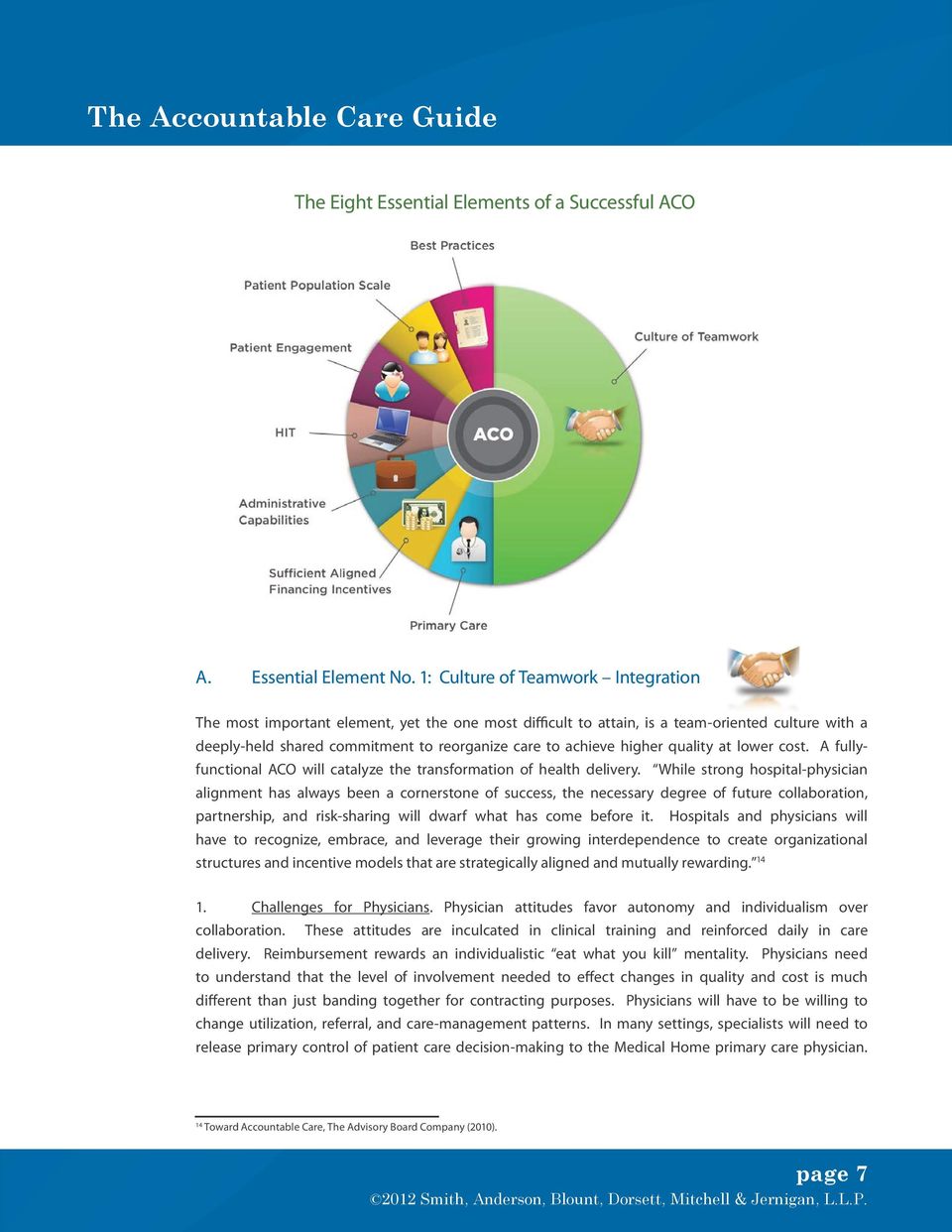
13 The Eight Essential Elements of a Successful ACO A. Essential Element No. 1: Culture of Teamwork Integration The most important element, yet the one most difficult to attain, is a team-oriented culture with a deeply-held shared commitment to reorganize care to achieve higher quality at lower cost. A fullyfunctional ACO will catalyze the transformation of health delivery. While strong hospital-physician alignment has always been a cornerstone of success, the necessary degree of future collaboration, partnership, and risk-sharing will dwarf what has come before it. Hospitals and physicians will have to recognize, embrace, and leverage their growing interdependence to create organizational structures and incentive models that are strategically aligned and mutually rewarding Challenges for Physicians. Physician attitudes favor autonomy and individualism over collaboration. These attitudes are inculcated in clinical training and reinforced daily in care delivery. Reimbursement rewards an individualistic eat what you kill mentality. Physicians need to understand that the level of involvement needed to effect changes in quality and cost is much different than just banding together for contracting purposes. Physicians will have to be willing to change utilization, referral, and care-management patterns. In many settings, specialists will need to release primary control of patient care decision-making to the Medical Home primary care physician. 14 Toward Accountable Care, The Advisory Board Company (2010). page 7
14 Physicians are justifiably cynical about prior next best things, such as HMOs, gate-keeping, and capitation, and have little experience with, or time for, organizational-level strategic planning. But, [I]f providers do not change their decision-making and behavior, ACOs will go the way of most PHOs and IPAs to the bone yard. More importantly, the healthcare crisis will persist, and more drastic solutions will be mandated Challenges for Hospitals. Will hospitals be willing to embrace a true ACO structure, which will likely drive down hospitalization? Will they be willing to distribute shared savings as intended, to incentivize and reward those who created it through high-performance care delivery and improved coordination, or will they try to take any savings dollars off the top to make up for the lost revenue from the reduction in avoidable hospitalizations and readmissions? Will the increased market share from joining an ACO make up for the lost revenue? Exacerbating these business risks for sharing governance with physicians and committing without reservation to an orientation of higher quality and lower costs, is a deeper cultural barrier: control. Hospitals are complex organizations, and a degree of control over operations and direction has been historically important for their viability. The most significant challenge of becoming accountable is not forming an organization, it is forging one. 16 Strategic Note: Tips on How to Create a Collaborative Culture: Champions. Vision comes first, but to sell that vision, you need physician leaders able to articulate a clear and compelling vision of change. They need to be champions of the transformational changes needed. As few as one, and rarely more than five, are needed. If a hospital is involved, the CEO needs to show commitment to the shared vision. Governance Structure. The structure must have meaningful input from the various parties to have status and credibility. It must exhibit shared control. Management teams can be pairings of physicians with hospital administrators. As noted, shared governance is such a point of emphasis that the Final Rule includes that phrase in the definition of Accountable Care Organization. 17 Incentives Drive Alignment. [I]f incentives are correctly aligned, organic innovations to solve other problems can and will engage. Anticipated early versions of ACO payment incentives are likely to be directionally correct but unlikely to be sufficient to create the needed burning platform. 18 Compensation plans for hospital-employed physicians must not be limited to individual productivity, but also have incentives for accountability for success of the ACO team. 15 Phillip L. Roning, Becoming Accountable, HFMA Compendium Contemplating the ACO Opportunity, Appendix (November 2010), p Id Fed. Reg Ann Robinow, Accountable Care News, The Top 3 Obstacles to ACO Implementation, (December 2010). page 8

15 Spiral of Success. The following strategy could help meld team culture: An early pilot project for your ACO should be consistent with the new vision, led by champions and cut across specialty and department lines. A multi-disciplinary team decides how to collect and share data in new ways to facilitate this care initiative. The data, in paper or electronic format, is available at the point of care. Quality goes up and there is a savings pool. New team habits begin to emerge. Small scale is OK, but it must succeed, so the spiral of success can start. Trust goes up and buy-in for the next collaboration will occur more quickly. Employment Not a Panacea. Isn t the most obvious path to integration through hospital employment? This is a feasible approach if the parties have worked together in the past and there is a pre-existing level of trust and respect. This will not work if there are not shared goals and the control and financial incentive issues are not resolved. Current trends in physician employment represent neither a necessary nor sufficient condition for true integration; value-added integration does not necessarily require large-scale physician employment and simply signing contracts does not ensure progress toward more effective care coordination. 19 B. Essential Element No. 2: Primary Care Physicians 1. What Is the Role of Primary Care In ACOs? As discussed in detail in Section V.G. below, the highest-impact targets identified for ACOs lie in the following areas: (a) prevention and wellness; (b) chronic disease management; (c) reduced hospitalizations; (d) improved care transitions across the current fragmented system; and (e) multi-specialty co-management of complex patients. Primary care can be drivers in all of these categories. Harold Miller of the Center for Healthcare Quality and Payment Reform concluded, it seems clear that, in order to be accountable for the health and healthcare of a broad population of patients, an Accountable Care Organization must have one or more primary care practices playing a central role. 20 He envisions different levels of ACOs, with the core Level One consisting primarily of primary care practices. Level Two would include select specialists and potentially hospitals. As the diverse patient populations are included, Level Three expands to more specialists and facilities, and Level Four includes public health and community social services. As noted, primary care is the only provider or health care facility mandated for inclusion to qualify for PPACA s ACO Shared Savings Program. 19 Toward Accountable Care, The Advisory Board Company (2010). 20 Harold D. Miller, How to Create Accountable Care Organizations, Center for Healthcare Quality and Payment Reform, p. 8, (September 2009). page 9

16 2. What Are the Roles of Specialists In ACOs? It is becoming clear that specialists are going to serve important roles in ACOs. Given the opportunities for ACOs listed in Section V.B.1. above, specialists should see roles in Medical Home coordination on diagnosis and treatment, transitions across settings, reducing avoidable hospitalizations, and in multi-specialty complex patient management. Inpatient specialists can tackle hospital through-put, minimizing avoidable adverse events and readmissions, and quality improvements. Specialists intent on preserving volume at the expense of best practices have no role in an ACO. 3. What Are the Roles of Hospitals In ACOs? Hospitals are logical ACO partners for several reasons: Patients will need hospitalization, hospitals have extensive administrative and HIT infrastructure, ACOs are consistent with their missions, and hospitals are often a medical community s natural organizational hub. But the typical ACOs tend to reduce hospitalizations. As Mr. Miller observes, the interests of primary care physicians and hospitals in many communities will not only be unaligned, but will be in opposition to one another. 21 A litmus test for hospital membership (or whether to join an ACO that includes a hospital) is whether it is committed to overall increased savings, improved quality, and improved patient satisfaction for patient populations, even if hospitalization rates are reduced. It is also unacceptable if a hospital permanently seeks to capture most of the shared savings off the top to make up for lost revenue. A hospital at over-capacity should not have this conflict. Moreover, many hospitals see full institutional commitment to accountable care as the best way to prepare for the future, maximize their fair share of the shared savings dollar, and grow market share. Once the tipping point of the shift from payment for volume to payment for value has been reached, these conflicts should dissolve. In summary, because primary care will drive so many of an ACO s most high-yielding initiatives, it is an essential element of a lasting and successful ACO. Accountable care absolutely must be about improving and maintaining the health of a population of patients and not just controlling costs. It must be about proactive and preventive care and not reactive care. It must be about outcomes and not volume or processes. It must be about leveraging the value of primary care and the elements of the Patient-Centered Medical Home Id., p Terry McGeeney, M.D., The Patient-Centered Medical Home and the Accountable Care Organization, (2010). page 10
17 C. Essential Element No. 3: Adequate Administrative Capabilities What Kind of Organization Can Be an ACO? The very label accountable care organization tends to convey an impression that an ACO must be a particular type of organization. In retrospect, it probably should have been called Accountable Care System. It is about function, not form. The NCQA s ACO criteria look to core competencies and infrastructure to implement them, but are agnostic to organizational structure (i.e., whether or not it is led by a multi-specialty group, hospital, or independent practice association). 23 Similarly, a wide array of organizations may become eligible for CMS Shared Savings Program under PPACA and the Final Rule: 24 group practice arrangements, networks of practices, joint ventures between providers and hospitals, hospitals employing providers, and other approved structures. There are three essential infrastructure functional capabilities: (1) performance measurement, (2) financial administration, and (3) clinical direction. A legal entity of some sort is necessary, and a number of choices are available. The form ultimately chosen should be driven by what most readily facilitates achievement of the functional needs of the ACO initiatives in your community. The ultimate goals of accountable care are to improve patient outcomes and patient satisfaction while also achieving greater cost efficiencies. The key to achieving this goal is enhanced coordination of care among diverse providers through the application of evidence-based clinical protocols and transparent measurement and reporting. While ACO formation and ongoing structural, operational, and legal issues related to ACOs are important, it is this transformation in clinical care that must remain the overriding focus of ACO development. 25 What Are Key Legal Issues Affecting ACOs? ACOs require collaboration, referrals, reductions in unnecessary care, and sharing of revenues among sometime competitors. All of these characteristics, and more, in furtherance of health policy, also happen to raise a number of challenging legal-compliance issues for a body of state and federal health care law largely premised upon the fee-for-service model. Adaptations of the most problematic laws and regulations are underway. On October 20, 2011, the Departments of Health and Human Services, Treasury, and Justice, and the Federal Trade Commission jointly released federal policies concerning implementing the MSSP in order to provide guidance. A properly configured ACO should be successful in navigating this legal minefield. The principal bodies of law affecting ACOs are: Antitrust Anti-kickback Stark Civil Monetary Penalties Law 23 NCQA, pp Fed. Reg Doug Hastings, Accountable Care News (December 2010), p. 6. page 11

18 Tax HIPAA Malpractice Corporate Practice of Medicine Insurance Intellectual Property State Self-Referral Laws Business Law For a complimentary, detailed analysis, please contact Julian ( Bo ) Bobbitt at [email protected], and ask for a copy of ACOs: Navigating the Legal Minefield. Possible Organizational Forms 1. Network Model a. Independent Practice Associations ( IPAs ) An IPA is basically an umbrella legal entity, usually an LLC, for-profit corporation or nonprofit organization, with physician participation contracts with hospital-employed and independent physician practices. Payors contract with the IPA. These structures became familiar in the fee-for-service and capitation eras, and the form is still suitable for the accountable care era. However, the IPA now needs to have ACO-level infrastructure as described in this Guide. It is particularly dependent on robust health information exchange, as the continuum of care is more virtual because the providers are independent. The page 12
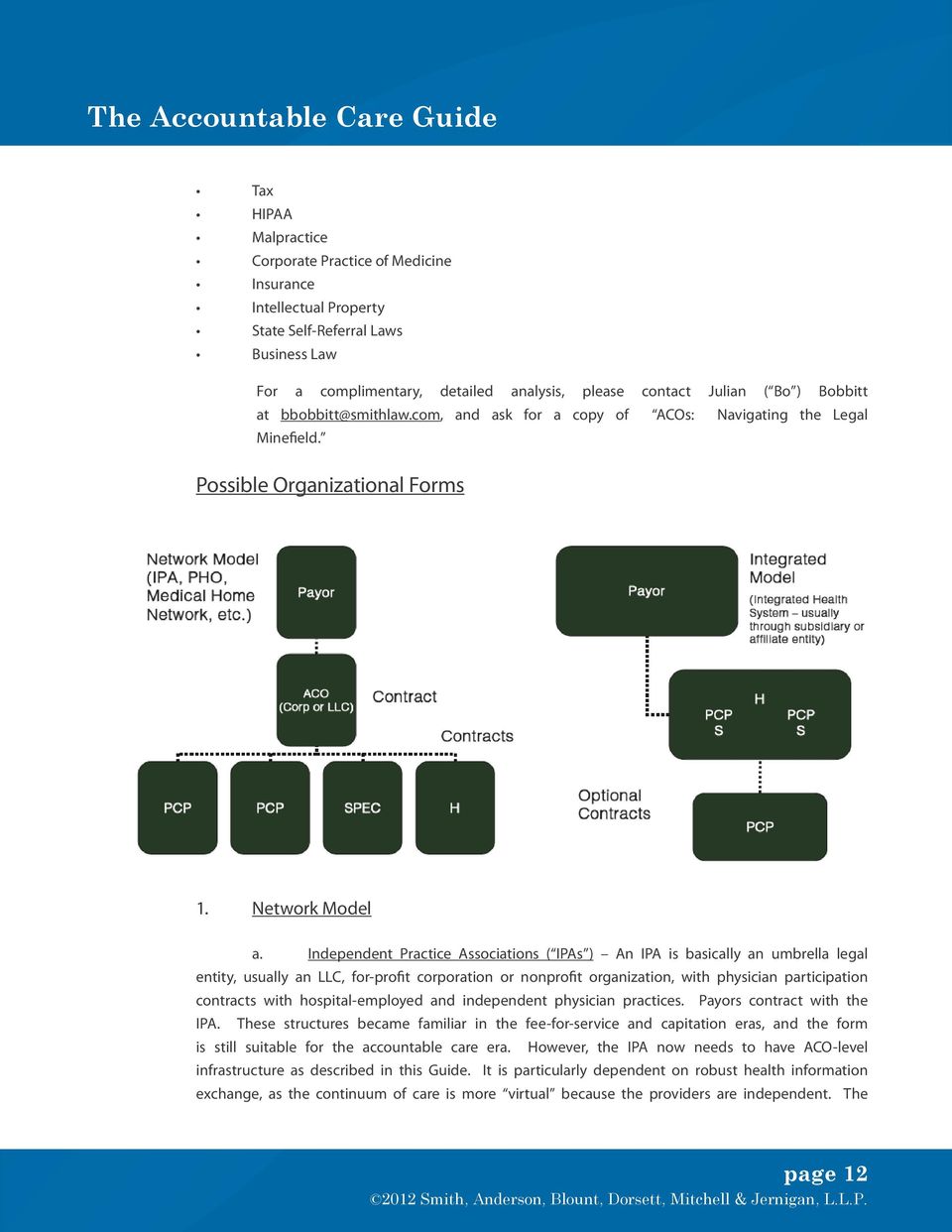
19 participation agreements are different, too. The provider agrees to undertake the responsibilities agreed upon by the ACO and accept some type of performance-based incentive, like shared savings, in addition to fee-for-service. It can have any combination of specialists, primary care, hospital, and tertiary care participating contracts. An IPA is owned by physicians. Legal issues of note in IPAs involve antitrust, self-referral, insurance regulation, HIPAA, malpractice, and the Stark law. b. Physician/Hospital Organization ( PHO ) The PHO is very similar to an IPA, but the main difference is that it is co-owned and governed by physicians and a hospital or health system and includes a hospital participation contract. The same requirements and caveats apply. c. Medical Home-Centric Model Under this variation, an umbrella entity is owned by Medical Home practice members or networks. It contracts with payors, initially for the medicalhome-related primary care services, but includes accountable care financial arrangements and performance measurement capabilities. It broadens the scope of initiatives and patient populations by adding select specialists and hospitals through contractual arrangements. These may be sub- ACO arrangements whereby the contract is with a PHO or hospital ACO. The same requirements and caveats of the other Network Model forms apply. Community Care of North Carolina is an example of a statewide confederation of 14 Medical Home-Centric Networks. 2. Integrated ACO Structure With this variation, the hospital, health system, foundation, or multi-specialty clinic employs, rather than contracts with, the physician. It may own, capitalize, and control the ACO, with physicians on advisory committees. The HIT and other infrastructure is within the controlling entity. It may have contracts with independent providers and facilities if necessary to round out the breadth, depth, and reach of services needed to accomplish its initiatives. D. Essential Element No. 4: Adequate Financial Incentives 1. Isn t This the Same As Insurance? No. An insurance company assumes the financial risk of whether a person gets ill or has an accident requiring medical care. Accountable care risk is accountability for higher performance treatment of patients once they become ill. This gets fuzzy when one remembers that the ACO will be responsible for an entire patient population, especially as it assumes more risk, as in full capitation. However, this distinction is why the ACO performance expectations need to be severity-adjusted. 2. What Are the Types of Financial Incentive Models for ACOs? There are three tiers: upside-bonus-only shared savings; a hybrid of limited-upside and limiteddownside shared savings and penalty; and full-upside and full-downside capitation. page 13

20 Fee for Shared Savings Shared Savings Capitation Service + Penalty Low Risk High Risk a. Shared Savings If quality and patient satisfaction are enhanced or maintained and there are savings relative to the predicted costs for the assigned patient population, then a portion (commonly 50% according to some surveys and the MSSP Final Rule) of those savings is shared with the ACO. This is stacked on top of the provider s fee-for-service payments. To maximize incentivization, the savings pool should be divided in proportion to the level of contribution of each ACO participant. This aligns incentives of all ACO participants to keep patients as well as possible, and if ill, to receive optimum care in a team environment across the care continuum. If primary care has especially high medical home management responsibility, this may be accompanied by the addition of a flat per member/per month payment. Some of the savings pool distributions should be used to maintain the ACO infrastructure, but as much as possible should go to reward providers and facilities for the extra time and attention devoted to patient management and technology investments. As mentioned, it should not go to pay affected physicians or hospitals for reduced revenues under fee-for-service for reductions in volume. A strength of this model is that it is easy to understand and transition to, since it builds upon the familiar fee-for-service system. That is also its weakness, since fee-for-service still rewards volume, not value. This shared savings model has been criticized as being asymmetric or one-sided, with no consequence if there are higher costs or no care improvement. Another problem is that there is by necessity a lag time to measure the delta, or the difference between the actual costs and the expected costs, so the ACO is uncertain whether there will be revenues. The delay saps the incentivization to adhere to the ACO s best practices and coordination. page 14

21 The Shared Savings Model *Courtesy of the Brookings Institution Strategic Note 1: How to Calculate Shared Savings. Although the concept is simple the ACO gets 50% of the difference between what the costs for the population turned out to be versus what the costs would have been if the ACO were not in place DO NOT try to do this by comparing your population costs year-to-year. It might work the first year, but will be inappropriate after that. Having to beat your performance from the prior year, every year, is like calling an Olympic medalist a failure if she does not break her world record the next time out. In some CMS demonstration projects, relatively unmanaged counties in other parts of the country were picked as the control populations. Another way that works is to use an actuary that can predict the medical costs for your region or comparable community and use that actuarially valid projected amount as your unmanaged comparable. A variation of this latter approach has been chosen by CMS for calculation of the MSSP savings. 26 Strategic Note 2: Be Patient Before Taking on Risk. Do not repeat the disaster of the 90s, when providers took on risk without proper technology, infrastructure, best practices, or experience. We recommend that you come within 5% ± of your predicted costs for three consecutive years before leaving the shared-savings upside-only model. You may have unexpected costs over which you have no control. You will likely want to improve your Health Information Exchange, include relevant data elements, and see which of your ACO providers get it. In our experience, fears are overblown that lack of downside risk will deter performance improvement. To the contrary, a meaningful bonus payment is very motivating, as much as a recognition of and respect for the clinical leadership of the physicians as it is for the benefit of dollars involved. Individual distributions that differ based on performance determined by peers is also a grade that high-achieving individuals work hard to earn Fed. Reg page 15
22 b. Savings Bonus Plus Penalty As with the shared savings model, providers receive shared savings for managing costs and hitting quality and satisfaction benchmarks, but also will be liable for expenses that exceed spending targets. This model is called symmetric or twosided and the bonus potential is increased to balance the accountability for exceeding pre-set goals. Fee-for-service is retained. This resembles the two-sided model mentioned in the Final Rule. 27 c. Capitation A range of partial capitation and full capitation models are possible. Fee-for-service payments are replaced by flat payments plus potential bonuses and penalties. Only seasoned and truly clinically integrated ACOs should attempt this level of risk. Yes, the upside is higher, but the disasters of the 90s should not be forgotten. 3. Is This the Same as Bundled Payment or Episode of Care Payment? ACO incentives can be aligned with these and other payment experiments under consideration. An episode of care is a single amount to cover all the services provided to a patient during a single episode of care. When that episode payment covers providers who would have been paid separately under fee-for-service, that is a bundled payment. Such a payment mechanism that excludes payment for treatment of avoidable readmission or hospital-acquired infections motivates better care. These approaches do not incentivize prevention and medical-home coordination to avoid the episode in the first place. 4. Meaningful Use Regulations Incentives. We include the Meaningful Use payments as an ACO financial incentive because the basic Health Information Exchange within your ACO will likely qualify the ACO s providers for the Phase Two and Phase Three Meaningful Use incentives. 28 If your ACO can go ahead and establish its data flow needs relatively soon as outlined in this ACO Guide, you stand a good chance that the federal government will help finance the ACO s HIT needs. See Section V.E. below for more detail Fed. Reg Fed. Reg (July 28, 2010). page 16

23 E. Essential Element No. 5: Health Information Technology and Data 1. What Data? ACO data is usually a combination of quality, efficiency, and patientsatisfaction measures. It will usually have outcomes and process measures. Nationally-accepted benchmarks are emerging. There are three categories of data needs for an ACO: a. Baseline Data This is often overlooked. To compare anything, there needs to be a beginning reference point. Can you collect costs and quality data? Who owns it now? Who collects it? Do you trust them to be accurate and objective? Use it to preform a gap analysis : Where are your local quality and cost numbers outliers to the ideal? This tells you where your lowhanging fruit may be. Match those outlier opportunity areas with the particular strengths of the provider array of your ACO and you have your prioritized initiatives or targets. b. Performance Data In the value-based reimbursement era, it will not be enough to provide exceptional cost-effective care; you must prove it. A practical way to determine your ACO s needed performance data is to start by selecting the ACO s targeted initiative as mentioned above. Then select from emerging nationally recognized quality and efficiency metrics, if they apply. Even if they do apply, convene a multi-specialty committee of clinicians to vet their clinical validity. This committee will recommend performance benchmarks from scratch if national standards are not yet available for all of the care pathways of your initiative. They should address quality, patient satisfaction, and efficiency. They need to be severity-adjusted. Obviously, if and when a third-party payor, including CMS, sets the performance benchmarks, they should be part of the performance array. Many payors want to allow local flexibility and clinical leadership in metric-setting. page 17
24 Who collects the data? Are there variables outside of your control affecting your performance scores (i.e., patient non-compliance)? What financial incentives/penalties are tied to each? c. Data As a Clinical Tool Once the ACO targeted care initiatives are selected, the best practices across the care continuum will be determined. The appropriate ACO committee will then usually blow up each pathway into each component and assign clinical leadership, decision support, data prompts, and embed relevant clinical data into each step at the point-of-care. ACOs are discussing virtual workstations and data dashboards. Coordination with downstream providers will be optimized with the real-time sharing of upstream care results and scheduling. Strategic Notes: (1) The ACO should periodically internally grade itself against the performance benchmarks to create a constant quality/efficiency/satisfaction improvement loop. This not only will hone the contributions of the ACO initiatives, but also will prepare it to increase its financial rewards once the performance results drive a savings pool or bundled payments. Gaps in care should be flagged and addressed before your compensation depends on it. Clearly, clinically valid, accurately collected, severity-adjusted, and properly benchmarked data are essential for any compensation model based on performance. (2) Data that reflects a track record of high performance serves as a bargaining tool when reimbursement is being negotiated, even in feefor-service. (3) Use data first to target the low-hanging fruit, high-impact, value-add initiatives in your area best suited to your specialty or facility. Next, use data to collect evidence of your performance. There will be specific baseline, performance, and clinical data elements needed for each participant to meet objectives, maximize their measured contribution, and thus reap a meaningful reward from the savings pool. d. The MSSP Final Rule Provides Details Down from 65 in the Proposed Rule, the Final Rule requires reporting on 33 measures across your domains: patient/caregiver experience; care coordination; patient safety; preventative health; and at-risk population/frail elderly health. The goals of measure setting include seeking a mix of standards, processes, outcomes, and patient experience measures, severity adjusted and, to the extent practicable, nationally endorsed by a stakeholder organization. e. HIE Capability Your ACO will need Health Information Exchange ( HIE ) capabilities sufficient to move this data across the continuum in a meaningful way. This HIE is aligned with the Meaningful Use regulations. It will need to be able to aggregate data from multiple sources into userfriendly formats with decision support and relevant data that follows the patient to maximize chances of success in the ACO s targeted initiatives. It needs to minimize the data collection burden on workflows. page 18
25 F. Essential Element No. 6: Best Practices Across the Continuum of Care Another essential element of a successful ACO is the ability to translate evidence-based medical principles into actionable best practices across the continuum of care for the selected targeted initiative or initiatives. An ACO may start out with a single patient population (i.e., morbidly obese patients) or disease-state (i.e., diabetes). The five identified high-impact target areas for ACO initiatives are: Prevention and wellness; Chronic disease (75% of all U.S. health care spending, much of it preventable); Reduced hospitalizations; Care transitions (across our fragmented system); and Multi-specialty care coordination of complex patients. The best bet for achieving returns from integration is to prioritize initiatives specifically targeting waste and inefficiency caused by fragmentation in today s delivery system, unnecessary spending relating to substandard clinical coordination, aggravated with the complexity of navigating episodes of care, and unwanted variations in clinical outcomes driven by lack of adherence to best clinical practice. 29 As discussed earlier in Section V.B., the richest target fields from this array will vary by specialty and type of facility. Looking at these suggested initiatives, it is no wonder why primary care is emphasized as key for ACOs, since they could play a significant role in every area. The ACO should match its strengths against the gaps in care in the ACO s market to find the proverbial lowhanging fruit. G. Essential Element No. 7: Patient Engagement Patient engagement is another essential element. Without it, an ACO will not fully meet its potential. Unfortunately, many of today s health care consumers erroneously believe that more is better, especially when they are not paying for it, insurance is. Patient noncompliance is a problem, especially regarding chronic diseases and lifestyle management. It is difficult to accept a compensation model based on input on improved patient population health when that is dramatically affected by a variable outside of your control, patient adherence. Currently, asking a patient to be a steward of his or her own care puts a fee-for-service payor at a competitive disadvantage. But patient engagement is part of patient-centeredness, which is required by PPACA for an ACO to qualify for CMS Shared Savings Program Toward Accountable Care, The Advisory Board Company (2010) 30 Section 3022 of the Patient Protection and Affordable Care Act of 2010 (42 U.S.C. 1395, et seq.). See also 76 Fed. Reg page 19
26 What Can an ACO Do to Engage Patients? Better information at a societal level and also at the medical home point of care. The Patient Compact Some ACOs, such as the Geisinger Clinic, engage the patient through a compact, or agreement. It may involve a written commitment by the patient to be responsible for his or her own wellness or chronic care management, coupled with rewards for so doing, education, tools, self-care modules, and shared decision-making empowerment. The providers will need to embrace the importance of patient involvement and hold up their end of the engagement bargain. Benefit Differentials for Lifestyle Choices The financial impact of many volitional patient lifestyle choices is actuarially measurable. A logical consequence of the patient choice could be a benefit or financial differential reflecting at least partially these avoidable health care costs. H. Essential Element No. 8: Scale-Sufficient Patient Population It is OK, even desirable, to start small; to walk before you run, so to speak. However, it is often overlooked that there needs to be a minimal critical mass of patients to justify the time and infrastructure investment for the ACO. PPACA s Shared Savings Program requires that the ACO have a minimum of 5,000 beneficiaries assigned to it. Strategic Note: Some ACOs commence activities through a single pilot, or demonstration project, without a sustainable patient population scale. It can de-bug the initiative and test-run the ACO early enough to fix problems before ramping up. This must succeed, however. If it does, it will be much easier for the ACO champions to gain buy-in from others. page 20
27 The elements do come together and mesh. Culture dominates. Each one can be built. These are not mysterious. They are doable. It will be hard. Once the ACO organizers embrace the opportunity in this change, achieving all of the elements for sustainable success is quite feasible. In addition, if you are evaluating a previously organized ACO, there are clear indicators regarding these essential elements that will predict reliably its likelihood of success. page 21
28 VI. SUCCESSFUL IMPLEMENTATION A STEP-BY-STEP GUIDE A. Where Do I Start? OK, you now may be saying: I know what an ACO is, why it is important, and how to identify ones that will succeed. However, how do I build one? Where do I start? I know where I need to go now, but how do I get there? The creation of an ACO follows basic business planning and start-up principles. Expert advice on ACO development is uniform. The following is a step-by-step guide to building an ACO. B. Step-By-Step Guide 1. Informed Champions Perhaps even ahead of this first step may be that there needs to be some ACO information available to plant the seed of awareness with a few local champions. These champions, whether hospital CEO, family physician, or neurosurgeon, will need to invest their sweat equity to get up to speed (the main purpose of this ACO Guide). The champions need to reach beyond silos and see whether cultural compatibility is possible. page 22
29 2. Strategy Formulation/Gap Analysis Next, a small core group should honestly assess where they are and where they need to go. What is the target market (i.e., chronic disease, Medicaid, the elderly)? Does an ACO make sense? What do we target? How do we make sure this is fair and successful so that we get buy-in? Some experts recommend a phased approach starting with primary care, then adding select specialists and hospitals around targeted high-impact initiatives, then a comprehensive panel, and then, finally, including public health and social services. Other experts recommend matching the natural strengths of the ACO with the greatest gaps in care for the local area. Then they would have the ACO model a strategic business case, to create a roadmap to development. How will it achieve all of the 8 Essential Elements? Keep the team very small at this stage. 3. Clear Vision The organizing group needs to have credibility and will need to unite around a clear and compelling shared vision. 4. Clinical Integration Through shared decision-making and champion leadership, build capabilities of a clinically integrated organization. Review the plan for presence of the 8 Essential Elements listed in Chapter V. The TACC is creating specialty-specific strategic toolkits to assist each specialty in building in capabilities and programs to optimize that specialty s contribution to, and thus reward from, an ACO. Please see Part Two, Section II, for the completed toolkits. If yours is not present, please contact Melanie Phelps at [email protected] to see how you and your specialty society can partner with the TACC to develop a state-of-the-art toolkit. a. Start with your initial targeted initiatives. b. From them, establish best practices for the continuum of care for all providers involved with that type of patient. c. Blow up the best practices into component parts and assign clinical leadership responsibility for each. d. Identify which clinical data sets and decision support tools are needed at each step. e. Assign performance metrics and financial accountability for same. f. Determine HIT technical requirements. g. Determine best financial tools to incentivize desired behavior by all involved (i.e., share savings with predetermined performance benchmarks and distribution methodology). The TACC has engaged the law firm of Smith Anderson Blount Dorsett Mitchell & Jernigan, LLP and the health care valuation firm of HORNE, LLP to develop a multi-based shared savings distribution model for use by ACOs with multiple specialties. It will be made available by the TACC. page 23
30 5. Structural Foundation Choose the legal entity approach and formal governance structure most appropriate to your culture and business plan. It must be driven by the form most likely for the success of the ACO, not controlled by success for any particular stakeholder. Establish membership criteria and a shared decision-making structure. Design and undertake training. Develop payor strategy and contract terms. Do ROI predictive modeling to estimate savings and quality benefits. Create credible value talking points for all stakeholders. If you choose to participate in the Medicare Shared Savings Program, make sure you meet all the structural requirements, which are not onerous. 6. Expand Buy-In Broaden structured involvement. Create a multi-disciplinary integration committee with HIT, best practices, patient engagement, and finance subcommittees. 7 Accountability Function Develop data metrics, measurement capability, and sophisticated financial administration capabilities to manage financial shared savings distribution. Set performance targets. Normalize data. Make sure your performance-based incentives target your ACO objectives. 8. Start Small Start with a demonstration or pilot project. 9. Contract with Payors Once ready, contract to provide integrated accountable care services on a shared savings basis, at least initially, for your target patient population. The patient population scale must be adequate to achieve economies of scale. Consider a Medicare ACO starting in January of 2014 as part of a broader strategy. (See Part Two for a blueprint on applying to the Medicare ACO and Medicare ACO Advance Payment Model programs. 10. Assess and Improve Assess results of the process. Make adaptations to create a constant quality improvement ( CQI ) loop. Collect and distribute the savings pool roughly in proportion to contributions to it. VII. CONCLUSION The Accountable Care Organization holds great promise to address many of the ills of America s health care system. However, it will require new skill-sets, collaboration partners, technology, and systems. It will require a radically different approach to shared accountability. It is the goal of this ACO Guide to demystify ACOs for all stakeholders and to provide some tools and confidence to allow health care leaders to take prudent risks for greater success than they otherwise would have. For more information on any aspect of this ACO Guide, please contact Julian ( Bo ) Bobbitt at either or [email protected]. ( page 24
31 Part Two: Executing the Accountable Care Strategic Plan page 25
32 I. General Strategies for All Specialties A. Strategy Number 1: How to Successfully Navigate the Medicare MSSP and Advance Payment Model Application Process America s largest payor, Medicare, has committed to the ACO model, with a minimum of 50% sharing of savings to ACO providers on top of fee-for-service payments. It may be totally or partially physician-driven, and only primary care physicians are required. To promote physician-only ACOs in non-metropolitan areas, CMS will prefund them through the Advance Payment Model. This level of sustainable funding through ongoing shared savings distributions can pay for your ACO operations that can in turn be used for Medicaid, private payor, or other patient population engagements. The applications are consistent with the principles and strategies of this Physicians ACO Toolkit, and it is a useful reference to assist in responding to substantive portions of the applications. To review, CMS established the Medicare Shared Savings Program (the MSSP ) to facilitate coordination and cooperation among health care providers through ACOs to improve the quality of care for Medicare beneficiaries, while reducing unnecessary costs. In addition, the PPACA established a new Center for Medicare and Medicaid Innovations (the Innovation Center ) to test innovative care and service delivery models, including the Advance Payment Model. This Chapter will assist ACOs in navigating the MSSP and Advance Payment Model application process. 1. MSSP APPLICATION Applying to the MSSP requires ACOs to submit a significant amount of information. As a result, organization, information gathering, and timing will all be critical for ACOs wishing to participate. The application process can be broken down into the following seven tasks: (a) identify timelines and deadlines; (b) creation and formation of the ACO; (c) file Notice of Intent to Apply; (d) obtain CMS User ID; (e) prepare and execute participation agreements; (f) prepare application; and (g) file application with CMS. a. Timelines and Deadlines Due to the sheer volume of information that must be submitted with the MSSP application, ACOs should begin the application process at least three months in advance. At the outset, ACOs interested in applying should review CMS s MSSP website, Payment/sharedsavingsprogram/index.html, and identify all relevant deadlines. The ACO should then create a task checklist to ensure that all documents, forms, and applications are timely filed. The list of tasks set forth below may serve as a useful template in creating such a checklist. page 26
33 b. Creation and Formation of the ACO ACOs applying to the MSSP must ensure that they are properly organized or incorporated under applicable state laws. Newly formed ACOs will need to file Articles of Organization or Articles of Incorporation with the applicable Secretary of State. Newly formed ACOs will also need an Employer Identification Number from the IRS, which may be obtained online at individual/index.jsp. The ACO must also have an identifiable governing body, such as a board of directors, with responsibility for oversight and strategic direction of the ACO. The ACO must ensure that its participants have at least 75% control of the governing body, and at least one member of the governing body must be a Medicare beneficiary. In addition, the governing body must have a conflict of interest policy that: (a) requires each member of the governing body to disclose relevant financial interests; (b) provides a procedure to determine whether a conflict of interest exists, and sets forth a process to address any conflicts that arise; and (c) addresses remedial action for members of the governing body that fail to comply with the policy. Finally, the ACO must appoint officers with leadership and oversight responsibility for the ACO. At a minimum, such officers must include an executive officer, a medical director, and a compliance officer. The executive officer (such as a president, CEO, or executive director) must have leadership responsibility for the ACO, including the ability to influence or direct the ACO s clinical practices to improve efficiency, processes, and outcomes. The medical director must oversee the clinical management of the ACO. The compliance officer must be responsible for addressing compliance issues related to the ACO s operations and performance. The ACO will need to appoint all such officers prior to applying for the MSSP. c. Notice of Intent to Apply Before applying to the MSSP and Advance Payment Model, ACOs must file a Notice of Intent to Apply ( NOI ) with CMS. ACOs should be aware that the filing deadline for the NOI will be approximately three months prior to the filing deadline for the MSSP application. While all ACOs that wish to apply to the MSSP must file the NOI, filing the NOI does not obligate the ACO to complete the application process. Thus, ACOs that are even remotely interested in the MSSP should submit a Notice of Intent to Apply to preserve the opportunity to later submit the MSSP application. page 27
34 d. CMS User ID CMS currently requires all interested ACOs to file the MSSP application online using CMS s secure web portal, the Health Plan Management System ( HPMS ); CMS will not accept paper applications. In order to use HPMS, the ACO must obtain a user ID and password using the CMS Form Application for Access to CMS Computer Systems, available at: Systems/CMS-Information-Technology/InformationSecurity/Downloads/EUAaccessform.pdf. After the ACO files the NOI, the ACO will receive an from CMS with instructions for completing the Form 20037, along with the deadline for filing the Form The individual who will be preparing the MSSP application for the ACO should file the Form e. Participation Agreement ACOs applying to the MSSP must have participation agreements with their participating providers. At a minimum, the participation agreement must include: (a) an explicit requirement that the ACO participant will comply with the requirements and conditions of the MSSP; (b) a description of the ACO participants rights and obligations in and representation by the ACO; (c) a description of how the opportunity for shared savings or other financial arrangements will encourage ACO participants to adhere to the ACO s quality assurance and improvement program and evidence-based clinical guidelines; and (d) remedial measures that will apply to ACO participants in the event of non-compliance with the requirements of their agreements with the ACO. The ACO will need to submit its signed participation agreements with each of its participants when it applies to the MSSP. As a result, ACOs will need to prepare their participation agreements well in advance of the application filing deadline and ensure adequate time to collect signed copies from participants. f. Preparing the Application As noted above, CMS now requires ACOs to file the MSSP application online using HPMS. Before completing the application online, however, ACOs should prepare all application materials in advance to ensure a smooth online application process. The ACO should first download and review the MSSP application template from the MSSP website. The ACO should use this document to assist in collecting and organizing contact information and other background information from ACO participants. The ACO will also need to prepare a list of its participants, including the taxpayer identification number for each ACO participant. In order to avoid delays in the application process, the ACO will need to confirm that each participant s name and taxpayer identification number listed in the MSSP application match exactly what is listed in the Medicare Provider Enrollment, Chain, and Ownership System (PECOS) for such participants. In addition, the ACO will need to prepare an organizational chart that includes the names of the ACO participants, governing board members, committees and committee members, and officers. page 28
35 A significant portion of the MSSP application consists of certain narrative responses that must be completed by the ACO. These narratives include descriptions of: (a) the ACO s history, mission, and organization; (b) how the ACO plans to use shared savings payments; (c) how the ACO will use and protect Medicare data; (d) how the ACO will require its participants to comply with and implement its quality assurance and improvement program; (e) how the ACO defines, establishes, implements, evaluates, and periodically updates its process to promote evidence-based medicine; (f) how the ACO defines, establishes, implements, evaluates, and periodically updates its process to promote patient engagement; (g) how the ACO defines, establishes, implements, evaluates, and periodically updates its process and infrastructure to support internal reporting on quality and cost metrics; and (h) how the ACO defines, establishes, implements, evaluates, and periodically updates its care coordination processes. The ACO will need to carefully review the required elements of each narrative listed in the MSSP application and ensure that each element is discussed in detail; failure to address each required element may result in delay (or rejection) of the ACO s application. As mentioned, this Physicians ACO Toolkit may be a useful aid in preparing this part of the application. Assuming that the ACO has gathered all required information in advance, the process of filing the MSSP application through HPMS should be fairly straightforward. The ACO will first need to submit contact information for the ACO and complete certain attestations to ensure that the ACO meets all applicable requirements of the MSSP. The ACO will then submit supporting documentation (including the organizational chart, executed agreements, narratives, and other documentation described above). Prior to uploading this documentation, the ACO will need to review the MSSP application reference table for instructions regarding file names and other HPMS uploading requirements, which is available at: MSSP-Reference-Table.pdf. Finally, the ACO will need to complete the CMS Form 588 Electronic Funds Transfer Authorization Agreement. This agreement, along with a voided check, must be sent to CMS using tracked mail, such as certified mail, Federal Express, or United Parcel Service. The CMS Form 588 is available at: www. cms.gov/medicare/cms-forms/cms-forms/downloads/cms588.pdf. 2. ADVANCE PAYMENT MODEL APPLICATION In addition to the MSSP application, ACOs that wish to receive advance funding from the Innovation Center must also complete the Advance Payment Model application. The Advance Payment Model is open to only two types of ACOs: (a) ACOs that do not include any inpatient facilities and that have less than $50 million in total annual revenue; and (b) ACOs in which the only inpatient facilities are critical access hospitals and/or Medicare low-volume rural hospitals and that have less than $80 million in total annual revenue. ACOs that are co-owned with a health plan will be ineligible, regardless of whether they also fall into one of the above categories. First, the ACO should review the Advance Payment Model application template, which is available page 29
36 at: This document will assist the ACO in gathering the necessary information for the Advance Payment Model application. The Advance Payment Model consists of two primary sections: (a) the ACO s financial characteristics; and (b) the ACO s investment plan. With respect to the financial characteristics, the ACO will need to list the total annual revenue and total Medicaid revenue for each ACO participant during the preceding three years. The information submitted by the ACO will need to be based on either Federal tax returns or audited financial statements. The second key section of the Advance Payment Model application is the ACO investment plan. The ACO must explain how it intends to use the advance payment funds awarded from CMS. Specifically, the investment plan must include: (a) a description of the types of staffing and infrastructure that the ACO will acquire and/or expand, using the funding available through the Advance Payment Model; (b) the timing of such acquisitions or expansions and the estimated unit costs; (c) a description of how such investments build on staff and infrastructure the ACO already has, or plans to acquire through its own upcoming investments; and (d) an explanation of how each investment will support the ACO in achieving the three-part aim of better health, better health care, and lower per-capita costs for Medicare beneficiaries. Strategic Note: Here are some unwritten rules for application success gleaned through interactions with CMS. These sophisticated requirements are counterintuitive to the policy of seeking small, rural ACOs which need start-up help. Although the investment plan can be no longer than 20,000 characters, ACOs should be as detailed as possible, particularly addressing the ACO s own investments to operate under the collaborative care delivery model. The ACO should treat the investment plan similar to a grant application, keeping in mind that the Innovation Center will use the information contained in the investment plan to determine whether providing advance payments to the ACO is a worthwhile investment of government funds. Furthermore, the ACO should be aware that the MSSP and Advance Payment Model applications are evaluated separately; the ACO cannot assume that the Innovation Center will have access to or review the MSSP application in connection with the Advance Payment Model application. As a result, the ACO should include detailed information about the ACO s planned operations and activities, even if including this information in both the MSSP and Advance Payment Model applications seems redundant. Once the ACO has compiled the necessary information for the Advance Payment Model application, the ACO must file the application with the Innovation Center. Like the MSSP application, the Advance Payment Model application must be completed online. In order to access the Innovation Center web portal (which is a different portal from HPMS), the ACO will need to obtain a user ID and password by ing [email protected]. The subject of the should read LICENSE REQUEST: [ACO ID]. Instead of [ACO ID], the ACO should type the ACO ID number listed in the acknowledgement page 30
37 letter from CMS in response to the NOI. In the body of the , the ACO should include its name as it appears on the ACO s application to the MSSP, the ACO ID number, and a phone number where the Advance Payment Model team can reach the person preparing the Advance Payment Model application. Following completion of the MSSP and Advance Payment Model applications, the ACO will receive confirmations from CMS and the Innovation Center. ACOs should also be prepared to answer follow-up inquiries from CMS and the Innovation Center, often on very short notice. ACOs with questions regarding the MSSP application may contact CMS by at SSPACO_ [email protected] or by telephone at (410) Questions regarding the Advance Payment Model application may be ed to the Innovation Center at [email protected]. ACOs should also regularly check the CMS and Innovation Center websites for FAQs, application instructions, and other guidance documents. 3. CONCLUSION With this Medicare ACO roadmap, you should not feel concerned about successfully applying for both these programs. The substance sought by the actual questions is remarkably close to the principles and strategies of this Physician s ACO Toolkit. Together, if you have done the spadework to bring together the 8 Essential Elements, success should be straightforward. B. STRATEGY NUMBER 2: [UNDER CONSTRUCTION.] C. STRATEGY NUMBER 3: [UNDER CONSTRUCTION.] page 31
38 II. Specific Strategies for Specific Specialties A. Anesthesiologists. Previously, a separate copyrighted white paper and specialty-specific ACO strategic plan for anesthesiologists was developed by Smith Anderson and the North Carolina Society of Anesthesiologists ( NCSA ) ACO Task Force. It was underwritten by the NCSA, which holds distribution rights. If you are interested in obtaining a copy of these materials with permission, please contact the NCSA s Executive Director, Karen Weishaar, at [email protected]. B. Family Physicians. Previously, a separate copyrighted white paper and specialty-specific ACO strategic plan was developed for family physicians. It was underwritten by the North Carolina Academy of Family Physicians, the American Academy of Family Physicians, and several state chapters. A copy of the paper and strategic plan may be accessed at or by contacting Brent Hazelett, Deputy Executive Vice President, at [email protected]. C. Neurologists. [ACO Strategic Plan for neurologists is currently being developed by TACC personnel and the ACO Work Group of the North Carolina Neurological Society. (Fall 2012)] D.. [Other specialty-specific ACO strategic plans under construction.] E.. [Other specialty-specific strategic plans under construction.] III. Conclusion page 32
39 ACKNOWLEDGMENT This strategic guide involved input through participation by many thought leaders of the following sponsoring organizations who have come together to form the Toward Accountable Care Consortium ( TACC ). This paper would not have been possible without the generous support of all TACC member organizations, including significant support from the North Carolina Medical Society, as well as a substantial grant from The Physicians Foundation. Special thanks to the North Carolina Academy of Family Physicians and North Carolina Society of Anesthesiologists, whose seminal ACO white papers are the underpinning of this Toolkit. We are grateful to Julian D. ( Bo ) Bobbitt, Jr. of the Smith Anderson law firm, for compiling the information in this non-technical blueprint format. County/Regional Medical Societies Craven-Pamlico-Jones County Medical Society Durham-Orange County Medical Society Mecklenburg County Medical Society Forsyth-Stokes-Davie County Medical Society New Hanover-Pender County Medical Society Pitt County Medical Society Western Carolina Medical Society Wake County Medical Society Specialty Societies Carolinas Chapter, American Association of Clinical Endocrinology North Carolina Academy of Family Physicians North Carolina Chapter of the American College of Physicians North Carolina College of Emergency Physicians North Carolina Council on Child and Adolescent Psychiatry North Carolina Dermatology Association North Carolina Neurological Society North Carolina Obstetrical and Gynecological Society North Carolina Orthopaedic Association North Carolina Pediatric Society North Carolina Psychiatric Association North Carolina Radiologic Society North Carolina Society of Anesthesiologists North Carolina Soc. of Asthma, Allergy & Clinical Immunology North Carolina Society of Eye Physicians and Surgeons North Carolina Society of Otolaryngology Head and Neck Surgery North Carolina Society of Pathologists North Carolina Society of Plastic Surgeons North Carolina Spine Society State Society/Organizations Community Care of North Carolina Carolinas Center for Hospice and End of Life Care North Carolina Academy of Physician Assistants North Carolina Medical Group Managers North Carolina Medical Society page 33
40 page 34
The most significant challenge of becoming accountable is not forming an organization, it is forging one. ~ Phillip I. Roning 1
 Physician Involvement in ACOs The Time is Now Julian D. ( Bo ) Bobbitt, Jr., Esq. Smith, Anderson, Blount, Dorsett, Mitchell & Jernigan, L.L.P. Raleigh, NC The most significant challenge of becoming accountable
ACCOUNTABLE CARE GUIDE FOR NEUROLOGISTS
 ACCOUNTABLE CARE GUIDE FOR NEUROLOGISTS Preparing Neurologists for the Approaching Accountable Care Era page 1 page 2 ACKNOWLEDGMENT This strategic guide involved input through participation by many thought
ACCOUNTABLE CARE GUIDE FOR HOSPICE & PALLIATIVE CARE
 ACCOUNTABLE CARE GUIDE FOR HOSPICE & PALLIATIVE CARE The Importance of Hospice and Palliative Care in the Approaching Accountable Care Era. page 1 page 2 ACKNOWLEDGMENT This strategic guide involved input
ACCOUNTABLE CARE GUIDE FOR CARDIOLOGISTS
 ACCOUNTABLE CARE GUIDE FOR CARDIOLOGISTS Preparing Cardiologists for the Approaching Accountable Care Era page 1 page 2 ACKNOWLEDGMENT This strategic guide involved input through participation by many
BAKER DONELSON BAKER S DOZEN
 Thirteen Things Health Care Providers Should Know About Accountable Care Organizations and Health Reform Thomas E. Bartrum, 615.726.5641, [email protected] With passage of the Patient Protection
The Cornerstones of Accountable Care ACO
 The Cornerstones of Accountable Care Clinical Integration Care Coordination ACO Information Technology Financial Management The Accountable Care Organization is emerging as an important care delivery and
Accountable Care Organizations. Rick Shinto, MD Aveta Health Inc. July 20, 2010
 Accountable Care Organizations Rick Shinto, MD Aveta Health Inc. July 20, 2010 1 Health Care Reform- New Models of Care Patient Protection and Affordable care Act (PPACA 2010) controlling costs and improving
Payor Perspectives on Provider Realignment and ACOs
 Payor Perspectives on Provider Realignment and ACOs Joel L. Michaels March 15, 2011 Overview Issues to be addressed Medicare Shared Savings Program overview ACO organization options Health care reform
Accountable Care Organizations: An old idea with new potential. Stephen E. Whitney, MD, MBA Testimony to Senate State Affairs September 22, 2010
 Accountable Care Organizations: An old idea with new potential Stephen E. Whitney, MD, MBA Testimony to Senate State Affairs September 22, 2010 Impetus for ACO Formation Increased health care cost From
Premier ACO Collaboratives Driving to a Patient-Centered Health System
 Premier ACO Collaboratives Driving to a Patient-Centered Health System As a nation we all must work to rein in spiraling U.S. healthcare costs, expand access, promote wellness and improve the consistency
Accountable Care: Clinical Integration is the Foundation
 Solutions for Value-Based Care Accountable Care: Clinical Integration is the Foundation Clinical Integration Care CoordinatioN ACO Information Technology Financial Management The Accountable Care Organization
THE ACCOUNTABLE CARE ORGANIZATION (ACO) TRAIN IS LEAVING THE STATION: ARE YOU ON BOARD?
 UNDER THE MICROSCOPE NOVEMBER 5, 2013 THE ACCOUNTABLE CARE ORGANIZATION (ACO) TRAIN IS LEAVING THE STATION: ARE YOU ON BOARD? ISSUE. A 2006 Institute of Medicine report ( Performance measurement: Accelerating
Brief Course. Neil Kirschner, Ph.D. Director, Regulatory and Insurer Affairs
 Accountable Care Organization (ACO) 101 Brief Course Neil Kirschner, Ph.D. Director, Regulatory and Insurer Affairs What is an ACO? ACO refers to a legal entity composed of a group of providers that assume
ACOs: Six Things Specialty Practices Should Know
 ACOs: Six Things Specialty Practices Should Know =TOS Newsletter, July/August 2014= Authors: John P. Schmitt, Ph.D. and J. Garrett Schmitt, MBA, PCMH CCE INTRODUCTION Do you remember the analogy of four
Proven Innovations in Primary Care Practice
 Proven Innovations in Primary Care Practice October 14, 2014 The opinions expressed are those of the presenter and do not necessarily state or reflect the views of SHSMD or the AHA. 2014 Society for Healthcare
Federal Health Care Reform: Implications for Hospital and Physician partnerships. Walter Kopp Medical Management Services
 Federal Health Care Reform: Implications for Hospital and Physician partnerships Walter Kopp Medical Management Services Outline Overview of federal health reform legislation Implications for Care delivery
Accountable Care Organizations: Reality or Myth?
 Written by: Ty Meyer Accountable Care Organizations: Reality or Myth? Introduction According to Steven Gerst, VP of Medical Affairs at MedCurrent Corporation, The Patient Protection and Affordable Care
Banner Health Network Pioneer ACO - Physician Toolkit
 & The Banner Health Network, an AIP and Banner Health partnership, present the Banner Health Network Pioneer ACO - Physician Toolkit This BHN Pioneer ACO Physician Toolkit has been developed to provide
Using Partial Capitation as an Alternative to Shared Savings to Support Accountable Care Organizations in Medicare
 December 2010 Using Partial Capitation as an Alternative to Shared Savings to Support Accountable Care Organizations in Medicare CONTENTS Background... 2 Problems with the Shared Savings Model... 2 How
INTEGRATION STRATEGIES FOR A NEW HEALTH CARE ECONOMY
 INTEGRATION STRATEGIES FOR A NEW HEALTH CARE ECONOMY Thomas William Baker Baker Donelson Bearman Caldwell & Berkowitz, P.C. Atlanta, Georgia (404) 221-6510 [email protected] Prepared for East Georgia
PHI IN THE ACO. Risk Management, Mitigation and Data Collection Issues. Online Tech Webinar May 20, 2014. Tatiana Melnik, Attorney Melnik Legal PLLC
 PHI IN THE ACO Risk Management, Mitigation and Data Collection Issues Online Tech Webinar May 20, 2014 Tatiana Melnik, Attorney Melnik Legal PLLC Carrie Nixon, Attorney, CEO Nixon Law Group Healthcare
DRIVING VALUE IN HEALTHCARE: PERSPECTIVES FROM TWO ACO EXECUTIVES, PART I
 DRIVING VALUE IN HEALTHCARE: PERSPECTIVES FROM TWO ACO EXECUTIVES, PART I A firm understanding of the key components and drivers of healthcare reform is increasingly important within the pharmaceutical,
2019 Healthcare That Works for All
 2019 Healthcare That Works for All This paper is one of a series describing what a decade of successful change in healthcare could look like in 2019. Each paper focuses on one aspect of healthcare. To
CMS proposed rule on ACOs: http://www.gpo.gov/fdsys/pkg/fr-2011-04-07/pdf/2011-7880.pdf
 April 7, 2011 Dear Physician Colleague: On March 31, 2011, the Centers for Medicare & Medicaid Services (CMS) issued its long awaited proposed regulations on the Medicare Shared Savings/Accountable Care
2010 MHA Governance Leadership Forum: Accountable Care Organizations. Chris Rossman, Esq. Foley & Lardner LLP Detroit, Michigan
 2010 MHA Governance Leadership Forum: Accountable Care Organizations Chris Rossman, Esq. Foley & Lardner LLP Detroit, Michigan Overview Major health care payment reform under the Affordable Care Act (
ACCOUNTABLE CARE ANALYTICS: DEVELOPING A TRUSTED 360 DEGREE VIEW OF THE PATIENT
 ACCOUNTABLE CARE ANALYTICS: DEVELOPING A TRUSTED 360 DEGREE VIEW OF THE PATIENT Accountable Care Analytics: Developing a Trusted 360 Degree View of the Patient Introduction Recent federal regulations have
Enterprise Analytics Strategic Planning
 Enterprise Analytics Strategic Planning June 5, 2013 1 "The first question a data driven organization needs to ask itself is not "what do we think?" but rather "what do we know? Big Data: The Management
Issue Brief. Raising the Bar. Standards for Accountable Care Organizations to Truly Improve Health Care Quality and Affordability in the United States
 Raising the Bar Standards for Accountable Care Organizations to Truly Improve Health Care Quality and Affordability in the United States Issue Brief Introduction Health care costs continue to rise at an
2019 Healthcare That Works for All
 2019 Healthcare That Works for All This paper is one of a series describing what a decade of successful change in healthcare could look like in 2019. Each paper focuses on one aspect of healthcare. To
ACCOUNTABLE CARE ORGANIZATIONS
 ACCOUNTABLE CARE ORGANIZATIONS Implementing Efficient, Value-Based Health Care Programs Prepared by Sara Watson September 2010 Table of Contents Abstract.. pg. 2 Overview.pg. 2-3 Background...pg. 2-3 Introduction...pg.
Accountable Care Organization Refinement Brief
 Accountable Care Organization Refinement Brief The participants in the Medicare Shared Savings Program (MSSP), the Physician Group Practice Transition Demonstration (PGP-TD), and the Pioneer Accountable
CLINICALLY INTEGRATED NETWORKS: BUSINESS AND LEGAL CONSIDERATIONS
 CLINICALLY INTEGRATED NETWORKS: BUSINESS AND LEGAL CONSIDERATIONS Claire Turcotte, Esquire, Bricker & Eckler LLP Jim Yanci, MS MT (ASCP), Dixon Hughes Goodman Agenda BUSINESS CONSIDERATIONS How Fast are
Early Lessons learned from strong revenue cycle performers
 Healthcare Informatics June 2012 Accountable Care Organizations Early Lessons learned from strong revenue cycle performers Healthcare Informatics Accountable Care Organizations Early Lessons learned from
EXECUTIVE SUMMARY. June 2010. Pathways for Physician Success Under Healthcare Payment and Delivery Reforms. Harold D. Miller
 EXECUTIVE SUMMARY June 2010 Pathways for Physician Success Under Healthcare Payment and Delivery Reforms Harold D. Miller PATHWAYS FOR PHYSICIAN SUCCESS UNDER HEALTHCARE PAYMENT AND DELIVERY REFORMS Harold
Nuts and Bolts Accountable Care Organizations: A New Care Delivery Model for New Expectations
 Nuts and Bolts Accountable Care Organizations: A New Care Delivery Model for New Expectations Presented to The American College of Cardiology October 27, 2012 1 Franciscan Alliance Overview Franciscan
Integrated Leadership for Hospitals and Health Systems: Principles for Success
 Integrated Leadership for Hospitals and Health Systems: Principles for Success In the current healthcare environment, there are many forces, both internal and external, that require some physicians and
May 26, 2011. Section 3022 of the Affordable Care Act. Dear Administrator Berwick:
 Donald M. Berwick, MD, MPP Administrator Attention: CMS-1345-P Mail Stop C4-26-05 7500 Security Boulevard Baltimore, MD 21244-1850 Re: Section 3022 of the Affordable Care Act Dear Administrator Berwick:
December 23, 2010. Dr. David Blumenthal National Coordinator for Health Information Technology Department of Health and Human Services
 December 23, 2010 Dr. David Blumenthal National Coordinator for Health Information Technology Department of Health and Human Services RE: Prioritized measurement concepts Dear Dr. Blumenthal: Thank you
Additional Information About Accountable Care Organizations
 Additional Information About Accountable Care Organizations For more information, please contact: April 2011 On March 31st, the federal government outlined proposed actions relating to Accountable Care
CPCA California Primary Care Association
 CPCA California Primary Care Association Accountable Care Organizations: Next Generation Systems for Community Health Centers? CPCA Annual Conference Sacramento, California October 10, 2014 Larry Garcia,
The Regulations Are Out: Is An ACO Right For You? Moderator David Pursell 816.983.8190 [email protected]
 The Regulations Are Out: Is An ACO Right For You? Moderator David Pursell 816.983.8190 [email protected] Today s Discussion Overview of the ACO Regulations Alternatives to a Medicare ACO
Improving Quality And Bending the Cost Curve: Strategies That Work
 Improving Quality And Bending the Cost Curve: Strategies That Work Lewis G. Sandy MD SVP, Clinical Advancement, UnitedHealth Group UnitedHealth Center for Health Reform and Modernization AcademyHealth
ACOs: Impacting the Past, Present and Future State of Healthcare
 ACOs: Impacting the Past, Present and Future State of Healthcare Article By Alan Cudney, RN, CPHQ, PMP, FACHE, Executive Consultant October 2012 What are Accountable Care Organizations? Can they help us
Accountable Care Organization Workgroup Glossary
 Accountable Care Organization Workgroup Glossary Accountable care organization (ACO) a group of coordinated health care providers that care for all or some of the health care needs of a defined population.
Strategy and Options for Alignment and Steps to Create an ACO
 White Paper Strategy and Options for Alignment and Steps to Create an ACO A Suggested Strategy James M. Daniel, Jr., JD, MBA Hancock, Daniel, Johnson & Nagle, P.C. (866) 967-9604 [email protected] www.hdjn.com
Nuts and Bolts of. Frank G. Opelka, MD FACS American College of Surgeons. Vice Chancellor for Clinical Affairs Professor of Surgery LSU New Orleans
 Nuts and Bolts of Accountable Care Organizations Frank G. Opelka, MD FACS American College of Surgeons ACS Advocacy & Health Policy, Vice Chancellor for Clinical Affairs Professor of Surgery LSU New Orleans
OrthoIndex. Is this the Future? Shared Risk Initiatives: Bundled Payment, Private payer ACOs, and Network Provider Panels
 Shared Risk Initiatives: Bundled Payment, Private payer ACOs, and Network Provider Panels Is this the Future? John Cherf MD, MPH, MBA Orthopedic Surgeon, Chicago Institute of Orthopedics Clinical Advisor,
Summary of the Final Medicaid Redesign Team (MRT) Report A Plan to Transform The Empire State s Medicaid Program
 Summary of the Final Medicaid Redesign Team (MRT) Report A Plan to Transform The Empire State s Medicaid Program May 2012 This document summarizes the key points contained in the MRT final report, A Plan
The Promise of Regional Data Aggregation
 The Promise of Regional Data Aggregation Lessons Learned by the Robert Wood Johnson Foundation s National Program Office for Aligning Forces for Quality 1 Background Measuring and reporting the quality
ACO s as Private Label Insurance Products
 ACO s as Private Label Insurance Products Creating Value for Plan Sponsors Continuing Education: November 19, 2013 Clarence Williams Vice President Client Strategy Accountable Care Solutions Today s discussion
Managing and Coordinating Non-Acute Care in an ACO Environment
 Managing and Coordinating Non-Acute Care in an ACO Environment By Glen Roebuck, Vice President of Business Development, Health Dimensions Group Hospital and health care systems across the country are engaging
ACOs ECONOMIC CREDENTIALING BUNDLING OF PAYMENTS
 ACOs ECONOMIC CREDENTIALING BUNDLING OF PAYMENTS There are a number of medical economic issues Headache Medicine Physicians should be familiar with as we enter a new era of healthcare reform. Although
The true meaning of ACO is Awesome Consulting Opportunities. - The Weekly Standard, 04/12/11. Consultants
 Accountable Care Organizations: Proposed Regulations and the Local Landscape May 26, 2011 John Clark, MD, JD Isaac M. Willett Medical Director, Clinical i l Informatics Attorney Indiana University Health
VHA CENTRAL ATLANTIC COMPENSATION PLAN REDESIGN. Karin Chernoff Kaplan, AVA, Director, DGA Partners. January 5, 2012
 VHA CENTRAL ATLANTIC COMPENSATION PLAN REDESIGN Karin Chernoff Kaplan, AVA, Director, DGA Partners January 5, 2012 AGENDA > Introduction and Trends in Physician Compensation > Compensation Plan Design
October 15, 2010. Re: National Health Care Quality Strategy and Plan. Dear Dr. Wilson,
 October 15, 2010 Dr. Nancy Wilson, R.N., M.D., M.P.H. Senior Advisor to the Director Agency for Healthcare Research and Quality (AHRQ) 540 Gaither Road Room 3216 Rockville, MD 20850 Re: National Health
Accountability and Innovation in Care Delivery Models
 Accountability and Innovation in Care Delivery Models Lisa McDonnel Senior Vice President, Network Strategy & Innovation, United Healthcare November 6, 2015 Today s discussion topics Vision Our strategic
Health Care Financing: ACC/ ACO s, beyond the hype hope. Brian Seppi, MD, President, Washington State Medical Assn.
 : ACC/ ACO s, beyond the hype hope Brian Seppi, MD, President, Washington State Medical Assn. Washington State Medical Association Health Care Financing Our vision Make Washington the best place to practice
Statement of the Association of American Medical Colleges on Legal Issues Related to Accountable Care Organizations and Healthcare Innovation Zones
 Statement of the Association of American Medical Colleges on Legal Issues Related to Accountable Care Organizations and Healthcare Innovation Zones Public Workshop hosted by the FTC, CMS, HHS OIG October
Entities eligible for ACO participation
 On Oct. 20, 2011, the Centers for Medicare & Medicaid Services (CMS) finalized new rules under the Medicare Shared Savings Program (MSSP) to help doctors, hospitals, and other health care providers better
RE: CMS-1416-P, Medicare Program; Medicare Shared Savings Program; Accountable Care Organizations; Proposed Rule
 Marilynn B. Tavenner Administrator Center for Medicare & Medicaid Services U.S. Department of Health and Human Services Hubert H. Humphrey Building, Room 445-G 200 Independence Avenue, SW Washington, DC
Strengthening Medicare: Better Health, Better Care, Lower Costs Efforts Will Save Nearly $120 Billion for Medicare Over Five Years.
 Strengthening Medicare: Better Health, Better Care, Lower Costs Efforts Will Save Nearly $120 Billion for Medicare Over Five Years Introduction The Centers for Medicare and Medicaid Services (CMS) and
Medicare Value Partners
 Medicare Value Partners Medicare Shared Savings ACO Program Frequently Asked Questions (FAQ) Q: What exactly is a Medicare Shared Savings Program ACO? A: Medicare Shared Savings Program accountable care
ESSENTIA HEALTH AS AN ACO (ACCOUNTABLE CARE ORGANIZATION)
 ESSENTIA HEALTH AS AN ACO (ACCOUNTABLE CARE ORGANIZATION) Hello and welcome. Thank you for taking part in this presentation entitled "Essentia Health as an ACO or Accountable Care Organization -- What
Program Description and FAQ s 2016 Medicare Shared Savings Program Year
 and FAQ s 2016 Medicare Shared Savings Program Year Who is the National Rural ACO? The National Rural ACO was formed in 2013 to pool knowledge, patients, and resources so that independent community health
The Stark Law Opportunities to Address Barriers to Clinical Integration January 29, 2016
 The Stark Law Opportunities to Address Barriers to Clinical Integration There are several rules governing compensation relationships between hospitals, physicians and other caregivers, including the Anti-kickback
BARACK OBAMA S PLAN FOR A HEALTHY AMERICA:
 BARACK OBAMA S PLAN FOR A HEALTHY AMERICA: Lowering health care costs and ensuring affordable, high-quality health care for all The U.S. spends $2 trillion on health care every year, and offers the best