
Strategic Hospital Transformation Plan. Executive Summary
|
|
|
- John Adams
- 10 years ago
- Views:
Transcription
1 Executive Summary Strategic Hospital Transformation Plan University of Maryland Upper Chesapeake Health (UMUCH) is actively building a system of care to address the needs of the residents of Harford County while optimizing health. This population health strategic plan capitalizes on previous population health investments, broadens community and state partnerships and optimizes the practice of medicine within ambulatory practices and the hospital, consistent with the state s All-Payer Model. This report reflects the strategic plan for Harford Memorial Hospital and Upper Chesapeake Medical Center- the two hospitals that comprise University of Maryland Upper Chesapeake Health. UMUCH has deployed several meaningful interventions to address the needs of patients across the continuum of care. Clinical effectiveness activities such as new evidence-based protocols, and enhanced multidisciplinary hospital rounds, have positively impacted length of stay and admissions. Coordination programs, such as a new transitional care clinic and care management resources for high risk patients are connecting patients to needed medical and social services to prevent future hospital activity. These initiatives have also led to more meaningful interaction with patients that is reflected in higher patient satisfaction scores. Expanding these activities and co-locating new services for patient convenience and potentially better treatment adherence are important goals for the coming year. Community partnerships are critical to improving the overall health of Harford County, and UMUCH has a strong record of collaboration with local resources. The strategic plan seeks to formalize relationships through telehealth programs and a community-based care management program in conjunction with the Regional Transformation Planning process will further integrate patient care among resources along the continuum leading to better outcomes. A collaboration with CRISP, that is part of the transformation plan, will improve communication among stakeholders across different provider and support organizations. Other community-based programs focused on mental health and chronic disease will also be deployed. The strategic plan also acknowledges the need for advanced primary care in the community and aims to provide needed resources and work flow reengineering to care for more complex patients. This goal will be addressed through the development of a Clinically Integrated Network in conjunction with the University of Maryland Medical System and the pursuit of National Committee for Quality Assurance Patient-centered Medical Home accreditation. Additionally, integrated behavioral health programs will be launched that address the needs of patients within the context of their current treatment environment. UMUCH has worked diligently to draft a population health plan that supports the All-Payer Model while focusing on critical areas of need. These programs will benefit Harford County residents with chronic conditions, behavioral health needs and those in continuing care facilities. Additional initiatives enhance and expand care management while supporting the practice of primary care. Delivery system-wide improvement programs that rely on evidence-based medicine, integrated disease management programs and greater use of the new Comprehensive Care Center for complex patients impact the eight areas of focus identified by the State. UMUCH anticipates that this portfolio of programs will reduce future Emergency Department 1
2 Strategic Hospital Transformation Plan and hospital utilization, while reducing per capita cost and lead to more optimal health in the community. HOSPITAL STRATEGIC TRANSFORMATION PLAN QUESTION 1: Describe Your Goals The overarching goal of the population health programs are to connect patients with the right provider or service at the right time to avoid unnecessary and expensive hospitalization. This requires the development and expansion of capabilities along the Health System to identify patient need, coordinate care, foster improved provider communication and build new clinical capacity where appropriate. These programs will compliment previous investments in population health strategies at UMUCH to build a more patient-friendly model of care. Analysis of current volumes and community need has resulted in incremental changes to the care provided within the hospital. New protocols have been developed that create alternative pathways for patients that formerly would have been admitted. An evidence-based low risk chest pain protocol, for example, has resulted in patients being discharged home from the emergency department with a scheduled cardiac testing appointment and follow up the next morning. These approaches have been extended to other conditions as a foundational element of our framework. Beyond the protocols, care management expertise within the hospital will be expanded to help stratify patient populations, assess needs, provide education and manage care transitions. Care Managers have been deployed in the Emergency Department and on the inpatient units to work with high risk patients and those in need of insurance or primary care services. These nurses rely on risk stratification tools and clinical judgement to get patients to the right service. Our future plan includes wider distribution of care management within the hospital to avoid ED Revisits and Readmissions. The hospital care teams need clinical alternatives that can address both medical and social determinants of health that lead to hospital utilization. Our strategy addresses the needs of patients on multiple levels. First, the Comprehensive Care Center (CCC), a combination transitional, high risk and chronic disease clinic, will be expanded to care for more patients. The CCC includes a physician working in conjunction with nurse care managers and social workers. In-person patient appointments can last as long as 60 minutes to create plans that address of the patient need. The staff of the CCC works with the patient for days will attempt to transition the patient to a primary care practice. Our Regional Transformation Planning Program aims to lengthen the time of engagement from 45 to 90 days with the addition of teams of community-based caregivers including nurses and community health workers to optimize the care the patients receive. These new teams will work in conjunction with community resources, such as the health department and reply on CRISP to improve the flow of information for shared patients. This should have a significant impact on the amount of future hospital utilization for at risk patients. Ambulatory capacity for behavioral health (BH) needs is also vital to our population health success. This second strategy involves embedded BH teams as well as additional hospital-based 2
3 Strategic Hospital Transformation Plan Psychiatric consultant providers. The physician resource can assist within the hospital to reduce length of stay and prevent revisits by developing disposition plans to be followed in the community. Coupled with new embedded teams in key practices such as women s health, oncology and busy primary care offices, these behavioral health plans can be executed to prevent ED revisits and hospital readmissions. Another key strategy for addressing patient need is the creation specialty provider access. High risk or high utilizer patients often have needs that require specialty provider interventions. These practices often lack the appointment capacity to see patients in a timely manner post discharge. Our plan calls for the creation of condition-specific programs that can be provided outside of the traditional cardiac or endocrinology practices. This includes the development of a Congestive Heart Failure program within the Comprehensive Care Center and new available of an endocrinologist to work within the CCC or embedded in a primary care office. As we seek to correctly move patients from the hospital to the community, it will be important for UMUCH to prepare and transform primary care practices to care for patients in a different manner. Resources have been earmarked to help Primary Care Practices within Upper Chesapeake Medical Services (UCMS) achieve National Committee for Quality Assurance (NCQA) Patient-centered Medical Home (PCMH) accreditation. Additionally, the University of Maryland Medical System (UMMS) is developing a clinically integrated network of providers that will provide practice transformation resources within the community. By transforming the workflow in these practices, it allows providers to concentrate on clinical care while supporting resources are monitoring patient panels and addressing concerns before they become critical. In addition to creating new ambulatory alternatives and capacity, UMUCH is expanding partnerships with Skilled Nursing facilities to prevent transfers that often results in readmissions. A new model of care that connects skilled nursing patients to Emergency Medicine Providers through telehealth has been successfully piloted. In many instances, this results in a new plan of care for the patient that can be executed within the SNF without a transfer. As this telemedicine consultation is not currently reimbursable, UMUCH and the Maryland Emergency Medicine Network (MEMN) have a agreed to a payment model that enables ED providers to care for and prioritize virtual patients the same way that they do those physically present in the ED. This program will be deployed to two new sites within Harford County this year with the potential for additional expansion in the coming years. Finally, new community programs must also be deployed that address chronic conditions and community need. This includes the training of lay health coaches to lead Chronic Disease Self- Management programs, Diabetes prevention programs and Mental Health First Aid. These programs can help Harford County residents optimize their health and receive treatment in the ambulatory setting to avoid hospital utilization. The UMUCH strategies build on existing interventions that have been deployed during the previous few years. They include alternative sites of care, care and coordination programs for high risk patients, transformation of ambulatory medical practices, expanded use of CRISP services within the community, a new reimbursement model for treatment of skilled nursing patients and community-based programs that optimize health. In total, these programs will 3
4 Strategic Hospital Transformation Plan reduce ED visits, hospital admissions, and readmission activity while connecting patients with community resources that are preferable for patients. QUESTION 2: List the overall major strategies. The major strategies to be undertaken at UMUCH are listed and described in greater detail below: 1- Hospital-Based Care Management 2- Comprehensive Care Center & Community Care Management 3- Skilled Nursing Collaboration 4- Behavioral Health Integration 5- Primary Care Transformation 6- Improved Access for Specialty Services 7- Expansion of Community-based Programs Description of Initiatives 1. Hospital-based Care Management University of Maryland Upper Chesapeake health seeks to extend the Care Management resources available to hospitalized patients enabling more coordinated care and smoother transitions along the care continuum. UMUCH currently deploys several care management resources throughout the hospital and emergency department. Using a modified version of the LACE risk assessment tool, nurse care managers stratify patients by need and complexity. The nurse care managers assigned to the emergency department, work with patients to complete discharge planning, patient education and ensure that the patient understands the continuing plan of treatment. High risk care managers address the needs of patients with complex needs, multiple chronic conditions and high utilization patterns once admitted. These care managers spend up to one hour per day educating patients about their disease and conditions that impact their health. They work closely with all providers on the unit during multidisciplinary rounds and make recommendations to physicians as needed. They are also responsible for coordinating the post discharge needs of the patients. To help prevent avoidable observation and inpatient cases and impact readmissions, our strategic plan calls for adding up to five additional care managers in the hospital. Additionally, UMUCH will invest in a new position that will serve as the director of continuum-wide care management with an emphasis on managing care transitions for patients of all risk levels. 2. Comprehensive Care Center & Community Care Management The Comprehensive Care Center opened in January of 2015 to work with high risk patients identified while in the emergency department or as a hospital inpatient. The team in the care center conducts an intensive initial evaluation for medical and psycho-social issues and creates a plan of care that supports the patient as they transition back to the primary care office. Patients are often followed by a nurse for 30 days or more to ensure that the patient matriculates through the most vulnerable time post discharge. We will expand this capability in 2016 through the Regional Partnership for Health System Transformation planning process to include resources that work in the community, including home visits by Community Health Workers and Nurse Care Managers. The community-based teams will work in conjunction with the Care Center physician and staff while navigating the patient through appointments 4
5 Strategic Hospital Transformation Plan and managing the care plan. Additional coordination resources will be embedded in the CCC to monitor CRISP data feeds and reports and proactively conduct outreach efforts for patients in need. The purpose of the expansion is to extend the time that intensive care management resource are working with patients to up to 90 days and reduce hospital utilization for this population. 3. Skilled Nursing Collaboration UMUCH has successfully completed a telemedicine pilot with Lorien Bel Air and the Upper Chesapeake Medical Center (UCMC) Emergency Department. The pilot required the mutual development of policies and procedures that allow for a remote physician evaluation for patients that are decompensating in the skilled nursing facility. The program resulted in the reduction of 30-day readmissions, total admissions, and ED transfers from Lorien to UCMC. The program will be expanded to additional Lorien sites Riverside and Havre de Grace in This will include the purchase of the telehealth equipment, point-of-care lab testing and other exam room equipment. Lorien and UMUCH have agreed to split the cost of outfitting each site, thus costing the hospital cost by $80,000. Additionally, the hospital has amended the physician contract with the ED provider group, Maryland Emergency Medicine Network (MEMN), to pay for each telemedicine encounter that they conduct since this activity is not currently reimbursable. 4. Behavioral Health Integration University of Maryland Upper Chesapeake Health and Union Hospital of Cecil have developed a joint program to increase the behavioral health capabilities in both Cecil and Harford counties. New investments will create embedded behavioral health counselors in Primary Care, Women s services, Oncology and other services where behavioral health needs may be identified to reduce Emergency Department visits and psychiatric admissions. Adding another psychiatrist will result in the reduction of hospital readmissions and has the potential reduce length of stay through more timely consultation. The goal is to address underlying Behavioral Health needs and create a plan of care than can be transferred to the embedded BH teams within ambulatory practices. These embedded teams can also offer an in-practice alternative to the PCP referral to the emergency department. This is similar in concept to the UMUCH Father Martin s Ashley partnership that resulted in an Intensive Outpatient Treatment Program (IOP) located across the hall from the Comprehensive Care Center. Addressing the BH needs of patients within a single set of appointments should results in higher levels of program adherence. 5. Primary Care Transformation The Community Health Needs Assessment (CHNA) identifies a need for additional primary care providers in the service area with a ratio of 1,665 residents per single Primary Care Provider. In addition to developing a Comprehensive Care Center, and community-based care management programs, we will need to transform the current practice of primary care to address the missing capacity while attempting to recruit new providers to the area. UMUCH will seek NCQA Patient Centered Medical Home accreditation in at least one PCP office in fiscal year Both nursing and administrative resources have been hired and allocated to assess the current state workflow and make the necessary changes to achieve the NCQA standards as well 5

6 Strategic Hospital Transformation Plan as develop care plans for patients. This should result in new clinical workflows and a redistribution of tasks to enable the practice staff to work at the top of license. Failing to transform Primary Care Practice will make it difficult for providers to take on new patients or provide the needed attention to those with multiple complex needs. This strategy is consistent with the University of Maryland Medical System goal of creating a medical management program that compliments Primary Care as part of a Clinically Integrated Network. 6. Improved Access for Specialty Services UMUCH aims to increase the availability of specialty services for patients with chronic conditions to manage patients in a more appropriate setting. This includes a new Congestive Heart Failure (CHF) Clinic within the Comprehensive Care Center and an additional Endocrinologist to work in both the traditional practice and potentially embedded in primary care or the Comprehensive Care Center. Embedding these resources within these new care settings allows the patient to receive more holistic care the addresses both the medical and the social issues that may impact health status. 7. Expansion of Community-based Programs UMUCH has long conducted screening and prevention programs in the community such as falls risk screening in the elderly, high blood pressure, and provision of flu shots for the underserved. This year, additional programs have been developed to address the needs of Harford County residents. The National Diabetes Prevention Program (NDPP) is being launched within the community with the goal of slowing the progression of metabolic syndrome and controlling blood pressure and HbA1c. Those with chronic conditions and cancer will have access to the Stanford model Living with Chronic Disease programs this year. These programs are taught by peer coaches that educate participants on proper diet, exercise, medication management and attaining a deeper understanding of their chronic conditions. Additionally, the national Mental Health First Aid training classes will also be offered at Upper Chesapeake Medical Center and Harford memorial Hospital throughout Calendar QUESTION 3: Describe specific target population for each strategy Target Populations 1. Hospital-based Care Management The Care Management expansion is a refinement of current processes coupled with the expansion of resources aimed at high risk and high utilizer patients. All patients should benefit from renewed emphasis on transitional care while those with greater need for followup specialty care, ambulatory care management or chronic disease management will receive. In some cases, these patients do not score highly on the LACE risk assessment tool. 2. Comprehensive Care Center & Community Care Management 6

7 Strategic Hospital Transformation Plan The CCC seeks referrals for patients that are high utilizers (5 or more ED visits/ 3 or more Admissions/ Observation cases in a year), have multiple chronic conditions, and/or lack a primary care provider or insurance. In addition, the CCC providers will work with the ED providers and hospitalists to provide more timely post discharge follow-up to avoid unnecessary admissions or hospital days. Approximately 50% of the patients referred to the care center are Medicare or Medicaid patients. Another 25% are self-pay patients eligible to enroll in a Medicaid Plan. Through the Regional Partnership UMUCH and Union Hospital of Cecil County (UHCC) intend to increase the Medicare patient referrals to the CCC to connect them with intensive transitional services and integrated community based follow-up. 3. Skilled Nursing Collaboration The telehealth program is focused on Medicare and Dual Eligible patients cared for in the three Harford County locations of Lorien Health. The program is an expansion of the successful telehealth pilot that addressed the needs of many different types of patients. Younger Post-surgical patients, for example, can benefit from remote consultation with the aid of point of care testing and vital sign monitoring that avoids a trip to the hospital when a tweak in medication dose may be more appropriate. Long Term Care residents with Dementia will benefit from remaining in a consistent setting to avoid adding to the patient s confusion. 4. Behavioral Health Integration Patients both in the hospital and in the community that have underlying BH needs. A pilot program with Union Hospital resulted in 360 referrals to the BH team within the Primary Care Practice. An initial assessment was completed on 208 of these patients with 80% requiring additional therapy. By extending this resource into the women s services and oncology programs, additional referrals are expected at UMUCH. Within the hospital an expanded focus on patients with underlying BH issues will result in further referral to the embedded teams and other behavioral programs in the community. 5. Primary Care Transformation The practice of Primary Care must be reengineered to address the needs of the chronically ill and under diagnosed. The HSCRC regional planning grant data indicates that more than 55,000 residents of Harford County have at least one chronic condition. Behavioral health issues, such as depression, are often under-diagnosed in the Primary Care setting, perhaps indicating that the volume of patients requiring additional focus is greater than reported. To that end, UMUCH has hired a Registered Nurse to work with Medicare patients, while embedded in the practice, as part of the new Chronic Disease Management reimbursement model that was approved in January of If the program is successful, additional nurses will be added to the primary care practice to address the needs of the medically complex. 6. Improved Access for Specialty Services Congestive Heart Failure patients and those with metabolic syndromes such as diabetes or hyperlipidemia. The patients will be identified first through hospital activity with a process for refer from Primary Care also created. 7. Expansion of Community-based Programs 7
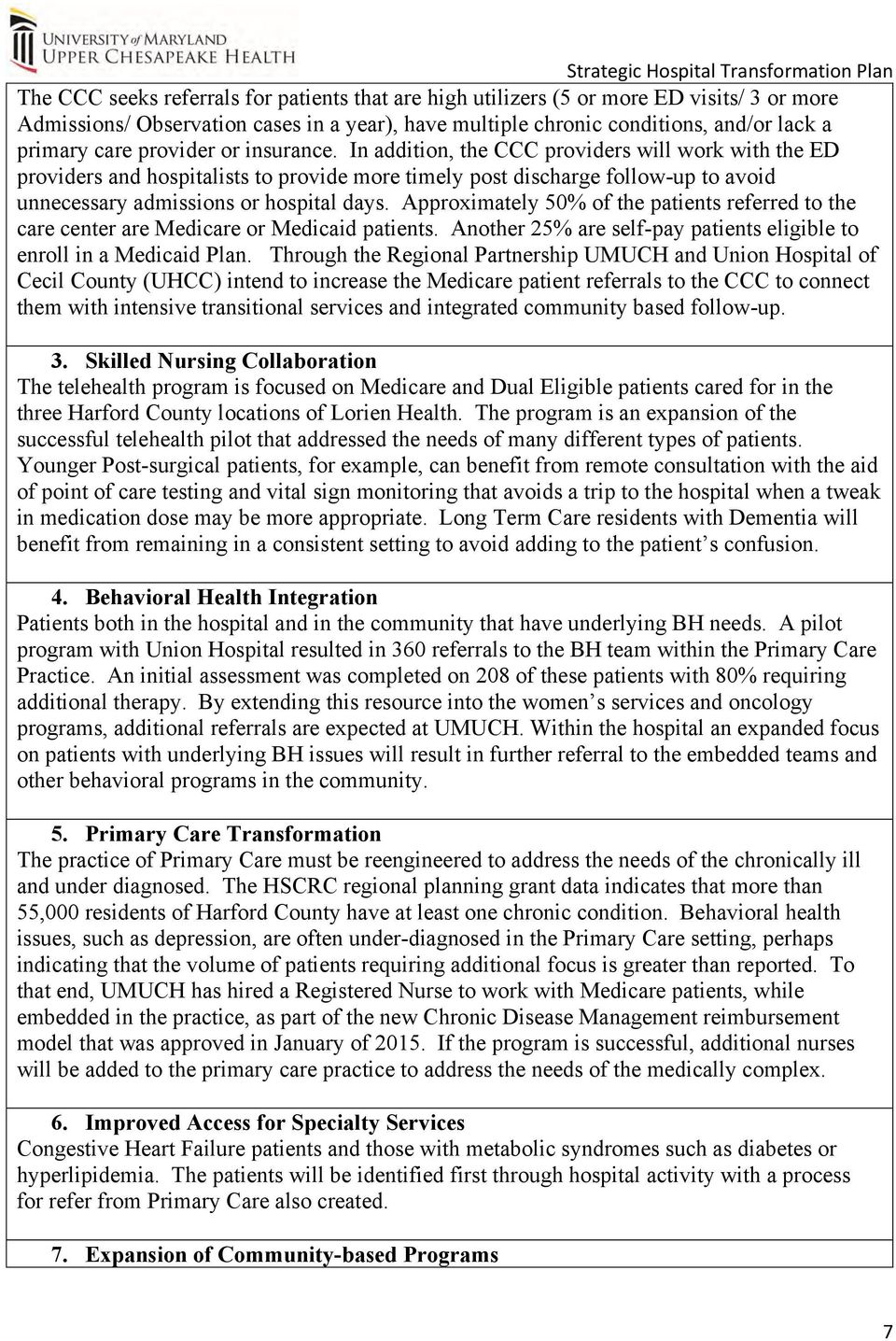
8 Strategic Hospital Transformation Plan Community members with Chronic Conditions, particularly those with Medicare, Medicaid or the dual-eligible. The Mental Health First Aid classes will be offered to community members that seek training on how to recognize signs of mental health need or identify a person in crisis and connect them with the appropriate programs. QUESTION 4: Describe the specific metrics that will be used to measure progress including patient satisfaction, quality, outcomes, process and cost metrics for each major strategy. Metrics 1. Hospital-based Care Management A population health scorecard is being developed to measure success with these initiatives. While readmission and revisit activity is the ultimate outcome measure, we will also track outcomes and processes specific to hospital-based care management. This includes: Type Name Description Outcome Readmissions 30-day all-cause readmissions Outcome Revisits 30-day ED revisits Outcome Observation 30-day readmission to observation Outcome SNF Readmissions 48 hour readmission from SNF Process Care Management Consult Percent of patients requiring Care management that receive consult Process Education Percent of patients receiving Chronic Disease Education Process Referral Management Percent of patients referred to CCC 2. Comprehensive Care Center & Community Care Management A comparison of the 90 days pre/post intervention hospital utilization is conducted on all patients who receive care in the CCC. This measure is expanded to also include a 180 days pre/post measure to determine if there is a degradation in the patient s ability to maintain health as the care management resources taper off. By adding community-based care teams to the CCC work stream, it is expected that that more patients will gain confidence and selfmanagement thereby impact the revisits, readmissions, admissions, hospital cost and total cost of care for patients- particularly Medicare and Dual-eligible patients. UMUCH will develop additional process metrics that track patient no-shows and the percent of high risk patients referred to the care center. 3. Skilled Nursing Collaboration The goal of the telehealth expansion is to reduce 30-day readmissions, admissions to acute care hospitals and ED transfers from the Lorien facilities. While the Pilot program reduced the 30-day readmissions from 13.6% annually to 9.0%. The Riverside and Havre de Grace 8
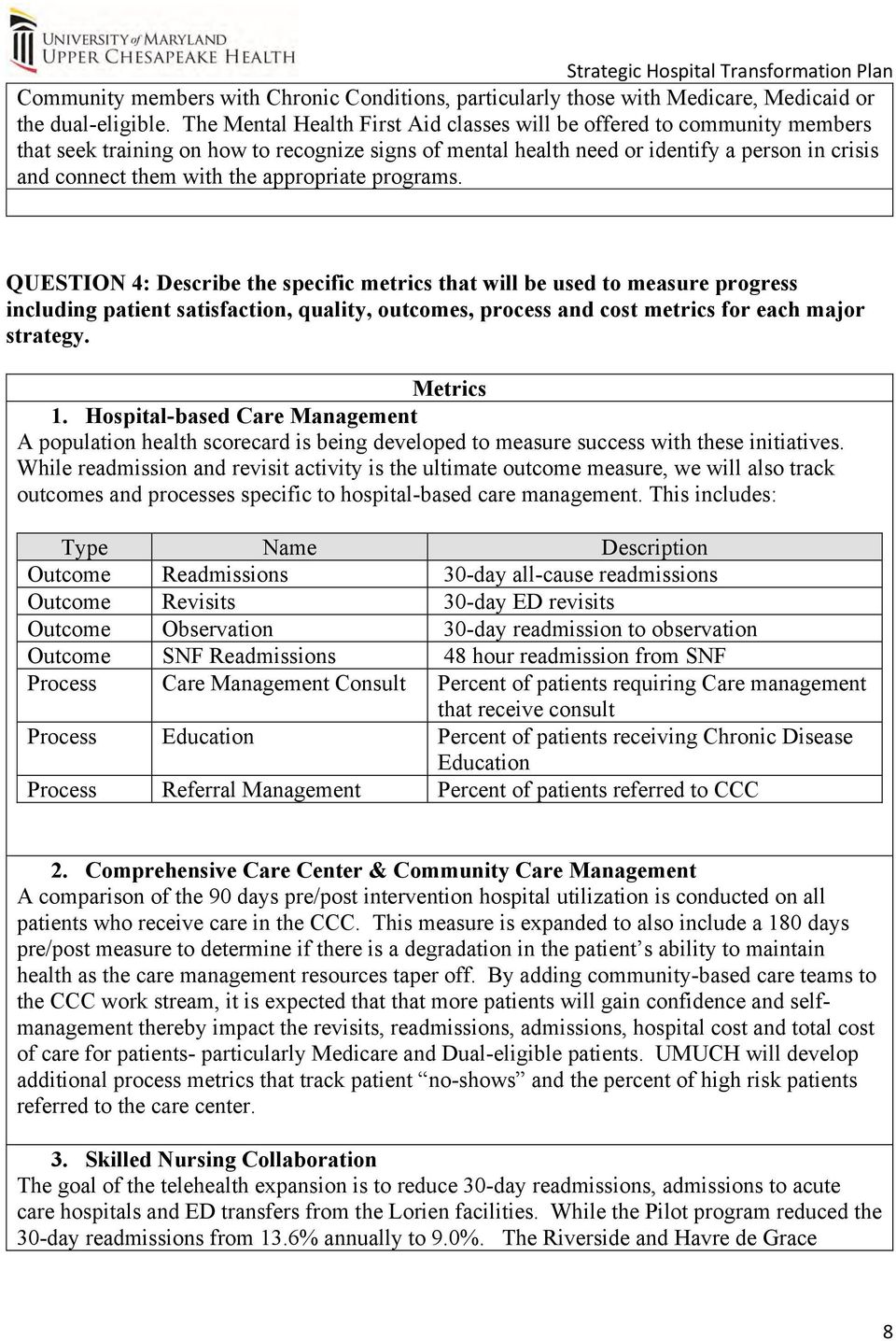
9 Strategic Hospital Transformation Plan locations have significantly higher readmission rates of 22.9% and 21.5% respectively and thus could benefit more significantly from this program. 4. Behavioral Health Integration The UMUCH-UHCC partnership will measure the total referrals and competition milestones for embedded teams. ED visits and revisits plus hospitalization utilization metrics will also be tracked. For the new Psychiatric consulting provider, impact on patient days, ED revisits and readmissions will be measured. 5. Primary Care Transformation The transformation of Primary Care should result in better management of care transitions, improved chronic disease management and a reduction in gaps in care. Chronic disease metrics such as HbA1C and Blood Pressure will be tracked as will access measures such as third next available appointments. We will also attempt to track with greater frequency the readmission activity from these practices through the greater adoption of CRISP Encounter Notification Services. 6. Improved Access for Specialty Services Managing these patients through a co-located programs should result in better management of chronic conditions, impacting the ED utilization and admissions. These populations are likely to impact the Prevention Quality Indicators and the Potentially Avoidable utilization such as admissions for uncontrolled diabetes. UMUCH will track the utilization metrics noted above to determine the need for future expansion. 7. Expansion of Community-based Programs There are specific metrics and data collection tools required for the National Diabetes Prevention Program and the Stanford programs, including participant surveys. UMUCH will also track the number of enrollees and the number of program completers and review behavioral health volumes in the Emergency Department. Further tracking of potential avoidable utilization and prevention quality indicators will occur. QUESTION 5: List other participants and describe how other partners are working with you on each specific major strategy. Partners 1. Hospital-based Care Management The Care Management team works closely with community providers to identify matches between patient need and program availability. This includes the Harford County Health Department Care Coordination Plus program and Hospital Outreach Program (HOP) to transition patients more smoothly back to the community. The team also meets regularly with home health providers and the Continuing Care Facilities (CCF) to track readmissions and refine processes and procedures that will result in reductions in avoidable hospital care. These scheduled forums will continue, bolstered by a more meaningful scorecard. 9
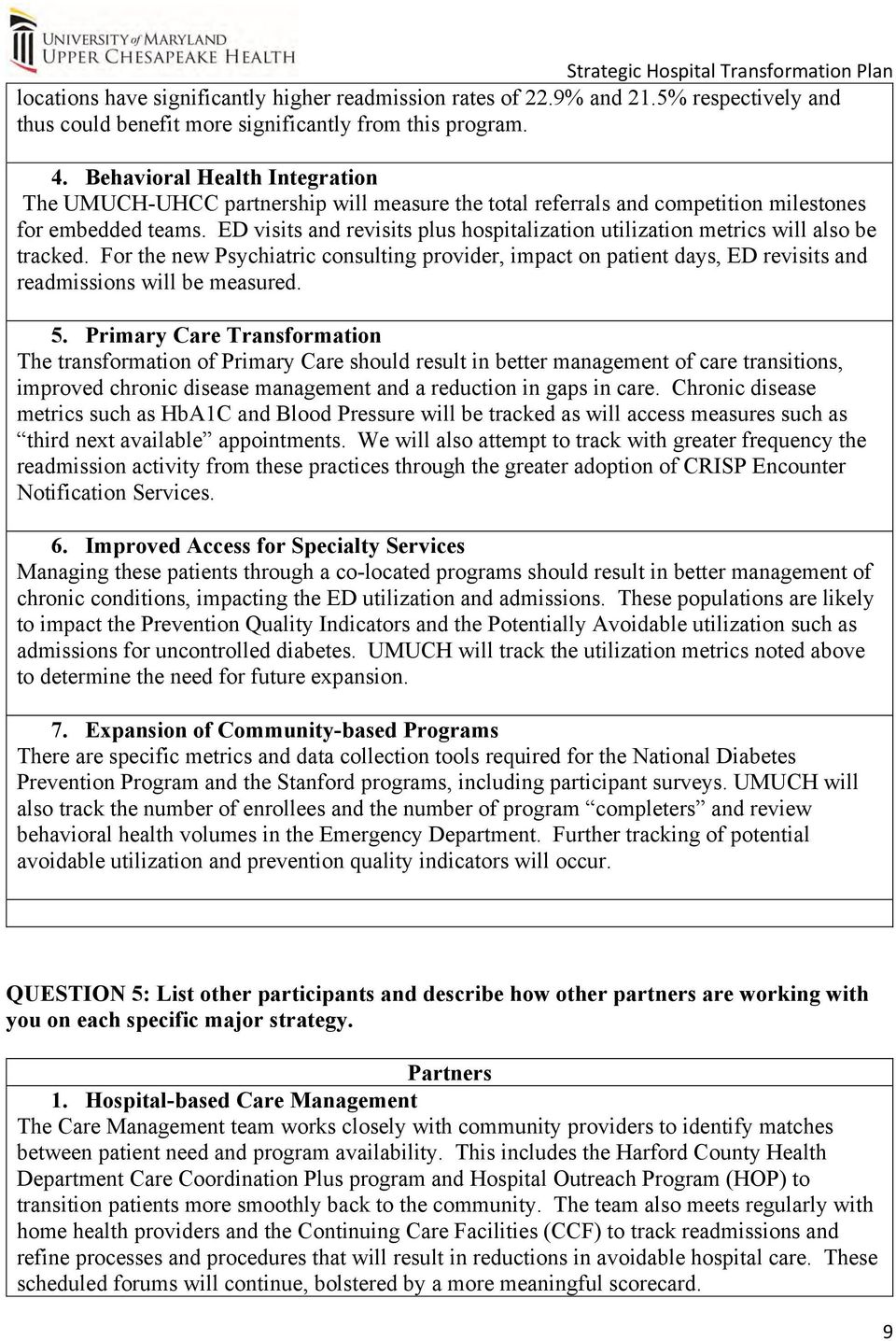
10 Strategic Hospital Transformation Plan 2. Comprehensive Care Center & Community Care Management The University of Maryland Upper Chesapeake Health has long standing relationships with important providers in the community. These relationships were strengthened through the Regional Partnerships for Health System Transformation grant process. The planning process included members of the Health Department and Offices of Aging for both Cecil and Harford Counties. Additionally, Lorien Health System, Amedysis Home Care, Hart to Heart Transportation, Med Chi, Healthy Harford, CRISP, UMUCH Community Health and leaders from both Union Hospital of Cecil County and UMUCH participated in the planning process. As we build out the program developed through the planning process, we will continue to conduct regular meetings with these key stakeholders to evaluate the success of the expanded care management program. 3. Skilled Nursing Collaboration This program includes the clinical partnership of UMUCH, Lorien Health, and Maryland Emergency Medicine Network (MEMN). The MEMN emergency department physicians are now credentialed at Lorien facilities to complete the telemedicine call and write orders that can be executed by the Lorien Staff. Additional partners include LifeBot, the telehealth technology vendor and Citrano Labs that provides the point of care testing. 4. Behavioral Health Integration This program will be managed through the UMUCH-Union Hospital of Cecil County Behavioral Health Collaborative- a joint venture between the two hospital organizations. 5. Primary Care Transformation The University of Maryland Medical System has partnered with DaVita-Healthcare Partners and Lumeris to bring new strategies for medical management to UMUCH. In addition to the new nurse and administrative person, the UMMS engagement brings outside consultants to our practices to identify opportunities for improvement. 6. Improved Access for Specialty Services These programs are intended to compliment the practice of primary and specialty care and will provide the needed temporary and intensive services before returning the patient back to their preexisting provider for ongoing monitoring. 7. Expansion of Community-based Programs The Chronic Disease programs have partnered with the Department of Health and Mental Hygiene to conduct the lay leader training. The Mental Health First Aid program will be conducted in conjunction with Healthy Harford. QUESTION 6: Describe the overall financial sustainability plan for each major strategy. Financial Sustainability 10
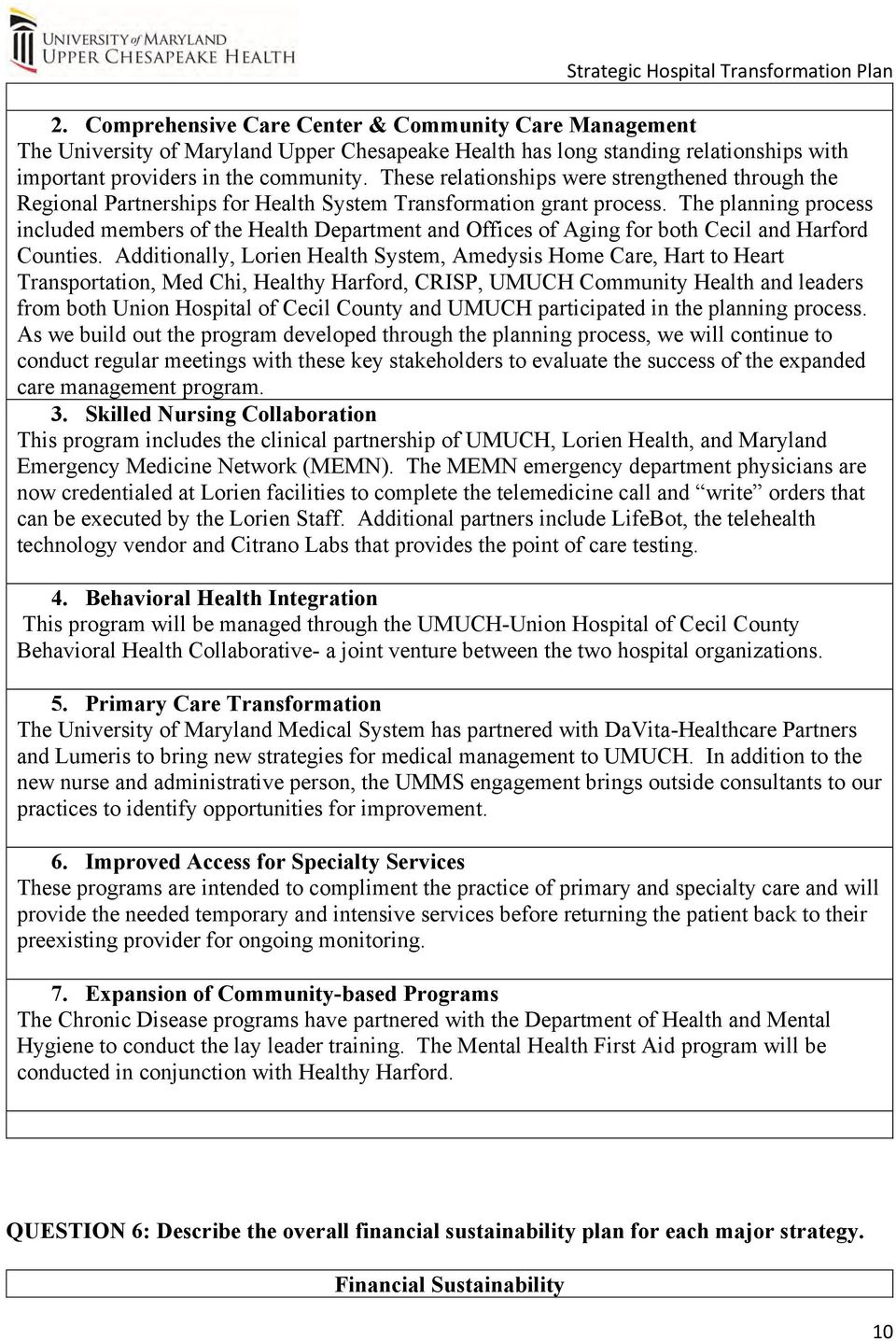
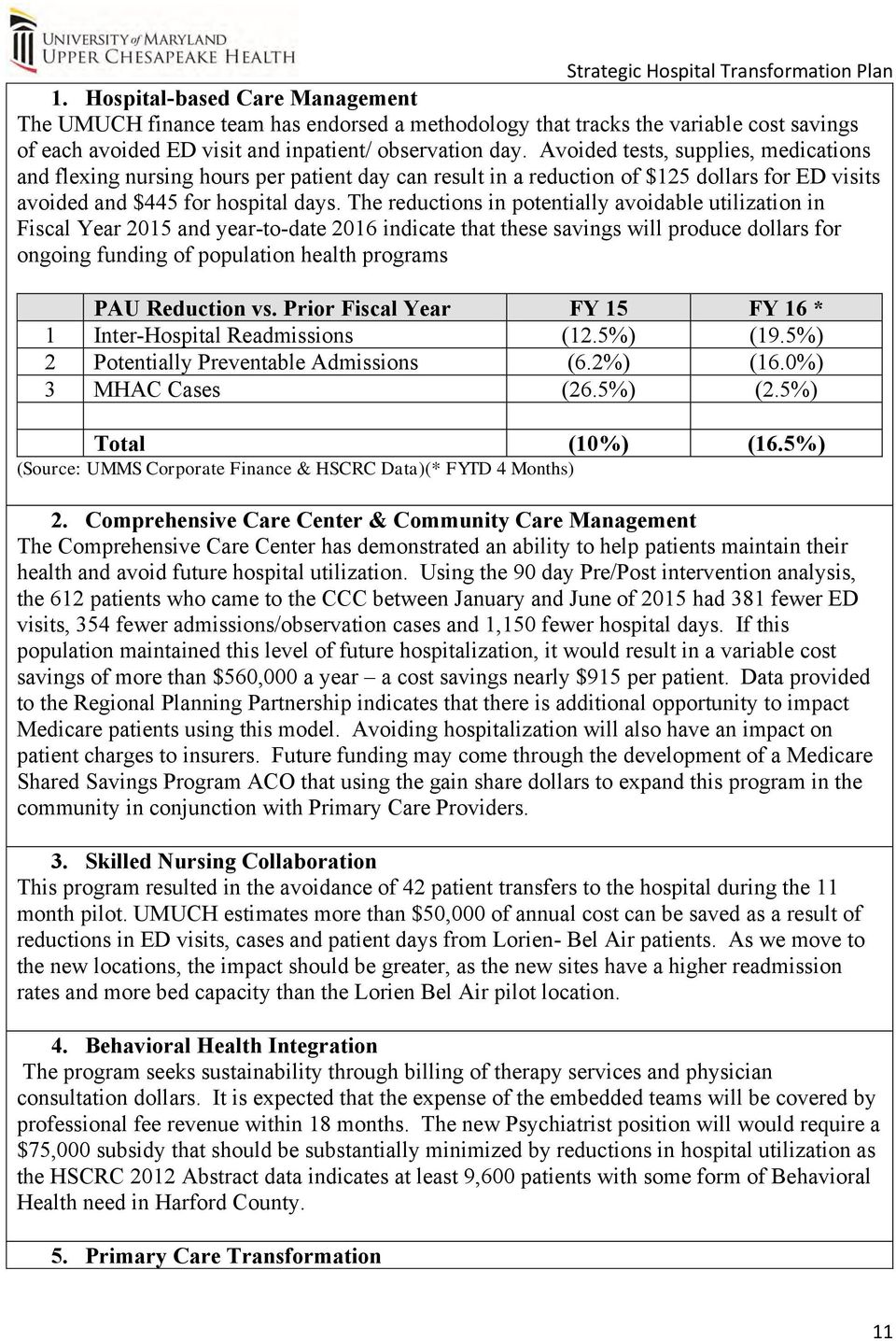
11 Strategic Hospital Transformation Plan 1. Hospital-based Care Management The UMUCH finance team has endorsed a methodology that tracks the variable cost savings of each avoided ED visit and inpatient/ observation day. Avoided tests, supplies, medications and flexing nursing hours per patient day can result in a reduction of $125 dollars for ED visits avoided and $445 for hospital days. The reductions in potentially avoidable utilization in Fiscal Year 2015 and year-to-date 2016 indicate that these savings will produce dollars for ongoing funding of population health programs PAU Reduction vs. Prior Fiscal Year FY 15 FY 16 * 1 Inter-Hospital Readmissions (12.5%) (19.5%) 2 Potentially Preventable Admissions (6.2%) (16.0%) 3 MHAC Cases (26.5%) (2.5%) Total (10%) (16.5%) (Source: UMMS Corporate Finance & HSCRC Data)(* FYTD 4 Months) 2. Comprehensive Care Center & Community Care Management The Comprehensive Care Center has demonstrated an ability to help patients maintain their health and avoid future hospital utilization. Using the 90 day Pre/Post intervention analysis, the 612 patients who came to the CCC between January and June of 2015 had 381 fewer ED visits, 354 fewer admissions/observation cases and 1,150 fewer hospital days. If this population maintained this level of future hospitalization, it would result in a variable cost savings of more than $560,000 a year a cost savings nearly $915 per patient. Data provided to the Regional Planning Partnership indicates that there is additional opportunity to impact Medicare patients using this model. Avoiding hospitalization will also have an impact on patient charges to insurers. Future funding may come through the development of a Medicare Shared Savings Program ACO that using the gain share dollars to expand this program in the community in conjunction with Primary Care Providers. 3. Skilled Nursing Collaboration This program resulted in the avoidance of 42 patient transfers to the hospital during the 11 month pilot. UMUCH estimates more than $50,000 of annual cost can be saved as a result of reductions in ED visits, cases and patient days from Lorien- Bel Air patients. As we move to the new locations, the impact should be greater, as the new sites have a higher readmission rates and more bed capacity than the Lorien Bel Air pilot location. 4. Behavioral Health Integration The program seeks sustainability through billing of therapy services and physician consultation dollars. It is expected that the expense of the embedded teams will be covered by professional fee revenue within 18 months. The new Psychiatrist position will would require a $75,000 subsidy that should be substantially minimized by reductions in hospital utilization as the HSCRC 2012 Abstract data indicates at least 9,600 patients with some form of Behavioral Health need in Harford County. 5. Primary Care Transformation 11
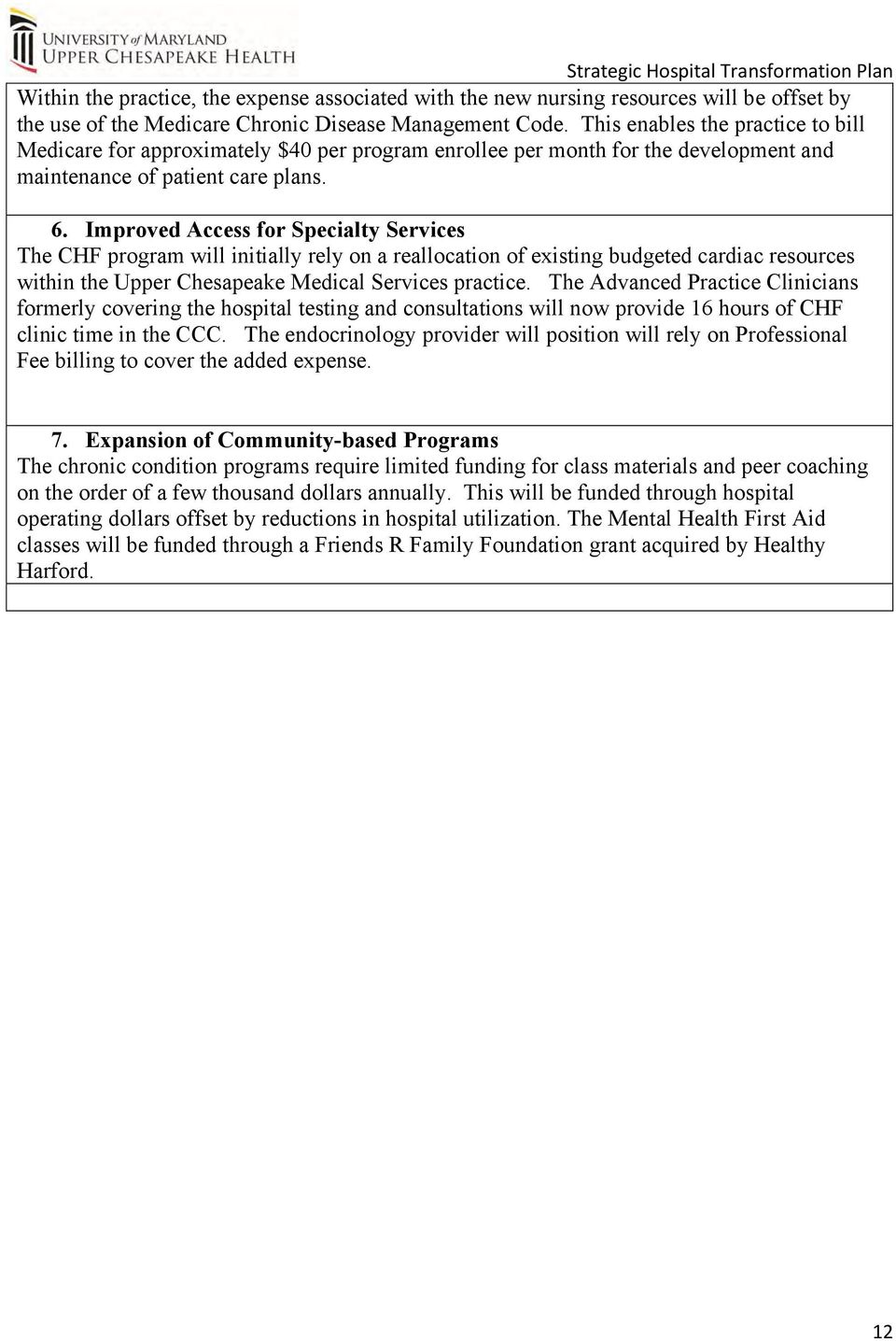
12 Strategic Hospital Transformation Plan Within the practice, the expense associated with the new nursing resources will be offset by the use of the Medicare Chronic Disease Management Code. This enables the practice to bill Medicare for approximately $40 per program enrollee per month for the development and maintenance of patient care plans. 6. Improved Access for Specialty Services The CHF program will initially rely on a reallocation of existing budgeted cardiac resources within the Upper Chesapeake Medical Services practice. The Advanced Practice Clinicians formerly covering the hospital testing and consultations will now provide 16 hours of CHF clinic time in the CCC. The endocrinology provider will position will rely on Professional Fee billing to cover the added expense. 7. Expansion of Community-based Programs The chronic condition programs require limited funding for class materials and peer coaching on the order of a few thousand dollars annually. This will be funded through hospital operating dollars offset by reductions in hospital utilization. The Mental Health First Aid classes will be funded through a Friends R Family Foundation grant acquired by Healthy Harford. 12
13 Regional Partnership Final Report Regional Partnership for Health System Transformation Regional Transformation Plan Final Report Due: December 7, 2015 Regional Partner: University of Maryland Upper Chesapeake Health/ Union Hospital of Cecil County Regional Partnership Maryland s Vision for Transformation: Transform Maryland s health care system to be highly reliable, highly efficient, and patient centered. HSCRC and DHMH envision a health care system in which multi disciplinary teams can work with high need/high resource patients to manage chronic conditions in order to improve outcomes, lower costs, and enhance patient experience. Through aligned collaboration at the regional and state levels, the state and regional partnerships can work together to improve the health and well being of the population. Regional Partnerships: In order to accelerate effective implementation, Maryland needs to develop regional partnerships that can collaborate on analytics, target services based on patient and population needs, and plan and develop care coordination and population health improvement approaches. The Regional Partnerships for Health System Transformation are a critical part of the state s approach to foster this collaboration. As referenced in the RFP, the Regional Partnership plan will describe, in detail, the proposed delivery and financing model, the infrastructure and staffing/workforce that will support the model, the target outcomes for reducing utilization/costs and improving quality and the health of the populations targeted, and effective strategies to continuously improve overall population health in the region. In order to fulfill healthcare savings commitments by Maryland to CMS, the initial target populations have been identified as high utilizers such as Medicare patients with multiple chronic conditions and high resource use, frail elders with support requirements, and dual eligibles with high resource needs. The Care Coordination Workgroup identified these populations as most likely to yield the biggest gains from the Regional Partnerships efforts. The Workgroup also recommended the development of state level integrated care coordination resources and in some areas recommended standardization and collaboration. The Care Coordination Workgroup s final report can be found at: meet/cc/care Coordination Work Group Final Report pdf. The Regional Partnership grants will culminate in the development of a regional transformation plan due in December Given the importance of regional collaboration to meet the goals of the new model, multi year strategic plans for improving care coordination, chronic care, and provider alignment are required of all Maryland hospitals. To achieve transformation on a regional and state level, the following nine domains have been developed. These domains are meant to be a guide to the Regional Partnerships and other Maryland hospitals and serve as action steps during the planning process. Nine Transformation Domains 1. Clearly articulate the goals, strategies, and outcomes that will be pursued and measured Developed by Health Management Associates June

14 2. Establish formal relationships through legal, policy, and governance structures to support delivery and financial objectives 3. Understand and leverage currently available data and analytic resources 4. Identify needs and contribute to the development of risk stratification levels, heath risk assessments, care profiles and care plans 5. Establish care coordination people, tools, processes, and technology 6. Align physicians and other community based providers 7. Support the transformation with organizational effectiveness tools 8. Develop new care delivery models 9. Create a financial sustainability plan As you utilize this template and develop your Regional Transformation Plan, please refer to the Transformation Framework as a reference guide. Regional Transformation Plan Template Goals, Strategies and Outcomes Articulate the goals, strategies and outcomes that will be pursued and measured by the regional partnership. The purpose of the University of Maryland Upper Chesapeake Health (UMUCH) and Union Hospital of Cecil County (UHCC) Regional Partnership (RP) is to address the medical and social needs of high utilizer patients and those with multiple chronic conditions. It is difficult to divorce the medical needs from the social needs of these patients, therefore this plan calls for the development and expansion of post acute clinics and the creation of a team of care givers that work with patients in the community. Ultimately, patients will gain confidence controlling their conditions and receive supplemental support in conjunction with the practice of primary care that prevents future, expensive, and potentially avoidable utilization. Strategy 1: Post discharge Clinics (Comprehensive Care Center at UMUCH / Chronic Disease Center at UHCC) The two hospital systems in the partnership will both operate a post discharge clinic (PDC) that addresses multiple needs. These clinics could be best described as a hybrid high risk clinic, transitional clinic, and chronic disease management clinic. Each location is or will be staffed with a physician or nurse practitioner plus nurse care managers and social workers. The purpose is to provide an intensive evaluation of the patient s needs immediately after discharge and to provide the needed medical and social support plan and follow up. The engagement with the patient is expected to last approximately days but may vary depending on patient need and response to treatment. The RP will target Medicare and dual eligible patients while hospitalized and refer them to the clinic to begin a new process of care. Strategy 2: Community based Care Management The RP will jointly develop a program of community based care management (CBCM) that includes four teams of care givers working in conjunction with the respective post discharge clinic and the primary care providers in the community. Teams will be comprised of a registered nurse with a social worker and multiple community health workers. Patients that meet the criteria, high utilization or chronically ill, Developed by Health Management Associates June

15 will be referred to the PDC so that they can be entered into a new patient registry. A clinical team will then determine if the patient requires intensive services through the PDC or can be referred directly to the CBCM. Those working through the PDC will be transitioned to the CBCM after becoming medically stable. The goal is to extend the total length of time that these patients receive medical and care management/coordination support for up to 90 days through the integration of these two strategies. Those not requiring intense follow up in the PDC will be engaged directly into the CBCM program with in home follow up occurring on a scheduled basis. The teams will be supported by take home telemonitoring equipment and the ability to conduct a Skype consultation with the provider in the PDC as needed. Strategy 3: Information Technology (CRISP Connectivity & Data Warehouse) The RP recognizes the need to integrate health care providers and supporting organizations assisting common patients to create a more patient centered and efficient system of care. To that end, the partnership will work closely with CRISP to foster improved ambulatory data sharing, including government organizations such as the Offices on Aging and the Health Departments, to provide a more detailed picture of the patient engagement with providers. UMUCH is already piloting the Prompt reports and has connected ambulatory practices such as Cardiology and the Diabetes Center such that providers may view this activity as well. Additionally, CRISP and the RP have agreed to a multi year pilot of a CRISP hosted Care Management Platform that would allow health system and non health system resources to document care plans and follow up on patients in a common format that would be easily viewed by other providers in the community. Ultimately, a lengthier engagement with the patient that combines medical treatment, care management, care coordination and patient education will impact the future use of the emergency department and limit hospital admissions and readmissions. Describe the target population that will be monitored and measured, including the number of people and geographical location. The Regional Partnership will target Medicare and Dual eligible patients with either high rates of hospital utilization and/or multiple chronic conditions. Health Services Cost Review Commission (HSCRC) data presented to the RP indicates that there are approximately 8,300 (2, ,853 in the table below) of these high risk patients in Cecil and Harford Counties. This population accounted for more than $373M in hospital charges during the year. The initial focus on the program will require interacting with these patients after they have identified themselves by coming back to the hospital. The RP also recognizes that a process for engaging these patients before they come to the hospital will be necessary and will allow providers in the community to refer patients to the program, even if they have not yet met the hospital utilization threshold. These patients may be described as moderate or rising risk patients that could benefit from these new interventions. Ongoing monitoring of CRISP reported data including Encounter Notification Services and PaTH Reports will help the RP determine if the criteria for the program should be expanded or a new geographic focus should be created. County Name High Utilizers Patients w/ 5 or More Chronic Conditions Developed by Health Management Associates June

16 # of Unique Patients # % Total Charges Average Charges # % Total Charges Average Charges Cecil $ $ 25, % 38,034,742 61,845 1,653 6% $ 52,185,114 $ 31,570 Harford $ $ 55,888 1,875 3% 129,706,077 69,177 4,200 8% $ 153,459,978 $ 36,538 Two County Total 81,369 2, ,740,818 67,366 5, ,645,092 35,135 Describe specific metrics that will be used to measure progress including patient satisfaction, quality, outcomes metrics, process metrics and cost metrics. Describe how the selected metrics draw from or relate to the State of Maryland s requirements under the new model. The program will target the below metrics, consistent with the state transformation framework. This includes outcome measures that capture both utilization and cost (charges) data, as well as process measures that indicate improvement within the new delivery model. The RP will also develop a patient survey to monitor the satisfaction of patients with the CBCM program. Type Name Description Outcome Readmissions 30 day all cause readmissions Outcome Revisits 30 day ED revisits Outcome Observation 30 day readmission to observation Outcome SNF Readmissions 48 hour readmission from SNF Outcome Hospital Charges Reduction in Hospital Charges for High Risk patients Outcome Hospital Utilization 90 day Pre/Post intervention utilization Process PDC/CBCM Consults Percent of patients requiring meeting criteria referred to PDC/CBCM Process CRISP Utilization Increase in ENS Subscribers in the Community Process Care Management Percent of patients with Care Plan in new CRISP Care Management platform Process EMS Transport Monitor EMS call data by specific address Process Referral Management Percent of patients referred to PDC Satisfaction Program Satisfaction New patient survey Describe the regional partnership s current performance (target population) against the stated metrics. Developed by Health Management Associates June

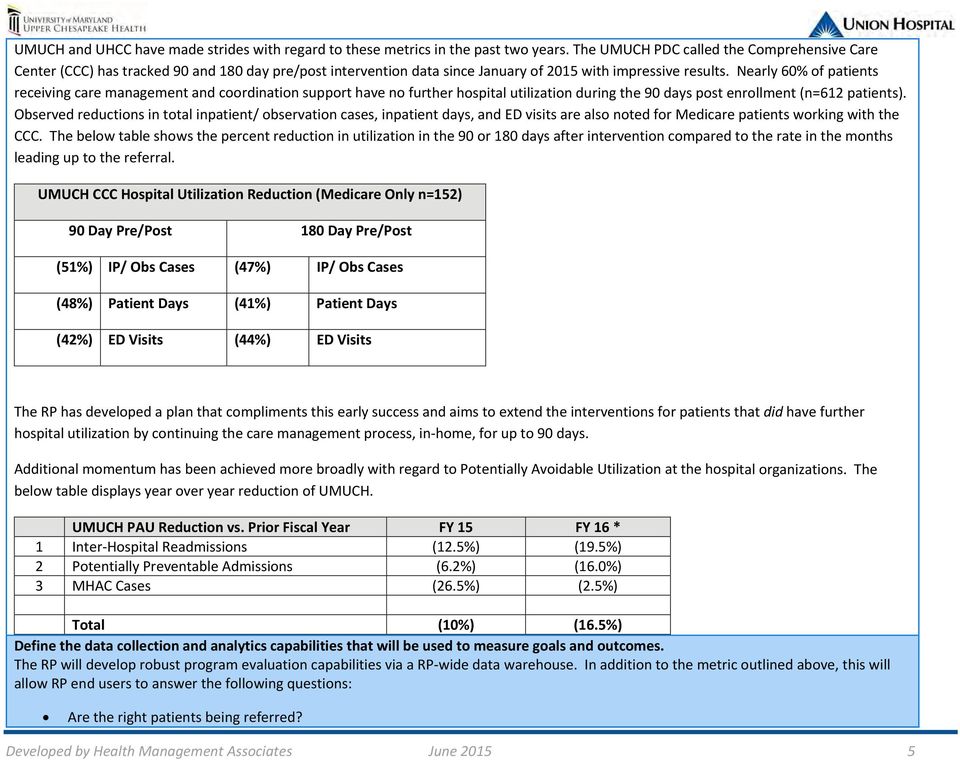
17 UMUCH and UHCC have made strides with regard to these metrics in the past two years. The UMUCH PDC called the Comprehensive Care Center (CCC) has tracked 90 and 180 day pre/post intervention data since January of 2015 with impressive results. Nearly 60% of patients receiving care management and coordination support have no further hospital utilization during the 90 days post enrollment (n=612 patients). Observed reductions in total inpatient/ observation cases, inpatient days, and ED visits are also noted for Medicare patients working with the CCC. The below table shows the percent reduction in utilization in the 90 or 180 days after intervention compared to the rate in the months leading up to the referral. UMUCH CCC Hospital Utilization Reduction (Medicare Only n=152) 90 Day Pre/Post 180 Day Pre/Post (51%) IP/ Obs Cases (47%) IP/ Obs Cases (48%) Patient Days (41%) Patient Days (42%) ED Visits (44%) ED Visits The RP has developed a plan that compliments this early success and aims to extend the interventions for patients that did have further hospital utilization by continuing the care management process, in home, for up to 90 days. Additional momentum has been achieved more broadly with regard to Potentially Avoidable Utilization at the hospital organizations. The below table displays year over year reduction of UMUCH. UMUCH PAU Reduction vs. Prior Fiscal Year FY 15 FY 16 * 1 Inter Hospital Readmissions (12.5%) (19.5%) 2 Potentially Preventable Admissions (6.2%) (16.0%) 3 MHAC Cases (26.5%) (2.5%) Total (10%) (16.5%) Define the data collection and analytics capabilities that will be used to measure goals and outcomes. The RP will develop robust program evaluation capabilities via a RP wide data warehouse. In addition to the metric outlined above, this will allow RP end users to answer the following questions: Are the right patients being referred? Developed by Health Management Associates June
18 What are the common conditions and social issues being addressed? How is the PDC & CBCM interacting with patients (telephone, in home, office encounter)? The Data Warehouse capabilities will expand in a phased approach to incorporate data from the hospitals, ambulatory practices, skilled nursing facilities, Home Health agencies and CRISP. A phased approach will integrated these data sources and develop end user reporting tools for more real time analysis. Each phase will bring additional value to the program and set the stage for quality reporting that is consistent with payment incentive programs such as the Physician Quality Reporting System (PQRS) or Medicare Shared Savings Program (MSSP). Further description is available in the appendix through the UMUCH / UHCC Regional Partnership Proposed Business Intelligence (BI) Solution Report. List the major areas of focus for year one. (For the completion of this plan, if various areas of focus require different descriptions, please identify each area under the following sections of the plan.) There are important initiatives that will take place in year one of this program. 1 Hiring and training of the Nurse Care Managers and Community Health Workers. These important resources are in high demand and may take some time to fully hire the teams. Both Hospital organizations have resources that can be maneuvered to support early implementation of the CBCM. The RP has developed job descriptions and has engaged several organizations capability of providing timing training increasing the speed to market of the program. 2 Refinement of patient flow processes. The RP has developed referral guidelines and criteria for matriculation from the PDC to the CBCM. We will evaluate the flow of patients and information to tweak the processes as expected with new programs. 3 Phase I & Phase II of the BI Solution Work Plan. The BI work plan is a phased approach for reporting and analytics that includes the development of the data hosting, architecture and initial set of end user reporting packages in year one. 4 Deployment of the CRISP Mirth Care Management Platform. The RP will identify end users for the pilot program and work with the CRISP team to integrate systems and provide training. Formal Relationships and Governance List the participants of the regional partnership such as hospitals, physicians, nursing homes, post acute facilities, behavioral health providers, community based organizations, etc. Specify names and titles where possible. The following government and community organizations have participated in the planning process. These groups have committed to ongoing quarterly meetings to evaluate the program and make recommendations about future refinements. Cecil County Health Department (Health Officer) Harford County Health Department (Health Officer, Deputy Health Officer, Care Coordination Plus Program Representative) Cecil County Service and Transit (Administrative Director, Long Term Care Chief) Harford County Office of Aging (Director, Program Manager) Developed by Health Management Associates June

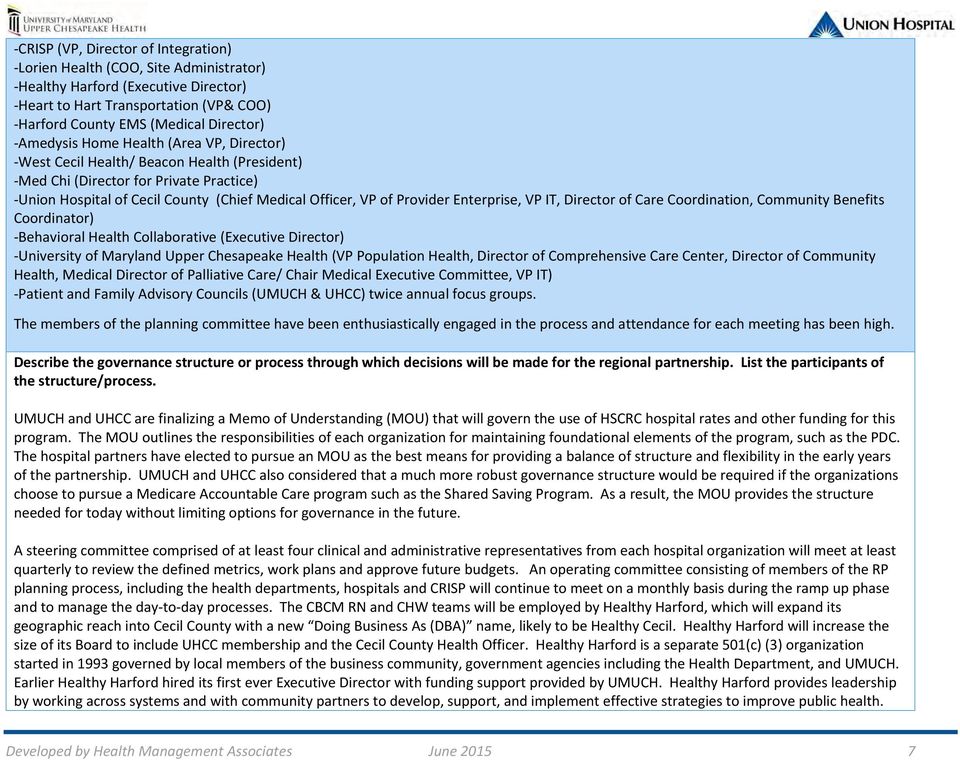
19 CRISP (VP, Director of Integration) Lorien Health (COO, Site Administrator) Healthy Harford (Executive Director) Heart to Hart Transportation (VP& COO) Harford County EMS (Medical Director) Amedysis Home Health (Area VP, Director) West Cecil Health/ Beacon Health (President) Med Chi (Director for Private Practice) Union Hospital of Cecil County (Chief Medical Officer, VP of Provider Enterprise, VP IT, Director of Care Coordination, Community Benefits Coordinator) Behavioral Health Collaborative (Executive Director) University of Maryland Upper Chesapeake Health (VP Population Health, Director of Comprehensive Care Center, Director of Community Health, Medical Director of Palliative Care/ Chair Medical Executive Committee, VP IT) Patient and Family Advisory Councils (UMUCH & UHCC) twice annual focus groups. The members of the planning committee have been enthusiastically engaged in the process and attendance for each meeting has been high. Describe the governance structure or process through which decisions will be made for the regional partnership. List the participants of the structure/process. UMUCH and UHCC are finalizing a Memo of Understanding (MOU) that will govern the use of HSCRC hospital rates and other funding for this program. The MOU outlines the responsibilities of each organization for maintaining foundational elements of the program, such as the PDC. The hospital partners have elected to pursue an MOU as the best means for providing a balance of structure and flexibility in the early years of the partnership. UMUCH and UHCC also considered that a much more robust governance structure would be required if the organizations choose to pursue a Medicare Accountable Care program such as the Shared Saving Program. As a result, the MOU provides the structure needed for today without limiting options for governance in the future. A steering committee comprised of at least four clinical and administrative representatives from each hospital organization will meet at least quarterly to review the defined metrics, work plans and approve future budgets. An operating committee consisting of members of the RP planning process, including the health departments, hospitals and CRISP will continue to meet on a monthly basis during the ramp up phase and to manage the day to day processes. The CBCM RN and CHW teams will be employed by Healthy Harford, which will expand its geographic reach into Cecil County with a new Doing Business As (DBA) name, likely to be Healthy Cecil. Healthy Harford will increase the size of its Board to include UHCC membership and the Cecil County Health Officer. Healthy Harford is a separate 501(c) (3) organization started in 1993 governed by local members of the business community, government agencies including the Health Department, and UMUCH. Earlier Healthy Harford hired its first ever Executive Director with funding support provided by UMUCH. Healthy Harford provides leadership by working across systems and with community partners to develop, support, and implement effective strategies to improve public health. Developed by Health Management Associates June
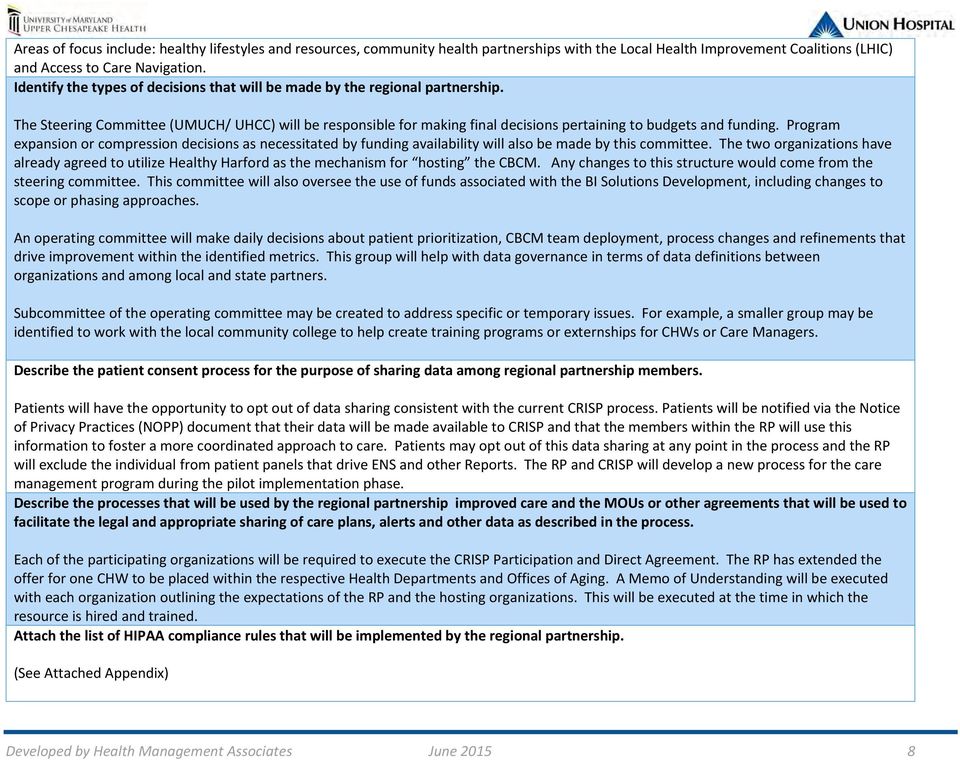
20 Areas of focus include: healthy lifestyles and resources, community health partnerships with the Local Health Improvement Coalitions (LHIC) and Access to Care Navigation. Identify the types of decisions that will be made by the regional partnership. The Steering Committee (UMUCH/ UHCC) will be responsible for making final decisions pertaining to budgets and funding. Program expansion or compression decisions as necessitated by funding availability will also be made by this committee. The two organizations have already agreed to utilize Healthy Harford as the mechanism for hosting the CBCM. Any changes to this structure would come from the steering committee. This committee will also oversee the use of funds associated with the BI Solutions Development, including changes to scope or phasing approaches. An operating committee will make daily decisions about patient prioritization, CBCM team deployment, process changes and refinements that drive improvement within the identified metrics. This group will help with data governance in terms of data definitions between organizations and among local and state partners. Subcommittee of the operating committee may be created to address specific or temporary issues. For example, a smaller group may be identified to work with the local community college to help create training programs or externships for CHWs or Care Managers. Describe the patient consent process for the purpose of sharing data among regional partnership members. Patients will have the opportunity to opt out of data sharing consistent with the current CRISP process. Patients will be notified via the Notice of Privacy Practices (NOPP) document that their data will be made available to CRISP and that the members within the RP will use this information to foster a more coordinated approach to care. Patients may opt out of this data sharing at any point in the process and the RP will exclude the individual from patient panels that drive ENS and other Reports. The RP and CRISP will develop a new process for the care management program during the pilot implementation phase. Describe the processes that will be used by the regional partnership improved care and the MOUs or other agreements that will be used to facilitate the legal and appropriate sharing of care plans, alerts and other data as described in the process. Each of the participating organizations will be required to execute the CRISP Participation and Direct Agreement. The RP has extended the offer for one CHW to be placed within the respective Health Departments and Offices of Aging. A Memo of Understanding will be executed with each organization outlining the expectations of the RP and the hosting organizations. This will be executed at the time in which the resource is hired and trained. Attach the list of HIPAA compliance rules that will be implemented by the regional partnership. (See Attached Appendix) Developed by Health Management Associates June
21 Data and Analytics Define the data collection and analytics capabilities that will be used to measure goals and outcomes, including specific metrics and measures. UMUCH and UHCC will develop shared data analytics capabilities to support this regional partnership. The planning process including the development of a Business Intelligence strategic plan that aggregates data from a variety of stakeholders along the continuum of care enabling more efficient care and better understanding of patient need. Providing actionable data to drive better outcomes will require three main components: gathering data, transforming and storing data, and delivering the actionable information to end users. Many BI or Data Warehouse (DW) projects start with the first component and attempt to gather as much data as possible and then figure out what to do with it. This can result in a bloated, over budget, and ultimately unsuccessful project. Since the goal of the solution is to provide actionable data, the project components will be addressed in reverse order to help answer specific questions about the high risk patients. For the BI platform to deliver actionable data, the source data must be transformed and stored in a data structure that is optimal for data retrieval. Generally, this is accomplished by implementing a data warehouse or group of data marts that use a dimensional data model (star or snowflake schema). The dimensional data includes both fact tables (for key measures) and related dimension tables (for grouping and filtering). The proposed solution implements a data warehouse stored in a relational database and will use an Extract, Transform, and Load (ETL) tool to transform and load the data. Based on existing RP expertise, current systems, and suitability, the proposed solution uses Microsoft SQL Server as the data warehouse platform and Microsoft SQL Server Integration Services (SSIS) as the ETL tool. The source data will originate in multiple internal and external source systems. Data will be selectively loaded based on current and future reporting requirements. The data sources will include RP operational systems as well as external data, most notably CRISP data feeds and payer claims files when available. Developed by Health Management Associates June
22 Describe with specificity the regional partnership s plan for use of CRISP data. CRISP will help the UMUCH/UHCC Regional Partnership and implement infrastructure for care coordination programs developed within the Health Services Cost Review Commission s Hospitals for Health System Transformation and subsequent care transformation, quality improvement, and cost reduction initiatives. The RP and CRISP will work jointly to meet the objects in each of the core categories listed below: Developed by Health Management Associates June
23 1 Community Provider Connectivity. UMUCH/ UHCC RP will prioritize a list of key non hospital providers and work with CRISP to integrate them into the Health Information Exchange. CRISP is connecting ambulatory practices, long term care/post acute facilities, local health departments, and other relevant community health providers in order to: Easily understand where a patient has received care or has a treatment relationship with a non hospital provider. Achieve clinical document transfer from to the non hospital provider to the CRISP clinical query portal for treatment decisions at the point of care. 2 Reporting and Analytics. CRISP Reporting Services provides information to hospitals and provider organizations to facilitate outcome measurement, strategic planning, and care coordination. CRISP will continue to enhance available reports and the RP will provide feedback regarding these offerings. 3 Alerts and notifications. These tools may take a variety of forms leveraging CRISP tools such as Encounter Notification Services (ENS) and other integration capabilities. CRISP and RP will review potential use cases for in context alerts with the intention of piloting those applicable to RP provider sites. Examples of use cases include: A notification that a care plan exists Notification that a patient has had a recent hospitalization Notification that a patient has a PCP subscribing to ENS alerts Alert that a patient risk score has increased 4 Clinical Query Portal Enhancements. CRISP is improving the functionality of the existing Clinical Query Portal to include elements that are relevant to more coordinated care. The RP will identify existing care plans for target populations and indicate to CRISP the source system of the documents. Examples of this improved functionality include: A listing of current notification subscribers A dedicated section that lists care plans that have been provided to CRISP A dedicated section that provides a care summary A risk score derived from risk stratified case mix data 5 Care Management Software. RP will provide feedback on care management software currently in use (or other market analysis on existing software in the community, if available). RP and CRISP will work jointly to develop appropriate strategies to expand community wide use of care management software, potentially through interfaces with multiple vendors and/or provision of a standard product as needed. 6 Secure Texting. CRISP will implement a secure messaging solution that meets the requirements of the RP and foster improved communication among physicians and other care givers along the continuum of care. Developed by Health Management Associates June
24 Risk Stratification, Health Risk Assessments, Care Profiles and Care Plans Describe any plans for use of risk stratification, HRAs, care profiles, or care plans. Describe how these draw from or complement the standardized models being developed. Identifying patients and understanding the drivers of their health care utilization are vital components of this RP. Additional data reviewed during the planning process indicated that patients that frequently utilized the hospital were likely to have at least one of the following conditions; diabetes, hypertension and depression, with many patients having all three. Integrating and reviewing data from multiple sources will be critical to segment patients and target interventions likely to be beneficial. The RP will track risk by multiple methods and partner with CRISP to deliver a health system agnostic care management program that can also be used by participants in the community, and view by those with CRISP access. For risk stratification, include the types of patients, risk levels, data sources, accountabilities (who is accountable to do what?) The UMUCH/ UHCC Regional Partnership will extend the time that high risk patients receive care management support and access to medical care. High Risk patients will be defined as patients with five or more ED visits or three or more admissions during the year. Also, patients with multiple chronic conditions will also be identified as High Risk. The hospitals in the partnership will continue to use a modified version of the LACE score to determine high risk patients outside of the volume thresholds or chronic condition criteria. The Lace algorithm scores Length of Stay (L), acuity (A), co morbidities (C), and ED visits (E) within the previous six months and is auto calculated using the Meditech Electronic Medical Record System that both hospital systems utilize. The RP will also monitor the CRISP Query Portal for any calculation based on casemix data as this capability becomes available. The information will be reviewed at the time of the patient referral to the PDC and will assist in the clinical decision to engage the patient in the PDC or refer them directly to the CBCM teams for ongoing care management and coordination. It is still a matter of debate if any risk tool can positively predict the risk of future hospitalization. The RP will continue to use the LACE score and the high risk volume thresholds at the macro level to capture the most likely population of patients. This methodology relies on previous health care activity as an indicator for future need. The development of analytic capabilities, as part of this program described in the Data and Analytics section, will help us develop a more focused assessment of patient need and risk within the identified population in the future. The RP will deploy a Database Administrator and two Program Coordinators to track patient activity through CRISP and other sources to potentially trigger a response by the CBCM resources. Indications of risk level will also be recorded in the CRISP hosted Care Management platform that will ultimately be viewable by any stakeholder with CRISP access. For HRAs, include the types of screenings, who is accountable for completing, and where information is recorded. Developed by Health Management Associates June
25 The UMUC/ UHCC Regional Partnership is a true collaboration with other key providers and support services in the community. During the planning process it became clear that certain organizations were bound to complete initial and ongoing assessments using a prescribed format to ensure that funding would be sustained. The Health Departments, Offices of Aging, Skilled Nursing Facilities and Home Health agencies all used a different intake format to capture data required for reimbursement. As a result, the RP tabled discussion of a common risk assessment tool and focused on sharing information with CRISP that would be helpful for making clinical decisions and coordinating care. The Health Departments and Offices of Aging have agreed to attempt to share at least Admission/Discharge Transfer (ADT) data from their respective systems and will consider sending monthly excel spreadsheets to CRISP indicating which patients are actively engaged with their agency. For care profiles and/or care plans, include the key elements that will be included, the systems through which they will be accessible, the people who will have access. Standardized care profiles are anticipated to be developed by the state level integrated are coordination infrastructure. One of the major goals of the RP is to extend the time that patients are receiving care management and coordination assistance during their vulnerable post discharge time. As a result, the RP will deploy a care management program in conjunction with CRISP that gives key stakeholders in the community the ability to contribute to a single patient s care plan. Those not contributing to the care plan will be able to access the most up to date version through CRISP access. The RP envisions that the PDC, CBCM teams, Health Departments and Offices of Aging will have read/write access to the Mirth Care Management platform during the pilot phase. Standard elements of CRISP hosted Mirth Care system include: Assigned Care Givers Patient Conditions Identifying Social Concerns Treatment Goals & Progress Trending Documentation of outreach including in person visits and telephone calls Identify the training plan for any new tool identified in this section. The RP has agreed to pilot the CRISP hosted care management platform, Mirth Care. A training and implementation plan will be mutually developed in conjunction with the RP, CRISP and the technology vendor. The Memo of Understanding dictates that the training and support will be complete by the end of March, Care Coordination Describe any new care coordination capabilities that will be deployed by the regional partnership. Developed by Health Management Associates June
26 The Regional Partnership Care Coordination Model is a person centered, multi disciplinary model of care. The model was designed to be comprehensive, use resources effectively, develop targeted initiatives and leverage community based resources through partnerships. New Care Coordination capabilities include the development/expansion of the Post discharge Clinics (Comprehensive Care Center at UMUCH / Chronic Disease Center at UHCC). The purpose of the clinics is to provide an intensive assessment and monitoring of the patient s needs immediately after discharge from the emergency department or inpatient units, develop a comprehensive medical and social support treatment plan, and provide follow up. Community based Care Teams The RP will jointly develop a program of community based care management teams (CBCM). The CBCM will serve as the bridge between the post discharge clinic, primary care physicians and community providers. The goal is to extend the total length of time that patients receive care management and coordination with the goal of reducing readmission. The teams will be supported by take home telemonitoring equipment and have the ability to conduct a Skype consultation with the clinical coordinator and/or physician as needed. Community Health Workers will be embedded into four community partner agencies: Harford County Office on Aging, Cecil County Office on Aging, Harford County Health Department and Cecil County Health Department. The goal is to extend the reach of the treatment network beyond the hospital setting, strengthening the community partnerships and leveraging the treatment services already available in the community. CRISP Connectivity and the use of Mirth Care Management Platform. The RP recognizes the need to integrate health care providers and supporting organizations assisting common patients to create a more patient centered and efficient system of care. The RP will work with community partners to foster improved ambulatory data sharing and provide real time access to support patients. The RP will establish an initiative with the Harford County Department of Emergency Services/911 to develop a better coordinated system of care for the identification and follow up with citizens in the community who are vulnerable and utilize the 911/Emergency Medical System frequently. A similar partnership with Cecil County will also be explored. Identify the types of patients that will be eligible for care coordination and how they will be identified and by whom. High Risk patients will be defined as patients with five or more ED visits or three or more admissions during the year will be eligible for care coordination. High risk patients may also include those with multiple chronic conditions, with Diabetes, Hypertension and Depression among the most commonly occurring combination of conditions for high utilizing patients at both hospital organizations. The patients will be identified by the nurse case managers in the emergency department. The hospitals will use a modified version of the LACE Risk score to determine high risk patients outside of the volume thresholds or chronic condition criteria. Define accountability of each person in the care coordination process. Developed by Health Management Associates June
27 In order for care coordination to be effective all professionals along the treatment continuum need to collaborate and coordinate the patient s care. Effective coordination of a patient s health care services is a key component of high quality and efficient care. Care Coordination Model Post Discharge Clinic Hospital Community Care MGMT Community Providers/PCP Patient Responsible Accountability Role Encounter Persons Hospital Nurse Navigator Patient assessment, determine risk stratification, patient referral to RP Care Coordination (either PDC or CCT). Physician/ Nurse Practitioner Post Discharge Clinic (Comprehensive Care Center/Chronic Disease Center) Communitybased Care Management Community Providers Clinical Coordinator RN Social Worker Clinical Coordinator RN Social Worker Community Health Worker Community Health Worker (Aging, Health Dept.) Oversight of patient treatment, medication management, coordination of care between specialty physicians/emergency department, illness education, support and leadership of PDC/CCT for clinical decision making. Coordinated treatment plan with patient s ambulatory providers. Leadership and oversight of the PDC, case collaboration for high need patients, weekly coordination with ED Nurse Care Manager, CBCM Clinical Coordinator and Physician. Comprehensive patient assessment, establish treatment care plan & goals, monitor, evaluate the treatment plan and determine transition to CBCM and other community providers. Resource/barrier identification, advocacy, service coordination, counseling and monitoring. Leadership and oversight of the CCT, case collaboration for high need patients, coordination with ED/ Nurse Care Manager, PDC Clinical Coordinator and Physician. Comprehensive patient assessment, establish treatment care plan & goals, monitor, evaluate the treatment plan and determine transition to community supports. Resource/barrier identification, advocacy, service coordination, and monitoring. Community outreach, motivational support, health screenings/monitoring, coaching, referrals, transportation, completing forms, follow up with PCP, document in CRISP/Mirth CM platform. Community outreach, program monitoring, health coaching, utilize EMR/CRISP. Increase access to preventative and chronic illness management teach/monitor educational programs such as Stanford Self Management Model. Developed by Health Management Associates June
28 CRISP Connectivity Data Coordinator & Data Registry Monitor patients goals and CRISP Reports. Support operations of data warehouse/care management platform. Describe staffing models, if applicable. The RP transformation plan calls for the expansion/development of Post Discharge (high risk) Clinics, the creation of multi disciplinary Community based Care Management Teams in both Cecil and Harford Counties, Data Coordinator and Data Registry. Post Discharge/High Risk Clinics located in both Cecil and Harford County will be staffed by a physician or nurse practitioner, nurse case manager and social worker. The UMUCH Comprehensive Care Clinic is currently operational with a full complement of staff. The clinic at UHCC is currently being developed for early 2016 implementation. The Community based Care Management will be operated by Healthy Harford, Inc. Healthy Harford is a private, non profit agency located in Bel Air. The CBCM staff will be hired and supervised by the Executive Director of Healthy Harford. The CBCM will be Developed by Health Management Associates June
29 comprised of a nurse clinical coordinator (who will provide clinical oversight and supervision), and four (4) community outreach teams. Two outreach teams will include one (1) nurse, four (4) community health workers. The other two CBCM teams will include one (1) nurse, three (3) community health workers, and one (1) social worker. The teams will provide coverage in both Harford and Cecil County initially with 2 teams located in Harford, 1 located in Cecil and 1 bridge team working between Harford/Cecil (along the Susquehanna River). Four of the community health workers will be embedded in the community and located at the Harford/Cecil Office on Aging Departments and in the Harford/Cecil Health Departments. These workers will be co supervised by their respective departmental supervisors and a CBCM nurse. Data Coordinator A patient care/data coordinator will be hired to monitor patients treatment history, goals, care plans, and CRISP utilization data. The data coordinator will function in the role as the air traffic controller. Data Registry Support A resource will be hired to manage the data warehouse and provide technical support. Describe any patient engagement techniques that will be deployed. Care Coordination is successful by having a patient centered, holistic approach. It is well recognized that patients who are actively engaged in their healthcare decision making process have better outcomes. Patient engagement techniques will be implemented through a dual approach: staff training and direct patient interactions. Staff Training: Staff who work in the Post Discharge/High Risk clinics and on the CBCM Teams will be trained in Motivational Interviewing and Therapeutic Practices. Motivational interviewing (MI) is a person centered and goal oriented approach that includes asking the patient open ended questions, using reflective listening and summarizing. MI helps a person explore what matters most with care and identify reasons for making a change. Therapeutic Practices have been identified as being fundamental to forming a therapeutic relationship. Skills utilized in establishing a therapeutic relationship are attuning, wondering, following and holding (Koloroutis & Trout, 2012). The goal is to engage with patients, ask meaningful questions, convey non judgmental listening and employ a holistic approach. These skills can be learned, practiced and integrated so that every patient and every encounter is meaningful. Direct Patient Interactions: Patients will be encouraged to participate in shared decision making about their health care and treatment. Patient centered decision making is one that is based on empathetic, partnership based exchange of information and discussion. The process of interacting with patients to make informed and value based decisions about their health care treatment options, expected outcomes, and possible consequences. Patients will be encouraged to enroll, engage and actively participate in their care. When patients participate in decision making and understand what they need to do, they are more likely to follow through with the course of treatment. Developed by Health Management Associates June
30 Linkages to supportive health and wellness programs in the community are key to engaging the patient into an ongoing support system (outside of the hospital walls). Education and chronic disease management programs located in the community (such as the Office on Aging Senior Care Program, Community Senior Centers or Health Department Hospital Outreach Program) provide an active approach to reduce chronic illness flair ups and increase the likelihood of following treatment goals. Physician Alignment Describe the methods by which physician alignment will be created. The RP has developed a care delivery model that compliments primary care providers in the community by assisting high risk patients through their most vulnerable time, often post discharge. The PDC completes temporary, but intensive, evaluation of medical and social needs and completes care management, education and coordination activities. Patients that meet criteria will be transitioned to the CBCM teams for ongoing care management while the patient s medical care is transitioned back to the primary care office. In the event that patient does not have a relationship with a primary care provider, a referral will be completed and the CBCM will follow up to ensure that the appointment has been scheduled and kept. There are multiple opportunities for Primary Care providers to achieve additional income in population health via transitional appointment billing codes and the new Chronic Disease Management codes. This new set of interventions of the RP will not compete with the Primary Care office for this revenue. The PDC will not bill the transitional code for any patient with an existing Primary Care Provider. Additionally, the CBCM teams will be employed by Healthy Harford with the care management and coordination activity being provided as a community benefit at no cost to the patient. The care plan and ongoing care management of the patient will support the Primary Care provider s ability to bill for this new revenue at no cost to the physician. The RP envisions working collaboratively with providers in the community to care for Medicare Patients in a high quality, low cost manner that is consistent with alternative payment models such as the Medicare Shared Savings Program. If the new programs are having the desired results, the RP will consider developing a more formal organization to participate in an ACO. Describe any new processes, procedures and accountabilities that will be used to connect community physicians, behavioral health and other providers in the regional partnership and the supporting tools, technologies and data that will assist provides in the activities associated with improved care, cost containment, quality and satisfaction. At UMUCH the team at the PDC (Comprehensive Care Center) have worked closely communicating with Primary Care practices in the community. The PDC team coordinates the outstanding test results, makes specialty physician and social program referrals and records gaps in care for immediate follow up. The team has been so successful at managing the short term needs of the patients, that some Primary Care physicians are referring patients to the clinic before the patient need rises to the level of a hospitalization. Likewise, UHCC has successfully Developed by Health Management Associates June
31 coordinated post discharge follow up care with providers in the community. The goal with this new program is to foster tighter communication among the PDC, CBCM, and Primary Care through CRISP tools such as the Care Management Platform and secure texting. The RP will continue to advocate on behalf of CRISP in the region to have practices integrate their EMRs (sharing ADT Feeds) and consume the data by subscribing to the ENS. Data from the new data warehouse as well as CRISP PaTH reports will be shared with providers on a regular schedule. With regard to Behavioral Health, the two hospital organizations have developed a joint venture (JV) to plan and develop new mental health programs across the two counties. The Executive Director of this JV is one of the leads for the RP planning process and has guided the discussion on integrating these services. As a result, the CBCM teams will receive mental health first aid or other BH training to identify any patient needs and inform care givers. Future BH plans, such as community crisis teams, can be easily integrated into the new RP workflows as they develop. Additionally, both UMUCH and UHCC have partnered with Father Martin s Ashley to provide intensive outpatient services for substance abuse in offices located in close proximity to the PDCs. Describe any new value based payment models that will be employed in the regional partnerships The RP will expand the use of a telemedicine program within the Lorien Skilled Nursing Facilities (SNFs). Further detail is described in the New Care Delivery Model section below. Organizational Effectiveness Tools Attach the implementation plan for each major area of focus (with timelines and task accountabilities) (See Attached Work Plans) Describe the continuous improvement methods that will be used by the regional partnership. The RP determined that the most optimal performance improvement methodology for the program is Deming s Plan Do Study Act (PDSA) cycle. This requires limited training by the various participants in the RP while providing a discipline for seeks data, determining the significance and making required changes to the process to ensure efficiencies. UMUCH has also deployed a Performance Improvement Methodology, which has resulted in Daily Activities for Success Huddles (DASH), allowing stakeholder groups to review current performance against operational metrics and make note of any process changes that may be needed to assist in the achievement of these goals and the state wide metrics that support the current Medicare Waiver. The RP will also explore conducting Performance Improvement seminars for members of the care community by the Vice President of Quality at UMUCH. This may also be completed in conjunction with MedChi to allow physicians to receive Continuing Medical Education credits through the PI CME program. (See Attached Description) Developed by Health Management Associates June
32 Attach a copy of the metrics dashboard that will be used to manage performance over time with an explanation of associated processes that will be used to monitor and improved performance. (See Attached) Describe the work that will be done to affect a patient centered culture. The RP will engage with Patient and Family Advisory Council at UMUCH and UHCC to seek feedback on the intervention and enact refinements that lead to higher satisfaction, engagement and confidence with the plan of care. The RP is scheduled to present to this forum at their next meeting on January 14, In addition, the CBCM teams will be trained on Motivational Interviewing so that patients and care givers can create a care plan with mutually agreed upon goals. Time tables for in person and telephonic follow up will also be mutually agreed upon by the patient and the CBCM team. New Care Delivery Models Describe any new delivery models that will be used to support the care coordination outcomes. (For instance, tele visits, behavioral health integration or home monitoring.) The RP will deploy several new delivery models to positively impact the measures identified in Section I. Both hospital organizations have successfully deployed telehealth programs in the past year and this partnership aims to expand on this foundation. UHCC has deployed a home monitoring technology called Vivify that records critical patient values such as blood pressure and weight and relays this information electronically to a central database. Care Managers are alerted if the provider set values are outside of an acceptable range, and outreach is conducted to determine if the patient needs additional follow up. This RP would expand the use of this program into Harford County by acquiring additional Vivify kits, which are reusable, to extend the patient surveillance capability while managing only when the critical need has been identified by the monitoring system. We will attempt to work with CRISP to connect the Vivify data to future reporting capabilities and or the CRISP hosted Care Management Platform. UMUCH recently completed a pilot program with Lorien Bel Air that enables the Skilled Nursing Team to connect with UMUCH ED providers via a telehealth system named Lifebot. This program boasts jointly developed patient use criteria, clinical policies and medication carts in Lorien that contain the same drugs and IV solutions as in the hospital ED. The telehealth technology allows physicians to evaluate SNF patients by controlling three cameras and viewing vital sign information including EKGs. Treatment changes are carried out by the Lorien team to prevent a transfer to the hospital. This pilot has resulted in a 34% reduction in 30 day readmissions and prevented 42 patients from being transferred to the hospital via EMS. This program will be expanded into the two remaining Lorien facilities in Harford County in 2016 in Developed by Health Management Associates June
33 part because the hospital has agreed to compensate ED providers the equivalent of a level 5 visit. Under the current models, this use of telemedicine is not reimbursable by the Centers for Medicare and Medicaid Services (CMS), creating a conflict in the minds of the ED team for patient prioritization between virtual patients and those physically present in the ED. With this payment obstacle removed, the program should further reduce readmissions and ED visits among SNF patients. Further expansion of this program will be considered by the Operating Committee. The new CBCM teams will also be conducting in home visits to compensate for patient transportation issues, and conducting evaluations about hazards in the home. These teams will be armed with computer tablets that allow for a Skype call back to the PDC for evaluation or consultation if needed. Strict criteria for use of this function have been developed to address only non emergent issues such as wound checks, patient rashes, and the like, with the option to bring the patient to the PDC always in play. This has the potential to limit future use of the Emergency Department. In addition to the Skype enabled tablets, the CHW teams will also receive Behavioral Health (BH) training, including Mental Health First Aid. As UMUCH and UHCC already are partners in a Behavioral Health Collaborative, any new BH programs such as crisis response teams or embedded BH Social Workers would be integrated into this new model. Identify how the regional partnership will identify patients, new processes, new technology and sharing of information. The RP values the aggregation and exchange of information that empowers key stakeholders to interact with patients before they arrive at a crisis point. To that end, the RP has agreed to share data from new ambulatory sources with CRISP as well as develop a community data warehouse to identify patients with rising risk. Key personnel from the RP will have access to the Data Warehouse reports, though administrative settings will limit available data by user group. The participants will also be encouraged to participate with CRISP in both sharing (ADT) and receiving (ENS/PaTH/Prompt) data. Process improvements will be discussed in the operating committee meetings and supported by data. Additionally, new technology that supports patient outreach, education, or monitoring will be evaluated periodically by the operating committee with the goal to scale this program without increasing expensive human resources. The goal is to deploy tools that allow the PDC and CBCM to manage by exceptiononly when the rise in risk is identified. Financial Sustainability Plan Describe the financial sustainability plan for implementation of these models. The RP recognizes the need for ongoing sustainability of this new model of care. This model values elongated engagement with the patient in a PDC with matriculation to a community based care team. The entire program will work in concert with the patient s existing providers or Developed by Health Management Associates June
34 make connections where providers are not present. In short, the model emphasizes non hospital interventions that are more patient friendly and less costly in the delivery system. The HSCRC data provided to the RP indicates a combined 2,490 high utilizer patients and another 5,853 patients with five or more chronic conditions. In total this population accounted for more than $373 million in hospital charges. Based on preliminary data from the UMUCH PDC, the RP believes that there is potential for a significant reduction in hospital charges for this population. The PDC at UMUCH reviews utilization data for referred patients at 90 and 180 days post intervention intervals. For the initial 612 patients, where the proper run out time period is available, nearly six of 10 had no further hospital admissions or ED visits in the 90 days post period. At the 180 day milestone, the number reduces to four of ten, still a strong reduction in hospital utilization. This new set of interventions aims to impact the post hospital utilization within the 90 day window and stop the degradation of performance moving from 90 days to 180 days. The CBCM teams will manage 100 patients per team for 60 day periods allowing for approximately 2,400 patients to receive this service. The combined capacity of the PDCs is also estimated to be approximately 2,400 patients with current staffing plans. Assuming that the RP will have more opportunity to engage a portion of the High Utilizers and those with multiple chronic conditions, and calculating a modest reduction of 25% of hospital activity, there is a potential for a reduction of between $13 and $19.5M annually once the program is at full capacity. (Note: The RP estimates that a greater percentage of high utilizers can be identified initially through their use of the ED and hospital. The RP will work over time to increase the percentage of patients with multiple chronic conditions that are engaged as the risk stratification programs evolve) Conservative Evaluation Developed by Health Management Associates June
35 Moderate Evaluation UMUCH estimates that each ED visit avoided saves $128 of variable cost at the hospital and another $445 dollars for each patient day. There are immediate cost savings that will accrue to the hospital organizations to allow for continued funding of this program. Additional dollars are at risk in the form of incentives and penalties within the all payer model that make this utilization reduction more critical. Describe the specific financial arrangements that will incent provider participation. Primary Care Providers will be financially incentivized to participate by having the ability to bill Medicare for both the transitional visit code and the chronic disease management code in accordance with the regulations. The PDC and CBCM team will not bill for this service but will provide the needed care planning as a community benefit within Healthy Harford (DBA Health Cecil). Additionally, the UMUCH ED providers will be reimbursed directly from the hospital for accepting the telemedicine call from the Lorien facilities in Harford County. Future expansion of this program and the payment model will be evaluated and determined during calendar year Population Health Improvement Plan Provide detailed description of strategies to improve the health of the entire region over the long term, beyond just the target populations of new care delivery models. Describe how this plan aligns with the state s vision, including how delivery model concepts will contribute and align with the improvement plan, as well as how it aligns with priorities and action plans of the Local Health Improvement Coalitions in the region. The Regional Partnership (RP) reached consensus to develop services based on the growing health needs in the region. The purpose is to improve the overall health of the populations in Cecil and Harford County while reducing health disparities. Through a unified approach, the RP will target specific populations to include people who are frequently hospitalized, have multiple chronic conditions, and in some cases, no primary care provider association. It is also recognized that people with rising health risks present as a vulnerable population and will also be served through the newly established collaborative treatment pathways. Developed by Health Management Associates June
36 Significant discussions occurred with the Regional Partnership workgroup recognizing that in addition to addressing the needs of high risk patients, the integration of prevention principles into the care delivery system through evidence based practice programming will be critical to the overall success, health and well being of the regional community. To that end, the Local Health Improvement Coalitions (LHIC) is an integral mechanism for improving population health in the community and reaching people who are outside of the targeted high risk population. The State of Maryland DHMH and Health Services Cost Review Commission seek to transform the health care system to enhance patient care, improve population health and lower total costs. The vision is for health care systems to develop a comprehensive collaborative system which includes traditional hospital providers and engaging multi disciplinary teams, including community service and faith based providers. The RP has identified an innovative and collaborative health model that aligns with the State s overall improvement plan. To meet State transformation goals, five population health strategies have been identified: Strategies Value Based Reimbursement Seamless Continuum of Care Alignment of Population Health Goals and Resources Establishing Union Hospital and University of Maryland Upper Chesapeake Health as a full continuum of services across acuity levels for regional populations to improve patient care. An MOU is being finalized UMUCH and UHCC are finalizing a Memo of Understanding (MOU) that will govern the use of HSCRC hospital rates and other funding for this program. The MOU outlines the responsibilities of each organization for maintaining foundational elements of the program. Expansion/Creation of Post Acute (high risk) clinics at Union Hospital and University of Maryland Upper Chesapeake Health as the central points of intake for complex, high risk patients. Creation of Community based Care Management Teams to support seamless patient handoffs from the Post acute/high Risk Clinics to reduce readmissions and complications. The Community Care Teams, comprised of multi disciplinary staff nursing, social workers, and community health workers, will work across county lines for integrated care, provide intensive monitoring in the community, and linkages to community based providers (e.g. Health Department, Office on Aging Programs, faith based programs). Developed by Health Management Associates June
37 Expansion of emergency diversion practices into a long term care settings Lorien Bel Air, a Skilled Nursing Facility, has deployed a telehealth process to allow for remote clinical decision making by the Emergency Department for patients at risk for readmission. Proactive and Systematic Patient Education Partnership with the Harford County Department of Emergency Services/911 to target high volume callers with linkages into the High Risk Clinics and subsequently to the Community Care Teams for intensive follow up. Targeted approach through Healthy Harford/HealthLink and Cecil County Health Department to embed evidence based chronic disease management programming; Stanford Stepping Off Program into the community at county senior centers and at additional community locations. Primary care physicians will be educated about the new clinical pathways (use of high risk clinics and community care teams) as an alternative to sending patients to the emergency department. Integrated, Comprehensive Health Information Technology with Real time Accessibility Community Partnerships for Collaboration CRISP hosted Mirth Care Management Platform is critical in supporting the goal of shared (appropriate) patient information. Both hospital systems and selected community partners will be senders and receivers to aid in treatment planning and care management efforts. The local Health Department electronic medical records platform (Patagonia) will be linked to CRISP for additional patient data/coordination. The Local Health Improvement Coalitions (LHIC) will be used as the communitybased framework. This framework consists of diverse partnerships between the hospitals, local service agencies, government and faith based organization to address specific and general health needs in the community. The LHIC metrics will be used to measure health progress and overall community wellness. In 2011, The State of Maryland Department of Health and Mental Hygiene (DHMH) launched the State Health Improvement Process (SHIP) to prioritize Maryland s health concerns. The goal of SHIP is to provide a framework for accountability, local action and public engagement to create and measure progress in Maryland s health. This framework is implemented at the local level through Local Health Improvement Coalitions (LHICs). The purpose of the LHIC is to improve the health of all residents with particular attention to health disparities. Both Cecil and Harford Counties have established priorities that include well functioning workgroups and implementing Local Health Action Plans. Developed by Health Management Associates June
38 Specific metrics were developed by both counties to monitor the health and well being in the region. Data collected by DHMH monitor the outcomes of the counties as compared to the State of Maryland. The RP and LHIC led initiatives are now aligned to address complex medical and psychosocial issues such as environmental hazards, poverty, housing and other socioeconomic factors. Rising risk patients have health factors that include multiple health conditions (e.g. obesity, smoking, high blood pressure, behavioral health issues, and psycho social issues). Similarly, high risk patients present with complex disease states (CHF, COPD, diabetes, behavioral health, etc.). The Cecil and Harford County LHIC provide a diverse leadership forum that seeks to find solutions to local health problems through assessment, planning, policy/programmatic development, education and assurance of quality health services. Developed by Health Management Associates June
39 Local Health Improvement Coalition priorities include: Cecil County: 1) Prescription Drug Abuse; 2) Access to Mental/ Behavioral Health Treatment; 3) Substance Abuse Preventions; 4) Child Abuse Prevention; Childhood Obesity. Harford County: 1) Obesity Prevention; 2) Tobacco Use Prevention; 3) Behavioral Health Data is critical in tracking the overall health and wellness of residents in the region and with specifically targeted populations. The RP will continue to meet as a group and collaborate with community partners through the LHIC. The goal is to evaluate our health priorities and the outcomes of the newly established model of care. The collective goal is to change the health care system in Cecil and Harford Counties to be patient centered, well coordinated and well integrated into the community. Developed by Health Management Associates June
40 UMMS Population Health Strategy The University of Maryland Medical System (UMMS) is committed to transforming the current health care delivery system to better manage populations of patients, particularly those patients with multiple chronic diseases. In order to achieve this goal, UMMS has embarked on a two pronged strategy focusing on inpatient medical management, a key driver of success under Global Budget Revenue, and the development of an ambulatory care network that engages community physicians. Consistent with UMMS mission and larger strategic vision, the system seeks to create a population health management capability that will enable it to successfully perform under value based contracting arrangements (i.e., better patient experience, improved outcomes, reduced cost growth, and enhanced provider satisfaction) with various commercial, Medicaid, and Medicare Advantage payers. This vision includes the following: Enabling a significant and growing portion of system revenues to come from sustainable and mutually beneficial risk contracts. Operationalizing a high performing population health management function (i.e., a Population Health Services Organization) and care delivery model that is all payer and all patient capable. Establishing an attractive and scalable physician clinical integration vehicle that can be systematically deployed across regions. In implementing these strategies, UMMS has engaged two operating partners with expertise in successfully developing and implementing these types of programs Davita HealthCare Partners and Lumeris. Inpatient Medical Management UMMS has engaged Davita HealthCare Partners (DHCP) to improve the inpatient medical management capabilities at each of the hospitals in the system. The goals of the engagement with DHCP are to: Improve the quality of care Improve patient satisfaction Reduce unnecessary admissions Reduce readmissions Reduce length of stay UMMS engagement with DHCP focuses on specific areas: Designing, developing, and enhancing hospitalist programs
41 Designing, developing, and enhancing transitions of care programs. This includes developing collaborative programs with post acute providers including Skilled Nursing Facilities, Home Health Programs, Hospices, and other providers. Enhancing UMMS existing care management and discharge planning programs Identifying alternative sites of care for patients to utilize as an alternative to the emergency room or inpatient stays Ambulatory care network UMMS has engaged Lumeris as an operating partner to accelerate the transition from volume to value based care and deliver improved clinical and financial outcomes. With a combination of clinical, operational, and information technology expertise, Lumeris is partnering with UMMS to set up a Population Health Services Organization (PHSO) as a shared service within the organization. The PHSO will provide services to the UMMS Quality Care Network, a Clinically Integrated Network of providers that have a shared responsibility for the care of a defined population of patients and can contract as one entity with payers. A PHSO employs a portfolio of people, programs and interventions including but not limited to: Care managers deployed toward high risk individuals Transitions of care programs Dedicated programs for high risk patients Pharmacy and therapeutics management programs Patient engagement technologies Practice transformation Provider education, coaching, support, and information The PHSO and its staff are enabled by robust technology that is focused on: Consolidating disparate data sources into a single source of truth about a patient Supporting deep analytics related to segmentation, utilization, costing, and expectations Enabling care management work flows by various care managers and affiliated providers Supporting active and sustainable financial management of affiliated risk bearing entities
42 Harford County Community Health Needs Assessment 2015 SUMMARY REPORT
43 Executive Summary The Harford County Community Health Needs Assessment (CHNA) is a compilation of: secondary statistical data, key informant interviews, and an online community survey. This assessment reflects the current status of the medical and social determinants of health for Harford County residents, and provides qualitative feedback on key health issues. A variety of health indicators, including risky health behaviors (alcohol use, tobacco use) and chronic health conditions (diabetes, heart disease) have been included. Local data was compared, where possible, against state and national trends. Results from this CHNA have provided Harford County stakeholders with an opportunity to take an in-depth look at the health of the Harford County community, prioritize public health issues, and develop a community health implementation plan focused on meeting community needs. Utilizing the information gathered in the CHNA report, the University of Maryland Upper Chesapeake Health (UM UCH) has selected the following health priorities as the focus of their Community Health Benefit plan: Chronic Disease Tobacco Use Mental Health/Addictions Access to Care Maternal and Child Health Injury and Illness Prevention Harford County Profile Harford County is a relatively well educated affluent community located northwest of the city of Baltimore. With a population of close to a quarter million people, Harford County has grown from a primarily agricultural community to a more suburban environment whose main employers include: the Department of Defense Aberdeen Proving Ground and supporting contractors, the University of Maryland Upper Chesapeake Health, and local government/schools. The typical profile of a Harford County resident is a White (82.9%), married (54.7%), employed (64.2%), high school graduate (92.4%) between the ages of (48.5%) who owns their own home (79.2%). Overall, while indicators of education, homeownership, employment, and poverty level depict a prosperous community, persistent pockets of poverty exist both geographically, and along racial and gender lines. In Harford County, Black Racial Breakdown White 82.9% Black/African American 14.4% Hispanic/Latino* 3.9% Asian/Pacific Islander 3.4% Native American 0.7% 1 *Hispanic/Latino residents can be of any race, for example, White Hispanic or Black/African American Hispanic
44 households have a lower median income when compared to White; Blacks are more than twice as likely to be poor; and women earn disproportionately lower incomes than men ($12,350 on average), presenting a particular poverty issue for female headed households. Percentage of Families below Poverty Level in the past 12 Months ( ) U.S. Maryland Harford County All families 11.7% 7.2% 6.8% With related children under 18 years 18.6% 11.1% 10.9% With related children under 5 years 19.0% 11.1% 8.9% Married couple families 5.8% 2.9% 2.7% With related children under 18 years 8.7% 3.7% 4.0% With related children under 5 years 7.2% 3.3% 1.5% Female-headed households, no husband 31.3% 20.0% 22.0% present With related children under 18 years 41.1% 26.9% 28.4% With related children under 5 years 47.4% 29.5% 44.8% All people 15.9% 10.2% 8.4% Under 18 years 22.4% 13.7% 13.1% 18 years and over 13.9% 9.1% 6.9% 65 years and over 9.5% 7.7% 6.1% Source: US Census Bureau Populations of poverty in the county are concentrated along the Route 40 corridor and in isolated farming communities in the northern end of the county. Rapid growth over the past 20 years has brought demographic changes and more diversity to the county s population, but also a need for increased social and health services. Educational attainment for population 25 years and older, Percent bachelor's degree or higher 32.8% 29.1% 37.1% Percent high school graduate or higher 89.0% 86.3% 92.4% 0.0% 20.0% 40.0% 60.0% 80.0% 100.0% Harford County Maryland U.S. Source: US Census Bureau 2
45 Chronic Disease/Tobacco According to self-reported quality of life questions, both Harford County and Maryland adults reported a comparable rate of poor or fair health (13%). Harford County adults, however, reported a slightly higher average number of days of poor physical health (HC: 3.2) when compared to Maryland (MD: 3.0). As a whole, Harford County residents have access to a better food environment and greater access to exercise opportunities when compared to the state and the nation, however despite greater opportunities to engage in healthy behaviors regarding nutrition and exercise, Harford County adults are just as likely or more likely to be obese (28%) and physically inactive (25%) when compared to the state (28% and 24% respectively). In addition, tobacco use is high among both adults (18%) and youth (20.2%) which correlates with high rates of chronic obstructive pulmonary disease (COPD) and lung cancer in the county. Obesity, insufficient physical exercise, and tobacco use are some of the biggest drivers of preventable chronic diseases and increased risk for many health conditions. The top five causes of death in Harford County are heart disease, cancer, chronic lower respiratory disease, accidents, and stroke. These conditions are consistent with the state and the nation. However, the age-adjusted death rate for three of these conditions (accidents, chronic lower respiratory disease, and cancer) is higher in Harford County than in Maryland. The overall cancer mortality rate is slightly higher in Harford County (163.8) than in Maryland (162.9), and the nation (163.2). In particular, lung cancer mortality among men and breast cancer mortality among women is higher in Harford County when compared to Maryland and the nation. Sources: Centers for Disease Control and Prevention & Healthy People,
46 Mental Health/Addictions Harford County adults report a higher average number of poor mental health days (HC: 3.8) when compared to Maryland (MD: 3.2). The suicide rate is considered to be a key indicator of the mental health status of an area, and the suicide rate per 100,000 in Harford County is 10.7, higher than the state rate of 9.0. The figure depicted below shows Harford County s ranking compared to other Maryland counties. While ranking towards the middle of the pack, Harford County s suicide rate is still higher than the Maryland 2017 goal of 9.0, and the national Healthy People (HP) 2020 goal of Montgomery Howard Frederick Baltimore County Allegany Carroll Worcester Calvert Queen Anne's Age adjusted suicide rate per 100,000, DHMH SHIP In Harford County, the higher rate of poor mental health days correlates with a higher rate of substance abuse and addiction. Community Health Ranking data states that the Harford County adult population is more likely to drink excessively (16%) when compared to the state (15%) and the national benchmark (10%). Excessive drinking is linked to alcohol poisoning, domestic violence, and motor vehicle crashes. The percentage of alcoholimpaired driving deaths in Harford County (30%) is lower than the state average (33%), but twice as high as the national benchmark (14%). In addition to alcohol, the Harford County community struggles with a high rate of prescription drug and heroin use. Harford County was recently featured on the National Geographic Channel and a corresponding article in the Baltimore Sun, as an affluent Baltimore suburb that has become a profitable place to sell drugs. Maryland Governor Larry Hogan and Harford County Executive Barry Glassman have both made addressing the heroin epidemic a priority. According to the Baltimore Sun article, In 2010, 30 Harford County residents died from overdoses of prescription drugs, and as local law enforcement began cracking down on their use, they saw a 4
47 spike in the use of heroin, which was cheaper and easier to get than prescription pills. To combat prescription drug and heroin abuse, UM UCH, the Harford County Health Department, and Harford County government, including law enforcement are working hard to educate: the public about the dangers of drug abuse, pharmacists about dispensing drugs to minimize abuse, and residents about how to control prescription drugs in their home Harford County Drug and Alcohol Intoxication Deaths: DHMH 5
48 Another indicator of the severity of the addiction problem in Harford County is the number of newborns born with drug/alcohol exposure. Access to Care Ninety six percent of Harford County residents are insured, yet there is a notable lack of health care providers to meet the needs of the community, in particular in the area of mental health. Table 3. Health Care Provider Density (2014) National Benchmark Maryland Harford County (90 th Percentile) Primary care physician density 1,051:1 1,134:1 1,665:1 Dentist density 1,392:1 1,438:1 1,703:1 Mental health providers 521:1 666:1 1,146:1 Source: County Health Rankings 6
49 In addition, when reviewing the profiles of local hospital emergency department (ED) super utilizers (patients that have visited the ED more than 5 times within a year, and/or been admitted 3 or more times), 60% of them reported having a primary care provider. Overuse of the emergency department by this population indicates that while registered with a primary care provider, these patients are not adequately engaged in primary care. Improved access to care challenges include not only increasing the number of available health providers, but also addressing barriers to care that prevent primary care engagement. Maternal and Child Health The birth rate per 1,000 in Harford County (10.8) is lower when compared to Maryland (12.1) and the nation (12.4), with the Black population having the highest birth rate in Harford County (13.5 per 1,000). The overall percentage of teenage births and births to unmarried women is lower in Harford County when compared to the state and the nation, however, the percentage of infants born to unmarried women is higher for White and Asian/Pacific Islanders (26.4% and 14.3% respectively) when compared to the state (25.2% and 8.7% respectively). Prenatal Care Onset by Race (2013) 1st Trimester prenatal care Maryland Overall, rates for low birth weight, very low birth weight, infant mortality, and prenatal care in the first trimester are better in Harford County than the state and the nation. However, when rates are broken down along racial lines, Black infants report notably worse rates in all areas when compared to other racial and ethnic groups. The percentage of mothers receiving prenatal care in the first trimester is higher in Harford County (71.7%) than in Maryland (61.9%). However, the percentage does not meet the Healthy People 2020 goal of 77.9%. In addition, the percentage of non-white mothers receiving prenatal care in the first trimester is significantly lower than White mothers. In particular, in Harford County only 60.5% of Black mothers receive prenatal care in the first trimester, and 10.5% do not receive any prenatal care at all. Harford County White only Black only Hispanic only Asian or Pacific Islander Late or no prenatal care White only Black only Hispanic only Asian or Pacific Islander Sources: Maryland DHMH and Healthy People 7
50 Harford County s very small percentage of babies born at a very low birth weight (1.1%) exceeds the Health People 2020 of (1.4%). The percentage of Harford County Black infants born with very low birth weight (1.8%) is slightly higher, but within reach of the Health People 2020 goal. While overall Harford County s rate of infant mortality (5.2) is lower than the state average (6.6), when broken down along racial lines the rate of infant mortality for Black infants is more than three times higher than for Whites White Black Harford County Infant Mortality Rates per 1,000 by Race and Year (2011, 2012, and 2013) Source: Maryland Department of Health and Mental Hygiene Injury and Illness In Harford County alcohol impaired driving deaths were lower than the state average (HC: 30% vs. MD: 33%) but were more than twice as high as the recommended national benchmark of 14%. Injury deaths were higher than the state average (HC: 57 vs. MD: 56) and higher the national benchmark of 49 (Community Health Rankings 2014). Fall related deaths were of particular concern, with Harford county having one of the highest rates in the state (HC: 9.9 vs. MD: 8.4) (DHMH SHIP 2015). Fall deaths are of particular concern with the senior citizen population. In Harford County, domestic violence rates were lower than the state overall, but were three times higher in the Black population. 8
Community Care Collaborative Integrated Behavioral Health Intervention for Chronic Disease Management 307459301.2.3 Pass 3
 Community Care Collaborative Integrated Behavioral Health Intervention for Chronic Disease Management 307459301.2.3 Pass 3 Provider: The Community Care Collaborative (CCC) is a new multi-institution, multi-provider,
Dual RFI Response Summary
 Dual RFI Response Summary Improving Care through Integrated Medicare and Medi- Cal Delivery Models Stuart Levine, MD., MHA. Keith Wilson, MD Robert Margolis, MD. Stakeholder Meeting August 30, 2011 1 Organization
CMS Innovation Center Improving Care for Complex Patients
 CMS Innovation Center Improving Care for Complex Patients ECRI Institute Dr. Patrick Conway, M.D., MSc CMS Chief Medical Officer and Deputy Administrator for Innovation and Quality Director, Center for
Project Objective: Integration of mental health and substance abuse with primary care services to ensure coordination of care for both services.
 Domain 3 Projects 3.a.i Integration of Primary Care and Behavioral Health Services Project Objective: Integration of mental health and substance abuse with primary care services to ensure coordination
T h e M A RY L A ND HEALTH CARE COMMISSION
 T h e MARYLAND HEALTH CARE COMMISSION Discussion Topics Overview Learning Objectives Electronic Health Records Health Information Exchange Telehealth 2 Overview - Maryland Health Care Commission Advancing
DSRIP QUARTERLY REVIEW PROCESS: Project Requirement - Timeframe. Project Requirement - Unit Level Reporting
 DSRIP QUARTERLY REVIEW PROCESS: PPSs will submit a quarterly report to the Independent Assessor throughout the DSRIP program via the automated MAPP tool which includes Domain 1 DSRIP Requirement Milestone
Five Myths Surrounding the Business of Population Health Management
 Five Myths Surrounding the Business of Population Health Management Joan Moss, RN, MSN Robert Sehring Chief Nursing Officer and Chief Ministry Services Officer, Senior Vice President, Sg2 OSF HealthCare
Population Health Solutions for Employers MEDIA RESOURCES
 Population Health Solutions for Employers MEDIA RESOURCES ABOUT MISSIONPOINT MissionPoint s mission is to make healthcare more affordable, accessible and improve the quality of care for our members. MissionPoint
HEDIS 2012 Results
 Capital District Physicians Health Plan, Inc. Nonprofit Health Plan Albany, New York Capital District Physicians Health Plan, Inc. (CDPHP ) is featured as a high performer in cardiovascular care, identified
HEDIS/CAHPS 101. August 13, 2012 Minnesota Measurement and Reporting Workgroup
 HEDIS/CAHPS 101 Minnesota Measurement and Reporting Workgroup Objectives Provide introduction to NCQA Identify HEDIS/CAHPS basics Discuss various components related to HEDIS/CAHPS usage, including State
Analytic-Driven Quality Keys Success in Risk-Based Contracts. Ross Gustafson, Vice President Allina Performance Resources, Health Catalyst
 Analytic-Driven Quality Keys Success in Risk-Based Contracts March 2 nd, 2016 Ross Gustafson, Vice President Allina Performance Resources, Health Catalyst Brian Rice, Vice President Network/ACO Integration,
Response to Serving the Medi Cal SPD Population in Alameda County
 Expanding Health Coverage and Increasing Access to High Quality Care Response to Serving the Medi Cal SPD Population in Alameda County As the State has acknowledged in the 1115 waiver concept paper, the
Program Description and FAQ s 2016 Medicare Shared Savings Program Year
 and FAQ s 2016 Medicare Shared Savings Program Year Who is the National Rural ACO? The National Rural ACO was formed in 2013 to pool knowledge, patients, and resources so that independent community health
Telemedicine as Part of Your Service Line Strategy. Howard J. Gershon, FACHE Principal, New Heights Group March 2011
 Telemedicine as Part of Your Service Line Strategy Howard J. Gershon, FACHE Principal, New Heights Group March 2011 1 Session objectives Understand the concept of telemedicine/telemedicine and how it is
Game Changer at the Primary Care Practice Embedded Care Management. Ruth Clark, RN, BSN, MPA Integrated Health Partners October 30, 2012
 Game Changer at the Primary Care Practice Embedded Care Management Ruth Clark, RN, BSN, MPA Integrated Health Partners October 30, 2012 Objectives To describe the recent evolution of care management at
Proven Innovations in Primary Care Practice
 Proven Innovations in Primary Care Practice October 14, 2014 The opinions expressed are those of the presenter and do not necessarily state or reflect the views of SHSMD or the AHA. 2014 Society for Healthcare
MODULE 11: Developing Care Management Support
 MODULE 11: Developing Care Management Support In this module, we will describe the essential role local care managers play in health care delivery improvement programs and review some of the tools and
Population Health Management Helps Utica Park Clinic Ease the Transition to Value-Based Care
 CASE STUDY Utica Park Clinic Population Health Management Helps Utica Park Clinic Ease the Transition to Value-Based Care The transition from fee-for-service to value-based reimbursement has been a challenge
Continuity of Care Guide for Ambulatory Medical Practices
 Continuity of Care Guide for Ambulatory Medical Practices www.himss.org t ra n sf o r m i ng he a lth c a re th rou g h IT TM Table of Contents Introduction 3 Roles and Responsibilities 4 List of work/responsibilities
Assertive Community Treatment (ACT) Providing Health Home Care Management Interim Instruction: February 19, 2014
 Assertive Community Treatment (ACT) Providing Health Home Care Management Interim Instruction: February 19, 2014 Introduction The Office of Mental Health (OMH) licensed and regulated Assertive Community
Pushing the Boundaries of Population Health Management: How University Hospitals Launched Three ACOs July 26, 2013 American Hospital Association
 Pushing the Boundaries of Population Health Management: How University Hospitals Launched Three ACOs July 26, 2013 American Hospital Association Eric J. Bieber, M.D. Chief Medical Officer, University Hospitals
Modern care management
 The care management challenge Health plans and care providers spend billions of dollars annually on care management with the expectation of better utilization management and cost control. That expectation
Enterprise Analytics Strategic Planning
 Enterprise Analytics Strategic Planning June 5, 2013 1 "The first question a data driven organization needs to ask itself is not "what do we think?" but rather "what do we know? Big Data: The Management
VNS CHOICE: Managing Complex Care Needs for the Frail Elderly of New York City. Roberta Brill Vice President, VNS Health Plans
 VNS CHOICE: Managing Complex Care Needs for the Frail Elderly of New York City Roberta Brill Vice President, VNS Health Plans VNS CHOICE Organization Subsidiary of the Visiting Nurse Service of New York
Building an Accountable Care Organization. Jean Malouin, MD MPH University of Michigan Health System September 21, 2012
 Building an Accountable Care Organization Jean Malouin, MD MPH University of Michigan Health System September 21, 2012 Agenda UMHS overview PGP demo ACO precursor Current efforts underway Role of primary
ESSENTIA HEALTH AS AN ACO (ACCOUNTABLE CARE ORGANIZATION)
 ESSENTIA HEALTH AS AN ACO (ACCOUNTABLE CARE ORGANIZATION) Hello and welcome. Thank you for taking part in this presentation entitled "Essentia Health as an ACO or Accountable Care Organization -- What
How Health Reform Will Affect Health Care Quality and the Delivery of Services
 Fact Sheet AARP Public Policy Institute How Health Reform Will Affect Health Care Quality and the Delivery of Services The recently enacted Affordable Care Act contains provisions to improve health care
ENGAGING PHARMACISTS IN 1305
 ENGAGING PHARMACISTS IN 1305 UTAH EXAMPLES NICOLE BISSONETTE, MPH, MCHES EPICC PROGRAM MANAGER UTAH PROJECTS INVOLVING PHARMACISTS Prior to 1305 Select Health Pharmacist Hypertension Management Team Based
CHAPTER 535 HEALTH HOMES. Background... 2. Policy... 2. 535.1 Member Eligibility and Enrollment... 2. 535.2 Health Home Required Functions...
 TABLE OF CONTENTS SECTION PAGE NUMBER Background... 2 Policy... 2 535.1 Member Eligibility and Enrollment... 2 535.2 Health Home Required Functions... 3 535.3 Health Home Coordination Role... 4 535.4 Health
Disease Management Identifications and Stratification Health Risk Assessment Level 1: Level 2: Level 3: Stratification
 Disease Management UnitedHealthcare Disease Management (DM) programs are part of our innovative Care Management Program. Our Disease Management (DM) program is guided by the principles of the UnitedHealthcare
Scaling Telehealth Programs: Lessons from Early Adopters
 Case Studies in Telehealth Adoption January 2013 Scaling Telehealth Programs: Lessons from Early Adopters Andrew Broderick and David Lindeman The mission of The Commonwealth Fund is to promote a high performance
2.b.vii Implementing the INTERACT Project (Inpatient Transfer Avoidance Program for SNF)
 2.b.vii Implementing the INTERACT Project (Inpatient Transfer Avoidance Program for SNF) Project Objective: Skilled nursing facilities (SNFs) will implement the evidence based INTERACT program developed
Coventry Health Care of Florida, Inc. Coventry Health Plan of Florida, Inc. Summit Health Plan of Florida
 Coventry Health Care of Florida, Inc. Coventry Health Plan of Florida, Inc. Summit Health Plan of Florida Medicare Quality Management Program Overview Quality Improvement (QI) Overview At Coventry, we
STATE ALZHEIMER S DISEASE PLANS: CARE AND CASE MANAGEMENT
 STATE ALZHEIMER S DISEASE PLANS: CARE AND CASE MANAGEMENT Recommendations to improve the individual health care that those with Alzheimer s disease receive Arkansas California Colorado Illinois Iowa Commission
9/17/2014. Accountable Care Organizations and Population Health Management. The Affordable Care Act
 u Accountable Care Organizations and Population Health Management Tom Pianta, MPT Director, AAMC Collaborative Care Network The Affordable Care Act The ACA, CMS, the MD HSCRC and other payers are shifting
TORONTO STROKE FLOW INITIATIVE - Outpatient Rehabilitation Best Practice Recommendations Guide (updated July 26, 2013)
 Objective: To enhance system-wide performance and outcomes for persons with stroke in Toronto. Goals: Timely access to geographically located acute stroke unit care with a dedicated interprofessional team
Center for Medicare and Medicaid Innovation
 Center for Medicare and Medicaid Innovation Summary: Establishes within the Centers for Medicare and Medicaid Services (CMS) a Center for Medicare & Medicaid Innovation (CMI). The purpose of the Center
Pediatric Alliance: A New Solution Built on Familiar Values. Empowering physicians with an innovative pediatric Accountable Care Organization
 Pediatric Alliance: A New Solution Built on Familiar Values Empowering physicians with an innovative pediatric Accountable Care Organization BEYOND THE TRADITIONAL MODEL OF CARE Children s Health SM Pediatric
INTRO TO THE MICHIGAN PIONEER ACO 101: THE BASICS. Karen Unholz, RN, BSN
 INTRO TO THE MICHIGAN PIONEER ACO 101: THE BASICS Karen Unholz, RN, BSN Origins of the Accountable Care Organization ACOs originated from the Patient Protection and Affordable Care Act (Healthcare Reform)
Transition from Targeted Case Management (TCM) to Health Home Care Management and non-medicaid funded Care Management (CM)
 Transition from Targeted Case Management (TCM) to Health Home Care Management and non-medicaid funded Care Management (CM) Interim Instruction: February 21, 2012 The New York State (NYS) Office of Mental
PIONEER ACO A REVIEW OF THE GRAND EXPERIMENT. Norris Vivatrat, MD Associate Medical Director Monarch HealthCare
 PIONEER ACO A REVIEW OF THE GRAND EXPERIMENT Norris Vivatrat, MD Associate Medical Director Monarch HealthCare 2 Agenda Pioneer ACO basics, performance and challenges Monarch HealthCare Post-acute network
How To Manage Health Care Needs
 HEALTH MANAGEMENT CUP recognizes the importance of promoting effective health management and preventive care for conditions that are relevant to our populations, thereby improving health care outcomes.
Managing Patients with Multiple Chronic Conditions
 Best Practices Managing Patients with Multiple Chronic Conditions Advocate Medical Group Case Study Organization Profile Advocate Medical Group is part of Advocate Health Care, a large, integrated, not-for-profit
Partnerships in Primary and Behavioral Health Care ACO Survival Integrated Care
 Partnerships in Primary and Behavioral Health Care ACO Survival Integrated Care Ensuring Success for ACOs September 22 23 Joyce Wale LCSW Vice President, Institute for Behavioral Healthcare Improvement
Kick off Meeting November 11 13, 2015. MERCY CLINIC EAST COMMUNITIES Management of Patients with Heart Failure (HF)
 Kick off Meeting November 11 13, 2015 MERCY CLINIC EAST COMMUNITIES Management of Patients with Heart Failure (HF) Team Composition Justin Huynh, MD Internal Medicine, Physician Champion Mary Laubinger,
Coventry Health Care of Florida, Inc. Coventry Health Plan of Florida, Inc. Coventry Health and Life Insurance Company Commercial Lines of Business
 Coventry Health Care of Florida, Inc. Coventry Health Plan of Florida, Inc. Coventry Health and Life Insurance Company Commercial Lines of Business Quality Management Program 2012 Overview Quality Improvement
DSRIP QUARTERLY REVIEW PROCESS: Project Requirement - Timeframe. Project Requirement - Unit Level Reporting
 Unit Level Reporting Provider Unit Level Reporting DSRIP QUARTERLY REVIEW PROCESS: PPSs will submit a quarterly report to the Independent Assessor throughout the DSRIP program via the automated MAPP tool
DELIVERING VALUE THROUGH TECHNOLOGY
 DELIVERING VALUE THROUGH TECHNOLOGY Mark Nelson, MD - EMR Physician Champion Krishna Ramachandran - Chief Information and Transformation Officer Karen Adamson - Director, Epic Clinical Applications DuPage
Performance Measurement in CMS Programs Kate Goodrich, MD MHS Director, Quality Measurement and Health Assessment Group, CMS
 Performance Measurement in CMS Programs Kate Goodrich, MD MHS Director, Quality Measurement and Health Assessment Group, CMS Mind the Gap: Improving Quality Measures in Accountable Care Systems October
Optum One Life Sciences
 Optum One Life Sciences April 15, 2015 Creating a profound and lasting impact on the health system Lower the cost trend > $100 billion 22 hours per day > 50% > $80 billion Unnecessary costs due to improper
InteliChart. Putting the Meaningful in Meaningful Use. Meeting current criteria while preparing for the future
 Putting the Meaningful in Meaningful Use Meeting current criteria while preparing for the future The Centers for Medicare & Medicaid Services designed Meaningful Use (MU) requirements to encourage healthcare
Creating a national electronic health record: The Canada Health Infoway experience
 Creating a national electronic health record: The Canada Health Infoway experience Presentation by Dennis Giokas Chief Technology Officer, Canada Health Infoway October 11, 2007 Overview The need for EHR
Kaiser Permanente Southern California Depression Care Program
 Kaiser Permanente Southern California Depression Care Program Abstract In 2001, Kaiser Permanente of Southern California (KPSC) adopted the IMPACT model of collaborative care for depression, developed
ACCOUNTABLE CARE ANALYTICS: DEVELOPING A TRUSTED 360 DEGREE VIEW OF THE PATIENT
 ACCOUNTABLE CARE ANALYTICS: DEVELOPING A TRUSTED 360 DEGREE VIEW OF THE PATIENT Accountable Care Analytics: Developing a Trusted 360 Degree View of the Patient Introduction Recent federal regulations have
Standards of Practice & Scope of Services. for Health Care Delivery System Case Management and Transitions of Care (TOC) Professionals
 A M E R I C A N C A S E M A N A G E M E N T A S S O C I A T I O N Standards of Practice & Scope of Services for Health Care Delivery System Case Management and Transitions of Care (TOC) Professionals O
Crosswalk: CMS Shared Savings Rules & NCQA ACO Accreditation Standards 12/1/2011
 Crosswalk: CMS Shared Savings Rules & NCQA ACO Accreditation Standards 12/1/2011 The table below details areas where NCQA s ACO Accreditation standards overlap with the CMS Final Rule CMS Pioneer ACO CMS
caresy caresync Chronic Care Management
 caresy Chronic Care Management THE PROBLEM Chronic diseases and conditions, including heart disease, diabetes, COPD and obesity, are among the most common, expensive, and preventable health problems in
Person-Centered Nurse Care Management in Home Based Care: Impact on Well-Being and Cost Containment
 Person-Centered Nurse Care Management in Home Based Care: Impact on Well-Being and Cost Containment Donna Zazworsky, RN, MS, CCM, FAAN Vice President: Community Health and Continuum Care Carondelet Health
POPULATION HEALTH MANAGEMENT The Lynchpin of Emerging Healthcare Delivery Improve Patient Outcomes, Engage Physicians, and Manage Risk
 POPULATION HEALTH MANAGEMENT The Lynchpin of Emerging Healthcare Delivery Improve Patient Outcomes, Engage Physicians, and Manage Risk Julia Andrieni, MD, FACP Vice President, Population Health and Primary
Maximizing Limited Care Management Resources to Improve Clinical Quality and Ensure Safe Transitions
 Maximizing Limited Care Management Resources to Improve Clinical Quality and Ensure Safe Transitions Scott Flinn MD Deborah Schutz RN JD Fritz Steen RN Arch Health Partners A medical foundation formed
The TeleHealth Model
 The Model CareCycle Solutions The Solution Calendar Year 2011 Company Overview CareCycle Solutions (CCS) specializes in managing the needs of chronically ill patients through the use of Interventional
Empowering Value-Based Healthcare
 Empowering Value-Based Healthcare Episode Connect, Remedy s proprietary suite of software applications, is a powerful platform for managing value-based payment programs. Delivered via the web or mobile
Readmissions as an Enterprise Priority. Presenters 4/17/2014
 Readmissions as an Enterprise Priority April 24, 2014 Presenters Vincent A. Maniscalco, MPA, LNHA Administrator Middletown Park Rehabilitation and Health Care Center [email protected] Eileen
What is an Accountable Care Organization & Why is it Important to Your Home Infusion Company?
 What is an Accountable Care Organization & Why is it Important to Your Home Infusion Company? Lisa Harvey McPherson RN, MBA, MPPM EMHS Vice President Continuum of Care & Chief Advocacy Officer Disclosures
Connect4 Patients CCCM Primary Care Community. Presented By: Veronica Mansfield, DNP, APRN, AE-C, CCM Kit McKinnon, MBA, BSN, RN, CDE, CCM
 Connect4 Patients CCCM Primary Care Community Presented By: Veronica Mansfield, DNP, APRN, AE-C, CCM Kit McKinnon, MBA, BSN, RN, CDE, CCM September 17, 2015 Objectives: Describe innovative care management
Realizing ACO Success with ICW Solutions
 Realizing ACO Success with ICW Solutions A Pathway to Collaborative Care Coordination and Care Management Decrease Healthcare Costs Improve Population Health Enhance Care for the Individual connect. manage.
7/31/2014. Medicare Advantage: Time to Re-examine Your Engagement Strategy. Avalere Health. Eric Hammelman, CFA. Overview
 Medicare Advantage: Time to Re-examine Your Engagement Strategy July 2014 avalerehealth.net Avalere Health Avalere Health delivers research, analysis, insight & strategy to leaders in healthcare policy
CMS Physician Quality Reporting Programs Strategic Vision
 CMS Physician Quality Reporting Programs Strategic Vision FINAL DRAFT March 2015 1 EXECUTIVE SUMMARY As the largest payer of healthcare services in the United States, the Centers for Medicare & Medicaid
Ann Hablitzel, RN, BSN, MBA Hospice Care of California
 Ann Hablitzel, RN, BSN, MBA Hospice Care of California Objectives Describe the creations of new community based palliative care programs Identify criteria for admission Discuss philosophy and goals Analyze
The Changing Face of Healthcare: Challenges & Solutions. Mark Stauder, President/COO
 The Changing Face of Healthcare: Challenges & Solutions Mark Stauder, President/COO Disclosure of Relevant Financial Relationship with Commercial Companies/Organizations Mark Stauder has disclosed financial
Coordinating Transitions of Care: It Takes a Village
 Coordinating Transitions of Care: It Takes a Village Ken Laube RN, BSN, MBA: Vice President Clinical Excellence Situation/Background Patients face significant challenges when moving from one health care
Transitions of Care Management Coding (TCM Code) Tutorial. 1. Introduction Meaning of moderately and high complexity 2
 Transitions of Care Management Coding (TCM Code) Tutorial Index 1. Introduction Meaning of moderately and high complexity 2 2. SETMA s Tools for using TCM Code 3 Alert that patient is eligible for TCM
CMS Quality Measurement and Value Based Purchasing Programs Kate Goodrich, MD MHS Director, Quality Measurement and Health Assessment Group, CMS
 CMS Quality Measurement and Value Based Purchasing Programs Kate Goodrich, MD MHS Director, Quality Measurement and Health Assessment Group, CMS American Urological Association Quality Improvement Summit
Be Careful What You Ask For A Predictive Model That Really Works
 Be Careful What You Ask For A Predictive Model That Really Works Rod Christensen, MD President, Allina Health Clinics Cheryl Hermann, RN, MBA Vice President, Clinic Operations & Patient Care Services Karen
Strengthening Community Health Centers. Provides funds to build new and expand existing community health centers. Effective Fiscal Year 2011.
 Implementation Timeline Reflecting the Affordable Care Act 2010 Access to Insurance for Uninsured Americans with a Pre-Existing Condition. Provides uninsured Americans with pre-existing conditions access
Henry Ford Health System Care Coordination and Readmissions Update
 Henry Ford Health System Care Coordination and Readmissions Update September 2013 BACKGROUND Most hospital readmissions are viewed as avoidable, costly, and in some cases as a potential marker of poor
Designing the Role of the Embedded Care Manager
 Designing the Role of the Embedded By Patricia Hines, Ph.D., RN and Marge Mercury, RN, MS, CMCE The Embedded The use of an Embedded ( ECM ) to coordinate within the complex delivery system is sharply increasing.
MedStar Family Choice (MFC) Case Management Program. Cyd Campbell, MD, FAAP Medical Director, MFC MCAC June 24, 2015
 MedStar Family Choice (MFC) Case Management Program Cyd Campbell, MD, FAAP Medical Director, MFC MCAC June 24, 2015 Case Management Program Presentation Overview CM Programs Disease Management Complex
Sustainable Growth Rate (SGR) Repeal and Replace: Comparison of 2014 and 2015 Legislation
 Sustainable Growth Rate (SGR) Repeal and Replace: Comparison of 2014 and 2015 Legislation Proposal 113 th Congress - - H.R.4015/S.2000 114 th Congress - - H.R.1470 SGR Repeal and Annual Updates General
Profile: Incorporating Routine Behavioral Health Screenings Into the Patient-Centered Medical Home
 104 A LOOK TO THE FUTURE Profile: Incorporating Routine Behavioral Health Screenings Into the Patient-Centered Medical Home Background Management of chronic diseases can be challenging in primary care,
Popula'on Health Management for PACE. Paul Funaro Brenda Vatland Kiran Simhadri
 Popula'on Health Management for PACE Paul Funaro Brenda Vatland Kiran Simhadri Today s speakers: Brenda Vatland, Mediture, VP Business Development Paul Funaro, NewCourtland, AVP of Utilization Management