
STATISTICAL BRIEF #173
|
|
|
- Linette Booker
- 10 years ago
- Views:
Transcription
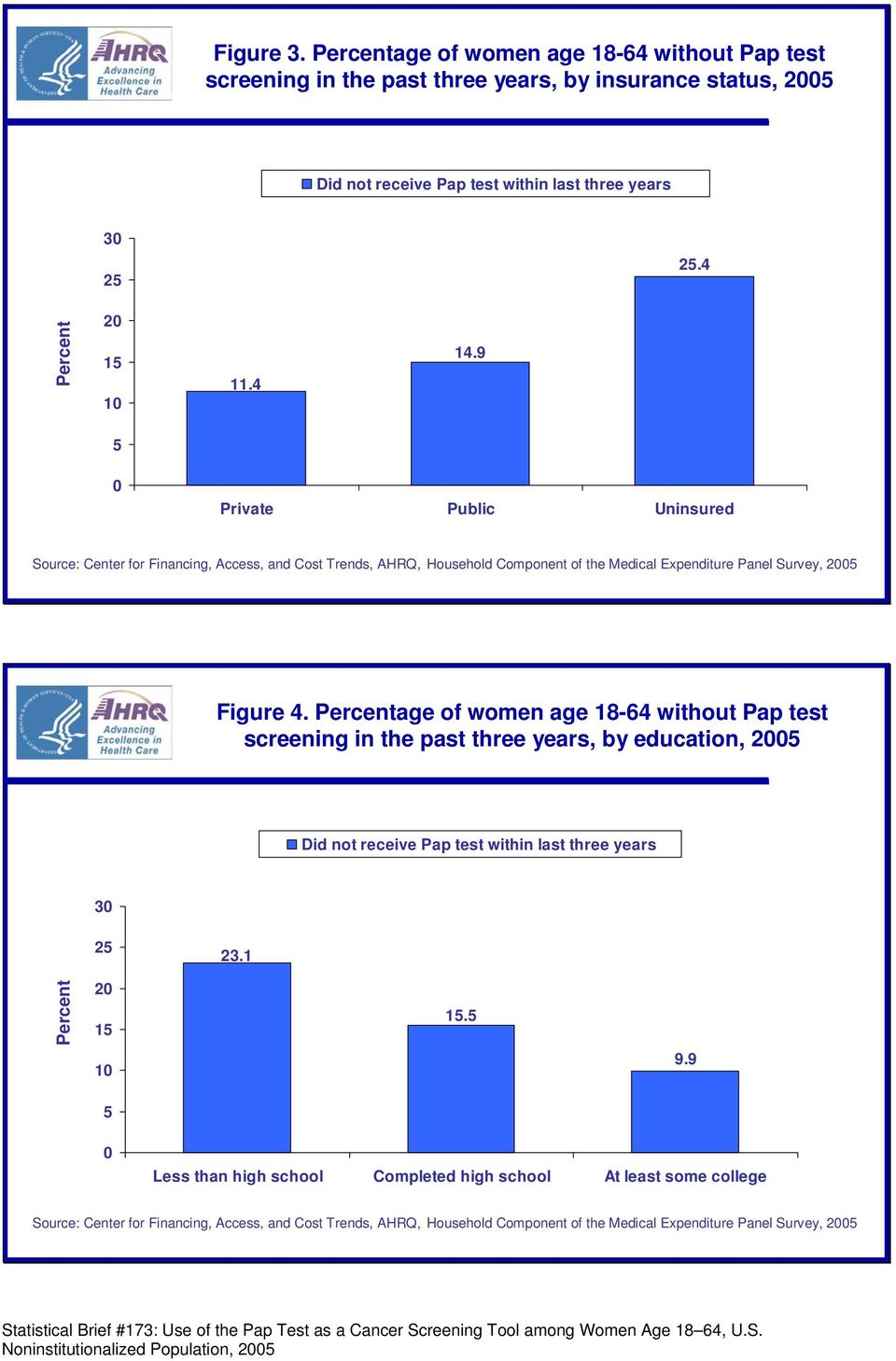
1 Medical Expenditure Panel Survey STATISTICAL BRIEF #173 Agency for Healthcare Research and Quality June 27 Use of the Pap Test as a Cancer Screening Tool among Women Age 18 64, U.S. Noninstitutionalized Population, 2 Anita Soni, PhD Introduction The main purpose of the Pap test (also called the Pap smear test) is to detect cancer or abnormal cells that may lead to cancer. It can also find non-cancerous conditions, such as infection and inflammation. Cervical cancer can usually be prevented if women are screened regularly with a Pap test. The U.S. Preventive Services Task Force (USPSTF) found evidence that cervical cytology (Pap smear) screening reduces the incidence of and mortality from cervical cancer. The USPSTF suggests Pap smear screening at least every three years for women age This Statistical Brief provides estimates of the extent to which women age did not receive Pap smear screening for cervical cancer detection in 2. The estimates presented are derived from data collected in the MEPS Household Component questionnaire. All differences discussed in the text are statistically significant at. or better. Findings Evidence has been found that screening with cervical cytology (Pap smear) reduces the incidence of and mortality from cervical cancer. The Pap test every three years has been recommended for all women age In 2, approximately 13 million women age reported not having received the Pap test within the last three years. Highlights Almost 14 percent of women age reported not having received a Pap smear test within the last three years. Asian non- women were least likely to have received the Pap test within the last three years as compared with, white non-, or black non- women. One-fourth of women who were uninsured failed to receive the Pap test within the last three years. Women who were less educated were more likely not to have received the Pap test within the last three years. Single (never married) women were nearly twice as likely not to have received the Pap test within the last three years as compared with those who were married. Age Women age 3 39 were the least likely not to have received a Pap test in the last three years as compared with women age 4 49 or 64 (9.3 percent versus 12.1 percent and 17.2 percent, respectively) (figure 1). Race/ethnicity Asian non- women were more likely not to have received a Pap test within the last three years (21. percent) as compared with white non- (13. percent), black non- (9.9 percent), or (.6 percent) women (figure 2).

2 Insurance status Women age who were uninsured were more likely to not have received a Pap test within the last three years (2.4 percent) as compared with those who were covered by private insurance (11.4 percent) or public insurance (14.9 percent) (figure 3). Educational level Women age who were less educated were more likely not to have received a Pap test within the last three years. A higher percentage of women with less than high school education reported not having received a Pap test within the last three years as compared with those who had completed high school or those who had some college education (23.1 percent versus. percent and 9.9 percent, respectively) (figure 4). Marital status Women age who were single (never married) were nearly twice as likely not to have received a Pap test within the last three years as those who were married (19. percent versus.3 percent, respectively) (figure ). Data Source The estimates in this Statistical Brief were derived from the MEPS 2 full-year population characteristics data file (HC-9). Definitions The question related to receiving a Pap test was asked in the Preventive Care section of MEPS-HC. Pap test The Pap test (sometimes called a Pap smear) is a way to examine cells collected from the cervix. The main purpose of the Pap test is to detect cancer or abnormal cells that may lead to cancer. It can also find non-cancerous conditions, such as infection and inflammation. Racial and ethnic classifications Classification by race/ethnicity is based on information reported for each family member. Respondents were asked if each family member was or Latino. Respondents were also asked which race or races best describes each family member. Race categories include white, black/african American, American Indian or Alaska Native, Asian, Native Hawaiian or other Pacific Islander, and other. Based on these questions, sample persons were classified into the following race/ethnicity categories:, white non- single race, black non- single race, Asian non- single race, and other (Hawaiian/pacific Islander non-, American Indian/Alaska Native non-, and multiple races non-). Marital status The category No Longer Married includes the women who are widowed, divorced or separated. Educational level Educational level indicates a person s number of years of education at the time of the first MEPS interview: - Less than high school = Less than 12 years of education - High school graduate = Completed 12 years of education - At least some college = More than 12 years of education Within the last three years This refers to the three years before the MEPS interview in which this question was asked. Health insurance status Individuals under age 6 were classified in the following three insurance categories based on household responses to health insurance status questions: - Any private health insurance: Individuals who, at any time during the year, had insurance that provides coverage for hospital and physician care (other than Medicare, Medicaid, or other public

3 hospital/physician coverage) were classified as having private insurance. Coverage by TRICARE (Armed Forces related coverage) was also included as private health insurance. Insurance that provides coverage for a single service only, such as dental or vision coverage, was not included. - Public coverage only: Individuals were considered to have public coverage only if they met both of the following criteria: 1) they were not covered by private insurance at any time during the year, and 2) they were covered by one of the following public programs at any point during the year: Medicare, Medicaid, or other public hospital/physician coverage. - Uninsured: The uninsured were defined as people not covered by private hospital/physician insurance, Medicare, TRICARE, Medicaid, or other public hospital/physician programs at any time during the entire year or period of eligibility for the survey. About MEPS-HC MEPS-HC is a nationally representative longitudinal survey that collects detailed information on health care utilization and expenditures, health insurance, and health status, as well as a wide variety of social, demographic, and economic characteristics for the civilian noninstitutionalized population. It is cosponsored by the Agency for Healthcare Research and Quality and the National Center for Health Statistics. For more information about MEPS, call the MEPS information coordinator at AHRQ ( ) or visit the MEPS Web site at References For a detailed description of the MEPS survey design, sample design, and methods used to minimize sources of nonsampling error, see the following publications: Cohen, J. Design and Methods of the Medical Expenditure Panel Survey Household Component. MEPS Methodology Report No. 1. AHCPR Pub. No Rockville, Md.: Agency for Health Care Policy and Research, Cohen, S. Sample Design of the 1996 Medical Expenditure Panel Survey Household Component. MEPS Methodology Report No. 2. AHCPR Pub. No Rockville, Md.: Agency for Health Care Policy and Research, Cohen, S. Design Strategies and Innovations in the Medical Expenditure Panel Survey. Medical Care, July 23: 41(7) Supplement: III- III-12. For information on the Pap test, see the following: Pap test facts: Pap tests: What they are and what the results mean. Recommendations and Rationale: Screening for Cervical Cancer. U.S. Preventive Services Task Force (USPSTF). The Pap test: Questions and Answers. Suggested Citation Soni, A. Use of the Pap Test as a Cancer Screening Tool among Women Age 18 64, U.S. Noninstitutionalized Population, 2. Statistical Brief #173. June 27. Agency for Healthcare Research and Quality, Rockville, Md. mepsweb/data_files/publications/st173/ stat173.pdf AHRQ welcomes questions and comments from readers of this publication who are interested in obtaining more information about access, cost, use, financing, and quality of health care in the United States. We also invite you to tell us how you are using this Statistical Brief and other MEPS data and

4 tools and to share suggestions on how MEPS products might be enhanced to further meet your needs. Please us at or send a letter to the address below: Steven B. Cohen, PhD, Director Center for Financing, Access, and Cost Trends Agency for Healthcare Research and Quality 4 Gaither Road Rockville, MD 28

5 Figure 1. age of women age without Pap test screening in the past three years, by age, All women Figure 2. age of women age without Pap test screening in the past three years, by race/ethnicity, White non- Black non- Asian non- Other non- Statistical Brief #173: Use of the Pap Test as a Cancer Screening Tool among Women Age 18 64, U.S. Noninstitutionalized Population, 2

6 Figure 3. age of women age without Pap test screening in the past three years, by insurance status, Private Public Uninsured Figure 4. age of women age without Pap test screening in the past three years, by education, Less than high school Completed high school At least some college Statistical Brief #173: Use of the Pap Test as a Cancer Screening Tool among Women Age 18 64, U.S. Noninstitutionalized Population, 2
7 Figure. age of women age without Pap test screening in the past three years, by marital status, Single (never married) Married No longer married Statistical Brief #173: Use of the Pap Test as a Cancer Screening Tool among Women Age 18 64, U.S. Noninstitutionalized Population, 2

STATISTICAL BRIEF #143
 Medical Expenditure Panel Survey STATISTICAL BRIEF #143 Agency for Healthcare Research and Quality September 26 Health Insurance Status of Hispanic Subpopulations in 24: Estimates for the U.S. Civilian
STATISTICAL BRIEF #137
 Medical Expenditure Panel Survey STATISTICAL BRIEF #137 Agency for Healthcare Research and Quality August 26 Treatment of Sore Throats: Antibiotic Prescriptions and Throat Cultures for Children under 18
STATISTICAL BRIEF #113
 Medical Expenditure Panel Survey STATISTICAL BRIEF #113 Agency for Healthcare Research and Quality January 26 Children s Dental Care: Periodicity of Checkups and Access to Care, 23 May Chu Introduction
STATISTICAL BRIEF #87
 Agency for Healthcare Medical Expenditure Panel Survey Research and Quality STATISTICAL BRIEF #87 July 2005 Attitudes toward Health Insurance among Adults Age 18 and Over Steve Machlin and Kelly Carper
STATISTICAL BRIEF #167
 Medical Expenditure Panel Survey STATISTICAL BRIEF #167 Agency for Healthcare Research and Quality March 27 The Five Most Costly Conditions, 2 and 24: Estimates for the U.S. Civilian Noninstitutionalized
STATISTICAL BRIEF #202
 Medical Expenditure Panel Survey STATISTICAL BRIEF #202 Agency for Healthcare Research and Quality April 2008 s in the Individual Health Insurance Market for Policyholders under Age 65: 2002 and 2005 Didem
STATISTICAL BRIEF #40
 Medical Expenditure Panel Survey STATISTICAL BRIEF #40 Agency for Healthcare Research and Quality May 2004 Health Insurance Coverage and Income Levels for the U.S. Noninstitutionalized Population under
STATISTICAL BRIEF #117
 Medical Expenditure Panel Survey STATISTICAL BRIEF #117 Agency for Healthcare Research and Quality March 2006 Children s Dental Visits and Expenses, United States, 2003 Erwin Brown, Jr. Introduction Regular
STATISTICAL BRIEF #378
 STATISTICAL BRIEF #378 July 212 Asthma Medication Use among Adults with Reported Treatment for Asthma, United States, and 28-29 Frances M. Chevarley, PhD Introduction Asthma is a chronic respiratory disease
Research. Dental Services: Use, Expenses, and Sources of Payment, 1996-2000
 yyyyyyyyy yyyyyyyyy yyyyyyyyy yyyyyyyyy Dental Services: Use, Expenses, and Sources of Payment, 1996-2000 yyyyyyyyy yyyyyyyyy Research yyyyyyyyy yyyyyyyyy #20 Findings yyyyyyyyy yyyyyyyyy U.S. Department
Full-Time Poor and Low Income Workers: Demographic Characteristics and Trends in Health Insurance Coverage, 1996 97 to 2005 06
 MEPS Chartbook No. 18 Medical Expenditure Panel Survey Full-Time Poor and Low Income Workers: Demographic Characteristics and Trends in Health Insurance Coverage, 1996 97 to 2005 06 Agency for Healthcare
Fast Facts: Latinos and Health Care. Facts and figures about the Hispanic community s access to the health care system
 Fast Facts: Latinos and Health Care Facts and figures about the Hispanic community s access to the health care system January 2012 U.S. Uninsured Population by Race/Ethnicity, 2010 White 46.3% Nearly one
Health Insurance Coverage: Estimates from the National Health Interview Survey, 2004
 Health Insurance Coverage: Estimates from the National Health Interview Survey, 2004 by Robin A. Cohen, Ph.D., and Michael E. Martinez, M.P.H., Division of Health Interview Statistics, National Center
STATISTICAL BRIEF #285
 STATISTICAL BRIEF #285 July 2010 Employer-Sponsored Single, Employee-Plus-One, and Family Health Insurance Coverage: Selection and Cost, 2009 Beth Levin Crimmel, MS Introduction Health insurance provided
Health Insurance by Race/Ethnicity: 2008
 2008 WASHINGTON STATE POPULATION SURVEY Research Brief No. 52 December 2008 U WASHINGTON STATE OFFICE OF FINANCIAL MANAGEMENT Health Insurance by Race/Ethnicity: 2008 Contributor: Erica Gardner sing data
Selected Socio-Economic Data. Baker County, Florida
 Selected Socio-Economic Data African American and White, Not Hispanic www.fairvote2020.org www.fairdata2000.com 5-Feb-12 C03002. HISPANIC OR LATINO ORIGIN BY RACE - Universe: TOTAL POPULATION Population
Estimated Population Responding on Item 25,196,036 2,288,572 3,030,297 5,415,134 4,945,979 5,256,419 4,116,133 Medicare 39.3 (0.2)
 Table 3-15. Percent Distribution of Veterans by Type of Health Insurance and Age 35 Years 35-44 Years 2001 National Survey of Veterans (NSV) - March, 2003 - Page 140 45-54 Years 55-64 Years 65-74 Years
STATISTICAL BRIEF #273
 STATISTICAL BRIEF #273 December 29 Employer-Sponsored Health Insurance for Employees of State and Local Governments, by Census Division, 28 Beth Levin Crimmel, M.S. Introduction Employees of state and
Health Status, Health Insurance, and Medical Services Utilization: 2010 Household Economic Studies
 Health Status, Health Insurance, and Medical Services Utilization: 2010 Household Economic Studies Current Population Reports By Brett O Hara and Kyle Caswell Issued July 2013 P70-133RV INTRODUCTION The
Racial Disparities in US Healthcare
 Racial Disparities in US Healthcare Paul H. Johnson, Jr. Ph.D. Candidate University of Wisconsin Madison School of Business Research partially funded by the National Institute of Mental Health: Ruth L.
By: Latarsha Chisholm, MSW, Ph.D. Department of Health Management & Informatics University of Central Florida
 By: Latarsha Chisholm, MSW, Ph.D. Department of Health Management & Informatics University of Central Florida Health Disparities Health disparities refers to population-specific differences in the presence
Medical Expenditure and Health Insurance in the United States
 Medical Expenditure Panel Survey STATISTICAL BRIEF #178 Agency for Healthcare Research and Quality July 27 Highlights Offer Rates, Take-Up Rates, Premiums, and Employee Contributions for Employer-Sponsored
Custodial Mothers and Fathers and Their Child Support: 2011
 Custodial Mothers and Fathers and Their Child Support: 2011 Current Population Reports By Timothy Grall Issued October 2013 P60-246 IntroductIon This report focuses on the child support income that custodial
Treatment. Race. Adults. Ethnicity. Services. Racial/Ethnic Differences in Mental Health Service Use among Adults. Inpatient Services.
 CHAPTER 1 Introduction Racial/Ethnic Differences in Mental Health Service Use among Adults Treatment Ethnicity Outpatient Services Mental Health Adults Mental Health Care Prevalence Inpatient Services
MEDICAL ASSISTANCE (MA)/MCHP APPLICATION FOR FAMILIES, PREGNANT WOMEN, AND CHILDREN
 Si necesita ayuda para llenar el formulario favor de llamar al 1-800-456-8900 Please PRINT in blue or black ink. MEDICAL ASSISTANCE (MA)/MCHP APPLICATION FOR FAMILIES, PREGNANT WOMEN, AND CHILDREN Date
HEALTH INSURANCE COVERAGE STATUS. 2009-2013 American Community Survey 5-Year Estimates
 S2701 HEALTH INSURANCE COVERAGE STATUS 2009-2013 American Community Survey 5-Year Estimates Supporting documentation on code lists, subject definitions, data accuracy, and statistical testing can be found
Access Provided by your local institution at 02/06/13 5:22PM GMT
 Access Provided by your local institution at 02/06/13 5:22PM GMT brief communication Reducing Disparities in Access to Primary Care and Patient Satisfaction with Care: The Role of Health Centers Leiyu
Educational Attainment in the United States: 2003
 Educational Attainment in the United States: 2003 Population Characteristics Issued June 2004 P20-550 The population in the United States is becoming more educated, but significant differences in educational
State of Alaska Health and Social Services Medicaid Study
 State of Alaska Health and Social Services Medicaid Study Prepared by Mike Humphrey Gregg Davis, PhD Bernard Khomenko The Wilson Agency, LLC 3000 A Street, Suite 400 Anchorage, AK 99503 Phone: (907) 277-1616
STATISTICAL BRIEF #330
 STATISTICAL BRIEF #33 July 211 Offer Rates, Enrollment Rates, Premiums, and Employee Contributions for Employer-Sponsored Health Insurance in the Private Sector for the 1 Largest Metropolitan Areas, 21
Health Insurance Coverage: Early Release of Estimates From the National Health Interview Survey, 2013
 Health Insurance Coverage: Early Release of Estimates From the National Health Interview Survey, 2013 by Robin A. Cohen, Ph.D., and Michael E. Martinez, M.P.H., M.H.S.A. Division of Health Interview Statistics,
Steven R. Machlin and Marc W. Zodet. Agency for Healthcare Research and Quality Working Paper No. 07001. October 2007
 A Methodological Comparison of Ambulatory Health Care Data Collected in Two National Surveys Steven R. Machlin and Marc W. Zodet Agency for Healthcare Research and Quality Working Paper No. 07001 October
Racial and Ethnic Disparities in Women s Health Coverage and Access To Care Findings from the 2001 Kaiser Women s Health Survey
 March 2004 Racial and Ethnic Disparities in Women s Health Coverage and Access To Care Findings from the 2001 Kaiser Women s Health Survey Attention to racial and ethnic differences in health status and
STATISTICAL BRIEF #435
 STATISTICAL BRIEF #435 April 2014 Premiums and Employee Contributions for Employer-Sponsored Health Insurance: Private versus Public Sector, 2012 Karen E. Davis, MA Introduction Employer-sponsored health
How To Calculate Health Insurance Coverage In The United States
 Health Insurance Coverage: Early Release of Estimates From the National Health Interview Survey, January March 2014 by Robin A. Cohen, Ph.D., and Michael E. Martinez, M.P.H., M.H.S.A. Division of Health
uninsured RESEARCH BRIEF: INSURANCE COVERAGE AND ACCESS TO CARE IN PRIMARY CARE SHORTAGE AREAS
 kaiser commission on medicaid and the uninsured RESEARCH BRIEF: INSURANCE COVERAGE AND ACCESS TO CARE IN PRIMARY CARE SHORTAGE AREAS Prepared by Catherine Hoffman, Anthony Damico, and Rachel Garfield The
BARD COLLEGE Clemente Course Application
 BARD COLLEGE Clemente Course Application Thank you for your interest in joining the Bard Clemente Course in the Humanities at the Kingston Public Library, 55 Franklin Street, Kingston, NY 12401. Classes
Educational Attainment of Veterans: 2000 to 2009
 Educational Attainment of Veterans: to 9 January 11 NCVAS National Center for Veterans Analysis and Statistics Data Source and Methods Data for this analysis come from years of the Current Population Survey
Total Males Females 34.4 36.7 (0.4) 12.7 17.5 (1.6) Didn't believe entitled or eligible 13.0 (0.3) Did not know how to apply for benefits 3.4 (0.
 2001 National Survey of Veterans (NSV) - March, 2003 - Page 413 Table 7-10. Percent Distribution of Veterans by Reasons Veterans Don't Have VA Life Insurance and Gender Males Females Not Applicable 3,400,423
Nephrology Consultants of Georgia, P.C.
 New Patient O (Check One) Established Patient O Name: (Last) _ (First) (MI) Address: City State Zip D.O.B. SSNO Email Address Ethnicity: O Hispanic or Latino O Not Hispanic or Latino O Patient Refused
Who are most likely to visit hospital emergency departments (EDs)?
 Research Brief The Methodist Le Bonheur Center for Healthcare Economics July 2015 Visitors to Hospital Emergency Rooms: Who, Why, and How Much Do They Cost? Cyril F. Chang, Ph.D. Introduction Hospital
Health Care Access to Vulnerable Populations
 Health Care Access to Vulnerable Populations Closing the Gap: Reducing Racial and Ethnic Disparities in Florida Rosebud L. Foster, ED.D. Access to Health Care The timely use of personal health services
Employment-Based Health Insurance: 2010
 Employment-Based Health Insurance: 2010 Household Economic Studies Hubert Janicki Issued February 2013 P70-134 INTRODUCTION More than half of the U.S. population (55.1 percent) had employment-based health
A Profile of Older Americans: 2013. Administration on Aging Administration for Community Living U.S. Department of Health and Human Services
 A Profile of Older Americans: 2013 Administration on Aging Administration for Community Living U.S. Department of Health and Human Services Table of Contents Highlights. 1 The Older Population. 2 Future
Number, Timing, and Duration of Marriages and Divorces: 2009
 Number, Timing, and Duration of Marriages and Divorces: 2009 Household Economic Studies Issued May 2011 P70-125 INTRODUCTION Marriage and divorce are central to the study of living arrangements and family
Racial Disparities and Barrier to Statin Utilization in Patients with Diabetes in the U.S. School of Pharmacy Virginia Commonwealth University
 Racial Disparities and Barrier to Statin Utilization in Patients with Diabetes in the U.S. School of Pharmacy Virginia Commonwealth University Outline Background Motivation Objectives Study design Results
DISPARITIES IN HEALTHCARE QUALITY AMONG RACIAL AND ETHNIC GROUPS
 DISPARITIES IN HEALTHCARE QUALITY AMONG RACIAL AND ETHNIC GROUPS Selected Findings From the 2011 National Healthcare Quality and Disparities Reports Introduction Each year since 2003, the Agency for Healthcare
Demographic and Labor Market Profile of the city of Detroit - Michigan
 Demographic and Labor Market Profile of the city of Detroit - Michigan Leonidas Murembya, PhD Regional Coordinator [email protected] www.michigan.gov/lmi 517-241-6574 State of Michigan Department
Broome County Community Health Assessment 2013-2017 1 APPENDIX A
 Community Health Assessment 2013-2017 1 APPENDIX A 2 Community Health Assessment 2013-2017 Table of Contents: Appendix A A Community Report Card will be developed based on identified strengths and opportunities
REGISTRATION FORM. How would you like to receive health information? Electronic Paper In Person. Daytime Phone Preferred.
 Signature Preferred Pharmacy Referral Info Emergency Contact Guarantor Information Patient Information Name (Last, First, MI) REGISTRATION FORM Today's Date Street Address City State Zip Gender M F SSN
Sex, Race, and Ethnic Diversity of U.S. Health Occupations (2010-2012)
 Sex, Race, and Ethnic Diversity of U.S. Health Occupations (2010-2012) January 2015 U.S. Department of Health and Human Services Health Resources and Services Administration Bureau of Health Workforce
The Risk of Losing Health Insurance Over a Decade: New Findings from Longitudinal Data. Executive Summary
 The Risk of Losing Health Insurance Over a Decade: New Findings from Longitudinal Data Executive Summary It is often assumed that policies to make health insurance more affordable to the uninsured would
Jeff Schiff MD MBA Medical Director Minnesota Health Care Programs, DHS 23 April 2015
 Jeff Schiff MD MBA Medical Director Minnesota Health Care Programs, DHS 23 April 2015 DHS Mission The MN Dept of Human Services, working with many others, helps people meet their basic needs so they can
A Profile of Older Americans: 2012
 A Profile of Older Americans: 2012 Administration on Aging Administration for Community Living U.S. Department of Health and Human Services Table of Contents Highlights. 1 The Older Population. 2 Future
The Employment Status of Instructional Staff Members in Higher Education, Fall 2011
 The Employment Status of Instructional Staff Members in Higher Education, Fall 2011 April 2014 John W. Curtis Director of Research and Public Policy American Association of University Professors, Washington
Profile of Rural Health Insurance Coverage
 Profile of Rural Health Insurance Coverage A Chartbook R H R C Rural Health Research & Policy Centers Funded by the Federal Office of Rural Health Policy www.ruralhealthresearch.org UNIVERSITY OF SOUTHERN