
Hawai'i Handbook For Immigrants
|
|
|
- Erick Fitzgerald
- 10 years ago
- Views:
Transcription
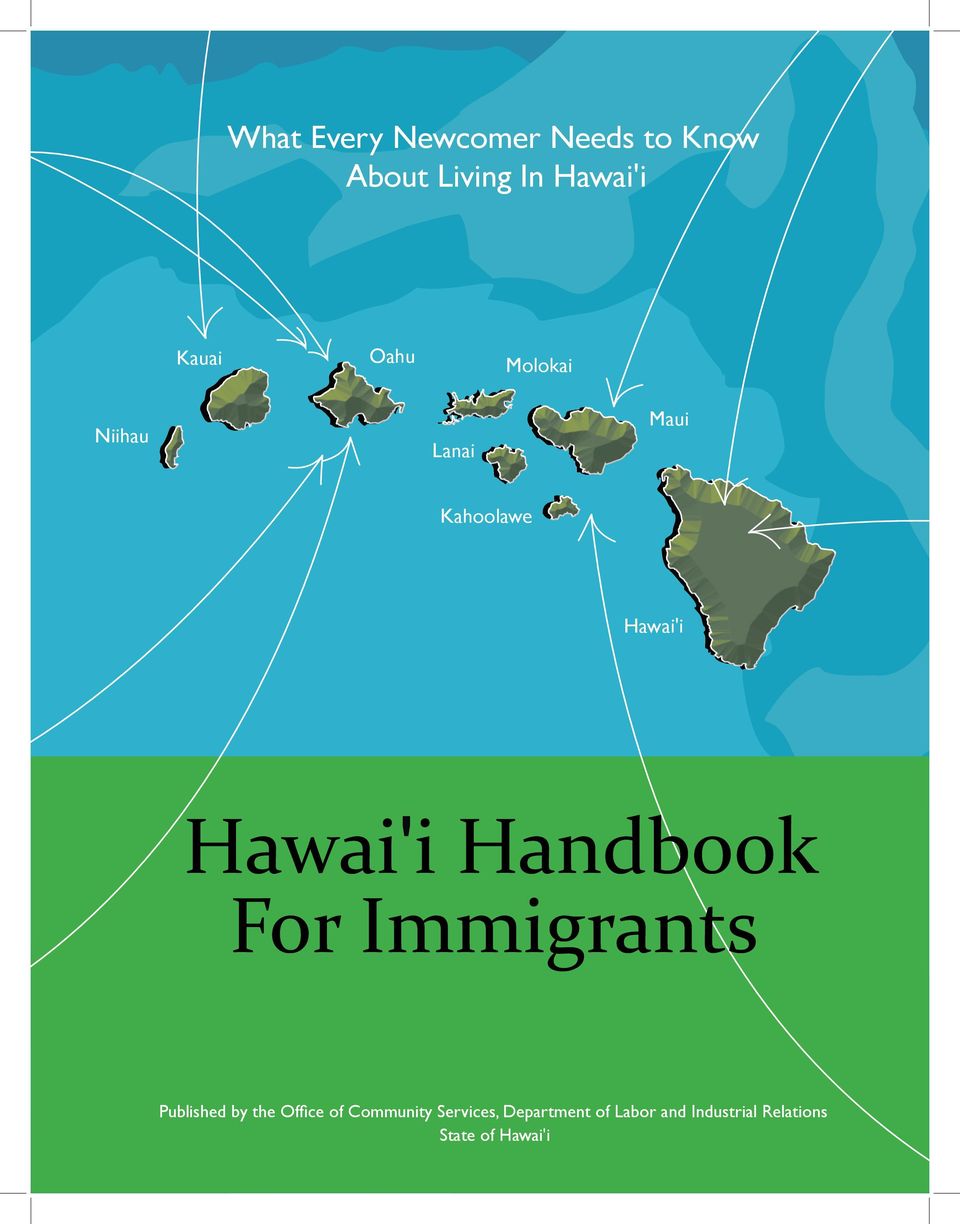
1 What Every Newcomer Needs to Know About Living In Hawai'i Kauai Oahu Molokai Niihau Lanai Maui Kahoolawe Hawai'i Hawai'i Handbook For Immigrants Published by the Office of Community Services, Department of Labor and Industrial Relations State of Hawai'i
2 Office of Community Services The Office of Community Services (OCS) in the State Department of Labor and Industrial Relations has long recognized the enduring economic and social benefits of investing in people, supporting their aspirations to become economically self-reliant, and strengthening their capacities to access and navigate needed resources and services. We believe that advancing policies and programs that help them achieve their dreams and aspirations for a sustained quality of life for their families will not only produce a more equitable, more cohesive and inclusive society, but a more prosperous, resilient and sustainable one. *************************** Disclaimer The information in this handbook is provided as is without warranties of any kind, either express or implied, statutory or otherwise. The Office of Community Services (OCS) expressly disclaims any and all warranties, express or implied, including but not limited to warranties of merchantability, fitness for a particular purpose, title and noninfringement and informational content. OCS does not make any representations or warranties regarding the validity, accuracy, or reliability, or the results of the use of the information in any of its publications, including this publication, or in the text and the websites cited herein, or in any other sites linked to the websites cited in the text, or in the products or services obtained through the websites cited in this publication or through any other sites linked to the websites cited in this publication. The information in this publication and/or on the websites that are cited in this publication may be out-of-date, and OCS makes no commitment to update the information in this publication or on any websites. To the extent permitted by applicable law, in no event shall OCS, or any of its officers or employees, contractors, subcontractors, agents, or successors or assigns be liable to the reader of this publication, or to anyone else relying on any information contained in this publication or in the websites cited herein for any damages of any kind, whether direct, incidental, consequential, indirect, exemplary, multiple, general, special or punitive resulting from the use or inability to use the text or the information contained here, regardless of whether such claimed liability is based on claims of breach of contract, tort (including negligence), strict liability, breach of warranty, failure of essential purpose or otherwise, even if OCS is advised of the possibility of such damages. Although this publication includes links providing direct access to other websites, OCS has not participated in their development, and OCS does not monitor or exert any editorial or content control or influence over those websites. THIS HAWAII HANDBOOK FOR IMMIGRANTS IS NOT INTENDED FOR SALE AND SHOULD NOT BE FOR PROFIT.

3 Special Message from Governor Neil Abercrombie Hawai i Handbook for Immigrants E komo mai (welcome). On behalf of the people of the State of Hawai i, I commend the Office of Community Services in partnership with the Immigrant Resource Centers for publishing this important resource, the Hawai i Handbook for Immigrants. We continue to weave a rich cultural tapestry together as immigrants who followed the original Polynesian voyagers in crossing the ocean to come to this special place. So much of the beauty and culture that residents and visitors enjoy every day is owed to the labor and legacy of past immigrants. I am honored to welcome you as the newest addition to this legacy. Immigrants play a crucial role in strengthening and revitalizing Hawai i s workforce. Investing in our immigrants benefits all of our residents by providing a greater foundation for Hawai i s economic stability and growth. With this publication, I wish to recognize your courage in taking the difficult step of leaving your home country to establish a new life in Hawai i. Challenges are inevitable in making such a great transition, which is why we have established the Immigrant Resource Centers to help guide you. I hope this handbook will provide you with the appropriate resources to navigate this demanding time, and help you lead a fulfilling life here in Hawai i. Best wishes, NEIL ABERCROMBIE Governor, State of Hawai i

4 Aloha and welcome to Hawaii! We, at the Department of Labor and Industrial Relations (DLIR), do our best to serve the working men and women who are the power that makes Hawaii s economy work. As a new immigrant, if you enter the work force, you will be benefitting from the services that DLIR provides to all workers in the State. At DLIR, we administer the Unemployment Insurance program, which assists employees who lose their jobs through no fault of their own, and the Workers Compensation program, which provides money to workers who are injured while working. We have a Workforce Development Division, which helps people find jobs and job-training opportunities, and our Wage Standards Division helps protect you if you are not being paid at least the minimum wage and overtime. We are very pleased that the Office of Community Services (OCS) is an attached agency at DLIR. OCS has been leading the way in providing improved services for new immigrants as well as others in Hawaii who are economically disadvantaged. OCS has recently established new Immigrant Resource Centers, where you will find help for your questions and your needs by staff who knows how to help you. OCS has prepared the Handbook that you are reading right now, to provide more information that will help you become established as a productive member of our Hawaii community. With my best wishes, DWIGHT TAKAMINE Director, Department of Labor and Industrial Relations State of Hawaii Aloha! Welcoming you and your family to Hawaii is an honor and a privilege for me as a first generation immigrant who came to Hawaii several decades ago. I, too, came with a few personal possessions and big dreams of paving the way and carving a new life for my family. Starting over in a new, unfamiliar place can be very challenging. It means stepping into a new culture and a new way of life, learning about the federal, state, and local laws, being aware of one s rights and responsibilities, knowing where to get information or services, and finding resources and opportunities for economic and social success. As the Executive Director of the Office of Community Services (OCS) under Governor Neil Abercrombie, I ve had the privilege of leading a team of diverse, talented, and committed individuals who care deeply about our mission to serve Hawaii s immigrants, refugees, and economically disadvantaged individuals. Our mission is a very personal one for me. I am deeply grateful to our community partners and the Immigrant Resource Centers (IRC) for working collaboratively with us in developing this handbook. Here you will find information on available services and resources to help you every step of the way, from the time you try to get a driver s license or a State ID to the time you re ready to apply for citizenship. For assistance, please call or visit the IRC nearest you. Their locations and contact information are listed in this handbook. I am humbled by the opportunity to offer this handbook as a welcoming gift to you and your family, and hope that it will serve you well as you establish a new life in Hawaii. We look forward to assisting you, and wish you success in reaching your dreams and aspirations. Sincerely, MILA MEDALLON-KAAHANUI Executive Director, Office of Community Services Department of Labor and Industrial Relations State of Hawaii

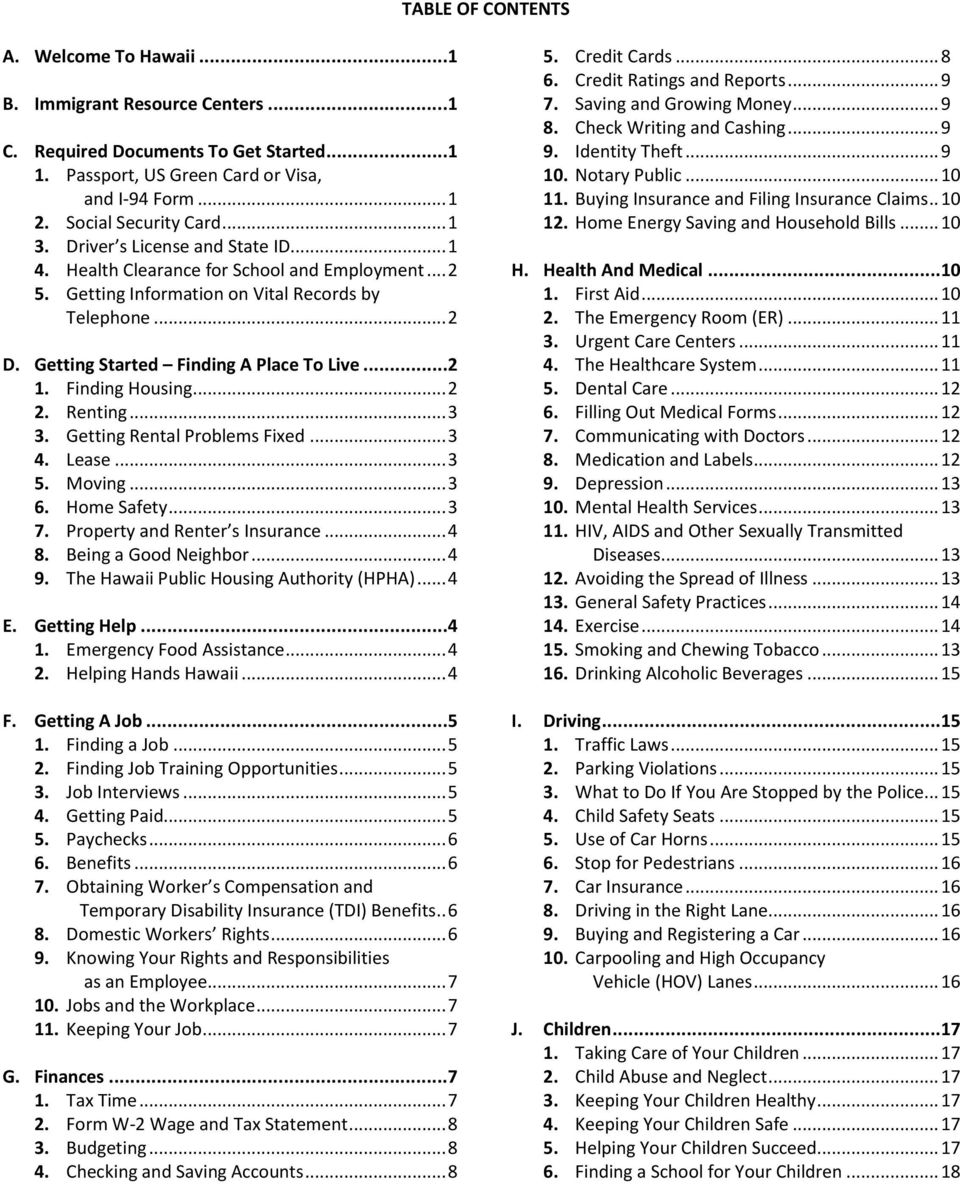
5 TABLE OF CONTENTS A. Welcome To Hawaii...1 B. Immigrant Resource Centers...1 C. Required Documents To Get Started Passport, US Green Card or Visa, and I-94 Form Social Security Card Driver s License and State ID Health Clearance for School and Employment Getting Information on Vital Records by Telephone... 2 D. Getting Started Finding A Place To Live Finding Housing Renting Getting Rental Problems Fixed Lease Moving Home Safety Property and Renter s Insurance Being a Good Neighbor The Hawaii Public Housing Authority (HPHA)... 4 E. Getting Help Emergency Food Assistance Helping Hands Hawaii... 4 F. Getting A Job Finding a Job Finding Job Training Opportunities Job Interviews Getting Paid Paychecks Benefits Obtaining Worker s Compensation and Temporary Disability Insurance (TDI) Benefits Domestic Workers Rights Knowing Your Rights and Responsibilities as an Employee Jobs and the Workplace Keeping Your Job... 7 G. Finances Tax Time Form W-2 Wage and Tax Statement Budgeting Checking and Saving Accounts Credit Cards Credit Ratings and Reports Saving and Growing Money Check Writing and Cashing Identity Theft Notary Public Buying Insurance and Filing Insurance Claims Home Energy Saving and Household Bills H. Health And Medical First Aid The Emergency Room (ER) Urgent Care Centers The Healthcare System Dental Care Filling Out Medical Forms Communicating with Doctors Medication and Labels Depression Mental Health Services HIV, AIDS and Other Sexually Transmitted Diseases Avoiding the Spread of Illness General Safety Practices Exercise Smoking and Chewing Tobacco Drinking Alcoholic Beverages I. Driving Traffic Laws Parking Violations What to Do If You Are Stopped by the Police Child Safety Seats Use of Car Horns Stop for Pedestrians Car Insurance Driving in the Right Lane Buying and Registering a Car Carpooling and High Occupancy Vehicle (HOV) Lanes J. Children Taking Care of Your Children Child Abuse and Neglect Keeping Your Children Healthy Keeping Your Children Safe Helping Your Children Succeed Finding a School for Your Children... 18
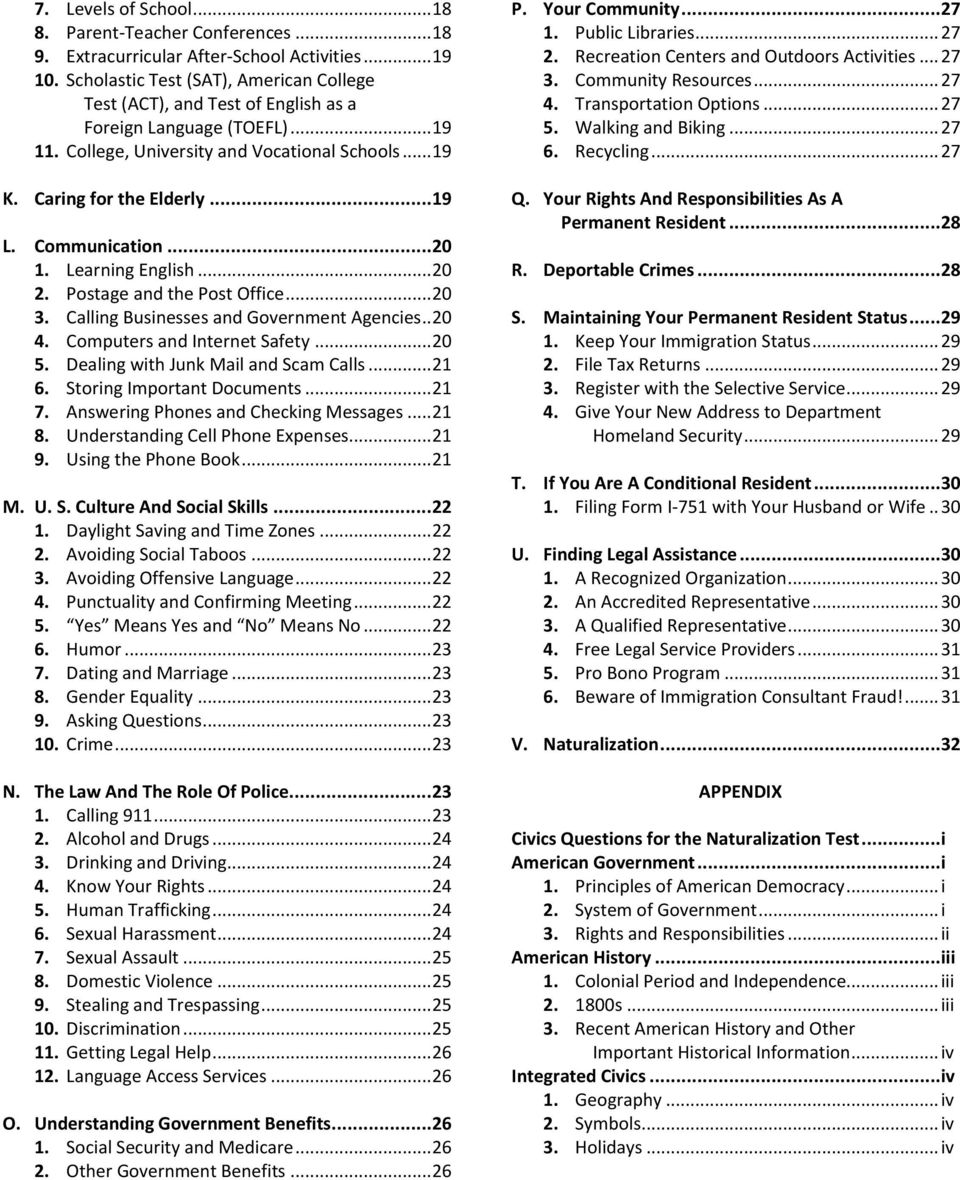
6 7. Levels of School Parent-Teacher Conferences Extracurricular After-School Activities Scholastic Test (SAT), American College Test (ACT), and Test of English as a Foreign Language (TOEFL) College, University and Vocational Schools K. Caring for the Elderly...19 L. Communication Learning English Postage and the Post Office Calling Businesses and Government Agencies Computers and Internet Safety Dealing with Junk Mail and Scam Calls Storing Important Documents Answering Phones and Checking Messages Understanding Cell Phone Expenses Using the Phone Book M. U. S. Culture And Social Skills Daylight Saving and Time Zones Avoiding Social Taboos Avoiding Offensive Language Punctuality and Confirming Meeting Yes Means Yes and No Means No Humor Dating and Marriage Gender Equality Asking Questions Crime N. The Law And The Role Of Police Calling Alcohol and Drugs Drinking and Driving Know Your Rights Human Trafficking Sexual Harassment Sexual Assault Domestic Violence Stealing and Trespassing Discrimination Getting Legal Help Language Access Services O. Understanding Government Benefits Social Security and Medicare Other Government Benefits P. Your Community Public Libraries Recreation Centers and Outdoors Activities Community Resources Transportation Options Walking and Biking Recycling Q. Your Rights And Responsibilities As A Permanent Resident...28 R. Deportable Crimes...28 S. Maintaining Your Permanent Resident Status Keep Your Immigration Status File Tax Returns Register with the Selective Service Give Your New Address to Department Homeland Security T. If You Are A Conditional Resident Filing Form I-751 with Your Husband or Wife.. 30 U. Finding Legal Assistance A Recognized Organization An Accredited Representative A Qualified Representative Free Legal Service Providers Pro Bono Program Beware of Immigration Consultant Fraud! V. Naturalization...32 APPENDIX Civics Questions for the Naturalization Test...i American Government...i 1. Principles of American Democracy... i 2. System of Government... i 3. Rights and Responsibilities... ii American History...iii 1. Colonial Period and Independence... iii s... iii 3. Recent American History and Other Important Historical Information... iv Integrated Civics...iv 1. Geography... iv 2. Symbols... iv 3. Holidays... iv
7 A. WELCOME TO HAWAII! Aloha! As a new immigrant to the United States who has chosen to live in Hawaii, you may use this Handbook to find important information and valuable services that should help you overcome challenges and find opportunities for success in your new community. This Handbook contains useful tips to help you in getting started, finding a job or job training, locating a place to live, knowing your rights and responsibilities, caring for your children, understanding government benefits, managing your health and your finances, and other topics. B. IMMIGRANT RESOURCE CENTERS The State Office of Community Services (OCS) has established Immigrant Resource Centers across the State to assist you and other new immigrants to Hawaii. These welcoming centers are located in many areas, and they may just be around your neighborhood. You and your family are encouraged to call or visit these centers. C. REQUIRED DOCUMENTS TO GET STARTED 1. Passport, US Green Card Or Visa, And I-94 Form Keep these documents in a safe place. Replacing these documents could cost you time and money. *Subject to change in service provider and funding availability. 2. Social Security Card Immigrant Resource Centers* Kalihi, Oahu 1485 Linapuni St., Suite 105 Honolulu, Hawaii Phone: (808) Kaili St. Honolulu, Hawaii Phone: (808) Ewa Beach, Oahu Fort Weaver Rd. Ewa Beach, Hawaii Phone: (808) Kapaa, Kauai Kuhio Hwy. Kapaa, Hawaii Phone: (808) Hilo, Hawaii Island 62 Kinoole St. Hilo, Hawaii Phone: (808) You need your Social Security number for work, for reporting your income taxes, and for opening bank or credit union accounts. Obtain Social Security cards for you and all members of your family. Apply at the local office of the US Social Security Administration. Ask for an interpreter if you do not speak, read, write or understand English. Social Security Administration Phone Number: / Office Locations: Oahu Honolulu Office: 300 Ala Moana Blvd Kapolei Office: 563 Farrington Highway Island of Hawaii Hilo Office: 111 Puainako Street Kauai Lihue Office: 4334 Rice Street Maui Wailuku Office: 2200 Main Street 3. Driver s License And State ID Obtain a Hawaii State ID or a Hawaii driver s license. Ask for the Driver Test in your own language, if available. Please make sure to bring these required documents: Acceptable documents for proof of date of birth and proof of legal name (birth certificate, valid and unexpired Permanent Resident Card issued since 1997, or unexpired foreign passport with a valid unexpired U.S. visa affixed accompanied by the approved I-94 form). Acceptable documents for proof of social security number (original social security card; wage and tax statement Form W-2 or 1099R, provided the Social Security Number is printed on the document. Original or certified copy. Computer printed electronically transmitted form acceptable; or a pay stub with the applicant's name and Social Security Number printed. Original or certified copy. 1

8 Ask for an interpreter if you do not speak, read, write or understand English. Driver s License and State Identification Card City and County of Honolulu County of Hawaii City Square Phone: (808) Hilo Phone: (808) Wahiawa Phone: (808) Kona Phone: (808) Waianae Phone: (808) Naalehu Phone: (808) Kapolei Phone: (808) Pahoa Phone: (808) Koolau Phone: (808) Waimea Phone: (808) County of Kauai County of Maui Dept. of Finance Phone: (808) Dept. of Finance Phone: (808) Health Clearance For School And Employment TB clearance, record of vaccinations, and health examination are required by schools and employers. 5. Getting Information on Vital Records by Telephone To obtain copies of Hawaii state birth, marriage or death certificates and other vital records, call (808) D. GETTING STARTED FINDING A PLACE TO LIVE 1. Finding Housing You can find housing through: The internet (craigslist.org and other listing services). Talking with friends. Checking the Classified ads in the newspaper. Housing agencies. Requesting the Immigrant Resource Centers for information on Public Housing. Looking for For Rent or For Lease signs. Houses and apartments can come with or without furniture. It is possible to rent a single room in a house or an apartment. On Craigslist.org this is listed as rooms/shared. When you apply to rent, you might be asked for your Social Security number and references from employers and past landlords. You Department of Health Service Centers Diamond Head Health Center Dental Clinic Phone: (808) Public Health Nursing Office-East Honolulu Phone: (808) Immunization Clinic & TB Testing Clinic STD/HIV Clinic Phone: (808) Lanakila Health Center Dental Clinic Phone: (808) Public Health Nursing Office-West Honolulu Phone: (808) Immunization TB Control Program Phone: (808) Immunization, TB Testing, & Dental Care Leeward Health Center Dental Clinic Phone: (808) Public Health Nursing Office-Central Oahu Phone: (808) TB Testing and Chest X-ray Phone: (808) Wahiawa Cottage Phone: (808) Waipahu Civic Center Phone: (808) Waianae Public Health Nursing Office Phone: (808) Windward Health Center Public Health Nursing Office-Windward Oahu Phone: (808) Dental Clinic Phone: (808) For eligible individuals and families in need for basic necessities, such as food, clothing, furniture, and basic household items, contact Helping Hands Hawaii Community Clearinghouse Program. Phone: (808) For eligible individuals and families who are homeless or at-risk of being homeless, contact the Helping Hands Emergency Assistance Program. Phone: (808) can ask friends/family to serve as a reference for you. These references can prove that you are responsible and will be able to pay rent. It is important to establish good relationships with your landlords. In the classifieds there are many abbreviations such as: FURN furnished; BA bathroom; BR bedroom; and DEP deposit. When looking for housing, you may want to take someone with you. 2

9 2. Renting When renting, you often need to pay a security deposit. The deposit is usually first and last month rent before you can move in. If you damage the property, the landlord may keep part or all of your deposit and possibly charge you extra. Take photos of any existing problems before you move in. Renters are not responsible for normal wear and tear. For example, the landlord is responsible to replace the toilet if it is old and does not work. DCCA-Office of Consumer Protection Oahu: (808) (press 3 at the menu) Maui: (808) (ext #) Hawaii: (808) (ext #) Kauai: (808) (ext #) Lanai/Molokai: , (ext #) Better Business Bureau of Hawaii Inc. Phone: (808) Neighbor Island call: Phone: Hawaii Immigrant Justice Center at Legal Aid Society of Hawaii (LASH) Phone: (808) Getting Rental Problems Fixed Landlords have to keep their properties safe and in good condition. If your apartment needs repairs: a) call the landlord and explain the problem; b) if he or she does not respond, send a letter to the landlord and keep a copy of the letter; and c) if you get no response, call Better Business Bureau of Hawaii Inc. 4. Lease A lease is a legal contract signed between the landlord and tenant. A lease contains information, including but not limited to the following: How much rent you pay each month. Extra fees for late payment. Who is responsible for paying water, electricity, gas, and trash service. When the landlord can increase your rent and by how much. The number of people who can live in the rented unit. How long you can live in the rented unit. If you want to continue living in the rented unit when your lease ends, talk to the landlord about renewing the contract before the lease ends. A month-to-month lease states that the tenant may end the contract with one month s notice. The landlord may end the contract with 45 days notice. If there are no changes from the tenant or landlord, the lease automatically renews at the end of every month. 5. Moving When you move to a new address, fill out a Change of Address form at the post office or at Change the locks at your new home and let the landlord know. Contact friends, family and the following when you move: Electric, gas, water, phone, cable, internet, and trash companies. Banks, credit unions and credit card companies. Doctor, dentist, and insurance agencies. Children s School 6. Home Safety A smoke alarm is a device that will make a loud noise when it senses smoke. Install smoke alarms on every floor of your home. Common causes of house fires include cigarettes, children playing with matches and lighters, candles and things that are hot such as stoves and toasters. 3

10 7. Property And Renter s Insurance Insurance usually covers damages caused by fire, theft or weather. You can receive money if your property is damaged. 8. Being A Good Neighbor Say hello to your neighbors, smile, and introduce yourself. You can welcome new neighbors with a small gift. Only leave trash and recycled materials outside when they are going to be picked up that day or the next day. Do not use your car horn or play loud music early in the morning or late at night. Your neighbors might call the police if you are very noisy. The police can give you a fine. Your landlord can evict you. Make sure your kids are not playing in the streets or on other people s property. Park cars only in places where it is allowed. Make sure your pets are on a lease or confined in your yard. 9. The Hawaii Public Housing Authority (HPHA) HPHA helps provide Hawai`i residents with affordable housing and shelter without discrimination. Hawaii s counties also provide public housing, but you may have to be on a waiting list. E. Getting Help For Housing assistance, call: Hawaii Public Housing Authority Honolulu (808) Kauai (808) Maui (808) Hawaii (808) Molokai/Lanai Honolulu Department of Community Services (808) Downtown/ Kapolei Hawaii Office of Housing & Community Devp. (808) Kauai Kauai County Housing Agency (808) Maui Dept. of Housing & Human Concerns (808) Transitional Housing/Shelter Ohana Ola o Kahumana (808) Catholic Charities: Transitional Housing Program (808) Holo Loa a: Weinberg Village Waimanalo (808) Emergency Food Assistance If you need emergency food assistance, you can go to your local food banks, soup kitchens and food pantries in your area. The U.S. Department of Agriculture provides funds for emergency food assistance. It prohibits discrimination against anyone. If you feel you are being discriminated upon, you may call the USDA office at (866) for guidance. Hawaii Foodbank, Inc. Phone: (808) Kauai Food Bank, Inc. Phone: (808) Maui Food Bank, Inc. Phone: (808) The Food Basket, Inc. (Hilo) Phone: (808) Helping Hands Hawaii Helping Hands Hawai i administers numerous programs that benefit Hawaii s people including the Bilingual Access Line, Community Clearinghouse, Ready to Learn, Emergency 4 For assistance, call Helping Hands Phone: (808) Assistance Program, and Behavioral Health Programs. Their Programs represent a broad range of services.

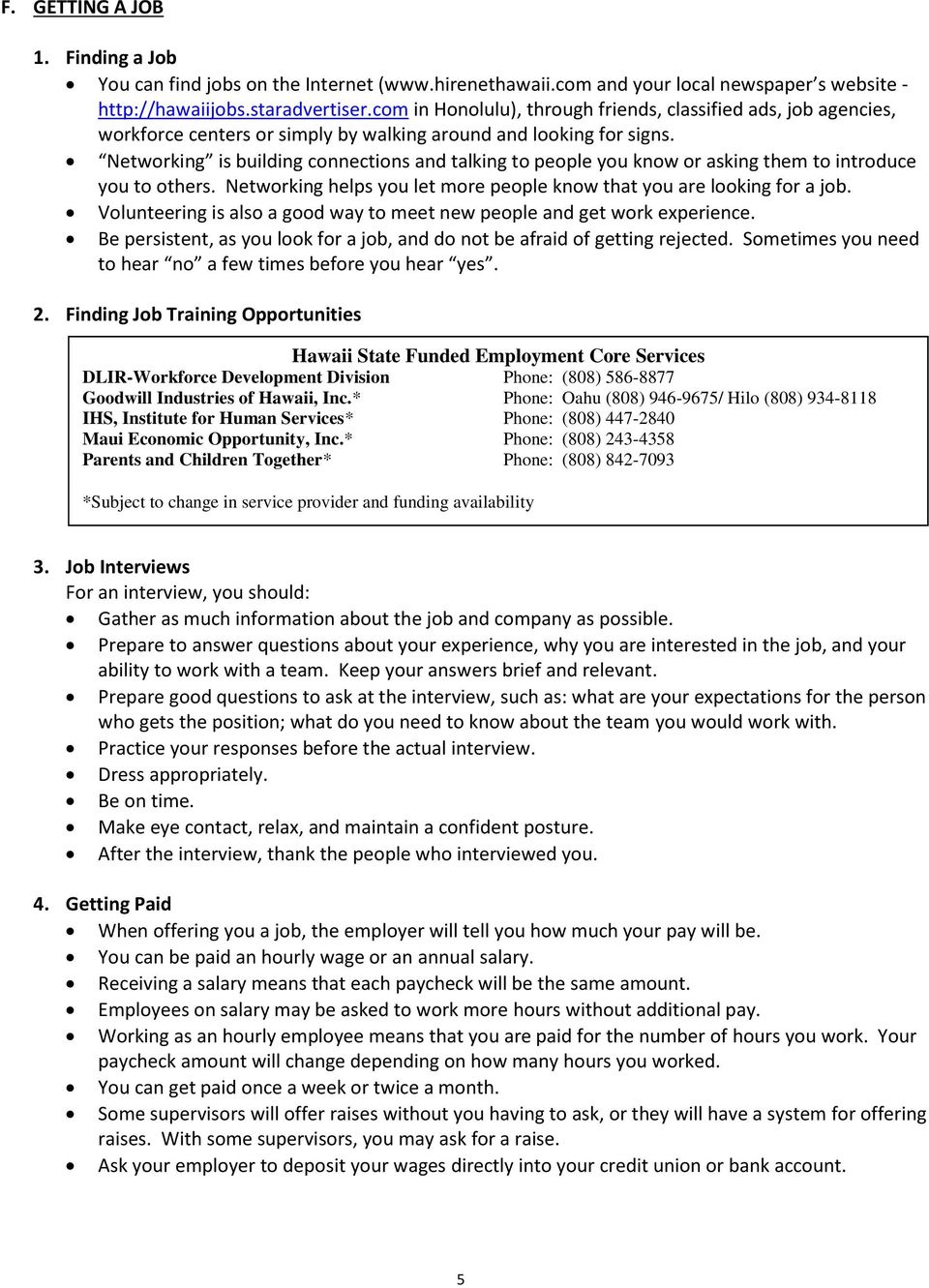
11 F. GETTING A JOB 1. Finding a Job You can find jobs on the Internet ( and your local newspaper s website - in Honolulu), through friends, classified ads, job agencies, workforce centers or simply by walking around and looking for signs. Networking is building connections and talking to people you know or asking them to introduce you to others. Networking helps you let more people know that you are looking for a job. Volunteering is also a good way to meet new people and get work experience. Be persistent, as you look for a job, and do not be afraid of getting rejected. Sometimes you need to hear no a few times before you hear yes. 2. Finding Job Training Opportunities Hawaii State Funded Employment Core Services DLIR-Workforce Development Division Phone: (808) Goodwill Industries of Hawaii, Inc.* Phone: Oahu (808) / Hilo (808) IHS, Institute for Human Services* Phone: (808) Maui Economic Opportunity, Inc.* Phone: (808) Parents and Children Together* Phone: (808) *Subject to change in service provider and funding availability 3. Job Interviews For an interview, you should: Gather as much information about the job and company as possible. Prepare to answer questions about your experience, why you are interested in the job, and your ability to work with a team. Keep your answers brief and relevant. Prepare good questions to ask at the interview, such as: what are your expectations for the person who gets the position; what do you need to know about the team you would work with. Practice your responses before the actual interview. Dress appropriately. Be on time. Make eye contact, relax, and maintain a confident posture. After the interview, thank the people who interviewed you. 4. Getting Paid When offering you a job, the employer will tell you how much your pay will be. You can be paid an hourly wage or an annual salary. Receiving a salary means that each paycheck will be the same amount. Employees on salary may be asked to work more hours without additional pay. Working as an hourly employee means that you are paid for the number of hours you work. Your paycheck amount will change depending on how many hours you worked. You can get paid once a week or twice a month. Some supervisors will offer raises without you having to ask, or they will have a system for offering raises. With some supervisors, you may ask for a raise. Ask your employer to deposit your wages directly into your credit union or bank account. 5
12 5. Paychecks Your paycheck shows the amount that has been taken out of your check for federal, state, Social Security and Medicare (FICA) taxes. FICA taxes are based on a percentage of the amount you receive. The number of exemptions you claim on your W-4 form changes the amount that is taken out of your paychecks. The amount that is taken out is the amount that you are likely to owe the Internal Revenue Service (IRS) at the end of the year. If the IRS shows that you owe less than the amount that was taken from your paychecks, you will receive a refund of the amount you overpaid. If you owe more, you will have to pay it. The gross income is the amount you make before taxes and net income is the amount after taxes are deducted. 6. Benefits Benefits offered by employers vary, and they can include the following: medical/dental insurance; paid vacation time and sick leave; retirement benefits. In Hawaii, if you work 20 hours or more for 4 consecutive weeks, you are entitled to health insurance coverage from your employer. If you get hurt on the job, you may receive money from your employer through workers compensation or DLIR-Unemployment Insurance Division Phone: (808) temporary disability insurance. If you lose your job because your employer goes out of business or must reduce its workforce, you may be entitled to unemployment insurance benefits. As soon as possible after you learn that you will be losing your job, contact the Unemployment Insurance Division of the State Department of Labor and Industrial Relations or visit the office at 830 Punchbowl Street to file a claim for benefits. You cannot receive unemployment insurance if you are terminated for cause. 7. Obtaining Worker s Compensation And Temporary Disability Insurance (TDI) Benefits As an employee, you are entitled to Workers DLIR-Disability Compensation Division Compensation insurance benefits if you are injured on Phone: (808) your job or if your work conditions cause you to be sick. Workers Compensation Insurance provides monetary benefits to cover part of your lost wages and your medical expenses if you suffer a work-related injury. You need to promptly file a claim with your employer. If the employer s insurance company rejects your claim, you can appeal to the Disability Claims Division at the Hawaii Department of Labor and Industrial Relations. Your employer provides Temporary Disability Insurance (TDI), which pays benefits to you to cover part of your lost wages if you become disabled from sickness or injury, even if not related to your work. As with Workers Compensation, if the insurance company denies your claim, you can appeal to the Disability Claims Division. Ask for an interpreter if you do not speak, read, write or understand English. 8. Domestic Workers Rights Hawaii has a Domestic Workers Bill of Rights. This law protects people who work in the homes of other people. These workers include individuals who provide 6 For general information on State Labor Laws, contact DLIR-Wage Standards Division Phone: (808) services in private homes such as child care, elder care, housekeeping, cleaning, cooking, landscaping, laundry, and other domestic services. These new protections prohibit an employer from discharging or discriminating against a domestic worker in compensation or in terms, conditions, or privileges of employment because of the domestic worker's race, religion, sex,
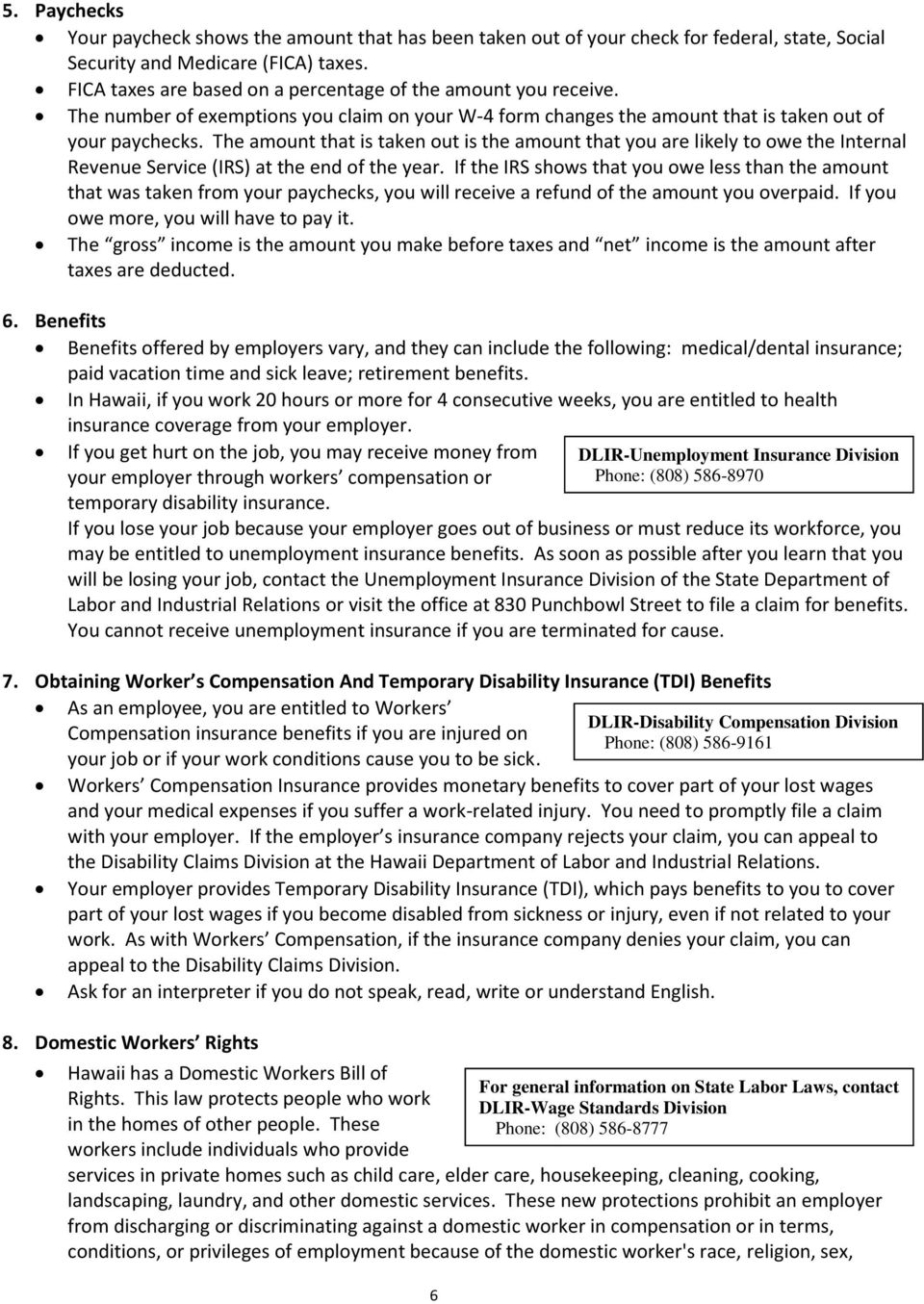
13 sexual orientation, color, ancestry, age, disability, or marital status. The law also extends the State's Wage and Hour Law to domestic workers other than those employed on a casual basis or performing companionship services. 9. Knowing Your Rights And Responsibilities As An Employee In Hawaii, all employers are required to provide medical-dental insurance for all employees who work at least 20 hours per week. That is why many employers offer part-time employment for 19 hours per week, to avoid this requirement. Some employers offer additional benefits, but these rarely apply to employees earning minimum wage and to part-time employees: Paid vacation time and paid sick leave. Retirement benefits. 10. Jobs And The Workplace Working overtime: Employers generally have to pay hourly workers time-and-a-half for any hours above 40 per week. So, if you normally make $10 per hour, you would make $15 per hour of overtime. Some salaried employees are not eligible for overtime pay depending on the job responsibilities and salary. Minimum Wage: The federal minimum wage is set and changed by the U.S. Congress. Each state has its own minimum wage law. Employees who receive a lot of money in tips, such as restaurant jobs, may receive less than the minimum wage. Under Hawaii s new minimum wage law, an employee must receive at least $7.25 per hour; at least $7.75 per hour starting January 1, 2015; at least $8.50 per hour starting January 1, 2016; at least $9.25 starting January 1, 2017; and at least $10.10 starting January 1, Time Sheets: Always save your receipts from time clocks for hours you worked, or write down the hours you worked if the time clock does not print a receipt. If you see a mistake, talk to your supervisor. 11. Keeping Your Job Employers tend to keep employees who: Are positive and enthusiastic. Are reliable and work hard. Want to learn new things and ask good questions. Wear appropriate dress and use appropriate language. Follow the rules and can be trusted. Work well with and help their coworkers. Always call your employer in advance if you will be late or unable to come to work. G. FINANCES 1. Tax Time You need to file a Federal income tax return every year on or before April 15 th and a Hawaii tax return by April 20. You can also ask for an extension if you need more time, but you will need to pay interest and penalties if you owe money. Free Tax Services for Low-Income Persons Oahu Honolulu Community Action Program Phone: (808) Goodwill Industries of Hawaii, Inc. Phone: (808) Parents and Children Together Phone: (808) Big Island Goodwill Industries of Hawaii, Inc. Phone: (808) County of Hawaii Office of Housing and Community Development Phone: (808) Kauai Goodwill Industries of Hawaii, Inc. Phone: (808) Maui Goodwill Industries of Hawaii, Inc. Phone: (808) Molokai Alu Like, Inc. Phone: (808)

14 Different companies such as H&R Block can prepare your taxes for a cost. Many public service agencies will help low-income people prepare tax for free. 2. Form W-2 Wage And Tax Statement W-2 forms are used to report money paid to employees and taxes taken out. The W-2 forms reports your income from January 1 st through December 31 st. You receive a copy of your W-2 form in the mail or at your work in January. Use the information on your W-2 form to file your taxes. You must attach a copy of your W-2 form with your Federal and State tax returns. 3. Budgeting You make a budget by comparing your income to your expenses. Budgeting may require cutting your expenses to match your income. List your income (money coming in) and expenses (money being spent). Make a monthly budget and include expenses for: Food Housing Childcare Health Insurance Medical care Clothing Transportation Income Taxes Electricity Telephone Emergencies Remittances to Family Internet 4. Checking And Savings Accounts Banks and credit unions are a safe place to keep your money. If the money you keep there is lost or stolen, the U. S. government will pay it back to you up to a certain guaranteed amount. It is not safe to carry a lot of cash. Opening a checking account allows you to: Write checks. Make debit card payments, which immediately take money out of your checking account. Get cash from ATM machines. Using ATM machines can be free if they are connected to your bank or credit union. To open an account you often need two forms of identification, proof of address, and an opening deposit. Some factors to consider when choosing a bank or credit union include: Monthly fees for the account. Interest rates. How close it is to your home or work. There are businesses that cash checks for people without accounts, but they may charge a lot of money. Be careful if you use them. Payday lenders offer cash advances or small loans. They charge large fees if you do not pay back the loan quickly. Be careful if you use them. Do not send cash in the mail. If you do not have a checking account and you need to mail a payment, purchase a money order or teller s check from a bank or credit union or the Post Office. 5. Credit Cards A credit card allows you to buy now and pay later. The longer you wait to pay back the full amount you owe, the more interest you pay. Interest rates can be very high. Cards have different annual fees, benefits and interest rates. Some companies offer a low-interest or interest-free period (0% APR Annual Percentage Rate) to start, but eventually they increase the rate. 8

15 In order to receive a credit card, the bank will determine if you can afford the card. The bank then sets your credit limit, which is the maximum amount you can spend. 6. Credit Ratings And Reports Your credit rating tells lenders, such as credit card companies and mortgage companies, how responsible you are in paying your bills and debts. A good credit For a free credit report, call: rating allows you to borrow money through loans to buy Phone: expensive things like a house or a car. You build up your credit rating by paying your bills for credit cards and loans on time. You may have to pay to view your credit score. In general, a score of is good. A score of above 760 is excellent and will get you the lowest interest rates. 7. Saving And Growing Money There are many options for making your money grow. You can earn interest through a savings account, Certificate of Deposits, bonds, and stocks. Talk to a financial expert for more information. 8. Check Writing And Cashing To cash, deposit or transfer a check, you have to sign your name on the back of the check. When writing a check you need to include: The date. The amount as a number. The amount in writing. The name of the person or company receiving the check. Your signature. If you want to sign your check for another person to cash or deposit, write on the back of check: Pay to the order of on the top line. The person s name on the next line. Your signature on the next line. When you write a check for more money than you have in the bank, the bank will charge you a fine. This is called an overdraft. Some banks and credit unions offer overdraft protection. 9. Identity Theft Be careful about sharing your personal information because people can use it to take your money. Shred and do not just throw away or recycle documents that have your: Social security number. Bank account numbers. Credit card numbers. When you give personal information to a credit card company, bank, etc. you should be the person who started the communication. Do not carry important documents such as your passport or birth certificate with you when you do not need them. Keep them stored in a safe place. If you receive an that seems to be from the Internal Revenue Service (IRS) or from a bank asking for personal information, it is probably false. Call if you are not sure. The IRS does not do business through . 9

16 10. Notary Public Notaries witness the signing of important documents and confirm that the documents and signatures are authentic. Some financial institutions will offer its customers this service for free. Credit unions will usually not charge you for a limited number of notarizations. You should never pay a lot of money for this service. You must be prepared to present photo identification to use the services of a registered notary public. 11. Buying Insurance And Filing Insurance Claims Types of insurance you might purchase include car, health, life, property, renters, and disability. You usually pay for the insurance every month. This amount is usually called the premium. If you have insurance, you must first file an insurance claim for the injury or accident before you receive money from the insurance company. Filing a claim needs to be done correctly. If you make mistakes with your claim, you may not receive money. Keep receipts for major purchases or repairs you make. If you experience theft, immediately report it to the police. You may only make insurance claims for damages that happen after you purchase the insurance. You can be prosecuted for claiming insurance for a damage that happened before your insurance began. 12. Home Energy Saving And Household Bills Common bills at home include electric, water, heat/gas, phone, trash, and cable/internet. You often have the option to pay bills through the internet or automatic payments that take money directly from your account. You can save energy and money by: Buying energy-efficient light bulbs (CFLs) and appliances. Turning off TVs, lights and other electronics when not in use. Using air condition only when necessary. Keeping the house dark in hot weather. H. HEALTH AND MEDICAL 1. First Aid Always call 911 for emergencies. To stop bleeding, cover the wound with something clean and apply a little pressure. A choking victim needs help immediately. The sign for choking is two hands placed on the throat. You can use a series of abdominal thrusts to help anyone over one year old who is choking on an object. Follow these steps: Stand behind of the choking person, make a fist and place the thumb side of your fist below the rib cage and above the navel of the victim. Grasp your fist with the other hand and make quick upward thrusts until the object is removed. You can learn more at Cardio Pulmonary Resuscitation (CPR) Red Cross Hawaii State Chapter and First Aid classes in your community. Contact the Red Phone: (808) Cross for training classes. 10

17 2. The Emergency Room (ER) Emergency Rooms are located in hospitals. Know the location of an emergency room (ER) close to your home. ERs must treat a patient in immediate medical need, including people who cannot pay or do not have health insurance. Emergency rooms are open 24 hours a day/7 days a week. Using the ER can be expensive, especially if you do not have health insurance. If you do not need emergency care, call an urgent clinic or your doctor to make an appointment. Some conditions that may require you to go to an ER for immediate medical attention include: Difficulty breathing. Fainting or sudden dizziness. Changes in vision. Sudden or severe pain. Pain or pressure in your chest. Bleeding that will not stop. Urgent Care Center Concentra Urgent Care Phone: (808) Island Urgent Care Phone: (808) Kuhio Walk-In Clinic Phone: (808) Pearl City Urgent Care Phone: (808) Keauhou Urgent Care Phone: (808) Hawaii Pacific Health Kauai Urgent Care Phone: (808) Hilo Urgent Care Phone: (808) Kauka Express Urgent Care Phone: (808) Keaau Urgent Care Phone: (808) Urgent Care Centers Urgent care centers treat patients who have an injury or illness that requires immediate care but is not serious enough to visit an ER. Urgent care can be faster and less expensive than a visit to the ER. Urgent care centers are usually not open all the time. You can take your temperature by using an oral thermometer under your tongue or armpit. For most people, normal body temperature in degrees Fahrenheit is 98.6 F/ C. Anything above that is considered a fever. In general, for adults a fever of F/39.44 C or more is considered dangerous. You can purchase a thermometer at pharmacies or grocery stores. If you are not sure how dangerous the fever is, call a doctor or health clinic. 4. The Healthcare System Under the Affordable Care Act ( Obamacare ), everyone must have health insurance coverage. Persons who do not have coverage from an employer or school must purchase insurance or, if eligible, obtain insurance through Hawaii Health Connector Phone: 1 (877) Hawaii s Medicaid Program QUEST. DHS - Med-Quest Division There are many options for health insurance. Some employers pay Phone: (808) for part or all of their employees health insurance costs. Buying your own health insurance can be expensive, but it can reduce large medical bills. Here are some words you should understand: Premiums the amount you pay monthly. Deductible the amount that you have to pay for expenses before your insurance pays anything. Co-pay the fee you pay every time you receive medical services. Your insurance pays for the rest of the service. Most communities have clinics and Community Health Centers that offer affordable health care. 11

18 5. Dental Care Basic dental care involves: Brushing two to three times a day and flossing your teeth every day. Flossing helps reduce plaque on your teeth. Seeing your dentist for checkups and cleanings one or two times a year. Diabetics require cleaning 4 times a year. 6. Filling Out Medical Forms When you see a doctor or fill out medical forms you will be asked about: Allergies you may have to medications. Health history. How much alcohol you drink and cigarettes you smoke. Family health conditions. Medications you are taking. Low-Cost/Free Medical and Dental Clinics Aloha Medical Mission (808) Lanakila Health Center (808) Easy Access Project (808) Kalihi Palama Health Center (808) Downtown Family Center (808) Kokua Kalihi Valley (808) Koolauloa Comm. Health (808) Hauula Comm. Health (808) Queen Emma Clinics (808) Queen s Medical Center (808) Tzu Chi Medical Clinic (808) Waianae Coast Health Center (808) Waikiki Health Center (808) McCully-Moiliili Branch (808) Waimanalo Health Center (808) Downtown Family Center (808) Information you share with doctors, nurses and hospital workers is kept confidential. Ask for an interpreter if you do not speak, read, write or understand English. 7. Communicating With Doctors Do not be afraid to ask your doctor questions about anything pertaining to your health. Questions you can ask may include: When should I start to feel better? How can I prevent this from happening again? Are there symptoms I should look for? Sorry, but I didn t understand what you just said. Please tell me again. Ask for an interpreter if you do not speak, read, write or understand English. 8. Medication And Labels You need to get a prescription from a doctor for many medications. You can pick up prescription medicine at a pharmacy. You will most likely get a discount if you have drug coverage in your health insurance. Your health insurer may require you to get your medications from certain pharmacies. You can buy over-the-counter medicine like Tylenol and Advil at stores without prescription. All medications come with directions on the label that tell you: How to take the medicine. How much to take, such as the number of pills to take. How many times to take the medication in a day. For how many days or weeks. Always check the expiration dates and do not use medicine that has expired. Follow doctor s instructions. Finish all medications unless your doctor says you can stop sooner. 12

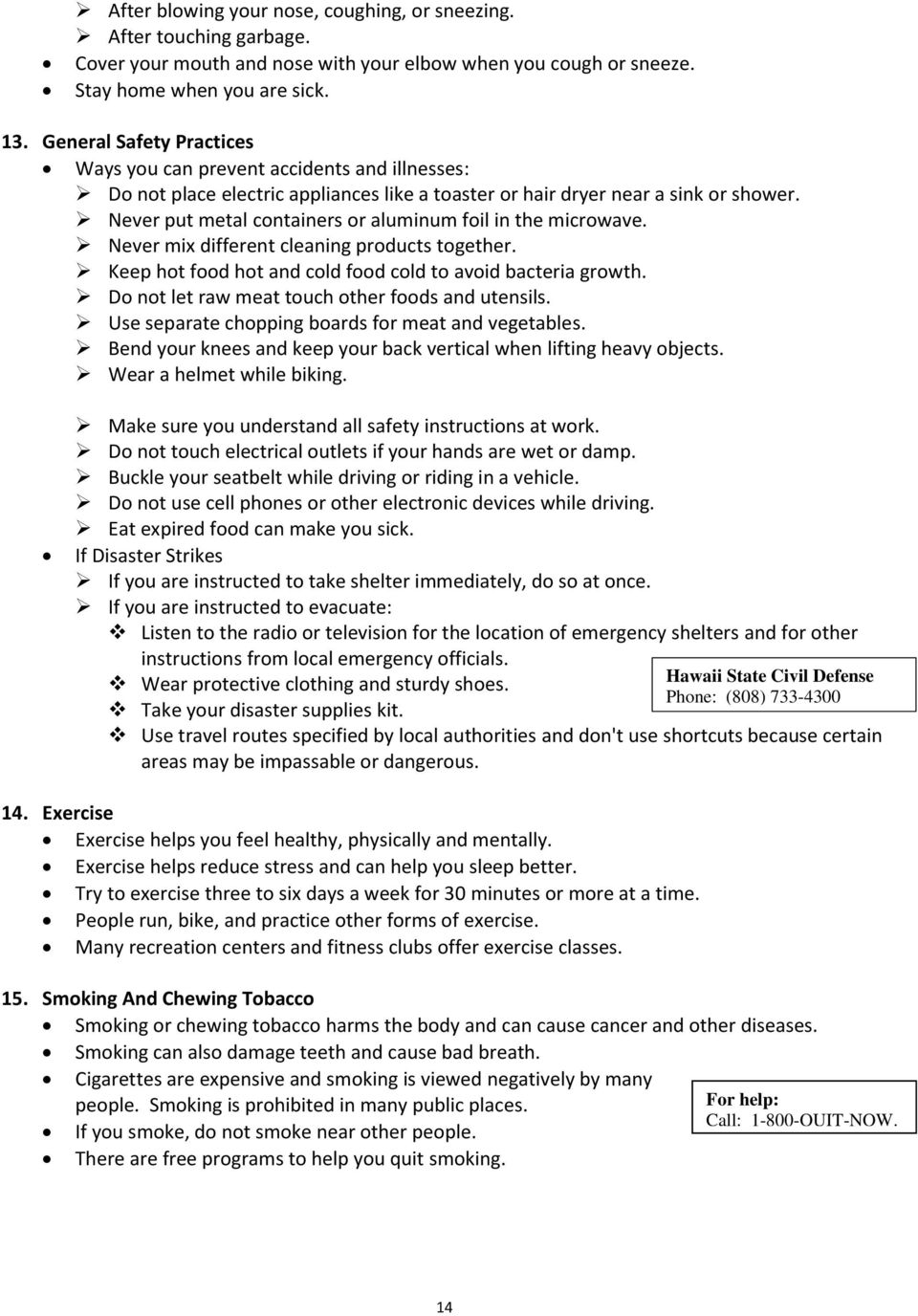
19 9. Depression Depression is common, and symptoms can include: Feeling sad and tired a lot. Feeling negative and guilty. Suicide/Crisis Hotline: Loss of interest in activities. Phone: (808) Difficulty controlling moods. Not being able to sleep or sleeping too much. Thoughts of suicide. Chronic Headaches. Many cases of depression can be treated effectively. If you think you may be suffering from depression, talk to a health clinic immediately. If you feel you are about to harm yourself, call 911 or the suicide crisis hotline. If you think a family member or friend is suicidal, call 911. Remember that you are in a new country. For you, many things will be unfamiliar and at times you may feel overwhelmed. You may feel homesick and miss family and friends. You may feel depressed by all this. 10. Mental Health Services There is nothing wrong or shameful about seeing a counselor or therapist. Counselors can help with family issues, individual issues, depression, headaches and sadness. Many immigrants experience stress when adapting to a new culture. Local social services or your health care provider may offer affordable mental health services. 13 Kalihi Palama Community Mental Health Center Phone: (808) Mental Health America of Hawaii Phone: (808) DOH Mental Health Division Oahu: (808) Statewide: Queen s Medical Center (Out-Patient Behavior Health) Phone: (808) Safe Haven (Mental Health Kokua) Phone: (808) Helping Hands Hawaii (Behavioral Health Programs) Phone: (808) HIV, AIDS and Other Sexually Transmitted Diseases HIV is the virus that causes AIDS. It can be passed from an infected person to another person through blood, semen, vaginal fluids, and breast milk. There is risk for spreading HIV by: Having sex without using protection. Sharing needles and equipment used for injecting drugs. For STD testing and assistance: Oahu Diamond Head Health Center Phone: (808) Big Island Waiakea Health Center Phone: (808) Maui District Health Office Phone: (808) Kauai District Health Office Phone: (808) Most areas have clinics that conduct free tests for HIV. You must tell your doctor if you are HIV positive. Contraceptive pills prevent pregnancy but do not protect you from sexually transmitted diseases. There is always a risk of acquiring Sexually Transmitted Diseases (STDs). It is important to know your partner s sexual history and to wear protection such as condoms. Talk to your doctor or a health clinic for more information about STDs and how to protect yourself. See listed resources for free STD testing and assistance. 12. Avoiding The Spread Of Illness To avoid spreading illnesses, always wash your hands with soap and water: Before preparing or eating food. After going to the bathroom. After changing diapers.

20 After blowing your nose, coughing, or sneezing. After touching garbage. Cover your mouth and nose with your elbow when you cough or sneeze. Stay home when you are sick. 13. General Safety Practices Ways you can prevent accidents and illnesses: Do not place electric appliances like a toaster or hair dryer near a sink or shower. Never put metal containers or aluminum foil in the microwave. Never mix different cleaning products together. Keep hot food hot and cold food cold to avoid bacteria growth. Do not let raw meat touch other foods and utensils. Use separate chopping boards for meat and vegetables. Bend your knees and keep your back vertical when lifting heavy objects. Wear a helmet while biking. Make sure you understand all safety instructions at work. Do not touch electrical outlets if your hands are wet or damp. Buckle your seatbelt while driving or riding in a vehicle. Do not use cell phones or other electronic devices while driving. Eat expired food can make you sick. If Disaster Strikes If you are instructed to take shelter immediately, do so at once. If you are instructed to evacuate: Listen to the radio or television for the location of emergency shelters and for other instructions from local emergency officials. Wear protective clothing and sturdy shoes. Take your disaster supplies kit. Hawaii State Civil Defense Phone: (808) Use travel routes specified by local authorities and don't use shortcuts because certain areas may be impassable or dangerous. 14. Exercise Exercise helps you feel healthy, physically and mentally. Exercise helps reduce stress and can help you sleep better. Try to exercise three to six days a week for 30 minutes or more at a time. People run, bike, and practice other forms of exercise. Many recreation centers and fitness clubs offer exercise classes. 15. Smoking And Chewing Tobacco Smoking or chewing tobacco harms the body and can cause cancer and other diseases. Smoking can also damage teeth and cause bad breath. Cigarettes are expensive and smoking is viewed negatively by many people. Smoking is prohibited in many public places. For help: Call: QUIT-NOW. If you smoke, do not smoke near other people. There are free programs to help you quit smoking. 14
21 16. Drinking Alcoholic Beverages Drinking alcoholic beverages in parks, beaches, and other public places is illegal. Drinking a lot of alcohol can harm your body and your relationships. It can also lead to legal problems, like being arrested for drunk driving. Alcoholics Anonymous Phone: (808) Having an open alcoholic beverage in your car is illegal. There are support groups like Alcoholic Anonymous (AA) to help alcoholics. Alcoholics often need support from family or friends. Alcoholism is viewed negatively, but getting help is viewed positively. I. DRIVING 1. Traffic Laws Your County will provide you copies of the driving laws. If a police officer sees you breaking a traffic law, you will get a ticket and points added to your license. If you receive a certain number of points, you will lose your license. Make sure you renew your car registration once a year or when necessary as well as your safety check. Do not drive without a license. Do not drink and drive. Do not use your cellphone or other electronic devices while driving. 2. Parking Violations You will receive a parking ticket for illegal parking or for not paying the parking meter. Fines can increase if you do not pay them within a certain number of days. In some areas, your car will get towed if it is parked illegally or on private property without permission. Never park in front of fire hydrants, driveways, taxi stands, red or yellow curbs, or bus stops. Do not park in handicapped spaces if you do not have a handicapped placard. Look for signs where you park to make sure it is legal to park there during the hours you are there. 3. What To Do If You Are Stopped By The Police If a police car flashes its lights behind you: Do not panic. Use your turn signal and pull over to the right in a safe area. Turn off the engine and stay in your car unless you are told to get out. Keep your hands on the wheel and stay relaxed. When the officer asks for your license, insurance and registration you can take your hands off the wheel to retrieve your documents. Be polite and show respect. 4. Child Safety Seats Hawaii law requires children under the age of 4 to ride in a child safety seat and children age 4 through 7 to ride in a booster seat when traveling in a motor vehicle. The police will stop you when they see a child who is not using a seat belt or car seat and you may get a ticket. 5. Use Of Car Horns Use your car horn sparingly, and only to prevent an accident or alert other drivers who are not paying attention. 15
22 6. Stop For Pedestrians They always have the right of way. 7. Car Insurance In Hawaii, every vehicle must have: Liability insurance for bodily injury and property damage. No-fault insurance that provides some coverage for medical expenses and some compensation for work loss for people injured in your car due to an accident. A car insurance policy could provide you some protection from losing money if you are involved in a car accident. Insurance policies provide different levels of coverage depending on how much risk you want to take. Call two or three companies to get different prices. The cost of insurance depends on your driving record, how old you are, the value of your car, and how many people will drive the car. Types of car insurance include: Property damage covers repairing the other person s car. Bodily injury covers costs of injuries to other people. Uninsured motorist pays for your injuries if the person at fault has no insurance coverage. Underinsured motorist pays for your injuries if the other driver is at fault and his/her insurance is insufficient. Collision covers damages to your car if the accident is your fault. Comprehensive pays for damages to your car from fire, theft and other causes that are not caused by a car accident. You may need to provide proof that you have insurance before you can register your car. If you are involved in an accident, write down the other person s name, phone number, insurance information, and license plate number. Check the other person s ID. AAA is an association that has low membership fees and helps when you have a car emergency. 8. Driving In The Right Lane Stay in the right lane when driving. Only use the left lane to pass other cars or to turn left. If you hear sirens or see flashing lights from an emergency vehicle, slowly pull over to the side to let the vehicle pass. If you see flashing red lights on a school bus, do not pass the bus from either direction. Stop and remain stopped until the flashing red lights are turned off. 9. Buying And Registering A Car You can buy used or new cars from an individual or from a dealer. Get a good mechanic to inspect a used car before you buy it. Be prepared to negotiate because negotiation is a normal part of buying a car. Before you meet with the seller, investigate the value of the car. A good source of information is Consumer Reports. You should investigate different purchase options such as buying, leasing and getting a loan from a bank, credit union or the car dealer. 10. Carpooling And High Occupancy Vehicle (HOV) Lanes Some highways have HOV lanes for cars carrying two or more people. You can receive a fine for driving alone in a HOV lane. 16
23 J. CHILDREN 1. Taking Care Of Your Children. Try to keep communication positive with your children. Many communities have parenting groups that can help with ideas about how to be a good parent. A child legally becomes an adult on his or her 18 th birthday. 2. Child Abuse And Neglect Physical discipline at home and school, such as slapping, hitting, or shaking hard that cause pain and injury to a child are illegal. Know where your child is at all times, or you might be accused of child neglect. Child neglect is a serious crime. The Parent Line Oahu: (808) Neighbor Islands: To Report Child Abuse and Neglect Call the Child welfare/protection Services Oahu: (808) Neighbor Island: Keeping Your Children Healthy Children usually need to eat three meals a day with one or two snacks. Make sure children drink lots of water. Avoid giving children a lot of soda, juice, fried foods, Lanakila Early Childhood Services Program candy or other foods and drinks with high sugar or fat Phone: (808) content. Give your kids a healthy breakfast every day to provide them energy for school. Make sure they know when and how to brush and floss their teeth, wash their hands, and clean their body. For more information ask a doctor, dentist or public health nurse. 4. Keeping Your Children Safe If you have young children at your home you should: Use outlet covers to protect against electrocution. Place window guards to prevent them from falling out of windows. Keep items like bleach, medicine, and matches out of children s reach. Make sure small children cannot fall down the stairs. Here are some other child safety tips: Never leave a young child alone in a car. Never leave a child in a car if the child is unable to open a car window if it becomes too hot inside the car. Teach children to always stop and look both ways (to the right, to the left) for cars whenever they cross a street. If there is a crosswalk nearby, the child should only cross at the crosswalk. If there is a traffic light, the child should only cross when the light is green, and the child still needs to watch out for cars. Teach your child that he or she must never go into the cars or homes of strangers. 5. Helping Your Children Succeed Read to them and have them read to you when they are ready. Set up and maintain schedules such as a consistent time to go to bed at night and to wake up in the morning. Getting good sleep helps their memory and ability to focus. If you need help on basic school supplies for your children (April - August), call: Helping Hands Hawaii Ready to Learn Program Phone: (808)
24 When your child breaks rules, discipline the child in a way that helps the child learn from his or her misbehavior. For example, if the child gets up too late repeatedly, have the child go to bed earlier. If the child is nasty to another person, have the child apologize to that person. These kinds of discipline are called reasonable consequences. At home, share chores. Let your children cook with you and discuss ingredients and cooking processes. Praise your kids as much as possible to reinforce good behavior. Taking your child out of school for a long period of time can hurt their academic progress. If they need to miss school, provide a written note to the school. Create a consistent time at home for homework and reading without TV. If you watch a lot of TV, so will your children. Encourage your children to make friends. Encourage your children to use their words to settle disagreements and not to fight. Always be aware of your child s progress in school. You need to meet your child s teachers. If you don t understand documents sent home with your child, it is okay to ask school officials to explain them to you. School children are expected to participate actively in school. If children break the rules at school they may have to stay after school or be suspended and not allowed to come to school for a few days. Talk to someone at the school to learn about rules that your children need to follow. 6. Finding a School for Your Children Every child has the right to a free education up to 12 th Head Start Program grade. Honolulu Community Action Program Contact your school district if you do not want to send Phone: (808) your child to the school in your neighborhood. Kauai Economic Opportunity Phone: (808) Some communities have charter schools and Maui Economic Opportunity alternative schools. These schools can help children Phone: (808) who do not do well in regular public schools. Head Start is a national program to help pre-school-aged children from low-income families. 7. Levels of School Three-to-five-year old children are considered pre-school age. A child must enter kindergarten if he or she becomes five years old on or before August 1 of the school year. Elementary school is kindergarten through 5 th or 6 th grade. Middle school or junior high school is usually 6 th through 8 th grade. High school is 9 th through 12 th grade. Adults who do not have a high school diploma can take the General Education Diploma (GED) test. The GED is accepted like a high school diploma. 8. Parent-Teacher Conferences Actively participate in the education of your children by attending parent-teacher conferences and talk to teachers about: How your child is doing. How you can help. The homework policy. Book suggestions. Any other ideas they have. 18
25 You can talk to your child s teacher at any time during the year. Ask for an interpreter if you do not speak, read, write or understand English. Do not use children as interpreters. 9. Extracurricular After-School Activities Students should participate in one or more after-school activities such as athletic teams, music clubs, theater, and student organizations. Engaging in extracurricular activities will help them make friends and learn new skills. Demonstrating different talents can help when applying to college. 10. Scholastic Aptitude Test (SAT), American College Testing (ACT), And Test Of English As A Foreign Language (TOEFL) The SAT and ACT are tests that help colleges evaluate students. Students usually need to take one of these tests to get into college. Typically they take these tests in 11 th or 12 th grade. Foreign students may have to take the TOEFL to get into college. 11. College, University And Vocational Schools Hawaii has a public university and community college system. The University of Hawaii has campuses at Manoa and West Oahu, and at Hilo and Maui. The community colleges are Hawaii Community College in Hilo; Kapiolani Community College in the Diamond Head area of Honolulu; Honolulu Community College in Iwilei; Leeward Community College in Waipahu; Windward Community College in Kaneohe; Maui Community College in Kahului; and Kauai Community College in Lihue. These colleges offer numerous programs in such areas as telecommunications, nursing, business, accounting, culinary arts, and many others. See Tuition at the public universities and colleges is cheaper than at private universities and colleges. Vocational schools are for high school graduates who want to develop a specific job skill, such as computer skills or automotive mechanics. K. CARING FOR THE ELDERLY 1. Senior Helpline ( ) for telephone consultation, information, and referral to services available for older adults and family caregivers. 2. Report elder abuse in community care facilities or in any other settings by calling (808) Aging and Disability Resource Center Oahu: Elderly Affairs Division Phone: (808) Big Island: Hawaii County Office of Aging Phone: (808) Hilo/ Kona Kauai: Agency on Elderly Affairs Phone: (808) Maui: Maui County Office on Aging Phone: (808) or 7755 Adult Protective Services Hotline Phone: (808)
26 L. COMMUNICATION 1. Learning English Learning English opens doors of opportunity and allows you to communicate with more people. Learning English is difficult and requires years of practice. Always attend classes, do homework, practice whenever possible with native English speakers, and watch TV in English. Do not be shy or afraid to make mistakes. The people who learn are the people who practice. Classes in the English language are usually available at community schools for adults. 2. Postage And The Post Office Mail delivery is usually fast and safe. To address an envelope: Put the address of the person you are mailing to in the middle. Put your address in the top left corner. Put a stamp on the top right corner. You can buy stamps at the post office, at usps.com, and at some stores. Letters with stamps that weigh less than 12 ounce can be dropped in blue metal mailboxes. Post offices have many options for shipping letters and packages. Adult Education Oahu McKinley Community School Phone: (808) Farrington Community School Phone: (808) Moanalua Community School Phone: (808) Waipahu Community School Phone: (808) Wahiawa Community School Phone: (808) Windward Community School Phone: (808) Kauai Kauai Community School Phone: (808) Maui Maui Community School Phone: (808) Hawaii (Big Island) Hilo Community School Phone: (808) Kona Community School Phone: (808) Calling Businesses and Government Agencies When you hear a voice recording, listen carefully and choose the best option. This can be a frustrating process. Do not give up. To talk with specific people, you need to first listen to a recorded menu and then dial the numbers of the extension of the person you want to talk to. Ask for an interpreter if you do not speak, read, write or understand English. 4. Computers And Internet Safety Many people communicate through . You can set up a free account with gmail.com, hotmail.com, or yahoo.com but you will still need to pay for internet services. When you share your address with companies, they can share your address with other companies. Use antivirus software and a firewall to prevent computer viruses and identity theft. Do not open links, photos or attachments from someone you do not know. Never send an with personal information including: Bank account numbers. Social security numbers. Credit card numbers. Passwords. Paying for internet access at home can be a large long-term cost. Investigate options and check the time period for the contract before signing. 20
27 5. Dealing With Junk Mail And Scam Calls Be cautious if you receive a letter or a phone call saying you have won something that you did not request. Phone calls from people you do not know can be an attempt to get your personal information to steal your money. Gifts or checks marked as free may come with services or contracts that you do not want. If you do not want to receive calls from companies that try to sell you things, you can register your phone number on the National Do Not Call Registry at or by calling Storing Important Documents Make copies of important documents and keep the copies in a separate safe place. These can include: Birth certificates. Car or home titles. Passports. US Green Card or Visa I-94 Diplomas and school records. You should also keep the following documents filed and organized: Paystubs, tax forms and other financial documents. Leases and other contracts. Automobile, medical, and insurance records. Review credit card and bank statements to make sure that they do not include purchases or withdrawals you did not make. When you think the bank or credit card company has made an error, call them immediately. 7. Answering Phones And Checking Messages In Hawaii driving while texting or talking on a cell phone is dangerous and illegal. Sometimes people consider it rude to answer a cell phone during a meeting, at meals, at the library, or when talking with friends. For this reason, you often need to leave and receive messages. If you have to answer calls in public places, do not talk loudly. 8. Understanding Cell Phone Expenses If you have a cell phone, understand the minutes and services that are part of your plan. You can get a very large bill if you use more services or minutes than you signed up for. You may have to sign a two- to three-year contract with most cell phone companies. There are also monthly plans, if you do not want to do a 2-year plan. 9. Using The Phone Book In telephone books such as the Yellow Pages the yellow section is organized in alphabetical order from A to Z by business type. The white section is organized by business or individual name. The beginning section has emergency numbers, and local maps. You can dial 411 or to find phone numbers and addresses, but those services often cost money. Whitepages.com and google.com are free. Numbers that start with area codes 800, 855, 866, 877 and 888 can usually be called free from any phone. 21
28 M. U. S. CULTURE AND SOCIAL SKILLS 1. Daylight Saving And Time Zones Hawaii Standard Time (HST) does not change during the year. However, on the Mainland, except Arizona, states change their times advancing one hour in March and falling back one hour in November. For example Los Angeles is two hours ahead of Hawaii from November to March, but three hours ahead during the rest of the year. 2. Avoiding Social Taboos There is some information that people like to keep private. Do not ask people you do not know very well about their: Opinions about politics. Salary or how much they make. Sexual orientation and practices. Religious beliefs or Church memberships. Age or weight. Do not stare or point at people. Do not use bad language in front of children and others who might not approve. Do not joke about race, gender, homosexuality, disabilities or religion. Religion is personal and is not talked about in public schools and workplaces. 3. Avoiding Offensive Language Do not use language that is offensive and politically incorrect. See the list below. Acceptable African-American/Black Gay/Homosexual Asian Elderly/Senior Physically/Mentally Challenged Negro, Colored Homo Oriental Old, Ancient Retarded Offensive 4. Punctuality And Confirming Meetings It is important to always arrive on time for: Work and work meetings. School. Appointments. For social events, the importance of being on time depends on the situation. Some people see being late as a sign of disrespect. Some people think it is okay to be late for social events. If you are running late for an appointment or a meeting, call to let people know and apologize when you arrive. Use a planner or calendar to remember where you need to be. 5. Yes Means Yes And No Means No If you do not understand something, it is usually better to admit it immediately. This is true especially when it involves safety at work. If you tell people you will go to a social event, they expect you to go. It is okay to say thank you for the invitation, but I am not able to attend. People can get upset if you say yes but you do not go. If a person offers you help and you say no, they may not offer again. Say thank you when someone offers to help you. 22
29 6. Humor Humor can start conversations or relax situations. Sarcasm is common, where people say the opposite of what they mean. For example, a person can say Wow, it s really hot outside! when the weather is very cold. Some people use sarcasm when they are upset, and some use it to be funny. 7. Dating And Marriage It is common for men and women who are not dating or married to be friends. If a member of the opposite sex talks to you, it does not mean that he or she is interested in a relationship. Married couples usually wear a wedding ring on the finger next to the little (pinky) finger of the left hand. 8. Gender Equality Women and men have the same rights and have equal roles in society. Many women have leadership positions in the government and in businesses. It is common for men to do traditionally female jobs such as cooking, cleaning, and taking care of children. 9. Asking Questions When you do not know how to do something, do not be afraid to ask. Most people will be happy to help you. Do not feel bad if someone tells you that you made a mistake. Ask questions and learn from the mistake. 10. Crime Be smart, but do not be scared of everyone and everything. Common safety suggestions are to: Lock up your home, car, bike and objects. Do not leave valuable items in your car. Do not walk alone at night in unsafe neighborhoods. Do not carry a lot of money or valuables with you. A lot of theft takes place through credit card and fraud. If you see a crime happen, get to a safe place and call 911. N. THE LAW AND THE ROLE OF POLICE Laws and police make our communities safe. Police are strict. Never bribe a police officer. It is your responsibility to understand and follow the laws. Always talk to police officers with respect. 1. Calling responds quickly to emergency calls. Dial 911 to: Report a fire Report a crime while it is happening or has just happened Report a car accident Get an ambulance for an emergency Be prepared to give your address and information about the emergency. If you do not speak English, you can ask for an interpreter. Do not call 911 for something that is not an emergency. 23
30 2. Alcohol And Drugs Drinking alcohol is only legal for adults over 21 years old. You will be asked for proof of your age when buying alcohol or entering bars. Alcoholics Anonymous There are penalties for providing alcohol to under aged persons. Phone: (808) It is illegal to drink alcohol on the street or outdoors in public places. Narcotics Anonymous You can get arrested or deported for selling or having illegal drugs. Phone: (808) Using drugs around children can be considered child abuse. If you or someone you know has a problem with drugs or alcohol, you can contact rehabilitation programs such as Alcoholics Anonymous (AA) and Narcotics Anonymous (NA). 3. Drinking And Driving Don t drink alcohol and drive, it is illegal. Driving after having one or two drinks of alcohol can get you arrested. Driving after drinking alcohol can cause serious accidents and other problems. 4. Know Your Rights If a police or immigration officer asks you questions, you have the right to remain silent and not answer the questions. You can request to speak with an attorney before answering any questions or signing any documents. If you do not have an attorney, the government provides an attorney for you in criminal cases if you cannot afford one. In general, you only have to let law enforcement officers into your house if they have a search warrant or if the officer believes there s a crime in progress. Public Defender s Office Honolulu Phone: (808) Maui Phone: (808) Big Island Phone: (808) (Hilo) (808) (Kona) Kauai Phone: (808) Hawaii Disability Rights Center (HDRC) The sole mission of HDRC is to protect and promote the human, civil and legal rights of individuals with Contact HDRC at: Phone: (808) disabilities, as established in the constitutions and laws of the State of Hawaii and the United States, through the provision of information and advocacy. 5. Human Trafficking Human trafficking is a form of modern-day slavery. Many victims of Human Trafficking Hotline: trafficking, especially women and children, are exploited for Phone: 1(866) purposes of prostitution and pornography. Trafficking also takes place in domestic service, small businesses, factories, and agricultural work. Traffickers use force, fraud and coercion to force women, men, and children to engage in these activities. If you or anyone you know is a victim of this kind of crime, immediately contact the police or your Immigrant Resource Center. There is help for victims of this crime. Prostitution is illegal in Hawaii. 6. Sexual Harassment Sexual harassment usually involves unwelcome conduct by an employer or a co-worker in a work place. It involves repeated behavior that is inappropriate and makes a person feel uncomfortable. Examples can include requests for a date, unwelcome behavior that is physical: a) shoulder or back rub; b) or comments about a person s appearance. 24
31 7. Sexual Assault Forcing any person to perform any sexual act is a crime. If he or she says no and the sex act continues, it is sexual assault. It is illegal for adults to engage in sexual acts with anyone under the age of 16 in Hawaii. 8. Domestic Violence Domestic violence is emotional, psychological, and economic abuse. They are behaviors used by one person in a relationship to control another. Examples of abuse include: Name-calling or insults. Preventing a partner from contacting family or friends. Preventing a partner from getting or keeping a job. Keeping money from a partner. Actual or threatened physical harm. Threatened deportation if the victim asks for outside help. Violence is criminal and includes: Physical assault hitting, pushing, etc. Sexual abuse unwanted or forced sexual activity. Stalking repeated unwanted attention. If you are a victim and you fear for your life, call 911. Domestic violence can involve: An adult abusing a child. An adult abusing an elderly person. An older child abusing a younger one. A spouse/girl/boyfriend/partner. You may also call any of the listed Domestic Violence Resources. Domestic Violence Resources: Oahu PACT-Family Peace Center Phone: (808) Phone: (808) (Crisis Line) Catholic Charities Hawaii Phone: (808) Island of Hawaii Child & Family Service Phone: (808) Domestic Abuse Shelter Phone: (808) Maui Child & Family Service Phone: (808) Lanai Women Helping Women Phone: (808) Phone: (808) (Crisis Line) Kauai YWCA-Family Violence Program Phone: (808) Stealing And Trespassing Do not leave a store with any items that you did not pay for. Many stores have security, and you can get arrested if you steal anything. This includes small and cheap items. You can also get arrested if you steal anything from other people. You can get arrested for trespassing, or being on the private property without permission. Do not walk into someone else s property and pick their fruits, flowers or plants. 10. Discrimination It is illegal to discriminate according to race, color, sex, religion, national origin, disability, sexual orientation, or age. The Hawaii Civil Rights Commission (HCRC) will help you if you claim that someone has discriminated against you in employment, housing, public accommodations (restaurants, stores, and other public businesses), and state or county services. Call (808)
32 11. Getting Legal Help To find an attorney who is reliable, talk to friends or look for Legal Assistance for Civil Cases Hawaii Disability Rights Center a legal center. Some places provide low-cost or free Phone: (808) assistance. Neighbor Island Attorneys charge in different ways such as: Phone: Per hour, where you pay for the number of hours they Volunteer Legal Services Hawaii Phone: (808) work on your case. Hawaii Immigrant Justice Center A flat rate that you agree on at the beginning, where it Phone: (808) does not matter how many hours the attorney works. Legal Aid Society of Hawaii Contingency, where the attorneys collect a certain Phone: (808) amount of money if they win the case. Keep your attorney s phone number with you in case of emergencies. 12. Language Access Services All federal and state agencies, and agencies receiving money from the federal or state governments, are required by law to provide language services at no cost to individuals who have difficulty speaking, reading, writing or understanding English. Ask the agency for an interpreter if you need one. If the agency refuses to provide you with an interpreter, call the Office of Language Access to file a complaint. Office of Language Access Phone: (808) For Interpretation & Translation Services, Contact Bilingual Access Line Phone: (808) O. UNDERSTANDING GOVERNMENT BENEFITS 1. Social Security And Medicare The Social Security law and rules are very complicated. This Handbook can only give you a very brief summary. If you have a question, check with the Social Security Administration or an attorney. You pay a FICA tax on your income. That tax will eventually be repaid to you as monthly Social Security benefits after you retire. (If you die before your retirement age, your spouse may be eligible to get Social Security benefits.) If you become disabled and are unable to continue to work, even if your disability was not caused by your work, you will be entitled to claim Social Security Disability Benefits, if you have worked in the United States for a certain number of years. Medicare is another government benefit like Social Security you pay a Medicare tax based on your income, and when you retire, you are eligible for Medicare health insurance benefits. (See the Healthcare part of this Handbook.) 2. Other Government Benefits If you have been in the United States for at least 5 years on an immigrant visa ( green card ), you may claim certain types of welfare benefits if you are financially entitled to claim them. These benefits include Temporary Assistance for Needy Families ( TANF ) and Supplemental Nutritional Assistance Program ( SNAP, which used to be known as food stamps ). Compact of Free Association (COFA) citizens are usually not present in the United States on an immigrant visa and therefore are not eligible for these benefits unless they are here on another type of visa. 26
33 P. YOUR COMMUNITY 1. Public Libraries Hawaii has one statewide public library system. You can apply for a library card at any of the public libraries. Your library card is valid at all of the public libraries. You can borrow books and CDs for free, and DVDs for a small fee. If you return items late, you will have to pay 25 cents per day per item that is late. You may use the computer to find books and other items anywhere in the State library system, and it will be delivered to whatever library you identify, where you can pick it up. Visit your local library for your library card and more information. Most communities have a public library where you can check out books, music, and movies for free. You can reserve books, CDs, and DVDs from your own home computer. Most libraries have computers with internet access that you can use for free. So, you can check your and conduct other internet business without having an internet service that you have to pay for. 2. Recreation Centers And Outdoor Activities Most communities have free public parks that are great for outdoor family activities. Private recreation centers usually have different payment options. For example you may have the option to pay each time you go or to buy an annual or monthly pass. Most communities have recreation centers with gyms, exercise equipment, and pools. Do not leave any trash at the parks when you leave. DLNR There are laws about hunting and fishing. Contact the Forest & Wildlife Division Department of Land and Natural Resources (DLNR) for more Phone: (808) or 0167 information. You can receive a fine for hunting or fishing Aquatic Resources Division without the correct license. Phone: (808) Community Resources There are organizations that can offer assistance for things such as housing, food, child care, and health care. In many areas you can dial 211 to locate resources. You may need to talk with a few agencies to find the resource you need. It can be a frustrating process. Do not give up. For Honolulu Bus Schedules and 4. Transportation Options Routes, visit: or call The Bus Honolulu has an efficient and affordable bus system. Phone: (808) / Bus passes are available for purchase at major grocery stores. The Handi-Van Phone: (808) Walking And Biking When you are riding a bicycle or walking, always assume that drivers do not see you when you are crossing roads. Always have a light on your bike if it is dark and wear light or reflective clothing. Stay on the right side of the street or path. Only use the left side to pass someone. Always cross streets at an intersection and look for the walk sign. 6. Recycling Communities in Hawaii recycle glass, plastic, tin, aluminum, and paper. Talk to your neighbors or a local government agency to find out what you can recycle and how recycling works where you live. 27
34 Q. YOUR RIGHTS AND RESPONSIBILITIES AS A PERMANENT RESIDENT 1. As a permanent resident, you have the right to: Live and work permanently anywhere in the U. S. Apply to become a U.S. citizen once you are eligible. Request visas for your husband or wife and unmarried children to live in the U. S. Get Social Security, Supplemental Security Income, and Medicare benefits, if you are eligible. Own property in the U. S. Apply for a driver s license. Leave and return to the U. S. under certain conditions. You must return within one year of departure. Attend public school and college. Join certain branches of the U. S. Armed Forces. 2. As a permanent resident, it is your responsibility to: Obey all federal and state laws. Pay federal and state income taxes. Register with the Selective Service (U. S. Armed Forces), if you are a male between ages 18 and 26. Maintain your immigration status. Carry proof of your permanent resident status at all times. R. DEPORTABLE CRIMES 1. If you are a permanent resident and engage in or are convicted of a crime in the U. S., you could have serious legal problems. You could be removed from the country, not allowed back into the U. S. if you leave the country, and, in certain circumstances, lose your eligibility for U. S. citizenship. Examples of crimes that may affect your permanent resident status include: A crime defined as an aggravated felony, which includes crimes of violence that are felonies with a one-year prison term. Murder. Terrorist activities. Rape. Sexual assault on a child. Illegal trafficking in drugs, firearms, or people. A crime of moral turpitude, which in general is a crime with an intent to steal or defraud; a crime where physical harm is done or threatened; a crime where serious physical harm is caused by reckless behavior; or a crime of sexual misconduct. 2. There are also serious consequences for you as a permanent resident if you: Lie to get immigration benefits for yourself or someone else. Say you are a U. S. citizen if you are not. Vote in a federal election or in a local election open only to U. S. citizens. Are a habitual drunkard someone who is drunk or someone who uses illegal drugs most of the time. Are married to more than one person at the same time. Fail to support your family or to pay child or spousal support as ordered. Are arrested for assaulting or harassing a family member, including violating a protection order. This is called domestic violence. 28
35 Lie to get public benefits. Fail to file tax returns when required. Willfully fail to register for the Selective Service if you are a male between the ages of 18 and 26. Help someone else who is not a U. S. citizen or national to enter the United States illegally even if that person is a close relative and even if you are not paid. S. MAINTAINING YOUR PERMANENT RESIDENT STATUS 1. Keep Your Immigration Status Permanent residents who leave the United States for extended periods, or who cannot show their intent to live permanently in the U. S., may lose their permanent resident status. If you think you will be out of the U. S. for more than 12 months, you should apply for a re-entry permit before leaving the country. You should file Form I-131, Application for a Travel Document. A reentry permit is valid for up to 2 years and shows that you are returning from a temporary visit abroad. You may show the re-entry permit at a port of entry. 2. File Tax Returns As a permanent resident, you must file income tax returns and report your income to the Internal Revenue Service (IRS) and your state, city, or local tax department, if required. If you do not file income tax returns while living outside of the U. S. for any length of time, or if you say that you are non-immigrant on your tax returns, the U. S. government may decide that you have given up your permanent resident status. 3. Register With The Selective Service If you are a man and you are 18 to 26 years old, you must register with the Selective Service. When you register, you tell the government that you are available to serve in the U. S. Armed Forces. The United States does not have a military draft now. Permanent residents and citizens do not have to serve in the Armed Forces unless they want to. You can register at a United States post office or on the Internet. To register for Selective Service on the Internet, visit the Selective Service website: To speak with someone from the Selective Service, call This is not a free call. You can also find information on the USCIS website: 4. Give Your New Address To Department Of Homeland Security Every time you move, you need to tell DHS your new address. You must file Form AR-, Alien s Change of Address Card. You must file this form within 10 days of your move. There is no fee to file this form. Send Form AR-11 to: Department of Homeland Security U. S. Citizenship and Immigration Services Change of Address P. O. Box 7134 London, KY For more information, call USCIS at or visit 29
36 T. IF YOU ARE A CONDITIONAL RESIDENT You may be in the U. S. as a conditional resident (CR). You are a CR if you were married for less than 2 years to your U. S. citizen or permanent resident spouse on the day your permanent resident status was granted. If you have children, they also may be CRs. Some immigrant investors are also conditional residents. A CR has the same rights and responsibilities as a permanent resident. Conditional residents must file either Form I-751, Petition to Remove the Conditions on Residence, or Form I-829, Petition by Entrepreneur to Remove Conditions, within 2 years of the date they were granted conditional permanent resident status. This date is usually the expiration date of your Permanent Resident Card. You should file these forms within 90 days of the 2-year anniversary of when you got your conditional resident status. If you do not do this, you can lose your immigration status. 1. Filing Form I-751 With Your Husband Or Wife If you are a CR and you are married, then you and your spouse must file Form I-751 together so that you can remove the conditions on your permanent resident status. Sometimes, you do not have to file Form I-751 with your husband or wife. If you are no longer married to your spouse, or if your spouse has abused you, you can file Form I-751 by yourself. If you are not applying with your spouse, you can file Form I-751 at any time after you are a CR. Seek legal help from Immigration authorized person to help you file the form. U. FINDING LEGAL ASSISTANCE If you need help with an immigration issue, you can use the service of a licensed and competent immigration lawyer. If you need legal help on an immigration issue, but do not have enough money to hire a lawyer, there are some low-cost or free assistance options. You can ask for help from: 1. A Recognized Organization These are organizations that are recognized by the Board of Immigration Appeals (BIA). For an organization to be recognized, it must have enough knowledge and experience to provide services to immigrants, and can charge or accept only very small fees for those services. For a list of these BIA-recognized organizations, see 2. An Accredited Representative These are people who are connected to BIA recognized organizations. These representatives can charge or accept only very small fees for their services. For a list of these BIA-accredited representatives, see 3. A Qualified Representative These are people who will provide free services. These representatives must know about immigration law and the rules of practice in court. Examples of qualified representatives include law school students and graduates and people with good moral character who have a personal or professional affiliation with you (relative, neighbor, clergy, co-worker, or friend). 30
37 4. Free Legal Service Providers Visit Hawaii Immigrant Justice Center (HIJC) at the Legal Aid Society of Hawaii: P. O. Box 3950 Honolulu, Hawaii Phone: (808) Fax: (808) HIJC will not represent incarcerated or detained immigrants. 5. Pro Bono Program Local lists of recognized pro bono (free of charge) organizations and their representatives are usually available at each local USCIS office. 6. Beware Of Immigration Consultant Fraud! Many immigration practitioners are well qualified and honest and can provide good services to immigrants. However, there are some people who take advantage of immigrants. Before you decide to get help with immigration matters, and before you pay any money, you should do some research so you can make the right decision about what kind of legal help you need. Protect yourself from becoming a victim of immigration fraud. Here are some things to remember: No private organization or person offering help with immigration issues has a special connection with USCIS. Ask questions of people who make promises that sound too good to be true or who claim to have a special relationship with USCIS. Do not trust people who guarantee results or faster processing. If you are not eligible for an immigration benefit, using an immigration lawyer or consultant will not change that. Some consultants, travel agencies, real estate offices, and people called notaries public offer immigration services. Be sure to ask questions about their qualifications and ask to see copies of their BIA accreditation letter or bar certificate. Some people who say they are qualified to offer legal services are not. These people can make mistakes that cause serious problems for you. If you use an immigration consultant or lawyer, get a written contract. The contract should be in English and in your own language, if English is not your native language. The contract should list all services that will be provided to you and how much they cost. Ask for references before you sign the contract. If you are low-income person, free or low-cost help is available at Hawaii Immigrant Justice Center at Legal Aid Society of Hawaii. Always pay in money order or personal check for services and ask for a receipt for your payment. Be sure to keep your original documents. Never sign a blank form or application. Make sure you understand what you are signing. Never pay for Immigration (USCIS) forms; they are free at your local USCIS office, 500 Ala Moana Boulevard, Suite 2-400, Honolulu, Hawaii or online ONLY USE - Notice end with.gov. DO NOT USE USCIS Honolulu, Hawaii Phone: Get help if an immigration consultant has cheated you. Call your state or local district attorney, consumer affairs department, or local police department. 31
38 V. NATURALIZATION 1. The process of becoming a U. S. citizen is called naturalization. You can apply for naturalization once you meet the following requirements: Live in the U. S. for at least 5 years as a permanent resident (or 3 years if married to and living with a U. S. citizen). Be present in the U. S. for at least 30 months out of the past 5 years (or 18 months out of the past 3 years if married to and living with a U. S. citizen). Live within a state or district for at least 3 months before you apply. You may have to follow different rules if: You, or your deceased parent, spouse, or child, have served in the U. S. Armed Forces. You are a U. S. national. You obtained permanent residence through the 1986 amnesty law. You are a refugee or asylee. You have a U. S. citizen spouse who is regularly stationed abroad. You lost U. S. citizenship under prior law because of marriage to a non-citizen. You are an employee of certain types of companies or nonprofit organizations. 2. The general requirements for naturalization are: Live in the U. S. as a permanent resident for a To get Forms M A Guide to Naturalization, M Naturalization specific amount of time (Continuous Residence). Eligibility Worksheet, and N Application, Be present in the U. S. for specific time periods call the USCIS Forms Line: (Physical Presence). Phone: or Spend specific amounts of time in your state or district (Time in District or State). Behave in a legal and acceptable manner (Good Moral Character). Know English and information about U. S. history and government (English and Civics). Understand and accept the principles of the U. S. Constitution (Attachment to the Constitution). For assistance, call the nearest Immigrant Resource Center, see page 1. 32
39 APPENDIX CIVICS QUESTIONS FOR THE NATURALIZATION TEST The 100 civics (history and government) questions and answers for the naturalization test are listed below. The civics test is an oral test and the U. S. Citizenship and Immigration Services (USCIS) Officer will ask the applicant up to 10 of the 100 civics questions. An applicant must answer 6 out of 10 questions correctly to pass the civics portion of the Naturalization Test. On the Naturalization Test, some answers may change because of elections or appointments. The USCIS Officer will not accept an incorrect answer. Although USCIS is aware that there may be additional correct answers to the 100 civics questions, applicants are encouraged to respond to the civics questions using the answers provided. If you are 65 years old or older and have been a legal permanent resident of the United States for 20 or more years, you may study just the questions that have been marked with an asterisk. AMERICAN GOVERNMENT 1. Principles of American Democracy What is the supreme law of the land? The Constitution. What does the constitution do? Sets up the government, defines the government. The idea of self-government is in the first three words of the Constitution. What are these words? We the People. What is an amendment? A change (to the Constitution), an addition (to the Constitution). What do we call the first ten amendments to the Constitution? The Bill of Rights. What is one right or freedom from the First Amendment? Speech, religion, assembly, press, or petition the government How many amendments does the Constitution have? 27 What did the Declaration of Independence do? Announced our independence (from Great Britain), declared our independence (from Great Britain), and said that the United States is free (from Great Britain). What are two rights in the Declaration of Independence? Life, liberty, and pursuit of happiness. What is freedom of religion? You can practice any religion, or not practice a religion. What is the economic system in the United States?* Economy, and market economy. What is the rule of law? Everyone must follow the law, leaders must obey the law, Government must obey the law, and no one is above the law. 2. System of Government Name one branch or part of the government.* Congress, legislative, President, executive, the courts, and judicial. What stops one branch of government from becoming too powerful? Checks and balances, separation of powers. Who is in charge of the executive branch? The President. Who makes federal laws? Congress, Senate and House (of Representatives), and (U. S. or national) legislature. What are the two parts of the U. S. Congress?* The Senate and House (of Representatives). How many U. S. Senators are there? One hundred (100). We elect a U. S. Senator for how many years? Six (6). i
40 Who is one of your state s U. S. Senators now?* Answers will vary. The House of Representatives has how many voting members? Four hundred thirty-five (435). We elect a U. S. Representative for how many years? Two (2). Name your U. S. Representative. Answers will vary. Who does a U. S. Senator represent? All people of the state. Why do some states have more Representatives than other states? (Because of) the state s population, (because) they have more people, and (because) some states have more people. We elect a President for how many years? Four (4). In what month do we vote for President?* November. What is the name of the President of the United States now?* Barack Obama or Obama. What is the name of the Vice President of the United States now? Joseph R. Biden, Jr., Joe Biden, or Biden. If the President can no longer serve, who becomes President? The Vice President. If both the President and the Vice President can no longer serve, who becomes President? The Speaker of the House. Who in the Commander in Chief of the military? The President. Who signs bills to become laws? The President. Who vetoes bills? The President. What does the President s Cabinet do? Advices the President. What are two Cabinet-level positions? Secretary of Agriculture, Secretary of Commerce, Secretary of Defense, Secretary of Education, Secretary of Energy, Secretary of Health and Human Services, Secretary of Homeland Security, Secretary of Housing and Urban Development, Secretary of the Interior, Secretary of Labor, Secretary of State, Secretary of Transportation, Secretary of Treasury, Secretary of Veterans Affairs, Attorney General, and Vice President. What does the judicial branch do? Reviews laws, explain laws, resolves disputes (disagreements), decides if a law goes against the constitution. What is the highest court in the United States? The Supreme Court. How many justices are on the Supreme Court? Nine (9). Who is the Chief Justice of the United States now? John Roberts (John G. Roberts, Jr.) Under our Constitution, some powers belong to the federal government. What is one power of the Federal Government? To print money, to declare war, to create an army, and to make treaties. Under our Constitution, some powers belong to the states. What is one power of the states? Provide schooling and education, provide protection (police), provide safety (fire departments), give a driver s license, and approve zoning and land use. Who is the Governor of your state now? Answers will vary. What is the capital of your state?* Answers will vary. What are the two major political parties in the United States? Democratic and Republican. What is the political party of the President now? Democratic (Party). What is the name of the Speaker of the House of Representatives now? John Boehner. 3. Rights and Responsibilities There are four amendments to the Constitution about who can vote. Describe one of them. Citizens eighteen ( 8) and older (can vote), you don t have to pay (a poll tax) to vote, any citizen can vote (women and men can vote). A male citizen of any race (can vote). What is one responsibility that is only for United States citizens?* Serve on a jury and vote in a federal election. Name one right only for United States citizens. Vote in a federal election and run for federal office. What are two rights of everyone living in the United States? Freedom of expression, freedom of speech, freedom of assembly, freedom of petition the government, freedom of worship and the right to bear arms. ii
41 What do we show loyalty to when we say the Pledge of Allegiance? The United States and the flag. What is one promise you make when you become a United States citizen? Give up loyalty to other countries, defend the Constitution and laws of the United States, obey the laws of the United States, serve in the U. S. military (if needed), serve (do important work for) the nation (if needed), and be loyal to the United States. How old do citizens have to be to vote for President?* Eighteen (18) and older. What are two ways that Americans can participate in their democracy? Vote, join a political party, help with a campaign, join a civic group, join a community group, give an elected official your opinion on an issue, call Senators and Representatives, publicly support or oppose an issue or policy, run for office, and write to a newspaper. What is the last day you can send in federal income tax forms?* April 15. When must all men register for the Selection Service? At age Eighteen (18), and between eighteen (18) and twenty-six (26). AMERICAN HISTORY 1. Colonial Period and Independence What is one reason colonists came to America? Freedom, political liberty, religious freedom, economic opportunity, practice their religion, and escape persecution. Who lived in America before the Europeans arrived? American Indians and Native Americans. What group of people was taken to America and sold as slaves? Africans and people from Africa. Why did the colonists fight the British? Because of high taxes (taxation without representation), because the British army stayed in their houses (boarding, quartering), and because they didn t have self-government. Who wrote the Declaration of Independence? (Thomas) Jefferson. When was the Declaration of Independence adopted? July 4, There were 13 original states. Name three. New Hampshire, Massachusetts, Rhode Island, Connecticut, New York, New Jersey, Pennsylvania, Delaware, Maryland, Virginia, North Carolina, South Carolina, and Georgia. What happened at the Constitutional Convention? The Constitution was written, and the Founding Fathers wrote the Constitution. When was the Constitution written? The Federalist Papers supported the passage of the U. S. Constitution. Name one of the writers. (James) Madison, (Alexander) Hamilton, (John) Jay, and Publius. What is one thing Benjamin Franklin is famous for? U. S. diplomat, oldest member of the Constitutional Convention, first Postmaster General of the United States, writer of Poor Richard s Almanac, started the first free libraries. Who is the Father of Our Country? (George) Washington. Who was the first President?* (George) Washington s What territory did the United States buy from France in 1803? The Louisiana Territory and Louisiana. Name one war fought by the United States in the 1800s. War of 1812, Mexican-American War, Civil War, and Spanish-American War. Name the U. S. war between the North and the South. The Civil War and the War Between the States. Name one problem that led to the Civil War. Slavery, economic reasons, and states rights. What was one important thing that Abraham Lincoln did?* Freed the slaves (Emancipation Proclamation), saved (or preserved) the Union, and led the United States during the Civil War. iii
42 What did the Emancipation Proclamation do? Freed the slaves, freed slaves in the Confederacy, freed slaves in the Confederate states, and freed slaved in most Southern states. What did Susan B. Anthony do? Fought for women s rights, and fought for civil rights. 3. Recent American History and Other Important Historical Information Name one war fought by the United States in the 1900s.* World War I, World War II, Korean War, Vietnam War, and (Persian) Gulf War. Who was President during World War I? (Woodrow) Wilson Who was President during the Great Depression and World War II? (Franklin) Roosevelt. Who did the United States fight in World War II? Japan, Germany, and Italy. Before he was President, Eisenhower was a general. What war was he in? World War II. During the Cold War, what was the main concern of the United States? Communism. What movement tried to end racial discrimination? Civil rights (movement). What did Martin Luther King, Jr. do?* Fought for civil rights, and worked for equality for all Americans. What major event happened on September 11, 2001, in the United States? Terrorists attacked the United States. Name one American Indian tribe in the United States. [U.S.CIS Officers will be supplied with a list of federally recognized American Indian tribes.] Cherokee, Navajo, Sioux, Choctaw, Pueblo, Apache, Iroquois, Creek, Blackfeet, Seminole, Cheyenne, Arawak, Shawnee, Mohegan, Chippewa, Huron, Oneida, Lakota, Crow, Teton, Hopi, and Inuit. INTEGRATED CIVICS 1. Geography Name one of the two longest rivers in the United States. Missouri (River), Mississippi (River). What ocean is on the West Coast of the United States? Pacific (Ocean). What ocean is on the East Coast of the United States? Atlantic (Ocean). Name one U. S. territory. Puerto Rico, U. S. Virgin Islands, American Samoa, Northern Mariana Islands, and Guam. Name one state that borders Canada. Maine, New Hampshire, Minnesota, North Dakota, Montana, Idaho, Washington, Alaska, Vermont, New York, Pennsylvania, Ohio, and Michigan. Name one state that borders Mexico. California, Arizona, New Mexico, and Texas. What is the capital of the United States?* Washington, D. C. Where is the Statue of Liberty?* New York (Harbor), Liberty Island, [also acceptable are New Jersey, near New York City, and on the Hudson (River).] 2. Symbols Why does the flag have 13 stripes? Because there were 13 original colonies; because the stripes represent the original colonies. Why does the flag have 50 stars?* Because there is one star for each state; because each star represents a state; because there are 50 states. What is the name of the national anthem? The Star-Spangled Banner. 3. Holidays When do we celebrate Independence Day?* July 4. Name two national U. S. holidays. New Year s Day, Martin Luther King, Jr. Day, Presidents Day, Memorial Day, Independence Day, Labor Day, Columbus Day, Veterans Day, Thanksgiving, and Christmas. iv
43 ACKNOWLEDGMENT Lee Shainis Resources to Unite Communities Executive Director, Intercambio Uniting Communities Author, The Immigrant Guide: What Immigrant Needs to Know 4735 Walnut St Suite B Boulder, CO Telephone #: (303) x4 Hawaii Handbook for Immigrants Review Committee Alan Burdick, Office of Community Services Denise Pierson, Office of Community Services Jovanie de la Cruz, Office of Community Services Lola Salimova, Office of Community Services Serafin Jun Colmenares, Office of Language Access Haaheo Mansfield, Parents And Children Together Dominic Inocelda, Susannah Wesley Community Center Melba Bantay, Catholic Charities Hawaii Christina Simmons, Parents And Children Together Patricia McManaman, Department of Human Services William Hoshijo, Hawaii Civil Rights Commission Office of Community Services Administrative Staff Chana Khuy Zenaida Muyot Hawaii Handbook for Immigrants Translators Joanne Loeak, Marshallese Margarita Cholymay, Chuukese Marizel Vallo, Ilokano Cover Design Jaime C. Sison
44
Call DO YOU KNOW A CHILD WHO NEEDS FREE OR LOW-COST HEALTH CARE? free phone call from all islands. Please tell your friends and neighbors!
 DO YOU KNOW A CHILD WHO NEEDS FREE OR LOW-COST HEALTH CARE? QUEST and Medicaid cover children and youth up to age 19 and include: Call regular check-ups emergency care immunizations prescription medicines
Disability Compensation Division: 586-9161 (Workers' Compensation) 586-9188 (Temporary Disability Insurance and Prepaid Health Care)
 Workers' Compensation - You have the right to receive workers' compensation benefits and medical care if you suffer a work- related injury. You must report the date, time and circumstance of your injury
The Healthy Michigan Plan Handbook
 The Healthy Michigan Plan Handbook Introduction The Healthy Michigan Plan is a health care program through the Michigan Department of Community Health (MDCH). The Healthy Michigan Plan provides health
The Healthy Michigan Plan Handbook
 The Healthy Michigan Plan Handbook Introduction The Healthy Michigan Plan is a health care program through the Michigan Department of Community Health (MDCH). Eligibility for this program will be determined
Legal Aid of North Carolina
 LANDLORD/TENANT LAW Landlord-Tenant Laws Table of Contents Legal Aid of North Carolina Greensboro Office 122 North Elm Street Suite 700 Greensboro, NC 27401 Legal Aid of North Carolina Greensboro Office
P E N N S Y L V A N I A
 P E N N S Y L V A N I A Application for Payment of Medicare Premiums, Coinsurance and Deductibles If you have a disability and need this form in large print or another format, please call our helpline
101 Characteristics of Americans/American Culture
 101 Characteristics of Americans/American Culture To help you compare and contrast what you observe of American culture and your own, mark the similarities and differences between your culture and what
For more info on Moving To Hawaii: A Step-By-Step Guide, visit:
 MOVING TO HAWAII: A STEP-BY-STEP GUIDE. Copyright 2012 by Michele Meyer dba How To Live In Hawaii. All rights reserved. Published in the United States of America. No part of this publication may be used
Request for Innocent Spouse Relief
 Form 8857 (Rev. January 2014) Department of the Treasury Internal Revenue Service (99) Request for Innocent Spouse Relief Information about Form 8857 and its separate instructions is at www.irs.gov/form8857.
Pre-Bankruptcy Filing Certification Credit Counseling DISCLOSURE AGREEMENT
 Pre-Bankruptcy Filing Certification Credit Counseling DISCLOSURE AGREEMENT Thank you for contacting Comprehensive Credit Counseling of Rural Services of Indiana, Inc. for you Pre- Bankruptcy Filing Certification.
Long Term Care Program Medical Assistance Application
 Long Term Care Program Medical Assistance Application Instructions: This is an application for Medical Assistance that will cover some or all of the costs of persons who stay in approved Long Term Care
INFORMATION ABOUT YOU
 NOTE: With this type of form, to be completed by the client you would want the top portion to approximate your letterhead in case someone picked up this form for another to complete or some other reason
STUDENT LEGAL SERVICES 368 J. Wayne Reitz Union P.O. Box 118505 Gainesville, FL 32611-8505
 STUDENT LEGAL SERVICES 368 J. Wayne Reitz Union P.O. Box 118505 Gainesville, FL 32611-8505 (352)392-LAWS (5297) www.studentlegalservices.ufl.edu Funded by Student Government since 1977 INFORMATION FOR
Member Handbook 312-864- 8200 1-855- 444-1661
 Member Handbook 312-864- 8200 1-855- 444-1661 Assistance available for those who are deaf, hard- of hearing, or speech impaired by calling the Illinois Relay DIAL 711 Monday- Friday Visit CountyCare 8am-
Domestic Violence and Protective Orders
 Domestic Violence and Protective Orders Domestic violence (also called family violence) is a pattern of behavior and a method of control which results in physical injury or places one in reasonable apprehension
What to Expect: Your Guide to Affordable Housing
 What to Expect: Your Guide to Affordable Housing NYC Housing Connect: Steps to Apply [FRONT] What does it mean for housing to be affordable? A common rule is that housing is considered affordable when
Credit Cards. The Language of Credit. Student Loans. Installment Loans 12/17/2015. Quick Response. Unit 4 - Good Debt, Bad Debt: Using Credit Wisely
 Quick Response Explain how you think credit cards work. How much do you have to pay every month? What happens if you pay late? What kinds of fees are involved? Unit 4 - Good Debt, Bad Debt: Using Credit
Instructions for INCOME AND EXPENSE DECLARATION
 Instructions for INCOME AND EXPENSE DECLARATION This packet is designed to help you complete an Income and Expense Declaration [FL-150] and it includes a blank Income and Expense Declaration. An Income
Sara Simon Tompkins Staff Attorney National Law Center on Homelessness & Poverty
 FOOD STAMP BASICS Sara Simon Tompkins Staff Attorney National Law Center on Homelessness & Poverty WHAT IS THE FOOD STAMP PROGRAM? The food stamp program is a federal nutrition program that helps people
Georgia Lions Lighthouse Foundation Better vision. Better hearing. Better Georgia.
 Georgia Lions Lighthouse Foundation Better vision. Better hearing. Better Georgia. Thank you for contacting the Georgia Lions Lighthouse Foundation Hearing Program for hearing aid assistance. The Lighthouse
PART I : NAVIGATING HEALTH CARE
 PART I : NAVIGATING HEALTH CARE SECTION ONE Hospitals, Clinical Trials & Ambulance Service 1. Should my dad just sign all those hospital consent forms or actually question them? 2. What is a hospital Patient
DIVORCE LAW IN HAWAI I
 DIVORCE LAW IN HAWAI I Important: Every state has its own divorce laws. If you are getting divorced in another state, or if you have received divorce papers from a state other than Hawai i, this brochure
Iowa Department of Human Services
 What Are My Rights? You have the right to: Iowa Department of Human Services Apply for any program. File an application in person, by telephone, on line, by fax or mail at any local DHS office. Have someone
You will need to mail or fax us copies of items that apply to your case. See the next page for a list of these items.
 Getting started: Health care for children CHIP and Children s Medicaid These programs offer health-care benefits for newborns and children age 18 and younger who live in Texas. With these programs, your
Your Health Insurance: Questions and Answers
 Your Health Insurance: Questions and Answers This simple guide will help you understand how to use and keep your health insurance Meet four people with questions about their health insurance: George is
Credit arrangements can be formal or informal. The three most common types of credit used by consumers are described below.
 1-888-842-6328 For toll-free numbers when overseas, visit Collect internationally 1-703-255-8837 TDD for hearing impaired 1-888-869-5863 Credit Wise Credit: a Useful Tool Most of us use consumer credit
Georgia Department of Human Services Georgia Senior Supplemental Nutrition Assistance Program (SNAP) Application
 Georgia Department of Human Services Georgia Senior Supplemental Nutrition Assistance Program (SNAP) Application This application is used for individuals applying for the Supplemental Nutrition Assistance
Kansas Department for Children and Families Grandparents as Caregivers Cash Assistance Application
 Kansas Department for Children and amilies Grandparents as Caregivers Cash Assistance Application ollow These Steps to Apply Agency Use Only Initial Review ES-3100.9 Rev. 7-12 Complete this form or go
Instructions to fill out this Application
 Application Information for Children s Health Insurance Program (CHIP), Children s Medicaid, and CHIP perinatal coverage CHIP CHIP offers health care for children, from birth to age 18, whose families
The Commonwealth of Massachusetts
 The Commonwealth of Massachusetts NOTICE OF YOUR RIGHTS AS A DOMESTIC WORKER Under the Domestic Workers Bill of Rights and other applicable state and federal laws as required by Massachusetts General Laws,
Name Date of Birth (Last) (First) (Middle initial) Address City. State Zip County Drivers Lic/ID. Home Telephone Cell Work.
 Christian Community Action 200 S. Mill Street, Lewisville, TX 75057 972-436-HELP www.ccahelps.org Please Print Name as it appears on picture ID. Today s Date Name Date of Birth (Last) (First) (Middle initial)
A GUIDE TO CHILD WELFARE SERVICES
 A GUIDE TO CHILD WELFARE SERVICES State of Hawaii Department of Human Services Social Services Division Child Welfare Services Branch Revised March 2013 NEIL ABERCROMBIE GOVERNOR PATRICIA McMANAMAN DIRECTOR
WEST VIRGINIA DEPARTMENT OF HEALTH AND HUMAN RESOURCES WV WORKS INITIAL SELF-SUFFICIENCY APPRAISAL PERSONAL DATA. Directions to Home: Home
 WEST VIRGINIA DEPARTMENT OF HEALTH AND HUMAN RESOURCES WV WORKS INITIAL SELF-SUFFICIENCY APPRAISAL PERSONAL DATA Name: Address: Directions to Home: Phone: Message Phone: Date SSN Home YOUR WORK EXPERIENCE
You. guide to tuberculosis treatment and services
 Adapted from TB and You: A Guide to Tuberculosis Treatment and Services with permission from Division of Public Health TB Control Program State of North Carolina Department of Health and Human Services
CYTOTOXIC PRECAUTIONS A GUIDE FOR PATIENTS & FAMILIES
 Perth and Smiths Falls District Hospital Attention: Manager, Quality 60 Cornelia Street, West Smiths Falls, Ontario K7A 2H9 CYTOTOXIC PRECAUTIONS A GUIDE FOR PATIENTS & FAMILIES This guide has been prepared
Application Information for Children s Health Insurance Program (CHIP), Children s Medicaid, and CHIP perinatal coverage
 Application Information for Children s Health Insurance Program (CHIP), Children s Medicaid, and CHIP perinatal coverage CHIP CHIP covers children from birth through age 18 who do not qualify for Medicaid
MEDICAID. For SSI-related persons. Iowa Department of Human Services. Comm. 28 (Rev.7/10) PRINTED ON RECYCLED PAPER
 MEDICAID For SSI-related persons Comm. 28 (Rev.7/10) PRINTED ON RECYCLED PAPER Iowa Department of Human Services DHS POLICY ON NONDISCRIMINATION No person shall be discriminated against because of race,
Bankruptcy/Debt Collection
 Bankruptcy/Debt Collection [ADVOCATE: Give caller advice per script. Check case acceptance list and refer to appropriate offfice for more services.] I. Explain Judgment Proof Judgment proof means you have
Are You Coming To The United States Temporarily To Work Or Study?
 U.S. Department of State Know Your Rights Call one of the hotlines listed in this pamphlet if you need help You are receiving this pamphlet because you have applied for a nonimmigrant visa to work or study
What is DOMESTIC VIOLENCE?
 What is DOMESTIC VIOLENCE? Domestic violence is a pattern of control used by one person to exert power over another. Verbal abuse, threats, physical, and sexual abuse are the methods used to maintain power
The CNMI Division of Revenue and Tax s Collection Process Keep this publication for future reference
 DIVISION OF REVENUE AND TAXATION COMMONWEALTH OF THE NORTHERN MARIANA ISLANDS Post Office Box 5234 CHRB Saipan, MP 96950 Tel. (670) 664-1000 What You Should Know About The CNMI Division of Revenue and
LOAN APPLICATION PACKAGE Please take a moment to review these instructions for completing this application.
 LOAN APPLICATION PACKAGE Please take a moment to review these instructions for completing this application. To ensure that your loan will be processed in a timely manner, be sure to submit all the required
Health Insurance Marketplace Frequently Asked Questions
 Health Insurance Marketplace Frequently Asked Questions Q & A SPECIFIC TO THE HEALTH INSURANCE MARKETPLACE & ASSISTANCE Q1: Why is health insurance important? A: No one plans to get sick or hurt, but at
Insurance LESSON 18. How Do I Purchase Insurance?
 Insurance LESSON 18 In life, bad things happen. Unpleasant as it may seem, something life threatening or fi nancially devastating could happen to you right now. Someone could steal your MP3 player or your
CRITERIA FOR RESIDENCY AT APARTMENTS RESIDENT SCREENING AND SELECTION PROCESS
 OR CRITERIA FOR RESIDENCY AT APARTMENTS RESIDENT SCREENING AND SELECTION PROCESS I. OCCUPANCY POLICY 1. Occupancy is based on the number of bedrooms in a unit. A bedroom is defined as a space within a
Alcohol and drug abuse
 Alcohol and drug abuse This chapter explores how alcohol abuse affects our families, relationships, and communities, as well as the health risks associated with drug and alcohol abuse. 1. Alcohol abuse
NHI: a gateway to better health for all
 NHI: a gateway to better health for all TABLE OF CONTENTS The Patient's rights NHI Interim Extension of Services Why NHI? NHI Commitment to YOU Your Commitment to NHI How Do I Become a Member How Do I
Family Emergency Preparedness Plan
 Family plan should address the following: Evacuation routes Family communications Utility shut-off and safety Insurance and vital records Evacuation plan Caring for animals Evacuation routes Draw a floor
Tuberculosis and You A Guide to Tuberculosis Treatment and Services
 Tuberculosis and You A Guide to Tuberculosis Treatment and Services Tuberculosis (TB) is a serious disease that can damage the lungs or other parts of the body like the brain, kidneys or spine. There are
Self-Help Guide for a Prosecutorial Discretion Request
 Self-Help Guide for a Prosecutorial Discretion Request In June 2011, Immigration and Customs Enforcement ( ICE ) announced it would not use its resources to deport people it considers low priority and
Application & Renewal Form
 Section A: I want health insurance for: (Check ( ) the category or categories that match your situation.) Myself, my spouse (or other parent of my children) and our children under age 19 who live with
A QUICK AND EASY GUIDE TO SSI AND SSDI
 A QUICK AND EASY GUIDE TO SSI AND SSDI Independent Living Resource Center San Francisco 649 Mission Street, 3rd Floor San Francisco, CA 94105-4128 (415) 543-6222 (415) 543-6318 Fax (415) 543-6698 TTY only
WHAT SHOULD I DO IF I HAVE AN AUTO ACCIDENT? 1. If I have an auto accident, do I have to stop? 2. What should I do if someone is injured?
 WHAT SHOULD I DO IF I HAVE AN AUTO ACCIDENT? 1. If I have an auto accident, do I have to stop? 2. What should I do if someone is injured? 3. How can I get help? 4. What information should I gather at the
*****THIS FORM IS NOT A PROTECTIVE ORDER APPLICATION OR A PROTECTIVE ORDER*****
 SHAREN WILSON CRIMINAL DISTRICT ATTORNEY OF TARRANT COUNTY, TEXAS PROTECTIVE ORDER UNIT Family Law Center Phone Number 817-884-1623 200 East Weatherford Street # 3040 Fax Number 817-212-7393 Fort Worth,
Yes, Tuberculosis is a serious problem all over the world. Between 6 and 10 million in South Africa are infected by the TB germ.
 What is TB? Do many people get tuberculosis (TB)? Yes, Tuberculosis is a serious problem all over the world. Between 6 and 10 million in South Africa are infected by the TB germ. It is infectious, so it
**Keep in mind that you do not need to mail this print-out to your local application site.**
 **Keep in mind that you do not need to mail this print-out to your local application site.** Thank you for using PEAK to apply for benefits! Uni Cycle, your application has been submitted to Boulder on
HOMELESS FAMILIES: KNOW YOUR RIGHTS! Do you need help applying for shelter? Call the. HOMELESS RIGHTS PROJECT of the LEGAL AID SOCIETY: 1-800-649-9125
 HOMELESS FAMILIES: KNOW YOUR RIGHTS! Do you need help applying for shelter? Call the HOMELESS RIGHTS PROJECT of the LEGAL AID SOCIETY: 1-800-649-9125 If you are calling for the first time, please call
Your Financial Action Plan 1
 FCS5204 1 Adapted by Josephine Turner and Michael Gutter 2 Overview Families today are faced with a financial puzzle. In addition to stretching their income from one paycheck to the next, they face the
YOUR RIGHTS AS A TENANT
 YOUR RIGHTS AS A TENANT Under Virginia Law, tenants have certain rights when they move in, while they are renting, and before they can be evicted. The specific rights you have depend on whether or not
YOUR RIGHTS AS A SECTION 8 TENANT:
 YOUR RIGHTS AS A SECTION 8 TENANT: PROJECT-BASED AND VOUCHERS Copyright April 2012, Legal Aid Society of Hawai i All rights reserved. These materials may not be reproduced without the written permission
SPECIAL MEDICAL ASSISTANCE PROGRAMS
 SPECIAL MEDICAL ASSISTANCE PROGRAMS Use this brochure for information on Qualified Medicare Beneficiaries (QMB), Specified Low Income Medicare Beneficiaries (SLMB), and Qualified Disabled and Working Individuals
*****THIS FORM IS NOT A PROTECTIVE ORDER APPLICATION OR A PROTECTIVE ORDER*****
 SHAREN WILSON CRIMINAL DISTRICT ATTORNEY OF TARRANT COUNTY, TEXAS PROTECTIVE ORDERS Family Law Center Phone Number 817-884-1623 200 East Weatherford Street # 3040 Fax Number 817-212-7393 Fort Worth, Texas
FREE CARE APPLICATION ATTACHMENT
 FREE CARE APPLICATION ATTACHMENT PLEASE REMEMBER THIS IS NOT AN INSURANCE PLAN IT IS A CHARITABLE CARE PROGRAM AND THERE IS NO ESTABLISHED FUND. THERE IS NO MONEY EXCHANGED FOR SERVICES BY ANY CMC PHYSICIAN/PRACTICE.
46 Appendix F8: myths & facts about calfresh
 APPENDIX F8: Myths & Facts About CalFresh Myth: You have to give stamps to the cashier at the grocery store in order to use CalFresh benefits. Fact: The CalFresh Program no longer uses paper stamps or
APPLICATION FOR HEALTH CARE COVERAGE FOR UNINSURED CHILDREN AND ADULTS
 APPLICATION FOR HEALTH CARE COVERAGE FOR UNINSURED CHILDREN AND ADULTS 1. Please read the enclosed brochure for important information. 2. You may use this application to apply for Special Care for adults
Rental Application. Property Location Apt. # Date: Number of Bedrooms Maximum Number of Occupants Date Available / / CONDITIONS OF OCCUPANCY
 Rental Application Property Location Apt. # : Number of Bedrooms Maximum Number of Occupants Available / / CONDITIONS OF OCCUPANCY Lease Term Monthly Rent $ Security Deposit $ Rent Begins: / / Prorated
Medicaid Nursing Home Information
 Medicaid Nursing Home Information January 2015 This pamphlet tells you about Medicaid rules for: Utah Nursing Homes. Intermediate Care Facilities for people with Intellectual Disabilities (ICF/ID) This
How to get the most from your UnitedHealthcare health care plan.
 How to get the most from your UnitedHealthcare health care plan. Your UnitedHealthcare health care plan includes many features and benefits that help you get the care you need and enjoy better overall
Michigan Medicaid. Fee-For-Service. Handbook
 Michigan Medicaid Fee-For-Service Handbook Table of Contents Introduction Getting Care Services Michigan Medicaid Covers Non-Emergency Transportation Services Emergency Room Care Dental Pharmacy Paying
housing answers for residents of public housing falling behind in the rent Benefits Plus Learning Center Fighting Poverty Strengthening New York
 housing answers for residents of public housing falling behind in the rent Benefits Plus Learning Center Fighting Poverty Strengthening New York The Community Service Society of New York (CSS), a non-partisan
FL-150. John Smith. George J Jones SUPERIOR COURT OF CALIFORNIA, COUNTY OF
 ATTORNEY OR PARTY WITHOUT ATTORNEY (Name, State Bar number and address): John Smith FOR COURT USE ONLY FL-150 CA TELEPHONE NO.: E-MAIL ADDRESS (Optional): ATTORNEY FOR (Name): George J Jones SUPERIOR COURT
Landlord/Tenant Issues for Survivors of Domestic Violence, Sexual Assault, and/or Stalking
 Landlord/Tenant Issues for Survivors of Domestic Violence, Sexual Assault, and/or Stalking Introduction Tenants who are victims of domestic violence, sexual assault, unlawful harassment or stalking now
OVERVIEW OF OHIO LANDLORD-TENANT LAW RIGHTS AND DUTIES OF LANDLORDS AND TENANTS
 OVERVIEW OF OHIO LANDLORD-TENANT LAW RIGHTS AND DUTIES OF LANDLORDS AND TENANTS 50 South Court St. Suite D Athens, OH 45701 Phone: (740) 594-8093 www.studentlegalrights.org WHO WE ARE The Center for Student
Emergency Room (ER) Visits: A Family Caregiver s Guide
 Family Caregiver Guide Emergency Room (ER) Visits: A Family Caregiver s Guide Your family member may someday have a medical emergency and need to go to a hospital Emergency Room (ER), which is also called
WAGNER ACCOUNTING & TAX SERVICE, INC.
 WAGNER ACCOUNTING & TAX SERVICE, INC. 999 Century Drive, Suite 5 Dubuque, Iowa 52002 (563) 556-4508 Fax (563) 556-0407 www.wagneracct.com 2014 Income Tax Information Organizer To Our Valued Tax Clients:
Claim Form. Before you fill out this application, please read the information below. Before you complete this application:
 Claim Form Before you fill out this application, please read the information below. You may qualify to receive payment if: Before you complete this application: The victim suffered physical injury or was
PUBLIC HEALTH MANAGEMENT CORPORATION (PHMC) DIRECT EMERGENCY FINANCIAL ASSISTANCE PROGRAM (DEFA) PROGRAM GUIDE. Funded by
 PUBLIC HEALTH MANAGEMENT CORPORATION (PHMC) DIRECT EMERGENCY FINANCIAL ASSISTANCE PROGRAM (DEFA) PROGRAM GUIDE Funded by Philadelphia Department of Public Health, AIDS Activities Coordinating Office and
What Tenants Need To Know About The Law
 What Tenants Need To Know About The Law Does This Article Apply To You? This article is about tenants rights under the Residential Tenancies Act (RTA). The RTA applies to most rental housing in Nova Scotia
Legal Issues for People with HIV
 Legal Issues for People with HIV Duke Legal Project Box 90360 Durham, NC 27708-0360 (919) 613-7169 (888) 600-7274 Duke Legal Project is a clinical legal education program of Duke Law School. Legal Representation
DUI CLIENT INTERVIEW SHEET
 DUI CLIENT INTERVIEW SHEET Date: I. PERSONAL INFORMATION Full Name: Age: DOB: Race: Sex: Referred by: Current Address: City: State: Telephone Number(s): (H) (W) (C) (O) How long resident of county: Marital
Medicaid/Texas Health Steps Health Care Orientation English Language Version for Group Setting DRAFT ~ 11_5_01
 Welcome to [choose one] today s/tonight s introduction to Medicaid health care. My name is, and I work with. I will [choose one] today/tonight provide you with some information to make the Medicaid program
Workers Compensation: Making a claim
 Workers Compensation: Making a claim What are workers compensation benefits? Workers compensation benefits are payments for injuries or diseases that are related to the work you were doing. Workers compensation
Cocaine. Like heroin, cocaine is a drug that is illegal in some areas of the world. Cocaine is a commonly abused drug.
 Cocaine Introduction Cocaine is a powerful drug that stimulates the brain. People who use it can form a strong addiction. Addiction is when a drug user can t stop taking a drug, even when he or she wants
Get the Facts About. Disease
 Get the Facts About TB TUBERCULOSIS Disease What s Inside: 3 PAGE Get the facts, then get the cure 4 PAGE 9 PAGE 12 PAGE Learn how TB is spread Treatment for TB disease Talking to family and friends about
Standards and Billing Practices for Residential Service
 The Pennsylvania Public Utility Commission (PUC) prepared this guide to summarize the regulations regarding Standards and Billing Practices for Residential Service. As a residential utility customer, you
Children s Protective Services Program
 A Parent s Guide to Working with Children s Protective Services Children s Protective Services Program Michigan Department of Human Services Dear Parent: We know that every parent wants to do the best
Intake and Information
 Intake and Information File #: : (CCCS Use Only) A division of Your name Street address City State & Zip Phone E-mail Social Security # Age Your employer Phone # Job title Rate of pay Monthly gross income
Pandemic Influenza: A Guide for Individuals and Families
 Pandemic Influenza: A Guide for Individuals and Families GET INFORMED. BE PREPARED. This guide is designed to help you understand the threat of a pandemic influenza outbreak in our community. It describes
JUST BEGINNING. Your financial life is. I m Buying a Car!
 Your financial life is JUST BEGINNING. The decisions you make now will put a steering wheel and a credit card in your hands. But they will also affect your financial future. Your choices may even prevent
Halifax Health provides emergency services to all patients, without discrimination, based on clinical need and not their ability to pay.
 Department: Patient Business Financial Services Policy Title: Financial Assistance Programs Manual Section: Adm Effective Date: Reviewed Date: 08/201, 05/02/13 Approved by: Mnemonic: PBF Type: P Revised
RENTAL APPLICATION Caldwell Housing Authority 22730 Farmway Road Caldwell, Idaho 83607 (208) 459-2232
 SECTION 1: APPLICANT INFORMATION RENTAL APPLICATION Accessible unit needed: Yes No (mm/dd/yyyy): Applicant Name (first, middle initial, last): Applicant (SSN): Sex: Male Female of Birth (mm/dd/yyyy): Age: