
SAMPLE Financial Needs Summary. Frank and Kathy Boomer
|
|
|
- Sydney King
- 10 years ago
- Views:
Transcription
1 SAMPLE Financial Needs Summary Frank and Kathy Boomer Mission Viejo, California Prepared by: David M. Jones, MBA, CFP Select Portfolio Management, Inc. December 4, 2009
2

3 Table of Contents Disclaimer... 4 Introduction... 7 Tax Considerations... 8 Scenario Probability Assumptions... 9 Plan Data Summary Net Worth Cash Flow Asset Allocation Retirement Diane's College Education Bobby's College Education Vacation Home Monte Carlo Analysis Life Insurance - Frank Life Insurance - Kathy Long-Term Care Insurance - Frank Long-Term Care Insurance - Kathy Action Plan Important Terminology... 58

4 Disclaimer IMPORTANT: Please read this section carefully. It contains an explanation of some of the limitations of this report. IMPORTANT: The projections or other information generated by NaviPlan regarding the likelihood of various investment outcomes are hypothetical in nature, do not reflect actual investment results, and are not guarantees of future results. Below is an outline of several specific limitations of the projections of financial models in general and of NaviPlan specifically. The Projections Contained in this Report depend in part, on Personal Data that You Provide The assumptions used in this financial plan are based on information provided and reviewed by you. Please review all assumptions in the Appendix - Plan Data Summary section before reviewing the rest of the report to ensure the accuracy and reasonableness of the assumptions. These assumptions must be reconsidered on a frequent basis to ensure the results are adjusted accordingly. The smallest of changes in assumptions can have a dramatic impact on the outcome of this financial plan. Any inaccurate representation by you of any facts or assumptions used in this financial plan invalidates the results. This Report is not a Comprehensive Financial Report and does not include, among other things, a Review of your Insurance Policies We have made no attempt to review your property and liability insurance policies (auto and homeowners, for example). We strongly recommend that in conjunction with this financial plan, you consult with your property and liability agent to review your current coverage to ensure it continues to be appropriate. In doing so, you may wish to review the dollar amount of your coverage, the deductibles, the liability coverage (including an umbrella policy), and the premium amounts. NaviPlan does not Constitute Legal, Accounting, or Tax Advice This financial plan does not constitute advice in the areas of legal, accounting or tax. It is your responsibility to consult with the appropriate professionals in those areas either independently or in conjunction with this planning process. Circular 230: Any income tax, estate tax or gift tax advice contained within this document was not intended or written to be used and cannot be used for the purpose of avoiding penalties that may be imposed. Discussion of the Limits of Financial Modeling Inherent Limitations in Financial Model Results Investment outcomes in the real world are the result of a near infinite set of variables, few of which can be accurately anticipated. Any financial model, such as NaviPlan, can only consider a small subset of the factors that may affect investment outcomes and the ability to accurately anticipate those few factors is limited. For these reasons, investors should understand that the projections made in this financial plan are hypothetical, do not reflect actual investment results, and are not guarantees of future results. Results May Vary With Each Use and Over Time The results presented in this financial plan are not predictions of actual results. Actual results may vary to a material degree due to external factors beyond the scope and control of this financial plan. Historical data is used to produce future assumptions used in the financial plan, such as rates of return. Utilizing historical data has limitations as past performance is not a guarantee or predictor of future performance. Page 4 of 62

5 Outline of the Limitations of NaviPlan and Financial Modeling Your Future Resources and Needs May Be Different From the Estimates That You Provide This financial plan is intended to help you in making decisions on your financial future based, in part, on information that you have provided and reviewed. The proposed asset allocation presented in this financial plan is based, in part, on your answers to a risk tolerance questionnaire and may represent a more aggressive and therefore more risky investment strategy than your current asset allocation mix. The projections contained in the report utilize the information that you have provided and reviewed including, but not limited to, your age, tolerance for investment risk, income, assets, liabilities, anticipated expenses, and likely retirement age. Some of this information may change in unanticipated ways in the future and those changes may make NaviPlan less useful. NaviPlan Considers Investment in Only a Few Broad Investment Categories NaviPlan utilizes this information to estimate your future needs and financial resources and to identify an allocation of your current and future resources, given your tolerance for investment risk, to a few broad investment categories: large cap equity, mid cap equity, small cap equity, international equity, emerging equity, bonds, and cash. In general, NaviPlan favors the investment categories that have higher historical and projected returns. The extent of the recommended allocation to these favored investment categories is limited by the investor s disclosed tolerance for risk. In general, higher returns are associated with higher risk. These broad investment categories are not specific securities, funds, or investment products and NaviPlan is not an offer or solicitation to purchase any securities or investment products. The assumed rates of return of these broad categories are based on the returns of indices. These indices do not include fees or operating expenses and are not available for investment. These indices are unmanaged and the returns are shown for illustrative purposes only. It is important to note that the broad categories that are used are not comprehensive and other investments that are not considered may have characteristics that are similar or superior to the categories that are used in NaviPlan. Refer to the Asset Allocation section of this report for details on return rate assumptions used throughout this financial plan. NaviPlan Projects Investment Returns Far Into the Future Using Historical Data For all asset class forecasts, Ibbotson uses the building block approach to generate expected return estimates. The building block approach uses current market statistics as its foundation and adds historical performance relationships to build expected return forecasts. This approach separates the expected return of each asset class into three components: the real risk-free rate, expected inflation, and risk premia. The real risk-free rate is the return that can be earned without incurring any default or inflation risk. Expected inflation is the additional reward demanded to compensate investors for future price increases, and risk premia measures the additional reward demanded for accepting uncertainty associated with investing in a given asset class. This historical data of the returns of these broad asset categories is used in projecting a hypothetical return for these categories for many years into the future. Any projection of future returns of any asset category, including any projection using historical returns as a guide, has severe limitations. Changes in market conditions or economic conditions can cause investment returns in the future to be very different from returns in the past. Returns realized in the future can, in fact, be much lower, or even negative, for all or some of these asset categories and, if so, the projections in NaviPlan will be less useful. Page 5 of 62
6 Any assets, including the broad asset categories considered in NaviPlan, that offer potential profits also entail the possibility of losses. Furthermore, it is significant that the historical data for these investment categories does not reflect investment fees or expenses that an investor would pay when investing in securities or investment products. The fees and expenses would significantly reduce net investment returns and a projection taking account of fees and expenses would result in lower projected asset values in the future. Refer to the Asset Allocation section of this report for details on return rate assumptions used throughout this financial plan. NaviPlan Projections Include Limited Accounting for Taxes The federal and state income tax laws are extremely complex and subject to continuous change. NaviPlan has limited capability to model any individual s tax liability, and future tax laws may be significantly different from current tax laws. Any changes in tax law may affect returns for any given investment and make the projections produced by NaviPlan less useful. The projections contain limited support for the tax impact on transfers of money or redemptions of funds. Please review the tax assumptions outlined in the Appendix - Plan Data Summary section of this report for more specific information regarding tax assumptions used in the projections. NaviPlan Projections Do not Include Fees and Expenses The projections utilize return data that do not include fees or operating expenses. If included, fees and other operating expenses would materially reduce these projections. Recommendations included in the projections to redeem funds from certain investments or transfer money to others do not account for fees and charges that may be incurred. NaviPlan Projections May Include Variable Products Variable life insurance policies or deferred variable annuities are inherently risky and may be included in the projections. The return rate assumptions used throughout this analysis do not relate to the underlying product illustrated. These returns should not be used as a proxy for actual performance as they may exaggerate the performance potential of the underlying investment accounts (subaccounts). Any projections incorporating variable products are hypothetical and intended to show how the performance of the underlying subaccounts could affect the value and death benefit of the variable products; these projections are not intended to predict or project investment results. Please review all assumptions in the Appendix - Plan Data Summary section of this report to assess the reasonableness of the assumptions associated with any variable products used in the projections. The projections do not include transactions fees or expenses, which can have a material impact on the results of the projections. It is important that you understand all fees and expenses associated with purchasing and investing in variable products. If a variable annuity included in this analysis contains a guaranteed minimum withdrawal rider, it is important to understand that if the contract value is greater than the guaranteed minimum withdrawal benefit once withdrawals begin, as an investor you will have paid for the rider and not actually used it. Income taxes during the annuitization phase are accounted for in the projections. See the section titled NaviPlan Projections Include Limited Accounting for Taxes in this Disclaimer for further information on the tax methodology used. Page 6 of 62
7 Introduction What is Financial Planning? Financial planning can be a life-long process that assists you and your family in taking control of your financial future. By setting financial goals, developing and implementing financial strategies, and monitoring progress on a regular basis, the likelihood of achieving your results is greatly increased. There are usually five steps in the preparation of a professional financial plan: 1. An Opening Interview to assess your current financial situation and to identify your priorities and concerns. 2. Gathering information to develop a Profile of your current situation, including a review of your financial information and relevant documents. We will analyze this data to be certain we understand your unique situation and how to address it. 3. Presenting the planning analysis during a strategy session allowing you to understand where you are in relation to where you want to be in the future. 4. Using the plan as a blueprint, develop an Implementation schedule and identify specific products and services to help you reach your goals. 5. The last step in the process is the Periodic Review of your financial situation. At a minimum, we recommend you assess the need for any changes annually. Even the best financial plan must be monitored on a regular basis to make sure you are continuing in the right direction. Why develop a financial plan? Most people find that managing their finances is a challenge. We face many opportunities, obstacles, and hazards along the way. We struggle with anxiety relating to our personal financial circumstances. Further, many families are too busy dealing with the challenges of day-to-day life to think about next month; let alone retirement, which may be twenty years or more into the future. By developing a financial plan, you and your family: Will have a better understanding of your current financial situation. Determine attainable retirement, education, insurance, and other financial goals. Review goals, funding strategies, and alternatives where goals have to be compromised. Have the necessary financial resources set aside to fund your goals as they occur. Reduce the effect of unexpected events, such as disability, premature death, etc. Page 7 of 62
8 Tax Considerations As Legislated On May 26, 2001, the U.S. Congress adopted the Economic Growth and Tax Relief Reconciliation Act of 2001 (the Act). This Act includes the largest tax cut in more than 20 years. It also provides for major changes to estate tax, gift tax and generation skipping transfer tax (GSTT) starting in the year 2002 and continuing through The changes to personal and estate taxes (including credits, exemptions, etc.) are being phased in starting in 2002 and continue through In the year 2010, the estate tax and GSTT are repealed for one year. The gift tax, however, continues with a $1 million exemption. Gifts are currently taxed under the same rate table as estates, and the same applicable credit applies to both gifts and estates. Under the Act, the applicable exclusion amount for gift tax purposes is $1 million and will remain at that amount until The applicable exclusion amount for estate tax purposes is $3.5 million in The biggest change is a new carryover basis system that replaces the estate tax. Under current law, your assets are taxed based on the amount that you own at your death (estate tax). But, your assets also receive a step-up in basis equal to the fair market value of the asset at the time of your death. Under the new law, during years that the estate tax is repealed, assets do not automatically receive a step-up in basis at your death. The effect of this is an increase in capital gains tax. However, there are provisions for a limited amount of assets to receive a step-up. Up to $3 million of assets transferred to a spouse and $1.3 million of assets transferred to other are eligible for the increased basis at your death. Under this option, the new carryover basis system is applicable for only the one year that the estate tax is repealed. On May 28, 2003, the Jobs and Growth Tax Relief Reconciliation Act of 2003 (JGTRRA) was enacted. The JGTRRA provides an acceleration of various income tax provisions of the 2001 Act. In addition, the JGTRRA provides a reduction in the maximum long-term capital gains tax rate and preferential tax treatment for dividend income until The Tax Increase Prevention and Reconciliation Act of 2005 further extends the provision until the end of 2010, after which the provisions will revert to prior law. Because of the sunset clause, the provisions in the Act are effective only to the end of In 2011 the tax laws revert back to those in place in 2001, except where extended by the Pension Protection Act of For the purposes of your plan, we have illustrated the law as legislated, with one year of estate tax repeal, and the tax law reverting back to 2001 law in the year On August 17, 2006, the Pension Protection Act (PPA) of 2006 was signed into law. The PPA permanently extends certain provisions of the EGTRRA. Specifically, the PPA makes permanent contribution limit increases to IRAs and certain employer-sponsored plans, permanently extends availability of Roth 401(k) and Roth 403(b) plans, and permanently extends the non-taxability of qualified 529 plan distributions. Page 8 of 62

9 Scenario Probability Assumptions The Plan Probability graph illustrates the goal coverage percentage for each trial that was generated. When NaviPlan generates the probability analysis it goes through the entire plan from the current plan date through to the set life expectancy date and varies return rates on available assets based on their anticipated average rates of return and standard deviations. NaviPlan then determines the resources available. At this point, NaviPlan determines if the available resources are adequate to cover the need (essentially, the goal expense) and it draws down on the available assets where appropriate. NaviPlan displays its findings by giving a percentage that illustrates how much of the goal is covered. The percentage equals the ability to cover the total needs divided by the total needs, where both the ability to cover total needs and the total needs are adjusted for inflation. In this assessment, the % Total Needs Covered By Total Resources option is shown, and NaviPlan determines if the resources available will cover the total needs of the goal, where total needs equals all fixed and discretionary expenses (fixed expenses may also include implicit expenses such as loan payments, life insurance premiums and income taxes). Assumptions The following information lists the assumptions used during the generation of the Scenario Probability results located on the Scenarios pages and in the Variability section. Note: the following key assumptions may differ from the Monte Carlo assumptions found in the section titled, Monte Carlo Analysis. Life Expectancy is not randomized. All projections will end at age 95 for Frank and age 95 for Kathy. Full Deficit Coverage is not active for the plan. This means that in the pre-retirement period of the analysis, assets are not redeemed to cover periodic expenses and taxes. The Number of Projections is the number of trials of your financial plan that the software projects using random rates of return. A total of 500 trials have been generated. Rate of Return Randomization indicates that a random number was generated (this process is repeated with a different random number for every projection) to determine a rate of return based on the standard deviation for each asset class assigned to your accounts. (The assumption is that all returns are normally distributed. This means that approximately 68% of the results are within one standard deviation above or below the Rate of Return and approximately 95% of the results are within two standard deviations). This calculation is repeated for every account in the plan. Please Note: The results of each projection will vary with each use and over time. IMPORTANT: The projections or other information generated by Scenario Probability Simulation regarding the likelihood of various investment outcomes are hypothetical in nature, do not reflect actual investment results and are not guarantees of future results. Page 9 of 62
10

11 Plan Data Summary Page 11 of 62
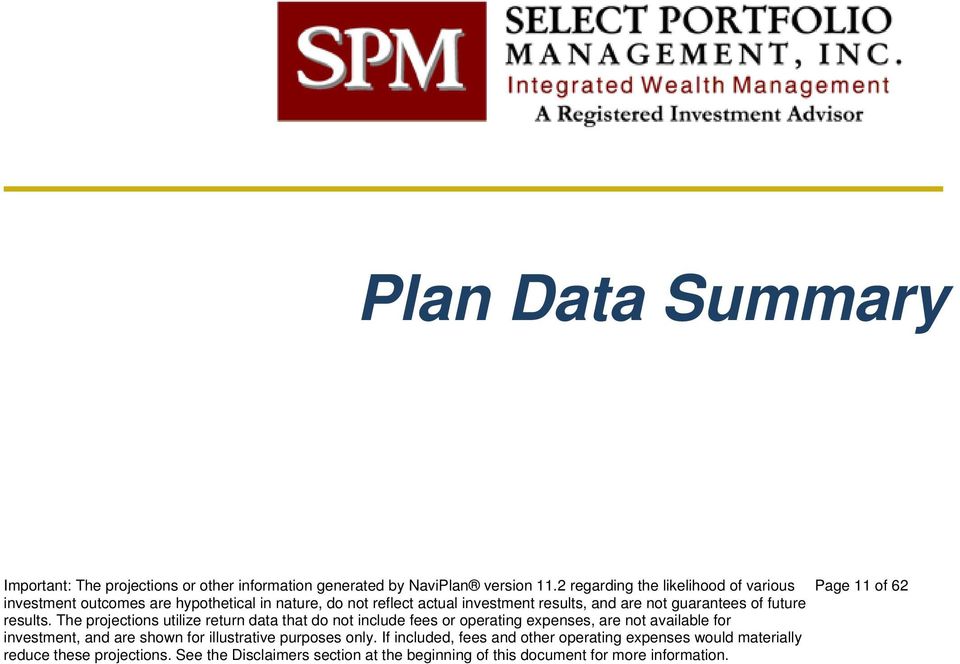
12 Plan Data Summary This report summarizes the data, which was entered in your Base Plan. General Information Detail Frank Kathy Birth Date Oct Sep Proposed Retirement Date Jan 2019 Jan 2019 Life Expectancy Dec 2052 Dec 2057 Pre-Retirement Income Tax Rates State Tax Rate 9.00% 9.00% Average Federal Tax Rate 22.39% 22.39% Marginal Federal Tax Rate 28.00% 28.00% Long Term Capital Gains Tax Rate 15.00% 15.00% Retirement Income Tax Rates State Tax Rate 9.00% 9.00% Average Federal Tax Rate 19.43% 19.43% Marginal Federal Tax Rate 25.00% 25.00% Long Term Capital Gains Tax Rate 15.00% 15.00% Year of Death Income Tax Rates State Tax Rate 9.00% 9.00% Average Federal Tax Rate 19.43% 19.43% Marginal Federal Tax Rate 25.00% 25.00% Long Term Capital Gains Tax Rate 15.00% 15.00% Tax Options The option As legislated was selected. In 2011, the calculations outlined will revert to the tax laws used in 2001, except where extended by the Pension Protection Act of Assumptions Detail Inflation Rate 3.50% Tax Filing Status-Frank Married Filing Jointly Tax Filing Status-Kathy Married Filing Jointly Investment Profile: Moderate Dependents Name Birth Date Age as of Plan Date Dependent of (for tax) Dependent of (for Social Security) Brenda Jul Frank and Kathy Frank and Kathy Bobby Nov Frank and Kathy Frank and Kathy Page 12 of 62
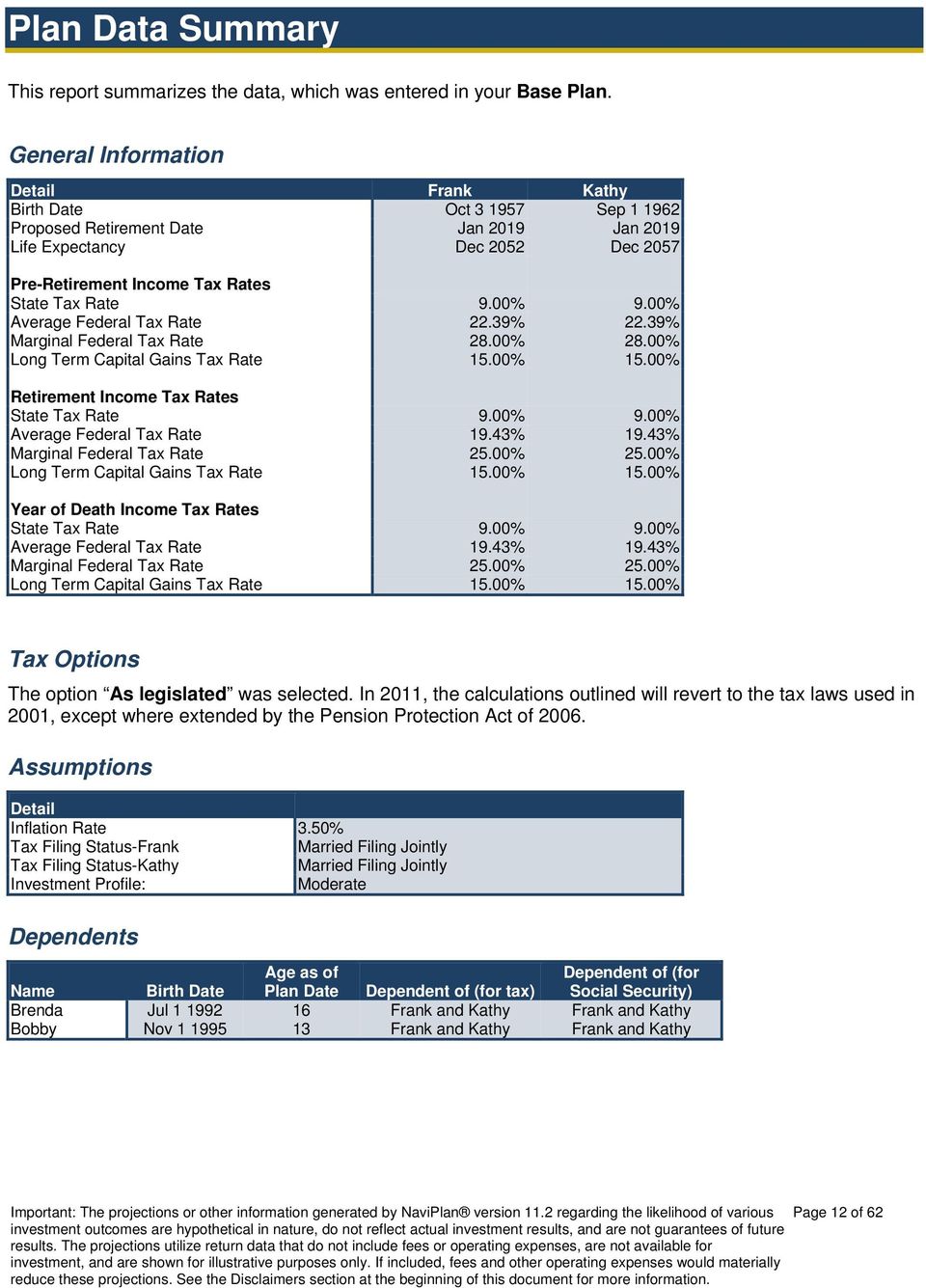
13 Family Information Client Name Frank Boomer Date of Birth Oct Gender Male Address 3123 Orchid Street Mission Viejo, California Citizenship United States United States Name Kathy Boomer Date of Birth Sep Gender Female Address 3123 Orchid Street Mission Viejo, California Citizenship United States United States Dependents Name Brenda Boomer Date of Birth Jul Gender Female Address 3123 Orchid Street Mission Viejo, California Dependent of United States Frank and Kathy Name Bobby Boomer Date of Birth Nov Gender Male Address 3123 Orchid Street Mission Viejo, California Dependent of United States Frank and Kathy Professional Advisors Business Type Name Phone # Cell Phone # Co-Advisor David M. Jones (949) Regular Income Income Source Member Applicable Amount Indexed Salary Frank Jan to Dec $225,000/yr Inflation Salary Kathy Jan to Dec $95,000/yr No Defined Benefit Pension Plans - Estimate Benefit Description: Frank's Pension Annual Benefit: $18,000 Plan Owner: Frank Indexed by: 0.00% Pct. payable to survivor: 60.00% Page 13 of 62

14 Social Security Benefits Start Age/Date (retirement benefits) Full Retirement (monthly) Surviving Spouse at Full Retirement (monthly) Survivor with Eligible Children - Benefit for Family (monthly) Eligible for Spousal Benefits Disability Member (monthly) Frank 66 / Nov $2, $0.00 $0.00 $0.00 Yes Kathy 67 / Sep $1, $0.00 $0.00 $0.00 Yes Regular Expenses Expense Member Applicable Amount Indexed Fixed Expense Housing (i.e. utilities, Joint Jan to Dec $1,287/mo Inflation Yes repairs) Food Joint Jan to Dec $1,666/mo Inflation Yes Transportation (i.e. gas, Joint Jan to Dec $850/mo Inflation Yes insurance, maintenance) Entertainment (i.e. Joint Jan to Dec $1,591/mo Inflation No restaurants, movies) Personal (i.e. clothing, Joint Jan to Dec $800/mo No No hobbies) LTC Expense Frank Not applicable $200/day Inflation 1 No LTC Expense Kathy Not applicable $200/day Inflation 1 No Lawn care Frank Jan to Dec $42/mo Inflation No Travel (1st 10 years of Joint Jan to Dec $15,000/yr Inflation No retirement) Travel (2nd 10 years of Joint Jan to Dec $10,000/yr Inflation No retirement) Health Care Expense Joint Jan to Dec $800/mo Inflation 1 Yes Auti Lease Payments Joint Jan to Dec $1,500/mo Inflation Yes Property Taxes for Joint Dec to Never $16,000/year Inflation Yes Residence 1 Indexed annually by inflation + 2.0% Lump Sum Expenses Expense Member Applicable Amount Indexed Fixed Expense Lump Sum Need Kathy Dec (Kathy's Deceased $424,360 Inflation No Date) Vacation Home Joint Jan $450,000 Inflation 1 No Funeral Expenses Frank Dec (Frank's Deceased $31,827 Inflation No Date) Funeral Expenses Kathy Dec (Kathy's Deceased $31,827 Inflation No Date) 1 Indexed annually by inflation % Lifestyle Assets Asset Name Purchase Date Purchase Amount Market Value Date Market Value Growth Rate 1 Standard Deviation Personal Use Property Dec $0 Jan $150, % 0.0% (Joint/Lifestyle) Residence (Joint/Lifestyle) Dec $900,000 Jan $1,875, % 0.0% 1 The growth rate is a pre-tax amount Page 14 of 62
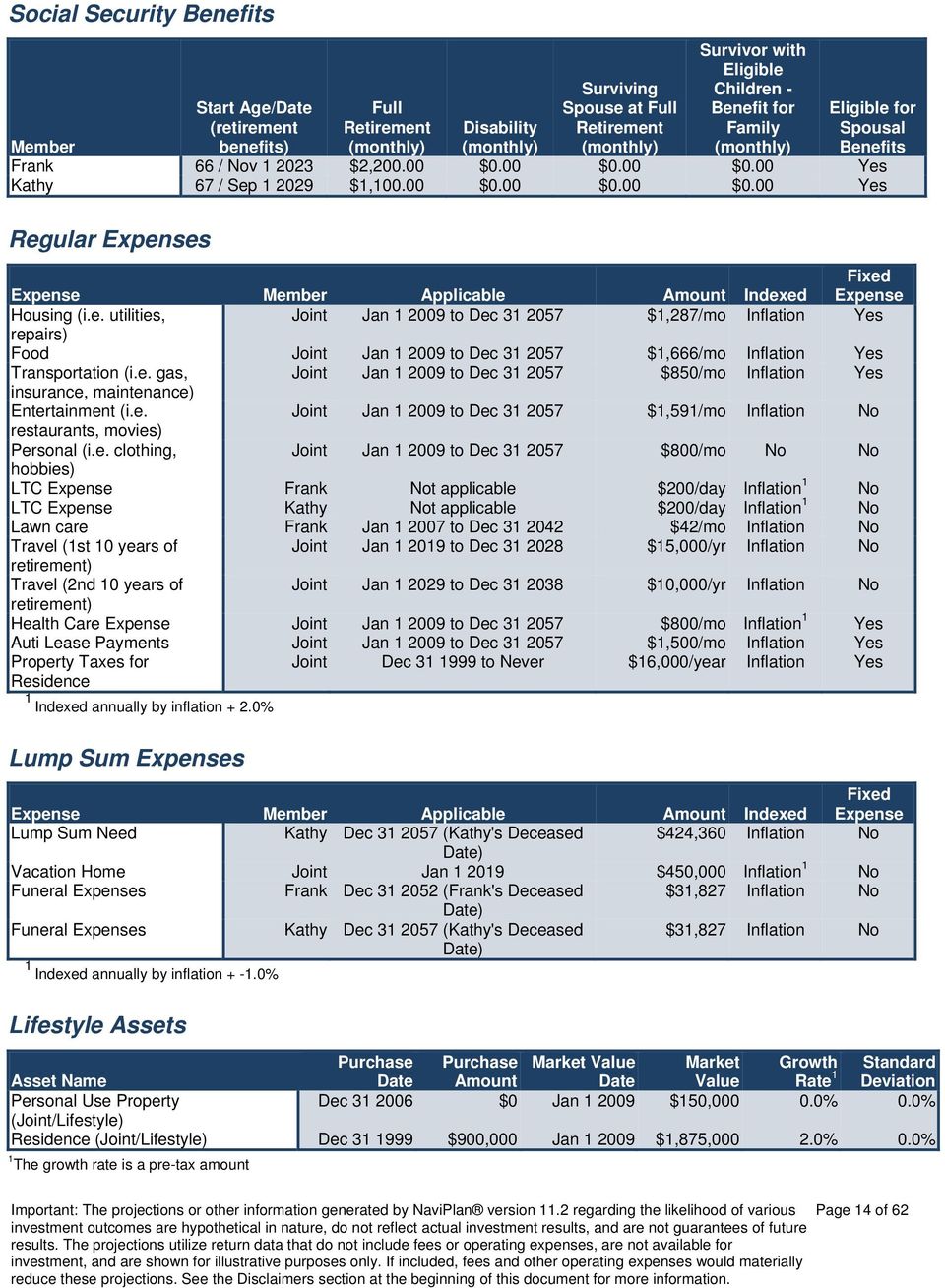
15 Real Estate Assets Purchase Purchase Market Value Growth Net Rental Asset Name Date Amount Date Market Value Rate Income 323 Main St (Frank/Real Estate) Jul $750,000 Jan $1,600, % $1,061 Portfolio Assets Cap. Tax Def. Std. Market Market Gain Free Growth Dev. Total Asset Name Value Date Value Basis Int. (%) Div. (%) (%) (%) (%) (%) (%) 16% of Joint Jan $65,760 $13, Investments (Non- Qualified) 19% of Joint Jan $78,090 $16, Investments (Non- Qualified) 30% of Joint Jan $123,300 $25, Investments (Non- Qualified) 35% of Joint Jan $143,850 $29, Investments (Non- Qualified) Bobby's College Jan $40,000 $18, Account (Joint/Non- Qualified) Diane's College Jan $52,000 $30, Account (Joint/Non- Qualified) Kathy's Investments Jan $95,000 $25, (Non-Qualified) Vacation Home Jan $350,000 $165, (Joint/Non-Qualified) Frank's 401(k) Jan $750,000 $ Frank's Roth IRA Jan $115,000 N/A Kathy's 401(k) Jan $250,000 $ Kathy's IRA Jan $75,000 $ The Portfolio Assets section includes your major investment assets. It supplies the market value and cost basis of these assets. Cost basis for non-qualified assets is equal to the amount you paid to acquire the assets, plus income reinvestments, less any amounts you received income tax-free. Your total pretax growth rate is broken down into specific return rate types, as some of these items currently receive special tax treatment. At present interest is taxed as ordinary income at the marginal tax rates. Dividends are taxed at the long-term capital gains tax rates in and are otherwise taxed as ordinary income at the marginal tax rates. Capital gains are either long-term or short-term. For non-qualified assets, income from the deferred growth component is not subject to tax until the asset is sold and is usually subject to the capital gains tax rules. For qualified assets, income from the deferred growth component is usually subject to tax as ordinary income at the average tax rates. Tax-free returns are not subject to regular income tax, but may be subject to the Alternative Minimum Tax. The actual total return rates that you will receive will depend on many factors, including inflation, type of investment, market conditions and investment performance. Page 15 of 62

16 Life Insurance Policies Description: Life Insurance - Frank Policy Type: Universal Life Owner: Frank Effective Date: Dec Insured: Frank Death Benefit: $1,000,000 Beneficiary: Kathy Cash Surrender Value (CSV): $20,000 Premium Payer: Frank Premiums cease on: Never Annual Premium $1,500 Payments: CSV payable with Death Benefit: Yes Coverage ceases on: Never Disability Waiver: Yes Description: Life Insurance - Kathy Policy Type: Universal Life Owner: Kathy Effective Date: Dec Insured: Kathy Death Benefit: $400,000 Beneficiary: Frank Cash Surrender Value (CSV): $0 Premium Payer: Kathy Premiums cease on: Never Annual Premium $600 Payments: CSV payable with Death Benefit: Yes Coverage ceases on: Never Disability Waiver: Yes Liabilities Liability Name Liability Date End Date Original Principal Current Principal Int. Rate Payment Type Mortgage Orchid Dec Mar $950,000 $950, % Principal & Interest St Personal Loans Dec Oct $15,000 $10, % Principal & Interest Regular Investment Strategies Asset Name Applicable Amount Indexed Frank's 401(k) Jan to Dec Employee Pre-Tax Contribution $1,200/Month 0.0% Employee Post-Tax Contribution (0% of $0/Month N/A 1 Salary) Employer Contribution $400/Month 0.0% Kathy's 401(k) Sep to Dec Employee Pre-Tax Contribution $500/Month 0.0% Employee Post-Tax Contribution (0% of $0/Month N/A 1 Salary) Employer Contribution $150/Month 0.0% 35% of Joint Investments (Non-Qualified) Sep to Dec $175/Month 0.0% 30% of Joint Investments (Non-Qualified) Sep to Dec $150/Month 0.0% 16% of Joint Investments (Non-Qualified) Sep to Dec $80/Month 0.0% 19% of Joint Investments (Non-Qualified) Sep to Dec $95/Month 0.0% Vacation Home (Joint/Non-Qualified) Sep to Dec $250/Month 0.0% 1 Indexing occurs if the salaries used in the calculations have been indexed. The table above includes all your periodic (annual or monthly) investment contributions. Page 16 of 62

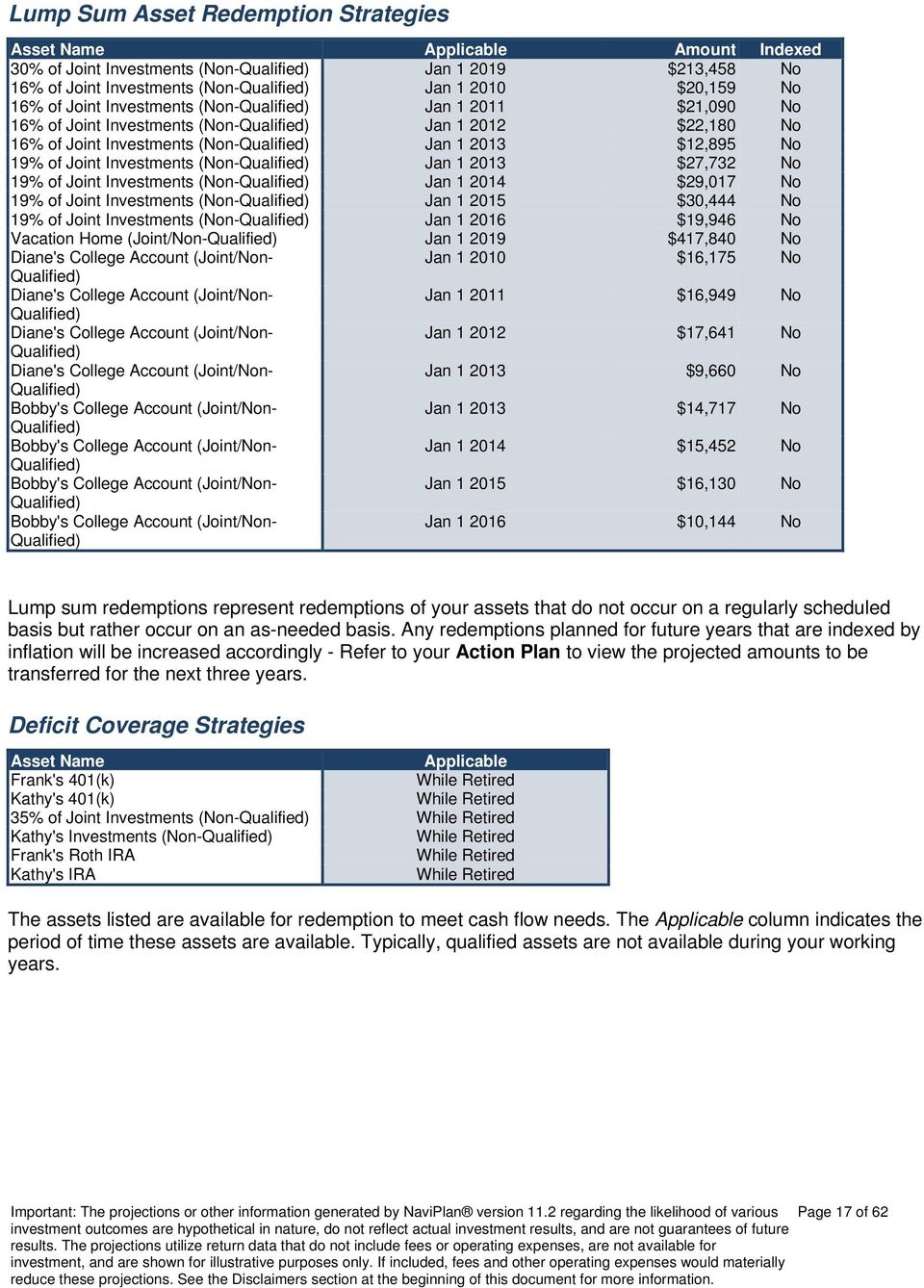
17 Lump Sum Asset Redemption Strategies Asset Name Applicable Amount Indexed 30% of Joint Investments (Non-Qualified) Jan $213,458 No 16% of Joint Investments (Non-Qualified) Jan $20,159 No 16% of Joint Investments (Non-Qualified) Jan $21,090 No 16% of Joint Investments (Non-Qualified) Jan $22,180 No 16% of Joint Investments (Non-Qualified) Jan $12,895 No 19% of Joint Investments (Non-Qualified) Jan $27,732 No 19% of Joint Investments (Non-Qualified) Jan $29,017 No 19% of Joint Investments (Non-Qualified) Jan $30,444 No 19% of Joint Investments (Non-Qualified) Jan $19,946 No Vacation Home (Joint/Non-Qualified) Jan $417,840 No Diane's College Account (Joint/Non- Jan $16,175 No Qualified) Diane's College Account (Joint/Non- Jan $16,949 No Qualified) Diane's College Account (Joint/Non- Jan $17,641 No Qualified) Diane's College Account (Joint/Non- Jan $9,660 No Qualified) Bobby's College Account (Joint/Non- Jan $14,717 No Qualified) Bobby's College Account (Joint/Non- Jan $15,452 No Qualified) Bobby's College Account (Joint/Non- Jan $16,130 No Qualified) Bobby's College Account (Joint/Non- Qualified) Jan $10,144 No Lump sum redemptions represent redemptions of your assets that do not occur on a regularly scheduled basis but rather occur on an as-needed basis. Any redemptions planned for future years that are indexed by inflation will be increased accordingly - Refer to your Action Plan to view the projected amounts to be transferred for the next three years. Deficit Coverage Strategies Asset Name Applicable Frank's 401(k) While Retired Kathy's 401(k) While Retired 35% of Joint Investments (Non-Qualified) While Retired Kathy's Investments (Non-Qualified) While Retired Frank's Roth IRA While Retired Kathy's IRA While Retired The assets listed are available for redemption to meet cash flow needs. The Applicable column indicates the period of time these assets are available. Typically, qualified assets are not available during your working years. Page 17 of 62
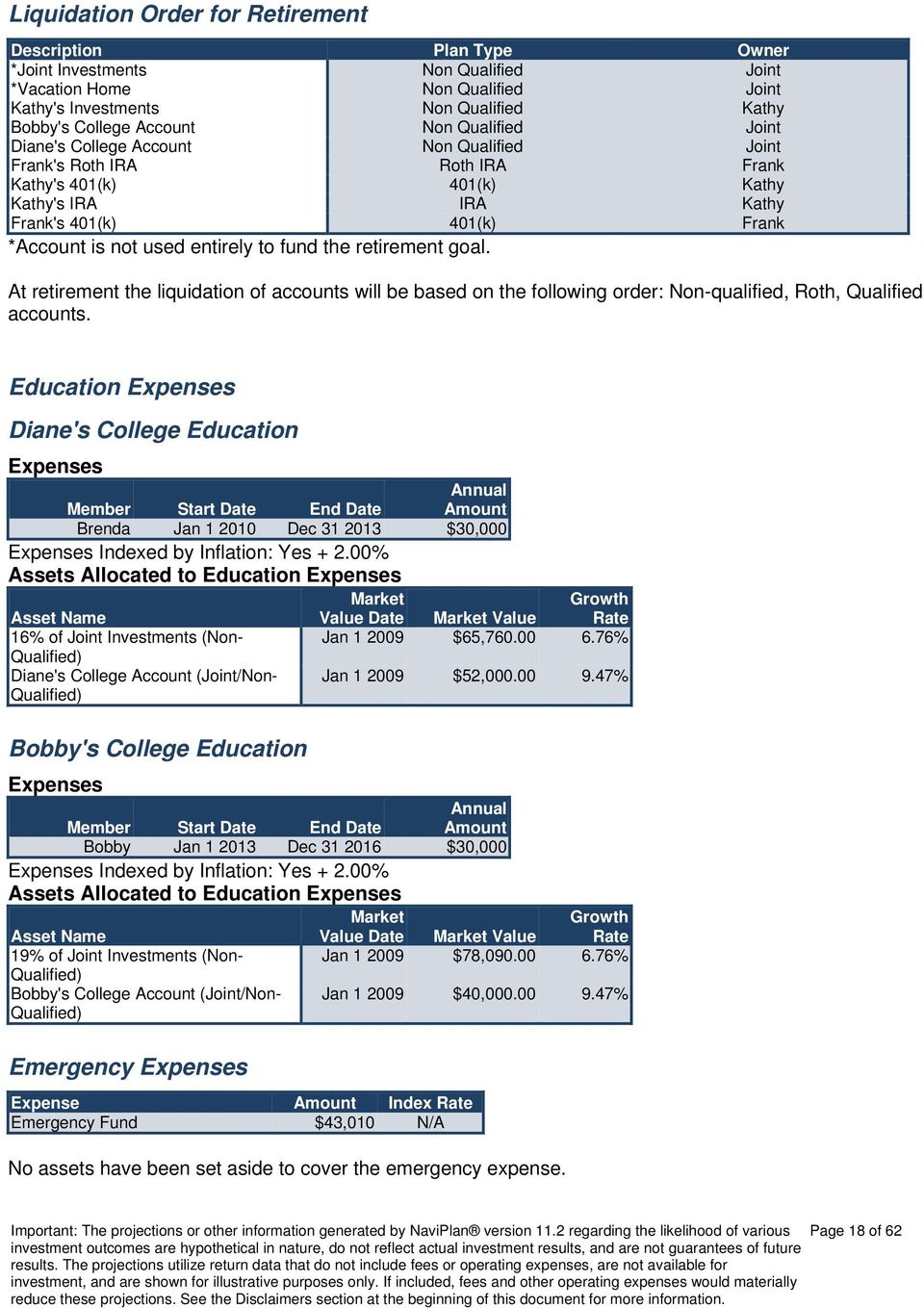
18 Liquidation Order for Retirement Description Plan Type Owner *Joint Investments Non Qualified Joint *Vacation Home Non Qualified Joint Kathy's Investments Non Qualified Kathy Bobby's College Account Non Qualified Joint Diane's College Account Non Qualified Joint Frank's Roth IRA Roth IRA Frank Kathy's 401(k) 401(k) Kathy Kathy's IRA IRA Kathy Frank's 401(k) 401(k) Frank *Account is not used entirely to fund the retirement goal. At retirement the liquidation of accounts will be based on the following order: Non-qualified, Roth, Qualified accounts. Education Expenses Diane's College Education Expenses Member Start Date End Date Annual Amount Brenda Jan Dec $30,000 Expenses Indexed by Inflation: Yes % Assets Allocated to Education Expenses Asset Name Market Value Date Market Value Growth Rate 16% of Joint Investments (Non- Jan $65, % Qualified) Diane's College Account (Joint/Non- Qualified) Jan $52, % Bobby's College Education Expenses Member Start Date End Date Annual Amount Bobby Jan Dec $30,000 Expenses Indexed by Inflation: Yes % Assets Allocated to Education Expenses Asset Name Market Value Date Market Value Growth Rate 19% of Joint Investments (Non- Jan $78, % Qualified) Bobby's College Account (Joint/Non- Qualified) Jan $40, % Emergency Expenses Expense Amount Index Rate Emergency Fund $43,010 N/A No assets have been set aside to cover the emergency expense. Page 18 of 62
19 Net Worth This net worth summary provides a snap shot showing a financial situation at a certain point in time. It includes what you own (assets), what you owe to creditors (liabilities), and the net value or difference between the two (net worth). In simple terms, the net worth statement shows how much money would be left if everything you owned was converted into cash and used to pay off your debts (before taxes). The following information is a description of items likely to appear in the report below. Your report may contain some or all of the items listed: Lifestyle assets include your home, vacation homes and collectibles. Non-Qualified assets include stocks, bonds, mutual funds, investment real estate and annuities. Qualified assets include your retirement plans including IRAs and 401(k)s, and it may also contain certain education assets such as 529 Plans. Liabilities include your mortgages, loans, personal lines of credits and credit cards. Cash Flow Surplus is the amount of surplus funds from your cash flow statement. In other words, income you did not spend which may be representative of your checking account, for instance. Net Worth Summary As of January 1, 2009 Frank Kathy Joint Total Non-Qualified Assets Investment Portfolios 95, , ,000 Other 1,600,000 1,600,000 Non-Qualified Annuities Qualified Assets IRAs / Spousal IRAs 75,000 75,000 Roth IRAs / Spousal Roth IRAs 115, , (k) 750, ,000 1,000,000 Qualified Annuities Lifestyle Assets (residences, etc.) 2,025,000 2,025,000 Life Insurance Cash Value 20,000 20,000 Liabilities (950,000) (10,516) (960,516) Total Net Worth 1,535, ,000 2,867,484 4,822,484 Page 19 of 62

20 Cash Flow The cash flow report below outlines your current sources of income and expenses. Your income includes employment income, investment income and any other sources. Your expenses include your daily living expenses, debt payments including your mortgage, current investment contributions and insurance premiums. Current Surplus/(Deficit) displays any excess cash available or shortfall at the end of the current year once all expenses have been covered and investments made. Ending Surplus/(Deficit) displays the final surplus or deficit at the end of the current year after adjustments to or from other family members. The family s ending surplus or deficit is the sum of the individual family member s ending surpluses or deficits. Frank Kathy Family Cash Inflows Employment Inflows $225,000 $95,000 $320,000 Investment Inflows $41,066 $31,401 $72,467 Total Cash Inflows $266,066 $126,401 $392,467 Cash Outflows Lifestyle Expenses $125,600 $53,064 $178,664 Taxes $69,080 $39,427 $108,508 Miscellaneous Expenses $10,070 $9,170 $19,240 Non-Qualified Contributions and Reinvestments $20,469 $22,478 $42,948 Qualified Contributions $14,400 $2,000 $16,400 Total Cash Outflows $239,619 $126,139 $365,758 Current Surplus/(Deficit) 26,709 Ending Surplus/(Deficit) 26,709 Page 20 of 62

21 Asset Allocation These pie graphs illustrate your current asset mix and suggested asset mix for your entire portfolio. However, the suggested asset mix will not be used in the proposed plan. Due to modifications the assumed asset mix (for pre-retirement and retirement) on the following page will be used instead. Current Asset Mix Suggested Asset Mix* Pre-Retirement Blended Mix Suggested Asset Mix* Retirement Blended Mix Rate of Return 6.54% Standard Deviation 10.32% Rate of Return 6.40% Standard Deviation 10.04% Rate of Return 6.40% Standard Deviation 10.04% *Modifications have been made to the suggested asset mix. Current Asset Mix Suggested Asset Mix Suggested Asset Mix Pre-Retirement Retirement Asset Class (%) ($) (%) ($) (%) Large Cap Growth Equity , , Large Cap Value Equity , , Mid Cap Equity , , Small Cap Equity , , International Equity , , Emerging Markets Equity , , Long Term Bonds , , Intermediate Term Bonds , , Short Term Bonds , , High Yield Bonds , , International Bonds , , Cash , , Total ,138, ,138, Ibbotson Associated, Inc., a wholly owned subsidiary of Morningstar, Inc. All rights reserved. EISI has engaged Ibbotson to develop proprietary asset allocation tools for educational purposes. Ibbotson has granted to EISI a license for use thereof. Some assets in this report may have been classified based on returns-based style analysis and others may have been manually classified. Page 21 of 62
22 Assumed Asset Mix for Entire Portfolio These pie graphs illustrate the Assumed asset mix for pre-retirement and the Assumed asset mix for retirement for your entire portfolio and will be used for the proposed plan. Assumed Asset Mix Pre-Retirement Blended Mix Assumed Asset Mix Retirement Blended Mix Rate of Return 7.50% Standard Deviation 12.79% Rate of Return 6.26% Standard Deviation 9.70% The table below provides a breakdown of the percentages and dollar values for each asset class in the current and assumed portfolio. The Change column indicates the rebalancing required to reach the assumed asset mix. Current Asset Mix Change Assumed Asset Mix Assumed Asset Mix Pre-Retirement Retirement Asset Class (%) ($) (%) ($) (%) ($) (%) Large Cap Growth Equity , , , Large Cap Value Equity , , , Mid Cap Equity , , , Small Cap Equity , , International Equity , , , Emerging Markets Equity , , , Long Term Bonds , , , Intermediate Term Bonds , , , Short Term Bonds , , , High Yield Bonds , , , International Bonds , , , Cash , , , Total ,138, ,138, Ibbotson Associated, Inc., a wholly owned subsidiary of Morningstar, Inc. All rights reserved. EISI has engaged Ibbotson to develop proprietary asset allocation tools for educational purposes. Ibbotson has granted to EISI a license for use thereof. Some assets in this report may have been classified based on returns-based style analysis and others may have been manually classified. Page 22 of 62
23 Projected Range of Returns The following graph illustrates the potential range of returns on investments in your proposed investment portfolio. There is a 90% chance your returns over each time period will fall within the given range. Assuming the returns are normally distributed, there is a 5% chance you could outperform the highest return shown here, as well as a 5% chance you could underperform the lowest return shown here. The longer the time period of measurement, the narrower the range of returns. These results assume a buy-and-hold approach to the portfolio over each of the time periods illustrated. Return Percentage 30% 25% 20% 15% 10% 5% 0% -5% -10% -15% Year Upper Bound Average Return Lower Bound 1 Year 5 Years 10 Years 15 Years 20 Years 5th Percentile* 25.65% 14.93% 12.39% 11.26% 10.59% Average Return 6.26% 6.26% 6.26% 6.26% 6.26% 95th Percentile** % -2.42% 0.12% 1.25% 1.92% * You have a 5% chance of earning a higher return than what is shown over the applicable time period. ** You have a 5% chance of earning a lower return than what is shown over the applicable time period. Page 23 of 62
24 Retirement Retirement The following graphs illustrate your projected needs vs. abilities during retirement. The top graph displays your current financial situation without additional savings, with a rate of return of 6.15%. The bottom graph displays your proposed situation, with a rate of return of 7.66% during pre-retirement years and 6.15% during retirement. Note: The graphs and table below may incorporate information from other goals that occur during your retirement period. Current Plan Retirement Needs Vs. Abilities $1,300K $1,200K $900K $800K $700K $600K $500K $400K $300K $200K $100K $0K Proposed Plan $3.5M $3.0M $2.5M $2.0M $1.5M $1.0M $0.5M $0.0M Retirement Needs Other Needs Ability to Cover Needs Shortfall Surplus After-Tax Cash Inflow Financial Objectives Current Proposed Frank's Retirement Age/Year 62 / / 2023 Frank's Life Expectancy 95 / / 2052 Kathy's Retirement Age/Year 57 / / 2025 Kathy's Life Expectancy 95 / / 2057 Annual Needs at Retirement, in today's dollars* $116,928 $108,190 Inflation Rate 3.50% 3.50% Return Rate: Pre-Retirement 6.15% 7.66% Return Rate: Retirement 6.15% 6.15% Available Assets $1,428,850 $1,760,960 Assumed Monthly Savings $1,600 $1,600 Required Additional Monthly Savings $7,679 $0 Required Additional Lump Sum Savings $778,933 $0 Note: Numbers in bold indicate a change from the Current Plan. *Annual Needs at Retirement excludes property and income taxes, liability payments, insurance premiums (life, disability, long-term care), and expenses from other goals occurring during the retirement period. Page 24 of 62
25 Asset Allocation for Retirement These pie graphs illustrate your current asset mix and suggested asset mix for your retirement goal. However, the suggested asset mix will not be used in the proposed plan. Due to modifications the assumed asset mix (for pre-retirement and retirement) on the following page will be used instead. Current Asset Mix Suggested Asset Mix* Pre-Retirement Moderate Conservative Suggested Asset Mix* Retirement Moderate Conservative Rate of Return 6.15% Standard Deviation 9.46% Rate of Return 6.15% Standard Deviation 9.46% Rate of Return 6.15% Standard Deviation 9.46% *Modifications have been made to the suggested asset mix. Current Asset Mix Suggested Asset Mix Suggested Asset Mix Pre-Retirement Retirement Asset Class (%) ($) (%) ($) (%) Large Cap Growth Equity , , Large Cap Value Equity , , Mid Cap Equity , , Small Cap Equity , , International Equity , , Emerging Markets Equity ,750 Long Term Bonds , , Intermediate Term Bonds , , Short Term Bonds , , High Yield Bonds , , International Bonds , , Cash , , Total ,428, ,428, Ibbotson Associated, Inc., a wholly owned subsidiary of Morningstar, Inc. All rights reserved. EISI has engaged Ibbotson to develop proprietary asset allocation tools for educational purposes. Ibbotson has granted to EISI a license for use thereof. Some assets in this report may have been classified based on returns-based style analysis and others may have been manually classified. Page 25 of 62
26 Assumed Asset Allocation for Retirement These pie graphs illustrate the Assumed asset mix for pre-retirement and the Assumed asset mix for retirement for your retirement goal and will be used for the proposed plan. Assumed Asset Mix Pre-Retirement Moderate Assumed Asset Mix Retirement Moderate Conservative Rate of Return 7.66% Standard Deviation 13.22% Rate of Return 6.15% Standard Deviation 9.46% The table below provides a breakdown of the percentages and dollar values for each asset class in the current and assumed portfolio. The Change column indicates the rebalancing required to reach the assumed asset mix. Current Asset Mix Change Assumed Asset Mix Assumed Asset Mix Pre-Retirement Retirement Asset Class (%) ($) (%) ($) (%) ($) (%) Large Cap Growth Equity , , , Large Cap Value Equity , , , Mid Cap Equity , , , Small Cap Equity , , , International Equity , , , Emerging Markets Equity , , ,829 Long Term Bonds , , , Intermediate Term Bonds , , , Short Term Bonds , , , High Yield Bonds , , , International Bonds , , , Cash , , , Total ,428, , ,760, Ibbotson Associated, Inc., a wholly owned subsidiary of Morningstar, Inc. All rights reserved. EISI has engaged Ibbotson to develop proprietary asset allocation tools for educational purposes. Ibbotson has granted to EISI a license for use thereof. Some assets in this report may have been classified based on returns-based style analysis and others may have been manually classified. Page 26 of 62
27 Retirement Scenario Summary The following information provides an overview of the selected retirement scenarios and their estimated effect on the Retirement goal. The following graph illustrates the ability of each scenario to achieve the Retirement goal. Scenario Coverage 120% 100% 80% 60% 40% 20% 0% Current Plan Proposed Plan Goal Coverage* Net Worth at Retirement Net Worth at Death Year Capital Exhausted % Fixed Needs Covered by Total Resources Current Plan 76% $7,613,647 $7,383, % Proposed Plan 100% $10,612,197 $22,981,915 Never 100% * This value indicates the percentage of your total retirement needs that can be covered by your total retirement resources during your retirement time period. Page 27 of 62
28 Retirement - Current Plan *76% This scenario covers 76% of the desired Retirement goal objectives. * This value indicates the percentage of your total retirement needs that can be covered by your total retirement resources during your retirement time period. Assumptions The following table details the key assumptions used in the generation of this scenario: Frank Kathy Retirement Age/Year 62 / / 2019 Life Expectancy 95 / / 2057 Desired Fixed Expenses Covered 100% Desired Discretionary Expenses Covered 100% Current Monthly Savings $1,600 Annual Inflation Rate 3.50% Rate of Return pre retirement 6.15% Rate of Return retirement 6.15% Analysis $1.4M $1.2M $1.0M $0.8M $0.6M $0.4M $0.2M $0.0M Social Security Earned Income Additional Qualified Distributions Shortfall Pensions RMD Other Inflows Fixed Needs Annuities Non-Qualified Distributions Previous Year Surplus Used Total Needs Net Worth at Retirement: $7,613,647 Year Capital Exhausted: 2036 Net Worth at Death: $7,383,677 % Fixed Needs Covered by Total Resources: 78% Additional Assumptions The following table details the additional assumptions used in the generation of this scenario: Scenario Settings Frank Kathy Capital Liquidation Order Non-qualified, Roth, Qualified Social Security Start Age Page 28 of 62
29 Ability to Cover Total Needs The graph below illustrates the goal coverage percentage for each trial that was generated. The results are generated by varying the return rates on available assets and by determining if the available resources are adequate to cover the need. The Goal Coverage percentage equals the ability to cover total needs divided by the total needs, where both the ability to cover total needs and the total needs are adjusted for inflation. Goal Coverage 100% 90% 80% 70% 60% 50% 40% 30% 20% 10% 0% Trials For this probability analysis, 500 trials were run. The results are as follows: In 114 trials 90% or more of the goal was covered In 282 trials 65% or more, but less than 90%, of the goal was covered In 104 trials less than 65% of the goal was covered It is projected that the earliest age (year) at which you could not cover your fixed needs is 66 / 61 (2023). 90% or more 65% or more, but less than 90% Less than 65% For details on the Plan Probability graph assumptions, refer to the section titled, Scenario Probability Assumptions at the beginning of this document. Page 29 of 62
30 Retirement - Proposed Plan (Recommended) *100% This scenario covers 100% of the desired Retirement goal objectives. * This value indicates the percentage of your total retirement needs that can be covered by your total retirement resources during your retirement time period. Assumptions The following table details the key assumptions used in the generation of this scenario: Frank Kathy Retirement Age/Year 66 / / 2025 Life Expectancy 95 / / 2057 Desired Fixed Expenses Covered 100% Desired Discretionary Expenses Covered 80% Additional Lump-Sum Savings $0 Current Monthly Savings $1,600 Change in Monthly Savings $0 Total Monthly Savings $1,600 Annual Inflation Rate 3.50% Rate of Return pre retirement 7.66% Rate of Return retirement 6.15% Note: Numbers in bold indicate a change from the Current Plan. Note: Information in the table above is for the February 1, 2009 period. Any strategies occurring in the future are not displayed in this table. Analysis $2.0M $1.8M $1.0M $0.8M $0.6M $0.4M $0.2M $0.0M Social Security Earned Income Additional Qualified Distributions Shortfall Pensions RMD Other Inflows Fixed Needs Annuities Non-Qualified Distributions Previous Year Surplus Used Total Needs Net Worth at Retirement: $10,612,197 Year Capital Exhausted: Never Net Worth at Death: $22,981,915 % Fixed Needs Covered by Total Resources: 100% Page 30 of 62
31 Additional Assumptions The following table details the additional assumptions used in the generation of this scenario: Scenario Settings Frank Kathy Capital Liquidation Order Non-qualified, Roth, Qualified Social Security Start Age Additional Annual Retirement Incomes (Frank) $100,000 Indexed at 0.00% Start Age/End Age Ret - 68 Additional Annual Retirement Expense $0 $0 Annual amount to Annuitize to during Retirement $0 Note: Numbers in bold indicate a change from the Current Plan Ability to Cover Total Needs The graph below illustrates the goal coverage percentage for each trial that was generated. The results are generated by varying the return rates on available assets and by determining if the available resources are adequate to cover the need. The Goal Coverage percentage equals the ability to cover total needs divided by the total needs, where both the ability to cover total needs and the total needs are adjusted for inflation. Goal Coverage 100% 90% 80% 70% 60% 50% 40% 30% 20% 10% 0% Trials For this probability analysis, 500 trials were run. The results are as follows: In 437 trials 90% or more of the goal was covered In 62 trials 65% or more, but less than 90%, of the goal was covered In 1 trials less than 65% of the goal was covered It is projected that the earliest age (year) at which you could not cover your fixed needs is 66 / 61 (2023). 90% or more 65% or more, but less than 90% Less than 65% For details on the Plan Probability graph assumptions, refer to the section titled, Scenario Probability Assumptions at the beginning of this document. Page 31 of 62
32 Diane's College Education Diane's College Education You have indicated you wish to establish an investment plan to fund the following education goal: Description Diane's College Education *The index rate refers to the inflation rate of the individual education goals. Current Education Estimated Years Of Index Est. Actual Member Age Starts at Costs/yr Education Rate* Cost Brenda $30, % $137,433 The graphs below illustrate your education scenarios. The graph on the left displays your current education needs vs. abilities, without additional savings and a rate of return of 7.96%. The graph on the right displays your proposed education needs vs. abilities, and a rate of return of 4.69%. Once a particular education goal is fully funded, any surplus capital remaining is omitted from the End of Year Capital column and is not available to fund any other education goals that might exist. Instead, any remaining surplus is applied to the retirement goal. Education Needs Vs. Abilities Current Plan Proposed Plan $40K $45K $35K $40K $30K $25K $20K $15K $10K $5K $0K $35K $30K $25K $20K $15K $10K $5K $0K Desired Needs Ability to Cover Needs Shortfall Surplus Current Plan Proposed Plan Available Assets $117,760 $80,770 Return Rate 7.96% 4.69% Assumed Monthly Savings $0 $1,250 Required Additional Monthly Savings $317 $0 Required Additional Lump Sum Savings $13,701 $0 Consider the following: Alternatively, increase your monthly savings by $317 to fund your education goal. Consider allocating additional assets to meet your education goals. Consider the advantages of contributing to a Section 529 Savings Plan. In addition, assess the benefits of custodial accounts (UGMA or UTMA) as savings options for minor children. Review opportunities and eligibility for scholarship programs and financial aid. Keep in mind that not all financial aid is based on need. Page 32 of 62
33 Diane's College Education Scenario Summary The following information provides an overview of the selected scenarios and their estimated effect on the Diane's College Education goal. The following graph illustrates the ability of each scenario to achieve the Diane's College Education goal. Scenario Coverage 120% 100% 80% 60% 40% 20% 0% Current Plan Recommended Goal Coverage Capital at Start of Goal Capital at End of Goal Year Capital Exhausted Current Plan 88% $124,628 $900 Never Recommended 100% $98,799 $3,591 Never Page 33 of 62
34 Bobby's College Education Bobby's College Education You have indicated you wish to establish an investment plan to fund the following education goal: Description Bobby's College Education *The index rate refers to the inflation rate of the individual education goals. Current Education Estimated Years Of Index Est. Actual Member Age Starts at Costs/yr Education Rate* Cost Bobby $30, % $161,379 The graphs below illustrate your education scenarios. The graph on the left displays your current education needs vs. abilities, without additional savings and a rate of return of 7.68%. The graph on the right displays your proposed education needs vs. abilities, and a rate of return of 6.15%. Once a particular education goal is fully funded, any surplus capital remaining is omitted from the End of Year Capital column and is not available to fund any other education goals that might exist. Instead, any remaining surplus is applied to the retirement goal. Education Needs Vs. Abilities Current Plan Proposed Plan $45K $40K $35K $60K $50K $30K $25K $20K $40K $30K $15K $10K $5K $20K $10K $0K $0K Desired Needs Ability to Cover Needs Shortfall Surplus Current Plan Proposed Plan Available Assets $118,090 $68,770 Return Rate 7.68% 6.15% Assumed Monthly Savings $0 $1,000 Required Additional Monthly Savings $165 $0 Required Additional Lump Sum Savings $11,635 $0 Consider the following: Alternatively, increase your monthly savings by $165 to fund your education goal. Consider allocating additional assets to meet your education goals. Consider the advantages of contributing to a Section 529 Savings Plan. In addition, assess the benefits of custodial accounts (UGMA or UTMA) as savings options for minor children. Review opportunities and eligibility for scholarship programs and financial aid. Keep in mind that not all financial aid is based on need. Page 34 of 62
35 Bobby's College Education Scenario Summary The following information provides an overview of the selected scenarios and their estimated effect on the Bobby's College Education goal. The following graph illustrates the ability of each scenario to achieve the Bobby's College Education goal. Scenario Coverage 120% 100% 80% 60% 40% 20% 0% Current Plan Recommended Goal Coverage Capital at Start of Goal Capital at End of Goal Year Capital Exhausted Current Plan 90% $149,295 $1,069 Never Recommended 100% $135,248 $11,716 Never Page 35 of 62
36 Vacation Home Vacation Home You have indicated you wish to establish an investment plan to fund the following major purchase goal: Major Purchase Purchase Purchase Estimated Description Member Date Amount Index Rate Actual Cost Vacation Home Joint Jul $325, % $494,526 The graphs below illustrate your major purchase scenarios. The graph on the left displays your current major purchase needs vs. abilities without additional savings, and a rate of return of 7.08%. The graph on the right displays your proposed major purchase needs vs. abilities, and a rate of return of 7.66%. Major Purchase Needs Vs. Abilities Current Plan Proposed Plan $800K $700K $700K $600K $500K $400K $300K $200K $600K $500K $400K $300K $200K $100K $100K $0K 2019 $0K 2026 Desired Needs Ability to Cover Needs Shortfall Current Plan Proposed Plan Available Assets $473,300 $227,500 Return Rate 7.08% 7.66% Assumed Monthly Savings $0 $0 Required Additional Monthly Savings $0 $0 Required Additional Lump Sum Savings $0 $0 Page 36 of 62
37 Vacation Home Scenario Summary The following information provides an overview of the selected scenarios and their estimated effect on the Vacation Home goal. The following graph illustrates the ability of each scenario to achieve the Vacation Home goal. Scenario Coverage 120% 100% 80% 60% 40% 20% 0% Current Plan Delay Purchase to 2026 Goal Coverage Capital at Start of Goal Capital at End of Goal Current Plan 100% $818,719 $197,066 Delay Purchase to % $628,780 $120,252 Page 37 of 62
38 Monte Carlo Analysis Assumptions The following information lists the key points and assumptions used during the evaluation of your financial plan. Assumptions Life Expectancy Randomized No Force Full Deficit Coverage No Retirement Goal Success Tolerance ($10,000) Education Goals Success Tolerance ($500) Major Purchase Goals Success Tolerance ($500) Number of Projections 500 Life Expectancy is not randomized. All projections will end at Frank and Kathy's planned deceased age. Full Deficit Coverage is not active for the plan. This means that in the analysis, assets are not redeemed to cover periodic expenses and taxes during pre-retirement. This may understate your success if investment income is automatically reinvested, as taxes may be due on this income. The Goal Success Tolerance is the amount that the educational or major purchase goal(s) can be under funded in any trial and still be considered successful. The Number of Projections is the number of iterations (trials) of your financial plan that the software projects using random rates of return and/or life expectancy. Rate of Return Randomization A random number was generated to determine a rate of return based on the standard deviation * shared by all of your accounts. This calculation is repeated for every account in the plan. This process is repeated with a different random number for every projection. * The assumption is that all returns are normally distributed. This means that approximately 67% of the results are within one standard deviation above or below the Rate of Return and approximately 95% of the results are within two standard deviations. The table below lists the asset classes and standard deviations that are used in this analysis. Asset Class Interest Dividends Capital Gains Tax Free Deferred Growth Total Standard Deviation Large Cap Growth 0.00% 0.91% 7.87% 0.00% 0.00% 8.78% 23.55% Equity Large Cap Value 0.00% 1.97% 5.63% 0.00% 2.78% 10.38% 18.75% Equity Mid Cap Equity 0.00% 1.11% 7.65% 0.00% 1.80% 10.56% 23.64% Small Cap Equity 0.00% 1.01% 12.02% 0.00% 0.50% 13.53% 29.56% International Equity 0.00% 3.05% 5.13% 0.00% 1.71% 9.89% 24.84% Emerging Markets 0.00% 2.18% 9.88% 0.00% 1.22% 13.28% 33.48% Equity Long Term Bonds 3.98% 0.00% 0.00% 0.00% 0.00% 3.98% 11.36% Intermediate Term 3.46% 0.00% 0.00% 0.00% 0.00% 3.46% 6.53% Bonds Short Term Bonds 2.76% 0.00% 0.00% 0.00% 0.00% 2.76% 3.59% High Yield Bonds 7.06% 0.00% 0.00% 0.00% 0.00% 7.06% 13.25% International Bonds 3.67% 0.00% 0.00% 0.00% 0.00% 3.67% 10.96% Cash 2.27% 0.00% 0.00% 0.00% 0.00% 2.27% 2.99% Page 38 of 62
39 Please Note The results of each projection will vary with each use and over time. IMPORTANT: The projections or other information generated by Monte Carlo Simulation regarding the likelihood of various investment outcomes are hypothetical in nature, do not reflect actual investment results and are not guarantees of future results. Page 39 of 62
40 Monte Carlo Analysis Monte Carlo Analysis expands the traditional financial planning analysis by adding uncertainty into the plan. This analysis takes into consideration that it is difficult to accurately predict annual return rate expectations. While return rate expectations over the long term can be reasonably predicted, the actual pattern over the short term is difficult to predict and may often appear random. Monte Carlo analyzes your financial plan by randomizing the return rates with the normal expected range each year and performing this analysis multiple times to simulate a number of possible financial outcomes. The following graphs and tables summarize the probability of the success of each of your goals: Current Plan Proposed Plan 100% 90% 80% 70% 60% 50% 40% 30% 20% 10% 0% 100% 90% 80% 70% 60% 50% 40% 30% 20% 10% 0% All Goals % Retirement Goal % All Education Goals % Diane's College Education % Bobby's College Education % Vacation Home % All Goals % Retirement Goal % All Education Goals % Diane's College Education % Bobby's College Education % Vacation Home % Current Plan Goal Success Rate 10th Percentile 50th Percentile 90th Percentile All Goals 5.20% Retirement Goal 17.20% $4,196,284 $7,175,277 $20,040,473 All Education Goals 16.20% Diane's College Education 19.60% $98,740 $120,465 $146,384 Bobby's College Education 30.60% $106,446 $143,413 $191,904 Vacation Home 82.20% $528,368 $726,637 $995,252 Proposed Plan Goal Success Rate 10th Percentile 50th Percentile 90th Percentile All Goals 43.40% Retirement Goal 76.00% $7,277,084 $21,538,485 $46,922,972 All Education Goals 59.40% Diane's College Education 70.80% $131,951 $139,926 $148,316 Bobby's College Education 69.20% $147,448 $170,063 $192,698 Vacation Home 64.80% $351,953 $568,916 $866,279 Page 40 of 62
41 Life Insurance - Frank A life insurance analysis should ensure that when a death occurs in your family, there is sufficient income and capital to cover the cash flow needs for the surviving family members over the entire planning period. When you are young, a major reason for survivorship planning is to provide financial protection for your dependent family. Without the continued benefit of your income, your family may not be able to afford ongoing expenses for housing, transportation, food, clothing, etc. There may also be additional expenses for childcare. Post-secondary education and retirement needs will also continue to exist. When you are older, the major goal of survivorship planning may be to protect the value of your estate from declining due to estate tax, income tax and other costs. This type of income replacement provides cash flow to meet these needs, which would otherwise have to be covered by redeeming your existing assets. In the event of Frank's death, you want to ensure Kathy has enough income and capital to cover both the family s expenses and any investment plans needed to fund your goals. Current Plan $600K $500K Life Insurance Needs Vs. Abilities $400K $300K $200K $100K $0K Proposed Plan $550K $500K $450K $400K $350K $300K $250K $200K $150K $100K $50K $0K Desired Needs Ability to Cover Needs Shortfall Page 41 of 62
42 Objectives Current Proposed Retirement Age/Year for the Survivor 57 / / 2025 Survivor Life Expectancy 95 / / 2057 Total Rate of Return on Life Insurance Proceeds, Surpluses and Liquidations Pre-Retirement 6.00% 6.00% Retirement 6.00% 6.00% Existing Life Insurance $1,020,000 $1,020,000 Additional Life Insurance Death Benefit $0 $0 Premium $0 $0 Additional Life Insurance Required $987,664 $0 The following report provides an overview of your life insurance if Frank were to die at the end of this year (2009), using assumptions from the Proposed Plan. Lump sum needs include final expenses and other needs at death. Capital needed to meet cash flow deficits is the lump sum you would require to meet your survivor s needs for their expected lifetime, or the estate needs to provide for your children. Life Insurance Summary Current Proposed Life Insurance Coverage $1,020,000 $1,020,000 Immediate Capital Needs Funeral Expenses $31,827 $25,462 Probate Expenses $16,566 $0 Admin. Expenses $8,283 $8,240 Mortgage Orchid St $934,734 $934,734 Assumed Expenses $22,702 $0 Resources to meet Immediate Needs Pre-Death Cash Flow Surplus ($22,167) $0 Life Insurance Proceeds ($991,410) ($968,436) Redeemed From Assets (net of tax) ($536) ($302) Additional Coverage for Immediate Needs $0 $0 Capital needed to meet future cash flow shortfalls $1,020,796 $51,564 Life Insurance Proceeds ($28,590) ($51,564) Reinvested Surplus ($4,542) $0 Additional Coverage for Future Shortfalls $987,664 $0 Additional Recommended Coverage $987,664 $0 Page 42 of 62
43 Frank - Life Insurance Scenario Summary The following information provides an overview of the selected scenarios and their estimated effect on the Survivor Income goal. The following graph illustrates the ability of each scenario to achieve the Survivor Income goal. Scenario Coverage 120% 100% 80% 60% 40% 20% 0% Current Plan Recommended Goal Coverage* Life Insurance Shortfall Net Worth at Start of Survivorship Net Worth at End of Survivorship Year Capital Exhausted Current 81% $987,664 $6,020,152 $11,178,797 Never Recommended 100% $0 $6,086,513 $13,920,606 Never *This value indicates the percentage of your total survivor needs that can be covered by your total survivor resources during your survivor time period. Page 43 of 62
44 Life Insurance - Kathy A life insurance analysis should ensure that when a death occurs in your family, there is sufficient income and capital to cover the cash flow needs for the surviving family members over the entire planning period. When you are young, a major reason for survivorship planning is to provide financial protection for your dependent family. Without the continued benefit of your income, your family may not be able to afford ongoing expenses for housing, transportation, food, clothing, etc. There may also be additional expenses for childcare. Post-secondary education and retirement needs will also continue to exist. When you are older, the major goal of survivorship planning may be to protect the value of your estate from declining due to estate tax, income tax and other costs. This type of income replacement provides cash flow to meet these needs, which would otherwise have to be covered by redeeming your existing assets. In the event of Kathy's death, you want to ensure Frank has enough income and capital to cover both the family s expenses and any investment plans needed to fund your goals. Current Plan Life Insurance Needs Vs. Abilities $550K $500K $450K $400K $350K $300K $250K $200K $150K $100K $50K $0K Proposed Plan $700K $600K $500K $400K $300K $200K $100K $0K Desired Needs Ability to Cover Needs Shortfall Page 44 of 62
45 Objectives Current Proposed Retirement Age/Year for the Survivor 62 / / 2023 Survivor Life Expectancy 95 / / 2052 Total Rate of Return on Life Insurance Proceeds, Surpluses and Liquidations Pre-Retirement 6.00% 6.00% Retirement 6.00% 6.00% Existing Life Insurance $400,000 $400,000 Additional Life Insurance Death Benefit $0 $0 Premium $0 $0 Additional Life Insurance Required $0 $0 The following report provides an overview of your life insurance if Kathy were to die at the end of this year (2009), using assumptions from the Proposed Plan. Lump sum needs include final expenses and other needs at death. Capital needed to meet cash flow deficits is the lump sum you would require to meet your survivor s needs for their expected lifetime, or the estate needs to provide for your children. Life Insurance Summary Current Proposed Life Insurance Coverage $400,000 $400,000 Immediate Capital Needs Funeral Expenses $31,827 $25,462 Probate Expenses $16,558 $0 Admin. Expenses $8,279 $8,553 Mortgage Orchid St $934,734 $934,734 Assumed Expenses $22,702 $0 Resources to meet Immediate Needs Pre-Death Cash Flow Surplus ($26,709) $0 Life Insurance Proceeds ($56,665) ($34,015) Redeemed From Assets (net of tax) ($930,728) ($935,036) Additional Coverage for Immediate Needs $0 $0 Capital needed to meet future cash flow shortfalls $343,335 $365,985 Life Insurance Proceeds ($343,335) ($365,985) Reinvested Surplus $0 $0 Additional Coverage for Future Shortfalls $0 $0 Additional Recommended Coverage $0 $0 Page 45 of 62
46 Kathy - Life Insurance Scenario Summary The following information provides an overview of the selected scenarios and their estimated effect on the Survivor Income goal. The following graph illustrates the ability of each scenario to achieve the Survivor Income goal. Scenario Coverage 120% 100% 80% 60% 40% 20% 0% Current Plan Recommended Goal Coverage* Life Insurance Shortfall Net Worth at Start of Survivorship Net Worth at End of Survivorship Year Capital Exhausted Current 100% $0 $5,358,280 $11,060,947 Never Recommended 100% $0 $5,424,603 $20,242,240 Never *This value indicates the percentage of your total survivor needs that can be covered by your total survivor resources during your survivor time period. Page 46 of 62
47 Long-Term Care Insurance - Frank The purpose of long-term care insurance is to minimize the financial impact associated with the costs of care for those who are no longer able to care for themselves. Family members traditionally have provided longterm care; however, not all families are able to provide this type of care. Long-term care requires a major personal sacrifice of time, money and emotional support. Many families have all adult family members active in the workforce, while other families have members living in different parts of the world. These situations make the option of caring for a family member very difficult. The following graphs compare your net worth assuming no long-term care (LTC) is required, with your net worth assuming Frank requires long-term care at ages 65, 75, or 85. Current Plan $8M $7M $6M $5M $4M $3M $2M $1M $0M Never Require LTC Require LTC age Require LTC age Require LTC age $25M $23M $20M $18M $15M $13M $10M $8M $5M $3M Proposed Plan $0M Never Require LTC Require LTC age Require LTC age Require LTC age Current Plan Proposed Plan LTC Ages 65, 75, and 85 65, 75, and 85 LTC Duration 5 years 5 years Existing LTC Benefits $0 per day $0 per day LTC Expenses $200 per day $160 per day LTC Benefit Shortfall* $200 per day $160 per day *The shortfalls for both plans in the table above only take into account your existing long-term care benefits. Page 47 of 62
48 Objectives Current Proposed LTC Age LTC Duration 5 years 5 years Total Rate of Return on Lifestyle Assets immediately Available 6.00% 6.00% Existing Long-Term Care Insurance $0 $0 Additional Long-Term Care Insurance Daily Benefit Amount $0 $0 Premium $0 $0 Additional Long-Term Care Insurance Required (Daily Benefit) $98,113 $0 Note: Numbers in bold indicate a change from the Current Plan. Consider the following Frank, consider applying for a long term care policy. Long term care insurance can be an effective strategy to help maintain control and preserve your assets. When applying for a long term care policy consider the following features: cost of living adjustment, period coverage, elimination period, exclusion for pre-existing conditions and Home Care Benefit as a Percent of Daily Benefit. Periodically review the impact that a long term care need could have on your financial and personal circumstances. Page 48 of 62
49 Frank - Long-Term Care Insurance Scenario Summary The following information provides an overview of the selected scenarios and their estimated effect on the Long-Term Care Income goal. The following graph illustrates the ability of each scenario to achieve the Long-Term Care Income goal. Scenario Coverage 120% 100% 80% 60% 40% 20% 0% Current Plan Recommended Goal Coverage* Long-Term Care Benefit Surplus / (Deficit) Net Worth at Start of Long-Term Care Net Worth at End of Long-Term Care Year Capital Exhausted Current 37% ($200) $8,017,920 $6,263,086 Never Recommended 100% ($160) $16,461,834 $17,137,006 Never *This value indicates the percentage of your total long-term care needs that can be covered by your total long-term care resources during your long-term care time period. Page 49 of 62
50 Long-Term Care Insurance - Kathy The purpose of long-term care insurance is to minimize the financial impact associated with the costs of care for those who are no longer able to care for themselves. Family members traditionally have provided longterm care; however, not all families are able to provide this type of care. Long-term care requires a major personal sacrifice of time, money and emotional support. Many families have all adult family members active in the workforce, while other families have members living in different parts of the world. These situations make the option of caring for a family member very difficult. The following graphs compare your net worth assuming no long-term care (LTC) is required, with your net worth assuming Kathy requires long-term care at ages 65, 75, or 85. Current Plan $8M $7M $6M $5M $4M $3M $2M $1M $0M Never Require LTC Require LTC age Require LTC age Require LTC age Proposed Plan $25M $23M $20M $18M $15M $13M $10M $8M $5M $3M $0M Never Require LTC Require LTC age Require LTC age Require LTC age Current Plan Proposed Plan LTC Ages 65, 75, and 85 65, 75, and 85 LTC Duration 5 years 5 years Existing LTC Benefits $0 per day $0 per day LTC Expenses $200 per day $160 per day LTC Benefit Shortfall* $200 per day $160 per day *The shortfalls for both plans in the table above only take into account your existing long-term care benefits. Page 50 of 62
51 Objectives Current Proposed LTC Age LTC Duration 5 years 5 years Total Rate of Return on Lifestyle Assets immediately Available 6.00% 6.00% Existing Long-Term Care Insurance $0 $0 Additional Long-Term Care Insurance Daily Benefit Amount $0 $0 Premium $0 $0 Additional Long-Term Care Insurance Required (Daily Benefit) $302,445 $0 Note: Numbers in bold indicate a change from the Current Plan. Consider the following Kathy, consider applying for a long term care policy. Long term care insurance can be an effective strategy to help maintain control and preserve your assets. When applying for a long term care policy consider the following features: cost of living adjustment, period coverage, elimination period, exclusion for pre-existing conditions and Home Care Benefit as a Percent of Daily Benefit. Periodically review the impact that a long term care need could have on your financial and personal circumstances. Page 51 of 62
52 Kathy - Long-Term Care Insurance Scenario Summary The following information provides an overview of the selected scenarios and their estimated effect on the Long-Term Care Income goal. The following graph illustrates the ability of each scenario to achieve the Long-Term Care Income goal. Scenario Coverage 120% 100% 80% 60% 40% 20% 0% Current Plan Recommended Goal Coverage* Long-Term Care Benefit Surplus / (Deficit) Net Worth at Start of Long-Term Care Net Worth at End of Long-Term Care Year Capital Exhausted Current 22% ($200) $9,068,964 $5,821,616 Never Recommended 100% ($160) $17,805,070 $17,043,256 Never *This value indicates the percentage of your total long-term care needs that can be covered by your total long-term care resources during your long-term care time period. Page 52 of 62
53 Action Plan Page 53 of 62
54 Activity Report The following report shows the actions proposed by the needs analysis in italics, based on the strategies proposed in the previous sections of this report. Please remember your financial situation and assumptions are likely to change over time. You should review your financial plan at least once a year or more frequently if you experience any material changes in your personal situations, to help ensure your plan remains on track and to refine your overall strategy and its implementation details, if necessary. Activity for 2009 Investments: Asset Contributor Amount Comment 35% of Vacation Home (Joint/Non- Joint $350 Regular Investment Plan ($88/month) Qualified) 65% of Vacation Home (Joint/Non- Joint $650 Regular Investment Plan ($163/month) Qualified) 7% of Joint Investments (Non-Qualified) Joint $140 Regular Investment Plan ($35/month) 7% of Joint Investments (Non-Qualified) Joint $140 Regular Investment Plan ($35/month) 86% of Joint Investments (Non-Qualified) Joint $1,720 Regular Investment Plan ($430/month) Bobby's College Education Fund Joint $12,000 Regular Investment Plan ($1,000/month) (Joint/Non-Qualified) Diane's College Education Fund Joint $15,000 Regular Investment Plan ($1,250/month) (Joint/Non-Qualified) Frank's 401(k) Frank $14,400 Regular Investment Plan ($1,200/month) Frank's 401(k) (0% of Salary) Employer $4,800 Regular Investment Plan ($400/month) Kathy's 401(k) Kathy $2,000 Regular Investment Plan ($500/month) Kathy's 401(k) (0% of Salary) Employer $600 Regular Investment Plan ($150/month) Total $51,800 Insurance: Policy Payer Premium Coverage Life Insurance - Frank (Universal Life) Frank $1,500 Life Insurance $1,000,000 Life Insurance - Kathy (Universal Life) Kathy $600 Life Insurance $400,000 Total $2,100 Debt Reductions: Liability Contributor Amount Comment Mortgage Orchid St Frank $72,000 Regular Payments, Principal & Interest ($6,000/month) Personal Loans Joint $4,200 Regular Payments, Principal & Interest ($350/month) Page 54 of 62
55 Activity for 2010 Investments: Asset Contributor Amount Comment 35% of Vacation Home (Joint/Non- Joint $1,050 Regular Investment Plan ($88/month) Qualified) 65% of Vacation Home (Joint/Non- Joint $1,950 Regular Investment Plan ($163/month) Qualified) 7% of Joint Investments (Non-Qualified) Joint $420 Regular Investment Plan ($35/month) 7% of Joint Investments (Non-Qualified) Joint $420 Regular Investment Plan ($35/month) 86% of Joint Investments (Non-Qualified) Joint $5,160 Regular Investment Plan ($430/month) Bobby's College Education Fund Joint $12,000 Regular Investment Plan ($1,000/month) (Joint/Non-Qualified) Diane's College Education Fund Joint $15,000 Regular Investment Plan ($1,250/month) (Joint/Non-Qualified) Frank's 401(k) Frank $14,400 Regular Investment Plan ($1,200/month) Frank's 401(k) (0% of Salary) Employer $4,800 Regular Investment Plan ($400/month) Kathy's 401(k) Kathy $6,000 Regular Investment Plan ($500/month) Kathy's 401(k) (0% of Salary) Employer $1,800 Regular Investment Plan ($150/month) Total $63,000 Insurance: Policy Payer Premium Coverage Life Insurance - Frank (Universal Life) Frank $1,500 Life Insurance $1,000,000 Life Insurance - Kathy (Universal Life) Kathy $600 Life Insurance $400,000 Total $2,100 Redemptions: Asset Owner Amount Comment 7% of Joint Investments (Non-Qualified) Joint $10,462 Lump Sum Redemption on Jan Diane's College Account (Joint/Non- Joint $18,797 Lump Sum Redemption on Jan Qualified) Diane's College Education Fund (Joint/Non-Qualified) Joint $5,781 Lump Sum Redemption on Jan Debt Reductions: Liability Contributor Amount Comment Mortgage Orchid St Frank $72,000 Regular Payments, Principal & Interest ($6,000/month) Personal Loans Joint $4,200 Regular Payments, Principal & Interest ($350/month) Page 55 of 62
56 Activity for 2011 Investments: Asset Contributor Amount Comment 35% of Vacation Home (Joint/Non- Joint $1,050 Regular Investment Plan ($88/month) Qualified) 65% of Vacation Home (Joint/Non- Joint $1,950 Regular Investment Plan ($163/month) Qualified) 7% of Joint Investments (Non-Qualified) Joint $420 Regular Investment Plan ($35/month) 7% of Joint Investments (Non-Qualified) Joint $420 Regular Investment Plan ($35/month) 86% of Joint Investments (Non-Qualified) Joint $5,160 Regular Investment Plan ($430/month) Bobby's College Education Fund Joint $12,000 Regular Investment Plan ($1,000/month) (Joint/Non-Qualified) Diane's College Education Fund Joint $15,000 Regular Investment Plan ($1,250/month) (Joint/Non-Qualified) Frank's 401(k) Frank $14,400 Regular Investment Plan ($1,200/month) Frank's 401(k) (0% of Salary) Employer $4,800 Regular Investment Plan ($400/month) Kathy's 401(k) Kathy $6,000 Regular Investment Plan ($500/month) Kathy's 401(k) (0% of Salary) Employer $1,800 Regular Investment Plan ($150/month) Total $63,000 Insurance: Policy Payer Premium Coverage Life Insurance - Frank (Universal Life) Frank $1,500 Life Insurance $1,000,000 Life Insurance - Kathy (Universal Life) Kathy $600 Life Insurance $400,000 Total $2,100 Redemptions: Asset Owner Amount Comment 7% of Joint Investments (Non-Qualified) Joint $8,943 Lump Sum Redemption on Jan Diane's College Account (Joint/Non- Joint $15,734 Lump Sum Redemption on Jan Qualified) Diane's College Education Fund (Joint/Non-Qualified) Joint $11,487 Lump Sum Redemption on Jan Debt Reductions: Liability Contributor Amount Comment Mortgage Orchid St Frank $72,000 Regular Payments, Principal & Interest ($6,000/month) Personal Loans Joint $3,374 Regular Payments, Principal & Interest ($350/month) Other Transactions: 1) End of liability (Personal Loans) on Oct Page 56 of 62
57 Delivery Acknowledgement We, Frank and Kathy Boomer, have reviewed and accept the information contained within this plan and understand the assumptions associated with it. We believe that all information provided by us is complete and accurate to the best of our knowledge. We recognize that performance is not guaranteed and that all future projections are included simply as a tool for decision-making and do not represent a forecast of our financial future. This plan should be reviewed periodically to ensure that decisions made continue to be appropriate, particularly if there are changes in family circumstances, such as an inheritance, birth of a child, death of a family member, or material change in incomes or expenses. Frank Boomer Kathy Boomer Date: Please Note... This plan has been prepared based on the information provided. There has been no attempt to verify the accuracy or completeness of this information. As the future cannot be forecast with certainty, actual results will vary from these projections. It is possible that these variations may be material. The degree of uncertainty normally increases with the length of the future period covered. Page 57 of 62
58 Important Terminology Current Plan The Current Plan consists of information provided and reviewed by you and serves as the basis for some of the assumptions used in the Proposed Plan. Proposed Plan or Recommended Plan The Proposed Plan or Recommended Plan is a system-generated plan that is projected based on achieving your stated goals by applying the additional assumptions contained within the recommended scenarios. Scenarios A scenario is a modification of assumptions based on the Current Plan. A recommended scenario is incorporated into the Proposed Plan or Recommended Plan. Rate of return (Current - Not Rebalanced) Current - Not Rebalanced does not rebalance the accounts linked to a goal. Each account linked to a goal maintains a separate rate of return. Rate of return (Current - Rebalanced) Current - Rebalanced rebalances the accounts linked to a goal and uses the weighted average rate of return of the linked assets. Rate of return (suggested asset mix) The rate of return that is calculated based on the investment profile as determined by answers to a risk tolerance questionnaire. Rate of return (assumed asset mix) The dollar-weighted average rate of return of the assets in the Proposed Plan based on the assumptions defined in the proposed/recommended scenarios. A goal-based rate of return (assumed asset mix) represents the dollar-weighted average rate of return of the assets linked to that particular goal, based on the assumptions defined in the proposed/recommended scenario. Rate of return (proposed plan) The dollar-weighted average rate of return of the assets that are used in the Assumed/Suggested Asset Mix. This rate of return is the same as the Rate of return (assumed/suggested asset mix). Standard deviation Standard deviation is a statistical measure of the volatility of an asset or account. It measures the degree to which the rate of return in any one year varies from the historical average rate of return for that investment; the greater the standard deviation, the riskier the investment. Unlinked accounts Unlinked accounts represent all non-qualified accounts that are not linked to a goal. (Qualified accounts are automatically linked to the retirement goal.) Unlinked accounts are assumed to be allocated to the estate. Page 58 of 62
59 Investment profile The investment profile is the result of an analysis of an individual s investment objectives, time horizon, and risk tolerance in reference to investing. Portfolio The combination of assets a client owns and that are considered in this plan to fund the client's goal. Time horizon The length of time desired to achieve a financial goal. A longer time horizon usually allows an individual to withstand more volatility, whereas a shorter time horizon typically requires less volatility and more liquidity. Asset mix The combination of asset classes within an investment portfolio. It can also be a further division within an asset class of assets such as a mix of small, medium, and large company stock assets. Current asset mix The combination of asset classes assigned to the assets included in the current plan. Suggested asset mix The asset mix that is derived based on the investment profile as determined by answers to a risk tolerance questionnaire. Assumed asset mix The asset mix that results when the suggested asset mix is subject to certain modifications. Entire Portfolio The Entire Portfolio for the Current Plan represents the asset mix of all accounts in the plan. The Entire Portfolio for the Proposed Plan is the combined suggested and assumed asset mixes associated with all of the goals included in the plan. Blended Mix For the entire portfolio, a Blended Mix of investment profiles indicates that the investment profile has been defined differently for each goal. For the retirement goal, a Blended Mix of investment profiles indicates that the investment profile has been defined differently for each type of account (qualified retirement accounts, non-qualified accounts, or non-qualified annuity retirement accounts). Average Tax Rate The assumed average tax rate that is applied against salary, self-employed, Social Security, defined benefit, pension and other taxable income. The assumed average tax rate is typically less than the marginal tax rate based on the assumption that income is spread over multiple tax brackets. Community Property In states with community property laws, any property acquired by a married couple residing in a community property state is considered to be equally owned by both parties. Page 59 of 62
60 Annuitize Refers to the transition of an annuity contract from the accumulation phase into the income distribution phase. In the income distribution phase the accumulated value of the annuity is distributed via a computed stream of income payments over a duration of time or through varying withdrawals from the annuity. Inflation Rate / Index Rate The rate that dollar values are discounted over time. The rate is measured by an index that indicates the change in the cost of various goods and services as a percentage. Marginal Tax Rate The marginal tax rate is derived from the federal income tax brackets. It is the amount of tax that would be paid on any additional dollars of income. It is applied against interest, dividend (after 2010), royalty, alimony and short-term capital gains income. Required minimum distribution (RMD) The amount required by the IRS to be withdrawn each year from traditional IRAs and employer-sponsored retirement plans, starting on the required beginning date, which generally, but not always, occurs in the year following the year in which the owner turns 70½. Uniform Transfer to Minors Act (UTMA) and Uniform Gift to Minors Act (UGMA) UTMA and UGMA are custodial accounts, owned by a minor with an adult designated as the custodian. The accounts are normally used to save for the child's education. Once the transfer to the account occurs, the account is the legal property of the child and can only be used for the child's benefit. When the child reaches the age of majority, control of the account transfers to the child and the child can use the proceeds as he or she wishes. The UTMA considers the age of majority to be 21 although it is 18 in some states. Unlimited Marital Deduction (UMD) A provision in the Internal Revenue Code which allows assets owned by the decedent to be transferred to the surviving spouse without incurring estate taxes. Fixed Expenses Fixed expenses include ongoing expenses that you have determined cannot be easily changed or eliminated, such as basic living expenses or retirement expenses. Fixed Needs Fixed needs include all your fixed expenses, plus other expenses that have been calculated based on your financial information. These expenses include liability payments, insurance premiums, property taxes, and income taxes. Lifestyle Expenses The definition of lifestyle expenses includes all expenses entered in the cash flow section where the type of expense is classified as lifestyle. Total Needs The definition of total needs includes all fixed needs, all other expenses that are not considered in the fixed needs definition, and total taxes. The total needs in the plan account in part for expenses that are more discretionary in nature. Page 60 of 62
61 Fixed Incomes The definition of fixed incomes includes the pre-tax income from the following income sources: Benefit Formula and Estimate Benefit pensions, income entered with the type Pension, Social Security income of the family head(s) (retirement, survivor, and disability benefits), income entered with the type Salary, and annuity income (excluding income from annuities with the annuitization type of Withdrawals as Needed). Asset class A category of investments grouped according to common characteristics such as relative liquidity, income characteristics, tax status, growth characteristics, etc. Large Cap Growth Equity Domestic U.S. equity stocks representing securities with a greater-than-average growth orientation, which tend to exhibit higher price-to-book and price-earnings ratios, lower dividend yields, and higher forecasted growth values. Large Cap Value Equity Domestic U.S. equity stocks representing securities with a less-than-average growth orientation, which generally have lower price-to-book and price-earnings ratios, higher dividend yields, and lower forecasted growth values. Mid Cap Equity Domestic U.S. equity stocks representing the Russell Mid Cap Index, which consists of the smallest 800 companies in the Russell 1000 index as ranked by total market capitalization. Small-Cap Equity Domestic U.S. equity stocks representing the Russell 2000 Index, which is a small-cap index consisting of the smallest 2,000 companies in the Russell 3000 Index. International Equity Stocks representing the MSCI EAFE (Europe, Australasia, Far East) Index, which is a free float-adjusted market capitalization index designed to measure developed market equity performance, excluding the U.S. and Canada. Emerging Markets Equity Equities representing the MSCI Emerging Markets Index, which is a free float-adjusted market capitalization index designed to measure equity market performance in the global emerging markets. High-Yield Bonds Bonds representing the universe of fixed rate, noninvestment grade debt. International Bonds Bonds reflecting the returns provided by investment in international (non-u.s.) fixed income securities. Long-Term Bonds Bonds where the total returns are calculated for each year on a single bond issued by the U.S. Government with a term of approximately 20 years, and a reasonably current coupon with returns that did not reflect Page 61 of 62
62 potential tax benefits, impaired negotiability, or special redemption or call privileges. Intermediate-Term Bonds These bonds represent one-bond portfolios used to construct the intermediate-term index. The bond chosen each year is the shortest non-callable bond with a maturity of not less than five years, and it is held for the calendar year. Short-Term Bonds U.S. 1-Year Government Bonds Bonds represent yields on Treasury securities at constant maturity and are interpolated by the U.S. Treasury from the daily yield curve. This curve relates the yield on a security to its time to maturity, and is based on the closing market bid yields on actively traded Treasury securities in the over-the-counter market. Cash Cash reflects the returns provided by short-term fixed income instruments. The index is based on the U.S. 3- month Treasury bills. Important acronyms CST - Credit shelter trust EOY - End of year ILIT - Irrevocable life insurance trust JGTRRA - Jobs and Growth Tax Relief Reconciliation Act of 2003 SOY - Start of year UMD - Unlimited marital deduction CSV - Cash surrender value GSTT - Generation-skipping transfer tax IRD - Income in respect of a decedent RMD - Required minimum distribution UGMA - Uniform Gift to Minors Act UTMA - Uniform Transfer to Minors Act ROR - Rate of return Page 62 of 62
ADVICENT SAMPLE. Financial Plan. Janet Lerner. PREPARED FOR: Frank and Kathy Accumulator May 27, 2014 PREPARED BY:
 Financial Plan PREPARED FOR: Frank and Kathy Accumulator May 27, 2014 PREPARED BY: Janet Lerner Lerner, Stevenson & Assoc. Hartford, Connecticut 555-1234 Table of Contents Cover Page Table of Contents
Sample Financial Plan
 Sample Financial Plan For more information, please call: John Jones Wealth Advisor ScotiaMcLeod 715 Hewitson St. Thunder Bay. Ontario P7B 6B5 John and Mary Smith June 19, 2009 Table of Contents Disclaimer...
ADVICENT SAMPLE. Financial Plan. Janet Lerner, CFP. PREPARED FOR: Stuart and Kate Blake May 27, 2014 PREPARED BY:
 Financial Plan PREPARED FOR: Stuart and Kate Blake May 27, 2014 PREPARED BY: Janet Lerner, CFP Lerner, Stevenson, and Associates Toronto, Ontario (905) 222-1234 Table of Contents Cover Page Table of Contents
Susan & David Example
 Personal Financial Analysis for Susan & David Example Asset Advisors Example, LLC A Registered Investment Advisor 2430 NW Professional Drive Corvallis, OR 97330 877-421-9815 www.moneytree.com IMPORTANT:
Robert and Mary Sample
 Comprehensive Financial Plan Sample Plan Robert and Mary Sample Prepared by : John Poels, ChFC, AAMS Senior Financial Advisor February 11, 2009 Table Of Contents IMPORTANT DISCLOSURE INFORMATION 1-7 Presentation
Personal Financial Plan. John & Mary Sample
 For Prepared by Donald F. Dempsey Jr. PO Box 1591 Williston, VT 05495 802-764-5815 This presentation provides a general overview of some aspects of your personal financial position. It is designed to provide
Financial Planning Services Financial Goal Analysis
 Financial Planning Services Financial Goal Analysis Prepared for: Tom and Christina Sample November 18, 2010 Prepared by : Erik Holton Corporate Stock Benefit Consultant The Callanan Group UBS Financial
NaviPlan Standard Online/Offline. Net Worth Self-Study Guide. USA version 11.2. EISI, Winnipeg
 NaviPlan Standard Online/Offline Net Worth Self-Study Guide USA version 11.2 EISI, Winnipeg Disclaimer This software is designed to allow a financial planner to demonstrate and evaluate various strategies
personal financial planning interview questionnaire
 name: name: Financial advisor s name: Tony Novak, Freedom Benefits, 800-609-0683 Date of interview: Documents reviewed: Tax returns Liability insurance policies Medical insurance policies Life insurance
Personal Financial Plan. John and Mary Sample
 For January 1, 2014 Prepared by Allen Adviser 2430 NW Professional Dr. Corvallis, OR 97330 541.754.3701 Twelve lines of custom report cover text can be entered. This presentation provides a general overview
NAVIPLAN PREMIUM LEARNING GUIDE. Net Worth
 NAVIPLAN PREMIUM LEARNING GUIDE Net Worth Contents Investment accounts 1 Learning objectives 1 NaviPlan planning stages 1 Capture lifestyle assets 3 Lifestyle Asset Details dialog box Details section 4
Federal Tax and Capital Gains: Rates Over Time
 Preparing for a World of Higher Taxes Are You Ready? Presented by: Matt Sommer, CFP, CPWA, AIF Director and Senior Retirement Specialist, Retirement Strategy Group C-0610-114 4-30-11 Federal Tax and Capital
Annuities. Introduction 2. What is an Annuity?... 2. How do they work?... 3. Types of Annuities... 4. Fixed vs. Variable annuities...
 An Insider s Guide to Annuities Whatever your picture of retirement, the best way to get there and enjoy it once you ve arrived is with a focused, thoughtful plan. Introduction 2 What is an Annuity?...
Client(s): Jon Traditional. Katie Traditional. Advisor:
 Table of Contents Table of Contents... 1 Disclaimer... 2 Basics of Life... 4 Survivor Costs... 5 Survivor Costs vs. Resources... 9 Survivor Portfolio... 13 Survivor Costs vs. Resources w/ Add'l... 17 Survivor
Susan & David Example
 Personal Retirement Analysis for Susan & David Example Asset Advisors Example, LLC A Registered Investment Advisor 2430 NW Professional Drive Corvallis, OR 97330 877-421-9815 www.moneytree.com IMPORTANT:
Understanding Annuities: A Lesson in Annuities
 Understanding Annuities: A Lesson in Annuities Did you know that an annuity can be used to systematically accumulate money for retirement purposes, as well as to guarantee a retirement income that you
G U A R A N T E E D I N C O M E S O L U T I O N S NEW YORK LIFE LIFETIME INCOME ANNUITY
 G U A R A N T E E D I N C O M E S O L U T I O N S NEW YORK LIFE LIFETIME INCOME ANNUITY NEW YORK LIFE: BUILT FOR TIMES LIKE THESE New York Life Insurance Company, the parent company of New York Life Insurance
Cash Flow and Asset Analysis
 Jim and Sally Sample for: Jim and Sally Sample 04/21/2015 $1,600,000 Assets + Estimated Entry Fee Refund $1,200,000 $800,000 $400,000 $0 1 2 3 4 5 6 7 8 9 10 11 Total assets at the end of each year Estimated
A FIVE-STEP CHECKLIST FOR RETIREMENT INCOME PLANNING
 77 Access Road, Suite 6, Norwood, MA 02062 Tel (781) 278-9488 Fax (781) 278-9489 www.proficientwealth.com A FIVE-STEP CHECKLIST FOR RETIREMENT INCOME PLANNING STEP 1 Expense Inventory Estimate monthly
Understanding Annuities: A Lesson in Indexed Annuities
 Understanding Annuities: A Lesson in Indexed Annuities Did you know that an annuity can be used to systematically accumulate money for retirement purposes, as well as to guarantee a retirement income that
Find out more a http://legacy.retirevillage.com 2015 Annuity.com. All rights reserved. This guide is copyrighted. It may not be reproduced without
 1 Presented by: Shawn Hogan Legacy Insurance & Financial Group http://legacy.retirevillage.com An Insider s Guide to Annuities Plus Secrets the Insurance Companies don t want you to know! Whatever your
Lifetime Income Financial Evaluation
 Lifetime Income Financial Evaluation Client Name We will hold in the strictest confidence the information collected and entered in this document, other documents, and computerized software programs. We
John and Jane Client June 2015
 John and Jane Client June 2015 Table Of Contents About This Plan 2 Assumptions 3 About You 4 Your Goals & Objectives 5 Opportunities, Concerns & Notes 6 Net Worth Statement 7 Sources of Income 8 Lifestyle
Understanding Annuities: A Lesson in Variable Annuities
 Understanding Annuities: A Lesson in Variable Annuities Did you know that an annuity can be used to systematically accumulate money for retirement purposes, as well as to guarantee a retirement income
In addition, please note that Customer Identification Program notice 19577 must be provided to the customer at the point of sale.
 October 21, 2014 Athene Annuity (DE) Annuities issued by Athene Annuity & Life Assurance Company, Wilmington, DE New application process: Use of Annuity Suitability Questionnaire and Disclosure, Comparison
Vertex Wealth Management LLC 10/22/2013
 Vertex Wealth Management LLC Michael J. Aluotto, CRPC President Private Wealth Manager 1325 Franklin Ave., Ste. 335 Garden City, NY 11530 516-294-8200 [email protected] Retirement Basics 10/22/2013
Financial Fact Finder
 Financial Fact Finder Strategic Wealth Management Group Ltd. Chief Centre, Suite 100 455 Valley Brook Road McMurray, PA 15317 www.swmgroup.com Phone: 724.969.1180 Toll Free: 800.693.2200 Fax: 724.969.0321
Retirement Planning. Overview. Description and Operation
 Retirement Planning Overview Retirement planning is the process of developing a realistic approach to adequately funding for one s The process can be somewhat complex due to the numerous issues and variables
Protection Solutions. This is all about. Insured Annuities. with Standard Life
 Protection Solutions This is all about Insured Annuities with Standard Life Hello. What is an Insured Annuity? The insured annuity uses two products: a prescribed annuity and life insurance. The prescribed
Tax Alpha. Robert S. Keebler, CPA, M.S.T., AEP. Keebler & Associates, LLP 420 South Washington Street Green Bay, WI 54301.
 Tax Alpha Presented by Robert S. Keebler, CPA, M.S.T., AEP Keebler & Associates, LLP 420 South Washington Street Green Bay, WI 54301 Agenda 1. Five Dimensional Tax System Ordinary Income Rates Capital
Sales Strategy Life Insurance in Retirement Planning Plus
 Sales Strategy Life Insurance in Retirement Planning Plus Life insurance protection is the foundation of a family s future, providing cash to: replace income for surviving family, pay off family debt,
Study of Retirement Income Account Allocations Among Equities, Bonds and Fixed Income Annuities
 Study of Retirement Income Account Allocations Among Equities, Bonds and Fixed Income Annuities January 1, 1980 through December 31, 2006 November 2007 Retirement Income Income Management Strategies Division
Retirement Planning- Providing Financial Security for Farmers in Transition. Ohio Farm Example to Avoid
 Retirement Planning- Providing Financial Security for Farmers in Transition Don Breece Farm Management Specialist OSU Extension Ohio Farm Example to Avoid 70 year old couple still milking cows, but need
Financial Planning Basics Financial Planning Fundamentals
 Financial Planning Basics Financial Planning Fundamentals An Overview of the Financial Planning Process The Ground to Cover Setting goals Budgeting Emergency fund Insurance Using credit Investing Tax planning
Variable Annuities 101
 WealthMark Advisory Services Philip Scholler President/CEO 5001 Horizons Drive Suite 201 Columbus, OH 43220 614-824-4352 [email protected] www.wealthmarkas.com Inside Workbook: What Is a Variable Annuity?
Tax-smart ways to save and invest. TIAA-CREF Financial Essentials
 Tax-smart ways to save and invest TIAA-CREF Financial Essentials Today s agenda: 1. Finding funds for saving 2. Tax law provisions promoting saving 3. TIAA-CREF savings opportunities 4. TIAA-CREF can help
Understanding Annuities: A Lesson in Fixed Interest and Indexed Annuities Prepared for: Your Clients
 Understanding Annuities: A Lesson in Fixed Interest and Indexed Annuities Prepared for: Your Clients Presented by: Arvin D. Pfefer Arvin D. Pfefer & Associates 7301 Mission Road, Suite 241 Prairie Village,
NaviPlan FUNCTIONAL DOCUMENT. Monte Carlo Sensitivity Analysis. Level 2 R. Financial Planning Application
 FUNCTIONS ADDRESSED IN THIS DOCUMENT: How does Monte Carlo work in NaviPlan? How do you interpret the report results? Quick Actions menu Reports Monte Carlo The is a simulation tool you can use to determine
CHAPTER 10 ANNUITIES
 CHAPTER 10 ANNUITIES are contracts sold by life insurance companies that pay monthly, quarterly, semiannual, or annual income benefits for the life of a person (the annuitant), for the lives of two or
Taxes and Transitions
 Taxes and Transitions THE NEW FRONTIER FOR RETIREMENT PLANNING Wealthy individuals have been hit with their first major tax increase in more than 20 years, with tax hikes on ordinary income, dividends
Preparing for Your Retirement: An IRA Review
 Preparing for Your Retirement: An IRA Review How much of your earning power will be available for your use when you retire? What will happen to your standard of living when your income ceases at retirement?
EXPLORE. Investment Planning Planning for Financial Security SAVING : INVESTING : PLANNING
 EXPLORE Investment Planning Planning for Financial Security SAVING : INVESTING : PLANNING About this seminar Presentation > Provides comprehensive education > Includes action steps > Provides opportunity
The single source for all your executive benefit needs. A Primer on. Nonqualified Deferred
 M Benefit Solutions The single source for all your executive benefit needs A Primer on Nonqualified Deferred Compensation Plans DISCLOSURE INFORMATION This material is intended for informational purposes
The Advantages and Disadvantages of Owning an Individual Retirement Account
 IRAs Investing in Your Future Retirement Plans About Stifel Nicolaus Stifel Nicolaus is a full-service Investment firm with a distinguished history of providing securities brokerage, investment banking,
INSTRUCTIONS TO ASSIST IN COMPLETING ATTACHMENT B: PERSONAL FINANCIAL STATEMENT WORKSHEET
 INSTRUCTIONS TO ASSIST IN COMPLETING ATTACHMENT B: PERSONAL FINANCIAL STATEMENT WORKSHEET This instruction sheet is intended to provide guidance on how to complete the Attachment B: Personal Financial
The IBM 401(k) Plus Plan. Invest today for what you hope to accomplish tomorrow
 The IBM 401(k) Plus Plan Invest today for what you hope to accomplish tomorrow The IBM 401(k) Plus Plan Dollar-for-dollar company match, automatic company contributions, broad range of investment options
Retirement Income Planning Worksheet
 Retirement Income Planning Worksheet Build a comprehensive plan A straightforward resource to help gather the data you need Use this simple worksheet to get started on your retirement income plan Your
Supplement to IRA Custodial Agreements
 Supplement to IRA Custodial Agreements Effective December 31, 2014, the update below will be made to the American Century Custodial agreements for the following retirement accounts: Traditional IRAs, Roth
A Guide to Planning for Retirement INVESTMENT BASICS SERIES
 A Guide to Planning for Retirement INVESTMENT BASICS SERIES It s Never Too Early to Start What You Need to Know About Saving for Retirement Most of us don t realize how much time we may spend in retirement.
Profiles FUNCTIONAL DOCUMENT. Morningstar Security Classifier. Financial Planning Application
 FUNCTIONS ADDRESSED IN THIS DOCUMENT: How are Morningstar rates of return (ROR) determined and applied in Profiles? What time periods are used by Morningstar to determine its asset classes? What assets
FUNCTIONAL DOCUMENTS Disability Needs Calculations Level 1 R Level 2 R
 FUNCTIONS ADDRESSED IN THIS DOCUMENT: How is the additional disability insurance coverage amount determined for the Goal and Expense Analysis method? After entering the recommended amount of disability
Understanding annuities
 ab Wealth Management Americas Understanding annuities Rethinking the role they play in retirement income planning Protecting your retirement income security from life s uncertainties. The retirement landscape
Wealth Strategies. www.rfawealth.com. Saving For Retirement: Tax Deductible vs Roth Contributions. www.rfawealth.com
 www.rfawealth.com Wealth Strategies Saving For Retirement: Tax Deductible vs Roth Contributions Part 2 of 12 Your Guide to Saving for Retirement WEALTH STRATEGIES Page 1 Saving For Retirement: Tax Deductible
Sales Strategy Life Insurance in Retirement Planning Plus
 Sales Strategy Life Insurance in Retirement Planning Plus Life insurance protection is the foundation of a family s future, providing cash to: replace income for surviving family, pay off family debt,
Understanding annuities
 Wealth Management Americas Understanding annuities Rethinking the role they play in retirement income planning Helping to protect your retirement income security from life s uncertainties. The retirement
KEY FACTORS WHEN CONSIDERING A ROTH IRA CONVERSION
 KEY FACTORS WHEN CONSIDERING A ROTH IRA CONVERSION PERTINENT INFORMATION Mr. Kugler has accumulated $1,000,000 in a traditional IRA. Mrs. Kugler is the designated beneficiary (DB) and their daughter is
A Guide to. Planning for Retirement INVESTMENT BASICS SERIES
 A Guide to Planning for Retirement INVESTMENT BASICS SERIES It s Never Too Early to Start What You Need to Know About Saving for Retirement Most of us don t realize how much time we may spend in retirement.
Smart strategies for maximising retirement income
 Smart strategies for maximising retirement income 2010 Why you need to create a life-long income Australia has one of the highest life expectancies in the world and the average retirement length has increased
Guardian Variable Annuities, The Guardian Variable Annuities, The ABC...123 Story
 Guardian Variable Annuities, The Guardian Variable Annuities, The ABC...123 Story If history is any guide, the only constant is change. And with the recent volatility in the markets, many investors are
A PROFESSIONAL S GUIDE TO INCOME OPPORTUNITIES USING ANNUITIES
 A PROFESSIONAL S GUIDE TO INCOME OPPORTUNITIES USING ANNUITIES CPAs Attorneys Enrolled Agents Tax Professionals Professional Education Network TM www.edwardjones.com/teamwork CONTENTS 1 Introduction 2
Personal Retirement Analysis. Jim Sample. for. New Scenario (5/26/2014 4:04:47 AM) Prepared By Neal Frankle Sample Financial Plan
 Personal Retirement Analysis for Jim Sample Prepared By Neal Frankle Sample Financial Plan IMPORTANT: The illustrations or other information generated by this report regarding the likelihood of various
Your Retirement Lifestyle Workbook
 Your Retirement Lifestyle Workbook Purpose of This Workbook This workbook is designed to help you collect and organize the information needed to develop your Retirement Lifestyle Plan, and will include
Retirement Income Investment Strategy by Andrew J. Krosnowski
 Retirement Income Investment Strategy by Andrew J. Krosnowski Step 1- Income Needs-When formulating a successful strategy to generate income during retirement we feel that it is important to start by identifying
Strategies for Turning Retirement Savings Into Retirement Income
 Private Wealth Management Products & Services Strategies for Turning Retirement Savings Into Retirement Income How to move from accumulating assets to utilizing them Retirement Income Planning is more
Why is Life Insurance a Popular Funding Vehicle for Nonqualified Retirement Plans?
 Why is Life Insurance a Popular Funding Vehicle for Nonqualified Retirement Plans? By Peter N. Katz, JD, CLU ChFC This article is a sophisticated analysis about the funding of nonqualified retirement plans.
Executive Summary of the Defined Benefit Plan Engineering Financial and Economic Security for Multiple Generations
 Executive Summary of the Defined Benefit Plan Engineering Financial and Economic Security for Multiple Generations Benefit Focused vs. Lump Sum Focused Overview: What distinguishes a retirement plan which
FUNCTIONAL DOCUMENT: ASSET ASSIGNMENT AND DISTRIBUTION ORDER
 ZYWAVE FUNCTIONAL DOCUMENT: ASSET ASSIGNMENT AND DISTRIBUTION ORDER Profiles Comprehensive R Detailed Cash Flow R FUNCTIONS ADDRESSED IN THIS DOCUMENT: How do the selections made on the Asset Distribution
Caution: Special rules apply to certain distributions to reservists and national guardsmen called to active duty after September 11, 2001.
 Thorsen Clark Tracey Wealth Management 301 East Pine Street Suite 1100 Orlando, FL 32801 407-246-8888 407-897-4427 [email protected] tctwealthmanagement.com Roth IRAs
Financial Planning for Medical Graduates
 Financial Planning for Medical Graduates Vanderbilt University School of Medicine Presented by Michael C. Waters, CEBS Aaron D.Waters FINANCIAL PLANNING 101 Pyramid of Financial Strategies Level 4: Investing
Your model to successful individual retirement investment plans
 Your model to successful individual retirement investment plans Tim Noonan Managing Director, Capital Markets Insights Russell Investments WWW.RISYMPOSIUM.COM Presented by: Important Information Please
Helping you recruit, reward and retain the best people
 The Nationwide Corporate Incentive Program Plan sponsor guide Helping you recruit, reward and retain the best people NATIONWIDE BUSINESS SOLUTIONS GROUP In this guide, Nationwide assumes that the employer
Financial Planning Questionnaire
 Please fill out this questionnaire as accurately and completely as possible. In some cases, a statement from your bank, broker/custodian, mutual fund company, etc. will suffice. Complete only those sections
2016 Tax Planning & Reference Guide
 2016 Tax Planning & Reference Guide The 2016 Tax Planning & Reference Guide is designed as a reference and is not intended to function as tax advice. Please consult your professional accounting advisor
FInancIal PlannIng In an uncertain tax landscape. understanding today s tax environment // strategies for 2012 // Planning for 2013
 FInancIal PlannIng In an uncertain tax landscape understanding today s tax environment // strategies for 2012 // Planning for 2013 Key Takeaways Without further changes by Congress, tax rates are scheduled
A guide to buying insurance
 A guide to buying insurance What you should know before you buy Is life insurance right for you? Life insurance policies are designed for people who: Want to replace income that is lost due to death Seek
Insurance Investment Comparison
 Insurance Investment Comparison An Illustration That Compares the Wealth Accumulation Potential Associated with a Universal Life Insurance Policy with a ''Buy-Term-and-Invest-the-Difference'' Approach
Resource Guide. Creating a plan for lifetime income in retirement
 Resource Guide Creating a plan for lifetime income in retirement Freedom in retirement starts with income in retirement When it comes to planning for your future, nothing should be left to chance. That
Preparing Your Savings for Retirement
 Preparing Your Savings for Retirement The Retirement Income Series Part 1: Preparing Your Savings for Retirement Identify sources of income, including Social Security Assess the impact of future health
Distributions and Rollovers from
 Page 1 of 6 Frequently Asked Questions about Distributions and Rollovers from Retirement Accounts Choosing what to do with your retirement savings is an important decision. Tax implications are just one
Couples Dual Questionnaire
 Investor Profile Questionnaire Your responses will help us recommend a custom investment program tailored to your needs. Clients names How did you hear about us? Are you: Married Single Please complete
The IBM 401(k) Plus Plan. Invest today for what you hope to accomplish tomorrow
 The IBM 401(k) Plus Plan Invest today for what you hope to accomplish tomorrow The IBM 401(k) Plus Plan Dollar-for-dollar company match, automatic company contributions, broad range of investment options
Initial Data Gathering Workbook
 Initial Data Gathering Workbook Client Name: Date returned from client: / / Version 06.10 1 Overview This worksheet is designed to help you gather the required information for your customized financial
Advanced Markets Success Strategy Life Insurance in Retirement Planning Plus
 Success Strategy Life Insurance in Retirement Planning Plus Life insurance protection is the foundation of a family s future, providing cash to: replace income for surviving family, pay off family debt,
New Hanover Regional Medical Center 403(b) and 457(b) Retirement Savings Plans
 New Hanover Regional Medical Center 403(b) and 457(b) Retirement Savings Plans Mutual Fund Safe Harbor Request For Hardship Withdrawal Group ID# 45944003 Group ID# 45944002 1. CLIENT INFORMATION Name:
Should Americans Be Insuring Their Retirement Income?
 A CASE STUDY Should Americans Be Insuring Their Retirement Income? 1/ 8 0230382-00004-00 Ed. 07/2013 With continuing volatility in the financial markets and interest rates hovering at unprecedented lows,