
Health Analyst s Toolkit
|
|
|
- Loraine Mosley
- 10 years ago
- Views:
Transcription
1 Health Analytics Branch Winter
2 Ontario Ministry of Health and Long-Term Care Health System Information Management and Investment Division Health Analytics Branch For more information please contact: Sten Ardal Director, Health Analytics Branch The Health Analytics Branch (HAB), in the Ministry of Health and Long- Term Care, provides high-quality information, analyses, and methodological support to enhance evidence-based decision making in the health system. As part of the Health System Information Management and Investment (HSIMI) Division, HAB manages health analytics requests, identifies methods, and creates reports and tools to meet ministry, LHIN, and other client needs for accurate, timely, and useful information. Health Analytics Branch: Evidence you can count on. 2
3 Table of Contents Background The Knowledge Health data collection in Ontario Geographies in Ontario Hospitalization data Considering data: Identifying gaps and assessing quality Classification systems and instruments Health indicators methodology Standardization Using surveys Modelling Personal Health Information Protection Act (PHIPA) Citing data sources Data Content and organization Administrative data sources 2.1 Discharge Abstract Database (DAD) National Ambulatory Care Reporting System (NACRS) National Rehabilitation Reporting System (NRS) Continuing Care Reporting System (CCRS) Ontario Mental Health Reporting System (OMHRS) Provider claims data sources Home Care Database (HCD) Client Profile Database (CPRO) Population data sources 2.9 Vital statistics live births Vital statistics mortality Census of Canada Population estimates Population projections Canadian Community Health Survey (CCHS) Financial and statistical data sources 2.15 Ontario Healthcare Reporting Standards (OHRS) Daily Census Summary (DCS) Ontario Case Costing Initiative (OCCI) Other data sources 2.18 Registered Persons Database (RPDB) Patient Safety Indicators (PSI) Data Sources from Cancer Care Ontario Geographic data holdings Appendix Acronyms used in the

4 Background The 2011 is an updated, expanded version of the original toolkit that was designed in 2006 for analysts working in, or for, Ontario s Local Health Integration Networks (LHINs). That version, like this one, was intended for use by people who had some data analysis experience and familiarity with basic technical language and concepts. The creation of the LHINs in 2005 had led to the need for an understanding of new geographic levels of analysis in Ontario. Because LHIN boundaries differ from historical geographies, there was considerable demand for recalculation and for new analyses that would conform to the LHIN boundaries. In January 2006, the was created to support analysts to meet this demand. The toolkit was divided into two sections, Knowledge and Data, with much of the former devoted to a variety of topics relevant to LHIN-level analyses. For the Data section, contributors identified and described highly relevant data sources that would support the needs of LHIN analysts. All contributors to the original toolkit had experience manipulating data to provide local area estimates, health status measures, and healthcare utilization indicators. When asked to describe a resource guide that would inform their own work, the content they identified is that which is covered in the toolkit. The 2011 In 2011, the Health Analytics Branch (HAB) has updated the toolkit. This new version of the is intended for analysts working in the LHINs and at the Ministry of Health and Long-Term Care (MOHLTC) and, to a lesser extent, analysts working in the broader healthcare system. The format of the original toolkit has been retained, with the Knowledge and Data sections divided into topic-specific subsections, each of which can be used independently from the rest of the document. Accordingly, all references and sources are included in each subsection. Please note that all Internet addresses are valid and live to the best of our knowledge (i.e., as of the date of publication). As with the 2006 toolkit, the 2011 contributors all had experience manipulating data to provide local area estimates, health status measures, and healthcare utilization indicators. When updating the toolkit, the contributors reviewed the previous version to determine if the topics and data sources were still relevant. They suggested new topics and data sources, and made modifications to both the Knowledge and Data sections. Both sections are described below. Knowledge section This section provides the information needed to understand important issues and to apply a reasoned and consistent approach to data analysis. It covers a mix of topics some in detail and at considerable length, and others more briefly and includes descriptions of methods, processes, guidelines, and standards. Three new topics have been added to the Knowledge section: an overview of data collection, modelling, and the Personal Health Information Protection Act (PHIPA). Four topics from the 2006 toolkit Geography, LHIN geography, Assignment of LHIN geography, and Aggregation of census data to LHINs are now contained in one subsection, Geography in Ontario. The original subsection on the International Classification of Diseases (ICD) is now part of a broader topic, Classification systems and instruments. It includes information on other relevant classification systems such as the Canadian Classification of Health Interventions (CCI), the Diagnostic and Statistical Manual of Mental Disorders (DSM), and the Resident Assessment Instrument (RAI). The subsection on reporting of incomplete data capture has also been modified, and is now titled Considering data: Identifying gaps and assessing quality. Lastly, the quality assurance subsection is no longer included. Eleven topics are covered in the Knowledge section: 1. Health data collection in Ontario 6. Health indicators methodology 2. Geographies in Ontario 7. Standardization 3. Hospitalization data 8. Using surveys 4. Considering data: Identifying gaps and assessing quality 9. Modelling 5. Classification systems and instruments 10. Personal Health Information Protection Act (PHIPA) 11. Citing data sources 4

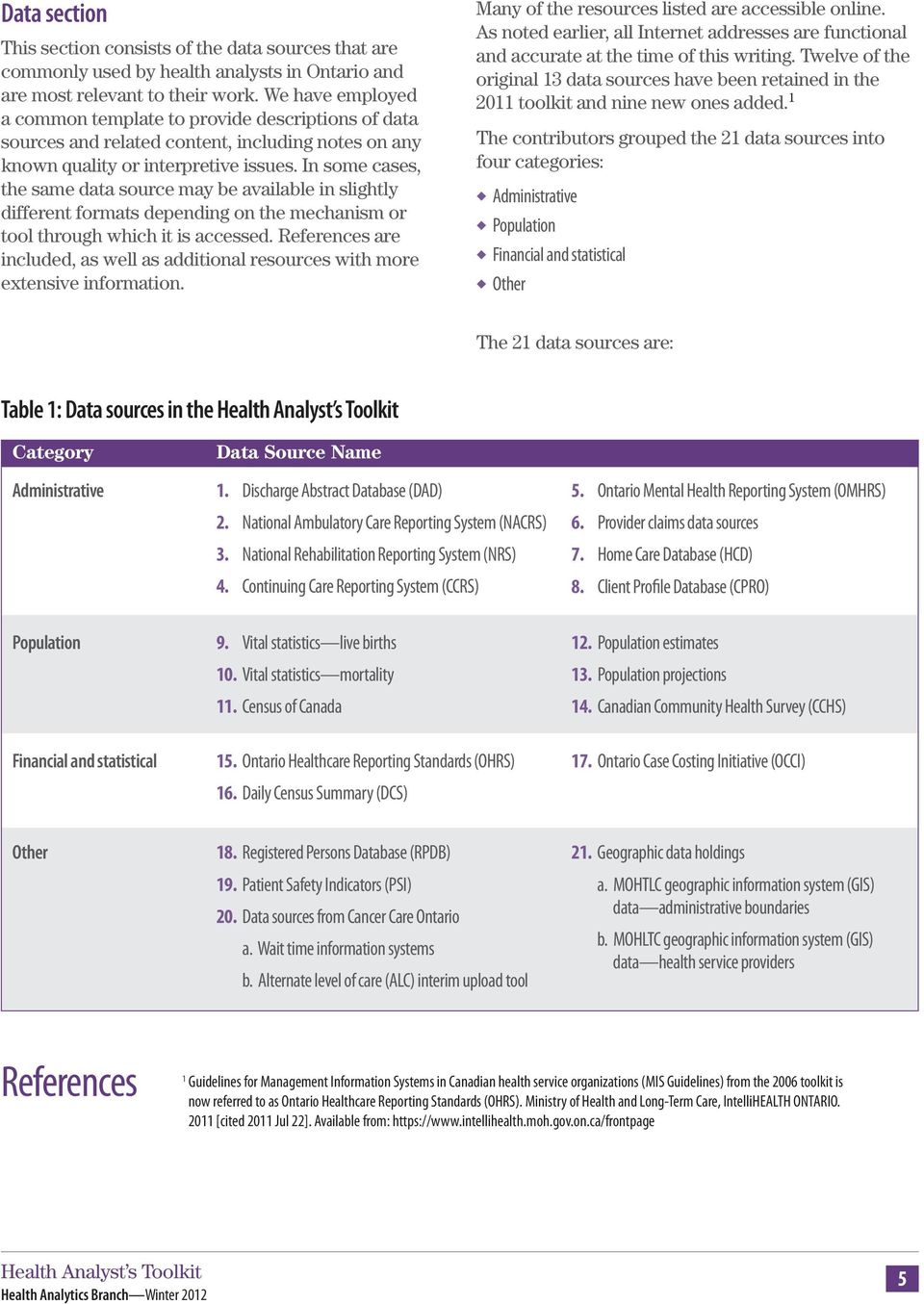
5 Data section This section consists of the data sources that are commonly used by health analysts in Ontario and are most relevant to their work. We have employed a common template to provide descriptions of data sources and related content, including notes on any known quality or interpretive issues. In some cases, the same data source may be available in slightly different formats depending on the mechanism or tool through which it is accessed. References are included, as well as additional resources with more extensive information. Many of the resources listed are accessible online. As noted earlier, all Internet addresses are functional and accurate at the time of this writing. Twelve of the original 13 data sources have been retained in the 2011 toolkit and nine new ones added. 1 The contributors grouped the 21 data sources into four categories: Administrative Population Financial and statistical Other The 21 data sources are: Table 1: Data sources in the Category Administrative Data Source Name 1. Discharge Abstract Database (DAD) 2. National Ambulatory Care Reporting System (NACRS) 3. National Rehabilitation Reporting System (NRS) 4. Continuing Care Reporting System (CCRS) 5. Ontario Mental Health Reporting System (OMHRS) 6. Provider claims data sources 7. Home Care Database (HCD) 8. Client Profile Database (CPRO) Population 9. Vital statistics live births 10. Vital statistics mortality 11. Census of Canada 12. Population estimates 13. Population projections 14. Canadian Community Health Survey (CCHS) Financial and statistical 15. Ontario Healthcare Reporting Standards (OHRS) 16. Daily Census Summary (DCS) 17. Ontario Case Costing Initiative (OCCI) Other 18. Registered Persons Database (RPDB) 19. Patient Safety Indicators (PSI) 20. Data sources from Cancer Care Ontario a. Wait time information systems b. Alternate level of care (ALC) interim upload tool 21. Geographic data holdings a. MOHTLC geographic information system (GIS) data administrative boundaries b. MOHLTC geographic information system (GIS) data health service providers References 1 Guidelines for Management Information Systems in Canadian health service organizations (MIS Guidelines) from the 2006 toolkit is now referred to as Ontario Healthcare Reporting Standards (OHRS). Ministry of Health and Long-Term Care, IntelliHEALTH ONTARIO [cited 2011 Jul 22]. Available from: 5
6 Knowledge 1.1 Health data collection in Ontario The Data section of this toolkit serves as evidence that Ontario is a data-rich environment. But with a diversity of data sources comes an equally diverse set of methods for data collection, and a responsibility, on the analyst s part, to be familiar with them. This subsection describes, at a very general level, some of the major ways that health-related data are collected in Ontario. More detail on collection methods for specific data sources is available in the individual Data subsections, as well as from the data custodians. Data collection types In this section, the following data collection types are defined and described: Population censuses Sample surveys Administrative data Registries Examples are provided in the context of health analysis in Ontario. Population censuses A census is a complete enumeration of a population and provides basic information on population and dwelling characteristics. 1 Most countries conduct censuses on five- or 10-year cycles. In Canada, the census is collected by Statistics Canada every five years. Prior to 2011, collection was split between a short-form census delivered to all households in Canada and a long-form census, which was completed by 20% of households. The short form contained a small subset of questions, while the long form included detailed questions on socioeconomic status, family structure, and dwelling characteristics. For the 2011 Census, the long form was discontinued and was replaced by the National Household Survey (NHS), a voluntary survey received by approximately 33% of Canadian households. 2 The content of the census is described in more detail in the Data section. Because the census is mandatory, coverage of the population is near complete. However, some Aboriginal communities in Canada are enumerated incompletely, or not at all, either because census collection was not permitted or because collection stopped before completion. At the time of this writing, information on incomplete enumeration for the 2011 Census is not available; in the 2006 Census, 10 Aboriginal communities were not enumerated. Also, each census is subject to coverage errors because dwellings and/or individuals may be missed. After each census, studies are undertaken to estimate the amount of net undercoverage. 3 The combination of census counts and net undercoverage estimates are the basis for the year-specific Ontario population estimates. Sample surveys Sample surveys provide a means of estimating population characteristics from a group of individuals who are generally chosen at random from the population of interest. Since fewer people need to be surveyed, this form of data collection may be more efficient and quicker to implement than a census. It also allows for focus on specific health topics and may be better able to provide information on issues not available in administrative data. However, because surveys rely on fewer people, there may be uncertainty associated with the inferences drawn from them. The sampling variation associated with estimates derived from survey data is largely a function of the number of valid responses for each question. In some instances, particularly for questions reflecting rare conditions or behaviours, the confidence intervals may be quite wide, and, thus, the reliability of resulting estimates may be uncertain. Care must be taken to follow releasing guidelines when using sample survey data. One survey described in detail in the Data section is a particularly important resource. The Canadian Community Health Survey (CCHS), administered by Statistics Canada, provides a wealth of information on health behaviours, outcomes, and health system utilization at the LHIN, Public Health Unit (PHU), and provincial levels. Administrative data As the name implies, administrative data result from the day-to-day administration of programs and services. While not all health related administrative data in Ontario are accessible, some data sources are available through dissemination tools such as IntelliHEALTH ONTARIO. These include data sources distributed by the Canadian Institute for Health 6
7 Information (CIHI), provider billings, and registry data. Specific administrative sources noted below are described in more detail in the Data section. CIHI data sources Much of the record-level health data available for analysis in Ontario comes through CIHI. CIHI collects data directly from participating institutions, and then performs data validity checks and data cleaning. These data are then received by the MOHLTC. In some instances, Ontario-specific fields are added prior to incorporating the data into dissemination tools such as IntelliHEALTH ONTARIO. The wide array of data sources distributed by CIHI include: Discharge Abstract Database (DAD) National Ambulatory Care Reporting System (NACRS) National Rehabilitation Reporting System (NRS) Continuing Care Reporting System (CCRS) Ontario Mental Health Reporting System (OMHRS) The initial method of data collection differs substantially from one source to another, and within each source collection methods may vary by institution. For the DAD and the NACRS, patient-level data are collected at the time of service in participating institutions. After the discharge or emergency visit, a medical records coder at the hospital completes an abstract according to instructions in the CIHI abstracting manual. For the DAD, CIHI receives data directly from participating institutions or from the respective health/regional authority or ministry/department of health. Currently, data submission to the NACRS is mandated in Ontario for emergency departments, day surgeries, dialysis, cardiac catheterization, and oncology (including all regional cancer centres). 5 Hospitals submit data to CIHI in one-month batches. Both the DAD and the NACRS include closed cases only, and thus exclude patients who are still in hospital at the time of reporting. NRS data are collected by service providers in participating facilities at the time of both admission and discharge, and are then submitted to CIHI. With the NRS, there is also an optional post-discharge follow up data collection process. The NRS is admission based; open cases, which are still being treated at the time of reporting, are part of the data. Records within the CCRS are assessment based. A full assessment is completed for each patient within 14 days of admission to a complex continuing care facility or to a Long-Term Care Home (LTCH). Thereafter, assessments are completed quarterly, or if there is a significant change in clinical status, or for significant corrections of a prior assessment. Similarly, the OMHRS is an open reporting system. Assessment is provided at various points during an inpatient stay. Provider claims (OHIP) Administrative data based on provider billings through the Ontario Health Insurance Plan (OHIP) are also available. The complete administrative system used to collect and pay these claims is complex and is outside the scope of the Toolkit as it is embedded in a wide range of information systems across the MOHLTC. For most analysts, access to these data is through the medical services data sources in IntelliHEALTH, which are derived from OHIP s Claims History Database (CHDB). These data include fee-for-service billings for physicians and other practitioners, and also some claims for services which have no payment associated with them (i.e., the insurable services were provided but were paid for through alternative programs). Also, since the CHDB is designed for the assessment and processing of claims, its use for other purposes such as measuring utilization of services or estimating conditions based on diagnoses is secondary. Care must be taken with interpretation and analysis. Registries Administrative registries are databases containing records of people who have particular characteristics. They are set up as part of the administration of programs and services. 6 Generally, the focus is not on program events but on maintaining membership lists. Relatively few of them are widely available to health analysts in Ontario, though one notable exception is the Ontario Registered Persons data source, available in IntelliHEALTH. It contains selected demographic and eligibility data extracted from the MOHTLC Registered Persons Database (RPDB). Client registration and identification information for everyone who registers for health insurance in Ontario is entered into the RPDB.7 Due to changes in 7
8 the administration of OHIP registration over time, some data elements such as addresses may not be validated regularly for all health card numbers. This is also because almost all validation is client driven. Vital statistics Vital statistics data are a variant on registry data. Since registration of births and deaths is mandatory in Ontario, the Office of the Registrar General (ORG) obtains birth information from the form that parents complete and from the physician notice of birth, and mortality information from the Medical Certificate of Death completed by the physician. All deaths in Ontario are registered in the Division Registrar office in the jurisdiction where the death occurred. The ORG submits microfilm/optical images of birth registration forms and machine-readable abstracts of birth and death registration forms to Statistics Canada, where routine edits are applied to ensure data quality and completeness. Finally, with the ORG s approval, Statistics Canada sends these edited and standardized data to the MOHLTC, where they are uploaded to IntelliHEALTH. References 1 Armitage P, Berry G, Matthews JNS. Statistical methods in medical research. 4th ed. Malden, Massachusetts: Blackwell Science; Statistics Canada. NHS: Questions and answers Jun 2 [cited 2011 Jun 13]. Available from: 3 Statistics Canada. Data quality, concepts and methodology: Quality of estimates Sep 29 [cited 2011 Jun 15]. Available from: 4 Canadian Institute for Health Information. Discharge abstract database [cited 2011 Jun 13]. Available from: 5 Canadian Institute for Health Information. Emergency and ambulatory care [cited 2011 Jun 13]. Available from: 6 United Nations Economic and Social Commission for Asia and the Pacific. Training manual on disability statistics [cited 2011 Jul 7]. Available from: 7 Ontario Ministry of Health and Long-Term Care. Resource manual for physicians [cited 2011 Jun]. Available from: 8

9 1.2 Geographies in Ontario Generally, health analysts have access to data at a range of geographic scales. A basic understanding of the complexities and similarities of the geographic concepts used in many health datasets is essential. This subsection focuses on the most commonly used geographies: census-based definitions, the MOHLTC s residence codes, LHINs and sub-lhins, Public Health Units (PHUs), and postal codes. It concludes with information on conversion files and a discussion of how urban and rural can be defined. Commonly used geographies Multiple levels of geography are used for health analysis in Ontario. There are five main geographic coding systems: Statistics Canada s Standard Geographical Classification (SGC) The MOHLTC s residence coding system PHUs LHINs Postal codes These systems are interrelated and use some of the same geographic units as their basis. Statistics Canada s Standard Geographical Classification (SGC) The SGC, Statistics Canada s official classification of geographic areas, is based on a classification system that was initially developed for disseminating statistics from the population census. 1,2 It is made up of a three-level hierarchy: Province/Territory Census Division (CD) a group of neighbouring municipalities that are joined together for the purposes of regional planning. CD is the term used for provincially legislated areas such as counties or regional districts. There are 49 in Ontario Census Subdivision (CSD) general term for a municipality (as determined by provincial legislation) or an area, such as a First Nations reserve, that is treated as a municipal equivalent. There are 585 in Ontario These levels are hierarchically related in that CSDs aggregate into CDs, which aggregate into provinces and territories. For community level analyses, Census Tracts (CTs) and Dissemination Areas (DAs) can be used to regroup geographies into levels that are smaller than CSDs. 1,2 CTs are small and relatively stable areas that usually have a population of 2,500 8,000 and are located in large urban centres with an urban core population of 50,000 or more. There are 2,136 CTs in Ontario. DAs are small and relatively stable geographic units composed of one block or of two or more neighbouring blocks. They are the smallest standard geographic area for which all census data are disseminated. There are 19,177 DAs in Ontario. It should be noted that census geography is subject to change over time. For example, not all DA boundaries are stable across censuses. The MOHLTC s residence coding system MOHLTC health data in Ontario often uses the MOHLTC s own residence codes (also called municipal codes). The lowest level of this coding system represents municipalities, townships, named settlements, First Nations reserves, and unorganized areas. The MOHLTC regroups most data from Statistics Canada including vital statistics and population estimates and projections into the residence codes, which are based on CSDs. There is a one-to-one relationship between most but not all MOHLTC residence codes and CSDs; some CSDs map to more than one residence code because there are more residence codes in common usage (684, at the time of this writing, versus 585 CSDs). The two differ primarily in northern Ontario, where some geographic townships have their own residence codes. Data can be aggregated using MOHLTC crosswalk files. Another difference between the MOHLTC and Statistics Canada coding systems is that the MOHLTC codes reflect changes in municipal boundaries that occur between census years, while Statistics Canada s data are based on CSDs from the most recent census. 2,3 The next highest level of geography is the county/district. Counties are created by grouping residence codes together, and therefore differ somewhat from Statistics Canada s CDs (based on groupings of CSDs). Most differences are related to where First Nations reserves are placed. Statistics Canada splits some reserves across CDs, while the MOHLTC selects one county within which to place the entire reserve. 3 9

10 PHUs PHUs are official health agencies established by the MOHLTC to provide community health programs and planning. There are 36 PHUs in Ontario, and in many cases they cover either single or groups of counties or CDs. However, some CDs fall into more than one PHU area, so it is preferable, when aggregating data based on census geography, to group CSDs instead of CDs into PHUs. 2 LHINs LHINs were established by the MOHLTC in 2006 as a way to plan, fund, and manage health services locally. The boundaries of the 14 LHINs reflect patients utilization of healthcare services in their communities (as of 2005), and represent an understanding that community-based care is best planned, coordinated, and funded at the local level. Working in collaboration with the Institute for Clinical Evaluative Sciences (ICES), the MOHLTC used the following evidence-based methodology to establish the LHIN boundaries. 4 Step 1 Established Hospital Service Areas based on a patient perspective: 4,5 ICES used postal codes from patient hospital discharge abstracts to identify a patient s home location. These were compared to the location of the hospital where services were received For the basis of patient origin, patients home locations were mapped to DAs (the smallest of the Statistics Canada geographic units described earlier) from the 2001 Census Each DA was then assigned to the hospital which had the greatest number of admissions from within its boundaries. Based on these assignments, clusters were created to form the Hospital Service Areas Step 2 Clustered Hospital Service Areas into larger groups called Hospital Referral Regions: 4 Admissions to Ontario s 50 highest-volume hospitals were used to determine regional travel patterns and establish Hospital Referral Region boundaries These boundaries were used to form the basis of the LHINs The MOHLTC considered various options to decide on the number of LHINs. It was determined based in part on the experiences of other Canadian jurisdictions that 14 LHINs would allow for the effective management of the healthcare system Step 3 Checked the appropriateness of fit for each area by calculating a Localization Index: 4,5 A Localization Index is a measure that shows what percentage of the population receives health services locally For the LHIN areas, the percentage ranged from 59.1% to 97.2% and indicated an appropriate match between the new boundaries and the locations where people receive their healthcare Following the initial announcement of the LHIN boundaries, the MOHLTC received feedback from various stakeholders in the province. The majority of issues raised involved requests to move hospitals from one LHIN to another and to revise the boundaries to match current provider relationships and patient flow. The MOHLTC analyzed this feedback and, where deemed appropriate, boundaries were adjusted. 6 Ontario s 14 LHINs are shown in Figure
11 Figure 2.1: LHINs in Ontario It is important to note that the LHIN boundaries do not always match municipal or census boundaries. As Table 2.1 illustrates (below), most LHIN areas comprise single or grouped CDs or CSDs. In a few cases, however, LHIN boundaries cross CSD boundaries and smaller geographic units (CTs or DAs) must be used. 7 11

12 Table 2.1: Census geographic units in Ontario s LHINs LHIN 1 - Erie St. Clair 2 - South West 3 - Waterloo Wellington 4 - Hamilton Niagara Haldimand Brant 5 - Central West CD CSD CT DA X X X X X X X X X X X X X 6 - Mississauga Halton X X 7 - Toronto Central X 8 - Central X X 9 - Central East X X X 10 - South East 11 - Champlain X X X X 12 - North Simcoe Muskoka X X X 13 - North East 14 - North West X X X X Since LHINs are based on 2001 Census geography, there are additional issues relating to the introduction of 2006 Census boundary classifications. Boundaries for nine of the 14 LHINs cannot be exactly duplicated using the current (2006) data, as there are 26 DAs (representing approximately 15,000 people, in total) that now cross LHIN boundaries. The MOHLTC and LHINs have agreed on how to assign this population to LHINs for the 2006 Census period, but it is likely that some DA boundaries will change again when the 2011 Census results are complete, due to population growth and/or changes to road networks. 8 Statistics Canada data and analytic products from the Census of Canada, the Canadian Community Health Survey, and the Postal Code Conversion File (PCCF) are available at the LHIN level. Additionally, LHIN identifiers have been added to most administrative datasets available for use by health analysts. 8 SubLHIN geographic units To further facilitate local healthcare planning, the LHINs have developed sublhins smaller areas defined by individual LHINs for their local planning purposes. SubLHINs are not a consistently defined set of comparable units. Some LHINs have more of them than others do, and sublhin population and size vary substantially both within and across LHIN boundaries. A sublhin may represent specific communities (whole or partial) or aggregations of communities (i.e., CDs, CSDs, or DAs). In terms of naming conventions, sublhins incorporate the LHIN code and a unique sublhin number. Three of the LHINs (Hamilton Niagara Haldimand Brant, Central East, and Champlain) have divided their sublhins into two levels: primary and secondary. The primary encompass larger areas, while the secondary, which are more detailed, nest inside them. Overall there are 97 primary and 141 secondary sublhins. Where possible, the secondary sublhins should be seen as the default area for analysis, using the primary only if data for the secondary are unavailable or unstable. 9 12

13 The Health Analytics Branch at the MOHLTC has created and maintains sublhin files and documentation to support the analytic needs of the MOHLTC and LHINs, including boundary files, crosswalks, and population estimates by age and sex. Postal codes The Canadian postal code is an alphanumeric combination of six characters arranged in the format of ANA NAN where A represents a letter and N a number. The first three characters are known as the Forward Sortation Area (FSA). In Ontario, as of October 2010, there were 531 FSAs as part of 295,712 postal codes. 10 One way to distinguish rural from urban is by the second character in the FSA a zero (0) in this position indicates rural. Postal codes are included in many datasets. They are often used as an alternative means of geographic grouping, by recoding using Statistics Canada s Postal Code Conversion File (PCCF). 11 But some data sources notably the National Ambulatory Care Reporting System (NACRS) and the Discharge Abstract Database (DAD) use the municipality as the primary geographic identifier, and there may be discrepancies between the location of communities and the postal codes. Conversion files Conversion files are tools for integrating data from various sources. The MOHLTC produces conversion files between levels of geography including residence code, PHU, LHIN, and sublhin. This is useful because, for example, some residence codes reflect municipal amalgamations which are now too large for health planning purposes. The Statistics Canada Postal Code Conversion File (PCCF), mentioned earlier, has been developed by Statistics Canada to provide a correspondence between its SGC classifications and Canada s postal codes. This conversion file contains multiple records for any postal code that straddles more than one block-face (side of an urban block) or DA. Also, multiple records are quite common for rural postal codes and community mailboxes. A Single Link Indicator is included in the PCCF to help users deal with all of the above. It attempts to identify the geographic area with the majority of dwellings using the particular postal code. Users should be cautioned, though, that only a partial correspondence between the postal code and SGC units is achieved. 11 The PCCF is updated on a regular basis and released every six months. The ongoing maintenance involves taking postal code changes, which are continually introduced by Canada Post, and finding the corresponding census geographic areas. Every five years, after each census, the PCCF must be re-based to the new census geography. It is a cumulative file and therefore includes both active and retired postal codes. 11 The MOHLTC subscribes to annual updates of the PCCF and uses correspondences between postal code and CSD to create its conversion files from postal code to residence code, PHU, LHIN, and sublhin. Some postal codes do not align with municipal and county boundaries, especially in rural areas, and this is a problem when using postal codes to assign county or PHU. 11 Defining rurality in Ontario Urban versus rural is an important distinction in regional population-based health analysis in Ontario, with rurality often seen as the definitive classification in assessing a population s access to healthcare. But to use this distinction effectively, analysts need to be aware of related issues and limitations. First, there is no single method for defining what constitutes urban or rural. Variations in the available definitions can have a substantial effect on analyses (i.e., leading to different classifications of areas or different estimates of population size), with results often presented with no explanation of how rural was defined, either conceptually or in terms of the methodology used. Second, the use of a dichotomous urban/rural indicator assumes that both categories are homogenous. Indicators with more detailed categories may be more appropriate for complex health analysis. It is generally agreed that substantial differences in health experience are likely to exist between people in urban areas and those in more remote or rural places differences in access to services, health outcomes, physical environments, and health-related behaviours, and/or in social determinants of health including socio-economic status or social capital. These are likely the result of variations in both social and geographic environments, but most common working definitions of rurality are spatial based on geography alone. This is largely because of practical limitations on the data that are available and because 13
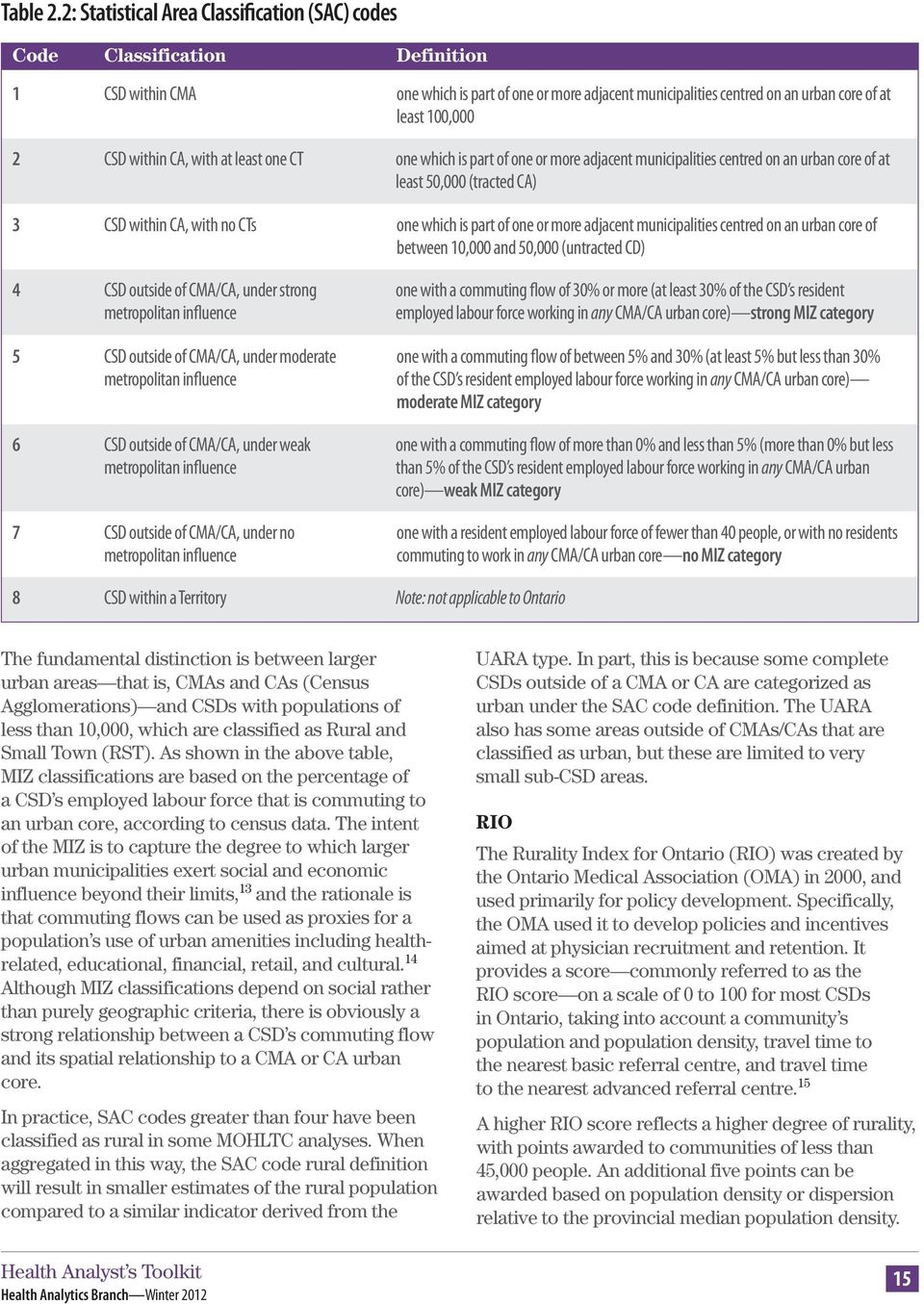
14 there is no clear consensus on which social attributes would be part of a broader definition of rurality. It is fundamentally important to recognize that spatial definitions of urban and rural status are limited in themselves, and carry an assumption that individuals who live within one designation or the other are, accordingly, urban or rural in outlook, riskexposure, or access to care. Exceptions at the individual level will always be found, because we do not define individuals but the regions in which they live as either rural or urban. Commonly used urban/rural classification systems A number of urban/rural definitions are commonly used in the analysis of health information in Ontario. These include the Urban Area Rural Area (UARA) type; Statistical Area Classification codes (SAC codes); the Ontario Medical Association s Rurality Index for Ontario (RIO); and postal codes. One disadvantage of using the UARA type in the PCCF is that with changes in the methods used to define UARA, many postal codes can be linked to DAs (Dissemination Areas) only and the UARA type is not available for these postal codes. 12 SAC codes Statistical Area Classification (SAC) codes also developed by Statistics Canada can be used to define urban and rural areas at the CSD level (i.e., municipality or municipal equivalent). As shown in Table 2.2, there are eight classifications in this system. Seven of them are applicable to Ontario CSDs, and some are used to define Metropolitan Influenced Zones (MIZ). UARA The UARA type is a Statistics Canada classification scheme used to define urban and rural areas including Census Metropolitan Areas (CMAs) and Census Agglomerations (CAs). (The latter consist of one or more adjacent municipalities centred on a large urban area referred to as the urban core.) UARA types can be found in data sources such as Statistics Canada s own PCCF and the Canadian Community Health Survey. According to Statistics Canada, an urban area is one which has, by the most recent census count, at least 1,000 persons and a population density of at least 400 persons per square kilometre. By default, all areas not classified as urban are rural. Beginning with the 2001 Census, the block, which is an area equivalent to a city block bounded by intersecting streets, became the basic building block for defining urban areas. In the UARA classification, there is a hierarchy based largely on population size and density. The urban core is the area around which a CMA or CA is delineated; for CMAs, the core has a population of at least 100,000, and for CAs the required population is at least 50,000. Secondary core is the urban core of a CA that has been merged with an adjacent CMA or larger CA. Urban fringe comprises smaller urban areas that are not contiguous with the urban core, and can be located inside or outside a CMA/CA. Rural fringe within a CMA or CA is a residual category comprising all territory not classified as urban core or urban fringe. 14
15 Table 2.2: Statistical Area Classification (SAC) codes Code 1 Classification CSD within CMA Definition one which is part of one or more adjacent municipalities centred on an urban core of at least 100,000 2 CSD within CA, with at least one CT one which is part of one or more adjacent municipalities centred on an urban core of at least 50,000 (tracted CA) 3 CSD within CA, with no CTs 4 CSD outside of CMA/CA, under strong metropolitan influence 5 CSD outside of CMA/CA, under moderate metropolitan influence 6 CSD outside of CMA/CA, under weak metropolitan influence 7 CSD outside of CMA/CA, under no metropolitan influence one which is part of one or more adjacent municipalities centred on an urban core of between 10,000 and 50,000 (untracted CD) one with a commuting flow of 30% or more (at least 30% of the CSD s resident employed labour force working in any CMA/CA urban core) strong MIZ category one with a commuting flow of between 5% and 30% (at least 5% but less than 30% of the CSD s resident employed labour force working in any CMA/CA urban core) moderate MIZ category one with a commuting flow of more than 0% and less than 5% (more than 0% but less than 5% of the CSD s resident employed labour force working in any CMA/CA urban core) weak MIZ category one with a resident employed labour force of fewer than 40 people, or with no residents commuting to work in any CMA/CA urban core no MIZ category 8 CSD within a Territory Note: not applicable to Ontario The fundamental distinction is between larger urban areas that is, CMAs and CAs (Census Agglomerations) and CSDs with populations of less than 10,000, which are classified as Rural and Small Town (RST). As shown in the above table, MIZ classifications are based on the percentage of a CSD s employed labour force that is commuting to an urban core, according to census data. The intent of the MIZ is to capture the degree to which larger urban municipalities exert social and economic influence beyond their limits, 13 and the rationale is that commuting flows can be used as proxies for a population s use of urban amenities including healthrelated, educational, financial, retail, and cultural. 14 Although MIZ classifications depend on social rather than purely geographic criteria, there is obviously a strong relationship between a CSD s commuting flow and its spatial relationship to a CMA or CA urban core. In practice, SAC codes greater than four have been classified as rural in some MOHLTC analyses. When aggregated in this way, the SAC code rural definition will result in smaller estimates of the rural population compared to a similar indicator derived from the UARA type. In part, this is because some complete CSDs outside of a CMA or CA are categorized as urban under the SAC code definition. The UARA also has some areas outside of CMAs/CAs that are classified as urban, but these are limited to very small sub-csd areas. RIO The Rurality Index for Ontario (RIO) was created by the Ontario Medical Association (OMA) in 2000, and used primarily for policy development. Specifically, the OMA used it to develop policies and incentives aimed at physician recruitment and retention. It provides a score commonly referred to as the RIO score on a scale of 0 to 100 for most CSDs in Ontario, taking into account a community s population and population density, travel time to the nearest basic referral centre, and travel time to the nearest advanced referral centre. 15 A higher RIO score reflects a higher degree of rurality, with points awarded to communities of less than 45,000 people. An additional five points can be awarded based on population density or dispersion relative to the provincial median population density. 15
16 The most recent RIO scores available are based on 2006 data provided by Statistics Canada. Distance to referral centres is an important element, affecting the scope of a physician s practice and levels of responsibility (i.e., amount of time on-call, or responsibility for satellite clinics at long distances from the home community), as well as professional and social isolation of practitioners and their families. Travel times and other transportation issues obviously affect patients too; rural residents often travel a long way for healthcare, and lack of public transit in rural areas can create a barrier. RIO scores have two important roles. First, they provide a measure along the continuum of rurality. Second, they can be used to create dichotomous urban/rural indicators, based on values of 40 or more. Postal codes As mentioned earlier, rural postal codes can be identified as those where the second character is a zero (0). 11 Also, according to Statistics Canada s MIZ classification, any postal codes included in a rural route designation are usually considered rural. 11 Many analysts have access to Statistics Canada s PCCF, which serves as a crosswalk between postal codes and census geography and provides a way to identify this second group (i.e., rural route postal codes): They are any codes in the PCCF with a delivery mode type of H. Of Ontario s 295,712 postal codes (circa October 2010) only 1,135 (0.4%) are active rural postal codes as identified by a zero as second character, and a further 291 are rural and retired. 10 Postal codes with a delivery mode type of H in the PCCF constitute an additional 463. Although postal codes provide a reasonably quick way to identify rurality, there are limitations. Many rural postal codes cross boundaries of standard geographic areas such as CTs or CSDs, and they often straddle DAs (Dissemination Areas, which, as noted earlier, can be as small as a single city block). It is difficult, if not impossible, to identify the precise physical location of a rural postal code. 15 Second, it is important to be aware that rural postal codes do not match other classification schemes such as the SAC code or UARA type. As a case in point, if rural areas are defined as those with SAC codes 5 through 8, 57% of rural postal codes in the October 2010 PCCF are located within urban CSDs. References 1 Statistics Canada. Standard Geographical Classification (SGC) Nov [cited 2011 Jun]. Available from: /ref/dict/geo044a-eng.cfm 2 Provincial Health Indicators Work Group. Core indicators for public health in Ontario: Geography in Ontario Jun 7 [cited 2011 Jun]. Available from: 3 Ontario Ministry of Health and Long-Term Care. Residence coding manual Apr [cited 2011 Aug]. Available from: a_16576/2011%20residence%20codes%20manual.pdf 4 Ontario Ministry of Health and Long-Term Care. Local Health Integration Networks, bulletin no Oct 6 [cited 2005 Sep]. Available from: 5 Rothwell D. Using administrative data and mapping tools to create Local Health Integration Networks in Ontario. Proceedings of the 2005 symposium: The quality agenda: Do our health data measure up?; 2005 Jan 17 18; Toronto. [cited 2005 Jan 18]. ppt 6 Ontario Ministry of Health and Long-Term Care. Local Health Integration Networks, bulletin no Mar 15 [cited 2005 Oct]. Available from: 7 Pacey M, Dall K, Bains N. HSIP research note: Aggregation of Census 2001 data to LHINs. Kingston: Health System Intelligence Project; 2005 Jun. 8 Bains N, Lefebvre M, Ardal S, Pacey M. HSIP research note: 2006 Census dissemination areas that cross LHIN boundaries. Kingston: Health System Intelligence Project; 2007 Dec. 9 Health Analytics Branch, Ontario Ministry of Health and Long-Term Care. Introducing SubLHIN version 9: Geographic and analytical perspectives. Kingston: Health Analytics Branch; 2010 Dec. 10 Statistics Canada. Postal Code Conversion File (PCCF), October [data file accessed 2011 Jul]. 11 Statistics Canada. Postal Code Conversion File (PCCF) reference guide: October 2010 postal codes. Ottawa; 2011 Jan. Catalogue no G. 12 Statistics Canada. Delineation of 2006 urban areas: Challenges and achievements. Ottawa: Geography Working Paper Series; 2008 Feb. Catalogue no. 92F0138MIE. 13 Statistics Canada. Metropolitan Influenced Zone (MIZ) Jan 20 [cited 2011 Jun]. Available from: 14 Canadian Institute for Health Information. How healthy are rural Canadians? An assessment of their health status and health determinants [cited 2011 Jun]. Available from: rural_canadians_2006_report_e.pdf 15 Kralj,Boris. Measuring Rurality RIO2008 BASIC: Methodology and results. Toronto: OMA Economics Department;

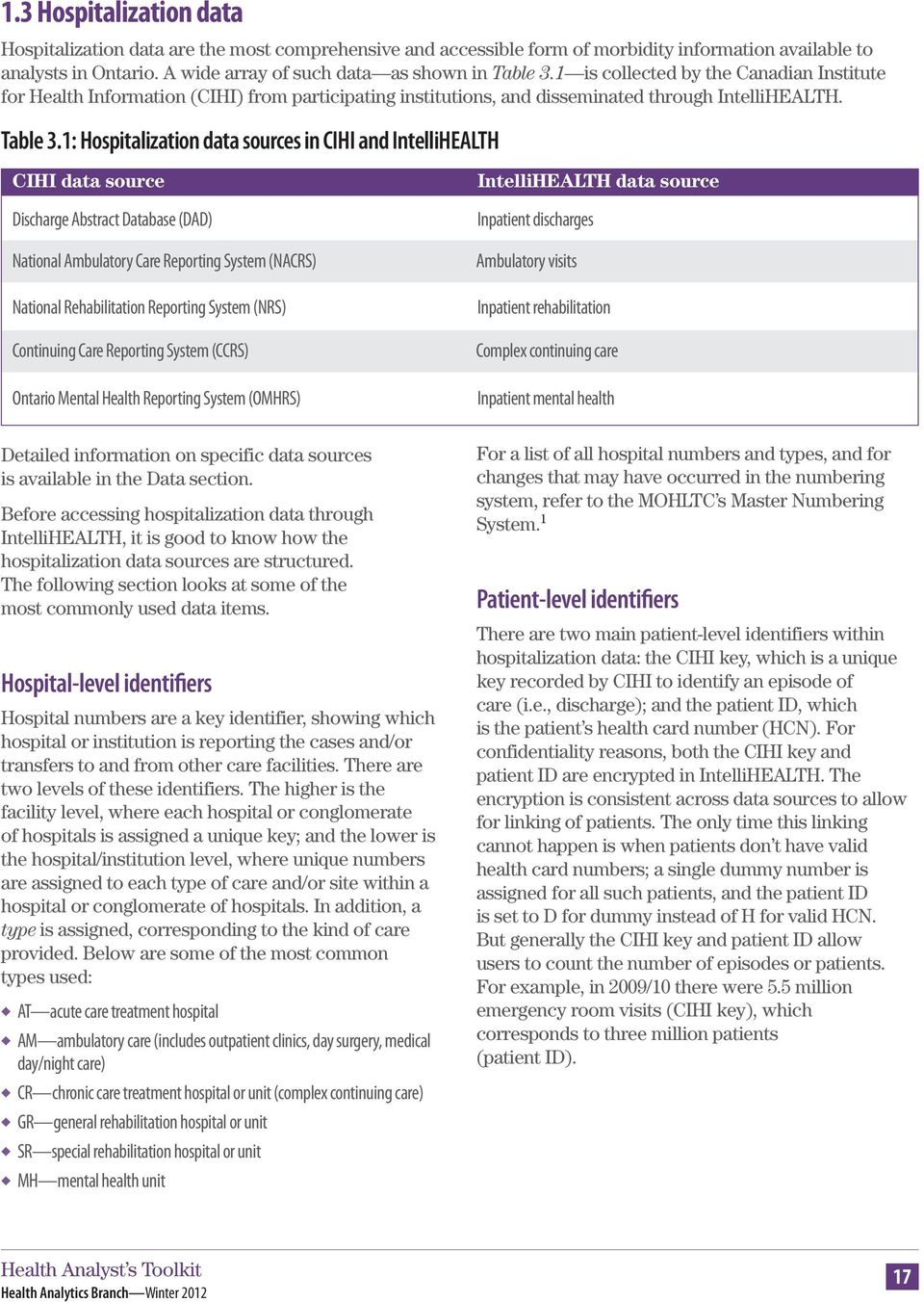
17 1.3 Hospitalization data Hospitalization data are the most comprehensive and accessible form of morbidity information available to analysts in Ontario. A wide array of such data as shown in Table 3.1 is collected by the Canadian Institute for Health Information (CIHI) from participating institutions, and disseminated through IntelliHEALTH. Table 3.1: Hospitalization data sources in CIHI and IntelliHEALTH CIHI data source Discharge Abstract Database (DAD) National Ambulatory Care Reporting System (NACRS) National Rehabilitation Reporting System (NRS) Continuing Care Reporting System (CCRS) Ontario Mental Health Reporting System (OMHRS) IntelliHEALTH data source Inpatient discharges Ambulatory visits Inpatient rehabilitation Complex continuing care Inpatient mental health Detailed information on specific data sources is available in the Data section. Before accessing hospitalization data through IntelliHEALTH, it is good to know how the hospitalization data sources are structured. The following section looks at some of the most commonly used data items. Hospital-level identifiers Hospital numbers are a key identifier, showing which hospital or institution is reporting the cases and/or transfers to and from other care facilities. There are two levels of these identifiers. The higher is the facility level, where each hospital or conglomerate of hospitals is assigned a unique key; and the lower is the hospital/institution level, where unique numbers are assigned to each type of care and/or site within a hospital or conglomerate of hospitals. In addition, a type is assigned, corresponding to the kind of care provided. Below are some of the most common types used: AT acute care treatment hospital AM ambulatory care (includes outpatient clinics, day surgery, medical day/night care) CR chronic care treatment hospital or unit (complex continuing care) GR general rehabilitation hospital or unit SR special rehabilitation hospital or unit MH mental health unit For a list of all hospital numbers and types, and for changes that may have occurred in the numbering system, refer to the MOHLTC s Master Numbering System. 1 Patient-level identifiers There are two main patient-level identifiers within hospitalization data: the CIHI key, which is a unique key recorded by CIHI to identify an episode of care (i.e., discharge); and the patient ID, which is the patient s health card number (HCN). For confidentiality reasons, both the CIHI key and patient ID are encrypted in IntelliHEALTH. The encryption is consistent across data sources to allow for linking of patients. The only time this linking cannot happen is when patients don t have valid health card numbers; a single dummy number is assigned for all such patients, and the patient ID is set to D for dummy instead of H for valid HCN. But generally the CIHI key and patient ID allow users to count the number of episodes or patients. For example, in 2009/10 there were 5.5 million emergency room visits (CIHI key), which corresponds to three million patients (patient ID). 17
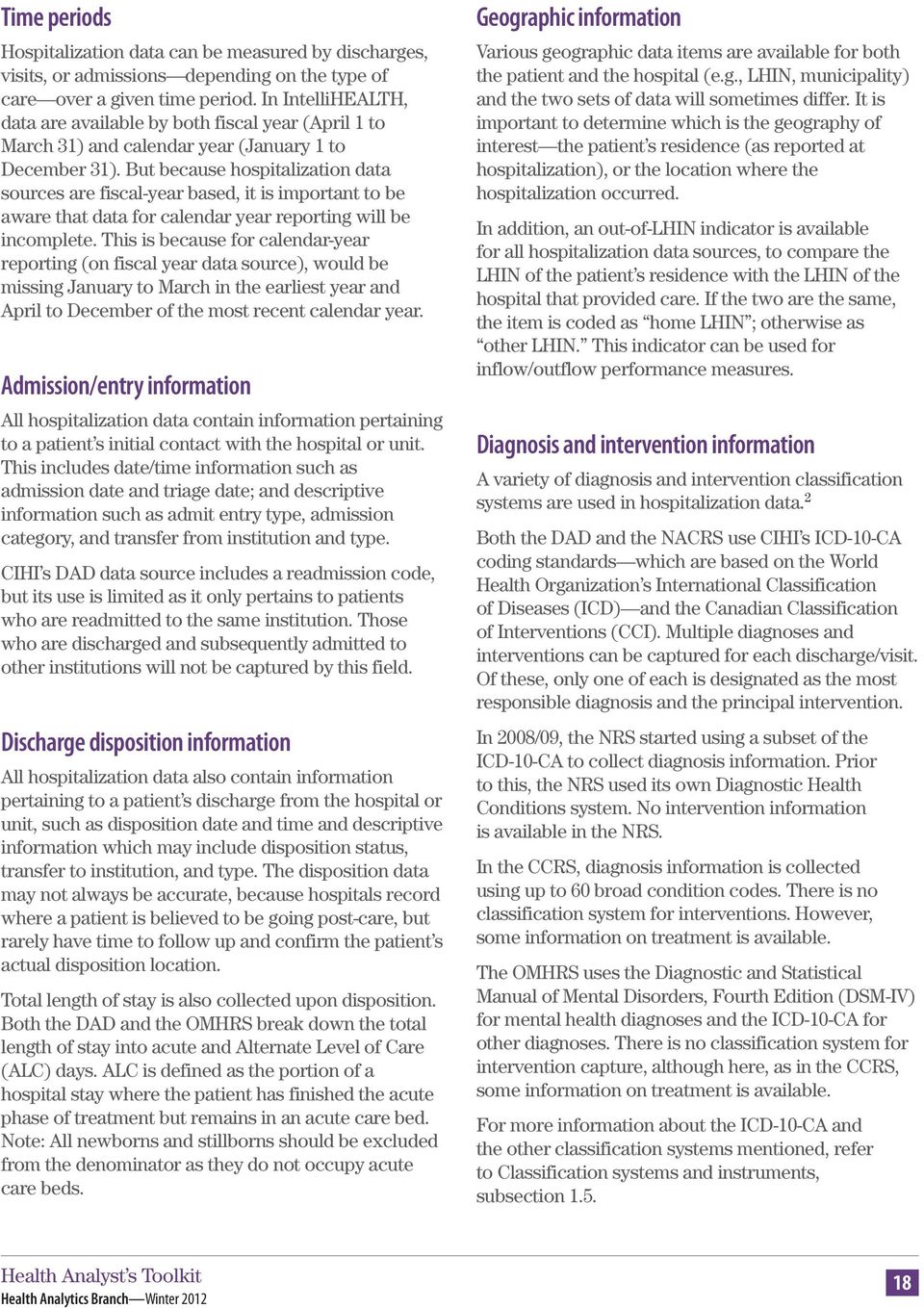
18 Time periods Hospitalization data can be measured by discharges, visits, or admissions depending on the type of care over a given time period. In IntelliHEALTH, data are available by both fiscal year (April 1 to March 31) and calendar year (January 1 to December 31). But because hospitalization data sources are fiscal-year based, it is important to be aware that data for calendar year reporting will be incomplete. This is because for calendar-year reporting (on fiscal year data source), would be missing January to March in the earliest year and April to December of the most recent calendar year. Admission/entry information All hospitalization data contain information pertaining to a patient s initial contact with the hospital or unit. This includes date/time information such as admission date and triage date; and descriptive information such as admit entry type, admission category, and transfer from institution and type. CIHI s DAD data source includes a readmission code, but its use is limited as it only pertains to patients who are readmitted to the same institution. Those who are discharged and subsequently admitted to other institutions will not be captured by this field. Discharge disposition information All hospitalization data also contain information pertaining to a patient s discharge from the hospital or unit, such as disposition date and time and descriptive information which may include disposition status, transfer to institution, and type. The disposition data may not always be accurate, because hospitals record where a patient is believed to be going post-care, but rarely have time to follow up and confirm the patient s actual disposition location. Total length of stay is also collected upon disposition. Both the DAD and the OMHRS break down the total length of stay into acute and Alternate Level of Care (ALC) days. ALC is defined as the portion of a hospital stay where the patient has finished the acute phase of treatment but remains in an acute care bed. Note: All newborns and stillborns should be excluded from the denominator as they do not occupy acute care beds. Geographic information Various geographic data items are available for both the patient and the hospital (e.g., LHIN, municipality) and the two sets of data will sometimes differ. It is important to determine which is the geography of interest the patient s residence (as reported at hospitalization), or the location where the hospitalization occurred. In addition, an out-of-lhin indicator is available for all hospitalization data sources, to compare the LHIN of the patient s residence with the LHIN of the hospital that provided care. If the two are the same, the item is coded as home LHIN ; otherwise as other LHIN. This indicator can be used for inflow/outflow performance measures. Diagnosis and intervention information A variety of diagnosis and intervention classification systems are used in hospitalization data. 2 Both the DAD and the NACRS use CIHI s ICD-10-CA coding standards which are based on the World Health Organization s International Classification of Diseases (ICD) and the Canadian Classification of Interventions (CCI). Multiple diagnoses and interventions can be captured for each discharge/visit. Of these, only one of each is designated as the most responsible diagnosis and the principal intervention. In 2008/09, the NRS started using a subset of the ICD-10-CA to collect diagnosis information. Prior to this, the NRS used its own Diagnostic Health Conditions system. No intervention information is available in the NRS. In the CCRS, diagnosis information is collected using up to 60 broad condition codes. There is no classification system for interventions. However, some information on treatment is available. The OMHRS uses the Diagnostic and Statistical Manual of Mental Disorders, Fourth Edition (DSM-IV) for mental health diagnoses and the ICD-10-CA for other diagnoses. There is no classification system for intervention capture, although here, as in the CCRS, some information on treatment is available. For more information about the ICD-10-CA and the other classification systems mentioned, refer to Classification systems and instruments, subsection
19 Case mix groupers and resource weights Case mix groupers are used to aggregate patients into statistically and clinically homogenous groups based on the clinical and administrative data collected. Resource weights are assigned to measure the resources required to provide care for a typical case. Table 3.2 shows the current case mix and resource weight classification systems used in each of the data sources. 3 Table 3.2: Case mix grouper and resource weights by hospitalization data source Data source DAD Case mix grouper Case Mix Group Plus (CMG+) Resource weights Resource Intensity Weights (RIW) NACRS Comprehensive Ambulatory Classification System (CACS) RIW NRS Rehabilitation Client Group (RCG) No resource weights CCRS Resource Utilization Group (RUG) Case Mix Index (CMI) OMHRS System for Classification of In-Patient Psychiatry (SCIPP) (Note: Not yet available in IntelliHEALTH) CMI Multi-year analyses should always use the same version of weights, or else the results can be misleading. It is common practice for analysts to scale each new generation of weights to facilitate annual comparisons. In the DAD and NACRS data sources this is already done for you, at the end of each fiscal year. Nonetheless, annual comparisons should be undertaken with care and with consideration of variations in grouper logic, structural changes in hospital costs, and differences in cost weights. References 1 Ontario Ministry of Health and Long-Term Care. Ministry of Health and Long-Term Care master numbering system Apr [cited 2011 Jul]. Available from: 2 Canadian Institute for Health Information. Classification and coding [cited 2011 Jul]. Available from: classification+and+coding/cihi Canadian Institute for Health Information. Case mix [cited 2011 Jul]. Available from: 19

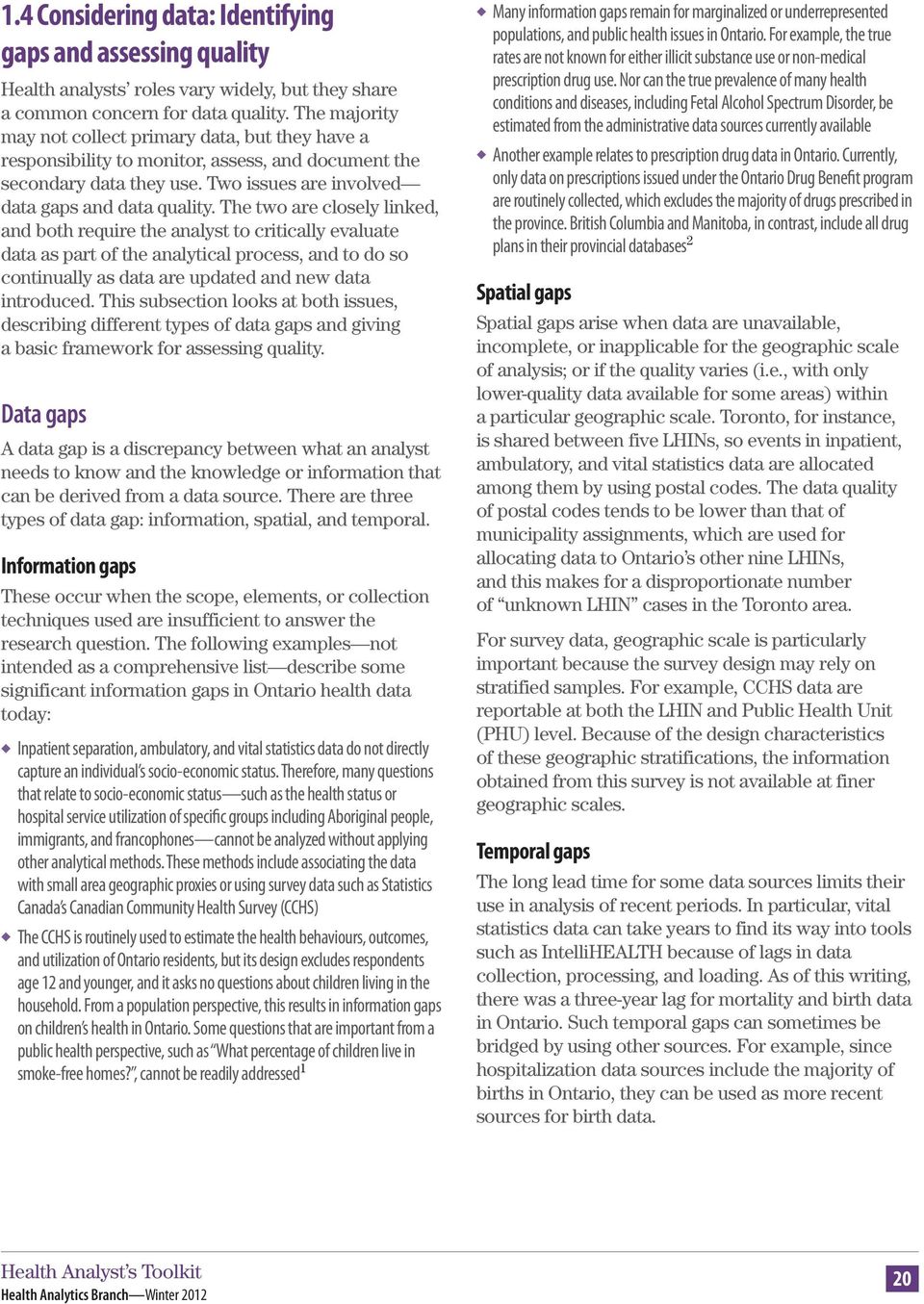
20 1.4 Considering data: Identifying gaps and assessing quality Health analysts roles vary widely, but they share a common concern for data quality. The majority may not collect primary data, but they have a responsibility to monitor, assess, and document the secondary data they use. Two issues are involved data gaps and data quality. The two are closely linked, and both require the analyst to critically evaluate data as part of the analytical process, and to do so continually as data are updated and new data introduced. This subsection looks at both issues, describing different types of data gaps and giving a basic framework for assessing quality. Data gaps A data gap is a discrepancy between what an analyst needs to know and the knowledge or information that can be derived from a data source. There are three types of data gap: information, spatial, and temporal. Information gaps These occur when the scope, elements, or collection techniques used are insufficient to answer the research question. The following examples not intended as a comprehensive list describe some significant information gaps in Ontario health data today: Inpatient separation, ambulatory, and vital statistics data do not directly capture an individual s socio-economic status. Therefore, many questions that relate to socio-economic status such as the health status or hospital service utilization of specific groups including Aboriginal people, immigrants, and francophones cannot be analyzed without applying other analytical methods. These methods include associating the data with small area geographic proxies or using survey data such as Statistics Canada s Canadian Community Health Survey (CCHS) The CCHS is routinely used to estimate the health behaviours, outcomes, and utilization of Ontario residents, but its design excludes respondents age 12 and younger, and it asks no questions about children living in the household. From a population perspective, this results in information gaps on children s health in Ontario. Some questions that are important from a public health perspective, such as What percentage of children live in smoke-free homes?, cannot be readily addressed 1 Many information gaps remain for marginalized or underrepresented populations, and public health issues in Ontario. For example, the true rates are not known for either illicit substance use or non-medical prescription drug use. Nor can the true prevalence of many health conditions and diseases, including Fetal Alcohol Spectrum Disorder, be estimated from the administrative data sources currently available Another example relates to prescription drug data in Ontario. Currently, only data on prescriptions issued under the Ontario Drug Benefit program are routinely collected, which excludes the majority of drugs prescribed in the province. British Columbia and Manitoba, in contrast, include all drug plans in their provincial databases 2 Spatial gaps Spatial gaps arise when data are unavailable, incomplete, or inapplicable for the geographic scale of analysis; or if the quality varies (i.e., with only lower-quality data available for some areas) within a particular geographic scale. Toronto, for instance, is shared between five LHINs, so events in inpatient, ambulatory, and vital statistics data are allocated among them by using postal codes. The data quality of postal codes tends to be lower than that of municipality assignments, which are used for allocating data to Ontario s other nine LHINs, and this makes for a disproportionate number of unknown LHIN cases in the Toronto area. For survey data, geographic scale is particularly important because the survey design may rely on stratified samples. For example, CCHS data are reportable at both the LHIN and Public Health Unit (PHU) level. Because of the design characteristics of these geographic stratifications, the information obtained from this survey is not available at finer geographic scales. Temporal gaps The long lead time for some data sources limits their use in analysis of recent periods. In particular, vital statistics data can take years to find its way into tools such as IntelliHEALTH because of lags in data collection, processing, and loading. As of this writing, there was a three-year lag for mortality and birth data in Ontario. Such temporal gaps can sometimes be bridged by using other sources. For example, since hospitalization data sources include the majority of births in Ontario, they can be used as more recent sources for birth data. 20
21 Data quality Assessing quality It is important to continually assess the quality of sources through data exploration, available documentation, and consultation with data custodians and with peers. When using secondary data, the analyst is generally not directly responsible for its quality. But the analyst does have a responsibility to assess whether data are appropriate for the analysis at hand, and to communicate any concerns to both the client and the data custodian. When examining data sources, one approach is to follow the data quality framework implemented by the Canadian Institute for Health Information (CIHI). 3 This framework, similar to that used by Statistics Canada, 4 identifies five dimensions of data quality. Even if a formal analysis of data quality is not required as it isn t, in most instances these dimensions provide a starting point for assessing data prior to analysis or at any point in the process. They are: Documentation Most of the major health data sources available to analysts in Ontario are under constant revision, which may involve adding new periods of data, updating variable definitions, or creating new variables. Because of constant changes in the health data environment, assessments of data quality need to be ongoing and can never be considered final. Continual monitoring is important. When data quality issues are apparent during analysis, it is crucial that the analyst document these issues and communicate them to the data custodian and to the client for whom the analysis is being done. Accuracy How well does the information derived from the data source reflect the reality it was designed to measure? Timeliness How current or up to date are the data at the time of release? Comparability How consistent is the data source over time, and are standard conventions (i.e., data elements or reporting periods) used? Usability Are the data easily accessed and understood? Relevance How well do the data meet current and future needs of users? References 1 Association of Public Health Epidemiologists in Ontario. Data gaps in public health indicators in Ontario May 18 [cited 2011 Jun 9]. Available from: 2 Health Results Team for Information Management, Ontario Ministry of Health and Long-Term Care. Thinking about gaps: A report on information management. Toronto: Queen s Printer for Ontario; Canadian Institute for Health Information. The CIHI data quality framework [cited 2011 Jun]. Available from: 4 Statistics Canada. Statistics Canada quality guidelines Nov 24 [cited 2011 Jun 9]. Available from: 21
22 1.5 Classification systems and instruments Healthcare classification systems group similar information into a limited number of mutually exclusive categories. Assessment instruments provide clinical standards to collect information about patients functioning and health status. Both are used in the collection and analysis of healthcare data to enhance the consistency and accuracy of reporting. The list below shows, respectively, three of the most commonly used systems and one of the most commonly used instruments: International Statistical Classification of Diseases (ICD) Canadian Classification of Interventions (CCI) Diagnostic and Statistical Manual of Mental Disorders (DSM) Resident Assessment Instrument (RAI) This subsection provides detailed information on each. International Statistical Classification of Diseases (ICD) The ICD an international standard diagnostic classification for all epidemiological and many health management purposes 1 was developed and is maintained and published by the World Health Organization (WHO). It is used to analyze the health situation of populations and monitor the incidence and prevalence of diseases and health problems. The ICD classifies diseases and health problems recorded on health and vital records such as death certificates and hospital records; facilitates the storage and retrieval of diagnostic information for clinical and epidemiological purposes; and permits the systematic recording, analysis, interpretation, and comparison of mortality and morbidity data. 1-3 The ICD has been revised every 10 years since 1900, to stay current with advances and changes in disease nomenclature and etiology. 4 The 10th revision (ICD-10) was approved in May 1990 by the 43rd World Health Assembly, 1 and came into use in WHO member states in The ICD-10 expands beyond traditional causes of death and hospitalization. It also includes conditions and situations which are not diseases but represent risk factors to health, such as lifestyle, occupational, environmental, and psychosocial circumstances. 2 Canadian scope To allow the ICD-10 to evolve in such a way that it will continue to reflect practice patterns in Canadian healthcare, the WHO has allowed Canada to enhance, reproduce, and distribute the system. Accordingly, the Canadian Institute for Health Information (CIHI) has developed and maintains the International Statistical Classification of Diseases and Related Health Problems, Tenth Revision, Canada (ICD-10- CA), which is updated every two to three years. 5-7 In Ontario, ICD-10-CA was implemented for hospitalization data in April Before 2002, two standards were used at the national level for diagnosis classification: the International Statistical Classification of Diseases, Injuries, and Causes of Death, Ninth Revision (ICD-9), which Canada adopted in 1979; and the ICD-9-Clinical Modification (ICD-9-CM). The latter was published by the United States government for morbidity coding in the U.S., because clinical modification having codes more precise than those required for statistical groupings and trend analysis could better describe the clinical picture of the patient. ICD-9-CM was a clinical modification of ICD-9, with a diagnosis component completely comparable to that of ICD-9. 5 Several differences exist between ICD-9 and ICD-10: 1,4,5,8,9 ICD-10 uses alphanumeric codes as opposed to numeric only ICD-10 is far more detailed, for example, an increased number of conditions have been assigned perinatal codes Chapters have been rearranged and new ones added The two supplementary classifications contained in ICD-9 External Causes of Injury and Poisoning (the E code), and Factors Influencing Health Status and Contact with Health Services (the V code) are no longer supplementary. In ICD-10 they are included in the core classification Differences between ICD-10 and ICD 10-CA: 2,5 ICD-10-CA has a broader scope than any previous revision ICD-10-CA has added fifth and sixth characters, for a finer degree of specificity ICD-10-CA has two additional chapters (Chapter XXII covers the morphology of neoplasms, and Chapter XXIII the provisional codes for research and temporary assignment) On rare occasions, codes differ slightly between the two versions. For example, for HIV, ICD-10 uses codes B20 B24 while ICD-10-CA uses only B24 22
23 The Canadian Classification of Health Interventions (CCI) The CCI Canada s national standard for classifying healthcare interventions was developed and is maintained and published by CIHI. The CCI is the companion classification system to ICD-10-CA, replacing the Canadian Classification of Diagnostic, Therapeutic and Surgical Procedures (CCP), which was the intervention portion of ICD Like ICD-10-CA, the CCI was implemented for hospitalization data in April 2002 and is updated every two to three years. For the purposes of this classification, a healthcare intervention is defined as a service performed for or on behalf of a client whose purpose is to improve health, to alter or diagnose the course of a disease (health condition), or to promote wellness. 11 CCI Coding Structure 11 The CCI has an alphanumeric structure with a maximum code length of 10 characters. A CCI code is composed of as many as six discrete code fields: Field 1 Section. The first character of each code represents the broad realm of intervention. There are currently seven choices (section 4 having been deactivated): 1. Physical and physiological therapeutic interventions 2. Other diagnostic interventions 3. Diagnostic imaging interventions 5. Obstetrical and fetal interventions 6. Cognitive, psychosocial, and sensory therapeutic interventions 7. Other healthcare interventions 8. Therapeutic interventions strengthening the immune system and/or genetic composition Field 2 Group. The next two characters represent the group (region or area of focus). Groups are based either on anatomy sites (e.g., central nervous system), mental/sensory function (e.g., hearing), or stage of pregnancy (e.g., active labour). Field 3 Intervention. The fourth and fifth characters represent generic types of healthcare actions. This two-digit code field has unique meaning when it is linked with the section code. For example, in section 1 the intervention 50 means drainage; in section 6 it means training. Field 4 Qualifier 1. The sixth and seventh characters represent the first intervention qualifier, describing how, or why, it was completed. In some sections 3, 4, and 7, for example this is all that is required to complete the CCI code. In others, such as section 1, it represents only a part of the qualifier the approach and technique portion. Common examples of surgical approaches include endoscopic, percutaneous, and open (incision). Field 5 Qualifier 2. The eighth and ninth characters represent the second intervention qualifier, describing the agents/devices (e.g., pacemaker) or methods/tools (e.g., hypnosis) used. Field 6 Qualifier 3. The 10th character represents the third and final intervention qualifier. Currently, this qualifier has been activated for use in section 1 only, to describe the use of tissue (human, animal, or synthetic) during an intervention. CCI intervention attributes CIHI has identified three additional data fields to be used, where appropriate, with specific CCI codes. These additional related fields, called CCI intervention attributes, are not part of the CCI coding structure per se, and are collected as separate data fields. They are: Status attribute identifying interventions which are, for example, repeats or revisions, abandoned after onset, or part of a staged process Location attribute identifying the anatomical side/location involved in the intervention (e.g., left, right, bilateral) or the mode of delivery (e.g., direct, indirect, self-directed) Extent attribute indicating a quantitative measure related to the intervention (e.g., number of lesions removed, length of laceration repaired) 11 Diagnostic and Statistical Manual of Mental Disorders, Fourth Edition (DSM-IV) Psychiatric diagnoses are categorized by the Diagnostic and Statistical Manual of Mental Disorders, Fourth Edition (DSM-IV), which is published by the American Psychiatric Association and covers mental health disorders among adults and children. The DSM-IV was developed in conjunction with ICD-10 so that the two classification systems would be consistent and use similar terminology. 12 DSM-IV was released in
24 Diagnostic classification in the DSM consists of selecting those disorders which reflect the signs and symptoms of the individual. For each disorder there is a set of diagnostic criteria that indicate which symptoms must be present (and for how long), as well as which symptoms, disorders, and conditions must not be present in order to qualify for a particular diagnosis. The DSM-IV provides a concise description of each disorder including diagnostic features; subtypes; associated features and disorders; specific cultural, age, or gender features; prevalence; course; familial pattern; and differential diagnoses. 12 The DSM-IV uses a multiaxial or multidimensional approach. 12 To determine diagnosis, the clinician considers symptoms and signs within five axes: Axis I clinical disorders or other conditions that may be a focus of clinical attention (e.g., depression, schizophrenia, eating disorders) Axis II personality disorders and mental retardation (e.g., paranoid, antisocial, and borderline personality disorders) Axis III general physical or medical conditions that are potentially relevant to the understanding or management of the individual s mental disorder Axis IV severity of psychosocial stressors that have an impact on axis I and II disorders Axis V highest level of functioning of the individual at the present time and within the previous year The broad DSM-IV category (i.e., schizophrenia and other psychotic disorders; mood disorders) is an aggregation of more specific DSM-IV diagnoses (i.e., schizophrenia, paranoid type; major depressive disorder, single episode, mild). The mental health diagnoses recorded in the Ontario Mental Health Reporting System are the DSM-IV Axis I and II diagnoses noted during the inpatient assessment. Resident Assessment Instrument (RAI) The RAI is developed by interrai, a not-for-profit corporation made up of a collaborative network of researchers in over 30 countries. The RAI focuses on patients functioning and quality of life by assessing their needs, strengths, and preferences. Multi-domain in nature, it is built on a core set of assessment items that are considered important in all care settings and that have across all settings identical definitions, observation time frames, and scoring. Additional assessment items specific to the particular care setting are included in each instrument. The RAI is often thought of as a single healthcare classification instrument but is actually made up of 12 more specifically targeted instruments or tools: interrai HC home care interrai CHA community health assessment interrai CA contact assessment interrai LTCF long-term care facility interrai AL assisted living interrai AC acute care interrai PAC post acute care interrai MH mental health interrai CMH community mental health interrai ESP emergency screener for psychiatry interrai PC palliative care interrai ID intellectual disability Each of these is designed for a particular population, but all are designed to work together to produce integrated information. It is worth noting that each of the 12 is currently at a different stage of maturity. 13 A mature assessment tool consists of a data collection form, a user manual, triggers, Clinical Assessment Protocols (CAPs), and status and outcome measures. Various enhancements including Quality Indicators (QIs), case mix classification systems, and eligibility algorithms are also available for some of the 12. At present, three Ontario reporting systems (Mental Health, Home Care, and Continuing Care) have implemented RAI assessment tools (the interrai MH, interrai HC, and interrai LTCF, respectively). Each of these tools includes a Minimum Data Set (MDS), Clinical Assessment Protocols (CAPs), a case mix classification system, outcome measures, and QIs. These five elements of an assessment tool are described below, as is interrai s Method for Assigning Priority Levels (MAPLe), which is used in interrai HC. This subsection then closes with a table summarizing the current implementation of the RAI in Ontario. 24
25 Minimum Data Set (MDS) MDS is a standardized minimum assessment tool for clinical use. It lets a service provider assess key domains of function, mental and physical health, and social support and service use. In addition, MDS triggers identify patients who could benefit from further evaluation of specific problems or of risks of decline in health, well-being, or function. The triggers link the MDS to CAPs (described below) Clinical Assessment Protocols (CAPs) CAPs are a series of problem-oriented assessment protocols designed to help the service provider systematically interpret all the information recorded on an instrument. CAPs are not intended to automate care planning; but to help the clinician focus on key issues identified during the assessment process, so that decisions as to whether and how to intervene can be explored with the individual. Each CAP follows a standard format: 14,16,17 Objective a brief statement describing the clinical goals of the CAP Triggers items that alert the assessor to the patient s potential problems or needs Definition definitions of key terms Background relevant information on the extent and nature of the problem, known causal factors, and possible treatment strategies Guidelines guidelines for evaluating the triggered conditions, including follow-up questions to be asked, and instructions on bringing the information together to help determine the next steps Case mix classification Case mix is by definition a system that classifies people into groups that are homogeneous in their use of resources; a good one also gives meaningful clinical descriptions of the individuals. The best known of interrai s case mix systems is the Resource Utilization Groups system (RUG-III), used in continuing care and institutional long-term care. Also, interrai has derived a version of the RUG-III algorithm for use with individuals enrolled in home care (RUG-III/HC). The System for Classification of In-Patient Psychiatry (SCIPP) is interrai s case mix system for describing resource use in adult inpatient psychiatric settings. Outcome measures All of the interrai assessment tools can measure both status and outcome of individuals or groups. Embedded in each tool are various scales and indices that can be used to evaluate current clinical status. Table 5.1 describes the most commonly used outcome measures Table 5.1: Commonly used interrai outcome measures Measure Aggressive Behaviour Scale (ABS) Activities of Daily Living hierarchy (ADL hierarchy) RUG-III ADL index Description Measures symptoms including verbally or physically abusive behaviour; socially inappropriate or disruptive behaviour; inappropriate public sexual behaviour; and resisting care during medication administration, ADL assistance, etc. Higher values indicate a greater number or frequency of aggressive behaviours. Measures activities of daily living performance using data on personal hygiene, toilet use, locomotion, and eating. Each activity is scored on a self-performance scale ranging from independence to total dependence to create a final score. Higher values indicate greater difficulty in performing activities of daily living. The RUG-III and RUG-III/HC algorithms include a summary measure of ADL that combines scores for bed mobility, toileting, transferring, and eating. Higher values indicate greater impairment in activities of daily living. Range Table 5.1 continued on the next page 25
26 Table 5.1: Commonly used interrai outcome measures (cont d) Measure Changes in Health, End-stage disease, and Signs and Symptoms scale (CHESS) Cognitive Performance Scale (CPS) Depression Rating Scale (DRS) Instrumental ADL involvement scale (IADL involvement) Instrumental ADL difficulty scale (IADL difficulty) Index of Social Engagement (ISE) Description Identifies individuals at risk of serious decline, and can serve as an outcome measure where the objective is to minimize problems related to declines in function. Developed for use in nursing homes, and has been adapted for home care as well. Higher levels are predictive of adverse outcomes including death, hospitalization, pain, caregiver stress, and poor self-rated health. Measures an individual s overall cognitive abilities, using data on short-term memory and cognitive skills for daily decision making, eating, and making self understood. Higher values indicate greater cognitive impairment. Can be used as a clinical screener for depression. Is based on the sum of seven items: negative statements, tearfulness, anxious complaints, unrealistic fears/phobias, persistent anger, repetitive health complaints, and sad or worried facial expression. Higher values (>3) indicate signs of depression and that the patient should be further evaluated. Is based on the sum of seven performance items: meal preparation, ordinary housework, and managing finances, medications, phone use, shopping, and transportation. Higher values indicate greater dependence on others in performing instrumental activities. Is based on the sum of three difficulty items: meal preparation, ordinary housework, and phone use. Higher values indicate greater difficulty in performing instrumental activities. Describes the individual s sense of initiative and involvement in social activities (i.e., comatose, at ease interacting with others, at ease doing planned activities, at ease doing self-initiated activities, establishes own goals, pursues involvement in life of facility, accepts invitation to most group activities). Higher values indicate a higher level of social engagement. Range Life stressor score Pain scale Personal Severity Index (PSI) Measures the amount of recent change that has been imposed on the individual. Is the sum of recent life events which are defined as objective experiences that disrupt the person s current daily routine (or threaten to), and that impose some degree of readjustment (i.e., death of a close friend or family member, loss of income, immigration). Higher values indicate an increased frequency of such events. Measures pain based on data collected relating to pain frequency and intensity. Higher values indicate increased pain. Can be used by continuing care and long-term care facilities to assess residents proximity to death, with the goal of identifying those who might be moved from their usual program of care to one with a more palliative focus. Based on data on age, ADL dependency, cognitive performance, and mood status, and on clinical complications such as incontinence, malnutrition, respiratory distress, and skin problems. High values indicate a high proximity to death Quality indicators (QIs) These indicators use MDS items to establish a measure that can be translated into a statistical summary. While QIs are defined in terms of individual characteristics, they only take on meaning when expressed as averages at the facility or agency level. 22 They are currently used for many purposes by care providers for improving care, by governments to monitor care, for public reporting, etc. However, QI measures are not benchmarks, thresholds, guidelines, or standards of care; nor are they appropriate for use in litigation actions. Risk 26
27 adjustment of QIs is essential when comparing quality of care across providers or regions that deliver services to populations with different characteristics. 23 interrai has developed a suite of QIs for nursing homes, home care, and specialty mental health care. 22 Eligibility algorithm: Method for Assigning Priority Levels (MAPLe) MAPLe (Method for Assigning Priority Levels) is one of interrai s screening algorithms for defining priority target populations, 24 and is based on a broad range of clinical variables in the interrai HC (home care) tool. MAPLe is empirically based and can be used in decision support (i.e., to inform choices involving the allocation of home care resources and in prioritizing individuals who need community or facility-based services). It groups people into five priority levels low, mild, moderate, high, and very high based on their risk of adverse outcomes, including institutionalization. Those in the low priority level have no major functional, cognitive, behavioural, or environmental problems; while a placement in the high priority level is based on the presence of ADL impairment, cognitive impairment, wandering, behaviour problems, or the Clinical Assessment Protocol (CAP) for nursing home risk. Research has shown that individuals in the high priority level are significantly more likely to be admitted to a long-term care facility. 25 MAPLe results are automatically derived from software in which the algorithm is embedded. At the individual level, MAPLe can be used to support clinical decision making, but the intent is not to use it to make decisions, automated and devoid of clinical judgment. Instead, case managers should develop person-specific recommendations that take into account the individual s strengths, preferences, and needs. 25 At the system level, MAPLe can be used to support policy development and planning. For example, a benchmarking system can be established to identify jurisdictions where MAPLe-adjusted long-term care facility admissions are higher than expected, based on the experience of other regions. Similarly, MAPLe levels at intake can be used to examine regional variations in access to services by level of need. In summary Table 5.2 provides a summary of the RAI s current implementation in Ontario. Table 5.2: interrai assessment tools implemented in Ontario DATA HOLDER Ontario Mental Health Reporting System Continuing Care Reporting System Home Care Reporting System INSTRuMENT interrai MH interrai LTCF (formerly referred to as MDS 2.0) interrai HC (version 2) DATE OF IMPLEMENTATION October for continuing care, 2005 for long-term care Community Care Access Centre (CCAC)/community: 2003 CCAC/hospital: 2004 TARGET POPuLATION All patients in designated adult mental health beds All patients in provincially designated chronic care beds and residents in long-term care homes All CCAC adult long-stay clients living in the community and inpatients waiting in hospital for long-term care placement CLINICAL ASSESSMENT PROTOCOLS (CAPs) Mental Health Assessment Protocols Resident Assessment Protocols Care Planning Protocols CASE MIx SySTEM SCIPP RUG-III RUG-III/HC QuALITy INDICATOR Over 25 indicators developed (currently being evaluated) Over 30 developed indicators Over 20 developed indicators OuTCOME MEASuRES ADL hierarchy, CPS, DRS, ABS, pain scale, life stressor score ADL hierarchy, CHESS, CPS, DRS, ABS, ISE, pain scale, PSI ADL hierarchy, CHESS, CPS, DRS, IADL involvement, IADL difficulty, pain scale 27
28 References 1 World Health Organization. International classification of diseases (ICD) [cited 2005 Aug]. Available from: 2 Canadian Institute for Health Information. ICD-10-CA [cited 2011 Aug]. Available from: 3 World Health Organization. International classification of diseases and related health problems. 10th revision; vol 2. Geneva, Switzerland: WHO; Anderson RN, Minino AM, Hoyert DL, Rosenberg HM. Comparability of causes of death between ICD-9 and ICD-10: Preliminary estimates. National Vital Statistics Reports May 18 [cited 2005 Aug]; 49(2). Available from: 5 Provincial Health Indicators Work Group. Core indicators for public health in Ontario: International classification of diseases. 10th revision (ICD-10) May 31 [cited 2011 Aug]. Available from: 6 Finance and Information Branch, Ontario Ministry of Health and Long-Term Care. Hospital administrative data, ICD-10-CA and data quality Apr 22 [cited 2005 Aug]. Available from: 7 Canadian Institute for Health Information. The Canadian enhancement of ICD Jun [cited 2005 Oct]. Available from: URL: 8 Tournay-Lewis L, Lalonde A. ICD-10-CA and CCI: What are they? How do they affect my work? 2004 Sep 26 [cited 2005 Aug]. Available from: 9 Canadian Institute for Health Information. Coping with the introduction of ICD-10-CA and CCI Oct [cited 2005 Aug]. Available from: 10 Canadian Institute for Health Information. Canadian classification of health interventions [cited 2011 Aug]. Available from: classification+and+coding/codingclass_cci 11 Canadian Institute for Health Information. ICD-10-CA/CCI (International statistical classification of diseases and related health problems. 10th revision, Canada/ Canadian classification of health interventions 2009) [CD-ROM]. Ontario; American Psychiatric Association. Diagnostic and statistical manual [cited 2011 Jun]. Available from: 13 InterRAI. The integrated suite of instruments [cited 2011 Aug]. Available from: 14 InterRAI. Applications [cited 2011 Aug]. Available from: 15 Canadian Institute for Health Information. Ontario mental health reporting system resource manual , module 1: Clinical coding. CIHI; Canadian Institute for Health Information. RAI-Home Care (RAI-HC) manual, Canadian version. 2nd edition. CIHI; Canadian Institute for Health Information. Ontario mental health reporting system resource manual , module 3: Mental Health Assessment Protocols (MHAPs). CIHI; Canadian Institute for Health Information. Home care reporting system specifications manual. CIHI; Canadian Institute for Health Information. Continuing Care Reporting System (CCRS) specifications manual. CIHI; Ontario Ministry of Health and Long-Term Care. IntelliHEALTH ONTARIO: Inpatient mental health user guide Jan [cited 2011 Jun]. Available from: 12-Inpatient%20Mental%20Health%20User%20Guide%20Final%20%20V%201.0.pdf 21 Morris JN, Jones R, Morris S, Fries BE. Proximity to death, a modeling tool for use in nursing homes. Available from: CMS%20%20-%20%20Recommended%20Revisions%20to%20Covariates%20Appendix%2013%2002FEB2003.pdf 22 InterRAI. Quality indicators [cited 2011 Aug]. Available from: 23 Dalby DM, Hirdes JP, Fries BE. Risk adjustment methods for Home Care Quality Indicators (HCQIs) based on the minimum data set for home care. BMC Health Services Research; [cited 2011 Aug]. Available from: 24 InterRAI. Screening algorithms [cited 2011 Aug]. Available from: 25 Hirdes JP, Poss JW, Curtin-Telegdi N. The Method for Assigning Priority Levels (MAPLe): A new decision-support system for allocating home care resources. BMC Medicine; [cited 2011 Aug]. Available from: 28
29 1.6 Health indicators methodology Health indicators are measures of factors associated with health status and the healthcare system, and can play an important role in planning. They are constructed to be comparable over time and across jurisdictions, and can measure phenomena that have broader interpretation than the specific measure. For example, infant mortality rates can be indicators of the overall performance of a country s healthcare system. This subsection describes criteria to evaluate a health indicator and gives steps you can take to ensure the quality of the estimates you produce when using indicators. It then outlines three resources, available online, where you can find health indicators and their technical documentation. Evaluating a health indicator A health indicator s quality is often determined using the following criteria: Validity The indicator measures what it claims to be measuring, is accepted by the community, and is not confounded by other factors (face validity). It covers relevant content or domains (content validity), and has predictive power (criterion validity) Reliability Results are the same regardless of who collects the data or when the measure is repeated Actionable The indicator informs and influences actions that are within an organization s control (i.e., to make changes) Responsiveness The indicator will reflect changes in the population s health status or the healthcare system in a timely manner Timeliness The data are collected and available for reporting in a timely manner Clarity The indicator is understandable to relevant audiences Feasibility Required data are readily available for the specific areas and time periods; there is sufficient organizational capacity to calculate the indicator Comparability The indicator can be compared over time or from one location to another Ensuring quality estimates When using or developing health indicators, analysts can engage in several steps to ensure the quality of the estimates they produce. The following are adapted from the Local Health System Monitoring Project of the Ontario District Health Councils: 1 Check for simple math; all rows and columns should add up Verify that percentages and rates have been calculated properly (using the appropriate numerators and denominators) Where possible, check the estimates against available benchmarks and/or published data To convey how an indicator was developed, the documentation that accompanies the estimates must be clear and should contain enough information to permit someone else to calculate the indicator in exactly the same way and obtain the same answer Health indicator sources and resources Three important places to go to find health indicators and the documentation of health indicator methodology in Ontario: Resource for Indicator Standards (RIS) 2 Health Indicators Project 3 Core Indicators for Public Health in Ontario 4 Resource for Indicator Standards (RIS) This online catalogue of technical documentation for health-related indicators was developed by the MOHLTC. Indicators included in the RIS system are used by the MOHLTC and LHINs to support healthcare system performance. They are documented in a standard way to promote appropriate use, comparison, and analysis. The RIS website does not present actual data, but provides definitions, methods, and resources for calculating indicators. Refer to the website itself for further information. 2 29
30 Health Indicators Project This project was developed by Statistics Canada and the Canadian Institute for Health Information (CIHI). In 1998, they launched a collaborative process to identify which measures should be used to report on health and the health system in Canada. More than 500 individuals including health administrators, researchers, caregivers, government officials, health advocacy group representatives, and consumers convened to identify health information needs. The health indicators that were subsequently developed by Statistics Canada and CIHI are applicable to Canada s established health goals, and are based on standard and comparable definitions and methods. They are broadly available, distributed electronically across Canada at regional, provincial, and national levels. For more information, including definitions, data tables, and information on data quality issues, refer to the CIHI/Statistics Canada Health Indicators Project website. 3 Core Indicators for Public Health in Ontario The core indicators were developed in 1998 by the Provincial Health Indicators Work Group, made up of public health epidemiologists in Ontario as well as staff from Ontario s Health Intelligence Unit and Public Health Resources Education and Development programs, the Institute for Clinical Evaluative Sciences, the MOHLTC, and Health Canada. The intent of the project: for Public Health Units (PHUs) and other organizations in Ontario to adopt the indicators, apply the methods, and use the recommended data sources with the goal of greater consistency. The core indicators provide definitions, methods, and resources for calculating estimates (actual data are not presented). Each indicator shows whether there is a corresponding national indicator, and, if so, highlights any differences in definitions and provides a link to the appropriate page on the Statistics Canada website. For more information on the Core Indicators for Public Health in Ontario, refer directly to the project website. 4 References 1 Toronto District Health Council. Adapted from the Toronto local health system monitoring project. Toronto; Ontario Ministry of Health and Long-Term Care. Resource for indicator standards Sep 13 [cited 2011 Jun]. Available from: 3 Statistics Canada. Health indicators Jun 14 [cited 2011 Jun]. Available from: 4 Association of Public Health Epidemiologists in Ontario. The core indicators for public health in Ontario Mar 22 [cited 2011 Jun]. Available from: 30
31 1.7 Standardization Crude rates (rates for an entire population over a given time period) provide an accurate picture of mortality or disease in the population. But they are influenced by its age and sex composition because most health issues are linked, to some degree, to age or sex. For example, older populations are clearly more likely to have higher rates of mortality and chronic conditions, and younger ones higher crude birth rates. 1,2 Consequently, crude rates can be misleading if comparisons are made across groups (i.e., in different geographic areas, or over time) without taking age and sex composition into account. 2 To adjust, or control, for differences in population composition, rates can be standardized; a set of techniques is used to remove the effects of differences in composition when comparing two or more populations. 3 It is possible to adjust for any underlying factor (i.e., socio-economic status, or ethnicity), but age is the factor most commonly adjusted for because of its strong relationship to illness and death. Age-standardized rates (also called age-adjusted) are advantageous as they provide a single summary number that facilitates comparisons across geographies and over time. 4 But in a sense they represent an artificial picture of mortality or disease in a population. So it is important to examine the underlying data carefully before standardizing. 5 This subsection discusses the two approaches that can be taken to standardization direct and indirect. It also provides a table illustrating the 1991 Canadian standard population (currently recommended for use when doing standardization), and a list of recommendations for standardizing rates. Direct method of standardization Both the direct and indirect methods of standardization yield a single summary statistic that can be useful for making comparisons. Both require information about a study population (the population of interest) and a standard population. 6 The direct method works as follows: The stratumspecific rates in a study population (age-specific rates, for example) are applied to the population distribution of a standard population to derive the number of events that would have been expected in the study population if it had the same age distribution as the standard. Direct standardization preserves the consistency between different study populations; since many study populations can be adjusted to the same standard, the resulting rates can be compared against each other. This method is generally used to compare a number of rates at the same time for example, mortality or disease rates across LHINs in Ontario. It requires that all the study populations being compared have relatively stable stratum-specific rates. Indirect method of standardization In this method, the stratum-specific disease rates in a standard population are applied to the study population to yield the expected number of events (e.g., cases, deaths). Typically, the observed number of events in the study population is then divided by the expected number of events to obtain the standardized mortality (or morbidity) ratio the SMR. 6 The indirect method is generally used when studying rates based on a small number of events or when age-specific data for the study population are not available. Recommended standard population Rates adjusted to different standard populations will produce different results and cannot be compared against each other. Therefore, analysts should use a consistent standard population. The one recommended for use is shown in Table 7.1 the 1991 population distribution of Canada. 7,8 31
32 Table 7.1: The 1991 Canadian standard population, both sexes combined, by five-year age groupings Age in years Population Age in years Population < 1 403, ,550, ,953, ,913, ,926, ,109, ,529, ,598, ,344, ,138,891 Recommendations for the standardization of rates The Association of Public Health Epidemiologists has made the following recommendations for the standardization of rates: 8 1. Examine crude rates, age-specific rates, and counts before calculating adjusted rates. 2. When there is little to no variation across age-specific rates or where there is no difference in the age structure of the populations over time and geography, crude rates can be valid for comparisons over time and geography. 3. Only consider direct standardization if there are 20 or more events. 4. Only consider indirect standardization if there are 10 or more events. 5. Consider suppressing age-adjusted rates if the Relative Standard Error (RSE) is greater than 23%. RSE is similar to a coefficient of variation (CV) the larger the RSE (or the CV), the less reliable is the estimate. 6. When using direct standardization, use the 1991 Canadian population structure as the standard population ,674, ,339, ,238, ,190, ,084, , , , , ,467 Total population 28,120, Although there is not a recommended number of age categories to use when calculating age-adjusted rates, epidemiologists should be aware of the issues around age categories and the factors that should be considered before determining the number of age groups. 8. When using direct standardization, for age strata with zero events, epidemiologists should consider combining multiple years, or collapsing geographies or age strata where feasible. If this is not feasible, substitute a small number (e.g., 0.1) for zero events or impute from a higher level geography. 9. When using direct standardization, confidence intervals should be calculated using the Poisson approximation. 10. When using indirect standardization, confidence intervals should be calculated using the Armitage and Berry method. Sample calculations for direct and indirect standardized rates are described in detail elsewhere. 9 Templates with sample calculations are available at: References 1 Hill AB. Bradford Hill s principles of medical statistics. New York: Oxford University Press; Fleiss,JL. Statistical methods for rates and proportions. 2nd ed. New York: John Wiley; Chapter Last JM. A dictionary of epidemiology. 4th ed. New York: Oxford University Press; Kitagawa EM. Standardized comparisons in population research: Demography p Choi BCK, deguia NA, Walsh P. Look before you leap: Stratify before you standardize. American Journal of Epidemiology. 1999;149(12): Gail MH, Benichou J. Encyclopedia of epidemiologic methods. John Wiley and Sons; p Statistics Canada. Health status indicators based on vital statistics May [cited 2011 Jul]. Available from: 8 Association of Public Health Epidemiologists in Ontario. Standardization of rates Jul [cited 2011 Jun 9]. Available from: 9 Bains N. Standardization of rates Mar [cited 2011 Jul]. Available from: 32
33 1.8 Using surveys Surveys collect data from a targeted group of people about their behaviour, knowledge, experiences, or opinions. Common methods for collecting survey information are written questionnaires, face-to-face or telephone interviews, electronic surveys, and focus groups. Surveys are often the only source of data available on health related topics for the population. Two examples of health related surveys are the Canadian Community Health Survey (CCHS), 1 and the Rapid Risk Factor Surveillance Survey. 2 Several analytical points should be considered when using survey data: sample design, survey weights, survey error, measuring the precision of survey estimates, confidence intervals, and release guidelines. This subsection looks at each. Sample design Surveys are rarely completely random; they often use strata, clusters, or oversampling of populations of specific interest. To analyse complex survey data, you need to use statistical software which takes the characteristics of the sample design into account. Sample design usually includes such features as multiple stages of sample selection, clustering, stratification, and unequal probabilities of selection. Survey weights To guarantee that the estimates generated from survey data are representative of the target population and not just the sample population survey weights must be used. These weights are assigned to each respondent who is included in the final sample; they correspond to the number of individuals in the target population who are represented by the respondent. Estimates derived from the sample cannot be considered representative of the target population unless appropriate weights have been used. Survey error There are two types of survey error: sampling and nonsampling. Sampling error is intrinsic to all surveys, and arises from estimating a population characteristic by measuring a portion of the population instead of everyone. Nonsampling errors, on the other hand, are not intrinsic. These can occur in any survey, and in censuses too. They include errors in measurement and processing, and can lead to biased results. A low response rate (to all questions or specific questions) is another type of nonsampling error; it can be a cause of bias and, at an extreme, can invalidate survey results. This is an increasing issue as response rates to household surveys have been declining. Measuring the precision of survey estimates The precision of a survey s estimates reflects its quality, and is a measure of the sampling error caused (as noted above) by studying only a portion of the population. Each quantity measured in a survey has its own sampling error. Precision is a function of the sample and population size, the sample design used (design effect), and the magnitude of the characteristic that is being looked at. Measures of precision include variance, standard error, coefficient of variation (CV), and confidence intervals. To determine the quality of an estimate, the CV must be calculated. The CV is the standard deviation expressed as a percentage of the estimate. For accurate estimation of variances, the calculation method should take account of the survey design, including stratification, clustering, multiple stages of selection and unequal probabilities of selection. Variance estimation for surveys with complex sample designs such as the CCHS cannot be done using simple formulas. The Bootstrap method, a resampling procedure that consists of drawing many sub-samples from the full survey sample, is commonly used to estimate variances with complex survey designs. Statistics Canada has developed the Bootvar program, in both SAS and SPSS formats, which uses the bootstrap method to calculate standard error, variance, CV, and confidence intervals for most commonly used measures. Details of the program are available at: There have been recent advances in some software programs that are used to analyze survey data and they can now run variance estimations using the bootstrap method. For example, STATA now directly supports the bootstrap method and WESVAR, SUDAAN, and SAS support it indirectly through the balanced repeated replication method. 33
34 Confidence intervals When analyzing survey data, each estimate should be provided with a confidence interval, also called a confidence limit. This is a range of values with a given probability (95% is usually used) that the true value in the population is contained within. For example, a survey showed that 93.0% of adults in Ontario had family doctors. The confidence interval for this percentage: 92.3% to 93.7%. This means that if we calculated the percentage 100 times (i.e., using 100 different random samples from the Ontario population), 95 of those times the percentage with family doctors would be between 92.3% and 93.7%. Release guidelines Before any estimate is released, the number of respondents who contributed to the calculation of the estimate must be determined. Estimates should not be released if the number of observations on which they are based is too small. To meet release guidelines, sampling variability must also be determined and data must be weighted. Many surveys have their own guidelines for these requirements. References 1 Statistics Canada. Canadian Community Health Survey (CCHS) Jun [cited 2011 Jun]. Available from: 2 Rapid Risk Factor Surveillance System [Home page] [cited 2011 Jun]. Available from: 34
35 1.9 Modelling The increasing availability of population health and other data over the years has been accompanied by advances in statistical evaluation models and methodologies. Together, these have facilitated a more robust healthcare decision-making process at all levels. This subsection provides an overview of key models and modelling techniques that are used in the economic evaluation of healthcare. Other types of evaluation (which also use modelling) assess an intervention (i.e., a drug, surgical procedure, psychological therapy, or health system strategy such as a screening policy) in terms of its consequences alone. But economic evaluation the focus here assesses interventions in terms of both consequence and cost. Statistical modelling in the healthcare context Models are the backbone of modern statistics and data analysis. Simply stated, a model describes relationships between variables in the form of mathematical equations, representing a simplification of an often complex reality. The idea is to provide economical and insightful summaries of that information available in the data which may be of interest to decision makers. A number of models can be used to evaluate healthcare, but interest in those which provide an economic evaluation is growing. For example, Michael F. Drummond and co-authors 1 point to the growing literature on such evaluation, citing numerous studies that have been undertaken by economists, medical researchers, and clinicians. In the context of healthcare, the implicit or explicit objective of economic evaluation is to improve decisions about the allocation of scarce resources through a comparative analysis of alternative courses of action, in terms of both their costs and consequences. 2 The objective, in other words, is to help guide resource allocation towards an efficient conclusion; and the purpose of a model is to structure evidence on clinical and economic outcomes, to help inform decisions about clinical practice and resource allocation. The complexity of the model depends on the problem at hand and the answer required, so different models and analyses may be appropriate for a single set of data. Models specific to economic evaluation Below are brief descriptions of models designed specifically for economic evaluation. The choice of the method of analysis depends on the research question and must be justified by the analyst. 1 Cost-minimization models In these models, two or more therapeutic (or other) alternatives which have the same effectiveness or efficacy are compared in terms of their net costs. Utility, effectiveness, and safety of interventions must be identical which is a rare occurrence so these models are used less frequently than others. Cost-effectiveness models In these models, costs of interventions or alternatives are related to a single, common effect that may differ in magnitude across alternatives. Costs are expressed in monetary units and the outcomes in non-monetary units such as years of life gained, hospital days prevented, or clinical parameters (e.g., response or remission rates, reduction in cholesterol). Competing alternatives are evaluated in terms of costs per unit of health outcome. Increasingly, Budget Impact Analysis (BIA) is being used as a complement to cost-effectiveness models (i.e., as an aid in budget planning and forecasting). BIA estimates the financial consequences of adopting and delivering a new healthcare intervention within a specific setting or system, given inevitable resource constraints. For example, it predicts how a change in the mix of drugs and other therapies used to treat a particular health condition will impact the trajectory of spending on that condition. While costeffectiveness models evaluate the costs and outcomes of alternative interventions over a specified time horizon to estimate their economic efficiency, BIA addresses the financial stream of consequences related to the uptake and diffusion of interventions to assess their affordability. 3 Simply stated, costeffectiveness models estimate economic efficiency and BIA estimates affordability. Cost-utility models These follow the same principles as cost-effectiveness models, with costs measured in monetary units and benefits in non-monetary units. The difference is that cost-utility models use utility adjustment when measuring the outcome specifically, Quality Adjusted Life Years (QALY), which accounts for mortality and morbidity. 35
36 Cost-benefit models These models assess all effects, including health effects, in monetary units. One disadvantage of these models is that a monetary assessment of clinical results must be made, and this is methodologically difficult. The four modelling approaches specific to economic evaluation are summarized in Table Table 10.1: Economic-evaluation models used in the healthcare context Method of analysis Assessment of costs Assessment of outcome Cost-outcome comparison Cost-minimization Monetary None None Cost-effectiveness Monetary Natural units (e.g., case detection) Costs per outcome unit Cost-utility Monetary Utility values (e.g., scale of health related quality of life) Costs per QALY Cost-benefit Monetary Monetary Net costs Other models 5-10 As noted, the models above represent approaches that are specific to economic evaluation. However, other modelling approaches are needed to help establish relationships between variables in the data, taking into consideration the research question(s) posed and data limitations. The International Society for Pharmacoeconomics and Outcomes Research (ISPOR) 5 defines modelling as an analytic methodology that accounts for events over time and across populations, that is based on data drawn from primary and/or secondary sources and whose purpose is to estimate the effects of an intervention on valued health consequences and costs. In selecting an appropriate modelling technique to apply, the analyst must pay close attention to two aspects: first, the level at which the population is modelled (cohort versus individual); second, whether individuals in the model can be seen as independent. A cohort model aggregates individuals with common characteristics into a group, which becomes the unit of analysis; while an individual level model uses the patient as the unit. A model where individuals are seen as independent assumes that there is no interaction between them; while a model with interaction is necessary, for example, when doing research on infectious diseases (where the risk to an individual depends on how many others are infected, and the choice of treatment for one patient may, due to resource constraints, affect what can be given to another). The analyst can make use of a host of advanced modelling techniques such as the four described below decision trees, Markov chains, Discrete Event Simulation (DES), and System Dynamics (SD) depending on the research question, the unit of analysis, data, and other factors. Decision trees 6 These can be used at either cohort or individual level; they assume independence of the individual, i.e., no interaction with others. Decision trees are most appropriate when events occur over a short time period, or when evaluations use an intermediate outcome measure (e.g., antenatal and neonatal screening programs). A decision tree is a visual representation of all the investigated intervention options and the consequences that may result. Each intervention on the tree is followed by branches representing possible consequences with their respective probabilities. The probabilities on each branch indicate the proportion of patients travelling on that particular pathway (conditional on the previous event). At the end of the tree, each path leads to an outcome measure (utility value or QALY). Costs, too, can be attached to events within the tree and to the endpoints. For each of the alternatives, the expected value of the clinical and economic consequences can be calculated as a weighted average of all possible consequences, applying the path probabilities as weights. 36
37 Markov chains 7 These, like decision trees, can be used at either cohort or individual level, and assume independence of individuals within a model. Markov chains are more effective than decision trees in clinical situations where events occur over extended periods. With the Markov chain technique, events are modelled as transitions from one health state to another. The time horizon covered by the model is split into cycles of equal length, and at the end of each cycle a patient may move to a subsequent health state or stay in the same one. This process continues until the patient enters an absorbing state, such as the state of disease progression, or death. The analyst chooses the length of a cycle to represent a clinically meaningful time interval. The occurrence of events is determined by probabilities which are, as in decision trees, conditional on the previous event (in this case, the last health state visited), although transition probabilities may be allowed to vary over time. In a Markov chain, utility values or QALY weights can be attached to each health state modelled as can costs. For example, one study using a Markov chain evaluated the cost-effectiveness of adjuvant chemotherapy in node-negative women. Nine health states were described, including differential toxicity states and states that were dependent on the number of recurrences experienced. Time-dependent probabilities determined how patients moved from state to state, with the length of each cycle being one year. The authors chose a Markov chain process because of the relatively long time frame and the time-dependent nature of the events considered. 9,10 Markov chains have also been used to model bed usage in hospitals. Discrete Event Simulation (DES) When interaction between individuals is a significant issue in modelling, methods such as Discrete Event Simulation (DES) and System Dynamics (SD) are used. DES works at the individual level. In DES, patients move through the model, experiencing events at any discrete time period after the previous event. Patients may be assigned attributes such as age or stage of cancer before entering the model; they may also acquire attributes as they experience events within it. A patient s particular attributes influence his or her pathway through the model, as do the costs and quality-of-life effects associated with the events that he or she has undergone. 11 As an example, W.M. Hart and co-authors 12 used DES to estimate the direct lifetime costs of an insulin-dependent diabetes mellitus patient. In the study, cost-inducing events were split into categories and average annual costs were calculated. DES and SD modelling approaches have also been widely used in the context of screening for infectious diseases (see details under SD, below). System Dynamics (SD) System Dynamics (SD), like DES, is used when interaction between individuals in the model is assumed. SD works at the cohort level. The SD modelling approach 13 conceptualizes the world as a series of flows and accumulations connected by feedback loops. Understanding the structure of these connections lets people develop much deeper insights into the nature of a system and how it behaves under given conditions. In other words, SD models the state of a system in terms of continuous variables, changing over time. Crucially, it enables the rate of change in a system to be analysed as a function of the system s state (i.e., feedback). Typical examples of feedback include infectious disease outcomes, where higher levels of infection produce higher risks of further infection, but also reduce the number of people in the susceptible pool and reduce healthcare service constraints; and where the system performs differently when it is at full capacity, or over capacity. SD has been used to model hospital operations and spread of disease and, as noted earlier, both SD and DES have been widely used in the context of screening for infectious diseases. For example, in the case of screening for Chlamydia trachomatis, these more sophisticated dynamic approaches allowed for the inclusion of reinfection rates and partner notification, which challenged the costeffectiveness results reported in earlier papers. 5 37
38 Limitations and qualifications Models, as stated earlier, are the backbone of modern statistics and data analysis. But it is important to note that the variables used in modelling may be subject to some uncertainty. This uncertainty can originate from methodological disagreements, researchers assumptions in the absence of data, imprecise data, the need to extrapolate results over time, and the need to generalize results to other settings or countries. In these situations, and in general, modelling should be followed by a sensitivity analysis. The analysis should determine the direction and extent to which the results of the economic evaluation vary when estimates of input variables change. Finally, it is important for decision makers to remember that models and modelling techniques are meant to be aids in decision making, with the role of providing useful quantitative information about the consequences of the options being considered. The purpose of a model is not to make unconditional claims about the consequences of interventions. The purpose is, in part, to reveal the relationship between assumptions and outcomes. The former include assumptions about causal linkages between variables; about quantitative parameters such as disease incidence and prevalence, treatment efficacy and effectiveness, survival rates, health state utilities, utilization rates, and unit costs; and value judgments such as which types of consequence are deemed significant by decision makers. A good study based on a model makes all these assumptions explicit and transparent, and states its conclusions conditionally upon them. 9 References 1 Drummond MF, Sculpher MJ, Torrance GW, O Brien B, Stoddart GL. Methods for the economic evaluation of health care programmes. London: Oxford University Press; Drummond MF, Stoddart GL, Torrance GW. Methods for the economic evaluation of health care programmes. London: Oxford University Press; Mauskopf JA, Sullivan SD, Annemans L, Caro J, Mullins CD, Nuijten M, et al. Value health: Principles of good practice for budget impact analysis: Report of the ISPOR task force on good research practices budget impact analysis Sep;10(5): Institut fur Pharmaokonomische. Guidelines on health economic evaluation Apr [cited 2011 Jun]. Available from: 5 Weinstein MC, O Brien B, Hornberger J, Jackson J, Johannesson M, McCabe C, et al. Value health: Principles of good practice for decision analytic modeling in health-care evaluation: Report of the ISPOR task force on good research practices modeling studies Jan; 6(1): Barton P, Bryan S, Robinson SJ. Modelling in the economic evaluation of health care: Selecting the appropriate approach. Journal of Health Services Research & Policy Apr; 9(2): Beck JR, Pauker SG. The Markov process in medical prognosis. Medical Decision Making (MDM). 1993(3): Brennan A, Chick SE, Davies R. A taxonomy of model structures for economic evaluation of health technologies. Health Economics Dec;15(12): Karnon J, Brown J. Selecting a decision model for economic evaluation: a case study and review. Health Care Management Science. 1998;1(2): Hillner BE, Smith TJ, Desch CE. Assessing the cost effectiveness of adjuvant therapies in early breast cancer using a decision analysis model. Breast Cancer Research and Treatment.1993;24: Davies H, Davies RJ. A simulation model for planning services for renal patients in Europe. Journal of the Operational Research Society (JORS). 1987;38(8): Hart WM, Espinosa C, Rovira J. A simulation model of the cost of the incidence of IDDM in Spain. Diabetologia. 1997;40: Rees D, Orr-Walker B. System dynamics modelling as a tool in healthcare planning [cited 2011 Jun]. Available from: 38
39 1.10 Personal Health Information Protection Act (PHIPA) This subsection defines Personal Health Information (PHI) and describes the provincial legislation that governs its usage. The Ontario Personal Health Information Protection Act, 2004 (PHIPA) is the authority analysts can turn to when tackling issues of privacy and data release, and when working with data sharing agreements and personal health information. The subsection concludes with a brief discussion of the collection, use, and disclosure of PHI, with and without consent. Personal Health Information (PHI) This is information, whether in oral or recorded form, that identifies an individual, if the information: relates to an individual s physical or mental health, including family medical history relates to the provision of healthcare to the individual, including identification of the individual s healthcare provider is a plan of service within the meaning of the Home Care and Community Services Act for the individual relates to payments or eligibility for coverage for healthcare to the individual is the health number of the individual relates to the donation of a body part or bodily substance of the individual gives the identity of a substitute decision maker of the individual Personal Health Information Protection Act (PHIPA) PHIPA establishes rules governing the collection, use, and disclosure of personal health information (PHI) by Health Information Custodians (HICs). (The custodians are health practitioners or health organizations that have custody of PHI.) PHIPA is a privacy law that balances the right to privacy with the need to facilitate the effective provision of healthcare. The purposes of PHIPA are: to establish rules for the collection, use, and disclosure of PHI about individuals that protect the confidentiality of that information and the privacy of the individuals with respect to that information, while facilitating the effective provision of healthcare to provide individuals with a right of access to PHI about themselves, subject to limited and specific exceptions to provide individuals with a right to require the correction or amendment of PHI about themselves, subject to limited and specific exceptions to provide for independent review and resolution of complaints with respect to PHI to provide effective remedies for contraventions of PHIPA Consent for collection, use, and disclosure of personal health information PHIPA gives individuals the right to withhold, withdraw, or reinstate their consent to the collection, use, and/or disclosure of their PHI by HICs, subject to specific exceptions. The Act recognizes two forms of consent: implied and express. Implied consent Healthcare providers whose core business is providing care can assume that they have their patients or clients implied consent to collect, use, and disclose their PHI for healthcare purposes. This arrangement is commonly referred to as the circle of care, although the term is not defined in the Act. An individual can withdraw this consent in limited circumstances (commonly known as the lockbox provisions). HICs who are not healthcare providers can also rely on implied consent to collect, use, or disclose PHI for the purpose of assisting providers in delivering healthcare to individuals. Express consent Any person or organization that is not a HIC must inform individuals of the purpose for the collection, use, or disclosure of their PHI, and of their right to withhold, withdraw, or reinstate consent for that purpose. Individuals can be informed through a public notice or through direct communication. The collection, use, or disclosure of PHI for nonhealthcare purposes (i.e., marketing, or insurance claims not covered by OHIP), requires the express consent of individuals or their substitute decision makers, which may be obtained verbally or in writing. To be valid, it must be the consent of the individual (or their substitute), who must know the purposes of the collection, use, or disclosure of the PHI and of their right to give or withhold consent; the consent must relate to the PHI, and must not be obtained through deception or coercion. 39
40 Collection, use, and disclosure without consent PHIPA permits HICs to collect, use, or disclose PHI without consent for the purposes specifically described in the Act; see sections 36, 37, and 38 through 50. For example, HICs may use PHI without consent for planning or delivering programs or services they provide or fund, for risk or error management, or for research; see section 37(1) of the Act, (c), (d), and (j). Similarly, HICs may disclose PHI without consent to specific organizations designated as prescribed entities or prescribed registries, for health system planning and analysis, or for purposes of facilitating or improving the provision of healthcare; see section 39(1) of the Act, (c), and section 45. For more information The following links provide further information about PHIPA legislation and educational resources: Legislation Personal Health Information Act, 2004: elaws_statutes_04p03_e.htm Regulation 329/04 General: Educational resources Information and Privacy Commissioner: Ontario Ministry of Health and Long-Term Care: bill_31/personal_info.html 40
41 1.11 Citing data sources This subsection outlines ways to cite the data sources discussed throughout the. Accurate citing of data files in publications is important. Others may wish to replicate or further investigate the reported findings or may need citation information to locate the data. Also, all parties who contribute to the production of a data product should be acknowledged, ideally, and citations provide a way to do this. The following shows how to cite data from the Canadian Community Health Survey (CCHS), cycle 1.1: Canadian Community Health Survey, cycle 1.1 (2000/2001), Statistics Canada, Ontario share file, Ontario Ministry of Health and Long-Term Care. Long citations (i.e., full citations like the one above) should be used if there is space in a report or in the detailed documentation that accompanies a short report. However, such citations can be cumbersome and an analyst may want to utilize short citations when referencing a data source in a table, map, figure, or short report. For example: Canadian Community Health Survey, cycle , Statistics Canada Data citation guidelines from the Provincial Health Indicators Work Group (PHIWG) The PHIWG provides the following general guidelines for data citation: 1 In general, citations should include the database name, distributor, and release or extraction date. Additional information such as the original source of the data may also be part of the citation. The citation is specific to the distribution source. Including all of this information allows others who may be replicating your results to determine exactly what data were used. It may not be necessary for the citation to specify the years used in the analysis if this information is clearly included in the report, table, or graph. In that case, [years] is optional. Abbreviations are used for various data sources such as the CCHS with the understanding that the database is more fully described elsewhere in the report. If this is not the case, include the full name of the database in the citation. If the data are obtained from a specific report, such as the Ontario Road Safety Annual Report, cite the report using standard style requirements. Citations guidelines for IntelliHEALTH The minimal data citation (short citation) requirement from the IntelliHEALTH ONTARIO licensing agreement is: Ontario Ministry of Health and Long-Term Care, IntelliHEALTH ONTARIO In IntelliHEALTH there are data sources (information maps) for each administrative data source. For example, the Inpatient Discharge Main Table data source is a subset of the Discharge Abstract Database (DAD). In long citations, it is recommended that both the IntelliHEALTH data source name and the administrative data source be included: [IntelliHEALTH data source name] [(Data provider data source name)], Ontario Ministry of Health and Long-Term Care, IntelliHEALTH ONTARIO, extracted [month year] For example: Inpatient Discharge Main Table (Discharge Abstract Database), Ontario Ministry of Health and Long-Term Care, IntelliHEALTH ONTARIO, extracted May IntelliHEALTH also contains interim data sources. When citing these, the data submission information should be included. For example: Inpatient Discharge Main Table (interim) (Discharge Abstract Database), Ontario Ministry of Health and Long-Term Care, IntelliHEALTH ONTARIO, Q3 2010/11 submission, extracted May
42 Citation guidelines for other data sources Table 11.1 provides citation guidelines and/or examples for commonly used data sources: Table 11.1: Citation guidelines for commonly used data sources Organization MOHLTC Statistics Canada Cancer Care Ontario (CCO) Data source Data servers OHIP claims data Population estimates Census data Community Health Survey (CCHS) CANSIM Tables SeerStat Citation [Data source name], [MOHLTC data server name], Ontario Ministry of Health and Long-Term Care, extracted [month year]. For example: Discharge Abstract Database, Health Data SAS server, Ontario Ministry of Health and Long-Term Care, extracted June When using OHIP claims, the citation should include the details of the service and assessment dates for the data, as follows: [Data source], [data provider], claims with service dates between [date range], assessed to [date], [Mx], extracted [month] [year]. For example: Claims History Database, Ontario Ministry of Health and Long-Term Care, claims with service dates between Apr. 1 and Sep. 30, 2009, assessed to Oct. 31, 2009, (M2), extracted Nov Population Estimates, Statistics Canada, Demography Division. OR Population Estimates, Statistics Canada, Demography Division, special tabulation. [Year] Census, Statistics Canada. OR [Year] Census, Statistics Canada. Cat. No. 97F0007XCB Note: If data were obtained from a CANSIM table or the Statistics Canada website, or were purchased as a special tabulation, it is recommended that the catalogue number/cansim table number be provided, or that special tabulation be noted. Short: Canadian Community Health Survey, cycle x.x [year], Statistics Canada. Long (share file): Canadian Community Health Survey, cycle x.x [year], Statistics Canada, Ontario Share File, Ontario Ministry of Health and Long-Term Care. Long (PuMF): Canadian Community Health Survey, cycle x.x [year], Statistics Canada, Public Use Microdata File, Statistics Canada. Statistics Canada, [table title], CANSIM Table xxx-xxxx. Short: Ontario Cancer Registry Incidence Data. Ontario Cancer Registry Mortality Data. Ontario Cancer Registry Survival Data. Long: Ontario Cancer Registry Incidence Data [years], Cancer Care Ontario, Release: [number, date]. References 1 Provincial Health Indicators Work Group. Core indicators for public health in Ontario: data citation notes Jan 6 [cited 2005]. Available from: 42
43 Data 2.0 Content and organization The 21 data sources are grouped into four categories: Administrative Population Financial and statistical Other The data described in this section are not inclusive of all healthcare data available. Rather, they are intended to reflect the data sources most commonly used and most easily accessed by health analysts in Ontario. For example, section 2.20, Data sources from Cancer Care Ontario, contains summaries of a subset of the many data sources Cancer Care Ontario collects or is responsible for. Similarly the last section of the toolkit, 2.21, Geographic data holdings, contains summaries of the geographic data holdings that the Health Analytics Branch (HAB) considers to be most relevant to health analysts. For each data source, the following information is provided: Keywords associated with the data content Description of the data source Agency who collects the data How to access the data and from which distributor/source First year available/frequency of data collection Population described Data collection methods Geographic (or other) level of data Content of the data source Data quality issues Suggested citation IntelliHEALTH The majority of administrative and population data sources described here are accessible through IntelliHEALTH, which is a gateway to a repository of healthcare data that describes the population and delivery of healthcare services in Ontario. IntelliHEALTH is designed to make vast data holdings accessible to a variety of users such as analysts, epidemiologists, planners, policy and decision makers, and researchers. It can be accessed by authorized users who analyze, evaluate, and plan the delivery of healthcare services in Ontario. Access to IntelliHEALTH is governed by Ontario s Personal Health Information Protection Act and by the MOHLTC s information access policies. 1 References 1 Ministry of Health and Long-Term Care, IntelliHEALTH ONTARIO [cited 2011 Jul 22]. Available from: 43
44 Administrative data sources 2.1 Discharge Abstract Database (DAD) Keywords: Administrative data, Inpatient discharges, Acute, Hospitalization Name of data source Description Agency collecting the data Access to data/ distributor/source First year available/ frequency of collection Population described Data collection methods Discharge Abstract Database (DAD) (Accessed through the Inpatient Discharges folder of IntelliHEALTH) National: The Discharge Abstract Database (DAD) contains demographic, administrative, and clinical data for hospital discharges (inpatient acute, chronic, and rehabilitation) and day procedures across Canada. 1 Ontario: The Inpatient Discharges folder in IntelliHEALTH is based on the DAD and includes both institution and patient information for Ontario. The population on which it reports is shrinking due to the development of separate systems for different care types. From 2006/07 on, only acute care, pediatric inpatient rehabilitation, and child and adolescent mental health cases are reported in the DAD. 2 CIHI receives data directly from participating hospitals; the MOHLTC receives data from CIHI. IntelliHEALTH contains the important/mandatory fields from the DAD in the Inpatient Discharges folder. Other potential sources are the Health Data Branch of the MOHLTC, CIHI, and the Institute for Clinical Evaluative Sciences (ICES). The first year available is 1996/97. Hospitals are mandated to submit data to CIHI 60 days after the end of each quarter. IntelliHEALTH is updated quarterly with refreshed data. Patients who have been discharged from the following types of hospitals (and their associated units) in Ontario: Acute care (all years) Pediatric inpatient rehabilitation (all years) Child and adolescent inpatient mental health (all years) Chronic care (1996/97 only); subsequent years are available through the Continuing Care Reporting System (CCRS) Day procedures (1996/97 to 2002/03); subsequent years are available through the National Ambulatory Care Reporting System (NACRS) Adult inpatient rehabilitation (1996/97 to 2002/03); subsequent years are available through the National Rehabilitation Reporting System (NRS) Adult inpatient mental health beds (1996/97 to 2005/06); subsequent years are available through the Ontario Mental Health Reporting System (OMHRS) After each patient is discharged, a medical records coder at the hospital completes an abstract according to the instructions outlined in the CIHI Abstracting Manual. Hospitals submit data to CIHI in one-month batches. After validity checks and cleaning, CIHI supplies the year-to-date (current) file to the MOHLTC. 44
45 Name of data source Geographic (or other) level of data Discharge Abstract Database (DAD) (Accessed through the Inpatient Discharges folder of IntelliHEALTH) Person level: Province County Municipality Postal code Forward Sortation Area (FSA) Census Tract (CT) Census Subdivision (CSD) Statistical Area Classification (SAC) LHIN Public Health Unit (PHU) Institution level: MOHLTC master and facility numbers County Municipality LHIN PHU Note: The DAD collects the patient s province, municipality, and postal code, and the MOHLTC master number; the additional fields are derived by and available through IntelliHEALTH only. Content The main elements collected by CIHI are: 1 Clinical data (diagnoses, interventions, physician) Demographic data (sex, date of birth, postal code, residence code) Administrative data (institution/hospital number, admission category, length of stay, disposition, inter-institutional transfers from/to) Data used to evaluate patient length of stay and resource consumption, as defined using Case Mix Group Plus (CMG+) and Resource Intensity Weight (RIW) Additional data on mental health inpatients (since 1998/99) See the CIHI website for more information on data elements. 3 Some of principal data elements available from IntelliHEALTH are: 2 Encrypted health number Institution/master number Patient residence location (e.g., LHIN, PHU) Age and sex Dates of admission and discharge Admission data Institution transfer data (from/to) Lengths of stay (LOS) acute, ALC, total CMG+ RIW Diagnosis data (ICD-10-CA, ICD-9) Intervention data (CCI,CCP) Blood transfusion data Special care unit data Mental health psychiatric data Note: Optional and project fields, as well as cadaver donors records, are excluded from IntelliHEALTH. 45
46 Name of data source Data quality issues References Discharge Abstract Database (DAD) (Accessed through the Inpatient Discharges folder of IntelliHEALTH) In an effort to expedite the availability of data for funding/accountability purposes, the MOHLTC has mandated that all Ontario hospitals submit their data by May 31 of the given fiscal year (accountability). This is two months in advance of CIHI s national closing date of July 31 (final). Therefore, numbers obtained using the final file may not always match the amounts shown in the official funding/accountability reports. 2 The data capture of adults in mental health beds was transitioned to the OMHRS on April 1, In order to transfer patients records to the OMHRS, all remaining adults in inpatient beds were recorded as being discharged from the DAD on March 31, This artificial discharge resulted in a spike in the frequency of the discharges on March 31, 2006 and inflated the total length of stay for 2005/06. 1 Institution (master) numbers can change over time as institutions merge, reorganize, and close. For trending purposes it is important to remember that each time hospitals amalgamate into a single entity, their current master numbers are closed and new ones issued. 4 Classification changes present challenges for trending and typically affect the quality of data in the first year they are introduced. The DAD has undergone two major classification changes: the transition from ICD-9 to ICD-10 in 2002/03, and from CMG/Plx to CMG+ in 2007/ In IntelliHEALTH, the patient ID number, which refers to the health card number, is a highly sensitive field and is always encrypted. To perform linkages, it is important to ensure that the encryption is consistent from one year to the next. (Note: If data are obtained from ICES or CIHI, the health card numbers may or may not be encrypted.) 2 To evaluate the quality of the DAD, CIHI has conducted a number of data quality re-abstraction studies by returning to the original data sources and independently assessing them. Information that addresses related data quality issues regarding the DAD and the IntelliHEALTH Inpatient Discharges table is available. 1,5 1 Canadian Institute for Health Information. Discharge abstract database [cited 2011 Jun]. Available from: 2 Ontario Ministry of Health and Long-Term Care, IntelliHEALTH ONTARIO. Inpatient discharges user guide (licensed user only) Sep 19 [cited 2011 Jun]. Available from: Inpatient%20Discharge%20User%20Guide%20V1.0.pdf 3 Canadian Institute for Health Information. Discharge abstract database data elements Apr 1 [cited 2011 Jun]. Available from: 4 Ontario Ministry of Health and Long-Term Care, Health Data Branch. Master numbering system (login required) Apr 1 [cited 2011 Jun]. Available from: pages.jsp?page_id=a_16717&parent_id=ac0a f74ee2fd568003¶s=ac0a f74ee2fd Canadian Institute for Health Information. Data quality documentation, discharge abstract database, Feb 1 [cited 2011 Jun]. Available from: 6 Canadian Institute for Health Information. Data quality of the discharge abstract database following the first-year implementation of ICD-10-CA/CCI Sep 1 [cited 2011 Jun]. Available from: 7 Canadian Institute for Health Information. CMG+ tool kit: Transitioning to the new CMG+ grouping methodology and associated health resource indicators Mar 1 [cited 2011 Jun]. Available from: Suggested citation Inpatient Discharges (DAD), Ontario Ministry of Health and Long-Term Care, IntelliHEALTH ONTARIO, Extracted [month/year]. 46
47 2.2 National Ambulatory Care Reporting System (NACRS) Keywords: Administrative data, Ambulatory care, Emergency department, Hospitalization Name of data source Description Agency collecting the data Access to data/ distributor/source First year available/ frequency of collection Population described Data collection methods Geographic (or other) level of data National Ambulatory Care Reporting System (NACRS) (Accessed through the Ambulatory Visits folder of IntelliHEALTH) National: The National Ambulatory Care Reporting System (NACRS) contains administrative, clinical, financial, and demographic data for ambulatory care visits in Canada. 1 Ontario: The Ambulatory Visits folder in IntelliHEALTH is derived from the NACRS. The services included are emergency department visits, day procedures, medical day/night care, and high-cost ambulatory clinics including dialysis, cardiac catheterization, and oncology (including all regional cancer centres). 2 CIHI receives data directly from participating hospitals; the MOHLTC receives data from CIHI. IntelliHEALTH contains the important/mandatory fields from the NACRS in the Ambulatory Visits folder. Other potential sources are the Health Data Branch of the MOHLTC, CIHI, and the Institute for Clinical Evaluative Sciences (ICES). The first year available is 2000/01. Data collection for the various functional centres has been phased in gradually. Collection of emergency visit data for Ontario hospitals began on April 1, 2000; of day procedure data on April 1, 2003; and of high volume clinic data on October 1, IntelliHEALTH is updated quarterly with refreshed data. Individuals who use ambulatory care services (emergency departments, day procedures, clinics) in Ontario hospitals. Data are collected by the hospital at time of service and are submitted to CIHI for data validity checks and cleaning. CIHI subsequently supplies the data to the MOHLTC. The MOHLTC defines the Guidelines for Management Information Systems (MIS) Visit Functional Centres that must be reported within the NACRS. Functional centres are subdivisions within an organization which are used in functional accounting to assign revenue and expense statistics to specific areas of activity. 3 Person level: Province County Municipality Postal code Forward Sortation Area (FSA) Census Subdivision (CSD) Census Tract (CT) Statistical Area Classification (SAC) LHIN Public Health Unit (PHU) Institution level: MOHLTC master and facility numbers County Municipality LHIN PHU Note: The NACRS collects the patient s province, municipality, and postal code, and the MOHLTC master number; the additional fields are derived by and available through IntelliHEALTH only. 47
48 Name of data source Content National Ambulatory Care Reporting System (NACRS) (Accessed through the Ambulatory Visits folder of IntelliHEALTH) IntelliHEALTH contains the majority of data elements from the NACRS as well as derived data elements. A full list of data elements in the NACRS is available from CIHI. 4 Some of the principal data elements available within IntelliHEALTH are: 2 Encrypted health number Ambulatory case type (emergency, day procedure, clinic, etc.) Institution/master number Patient residence location (e.g., LHIN, PHU) Age and sex Milestone dates/times (registration, triage, assessment, disposition) Triage level/case severity (emergency visits only) Institution transfer data (from/to) Visit functional centre ID Diagnosis data (ICD-10-CA, ICD-9) Main problem and reason for visit Intervention data (CCI, CCP) Provider service (specialty of provider) Ambulance type Visit disposition Comprehensive Ambulatory Classification System (CACS) grouper Resource Intensity Weight (RIW) Blood transfusions Additional data on clinical decision units (since January 2010) To perform analyses on specific types of care, such as emergency department visits or day procedures, the ambulatory case type variable is used. The codes for ambulatory case type are: 2 EMG: Emergency Department visits EMS: Emergency Schedule visits (non-emergencies) DSU: Day Surgery CCL: Cardiac Catheterization Lab (outpatient) ONC: Oncology (outpatient) REN: Renal Dialysis (outpatient) OTH: Other 48
49 Name of data source Data quality issues References National Ambulatory Care Reporting System (NACRS) (Accessed through the Ambulatory Visits folder of IntelliHEALTH) Earlier years of data are incomplete, especially 2001/02 and 2003/04. Some facilities either did not submit data or only submitted it for part of the year, sometimes due to facility mergers and restructuring. 2 In an effort to expedite the availability of data for funding/accountability purposes, the MOHLTC has mandated that all Ontario hospitals submit their data by May 31 of the given fiscal year (accountability). This is two months in advance of CIHI s national closing date of July 31 (final). Therefore, numbers obtained using the final file may not always match the amounts shown in the official funding/accountability reports. 2 The most consistently reported NACRS time element is the registration time, most likely because it is the point of initial patient contact. Manual data collection methods can lead to some measurement errors in other time elements. Such errors are indicated by the clumping of data around certain minutes of the day (i.e., disproportionate numbers of visits are coded with times that are on the hour, half hour, or quarter hour). 5 Institution (master) numbers can change over time as institutions merge, reorganize, and close. For trending purposes it is important to remember that each time hospitals amalgamate into a single entity, their current master numbers are closed and new ones issued. 6 Classification changes present challenges for trending and typically affect the quality of data in the first year they are introduced. The NACRS has undergone major classification changes: the transition from ICD-9 to ICD-10 in 2002/03; and the redevelopment of the CACS grouper and replacement of ambulatory case weights with RIW in 2006/07. 2 In IntelliHEALTH, the Patient ID number, which refers to the health card number, is a highly sensitive field and is always encrypted. To perform linkages, it is important to ensure that the encryption is consistent from one year to the next. (Note: If data are obtained from ICES or CIHI, the health card numbers may or may not be encrypted.) 2 CIHI has conducted a number of data quality studies to evaluate the quality of the NACRS. Information that addresses related data quality issues regarding the NACRS and the IntelliHEALTH Ambulatory Visits folder is available. 1,2,5 1 Canadian Institute for Health Information. National ambulatory reporting system [cited 2011 Jun]. Available from: 2 Ontario Ministry of Health and Long-Term Care, IntelliHEALTH ONTARIO. Ambulatory visits user guide (licensed user only) Nov [cited 2011 Jun]. Available from: Ambulatory%20Visits%20User%20Guide%20V1.0.pdf 3 Ontario Ministry of Health and Long-Term Care. Ontario case costing initiative Feb [cited 2011 Jun]. Available from: 4 Canadian Institute for Health Information. National ambulatory care reporting system 2003 product data element summary Apr 1 [cited 2011 Jun]. Available from: 5 Canadian Institute for Health Information. Data quality documentation, national ambulatory care reporting system, Mar 1 [cited 2011 Jun]. Available from: 6 Ontario Ministry of Health and Long-Term Care, Health Data Branch. Master numbering system (login required) Apr 1 [cited 2011 Jun]. Available from: pages.jsp?page_id=a_16717&parent_id=ac0a f74ee2fd568003¶s=ac0a f74ee2fd Suggested citation Ambulatory Visits (NACRS), Ontario Ministry of Health and Long-Term Care, IntelliHEALTH ONTARIO, Extracted [month/year]. 49
50 2.3 National Rehabilitation Reporting System (NRS) Keywords: Administrative data, Rehabilitation, Hospitalization Name of data source Description Agency collecting the data Access to data/ distributor/source First year available/ frequency of collection Population described Data collection methods Geographic (or other) level of data National Rehabilitation Reporting System (NRS) (Accessed through the Inpatient Rehabilitation folder in IntelliHEALTH) National: The National Rehabilitation Reporting System (NRS) contains data on adult patients who were admitted to hospitals with designated rehabilitation beds. The NRS is an assessment system, with little or no information on the treatments or services provided. The emphasis is on the patient s condition at the beginning and end of the rehabilitation episode. 1 Ontario: The Inpatient Rehabilitation folder in IntelliHEALTH is based on the NRS and includes both institution and patient data for Ontario. 2 CIHI receives data directly from participating hospitals; the MOHLTC receives data from CIHI. IntelliHEALTH contains the important/mandatory fields from the NRS. The first period available is the third quarter of 2002/03 (October 1, 2002). IntelliHEALTH is updated annually. Adults (18 years and older) who have been admitted as inpatients to special or general rehabilitation hospitals or to designated rehabilitation beds or units in other hospitals in Ontario. Note that children s rehabilitation services are reported as part of the inpatient discharges data in IntelliHEALTH, which are derived from the Discharge Abstract Database (DAD). Data are collected by service providers in participating facilities at the time of admission and discharge, and subsequently submitted to CIHI for inclusion in the NRS. There is also an optional post-discharge follow up data collection process, which is not included in IntelliHEALTH. The NRS is admission based, which means that open cases, still being treated at the time of reporting, are part of the data. After validity checks and cleaning, CIHI supplies the data to the MOHLTC. Person level: Province County Municipality Postal code Forward Sortation Area (FSA) Census Subdivision (CSD) Census Tract (CT) Statistical Area Classification (SAC) LHIN Public Health Unit (PHU) Institution level: MOHLTC master and facility numbers County Municipality LHIN PHU 50
51 Name of data source National Rehabilitation Reporting System (NRS) (Accessed through the Inpatient Rehabilitation folder in IntelliHEALTH) Content The main elements collected by CIHI for inclusion in the NRS are: 1 Demographic information (e.g., age and sex) Administrative data (e.g., referral, admission, and discharge) Health characteristics (e.g., Rehabilitation Client Group/RCG, most responsible health condition/diagnosis) Activities and participation (e.g., ADL, communication, social interaction) Interventions See the CIHI website for more information. 3 Some of the principal data elements available within IntelliHEALTH are: 2 Encrypted health number Institution/master number Patient residence location (e.g., LHIN, PHU) Age and sex Date of admission/discharge Institution transfer data (from/to) Patient diagnosis (ICD-10-CA or diagnostic health conditions) Rehabilitation Client Group (RCG) Length of stay (for discharged cases only) Admission class Discharge reason Functional independence measures (e.g., eating, grooming, bathing) Functional independence measures change scores Pain and communication levels Days of care provided for a user-specified period Active cases for a user-specified period Data quality issues Data collection began in 1999 but submission by hospitals was voluntary until October Using data from prior to then is discouraged. Should a query be rerun at a later date, the numbers that were reported for any period or point in time may have changed. This is because still-open cases are part of NRS data and because CIHI allows for corrections and updates to previously submitted records. 2 The NRS s own diagnostic coding system (called the Diagnostic Health Condition, designed to be similar to ICD-10-CA) was used until 2008/09. In 2008/09 NRS began collecting diagnosis information using a subset of the ICD-10-CA. Trending is therefore limited to before and after 2008/09 for diagnosis coding. 2 Information that addresses these data quality issues related to the NRS and the IntelliHEALTH Inpatient Rehabilitation folder are available. 1,2,4 51
52 Name of data source References National Rehabilitation Reporting System (NRS) (Accessed through the Inpatient Rehabilitation folder in IntelliHEALTH) 1 Canadian Institute for Health Information. National rehabilitation reporting system [cited 2011 Jun]. Available from: 2 Ontario Ministry of Health and Long-Term Care, IntelliHEALTH ONTARIO. Inpatient rehabilitation user guide (licensed user only) Sep [cited 2011 Nov]. Available from: Users%2FIH%2520User%2520Guides%2FInpatient%2520Rehabilition%2FInpatient%2520Rehabilitation%2520User%2520Guide%2 520V% pdf%2FContent 3 Canadian Institute for Health Information. CIHI national rehabilitation reporting system, listing of data elements Apr [cited 2011 Jun]. Available from: 4 Canadian Institute for Health Information. National rehabilitation reporting system, data quality documentation, Nov [cited 2011 Jun]. Available from: Suggested citation Inpatient Rehabilitation (NRS), Ontario Ministry of Health and Long-Term Care, IntelliHEALTH ONTARIO, Extracted [month/year]. 52
53 2.4 Continuing Care Reporting System (CCRS) Keywords: Administrative data, Complex continuing care, Long-term care, Hospitalizations, Chronic, Seniors Name of data source Description Agency collecting the data Access to data/ distributor/source First year available/ frequency of collection Population described Data collection methods Continuing Care Reporting System (CCRS) (Accessed through either the Complex Continuing Care or Long-Term Care Home folders in IntelliHEALTH) National: The Continuing Care Reporting System (CCRS) collects detailed data, on a quarterly basis, on individuals in continuing care beds in Canada (i.e., in Complex Continuing Care/CCC beds formerly called chronic care both in freestanding CCC facilities and in CCC units of acute care hospitals). CCRS is the national version of Ontario s former Chronic Care Patient System (OCCPS). In 2005, the CCRS began collecting the same data from a pilot group of MOHLTC-funded Long-Term Care Homes (LTCH) in Ontario. As of October 1, 2009, all Ontario LTCHs report to the CCRS. 1 Ontario: The CCC and LTCH data sources in IntelliHEALTH are derived from the CCRS. CCC sources provide data on long-term complex medical care; geriatric assessment and rehabilitation; and psychogeriatric, palliative, and respite care. LTCH sources provide the same data for residents of LTCHs. 2 CIHI collects data from participating institutions on behalf of the MOHLTC; the MOHLTC receives data from CIHI. IntelliHEALTH contains a selection of the main fields and derived scale and scores from the CCRS in its Complex Continuing Care and Long-Term Care Home folders. Other potential sources are the Health Data Branch (HDB) of the MOHLTC, CIHI, and the Institute for Clinical Evaluative Sciences (ICES). In IntelliHEALTH, CCRS data for CCC facilities are available from June CCRS data for LTCHs began with 53 facilities reporting in April As of October 1, 2009, CCRS data for all Ontario LTCHs are available. Residents in CCC units within Ontario hospitals; residents of Ontario LTCHs. CCRS records are assessment based. A full assessment is completed for each resident within 14 days of admission to a CCC or LTCH. Thereafter, assessments are completed annually, or if there is a significant change in clinical status or for significant corrections to a prior assessment. Residents also receive shorter assessments at three-, six-, and ninemonth periods between full ones. 1-3 Assessments are completed by registered nurses using the internationally accepted assessment tool, interrai s Resident Assessment Instrument (RAI) Minimum Data Set, version 2.0. The full assessment contains over 400 data elements that document the resident s clinical and functional characteristics including diagnoses and measures of cognition, communication, vision, mood, behaviour, well-being, physical functioning, and nutritional status. 1,2 53
54 Name of data source Geographic (or other) level of data Content Continuing Care Reporting System (CCRS) (Accessed through either the Complex Continuing Care or Long-Term Care Home folders in IntelliHEALTH) Person level: Province County Municipality Postal code Forward Sortation Area (FSA) Census Subdivision (CSD) Census Tract (CT) Statistical Area Classification (SAC) LHIN Public Health Unit (PHU) Institution level: MOHLTC master and facility numbers County Municipality LHIN PHU The CCC and LTCH folders in IntelliHEALTH are subsets of the data collected by CIHI and supplied to the MOHLTC. There is a single record for each admission that includes: Encrypted health number Institution/master number Geographic information prior to admission Age and sex Admission and discharge date Institution transfer data (from/to) Length of stay for discharged residents Assessments performed (yes/no) Discharge disposition Days of care in a given period Active case (yes/no) Assessment information includes a record for each assessment performed including: Type of assessment (e.g., admission, full, quarterly) Reason for assessment (day 14, change, annual, etc.) Change in needs indicator (improved/deteriorated since assessment) Assessment scores for activities of daily living, cognitive performance, depression rating scale, aggressive/abusive behaviour scale, personal severity index, index of social engagement Resource Utilization Group (RUG) codes and case mix index Marital status Payment and resident care responsibility Advanced directives (yes/no) Health status in the last seven days Accident status (falls or fractures) Pain status Ulcer status Medications/injections and special treatment in last 14 days Discharge potential The resident conditions section identifies 60 separate conditions that are reported as part of the resident assessments, including diabetes, amputation, arthritis, Alzheimer s disease, cancer, and renal failure. 54
55 Name of data source Data quality issues References Continuing Care Reporting System (CCRS) (Accessed through either the Complex Continuing Care or Long-Term Care Home folders in IntelliHEALTH) CCRS s predecessor data source, the OCCPS, experienced several years of startup difficulties, which affected the quality of its data. Legacy data from the OCCPS prior to 1998/99 should be used only if absolutely necessary. 2 Data converted from the OCCPS to the CCRS (i.e., data collected from 1996 to 2002) will contain more unknown or invalid codes because there was less-stringent editing in the OCCPS. 2 Data collection is based on point-in-time assessments of each resident. As residents typically have longer stays, there will be multiple assessments for each admission. This can allow for tracking of changes over time but also complicates data querying and analysis. In IntelliHEALTH, to aid in reporting an admission data source is created for both CCC and LTCH, containing one row for each admission. 2 Since the CCRS is assessment based there may be issues with inter-rater reliability. CIHI has not completed re-abstraction of CCRS records, but international studies of the reliability of the assessment instrument (RAI) indicate that it has achieved the 0.4 adequacy threshold for most indicators. 3 CIHI is conducting data quality audits and training for CCRS assessors and coders to ensure that the data provided are valid. In a review of data quality for 2003/04, CIHI noted that of the 136 facilities in Ontario with CCC beds, only one did not submit data to the CCRS. Note: this study predated LTCH reporting to the CCRS. In the same data quality report, CIHI noted that less than 1% of records contained any ambiguous information (i.e., that which might have indicated possible duplicate records), and reported a 100% response for all mandatory data elements. For further information on data quality issues see reference number 3, below. 1 Canadian Institute for Health Information. Complex continuing care reporting system [cited 2011 Jun]. Available from: 2 Ontario Ministry of Health and Long-Term Care, IntelliHEALTH ONTARIO. Complex continuing care and long-term care user guide (licensed user only) Sep [cited 2011 Nov]. Available from: SASPortal/viewItem.do?com.sas.portal.ItemId=Content%2Bdav%3A%2F%2FWebDAV%2FUsers%2FIH%2520User%2520Guides%2F CCC%2520%26%2520Long-Term%2520Care%2FComplex%2520Continuing%2520Care%2520%2520Long- Term%2520Care%2520User%25 3 Canadian Institute for Health Information. Continuing Care Reporting System (CCRS) data quality documentation Mar [cited 2011 Jun]. Available from: Suggested citation For either CCC or LTCH: Continuing Care Reporting System (CCRS), Ontario Ministry of Health and Long-Term Care, IntelliHEALTH ONTARIO, Extracted [month/year]. 55
56 2.5 Ontario Mental Health Reporting System (OMHRS) Keywords: Administrative data, Inpatient mental health, Hospitalization Name of data source Description Agency collecting the data Access to data/ distributor/source First year available/ frequency of collection Population described Data collection methods Ontario Mental Health Reporting System (OMHRS) (Accessed through the Adult Mental Health tables of IntelliHEALTH) The Ontario Mental Health Reporting System (OMHRS) collects detailed data demographic, administrative, and clinical on all adults admitted to designated mental health beds/hospitals (MH) in Ontario. 1,2 The Adult Mental Health tables of IntelliHEALTH are derived from the OMHRS. CIHI, on behalf of the MOHLTC, collects data from participating hospitals; the MOHLTC receives data from CIHI. IntelliHEALTH includes the important/mandatory fields from the OMHRS. The initial pilot of data collection began on October 1, 2005, with full implementation in 2006/07. 1 Patients in adult designated Mental Health (MH units) in Ontario hospitals. OMHRS is an open, assessment based administrative data collection system, where cases are assessed at multiple times during the inpatient stay. 1-3 Within 72 hours of admission: Full admission Short-stay a smaller subset of data elements is collected for patients whose length of stay is less than 72 hours. These patients do not have a discharge assessment Within 72 hours of discharge: Full discharge Short-discharge a smaller subset of data elements is collected for patients whose discharge is unplanned (i.e., patient leaves against medical advice, or patient dies); whose total length of stay is six days or less; or whose discharge date is within three days of the most recent assessment Within 92 days of admission: A quarterly assessment is done that includes all data elements Change in status: An assessment is done when there is a significant change in the physical, mental, or social status of the patient that would lead to a change in the treatment plan. This assessment includes all data elements Assessments are completed by clinical staff in the MH unit using interrai s Resident Assessment Instrument Mental Health (RAI MH), version This internationally recognized instrument contains over 300 data elements including demographic, clinical, service use information, and outcome scales. 2,3 56
57 Name of data source Geographic (or other) level of data Content Ontario Mental Health Reporting System (OMHRS) (Accessed through the Adult Mental Health tables of IntelliHEALTH) Person level: Province County Municipality Postal code Forward Sortation Area (FSA) Census Tract (CT) Census Subdivision (CSD) Statistical Area Classification (SAC) LHIN Public Health Unit (PHU) Institution level: MOHLTC master and facility numbers County Municipality LHIN PHU Note: The OMHRS collects the patient s province and postal code and the MOHLTC master number; the additional fields are derived by and available through IntelliHEALTH only. The Adult Mental Health tables in IntelliHEALTH are subsets of the OMHRS data collected by CIHI. The data source contains a single record for each admission, including: Encrypted health number Institution/master number Mental health unit type (e.g., acute, addiction) Geographic information prior to admission Demographic information (age, sex, marital status, education, employment, language, aboriginal status) Admission and discharge date (if applicable) Institution transfers (from/to) Length of stay for discharged patients Assessments performed (yes/no) Discharge reason for discharged patients Inpatient (legal) status at admission (voluntary, involuntary, forensic, etc.) Reason for admission (addiction, threat to self, threat to others, etc.) Previous service use (number of previous admissions, contact with community mental health services) Responsibility for payment Days of care in a given period Active case (yes/no) Assessment information includes a record for each assessment performed including: Type of assessment (full admission, short-stay, etc.) Reason for assessment (e.g., initial) Assessment scores for activities of daily living, cognitive performance, depression rating scale, aggressive/abusive behaviour scale, global assessment of functioning, and pain DSM-IV primary diagnosis category and specific DSM-IV diagnoses Alcohol consumption Last use of substances (e.g., opiates, cannabis) Symptoms of dependency Presence and severity of withdrawal symptoms History of criminal activity/violence History of self-injury Days of treatment (e.g., counselling, crisis intervention) Control treatments used (e.g., acute control medications, restraint) 57
58 Name of data source Data quality issues References Ontario Mental Health Reporting System (OMHRS) (Accessed through the Adult Mental Health tables of IntelliHEALTH) Postal code is the only patient-level geographic information collected in the OMHRS, and it is used to assign other geographic attributes, such as LHIN. 1 A record with missing or unknown postal code information, or of a homeless individual, would be assigned as unknown LHIN of residence. As a result, there may be a larger proportion of unknown LHIN of residence records in the OMHRS than in other data sources. During a data collection pilot period that ran from October 1, 2005 to March 31, 2006, MH units submitted records to both the OMHRS and the DAD. Then, on April 1, any inpatients still receiving treatment were recorded as being discharged from the DAD and admitted to the OMHRS. April 1, 2006 therefore shows a much higher frequency of admissions than does any other date (approximately five times higher) 1 a rate which should be treated as artificial, since what it really represents is record transfers. Another data element has been calculated: the IP Discharge Admit Date, populated using the original DAD admission dates for the records that were transferred on April 1. 1 Also, some OMHRS records show admission dates prior to April 1, 2006, indicating the date of the patient s first assessment during the pilot period. Given that the data collection is assessment based, there can be multiple records for each inpatient episode, which can potentially be used to track changes over time but also complicates data querying and analysis. In IntelliHEALTH, to aid in reporting an admission data source is created, containing one row for each admission. There may also be issues with inter-rater reliability. CIHI has not completed re-abstraction of OMHRS records. However, international studies of the reliability of the assessment instrument (RAI MH) have indicated that it is greater than 0.6 for the majority of items. 4 Since short-stay and short-discharge assessments have fewer data elements than full assessments do, there may be missing or blank information for certain data elements. In addition, there have been changes to the mandatory data elements for assessments over time. For further information on data quality issues see reference number 5, below. 1 Ontario Ministry of Health and Long-Term Care, IntelliHEALTH ONTARIO. Inpatient mental health user guide (licensed user only) Jan [cited 2011 Jun]. Available from: 12-Inpatient%20Mental%20Health%20User%20Guide%20Final%20%20V%201.0.pdf 2 Canadian Institute for Health Information. Ontario mental health reporting system resource manual , module 1: Clinical coding. CIHI; Canadian Institute for Health Information. About OMHRS Jan [cited 2011 Jun]. Available from: 4 Hirdes JP, Ljunggren G, Morris JN, Frijters DHM, Finne Soveri H, Gray L, et al. Reliability of the interrai suite of assessment instruments: A 12 country study of an integrated health information system. BMC Health Services Research Dec; 8: Canadian Institute for Health Information. Ontario mental health reporting system data quality documentation Jan [cited 2011 Jun]. Available from: Suggested citation Adult Mental Health (OMHRS), Ontario Ministry of Health and Long-Term Care, IntelliHEALTH ONTARIO, Extracted [month/year]. 58
59 2.6 Provider claims data sources Keywords: Administrative data, Fee-for-service, Provider, Physician, Claims, Medical services, OHIP Name of data source Description Agency collecting the data Access to data/ distributor/source First year available/ frequency of collection Population described Data collection methods Geographic (or other) level of data Claims History Database, Corporate Provider Database, Registered Persons Database (RPDB) (Accessed through the Medical Service data sources in IntelliHEALTH) The medical services data sources in IntelliHEALTH contain service data for approved fee-for-service claims paid to providers in Ontario. Most of the providers are physicians, but the data also include approved fee-for-service claims for other healthcare professionals (e.g., chiropractors, dentists, nurse practitioners). The data is derived from the following three key databases: Claims History Database Ontario Health Insurance Plan (OHIP) claims Corporate Provider Database healthcare providers Registered Persons Database (RPDB) healthcare recipients The MOHLTC. IntelliHEALTH includes the important/mandatory fields from the OHIP data sources. The first year available is 2001/02. Data are updated annually and are final (also known as M7). Final data for each fiscal year include claims with a service date between April 1 and March 31, inclusive, and assessed up to July 31 of the next fiscal year. Patients and providers of insured services in Ontario. Both service and payment data are included for fee-for-service claims submitted by physicians and other licensed health professionals; while only service data is included for shadow billed claims (those submitted for recording purposes by providers who are covered by alternative payment arrangements). 1 IntelliHEALTH obtains data from the sources noted earlier and amalgamates the relevant table data. However, some payment items are excluded, including those of private medical laboratories and Workplace Safety and Insurance Board claims. Each visit is assigned a unique number which is included on the record for each service delivered during the visit. Note: A visit is defined as occurring by the same patient, with the same provider, on the same day. Person level: Province County Municipality Postal code Forward Sortation Area (FSA) Census Tract (CT) Census Subdivision (CSD) Statistical Area Classification (SAC) LHIN Public Health Unit (PHU) Provider level (billing): MOHLTC master numbers (where applicable) Province County Municipality FSA LHIN PHU Note: The provider claims data sources collect the patient s and provider s province and postal code and the MOHLTC master number; the additional fields are derived by and available through IntelliHEALTH only. 59
60 Name of data source Content Claims History Database, Corporate Provider Database, Registered Persons Database (RPDB) (Accessed through the Medical Service data sources in IntelliHEALTH) The Medical services data in IntelliHEALTH are derived from three key OHIP claims databases: 1. Claims History Database claim payments and service encounters Contains approved services and claims from OHIP s medical claims processing system Captures approximately 180 million claims per year Contains health service data submitted by providers primarily physicians from a variety of settings including independent health facilities, alternate payment programs, primary care, academic health science centres, and hospitals 2. Corporate Provider Database healthcare providers Contains data for approximately 80,000 individual providers in Ontario (e.g., physicians, dentists, chiropractors, optometrists, chiropodists, pharmacists, midwives, nurse practitioners) Contains data for approximately 8,000 organizations (physician groups, public hospitals, independent health facilities, alternate payment providers, primary care providers, academic health science centres, and private medical laboratories) 2 3. Registered Persons Database (RPDB) healthcare recipients Used to collect and maintain information about individuals who are registered for insured health services in Ontario (i.e., OHIP) Assigns each registered person a unique and randomly generated 10-digit health number which is kept for his/her lifetime Contains approximately 12 million registrants with current eligibility 2 Some of the principal data elements available from IntelliHEALTH are: Encrypted health number Patient residence location (e.g., LHIN, municipality) Age and sex Service date Shadow biller indicator Provider encrypted number Provider location Provider age and sex Provider fiscal specialty Provider Ontario licence code Provider group number, classification Claims detail (e.g., service, anesthetist units) Specialty billed Visit number Fee Schedule Code (FSC) OHIP diagnosis code and type 60
61 Name of data source Data quality issues References Suggested citation Claims History Database, Corporate Provider Database, Registered Persons Database (RPDB) (Accessed through the Medical Service data sources in IntelliHEALTH) Data completeness: 1-3 Medical claims are considered complete the day following the 6th month of the service date, but changes are continuously implemented and altered after this submission deadline Physician services at some community health centres, health service organizations, and academic institutions may be excluded, as these providers are salaried There has been an increase in the number of shadow billings as more physicians become part of patient enrolment models and consequently a decrease in the proportion of claims that are paid fee-for-service. Shadow billings are captured on the claims system, but without a corresponding fee paid. This makes it harder to interpret changes in the amount paid for fee-for-service billings Other items such as incentive payments to physicians are not captured in the claims system Accuracy: 1-3 Accuracy is an issue for both patient and physician addresses. Patients may not update their OHIP cards when they move; to do so isn t mandatory The information as to where service was provided is of questionable quality physicians may work from one office and bill for services from another location, or use their home address rather than their practice location when billing The RPDB is not regularly updated. For some age groups in urban areas, it identified 30% more people than the Statistics Canada population estimates There is no mechanism in place for validating the accuracy of the reason or diagnosis for the patient visit Diagnosis not required/not stated is the most commonly cited diagnosis, accounting for 30% of non-laboratory physician services in OHIP Coding: 1-4 The diagnostic coding system is similar to that of the ICD-9 but not as accurate (as it, or others) because some diagnoses are grouped together. Also, some codes are the same as those in the ICD-9, but they have a different meaning in the provider claims data sources, and this can lead to misinterpretation Notes about fee suffix codes: there are three; in most cases, A indicates that a service was delivered by the primary provider, B denotes a surgical assistant or technician, and C, an anesthesiologist. But there are exceptions, so the OHIP schedule of benefits should be reviewed for any specific group of fee schedule codes. Since one service can be billed under different suffixes (providers), attention should be paid to suffixes to avoid double (or triple) counting of services Other coding issues arise because: symptoms rather than the actual diagnoses are often recorded, and real diagnoses can be masked (i.e., the code for the symptom of anxiety might be used instead of that for the diagnosis of schizophrenia); approximately 25% of claims do not have a diagnosis (which is particularly problematic with diagnostic testing); and multiple diagnoses can be used for the same condition. 1 Ontario Ministry of Health and Long-Term Care. IntelliHEALTH ONTARIO. Medical services user guide (licensed user only) [cited 2012 Feb]. Available from: name%3dfoundation%2fpsportalpage%3bid%3da5y4fvk7.bp Ontario Ministry of Health and Long-Term Care. Ontario health insurance plan (OHIP) databases. Presentation by the transformation project team; 2004 Sep 13; Toronto. 3 Ontario Ministry of Health and Long-Term Care. Schedule of benefits for physician services under the Health Insurance Act Jun 30 [cited 2011 Jul 1]. Available from: 4 Brochu P. Personal communication. Ontario Ministry of Health and Long-Term Care, Knowledge Management and Reporting Branch, Health Data and Decision Support Unit Aug 24; Toronto. Medical Services [database], Ontario Ministry of Health and Long-Term Care, IntelliHEALTH ONTARIO, Extracted [month/year]. 61
62 2.7 Home Care Database (HCD) Keywords: Administrative data, Home care, CCAC, Service volume Name of data source Description Agency collecting the data Access to data/ distributor/source First year available/ frequency of collection Population described Data collection methods Geographic (or other) level of data Home Care Database (HCD) (Accessed through the Home Care folder in IntelliHEALTH) The Home Care Database (HCD) contains demographic, administrative, and some clinical and service data for everyone receiving services from Community Care Access Centres (CCACs) in Ontario. A client-centric system, it collects information for the purposes of planning and reporting, tracking all clients who apply for service and their corresponding intake, assessment, admission to programs, and service records. 1 The Ontario Association of Community Care Access Centres (OACCAC) receives data directly from CCACs. The MOHLTC receives data from the OACCAC. IntelliHEALTH s Home Care folder contains all fields from the HCD. Other potential sources are the Health Data Branch and the OACCAC. Data are available beginning 2005/06, and are submitted to the MOHLTC on a quarterly basis, six weeks after the end of quarter. IntelliHEALTH is updated annually with refreshed data. All Ontario residents who apply for CCAC services (including non admits). The scope of services are in-home services, which include adult daycare and supportive housing; school services for both private and public school; and long-term care placement applications. 1 CCAC staff record client-level data for all clients as part of their core business process. These data are fed to the OACCAC who prepare the data feeds for the MOHLTC. Person level: Province County Municipality Postal code Forward Sortation Area (FSA) LHIN Public Health Unit (PHU) CCAC level: MOHLTC facility number LHIN Note: The HCD collects the client s postal code and the MOHLTC facility number. The additional fields are derived by and available through IntelliHEALTH. 62
63 Name of data source Content Data quality issues Home Care Database (HCD) (Accessed through the Home Care folder in IntelliHEALTH) Some of the principal data elements available through IntelliHEALTH are: Encrypted health number CCAC LHIN Application date Client geographic information Age and sex Request program Referral source Assessment date Assessment outcome Admission and discharge date Service care goal (service receipt category) Discharge status Service date Service activity and time On January 1, 2007 the 42 CCACs were realigned to mirror the 14 LHINs, and 14 new CCAC organization codes were issued. Through the transitional period and beyond, CCACs were reporting under both their old and new codes. As a result, LHIN-level comparative analysis should only begin from 2007/08 and should use the data element LHIN of CCAC instead of the CCAC organization code. 2 The data element service time is recorded in two different ways: For visit activity types it is set to 1 (visits can range from 15 minutes to two hours); while for hourly activity types, the service time field contains actual hours and minutes. When reporting on the sum of the service time, it is best to separate the two activity types. 2 Not all dates have hard edits, and dates can therefore contain questionable values. All date-dependent reports should include filters to address this. 2 Not all CCACs are staffed with professional medical coders and some CCACs continue to use the ICD-9 coding system instead of the ICD-10-CA. Therefore, the accuracy of the coding may be questionable, and the diagnosis and procedure information should be used with caution. 2 The transfer from data element records the number of the institution where the client was, prior to applying for CCAC services. This data item is not validated with the current master numbering system and not mandatory for collection, so it is considered incomplete. An alternative data element is referral from source, which indicates the type of facility/agency/individual that referred the client to the CCAC. 2 Case management services are not consistently coded or provided by all CCACs. As a result, comparative analysis of these services should be applied with caution. 3 HCD data generally contain only the primary diagnosis that explains why a client is receiving home care. However, for some CCACs during some time periods, secondary diagnoses are recorded, which may not be directly related to the services the client received. There may be two or more diagnoses for the same episode and diagnosis date, with no indication of which one is primary. Users need to apply their own judgment. 3 Reassessment data are not provided by all LHINs, so initial assessment data are much more reliable. 4 63
64 Name of data source References Home Care Database (HCD) (Accessed through the Home Care folder in IntelliHEALTH) 1 Ontario Ministry of Health and Long-Term Care. Home care database CCAC guidelines Ontario Ministry of Health and Long-Term Care, IntelliHEALTH ONTARIO. Ambulatory visits user guide (licensed user only) Nov [cited 2011 Jun]. Available from: Home%20Care%20User%20Guide%20V%201.0.pdf 3 Ontario Ministry of Health and Long-Term Care. OACCAC/MOH education session. Presentation by the Ontario Association of Community Care Access Centres (OACCAC); 2010 Nov 3; Toronto. 4 Ontario Ministry of Health and Long-Term Care. Home care database year in review, Nov [cited 2011 Jun]. Available from: Suggested citation Home Care (Home Care Database), Ontario Ministry of Health and Long-Term Care, IntelliHEALTH ONTARIO, Extracted [month/year]. 64
65 2.8 Client Profile Database (CPRO) Keywords: Administrative data, Long-Term Care (LTC), LTC home placements, LTC home waitlists, LTC home median time to placement Name of data source Description Agency collecting the data Access to data/ distributor/source First year available/ frequency of collection Population described Data collection methods Geographic (or other) level of data Client Profile Database (CPRO) The Client Profile Database (CPRO) contains Long-Term Care (LTC) placement data, which provide the basis for better analysis and information on LTC demand across Ontario. 1 The data are used by various areas of the MOHLTC for Long-Term Care Home (LTCH) placement reporting. The CPRO stores current and historical client-level data, which are received from each Community Care Access Centre (CCAC) in a unified data format and rolled up into a data warehouse or a (smaller and more specific) data mart. There is also an ad hoc querying function, which can be done directly from the database. The CCACs collect the data, which they provide to the Health Data Branch at the MOHLTC for input into the database. Health Data Branch, MOHLTC. Data are available from May 1, 2003, and are submitted to the MOHLTC on a monthly basis. All CCAC clients seeking LTCH placement in Ontario. Certain eligibility criteria apply: must be 18 or older, have needs that can be met by LTC, and have a valid health card number. CCAC staff record client-level data for all clients as part of their core business process, using the Client Health and Related Information System (CHRIS). This easy-to-use web-based application delivers a common set of functions necessary to support CCAC client care and operations, and, being client-centric, consolidates all historical and active referral information into a single client file. The data are fed to the MOHLTC on a monthly basis. Person level (home residence or residential institution): Province Municipality Postal code Forward Sortation Area (FSA) LHIN 65
66 Name of data source Content Client Profile Database (CPRO) The following data elements are contained in the database. 1 From application records: Health number (scrambled) Sex Year of birth Language Client geographic information Consent status Capacity Smoking indicator Referral source Application date Application close date Application close reason Eligibility date Home care flag From facility records: LTCH ID LTCH choice number (clients can have up to three choices) Preferred accommodations Service type Priority Client position date (on waitlist) Bed offer date Client s response Close date and reason Admit from location Placement unit Placement rate Data quality issues References Suggested citation The accuracy of the data is considered to be high. There were data collection interruptions during the migration of the legacy systems (PMI, CMIS, Foxpro, and Ottawa) to the new system, CHRIS. But the migration which occurred in several phases and was done by the CCACs in collaboration with the OACCAC has had no impact on data quality. 1 Ontario Ministry of Health and Long-Term Care, Health Data Branch. CPRO documentation. Toronto: Health Data Branch; Client Profile Database (CPRO), Health Data Branch, Ontario Ministry of Health and Long-Term Care, Extracted [month/year]. 66
67 Population data sources 2.9 Vital statistics live births Keywords: Births, Vital statistics, General population Name of data source Description Agency collecting the data Access to data/ distributor/source First year available/ frequency of collection Population described Vital statistics live births Contains data on all live births registered in Ontario in a calendar year. Characteristics of the mother, father, and baby at the time of birth are included. Live birth data are collected by the Office of the Registrar General (ORG), ServiceOntario, as part of its role of issuing birth certificates. The ORG supplies the live birth registration data to Statistics Canada for national reporting. With the ORG s approval, Statistics Canada provides the MOHLTC with an edited and standardized dataset, which is uploaded to IntelliHEALTH. Annual data are available beginning in Note: Data are usually two or three years behind the current year. Live births occurring in Ontario that are registered with the ORG. Data collection methods All live births in Ontario must be registered with the ORG within 30 days, as per the Vital Statistics Act (1990). The ORG obtains its data from the birth registration form completed by the parents and from the physician notice of birth. The data source includes births to out-of-province mothers if the births occur in Ontario, and excludes births to Ontario mothers if they occur elsewhere. Prior to March 2006, all registrations in Ontario were paper based. Between then and July 2009, an electronic newborn registration system was phased in across the province. 1 With the full implementation of this system, fees are no longer charged for birth registration. 2 The ORG submits microfilm/optical images of birth registration forms and machine readable abstracts of registrations to Statistics Canada, where edit routines are applied to ensure data quality and completeness. Geographic (or other) level of data Location of birth: Province County Municipality LHIN Public Health Unit (PHU) Residence of mother: Province/Country County Municipality Postal code Derived postal code (available beginning 2003, derived from the Registered Persons Database/RPDB) Forward Sortation Area (FSA) Census Subdivision (CSD) Census Tract (CT) LHIN PHU From 1986 to 2007, Statistics Canada used municipality codes supplied by the ORG (or postal codes, where available) to code geographic locations. But beginning in 2008, they stopped using the ORG-supplied codes for municipality of occurrence, and have also stopped verifying and standardizing the ORG s codes for the mother s residence. At present, Statistics Canada derives the municipality of residence from the postal code, using Postal Code Conversion File Plus (PCCF+) programs. If no valid postal code is available, the coding of residence municipality is done manually from any address information on the record. Note that Statistics Canada does still use special codes to indicate First Nations reserves within a county when a specific reserve is not identified on the registration. 67
68 Name of data source Content Data quality issues References Vital statistics live births Some of the principal data elements available through IntelliHEALTH are: Date and place of birth Child s sex Birth weight (in grams) Gestational age (in weeks) Parents age, marital status, and birthplace Mother s place of residence Type of birth (single or multiple) Parity (number of live born the mother has, including this birth) Setting where the birth occurred Birth order Attendant type There have been various quality issues with coverage and accuracy of birth registrations, related to the registration process. See Ontario s core indicator resources for live birth data for details about changes in the birth registration process over time, including implementation of the fully electronic registration process and the introduction and elimination of municipal fees. 1 Statistics Canada completes a series of data quality checks (for outliers, internal consistency, and comparisons to previous years) on the national vital statistics database, and verifies the data with the provinces. Due to legal reporting requirements, registration of births is virtually complete. Out of country births are incompletely reported, and deaths that occur among infants shortly after birth may also contribute to under-registration by parents. 3 In Ontario, a higher percentage of under-registration was noted during the period when municipal registration fees were charged. These fees were eliminated in each municipality as electronic registration was implemented. 1,4 An increase has been observed in the number of registered live births with a birth weight of less than 500 grams (i.e., the borderline of viability) across Canada. Section 2 of the Reproductive Health Core Indicators Documentation Report 1 has recommendations on when to exclude such births, and information on the effect of this on various indicators. The duration of pregnancy field has been problematic. 4 Until 1990, the ORG used the physician notification of birth as the standard for assigning gestational age, and from then until May 1998 the parents registration form. Since June 1998, physician notification has once again been the standard, because the parents registration form became associated with overestimates of preterm births (9%, compared with 5% to 6% when using physician notification). This overestimation of prematurity may have been due to parents who had full-term pregnancies reporting them as 36 weeks (nine months x four weeks). 1 Association of Public Health Epidemiologists in Ontario. Core indicators for public health in Ontario: Core indicators resources live birth data. [cited 2011 Sep]. Available from: 2 Newborn Registration Service. Frequently asked questions May [cited 2011 Jun]. Available from: 3 Statistics Canada. Vital statistics: Births database definitions, data sources and methods [cited 2011 Jun]. Available from: 4 Statistics Canada. Births 2003: Data quality, concepts and methodology [cited 2011 Jun]. Available from: Suggested citation Birth (Vital Statistics - Birth), Ontario Ministry of Health and Long-Term Care, IntelliHEALTH ONTARIO, Extracted [month/year]. 68
69 2.10 Vital statistics mortality Keywords: Mortality, Vital statistics, General population Name of data source Description Agency collecting the data Access to data/ distributor/source First year available/ frequency of collection Population described Vital statistics mortality Mortality data contain all deaths registered in Ontario in a calendar year. Data are extracted from death certificates and include characteristics of the deceased and cause and location of death. Death data are collected by the Office of the Registrar General (ORG), ServiceOntario. The ORG provides death registration data to Statistics Canada for national reporting.with the ORG s approval, Statistics Canada provides the MOHLTC with an edited and standardized dataset for deaths that occurred in Ontario, which is uploaded to IntelliHEALTH. Data are available annually beginning in Note: Data are usually two to three years behind the current calendar year. Ontario residents who died within the province (also includes non Ontario residents who died here). Data collection methods The provincial Vital Statistics Act requires that all deaths be registered within their jurisdictions. 1 The ORG obtains information about mortality from death certificates, which are completed by physicians. All deaths within Ontario are registered in the Office of the Division Registrar within which the death occurs. 2 A statement of death (Form 15) and a medical certificate of death (Form 16) must be filed with a division registrar before a burial permit can be issued. 2 All provinces and territories provide Statistics Canada with microfilm copies, optical images, or paper copies of death registration forms. In addition, all provinces supply machine readable abstracts of registrations, which contain the required standard information. 1 Geographic (or other) level of data Location where death occurred: Province County Municipality LHIN Public Health Unit (PHU) Residence of deceased: Province/Country County Municipality Postal code Derived postal code (available since 2003, derived from the Registered Persons Database/RPDB) Forward Sortation Area (FSA) Census Subdivision (CSD) Census Tract (CT) LHIN PHU From 1986 to 2007, Statistics Canada used municipality codes supplied by the ORG (or postal codes, where available) to code geographic locations. Beginning in 2008, they stopped using the ORG-supplied codes and now derive municipality-of-residence information from postal codes alone, using Postal Code Conversion File Plus (PCCF+) programs. If no valid postal code is available, the coding of residence municipality is done manually from any address information on the record. Note that Statistics Canada does still use special codes to indicate First Nations reserves within a county when a specific reserve is not identified on the registration. 69
70 Name of data source Content Vital statistics mortality The funeral director (with the assistance of a family member) completes the Statement of Death, which provides personal information about the deceased including age, sex, marital status, place of residence, birthplace, date of death, and information on the disposition of the body (e.g., burial). The medical practitioner last in attendance (or the coroner if an inquest or enquiry has been held) completes the Medical Certificate of Death. The funeral director submits both documents to the local registrar. 2,3 The Death Certificate records: Immediate cause of death Antecedent causes, if any, giving rise to the immediate cause, stating the underlying cause last Other significant conditions contributing to the death but not causally related to the immediate cause However, the vital statistics mortality data source includes only the underlying cause of death, which is defined as follows: The disease or injury which initiated the train of events leading directly to the death, or the circumstances of the accident or violence which produced the fatal injury. 2 Causes of death are coded in ICD-9 until the end of 1999 and from then on in ICD-10. Some of the principal data elements available through IntelliHEALTH are: Date of death Date of birth Age and sex Geographic information Birthplace (from 2002) Mother s place of birth (from 2002) Father s place of birth (from 2002) Marital status Cause of death (ICD-9 code and chapter to 1999; ICD-10 code and chapter from 2000; leading cause group (Becker) from 2000) Death setting Death certifier Injury death location Autopsy findings Potential Years of Life Lost (PYLL) (from 2005) 70
71 Name of data source Data quality issues References Vital statistics mortality Since the registration of deaths is a legal requirement, reporting is virtually complete. Death registration is necessary for the legal burial or disposal of a body, as well as for settling estate matters. Therefore, there is a strong incentive for relatives or officials to complete a registration in a timely manner. 1 Undercoverage is minimal, but can occur in relation to the deaths of unidentified people, of Canadians who die outside the country, and of serving members of the military who die overseas. These deaths are not included in the Statistics Canada data sources because they are not registered by the provinces. 1 Undercoverage can also occur because of late registrations. Before transmitting their data, provinces and territories that supply machine readable data carry out edits (i.e., validation and data consistency) based on standard edit specifications prepared by Statistics Canada. A standard data dictionary and standard correlation edits are used for provincial and territorial data entry. Statistics Canada then applies more extensive edit routines to ascertain completeness and quality of the data. For 2007 data, 7% of records were assessed for follow-up action, either by referring to the microfilmed registrations or optical images, or by consulting with the registries. Statistics Canada completes a series of data quality checks (i.e., for outliers and internal consistency, and comparisons with previous years) on the national death database, and verifies the data with the province or territory. 1 For 2007, the response rate was 100% for most of the demographic and geographic variables (e.g., age, sex, date of birth, province, and census division of residence) in the national death database. Nationally, the birthplace-ofdeceased and marital-status variables had response rates of 96.1% and 98.5%, respectively. The reporting of postal codes increased to 95.4% in 2007, compared with 69% in 1997 and 89% in Birthplace information for the decedent s mother and father is poorly reported, at a response rate of approximately 36% nationally. Ontario collects this information on the registration forms, but does not include the variable in the electronic files that are forwarded to Statistics Canada. During the data processing and editing stage for the 2007 death data, information on this variable was manually captured at Statistics Canada in 4.4% of cases from Ontario. 1 Comorbidity can contribute uncertainty to the classification of the underlying cause of death. 2 Determining the true cause of death can also be complicated by social or legal conditions surrounding the death or the level of medical investigation (i.e., in cases of AIDS, or suicide). 2 In 2000, coding of cause of death changed from ICD-9 to ICD-10. Due to the increased specificity of ICD-10, comparisons and trends across the two coding systems are not recommended. 2 Due to processing issues at the ORG, an unusually high percentage of missing postal codes were recorded for deaths that occurred from 2003 to As this information is crucial to the correct assignment of LHINs, a method was introduced in IntelliHEALTH to minimize the problem. Data from the ORG records were matched with corresponding death records in the Registered Persons Database (RPDB) to derive a postal code which was assigned to the record. 5 1 Statistics Canada. Vital statistics: Death database [cited 2011 Jun]. Available from: 2 Association of Public Health Epidemiologists in Ontario. Core indicators for public health in Ontario: Core indicators resources mortality data. [cited 2011 Jun]. Available from: 3 Office of the Registrar General, ServiceOntario. When someone dies information on death registration [cited 2011 Jun]. Available from: 4 Statistics Canada. Quality measures, vital statistics: Death database. [cited 2011 Jun]. Available from: 5 Ontario Ministry of Health and Long-Term Care. IntelliHEALTH ONTARIO. Vital statistics user guide (licensed user only) [cited 2012 Feb]. Available from: name%3dfoundation%2fpsportalpage%3bid%3da5y4fvk7.bp Suggested citation Death (Vital Statistics - Death), Ontario Ministry of Health and Long-Term Care, IntelliHEALTH ONTARIO, Extracted [month/year]. 71
72 2.11 Census of Canada Keywords: General population, Demography, Canada Name of data source Description Agency collecting the data Access to data/ distributor/source First year available/ frequency of collection Population described Census of Canada The Census of Canada is a statistical portrait of the Canadian population. It provides population and dwelling counts and information on demographic, social, and economic characteristics. Statistics Canada Statistics Canada and the MOHLTC Since 1971 a nationwide census has been conducted every five years, most recently in May At the time of this writing, 2011 Census data are not yet complete, so, where applicable, the content presented will reflect the 2006 Census. The Canadian population. 72
73 Name of data source Data collection methods Census of Canada Every five years the census enumerates Canadian citizens, landed immigrants, and non-permanent residents who are living in Canada on the census day and gathers information about their social, demographic, and economic status. 1-3 Prior to 1991, it included permanent residents only. The census also counts Canadian citizens and landed immigrants who are temporarily out of the country on census day, including federal and provincial employees working outside Canada, Canadian embassy staff, members of the Canadian Armed Forces, and Canadian crew of merchant vessels. 2 Responding to the census is mandatory. Since 1971, census data have been collected by self-enumeration Census In 2006, Canada Post delivered forms to approximately 70% of households. As in previous censuses, the remaining 30% received the form from an interviewer. This was the first time that households across the country were offered the option of completing the questionnaire online, and 18.5% of Canadian households did so. The overall response rate for the 2006 Census was 96.5%, or 12,071,390 households. One member of the household (Person 1) is asked to complete the questionnaire for all members of that household. The relationship between the persons residing in the household and Person 1 must be established in the questionnaire. All persons residing in the household are counted including children, co-tenants, roomers, children who live elsewhere when in school, children under joint custody who live in the dwelling most of the time, and persons who usually live in the dwelling but have been living in an institution for less than six months. Births and deaths that occur after 12:00 a.m. on census day are not counted. 3 80% of private dwellings received the short questionnaire (Form 2A) containing seven questions, and 20% received the long questionnaire (Form 2B) containing more than 50 questions. 1,2 The approach used to distribute the long questionnaire was a systematic one-in-five sample selection of dwelling (i.e., every fifth dwelling received one). For northern and remote areas and Aboriginal reserves, all households got long questionnaires (Form 2D, almost identical to Form 2B), as it was unlikely that sampling would produce accurate estimates for such small populations. Another questionnaire (Form 2C) was used to enumerate people posted outside Canada; and Forms 3A and 3B (short and long, respectively) were used for people in private dwellings who wished to be enumerated separately from the rest of the household, and for people in collective dwellings (i.e., work camps, hotels). 1 The forms were produced in both English and French and individual questions were translated into 60 additional languages. 1 The completed forms were sent to regional processing sites for data entry and processing. Statistics Canada field staff reviewed them for missing or unacceptable responses, and contacted the respondents, if necessary, to obtain the required information. Final clean up of the data was completed in an automated edit and imputation process, with missing or inconsistent responses corrected through imputation. Data collected from the long questionnaires were weighted to adjust the sample to represent the entire population. For more information, refer to the 2006 Census Handbook Census In May 2011, households received either a letter or a questionnaire package. The letter replaced the traditional paper questionnaire, and those who received it were encouraged to answer the census questions online. The online response target increased from 20% in 2006 to 40% in All households were asked to complete 10 questions on basic topics such as relationship to Person 1 and age, sex, marital status, language, and consent to future releases of personal information. A series of mail and telephone reminders was sent to encourage people to complete their questionnaires. This was to ensure better data quality and reduce the costs associated with follow up. For the first time, there was no mandatory long form; the questions normally asked on the census long form were asked in a voluntary survey instead the National Household Survey (NHS) which was distributed approximately four weeks after the census. It is not yet known what effect this change will have on response rate or data quality. 73
74 Name of data source Geographic (or other) level of data Census of Canada Population level: The Dissemination Area (DA) was introduced in DAs are the smallest standard area for the dissemination of census data and have populations of 400 to 700. They cover all of Canada and have replaced Enumeration Areas/EAs (which are still used for census collection). DAs respect the boundaries of Census Subdivisions (CSDs) and Census Tracts (CTs) and can be aggregated to create any of the other standard geographic areas above CSDs and CTs in hierarchy 1 Census data are available from Statistics Canada at many geographic levels including DA, CT, CSD, and Census Division (CD). User-defined geographic area data may also be requested from Statistics Canada. For more information, refer to the 2006 Census Handbook 1 The MOHLTC provides census profiles at the following geographies: Province CD CSD Census Metropolitan Area (CMA) Census Agglomeration (CA) CT DA Forward Sortation Area (FSA) Census profiles of urban areas, designated places, and dissolved 1996 CSDs are also available Statistics Canada has also released the 2006 Census by LHIN. Profiles at the LHIN level have been derived using CD, CSD, and DA data and are available on the Statistics Canada website 74
75 Name of data source Content Census of Canada 2006 Census Principal data elements in the 2006 Census: Sex Age Marital/common law status Relationship to other members of household First language learned in childhood Place of birth (self and parents) Citizenship/immigration status/year of immigration Knowledge of official and other languages Languages spoken at home Ethnic origin Aboriginal identity Religion Mobility place of residence one and five years ago Levels of education and school attendance Unpaid work Employment status and occupational characteristics Mode of transportation to work Housing characteristics (own or rent, number of rooms, period of construction, shelter costs) 1 The 2006 Census included new questions on the language(s) used at work, language(s) spoken at home, birthplace of parents, religion, and common law status. 2 Both the short and long questionnaires are available on the Statistics Canada 2006 Census website Census Questions in the 2011 Census cover basic demographic characteristics such as age, sex, marital and common law status, household relationships, mother tongue, and consent to the future release of personal information. All other topics are now covered in the NHS, which has replaced the long form census and includes questions on: Demography Activity limitations Citizenship and immigration Language, language of work Ethnic origin, population group Aboriginal group, registered or treaty Indian status, member of a First Nation/Indian band Religion Mobility Place of birth of parents Education Labour market activities Place of work Work activity Child care and support payments Income Housing 92 year consent (for personal survey information to be stored in National Archives after 92 years) 75
76 Name of data source Data quality issues References Census of Canada Coverage errors: These occur when dwellings or members of dwellings are not included in the census counts. Undercoverage is more common than overcoverage or double counting, and occurs more frequently for certain population groups In 2006, the net undercoverage rate was estimated at 2.67% for Canada and 3.69% for Ontario. It was highest for young adults (age 20 to 34) and was associated with higher residence mobility among this age group. For all age groups combined, net undercoverage was higher for men (3.89%) than for women (1.48%) Nonresponse errors: These occur when members of the household are away during the census period or refuse to complete the form. Census representatives follow up to encourage response, but some nonresponse still occurs Response errors: For example, respondents may misinterpret a question or be unable to answer questions accurately for absent household members Occasionally, there are mistakes in data entry and coding when written information is ambiguous, incomplete, or difficult to read 1 Comparison issues: Changes in the census can make historical comparisons difficult. Some examples: Following the 1996 Census, there were a number of changes (i.e., amalgamations) to Ontario CSDs 1 Non permanent residents were included for the first time in the 1991 Census Various changes in census questions have occurred over the years to meet new requirements or reflect societal change Some questions (e.g., religion) are not asked at every census but only in decennial censuses (i.e., at the beginning of each decade) 1 Rounding and suppression: To maintain the confidentiality of respondents, rounding and suppression of counts associated with small geographic areas are done by Statistics Canada. Details on the dissemination rules for statistics are provided in the 2006 Census reference materials 1 1 Statistics Canada Census reference materials Dec 17 [cited Jun 2011]. Available from: 2 Statistics Canada Census questionnaires and guides Mar 17 [cited 2011 Jun]. Available from: 3 Statistics Canada Census technical report: Coverage Aug [cited 2011 Jun]. Available from: Suggested citation [year] Census, Statistics Canada. 76
77 2.12 Population estimates Keywords: Population estimates, Demography Name of data source Description Agency collecting the data Access to data/ distributor/source First year available/ frequency of collection Population estimates Estimates of the population of Ontario by single year. Population estimates for Census Divisions (CDs) and Census Subdivisions (CSDs) are produced by the Demography Division, Statistics Canada. Population estimates for LHINs are produced by the Ontario Ministry of Finance (MOF). Population estimates for sublhins are produced by the Health Analytics Branch (HAB), MOHLTC. Population estimates are available from IntelliHEALTH, and from the Health Data Branch and Health Analytics Branch, MOHLTC. Note: The different sources have population estimates available at different geographic levels (see below). Available annually beginning in 1986; based on the population as of July 1 of each year. Population described The population of Ontario by year, sex and single year of age up to age
78 Name of data source Data collection methods Population estimates The population estimates are based on the 1986, 1991, 1996, 2001, and 2006 Census counts and are adjusted for net undercoverage. Estimates for CDs: Calculated by Statistics Canada using the component method For sex and single year of age estimates at the CD level, the most recent census year is used (i.e., 2006) and adjusted for net undercoverage To this base population, components of demographic change including births, deaths, immigration/emigration, intra/interprovincial migration, and non permanent residents are added for each age/sex cohort 1 Estimates for CSDs: The component method is not used Adjusted census counts for each CSD (by age and sex) are the base population for these estimates To derive CSD estimates, the annual growth rate of the CD is applied to the base population of the CSD. This involves three steps: 1. The CD populations are estimated 2. The growth rate for each CD is calculated by age and sex 3. The growth rate of each CD is applied to the CSDs that comprise it 2 Estimates for LHINs: Except in a few cases, boundaries of LHINs do not conform to those of CDs or CSDs, for which demographic data are annually compiled and updated by Statistics Canada The MOF has developed a methodology for LHIN estimates for 2001 and onwards that depends on whether/how the boundaries of a specific LHIN split CDs and CSDs. Different methods are used to distribute populations and growth depending on which CDs and CSDs are split: If no CDs are split, then CDs are aggregated to LHINs If the LHIN does not include any part of Toronto, York, or Peel, and its boundary splits CDs but not CSDs, the share-of-growth method is used (i.e., the historical share of population growth is held constant over the period) If the LHIN boundary splits CSDs (as well as CDs) in Toronto, York, or Peel, the share-of-growth method is used based on the growth of DAs (census years only) If the LHIN boundary splits CSDs (as well as CDs) in areas other than Toronto, York, or Peel, the constant-share method is used. This method is based on the share of population of each CSD split in the latest census (from DA-level data) The age/sex structure for the estimates adheres to that of the CSD estimates from Statistics Canada LHIN estimates prior to 2001 were derived by Statistics Canada and are based on intercensal CD estimates. Statistics Canada applied conversion factors from 2001 and 2006 Census counts to ascertain the CD proportions to apply to LHINs 3 Estimates for sublhins: Based on a methodology that is similar to that used for LHINs, with estimates based on CSD population estimates SubLHIN boundaries (like LHIN boundaries) do not necessarily conform to CD and CSD boundaries: If the sublhin is composed of intact CSDs, population counts from the CSD are aggregated to the sublhin If the sublhin splits CSD boundaries which are not in Toronto, Mississauga, or Vaughan, the proportion of the CSD population is assigned to the sublhin based on counts at the census block point level If the sublhin splits CSD boundaries in Toronto, Mississauga, or Vaughan, the sum of the DA-level growth (census years only) belonging to each sublhin is used to assign a proportion of the CSD to each sublhin The age/sex structure of each sublhin is assumed to be similar to that of the CSDs 78
79 Name of data source Geographic (or other) level of data Content Data quality issues Population estimates Population estimates are available at the following geographic levels: Province County Municipality CD CSD Public Health Unit (PHU) LHIN SubLHIN Notes: In IntelliHEALTH, estimates are available by province, county, municipality, LHIN, and PHU. Those for PHUs, counties, and municipalities are based on estimates from the CSD level LHIN estimates for 1986 to 2000 were calculated by Statistics Canada and are based on CD estimates; from 2001 and onwards they are calculated by the MOF and are based on CSD estimates Estimates from the Health Data Branch are available by CD and CSD Estimates from the HAB are available by CD, CSD, and sublhin. SubLHIN estimates are also based on CSD estimates and are available for 2006 and onwards. They are calculated by the HAB Estimates of the population of Ontario by sex and single year of age at various geographic levels. CSD population estimates are calculated differently than CD and provincial estimates. The former are based on adjusted census counts and annual growth rates of CDs, while the latter two take the components of population growth (births, deaths, and net migration) into account. There may not be a one-to-one match between CSDs and the municipalities used in the MOHLTC coding system, especially in northern Ontario. The counties and municipalities in IntelliHEALTH are based on the MOHLTC residence coding classification and sometimes do not correspond exactly to the Statistics Canada CDs and CSDs. In particular, reserves that are split across two counties by Statistics Canada are assigned to one county by the MOHLTC. Also, unorganized CSDs in the north are split into several unorganized municipalities in the residence coding system. In these cases, the CSD population is assigned to one of the municipalities, and therefore the remaining municipalities, when queried, would have zero population. 5 As population information is updated from time to time (i.e., preliminary postcensal, updated postcensal, and final postcensal), population estimates at various geographic levels are updated accordingly. So differences may appear in estimates from the same year, depending on release date. LHIN estimates are updated annually when CSD estimates are released, and are revised to reflect the updated CSD estimates. Users should note the date of data extraction when referencing these. Users should note that Ontario totals will differ slightly, depending on the table from which the data are drawn. Specifically, LHIN estimates for 1986 to 2000 are based on CD estimates which were revised after the 2001 and 2006 Censuses. PHU estimates for 1986 to 1995 are based on CSD estimates, which were not revised. Therefore, in IntelliHEALTH, the total Ontario population extracted from the PHU table will differ slightly from that of the LHIN table. Similarly, users should also note the slight difference in the total Ontario population that is provided in MOF releases, as compared to IntelliHEALTH data extractions. This relates to rounding from the source data. Also, LHIN totals based on the summing of sublhins may vary slightly. This relates to the method of calculating sublhins, in which CSD population counts are proportionally allocated to sublhins. 79
80 Name of data source References Population estimates 1 Statistics Canada. Estimates of population by age and sex for census divisions, census metropolitan areas and economic regions (component method) Feb 2 [cited 2011 Jun]. Available from: 2 Gilbert S; Statistics Canada, Demography Division. Methodology: Postcensal estimates of census subdivision population by age and sex Apr. Available from APHEO indicator comment section: 3 Ontario Ministry of Finance. Population estimates , and projections , for Local Health Integration Networks (LHINs). Presentation slides Spring Jiang Y, Ward M. Methodology for sublhin population estimates. Internal methodology document of the Ontario Ministry of Health and Long-Term Care, Health Analytics Branch Association of Public Health Epidemiologists in Ontario. Core indicators: Population estimates Apr 8 [cited 2011 Jun]. Available from: Suggested citation Population Estimates [years], Ontario Ministry of Health and Long-Term Care, IntelliHEALTH ONTARIO, Extracted [month/year]. 80
81 2.13 Population projections Keywords: Population projections, Demography Name of data source Description Agency collecting the data Access to data/ distributor/source First year available/ frequency of collection Population described Data collection methods Population projections Population projections for Ontario by age and sex at various geographic levels. Population projections are produced by the Ontario Ministry of Finance (MOF). Population projections are available from IntelliHEALTH and from the MOF website. Note: The different sources have projections available at different geographic levels (see below). Projections are based on the latest available year of population estimates and are projected for 30 years after the last census. Therefore, the first year that is available changes year-to-year. The population of Ontario by age and sex projected as of July 1 of each year. The MOF uses the most recent Census Division (CD) population estimates released by Statistics Canada as the basis for its CD population projections. CD projections are summed to obtain the Ontario total. Standard demographic methodology is used to calculate these projections where assumptions about the components of growth, based on recent trends, are modelled. This is described below. Projections for CDs: The MOF uses a cohort component modelling technique to calculate population projections. The calculation begins with the base-year population distributed by age and sex. It is aged one year at a time, with assumed fertility and mortality rates generating births and deaths in each year. Further assumptions generate the annual level and the age/sex composition of each of five migration components (immigration, net emigration, net change in non permanent residents, interprovincial in and out migration, and intraprovincial in and out migration). This methodology is applied and the population is projected for each of the 49 CDs in Ontario. These populations are then summed to a projected Ontario total. Low, medium, and high growth scenarios are used to generate three different sets of projections, with the medium growth scenario considered the most likely to occur. CD projections are only done for the medium growth rate, which is also called the reference scenario. Therefore, the projections in IntelliHEALTH reflect the assumptions for the medium growth rates. 1 Projections for LHINs: 2 The MOF routinely calculates the projected population for Ontario at the CD level. However, except in a few cases, boundaries of LHINs do not conform to those of CDs or Census Subdivisions (CSDs), for which demographic data are annually compiled and updated by Statistics Canada. At the request of the MOHLTC, the MOF has developed a methodology for LHIN population projections that is based on projections at the CD level. Depending on whether/how a LHIN boundary splits CDs and/or CSDs, different methods are used to distribute the population and its growth. Different methods are also used depending on which CDs and CSDs are split: If no CDs are split, then CDs are aggregated to LHINs If the LHIN does not include any part of Toronto, York, or Peel, and its boundary splits CDs but not CSDs, the share-of-growth method is used (i.e., the historical share of population growth is held constant over the period) If the LHIN boundary splits CSDs (as well as CDs) in Toronto, York, or Peel, the share-of-growth method is used based on the growth of DAs (census years only) If the LHIN boundary splits CSDs (as well as CDs) in areas other than Toronto, York, or Peel, the constant-share method is used. This method is based on the share of population of each CSD split in the latest census (from DA level data) Projections of age/sex structure start with the age/sex structure of the CSD base population. The cohort components method is applied to this base population at the CD level using mortality, fertility, and net migration assumptions. Results are adjusted through iterative prorating, so that the sum of age/sex categories and the sum of the populations of all CSDs within the CD simultaneously agree with the marginal totals for the CD. This process is repeated for each year. Further information on this method is available directly from the MOF website. 1 81
82 Name of data source Geographic (or other) level of data Population projections Population projections are available at the following geographic levels: Province County CD LHIN Notes: In IntelliHEALTH, projections are available by province, county, and LHIN From the MOF website, projections are available by province and CD Content Projections of the population of Ontario by single year of age, age group, and sex at various geographic levels. Notes: IntelliHEALTH has projections by single year of age for Ontario and CDs The MOF website has projections for CDs in five-year age groups Data quality issues References Projections are based on many assumptions (past and future) which are subject to change and uncertainty. As a result, they may not accurately reflect true population counts. The discrepancy between projections and actual population figures may be more pronounced for those which are further removed from the base year. Fertility and mortality are considered to be more predictable components of the projection model than migration, which is subject to government policy changes and affected by social and economic conditions. 3 Greater variation is expected with smaller geographic areas as changes to the assumptions in these areas may have more of an effect on population size and structure. More stability is obtained by using larger population areas and broad age categories. Users should be aware that the MOF projections are done for CDs. In the MOHLTC residence coding system, which is used in IntelliHEALTH, CDs do not exactly correspond to counties. This is because First Nations reserves, should they cross a CD boundary, are allocated to one county only. This may cause discrepancies when comparing population estimates and projections for some counties in IntelliHEALTH. Population projections are updated every year, based on the latest population estimates. Therefore, differences can sometimes be seen in the projected population for the same year and geographic area, depending on release date. Users should record the date that projections were extracted and the base year used for the projections. 1 Ontario Ministry of Finance. Ontario population projections update spring Jun 1 [cited 2011 Jun]. Available from: 2 Ontario Ministry of Finance. Population estimates , and projections , for Local Health Integration Networks (LHINs). Presentation slides Spring Health Information Partnership Eastern Ontario Region. A comparison of population estimates and population projections for Eastern Ontario May [cited 2011 Jun]. Available from: Suggested citation Population Projections [years], Ontario Ministry of Health and Long-Term Care, IntelliHEALTH ONTARIO, Extracted [month/year]. 82
83 2.14 Canadian Community Health Survey (CCHS) Keywords: Survey, Community health, Population health, Health status, Mental health, Nutrition Name of data source Description Agency collecting the data Access to data/ distributor/source Canadian Community Health Survey (CCHS) The Canadian Community Health Survey (CCHS) program comprises two surveys: annual component, and focused content. The annual component is a cross-sectional survey that collects information related to the health status, healthcare utilization, and health determinants of the Canadian population. It is designed to provide reliable estimates at the health region level and has been used widely to calculate various indicators in population health. 1,2 Currently, the annual component is planned on a two-year cycle but is collected continuously and data files are released annually. Prior to 2007, it was collected every second year (2000/01, 2003, 2005) and was designated by x.1 (i.e., CCHS 1.1 for the 2000/01 survey). 3,4 Note: The 2000/01 annual survey was conducted from September 2000 to November The focused content surveys examine specific topics or populations in greater detail (e.g., mental health, nutrition, healthy aging). They are designed to provide reliable estimates at the national and provincial levels. The focused content surveys were previously designated by x.2 (i.e., CCHS 2.2 for the 2004 nutrition survey). They are now referred to by topic and date (i.e., CCHS Survey on Healthy Aging 2008/09). Statistics Canada. CCHS master file, Statistics Canada Research Data Centres: The master file includes all CCHS respondents and all variables. Public use Microdata File (PuMF): Statistics Canada provides health ministries, Public Health Units (PHUs), and LHINs with a free copy of the CCHS PUMF on request. The PUMF is also available at most universities through the Data Liberation Agreement with Statistics Canada. It includes all CCHS respondents (same as the master file) but, to ensure that no respondent can be identified, some variables have been removed and some categories have been grouped. PUMFs are only produced for two years of combined data (i.e., 2007 to 2008; 2009 to 2010). Ontario CCHS share files: The MOHLTC takes the share files of those Ontario respondents who have agreed to share their responses with health ministries and Health Regions (HRs), and distributes them to PHUs, LHINs, and certain provincial health organizations and research institutes. This is in accordance with the MOHLTC s agreement with Statistics Canada for the CCHS share files. Ontario CCHS linking file: The MOHLTC verifies the health numbers of those Ontario respondents who have agreed to share their responses and to have their responses linked to administrative records (i.e., health utilization data such as physician claims and hospital discharge data). In accordance with the conditions of the MOHLTC s agreement with Statistics Canada, the linking file is a subset of the share file and is available to users upon request. 83
84 Name of data source First year available/ frequency of collection Canadian Community Health Survey (CCHS) CCHS annual component (General population health survey HR level estimates): 2000/01, 2003, 2005 Annually from 2007 Files that combine two years of the annual component are also available from 2007/08 CCHS focused content surveys: Mental Health and Well-Being (2002) Nutrition (2004) Healthy Aging (2008/09) (this survey was conducted over both years) Mental Health (forthcoming 2012) Population described Data collection methods The target population of the annual component is Canadians age 12 years and older. Individuals living on Aboriginal reserves and on Crown lands, institutional residents, full-time members of the Canadian Forces, and residents of certain remote regions are excluded from the sampling frame. The focused content surveys cover different age ranges depending on the topic. 5 Sampling The CCHS has a cross-sectional design. To provide reliable estimates to the 117 health regions (HRs), a sample of 65,000 respondents is required on an annual basis. A multi-stage sample allocation strategy gives relatively equal importance to the HRs and the provinces. The sample is first allocated among the provinces according to population size and the number of HRs the province contains. Each province s sample is then allocated among its HRs according to their population size. The 2010 CCHS used three sampling frames to select the sample of households: 1. Area frame To sample dwellings or households from an area frame, a two-stage stratified design is used. In the first stage, homogeneous strata are formed and independent samples of clusters are drawn from each stratum. In the second stage, dwelling lists are prepared for each cluster and dwellings are selected from these lists. 2. List frame of telephone numbers The list frame of telephone numbers is used in all but a few HRs to complement the area frame. It is an external administrative frame of telephone numbers, updated every six months. In order to match the HRs to the telephone numbers, it is stratified by HR by means of the Postal Code Conversion File (PCCF). Telephone numbers are selected using a random sampling process in each HR. 3. Random Digit Dialling (RDD) In a few HRs, an RDD sampling frame of telephone numbers is used to select a sample of households. Banks of 100 telephone numbers are formed and are grouped in RDD strata to encompass, as closely as possible, the HR areas. Within each stratum, a bank is randomly chosen and a telephone number is randomly selected from the bank. This procedure is repeated until the required sample size is reached. 5 Data collection Interviews are conducted using Computer Assisted Interviewing (CAI). Respondents selected from the area frame are interviewed in person using Computer Assisted Personal Interviewing (CAPI) and respondents from the telephone list frame and RDD frame are interviewed over the phone using Computer Assisted Telephone Interviewing (CATI). 5 84
85 Name of data source Geographic (or other) level of data Content Canadian Community Health Survey (CCHS) The CCHS general population health survey (annual component) is designed to provide reliable estimates at HR, provincial, and national levels. In Ontario, the PHU is the HR level for which the CCHS is designed. Starting with the 2007 CCHS, the MOHLTC bought extra sample to ensure that all LHINs would have a minimum annual sample of approximately 1,000 respondents. To ensure accurate results for estimates at the age/sex level for both LHINs and PHUs, Statistics Canada now produces two sets of sampling weights and bootstrap weights for Ontario one set calibrated based on PHU populations and the other based on LHIN populations. Note: Prior to 2007, weights were calibrated based on PHU populations only, so those final weights did not correspond to the population estimates at the LHIN level. The focused content surveys are designed to provide reliable estimates at the provincial and national level. For the Mental Health Survey (2002) and the Nutrition Survey (2004), the MOHLTC bought extra sample for Ontario to ensure that reliable estimates could be reported for the seven health planning regions that existed at the time. The CCHS has three content components: the common content, the optional content, and the rapid response content. The common content is collected from all survey respondents. Some modules within it (i.e., core content) are collected every year and remain relatively unchanged over several years. Other common modules (i.e., theme content) are collected for one or two years and rotate every two or four years. Some one-year annual content is only collected from a subsample of respondents and is distributed on separate subsample files. The optional content is intended to meet the need for data at the HR level and may vary from year to year. In Ontario, beginning with the 2005 CCHS, optional content is selected on a two-year cycle and is the same for all HRs. The selection process is coordinated by the MOHLTC to balance the needs of PHUs; LHINs; provincial organizations such as the Institute for Clinical Evaluative Sciences, Cancer Care Ontario, and Public Health Ontario; and Ontario health ministries (i.e., the MOHLTC and the Ministry of Health Promotion and Sport). The rapid response component is offered to organizations interested in national estimates on an emerging or specific issue related to the population s health. Different rapid response content can be included in the survey in each collection period (i.e., every two months). 5 A list of variables and questionnaires for the various cycles of the CCHS is available from the Statistics Canada website. 3,6 A list of the variables available for Ontario can be found on the Association of Public Health Epidemiologists in Ontario (APHEO) website. 7 Many population health indicators can be calculated with the variables available in the CCHS. Statistics Canada uses CCHS data for health indicators, health trends, health profiles, health fact sheets, and CANSIM tables. 8 The CCHS also provides data for many of the Core Indicators for Public Health in Ontario. 2 85
86 Name of data source Data quality issues Canadian Community Health Survey (CCHS) If the selected respondent is incapable of completing an interview for physical or mental health related reasons, another knowledgeable member of the household is asked to answer on his or her behalf. These proxy respondents are not asked the more sensitive or personal questions, so some questions remain unanswered. 5 The variable ADM_PRX indicates whether an interview was completed by proxy. For the 2000/01 and 2003 surveys, the optional modules were not selected for all health regions. The APHEO website has a table that shows the different modules chosen by Ontario PHUs for the various cycles, Optional Content in the CCHS: Who Chose What? 7 To find it, go to Core Indicators on the APHEO website, then to the documentation list in Core Indicators Resources. Between cycles of the CCHS, some modules move from the common content component to the optional. Not all modules can be analyzed in detail for all PHUs, particularly those with smaller populations. In addition, to meet Statistics Canada s confidentiality requirements, responses for a few smaller PHUs have been collapsed in the PUMF. The sampling weights on each CCHS file have been calibrated to represent the target population, but since each CCHS file carries data on a slightly different sample, the master, share, linking, and PUMF files provide slightly different estimates. The variable DUIA_3 from the 2000/2001 CCHS, which relates to the number of times the respondent drove when perhaps he/she had too much to drink, was unusable due to coding errors. For more information, refer to the Drinking and Driving Prevalence indicator on the Core Indicators for Public Health in Ontario website. 9 The CCHS is subject to two types of error sampling and nonsampling. Sampling error: Because the CCHS is a survey and not a census, its estimates are subject to sampling errors (those which will inevitably arise from estimating a population characteristic by measuring a portion of the population instead of everyone). It is recommended that sampling errors for CCHS estimates be calculated using the bootstrap resampling technique that Statistics Canada uses for published CCHS data. 10 Any data released from the CCHS should be estimated using these sample weights and should meet the Statistics Canada guidelines for tabulation, analysis, and release. 5 Nonsampling error: All other errors are called nonsampling. These may be present in any survey for example, a respondent misunderstands a question or a response is recorded incorrectly although much effort is expended to minimize them in the CCHS. 10 Nonresponse (either item nonresponse or total nonresponse) is another type of nonsampling error. Total nonresponse is when a respondent refuses to participate in the survey or the interviewer is unable to contact him or her. 10 Social desirability and recall bias are potential sources of bias in the CCHS. Household weights are calibrated based on number of households at the provincial level. Therefore, caution should be taken when analyzing household variables at the HR level
87 Name of data source References Canadian Community Health Survey (CCHS) 1 Statistics Canada. Health indicators Jun 8 [cited 2011 Jun]. Available from: 2 Association of Public Health Epidemiologists in Ontario. The core indicators for public health in Ontario [cited 2011 Jun]. Available from: 3 Statistics Canada. Population health surveys Mar 8 [cited 2011 Jun]. Available from: 4 Thomas S, Tremblay S. Interpreting estimates from the redesigned Canadian Community Health Survey (CCHS) Jun 20 [cited 2011 Jun]. Available from: 5 Statistics Canada. Canadian Community Health Survey (CCHS) annual component user guide 2010 and microdata files Jun [cited 2011 Jun]. Available from: 6 Statistics Canada. Canadian community health survey content ( ). [cited 2011 Jun]. Available from: 7 Association of Public Health Epidemiologists in Ontario. The core indicators for public health in Ontario Sep 24 [cited 2011 Jun]. Available from: 8 Statistics Canada. Health in Canada Jun [cited 2011 Jun]. Available from: 9 Association of Public Health Epidemiologists in Ontario. Core indicators for public health in Ontario: Drinking and driving prevalence Jun 29 [cited 2011 Jun]. Available from: 10 Beland Y. Canadian community health survey: Methodological overview. Health Reports Mar;13(3). 11 Association of Public Health Epidemiologists in Ontario. The Canadian community health survey Apr 15 [cited 2011 Jun]. Available from: Suggested citation Canadian Community Health Survey, cycle x.x [year], Statistics Canada 87
88 Financial and statistical data sources 2.15 Ontario Healthcare Reporting Standards (OHRS) Keywords: Statistical, Financial, Resource usage Name of data source Description Agency collecting the data Access to data/ distributor/source First year available/ frequency of collection Population described Data collection methods Geographic (or other) level of data Ontario Healthcare Reporting Standards (OHRS) (Also referred to as Standards for Management Information Systems in Canadian Health Service Organizations/MIS Standards) The Ontario Healthcare Reporting Standards (OHRS) are the Ontario-specific standards of the Standards for Management Information Systems in Canadian Health Service Organizations (MIS Standards). 1 The MIS Standards are a set of national standards for gathering and processing data, and reporting financial and statistical data on the day-to-day operations of a health service organization. They also provide a framework for integrating clinical and financial data. Provinces submit their financial and statistical data to the Canadian Institute for Health Information (CIHI) for inclusion in the Canadian MIS database (CMDB). 2 The Ontario Healthcare Financial and Statistical (OHFS) Database MIS Data Warehouse is a tool that contains a subset of OHRS data (in cube format) that can be used to facilitate data queries. 3 Any indicators that require financial and/or aggregate statistical information for all Ontario health service organizations use the OHRS data source. The source also includes data for indicators that require statistical information on topics such as earned hours and workload measurement. Individual healthcare organizations submit financial and statistical data quarterly (Q2, Q3) and at year end to the MOHLTC; the MOHLTC submits the year end financial and statistical data to CIHI for inclusion in the national database. The Health Data Branch of the MOHLTC. Note: The OHFS database allows the user to query the data cubes. Data that are not available through the cubes can be requested from the Health Data Branch. National-level data can be obtained through CIHI. The first year available is 1999/2000 (for hospitals only). Data are updated at Q2, Q3, and year end for each fiscal year. 3 Healthcare organizations in Ontario that are required to submit data include: Public hospitals acute care, rehabilitation, continuing complex care, and specialty and mental health Private hospitals Community Care Access Centres (CCACs) Children s Treatment Centres (CTCs) Community Mental Health and Addictions Organizations (CMH&A) Community Support Services (CSS) Long-Term Care Homes (LTCHs) implementation complete in 2011/12 Community Health Centres (CHCs) implementation complete in Q3, 2011/12 Data are gathered by an organization from its departments or programs. Healthcare organizations submit quarterly (Q2, Q3) and year end data to the Health Data Branch, which submits the year end financial and statistical data to CIHI for inclusion in the national database (CMDB). Institution level: Functional centre Facility Facility type Provincial Sector Code (PSC) group LHIN 88
89 Name of data source Content Ontario Healthcare Reporting Standards (OHRS) (Also referred to as Standards for Management Information Systems in Canadian Health Service Organizations/MIS Standards) OHRS Details of the OHRS can be found in the manuals accessible through the HDB secure website. 1 Detailed information on the national MIS Standards is available through CIHI. 2 Using these data requires a thorough understanding of the OHRS/MIS structure. The following is a brief description of key terms from the OHRS manual: 4 Primary Accounts: Balance Sheet, Functional Centre, and Accounting Centre Balance sheet accounts provide the information required to generate a formal statement of the financial position of the healthcare organization. These accounts show assets, liabilities, and net assets at a particular point-in-time. Balance sheet accounts are five digits in length and are not reported with secondary accounts. Functional centres are subdivisions of an organization for the purpose of recording revenues, expenses, and statistics pertaining to the function or activity being carried out. They are used to capture the costs of labour, supplies, and equipment required to perform specific functions. Functional centre accounts are up to nine digits in length and five digits for Level 3 are minimum level of reporting. Accounting centres are used to collect or aggregate revenues, expenses, or statistical data that cannot reasonably be identified with specific functions or activities of an organization. Accounting centre accounts are up to nine digits in length and five digits for Level 3 are minimum level of reporting. Fund Types: The second position in all primary accounts indicates the fund type. Only operating fund types can be used in functional centre account codes. In Ontario there are three fund types: Fund Type 1 is reserved for hospital services (e.g., acute care hospitals) Fund Type 2 is used for programs/services funded by the MOHLTC other than Fund Type 1 (e.g. CCACs) Fund Type 3 is used for services funded by the Federal Government; Municipal governments; Other Ministries; Non government agencies (e.g., Diabetic Network); Donation Secondary Accounts: Financial and statistical accounts are secondary accounts. Financial accounts are limited to five digits and statistical accounts are seven digits in length. These accounts are linked to a functional or accounting centre account when reported. Hierarchy of Accounts: Both primary and secondary accounts are built on a hierarchy that allows different levels of detail to be collected by different sized organizations. The Chart of Accounts provides a completely defined roll up or method of aggregation of accounts from the level of individual general ledger accounts to a broad group of accounts. The coding structure is hierarchical in nature so that the roll up definition is embedded in the numbering system, which has been employed in the chart. A combination of functional centres/accounting centres and financial secondary accounts provides information on an organization s operating position (income statement). OHFS The OHFS database has the following data elements: Primary account groupings with drill down capabilities to primary account submission level (as per the OHRS Provincial Chart of Accounts) Secondary account groupings with drill down capabilities to secondary account submission level MOHLTC aggregates with drill down capability through LHINs, PSCs, and facility types to the healthcare facility level Data may be accessed through predefined views of the cube or the default view. Further analysis can be done using any of these views as a starting point. Standard Cognos functions are used, such as replacing columns and rows, drilling down to greater detail, or filtering on reporting period, facility type, service recipient, etc. 89
90 Name of data source Data quality issues References Ontario Healthcare Reporting Standards (OHRS) (Also referred to as Standards for Management Information Systems in Canadian Health Service Organizations/MIS Standards) Extra caution should be taken with the LTCH and CHC data as these organizations have only recently begun to report data. Not all organizations in a given sector are required to report at the same level of detail, but each sector has determined a minimum level of reporting for overall comparative purposes. Various reporting levels are allowed, as the reporting of lower levels can facilitate our understanding of the variation in performance indicators in large organizations with complex services. 1 Ontario Ministry of Health and Long-Term Care. Ontario health care reporting system [cited 2011 Jun]. Available from: 2 Canadian Institute for Health Information. Canadian MIS database Mar 10 [cited 2011 Jun]. Available from: 3 Ontario Ministry of Health and Long-Term Care. MIS data warehouse cube [cited 2011 Jun]. Available from: 4 Ontario Ministry of Health and Long-Term Care. Ontario health care reporting system [cited 2011 Jun]. Available from: Suggested citation [Data table, years], Ontario Ministry of Health and Long-Term Care, Ontario Healthcare Financial and Statistical MIS Data Warehouse, Extracted [month/year]. 90
91 2.16 Daily Census Summary (DCS) Keywords: Bed occupancy, Acute, Chronic, General rehab, Special rehab, Mental health Name of data source Description Agency collecting the data Access to data/ distributor/source First year available/ frequency of collection Population described Data collection methods Geographic (or other) level of data Content Data quality issues References Suggested citation Daily Census Summary (DCS) The Daily Census Summary (DCS) is a record of the number of inpatients treated, number of beds, and types of service delivered in Ontario hospitals each day. Days are assigned according to the approved bed type the patient is assigned at the time the census is taken. The number of beds and the patient days are to match to the Standards for Management Information Systems (MIS) Ontario reporting that is completed on a quarterly and annual basis for each legal corporation. Hospitals in Ontario submit data to the MOHLTC, where the data are maintained by the Health Data Branch. The data are accessed through the Health Data Branch secure website 1 in the format of interactive online summary reports or downloadable Excel spreadsheets. Available beginning in Data are submitted on a monthly basis. Inpatients in acute, adult mental health, chronic, general rehabilitation, and special rehabilitation beds in Ontario. Hospitals submit data to the MOHLTC via the web submission server. Data are available by MOHLTC master number and facility level. The number of inpatients treated, number of beds, and number of patient days (includes total days, average days, and occupancy rates) is provided for all types of inpatient care reported. Acute beds are categorized into medical, surgical, combined medical and surgical, ICU, obstetrics, pediatrics, and child/adolescent mental health. In addition, a summary report is available to look specifically at newborn bassinets, which are categorized into level 1 (general), level 2 (intermediate), and level 3 (ICU neonatal). Adult mental health beds are categorized into acute, addiction, forensic, crisis unit, and long-term. The other bed types general and specialized rehabilitation and chronic are not further categorized. As of 2005/06, mental health patients are reported separately for hospitals with scheduled mental health beds under the Ontario Mental Health Act. 1 Ontario Ministry of Health and Long-Term Care. Fiscal and information management branch website [cited 2011 Jun]. Available from: Daily Census Summary [Fiscal year], Ontario Ministry of Health and Long-Term Care, Extracted [month/year]. 91
92 2.17 Ontario Case Costing Initiative (OCCI) Keywords: Case costing, financial, statistical, clinical Name of data source Description Agency collecting the data Access to data/ distributor/source First year available/ frequency of collection Population described Data collection methods Geographic (or other) level of data Ontario Case Costing Initiative (OCCI) The Ontario Case Costing Initiative (OCCI) is a single source of integrated financial/statistical and clinical information at the patient/resident level. The financial and statistical information is merged with patient/resident descriptive/clinical information such as diagnostics, procedures, and length of stay. Case costing reflects actual patient care costs. The OCCI is used to: support the calibration of the Canadian Institute for Health Information (CIHI) Resource Intensity Weights (RIWs), and the Ontario-specific weights; support development of hospital funding methodologies; and provide evidence to support health system planning and research at the provincial, LHIN, and hospital and Community Care Access Centre (CCAC) levels. Primary costing data collection and submission is done by the designated case costing hospitals and CCACs for the MOHLTC. The Health Data Branch at the MOHLTC receives data from CIHI whereby specific linkages are done to the costing information submitted. The Health Data Branch of the MOHLTC. Acute inpatient and ambulatory care: Costing data are available by fiscal year beginning in 2002/03. Mental health: Costing data are available by fiscal year beginning in 2007/08. Rehabilitation and complex continuing care: Costing data are available by fiscal year beginning in 2009/10. Patients who have been discharged from the following hospital types: Acute care Ambulatory Complex continuing care Mental health Rehabilitation Data are obtained from the aforementioned sources and linked using specific variables as indicated in the Content section below. Person level: Province Postal code LHIN MOHLTC master and facility numbers Institution level: LHIN MOHLTC master and facility numbers 92
93 Name of data source Content Ontario Case Costing Initiative (OCCI) Below are some of the principal data elements available. OHRS functional centres (organizational subdivisions, for accounting purposes) with respective costs as per: Variable direct labour Variable direct supplies service-recipient specific Variable direct supplies general Variable direct, other Fixed direct labour Fixed direct, other Fixed direct building equipment and grounds Clinical: Institution/master numbers Postal codes Date of birth Dates of admission and discharge Institution transfer data Lengths of stay acute, ALC, total Case mix groupers (CMG+, RUG, etc.) Various calculated weights of the various patient types Diagnoses (based on ICD-10-CA) Interventions (based on Canadian Classification of Health Interventions) Special care unit data Ontario Mental Health Reporting System (OMHRS) data National Rehabilitation Reporting System (NRS) data Continuing Care Reporting System (CCRS) data Data quality issues References Suggested citation Changes to the ICD, the Comprehensive Ambulatory Care Classification System (CACS), case mix groupers, weights, data fields, and Ontario Healthcare Reporting Standards functional centres can occur on a fiscal basis. Therefore, any trends over an extended period should be done with caution. Other issues related to coding, completeness, and validity of both the clinical and financial information will impact the costing data. 1 Ontario Ministry of Health and Long-Term Care, Health Data Branch, data standards unit. OCCI version 7.0: Guide to case costing, and associated appendices. Effective Apr 2009 Mar OCCI [Patient type population, fiscal year], Ontario Ministry of Health and Long-Term Care, Health Data Branch, Extracted [month/year]. 93
94 Other data sources 2.18 Registered Persons Database (RPDB) Keywords: General population, Health numbers, OHIP Name of data source Description Agency collecting the data Access to data/ distributor/source First year available/ frequency of collection Population described Data collection methods Geographic (or other) level of data Content Registered Persons Database (RPDB) The Registered Persons Database (RPDB) contains personal and demographic data for all current and previous registrants of the Ontario Health Insurance Plan (OHIP). It comprises multiple tables, is indexed, and is linked by health number (HCN). The RPDB uses point-in-time architecture (date and time stamping) to identify the most current data. Note that this subsection refers to the complete RPDB, and not to the version readily available to most health analysts in Ontario through IntelliHEALTH (which is described in subsection 2.6 Provider claims). ServiceOntario collects the data on behalf of the MOHLTC and enters the data into the RPDB. The collection is done under the authority of the Health Insurance Act, The Health Services Cluster maintains the technical infrastructure for the RPDB. The Health Data Branch is now the custodian of the data contained within the RPDB and grants access to the data on an individual table basis. As mentioned above, a limited extract of select data from the RPDB is available in IntelliHEALTH. Populated with data since 1990; a live database, updated continuously. Current and former Ontario residents who are registered with OHIP. Originally populated with data from older OHIP registries. New registrants provided limited, unvalidated information until 1995 when the photo health card was introduced. Since 1995, Ontarians provide original source documentation (i.e., birth certificate, driver s licence) when initially registering for a photo health card. Selected demographic and personal data are entered into the registry database by ServiceOntario staff. Individuals can update their addresses electronically but all other data changes must be completed in person at an approved location; and all changes are normally registrant driven. Photo health cards are renewed approximately every five years, with existing data reviewed and validated, and any required changes made at that time. 2 Province Municipality Postal code Residential and/or mailing address The main data elements in the RPDB include: Health number First and last name Sex Date of birth Residential geographic information (e.g., address, postal code) Phone number Language preference for communications (English, French) Effective date End date Termination code 94
95 Name of data source Data quality issues Ontario Case Costing Initiative (OCCI) Although certain data pieces are mandatory, some attributes may be incomplete, inaccurate, or missing, resulting in decreased data quality. 3 Accuracy of addresses: Red and white cards Original address data for these cards were based on what the MOHLTC may have had for its paper cards prior to 1990, and thus may be rather poor. Initial address changes reported to the MOHLTC were registrant driven and not necessarily captured accurately Photo health cards For these cards, residency data are validated at initial registration and again at renewal (approximately five years later). Between renewal dates, address changes are registrant driven and can be performed electronically. As of March 2011, approximately 76% of registered cardholders have photo health cards. Data is more current for them and thus may be more accurate. But it is worth noting that accuracy still diminishes as time passes since the registration date or last renewal Since 2002/03, Canada Post lookup files based on a cardholder s postal code are used to populate address fields in the RPDB. This has improved the accuracy of address data for new cardholders (new registrants) and of address changes for existing cardholders Online change of address available since 2004 has made it easier for people to update their cards and, accordingly, has led to improved data quality In March 2010, of approximately 16 million HCNs with current eligibility, more than 195,000 had incorrect postal codes Currency of death information: The RPDB may not contain up-to-date information on the death status of Ontario residents, which results in deceased individuals continuing to be counted as eligible. There are three mechanisms to record deaths on the RPDB: Notification to the MOHLTC by next of kin Batch program processing generated through submitted medical claims data Batch program processing through data received by the Ontario Registrar General (ORG) The ORG process requires that an exact match be found using name, sex, and date of birth. Because of the strict matching criteria, there are approximately 1,000 ORG mismatches per month, which must be manually investigated; deceased individuals can remain in the RPDB for quite some time. In December 2009, the backlog of unresolved mismatches was approximately two years or 24,000 reported deaths. References 1 Health Insurance Act, [cited 2011 Jun]. Available at: html/statutes/english/elaws_statutes_90h06_e.htm 2 ServiceOntario Health Card Procedure Manual Ontario Ministry of Health and Long-Term Care, Health Analytics Branch. Notes on the registered person database Jun. Suggested citation Registered Persons Database (RPDB), Ontario Ministry of Health and Long-Term Care, Extracted [month/year]. 95
96 2.19 Patient Safety Indicators (PSI) Keywords: Patient safety, Acute care, Hospital infection, Mortality, Infection control, Hand hygiene, Surgical checklist Name of data source Description Agency collecting the data Access to data/ distributor/source First year available/ frequency of collection Population described Patient Safety Indicators (PSI) The Patient Safety Indicators (PSI) for public reporting were developed by the MOHLTC in consultation and partnership with both internal and external stakeholders including the Ontario Hospital Association, Public Health Ontario and the Provincial Infectious Diseases Advisory Committee. Reporting by hospitals began with Clostridium difficile infection (CDI) rates in September This was followed by eight other indicators: methicillin-resistant Staphylococcus aureus (MRSA) bacteremia; vancomycin-resistant Enterococcus (VRE) bacteremia; the Canadian Institute for Health Information s Hospital Standardized Mortality Ratio (HSMR); Hand Hygiene Compliance (HHC); Central Line Infection (CLI) rates; Ventilator-Associated Pneumonia (VAP) rates; Surgical Site Infection Prevention (SSI-Prv); and Surgical Safety Checklist Compliance (SSCC). 1 Goals of the patient safety indicator public reporting are: increase hospital accountability provide hospitals with meaningful information that can be used to improve patient safety inform the public empower healthcare system stakeholders and the public with information to support patient safety advocacy From September 2008 to present, the data have been collected by the MOHLTC through various reporting systems (described in Data collection methods, below). Health Analytics Branch, MOHLTC. As noted above, reporting began in September 2008 with CDI rates. Data collection for the indicators occurs according to various reporting timeframes, which are specific to each indicator: Reportable as of September 2008 CDI is reported monthly Reportable as of December 2008 MRSA and VRE are reported quarterly and HSMR is reported annually Reportable as of April 2009 CLI, SSI-Prv, and VAP are reported quarterly (but note that initial reporting for SSI-Prv was based only on first month of data). HHC is reported annually Reportable as of July 2010 SSCC is reported biannually Generally, the population of interest is all hospital patients (i.e., inpatient acute, complex continuing care, rehabilitation, and mental health patients). See particulars and exceptions below: For CDI hospital patients one year of age or older For CLI and VAP adults 18 and older receiving care in an intensive care unit For HHC not patients, but all healthcare provider types combined (e.g., physicians, nurses) For the remaining indicators MRSA, VRE, HSMR, SSI-Prv, and SSCC all hospital patients (and some ambulatory care patients for SSCC) of all ages 96
97 Name of data source Data collection methods Geographic (or other) level of data Content Data quality issues References Patient Safety Indicators (PSI) Hospital site data for the PSIs are collected by various methods, depending on the indicator: For CDI, MRSA,VRE, HHC, and SSI-Prv, and for SSCC in non wait time hospitals self-reported aggregate data, reported through the MOHLTC s web-enabled reporting system For HSMR data collection based on hospital administrative data (i.e., CIHI s Discharge Abstract Database/DAD). 2 Data for the HSMR are not recalculated by the MOHLTC, but the MOHLTC website provides a link to the HSMR data on the CIHI website For CLI and VAP data collected by the Critical Care Information System (CCIS), which is maintained by the Critical Care Secretariat For SSCC in wait time hospitals data collected by the Surgical Efficiencies Target Program (SETp) electronic reporting Operating Room Benchmark Collaborative (ORBC) system Data are available for analysis at provincial and LHIN levels. For CDI, MRSA, VRE, CLI, and VAP both aggregate case counts and rates are available by reporting period. HHC rates are annual per cent of compliance rates, by hospital site, for all provider types combined, for each of the following: hand hygiene before patient/patient environment contact; and after. SSI-Prv rates are the per cent of total hip/knee surgeries, by hospital site, with on-time administration of a prophylactic antibiotic. (Note: Not all hospitals perform hip/knee surgeries.) SSCC rates are the per cent of all surgeries (including day surgeries), by hospital site, in which the surgical safety checklist was performed. (Note: Not all hospitals perform surgical procedures.) HSMR is the ratio of the annual number of observed deaths and expected deaths, by hospital site. It is adjusted for other factors affecting mortality such as age, sex, and length of stay in the hospital. These data may be subject to data quality issues related to consistency in the application of case definitions over time. To date, with the self-reported data, there has been no validation of the data collection methods. Data quality related to HSMR, 2 CLI, 3 VAP, 3 and SSCC 4 may be investigated through the individual resources available for each of these reporting systems. 1 Ontario Ministry of Health and Long-Term Care. Patient safety Oct 26 [cited 2011 Jun]. Available from: 2 Canadian Institute for Health Information. Hospital Standardized Mortality Ratio (HSMR). [cited 2011 Jun]. Available from : quality+of+care+and+outcomes/hsmr/cihi Ontario Ministry of Health and Long-Term Care. Critical Care Information System (CCIS) Mar 25 [cited 2011 Jun]. Available from: 4 Ontario Ministry of Health and Long-Term Care. Surgical Efficiency Targets Program (SETp) May 26 [cited 2011 Jun]. Available from: Suggested citation Patient Safety Indicator Public Reporting, [reporting timeframe], Ontario MOHLTC. 97
98 2.20 Data sources from Cancer Care Ontario: a) Wait Time Information System Keywords: Wait times, Surgery and diagnostic imaging wait times, WTIS Name of data source Description Agency collecting the data Access to data/ distributor/source First year available/ frequency of collection Population described Data collection methods Geographic (or other) level of data Wait Time Information System (WTIS) (accessed through Access to Care Informatics, Cancer Care Ontario) The Wait Time Information System (WTIS) includes wait time information for cancer surgery, cardiac bypass surgery, cataract surgery, joint replacement, and diagnostic MRI and CT Scans. The WTIS is in place in 94 hospitals that perform adult surgery and diagnostic imaging, and in 78 pediatric surgery hospitals. Wait time information is publicly reported on the Ontario Wait Times website. 1 Cancer Care Ontario (CCO). Note: The Cardiac Care Network (CCN) collects cardiac bypass surgical wait time data, which the CCO incorporates into WTIS. Access to Care Informatics at the CCO. Monthly submissions to the CCO started in September Hospitals submit data on a monthly basis. Ontarians (adults and children) who require selected surgical and diagnostic imaging services. Hospitals submit monthly wait time information directly to the access-to-care portfolio at the CCO, or to the CCN. The CCO compiles the information for reporting on the Ontario wait times website. Wait time information is available by: Province LHIN Participating hospital 98
99 Name of data source Content Wait Time Information System (WTIS) (accessed through Access to Care Informatics, Cancer Care Ontario) The WTIS contains information on 90th percentile wait times by hospital for adult and pediatric (18 years and younger) healthcare services: Adult healthcare services Cancer procedures Cardiac surgery General surgery Gynecologic surgery Neurosurgery Ophthalmic (eye) surgery Oral and maxillofacial (upper jaw and face) surgery, and dentistry Orthopedic (muscles, joints, ligaments, etc.) surgery Otolaryngic (ears, nose, and throat) surgery Plastic and reconstructive surgery Thoracic (chest) surgery Urologic (urinary tract, and male reproductive system) surgery Vascular (blood vessel) surgery MRI/CT exams Pediatric healthcare services Pediatric heart surgery Pediatric dental, oral (mouth), and maxillofacial (upper jaw and face) surgery Pediatric general surgery Pediatric gynecologic surgery Pediatric neurosurgery Pediatric ophthalmic (eye) surgery Pediatric orthopedic (muscles, joints, ligaments, etc.) surgery Pediatric otolaryngic (ear, nose, and throat) surgery Pediatric plastic and reconstructive surgery Pediatric urologic (urinary tract, and male reproductive system) surgery 99
100 Name of data source Data quality issues Wait Time Information System (WTIS) (accessed through Access to Care Informatics, Cancer Care Ontario) Comprehensiveness in cancer surgery reporting: Many cancer surgery procedures are the same as for benign (i.e., non cancerous) conditions, and the same doctors perform both cancer and non cancer surgeries. As a result, almost every hospital in Ontario performs at least a few cancer surgeries every year. However, those that perform smaller numbers may not have a formal cancer program, which can make it difficult to collect comprehensive information. Small volumes: When small numbers of cases are reported by hospitals, it is harder to draw conclusions about what should be expected. Date of decision to treat: It is easy for hospitals to identify the date of treatment. But it is often not as easy to identify the date of the decision to treat, which has a less standardized definition and is open to some interpretation. Multi-site facilities: Many of the participating hospitals have more than one physical location or site where procedures are performed. They collect data for all their sites but currently report the data at the overall hospital facility level. This is despite the fact that wait times may vary from site to site (i.e., due to the populations served there, and the services provided). Differences within facilities: The data show wait times for individual hospitals. However, there may be a variety of wait times within a hospital, (i.e., for individual surgeons). References Suggested citation 1 Ontario Ministry of Health and Long-Term Care. Ontario wait times May 28 [cited 2011 Jun]. Available from: CCO Access to Care Informatics, Wait Time Information System, Extracted [month/year]. 100
101 2.20 Data sources from Cancer Care Ontario: b) Alternate Level of Care (ALC) Interim Upload Tool Keywords: Alternate Level of Care (ALC), Wait times Name of data source Description Agency collecting the data Access to data/ distributor/source First year available/ frequency of collection Population described Data collection methods Alternate Level of Care (ALC) Interim Upload Tool The Alternate Level of Care (ALC) Interim Upload Tool was developed as an interim solution for ALC data capture while the Wait Time Information System (WTIS) for ALC was being developed for full deployment in The ALC Interim Upload Tool provides Ontario with one-month old, closed, and record-level data for both the acute and post acute care sectors. The tool contains information about wait times for discharged ALC patients by discharge destination, and by specialized needs and supports. It also provides a snapshot of ALC patient volumes for patients who are waiting on the final day of the month. The tool captures approximately 95% of all beds in Ontario (i.e., 93 acute and 23 post acute care facilities participate in the monthly data submissions). Access to Care at Cancer Care Ontario (CCO). Access to Care Informatics, CCO. Monthly data submissions to Access to Care began in September Data are available for use as of November 2009 (i.e., allowing for a two-month data quality stabilization period). Monthly ALC patients discharged from both acute and post acute care. Hospitals submit discharged ALC patient wait time information to Access to Care via Excel spreadsheets, which are uploaded through an online tool. Open cases are reported as an aggregate number which is equal to the number of open cases at 11:59 pm on the last day of the reporting period (even when that number is 0). Closed cases are completed for ALC waits with a discharge (or transfer) to the patient s destination. Open cases refer to those patients designated as ALC who are currently awaiting discharge or transfer. The following statements apply for every month of data collection beginning with the September data: Patients who are designated as ALC at discharge will be captured as closed cases regardless of their ALC designation dates Patients who are designated as ALC and are still waiting at the end of the month will be captured as open cases, regardless of their ALC designation dates Patients who are designated as ALC and are discontinued prior to the end of the month will not be captured as open cases regardless of their ALC designation dates. These patients would be captured as closed cases upon discharge, whether or not they are ever redesignated ALC The following are exceptions for the data collected in the ALC Interim Upload Tool for September data only (i.e., October submission): Patients who are designated as ALC; are discontinued prior to September 1, 2009; are never redesignated; and are discharged in September will not be captured as closed cases Patients who are designated as ALC; are discontinued prior to September 1, 2009; and redesignated ALC are captured in the ALC Interim Upload Tool using the initial ALC designation dates Geographic (or other) level of data Data are available at the provincial, LHIN, and hospital levels (for participating hospitals). 101
102 Name of data source Content Data quality issues References Suggested citation Alternate Level of Care (ALC) Interim Upload Tool The ALC Interim Upload Tool captures data on closed ALC cases. It contains record (i.e., patient) level data from submitting sites and includes both acute care and post acute care (i.e., complex continuing care, mental health, and rehabilitation). Data on inpatient service, discharge destination, and specialized needs and supports required at discharge destination are included. These data can be applied to the following indicators/metrics which are either available or are derived: 90th percentile wait time Median wait time Mean wait time Volumes: volume of cases currently in hospital (combined number for acute care and post acute care) Per cent of patients designated ALC within two days of admission For each month and annually, specific indicators on data quality and data compliance processes are completed on the ALC data submitted via the Interim Upload Tool. Note: Supporting documentation such as the data dictionary, clinical scenarios, and data definitions on ALC data collection are also available for users. 1 Access to Care (ATC) Informatics, Cancer Care Ontario. Alternate Level of Care Interim Upload Tool Data Dictionary Document. Toronto: ATC Informatics, Cancer Care Ontario; 2011 June. CCO Access to Care Informatics, Extracted [month/year]. 102
103 2.21 Geographic data holdings: a) MOHLTC Geographic Information System (GIS) data administrative boundaries Keywords: Geographic information systems, GIS, spatial, boundaries Name of data source Description Agency collecting the data Access to data/ distributor/source First year available/ frequency of collection MOHLTC Geographic Information System (GIS) data administrative boundaries Since the introduction of the MOHLTC s Geographic Information System (GIS) Strategy in 2010, the breadth of GIS data held by the MOHLTC has grown substantially. It includes data sources that are obtained externally as well as those produced within the MOHLTC. The MOHLTC-specific administrative boundary data sources are currently maintained and published by the MOHLTC. These administrative boundaries include the LHINs, as well as small planning areas defined by individual LHINs for their local purposes (i.e., sublhin planning areas). All files are available in GIS software format (ArcGIS shapefile and ESRI geodatabase formats). The files are intended to be used solely within GIS software environments. MOHLTC. Health Analytics Branch, MOHLTC. Geographic data are distributed by Land Information Ontario. LHIN data sources: LHIN boundaries have been defined in legislation since 2006 and are not amenable to change without modification of the Local Health System Integration Act. Therefore, the LHIN-level data sources are based on 2006 data and are not updated regularly. SubLHIN (version 9.0) data sources: SubLHIN planning area boundaries are not defined by legislation and are therefore subject to potentially frequent change. During the sublhin definition consultation with the LHINs, it was agreed that the provincial boundary data source created by the MOHLTC will not be modified until after the next release of complete census data, which is anticipated for Population described LHIN data sources: These show the physical location of the LHIN boundaries. (LHINs plan, integrate, and fund local health services in Ontario, including hospitals, Community Care Access Centres/CCACs, community support services, Community Health Centres/CHCs, long-term care, and mental health and addiction services.) SubLHIN data sources: These show the physical location of the sublhin boundaries. As noted above, sublhins are defined by individual LHINs for their local planning purposes. The number of sublhins varies from LHIN to LHIN, and their population and geographic size can also vary significantly, both within individual LHINs and across LHINs. A sublhin can represent specific communities (whole or partial), or aggregations of communities (e.g., Census Division/CD, Census Subdivision/CSD, or Dissemination Area/DA)
104 Name of data source Data collection methods MOHLTC Geographic Information System (GIS) data administrative boundaries LHIN data sources: The LHIN boundaries are based on aggregated 2001 census DAs (the smallest standard geographic areas for which all census data are estimated). In 2004, the 14 LHINs were established by the MOHLTC, working in collaboration with the Institute for Clinical Evaluative Sciences. 2 Hospital service areas were established first, comprising clusters of DAs, and these in turn were clustered into larger groups, hospital referral regions, which formed the basis of LHIN boundaries. The boundaries were then adjusted, both to create a manageable number of LHINs and in response to stakeholder feedback. 3 SubLHIN data sources: SubLHIN boundaries were created from the LHIN boundaries and the appropriate 2006 census geography (CD, CSD, DA, and CT) as defined by the individual LHINs. Those in version 9.0 are based on definitions provided by all LHINs in Geographic definitions of sublhin planning areas were either adopted from the previous (version 8.0) iteration of sublhins or were revised for version 9.0. Three LHINs (Hamilton Niagara Haldimand Brant, Central East, and Champlain) also defined secondary sublhins more detailed ones which nest inside the larger primary sublhins. Primary and secondary sublhin boundaries are available as separate geographic data products. Geographic (or other) level of data Content Data quality issues References Suggested citation LHIN data sources: These show only the LHIN boundaries. Other levels of geography are not provided. SubLHIN data sources: The sublhin files show both LHIN and sublhin boundaries. In most LHIN and sublhin boundary files, the unique identifier will be the only attribute available. It can be used to link the file to additional data. The LHIN identifier is a two-digit code ranging from 01 (Erie St. Clair LHIN) to 14 (North West LHIN). The coding is identical to that used in other LHIN-level data sources, including IntelliHEALTH. SubLHIN identifiers begin with the two-digit LHIN code, followed by an arbitrary two-digit sublhin ID. For example, is the code for the Brockville sublhin in the South East LHIN (which is LHIN 10). The.0 is because Brockville is a primary sublhin; a secondary sublhin would have a different number after the decimal. Both LHIN and sublhin boundaries are based on Statistics Canada data sources and are subject to the spatial quality issues inherent in those sources. 1 Ontario Ministry of Health and Long-Term Care. SubLHIN version 9 boundary reference guide Toronto; Queen s Printer for Ontario. 2 Ontario Ministry of Health and Long-Term Care. Local Health Integration Networks, bulletin no Oct 6 [cited 2005 Sep]. Available from: 3 Rothwell D. Using administrative data and mapping tools to create Local Health Integration Networks in Ontario. Proceedings of the 2005 symposium: The quality agenda: Do our health data measure up?; 2005 Jan Toronto. Current LHIN boundaries: Ontario Ministry of Health and Long-Term Care Local Health Integration Network Boundary File, Version 11.1 (cartographic boundary file, LHIN_Boundary_v_11.1_( ).shp). Arc GIS Shapefile. System requirements: Arc GIS. Current SubLHIN boundaries: Ontario Ministry of Health and Long-Term Care Local Health Integration Network Primary SubLHIN Boundary File, Version 9.0 (cartographic boundary file, Sublhin_v9_primary_(2010_04_14).shp). Arc GIS Shapefile. System requirements: Arc GIS. Ontario Ministry of Health and Long-Term Care Local Health Integration Network Secondary SubLHIN Boundary File, Version 9.0 (cartographic boundary file, Sublhin_v9_secondary_(2010_04_14).shp). Arc GIS Shapefile. System requirements: Arc GIS. 104
105 2.21 Geographic data holdings: b) MOHLTC Geographic Information System (GIS) data health service providers Keywords: Geographic information systems, GIS, Spatial, Health service providers Name of data source Description Agency collecting the data Access to data/ distributor/source First year available/ frequency of collection Population described Data collection methods Geographic (or other) level of data Content MOHLTC Geographic Information System (GIS) data health service providers Since the introduction of the MOHLTC Geographic Information System (GIS) Strategy in 2010, the breadth of GIS data held by the MOHLTC has grown substantially. It includes data sources that are obtained externally, as well as those produced within the MOHLTC. Health Service Provider (HSP) location-based data sources are currently produced by the MOHLTC. All files are available in GIS software format (ESRI ArcGIS shapefile and geodatabase formats). The files are intended to be used solely within GIS software environments. MOHLTC. Health Analytics Branch, MOHLTC. Geographic location data sources are distributed by Land Information Ontario. Although geographic data have been compiled by various program areas within the MOHLTC for a number of years, geographic point files representing HSPs have been available under the MOHLTC s GIS Strategy only since Data on HSP locations from 2010 onward will be updated on a six month schedule. The current data source shows the physical locations of a number of health service providers. The geographic data that is currently available for distribution include: Hospitals Long-term care homes Community health centres Family health teams Specimen collection centres and licensed laboratories Mental health and addiction programs (ConnexOntario) The geographic location data of HSPs are obtained from the best available data sources (updated on a six month schedule). Street addresses of HSPs are mapped wherever possible; if these are not available postal codes are used as a proxy to identify the geographic location. The HSP data sources identify the physical locations of main administrative offices, practice sites and/or facilities. All HSP data sources include the relevant unique identifier, name of the health service provider, physical address, and postal code for each location. Data quality issues All HSP data sources have been geocoded by the Ministry of Natural Resources Provincial Geomatics Service Centre. The Ontario Parcel, the Ontario Road Network, and Statistics Canada s Postal Code Conversion File (PCCF) are used as address locators to geocode the HSP data sources. To do this, the HSPs street addresses or postal codes (the former, whenever possible) are matched to the geographic locations in the address locators. Spatial accuracy may vary, depending on which corresponding geographic locations are available. For instance, postal codes, though less accurate, sometimes have to be used in some areas of the province. Suggested citation Example: Ontario Ministry of Health and Long-Term Care Health Service Provider Locations, version 1.0 (cartographic point file, MOHLTC_Locations.gdb). Arc GIS geodatabase. System requirements: Arc GIS. 105
106 Appendix: Acronyms used in the Health Analyst Toolkit Acronym ABS ADL ALC APHEO BIA CA CACS CAP CAPI CATI CCAC CCC CCHS CCI CCIS CCO CCN CCP CCRS CD CDI CHDB CHESS CHRIS CHC CI CIHI CLI CMA CMDB CMG Description Aggressive Behaviour Scale Activities of Daily Living Alternate level of care Association of Public Health Epidemiologists in Ontario Budget Impact Analysis Census Agglomeration Comprehensive Ambulatory Classification System Clinical Assessment Protocol Computer Assisted Personal Interviewing Computer Assisted Telephone Interviewing Community Care Access Centre Complex Continuing Care Canadian Community Health Survey Canadian Classification of Health Interventions Critical Care Information System Cancer Care Ontario Cardiac Care Network (CCN) Canadian Classification of Diagnostic, Therapeutic, and Surgical Procedures Continuing Care Reporting System Census Division Clostridium difficile infection Claims History Database Changes in Health, End-stage disease, and Signs and Symptoms scale Client Health and Related Information System Community Health Centres Confidence Interval Canadian Institute for Health Information Central Line infection Census Metropolitan Area Canadian MIS Database Case Mix Group 106
107 Acronym CMH&A CMI CPRO CPS CSD CSS CT CTC CV DA DAD DCS DES DRS DSM EA ED FSA FSC GIS HAB HCD HCN HDB HHC HIC HR HSIMI HSIP HSMR HSP IADL ICD Description Community Mental Health and Addictions Organization Case Mix Index Client Profile Database Cognitive Performance Scale Census Subdivision Community Support Services Census Tract Children s Treatment Centre Coefficient of Variation Dissemination Area Discharge Abstract Database Daily Census Summary Discrete Event Simulation Depression Rating Scale Diagnostic and Statistical Manual of Mental Disorders Enumeration Area Emergency Department Forward Sortation Area Fee Schedule Code Geographic Information System Health Analytics Branch Home Care Database Health Card Number Health Data Branch Hand hygiene compliance Health Information Custodian Health Regions Health System Information Management and Investment Health System Intelligence Project Hospital Standardized Mortality Ratio Health Service Provider Instrumental Activities of Daily Living International Classification of Diseases 107
108 Acronym ICES ICu ISE ISPOR LHIN LOS LTC LTCH MAPLe MDS MH MIS MIZ MOF MOHLTC MRSA NACRS NHS NRS OACCAC OCCI OCCPS OHFS OHIP OHRS OMA OMHRS ORBC ORG PCCF PHI PHIPA PHIWG Description Institute for Clinical Evaluative Sciences Intensive Care Unit Index of Social Engagement The International Society for Pharmacoeconomics and Outcomes Research Local Health Integration Network Length of Stay Long-term Care Long-term Care Home Method for Assigning Priority Levels Minimum Data Set Mental Health Guidelines for Management Information Systems Metropolitan Influenced Zone Ministry of Finance Ministry of Health and Long-Term Care Methicillin resistant staphylococcus aureus bacterium National Ambulatory Care Reporting System National Household Survey National Rehabilitation Reporting System Ontario Association of Community Care Access Centres Ontario Case Costing Initiative Ontario Chronic Care Patient System Ontario Healthcare Financial and Statistical (MIS Data Warehouse) Ontario Health Insurance Plan Ontario Healthcare Reporting System Ontario Medical Association Ontario Mental Health Reporting System Operating Room Benchmark Collaborative Office of the Registrar General Postal Code Conversion File Personal Health Information The Personal Health Information Protection Act Provincial Health Indicators Work Group 108
109 Acronym PHPDB PHu PSC PSI PSI PuMF PyLL QALy QI RAI RCG RDD RIO RIS RIW RPDB RRFSS RSE RST RuG SAC SCIPP SD SETp SGC SSCC SSI-Prv uara VAP VRE WHO WTIS Description Provincial Health Planning Database Public Health Unit Provincial Sector Code Patient Safety Indicators Personal Severity Index Public Use Microdata File Potential Years of Life Lost Quality Adjusted Life Years Quality Indicator Resident Assessment Instrument Rehabilitation Client Group Random Digit Dialling Rurality Index for Ontario Resource for Indicator Standards Resource Intensity Weight Registered Persons Database Rapid Risk Factor Surveillance System Relative Standard Error Rural and Small Town Resource Utilization Groups Statistical Area Classification System for Classification of In-Patient Psychiatry System Dynamics Surgical Efficiencies Target Program Standard geographical classification Surgical safety checklist compliance Surgical site infection prevention Urban Area Rural Area type Rates of ventilator associated pneumonia Vancomycin-resistant Enterococcus bacterium World Health Organization Wait Time Information System 109
110 Catalogue No ISBN (PDF) 300 February 2012 Queen s Printer for Ontario 2012
The Health Analyst s Toolkit
 Information Management A System We Can Count On The Health Analyst s Toolkit January 2006 Health System Intelligence Project Table of Contents Acknowledgements iv Introduction page 1 Section 1: Knowledge
Predicting High Cost Users of Ontario s Healthcare System. Health Analytics Branch November 19, 2012
 Predicting High Cost Users of Ontario s Healthcare System Health Analytics Branch November 19, 2012 Outline Introduction Methodology Step 1: Select the population scope Step 2: Prepare the data Step 3:
Producing official statistics via voluntary surveys the National Household Survey in Canada. Marc. Hamel*
 Proceedings 59th ISI World Statistics Congress, 25-30 August 2013, Hong Kong (Session STS034) p.1762 Producing official statistics via voluntary surveys the National Household Survey in Canada Marc. Hamel*
High User Discussion Day. November 19 th, 2012 Nam Bains Health Analytics Branch, HSIMI
 High User Discussion Day November 19 th, 2012 Nam Bains Health Analytics Branch, HSIMI Defining High Users: original analysis 2009/10 Acute inpatient care Day surgery Emergency rooms Inpatient rehabilitation
Data Quality Documentation, Hospital Morbidity Database Multi-Year Information
 pic pic pic Data Quality Documentation, Hospital Morbidity Database Multi-Year Information Types of Care Our Vision Better data. Better decisions. Healthier Canadians. Our Mandate To lead the development
MINISTRY OF HEALTH AND LONG-TERM CARE
 THE ESTIMATES, 1 The Ministry provides for a health system that promotes wellness and improves health outcomes through accessible, integrated and quality services at every stage of life for all Ontarians.
Statistics Canada s National Household Survey: State of knowledge for Quebec users
 Statistics Canada s National Household Survey: State of knowledge for Quebec users Information note December 2, 2013 INSTITUT DE LA STATISTIQUE DU QUÉBEC Statistics Canada s National Household Survey:
A PROFILE OF COMMUNITY REHABILITATION MISSISSAUGA HALTON LOCAL HEALTH INTEGRATION NETWORK ARTHRITIS COMMUNITY RESEARCH & EVALUATION UNIT (ACREU)
 ARTHRITIS COMMUNITY RESEARCH & EVALUATION UNIT (ACREU) University Health Network A PROFILE OF COMMUNITY REHABILITATION MISSISSAUGA HALTON LOCAL HEALTH INTEGRATION NETWORK March 2007 Prepared by: Laura
Guide to Completing a Nurse Practitioner-Led Clinic Wave 3 Application Form
 Number 2 Guide to Completing a Nurse Practitioner-Led Clinic Wave 3 Application Form A Guide Sheet April 2010 Table of Contents Introduction 3 How will Nurse Practitioner-Led Clinic applications be evaluated?
Predictive Modelling of High Cost Healthcare Users in Ontario
 Predictive Modelling of High Cost Healthcare Users in Ontario Health Analytics Branch, MOHLTC SAS Health User Group Forum April 12, 2013 Introduction High cost healthcare users (HCUs) are patients who
HealthForceOntario Ontario s Health Human Resources Strategy
 HealthForceOntario Ontario s Health Human Resources Strategy Recruit and Retain Conference Thunder Bay, Ontario January, 16, 2014 Jeff Goodyear, Health Workforce Planning Branch Ministry of Health and
Community and Hospital Profile
 1 Community and Hospital Profile Scope of Services ACUTE CARE Emergency Department (~33,000 visits) Intensive Care Unit (Level 2: 6 beds) Medicine/Surgical Inpatient (40 beds) Surgical Services (3 ORs;
Patient Flow Pressures
 Patient Flow Pressures Presentation to Board of Directors Hamilton Niagara Haldimand Brant Local Health Integration Network December 11, 2013 Patient Flow (in this context) Refers to the movement of individuals
Quality-Based Procedures
 Quality-Based Procedures Fiscal Year 2015/16 Volume Management Instructions and Operational Policies for Local Health Integration Networks Ministry of Health and Long-Term Care 1 Table of Contents 1.0
Rehabilitation Services at Hospitals 3.08. Chapter 3 Section. Background DESCRIPTION OF REHABILITATION ELIGIBILITY FOR REHABILITATION
 Chapter 3 Section 3.08 Ministry of Health and Long-Term Care Rehabilitation Services at Hospitals Background DESCRIPTION OF REHABILITATION Rehabilitation services in Ontario generally provide support to
A PROFILE OF COMMUNITY REHABILITATION CENTRAL LOCAL HEALTH INTEGRATION NETWORK ARTHRITIS COMMUNITY RESEARCH & EVALUATION UNIT (ACREU) March 2007
 ARTHRITIS COMMUNITY RESEARCH & EVALUATION UNIT (ACREU) University Health Network A PROFILE OF COMMUNITY REHABILITATION CENTRAL LOCAL HEALTH INTEGRATION NETWORK March 2007 Prepared by: Laura Passalent Emily
Your Health System: Insight Privacy Impact Assessment (October 2015)
 Your Health System: Insight Privacy Impact Assessment (October 2015) Table of contents 10 quick facts about Your Health System: Insight... 6 Definitions... 7 1 Introduction... 8 2 Background... 8 3 Description
DISCHARGE ABSTRACTS DATABASE (HOSPITAL SEPARATIONS) DATA DICTIONARY
 DISCHARGE ABSTRACTS DATABASE (HOSPITAL SEPARATIONS) DATA DICTIONARY Includes discharges, transfers and deaths of in-patients from acute care hospitals in BC, including day surgeries. Fields are available
Canadian MIS Database Hospital Financial Performance Indicators, 2006 2007 to 2010 2011
 Canadian MIS Database Hospital Financial Performance Indicators, 2006 2007 to 2010 2011 Methodological Notes Spending and Health Workforce Our Vision Better data. Better decisions. Healthier Canadians.
Advancing High Quality & High Value Hospice Palliative Care
 Advancing High Quality & High Value Hospice Palliative Care 1 Presentation Overview Background End of Life Care Networks / South West Hospice Palliative Care Network (2004) Provincial Declaration of Partnership
A STAR is born. Collaborative Strategy that works!
 A STAR is born Collaborative Strategy that works! Objective Demonstrate the importance of developing and nurturing partnerships in achieving quality outcomes, providing the right care at the right place
CCO DataBook 2009-2010
 CCO DataBook 2009-2010 Symptom Management Published for Cancer Care Ontario s Partner Organizations THIS DOCUMENT CONTAINS PROPRIETARY INFORMATION Table of Contents Symptom Management > Introduction...
Rural and Northern Health Care Report. Executive Summary
 Rural and Northern Health Care Report Executive Summary Executive Summary Introduction Access to quality health care in rural, remote and northern communities is a long standing issue in Ontario. The challenges
Appropriate level of care: a patient flow, system integration and capacity solution
 Appropriate level of care: a patient flow, system integration and capacity solution Report by the expert panel on alternate level of care December 2006 TABLE OF CONTENTS 1.0 EXECUTIVE SUMMARY...3 2.0 OVERVIEW
Mississauga Halton Local Health Integration Network (MH LHIN) Health Service Providers Forum - May 5, 2009
 Mississauga Halton Local Health Integration Network (MH LHIN) Health Service Providers Forum - May 5, 2009 The LHIN invited health service providers and other providers/partners from the LHIN to discuss
3.08. LHINs Local Health Integration Networks. Chapter 3 Section. 1.0 Background. 1.1 Overview of Local Health Integration Networks
 Chapter 3 Section 3.08 LHINs Local Health Integration Networks 1.0 Background 1.1 Overview of Local Health Integration Networks 1.1.1 Purpose of Local Health Integration Networks Ontario s 14 Local Health
Nurses in CCACs: Providing Care and Creating Connections Across Sectors
 Nurses in CCACs: Providing Care and Creating Connections Across Sectors Janet McMullan, RN, BScN, MN, Client Services Specialist, Project Lead, OACCAC Jacklyn Baljit, RN, MScN, Client Services Specialist,
National Physician Database. Data Submission Specifications Manual. Version 4.0
 National Physician Database Data Submission Specifications Manual Version 4.0 Revised September 2009 Printed in Canada 2009. Contents of this publication may be reproduced in whole or in part provided
A PROFILE OF COMMUNITY REHABILITATION CENTRAL EAST LOCAL HEALTH INTEGRATION NETWORK ARTHRITIS COMMUNITY RESEARCH & EVALUATION UNIT (ACREU) March 2007
 ARTHRITIS COMMUNITY RESEARCH & EVALUATION UNIT (ACREU) University Health Network A PROFILE OF COMMUNITY REHABILITATION CENTRAL EAST LOCAL HEALTH INTEGRATION NETWORK March 2007 Prepared by: Laura Passalent
FINAL REPORT JULY 2015. Opioid Prescribing and Opioid-Related Hospital Visits in Ontario
 FINAL REPORT JULY 2015 Opioid Prescribing and Opioid-Related Hospital Visits in Ontario 2 The (ODPRN) is funded to conduct pharmacoepidemiology and drug policy research as part of an initiative to provide
A Review of the Impacts of Opiate Use in Ontario: Summary Report
 A Review of the Impacts of Opiate Use in Ontario: Summary Report A Provincial Summary Report of the Impacts of the Discontinuation of Oxycontin in Ontario: January to August 2013 December 2013 This report
The Ontario Cancer Registry and its Data Quality. Diane Nishri Senior Research Associate, Surveillance February, 2011
 The Ontario Cancer Registry and its Data Quality Diane Nishri Senior Research Associate, Surveillance February, 2011 Objectives Become familiar with cancer registration in Ontario, including issues related
Current State Review of Outpatient Rehabilitation Services in Ontario 2
 Current State Review of Outpatient Rehabilitation Services Available at Ontario Acute and Rehabilitation Hospitals and Recommendations to Optimize the System October 2011 Contents Executive Summary...
The Changing Landscape of the Forensic System in Ontario
 The Changing Landscape of the Forensic System in Ontario HSJCC Conference November 26, 2013 1 Forensic System Legislative Mandate Criminal Code Canada Part XX.1 Mental Disorder This section of the Criminal
College of Nurses of Ontario. Membership Statistics Highlights 2014
 College of Nurses of Ontario Membership Statistics Highlights 2014 Revised February 25, 2015 VISION Leading in regulatory excellence MISSION Regulating nursing in the public interest Membership Statistics
REWRITING PAYER/PROVIDER COLLABORATION July 24, 2015. MIKE FAY Vice President, Health Networks
 REWRITING PAYER/PROVIDER COLLABORATION July 24, 2015 MIKE FAY Vice President, Health Networks AGENDA ACO Overview ACO Financial Performance ACO Quality Performance Observations 2 AGENDA ACO OVERVIEW ACO
Data quality checks performed on SUS and HES data
 Data quality checks performed on SUS and HES data Author: HES Data Quality Team Date: 24 th February 2014 1 Copyright 2013, Health and Social Care Information Centre. Version Control Version Date Author
Patient Flow and Care Transitions Strategy 2013-2018. Updated September 2014
 Patient Flow and Care Transitions Strategy 2013-2018 Updated Introduction Island Health s Patient Flow and Care Transitions 2013-2018 Strategy builds on the existing work within the organization to address
Carolina s Journey: Turning Big Data Into Better Care. Michael Dulin, MD, PhD
 Carolina s Journey: Turning Big Data Into Better Care Michael Dulin, MD, PhD Current State: Massive investments in EMR systems Rapidly Increase Amount of Data (Velocity, Volume, Veracity) The Data has
Best Practice Recommendations for Inpatient Stroke Care: Rationale and Evidence for Integrated Stroke Units in North Simcoe Muskoka LHIN
 Best Practice Recommendations for Inpatient Stroke Care: Rationale and Evidence for Integrated Stroke Units in North Simcoe Muskoka LHIN Physician Education Session May 24, 2013 Dr. Mark Bayley,, Cheryl
ONTARIO NURSES ASSOCIATION. Submission on Ontario s Seniors Care Strategy
 ONTARIO NURSES ASSOCIATION Submission on Ontario s Seniors Care Strategy Dr. Samir Sinha Expert Lead for Ontario s Seniors Care Strategy July 18, 2012 ONTARIO NURSES ASSOCIATION 85 Grenville Street, Suite
Ontario Stroke System. Prepared by: Stroke Rehabilitation Evaluation Working Group Stroke Evaluation Advisory Committee May, 2007
 Ontario Stroke System Stroke Rehabilitation Performance Measurement Manual Prepared by: Stroke Rehabilitation Evaluation Working Group Stroke Evaluation Advisory Committee May, 2007 Stroke Rehabilitation
Canadian Survey on Disability (CSD)
 Canadian Survey on Disability (CSD) An Introduction Prepared by: Ruben Mercado and Peter Kitchen McMaster Research Data Centre Outline Overview Abstract Survey Framework General Content Target Population
Guidelines on Person-Level Costing Using Administrative Databases in Ontario. Working Paper Series Volume 1 May 2013
 Guidelines on Person-Level Costing Using Administrative Databases in Ontario Working Paper Series Volume 1 May 2013 Guidelines on Person-Level Costing Using Administrative Databases in Ontario Walter P.
Using MapInfo for Business Intelligence
 Using MapInfo for Business Intelligence Carl Richardson BI Project Manager, MassHousing About MassHousing The state s affordable housing bank Serve low-and moderate-income residents Self-supporting, independent
Inpatient Rehab Referral Guidelines
 Inpatient Rehab Referral Guidelines Table of Contents Introduction.. 3 Inpatient Rehab Referral Guidelines - Quick Reference Guide. 4 Inpatient Rehab Referral Guidelines: Determining if a patient is a
Interim Director, Health Data Branch. Fredrika Scarth Director, Health Quality Liaison and Program Development Branch
 Ministry of Health and Long-Term Care Ministère de la Santé et des Soins de longue durée Health Data Branch Health System Information Management Division Direction des données sur la santé Division de
BEYOND ACUTE CARE: NEXT STEPS IN UNDERSTANDING ALC DAYS
 BEYOND ACUTE CARE: NEXT STEPS IN UNDERSTANDING ALC DAYS MARCH 19, 2008 1.0 EXECUTIVE SUMMARY In its continued efforts to improve the delivery of and access to rehabilitation services, the GTA Rehab Network
A Look at Reasons Why the Growth Plan Population Forecasts May Be Off-Target
 A Look at Reasons Why the Growth Plan Population Forecasts May Be Off-Target November 3, 2015 A Look at Reasons Why the Growth Plan Population Forecasts May Be Off-Target Campus Location The opinions expressed
Enabling Clinical Interoperability through a Primary Health Care Electronic Medical Record Content Standard
 Enabling Clinical Interoperability through a Primary Health Care Electronic Medical Record Content Standard Infoway Fall 2015 Partnership November 24, 2015 Charisa Flach, Project Lead, Primary Health Care
The prescribing trends of nurse practitioners to older adults in Ontario (2000 2010)
 The prescribing trends of nurse practitioners to older adults in Ontario (2000 2010) JE Tranmer, E. VanDenKerkhof, D. Edge, K. Sears, L. Levesque Queen s University Funding support: Senate Advisory Research
Diagnostic Waiting Times
 Publication Report Diagnostic Waiting Times Quarter Ending 30 September 2015 Publication date 24 November 2015 A National Statistics Publication for Scotland Contents Introduction... 2 Key points... 3
The Impact of Moving to Stroke Rehabilitation Best Practices in Ontario
 The Impact of Moving to Stroke Rehabilitation Best Practices in Ontario Matthew Meyer Project Coordinator, Stroke Rehabilitation Best Practices Ontario Stroke Network Overview Discuss: 1. Current State:
Competitive Analysis Economic Vision for the City of Burlington
 Competitive Analysis Economic Vision for the City of Burlington Burlington Economic Development Corporation DRAFT 1 Millier Dickinson Blais ACKNOWLEDGEMENT This report has been supported by the Ministry
Does referral from an emergency department to an. alcohol treatment center reduce subsequent. emergency room visits in patients with alcohol
 Does referral from an emergency department to an alcohol treatment center reduce subsequent emergency room visits in patients with alcohol intoxication? Robert Sapien, MD Department of Emergency Medicine
Funding Alternatives for Specialist Physicians 3.07. Chapter 3 Section. Background. Audit Objectives and Scope. Ministry of Health and Long-Term Care
 Chapter 3 Section 3.07 Ministry of Health and Long-Term Care Funding Alternatives for Specialist Physicians Background Physicians may provide specialized services in over 60 areas, including cardiology,
ALBERTA S HEALTH SYSTEM PERFORMANCE MEASURES
 ALBERTA S HEALTH SYSTEM PERFORMANCE MEASURES 1.0 Quality of Health Services: Access to Surgery Priorities for Action Acute Care Access to Surgery Reduce the wait time for surgical procedures. 1.1 Wait
Optimal patient flow is vital in hospitals to achieve
 Quality Improvement : Reducing ALC and Achieving Better Outcomes for Seniors through Inter-organizational Collaboration Leslie Starr-Hemburrow, Janet M. Parks and Susan Bisaillon Abstract Like many hospitals,
SUBMISSION. Patients First Consultation Submission to the Ministry of Health & Long-Term Care
 SUBMISSION Patients First Consultation Submission to the Ministry of Health & Long-Term Care February 25, 2016 Introduction The Wellesley Institute works to improve health and health equity in the Greater
Healthy People First: Opportunities and Risks in Health System Transformation in Ontario
 HL9.3 STAFF REPORT FOR ACTION Healthy People First: Opportunities and Risks in Health System Transformation in Ontario Date: January 11, 2016 To: From: Wards: Board of Health Medical Officer of Health
Fife NHS Board Activity NHS FIFE. Report to the Board 24 February 2015 ACTIVITY REPORT
 1 AIM OF THE REPORT NHS FIFE Report to the Board 24 February 2015 ACTIVITY REPORT This report provides a snapshot of the range of activity that underpins the achievement of key National Targets and National
HOSPITAL VALUE- BASED PURCHASING. Initial Results Show Modest Effects on Medicare Payments and No Apparent Change in Quality-of- Care Trends
 United States Government Accountability Office Report to Congressional Committees October 2015 HOSPITAL VALUE- BASED PURCHASING Initial Results Show Modest Effects on Medicare Payments and No Apparent
Integrated Delivery of Rehabilitation Services:
 Integrated Delivery of Rehabilitation Services: Guidelines SPECIAL for NEEDS Children s STRATEGY Community Agencies, Health Guidelines Service for Providers Local Implementation and District School of
Report of the Information & Privacy Commissioner/Ontario. Review of the Canadian Institute for Health Information:
 Information and Privacy Commissioner of Ontario Report of the Information & Privacy Commissioner/Ontario Review of the Canadian Institute for Health Information: A Prescribed Entity under the Personal
Hamilton Niagara Haldimand Brant LHIN Rehabilitation/Complex Continuing Care PAG. Service Delivery Model Review
 Hamilton Niagara Haldimand Brant LHIN Rehabilitation/Complex Continuing PAG Service Delivery Model Review April, 2009 Service Delivery Model Review Introduction This document presents a summary of peer
Pathways of Care for People With Stroke in Ontario
 July 2012 Pathways of Care for People With Stroke in Ontario Health System Performance Overview Stroke represents a significant burden for patients, their families and the health care system. It is a leading
GO-ITS 70.01 Business Registration - Interpretation Guidelines
 GO-ITS 70.01 Business Registration - Interpretation Guidelines Management Board Secretariat Foreword Government of Ontario Information & Technology Standards are the official publications on the standards,
Strategic & Operational Clinical Networks. Campus Alberta April 24 th, 2012 Tracy Wasylak & Tom Noseworthy
 Strategic & Operational Clinical Networks Campus Alberta April 24 th, 2012 Tracy Wasylak & Tom Noseworthy 1 Non-sustainable healthcare cost increases in Canada: Alberta is above average 23.4M people 34.2
Exploring inpatient rehabilitation data and information with CIHI s National Rehabilitation Reporting System
 Exploring inpatient rehabilitation data and information with CIHI s National Rehabilitation Reporting System Ian Joiner Manager, Rehabilitation and Mental Health 1 Key points for this presentation > Not-for-profit
Chapter 13. The hospital-based cancer registry
 Chapter 13. The hospital-based cancer registry J.L. Young California Tumor Registry, 1812 14th Street, Suite 200, Sacramento, CA 95814, USA Introduction The purposes of a hospital-based cancer registry
Patient Experiences with Acute Inpatient Hospital Care in British Columbia, 2011/12. Michael A. Murray PhD
 Patient Experiences with Acute Inpatient Hospital Care in British Columbia, 2011/12 Michael A. Murray PhD Dec 7, 2012 Table of Contents TABLE OF CONTENTS... 2 TABLE OF FIGURES... 4 ACKNOWLEDGEMENTS...
Registered Actively Seeking Work May 2015
 Registered Actively Seeking Work May 2 Statistics Unit: www.gov.je/statistics Summary On 31 May 2: on a seasonally adjusted 1 basis, the total number of people registered as actively seeking work (ASW)
How To Know The
 Central LHIN Health Service Needs Assessment and Gap Analysis: Appendix O: Analysis on Hospital Rehab Services November, 2008 Canadian Hospital Rehab Statistics and Highlights Nationally, the vast majority