
PRESIDENTIAL MANAGEMENT FELLOWS PROGRAM. Guide for Agencies. Working for America
|
|
|
- Virginia Carter
- 10 years ago
- Views:
Transcription
1 PRESIDENTIAL MANAGEMENT FELLOWS PROGRAM Guide for Agencies Working for America Updated:

2 THIS PAGE INTENTIONALLY LEFT BLANK

3 Revision History Revision Date Revision Summary Initial Release Incorporates the 2005 Transition Guidance, removed references to Action Learning Teams, added reference to participation for Legislative and Judicial Branch agencies, removed references to Senior Fellows/PMF, removed references to graduation training, updated veterans preference section, updated typical program cycle, and added a Revision History Correct typographical error under Projected Positions System in Chapter 3. TABLE OF CONTENTS INTRODUCTION... 1 CHAPTER 1: BACKGROUND... 2 History of the PMF Program...2 Most Recent Program Changes... 2 Program Cycle... 3 Application and Nomination... 3 Assessment... 4 Agency Selection... 4 PMF Development... 5 CHAPTER 2: ROLES AND RESPONSIBILITIES... 6 Responsibilities of the Office of Personnel Management... 6 Responsibilities of the PMF Program Office... 6 Responsibilities of the Agency... 7 Responsibilities of the Agency PMF Coordinator... 8 Responsibilities of the Human Resources Office Responsibilities of the Hiring Official/PMF Supervisor Responsibilities of the Presidential Management Fellow CHAPTER 3: RECRUITMENT The PMF Projected Positions System PPS Features PPS Passwords How to Post a PMF Position Agency Browser Requirements PPS Problem Reporting Agency Access to Finalist Online Resumes Agency Participation in the Annual PMF Finalists Job Fair Privacy Act and Security Information i
4 CHAPTER 4: AGENCY SELECTION AND APPOINTMENT Appointment Eligibility Graduate Degree Requirements Foreign Education Qualification Requirements Citizenship Requirements Application of Hiring Preferences Veterans Preference Veterans Preference in the Assessment Process Veterans Preference in Agency Hiring Decisions Passing Over a Preference Eligible Veteran Native American Preference Agency Reemployment Priority List (RPL), Career Transition Assistance Plan (CTAP), and Interagency Career Transition Assistance Plan (ICTAP) Appointing Fellows Initial Appointments Agencies excepted from competitive service must appoint under their agency-specific appointing authority. See Processing Personnel Actions Grade Level upon Appointment Starting Pay Current Employees: Pay Retention Reemployment of Former Federal Employees Superior Qualifications Appointments and Special Needs Pay-Setting Authority Security Clearances Degree Verification Hiring Incentives Recruitment and Relocation Incentives Federal Student Loan Repayment Program Student Loan Deferment or Forbearance Travel and Transportation Expenses Appointment Extensions and Deferrals Appointment Extensions Appointment Deferrals Recording the Appointment Processing Personnel Actions PMF Program Notification CHAPTER 5: DEVELOPMENT REQUIREMENTS Individual Development Plans (IDPs) Performance Plans Training Required Developmental Opportunities Developmental Assignments ii

5 Rotations Other Developmental Opportunities Agency Executives/Officials Books Conferences/Exhibitions Mentors Online University/Training Programs Professional Memberships Shadowing Training Courses Volunteering Work Groups Additional Resources Presidential Management Alumni Group Subscriptions Think Tanks Websites for Federal Employees CHAPTER 6: CHANGES IN STATUS Promotion ERB Review and Certification Conversion or Appointment to Permanent Positions Conversion into the Competitive Service and Career Tenure Appointment into an Excepted Service Agency One Time Ticket to the Competitive Service Processing Personnel Actions Movement Between Agencies (Reappointments) Extensions of the Two-Year Fellowship Agency Requests for Extensions Part-Time Hours of Work and/or Leave without Pay Withdrawals/Resignations Readmission to the Program Reinstatement of Former Career/Career-Conditional Employees Termination of Appointment Reductions in Force Appeal Rights CHAPTER 7: WHERE TO FIND HELP AND GET INVOLVED PMF Program Office iii

6 THIS PAGE INTENTIONALLY LEFT BLANK iv

7 INTRODUCTION This PMF Guide for Agencies (the Guide ) provides policy guidance to agencies for the administration of the Presidential Management Fellows (PMF) Program. Use this information as a guide to better understand the PMF Program and how its governing regulations impact Fellows and participating agencies. If, after reading the relevant sections of the Guide, additional questions arise about the PMF Program, first consult the Agency PMF Coordinator and/or a representative of the agency s human resources office. These individuals are often able to answer questions, provide assistance, and resolve problems. For additional guidance, please contact the PMF Program Office at: Presidential Management Fellows Program U.S. Office of Personnel Management 1900 E Street, NW, Room 1425 Washington, DC Phone: Fax: [email protected] Web: Note to Excepted Agencies in the Executive Branch: This guidance is written from the perspective of a competitive service agency. Participation in the PMF Program is also open to excepted service agencies, which are charged with instituting a program that provides an equivalent experience as described herein using their own personnel system policies and procedures. In many instances, the Guide will indicate or equivalent to reflect the myriad approaches that could exist within excepted agencies. Responsibility for determining equivalency and providing interpretation of these policies rests with the Agency PMF Coordinator and/or human resources office. Legislative and Judicial Branch agencies interested in appointing Fellows should contact the PMF Program Office for further guidance. Exceptions to Policy: The Guide provides program guidance to help agencies implement the PMF Program regulations, which are found in 5 CFR 362. These regulations include a general waiver provision in 5 CFR , which states: Under limited circumstances, the OPM Director, or designee, may approve a written request for a waiver of any of the requirements enumerated in this part. Requests for waivers are to be submitted in writing to the OPM Director through the PMF Program Office at the address above. We welcome your feedback on any part of the Guide you feel is confusing, missing, or needs additional information. Please refer to the revised date that appears on the cover of this Guide to ensure you have the latest information. Thank you for your participation in the PMF Program. 1
8 CHAPTER 1: BACKGROUND The purpose of the Presidential Management Fellows (PMF) Program is to attract to the Federal service outstanding men and women from a variety of academic disciplines and career paths who have a clear interest in, and commitment to, excellence in the leadership and management of public policies and programs. Since 1977, the PMF Program has helped agencies meet their workforce and succession planning needs by attracting outstanding masters, law, and doctorallevel students to the Federal service. History of the PMF Program Executive Order of August 25, 1977: President Jimmy Carter established the Presidential Management Intern (PMI) Program, the purpose of which was to attract to Federal service men and women of exceptional management potential who had received special training in planning and managing public programs and policies. Outstanding individuals who had recently received or were to shortly receive an advanced degree oriented toward public management were eligible to apply for participation in the Program. The number of interns participating in the Program was not to exceed five hundred. Upon selection, candidates were appointed as interns to positions in Schedule A of the excepted service for a period not to exceed two years and were assigned responsibilities consistent with the public management purpose of the Program. Although interns were not assured further Federal employment at the end of the 2-year period, they could be granted competitive civil service status if they satisfactorily completed the internships as prescribed by the Civil Service Commission. Executive Order of May 24, 1982: President Ronald Reagan modified the PMI Program to target outstanding men and women from a variety of academic disciplines who had a clear interest in, and commitment to, a career in the analysis and management of public policies and programs. He also limited the number of new Interns to no more than two hundred in any fiscal year. Executive Order of July 12, 1988: President Ronald Reagan sought to improve the PMI Program by providing for the recruitment and selection of an increasing number of outstanding employees for careers in public sector management. He expanded the PMI Program from two hundred to four hundred participants. Most Recent Program Changes On November 21, 2003, President George W. Bush signed Executive Order 13318, to expand and modernize the Program. The Executive order renamed the PMI Program to the Presidential Management Fellows Program to better reflect its high standards, rigor, and prestige. The Executive Order fundamentally transformed the Program, removing the fixed annual cap for the number of participants and expanding participation to all agencies including excepted service, and legislative and judicial branch agencies to make the Program more competitive and 2

9 strengthen program standards. The goal was to more strategically align the Program with today's work force needs and to expand Federal leadership development programs to address the human capital needs across the Federal Government. The Executive Order charged the Director of OPM with prescribing rules for the PMF Program and with providing for an orderly transition from the PMI Program to the PMF Program. Final regulations implementing these changes were published in the Federal Register on May 19, 2005, with an effective date of June 20, The full text of part 362 of title 5, Code of Federal Regulations, can be found at By January 1, 2006, all participating agencies were to have fully complied with the revised regulations. Since the inception of the original PMI Program in 1977, more than 6,000 Interns and Fellows have committed to working for America in the Federal service. Many of these best and brightest leaders continue to serve in senior management positions throughout the Federal Government. Agency Participation Participation in the PMF Program is open to all agencies or a component within the Executive Office of the President, or an Executive department, Government corporation, or independent establishment. Agencies excepted from the competitive service may now participate using their own appointing authorities. In addition, Legislative and Judicial Branch agencies may participate by entering into a Memorandum of Understanding with OPM; please contact the PMF Program Office for additional guidance. Program Cycle The PMF Program follows an annual cycle, starting with application and nomination, followed by assessment and appointment, through training and development, then graduation and conversion or appointment to permanent positions. The following identifies a typical timeline for the PMF cycle; however, dates are subject to change annually. Application and Nomination October 1 to October 15 Open application period October 1 to October 31 Nomination period of applicants by academia Students who are scheduled to complete requirements for a graduate degree (masters, law or doctoral-level degree) during the current academic year, from September 1 to August 31, from an accredited academic institution are eligible to apply. Eligible students apply online through the PMF website. The application cycle is described in detail each year on the PMF website. Applicants must then be competitively nominated by the dean, chairperson, or academic program director of the degree granting program of an accredited college or university. Nomination criteria should include demonstration of: 3

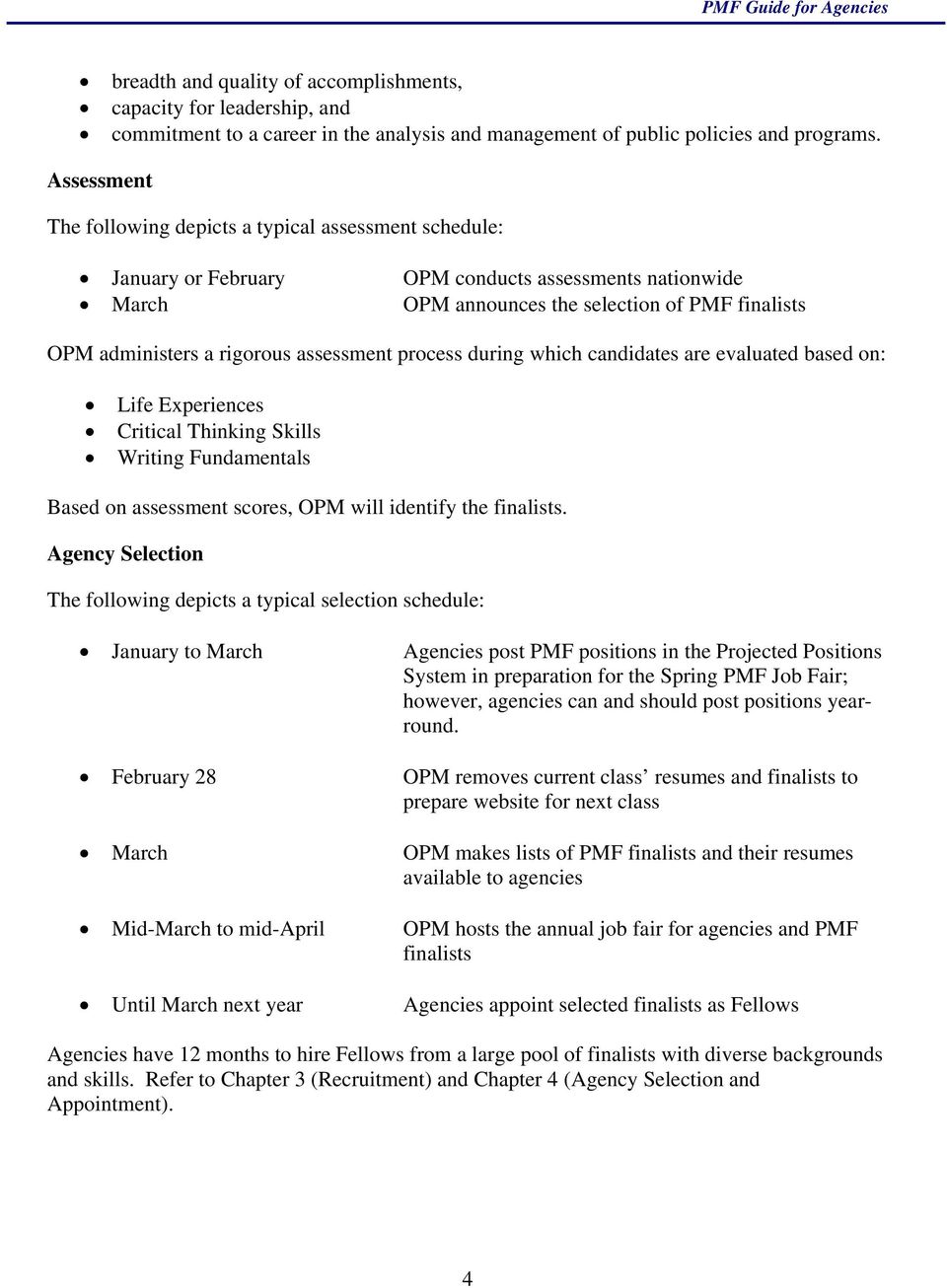
10 breadth and quality of accomplishments, capacity for leadership, and commitment to a career in the analysis and management of public policies and programs. Assessment The following depicts a typical assessment schedule: January or February OPM conducts assessments nationwide March OPM announces the selection of PMF finalists OPM administers a rigorous assessment process during which candidates are evaluated based on: Life Experiences Critical Thinking Skills Writing Fundamentals Based on assessment scores, OPM will identify the finalists. Agency Selection The following depicts a typical selection schedule: January to March Agencies post PMF positions in the Projected Positions System in preparation for the Spring PMF Job Fair; however, agencies can and should post positions yearround. February 28 OPM removes current class resumes and finalists to prepare website for next class March OPM makes lists of PMF finalists and their resumes available to agencies Mid-March to mid-april OPM hosts the annual job fair for agencies and PMF finalists Until March next year Agencies appoint selected finalists as Fellows Agencies have 12 months to hire Fellows from a large pool of finalists with diverse backgrounds and skills. Refer to Chapter 3 (Recruitment) and Chapter 4 (Agency Selection and Appointment). 4
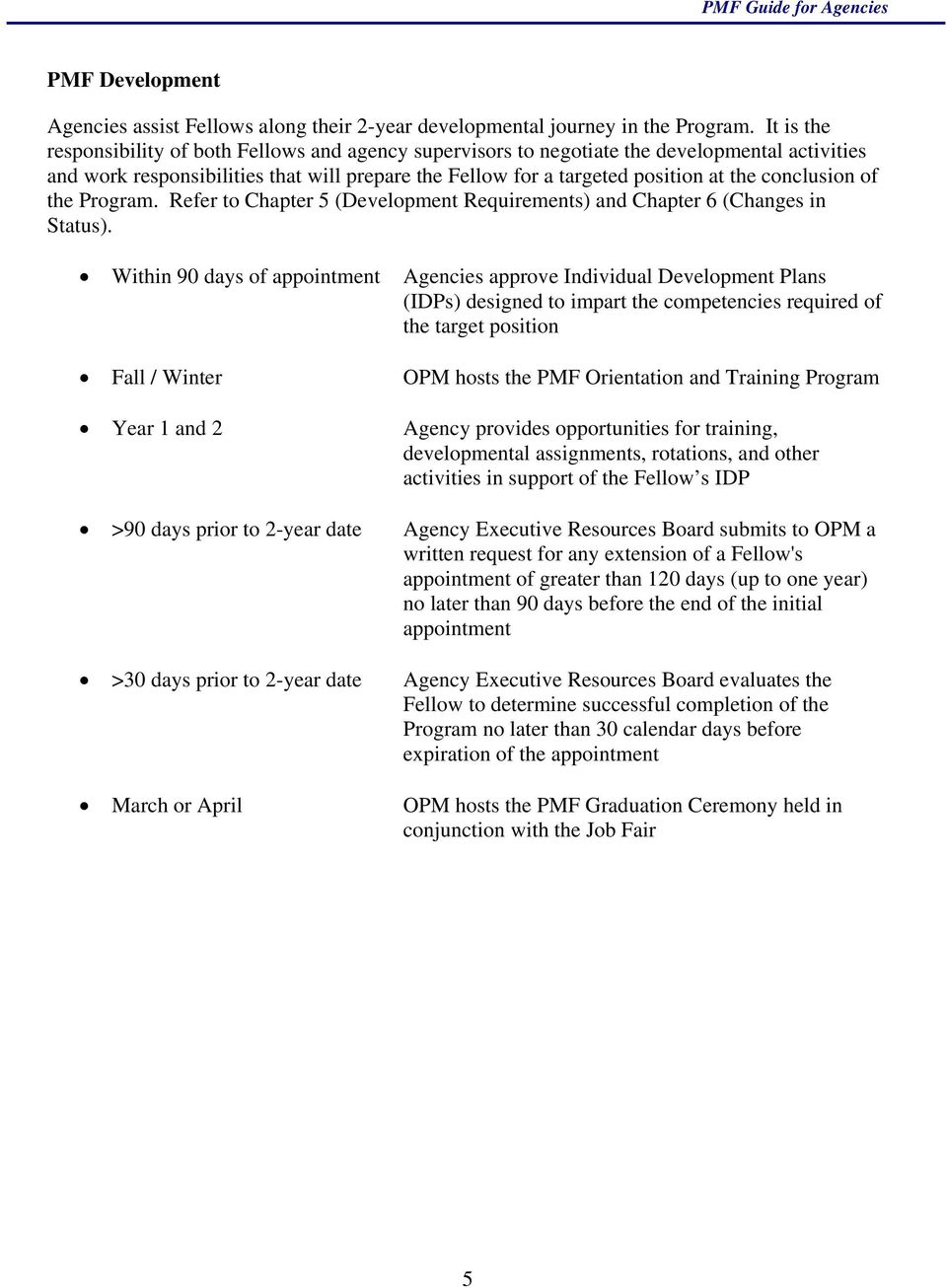
11 PMF Development Agencies assist Fellows along their 2-year developmental journey in the Program. It is the responsibility of both Fellows and agency supervisors to negotiate the developmental activities and work responsibilities that will prepare the Fellow for a targeted position at the conclusion of the Program. Refer to Chapter 5 (Development Requirements) and Chapter 6 (Changes in Status). Within 90 days of appointment Agencies approve Individual Development Plans (IDPs) designed to impart the competencies required of the target position Fall / Winter OPM hosts the PMF Orientation and Training Program Year 1 and 2 Agency provides opportunities for training, developmental assignments, rotations, and other activities in support of the Fellow s IDP >90 days prior to 2-year date Agency Executive Resources Board submits to OPM a written request for any extension of a Fellow's appointment of greater than 120 days (up to one year) no later than 90 days before the end of the initial appointment >30 days prior to 2-year date Agency Executive Resources Board evaluates the Fellow to determine successful completion of the Program no later than 30 calendar days before expiration of the appointment March or April OPM hosts the PMF Graduation Ceremony held in conjunction with the Job Fair 5
12 CHAPTER 2: ROLES AND RESPONSIBILITIES Responsibilities of the Office of Personnel Management The U.S. Office of Personnel Management (OPM) has promulgated regulations governing this Program. In order to further the objectives of Executive Order 13318, OPM will also: Promote public service and the Federal Government as the employer of first choice. Determine the number of Fellows that may be appointed each year based on input from the Chief Human Capital Officer s (CHCO) Council and others. Rule on appeals of decisions by an Executive Resources Board (ERB) in reference to certification of a Fellow s successful completion of the Program. The decision is final and not subject to further review/appeal. Approve requests to readmit and reappoint former Fellows. Approve requests to waive any provisions of 5 CFR 362. Enter into a Memorandum of Agreement with an agency, outside of the Executive Branch, that wishes to appoint Fellows. Responsibilities of the PMF Program Office The PMF Program Office is responsible for the overall management of the Program and will: Market the PMF Program to Federal agencies and departments and to accredited graduate schools. Develop a strategy for attracting and recruiting graduate students with diverse backgrounds into the PMF Program. Develop and conduct a rigorous applicant, assessment, and selection process to determine a pool of finalists. Provide orientation and graduation programs for each class or cohort. Provide information on available training opportunities. Serve as a conduit for effective communication among all members of the PMF Program community: coordinators, supervisors, educational institutions, non-profits, applicants, and Fellows. 6

13 Provide agencies with access to systems and information needed to administer the Program in their agency. Evaluate the effectiveness of the PMF Program. Program questions or comments should be addressed to: Responsibilities of the Agency Presidential Management Fellows Program U.S. Office of Personnel Management 1900 E Street, NW, Room 1425 Washington, DC Phone: Fax: [email protected] Web: Each participating agency plays a critical role in the orientation of Fellows to the Federal Government, the achievement of their career goals, and their retention in the Federal service. Agencies excepted from the competitive service may participate in the PMF Program using their own appointment authorities, but must follow the PMF Program Agency Roles and Responsibilities listed below, or their equivalent. Participating agencies agree to: Designate an Agency PMF Coordinator who is responsible for the overall administration and development of the agency program and who serves as the principal contact point for the Program. This position should be someone within the agency s Human Resources Office or Training Department, and should not be held by a current Fellow. Work with the Agency PMF Coordinator, human resources staff, and hiring officials to plan program budgets and to project the number of PMF hires in the agency. The agency s Chief Human Capital Officer (CHCO), or in agencies without a CHCO, the Human Resources Director, is to compile this information annually for OPM to determine by October the total number of PMF hires Governmentwide. Establish policies and criteria for the promotion of Fellows during their PMF fellowships. Refer to Promotion in Chapter 6 (Changes in Status). Within 30 days of acceptance of a PMF appointment, reimburse the PMF Program Office the appointment reimbursement fee for costs associated with the recruitment, selection, placement, orientation, and graduation of Fellows. See OPM Form 1616/Charge Card Forms found under the Forms section of the PMF website. The reimbursement fee is subject to change, to reflect actual costs incurred. Conduct an orientation on agency mission and structure as early as possible for all newly hired Fellows. 7

14 Approve an Individual Development Plan (IDP). Refer to Individual Development Plans in Chapter 5 (Developmental Requirements). Provide a minimum of 80 hours per year of formal classroom training. Refer to Training in Chapter 5 (Developmental Requirements). Provide at least one developmental assignment of 4 to 6 months. To be developmental, the assignment is to be consistent with the IDP and must prepare the Fellow for the occupation or function in which he/she is likely to be placed. Such opportunities can range from a specific assignment at a Fellow s home agency, such as a stretch or acting assignment, to an extended rotation in another agency or even outside the government. The developmental assignment should be outside the Fellow s immediate office. In each case, however, the assignment must be designed to develop the competencies required of the Fellow by their IDP and target assignment. The agency may provide other rotational assignments of 1 to 6 months to other occupations or functional areas. Refer to Developmental Assignments in Chapter 5 (Developmental Requirements). Certify the Fellow s completion of the Program by the agency s Executive Resources Board (ERB). In agencies without an ERB, the responsibility falls to the senior agency officials who have been given executive resource management and oversight responsibility by the agency head. Refer to ERB Review and Certification in Chapter 6 (Changes in Status). Convert or appoint Fellows who successfully complete the Program into a full-time, permanent position without further competition. Refer to Conversion or Appointment to Permanent Positions in Chapter 6 (Changes in Status). Responsibilities of the Agency PMF Coordinator The primary responsibility of the Agency PMF Coordinator ( Coordinator ) is to act as a liaison and Program facilitator for the agency, PMF supervisor, and the PMF Program Office. Agency responsibilities between the Coordinator and the Fellow s supervisor should be well coordinated. Agency PMF Coordinators must notify the PMF Program Office of their assignment to the position. It is important that the Coordinators maintain contact with the PMF Program Office to receive important program updates through the monthly newsletter (PMF Agency Update). Coordinators also will be provided access to the online PMF database and resume systems. Passwords for Agency PMF Coordinators will expire after 6 months of account inactivity. Approved agency users will have access to the following on the PMF website: Projected Positions System (PPS) Add Users for the PPS PMF Online Resumes Update Agency PMF Coordinator Information Agency Information Worksheet 8

15 Agency PMF Coordinators are to: Ensure that all hiring divisions within their agency are aware of the commitments involved in hiring Fellows including Full Time Equivalent (FTE) status, OPM reimbursement, starting grade and pay, Individual Development Plans (IDPs), training and developmental requirements, and promotions and conversions. Work with agency managers, hiring officials, and supervisors to identify PMF positions and post PMF jobs on the Projected Positions System (PPS). Refer to The PMF Projected Position System in Chapter 3 (Recruitment). Recruit Fellows to the agency by requesting access to the finalist online resumes for agency personnel, scheduling interviews with finalists, and participating in the annual PMF Finalists Job Fair. Refer to Chapter 3 (Recruitment). Notify PMF Program Office of any PMF change in status in a timely manner including appointment, movement between agencies (reappointments), ERB certification, resignation, termination, readmission, and conversion or appointment to permanent positions. Complete the online Agency Information Worksheet upon acceptance of appointment. Facilitate reimbursement of PMF fee to OPM upon acceptance of appointment of a Fellow. Verify the Fellow s completion of all graduate degree requirements. Refer to Graduate Degree Requirements and Degree Verification in Chapter 4 (Agency Selection and Appointment). Act as a resource for Fellows and their supervisors by assisting with agency orientations, providing guidance on IDP goals and objectives, clarifying responsibilities and commitments, identifying training opportunities, and responding to program-related questions. Refer to Chapter 5 (Development Requirements). Work with agency Executive Resources Board or equivalent to certify Fellow s completion of the Program and notify the PMF Program Office of ERB decisions. Refer to ERB Review and Certification in Chapter 6 (Changes in Status). Work with the supervisor and human resources to ensure proper processing of personnel actions within the agency and notification of PMF status changes to the PMF Program Office. See Processing Personnel Actions in Chapters 4 (Agency Selection and Appointment) and 6 (Changes in Status). Provide the PMF Program Office with updated contact information in order to receive important updates on finalists/fellows and PMF events. 9

16 Responsibilities of the Human Resources Office The Agency PMF Coordinator will need to rely on the agency s human resources staff to do the following: Prepare policies and criteria for the promotion of Fellows, as required by OPM regulations. Refer to Promotion in Chapter 6 (Changes in Status). Assist the hiring official and/or Agency PMF Coordinator with starting grade and pay decisions. See Appointing Fellows in Chapter 4 (Agency Selection and Appointment). Process personnel transactions upon a Fellow s initial appointment or reappointment, promotion, conversion, etc. See Processing Personnel Actions in Chapters 4 (Agency Selection and Appointment) and 6 (Changes in Status). Responsibilities of the Hiring Official/PMF Supervisor PMF Supervisors play a critical role in the PMF Program and most directly impact the overall experience for their Fellows by providing them with developmental opportunities and meaningful work. Supervisors are encouraged to become familiar with this guidance for more information on the following activities: Work with the Agency PMF Coordinator to enter positions into the PMF Projected Positions System (PPS). Refer to The PMF Projected Position System in Chapter 3 (Recruitment). Recruit finalists for PMF positions by reviewing finalist resumes on the PMF website, participating in the annual PMF Finalists Job Fair, and interviewing finalists. Refer to Chapter 3 (Recruitment). Assign PMF hires to specific positions with defined duties and career ladders, establish Entrance on Duty (EOD) date, and initiate security clearances. Move to pg. 26 Work with the Agency PMF Coordinator to reimburse the PMF Program Office the current fee within 30 days of acceptance of an appointment for costs associated with the recruitment, selection, placement, orientation, and graduation of Fellows. Develop an Individual Development Plan with the Fellow that addresses the target position, developmental requirements, and recommended activities. Refer to Individual Development Plans in Chapter 5 (Development Requirements). Provide at least 80 hours of formal classroom training during each year of the fellowship. Tuition for the OPM sponsored PMF Orientation and Training Program is included in the reimbursement fee. Agencies bear the costs of travel and per diem for all OPM sponsored PMF events. Refer to Training in Chapter 5 (Development Requirements). 10

17 Provide Fellows with at least one developmental assignment of 4 to 6 months. Refer to Developmental Assignments in Chapter 5 (Development Requirements). Provide a reasonable amount of time during work hours for other PMF activities, as appropriate, such as rotational assignments of 1 to 6 months in other occupations or functional areas. Establish a performance plan and annual evaluation for each Fellow with performance elements and standards for the competencies expected and for duties assigned. Refer to Performance Plans in Chapter 5 (Development Requirements). Provide input to the agency Executive Resources Board or equivalent as needed to evaluate the Fellow s progress and certify whether he or she has successfully completed the Program. Responsibilities of the Presidential Management Fellow Fellows are responsible for ownership of their individual learning, career development and advancement, and have the following program requirements: With the input and approval of the supervisor, prepare an Individual Development Plan (IDP) that identifies specific developmental activities designed to impart the competencies of the occupation or functional discipline in which the Fellow is most likely to be placed. Refer to Individual Development Plans in Chapter 5 (Development Requirements). Complete 80 hours of formal classroom training each year of the fellowship. Complete a 4 to 6 month developmental assignment with full-time responsibilities consistent with the IDP. Refer to Developmental Assignments in Chapter 5 (Development Requirements). Participate in optional PMF Program activities. Refer to Chapter 5 (Development Requirements). Inform the PMF Program Office of current contact information by updating the Information Worksheet under the Forms section of the PMF website. Successfully perform the duties and responsibilities of the position to which assigned. Refer to Performance Plans in Chapter 5 (Development Requirements). 11
18 CHAPTER 3: RECRUITMENT The PMF Projected Positions System The PMF Projected Positions System (PPS) is an easy-to-use, online system that can assist PMF finalists to identify projected agency positions by agency, sub-agency, location, position title, job type, and date posted. Federal agencies post position information specifically for PMF finalists, and the positions are not open to the general public. Federal agencies are responsible for entering projected positions, editing or deleting existing positions, and maintaining up-to-date information. Although most projected positions are posted prior to the job fair, agencies may enter projected positions in the PPS anytime throughout the year. Agencies may cancel projected positions without notice. To maintain a viable, active site with up-to-date information, it is recommended that agencies delete positions from the website as they are filled and add new positions as they become available. Agencies are strongly encouraged to post PMF employment opportunities in the PPS and to include applicable details regarding the specific skills and abilities they are seeking. There is no minimum or maximum length of time that the posting must be open on the PPS; however, agencies are requested to remove position listings as soon as they are filled. The PMF Program Office will delete entries 6 months old or older throughout the year. PPS Features There are several features available for agency use in the PPS: Add/Edit Description of Position Location: Allows an agency to enter or change the information that describes the office where the position is located, including the selection of: o Agency/Department o Sub-Agency o Division o Sub-Division Add/Edit Position: Allows an agency to prepare a new (or revised) projected position for posting on the PPS. Delete Position: Allows an agency to remove a posted position entry from the PPS. Select a Sub-Agency to Edit: Allows an agency to move to an agency/division below the current highest authorized level. (If the Agency PMF Coordinator is authorized to enter positions at the most senior level, then the Agency PMF Coordinator is authorized to add, edit, and delete positions for all levels listed at or below that level.) Agency PMF Coordinators at the sub-agency level may need to first select this option before 12
19 adding/editing positions. Logout: Allows an agency to log out of the system easily and will return the user to the PMF website. PPS Passwords Only registered personnel from participating agencies have access to the PPS. Agency PMF Coordinators automatically have access using their individual UserID and Password. Agency PMF Coordinators may grant access to other agency users from the "Agencies" section under the Forms section on the website by selecting "Add Users to Post PMF Positions." Accounts will expire after six months of non-use. How to Post a PMF Position To assist an agency in posting projected positions, posting instructions are also available on the PPS site at The PMF Program Office reviews agency position entries submitted to the PPS prior to posting on the PMF website. Please allow three business days for this review to take place. Add/Edit Description of Office where Position is Located: Allows agencies to enter or change the information that describes where the position is located. Once a description has been entered, it will be displayed each time the agency enters a new position. Agencies may edit displayed information at any time; however, changes to the "Description" will affect all positions for that office. There are two items on the Add/Edit screen: Agency Description: Agencies can describe the office in which the position is located. If this description was previously entered, it will be displayed in the text box. Agencies may edit the information. If an agency is entering a position at the agency or sub-agency level, then the agency will be required to describe the mission of the agency or subagency. Agency Guidance: Agencies can add guidance for finalists to follow when applying for agency positions; e.g., how finalists should contact the office; what information finalists should send; where, when and to whom it should be sent, etc. Add New Position or Edit Position: Agencies can add a new position to the PPS. Selecting "Add a Position" will move the agency to the "Add a Position" screen. Completion of each category is required. Use Edit this Position to change information for an existing position. Agencies can select the position to be edited from the drop-down list provided. An explanation of each of the fields and buttons on the Add New Position and Edit Position screens follows. All fields are mandatory. 13

20 Position Title: Select a title from the list displayed in the drop-down box. If the position you seek is not listed, choose the best match and identify the title in the description of position. Job Type: Select the category that best defines the position; more than one category may be selected (e.g., a Human Resource Specialist position may be in the Human Resources/Labor Relations/Employee Development category or in the Administration category). Projected Number of Positions: Enter the number of positions available under this job entry. If the number of positions may increase, check the box which indicates additional positions may be available. Location: Select the button to go to another screen to enter the City and State where the position is located. More than one location is permissible. Contact Information: List at least one contact, but no more than two contacts. Description of Position: Describe the duties of the position, as well as specific skills and abilities required, limiting the description to 20 lines. Refer to Qualification Requirements in Chapter 4 (Agency Selection and Appointment). Background Investigation Requirement: Indicate if a background investigation is required for this position by selecting "Yes" or "No." If Yes, select one of the following four options: SF 85, SF 85P, SF 86, or an agency-specific form. Agency PMF Coordinator: This information will be automatically displayed from the coordinator's profile, based on the information captured during the Agency PMF Coordinator s initial registration, and is also associated to other agency user accounts created by the Coordinator. View Entry: Allows an agency to view the entry that the agency has just entered as it will appear on the PPS. Agencies can make changes to the entry by using the browser's BACK button. Save and Return Later: Allows agencies to leave the system and return to the position at a later time. The position will not be submitted for approval. This feature provides the agency with the option of editing or deleting the position prior to its submission for approval. Submit for Approval: Transmits the position to the PMF Program Office for approval and sends an to the Agency PMF Coordinator for review. At this point, the entry will not be available for further editing until it has been approved by the PMF Program Office. Please allow three business days for the approval process. NOTE: As the Job Fair approaches, please allocate sufficient time for review and approval of submissions. 14

21 Delete Position: Allows agencies to remove a posted job entry from the PPS. Select a position from the drop-down list and then select "Delete This Position." Verify that it is the position the agency wishes to remove, and then select "Delete and Return to Menu." The position will no longer be viewable on the PPS, but will still be available for the agency s future use. Select a Sub-Agency to Edit: Allows the agency to move to an agency/division below the highest authorized level. For example, if the Agency PMF Coordinator is authorized to enter positions at the Department level, then the Agency PMF Coordinator will be able to add/edit/delete positions for all levels listed below the agency or the department. If the Agency PMF Coordinator is authorized to enter positions at the sub-agency level, then the Agency PMF Coordinator will be able to add/edit/delete positions at the sub-agency level only. Logout of PPS: Logs the agency out of the system and returns the PPS user to the PMF website. Agency Browser Requirements The following browsers are compatible with the PPS: Netscape 4.0 or higher Internet Explorer 4.0 or higher PPS Problem Reporting If an agency user encounters difficulty in entering positions or has technical questions regarding the PPS, send an to the PMF Program Office at [email protected]. Agency Access to Finalist Online Resumes The PMF Program Office posts the finalists names and online resumes on the PMF website for agencies interested in hiring finalists as Fellows. The list of finalists is in alphabetical order. Agency PMF Coordinators automatically have online access to finalist resumes through their UserID and Password on the Agencies webpage. The Agency PMF Coordinator may automatically grant resume access for other agency users by selecting the Add Users To Review Finalists for Hire under the Forms section on the PMF website. To review resumes, go to the Agencies webpage on the website and select Finalists. Choose Sorted with Resume (Agencies Use Only) and login. On the next screen, select Search All Finalists Resumes. Finalist resumes can be sorted using seven search criteria: Graduate Degree, Undergraduate Degree, Veterans Preference, Indian Preference, Citizenship, Foreign Languages, and Geographic Employment Preference. All finalists who claim veterans' preference have been adjudicated and the adjudication has been annotated on the list of finalists (available to requested agency users logged in). Any finalist claiming Indian preference has been confirmed by the PMF Program Office to have submitted a completed Form BIA 4432, Verification of Indian Preference for Employment in 15
22 Bureau of Indian Affairs and Indian Health Service Only. The Form BIA 4432 is available on the Forms webpage on the PMF website. Agency Participation in the Annual PMF Finalists Job Fair An annual Job Fair is held in the Washington, DC area (usually in March or April). The Job Fair is by invitation only, and only the current class of finalists and participating agency personnel are authorized to attend. Within 30 days of the Job Fair, OPM will post the agenda and an overview, agency registration and booth requests, shipping instructions, etc. OPM will post the finalists names and online resumes on the PMF website for agencies interested in hiring finalists as Fellows. See Agency Access to Finalist Resumes. For more information, see Application of Hiring Preferences in Chapter 4 (Agency Selection and Appointment). Privacy Act and Security Information The Privacy Act of 1974, cited as 5 U.S.C 552a. Records maintained on individuals 5 CFR 297 Privacy procedures for personnel records Online access to the finalist resumes and other secure features of the PMF is provided through an official U.S. Government system that is intended for authorized use only. Unauthorized use of this system or information on this system could result in criminal prosecution. Signing into the PMF website indicates that the agency user has read and accepted the Full Terms and Conditions of Use and that the agency user consents to security testing and monitoring. The data and documents on the PMF website include Federal records that contain sensitive information protected by various Federal statutes, including the Privacy Act of 1974, cited as 5 U.S.C. 552a. All access or use of the PMF website constitutes agency user understanding and acceptance of these terms and constitutes unconditional consent to review and action by all authorized government and law enforcement personnel. Unauthorized agency user attempts or acts to (1) access, upload, change, or delete information on the website, (2) modify the website, (3) deny access to the website, (4) accrue resources for unauthorized use, or (5) otherwise misuse the website are strictly prohibited. Such attempts or acts are subject to action that may result in criminal, civil, or administrative penalties. 16
23 CHAPTER 4: AGENCY SELECTION AND APPOINTMENT Appointment Eligibility 5 CFR 362 Presidential Management Fellows Program: Definitions Individuals may be appointed as a Presidential Management Fellow (or Fellow ) if they (1) complete a graduate course of study at a qualifying college or university, (2) receive the nomination from a qualifying college or university, (3) successfully complete an OPM administered assessment process, (4) are selected by OPM as a finalist, and (5) are selected by the agency for appointment. Graduate Degree Requirements 5 CFR 362 Presidential Management Fellows Program: Announcement, nomination, and selection Appointment and extensions Graduate students from all academic disciplines expected to complete an advanced degree from a qualifying college or university by August 31 of the academic year in which the competition is held, are eligible to become Fellows, as provided for in 5 CFR (b). These individuals must demonstrate an exceptional ability for, as well as a clear interest in and commitment to, leadership in the analysis and management of public policies and programs. Students who meet basic education requirements during the current academic year can be nominated by a nominating official from a qualifying college or university. According to 5 CFR , a qualifying college or university is an academic institution that meets the requirements as stated in the "General Policies and Instructions" section of the Office of Personnel Management's "Operating Manual: Qualification Standards for General Schedule Positions," under "Educational and Training Provisions or Requirements." Generally, the institution must be accredited by an accrediting body recognized by the Secretary of the U.S. Department of Education or must have acquired preaccreditation or candidate for accreditation status that is recognized by the Secretary of the U.S. Department of Education. See also Foreign Institutions. For specific guidance on accreditation criteria, it is recommended that Federal agencies utilize the information posted online at the U.S. Department of Education s website: At the time a candidate applies to the PMF Program each year, the majority of PMF candidates have not fully completed their graduate degree requirements. As referenced in 5 CFR (a)(5)(i), an agency may not appoint a finalist as a Fellow unless and until he/she has met all graduate degree requirements, including all course work; final papers; thesis; comprehensives, dissertation (completed and defended, if necessary), and exams completed and 17
24 graded. If a finalist does not complete all degree requirements by August 31 of the year in which selected as a finalist, the finalist status is terminated. While exceptions to the August 31 date are no longer found in 5 CFR , section 205 allows the OPM Director or designee to approve waivers in exceptional cases. See also Degree Verification. Foreign Education OPM Operating Manual: Qualification Standards for General Schedule Positions Part E.4. Educational and Training Provisions or Requirements Education completed outside of the United States must be deemed equivalent to that gained in conventional/accredited U.S. educational programs to be acceptable for Federal employment. Most foreign education is not accredited by an accrediting body that is recognized by the Secretary of the U.S. Department of Education. A few medical schools are accredited under country standards that have been determined to be comparable to U.S. standards by the U.S. Department of Education s National Committee on Foreign Medical Education and Accreditation. For foreign education that is not so accredited, agencies should follow the provisions below before considering such education for Federal employment. Unless the foreign education meets criteria listed above, candidates must submit all necessary documents to a private U.S. organization that specializes in the interpretation of foreign educational credentials, commonly called a credential evaluation service. To be acceptable, the foreign credential evaluation must include/describe: The type of education received by the applicant. The level of education in relation to the U.S. education system, and state that its comparability recommendations follow the general guidelines of the U.S. National Council for the Evaluation of Foreign Educational Credentials. The content of the applicant s educational program earned abroad and the standard obtained. The status of the awarding foreign school s recognition and legitimacy in its home country s education system. Any other information of interest such as what the evaluation service did to obtain this information, the qualifications of the evaluator, and any indications as to other problems such as forgery. Foreign credential evaluations that do not contain the above information or that state there is insufficient information provided by the applicant on which to base an evaluation should not be accepted. If the requested evaluation shows the foreign education to be legitimate and comparable to that expected of a candidate with U.S. credentials, it may be accepted at the discretion of the agency. For further information on the evaluation of foreign education, refer to the U.S. Department of Education s website at: 18
25 Qualification Requirements 5 CFR 213 Excepted Service: (ii) Subpart C Excepted Schedules, Schedule A 5 CFR 302 Employment in the excepted service: Qualification requirements Disqualifying factors The finalist is appointed as a Fellow to an excepted position under Schedule A in accordance with 5 CFR (ii). Initial appointments are made at the GS-9, GS-11, or GS-12 level (or their equivalents), depending upon the candidates qualifications. See also Grade Level upon Appointment. OPM will determine applicant minimal qualifications. The awarding of a graduate degree is a basic qualifying factor for a PMF position at the GS-9 grade level. Federal agencies wishing to appoint Fellows will not include the minimum educational requirement in their qualification standards, except for specific scientific, technical, or professional positions for which the agency decides the duties cannot be performed by a person who does not have the prescribed minimum education. As provided for in 5 CFR and , Federal agencies have the flexibility to establish qualifications in relationship to the duties to be performed (such as those relating to experience and training, citizenship, minimum age, physical condition, etc.). The regulations also require that agencies apply standards for a position uniformly to all PMF candidates. The qualification standards established may disqualify certain applicants for appointment. Citizenship Requirements 5 CFR 362 Presidential Management Fellows Program: (b) Citizenship 5 CFR 315 Career and career-conditional employment: Conversion based on service as a Fellow in the Presidential Management Fellows Program Federal employment opportunities for non-united States citizens through the PMF Program are extremely limited. By law, Federal agencies are prohibited from hiring anyone who is not a United States citizen for positions in the continental United States. There are certain exemptions from this restriction. According to 5 CFR (b), an agency is authorized to appoint an individual who is not a United States citizens if: 1) the individual is lawfully admitted to the United States as a permanent resident or is otherwise authorized by the Department of Homeland Security s Bureau of Citizenship and Immigration Services ( to be employed in the United States, and 19
26 2) the agency is authorized to pay the non-citizen under the annual appropriations act ban (i.e. the individual is a citizen from a country specifically exempted by the ban) or any agency-specific enabling appropriations statute. Each agency is required to determine its policy regarding the appointment of non-citizen PMF finalists to the PMF Program. For more information, refer to OPM s guidance on citizenship found at If an agency is interested in hiring a non-citizen PMF finalist as a Fellow, the designated hiring official and Agency PMF Coordinator should: Determine the agency s authority to appoint non-united States citizens. Confirm the citizenship status of the PMF finalist to determine candidate eligibility for appointment under the provisions of the annual appropriations act ban. This verification should be conducted, even if the PMF finalist is claiming United States citizenship, similar to any other appointment verification conducted by the agency s human resources staff. Verify that the PMF finalist is authorized to live and work in the United States under the laws and provisions of the U.S. Citizenship and Immigration Services. Establish that the PMF finalist will obtain full United States citizenship prior to completion of the 2-year fellowship. Agencies that hire a non-citizen PMF finalist as a Fellow under 5 CFR (ii) must ensure the Fellow meets the requirements for appointment to career or career-conditional employment under 5 CFR and upon program completion. If the Fellow does not possess United States citizenship at the conclusion of the 2-year fellowship, he/she cannot be appointed to career or career-conditional employment or retained as a Fellow by the employing agency. The PMF Program does not permit the extension of a fellowship for the purpose of obtaining United States citizenship. Registered agency users can identify a finalist s citizenship status from the online resume on the PMF website. Application of Hiring Preferences Veterans Preference 5 CFR 302 Employment in the Excepted Service: Persons entitled to veteran preference Examination of applicants Order of consideration Selection and appointment 20
27 5 CFR 362 Presidential Management Fellows Program: Announcement, nomination, and selection The use of veterans preference information is critical for all Agency PMF Coordinators, agency representatives, agency human resources staff, and agency hiring officials to understand and comply with. To be entitled to preference, a veteran must meet the eligibility requirements in 5 U.S.C For more information on the types of veterans preference and their application in Federal employment, refer to OPM s Veterans Guide at or the Department of Labor s online Veteran's Preference Advisor, at Applicants claiming veterans preference and meeting their school s nomination qualifications must be nominated. In accordance with 5 CFR 302, veterans preference is applied to nominations, assessment, finalist selection, and agency selection/appointment. OPM adjudicates PMF finalists who claim veterans preference, based on the documentation submitted by the applicant at the time of application. These documents may include the DD-214 (Certificate of Release or Discharge from Active Duty), the SF 15 (Application for a 10-point Veteran Preference), and/or a certification letter from the Department of Veterans Affairs. Five or ten points are added, as adjudicated, to the scores of those candidates entitled to preference. Veterans Preference in the Assessment Process Veterans receive three-tiered consideration during the PMF process. The first tier occurs during the nomination process. The second tier occurs during the OPM application review and rating process and the third tier occurs during the agency appointment process. Veterans preference is applied in assessment in accordance with 5 CFR 302, sections , , and During the applicant s nomination process, colleges and universities must establish a competitive nomination process to ensure that all interested applicants who meet the established criteria receive careful and thorough review, and equal opportunity for nomination. Schools must nominate all students eligible for veterans preference who apply for nomination and are found qualified. For more information, see Guidance for Colleges and Universities on the PMF website at During the OPM application review and rating process, OPM rates and ranks PMF candidates Veterans preference is then adjudicated by OPM based on the supporting documentation supplied by the PMF candidate. Candidates are then invited to an in-person assessment center. Candidates who participate in an assessment center will complete an objectively-scored assessment that focuses on analytical problem solving, written communication, and selected OPM leadership competencies. Five or ten points are added to the scores of those candidates entitled to veterans preference. Candidates are ranked according to their assessment score with adjudicated veterans preference points applied. Compensably disabled veterans go to the top of the list. 21
28 From this list OPM designates candidates to become PMF finalists. OPM posts the finalists names and online resumes on the PMF website for agencies interested in hiring Fellows. The list of finalists is in alphabetical (unranked order). Registered agency users may access a list of adjudicated finalists on the PMF website. The list will indicate the veterans preference category for those finalists who were adjudicated with veteran s preference. The veteran s preference categories are as follows: CPS: 10-point compensable preference based on a service-connected disability of 30% or more CP: 10-point compensable preference based on a service-connected disability of 10% or more, but less than 30% XP: 10-point (other) preference; granted to recipients of the Purple Heart, persons with a non-compensable service-connected disability (less than 10%), widow/widower or mother of a deceased veteran, or spouse or mother of a disabled veteran TP: 5-point preference Veterans Preference in Agency Hiring Decisions During the agency appointment process, agencies are required to select from the highest available preference category if at least three veterans preference candidates remain in that group. The only way a veteran may be removed from consideration is if the appointing agency can demonstrate that the veteran does not qualify for the vacancy. See also Qualifications Requirements in the PMF Guide for Agencies at When fewer than three remain in the highest category, consideration may be expanded to include the next category. Under this method, first consideration is to preference eligibles having a service-connected disability of 10% or more. Second consideration is to other 10-point preference eligibles, and third consideration is to 5-point preference eligibles. Last consideration is to non-preference eligib1es. If a finalist is preference eligible and he/she expresses an interest in working for an agency, that agency must apply sections and of title 5, Code of Federal Regulations, when selecting and appointing candidates. For purposes of this program, expresses an interest means that he/she has initiated contact with the agency in person or by other direct communication and asked for consideration for appointment to a specific position. This contact can include dropping off the finalist s resume at the annual PMF job fair, sending it by mail/ , or delivering it in person at any agency office that is considering appointing a finalist. It may also include sending a letter to the agency asking for consideration. This does not mean an agency has to contact each veteran on the finalist list before offering a job to a non-preference eligible. * NOTE: Agencies may also conduct an online search of preference eligibles from the PMF website. Once a job offer is extended, accepted and an Entry on Duty (EOD) start date established, that specific applicant pool is closed. Preference eligibles who request consideration after a job offer 22
29 is extended and accepted will become part of a new applicant pool that will be established if/when a new position become available. Agencies who hire Fellows usually send hiring officials from their various agency components to the annual PMF job fair. At the same time, finalists may initiate contact with agencies. Each applicant pool is individual. That is, it consists of whomever the agency contacts or whoever contacts the agency about obtaining a position. Because hiring officials from various agency components hire Fellows, applicant pools may remain individual down to the lowest organizational level, or even down to the position level. It is important to note that when examining and selecting for PMF excepted service positions, agencies must apply veterans preference in accordance with sections and of title 5, Code of Federal Regulations. Passing Over a Preference Eligible Veteran If the agency decides not to hire the preference eligible veteran it contacted or the preference eligible who expressed interest in a particular position, then the agency must prepare a written justification as to why the preference eligible did not meet the criteria for the position. Decisions must be qualifications driven. The written justification accomplishes two objectives. A preference eligible is entitled, upon request, to obtain a copy of the reasons he or she were passed over in favor of a non-preference eligible. The written justification is intended to satisfy that obligation and thus should be written with the expectation that the individual that was passed over may request to review it. Additionally, if OPM officials audit agency PMF processes, the written justification serves as documentation that preference eligibles who were part of the agency applicant pool received proper consideration. A CPS preference eligible is entitled to advance notice of a proposed passover and has the right to respond to the appointing official's reasons for passover. The preference eligible is to submit a response within 15 days of the notification. The appointing official must make a decision after considering any response submitted by the preference eligible and notify the veteran of the decision in writing. The Presidential Management Fellows regulations clarify that the provision of part 302 of title 5, Code of Federal Regulations, regarding Employment in the Excepted Service, apply to the selection of Fellows. OPM confirms its commitment to protect the rights of preference eligibles in the excepted and competitive service and has delegated responsibility for the Passover of CPS preference eligibles to agency appointing officials consistent with existing procedures for other excepted service appointments. Native American Preference 25 CFR 5 Preference in employment 25 U.S.C. 472a. Indian preference laws applicable to Bureau of Indian Affairs and Indian Health Service positions 23
30 Indian hiring preference applies to all positions within the Bureau of Indian Affairs of the U.S. Department of the Interior and the Indian Health Service of the U.S. Department of Health and Human Services. Students who are members of a Federally-recognized tribe, and who are interested in pursuing employment with these organizations, will be required to submit a completed Form BIA 4432, Verification of Indian Preference for Employment in Bureau of Indian Affairs and Indian Health Service Only, to OPM during the PMF application process. The Form BIA 4432 can be found under the Forms section on the PMF website. Agency Reemployment Priority List (RPL), Career Transition Assistance Plan (CTAP), and Interagency Career Transition Assistance Plan (ICTAP) 5 CFR 330 Recruitment, Selection, and Placement (General): Employment Restrictions Order of selection for filling vacancies form within the agency (c) Order of selection for filling vacancies from outside the agency s workforce Regulations permit agencies to fill excepted service positions without regard to the agency s RPL, CTAP, or the ICTAP. The RPL regulations in 5 CFR (a) apply only to competitive service vacancies. The CTAP regulations outlined in 5 CFR (d) allow agencies to fill positions through excepted appointment without having to give selection priority to surplus or displaced employees. This includes the movement of excepted service employees within an agency and conversions of employees from excepted appointments to competitive service positions in certain defined situations. Similarly, the provisions of ICTAP outlined in 5 CFR (c) apply to the appointment and conversion of Fellows as well. NOTE: An agency must clear its RPL, CTAP, and ICTAP before appointing a PMF graduate of an excepted service agency using their one-time opportunity for noncompetitive appointment in the competitive service or before reinstating a former career/career-conditional employee who does not complete the PMF Program. Refer to One Time Conversion to the Competitive Service or Reinstatement of Former Career/Career-Conditional Employees, as applicable, in Chapter 6 (Changes in Status). Appointing Fellows Initial Appointments 5 CFR 213 Excepted Service: (ii) Subpart C Excepted Schedules, Schedule A 5 CFR 362 Presidential Management Fellows Program: Appointments and extensions Finalists in the PMF Program may be appointed at any time during the twelve-month period immediately following the official announcement of their selection as a finalist. For example, if finalists are named on March 8 th, then the finalist has until March 8 th of the following year to be appointed as a Fellow. Agencies may appoint PMF finalists no later than one year after the date 24
31 the finalist was selected. The Entrance on Duty (EOD) must be no later than 12 months after the individual is selected as a finalist. The OPM Director or designee may approve an agency request to extend the deadline if submitted no later than 30 days prior to the deadline. Agencies appoint Fellows to an excepted position under Schedule A in accordance with 5 CFR (ii). Agencies must make initial appointments of Fellows at the GS-9, GS-11, or GS-12 level (or their equivalents), depending on the candidate's qualifications. Appointments are made under this authority for two years and, upon approval of the OPM Director or the Director s designee, may be extended for up to one additional year. Agencies may extend, without prior OPM approval, a Fellow's appointment for up to an initial 120 days. See also Appointment Extensions and Conversion in Chapter 6 (Changes in Status). PMF positions are full-time positions and count toward the maximum number of full-time equivalent (FTE) that an agency may employ. That is, Fellows count against agency personnel ceilings and their salaries are paid by the employing agency. For information regarding movement between agencies (reappointments), see Movement Between Agencies in Chapter 6 (Changes in Status). Agencies excepted from competitive service must appoint under their agency-specific appointing authority. See Processing Personnel Actions. Grade Level upon Appointment 5 CFR 213 Excepted Service: (ii) Subpart C Excepted Schedules, Schedule A 5 CFR 362 Presidential Management Fellows Program: (c) Appointment and extensions (Grade) An agency must appoint a Fellow at the grade GS-9 level, or its equivalent, at a minimum. However, if the agency determines that a Fellow meets the requisite qualification requirements for their posted position at a higher grade level, the agency may appoint the Fellow at the GS-11 or GS-12 level, or their equivalents. In determining whether Fellows qualify for grades above the GS-9 level, agencies may develop their own qualification requirements and evaluate the relevance of a finalist s specialized education or experience compared to that of the posted position. OPM will determine whether applicants are minimally qualified for the GS-9, and agencies can apply qualification standards and make appropriate decisions for hiring and placing finalists as Fellows, as is done routinely for other excepted service hires. See also Qualification Requirements. Starting Pay 5 CFR 531 Pay under the general schedule*: Setting pay for a newly appointed employee 25
32 Generally, the new appointment will be made at the minimum rate of the grade to which the finalist is being appointed as a Fellow. When appropriate, agencies may appoint finalists as Fellows at a higher step within the grade using the maximum payable rate rule or the superior qualifications and special needs pay-setting authority, as described below. Current Employees: Pay Retention 5 CFR 536 Grade and pay retention*: (a)(6) Coverage and applicability of pay retention (Placement in a formal employee development program) 5 CFR 536 Grade and pay retention*: Definitions Mandatory pay retention If a PMF finalist is currently employed as a civilian in the Federal Government and his/her current rate of basic pay would otherwise be reduced as a result of placement in the PMF position, pay retention provisions under 5 CFR part 536, subpart C, may apply in setting the PMF s pay. Pay retention applies to any employee whose rate of basic pay would otherwise be reduced (after application of any applicable geographic conversion under 5 CFR (a)) as a result of a management action that places an employee in a formal employee development program generally utilized Governmentwide, such as upward mobility, apprenticeship, and career intern programs. An employee means an individual whose employment immediately prior to the appointment was on other than a temporary or term appointment. According to 5 CFR , a management action includes an employee s placement in or transfer to a position under a formal employee development program established by an agency for recruitment and employee advancement purposes is considered a management action even though the employee initiates or requests such placement or transfer. See also 5 CFR (Setting pay upon change in position without a change in grade), (Setting pay upon promotion), and (Setting pay upon demotion) for additional guidance as applicable. Reemployment of Former Federal Employees 5 CFR 531 Pay under the general schedule*: (c) General provisions (Maximum payable rate rules) 5 CFR 531 Pay under the general schedule*: (b) Setting pay for a newly appointed employee (Reemployment) to 223 Using a highest previous rate under the maximum payable rate rule A finalist\fellow may be reemployed if he or she withdraws from employment for reasons unrelated to: 26
33 misconduct, poor performance, or suitability A finalist/fellow who withdraws from the PMF Program may be reemployed as a Federal employee, at the employing agency s discretion, under the following conditions. The finalist/fellow: should have held a career or career-conditional appointment immediately before entering the Program; and, is placed in a career or career-conditional position, as appropriate, upon withdrawal from the PMF Program. Under 5 CFR , for an employee who has previous civilian service in the Federal Government, an agency must set the payable rate of basic pay upon reemployment at the minimum rate of the grade, unless the agency chooses to apply (1) the superior qualifications and special needs pay-setting authority; or (2) the maximum payable rate rule. If a PMF finalist was previously employed in a civilian position in any part of the Federal Government (including service with the government of the District of Columbia for employees first employed by that government before October 1, 1987), and his/her highest actual rate of basic pay previously received was higher than the minimum level for the grade to which he/she is being appointed at that time, the appointing agency may set the starting pay at a higher step within the grade. Refer to 5 CFR for specific guidance in setting the rate of pay (using highest previous rate), and to 5 CFR and 223 for guidance in determining rates of basic pay that may or may not be used as the highest previous rate. For the purpose of determining an employee s highest previous rate, Federal service is based on a regular tour of duty under an appointment not limited to 90 days or less, or for a continuous period of not less than 90 days. Superior Qualifications Appointments and Special Needs Pay-Setting Authority 5 CFR 531 Pay under the general schedule*: Superior qualifications and special needs pay-setting authority Generally, finalists are hired at step 1 of the grade to which they are appointed. Agencies have the authority, however, to set pay for new PMF appointments above step 1 of the grade based on superior qualifications of the candidate or a special need of the agency upon a finalist s: 1) first appointment as a civilian employee of the Federal Government; or 2) reappointment to a GS position with a 90-day break in service. See 5 CFR (a)(3) for exceptions to the 90-day break in service requirement. The agency may determine that (1) the finalist has superior qualifications based on the level, type, or quality of the candidate s skills or competencies demonstrated or obtained through experience and/or education, the quality of the candidate s accomplishments compared to others in the field, or other factors that support a superior qualifications determination; or (2) the candidate fills a special agency need if the type, level, or quality of skills and competencies or 27
34 other qualities and experiences possessed by the candidate are relevant to the requirements of the position and are essential to accomplishing an important agency mission, goal, or program activity. In meeting the superior qualifications criteria, the finalist s skills, competencies, experience, education, and/or accomplishments must be relevant to the requirements of the position to be filled. These qualities must be significantly higher than that needed to be minimally required for the position and/or be of a more specialized quality compared to other candidates. A finalist also may meet the special needs criteria by meeting agency workforce needs, as documented in the agency s strategic human capital plan. Refer to 5 CFR for detailed guidance on the use of this pay-setting authority and in determining those factors that may be considered in the pay-setting decision. Security Clearances The PMF Program Office does not conduct any type of credit check, security clearance, drug testing, polygraph, or any other security background investigation for PMF finalists. It is the responsibility of the appointing agency to initiate and conduct the suitability investigation or security clearance investigation appropriate for determining a finalist s suitability for employment with the Federal Government prior to appointment and, if appropriate, eligibility for a clearance. The PMF Program website provides links to the security clearance forms most commonly used in the Federal Government (under the Forms section on the PMF website). Degree Verification When selecting PMF finalists, the PMF Program Office determines whether the applicants have been nominated by graduate program from a qualifying college or university. At that time, however, the majority of applicants have not fully completed their graduate degree requirements. Therefore, it is the responsibility of the appointing Federal agency to obtain formal documentation from the Fellow's educational institution about the status of the Fellow's graduate degree. The agency s verification and documentation of graduate degree completion should include an official transcript from the Fellow's educational institution, as shown in the candidate s PMF online resume. If the official transcript is not available, an agency may accept an official letter from the graduate school certifying that the finalist completed his/her graduate degree requirements by August 31st. The letter must be on school letterhead and verify that the finalist has satisfied all graduate degree requirements (including the successful defense of any thesis or dissertation). Lastly the letter must be signed by an appropriate dean or academic director of the candidate s graduate program. Hiring Incentives Regulations for recruitment, relocation, and retention payment authorities allow agencies the flexibility to use hiring authorities to strategically improve their ability to recruit and retain a high quality workforce. 28
35 Recruitment and Relocation Incentives 5 CFR 575 Recruitment, relocation, and retention incentives: 575 Subpart A Recruitment incentives 575 Subpart B Relocation incentives Agencies retain the flexibility to pay recruitment or relocation incentives to a PMF finalist. The PMF Program Office does not determine whether an agency may pay recruitment or a relocation incentive to a Fellow. Agencies may determine and defend the criteria used to justify the use of a recruitment or relocation incentive when hiring a PMF finalist. Federal Student Loan Repayment Program 5 CFR 537 Repayment of student loans Federal agencies are authorized to repay student loans under the Federal Student Loan Repayment Program, as provided for in part 5 CFR 537. The amount paid by the agency is subject to the following maximum limits: (1) $10,000 per employee per calendar year, and (2) a total of $60,000 per employee. Presidential Management Fellows are eligible to receive student loan repayments, but these programs are agency-specific. Before repaying any student loans, the agency must establish a student loan repayment plan, which is to include the designation of officials with authority to review and approve repayment benefits; situations when the loan repayment authority may be used and criteria that must be met; procedures for making loan payments; a system for selecting employees to receive repayment benefits that ensures fair and equitable treatment; requirements for service agreements; and documentation and recordkeeping requirements. For complete details, see (Federal Student Loan Repayment Program). Student Loan Deferment or Forbearance 34 CFR 682 Federal Family Education Loan (FFEL) Program: Deferment 34 CFR William D. Ford Federal direct loan program Deferment The PMF Program is not a graduate fellowship program for the purposes of Federal student loan deferment, as provided for in 34 CFR (d) or 34 CFR (b)(1)(i)(B). Borrowers may not defer repayment of their loans based on their participation in the PMF Program. However, other repayment options may be available to borrowers participating in the PMF Program based on his/her individual circumstances. If a borrower in the PMF Program is experiencing difficulty in meeting his or her repayment obligation, the borrower should contact his or her lender (for Federal Family Education Loan Program loans) or the Direct Loan Servicing Center (for Direct Loans) and inquire about the repayment options available to address those circumstances. 29
36 The U.S. Department of Education provides additional information regarding the granting of loan forbearance for individuals who are experiencing financial difficulty in making required loan repayments. Additionally, Title IV borrowers may consolidate their loans in certain circumstances, according to the U.S. Department of Education. Individuals may obtain information on student loan consolidations by calling or go to the Federal Direct Consolidation Loans Information Center at In addition, the U.S. Department of Education s Office of Planning, Evaluation, and Policy Development is available at (202) if Agency PMF Coordinators have additional questions on student loan deferments. Travel and Transportation Expenses 5 CFR 572 Travel and Transportation Expenses; New Appointees and Interviews Agencies are authorized, but not required, to pay pre-employment interview expenses for PMF finalists as potential new appointees. Historically within the PMF Program, few agencies reimburse PMF finalists and PMF hires for travel expenses for pre-employment interviews and travel to the first post of duty. Agencies should review 5 CFR Part 572 and 5 U.S.C for detailed information on agency authority, discretion, and recordkeeping. Appointment Extensions and Deferrals Appointment Extensions 5 CFR 362 Presidential Management Fellows Program: (a)(4) Appointment and extensions (Appointment) Agencies have 12 months from the date that finalists are announced to appoint Fellows. OPM may approve a written agency request to appoint a finalist as a Fellow after that deadline, so long as the request is submitted no later than 30 days prior to the end of the 12-month period. Appointment extensions should be avoided. Entering on duty after the deadline may cause the Fellow to miss orientation training and/or graduation ceremonies with their PMF class. Agencies who have lengthy security clearance processes need to appoint PMF finalists as quickly as possible so that security investigations can be completed in time to bring Fellows onboard no later than 12 months from the official announcement date. See also Security Clearances. Appointment Deferrals Under certain circumstances, OPM may approve a written request from a finalist to defer participation to a future class. Requests for deferrals are granted on a very limited basis, generally only for two reasons: (1) serious illness or medical condition of the Fellow or an immediate family member, or (2) military service. OPM does not grant deferrals based on fellowships, grants or other educational or employment opportunities. Upon approval, the PMF finalist s records are coded as deferred and OPM will immediately remove the finalist s name and resume from the PMF website. The PMF Program Office will 30
37 contact the deferred finalist prior to announcing the next class of finalists for his/her status. Recording the Appointment 5 CFR 213 Excepted Service: (ii) Subpart C Excepted Schedules, Schedule A Processing Personnel Actions Upon a finalist s appointment as a Fellow, agency human resources staff should consult 5 CFR (ii) when recording personnel actions for Fellows in the Central Personnel Data File. To process personnel actions, enter the appropriate codes and comments on standard forms (such as the SF 50) as shown in the following chart. PMF Appointment* Is employed as a Fellow under Sch A authority - and the person is not on your agency's rolls Is employed as a Fellow under Sch A authority and the person is already on the rolls of your agency Is employed as a Fellow under authority of E.O , and cannot be appointed under Sch A authority - and the person is not on your agency's rolls Is employed as a Fellow under authority of E.O , and cannot be appointed under Sch A authority and the person is already on the rolls of your agency Nature of Action NOAC Authority Code Authority Tenure Group Exc Appt 170 X9M (ii) II Conv to Exc Appt 570 X9M (ii) II Exc Appt 170 X7M E.O II Conv to Exc Appt 570 X7M E.O II * Remarks to be shown on the SF-50 (Appointment Limitations): Remark Code A04 - Appointment is NTE 2 years. Upon satisfactory completion of the Program, you may be noncompetitively converted to a permanent appointment. If your performance is not satisfactory or if you fail to satisfactorily complete this program, employment will be terminated. If the employee is currently employed under a nontemporary appointment in the competitive service: Remark Code A24 - Employee informed in advance of the conditions of appointment under the Presidential Management Fellows Program. 31
38 NOTE: Reappointments, when a Fellow moves without a break in service from one agency to another during their 2-year appointment, are treated by the losing agency as a Termination-Appt In (agency) (NOAC of 352) and by the gaining agency as an appointment (NOAC of 170 or 570) under (ii) or E.O , as applicable. Reappointment of Fellows should be coordinated between the Agency PMF Coordinators, who should notify the PMF Program Office once the reappointment decision is final so we update our records. PMF Program Notification Notifying the PMF Program Office immediately following a finalist acceptance of an appointment allows the Program Office to update its database, show finalists status as either being appointed or accepted an appointment on the PMF website, alerting other agencies when a finalist has been selected. The change of status can easily be recorded by completing the PMF Program s Agency Information Worksheet, located under the Agencies section of the PMF website. The electronic form is driven by the finalist s Social Security Number (SSN) and an Entry on Duty (EOD) date is essential. Other information for notifying the Program Office includes: PMF s Name (first and last) PMF s SSN PMF s Class Year (xxxx) Start Date (i.e. Entry on Duty (EOD) date) Coordinator Department/Agency Work Mailing Address Work Phone Numbers Position Title Work Address If an EOD date is unknown upon acceptance of an appointment, Coordinators should initially use a default date of 12/31/xxxx. This will indicate to the PMF Program Office that one of the following applies: (1) the EOD is still being negotiated, (2) the EOD is unknown to the Coordinator at time of appointment submission, (3) the finalist is pending an EOD based on the successful completion of a security clearance, or (4) the appointing agency is waiting to confirm the finalist has completed graduate degree requirements before an EOD can be scheduled. Once the EOD date is known, the Coordinator is to log back in and enter the updated information. The PMF Program Office requests that appointing agencies immediately submit appointments online (whether or not all the data fields above are known). NOTE: If a finalist withdraws from further consideration, his/her status will change on the PMF website and their online resume will be deactivated. 32
39 CHAPTER 5: DEVELOPMENT REQUIREMENTS Individual Development Plans (IDPs) 5 CFR 362 Presidential Management Fellows Program: (a) Development, evaluation, promotion, and certification (Individual development plans) A realistic, well-researched, clearly written Individual Development Plan (IDP) is a valuable tool for charting a successful two year PMF experience. Requirements in 5 CFR (a) clearly state that the appointing agency will approve an IDP for each of its Fellows that sets forth the specific developmental activities designed to impart the competencies of the occupation or functional discipline in which the Fellow is most likely to be placed. Fellows and their supervisors should use IDPs to negotiate expectations for attaining clearly defined learning objectives and competencies during the next two (or more) years through training and developmental assignments. IDP planning allows supervisors to clarify employee performance plans, as well as staffing and budget plans. Additionally, the process will help Fellows discern which developmental activities will be most appropriate for their career advancement. Fellows are expected to work closely with their supervisors and Agency PMF Coordinators to outline the core competencies and technical skills that they must gain before conversion to their target position. A PMF target position means a position, occupational series, or program area as defined by the employing organization, toward which a Fellow's Individual Development Plan (IDP), work experiences, and development assignments are planned and in which the agency plans to employ the Fellow upon successful completion of the program. The agency may change or modify the target position during the fellowship. IDPs should specify how and when the learning objectives will be met, and determine how Fellows will be evaluated. IDPs should include PMF Program sponsored trainings and activities, as well as agency-sponsored career development activities to enhance career and continuing education goals. To be most effective, IDPs should be developed within the first 3 months of the fellowship. Fellows are also encouraged to use IDPs to plan their longer-range career goals. Ideally the IDP should be aligned with the Fellow s performance plan, target position, and career development goals. See also Performance Plans. Each IDP should be individually tailored around the following elements: Target Position: A brief description of the target position, and the specific knowledge, skills, and abilities that will be needed to qualify for the target position upon successful completion of the 2-year program. 33
40 Learning Objectives: The learning objectives should include general management areas, as well as specific technical skills and experiences, which will qualify the Fellow for the target position at the end of the fellowship. Details and Timeline: The IDP should clearly indicate when and how the learning objectives will be accomplished. The plan should outline the required developmental assignments as well as the 80 hours of formal classroom training each year of the fellowship, including the PMF Program s Orientation and Training Program (if attended). Demonstrated Success: The IDP should include a means for tracking accomplishment of all IDP objectives at the end of the 2-year fellowship. The supervisor and the Fellow should be partners in determining that the objectives set forth in the IDP have been accomplished. Should events preclude a Fellow from attaining specific learning objectives by a particular date, alternative arrangements should be made with his or her supervisor. The U.S. Office of Personnel Management has developed a list of competencies, or Executive Core Qualifications, which can be used to assess current strengths and identify opportunities for development (listed below). Many agencies have also developed similar competency frameworks to guide employee development and training. Leading Change: Continued learning, creativity and innovation, flexibility, resilience, external awareness, service motivation, strategic thinking, and vision. Leading People: Integrity and honesty, team building, conflict management, and leveraging diversity. Results Driven: Accountability, customer service, decisiveness, problem solving, technical credibility, and entrepreneurship. Business Acumen: Financial management, human resources management, and technology management. Building Coalitions: Influencing and negotiating, interpersonal skills, oral communication, written communication, partnering, and political savvy. Fellows can look for management and technical journals and books, as well as resources available in the community including films, lectures, and professional association activities for development and training. See also Training, Developmental Assignments, and Professional Memberships. Performance Plans 5 CFR 362 Presidential Management Fellows Program: (c)(1) Development, evaluation, promotion, and certification (Performance and progress evaluation) 34
41 5 CFR 430 Performance management The PMF supervisor is responsible for developing each Fellow s performance plan based on the Fellow s current position description (PD). Guidance in 5 CFR (c)(1) stipulates that each Fellow will be placed on a performance plan, as prescribed by 5 CFR 430 or other applicable law or regulation, establishing performance elements and standards that are directly related to acquiring and demonstrating the various leadership, technical, and/or general competencies expected of the Fellow as well as the elements and standards established for the duties assigned. Each Fellow must receive an annual performance evaluation in accordance with the agency's performance management program. The rating is derived from an evaluation of the Fellow's success in completing developmental activities designed to prepare the Fellow to meet the developmental and performance expectations described in his/her performance plan. If a Fellow does not meet expectations (set forth in the performance plan) with regard to his/her developmental progress or assignments, the agency may take appropriate action. Agency supervisors should follow the performance management guidelines in 5 CFR 430 to prepare for and track PMF performance of duties as assigned based on performance standards developed from elements in the Fellow s PD. Failure to meet the minimum standards outlined in the PD and performance plan can lead to warnings, termination, or other corrective action as appropriate. It is the responsibility of the employing agency to review and follow established regulations when addressing performance (5 CFR 430) or conduct (5 CFR 752) issues. Agency procedures should take into consideration the Fellow s IDP, performance plan, and performance reviews. Procedures for disciplinary action should include counseling, rights for veterans, notification to Fellow of intent not to certify 30 calendar days prior to the end of the fellowship, and/or notification to the PMF Program Office of the decision to terminate within 15 days of the agency decision, as appropriate. NOTE: Fellows are excepted service for purposes of chapters 43 (performance-based actions) and 75 (adverse actions) in title 5 of U.S.C. (or equivalent authorities under other systems). Agencies should attempt to resolve performance or conduct issues before the end of the two year fellowship, but should not convert Fellows who have demonstrated ongoing performance or conduct problems. If an agency has decided to terminate a Fellow because of performance or conduct issues and has informed the Fellow and PMF Program Office in writing of the decision, and the Fellow seeks placement with another agency, it is the responsibility of the initial agency to be forthcoming with other prospective employing agencies about the issues surrounding the decision to terminate the Fellow. See also Termination and Appeal Rights in Chapter 6 (Changes in Status). In addition, the Fellow s performance is reviewed during the certification and conversion process towards the end of the fellowship (see ERB Review and Certification in Chapter 6 (Change in Status). 35
42 Training 5 CFR 362 Presidential Management Fellows Program: (b) Development, evaluation, promotion, and certification (Required developmental activities) Training has always been considered a fundamental part of the PMF Program. Agencies are responsible for ensuring that Fellows receive at least 80 hours of formal classroom training each year of the fellowship. Specifically, 5 CFR (b)(2)(i) states that for each Fellow, the appointing agency will provide a minimum of 80 hours per year of formal classroom training that addresses the core competencies required of the occupation or functional discipline in which the Fellow will most likely be placed upon completion of the Program and conversion to a fulltime, permanent position. Additionally, 5 CFR (b)(1) states that OPM will provide orientation and graduation programs for each class or cohort of Fellows and will provide information on available training opportunities. The PMF Program Office conducts a 3-day Orientation and Training Program each year (typically sessions are held in October, November, and January) that provides 24 hours of the required formal classroom training. This orientation provides Fellows with an overall perspective on the Federal Government and the PMF Program, and includes components on leadership, communications, teamwork, and the preparation of IDPs. Fellows can access an online registration system for the PMF orientation and graduation programs through the PMF website. The PMF Program Office covers the training costs for the orientation program and administrative costs for the graduation ceremony. Agencies are responsible for covering the costs of travel, lodging and per diem for their Fellows. The employing agencies are responsible for providing the remaining hours of formal training during the 2-year fellowship. The trainings should be tailored to specific learning objectives that will qualify Fellows for their target positions at the end of the two year fellowships. See also Other Developmental Opportunities in Chapter 5 (Developmental Requirements). Required Developmental Opportunities 5 CFR 362 Presidential Management Fellows Program: (b)(4) Development, evaluation, promotion, and certification (Required developmental activities) Developmental Assignments Hiring agencies are to provide Fellows with at least one full time developmental assignment of at least 4 to 6 months during the fellowship in a functional area related to the Fellow s target position. 5 CFR (b)(4) specifies that the appointing agency is to provide each Fellow with at least one rotational or developmental assignment with full-time management and/or technical responsibilities consistent with the Fellow's IDP. Each Fellow must receive at least one developmental assignment of 4 to 6 months in duration in the occupation or functional discipline in which the Fellow will most likely be placed, with full-time management and/or technical 36
43 responsibilities consistent with the Fellow's IDP. Developmental assignments can range from specific assignments at a Fellow s home agency, to an extended rotation in another agency or even outside the Federal Government; however, the assignment should be outside the Fellow s immediate office. To be considered developmental the assignment must include management and/or technical responsibilities that allow the Fellow to stretch and learn as well as to demonstrate skills and abilities. Developmental assignments must prepare the Fellow for the occupation or function in which he or she is likely to be placed. In addition, the Fellow s IDP is reviewed during the certification and conversion process towards the end of the fellowship (see ERB Review and Certification in Chapter 6 (Change in Status). Agencies have the discretion to define the nature and content of the developmental assignments and to tailor them to meet agency-specific needs. The assignments are to be clearly outlined and negotiated in advance with the Fellow s supervisor. See also Individual Development Plans in Chapter 5 (Development Requirements). Rotations Rotations are assignments often used to allow Fellows to gain a broader perspective of the Executive Branch of the Federal Government. Rotations can take Fellows to another bureau, division, office, program, or even another agency or branch of the Federal Government. By participating in rotations, Fellows can gain management experience, work in specific occupational fields, or learn about a program function from another perspective. Rotations are commonly known as details. Rotations may or may not meet the qualifications for a developmental assignment as outlined above. Rotational assignments that are not 4 months or longer, or are not in the occupation or functional area of the Fellows target position, or do not have full time management and/or technical responsibilities consistent with the Fellow s IDP, do not meet the requirements found in 5 CFR (b)(4)(i)(A). Requirements in 5 CFR (b)(4)(i)(B) specify that in addition to the developmental assignments noted above the Fellow may receive other short-term rotational assignments of 1 to 6 months in duration, at the appointing agency's discretion, to occupations or functional areas different from the one in which the Fellow will most likely be placed. Since the agency and supervisor will be without the Fellow s services during the rotational assignment, but will be still paying their salary, Fellows need to understand the agency's and office's position on rotations. Fellows are encouraged to inquire about and discuss an agency's rotation policy at the job fair and in subsequent interviews, prior to accepting an agency offer. Rotations are made at the discretion of the home agency. Fellows are required to go through agency-specific procedures before pursuing rotational assignments and may want to consult with their Agency PMF Coordinator. Some agencies require approval at the level of the agency head 37
44 for rotations outside the agency. It is the Fellow s responsibility to initiate the approval process, if required by the agency, before making contacts or agreements to go on rotations. While some rotations are arranged by the Fellow s agency, many Fellows take the initiative to identify rotations they are particularly interested in. If an agency concludes that a rotation to a non-federal entity is appropriate to assist a Fellow to reach core competencies necessary for conversion to the targeted position at the end of the fellowship, it is the responsibility of the agency to address potential legal and ethical issues associated with such a rotation. The frequency and duration of rotations during a Fellow s two year fellowship may vary greatly from agency to agency. Fellows are encouraged to be flexible and to have reasonable expectations regarding the agency s support for the location, timing, and duration of rotational opportunity(s). While on rotation, Fellows remain employees of the hiring agency and are not to be separated from Federal service. While on rotation, a Fellow s salary continues to be paid by the appointing agency, although housing, transportation, training, or other expenses are sometimes paid by the agency hosting the Fellow for the rotation. The PMF Program Office facilitates rotations for both agencies and Fellows by posting rotations on the PMF website. Agencies interested in listing a rotational opportunity on the PMF website can send the announcement by to [email protected] with the subject line of "Rotational Opportunity" using the following format: Short description: A brief introduction, maximum of 255 characters including spaces. Agency name: Agency or sub-agency. Position Title: Title to identify the job category or series. Location: City and State where Fellow will be working. Duration: Expected length of rotation. Description of Responsibilities: Duties and responsibilities to be performed by the Fellow Experience: Experience or interests helpful to prospective Fellows for this rotation. Point of Contact: Helpful contact information such as names, telephone numbers, addresses, websites, etc. Agency announcements will be posted under the Rotations section of the PMF website for 30 days. If an agency has not filled the rotation within the 30 days, it can request an extension through the PMF Program Office at the same address. Rotations may be initially posted for longer than 30 days at the request of the agency. Other Developmental Opportunities The PMF Program offers a unique opportunity to work in challenging assignments while Fellows continue their personal and professional growth. Fellows should consider the myriad training and development options that can be used to build their technical and leadership competencies throughout the two year appointment and beyond. Some suggestions and resources are included 38
45 here, but their inclusion implies no endorsement from the PMF Program. This compilation is only a fraction of the resources available, and should be considered a starting place for creating Individual Development Plans tailored for a specific Fellow. Agency Executives/Officials Being in a developmental program provides Fellows a reason to interview senior officials to discuss agency specific issues. Fellows may take advantage of the opportunity by setting up brown bag lunches with other Fellows and, for example, inviting an agency s Chief Financial Officer to present on budget issues, or while Congress is in session, ask someone in congressional relations for a briefing on legislative activity that impacts an agency. Books Books are a great way to augment informal training, and there is a wide variety of leadership, management, and communications texts available. Many also offer exercises that can help Fellows to articulate goals, define leadership and communication styles, and plan careers. Fellows might make a commitment to read one book a month on a leadership topic as part of their IDP, or to take it a step further and start a book club with other Fellows to discuss emerging leadership topics. Conferences/Exhibitions Conferences and exhibits are an excellent opportunity to network with others interested in the same fields and to learn about emerging trends or practices in a field. Check out professional organizations to learn more about their events and annual conferences. Mentors Mentoring is widely recognized as one of the best ways for new employees to gain organizational knowledge and influence. The purpose of identifying and working with a mentor is to establish a relationship with a senior level official, inside or outside of an agency, for counseling on a specific career path and for guidance on professional and educational questions. An agency may already have a formal mentoring program; if not, Fellows may wish to identify an appropriate mentor who possesses desired skills, knowledge, and/or perspectives, and negotiate a mentor/mentee relationship with that person. The following resource may be of help: The Mentee s Guide by Dr. Linda Phillips-Jones Online University/Training Programs Many agencies offer their own online university or training centers that provides distance learning at little or no cost. Check with the agency s training office or intranet for available programs. The following resource may be help: OPM s GoLearn Program 39
46 Professional Memberships Participation in professional associations is an important part of career development. Associations provide opportunities to network and gain exposure to many aspects of career advancement. Most of the associations listed below offer publications, conferences, and career development opportunities for members. Contact the listed phone numbers or check websites for chapter meetings. The organizations listed below are only a sampling of professional associations in the Washington, DC area. Many more specialized groups also exist. Fellows located outside of the DC area should contact local chambers of commerce or relevant university departments for information about professional associations in their areas. Organization Specialized Focus Website/Phone The American Society for Management, Public Service and Public Administration Public Administration (202) The American Society for Training and Development Association for Public Policy Analysis and Management Blacks in Government Federal Asian Pacific American Council Federally Employed Women Government Finance Officer's Association of the United States and Canada National Association of Asian American Professionals National Association of Hispanic Federal Employees International Public Management Association for Human Resources National Contract Trainers and human resource development professionals Research, analysis and education on public policy and management African Americans in public service Civilian and military Asian Pacific American employees in the Federal Government Removal of sex discrimination and promotion of equality in the Federal Government Finance managers from city, county, state, and Federal Providing professional development and raising Asian American awareness Promoting career opportunities for qualified Hispanics Federal personnel management community (703) (202) (202) (202) (202) (202) (703) Educating and training professionals in (703)
47 Organization Management Association National Forum for Black Public Administrators Specialized Focus contract management Offers a formal eight-month mentoring program for aspiring public managers Website/Phone (202) Toastmasters (several Federal Developing communication and public branches of toastmasters exist) speaking skills (949) Shadowing Shadowing is another excellent way to meet influential people in an agency. Fellows might ask for an Agency PMF Coordinator or supervisor for help arranging to shadow a senior executive or political appointee for a day. Shadowing is an excellent way to observe how senior staff interacts at meetings and deal with crucial issues. Many are happy to help and will also take some time to discuss personal career plans. Training Courses Many agencies offer their own training courses. Check agency or department intranet sites for specific opportunities. The following training programs are available to all Federal employees. The Graduate School Federal Executive Institute and Management Development Centers Catalogue of Federal Leadership Development Program (FedLDP) Location: Washington, DC Locations: Charlottesville, VA, Shepherdstown, WV, and Aurora, CO Location: Governmentwide Volunteering There are a multitude of volunteer opportunities within the Federal workplace. Fellows can offer to work on a Combined Federal Campaign program, assist with a workplace recognition or awards ceremony, or plan an office event to boost morale. Volunteering can develop a better understanding of office culture, provide an opportunity to meet co-workers, and position Fellows as team-players. The PMF Program Office typically solicits Fellows to volunteer for its annual Job Fair. Volunteering outside of the workplace can also be a great career boost and resume builder. Volunteering with a non-profit can provide experience in a field, illustrate commitment to a cause, and provide appreciation for the contributions that can be made through public service. 41
48 Work Groups Fellows can volunteer for office or interagency workgroups, as work schedules permit. Work groups are an excellent opportunity to network with others within or external to the agency. Because of their ad hoc nature, work groups often present leadership opportunities that would not be as available in a formal work setting. In addition, work groups are typically formed around pressing problems or specific tasks that are highly visible. Not only can Fellows gain valuable experience and contacts, but they can earn recognition for the workgroup s accomplishments. These suggested resources and activities provide ideas and inspiration to identify specific developmental interests and a means to pursue them. For more information, see Individual Development Plans or visit the PMF website s Training webpage. Additional Resources Presidential Management Alumni Group The non-profit Presidential Management Alumni Group (PMAG) was organized in 1981 to advance the professionalism of public service and augment the education and career development of those who have served in or assisted the PMF Program. PMAG is not sponsored by OPM. The membership is comprised of former and current Fellows, and other individuals interested in recruitment and development of Federal Government career managers. PMAG sponsors professional and social activities, maintains a network among the over 3,500 former Fellows, and provides support to maintain the PMF Program as the Federal Government s premier mechanism for recruiting future managers. Current Fellows are welcome to participate in PMAG and can get more information by visiting the website at Subscriptions Take advantage of online subscriptions, newsletters, and listservs (many of which are free of charge) that can provide current information on the Federal sector and address a wide range of local, state, national, and global management topics. Fellows might also search online subscriptions on issue-specific topics. Council for Excellence in Government Federal Times Government Executive Partnership for Public Service Think Tanks Think Tanks are located across the country and offer research on many topics of interest. Many also put on free events (for example, lunchtime seminars or book signings) where Fellows have an opportunity to ask questions of leading researchers, collect resources, and network with others 42
49 interested in the topic. American Enterprise Institute for Public Policy Research The Aspen Institute Brookings Institute The Carter Center Center for Strategic and International Studies Committee for Economic Development National Academy of Public Administration RAND Corporation Social Science Research Council Urban Institute Websites for Federal Employees The following websites are suggested bookmarks for Federal employees: Congressional Quarterly: News updates and articles analyzing the week in Congress. USA.gov: As the U.S. government s official web portal, USA.gov makes it easy for the public to get U.S. government information and services on the web. Thomas (Library of Congress): Latest information on legislation, congressional hearings, and committee reports White House: Latest news and speeches from the White House
50 CHAPTER 6: CHANGES IN STATUS Promotion 5 CFR 362 Presidential Management Fellows Program: (d)(1) Development, evaluation, promotion, and certification (Promotion) Per 5 CFR (d)(1), an agency must establish policies and criteria for the promotions of Fellows. A Fellow may be promoted up to the GS-13 level or its equivalent during their appointment. Time-in-grade requirements in 5 CFR part 300 do not apply to the promotion of Fellows while they are appointed under 5 CFR (ii). Agencies must develop promotion policies that include how and when promotion decisions will be made, the criteria upon which promotions will be granted, and qualifications for promotion to the next level Agencies may then non-competitively promote Fellows without regard to time-ingrade based on the terms of the promotion policy. In doing so, the agency must consider the qualifications and performance of the individual. Under 5 CFR (d)(1), PMF promotions are permitted up to the GS-13 level or equivalent, although Fellows may be appointed to positions with career ladders beyond the GS-13 level. Promotions above the GS-13 can occur only on or after the date of conversion to the permanent position following successful completion of the PMF Program. Ideally, positions with career ladders beyond the GS-13 would have been identified at the time of appointment, and/or the position would have an established career ladder. Promotions on or after conversion to the competitive service are dependent upon on the agency s merit promotion plan, the position s career ladder and full performance level, the employee s time-in-grade, and his/her performance. While there is no presumption of promotion on or after conversion or appointment to a permanent position, Fellows who meet agency requirements for the next grade level may be non-competitively promoted within their career ladders at the successful completion of the Program. An agency may promote a Fellow under the Program up to the GS-13 level, and convert the individual to the competitive service on the same day. In doing so, the agency must consider the qualifications and performance of the individual and the full performance level of the position to which the Fellow is being converted. The rules for setting pay upon promotion are available at 5 CFR See also Conversion. NOTE: By January 1, 2006, all participating agencies must have fully complied with the revised regulations. ERB Review and Certification 5 CFR 362 Presidential Management Fellows Program: Definitions (e) Development, evaluation, promotion, and certification 44
51 (Certification of completion) The agency s Executive Resources Board (ERB), or its equivalent, must certify whether Fellows have successfully completed the Program as outlined in 5 CFR CFR establishes that an Executive Resources Board (ERB) has the same meaning as specified in 5 CFR (a). In those agencies that are not required to have an ERB, ERB, as used in this section, means the senior agency official or officials who have been given executive resource management and oversight responsibility by the agency head. The ERB certification process was designed to protect the prestige and competitive nature of this Presidential program while reinforcing the agency s commitment to succession planning. Guidance in 5 CFR (e)(1)(i) specifies that, upon a Fellow's completion of the Program, the appointing agency's ERB must evaluate each Fellow and determine whether it can certify in writing that he/she has met all of the requirements of the Program. Under limited circumstances, the OPM Director, or designee, may waive any of the requirements of 5 CFR 362. In the event OPM approves a waiver of one or more of the program requirements, the ERB must certify that such a waiver has been granted and that any remaining requirements were met. The agency must complete its evaluation, make a decision regarding certification of successful completion, and notify the Fellow, no later than 30 calendar days prior to the expiration of the Fellow's appointment in the Program. ERBs may also determine that a Fellow has not successfully completed the Program and will not be appointed upon completion. In this case, the Fellow s appointment expires. The individual may request reconsideration of that decision by the OPM Director, or designee. See also Termination of Appointment. The ERB can establish its own procedures for conducting the review, but must consider whether: (1) the Fellow has met all of the requirements of the Program, as outlined in the Program regulations found at 5 CFR 362, (2) has demonstrated successful performance according to the individual s performance plan, and (3) has achieved the developmental expectations set forth in the Individual Development Plan (IDP). This may be conducted through a document review or other methods agreed upon by the ERB. The results of the ERB certification are to be forwarded to OPM via a memo to the PMF Program Office. Such documentation is to include the department/agency, Fellow s name, SSN, conversion date, outcome of the ERB review (successfully completed or did not successfully complete/will not be converted), and contact information. Fellows reappointed late in their tenure to a new agency or position, and/or needing additional time to satisfy developmental requirements for the target position, may require an extension. Agencies have the authority to extend a PMF appointment up to 120 days to give agencies greater flexibility to satisfy this certification obligation. When extensions greater than 120 days are needed, the ERB is to send a written request to OPM for up to one additional year to allow the Fellow sufficient time to demonstrate performance levels appropriate to justify ERB certification. See also Extensions of the Two-Year Fellowship. 45
52 Conversion or Appointment to Permanent Positions 5 CFR 213 Excepted Service: (ii) Subpart C Excepted Schedules, Schedule A 5 CFR 362 Presidential Management Fellows Program: Placement upon completion 5 CFR 315 Career and career-conditional employment: Conversion based on service as a Fellow or Senior Fellow in the Presidential Management Fellows Program 5 CFR (a) specifies a Fellow must complete the Program within the time limits prescribed in , including any extensions approved by OPM. As provided in 5 CFR 315 and/or Executive Order 13318, an agency must appoint without further competition an ERBcertified Fellow to a full-time, permanent position, in the competitive or excepted service, as applicable. If initially appointed to an excepted agency, the Fellow may, upon completion, be appointed subsequently to the competitive service on a one time basis. Appointments must be effective on or before the expiration of the individual's PMF appointment, including extensions. No permanent appointments are allowed prior to full completion of the 2 year fellowship. A Fellow must meet the citizenship requirement to be converted to a permanent position. See also Promotion and One Time Ticket to the Competitive Service. Permanent appointments will be effective on the date the 2 year service requirement is met, unless the fellowship is extended by the agency or OPM. The agency is not required to convert or appoint a Fellow who is not certified by the ERB as having successfully completed the Program. See also Extensions of the Two-Year Fellowship and Termination of Appointment. Conversion into the Competitive Service and Career Tenure 5 CFR 213 Excepted Service: (ii) Subpart C Excepted Schedules, Schedule A 5 CFR 315 Career and career-conditional employment: Service requirement for career tenure (a) Conversion based on service as a Fellow or Senior Fellow in the Presidential Management Fellows Program (Agency Authority) (b) (Tenure upon conversion) (c) (Acquisition of competitive status) 5 CFR 330 Recruitment, selection, and placement (General): General restriction on movement after competitive appointment 5 CFR specifies that an agency not excepted from the competitive service must convert the Fellow to a full-time, permanent position in the competitive service when the Fellow has satisfactorily completed the Program and meets the citizenship requirements. Per 5 CFR (b), the Fellow becomes a career-conditional employee upon appointment, unless he/she 46
53 has completed the service requirement for career tenure or is excepted from it under 5 CFR (c). Once a Fellow is non-competitively appointed to career or career-conditional employment under 5 CFR (c) he or she does not serve a probationary period and acquires competitive status immediately upon appointment. Successful completion of the Presidential Management fellowship is regarded as completion of the probationary period. After permanent appointment, Fellows are not subject to the 90-day service rule in 5 CFR (General restriction on movement after competitive appointment), and they do not serve the probationary period applied to Federal positions that are filled through open competition, as outlined in 5 CFR Service required for career tenure begins with the date of appointment as a Presidential Management Fellow, provided the employee s appointment is converted without a break in service to a career or career-conditional appointment under 5 CFR Appointment into an Excepted Service Agency 5 CFR 362 Presidential Management Fellows Program: (b)(1) - Placement upon completion (Excepted service) Fellows hired by excepted service agencies and successfully completing the Program must be appointed to a full-time permanent position with the excepted service. Fellows appointed into permanent positions with an excepted service agency will be eligible for a one-time conversion into the competitive service. See One Time Ticket to the Competitive Service. One Time Ticket to the Competitive Service 5 CFR 362 Presidential Management Fellows Program: (b)(2) - Placement upon completion (one-time opportunity) According to 5 CFR (b)(2), a Fellow who was initially appointed to a permanent position in an agency excepted from the competitive service upon completion of the Program may be appointed subsequently to a full-time permanent position in the competitive service without further competition one time only in accordance with the requirements prescribed in and Executive Order However, an agency must clear its RPL, CTAP, and ICTAP before appointing a PMF graduate of an excepted service agency using their one-time opportunity for noncompetitive appointment. Processing Personnel Actions 5 CFR 315 Career and career-conditional employment Conversion based on service as a Fellow in the Presidential Management Fellows Program 5 CFR 362 Presidential Management Fellows Program: Placement upon completion 47
54 Upon a Fellow s successful completion of the Program, agency human resources staff should consult 5 CFR when recording personnel actions for Fellows in the Central Personnel Data File. To process personnel actions, enter the appropriate codes and comments on standard forms (such as the SF 50) as shown in the following chart. Appointment Upon Program Completion Competitive Service: Service as a Fellow under the Presidential Management Fellows Program - and the person is not on your agency's rolls Competitive Service: Service as a Fellow under the Presidential Management Fellows Program - and the person is already on the rolls of your agency Excepted Service: Is employed under the authority of E.O without time limitation - and the person is not on your agency's rolls Excepted Service: Is employed under the authority of E.O without time limitation - and the person is already on the rolls of your agency Nature of NOAC Authority Authority Tenure Action Code * Group Career Appt 100 L3M I Career-Cond Appt Conv to Career Appt 101 II 500 L3M I Conv to Career-Cond Appt 501 II Exc Appt 170 ZLM I Conv to Exc Appt 570 ZLM I * Note: Upon successful completion of the Program, a Fellow may be appointed to a position in the competitive service immediately after completion or at a later date, once, without competition. Movement Between Agencies (Reappointments) 5 CFR 362 Presidential Management Fellows Program: Movement between departments or agencies. 5 CFR (a) states that a Fellow may move to another agency at any time during his/her appointment in the Program. To move from one agency to another during the Program, the Fellow must separate from the current agency. The new employing agency must appoint the participant without a break in service under the appropriate Fellow appointing authority. The Fellow does not begin a new period in the Program upon appointment by the new employing 48
55 agency. Because there is no break in service, time served under the previous Program appointment will apply towards the completion of the Program with the new employing agency. The new employing agency must also notify OPM of this action by contacting the PMF Program Office. When a Fellow moves from one agency to another during the fellowship, he or she must separate from the current agency and be reappointed without a break in service under the appropriate appointing authority [5 CFR (ii) or excepted service agency's equivalent]. To accomplish this, the losing agency will process a Termination-Appt In (agency) action effective on the day immediately preceding the day the employee is to enter on duty in the new employing agency. Agencies should not process the Termination-Appt In (agency) action before receipt of evidence that the employee actually has been appointed in the other agency. More than 3 days off the roles constitutes a break in service. All separations are effective at the end of the day (midnight) unless an earlier time is indicated on the Standard Form 50. See also Processing Personnel Actions in Chapter 4 (Agency Selection and Appointment) for guidance in documenting reappointments. The new appointing agency may appoint the Fellow to the same grade level or to a higher grade level, up to the GS-12, if qualified based on the level and extent of his or her experience and education relevant to the position. The action would be treated as an appointment under 5 CFR (ii)/E.O and not as a promotion under the agency s PMF promotion policy. NOTE: Such reappointments are only applicable when a Fellow moves to another department or agency during the 2 year appointment. Both outgoing and incoming agencies (i.e., Agency PMF Coordinators) should notify the PMF Program Office to update our records. Extensions of the Two-Year Fellowship 5 CFR 362 Presidential Management Fellows Program: Appointment and extensions Agency Requests for Extensions According to 5 CFR (3)(i), Fellows are appointed for an initial period of 2 years; however, the OPM Director, or designee, may approve an extension of a Fellow's appointment for up to 1 additional year upon written request by the chair of the agency's ERB or equivalent. Requests must be received at least 90 days before the end of the initial appointment. Agencies may extend, without prior OPM approval, a Fellow's appointment for up to an initial 120 days. Extensions are primarily granted to allow a Fellow to complete developmental requirements that will make them eligible for the target position in their IDP. For example, a Fellow may require additional training or developmental activities upon moving from one position to another with different qualification requirements. Extensions will generally not be granted to appraise performance or conduct, to obtain United States citizenship, to finish schooling, to work on a clerkship, or to take advantage of a scholarship. PMF finalists should be prepared to participate fully for the full 2-year fellowship once they accept a PMF appointment. 49
56 Fellows serving a third year of the fellowship will remain under the PMF appointment. If at any time during the third year the agency s ERB determines that the Fellow has achieved the objectives of the extended fellowship and has performed satisfactorily, the agency may update the Fellow to career or career-conditional status. If the Fellow serves the full third year of the fellowship and performs satisfactorily, the Fellow can be appointed or converted to a full-time permanent position. Part-Time Hours of Work and/or Leave without Pay Agencies have the discretion to approve part time hours of work or leave without pay for a Fellow when accommodating a disability or for medical reasons, maternity leave, military duty, training beneficial to the agency, or workers' compensation. However, the fellowship requires two full years of successful performance before appointment to a full-time permanent position. The PMF appointment would need to be extended so that the Fellow s schedule continues to provide at least two years of satisfactory performance within that time frame (4,160 hours of work). The agency will be responsible for submitting any needed extension requests and for monitoring the hours required for completion of the Program. Agencies have the authority to extend the fellowship for 120 days, but only the Executive Resources Board, or equivalent, can request a longer extension from the OPM Director, or designee. Fellowships can be extended only for a total of one additional year, and in no instances can the fellowship be extended beyond three years from the date of initial PMF appointment. Agency human resources staff should be consulted for information concerning changes in benefits during part time hours of work or leave without pay, and how the changes in hours may impact within-grade increase waiting periods, service credit for retirement, leave accrual, health benefits, and/or life insurance. Withdrawals/Resignations 5 CFR 362 Presidential Management Fellows Program: Withdrawal and readmission (a) Resignation, termination, reduction in force, and appeal rights (Resignation) 5 CFR (a)(1) establishes that a Fellow may withdraw from the Program at any time by resigning from his/her appointment. Such withdrawal will be treated as a resignation from the Federal service; however, any obligations established upon admission and appointment (for example, as a result of accepting a recruitment incentive) still apply. It is the agency s responsibility to promptly notify the PMF Program Office, in writing (via a letter or ), when a Fellow has withdrawn or resigned. When a Fellow withdraws or resigns from the PMF Program prior to completion of the two year fellowship, he or she has officially not completed the fellowship and cannot graduate or receive a certificate of completion from the PMF Program. According to 5 CFR (a), a Fellow who resigns at any time prior to completion of the Program does not have reinstatement eligibility for 50
57 competitive service positions based on his/her PMF appointment. However, according to 5 CFR (a)(2), a Fellow who held a career or career-conditional appointment in an agency immediately before entering the Program, and who withdraws from the Program for reasons that are not related to misconduct, poor performance, or suitability, may, at the employing agency's discretion, be placed in a career or career-conditional position, as appropriate, in that agency. The employing agency's determination in this regard is not subject to appeal. See also Reinstatement. Readmission to the Program 5 CFR 362 Presidential Management Fellows Program: Withdrawal and readmission Agencies can submit a written request to OPM to reinstate a Fellow who has withdrawn for reasons other than performance, conduct, or suitability issues. 5 CFR (b)(1) states that if a Fellow withdraws from the Program for reasons that are related to misconduct, poor performance, or suitability, as determined by the agency, he/she will not be readmitted to the Program at any time. However, if a Fellow withdraws from the Program for reasons that are not related to misconduct, poor performance, or suitability, he/she may petition the employing agency for readmission and reappointment to the Program. The petition must be in writing and include appropriate justification. Upon consideration of that petition, the agency may, at its discretion, submit a written request seeking OPM approval to readmit and reappoint the individual to the Program. The individual's status in the Program upon readmission and reappointment must be addressed as part of the agency's submission. The OPM Director's, or designee's, final determination regarding readmission and reappointment is not subject to appeal. Reinstatement of Former Career/Career-Conditional Employees 5 CFR 315 Career and career-conditional employment Reinstatement 5 CFR 362 Presidential Management Fellows Program: (a)(2) Withdrawal and readmission (Withdrawal) According to 5 CFR (a)(2), a Fellow who held a career or career-conditional appointment in an agency immediately before entering the Program, and who withdraws from the Program for reasons that are not related to misconduct, poor performance, or suitability, may, at the employing agency's discretion, be placed in a career or career-conditional position, as appropriate, in that agency. The employing agency's determination in this regard is not subject to appeal. A Fellow who held a career or career-conditional appointment before entering the Program may also seek reinstatement in a Federal agency under 5 CFR Reinstatement eligibility is the ability of former permanent, competitive service employees, on career or career conditional appointments, to re-enter the Federal government competitive service workforce. Reinstatement eligibility does not guarantee the former Fellow a job. It simply allows individuals to re-enter the Federal government workforce by submitting a resume and verification of their reinstatement eligibility when vacancy announcements are open to applicants outside the agency s workforce. Reinstatement eligible candidates are responsible for doing their own job searches. See also 51
58 Withdrawals/Resignations. A person is eligible for reinstatement without time limitation if they have worked in a permanent Federal competitive service job and have veterans preference or career (permanent) tenure. Those with career conditional tenure are eligible for reinstatement for three years following the date of separation from Federal government employment. There are some provisions for extending this three year limit agency Human Resources Offices can provide information on this intervening service as well as on documents that are required to verify the reinstatement eligibility. An agency must clear its RPL, CTAP, and ICTAP before reinstating a former PMF to a career or career-conditional appointment, unless the employee meets one of the exceptions provided in 5 CFR 330. Termination of Appointment 5 CFR 362 Presidential Management Fellows Program: (e) Development, evaluation, promotion, and certification (Certification of completion) (b) Resignation, termination, reduction in force, and appeal rights (Termination) The Fellows appointment expires at the end of the 2-year fellowship period. At that time, if the Fellow has not been granted an extension or has not successfully completed the Program, the Fellows appointment terminates. According to 5 CFR (b), if an agency does not appoint a Fellow at the end of the Program or extend the individual's initial appointment, the appointment expires when certification for Program completion is denied or when the OPM Director, or designee, denies the agency's request for an extension. The agency must provide written notification to OPM, via the PMF Program Office, when a Fellow is terminated for this or any reason. Fellows must meet the agency s certification of program completion or they cannot be converted or appointed into a permanent position. Guidance in 5 CFR (e)(2)(i) states that if the ERB decides not to certify a Fellow, the Fellow may request reconsideration of that determination by the OPM Director, or designee. The reconsideration must be requested in writing, with appropriate documentation and justification, within 15 calendar days of the date of the agency's decision. The Fellow may continue in the Program pending the outcome of his/her request for reconsideration, and the agency must continue to provide appropriate developmental activities during this period. The determination of OPM shall be final and not subject to further review or appeal. Reductions in Force 5 CFR 362 Presidential Management Fellows Program: (c) - Resignation, termination, reduction in force, and appeal rights (Reduction in force) 52
59 Fellows are in the excepted service Tenure Group II for purposes of a reduction in force. Appeal Rights 5 CFR 362 Presidential Management Fellows Program: (d) - Resignation, termination, reduction in force, and appeal rights (Appeal rights) 5 CFR 432 Performance based reduction in grade and removal actions 5 CFR 752 Adverse actions 5 CFR (d) states that Fellows are excepted service employees for purposes of determining appeal rights under 5 U.S.C. chapters 43 (performance-based actions) and 75 (adverse actions). For systems not covered by 5 U.S.C. chapters 43 and 75, Fellows have appeal rights as provided by the equivalent authorities under their system, if any. 53
60 CHAPTER 7: WHERE TO FIND HELP AND GET INVOLVED PMF Program Office The PMF Program Office solicits and encourages feedback and suggestions from its program stakeholders. The PMF Program staff is continually developing additional channels of communication for Agency PMF Coordinators and human resources staff; prospective, current, and former Fellows; and academic and community stakeholders, to build support for the PMF Program. The PMF Program offers the following communication avenues to keep its stakeholders better informed: PMF Agency Update (broadcast to Agency PMF Coordinators) PMF Agency Meetings (for Agency PMF Coordinators, hiring officials, and supervisors) PMF Campus Listserv (listserv for colleges and universities interested in recruiting and nominating students into the Program) Information Worksheet (website portal for Fellows to record current contact information) Agency Information Worksheet (website portal for agencies to submit appointments and contact information) PMF Website OPM Press Releases OPM Federal Register Notices PMF Finalists/Fellows Broadcast s In addition, the PMF Program office engages its stakeholders in ongoing focus groups, discussions, trainings, and meetings to continually improve the Program for both agencies and Fellows. Thoughtful questions, suggestions, comments, and volunteer help from individuals are always welcome. Thank you for your support for and participation in the PMF Program. Presidential Management Fellows Program U.S. Office of Personnel Management 1900 E Street, NW, Room 1425 Washington, DC Phone: Fax: [email protected] Web: 54
61 THIS PAGE INTENTIONALLY LEFT BLANK
62 PMF-1
TRANSITION AND IMPLEMENTATION GUIDANCE
 TRANSITION AND IMPLEMENTATION GUIDANCE Table of Contents Introduction and Backgound Purpose TRANSITION GUIDANCE Preparing for the Transition Pending Job Offers and Recruitment Actions Transition Instructions
Human Resources Manual Instruction 330-2: Career Transition Assistance Plan Issue Date: 01/29/2009
 1 Material Transmitted: Department of Health and Human Services (HHS) Instruction 330-2, Career Transition Assistance Plan, dated January 29, 2009. Material Superseded: This Instruction supersedes HHS
MS 601 Administration of the Peace Corps Direct Hire Personnel System
 MS 601 Administration of the Peace Corps Direct Hire Personnel System Effective Date: January 7, 2013 Responsible Office: Human Resource Management (M/HRM) Supersedes: 5/25/12; 2/2/11; 7/27/10; 07/15/98;
DEPARTMENT OF DEFENSE IMPLEMENTING GUIDANCE FOR THE PATHWAYS PROGRAMS
 DEPARTMENT OF DEFENSE IMPLEMENTING GUIDANCE FOR THE PATHWAYS PROGRAMS 1. PURPOSE. This provides the Department of Defense (DoD) guidance on the implementation of the Pathways Programs (PP). 2. AUTHORITY.
NASA DESK GUIDE ON THE EMPLOYMENT OF NONCITIZENS
 NASA DESK GUIDE ON THE EMPLOYMENT OF NONCITIZENS Agency Workforce Management and Development Division Office of Human Capital Management NASA Headquarters DG-08 August 2006 Table of Contents Page Section
U.S. DEPARTMENT OF TRANSPORTATION
 U.S. DEPARTMENT OF TRANSPORTATION HISPANIC EMPLOYMENT INITIATIVES (HEIs) 5-POINT PLAN Departmental Office of Civil Rights Internal Policy, Program Development and Support Division, S-32 Washington, DC
VACANCY ANNOUNCEMENT
 VACANCY ANNOUNCEMENT U. S. Occupational Safety and Health Review Commission Announcement No: OS-2007-06 Opening Date: June 18, 2007 Closing Date: June 25, 2007 Area of Consideration: Position Title, Series,
DON Pathways Programs Implementing Guide
 DON Pathways Programs Implementing Guide Department of the Navy Office of Civilian Human Resources September 2012 Table of Contents Table of Contents... 1 INTRODUCTION... 2 COVERAGE AND AUTHORITY... 2
Department of Defense INSTRUCTION
 Department of Defense INSTRUCTION NUMBER 1400.25, Volume 315 March 19, 2012 USD(P&R) SUBJECT: DoD Civilian Personnel Management System: Employment of Spouses of Active Duty Military References: See Enclosure
Employee Development and Training Flexibilities
 Employee Development and Training Flexibilities INTRODUCTION Federal law and regulations provide many ways to support employees training and development. Agencies are encouraged to use these flexibilities
https://www.usajobs.gov/getjob/printpreview/420289100
 Page 1 of 11 Job Title: Student Trainee(Legal) Department: Department of Defense Agency: Office of the Secretary of Defense Job Announcement Number: WHS-16-1539359-DE SALARY RANGE: $43,057.00 to $55,970.00
https://www.usajobs.gov/getjob/viewdetails/391530800
 Page 1 of 6 Home Search Jobs My Account Resource Center SIGN IN OR CREATE AN ACCOUNT Keyword: Keywords, Job Title, Control #, Agency Location: City, State, ZIP Code, or Country Search Advanced Search >
INTERIM EMPLOYEE DEVELOPMENT AND TRAINING POLICY
 INTERIM EMPLOYEE DEVELOPMENT AND TRAINING POLICY Corporate and Strategic Human Capital Initiatives NOAA - Workforce Management Office Issued June 2006 Revised March 2007 1 INTERIM EMPLOYEE DEVELOPMENT
Department of Veterans Affairs VHA DIRECTIVE 1021. Washington, DC 20420 May 31, 2012 EDUCATION DEBT REDUCTION PROGRAM
 Department of Veterans Affairs VHA DIRECTIVE 1021 Veterans Health Administration Transmittal Sheet Washington, DC 20420 May 31, 2012 EDUCATION DEBT REDUCTION PROGRAM 1. REASON FOR ISSUE. This Veterans
Job Title:Student Trainee(Legal) Department:Department of Defense Agency:Office of the Secretary of Defense
 Job Title:Student Trainee(Legal) Department:Department of Defense Agency:Office of the Secretary of Defense Job Announcement Number:WHS-16-1534304-DE SALARY RANGE: OPEN PERIOD: SERIES & GRADE: $52,668.00
Compensation Flexibilities
 Compensation Flexibilities INTRODUCTION The Federal Government uses its competitive advantage to attract and keep candidates who will contribute to the success of the organization. The compensation flexibilities
Internships, Fellowships, and Other Work Experience Opportunities in the Federal Government
 Order Code 98-654 C Internships, Fellowships, and Other Work Experience Opportunities in the Federal Government Updated January 29, 2007 Jennifer E. Manning Information Research Specialist Knowledge Services
MILITARY DEPENDENTS SCHOLARSHIP PROGRAM RULES AND REGULATIONS
 MILITARY DEPENDENTS SCHOLARSHIP PROGRAM RULES AND REGULATIONS RULE 1 ORGANIZATION AND STRUCTURE I. The Arkansas Department of Higher Education shall administer the Military Dependents Scholarship Program
UNITED STATES OFFICE OF PERSONNEL MANAGEMENT
 UNITED STATES OFFICE OF PERSONNEL MANAGEMENT STATEMENT OF STEPHEN T. SHIH DEPUTY ASSOCIATE DIRECTOR SENIOR EXECUTIVE SERVICES AND PERFORMANCE MANAGEMENT U.S. OFFICE OF PERSONNEL MANAGEMENT before the SUBCOMMITTEE
The Employee's Guide to Career Transition
 The Employee's Guide to Career Transition (CTAP, ICTAP, RPL) U. S. Office of Personnel Management Strategic Human Resources Policy Center for Talent and Capacity Policy July 2003 (Revised) (Note: This
SUBJECT: Department of Defense (DoD) Student Loan Repayment Program
 OFFICE OF THE UNDER SECRETARY OF DEFENSE 4000 DEFENSE PENTAGON WASHINGTON, D.C. 20301-4000 30 SEP 2004 PERSONNEL AND READ NESS MEMORANDUM FOR: SEE DISTRIBUTION SUBJECT: Department of Defense (DoD) Student
General Duties and Responsibilities for Lundquist College of Business GTF MAcc
 General Duties and Responsibilities for Lundquist College of Business GTF MAcc TABLE OF CONTENTS 1.0 GENERAL INFORMATION... 0 2.0 AVAILABILITY OF GRADUATE FELLOWSHIPS... 1 3.0 ELIGIBILITY REQUIREMENTS...
DEPARTMENT OF MILITARY AFFAIRS *WING HRR No. 335-3 Joint Force Headquarters - Wisconsin Madison, Wisconsin 53708-811 1 July 2006
 DEPARTMENT OF MILITARY AFFAIRS *WING HRR No. 335-3 Joint Force Headquarters - Wisconsin Madison, Wisconsin 53708-811 1 July 2006 TECHNICIAN RECRUITMENT AND RETENTION INCENTIVES FOR THE ADJUTANT GENERAL:
CHAPTER 3. FILLING A POSITION THROUGH MERIT STAFFING PROCEDURES
 Merit Staffing Policy 335.1 CHAPTER 3. FILLING A POSITION THROUGH MERIT STAFFING PROCEDURES 3-1 Position Management and Classification Considerations When a position is to be vacated, managers have the
MS 620 Direct Hire Merit Selection and Promotion
 MS 620 Direct Hire Merit Selection and Promotion Effective Date: January 7, 2013 Responsible Office: Human Resource Management Supersedes: 2/2/11; 07/05/95; MS 620-1/9/84, 11/22/76 MS261-8/4/87 Related
Defense Logistics Agency INSTRUCTION
 Defense Logistics Agency INSTRUCTION DLAI 1025.01 Effective July 11, 2013 DLA Human Resources Human Capital Program Development SUBJECT: DLA Rotation Program References: Refer to Enclosure 1. 1. PURPOSE.
DOCTORAL DEGREES ADMISSION REQUIREMENTS
 DOCTORAL DEGREES Ball State University offers programs leading to the doctor of philosophy degree (PhD), the doctor of education degree (EdD), the doctor of arts degree (DA), and the doctor of audiology
FEDERAL EMPLOYEE TRAINING
 SUPPLEMENTAL DIRECTIVE NNSA SD 360.1 Approved: FEDERAL EMPLOYEE TRAINING NATIONAL NUCLEAR SECURITY ADMINISTRATION Office of Management and Budget CONTROLLED DOCUMENT OFFICE OF PRIMARY INTEREST (OPI): AVAILABLE
National Board for Professional Teaching Standards Certification Incentive Program
 Certificated Personnel BP 4112.2(a) CERTIFICATION The Superintendent or designee shall ensure that persons employed in positions requiring certification qualifications have the appropriate credential or
The Federal Acquisition Certification in Contracting Program
 EXECUTIVE OFFICE OF THE PRESIDENT OFFICE OF MANAGEMENT AND BUDGET WASHINGTON, D.C. 20503 DEPUTY DIRECTOR FOR MANAGEMENT January 20, 2006 MEMORANDUM FOR CHIEF ACQUISITION OFFICERS SENIOR PROCUREMENT EXECUTIVES
National Park Service, Interior 61.2
 National Park Service, Interior 61.2 The Keeper shall notify the petitioner and the applicable State Historic Preservation Officer, Federal Preservation Officer, or person or local government where there
Graduate Programs Manual Shawnee State University
 Graduate Programs Manual Shawnee State University INTRODUCTION The following is a guide to graduate programs at Shawnee State University (SSU). SSU retains the right to change its course offerings, academic
CLINTON COUNTY CIVIL SERVICE EXAMINATION FOR FIRE CHIEF Clinton County is an ADA, EOE Employer
 CLINTON COUNTY CIVIL SERVICE EXAMINATION FOR FIRE CHIEF Clinton County is an ADA, EOE Employer For further information on announced exams: Call our Exam Line: 565-4455 Visit our website: www.clintoncountygov.com
GRADUATE APPLICATION INSTRUCTIONS
 201/201 GRADUATE APPLICATION INSTRUCTIONS All applicants must submit all of the required materials listed below to complete their applications for review. Do not send materials/credentials to departments.
Frequently Asked Questions Voluntary Early Retirement Authority (VERA)
 Frequently Asked Questions Voluntary Early Retirement Authority (VERA) 1. What is VERA? VERA is commonly referred to as early out retirement, and that s exactly what this authority does. It expands the
Chapter 1. The Guide to Processing Personnel Actions
 1-1 Chapter 1. The Guide to Processing Personnel Actions Contents Subchapter 1. Introduction to this Guide 1-1. Authority.... 1-3 1-2. Coverage.... 1-3 1-3. Documentation of Personnel Actions.... 1-3 1-4.
Attachment 1: DOE Phased Retirement Implementation Plan
 Attachment 1: DOE Phased Retirement Implementation Plan Purpose: Phased retirement is designed to assist agencies with knowledge management and continuity of operations in the short term. Although the
Department of History Policy 1.1. Faculty Evaluation. Evaluation Procedures
 Approved: 2/23/099 Department of History Policy 1.1 Faculty Evaluation Evaluation Procedures 1. The Department of History will evaluate all tenured and non-tenure faculty by March 1 of each academic year
Guidelines for Graduate Teaching Assistantships and Instructional Assistants at The George Washington University
 Guidelines for Graduate Teaching Assistantships and Instructional Assistants at The George Washington University Graduate assistantships are merit-based graduate student assistance that provide financial
NASA OFFICE OF INSPECTOR GENERAL 300 E STREET, SW WASHINGTON, DC 20546 VACANCY ANNOUNCEMENT
 NASA OFFICE OF INSPECTOR GENERAL 300 E STREET, SW WASHINGTON, DC 20546 VACANCY ANNOUNCEMENT POSITION: (Investigative) Auditor ANNOUNCEMENT NO: HQ-IG-01-03 GS-511-13 LOCATION: Office of Inspector General
Interdisciplinary Studies Doctorate. Graduate Student Handbook
 Interdisciplinary Studies Doctorate Graduate Student Handbook Graduate College April 2015 Introduction The Interdisciplinary Studies Doctorate at Western Michigan University is a unique degree that offers
Edmund S. Muskie Graduate Fellowship Program (Muskie) ONLINE APPLICATION INSTRUCTIONS
 Edmund S. Muskie Graduate Fellowship Program (Muskie) ONLINE APPLICATION INSTRUCTIONS PROGRAM OVERVIEW PROGRAM GOALS The Edmund S. Muskie Graduate Fellowship Program, a program of the Bureau of Educational
DEPARTMENT OF TRANSPORTATION PROMOTIONAL AND CAREER OPPORTUNITIES. Saint Lawrence Seaway Development Corporation
 DEPARTMENT OF TRANSPORTATION PROMOTIONAL AND CAREER OPPORTUNITIES ORGANIZATION: Saint Lawrence Seaway Development Corporation EXTERNAL ANNOUNCEMENT NUMBER: SLS-DE-2001-12 INTERNAL ANNOUNCEMENT NUMBER:
~ Final Credentialing Standards for Issuing Personal Identity Verification Cards under HSPD-12
 UNITED STATES OFFICE OF PERSONNEL MANAGEMENT Washington, DC 20415 The Director July 31, 2008 MEMORANDUM FOR HEADS OF DEPARTMENTS AND AGENCIES FROM: SUBJECT: LINDA M. SPRINGER DIRECTOR ~ Final Credentialing
Recruitment and Posting of Vacancies
 Section 2, Page 17 Contents: Policy Recruitment and Selection Plan Exempt Positions Vacancy Announcement Minimum Qualifications Posting Period Posting Requirements Not Applicable Priority Reemployment
Announcement Number: OIG/AIGI-2009-0001
 Vacancy Information Announcement Number: OIG/AIGI-2009-0001 Vacancy Description: Criminal Investigator Open Period: Tue Jan 06 00:00:00 EST 2009 - Tue Feb 03 00:00:00 EST 2009 Series/Grade: GG-1811-09/11
Subpart D Executive Development
 Office of Personnel Management 430.102 Subpart D Executive Development 412.401 Continuing executive development. (a) Each agency must establish a program or programs for the continuing development of its
USGS Pathways Programs For Managers. Presented by: Susan Fong-Young, [email protected] Alicia Gomez, [email protected]
 USGS Pathways Programs For Managers Presented by: Susan Fong-Young, [email protected] Alicia Gomez, [email protected] Background Presidential Executive Order (EO) 13562, created Pathways Program signed December
Employment Practices
 33.99.01.K1.01 Employment Practices Approved: January 6, 2015 Next Scheduled Review: January 6, 2017 Procedure Statement This procedure establishes the intention and scope for Texas A&M University Kingsville
3 FAM 2820 PERFORMANCE APPRAISAL SYSTEM FOR GENERAL SCHEDULE AND PREVAILING RATE EMPLOYEES
 3 FAM 2820 PERFORMANCE APPRAISAL SYSTEM FOR GENERAL SCHEDULE AND PREVAILING RATE EMPLOYEES 3 FAM 2821 GENERAL 3 FAM 2821.1 Authorities (Office of Origin: HR/CSHRM) The authorities cited for this subchapter
Hiring Procedures and Guidelines
 Hiring Procedures and Guidelines 33.99.01.R0.01 Employment Practices Updated 10/06/2014 A Guide for Hiring This document is provided to be a guide for the hiring process. The document, tools referenced,
NC General Statutes - Chapter 93 1
 93-1. Definitions; practice of law. (a) Chapter 93. Certified Public Accountants. Definitions. As used in this Chapter certain terms are defined as follows: (1) An "accountant" is a person engaged in the
PART 537 REPAYMENT OF STUDENT LOANS
 Office of Personnel Management 537.101 536.304 Issuance of employee letters. When an employee is entitled to grade and/or pay retention, the employing agency shall give to the employee, with a copy of
C. NPPD Management Directive 064-01.. Training and Learning Board.''
 Department of Homeland Security National Protection and Program Directorate Directive Number: NPPD 064-02 Revision Number: 00 Issue Date: 05/04/11 Advanced External Training Opportunities I. Purpose This
SME Ph.D. Fellowship Program Guidelines and Selection Criteria
 SME Ph.D. Fellowship Program Guidelines and Selection Criteria Overview Timeline This program is intended to provide financial support to qualified candidates with professional experience, and a desire
Firemen s Association of the State of New York Higher Education Learning Plan (HELP) FASNY HELP HANDBOOK
 Firemen s Association of the State of New York Higher Education Learning Plan (HELP) FASNY HELP HANDBOOK Pursuant to the US Department of Homeland Security s Staffing For Adequate Fire & Emergency Response
Delete Regulation 73-40(1)-(36) and replace with the proposed regulations (73-400 through 73-422).
 SOUTH CAROLINA LAW ENFORCEMENT DIVISION CHAPTER 73 Statutory Authority: 1976 Code Section 40-18-30 (Administrative Regulations - Effective June 23, 2006) Instructions: Delete Regulation 73-40(1)-(36) and
Full Time - Temporary NTE - 13 months. Many vacancies in the following location: FAA - Air Traffic Locations, United States U.S.
 Job Title:Air Traffic Control Specialist - Trainee Department:Department Of Transportation Agency:Federal Aviation Administration Job Announcement Number:FAA-AMC-14-ALLSRCE-33537 SALARY RANGE: OPEN PERIOD:
Southeastern Oklahoma State University. Graduate Studies Handbook. for. Master of Education Degree in Reading Specialist
 Southeastern Oklahoma State University Graduate Studies Handbook for Master of Education Degree in Reading Specialist Revised: April, 2009 Reading Specialist Program Handbook Department of Educational
Kogod Application Guide
 Kogod Application Guide Overview The application for admission to a Kogod Graduate degree program is available online only. To begin the application process, please create an account along with a username
Office of Inspector General
 Department of Veterans Affairs Office of Inspector General Administrative Investigation Improper Academic Degree Funding, Improper Detail and Failure to Cooperate with an OIG Investigation, OI&T VA Central
Subj: MANAGEMENT OF SENIOR EXECUTIVE SERVICE (SES) AND OTHER SENIOR EXECUTIVE POSITIONS IN THE MARINE CORPS
 MPC-10 MARINE CORPS ORDER 12920.1B From: Commandant of the Marine Corps To: Distribution List Subj: MANAGEMENT OF SENIOR EXECUTIVE SERVICE (SES) AND OTHER SENIOR EXECUTIVE POSITIONS IN THE MARINE CORPS
Department of Defense Information Assurance Scholarship Program. Sponsored by the. DoD Chief Information Officer
 Department of Defense Information Assurance Scholarship Program Sponsored by the DoD Chief Information Officer SOLICITATION FOR PROPOSALS From Universities Designated by the National Security Agency (NSA)
HIGHER EDUCATION. Education Should Strengthen Oversight of Schools and Accreditors
 United States Government Accountability Office Report to the Ranking Member, Committee on Education and the Workforce, House of Representatives December 2014 HIGHER EDUCATION Education Should Strengthen
2. SCOPE: This directive applies to employment of civilian annuitants who would be subject to salary offset under 5 U.S.C. 8344 or 5 U.S.C. 8468.
 OFFICE OF HUMAN CAPITAL TSA MANAGEMENT DIRECTIVE No. 1100.55-6 To enhance mission performance, TSA is committed to promoting a culture founded on its values of Integrity, Innovation and Team Spirit. Note:
National Home Inspector Certification Council. Policy & Procedures Manual
 National Home Inspector Certification Council Policy & Procedures Manual INTRODUCTION The National Home Inspector Certification Council (NHICC) accreditation is an objective and reliable verification.
Department of Defense INSTRUCTION. SUBJECT: Fellowships, Scholarships, Training With Industry (TWI), and Grants for DoD Personnel
 Department of Defense INSTRUCTION NUMBER 1322.06 November 15, 2007 USD(P&R) SUBJECT: Fellowships, Scholarships, Training With Industry (TWI), and Grants for DoD Personnel References: (a) DoD Directive
NASA OFFICE OF INSPECTOR GENERAL 300 E STREET, SW WASHINGTON, DC 20546 VACANCY ANNOUNCEMENT
 NASA OFFICE OF INSPECTOR GENERAL 300 E STREET, SW WASHINGTON, DC 20546 VACANCY ANNOUNCEMENT POSITION: Information Technology Evaluator ANNOUNCEMENT NO: DEU-IG-00-20 (Information Technology Auditor) GS-301-9/11/12/13
TROY UNIVERSITY GUIDELINES FOR GRADUATE ASSISTANTSHIPS AND FELLOWSHIPS
 TROY UNIVERSITY GUIDELINES FOR GRADUATE ASSISTANTSHIPS AND FELLOWSHIPS AOP-10-28-08-01A (Revised 8/13/13) 2013-2014 TROY UNIVERSITY GUIDELINES FOR GRADUATE ASSISTANTSHIPS AND FELLOWSHIPS 2013-2014 Table
STAFFING. a. Changes from nine dimensions of nursing to four dimensions/career paths with nine criteria.
 Department of Veterans Affairs VA HANDBOOK 5005/27 Washington, DC 20420 Transmittal Sheet March 17, 2009 STAFFING 1. REASON FOR ISSUE: To revise Department of Veterans Affairs (VA) qualification standard
COOPERATIVE (Co-op) EDUCATIONAL EMPLOYMENT PROGRAM AT THE JOHN C. STENNIS SPACE CENTER
 COOPERATIVE (Co-op) EDUCATIONAL EMPLOYMENT PROGRAM AT THE JOHN C. STENNIS SPACE CENTER There are two Governmentwide student educational employment programs, Student Career Experience Program (SCEP), and
Title 10 DEPARTMENT OF HEALTH AND MENTAL HYGIENE
 10.57.02.00 Title 10 DEPARTMENT OF HEALTH AND MENTAL HYGIENE Subtitle 57 BOARD FOR CERTIFICATION OF RESIDENTIAL CHILD CARE PROGRAM PROFESSIONALS Chapter 02 Certification Residential Child Care Program
STONY BROOK UNIVERSITY HOSPITAL GRADUATE MEDICAL EDUCATION POLICIES AND PROCEDURES
 STONY BROOK UNIVERSITY HOSPITAL GRADUATE MEDICAL EDUCATION POLICIES AND PROCEDURES POLICY: ELIGIBILITY, SELECTION AND APPOINTMENT OF RESIDENTS, FELLOWS AND TRANSFERS PURPOSE: To establish an institutional
CIVILIAN PERSONNEL FLIGHT INFORMATION PAMPHLET MILITARY SPOUSE PROGRAM DYESS AFB, TEXAS
 CIVILIAN PERSONNEL FLIGHT INFORMATION PAMPHLET MILITARY SPOUSE PROGRAM DYESS AFB, TEXAS July 2007 INTRODUCTION This handout describes policies and procedures for the Department of Defense (DoD) Military
Delegated Examining Operations Handbook: A Guide for Federal Agency Examining Offices
 On June 26, 2013, the Supreme Court ruled that Section 3 of the Defense of Marriage Act (DOMA) is unconstitutional. As a result of the Supreme Court s decision, the United States Office of Personnel Management
1 FAM 230 BUREAU OF HUMAN RESOURCES (HR)
 1 FAM 230 BUREAU OF HUMAN RESOURCES (HR) (CT:ORG-349; 10-10-2014) (Office of Origin: HR/EX) 1 FAM 231 DIRECTOR GENERAL OF THE FOREIGN SERVICE AND DIRECTOR OF HUMAN RESOURCES (DGHR) 1 FAM 231.1 Responsibilities
NASA OFFICE OF INSPECTOR GENERAL 300 E STREET, SW WASHINGTON, DC 20546 VACANCY ANNOUNCEMENT
 NASA OFFICE OF INSPECTOR GENERAL 300 E STREET, SW WASHINGTON, DC 20546 VACANCY ANNOUNCEMENT POSITION: Information Technology Auditor ANNOUNCEMENT NO: HQ-IG-01-07 GS-511-9/11/12/13 LOCATION: Office of Inspector
U.S. Chemical Safety and Hazard Investigation Board
 CSB ORDER 031 U.S. Chemical Safety and Hazard Investigation Board SUBJECT: Student Loan Repayment Program CONTENTS 1. Purpose...2 2. Effective Date...2 3. Scope...2 4. References...2 5. Policy...2 6. Definitions...2
DEPARTMENT OF BIOLOGY GRADUATE HANDBOOK 2009 1
 DEPARTMENT OF BIOLOGY GRADUATE HANDBOOK 2009 1 I. General Requirements for All Entering Graduate Students A. All graduate students (M.S., M.S.T., Ph.D.) must be admitted by the Graduate Committee. All
IPS 5-10 Automated System for Human Resource Management
 IPS 5-10 Automated System for Human Resource Management Effective Date: January 7, 2013 Responsible Office: M/HRM Supersedes: 09/30/10 MS 620 Peace Corps Merit Selection and Promotion Issuance Memo (01/07/2013)
Policies and Procedures
 1 Policies and Procedures Observance of Bulletin Requirements A student, except a classified graduate student, who remains in continuous attendance in regular sessions and continuing in the same curriculum
MyCAA Schools Frequently Asked Questions (FAQs) 18 October 2010 (v16) 1. What is the Military Spouse Career Advancement Account (MyCAA) Program?
 MyCAA Schools Frequently Asked Questions (FAQs) 18 October 2010 (v16) Table of Contents A. GENERAL MYCAA PROGRAM INFORMATION 1. What is the Military Spouse Career Advancement Account (MyCAA) Program? 4
UNITED STATES OFFICE OF PERSONNEL MANAGEMENT. Washington, DC 20415. August 13,2008. L~DA M. SPRINGER 111/ ~ DIrector. ta?f{j'
 UNITED STATES OFFICE OF PERSONNEL MANAGEMENT Washington, DC 20415 The Director August 13,2008 MEMORANDUM FOR CHIEF HUMAN CAPITAL OFFICERS FROM: Subject: L~DA M SPRINGER 111/ ~ DIrector ta?f{j' Fact Sheet
SCHOOL OF MASS COMMUNICATIONS STATEMENT ON GOVERNANCE
 SCHOOL OF MASS COMMUNICATIONS STATEMENT ON GOVERNANCE Preamble This document is guided principally by a common belief in shared governance at all levels, intent on creating trust and collegiality and aimed
UNIVERSITY OF PITTSBURGH SCHOOL OF MEDICINE. Admissions Committee Procedures and Criteria
 Approved by the Admissions Committee on January 30, 2013 UNIVERSITY OF PITTSBURGH SCHOOL OF MEDICINE Admissions Committee Procedures and Criteria The most important function of the School of Medicine is
Graduate Catalog 2013-2014 Financial Assistance / 23. Financial Assistance
 Graduate Catalog 2013-2014 Financial Assistance / 23 Financial Assistance Financial assistance is available to qualified students in all fields of study in the form of (1) graduate assistantships where
APPLICATION PROCEDURES AND REQUIREMENTS FOR SPECIALIST ASSESSMENT
 APPLICATION PROCEDURES AND REQUIREMENTS FOR SPECIALIST ASSESSMENT Australian Medical Council The purpose of the Australian Medical Council is to ensure that standards of education, training and assessment
U.S. DEPARTMENT OF COMMERCE U.S. CENSUS BUREAU FIELD RECRUITMENT BULLETIN. New York, NY 10005
 U.S. DEPARTMENT OF COMMERCE U.S. CENSUS BUREAU FIELD RECRUITMENT BULLETIN ISSUE DATE: April 21, 2016 CLOSING DATE: Open Until Filled RECRUITMENT BULLETIN NUMBER: NYRO 16 006 New York Regional Office New
Doctor of Education Higher Education with Concentration in Community College Administration Program Handbook
 Doctor of Education Higher Education with Concentration in Community College Administration Program Handbook College of Education Graduate Education and Research Texas Tech University Box 41071 Lubbock,
www.wrp.gov Workforce Recruitment Program for College Students with Disabilities Paid Summer & Full-Time Jobs Available
 Workforce Recruitment Program for College Students with Disabilities Paid Summer & Full-Time Jobs Available Workforce Recruitment WRP Program Breaking Barriers in the Workplace For more information, contact
IMMIGRATION MANUAL PREPARED BY: Office of General Counsel The California State University
 IMMIGRATION MANUAL PREPARED BY: Office of General Counsel The California State University REVISED: FEBRUARY 2012 Immigration Manual Table of Contents I. INTRODUCTION... 1 II. EMPLOYMENT... 1 A. Recruitment...