
EDP CORPORATE GOVERNANCE MANUAL
|
|
|
- Reynold Benson
- 10 years ago
- Views:
Transcription
1 EDP CORPORATE GOVERNANCE MANUAL 1

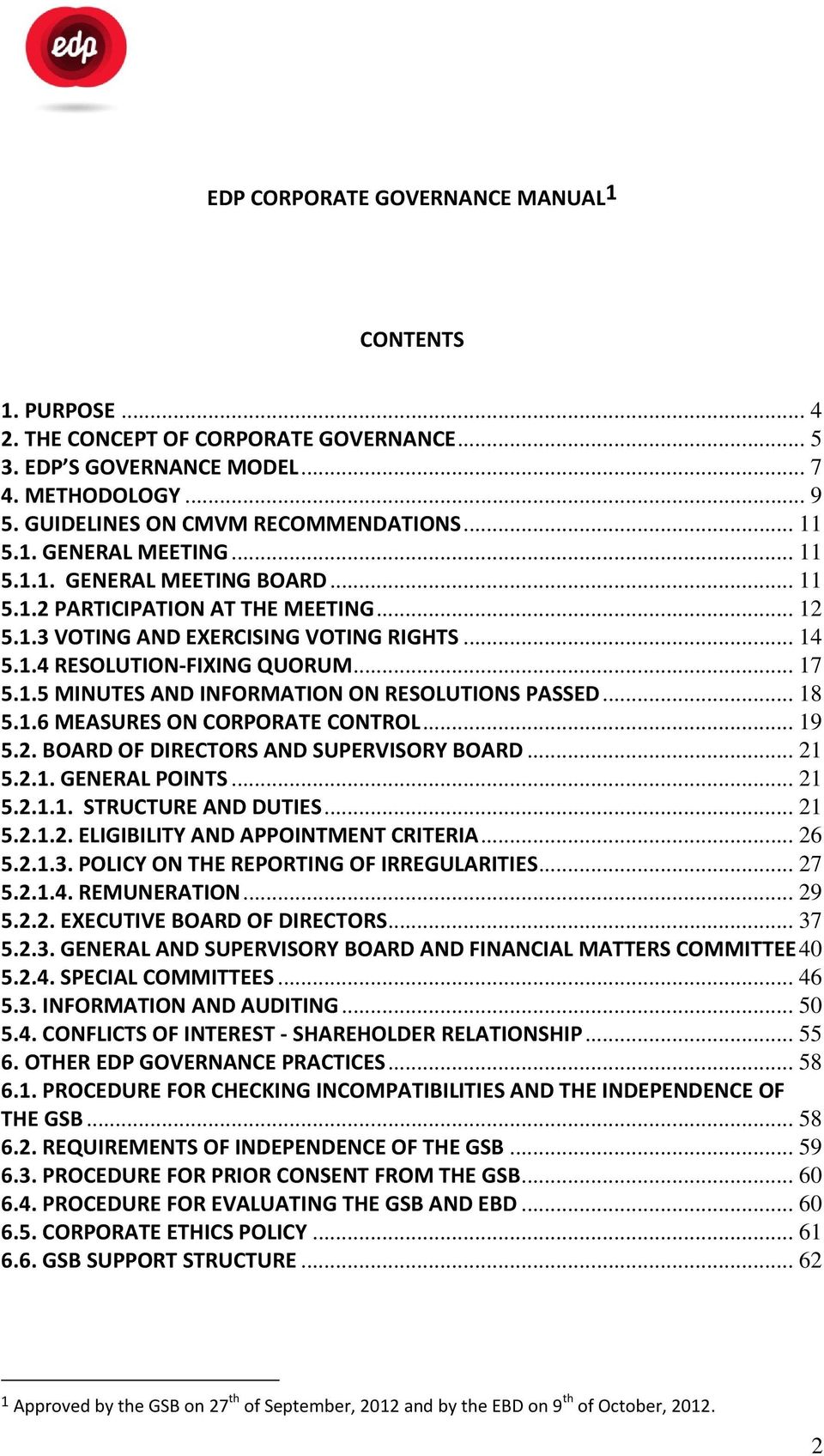
2 EDP CORPORATE GOVERNANCE MANUAL1 CONTENTS 1. PURPOSE THE CONCEPT OF CORPORATE GOVERNANCE EDP S GOVERNANCE MODEL METHODOLOGY GUIDELINES ON CMVM RECOMMENDATIONS GENERAL MEETING GENERAL MEETING BOARD PARTICIPATION AT THE MEETING VOTING AND EXERCISING VOTING RIGHTS RESOLUTION-FIXING QUORUM MINUTES AND INFORMATION ON RESOLUTIONS PASSED MEASURES ON CORPORATE CONTROL BOARD OF DIRECTORS AND SUPERVISORY BOARD GENERAL POINTS STRUCTURE AND DUTIES ELIGIBILITY AND APPOINTMENT CRITERIA POLICY ON THE REPORTING OF IRREGULARITIES REMUNERATION EXECUTIVE BOARD OF DIRECTORS GENERAL AND SUPERVISORY BOARD AND FINANCIAL MATTERS COMMITTEE SPECIAL COMMITTEES INFORMATION AND AUDITING CONFLICTS OF INTEREST - SHAREHOLDER RELATIONSHIP OTHER EDP GOVERNANCE PRACTICES PROCEDURE FOR CHECKING INCOMPATIBILITIES AND THE INDEPENDENCE OF THE GSB REQUIREMENTS OF INDEPENDENCE OF THE GSB PROCEDURE FOR PRIOR CONSENT FROM THE GSB PROCEDURE FOR EVALUATING THE GSB AND EBD CORPORATE ETHICS POLICY GSB SUPPORT STRUCTURE Approved by the GSB on 27 th of September, 2012 and by the EBD on 9 th of October,
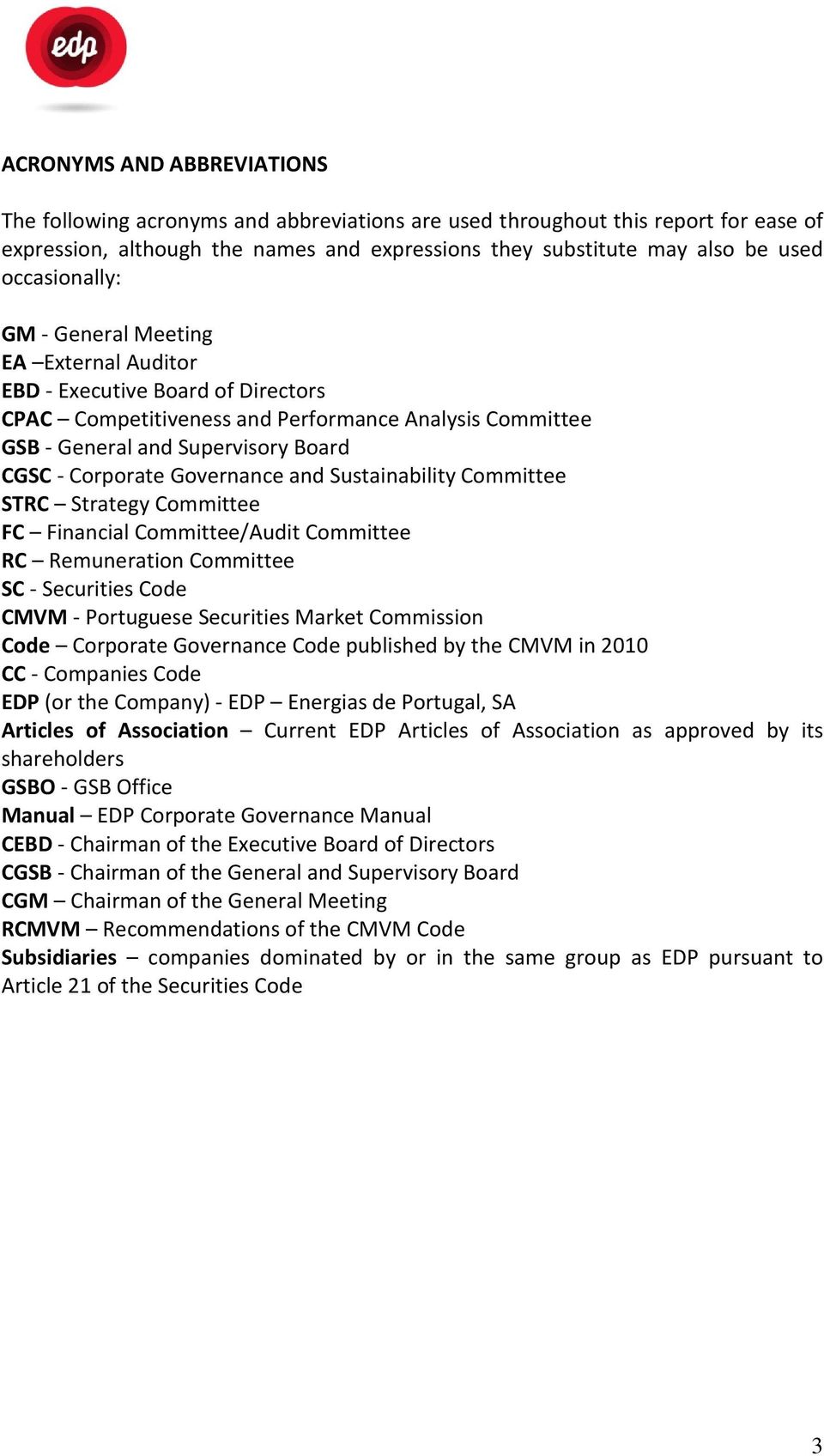
3 ACRONYMS AND ABBREVIATIONS The following acronyms and abbreviations are used throughout this report for ease of expression, although the names and expressions they substitute may also be used occasionally: GM - General Meeting EA External Auditor EBD - Executive Board of Directors CPAC Competitiveness and Performance Analysis Committee GSB - General and Supervisory Board CGSC - Corporate Governance and Sustainability Committee STRC Strategy Committee FC Financial Committee/Audit Committee RC Remuneration Committee SC - Securities Code CMVM - Portuguese Securities Market Commission Code Corporate Governance Code published by the CMVM in 2010 CC - Companies Code EDP (or the Company) - EDP Energias de Portugal, SA Articles of Association Current EDP Articles of Association as approved by its shareholders GSBO - GSB Office Manual EDP Corporate Governance Manual CEBD - Chairman of the Executive Board of Directors CGSB - Chairman of the General and Supervisory Board CGM Chairman of the General Meeting RCMVM Recommendations of the CMVM Code Subsidiaries companies dominated by or in the same group as EDP pursuant to Article 21 of the Securities Code 3
4 1. PURPOSE Since it took office in 2006, the General and Supervisory Board (GSB) and the Executive Board of Directors (EBD) have jointly sought to promote the development of EDP s governance model and enhance its practices. Based on its experience, the GSB gave to the EBD the job, which it accepted, of drafting an EDP Corporate Governance Manual (Manual) to record the two bodies shared understanding of the recommendations on good corporate governance practices and the appropriate guidelines to adopt with regard to them. In the current legal framework, every year EDP is obliged to issue a report on its governance practices, which must include a statement on its adoption of the recommendations in the CMVM Corporate Governance Code (Code) or of an equivalent code and specify which ones it does not adopt and why. Although it is possible to follow another code of recommendations, in Portugal there is not yet any alternative to that of the CMVM and so EDP will continue to use its Code as a standard. Therefore, the goals of this initiative are as follows: To reflect critically on the best practice recommendations set out in the Code in order to make an active contribution to enhancing practices at EDP To select the recommendations deemed most appropriate to EDP s governance model, with special focus on the measures taken and indicating potential measures to be implemented for full adoption of good practices To identify recommendations that are not appropriate to EDP s interest and give reasons for this position, while indicating other practices that achieve the goals set out in the Code s recommendations but in a different way To help readers of the recommendations to reflect on the best governance practices to be followed at EDP To draft a formal document that will help compliance with reporting obligations on corporate governance practices, such as the annual report required by law To describe EDP s governance practices that are not set out in the Code but achieve the goal shared by the GSB and EBD of developing and furthering the quality of EDP s governance processes. Where the last of these goals is concerned, the intention is to highlight something that is often mentioned but sometimes underestimated in the evaluation of corporate governance. There is no such thing as a perfect, universal corporate governance model that can be followed in all cases. Within the current legal framework, each company should be free to develop its own governance model in terms of good practices as a corollary of the principle of economic freedom, which points to a company s selfdetermination in the pursuit of its interests. Therefore, in addition to the effort 4

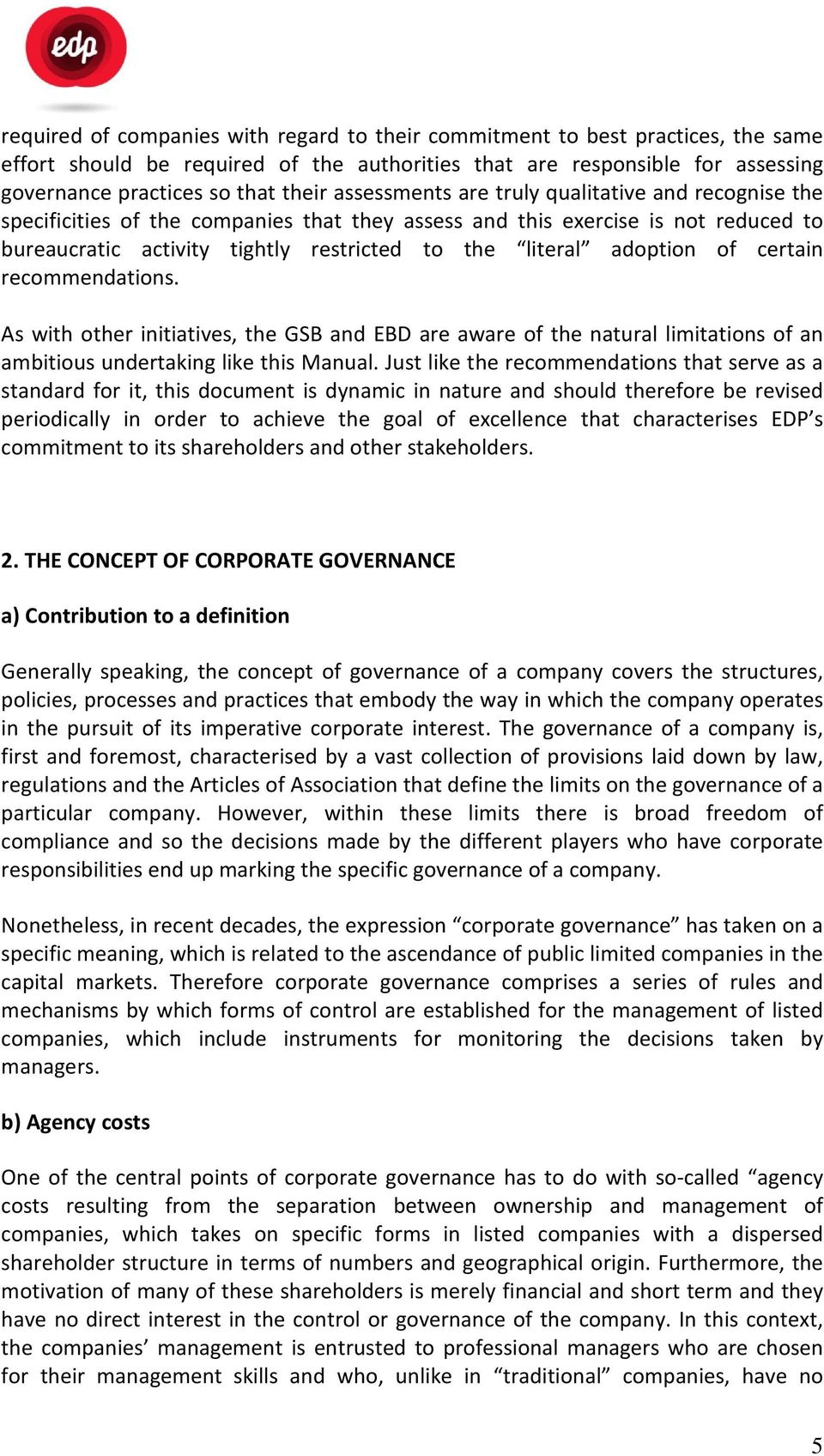
5 required of companies with regard to their commitment to best practices, the same effort should be required of the authorities that are responsible for assessing governance practices so that their assessments are truly qualitative and recognise the specificities of the companies that they assess and this exercise is not reduced to bureaucratic activity tightly restricted to the literal adoption of certain recommendations. As with other initiatives, the GSB and EBD are aware of the natural limitations of an ambitious undertaking like this Manual. Just like the recommendations that serve as a standard for it, this document is dynamic in nature and should therefore be revised periodically in order to achieve the goal of excellence that characterises EDP s commitment to its shareholders and other stakeholders. 2. THE CONCEPT OF CORPORATE GOVERNANCE a) Contribution to a definition Generally speaking, the concept of governance of a company covers the structures, policies, processes and practices that embody the way in which the company operates in the pursuit of its imperative corporate interest. The governance of a company is, first and foremost, characterised by a vast collection of provisions laid down by law, regulations and the Articles of Association that define the limits on the governance of a particular company. However, within these limits there is broad freedom of compliance and so the decisions made by the different players who have corporate responsibilities end up marking the specific governance of a company. Nonetheless, in recent decades, the expression corporate governance has taken on a specific meaning, which is related to the ascendance of public limited companies in the capital markets. Therefore corporate governance comprises a series of rules and mechanisms by which forms of control are established for the management of listed companies, which include instruments for monitoring the decisions taken by managers. b) Agency costs One of the central points of corporate governance has to do with so-called agency costs resulting from the separation between ownership and management of companies, which takes on specific forms in listed companies with a dispersed shareholder structure in terms of numbers and geographical origin. Furthermore, the motivation of many of these shareholders is merely financial and short term and they have no direct interest in the control or governance of the company. In this context, the companies management is entrusted to professional managers who are chosen for their management skills and who, unlike in traditional companies, have no 5
6 significant holding in the company s capital. This results in the separation between ownership and management underlying agency costs, i.e. the cost borne by shareholders for having entrusted managers with the promotion of their interests. The shareholders ability to control the management is very tenuous and may be practically non-existent, and this allows a high degree of discretion on the part of managers when making decisions. Furthermore, the asymmetry of information between managers and shareholders makes it even more difficult for shareholders to learn in good time of any potential or actual conduct harmful to the company s interests. This situation makes the shareholders quite vulnerable to the risk of the company management pursuing its own interests rather than those of the company, thereby increasing agency costs (which may involve significant losses for shareholders). c) Supervision Companies internal supervisory bodies and independent auditors play an essential role in corporate governance as an indispensable complement to the management s discretion. The independence, objectivity and integrity of their work are essential attributes of the effectiveness of their powers. In fact, given the complexity of managing listed companies and the limits and difficulties in monitoring by their shareholders, the requirements for performing (internal or external) supervisory duties must necessarily be high, particularly as a reflection of the fundamental responsibility for the trust of shareholders and investors. d) Public interest Very often, the damage caused by harmful practices in a company goes beyond the interests of the company and its shareholders. Indeed, deficient supervision of companies paves the way for situations in which the management may jeopardise the company s business activity and even bring about its collapse. This affects not only its shareholders but also a large group of stakeholders: creditors, workers, suppliers, etc. Yet more than this, in the case of listed companies, irregularities in the management of a company may jeopardise the regular functioning of capital markets and affect the essential confidence of investors. There is therefore a public interest in the quality of companies governance. e) Recommendations In this context, the will to improve the company s governance mechanisms was confronted with the need to reconcile the demands of legal regulation with the needs for the flexibility and discretion that are typical of management. This led to the movement of companies governance recommendations, which have accompanied the developments in the financial markets in recent decades (such as the Model 6

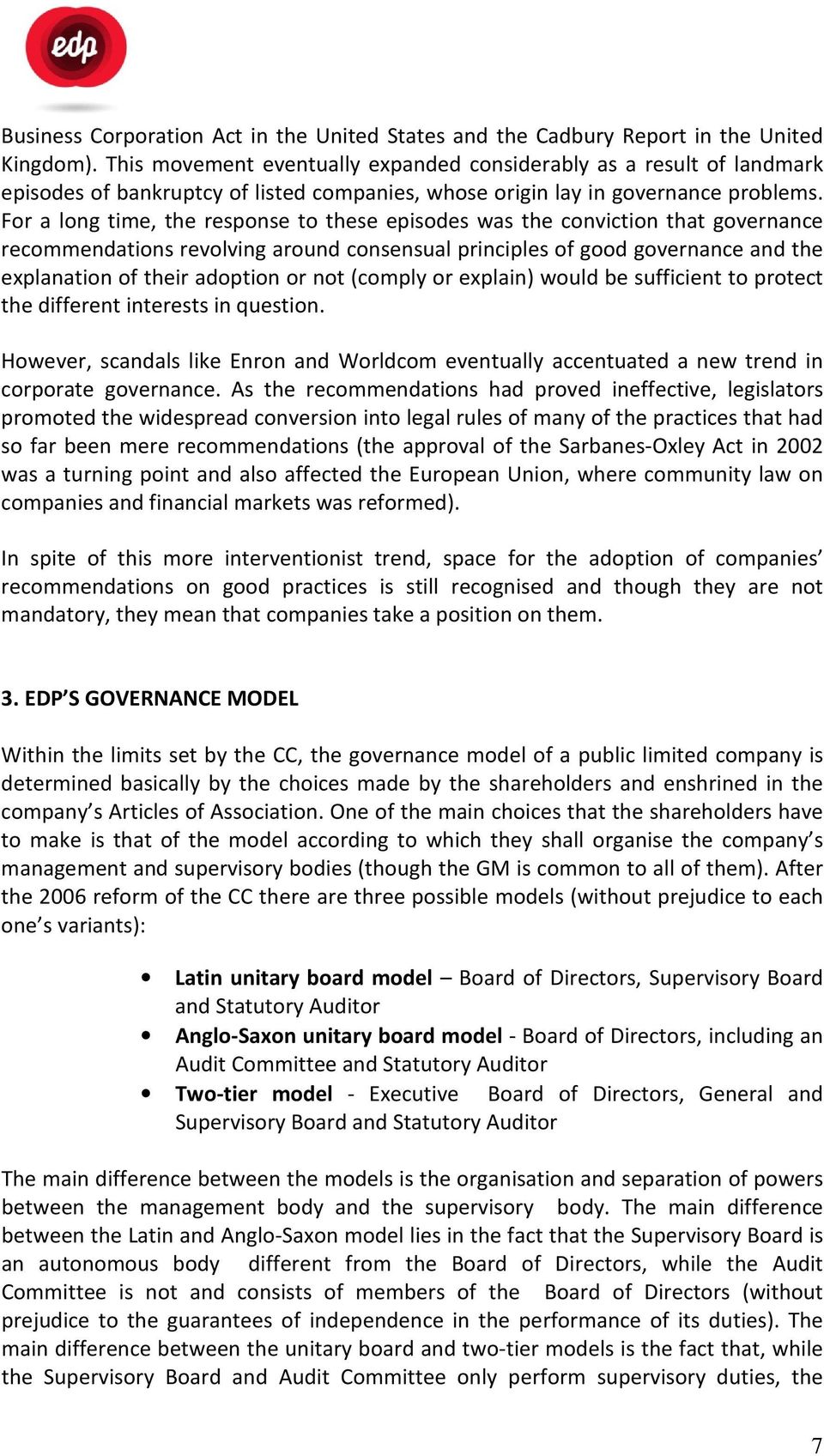
7 Business Corporation Act in the United States and the Cadbury Report in the United Kingdom). This movement eventually expanded considerably as a result of landmark episodes of bankruptcy of listed companies, whose origin lay in governance problems. For a long time, the response to these episodes was the conviction that governance recommendations revolving around consensual principles of good governance and the explanation of their adoption or not (comply or explain) would be sufficient to protect the different interests in question. However, scandals like Enron and Worldcom eventually accentuated a new trend in corporate governance. As the recommendations had proved ineffective, legislators promoted the widespread conversion into legal rules of many of the practices that had so far been mere recommendations (the approval of the Sarbanes-Oxley Act in 2002 was a turning point and also affected the European Union, where community law on companies and financial markets was reformed). In spite of this more interventionist trend, space for the adoption of companies recommendations on good practices is still recognised and though they are not mandatory, they mean that companies take a position on them. 3. EDP S GOVERNANCE MODEL Within the limits set by the CC, the governance model of a public limited company is determined basically by the choices made by the shareholders and enshrined in the company s Articles of Association. One of the main choices that the shareholders have to make is that of the model according to which they shall organise the company s management and supervisory bodies (though the GM is common to all of them). After the 2006 reform of the CC there are three possible models (without prejudice to each one s variants): Latin unitary board model Board of Directors, Supervisory Board and Statutory Auditor Anglo-Saxon unitary board model - Board of Directors, including an Audit Committee and Statutory Auditor Two-tier model - Executive Board of Directors, General and Supervisory Board and Statutory Auditor The main difference between the models is the organisation and separation of powers between the management body and the supervisory body. The main difference between the Latin and Anglo-Saxon model lies in the fact that the Supervisory Board is an autonomous body different from the Board of Directors, while the Audit Committee is not and consists of members of the Board of Directors (without prejudice to the guarantees of independence in the performance of its duties). The main difference between the unitary board and two-tier models is the fact that, while the Supervisory Board and Audit Committee only perform supervisory duties, the 7
8 General and Supervisory Board may be required for to give its previous approval for certain acts to be performed by the Executive Board of Directors. Furthermore, the General and Supervisory Board must set up a Financial Committee specifically devoted to certain of its supervisory duties (not to be confused with the Audit Committee in the Anglo-Saxon unitary board model). On 30 March 2006, in order to improve the quality of the company s governance practices, EDP s shareholders decided to relinquish the one-tier governance model that had been in effect until then and adopted the two-tier model in the Articles of Association, thus enhancing the maximisation of synergies resulting from the division of powers within the company, i.e. management, supervision and auditing of accounts. This fundamental option is essential in understanding the current governance model at EDP 2 and the commitment to developing best governance practices by the GSB and EBD. In addition, the shareholders took advantage of the leeway recognised by the CC to define some specificities which are important for understanding EDP s governance model: As with the other corporate bodies, the EBD is elected by the GM and not the GSB (Article 11(2)(b) of the Articles of Association). The GSB may propose to the GM the dismissal of any member of the EBD and of the Statutory Auditor (Article 11(2)(b) and 22(1)(e) of the Articles of Association). Approval of the strategic plan and the performance of certain operations by EDP or subsidiaries require a prior opinion from the GSB (Article 17(2) of the Articles of Association). The remuneration of the EBD is fixed by a Remuneration Committee appointed by the GSB, while that of the other corporate bodies is fixed by a Remuneration Committee elected by the GM (Article 11(2)(d) and Article 27(1) of the Articles of Association). The GSB has the power to select and replace EDP s EA and instruct the EBD to hire and release it (Article 22(1)(q) of the Articles of Association). There is an Environment and Sustainability Board elected by the GM, which answers to the EBD and has advisory functions in the definition of the company s environment and sustainability strategy (Article 28 of the Articles of Association). The GSB s specialised committees play an important role in its overall activity: Financial Committee / Audit Committee its existence is required by law and it is devoted to the supervision of financial information 2 As mentioned in Chapter 4 Methods, the adoption of the two-tier governance model affects the CMVM recommendations applicable to EDP. 8
9 and permanent monitoring of the work of the EA, internal auditor and internal control systems (Article 444(2) et seq of the CC and Article 23(2) of the Articles of Association). Remuneration Committee its existence is permitted by law and it is enshrined in the Articles of Association. It is responsible for fixing the remuneration of the Chairman and other members of the EBD (Article 27 of the Articles of Association). Corporate Governance and Sustainability Committee although its existence is provided for in the Articles of Association (Article 23(1)), it was appointed on the free initiative of the GSB. It is responsible for functions in the areas of corporate governance and EDP s sustainability. Competitiveness and Performance Analysis Committee committee incorporated under article 23(1) of the Articles of Association, having the purpose of permanently monitor matters related to (i) analysis of the Company s corporate performance, (ii) benchmarking the Company s corporate performance in relation to the sector s leading companies and (iii) assessment of the competitiveness of EDP s business portfolio. Strategy Committee committee incorporated under article 23(1) of the Articles of Association, having competences to permanently monitor the following matters: (i) long-term strategies scenarios, (ii) strategy implementation, business planning and respective budgets, (iii) major investments and divestments, (iv) debt and financing, (v) strategic alliances, (vi) evolution of markets and competition and (vii) regulatory issues. For a better understanding of how EDP s corporate governance works, see its Articles of Association and the internal regulations of the EBD, GSB and its committees, which are available on 4. METHODOLOGY In view of the purpose of the Manual, especially the interest in making it particularly practical, it has been drafted on the basis of the Code s structure. However, given that an approach to good governance practices is limited if confined to the adoption or not the CMVM recommendations, another chapter has been added describing an exemplificative selection of other EDP practices that are considered important, although they are not set out in the Code, such as the development of the two-tier governance model. 9
10 Chapter 5 transcribes the text 3 (RCMVM) and addresses the Code recommendations in the following order: Relevant party as the adoption or not of the recommendations depends on the action of different parties, the powers of the different parties involved in the company s governance are identified and explained. Main regulatory sources there is a brief reference to legal and regulatory provisions governing the recommendation (a nonexhaustive selection for information purposes only). Interpretation although the CMVM considers that adoption depends on literal compliance with the recommendation, this approach seems reductive. Therefore, in order to explain EDP s position regarding its adoption, it is important to indicate the interpretation of the recommendation, as this may contribute to the future improvement of the recommendations. Comparison as the CMVM recommendations were revised in 2010, they will be compared to the 2007 Corporate Governance Code. EDP practices indication of whether EDP adopts or does not adopt the CMVM recommendations. EDP s guidelines on the basis of whether or not EDP adopts the recommendation, an indication is given of the guidelines considered adequate for implementation of the recommendation or of the grounds for considering that such recommendation is not appropriate to the pursuit of EDP s interests. As mentioned above, Chapter 6 describes some good governance practices at EDP that are not set out in the Code. They are described as follows: EDP (REDP) guidelines a recommendation on good governance practices developed by EDP Main regulatory sources a brief reference to the provisions in the law and Articles of Association on the practice in question EDP practice description of the practice developed by EDP. 3 Given that the Code covers specific recommendations for the different organisation models allowed by law for public limited companies in Portugal, only those applicable to the two-tier model have been taken into account. The following recommendations have therefore not been considered as they are not applicable to the model: II to II.1.2.3; II.1.3.2; II.2.1 to II.2.5 and II

11 5. GUIDELINES ON CMVM RECOMMENDATIONS 5.1. GENERAL MEETING GENERAL MEETING BOARD RCMVM 1. The chairman of the general meeting shall have the human and logistical resources appropriate to his/her needs, considering the company s economic situation Relevant parties: EBD, CGM 1.2. Main regulatory sources: Composition and organisation of the members of the Board of the GM - Article 374 of the CC (general rule: election by the GM for a term of office of no more than four years) Appointment of the Company Secretary - Article 446-A of the CC Rules on independence and incompatibilities applicable to the members of the Board of the GM Article 374-A; 413; 414 and 414-A CC (equal to that applicable to independent members of the supervisory bodies) Organisation and proceedings of the GM Article 375 et seq of the CC 1.3. Interpretation: This recommendation reflects a recurring concern in codes of recommendations on corporate governance, which is to ensure appropriate, regular proceedings of GMs. Although their powers are limited to a small number of matters, GMs play an important role in a company s scope of activity (approval of accounts, appropriation of profits, election and evaluation of the corporate bodies, etc). The CGM s role is essential, in that s/he presides over the proceedings and is called upon to make important decisions on the organisation and functioning of the GM (publication of the notice to convene, acceptance of additions to the agenda, acceptance of motions and organisation of the debate). The CGM acts as arbiter, which requires a high degree of independence and objectivity. There are special rules on the independence of the members of the Board of the GM for the case of companies with shares quoted on a regulated market, (Article 374-A of the CC). In this context, it is important for the CGM to have access to appropriate resources to be able to do his/her job effectively and independently Comparison: Wording the same as the previous version EDP practices: Adopted. Appropriate internal and external human and logistical resources are made available for organisation and functioning needs of the GM identified by the CGM and these resources are managed under his/her supervision. 11

12 1.6. EDP guidelines: In addition to adopting the recommendation: a) The CGM should have the appropriate internal resources for the regular organisation and functioning of the GM. b) When necessary, the CGM should be able to ask the EBD to hire external services. c) On matters that may involve a potential conflict of interest between shareholders or between them and the company, and if it is necessary to use technical support, the CGM must hire services that favour the independence and objectivity of the decision with regard to the parties involved. RCMVM 2. The remuneration of the chairman of the general meeting must be disclosed in the annual corporate governance report Relevant party: EBD 2.2. Main regulatory sources: The remuneration of the members of the Board of the GM must consist of a fixed amount Article 374-A of the CC The remuneration of the CGM must be published in the company s governance report - CMVM Regulation 1/2010, Annex I (1)(3) Interpretation: The disclosure of the CGM s remuneration is mandatory by force of CMVM Regulation 1/ Comparison: Wording the same as the previous version EDP practices: Adopted. EDP discloses not only the remuneration of the chairman but also of the vice-chairman of the Board of the GM (though as, pursuant to the Articles of Association, the CGM is a member of the GSB, s/he is only remunerated in this capacity) EDP guidelines: Besides adopting the recommendation (which contents are actually mandatory), the information on this remuneration should be complemented by the disclosure of the criteria used for fixing it PARTICIPATION AT THE MEETING RCMVM 3. The time limit for the officers of the GM to receive statements on the deposit or blocking of shares for participation in the general meeting should not be more than five business days. 12

13 3.1. Relevant party: Shareholders 3.2. Main regulatory sources: Prohibition of the requirement to deposit or block shares Article 23- C(2) of the SC Rules on shareholders exercising their right to participate in the GM Article 23-C of the SC; Article 379 et seq of the CC 3.3. Interpretation: The recommendation no longer makes sense, as Decree-Law 49/2010 forbids the requirement to block shares for a certain period before the GM as a condition for participating in it. The new Article 23-C of the SC introduced the concept of the date of registration as a condition for participating in the GM and has defined the procedures which are necessary for participating in the GM Comparison: Wording the same as the previous version EDP practices: Adopted. Pursuant to the Articles of Association (Article 11(10)), EDP has adopted the recommendation. The time limit required by EDP s Articles of Association is five days (Article 14 EDP s Articles of Association) EDP guidelines: Given the change in the law, this recommendation no longer makes sense, and in case it is not eliminated, it should not be adopted by EDP. RCMVM 4. In the event of suspension of the general meeting, the company shall not require blocking for the entire period until the session is resumed and the time limit shall be the same as for the first session Relevant parties: Shareholders, CGM 4.2. Main regulatory sources: Suspension of proceedings of the GM Article 387 of the CC Prohibition of the requirement to deposit or block shares Article 23- C(2) of the SC 4.3. Interpretation: Even before publication of Decree-Law 49/2010, in the event of suspension of the GM, the best interpretation of the law was understood to be the same as the recommendation, i.e. that it should not be compulsory to block shares until the session was resumed and the time limit for the first session 13
14 should be sufficient. Decree-Law 49/2010 now forbids the requirement to block shares and so the recommendation no longer makes sense Comparison: Wording the same as the previous version EDP practices: Adopted. The principle of the recommendation has been expressly included in the GM notice EDP guidelines: Given the change in the law, this recommendation no longer makes sense and so under no circumstances will the right to participate in the GM be subject to blocking of shares VOTING AND EXERCISING VOTING RIGHTS RCMVM 5. Companies articles of association shall not provide for any restrictions on postal votes and, when adopted and admissible, votes Relevant parties: Shareholders, CGM 5.2. Main regulatory sources: The possibility of the Articles of Association restricting postal votes (except for amendments to the Articles of Association and election of members of the corporate bodies) Article 22(2) of the SC Need for the company to verify the authenticity of postal votes and ensure their confidentiality until the vote is taken Article 22(4) of the SC Possibility of the form of vote being determined by the Articles of Association, or by decision of the shareholders or the CGM Article 384(8) of the CC Regulation of votes by correspondence (when allowed) Article 384(9) of the CC 5.3. Interpretation: International recommendations tend to encourage shareholders to participate in GMs in person or remotely (e.g. OECD recommendations). This recommendation therefore aims to protect shareholders rights by extending the range of possibilities of participating in GMs (by exercising their voting rights). This right was reinforced by Decree-Law 49/2010 (transposing Directive 2007/36/EC). Some interpretative notes are however in order as the concept of restrictions by the Articles of Association" is vague. Restrictions on postal votes that obviously do not apply to voting in person should naturally not be covered. Directive 2007/36/EC allows provisions for checking the identity and security of communications. It also allows rules aimed at ensuring that the results of the voting reflect the intentions of the shareholders in all circumstances, including rules aimed at addressing situations 14
15 where new circumstances occur or are revealed after a shareholder has cast his/her vote by correspondence or by electronic means Comparison: The scope of the recommendation has been extended to votes EDP practices: Adopted. The Articles of Association (Article 14(6) and (7)) allow votes by correspondence, including by electronic means EDP guidelines: Besides adopting the recommendation: a) The requirements for voting in person at the GM and for voting by correspondence by post or should be equivalent. b) This equivalence is compatible with measures which are essential to confirm the authenticity of the shareholders identity and their will. RCMVM 6. The time limit for receiving votes by correspondence shall not exceed three business days Relevant parties: Shareholders 6.2. Main regulatory sources: Regulations on votes by correspondence (when allowed) Article 384 (8) and (9) of the CC Information to be given on votes by correspondence in the notice to convene Article 21-B, 21-C and Article 22(3) of the SC and Article 377(5) of the CC 6.3. Interpretation: This is a question of protecting shareholders rights, as they are given the possibility to vote by correspondence and are ensured that their votes are equivalent to votes cast in person. This equivalence needs to be contextualised in light of the actual differences between voting methods. It is therefore necessary to ensure the effectiveness of the processing of votes by correspondence. Although the recommendation does not mention it, it seems reasonable to assume it applies to votes by electronic means Comparison: Wording the same as the previous version 6.5. EDP practices: Adopted. The rules in the Articles of Association govern votes by correspondence as laid down in the recommendation (Article 14(6) and (7) EDP s Articles of Association) EDP guidelines: It is advisable to continue to adopt the recommendation. 15
16 RCMVM 7. Companies shall ensure proportionality between voting rights and shareholders holdings, preferably by stipulating in their Articles of Association that one share corresponds to one vote. Companies do not comply with this proportionality if they: i) have shares with no voting rights; ii) establish that voting rights do not count above a certain number of votes when cast by a single shareholders or by shareholders related to him Relevant parties: Shareholders 7.2. Main regulatory sources: Non mandatory nature of the One share one vote rule (i.e. it may be amended by force of the Articles of Association) Article 384(1) to (5) of the CC Legal limitations on voting rights Articles 384 and 385 of the CC Rules on preference shares with no voting rights Article 341 et seq of the CC 7.3. Interpretation: The first part of the recommendation is based on a principle common to international recommendations on good governance practices that one share should correspond to one vote. In fact, the scope of the principle lies in giving shareholders with fewer shares equal conditions for participating in GMs. The second part of the recommendation, which is presented as a development of this principle, actually causes some perplexity. The existence of limitations on the exercise of voting rights does not necessarily mean an unjustified deviation from the proportionality of voting rights, for example if the restriction applies to all shareholders or groups of shareholders for whom there is a material reason for this limitation (indeed, the law itself establishes limitations on voting rights and prevents shareholders from voting in certain situations Article 384(6) of the CC). On the other hand, the existence of shares with no voting rights should not in itself be considered a bad corporate governance practice, given the importance of preference shares. This interpretation is restricted by the main international recommendations (e.g. OECD, Germany and Spain) which consider that when the one share one vote rule is not followed, the existence of limitations must be identified and such limitations explained by the company Comparison: It was included the part that considers that companies having shares with no voting rights or limitations on voting do not fulfil the proportionality rule EDP practices: Not adopted. EDP s Articles of Association set out that one share corresponds to one vote Article 14(2). However, in view of the limitation 16

17 set out in Article 14(3) of the Articles of Association ( votes pertaining to category A shares cast by a shareholder on his own behalf or in representation of another exceeding 25% of the total votes corresponding to the share capital shall not be considered ), it is necessary to conclude that EDP does not adopt the new CMVM recommendation EDP guidelines: On the basis of the above interpretation, in view of the company s governance requirements, the CMVM recommendation does not necessarily reflect a good practice. The purpose of the proportionality should be assessed in relative rather than absolute terms. Therefore, taking account of the interests covered by the recommendation, EDP s practice should take the following guidelines into consideration: a) Maintain the one share one vote rule in that it increases and encourages shareholders participation in the company s governance. b) Consider the limit set out in Article 14(3) of the Articles of Association as an expression of the shareholders wishes in protecting the company s specific interests (as the above rule in the Articles of Association only prevents the vote in excess of 25% of all votes corresponding to the share capital) RESOLUTION-FIXING QUORUM RCMVM 8. Companies shall not fix a deliberative quorum greater than that set out in the law Relevant parties: Shareholders 8.2. Main regulatory sources: Rules on the constitutive quorum at the GM (with the possibility to be amended by the Articles of Association) Article 383 of the CC Rules on the deliberative quorum and vote count (with the possibility to be amended by the Articles of Association) Article 386 of the CC 8.3. Interpretation: The recommendation is based on the principle that it is necessary to avoid deliberative quorum solutions that impose unjustified limits on ascertaining the shareholders will. This does not mean that limitations to this principle cannot be admitted, as the law imperatively sets out some exceptions (e.g. Article 383(2) of the CC). Therefore, although the recommendation is accepted, it is necessary to say that it should allow some flexibility and recognise the possibility of setting a deliberative quorum greater than the one set out in the law, provided that it is duly justified by the protection of specific interests of the company. Indeed, the recommendation, as drafted, actually denies the 17

18 freedom granted by the CC, which allows shareholders to fix a deliberative quorum greater than the legal one Comparison: Wording the same as the previous version EDP practices: Adopted. The deliberative quorum required by the Articles of Association is not higher than that required by law EDP guidelines: Continue to adopt the recommendation MINUTES AND INFORMATION ON RESOLUTIONS PASSED RCMVM 9. Extracts of the minutes of the general meetings or documents with a similar content shall be made available to shareholders on the company s website within five days of the meeting, even if they do not constitute privileged information. The information provided shall include decisions made, the share capital represented and the results of votes. This information shall remain on the company s website for at least three years Relevant parties: CGM, EBD 9.2. Main regulatory sources: Drafting of the minutes and signing by the CGM and the Company Secretary (possibility of being submitted for the GM s approval) Article 388 of the CC Rules on drafting and approving minutes Article 63 of the CC Limitation regarding persons who can attend the GM (besides shareholders and corporate bodies) Article 379 of the CC Drafting, signing and filing of the attendance list (access limited to shareholders) Article 382 of the CC Shareholders right to information on minutes (requirement that they own at least 1% of the share capital) Article 288(1)(b) of the CC Additional requirements on the drafting of the minutes and the obligation to disclose information to shareholders and anyone having the right to participate and vote in the GM Article 23-D of the SC 9.3. Interpretation: Under the law, minutes play a fundamental role, as they record the shareholders decisions Comparison: Publication of minutes in full and the attendance list is no longer recommended EDP practices: Adopted. EDP publishes the information set out in the recommendation within the established time limit. 18

19 9.6. EDP guidelines: Besides adopting the recommendation and with the aim to develop it: a) The information provided on the GM and particularly the extract from the minutes should be written in Portuguese and English. b) The extract of the minutes published must be sufficiently clear to ensure that the sense of the shareholders decision is understandable and include any statements of vote by shareholders MEASURES ON CORPORATE CONTROL RCMVM 10. Any measures adopted to prevent takeovers must respect the interests of the company and its shareholders. Companies Articles of Association that respect this principle and limit the number of votes that can be held or cast by a single shareholder individually or with other shareholders must also set out that, at least every five years, the alteration or maintenance of this provision must be subject to a decision by the general meeting without any requirements for a higher quorum than that established by law and that all the votes cast in this decision must be counted without the limitation being imposed Relevant parties: Shareholders, EBD and GSB Main regulatory sources: Obligations of the Board of Directors after learning of a takeover bid (prohibition of actions likely to relevantly alter the company s assets and that may significantly affect the goals announced by the offeror) Articles 181 and 182 of the SC Rules defensive measures in a takeover situation (measures that companies can adopt, suspension of their effect, inapplicability of suspension if a Member State owns securities in the company giving its special rights) Article 182-A of the SC Interpretation: In terms control measures, such as obstruction of takeover bids, there is a trend towards recommending their elimination (OECD). However, the way of dealing with the question of limits imposed on voting rights have no parallel in international recommendations. It does not seem correct to identify limitations on voting rights as measures taken to prevent successful takeover bids. As it is recognised that there are measures taken to prevent successful takeover bids that may respect the interests of the company and its shareholders. This justification seems more relevant than abstractly subjecting limitation of voting rights to sui generis rules, which may not respect the interests of the company or its shareholders. On the other hand, the obligation to confirm the clause in the Articles of Association every five years is of dubious legality, as this, apparently, would 19

20 permit a change in the Articles of Association by a minority (as opposed to the requirement for approval by 2/3). It is important to recall that Directive 2004/25/EC on takeover bids (and the legislation transposing it into Portuguese law) did not consider solutions aimed at the generic elimination of limitations on voting rights in the Articles of Association. The Directive recognised that only after a significant percentage of shareholder control of a listed company had been reached following a takeover bid, there is the right to eliminate those restrictions on voting rights Comparison: The part considering that companies that have shares that do not grant voting rights or that impose limitations on their exercise do not comply with proportionality has been added EDP practices: Not adopted. EDP s Articles of Association limit voting rights (Article 14), without setting out rules similar to those in the recommendation EDP guidelines: Although we consider it to be good practice the absence of measures that may interfere unjustifiably in the success of a takeover bid, we do not agree with the CMVM recommendation in that it is does not seem reasonable to connect the principle mentioned with the issue of the existence of voting mechanisms (which is, indeed, dealt with in another recommendation). Therefore, the interests of EDP s shareholders reflected by the limitation set out in Article 14 of the Articles of Association justify the non-adoption of the recommendation. Furthermore, in terms of company control measures, we believe that: a) In the event of a takeover bid, the EBD and GSB should analyse the bid in light of the company s interests. b) The position to be taken by the EBD will be subject to prior approval by the GSB. c) The EBD and GSB should avoid taking any measures or positions that may unwarrantedly pose an obstacle to proper consideration of the takeover bid by the shareholders. RCMVM 11. No defensive measures should be taken that automatically cause serious erosion of the company s assets in the event of a transfer of control or a change in the membership of the Board of Directors thereby prejudicing the free transferability of shares and free appreciation by the shareholders of the performance of the members of the Board of Directors Relevant parties: shareholders, EBD, GSB Main regulatory sources: Limitations on the transfer of shares Article 328 et seq of the CC 20
21 Obligations of the Board of Directors after learning of a takeover bid (prohibition of actions likely to relevantly alter the company s assets not pertaining to the normal management of the company and that may significantly affect the goals announced by the offeror) Articles 181 and 182 of the SC Shareholders assessment of the performance of members of the Board of Directors (any member may be dismissed by decision of the GM at any time) Articles 403 and 430 of the CC (the power to dismiss may invested in the GSB) Interpretation: This recommendation corresponds to a principle widely enshrined in international recommendations on good practices that the right conditions should be created for actual control of the company governance by the market Comparison: Wording the same as the previous version EDP practices: Adopted. There are no known measures that automatically cause a serious erosion in the company s assets in the event of transfer of control or a change in the membership of the Board of Directors thereby prejudicing the free transferability of shares and free appreciation by the shareholders of the performance of the members of the Board of Directors EDP guidelines: In addition to adopting the recommendation, in order to further develop it we consider that: a) In the event of a takeover bid, the EBD and GSB must act in accordance with the company s interests. b) The EBD must not take any measures aiming to cause or resulting in a serious erosion of EDP s assets in the event of transfer of control or a change in the membership of the EBD. c) The EBD and GSB must not accept any agreements with members of the Board of Directors or directors, in the meaning set out in Article 248-B(3) of the SC, that provide for compensation in the event of termination or cessation of the company relationship or employment following a takeover bid BOARD OF DIRECTORS AND SUPERVISORY BOARD GENERAL POINTS STRUCTURE AND DUTIES RCMVM 12. The Board of Directors shall assess the model adopted in its annual corporate governance report, identify any constraints on its operations and propose suitable measures for countering them. 21
22 12.1. Relevant party: EBD Main regulatory sources: Obligation to draft an annual report on the company s governance Article 70(2)(b) of the CC Rules on drafting the annual report on the company s governance Article 245-A of the SC and CMVM Regulation 1/ Interpretation: Irrespective of the remit of each player involved in the governance of the company, it is natural for the Board of Directors and the supervisory body to conduct a yearly evaluation of the governance model adopted, identify any constraints on its operations and propose suitable measures for countering them Comparison: Wording the same as the previous version EDP practices: Adopted. The EBD includes specific information in its governance report in compliance with this recommendation EDP guidelines: In addition to adopting the recommendation, in order to further develop it we consider that: a) Every year, the EBD and GSB must reflect jointly on EDP s governance practices and any measures for improving them. b) In the company s governance report, the EBD must describe and evaluate EDP s governance model and identify the most positive aspects and those with room for improvement. c) The formulation and implementation of measures to overcome any constraints on the good governance of the company should preferably be the result of consensual solutions by the EBD and GSB, with wide support from EDP s shareholders. RCMVM 13. Companies shall set up internal control and risk management systems to safeguard their value and to the benefit of the transparency of their corporate governance so that it is possible to identify and manage risks. These systems must include at least the following components: i) the company s strategic goals in taking on risks, ii) identification of the main risks of its activity and events likely to cause risks, iii) analysis and measurement of the impact and probability of each potential risk, iv) risk management in order to align risks that actually occur with the company s strategic option on risk taking, v) control mechanisms for risk management measures taken and their effectiveness, vi) internal mechanisms for information and communication on the different components of the system and risk alerts, vii) periodic evaluation of the system and introduction of any necessary changes. 22
23 13.1. Relevant parties: shareholders, EBD, GSB Main regulatory sources: Responsibility of the management board for the current management of the company Articles 406 and 431 of the CC Information to be provided in the annual report and company s governance report Article 66 of the CC, Article 245-A of the SC and CMVM Regulation 1/2010, Annex I, II.5 and II Interpretation: One of the critical aspects of introducing appropriate quality standards in a company s management is the integrity and reliability of internal control and risk management systems. It is therefore very important for there to be a solid, efficient control and risk management structure that guarantees integrity in terms of the company s performance and management based on strict principles of transparency and accountability. In particular, the different aspects and areas of company activity in risk management have warranted special attention, especially after some important financial scandals due to deficiencies in risk management and control Comparison: The characteristics of internal control and risk management systems are now specified in detail EDP practices: Adopted. EDP has internal control and risk management systems that comply with the recommendation EDP guidelines: In addition to adopting the recommendation, in order to further develop it we consider that: a) The company s strategic goals with regard to risk should be assessed by the GSB after proposal by the EBD during the discussion of the company s business plan. b) The EBD must make constant efforts to improve internal control and risk management systems, assess their efficacy and take any measures appropriate to step up quality guarantee levels. c) Periodically, the EBD must report to the GSB on the identification and evolution of the main risks associated with EDP s activity and quantify the impact and likelihood of the risks considered relevant. d) The GSB must delegate to the FC its duties of monitoring internal control and risk management systems. RCMVM 14. The Board of Directors shall ensure the creation and operation of internal control and risk management systems and the supervisory body shall be 23
24 responsible for evaluating the systems and proposing adjustments to the company s needs Relevant parties: shareholders, EBD, GSB Main regulatory sources: Responsibility of the management board for the current management of the company Article 406 and 431 of the CC Responsibility of the GSB to oversee the internal control, risk management and internal audit systems Article 441(1) of the CC Delegation of the GSB s duties to the FC Article 444(2) of the CC Interpretation: This recommendation is intrinsically related to the previous one and merely clarifies the division of powers between the management board and the supervisory body in terms of setting up and operating internal control and risk management systems Comparison: New recommendation EDP practices: Adopted. In general, the organisation of powers in the Articles of Association and EDP s practices are in accordance with the recommendation EDP guidelines: In addition to adopting the recommendation, in order to further develop it we consider that: a) The EBD must pay particular attention to the company s internal control and risk management systems. b) The EBD must provide the GSB with the necessary information for monitoring internal control and risk management systems and assessing their efficacy and efficiency. c) At least once a year, the GSB must assess the efficacy and efficiency of control and risk management mechanisms and propose appropriate measures to the EBD to reinforce their quality. RCMVM 15. In their annual corporate governance reports, companies shall: i) identify the main economic, financial and legal risks to which the company is exposed, ii) describe the operation and efficacy of the risk management system Relevant parties: EBD and GSB Main regulatory sources: Rules on the drafting of the annual corporate governance report Article 245-A(1)(m) of the SC and CMVM Regulation 1/2010. Annex I, II.5 and II.6 24
25 Rules on the drafting of the annual report Article 66(1) and Article 66(5)(h) of the CC GSB opinion on compliance of corporate governance report Article 441(2) of the CC Interpretation: Following the position taken with regard to the previous recommendations, we recognise the importance of giving information on the matters set out in the recommendation. However, it is actually redundant, due to legal obligations to report this type of information in the annual report (Articles 66 and 508-C of the CC) Comparison: New recommendation EDP practices: Adopted. EDP s annual report contains the information indicated in the recommendation EDP guidelines: In addition to adopting the recommendation, in order to further develop it we consider that: a) In its annual corporate governance report, the EBD must provide adequate, appropriate information for a proper understanding of the main economic, financial and legal risks to which EDP is exposed in the carrying out of its activities and the operation and efficacy of its risk management system. b) In its opinion on the annual report, the GSB must pass on its opinion on the information provided by the EBD pursuant to the previous point. RCMVM 16. The management and supervisory bodies must have regulations on how they operate, which should be published in the company s website Relevant parties: EBD and GSB Main regulatory sources: Permanent information to be provided by the company on its website (not including internal regulations) Article 5 of CMVM Regulation 1/2010. Shareholders rights to information (not including internal regulations) Article 288 et seq of the CC Need to mention whether or not the internal regulations are included in the company s governance report - CMVM Regulation 1/2010, Annex I, II Interpretation: This recommendation is also found in some international recommendations and is due to the importance of reinforcing transparency on the organisation and operation of the bodies and other internal structures 25
26 involved in the company s governance (specialised committees). While governance practices in a company go far beyond compliance with internal rules on organisation and operation, it is also true that these rules act as guidelines for proper performance of supervisory and management duties. Publication of the regulations allows interested parties to assess the aptness of the solutions adopted when the corporate bodies perform the duties entrusted to them by law and the Articles of Association Comparison: Wording the same as the previous version EDP practices: Adopted. The regulations are available on the EDP website EDP guidelines: In addition to adopting the recommendation, in order to further develop it we consider that: a) The regulations on how the EBD, GSB and their specialised committees function must be posted on the EDP website. b) Other regulatory documents should also be published if considered relevant for an understanding of EDP s governance model and practices (e.g. code of ethics, rules on conflicts of interest, rules on incompatibility and independence, etc). c) The documents mentioned in the previous point must be published in Portuguese and English ELIGIBILITY AND APPOINTMENT CRITERIA RCMVM 17. Depending on the applicable model, the chairman of the Supervisory Board, Audit Committee or financial committee must be independent and have the appropriate skills for his/her job Relevant party: GSB Main regulatory sources: Two-tier governance structure (EBD, GSB and Statutory Auditor) Article 278 of the CC Need for the GSB to set up a committee on financial matters (specifically for certain supervisory duties) Article 444(2) of the CC Rules of incompatibilities applicable to members of the GSB (there are additional incompatibilities for FC members) Article 434(4) and Article 414-A of the CC Obligation for the majority of the members of the GSB and FC to be independent Articles 434(4), 414 and 444(6) of the CC Need for the FC to include at least one member who is independent and has an appropriate degree for his/her job and knowledge of auditing or accounting Article 444(5) of the CC 26
27 Identification of the members of the GSB in the corporate governance report and statement of the rules on incompatibilities and independence - CMVM Regulation 1/2010, Annex I, II.25 and II Interpretation: In international recommendations there is a general tendency for the Audit Committee (or similar body) to consist of a majority of independent members and preferably for all its members to be independent. For example, Recommendation 2005/162/EC only requires that the majority of the members of the Audit Committee are independent. In spite of the difficulties involving the concept of independent, it is recognised as having a symbolic, formal value that strengthens the material independence required of all members of the management and supervisory bodies (Article 64 of the CC). However, as shown by compared experience and Recommendation 2005/162/EC, another solution would be acceptable, provided that the majority of the members were independent (which is required by law in Portugal for companies with shares admitted to trading on a regulated market). Attention must be paid to the importance of ensuring the real independence of the FC (and its chairman in particular), so that it can properly perform the duties that the GSB must delegate to it, under the law Comparison: Wording the same as the previous version EDP practices: Adopted. The Chairman of the FC meets the recommendation s requirements EDP guidelines: Although EDP s Articles of Association allow the chairman of the FC to be a non-independent member, it is considered important to continue to abide by this recommendation POLICY ON THE REPORTING OF IRREGULARITIES RCMVM 18. The company shall adopt a whistleblowing policy for alleged irregularities with the following elements: i) the means by which whistleblowing reports can be made within the company, including the people qualified to receive them; ii) the treatment to be given to reports, including confidentiality if the whistleblower so requires Relevant parties: GSB; EBD Main regulatory sources: Power of the GSB to receive whistleblowing reports submitted by shareholders, company employees or others Article 441(1. j) of the CC Delegation of the receipt of whistleblowing reports to the FC Article 444(2) of the CC 27
28 18.3. Interpretation: The recommendation follows an international guideline on good practices with the promotion of a whistleblowing mechanism. Its main purpose is the existence of a confidential, protected communication channel for reporting irregularities likely to affect the regularity of the company s operations. The mechanism is intended to encourage early identification of irregularities by the different players involved in the company s activity (members of corporate bodies, employees, suppliers and customers). In order to ensure that it works properly, the mechanism must guarantee the anonymity and confidentiality of whistleblowing reports and especially provide real guarantees of the prohibition and prevention of reprisals against whistleblowers. The person responsible for receiving and handling these reports must have the independence necessary so that potential whistleblowers are not reluctant to submit their reports for fear of possible retaliation Comparison: Wording the same as the previous version EDP practices: Adopted. EDP s whistleblowing policy complies with the requirements in the recommendation EDP guidelines: In addition to adopting the recommendation, in order to further develop it we consider that: a) Without prejudice to the delegation of duties to the FC, the GSB must define EDP s whistleblowing policy and approve its rules on the basis of the principles set out in the recommendation. b) The EBD must provide all the necessary cooperation for the implementation and operation of the whistleblowing mechanism. c) The FC must ensure that the whistleblowing mechanism works properly and take all necessary steps for the correct handling of reports received. d) Periodically, the FC must inform the GSB of the operation of the whistleblowing mechanism and describe any constraints or difficulties that is has experienced. e) Every year, the GSB must assess the effectiveness of the whistleblowing mechanism and change the applicable rules whenever appropriate. RCMVM 19. The general lines of this policy must be indicated in the corporate governance report Relevant parties: GSB, EBD Main regulatory sources: Power of the GSB to receive whistleblowing reports from shareholders, company employees or others Article 441(1.j) of the CC 28
29 Delegation of the job of receiving whistleblowing reports to the FC Article 444(2) of the CC Provision of information on the company s whistleblowing policy in the corporate governance report - CMVM Regulation 1/2010, Annex I, II Interpretation: As a corollary of the previous recommendation, information on the policy, such as the whistleblowing mechanism s rules and guarantees, must be given. However, this recommendation is very similar to the requirement in CMVM Regulation 1/2010 (point II.35). From the point of view of good practices, taking account of the scope of publication, it is important for there to be a recommendation promoting the wide dissemination of this policy (and the whistleblowing mechanism) to all interested parties. Given the institutional, statistical nature of the corporate governance report, it is perhaps not the most effective or efficient means of disseminating this information Comparison: Wording the same as the previous version EDP practices: Adopted. EDP s whistleblowing policy is described in its annual corporate governance report EDP guidelines: In addition to adopting the recommendation, in order to further develop it we consider that: a) The EBD must describe EDP s whistleblowing policy in its corporate governance report along with the main rules governing the mechanism. b) The EBD must also publish the same information on EDP s website and intranet and provide them with a communication channel that can be used by any interested parties REMUNERATION RCMVM 20. The remuneration of the members of the Board of Directors must be structured so that their interests are in line with the long-term interests of the company. It must be performance-based and discourage excessive risk-taking. Remunerations shall therefore be structured as follows: (i) The remuneration of executive directors shall include a variable component based on a performance evaluation by the company s competent bodies in accordance with measurable, predetermined criteria that takes account of the company s real growth and wealth actually created for shareholders, its long-term sustainability and risks taken and compliance with the rules on the company s activity. (ii) The variable component of the remuneration shall be generally reasonable in relation to the fixed component and maximum limits shall be fixed for all the components. (iii) A significant part of the variable remuneration shall be deferred for no less than three years and its payment shall be dependent on the company s continued positive performance over 29
30 this period. (iv) The members of the Board of Directors shall not enter into agreements with the company or third parties to mitigate the risks inherent in the variability of the remuneration fixed for them by the company. (v) Until the end of their term of office, the executive directors shall keep the company shares that they have received by force of variable remuneration schemes up to a limit of twice their total annual remuneration, with the exception of those that need to be sold to pay taxes resulting from the benefit of said shares. (vi) If the variable remuneration includes options, the start of the exercise period shall be deferred for no less than three years. (vii) Appropriate legal instruments shall be established so that the compensation fixed for any form of dismissal of a director without just cause is not paid if the dismissal or release by mutual accord is due to inappropriate performance by the director. (viii) The remuneration of the non-executive members of the Board of Directors shall not include any component that depends on the performance or value of the company Relevant party: GSB Remuneration Committee Main regulatory sources: Obligation of the GM to approve a statement on remuneration policy of the management and supervisory bodies every year Article 2(1) of Law 28/2009 Power to fix the remuneration of the members of the EBD (GSB or its Remuneration Committee or, if so determined by the Articles of Association, the GM or a committee appointed by it) Article 429 of the CC Power to fix the remuneration of the members of the GSB (GM or a committee appointed by it Article 440 of the CC Power to fix the remuneration of the Statutory Auditor (GM or a committee appointed by it) Article 422-A of the CC (ex vi 446 of the CC) The remuneration of the members of the EBD may be fixed or consist partially of a percentage of the profit for the financial year (with authorisation in the Articles of Association) Articles 399 and 429 of the CC The remuneration of the members of the GSB and Statutory Auditor consists exclusively of an invariable amount Articles 440 and 422-A of the CC Criteria for determining the remuneration of the management and supervisory bodies (duties performed and company s economic situation) Articles 339, 422-A, 429 and 440 of the CC Publication in the corporate governance report of a statement on remuneration policy for the members of management and supervisory bodies approved by the GM (and the annual remuneration received by 30
31 the members of these bodies individually and all together) Article 3 of Law 28/2009 and Article 3 of CMVM Regulation 1/2010. Need to submit to the CMVM information on share allocation and/or share purchase option plans for employees Article 4 of CMVM Regulation 1/2010. Information in the corporate governance report on the main characteristics of share allocation and share purchase option plans adopted or in effect - CMVM Regulation 1/2010, Annex I, III.10 Information on the remuneration of the members of the EBD - CMVM Regulation 1/2010, Annex I, III.31 et seq Information on the remuneration of the members of the GSB and Statutory Auditor - CMVM Regulation 1/2010, Annex I, III.31 and Interpretation: The recommendation is inspired by Recommendation 2009/385/EC, which complements Recommendations 2004/913/EC and 2005/162/EC. This recommendation seeks to address a series of concerns raised by the recent financial crisis regarding the remuneration of the management board in general and executive directors in particular. In the different formulas that it may follow, executives remuneration is regarded as an extremely important aspect in the company s governance structure, as it is a question of paying monetary compensation for the performance of the people in charge of managing the company. The return on the shareholders investment depends, at the end of the day, on this performance. Alignment of the interests of shareholders and managers is therefore the ultimate goal of a healthy executive remuneration policy. The fundamental point of the managers remuneration policy should be a demonstration of the relationship between remuneration and the performance of the managers and the company itself within a framework of their strict, objective evaluation, taking special account of the need to ensure an appropriate balance between the company s long-term interests and short-term profits (during the term of office) Comparison: While maintaining the same preamble, the new version of the recommendation enlarges on the parameters for fixing the remunerations of the company s Board of Directors EDP practices: Adopted. The remuneration of EDP s corporate bodies is in line with the recommendation EDP guidelines: In addition to adopting the recommendation, in order to further develop it we consider that: a) The remuneration policy for the members of the EBD must be drafted so as to promote the alignment of their interests with those of EDP, taking account of the duties performed by each member and the company s 31
32 economic situation, and so the adoption of the criteria in the CMVM recommendation must be justified in light of this general principle. b) The criteria for determining remunerations should favour mechanisms that associate them with an individual performance evaluation of each member. c) Clear rules must be defined on compensations for termination of office (with or without just cause) and on payment schemes after said termination. d) Remuneration policy should take account of EDP s specific business, its characteristics and the competitive environment in which it is conducted. e) Remuneration policy should be formulated with a concern for defining stable principles on the establishment of the remuneration of the members of the EBD, irrespective of the people who hold these positions in order to foster the expectations of people who may occupy them in the future. RCMVM 21. The statement on the remuneration policy of the management and supervisory bodies referred to in Article 2 of Law 28/2009 of 19 June shall, in addition to everything mentioned therein, contain sufficient information: i) on which groups of companies whose remuneration policy and practices were used as an example for fixing remuneration; ii) on payments in the event of dismissal or termination by mutual agreement of directors Relevant parties: Remuneration Committee of the GSB and Remuneration Committee of the GM Main regulatory sources: Obligation of the GM to approve a statement on remuneration policy of the management and supervisory bodies every year Article 2(1) of Law 28/2009 Specification of the content of the statement on remuneration policy of the management and supervisory bodies - Article 2(3) of Law 28/ Interpretation: Article 2 of Law 28/2009 changed the traditional scheme of company law for fixing the remuneration of the management and supervisory bodies of the companies covered by it, such as companies with shares admitted to trading on a regulated market. Therefore, pursuant to paragraph 1 of the article every year, the Board of Directors or Remuneration Committee, if any ( ) shall submit for the approval of the General Meeting a statement on remuneration policy of the members of the management and supervisory bodies. Irrespective of the correctness of this legal rule, it is now required that the GM issues an annual approval of a statement on remuneration policy of the members of the management and supervisory bodies that will later govern the subsequent establishment of their remuneration. This statement must provide minimum information necessary to be understood by the shareholders. The 32
33 recommendation therefore merely increases the amount of additional information that must be provided to the shareholders for an understanding of the remuneration policy on which they must express an opinion. As a result, more important than disclosing the information indicated in the law and the recommendation, remuneration committees must be careful to provide all appropriate information for the shareholders to vote on the remuneration policy in an enlightened way Comparison: New recommendation EDP practices: Adopted EDP guidelines: In addition to adopting the recommendation, in order to further develop it we consider that: a) The draft remuneration policy of the management and supervisory bodies must be specifically justified in light of the company s economic situation and the actual duties performed by each of their members. b) In addition to the information requirements set out in the law and recommendation, draft remuneration policies for the management and supervisory bodies must provide appropriate information for a shareholder, in accordance with a standard of diligence of an average person, to be able to understand all materially relevant aspects for the purpose of fixing said remunerations. RCMVM 22. The statement on remuneration policies referred to in Article 2 of Law 28/2009 must also cover the remunerations of directors in meaning set out in Article 248-B(3) of the Securities Code whose remuneration contains a substantial variable component. The statement must be detailed and the policy must take account of the company s long-term performance, compliance with the standards applicable to the company s activity and restraint when taking risks Relevant party: EBD Main regulatory sources: Obligation of the GM to approve a statement on remuneration policy of the management and supervisory bodies every year Article 2(1) of Law 28/2009 Specification of the content of the statement on remuneration policy of the management and supervisory bodies - Article 2(3) of Law 28/2009. Definition of the concept of director (members of the company s management and supervisory bodies and heads who are not members of these bodies but have regular access to privileged information and 33
34 participate in decisions on the company s management and business strategy) Article 248-B(3) of the SC Description in the corporate governance report of the remuneration policy for directors (and other employees whose work may have a relevant impact on a company s risk profile and whose remuneration contains a substantial variable component) - CMVM Regulation 1/2010, Annex I, II Interpretation: Interpretation of this recommendation raises some perplexity as it intends to associate with the rules on approval of remuneration policy of the management and supervisory bodies other directors who are normally company employees and, as such, are subject to remuneration rules in labour law, which is different from company law applicable to management and supervisory bodies. This is a specificity of the CMVM recommendations that has no parallel in international recommendations on good practices (or in Recommendations 2009/385/EC, 2005/162/EC and 2004/913/EC) Comparison: On the one hand, the recommendation was adapted to Law 28/2009. On the other hand, it extended the scope of the law to directors and not only the management and supervisory bodies EDP practices: Adopted. In EDP s organisation, only the members of its management and supervisory bodies qualify as directors EDP guidelines: In addition to adopting the recommendation (as no other directors are identified besides the members of EDP s management and supervisory bodies) and in order to further develop it, we consider that the corporate governance report should include information on the general lines of EDP s remuneration policy for the company s senior managers. RCMVM 23. A proposal for approval of share allocation plans, share purchase option plans and/or plans based on variation in share prices to members of the management and supervisory bodies and other directors in the meaning of Article 248-B(3) of the Securities Code shall be submitted to the general meeting. These proposals shall contain all the information necessary for a proper appraisal of the plans. The proposal must be accompanied by the plan s regulations or, if they have not yet been drafted, the conditions that it must respect. The General Meeting shall approve the main characteristics of the retirement benefit scheme for the members of the management and supervisory bodies and other directors, in meaning of Article 248-B(3) of the Securities Code Relevant parties: Remuneration Committee of the GSB, Remuneration Committee of the GM and EBD. 34
35 23.2. Main regulatory sources: Rules on the purchase and sale of company s own shares (requires a decision by the GM) Article 317 et seq of the CC Need to include in the corporate governance report information on the GM s intervention in the company s remuneration policy, performance evaluation, share allocation plans and retirement benefit plans of the members of the Board of Directors, supervisory body and other directors - CMVM Regulation 1/2010, Annex I, I.16 to 18 Need to send the CMVM information on share allocation plans and/or share purchase option plans for employees Article 4 of CMVM Regulation 1/2010 Provision of information in the corporate governance report on the main characteristics of share allocation plans and share purchase option plans adopted or in effect - CMVM Regulation 1/2010, Annex I, III.10 Disclosure of information on the remuneration of the members of the EBD - CMVM Regulation 1/2010, Annex I, III.31 et seq (particularly III.33(g), (h) and (o)). Disclosure of information on the remuneration of the members of the GSB and Statutory Auditor - CMVM Regulation 1/2010, Annex I, III.31 and Interpretation: This recommendation combines two different things: share allocation plans, share purchase option plans and/or plans based on share price variations and the main characteristics of the retirement benefit scheme. Basically, the former corresponds to the guidelines set out in Recommendations 2004/913/EC and 2009/358/EC, with the exception of the reference to directors. Regarding retirement benefit schemes, Recommendation 2004/913/EC only refers to the need for them to be disclosed. In any case, this recommendation makes no reference to directors. It seems to make more sense to address the issue of share allocation plans and retirement plans in the remuneration policy, which is approved by the shareholders. In fact, as Law 28/2009 includes these elements in the remuneration package of the management and supervisory bodies (when applicable), there does not seem to be any real justification for independent treatment from approval of remuneration policy Comparison: Wording the same as the previous version EDP practices: Not applicable EDP guidelines: As it includes directors and retirement plans, the recommendation does not seem to correspond to best governance practices in this matter (although it is considered adopted because there are no directors 35
36 other than the members of the management and supervisory bodies). We therefore consider it preferable: a) If the draft remuneration policy for the EBD includes share allocation plans, share purchase option plans and/or plans based on variations in share prices, it should contain all the necessary information for a proper evaluation of the plan and be accompanied by the plan s regulations or, if they have not yet been drafted, the conditions to which it is subject. b) If the draft remuneration policy of the EBD or GSB includes retirement benefit plans, it should contain the main information necessary for their appraisal. RCMVM 24. At least one representative of the Remuneration Committee must attend general meetings of shareholders Relevant parties: Remuneration Committee of the GSB, Remuneration Committee of the GM Main regulatory sources: Duty to attend the GM for directors, members of the GSB (and Statutory Auditor at the AGM) Article 379(4) of the CC Need to name in the corporate governance report the representatives of the Remuneration Committee at the GM - CMVM Regulation 1/2010, Annex I, I Interpretation: Given the current rules on establishing the remuneration of companies management and supervisory bodies, the presence at the GM of least one representative is justified to submit the draft remuneration policy and give any explanations that the shareholders consider necessary. However, the recommendation is a little reductive compared to Recommendation 2009/358/EC, which sets out that all the members must attend the GM. Furthermore, the members of the company s management and supervisory bodies have a legal duty to attend the GM Comparison: Wording the same as the previous version EDP practices: Adopted. At least one representative of the GSB and GM Remuneration Committees has always attended EDP s GM EDP guidelines: In addition to adopting the recommendation, in order to further develop it, we consider that all members of EDP s Remuneration Committee should attend GMs. 36
37 RCMVM 25. The annual corporate governance report shall indicate the aggregate and individual remuneration received from other group companies and the pension rights acquired during the financial year in question Relevant party: EBD Main regulatory sources: Obligation to disclose the aggregate and individual remuneration received from other group companies and the pension rights acquired in the financial year in question Article 3(c) and (d) of CMVM Regulation 1/2010. Disclosure of information on the remuneration of the members of the EBD - CMVM Regulation 1/2010, Annex I, III.31 et seq Disclosure of information on the remuneration of members of the GSB and Statutory Auditor - CMVM Regulation 1/2010, Annex I, III.31 and Interpretation: Best governance practices accentuate the importance of transparency of remuneration, with individual disclosure of the amounts involved. Indeed, this transparency is particularly important for scrutiny of the alignment of the interests of the members of the corporate bodies with those of the company. The recommendation will no longer be necessary as of 1 January 2011, which is when the rules set out in Article 3(c) and (d) of CMVM Regulation 1/2010, which require disclosure of the information referred to in the recommendation come into effect Comparison: The wording of the previous recommendation has been simplified and there is no longer a reference to the remuneration received from companies controlled by shareholders owning qualifying holdings. It does, however, require disclosure of pension rights acquired there EDP practices: Adopted. EDP discloses information on remuneration received by members of the EBD and GSB bodies from other group companies and the pension rights acquired there EDP guidelines: While pointing out that disclosure will be mandatory as of 1 January 2011, we consider it important to adopt this recommendation EXECUTIVE BOARD OF DIRECTORS RCMVM 26. When asked to do so by other members of the corporate bodies, executive directors must provide the information requested appropriately and in a timely fashion Relevant parties: EBD, GSB 37
38 26.2. Main regulatory sources: EBD s responsibility for the company s current management Articles 406 and 431 of the CC Need for the EBD to obtain a prior opinion on certain acts (under Articles of Association) Article 431 and 442(1) of the CC GSB s responsibility for supervision and issue of prior opinions Articles 441 and 442 of the CC EBD s duty to inform the GSB Article 432(1) and (2) of the CC Right of the Chairman to ask the EBD for any information that s/he considers appropriate or that is requested by another member of the GSB Article 432(4) of the CC Right of the Chairman of the GSB, a delegate member appointed by the GSB for the purpose and the members of the FC to attend meetings of the EBD Article 432(6) of the CC Duty to pass on information received to the other GSB members Article 432(7) of the CC Interpretation: The performance of their duties by other corporate bodies depends largely on the information managed by the management. In the two-tier governance model, articulation between the EBD and GSB in terms of information is particularly important and warrants the existence of specific legal provisions on the matter. The practices mentioned in the recommendation should therefore be included in laws and regulations governing the company Comparison: Wording the same as the previous version EDP practices: Adopted. Several procedures have been set up for the provision of information by the EBD, especially to the GSB EDP guidelines: In addition to adopting the recommendation, in order to further develop it we consider that: a) There should be permanent contact between the Chairman of the GSB and of the EBD in order to monitor EDP s activity and coordinate the work of the two bodies. b) Supporting documentation for GSB meetings, for which the EBD is responsible, should be provided sufficient time in advance. c) Given the presence of GSB members who do not speak Portuguese, the EBD must endeavour to provide supporting documents in English. d) The GSB should exercise its right to information in a compatible way with the normal functioning of the EBD, and the Chairman of the GSB must coordinate requests for information from the EBD to avoid overlapping and repetitions. e) The Chairman of the GSB shall manage the information from the EBD and have it distributed to the other GSB members in good time. 38
39 RCMVM 27. The chairman of the Executive Board of Directors must send to the chairman of the General and Supervisory Board and of the Financial Committee the invitations and minutes of their meetings Relevant party: Chairman of the EBD Main regulatory sources: EBD s duty to inform the GSB Article 432(1) and (2) of the CC Right of the Chairman to ask the EBD for any information that s/he considers appropriate or that is requested by another member of the GSB Article 432(4) of the CC Right of the Chairman of the GSB, a delegate member appointed by the GSB for the purpose and the members of the FC to attend meetings of the EBD Article 432(6) of the CC Duty to pass on information received to the other GSB members Article 432(7) of the CC Interpretation: This recommendation is an offshoot from the previous recommendation and separates the question of sending invitations and minutes of EBD meetings. As a result of the legal framework mentioned regarding the previous recommendation, the Chairman of the GSB acts as an intermediary between the GSB and EBD, especially for obtaining and distributing information. Given the broad composition of the GSB, this function is critical, as an atomistic approach to the relationship between the GSB and the EBD would be impractical and upset the healthy relationship that should exist between the two bodies. The recommendation should therefore be interpreted in light of the legal framework (Article 432(7) of the CC) Comparison: Wording the same as the previous version EDP practices: Adopted. The Chairman of the EBD sends to the GSB support offices the invitations and minutes of its meetings EDP guidelines: In addition to adopting the recommendation, in order to further develop it we consider that: a) The Chairman of the GSB should be sent the invitations and minutes of EBD meetings in good time. b) Procedures should be developed to provide efficient, feasible access to this information by the Chairman of the FC and other members of the GSB. c) The Chairman of the GSB must oversee the processing of the information provided by the EBD with a view to any subsequent requests for 39
40 information sent to the EBD or prompting of action by the GSB (e.g. prior opinions) GENERAL AND SUPERVISORY BOARD AND FINANCIAL MATTERS COMMITTEE RCMVM 28. In addition to its duties of supervision, the General and Supervisory Board shall also advise, monitor and continuously assess the management of the company by the Executive Board of Directors. The matters on which the General and Supervisory Board shall give opinions include: i) a the company s general strategy and policies, ii) the group s corporate structure and iii) decisions that should be considered strategic due to their amount, risk or special characteristics Relevant parties: shareholders, GSB Main regulatory sources: GSB s supervisory powers Article 441 of the CC Need for the EBD to obtain prior approval from the GSB to perform certain acts Article 442 of the CC Interpretation: As a distinguishing feature of the two-tier corporate governance model, the GSB is the supervisory body of the company s activity (in addition to the statutory auditor). However, its specificity lies in the fact that its powers have a broader reach than those of the supervisory bodies typical of the unitary board model. Therefore, although it does not have management powers, the GSB has recognised, broad powers of supervision and the duty to monitor and advise the EBD. The GSB acts as an intermediary and institutional link between the GM, the body that represents the wishes of the shareholders, and the executive body. This link may be of varying degrees of intensity, depending on whether the GSB has the power: To appoint and dismiss members of the EBD To Issue prior approval of certain operations by the EBD The recommendation is related to this important function of the GSB, which may be modelled by the shareholders in the Articles of Association (Article 442 of the CC). The matters indicated in the recommendation on which the GSB should issue an opinion are in line with those set out in international recommendations on the two-tier model (e.g. Germany and the Netherlands) Comparison: Wording the same as the previous version EDP practices: Adopted. The EBD must request prior approval from the GSB for the matters set out in Article 17(2) of the Articles of Association EDP guidelines: In addition to adopting the recommendation, in order to further develop it we consider that: 40
41 a) The actual implementation of the GSB s powers under the law and Articles of Association requires high performance, diligence and availability from its members. b) It is particularly important to develop mechanisms for strengthening the institutional relationship that, while respecting the different powers of the EBD and GSB, promote broad participation of the GSB in EDP s activity. c) There must be clear, appropriate rules on the prior approval mechanism in order to reconcile flexibility of management by the EBD with the need for the GSB to issue a prior opinion. RCMVM 29. The annual reports on the work of the General and Supervisory Board, Financial Committee, Audit Committee and Supervisory Board shall be published on the company s website along with the accounting documents Relevant party: GSB Main regulatory sources: Need for the GSB to draft an annual report on its activity Article 441(q) of the CC Need for the FC to draft a report on its supervisory activities Article 444(4) of the CC Obligation to publish the accounting documents (including the corporate governance report and GSB s opinion) on the company s website (and at its registered office) Article 70(2) of the CC Obligation to make the accounting documents available on the company s website for five years Article 5 of CMVM Regulation 1/ Interpretation: This recommendation is a corollary of the transparency that should exist in the operations of the corporate bodies in relation to the main stakeholders, i.e. its shareholders. However, the recommendation is limiting in that, in addition to the Financial Committee, the GSB can set up other committees that must also draft and publish annual reports on their activity. On the other hand, as set out in international recommendations for the two-tier model (Germany and the Netherlands), the most appropriate solution seems to be the inclusion of the GSB committee s reports in the GSB s own report, which must be appraised by the GM pursuant to Article 441(q) of the CC. Indeed, this document should serve as the basis for the GM s appraisal of the work of the supervisory body (Article 376(1)(c) of the CC) Comparison: Wording the same as the previous version EDP practices: Adopted. The GSB s annual report on its activity and those of the committees included in this report are published with the accounting documents on the EDP website and remain accessible there for five years. 41
42 29.6. EDP guidelines: In addition to adopting the recommendation, in order to further develop it, we consider that the annual report (to be published on EDP s website) should cover its activity in a broad sense, including the report on the work of its committees. RCMVM 30. The annual reports on the activity of the General and Supervisory Board, Financial Committee, Audit Committee and Supervisory Board shall include a description of the supervision performed and mention any constraints detected Relevant party: GSB Main regulatory sources: Need for the GSB to draft an annual report Article 441( q) of the CC Need for the FC to draft a report on its supervisory work Article 444(4) of the CC Duty of the GSB to attest to the compliance of the corporate governance report with legal requirements and its agreement with the annual report Article 441(2,) of the CC Interpretation: As mentioned in the interpretation of the previous recommendation, the transparency of the work of a supervisory body like the GSB is vital and contributes to make its important duties more effective Comparison: Wording the same as the previous version EDP practices: Adopted. The GSB s report includes a description of its work and that of its specialised committees and assesses any constraints found during this activity EDP guidelines: In addition to adopting the recommendation, in order to further develop it, we consider that the GSB should include an overview and assessment of its activities and those of its committees in its annual report, disclosing in particular: a) The forms and results of its monitoring and supervision of the running of the Company b) The institutional relationship between the GSB and EBD c) The Company s compliance with the corporate governance recommendations that it should take into account in its activity d) Internal procedures for accounting and auditing matters and the efficacy of its risk management, internal control and internal audit systems e) Absence of any incompatibilities and the impartiality of its elected independent members 42
43 f) The main aspects of the EBD remuneration policy defined by the Remuneration Committee. g) An assessment of the work of the Statutory Auditor and EA. h) A brief summary of requests for prior opinions i) Authorisation granted for business between the Company and GSB members j) Implementation of the GSB budget k) The FC s opinion on the Company s annual report and accounts RCMVM 31. The General and Supervisory Board, Audit Committee and Supervisory Board, depending on the applicable model, shall represent the company for all purposes in relations with the External Auditor and shall be responsible for appointing the provider of these services and proposing its remuneration, ensuring that all the right conditions are created in the company for the services and acting as the company s interlocutor and first recipient of its reports Relevant party: GSB Main regulatory sources: Power of the GSB to represent the company in hiring experts to assist in its duties Article 441(1)(p) and Article 443(2) of the CC GSB s powers to relate with the Statutory Auditor Article 441(1)(m) to (o) of the CC Interpretation: The recommendation describes a practice that is mentioned in most international recommendations and is related to the need to ensure the independence of the EA. The requirements of independence and competence of auditors as key elements in the quality of control by external audits has warranted companies supervisory bodies playing a decisive role in hiring, monitoring and evaluating auditors. This trend towards giving supervisory bodies the role of first and privileged interlocutors of external auditors with the company is based on the importance of ensuring their independence and the prevention of practices that foster familiarity between auditors and audited and promoting the involvement of these bodies in the analysis and interpretation of the auditors work product, which serves as the basis for the supervisory body s actual activity (in particular when issuing an opinion on the accounts). In two-tier models, the GSB is responsible for the company s relations with the External Auditor and there is also a recommendation that these matters should be delegated to the FC Comparison: There is no longer any reference to the FC. 43
44 31.5. EDP practices: Adopted. The GSB performs the duties indicated in the recommendation either directly or through the FC EDP guidelines: In addition to adopting the recommendation, in order to further develop it, we consider that: a) Without prejudice to the formal powers of representation of the EBD, the GSB, either directly or through the FC, should represent EDP for all purposes in relations with the EA and should be responsible for appointing the provider of these services, the conditions on which they are provided and its remuneration, and ensure that the right conditions are created at EDP and subsidiaries for its duties. It should also be the interlocutor and first recipient of its audit reports. b) The GSB must work with the EBD and EA in defining the annual plan and timeline of activities for issuing its opinion on the financial statements. RCMVM 32. The General and Supervisory Board, Audit Committee and Supervisory Board, depending on the applicable model, shall evaluate the External Auditor every year and propose its dismissal whenever there is just cause to do so Relevant party: GSB Main regulatory sources: Power of the GSB to represent the company in hiring experts to assist in its duties Article 441(1)(p) and Article 443(2) of the CC Power of the GSB to relate with the Statutory Auditor Article 441(1)(m) to (o) of the CC Interpretation: The recommendation highlights the importance of monitoring and evaluating the work of the EA by the supervisory body. This should result in its dismissal if there is found to be just cause. However, it seems to be necessary to make a corrective interpretation of the recommendation, as the power to appoint and dismiss the EA does not always belong to the GM (unlike the Statutory Auditor). There seems to be no reason to advocate that the dismissal of the EA must depend on the GM. In fact, as the independence of the EA is a critical point and the supervisory bodies are responsible for monitoring this independence, it seems preferable for this decision to be taken by these bodies, which are made up of a majority of independents. Indeed, it does not make much sense to demand independence from these bodies and then subject their decisions on supervision to a majority of 44
45 shareholders (the same objection would arise if it was the GM that elected the EA, which does not seem to be advocated by the CMVM) Comparison: There is no longer any reference to the FC EDP practices: Adopted. The GSB performs the duties indicated in the recommendation either directly or through the FC EDP guidelines: In addition to adopting the recommendation, in order to further develop it we consider that: a) The GSB must delegate the permanent monitoring of the EA to the FC. b) In the event of a serious violation of its legal and contractual duties, such as the integrity and independence of its activity, the GSB must dismiss the EA with just cause. c) The FC must periodically report to the GS on its main conclusions of the monitoring of the EA s work. d) Every year, on the basis of a report to be submitted by the FC, the GSB must issue an opinion on the evaluation of the EA s activity and arrange for its dismissal, if it deems that there is just cause. RCMVM 33. The internal audit and compliance units shall report to the Audit Committee, General and Supervisory Board or, in companies using the Latin model, an independent director or Supervisory Board, regardless of these units hierarchical relationship with the company s executive management Relevant parties: EBD, GSB Main regulatory sources: Power of the GSB to supervised the internal audit and internal control system Article 441(1)(j) of the CC Power of the o GSB to receive whistleblowing reports from shareholders, employees or other stakeholders Article 441(1)(j) of the CC Interpretation: Although this recommendation is new in Portugal, it is in line with some international recommendations that the supervisory body step up monitoring of the internal audit and compliance units (OECD, Germany, the Netherlands). The recommendation does not call into question the auditing units hierarchy relation to the company s (executive) Board of Directors, which is legally responsible for managing them. Finally, it is essential for the supervisory body to have access to relevant information in order to monitor compliance with the rules and procedures to which the company is subject. 45
46 33.4. Comparison: New recommendation EDP practices: Adopted. The GSB performs the duties indicated in the recommendation either directly or through the FC EDP guidelines: In addition to adopting the recommendation, in order to further develop it we consider that: a) The EBD must ensure that there is a report to the GSB from the Audit Unit and form the General Secretariat on their activity related to EDP s compliance with its obligations and procedures. b) Without prejudice to other information that may be requested by the GSB, this report must cover situations that are or may be likely to materially affect the integrity and legality of the work of EDP and its employees. c) In the event of any materially relevant irregularity, the GSB and EBD musty analyse the situation jointly. d) By delegation from the GSB, the FC must monitor the information provided by the Audit Unit and Company Secretary in the report. e) The FC must periodically report to the GSB on its main conclusions of the monitoring of the information referred to in the previous point SPECIAL COMMITTEES RCMVM 34. Unless the company is of reduced size, the Board of Directors and the General and Supervisory Board, depending on the model adopted, must set up the necessary committees to: i) ensure competent, independent evaluation of the performance of the executive directors and assess their own overall performance and that of the other committees; ii) reflect on the company s governance system, check its efficacy and propose improvement measures to the competent bodies; iii) identify potential candidates with the right profile to be directors in a timely fashion Relevant party: GSB Main regulatory sources: Right of the GSB to set up specialised committees for certain duties - Article 444(1) of the CC Obligation to set up an FC Article 444(2) of the CC Right of the GSB to set up a Remuneration Committee Article 429 of the CC Power of the GSB to replace a director in the event of permanent or temporary absence Articles 425(4) and 437(2) and (3) of the CC Power of the GSB to supervise the activity of the EBD Article 441(1)(d) of the CC 46
47 34.3. Interpretation: Given the usual broad membership of the bodies in question and considering the specificities of the size of the company and its corporate bodies, the formation of specialised committees is justified for specific, permanent monitoring of certain relevant matters in order to ensure that informed decisions are made by these bodies or that they are enlightened on matters of considerable complexity. The recommendation should not be understood to mean that there must be a special committee for each of the duties identified and so a committee should be allowed to perform more than one of these duties Comparison: Compared to the previous list, it separates the timely identification of potential candidates with the right profile to be directors EDP practices: Adopted EDP guidelines: In addition to adopting the recommendation, in order to further develop it we consider that: a) By delegation, the CGSC should perform the duties in the recommendation and propose to the GSB appropriate measures for performing them. b) If considered appropriate, the GSB may set up special committees to perform the duties set out in the recommendation. RCMVM 35. The members of the Remuneration Committee or equivalent shall be independent from the members of the Board of Directors and include at least one member with knowledge and experience of remuneration policy Relevant party: GSB Remuneration Committee Main regulatory sources: Power to fix the remuneration of the members of the EBD (GSB or its Remuneration Committee or, if determined by the Articles of Association, the GM or a committee appointed by it) Article 429 of the CC Obligation of the GM to approve a statement every year on the remuneration policy for the management and supervisory bodies Article 2(1) of Law 28/2009 Obligation of members of the GSB to abide by their duty of care and follow high standards of professional diligence and loyalty in their company s interest Article 64(2) of the CC Interpretation: This recommendation reflects a concern common to international recommendations on the transparency and objectivity of 47
48 procedures for fixing the remuneration of the members of the Board of Directors. The practice in question is mentioned in Recommendations 2005/162/EC and 2009/358/EC. However, the concept of independence from the management is somewhat ambiguous, in that it apparently does not coincide with that of independent member normally used in governance models. The recommendation allows Remuneration Committees to include members who do not have the independent status as set out in Article 414(5) of the CC but are independent from the members of the Board of Directors Comparison: The part on the inclusion of at least one member with knowledge and experience of remuneration policy has been added EDP practices: Adopted. The membership of EDP s Remuneration Committees abides by the recommendation EDP guidelines: It is advisable to continue to abide by the recommendation. RCMVM 36. No natural or legal person that has provided services in the last three years to any body answering to the Board of Directors or to the company s Board of Directors itself or that has a current relationship as a company consultant shall be hired to assist the Remuneration Committee in its duties. This recommendation also applies to any natural or legal person who is related to them through a work or service contract Relevant party: GSB Remuneration Committee Main regulatory sources: Power of the GSB to represent the company in hiring experts to assist it in its duties Articles 441(1)(p) and 443(2) of the CC Need for members of the GSB to abide by their duty of care and follow high standards of professional diligence and loyalty in their company s interest Article 64(2) of the CC Interpretation: This recommendation reflects a similar one from the European Commission (Recommendation 2009/358/EC). Its purpose is to reinforce the independence of consultants when providing their services, without prejudice to the power of decision of the Remuneration Committee or General Meeting when establishing remuneration policy for corporate bodies, particularly directors remuneration Comparison: New recommendation EDP practices: Adopted. EDP s Remuneration Committees have not 48
49 reported the hiring of any support services for the bodies or people set out in the recommendation EDP guidelines: In addition to adopting the recommendation, in order to further develop it we consider that: a) When hiring consultancy services, the Remuneration Committee must ensure that the person or entity hired is not in a situation described in the recommendation as contrary to good practices. b) The Remuneration Committee s annual report must provide information on compliance with this recommendation. RCMVM 37. All committees shall draft minutes of their meetings Relevant parties: GSB committees Main regulatory sources: No liability for losses resulting from a collegial decision when a member has voted against the majority if recorded in the minutes Article 72(3) of the CC Obligation of the Supervisory Board to draft minutes of its meetings Article 423(3) of the CC Interpretation: There is a general concern for there to be a written record of the most important aspects of meetings. In most OECD countries there is a legal obligation to draft minutes, which is why it does not figure expressly in recommendations. Before the 2006 reform, the obligation to draft minutes of meetings the Board of Directors and Supervisory Board was laid down by law (former Article 410(8) of the CC). As legal theory has mentioned on this matter, the only explanation for the elimination is that there was a lapse in the revision of Article 410 of the CC, as in fact the obligation is still implicitly enshrined (Articles 72(3) and 446-B of the CC) Comparison: Wording the same as the previous version EDP practices: Adopted. The GSB committees draft minutes of their meetings EDP guidelines: In addition to adopting the recommendation, in order to further develop it we consider that: a) Draft minutes should be written after meetings and submitted for approval at the next meeting, at which all members may make any comments they see fit about them. 49
50 b) The minutes must include any statements of vote given at the meeting. c) The minutes must be approved and signed by the members who attended the meetings. d) The minutes of committee meetings must be sent to the Chairman of the GSB and filed in an appropriate place where they can be accessed by any member of the GSB who so wishes. e) Periodically, the committees chairmen will submit a report to the GSB on their committee s activity summarising the most important matters that they have dealt with INFORMATION AND AUDITING RCMVM 38. Companies shall ensure that there is permanent contact with the market, respect the principle of equality of shareholders and prevent any asymmetries in access to information by investors. They should therefore have investor support offices Relevant party: EBD Main regulatory sources: Duty of companies issuing securities to provide information resulting from the SC Articles 7 and Article 244 et seq of the SC, CMVM Regulations 5/2008 and 1/2010 Companies duty to provide information resulting from the CC Article 65 et seq, Article 288 et seq of the CC Duty to provide information resulting from the Company Registration Code Article 2 et seq of the CRC Regulation 1606/2002 of the European Parliament and of the Council of 19 July Interpretation: The aim of this recommendation is to reinforce shareholders legal rights to information (such as Article 228 et seq of the CC). There is also an interest in ensuring the regular operation of the financial markets (e.g. prohibition of insider trading). The practice suggested in the recommendation is reflected in most international recommendations (OECD, Germany and the Netherlands) Comparison: Wording the same as the previous version EDP practices: Adopted. EDP has an Investor Relations Department EDP guidelines: It is advisable to continue to abide by the recommendation. 50
51 RCMVM 39. The following information on the company s website shall be in English: a) Name, status of public limited company, registered office and other details mentioned in Article 171 of the Companies Code: b) Articles of Association c) Names of the members of the corporate bodies and market liaison officer d) Investor Relations Office, its functions and contact information e) Financial statements f) Six-monthly calendar of company events g) Motions submitted for discussion and voting at general meetings h) Invitations to general meetings Relevant party: EBD Main regulatory sources: Duty to provide information in the SC (in Portuguese) Articles 245(1) and 244(4)(b) of the SC and Article 5 of CMVM Regulation 1/2010 Provision of information on the accounts on the company website for five years Articles 245(1) and 244(7) of the SC Interpretation: This is generally provided for and is considered good practice in international recommendations (OECD, Germany and the Netherlands). Its justification is closely related to the previous one, i.e. protecting the right to information of shareholders and the market in general. The recommendation aims to respond to a requirement of the integrated operation of capital markets, where English is the standard language Comparison: Wording the same as the previous version EDP practices: Adopted. In addition to the information indicated in the recommendation, EDP has an English version of its website (with the same information and documents) EDP guidelines: In addition to adopting the recommendation, in order to further develop it, we consider that EDP should ensure that its website provides all information simultaneously in Portuguese and English. RCMVM 40. Companies shall rotate auditors at the end of two or three terms of office, depending on whether they last for four or three years, respectively. If they are maintained for longer, this shall be justified in a specific opinion by the supervisory body expressly considering the auditor s independence and the advantages and costs of replacing it Relevant party: GSB 51
52 40.2. Main regulatory sources: Obligation to submit annual financial information for reporting and certification by an auditor registered at the CMVM Articles 8 and 245 of the SC, Article 451 et seq of the CC and Article 50(4) of the Statutory Auditor Statutes Requirement for auditors to be registered with the CMVM and be supervised by it Articles 9 and 359 of the SC Auditors duty of independence Article 68-A of the Statutory Auditor Statutes Rotation of the partner responsible for overseeing or directly performing account audits after seven years Article 54(2) of the Statutory Auditor Statutes The Statutory Auditor is elected by the GM after being appointed by the GSB Article 441(1)(m) of the CC Power of the GSB (FC) in ensuring the independence of the statutory auditor, especially in the provision of additional services Article 441(1)(o) of the CC Responsibility of auditors for losses caused to audited companies or third parties due to deficient reporting or opinion Article 10 of the SC Interpretation: In the directive on audits of accounts, consideration was given to including this rule, but Directive 2006/43/EC (transposed into Portuguese law by Decree-Law 224/2008) established the need to change the partner responsible for overseeing or directly performing account audits after seven years as of their appointment. However, the Directive said, Where a Member State considers it appropriate in order to attain the objectives pursued, that Member State might, alternatively, require a change of audit firm. Most international recommendations do not enshrine this practice, although all of them focus on the importance of the EA s independence (Germany, the Netherlands, the United Kingdom and Spain). The CMVM recommendation offers a balanced solution, in that it considers that rotation has no value in itself and should be framed in the broader interest of promoting the EA s independence and objectivity. It therefore also considers it good practice not to change the auditor after a maximum period provided that its continuation is justified in a specific opinion by the supervisory body expressly considering the auditor s independence and the advantages and costs of replacing it Comparison: New recommendation EDP practices: Adopted. The discharge of the External Auditor is the subject of specific reflection on the auditor s independence and the advantages and costs of replacing it. 52
53 40.6. EDP guidelines: In addition to adopting the recommendation, in order to further develop it we consider that: a) On the basis of an FC proposal or on its own initiative, the GSB must specifically justify the selection of the EA, including the choice of a call for tenders or a renewal. b) Irrespective of the duration of the ongoing provision of audit services, the proposal to hire an EA must justify the choice in terms of the auditor s independence and the advantages and costs of replacing it (when applicable). c) After the end of the time limit indicated in the recommendation, the GSB s decision to hire the same EA must be accompanied by a specific opinion on the auditor s independence and the advantages and costs of replacing it. This opinion must be published in the GSB s annual report. RCMVM 41. As part of its duties, the External Auditor must check compliance with remuneration policies and systems, the efficacy of internal control mechanisms and report any deficiencies to the company s supervisory body Relevant parties: EA, GSB Main regulatory sources: Duty of the Statutory Auditor to issue an opinion on corporate governance matters Article 451(4) and (5) of the CC Functions of the EA Article 40 et seq of the Statutory Auditor Statutes. Preparation of the financial statements in accordance with IAS/IFRS - Decree-Law 35/2005 and CMVM Regulation 11/ Interpretation: This new recommendation deals separately with the principles that arose from the appropriate role of the EA and its articulation with the company s supervisory body. While the last part of the proposal is generically subscribed (the Netherlands and United Kingdom), the checking of compliance with remuneration policies and systems has no parallel in international recommendations. Finally, the recommendation is compatible with the reporting of any deficiencies detected to the Board of Directors and supervisory board (parallel place: the Netherlands) Comparison: New recommendation EDP practices: Adopted. The auditor s work includes the matters indicated in the recommendation. 53
54 41.6. EDP guidelines: in addition to the adoption of the recommendation, specific rules on monitoring this information should be considered. RCMVM 42. The company shall not commission any services other than audit services from the External Auditor or any entities with investment relationships or in the same network, If there is a reason for commissioning said services, which must be approved by the supervisory body and explained in its annual corporate governance report, they shall not represent more than 30% of the total value of the services provided to the company Relevant parties: GSB, EBD Main regulatory sources: Duty of independence of auditors (including the definition of additional services that cannot be provided by the auditor to the audited company) Article 68-A of the Statutory Auditor Statutes Incompatibilities and impediments of auditors Article 75 et seq of the Statutory Auditor Statutes Obligation to publish the fees charged to the audited company by the auditor (listing the types of service) - CMVM Regulation 1/2010, Annex I, III.17 ( first part) Description in the corporate governance report of the means used to ensure the auditor s independence - CMVM Regulation 1/2010, Annex I, III.17 (second part) Interpretation: The principle underlying this recommendation is that of ensuring the EA s objectivity and independence. The provision of non-audit services to the company by the auditor raises possible conflicts of interest with the nature and scope of the external audit, because it may result in self-review or generate undesirable situations of dependence or familiarity with the Board of Directors or create or exacerbate economic dependencies that should be avoided. A number of measures have been suggested to handle the disguised incentives that may arise during these activities and may affect the auditor s independence: disclosure of the fees paid to external auditors, total prohibition or tight restriction of non-audit work that an auditor can render its client, mandatory rotation of the External Auditor s partners responsible for audits, prohibition of auditors or their dependents owning financial interests or holding management positions in companies where they conduct audits, etc. The recommendation is interpreted in this context, as it reconciles a general principle of not commissioning non-audit services from the auditor with the recognition that, in some cases and within reason, the commissioning of these services is compatible with good practices as long as it does not interfere with the auditor s independence or objectivity and may present some comparative 54
55 advantages stemming from its knowledge of the company and unique data they possess. From this perspective, the recommendation seems to offer a balanced solution. However, the degree of detail in the disclosure of reasons for commissioning services must make it possible to protect the company s commercial interests Comparison: New recommendation EDP practices: Adopted EDP guidelines: In addition to adopting the recommendation, in order to further develop it we consider that: a) The GSB should approve regulations setting out the internal rules and procedures that are intended to ensure the independence and objectivity of service providers which must be respected by EDP when commissioning non-audit services from the statutory auditor and EA. In particular the regulations must: i. Establish prohibited services ii. Define the procedure for the involvement of the GSB and FC in the approval of commissioning permitted services iii. Place a limit on fees for non-audit services, which, other than in exceptional, duly justified cases, must not exceed 30% of the total value of the services provided to the company. b) The GSB must delegate to the FC the monitoring of the implementation of these regulations and the FC must report periodically to the GSB on its activity in this sphere. c) Every year, on the basis of a proposal by the FC, the GSB must issue an opinion on the reasons for approval of non-audit services and this opinion must be included in the company s annual governance report. d) Every year, the GSB must assess the effectiveness of the regulations and amend any rules necessary CONFLICTS OF INTEREST - SHAREHOLDER RELATIONSHIP RCMVM 43. The company s business with shareholders owning qualifying holdings or with entities related to them in any way, pursuant to Article 20 of the Securities Code must be conducted on normal market conditions Relevant parties: shareholders, EBD Main regulatory sources: Rules on conflicts of interest in corporate decisions Articles 58(1)(b), 384(6) and 410(6) of the CC 55
56 Rules on business of the management with the company Articles 397 and 428 of the CC Rules on the disclosure of privileged information and prohibition of insider trading Article 248 et seq and Article 378 of the SC Obligation for the corporate governance report to indicate transactions and operations between the company on one hand and the members of its management and supervisory bodies or subsidiary or group companies on the other - CMVM Regulation 1/2010, Annex I, III Interpretation: A company s activity takes place around an underlying network of internal and external interests, for example in the field of the company s relations with its shareholders and other stakeholders. Therefore, one of the greatest challenges of its management is to reconcile these interests. However, these conflicts may also take the form of alignment of interests and this should not always be considered negative. On the contrary, the creation of privileged business relationships may be an appropriate vehicle for fostering the creation of value for a company. The company s interests and strict compliance with the law must always be guaranteed, however. The reference to normal market conditions must therefore be interpreted in light of the company s interests Comparison: New recommendation EDP practices: Adopted. The EBD provides specific information on transactions covered by the recommendation in its annual report EDP guidelines: This recommendation is related to the following one, which sets out the guidelines to be followed. RCMVM 44. Transactions of significant importance with shareholders owning qualifying holdings or entities related to them in any way, pursuant to Article 20 of the Securities Code shall be subject to a prior opinion from the supervisory body. This body shall establish the necessary procedures and criteria for defining transactions of significant importance and the other terms of its intervention Relevant parties: GSB, EBD Main regulatory sources: Rules on conflicts of interest in corporate decisions Articles 58(1)(b), 384(6) and 410(6) of the CC Rules on transactions between management and the company Articles 397 and 428 of the CC 56
57 Power of the GSB to issue prior opinions Article 442 of the CC Rules on allocation of voting rights Article 20 of the SC Interpretation: The reasoning behind this recommendation essentially corresponds to that in the previous one on the need to promote the company s interests and eliminate normal, potential conflicts of interest that may arise from a company s relations with shareholders and other related parties. As mentioned above, there are different legal and regulatory provisions with this aim that affect decision processes (e.g. the need for the supervisory body to intervene or the transparency and reporting required (e.g. in the annual report and financial statements IAS 24). What is new in the recommendation is the fact that it suggests a general mechanism for dealing with transactions of significant importance with shareholders owning qualifying holdings, by subjecting these transactions to a prior opinion from the supervisory body. Given the nature of the matter and the requirements of the management of a company, it is necessary to find a balance that guarantees the effectiveness of the supervisory body and the essential flexibility of the company s management Comparison: New recommendation EDP practices: Adopted. EDP s current rules on transactions between related parties are in line with the recommendation EDP guidelines: EDP has played a leading role in this matter since, even before this recommendation came out, it adopted a mechanism that goes beyond the scope of the recommendation by including all transactions with related parties. The following guidelines are therefore advocated taking account of the scope of the recommendation: a) The GSV must approve a regulation aimed at the pursuit of the company s interests that establishes procedures and rules on EDP s transactions with related parties. In particular, this regulation must: i. Define the concepts of transactions and related parties for the purpose of implementation of the regulation ii. Establish reporting obligations by the EBD on transactions deemed as relevant iii. Determine the responsibilities of the participants in implementing the regulation, especially the GSB, CGSC and EBD iv. Set out the criteria for identifying transactions of significant relevance requiring a prior opinion and the terms of its intervention b) The GSB must delegate to the CGSC the task of monitoring compliance with the regulation and the CGSC must send periodic reports to the GSB on its work in this area. 57
58 c) The EBD must set up and implement procedures for identification, internal reporting and action to be taken in the event of a conflict of interest, in harmony with the principles laid down by the GSB. d) The GSB must issue an opinion on compliance with the regulation when appreciating EDP s annual and interim report, taking account of the work done by the CGSC. e) Every year, the GSB must assess the effectiveness of the regulation and amend any rules necessary. 6. OTHER EDP GOVERNANCE PRACTICES 6.1. PROCEDURE FOR CHECKING INCOMPATIBILITIES AND THE INDEPENDENCE OF THE GSB REDP 1 A procedure must be set up for objective, permanent checks on the absence of incompatibilities and on the independence of the members of the GSB Main regulatory sources: Rules on independence and on incompatibilities applicable to members of the GSB Articles 414 and 414-A of the CC (ex vi Article 434(4) of the CC). Need for the GSB to consist of a majority of independent members Article 414(6) of the CC (ex vi Article 434(4) of the CC) and Article 21(4) of the Articles of Association. Need for the FC and GSB Remuneration Committee to consist of a majority of independent members Article 444(6) of the CC and Article 27(1) of the Articles of Association. Need for the corporate governance report to indicate the internal rules applicable to incompatibilities and declare compliance by the members of the GSB with the rules on incompatibilities and independence - CMVM Regulation 1/2010, Annex I, II.7 and II EDP practices A procedure for checking that there are no incompatibilities and to confirm, where applicable, the independence of the members of the GSB has been set up. This procedure includes the following elements: A position as a GSB member is accepted in a written statement which also declares: o Adequate knowledge of the rules laid down by law, regulatory mechanisms and the Articles of Association applicable to their activity and that of the Company 58
59 o Unreserved acceptance of the rules of the GSB s internal regulation o The absence of incompatibilities with the performance of duties as a GSB member, pursuant to the law or Articles of Association o Fulfilment of the requirements of independence, if elected as an independent member of the GSB o The obligation to report to the GSB Chairman or, if it is the Chairman, directly to the GSB any subsequent circumstance that might result in incompatibility or loss of independence At the start of each financial year, the members of the GSB renew their statements on the non-existence of incompatibilities and, if applicable, fulfilment of the requirements of independence. The statements by the members of the GSB are published on the EDP website. Every year, the GSB conducts a general assessment of the implementation of the rules on incompatibility and independence based on an individual questionnaire completed by its members. With the appropriate adaptations, this procedure is followed by the CGM, Vice- Chairman of the GM and the EBD REQUIREMENTS OF INDEPENDENCE OF THE GSB REDP 2 Without prejudice to those set out in the law, other criteria must be introduced for an objective evaluation of the independence of the GSB members Main regulatory sources: Legal requirements of independence Article 414(5) of the CC Requirements of independence in the Articles of Association Article 9 of the Articles of Association Identification in the corporate governance report of the independent members of the GSB and statement on the absence of incompatibilities - CMVM Regulation 1/2010, Annex I, II EDP practices Without prejudice to other situations that may affect its impartiality in analyses and decisions, in accordance with the rules laid down by the GSB, persons who are in one of the following situations directly or through their spouse or a direct relative up to and including the third degree of the collateral line, may not have the status of independent: member Holds, manages, is contractually bound to or acts on behalf of holders of a qualifying shareholding of 2% or more in the share capital or voting rights of EDP or any of its subsidiaries. 59
60 Holds, manages, is contractually bound to or acts on behalf of holders of a qualifying shareholding of 2% or more in the share capital or voting rights of a competitor of EDP. Receives any remuneration, even if suspended, from EDP, its subsidiaries or any dependent non-profit institution, except remuneration for the performance of duties as a member of the GSB. Has been re-elected for more than two consecutive or non-consecutive terms of office PROCEDURE FOR PRIOR CONSENT FROM THE GSB REDP 3 Where applicable, the GSB must fix the parameters for its obligation to give prior approval for certain acts by the EBD in order to ensure flexibility in the company s management Main regulatory sources: Need for the EBD to obtain prior approval from the GSB for certain acts Article 442 of the CC Matters subject to GSB s prior favourable opinion - Article 17(2) of the Articles of Association Power of the GSB to fix the parameters for measuring the economic or strategic value of operations that must be submitted to it for an opinion Article 21(7) of the Articles of Association EDP practices Rules have been introduced in order to detail the legal and corporate powers of the GSB under the law and Articles of Association, with the following main characteristics: Fixing parameters for the obligation of the GSB to give a prior opinion on the assessment of EDP s business plan and budget and defining additional criteria for situations not covered in these documents Setting up a mechanism waiving a prior opinion for urgent, duly justified situations, which entails a decision by the GSB Chairman after consulting at least two members of the GSB Obligation to provide information in requests submitted to the GSB by the EBD and the minimum time in advance for submitting them Provision of information in the GSB s annual report on matters on which an opinion was given and those on which waiving of a prior GSB opinion occurred Periodic revision of the parameters and rules on prior GSB opinions 6.4. PROCEDURE FOR EVALUATING THE GSB AND EBD REDP 4 Evaluations of the activity and performance of the GSB and EBD should be based on objective, transparent procedures that make it possible to identify positive 60
61 aspects and those requiring improvement Main regulatory sources: Annual evaluation of the management and supervision of the company by the shareholders Articles 376(1) and 455 of the CC Power of the GSB to supervise the activity of the EBD Article 441(1)(d) of the CC and Article 22(1)(o) of the Articles of Association Power of the GSB to issue an opinion on the vote of confidence in the EBD Article 455 of the CC and Article 22(1)(h) of the Articles of Association Duty to draft an annual report to be submitted to the GM - Article 441(1)(d) of the CC Duty to provide information on the evaluation of the GSB and EBD in the corporate governance report - CMVM Regulation 1/2010, Annex I, II.4 and II EDP practices In order to make the evaluation of the GSB s and EBD s activity and performance more objective and transparent, following the method developed by the CGSC, a process with the following characteristics has been instituted: The process starts with individual questionnaires completed by the members of the GSB, which are used to scrutinise performance indicators, and they are then given a qualitative score. The questionnaire results are examined at a GSB meeting and opinions on them are drawn up An opinion on the GSB s self-assessment is set out in the annual report and submitted to a vote by the shareholders The opinion on the evaluation of the EBD is included in the GSB s annual report and serves as a basis for the GSB s motion on a vote of confidence by the shareholders The GSB s annual report is posted on the EDP website, along with the annual financial statements CORPORATE ETHICS POLICY REDP 5 - EDP must define and implement a corporate ethics policy promoting high standards in its activity Main regulatory sources: Obligation of the members of the EBD and GSB to abide by their duties of care and loyalty Article 64 of the CC Power of the GSB to monitor and assess internal codes of ethics and 61
62 conduct and compliance with them Article 22(1)(j) of the Articles of Association 5.2. EDP practices The EDP Code of Ethics was approved in It sets out ethical principles and values to guide EDP s activity and serve as a basis for the specific codes of conduct for its different areas of activity (such as regulated transactions ). Meanwhile, under EDP s new governance model, measures have been taken to step up requirements and strictness in this matter: Approval of the Code of Ethics Regulation by the GSB, which serves as an organisational and functional basis for promoting ethical principles and values in the EDP Group and monitoring compliance with them, including provisions for reprimands and sanctions for breaches Delegation to the CGSC of monitoring of compliance with the Code of Ethics, ensuring it is enforced in the EDP Group, with the help of the Ethics Committee Appointment of the Ethics Committee by the CGSC, which is responsible for appreciating issues related to the Code of Ethics and any breach thereof CGSC s appointment of ethics ombudsmen to collect and handle any complaints submitted under the EDP Code of Ethics Introduction of an internal ethics training and awareness programme for all employees Information on the EDP Group ethics policy and data on monitoring of compliance with the Code of Ethics in the sustainability report 6.6. GSB SUPPORT STRUCTURE REDP 6 - The GSB must have an appropriate permanent support structure operating under the Chairman of the GSB Main regulatory sources: Duties of the Chairman of the GSB Articles 432(2), (4) and (5) and 436 of the CC and Article 21(8) of the Articles of Association Power of the GSB to commission expert services to assist the members of the GSB in their duties and to obtain the financial and other resources that it deems necessary for its activity Article 441(1)(p) of the CC and Article 22(1)(j) of the Articles of Association 6.2. EDP practices In addition to the support from EDP departments under the direction of the EBD, a GSB support office (GSBSO) has been set up. It answers to the Chairman of the GSB and is permanently dedicated to organising and coordinating GSB activities and representing the GSB at institutional level. Given 62
63 the GSB s powers under the GSB regulation, the GSB Chairman has the following duties: Representing the GSB and acting as spokesman for its decisions Coordinating the GSB s activities and supervising the correct functioning of its Committees, retaining the right to attend any meeting and request information on their activity Ensuring that the members of the GSB receive all the information necessary, in a timely manner, for them to perform their duties Asking the EBD to provide the relevant information for the exercise of the powers of the GSB and its committees, making it available to GSB members in a timely manner. Taking the necessary measures to ensure that the GSB adequately monitors the activity of the Company and the EBD in particular. In terms of support and organisation of the GSB s activity, the most important features are: The GSBSO provides permanent support to the members of the GSB in performing internal organisational formalities and procedures, the study and development of subjects for appreciation by the GSB or its committees and preparation and monitoring of implementation of GSB decisions. The GSBSO provides logistical support for plenary meetings of the GSB and its committees, including providing resources and information necessary for the members participation in these meetings. After selection and guidance from the Chairman of the GSB, the GSBSO prepares analyses of data on EDP s activity, processes information provided by the EBD and performs studies of matters for future appreciation by the GSB. The GSBSO draws up GSB budgets and plans of activity and manages and reports on their implementation after approval. 63
THE GROUP S CODE OF CORPORATE GOVERNANCE
 THE GROUP S CODE OF CORPORATE GOVERNANCE REVISED SEPTEMBER 2012 CONTENTS INTRODUCTION..... p. 4 A) RULES OF OPERATION OF UNIPOL GRUPPO FINANZIARIO S.p.A. s MANAGEMENT BODIES....... p. 6 A.1 BOARD OF DIRECTORS....
Corporate Governance Regulations
 Corporate Governance Regulations Contents Part 1: Preliminary Provisions Article 1: Preamble... Article 2: Definitions... Part 2: Rights of Shareholders and the General Assembly Article 3: General Rights
Corporate Governance Principles
 2 Corporate Governance Principles Preamble Trust in the corporate policy of Bayerische Landesbank (BayernLB) is largely dependent on the degree to which there are responsible, transparent management and
CORPORATE GOVERNANCE PRINCIPLES ZEAL NETWORK SE. (as adopted by the Supervisory Board and Executive Board on 19 November 2014)
 CORPORATE GOVERNANCE PRINCIPLES OF ZEAL NETWORK SE (as adopted by the Supervisory Board and Executive Board on 19 November 2014) FOREWORD ZEAL Network SE ("Company") transferred its registered office from
- 1 - CATHAY PACIFIC AIRWAYS LIMITED. Corporate Governance Code. (Amended and restated with effect from 3rd March 2014)
 - 1 - CATHAY PACIFIC AIRWAYS LIMITED (Amended and restated with effect from 3rd March 2014) This Code sets out the corporate governance practices followed by the Company. The Board and its responsibilities
INTERNAL REGULATIONS OF THE BOARD OF DIRECTORS. Updated by decisions of the Board of Directors dated 16 January 2015
 CERENIS THERAPEUTICS HOLDING Limited liability company with share capital of 679,078.10 Headquarters: 265, rue de la Découverte, 31670 Labège 481 637 718 RCS TOULOUSE INTERNAL REGULATIONS OF THE BOARD
BEST CORPORATE PRACTICES IMPLEMENTATION REPORT ISSUER'S COMPANY NAME PRINCIPAL REGISTERED AGENT CARLOS ARTURO LONDOÑO GUTIÉRREZ
 BEST CORPORATE PRACTICES IMPLEMENTATION REPORT ISSUER'S COMPANY NAME PRINCIPAL REGISTERED AGENT CARLOS ARTURO LONDOÑO GUTIÉRREZ REGISTERED AGENT DESIGNATED TO SUBMIT THE IMPLEMENTATION REPORT ANDREA STIEFKEN
RECOMMENDATIONS ON CORPORATE GOVERNANCE. COMMITTEE ON CORPORATE GOVERNANCE MAY 2013 Updated November 2014
 RECOMMENDATIONS ON CORPORATE GOVERNANCE COMMITTEE ON CORPORATE GOVERNANCE MAY 2013 Updated November 2014 CORPORATE GOVERNANCE 1 CONTENTS Preface... 3 Introduction...4 1. The Committee s work...4 2. Target
Appendix 14 CORPORATE GOVERNANCE CODE AND CORPORATE GOVERNANCE REPORT
 Appendix 14 CORPORATE GOVERNANCE CODE AND CORPORATE GOVERNANCE REPORT The Code This Code sets out the principles of good corporate governance, and two levels of recommendations: code provisions; and recommended
CONSULTATION PAPER CP 41 CORPORATE GOVERNANCE REQUIREMENTS FOR CREDIT INSTITUTIONS AND INSURANCE UNDERTAKINGS
 CONSULTATION PAPER CP 41 CORPORATE GOVERNANCE REQUIREMENTS FOR CREDIT INSTITUTIONS AND INSURANCE UNDERTAKINGS 2 PROPOSAL 1.1 It is now widely recognised that one of the causes of the international financial
E Lighting Group Holdings Limited 壹 照 明 集 團 控 股 有 限 公 司 (incorporated in the Cayman Islands with limited liability) Stock Code : 8222
 1. ORGANIZATION E Lighting Group Holdings Limited 壹 照 明 集 團 控 股 有 限 公 司 (incorporated in the Cayman Islands with limited liability) Stock Code : 8222 TERMS OF REFERENCE OF AUDIT COMMITTEE The board (the
German Corporate Governance Code
 (as amended on May 26, 2010) Government Commission German Corporate Governance Code 1. Foreword 1 This German Corporate Governance Code (the "Code") presents essential statutory regulations for the management
Revised May 2007. Corporate Governance Guideline
 Revised May 2007 Corporate Governance Guideline Table of Contents 1. INTRODUCTION 1 2. PURPOSES OF GUIDELINE 1 3. APPLICATION AND SCOPE 2 4. DEFINITIONS OF KEY TERMS 2 5. FRAMEWORK USED BY CENTRAL BANK
Board Charter. HCF Life Insurance Company Pty Ltd (ACN 001 831 250) (the Company )
 Board Charter HCF Life Insurance Company Pty Ltd (ACN 001 831 250) (the Company ) Board approval date: 27 October 2015 Contents 1. Introduction and Purpose of this Charter...1 2. Role of the Board...1
CORPORATE GOVERNANCE - BOARD CHARTER PART A DEFINING GOVERNANCE ROLES
 CORPORATE GOVERNANCE - BOARD CHARTER PART A DEFINING GOVERNANCE ROLES 1. ROLE OF THE BOARD 1.1 Function The Board of Directors of Exalt Resources Limited have approved the following charter formalising
German Corporate Governance Code. (as amended on June 24, 2014 with decisions from the plenary meeting of June 24, 2014)
 (as amended on June 24, 2014 with decisions from the plenary meeting of June 24, 2014) 1 Foreword 1 The German Corporate Governance Code (the "Code") presents essential statutory regulations for the management
BY-LAWS OF THE GENERAL MEETING OF SHAREHOLDERS OF ASSECO SOUTH EASTERN EUROPE S.A. SEATED IN RZESZÓW. 1 General Provisions and Definitions
 (Consolidated text) BY-LAWS OF THE GENERAL MEETING OF SHAREHOLDERS OF ASSECO SOUTH EASTERN EUROPE S.A. SEATED IN RZESZÓW 1 General Provisions and Definitions 1. These Bylaws set forth the principles for
The Corporate Governance Code for the Companies Listed on NASDAQ OMX Vilnius
 APPROVED: Lithuanian Securities Commission Minutes No. 9K-16 As of 26 July 2006 APPROVED: Board of the Vilnius Stock Exchange Minutes No. 06-72 As of 21 August 2006 CHANGED: APPROVED: Lithuanian Securities
RULES FOR THE BOARD OF DIRECTORS WRIGHT MEDICAL GROUP N.V. ST\ASD\13635703.1
 RULES FOR THE BOARD OF DIRECTORS OF WRIGHT MEDICAL GROUP N.V. These Rules were adopted by the Board of Directors on 26 August 2010 and have been amended on 30 April 2013, 29 October 2013 and 1 October
Corporate Governance Guidelines of Credit Suisse Group
 Corporate Governance Guidelines of Credit Suisse Group 2 Corporate Governance Guidelines of Credit Suisse Group Approved by the Board of Directors on December 15, 2006 Index ABBREVIATIONS AND DEFINITIONS
Audit Committee Internal Regulations
 Audit Committee Internal Regulations Introduction. The Audit Committee of the Board of Directors of Abengoa, S.A. (hereinafter, "Abengoa" or the "Company") is constituted pursuant to the Capital Companies
BOARD OF DIRECTORS MANDATE
 BOARD OF DIRECTORS MANDATE Board approved: May 7, 2014 This mandate provides the terms of reference for the Boards of Directors (each a Board ) of each of Economical Mutual Insurance Company ( Economical
The Dutch corporate governance code. Principles of good corporate governance and best practice provisions
 The Dutch corporate governance code Principles of good corporate governance and best practice provisions Corporate Governance Committee 9 December 2003 1 CONTENTS THE DUTCH CORPORATE GOVERNANCE CODE Preamble
Internal Code of Conduct on Matters Relating to the Stock Market and Policy on the Use of Relevant Information
 Internal Code of Conduct on Matters Relating to the Stock Market and Policy on the Use of Relevant Information 1. Objective This "Internal Code of Conduct on Matters Relating to the Stock Market and Policy
CHINA CITY INFRASTRUCTURE GROUP LIMITED 中 國 城 市 基 礎 設 施 集 團 有 限 公 司 (Incorporated in the Cayman Islands with limited liability)
 CHINA CITY INFRASTRUCTURE GROUP LIMITED 中 國 城 市 基 礎 設 施 集 團 有 限 公 司 (Incorporated in the Cayman Islands with limited liability) TERMS OF REFERENCE FOR THE AUDIT COMMITTEE - 1 - Definitions 1. For the purposed
CORPORATE GOVERNANCE. I. Enforcement and application of the Code. The Board of Management
 CORPORATE GOVERNANCE Rood Testhouse International N.V. (hereinafter referred to as RoodMicrotec) considers the application of the Dutch Code of Corporate governance (hereinafter referred to as the Code)
Option Table - Directive on Statutory Audits of Annual and Consolidated Accounts
 Option Table - Directive on Statutory Audits of Annual and Consolidated Accounts The purpose of this document is to highlight the changes in the options available to Member States and Competent Authorities
Corporate Governance Code for Shareholding Companies Listed on the Amman Stock Exchange
 Corporate Governance Code for Shareholding Companies Listed on the Amman Stock Exchange CONTENTS Topic Page Preamble 3 Chapter One: Definitions 5 Chapter Two: The Board of Directors of the Shareholding
REGULATIONS ON PROVISION OF SERVICES BY STATUTORY AUDITOR OR STATUTORY AUDITING COMPANY
 General and Supervisory Board REGULATIONS ON PROVISION OF SERVICES BY STATUTORY AUDITOR OR STATUTORY AUDITING COMPANY Approved 3 March, 2016 This is an unofficial translation of the Regulations on Whistleblowing
Documents and Policies Pertaining to Corporate Governance
 Documents and Policies Pertaining to Corporate Governance 3.1 Charter of the Board of Directors IMPORTANT NOTE Chapter 1, Dream, Mission, Vision and Values of the CGI Group Inc. Fundamental Texts constitutes
Corporate Governance Code for Banks
 Corporate Governance Code for Banks Foreword Further to issuing the Bank Director s Handbook of Corporate Governance in 2004, the Central Bank of Jordan is continuing in its efforts to enhance corporate
REMUNERATION COMMITTEE
 8 December 2015 REMUNERATION COMMITTEE References to the Committee shall mean the Remuneration Committee. References to the Board shall mean the Board of Directors. Reference to the Code shall mean The
OECD GUIDELINES FOR PENSION FUND GOVERNANCE
 OECD GUIDELINES FOR PENSION FUND GOVERNANCE These Guidelines were approved by the Working Party on Private Pensions on 5 June 2009. OECD GUIDELINES FOR PENSION FUND GOVERNANCE 1 I. GOVERNANCE STRUCTURE
Corporate Governance Developments in Greece
 Corporate Governance Developments in Greece, Managing Partner, Tsibanoulis & Partners 1. Background The following presentation examines the Corporate Governance rules for listed companies according to
AS DnB NORD Banka REPORT ON CORPORATE GOVERNANCE for the year ending on 31 December 2008
 AS DnB NORD Banka REPORT ON CORPORATE GOVERNANCE for the year ending on 31 December 2008 I INTRODUCTION The Report on Corporate Governance of AS DnB NORD Banka for the year ending on 31 December 2008 (hereinafter
BOARD CHARTER. Its objectives are to: provide strategic guidance for the Company and effective oversight of management;
 BOARD CHARTER Objectives The Board is ultimately responsible for the oversight and review of the management, operations and overall corporate governance of the Company. Its objectives are to: provide strategic
ANGLOGOLD ASHANTI LIMITED
 ANGLOGOLD ASHANTI LIMITED Registration No. 1944/017354/06 ( AGA or the Company ) REMUNERATION AND HUMAN RESOURCES COMMITTEE TERMS OF REFERENCE APPROVED BY THE BOARD OF DIRECTORS ON 30 OCTOBER 2014 1.0
i-control Holdings Limited 超 智 能 控 股 有 限 公 司 (incorporated in the Cayman Islands with limited liability) (the Company )
 1 Membership i-control Holdings Limited 超 智 能 控 股 有 限 公 司 (incorporated in the Cayman Islands with limited liability) (the Company ) TERMS OF REFERENCE OF THE AUDIT COMMITTEE (AMENDED AND ADOPTED BY THE
REGULATIONS OF THE BOARD OF MANAGEMENT OF EUROTEL JOINT-STOCK COMPANY (EUROTEL S.A.) BASED IN GDAŃSK
 REGULATIONS OF THE BOARD OF MANAGEMENT OF EUROTEL JOINT-STOCK COMPANY (EUROTEL S.A.) BASED IN GDAŃSK I. GENERAL TERMS AND CONDITIONS 1. Board of Management is a statutory organ of constant supervision
Appendix 15 CORPORATE GOVERNANCE CODE AND CORPORATE GOVERNANCE REPORT
 Appendix 15 CORPORATE GOVERNANCE CODE AND CORPORATE GOVERNANCE REPORT The Code This Code sets out the principles of good corporate governance, and two levels of recommendations: code provisions; and recommended
Hunter Hall International Limited
 Hunter Hall International Limited ABN 43 059 300 426 Board Charter 1. Purpose 1.1 Hunter Hall International Limited (Hunter Hall, HHL) is an ASX-listed investment management company. 1.2 This Board Charter
Qatari German Medical Devices. Corporate Governance Report 2013
 Corporate Governance Report 2013 Governance Report for the year ended 31st December 2013 Dear Shareholders, It is with great pleasure and honor that I present to you the Report on Corporate Governance
Corporate Governance Charter
 BHF Kleinwort Benson Group SA Public limited liability company Avenue Louise 326 1050 Brussels RLE n 0866.015.010 Corporate Governance Charter Last amended as of 24 March 2015 Contents 1 Board of Directors...
REFORM OF STATUTORY AUDIT
 EU BRIEFING 14 MARCH 2012 REFORM OF STATUTORY AUDIT Assessing the legislative proposals This briefing sets out our initial assessment of the legislative proposals to reform statutory audit published by
How To Run A Company
 Recommendations on Corporate Governance Committee on Corporate Governance August 2011 1 Contents Preface... 3 1. The Committee s work... 3 2. Target group... 3 3. Soft law and its implications... 3 4.
PRINCIPLES OF CORPORATE GOVERNANCE FOR SUPERVISED INSTITUTIONS
 PRINCIPLES OF CORPORATE GOVERNANCE FOR SUPERVISED INSTITUTIONS Content of principles I. ORGANISATION AND ORGANISATIONAL STRUCTURE 1. 1 The organisation of a supervised institution should enable meeting
Risk Management Committee Charter
 Ramsay Health Care Limited ACN 001 288 768 Risk Management Committee Charter Approved by the Board of Ramsay Health Care Limited on 29 September 2015 Ramsay Health Care Limited ABN 57 001 288 768 Risk
Corporate Governance Statement
 Corporate Governance Statement The Board of Directors of Sandon Capital Investments Limited (Sandon or the Company) is responsible for the corporate governance of the Company. The Board guides and monitors
Corporate Governance Policies and Procedures Compendium. Inversiones Aguas Metropolitanas S.A. December 2015
 Corporate Governance Policies and Procedures Compendium. Inversiones Aguas Metropolitanas S.A December 2015 1 A. GENERAL ASPECTS. As part of the implementation of good corporate governance standards, and
AUDIT AND RISK MANAGEMENT COMMITTEE CHARTER
 MASTERMYNE GROUP LIMITED AUDIT AND RISK MANAGEMENT COMMITTEE CHARTER Purpose of Charter 1. The Audit and Risk Management Committee Charter (Charter) governs the operations of the Audit and Risk Management
CHARTER OF THE BOARD OF DIRECTORS
 SUN LIFE FINANCIAL INC. CHARTER OF THE BOARD OF DIRECTORS This Charter sets out: 1. The duties and responsibilities of the Board of Directors (the Board ); 2. The position description for Directors; 3.
Ref: B15.01 Eumedion response draft revised OECD principles on corporate governance
 Organisation for Economic Co-operation and Development (OECD) Corporate Governance Committee 2, rue André Pascal 75775 Paris Cedex 16 France The Hague, 2 January 2015 Ref: B15.01 Subject: Eumedion response
RULES OF PROCEDURE FOR THE BOARD OF DIRECTORS, THE EXECUTIVE CHAIRMAN AND THE GENERAL MANAGER IN DOLPHIN GROUP ASA
 RULES OF PROCEDURE FOR THE BOARD OF DIRECTORS, THE EXECUTIVE CHAIRMAN AND THE GENERAL MANAGER IN DOLPHIN GROUP ASA ADOPTED BY THE BOARD OF DIRECTORS ON 27 APRIL 2015 1. THE BOARD OF DIRECTORS The Board
How To Manage A Board In The Kandijan Germany
 GEMALTO N.V. (THE "COMPANY") 1. Functions of the Board BOARD CHARTER (Amended in March 2015) The Company shall be managed by a one-tier Board, comprising one Executive Board member, i.e. the Chief Executive
Application of King III Corporate Governance Principles
 APPLICATION of KING III CORPORATE GOVERNANCE PRINCIPLES 2013 Application of Corporate Governance Principles This table is a useful reference to each of the principles and how, in broad terms, they have
TERMS OF REFERENCE OF AUDIT COMMITTEE
 (Incorporated in Bermuda with limited liability) (Stock Code: 00618) TERMS OF REFERENCE OF AUDIT COMMITTEE (Amended and adopted by the Board on 5 February 2016) 1. Membership 1.1 The Audit Committee shall
GUIDELINES ON COMPLIANCE FUNCTION FOR FUND MANAGEMENT COMPANIES
 GUIDELINES ON COMPLIANCE FUNCTION FOR FUND MANAGEMENT COMPANIES Issued: 15 March 2005 Revised: 25 April 2014 1 P a g e List of Revision Revision Effective Date 1 st Revision 23 May 2011 2 nd Revision 16
EVERCHINA INT L HOLDINGS COMPANY LIMITED (the Company ) Audit Committee
 EVERCHINA INT L HOLDINGS COMPANY LIMITED (the Company ) Audit Committee Terms of Reference (Amended & adopted by the Board on 8 January 2016) Constitution The board (the Board ) of directors (the Directors
BOARD CHARTER Link Administration Holdings Limited ("Company") ABN 27 120 964 098
 1. Role of the Board BOARD CHARTER Link Administration Holdings Limited ("Company") ABN 27 120 964 098 This Board Charter sets out the principles for the operation of the board of directors of the Company
INTERNATIONAL STANDARD ON AUDITING 260 COMMUNICATION WITH THOSE CHARGED WITH GOVERNANCE CONTENTS
 INTERNATIONAL STANDARD ON AUDITING 260 COMMUNICATION WITH THOSE CHARGED WITH GOVERNANCE (Effective for audits of financial statements for periods beginning on or after December 15, 2009) CONTENTS Paragraph
Board means the Board of Directors of each of Scentre Group Limited, Scentre Management Limited, RE1 Limited and RE2 Limited.
 Board Charter SCENTRE GROUP LIMITED ABN 66 001 671 496 SCENTRE MANAGEMENT LIMITED ABN 41 001 670 579 AFS Licence No: 230329 as responsible entity of Scentre Group Trust 1 ABN 55 191 750 378 ARSN 090 849
EUROPEAN STABILITY MECHANISM BY-LAWS. Article 1 Hierarchy of Rules
 EUROPEAN STABILITY MECHANISM BY-LAWS Article 1 Hierarchy of Rules 1. These By-Laws of the European Stability Mechanism (the ESM ) are adopted under the authority of, and are intended to be complementary
CHEUNG KONG INFRASTRUCTURE HOLDINGS LIMITED AUDIT COMMITTEE - TERMS OF REFERENCE
 CHEUNG KONG INFRASTRUCTURE HOLDINGS LIMITED (Incorporated in Bermuda with limited liability) AUDIT COMMITTEE - TERMS OF REFERENCE Established on 11 th December, 1998 pursuant to the then Code on Corporate
HK Electric Investments Limited
 HK Electric Investments Limited 港 燈 電 力 投 資 有 限 公 司 (Incorporated in the Cayman Islands with limited liability) together with HK Electric Investments (Stock Code: 2638) 1. Membership AUDIT COMMITTEE TERMS
LONDON STOCK EXCHANGE HIGH GROWTH SEGMENT RULEBOOK 27 March 2013
 LONDON STOCK EXCHANGE HIGH GROWTH SEGMENT RULEBOOK 27 March 2013 Contents INTRODUCTION... 2 SECTION A ADMISSION... 3 A1: Eligibility for admission... 3 A2: Procedure for admission... 4 SECTION B CONTINUING
STATUTORY INSTRUMENTS. S.I. No. 623 of 2006 EUROPEAN COMMUNITIES (EUROPEAN PUBLIC LIMITED-LIABILITY COMPANY) (EMPLOYEE INVOLVEMENT) REGULATIONS 2006
 STATUTORY INSTRUMENTS. S.I. No. 623 of 2006 EUROPEAN COMMUNITIES (EUROPEAN PUBLIC LIMITED-LIABILITY COMPANY) (EMPLOYEE INVOLVEMENT) REGULATIONS 2006 (Prn. A6/2135) 2 [623] S.I. No. 623 of 2006 EUROPEAN
Mapping of outsourcing requirements
 Mapping of outsourcing requirements Following comments received during the first round of consultation, CEBS and the Committee of European Securities Regulators (CESR) have worked closely together to ensure
Notion VTec Berhad (Company No. 637546-D) Board Charter
 1. Introduction In achieving the objectives of transparency, accountability and effective performance for Notion VTec Berhad ( Notion or the Company ) and its subsidiaries ( the Group ), the enhancement
Request for feedback on the revised Code of Governance for NHS Foundation Trusts
 Request for feedback on the revised Code of Governance for NHS Foundation Trusts Introduction 8 November 2013 One of Monitor s key objectives is to make sure that public providers are well led. To this
DRAFT. Corporate Governance Principles for Caribbean Countries
 DRAFT Corporate Governance Principles for Caribbean Countries Corporate Governance Principles for Caribbean Countries Preamble The Core principles are aimed at improving the legal, institutional and regulatory
Application of King III Corporate Governance Principles
 Application of Corporate Governance Principles Application of Corporate Governance Principles This table is a useful reference to each of the principles and how, in broad terms, they have been applied
TIANGONG INTERNATIONAL COMPANY LIMITED (the Company ) TERMS OF REFERENCE OF AUDIT COMMITTEE
 TIANGONG INTERNATIONAL COMPANY LIMITED (the Company ) TERMS OF REFERENCE OF AUDIT COMMITTEE Membership 1. The audit committee (the Committee ) shall consist of not less than three members appointed by
Consultation: Auditing and ethical standards
 Consultation Financial Reporting Council December 2014 Consultation: Auditing and ethical standards Implementation of the EU Audit Directive and Audit Regulation The FRC is responsible for promoting high
Estonian Health Insurance Fund Act
 Issuer: Riigikogu Type: act In force from: 23.03.2014 In force until: 31.12.2016 Translation published: 02.04.2014 Amended by the following acts Passed 14.06.2000 RT I 2000, 57, 374 Entry into force 01.01.2001,
CORPORATE GOVERNANCE CODE OF OPEN JOINT-STOCK COMPANY OIL COMPANY ROSNEFT
 APPROVED BY Resolution of the Board of Directors Minutes No. 6 dated May 17, 2006 CORPORATE GOVERNANCE CODE OF OPEN JOINT-STOCK COMPANY OIL COMPANY ROSNEFT With amendments: No.1 (approved by the Board
CORPORATE LEGAL FRAMEWORK IN JORDAN. Legal reference: The Companies Law No. 27 of 2002 and its amendments
 CORPORATE LEGAL FRAMEWORK IN JORDAN Legal reference: The Companies Law No. 27 of 2002 and its amendments Under the Jordanian different types of companies offer different advantages and have different requirements
Nexteer Automotive Group Limited
 Nexteer Automotive Group Limited (Incorporated under the laws of the Cayman Islands with limited liability) (Stock Code: 1316) Terms of Reference for the Audit and Compliance Committee of Nexteer Automotive
PEACE MAP HOLDING LIMITED
 PEACE MAP HOLDING LIMITED (Incorporated in the Cayman Islands with limited liability) (the Company ) (Stock Code: 402) Terms of Reference of AUDIT COMMITTEE (current version adopted by the board of directors
The Dutch corporate governance code
 The Dutch corporate governance code Principles of good corporate governance and best practice provisions DRAFT: an invitation to comment Corporate Governance Committee 1 July 2003 1 Preamble 1. The Corporate
CHARTER TIO Board of Directors
 CHARTER TIO Board of Directors Date: 3 June 2014 TIO Board of Directors Charter Introduction This Charter has been adopted by the Board of Directors of Telecommunications Industry Ombudsman Limited (TIO
Audit Committee means the audit committee established by resolution of the Board in accordance with clause 2 of these Terms.
 CHINA RESOURCES CEMENT HOLDINGS LIMITED Terms of Reference for Audit Committee (adopted on 2 September 2009 and amended on 29 February 2012 and 4 May 2012) Definitions 1. For the purposes of these terms
EXECUTIVE COMMITTEE TERMS OF REFERENCE
 (Registration Number: 1966/009846/06) EXECUTIVE COMMITTEE TERMS OF REFERENCE Approved by the Executive Committee on 4 November 2013 Approved by the Board on 14 November 2013 1. Definitions Unless the context
Authorisation Requirements and Standards for Debt Management Firms
 2013 Authorisation Requirements and Standards for Debt Management Firms 2 Contents Authorisation Requirements and Standards for Debt Management Firms Contents Chapter Part A: Authorisation Requirements
THE CORPORATE GOVERNANCE CODE FOR THE COMPANIES LISTED ON THE NATIONAL STOCK EXCHANGE OF LITHUANIA
 NACIONALINË VERTYBINIØ POPIERIØ BIRÞA THE CORPORATE GOVERNANCE CODE FOR THE COMPANIES LISTED ON THE NATIONAL STOCK EXCHANGE OF LITHUANIA 2 0 0 4 NATIONAL STOCK EXCHANGE OF LITHUANIA Preamble There is no
CHARTER OF THE AUDIT AND RISK MANAGEMENT COMMITTEE OF THE BOARD OF DIRECTORS OF BLACKBERRY LIMITED AS ADOPTED BY THE BOARD ON MARCH 27, 2014
 CHARTER OF THE AUDIT AND RISK MANAGEMENT COMMITTEE OF THE BOARD OF DIRECTORS OF BLACKBERRY LIMITED AS ADOPTED BY THE BOARD ON MARCH 27, 2014 1. AUTHORITY The Audit and Risk Management Committee (the "Committee")
GUIDANCE PAPER No. 2 ON CORPORATE GOVERNANCE IN INSURANCE COMPANIES
 In order to foster more efficient management and supervision of insurers, in line with the core principles of insurance supervision promoted by the International Association of Insurance Supervisors (IAIS),
A Guide to Corporate Governance for QFC Authorised Firms
 A Guide to Corporate Governance for QFC Authorised Firms January 2012 Disclaimer The goal of the Qatar Financial Centre Regulatory Authority ( Regulatory Authority ) in producing this document is to provide
中 國 通 信 服 務 股 份 有 限 公 司
 中 國 通 信 服 務 股 份 有 限 公 司 CHINA COMMUNICATIONS SERVICES CORPORATION LIMITED (A joint stock limited company incorporated in the People s Republic of China with limited liability) (Stock Code: 552) AUDIT COMMITTEE
Nomination & Remuneration Policy
 Nomination & Remuneration Policy I. PREAMBLE Pursuant to Section 178 of the Companies Act, 2013 and Clause 49 of the Listing Agreement, the Board of Directors of every listed Company shall constitute the
Translation of the CORPORATE GOVERNANCE CODE FOR COMPANIES LISTED IN MARKETS REGULATED BY THE QATAR FINANCIAL MARKETS AUTHORITY
 Translation of the CORPORATE GOVERNANCE CODE FOR COMPANIES LISTED IN MARKETS REGULATED BY THE QATAR FINANCIAL MARKETS AUTHORITY Issued by the Board of Directors of the Authority in its first Meeting for
Rolls Royce s Corporate Governance ADOPTED BY RESOLUTION OF THE BOARD OF ROLLS ROYCE HOLDINGS PLC ON 16 JANUARY 2015
 Rolls Royce s Corporate Governance ADOPTED BY RESOLUTION OF THE BOARD OF ROLLS ROYCE HOLDINGS PLC ON 16 JANUARY 2015 Contents INTRODUCTION 2 THE BOARD 3 ROLE OF THE BOARD 5 TERMS OF REFERENCE OF THE NOMINATIONS
Risk and Audit Committee Terms of Reference. 16 June 2016
 Risk and Audit Committee Terms of Reference 16 June 2016 Risk and Audit Committee Terms of Reference BHP Billiton Limited and BHP Billiton Plc Approved by the Boards of BHP Billiton Limited and BHP Billiton
CORPORATE GOVERNANCE POLICY
 CORPORATE GOVERNANCE POLICY A. Preamble The corporate objective of New World Resources Plc ( NWR ), its subsidiaries and NWR Group as a whole (the Group ) is to create long term value through the discovery,
STT ENVIRO CORP. (the Company ) CHARTER OF THE CORPORATE GOVERNANCE AND NOMINATING COMMITTEE. As amended by the Board of Directors on May 10, 2012
 STT ENVIRO CORP. (the Company ) CHARTER OF THE CORPORATE GOVERNANCE AND NOMINATING COMMITTEE PURPOSE AND SCOPE As amended by the Board of Directors on May 10, 2012 The primary function of the Committee
Data Protection. Processing and Transfer of Personal Data in Kvaerner. Binding Corporate Rules Public Document
 Data Protection Processing and Transfer of Personal Data in Kvaerner Binding Corporate Rules Public Document 1 of 19 1 / 19 Table of contents 1 Introduction... 4 1.1 Scope... 4 1.2 Definitions... 4 1.2.1