
GENERAL INSURANCE IN JAPAN
|
|
|
- Samuel Richard
- 10 years ago
- Views:
Transcription
1 FACT BOOK FACT BOOK GENERAL INSURANCE IN JAPAN THE GENERAL INSURANCE ASSOCIATION OF JAPAN
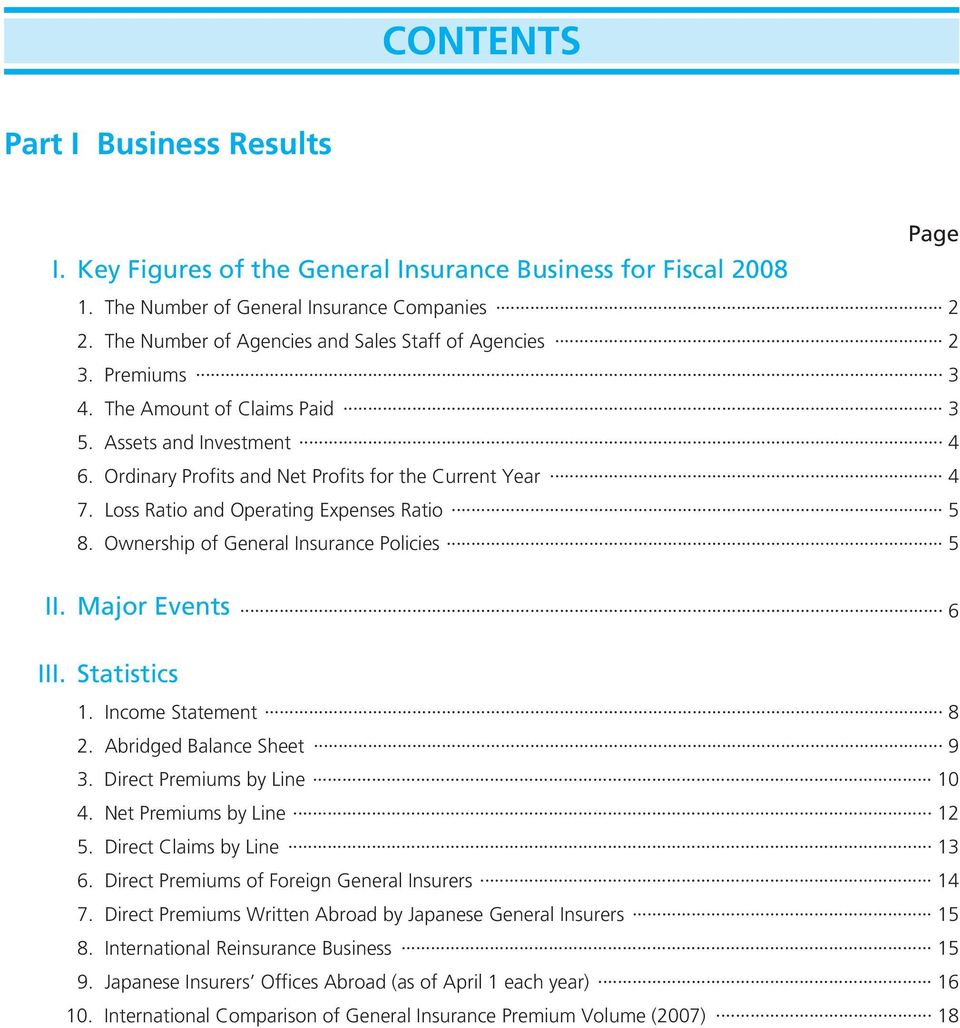
2 CONTENTS Part I Business Results Page I. Key Figures of the General Insurance Business for Fiscal The Number of General Insurance Companies The Number of Agencies and Sales Staff of Agencies Premiums The Amount of Claims Paid Assets and Investment Ordinary Profits and Net Profits for the Current Year Loss Ratio and Operating Expenses Ratio Ownership of General Insurance Policies... 5 II. Major Events... 6 III. Statistics 1. Income Statement Abridged Balance Sheet Direct Premiums by Line Net Premiums by Line Direct Claims by Line Direct Premiums of Foreign General Insurers Direct Premiums Written Abroad by Japanese General Insurers International Reinsurance Business Japanese Insurers Offices Abroad (as of April 1 each year) International Comparison of General Insurance Premium Volume (2007)... 18
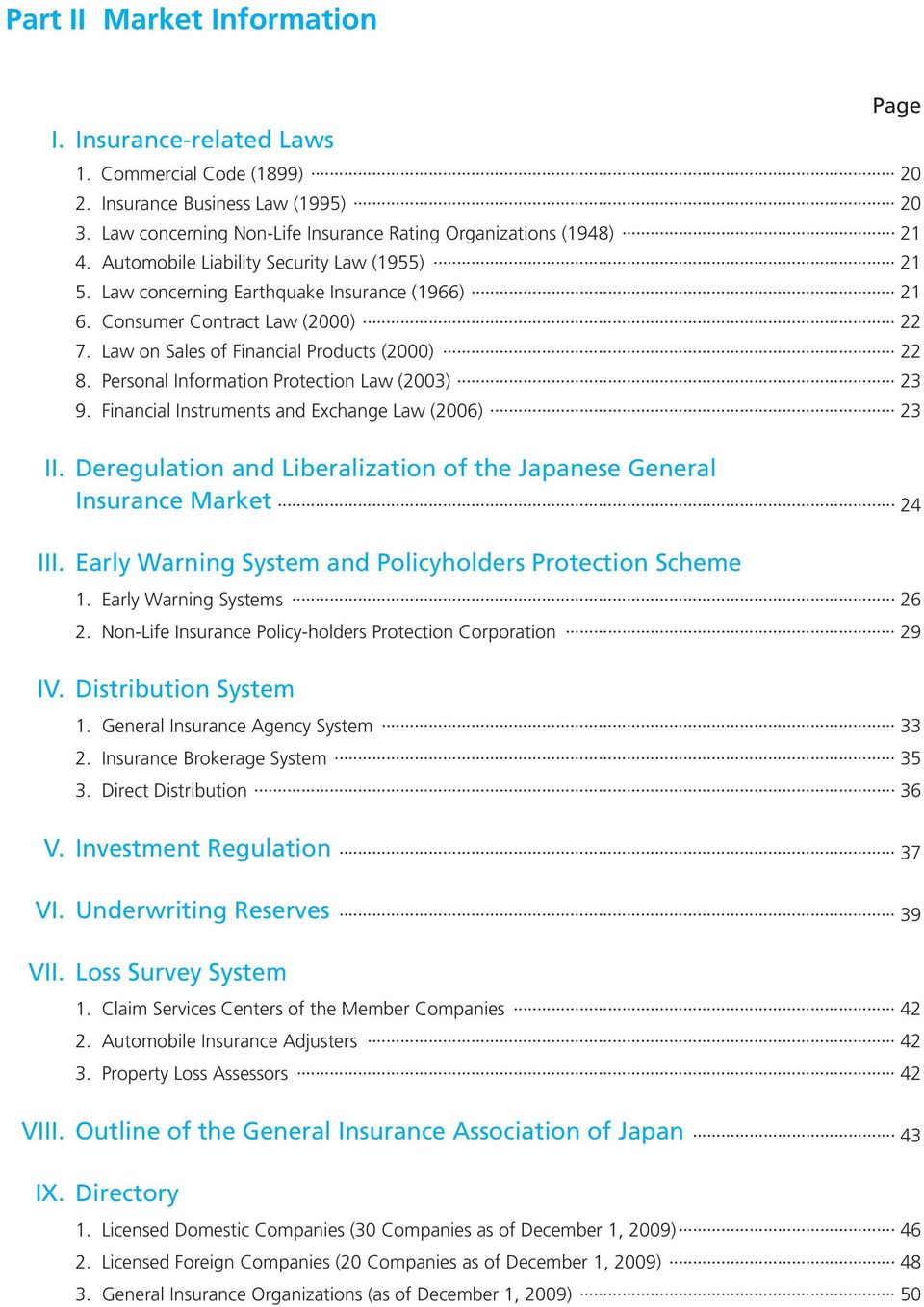
3 Part II Market Information I. Insurance-related Laws Page 1. Commercial Code (1899) Insurance Business Law (1995) Law concerning Non-Life Insurance Rating Organizations (1948) Automobile Liability Security Law (1955) Law concerning Earthquake Insurance (1966) Consumer Contract Law (2000) Law on Sales of Financial Products (2000) Personal Information Protection Law (2003) Financial Instruments and Exchange Law (2006) II. Deregulation and Liberalization of the Japanese General Insurance Market III. Early Warning System and Policyholders Protection Scheme 1. Early Warning Systems Non-Life Insurance Policy-holders Protection Corporation IV. Distribution System 1. General Insurance Agency System Insurance Brokerage System Direct Distribution V. Investment Regulation VI. Underwriting Reserves VII. Loss Survey System 1. Claim Services Centers of the Member Companies Automobile Insurance Adjusters Property Loss Assessors VIII. Outline of the General Insurance Association of Japan IX. Directory 1. Licensed Domestic Companies (30 Companies as of December 1, 2009) Licensed Foreign Companies (20 Companies as of December 1, 2009) General Insurance Organizations (as of December 1, 2009)... 50
4 PART I BUSINESS RESULTS

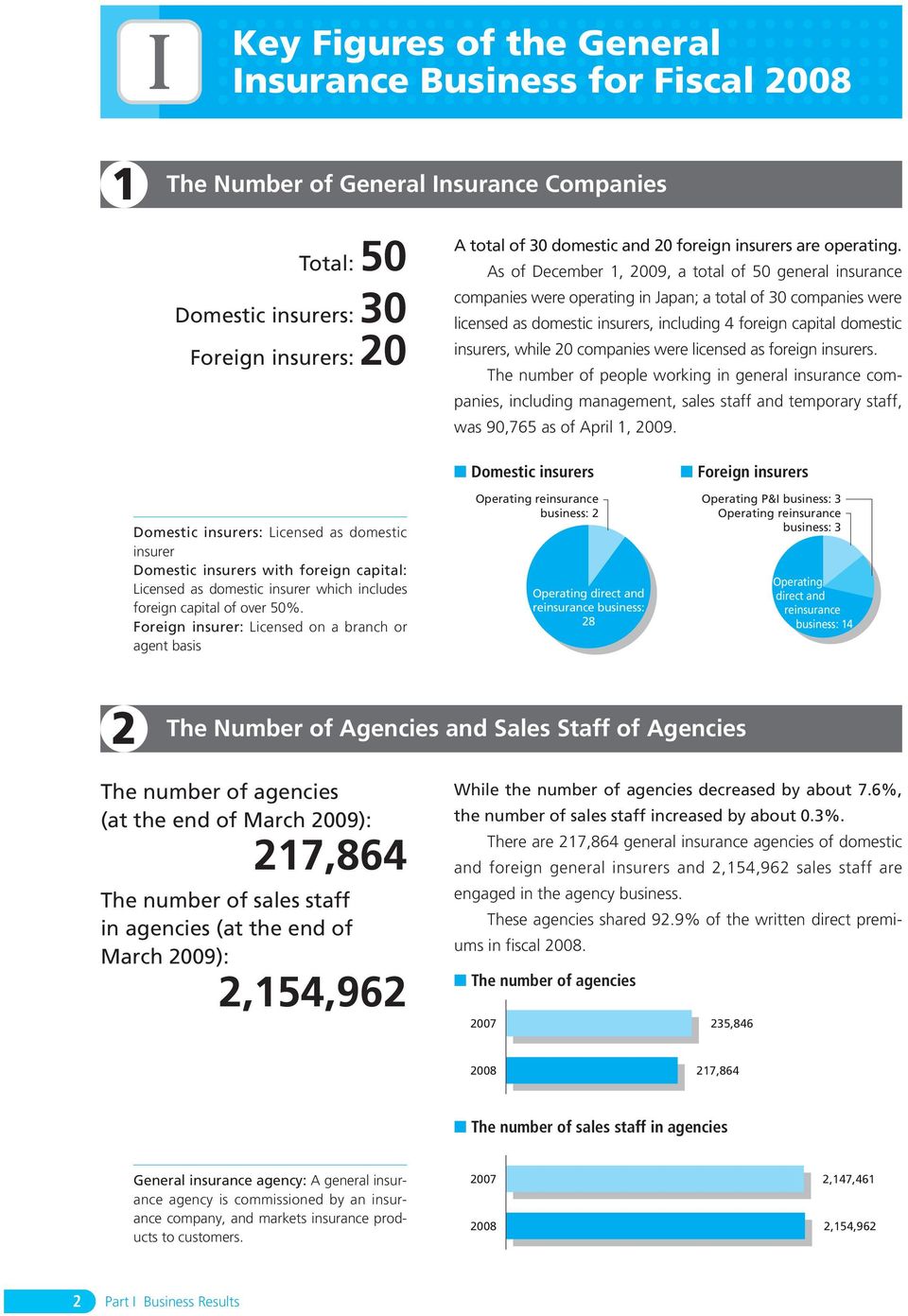
5 I Key Figures of the General Insurance Business for Fiscal The Number of General Insurance Companies Total: 50 Domestic insurers: 30 Foreign insurers: 20 A total of 30 domestic and 20 foreign insurers are operating. As of December 1, 2009, a total of 50 general insurance companies were operating in Japan; a total of 30 companies were licensed as domestic insurers, including 4 foreign capital domestic insurers, while 20 companies were licensed as foreign insurers. The number of people working in general insurance companies, including management, sales staff and temporary staff, was 90,765 as of April 1, Domestic insurers: Licensed as domestic insurer Domestic insurers with foreign capital: Licensed as domestic insurer which includes foreign capital of over 50%. Foreign insurer: Licensed on a branch or agent basis Domestic insurers Operating reinsurance business: 2 Operating direct and reinsurance business: 28 Foreign insurers Operating P&I business: 3 Operating reinsurance business: 3 Operating direct and reinsurance business: 14 2 The Number of Agencies and Sales Staff of Agencies The number of agencies (at the end of March 2009): 217,864 The number of sales staff in agencies (at the end of March 2009): 2,154,962 While the number of agencies decreased by about 7.6%, the number of sales staff increased by about 0.3%. There are 217,864 general insurance agencies of domestic and foreign general insurers and 2,154,962 sales staff are engaged in the agency business. These agencies shared 92.9% of the written direct premiums in fiscal The number of agencies , ,864 The number of sales staff in agencies General insurance agency: A general insurance agency is commissioned by an insurance company, and markets insurance products to customers ,147,461 2,154,962 2 Part I Business Results
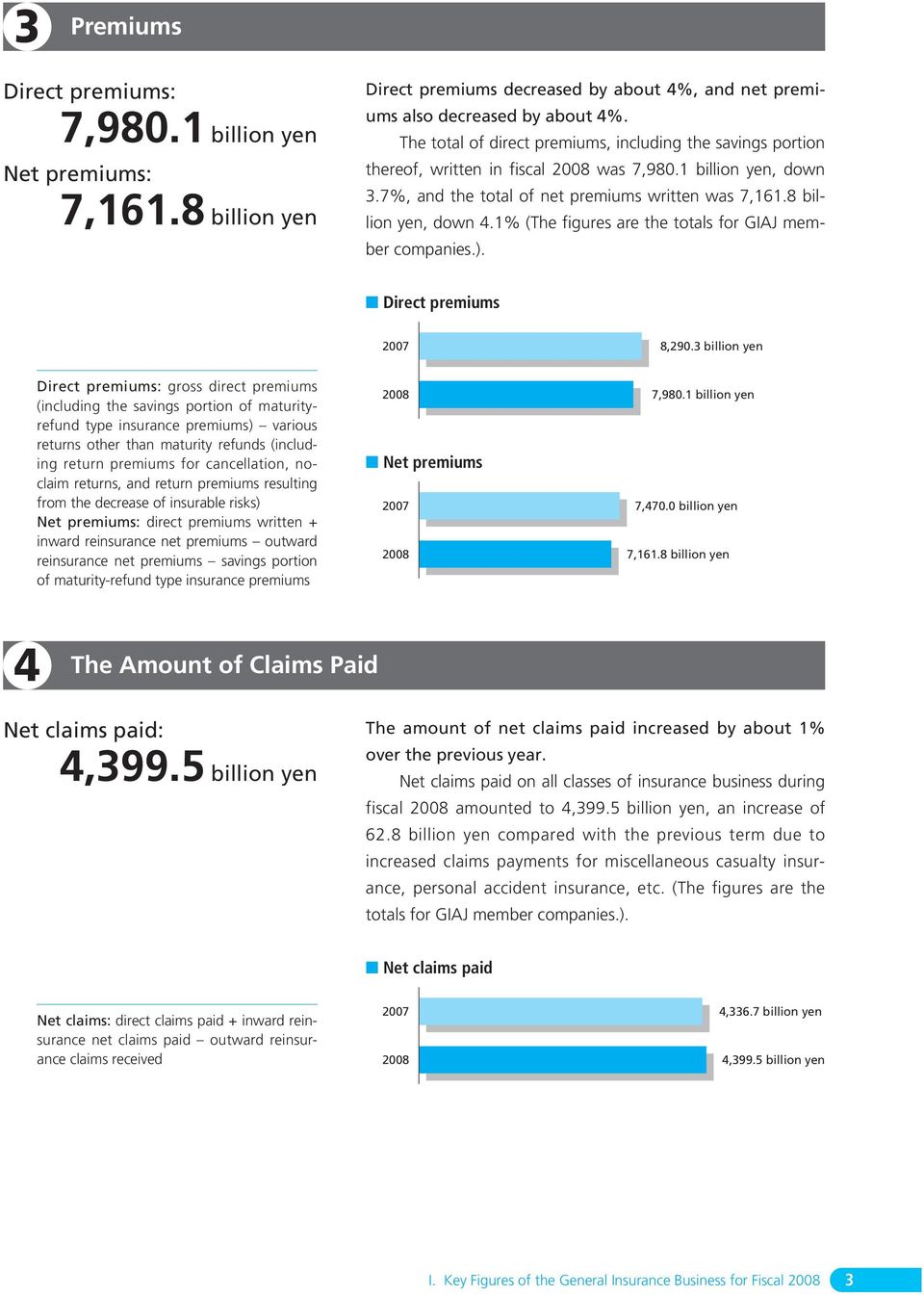
6 3 Premiums Direct premiums: 7,980.1 billion yen Net premiums: 7,161.8 billion yen Direct premiums decreased by about 4%, and net premiums also decreased by about 4%. The total of direct premiums, including the savings portion thereof, written in fiscal 2008 was 7,980.1 billion yen, down 3.7%, and the total of net premiums written was 7,161.8 billion yen, down 4.1% (The figures are the totals for GIAJ member companies.). Direct premiums ,290.3 billion yen Direct premiums: gross direct premiums (including the savings portion of maturityrefund type insurance premiums) various returns other than maturity refunds (including return premiums for cancellation, noclaim returns, and return premiums resulting from the decrease of insurable risks) Net premiums: direct premiums written + inward reinsurance net premiums outward reinsurance net premiums savings portion of maturity-refund type insurance premiums 2008 Net premiums ,980.1 billion yen 7,470.0 billion yen 7,161.8 billion yen 4 The Amount of Claims Paid Net claims paid: 4,399.5 billion yen The amount of net claims paid increased by about 1% over the previous year. Net claims paid on all classes of insurance business during fiscal 2008 amounted to 4,399.5 billion yen, an increase of 62.8 billion yen compared with the previous term due to increased claims payments for miscellaneous casualty insurance, personal accident insurance, etc. (The figures are the totals for GIAJ member companies.). Net claims paid Net claims: direct claims paid + inward reinsurance net claims paid outward reinsurance claims received ,336.7 billion yen 4,399.5 billion yen I. Key Figures of the General Insurance Business for Fiscal
7 5 Assets and Investment Total assets: 29,941.1 billion yen Working assets: 26,516.8 billion yen Total assets decreased by about 14%, and working assets also decreased by about 18%. The total assets decreased to 29,941.1 billion yen, down 13.7%, reflecting a fall in market value of securities. Working assets also decreased to 26,516.8 billion yen, down 17.8% (The figures are the totals for GIAJ member companies.). Total assets ,709.1 billion yen Total assets: Total assets are the total of working assets and other assets (such as amounts due from the agency business, amounts due from other domestic insurance companies for reinsurance, etc.) Working assets: Working assets include deposits, call loans, monetary receivables bought, money trusts, securities, loans, real estate, etc Working assets ,941.1 billion yen 32,246.2 billion yen 26,516.8 billion yen 6 Ordinary Profits and Net Profits for the Current Year Ordinary profits: billion yen Net profits: 81.0 billion yen As for ordinary profits and net profits for the current year, they showed a deficit of billion yen and 81.0 billion yen respectively. Ordinary profits for fiscal 2008 registered a deficit of billion yen, due to larger expenses incurred for asset investment, and net profits after tax also posted a deficit of 81.0 billion yen accordingly (The figures are the totals for GIAJ member companies.). Ordinary profits billion yen billion yen Net profits Ordinary profit: The total of (underwriting income expenses) + (investment income expenses) (other ordinary expenses) Net profit: The total of ordinary profits including special profits or losses minus corporate income taxes, corporate resident taxes, etc billion yen billion yen 4 Part I Business Results

8 7 Loss Ratio and Operating Expenses Ratio Loss ratio: 66.6% Operating expenses ratio: 35.1% The loss ratio increased by 3.8 percentage points, and the operating expenses ratio also increased by 1.9 percentage points. The loss ratio increased by 3.8 percentage points to 66.6% due to the decrease in the amount of net premiums written as well as increased claims payment. The operating expenses ratio also increased by 1.9 percentage points to 35.1% in fiscal 2008 (The figures are the totals for GIAJ member companies.). Loss ratio / Operating expenses ratio Loss ratio: The ratio of claims paid plus loss adjustment expenses to net premiums written Operating expenses ratio: The ratio of agency commission and brokerage plus operating and general administrative expenses on underwriting to net premiums written 62.8% 66.6% Loss ratio Operating expenses ratio 33.2% 35.1% Ownership of General Insurance Policies Earthquake: 45.0% (at the end of March 2009) Voluntary Automobile (bodily injury liability): 72.2% (at of the end of March 2008) Voluntary Automobile (property damage liability): 72.2% (as of the end of March 2008) Ownership of Earthquake Insurance on Dwelling Risks, which represents the ratio of the number of earthquake insurance policies to the number of fire insurance policies effected, increased to 45.0% in fiscal Ownership of general insurance policies by line are as follows: Ownership by line Earthquake 45.0% Voluntary Automobile (bodily injury liability) Voluntary Automobile (property damage liability) Ownership of Earthquake Insurance on Dwelling Risks Policies 72.2% 72.2% Fiscal Year National Average 37.4% 40.3% 41.7% 44.0% Source: The Non-Life Insurance Rating Organization of Japan % Ownership of Voluntary Automobile Insurance Fiscal Year Number of Registered Automobiles (thousand) 77,390 78,279 Bodily Injury Liability 71.1% 71.0% Property Damage Liability 70.7% 70.8% Passengers Personal Accident 61.2% 59.6% Physical Damage 35.7% 36.3% Source: The Non-Life Insurance Rating Organization of Japan. 78, % 71.1% 59.0% 37.3% 79, % 71.5% 58.6% 38.3% 79, % 72.2% 58.6% 39.5% I. Key Figures of the General Insurance Business for Fiscal

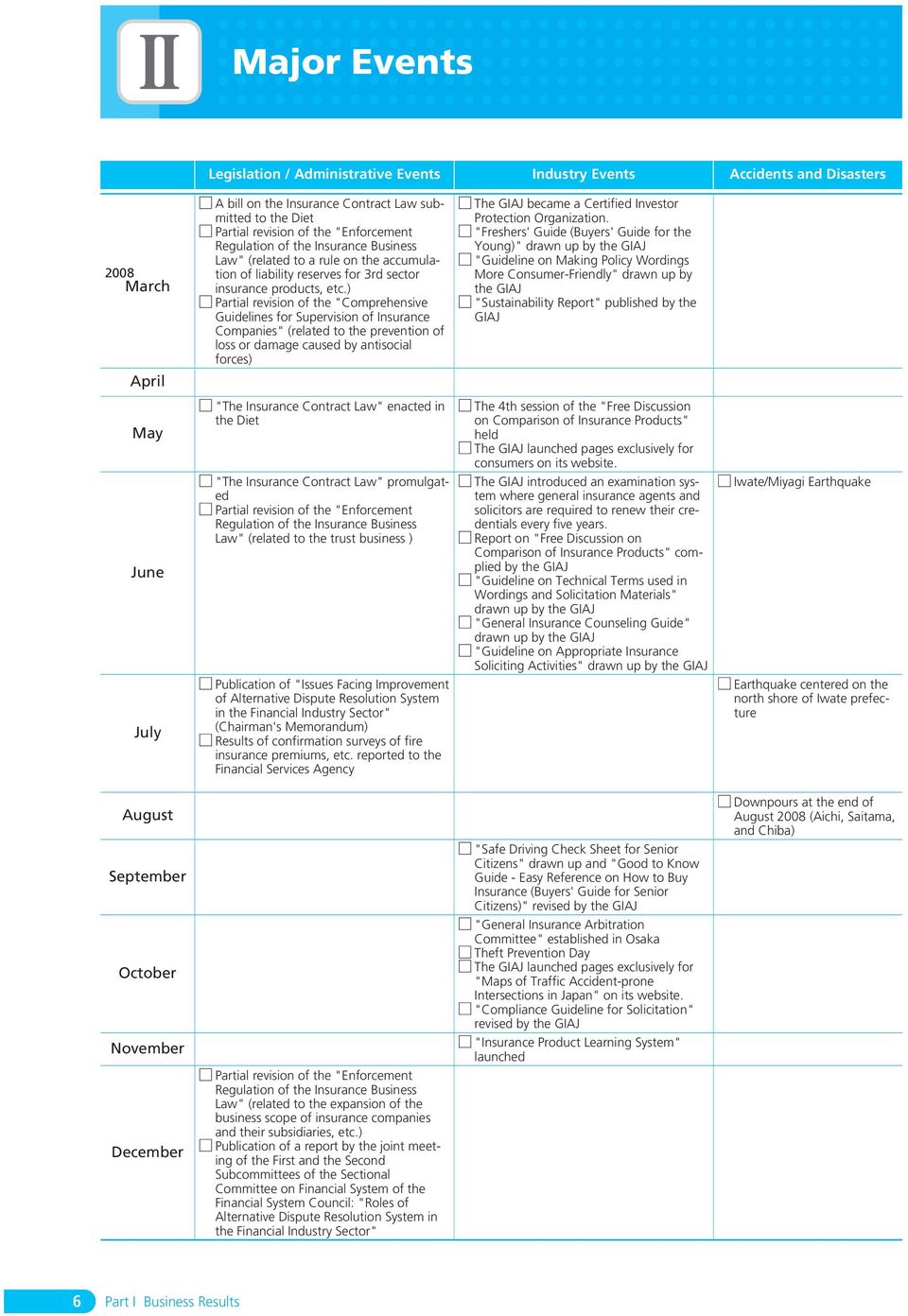
9 II Major Events Legislation / Administrative Events Industry Events Accidents and Disasters 2008 March A bill on the Insurance Contract Law submitted to the Diet Partial revision of the "Enforcement Regulation of the Insurance Business Law" (related to a rule on the accumulation of liability reserves for 3rd sector insurance products, etc.) Partial revision of the "Comprehensive Guidelines for Supervision of Insurance Companies" (related to the prevention of loss or damage caused by antisocial forces) The GIAJ became a Certified Investor Protection Organization. "Freshers' Guide (Buyers' Guide for the Young)" drawn up by the GIAJ "Guideline on Making Policy Wordings More Consumer-Friendly" drawn up by the GIAJ "Sustainability Report" published by the GIAJ April May "The Insurance Contract Law" enacted in the Diet The 4th session of the "Free Discussion on Comparison of Insurance Products" held The GIAJ launched pages exclusively for consumers on its website. The GIAJ introduced an examination system where general insurance agents and solicitors are required to renew their credentials every five years. Report on "Free Discussion on Comparison of Insurance Products" complied by the GIAJ "Guideline on Technical Terms used in Wordings and Solicitation Materials" drawn up by the GIAJ "General Insurance Counseling Guide" drawn up by the GIAJ "Guideline on Appropriate Insurance Soliciting Activities" drawn up by the GIAJ June "The Insurance Contract Law" promulgated Partial revision of the "Enforcement Regulation of the Insurance Business Law" (related to the trust business ) Iwate/Miyagi Earthquake July Publication of "Issues Facing Improvement of Alternative Dispute Resolution System in the Financial Industry Sector" (Chairman's Memorandum) Results of confirmation surveys of fire insurance premiums, etc. reported to the Financial Services Agency Earthquake centered on the north shore of Iwate prefecture August Downpours at the end of August 2008 (Aichi, Saitama, and Chiba) September "Safe Driving Check Sheet for Senior Citizens" drawn up and "Good to Know Guide - Easy Reference on How to Buy Insurance (Buyers' Guide for Senior Citizens)" revised by the GIAJ "General Insurance Arbitration Committee" established in Osaka Theft Prevention Day The GIAJ launched pages exclusively for "Maps of Traffic Accident-prone Intersections in Japan" on its website. "Compliance Guideline for Solicitation" revised by the GIAJ "Insurance Product Learning System" launched October November December Partial revision of the "Enforcement Regulation of the Insurance Business Law" (related to the expansion of the business scope of insurance companies and their subsidiaries, etc.) Publication of a report by the joint meeting of the First and the Second Subcommittees of the Sectional Committee on Financial System of the Financial System Council: "Roles of Alternative Dispute Resolution System in the Financial Industry Sector" 6 Part I Business Results
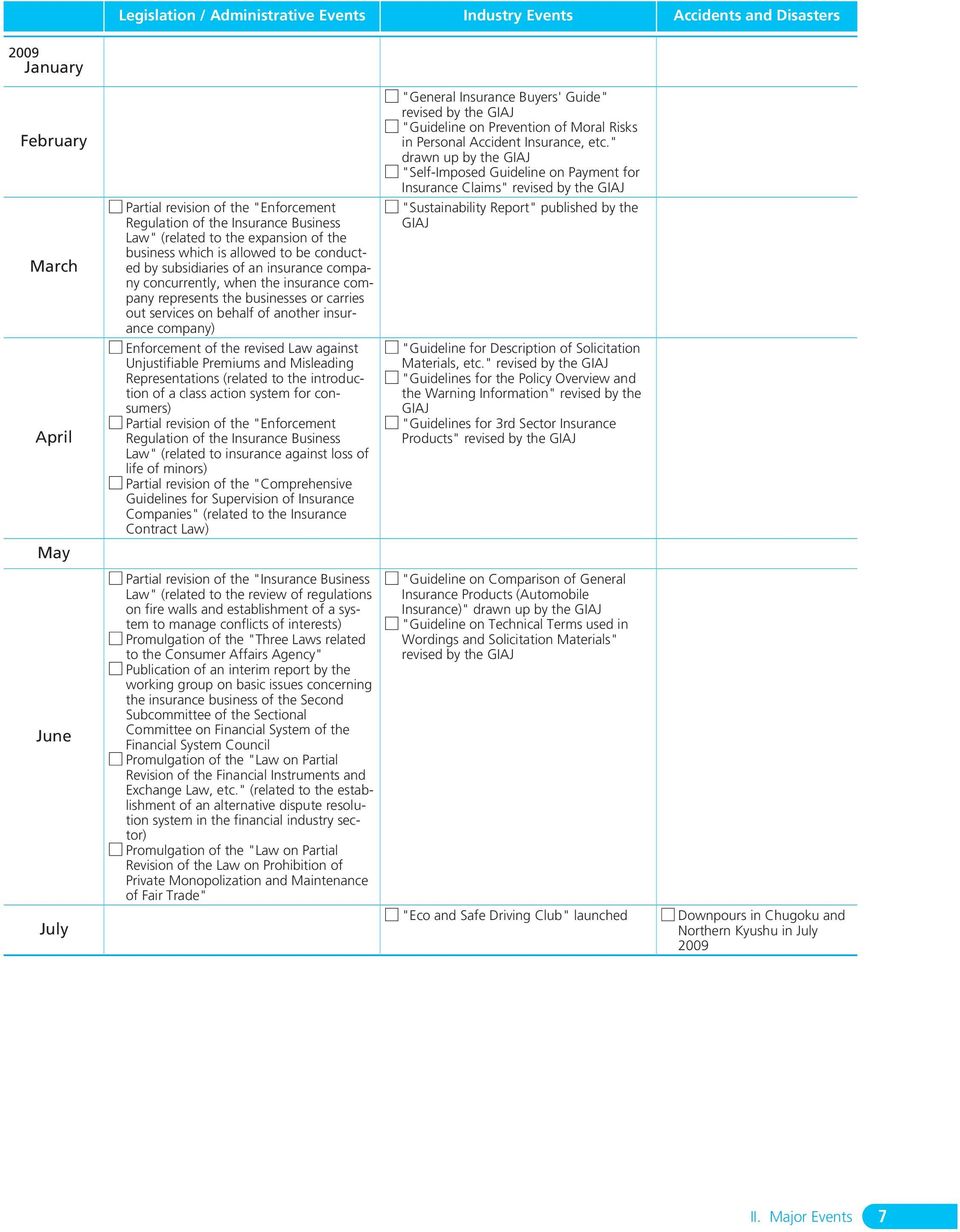
10 Legislation / Administrative Events Industry Events Accidents and Disasters 2009 January February March April May June July Partial revision of the "Enforcement Regulation of the Insurance Business Law" (related to the expansion of the business which is allowed to be conducted by subsidiaries of an insurance company concurrently, when the insurance company represents the businesses or carries out services on behalf of another insurance company) Enforcement of the revised Law against Unjustifiable Premiums and Misleading Representations (related to the introduction of a class action system for consumers) Partial revision of the "Enforcement Regulation of the Insurance Business Law" (related to insurance against loss of life of minors) Partial revision of the "Comprehensive Guidelines for Supervision of Insurance Companies" (related to the Insurance Contract Law) Partial revision of the "Insurance Business Law" (related to the review of regulations on fire walls and establishment of a system to manage conflicts of interests) Promulgation of the "Three Laws related to the Consumer Affairs Agency" Publication of an interim report by the working group on basic issues concerning the insurance business of the Second Subcommittee of the Sectional Committee on Financial System of the Financial System Council Promulgation of the "Law on Partial Revision of the Financial Instruments and Exchange Law, etc." (related to the establishment of an alternative dispute resolution system in the financial industry sector) Promulgation of the "Law on Partial Revision of the Law on Prohibition of Private Monopolization and Maintenance of Fair Trade" "General Insurance Buyers' Guide" revised by the GIAJ "Guideline on Prevention of Moral Risks in Personal Accident Insurance, etc." drawn up by the GIAJ "Self-Imposed Guideline on Payment for Insurance Claims" revised by the GIAJ "Sustainability Report" published by the GIAJ "Guideline for Description of Solicitation Materials, etc." revised by the GIAJ "Guidelines for the Policy Overview and the Warning Information" revised by the GIAJ "Guidelines for 3rd Sector Insurance Products" revised by the GIAJ "Guideline on Comparison of General Insurance Products (Automobile Insurance)" drawn up by the GIAJ "Guideline on Technical Terms used in Wordings and Solicitation Materials" revised by the GIAJ "Eco and Safe Driving Club" launched Downpours in Chugoku and Northern Kyushu in July 2009 II. Major Events 7
11 III Statistics 1. Income Statement Item (in billions of yen & %) Fiscal 2007 Fiscal 2008 Amount Growth Amount Growth Ordinary Profit and Loss Underwriting Income Net Premiums Written Savings Portion of Maturity-refund type Insurance Premiums Underwriting Expenses Net Claims Paid Loss Adjustment Expenses Agency Commissions and Brokerage Maturity Refunds to Policyholders Net Provision for / Net Reversal of Outstanding Loss Reserves Net Provision for / Net Reversal of Underwriting Reserves 8, , , , , , , , , , , , Investment Income Interest and Dividend Income Profits on Sales of Securities Investment Expenses Losses on Sales of Securities Losses on Revaluation of Securities Operating and General Administrative Expenses Operating and General Administrative Expenses on Underwriting 1, , , , Other Ordinary Profits and Losses Ordinary Profits Underwriting Profits Special Profits and Losses Balance Profits for the Current Year before Corporate Taxes Corporate Income Taxes and Corporate Resident Taxes Adjustments in Corporate Income Taxes, etc. Total Income Taxes Net Profits for the Current Year Part I Business Results

12 2. Abridged Balance Sheet <Assets> Item (in billions of yen & %) Fiscal 2007 Fiscal 2008 Amount Share Amount Share Deposits Call Loans Receivables under Resales Agreements Monetary Receivables Bought 1, Money Trusts Securities National Government Bonds Local Government Bonds Corporate Bonds Stocks Foreign Securities Other Securities 25, , , , , , , , , , Loans 2, , Real Estate 1, , Total Working Assets 32, , Other Assets 2, , Total Assets 34, , (Notes) Other Assets is composed of 1) Cash in hand, 2) Furniture and fixtures, 3) Construction in progress, 4) Amounts due from agency business, 5) Amounts due from other domestic companies for reinsurance, 6) Customer s liability for acceptance and guarantee, 7) Deferred tax assets, and 8) Miscellaneous. <Liabilities and Equities> (in billions of yen & %) Item Fiscal 2007 Fiscal 2008 Amount Share Amount Share Underwriting Reserves Outstanding Loss Reserves Underwriting Reserves Other Liabilities Total Liabilities Capital Suspense Receipts on Capital Subscriptions Additional Paid in Capital Earned Surplus Earned Surplus Carried Forward Treasury Stock Unrealized Gain on Securities, Net of Income Taxes Deferred Gains and Losses on Hedge Transactions Land and Revaluation Excess Stock Acquisition Right Total Equities Total Liabilities and Equities 23, , , , , , , , , , , , , , , , , , (Notes) Other Liabilities consists of 1) Amounts due to other domestic insurance companies for reinsurance, 2) Accured taxes, 3) Convertible bonds, 4) Reserves for bad debts and for retirement allowance, 5) Acceptance and guarantee, and 6) Miscellaneous. III. Statistics 9

13 3. Direct Premiums by Line Class of Business Fiscal 1999 Fiscal 2000 Fiscal 2001 Fiscal 2002 Amount Growth Amount Growth Amount Growth Amount Growth Fire 1,744, ,583, ,507, ,493, Maturity-refund type 722, , , , Voluntary Automobile 3,599, ,649, ,676, ,605, Maturity-refund type 3,023 13, , , Personal Accident 2,049, ,831, ,625, ,578, Maturity-refund type 1,430, ,226, ,041, , Miscellaneous Casualty 733, , , , Maturity-refund type 39, , , , Burglary 27, , , , Glass 2, , , , Aviation 13, , , , Windstorm & Flood Guarantee 14, , , , Credit 14, , , , Workers Accident Compensation Liability 94, , , , Maturity-refund type 19, , , , Boiler & Turbo-set 2, , , , Livestock 2, , , , General Liability 305, , , , Machinery & Erection 37, , , , Shipowners Liability for Passengers Personal Accident 1, Contractors All Risks 35, , , , Atomic Energy 11, , , , Movables Comprehensive 118, , , , Maturity-refund type 3, , Miscellaneous Pecuniary Loss 51, , , , Maturity-refund type 16, , , , Pet Marine and Inland Transit 251, , , , Marine Hull 59, , , , Marine Cargo 127, , , , Inland Transit 63, , , , Subtotal 8,379, ,073, ,843, ,707, Compulsory Automobile Liability 980, , , ,190, Grand total 9,359, ,061, ,830, ,898, Maturity-refund type 2,195, ,854, ,561, ,477, (Notes) 1. Figures include direct premiums written abroad. 2. Direct Premiums Written = Gross Direct Premiums (including the Savings Portion of Maturity-refund type Insurance return premiums resulting from the decrease of insurable risks) 10 Part I Business Results

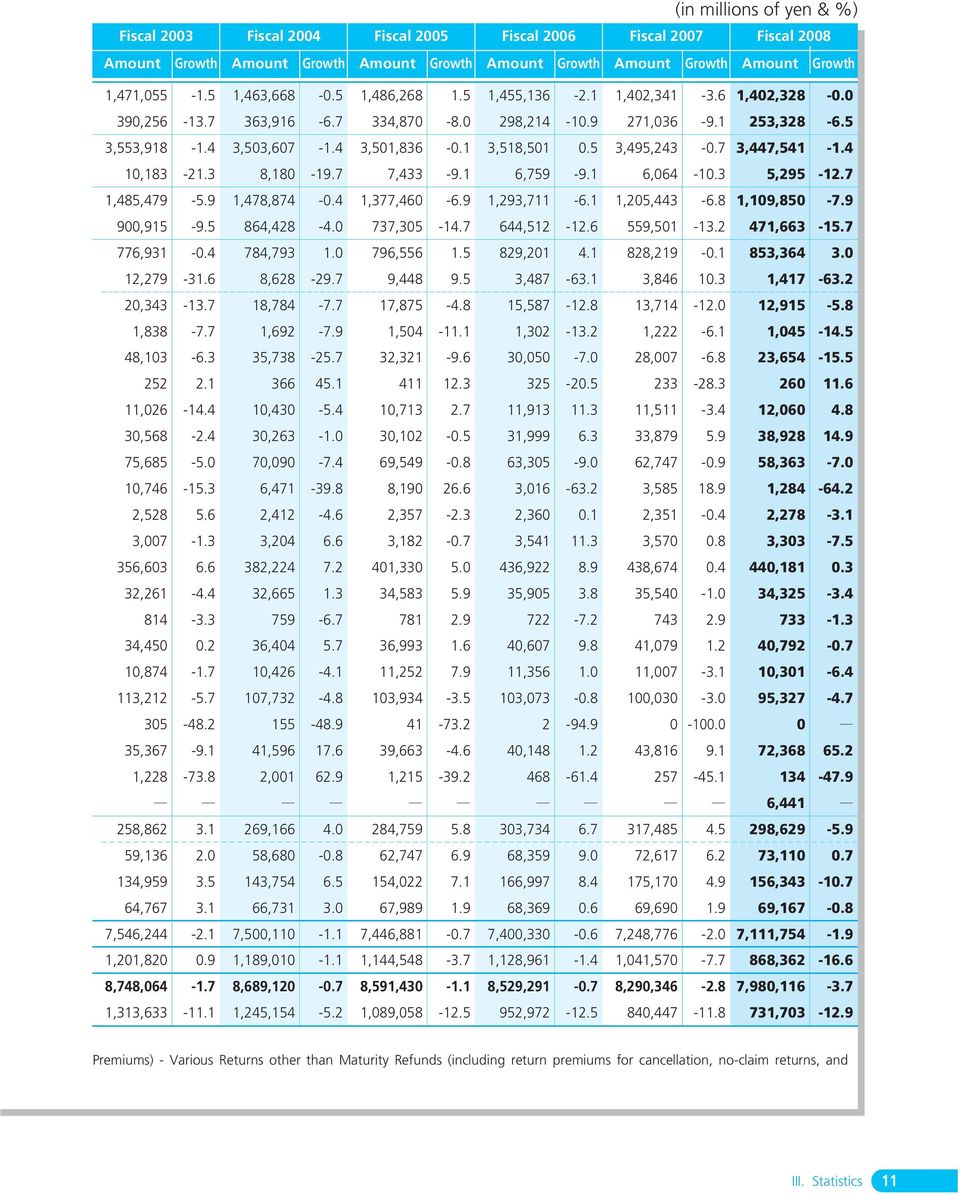
14 (in millions of yen & %) Fiscal 2003 Fiscal 2004 Fiscal 2005 Fiscal 2006 Fiscal 2007 Fiscal 2008 Amount Growth Amount Growth Amount Growth Amount Growth Amount Growth Amount Growth 1,471, ,463, ,486, ,455, ,402, ,402, , , , , , , ,553, ,503, ,501, ,518, ,495, ,447, , , , , , , ,485, ,478, ,377, ,293, ,205, ,109, , , , , , , , , , , , , , , , , , , , , , , , , , , , , , , , , , , , , , , , , , , , , , , , , , , , , , , , , , , , , , , , , , , , , , , , , , , , , , , , , , , , , , , , , , , , , , , , , , , , , , , , , , , , , , , , , , , , , , , , , , , , , , , , , , , , , , , , , ,546, ,500, ,446, ,400, ,248, ,111, ,201, ,189, ,144, ,128, ,041, , ,748, ,689, ,591, ,529, ,290, ,980, ,313, ,245, ,089, , , , Premiums) - Various Returns other than Maturity Refunds (including return premiums for cancellation, no-claim returns, and III. Statistics 11
15 4. Net Premiums by Line (in millions of yen & %) Fiscal 1999 Fiscal 2000 Fiscal 2001 Fiscal 2002 Fiscal 2003 Class of Business Amount Growth Amount Growth Amount Growth Amount Growth Amount Growth Fire 1,105, ,053, ,031, ,030, ,044, Voluntary Automobile 3,605, ,650, ,674, ,612, ,558, Personal Accident 705, , , , , Miscellaneous Casualty 676, , , , , Marine and Inland Transit 232, , , , , Marine Hull 59, , , , , Marine Cargo 111, , , , , Inland Transit 60, , , , , Subtotal 6,324, ,304, ,309, ,274, ,241, Compulsory Automobile Liability 564, , , ,011, ,195, Grand total 6,889, ,874, ,881, ,285, ,437, Class of Business (in millions of yen & %) Fiscal 2004 Fiscal 2005 Fiscal 2006 Fiscal 2007 Fiscal 2008 Amount Growth Amount Growth Amount Growth Amount Growth Amount Growth Fire 1,030, ,080, ,085, ,055, ,065, Voluntary Automobile 3,507, ,507, ,525, ,502, ,456, Personal Accident 649, , , , , Miscellaneous Casualty 779, , , , , Marine and Inland Transit 252, , , , , Marine Hull 44, , , , , Marine Cargo 146, , , , , Inland Transit 62, , , , , Subtotal 6,220, ,328, ,401, ,345, ,278, Compulsory Automobile Liability 1,191, ,156, ,135, ,124, , Grand total 7,411, ,485, ,537, ,470, ,161, (Note) Net Premiums Written = Direct Premiums Written + Inward Reinsurance Net Premiums Outward Reinsurance Net Premiums Savings Portion of Maturity-refund type Insurance Premiums 12 Part I Business Results

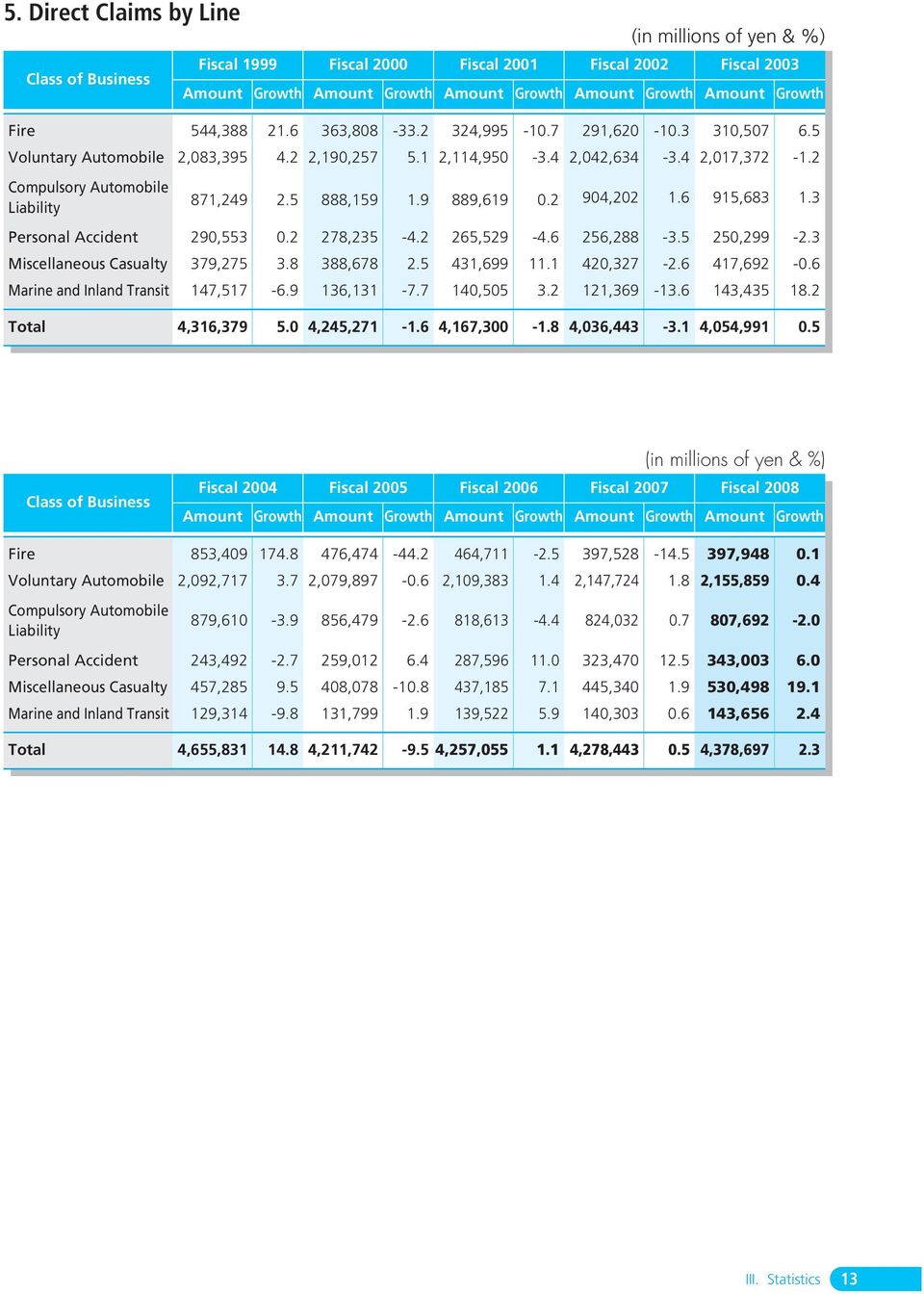
16 5. Direct Claims by Line (in millions of yen & %) Fiscal 1999 Fiscal 2000 Fiscal 2001 Fiscal 2002 Fiscal 2003 Class of Business Amount Growth Amount Growth Amount Growth Amount Growth Amount Growth Fire Voluntary Automobile Compulsory Automobile Liability Personal Accident Miscellaneous Casualty Marine and Inland Transit Total 544, , , , , ,083, ,190, ,114, ,042, ,017, , , , , , , , , , , , , , , , , , , , , ,316, ,245, ,167, ,036, ,054, Fire Class of Business Voluntary Automobile Compulsory Automobile Liability Personal Accident Miscellaneous Casualty Marine and Inland Transit Total (in millions of yen & %) Fiscal 2004 Fiscal 2005 Fiscal 2006 Fiscal 2007 Fiscal 2008 Amount Growth Amount Growth Amount Growth Amount Growth Amount Growth 853, , , , , ,092, ,079, ,109, ,147, ,155, , , , , , , , , , , , , , , , , , , , , ,655, ,211, ,257, ,278, ,378, III. Statistics 13
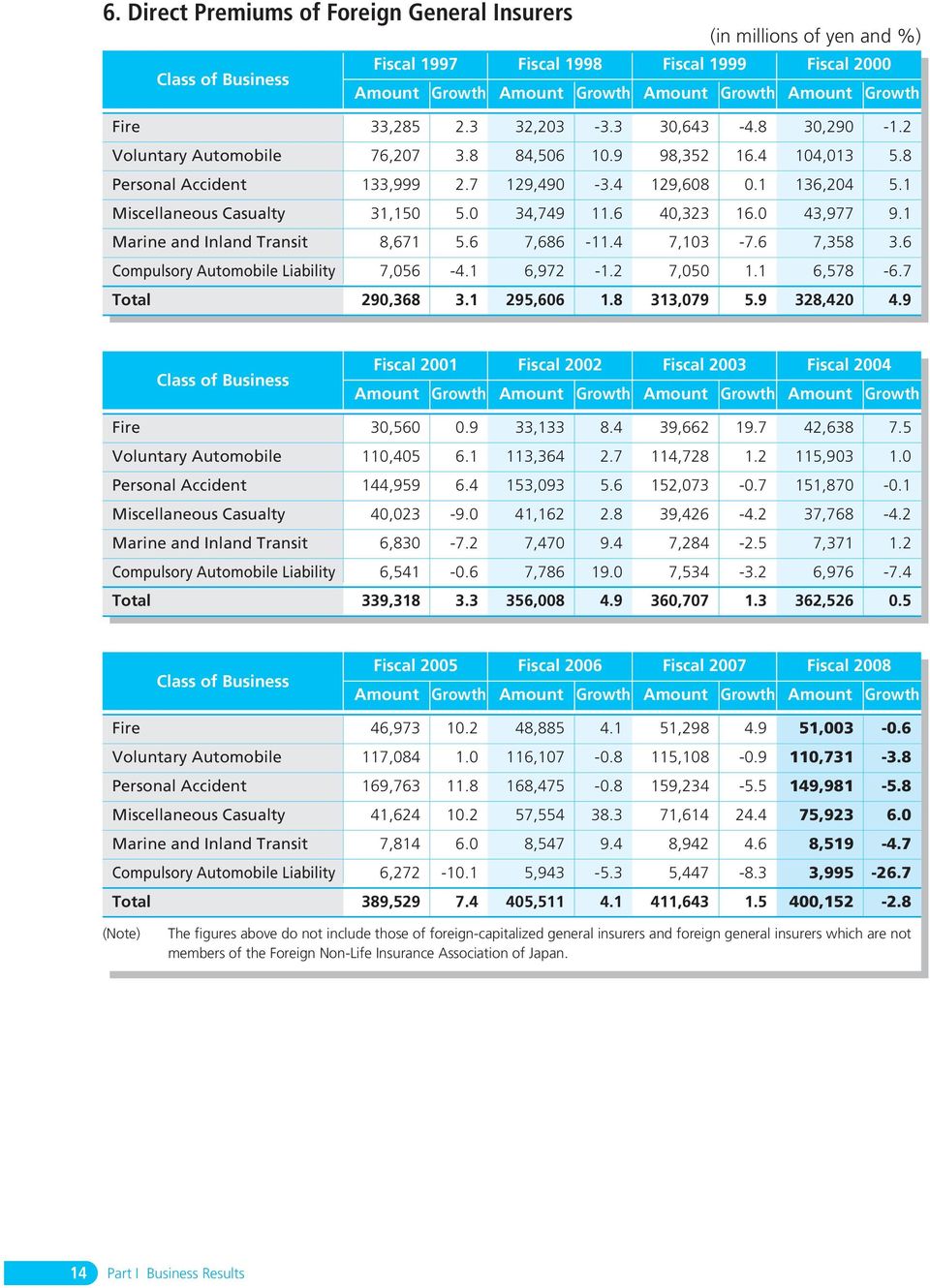
17 6. Direct Premiums of Foreign General Insurers (in millions of yen and %) Fiscal 1997 Fiscal 1998 Fiscal 1999 Fiscal 2000 Class of Business Amount Growth Amount Growth Amount Growth Amount Growth Fire Voluntary Automobile Personal Accident Miscellaneous Casualty Marine and Inland Transit Compulsory Automobile Liability Total 33, , , , , , , , , , , , , , , , , , , , , , , , , , , , Class of Business Fire Voluntary Automobile Personal Accident Miscellaneous Casualty Marine and Inland Transit Compulsory Automobile Liability Total Fiscal 2001 Fiscal 2002 Fiscal 2003 Fiscal 2004 Amount Growth Amount Growth Amount Growth Amount Growth 30, , , , , , , , , , , , , , , , , , , , , , , , , , , , Class of Business Fire Voluntary Automobile Personal Accident Miscellaneous Casualty Marine and Inland Transit Compulsory Automobile Liability Total Fiscal 2005 Fiscal 2006 Fiscal 2007 Fiscal 2008 Amount Growth Amount Growth Amount Growth Amount Growth 46, , , , , , , , , , , , , , , , , , , , , , , , , , , , (Note) The figures above do not include those of foreign-capitalized general insurers and foreign general insurers which are not members of the Foreign Non-Life Insurance Association of Japan. 14 Part I Business Results
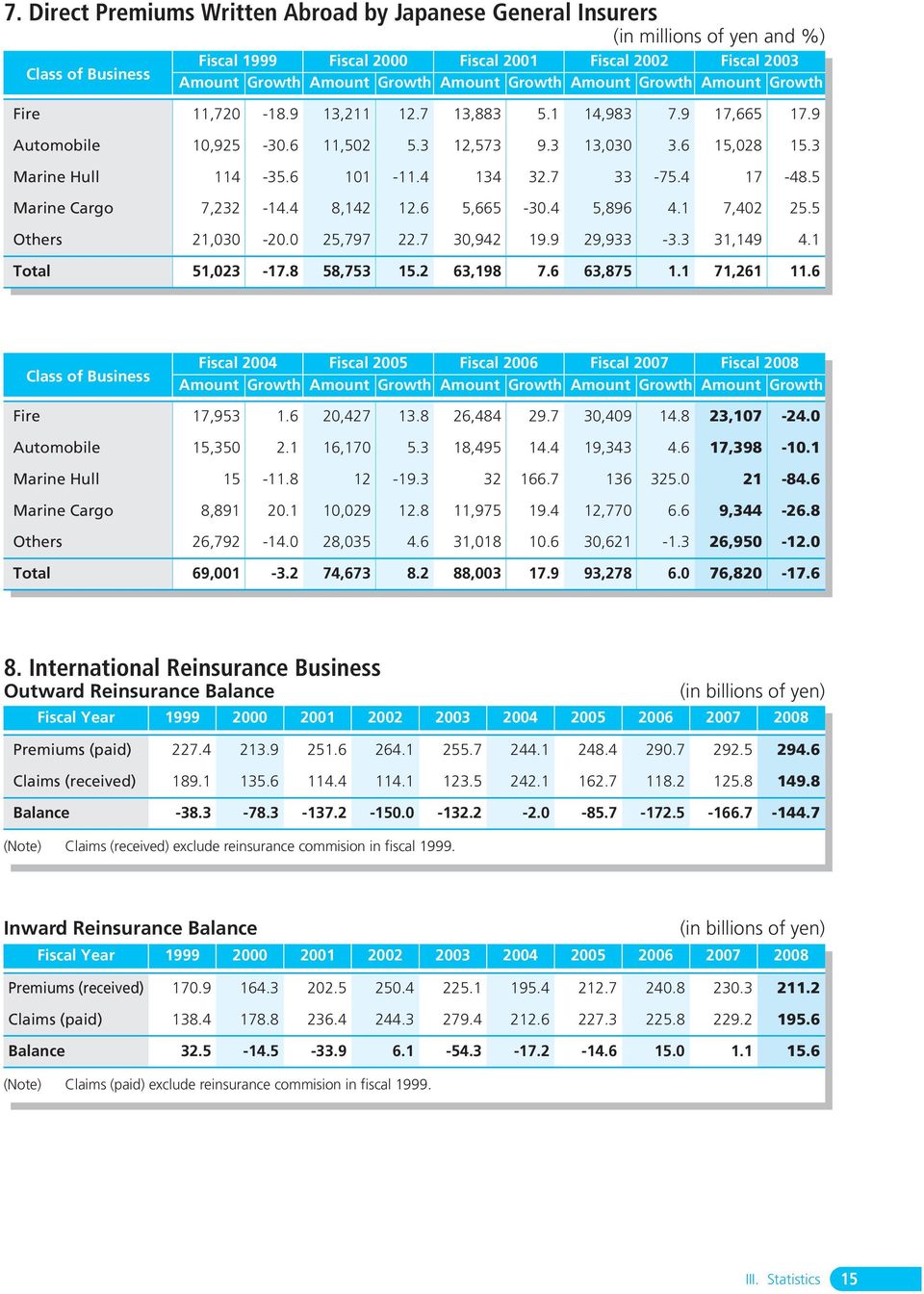
18 7. Direct Premiums Written Abroad by Japanese General Insurers (in millions of yen and %) Class of Business Fiscal 1999 Fiscal 2000 Fiscal 2001 Fiscal 2002 Fiscal 2003 Amount Growth Amount Growth Amount Growth Amount Growth Amount Growth Fire 11, , , , , Automobile 10, , , , , Marine Hull Marine Cargo 7, , , , , Others 21, , , , , Total 51, , , , , Class of Business Fiscal 2004 Fiscal 2005 Fiscal 2006 Fiscal 2007 Fiscal 2008 Amount Growth Amount Growth Amount Growth Amount Growth Amount Growth Fire 17, , , , , Automobile 15, , , , , Marine Hull Marine Cargo 8, , , , , Others 26, , , , , Total 69, , , , , International Reinsurance Business Outward Reinsurance Balance (in billions of yen) Fiscal Year Premiums (paid) Claims (received) Balance (Note) Claims (received) exclude reinsurance commision in fiscal Inward Reinsurance Balance (in billions of yen) Fiscal Year Premiums (received) Claims (paid) Balance (Note) Claims (paid) exclude reinsurance commision in fiscal III. Statistics 15
19 9. Japanese Insurers Offices Abroad (as of April 1 each year) Number of Japanese Insurers Conducting Foreign Business Through Overseas Offices (Note 1) Type of Office Subsidiaries (Note 2) Direct Insurance Subsidiaries with 50% or more Japanese Capital (Note 3) Branches of Direct Insurance Subsidiaries Agents of Direct Insurance Subsidiaries Number of Insurance Companies Operating in Any One of the Above 3 Categories. Overseas Branches Overseas Agents Sub-total Number of Insurance Companies Operating in Any One of the Above Categories Abroad Number of Countries / Regions (Note 4) Type of Office Subsidiaries (Note 2) Direct Insurance Subsidiaries with 50% or more Japanese Capital (Note 3) Branches of Direct Insurance Subsidiaries Agents of Direct Insurance Subsidiaries Number of Insurance Companies Operating in Any One of the Above 3 Categories. Overseas Branches Overseas Agents Sub-total Number of Regions Where Insurance Companies Operating in Any One of the Above Categories Abroad Number of Japanese Insurers Offices Abroad Type of Office Subsidiaries (Note 2) Reinsurance Subsidiaries and Direct Insurance Subsidiaries with less than 50% Japanese Capital Direct Insurance Subsidiaries with 50% or more Japanese Capital (Note 3) Branches of Direct Insurance Subsidiaries Agents of Direct Insurance Subsidiaries Sub-total Overseas Branches Overseas Agents Sub-total Grand total Liaison Offices Number of Japanese Insurers with Liaison Offices Number of Countries / Regions Number of Cities Number of Offices (Notes) 1. Figures represent the number of Japanese insurers conducting foreign business by type of overseas offices, and include cases same region. 2. Subsidiaries means companies operating insurance and/or reinsurance business only, and thus excludes asset investment, loss 3. Figures include cases where Japanese insurers have gained substantial control of a subsidiary by such means as taking over 4. Figures represent the number of countries or regions where Japanese insurers conduct foreign business through overseas offices. 16 Part I Business Results
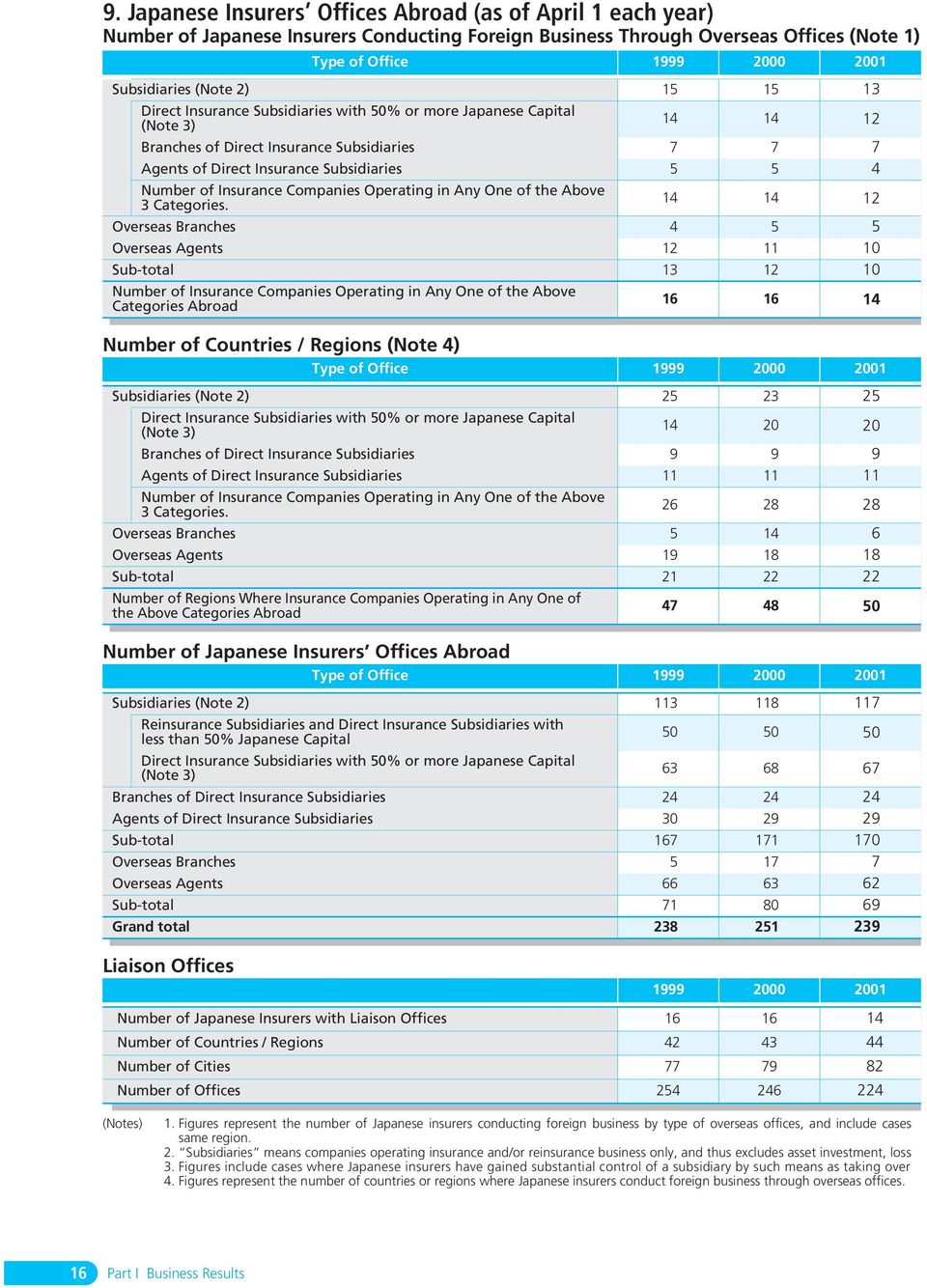
20 where a Japanese insurer conducts its business through both overseas subsidiaries and branches/agents of its home country head office in the survey operations, etc. directorship without owning the majority of shares. III. Statistics 17
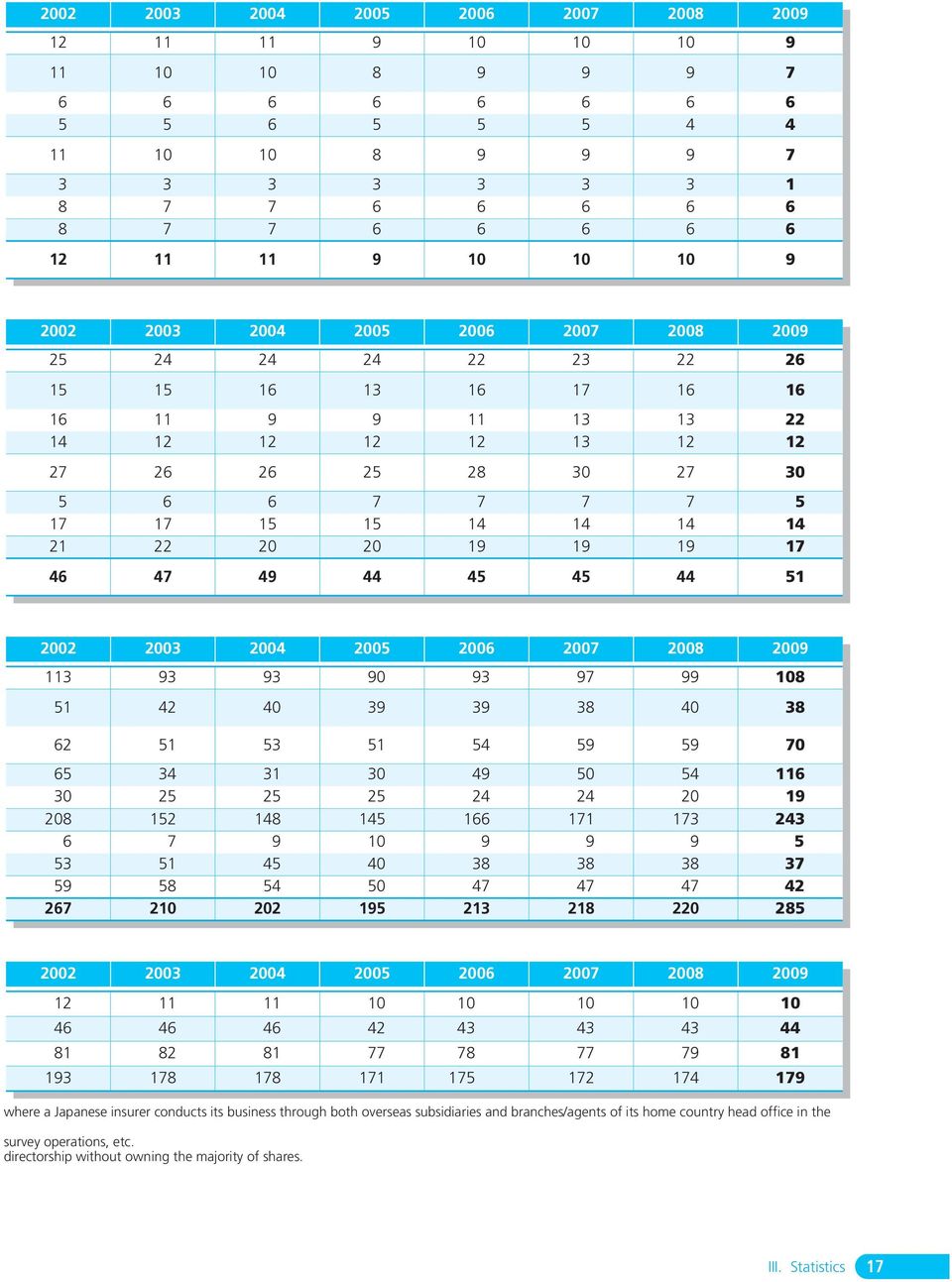
21 10. International Comparison of General Insurance Premium Volume (2007) Country (Region) U. S. A. Germany U. K. Japan France Netherlands Canada Italy Spain South Korea China Russia Australia Brazil Switzerland Belgium Austria Ireland Taiwan Mexico Gross Direct Premiums Gross Direct Premiums GDP Per Capita Premiums (in millions of yen) Rank Share (%) (%) Rank (yen) Rank 76,346, , ,114, , ,356, , ,040, , ,601, , ,834, , ,424, , ,343, , ,102, , ,183, , ,963, , ,396, , ,224, , ,403, , ,297, , ,721, , ,391, , ,261, , ,246, , ,144, , Other Countries 19,100, Total/Average 195,497, ,258 (Notes) 1. Figures are complied by the GIAJ based on the "Sigma No.3/2008" by Swiss Re. 2. Total (average) figures are those total (average) figures of 147 countries surveyed. 3. Gross Direct Premiums include all premiums written by domestic and foreign companies within the country. 4. The exchange rate used (US$1= yen) is the average exchange rate for Part I Business Results
22 PART II MARKET INFORMATION
23 I Insurance-related Laws 1 Commercial Code (1899) The Commercial Code stipulates the following basic issues concerning the legal relations between policyholders and insurance companies: 1. Definition of an insurance contract 5. Matters related to the liability of insurers (claims payment and exclusion clause) 6. Matters related to the cancellation and invalidity of insurance contracts 2. Subject matter of the insurance (insurable interest) 3. Matters related to the insured amount and insured value (underinsurance, overinsurance, and double insurance) 4. Matters related to the duties of policyholders (duty of disclosure, duty of notification, and duty of minimizing losses) (Note) With the enforcement of the Insurance Contract Law on April 1, 2010, insurance-related provisions of the Commercial Code shall be abolished accordingly. 2 Insurance Business Law (1995) The objective of this law, which gives due consideration to the public responsibilities of the insurance business, is to protect policyholders interests by ensuring the sound management of insurance companies and the fairness of insurance soliciting activities. This law is a main pillar of the Japanese insurance supervisory laws, stipulating the supervision of both insurance companies and insurance soliciting activities. As for the supervision of insurance companies, various provisions are stipulated on the following matters: licensing requirement, legal status of insurance companies, scope of business, accounting matters, examination criteria for insurance products, measures to maintain the sound management of insurance companies, measures to protect policyholders in case of an insurance company going bankrupt, etc. The provisions of the same effect apply to foreign insurance companies operating business in Japan from the view point of ensuring equal footing with domestic companies. With respect to the supervision of insurance soliciting activities, the law stipulates the following provisions: registration and notification of those who engage in insurance distribution, prohibition of misconducts in insurance distribution, inspection of general insurance agents, a cooling-off clause, etc. 20 Part II Martket Information
24 3 Law concerning Non-Life Insurance Rating Organizations (1948) The objective of this law is to promote the sound development of the general insurance business and to protect policyholders interests by ensuring the appropriate business operations of non-life insurance rating organizations when calculating reference risk premium rates and standard premium rates for Compulsory Automobile Liability Insurance and Earthquake Insurance on Dwelling Risks. The Non-Life Insurance Rating Organization of Japan was established based on this law. 4 Automobile Liability Security Law (1955) This law was enacted to provide financial security to traffic accident victims. As specified in the law, no one is allowed to drive an automobile without owning a Compulsory Automobile Liability Insurance (CALI) policy. This policy only covers liability for bodily injury for traffic accident victims and not liability for property damage. 5 Law concerning Earthquake Insurance (1966) This law was established with the objective of contributing to the stability of the life of those who have suffered as a result of earthquakes. Under this law, earthquake risks on dwelling houses and contents are covered with reinsurance support provided by the government. Since the likelihood of catastrophic losses on dwelling risks following an earthquake is high, the aggregate limit of indemnity is shared among all private insurers and the government, who are liable under the excess of loss reinsurance cover arranged through the Japan Earthquake Reinsurance Company as shown below: Liability Sharing Scheme between the Government and Private Insurers billion yen 1,730 billion yen 5,500 billion yen Private Insurers Liability 1,108.5 billion yen 50% 50% Goverment s Liability 4,391.5 billion yen 95% 5% (A) Up to 110 billion yen... Private Insurers Liable for 100% (B) Over 110 billion yen to 1,730 billion yen... Government Liability for 50% (810 billion yen) Private Insurers Liable for 50% (810 billion yen) (C) Over 1,730 billion yen up to 5,500 billion yen... Government Liable for 95% (3,581.5 billion yen) Private Insurers Liable for 5% (188.5 billion yen) I. Insurance-related Laws 21
25 Effective Date Transition in Revisions of Earthquake Insurance on Dwelling Risks System The Extent of Loss to be Indemnified Aggregate Limit Insurable Proportion Limit of Cover of Indemnity per One Event Jun. 1, 1966 (Established) May 1, 1972 Apr. 1, 1975 Apr. 1, 1978 July 1, 1980 Apr. 1, 1982 Apr. 1, 1991 Jun. 24, 1994 Total loss only Total loss Half loss 30% of the insured amount of fire insurance policy Building: Contents: Building: Contents: 0.9 million yen 0.6 million yen 1.5 million yen 1.2 million yen 300 billion yen 400 billion yen Building: 2.4 million yen 800 billion yen Contents: 1.5 million yen 1,200 billion yen Building: 10.0 million yen 1,500 billion yen Contents: 5.0 million yen 1,800 billion yen Oct. 19, 1995 Jan. 1, 1996 Apr. 1, 1997 Apr. 14, 1999 Apr. 1, 2002 Total loss Half loss Partial loss From 30% to 50% of the insured amount of fire insurance policy 3,100 billion yen 3,700 billion yen Building: 50.0 million yen 4,100 billion yen Contents: 10.0 million yen 4,500 billion yen Apr. 1, ,000 billion yen Apr. 1, ,500 billion yen 6 Consumer Contract Law (2000) Under the law, a consumer is able to cancel a contract with a business entity when misrepresentation of the business entity misleads the consumer, or where the consumer is distressed by an importunate behavior of the entity at the time of contract. This law also stipulates that such provisions in the contract shall be void where the liability of a business entity is restricted or the amount of liabilities or damages claimed by the business entity against the consumer exceeds a certain level. Following the enforcement of the revised Consumer Contract Law on June 7, 2007, a class action system for consumers has been introduced, allowing a specific consumer organization the right to file an injunction against misconducts of a business entity. 7 Law on Sales of Financial Products (2000) Under the law, financial service providers are obliged to provide customers with information on the important matters including risk of losses caused to their products by price fluctuations and credit risk (default), etc. They are also liable for any damage or loss caused to customers by their failure to provide their customers with information on the above important matters. In addition, financial service providers are obliged to draw up and publicize a solicitation policy, and shall be subject to administrative fines in the event of a violation of this obligation. 22 Part II Martket Information
26 8 Personal Information Protection Law (2003) The purpose of this law is to protect the rights and interests of individuals while taking consideration of the usefulness of personal information, in view of a remarkable increase in the use of personal information due to development of the advanced information and communications society. The law prescribes the duties to be observed by entities handling personal information such as: specification of the purpose of use, proper acquisition, notice of the purpose of use at the time of acquisition, security control measures, supervision of the third party vendors, restriction of provision to third parties, disclosure, correction, stoppage of the use of personal information, etc. 9 Financial Instruments and Exchange Law (2006) This law aims at establishing comprehensive and cross-sectional rules for user protection and to develop an environment where users can invest with confidence, thus responding to changes surrounding the financial and capital markets. Under the law, firms dealing with financial instruments are required to comply with the following rules of conduct (rules for sales and solicitation), which also apply to some insurance products: regulation on advertisements, obligation to deliver documents in a written format before/at the time of making a contract, various examples of prohibited conduct such as delivery of false information, prohibition of loss compensation, etc. I. Insurance-related Laws 23
27 II Deregulation and Liberalization of the Japanese General Insurance Market Beginning of Financial Big Bang Development of New Products Liberalization of Premium Rates Diversification of Insurance Products Laws & Systems Distribution Apr.96 Nov.96 New Insurance Business Law enforced Mutual entry into general and life insurance businesses Introduction of the brokerage system Reform of the rating organization system Introduction of products and premium rates notification system, etc. Implementation of the Japanese Financial System Reform Plan Jun.97 Report of the Insurance Council submitted Reform of the rating organizations Accelleration of mutual entry between financial institutions Insurance distribution by banks and other financial institutions Oct.94, Dec.96 The Japan-US Insurance Talks concluded Deregulation of the primary sector Abolition of the obligation for members to use the premium rates calculated by the rating organizations Approval of automobile insurance with differenciated premium rates and 4 other items Entry into the third sector by subsidiaries Restriction on sales of third sector insurance by life and general subsidiary companies, subject to measures to avoid radical change in the third sector for foreign insurers. * Criteria of termination of the measures to avoid radical changes Termination of the measures to avoid radial change two and half years after all the 5 criteria concerning the implementation of the deregulation of the primary sector described in above were satisfied. Apr.96 The brokerage system introduced Jun.98 Jul.98 Financial System Reform Law was approved Reform of the rating organization system Creation of the Policyholders Protection Corporations Mutual entry beyond firewall Expansion of business area Introduction of an early warning measure for the insurance business Reform of the Non-Life Insurance Rating Organization System Revision of the Law concerning Non-Life Insurance Rating Organizations Abolition of the obligation for members to use the premium rates calculated by the rating organizations (2 years probation) Completion of deregulation in primary sector Jun.00 Jun.00 The Insurance Business Law, etc. partially revised Permission for the distribution of certain types of insurance products by banks, etc. The application of the Special Law concerning Reorganization Proceedings of Financial Instituitions to insurance companies. Termination of the transitional measure for obligation of using the rating organizations rates Dec.98 Mutual entry beyond firewall Deregulation Insurance company Securities Broker Insurance company Insolvent bank Bank Insolvent insurance company of Market Entry Oct.96 Mutual entry into life and general business by subsidiaries Oct.99 Mutual entry beyond firewall Insurance company Bank Oct.00 Mutual entry beyond firewall Bank Insurance company Insurance Products Jan.97 Apr.98 Jan.97 Aug.98 Expansion of the scope of the application of the advisory rate system for loading rates of commercial fire insurance The type of insurance products to which the notification system applies was expanded Sep.97 Automobile insurance policy with differentiated premium rates was marketed Dec.98 Ban on sales of mutual funds by insurance companies lifted Policyholders Protection Apr.96 Establishment of the Policyholders' Protection Fund for Non-Life Insurance Companies Apr.99 Dec.98 Introduction of the Early Warning Measure to the insurance business Creation of the Non-Life Insurance Policyholders Protection Corporation of Japan Transitional measure: 100% indemnification May00 The FSA ordered Daiichi Fire to suspend part of its business operations Expansion of business Jun.00 activities of the Policy-holders Protection Corporation Merger & Consolidation 24 Part II Market Information
28 Completion of the Financial Big Bang Further Consolidation and Deregulation Promotion of Consumer Protection Apr.01 Apr.01 Consumer Contract Law enforced Law on Sales of Financial Products enforced Apr.06 The Insurance Business Law partially revised Apr.05 Revision of the safety net system Introduction of supervision of small-amount and short-term insurers Personal Information Protection Law fully enforced Jan.03 Law on Customer Identification by Financial Institutions enforced Mar.08 Law on Prevention of Transfer of Criminal Proceeds Sep.07 Financial Instruments and Exchange Law enforced May08 Insurance Contract Law enacted Jun.09 Law on Partial Revision of the Financial Instruments and Exchange Law, etc. promulgated Establishment of an alternative dispute resolution system in the financial industry sector Apr.01 Liberalization of general insurance agency system Apr.06 Introduction of a system for the small-amount and short-term insurance business Jan.01 Subsidiaries of life and general insurance companies allowed to sell third sector insurance products Jul.01 Mutual entry of life and general insurance companies into third sector in their own right permitted Apr.01 Ban on insurance sales by banks partially lifted Long-term fire insurance associated with housing loans Long-term income indemnity insurance and credit life insurance associated with housing loans Overseas Travelers Personal Accident Insurance Dec.05 Expansion of sales of insurance products by banks Non-group personal general insurance other than automobile insurance, and maturity-refund type personal general insurance other than automobile insurance Personal Accident Insurance with Maturity Refund Oct.02 Expansion of sales of insurance products by banks Personal Pension Insurance Zaikei savings (i.e. asset formation) insurance Residential buildings-cum-stores were added to the eligible Dec.07 insured property to the long-term fire insurance Residential buildings-cum-stores were added to the eligible insured property to the long-term income indemnity insurance and credit life insurance Insurance sales by banks Dec.07 fully liberalized Oct.01 Post offices start selling CALI for small-sized motorcycle Apr.02 Revision of the CALI system Abolition of the CALI Government Reinsurance Scheme Establishment of the CALI Disputes Settlement Organization Limit of liabilities for serious permanent disablitity raised Nov.01 Taisei Fire filed reorganization procedures Mar.01 Termination of the transitional measure for the Policy-holders Protection Corporation Apr.06 Revision of the safety net system Expansion of the insurance products to be compensated 100% of claims payment guaranteed for 3 months after an insurance company has gone bankrupt Apr.01 Dai-Tokyo Fire and Chiyoda Fire consolidated into Aioi Apr.01 Koa Fire and Nippon Fire consolidated into NIPPONKOA Apr.01 Dowa Fire and Nissay General consolidated into Nissay Dowa General Oct.01 Mitsui Marine and Sumitomo Marine consolidated into Mitsui Sumitomo Insurance Jul.02 Nissan Fire and Yasuda Fire consolidated into Sompo Japan Apr. 02 Yasuda Fire merged Daiichi P&C Apr.02 NIPPONKOA merged Taiyo Fire Dec.02 Sompo Japan merged Taisei Fire Oct.04 Tokio Marine and Nichido Fire consolidated into Millea Holdings (currently Tokio Marine Holdings) Apr. 05 Meiji General and Yasuda General consolidated into Meiji Yasuda General II. Deregulation and Liberalization of the Japanese General Insurance Market 25
29 III Early Warning System and Policyholders Protection Scheme As part of a scheme to protect policyholders interests, the following measures have been introduced to the Japanese general insurance market: 1. Early warning systems based on the solvency margin ratio, whereby the supervisory authority can require an ailing general insurance company to improve its business operation and 2. The setting up of a policyholders protection corporation to deal with the possible insolvency of a general insurance company. 1 Early Warning Systems On August 22, 2003, the FSA revised its administrative guidelines and introduced off-site monitoring and early warning measures in addition to the early remedial actions introduced in April An insurance company will be considered in sound condition if the solvency margin ratio is 200% or more. However, if the ratio falls below 200%, the supervisory authority shall take early remedial action on the basis of the provisions of the Insurance Business Law and its Enforcement Ordinance. Prior to the early remedial action, off-site monitoring and early warning measures will be taken when the Commissioner deems it necessary in order to improve the management of an ailing company which still maintains its solvency margin ratio at more than 200%. A. Off-Site Monitoring Early detection and early remedy of managerial problems are the key to rehabilitating unhealthy insurance companies. The FSA has introduced off-site monitoring in order to grasp the insurance company s management condition by collecting a continuous flow of financial statements and risk information reports from insurance companies. The collected data is stored and analyzed quickly and effectively. Giving feedback on the results of the analysis and having interviews with the management of the company, the FSA urges the insurance company to carry out remedial plans independently. B. Early Warning Measures Early remedial action based on solvency margin ratio is provided in paragraph 2, Article 132 of the Insurance Business Law as a measure to secure the soundness of an insurance company s management. Even an insurance company which does not fall under the scope of early remedial action shall be required to make continuous efforts to maintain and improve the soundness of its business. To that end, the FSA will take the following preventive measures to assure an early remedy of the management. a. Remedial Measure for Profitability b. Remedial Measure for Credit Risk c. Remedial Measure for Stability d. Remedial Measure for Cash Flow The FSA, when necessary, may issue an administrative order for business improvement according to Article 132 of the Insurance Business Law, so that the company can be guaranteed to carry out the above remedial measures. C. Early Remedial Action Early remedial action based on the solvency margin ratio was introduced in April 1999, as one of the key factors in the new insurance supervisory and regulatory framework. The objective of early remedial action is to ensure the sound and proper business operation of an insurance company and the protection of policyholders by enabling the supervisory authority to urge insurance companies to maintain sound management with regard to their solvency margin ratios. The Enforcement Ordinance requests that early remedial action be divided into 3 categories in accordance with the level of the solvency margin ratio. An 26 Part II Market Information
30 Category Solvency Margin Ratio Category of the Early Warning Measures Actions Non-category 200% and more No action shall be taken. Category 1 Less than 200% The Financial Services Agency shall issue a business improvement administrative order to the and insurance company in question. The company submits a business improvement plan to the 100% or more Agency for their review and assessment. Then the Agency shall order the implementation of the plan. Category 2 Less than 100% The Financial Services Agency shall order measures among the following which the Agency and considers appropriate: 0% or more 01. Submission of plans considered as appropriate to increase the capability of paying claims, etc., and the implementation of these plans. 02. Prohibition of payment of stock dividends, or restraints on the amount of these. ( ) 03. Prohibition on distribution of dividends or surpluses to policyholders, or restraints on the amount of these. 04. Alteration of calculation method (incl. coefficients which form the basis of the calculation) of premium rates concerning insurance contracts to be newly entered into. 05. Prohibition of directors' bonuses, or restraint on operating expenses. 06. Prohibition of certain methods of asset investment, or restraints on the amount. 07. Reduction of business operations at part of the branch or office. 08. Closing of some of the branches or offices, excluding the main office or chief office. 09. Reduction of business operations at subsidiaries, etc. ( ) 10. Disposal of stock or equities of subsidiaries, etc. ( ) 11. Reduction of existing businesses or prohibition of new businesses, such as businesses ancillary to life or non-life insurance business, businesses relating to specific securities transactions stipulated in the Financial Instruments and Exchange Law, and businesses allowed under other laws. 12. Other measures which the Commissioner of the Financial Services Agency considers necessary. ( ) The item is not applicable to foreign insurers operating through branches and agents. Category 3 Less than 0% The Financial Services Agency shall order partial or total suspension of business for a specified period. outline of each category and actions are shown in the table above. In addition to the actions mentioned above, the Enforcement Ordinance includes the following measures: a. If an insurance company finds that its solvency margin ratio falls to category 2 or 3, and if the insurance company promptly submits a business improvement plan that the supervisory authority judges to be appropriate to restore the company s solvency margin ratio, then the category of the order issued by the supervisory authority shall be applied to the category corresponding to the expected result of the implementation of the business improvement plan. However, if the supervisory authority does not deem the plan appropriate, the category of the order shall correspond to the decreased solvency margin ratio. b. Even when an insurance company falls within category 3, the supervisory authority shall be able to issue an order that includes category 2 measures, when the difference between the assets and the liability of the insurance company shows a positive amount, or when it is obviously expected to become a positive amount. c. Even though an insurance company does not fall within category 3, the supervisory authority shall be able to issue an order that includes category 3 measures; when the difference between the assets and the liability of the insurance company shows a negative amount or when it is obviously expected to become a negative amount. d. The early warning measure shall not apply to the Japan Earthquake Reinsurance Company whose insurance contracts are reinsured by the government under the Law concerning Earthquake Insurance. III. Early Warning System and Policyholders Protection Scheme 27
31 Solvency Margin Ratio In addition to the reserves to cover claims payments and payments for maturity-refunds of savings type insurance policies, etc., it is necessary for general insurance companies to maintain sufficient solvency in order to provide against risks which may exceed their usual estimates. The solvency margin ratio means the ratio of solvency margin of general insurance companies by means of their capital, reserves, etc. to risks which will exceed their usual estimates, as calculated below. Solvency Margin, i.e. the total amount of accumulations such as Solvency Margin capital (fund), reserves, etc. prepared for risks which exceed usual estimates 100 Ratio (%) Total of risks which exceeds usual estimates1/2 The solvency margin ratio is one of the indices which the supervisory authority utilizes in order to judge the management soundness of a general insurance company. It is understood that problems concerning the management soundness of a general insurance company will not arise if the ratio is 200% or more. The detailed formula of the calculation of the solvency margin ratio is as follows: Solvency Margin Ratio (%) The sum total of Solvency Margin 100 { (General Insurance RiskInsurance Risk related to the Third Sector) 2 (Assumed Interest Rate RiskAsset Management Risk) 2 Business Administration RiskCatastrophe Risk}1/2 Solvency margin is the total of the following items: 1. Total Equities 2. Reserves for Fluctuation in Value of Investment 3. Reserves for Risks related to Assumed Interest Rates and Third Sector Insurance Products 4. Reserves for Catastrophic Risk 5. Allowance for Bad Debts 6. 90% of Latent Profit on Securities (100% of Latent Loss on Securities) 7. 85% of Latent Profit on Land (100% of Latent Loss on Land) 8. Others which the Commissioner of the Financial Services Agency considers necessary The risks mentioned in the denominator are defined as follows: 1. Insurance Risk a. General Insurance Risk: risk of occurrence of claims which exceed underwriting reserve. b. Catastrophic Risk: risk of loss caused by natural catastrophes such as earthquake, storm, flood, etc. c. Insurance Risk related to the Third Sector: risk of occurrence of third sector claims which are subject to uncertainty. 2. Assumed Interest Rate Risk: risk of not being able to secure the assumed interest rate, which forms the basis of calculation for underwriting reserve. 3. Asset Management Risk: This risk means the total of the following risks: a. Risk of fluctuation in value, etc.: risk of occurrence of loss caused by excessive changes in the capital value or interest rate (evaluation based on market value). b. Credit Risk: risk of occurrence of loss caused by bad debts or default (evaluation based on market value). c. Risk arising in a Subsidiary Company, etc.: risk of occurrence of loss caused by the failure of investment in a subsidiary company or a related company. 28 Part II Market Information
32 d. Derivative Transactions Risk: risk of occurrence of loss caused by transactions of futures, options and swap, etc. e. Reinsurance Risk & Recovery of Reinsurance Risk. 4. Business Administration Risk: risk of occurrence of loss beyond anticipation in business administration. 2 Non-Life Insurance Policy-holders Protection Corporation The Non-life Insurance Policy-holders Protection Corporation of Japan (hereafter, the Corporation ) was established in December 1998 for the protection of general insurance policyholders by an amendment of the Insurance Business Law. Before the establishment of the Corporation, the Policyholders Protection Fund for Non-life Insurance Companies was introduced in April However, the fund system could not come into effect unless reliever insurance companies appeared in the event of an insurance company becoming insolvent. In order to resolve possible problems arising from this, the policyholders protection corporation system has been created. The functions of the Corporation are to give financial aid to the reliever insurance company which takes over a failed insurance company, and to undertake the insurance contracts of a failed insurance company when reliever insurance companies do not appear. With the partial amendment of the Insurance Business Law enforced in June 2000, the scope of a Corporation s business, and methods of its financial aid have been expanded. This includes the establishment of a subsidiary bridge-insurance company funded by the Corporation to take over the insurance contracts of a failed insurance company, and to provide loans to insurance companies that have to stop paying claims due to temporary cash-flow problems or provide loans to a failed insurance company that has concluded a financial aid contract with the Corporation. In addition, by the amendment of the Law concerning Special Rules for Reorganization Procedures of Financial Institutions effective in June 2000, company reorganization procedures shall also be applicable to insurance companies, and the reorganization of failed insurance companies will proceed more smoothly. A. Objective The Corporation carries out its functions to protect policyholders thus ensuring the reliability of the general insurance business. B. Membership In accordance with the provisions of the Insurance Business Law, all the general insurance companies operating in Japan, including foreign insurers and one specific corporation (the Society of Lloyd s), have to join the Corporation. However, professional reinsurers, etc. are excluded. C. Types of Business Operations The Corporation carries out the following types of business operations: a. To provide financial aid to a reliever general insurance company to which the insurance contracts of an insolvent general insurance company are transferred. b. To undertake the insurance contracts of an insolvent general insurance company, and to administer and/or deal with the insurance contracts, when reliever general insurance companies do not appear c. To establish a subsidiary ( bridge-insurance company ) of the Corporation to take over the insurance contracts of an insolvent general insurance company, when reliever general insurance companies do not appear. The Corporation shall administer the business operations of the III. Early Warning System and Policyholders Protection Scheme 29
33 bridge-insurance company. d. To provide loans to the members of the Corporation in the event that they have to stop claims payment to their policyholders due to temporary cash-flow problems. e. To provide loans to certain policyholders, etc., of an insolvent general insurance company within the amount equivalent to claims incurred. This is when the general insurance company has stopped claims payment due to the issuance of an order to suspend its business operations by the supervisory authority. f. To become an insurance administrator. g. To purchase policyholders rights on insurance claims filed with an insolvent general insurance company. h. To purchase the assets of an insolvent general insurance company. Non-Life Insurance Policy-holders Protection Corporation System In cases where a reliever insurance company takes over insurance contracts of a failed insurance company. Failed Insurance Company Transfer of insurance contracts Application for financial aid Insurance contracts Reliever Insurance Company Policyholders Claims payment Financial aid Non-Life Insurance Policy-holders Protection Corporation Prior contribution General Insurance Companies Compulsory Participation (except for professional reinsurance companies) In cases where a successor insurance company takes over insurance contracts of a failed insurance company. Insurance contracts Failed Insurance Company Policyholders Insurance contracts taken over Bridge-Insurance Company Claims payment Capital funding, financial aid Non-Life Insurance Policy-holders Protection Corporation Prior contribution General Insurance Companies Compulsory Participation (except for professional reinsurance companies) In cases where the Policy-holders Protection Corporation takes over insurance contracts of a failed insurance company. Failed Insurance Company Insurance contracts Policyholders Transfer of insurance contracts Claims payment Non-Life Insurance Policy-holders Protection Corporation Prior contribution General Insurance Companies Compulsory Participation (except for professional reinsurance companies) 30 Part II Market Information
34 (Note) When the Corporation or its subsidiary takes over the insurance contracts of an insolvent insurance company in accordance with the above-mentioned items of b. and c., and subsequently, when a reliever insurance company appears, the Corporation or its subsidiary shall transfer the insurance contracts of the insolvent insurance company to the reliever insurance company. D. General Insurance Contracts to be Compensated With the revision of the Insurance Business Law effective from April 1, 2006, the new compensation scheme has been implemented for general insurance contracts. An outline of the scheme is shown in the table below. The concept of the policyholders protection scheme in life and general insurance has been basically the same, and 90% of underwriting reserves has formerly been guaranteed in the case of an insurance company becoming insolvent. Considering the characteristics of life and general insurance policies, the revised Insurance Business Law has provided a new type of scheme applicable to general insurance policies which are taken out by individuals. The new scheme guarantees 100% of payment of claims which have occurred within 3 months after an insurance company has gone bankrupt. In case an insurance company goes bankrupt, individual policyholders are encouraged to replace their contracts with other insurance companies since the amount of claims payment will be reduced to 80% of underwriting reserves after that period. The new system has widened the types of policyholders who will be covered, and has provided protection for small- and medium-sized companies and condominium associations organized by the residents in addition to individual policyholders. E. Finance of the Corporation a. The members of the Corporation must make a contribution to the Corporation in order to sustain the policyholders protection funds and to meet the expenses of the Corporation. The ceil- Eligible Contracts to be compensated by the Corporation Types of Insurance Claims Payment Compensation Ratio Maturity Refunds and Return Premiums for Cancellation Compulsory Automobile Liability Insurance Earthquake Insurance on Dwelling Risks 100% General Insurance Voluntary automobile insurance Fire insurance Other types of general insurance (Note 1) Short-term personal accident insurance (Note 2) Overseas Travelers' Personal Accident Insurance 100% of claims payment for 3 months after an insurance company going bankrupt (80% of claims payment after 3 months of an insurance company going bankrupt) 80% Sickness and Personal Accident Insurance Individual Annuity and Accident Insurance Zaikei Savings Personal Accident Insurance (Note 3) Defined Contribution Pension Personal Accident Insurance Other types of sickness and personal accident insurance (Note 4) 90% (Note 5) 90% (Note 5) 90% (80% for maturity-refund type policies) (Note 5) (Notes) 1. Other types of general insurance include general liability insurance, movables comprehensive insurance, marine insurance, inland transit insurance, credit insurance, workers' accident compensation liability insurance, etc. 2. Short-term personal accident insurance means a personal accident insurance whose policy period is less than 1 year. 3. Zaikei means an asset formation program for workers. 4. Other types of sickness and personal accident insurance are income indemnity insurance, medical expenses insurance, nursing care expenses insurance, etc. 5. Percentages may change according to contract conditions. III. Early Warning System and Policyholders Protection Scheme 31
35 ing on the total funds of the Corporation shall be 50 billion yen, i.e. ten times the total annual contributions of the members. b. The amount of each member s annual contribution shall be decided with due regard to the amount of net premiums written and liability reserves accumulated. c. In order to give financial aid to a reliever insurance company, the Corporation shall be allowed to borrow money from financial institutions, subject to the approval of the supervisory authority. However, a ceiling on such borrowing has been established, i.e. the total sum of the funds accumulated and the money borrowed cannot exceed 50 billion yen. d. When the costs required for bankruptcy procedures exceed 50 billion yen, the Corporation shall ask the government to take necessary measures, with due regard to such conditions as the amount of funds accumulated, financial aid, etc. which has previously been provided, and the business soundness of the members of the Corporation. 32 Part II Market Information
36 III IV Statistics Distribution System The general insurance distribution system in Japan is agency, brokerage and direct distribution by officers or employees of insurance companies. Agents and brokers must be registered with the Prime Minister in accordance with the Japanese Insurance Business Law (Officers and employees of insurance companies are not required to be registered in order to solicit insurance contracts.). Therefore, only registered agents and brokers, as well as staff members of insurance companies, are authorized to engage in insurance distribution. As part of the registration process, the supervisory authority must ascertain whether there are grounds for refusing an application: for example, from applicants who have been declared bankrupt and who have not yet been rehabilitated, who have been imprisoned in the preceding three years, or whose previous registration had been revoked within the preceding three years. Under the Insurance Business Law and its related regulations, agents and brokers are prohibited from such conduct as giving rebates or premium discounts, making false representations or failing to represent important matters regarding insurance contracts to their clients. If the registered agents or brokers violate relevant laws and regulations, the supervisory authority shall implement administrative penalties, including the revocation of the registration and the suspension of business. In fiscal 2008, agents collected 92.9% of all general insurance premiums including domestic and foreign insurers. The remainder, 6.7% and 0.4%, was collected through direct distribution and brokerage, respectively. (Note) Under the Insurance Business Law, the Prime Minister delegates his authority concerning the registration of agents and brokers to the Commissioner of the Financial Services Agency. Direct Premiums by Distribution Channel (in millions of yen & %) Fiscal 2007 Fiscal 2008 Premium Share Premium Share Agents 8,178, % 7,870, % Brokers 25, % 29, % Direct Distribution 587, % 571, % Total 8,791, % 8,471, % (Note) Direct Distribution includes sales through employed sales staff. 1 General Insurance Agency System The agency is the main channel for general insurance distribution in Japan. The function of an agency is as follows: Consulting for insurance. Soliciting (suggesting plans for) and concluding insurance contracts with customers. Calculating insurance premiums, accepting application forms from customers and reporting contracts to the insurance company. Receiving insurance premiums and issuing receipts to customers. Keeping insurance premiums received from customers and adjusting those premiums and commissions with the insurance company. Delivering insurance policies to customers. Maintaining insurance contracts including the procedures for changing contract terms and cancellations. Accepting notifications of claims from customers IV. Distribution System 33
37 and reporting those claims to the insurance company, including collecting claims documents from customers. The number of general insurance agents registered as of the end of March 2009 stood at 217,864, and the total number of sales staff engaged in agency business in domestic and foreign general insurers amounted to 2,154,962. Number of Agency and Sales Staff Number of Agency Number of Agency Sales Staff 570, , , , , , , , , ,864 1,154,511 1,145,252 1,575,195 1,642,271 1,716,006 1,797,510 1,873,485 1,986,035 2,147,461 2,154,962 (Note) The above figures stand for the total of domestic and foreign insurance companies. Full-time Share (%) Part-time Share (%) Corporate Share (%) Individual Share (%) Exclusive Share (%) Multi-representative Share (%) Number of Agents by Type of Business ,353 60,264 58,557 55,438 51,283 47,436 43,467 40,892 38,668 34,390 (12.8) (11.8) (17.1) (17.2) (16.8) (16.6) (16.3) (16.1) (16.4) (15.8) 497, , , , , , , , , ,474 (87.2) (88.2) (82.9) (82.8) (83.2) (83.4) (83.7) (83.9) (83.6) (84.2) 128, , , , , , , , , ,412 (22.5) (24.9) (36.3) (37.5) (38.9) (40.8) (44.0) (45.7) (47.6) (50.2) 442, , , , , , , , , ,452 (77.5) (75.1) (63.7) (62.5) (61.1) (59.2) (56.0) (54.3) (52.4) (49.8) 438, , , , , , , , , ,911 (76.9) (75.0) (76.4) (78.7) (78.8) (79.2) (78.2) (77.6) (77.4) (75.7) 131, ,467 80,594 68,884 64,884 59,629 58,156 56,930 53,205 52,953 (23.1) (25.0) (23.6) (21.3) (21.2) (20.8) (21.8) (22.4) (22.6) (24.3) (Notes) 1. The above figures stand for the total of domestic and foreign insurance companies. 2. Multi-representative agents mean agents who have been commissioned to act as an agent of two or more general insurance companies. 3. Figures above are as of the end of each Fiscal Year. The general insurance agency system was reviewed at the end of March The administrative guidelines concerning personal qualifications and agency classifications, as well as the level of agency commissions which depend upon agency classifications, were abolished. Subsequently, each general insurance company takes its own measures to promote further development of agency qualifications. As the GIAJ regards agency education as integral to the industry s social responsibility to ensure proper sales of insurance products and the protection of policyholders, it launched a new agency education system common to the industry in April Two kinds of examinations are available under the system; one for people who wish to be engaged in general insurance distribution so that they can better equip themselves as general insurance agents, and the other for general insurance agents who have already been engaged in distributing general insurance products. The subjects of the latter examination consist of legal compliance, laws and regulations, and taxation. In order to further enhance the quality of the insurance professionals with whom customers deal directly, the GIAJ revamped these examinations in October The GIAJ has also required general insurance agents and solicitors to renew their credentials every five years from fiscal 2008, and has established a new insurance product learning system to assist professionals in advancing their knowledge of insurance products. 34 Part II Market Information
38 2 Insurance Brokerage System An insurance brokerage system was introduced to the Japanese insurance market in April 1996 by the enforcement of the new Insurance Business Law. Examples of services that insurance brokers may provide are as follows: Example of Services provided by Insurance Brokers Risk management business Accurately identifying, evaluating and handling risks. Advising on and administering risks retained by customers themselves. Customer administration Brokerage business Insurance Broker Advising on the selection of insurance companies. Advising on the selection of appropriate insurance contracts. Conducting reinsurance brokerage business. Claims handling business Assisting claims settlement for customers. Loss prevention services Other services Advising on fringe benefit plans. Business management consultancy. Advising on global business programs. Insurance brokers are not allowed to start their operations until they are registered with the Prime Minister. At the time of registration, insurance brokers must prove that they are fit to conduct insurance distribution, their ability being judged by means of an examination by the Insurance Brokers Association of Japan, based on the Comprehensive Guidelines for Supervision of Insurance Companies issued by the Financial Services Agency. In order to clarify the roles or functions which insurance brokers take, the Insurance Business Law prohibits them from concurrently acting as general insurance agents or life insurance solicitors. In addition, an insurance broker is legally bound to act with the utmost good faith (the so-called duty of best advice ). Furthermore, insurance brokers differ from general insurance agents in that they are not empowered by insurance companies to conclude insurance contracts, to accept applicants representations, or to receive insurance premiums. Since insurance brokers are independent from insurance companies, they are liable for loss or damage to policyholders resulting from their activities. Whereas in the case of general insurance agents, the insurance companies concerned ultimately assume, in principle, the responsibility for such losses. IV. Distribution System 35
39 Therefore, from the viewpoint of protecting policyholders, insurance brokers are legally obliged to make a cash deposit which endorses their financial means to cover their liability. The minimum cash deposit required is 40 million yen and the maximum 800 million yen. Insurance brokers are allowed to act as intermediaries for the conclusion of insurance contracts on condition that they deal with the insurance products of insurance companies licensed in Japan. However, regarding reinsurance, ocean marine hull insurance, ocean marine cargo insurance, commercial aircraft insurance, etc., they are allowed to mediate for unlicensed foreign insurers directly. 3 Direct Distribution A distribution system where officers or employees of general insurance companies distribute insurance products directly is called Direct Distribution and includes the following different forms. a. Special Trainees System To strengthen their distribution network, individual insurance companies have their own Special Trainees System to train their exclusive and full-time agents. The purpose of the Special Trainees System is to give staff members selected courses to enable them to acquire knowledge of and practice in general insurance soliciting within a certain period. Although the organization of this system varies from company to company, a common stipulation is that trainees will work for the company as its exclusive agents in the future. b. Chokuhan-Shain System Direct distribution, known as the chokuhanshain or the direct salesperson approach, is the method where staff members of general insurance companies are engaged directly in the distribution of general insurance products. c. Others Direct response markets insurance products through advertisements on mass media, direct mail, telephone and the Internet. Some foreign insurers and newly established insurance companies adopt it as their distribution channel and use it to sell automobile and personal accident insurance policies. Insurance Sales through the Internet Insurance sales through the Internet are usually operated by either insurance companies or their agents. Irrespective of the operator, insurance sales through the Internet are categorized into the following two types. a. Off-line transaction Booking an insurance contract on a Web site, and then meeting a sales person from an insurance company or an agent to conclude a contract, or requesting materials for insurance products on Web sites, and then returning the application form with his/her seal to the insurance company to finalize a contract. b. On-line transaction From application to premium payment, everything is electronically processed on the Web site. The premium payment is usually settled with a credit card. 36 Part II Market Information
40 V Investment Regulation In order to ensure the sound operation of the insurance business and to protect policyholders interests, asset investment by insurance companies is regulated under the Insurance Business Law. The Enforcement Regulation of the Insurance Business Law stipulates the kinds of investable assets and their scope of investment as follows: 1 Scope of Investment Paragraph 2 of Article 97 of the Insurance Business Law and Article 47 of the Enforcement Regulation provide that an insurance company should invest money received as premiums or any other assets within the following range: Exchange Law 12) financial futures transactions stipulated in the Financial Instruments and Exchange Law 13) trading in derivatives stipulated in Paragraph 1 (8) of Article 98 of the Insurance Business Law 14) foreign exchange futures transactions 15) any other methods equivalent to those mentioned above. 1) Japanese securities, such as government bonds, local government bonds, bonds issued by juridical persons organized under special laws or ordinances, debentures, stocks, investment trusts, or commercial paper (CP), etc. and/or foreign securities, such as government bonds, local government bonds, stocks, beneficiary certificates, or negotiable certificates of deposit, etc. of foreign countries 2) real estate 3) monetary claims 4) short-term corporate bonds stipulated in Paragraph 6 of Article 98 of the Insurance Business Law 5) gold bullion 6) money loans (including call loans) 7) loans secured on securities 8) investment related to union contract stipulated in Article 667 of the Civil Code or anonymous union contract stipulated in Article 535 of the Commercial Code 9) bank deposits or postal savings 10) money trusts, monetary claims in trust, securities trust, or real estate in trust 11) over-the-counter trading in securities derivatives, transactions of securities index futures, securities options, or foreign market certificate futures stipulated in the Financial Instruments and 2 Limits on Investment of Assets Paragraph 1 of Article 97-2 of the Insurance Business Law and Article 48 of the Enforcement Regulation provide that, when an insurance company invests its assets, the ratios of the respective kinds of assets to the total assets or the assets equivalent to special accounts for maturity-refund type insurance, etc., shall not exceed those stated below. a. Assets other than those equivalent to special accounts for maturity-refund type insurance, etc., are as follows. 1) Japanese stocks (including item 8) mentioned in the above: 30% 2) real estate: 20% 3) assets in foreign currency: 30% 4) bonds, giving loans, and lending securities: 10% 5) assets invested similar to items 1) to 10) mentioned in the above: 3% b. Assets equivalent to special accounts for maturity-refund type insurance, etc., are as follows: 1) Japanese stocks: 30% 2) assets in foreign currency: 30% V. Investment Regulation 37
41 However, if approved by the Commissioner of the Financial Services Agency, the above-mentioned ratios shall not apply. In addition, Paragraph 2 of Article 97-2 of the Insurance Business Law and Articles 48-3 of the Enforcement Regulation provide that, in investing assets of an insurance company into one and the same person/group or the Major Shareholders (*), the ratios of respective kinds of assets to the total assets or the assets equivalent to special accounts for maturity-refund type insurance, etc., shall not exceed those stated below. c. Regarding assets other than those equivalent to special accounts for maturity-refund type insurance, etc., the aggregate of the following assets shall not exceed 10% of total assets. (The following item 2) and/or 4) shall not exceed 3% of the total assets.) 1) corporate bonds and stocks issued by one and the same person/group 2) loans and lending securities to one and the same person/group 3) deposits with one and the same person/group 4) guarantee of obligation for one and the same person/group 5) assets related to trading in derivatives with one and the same person/group d. Regarding the assets equivalent to special accounts for maturity-refund type insurance, etc., the aggregate of the same asset items as mentioned in the above c. 1) to 5) shall not exceed 10% of the total of the special account assets. e. In addition, as regards assets other than those equivalent to special accounts for maturityrefund type insurance, etc., the aggregate of the following assets shall not exceed 6% of total assets. (The following item 2) and/or 4) shall not exceed 2% of total assets.) 1) corporate bonds and stocks issued by the Major Shareholders or one and the same Major Shareholder 2) loans and lending securities to the Major Shareholders or one and the same Major Shareholder 3) deposits with the Major Shareholders or one and the same Major Shareholder 4) guarantee of obligation for the Major Shareholders or one and the same Major Shareholder 5) assets related to trading in derivatives with the Major Shareholders or one and the same Major Shareholder f. Regarding the assets equivalent to special accounts for maturity-refund type insurance, etc., the aggregate of the same asset items as mentioned in the above e. 1) to 5) shall not exceed 6% of the total of the special account assets. ( ) Any person or company that holds more than, in principle, 20% of the total shares of an insurance company or an insurance holding company. 38 Part II Market Information
42 VI Underwriting Reserves Underwriting funds for general insurance companies in Japan includes underwriting reserves, outstanding loss reserves, and price fluctuation reserves. These reserves are set aside subject to the Enforcement Regulation of the Insurance Business Law, the statement showing the basis of working out premiums and underwriting reserves, the Enforcement Regulation of the Law concerning Earthquake Insurance, Notices in the Gazette, the Comprehensive Guidelines for Supervision of Insurance Companies issued by the Financial Services Agency, and the Special Taxation Measures Law. 1 Underwriting Reserves A. Ordinary Underwriting Reserves For all lines of general insurance business except Earthquake Insurance on Dwelling Risks and Compulsory Automobile Liability Insurance (CALI), general insurance companies must set aside an amount of unearned premiums or the initial year balance, depending on which is greater, as their liability reserves. As from fiscal 2005, regarding natural catastrophe related risks retained by general insurance companies, they must set aside an amount equivalent to an estimated unearned premiums calculated based on the amount of claims and the probability of such catastrophic event quantified. (Note) The initial year balance means premiums received during the fiscal year less claims paid and other expenses incurred under those contracts for which the premiums have been received in the course of the said fiscal year. In order to ensure proper risk management of insurance companies and to facilitate their accumulation of premium reserves for future claims payment, the FSA has introduced a new rule for the accumulation of reserves for third sector insurance policies Catastrophe Reserves Group of Business Accumulation Rate (A) Accumulation Rate (B) Ratio of Balance Maximum Accumulatation Rate Disposition of Reserves Marine Hull and Aviation Fire, Marine Cargo, and Inland Transit Automobile, Personal Accident, and Miscellaneous Casualty Nursing Care Expenses Surety Bonds Atomic Energy Life Reinsurance 3.0% 3.0% 50% 250% 80% 3.8% or 2.0% 3.0% 35% 160% 3.2% 15% 160% 50% 3.2% 15% 160% 50% 3.2% 15% 160% 50% 50% 50% 50% Full amount of net claims paid 24% 24% 100% (Notes) 1. Accumulation Rate (A) means the minimum percentage of net premiums stipulated under a statement showing the basis of working out premiums and underwriting reserves. 2. Accumulation Rate (B) means the maximum percentage of net premiums allowed under the Special Taxation Measures Law. 3. Insurers are legally required to accumulate either of the percentages or more, i.e. Accumulation (A) or Accmulation (B) of net premiums as catastrophe reserves, depending on which is greater. They are allowed to accumulate an extra amount subject to notification to the FSA, but if the Ratio of Balance comes under the specified level mentioned in the table, they can accumulate an extra amount without such notification within the limit of 150%. 4. Disposition of Reserves occurs when the loss ratio exceeds the specified level as a Group of Business, and the excess portion of the claims can be withdrawn from the catastrophe reserves. 5. Accumulation Rate (A) of Fire, Marine Cargo, and Inland Transit Group is 3.8% for fire insurance, and 2.0% for marine cargo, inland transit, general liability, contractors' all risks, movables comprehensive, and windstorm & flood. 6. Accumulation Rate (B) of Fire, Marine Cargo, and Inland Transit Group is 4.0% from fiscal 2007 to fiscal 2009 as a transitional measure by the government. VI. Underwriting Reserves 39
43 effective from May 1, 2006, so that insurance companies take the following measures: 1. Ensure that premium reserves are sufficiently accumulated based on a timely and accurate ex post facto examination 2. Verify whether technical reserves are sufficiently accumulated by applying stress tests 3. Disclose the results of the above tests B. Catastrophe Reserves Catastrophe reserves must be set aside by every class of general insurance, in accordance with the Notice in the Gazette No. 232 issued on June 8, 1998, except Earthquake Insurance on Dwelling Risks and CALI. The details of the catastrophe reserves are shown in the foregoing table. As regards natural catastrophe related risks covered by fire insurance policies, from fiscal 2005, general insurance companies must establish a rational catastrophe reserve plan and build up their reserves until the amount reaches the estimated loss caused by a natural disaster which occurs once in 70 years (i.e. typhoon Vera in 1959). C. Reserves for Refunds As regards policies issued with deposit premiums of a provisional nature subject to adjustment upon expiry of the policy period, and also policies issued for a premium on condition that the whole or part of it be returnable upon expiry without loss, sums required for refunds of such premiums should be reserved at the end of every fiscal year. As regards long-term comprehensive insurance, Family Traffic Personal Accident Insurance with Maturity Refund, and other maturity-refund type (or savings type) insurance policies which are written under an agreement to receive a savings portion of premiums from a policyholder at the outset and to refund it upon maturity at a fixed rate of interest, the sum corresponding to the present value computed at compound interest should also be reserved at the end of every fiscal year. D. Reserves for Dividends to Policyholders For long-term comprehensive insurance, Family Traffic Personal Accident Insurance with Maturity Refund, and other maturity-refund type (or savings type) insurance policies, any balance between the sum of income arising from the investment of the savings portion of premiums combined with investment yield and the amount which has been set aside as reserves for refunds as explained in C. above, should be reserved to provide for future payments of dividends to policyholders. E. Reserves for Earthquake Insurance and CALI As Earthquake Insurance on Dwelling Risks and Compulsory Automobile Liability Insurance (CALI) have their social / public nature, and are operated under a so called no-loss, no-profit principle, any underwriting surplus and investment income obtained from their businesses are set aside and reserved accumulatively. The reserves for Earthquake Insurance on Dwelling Risks under the Law concerning Earthquake Insurance should be accumulated with the amount equal to net premiums minus net business expenses plus relevant investment income. When claims occur, the amount equal to net claims paid and outstanding loss reserves shall be withdrawn from these reserves. Reserves for CALI are composed of obligatory reserves, adjustable reserves, reserves for investment income, and reserves for loading costs. Obligatory reserves means pure premiums plus assumed interest income arising from long-term contracts minus claims paid and outstanding loss reserves. Adjustable reserves are accumulated with obligatory reserves which are carried over 5 years. F. Underwriting Reserves for Reinsurance Contracts As regards reinsurance premiums ceded to the following entities, general insurance companies can be exempted from establishing underwriting reserves: 40 Part II Market Information
44 2 1) licensed domestic insurers in Japan, 2) licensed foreign insurers in Japan, 3) unlicensed foreign insurers which are deemed to pose few risks to the sound management of ceding companies in terms of the condition of business or assets, etc. Outstanding Loss Reserves insurance companies are required to accumulate IBNR reserves have been expanded to include all lines of insurance products except for Earthquake Insurance on Dwelling Risks and Compulsory Automobile Liability Insurance. Furthermore, general insurance companies have been required to carry out screening and calculate the IBNR reserves for those long-tail insurance contracts based on a statistical evaluation method, when they are material. A. Ordinary Reserves for Outstanding Losses 3 Price Fluctuation Reserves General insurance companies are required to establish, at the time of closing their account, outstanding loss reserves equal to the sum of outstanding claims, premiums returnable, and policyholder s dividends payable for events which have already occurred; and the said reserves should include the sum for any claim of cases still in dispute. B. IBNR IBNR (Incurred But Not Reported) reserves have formerly been required for automobile insurance, personal accident insurance, general liability insurance, workers accident compensation insurance, and life reinsurance, based on a Notice in Gazette No. 234, issued on June 8, The FSA has introduced a statistical evaluation method to estimate IBNR reserves effective from May 1, Consequently, the lines of insurance products for which general With regard to stocks and other assets designated under the Enforcement Regulation of the Insurance Business Law as those which may bring about losses due to price fluctuations, general insurance companies are required to lay aside the amount calculated in accordance with the Enforcement Regulation as price fluctuation reserves so that their claims paying ability can be duly ensured. This does not apply to cases where general insurance companies have obtained approval from the Commissioner of Financial Services Agency to be exempted from reserving the total or a part of the amount. In addition, general insurance companies are only allowed to dispose of price fluctuation reserves in order to make up for a deficit when the amount of losses resulting from the trade of stocks and other assets exceeds the amount of profits accruing from such trade. VI. Underwriting Reserves 41
45 VII Loss Survey System The primary function of general insurance companies is to pay claims properly and promptly in the case of accident. The general insurance companies must be prepared for appropriate, prompt and fair claims payment. 1 Claim Services Centers of the Member Companies In order to provide immediate claims services for policyholders, member companies of the GIAJ have around 1,800 claims service offices nationwide, staffed with approximately 27,000 people who possess the skills and expertise to facilitate claims processing. To improve their expertise, individual insurance companies also conducts training courses. 2 Automobile Insurance Adjusters Automobile insurance adjusters estimate fair and reasonable repair costs for damaged cars under the provisions of automobile physical damage and property damage liability insurance policies. Automobile insurance adjusters are divided into (a) technical adjusters who adjust the repair costs for damage to general kinds of vehicles and (b) specific vehicles adjusters who adjust the repair costs for damage to special purpose vehicles such as mobile cranes and diggers. All adjusters of the GIAJ s member companies are required to complete training programs and examinations set by the GIAJ to obtain any one of the above qualifications. As of April 1, 2009, 8,815 adjusters are registered with the GIAJ. 3 Property Loss Assessors Property loss assessors estimate the appropriate amounts for loss of or damage to insured properties and also evaluate proper insurable values of properties in the fire and casualty insurance fields. There are three classes of property loss assessors graded by their expertise. They are required to pass the examinations for their respective classes in order to be registered with the GIAJ. On July 1, 2009, the number of property loss assessors registered with the GIAJ was 2, Part II Market Information
46 VIII Outline of the General Insurance Association of Japan 1 History Prior to the present Association s establishment in 1946, its origin can be traced back to 1917, when the Joint Fire Insurance Association of Japan was founded by domestic and foreign insurance companies then operating in Japan. In 1939 the Joint Association was reorganized as the Dai-Nippon Fire Insurance Association. In 1941 it was amalgamated with several marine insurance organizations, such as the Japan Marine Underwriters Association and the Hull Insurers Union, established in 1920 and 1927 respectively, into the former Marine and Fire Insurance Association of Japan consisting of only domestic companies as regular members. The following year, in 1942, its name and functions were changed to the Non-Life Insurance Control Association assisting the government in the control of the industry during a chaotic economic period. Shortly after the hostilities ended, in September 1945, however, this Control Association was dissolved. The Marine and Fire Insurance Association of Japan was reestablished on January 18, 1946, by all the domestic non-life insurance companies. On May 1, 1948, it was reorganized as an incorporated body. On May 20, 2003, it changed its English name to the General Insurance Association of Japan (GIAJ) and is currently composed of 27 member companies. 2 Objective The objective of the GIAJ is to promote the sound development and maintain the reliability of the general insurance business in Japan. 3 Major Activities a. Enhancement of Communication with Consumers The GIAJ promotes consumer relations to incorporate their opinions into the industry operation and ensure the better understanding of general insurance among people. b. Promotion of Compliance with Laws and Regulations In addition to strengthening regulatory functions by drawing up various industry guidelines, the GIAJ also acts as a Personal Information Protection Body designated by the FSA. c. Requests and Proposals The GIAJ develops business infrastructure which supports the business of the member companies. The GIAJ also carries out activities to realize the general insurance industry s concerns. d. Contribution to Safety and Security in Society and the Community The GIAJ contributes to safety and security in peoples daily lives through activities such as automobile theft prevention, disaster prevention, crime prevention, traffic safety promotion, and environmental protection. VIII. Outline of the General Insurance Association of Japan 43
47 e. Contribution to the Global Community The GIAJ actively participates in the IAIS standard setting activities as an observer, closely monitoring and advocating toward multilateral and regional trade discussions, enhancing exchanges and cooperation with overseas insurance markets, and holding international seminars with participants from the East Asian region such as the Insurance School (Non-Life) of Japan (ISJ). 4 Member Companies (27 companies as of December 1, 2009) Adlick Insurance Co., Ltd. Aioi Insurance Co., Ltd. Anicom Insurance, Inc. The Asahi Fire & Marine Insurance Co., Ltd. The Daido Fire & Marine Insurance Co., Ltd. E.design Insurance Co., Ltd. The Fuji Fire & Marine Insurance Co., Ltd. Hitachi Capital Insurance Corp. H.S. Insurance Co., Ltd. Japan Earthquake Reinsurance Co., Ltd. Jl Accident & Fire Insurance Co., Ltd. The Kyoei Fire and Marine Insurance Co., Ltd. Meiji Yasuda General Insurance Co., Ltd. Mitsui Direct General Insurance Co., Ltd. Mitsui Sumitomo Insurance Co., Ltd. NIPPONKOA Insurance Co., Ltd. Nissay Dowa General Insurance Co., Ltd. Nisshin Fire & Marine Insurance Co., Ltd. SAISON Automobile and Fire Insurance Co., Ltd. SBI Insurance Co., Ltd. SECOM General Insurance Co., Ltd. Sompo Japan Insurance Inc. Sonpo 24 Insurance Co., Ltd. Sony Assurance Inc. The Sumi-Sei General Insurance Co., Ltd. The Toa Reinsurance Co., Ltd. Tokio Marine & Nichido Fire Insurance Co., Ltd. 5 Board Members (as of December 1, 2009) Chairman Mr. Masatoshi Sato Sompo Japan (President) Vice Chairmen Mr. Tadashi Kodama Aioi (President) Mr. Hiroshi Miyajima Nisshin F & M (President) Ordinary Directors Mr. Kazuho Oya Asahi F & M (President) Mr. Katsutoshi Arakawa Kyoei F & M (President) Mr. Takehisa Yamada JI Ac. & F (President) Mr.Toshihiko Matsushita Sumi-sei General (President) Mr. Yasuyuki Yoshida SECOM General(President) Mr. Jun Mochizuki SAISON A & F (President) Mr. Shinichi Yamamoto Sony Assurance (President) Mr. Atsushi Kumanomido Sonpo 24 (President) Mr. Susumu Teruya Daido F & M (President) Mr. Shuzo Sumi Tokio Marine & Nichido (President) Mr.Ichiro Tateyama Nissay Dowa General (President) Mr. Makoto Hyodo NIPPONKOA (President) Mr. Ryoji Sato Hitachi Capital (President) Mr. Akira Kondoh Fuji F & M (President) Mr. Toshiaki Egashira Mitsui Sumitomo Insurance (President) Mr. Shigeru Kondo Mitsui Direct General (President) Mr. Yutaka Shigemori Meiji Yasuda General (President) Vice Chairman Mr. Jiro Makino Association 44 Part II Market Information
48 Executive Director Mr. Katsuo Handa Managing Directors Mr. Yasushi Kuriyama Mr. Takashi Shikama Ordinary Director Mr. Katsuhiko Murata Association Association Association Association Ordinary Auditors Mr. Hiroshi Fukushima Mr. Hideo Suzuki Prof. Seiichi Ochiai (Abbreviation) F & M: Fire and Marine A & F: Automobile and Fire Ac. & F: Accident and Fire Toa Re. (President) Japan Earthquake Re. (President) Chuo Law School 6 Organization (as of December 1, 2009) GENERAL MEETING BOARD OF DIRECTORS CHAIRMAN VICE CHAIRMEN EXECUTIVE DIRECTOR MANAGING DIRECTORS DIRECTORS AUDITORS INTERNAL AUDITING OFFICE HEAD OFFICE CORPORATE PLANNING AND COORDINATING DEPARTMENT PUBLIC RELATIONS OFFICE LEGAL AFFAIRS OFFICE LIFE & SECURITY SERVICES DEPARTMENT GENERAL INSURANCE COUNSELING DEPARTMENT INTERNATIONAL DEPARTMENT BUSINESS PLANNING DEPARTMENT BUSINESS OPERATION DEPARTMENT DISTRIBUTION SYSTEM, TRAINING AND EXAMINATION SERVICES DEPARTMENT GENERAL AFFAIRS AND PERSONNEL DEPARTMENT BRANCH OFFICES (11) HOKKAIDO TOHOKU KANTO SHIZUOKA HOKURIKU NAGOYA KINKI CHUGOKU SHIKOKU KYUSHU OKINAWA AUTOMOBILE INSURANCE CLAIMS COUNSELING CENTERS (48 Centers throughout the country) (Note)Establishment of the Advisory Panel to Listen to Consumers Voices In September 2006, the General Insurance Association of Japan (GIAJ) newly established the Advisory Panel to Listen to Consumers Voices to incorporate consumers opinions into the industry operation. The majority of the Panel consists of representatives from consumer groups and academic experts. The Panel stands independently from the GIAJ s existing organs, such as committees and sub-committees, offering proposals to the Board Meeting following discussions on specific industrywide issues based on consumers suggestions and complaints. VIII. Outline of the General Insurance Association of Japan 45
49 IX Directory 1 Licensed Domestic Companies (30 Companies as of December 1, 2009) ACE Insurance Arco Tower, Shimomeguro, Meguro-Ku, Tokyo Tel.: URL: Adlick Insurance Co., Ltd. Nomurafudosanmidosuji Bldg. 8F, 3-5-7, Kawaramachi, Chuo-Ku, Osaka Tel.: URL: Aioi Insurance Co., Ltd. 28-1, Ebisu 1-Chome, Shibuya-Ku, Tokyo Tel.: URL: Allianz Fire and Marine Insurance Japan Ltd. Anzen Bldg., Motoakasaka 1-6-6, Minato-Ku, Tokyo Tel.: URL: Anicom Insurance, Inc. Arimino Bldg. 2F, , Shimo-Ochiai, Shinjuku- Ku, Tokyo Tel.: URL: The Asahi Fire & Marine Insurance Co., Ltd. Sumitomofudosankanda Bldg. 7, Kandamitoshirocho, Chiyoda-Ku, Tokyo Tel.: URL: AXA Non-Life Insurance Co., Ltd. Shibaura Ark Bldg, Shibaura , Minato-Ku, Tokyo Tel.: URL: The Daido Fire & Marine Insurance Co., Ltd. Okinawa head office: 12-1, Kumoji 1-Chome, Naha, Okinawa Tel.: Tokyo branch office: Yamashiro Bldg. 4F, 1-1, Kanda Ogawamachi, Chiyoda-Ku, Tokyo Tel.: URL: E.design Insurance Co., Ltd. 13F Tokyo Opera City Bldg., , Nishi- Shinjuku, Shinjuku-Ku, Tokyo Tel.: URL: The Fuji Fire & Marine Insurance Co., Ltd. Osaka head office: 18-11, Minamisenba 1- Chome, Chuo-Ku, Osaka Tel.: Tokyo head office: 12-18, Ginza 2-Chome, Chuo-Ku, Tokyo Tel.: URL: Hitachi Capital Insurance Corp , Kojimachi, Chiyoda-Ku, Tokyo Tel.: URL: H.S. Insurance Co., Ltd. FRONTIER YOTSUYA 3F, 3-12, Yotsuya, Shinjuku- Ku, Tokyo Tel.: URL: 46 Part II Martket Information
50 Japan Earthquake Reinsurance Co., Ltd. The Kobuna-cho Fuji Plaza 4F, 8-1 Nihonbashi Kobuna-cho, Chuo-Ku, Tokyo Tel.: URL: JI Accident & Fire Insurance Co., Ltd. AI Bldg., 20-5, Ichibancho, Chiyoda-Ku, Tokyo Tel.: URL: The Kyoei Fire & Marine Insurance Co., Ltd. 18-6, Shimbashi 1-Chome, Minato-Ku, Tokyo Tel.: URL: Meiji Yasuda General Insurance Co., Ltd. 11-1, Kanda Tsukasamachi 2-Chome, Chiyoda-Ku, Tokyo Tel.: URL: Mitsui Direct General Insurance Co., Ltd , Koraku Bunkyo-Ku, Tokyo Tel.: URL: Tokyo head office: St. Luke s Tower, 8-1, Akashicho, Chuo-Ku, Tokyo Tel.: URL: Nisshin Fire & Marine Insurance Co., Ltd. 3, Kanda-Surugadai 2-Chome, Chiyoda-Ku, Tokyo Tel.: URL: SAISON Automobile and Fire Insurance Co., Ltd. Sunshine 60 Bldg., 1-1, Higashi-Ikebukuro 3- Chome, Toshima-Ku, Tokyo Tel.: URL: SBI Insurance Co., Ltd. Izumi Garden Tower 18F, 1-6-1, Roppongi, Minato-Ku, Tokyo Tel.: URL: SECOM General Insurance Co., Ltd. 6-2, Hirakawa-cho 2-Chome, Chiyoda-Ku, Tokyo Tel.: URL: Mitsui Sumitomo Insurance Co., Ltd. 27-2, Shinkawa 2-Chome, Chuo-Ku, Tokyo Tel.: URL: Sompo Japan Insurance Inc. 26-1, Nishi-Shinjuku 1-Chome, Shinjuku-Ku, Tokyo Tel.: URL: NIPPONKOA Insurance Co., Ltd. 7-3, 3-Chome, Kasumigaseki, Chiyoda-Ku, Tokyo Tel.: URL: Sonpo 24 Insurance Co., Ltd. Sunshine 60 Bldg. 44F, 1-1, Higashi-Ikebukuro 3- Chome, Toshima-Ku, Tokyo Tel.: URL: Nissay Dowa General Insurance Co., Ltd. Osaka head office: 15-10, Nishi-Tenma 4- Chome, Kita-Ku, Osaka Tel.: Sony Assurance Inc. Aroma Square 11F, Kamata, Ota-Ku, Tokyo Tel.: URL: IX. Directory 47
51 The Sumi-Sei General Insurance Co., Ltd. Sumitomo Life Yotsuya Bldg., 8-2 Honshio-Cho, Shinjuku-Ku, Tokyo Tel.: URL: Tokio Marine & Nichido Fire Insurance Co., Ltd. 2-1, Marunouchi 1-Chome, Chiyoda-Ku, Tokyo Tel.: URL: The Toa Reinsurance Co., Ltd. 6, Kanda-Surugadai 3-Chome, Chiyoda-Ku, Tokyo Tel.: URL: ( represents the GIAJ member companies.) 2 Licensed Foreign Companies (20 Companies as of December 1, 2009) AIU Insurance Company (U.S.A.) AIG Tokyo Bldg., 1-3, Marunouchi 1-Chome, Chiyoda-Ku, Tokyo Tel.: URL: The Britannia Steam Ship Insurance Association Ltd. (U.K.) Shiba, Minato-Ku, Tokyo Tel.: URL: American Home Assurance Company (U.S.A.) ARCA WEST 21F, 2-4, Kinshi 1-Chome, Sumida- Ku, Tokyo Tel.: URL: CARDIF-Assurances Risques Divers (France) Shibuya Infoss Tower 9F, 20-1 Sakuragaoka-cho, Shibuya-Ku, Tokyo Tel.: URL: Assicurazioni Generali S.p.A. (Italy) ARK Mori Bldg. West 30F, 12-32, Akasaka 1- Chome, Minato-Ku, Tokyo Tel.: URL: Assuranceforeningen GARD - gjensidig (Norway) Tokyo Sakurada Bldg. 8F, 1-3, Nishi-Shinbashi 1- Chome, Minato-Ku, Tokyo Tel.: Atradius Credit Insurance NV (Netherlands) Shiroyama Trust Tower 30F, 4-3-1, Toranomon, Minato-Ku, Tokyo Tel.: URL: Coface Japan (Compagnie Francaise d Assurance pour le Commerce Exterieur / France) Toranomon Kotohira Tower 17F, 1-2-8, Toranomon, Minato-Ku, Tokyo Tel.: URL: EULER HERMES Kreditversicherungs-AG (Germany) Kyobashi Nisshoku Bldg. 7F, 8-7, Kyobashi 1- Chome, Chuo-Ku, Tokyo Tel.: URL: 48 Part II Martket Information
52 Federal Insurance Company (U.S.A.) 3F Toranomon YHK Bldg , Toranomon Minato-Ku, Tokyo Tel.: URL: Assured Guaranty Municipal Corp. Meiji Seimei Kan 5F, Marunouchi, Chiyoda- Ku, Tokyo Tel.: URL: HDI-Gerling Industrie Versicherung AG (Germany) Sanbancho KS Bldg. 7F, 2 Banchi, Sanbancho, Chiyoda-Ku, Tokyo Tel.: URL: Hyundai Marine & Fire Insurance Company, Ltd. (Korea) NBF Hibiya Bldg., 11F, 1-7, Uchisaiwaicho 1- Chome, Chiyoda-Ku, Tokyo Tel.: URL: The New India Assurance Company Ltd. (India) Room No. 901, Marunouchi Mitsui Bldg., 2-2, Marunouchi 2-Chome, Chiyoda-Ku, Tokyo Tel.: URL: RGA Reinsurance Company (U.S.A.) Midtown Tower 41F, Akasaka, Minato-Ku, Tokyo Tel.: URL: The Society of Lloyd s (U.K.) [Lloyd s Japan Inc.] GranTokyo North Tower 38F, 9-1, Marunouchi 1- Chome, Chiyoda-Ku, Tokyo Tel.: URL: Swiss Reinsurance Company Limited (Switzerland) Otemachi First Square West Tower 9F, Otemachi, Chiyoda-Ku, Tokyo Tel.: URL: Transatlantic Reinsurance Company (U.S.A.) New Yurakucho Bldg., 3F, 12-1, Yurakucho 1- Chome, Chiyoda-Ku, Tokyo Tel.: URL: The United Kingdom Mutual Steam Ship Assurance Association (Bermuda) Ltd. (Bermuda) Suzuyo Hamamatsu-cho Bldg. 8F, , Kaigan, Minato-Ku, Tokyo Tel.: URL: URL: Zurich Insurance Company Ltd (Switzerland) Shinanomachi Rengakan, 35 Shinanomachi, Shinjuku-Ku, Tokyo Tel.: URL: (The above companies are not the GIAJ members.) IX. Directory 49
53 3 General Insurance Organizations (as of December 1, 2009) Non-Life Insurance Rating Organization of Japan (established in 2002) 9, Kanda Nishikicho 1-Chome, Chiyoda-Ku, Tokyo Tel: URL: The Foreign Non-Life Insurance Association of Japan (established in 1949) Toranomon Suzuki Bldg. 7F, Toranomon, Minato-Ku, Tokyo Tel: URL: Japan Atomic Energy Insurance Pool (established in 1960) Non-Life Insurance Bldg., 9, Kanda Awajicho 2- Chome, Chiyoda-Ku, Tokyo Tel: The Non-Life Insurance Institute of Japan (established in 1933) Non-Life Insurance Bldg., 9, Kanda Awajicho 2- Chome, Chiyoda-Ku, Tokyo Tel: URL: Non-Life Insurance Policyholders Protection Corporation of Japan (established in 1998) Non-Life Insurance Bldg., 9, Kanda Awajicho 2- Chome, Chiyoda-Ku, Tokyo Tel: URL: Independent Insurance Agents of Japan, Inc. (established in 1948) 321 New Yurakucho Bldg Yurakucho, Chiyoda-Ku, Tokyo Tel: URL: 50 Part II Martket Information
54 To preserve our irreplaceable environment and ensure safety The General Insurance Association of Japan has obtained the ISO Certificate. INTERNATIONAL DEPARTMENT THE GENERAL INSURANCE ASSOCIATION OF JAPAN NON-LIFE INSURANCE BUILDING 9, Kanda Awajicho 2-Chome, Chiyoda-Ku, Tokyo , Japan Tel : Fax : [email protected] URL : Printed on Recycled Paper in Japan, January 2010
GENERAL INSURANCE IN JAPAN
 F A C T B O O K 2 0 1 4 2 0 1 5 FACT BOOK GENERAL INSURANCE IN JAPAN THE GENERAL INSURANCE ASSOCIATION OF JAPAN CONTENTS I. Key Figures of General Insurance for Fiscal 2014 Page 1. The Number of General
Daiichi Nippon Bank started marine underwriting. The first marine insurance company in Japan was granted an operating license.
 XIII Chronology Year 1859 1867 1869 1873 1877 1878 1879 1883 1887 1888 1893 1895 1898 1899 1900 1904 1907 1910 1911 1914 Non-life insurance business was started in Yokohama by a foreign insurance company.
GENERAL INSURANCE IN JAPAN
 F A C T B O O K 2 0 1 3 2 0 1 4 FACT BOOK GENERAL INSURANCE IN JAPAN THE GENERAL INSURANCE ASSOCIATION OF JAPAN CONTENTS I. Key Figures of General Insurance for Fiscal 2013 Page 1. The Number of General
Deregulation and Liberalization in Japanese General Insurance Market
 Deregulation and Liberalization in Japanese General Insurance Market 29 th October 2004 Takeshi Oiwa SOMPO JAPAN INSURANCE INC. INDEX 1. Features of Japanese General Insurance Market. P.1-4 2. Development
AMENDMENT OF SUMMARY OF FINANCIAL STATEMENTS FOR THE YEAR ENDED MARCH 31, 2003 (Consolidated)
 To whom it may concern: May 1, 2003 Name of the Company: Mitsui Sumitomo Insurance Company, Limited (the Company ) Name of Representative: Hiroyuki Uemura, President and Director (Securities Code No.8752,
$ 2,035,512 98,790 6,974,247 2,304,324 848,884 173,207 321,487 239,138 (117,125) 658,103
 FINANCIAL SECTION CONSOLIDATED BALANCE SHEETS Aioi Insurance Company, Limited (Formerly The Dai-Tokyo Fire and Marine Insurance Company, Limited) and March 31, and ASSETS Cash and cash equivalents... Money
Summary of Consolidated Business Results of Tokio Marine Holdings, Inc. under Japanese GAAP for the fiscal year ended March 31, 2016
 Summary of Consolidated Business Results of Tokio Marine Holdings, Inc. under Japanese GAAP for the fiscal year ended March 31, 2016 May 20, 2016 Company Name: Tokio Marine Holdings, Inc. (the"company")
Materials for FY2015 1Q Results Briefing - Conference Call. Aug. 7, 2015 (Fri)
 Materials for FY2015 1Q Results Briefing - Conference Call Aug. 7, 2015 (Fri) Contents Summary of FY 2015 1Q Results Consolidated Earnings for FY 2015 1Q Page 1-4 Domestic Non-life Insurance Companies
Materials for FY2015 3Q Results Briefing - Conference Call. Feb. 15, 2016 (Mon)
 Materials for FY2015 3Q Results Briefing - Conference Call Feb. 15, 2016 (Mon) Contents Summary of FY 2015 3Q Results Consolidated Earnings for FY 2015 3Q Page 1-4 Domestic Non-life Insurance Companies
Highlights of 1H FY2015 Results. November 18, 2015
 Highlights of 1H FY2015 Results November 18, 2015 Table of Contents 1. Trend of business results 3. Domestic life insurance Summary of 1H FY2015 results 3 Overview of 1H FY2015 results Himawari Life 27
Consolidated Financial Results
 UFJ Holdings, Inc. November 25, 2003 For the Six Months Ended September 30, 2003 UFJ Holdings, Inc. today reported the company's consolidated financial results for the six months ended September 30, 2003.
CALCULATION OF THE AMOUNTS OF AN INSURANCE COMPANY S CAPITAL, FOUNDATION FUNDS, RESERVES, ETC., FOR RISKS EXCEEDING NORMAL EXPECTATIONS
 CALCULATION OF THE AMOUNTS OF AN INSURANCE COMPANY S CAPITAL, FOUNDATION FUNDS, RESERVES, ETC., FOR RISKS EXCEEDING NORMAL EXPECTATIONS Ministry of Finance Official Notification No.50, February 29, 1996
(Unofficial Translation) Consolidated Summary Report under Japanese GAAP for the Nine Months Ended December 31, 2011 February 13, 2012
 (Unofficial Translation) Consolidated Summary Report under Japanese GAAP for the Nine Months Ended December 31, 2011 February 13, 2012 Company Name: The Dai-ichi Life Insurance Company, Limited Stock exchange
Materials for FY2015 2Q Results Briefing - Conference Call. Nov. 18, 2015 (Wed)
 Materials for FY2015 2Q Results Briefing - Conference Call Nov. 18, 2015 (Wed) Contents Summary of FY 2015 2Q Results Consolidated Earnings for FY 2014 2Q Page 1-4 Domestic Non-life Insurance Companies
Non-Life Insurance in Japan --- Automobile Insurance & Fire Insurance
 Non-Life Insurance in Japan --- Automobile Insurance & Fire Insurance CAS Annual Meeting November 18, 2009 Kazuhiro Tanaka, F.I.A.J., Nipponkoa Insurance Co., Ltd. Jun Ikeda, F.I.A.J., Fuji Fire and Marine
The General Department of Insurance Control
 Saudi Arabian Monetary Agency The General Department of Insurance Control The Saudi Insurance Market Report 2014 Table of Contents Introduction 4 Insurance Market Performance - Overall Gross Written Premiums
16 LC 37 2118ER A BILL TO BE ENTITLED AN ACT BE IT ENACTED BY THE GENERAL ASSEMBLY OF GEORGIA:
 Senate Bill 347 By: Senator Bethel of the 54th A BILL TO BE ENTITLED AN ACT 1 2 3 4 5 6 To amend Title 33 of the Official Code of Georgia Annotated, relating to insurance, so as to provide for extensive
REGULATION ON MEASUREMENT AND ASSESSMENT OF CAPITAL REQUIREMENTS OF INSURANCE AND REINSURANCE COMPANIES AND PENSION COMPANIES
 REGULATION ON MEASUREMENT AND ASSESSMENT OF CAPITAL REQUIREMENTS OF INSURANCE AND REINSURANCE COMPANIES AND PENSION COMPANIES Official Gazette of Publication: 19.01.2008 26761 Issued By: Prime Ministry
Consolidated and Non-Consolidated Financial Statements
 May 13, 2016 Consolidated and Non-Consolidated Financial Statements (For the Period from April 1, 2015 to March 31, 2016) 1. Summary of Operating Results (Consolidated) (April 1,
Preliminary Consolidated Financial Results for the Six Months Ended September 30, 2012 (Prepared in Accordance with Japanese GAAP)
 November 1, 2012 Sony Financial Holdings Inc. Preliminary Consolidated Financial Results for the Six Months Ended September 30, 2012 (Prepared in Accordance with Japanese GAAP) Tokyo, November 1, 2012
Charlene Hamrah (Investment Community) (212) 770-7074 Joe Norton (News Media) (212) 770-3144
 Contact: Charlene Hamrah (Investment Community) (212) 770-7074 Joe Norton (News Media) (212) 770-3144 AIG REPORTS FIRST QUARTER 2006 NET INCOME OF $3.20 BILLION NEW YORK, NY, May 10, 2006 American International
SUMITOMO DENSETSU CO., LTD. AND SUBSIDIARIES. Consolidated Financial Statements
 SUMITOMO DENSETSU CO., LTD. AND SUBSIDIARIES Consolidated Financial Statements Report of Independent Public Accountants To the Board of Directors of Sumitomo Densetsu Co., Ltd. : We have audited the consolidated
ANNUAL RETURN: FORM 1 - FUND BALANCE SHEET ZURICH INSURANCE COMPANY LTD (SINGAPORE BRANCH) 34,844,737 Land and buildings
 ANNUAL RETURN: FORM - FUND BALANCE SHEET I86G General: Singapore Insurance Fund Annex Row No. ASSETS Equity securities A Debt securities B,8,77 Land and buildings C Loans D Cash and deposits 5,6,76 Other
GUIDANCE NOTES for Insurance Business
 GUIDANCE NOTES for Insurance Business INTRODUCTION 1. The Isle of Man Government is fully committed to encouraging the development of insurance business carried on from within the Island provided it is
Consolidated Financial Statements
 Consolidated Financial Statements For the year ended February 20, 2016 Nitori Holdings Co., Ltd. Consolidated Balance Sheet Nitori Holdings Co., Ltd. and consolidated subsidiaries As at February 20, 2016
NN GROUP FINANCIAL SUPPLEMENT 1Q2016
 NN GROUP FINANCIAL SUPPLEMENT 1Q2016 NN GROUP FINANCIAL SUPPLEMENT 1Q2016 INTRODUCTION The Financial Supplement includes quarterly financial trend data and is published on a quarterly basis. Figures are
Summary of Consolidated Financial Statements for the Second Quarter of Fiscal Year Ending March 31, 2012 (Japanese GAAP)
 This document is a translation of the Japanese financial statements and is not in conformity with accounting principles of the United States. Summary of Consolidated Financial Statements for the Second
1-3Q of FY2014 87.43 78.77 1-3Q of FY2013 74.47 51.74
 January 30, 2015 Resona Holdings, Inc. Consolidated Financial Results for the Third Quarter of Fiscal Year 2014 (Nine months ended December 31, 2014/Unaudited) Code number: 8308 Stock
West Japan Railway Company
 (Translation) Matters to be disclosed on the Internet in accordance with laws and ordinances and the Articles of Incorporation NOTES TO CONSOLIDATED FINANCIAL STATEMENTS NOTES TO NON-CONSOLIDATED FINANCIAL
HARMONIC DRIVE SYSTEMS INC. AND CONSOLIDATED SUBSIDIARIES CONSOLIDATED FINANCIAL STATEMENTS MARCH 31, 2013
 HARMONIC DRIVE SYSTEMS INC. AND CONSOLIDATED SUBSIDIARIES CONSOLIDATED FINANCIAL STATEMENTS MARCH 31, 2013 HARMONIC DRIVE SYSTEMS INC. AND CONSOLIDATED SUBSIDIARIES CONSOLIDATED BALANCE SHEETS ASSETS
Dumfries Mutual Insurance Company Financial Statements For the year ended December 31, 2010
 Dumfries Mutual Insurance Company Financial Statements For the year ended December 31, 2010 Contents Independent Auditors' Report 2 Financial Statements Balance Sheet 3 Statement of Operations and Unappropriated
2014 Amendment of Financial Instruments and Exchange Act, etc. (Act No.44 of 2014)
 2014 Amendment of Financial Instruments and Exchange Act, etc. (Act No.44 of 2014) [Briefing Materials] May 2014 Financial Services Agency, Japan Table of Contents I. Outline of 2014 Amendment of Financial
III. INTERNATIONALIZATION OF NON LIFE INSURANCE BUSINESS
 III. INTERNATIONALIZATION OF NON LIFE INSURANCE BUSINESS 1. Foreign Non Life Insurers in Japan Foreign non life insurers operating in the Japanese market are classified according to the following four
REINSURANCE IN THAILAND by Potjanee Thanavaranit Deputy Director-General, Department of Insurance Ministry of Commerce, Thailand
 REINSURANCE IN THAILAND by Potjanee Thanavaranit Deputy Director-General, Department of Insurance Ministry of Commerce, Thailand I. Structure of the insurance industry A. Number of companies Since 1982,
The issue is strengthening the foundations of Japan s capital markets and financial industry
 Outline of the Act for Amendment of the Financial Instruments and Exchange Act, etc. for Strengthening the Foundations of Capital Markets and the Financial Industry Finance must back up and support the
FINANCIAL STATEMENT 2010
 FINANCIAL STATEMENT 2010 CONTENTS Independent Auditors Report------------------------------ 2 Consolidated Balance Sheets ------------------------------ 3 Consolidated Statements of Operations ----------------
Taiwan Non-Life Insurance Report 2010 1. Non-Life Insurance Overview. (1) Premium Income
 Taiwan Non-Life Insurance Report 2010 1. Non-Life Insurance Overview (1) Premium Income In 2010, the Taiwan non-life insurance companies together reported TWD 105.81 billion in premium income, up by TWD
Status of Capital Adequacy
 Capital Adequacy Ratio Highlights 204 Status of Consolidated Capital Adequacy of Mizuho Financial Group, Inc. 206 Scope of Consolidation 206 Consolidated Capital Adequacy Ratio 208 Risk-Based Capital 210
Data Compilation Financial Data
 Data Compilation Financial Data CONTENTS 1. Transition of Significant Management Indicators, etc. Japan Post Group (Consolidated) 122 Japan Post Holdings Co., Ltd. (Non-consolidated) 122 Japan Post Co.,
Consolidated Financial Report 2009
 Consolidated Financial Report 2009 Fiscal year ended March 31, 2009 Management's Discussion and Analysis Forward-looking statements in this document represent the best judgment of the Kagome Group as of
Consolidated Balance Sheets March 31, 2001 and 2000
 Financial Statements SEIKAGAKU CORPORATION AND CONSOLIDATED SUBSIDIARIES Consolidated Balance Sheets March 31, 2001 and 2000 Assets Current assets: Cash and cash equivalents... Short-term investments (Note
APPLICATION PROCEDURES FOR COMPANIES SEEKING TO DO BUSINESS IN FLORIDA 69O-136.002
 State of Florida - Governor Rick Scott The Office of Fiscal Accountability and Regulatory Reform (OFARR) Results of the Comprehensive Rule Review (Executive Order 11-72) as supplemented by the Enhanced
Financial Results for the First Quarter Ended June 30, 2014
 July 28, 2014 Company name : Nissan Motor Co., Ltd. Code no : 7201 (URL http://www.nissan-global.com/en/ir/) Representative : Carlos Ghosn, President Contact person : Joji
Insurance Law (Amended)
 National Assembly Lao People s Democratic Republic Peace Independence Democracy Unity Prosperity ------------------------------- No: 06/NA Vientiane Capital, date: 21 December 2011 (Unofficial Translation)
Rating Methodology by Sector. Non-life Insurance
 Last updated: July 1, 2013 Rating Methodology by Sector Non-life Insurance The following mainly applies to non-life insurance companies in Japan. When determining the credit rating of a non-life insurance
Ricoh Company, Ltd. INTERIM REPORT (Non consolidated. Half year ended September 30, 2000)
 Ricoh Company, Ltd. INTERIM REPORT (Non consolidated. Half year ended September 30, 2000) *Date of approval for the financial results for the half year ended September 30, 2000, at the Board of Directors'
Overview of 3Q FY2014 Results
 Overview of Tokio Marine Holdings, Inc. February 13, 2015 Abbreviations used in this material TMNF: Tokio Marine & Nichido Fire Insurance Co., Ltd. NF : Nisshin Fire & Marine Insurance Co., Ltd. TMNL :
1. Basis of Preparation. 2. Summary of Significant Accounting Policies. Principles of consolidation. (a) Foreign currency translation.
 Nitta Corporation and Subsidiaries Notes to Consolidated Financial Statements March 31, 1. Basis of Preparation The accompanying consolidated financial statements of Nitta Corporation (the Company ) and
DTS CORPORATION and Consolidated Subsidiaries. Unaudited Quarterly Consolidated Financial Statements for the Three Months Ended June 30, 2008
 DTS CORPORATION and Consolidated Subsidiaries Unaudited Quarterly Consolidated Financial Statements for the Three Months Ended June 30, 2008 DTS CORPORATION and Consolidated Subsidiaries Quarterly Consolidated
Brief Report on Closing of Accounts (connection) for the Term Ended March 31, 2007
 MARUHAN Co., Ltd. Brief Report on Closing of (connection) for the Term Ended March 31, 2007 (Amounts less than 1 million yen omitted) 1.Business Results for the term ended on March, 2007 (From April 1,
Closing Announcement of First Quarter of the Fiscal Year Ending March 31, 2009
 Member of Financial Accounting Standards Foundation Closing Announcement of First Quarter of the Fiscal Year Ending March 31, 2009 Name of Listed Company: Arisawa Mfg. Co., Ltd. Listed on the 1st Section
 3 4 5 6 FINANCIAL SECTION Five-Year Summary (Consolidated) TSUKISHIMA KIKAI CO., LTD. and its consolidated subsidiaries Years ended March 31 (Note 1) 2005 2004 2003 2002 2001 2005 For the year: Net sales...
Consolidated Financial Results for the First Two Quarters of the Fiscal Year Ending March 31, 2016 (Japan GAAP)
 Consolidated Financial Results for the First Two Quarters of the Fiscal Year Ending March 31, 2016 (Japan GAAP) Name of Listed Company: Yokogawa Electric Corporation (the Company herein) Stock Exchanges
Data Compilation Financial Data
 Data Compilation Financial Data CONTENTS 1. Transition of Significant Management Indicators, etc. Japan Post Group (Consolidated) 124 Japan Post Service Co., Ltd. (Non-consolidated) 125 Japan Post Holdings
February 2, 2016 Consolidated Financial Results for the Third Quarter of Fiscal Year 2015 (From April 1, 2015 to December 31, 2015) [Japan GAAP]
![February 2, 2016 Consolidated Financial Results for the Third Quarter of Fiscal Year 2015 (From April 1, 2015 to December 31, 2015) [Japan GAAP]](/thumbs/34/17006729.jpg "February 2, 2016 Consolidated Financial Results for the Third Quarter of Fiscal Year 2015 (From April 1, 2015 to December 31, 2015) [Japan GAAP]") February 2, 2016 Consolidated Financial Results for the Third Quarter of Fiscal Year 2015 (From April 1, 2015 to December 31, 2015) [Japan GAAP] Company Name: Idemitsu Kosan Co.,Ltd. (URL http://www.idemitsu.com)
February 2, 2016 Consolidated Financial Results for the Third Quarter of Fiscal Year 2015 (From April 1, 2015 to December 31, 2015) [Japan GAAP] Company Name: Idemitsu Kosan Co.,Ltd. (URL http://www.idemitsu.com)
Ordinance for Enforcement of the Insurance Business Act (Part I through Part II Chapter V)
 Ordinance for Enforcement of the Insurance Business Act (Part I through Part II Chapter V) (Ordinance of the Ministry of Finance No. 5 of February 29, 1996) Pursuant to the provisions of the Insurance
and the President has proclaimed the following Law:
 Unofficial translation The Saeima 1 has adopted and the President has proclaimed the following Law: THE INSURANCE CONTRACT LAW Chapter I GENERAL PROVISIONS Article 1. Definitions 1) sum insured - the amount
English Translation of Finance Companies Control Law
 English Translation of Finance Companies Control Law Article 1 Introductory Chapter Definitions The following terms and phrases wherever mentioned in this Law shall have the meanings assigned thereto unless
The Kansai Electric Power Company, Incorporated and Subsidiaries
 The Kansai Electric Power Company, Incorporated and Subsidiaries Consolidated Financial Statements for the Years Ended March 31, 2003 and 2002 and for the Six Months Ended September 30, 2003 and 2002 The
Limited Agency/Company Agreement
 Effective, this Agreement is entered into by and between Safepoint MGA, LLC and Safepoint Insurance Company Inc., hereinafter referred to as Company, and hereinafter referred to as Agent. It being the
2014 Asia Securities Forum Presented by the Korea Financial Investment Association
 2014 Asia Securities Forum Presented by the K O R E A I. Korean Capital Market I. Current Status II. Prospects II. Korean Financial Investment Industry C O N T E N T S III. Capital Market Regulations 2
ANNUAL RETURN: FORM 1 - FUND BALANCE SHEET
 ANNUAL RETURN: FORM - FUND BALANCE SHEET R98G General: Singapore Insurance Fund Annex Row No. ASSETS Equity securities A Debt securities B Land and buildings C Loans D Cash and deposits 5,96,57 Other invested
Vietnam s Insurance Market: An Overview January 2014
 Legal Update Insurance Vietnam 29 January 2014 Vietnam s Insurance Market: An Overview January 2014 1. Introduction Vietnam started liberalising its insurance market by allowing foreign insurers to participate
Consolidated Summary Report <under Japanese GAAP>
 Consolidated Summary Report for the three months ended June 30, 2014 July 31, 2014 Company name: Mitsubishi UFJ Financial Group, Inc. Stock exchange listings: Tokyo, Nagoya, New York
1. Highlights of Consolidated Results through Third Quarter of Fiscal Year ending March 31, 2010 (1) Statements of Income
 Financial Results through Third Quarter of Fiscal Year ending March 31, 2010 (All financial information has been prepared in accordance with generally accepted accounting principles in Japan) English translation
Audit Report of Independent Certified Public Accountants
 Audit Report of Independent Certified Public Accountants The Board of Directors Acer Incorporated: We have audited the non-consolidated balance sheets of Acer Incorporated (the Company ) as of June 30,
How To Get An Insurance License In Neepal
 Insurance Regulation, 2049 (1993) Date of publication 2049.12.17 BS (1993.4.1!.D.) First Amendment 2053.9.15 BS (1996.12.30 AD) Second amendment 2060.1.18 BS (2003.05.01AD) In exercise of the power conferred
Consolidated financial summary
 1-8-1 Marunouchi Chiyoda-ku Tokyo 100-8289, Japan (URL http://www.daiwasmbc.co.jp/) Consolidated financial summary (For fiscal year ended March 31, 2005) April 27, 2005 (1)Consolidated Operating results
Note: Amounts of less than one million yen are truncated, and percentages have been rounded to the nearest percent.
 Consolidated Financial Summary (For the fiscal year 2002 ended March 31, 2003) May 22, 2003 Name of Company: Taiyo Life Insurance Company Stock Listing: Tokyo Security Code No.: 8796 Head Office: Tokyo,
The 14th Ordinary General Meeting of Shareholders Matters for Internet Disclosure
 To Shareholders The 14th Ordinary General Meeting of Shareholders Matters for Internet Disclosure The 14th Business Period from April 1, 2015 to March 31, 2016 Notes to Consolidated Financial Statements
KYODO PRINTING CO., LTD. and Consolidated Subsidiaries
 KYODO PRINTING CO., LTD. and Consolidated Subsidiaries Interim Consolidated Financial Statements (Unaudited) for the, Interim Consolidated Balance Sheets, as compared with March 31, (Unaudited) ASSETS,
Rating Methodology by Sector. Non-life Insurance
 Last updated: March 26, 2012 Rating Methodology by Sector Non-life Insurance *This rating methodology is a modification of the rating methodology made public on July 13, 2011, and modifications are made
Financial Status, Operating Results and Risk Management
 Financial Status, Operating Results and Risk Management 87 Financial Status 88 89 90 90 90 95 95 Operating Results Cash Flow Effects of Major Capital Expenditures in the Most Recent Fiscal Year on Financial
Notes to Consolidated Financial Statements Notes to Non-consolidated Financial Statements
 This document has been translated from the Japanese original for reference purposes only. In the event of discrepancy between this translated document and the Japanese original, the original shall prevail.
Overview of Business Results for the 2nd Quarter of Fiscal Year Ending March 31, 2012 (2Q FY2011)
 November 8, 2011 Overview of Business Results for the 2nd Quarter of Fiscal Year Ending March 31, 2012 () Name of the company: Iwatani Corporation Share traded: TSE, OSE, and NSE first sections Company
ALTERNATE STRUCTURE FOR DIVISION 71
 ALTERNATE STRUCTURE FOR DIVISION 71 Division 71 of the Central Product Classification (CPC), Ver.1.1 covers financial services. The structure presented in Part III of this publication has been considered
Anadolu Hayat Emeklilik Anonim Şirketi Consolidated Balance Sheet As At 31 December 2015 (Currency: Turkish Lira (TRY))
 Consolidated Balance Sheet As At ASSETS I- Current Assets A- Cash and Cash Equivalents 14 302,999,458 216,428,429 1- Cash 14 3,385 27,952 2- Cheques Received 3- Banks 14 145,598,543 87,301,020 4- Cheques
Consolidated Balance Sheet
 Consolidated Balance Sheet (As of March 31, 2010) Item Amount Item Amount [Assets] million yen [Liabilities] million yen Current assets 12,277Current liabilities 7,388 Notes payable and accounts 2,449
3. CONSOLIDATED QUARTERLY FINANCIAL STATEMENTS
 3. CONSOLIDATED QUARTERLY FINANCIAL STATEMENTS (1) Consolidated Quarterly Balance Sheets September 30, 2014 and March 31, 2014 Supplementary Information 2Q FY March 2015 March 31, 2014 September 30, 2014
The State Law and Order Restoration Council hereby enacts the following Law :-
 The State Law and Order Restoration Council The Myanmar Insurance Law (The State Law and Order Restoration Council Law No. 10/93) The 5th Waxing Day of Second Waso, 1355 M.E. ( 23rd July, 1993 ) The State
Citibank Japan, LTD ( CJL ) 2-3-14 Higashi-shinagawa, Shinagawa-ku, Tokyo Representative Director, President & CEO Darren Buckley
 Financial Publication for Fiscal Year Ended March 31, 2009 June 30, 2009 Citibank Japan, LTD ( CJL ) 2-3-14 Higashi-shinagawa, Shinagawa-ku, Tokyo Representative Director, President & CEO Darren Buckley
November 4, 2015 Consolidated Financial Results for the Second Quarter of Fiscal Year 2015 (From April 1, 2015 to September 30, 2015) [Japan GAAP]
![November 4, 2015 Consolidated Financial Results for the Second Quarter of Fiscal Year 2015 (From April 1, 2015 to September 30, 2015) [Japan GAAP]](/thumbs/25/6762882.jpg "November 4, 2015 Consolidated Financial Results for the Second Quarter of Fiscal Year 2015 (From April 1, 2015 to September 30, 2015) [Japan GAAP]") November 4, 2015 Consolidated Financial Results for the Second Quarter of Fiscal Year 2015 (From April 1, 2015 to September 30, 2015) [Japan GAAP] Company Name: Idemitsu Kosan Co., Ltd. (URL http://www.idemitsu.com)
November 4, 2015 Consolidated Financial Results for the Second Quarter of Fiscal Year 2015 (From April 1, 2015 to September 30, 2015) [Japan GAAP] Company Name: Idemitsu Kosan Co., Ltd. (URL http://www.idemitsu.com)
SUMMARY OF CONSOLIDATED BUSINESS RESULTS for the nine months ended December 31, 2012
 SUMMARY OF CONSOLIDATED BUSINESS RESULTS for the nine months ended December 31, 2012 February 8, 2013 ARRK Corporation 2-2-9 Minami Hommachi, Chuo-ku, Osaka, 541-0054, JAPAN 1. Consolidated financial results
Overview of Reference Loss Cost Rates
 We, the General Insurance Rating Organization of Japan (GIROJ), are a rating organization established under law. We collect large amounts of data from our member companies, calculate Reference Loss Cost
NN GROUP FINANCIAL SUPPLEMENT 4Q2014
 NN GROUP FINANCIAL SUPPLEMENT 4Q2014 NN GROUP FINANCIAL SUPPLEMENT 4Q2014 INTRODUCTION The Financial Supplement includes quarterly financial trend data and is published on a quarterly basis. Rounding could
News from The Chubb Corporation
 News from The Chubb Corporation The Chubb Corporation 15 Mountain View Road P.O. Box 1615 Warren, New Jersey 07061-1615 Telephone: 908-903-2000 FOR IMMEDIATE RELEASE Chubb Reports Second Quarter Net Income
Insurance Underwriting Risk Checklist and Manual
 Insurance Underwriting Risk Checklist and Manual Insurance underwriting risk is the risk that an insurance company will suffer losses because the economic situations or the occurring rate of incidents
REGISTRATION INFORMATION CHANGE PLEASE PRINT IN BLOCK LETTERS NAME AND ADDRESS OF COMPANY IF DIFFERENT FROM ABOVE. USE BLACK INK ONLY NAME OF COMPANY
 GOVERNMENT OF THE REPUBLIC OF TRINIDAD AND TOBAGO Ministry of Finance, Board of Inland Revenue TAX RETURN FOR INSURANCE COMPANIES ONLY Approved by the Board of Inland Revenue under Section 76 of the Income
Notes to Consolidated Financial Statements Notes to Non-Consolidated Financial Statements
 This document has been translated from the Japanese original for reference purposes only. In the event of discrepancy between this translated document and the Japanese original, the original shall prevail.
UK Insurance Key Facts. September 2010
 UK Insurance Key Facts September 2010 The UK insurance industry is the third largest in the world and the largest in Europe. It is a vital part of the UK economy, managing investments amounting to 24%
How the Foreign Financial Institutions Play a Role in China s Insurance QDII Business
 Llinks Asset Management Bulletin October 2012 How the Foreign Financial Institutions Play a Role in China s Insurance QDII Business By Sandra Lu and Lily Luo China Insurance Regulatory Commission ( CIRC
Supplement No. 2 published with Extraordinary Gazette No. 129 dated 20 th December, 2012. THE INSURANCE LAW, 2010 (LAW 32 OF 2010)
 CAYMAN ISLANDS Supplement No. 2 published with Extraordinary Gazette No. 129 dated 20 th December, 2012. THE INSURANCE LAW, 2010 (LAW 32 OF 2010) THE INSURANCE (CAPITAL AND SOLVENCY) (CLASS A INSURERS)
The items published on the Internet Website upon the Notice of Convocation of the 148 th Ordinary General Meeting of Shareholders
 The items published on the Internet Website upon the Notice of Convocation of the 148 th Ordinary General Meeting of Shareholders Notes to Consolidated Financial Statements & Notes to Non-Consolidated
of Fiscal 2006 (Consolidated)
 Outline of Financial Results for the 3rd Quarter of Fiscal 2006 (Consolidated) Feb.3, 2006 For Immediate Release Company Name (URL http://www.fhi.co./jp/fina/index.html ) : Fuji Heavy Industries Ltd. (Code