
RESIDENT/FELLOW PHYSICIAN MANUAL
|
|
|
- Gilbert Sparks
- 10 years ago
- Views:
Transcription

1 RESIDENT/FELLOW PHYSICIAN MANUAL Diagnostic Radiology Canton Affiliated Hospitals NEOMED Radiology Residency Program Family Medicine Obstetrics / Gynecology Cardiovascular Disease

2

3 Dear Resident/Fellow Physicians: Welcome! I am pleased that you have chosen to further your professional career through residency training at Aultman Hospital. We are dedicated to your success! We will provide the resources that you will need to thrive while meeting the challenges in completing this phase of your professional development. Your faculty promises to set high standards and assist you in achieving them. You will practice along with others who value evidence-based, compassionate care of patients and their families. The success of the Department of Medical Education is measured by your success. You are encouraged to actively participate in assessing our programs and to assist us in our goal of continually enhancing the experience of all learners in our institution. You will also have the opportunity to teach medical students and other residents/fellows during your tenure here. Thank you in advance for taking this responsibility seriously and thus contributing to the future of our profession. We are all privileged to have been given the opportunity to study and achieve the status of physician. We look forward to working with you as you discover the rewards of service to others, the joy of touching the lives of patients in your care while assisting them toward improved health, and the sense of accomplishment when you have done all in your power to excel in meeting your professional goals. Sincerely, Susan Mercer, M.D. Director of Medical Education 1

4 TABLE OF CONTENTS Page I. Administration and Governance of the Graduate Medical Education Program 4 Aultman Health Foundation Mission Statement/Values 5 Corporate Customer Service the Aultman Way 6 Aultman Corporate Customer Service Standards 7 Aultman Hospital Safety Counts 9 Aultman Hospital Statement of Commitment 12 Aultman Corporate Compliance Program 13 Protecting Patient Privacy 17 Graduate Medical Education Organization Chart 19 Graduate Medical Education Accreditation 20 II. Terms of Contract 20 Hours on Duty 20 ECFMG Certificate 21 License/Training Certificate 21 Pre-Placement Physical Examination Testing 21 Annual Requirements 21 Corporate Compliance 21 Dress Code 22 III. Stipends and Benefits 22 Stipend 22 Educational Allowance 22 Travel Reimbursement 23 Financial Support for Resident/Fellow Research and Travel 23 Sick Time/LOA Maternity Days 27 Bereavement 27 Jury Duty 27 Health Club Reimbursement 27 Hardship Loans 27 Health Care Insurance - Medical, Dental, and Vision 28 Life Insurance 72 Short-Term Disability 72 Long-Term Disability 72 Professional Liability Insurance 72 Retirement Plan 73 Workers' Compensation 73 Vacation 73 Leave of Absence 74 On-Call Rooms 76 Meal Allowance 76 Dining Options 76 Lounge 77 2

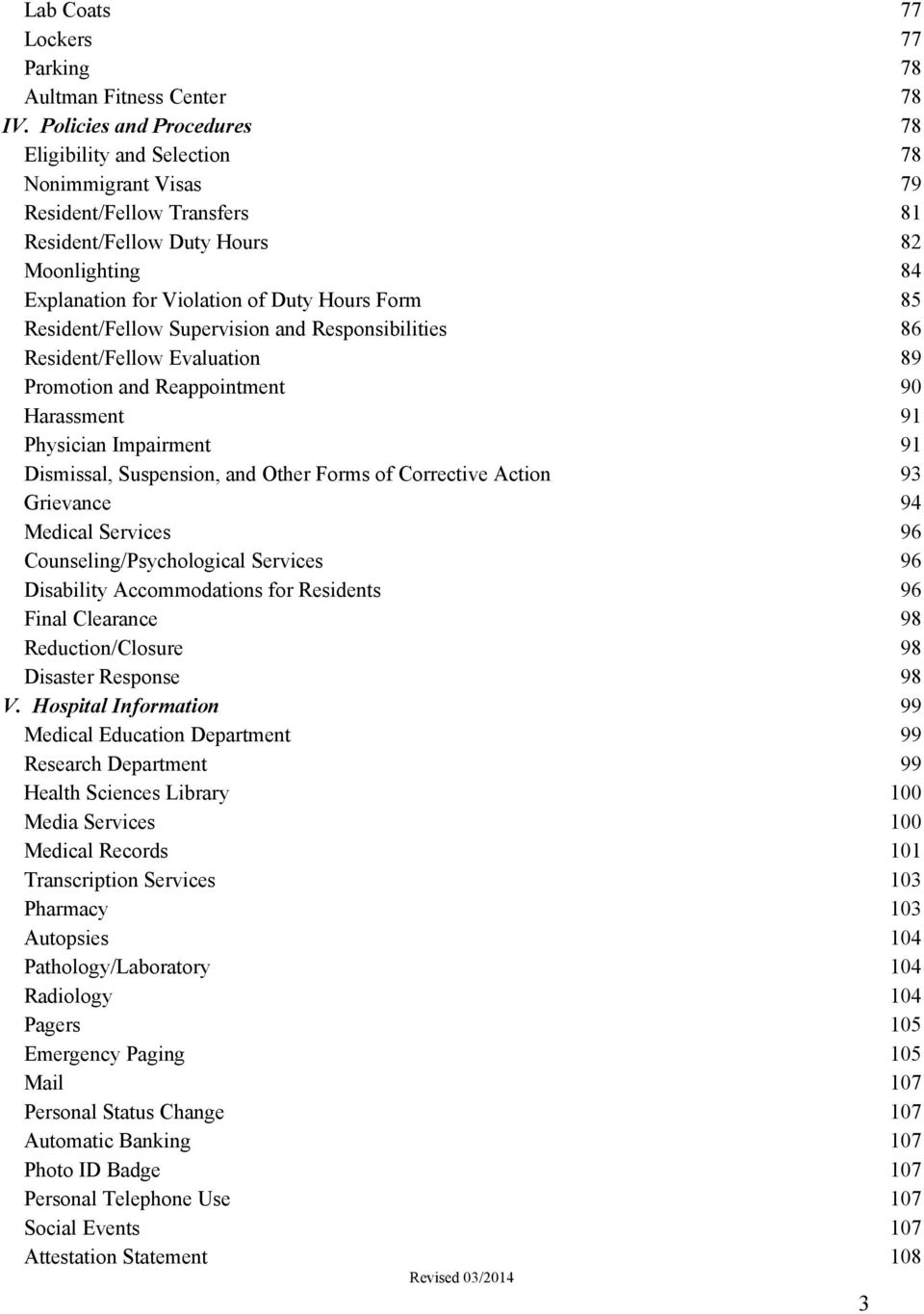
5 Lab Coats 77 Lockers 77 Parking 78 Aultman Fitness Center 78 IV. Policies and Procedures 78 Eligibility and Selection 78 Nonimmigrant Visas 79 Resident/Fellow Transfers 81 Resident/Fellow Duty Hours 82 Moonlighting 84 Explanation for Violation of Duty Hours Form 85 Resident/Fellow Supervision and Responsibilities 86 Resident/Fellow Evaluation 89 Promotion and Reappointment 90 Harassment 91 Physician Impairment 91 Dismissal, Suspension, and Other Forms of Corrective Action 93 Grievance 94 Medical Services 96 Counseling/Psychological Services 96 Disability Accommodations for Residents 96 Final Clearance 98 Reduction/Closure 98 Disaster Response 98 V. Hospital Information 99 Medical Education Department 99 Research Department 99 Health Sciences Library 100 Media Services 100 Medical Records 101 Transcription Services 103 Pharmacy 103 Autopsies 104 Pathology/Laboratory 104 Radiology 104 Pagers 105 Emergency Paging 105 Mail 107 Personal Status Change 107 Automatic Banking 107 Photo ID Badge 107 Personal Telephone Use 107 Social Events 107 Attestation Statement 108 Revised 03/2014 3
6 Administration and Governance of the Graduate Medical Education Program The residents/fellows and faculty of Aultman Hospital comprise a community whose shared mission is the education and socialization of the health professional and the promotion of quality care in our community. To that end, the hospital endorses certain beliefs, which provide a context for learning and teaching. Through its education programs, Aultman Hospital seeks to ensure academic excellence by providing highly qualified faculty, residents/fellows, and staff, the incentive necessary for excellence and the resources necessary to support the educational mission. The aims of this mission are to encourage personal growth and to facilitate the acquisition of the knowledge, skills, and attributes specific to the chosen profession in an environment characterized by openness and respect between the residents/fellows and faculty. The hospital s academic programs are designed to build on the competencies of general education, emphasize the development of critical thinking abilities, to encourage curiosity, and instill a desire of lifelong learning. Learning is viewed as an active, dynamic process for which residents/fellows and faculty share responsibility. The educational experiences of all the residents/fellows are designed to incorporate opportunities for interdisciplinary dialogue and collaboration in classroom, clinical and social settings. The hospital recognizes and supports individual differences in learning and teaching styles, values, interests and abilities, and believes that such variety enriches the academic climate. Embodied in the educational mission are the ideals of free expression, diversity, individual well-being, commitment to the common good, collegiality, tolerance, civility and equal opportunity for full and positive participation of each individual. The community of education bears responsibility for preserving the hospital s rich education heritage while also embracing opportunities for change and growth as the hospital moves toward the future. 4

7 Aultman Values Leading Our Community To Improved Health Aultman will Creates an environment that celebrates diverse perspectives and experiences while leveraging teamwork in support of our mission. Incorporates courtesy, honesty and respect in all services to achieve excellence in customer satisfaction. Gives employees the opportunity to experience job fulfillment and satisfaction in a working environment where participation and productivity are encouraged and where open, honest working relationships exist. Aultman will create a Recognize and accept the unique talents of every Aultman team member. Aultman will Exceed customer expectations. Aultman will achieve Success through teamwork. Positive and safe work environment. Provides continuous quality improvement and ensures a safe working environment by upgrading and maintaining facilities and procedures. Provides educational programs for physicians, nurses, employees, patients, families and community that focus on current and preventive health-care issues. Aultman will maintain Emphasizes cost control and effective use of resources to maintain a financially stable organization; provides the community with both secure employment and quality health care. Aultman will maintain Fosters fair, honest and open relationships through programs designed to promote appreciation, encouragement and recognition. Aultman will Educate our community. Cost-effective management of resources. Trust and integrity in all relationships.

8 CORPORATE CUSTOMER SERVICE HEALTHCARE DELIVERY SYSTEM service The Aultman Way At Aultman, we are committed to improving your health. We will respect you as an individual and pledge excellent care and service provided by a well-trained, compassionate and friendly team of healthcare professionals. In Aultman s healing environment, we aspire to fulfill your physical, emotional, and spiritual needs.

9 Aultman Corporate Customer Service Standards for the Healthcare Delivery System Safety Is Our Top Priority Protecting You Know and thoroughly follow established safety policies and procedures. Recognize YOU are responsible for the safety of patients, customers and co-workers. Stop any process if a safety concern is present. Be aware of surroundings even if you are not in your department. Report hazards or safety concerns immediately. Safety is everyone s responsibility. Attitude Creating Positive Impressions Smile! Acknowledge and greet everyone you encounter. Thank our patients and customers for choosing Aultman and/or AultCare. Walk customers to their destination instead of pointing or giving directions. End all patient and customer encounters with, Is there anything else I can do for you? Use patient and customers name. Refrain from using honey, sweetie, etc. Be open to change and new ideas about improving. Teamwork Reaching Goals Together Respect everyone s role and expertise; be open to others opinions and ideas. Offer to help each other. Resolve conflicts respectfully, directly and privately with the individual. Take ownership of your assignment, and communicate if anything was unable to be completed. Use communication boards in patient rooms. Appearance Looking the Part Follow the dress code as outlined in the employee handbook. Wear your ID badge above the waist, and make sure that it is visible. Ensure your clothing is neat, clean and in good repair. Practice good personal hygiene. Do not wear strong scents. Competency Learning Never Ends Complete education on time and as required. Track educational requirements, and engage in education opportunities offered by Aultman. Ensure you have appropriate training to complete job duties and operate equipment. Meet regulatory requirements for your professional standards on time.

10 Recognition Expressing Our Appreciation Show appreciation. Say thank you to your co-workers, and recognize co-workers when they have exemplified the service standards. Notify a direct supervisor of an employee s job well done, when possible. Share team and individual successes with the team openly. Learn and use a co-worker s preferred name. Service Recovery Making it Right Listen, empathize, apologize and thank an unhappy patient or customer for feedback. Ask what you can do to improve. Notify your supervisor if you are unable to resolve an issue. Anticipate problems before they become complaints. Take responsibility and make it right, rather than making excuses and blaming others. Individualism Respecting Our Diversity Recognize and accept the unique talents of each Aultman team member. Ask appropriate questions to help understand individual preferences; respect preferences. Treat everyone fairly regardless of differences. Be proactive in meeting patient and customers specific needs. Relationships Building on Trust Be an active listener, and provide feedback where appropriate. Reinforce each other s strengths; provide feedback to your co-workers. Be on time. Be respectful of a co-worker s time. Welcome new employees, students and volunteers. Refrain from speaking negatively about co-workers and physicians in front of other employees, patients or families. Environment Providing a Place to Heal Familiarize patients, customers and visitors with their environment (call bell, etc.). Welcome and be gracious to family members. Advocate for patient and customer needs. Be aware of noise levels. Keep noise levels down in patient care areas. Keep work areas organized and clean. Dispose of trash, and clean up spills if needed. Formulated: November 2012

11 WHAT THEY ARE WHAT WE DO KEY PHRASES 1. Pay attention to detail 2. Communicate clearly Self check using STAR Stop Think Act Review Let me repeat that back to you... 3 way repeat back and read back Clarifying questions That s correct. Phonetic and numeric clarification SBAR to pass information Situation Background Assessment Recommendation 3. Think critically Questioning attitude Validate and verify Let me ask a clarifying question. 4. Cross monitor 5. Speak up for Safety using ARCC Peer checking Peer coaching 5:1 feedback. Ask a question Request a change Use the safety phrase, I have a Concern Use your Chain of command I have a concern. 6. Smile and say hello 7. Introduce yourself, your role and refer to others by their preferred name 8. Listen actively with empathy and intent to understand 9. Communicate the positive intent of your actions 10. Provide opportunities for others to ask questions YOU CAN COUNT ON ME

12 Patient Identification Always use two patient IDs prior to procedure or patient care o Inpatient: Name and Medical Record Number o Outpatient: Name and Date of Birth Always perform a time out for invasive procedures Utilize positive patient identification devices (Caremobile, Soft ID, etc ) Never use room number as an ID Verify correct spelling of patient first and last name o On admission o Blood bank specimens Order Verification Matching Check that service / intervention matches order o Restraints o Medications o Meals Eliminate duplicate orders Think critically before carrying out a questionable order Verify orders are appropriate for patient and their diagnosis Hand Hygiene Practice the 5 Moments of Hand Hygiene o Before touching a patient o Before clean/aseptic procedures o After body fluid exposure risks o After touching a patient o After touching patient surrounding Encourage patients and visitors to practice good hand hygiene Hold yourself and others accountable for hand hygiene Workplace Safety Clear clutter from the environment Report safety issues and concerns Report injuries and significant exposures immediately Immediately report spills Remove broken equipment and notify appropriate personnel Report instances or suspicions of workplace violence o Employees o Patients


13 o Visitors Practice back safety (Plan, Test, Bend knees and keep back straight) Accurate/Complete Documentation Sign, date and time all written documentation Keep documentation timely and objective Modify care plan with patient condition changes Use CareAdmin or CareMobile for medication administration For issues not appropriate for Medical Record, file a variance Document real time during emergency situations (codes/rr) Personal Protective Equipment Use Use all PPE per standard precautions Apply PPE prior to entering a room and before exiting the room Follow requirements listed on isolation signage If you cover your nose or mouth, cover your eyes Restock PPE inventory Alert and Alarm Recognition and Investigation Remain attentive to alarms Respond to all alarms in a timely manner Set alarms based on individual patient needs Verify that alarms are audible Immediately address leads off and low battery alarms Verify bed alarms and chair pad sensors are on and functioning with high risk patients Never pass by a room with a call light on Express Urgency of Situation or Concern Report critical results in a timely manner Utilize appropriate chain of command when necessary Immediately stop a procedure if a safety concern is present Practice early activation of the rapid response team

14

15 AULTMAN CORPORATE COMPLIANCE PROGRAM Corporate Compliance means that Aultman s employees and medical staff will use their best efforts to understand and comply with all of the legal and ethical requirements related to their jobs. The health care industry is very complex and subject to many rules and regulations, particularly regarding federal health care programs such as Medicare and Medicaid. The federal government has strongly encouraged health care providers to voluntarily enter into compliance programs designed to reduce health care fraud and abuse. As part of Aultman s effort to follow the laws that govern us, a Corporate Compliance Program was introduced in Aultman is committed to conducting business legally and with integrity. We believe that Corporate Compliance is good business. It helps fulfill our caregiving mission to our patients and to the community. It is also evidence to our employees and the community of Aultman s strong commitment to honest and responsible conduct. Aultman has appointed a Compliance Officer who is responsible for the daily oversight of the Corporate Compliance Program. The primary responsibilities of the Compliance Officer include: Providing an open line of communication for employees and others within our organization to submit concerns, issues, or questions regarding compliance. Investigating and responding to concerns, issues, or questions. Maintaining auditing and monitoring mechanisms to ensure compliance. Examples of the concerns and questions that the Corporate Compliance Program might address include, but are not limited to: Potential violation of Aultman s Code of Conduct, potential violations of policies and procedures, potential violations of laws and regulations; matters involving billing and coding; questions about accounting and auditing practices; quality of care issues; and patient safety matters. Policy on Providing Information About False Claims Act General Responsibility of Every Employee: Aultman is committed to complying with applicable federal, state and local laws and acting in an ethical manner consistent with its Code of Conduct. Compliance is an important part of every employee s job. Each employee is responsible for having a general knowledge and understanding of Aultman s Corporate Compliance Program and Code of Conduct. Employees should also know (from a lay perspective) what laws apply to Aultman generally and to them specifically when performing their job. Aultman believes that an effective way to prevent potential violations of legal and ethical standards is to encourage employees to ask questions and report concerns to management or to the Compliance Officer. Reporting to the Compliance Officer may be done in person, in writing, or anonymously by using the confidential Compliance Line ( ). Employees and other persons appropriately reporting concerns and potential violations may do so without fear of retaliation or disciplinary action. Failure to report suspected violations could adversely affect Aultman s ability to identify, investigate, correct, and prevent potential or actual violations. For this reason, the deliberate 13

16 failure by an employee to report a known or suspected violation will be considered unacceptable behavior. Upon receiving a report of a suspected violation or non-compliant act, Aultman will conduct an investigation. If it determines that a violation has occurred, it promptly will take reasonable steps to: (1) Correct the violation or bring actions into compliance; (2) Prevent the same or similar violations from occurring in the future; and (3) Make any disclosures and repayments required by law. Applicable Federal and State Laws for Preventing Fraud, Waste and Abuse: Aultman must comply with numerous federal, state, and local laws, including those aimed at preventing fraud, waste and abuse in Medicare and Medicaid. One of the biggest risk areas for hospitals, in general, is preparing, coding and submitting claims for payment and reimbursement by federal and state health care programs. Section 6032 of the federal Deficit Reduction Act of 2005 requires hospitals to include in the employee handbooks policies to educate employees about the False Claims Act, as well as policies for detecting and preventing fraud, waste, and abuse. False Claims Act: The False Claims Act is a federal law enacted to prevent fraud and abuse by government contractors, including health care providers under the Medicare and Medicaid programs. To combat fraud and abuse, the False Claims Act allows the federal government to bring legal action against health care providers who submit false claims. A false claim arises when an individual or an organization: (a) Knowingly presents, or causes to be presented, to the federal government a false or fraudulent claim for payment or approval; (b) Knowingly makes or uses, or causes to be made or used, a false record or statement in order to have a false or fraudulent claim paid or approved by the government; or (c) Conspires to defraud the government by getting a false or fraudulent claim paid or approved. Any individual or organization that knowingly submits a false or fraudulent claim for payment may be liable for significant fines and penalties. False Claim Defined: A false claim occurs when a provider knowingly presents a false or fraudulent claim for payment or reimbursement by Medicare or Medicaid. A false claim is different from an honest mistake. It is not necessary for the government to prove that a hospital or medical provider intended to defraud the government. The term knowingly presents includes reckless disregard for the truth or falsity of claims, or acting with deliberate ignorance (i.e., looking the other way, when one knew, or should have known, there is a problem with the truth and accuracy of claims at the time they are submitted). Examples of false claims include inaccurate or incorrect coding, upcoding, unbundling of services, billing for medically unnecessary services, billing for services not done, duplicate billing, and insufficient or falsified documentation in the medical record to support the code. It is important that each employee who is involved in the preparation and submission of claims remains aware of and current on his/her legal obligations. Investigations and Qui Tam Actions: The government may initiate a False Claims Act investigation. Investigations also may result from an audit by the Medicare Fiscal Intermediary or Carrier or by government contractors that monitor accurate claims and reimbursement. 14

17 The False Claims Act also contains what is known as a qui tam or whistleblower provision that allows private individuals to bring to the government s attention suspected violations of the False Claims Act. The False Claims Act permits lawsuits to be brought by whistleblowers, typically employees or former employees, who have knowledge of fraudulent activities. Those who act in good faith in bringing whistleblower claims are protected under the law. Program Fraud Civil Remedies Act of 1986: The Program Fraud Civil Remedies Act of 1986 authorizes federal agencies to investigate and assess penalties when a provider submits false claims or statements to an agency. The conduct is similar to that prohibited by the False Claims Act. Ohio Medicaid Law: Under Ohio law, a health care provider can be liable for obtaining or attempting to obtain payment for false claims submitted in an attempt to defraud Medicaid. Specifically, Ohio Revised Code section prohibits hospitals and medical providers from knowingly making, or causing to be made, false or misleading statements to obtain Medicaid reimbursement. Those who violate this statute may be found guilty of Medicaid Fraud, which is a criminal offense. Additionally, Ohio Revised Code section prohibits hospitals from willfully receiving payments that they are not entitled to receive, or from willfully receiving payments in an amount more than what they should receive. Those who violate this statute must repay three times the value of excess payments, plus additional civil monetary penalties. Ohio law also provides protection for whistleblowers reporting violations under certain circumstances. If an employee reports a violation of Ohio s Medicaid laws in good faith to his/her supervisor or to another member of the management team, Aultman may not take disciplinary or other retaliatory action against the employee. Penalties: Individuals and organizations who violate the False Claims Act are subject to civil monetary damages, including repayment of overpayments; payment of interest; a per claim fine of $5,500 or $11,000; trebling of damages (the amount of damages may be tripled); and payment of costs. Those who violate the Program Fraud Civil Remedies Act of 1986 may be assessed double to damages up to $5,500 for each false or fictitious claim. If a False Claims Act violation is serious, a health care provider may be subject to criminal prosecution under federal criminal statutes, including the fraud and abuse and anti-kickback laws, as well as HIPAA health care offenses. Besides criminal and civil penalties, those convicted of submitting a false claim or other program-related offenses may be excluded from participating in Medicare, Medicaid, and other federal health care programs. A violation of the False Claims Act may also subject the violator to civil or criminal prosecution by the Ohio Attorney General under Ohio s Medicaid laws. A health care provider who violates Ohio s Medicaid laws must repay all excess amounts and interest. A provider may also be subject to a $5,000 or $10,000 fine for each claim, in addition to the trebling of damages and repayment of costs. Prevention: Duty to Report: Consistent with its mission and values, Aultman has policies in place to detect, identify, investigate, correct, and prevent fraud, waste and abuse. Aultman regularly conducts internal audits and engages qualified independent consultants to review its performance with the intent of complying with applicable laws. 15

18 One of the most essential components to assuring compliance is to maintain an open line of communication between concerned employees and Aultman. If any employee has a question or concern about compliance, including the proper preparation and submission of claims, or a potential violation of the False Claims Act, or Ohio statutes pertaining to the submission of claims to Medicaid, that employee has a responsibility to ask the question or report the concern. A question or concern may be made to the Compliance Officer, to his/her manager, to another member of the management team, or to Aultman s legal department. A question or reported concern may be made in person, in writing, or anonymously by using Aultman s Compliance Line at No Retaliation: Any employee who asks a question or appropriately reports a concern or suspected violation of any applicable law, including the False Claims Act or Ohio s Medicaid statutes, will not be subject to retaliation or disciplinary action. Compliance Line: The Aultman Compliance Line is a convenient and confidential way for you to report compliance concerns that you may have. Aultman Hospital has contracted with an outside vendor to manage this reporting option. The Aultman Compliance Line is toll-free and is available 24 hours a day, 365 days a year. What Happens if I call the Aultman Compliance Line?: Your call to the Aultman Compliance Line will be answered by a trained Communication Specialist who listens to and makes notes of your concern. Calls are never recorded or traced. If necessary, the Communication Specialist will ask follow-up questions to gather further information. At the close of the call, you will receive a unique identification number and a follow-up date. You may check the status of your concern by referring to this identification number when you call back on the assigned date. Do I have to give my name?: Although you may give your name if you want, you are not required to identify yourself. If you choose to remain anonymous, your identity y will be protected throughout the process. What happens after I call?: After your call, the Communication Specialist prepares a report that is forwarded to the Aultman Compliance Officer for review and, if warranted, an investigation. Aultman may also take action to fix any problems found during the investigation. The Aultman Compliance Office will provide feedback on your concern to the Communication Specialist so that this information can be relayed back to you when you call to check on the status of your concern. Why does Aultman have a Compliance Line?: Having a method for employees to report compliance concerns anonymously without fear of retaliation is a good practice for any organization. When should I call the Aultman Compliance Line?: As an Aultman employee, you have an obligation to report compliance concerns or issues that you become aware of. We encourage you to discuss these with your manager, another member of the management team, or the Aultman Compliance Office. If you feel more comfortable reporting your concerns to a neutral third party, you may do so by calling the Aultman Compliance Line. Can I report my concerns online?: Yes, concerns can be reported online at What are some examples of concerns I should report? 16

19 Improper coding an billing Violations of confidentiality Quality of care issues Discrimination/harassment Conflicts of interest Inappropriate gifts, entertainment, and gratuities Improper payments and referrals Workplace safety issues Financial reporting issues Theft and fraud Violations of the Code of Conduct Violations of the laws and regulations that affect us every day AULTMAN COMPLIANCE LINE: PROTECTING PATIENT PRIVACY Why are we concerned about privacy? Federal regulations on patient privacy and confidentiality took effect in April The privacy regulations addressed patient rights and the type of information that is protected. Additional security regulations became effective in April 2005 that apply to electronic protected health information. Collectively, these regulations are known as the Health Insurance Portability and Accountability Act (HIPAA), and they set standards for protecting patient privacy. Most of us at some point will have contact with patient information. For some it may be every day, for others, just once in a while. But regardless of how often, we all have a responsibility to protect the privacy and confidentiality of patient information. Our patients and our community expect us to protect their information. If we don t, quality of care can be compromised and our reputation could be damaged. As health care workers, we have an ethical and moral obligation to protect patient health information. What information is considered private?: Protected health information (PHI) is any information generated in the course of treating a patient that may allow identification of that individual. How do we protect patient information?: Follow the Minimum Necessary Standard. This means that employees should only access information needed to do their job and disclose only the information that someone else needs to do their job and disclose only the information that someone else needs to do their job. How do we safeguard patient information? Discuss patient information privately. Use individual passwords. Do not share or disclose your password. Log off before you leave your workstation. Use shredding containers. Use common sense and good judgment. 17

20 How can we use and disclose patient information? For treatment, payment, and operations purposes For legally mandated reporting With patient authorization For inquiries about patients, unless they have chosen to be excluded from the Patient Directory (also referred to as a DNP). To family and friends of the patient with approval from the patient What rights does HIPAA provide to patients regarding their health information? The right to access The right to request amendments The right to an accounting of disclosures The right to request alternative communications or restrictions The right to file a complaint without retaliation The right to receive written Notice of Privacy Practices The HIPAA Privacy Rule: The HIPAA Privacy Rule was created to protect the privacy of health care patients. In summary, it: Sets boundaries on how we use and disclose patient information Provides patients with certain rights Includes penalties for violations of patient privacy Aultman has always been committed to protecting our patients privacy and will continue to do so by complying with the HIPAA Privacy Rule. Providing our patients with quality health care includes protecting their confidential information. Where do I go for answers about protecting patient privacy or to report concerns? Talk to your manager Review HIPAA policies and procedures, forms, and guidelines on the Aultman Intranet in the HIPAA category under Knowledge Management Contact the Privacy Office at , ext , [email protected] or Privacy Officer Tim Regula at , ext or [email protected] 18

21 MEDICAL EDUCATION Mercy Hospital Board of Directors 7/2014 Aultman Foundation Board of Directors Canton Medical Foundation Board of Directors Medical Executive Committee CEO Medical Education & Research Committee Graduate Medical Education Committee Director of Medical Education and Research /DIO ADME Family Medicine Residency OB/GYN Residency Radiology Cardiovascular Fellowship Internal Medicine Residency
22 GRADUATE MEDICAL EDUCATION ACCREDITATION The Accreditation Council for Graduate Medical Education (ACGME) sponsored by the American Board of Medical Specialties, the American Hospital Association, the American Medical Association, the Association of American Medical Colleges, and the Council of Medical Specialty Societies currently accredits all allopathic Graduate Medical Education Programs at Aultman Hospital. The most recent institutional accreditation for Graduate Medical Education Programs at Aultman Hospital was awarded in April of 2013 and granted five (5) years of accreditation. The ACGME has now made the transition to the Next Accreditation System (NAS). Our next regularly scheduled institutional site visit is being replaced with a Self-Study Visit in NAS, which will occur tentatively in I. TERMS OF CONTRACT The resident/fellow agrees to perform satisfactorily, and to the best of his/her ability, those customary duties in the field of education and training, and to conform to all hospital policies, procedures, and regulations applying to residents/fellows. Residents/Fellows are not required to sign a non-competition guarantee. HOURS ON DUTY Duty assignment will be made on all services by the program director and/or chief resident/fellow of the service involved, and will include on call rotations as well as usual working hours. The chief resident/fellow or program director of the service to which you are assigned is responsible for the rotation of your various duties on that service. You are responsible to your chief resident/fellow, since s/he is responsible for you. If you have any questions, check with your chief resident/fellow (or assistant chief resident/fellow). Your chief resident/fellow or program director will arrange a schedule of nights and weekends off. IF, BECAUSE OF AN EMERGENCY, YOU MUST LEAVE THE HOSPITAL AT A NONSCHEDULED TIME, YOU MUST REPORT TO YOUR CHIEF RESIDENT/ FELLOW PRIOR TO SIGNING OUT. YOU CANNOT SIGN OUT TO A RESIDENT/ FELLOW ON ANOTHER SERVICE WITHOUT PRIOR PERMISSION. Before leaving the hospital at any time, sign out to the telephone operator. Inform the operator who is taking your calls. Inform the physician taking your calls of any matter that may require special attention, such as seriously ill patients that you are leaving in his/her care. When you return, inform the operator that you are back. When assigned to a service, residents/fellows will complete histories and physicals on patients assigned to the service. All elective surgeries must have histories and physicals prior to going into surgery. Changes in patients' conditions should be called to the attention of the senior resident/fellow assigned to the service or to the attending physician, if the senior resident/fellow is not available. Residents/Fellows should consult with the attending before ordering unusual procedures, medications or treatments. Residents/Fellows are to answer calls to the division promptly and courteously. While on night-call, "CODE BLUE" and "EMERGENCY" calls constitute the most urgent situations and are to be answered immediately by all assigned residents/fellows. The attending 20
23 physician or resident/fellow assigned to the service the next day may handle calls of a nonurgent nature. Sleeping rooms are provided in designated areas. Unless an exception is made by the program director, when on call, a resident/fellow must stay in the hospital. ECFMG CERTIFICATE ECFMG certification is necessary for graduates of foreign medical schools to enter US residency or fellowship programs accredited by ACGME (excluding 5 th Pathway residents/fellows). LICENSE/TRAINING CERTIFICATE All residents/fellows must obtain either a training certificate or a permanent state license to practice medicine in the State of Ohio. When starting the residency program, the hospital will provide the training certificate application and fees. If the resident/fellow obtains a permanent license, it is the resident s/fellow s duty to provide Medical Education with a copy of the permanent license immediately. Any cost and the renewal for the permanent license will be the responsibility of the resident/fellow. PRE-PLACEMENT PHYSICAL EXAMINATION TESTING All job offers are contingent upon satisfactory completion of a medical/physical examination that includes screening for drugs and nicotine. The Aultman Health Foundation will assume the costs of the medical/physical examination, which must be performed by an approved physician/physician assistant/nurse practitioner who is familiar with the demands of the particular position and who can certify whether the applicant is capable of performing his or her specific responsibilities. In a case of an applicant with a disability, this examination will take into consideration any reasonable accommodations that the applicant may voluntarily request. All medical/physical examination results will be kept confidential as required by federal and state law. The medical examination includes, but may not be limited to, the following: a 2-step tuberculosis skin test (If the applicant is unable to provide documentation of two consecutive years of negative TB tests including the measurement in mm induration), Rubella/Rubeola, a urine drug screen for substance abuse, a nicotine screening, a screening test for communicable diseases, and a consultation with a physician/physician assistant/nurse practitioner for a physical examination. Pre-placement medical examinations are scheduled and provided by the hospital at no cost to the job applicant. Arrangements for the physical and lab work are made through the Medical Education Department. The offer of employment will be revoked if the job applicant declines to undergo a medical examination or fails to meet the minimum physical requirements for the job. ANNUAL REQUIREMENTS All Ob/Gyn and Family Medicine residents/fellows are required to complete a Physician Health Assessment annually. CORPORATE COMPLIANCE All residents/fellows are required to comply with all of the legal and other requirements related to his/her job. This includes, but is not limited to, completing yearly: a safety test, TB fit test, signing a corporate compliance agreement, confidentiality agreement, and an electronic communications agreement. All residents/fellows are required to be certified in Basic Life Support (BLS) and Advanced Cardiovascular Life Support (ACLS). The residency 21
24 will pay for all first-time certification courses and materials, as well as the first recertification course. If a resident/fellow fails to pass the certification/recertification course on the first attempt, the resident/fellow is responsible for paying for the additional courses. In addition, if the resident/fellow fails to attend the class, s/he will be charged for the course by the Education and Development Department. Additional life support classes may be mandatory for some residencies. DRESS CODE Residents/Fellows are expected to maintain a standard of dress that projects an image of professional integrity and service excellence. Residents/Fellows are expected to dress according to the service they are rotating on. Scrubs should not be worn in the office setting except when simultaneously covering OB/GYN service. Mustaches and beards must be kept neat and trimmed close to the face. The maximum beard length should not exceed ½ inch. Handlebar mustaches are not acceptable. Hosiery or socks must be worn at all times. Visible tattoos are unacceptable. Ear piercing is acceptable, however, should not be extreme. Other visible body piercing is unacceptable. Hair color must be natural shades. II. STIPENDS AND BENEFITS Each resident/fellow will be provided a stipend, as well as educational allowances, sick time, bereavement, and jury duty pay. These benefits represent compensation for patient care services and support for the educational components of the residency/fellowship program. Salary and benefits are listed on the Resident Benefit Sheet, which are specific to each program. (See Exhibit A-1). The annual stipends and benefits are reviewed and revised yearly. The appropriate stipend levels are reviewed and approved by GMEC. This is sent as a recommendation to the CEO for approval. STIPEND Residents /Fellows pays are on alternate Fridays and are paid through automatic deposit. The annual stipend is divided into 26 equal pay periods, each covering a two-week period. All employees are required to sign up for direct deposit. Federal, state and local laws require the following deductions be made from the gross income of residents/fellows: federal withholding tax, Social Security, Medicare, and State of Ohio tax. Any resident/fellow that is on a J-1 visa is exempt from Social Security and Medicare withholdings. The resident/fellow will continue to be offered his/her appointment, with accompanying stipend and perquisites, only as long as his/her obligations, as described in this manual, continue to be performed in an acceptable and professional manner. Chief residents/fellows will receive an additional annual stipend of $1, that may be paid in a lump sum. EDUCATIONAL ALLOWANCE Each resident/fellow will be allotted an educational allowance, in addition to the usual stipend, per academic year, based on his/her level of training within the residency/fellowship program. Approved expenditures for this allowance will be at the discretion of the individual residency program. These expenditures cannot be carried over to the next academic year. Five days of conference is allowed in addition to vacation time per academic year. Special exceptions may be made when there are schedule conflicts that prohibit a resident/fellow from 22
25 taking his/her allowance and time. Each program has specific policies regarding educational allowance and conference time. Please refer to them for more details. TRAVEL REIMBURSEMENT All travel requests must be approved in advance by the Program Director. Individuals will be granted travel time depending upon the location of the conference and the schedule of the conference. Should the person choose to extend his/her time at the conference, further time off will be deducted from their vacation time. Educational travel should be limited to the continental United States. The following travel costs will be reimbursed: Air flight (coach) for one Hotel stay (number of nights depends upon location of conference and start time of the event). Hotel stays should be minimized. Meals: Maximum $58/day Registration and course fees Travel between airport and hotel (shuttle bus or taxi) Necessary expenses for travel from hotel to meeting site (maximum $75 per conference) Airport car parking fees The following are not reimbursable expenses: Car rental and all associated expenses*** Entertainment Travel expenses for companion(s) Employees who choose to drive rather than travel by air will be reimbursed for the actual mileage, or up to the airline fee, whichever is lower. In these situations, documentation of airline fees must be submitted with the expense reimbursement form. These fees can usually be obtained from various travel web sites. All reimbursements must be accompanied by a receipt. Itemized hotel bills should be attached to expense reimbursements no credit card summarized statements. All expense reports must be turned in within 30 days of the trip to receive reimbursement. NOTE: Some programs allow the resident/fellow to use their travel allowance to purchase electronic devices such as smartphones, laptops, or tablets. If this is the case, then the reimbursement is processed through payroll as a taxable reimbursement. Please consult with your program to see if this is allowable. ***An individual may choose to rent a car, but reimbursement will be capped at $50 (reflects saving for airport/hotel shuttles). FINANCIAL SUPPORT FOR RESIDENT RESEARCH AND TRAVEL Funds are available for the purpose of fostering and supporting resident research. These funds are administered through the Aultman Health Foundation Graduate Medical Education and Research Department. These funds are available for the following research related needs: Research equipment or materials Special computer software Laboratory tests or equipment Travel expenses for the purpose of dissemination 23
26 Funds are only available by written request to the Administrative Director of Medical Education. Background: The goal and purpose of the Aultman Hospital Resident Research Training Program is to integrate a practical research experience with basic science education and clinical patient care. This is accomplished through didactic lectures, careful research mentoring by experienced physician researchers, Ph.D. level basic scientists and allied health professionals and exposure to a rich clinical environment within which to carry out medically related research activities. All resident physicians at the Aultman Hospital are required to complete a scholarly project. Each training program has established requirements for scholarship, which may include research, case studies, performance improvement projects, etc. in order to qualify for graduation from their program. Research projects may explore a variety of topics in the form of a detailed literature review, case study, innovative device design, retrospective study, prospective study or a basic laboratory investigation. Residents are urged to use the most comprehensive research design possible in order to gain the widest research experience and maximize the quality of their research project within realistic budget and time constraints. Presentation of projects at national research meetings and publication within peer reviewed journals is strongly encouraged to further enhance the resident s experience and career advancement, but are not required for graduation. Didactic research education is provided through two venues. Research papers from the published literature are presented and critiqued by resident physicians at journal clubs under the supervision of attending physicians with expertise in the topic area. Individual statistical consultation is available to all resident physicians as are personal computer facilities equipped with word-processing, spreadsheet and statistical software packages. Medline searches of medical literature are also available through the Health Service Library. Time is provided to work on research projects during clinical rotations throughout the residency program. Some residents choose to use elective time for the purpose of conducting research under the supervision of a research mentor. The Aultman Health Foundation Research Day is held annually and provides an opportunity for all residents/fellows to present their research projects to the Aultman Hospital community. Eligibility: Travel expenses are only available to current residents who have had research abstracts accepted at national meetings for presentation. Only one resident may receive funding per abstract accepted and that individual must demonstrate significant involvement with the project. The resident must be: First author of a research paper, and Presenting original research. In the event the first author is unable to attend the meeting, then another resident who worked on the project may be designated to present the research. Presentation: Resident research presentation may include presentations of papers, abstracts, and/or poster. 24
27 Conference: Appropriate conferences for presentation include national college and academy meetings and other conference regarded as major peer review conference within the Continental U.S. and Canada. International meetings may be considered in unusual circumstances, at the discretion of the Program Director and Administrative Director of Medical Education. Resident Time Off: This will be determined at the discretion of the Program Director; however, time off may be deducted from the resident s vacation or education time. Travel/Meeting Allowance Time: The resident will be granted one day travel to the conference, one day for the research presentation, and one day travel home from the conference. Should the resident choose to extend his time at the conference, further time off will be deducted from their vacation and education time. Resident Conference Funds: Should the resident choose to extend his time at the conference to further his own education, the resident may be required to expend conference monies for those days at the Program Director s discretion. Covered Expenses: The following travel costs will be reimbursed: Air flight (coach fare) for presenter Hotel (single occupancy) during convention (up to 3 days)* Meals ($58.00 per day) Registration and course fees Travel to and from hotel (Shuttle Bus Preferred) Necessary expenses for travel from hotel to meeting site (maximum $75 per resident per conference) The following travel costs will not be reimbursed: Travel expenses for spouse or friend Rental cars Entertainment Application for Travel Expenses: A request for a travel grant must be made in advance on the Application for Resident Travel Fund Approval form by the responsible Program Director. A copy of (a) the abstract of the presentation, and (b) the letter of acceptance should accompany the request. A request must be submitted three (3) weeks prior to travel departure date. Procedure: Complete the Application for Resident Travel Fund Approval form. Once the form is completed and appropriate signatures have been obtained, the resident will forward it to the Administrative Director of Medical Education for approval. If approved, the resident will fill out a Travel Request Form in accordance with all Aultman Hospital travel guidelines. No monies will be available until travel is completed and appropriate original receipts are turned in. *This may be extended if posters are to be up for more than one day. e.g., bus or taxi rides. Does not include travel for recreation. A resident may choose to rent a car, but reimbursement will be capped at $75. 25
28 APPLICATION FOR RESIDENT TRAVEL FOR RESEARCH PURPOSES Aultman Hospital Graduate Medical Education 2600 Sixth Street SW Canton, Ohio Telephone: FAX: Applicant must be full-time in a residency program. This application must be completed. A copy of the abstract and confirmation of acceptance of the paper must be attached. Applicant Name: Residency Program: Title of Abstract: Meeting: Destination: Dates of Meeting: Expenses Travel: Accommodations: Meals: Ground Transportation: Registration Fee: Total Applicant s Signature [Date]: Program Director s Signature [Date]: Request: Approved Not Approved Carol Young, MBA Administrative Director, Medical Education Date 26
29 SICK TIME The sick time deposited into a resident s/fellow s sick bank at the beginning of the contract year should be used to provide a resident/fellow with continued income if the resident/fellow becomes sick or injured. Sick time is not to be used when taking time off for other instances such as: to care for ailing family members, family emergencies, or time lost for travel. At the beginning of the academic year, each resident/fellow will be allotted 56 hours (7 days) of nonaccrued sick days and 124 hours of non-accrued LOA/maternity days. Sick Days: This time is to be used to provide continued income if/when the resident/fellow becomes sick or injured. Sick time will encompass 7 work days at full pay. LOA/Maternity Days: This time is to be used to provide continued income when the resident/fellow is on a leave of absence/maternity leave. This time will encompass 10 working days at full pay and 11 working days at half pay. The sick time from the sick days balance will also be used during this time. Each instance a resident/fellow calls off sick is considered an occurrence. An occurrence can consist of one day or multiple days. To be considered one occurrence, the multiple days must be concurrent. The Program Coordinator/Administrator will track the number of occurrences that each resident/fellow takes. Excessive absenteeism is part of the professionalism competency and will be considered part of the longitudinal evaluation. The Program Director may require a meeting to discuss sick occurrences. After the fourth occurrence, (on the fifth) the resident/fellow must meet with the Program Director upon returning to work. If the Program Director feels that the number of occurrences is excessive, s/he has the discretion to assign extra make-up duties. BEREAVEMENT Each resident/fellow is granted up to three working days with regular pay in the event of death in his/her immediate family. Immediate family is defined as mother, father, spouse, children, stepchildren, sister, brother, stepparent, grandchildren, grandparents, mother-in-law and father-in-law. Any additional time that is reasonably required may be granted without pay. JURY DUTY The GMEC recognizes the obligation of U.S. citizens to serve on a jury when summoned. Any resident/fellow called to jury duty will be paid his/her regular stipend. If s/he is excused or not seated as a juror, it is expected that s/he be available to work. A written notice confirming the jury duty is necessary for any compensation. HEALTH CLUB REIMBURSEMENT All residents/fellows are given a taxable allowance of $120 per year to spend on membership at an area health club. Requests for reimbursement with a copy of the receipt should be made to the Medical Education Department. HARDSHIP LOANS Hardship loans are available to aid residents/fellows to offset the expenses of relocation and to assist with the start/continuation of the education in the residency program when financial pressures might prevent them from doing so. The loans are available anytime after his/her 27
30 contractual start date. Written requests are made to the Department of Medical Education. The request must state the reason for obtaining the loan. The request requires the approval of the Administrative Director of Medical Education. Residents/Fellows may request interestfree loans up to $2,000. No interest is charged and loans must be repaid within a maximum twelve-month period via payroll deductions. Loan balances will become repayable in full should the resident/fellow terminate his/her contract or otherwise leave the residency/fellowship program. HEALTH CARE INSURANCE - Medical, Dental, and Vision Health insurance coverage through AultCare is provided starting the first day of July for residents/fellows and their families. The Aultman residents/fellows choose between the Blue Plan, Gold Plan, or High Deductible Plan offered by AultCare. For off-cycle residents/ fellows, the coverage starts on the contractual start date. AultCare is provided at no cost to the resident/fellow. Dental insurance coverage is provided to the resident/fellow through the hospital s AultCare Dental Plan and is provided following the same guidelines as above. The resident/fellow chooses Plan 1, Plan 2, or Plan 3 (Orthodontia Plan). The cost of the dental coverage is contingent on the plan and family coverage that the resident/fellow chooses. Vision insurance is also provided to the resident/fellow and family through the hospital s dental plan. Vision coverage is provided at no extra cost to the resident/fellow. Eligibility The resident/fellow must fill out an AultCare enrollment form when starting residency in order to activate coverage. In general, eligible family members are spouses (unless legally separated) and dependent children up to 26 years of age. If the resident s/fellow s spouse has medical health care coverage offered through his/her employer, s/he is required to take that coverage on himself/herself as primary. If the spouse s birthday comes first in the calendar year, his/her insurance must also be primary for any children. A divorce decree naming someone responsible for health care expenditures for natural and stepchildren who live in the home will be honored. Change in Coverage If a marital status or number of dependents changes, the Human Resources Department must be notified within 30 days of the date of change in status. The coverage will then become effective on the first day of the following month. An exception is made for the birth of a child, for whom coverage will take effect on the date of birth. A change from family to individual coverage may be made at any time. However, a change from individual to family coverage cannot be made until the next open enrollment period, unless there is a change in family status. Open enrollment is usually in November or December. Coverage Ends Health care coverage terminates when the residency/fellowship program is finished, either by graduation or termination. Coverage may be continued through a period of time under the Consolidated Ominous Budget Reconciliation Act (COBRA). Cost of continued coverage is the resident s/fellow s responsibility after s/he leaves the residency program. 28
31 137 Aultman Hospital Blue Plan January Effective Date: 01/01/2014 AULTMAN HOSPITAL - BLUE PLAN MEDICAL BENEFITS NETWORK NON-NETWORK Lifetime Maximum None None Annual Plan Maximum UNLIMITED UNLIMITED Annual Deductible per Individual $800 $1,100 Annual Deductible per Family $1,600 $2, Notes: Tier One Includes Network Providers and Aultman Hospital, Aultman Acute Care Specialty Hospital, Akron Children s, Alliance Community, Aultman Orrville, Pomerene Hospital and Union Hospital. Tier Two All other Network hospitals facility charges will be paid at 80% after $950 individual/$1,900 family deductible and $1,900 individual/$3,800 family out of pocket, except for emergency, urgent care, preventive services and approved referrals. Maximum Out of Pocket per Individual $1,600 $2,300 Maximum Out of Pocket per Family $3,200 $4,600 - Does the Maximum Out of Pocket Includes the Annual Deductible? Yes --- Notes: Tier One Includes Network Providers and Aultman Hospital, Aultman Acute Care Specialty Hospital, Akron Children s, Alliance Community, Aultman Orrville, Pomerene Hospital and Union Hospital. Tier Two All other Network hospitals facility charges will be paid at 80% after $950 individual/$1,900 family deductible and $1,900 individual/$3,800 family out of pocket, except for emergency, urgent care, preventive services and approved referrals. Does the Medical Network out of pocket amount include Rx? No Prescription out of pocket Individual $4,000 Prescription out of pocket Family $8, Notes: Prescription copayments and coinsurance are included in the Pharmacy Out-of-Pocket maximum. Inpatient Hospital Care Semi-Private Room 90%-80%1,2 70%3
32 Surgery 90%-80%1,2 70%3 Anesthesia 90%-80%1,2 70%3 Physician 90%-80%1,2 70%3 Assistant Surgeon 90%-80%1,2 70%3 Ancillary Services 90%-80%1,2 70%3 Diagnostic Testing/Laboratory/X-Ray 90%-80%1,2 70%3 Chemo and Radiation Therapy 90%-80%1,2 70%3 Rehabilitative Therapy 90%-80%1,2,6 NOT COVERED6 - Which deductible applies? Network/Network - Which out of pocket applies? Network/Network Physical Therapy (Illness/Injury Related) 90%-80%1,2 70%3 --- Notes: Aultman facility: Paid at 100% deductible waived. Respiratory Therapy 90%-80%1,2 70%3
33 Kidney Dialysis 90%-80%1,2 70%3 Organ Transplant Services Organ Transplants Based on Service Based on Service Organ Donor Based on Service Based on Service Outpatient Services Emergency Room (Emergent) 90%1 90%1 - Which deductible applies? Network Network - Which out of pocket applies? Network Network Emergency Room Physician 90%1 90%1 - Which deductible applies? Network Network - Which out of pocket applies? Network Network Emergency Room (Non Emergent) 90%1 70%3 - Which out of pocket applies? Network Non-Network Urgent Care Facilty (Emergent) 90%1 90%1 - Which deductible applies? Network Network - Which out of pocket applies? Network Network Urgent Care Facilty (Non Emergent) 90%1 70%3 - Which out of pocket applies? Network Non-Network Pre-Admission Testing 90%-80%1,2 70%3 Diagnostic Testing/Laboratory/X-Ray 90%-80%1,2 70%3 Injections 90%-80%1,2 70%3 Same Day Surgery 90%-80%1,2 70%3
34 Assistant Surgeon 90%-80%1,2 70%3 Anesthesia 90%-80%1,2 70%3 Kidney Dialysis 90%-80%1,2 70%3 Chemo and Radiation Therapy 90%-80%1,2 70%3 Speech Therapy (Illness/Injury Related) 90%-80%1,2 70%3 Occupational Therapy (Illness/Injury Related) 90%-80%1,2 70%3 --- Notes: Aultman facility: Paid at 100% deductible waived. Physical Therapy (Illness/Injury Related) 90%-80%1,2 70%3 --- Notes: Aultman facility: Paid at 100% deductible waived. Respiratory Therapy 90%-80%1,2 70%3 Nursing Care Home Health Care (Utilization Management approval required) 90%-80%1,2,6 NOT COVERED6
35 - Which deductible applies? Network/Network - Which out of pocket applies? Network/Network - Accumulation Type Calendar Year --- Visits 120 Skilled Nursing Facility (Utilization Management approval required) 90%-80%1,2 70%3 - Accumulation Type Calendar Year --- Days 120 Hospice Care (Utilization Management approval required) 90%-80%1,2 70%3 - Is Bereavement Counseling covered or not covered? Covered --- Notes: Hospice Care is limited to 6 months, then Utilization Management review is required. Private Duty Nursing (Utilization Management approval required) 90%-80%1,2 70%3 Other Services Second Surgical Opinion 90%1,4 70%3,4 - Which out of pocket applies? Network Non-Network Is coverage for Maternity Care based on services rendered? Is genetic counseling a covered service? Yes Yes Obesity (Utilization Management Approval Required) - Is treatment of obesity a covered service? If covered, benefit level of services will be based on service rendered-refer to that section for details. Yes - Are gastric restrictive procedures covered? Yes Biofeedback - Office 90%1 70%3 - Which out of pocket applies? Network Non-Network - Outpatient 90%-80%1,2 70%3
36 - Inpatient 90%-80%1,2 70%3 Diabetic Education - Office 90%1 70%3 - Which out of pocket applies? Network Non-Network - Outpatient 90%-80%1,2 70%3 - Inpatient 90%-80%1,2 70%3 Educational Training - Office 90%1 70%3 - Which out of pocket applies? Network Non-Network - Outpatient 90%-80%1,2 70%3 - Inpatient 90%-80%1,2 70%3 Nutritional Counseling - Office 90%1 70%3 - Which out of pocket applies? Network Non-Network - Outpatient 90%-80%1,2 70%3 - Inpatient 90%-80%1,2 70%3
37 Durable Medical Equipment 100%1 70%3 Are wigs covered? (See DME for Benefit) UM Guideline is 6 Post-Mastectomy Bras per calendar year, does plan design allow more? Yes No --- Notes: Post Mastectomy Bras or Breast Prosthesis: Network benefit level is 90% after Network deductible and Non-Network is 70% after the Non-Network deductible. Orthotics 100%1 70%3 Diabetic Supplies 100%1 70%3 Smoking Cessation 100% 100% - What services are covered under the medical plan?: --- Hypnosis Covered --- Counseling Covered --- Drug Aids Not Covered Infertility Testing - Office 90%1 70%3 - Which out of pocket applies? Network Non-Network - Outpatient 90%-80%1,2 70%3 - Inpatient 90%-80%1,2 70%3 --- Notes: Testing is approved for the initial diagnosis only. Cardiac Rehab Inpatient (Phase I) 90%-80%1,2,6 NOT COVERED6
38 - Which deductible applies? Network/Network - Which out of pocket applies? Network/Network Cardiac Rahab Outpatient (Phase II) 90%-80%1,2,6 NOT COVERED6 - Which deductible applies? Network/Network - Which out of pocket applies? Network/Network Cardiac Rehab (Phase III) This is not a covered service: Ambulance 80%1 80%1 Should we consider billed charges when using non network provider? Yes - Which deductible applies? Network Network - Which out of pocket applies? Network Network Temporomandibular Joint Syndrome - Are services covered? Yes - Are benefits based on services rendered? Yes Care in the Physician's Office Visits for Illness 90%1 70%3 - Which out of pocket applies? Network Non-Network Visits for Injury 90%1 90%1 - Which deductible applies? Network Network - Which out of pocket applies? Network Network Specialist Visit for Illness 90%1 70%3 - Which out of pocket applies? Network Non-Network Specialist Visit for Injury 90%1 90%1 - Which deductible applies? Network Network - Which out of pocket applies? Network Network Injections (Medical) 90%1 70%3 - Which out of pocket applies? Network Non-Network Diagnostic Testing/Laboratory/X-Ray 90%1 70%3 - Which out of pocket applies? Network Non-Network Surgery 90%1 70%3
39 - Which out of pocket applies? Network Non-Network Anesthesia 90%1 70%3 - Which out of pocket applies? Network Non-Network Allergy Extract 90%1 70%3 - Which out of pocket applies? Network Non-Network Allergy Injections 90%1 70%3 - Which out of pocket applies? Network Non-Network Allergy Tests 90%1 70%3 - Which out of pocket applies? Network Non-Network Kidney Dialysis 90%1 70%3 - Which out of pocket applies? Network Non-Network Chemo/Radiation Therapy 90%1 70%3 - Which out of pocket applies? Network Non-Network Speech Therapy (Illness/Injury Related) 90%1 70%3 - Which out of pocket applies? Network Non-Network Occupational Therapy (Illness/Injury Related) 90%1 70%3 - Which out of pocket applies? Network Non-Network --- Notes: Aultman facility: Paid at 100% deductible waived. Physical Therapy (Illness/Injury Related) 90%1 70%3 - Which out of pocket applies? Network Non-Network --- Notes:
40 Aultman facility: Paid at 100% deductible waived. Respiratory Therapy 90%1 70%3 - Which out of pocket applies? Network Non-Network Preventive Care Well Child Care 100% 70%3 - Which deductible applies? Non-Network - Other Services 100% 70%3 - Which deductible applies? Non-Network Are immunizations included in well child care? Yes --- Age limitation (through age) 4 Routine Physical Exam 100% 70%3 - Which deductible applies? Non-Network - Other Services (i.e. preventive screenings) 100% 70%3 - Which deductible applies? Non-Network Routine Prostate/PSA Screenings 100% 70%3 - Which deductible applies? Non-Network Routine Gynecological Exam 100% 70%3 - Which deductible applies? Non-Network - Other Services - Gynecological 100% 70%3 - Which deductible applies? Non-Network - Accumulation Type Calendar Year --- Visits 1 Routine Pap Test/Smear 100% 70%3 - Which deductible applies? Non-Network
41 Routine Immunizations 100% 70%3 - Which deductible applies? Non-Network Routine Mammograms 100% 70%3 - Which deductible applies? Non-Network - Accumulation Type Calendar Year --- Tests/Treatments 1 Routine Colonoscopy See Note 70%3 - Which deductible applies? Non-Network --- Notes: Age 50 and over: Network pays at 100% (no deductible) for 1st one, regardless of diagnosis. Subsequent or under age 50 must be medically necessary: Network pays 90% after deductible. Contraceptive Management - Contraceptive Management Birth Control/Injections/Aids 100% 70%3 - Which deductible applies? Non-Network Mental Health and Alcohol/Substance Abuse MHPA of 2008 Outpatient Treatment Program -In lieu of an inpatient stay (PHP or Partial Hospital Program) or Outpatient treatment (IOP or Intensive 90%-80%1,2,5 70%3,5 Outpatient Program) will be paid as any other outpatient service. Affiliates Chiropractors 90%1 70%3 - Which out of pocket applies? Network Non-Network - Manipulations 90%1 70%3 --
42 --- Which out of pocket applies? Network Non-Network - Diagnostic Services 90%1 70% Which out of pocket applies? Network Non-Network - Other Services 90%1 70% Which out of pocket applies? Network Non-Network - Accumulation Type Calendar Year --- Visits 10 Podiatrists 90%1 70%3 - Which out of pocket applies? Network Non-Network - Diagnostic Testing 90%1 70%3 --- Copayment Which out of pocket applies? Network Non-Network - Surgery - Office 90%1 70% Which out of pocket applies? Network Non-Network - Other Podiatry Services 90%1 70% Which out of pocket applies? Network Non-Network - Accumulation Type Calendar Year --- Visits Notes: Limitation waived for wound care services and all related charges when services are rendered at Aultman facilities. Additional Precertification may be required. Are Network and Non-Network deductibles and out of pocket amounts integated? Are deductibles amounts embedded? Is there individual deductible carryover ONLY? Yes Yes No
43 Is there individual and family deductible carryover? Yes Refer to Eligibility section for termination details. NON GRANDFATHERED/HRSA 1TIER ONE: Includes Network Providers and Aultman Hospital, Aultman Acute Care Specilaty Hospital, Akron Children s, Alliance Community, Aultman Orrville, Pomerene Hospital and Union Hospital. When using Network Providers or these facilities, an annual deductible of $800 individual/$1,600 per family is applied first before any plan benefits are paid to Network Providers. Deductible and Coinsurance are subject to an annual maximum of $1,600 individual/$3,200 per family. Once you have met this maximum, the Plan begins to pay covered medical expenses at 100%. Non-covered services and penalties do not apply to the out-of-pocket maximums, and therefore are not included in the 100% reimbursement provisions. 2TIER TWO: All other Network hospitals facility charges will be paid at 80% after the applicable deductible and out of pocket, except for emergency, urgent care, preventive services and approved referrals. An annual deductible of $950 individual/$1,900 per family is applied first before any plan benefits are paid to Network Providers. Deductible and Coinsurance are subject to an annual maximum of $1,900 individual/$3,800 per family. Once you have met this maximum, the Plan begins to pay covered medical expenses at 100%. Non-covered services and penalties do not apply to the out-of-pocket maximums, and therefore are not included in the 100% reimbursement provisions. 3A $1,100 individual/$2,200 per family deductible applies to most expenses as indicated above before any plan benefits are paid to Non-Network Providers. Deductible and Coinsurance are subject to an annual maximum of $2,300 individual/$4,600 per family. Once you have met this maximum, the Plan begins to pay covered medical expenses at 100%UCR. Non-covered services and penalties do not apply to the out-of-pocket maximums, and therefore are not included in the 100% reimbursement provisions. 4Certain surgical procedures may require a second opinion before the procedure is performed. Some surgical procedures must be performed on an outpatient basis unless prior approval of in hospital treatment is obtained. 5In accordance with Mental Health Parity and Addiction Equity Act of 2008, which prohibits discrimination in the coverage for diagnosis, care, and treatment of mental illness and/or substance abuse. 6Non-Network Providers are covered at the Network level ONLY if approved by UM for Cardiac Rehab, Home Health and Rehabilitation Services. 7Preventive Care includes the recommended preventive services required to be covered without cost sharing under federal law.
44 8The Prescription Plan's copayments and coinsurance are subject to an annual maximum of $4,000 per person/$8,000 per family. Once you have met this maximum, the Plan begins to pay covered pharmacy expenses at 100% except for penalties which are not included in the 100% reimbursement provision. The Prescription Plan out-of-pocket maximum is not included in the Medical Plan out-of-pocket maximum. AultCare 2600 Sixth Street SW, Canton, Ohio Copyright 2013 AultCare
45 137 Aultman Hospital Gold Plan January Effective Date: 01/01/2014 AULTMAN HOSPITAL - GOLD PLAN MEDICAL BENEFITS NETWORK NON-NETWORK Lifetime Maximum None None Annual Plan Maximum UNLIMITED UNLIMITED Annual Deductible per Individual $900 $1,200 Annual Deductible per Family $1,800 $2, Notes: Tier One Includes Network Providers and Aultman Hospital, Aultman Acute Care Specialty Hospital, Akron Children s, Alliance Community, Aultman Orrville, Pomerene Hospital and Union Hospital. Tier Two All other Network hospitals facility charges will be paid at 70% after $1,050 individual/$2,100 family deductible and $2,150 individual/$4,400 family out of pocket, except for emergency, urgent care, preventive services and approved referrals. Maximum Out of Pocket per Individual $1,700 $2,800 Maximum Out of Pocket per Family $3,400 $5,600 - Does the Maximum Out of Pocket Includes the Annual Deductible? Yes --- Notes: Tier One Includes Network Providers and Aultman Hospital, Aultman Acute Care Specialty Hospital, Akron Children s, Alliance Community, Aultman Orrville, Pomerene Hospital and Union Hospital. Tier Two All other Network hospitals facility charges will be paid at 70% after $1,050 individual/$2,100 family deductible and $2,150 individual/$4,400 family out of pocket, except for emergency, urgent care, preventive services and approved referrals. Does the Medical Network out of pocket amount include Rx? No Prescription out of pocket Individual $4,000 Prescription out of pocket Family $8, Notes: Prescription copayments and coinsurance are included in the Pharmacy Out-of-Pocket maximum. Inpatient Hospital Care Semi-Private Room 80%-70%1,2 60%3
46 Surgery 80%-70%1,2 60%3 Anesthesia 80%-70%1,2 60%3 Physician 80%-70%1,2 60%3 Assistant Surgeon 80%-70%1,2 60%3 Ancillary Services 80%-70%1,2 60%3 Diagnostic Testing/Laboratory/X-Ray 80%-70%1,2 60%3 Chemo and Radiation Therapy 80%-70%1,2 60%3 Rehabilitative Therapy 80%-70%1,2,6 NOT COVERED6 - Which deductible applies? Network/Network - Which out of pocket applies? Network/Network Physical Therapy (Illness/Injury Related) 80%-70%1,2 60%3 --- Notes: Aultman facility: Paid at 100% deductible waived. Respiratory Therapy 80%-70%1,2 60%3
47 Kidney Dialysis 80%-70%1,2 60%3 Organ Transplant Services Organ Transplants Based on Service Based on Service Organ Donor Based on Service Based on Service Outpatient Services Emergency Room (Emergent) 80%1 80%1 - Which deductible applies? Network Network - Which out of pocket applies? Network Network Emergency Room Physician 80%1 80%1 - Which deductible applies? Network Network - Which out of pocket applies? Network Network Emergency Room (Non Emergent) 80%1 60%3 - Which out of pocket applies? Network Non-Network Urgent Care Facilty (Emergent) 80%1 80%1 - Which deductible applies? Network Network - Which out of pocket applies? Network Network Urgent Care Facilty (Non Emergent) 80%1 60%3 - Which out of pocket applies? Network Non-Network Pre-Admission Testing 80%-70%1,2 60%3 Diagnostic Testing/Laboratory/X-Ray 80%-70%1,2 60%3 Injections 80%-70%1,2 60%3 Same Day Surgery 80%-70%1,2 60%3
48 Assistant Surgeon 80%-70%1,2 60%3 Anesthesia 80%-70%1,2 60%3 Kidney Dialysis 80%-70%1,2 60%3 Chemo and Radiation Therapy 80%-70%1,2 60%3 Speech Therapy (Illness/Injury Related) 80%-70%1,2 60%3 Occupational Therapy (Illness/Injury Related) 80%-70%1,2 60%3 --- Notes: Aultman facility: Paid at 100% deductible waived. Physical Therapy (Illness/Injury Related) 80%-70%1,2 60%3 --- Notes: Aultman facility: Paid at 100% deductible waived. Respiratory Therapy 80%-70%1,2 60%3 Nursing Care Home Health Care (Utilization Management approval required) 80%-70%1,2,6 NOT COVERED6
49 - Which deductible applies? Network/Network - Which out of pocket applies? Network/Network - Accumulation Type Calendar Year --- Visits 120 Skilled Nursing Facility (Utilization Management approval required) 80%-70%1,2 60%3 - Accumulation Type Calendar Year --- Days 120 Hospice Care (Utilization Management approval required) 80%-70%1,2 60%3 - Is Bereavement Counseling covered or not covered? Covered --- Notes: Hospice Care is limited to 6 months, then Utilization Management review is required. Private Duty Nursing (Utilization Management approval required) 80%-70%1,2 60%3 Other Services Second Surgical Opinion 80%1,4 60%3,4 - Which out of pocket applies? Network Non-Network Is coverage for Maternity Care based on services rendered? Is genetic counseling a covered service? Yes Yes Obesity (Utilization Management Approval Required) - Is treatment of obesity a covered service? If covered, benefit level of services will be based on service rendered-refer to that section for details. Yes - Are gastric restrictive procedures covered? Yes Biofeedback - Office 80%1 60%3 - Which out of pocket applies? Network Non-Network - Outpatient 80%-70%1,2 60%3
50 - Inpatient 80%-70%1,2 60%3 Diabetic Education - Office 80%1 60%3 - Which out of pocket applies? Network Non-Network - Outpatient 80%-70%1,2 60%3 - Inpatient 80%-70%1,2 60%3 Educational Training - Office 80%1 60%3 - Which out of pocket applies? Network Non-Network - Outpatient 80%-70%1,2 60%3 - Inpatient 80%-70%1,2 60%3 Nutritional Counseling - Office 80%1 60%3 - Which out of pocket applies? Network Non-Network - Outpatient 80%-70%1,2 60%3 - Inpatient 80%-70%1,2 60%3
51 Durable Medical Equipment 90%1 60%3 - Which out of pocket applies? Network Non-Network Are wigs covered? (See DME for Benefit) UM Guideline is 6 Post-Mastectomy Bras per calendar year, does plan design allow more? Yes No --- Notes: Post Mastectomy Bras and Breast Prosthesis: Network benefit level is 80% after Network deductible and Non-Network is 60% after the Non-Network deductible. Orthotics 90%1 60%3 - Which out of pocket applies? Network Non-Network Diabetic Supplies 90%1 60%3 - Which out of pocket applies? Network Non-Network Smoking Cessation 100% 100% - What services are covered under the medical plan?: --- Hypnosis Covered --- Counseling Covered --- Drug Aids Not Covered Infertility Testing - Office 80%1 60%3 - Which out of pocket applies? Network Non-Network - Outpatient 80%-70%1,2 60%3 - Inpatient 80%-70%1,2 60%3 --- Notes: Testing is approved for the initial diagnosis only. Cardiac Rehab Inpatient (Phase I) 80%-70%1,2,6 NOT COVERED6
52 - Which deductible applies? Network/Network - Which out of pocket applies? Network/Network Cardiac Rahab Outpatient (Phase II) 80%-70%1,2,6 NOT COVERED6 - Which deductible applies? Network/Network - Which out of pocket applies? Network/Network Cardiac Rehab (Phase III) This is not a covered service: Ambulance 80%1 80%1 Should we consider billed charges when using non network provider? Yes - Which deductible applies? Network Network - Which out of pocket applies? Network Network Temporomandibular Joint Syndrome - Are services covered? Yes - Are benefits based on services rendered? Yes Care in the Physician's Office Visits for Illness 80%1 60%3 - Which out of pocket applies? Network Non-Network Visits for Injury 80%1 80%1 - Which deductible applies? Network Network - Which out of pocket applies? Network Network Specialist Visit for Illness 80%1 60%3 - Which out of pocket applies? Network Non-Network Specialist Visit for Injury 80%1 80%1 - Which deductible applies? Network Network - Which out of pocket applies? Network Network Injections (Medical) 80%1 60%3 - Which out of pocket applies? Network Non-Network Diagnostic Testing/Laboratory/X-Ray 80%1 60%3 - Which out of pocket applies? Network Non-Network Surgery 80%1 60%3
53 - Which out of pocket applies? Network Non-Network Anesthesia 80%1 60%3 - Which out of pocket applies? Network Non-Network Allergy Extract 80%1 60%3 - Which out of pocket applies? Network Non-Network Allergy Injections 80%1 60%3 - Which out of pocket applies? Network Non-Network Allergy Tests 80%1 60%3 - Which out of pocket applies? Network Non-Network Kidney Dialysis 80%1 60%3 - Which out of pocket applies? Network Non-Network Chemo/Radiation Therapy 80%1 60%3 - Which out of pocket applies? Network Non-Network Speech Therapy (Illness/Injury Related) 80%1 60%3 - Which out of pocket applies? Network Non-Network Occupational Therapy (Illness/Injury Related) 80%1 60%3 - Which out of pocket applies? Network Non-Network --- Notes: Aultman facility: Paid at 100% deductible waived. Physical Therapy (Illness/Injury Related) 80%1 60%3 - Which out of pocket applies? Network Non-Network --- Notes:
54 Aultman facility: Paid at 100% deductible waived. Respiratory Therapy 80%1 60%3 - Which out of pocket applies? Network Non-Network Preventive Care Well Child Care 100% 60%3 - Which deductible applies? Non-Network - Other Services 100% 60%3 - Which deductible applies? Non-Network Are immunizations included in well child care? Yes --- Age limitation (through age) 4 Routine Physical Exam 100% 60%3 - Which deductible applies? Non-Network - Other Services (i.e. preventive screenings) 100% 60%3 - Which deductible applies? Non-Network Routine Prostate/PSA Screenings 100% 60%3 - Which deductible applies? Non-Network Routine Gynecological Exam 100% 60%3 - Which deductible applies? Non-Network - Other Services - Gynecological 100% 60%3 - Which deductible applies? Non-Network - Accumulation Type Calendar Year --- Visits 1 Routine Pap Test/Smear 100% 60%3 - Which deductible applies? Non-Network
55 Routine Immunizations 100% 60%3 - Which deductible applies? Non-Network Routine Mammograms 100% 60%3 - Which deductible applies? Non-Network - Accumulation Type Calendar Year --- Tests/Treatments 1 Routine Colonoscopy See Note 60%3 - Which deductible applies? Non-Network --- Notes: Age 50 and over: Network pays at 100% (no deductible) for 1st one, regardless of diagnosis. Subsequent or under age 50 must be medically necessary: Network pays 80% after deductible. Contraceptive Management - Contraceptive Management Birth Control/Injections/Aids 100% 60%3 - Which deductible applies? Non-Network Mental Health and Alcohol/Substance Abuse MHPA of 2008 Outpatient Treatment Program -In lieu of an inpatient stay (PHP or Partial Hospital Program) or Outpatient treatment (IOP or Intensive 80%-70%1,2,5 60%3,5 Outpatient Program) will be paid as any other outpatient service. Affiliates Chiropractors 80%1 60%3 - Which out of pocket applies? Network Non-Network - Manipulations 80%1 60%3 --
56 --- Which out of pocket applies? Network Non-Network - Diagnostic Services 80%1 60% Which out of pocket applies? Network Non-Network - Other Services 80%1 60% Which out of pocket applies? Network Non-Network - Accumulation Type Calendar Year --- Visits 10 Podiatrists 80%1 60%3 - Which out of pocket applies? Network Non-Network - Diagnostic Testing 80%1 60%3 --- Copayment Which out of pocket applies? Network Non-Network - Surgery - Office 80%1 60% Which out of pocket applies? Network Non-Network - Other Podiatry Services 80%1 60% Which out of pocket applies? Network Non-Network - Accumulation Type Calendar Year --- Visits Notes: Limitation waived for wound care services and all related charges when services are rendered at Aultman facilities. Additional Precertification may be required. Are Network and Non-Network deductibles and out of pocket amounts integated? Are deductibles amounts embedded? Is there individual deductible carryover ONLY? Yes Yes No
57 Is there individual and family deductible carryover? Yes Refer to Eligibility section for termination details. NON GRANDFATHERED/HRSA 1TIER ONE: Includes Network Providers and Aultman Hospital, Aultman Acute Care Specialty Hospital, Akron Children s, Alliance Community, Aultman Orrville, Pomerene Hospital and Union Hospital. When using Network Providers or these facilities, an annual deductible of $900 individual/$1,800 per family is applied first before any plan benefits are paid to Network Providers. Deductible and Coinsurance are subject to an annual maximum of $1,700 individual/$3,400 per family. Once you have met this maximum, the Plan begins to pay covered medical expenses at 100%. Non-covered services and penalties do not apply to the out-of-pocket maximums, and therefore are not included in the 100% reimbursement provisions. 2TIER TWO: All other Network hospitals facility charges will be paid at 70% after the applicable deductible and out of pocket, except for emergency, urgent care, preventive services and approved referrals. An annual deductible of $1,050 individual/$2,100 per family is applied first before any plan benefits are paid to Network Providers. Deductible and Coinsurance are subject to an annual maximum of $2,150 individual/$4,400 per family. Once you have met this maximum, the Plan begins to pay covered medical expenses at 100%. Non-covered services and penalties do not apply to the out-of-pocket maximums, and therefore are not included in the 100% reimbursement provisions. 3A $1,200 individual/$2,400 per family deductible applies to most expenses as indicated above before any plan benefits are paid to Non-Network Providers. Deductible and Coinsurance are subject to an annual maximum of $2,800 individual/$5,600 per family. Once you have met this maximum, the Plan begins to pay covered medical expenses at 100%UCR. Non-covered services and penalties do not apply to the out-of-pocket maximums, and therefore are not included in the 100% reimbursement provisions. 4Certain surgical procedures may require a second opinion before the procedure is performed. Some surgical procedures must be performed on an outpatient basis unless prior approval of in hospital treatment is obtained. 5In accordance with Mental Health Parity and Addiction Equity Act of 2008, which prohibits discrimination in the coverage for diagnosis, care, and treatment of mental illness and/or substance abuse. 6Non-Network Providers are covered at the Network level ONLY if approved by UM for Cardiac Rehab, Home Health and Rehabilitation Services. 7Preventive Care includes the recommended preventive services required to be covered without cost sharing under federal law.
58 8The Prescription Plan's copayments and coinsurance are subject to an annual maximum of $4,000 per person/$8,000 per family. Once you have met this maximum, the Plan begins to pay covered pharmacy expenses at 100% except for penalties which are not included in the 100% reimbursement provision. The Prescription Plan out-of-pocket maximum is not included in the Medical Plan out-of-pocket maximum. AultCare 2600 Sixth Street SW, Canton, Ohio Copyright 2013 AultCare
59 137 Aultman Hospital HDHP January Effective Date: 01/01/2014 AULTMAN HOSPITAL - HIGH DEDUCTIBLE HEALTH PLAN MEDICAL BENEFITS NETWORK NON-NETWORK Lifetime Maximum None None Annual Plan Maximum UNLIMITED UNLIMITED Annual Deductible per Individual $1,850 $3,350 Annual Deductible per Family $3,700 $6, Notes: Tier One Includes Network Providers and Aultman Hospital, Aultman Acute Care Spceialty Hospital, Akron Children s, Alliance Community, Aultman Orrville, Pomerene Hospital and Union Hospital. Tier Two All other Network hospitals facility charges will be paid at 90% after $2,550 individual/$5,100 family deductible and $3,550 individual/$7,100 family out of pocket, except for emergency, urgent care, preventive services and approved referrals. Maximum Out of Pocket per Individual $1,850 $5,350 Maximum Out of Pocket per Family $3,700 $10,700 - Does the Maximum Out of Pocket Includes the Annual Deductible? Yes --- Notes: Tier One Includes Network Providers and Aultman Hospital, Aultman Acute Care Spceialty Hospital, Akron Children s, Alliance Community, Aultman Orrville, Pomerene Hospital and Union Hospital. Tier Two All other Network hospitals facility charges will be paid at 90% after $2,550 individual/$5,100 family deductible and $3,550 individual/$7,100 family out of pocket, except for emergency, urgent care, preventive services and approved referrals. Does the Medical Network out of pocket amount include Rx? Yes Inpatient Hospital Care Semi-Private Room 100%-90%1,2 80%3 - Which out of pocket applies? NA/Network Non-Network Surgery 100%-90%1,2 80%3 - Which out of pocket applies? NA/Network Non-Network Anesthesia 100%-90%1,2 80%3
60 - Which out of pocket applies? NA/Network Non-Network Physician 100%-90%1,2 80%3 - Which out of pocket applies? NA/Network Non-Network Assistant Surgeon 100%-90%1,2 80%3 - Which out of pocket applies? NA/Network Non-Network Ancillary Services 100%-90%1,2 80%3 - Which out of pocket applies? NA/Network Non-Network Diagnostic Testing/Laboratory/X-Ray 100%-90%1,2 80%3 - Which out of pocket applies? NA/Network Non-Network Chemo and Radiation Therapy 100%-90%1,2 80%3 - Which out of pocket applies? NA/Network Non-Network Rehabilitative Therapy 100%-90%1,2,6 NOT COVERED6 - Which deductible applies? Network/Network - Which out of pocket applies? NA/Network Physical Therapy (Illness/Injury Related) 100%-90%1,2 80%3 - Which out of pocket applies? NA/Network Non-Network Respiratory Therapy 100%-90%1,2 80%3 - Which out of pocket applies? NA/Network Non-Network Kidney Dialysis 100%-90%1,2 80%3 - Which out of pocket applies? NA/Network Non-Network Organ Transplant Services Organ Transplants Based on Service Based on Service Organ Donor Based on Service Based on Service
61 Outpatient Services Emergency Room (Emergent) 100%1 100%1 - Which deductible applies? Network Network Emergency Room Physician 100%1 100%1 - Which deductible applies? Network Network Emergency Room (Non Emergent) 100%1 80%3 Urgent Care Facilty (Emergent) 100%1 100%1 - Which deductible applies? Network Network Urgent Care Facilty (Non Emergent) 100%1 80%3 Pre-Admission Testing 100%-90%1,2 80%3 - Which out of pocket applies? NA/Network Non-Network Diagnostic Testing/Laboratory/X-Ray 100%-90%1,2 80%3 - Which out of pocket applies? NA/Network Non-Network Injections 100%-90%1,2 80%3 - Which out of pocket applies? NA/Network Non-Network Same Day Surgery 100%-90%1,2 80%3 - Which out of pocket applies? NA/Network Non-Network Assistant Surgeon 100%-90%1,2 80%3 - Which out of pocket applies? NA/Network Non-Network Anesthesia 100%-90%1,2 80%3 - Which out of pocket applies? NA/Network Non-Network Kidney Dialysis 100%-90%1,2 80%3
62 - Which out of pocket applies? NA/Network Non-Network Chemo and Radiation Therapy 100%-90%1,2 80%3 - Which out of pocket applies? NA/Network Non-Network Speech Therapy (Illness/Injury Related) 100%-90%1,2 80%3 - Which out of pocket applies? NA/Network Non-Network Occupational Therapy (Illness/Injury Related) 100%-90%1,2 80%3 - Which out of pocket applies? NA/Network Non-Network Physical Therapy (Illness/Injury Related) 100%-90%1,2 80%3 - Which out of pocket applies? NA/Network Non-Network Respiratory Therapy 100%-90%1,2 80%3 - Which out of pocket applies? NA/Network Non-Network Nursing Care Home Health Care (Utilization Management approval required) 100%-90%1,2,6 NOT COVERED6 - Which deductible applies? Network/Network - Which out of pocket applies? NA/Network - Accumulation Type Calendar Year --- Visits 120 Skilled Nursing Facility (Utilization Management approval required) 100%-90%1,2 80%3 - Which out of pocket applies? NA/Network Non-Network - Accumulation Type Calendar Year --- Days 120 Hospice Care (Utilization Management approval required) 100%-90%1,2 80%3 - Which out of pocket applies? NA/Network Non-Network - Is Bereavement Counseling covered or not covered? Covered
63 --- Notes: Hospice Care is limited to 6 months, then Utilization Management review is required. Private Duty Nursing (Utilization Management approval required) 100%-90%1,2 80%3 - Which out of pocket applies? NA/Network Non-Network Other Services Second Surgical Opinion 100%1,2,4 80%3,4 Is coverage for Maternity Care based on services rendered? Is genetic counseling a covered service? Yes Yes Obesity (Utilization Management Approval Required) - Is treatment of obesity a covered service? If covered, benefit level of services will be based on service rendered-refer to that section for details. Yes - Are gastric restrictive procedures covered? Yes Biofeedback - Office 100%1 80%3 - Outpatient 100%-90%1,2 80%3 - Which out of pocket applies? NA/Network Non-Network - Inpatient 100%-90%1,2 80%3 - Which out of pocket applies? NA/Network Non-Network Diabetic Education - Office 100%1 80%3 - Outpatient 100%-90%1,2 80%3 - Which out of pocket applies? NA/Network Non-Network - Inpatient 100%-90%1,2 80%3
64 - Which out of pocket applies? NA/Network Non-Network Educational Training - Office 100%1 80%3 - Outpatient 100%-90%1,2 80%3 - Which out of pocket applies? NA/Network Non-Network - Inpatient 100%-90%1,2 80%3 - Which out of pocket applies? NA/Network Non-Network Nutritional Counseling - Office 100%1 80%3 - Outpatient 100%-90%1,2 80%3 - Which out of pocket applies? NA/Network Non-Network - Inpatient 100%-90%1,2 80%3 - Which out of pocket applies? NA/Network Non-Network Durable Medical Equipment 100%1 80%3 Are wigs covered? (See DME for Benefit) UM Guideline is 6 Post-Mastectomy Bras per calendar year, does plan design allow more? Yes No Orthotics 100%1 80%3 Diabetic Supplies 100%1 80%3 Smoking Cessation 100%1 80%3
65 - What services are covered under the medical plan?: --- Hypnosis Covered --- Counseling Covered --- Drug Aids Covered --- Notes: Aids are covered 100% after network deductible. Infertility Testing - Office 100%1 80%3 - Outpatient 100%-90%1,2 80%3 - Which out of pocket applies? NA/Network Non-Network - Inpatient 100%-90%1,2 80%3 - Which out of pocket applies? NA/Network Non-Network --- Notes: Testing is approved for the initial diagnosis only. Cardiac Rehab Inpatient (Phase I) 100%-90%1,2,6 NOT COVERED6 - Which deductible applies? Network/Network - Which out of pocket applies? NA/Network Cardiac Rahab Outpatient (Phase II) 100%-90%1,2,6 NOT COVERED6 - Which deductible applies? Network/Network - Which out of pocket applies? NA/Network Cardiac Rehab (Phase III) This is not a covered service: Ambulance 100%1 100%1 Should we consider billed charges when using non network provider? Yes - Which deductible applies? Network Network Temporomandibular Joint Syndrome - Are services covered? Yes - Are benefits based on services rendered? Yes Care in the Physician's Office
66 Visits for Illness 100%1 80%3 Visits for Injury 100%1 100%1 - Which deductible applies? Network Network Specialist Visit for Illness 100%1 80%3 Specialist Visit for Injury 100%1 100%1 - Which deductible applies? Network Network Injections (Medical) 100%1 80%3 Diagnostic Testing/Laboratory/X-Ray 100%1 80%3 Surgery 100%1 80%3 Anesthesia 100%1 80%3 Allergy Extract 100%1 80%3 - Which deductible applies? Non-Network - Which out of pocket applies? Network Non-Network Allergy Injections 100%1 80%3 Allergy Tests 100%1 80%3 Kidney Dialysis 100%1 80%3
67 Chemo/Radiation Therapy 100%1 80%3 Speech Therapy (Illness/Injury Related) 100%1 80%3 Occupational Therapy (Illness/Injury Related) 100%1 80%3 Physical Therapy (Illness/Injury Related) 100%1 80%3 Respiratory Therapy 100%1 80%3 Preventive Care Well Child Care 100% 80%3 - Which deductible applies? Non-Network - Other Services 100% 80%3 - Which deductible applies? Non-Network Are immunizations included in well child care? Yes --- Age limitation (through age) 4 Routine Physical Exam 100% 80%3 - Which deductible applies? Non-Network - Other Services (i.e. preventive screenings) 100% 80%3 - Which deductible applies? Non-Network
68 Routine Prostate/PSA Screenings 100% 80%3 - Which deductible applies? Non-Network Routine Gynecological Exam 100% 80%3 - Which deductible applies? Non-Network - Other Services - Gynecological 100% 80%3 - Which deductible applies? Non-Network - Accumulation Type Calendar Year --- Visits 1 Routine Pap Test/Smear 100% 80%3 - Which deductible applies? Non-Network Routine Immunizations 100% 80%3 - Which deductible applies? Non-Network Routine Mammograms 100% 80%3 - Which deductible applies? Non-Network - Accumulation Type Calendar Year --- Tests/Treatments 1 Routine Colonoscopy 100% 80%3 - Which deductible applies? Non-Network --- Notes: Routine colonoscopy, flex and sigmoidoscopies are covered for age 50 and over. Contraceptive Management - Contraceptive Management Birth Control/Injections/Aids 100% 80%3 - Which deductible applies? Non-Network Mental Health and Alcohol/Substance Abuse
69 MHPA of 2008 Outpatient Treatment Program -In lieu of an inpatient stay (PHP or Partial Hospital Program) or Outpatient treatment (IOP or Intensive 100%-90%1,2,5 80%3,5 Outpatient Program) will be paid as any other outpatient service. - Which out of pocket applies? NA/Network Non-Network Affiliates Chiropractors 100%1 80%3 - Manipulations 100%1 80% Diagnostic Services 100%1 80% Other Services 100%1 80% Accumulation Type Calendar Year --- Visits 10 Podiatrists 100%1 80%3 - Diagnostic Testing 100%1 80%3 --- Copayment Surgery - Office 100%1 80% Other Podiatry Services 100%1 80%3 --
70 -- - Accumulation Type Calendar Year --- Visits Notes: Limitation waived for wound care services and all related charges when services are rendered at Aultman facilities. Additional Precertification may be required. Are Network and Non-Network deductibles and out of pocket amounts integated? Are deductibles amounts embedded? No8 No Refer to Eligibility section for termination details. ***NON GRANDFATHERED/HRSA*** For use with a Health Savings Account (HSA), account deductible is indexed to minimum deductible amount as determined by the treasury department. 1TIER ONE: Includes Network Providers and Aultman Hospital, Aultman Acute Care Specialty Hospital, Akron Children s, Alliance Community, Aultman Orrville, Pomerene Hospital and Union Hospital. ENROLLEE ONLY COVERAGE: When using Network Providers or these facilities, an annual deductible of $1,850 is applied first before any plan benefits are paid to Network Providers. Deductible and Coinsurance are subject to an annual maximum of $1,850. Once you have met this maximum, the Plan begins to pay covered medical and pharmacy expenses at 100%. Non-covered services and penalties do not apply to the out-of-pocket maximums, and therefore are not included in the 100% reimbursement provisions. FAMILY COVERAGE: When using Network Providers or these facilities, an annual deductible of $3,700 is applied first before any plan benefits are paid to Network Providers. Deductible and Coinsurance are subject to an annual maximum of $3,700. Once you have met this maximum, the Plan begins to pay covered medical and pharmacy expenses at 100%. Non-covered services and penalties do not apply to the out-of-pocket maximums, and therefore are not included in the 100% reimbursement provisions. 2TIER TWO: All other Network hospitals facility charges will be paid at 90% after the applicable deductible and out of pocket, except for emergency, urgent care, preventive services and approved referrals. ENROLLEE ONLY COVERAGE: An annual deductible of $2,550 is applied first before any plan benefits are paid to Network Providers. Deductible and Coinsurance are subject to an annual maximum of $3,550. Once you have met this maximum, the Plan begins to pay covered medical and pharmacy expenses at 100%. Non-covered services and penalties do not apply to the out-of-pocket maximums, and therefore are not included in the 100% reimbursement provisions. FAMILY COVERAGE: TIER TWO: An annual deductible of $5,100 is applied first before any plan benefits are paid to Network Providers. Deductible and Coinsurance are subject to an annual maximum of $7,100. Once you have met this maximum, the Plan begins to pay
71 covered medical and pharmacy expenses at 100%. Non-covered services and penalties do not apply to the out-of-pocket maximums, and therefore are not included in the 100% reimbursement provisions. 3ENROLLEE ONLY COVERAGE: An annual deductible of $ 3,350 is applied first before any plan benefits are paid to Non- Network Providers. Deductible and Coinsurance are subject to an annual maximum of $5,350. Once you have met this maximum, the Plan begins to pay covered medical and pharmacy expenses at 100% UCR. Non-covered services and penalties do not apply to the out-of-pocket maximums, and therefore are not included in the 100% reimbursement provisions. FAMILY COVERAGE: An annual deductible of $6,700 is applied first before any plan benefits are paid to Non- Network Providers. Deductible and Coinsurance are subject to an annual maximum of $10,700. Once you have met this maximum, the Plan begins to pay covered medical and pharmacy expenses at 100% UCR. Non-covered services and penalties do not apply to the out-of-pocket maximums, and therefore are not included in the 100% reimbursement provisions. 4Certain surgical procedures may require a second opinion before the procedure is performed. Some surgical procedures must be performed on an outpatient basis unless prior approval of in-hospital treatment is obtained. 5In accordance with Mental Health Parity and Addiction Equity Act of 2008, which prohibits discrimination in the coverage for diagnosis, care, and treatment of mental illness and/or substance abuse. 6Non-Network Providers are covered at the Network level ONLY if approved by UM for Cardiac Rehab, Home Health and Rehabilitation Services. 7Preventive Care includes the recommended preventive services required to be covered without cost sharing under federal law. 8Tier 1 and Tier 2 Network deductible and out-of-pocket maximums are integrated. However Network and Non Network deductible and out-of-pocket maximums are not integrated. Therefore deductible and out-of-pocket amounts met for Network providers do not apply to deductible and out-of-pocket amounts met for Non-Network providers. AultCare 2600 Sixth Street SW, Canton, Ohio Copyright 2013 AultCare
72 2014 Dental/Vision Plans We now have combined the dental and vision plan offerings. We have three options in our dental plan, and each of these options includes coverage under our vision plan. The next two pages explain the plan benefits and your cost for coverage under these plans. Dental Plan You are free to choose any dentist you want for services. Several area dentists have agreed to accept payment based on our usual and customary rates (UCR). If you elect to go to a dentist who has an agreement with Aultman, you will not be balance billed for charges above the UCR. A list is available in Human Resources. If, however, you choose a dentist not on the list, you will need to pay the portion of the dentist s charges that exceed usual and customary. The following is an outline of typical services covered by our dental plan. Preventive Periodic oral exam; periodic cleaning; bitewing X-rays; and full mouth X-rays (once every 5 years). Basic Extractions; restorative fillings; periodontal treatment of gum and tissue disease; endodontic treatment (includes root canal); re-cementing crowns, inlays and bridgework; relining of dentures; and emergency palliative treatment. Major Inlays, onlays, gold fillings or crowns; dentures; and initial installation of fixed bridgework including inlays, crowns and implants. Basic Premier Premier/Orthodontia Preventive 100% UCR 100% UCR 100% UCR Basic 80% UCR 80% UCR 80% UCR Major 50% UCR 75% UCR 75% UCR Annual Maximum per Person $1,000 $1,500 $1,500 Orthodontia (Lifetime Max.) $0 $0 $1,750 Cleanings per Year Vision Plan Included Included Included FULL-TIME COST PER PAY EE $9.60 $13.74 $22.53 EE and Child(ren) $12.22 $16.87 $25.14 EE and Spouse $12.96 $17.96 $27.15 Family $17.91 $24.11 $32.39 PART-TIME COST PER PAY EE $10.64 $15.29 $23.56 EE and Child(ren) $13.77 $17.90 $26.69 EE and Spouse $15.28 $19.92 $28.18 Family $19.46 $27.73 $35.48
73 2014 Dental/Vision Plans continued Vision Plan ELIGIBLE PROVIDERS: ANY OPTOMETRIST, OPHTHALMOLOGIST OR OPTICIAN Benefit: Whether provided by an ophthalmologist or an optometrist/optician: Eye Exam $60 maximum every 12 months Eyewear Approved Allowances: Single Vision Lenses $35 Bifocal $55 Trifocal $85 Frames $75 Contact Lenses $150 You may order lenses and frames OR contact lenses once every 24 months. Obtaining Benefits What is My Copay? EYE EXAM and EYEWEAR: 1) Schedule an appointment with the ophthalmologist/optometrist/optician s office of your choice. 2) Present your AultCare identification card at the time of payment. 3) The ophthalmologist/optometrist/optician s office may submit your claim to AultCare. If the office does not submit your claim, you must submit it for reimbursement of the covered benefit. The claim reimbursement form is located in Human Resources. EYE EXAM (no copay): If the cost of your eye exam is less than $60, you will owe nothing. If the cost of your eye exam is greater than $60, you will owe the difference (cost above $60). EYEWEAR: If the cost of your eyewear is less than the approved allowance, you will owe nothing. If the cost of your eyewear is greater than the approved allowance, you will owe the difference. *Please refer to the above chart for approved eyewear allowances. Should your eye-care provider require payment in full on the date of your appointment, please request an itemized bill, complete an AultCare claim form and forward to AultCare for reimbursement. What is NOT Covered? Eyewear options or extras such as lens coatings, tints, oversize lenses or no-line bifocals. Cost for these extras are the responsibility of the individual. Additional Information Questions regarding this vision plan may be directed to your AultCare service representative at or the Human Resources department at ext
74 LIFE INSURANCE Claim All active residents/fellows are provided with a group term-life insurance policy of $10,000. The life insurance policy is in affect the first day of active training. A beneficiary must be designated at the time of hire. If a change of beneficiary is needed to be made at anytime while insured, a request must be made in writing. Beneficiary Benefits payable upon the resident s/fellow s death are payable to the beneficiary living at the time. Unless otherwise specified, if more than one beneficiary survives the resident/fellow, all beneficiaries will share equally. If no beneficiary is alive on the date of the resident s/ fellow s death, payment will be made to the estate. The resident s/fellow s insurance will cease on the date of Termination of Employment. Elective Life Insurance Additional life insurance is available through One America. Evidence of insurability is required. Enrollment forms are available in Human Resources. SHORT-TERM DISABILITY Short-term disability is provided to any resident/fellow that becomes totally and continuously disabled because of (1) injury; (2) sickness; or (3) complicated pregnancy (excluding delivery and maternity leave). Under Short-Term Disability, the resident/fellow can receive benefits if s/he becomes totally and continuously disabled. The resident/fellow will be paid a weekly disability benefit of 50% of his/her weekly earnings, not to exceed a weekly benefit of $ These benefits will commence on the 61 st day of disability and will continue through a maximum period of 26 weeks. No benefit will be payable for any day that the resident/fellow is not under the care of a physician. The maximum benefit will be reduced by any benefits that are payable on account of disability by any Workers Compensation, employer s liability or similar law. This benefit has a buy-up option. Insurance will terminate on the date the resident s/fellow s employment terminates. LONG-TERM DISABILITY Long-term disability is an optional insurance plan for the protection of income that a resident/fellow may elect to purchase in the event of a continuous disability. Enrollment may be done at the time of hire, with no medical exam or during open enrollment during the month of November, at which time s/he will be medically underwritten. The cost of the premium is based on age per $100 of covered salary. To be eligible to receive benefits, the resident/fellow must be continuously disabled for 180 days. The resident/fellow will receive 50% of his/her monthly earnings up to a maximum of $5,000. The resident/fellow is not required to pay the premium while receiving benefits. This benefit may be reduced by the amount of other income replacement the resident/fellow receives for the same disability, i.e. Social Security, Workers Compensation, etc. PROFESSIONAL LIABILITY INSURANCE During the term of this agreement, Aultman Hospital shall provide Physician professional liability coverage through Aultman s self insurance program, with limits of $1,000,000 per occurrence and $3,000,000 annual aggregate. Upon termination or expiration of this 72
75 agreement for any reason, Aultman will provide Physician with tail coverage, or the functional equivalent thereof, through a self-insurance program or a commercially available tail coverage policy. If a resident/fellow is served a subpoena, s/he should report the fact to the Medical Education Department, Risk Management, or to his/her Program Director immediately so that efforts may be made to assist the resident/fellow in responding to the legal requirements of the subpoena. Occasionally, the hospital is able to help the resident/fellow avoid the need to appear. Aultman Hospital reserves the sole right to settle any claim or lawsuit out of court, without the consent of the physician. This insurance coverage does not extend to resident/fellow physicians for any activity, which is not an assigned part of the formal residency program, such as moonlighting. Professional liability insurance is also provided by the Mercy Medical Center while residents/fellows are at that facility. Residents/Fellows should consult Mercy Medical Center to learn the details of malpractice coverage by that entity. RETIREMENT PLAN The GMEC believes that all residents/fellows deserve an employer contribution retirement plan. Each resident/fellow is entitled to 3% of his/her gross wages in a retirement account. All residents/fellows have a 401(k)/403(b) retirement plan available to them. This plan contributes 3 percent of their biweekly gross wages into a retirement account. Residents/ Fellows may also contribute to this plan at any time and can deduct a range from 1 75 percent of their pay. Enrollment for Aultman Residents/Fellows: Go to vanguard.com to register and follow the easy on-screen instructions. You will need your plan number: WORKERS COMPENSATION The State Workers Compensation Act provides compensation for all accidental injuries that occur while at work. Aultman Hospital pays the entire cost of this benefit for all residents/fellows. VACATIONS Each resident/fellow is entitled to 120 hours (15 working days) of non-cumulative vacation time per contract year. Vacation time cannot be applied from one contract year to the next. Vacations in all cases are to be scheduled well in advance and only with the concurrence of the Chief Resident and/or Program Director. Vacation requests should be made by the established deadline for each department. Requests are to be made in writing by completing a vacation request form available in the Residency Departments. Ordinarily, no vacations will be permitted during the first two weeks or the last two weeks of any academic year. Residents/Fellows are encouraged to fully utilize this benefit during the contract year it is provided. Any unused vacation time will not be paid upon completion of training and/or upon termination of employment. National and religious holidays are not considered automatic holidays for residents/fellows. 73
76 LEAVE OF ABSENCE Aultman recognizes that, during your employment, you may need to take an extended period of time off from work (generally three or more calendar days) for medical or other reasons. To apply for a leave, the resident/fellow must contact his/her Program Director and the Administrative Director of Medical Education (ADME). From that point, the ADME will work with Human Resources and the resident/fellow to complete the paperwork requirements. The Office of Graduate Medical Education follows the Aultman Health Foundation guidelines and the Federal Family Medical Leave Act for leaves of absence. All residents/fellows are eligible for leave immediately upon employment. Each resident/fellow may be eligible to take a leave of absence from their work with one of the following types of leaves: A) FMLA 1) Basic: This includes: a) The birth of a child and to care for such child or placement for adoption or foster care of child; b) To care for an immediate family member (spouse, child under 18 years or 18 and over that is incapable of self-care due to a disability defined by the Americans with Disabilities Act, or parent) with a serious health condition; c) A serious health condition that renders you unable to work. You may be eligible for up to 12 weeks leave in a rolling backward 12-month period. A resident s/fellow s FMLA leave for the birth or placement of a child must conclude within 12 months of the birth or placement. Compensation during Basic FMLA Leave: While a resident/fellow is on a LOA, s/he will be paid according to the Sick Occurrence Policy. Residents/Fellows will be paid out of their Sick Days Bank first (7 days maximum), then out of their LOA Days Bank next (10 full days then 11 days at half pay). Beyond this 28-day period, the resident/fellow may use any unused vacation time or have no pay. The resident/fellow must provide to the Administrative Director of Medical Education written documentation from the health care provider that s/he is able to return to work. 2) Active Duty: This includes any qualifying exigency arising out of the fact that your spouse, son (of any age), daughter (of any age) or parent, defined as a covered military member, is on active duty (or has been notified of an impending call or order to active duty) in the National Guard or Reserves, or is a retired member of the Armed Forces or Reserves and has been notified of an impending call or order to active duty in support of a contingency operation. You may be eligible for up to 12 weeks unpaid leave in a rolling backward 12- month period. Vacation time may be used for this. 3) Military Caregiver: Any resident/fellow may take Military Caregiver Leave to care for a spouse, son or daughter (of any age), parent or next of kin who is a current member of the Armed Forces, including the National Guard or Reserves, who is undergoing medical treatment, recuperation, or therapy, is otherwise in outpatient status, or is otherwise on the temporary disability 74
77 retired list, for a serious injury or illness incurred by the service member in the line of duty while on active duty. A covered service member incurs a serious illness or injury for purposes of this paragraph when he or she is medically unfit to perform the duties of his or her office, grade, rank or rating. Residents/Fellows are entitled to a total of 26 weeks of unpaid Military Caregiver Leave during a single 12-month period. This single 12-month period begins on the first day an eligible employee takes Military Caregiver Leave and ends 12 months after that date. Vacation time may be used. 4) Intermittent: Intermittent leave also may be available depending upon a resident s/fellow s serious health condition or an employee s immediate family member s serious health condition. Military Caregiver Leave may be taken intermittently or on a reduced leave schedule when medically necessary. Residents/Fellows taking intermittent leave must follow their department s standard call-in procedures absent unusual circumstances. When calling in, residents/fellows must state that their absence is for FMLA Leave. Notice of Need for FMLA Leave If the leave is foreseeable (including birth or placement of a child, planned medical care, leave due to active duty of immediate family member, etc.), the resident/fellow must provide at least thirty (30) days advance notice to their manager. If circumstances prevent providing the thirty (30) days advance notice, then the resident/fellow should provide notice to their Program Director/ADME as soon as practicable after learning of the need for leave (normally within two business days). For an extension of requested leave, the resident/fellow must inform the Program Director/ADME of the qualifying reason for the extension as soon as practicable after learning of the need for the extension (normally within two business days). Resident must make every reasonable effort to schedule medical treatments so as not to disrupt the ongoing operations of their department. If a resident/fellow fails to give the required notice for foreseeable leave with no reasonable excuse, the resident/fellow may be denied the taking of the leave until the resident/fellow provides adequate notice of need for the leave. B) Personal I This type of leave may be granted to residents/fellows for unusual and pre-approved reasons. Although a request for leave form does not need to be completed, a Personal I Leave must be documented with a memo from the resident s/fellow s Program Director for the resident s/fellow s personnel file. This memo must be forwarded to the Human Resources Department. Vacation will be used. Personal I Leave may not exceed two (2) calendar weeks and may not be extended for any length of time. Resident must notify their Program Director/ADME of the date they will return to work. C) Military Resident who volunteer or are called to active military duty in a branch of the U.S. Armed Forces will be granted a leave of absence upon written request in accordance with applicable federal and state laws. Upon return from military service leave of absence, employees will be reinstated in accordance with applicable federal and state law. 75
78 Individuals with Disabilities: Aultman will reasonably accommodate employees or applicants with disabilities as defined by the Americans with Disabilities Act who are otherwise qualified to safely perform the essential functions of the job, unless such accommodation would create an undue hardship. Should you require accommodation, please contact the Human Resource Department. Health care benefits will remain in effect for the resident/fellow and their family for any leave, excluding a military leave. Arrangement for payment of dental premiums must be made. If a resident/fellow does not return from FMLA Leave, COBRA will be triggered when FMLA Leave ceases for any reason. Any leave that a resident/fellow takes may affect the necessary requirement for fulfillment of board certification that is set by the specialty board. Residents/Fellows may be required to make up any educational experiences that were missed due to a leave of absence. Residents/Fellows must contact their Program Director to determine if they are required to make up any time to assure the leave of absence will not interrupt Board eligibility. More detailed information about leaves may be found in the Aultman Health Foundation Leave of Absence policy. A copy may be obtained from either the office of the Administrative Director of Medical Education or Aultman Hospital Human Resources. This policy is to be used in conjunction with specific residency program leave policies. ON-CALL ROOMS On-call rooms are assigned by the program coordinator. These rooms are to be used whenever the resident/fellow is on call. Housekeeping provides fresh linens and towels at least daily, or more often as needed. They will also provide cleaning service. Any problems with on-call rooms should be brought to the attention of the Administrative Director of Medical Education. MEAL ALLOWANCE A meal allowance is provided to all residents/fellows for call coverage. The stipends are as follows: OB/GYN: $135/month FM, RAD, CV Fellowship: $125/Block Internal Medicine: Amount depended upon rotation. Note: When a resident/fellow is assigned to Mercy, Akron, or other outside rotation, s/he will receive a reduced amount. The meal allowance for the month/block is electronically added to the food registers at the start of the new rotation. Residents/Fellows can access their allowance by using their name badge. When swiped through the registers, the Breakaway Café (cafeteria), 7 th Street Cafe and Seasons Cafe deducts the meal that is purchased from the allowance. A maximum of $40.00 can be carried over to the next month/block. Negative balances will not be allowed, so please budget accordingly. DINING OPTIONS Breakaway Café (cafeteria) is open from 6 a.m.-2 a.m. daily. Seventh Street Café is open from 7 a.m.-8 p.m. Monday through Friday. Third-shift service is available from 10 p.m.-2 a.m. Sunday through Thursday. Seasons Café is open from 6 a.m.-5 p.m. Monday through Friday. 76
79 Vending options have expanded and now include machines that accept credit cards as well as offer sandwiches and other perishable food items. These vending machines are located at: BEDFORD BUILDING BEVERAGES COFFEE FOOD SNACKS Emergency Room Near Waiting Area * * 2 nd Floor Main Elevators/Stairs 3 rd Floor Main Elevators/Stairs 4 th Floor Main Elevators/Stairs * MAIN HOSPITAL Lower Level Radiology Basement - Engineering Basement Sterilization Area 1 st Floor Administration/Laundry 2 nd Floor ICU Waiting 2 nd Floor - Surgery 2 nd Floor Surgical Waiting 3 rd Floor Service Elevator 4 th Floor Purchasing Department 4 th Floor Microbiology Break Room 4 th Floor Service Elevator 4 th Floor - Solarium 5 th Floor Service Elevator 5 th Floor - Solarium 6 th Floor Service Elevator 6 th Floor - Solarium 6 th Floor Psychiatric Community Room AULTMAN COLLEGE 3 rd Floor PARKING DECK On Bridge * indicates credit cards accepted for these items LOUNGE The resident/fellow lounge is located on Harter 2. This room is equipped with a refrigerator, TV, pool table, ping pong table, couches, dinette and computers. The lounge is provided as an area of relaxation and fun. The bulletin boards are in the lounge for posting Housestaff activities, items for sale, conferences, etc. All residents/fellows are expected to maintain the appearance of the lounge area and to keep the area clean, neat and professional in appearance. LAB COATS Each resident/fellow is issued three embroidered white lab coats annually at no cost. To help keep the lab coats clean and neat, free laundering is provided. Contact your Program Coordinator as to the drop-off/pickup location. Lab coats should be replaced if they become too soiled or torn. This can be done through the hospital s Uniform Shop or through any outside uniform store. LOCKERS Lockers can be obtained for any resident/fellow upon request. Internal Medicine, OB/GYN, and Cardiovascular residents/fellows need to contact the Medical Education Department for a 77
80 locker assignment. Family Medicine and Radiology residents need to contact their Program Coordinator for a locker assignment. Locker rooms are to be kept clean and neat. PARKING Parking spaces are provided to the residents/fellows in the lot at the corner of Seventh Street and Dartmouth Avenue (surrounding the Ambulatory Care Building) at no cost. The name badge that the resident/fellow receives will allow access into the lot. Residents/Fellows are not to park in the parking deck. This area is for patient parking. AULTMAN FITNESS CENTER All residents/fellows may use the Aultman Fitness Center located in the basement of the Morrow House. The center is open 24 hours a day, seven days a week and can be accessed using the name badge. Residents/Fellows who wish to use the center must receive instruction and sign a waiver form before their badges will be programmed for entrance into the fitness center. III. POLICIES AND PROCEDURES All policies and procedures are in accordance with the Aultman Health Foundation and have been approved by the Graduate Medical Education Committee (GMEC). These policies and procedures are subject to change with the approval of the GMEC. If you need to see any administrative policies not covered in this manual or to see a more complete explanation, they can be obtained in the Medical Education Department. ELIGIBILITY & SELECTION POLICY Residents/Fellows are selected on a fair and equal basis without regard to age, race, color, religion, sex, disability, veteran status, sexual orientation, national origin or any other applicable legally protected status. Selection is based upon preparedness, ability, aptitude, academic credentials, personal characteristics such as motivation and integrity, and the ability to communicate verbally and in writing. The applicant applies to the residency/fellowship program through the Electronic Residency Application Service (ERAS). The applicant must submit three letters of recommendation, transcripts, and his/her Medical School Dean s Letter (if available). To be eligible, the applicant MUST have passed USMLE II or COMPLEX II, and meet one of the following criteria by the beginning of their employment contract: A) Graduate of a medical school in the United States or Canada accredited by the Liaison Committee on Medical Education (LCME). B) Graduate of college of osteopathic medicine in the United States or Canada accredited by the American Osteopathic Association (AOA). C) Graduate of a medical school outside the United States or Canada which meets one of the following criteria: a) Has received a currently valid certificate from the Educational Commission for Foreign Medical Graduates (ECFMG); or b) Has full and unrestricted license to practice in a U.S. licensing jurisdiction. 78
81 D) Graduate of medical school outside the United States and completed a Fifth Pathway Program provided by an LCME-accredited medical school. The individual residency/fellowship program reviews the applications, recommendation letters, Dean s Letter and the ECFMG certificate. Based on criteria specific to the individual program, a decision is made whether to invite the applicant to a personal interview with their program in Canton. The interviewing criteria will be reviewed annually at a quarterly meeting held between the Program Directors, the Administrative Director of Medical Education and the Designated Institutional Official. Applicants with J1 or H1B visas will be eligible for admission to the programs. Other visas will be considered on an individual basis. The Program Director and Faculty are to follow the policies of the National Resident Match Program (NRMP) that are published each year in the NRMP Institutional Officials, Institutional Administrators, and Program Director s User Guide. During the interview, the applicant receives instructions as to how to access the following documents from the website: the Eligibility & Selection Policy, Nonimmigrant Visas Policy, employment contract for residents/fellows, a Resident/Fellow Physician Manual, and benefits for that residency program. Hard copies of these documents are available upon request. The applicant should sign a receipt that they received instruction and/or copies of the information and the signed receipt is sent to the Department of Medical Education. All residency/fellowship programs MUST participate in the match. The programs will assess all the applicants that have been interviewed and rank the applicants based on the recruiting criteria developed by the program. Each program prepares its match list and submits it to the National Resident Match Program (NRMP). Upon completion of the NRMP ranking process, Aultman Hospital is notified regarding the residents/fellows that have matched. Incoming residents/fellows are provided with a contract, access to the Resident/Fellow Physician Manual, and a Benefits Sheet. The term of appointment specified in the contract is restricted to a maximum of twelve (12) months, with no implied promise of extension. Each resident/fellow is required to sign this contract, signifying acceptance of the appointment. The residents/fellows must set up a time to have a pre-employment interview with the Administrative Director of Medical Education and a pre-employment physical. This should be completed two weeks before the contracted start date. New residents/fellows are required to attend a full day orientation to train the residents/ fellows on Aultman Hospital policies. All information received from individuals through ERAS will be retained for seven years. All information received from an eligible individual who is invited for an interview and accepted into one of our programs will be retained permanently. NONIMMIGRANT VISAS J-1: The J-1 Exchange Visitor Program s purpose is to provide foreign nationals with opportunities to participate in educational and cultural programs in the United States and return home to share their experiences. The Educational Commission for Foreign Medical Graduates (ECFMG) is designated by the U.S. Department of State to sponsor J-1 physicians in clinical training. Aultman/CMEF will assist in the coordination of communication among 79
82 the ECFMG, the program and the trainee. The J-1 is valid for one (1) year, and is renewed annually. In order to obtain the J-1 visa, the physician and Aultman/CMEF will provide to the ECFMG: Valid ECFMG Certificate Contract Statement of Need from the Ministry of Health CV Copy of Passport(s) Fee (provided by Aultman/CMEF) The J-1 physician must understand and comply with all laws and regulations pertinent to foreign nationals such as: Address reporting (SEVIS) Special registration Obtain and maintains J-1 visa status (J-2 for dependents) Fulfills contractual obligations to US training program No outside remunerative work (moonlighting) H-1B: H-1B visas are temporary worker visas issued to professional level foreign nationals performing services in a specialty occupation. As a sponsor to H-1B residents/fellows, Aultman Hospital/CMEF maintains wage requirements. The annual AAMC Survey of Housestaff Stipends, Benefits & Funding, Hospital & Healthcare Compensation s Physician Salary Survey Report, or Towers Watson is used as the prevailing wage source to set wages. Aultman/CMEF will also maintain the public examination files. The H-1B application is for a period of three (3) years, with an extension for a second three- year period possible. Aultman/CMEF pays the application and anti-fraud fees. In order to be eligible, the residents/fellows must be ECFMG certified, have successfully completed Step 1, 2, and 3 of the USMLE and have a valid training certificate issued by the State Medical Board of Ohio. The documentation required for the application process, including the Labor Condition Application (LCA) can be burdensome. We require that the documents be completed by an attorney familiar with immigration law and chosen by the Department of Medical Education. The lawyer fees, and premium processing filing fees, if necessary, will be paid for by Aultman/CMEF. Exceptions for bypassing a lawyer to process the application must be approved by the Administrative Director of Medical Education. Due to delayed and growing processing times, we encourage all residents/fellows to initiate the visa process as far in advance as possible. To ensure enough time so that the H1B can be processed by July 1, a passing STEP 3 score must be submitted by the time of the NRMP match date. If a passing STEP 3 score has NOT been obtained, then the resident must be prepared to proceed with a J-1 application. Being that an H-1B visa is employer-specific, these residents/fellows are prohibited from engaging in any outside remunerative work of any kind or nature. 80
83 If Aultman/CMEF terminates an H-1B employee before the end of that employee s period of authorized stay, we will be liable for the reasonable costs of return transportation for the employee to his or her last country of residence. This liability does not extend to the cost of relocating family members or property. OPT/CPT: Optional Practical Training and Curricular Practical Training are employment authorization documents obtained by students during/after the conclusion of university studies in the United States. The students will be responsible for obtaining their own OPT/CPT status when eligible. Additionally, Aultman/CMEF will accept medical residents/fellows who demonstrate valid Optional Practical Training (OPT) or Curricular Practical Training (CPT) status to join residency training provided the aforementioned employment authorizations specifically permit the resident/fellow physicians to accept such employment. In circumstances where OPT/CPT permits are issued for purposes other than training with Aultman/CMEF, these documents will not be accepted as valid proof of employment authorization and the affected resident/fellow will be required to secure other means of employment authorization. RESIDENT/FELLOW TRANSFERS It is essential to define when a resident/fellow is considered a transfer resident/fellow and to clarify the expectation for exchange of information between programs involved in a transfer. According to the ACGME Glossary, residents/fellows are considered as transfer residents/fellows under several conditions including: Moving from one program to another within the same or different sponsoring institution; When entering a PGY-2 program requiring a preliminary year, even if the resident was simultaneously matched right out of medical school. Before accepting a transfer resident/fellow, the program director of the receiving program must obtain written or electronic verification of prior education from the current program director. This includes: Evaluations Rotations completed Procedural/operative experience Summative competency-based performance evaluation Meeting the requirement for verification BEFORE accepting a transferring resident/fellow is complicated in the case of a resident/fellow who is completing one year just prior to starting the next transfer year. In this case the sending program should provide the receiving program a statement regarding the resident s/fellow s current standing as of one to two months prior to anticipated transfer along with a statement indicating when the summative competency-based performance evaluation will be sent to the receiving program. An example of an acceptable verification statement is: (Resident/Fellow Name) is currently a PGY (level) intern/resident/fellow in good standing in the (residency/fellowship) program at (sponsoring institution). S/he has satisfactorily completed all rotations to date, and we anticipate s/he will satisfactorily complete her/his PGY(#) year on June 30, (year). A summary of her/his rotations and summative competency-based performance evaluation will be sent to you by July 31 (year). 81
84 The sending program director must provide timely verification of residency/fellowship education and summative performance evaluations for residents/fellows who leave the program prior to completion. RESIDENT/FELLOW DUTY HOURS Resident/Fellow duty hours must ensure that educational goals and clinical objectives may be met. They must reflect and reinforce the physician s obligation to provide adequate continuity of care. At the same time, duty hours must recognize that prolonged and difficult hospital duties detract from this obligation. It is further recognized that adequate leisure time is important for the resident/intern s personal development and health. Resident/Fellow work hours will be dictated by the institutional and common program requirements of the ACGME. Hours of Work Per Week Residents/Fellows must not be scheduled for more than 80 duty hours per week, averaged over a four-week period, inclusive of all in-house call and all moonlighting. Individual programs may apply to the GMEC for an increase in this limit of up to 10 percent, or a maximum of 88 hours, by following the procedure for Granting Resident Duty Hour Exceptions. Free Time Residents/Fellows must be given at least one (24 hour) day in seven free of patient responsibilities, averaged over a four week period, inclusive of at home call. Period Length Duty periods of PGY1 residents must not exceed 16 hours in duration. Duty periods of PGY2 residents and above may be scheduled to a maximum of 24 hours of continuous duty in the hospital. Programs must encourage residents/fellows to use alertness management strategies in the context of patient care responsibilities. Strategic napping, especially after 16 hours of continuous duty and between the hours of 10:00pm and 8:00am, is strongly suggested. Residents/Fellows may be allowed to remain on-site in order to assure effective transitions in patient care. However, this period of time must not exceed an additional four hours. Additional Service In unusual circumstances, residents/fellows, on their own initiative, may remain beyond their scheduled period of duty to continue to provide care to a single patient. Justifications for such extensions of duty are limited to reasons of required continuity for a severely ill or unstable patient, academic importance of the events transpiring, or humanistic attention to the needs of a patient or family. Under these circumstances, the resident/fellow must appropriately hand over the care of all other patients to the team responsible for their continuing care. The resident/fellow must document the reasons for remaining to care for the patient in question (using the Explanation for Violation of Duty Hours form) and submit that documentation in every circumstance to the program director. 82
85 Minimum Time Off Between Scheduled Shifts PGY1 residents should have 10 hours, and must have eight hours, free of duty between scheduled duty periods. Intermediate-level residents/fellows, as defined by the Resident Review Committee (RRC), should have 10 hours free of duty, and must have eight hours between scheduled duty periods. They must have at least 14 hours free of duty after 24 hours of in-house duty. Residents/Fellows in the final years of education, as defined by the RRC, will follow the 80 hour limit, maximum duty period length and 1-in-7 off rules as stated above. While it is desirable that these residents/fellows have eight hours free of duty between scheduled duty periods, there may be circumstances, as defined by the RRC, when these residents/fellows must stay on duty to care for patients. These cases must be monitored by the program director. In-House Night Float Residents/Fellows must not be scheduled for more than six consecutive nights of night float. Please note that the number of consecutive weeks of night float, and maximum number of months of night float per year may be further specified within each program. In-House Call In-house call is defined as those duty hours beyond the normal work day when residents/fellows are required to be immediately available in the assigned institution. PGY2 residents and above must be scheduled no more frequently than every third night, averaged over a four week period. At-Home Call At-home call is defined as call taken from outside the assigned institution. This call is not subject to the every third night call limitation. However, this must not be so frequent as to interfere with reasonable rest and personal time of the resident/fellow and the 1 day in 7 off rule. When residents/fellows are called into the hospital from home, the hours residents/fellows spend in-house are counted toward the 80 hour limit. Residents/Fellows are permitted to return to the hospital while on at-home call to care for new or established patients. Each episode of this type of care will not initiate a new off-duty period. The Program Director and faculty will monitor the demands of at-home call to guard against excessive demands and make adjustments as necessary. NOTE: Duty hours encompass all time spent in meeting the educational objectives of the residency program, including: All patient care activities, both inpatient and outpatient. Administrative duties related to patient care The provision for transfer of patient care Time spent in-house during call activities Didactic activities, such as conferences, grand round, and one-on- one and group learning in clinical settings. When residents/interns take call from home and are called into the hospital, the time spent in the hospital is counted. Moonlighting that occurs within the residency program and/or the sponsoring institution. (Internal Moonlighting) Duty hours DO NOT include reading and preparation time spent away from the duty site, 83
86 Some programs may have more stringent requirements. Each residency/fellowship program will develop policies and procedures concerning resident/fellow duty hours that are consistent with this institutional policy and the program requirements that apply to each program. Please check your departmental policy. The program will monitor the residents /fellows work hour schedule, and arrange back-up support, as needed for patient care responsibilities that are especially difficult or prolonged. These policies and procedures will be reviewed annually at a Program Director s Advisory Committee Meeting. Monitoring To help monitor duty hours compliance, the residents/fellows will continuously record their work hours by using the resident/fellow management system MyEvaluations. The program director MUST immediately review each submission of additional service when notified by MyEvaluations. (This is done using the Explanation of Violation of Duty Hours form). The program will track both individual resident/fellow and program-wide episodes of additional duty and other violations. The program will also review the Duty Hour Compliance Report at the end of each block to assure that the residents/fellows are submitting their times. The Violation Report and Duty Hour Compliance Report will be reviewed by the Program Director at the end of each block. Violations for the block will be summarized using a Duty Hours Report Card. Note that the report tracks the number of non-acceptable violations to total number of violations. The Duty Hours Report Card will be presented to GMEC for monitoring/ oversight. Each resident/fellow is expected to complete an end-of-year evaluation of the program and submit this to the GME office. This survey will give the residents/fellows an opportunity for providing feedback on duty hours to the Director of Medical Education. MOONLIGHTING The GMEC subscribes to the belief that residency training is a full-time experience. Residents/Fellows are NOT required or encouraged to engage in professional and patient care activities that are external to the educational program (moonlighting). This policy provides guidelines for any resident/fellow who wishes to engage in moonlighting activities. Residents/Fellows have a primary responsibility to achieve maximum performance in their educational endeavors and provide optimal care to the patients in their charge. Therefore, residents/fellows may not participate or engage in any outside work, medical or non-medical, without the knowledge and permission of the Program Director and must adhere to the following guidelines. The resident/fellow must notify the Program Director, in advance and in writing, of the intention to moonlight. The Program Director must provide written approval before the moonlighting can begin. This documentation is made part of the resident s/fellow s file. The resident/fellow will be monitored for the effects of moonlighting on performance. The Program Director may prohibit the resident/fellow from moonlighting if it is deemed to interfere with the resident s/fellow s obligations or performance in the program. Approval may also be rescinded if such activity violates the rules and regulations of any federal agency, accrediting organization, and/or the hospital s credentialing policies. All PGY-1 residents are not permitted to moonlight. It is highly recommended that residents have time that is spent in furthering his/her training and education through attendance at meetings, conferences, journal clubs, the library and self-study. 84
87
88 While engaging in any medical moonlighting activities, residents/fellows must have a state license to practice medicine in the state of Ohio and the resident/fellow must acknowledge that they are not covered by Aultman s self-insurance program, unless those activities are performed at an Aultman facility or Aultman has agreed by separate contract to provide such coverage. It is the responsibility of the institution hiring the resident/fellow for moonlighting to determine whether licensure is in place and liability coverage is provided. Residents/Fellows working under J-1 sponsorship or H-1B visas are prohibited from engaging in any outside remunerative work of any kind or nature (external moonlighting) whatsoever in accordance with the ECFMG and Homeland Security regulations. Both visas are employer specific and any resident/fellow found in violation is immediately considered in violation of status and is subject to disciplinary action up to and including termination from the program and deportation. Moonlighting that occurs within the residency program, the sponsoring institution and/or the non-hospital sponsor s clinical site (internal moonlighting), is acceptable, and must be counted toward the 80 hour weekly limit on duty hours. The exception is that J-1 Visa residents/fellows cannot do internal moonlighting (per ECFMG). All moonlighting, internal and external, must be counted toward the 80 hours weekly limit on duty hours. SUPERVISION Patient safety and quality of medical care are the responsibility of the medical staff. An appropriate level of supervision is required of all resident/fellows during all clinical educational activities. Resident/Fellow supervisors must be licensed independent practitioners and hold clinical privileges at Aultman and/or Mercy Medical Center. These privileges must reflect the patient care responsibilities given to the residents/fellows. Teaching physicians may only supervise, teach or perform procedures for which they are appropriately credentialed. This information is available to residents/fellows, faculty members and patients through the medical staff office. Residents/fellows and faculty members should inform patients of their respective roles in each patient s care. Responsibilities of the supervising physician include: The ultimate responsibility for all patient care rests with the attending physicians. Supervision of housestaff is considered a 24 hour, 7 days a week responsibility. The supervising physician must always be accessible to answer questions and supervise on site when necessary. Faculty call schedules are structured to assure that support and supervision are readily available to resident/fellows on duty. Teaching physicians must establish an educational climate in which the trainee is comfortable asking for help or education at any time. If the teaching physician is unable to be accountable for the supervision of resident/fellows due to illness or absence, s/he 86
89 must designate an appropriate teaching physician to take his/her place. The teaching physician remains responsible for patient safety when supervising procedures. Competency of the housestaff for a given procedure is not based solely on the number performed. Once a resident/fellow is certified to perform a procedure independently, this information is readily available using Myevaluations.com. This is an online residency management system. To access the system or obtain the information, contact the Unit Director, Lead Nurse, or off-shift supervisor on the nursing floor. The teaching physician participating in care of patients shall make appropriate entries in the medical records in accordance with Aultman Hospital/Mercy Medical Center regulations and policies of the respective residency program. Teaching faculty physicians are responsible for the patient care delivered by residents/fellows including the care that is appropriate in content, safe, and consistently high quality. Quality monitoring is accomplished through patient satisfaction surveys, variance reports and attending evaluations of the resident/fellow. Faculty assignments should be of sufficient duration to assess the knowledge and skills of each resident/fellow and delegate to him/her the appropriate level of patient care responsibility. The residency/fellowship programs must demonstrate that the appropriate level of supervision is in place for all residents/fellows who care for patients. Supervision may be exercised through a variety of methods: Direct Supervision: the supervising physician is physically present with the resident/fellow and patient. Indirect Supervision with Direct Supervision Immediately Available: The supervising physician is physically within the hospital or other site of patient care and is immediately available. Indirect Supervision with Direct Supervision Available: the supervising physician is not physically present, but is immediately available by means of telephonic and/or electronic modalities. Oversight: The supervising physician is available to provide review of procedures/encounters with feedback provided after care is delivered. Programs must set guidelines for circumstances and events in which residents/fellows must communicate with appropriate supervising faculty members, such as transfer of patient to an ICU. 87
90 Each resident/fellow must know the limit of his/her scope of authority, and the circumstances under which s/he is permitted to act with conditional independence. In particular, PGY-1 resident should be supervised either directly or indirectly with direct supervision immediately available. Refer to the RRC requirements for details. Supervision of the housestaff is accomplished through many modalities, which includes intern and junior residents/fellow supervision by a hierarchy of senior residents/fellows and attending faculty. Mentoring programs and faculty judgment are all utilized in determining appropriate individual resident/fellow levels of responsibility. Resident/Fellow responsibilities are delineated in the annual contracts, which include the Resident/Fellow Physician Manual. They are also included in individual program manuals and rotation competency based goals and objectives. The clinical responsibilities for each resident/fellow must be based on patient safety, the resident s/fellow s competency and education, severity and complexity of patient illness/condition, and available support services. The privilege of progressive authority and responsibility, conditional independence, and a supervisory role in patient care delegated to each resident/fellow must be assigned by the Program Director and faculty members: The Program Director must evaluate each resident s/fellow s abilities based on specific criteria (criteria should be guided by specific national standards, when available). Faculty members functioning as supervising physicians should delegate portions of care to residents/fellows, based on the needs of the patient and the skills of the residents/fellows. Senior residents/fellows should serve in a supervisory role of junior residents/fellows in recognition of their progress toward independence, based on the needs of each patient and the skills of the individual resident/fellow. The quality of housestaff supervision and adherence to the above guidelines are monitored by the Program Director through the review of the resident s/fellow s evaluations of their faculty and rotations. In order to continue teaching, the rating of teaching ability must remain favorable. For any significant concerns regarding an attending or resident/fellow, the appropriate Program Director will inform the Graduate Medical Education Committee (GMEC) of the problem and propose a plan of action. The Program Director will follow up with progress reports until the situation is resolved. Each residency/fellowship program develops specific guidelines concerning resident/fellow supervision in accordance with the respective requirements. These must include the following key principles: This supervision must supply timely and appropriate feedback about performance. When the feedback describes deficiencies, these will be addressed in accordance to the individual residency policy. There must be a mechanism for communicating to the attending physician the level of responsibility and patient care activities of the resident(s)/fellow(s). This can be accomplished by 88
91 distributing the competency-based goals and objective for each assignment at each education level. This must be done at least annually, in either written or electronic form. Aultman Medical Education will use their best efforts to promote adherence with supervision requirements and adequate supervision is provided so that the residents/fellows can perform their jobs to the highest quality. The residency/fellowship programs will use their end of rotation evaluation to monitor the adequacy of supervision. The residents/fellows can also report inadequate supervision issues to their chief residents, Housestaff President, faculty advisor/mentor, Program Director, or Director of Medical Education. A resident/fellow can report any issues anonymously using the Aultman Compliance Line: or by completing a variance report. The Departmental policies on resident/fellow supervision will be reviewed annually at the Quarterly Program Director s Advisory Committee meeting, and then taken to the GMEC for review and approval if changes were needed. To keep the medical staff informed, GMEC meeting minutes are sent to the Medical Education & Research Committee (MERC) for review. The minutes from the MERC meeting is then sent to the Medical Executive Committee for review. The Medical Executive Committee reports to the Aultman Hospital Board of Directors. The Director of Medical Education (DME) /Designated Institutional Official (DIO) is a member of the Medical Executive Committee. This facilitates the flow of information between Graduate Medical Education and the medical staff. Concerns of the organized medical staff and instances when residents/fellows have failed to meet standards of patient care can be presented to the DME and be taken to the GMEC. The DME/DIO must submit a written annual executive summary of the Annual Institutional Review (AIR) to the Aultman Hospital Board of Directors. RESIDENT/FELLOW EVALUATION Evaluation is a key component of any residency/fellowship program. It helps to assess individual performance and needs, which can be used to improve resident/fellow performance. Residents/Fellows are evaluated at the end of each clinical rotation by their attending faculty. In addition, they are evaluated at least semiannually by their own faculty and/or Program Director and progress reported to the GMEC for review. Each department will use an evaluation method in compliance with its RRC requirements. They must use dependable measures to assess residents /fellows competence in: Patient care, medical knowledge, practice-based learning and improvement, interpersonal and communication skills, professionalism and systems-based practice Attending faculty must assess resident/fellow performance and document this evaluation in a timely manner upon completion of the clinical rotations. These forms are signed by the faculty member(s) and the resident/fellow and are placed in the resident s/fellow s file. The Program Director, or designated faculty member, will meet semiannually with each resident/fellow to discuss evaluation of performance with feedback. At that time, the Program Director, or his/her designee, will provide objective assessments of the core competencies as indicated by the evaluations. Multiple evaluators, such as faculty, peers, patients and other professional staff, must be used in the assessment. The resident s/fellow s strengths as well as 89
92 areas for improvement are noted at this time. Any corrective measures are also discussed. The evaluation must document progressive performance improvement appropriate to educational level. A written summary, signed by both the Program Director (or his/her designee) and the resident/fellow of this meeting/ evaluation is placed in the resident s/fellow s file. The progress of each resident/fellow will be reviewed by the GMEC annually. The Program Director must provide a summative evaluation for each resident/fellow upon completion of the program. The evaluation must include a review of the resident s/fellow s performance during the final period of education and should verify that the resident/fellow has demonstrated sufficient professional ability to practice competently and independently. The summative evaluation must become part of the resident s/fellow s permanent record maintained by the institution. This summative evaluation is accessible for review by the resident/fellow. A resident/fellow may review any part of their permanent file upon request. This review of a file must be in the presence of an individual who is part of the residency program and designated by the Program Director. PROMOTION AND REAPPOINTMENT Residents/Fellows are promoted on the basis of acceptable periodic clinical evaluations, which may be supplemented by other evaluation methods. In most instances, contractual reappointment is equated with academic promotion. Under some circumstances, a resident/ fellow may be reappointed to repeat an academic year. The decision to reappoint at the same level or promote to the next level of post-graduate training shall be done annually. The decision will be made after review of the resident s/fellow s performance. The following factors are used in the decision to promote: 1. All evaluations of the resident s/fellow s performance 2. A passing USMLE III/COMLEX III score is required for graduation. An individual residency program may require earlier passage for promotion. Refer to the individual residency program promotion policy. 3. Any other criteria deemed appropriate by the Program Director The Program Director will communicate reappointment and promotional decisions to the GMEC. All appointments (same and next academic year) are restricted to a maximum period of 12 months with no implied promise of extension. Each resident/fellow is required to sign a contract signifying acceptance of the appointment. If significant deficiencies in the resident s/fellow s performance are identified, a decision may be made not to promote. The program will provide written notice of intent not to promote no later than four months prior to the end of the resident s/fellow s current contract. However, if the primary reason(s) for the non-promotion occur(s) within the four months prior to the end of the contract, the program must provide the resident/fellow with as much written notice as the circumstances will reasonably allow, prior to the end of the contract. When remediation is decided upon rather than promotion, the Program Director, when appropriate, may arrange a plan which includes monitoring performance. The Program Director may choose to extend the existing contract for the length of time necessary to complete the remediation process. The resident/fellow may use the grievance procedure to appeal the decision not to promote. 90
93 HARASSMENT Aultman Hospital is committed to providing a professional work environment that maintains employee quality, dignity, and respect. In keeping with this commitment, the hospital strictly prohibits discriminatory practices, including sexual harassment. Any harassment, whether verbal, physical, or environmental, is unacceptable and will not be tolerated. This policy was written to define the forms of harassment and give guidelines for reporting any such situations. Sexual harassment is defined as harassing another employee, male or female, by: any sexual advances, requests for sexual favors, and other verbal or physical contact, or written or pictorial material of a sexual nature when: 1. Submission to such conduct is made explicitly or implicitly a term or condition of progress; or 2. Submission or rejection of such conduct by an individual is used as the basis for progress decisions affecting such individuals; or 3. Such conduct has the purpose or effect of unreasonably interfering with an employee s performance or creating an intimidating, hostile, or offensive learning environment. Sexual harassment does not refer to behavior or occasional complaints of a socially acceptable nature. It refers to behavior on or off Aultman premises that is not welcome, is personally offensive, that fails to respect the rights of others, and/or lowers morale, which in turn interferes with work effectiveness. It is also the policy of the hospital to prohibit harassment of any person on the basis of race, color, national origin, disability, religion, or age. Actions taken to investigate and resolve any harassment complaints shall be conducted confidentially to the extent practical and appropriate in order to protect the privacy of the parties involved. Any person who has been found by the Hospital to violate this policy will be subject to appropriate disciplinary action, depending on the circumstances, including termination of employment. PHYSICIAN IMPAIRMENT The GMEC has established this physician impairment policy in coordination with Aultman Health Foundation s policy to establish and maintain a safe, healthy, working environment for all employees. Physician is considered to be impaired when problems (e.g., chemical addiction, physical disabilities, or neuropsychiatric difficulties) interfere with his/her ability to function professionally or personally. This policy details Aultman s rules on substance abuse and requirements for drug and alcohol testing and provides a corrective action procedure for substance abuse. The key to recognizing impairment is knowing the behaviors that commonly emerge in the impaired physician. Because physicians usually do not diagnose their own impairment, colleagues, staff and family members need to heighten their awareness of the signs of impairment and be willing to take the steps necessary to assist the physician in getting help. Early detection, treatment and rehabilitation are essential to getting the physician on the road to recovery and to reducing the risk to patients. 91
94 Most physicians do not drink or use drugs on the job, so a problem is not always easily recognized. Due to stress in the medical profession, practitioners are often granted more leeway in their behavior and appearance. It is important to look for trends in attitude, actions and appearance. Signs of impairment typically emerge in six areas of a physician's life: physical appearance, family and home, community, office, hospital, and employment history. The appearance of one of these signs does not necessarily indicate impairment, but a combination of signs may signify a problem. Physicians impaired by addictive disease or by neuropsychiatric disorders are offered assistance by intervention, referral to treatment, monitoring and other support services. (See Counseling Services Policy). Rules - The following represent the rules of Aultman Hospital and apply to residents/fellows: All employees are prohibited from working under the influence of alcohol or illegal drugs. The sale, possession, transfer, or purchase of illegal drugs on Aultman Health Foundation property or while performing hospital business is strictly prohibited and will be reported to the appropriate law enforcement officials. The use, sale, possession of, or intoxication by an illegal drug, controlled substance, or alcohol while on duty may be cause for termination. Employees cannot bring or consume alcoholic beverages on hospital property except in connection with a company-authorized event. Only the person for whom a prescription drug is issued can bring a medication on to hospital premises. Employees must use a prescription only in the manner, combination, and quantity prescribed. Any employee whose off-duty abuse of alcohol or illegal or prescribed drugs results in excessive absenteeism, tardiness, accidents, or performance problems will face termination for refusal to seek rehabilitation, if requested by the Impaired Physicians Committee. Testing - Drug and alcohol tests will be administered for the following reasons: At hiring time, when all residents/fellows will be required to pass a preemployment drug screening and alcohol test as a condition of employment; When the hospital has reasonable suspicion that a resident/fellow may be abusing drugs and/or alcohol; When a resident/fellow shows signs of impairment or intoxication on the job; After any accident or occurrence that results in significant injury or damage on the job. Residents/Fellows who refuse to submit to drug and alcohol testing, if required to do so under this policy, will be terminated. Corrective Action- Substance abuse will subject a resident/fellow to corrective action. Suspected offenders will be suspended indefinitely pending an investigation. A team of two physicians (one from the Impaired Physicians Committee) and a member of Administration will conduct the 92
95 investigation. This Corrective Action Committee, headed by the member of Administration, will designate corrective action, if necessary. Notwithstanding anything to the contrary elsewhere in this policy, the Corrective Action Committee may take whatever actions it deems necessary to protect the patients, the public, and the resident/fellow, including but not limited to termination, suspension or restriction of responsibilities. If the resident/fellow is unwilling to cooperate with the investigation, this alone will be grounds for termination of his/her contract. If the investigation concludes that there was no violation of policy, the resident/fellow will be returned to active status. If the investigation concludes that a dependency is present, the resident/fellow may be offered the opportunity to seek professional evaluation and treatment. The Corrective Action Committee will be governed by the following guidelines. 1. The resident/fellow must acknowledge substance abuse and impairment and must be willing to seek professional help, which may include entering an inpatient treatment program. 2. The treatment undertaken by the resident/fellow must be acceptable to the Committee. 3. The Committee reserves the right to request and receive medical documentation at any time and the resident/fellow must execute release forms to accomplish this. 4. If the resident/fellow is medically certified by a physician as unable to return to work at the end of the approved time, as determined by the Committee, the resident s/fellow s contract will be terminated. 5. If a leave from the residency can no longer be justified by medical reasons, the resident/fellow is expected to return to work that is consistent with the determination of the Committee. 6. In order to be considered for reinstatement to the residency, all requirements that have been set by the Committee must be met. 7. Periodic status reports, physical exams and random drug and alcohol testing may be requested by the program director or the Corrective Action Committee. 8. Nothing in this policy shall prevent the Corrective Action Committee from taking any action, including termination of the resident/fellow from the program. DISMISSAL, SUSPENSION AND OTHER FORMS OF CORRECTIVE ACTION The Department of Graduate Medical Education has developed a procedure that, in most cases, offers the resident/fellow an opportunity for remediation prior to an adverse action. Immediate Dismissal/Suspension: Whenever a resident s/fellow s professional conduct or behavior appears illegal, requires reporting to a regulatory agency or licensing board, is disruptive, presents the potential of harm or serious disruption to patients or others, substance abuse is involved, or in cases involving any type of harassment, the Program Director, Director of Medical Education, or a member of hospital administration or designee, may take immediate corrective action. This action may include immediate dismissal/suspension of the resident/fellow without pay pending an appeal. Within 7 (seven) working days, the corrective action must be communicated in writing to the resident/fellow, along with a copy of this Resident Grievance Policy. It may either be hand- 93
96 delivered to the resident/fellow, in which case the resident/fellow shall sign a receipt, or sent by certified mail, return receipt required. The notice shall inform the resident/fellow of the action and briefly describe the basis for it. It shall also inform the resident/fellow of the opportunity to implement the institution s grievance policy. Corrective Action: If a resident s/fellow s educational performance and/or professional conduct appears unsatisfactory, deficient, or not conducive to the Residency Program, the Program Director, or member of hospital administration and/or designee, where circumstances warrant, will attempt through discussion with the resident/fellow to resolve the problem informally. The resident/fellow should be evaluated, informed of deficiencies and given the opportunity to respond. A remediation plan may be formulated. The remediation plan should be conveyed to the resident/fellow in writing. The resident/fellow should acknowledge, by signature, receipt of and understanding of the plan. The remediation plan should include: Identification of the problem, requirements to correct the deficiency, duration of remediation, and options at the end of the plan. If this does not result in resolving the problem within a reasonably acceptable period of time, or if any problem is so serious that it presents the potential of harm or serious disruption to patients or others, then the Program Director, Director of Medical Education, or member of hospital administration or designee shall request that corrective action be taken by the appropriate committee within the resident s/fellow s individual program. Formal corrective action may include, but is not limited to: dismissal, suspension, reappointment to the same academic year, non-renewal of contract, probation, counseling, rehabilitation or other appropriate action. Grounds for corrective action should be detailed in writing and supported by evidence. Any formal corrective action taken must be communicated in a timely fashion in writing to the resident/fellow, along with a copy of the Resident Grievance Policy. It may either be hand-delivered to the resident/fellow, in which case the resident/fellow shall sign a receipt, or sent by certified mail, return receipt required. The notice shall inform the resident/fellow of the action and briefly describe the basis for it. It shall also inform the resident/fellow of the opportunity to implement the institution s grievance policy. If the decision is made to not renew a contract or to reappoint the resident/fellow to the same academic year, the program will provide written notice of its intent no later than four months prior to the end of the resident s/fellow s current contract. However, if the primary reason(s) for the non-renewal or non-promotion occur(s) within the four months prior to the end of the contract, the program must provide the resident/fellow with as much written notice of the intent not to renew as the circumstances will reasonably allow, prior to the end of the contract. GRIEVANCE The Department of Graduate Medical Education has developed a grievance procedure to provide guidelines for fair and equitable treatment of residents/fellows when problems arise or in the case of an adverse action that could result in dismissal or significantly threaten a resident s/fellow s career development. The purpose is to minimize conflict of interest by adjudicating parties. To allow that resident/fellow complaints and grievances related to the work environment, program or faculty to be heard, the Department of Graduate Medical 94
97 Education has developed a grievance procedure. This procedure incorporates due process in the event of an adverse occurrence. A grievance is any dispute or controversy about the interpretation or application of the resident s/fellow s contract, any rule or regulation, or any policy or practice. If a grievance arises, the resident/fellow may contact the housestaff president, chief resident/fellow, the faculty advisor/mentor, or the Director of Medical Education in an attempt to resolve the issue confidentially. If resolution is unsuccessful, the resident/fellow will formally present his or her grievance in writing to the Program Director of that department, the Director of Medical Education, or the Administrative Director of Medical Education. Hopefully, through mediation, the issue can be resolved. If resolution is not achieved, the matter should follow the same due process for a resident/fellow following a formal corrective action. The resident/fellow, following receipt of a notice of formal corrective action, shall have seven (7) calendar days to request in writing an opportunity to be heard before an independent five member committee, comprised of four physicians on active Medical Staff at Aultman Hospital and an Aultman Hospital administrator, which will serve as an appellate body. The Chief of the Medical Staff and the Chairman of the Graduate Medical Education Committee shall appoint the committee. The request shall be addressed to the Administrative Director of Medical Education or the Director of Medical Education. Failure to request an opportunity to be heard within (7) seven days shall operate as a waiver of the right of appeal. The resident s/fellow s opportunity to be heard shall be conducted within a mutually convenient time set to give each side a reasonable opportunity to prepare. The meeting should take place within 30 (thirty) days of the request for appeal by the resident/fellow. The Program Director or his designee shall present the position of the Program. The resident/fellow shall represent himself or herself. No attorneys shall be present. Both sides have the right to present evidence supporting their respective positions, and may bring one witness. A written request for additional witnesses can be submitted to the Director of Medical Education or Administrative Director of Medical Education. The request must include the name(s) of the additional witness(es) and the justification. Each side shall have an opportunity to question the supporting and/or opposing witness(es), if any. The Program Director and resident/fellow will be informed in advance if a witness will be present. The resident/fellow has the option of bringing a fellow employee for observation and support. S/he shall not participate in the proceedings. The proceedings need not be conducted according to technical rules of evidence. A permanent record of the meeting will be maintained. The appellate body may affirm, modify or overturn the corrective action taken, based on the evidence before it. Its decision shall be rendered as soon as practicable after the hearing. The appellate body shall notify the resident/fellow and the Program Director in writing of its decision, which shall be final. The resident s/fellow s stipend and benefits are usually maintained until a final decision is rendered, unless circumstances warrant a suspension without pay, as outlined in the dismissal policy. 95
98 MEDICAL SERVICES For all injuries or minor medical problems, the Health Services Department provides treatment. Minor illnesses are covered by standing orders. Any medical treatments that cannot be treated by Health Services will be referred to a physician. All residents/fellows that incur an injury or have a minor medical problem while on duty are to report to Health Services. Health Services is located in the Human Resources Department and is staffed by a registered nurse from 7:30 am until 4:00 pm. If employees are injured after these hours, they are to report to the Emergency Department. Injuries and illnesses other than minor conditions will be directed to the Emergency Department, private family physician or other selected health care facilities. If a resident/fellow receives an injury while on duty, it is required that s/he notifies the Program Director immediately and completes an Employee Occupational Injury/Illness Report. If the resident/fellow has a significant exposure they should follow the following protocol: 1. Notify the Unit Director. S/he will contact the patient and order the corresponding lab work. 2. Notify the Program Director. 3. Complete an Employee Occupational Injury/Illness Report. 4. Complete a Significant Exposure Communication Form. 5. Turn both forms into Health Services within 24 hours. 6. Health Services will then contact the resident/fellow regarding follow-up. COUNSELING/PSYCHOLOGICAL SERVICES The GMEC has developed this policy to help residents/fellows that develop personal problems regarding marriages, finances, and the ability to cope with stress and chemical dependency. Many residents/fellows do not seek help for their problems due to the anxiety that this will become part of their records and follow them throughout their career. There is also the anxiety that this would inhibit their ability to progress through their residency/fellowship program. It is the sincere commitment of the GMEC to provide constructive, rather than punitive, direction to residents/fellows having personal problems. Counseling/psychological services are available to our residents/fellows. A referral to a counseling service may be obtained by contacting his/her Program Director. This may also be done by contacting Health Services or by calling Aultman s physician referral line at To retain confidentiality, all visits will be scheduled at the counseling service office. No visits will be allowed at the hospital. In the event of Physician Impairment, counseling may be a condition of reappointment and/or continuation of program. (See policy on Alcohol and Substance Abuse). DISABILITY ACCOMODATIONS FOR RESIDENTS/FELLOWS An individual with a disability is someone who has a physical or mental impairment that substantially limits one or more major life activities. A qualified individual with a disability is an individual with a disability who satisfies the requirements outlined in the Institutional and Program Specific Selection & Eligibility Policies and who, with or without reasonable accommodation, can perform the essential functions of the position. 96
99 An individual who poses a direct threat to the health or safety of the individual or others in the workplace is not considered a qualified individual with a disability. A direct threat means a significant risk of substantial harm to the safety of the individual or others that cannot be eliminated or reduced by reasonable accommodation. The determination as to whether a resident/fellow with a disability poses a direct threat will be made by the Director of Medical Education. The term essential functions generally means the fundamental job duties of the position the individual with a disability holds or desires. The term essential functions does not include the marginal functions of the position. Reasonable accommodations include the following: (1) modifications or adjustments to a job application process that enable a qualified applicant with a disability to be considered for the position the qualified applicant desires; (2) modifications or adjustments to the work environment, or to the manner or circumstances under which the position held or desired is customarily performed, that enable a qualified individual with a disability to perform the essential functions of that position; and (3) modifications or adjustments that enable a qualified individual with a disability to enjoy equal benefits and privileges of residency as are enjoyed by other similarly situated qualified individuals without disabilities. Reasonable accommodations do not include those accommodations that would impose an undue hardship on Aultman Hospital s operations. Notification: All qualified residents/fellows with a disability who are seeking a reasonable accommodation should notify their Program Director or Director of Medical Education. Interactive Process: To determine if there is an appropriate reasonable accommodation, Aultman Hospital may need to engage in an informal, interactive process with the qualified individual with a disability who is seeking the accommodation. This process is intended to identify the precise limitations resulting from the disability and potential reasonable accommodation(s) that could overcome those limitations. Accommodations that impose an undue hardship on Aultman Hospital s operations are not considered reasonable. Qualified individuals who request an accommodation may be required to provide certain information and documentation regarding their disabilities and functional limitations to assist in that process. The Director of Medical Education will be responsible for determining the reasonableness of any requested accommodation. Written documentation of the interactive process should be maintained, including records of any reasonable accommodations that are considered and/or implemented as well as the associated costs. All such documentation shall be kept strictly confidential. Aultman Hospital may request written documentation from residents/fellows seeking an accommodation. In such instances, the resident/fellow will be responsible for providing the requested medical documentation. All such medical and disability related information shall be kept strictly confidential. Appeal Process: Residents/Fellows have the right to appeal the denial of a request for reasonable accommodation within 15 business days of receipt of notification of the denial. The appeal should be made to the Director of Medical Education. NOTE: This policy is made pursuant to the Americans with Disabilities Act (ADA) and applicable state and local laws. 97
100 FINAL CLEARANCE Upon expiration of the residency contract, the resident/fellow must return all hospital property including books, keys, and ID badges, complete all medical records, and settle his/her professional and financial obligations. A clearance list is provided for final clearance and must be completed and returned to the Medical Education Department. This must be completed before receiving the final paycheck. REDUCTION/CLOSURE If for some unforeseen circumstances, a residency/fellowship program must close or reduce its complement of residents/fellows; arrangements will be made to accommodate the current residents/fellows within the program. Closure If the ACGME withdraws accreditation of a program, or if a decision is made voluntarily to close a residency/fellowship program, the Office of Graduate Medical Education will notify the GMEC, DIO, Program Directors and the residents/fellows at the earliest possible time. The Office of GME will work with the department to establish a phase-out plan that allows currently enrolled residents/fellows to complete their training. If that is not possible, the Office of GME, in conjunction with the department, will assist the displaced residents/ fellows in attempting to obtain positions in another accredited program. The Program will not recruit, and Aultman will not hire any residents/fellows after the date that the program is notified of termination. Reduction In the event Aultman decides to reduce the number of positions in any residency/fellowship training program, the Office of GME will notify the GMEC, DIO, Program Directors and residents/ fellows in that program immediately. Every effort will be made to accomplish the reduction without adverse effect on residents/fellows currently in training. If that is not possible, the Office of GME, in conjunction with the department, will assist the residents/fellows in attempting to obtain a position in another accredited training program. DISASTER RESPONSE In the event of a disaster impacting the graduate medical education programs sponsored by Aultman Hospital, the GMEC establishes this policy to protect the well being, safety and educational experience of residents/fellows enrolled in the training programs. The definition of a disaster as determined by the ACGME is defined as an event or set of events causing significant alteration to the residency experience in one or more residency/ fellowship programs. Following declaration of a disaster, the GMEC working with the DIO and other sponsoring institution leadership will strive to restructure or reconstitute the educational experience as quickly as possible following the disaster. As quickly as possible and in order to maximize the likelihood that residents/fellows will be able to complete program requirements within the standard time required for certification in that specialty, the DIO and GMEC will make the determination if transfer to another program is necessary. Once the DIO and GMEC determine that the sponsoring institution can no longer provide an adequate educational experience for its residents/fellows, the sponsoring institution will, to the best of its ability, arrange for the temporary transfer of the residents/fellows to programs at other sponsoring institutions until such time as Aultman Hospital is able to resume providing the experience. Residents/Fellows who transfer to other programs as a result of a 98
101 disaster will be given written or electronic communication provided by their Program Director with an estimated time that relocation to another program will be necessary. Should that initial time estimate need to be extended, the resident/fellow will be notified by their Program Director using written or electronic means identifying the estimated time of the extension. If the disaster prevents the sponsoring institution from reestablishing an adequate educational experience within a reasonable amount of time following the disaster, then permanent transfers will be arranged. The DIO will be the primary institutional contact with the ACGME Executive Director regarding disaster plan implementation and needs within the sponsoring institutions. In the event of a disaster affecting other sponsoring institutions of graduate medical education programs, the program leadership at Aultman Hospital will use reasonable efforts to work collaboratively with the DIO of that organization to determine our ability to accept transfer residents/fellows. This will include the process to request complement increases with the ACGME that may be required to accept additional residents/fellows for training. Programs currently under a proposed or actual adverse accreditation decision by the ACGME will not be eligible to participate in accepting transfer residents/fellows. IV. HOSPITAL INFORMATION Aultman Hospital was founded in 1892 and is the largest healthcare provider, with 808 licensed beds, in our five-county service area. The hospital is a locally managed, not-forprofit, teaching facility, and is part of the Aultman Health Foundation. The Foundation was formed in 1995 as the not-for-profit parent organization for six healthcare-related companies. The following information applies to Aultman Hospital residents/fellows. Internal Medicine and Radiology residents doing rotations at Mercy Medical Center may receive additional hospital information and policies for that hospital. MEDICAL EDUCATION DEPARTMENT The Medical Education Department is located in the Aultman Education Center on the first floor. In addition to responsibility for the overall administrative coordination of graduate, undergraduate and continuing medical education, the office provides the following services: The Department keeps a supply of forms regarding travel, request and reimbursements; end-of-contract-year clearance forms; residency applications and resident s/fellow s contracts; and health club memberships. The Department holds a file on every resident/fellow presently under contract, in addition to past residents/fellows and fellows. The monthly conference calendar containing Continuing Medical Education conferences is produced and distributed by the Office. Information regarding ECFMG requirements, the National Resident Matching Program, the Intern Resident Registration Program and state requirements, etc. is kept on file. RESEARCH DEPARTMENT All resident/fellow physicians are encouraged to do research while in their programs. Certain programs require research and all programs find it a useful educational experience. Please discuss a potential project with your Program Director or the person designated in your program as the research supervisor. You are also encouraged to discuss the project with the 99
102 Chair of the Human Research Review Board. Specific information regarding forms and procedures can be obtained on the Aultman Intranet Office of Research & Human Research Review Board. HEALTH SCIENCES LIBRARY The Health Sciences Library is a comprehensive library supporting the needs of the teaching facilities at Aultman Hospital. The Library is staffed with two professional librarians and one paraprofessional (Bachelor of Arts Degree) for a total of 2.8 FTEs. The Library is normally staffed from 8:00 a.m. until 4:30 p.m. Monday through Friday. Medical Staff and residents/fellows have 24/7 access to the Library via a card reader at the door (or via Security). The Library provides residents/fellows and faculty with a comprehensive local collection, including online access to many of its journals. It also provides access to much larger collections (both print and online) through agreements with NEOMED (Northeast Ohio Medical University), NEOLINK (a local consortium of area hospitals and NEOMED), and OhioLINK (a consortium that includes most of the public and private colleges and universities in the state of Ohio). Most of these resources are accessible within the Library, anywhere on campus, and even from home. These resources include online databases and full-text programs such as: PubMed (with Linkout and Lonesome Doc), Medline, AccessMedicine (fulltext medical books), over 4000 electronic books via OhioLINK, the Cochrane Databases (including Cochrane Systematic Reviews), citation databases, psychology databases, and databases from all disciplines, as well as thousands of online journals through the EJC (Electronic Journal Center via OhioLINK and the fulltext citation databases). Additionally, onsite access is available anywhere on campus for UpToDate (web version) and Lexi-Comp (pharmaceutical database). Library Staff are available to assist with online mediated searches upon request and are able to obtain copies of nearly any articles in a timely matter (both from our collections and from any other participating libraries throughout the United States and abroad). All of these services, as well as unlimited photocopying, are provided to the user at no cost to him/her. MEDIA SERVICES Media Services provides assistance with everything from PowerPoint slides to educational displays to color copies. PowerPoint slides, line copy or X-rays Contact: Tom Davis, ext or [email protected] Office location: Corporate Communications (first floor of main hospital, near Administration, heading toward Morrow House) Hours: Monday-Friday, 9 a.m.-5 p.m. Consultation/preparation of presentation displays, overhead transparencies, original artwork and color copies: Office location: Media (lower level of main hospital, two floors under the Aultman Cancer Center) Hours: Monday-Friday, 8 a.m.-5 p.m. Media Services needs at least seven working days to complete the above services, longer for detailed layouts. Aultman Hospital Media Services is proud to offer you professional-quality 100
103 media services. To ensure maximum quality, we ask that you help us by adhering to our guidelines. MEDICAL RECORDS Physicians must complete medical records according to CMS regulations and hospital policy. A medical record is considered delinquent if it is not fully completed within thirty (30) days following discharge. The responsible resident/fellow will receive a notice of the incomplete records each week. Residents/Fellows with excessive delinquent charts are reported to their respective program directors. Failure to complete the medical record will impact your attending physician services since a physician s medical staff privileges will be temporarily suspended for a period of up to 30 days in either of the following situations: a. The physician has ten (10) or more delinquent records; or b. The physician has one or more records that remain delinquent more than ninety (90) days following discharge. All transcribed documents are sent to your inbox for electronic signature. All verbal and telephone orders are also sent to your inbox for electronic signature. It is expected that residents/fellows enter their History & Physical examinations, Discharge Summaries, and Progress Notes in the electronic health record. Hospital approved abbreviations may be documented in the medical record. An Approved Hospital Abbreviation List is available on all nursing units, and can also be accessed via the Intranet and PIN systems to reduce the risk of any misinterpretations. Aultman Hospital also has a list of unapproved abbreviations that CANNOT be used under any circumstances. DO NOT use unapproved abbreviations including anything that resembles a test message. Refer to the appropriate content below for documentation requirements. Medical Record Documentation Requirements 1. History and Physical Exam Requirements Inpatient, ambulatory surgery/invasive procedures and observation bed visits. Dictated/written within 24 hours of admission. H&Ps must be dictated according to individual program rules. H&Ps must be dictated and posted prior to surgery; if H&P is completed prior to admission, an update to the H&P is required. 1. H&P update content includes date, time, and signature of entry, and any changes to the patient s condition including lack of changes. For OB and nursery the following pre-printed forms may be used: 1. Doctor s Summary Notes OB patient 2. Doctor s Summary Notes Well-Baby Nursery H&P must include: Chief Complaint History of Present Illness Past Medical History Family/Social History Review of Systems Allergies Impression Treatment Plan Present Medications Admit Date 2. Discharge Summary Requirements: Dictated summary as required by individual program rules. 101
104 Dictated summary for all deaths. Transfer summary when a patient is sent to another facility or discharged to another level of care within the facility (i.e. MICU to Psych). For OB and nursery the following pre-printed forms may be used: 1. Ambulatory Surgery Summary Report 2. Doctor s Summary Notes OB Patient 3. Doctor s Summary Notes Well-Baby Nursery Any delivery requiring more than four (4) days of hospitalization must have a dictated discharge summary. Any delivery with a surgery must have a dictated discharge summary. JC Requirements for a Discharge Summary: Reason for admission Care/treatment/services provided All applicable diagnoses Diet, activity, medications and follow up Hospital course Condition/Disposition at discharge Procedures performed Discharge Date Abnormal lab values/tests Information provided to patient and/or family as appropriate 3. Operative Report Requirements: Dictated immediately after surgery. Progress note indicating outcome immediately after surgery. JC Requirements for an Operative Report: Preoperative diagnosis Technical procedure used Postoperative Diagnosis Specimen removed and disposition of these Indications Findings Estimated blood loss Name of primary surgeon & assistants Date of procedure 4. Progress Notes Requirements Progress notes written with continuity, reflecting the steps taken to arrive at a proper diagnosis and justifying the management and care given to the patient. Must be dated, timed, and signed. Students must be co-signed by supervising resident/fellow. 5. Physician Orders Requirements Physician orders must be dated, timed and signed A chart assessment form is used to identify all deficiencies. The form is added after discharge to facilitate chart completion. A database is maintained in Medical Records to track all incomplete records. A weekly chart notification letter is sent to Program Directors showing all charts to be completed with the chart age date. General Notification letters are sent to every resident/fellow on Monday of each week stating any incomplete charts that the resident/ fellow has. Medical Records requires a 48-hour notice to pull charts for studies. Any request received after 8:00 a.m. is considered the next working day, and weekend and holidays do not count in the 48-hour notice. When requesting records, the patient name, medical record number and dates of service must be provided. It is mandatory that residents/fellows have all charts 102
105 completed before leaving for vacation, conference time, or the completion of their residency program. Medical Records is located on the main floor of the east wing of the hospital. Physician Chart Room Hours The chart room is staffed Monday-Friday from 7 a.m.-4:30 p.m. Access is available 24/7 via your ID badge. (Personnel are available 24/7 to pull charts only.) During business hours the telephone ext. is and during off-hours the ext. is Please call in advance to have records pulled to expedite your visit to the chart room. TRANSCRIPTION SERVICES The Transcription Department is located within the Medical Records Department. Transcription is staffed 24 hours a day, 7 days a week. The dictation system is accessible by using any touch-tone telephone and entering the necessary fields of information when prompted. All transcribed reports are uploaded to Cerner and are also available for viewing in MPAC via the PIN System. Dictation Instruction You will be provided with a wallet-sized dictation instruction card. The card includes how to access the dictation system, work type codes for each report, and system function instructions. Stat Reports Should you need to have a report transcribed as a stat, call ext When a patient is being transferred to another facility, please allow time for the report to be transcribed prior to the patient being discharged. Problems Should you encounter any problems while dictating or have any questions regarding the status of a dictated report, please call Transcription at ext Heart Lab and Radiology Reports Should you have questions regarding either Heart Lab or Radiology reports, please contact those departments. (Heart Lab ext and Radiology ext ) PHARMACY Prescribing Narcotics and Dangerous Drugs All residents/fellows are required by the hospital to obtain a temporary license to practice within the limitation of the hospital, unless the physician is a fully licensed physician in Ohio. After the training license number has been issued or proof of permanent Ohio Medical License has been provided, a special DEA number will be assigned by the Pharmacy Department. This number will permit the physician to write prescriptions for narcotics and controlled substances (barbiturates, hypnotics, certain tranquilizers and stimulant drugs), which are under special controls by the federal government. These prescriptions may be written only for inpatients and outpatients cared for as part of the physician residency responsibilities. Physicians without a special or regular DEA number may not write prescriptions for the drugs which require it. Another physician MUST sign the prescription. 103
106 Hospital Formulary A computer formulary listing of the drugs approved for use at Aultman is available in each patient care area. Another reference, which provides a comprehensive description of drug indications, dosage, side effects, etc. is also available on each nursing unit such as the American Hospital Formulary Service. The AHFS book is designed to provide unbiased information useful to physicians, nurses and pharmacists. It is not to be removed from the nursing units. A copy is available in the Health Sciences Library. The drugs approved for the hospital formulary have been evaluated for indications, quality, standardization and cost. The formulary is broad in scope and there should be little necessity to special order drugs not included in the formulary. Radiology residents: Mercy Medical Center has a separate formulary. AUTOPSIES Please refer to the Hospital Policy for autopsies. A copy can be obtained from your department. PATHOLOGY/LABORATORY The Clinical Laboratory is located on McKinley 4, while the Anatomic Pathology and Blood Bank and morgue facilities are located on McKinley 3. A Stat Lab is located on the ground floor in Building A for Emergency Room and Chest Pain Center patients and a satellite laboratory is located at Aultman West. All laboratory work is performed at the written or electronic request of a physician or lawfully authorized person. The laboratory does not accept verbal orders for any patient work. Tests may be ordered on a manual requisition or electronically via the Hospital Information System (HIS). Orders placed into the HIS are sent to the Laboratory Information System (LIS) via an interface. Physicians, nurses or phlebotomists collect specimens upon the physician request and send to the Laboratory for testing. All test results are available in the HIS for viewing by authorized individuals. Inpatient critical results are called to the floor. Outpatient critical results are called to the physician s office during office hours or paged to the ordering physician or the physician on call. Further information may be obtained by calling the Laboratory Office at ext RADIOLOGY This department is located on the ground level of the hospital. Hours: 8 a.m.-5 p.m. Technologists are on duty 24 hours per day. A Radiology Resident is on duty from 6 p.m.- midnight. A staff radiologist is in-house 24 hours and is available for consultations. Requisitions To avoid misunderstandings, a "Request for Radiological Consultation" should be completed by a resident/fellow (to include pertinent clinical data) and is not to be delegated to the ward clerk or other personnel. All examinations are scheduled. Unnecessary "emergency" exams raise the cost of medical care and decrease overall efficiency. Reports Except in an emergency, no "phone call reports" will be given to residents/fellows. It is considered an important part of graduate training to review radiographic studies on your patients by direct consultation with radiology residents or staff. 104
107 Films NO FILMS MAY BE REMOVED FROM THE DEPARTMENT UNTIL THEY ARE CHECKED OUT AT THE OFFICE. The original film envelope is the permanent location of the film and must never be removed from the department. Radiology Library Residents/Fellows are welcome to use the Radiology departmental library during the hours of 8:30 a.m.-5 p.m. Monday through Friday (locked on weekends) but cannot remove books or journals from the library except by special arrangement with departmental librarian. Conferences All radiology conferences listed on the weekly conference schedule are open to all residents/ fellows. PAGERS Upon employment, the Program Coordinators will assign residents/fellows a long-range alphanumeric pager. The pagers are furnished through the Telecommunications Department, located on the ground level of the hospital. Once a pager is assigned to the resident/fellow, s/he will keep it during the completion of the entire residency and will be responsible for it. If the resident s/fellow s pager is broken, needs repair, etc. s/he should take it to the Medical Education Department to exchange it for a new pager which will have the same number. If the resident s/fellow s pager is lost, s/he will pay the amount for the replacement of the pager at that particular time. Please inform Kathy Roth in Telecommunications at ext as soon as possible so that we can replace the pager. If batteries are needed, these can be obtained through the Department of Medical Education. Instructions for operating pagers will be available to the resident/fellow upon request from the Telecommunications Department. EMERGENCY PAGING Situations of a medical or non-medical nature can arise anywhere within the hospital and may involve patients, employees, or visitors. The most important element in an emergency situation is time, which means professional help (physicians, nurses, security, police, firemen, etc.) must be summoned immediately to the scene. Aultman Hospital has special coded pages for medical and non-medical emergencies. CODE BLUE (Dial 35222) This is used when an individual collapses and you are unable to arouse that person or the person appears not to be breathing. By dialing on the phone, you get through to the PBX operator. You should give the operator the exact location of the emergency (building and floor) and ask to page "CODE BLUE." This will bring a special team of physicians, nurses and technicians to the scene, as well as emergency equipment. RAPID RESPONSE TEAM (RRT) Nursing staff can activate the RRT when concerned that a patient is exhibiting signs of deterioration or change in condition; a call is then placed to the Attending Physician. The team is composed of an Intensivist nurse or clinical care-experienced RN and Respiratory Therapist. A Hospitalist also has the option to respond or may be called in by the team after triage of the patient. The RRT relies heavily on the attending; however, should the need for immediate orders/treatment arise, the RRT may contact the on-call Hospitalist until the attending physician has returned the page/assumed care. 105
108 EMERGENCY REQUEST FOR SECURITY OR MEDICAL ASSISTANCE (Dial 36777) This is used when there is an emergency request for security personnel or when a patient, visitor, or employee in the hospital or on hospital grounds appears to need medical aid but is not serious enough for a Code Blue. Dial 36777, give the Security Officer the exact location and say "WE NEED MEDICAL ASSISTANCE." The security officer will page for Medical Assistance. Help will be on the way. CODE RED This is used to alert the hospital of a fire. Review the appropriate procedures in your work area. Fire pull stations are located near the exits and stairwells. Please locate the one closest to your unit. CODE YELLOW This is used to alert the hospital that an external disaster has occurred. Each department or unit has a specific plan. Refer to the Red Emergency Preparedness Manual in your work area. CODE GRAY This is used to alert the hospital that a tornado or severe weather has been sighted or reported in the hospital zone. Review the appropriate procedures in the Red Emergency Preparedness Manual in your work area. CODE PINK This is used when a Newborn is in Medical Distress in L&D, NICU, or OB. Dial to activate. CODE ADAM (BABY) This is used to alert the staff of an infant abduction. Dial if an infant or child is missing or known to be kidnapped. Staff should immediately secure all halls, stairwells, exits and bridges leading to and from the hospital. Stop anyone carrying a package large enough to conceal an infant and inspect it. CODE BLACK This is used to alert the staff of a bomb or bomb threat. Keep the caller on the line, signal to a fellow employee to notify Security immediately at ext , and begin asking the caller the questions on the back of the green Bomb Threat sign. CODE ORANGE This is used to alert the staff of a hazardous material spill/release. Contain the hazardous material and refer to the yellow Hazmat/Hazcom manual for further instructions. Notify the Spill Consulting Team at ext CODE VIOLET This is used to alert the staff of a violent/combative patient. Dial for assistance from Security. CODE SILVER This is used to alert the staff of a person with a weapon or a hostage situation. Dial for assistance from Security. Isolate patients, visitors, and staff, if possible. CODE BROWN This is used to alert the staff of a missing adult patient. Dial and all units on the floor where the patient was last seen. Post staff at all entrances/exits to floor. Security will monitor remainder of hospital. 106
109 MAIL Residents/Fellows are assigned a mailbox in their residency/fellowship department. Please pick up mail daily if possible. PERSONAL STATUS CHANGE Any change in your personal status such as address, telephone number, marital status, dependents, etc. must be given immediately to the Medical Education Department and to your Residency Department. The information is required in order to satisfy legal requirements and also to allow for quick communication in the event of an emergency. AUTOMATIC BANKING Easy access to banking services is provided with an Automatic Teller Machine in the lobby of the hospital. PHOTO ID BADGE You will be issued a clip-on ID badge at orientation that must be worn at all times during working hours and displayed on a visible area of clothing above the waist. Your ID badge helps identify unauthorized persons in certain areas of the hospital and provides for identification of employees attempting to get to the hospital during a disaster. If you lose your ID badge, report to Human Resources for a replacement. A $20 charge will be assessed. PERSONAL TELEPHONE USE Public telephones are located in various parts of the hospital. Personal calls through the hospital switchboard are discouraged. Personal long distance phone calls are prohibited. Any such calls will be charged to you. SOCIAL EVENTS Human Resources and Medical Education offer free and/or discounted tickets to amusement parks, performing arts, and special events. 107
110
Prepared by: The Office of Corporate Compliance & HIPAA Administration
 Gwinnett Health System s Annual Education 2014 Corporate Compliance: Our Commitment to Excellence Prepared by: The Office of Corporate Compliance & HIPAA Administration Objectives After completing this
USC Office of Compliance
 PURPOSE This policy complies with requirements under the Deficit Reduction Act of 2005 and other federal and state fraud and abuse laws. It provides guidance on activities that could result in incidents
Standards of. Conduct. Important Phone Number for Reporting Violations
 Standards of Conduct It is the policy of Security Health Plan that all its business be conducted honestly, ethically, and with integrity. Security Health Plan s relationships with members, hospitals, clinics,
To: All Vendors, Agents and Contractors of Hutchinson Regional Medical Center
 To: All Vendors, Agents and Contractors of Hutchinson Regional Medical Center From: Corporate Compliance Department Re: Deficit Reduction Act of 2005 Dear Vendor/Agent/Contractor: Under the Deficit Reduction
Compliance Plan False Claims Act & Whistleblower Provisions Purpose/Policy/Procedures
 CATHOLIC CHARITIES OF THE ROMAN CATHOLIC DIOCESE OF SYRACUSE, NY and TOOMEY RESIDENTIAL AND COMMUNITY SERVICES Compliance Plan False Claims Act & Whistleblower Provisions Purpose/Policy/Procedures Purpose:
I. Policy Purpose. II. Policy Statement. III. Policy Definitions: RESPONSIBILITY:
 POLICY NAME: POLICY SPONSOR: FRAUD, WASTE AND ABUSE COMPLIANCE OFFICER RESPONSIBILITY: EFFECTIVE DATE: REVIEW/ REVISED DATE: I. Policy Purpose The purpose of this policy is to outline the requirements
Reports of Compliance Concerns and Violations
 The University of Chicago Medical Center Compliance Manual (UCHHS;BSD;UCPP) Reports of Compliance Concerns and Violations Issued: November 1, 1999 Reports of Compliance Concerns and Violations Revised:
Fraud, Waste and Abuse Prevention and Education Policy
 Corporate Compliance Fraud, Waste and Abuse Prevention and Education Policy The Compliance Program at the Cortland Regional Medical Center (CRMC) demonstrates our commitment to uphold all federal and state
2012-2013 MEDICARE COMPLIANCE TRAINING EMPLOYEES & FDR S. 2012 Revised
 2012-2013 MEDICARE COMPLIANCE TRAINING EMPLOYEES & FDR S 2012 Revised 1 Introduction CMS Requirements As of January 1, 2011, Federal Regulations require that Medicare Advantage Organizations (MAOs) and
Mental Health Resources, Inc. Mental Health Resources, Inc. Corporate Compliance Plan Corporate Compliance Plan
 Mental Health Resources, Inc. Mental Health Resources, Inc. Corporate Compliance Plan Corporate Compliance Plan Adopted: January 2, 2007 Revised by Board of Directors on September 4, 2007 Revised and Amended
Prevention of Fraud, Waste and Abuse
 Procedure 1910 Responsible Office: Yale Medical Group Effective Date: 01/01/2007 Responsible Department: Administration Last Revision Date: 09/20/2013 Prevention of Fraud, Waste and Abuse Policy Statement...
Administrative Policy and Procedure Manual. Code of Conduct Effective Date: 1/2005 Scope: Organizationwide Page 1 of 9
 Scope: Organizationwide Page 1 of 9 I. Purpose The purpose of this policy is to provide direction to staff members to assist in carrying out daily activities within appropriate ethical and legal standards.
VILLAGECARE CORPORATE COMPLIANCE POLICY AND PROCEDURE MANUAL ORIGINAL EFFECTIVE DATE: JANUARY 1, 2007
 VILLAGECARE CORPORATE COMPLIANCE POLICY AND PROCEDURE MANUAL SUBJECT: COMPLIANCE WITH FEDERAL AND STATE FALSE CLAIMS LAWS AND DETECTION AND PREVENTION OF FRAUD, WASTE AND ABUSE LAST POLICY REVISION EFFECTIVE
What is a Compliance Program?
 Course Objectives Learn about the most important elements of the compliance program; Increase awareness and effectiveness of our compliance program; Learn about the important laws and what the government
ADMINISTRATION POLICY MEMORANDUM
 ADMINISTRATION POLICY MEMORANDUM POLICY TITLE: FRAUD AND ABUSE POLICY NUMBER: JCAHO FUNCTION AREA: POLICY APPLICABLE TO: POLICY EFFECTIVE DATE: POLICY REVIEWED: MCH-1083 Leadership All Employees January
This policy applies to UNTHSC employees, volunteers, contractors and agents.
 Policies of the University of North Texas Health Science Center 3.102 Detecting and Responding to Fraud, Waste and Abuse Chapter 3 Compliance Policy Statement UNTHSC developed and implemented a Compliance
CORPORATE COMPLIANCE: BILLING & CODING COMPLIANCE
 SUBJECT: CORPORATE COMPLIANCE: BILLING & CODING COMPLIANCE MISSION: Quality, honesty and integrity, in everything we do, are important values to all of us who are associated with ENTITY NAME ( ENTITY NAME
NOYES HEALTH ADMINISTRATION POLICY/PROCEDURE
 NOYES HEALTH ADMINISTRATION POLICY/PROCEDURE SUBJECT: DETECTION AND PREVENTION OF POLICY: 200.161 FRAUD, WASTE, AND ABUSE EFFECTIVE DATE: June, 2012 ISSUED BY: Administration TJC REF: None PAGE: 1 OF 5
False Claims / Federal Deficit Reduction Act Notice Help Stop Healthcare Fraud, Waste and Abuse: Report to the Firelands Corporate Compliance Officer
 1111 Hayes Avenue Sandusky, OH 44870 www.firelands.com False Claims / Federal Deficit Reduction Act Notice Help Stop Healthcare Fraud, Waste and Abuse: Report to the Firelands Corporate Compliance Officer
HPC Healthcare, Inc. Administrative/Operational Policy and Procedure Manual
 Operational and Procedure Manual 1 of 7 Subject: Corporate Compliance Plan Originating Department Quality & Compliance Effective Date 1/99 Administrative Approval Review/Revision Date(s) 6/00, 11/99, 2/02,
False Claims Act Policy 650-117 Effective Date 01/01/2007 Compliance Manual
 False Claims Act Policy 650-117 POLICY Monroe County Healthcare Authority is committed to the highest possible standards of ethical, moral and legal business conduct. Prevention of health care fraud, waste
ADMINISTRATIVE POLICY SECTION: CORPORATE COMPLIANCE Revised Date: 2/26/15 TITLE: FALSE CLAIMS ACT & WHISTLEBLOWER PROVISIONS
 Corporate Compliance Plan AD-819-0 Reporting of Compliance Concerns & Non-retaliation AD-807-0 Compliance Training Policy CFC ADMINISTRATIVE POLICY AD-819-1 SECTION: CORPORATE COMPLIANCE Revised Date:
Policies and Procedures SECTION:
 PAGE 1 OF 5 I. PURPOSE The purpose of this Policy is to fulfill the requirements of Section 6032 of the Deficit Reduction Act of 2005 by providing to Creighton University employees and employees of contractors
POLICY ON THE FALSE CLAIMS ACTS
 EAST ORANGE GENERAL HOSPITAL COMPLIANCE POLICY Title: Policy on The False Claims Acts Code No.: Section: Corporate Compliance Effective Date: March 1, 2015 Approved by: Compliance Officer Publication Status:
Albany Medical Center Code of Conduct Approved by the AMC Board of Directors 07/05/06
 Albany Medical Center Code of Conduct Approved by the AMC Board of Directors 07/05/06 Rev. 11/5/03, 7/5/06 TABLE OF CONTENTS Introductory Letter from Mr. Barba 1 Quality and Excellence 2 Safety Credentials
How To Get A Medical Bill Of Health From A Member Of A Health Care Provider
 Neighborhood requires compliance with all laws applicable to the organization s business, including insistence on compliance with all applicable federal and state laws dealing with false claims and false
Title: Preventing and Reporting Fraud, Waste and Abuse in Federal Health Care Programs. Area Manual: Corporate Compliance Page: Page 1 of 10
 Title: Preventing and Reporting Fraud, Waste and Abuse in Federal Health Care Programs Area Manual: Corporate Compliance Page: Page 1 of 10 Reference Number: I-70 Effective Date: 10/02 Contact Person:
COMPLIANCE AND OVERSIGHT MONITORING
 COMPLIANCE AND OVERSIGHT MONITORING The contract between HCA and Molina Healthcare defines a number of performance requirements that must be satisfied by Molina Healthcare subcontracted Providers to provide
MEMORIAL HERMANN HEALTH SYSTEM POLICY
 Page 1 of 5 MEMORIAL HERMANN HEALTH SYSTEM POLICY POLICY TITLE: False Claims Policy PUBLICATION DATE: 05/23/2014 VERSION: 2 POLICY PURPOSE: To comply with certain requirements set forth in the Deficit
B. Prevent, detect, and respond to unacceptable legal risk and its financial implications. C. Route non-compliance issues to appropriate areas.
 Policy Ashe Memorial Hospital (AMH) is committed to effective and efficient operations, reliable financial reporting and compliance with all applicable laws and regulations. It is the policy of AMH to
False Claims and Whistleblower Protections All employees, volunteers, students, physicians, vendors and contractors
 Policy and Procedure Title: Applies to: False Claims and Whistleblower Protections All employees, volunteers, students, physicians, vendors and contractors Number: First Created: 1/07 SY-CO-019 Issuing
Charging, Coding and Billing Compliance 9510-04-10
 GWINNETT HOSPITAL SYSTEM CORPORATE COMPLIANCE Charging, Coding and Billing Compliance 9510-04-10 Original Date Review Dates Revision Dates 01/2007 05/2009 POLICY Gwinnett Health System, Inc. (GHS), and
Fraud, Waste and Abuse Page 1 of 9
 Page 1 of 9 Overview It is the policy of MVP Health Care, Inc. and its affiliates (collectively referred to as MVP ) to comply with all applicable federal and state laws regarding fraud, waste and abuse.
North Shore LIJ Health System, Inc.
 North Shore LIJ Health System, Inc. POLICY TITLE: Detecting and Preventing Fraud, Waste, Abuse and Misconduct POLICY #: 800.09 System Approval Date: 6/23/14 Site Implementation Date: Prepared by: Office
METHODIST HEALTH SYSTEM ADMINISTRATIVE TITLE: DETECTING FRAUD AND ABUSE AND AN OVERVIEW OF THE FEDERAL AND STATE FALSE CLAIMS ACTS
 METHODIST HEALTH SYSTEM ADMINISTRATIVE Formulated: 6/19/07 Reviewed: Revised: Effective: 10/30/07 TITLE: DETECTING FRAUD AND ABUSE AND AN OVERVIEW OF THE FEDERAL AND STATE FALSE CLAIMS ACTS PURPOSE: Methodist
Federal False Claims Act
 Page 1 of 5 False Claims Recovery Policy HMSA must provide information about the following subjects to all HMSA employees and HMSA contractors and agents, who, on behalf of The HMSA Plan for QUEST Members,
Metropolitan Jewish Health System and its Participating Agencies and Programs [MJHS]
![Metropolitan Jewish Health System and its Participating Agencies and Programs [MJHS]](/thumbs/34/17169087.jpg "Metropolitan Jewish Health System and its Participating Agencies and Programs [MJHS]") Metropolitan Jewish Health System and its Participating Agencies and Programs [MJHS] POLICY PURSUANT TO THE FEDERAL DEFICIT REDUCTION ACT OF 2005: Detection and Prevention of Fraud, Waste, and Abuse and
Metropolitan Jewish Health System and its Participating Agencies and Programs [MJHS] POLICY PURSUANT TO THE FEDERAL DEFICIT REDUCTION ACT OF 2005: Detection and Prevention of Fraud, Waste, and Abuse and
Policies and Procedures: WVUPC Policy Pursuant to the Requirements of the Deficit Reduction Act of 2005
 POLICY/PROCEDURE NO.: B-17 Effective date: Jan. 1, 2007 Date(s) of review/revision: Nov. 1, 2015 Policies and Procedures: WVUPC Policy Pursuant to the Requirements of the Deficit Reduction Act of 2005
LAKE COUNTY BOARD OF DD/DEEPWOOD BOARD POLICY I. SUBJECT: FALSE CLAIMS PREVENTION AND WHISTLEBLOWER PROTECTION
 File: E-11 LAKE COUNTY BOARD OF DD/DEEPWOOD BOARD POLICY Reviewed and Adopted by the Board: Date: February 28, 2011 Signature on file Elfriede Roman, Superintendent I. SUBJECT: FALSE CLAIMS PREVENTION
False Claims Act CMP212
 False Claims Act CMP212 Colorado Access is committed to a culture of compliance in which its employees, providers, contractors, and consultants are educated and knowledgeable about their role in reporting
NewYork-Presbyterian Hospital Sites: All Centers Hospital Policy and Procedure Manual Number: D160 Page 1 of 9
 Page 1 of 9 TITLE: FEDERAL DEFICIT REDUCTION ACT OF 2005 FRAUD AND ABUSE PROVISIONS POLICY: NewYork- Presbyterian Hospital (NYP or the Hospital) is committed to preventing and detecting any fraud, waste,
ESTABLISHING POLICY AND PROCEDURES FOR COMPLIACE WITH 42 USC 139a(a)(68), False Claims and Whistle Blower Protections
 RESOLUTION NO. COA-falseclaimsandwhistlesrev. 93-10 Date: 2/23/2010 ESTABLISHING POLICY AND PROCEDURES FOR COMPLIACE WITH 42 USC 139a(a)(68), False Claims and Whistle Blower Protections BY: Mr. George
Code of Conduct. 3. SCOPE: All PHI Air Medical Personnel
 Page No. 1 of 8 1. POLICY: This policy defines the commitment that PHI Air Medical, L.L.C (PHI Air Medical) has to conducting our activities in full compliance with all federal, state and local laws. Our
Upper Peninsula Health Plan Policy & Procedure
 Upper Peninsula Health Plan Policy & Procedure Index #: Effective: 01/01/07 Subject: State and Federal False Claims Revised: 05/18/11 Act, Whistleblower Protections CEO Approval: 01/01/07 Authorized By:
MEMORANDUM. 2. Public Health Solutions responds to questions and reports of fraud, waste, and abuse quickly.
 MEMORANDUM To: Public Health Solutions staff providing Medicaid reimbursable services From: Jane Levine, Vice-President/General Counsel Re: Preventing Medicaid Fraud Summary of Public Health Solutions
Health Management Annual Compliance Training
 Health Management Annual Compliance Training 2011 1 Introduction Welcome to 2011 Annual Compliance Training! The purpose of Annual Compliance Training is to: 1. Remind all associates of the elements of
CODE OF CONDUCT. Providers, Suppliers and Contractors
 CODE OF CONDUCT Providers, Suppliers and Contractors Table of Contents Code of Conduct... Honesty and integrity... Quality and Service... Responsibilities of Providers, Suppliers and Contractors... Compliance
CHAMPAIGN COUNTY NURSING HOME SUMMARY OF ANTI-FRAUD AND ABUSE POLICIES
 1. PURPOSE CHAMPAIGN COUNTY NURSING HOME SUMMARY OF ANTI-FRAUD AND ABUSE POLICIES Champaign County Nursing Home ( CCNH ) has established anti-fraud and abuse policies to prevent fraud, waste, and abuse
EXECUTIVE SUMMARY Compliance Program and False Claims Recovery
 EXECUTIVE SUMMARY Compliance Program and False Claims Recovery INTRODUCTION: The Federal Deficit Reduction Act of 2005, also known as the DRA, requires that providers give their employees, medical staff,
Title: False Claims Act & Whistleblower Protection Information and Education
 Care Initiatives Policy and Procedure Title: False Claims Act & Whistleblower Protection Information and Education Version Number Implemented By Revision Date Approved By Approval Date Initial Compliance
a. employees Company; or
 Code of Busines ss Conduct and Ethics 1. Introduction a. This Code of Business Conduct and Ethics (the Code ) applies to all directors, officers, employees and third parties employed or directly engaged
VCU HEALTH SYSTEM Compliance Program. Updated August 2015
 VCU HEALTH SYSTEM Compliance Program Updated August 2015 Table of Contents Section I. Purpose of the Compliance Program... 3 Section II. Elements of an Effective Compliance Program... 3 A. Written Policies
RIVERSIDE METHODIST HOSPITAL MEDICAL EDUCATION DEPARTMENT Columbus, Ohio
 RIVERSIDE METHODIST HOSPITAL MEDICAL EDUCATION DEPARTMENT Columbus, Ohio RESIDENT/FELLOW AGREEMENT This Agreement ("Agreement") is made by and between Riverside Methodist Hospital (RMH), ("Hospital"),
THE COUNTY OF MONTGOMERY POLICIES AND PROCEDURES FALSE CLAIMS AND WHISTLEBLOWER PROTECTIONS
 THE COUNTY OF MONTGOMERY POLICIES AND PROCEDURES POLICY It is the obligation of the County of Montgomery (the County ) to prevent and detect any fraud, waste and abuse in its organization related to Federal
Fraud Waste and Abuse Training First Tier, Downstream and Related Entities. ONECare by Care1st Health Plan Arizona, Inc. (HMO) Revised: 10/2009
 Fraud Waste and Abuse Training First Tier, Downstream and Related Entities ONECare by Care1st Health Plan Arizona, Inc. (HMO) Revised: 10/2009 Overview Purpose Care1st/ ONECare Compliance Program Definitions
55144-1-5 Page: 1 of 5. Pharmacy Fraud, Waste and Abuse Policy. 1.0 Compliance Assurance. 2.0 Procedure
 Pharmacy Fraud, Waste and Abuse Policy 1.0 Compliance Assurance This Fraud Waste and Abuse Policy ( Policy ) reiterates the commitment of this pharmacy to comply with the standards of conduct established
PITTSBURGH CARE PARTNERSHIP, INC. COMMUNITY LIFE PROGRAM POLICY AND PROCEDURE MANUAL. False Claims Act Explanation and Reporting Requirements
 SUBJECT: False Claims Act Explanation and Reporting Requirements NUMBER: 1004 CROSS REFERENCE NUMBER: 1823 REG. REF.: 31 U.S.C. 37-29 PURPOSE: POLICY: The purposes of this policy are to describe the Federal
Compliance with False Claims Act
 MH Policy and Procedure Document Number: MH-COMPLY-001 Document Owner: Corporate Compliance Officer Date Last Author: Corporate Compliance Officer General Description Purpose: To establish written guidelines
CODE OF CONDUCT I. POLICY
 CODE OF CONDUCT American Ambulance continually strives to provide high quality emergency care and medical transportation services to our patients, and to maintain high standards of integrity in our dealings
Fraud Waste and Abuse Training First Tier, Downstream and Related Entities
 Fraud Waste and Abuse Training First Tier, Downstream and Related Entities Revised: 04/2010 OVERVIEW Centene Corporation Purpose Bridgeway Compliance Program Definitions of Fraud Waste & Abuse Laws and
SOUTH NASSAU COMMUNITIES HOSPITAL One Healthy Way, Oceanside, NY 11572
 SOUTH NASSAU COMMUNITIES HOSPITAL One Healthy Way, Oceanside, NY 11572 POLICY TITLE: Compliance with Applicable Federal and State False Claims Acts POLICY NUMBER: OF-ADM-232 DEPARTMENT: Hospital-wide CROSS-REFERENCE:
VNSNY CORPORATE. DRA Policy
 VNSNY CORPORATE DRA Policy TITLE: FEDERAL DEFICIT REDUCTION ACT OF 2005: POLICY REGARDING THE DETECTION & PREVENTION OF FRAUD, WASTE AND ABUSE AND APPLICABLE FEDERAL AND STATE LAWS APPLIES TO: VNSNY ENTITIES
Medicare Advantage and Part D Fraud, Waste, and Abuse Training. October 2010
 Medicare Advantage and Part D Fraud, Waste, and Abuse Training October 2010 Introduction 2008: United States spent $2.3 trillion on health care. Federal fiscal year 2010: Medicare expected to cover an
False Claims Act NUMBER NH-LD-CP-220 Last Revised/Reviewed TITLE. Apr13. LD, CP Corporate Wide TJC FUNCTIONS APPLIES TO I.
 ADMINISTRATIVE TITLE False Claims Act NUMBER NH-LD-CP-220 Last Revised/Reviewed Effective Date: TJC FUNCTIONS APPLIES TO LD, CP Corporate Wide Apr13 I. SCOPE / PURPOSE It is the policy of Novant Health
FEDERAL LAWS RELATING TO FRAUD, WASTE AND ABUSE
 FEDERAL LAWS RELATING TO FRAUD, WASTE AND ABUSE FEDERAL CIVIL FALSE CLAIMS ACT The federal civil False Claims Act, 31 U.S.C. 3729, et seq., ( FCA ) was originally enacted in 1863 to combat fraud perpetrated
Corporate Compliance Policy Concerning the False Claims Acts, Anti- Retaliation Protections, and Detecting and Responding to Fraud
 PAGE NUMBER: 1 of 16 ACCOUNTABILITY: President and Chief Executive Officer OBJECTIVES: RELATION TO MISSION: Our Lady of Lourdes Health Care Services, Inc. ( OLLHCS, Inc. ), a Catholic health system and
Section 10. Compliance
 Section 10. Compliance Fraud, Waste, and Abuse Introduction Molina Healthcare of [state] maintains a comprehensive Fraud, Waste, and Abuse program. The program is held accountable for the special investigative
Policy and Procedure: Corporate Compliance Topic: False Claims Act and Whistleblower Provisions, Deficit Reduction Act
 Policy and Procedure: Corporate Compliance Topic: False Claims Act and Whistleblower Provisions, Deficit Reduction Act SCOPE OF POLICY This policy applies to all CFS employees, including trainees, volunteers,
CODE OF CONDUCT And CORPORATE COMPLIANCE PLAN SUMMARY
 CODE OF CONDUCT And CORPORATE COMPLIANCE PLAN SUMMARY Original Issue Date: October 2007 Revision Date: August 2013 Table of Contents Code of Conduct...1 Compliance Policies...3 A. General Business Practices...3
Memo. Professional Accounts, LLC. Corporate Compliance Program
 Professional Accounts, LLC Memo To: All Employees and Vendors From: Lee Frans, Executive Director Date: April 2, 2012 Re: Corporate Compliance Program Our mission as an organization has been to deliver
ADMINISTRATIVE POLICY MANUAL
 SUPERSEDES: New PAGE: 838.00 POLICY: 1. It is the policy of Onondaga County hereinafter referred to as the County, to comply with all applicable federal, state and local laws and regulations, both civil
Approved by the Audit and Compliance Committee of the Providence Health & Services Board of Directors
 Integrity and Compliance Description Approved by the Audit Committee of the Providence Health & Services Board of Directors December 7, 2009 Contents: Introduction Page 1 Purpose Page 2 Compliance Administration
CODE OF CONDUCT. Our commitment to ethical conduct and compliance depends on all UHS personnel.
 CODE OF CONDUCT Our commitment to ethical conduct and compliance depends on all UHS personnel. If you find yourself in an ethical dilemma or suspect inappropriate or illegal conduct, discuss it with your
Fraud, Waste and Abuse Prevention Training
 Fraud, Waste and Abuse Prevention Training The Centers for Medicare & Medicaid Services (CMS) requires annual fraud, waste and abuse training for organizations providing health services to MA or Medicare
DEPARTMENT OF HUMAN SERVICES DIVISION OF DEVELOPMENTAL DISABILITIES
 DEPARTMENT OF HUMAN SERVICES DIVISION OF DEVELOPMENTAL DISABILITIES DIVISION CIRCULAR #54 N/A EFFECTIVE DATE: November 19, 2008 DATE ISSUED: November 19, 2008 (Rescinds Division Circular #54 issued on
AN ACT IN THE COUNCIL OF THE DISTRICT OF COLUMBIA
 AN ACT IN THE COUNCIL OF THE DISTRICT OF COLUMBIA To amend the District of Columbia Procurement Practices Act of 1985 to make the District s false claims act consistent with federal law and thereby qualify
NOTICE OF PRIVACY PRACTICES
 Effective Date: September 23, 2013 THIS NOTICE DESCRIBES HOW HEALTH INFORMATION ABOUT YOU MAY BE USED AND DISCLOSED AND HOW YOU CAN GET ACCESS TO THIS INFORMATION. PLEASE REVIEW IT CAREFULLY. OUR PLEDGE
A summary of administrative remedies found in the Program Fraud Civil Remedies Act
 BLACK HILLS SPECIAL SERVICES COOPERATIVE'S POLICY TO PROVIDE EDUCATION CONCERNING FALSE CLAIMS LIABILITY, ANTI-RETALIATION PROTECTIONS FOR REPORTING WRONGDOING AND DETECTING AND PREVENTING FRAUD, WASTE
NORTHCARE NETWORK. POLICY TITLE: Deficit Reduction Act (DRA) EFFECTIVE DATE: 1/1/15 REVIEW DATE: New Policy
 NORTHCARE NETWORK POLICY TITLE: Deficit Reduction Act (DRA) EFFECTIVE DATE: 1/1/15 REVIEW DATE: New Policy RESPONSIBLE PARTY: Chief Executive Officer/Compliance Officer CATEGORY: Compliance BOARD APPROVAL
HUNTERDON HEALTHCARE SYSTEM ADMINISTRATIVE POLICY AND PROCEDURE MANUAL
 Page 1 of 12 Subcategory: I. POLICY It is the policy of Hunterdon Healthcare System (HHS) to be in compliance with all applicable federal and state laws, to enforce procedures designed to detect and prevent
fraud, waste, abuse, compliance, integrity, Integrity Help Line
 Policy / Procedure: KEY TERMS: fraud, waste, abuse, compliance, integrity, Integrity Help Line I. PURPOSE: To help our employees, agents and contractors understand the methods to prevent and detect fraud,
Deficit Reduction Act of 2005 6032 Employee Education About False Claims Recovery
 DMH S&P No. 1 Revision No. N/A Effective Date: 01/01/07 COMPLIANCE STANDARD: Deficit Reduction Act of 2005 6032 Employee Education About False Claims Recovery BACKGROUND AND PURPOSE As stated in its Directive
The term knowing is defined to mean that a person with respect to information:
 Section 11. Fraud, Waste, and Abuse Introduction Molina Healthcare of [state] maintains a comprehensive Fraud, Waste, and Abuse program. The program is held accountable for the special investigative process
Coffee Regional Medical Center FALSE CLAIMS EDUCATION
 Policy/Procedure Department Administration Effective 08/15/2008 Scope Organization Cross Reference Review Date 08/14/2008,12/18/2013 Revision History Signatures Date 12/18/2013 Prepared by Lavonda Cravey
Secondary Department(s): Corporate Investigations Date Policy Last Reviewed: September 28, 2012. Approval/Signature:
 Subject: OBE-9 Fraud, Waste, and Abuse Detection and Prevention in Health Plan Operations Primary Department: Office of Business Ethics Effective Date of Policy: September 26, 2008 Plan CEO Approval/Signature:
CORPORATE COMPLIANCE POLICY AND PROCEDURE
 Title: Fraud Waste and Abuse Laws in Health Care Policy # 1011 Sponsor: Corporate Approved by: Carleen Dunne, Director, Corporate and Privacy Officer Issued: Page: 1 of 7 June 25, 2007 Last Reviewed/Updated
Fraud, Waste & Abuse Policy
 Fraud, Waste & Abuse Policy Issue Date: Policy approved by the Board of Directors on February, 18, 2015 The Independence Center (The IC) is committed to the responsible stewardship of our resources, and
HACKENSACK UNIVERSITY MEDICAL CENTER Administrative Policy Manual
 HACKENSACK UNIVERSITY MEDICAL CENTER Administrative Policy Manual Fraud and Abuse Prevention DRA Compliance Policy #: 1521 Original Issue: December, 2007 Page 1 of 6 Policy It is the policy of Hackensack
Medicare Fraud, Waste, and Abuse Training for Healthcare Professionals 2010-2011
 Medicare Fraud, Waste, and Abuse Training for Healthcare Professionals 2010-2011 Y0067_H2816_H6169_WEB_UAMC IA 11/22/2010 Last Updated: 11/22/2010 Medicare Requirements The Centers for Medicare and Medicaid
STATEN ISLAND UNIVERSITY HOSPITAL ADMINISTRATIVE POLICY AND PROCEDURE MANUAL
 Page 1 of 10 POLICY: It is the obligation of the North Shore-Long Island Jewish Health System, Inc. 1 ( Health System ) and Staten Island University Hospital ( SIUH ) to prevent and detect any fraud, waste
SCAN Health Plan Policy and Procedure Number: CRP-0067, False Claims Act & Deficit Reduction Act 2005
 Health Plan Policy and Procedure Number: CRP-0067, False Claims Act & Deficit Reduction Act 2005 Approver Approval Stage Date Chris Zorn Approval Event (Authoring) 12/09/2013 Nancy Monk Approval Event
POLICY AND PROCEDURES MANUAL FRAUD, WASTE, AND ABUSE
 Page Number: 1 of 7 TITLE: PURPOSE: FRAUD, WASTE, AND ABUSE The Harris County Hospital District implemented a Corporate Compliance Program in an effort to establish effective internal controls that promote