
GUIDE TO UNDERSTANDING LIVING ASSURANCE
|
|
|
- Phoebe Bradley
- 10 years ago
- Views:
Transcription
1 TotalCareMAX GUIDE TO UNDERSTANDING LIVING ASSURANCE as at November 2010

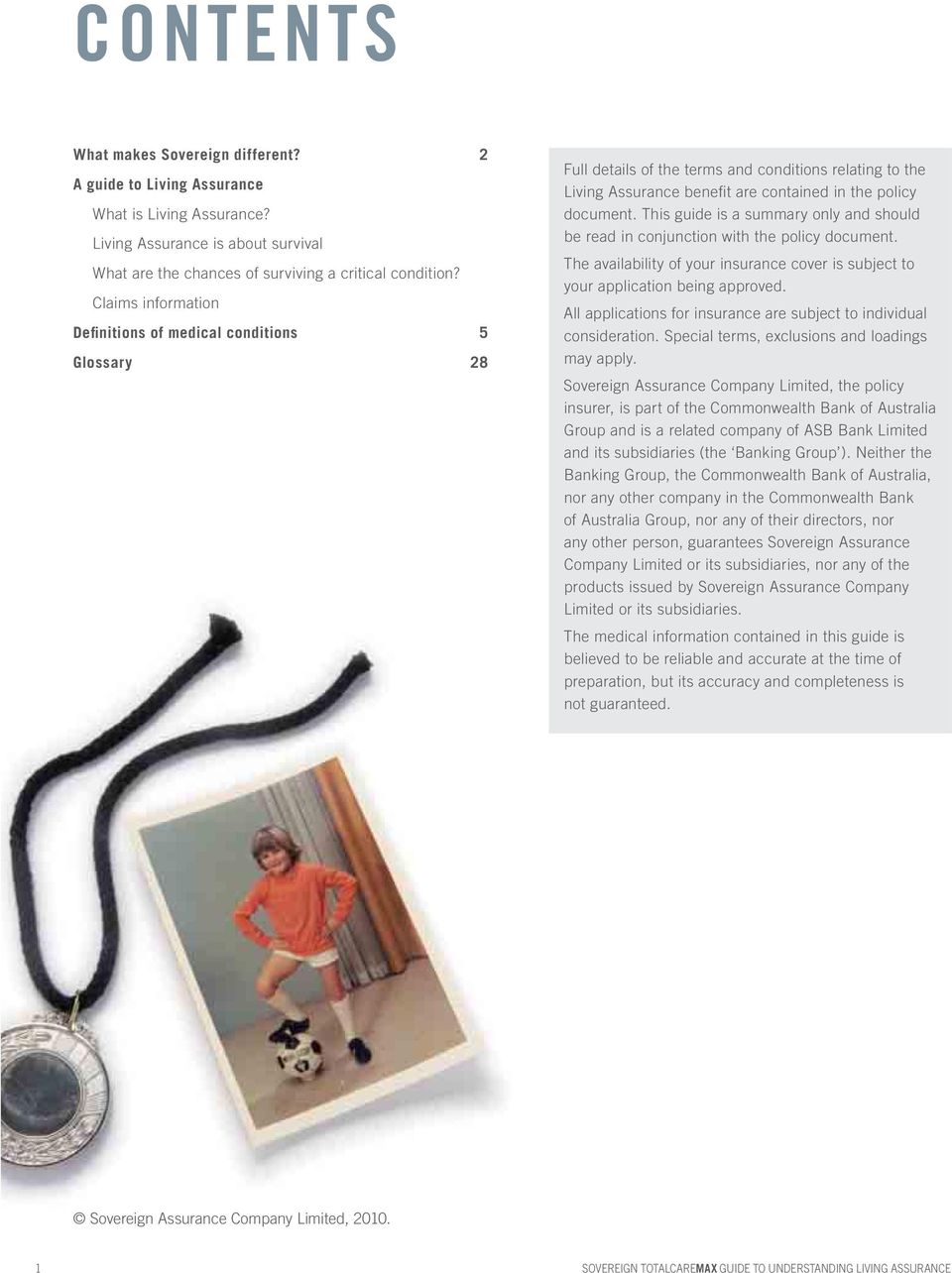
2 CONTENTS What makes Sovereign different? 2 A guide to Living Assurance What is Living Assurance? Living Assurance is about survival What are the chances of surviving a critical condition? Claims information Defi nitions of medical conditions 5 Glossary 28 Full details of the terms and conditions relating to the Living Assurance benefi t are contained in the policy document. This guide is a summary only and should be read in conjunction with the policy document. The availability of your insurance cover is subject to your application being approved. All applications for insurance are subject to individual consideration. Special terms, exclusions and loadings may apply. Sovereign Assurance Company Limited, the policy insurer, is part of the Commonwealth Bank of Australia Group and is a related company of ASB Bank Limited and its subsidiaries (the Banking Group ). Neither the Banking Group, the Commonwealth Bank of Australia, nor any other company in the Commonwealth Bank of Australia Group, nor any of their directors, nor any other person, guarantees Sovereign Assurance Company Limited or its subsidiaries, nor any of the products issued by Sovereign Assurance Company Limited or its subsidiaries. The medical information contained in this guide is believed to be reliable and accurate at the time of preparation, but its accuracy and completeness is not guaranteed. Sovereign Assurance Company Limited, SOVEREIGN TOTALCAREMAX GUIDE TO UNDERSTANDING LIVING ASSURANCE
3 WHAT MAKES SOVEREIGN DIFFERENT? Sovereign was established in 1989, creating a new style of life insurance and investment company in New Zealand. We were the fi rst to sell insurance exclusively through independent fi nancial advisers, providing our customers with consultative advice, maximum choice and personalised service. In 1998, we became part of the ASB group of companies, owned by the Commonwealth Bank of Australia Group (CBA). Today we provide life, business and health insurance, home loans, investment and superannuation products to more than 650,000 customers, or one in fi ve New Zealanders over the age of 15. Sovereign is no ordinary insurance company. We are a values-based organisation and believe in putting people fi rst. This not only means our customers but also our staff and the community at large. We know business is about more than just the bottom line, and our corporate culture refl ects this. We re a Kiwi company that strives to be real, inspirational and innovative. Our brand conveys a love of life and the need for us all to protect what matters most. Everything we do, from our market-leading products to our award-winning customer service, is designed to give our customers absolute confi dence that we ll be there if they need us. And having that peace of mind means they can get on with the things they love. DID YOU KNOW? SOVEREIGN HAS, FOR THE THIRD CONSECUTIVE YEAR, BEEN AWARDED AN A+ (SUPERIOR) RATING FOR FINANCIAL STRENGTH* IN 2009, WE PAID OUT MORE IN LIFE INSURANCE CLAIMS THAN ANY OTHER NEW ZEALAND PROVIDER IN THE 2010 BEATON ADVISER SURVEY** FOR ADVISER SATISFACTION, SOVEREIGN WAS THE ONLY COMPANY TO ACHIEVE THE MAXIMUM FIVE-STAR RATING OUR CALL CENTRE WAS VOTED THE BEST IN THE COUNTRY (FOR CONTACT CENTRES WITH FEWER THAN 50 SEATS) AT THIS YEAR S NATIONAL AWARDS. * Rating as at 22 December 2009, given by A.M. Best Company, Inc., an approved rating agency. The rating scale is available for inspection at Sovereign s offi ce ** Beaton Benchmarks 2010 Life insurance intermediaries Study New Zealand A GUIDE TO LIVING ASSURANCE WHAT IS LIVING ASSURANCE? Living Assurance, also known as critical illness insurance or trauma insurance, pays out a lump sum on the actual occurrence of a defi ned critical condition covered by the policy. Examples of critical illnesses include serious cancer, heart disease and stroke. LIVING ASSURANCE IS ABOUT SURVIVAL New Zealanders are suffering an increasing incidence of cancer and we still experience high levels of heart disease and stroke. Due to advances in medical science, we have greater chances of surviving a serious medical condition. In many cases this survival period can be measured in years. It is important to understand that where, in the past, a serious medical condition often led to a swift death, this is no longer the case with consequential effects on lifestyle, family and work. While someone suffering from a critical condition may recover medically, the impact of the illness on their finances can be devastating they may survive their illness only to be crippled financially. Living Assurance can make a crucial contribution towards the fi nancial survival of families and businesses by providing cash for the insured to use as they see fi t. Living Assurance gives New Zealanders (whether in family or business situations) the opportunity to create real options at traumatic times it pays out a lump sum not because they are going to die but because they are going to live. WHAT ARE THE CHANCES OF SURVIVING A CRITICAL CONDITION? In 2007, there were 19,736 new cancer registrations and 8,519 cancer deaths in New Zealand. 72% of deaths from cancer occurred in people aged 65 and over. 1 52% of male cancer patients will be alive fi ve years later; 59% of females will be alive fi ve years later. 2 Males have a one in fi ve chance of suffering a critical illness between ages 30 and Females have a one in seven chance of suffering a critical illness between ages 30 and There are an estimated 45,000 stroke survivors in New Zealand, many of whom have a disability and need signifi cant daily support. Stroke recovery can continue throughout life, but there is little ongoing rehabilitation provided for stroke survivors nationally. 4 Sources: 1. Ministry of Health, Cancer: New Registrations and Deaths, South Australian Cancer Registry, Gen Re LifeHealth Australian Critical Illness Survey, Stroke Foundation of New Zealand, 2007 SOVEREIGN TOTALCAREMAX GUIDE TO UNDERSTANDING LIVING ASSURANCE 2

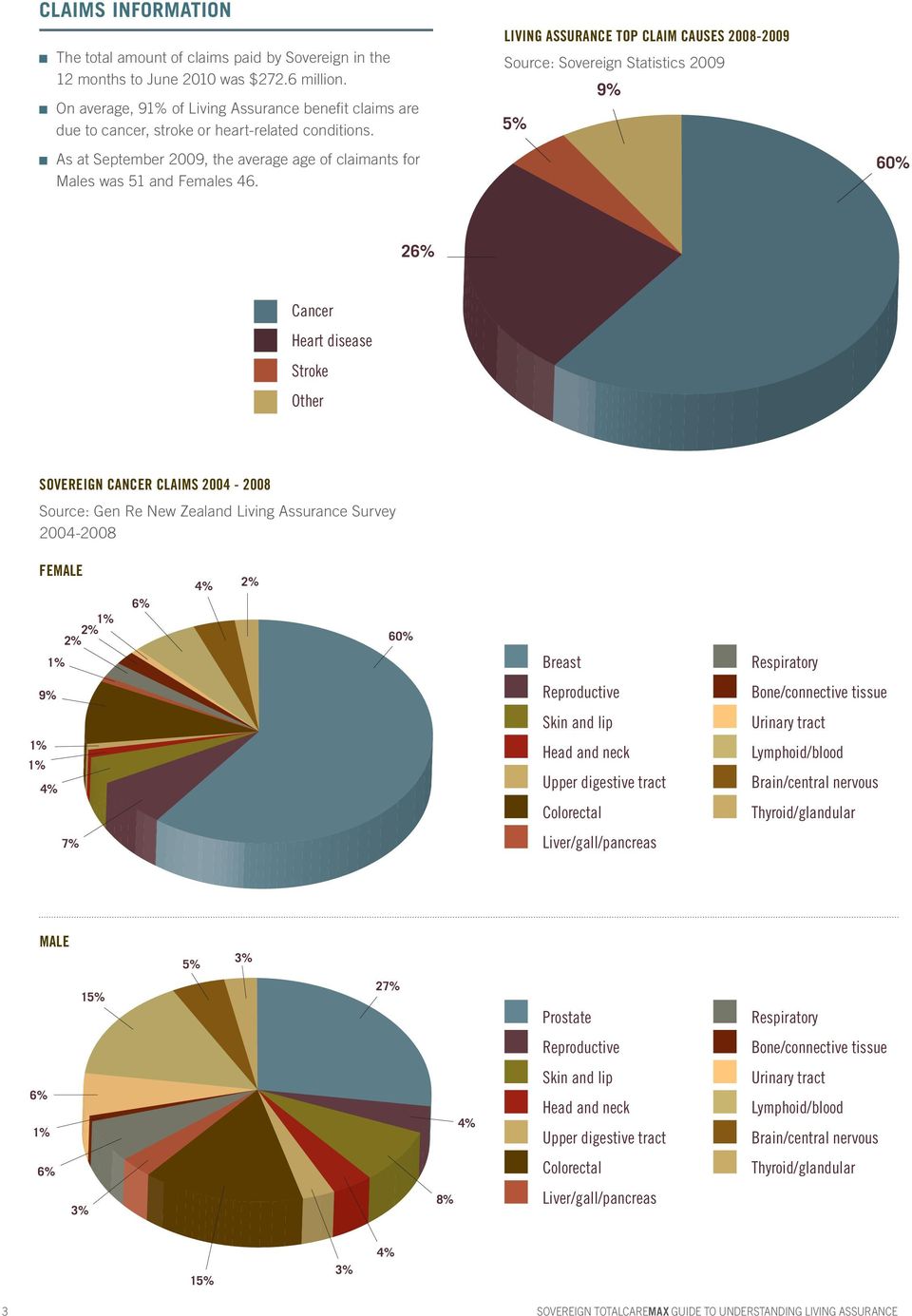
4 CLAIMS INFORMATION The total amount of claims paid by Sovereign in the 12 months to June 2010 was $272.6 million. On average, 91% of Living Assurance benefi t claims are due to cancer, stroke or heart-related conditions. As at September 2009, the average age of claimants for Males was 51 and Females 46. LIVING ASSURANCE TOP CLAIM CAUSES Source: Sovereign Statistics % 5% 60% 26% Cancer Heart disease Stroke Other SOVEREIGN CANCER CLAIMS Source: Gen Re New Zealand Living Assurance Survey FEMALE 6% 4% 2% 2% 2%1% 1% 60% Breast Respiratory 9% Reproductive Bone/connective tissue Skin and lip Urinary tract 1% 1% 4% Head and neck Upper digestive tract Colorectal Lymphoid/blood Brain/central nervous Thyroid/glandular 7% Liver/gall/pancreas MALE 5% 3% 15% 27% Prostate Respiratory Reproductive Bone/connective tissue 6% 1% 4% Skin and lip Head and neck Upper digestive tract Urinary tract Lymphoid/blood Brain/central nervous 6% Colorectal Thyroid/glandular 3% 8% Liver/gall/pancreas 15% 3% 4% 3 SOVEREIGN TOTALCAREMAX GUIDE TO UNDERSTANDING LIVING ASSURANCE
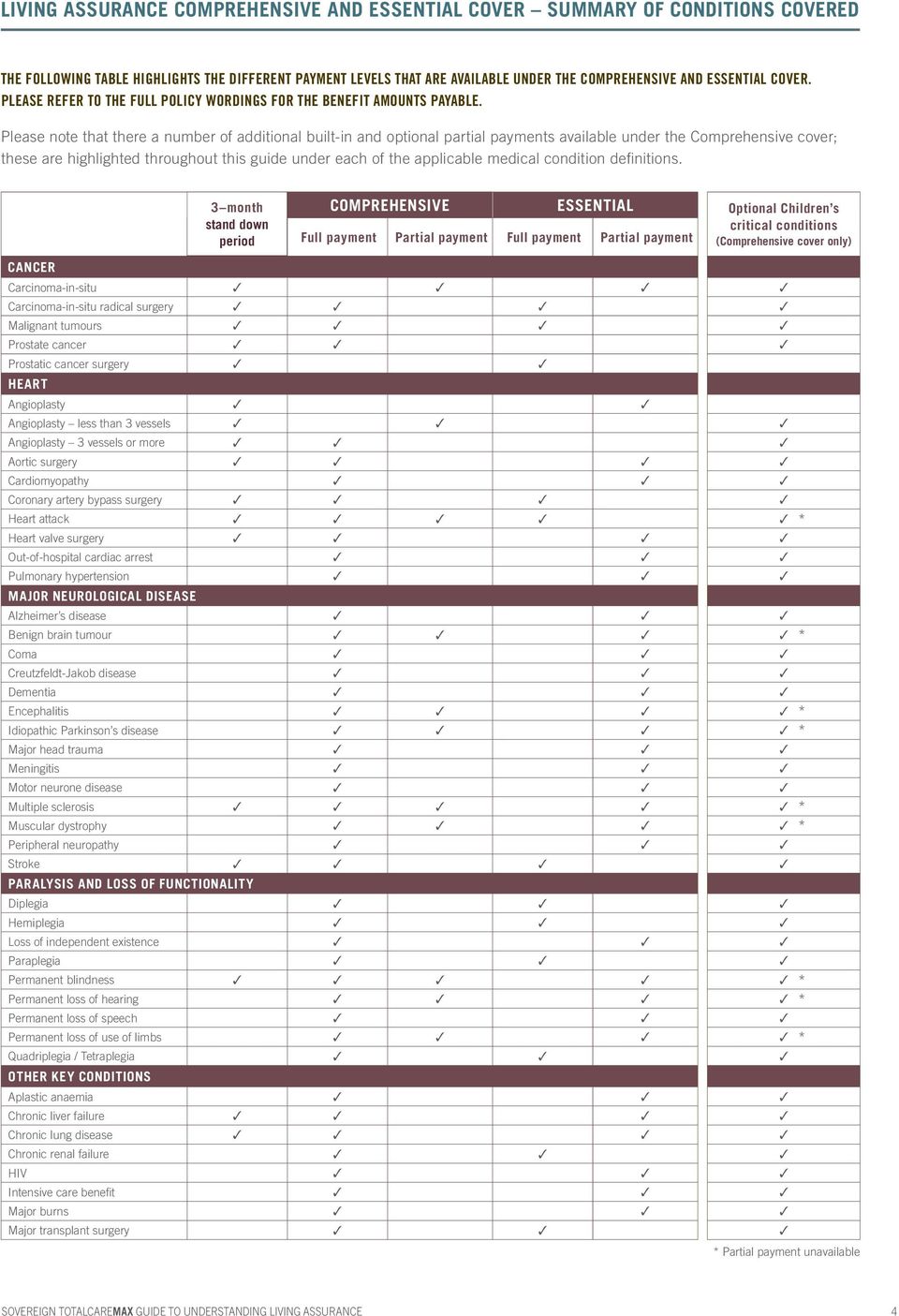
5 LIVING ASSURANCE COMPREHENSIVE AND ESSENTIAL COVER SUMMARY OF CONDITIONS COVERED THE FOLLOWING TABLE HIGHLIGHTS THE DIFFERENT PAYMENT LEVELS THAT ARE AVAILABLE UNDER THE COMPREHENSIVE AND ESSENTIAL COVER. PLEASE REFER TO THE FULL POLICY WORDINGS FOR THE BENEFIT AMOUNTS PAYABLE. Please note that there a number of additional built-in and optional partial payments available under the Comprehensive cover; these are highlighted throughout this guide under each of the applicable medical condition defi nitions. 3 month stand down period COMPREHENSIVE ESSENTIAL Full payment Partial payment Full payment Partial payment Optional Children s critical conditions (Comprehensive cover only) CANCER Carcinoma-in-situ Carcinoma-in-situ radical surgery Malignant tumours Prostate cancer Prostatic cancer surgery HEART Angioplasty Angioplasty less than 3 vessels Angioplasty 3 vessels or more Aortic surgery Cardiomyopathy Coronary artery bypass surgery Heart attack * Heart valve surgery Out-of-hospital cardiac arrest Pulmonary hypertension MAJOR NEUROLOGICAL DISEASE Alzheimer s disease Benign brain tumour * Coma Creutzfeldt-Jakob disease Dementia Encephalitis * Idiopathic Parkinson s disease * Major head trauma Meningitis Motor neurone disease Multiple sclerosis * Muscular dystrophy * Peripheral neuropathy Stroke PARALYSIS AND LOSS OF FUNCTIONALITY Diplegia Hemiplegia Loss of independent existence Paraplegia Permanent blindness * Permanent loss of hearing * Permanent loss of speech Permanent loss of use of limbs * Quadriplegia / Tetraplegia OTHER KEY CONDITIONS Aplastic anaemia Chronic liver failure Chronic lung disease Chronic renal failure HIV Intensive care benefit Major burns Major transplant surgery * Partial payment unavailable SOVEREIGN TOTALCAREMAX GUIDE TO UNDERSTANDING LIVING ASSURANCE 4
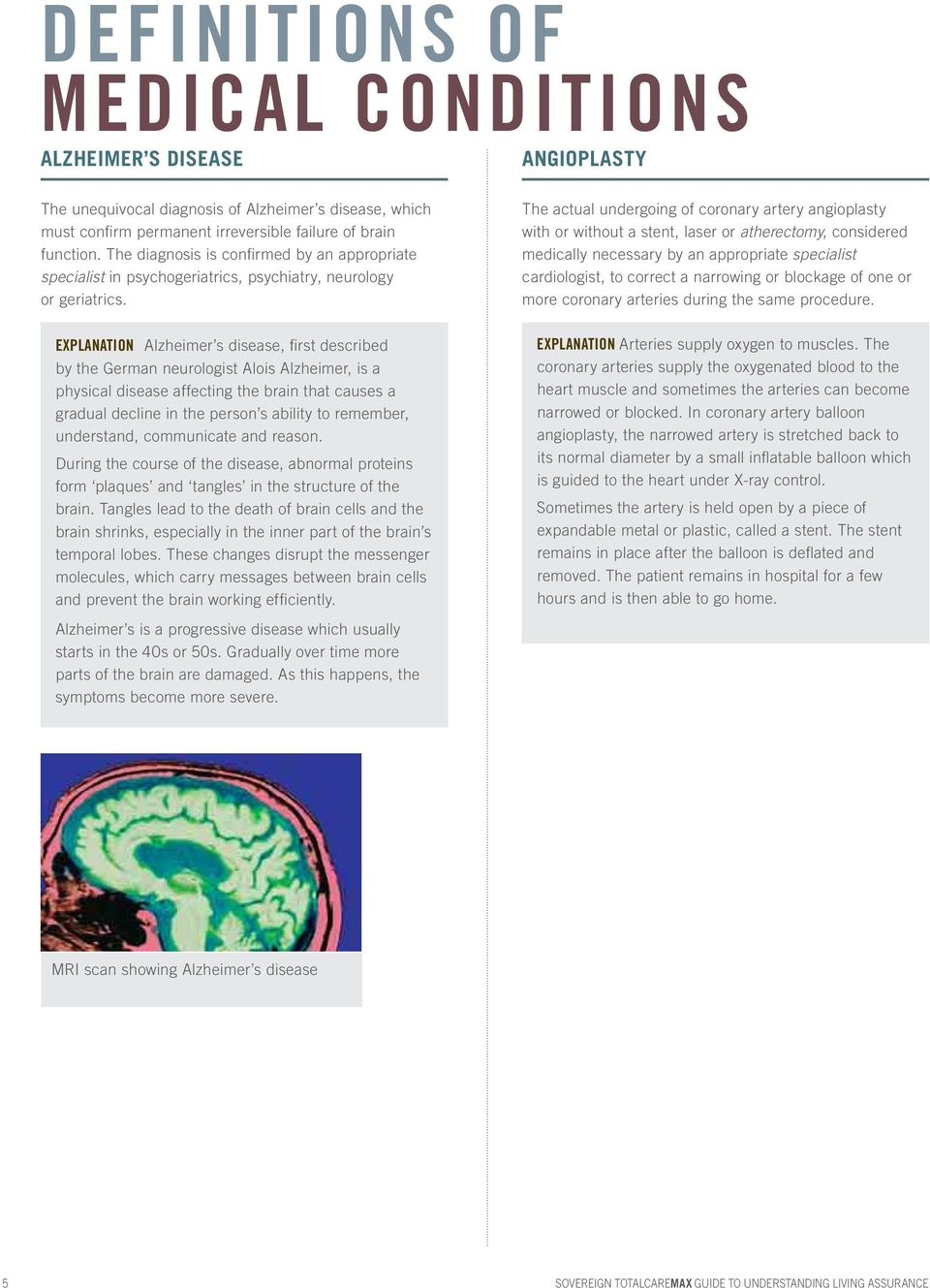
6 DEFINITIONS OF MEDICAL CONDITIONS ALZHEIMER S DISEASE ANGIOPLASTY The unequivocal diagnosis of Alzheimer s disease, which must confi rm permanent irreversible failure of brain function. The diagnosis is confi rmed by an appropriate specialist in psychogeriatrics, psychiatry, neurology or geriatrics. EXPLANATION Alzheimer s disease, fi rst described by the German neurologist Alois Alzheimer, is a physical disease affecting the brain that causes a gradual decline in the person s ability to remember, understand, communicate and reason. During the course of the disease, abnormal proteins form plaques and tangles in the structure of the brain. Tangles lead to the death of brain cells and the brain shrinks, especially in the inner part of the brain s temporal lobes. These changes disrupt the messenger molecules, which carry messages between brain cells and prevent the brain working effi ciently. Alzheimer s is a progressive disease which usually starts in the 40s or 50s. Gradually over time more parts of the brain are damaged. As this happens, the symptoms become more severe. The actual undergoing of coronary artery angioplasty with or without a stent, laser or atherectomy, considered medically necessary by an appropriate specialist cardiologist, to correct a narrowing or blockage of one or more coronary arteries during the same procedure. EXPLANATION Arteries supply oxygen to muscles. The coronary arteries supply the oxygenated blood to the heart muscle and sometimes the arteries can become narrowed or blocked. In coronary artery balloon angioplasty, the narrowed artery is stretched back to its normal diameter by a small infl atable balloon which is guided to the heart under X-ray control. Sometimes the artery is held open by a piece of expandable metal or plastic, called a stent. The stent remains in place after the balloon is defl ated and removed. The patient remains in hospital for a few hours and is then able to go home. MRI scan showing Alzheimer s disease 5 SOVEREIGN TOTALCAREMAX GUIDE TO UNDERSTANDING LIVING ASSURANCE
7 AORTIC SURGERY APLASTIC ANAEMIA Medically necessary surgery to correct or repair: An aortic aneurysm, or An obstruction of the aorta, or A coarctation of the aorta, or A traumatic rupture of the aorta. For the purpose of this defi nition aorta shall mean the thoracic and abdominal aorta. EXPLANATION The aorta is the biggest artery in the body and carries blood from the heart to all parts of the body via a system of branching arteries. The thoracic aorta is in the chest and continues through the diaphragm, into the abdomen, where it is called the abdominal aorta. Because of disease, the wall of the artery can split (dissection) or it may bulge (aneurysm). Both of these conditions have to be repaired or they can leak and cause death. If the aneurysm does rupture, 62% of sufferers will die before they reach hospital. Of those who have surgery, 50% will live. Source: American Heart and Lung Institute The life assured has suffered the fi rst occurrence of bone marrow failure which results in anaemia, neutropenia and thrombocytopenia, requiring treatment over a period of at least two months with at least one of the following: Blood product transfusion Marrow stimulating agents Immunosuppressive agents Bone marrow transplantation EXPLANATION Blood cells are produced by bone marrow. Aplastic anaemia is when the marrow stops producing enough blood cells. The only ways it can be treated are to either make the bone marrow produce cells again, give blood transfusions until the marrow recovers or to have a suitable donor give some of their marrow a bone marrow transplant. With successful treatment, patients can lead a relatively normal life for years. QUICK FACTS The incidence of aplastic anaemia peaks in people aged years, and a subsequent peak is observed in people older than 60 years. Aplastic anemia is thought to be more common in Asia than in the West. Source: emedicine from WebMD, 2007 Aortic valve replacement SOVEREIGN TOTALCAREMAX GUIDE TO UNDERSTANDING LIVING ASSURANCE 6

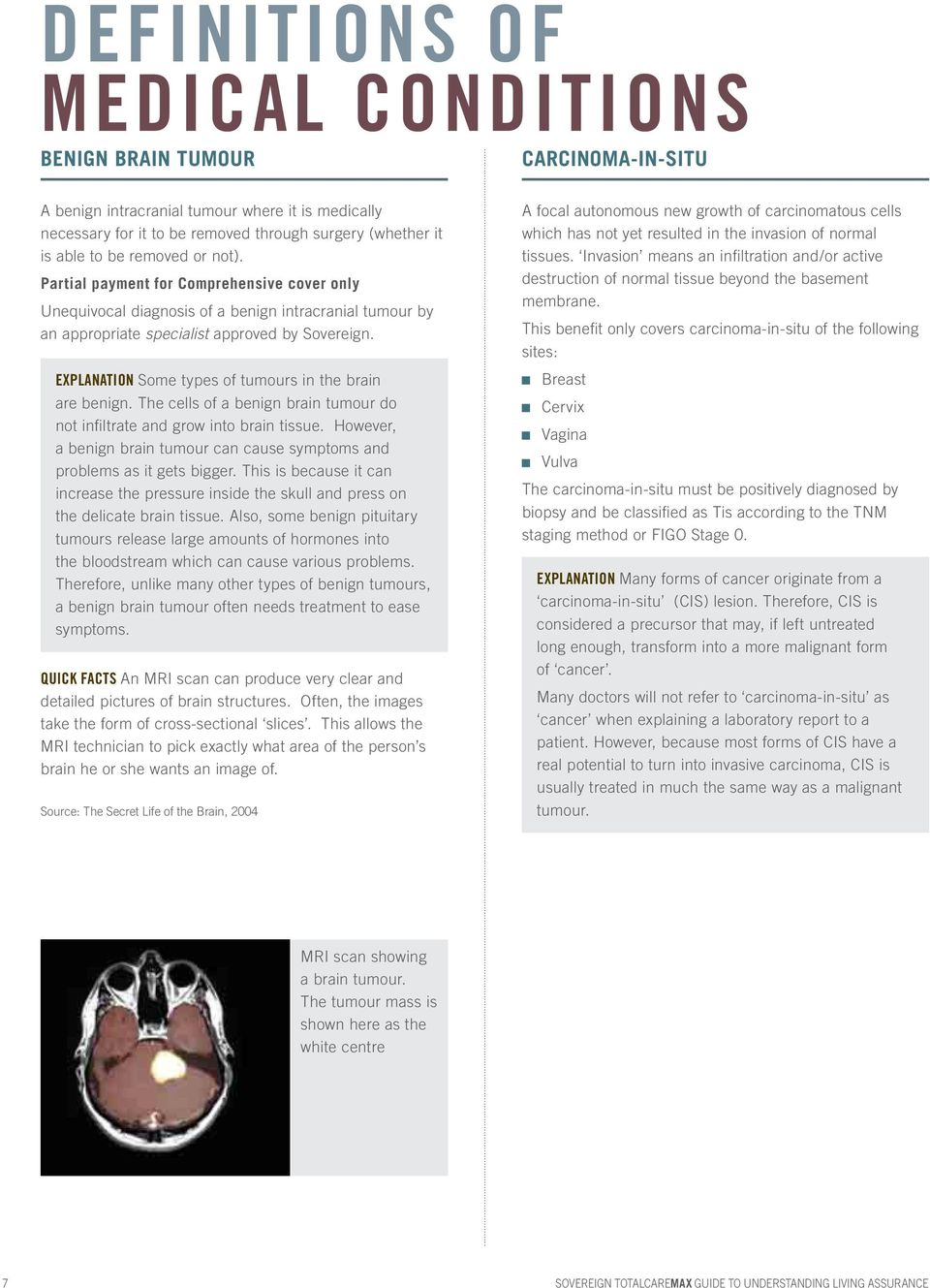
8 DEFINITIONS OF MEDICAL CONDITIONS BENIGN BRAIN TUMOUR CARCINOMA-IN-SITU A benign intracranial tumour where it is medically necessary for it to be removed through surgery (whether it is able to be removed or not). Partial payment for Comprehensive cover only Unequivocal diagnosis of a benign intracranial tumour by an appropriate specialist approved by Sovereign. EXPLANATION Some types of tumours in the brain are benign. The cells of a benign brain tumour do not infi ltrate and grow into brain tissue. However, a benign brain tumour can cause symptoms and problems as it gets bigger. This is because it can increase the pressure inside the skull and press on the delicate brain tissue. Also, some benign pituitary tumours release large amounts of hormones into the bloodstream which can cause various problems. Therefore, unlike many other types of benign tumours, a benign brain tumour often needs treatment to ease symptoms. QUICK FACTS An MRI scan can produce very clear and detailed pictures of brain structures. Often, the images take the form of cross-sectional slices. This allows the MRI technician to pick exactly what area of the person s brain he or she wants an image of. Source: The Secret Life of the Brain, 2004 A focal autonomous new growth of carcinomatous cells which has not yet resulted in the invasion of normal tissues. Invasion means an infi ltration and/or active destruction of normal tissue beyond the basement membrane. This benefi t only covers carcinoma-in-situ of the following sites: Breast Cervix Vagina Vulva The carcinoma-in-situ must be positively diagnosed by biopsy and be classifi ed as Tis according to the TNM staging method or FIGO Stage 0. EXPLANATION Many forms of cancer originate from a carcinoma-in-situ (CIS) lesion. Therefore, CIS is considered a precursor that may, if left untreated long enough, transform into a more malignant form of cancer. Many doctors will not refer to carcinoma-in-situ as cancer when explaining a laboratory report to a patient. However, because most forms of CIS have a real potential to turn into invasive carcinoma, CIS is usually treated in much the same way as a malignant tumour. MRI scan showing a brain tumour. The tumour mass is shown here as the white centre 7 SOVEREIGN TOTALCAREMAX GUIDE TO UNDERSTANDING LIVING ASSURANCE
9 CARCINOMA-IN-SITU RADICAL SURGERY CARDIOMYOPATHY As a result of a carcinoma-in-situ, an operation to arrest spread of the malignancy is performed which involves the removal of the entire organ (which includes: breast, cervix, ovary, fallopian tube, vagina, vulva, prostate, colon/rectal, bladder) affected that is considered medically necessary by an appropriate specialist. The carcinoma-in-situ must be positively diagnosed by biopsy and be classifi ed as Tis according to the TNM staging method or FIGO Stage 0. EXPLANATION Surgery is the oldest form of cancer treatment. It also has an important role in diagnosing and staging (fi nding the extent) of cancer. Advances in surgical techniques have allowed surgeons to successfully operate on a growing number of patients. Today, less invasive operations can be done to remove tumours while saving as much normal tissue and function as possible. Surgery offers the greatest chance for cure for many types of cancer, especially those cases where it has not spread to other parts of the body. Most people with cancer will have some type of surgery. Source: American Cancer Society Impaired ventricular function of variable aetiology due to primary disease of the heart muscle, resulting in permanent and irreversible physical impairments to the degree of at least Class 3 of the New York Heart Association classifi cation of cardiac impairment. EXPLANATION In cardiomyopathy, the heart muscle becomes diseased, resulting in failure of the heart as a pump. Three different types of cardiomyopathy are recognised: Dilated cardiomyopathy is the most common. The cavity of the heart is enlarged and the walls are stretched. The heart is so weak it does not pump normally. Hypertrophic cardiomyopathy is where the muscle mass in the left ventricle enlarges. With restrictive cardiomyopathy, the walls of the heart become rigid and hard to move. This type is usually caused by another disease process. Cardiomyopathy can be controlled if the underlying disorder can be corrected. If the underlying cause is not corrected, then the cardiomyopathy is incurable and will inevitably lead to death unless a heart transplant is available. This shows heart disease and affected systems. At centre is a heart showing left ventricular remodelling due to hypertension, and a heart attack. In the background are organs affected most: kidney (renal), lungs (respiratory) and liver (hepatic) SOVEREIGN TOTALCAREMAX GUIDE TO UNDERSTANDING LIVING ASSURANCE 8

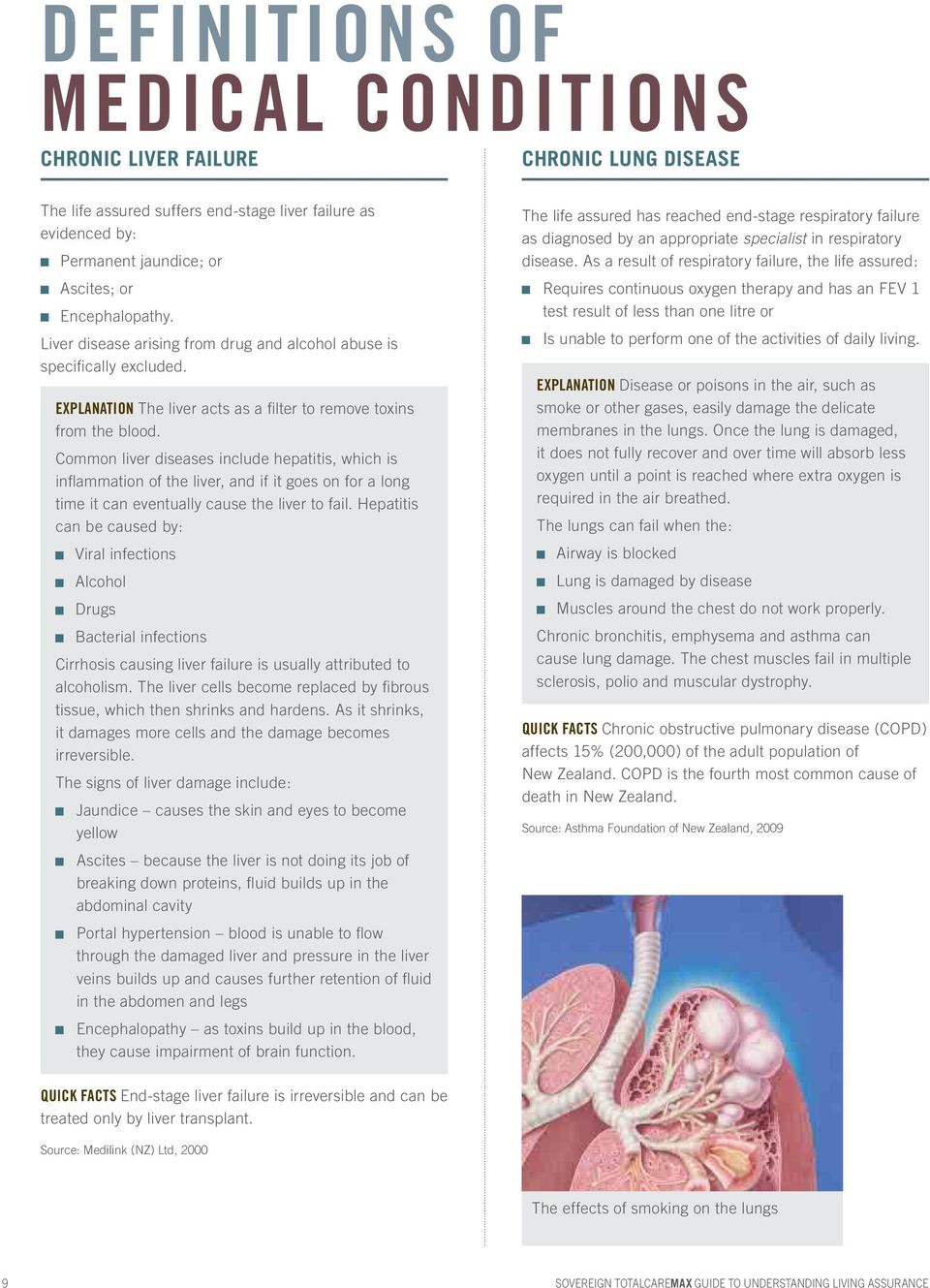
10 DEFINITIONS OF MEDICAL CONDITIONS CHRONIC LIVER FAILURE CHRONIC LUNG DISEASE The life assured suffers end-stage liver failure as evidenced by: Permanent jaundice; or Ascites; or Encephalopathy. Liver disease arising from drug and alcohol abuse is specifi cally excluded. EXPLANATION The liver acts as a fi lter to remove toxins from the blood. Common liver diseases include hepatitis, which is infl ammation of the liver, and if it goes on for a long time it can eventually cause the liver to fail. Hepatitis can be caused by: Viral infections Alcohol Drugs Bacterial infections Cirrhosis causing liver failure is usually attributed to alcoholism. The liver cells become replaced by fi brous tissue, which then shrinks and hardens. As it shrinks, it damages more cells and the damage becomes irreversible. The signs of liver damage include: Jaundice causes the skin and eyes to become yellow Ascites because the liver is not doing its job of breaking down proteins, fl uid builds up in the abdominal cavity Portal hypertension blood is unable to fl ow through the damaged liver and pressure in the liver veins builds up and causes further retention of fl uid in the abdomen and legs Encephalopathy as toxins build up in the blood, they cause impairment of brain function. The life assured has reached end-stage respiratory failure as diagnosed by an appropriate specialist in respiratory disease. As a result of respiratory failure, the life assured: Requires continuous oxygen therapy and has an FEV 1 test result of less than one litre or Is unable to perform one of the activities of daily living. EXPLANATION Disease or poisons in the air, such as smoke or other gases, easily damage the delicate membranes in the lungs. Once the lung is damaged, it does not fully recover and over time will absorb less oxygen until a point is reached where extra oxygen is required in the air breathed. The lungs can fail when the: Airway is blocked Lung is damaged by disease Muscles around the chest do not work properly. Chronic bronchitis, emphysema and asthma can cause lung damage. The chest muscles fail in multiple sclerosis, polio and muscular dystrophy. QUICK FACTS Chronic obstructive pulmonary disease (COPD) affects 15% (200,000) of the adult population of New Zealand. COPD is the fourth most common cause of death in New Zealand. Source: Asthma Foundation of New Zealand, 2009 QUICK FACTS End-stage liver failure is irreversible and can be treated only by liver transplant. Source: Medilink (NZ) Ltd, 2000 The effects of smoking on the lungs 9 SOVEREIGN TOTALCAREMAX GUIDE TO UNDERSTANDING LIVING ASSURANCE
11 CHRONIC RENAL FAILURE COMA The kidneys of the life assured have reached the end-stage of renal disease resulting in chronic irreversible failure of the kidneys to function, as a result of which regular renal dialysis is instituted or transplantation performed. EXPLANATION The kidneys are sophisticated reprocessing machines. Every day your kidneys process about 200 litres of blood to sift out about two litres of waste products and extra water. The waste and extra water become urine, which fl ows to your bladder through tubes called urethras. When kidneys fail, there is a build-up of poisonous substances in the blood and the blood can become very acidic. The level of some salts such as potassium can be high enough to cause sudden cardiac arrest. The only way these imbalances can be corrected is by dialysis. Seventy-fi ve per cent of adult renal failure is caused by: Diabetic kidney disease High blood pressure Glomerulonephritis QUICK FACTS In New Zealand, the number of patients requiring kidney dialysis is increasing dramatically in relationship to the epidemic of diabetes. At present the renal dialysis units are located in only nine centres and patients outside of these are forced to travel. Source: New Zealand Renal Dialysis Registry, 2000 A state of unconsciousness with no reaction to stimuli or internal needs, persisting continuously for at least 72 hours, requiring the use of life-support systems. Coma arising from drug and alcohol abuse is specifi cally excluded. EXPLANATION Coma is best defi ned as a state of unresponsiveness from which an individual cannot be aroused. If a patient in a coma survives the fi rst 10 days following an injury to the brain, then long-term survival can be expected. Recovery can be partial or complete. Partial recovery occurs frequently after head injury. By far the most common cause of coma is head injury. Other causes can be: Diabetes Tumours Liver failure Abscesses Stroke Coma represents the last and lowest level of function of the brain prior to death. QUICK FACTS The outcome for coma and persistent vegetative state depends on the cause, severity and site of neurological damage. Individuals may emerge from coma with a combination of physical, intellectual and psychological diffi culties that need special attention. Recovery usually occurs gradually, with some acquiring increasing ability to respond. Some individuals never progress beyond very basic responses, but many recover full awareness. Individuals recovering from coma require close medical supervision. Source: National Institute of Neurological Disorders and Stroke, 2007 SOVEREIGN TOTALCAREMAX GUIDE TO UNDERSTANDING LIVING ASSURANCE 10

12 DEFINITIONS OF MEDICAL CONDITIONS CORONARY ARTERY BYPASS CREUTZFELDT-JAKOB DISEASE (CJD) Medically necessary surgery to correct the narrowing of, or blockage to, one or more coronary arteries by means of a bypass graft. EXPLANATION The heart needs oxygen and gets it from the coronary arteries. These arteries can become so blocked or narrowed that the heart muscle cannot function properly. Coronary artery bypass surgery is an operation to re-route blood past the narrowed arteries. Up to four new routes may be needed. At surgery, a blood vessel from another part of the body is used to bypass the diseased coronary artery. After surgery, patients are encouraged to gradually increase their exercise level. Those who achieve a high level of activity have the best long-term results. Patients in gentle offi ce jobs can be back at work in four to six weeks. QUICK FACTS In New Zealand there are long waiting lists for bypass surgery operations in the public hospitals. Only six private hospitals can perform this procedure. Source: Medilink (NZ) Ltd, 2000 Diagnosis of Creutzfeldt-Jakob disease confi rmed by an appropriate specialist neurologist. The life assured must exhibit signs and symptoms of cerebellar dysfunction, severe progressive dementia, uncontrolled muscle spasm, tremor and athetosis, resulting in the life assured requiring permanent and continual medical supervision. EXPLANATION This disease has become prominent worldwide because of an epidemic of the disease in cows in Britain. The disease can be passed to humans and the recent new variant affects younger people. Males and females are equally affected. The only sure way of diagnosing CJD is by postmortem examination of brain tissue. It has been suggested that a cause of the disease is a slow-acting virus, which causes protein in the brain to mutate. Patients with CJD show symptoms and signs including movement disorders and dementia. QUICK FACTS The NZ blood service is constantly fi nding people who are willing to give blood but are not able to because of the rules governing exposure to Bovine Spongiform Encephalopathy (BSE). Anyone who spent six months or more in the UK, Ireland or France between 1980 and 1996 is not allowed to give blood. Source: NZ Blood Service, 2007 Coronary artery bypass surgery 11 SOVEREIGN TOTALCAREMAX GUIDE TO UNDERSTANDING LIVING ASSURANCE

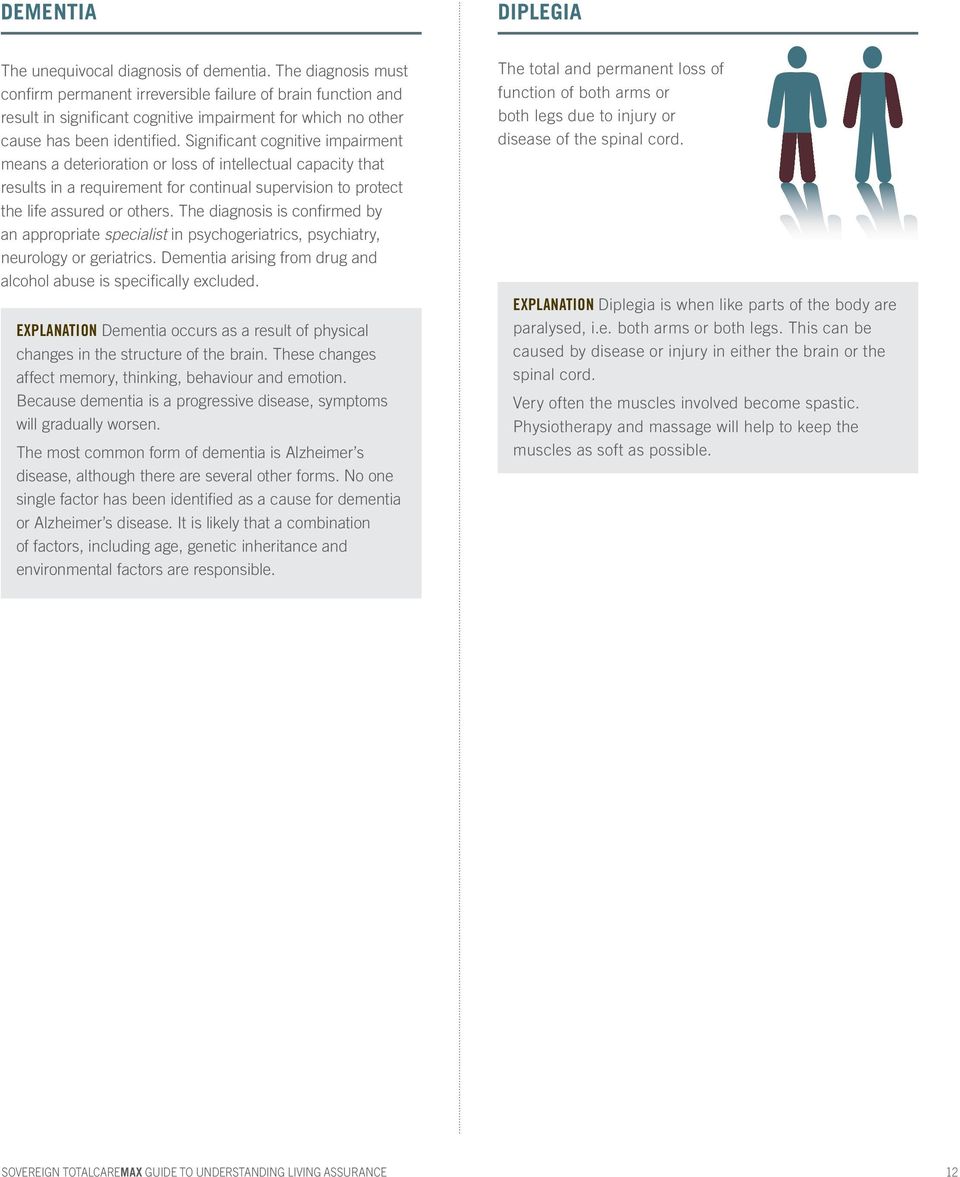
13 DEMENTIA DIPLEGIA The unequivocal diagnosis of dementia. The diagnosis must confirm permanent irreversible failure of brain function and result in signifi cant cognitive impairment for which no other cause has been identifi ed. Signifi cant cognitive impairment means a deterioration or loss of intellectual capacity that results in a requirement for continual supervision to protect the life assured or others. The diagnosis is confirmed by an appropriate specialist in psychogeriatrics, psychiatry, neurology or geriatrics. Dementia arising from drug and alcohol abuse is specifi cally excluded. EXPLANATION Dementia occurs as a result of physical changes in the structure of the brain. These changes affect memory, thinking, behaviour and emotion. Because dementia is a progressive disease, symptoms will gradually worsen. The most common form of dementia is Alzheimer s disease, although there are several other forms. No one single factor has been identifi ed as a cause for dementia or Alzheimer s disease. It is likely that a combination of factors, including age, genetic inheritance and environmental factors are responsible. The total and permanent loss of function of both arms or both legs due to injury or disease of the spinal cord. EXPLANATION Diplegia is when like parts of the body are paralysed, i.e. both arms or both legs. This can be caused by disease or injury in either the brain or the spinal cord. Very often the muscles involved become spastic. Physiotherapy and massage will help to keep the muscles as soft as possible. SOVEREIGN TOTALCAREMAX GUIDE TO UNDERSTANDING LIVING ASSURANCE 12
14 DEFINITIONS OF MEDICAL CONDITIONS ENCEPHALITIS HEART ATTACK The unequivocal diagnosis of severe infl ammatory disease of the brain diagnosed by an appropriate specialist approved by Sovereign. The life assured must have also sustained a neurological defi cit causing at least 25% permanent impairment of whole person functioning or inability to perform one of the activities of daily living. Encephalitis arising from drug and alcohol abuse is specifi cally excluded. Partial payment for Comprehensive cover only The unequivocal diagnosis of severe infl ammatory disease of the brain diagnosed by an appropriate specialist approved by Sovereign. Encephalitis arising from drug and alcohol abuse is specifi cally excluded. EXPLANATION Encephalitis is an infl ammation of the brain. It usually results from an infection, most often by a virus, but sometimes by bacteria, a fungus or parasites. In rare cases, it is caused by brain injury, a drug or vaccine reaction, or poison. A virus, or other germ in the blood stream, can be carried to the brain. Germs in the brain attract white blood cells, the body s main line of defence against invaders, and this sets up an infl ammatory reaction. The brain tissue then swells (called cerebral oedema), bleeding may occur within the brain (called intracerebral haemorrhage), and brain damage may occur. Source: Ehealth.MD The death of a portion of the heart muscle arising from the inadequate blood supply to the relevant area. The diagnosis shall be based on the following criteria being present and consistent with a severe heart attack: Confirmatory new electrocardiogram (ECG) changes; and A diagnostic rise and fall (other than as a result of cardiac or coronary intervention) in either Troponin I in excess of 2.0microgram/L (equivalent to 2,000 nanogram/l) or Troponin T in excess of 0.6microgram/L (equivalent to 600 nanogram/l) or cardiac enzyme CK-MB. If any of the above criteria is not met, then we will consider a claim based on evidence that the event produced a permanent reduction in the Ejection Fraction to 50% or less (as measured at three months after the event). Partial payment for Comprehensive cover only The death of a portion of the heart muscle arising from the inadequate blood supply to the relevant area. The diagnosis shall be based on the following criteria being present and consistent with a heart attack: Confirmatory new electrocardiogram (ECG) changes; and A diagnostic rise and fall (other than as a result of cardiac or coronary intervention) in either Troponin I between 0.5 and 2.0microgram/L (equivalent to between 500 and 2,000 nanogram/l) (inclusive) or Troponin T between 0.25 (equivalent to 250 nanogram/l) and 0.6microgram/L (equivalent to 600 nanogram/l) (inclusive). EXPLANATION The coronary arteries supply the heart muscle with oxygenated blood and if they become blocked, a portion of the heart muscle does not receive enough oxygen and it dies. This is a heart attack or myocardial infarction. If the dying area is big or in a vital area, the heart will stop working and the person dies. Some heart attacks involve only a small amount of heart tissue and may not produce the same signs and symptoms as a major heart attack. In these cases, the loss of function that the person suffers usually has less impact on their lifestyle. QUICK FACTS Cardiovascular disease is still the leading cause of death in New Zealand, accounting for 40% of deaths annually; approximately 11,300. One in twenty adults has been diagnosed with coronary heart disease. That s 161,000 adults and includes 118,500 with angina and 89,400 who have had a heart attack resulting in them being hospitalised. Source: Heart Foundation of New Zealand, SOVEREIGN TOTALCAREMAX GUIDE TO UNDERSTANDING LIVING ASSURANCE
15 HEART VALVE SURGERY HEMIPLEGIA The undergoing of heart valve surgery performed to replace or repair one or more heart valves that cannot be repaired by intra-arterial procedures. Total and permanent loss of function of one side of the body, due to brain injury or disease. EXPLANATION Like any other pump, the heart needs valves to ensure the blood does not fl ow the wrong way. There are four valves in the heart: Mitral Tricuspid Aortic Pulmonary Each valve can become affected by disease and either become narrowed or leak. When this happens, the valves need to be repaired or replaced. If they are not, the heart will gradually fail. Most commonly, the aortic valve and the mitral valves need repair. Patients commonly require long-term blood-thinning medication for life and may require antibiotics at times of dental procedures. EXPLANATION Hemiplegia is the total paralysis of the arm, leg and trunk on one side of the body. The most common cause is a stroke, usually in the elderly, but it can occur in babies or toddlers. Other causes are blood vessel disease, wounds, tumours or abscesses. The onset of hemiplegia is usually very sudden in stroke patients, who are often unable to talk. Some patients can make a complete recovery after several days or weeks. The majority make only a partial recovery and are left with a severe weakness on one side for the rest of their lives. SOVEREIGN TOTALCAREMAX GUIDE TO UNDERSTANDING LIVING ASSURANCE 14

16 DEFINITIONS OF MEDICAL CONDITIONS HIV IDIOPATHIC PARKINSON S DISEASE Infection with the Human Immunodefi ciency Virus (HIV), acquired by accident or violence during the course of the life assured s normal occupation or through the medium of a blood transfusion, transfusion of blood products, organ transplant, assisted reproduction technique or other medical procedure or operation performed by a registered healthcare professional and/or in a registered hospital care institution, or surgical centre or surgical clinic. This must be proven to Sovereign s satisfaction. Sero-conversion to the HIV infection must occur within six months of the accident. HIV infection transmitted by any other means including, but not limited to, sexual activity or non-medical intravenous drug use is not covered under this appendix. EXPLANATION HIV/AIDS is caused by a virus which is spread through contact with an infected person s body fl uids. Medical professionals have an increased risk of being in contact with body fl uids from patients infected with HIV, during the course of their employment. QUICK FACTS HIV/AIDS is the fourth-biggest cause of death in the world today. Forty million people are living with HIV worldwide. AIDS has already killed 25 million people and fi ve people die of AIDS every minute. Source: Oxfam, 2007 The unequivocal diagnosis of Idiopathic Parkinson s disease where the condition cannot be controlled by medication and shows signs of progressive impairment. The life assured must have also sustained a neurological defi cit causing at least 25% permanent impairment of whole person functioning or inability to perform one of the activities of daily living. Idiopathic Parkinson s disease arising from drug and alcohol abuse is specifi cally excluded. Partial payment for Comprehensive cover only The unequivocal diagnosis of Idiopathic Parkinson s disease. Idiopathic Parkinson s disease arising from drug and alcohol abuse is specifi cally excluded. EXPLANATION Parkinson s disease was fi rst described in 1817 as the shaking palsy. It took until the early 1960s for researchers to discover that a loss of brain cells, which produces a chemical called dopamine, was the problem. Dopamine helps to direct muscle activity and lack of it causes: trembling in hands, arms, legs, jaw and face; stiffness of limbs; slowness of movement; and impaired balance and coordination. The disease affects men and women equally. The exact cause of it is not known. Symptoms usually appear after the age of 50 but there is a trend for young people to be affected, e.g. Mohammed Ali, Michael J Fox and John Walker. QUICK FACTS In New Zealand, Parkinson s disease affects about one in 500 people; approximately 1% of people over 60 have Parkinson s. With good medical treatment, Parkinson s has a limited affect, if any, on life expectancy but it can be disabling. With quality medical care, support and a positive outlook, most people with Parkinson s can lead a productive life for many years after diagnosis. Source: Parkinson s Society, New Zealand, 2007 CAT scan of a brain showing Parkinson s disease 15 SOVEREIGN TOTALCAREMAX GUIDE TO UNDERSTANDING LIVING ASSURANCE

17 INTENSIVE CARE BENEFIT LOSS OF INDEPENDENT EXISTENCE A state of unconsciousness with no reaction to stimuli or internal needs, persisting continuously for at least 96 hours, requiring the use of endo-tracheal intubation in the intensive care unit of a hospital. The life assured must have also sustained a neurological defi cit causing at least 25% permanent impairment of whole person functioning or inability to perform one of the activities of daily living. Unconsciousness caused by drug and alcohol abuse is specifi cally excluded. EXPLANATION This is best defi ned as a state of unresponsiveness from which an individual cannot be aroused and requires the use of endo-tracheal intubation in an intensive care unit of a hospital. Endo-tracheal intubation is a medical procedure which involves putting a tube through the nose into the trachea (airway) or into the stomach. This may be done to maintain breathing or prevent aspiration (inhaling) of food into the airway. It may also be done to relieve excess air from the stomach, or to deliver nutrients or drugs into the stomach. The life assured is totally and irreversibly disabled, with the effect that he or she is unable, as a result of sickness or injury, to perform without the physical assistance of someone else at least two of the following activities for himself or herself (if the life assured can perform the activity on his or her own by using special equipment, Sovereign will treat the life assured as being able to perform that activity): Bathing and showering Dressing and undressing Eating and drinking Using a toilet Moving from place to place by walking, in a wheelchair, or with a walking aid. Alternatively, the life assured is unable to perform one of the above and his or her intellectual capacity has reduced or deteriorated to such an extent that the life assured requires full-time care. EXPLANATION This benefi t is designed as a general disability benefi t. While some of the disabling diseases of older age, such as Alzheimer s disease and motor neurone disease, are covered separately, there are other conditions which can prove to be just as debilitating. These could include conditions such as severe rheumatoid arthritis, which can prevent the sufferer from living without constant help and care. In some cases, it could just be extreme old age which prevents the individual from looking after himself/herself. QUICK FACTS This becomes a measure of how impaired an individual is and to what extent he/she is unable to perform the activities of daily living. Inability to perform at least two of these activities is considered a severe impairment. Source: AMA Guides to evaluation of permanent impairment 5 th edition SOVEREIGN TOTALCAREMAX GUIDE TO UNDERSTANDING LIVING ASSURANCE 16
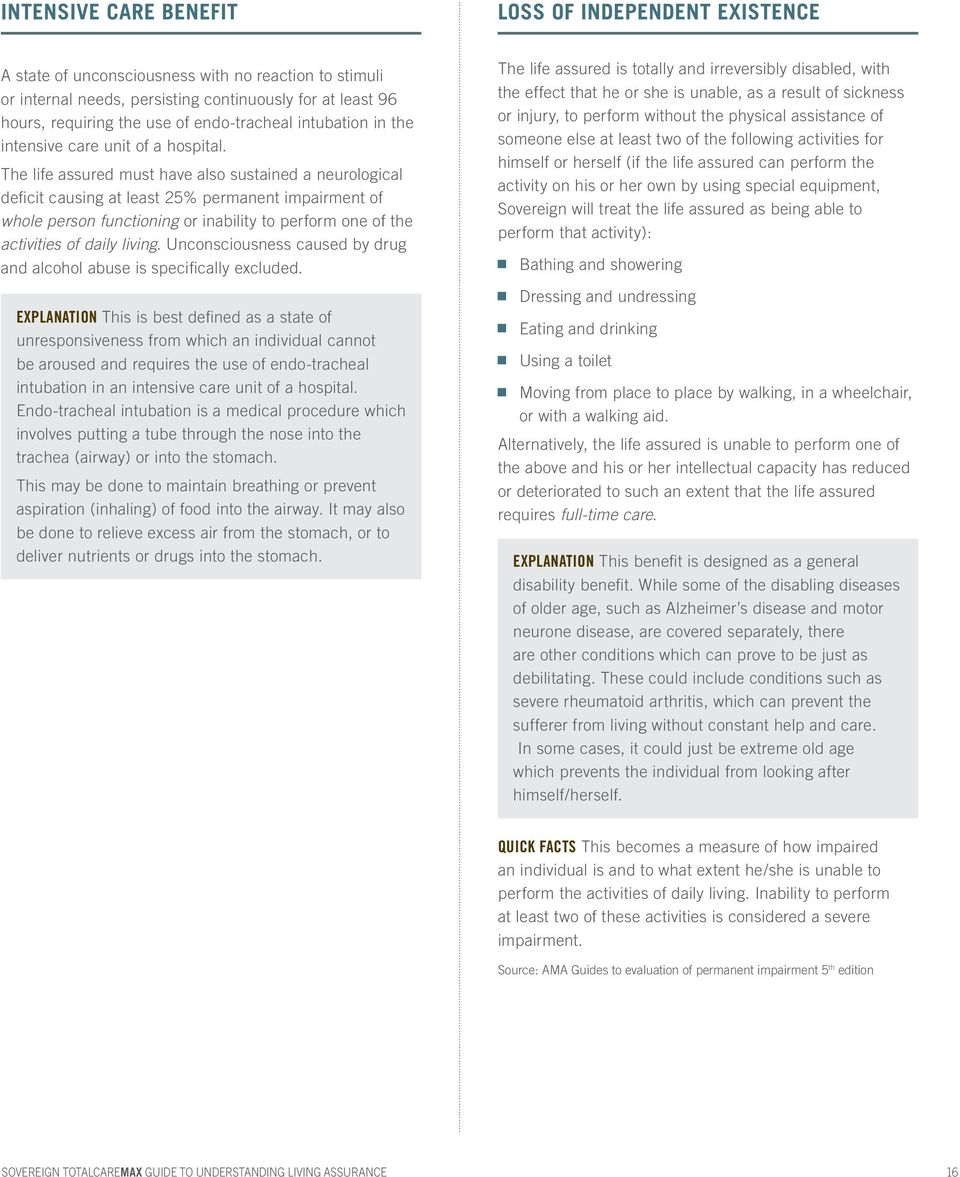
18 DEFINITIONS OF MEDICAL CONDITIONS MAJOR BURNS MAJOR HEAD TRAUMA Epidermis Dermis Hypodermis The life assured has suffered tissue injury caused by thermal, electrical or chemical agents. As a result, the life assured has full thickness or third-degree burns to: At least 20% of the body surface area (as measured by age-appropriate use of The Rule of 9 or the Lund and Browder Body Surface Chart); or 50% of both hands, requiring surgical debridement and/or grafting; or 25% of the face, requiring surgical debridement and/ or grafting. EXPLANATION Doctors use the Rule of 9 to determine how severe a burn is. This divides the skin into areas that represent about 9% of the total body surface. The more of the body involved, the more severe the burn. Source: New Zealand Fire Service, 2004 FIRST-DEGREE BURN Damage to the outer layer of skin (epidermis), causing pain, redness and swelling. SECOND-DEGREE BURN Damage to both outer skin and underlying tissue layers (epidermis and dermis), causing pain, redness, swelling and blistering. THIRD-DEGREE BURN Damage extends deeper into tissues (epidermis, dermis and hypodermis), causing extensive tissue destruction. The skin may feel numb. An accidental cerebral injury diagnosed by an appropriate specialist approved by Sovereign. The life assured must have also sustained a neurological defi cit causing at least 25% permanent impairment of whole person functioning or inability to perform one of the activities of daily living. Major head trauma arising from drug and alcohol abuse is specifi cally excluded. EXPLANATION A blow to the outside of the skull can result in the brain moving and hitting the hard skull, or tearing. Both cause bleeding and bruising, resulting in damage to brain cells. Major head injury may result in permanent disability. Fatigue and headache are by far the most common complaints. Depending on which area in the brain is damaged, there can be: Memory loss Loss of time and space sense Behavioural disturbances and personality changes Paralysis or weak limb movements Changes in hearing, vision, taste, touch and smell Speech problems and/or diffi culty understanding speech. Improvements in function can occur up to two years following the injury. QUICK FACTS About 170 New Zealanders are hospitalised with head injuries every week and many more are concussed or have mild head injuries. These can be caused by traffi c accidents, sporting accidents, accidents at home, industrial accident, strokes, birth injury and tumours. Source: Head Injury Society of New Zealand Inc, SOVEREIGN TOTALCAREMAX GUIDE TO UNDERSTANDING LIVING ASSURANCE
19 MAJOR TRANSPLANT SURGERY MALIGNANT TUMOURS The life assured has had one or more of the following human organs or substances completely transplanted from a human into that life assured s body: Kidney Heart Lung Liver Pancreas Bone marrow Intestine The transplant of all other organs, parts of organs or any other tissue transplant is excluded. EXPLANATION Kidney transplantation is considered the most successful treatment for most patients with endstage renal failure. Liver transplant is the treatment for end-stage liver failure. The recipients of heart transplants can survive for similar lengths of time to those of kidney transplants. Heart/lung transplants are performed less often but still have remarkable survival rates. Pancreas transplants are performed in patients with insulin-dependent diabetes mellitus. Intestinal transplants can be performed where patients have lost a signifi cant portion of their small bowel due to surgery or disease. QUICK FACTS Up to the end of 2005, 2,967 kidney transplants, 183 heart transplants, 94 lung transplants and 249 liver transplants had been performed in New Zealand. Source: Organ and tissue donation in New Zealand report, 2005 New Zealand s longest-surviving heart transplant patient died 22 years after receiving the heart of a teenage road crash victim. The presence of one or more malignant tumours, characterised by uncontrolled growth and spread of malignant cells, with the invasion and destruction of normal tissue for which major interventionist treatment or surgery is considered medically necessary by an appropriate specialist. The following tumours are excluded: Tumours classifi ed as carcinoma-in-situ (including intra-epithelial neoplasia) Prostate tumours with a Gleason score of less than six. (If the Gleason score is unavailable, we will use the TNM classifi cation and tumours classifi ed as T1 or its equivalent will be excluded) All skin cancers unless there is evidence of metastases or that they are at least a Clark level 3, or greater than 1.5mm thickness as measured using the Breslow historical classifi cation Chronic Lymphocytic Leukaemia less than RAI stage 1. Optional early cancer upgrade partial payment for Comprehensive cover only The optional early cancer upgrade benefi t covers carcinoma-in-situ of the following sites and is defi ned as a focal autonomous new growth of carcinomatous cells which has not yet resulted in the invasion of normal tissue. Invasion means an infi ltration and/or active destruction of normal tissue beyond the basement membrane. The carcinoma-in-situ must be positively diagnosed by biopsy and be classifi ed as Tis according to the TNM staging method or FIGO Stage 0: Breast Cervix Vagina Vulva Ovary Fallopian tube: tumour limited to tubal mucosa. Source: Associated Press, 2007 SOVEREIGN TOTALCAREMAX GUIDE TO UNDERSTANDING LIVING ASSURANCE 18
20 DEFINITIONS OF MEDICAL CONDITIONS MENINGITIS The partial early cancer upgrade benefi t also covers the following cancers: Chronic Lymphocytic Leukaemia: where there must be the presence of chronic lymphocytic leukaemia which is histologically described as at least RAI Stage 0 Malignant melanoma which is at least 1.0mm depth of invasion as measured using the Breslow histological classifi cation Malignant tumour of the prostate histologically described as TNM classifi cation T1 or has a Gleason score of 5 or less for which treatment is not considered medically necessary by an appropriate specialist. The diagnosis of meningitis by an appropriate specialist approved by Sovereign. The life assured must have also sustained a neurological defi cit causing at least 25% permanent impairment of whole person functioning or inability to perform one of the activities of daily living. Meningitis arising from drug and alcohol abuse is specifi cally excluded. EXPLANATION Meningitis is swelling and irritation (infl ammation) of the membranes covering the brain and spinal cord. This infl ammation causes changes in the cerebrospinal fl uid (CSF) that surrounds the brain and spinal cord. EXPLANATION Cancer starts when a cell or group of cells changes from being normal and begins to grow in an uncontrollable fashion. The uncontrolled growth expands in the fi rst site damaging normal tissue and cells can spread via the bloodstream or the lymphatic system to other parts of the body where they can multiply. Many cancers can be cured if detected early. QUICK FACTS In 2007, there were 19,736 new cases of cancer and 8,519 cancer-related deaths. Source: Ministry of Health, Cancer: New Registrations and Deaths, 2007 New Zealand has one of the highest melanoma death rates in the world. In 2005 there were 2,017 melanoma registrations (1,107 males and 910 females). Melanoma was also the third most commonly registered cancer among both men and women. Skin cancer is also one of the most expensive for the NZ health system, costing about $57 million per year. Source: NZ Cancer Society SOVEREIGN TOTALCAREMAX GUIDE TO UNDERSTANDING LIVING ASSURANCE
21 MOTOR NEURONE DISEASE (MND) MULTIPLE SCLEROSIS (MS) The unequivocal diagnosis of motor neurone disease diagnosed by an appropriate specialist approved by Sovereign. Motor neurone disease arising from drug and alcohol abuse is specifi cally excluded. EXPLANATION MND is the name given to a group of related diseases which affect the motor neurones that control muscles. The motor neurones degenerate and cause a progressive weakness and muscle-wasting. There is no specifi c test to diagnose MND, so in its early stages it can be confused with other diseases. However, measuring the electrical activity in a muscle and/or a muscle biopsy will usually give the diagnosis. The cause is unknown. QUICK FACTS In New Zealand, there are approximately people suffering from MND at any one time. The life expectancy is anywhere between six months and 20 years although the average is between two and four years. Symptoms can present as early as in the 20s and as late as in the 80s. In men, 80% of cases occur between the ages of 40 and 70. Approximately four men to every three women suffers from MND. Source: Motor Neurone Disease Association, 2007 A photomicrograph of a motor neurone in the spinal cord The unequivocal diagnosis of multiple sclerosis confi rmed by CT or MRI scans. A single episode of multiple sclerosis from which full remission has occurred will not be covered under this policy. The life assured must have also sustained a neurological defi cit causing at least 25% permanent impairment of whole person functioning or inability to perform one of the activities of daily living. Multiple sclerosis arising from drug and alcohol abuse is specifi cally excluded. Partial payment for Comprehensive cover only The unequivocal diagnosis of multiple sclerosis confi rmed by CT or MRI scans. A single episode of multiple sclerosis from which full remission has occurred will not be covered under this policy. Multiple sclerosis arising from drug and alcohol abuse is specifi cally excluded. EXPLANATION In MS, nerve cells lose their myelin coating which acts like the insulation on electrical wiring. The myelin is destroyed and replaced by hard scar tissue. When nerve impulses reach a damaged area they are blocked or delayed in travelling to or from the brain. Symptoms vary depending on where the damage is. Early signs are blurred vision, numbness in hands or legs, weakness, fatigue, and loss of co-ordination and balance. The disease may gradually worsen until there is loss of vision, bladder problems, bowel problems and paralysis. QUICK FACTS Multiple sclerosis is twice as common in women as it is in men. The cause of multiple sclerosis is still unknown and there is no known cure Approximately one New Zealander in every 1,000 suffers from multiple sclerosis. Source: The Multiple Sclerosis Society of New Zealand, 2007 SOVEREIGN TOTALCAREMAX GUIDE TO UNDERSTANDING LIVING ASSURANCE 20
22 DEFINITIONS OF MEDICAL CONDITIONS MUSCULAR DYSTROPHY OUT-OF-HOSPITAL CARDIAC ARREST The unequivocal diagnosis of muscular dystrophy diagnosed by an appropriate specialist approved by Sovereign. The life assured must have also sustained a neurological defi cit causing at least 25% permanent impairment of whole person functioning or inability to perform one of the activities of daily living. Muscular dystrophy arising from drug and alcohol abuse is specifi cally excluded. Partial payment for Comprehensive cover only The unequivocal diagnosis of muscular dystrophy diagnosed by an appropriate specialist approved by Sovereign. Muscular dystrophy arising from drug and alcohol abuse is specifi cally excluded. EXPLANATION Muscular dystrophy is a group of diseases, usually genetic, that cause progressive weakness and degeneration of muscles that control movement. Some forms appear in infancy and others do not appear until middle age or later. Sometimes the heart and other organs are involved. Some forms of muscular dystrophy are mild and only very slowly progressive, and sufferers may have a normal lifespan. QUICK FACTS There are over 60 different types of muscular dystrophy (MD) and related neuromuscular conditions (NMCs). They are mainly inherited, can cause shortened life expectancy and there are no cures. Approximately 4,000 people in New Zealand are affected physically by a neuromuscular condition. Cardiac arrest not associated with any medical procedure, documented by an electrocardiogram, occuring out of hospital and due to one of the following: Cardiac asystole Ventricular fi brillation, with or without ventricular tachycardia EXPLANATION This problem is more common than generally realised. It can occur due to: Heart attack Drowning Electrocution Smoke inhalation The majority of people who suffer an out-of-hospital cardiac arrest will not survive. Survival is more likely if CPR (Cardiopulmonary Resuscitation) is started promptly by an experienced bystander. Sometimes shocking the heart (defi brillation) can restart a normal rhythm and restore circulation. QUICK FACTS In patients with ventricular fi brillation, there is a high success rate with immediate defi brillation but, for every minute of delay, 10% of patients who might have been saved are lost. By having defi brillators readily available at the time of cardiac arrest the survival rate can go up by 40 50%. Source: New England Journal of Medicine, 26 Oct 2000 Source: Muscular Dystrophy Society of New Zealand, 2007 An ECG readout superimposed on the heart showing cardial arrest 21 SOVEREIGN TOTALCAREMAX GUIDE TO UNDERSTANDING LIVING ASSURANCE
23 PARAPLEGIA PERIPHERAL NEUROPATHY Total and permanent loss of function in both legs due to injury or disease of the spinal cord. EXPLANATION Paraplegia is the paralysis of the legs and lower part of the body. Very often it also involves loss of sensation and paralysis of the bladder and bowels. Injury to, or disease of, the lower spinal cord usually causes the paralysis. QUICK FACTS By far the most common cause of paraplegia is spinal cord injury caused by trauma, e.g. road accidents, falls or crush injuries. Source: National Spinal Cord Injury Association Resources Centre, United States. Factsheet #1. Common Questions about Spinal Cord Injury Irreversible infl ammation or degradation of a peripheral nerve, diagnosed by an appropriate specialist approved by Sovereign. The life assured must have also sustained a neurological defi cit causing at least 25% permanent impairment of whole person functioning or inability to perform one of the activities of daily living. Peripheral neuropathy arising from drug and alcohol abuse is specifi cally excluded. EXPLANATION Peripheral neuropathy is caused by damage to the nerves in the peripheral nervous system, i.e. nerves that run from the brain and spinal cord to the rest of the body. The usual symptoms are burning or shooting pains, throbbing and aching of the hands and feet. The pain can be severe enough to require morphine. Poor diabetic control is the most common cause of peripheral neuropathy. Peripheral neuropathy may lead to ulceration of the extremities (arms, legs, feet, fi ngers) and in some cases amputation may be required. QUICK FACTS The symptoms of peripheral neuropathy may vary considerably and can affect people to a lesser or greater degree. The symptoms can be severe enough to necessitate a change in lifestyle, which affects the person directly, but may also affect the family situation. Source: Neuropathy Trust, Australia SOVEREIGN TOTALCAREMAX GUIDE TO UNDERSTANDING LIVING ASSURANCE 22
24 DEFINITIONS OF MEDICAL CONDITIONS PERMANENT BLINDNESS PERMANENT LOSS OF HEARING Irrecoverable loss of the sight of both eyes (whether aided or unaided) as a result of sickness or injury. This is evidenced by: Visual acuity of 6/36 or less in both eyes; or Field of vision is reduced to 10 degrees or less of arc in the better eye; or A combination of visual defects resulting in the same degree of visual impairment as either of the points above. Partial payment for Comprehensive cover only Irrecoverable loss of sight in one eye (whether aided or unaided) as a result of sickness or injury. This is evidenced by: Visual acuity of 6/60 or less in that eye; or Field of vision is reduced to 20 degrees or less of arc. EXPLANATION Ninety-fi ve per cent of blindness is caused by diseases such as: Glaucoma Macular degeneration Diabetes Cancer Injury to the eye or the brain may result in blindness. Occasionally blindness is caused by a genetic disorder e.g. retinitis pigmentosa. The life assured, as a result of sickness or injury, loses all hearing in both ears (aided or unaided). This loss must be total and permanent as assessed three months after the event. Partial payment for Comprehensive cover only The life assured, as a result of sickness or injury, loses all hearing in one ear (aided or unaided). The loss must be total and permanent as assessed three months after the event. EXPLANATION Brain injury or disease, or damage to the ear can cause loss of hearing. The nerve from the ear to the brain is easily damaged by viral infections which can result in total deafness from childhood. QUICK FACTS Current ACC statistics indicate that the total cost of noise- induced hearing loss to New Zealand exceeds $40 million per year (double that of fi ve years ago). About 4,000 new serious injury claims are made to the ACC annually, which amounts to 11 new claims every day. Source: Department of Labour, 2007 QUICK FACTS Every year in New Zealand, nearly 1,300 people go blind or experience serious sight loss. Source: NZ Foundation of Optometrists, SOVEREIGN TOTALCAREMAX GUIDE TO UNDERSTANDING LIVING ASSURANCE
25 PERMANENT LOSS OF SPEECH PERMANENT LOSS OF USE OF LIMBS The life assured, as a result of sickness or injury loses the ability to produce intelligible speech, both natural and assisted. This loss must be total and permanent as assessed three months after the event. Loss of speech related to any psychological cause is excluded. EXPLANATION Loss of speech can be due to injury or disease in the brain or in the throat. The speech centre in the brain is often affected by a stroke. QUICK FACTS There are 67 potential causes for the loss of speech. The most common causes are from stroke, Alzheimer s disease, cerebral palsy and Rasmussen s encephalitis. Source: Wrong diagnosis, UK, 2007 The life assured, as a result of sickness or injury, permanently loses the use of two or more limbs (entire hand or entire foot). Partial payment for Comprehensive cover only Where the life assured, as a result of sickness or injury loses one limb (complete severance of a hand or foot). EXPLANATION Loss of both lower limbs is commonly a result of blood vessel disease brought about by diabetes and smoking, leading to poor circulation and tissue death. QUICK FACTS Diabetes is the leading cause of limb amputation in New Zealand. For the year ended 30 June 2004, there were 516 lower limb amputations for people with diabetes in New Zealand. This was 50% of all lower limb amputations. The average cost for an amputation is $11,000, and this does not include out-patient care. Source: Diabetes Society of New Zealand, January 2006 SOVEREIGN TOTALCAREMAX GUIDE TO UNDERSTANDING LIVING ASSURANCE 24
26 DEFINITIONS OF MEDICAL CONDITIONS PROSTATE CANCER PULMONARY HYPERTENSION As a result of a prostate tumour, the entire prostate is removed to arrest spread of the malignancy and this is considered medically necessary by an appropriate specialist. The benefi t also covers malignant tumour of the prostate histologically described as T1 or Gleason score of 5 or less for which treatment is considered medically necessary, and undertaken, by an appropriate specialist to arrest the spread of malignancy including but not limited to chemotherapy, radiotherapy, or surgery. EXPLANATION Prostate cancer is a disease in which cancer develops in the prostate, a gland in the male reproductive system. It occurs when cells of the prostate mutate and begin to multiply out of control. These cells may spread (metastasise) from the prostate to other parts of the body, especially the bones and lymph nodes. Prostate cancer may cause pain, diffi culty in urinating, erectile dysfunction and other symptoms. Surgical removal of the prostate, or prostatectomy, is a common treatment either for early-stage prostate cancer, or for cancer which has failed to respond to radiation therapy. The most common type is radical retropubic prostatectomy, when the surgeon removes the prostate through an abdominal incision. Primary pulmonary hypertension with substantial right ventricular enlargement established by investigations including cardiac catheterisation. EXPLANATION The heart pumps blood to the lungs through the pulmonary artery. As a result of disease, the pressure in the pulmonary arteries can become too high and the heart has to work much harder to pump the blood through the lungs. The heart muscle gradually gets bigger until it is so big that it becomes weak and unable to pump properly. The heart muscle becomes tired easily and eventually fails unless the person is able to get a lung transplant. QUICK FACTS Although pulmonary hypertension isn t curable, treatments such as blood vessel dilators and diuretics are available that can help lessen symptoms and improve quality of life for many people with pulmonary hypertension. Source: Mayo Clinic, USA, 2007 QUICK FACTS Prostate cancer occurs mainly in men aged over 65 years and is the most common cancer among New Zealand men. Around 2,000 to 3,000 men are diagnosed with prostate cancer in New Zealand each year. Source: Cancer Society of New Zealand, 2007 A pulmonary embolism 25 SOVEREIGN TOTALCAREMAX GUIDE TO UNDERSTANDING LIVING ASSURANCE
27 PREGNANCY COMPLICATIONS QUADRIPLEGIA/TETRAPLEGIA Optional Children s and Maternity benefi t for Comprehensive cover only DISSEMINATED INTRAVASCULAR COAGULATION (DIC) Total and permanent loss of function of both upper and lower limbs due to injury or disease of the spinal cord. Over activation of the coagulation and fi brinolytic system resulting in microvascular thrombosis and consumption of platelets and coagulation factors. DIC complicating pregnancy may follow any major haemorrhage, preeclampsia, amniotic fl uid embolism, endotoxic shock, and when foetal death occurs after 20 weeks. EXPLANATION Disseminated intravascular coagulation (DIC) begins with excessive clotting. The excessive clotting is usually stimulated by a substance that enters the blood as part of a disease (such as an infection or certain cancers) or as a complication of childbirth, retention of a dead foetus, or surgery. ECLAMPSIA The occurrence of grand mal seizures in the presence of hypertension, proteinuria and oedema complicating a pregnancy, and not being due to other causes such as epilepsy. EXPLANATION If the spinal cord is injured or develops disease, the muscles of both the arms, both the legs, and also the trunk become paralysed. The main cause of spinal cord injury are: Motor vehicle accidents Violence Falls Sport QUICK FACTS Forty per cent of all spinal cord injuries result in quadriplegia. Eighty per cent of people who suffer from spinal cord injuries and survive the fi rst 24 hours are still alive 10 years later. Source: United States National Spinal Cord Injury Association Resource Centre. Factsheet #2. Spinal Cord Injury Statistics EXPLANATION Convulsions (seizures) occurring with pregnancy-associated high blood pressure. HYDATIDIFORM MOLE Development of multiple fl uid fi lled cysts in the uterus after the degeneration of the placenta which results in the death of the embryo as confi rmed by a Registered Medical Practitioner. EXPLANATION A Hydatidiform mole, or molar pregnancy, results from over-production of the tissue that is supposed to develop into the placenta. The placenta normally feeds a foetus during pregnancy. In this condition, the tissues develop into an abnormal growth, called a mass. SOVEREIGN TOTALCAREMAX GUIDE TO UNDERSTANDING LIVING ASSURANCE 26
28 DEFINITIONS OF MEDICAL CONDITIONS STROKE A cerebrovascular event producing neurological defi cit. This requires clear evidence on CT, MRI or similar appropriate scan or investigation that a stroke has occurred. This requires evidence of: infarction of brain tissue; or intracranial or subarachnoid haemorrhage. Excluded from this defi nition are transient ischaemic attacks (TIA), cerebral symptoms due to migraine, cerebral injury from trauma or hypoxia and vascular disease affecting the eye, optic nerve or vestibular functions. EXPLANATION The brain controls all our bodily functions. Normal function is dependent on a good oxygen supply through the cerebral arteries. If either a clot (cerebral embolism or thrombosis) or a haemorrhage (cerebral aneurysm) cuts off the oxygen supply, then a portion of the brain will die. This is a stroke. Lack of oxygen for only three minutes will cause brain cells to die. What happens to the person depends upon where in the brain the cells die. Many more people are surviving after a stroke. Improvement in disability from a stroke can occur for up to two years. After that there will be little improvement. QUICK FACTS A stroke is something that can cause a great deal of fear, for many reasons. A stroke may be sudden or unexpected. It is also relatively common one in eight people will have a stroke. It is the leading cause of major disability in New Zealand and the third most common cause of death. Every year, about 7,000 people in New Zealand have a stroke (20 people per day). Source: The Stroke Foundation of New Zealand, 2007 Brain showing effects of a stroke 27 SOVEREIGN TOTALCAREMAX GUIDE TO UNDERSTANDING LIVING ASSURANCE
29 GLOSSARY ABDOMINAL Relating to the abdomen, the part of the body containing liver, kidneys and digestive tract. AETIOLOGY Cause of diseases. AIDS (Acquired Immune Defi ciency Syndrome) AIDS is a chronic disease that damages and ultimately destroys the immune system. AMA GUIDE Guides to the Evaluation of Permanent Impairment 5th Edition (or subsequent editions) produced by the American Medical Association. ANAEMIA Too few red blood cells in the bloodstream, resulting in insuffi cient oxygen to tissues and organs. ANEURYSM A bulge in an artery wall where a weakness has occurred. Aneurysms are at risk of bursting and resulting in bleeding. ANGINA Chest pain due to reduced oxygen to the heart. AORTA Main artery of the body. ARTERY A blood vessel which carries blood away from the heart. ASCITES Fluid in the abdominal cavity. ASYSTOLE Lack of heartbeat, otherwise known as cardiac arrest. ATHETOSIS Repetitive abnormal movements of the limbs, such as can occur in cerebral palsy. BACTERIA Cells which cause infection. BENIGN Will not cause death. BRESLOW A method of staging (measuring) melanoma. Thin less than 0.75mm depth of invasion Intermediate mm depth of invasion Thick greater than 4mm depth of invasion CARDIAC ENZYME Enzymes produced by the heart muscle, elevated during a heart attack. CEREBRAL Relating to the brain. CEREBROVASCULAR Blood supply to the brain. CERVICAL Relating to the cervix in females. CIRRHOSIS Scarring and hardening of the liver. CK-MB An enzyme that is specifi c to heart muscle and increases following a heart attack. CLARK LEVEL The depth into the skin to which a melanoma has grown. COGNITIVE Thought process. CPR Cardiopulmonary Resuscitation. CT Computerised Tomography. DEGENERATION Wear and tear of body tissue. DIALYSIS A medical procedure that, in renal dialysis, uses a machine to fi lter waste products from the bloodstream during renal failure. DISABILITY This is the reduction or loss of an ability to perform an activity as a result of disease or injury. DISSECTION When an artery wall splits internally. DYSFUNCTION Not working properly. DYSPNOEA Shortness of breath. EJECTION FRACTION The amount the left ventricle of the heart pumps out per beat is called the ejection fraction. ELECTROCARDIOGRAM A tracing (recording) that provides a visual record of electrical activity in the heart. EMBOLISM Foreign body, air, gas or clot in the bloodstream. EMPHYSEMA Lung disease characterised by over-infl ation of the lungs and destruction of air sacs (aveoli) in the lung walls. ENCEPHALITIS Infl ammation of the brain tissue. ENCEPHALOPATHY Disease or disorder of the brain. EPIDERMIS Skin. EXPIRATION Breathing out air from the lungs. FEV 1 Forced Expiratory Volume in 1 Second. This is a test to measure the volume of air exhaled in the fi rst second of a forced expiration following a full inspiration. GENETIC Inherited in the genes. GLEASON SCORE The most commonly used prostate cancer grading system. The Gleason score (a number from one to 10) indicates the severity of the disease based on how the cancer cells mimic normal prostate cells. GLOMERULONEPHRITIS A disease affecting the fi ltration part of the kidney. HAEMORRHAGE Bleeding, internal or external. HEART Muscular pump which pumps blood around the body. HYPERTENSION High blood pressure. IMMUNE SYSTEM Body s defence mechanism. IMMUNOSUPPRESSIVE Substances which reduce the effectiveness of the immune system. IMPAIRMENT The loss of use of any body part, system or function. SOVEREIGN TOTALCAREMAX GUIDE TO UNDERSTANDING LIVING ASSURANCE 28
30 INFARCT Death of cells usually from lack of oxygen supplied to cells. INFLAMMATION A response by the body to tissue damage. INSPIRATION Breathing into the lungs. INTRACRANIAL Inside the head. JAUNDICE Yellowing of the skin and eyes. LAPAROTOMY A surgical operation to open the abdomen, through the abdominal wall. LEUKAEMIA A disease which causes an abnormally large increase in the number of white cells in the blood. LUND AND BROWDER Please refer to the chart on page 32. LYMPH Fluid found in the tissues of the body that is drained by the lymphatic system. LYMPHATIC SYSTEM A network of vessels carrying tissue fl uid called lymph around the body. MALIGNANT Abnormal uncontrolled cellular growth resulting in destruction of healthy body tissue. METASTASES Cancer spread from the original site to other parts of the body. MRI Magnetic Resonance Imaging. MYELIN The fatty sheath of a nerve cell. MYOCARDIAL INFARCTION Area of dead tissue in the heart resulting from lack of oxygen to the tissue. Commonly known as a heart attack. NEUROLOGICAL Relates to the nervous system of the body. NEUROLOGICAL DEFICIT Reduction or loss of function of part of the nervous system. NEUROLOGY The study of nerves in the body and diseases affecting them. NEURONE A nerve cell. NEUROPATHY Disease of nerves in the body. NEUTROPENIA Reduction of white cells in the blood. PALPITATIONS An awareness of a sensation of the heart beating either rapidly or irregularly. PERIPHERAL NERVE A nerve in any body extremity. NEW YORK HEART ASSOCIATION CLASSIFICATION OF CARDIAC IMPAIRMENT CLASS 1. Patients with cardiac disease but without resulting limitation of physical activity. Ordinary physical activity does not cause undue fatigue, palpitation, dyspnoea (shortness of breath), or angina (heart) pain. No objective evidence of cardiovascular disease. CLASS 2. Patients with cardiac disease resulting in slight limitation of physical activity. They are comfortable at rest. Ordinary physical activity results in fatigue, palpitation, dyspnoea, or angina pain. Objective evidence of minimal cardiovascular disease. CLASS 3. Patients with cardiac disease resulting in marked limitation of physical activity. They are comfortable at rest. Less than ordinary physical activity results in fatigue, palpitation, dyspnoea, or anginal pain. Objective evidence of moderately severe cardiovascular disease. CLASS 4. Patients with cardiac disease resulting in inability to carry on any physical activity without discomfort. Symptoms of heart failure or the anginal syndrome may be present even at rest. If any physical activity is undertaken, discomfort is increased. Objective evidence of severe cardiovascular disease. PERMANENT IMPAIRMENT Impairment that has become irreversible, with or without medical treatment, and is not likely to improve despite medical treatment. The percentage of impairment is measured using the current edition of the American Medical Association Guides to the Evaluation of Permanent Impairment. PORTAL HYPERTENSION Increased pressure in the veins going to the liver. PRIMARY First. PULMONARY Relating to the lungs. RAI A system of staging chronic lymphocytic leukaemia: Stage 0 increased lymphocytes in blood and bone marrow only Stages I and II increased lymphocytes and enlarged lymph nodes and enlarged spleen and possibly liver Stages III and IV increased lymphocytes and anaemia and thrombocytopenia SARCOMA A form of cancer that arises in soft tissue, cartilage or bone. 29 SOVEREIGN TOTALCAREMAX GUIDE TO UNDERSTANDING LIVING ASSURANCE
31 SEQUELAE What follows on afterwards, like a complication of a disease. For example with a stroke, this could result in the permanent weakness of one side. SEROCONVERSION The production of antibodies in response to an infection. SPASTIC Muscles become very tight and movement awkward. STENT A tube used to hold an artery open. Commonly used in angioplasty surgery. SUBARACHNOID Under the arachnoid, which is one of the layers of tissue between the brain and the skull. TACHYCARDIA Very rapid heartbeat. THORACIC Relating to or affecting the thorax (chest). THROMBOCYTOPENIA A shortage of blood cells required for clotting possibly leading to excessive bleeding. TNM CLASSIFICATION A method of staging measuring cancers: T = size of tumour N = whether the tumour has spread to local nodes M = metastases spread to other parts of the body TOXIN Poison. TRANSIENT ISCHAEMIC ATTACKS A temporary paralysis, numbness or other neurological symptoms that start and end suddenly with full recovery within 24 hours. TRANSPLANT The replacement of a diseased organ with a donor organ from another person. TROPONINS Enzymes found in muscle. Certain troponins are found only in heart muscle and are released following heart muscle damage. TUMOUR Swelling or enlargement caused an abnormal growth of cells forming a mass. VENTRICULAR FIBRILLATION (V-FIB OR VF) A condition in which there is unco-ordinated contraction of the cardiac muscle of the ventricles in the heart. SOVEREIGN TOTALCAREMAX GUIDE TO UNDERSTANDING LIVING ASSURANCE 30
32 GLOSSARY LUND AND BROWDER (A) CHART FOR ESTIMATING EXTENT OF BURNS (B) RELATIVE PERCENTAGE OF BODY SURFACE AREAS (% BSA) AFFECTED BY GROWTH 0yr 1yr 5yr 10yr 15yr Adult a 1\2 of head 9 1\2 8 1\2 6 1\2 5 1\2 4 1\2 3 1\2 b 1\2 of thigh 21\4 31\4 41\4 41\4 4 1\2 43\4 c 1\2 of lower leg 2 1\2 2 1\2 23\4 3 31\4 3 1\2 (A) Rules of 9 and (B) Lund and Browder chart for estimating extent of burns. (Redrawn from the Treatment of Burns, ed 2. by CP Artz and JA Moncrief. Philadelphia, WB Saunders Company, 1969; used with permission.) 31 SOVEREIGN TOTALCAREMAX GUIDE TO UNDERSTANDING LIVING ASSURANCE
33 LIFE INSURANC E HO ME LO ANS INVES TMENTS TELEPHONE FACSIMILE FREEPHONE FREEFAX [email protected] WEB SOVEREIGN HOUSE 74 Taharoto Road, Takapuna, North Shore City 0622 PRIVATE BAG SOVEREIGN Victoria Street West, Auckland /10
SIMPLY THE ESSENTIALS
 PERSONAL INSURANCE SIMPLY THE ESSENTIALS TotalCareMax Essential Disability Income Protection SOMETHING TO THINK ABOUT While your health may suffer a setback, your finances and lifestyle shouldn t have
Progressive Care Insurance for life A NEW TYPE OF INSURANCE
 Progressive Care Insurance for life A NEW TYPE OF INSURANCE New Progressive Care from Sovereign Progressive Care is a type of insurance that is new to New Zealand. It s not a traditional all-or-nothing
Life Living Assurance Customer guide LIVING ASSURANCE. TotalCareMax Customer guide. Life. Take charge. sovereign.co.nz
 Life Living Assurance Customer guide LIVING ASSURANCE TotalCareMax Customer guide Life. Take charge. sovereign.co.nz WHAT IS LIVING ASSURANCE? Living Assurance provides you and your family with peace of
Guide to Critical Illness Definitions For guidance purposes only
 LIFE PROTECTION Guide to Critical Illness Definitions For guidance purposes only Lift art drawn by LoBianco Studios 5/99 About this booklet This booklet has been produced for guidance purposes only. Please
We have made the following changes to the Critical Illness events covered under our group critical illness policy.
 We have made the following changes to the Critical Illness events covered under our group critical illness policy. March 2015 Because everyone needs a back-up plan 7 New critical illness events added to
Term Critical Illness Insurance
 Term Critical Illness Insurance PRODUCT GUIDE 5368-01A-JUL14 ASSUMPTION LIFE This document is a summary of the various features of Assumption Life's products. It is neither a contract nor an insurance
LifeProtect. Serious illness cover. Protecting YOU FROM THE BIGGEST RISKS YOU LL FACE
 LifeProtect Serious illness cover Protecting YOU FROM THE BIGGEST RISKS YOU LL FACE Important Note - Please read Zurich s Serious Illness Cover is subject to terms and conditions which are contained in
REAL Trauma Cover. What is it?
 PROTECTION PERSONAL REAL Trauma Cover What is it? REAL Trauma Cover pays you a lump sum of up to $2 million if you suffer any of the 43 critical illnesses specified in the policy, such as cancer, heart
Asteron Life Personal Insurance
 Asteron Life Personal Insurance What lump sum covers are available with Asteron Life Personal Insurance? Life Cover Life Cover insurance pays a lump sum of money if you pass away or become terminally ill.
Taking care of tomorrow
 Friends Life Protection Account Critical Illness Cover Guide Taking care of tomorrow Critical Illness Cover Taking care of tomorrow Friends Life Critical Illness Cover is here for you through whichever
For customers Friends Life Individual Protection. Childcover benefit
 For customers Friends Life Individual Protection Childcover benefit Helping to protect the whole family Most parents don t want to think about what would happen if their child became critically ill. However,
Zurich Life Risk Trauma cover
 Product Summary Issued 21 December 2015 Zurich Life Risk Trauma cover Adviser use only Trauma insurance provides a lump sum payment on diagnosis or occurrence of a covered trauma. This is a summary only
Critical illness conditions covered
 For financial adviser use Critical illness conditions covered Provider Alzheimer s Disease age 65 age 60 Aorta graft surgery for disease Benign brain tumour Blindness permanent and irreversible Cancer
Critical Illness with Term Assurance
 AIG Life Critical Illness with Term Assurance Our comprehensive Critical Illness with Term Assurance delivers more value and quality to the customer and their family than ever before. It is designed to
Asteron Life Business Insurance
 Asteron Life Business Insurance What lump sum covers are available with Asteron Life Business Insurance? Life Cover Life Cover pays a lump sum of money if you pass away or become terminally ill. Total
OMA Group Critical Illness Insurance - Covered condition definitions
 OMA Group Critical Illness Insurance - Covered condition definitions The term diagnosis shall mean the diagnosis of a covered condition by a licensed physician (other than the insured, the insured s relative
Enhancements to OneCare Product updates
 Enhancements to Product updates INSURANCE September 2013 Your policy is now even better. Here s what the upgrades mean for you. Your policy includes a guarantee of upgrade. That means that when we improve
now can protect their future
 Life SmartLife your decisions now can protect their future they re in good hands life we re in it together hello Asteron is one of Australia and New Zealand s largest financial services providers with
Enjoy a position of vantage, come what may.
 Enjoy a position of vantage, come what may. prucrisis covervantage While you have achieved much in life and you and your family enjoy the benefits of success, there may be times when the unexpected happens.
Critical Illness and Waiver of Payment Definitions Guide for the Loan Assurance Plan, Level Term Assurance Plan and Flexible Protection Plan
 Critical Illness and Waiver of Payment Definitions Guide for the Loan Assurance Plan, Level Term Assurance Plan and Flexible Protection Plan Provided by St Andrew's Life Assurance plc (St Andrew's Life)
Accelerated Protection. Do I need Critical Illness insurance?
 Accelerated Protection Do I need Critical Illness insurance? Are you prepared? It s a fact of life that we all get sick, and sometimes seriously. The cost of recovery from an illness like cancer or heart
Critical Illness Benefit BP/FFS/CI/06 Page 1 of 5
 Critical Illness Benefit BP/FFS/CI/06 Page 1 of 5 The following Benefits are payable in respect of the Benefit Participants shown in the Policy Schedule as entitled to Critical Illness Benefits. No Benefit
Freehold Mortgage Protection
 Home Loans Freehold Mortgage Protection en s urin g your 2694 0209 HL Freehold Mortgage brochure.indd 1 n home stays i ds n ha r you 19/2/09 3:36:11 PM Secure the roof over your head Buying a home is a
Home Loans. Freehold Mortgage Protection
 Home Loans Freehold Mortgage Protection ensuring your home stays in your hands Secure the roof over your head Buying a home is a major step in life. The last thing you want to see is your home slip out
We understand you want support right from the beginning
 PROTECT We understand you want support right from the beginning PRUearly stage crisis cover Should an illness strike, the earlier it is diagnosed, the easier it is to manage and the higher the chances
Zurich Life Risk Zurich Protection Plus
 Product Summary Issued 1 March 2015 Zurich Life Risk Zurich Protection Plus Adviser use only Zurich Protection Plus is a flexible package which allows you to choose any combination of Death cover, TPD
Product Disclosure Statement Version 11, Issued 21 May 2012. Life s better with the right partner AIA.COM.AU. Priority Protection
 Priority Protection Product Disclosure Statement Version 11, Issued 21 May 2012 Life s better with the right partner AIA.COM.AU Who issues Priority Protection? This Product Disclosure Statement ( PDS )
For customers Friends Life Individual Protection Critical Illness Cover. Critical Illness Cover. It s critical illness. And more.
 For customers Friends Life Individual Protection Critical Illness Cover Critical Illness Cover It s critical illness. And more. It s critical illness. And 2 it s designed with your needs in mind. it covers
Group 2: Critical Illness Benefits
 Group 2: Zurich s cover is designed to free yourself and your loved ones from the potentially devastating financial impact that follows diagnosis with a critical illness. 1. Level Term Life or Earlier
SUPPLEMENTARY NOTES. Personal General Insurance (4 th Edition) Date Of Issue: 1 October 2014
 SUPPLEMENTARY NOTES Personal General Insurance (4 th Edition) Date Of Issue: 1 October 2014 The following amendments have NOT been incorporated in the Study Guide. They should be marked up in the Study
CRACKING GOOD COVER. Protection Personal Menu. royallondon.com
 CRACKING GOOD COVER Protection Personal Menu royallondon.com WHAT S INSIDE A summary of our protection covers 4 Cover for you, your partner or both of you 5 Life Cover 6 Critical Illness Cover 7 The full
Trauma Insurance Claims Seminar Invitation
 Trauma Insurance Claims Seminar Invitation Introduction Since the development of Trauma Insurance in Australia in the 1980s, the product has evolved at a great pace. Some of the challenges faced by claims
SUPER CARE CRITICAL ILLNESS PROTECTOR
 SUPER CARE CRITICAL ILLNESS PROTECTOR At ACE Life, we are committed to helping our valued customers achieve financial security and have a peace of mind through our comprehensive range of life insurance
Policy Summary of Friends Life Individual Protection Critical Illness with Life Cover
 Policy Summary of Friends Life Individual Protection Critical Illness with Life Cover FLIP/4569/Mar15 This policy summary gives you important information about the Friends Life Individual Protection Critical
CRITICAL CARE ADVANTAGE
 Health Protection CRITICAL CARE ADVANTAGE Be covered across three stages of illness - early, intermediate and critical The chances of a full recovery from a critical illness are now much higher due to
Policy Summary of Friends Life Individual Protection Critical Illness with Life Cover
 Policy Summary of Friends Life Individual Protection Critical Illness with Life Cover FLIP/4569/Mar15 This policy summary gives you important information about the Friends Life Individual Protection Critical
For customers Friends Life Individual Protection Critical Illness Cover. Critical Illness Cover. It s critical illness. And more.
 For customers Friends Life Individual Protection Critical Illness Cover Critical Illness Cover It s critical illness. And more. It s critical illness. And 2 it s designed with your needs in mind. it covers
Insurance from MLC. Making your insurance even better. MLC Life Cover Super and MLC Personal Protection Portfolio
 Insurance from MLC Making your insurance even better MLC Life Cover Super and MLC Personal Protection Portfolio Effective from: 17 October 2011 Making sure you re well protected We regularly review our
AA Critical Illness with Life Cover Policy Summary
 AA Critical Illness with Life Cover Policy Summary The Financial Services Authority is the independent financial services regulator. It requires us, Friends Life and Pensions Limited, to give you important
Your Guide to Express Critical Illness Insurance Definitions
 Your Guide to Express Critical Illness Insurance Definitions Your Guide to EXPRESS Critical Illness Insurance Definitions This guide to critical illness definitions will help you understand the illnesses
INSURANCE World of Protection Upgrade Announcement
 INSURANCE World of Protection Upgrade Announcement Leading Life Leading Life in OnePath MasterFund Recovery Cash Stand Alone Recovery Income Safe Plus Income Cover Income Safe Business Expenses Plan July
Term Life Policy Wording
 Term Life Policy Wording Term Life Policy Wording 1. Your Policy important 2. About the Policy 3. Policy Definitions 4. What you are insured for 5. Other Terms and Conditions 6. Policy Exclusions 7. How
Key facts of AA Life Insurance with Critical Illness Cover
 Key facts of AA Life Insurance with Critical Illness Cover The Financial Services Authority is the independent financial services regulator. It requires us, Friends Life Limited, to give you important
Your health is an asset. Don t let critical illness turn it into a liability.
 Your health is an asset. Don t let critical illness turn it into a liability. 100% lump sum payout for critical illness1 including early stage My Early Critical Illness Plan Be financially prepared for
CRISIS COVER CLAIM FORM (DEAFNESS/ PARTIAL LOSS OF HEARING OR CAVERNOUS SINUS THROMBOSIS SURGERY/ COCHLEAR IMPLANT SURGERY) SECTION
 Reg. No 199002477Z CRISIS COVER CLAIM FORM (DEAFNESS/ PARTIAL LOSS OF HEARING OR CAVERNOUS SINUS THROMBOSIS SURGERY/ COCHLEAR IMPLANT SURGERY) SECTION 1 This section is to be completed by the Life Assured
IKHLASlink Comprehensive Critical Illness Benefit Secure Takaful Rider
 IKHLASlink Comprehensive Critical Illness Benefit Secure Takaful Rider 1. IKHLASlink Comprehensive Critical Illness Benefit Secure Takaful Rider Securing life uncertainties. With IKHLASlink Comprehensive
Critical Illness with Term Assurance
 AIG Life Critical Illness with Term Assurance Our comprehensive Critical Illness with Term Assurance delivers more value and quality to the customer and their family than ever before. It is designed to
Critical Illness Cover from Bright Grey.
 Critical Illness Cover from Bright Grey. It just got brighter. Now includes additional cover for 2 early forms of cancer. Protection. We make it personal The latest improvements to our critical illness
Lifetime Protection Plan from Standard Life Protecting you and your family
 Lifetime Protection Plan from Standard Life Protecting you and your family Remember when you thought you were invincible 1 of 33 2 of 33 When was the last time you felt invincible? Contents The need for
Brain Cancer. This reference summary will help you understand how brain tumors are diagnosed and what options are available to treat them.
 Brain Cancer Introduction Brain tumors are not rare. Thousands of people are diagnosed every year with tumors of the brain and the rest of the nervous system. The diagnosis and treatment of brain tumors
Term Assurance INVESTMENTS PENSIONS PROTECTION
 Term Assurance About Canada Life Established in 1903, the Canada Life Group has grown to be a modern and dynamic international financial services business. We are part of Great-West Life, one of the world
Key Features of Term Assurance with Critical Illness
 Key Features of Term Assurance with Critical Illness Key Features of Term Assurance with Critical Illness The Financial Conduct Authority is a financial services regulator. It requires us, Aviva, to give
Life Protection Quotation
 Life Protection Quotation Prepared For: Date: 03/06/2013 Life Type: Single Life Quote Type: Specified Illness Cover Only QUOTATION DETAILS Male, 43 (01/Jan/1970), Non-Smoker, Specified Illness 124000 Monthly
FutureWise Product Disclosure Statement. Macquarie Life
 FutureWise Product Disclosure Statement Macquarie Life Product Disclosure Statement issued jointly by: Macquarie Life Limited ABN 56 003 963 773 AFSL 237 497 and Macquarie Investment Management Limited
Critical illness cover An overview guide
 Critical illness cover An overview guide 2 Contents 4 Claims in 2012 5 Critical illness cover and what it does 6 ABI+ definitions 7 Partial payments 8 LV= enhanced benefit features Most common causes of
THERE S MORE TO LIFE. Products issued by National Life Insurance Company Life Insurance Company of the Southwest
 Living Benefits THERE S MORE TO LIFE Die Too Soon Become Ill Live Too Long Products issued by National Life Insurance Company Life Insurance Company of the Southwest National Life Group is a trade name
Protecting you and your world. Mortgage Protection. With Serious Illness Cover
 Protecting you and your world Mortgage Protection With Serious Illness Cover Serious Illness Cover for your Mortgage from Caledonian Life Caledonian Life s Mortgage Protection policy offers you a cost-effective
Critical Illness Supplemental Insurance
 You ve protected your family s financial future by purchasing life and health insurance. Critical Illness Supplemental Insurance It s cash when you need it. You choose how to spend it. So you can focus
Critical Illness Insurance
 You ve protected your family s financial future by purchasing life and health insurance. Critical Illness Insurance It s cash when you need it. You choose how to spend it. So you can focus on getting well.
Critical Illness Insurance. What is Critical Illness Insurance
 Critical Illness Insurance What is Critical Illness Insurance Whereas life insurance has been readily available for literally hundreds of years, critical illness insurance is a relatively recent development.
LifeOne. Policy Wording
 LifeOne WITH OPTIONAL CRITICAL ILLNESS Policy Wording LifeOne Policy Wording 1. Introducing your Policy 2. What you re covered for 3. What you re not covered for 4. Your rights to change your Policy 5.
Covers 60 major critical illnesses. Covers 11 minor critical illnesses. ManuMulti Care
 It s a difficult subject to think about, but part of planning for the future is being prepared for the unexpected. Critical illness can happen to anyone, at any time. And it s an unfortunate fact, but
A guide to our Critical Illness cover October 2010. For adviser use only. Not to be shown to retail customers.
 A guide to our Critical Illness cover October 2010 For adviser use only. t to be shown to retail customers. How does our cover compare? Total Number of Critical Illnesses covered (including TPD) Number
Critical illness cover. It s about time.
 Report prepared for 6 March 2014 Critical illness cover. It s about time. Term-based life cover s simple. You die within the term, it pays out, you don t, it doesn t. Unfortunately, life itself isn t that
Term Portfolio A CONSUMER S GUIDE. Breathe Easier. Worry Less. Products issued by National Life Insurance Company
 Term Portfolio A CONSUMER S GUIDE Breathe Easier. Worry Less. Products issued by National Life Insurance Company National Life Group is a trade name of National Life Insurance Company and its affiliates.
MLC Insurance MLC Insurance (Super) Product Disclosure Statement
 MLC Insurance MLC Insurance (Super) Product Disclosure Statement Preparation date 25 May 2015 Issue no: 4 This PDS was prepared by MLC Limited ABN 90 000 000 402 AFSL 230694 Issuer of MLC Insurance and
Critical Illness Advantage Claim Filing Form Instructions (Policy Form 8011)
 Critical Illness Advantage Claim Filing Form Instructions (Policy Form 8011) Page 1 Insured (Employee) s Statement of Claim Must be completed each time you file a claim. Be sure to answer every question.
Insurance. Product Disclosure Statement. Life Insurance Superannuation Plan & Income Insurance Superannuation is closed. Document not up to date.
 Insurance Product Disclosure Statement Life Insurance Plan Trauma Insurance Plus Plan Trauma Insurance Plan Total and Permanent Disability Insurance Plan Activities of Daily Living Total and Permanent
Overview. Business Protection Plan. Safeguard the future of your business.
 Overview Business Protection Plan Safeguard the future of your business. When a business loses its sole trader, a key employee, an owner or a business partner, the consequences can be dramatic. Profits
Sun Critical Illness Insurance
 Sun Critical Illness Insurance PRODUCT FEATURE SHEET CRITICAL ILLNESS INSURANCE gives you a lump sum payment if you are diagnosed with and survive an illness covered by your plan. Having this extra measure
Z Care. Sow the seeds of a resilient future
 Z Care Sow the seeds of a resilient future Secure your best chances of recovery Despite an increasing trend in the number of people diagnosed with critical illness today, more are surviving it. Studies
Critical illness cover. It s about time.
 Report prepared for 9 December 2015 Critical illness cover. It s about time. Term-based life cover s simple. You die within the term, it pays out. You don t, it doesn t. Unfortunately, life itself isn
Early Critical Care. confident
 Early Critical Care confident It is important to detect a critical illness early, that is when you have the best chance of a recovery. Medical and technological advancement has now made it possible to
Policy Wording. Together, all the way.
 Cancer cover Policy Wording Together, all the way. Cancer Cover Insurance Policy Wording 1. Introducing your Policy 2. What is Cancer Cover Insurance? 3. About your Policy 4. Some terms defined 5. What
THE MARKET AT A GLANCE.
 1 BUSINESS PROTECTION SETTING UP BUSINESS PROTECTION POLICIES CRITICAL ILLNESS COVER COMPETITOR COMPARISON THE MARKET AT A GLANCE. We believe our Critical Illness Cover offers a competitive alternative
We understand that you would want multiple coverage against critical illnesses
 PROTECT Enhanced We understand that you would want multiple coverage against critical illnesses PRUmultiple crisis cover Medical advancements over the years have led to better survival and recovery rates
Critical illness cover. An overview
 Critical illness cover An overview Contents 4 Critical illness cover and what it does 5 ABI+ definitions 6 Partial payments 7 LV= enhanced benefit features 9 Children s cover 10 Claims paid in 2014 The
MLC Insurance and MLC Insurance (Super)
 Preparation date 25 May 2015 Issue no: 4 This PDS was prepared by and MLC Nominees Pty Limited MLC Limited ABN 93 002 814 959 ABN 90 000 000 402 AFSL 230694 AFSL 230702 RSE L0002998 Issuer of MLC Insurance
Definitions. Child LifeAdvance. Critical Illness Insurance Plan
 Definitions Child LifeAdvance Critical Illness Insurance Plan Child LifeAdvance This is specimen wording only and is not binding. In the event of any inconsistency between the information contained in
Protecting your future MLC Life Cover Super MLC Personal Protection Portfolio
 Protecting your future MLC Life Cover Super MLC Personal Protection Portfolio Product Disclosure Statement Life Cover Total & Permanent Disability Critical Illness Income Protection Business Expenses Premium
Level, Renewable and Family Income Protection Key Features
 Level, Renewable and Family Income Protection Key Features Lifetime Protection from Standard Life This is an important document. Please read it and keep for future reference. The Financial Conduct Authority
Facing the challenges of CRITICAL ILLNESS
 Facing the challenges of CRITICAL ILLNESS INTRODUCTION What is insurance? In life, we are all faced with threats which, if they occurred, would result in financial loss Insurance is the process of protecting
Critical Illness Insurance Plan
 Critical Illness Insurance Plan Offer for eligible members of CAAT Critical Illness Insurance helps you focus on what matters most - your recovery. What exactly is Critical Illness Insurance? Being diagnosed
Critical Illness. Policy Summary
 Critical Illness Policy Summary This summary gives you an overview of our Critical Illness product. For full details, including all the terms and conditions, please read the LV= Critical Illness Policy
HOW TO MAKE A CLAIM ON YOUR CRITICAL ILLNESS POLICY Introduction
 HOW TO MAKE A CLAIM ON YOUR CRITICAL ILLNESS POLICY Introduction The aim of this booklet is to guide you through the process of making a critical illness claim. Contents 1. Completing the claim forms.