
MUNICIPAL SUPPLY CHAIN MANAGEMENT POLICY
|
|
|
- Stella Ellis
- 10 years ago
- Views:
Transcription
1 MUNICIPAL SUPPLY CHAIN MANAGEMENT POLICY This Municipal Supply Chain Management Policy is based on the model policy made available by the National Treasury: MFMA Circular 22 dated 25 August NOTE: The model policy has been developed to comply fully with the MFMA and closely reflects the format of the Municipal Supply Chain Management Regulations. Any material deviation from the model policy provided must be reported to the National Treasury and respective provincial treasury. The Council of Senqu Municipality resolves in terms of section 111 of the Local Government Municipal Finance Management Act (No. 56 of 2003), to adopt the following as the Supply Chain Management Policy of Senqu Municipality. 1. Definitions TABLE OF CONTENTS CHAPTER 1 IMPLEMENTATION OF SUPPLY CHAIN MANAGEMENT POLICY 2. Supply chain management policy 3. Amendment of supply chain management policy 4. Delegation of supply chain management powers and duties 5. Sub delegations 6. Oversight role of council 7. Supply chain management units 8. Training of supply chain management officials CHAPTER 2 CONCEPT OF SUPPLY CHAIN MANAGEMENT SYSTEM 9.1. Supply Chain Management Defined 9.2. Objectives of Supply Chain Management 9.3. Improving Accountability 9.4. Good Governance 9.5. Five pillars of procurement 9.6. Format of supply chain management system 10. System of demand management 11. System of acquisition management Part 1: Demand management Part 2: Acquisition management 1

2 12. Range of procurement processes 13. General preconditions for consideration of written quotations or bids 14. Lists of accredited prospective providers 15. Petty cash purchases 16. Written or verbal quotations 17. Formal written price quotations 18. Procedures for procuring goods or services through written or verbal quotations and formal written price quotations 19. Competitive bidding process 20. Process for competitive bidding 21. Bid documentation for competitive bids 22. Public invitation for competitive bids 23. Procedure for handling, opening and recording of bids 24. Negotiations with preferred bidders 25. Two-stage bidding process 26. Committee system for competitive bids 27. Bid specification committees 28. Bid evaluation committees 29. Bid adjudication committees 30. Equity Principles 31. Declarations 32. Procurement of banking services 33. Procurement of IT related goods or services 34. Procurement of goods and services under contracts secured by other organs of state 35. Procurement of goods necessitating special safety arrangements 36. Proudly SA Campaign 37. Appointment of consultants Selection methods for the appointment of consultants Invitation of bids / proposals using QCBS 38. Deviation from, and ratification of minor breaches of, procurement processes 39. Unsolicited bids 40. Combating of abuse of supply chain management system Part 3: Logistics, Disposal, Risk and Performance Management 41. Logistics management 42. Disposal management 43. Risk management Penalties Insurance Guarantees Declaration Surety Retention Cessions 44. Performance management 2
3 Part 4: Other matters 45. Prohibition on awards to persons whose tax matters are not in order 46. Prohibition on awards to persons in the service of the state 47. Awards to close family members of persons in the service of the state 48. Ethical standards 49. Inducements, rewards, gifts and favours 50. Sponsorships 51. Objections and complaints 52. Resolution of disputes, objections, complaints and queries 53. Contracts providing for compensation based on turnover 54. Support to bidders 55. Occupational Health and Safety issues 56. Public Private Partnerships (PPP) 57. Expanded Public Works Programme (EPWP) 58. General prerequisites 59. Additional prerequisites for professionals 60. Additional prerequisites for contractors A1 A2 B C D E F G H MBD 1 MBD 2 MBD 3.1 MBD 3.2 MBD 3.3 MBD 4 MBD 5 MBD 6.1 MBD 6.2 MBD 6.3 MBD 6.4 MBD 6.5 Annexures Past Experience - Elsewhere Past Experience Senqu Municipality Company Details Joint Venture Disclosure Form Declaration of Interests Declaration on Information Provided Company Composition Bid Check List Employment / Job Creation Invitation to Bid Tax Clearance Requirements Pricing Schedule Firm Prices (Purchases) Pricing Schedule Non-Firm Prices (Purchases) Pricing Schedule Professional Services Declaration of Interest Declaration for Procurement above R 10 Million (VAT included) Preference Points Claim Form in terms of the Preferential Procurement Regulations 2001 (Purchases) Preference Points Claim Form in terms of the Preferential Procurement Regulations 2001 (Sales) Preference Points Claim Form in terms of the Preferential Procurement Regulations 2001 (Promotion of Small Businesses) Preference Points Claim Form in terms of the Preferential Procurement Regulations 2001 (Locally Manufactured Products) Preference Points Claim Form in terms of the Preferential Procurement Regulations 2001 (Empowerment of the Work Force by Standardising the Level of Skill and Knowledge of Workers) 3

4 MBD 6.6 MBD 6.7 MBD 6.8 MBD 6.9 MBD 6.10 MBD 6.11 MBD 6.12 MBD 7.1 MBD 7.2 MBD 7.3 MBD 8 Preference Points Claim Form in terms of the Preferential Procurement Regulations 2001 (Development of Human Resources including Assisting in Tertiary and other Advanced Training Programmes in line with Key Indicators such as Percentage of Wage Bill Spent on Education and Training and Improvement of Management Skills) Preference Points Claim Form in terms of the Preferential Procurement Regulations 2001 (Upliftment of Communities through, but not limited to Housing, Transport, Schools, Infrastructure, Donations and Charity Organisations) Preference Points Claim Form in terms of the Preferential Procurement Regulations 2001 (Export Orientated Production to Create Jobs) Preference Points Claim Form in terms of the Preferential Procurement Regulations 2001 (Promotion of Enterprises Located in Specific Province) Preference Points Claim Form in terms of the Preferential Procurement Regulations 2001 (Promotion of Enterprises Located in Specific Region) Preference Points Claim Form in terms of the Preferential Procurement Regulations 2001 (Promotion of Enterprises Located in Specific Municipal Area Preference Points Claim Form in terms of the Preferential Procurement Regulations 2001 (Promotion of Enterprises Located in Rural Areas) Contract Form Purchase of Goods / Works Contract Form Rendering of Services Contract Form Sales of Goods / Works Declaration of Bidder s Past Supply Chain Management Practices. 1. Definitions In this Policy, unless the context otherwise indicates, a word or expression to which a meaning has been assigned in the Act has the same meaning as in the Act, and agent means a person mandated by another person ( the principal ) to do business for and on behalf of, or to represent in a business transaction, the principal, and thereby acquire rights for the principal against an organ of state and incur obligations binding the principal in favour of an organ of state; allocation in relation to a municipality means (a) municipality s share of the local government s equitable share referred to in Section 214 (1)(a) of the Constitution; (b) an allocation of money to a municipality in terms of Section 214 (1)(c) of the Constitution; (c) (d) an allocation of money to a municipality in terms of a provincial budget; or any other allocation of money to a municipality by an organ of state, including by another municipality, otherwise than in compliance with a commercial or other business transaction; bid means a written offer or bid in a prescribed or stipulated form in response to an invitation by an organ of state for the provision of services or goods; break-out procurement means the procurement of goods and services for any project of the Municipality in the smallest possible quantities without compromising the quality, coverage, cost or developmental impact of the goods and services; 4
5 competitive bidding process means a competitive bidding process referred to in paragraph 12 (1)(d) of this Policy; competitive bid means a bid in terms of a competitive bidding process; comparative price means the price after the factors of a non-firm price and all unconditional discounts that can be utilized have been taken into consideration; consortium or joint venture means an association of persons for the purpose of combining their expertise, property, capital, efforts, skill and knowledge in an activity necessary for the execution of a contract; contract means the agreement that results from the acceptance of a bid by the municipality; control the possession and exercise of legal authority and power to manage the assets, goodwill and daily operations of a business and the active and continuous expertise of appropriate managerial authority and power in determining the policies and directing the operations of the business; councillor means a member of a municipal council; disability means, in respect of a person, a permanent impairment of a physical, intellectual, or sensory function, which results in restricted or lack of ability to perform an activity in the manner or within the range considered normal for a human being; employer means the Senqu municipality; end user means a person who initiates the process of acquisition management and also plays a very important role during the evaluation process; final award, in relation to bids or quotations submitted for a contract, means the final decision on which bid or quote to accept; firm price is the price that is only subject to adjustments in accordance with the actual increase or decrease resulting from the change, imposition, or abolition of customs or excise duty and any other duty, levy or tax which in terms of a law or regulation is binding on the contractor and demonstrably has an influence on the price of any supplies, or rendering costs of any service, for the execution of the contract; formal written price quotation means quotations referred to in paragraph 12 (1)(c) of this Policy; fruitless and wasteful expenditure means expenditure that was made in vain and would have been avoided had reasonable care been exercised; historically disadvantaged individual means a South African Citizen or any service provider: (a) who due to the apartheid policy that had been in place, had no franchise in national elections prior to the introduction of the Constitution of the Republic of South Africa, Act No 200 of 1993 or the Constitution of the Republic of South Africa, Act No 200 of 1993 ( the Interim Constitution); and / or (b) who is a female; and / or (c) who has a disability; Provided that a person who obtained South African citizenship on or after the coming to effect of the Interim Constitution, is deemed not to be an HDI; in the service of the state means to be (a) a member of - (i) any municipal council; (ii) any provincial legislature; (iii) the National Assembly or the National Council of Provinces; (b) a member of the board of directors of any municipal entity; (c) an official of any municipality or municipal entity; 5

6 (d) an employee of any national or provincial department, national or provincial public entity or constitutional institution within the meaning of the Public Finance Management Act, 1999 (Act No 1 of 1999); (e) a member of the accounting authority of any national or provincial public entity; or (f) an employee of Parliament or a provincial legislature; irregular expenditure in relation to a municipality or municipal entity, means (a) expenditure incurred by a municipality or municipal entity in contravention of, or that is not in accordance with, a requirement of the Act, and which has not been condoned in terms of section 170 thereof; (b) expenditure incurred by a municipality or municipal entity in contravention of, or that is not in accordance with a requirement of the Municipal Systems Act, and which has not been condoned in terms of that Act; (c) expenditure incurred by a municipality in contravention of, or that is not in accordance with (d) a requirement of the Republic of Public Office-Bearers Act, No 20 of 1998; or expenditure incurred by a municipality or municipal entity in contravention of, or that is not in accordance with, a requirement of the supply chain management policy of the municipality or entity or any of the municipality s by-laws giving effect to such policy, and which has not been condoned in terms of such policy or by-law; local municipality means a municipality that shares municipal executive and local legislative authority in its area with a district municipality within whose area it falls and which is described in section 155 (1) of the Constitution as a category B municipality; long term contract means a contract with a duration exceeding one year; list of accredited prospective providers means the list of accredited prospective providers which Senqu Municipality must keep in terms of paragraph 14 of this policy; management in relation to an enterprise or business means an activity inclusive of control and performed on a daily basis, by any person who is a principal executive officer of the company, by whatever name that person may be designated and whether or not that person is a director; municipal council or council means a municipal council referred to in section 157 (1) of the Constitution, 1996; municipality when referred to as (a) an entity, means a municipality as described in the definitions section, and (b) a geographic area, means a municipal area determined in terms of the Local Government: Municipal Demarcation Act, No 27 of 1998; municipal manager means a person appointed by the municipality in terms of section 82 of the Municipal Structures Act and who is the head of administration and also the accounting officer for the Municipality; Municipal Structures Act means the Local Government: Municipal Structures Act, No 117 of 1998; Municipal Systems Act means the Local Government: Municipal Systems Act, No 32 of 2000; non-firm prices means all prices other than firm prices; organ of state means an organ of state as defined in section 239 of the Constitution; other applicable legislation means any other legislation applicable to municipal supply chain management, including (a) the Preferential Procurement Policy Framework Act, 2000 (Act No 5 of 2000); (b) the Broad-Based Black Economic Empowerment Act, 2003 (Act No 53 of 2003); and (c) the Construction Industry Development Board Act, 2000 (Act No 38 of 2000); 6

7 owned having all the customary incidents of ownership, including the right of disposition, and sharing in all risks and profits commensurate with the degree of ownership interest as demonstrated by an examination of the substance, rather than the form of ownership arrangements; person includes reference to a juristic person; privileged or confidential information means any information: (a) determined by the bid specification, evaluation or adjudication committee to be privileged or confidential; (b) discussed in close sessions by any of the bid committees; (c) disclosure of what would violate a person s right to privacy; (d) declared to be privileged, confidential or secret in terms of any legislative framework; rand value means the total estimated value of a contract in Rand denomination which is calculated at the time of bid invitations and includes all applicable taxes and excise duties; regulation means a Municipal Supply Chain Management Regulation published in terms of Section 168 of the Act; service providers (a) Professional Service Provider : Any person or body that is under contract to the Employer (b) for the provision of Professional Services; General Service Provider : Any person or body that is under contract to the Employer for the provision of any type of service; SMME s means a separate and distinct business entity, including cooperative enterprises and non-governmental Organizations, managed by one owner or more which, including its branches or subsidiaries, if any, is predominantly carried on in any sector or sub-sector of the economy; sub-contracting means the primary contractor s assigning or leasing or making out work to, or employing, another person to support such primary contractor in the execution of part of a project in terms of the contract; Treasury guidelines means any guidelines on supply chain management issued by the Minister in terms of section 168 of the Act; the Act means the Local Government: Municipal Finance Management Act, 2003 (Act No 56 of 2003); the Constitution means the Constitution of the Republic of South Africa, Act No 109 of 1996; the Regulations means the Local Government: Municipal Finance Management Act, 2003, Municipal Supply Chain Management Regulations published by Government Notice 868 of 2005; unauthorized expenditure in relation to a municipality, means any expenditure incurred by a municipality otherwise than in accordance with Section 15 or 11 (3) of the Act (a) overspending of the total amount appropriated in the municipality s approved budget; (b) overspending of the total amount appropriated for a vote in approved budget; (c) expenditure from a vote unrelated to the department or functional area covered by the vote; (d) expenditure of money appropriated for a specific purpose, otherwise than for that specific purpose; (e) spending of an allocation referred to in paragraph (b), (c) or (d) of the definition of allocation otherwise than in accordance with any condition of the allocation; or (f) a grant by the municipality otherwise than in accordance with this Act; written or verbal quotations means quotations referred to in paragraph 12 (1)(b) of this Policy. 7
8 CHAPTER 1 IMPLEMENTATION OF SUPPLY CHAIN MANAGEMENT POLICY 2. Supply chain management policy (1) All officials and other role players in the supply chain management system of the municipality must implement this Policy in a way that (a) gives effect to (i) section 217 of the Constitution; and (ii) Part 1 of Chapter 11 and other applicable provisions of the Act; (b) is fair, equitable, transparent, competitive and cost effective; (c) complies with (i) the Regulations; and (ii) any minimum norms and standards that may be prescribed in terms of section 168 of the Act; (d) is consistent with other applicable legislation and guidelines, being: Banks Act, 1990, Act No.94 of 1990 The Constitution of the Republic of South Africa, 1996, Act No 108 of 1996 Public Finance Management Act, 1999, Act No 1 of 1999 Preferential Procurement Policy Framework Act, 2000, Act No 5 of 2000 Local Government: Municipal Systems Act, 2000, Act No 32 of 2000 Construction Industry Development Board Act, 2000, Act 38 of 2000 Preferential Procurement Regulations, 2001, Pertaining to the Preferential Procurement Framework Act Notice of 10 August 2001 Gazette No 7134 Broad-Based Black Economic Empowerment Act, 2003, Act No 53 of 2003 Municipal Finance Management Act, 2003, Act No 56 of 2003 National Treasury: MFMA Circular No. 2 Supply Chain Management 20 July 2004 Prevention and Combating of Corruption Activities Act, Act No 12 of Local Government: Municipal Finance Management Act, 2003 Municipal Supply Chain Management Regulations Notice 868 of 2005 National Treasury: MFMA Circular No. 22 Model Supply Chain Management Policy 25 August 2005 Code of Conduct for Supply Chain Management Practitioners and Other Role Players - August Municipal Supply Chain Management Model Policy August National Treasury: MFMA Circular No.25 Supply Chain Management Guide, General Conditions of Contract and Municipal Bidding Documents 3 October A Guide for Accounting Officers of Municipalities and Municipal Entities October 2005 General Conditions of a Contract October Senqu Municipality: Supply Chain Management Policy Ver. 1 1 January Government Notice 44 Exemptions from Supply Chain Management Regulations 18 January National Treasury: MFMA Circular No. 29 Supply Chain Management Issues 31 January National Treasury: MFMA Circular No.33 Supply Chain Management Issues 27 March (e) does not undermine the objective for uniformity in supply chain management systems between organs of state in all spheres; and 8

9 (f) is consistent with national economic policy concerning the promotion of investments and doing business with the public sector. (2) The municipal entity must, in addition to complying with subparagraph (1), apply this Policy, to the extent determined by the parent municipality, in a way that and that is consistent with supply chain management policy of the parent municipality. (3) This Policy applies when the municipality (a) procures goods or services; (b) (c) disposes goods no longer needed; selects contractors to provide assistance in the provision of municipal services otherwise than in circumstances where Chapter 8 of the Municipal Systems Act applies; or (d) selects external mechanisms referred to in section 80 (1)(b) of the Municipal Systems Act for the provision of municipal services in circumstances contemplated in section 83 of that Act. (4) This Policy, except where provided otherwise, does not apply in respect of the procurement of goods and services contemplated in section 110 (2) of the Act, including (a) water from the Department of Water Affairs or a public entity, another municipality or a municipal entity; and (b) electricity from Eskom or another public entity, another municipality or a municipal entity. 3. Amendment of the supply chain management policy (1) The accounting officer must (a) at least annually review the implementation of this Policy; and (b) when the accounting officer consider it necessary, submit proposals for the amendment of this Policy to the council of the municipality. (2) If the accounting officer submits proposed amendments to the council of the municipality that differs from the model policy issued by the National Treasury, the accounting officer must (a) (b) ensure that such proposed amendments comply with the Regulations; and report any deviation from the model policy to the National Treasury and relevant provincial treasury. (3) When amending this supply chain management policy the need for uniformity in supply chain practices, procedures and forms between organs of state in all spheres, particularly to promote accessibility of supply chain management systems for small businesses must be taken into account. 4. Delegation of supply chain management powers and duties (1) The council of the municipality hereby delegates all powers and duties to the accounting officer which are necessary to enable the accounting officer (a) to discharge the supply chain management responsibilities conferred on accounting officers in terms of (i) Chapter 8 or 10 of the Act; and (ii) this Policy; (b) to maximize administrative and operational efficiency in the implementation of this Policy; 9

10 (c) (d) to enforce reasonable cost-effective measures for the prevention of fraud, corruption, favouritism and unfair and irregular practices in the implementation of this Policy; and to comply with his or her responsibilities in terms of section 115 and other applicable provisions of the Act. (2) Sections 79 and 106 of the Act apply to the sub-delegation of powers and duties delegated to an accounting officer in terms of sub-paragraph (1). (3) The accounting officer may not sub-delegate any supply chain management powers and duties to a person who is not an official of the municipality or to a committee which is not exclusively composed of officials of the municipality. (4) This paragraph may not be read as permitting an official to whom the power to make final awards has been delegated, to make a final award in a competitive bidding process otherwise than through the committee system provided for in paragraph 26 of this Policy. 5. Sub-delegations (1) The accounting officer may in terms of section 79 or 106 of the Act subdelegate any supply chain management powers and duties, including those delegated to the accounting officer in terms of this Policy, but any such subdelegation must be consistent with subparagraph (2) of this paragraph and paragraph 4 of this Policy. (2) The power to make a final award (a) above R 10 million (VAT included) may not be subdelegated by the accounting officer; (b) above R 2 million (VAT included), but not exceeding R 10 million (VAT included), may be sub delegated but only to a bid adjudication committee of which the chief financial officer or senior manager is a member; (c) above R (VAT included), but not exceeding R 2 million (VAT included) may be sub delegated but only to a bid adjudication committee of which the chief financial officer or senior manager is a member. (3) The bid adjudication committee to which the power to make final awards has been sub delegated in accordance with subparagraph (2) must within five days of the end of each month submit to the official referred to in subparagraph (4) a written report containing particulars of each final award made by such official or committee during that month, including - (a) the amount of the award; (b) the name of the person to whom the award was made; and (c) the reason why the award was made to that person. (4) A written report referred to in subparagraph (3) must be submitted (a) to the accounting officer, in the case of an award by (i) the chief financial officer; (ii) a senior manager; or (iii) a bid adjudication committee of which the chief financial officer or a senior manager is a member; or (b) to the chief financial officer or the senior manager responsible for the relevant bid, in the case of an award by - (i) a manager referred to in subparagraph (2) (c); or (ii) a bid adjudication committee of which the chief financial officer or senior manager is not a member. 10

11 (5) Subparagraphs (3) and (4) of this policy do not apply to procurements out of petty cash. (6) This paragraph may not be interpreted as permitting an official to whom the power to make final awards has been subdelegated, to make a final award in a competitive bidding process otherwise than through the committee system provided for in paragraph 26 of this Policy. (7) No supply chain management decision-making powers may be delegated to an advisor or consultant. (8) All delegations should be in writing. The accounting officer s accountability in terms of section 60 of the Municipal Finance Management Act, Act No 56 of 2003 can not be delegated. 6. Oversight role of council (1) The council reserves its right to maintain oversight over the implementation of this Policy. (2) For the purposes of such oversight the accounting officer must (a) in the case of the municipality (i) within 30 days of the end of each financial year, submit a report on the implementation of this Policy and the supply chain management policy of any municipal entity under sole or shared control of the municipality, to the council of the municipality; and (ii) whenever there are serious and material problems in the implementation of this Policy, immediately submit a report to the council; and (b) in the case of an municipal entity - (i) (ii) within 20 days of the end of each financial year, submit a report on the implementation of this Policy to the board of directors, who must then submit the report to the accounting officer of the parent municipality for submission to the council; and whenever there are serious and material problems in the implementation of this Policy, immediately submit a report to the board of directors, who must then submit the report to the accounting officer of the parent municipality for submission to the council. (3) The accounting officer must, within 10 days of the end of each quarter, submit a report on the implementation of the supply chain management policy to the mayor. (4) The reports must be made public in accordance with section 21A of the Municipal Systems Act. 7. Supply chain management unit (1) A supply chain management unit is hereby established to implement this Policy. (Note: The municipality and a municipal entity under its sole or shared control may establish a joint supply chain management unit to implement the supply chain management policy.) (2) The supply chain management unit operates under the direct supervision of the Chief Financial Officer or an official to whom this duty has been delegated in terms of section 82 of the Act. 8. Training of supply chain management officials The training of officials involved in implementing this Policy should be in accordance with any Treasury guidelines on supply chain management training. Funding and resources would be made available to ensure that all officials involved in the supply chain management meets the 11

12 competency levels referred to in section 119 of the Municipal Finance Management Act, Act No 56 of CHAPTER 2 CONCEPT OF SUPPLY CHAIN MANAGEMENT SYSTEM 9.1. Supply Chain Management Defined Supply Chain Management involves the management of working capital that is invested in goods, stores and services with the objective of optimizing the economic return on such investment. The process begins when the needs are identified during the strategic planning phase of the organization when service delivery targets are identified, to the point of finally disposing of an asset Objectives of Supply Chain Management As a concept Supply Chain Management has the following broad objects: Promoting uniformity in the processes relevant to the repealing of bid board legislation in the various spheres of government and devolving the responsibility and accountability for procurement-related functions to accounting officers; Promoting uniformity in the various spheres of government in the interpretation of government s preferential procurement legislation and policies, also in the context of other broad-based but related legislative and policy requirements of government; Replacing the outdated procurement and provisioning practices in government with a supply chain management function and a systematic competitive procedure for the appointment of consultants as an integral part of financial management in government that conforms to internationally accepted best practice principles; Introducing parameters for the promulgation of a regulatory framework in terms of the PFMA and MFMA to ensure compliance to minimum norms and standards, but in such a manner that the principles of co-operative governance are observed; Give effect to the provisions of the Constitution; Give effect to the provisions of the MFMA and PFMA; Transform procurement and provisioning practices into an integrated SCM function; Introduce a systematic approach for the appointment of consultants; Create an understanding of Governments preferential procurement policy objectives; Make significant improvement to financial management; Promote consistency in respect of supply chain policy and other related policy initiatives; Adheres to international best practices Improving Accountability The MFMA aims to improve accountability by placing responsibility for decisions in the hands of each accounting officer, and by ensuring that there is support from National Treasury, for example in the form of best practice guidelines, to assist managers in delivering services to communities as efficiently and effectively as possible. The accountability chain is the most critical driver for improving financial management in the public sector. The Annual Report and the report of the Auditor-General will indicate achievement against 12

13 the intentions specified in each municipality s or municipal entity s Integrated Development Plan (IDP) and may highlight areas that require improvement. A particular requirement of the MFMA is that each accounting officer undertakes a risk assessment for his or her municipality or municipal entity. Risk management acknowledges that all the activities of an organization involve some element of risk. Management should decide what is an acceptable level of risk (given cost and other social factors) by objectively assessing the factors (risks) that may prevent a particular activity from meeting its objective. In the case of SCM this will include ensuring on a case-by-case basis that in unambiguous contract documents or that guarantees or insurance arrangements are in place managers must manage. In addition the award and management of contracts is an area where fraud and corruption has been found in the part, and the Institution s Fraud Prevention Plan should reflect this, through costeffective use of control measures and procedures and an ethical culture Good Governance In order to achieve the ideals of good corporate governance and to address deficiencies in SCM, fundamental institutional reforms will have to be implemented. Such reforms need to promote efficient and effective procurement and provisioning systems and practices that enable municipalities / municipal entities to deliver the required quality and quantity of services to its clients. The establishment of uniformity in procedures, policies, documentation and contract options and the implementation of sound systems of control and accountability should form the cornerstone of institutional reform Five pillars of procurement (1) Value for money The term value for money includes the monetary value as well as the quality and the utilization of the procurement system to achieve government s policy objectives. Due consideration should however be given to the quality of goods required, the time to administrate the process and the cost effectiveness of the ensuing contracts. This is an essential test against which a municipality or municipal entity must justify a procurement outcome. (2) Open and effective competition The pillar of public sector procurement requires the following: (a) A framework of procurement laws, policies, practices and procedures that are transparent in other words they must be readily accessible to all parties; (b) Openness in the procurement process; (c) Encouragement of effective competition through procurement methods suited to market circumstances; and (d) Observance of the provisions of the PPPFA. (3) Ethics and fair dealing All parties involved in procurement should comply with the following ethical standards: (a) Deal with each other on a basis of mutual trust and respect; and (b) Conduct their business in a fair and reasonable manner and with integrity. 13

14 (4) Accountability and reporting This involves ensuring that individuals and organizations are answerable for their plans, actions and outcomes. Openness and transparency in administration by external scrutiny through public reporting, is an essential element of accountability. (5) Equity The word equity in the context of the five pillars of public sector procurement means the application and observance of government policies that are designed to advance persons or categories of persons disadvantaged by unfair discrimination. This fifth pillar is vital to public sector procurement in South Africa. It ensures that Government is committed to economic growth by implementing measures to support the industry in general. No public procurement system should be operated if it is not founded on this pillar Format of supply chain management system This Policy provides systems for (a) Demand management; (b) Acquisition management; (c) Logistics management; (d) Disposal management; (e) Risk management; and (f) Performance management. Part 1: Demand management This is the beginning of the supply chain and must begin with a needs assessment to ensure: (1) that goods and services are required in order to deliver the agreed service; (2) that specifications are precisely determined; (3) that requirements are linked to the budget; and (4) that the supplying industry has been analyzed. This phase will bring the supply chain practitioner closer to the end user to ensure that value for money is achieved. This policy provides for an effective system of demand management in order to ensure that the resources required to support the strategic and operational commitments of the municipality are delivered at the correct time, at the right place and at the right location and that the quantity and quality satisfy the needs of the municipality. 10. System of demand management (1) The accounting officer must establish and implement an appropriate demand management system in order to ensure that resources required by the municipality support its operational commitments and its strategic goals outlined in the Integrated Development Plan. (2) The demand management system must (a) include timely planning and management processes to ensure that all goods and services required by the municipality are quantified, budgeted for and timely and effectively delivered at the right locations and at the critical delivery dates, and are of the appropriate quality and quantity at a fair cost; (b) take into account any benefits of economies of scale that may be derived in the case of acquisitions of a repetitive nature; and 14
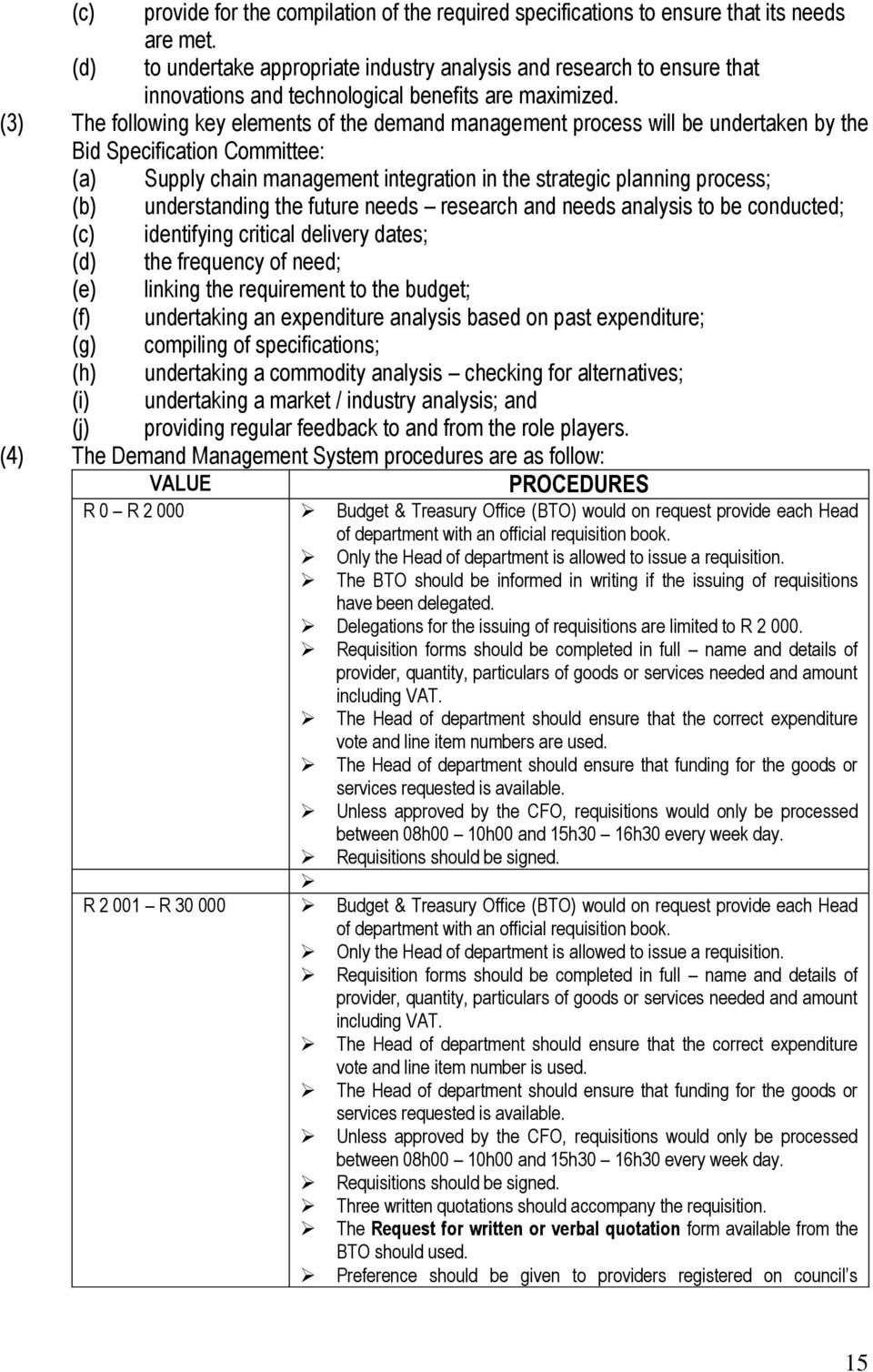
15 (c) provide for the compilation of the required specifications to ensure that its needs are met. (d) to undertake appropriate industry analysis and research to ensure that innovations and technological benefits are maximized. (3) The following key elements of the demand management process will be undertaken by the Bid Specification Committee: (a) Supply chain management integration in the strategic planning process; (b) understanding the future needs research and needs analysis to be conducted; (c) identifying critical delivery dates; (d) the frequency of need; (e) linking the requirement to the budget; (f) undertaking an expenditure analysis based on past expenditure; (g) compiling of specifications; (h) undertaking a commodity analysis checking for alternatives; (i) undertaking a market / industry analysis; and (j) providing regular feedback to and from the role players. (4) The Demand Management System procedures are as follow: VALUE PROCEDURES R 0 R R R Budget & Treasury Office (BTO) would on request provide each Head of department with an official requisition book. Only the Head of department is allowed to issue a requisition. The BTO should be informed in writing if the issuing of requisitions have been delegated. Delegations for the issuing of requisitions are limited to R Requisition forms should be completed in full name and details of provider, quantity, particulars of goods or services needed and amount including VAT. The Head of department should ensure that the correct expenditure vote and line item numbers are used. The Head of department should ensure that funding for the goods or services requested is available. Unless approved by the CFO, requisitions would only be processed between 08h00 10h00 and 15h30 16h30 every week day. Requisitions should be signed. Budget & Treasury Office (BTO) would on request provide each Head of department with an official requisition book. Only the Head of department is allowed to issue a requisition. Requisition forms should be completed in full name and details of provider, quantity, particulars of goods or services needed and amount including VAT. The Head of department should ensure that the correct expenditure vote and line item number is used. The Head of department should ensure that funding for the goods or services requested is available. Unless approved by the CFO, requisitions would only be processed between 08h00 10h00 and 15h30 16h30 every week day. Requisitions should be signed. Three written quotations should accompany the requisition. The Request for written or verbal quotation form available from the BTO should used. Preference should be given to providers registered on council s 15
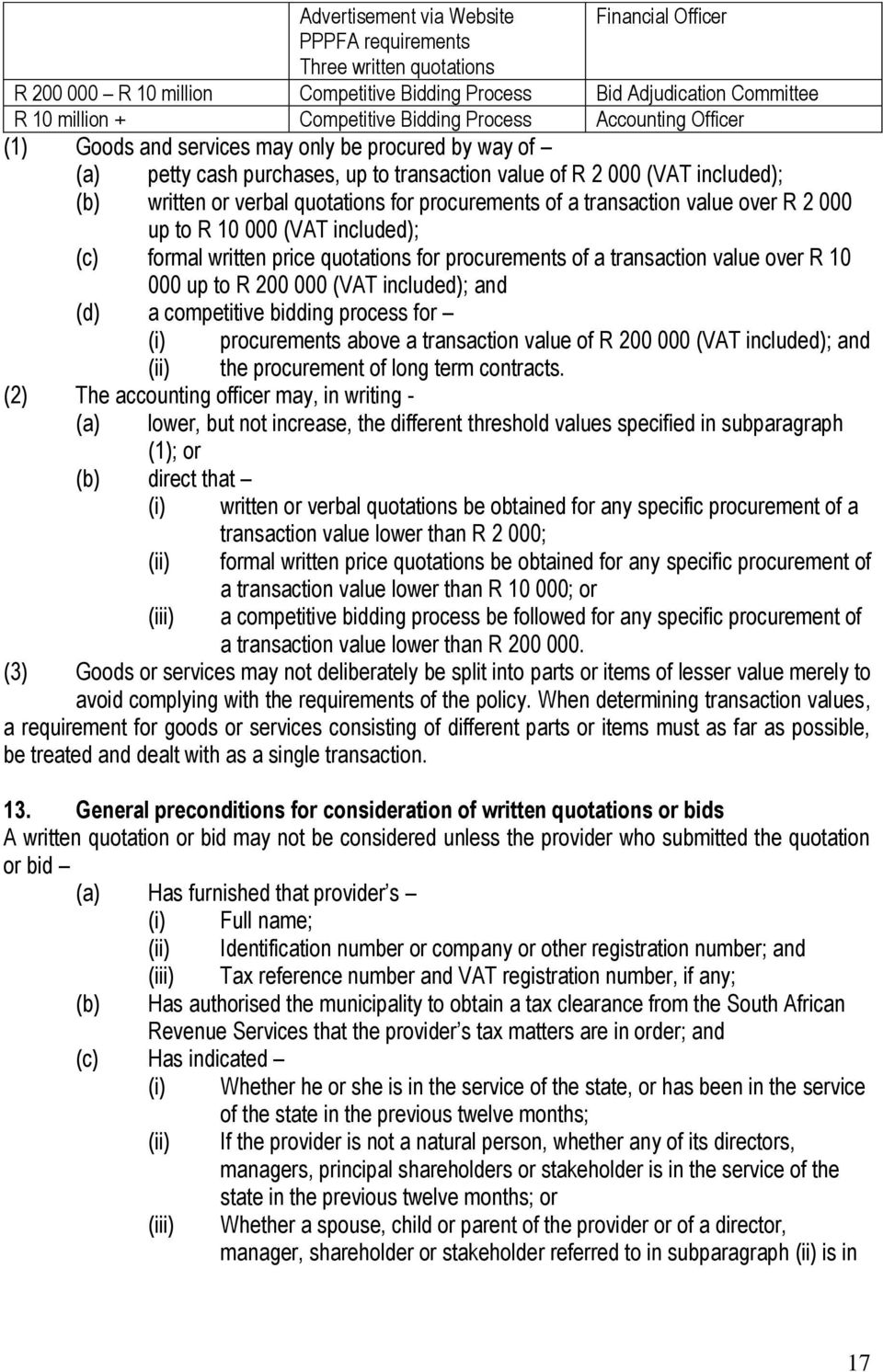
16 R R R R 10 million R 10 million + database. Part 2: Acquisition management It is the management of procurement by a municipality: (1) to decide on the manner in which the market will be approached; (2) to establish the total cost of ownership of a particular type of asset; (3) to ensure that bid documentation is complete, including evaluation criteria; (4) to evaluate bids in accordance with published criteria; and (5) that proper contract documents are signed. 11. Systems of acquisition management (1) The accounting officer must implement the system of acquisition management set out in this Part in order to ensure (a) that goods and services are procured by the municipality in accordance with authorised processes only; (b) that expenditure on goods and services is incurred in terms of an approved budget in terms of section 15 of the Act; (c) that the threshold values for the different procurement processes are complied with; (d) that bid documentation, evaluation and adjudication criteria, and general (e) conditions of a contract, are in accordance with any applicable legislation; and that any Treasury guidelines on acquisition management are properly taken into account. (2) This supply chain management policy, except where provided otherwise in this policy, does not apply in respect of the procurement of goods and services contemplated in section 110 (2) of the Act, including (a) water from the Department of Water Affairs; and (b) electricity from Eskom. (3) When procuring goods or services contemplated in section 110 (2) of the Act, the accounting officer must make public the fact that such goods or services are procured otherwise than through the municipality s supply chain management system, including (a) the kind of goods or services; and (b) the name of the supplier. (4) The Office of the Chief State Law Advisor has confirmed that any bid condition that will exclude certain categories of potential bidders from bidding for contracts is unconstitutional and the municipality should refrain from such practices. (MFMA Circular No. 29) 12. Range of procurement processes STRUCTURE OF APPROVAL GOODS/SERVICE VALUE MINIMUM PROCUREMENT APPROVAL AUTHORITY METHOD R 0 R Petty Cash : One Quote Head of Department or Delegate R R Three written Quotations Head of Department R R days bulletin notice Accounting Officer and Chief 16

17 Advertisement via Website Financial Officer PPPFA requirements Three written quotations R R 10 million Competitive Bidding Process Bid Adjudication Committee R 10 million + Competitive Bidding Process Accounting Officer (1) Goods and services may only be procured by way of (a) petty cash purchases, up to transaction value of R (VAT included); (b) written or verbal quotations for procurements of a transaction value over R up to R (VAT included); (c) formal written price quotations for procurements of a transaction value over R up to R (VAT included); and (d) a competitive bidding process for (i) procurements above a transaction value of R (VAT included); and (ii) the procurement of long term contracts. (2) The accounting officer may, in writing - (a) lower, but not increase, the different threshold values specified in subparagraph (1); or (b) direct that (i) written or verbal quotations be obtained for any specific procurement of a transaction value lower than R 2 000; (ii) formal written price quotations be obtained for any specific procurement of a transaction value lower than R ; or (iii) a competitive bidding process be followed for any specific procurement of a transaction value lower than R (3) Goods or services may not deliberately be split into parts or items of lesser value merely to avoid complying with the requirements of the policy. When determining transaction values, a requirement for goods or services consisting of different parts or items must as far as possible, be treated and dealt with as a single transaction. 13. General preconditions for consideration of written quotations or bids A written quotation or bid may not be considered unless the provider who submitted the quotation or bid (a) Has furnished that provider s (i) Full name; (ii) Identification number or company or other registration number; and (iii) Tax reference number and VAT registration number, if any; (b) Has authorised the municipality to obtain a tax clearance from the South African Revenue Services that the provider s tax matters are in order; and (c) Has indicated (i) Whether he or she is in the service of the state, or has been in the service of the state in the previous twelve months; (ii) If the provider is not a natural person, whether any of its directors, managers, principal shareholders or stakeholder is in the service of the state in the previous twelve months; or (iii) Whether a spouse, child or parent of the provider or of a director, manager, shareholder or stakeholder referred to in subparagraph (ii) is in 17
18 the service of the state, or has been in the service of the state in the previous twelve months. 14. Lists of accredited prospective providers (1) The accounting officer must (a) keep a list of accredited prospective providers of goods and services that must be used for the procurement requirements through written or verbal quotations and formal written price quotations; and (b) at least once a year through newspapers commonly circulating locally, the website and any other appropriate ways, invite prospective providers of goods or services to apply for evaluation and listing as accredited prospective providers; (c) Specify the listing criteria for accredited prospective providers; and (d) Disallow the listing of any prospective provider whose name appears on the National Treasury s database as a person prohibited from doing business with the public sector. (2) The list or database must be updated at least quarterly to include any additional prospective providers and any new commodities or types of services. Prospective providers must be allowed to submit applications for listing at any time. (3) Three databases shall be established, namely General Services; Professional Services; and Contractors. To accomplish the establishment of the said databases all providers of goods and / or services should complete the relevant application form available in hard copy or on the municipality s website Information required to register on the Senqu Municipality Database as a Service Provider; Professional Service Providers Application Form; or Contractors Database Application Form. In order to be considered for listing on either of the databases a service provider or supplier must produce proof of compliance with the following prerequisites, which will apply in order to be considered to be placed on the database: Good standing in respect of Municipal services and VAT and Income Tax; Offices to be allocated within the jurisdiction of Senqu Municipality; Offices to be allocated within the jurisdiction of Ukhahlamba District Municipality; Company registration in terms of the Companies Act, 1973; Registration with a professional body, where relevant (4) The list must be compiled per commodity and per type of service. 15. Petty cash purchases The conditions for the procurement of goods by means of petty cash purchases referred to in paragraph 12 (1) (a) of this Policy, are as follows (a) each manager must provide to the chief financial officer, in writing the name / s of the senior official / s reporting to him / her, whom he / she has delegated the authority of petty cash purchases; 18
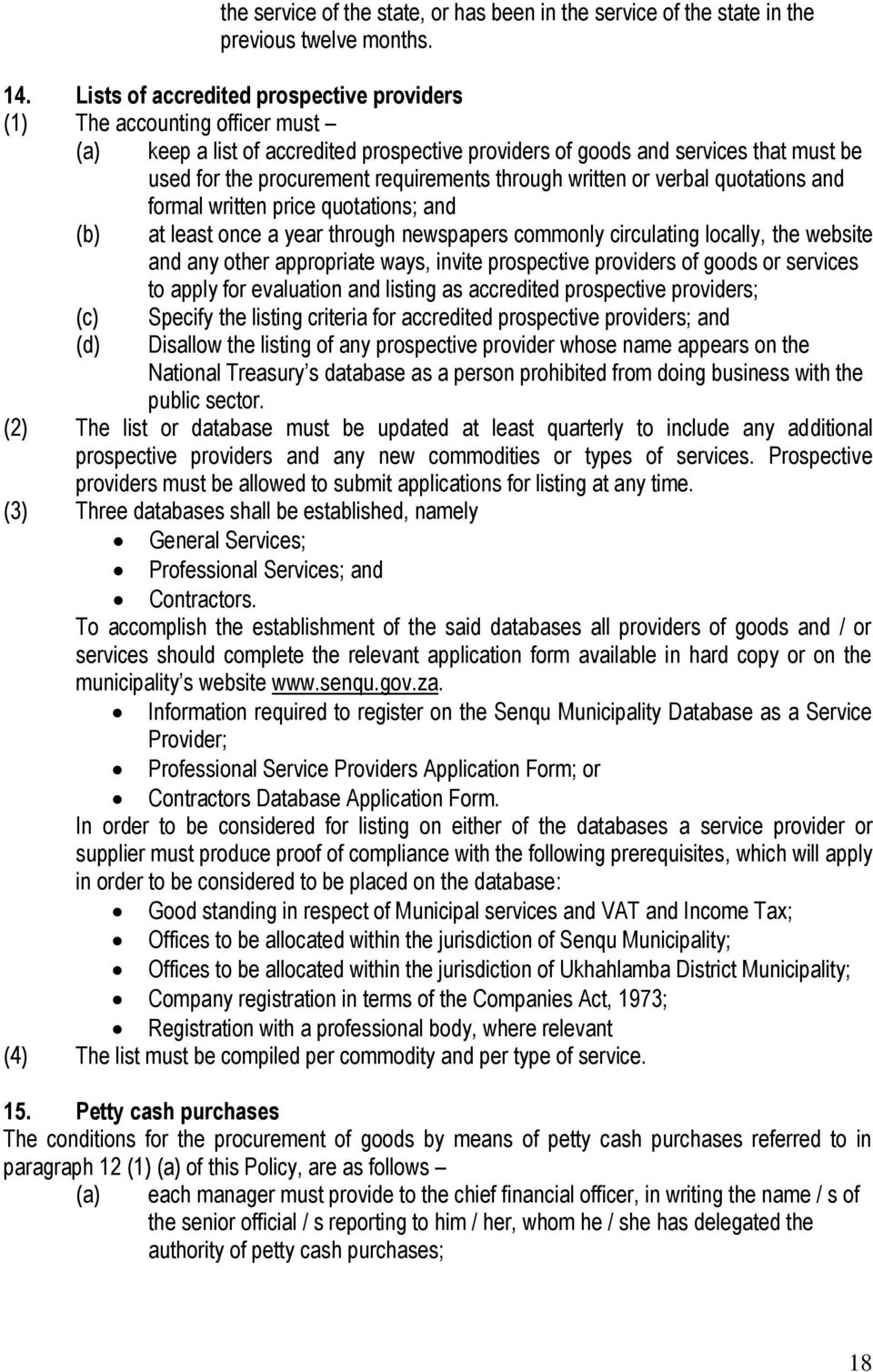
19 (b) The number of petty cash purchases or not limited but should meet the requirements of this Policy. The purchases should not exceed the amount budgeted for that quarter in council s approved cash flow budget; (c) The types of petty cash purchases or not limited but should meet the requirement of this Policy. The accounting officer and / or chief financial officer however reserves the right to request written, verbal or formal written quotations when (d) (e) considered necessary; Petty cash purchases can only be made by official municipal orders, which would be issued by the budget and treasury department upon receipt of an official requisition signed by the manager or his / her delegates. Council would not accept any responsibility for purchases made without an official order and all providers of goods and services would be informed as such; a monthly reconciliation report from each manager must be provided to the chief financial officer, including (i) the total amount of petty cash purchases for that month; and (ii) receipts and appropriate documents for each purchase. 16. Written or verbal quotations The conditions for the procurement of goods or services through written or verbal quotation are as follow: (a) quotations must be obtained from at least three different providers preferably from, but not limited to, providers whose names appear on the list of accredited prospective providers of the municipality, provided that if quotations are obtained from providers who are not listed, such providers must meet the listing criteria set out in paragraph 14 (1)(b) and (c) of this Policy. The budget and treasury department much immediately add such provider to the municipality s list of prospective providers; (b) to the extent feasible, providers must be requested to submit such quotations in writing. If not possible the manager responsible much in writing list the details set out in paragraph 13 of all providers who were unable to submit written quotations; (c) if it is not possible to obtain at least three quotations, the reasons must be recorded and reported quarterly to the accounting officer or another official designated by the accounting officer; (d) the accounting officer must record the names of the potential providers requested to provide such quotations with their quoted prices; and (e) if a quotation was submitted verbally, the order may be placed only against written confirmation by the selected provider. 17. Formal written price quotations (1) The conditions for the procurement of goods or services through written price quotations, are as follows: (a) quotations must be obtained in writing from at least three different providers whose names appear on the list of accredited prospective providers of the municipality; (b) quotations may be obtained from providers who are not listed, provided that such providers meet the listing criteria set out in paragraph 14 (1)(b) and (c) of the Policy. The budget and treasury department much immediately add such provider to the municipality s list of prospective providers; 19
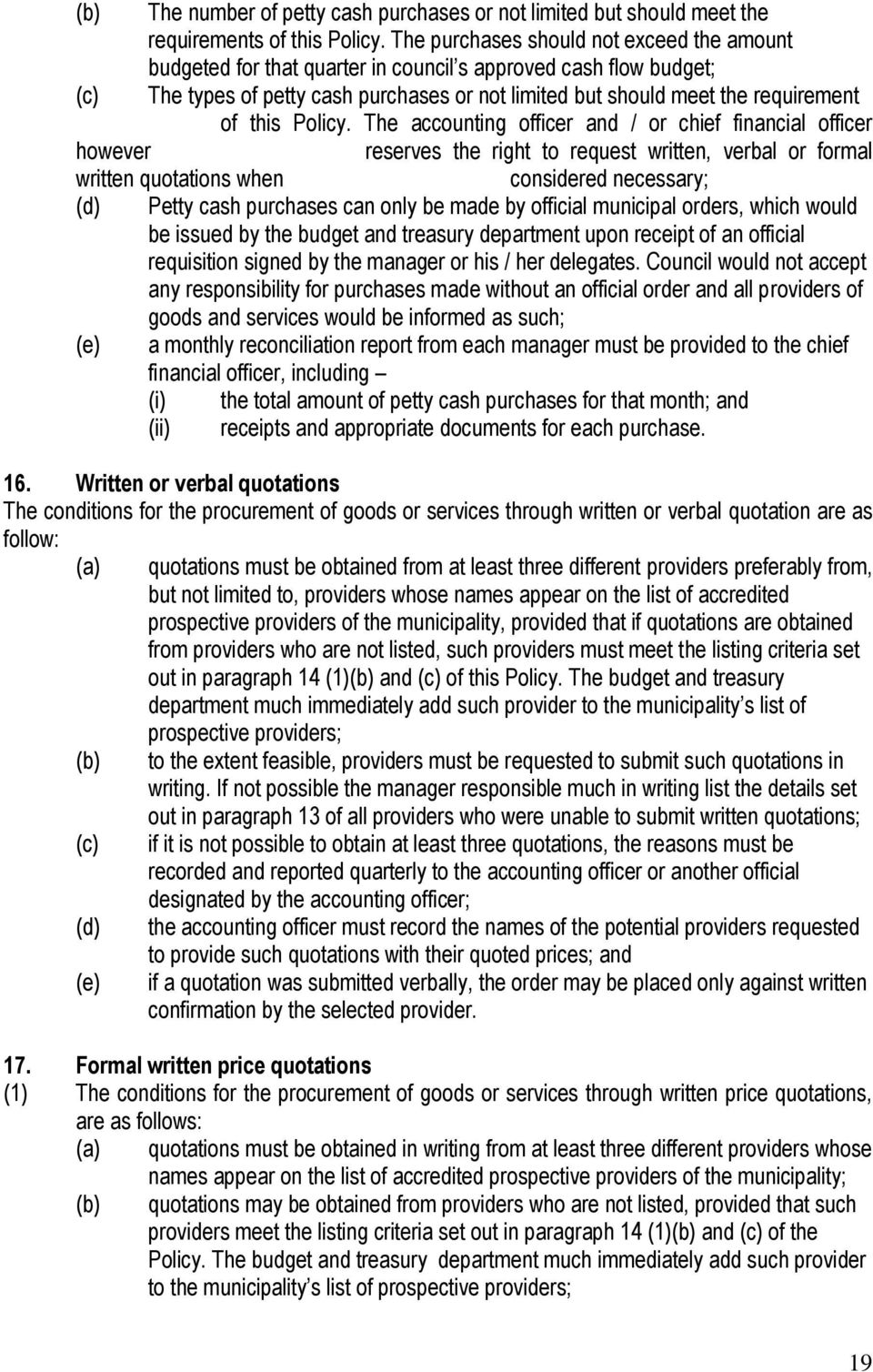
20 (c) (d) if it is not possible to obtain at least three quotations, the reasons must be recorded and approved by the chief financial officer or an official designated by the chief financial officer, and the accounting officer must record the names of the potential providers and their written quotations. (2) A designated official referred to in subparagraph (1)(c) must within three days of the end of each month report to the chief financial officer on any approvals given during that month by that official in terms of that subparagraph. 18. Procedures for procuring goods or services through written or verbal quotations and formal written price quotations. The procedure for the procurement of goods or services through written or verbal quotations or formal written price quotations is as follows: (a) when using the list of accredited prospective providers the accounting officer must promote ongoing competition amongst providers by inviting providers to submit quotations on a rotation basis; (b) all requirements in excess of R (VAT included) that are to be procured by means of formal written price quotations must, in addition to the requirements of paragraph 17, be advertised for at least seven days on the website and an official notice board of the municipality; (c) offers received must be evaluated on a comparative basis taking into account unconditional discounts; (d) the accounting officer of chief financial officer must on a monthly basis be notified in writing of all written or verbal quotations and formal written price quotations accepted by an official acting in terms of a subdelegation; (e) offers below R (VAT included) must be awarded based on compliance to specifications and conditions of contract, ability and capability to deliver the goods and services and lowest price; (f) acceptable offers, which are subject to the preference points system (PPPFA and associated regulations), must be awarded to the bidder who scored the highest points; 19. Competitive bids (1) Goods or services above a transaction value of R (VAT included) and long term contracts may only be procured through a competitive bidding process, subject to paragraph 11 (2) of this Policy. (2) No requirement for goods or services above an estimated transaction value of R (VAT included), may deliberately be split into parts or items of lesser value merely for the sake of procuring the goods or services otherwise than through a competitive bidding process. 20. Process for competitive bidding The procedures for the following stages of a competitive bidding process are as follows: (a) Compilation of bidding documentation as detailed in paragraph 21; (b) Public invitation of bids as detailed in paragraph 22; (c) Site meetings or briefing sessions as detailed in paragraph 22; 20

21 (d) Handling of bids submitted in response to public invitation as detailed in paragraph 23; (e) Evaluation of bids as detailed in paragraph 28; (f) Award of contracts as detailed in paragraph 29; (g) Administration of contracts: (i) After approval of a bid, the accounting officer and the bidder must enter into a written agreement. (h) Proper record keeping: (i) Original / legal copies of written contracts agreements should be kept in a secure place for reference purposes. 21. Bid documentation for competitive bids The criteria to which bid documentation for a competitive bidding process must comply, must (a) take into account - (i) the general conditions of contract and any special conditions of contract, if specified; (b) (c) (d) (e) (ii) (iii) any Treasury guidelines on bid documentation; and the requirements of the Construction Industry Development Board, in the case of a bid relating to construction, upgrading or refurbishment of building or infrastructure; include the preference points system to be used, goals as contemplated in the Preferential Procurement Regulations and evaluation and adjudication criteria, including any criteria required by other applicable legislation; compel bidders to declare any conflict of interest they may have in the transaction for which the bid is submitted; if the value of the transaction is expected to exceed R 10 million (VAT included), require bidders to furnish (i) if the bidder is required by law to prepare annual financial statements for auditing, their audited annual financial statements (aa) for the past three years; or (bb) since their establishment if established during the past three years; (ii) a certificate signed by the bidder certifying that the bidder has no undisputed commitments for municipal services towards a municipality or other service provider in respect of which payment is overdue for more than 30 days; (iii) (iv) particulars of any contracts awarded to the bidder by an organ of state during the past five years, including particulars of any material noncompliance or dispute concerning the execution of such contract; a statement indicating whether any portion of the goods or services are expected to be sourced from outside the Republic, and, if so, what portion and whether any portion of payment from the municipality or municipal entity is expected to be transferred out of the Republic; and stipulate that disputes must be settled by means of mutual consultation, mediation (with or without legal representation), or, when unsuccessful, in a South African court of law. 21
22 22. Public invitation for competitive bids (1) The procedure for the invitation of competitive bids is as follows: (a) Any invitation to prospective providers to submit bids must be by means of a public advertisement in newspapers commonly circulating locally, the website of the municipality or any other appropriate ways (which may include an advertisement in the Government Tender Bulletin); and (b) The information contained in a public advertisement, must include (i) the closure date for the submission of bids, which may not be less than 30 days in the case of transactions over R 10 million (VAT included), or which are of a long term nature, or 14 days in any other case, from the date on which the advertisement is placed in a newspaper, subject to subparagraph (2) of this Policy; (ii) a statement that bids may only be submitted on the bid documentation provided by the municipality; and (iii) Date, time and venue of any proposed site meetings or briefing sessions; (2) The accounting officer may determine a closure date for the submission of bids, which is less than the 30 or 14 days requirement, but only if such shorter period can be justified on grounds of urgency, emergency, or any exceptional case where it is impractical or impossible to follow the official procurement process. (3) Bids submitted must be sealed. (4) Where bids are requested in electronic format, such bids must be supplemented by sealed hard copies. 23. Procedure for handling, opening and recording of bids The procedures for the handling, opening and recording of bids, are as follows: (a) Bids - (i) Must be opened only in public; (ii) Must be opened at the same time and as soon as possible after the period for the submission of bids has expired; and (iii) received after the closing time should not be considered and returned unopened immediately. (b) Any bidder or member of the public has the right to request that the names of the bidders who submitted bids in time must be read out and, if practical, also each bidder s total bidding total bidding price; (c) No information, except the provisions in subparagraph (b), relating to the bid should be disclosed to bidders or other persons until the successful bidder is notified of the award; and (d) The accounting officer must (i) record in a register all bids received in time; (ii) Make the register available for public inspection; and (iii) Publish the entries in the register and the bid results on the website. 24. Negotiations with preferred bidders (1) The accounting officer may negotiate the final terms of a contract with bidders identified through a competitive bidding process as preferred bidders, provided that such negotiation- (a) does not allow any preferred bidder a second or unfair opportunity; 22
23 (b) is not to the detriment of any other bidder; and (c) does not lead to a higher price that the bid as submitted. (2) Minutes of such negotiations must be kept for record purposes. 25. Two-stage bidding process (1) A two-stage bidding process is allowed for (a) large complex projects; (b) projects where it may be undesirable to prepare complete detailed technical specifications; or (c) long term projects with a duration period exceeding three years. (2) In the first stage technical proposals on conceptual design or performance specifications should be invited, subject to technical as well as commercial clarifications and adjustments. (3) In the second stage final technical proposals and priced bids should be invited. 26. Committee system for competitive bids (1) A committee system for competitive bids is hereby established, consisting of the following committees for each procurement or cluster of procurements as the accounting officer may determine: (a) A bid specification & evaluation committee; and Chairperson Chief Financial Officer Permanent Member PMU Manager Permanent Member Assist Manager: Community & Social Services Permanent Member Accountant: Income Supply Chain Management Practitioner Demand & Acquisition Officer Secretariat Senior Admin Committees Rotating Members As required to be nominated by Chairperson (b) A bid adjudication committee; Chairperson Municipal Manager Member Manager: Corporate & Support Service Member Manager: Technical & Engineering Service Member Manager: Community & Social Service Supply Chain Management Practitioner Accountant: Expenditure Secretariat Senior Admin Committees (2) The accounting officer appoints the members of each committee taking into account section 117 of the Act; and (3) A neutral or independent observer, appointed by the accounting officer, must attend or oversee a committee when this is appropriate for ensuring fairness and promoting transparency. (4) The committee system must be consistent with (a) Paragraph 27, 28 and 29 of this Policy; and (b) Any other applicable legislation. (5) The accounting officer may apply the committee system to formal written price quotations. 27. Bid specification committees (1) A bid specification committee must compile the specifications for each procurement of goods or services by the municipality. 23
24 (2) Specifications (a) Must be drafted in an unbiased manner to allow all potential suppliers to offer their goods or services; (b) must take account of any accepted standards such as those issued by Standards South Africa, the International Standards Organisation, or an authority accredited or recognised by the South African National Accreditation System with which the equipment or material or workmanship should comply; (c) Must, where possible, be described in terms of performance required rather than in terms of descriptive characteristics for design; (d) may not create trade barriers in contract requirements in the forms of specifications, plans, drawings, designs, testing and test methods, packaging, marking or labeling of conformity certification; (e) may not make reference to any particular trade mark, name, patent, design, type, specific origin or producer unless there is no other sufficiently precise or intelligible way of describing the characteristics of the work, in which case such reference must be accompanied by the word equivalent ; (f) must indicate each specific goal for which points may be awarded in terms of the points system set out in the Preferential Procurement Regulations 2001; and (g) Must be approved by the accounting officer prior to publication of the invitation for bids in terms of paragraph 22 of this Policy. (3) A bid specification committee must be composed of one or more officials of the municipality, preferably the manager responsible for the function involved, and may, when appropriate, include external specialist advisors. (4) No person, advisor or corporate entity involved with the bid specification committee, or director of such a corporate entity, may bid for any resulting contracts. 28. Bid evaluation committees (1) A bid evaluation committee must (a) Evaluate bids in accordance with (i) The specifications for a specific procurement; and (ii) The points system setout in terms of paragraph 27 (2)(f). (b) Evaluate each bidder s ability to execute the contract; (c) Check in respect of the recommended bidder whether municipal rates and taxes and municipal service charges are not in arrears; and (d) Submit to the adjudication committee a report and recommendations regarding the award of the bid or any other related matter. (2) A bid evaluation committee must as far as possible be composed of (a) Officials from departments requiring the goods or services; and (b) at least one supply chain management practitioner of the municipality. (3) Subject to subsection (2): (a) The composition of the bid evaluation committee may change to accommodate different scenarios; (b) Members from the bid specification committee may also form part of the bid evaluation committee; and (c) A member from the bid evaluation committee may present reports to the bid adjudication committee, but only as an advisor. 24
25 29. Bid adjudication committees (1) A bid adjudication committee must (a) Consider the report and recommendations of the bid evaluation committee; and (b) Either (i) Depending on its delegations, make a final award or a recommendation to the accounting officer to make the final award; or (ii) Make another recommendation to the accounting officer how to proceed with the relevant procurement. (2) A bid adjudication committee must consist of at least four senior managers of the municipality, which must include - (a) The accounting officer; and (b) at least one senior supply chain management practitioner who is an official of the municipality; and (c) a technical expert in the relevant field who is an official, if such an expert exists. (3) The accounting officer must appoint the chairperson of the committee. If the chairperson is absent from a meeting, the members of the committee who are present must elect one of them to preside at the meeting. (4) Neither a member of a bid evaluation committee, nor an advisor or person assisting the evaluation committee, may be a member of a bid adjudication committee. (5) (a) If the bid adjudication committee decides to award a bid other than the one recommended by the bid evaluation committee, the bid adjudication committee must prior to awarding the bid (i) check in respect of the preferred bidder whether that bidder s municipal rates and taxes and municipal service charges are not in arrears, and (ii) notify the accounting officer. (b) The accounting officer may - (i) after due consideration of the reasons for the deviation, ratify or reject the decision of the bid adjudication committee referred to in paragraph (a); and (ii) if the decision of the bid adjudication committee is rejected, refer the decision of the adjudication committee back to that committee for reconsideration. (6) The accounting officer may at any stage of a bidding process, refer any recommendation made by the evaluation committee or the adjudication committee back to that committee for reconsideration of the recommendation. (7) The accounting officer must comply with section 114 of the Act within 10 working days. (8) The accounting officer may establish a bid administration section in the Supply Chain Management Unit of the municipality to handle all the administrative tasks pertaining to the bidding process, e.g.: (a) the invitation for bids; (b) the opening of bids on the closing date; (c) the processing of the bid documents; (d) (e) consultation; and the submission of a recommendation by the bid evaluation committee to the bid adjudication committee. (9) The accounting officer may procure the services of advisors to assist in the execution of the supply chain management function. In this regard: 25
26 (a) these services must be obtained through a competitive bidding process; (b) no advisor may, participate in the final decision-making process regarding the award of bids; and (c) the accounting officer may not delegate decision-making authority to an advisor. (10) The 80 / 20 and 90 / 10 preference point system as stipulated in the Preferential Procurement Regulations, 2001 Pertaining to the Preferential Procurement Framework Act, No 5 of 2000, will be used to adjudicate all bids. Bids can not be regarded as unacceptable or non-responsive should it exceed a certain range below or above a predetermined cost estimate. The PPPFA prescribes that the lowest acceptable bid must receive 80 / 90 points for price. A bid is regarded as acceptable if: it complies in all respect with the specifications and conditions of the bid; the bidder completed and signed all the prescribed bid forms to enable the principal to evaluate the submitted bid; the bidder submitted the required tax clearance certificate and other forms as prescribed by various Acts and in the bid documentation; and the bidder has the necessary capacity and ability to execute the contract. When a bid is passed over or regarded as non-responsive, the reasons for passing over such bid must be defendable in a court of law. (MFMA Circular No. 29) (11) The 80 / 20 preference point system must be used to calculate the points for price in respect of bids / procurement with a Rand value equal to, or above R and up to a Rand value of R : Pt Pmin Ps = 80 (1 - Pmin ), where Ps = Points scored for price under consideration; Pt = Rand value of offer bid consideration; and Pmin = Rand value of lowest acceptable bid. A maximum of 10 points may be awarded to a bidder for being an HDI and / or subcontracting with an HDI + 10 points for achieving any of the specified goals as set out in section (13) below. Points scored by a bidder in respect of the goals specified in terms of the Preferential Procurement Policy Framework Act, 2000 must be added to the points scored for price. Only the bid with the highest number of points scored may be selected. (12) The 90 / 10 preference point system must be used to calculate the points for price in respect of bids / procurement with a Rand value above R : Pt Pmin Ps = 90 (1 - Pmin ), where Ps = Points scored for price under consideration; Pt = Rand value of offer bid consideration; and Pmin = Rand value of lowest acceptable bid. A maximum of 5 points may be awarded to a bidder for being an HDI and / or subcontracting with an HDI + 5 points for achieving any of the specified goals as set out in section (13) below. Points scored by a bidder in respect of the goals specified in terms of the Preferential Procurement Policy Framework Act, 2000 must be added to the points scored for price. Only the bid with the highest number of points scored may be selected. 26
27 (13) Any 5 of the following specified goals could be used and should be stipulated in the relevant bid documents. To qualify for the points the bidder should completed the relevant Points Claim Form. Form Specified Goals 80 / 20 Points 90 / 10 Points MBD 6.1 Promotion of South African owned enterprises 2 1 MBD 6.2 Promotion of export orientated production to create 2 1 jobs MBD 6.3 Promotion of SMME s 2 1 MBD 6.4 Creation of new jobs or the intensification of labour 2 1 absorption MBD 6.5 Promotion of enterprises located in Senqu Local 2 1 Municipal area MBD 6.6 Promotion of enterprises located in Ukhahlamba 2 1 District Municipal Area MBD 6.7 Promotion of enterprises located in the Eastern Cape 2 1 MBD 6.8 Promotion of enterprises located in rural areas 2 1 MBD 6.9 Empowerment of the work force by standardizing the 2 1 level of skill and knowledge of workers MBD 6.10 Development of human resources, including by 2 1 assisting in tertiary and other advanced training programmes MBD 6.11 Upliftment of communities through, but not limited to, housing, transport, schools, infrastructure donations and charity organizations 2 1 Should = 10 5 (14) The municipality shall, in the bid documents, stipulate the preference point system which will be applied in the adjudication of bids. (15) A contract may on reasonable and justifiable grounds be awarded to a bid that did not score the highest number of points. (16) In the event that, in the application of the 80 / 20 preference point system as stipulated in the bid documents, all bids received exceed the estimated Rand value of R , the bid invitation must be cancelled. A re-invitation of bids will be published and the bid document must stipulate the preference point system to be applied. (17) In the event that, in the application of the 90 / 10 preference point system as stipulated in the bid documents, all bids received are equal to, or below R , the bid invitation must be cancelled. A re-invitation of bids will be published and the bid document must stipulate the preference point system to be applied. (18) The municipality may, prior to the award of a bid, cancel a bid if: (a) due to changed circumstances, there is no longer need for the goods or services bided for; or (b) funds are no longer available to cover the total envisaged expenditure; or (c) no acceptable bids are received. (19) Only a bidder who has completed and signed the declaration part of the bid documentation may be considered for preference points and the municipality may, before a bid is 27
28 adjudicated or at any time, require a bidder to substantiate claims it has made with regard to preference. (20) The municipality must when calculating comparative prices take into account any discounts which have been offered unconditionally and a discount which has been offered conditionally must, dispute not being taken into account for evaluation purposes, be implemented when payment is effected. (21) In the event that different prices are tendered for different periods of a contract, the price for each period must be regarded as a firm price if it conforms to the definition of a firm price. (22) Points scored must be rounded off to the nearest 2 decimals. (23) In event that two or more bids have scored equal total points, the successful bid must be the one scoring the highest number of preference points for specified goals. Should two or more bids be equal in all respects, the award shall be decided by drawing of lots. 30. Equity Principles (1) Preference points stipulated in respect of a bid must include preference points for equity ownership by HDI s. (2) The equity ownership contemplated in subsection (1) must be equated to the percentage of an enterprise or business owned by individuals or in respect of a company, the percentage of a company s shares that are owned by individuals, who are actively involved in the management of the enterprise, commensurate with their degree of ownership at the closing date of the bid. (3) In the event that the percentage of ownership contemplated in subsection (2) changes after closing date of the bid, the bidder must notify the municipality and such bidder will not be eligible for any preference points. (4) Preference points may not be claimed in respect of individuals who are not actively involved in the management of an enterprise or business and who do not exercise control over an enterprise or business commensurate with their degree of ownership. (5) Subject to subsections (1), (2), (3) and (4), all claims for equity ownership by an HDI must be considered according to the following criteria: (a) Equity within private companies must be based on the percentage of equity (b) ownership; Preference points may not be awarded to public companies and tertiary institutions; (c) EP = the percentage of equity ownership by an HDI within the business, determined in accordance with subsections (1), (2), (3) and (4). NEP = NOP X EP 100, where NEP = Points awarded for equity by an HDI; NOP = The maximum number of points awarded for equity ownership by an HDI; EP = The percentage of equity ownership by an HDI within the enterprise or business. (6) Equity claims for a Trust may only be allowed in respect of those persons who are both trustees and beneficiaries and who are actively involved in the management of the Trust. (7) Documentation to substantiate the validity of the credentials of the trustees must be submitted to the municipality. 28
29 (8) A Consortium or Joint Venture may, based on the percentage of the contract value managed or executed by their HDI members, be entitled to equity ownership in respect of an HDI. (9) The number of points scored for a Consortium or Joint Venture must be added to the number of points scored for achieving specified goals. (10) The points contemplated in subsection (9) must be added to the points scored for price, in order to establish the total number of points scored. (11) Subject to section 29 the contract must be awarded to the bid which scores the highest points. (12) A person awarded a contract as a result of preference for contracting with, or providing equity ownership to an HDI may not subcontract more than 25% of the value of the contract to a person who is not an HDI or does not qualify for such preference. 31. Declarations A bidder must, in the stipulated manner, declare that (1) the information provided is true and correct; (2) the signatory to the bid document is duly authorized; and (3) documentary proof regarding any bid will, when required, be submitted to the satisfaction of the municipality. 32. Procurement of banking services (1) A contract for banking services (a) must be procured through competitive bids; (b) must be consistent with section 7 or 85 of the Act; and (c) may not be for a period of more than five years at a time. (2) The process for procuring a contract for banking services must commence at least nine months before the end of an existing contract. (3) The closure date for the submission of bids may not be less than 60 days from the date on which the advertisement is placed in a newspaper in terms of paragraph 22 (1). Bids must be restricted to banks registered in terms of the Banks Act, 1990 (Act No 94 of 1990). 33. Procurement of IT related goods or services (1) The accounting officer may request the State Information Technology Agency (SITA) to assist with the acquisition of IT related goods or services through a competitive bidding process. (2) Both parties must enter into a written agreement to regulate the services rendered by, and the payments to be made to, SITA. (3) The accounting officer must notify SITA together with a motivation of the IT needs if (a) the transaction value of IT related goods or services required in any financial year (b) will exceed R 50 million (VAT included); or the transaction value of a contract to be procured whether for one or more years exceeds R 50 million (VAT included). (4) If SITA comments on the submission and the municipality disagrees with such comments, the comments and the reasons for rejecting or not following such comments must be submitted to the council, the National Treasury, the relevant provincial treasury and the Auditor-General. 29
30 34. Procurement of goods and services under contracts secured by other organs of state (1) The accounting officer may procure goods or services under a contract secured by another organ of state, but only if (a) the contract has been secured by that organ of state by means of a competitive bidding process applicable to that organ of state; (b) there is no reason to believe that such contract was not validly procured; (c) (d) there are demonstrable discounts or benefits to do so; and that other organ of state and the provider have consented to such procurement in writing. (2) Subparagraphs (1)(c) and (d) do not apply if (a) a municipal entity procures goods or services through a contract secured by its parent municipality; or (b) a municipality procures goods or services through a contract secured by a municipal entity of which it is the parent municipality. 35. Procurement of goods necessitating special safety arrangements (1) The acquisition and storage of goods in bulk (other than water), which necessitate special safety arrangements, including gasses and fuel, should be avoided where ever possible. (2) Where the storage of goods in bulk is justified, such justification must be based on sound reasons, including the total cost of ownership, cost advantages and environmental impact and must be approved by the accounting officer. 36. Proudly SA Campaign The municipality supports the Proudly SA Campaign to the extent that, all things being equal, preference is given to procuring local goods and services from: (a) Firstly suppliers and businesses within the municipality or district; (b) Secondly suppliers and businesses within the relevant province; (c) Thirdly suppliers and businesses within the Republic. 37. Appointment of consultants The term consultants includes consulting firms, engineering firms, construction managers, management firms, procurement agents, inspection agents, auditors, other multinational organizations, investment and merchant banks, universities, research agencies, government agencies, non-governmental organizations and individuals. Accounting officer may use these organizations as consultants to help in a wide range of activities such as policy advise, accounting officer s/authority s reform management, engineering services, construction supervision, financial services, information technology services, procurement services, social and environmental studies and identification, preparation, and implementation of projects to complement accounting officers capabilities in these area. (1) The accounting officer may procure consulting services provided that any Treasury guidelines in respect of consulting services are taken into account when such procurements are made. (2) Consultancy services must be procured through competitive bids if (a) the value of the contract exceeds R (VAT included); or (b) the duration period of the contract exceeds one year. 30
31 (3) In addition to any requirements prescribed by this Policy for competitive bids, bidders must furnish particulars of (a) all consultancy services provided to an organ of state in the last five years; and (b) any similar consultancy services provided to an organ of state in the last five years. (4) The accounting officer must ensure that copyright in any document produced, and the patent rights or ownership in any plant, machinery, thing, system or process designed or devised, by a consultant in the course of the consultancy service is vested in the municipality. (5) Consultants should only be engaged when: (a) the necessary skills and/or resources to perform a project/duty/study are not available; and (b) the accounting officer cannot be reasonably expected either to train or to recruit people in the time available. (6) The work undertaken for the accounting officer by a consultant should be regulated by a contract and the accounting officer should satisfy himself / herself that: (a) the procedures to be used will result in the selection of consultants who have the necessary professional qualifications and skills; (b) the selected consultant will carry out the assignment in accordance with the agreed schedule; and (c) the scope of the services is consistent with the needs of the project. (7) An list of approved service providers should be established. (a) (b) (c) Where consultancy services are required on a recurring basis, a panel of consultants / list of approved service providers for the rendering of these services will be established. The panels / lists should be established through the competitive bidding process, usually for services that are of a routine or simple nature where the scope and content of the work to be done can be described in detail. The intention to establish a panel / list of approved service providers is published in the media and on the municipality s website and the closing time and date for inclusion in the panel / list of approved service providers should be indicated. For this purpose, a questionnaire should be made available and should make provision for the following: (i) composition of the firm in terms of shareholding; (ii) personnel complement; (iii) representation of expertise in respect of the disciplines required, e.g. accounting, legal, educational, engineering, computer, etc; (iv) national / international acceptability of experts in various professions; (v) experience as reflected in projects already dealt with; and (vi) financial position. Requirements for admission to the list and criteria should be linked to the numeric value in terms of which applicants will be measured, for example qualifications, experience, acceptability, facilities and resources etc. A pre-determined standard method of awarding points be followed. The applications received should be evaluated and any rejection of applicants should be motivated and recorded. 31
32 (d) Once the panel / list of service providers has been approved, only the successful applicants are approached, depending on the circumstances, either by obtaining quotes on a rotation basis, or according to the bid procedure when services are required, with the exception that the requirement is not advertised again. (e) The list should be updated annually. (8) The relationship between the accounting officer and the consultant should be one of purchaser / provider and not employer / employee. The work undertaken for the accounting officer by a consultant should be regulated by a contract. In procuring consulting services the accounting officer should satisfy himself / herself that: (a) the procedures to be used will result in the selection of consultants who have the necessary qualifications and / or experience; (b) the selected consultant will carry out the assignment in accordance with the agreed schedule; and (c) the scope of the services is consistent with the needs of the project. (9) The accounting officer should be responsible for preparing and implementing the project, for selecting the consultant, awarding and subsequently administering the contract, as well as for the payment of consulting services under the project. While the specific rules and procedures to be followed for employing consultants depend on the circumstances of the particular case, at least the following four major considerations should guide the accounting officer: (a) the need for high-quality services; (b) the need for economy and efficiency; (c) the need to give qualified consultants an opportunity to compete in providing the services; and (d) the importance of transparency in the selection process Selection methods for the appointment of consultants The particular method to be followed for the selection of consultants for any given project should be selected by the accounting officer in accordance with the criteria outlined in the Guide for Accounting Officers / Authorities. The method selection is determined by the scope of the assignment, the quality of service, the complexity of the assignment and whether assignments are of a standard and routine nature. The following methods are recommended: (1) Quality and Cost Based Selection (QCBS) In majority of cases, the abovementioned major considerations can best be addressed through competition among firms in which the selection is based both on the quality of the services to be rendered and on the cost of the services to be provided, i.e. Quality and Cost-Based Selection (QCBS). This method is used in the event of an assignment not complex or specialized. Cost as a factor of selection should be used judiciously. The accounting officer should determine the relative weight, in line with paragraph 29 above, to be given to quality and cost and should determine each case depending on the nature of the assignment. Where QCBS is not considered as the most appropriate method for selecting consultants and other methods should be considered. (2) Quality Based Selection (QBS) (a) QBS is recommended for the following types of assignments: (i) Complex or highly specialized assignments for which consultants are expected to demonstrate innovation in their proposals for which it is difficult to define a term of reference; 32
33 (ii) Assignments that have a high downstream impact and in which the objective is to have the best experts; and (iii) Assignments that can be carried out in substantially different ways, such that proposals will not be comparable. (b) In QBS the request for proposal may request submission of a technical proposal only or a technical and financial proposal at the same time but in separate envelopes (two-envelope system). (c) If technical proposals alone were invited, after evaluating the proposals using the QCBS methodology, the accounting officer should request the consultant with the highest technical proposal to submit a detailed financial proposal. The accounting officer and the consultant should then negotiate the financial proposal and contract. (d) If consultants were requested to provide financial proposals initially (two-envelope system) together with the technical proposals, safeguards should be built in to ensure that the price envelope of only the selected proposal is opened and the rest returned unopened, after negotiations are successfully concluded. (3) Selection under a fixed budget The method is recommended when the assignment is simple and can be precisely defined and when the budget is fixed. The request for proposal should indicate the available budget and request the consultants to provide their best technical and financial proposals in separate envelopes, within the budget. The terms of reference should be particularly well prepared to ensure that the budget is sufficient for the consultants to perform the expected tasks. Evaluation of all technical proposals should be carried out first as in the QCBS method where after the price envelopes should be opened in public. Proposals that exceed the indicated budget should be rejected. The consultant who has submitted the highest ranked technical proposal should be selected and invited to negotiate a contract. (4) Least-cost selection This method is more appropriate to selection of consultants for assignments of a standard or routine nature where well established practices and standards exist and in which the contract amount is small. Under this method a minimum qualifying mark for functionality is determined. Proposals to be submitted in two envelopes are invited. Potential suppliers may be obtained from the list of approved service providers. Technical envelopes are opened first and evaluated. Those securing less than the minimum mark should be rejected and the financial envelopes of the rest are opened in public. The firm with the highest points should be selected. Under this method the qualifying minimum mark should be established, keeping in view that all proposals above the minimum compete only on cost and promotion of HDI s and RDP objectives. The minimum mark to qualify should be stated in the request for proposal. (5) Single-source selection (a) This method should be used in exceptional and justifiable cases only as it may encourage unacceptable practices. It should be examined in the context of the overall interest of the client and the project. (b) May only be appropriated (i) for tasks that represent a natural continuation of previous work carried out; (ii) where rapid selection is essential (emergencies); (iii) for very small assignments; or (iv) when only one firm is qualified or has experience of exceptional worth. 33
34 (c) The reasons for selecting this method must be recorded in detail and be approved by the accounting officer. (6) Selection based on consultants qualifications This method may only be used for very small assignments for which the need for preparing and evaluating competitive proposals is not justified. The accounting officer should prepare the terms of reference, request expressions of interest and information on the consultants experience and competence relevant to the assignment and select the firm with the most appropriate qualifications and references. The selected firm should be requested to submit a combined technical-financial proposal and then be invited to negotiate the contract. (7) Selection of individual consultants (a) Individual consultants may be employed on assignments for which (i) teams of personnel are not required; (ii) no additional outside professional support is required; and (iii) the experience and qualifications of the individual are the paramount requirement. (b) Permanent staff or associates of a consulting firm may be available as individual consultants, but when coordination, administration or collective responsibility become difficult because of the number of individuals it would be advisable to employ a firm. (c) Individual consultants should be selected on the basis of their qualifications and experience for the assignment. References and qualifications should be well documented and the accounting officer should be convinced that the individual is fully capable of carrying out the assignment. Capability, also well documented, is judged on the basis of academic background, experience and as appropriate knowledge of the local conditions, such as local language, culture, administrative system and local government environment. (8) Selection of particular types on consultants (a) (b) (c) (d) Nongovernmental Organisations (NGO s) when uniquely qualified to assist in the preparation, management and implementation of projects, essentially because of their involvement and knowledge of local issues, community needs, and / or participatory approaches. Inspection agents should be registered with the South African National Accreditation System (SANAS) and their services should be obtained by means of competitive bidding. Banks Investment and commercial banks, financial firms, and fund managers should be selected under QCBS. Auditors typically carry out auditing tasks under well-defined terms of reference and professional standards and should be selected according to QCBS. (9) Association between consultants Consultants may associate with each other to complement their respective areas of expertise. Such associations may be for the long term or for a specific assignment and may take the form of a joint venture. The accounting officer should not compel, but may encourage associations with the aim to enhance transfer of skills Invitation of bids / proposals using QCBS 34
35 Appointing consultants implies the procurement of services and the prescripts of the Preferential Procurement Regulations, 2001 must be adhered to. These prescripts relate to the compulsory involvement of HDI s and the promotion if RDP goals (1) Request for bids Method to be followed where a clear terms of reference, including a detailed task directive has been compiled and the objectives, goals and scope of the assignment are clearly defined: 1 Prepare clear TOR (Terms of Reference). Scope of services described compatible with available budget. Define task directive (methodology), objectives, goals and scope of assignment. Provide background information to facilitate consultants preparation of bids. 2 If assignment requires component for training or transfer of knowledge and skills TOR should indicate objectives, nature, scope and goals of training programme. Define details of trainers and trainees, skills to be transferred, time frames and monitoring and evaluation arrangements. TOR should list services and surveys necessary to carry out the assignment and the expected outputs. 3 Time frames linked to various tasks should be specified including the frequency of monitoring actions. Respective responsibilities of accounting officer and the consultant should be clearly defined. 4 Clearly indicate which preference point system in terms of the PPPFA and regulations will be applicable as well as the goals to be achieved and points allocated for these goals see paragraph 28 and Detailed information (ration of % between functionality and price) on evaluation process should be provided. When determining % for price the complexity of the assignment and relative importance of functionality should be taken into account. % for price should be provided by the accounting officer. 6 Evaluation criteria, their respective weights, minimum qualifying score for functionality and values that will be applied for evaluation should be clearly indicated and should at least include the following: Consultant s relevant experience relevant to the assignment; Quality of the methodology; Qualifications of key personnel; and Transfer of knowledge. 7 Accounting officer may divide these criteria into sub-criteria if essential i.e. under methodology might be innovation and level of detail. 8 Preparation of a well-thought-through cost estimate is essential if realistic budgetary resources are earmarked and should be based on the accounting officer s assessment of the resources needed to carry out the assignment i.e. staff time, logistical support and physical inputs. 9 Terms of reference should clearly specify the validity period. 10 In more complicated projects provision may be made for pre-bid briefing sessions as part of the evaluation process. 11 Terms of reference should form part of the bid documentation. 12 Terms of reference should be approved by the specification committee and detailed evaluation criteria (2) Request for proposals Method is used where selection is based on quality of a proposal and on the cost of the service through competitive bidding, and will be applicable on more complex projects 35
36 where consultants are requested and encouraged to propose their own methodology and to comment on the terms of reference. For preparation and issuance of a Request for Proposal the following should at least be included: 1 Letter on invitation stating the intention to enter into a contract for the provision of consulting services, the details of the client and the date, time and address for submissions of proposals. 2 Information to consultant should contain all necessary information that would assist consultants to prepare responsive proposals. Information on evaluation process by indicating evaluation criteria and factors and their respective weights and the minimum qualifying score for functionality should be provided. 3 Give clear indication of which preference points system in terms of the PPPFA and its regulations will be applicable, as well as the goals to be targeted and points allocated for each goal. 4 Information to Consultants should include adequate information on following aspects of the assignment: Brief description of assignment; Standards formats for technical & financial proposals; Names & contact information of relevant officials; Details of selection procedure: description of two-stage process, if appropriate; listing of technical evaluation criteria & weights of each criterion; details of financial evaluation; relative weights for quality & cost in case of QCBS; minimum pass score for quality; and details of public opening of financial proposals. Estimate of level of key staff inputs required of consultant and indication of minimum experience, academic achievement, i.e. expected of key staff; Information required during the negotiation of the contract; Deadline for submission of proposal; Method in which proposals should be submitted technical proposal separated, twoenvelop system, etc; Request that invited firms acknowledge receipt & inform whether or not they will be submitting a proposal; Give list of consultants invited to submit proposals and state whether or not associations between consultants are acceptable; The period for which proposals should be held valid not less than 60 days; Anticipated date on which the selected consultant should be expected to commence the assignment; Statement indicating all prices should be VAT inclusive; Details of services, facilities, equipment and staff to be provided by the accounting officer; Phasing of assignment, if appropriate and likelihood of follow-up assignments; Procedure to handle clarifications about the information given in the Request for Proposal; Conditions for subcontracting part of the assignment. 5 Any amendments to the Information to consultant should be done as an amendment and not by changing the original text. 6 Granting of substantial extension of the agreed time for the performance of the contract that might result in an increase of the original contract amount can only be approved by the 36
37 accounting officer. 7 The Terms of reference should be compatible with the available budget and should define as clearly as possible the objectives, goals and scope of the assignment. 8 Terms on reference should enable consultants to propose their own methodology and staffing and encourage the consultant to comment of the terms of reference in their own proposal. 9 If applicable it should be indicated that proposals should be submitted in two separate clearly marked envelopes one of technical proposal & one financial proposal. 10 Where pre-qualification / short-listing is required the terms of reference should indicate the basis thereof, i.e. the number of minimum points to be scored to pre-qualify. 11 The appropriate Standard Form of Contract issued by National Treasury. Any changes necessary to address specific project issues should be introduced through attached Contract Data S heets or through Special Conditions of Contract and not by changing the wording of the General Contract. (3) Establishment of a list of approved service providers Where consultancy services are required on a recurring basis a panel of consultants from the list of accredited service providers established in terms of paragraph 14, would be established. The application form Professional Service Providers used by consultants to be registered on council s database for accredited service providers would be used to evaluate consultants and should address the following: Criteria Composition of the firm in terms of shareholding. Personnel complement experience and qualifications. Representation of expertise i.r.o. the discipline required i.e. engineering, legal, financial. National / international acceptability of experts in profession Experience in projects already dealt with. Financial position. Facilities and resources. Numeric Value All registered accredited service providers should be evaluated and any rejection should be motivated and recorded. Once the panel of consultants has been evaluated by the Tender Evaluation Committee and approved by the Tender Adjudication Committee only consultants listed are approached, depending on the circumstances, either by obtaining quotes on a rotation basis, or according to the bid procedure when services are required, with the exception that the requirement is not advertised again: R R Quotes on Rotation Basis R R Quotes through Bid Process The Tender Evaluation Committee should maintain records of all assignments allocated through this process number of assignments and monetary value thereof. (4) Receipt of proposals Enough time not less than four weeks or more than three months, depending on the assignment should be allowed to prepare the proposals. Should consultants request any 37
38 clarification about information already provided such clarifications should be in writing and made available to all the consultants who intend to submit proposals and if necessary the accounting officer could extend the deadline for submission. Technical and financial proposals, in separate envelopes should be submitted at the same time and no amendments are allowed after submission. All technical proposals should immediately after the closing time for submissions be opened and recorded in the Tender Register. Financial proposals should remain sealed until they are opened and recorded publicly. Late submission should be recorded as such but returned unopened. Consultants role: If consultants find in the Request for Proposal documents especially in the selection procedure and evaluation criteria any ambiguity, omission or internal contradiction or any feature that is unclear or that appears discriminatory or restrictive they should in writing within the specified period seek clarification from the accounting officer. If consultants feel that any of the provisions in the Request for Proposal are inconsistent with the prescripts of Municipal Supply Chain Management Regulations and / or the PPPFA and its regulations they should in writing raise the issue with the accounting officer. Should ensure that they submit a fully responsive proposal including all supporting documents requested in the Request for Proposal and that information provided is accurate. Proposal should be signed. Note should be that non-compliance with important requirements will result in rejection of the proposal. (5) Evaluation of bids / proposals Evaluation should be done on the basis of functionality and price as well as achievement of specified RDP goals. Evaluation should be carried out in two phases: First functionality Then the price. Combined percentages allocated for functionality and price should total 100%. Ratio used for division between functionality and price should be determined and approved by accounting officer and be made known upfront in the bid documents. Score sheet should be prepared by the Tender Specifications Committee and provided to the Tender Evaluation Committee. Score sheet should contain all criteria and weight for each criterion as indicated in terms of reference as well as the values to be applied for evaluation. Evaluation should be carried out in full conformity with the provisions of the Request for Proposal and Terms of Reference. Calculation of percentage for functionality The Tender Evaluation Committee should not have access to the financial proposals until the technical evaluation is concluded. Financial proposals of only the technical proposals achieving the minimum qualifying score for functionality should be opened. Functionality of the technical proposal should be evaluated by at least three specialists in that field in terms of the specified evaluation criteria that may include: consultant s relevant experience for the assignment; quality of the methodology proposed; qualifications of the key staff proposed; transfer of knowledge, etc. 38
39 Criteria could be divided into sub-criteria ( methodology innovation and level of detail) and more weight should be given to methodology in case of more complex assignment e.g. multidisciplinary feasibility or management studies. Evaluate only key personnel and review their qualifications and experience from their complete, accurate and authorized signed curricula vitae. If the assignment is complex more weight should be assigned to this criterion and the following sub-criteria is proposed: General qualifications general education and training, length of experience, positions held, time with the consulting firm staff and experience in developing countries; Adequacy for the assignment education, training and experience in that specific sector, field or subject relevant to the particular assignment; and Experience in the region knowledge of the local language, culture, administrative system, government organization, etc. Use Terms of Reference (TOR) as basis for evaluation. Reject proposals not responding to important aspects of TOR or fails to achieve minimum qualifying score for functionality. Prepare evaluation report on quality of proposals substantiating the results of the evaluation and describing the relative strengths and weaknesses. All records relating to the evaluation should be retained. Tender Evaluation Committee should award values for each individual criterion on a score sheet prepared by the Tender Specification Committee. Value scored for each criterion should be multiplied with the specified weighting for the relevant criterion to obtain the marks scored. These marks should the be added to obtain the total score. Formula to be used to convert the total score to a percentage for functionality is: So X Ap Ps = Ms Where Ps = percentage scored for functionality by bid under consideration; So = total score of bid under consideration; Ms = maximum possible score; and Ap = percentage allocated for functionality. After calculation of the percentage for functionality the prices of all bids that obtained the minimum score for functionality should be taken into consideration. Bids not scoring the specified minimum percentage should be disqualified and not considered further. Calculation of percentage for price Price should include all local taxes and all other reimbursable expenses. Proposal with lowest price will obtain maximum percentage for price as prescribed in Request for Proposal (RFP). Proposals with higher prices will proportionally obtain lower percentages according to the method as prescribed in the RFP. The following formula should be used: Ps = Pmin X Ap Pt Where Ps = percentage scored for price by under consideration; Pmin = lowest acceptable bid; Pt = price of bid under consideration; and Ap = percentage allocated for price Calculation of points for functionality and price Percentage obtained for functionality + percentage obtained for price = percentage out of 100. Convert to points out of 80 or 90 in terms of regulation 8 of the Preferential Procurement 39
40 Regulations. Points scored out of 80 or 90 should be calculated according to following formula: The 80 / 20 preference point system: Hs Rs Ps = 80 ( 1 Rs ) The 90 / 10 preference point system: Hs Rs Ps = 90 ( 1 Rs ) Where Ps = points scored for functionality and price of the bid under consideration; Hs = highest percentage scored by any acceptable bidder for functionality and price; and Rs = percentage scored for functionality and price by bid under consideration. Points scored for specified goals as contemplated by the PPPFA and its Regulations are then calculated separately and added to the points scored for price and functionality in order to obtain a final point. Contract should be awarded to the bidder scoring the highest points. Information relating to evaluation of bids and recommendations concerning awards should not be disclosed to the consultants who submitted bids or to other persons not officially concerned with the process until the successful consultant is notified. Negotiations and award of contract Accounting officer may negotiate the contract only with the preferred bidder identified by means of competitive bidding process. Negotiations should include discussions of the TOR, the methodology, staffing, accounting officer s inputs and special conditions of the contract, but should not substantially alter the original TOR or the terms of the contract, lest the quality of the final product, its cost and the relevance of the initial evaluation be affected. Major reductions in work inputs should not be made solely to meet the budget and the final TOR and agreed methodology should be incorporated in Description of Services which should form part of the contract. The selected bidder is not allowed to substitute key staff. If established that key staff were offered in the proposal without confirming their availability the firm may be disqualified and the process continue with the next rank firm. An original tax clearance certificate should be submitted prior conclusion of the agreement. Proposed unit rates for staff-months and reimbursables should not be negotiated. If negotiations fail to result in an acceptable contract, the accounting officer should terminate the negotiations and inform the original preferred bidder of reasons for termination. Once negotiations are commenced with the next rank firm, the accounting officer should not reopen any earlier negotiations. After the negotiations are successfully completed the accounting officer should promptly notify other firms that they were unsuccessful. Contract award According to the PPPFA and its regulations a contract may only be awarded to the bidder who scored the highest number of points, unless objective criteria justify the award to another bidder, in which case the accounting officer should be able to defend the decision in any court of law. The accounting officer should award the contract within the period of validity of bids to the bidder who meets the appropriate standards of capability and resources and whose bid has been determined: To be substantially responsive to the bidding documents; and To be the highest on points. 40
41 Rejection of all proposals and re-invitation It will be justified to reject all proposals only if all proposals are non-responsive and suitable, either because they present major deficiencies in complying with the TOR or they involve costs substantially higher than the original estimate. This might result in revising the RFP, scaling down the scope of services and / or increasing the budget. (6) Types of contracts (a) The relationship between the accounting officer and the consultant should be one of purchaser / provider and not employer / employee and should be regulated by a contract. (b) The most common types of contracts are: Lump Sum (Firm Fixed Price) Contract Assignments were the content and duration of services and required outputs are clearly defined. Payments are linked to outputs (deliverables), such as reports, drawings, bills of quantities, etc. Easy to administer as payments are due on clearly specified outputs. Time-Based Contract Were it difficult to define the scope and length of services, either because the services related to activities by others for which the completion period may vary or because the input required to attain the objectives is difficult to assess. Payments are based on agreed hourly, daily or monthly rates for identified staff and on reimbursable items using actually expenses and / or agreed unit prices. Should include maximum amount of total payments, including a contingency allowance for unforeseen work and duration and provision for price adjustments. Needs to be closely monitored and administered to ensure that assignment is progressing satisfactorily and payments claimed by the consultants are appropriate. Retainer and / or Contingency (Success) Fee Contract Remuneration of the consultant includes a retainer and success fee, the latter being normally expressed as a percentage of the sale price of the assets. Percentage Contract Percentage contracts directly relate fees paid to the consultant to the estimated or actual project construction cost, or cost of the goods procured or inspected. Are negotiated on the basis of market norms for services and / or estimated staff-month costs for the services or competitive bids. Indefinite Delivery Contract (Price Agreement) Used when need to have on call specialized services to provide advice on a particular activity. Unit rates to be paid for experts are agreed upon and payments are made on the basis of the time actually used. (7) Important provisions Currency 41
42 Firms must express the price for their services in Rand only. Price Adjustment To adjust the remuneration for inflation a price adjustment provision should be included in the contract if its duration is expected to exceed 12 months. A price adjustment is also allowable when the inflation is expected to be high or unpredictable over a shorter period. Payment Provision Payment provisions, including amounts to be paid, schedule of payments and payments procedure should be agreed upon during negotiations. Payments may be made at regular intervals (under time-based contracts) or for agreed outputs (under lump sum contracts) Advance payments exceeding 10% of the contract should be backed by advance payment securities. Payments should be made promptly in accordance with the contract provisions and to that end: Consultants can be paid by the accounting officer; Only dispute amounts should be withheld, with the remainder of the invoice paid in accordance with the contract; and Contract should provide for payment of financing charges (specified in the contract) if payment is delayed due to the client s fault beyond the time allowed in the contract. Bid and Performance Securities Bid and performance securities is not allowed for consultancy s services. Accounting Officer Contribution Contract should give details governing any counterpart staff appointed by the accounting officer. Details governing any facilities provided by the accounting officer should be included. Conflict of Interest Consultant should not receive any remuneration not provided for in the contract. Consultant should not engage in consulting activities that conflict with the interest of the council under the contract and should be excluded from downstream supply of goods or construction of works or purchases of any asset or provision of any other service related to the assignment other than the continuation of the services under the ongoing contract. Professional Liability Consultant is expected to carry out its assignment with due diligence and in accordance with prevailing standards of the profession and the contract need not to deal with this matter. Staff Substitution If substitution is necessary during the assignment the consultant should propose other staff of at least the same level of qualifications for approval by the accounting officer. Applicable Law and Settlement of Disputes Contract should include provisions dealing with the applicable law and the forum for settlement of disputes. Any unsettled disputes by means of mediation may be settled in a South African Court of Law. 42
43 (8) Evaluation of the Performance of Consultants (a) Consultants should observe due diligence and prevailing standards in the performance of the assignment, whilst the accounting officer should evaluate the performance of consultants appointed in a fair and confidential process. In case of repeated poor performance the firm should be notified and provided an opportunity to explain the reasons for it and remedial action proposed. (b) Consultants are responsible for the accuracy and suitability of their work. Although the accounting officer supervise and review the consultants work, no modifications should be made in the final documents prepared by consultants without mutual agreement. In the case of supervision of works, consultants may have more or less authority to supervise, from full responsibility as an independent engineer, to that of advisor to the client with little authority to make decisions as determined by the accounting officer and captured in the contract agreement between the accounting officer and the consultant. (c) Any granting of a substantial extension of the stipulated time for performance of a contract, agreeing to any substantial modification of the scope of the services substituting key staff, waiving the conditions of a contract or making any changes in the contract that would in aggregate increase the original amount of the contract by more than 5 percent will be subject to the approval of the accounting officer. (9) Disbursements The responsibility for the implementation of the project and therefore for the payment of consulting services under the project rests solely with the accounting officer. (10) Confidentiality The proposal evaluation process is to be confidential until the contract award is notified to the successful firm. If consultants wish to raise issues or questions about the selection process they should communicate directly in writing with the accounting officer. Communication received from consultants after opening of the technical proposals should be handled as follows: In case of contracts any communication should be sent to the accounting officer for due consideration and appropriate actions; If additional information or clarification is required from the consultant the accounting officer should obtain it and comment on or incorporate it, as appropriate, in the evaluation report. (11) Debriefing If after notification of award, a consultant wishes to ascertain the grounds on which its proposal was not selected, it should address its request in writing to the accounting officer. If the consultant is not satisfied with the explanation given, the consultant may refer the matter to the relevant provincial treasury, Public Protector or court of law. (12) Conclusion Selecting a consultant requires a logical and systematic approach to enable the appointment of the most effective and efficient consultants and is essential to be successful in a variety of objectives to be achieved by an institution. The consultants performance has to be monitored and evaluated in an equally, logical, systematic and 43
44 objective manner to ensure that the correct decision is made when the consultant is to be utilized in future. The general culture throughout the supply chain management process and specific appointment of consultants should be one of trust, honesty, professionalism and willingness to serve. 38. Deviation from, and ratification of minor breaches of, procurement processes (1) The accounting officer may (a) dispense with the official procurement processes established by this Policy and to procure any required goods or services through any convenient process, which may include direct negotiations, but only (i) in an emergency; (ii) if such goods or services are produced or available from a single provider only; (iii) for the acquisition of special works of art or historical objects where specifications are difficult to compile; (iv) acquisition of animals for zoos and / or nature and game reserves; or (v) in any other exceptional case where it is impractical or impossible to follow the official procurement processes; and (b) ratify any minor breaches of the procurement processes by an official or committee acting in terms of delegated powers or duties which are purely of technical nature. (2) The accounting officer must record the reasons for any deviations in terms of subparagraphs (1)(a) and (b) of this Policy and report them to the next meeting of the council and include as a note to the annual financial statements. (3) Subparagraph (2) does not apply to the procurement of goods and services contemplated in paragraph 11(2) of this Policy. 39. Unsolicited bids (1) In accordance with section 113 of the Act there is no obligation to consider unsolicited bids received outside a normal bidding process. (2) The accounting officer may decide in terms of section 113 (2) of the Act to consider an unsolicited bid, only if (a) the product or service offered in terms of the bid is a demonstrably or proven unique innovative concept; (b) the product or service will be exceptionally beneficial to, or have exceptional cost advantages; (c) (d) the person who made the bid is the sole provider of the product or service; and the reasons for not going through the normal bidding processes are found to be sound by the accounting officer. (3) If the accounting officer decides to consider an unsolicited bid that complies with subparagraph (2) of this Policy, the decision must be made public in accordance with section 21A of the Municipal Systems Act, together with (a) (b) (c) reasons as to why the bid should not be open to other competitors; an explanation of the potential benefits if the unsolicited bid were accepted; and an invitation to the public or other potential suppliers to submit their comments within 30 days of the notice. 44
45 (4) The accounting officer must submit all written comments received pursuant to subparagraph (3), including any responses from the unsolicited bidder, to the National Treasury and the relevant provincial treasury for comment. (5) The adjudication committee must consider the unsolicited bid and may award the bid or make a recommendation to the accounting officer, depending on its delegations. (6) A meeting of the adjudication committee to consider an unsolicited bid must be open to the public. (7) When considering the matter, the adjudication committee must take into account (a) (b) any comments submitted by the public; and any written comments and recommendations of the National Treasury or the relevant provincial treasury. (8) If any recommendations of the National Treasury or provincial treasury are rejected or not followed, the accounting officer must submit to the Auditor-General, the relevant provincial treasury and the National Treasury the reasons for rejecting or not following those recommendations. (9) Such submission must be made within seven days after the decision on the ward of the unsolicited bid is taken, but no contract committing the municipality to the bid may be entered into or signed within 30 days of the submission. 40. Combating of abuse of supply chain management system (1) The accounting officer must (a) take all reasonable steps to prevent abuse of the supply chain management system; (b) investigate any allegations against an official or other role player of fraud, corruption, favouritism, unfair or irregular practices or failure to comply with this Policy, and when justified (i) take appropriate steps against such official or other role player; or (ii) report any alleged criminal conduct to the South African Police Service; (c) check the National Treasury s database prior to awarding any contract to ensure that no recommended bidder, or any of its directors, is listed as a person prohibited from doing business with the public sector; (d) reject any bid from a bidder (i) if any municipal rates and taxes or municipal service charges owed by that bidder or any of its directors to the municipality, or to any other municipality or municipal entity, are in arrears for more than three months; or (ii) who during the last five years failed to perform satisfactorily on a previous contract with the municipality or any other organ of state after written notice was given to that bidder that performance was unsatisfactory; (e) reject a recommendation for the award of a contract if the recommended bidder, or any of its directors, has committed a corrupt or fraudulent act in competing for the particular contract; (f) cancel a contract awarded to a person if (i) the person committed any corrupt or fraudulent act during the bidding process or the execution of the contract; or 45
46 (ii) an official or other role player committed any corrupt or fraudulent act during the bidding process or the execution of the contract that benefited that person; and (g) reject the bid of any bidder if that bidder or any of its directors - (i) has abused the supply chain management system of the municipality or has committed any improper conduct in relation to such system; (ii) (iii) (iv) has been convicted for fraud or corruption during the past five years; has willfully neglected, reneged on or failed to comply with any government, municipal or other public sector contract during the past five years; or has been listed in the Register for Tender Defaulters in terms of section 29 of the Prevention and Combating of Corrupt Activities Act (No 12 of 2004). (2) The accounting officer must inform the National Treasury and relevant provincial treasury in writing of any actions taken in terms of subparagraphs (1) (b)(ii), (e) or (f) of this Policy. (3) All bidders must complete the MBD8 Declaration of Bidder s Past Supply Chain Management Practices form as included in the Municipal Bidding Document. Part 3: Logistics, Disposal, Risk and Performance Management 41. Logistics management This aspect addresses the setting of inventory levels, placing of orders, receiving and distribution of material and goods, stores, warehouse and transport management, expediting orders, the review of vendor performance, maintenance and contract administration. From these processes the financial system is activated to generate payments. The accounting officer must establish and implement an effective system of logistics management, which must include (a) the monitoring of spending patterns on types or classes of goods and services incorporating, where practical, the coding of items to ensure that each item has a unique number; (b) the setting of inventory levels that includes minimum and maximum levels and lead times wherever goods are placed in stock; (c) the placing of manual or electronic orders for all acquisitions other than those from petty cash; (d) before payment is approved, certification by the responsible officer that the goods and services are received or rendered on time and is in accordance with the order, the general conditions of contract and specifications where applicable and that the price charged is as quoted in terms of a contract; (e) appropriate standards of internal control and warehouse management to ensure that goods placed in stores are secure and only used for the purpose for which they were purchased; (f) regular checking to ensure that all assets including official vehicles are properly managed, appropriately maintained and only used for official purposes; and (g) monitoring and review of the supply vendor performance to ensure compliance with specifications and contract conditions for particular goods or services. 46
47 42. Disposal management (1) The accounting officer must establish an effective system of disposal management for the disposal or letting of assets, including unserviceable, redundant or obsolete assets, subject to section 14 and 90 of the Act. At this stage consideration must be given to: (a) obsolescence planning; (b) maintaining a data base of redundant material; (c) inspecting material for potential re-use; (d) determining a disposal strategy; and (e) executing the physical disposal processes. (2) Assets may be disposed of by - (a) transferring the asset to another organ of state in terms of a provision of the Act enabling the transfer of assets; (b) transferring the asset to another organ of state at market related value or, when appropriate, free of charge; (c) selling the asset; or (d) destroying the asset. (3) The accounting officer must ensure that (a) immovable property is sold only at market related prices except when the public interest or the plight of the poor demands otherwise; (b) movable assets are sold either by way of written price quotations, a competitive bidding process, auction or at market related prices, whichever is the most advantageous; (c) firearms are not sold or donated to any person or institution within or outside the Republic unless approved by the National Conventional Arms Control Committee; and (d) in the case of the free disposal of computer equipment, the provincial department of education is first approached to indicate within 30 days whether any of the local schools are interested in the equipment. (4) In connection with the letting of immovable property (a) immovable property must be let at market related rates except when the public (b) interest or the plight of the poor demands otherwise; and all fees, charges, rates, tariffs, scales of fees or other charges relating to the letting of immovable property must be annually reviewed. (5) Where assets are traded in for other assets, the highest possible trade-in price must be negotiated. (6) During the disposal management process of movable and immovable assets the following steps should be undertaken: Obsolescence planning must be effected, alternatively depreciation rates per item must be calculated. A database of all redundant assets must be compiled and maintained. Assets identified for disposal must first be inspected for potential re-use. A strategy must be determined for the disposal of assets. The actual disposal of assets must be effected in compliance with this chapter. 43. Risk management 47
48 (1) The accounting officer must establish an effective system of risk management for the identification, consideration and avoidance of potential risks in the supply chain management system. (2) Risk management must include (a) the identification of risks on a case-by-case basis; (b) the allocation of risks to the party suited to manage such risks; (c) acceptance of the cost of the risk where the cost of transferring the risk is greater than that of retaining it; (d) the management of risks in a pro-active manner and the provision of adequate cover for residual risks; and (e) the assignment of relative risks to the contracting parties through clear and unambiguous contract documentation Penalties (1) The municipality must upon detecting that a preference in terms of the Preferential Procurement Policy Framework Act, 2000, its regulations and the Act, as defined, has been obtained on a fraudulent basis, or any specified goals are not attained in the performance of the contract, act against the person awarded the contract. (2) The municipality may in addition to any other remedy it may have against the person contemplated in subsection (1) (a) recover all costs, losses and damages it has incurred or suffered as a result of that person s conduct; (b) cancel the contract and claim any damages which it has suffered as a result of having to make less favourable arrangements due to such cancellation; (c) impose a financial penalty more severe than the theoretical financial preference associated with the claim which was made in the bid; and (d) restrict the contractor, its shareholders and directors from obtaining business from any organ of state for a period not exceeding 10 years Insurance (1) The accounting officer must ensure that steps taken to (a) insure the municipality against procurement related risks; (b) establish risk management programmes; and (c) make advance provision for losses associated with such risks. (2) The accounting officer shall further ensure that insurance related excesses do not cause the failure of emerging small and micro enterprises Guarantees (1) The municipality must adhere to the following principles with regard to performance guarantees (a) the afore stated performance guarantees must be commensurate with the degree of contractual risk to which the municipality will be exposed; (b) in the case of large and complex contracts, performance guarantees must be requested in order to discourage the submission of irresponsible bids; and (c) the risk of failure must be distributed between the contracting parties and should be managed so that the municipality s costs resulting from any such failure are recoverable. 48
49 (2) With regard to contracts pertaining to engineering and construction works (a) adequate provision should be made by the municipality to ensure that funds are available to rectify defects; and (b) performance guarantees may be waived in the case of low value and low risk contracts or where a third party bears the risk of failure Declaration For purposes of establishing control measures to eliminate fraud and corruption (a) a declaration schedule will form an integral part of all the Municipality s bid documents; (b) bidders must be required to complete the schedule as a prerequisite to submission of any bid; (c) employees of any organ of state will be required to complete the schedule as a prerequisite to the bid Surety (1) Sureties must be obtained in respect of construction projects, classified as follows: AMOUNT PERCENTAGE R Nil R R % R R % R R % R above 10.0% (2) In the event that a contractor is unable to raise the required surety, the municipality may allow such surety to be deducted in full or part from monies that are to become due to the contractor, in which events this shall be effected by way of deductions from the first three payment certificates issued in favour of the contractor. (3) The municipality may waive the requirement for a surety on construction contracts that are estimated to be equal to or lower than one million rand. (4) With regard to the waiving of sureties (a) this may be permitted to assist emerging and HDI entrepreneurs in the small works sector of the construction industry; (b) it may further be permitted where a surety, a performance guarantee or funds cannot be obtained with the assistance of the Eastern Cape Development Corporation (ECDC) or a similar institution, a written indication thereof to be submitted to the municipality; and (c) the municipality may bear the risks associated with such waiver in order to promote emerging and HDI entrepreneurs. (5) No contractor, supplier or service provider may be permitted to undertake more than two contracts simultaneously where sureties have been waived. (6) Sureties will be released from their obligations upon their application to the municipality and provided that the municipality is satisfied that the contract has been completed satisfactorily Retention (1) A percentage of the costs in respect of construction contracts must be set aside as retention funds. 49
50 (2) No more than 20% of the value of the construction contract must be set aside for retention purposes. (3) With regard to the release of retention funds (a) half of the retention funds shall be released upon the issue of a completion certificate; and (b) the balance of the retention funds shall be released upon completion of the defects liability period Cessions (1) A cession agreement may be concluded by the municipality, a contractor, supplier or service provider and any other third party in order to assist emerging and HDI entrepreneurs. (2) The conclusion of a cession agreement shall be approved at the discretion of the accounting officer. 44. Performance management The accounting officer must establish and implement an internal monitoring system in order to determine, on the basis of a retrospective analysis, whether the authorized supply chain management processes were followed and whether the objectives of this Policy were achieved. For purpose of internal monitoring, at least the following must be considered: (a) Achievement of objectives; (b) Compliance with norms and standards; (c) Saving generated; (d) Stores efficiency; (e) Cost variance per item; (f) Possible breaches of contract; (g) Cost of the procurement process itself; (h) Whether supply chain objectives are consistent with national government s policies; (i) Increasingly alignment of material construction standards with international best practice; (j) Observance of principles of co-operative governance; and (k) Reduction of regional economic disparities are promoted. Part 4: Other matters 45. Prohibition on awards to persons whose tax matters are not in order (1) No award above R (including VAT) may be made in terms of this Policy to a person whose tax matters have not been declared by the South African Revenue Service to be in order. It is a condition of bid that the taxes of the successful bidder must be in order, or that satisfactory arrangements have been made with South African Revenue Service (SARS) to meet the bidder s tax obligations. (2) Before making an award to a person the accounting officer must first check with SARS whether that person s tax matters are in order. 50
51 (a) (b) (c) (d) (e) (f) In order to meet this requirement bidders are required to complete in full the TCC 001 Application for a Tax Clearance Certificate and submit it to any SARS branch office nationally. The Tax Clearance Certificate Requirements are also applicable to foreign bidders / individuals who wish to submit bids. SARS will then furnish the bidder with a Tax Clearance Certificate that will be valid for a period of 1 (one) year from the date of approval. The original Tax Clearance Certificate must be submitted together with the bid. Failure to submit the original and valid Tax Clearance Certificate will result in the invalidation of the bid. Certified copies of the Tax Clearance Certificate will not be acceptable. In bids where Consortia / Joint Venture / Sub-contractors are involved, each party must submit a separate Tax Clearance Certificate. Copies of the TCC 001 Application for a Tax Clearance Certificate form are available from the municipality, any SARS branch office nationally or on the website Applications for the Tax Clearance Certificates may also be made via efiling. In order to use this provision, taxpayers will need to register with SARS as efilers through the website (3) The Tax Clearance Certificate issued by the SARS will no longer contain a signature and date stamp, but will among others, capture a unique tax clearance certificate number as well as an approval and expiry date. A tax clearance certificate is valid for a period of one year from date of approval. (4) Prior to the award of a bid, the accounting officer should verify the tax clearance certificate submitted by a potential bidder at any SARS branch or at telephone number SARS will confirm such verification by electronic mail or per facsimile which should be attached to the Tax Clearance Certificate (MBD 2) and Application for a Tax Clearance Certificate (TCC 001) forms submitted. (5) If the municipality is already in possession of a supplier s original valid tax clearance certificate, it is not necessary to obtain a new tax clearance certificate each time a price quotation or bid is submitted from that specific supplier, should the closing date of the price quotation or bid falls within the expiry date of the tax clearance certificate. 46. Prohibition on awards to persons in the service of the state Irrespective of the procurement process followed, no award may be made to a person in terms of this Policy (a) who is in the service of the state; (b) if that person is not a natural person, of which any director, manager, principal shareholder or stakeholder is a person in the service of the state; or (c) a person who is an advisor or consultant contracted with the municipality. 47. Awards to close family members of persons in the service of the state The accounting officer must ensure that the notes to the annual financial statements disclose particulars of any award of more than R to a person who is a spouse, child or parent of a person in the service of the state, or has been in the service of the state in the previous twelve months, including (a) the name of that person; (b) the capacity in which that person is in the service of the state; and 51
52 (c) the amount of the award. 48. Ethical standards (1) A code of ethical standards as set out in subparagraph (2) is herby established for officials and other role players in the supply chain management system of the municipality in order to promote (a) mutual trust and respect; and (b) an environment where business can be conducted with integrity and in a fair and reasonable manner. (2) An official or other role player involved in the implementation of this Policy (a) must treat all providers and potential providers equitably; (b) may not use his or her position for private gain or to improperly benefit another person; (c) may not accept any reward, gift, favour, hospitality or other benefit directly or indirectly, including to any close family member, partner or associate of that person, of a value more than R 350; (d) notwithstanding subparagraph (2)(c), must declare to the accounting officer details of any reward, gift, favour, hospitality or other benefit promised, offered or granted or to any close family member, partner or associate of that person; (e) must declare to the accounting officer details of any private or business interest which that person, or any close family member, partner or associate, may have in any proposed procurement or disposal process of, or in any award of a contract by the municipality; (f) must immediately withdraw from participating in any manner whatsoever in a procurement or disposal process or in the award of a contract in which that person, or any close family member, partner or associate, has any private or business interest; (g) must be scrupulous in his or her use of property belonging to the municipality; (h) must assist the accounting officer in combating fraud, corruption, favouritism and unfair and irregular practices in the supply chain management system; and (i) must report to the accounting officer any alleged irregular conduct in the supply chain management system which that person may become aware of, including (i) any alleged fraud, corruption, favouritism of unfair conduct; (ii) any alleged contravention of paragraph 47 (1) of this Policy; or (iii) any alleged breach of this code of ethical standards. (3) Declarations in terms of subparagraphs (2) (d) and (e) - (a) must be recorded in a register which the accounting officer must keep for this (b) purpose; by the accounting officer must be made to the mayor of the municipality who must ensure that such declarations are recorded in the register. (4) The National Treasury s code of conduct must also be taken into account by supply chain management practitioners and other role players involved in supply chain management. (5) A breach of the code of ethics must be dealt with as follows (a) (b) in the case of an employee, in terms of the disciplinary procedures of the municipality envisaged in section 67 (1)(h) of the Municipal Systems Act; in the case a role player who is not an employee, through other appropriate means in recognition of severity of the breach; 52
53 (c) in all cases, financial misconduct must be dealt with in terms of Chapter 15 of the Act. 49. Inducements, rewards, gifts and favours to municipalities, officials and other role players. (1) No person who is a provider or prospective provider of goods or services, or a recipient or prospective recipient of goods disposed or to be disposed of may either directly or through a representative or intermediary promise, offer or grant (a) any inducement or reward to the municipality for or in connection with the award of a contract; or (b) any reward, gift, favour or hospitality to (i) any official; or (ii) any other role player involved in the implementation of this Policy. (2) The accounting officer must promptly report any alleged contravention of subparagraph (1) to the National Treasury for considering whether the offending person, and any representative or intermediary through which such person is alleged to have acted, should be listed in the National Treasury s database of persons prohibited from doing business with the public sector. (3) Subparagraph (1) does not apply to gifts less than R 350 in value. 50. Sponsorships The accounting officer must promptly disclose to the National Treasury and the relevant provincial treasury any sponsorship promised, offered or granted, whether directly or through a representative or intermediary, by any person who is (a) a provider or prospective provider of goods or services; or (b) a recipient or prospective recipient of goods disposed or to be disposed. 51. Objections and complaints Persons aggrieved by decisions or actions taken in the implementation of this supply chain management system, may lodge within 14 days of the decision or action, a written objection or complaint against the decision or action. 52. Resolution of disputes, objections, complaints and queries (1) The accounting officer must appoint an independent and impartial person, not directly involved in the supply chain management processes (a) to assist in the resolution of disputes between the municipality and other persons regarding (i) any decisions or actions taken in the implementation of the supply chain management system; or (ii) any matter arising from a contract awarded in the course of the supply (b) chain management system; or to deal with objections, complaints or queries regarding any such decisions or actions or any matters arising from such contract. (2) The accounting officer, or another official designated by the accounting officer, is responsible for assisting the appointed person to perform his / her functions effectively. (3) The person appointed must 53
54 (a) strive to resolve promptly all disputes, objections, complaints or queries received; and (b) submit monthly reports to the accounting officer on all disputes, objections, complaints or queries received, attended to or resolved. (4) A dispute, objection, complaint or query may be referred to the relevant provincial treasury if (a) the dispute, objection, complaint or query is not resolved within 60 days; or (b) no response is forthcoming within 60 days. (5) If the provincial treasury does not or cannot resolve the matter, the dispute, objection, complaint or query may be referred to the National Treasury for resolution. (6) This paragraph must not be read as affecting a person s rights to approach a court at any time. 53. Contracts providing for compensation based on turnover If a service provider acts on behalf of a municipality to provide any service or act as a collector of fees, service charges or taxes and the compensation payable to the service provider is fixed as an agreed percentage of turnover for the service or the amount collected, the contract between the service provider and the municipality must stipulate (a) a cap on the compensation payable to the service provider; and (b) that such compensation must be performance based. 54. Support to bidders The municipality will provide all the necessary support within its powers to ensure that bidders, especially HDI s and / or emerging firms is provided with an opportunity to provide goods and services to the municipality where possible. 55. Occupational Health and Safety issues All contractors entering into contract with the municipality shall, as minimum requirement comply with the following: (1) Occupational Health and Safety Act No. 58 of 1993 (as amended) and applicable regulations; (2) Compensation for Occupational Injuries & Diseases Act No. 130 of 1993 (as amended); (3) Mine Health and Safety Act No. 29 of (4) If requested furnish the following: (a) An original copy of a letter of good standing from the compensation fund established in terms of the Compensation for Occupational Injuries and Diseases Act, No. 130 of 1993; (b) A pre-bid occupational health and safety plan as contemplated in terms of the Construction Regulations, Public Private Partnerships (PPP) The municipality may enter into a public-private partnership (PPP) agreement if: (1) It can demonstrate that it will provide value for money; (2) It can demonstrate that it is affordable; (3) It can demonstrate the it will transfer appropriate technical, operational and financial risk to the private party; (4) The PPP agreement comply with the prescribed regulatory framework for PPP s; 54
55 (5) Where municipal services are involved complied with requirements of Chapter 8 of the Municipal Systems Act; (6) A feasibility study was conducted (a) explaining the strategic and operational benefits of the PPP for the municipality in terms of its objectives; (b) describing in specific terms (c) (d) (i) (ii) the nature of the private party s role in the PPP; the extent to which this role, both legally and by nature, can be performed by the private party; and (iii) how the agreement will provide value for money to the municipality; be affordable for the municipality; transfer appropriate technical, operational and financial risks to the private party; and impact on the municipality s revenue flows and its current and future budgets taking into account all relevant information; and explaining the capacity of the municipality to effectively monitor, manage and enforce the agreement; (7) The accounting officer has at least 69 days prior to a meeting of the council at which the agreement is to be considered in accordance with section 21A of the Municipal Systems Act (a) make public particulars of the proposed PPP including the report on the feasibility study; (b) invite the local community and other interested persons to submit to the municipality comments or representations in respect of the proposed PPP; and (c) solicit the views and recommendations of (i) the National Treasury; (ii) the national department responsible for local government; (iii) if the PPP involves the provision of water, sanitation, electricity or any other service as may be prescribed, the responsible national department; and (iv) any other national or provincial organ of state as may be prescribed. 57. Expanded Public Works Programme (EPWP) The EPWP is founded on the principle that the Implementing Agent (if the Municipality) is responsible for identifying and implementing suitable projects in accordance with the EPWP Guidelines whereby the municipality will provide guidance on the: (1) identification of suitable projects; (2) appropriate design for labour-intensive construction; (3) the specification of the labour-intensive works; and (4) the compilation of the contract documentation for labour-intensive projects. 58. General prerequisites All tenderers must submit the information requested below. Pro-forma data sheets can be found in the Annexures of this policy. Tenders will not be considered should the prerequisites not be met. 55
56 Annexure B/F Annexure D Annexure G Annexure C Proof of company registration and / or any other form of legal standing must be submitted by all bidders and the company composition form must be completed. The Declaration of Interest form must be completed The bid document must be completed in all respects Bids must be submitted on original bid documents Bid documents must remain intact and no portion may be detached A joint venture agreement must be formalized prior to submitting a bid 59. Additional prerequisites for professionals All tenderers must submit the information requested below. Pro-forma data sheets can be found in the Annexures of this policy. Tenders will not be considered should the prerequisites not be met. Submit proof of Professional Registration with relevant Professional Body, e.g. The Engineering Council of South Africa Submit Professional indemnity and type of cover Annexure B/F Submit company composition on form 60. Additional prerequisites for contractors All tenderers must submit the information requested below. Pro-forma data sheets can be found in the Annexures of this policy. Tenders will not be considered should the prerequisites not be met. Proof that all contractors and sub-contractors are registered with Construction Industry Development Board (CIDB) Annexure B/F Details of sub-contract and sub-contractors. Sub-contractors are not allowed to sub-contract. Sub-contracting value should be calculated and is restricted to a maximum of 25% if sub-contracting to a Non-HDI Annexure B/F Company Composition of the subcontracting firm must be disclosed Annexure C Written proof of Joint Ventures disclosing partnerships e.g. percentages, names Annexure C Joint ventures must be registered with CIDB and where relevant with National Home Builders Registration Council (NHBRC) 61. Commencement This Policy takes effect on 1 January
57 CODE OF CONDUCT FOR SUPPLY CHAIN MANAGEMENT PRACTITIONERS AND OTHER ROLE PLAYERS 1. General Principles 2. Conflict of Interest 3. Accountability 4. Openness 5. Confidentiality 6. Bid specification / Evaluation / Adjudication Committees 7. Combative Practices The purpose of this Code of Conduct is to promote mutual trust and respect and an environment where business can be conducted with integrity and in a fair and reasonable manner. 1. General Principles (1) The municipality commits itself to a policy of fair dealing and integrity in the conducting of its business. Officials and other role players involved in supply chain management (SCM) are in a position of trust, implying a duty to act in the public interest. Officials and other role players should not perform their duties to unlawfully gain any form of compensation, payment or gratuities from any person, or provider / contractor for themselves, their family or their friends. (2) Officials and other role players involved in SCM should ensure that they perform their duties efficiently, effectively and with integrity, in accordance with the relevant legislation, policies and guidelines. They should ensure that public resources are administered responsibly. (3) Officials and other role players involved in SCM should be fair and impartial in the performance of their functions. They should at no time afford any undue preferential treatment to any group or individual or unfairly discriminate against any group or individual. They should not abuse the power and the authority vested in them. 2. Conflict of interest An official or other role player involved with supply chain management - (a) must treat all providers and potential providers equitably; (b) may not use his or her position for private gain or to improperly benefit another person; (c) may not accept any reward, gift, favour, hospitality or other benefit directly or indirectly, including to any close family member, partner or associate of that person, of a value more than R 350; (d) must declare to the accounting officer details of any reward, gift, favour, hospitality or other benefit promised, offered or granted or to any close family member, partner or associate of that person; (e) must declare to the accounting officer details of any private or business interest which that person, or any close family member, partner or associate, may have in any proposed procurement or disposal process of, or in any award of a contract by the municipality; 57
58 (f) (g) (h) (i) must immediately withdraw from participating in any manner whatsoever in a procurement or disposal process or in the award of a contract in which that person, or any close family member, partner or associate, has any private or business interest; must declare any business, commercial and financial interests or activities undertaken for financial gain that may raise a possible conflict of interest; should not place him / herself under any financial or other obligation to outside individuals or organizations that might seek to influence them in the performance of their official duties; and should not take improper advantage of their previous office after leaving their official position. 3. Accountability (1) Practitioners are accountable for their decisions and actions to the public. (2) Practitioners should use public property scrupulously. (3) Only the accounting officer or his / her delegates have the authority to commit the municipality to any transaction for the procurement of goods and / or services. (4) All transactions conducted by a practitioner should be recorded and accounted for in an appropriate accounting system. Practitioners should not make any false or misleading entries into such a system for any reason whatsoever. (5) Practitioners must assist the accounting officer in combating fraud, corruption, favouritism and unfair and irregular practices in the supply chain management system. (6) Practitioners must report to the accounting officer any alleged irregular conduct in the supply chain management system which that person may become aware of, including (i) any alleged fraud, corruption, favouritism or unfair conduct; (ii) any alleged contravention of the policy on inducements, rewards, gifts and favours to the municipality, officials or other role players; and (iii) any alleged breach of this code of conduct. (7) Any declarations made must be recorded in a register which the accounting officer must keep for this purpose. Any declarations made by the accounting officer must be made to the mayor who must ensure that such declaration is recorded in the register. 4. Openness Practitioners should be as open as possible about all the decisions and actions that they take. They should giver reasons for their decisions and restrict information only if it is in the public interest to do so. 5. Confidentiality (1) Any information that is the property of the municipality or its providers should be protected at all times. No information regarding any bid / contract / bidder / contactor may be revealed if such an action will infringe on the relevant bidder s / contractor s personal rights. (2) Matters of confidential nature in the possession of officials and other role players involved in SCM should be kept confidential unless legislation, the performance of duty or the provisions of law requires otherwise. Such restrictions also apply to officials and other role players involved in SCM after separation from service. 58
59 6. Bid Specification / Evaluation / Adjudication Committees (1) Bid specification, evaluation and adjudication committees should implement supply chain management on behalf of the municipality in an honest, fair, impartial, transparent, costeffective and accountable manner. (2) Bid evaluation / adjudication committees should be familiar with and adhere to the prescribed legislation, directives and procedures in respect of supply chain management in order to perform effectively and efficiently. (3) All members of bid adjudication committees should be cleared by the accounting officer at the level of CONFIDENTIAL and should be required to declare their financial interest annually. (4) No person should (a) interfere with the supply chain management system of the municipality; or (b) amend or tamper with any price quotation / bid after its submission. 7. Combative Practices Combative practices are unethical and illegal and should be avoided at all cost. They include but are not limited to: (a) Suggestions to fictitious lower quotations; (b) Reference to non-existent competition; (c) (d) Exploiting errors in price quotations / bids; Soliciting price quotations / bids from bidders / contractors whose names appear on the Register for Tender Defaulters. Registration requirements - CDIB 59
(1 July 2005 - to date) LOCAL GOVERNMENT: MUNICIPAL FINANCE MANAGEMENT ACT 56 OF 2003
 (1 July 2005 - to date) LOCAL GOVERNMENT: MUNICIPAL FINANCE MANAGEMENT ACT 56 OF 2003 (Gazette No. 26019, Notice No. 176 dated 13 February 2004. Commencement date: 1 July 2004 unless otherwise indicated)
MBOMBELA LOCAL MUNICIPALITY. Supply Chain Management Policy
 MBOMBELA LOCAL MUNICIPALITY Supply Chain Management Policy 2 TABLE OF CONTENTS 1. DEFINITIONS CHAPTER 1 ESTABLISHMENT AND IMPLIMENTATION OF SUPPLY CHAIN MANAGEMENT POLICIES 2. Supply Chain Management Policy
BOJANALA PLATINUM DISTRICT MUNICIPALITY
 BOJANALA PLATINUM DISTRICT MUNICIPALITY SUPPLY CHAIN MANAGEMENT POLICY 2012 REVIEW In terms of section 111 of the Municipal Finance Management Act, 2003 (Act No. 56 of 2003). 1 TABLE OF CONTENTS 1. CHAPTER
SUPPLY CHAIN MANAGEMENT POLICY
 ALFRED NZO DISTRICT MUNICIPALITY SUPPLY CHAIN MANAGEMENT POLICY M. MOYO G.G. MPUMZA MUNICIPAL MANAGER EXECUTIVE MAYOR 2010 Adopted on 23 May 2010 MUNICIPAL SUPPLY CHAIN MANAGEMENT POLICY LOCAL GOVERNMENT:
Supply Chain Management Policy September 2005
 Supply Chain Management Policy September 2005 MUNICIPAL SUPPLY CHAIN MANAGEMENT POLICY LOCAL GOVERNMENT: MUNICIPAL FINANCE MANAGEMENT ACT, 2003 This policy was adopted by the Council of the ethekwini Municipality
PREFERENTIAL PROCUREMENT POLICY FRAMEWORK ACT NO. 5 OF 2000
 PREFERENTIAL PROCUREMENT POLICY FRAMEWORK ACT NO. 5 OF 2000 [View Regulation] [ASSENTED TO 2 FEBRUARY, 2000] [DATE OF COMMENCEMENT: 3 FEBRUARY, 2000] (English text signed by the President) ACT To give
REVISED SUPPLY CHAIN MANAGEMENT POLICY
 REVISED SUPPLY CHAIN MANAGEMENT POLICY Page 1 of 57 KOUGA MUNICIPALITY REVISED MUNICIPAL SUPPLY CHAIN MANAGEMENT POLICY LOCAL GOVERNMENT: MUNICIPAL FINANCE MANAGEMENT ACT, 2003 Date of adoption: Council
SUPPLY CHAIN MANAGEMENT POLICY
 NORTH WEST PROVINCIAL LEGISLATURE OFFICE OF THE CHIEF WHIP SUPPLY CHAIN MANAGEMENT POLICY - 1 - 1. Preamble To establish, through operational procedures, an effective system of supply chain management
Supply Chain Management Policy
 Supply Chain Management Policy 1 This Policy consists of two sections: Section 1 is the Supply Chain Management Policy, adopted in terms of section 111 of the Local Government: Municipal Finance Management
THEEWATERSKLOOF MUNICIPALITY SUPPLY CHAIN MANAGEMENT POLICY
 THEEWATERSKLOOF MUNICIPALITY SUPPLY CHAIN MANAGEMENT POLICY JULY 2015 Model policy for adoption by municipalities and municipal entities in terms of section 111 of the Municipal Finance Management Act,
POLICY DOCUMENT POLICY F1.09
 POLICY DOCUMENT POLICY F1.09 CITY OF UMHLATHUZE SUPPLY CHAIN MANAGEMENT UMHLATHUZE SUPPLY CHAIN MANAGEMENT POLICY TABLE OF CONTENTS ESTABLISHMENT AND IMPLEMENTATION OF SUPPLY CHAIN MANAGEMENT POLICY Preamble
Supply Chain Management Policy
 Supply Chain Management Policy (Incorporating Preferential Procurement) Approved : 31 July 2013 Council : C 16/07/13 1 TABLE OF CONTENTS DEFINITIONS 3 POLICY STATEMENT... 11 Introduction... 11 Desired
SUPPLY CHAIN MANAGEMENT POLICY
 SOUTH AFRICAN MEDICAL RESEARCH COUNCIL SUPPLY CHAIN MANAGEMENT POLICY SUPPLY CHAIN MANAGEMENT POLICY Page 1 of 12 Document review and approval Revision history Version Author Date 1 National Manager Operations
NELSON MANDELA BAY METROPOLIAN MUNICIPALITY SUPPLY CHAIN MANAGEMENT POLICY VERSION 4
 NELSON MANDELA BAY METROPOLIAN MUNICIPALITY SUPPLY CHAIN MANAGEMENT POLICY VERSION 4 Date of adoption: Council resolves in terms of section 111 of the Local Government Municipal Finance Management Act
THE CITY OF CAPE TOWN DELEGATION OF POWERS AND DUTIES - SUPPLY CHAIN MANAGEMENT MUNICIPAL SUPPLY CHAIN MANAGEMENT REGULATIONS. Notice 868 of 2005
 THE CITY OF CAPE TOWN DELEGATION OF POWERS AND DUTIES - SUPPLY CHAIN MANAGEMENT MUNICIPAL SUPPLY CHAIN MANAGEMENT REGULATIONS Notice 868 of 2005 SUB- 3(1)(a) Prepare and submit a draft supply chain policy
SUPPLY CHAIN MANAGEMENT POLICY JOHANNESBURG DEVELOPMENT AGENCY (JDA)
 SUPPLY CHAIN MANAGEMENT POLICY JOHANNESBURG DEVELOPMENT AGENCY (JDA) 0 Date of adoption: The JDA Board of Directors resolves in terms of section 111 of the Local Government: Municipal Finance Management
SUPPLY CHAIN MANAGEMENT POLICY
 SUPPLY CHAIN MANAGEMENT POLICY: C27/2014 29 MAY 2014 SUPPLY CHAIN MANAGEMENT POLICY 1 P a g e SCM POLICY: C 27/2014 29 MAY2014 The Municipal Manager of the Ngaka Modiri Molema District Municipality (hereinafter
MOPANI DISTRICT MUNICIPALITY
 MOPANI DISTRICT MUNICIPALITY (logo) Supply Chain Management Policy (Incorporating Preferential Procurement) 1 TABLE OF CONTENTS DEFINITIONS 3 POLICY STATEMENT... 9 Introduction... 9 Goal... 9 Objectives...
SUPPLY CHAIN MANAGEMENT UNIT PROCUREMENT POLICY
 SUPPLY CHAIN MANAGEMENT UNIT PROCUREMENT POLICY Signed by acting HOD wef 8 December 2008 PURPOSE 1. The purpose of the departmental procurement policy is to provide guidance within the Department regarding
Q044/09 - THE SUPPLY OF STORAGE SERVER(S) TO THE SOL PLAATJE MUNICIPALITY
 SOL PLAATJE MUNICIPALITY Directorate: Financial Services Section: Information Technology Contact person: W. GOUWS, telephone 053 8306483 Date: 30 MARCH 2009 Your Reference No. IF REGISTERED ON SOL PLAATJE
Greater Letaba Municipality. Supply Chain Management Policy
 Greater Letaba Municipality Supply Chain Management Policy 1 TABLE OF CONTENTS 1. Definitions CHAPTER 1 IMPLEMENTATION OF SUPPLY CHAIN MANAGEMENT POLICY 2. Supply Chain Management policy 3. Amendment of
ACCOUNTING OFFICERS CHIEF FINANCIAL OFFICERS HEADS OF PROCUREMENT GUIDELINE FOR BID COMMITTEE MEMBERS
 ACCOUNTING OFFICERS CHIEF FINANCIAL OFFICERS HEADS OF PROCUREMENT GUIDELINE FOR BID COMMITTEE MEMBERS Supply Chain Management Office Practice Note Number SCM-03 of 2005 1 Context The Public Finance Management
SOL PLAATJE MUNICIPALITY Directorate: Technical Services Section: City Electrical Engineer
 SOL PLAATJE MUNICIPALITY Directorate: Technical Services Section: City Electrical Engineer Contact persons: Mr. D Jacobs Telephone: 053 830 6413 Documents are obtainable from the Contract Department at
TABLE OF CONTENTS WALTER SISULU UNIVERSITY. TITLE: Supply Chain Management Policy POLICY NUMBER: FIN 02 FORUM: DATE: MINUTE: EFFECTIVE DATE:
 WALTER SISULU UNIVERSITY TITLE: Supply Chain Management Policy POLICY NUMBER: FIN 02 FORUM: DATE: MINUTE: EFFECTIVE DATE: REFER QUESTIONS TO: Chief Financial Officer NO. OF PAGES: TABLE OF CONTENTS WALTER
NATIONAL TREASURY Republic of South Africa December 2003
 NATIONAL TREASURY Republic of South Africa December 2003 REGULATIONS IN TERMS OF THE PUBLIC FINANCE MANAGEMENT ACT, 1999: FRAMEWORK FOR SUPPLY CHAIN MANAGEMENT AS PUBLISHED IN GAZETTE NO. 25767 DATED 5
ADVERTISEMENT DATE 3 December 2014 Marketing & Communications RFQ NUMBER JCPZ/RFQ/MKT14 2014 DATE)
 QUOTATIONS ARE HEREBY REQUESTED IN ACCORDANCE WITH THE SCM REGULATIONS SECTION 18 OF THE LOCAL GOVERNMENT MUNICIPAL FINANCE MANAGEMENT ACT 56 OF 2003, FOR THE PURCHASE OF ITEM/S THAT COULD BE ABOVE R30
CONTRACT MANAGEMENT POLICY POLICY ADOPTED BY COUNCIL ON???? AT ITEM C.????
 CONTRACT MANAGEMENT POLICY POLICY ADOPTED BY COUNCIL ON???? AT ITEM C.???? 1 1. PRE-AMBLE All transactions undertaken by the Cape Winelands District Municipality involves a contract whether explicitly
City of Cape Town. Supply Chain Management
 City of Cape Town Supply Chain Management Processes Presented by: Leonard Shnaps A Walk Through Legal Framework SCM Conceptualised Demand Planning Supplier Management Tenders Procurement Website Unsolicited
OVERSTRAND MUNICIPALITY
 C 3 / 001 OVERSTRAND MUNICIPALITY CONTRACT MANAGEMENT POLICY Approved by Council 28 May 2015 Implementation date: 1 July 2015 TABLE OF CONTENTS C 3 / 002 1. PRE-AMBLE 2 2. DEFINITIONS 3 3. ABBREVIATIONS
Request for Quotation: Hosting and Pay Per Click Campaign: Shisa Solar
 ENERGY OFFICE 19th Floor, 75 Dr Langalibalele Dube Street, Durban, 4001 P O Box 1014, Durban 4000 Tel: +27 31 311 1139, Fax; +27 31 311 1089 Email: [email protected] www.durban.gov.za 30 th September
Kindly furnish me with a written quotation for the supply of the following service: ENVIRONMENTAL IMPACT ASSESSMENT (EIA) CONSULTANCY SERVICES
 Request for formal written price quotations Kindly furnish me with a written quotation for the supply of the following service: ENVIRONMENTAL IMPACT ASSESSMENT (EIA) CONSULTANCY SERVICES The Johannesburg
BUDGET MANAGEMENT AND OVERSIGHT POLICY
 ANNEXURE 15 BUDGET MANAGEMENT AND OVERSIGHT POLICY Budgets FINANCE DEPARTMENT City of Cape Town 1 Table of Contents 1. DEFINITIONS AND ABBREVIATIONS 3 2. PROBLEM STATEMENT 4 3. DESIRED OUTCOME 4 4. STRATEGIC
PUBLIC FINANCE MANAGEMENT ACT, 1999: DRAFT TREASURY REGULATIONS
 STAATSKOERANT, 30 NOVEMBER 2012 No. 35939 3 GENERAL NOTICE NOTICE 1005 OF 2012 NATIONAL TREASURY PUBLIC FINANCE MANAGEMENT ACT, 1999: DRAFT TREASURY REGULATIONS The draft Treasury Regulations are set out
SUPPLY CHAIN MANAGMENT POLICY. Date of approval by council: 29 May 2014. Council Resolution number:...
 SUPPLY CHAIN MANAGMENT POLICY Date of approval by council: 29 May 2014 Council Resolution number:... TABLE OF CONTENTS Index Page ABBREVIATIONS 3 DEFINITIONS 4-9 SECTION 1: OBJECTIVE OF THE POLICY 10 SECTION
LUKHANJI DIRECTORATE: FINANCE SUPPLY CHAIN MANAGEMENT UNIT
 MUNICIPALITY UMASIPALA MUNISIPALITEIT LUKHANJI DIRECTORATE: FINANCE SUPPLY CHAIN MANAGEMENT UNIT Private Bag X7111 QUEENSTOWN 5320 Telephone: 045 807 2000 Fax: 045 807 2059 Website: www.lukhanji.gov.za
UNIVERSITY OF FORT HARE
 UNIVERSITY OF FORT HARE SUPPLY CHAIN MANAGEMENT POLICY AND PROCEDURES DOCUMENT TITLE SUPPLY CHAIN MANAGEMENT POLICY AND PROCEDURES SCOPE OF APPLICATION COMPLIANCE OVERSIGHT TO ALL FORT HARE STAFF & STUDENTS
Reissue: Request for Quotation: Hosting and Pay Per Click Campaign: Shisa Solar website
 ENERGY OFFICE 19th Floor, 75 Dr Langalibalele Dube Street, Durban, 4001 P O Box 1014, Durban 4000 Tel: +27 31 311 1139, Fax; +27 31 311 1089 Email: [email protected] www.durban.gov.za Reissue:
REPORT OF THE ACTING MUNICIPAL MANAGER 1. INTRODUCTION / BACKGROUND TO REPORT
 GOOD GOVERNANCE: SUPPLY CHAIN MANAGEMENT REPORT: IMPLEMENTATION OF THE SUPPLY CHAIN MANAGEMENT REGULATIONS WITHIN THE PERIOD 01 JULY 2014 TO 30 JUNE 2015 (2014//2015 FINANCIAL YEAR) REPORT OF THE ACTING
PUBLIC FINANCE MANAGEMENT ACT NO. 1 OF 1999
 PUBLIC FINANCE MANAGEMENT ACT NO. 1 OF 1999 as amended by Public Finance Management Amendment Act, No. 29 of 1999 ACT To regulate financial management in the national government and provincial governments;
DoE Supply Chain Management Processes. 24 February 2016 Presenter: Boitumelo Musi
 DoE Supply Chain Management Processes 24 February 2016 Presenter: Boitumelo Musi 1 Presentation overview i) Legislation and prescripts governing SCM in the ii) Public Sector Central Supplier database (CSD)
PUBLIC FINANCE MANAGEMENT ACT NO. 1 OF 1999
 PUBLIC FINANCE MANAGEMENT ACT NO. 1 OF 1999 [ASSENTED TO 2 MARCH, 1999] [DATE OF COMMENCEMENT: 1 APRIL, 2000] (Unless otherwise indicated) (English text signed by the President) NATIONAL TREASURY This
Part 1 National Treasury
 PUBLIC FINANCE MANAGEMENT ACT 1 OF 1999 [ASSENTED TO 2 MARCH 1999] [DATE OF COMMENCEMENT: 1 APRIL 2000] (Unless otherwise indicated) (English text signed by the President) as amended by Public Finance
IMPLEMENTATION GUIDE REGULATIONS, 2011 PERTAINING TO THE PREFERENTIAL PROCUREMENT POLICY FRAMEWORK ACT, ACT NO 5 OF 2000
 IMPLEMENTATION GUIDE PREFERENTIAL PROCUREMENT REGULATIONS, 2011 PERTAINING TO THE PREFERENTIAL PROCUREMENT POLICY FRAMEWORK ACT, ACT NO 5 OF 2000 1 December 2011 1 TABLE OF CONTENTS PART ONE GENERAL 1.
DoE Supply Chain Management Processes
 DoE Supply Chain Management Processes 16 September 2015 Presented by: Boitumelo Musi 1 Presentation overview Legislation and prescripts governing SCM in the Public Sector Supplier database registration
THE NATIONAL TREASURY. Republic of South Africa. October 2005
 THE NATIONAL TREASURY Republic of South Africa October 2005 SUPPLY CHAIN MANAGEMENT: A GUIDE FOR ACCOUNTING OFFICERS OF MUNICIPALITIES AND MUNICIPAL ENTITIES 2 PREFACE The Supply Chain Management: A Guide
GOVERNMENT OF THE REPUBLIC OF SOUTH AFRICA GENERAL PROCUREMENT GUIDELINES
 GOVERNMENT OF THE REPUBLIC OF SOUTH AFRICA GENERAL PROCUREMENT GUIDELINES 1 GENERAL PROCUREMENT GUIDELINES These Guidelines are issued by the Government not only as a prescription of standards of behaviour,
SUPPLY CHAIN MANAGMENT POLICY. Date of approval by council: Council Resolution number:...
 SUPPLY CHAIN MANAGMENT POLICY Date of approval by council: Council Resolution number:... TABLE OF CONTENTS Index Page ABBREVIATIONS 3 DEFINITIONS 4-9 SECTION 1: OBJECTIVE OF THE POLICY 10 SECTION 2: SUPPLY
PROCUREMENT OF VEEAM BACKUP & REPLICATION ENTERPRISE FOR VMWARE LICENCE
 1 SOL PLAATJE MUNICIPALITY INVITATION FOR QUOTATION Q 072 /2014: PROCUREMENT OF VEEAM BACKUP & REPLICATION ENTERPRISE FOR VMWARE LICENCE SUPPLIER ADRESS: TEL NO: CELL NO.: FAX NO: Prepared for:- Prepared
Reproduced by Sabinet Online in terms of Government Printer s Copyright Authority No. 10505 dated 02 February 1998
 4 No.34350 GOVERNMENT GAZETTE, 8 JUNE 2011 No. R. 502 8 June 2011 PREFERENTIAL PROCUREMENT POLICY FRAMEWORK ACT, 2000: PREFERENTIAL PROCUREMENT REGULATIONS, 2011 I, Pravin J. Gordhan, Minister of Finance,
EXTERNAL POLICY PROCUREMENT
 EXTERNAL POLICY PROCUREMENT Revision: 0 Page 1 of 8 TABLE OF CONTENTS 1 SCOPE 3 2 POLICY 3 2.1 Procurement objectives 3 2.2 Broad-Based Black Economic Empowerment (BBBEE) 3 2.3 Business ethics and governance
1. Introduction. 2. Scope of Work. 30 September 2015 Enquiries: Kathryn Kasavel: 031 311 7920 Email: [email protected]
 30 September 2015 Enquiries: Kathryn Kasavel: 031 311 7920 Email: [email protected] Re-Advertisement: Request for Quotation Development of a Greening Programme for the City of Durban in preparation
Chapter 13: Finance CHAPTER 13. General Financial Matters
 CHAPTER 13 FINANCE General Financial Matters National Revenue Fund 213. (1) There is a National Revenue Fund into which all money received by the national government must be paid, except money reasonably
Report of the Auditor-General
 Report of the Auditor-General on an investigation into the procurement of the enterprise content management system at the Companies and Intellectual Property Registration Office in South Africa March 2010
Knysna Municipality is inviting quotations from suitable suppliers for the goods described below. Category Computer Software
 Knysna Municipality is inviting quotations from suitable suppliers for the goods described below. Category Computer Software ADVERTISEMENT DATE: 15 th May 2014 RFQ NUMBER: 40/2014 DESCRIPTION OF GOODS/SERVICES:
Request for Quotation Project Manager to facilitate the Private Sector Energy Efficiency (PSEE) Project in ethekwini Municipality
 ENERGY OFFICE 19th Floor, 75 Dr Langalibalele Dube Street, Durban, 4001 P O Box 1014, Durban 4000 Tel: +27 31 311 1139, Fax; +27 31 311 1089 Email: [email protected] www.durban.gov.za 9 December
VULAMEHLO LOCAL MUNICIPALITY ASSET DISPOSAL POLICY
 TABLE OF CONTENTS TABLE OF CONTENTS... A ABBREVIATIONS... B 1. PURPOSE OF THIS DOCUMENT... 1 2. DEFINITIONS... 2 3. CONSTITUTIONAL AND LEGAL BACKGROUND... 4 4. OBJECTIVES... 5 5. APPROVAL AND EFFECTIVE
VENDOR PERFORMANCE MANAGEMENT POLICY 2015
 VENDOR PERFORMANCE MANAGEMENT POLICY 2015 1 P a g e Index Preamble Page 2 1.) INTRODUCTION Page 3 2.) DEFINITIONS Page 3 3.) PRELUDE Page 4 4.) MONITORING OF SUPPLIERS Page 4 5.) MONITORING OF SUPPLY CHAIN
SUPPLY CHAIN MANAGEMENT POLICY
 SUPPLY CHAIN MANAGEMENT POLICY Approval Process Position or Meeting number Date Originator: Supply Chain Manager Recommended: GM-Corporate Services Recommended by EXCO: 24 Jan 2012 239 Recommended by CAPEX
Supply Chain Management Policy And Procedure Manual
 REGISTRATION NO. 1998/009584/06 Supply Chain Management Policy And Procedure Manual This report contains pages SCM policy and procedure manual (2) (3) (2) 2006 KPMG Services (Proprietary) Limited, a South
LOCAL GOVERNMENT: MUNICIPAL SYSTEMS ACT 32 OF
 LOCAL GOVERNMENT: MUNICIPAL SYSTEMS ACT 32 OF 2000 [ASSENTED TO 14 NOVEMBER 2000] [DATE OF COMMENCEMENT: 1 MARCH 2001] (Unless otherwise indicated) (English text signed by the Acting President) as amended
PRESIDENT'S OFFICE. No. 1901. 27 November 1996 NO. 102 OF 1996: NATIONAL SMALL BUSINESS ACT, 1996.
 PRESIDENT'S OFFICE No. 1901. 27 November 1996 NO. 102 OF 1996: NATIONAL SMALL BUSINESS ACT, 1996. It is hereby notified that the President has assented to the following Act which is hereby published for
MALAYSIA S GOVERNMENT PROCUREMENT REGIME
 MALAYSIA S GOVERNMENT PROCUREMENT REGIME 1. INTRODUCTION The prime objective of the Malaysian Government procurement is to support Government programmes by obtaining value for money through acquisition
ADVERTISEMENT DATE 04 December 2013 CRM & Customer Interface Management DATE)
 QUOTATIONS ARE HEREBY REQUESTED IN ACCORDANCE WITH THE SCM REGULATIONS SECTION 18 OF THE LOCAL GOVERNMENT MUNICIPAL FINANCE MANAGEMENT ACT 56 OF 2003, FOR THE PURCHASE OF ITEM/S THAT COULD BE ABOVE R30
SPECIAL CONDITIONS OF CONTRACT RT20-2015
 SPECIAL CONDITIONS OF CONTRACT RT20-2015 THE APPOINTMENT OF A PANEL OF PROFESSIONAL SERVICE PROVIDERS FOR FINANCIAL MANAGEMENT AND RELATED SERVICES FOR THE STATE PERIOD 1 SEPTEMBER 2015 TO 31 AUGUST 2018
Supply Chain Management Forum Stellenbosch
 Western Cape Construction Contact Centre Supply Chain Management Forum Stellenbosch 20 August 2010 Compliance Regulatory compliance describes the goal that corporations or public agencies aspire to in
CRITICALITY LEVEL: LOW MEDIUM HIGH RISK ASSESSMENT TYPE: INFORMAL/FORMAL TEAM/INDIVIDUAL BASED COMPILED BY DESIGNATION SIGNATURE DATE
 PREFERENTIAL PROCUREMENT POLICY POLICY FOR THE PREFERENTIAL PROCUREMENT OF GOODS, SERVICES AND EQUIPMENT IN SUPPORT OF LOCAL PROCUREMENT AND BLACK ECONOMIC EMPOWERMENT INITIATIVES CUSTODIAN : HEAD: SA
Enhancing Sustainability and Profitability for Utility Businesses through Effective & Efficient Supply Chain Management
 Enhancing Sustainability and Profitability for Utility Businesses through Effective & Efficient Supply Chain Management Kevin Jacoby Chief Financial Officer City of Cape Town South Africa Overview Supply
Yagan Moodley Tel : (011) 3583458
 SUPPLIER NAME: REQUEST FOR QUOTATION FOR GOODS AND SERVICES FOR THE CITY OF JOHANNESBURG Procurement Less than R 200 000 (Including Vat) (For publication on the City of Johannesburg Notice Board/s & Website)
CONTRACT MANAGEMENT POLICY TOWN OF HAMPSTEAD
 CONTRACT MANAGEMENT POLICY TOWN OF HAMPSTEAD Division I: General provisions 1. Purpose The Town of Hampstead hereby establishes various rules pertaining to contract management with a view to promoting
Handbook for municipal finance officers Performance management Section J
 1. Introduction The Department of Provincial and Local Government (DPLG) defined performance management as a strategic approach to management, which equips leaders, managers, employees and stakeholders
environmental affairs
 environmental affairs Department: Environmental Affairs REPUBLIC OF SOUTH AFRICA SUPPLY CHAIN MANAGEMENT POLICY INDEX TO SCM POLICY PARAGRAPH NO CONTENT PAGE NO 1 Background 3 2 Glossary 4 3 Introduction
POLICY STRATEGY TO GUIDE UNIFORMITY IN PROCUREMENT REFORM PROCESSES IN GOVERNMENT
 POLICY STRATEGY TO GUIDE UNIFORMITY IN PROCUREMENT REFORM PROCESSES IN GOVERNMENT (07-04/2003) 1 EXECUTIVE SUMMARY 1. OBJECTIVES This policy strategy intends to achieve the following high level objectives:
CONTRACT MANAGEMENT POLICY
 CONTRACT MANAGEMENT POLICY Division I : General provisions 1. Purpose The Town of Kirkland hereby establishes various rules pertaining to contract management with a view to promoting transparency, fairness,
90 days (commencing from the RFB Closing Date) RENEWAL OF MICROSOFT LICENSES FOR THE CIDB FOR THE PERIOD OF 12 MONTHS
 Page 1 of 27 BID/RFQ NUMBER: RFB60419 CLOSING DATE: 7 DECEMBER 2015 CLOSING TIME: 11:00 AM BID VALIDITY PERIOD: 90 days (commencing from the RFB Closing Date) DESCRIPTION OF BID: RENEWAL OF MICROSOFT LICENSES
T54/09/14 APPOINTMENT OF A PANEL OF STOCK BROKERS TO PROVIDE BROKERAGE SERVICES TO THE IDC BID CLOSING DATE: WEDNESDAY, 08 OCTOBER 2014 AT 12:00 NOON
 T54/09/14 APPOINTMENT OF A PANEL OF STOCK BROKERS TO PROVIDE BROKERAGE SERVICES TO THE IDC BID CLOSING DATE: WEDNESDAY, 08 OCTOBER 2014 AT 12:00 NOON Industrial Development Corporation TABLE OF CONTENTS
PUBLIC FINANCE MANAGEMENT ACT
 LAWS OF KENYA PUBLIC FINANCE MANAGEMENT ACT CHAPTER 412C Revised Edition 2014 [2013] Published by the National Council for Law Reporting with the Authority of the Attorney-General www.kenyalaw.org [Rev.
TENDER NUMBER: ITT/SACU/015/2015/O Information and Communication Technology (ICT) Audit IT Effectiveness Review
 TENDER NUMBER: ITT/SACU/015/2015/O Information and Communication Technology (ICT) Audit IT Effectiveness Review CLOSING DATE & TIME FRIDAY, 23 JANUARY 2015 17H00 (Namibian Time) POSTAL & PHYSICAL ADDRESS
SUPPLY CHAIN MANAGEMENT POLICY
 SUPPLY CHAIN MANAGEMENT POLICY... MANYE MOROKA ACCOUNTING OFFICER/DIRECTOR-GENERAL DEPARTMENT OF PUBLIC WORKS DATE: Table of Contents DEFINITIONS AND ABBREVIATIONS... 1 BACKGROUND... 3 INTRODUCTION...
REQUEST FOR PROPOSAL TRANSCRIPTION AND MINUTE TAKING SERVICES
 REQUEST FOR PROPOSAL TRANSCRIPTION AND MINUTE TAKING SERVICES RFP TSM/001/2015 1. Background to CATHSSETA CATHSSETA is a statutory body established through the Skills Development Act of 1998 to enable
Procurement of Goods, Services and Works Policy
 Procurement of Goods, Services and Works Policy Policy CP083 Prepared Reviewed Approved Date Council Minute No. Procurement Unit SMT Council April 2016 2016/0074 Trim File: 18/02/01 To be reviewed: March
PROTECTED DISCLOSURES ACT 26 OF 2000
 Page 1 of 7 PROTECTED DISCLOSURES ACT 26 OF 2000 [ASSENTED TO 1 AUGUST 2000] [DATE OF COMMENCEMENT: 16 FEBRUARY 2001] (English text signed by the President) ACT To make provision for procedures in terms
F25: SUPPLIER LIST APPLICATION FORM SUPPLIER LIST APPLICATION FORM (F25) REQUIREMENTS
 F25 F25: SUPPLIER LIST APPLICATION FORM SUPPLIER LIST APPLICATION FORM (F25) REQUIREMENTS The Supplier List Application Form (F25) is an application to be registered on UNISA s supplier database and must
THE GROUP S CODE OF CORPORATE GOVERNANCE
 THE GROUP S CODE OF CORPORATE GOVERNANCE REVISED SEPTEMBER 2012 CONTENTS INTRODUCTION..... p. 4 A) RULES OF OPERATION OF UNIPOL GRUPPO FINANZIARIO S.p.A. s MANAGEMENT BODIES....... p. 6 A.1 BOARD OF DIRECTORS....
Please attach certified BEE certificate to quotes above R10 000
 DE DOORNS RAWSONVILLE TOUWSRIVIER WORCESTER A UNIQUE AND CARING VALLEY OF SERVICE EXCELLENCE, OPPORTUNITY AND GROWTH Burgersentrum Hoogstraat Civic Centre High Street Privaatsak X3046 Private bag WORCESTER
NYANDENI LOCAL MUNICIPALITY SUPPLIER DATABASE REGISTRATION FORM
 NYANDENI LOCAL MUNICIPALITY SUPPLIER DATABASE REGISTRATION FORM NAME OF SERVICE PROVIDER : (To be completed by supplier) CONTACT NUMBER : (To be completed by supplier) FOR OFFICE USE ONLY Received By Verified
BANKING AND INVESTMENT POLICY
 BANKING AND INVESTMENT POLICY Approved by Council on 27 November 2003 under item 52A5 BANKING AND INVESTMENT POLICY INDEX PART 1: DEFINITIONS...2 PART 2: LEGAL COMPLIANCE...2 PART 3: OBJECTIVE OF INVESTMENT
BERGRIVIER MUNICIPALITY
 BERGRIVIER MUNICIPALITY PERFORMANCE MANAGEMENT SYSTEM POLICY BK 3885 of 26 June 2012 2 Table of Contents 1. Definitions................ 04 2. Why performance Management............ 08 2.1 Legal Framework................
ANNEXURE 1 Policy for Managing the Performance of Section 57 Employees of the City of Johannesburg
 ANNEXURE 1 Policy for Managing the Performance of Section 57 Employees of the City of Johannesburg August Section 57 Performance Management Policy Table of Contents 1 SECTION 1 - Introduction... 1 1.1
Principles for the audit committee s role in performance management
 Principles for the audit committee s role in performance management The information contained in this guidance paper is provided for discussion purposes. As such, it is intended to provide the reader and
Table of Contents. 1 P a g e
 Table of Contents Financial Regulations 2 General... 2 Accounting Procedures... 2 Internal Audit... 3 Budget Planning And Preparation... 3 Power To Incur Expenditure Within Approved Estimates... 4 Budget
LAW OF MONGOLIA ON CONCESSIONS CHAPTER ONE. GENERAL PROVISIONS
 LAW OF MONGOLIA 28 January 2010 State Palace, Ulaanbaatar city Article 1. Purpose of the law ON CONCESSIONS CHAPTER ONE. GENERAL PROVISIONS 1.1. The purpose of this law is to regulate matters related to
GOVERNMENT GAZETTE STAATSKOERANT
 REPUBLIC OF SOUTH AFRICA GOVERNMENT GAZETTE STAATSKOERANT VAN DIE VAN No. 19017 ACT To provide for the promotion of research, both basic and applied, and the extension and transfer of knowledge in the
REQUEST FOR PROPOSAL FOR THE DEVELOPMENT OF A CUSTOMISED SOLUTION DRIVEN PERFORMANCE MANAGEMENT PROGRAM RFP NUMBER: TIA 2012/RFP001/02
 REQUEST FOR PROPOSAL FOR THE DEVELOPMENT OF A CUSTOMISED SOLUTION DRIVEN PERFORMANCE MANAGEMENT PROGRAM RFP NUMBER: TIA 2012/RFP001/02 1. PROJECT TITLE Development of a customised solution driven performance
AUDITING PROFESSION AMENDMENT BILL
 REPUBLIC OF SOUTH AFRICA AUDITING PROFESSION AMENDMENT BILL (As introduced in the National Assembly (proposed section 75); explanatory summary of Bill published in Government Gazette No. 38119 of 24 October
Rolls Royce s Corporate Governance ADOPTED BY RESOLUTION OF THE BOARD OF ROLLS ROYCE HOLDINGS PLC ON 16 JANUARY 2015
 Rolls Royce s Corporate Governance ADOPTED BY RESOLUTION OF THE BOARD OF ROLLS ROYCE HOLDINGS PLC ON 16 JANUARY 2015 Contents INTRODUCTION 2 THE BOARD 3 ROLE OF THE BOARD 5 TERMS OF REFERENCE OF THE NOMINATIONS