
Saving and Investing
|
|
|
- Oscar King
- 10 years ago
- Views:
Transcription
1 Teacher's Guide $ Lesson Twelve Saving and Investing 12/11

2 saving and investing websites Saving and investing are cornerstones of financial management. To be effective money managers, students need to: establish and maintain a budget; set clear, specific financial goals; and understand all of their investment options. For related links and resources on this lesson, visit: practicalmoneyskills.com/teens/12 saving and investing teacher s guide 12-i

3 saving and investing lesson outline overview Saving just 35 cents a day will result in more than $125 in a year. Small amounts saved and invested can easily grow into larger sums. However, a person must start to save. This lesson provides students with a basic knowledge of saving and investing. The process starts with setting financial goals. Next, a commitment to saving is discussed. Various savings plans are available to consumers. These include regular savings accounts, money market accounts, and certificates of deposit (CD). Then, students will analyze factors to consider when selecting a savings account. These include interest rates, fees, balance requirements, and deposit insurance. Investing takes saving one step further in a person s financial plan. Bonds, stocks, mutual funds, real estate, and retirement accounts are covered in the next section of this lesson. Finally, students are made aware of potential investment frauds. The variety of these swindles increases each year as con artists look for new opportunities to separate people from their money. goals Introduce the advantages and disadvantages of common savings and investment vehicles, and show the short- and long-term effects of various savings and investment choices. lesson objectives List and prioritize some of your short- and long-term budget goals List and explain some of the advantages of saving money Understand the concept of pay yourself first and list some ways to encourage this habit List and explain the differences among the most common saving methods Understand the advantages and disadvantages of popular investment vehicles Understand what investment fraud is, and list some of the ways you can protect yourself against investment swindlers Compare and contrast the short- and long-term consequences of investment decisions presentation slides 12-A pay yourself first (a little can add up) 12-B types of savings accounts 12-C money-market deposit accounts 12-D certificates of deposit (CDs) 12-E how simple and compound interest are calculated 12-F choosing a savings account 12-G truth in savings law saving and investing teacher s guide 12-ii

4 saving and investing lesson outline 12-H the rule of I bonds 12-J mutual funds 12-K stocks 12-L real estate 12-M retirement plans 12-N individual retirement accounts (IRAs) an example of return on investment 12-O comparing savings and investment plans 12-P avoiding investment fraud student activities 12-1 Setting and Prioritizing Your Financial Goals Have students complete the Setting Financial Goals worksheet. If your students don t have enough income to complete this exercise, give them a theoretical income to work with. Ask students to share some of their goals with the class, including estimated cost, target date, and the amount they would need to save each week to meet their goal. Discuss and reemphasize the importance of goal setting and planning. Have students prioritize the goals they identified Calculating Interest Have students complete the Calculating Interest worksheet. Review the answers and, as needed, show the calculations on the board. Reemphasize how the interest rate and the method of calculation can affect how much their money grows. Have students visit practicalmoneyskills.com/calculators for online help Selecting Mutual Funds Review types of mutual funds. Have students complete this exercise. Ask students to explain their answers Test Your Knowledge of Saving and Investing Have students complete this exercise. Discuss their answers Lesson Twelve Quiz For more information, please refer to the Appendix. saving and investing teacher s guide 12-iii

5 saving and investing target audiences Learning activities appropriate to varied target audiences for lesson twelve activity teenagers young adults adults (14-18) (19-25) (26+) Student Activity 12-1 Survey/Interview Student Activity 12-2 Field Activity Web Activity Student Activity 12-3 Student Activity 12-4 Oral Presentation Web Activity Lesson Twelve Quiz saving and investing teacher s guide 12-iv

6 saving and investing teaching notes set financial goals 1. Why save? To reach financial goals In case of an emergency To have the option of taking advantage of unforeseen opportunities 2. Why set goals? Give direction for making plans and taking actions 3. Set and prioritize your financial goals The goal-setting process Short-term goals (1 4 weeks) Medium-term goals (2 12 months) Long-range goals (1 year or longer) student activity 12-1 pay yourself first 1. Why? 2. What it takes 3. Ways to do it 4. Remember To make a habit of saving money to reach your financial goals Commitment Discipline Delayed gratification From each paycheck or allowance, deposit a set amount or percentage into your savings account before spending money on anything else. At the end of the day, put all your change in a savings container. Once a month, deposit the money in a savings account. Whenever you get unexpected money, put a portion of it into savings. Amount saved isn t as important as getting into the habit. survey/interview: Have students talk to several friends and relatives about the methods used to save and invest for various financial goals. For example, ask what types of savings accounts and investments are used. slide 12-A saving and investing teacher s guide 12-v

7 saving and investing teaching notes savings accounts 1. Advantage Simplest way to earn interest while keeping money readily accessible 2. Passbook and statement accounts slide 12-B other saving methods 1. Money-market deposit account 2. Certificates of deposit slides 12-C & 12-D how to calculate interest 1. Simple 2. Compound 3. Exercise student activity 12-2 slide 12-E choosing a savings account 1. Factors to consider Interest rate Fees, charges, and penalties Balance requirement Balance calculation method 2. Truth in savings law slides 12-F & 12-G saving and investing teacher s guide 12-vi

8 saving and investing teaching notes shopping for a savings account 1. Optional class activity 2. Class presentations of their findings and choices field activity: Have students compare savings rates at various financial institutions. Also see: bankrate.com about the rule of What it is A simple way to estimate how money can grow Divide 72 by the interest rate to find how many years you need for your money to double. Divide 72 by a number of years to determine the interest rate needed to double your money in that period of time. slide 12-H saving vs. investing 1. Difference Degree of risk Rate and stability of return Availability of funds for use Amount of protection against inflation web activity: Have students obtain information from sites such as: fool.com finance.yahoo.com saving and investing teacher s guide 12-vii

9 saving and investing teaching notes some common investment vehicles For each, discuss what it is, how it works, and what its advantages are 1. Bonds 2. Mutual funds 3. Stocks slides 12-I, 12-J, 12-K, 12-L, 12-M & 12-N 4. Real estate 5. Retirement plans IRAs an example of return on investment comparing savings and investment vehicles 1. Review Savings accounts Bonds Mutual funds Stocks student activity 12-3 slide 12-O capital gains and losses 1. What they are The profit or loss made on an investment saving and investing teacher s guide 12-viii

10 saving and investing teaching notes test your knowledge of saving and investing 1. Complete the exercise student activity Discuss the answers about investment fraud and investment swindlers 1. What they are 2. How they work 3. Techniques they use 4. What you can do to protect yourself oral presentation: Have students present in class or on video various investment situations. Discuss if these are legitimate or fraudulent investment opportunities. web activity: Have students obtain investment fraud information at: ftc.gov fraud.org nasaa.org lesson twelve quiz quiz 12-5 saving and investing : practicalmoneyskills.com 03/08 teacher s guide 12-ix

11 calculating interest answer key directions Write the answers to the following questions in the blanks provided. Use the space below each problem to show how you arrived at your answers. 1. If you put $200 in a savings account that paid 5.5% simple interest each year, how much interest would you earn in five years? $55 $200 x = $11 $11 x 5 = $55 2. If you put $150 in a savings account that paid 6% compounded yearly, how much interest would you earn in five years? $50.73 $150 x 1.06 = $159 (after 1 year) $159 x 1.06 = $ (after 2 years) $ x 1.06 = $ (after 3 years) $ x 1.06 = $ (after 4 years) $ x 1.06 = $ (after 5 years) 3. If you put $25 each month into a savings account that paid a simple interest rate of 6.5% each year, how much would you have in your account at the end of two years? $ Amount of Interest Months on Periods/yr Interest Deposit Rate Deposit start of year end of year cont. on next page saving and investing student activity key 12-2

12 calculating interest answer key 3. cont. Amount of Interest Months on Periods/yr Interest Deposit Rate Deposit start of year end of year If you put $10 each week into a savings account that paid 6% interest compounded yearly, how much money would you have in your account after three years? (Hint: Use How Much Will My Savings Grow Calculator?) $1, saving and investing student activity key 12-2

13 selecting mutual funds answer key directions For each of the investment situations below, select the type of mutual fund that would be most appropriate from this list: Balanced Fund Global Bond Fund Global Stock Fund Growth Fund Income Fund Industry Fund Municipal Bond Fund Regional Stock Fund 1. A person wants an international mutual fund without the risks associated with stocks. Global Bond Fund 2. An investor wants tax-exempt income from investments. Municipal Bond Fund 3. An investor is interested in investing in health-care stocks. Industry Fund 4. A person wants to invest in stocks from around the world. Global Stock Fund 5. A person is interested in long-term growth for future financial security. Growth Fund 6. An investor seeks to buy stock in companies located in Europe. Regional Stock Fund 7. A retired person desires investment earnings to provide for current living expenses. Income Fund 8. A person wants to invest in a blend of stocks and bonds. Balanced Fund 9. An investor wants to invest in debt instruments issued by state and local governments. Municipal Bond Fund 10. A person expects growth of companies in Latin America. Regional Stock Fund saving and investing student activity key 12-3

14 test your knowledge of saving and investing answer key directions Write the answers to the following questions in the blanks provided. Use the space below each problem to show how you arrived at your answers. 1. How long would it take to double your money in an account that paid 6% per year? 72/6 = 12 years 2. What interest rate would double your money in 5 years? 72/5 = 14.4% In the space provided, write the letter of the savings account or savings method the statement represents. a) Passbook account d) Time deposit (Certificate of Deposit) b) Statement account e) Money-market deposit account c) Interest-earning checking 3. e A combination of a checking and savings account. Interest rates, which are based on a complex structure, vary with the size of your balance. 4. c Combines the benefits of a checking and savings account. Interest is paid each month on unused money in the account. 5. e You can only write a limited number of checks each month. 6. d Bank pays a fixed amount of interest, on a fixed amount of money, for a fixed amount of time. 7. d Penalty is usually charged if money is withdrawn before expiration date. 8. c Interest rate is usually lower than passbook or statement accounts. saving and investing student activity key 12-4
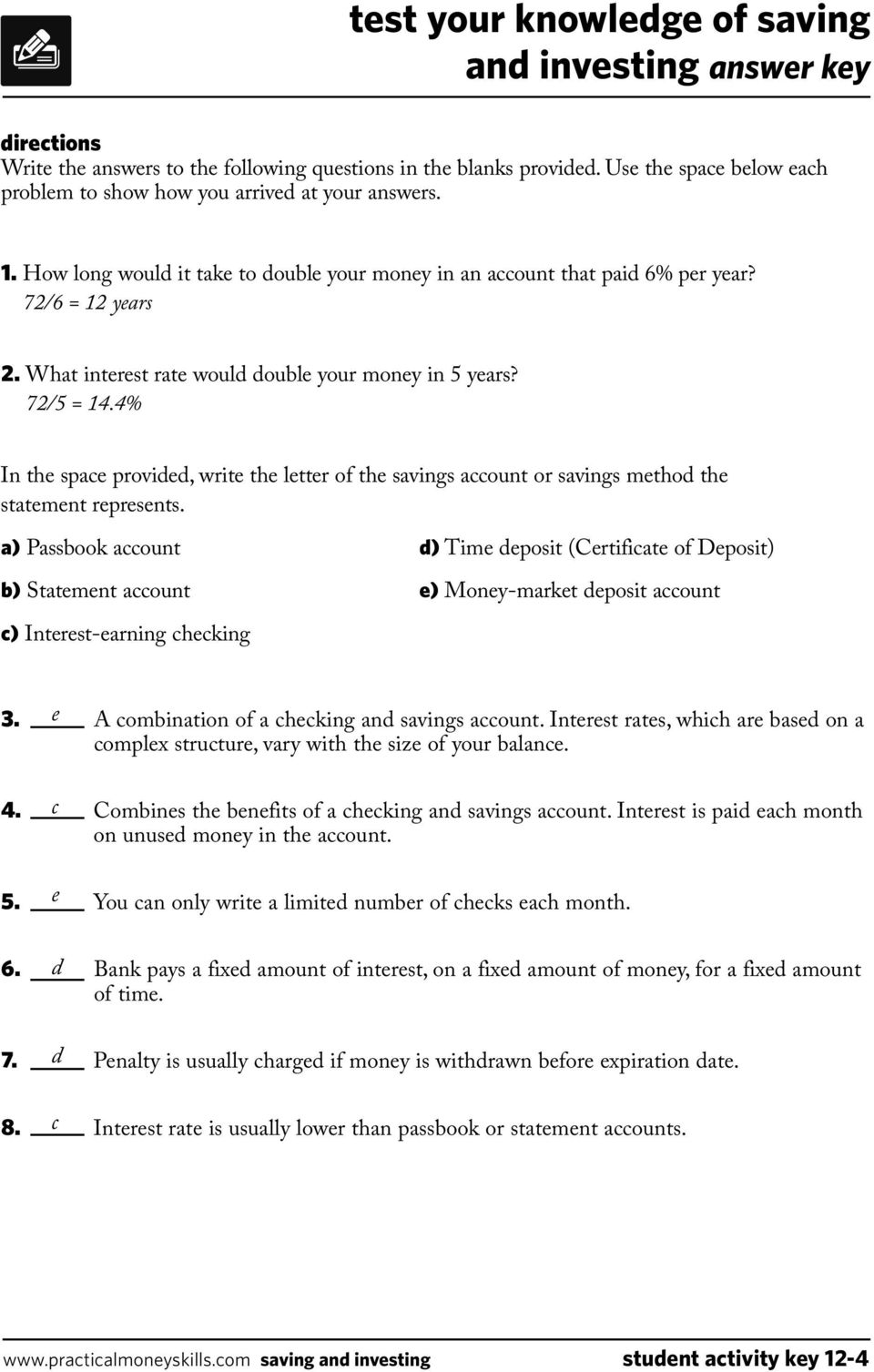
15 test your knowledge of saving and investing answer key In the space provided, write the letter of the investment vehicle the statement represents. a) Bonds d) Real estate b) Mutual funds e) Keogh plan c) Stocks 9. d This type of investment offers an excellent protection against inflation. 10. e A retirement plan for the self-employed. 11. a Issuer agrees to pay investors a fixed interest rate for a fixed period of time. 12. e You can contribute each year to this tax-deferred account. 13. e Penalty is usually charged if money is withdrawn before expiration date. 14. b Professionally managed portfolios made up of stocks, bonds, and other investments. 15. List the four most important factors to consider when shopping for a savings account Interest rates Balance requirement Fees, charges, penalties Balance calculation method 16. List the four main differences between saving and investing. Degree of risk Availability of funds for use Rate and stability of return Amount of protection against inflation saving and investing student activity key 12-4

16 lesson twelve quiz: saving and investing answer key true-false 1. t A certificate of deposit must be held for a set amount of time such as six months or a year. 2. f Compound interest refers to money earned from buying a tax-exempt investment. 3. t A share of stock represents ownership in a company. 4. f A mutual fund is an investment issued by a state or local government agency. 5. t Treasury bonds are a safer investment than real estate. multiple choice 6. B The lowest interest rate is usually earned on a: A. money-market account B. passbook account C. certificate of deposit D. mutual fund 7. B The total interest earned on $100 for two years at 10 percent (compounded annually) would be: A. $2 B. $21 C. $11 D. $10 8. D Based on the rule of 72, money earning 6 percent would take about years to double. A. 6 B. 8 C. 9 D A An example of a company s debt is a: A. corporate bond B. share of stock C. mutual fund D. municipal bond 10. C The investment with the most risk would be: A. a savings account B. U.S. Treasury bonds C. corporate stocks D. corporate bonds case application The Johnson family includes Marv (age 34), Gail (33), Andrew (8), and Molly (4). What are some investment goals that might be appropriate for this family? What types of investments might be used to achieve these goals? Common investment goals in this situation might be to create an emergency fund, to save for the children's college education, and to save for retirement. The Johnsons might start their saving-investing program with a savings account, money market account, or certificates of deposit. Next, they might consider an aggressive stock mutual fund that could give them good long-term growth for the education and retirement funds. All of those are easier to implement with an automatic withdrawal each month from a bank account to the savings account or the investment company. saving and investing quiz key 12-5

Saving and Investing
 Student Activities $ Lesson Twelve Saving and Investing 12/11 setting and prioritizing your financial goals short-range goal (within 1 month) Goal: Objective $ Estimated Cost $ Target Date $ Monthly Amount
lesson twelve saving and investing overheads
 lesson twelve saving and investing overheads pay yourself first (a little can add up) example 1: Save this each week At % Interest In 10 years you ll have $7.00 5% $4,720 14.00 5% 9,440 21.00 5% 14,160
Saving And Investing
 Student Activities $ Lesson Ten Saving And Investing 04/09 setting your financial goals Short-range goal (within 1 month) Goal: Estimated Cost $ Target Date $ Monthly Amount $ Medium-range goal (2 12 months)
Saving and Investing
 Teacher's Guide $ Lesson Ten Saving and Investing 01/11 saving and investing websites web sites for savings and investing The internet is probably the most extensive and dynamic source of information in
lesson twelve saving and investing overheads
 lesson twelve saving and investing overheads pay yourself first (a little can add up) example 1: Save this each week At % Interest In 10 years you ll have $7.00 5% $4,720 14.00 5% 9,440 21.00 5% 14,160
Teacher's Guide. Lesson Eight. Credit Cards 04/09
 Teacher's Guide $ Lesson Eight Credit Cards 04/09 credit cards websites Before students use credit cards, it's important that they familiarize themselves with: the advantages and disadvantages of credit
Personal Financial Literacy Vocabulary
 TEACHER GUIDE 5.3 SAVING AND INVESTING PAGE 1 Standard 5: The student will analyze the costs and benefits of saving and investing. Saving and Investing Tools Priority Academic Student Skills Personal Financial
Teacher's Guide. Lesson Six. Banking Services 04/09
 Teacher's Guide $ Lesson Six Banking Services 04/09 banking services websites Students will make wise choices about their banking services once they understand such fundamentals as: selecting and managing
Teacher's Guide. Lesson Nine. In Trouble 04/09
 Teacher's Guide $ Lesson Nine In Trouble 04/09 in trouble websites It's hard to admit and deal with debt or financial trouble. It can be a painful time, but students need to learn practical, beneficial
Teacher's Guide. Lesson Five. Buying a Home 04/09
 Teacher's Guide $ Lesson Five Buying a Home 04/09 buying a home websites Buying a Home is a major life milestone that requires some thoughtful planning and know-how. Students need to understand all aspects
Financial Planning Basics Financial Planning Fundamentals
 Financial Planning Basics Financial Planning Fundamentals An Overview of the Financial Planning Process The Ground to Cover Setting goals Budgeting Emergency fund Insurance Using credit Investing Tax planning
Saving and Investing Tools
 STUDENT MODULE 5.3 SAVING AND INVESTING PAGE 1 Standard 5: The student will analyze the costs and benefits of saving and investing. Saving and Investing Tools Miley and Hanna are both turning 16 this year
Saving Power = Spending Power
 Saving Power = Spending Power By Greg Glandon Federal Reserve Bank of Atlanta Lesson Plan of the Year Contest, 2009 Third Place LESSON DESCRIPTION This lesson focuses on the value of saving money and on
Teacher's Guide. Lesson Nine. Cars and Loans 04/09
 Teacher's Guide $ Lesson Nine Cars and Loans 04/09 cars and loans websites Being prepared is the best way to keep car-buying choices and decisions on the right track. Students need to examine all aspects
Basic Investment Terms
 Because money doesn t come with instructions.sm Robert C. Eddy, CFP Margaret F. Eddy, CFP Matthew B. Showley, CFP Basic Investment Terms ANNUITY A financial product sold by financial institutions pay out
Understanding Annuities
 Retirement Planning Understanding Annuities Learn how these versatile investments can be part of your strategy for retirement savings and income. understanding annuities Annuities can help provide the
Saving and Investing. Being an educated investor will help enable you to become financially sound. Chapters 30 and 31
 Saving and Investing Being an educated investor will help enable you to become financially sound Chapters 30 and 31 Essential Questions How do you know when to save and when to invest? What are some reasons
The easy way to save for your retirement
 The easy way to save for your retirement If you want to live comfortably during your retirement, you really can t afford to wait to begin saving for that goal. And now that your employer is offering the
Building a Business Plan Part B: Getting Money to Start Your Business
 Session Eight Building a Business Plan Part B: Getting Money to Start Your Business It is not necessary to do extraordinary things to get extraordinary results. Warren Buffett Overview: One of the great
Saving and Investing: Getting Started
 STUDENT MODULE 5.1 SAVING AND INVESTING PAGE 1 Standard 5: The student will analyze the costs and benefits of saving and investing. Saving and Investing: Getting Started But Mom, why can I not have it
Annuities. Introduction 2. What is an Annuity?... 2. How do they work?... 3. Types of Annuities... 4. Fixed vs. Variable annuities...
 An Insider s Guide to Annuities Whatever your picture of retirement, the best way to get there and enjoy it once you ve arrived is with a focused, thoughtful plan. Introduction 2 What is an Annuity?...
Teacher's Guide. Lesson Seven. Credit 04/09
 Teacher's Guide $ Lesson Seven Credit 04/09 credit websites Consumers may use credit frequently, but many struggle to manage it wisely. To optimize credit and make sound financial decisions, students need
Checking and Savings Accounts Pretest
 Checking and Savings Accounts Pretest 1. It does not matter which kind of checking account you open. Just get the one with the lowest service charge. 2. Some checking accounts pay interest but the interest
Money At Work 1: Foundations of investing
 It s not about how much money you earn. It s about how much you save and invest. November 12, 2015 A TIAA-CREF Financial Essentials Workshop Bill Thorne TIAA-CREF Money At Work 1: Foundations of investing
SAVINGS BASICS101 TM %*'9 [[[ EPXEREJGY SVK i
 SAVINGS BASICS101 TM i This book is intended as a general guide to the topics discussed, and it does not deliver accounting, personal finance, or legal advice. It is not intended, and should not be used,
The Truth About Fixed Indexed Annuities
 The Truth About Fixed Indexed Annuities Index annuities were first introduced in the United States nearly two decades ago. They were initially created as an alternative to mutual funds and variable annuities,
Bonds and Real Estate. Chapter 32
 Bonds and Real Estate Chapter 32 Bonds Characteristics Federal Bonds Bonds written promises to repay a loan with interest on a specific maturity date Municipal Bonds Corporate Bonds Junk Bonds Bonds Characteristics
Things To Do Before Investing
 Basics of Investing Things To Do Before Investing Pay off credit card debt! No investment pays as much as credit card companies charge Build an emergency fund Consider your goals Timeline How soon will
Understanding Annuities
 Annuities, 06 5/4/05 12:43 PM Page 1 Important Information about Variable Annuities Variable annuities are offered by prospectus, which you can obtain from your financial professional or the insurance
NAME: CLASS PERIOD: An Introduction to Stocks and Bonds
 22.1 An Introduction to Stocks and Bonds There are many different ways to invest your money. Each of them has different levels of risk and potential return. Stocks and bonds are two common types of financial
After completing this chapter, you will be able to: Savings Accounts
 Chapter 30 Savings Accounts Section 30.1 Savings Account Basics Discuss the three reasons people save money. Describe compound interest. After completing this chapter, you will be able to: Section 30.2
Lesson 6: Inheritance and Investing What s Your Story?
 Lesson 6: Inheritance and Investing What s Your Story? All the materials and information included in this presentation is provided for educational and illustrative purposes only and is presented with the
You ve worked hard for your savings. Now keep your savings working hard for you.
 You ve worked hard for your savings. Now keep your savings working hard for you. Retire with confidence A guide to your distribution options. You are now faced with an important financial decision When
Marblehead Financial Services
 Marblehead Financial Services Bill Bartin, CFP Located at Marblehead Bank 21 Atlantic Avenue Marblehead, MA 01945 781-476-0600 781-715-4629 [email protected] Annuities Page 1 of 7, see disclaimer
Teacher's Guide. Lesson Three. Credit Cards 07/13
 Teacher's Guide $ Lesson Three Credit Cards 07/13 credit cards websites Before students use credit cards, it's important that they familiarise themselves with: the advantages and disadvantages of credit
1. An IRA with a bank with the funds deposited in a variable-rate account.
 Unit 11 Cases. Case 1. Goals and Portfolio Selection (P.891) Vanessa Avoletta is a very successful self-employed freelance writer of romantic novels. She has a reputation for writing rapidly and is able
A Guide to Planning for Retirement INVESTMENT BASICS SERIES
 A Guide to Planning for Retirement INVESTMENT BASICS SERIES It s Never Too Early to Start What You Need to Know About Saving for Retirement Most of us don t realize how much time we may spend in retirement.
Financial planning with PNC Investments. Helping you achieve what matters most.
 Financial planning with PNC Investments Helping you achieve what matters most. Focus on the road ahead with a flexible financial plan. Design yours now with PNC Investments. We all want a bright financial
Bank Products. 3.1 Introduction
 Bank Products Bank Products For many people, the first financial institution they deal with, and the one they use most often, is a bank or credit union. That s because banks and credit unions provide a
Creating a Personal Financial Plan
 Creating a Personal Financial Plan Overview Setting goals are important and often used to measure success. However, simply setting goals does not ensure you will someday accomplish them. Achieving goals
How do you make your Money grow?
 How do you make your Money grow? TOPIC Ways to Save and Invest Money SUBJECT AREA Math RELATED SUBJECT AREAS Economics LESSON OBJECTIVES Students will: Compare and contrast investment vehicles including
Vocabulary Financial Institutions Student Worksheet
 Vocabulary Student Worksheet Page 1 Name Period Primary 1. Bounced Check: Vocabulary Financial Institutions Student Worksheet 2. ATM Charge: 3. Stop Payment Fee: 4. Travelers Checks: 5. ATM: 6. FDIC: 7.
BUYER S GUIDE TO FIXED DEFERRED ANNUITIES
 BUYER S GUIDE TO FIXED DEFERRED ANNUITIES Prepared by the National Association of Insurance Commissioners The National Association of Insurance Commissioners is an association of state insurance regulatory
EXPLORE. Investment Planning Planning for Financial Security SAVING : INVESTING : PLANNING
 EXPLORE Investment Planning Planning for Financial Security SAVING : INVESTING : PLANNING About this seminar Presentation > Provides comprehensive education > Includes action steps > Provides opportunity
Find out more a http://legacy.retirevillage.com 2015 Annuity.com. All rights reserved. This guide is copyrighted. It may not be reproduced without
 1 Presented by: Shawn Hogan Legacy Insurance & Financial Group http://legacy.retirevillage.com An Insider s Guide to Annuities Plus Secrets the Insurance Companies don t want you to know! Whatever your
QUICKLEARN PLATFORM. Topic Catalog
 QUICKLEARN PLATFORM Topic Catalog Personal QUICKLEARN Topics Share Draft Accounts 5601 Internet Safety... 5 5602 The Importance of Passwords... 5 5603 Mobile Banking... 5 5604 Online Banking... 5 5682
Personal Finance Standards (Assignment Code #22210)
 Personal Finance Standards (Assignment Code #22210) Rationale Statement: A citizen that lives within his or her income has more control over his or her life while expanding choices. Having the knowledge
Standard 6: The student will explain and evaluate the importance of planning for retirement.
 TEACHER GUIDE 6.1 RETIREMENT PLANNING PAGE 1 Standard 6: The student will explain and evaluate the importance of planning for retirement. Planning for Your Retirement Priority Academic Student Skills Personal
Saving for retirement with a 403(b) plan
 Saving for retirement with a 403(b) plan 2 Saving for retirement with a 403(b) plan Saving for retirement with a 403(b) plan Retirement can be a welcome turning point in your life a time to enjoy hobbies,
A Guide to. Planning for Retirement INVESTMENT BASICS SERIES
 A Guide to Planning for Retirement INVESTMENT BASICS SERIES It s Never Too Early to Start What You Need to Know About Saving for Retirement Most of us don t realize how much time we may spend in retirement.
Chapter 1 The Investment Setting
 Chapter 1 he Investment Setting rue/false Questions F 1. In an efficient and informed capital market environment, those investments with the greatest return tend to have the greatest risk. Answer: rue
financial One Two Punch Activity...51 You ve Got the Power of Compounding Activity...51 One Two Punch Answer Sheet...53
 financial Financial Planning Financial Planning Pre-/Post-Quiz...49 Lesson 1: Building the Future Introduction to Financial Planning...50 One Two Punch Activity...51 You ve Got the Power of Compounding
Student Take Home Guide. Money Smart. Pay Yourself First
 Student Take Home Guide Money Smart Table of Contents Table of Contents...1 Money Smart...2...3 Worksheet...4 Plan...5 Savings Tips...6 Compound Dividends Exercise...8 Compound Dividends...9 Savings $1
Part VI Retirement Accounts for Small Businesses and the Self-Employed
 Part VI Retirement Accounts for Small Businesses and the Self-Employed While employees of most large companies have access to 401(k) plans or traditional pension plans, those employed by small firms often
Answers to Concepts in Review
 Answers to Concepts in Review 1. An investment is any asset into which funds can be placed with the expectation of preserving or increasing value and earning a positive rate of return. An investment can
Retirement and Estate Planning
 6P A R T Retirement and Estate Planning Should you invest in a retirement plan? Chapter 19 Retirement Planning Chapter 20 Estate Planning How much should you contribute to your retirement plan? How should
RETIREMENT PLANNING GUIDE. Getting you on the right track
 RETIREMENT PLANNING GUIDE Getting you on the right track Table of Contents Why is a retirement plan important? 2 How much will you need? 4 How can your retirement plan help? 6 Where should you invest?
Fixed Deferred Annuities
 Buyer s Guide to: Fixed Deferred Annuities National Association of Insurance Commissioners 2301 McGee St Suite 800 Kansas City, MO 64108-2604 (816) 842-3600 1999, 2007 National Association of Insurance
BUYER S GUIDE TO FIXED DEFERRED ANNUITIES
 BUYER S GUIDE TO FIXED DEFERRED ANNUITIES IT IS IMPORTANT that you understand the differences among various annuities so you can choose the kind that best fits your needs. This guide focuses on fixed deferred
u n i t f o u r Savings and Investments: Your Money at Work "It s possible to have your money work for you in two ways..."
 Unit Four Savings and Investments: Your Money at Work "It s possible to have your money work for you in two ways..." In Unit 2, we talked a lot about how you earn money working at a job. In this unit,
Pay Yourself First. Identify Steps You Can Take to Save The following tips will help you to save your flexible income.
 Pay Yourself First Use this tip sheet to help you in the process of setting and reaching your personal savings goals. This tip sheet covers the following topics: Identifying steps you can take to save
Planning for Your Retirement
 STUDENT MODULE 6.1 RETIREMENT PLANNING PAGE 1 Standard 6: The student will explain and evaluate the importance of planning for retirement. Planning for Your Retirement Lindzi and Lezli will attend retirement
Sav Sa i v n i g n s interest principal determine compound interest list annual percentage yield (APY) direct deposit compare savings club identify
 Why should I get into the habit of saving money? Chapter 26 Key Terms interest principal compound interest annual percentage yield (APY) direct deposit savings club certificate of deposit (CD) money market
Q&A s. Would it be better to contribute to my Roth or traditional IRA this year? I have $5,000 which I could contribute.
 Q&A s Question & Answer Categories: IRA IRA Investing Misc. Mutual funds & ETFs Other investments Would it be better to contribute to my Roth or traditional IRA this year? I have $5,000 which I could contribute.
Indiana Financial Education http://doe.in.gov/octe/facs/indianafinlited-frontpage.html. Standards Final December 2008
 Indiana Financial Education http://doe.in.gov/octe/facs/indianafinlited-frontpage.html Standards Final December 2008 By the end of 12th grade, every student should have achieved the Financial Literacy
account statement a record of transactions in an account at a financial institution, usually provided each month
 GLOSSARY GLOSSARY Following are definitions for key words as they are used in the financial life skills resource. They may have different or additional meanings in other contexts. A account an arrangement
OHIO TREASURER S FINANCIAL EDUCATION GLOSSARY OF TERMS
 OHIO TREASURER S FINANCIAL EDUCATION GLOSSARY OF TERMS 401(k) An employer qualified retirement plan set up by a private company in which eligible employees may make salary-deferral (salary-reduction) contributions
Minimum distribution. Making it simple
 Minimum distribution Making it simple Required minimum distributions What you need to know What are required minimum distributions?... 03 TIAA-CREF s Minimum Distribution Option (MDO)... 04 Is the Minimum
Types of Savings Plans and Investments
 LESSON 12 Types of Savings Plans and Investments Introduction If you saved $100 under your mattress, in 50 years you d still have $100, right? Well, yes and no. Even though you would still have $100 in
JPMorgan INVEST. You work hard for your money. Now keep it working for you with a JPMorgan Invest IRA. IRA Decision Guide
 IRA Decision Guide JPMorgan INVEST You work hard for your money. Now keep it working for you with a JPMorgan Invest IRA. JPMorgan Invest One Beacon Street, Boston, MA 0208 (800) 776-606 jpmorganinvest.com
transfer money by check or electronic payment to a person or organization that you designate as payee
 Bank Products 1. Introduction For many people, the first financial institution they deal with, and the one they use most often, is a bank or credit union. That s because banks and credit unions provide
THEME THREE: APPLY FINANCIAL PLANNING AND BUDGETING MECHANISMS. LESSON TITLE: Theme 3, Lesson 2: Money Magic
 THEME THREE: APPLY FINANCIAL PLANNING AND BUDGETING MECHANISMS LESSON TITLE: Theme 3, Lesson 2: Money Magic Lesson Description: This lesson helps students compare and contrast saving and investing alternatives
GFL Comparison SB 40, New Standards, Old Standards
 SB 40 Requirement New Standards GFL Comparison SB 40, New Standards, Old Standards STANDARD 1: Students will understand how values, culture, and economic forces affect personal financial priorities and
MODULE 1 // SAVE MONEY. START NOW. AMATEUR: AGES 11-14
 MODULE 1 // SAVE MONEY. START NOW. AMATEUR: AGES 11-14 MODULE 1 // FINANCIAL SOCCER PROGRAM Financial Soccer is an educational video game designed to help students learn more about the fundamentals of
COLLEGE PLANNING SAVING FOR A COLLEGE EDUCATION. Why is it Important to Start Saving Now? The Projected Cost of College 2012/2013 2017/2018 2022/2023
 Making College a Reality: A college education can be one of the most important investments you ll ever make. But the benefits of increased earning power and expanded horizons come at a price college is
Types of Savings Plans and Investments
 LESSON 12 Types of Savings Plans and Investments LESSON DESCRIPTION AND BACKGROUND The students learn about various types of government-insured savings instruments, noting the advantages and disadvantages
Jump$tart Coalition for Personal Financial Literacy. Goodheart-Willcox Foundations of Personal Finance 2014 by Sally Campbell and Robert Dansby
 Jump$tart Coalition for Personal Financial Literacy correlation of standards with Goodheart-Willcox Foundations of Personal Finance 2014 by Sally Campbell and Robert Dansby This chart correlates the performance
Planning for the Stages of Retirement
 Planning for the Stages of Retirement The Financial Planning Association (FPA ) connects those who need, support and deliver financial planning. We believe that everyone is entitled to objective advice
Synthesis of Financial Planning
 P 7A R T Synthesis of Financial Planning 1. Tools for Financial Planning Budgeting (Chapter 2) Planned Savings (Chapter 3) Tax Planning (Chapter 4) 2. Managing Your Liquidity Bank Services (Chapter 5)
YOUR GUIDE TO. Understanding life insurance
 YOUR GUIDE TO Understanding Making life less complicated. Most people know that can provide their families with a death benefit if the unexpected should happen. But they may not know that it can also be
HS Personal Finance Curriculum
 HS Personal Finance Curriculum Course Description: This curriculum presents essential knowledge and skills to help students make informed decisions about real world financial issues. Students will learn