
The Royal Wolverhampton NHS Trust
|
|
|
- Duane Shields
- 10 years ago
- Views:
Transcription
1 The Royal Wolverhampton NHS Trust Trust Board Report Meeting Date: 26 October Title: Executive Summary: An update on the review of NHS hospitals complaints system Putting Patient Back in the Picture - Clwyd-Hart Review 2013, Parliamentary and Health Service Ombudsman report, Designing Good Together: transforming hospital complaints handling (2013) and the Patients Association, Handling Complaints with a Compassionate Human Touch (2014). Update on Progress As detailed in the previous report, the Trust developed an improvement action plan to address the recommendations made in the Clwyd-Hart Review, the Parliamentary and Health Service Ombudsman report, Designing Good Together: transforming hospital complaints handling (2013) and the report from the Patients Association, Handling Complaints with a Compassionate Human Touch (2014) - Appendix 1. The Patient Experience Department continues to monitor progress against the action plan. The completion remains on schedule apart from the following in which case the completion deadline date has been revised with agreement. The revised action plan dates reflect the need to: identify resources / work schedule of a 3 rd party Policy review and ratification Staff training Action Requested: Report of: To note the report and to continue to support the agreed improvement action plan. Cheryl Etches, Chief Nurse / Deputy Chief Executive Author: Contact Details: Links to Trust Strategic Objectives Paul Archer, Interim Head of Patient Experience Tel [email protected] 1, 2, 3, 4 Resource Implications: Revenue: Capital: Workforce: Funding Source: Page 1 of 17

2 Risks: BAF/ TRR (describe risk and current risk score) Public or Private: (with reasons if private) References: (eg from/to other committees) Appendices/ References/ Background Reading NHS Constitution: (How it impacts on any decision-making) None identified Public Quality Standards Action Group September Clwyd-Hart review (2013) Parliamentary and Health Service Ombudsman report, Designing Good Together: transforming hospital complaints handling (2013) Patients Association, Handling Complaints with a Compassionate Human Touch (2014) Baker Tilly Internal Audit Report Complaints Management (Feb ) In determining this matter, the Board should have regard to the Core principles contained in the Constitution of: Equality of treatment and access to services High standards of excellence and professionalism Service user preferences Cross community working Best Value Accountability through local influence and scrutiny Page 2 of 17

3 1. Purpose To provide an update on the implementation of the improvement action plan to address the recommendations made in the Clwyd-Hart Review, the Parliamentary and Health Service Ombudsman report, Designing Good Together: transforming hospital complaints handling (2013) and the report from the Patients Association handling Complaints with a Compassionate Human Touch (2014). 2. Narrative a) Background A paper was presented to the Quality Standards Action Group in June which provided a progress report and action plan in relation to the response to the Clwyd-Hart review, the Parliamentary and Health Service Ombudsman report, Designing Good Together: transforming hospital complaints handling (2013) and the report from the Patients Association handling Complaints with a Compassionate Human Touch (2014). It was agreed at that meeting a further update would be provided in September. The publication of the Clwyd-Hart review into NHS hospitals complaint process was released on 28 October 2013 and set out a number of recommendations to improve hospital complaints systems. The government commissioned inquiry, led by Labour MP Ann Clwyd and Professor Trish Hart, was a response to the Francis Report which detailed 13 specific recommendations that relate directly to complaints and their handling. Putting patients back in the Picture sets out the reasons people complain, highlights staff attitudes and concerns about resources and sets out what patients want from an NHS complaints system. Subsequent to the publication of the Clwyd-Hart review, the offices of the Parliamentary and Health Services Ombudsman and the Patients Association have published recommendations on the NHS complaints process which hospitals should adopt. In October 2014 the Care Quality Commission (CQC) introduced a mandatory key line of enquiry for inspections of hospitals, mental health services, community healthcare services, GP practices, out-of-hours services and adult social care services. This considers how well complaints and concerns are handled and this assessment forms part of their judgement and rating of an organisation s responsiveness. The CQC inspection reports now include a description of the provider s handling of complaints. The new fundamental standards include requirements around complaints handling as well as the new duty of candour. Where the CQC find breaches of these standards, they will use their range of enforcement powers: warning notices, suspending or cancelling registration and ultimately prosecution. Page 3 of 17

4 Clearly the above comments stress the need for the Trust to have in place good complaint investigation processes, an open and honest culture and to be able to demonstrate that learning takes place. b) Update on Progress As detailed in the previous report, the Trust developed an improvement action plan to address the recommendations made in the Clwyd-Hart Review, the Parliamentary and Health Service Ombudsman report, Designing Good Together: transforming hospital complaints handling (2013) and the report from the Patients Association, Handling Complaints with a Compassionate Human Touch (2014) - Appendix 1. The Patient Experience Department continues to monitor progress against the action plan. The completion remains on schedule apart from the following in which case the completion deadline date has been revised with agreement. A bedside information folder is available on all lockers. Updated information is provided at the entrance to each clinical area detailing visiting and mealtimes and staffing levels wards operate protected meal times. Additional information is provided on the public Trust webpages. Further work is required to ensure this information represents the language and cultures of changing service user base. Complaints Manager December Complainants should be kept up to date with their case with clarity on what is happening and why at every stage. Partial compliance. Strengthening the breach with consent status through Divisional dashboards Head of Patient Experience December The Trust should identify and agree circumstances when a complainant would be actively involved in change management Complaints Manager December The change in date reflects the need to: identify resources / work schedule of a 3 rd party Policy review and ratification Staff training The Care Quality Commission recent inspection report, published 3 September did not highlight any fundamental issues with the complaints management processes. The following are extracts from the inspection report: Lessons learned from one complaint that was also reported as an incident led to the development of a new overdose pathway in the ED. We saw this used in practice in the ED major s area. We noted on the shared learning notice board in the ED staff room four complaints that had been received during April, the department s response and the lessons learned. Information available to patients and visitors about how to raise concerns or complaints was displayed on notice boards and leaflets available throughout the medical wards. Page 4 of 17

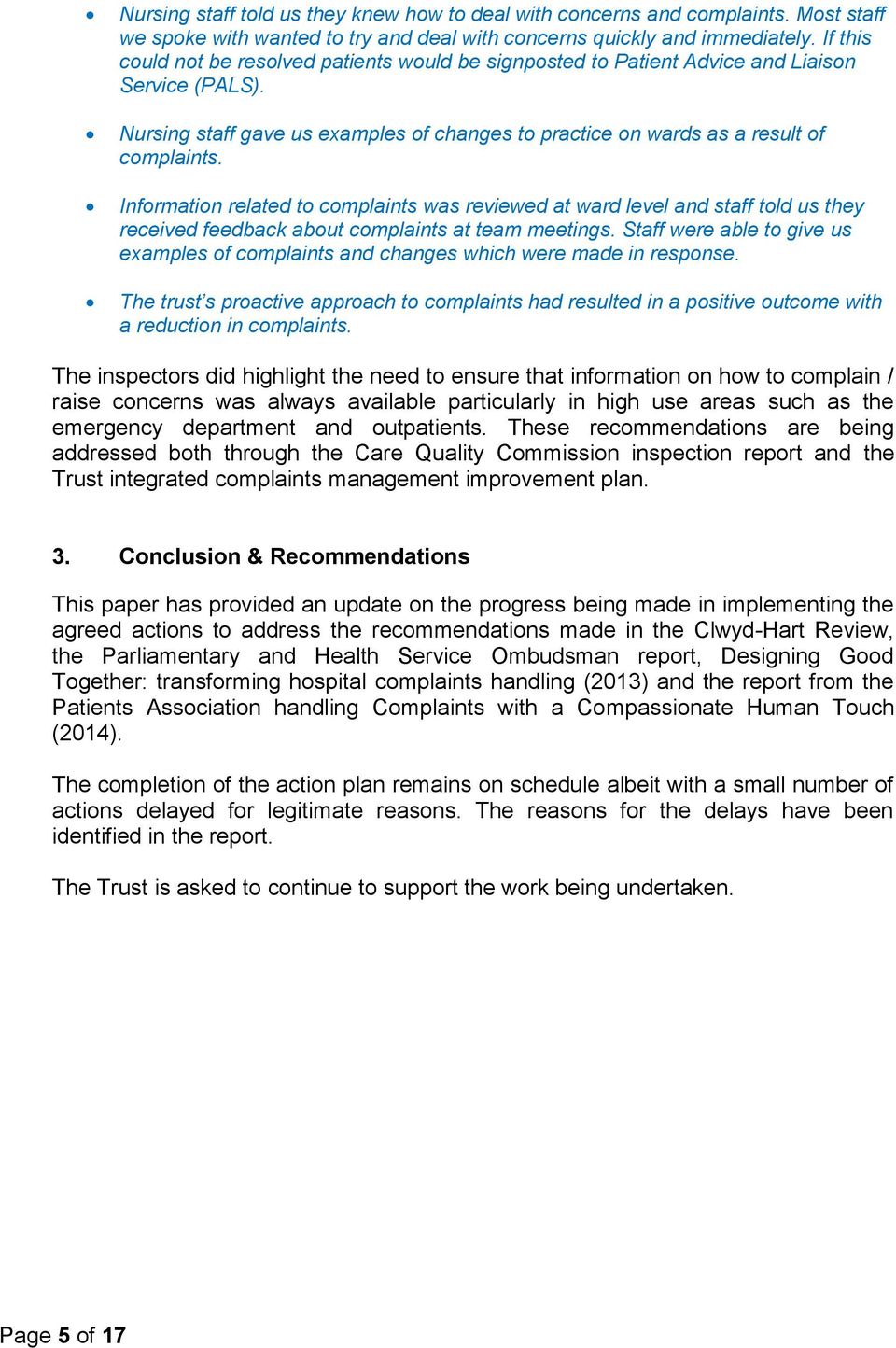
5 Nursing staff told us they knew how to deal with concerns and complaints. Most staff we spoke with wanted to try and deal with concerns quickly and immediately. If this could not be resolved patients would be signposted to Patient Advice and Liaison Service (PALS). Nursing staff gave us examples of changes to practice on wards as a result of complaints. Information related to complaints was reviewed at ward level and staff told us they received feedback about complaints at team meetings. Staff were able to give us examples of complaints and changes which were made in response. The trust s proactive approach to complaints had resulted in a positive outcome with a reduction in complaints. The inspectors did highlight the need to ensure that information on how to complain / raise concerns was always available particularly in high use areas such as the emergency department and outpatients. These recommendations are being addressed both through the Care Quality Commission inspection report and the Trust integrated complaints management improvement plan. 3. Conclusion & Recommendations This paper has provided an update on the progress being made in implementing the agreed actions to address the recommendations made in the Clwyd-Hart Review, the Parliamentary and Health Service Ombudsman report, Designing Good Together: transforming hospital complaints handling (2013) and the report from the Patients Association handling Complaints with a Compassionate Human Touch (2014). The completion of the action plan remains on schedule albeit with a small number of actions delayed for legitimate reasons. The reasons for the delays have been identified in the report. The Trust is asked to continue to support the work being undertaken. Page 5 of 17
6 APPENDIX 1 Clwyd-Hart Recommendations Clwyd-Hart Organisational Actions PHSO - What Good Looks Like RWT Response RWT Further action Person Responsible Target Date 1. Improving the quality of care Staff providing basic care should be adequately trained, supported and supervised., professional bodies and representative organisations, HEE, clinical leaders and managers They should be cared for by staff who are trained and assessed to be approachable and show respect and empathy. Ward supervisors should be visible and carry out rounds specifically to identify concerns and hear about patients care. A certificate of care has been introduced for healthcare support workers. A customer care programme to be introduced March. Minimum competencies for both qualified and unqualified staff in place assessment at interview stage and formal annual assessment and performance review. The Trust has implemented supervisory role for band 7 ward Sisters/Charge Nurses This allows the manager to be visible to patients and their relatives and to monitor the standards of care delivered. Monitoring of initial training programme Complete Head of Nurse Education. September There should be annual appraisals linked to the process of medical revalidation which focus on communication skills for clinical staff and dealing with patient concerns positively. This goes hand in hand with ensuring that communication skills are a core part of the curriculum for trainee clinical staff. HEE, professional bodies and representative organisations, clinical leaders and managers All doctors with a prescribed connection to The Royal Wolverhampton NHS Trust undergo annual appraisal to support their revalidation. The annual appraisal process requires doctors to discuss their practice and performance with an appraiser, using supporting information to demonstrate that they are continuing to meet the principles and values set out in Good medical practice (GMP). One of the principles of GMP is Communication, Partnership and Teamwork. Doctors provide an array of evidence, including a multi-source feedback document completed by their peers, which rates the doctor s communication skills. Other Partial Complete monitored through bespoke working groups reporting g into a HR framework HR lead for revalidation July Page 6 of 17

7 evidence includes, significant events & complaints (where appropriate), CPD, and quality improvement to demonstrate through refection where communication has gone well, or not so well. If a training need is identified, this is addressed through the doctor s personal development plan. Nurse revalidation is mandated from April 2016 should ensure that there is a range of basic information and support available on the ward for patients, such as a description of who is who on the ward and what they do; meal times and visiting times; and who is in charge of care for the patient. Care should be taken to ensure that differences in language, culture and vulnerability are taken account of in this., clinical leaders and managers, clinicians and practitioners A bedside information folder is available on all lockers. Updated information is provided at the entrance to each clinical area detailing visiting and mealtimes and staffing levels wards operate protected meal times. Additional information is provided on the public Trust webpages. Further work is required to ensure this information represents the language and cultures of changing service user base. Judith Davis, Complaints Manager December Patients should be helped to understand their care and treatment. While written information is helpful, it is always important to discuss diagnoses, treatments and care with a patient. Patients frequently need to revisit topics already addressed. Where appropriate, their relatives, friends or carers may be included in discussions. professional bodies and representative organisations, HEE, clinical leaders and managers, clinicians and practitioners, patients The Trust has a full range of approved information leaflets document control is via the governance and legal services dept. Breaking bad news training programmes in place. Communications training.see above comments. Page 7 of 17

8 should provide patients with a way of feeding back comments and concerns about their care on the ward including simple steps such as putting pen and paper by the bedside and making sure patients know who to speak to if they have a concern it could be a nurse or a doctor, or a volunteer on the ward to help people., education and training organisations, clinical leaders and managers, clinicians and practitioners, patients Patients and carers should know who to go to with questions or concerns. Patients and carers should have an intermediate contact with whom they can discuss a concern before making a formal complaint. PALS information leaflets available within all clinical areas. The Trust policy advocates the use of local resolution lead by the senior sister/charge nurse. The PALS outreach (scheduled ward visits) provide the opportunity for face to face conversations. Friend and family test cards are available for completion in clinical areas. PALS information available within the patient bedside information folders and the bedside locker stickers. Staffed PALs are available Mon-Fri 08:30-16:30 hrs. The service is available 27/7 via telephone answer machine and facilities Use of pull-up notice boards. As above Patients and carers should be made to feel confident about providing feedback, and hospitals should actively seek this. As above Hospitals should actively encourage volunteers. Volunteers can help support patients who wish to express concerns or complaints. This is particularly important where patients are vulnerable or alone, when they might find it difficult to raise a concern. Volunteers should be trained, volunteer organisers The Trust has a very active volunteer network. The volunteers undergo training prior to commencement which includes how to respond to service user concerns and how these should be escalated. The volunteers staff the information booth on the Cannock Chase Hospital site and who can act as first contact for service user concerns. Such staff understand the escalation process. The information booth acts as a base for PALS staff when based on the Cannock Page 8 of 17

9 Chase Hospital site. Trust Chief Executives and Board members should be supported so they have the necessary skills in effective communication, seeking and using patient feedback, routinely throughout their organisation and are equipped to ensure their organisation learns from that feedback NHS Leadership Academy and NHS Confederation A patient story is presented and discussed monthly to the public section of the Trust Board. Patient feedback is also presented as part of the Integrated Quality report. Executive Director has Patient Experience in portfolio. Strengthening of the Patient experience strategy Head of Patient Experience September PALS should be re-branded and reviewed so it is clearer what the service offers to patients and it should be adequately resourced in every hospital Every Trust should ensure any rebranded patient service is sufficiently well sign-posted and promoted in their hospital so patients know where to get support if they want to raise a concern or issue DH Complainants should be assigned a single point of contact who takes time to understand what the complainant wants to achieve through the complaint. Rebranding in place following public consultation with members for Logo, Vision and merchandising( see also revision of strategy) The complaints / PALS department has been renamed the patient experience department. The department incorporates complaints management, PALS, volunteer services, membership and equality & diversity. The department has developed a new logo - incorporating three main colours - purple - education, blue the colour of the Trust logo, pink - positivity. The strap line - listens, learn and share. Signposting of the service was reviewed 2 years ago as part of the Trust wide review. Partial complete It is planned for the patient experience department to be relocated to the new Trust main entrance. Further internal communication planned to highlight the department new logo / strap line etc. Head of Patient Experience Estates Development Manager September December Page 9 of 17

10 The CQC should include complaints in their hospital inspection process and analyse evidence about what the Trust has done to learn from their mistakes. CQC PALS should operate 24 hours a day, seven days a week. N/a as CQC accountability The PALS service is available 24 hours per day, seven day a week utilising a number of different options open to the service user. The PALS department has core opening hours - Mon-Fri 08:30-16:30 hrs. Service users can access the service via telephone both during core office hours and outside these hours via telephone answering machine. The service also operated a dedicated address which is publicised throughout the hospital. Further work may be required depending on the results of the 2014 national patient survey results expected May. Head of Patient Experience June 2. Improvements in the way complaints are handled Attention needs to be given to the development of appropriate professional behaviour in the handling of complaints. This includes honesty and openness and a willingness to listen to the complainant, and to understand and work with the patient to rectify the problem., professional bodies and representative organisations, clinical leaders and managers, clinicians and practitioners Staff should receive support to help them learn and change their practice following a complaint. Being open (Duty of Candour) and, the Trust s vision and values, are covered during the HR talk at Trust Induction. All speakers at Trust Induction have been asked to ensure that they reference how their topic/presentation links to the Trust s vision and values. The Trust s vision and values are also covered in detail through the various leadership courses we offer, for example; Management and Leadership, Emotional intelligence and Process Communication. Routine screening of complaints for Duty of Candour / potential serious incident investigation. Partial complete due to audit of duty of candour processed. Some procedural changes required Head of Governance and Legal services August Page 10 of 17

11 Staff need to record complaints and the action that has been taken and check with the patient that it meets with their expectation, professional bodies and representative organisations, education and training organisations and clinical leaders and managers, clinicians and practitioners Patients and carers need to be told how to access the formal complaints process and staff need to be trained in how to access the system. All records held centrally on Datix system. Final response letter covers actions if recipient not satisfied complete Complaints are sometimes dealt with by junior staff or those with less training. Staff need to be adequately trained, supervised and supported to deal with complaints effectively. There should be NHS accredited training for people who investigate and respond to complaints. should actively encourage both positive and negative feedback about their services. Complaints should be seen as essential and helpful information and welcomed as necessary for continuous service improvement, education and training organisations, clinical leaders and managers, HEE, HEE, clinicians and practitioners Staff should receive complaints system training including how to log issues raised. Staff should be kept informed about and involved in the progress of the case. Staff should receive complaints system training including how to log issues raised. Patients and carers should be made to feel confident about providing feedback, and hospitals should actively seek this. Complainants should be kept up to date with their case with clarity on what is happening and why at every stage. Awareness of complaints / PALS and patient experience is currently offered to all staff at induction. See previous comments. RCA training and integrating RCA and HR investigation training. Evaluate the need for separate complaints investigation training to include the approach to be taken in compiling a final response letter. The current RCA training does not include reference to the requirement of complaint investigation or of compiling a sensitive final response. The commencement of Short Message Service (SMS) and Interactive Voice Messaging (IVM) from September 2014 to elicit patient and service user feedback has seen an increase in compliments and concerns disseminated throughout the Trust. See comments above. Options are being explored to make better use of existing training which offers a set of transferable skills e.g. root cause analysis for incident investigation and human resource training regarding disciplinary, grievance investigation, interviews and statement writing etc. Partial compliance Strengthening the breach with consent status through Divisional dashboards Head of Patient Experience Head of Patient Experience September December Page 11 of 17

12 It needs to be clearly stated how whistle-blowers are to be protected and gagging clauses should not be allowed in staff contracts. The development of the cultural barometer should continue. This will determine if a workplace is suffering from a problem with staff attitudes or organisational approach. DH Revision of HR policies The Trust is currently reviewing the Whistleblowing Policy and the support offered to staff who raise concern. This work is being led by the Human Resources Directorate. NHS England and DH Awaiting national guidance Director of HR July The independent NHS Complaints Advocacy Service should be re-branded, better resourced and publicised. It should also be developed to embrace greater independence and support to those who complain. Funding should be protected and the service attached to local HealthWatch organisations. HealthWatch England should continue to bring together patients and representative groups, and lead the Healthwatch network in the public campaign to improve complaints systems in health and social care. Some funding should be made available to help organisations to fully participate in this important work. Every Chief Executive should take personal responsibility for the complaints procedure, including signing off letters responding to complaints, particularly when they relate to serious care failings. Local Authorities Healthwatch England, DH. N/A N/A The Chief Executive signs all response letters, in the Chief Executive absence this role is undertaken by the Deputy Chief Executive / Chief Nurse Complete There should be Board-led scrutiny of complaints. All Boards and Chief Executives should receive monthly reports on complaints and the action Trust Chief Executives and Boards The Trust Board receives a patient story at the commencement of each Trust Board meeting and a quarterly patient experience report is Complete Page 12 of 17

13 taken, including an evaluation of the effectiveness of the action. These reports should be available to the Chief Inspector of Hospitals. There should be a new duty on all to publicise an annual complaints report, in plain English, which should state what complaints have been made and what changes have taken place. Every Trust has a legislative duty to offer complainants the option of a conversation at the start of the complaints process. This conversation is to agree on the way in which the complaint is to be handled and the timescales involved. DH Patients and carers should be made to feel confident about providing feedback, and hospitals should actively seek this. Face-to-face meetings should be offered, at a place of the complainant s choosing, and with plenty of time to talk through the response in detail. scheduled. A monthly integrated performance review dashboard is presented at the Trust Board, this includes patient experience information. The Trust currently produces an annual report to the Trust board and reports information within the public annual Quality Accounts Report. The Trust routinely offers complainants the option of a conversation at the commencement of the complaints process. This can either be with the clinical team involved and/or including staff from the patient experience department. The precise nature of the complaint and issues to be investigated will be agreed including timescales for completion. As above Complete - The content of the published information needs to be reviewed to ensure future compliance with this recommendation. The Trust makes public the minutes of the patient experience forum via the Trust webpages. The precise questions to be answered should be agreed by the complainant. As above Where complaints span organisational boundaries, the involved should adhere to their statutory duty to cooperate so they can handle the complaint effectively. Already a statutory duty the Trust is compliant with this recommendation. The Trust has in place an information sharing protocol between neighbouring health and social care organisations. The Trust participates in the regional complaints managers forum which would discuss and agree inter hospital partnership working. Complete Page 13 of 17

14 Further work should be done to explore how we look for the right skills in the recruitment of Chief Executives and Board members. They need to be capable of ensuring that their Trust is a learning organisation. NHS Leadership Academy To be agreed in line with HR strategy Commissioners and regulators should establish clear standards for hospitals for complaints handling. These should rank highly in the audit and assessment of the performance of all hospitals. CCGs, CQC N/A There should be proper arrangements for sharing good practice on complaints handling between hospitals, including examples of service improvements which result from action taken in response to complaints DH, Best practice is shared across. The final response should include what lessons have been learnt and what steps will be taken by the Trust. Complainants should be involved in the changes that take place as a result of their complaint. The use of the patient story video at the Trust board meeting, Senior manager s briefings and the band 7 forum so lessons learned are disseminated. Complaints and patient experience reports are shared with the Clinical Commissioning Group (CCG) and the local authority Health & Wellbeing Board. The Head of Patient Experience meets lead for patient experience at the CCG on a monthly basis. Complaint responses will include details of lessons learned. These will be circulated throughout the Trust discussed at operational management team meetings and used to influence the content of the e-learning programme. The Trust supports this recommendation but current practice would need to change. Complete The Trust should identify and agree circumstances when a complainant would be actively involved in change management Use of patient story at Trust Board Discussion of patient experiences / complaints at the Patient Experience Forum Judith Davis, Complaints Manager December Page 14 of 17

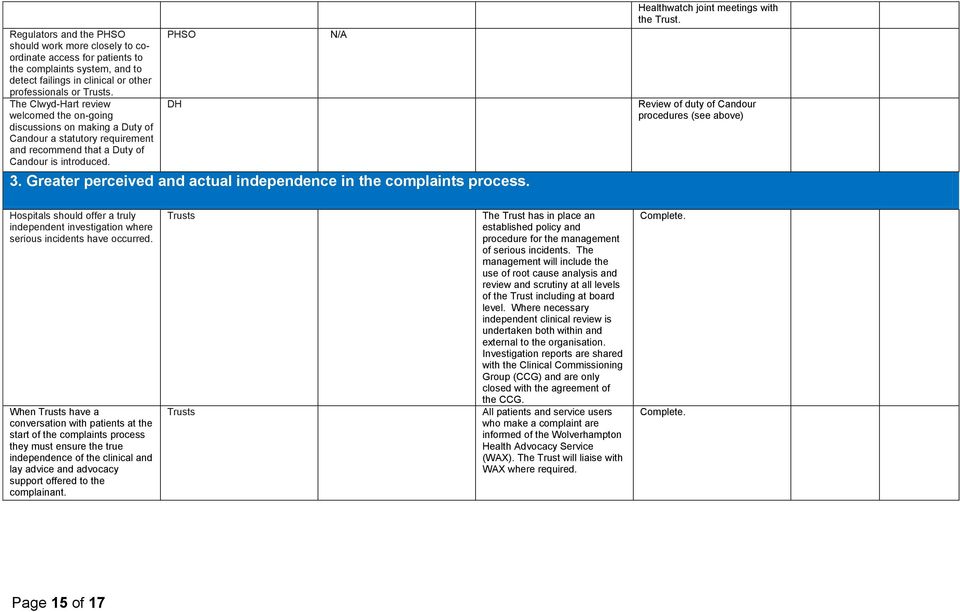
15 Regulators and the PHSO should work more closely to coordinate access for patients to the complaints system, and to detect failings in clinical or other professionals or. The Clwyd-Hart review welcomed the on-going discussions on making a Duty of Candour a statutory requirement and recommend that a Duty of Candour is introduced. PHSO DH 3. Greater perceived and actual independence in the complaints process. N/A Healthwatch joint meetings with the Trust. Review of duty of Candour procedures (see above) Hospitals should offer a truly independent investigation where serious incidents have occurred. When have a conversation with patients at the start of the complaints process they must ensure the true independence of the clinical and lay advice and advocacy support offered to the complainant. The Trust has in place an established policy and procedure for the management of serious incidents. The management will include the use of root cause analysis and review and scrutiny at all levels of the Trust including at board level. Where necessary independent clinical review is undertaken both within and external to the organisation. Investigation reports are shared with the Clinical Commissioning Group (CCG) and are only closed with the agreement of the CCG. All patients and service users who make a complaint are informed of the Wolverhampton Health Advocacy Service (WAX). The Trust will liaise with WAX where required. Page 15 of 17
16 Patient services and patient complaints support should remain separate so patients do not feel they have to go through PALS first before they make a complaint. Complainants should be assigned a single point of contact who takes time to understand what the complainant wants to achieve through the complaint. The Trust has conscious decision to integrate PALS and complaints managements into a single service with a single point of entry. Complete Patients, patient representatives and local communities and local HealthWatch organisations should be fully involved in the development and monitoring of complaints systems in all hospitals. Board level scrutiny of complaints should regularly involve lay representatives 4. Whistle-blowing A member of the local Healthwatch is a member of the Trust patient experience forum. This allows for scrutiny and challenge of process and outcomes of complaints investigation. Healthwatch would be asked to comment on any changes to the complaints policy and development of a patient experience strategy. To be considered as part of strategy revision Head of Patient Experience September Clear guidance for staff on how they should report concerns, including access to the Chief Executive on request. A board member with responsibility for whistle-blowing should be accessible to staff on a regular basis. DH See above The Trust is currently reviewing the Whistleblowing Policy and the support offered to staff who raise concern. This work is being led by the Human Resources Directorate. Staff should be able to raise concerns without fear of repercussions. The Trust currently has a whistleblowing policy in place. The Director of Human Resources already assumes responsibility for whistleblowing. The Trust is currently reviewing the Whistleblowing Policy and the support offered to staff who raise concern. This work is being led by the Human Resources Directorate. Sandra McShane, Interim Human Resources Consultant Summer A legal obligation to consider concerns raised by staff, and to act on them if confirmed to be true. Staff should receive support to help them learn and change their practice following a complaint. A system of support to staff who raise concerns exists staff links which comprises of a list of staff who are trained to offer such a service. The Trust vision and values sets out the organisation commitment to acting on concerns raised and improving patient care. The incident reporting system has a The Trust is planning to introduce a Schwartz Rounds. Derek Thomas. Medical Workforce Manager Summer Page 16 of 17

17 In assessing the complaints systems of hospitals the CQC should investigate the ease with which staff can express concerns and how whistleblowing is responded to where it has taken place. CQC N/A mandatory field which requires managers to provide feedback to reporter when requested. The report cannot be closed unless this field is actioned The CQC itself should designate a board-member with specific responsibility for whistleblowing, and ensure that it acts on intelligence received from whistle-blowers. CQC N/A Page 17 of 17

NHS Complaints Handling: Briefing Note. The standard NHS complaints procedure can be used for most complaints about NHS services.
 APPENDIX 1 NHS Complaints Handling: Briefing Note NHS Complaints Procedure The standard NHS complaints procedure can be used for most complaints about NHS services. The legislation governing the NHS complaints
Council Meeting, 26/27 March 2014
 Council Meeting, 26/27 March 2014 HCPC response to the Final Report of A Review of the NHS Hospitals Complaint System Putting Patients Back in the Picture by Right Honourable Ann Clwyd MP and Professor
Policies, Procedures, Guidelines and Protocols
 Policies, Procedures, Guidelines and Protocols Document Details Title Complaints and Compliments Policy Trust Ref No 1353-29025 Local Ref (optional) N/A Main points the document This policy and procedure
Governing Body 13 November 2013
 Paper 07 Governing Body 13 November 2013 Overview of complaints and handling processes Paper Author Lead Executive FOI status Michaela Maloney, Interim Head of Communication and Engagement Brendan Ward,
Complaints Policy. Complaints Policy. Page 1
 Complaints Policy Page 1 Complaints Policy Policy ref no: CCG 006/14 Author (inc job Kat Tucker Complaints & FOI Manager title) Date Approved 25 November 2014 Approved by CCG Governing Body Date of next
PALS & Complaints Annual Report 2013 2014
 PALS & Complaints Annual Report 2013 2014 This report provides a summary of patient complaints received in 2013/14. It includes details of numbers of complaints received during the year, performance in
Complaints Policy. Controlled Document Number: Version Number: 6 Controlled Document Sponsor: Controlled Document Lead: Approved By:
 Complaints Policy CONTROLLED DOCUMENT CATEGORY: CLASSIFICATION: PURPOSE Controlled Document Number: Version Number: 6 Controlled Document Sponsor: Controlled Document Lead: Approved By: Policy Governance
http://www.gmc-uk.org/concerns/making_a_complaint/who_to_complain_to_en.asp
 Who to complain to information for patients in England http://www.gmc-uk.org/concerns/making_a_complaint/who_to_complain_to_en.asp The process of making a complaint will be easier and less stressful if
Complaints Annual Report 2013/14
 Complaints Annual Report 2013/14 1. INTRODUCTION This is the complaints annual report for Hampshire Hospitals NHS Foundation Trust (HHFT) for the period 1 April 2013 to 31 March 2014. Hampshire Hospitals
Complaint and Concern handling and learning
 TAUNTON & SOMERSET NHS FOUNDATION TRUST Complaint and Concern handling and learning Report to: Trust Board on 25 September 2013 Purpose of the Report: (Please type in Bold) This report sets out how the
NHS England Complaints Policy
 NHS England Complaints Policy 1 2 NHS England Complaints Policy NHS England Policy and Corporate Procedures Version number: 1.1 First published: September 2014 Prepared by: Kerry Thompson, Senior Customer
SHEFFIELD TEACHING HOSPITALS NHS FOUNDATION TRUST EXECUTIVE SUMMARY REPORT TO THE TRUST HEALTHCARE GOVERNANCE COMMITTEE
 SHEFFIELD TEACHING HOSPITALS NHS FOUNDATION TRUST EXECUTIVE SUMMARY REPORT TO THE TRUST HEALTHCARE GOVERNANCE COMMITTEE I TO BE HELD ON MONDAY 26 NOVEMBER 2012 Subject: Supporting Director: Author: Status
Customer Relations Director of Nursing. Customer Relations Manager All staff
 COMPLAINTS POLICY Summary statement: How does the document support patient care? Staff/stakeholders involved in development: Job titles only Division: Department: Responsible Person: The policy aims to
CENTRAL MANCHESTER UNIVERSITY HOSPITALS NHS FOUNDATION TRUST
 Report of: CENTRAL MANCHESTER UNIVERSITY HOSPITALS NHS FOUNDATION TRUST Paper prepared by: Date of paper: June 2012 Director of Patient Services/Chief Nurse Deputy Director of Nursing (Quality) Subject:
Compliments and Complaints Policy and Procedure. September 2014
 Compliments and Complaints Policy and Procedure September 2014 The current version of all policies can be accessed at the NHS Sheffield CCG Intranet site http://www.intranet.sheffieldccg.nhs.uk/ VERSION
Appendix 1 sets out three scenario s of complaints handling illustrating good and poor practice.
 Review of the NHS Complaints System SEAP s Submission 17 th June, 2013 Introduction Our position as the sole provider of NHS Complaints Advocacy across the South of England since 2006 has provided us with
Contents. Section/Paragraph Description Page Number
 - NON CLINICAL NON CLINICAL NON CLINICAL NON CLINICAL NON CLINICAL NON CLINICAL NON CLINICAL NON CLINICA CLINICAL NON CLINICAL - CLINICAL CLINICAL Complaints Policy Incorporating Compliments, Comments,
We are the regulator: Our job is to check whether hospitals, care homes and care services are meeting essential standards.
 Inspection Report We are the regulator: Our job is to check whether hospitals, care homes and care services are meeting essential standards. Eastham Walk In Centre Eastham Clinic, Eastham Rake, Eastham,
PURPOSE OF THE PAPER To provide the committee with an overview of the Director of Nursing portfolio during quarter 1 of 2015-2016
 ENC 10 Meeting Date 30 th July 2015 Title of Paper Lead Director Author Director of Nursing Quarterly Report Kathryn Halford, Director of Nursing Kathryn Halford, Director of Nursing PURPOSE OF THE PAPER
Complaints Policy (Listening, Responding and Learning from Views and Concerns)
 (Listening, Responding and Learning from Views and Concerns) Version 1.0 Ratified By Date Ratified 14 th November 2012 Author(s) Responsible Committee / Officers Date Issue 1 st April 2013 Review Date
Chesterfield Royal Hospital NHS Foundation Trust THE ADVICE CENTRE AND COMPLAINTS POLICY
 Chesterfield Royal Hospital NHS Foundation Trust THE ADVICE CENTRE AND COMPLAINTS POLICY 1. INTRODUCTION 1.1 The aim of the Advice Centre is to support the Trust s Service Experience Strategy by providing
MANAGEMENT OF COMPLAINTS, CONCERNS, COMMENTS AND COMPLIMENTS POLICY. Documentation Control
 MANAGEMENT OF COMPLAINTS, CONCERNS, COMMENTS AND COMPLIMENTS POLICY Documentation Control Reference GG/CM/002 Date approved Approving Body Trust Board Implementation date Supersedes Patient and Carer Feedback
We are the regulator: Our job is to check whether hospitals, care homes and care services are meeting essential standards.
 Inspection Report We are the regulator: Our job is to check whether hospitals, care homes and care services are meeting essential standards. Sunrise Operations of Westbourne 16-18 Poole Road, Westbourne,
Policies and Procedures. Policy on the Handling of Complaints
 RMP. South Tyneside NHS Foundation Trust Policies and Procedures Policy on the Handling of Complaints Approved by Trust Board December 2006 (revised version approved by RMEC May 2010) Policy Type Policy
The Care Quality Commission and the Healthwatch network: working together
 The Care Quality Commission and the Healthwatch network: working together September 2014 Introduction This briefing describes how the Care Quality Commission (CQC) will work with local Healthwatch and
POLICY & PROCEDURE FOR THE MANAGEMENT OF COMPLIMENTS, PALS ENQUIRIES AND COMPLAINTS INCLUDING UNREASONABLE OR PERSISTENT COMPLAINANTS
 POLICY & PROCEDURE FOR THE MANAGEMENT OF COMPLIMENTS, PALS ENQUIRIES AND COMPLAINTS INCLUDING UNREASONABLE OR PERSISTENT COMPLAINANTS APPROVED BY: South Gloucestershire Clinical Commissioning Group Quality
Care Quality Commission 2014 Published December 2014 This publication may be reproduced in whole or in part in any format or medium for
 COMPLAINTS Care Quality Commission 2014 Published December 2014 This publication may be reproduced in whole or in part in any format or medium for non-commercial purposes, provided that it is reproduced
We are the regulator: Our job is to check whether hospitals, care homes and care services are meeting essential standards.
 Inspection Report We are the regulator: Our job is to check whether hospitals, care homes and care services are meeting essential standards. Bury DCA United Response, City View Business Centre, 9 Long
Details about this location
 Inspection Report We are the regulator: Our job is to check whether hospitals, care homes and care services are meeting essential standards. Prince George Duke of Kent Court Shepherds Green, Chislehurst,
Data Quality Rating BAF Ref Impact on BAF Risk Rating
 Board of Directors (Public) Item 6.4 Subject: Annual Review of Complaints Process Date of meeting: 28 th April, 2015 Prepared by: Lisa Gurrell Patient and family support Manager Presented by: Sue Pemberton
DH Review of NHS Complaint Handling Submission by the Foundation Trust Network (FTN)
 DH Review of NHS Complaint Handling Submission by the Foundation Trust Network (FTN) 1. Introduction 1.1 The Foundation Trust Network (FTN) is the membership organisation for the NHS acute hospitals and
RISK MANAGEMENT STRATEGY 2014-17
 RISK MANAGEMENT STRATEGY 2014-17 DOCUMENT NO: Lead author/initiator(s): Contact email address: Developed by: Approved by: DN128 Head of Quality Performance [email protected] Quality Performance Team
Age UK Rotherham. Age Concern Rotherham Limited. Overall rating for this service. Inspection report. Ratings. Good
 Age Concern Rotherham Limited Age UK Rotherham Inspection report Galax Building Fitzwilliam Road, Eastwood Trading Estate Rotherham South Yorkshire S65 1SL Tel: 01709835214 Website: www.ageuk.org.uk/rotherham
COMPLAINTS AND CONCERNS POLICY
 COMPLAINTS AND CONCERNS POLICY A GENERAL 1. INTRODUCTION 1.1 This policy sets out the process that the Clinical Commissioning Groups (CCG) will use for handling complaints, generated by patients, carers
Complaints Policy and Procedure
 First issued by/date Issue Version Purpose of Issue/Description of Change Sept 2013 7 This policy has been reviewed and updated in line with planned review date. Planned Review Date October 2018 Named
NHS Governance of Complaints Handling
 NHS Governance of Complaints Handling Prepared for the Parliamentary and Health Service Ombudsman By IFF Research UNDER EMBARGO UNTIL WEDNESDAY 5 JUNE 00:01 Contact details Mark Speed, Angus Tindle and
Supporting information for appraisal and revalidation
 Supporting information for appraisal and revalidation During their annual appraisals, doctors will use supporting information to demonstrate that they are continuing to meet the principles and values set
COMPLAINTS POLICY AND PROCEDURE TWC7
 COMPLAINTS POLICY AND PROCEDURE TWC7 Version: 3.0 Ratified by: Complaints Group Date ratified: July 2011 Name of originator/author: Name of responsible committee/ individual: Date issued: July 2011 Review
We are the regulator: Our job is to check whether hospitals, care homes and care services are meeting essential standards.
 Inspection Report We are the regulator: Our job is to check whether hospitals, care homes and care services are meeting essential standards. Royal Free Hospital Urgent Care Centre Royal Free Hospital,
HEALTHWATCH AND NHS COMPLAINTS ADVOCACY AN UPDATE ON THE IMPLEMENTATION OF SERVICES IN BEXLEY
 HEALTH OVERVIEW AND SCRUTINY COMMITTEE 7 APRIL 2014 HEALTHWATCH AND NHS COMPLAINTS ADVOCACY AN UPDATE ON THE IMPLEMENTATION OF SERVICES IN BEXLEY 1. INTRODUCTION The Health & Social Care Act 2012 transferred
THE HILLINGDON HOSPITALS NHS FOUNDATION TRUST. Bev Hall, Deputy Director of Nursing. Experience & Nursing
 ITEM 11 Board Meeting in Public 26 th June 2013 THE HILLINGDON HOSPITALS NHS FOUNDATION TRUST REPORT TO: REPORT FROM: REPORT SPONSORED BY: Trust Board Bev Hall, Deputy Director of Nursing Theresa Murphy,
COMPLAINTS POLICY & PROCEDURE
 COMPLAINTS POLICY & PROCEDURE Last Review Date April 2014 Approving Body Governing Body Date of Approval April 2014 Date of Implementation May 2014 Next Review Date November 2015 Review Responsibility
POLICY CONTROL DOCUMENT - 2
 POLICY CONTROL DOCUMENT - 2 NUMBER OF PAGES (EXCLUDING APPENDICES) 8 SUMMARY OF REVISIONS: 22 nd December 2011 Sections removed from policy and placed as Appendix which include the following: Responsibilities
Guide to making a complaint about an NHS service
 Guide to making a complaint about an NHS service February 2014 Healthwatch Coventry www.healthwatchcoventry.org.uk Contents 1. About this guide page 3 2. The NHS complaints procedure page 3 3. About the
Policy and Procedure for Handling and Learning from Feedback, Comments, Concerns and Complaints
 Policy and Procedure for Handling and Learning from Feedback, Comments, Concerns and Complaints Author: Shona Welton, Head of Patient Affairs Responsible Lead Executive Director: Endorsing Body: Governance
The State Hospital s Board for Scotland
 The State Hospital s Board for Scotland PATIENT & CARER FEEDBACK Procedure for Feedback; Comments, Concerns, Compliments and Complaints (Incorporating the NHS Can I Help you Guidance) Policy Reference
COMPLIMENTS, CONCERNS AND COMPLAINTS POLICY. Compliments, Concerns and Complaints
 COMPLIMENTS, CONCERNS AND COMPLAINTS POLICY Document information Document type: Document reference: Document title: Policy Compliments, Concerns and Complaints Policy Document operational date: 1 st February
Guide to to good handling of complaints for CCGs. CCGs. May 2013. April 2013 1
 Guide to to good handling of complaints for CCGs CCGs May 2013 April 2013 1 NHS England INFORMATION READER BOX Directorate Commissioning Development Publications Gateway Reference: 00087 Document Purpose
A fresh start for the regulation of independent healthcare. Working together to change how we regulate independent healthcare
 A fresh start for the regulation of independent healthcare Working together to change how we regulate independent healthcare The Care Quality Commission is the independent regulator of health and adult
APPENDIX ONE: SUMMARY TABLE OF SURVEY FINDINGS AND ACTIONS TAKEN ANNUAL PATIENT AND PUBLIC SURVEY 2013: SUMMARY OF KEY FINDINGS
 APPENDIX ONE: SUMMARY TABLE OF SURVEY FINDINGS AND ACTIONS TAKEN ANNUAL PATIENT AND PUBLIC SURVEY 2013: SUMMARY OF KEY FINDINGS Topic Finding Action taken/planned Awareness of the GDC Unprompted awareness
We are the regulator: Our job is to check whether hospitals, care homes and care services are meeting essential standards.
 Inspection Report We are the regulator: Our job is to check whether hospitals, care homes and care services are meeting essential standards. Southdowns Private Healthcare 97 Havant Road, Emsworth, PO10
Improving Services for Patients with Learning Difficulties. Jennifer Robinson, Lead Nurse Older People and Vulnerable adults
 ENC 5 Meeting Trust Board Date 18 th December 2014 Title of Paper Lead Director Author Improving Services for Patients with Learning Difficulties Kathryn Halford, Director of Nursing Jennifer Robinson,
Policy Document Control Page
 Policy Document Control Page Title Title: Information Governance Policy Version: 5 Reference Number: CO44 Keywords: Information Governance Supersedes Supersedes: Version 4 Description of Amendment(s):
JOB DESCRIPTION. Chief Nurse
 JOB DESCRIPTION Chief Nurse Post: Band: Division: Department: Responsible to: Responsible for: Chief Nurse Executive Director Trust Services Trust Headquarters Chief Executive Deputy Chief Nurse Head of
Aspirations Support Bristol Limited
 Aspirations Support Bristol Limited Aspirations Support Bristol Inspection report Design House 26 South View Staple Hill Bristol BS16 5PJ Tel: : 0117 965 1447 Website: www.aspirations-support.co.uk Date
Validation Date: 29/11/2013. Ratified Date: 14/01/2014. Review dates may alter if any significant changes are made
 Document Type: PROCEDURE Title: Complaints Management Scope: Trust Wide Author/Originator and title: Eleanor Carter, Patient Experience Facilitator Paul Jebb, Assistant Director of Nursing (Patient Experience)
Rachael Shimmin, Corporate Director of Adults, Wellbeing and Health. Councillor Morris Nicholls, Portfolio Holder for Adult Services
 Cabinet 24 July 2012 Local HealthWatch Transition Plan including NHS Complaints Advocacy Service [Key Decision AWH 03/12] Report of Corporate Management Team Rachael Shimmin, Corporate Director of Adults,
Summary of findings. The five questions we ask about hospitals and what we found. We always ask the following five questions of services.
 Barts Health NHS Trust Mile End Hospital Quality report Bancroft Road London E1 4DG Telephone: 020 8880 6493 www.bartshealth.nhs.uk Date of inspection visit: 7 November 2013 Date of publication: January
Suffering in silence
 October 2014 A Healthwatch England Report Suffering in silence Listening to consumer experiences of the health and social care complaints system In order to use complaints to drive improvements, we must
Review of compliance. Mid Staffordshire NHS Foundation Trust Stafford Hospital. West Midlands. Region:
 Review of compliance Mid Staffordshire NHS Foundation Trust Stafford Hospital Region: Location address: Type of service: Regulated activities provided: Type of review: West Midlands Mid Staffordshire NHS
Complaints Policy. Version: 4 Ratified by: Board Date ratified: 15 th July 2015. All Lincolnshire Community Health Services staff
 Complaints Policy Reference No: P_CIG_08 Version: 4 Ratified by: Lincolnshire Community Health Services Trust Board Date ratified: 15 th July 2015 Name of originator/author: Name of responsible committee/individual:
Carolyn McConnell, Head of Patient Experience Tel: (0151) 529 5530 Email: [email protected]. Document Type: POLICY Version 2.
 Complaints Policy Author and Contact details: Responsible Director: Carolyn McConnell, Head of Tel: (0151) 529 5530 Email: [email protected] Director of Strategy & Planning Approved
Burton Hospitals NHS Foundation Trust. Committee On: 20 January 2015. Review Date: September 2017. Department Responsible for Review:
 POLICY DOCUMENT Burton Hospitals NHS Foundation Trust COMPLAINTS POLICY AND PROCEDURE Approved by: Executive Management Committee On: 20 January 2015 Review Date: September 2017 Corporate / Division Corporate
Complaints Annual Report 2014-15. Author: Sarah Housham, Senior Complaints and PALS Officer
 Complaints Annual Report 2014-15 Author: Sarah Housham, Senior Complaints and PALS Officer 1 Rnoh Complaints Annual Report 2014 / 2015 Complaints Handling & the Principles of Remedy Introduction Complaints
Complaints Policy and Procedure. Contents. Title: Number: Version: 1.0
 Title: Complaints Policy and Procedure Number: Version: 1.0 Contents 1 Purpose and scope... 2 2 Responsibilities... 2 3 Policy Statement: Aims and Objectives... 4 4 Definition of a complaint... 4 5 Procedure...
How to Become a Successful Retail Regulator
 Review of concerns and complaints handling within NHS Wales submission from the General Pharmaceutical Council Executive summary 1. The General Pharmaceutical Council (GPhC) is the regulator for pharmacists,
Trust Board 8 May 2014
 Trust Board 8 May 2014 Title of the Paper: Quarter 4 (1 st January 2014 31 st March 2014) CLIPS Report Agenda item: 205/17 Author: Jackie Ardley, Interim Chief Nurse Trust Objective: 1) Achieving continuous
Complaints Policy and Procedure
 Complaints Policy and Procedure REFERENCE NUMBER DraftAug2012V1MH APPROVING COMMITTEE(S) AND DATE THIS DOCUMENT REPLACES REVIEW DUE DATE March 2014 RATIFICATION DATE/DRAFT No NHS West Lancashire Clinical