
Patient Information Booklet
|
|
|
- Brian Powell
- 10 years ago
- Views:
Transcription
1 Patient Information Booklet

2 See the world from a different perspective 2

3 Table of Contents Why Laser Eye Surgery?...4 What is Laser Eye Surgery?...5 History of Excimer Laser Surgery...6 The Technology... 7 How the Eye Works?...10 Common Refractive Errors in Eyes Laser Eye Treatment Surgery Types...13 Are You Suitable for Laser Eye Surgery?...14 What is Involved?...15 Follow-up Care...18 What Results Can You Expect?...19 Risks and Possible Complications...22 Why Laser Vision Clinic Central Coast?...26 Our Doctors...28 LASIK: Key Take-outs...30 Non-Laser Eye Surgery Options
4 Why Laser Eye Surgery? People interested in laser eye correction often say: Glasses and contacts are uncomfortable, restrictive and easy to loose or break The long-term cost of glasses or contact lenses is greater than the cost of a laser eye surgery procedure I want to get out there and play sports, travel and live an active life without depending on glasses or contacts Taking care of my contact lenses is too time-consuming I d feel safer about everything from swimming in the ocean to finding my way at night if I didn t need to wear glasses or contacts I would be able to work more effectively if I could see better through my own eyes I d feel better about my appearance if I didn t have to wear glasses. Laser eye surgery has the highest patient satisfaction rate of any elective surgery: 95% 1, according to a 10-year survey of scientific studies from around the world. Laser eye surgery has resulted in over 20 million people worldwide reducing or eliminating their dependence on spectacles or contact lenses. 1 Source: Eye Surgery Education Council 4

5 ladeless LASIK What is Laser Eye Surgery? The goal of laser eye surgery or laser vision correction surgery, as it is also known, is to reduce or eliminate refractive errors including nearsightedness, farsightedness and astigmatism, so you can rely less on glasses and contact lenses. LASIK, the most common type of laser eye correction surgery, stands for laser in-situ keratomileusis. It uses a highly specialised laser called an excimer laser to reshape the cornea and give you focused vision. An excimer laser emits pulses of concentrated, cool, invisible ultraviolet light. When targeted to specific spots on the cornea, it gently and precisely reshapes the cornea by removing extremely tiny amounts of tissue without disturbing other tissue. There are a number of types of laser eye correction surgery techniques to choose from. Your eye surgeon will carefully evaluate your eye health history and refractive error, as well as your age, lifestyle and career considerations to help you decide if LASIK is right for you and which type is best for you. Bladeless LASIK Traditionally, doctors have used an instrument called a microkeratome for the creation of corneal flaps. Microkeratome is a hand-held blade that moves across the eye, cutting the corneal flap as it goes. While LASIK is extremely safe, if complications do occur the microkeratome is most often the cause. Bladeless LASIK is performed at Laser Vision Clinic Central Coast ( LVCCC ) using a femtosecond VisuMax laser. It enables your eye surgeon to create a corneal flap without a blade ever touching the eye. 5
6 20 million people History of Excimer Laser Surgery Numerous techniques have been utilised during the 20th century to correct refractive errors in the eye. In the 1970s an excimer laser was developed at IBM to etch fine lines in microcircuit boards. In 1983 ophthalmologists recognised its micro precision and the lack of thermal damage caused to tissue immediately beside the treated area. First patient treatments began in LASIK treatment has resulted in over 20 million people worldwide reducing or eliminating their dependence on spectacles or contact lenses. 6

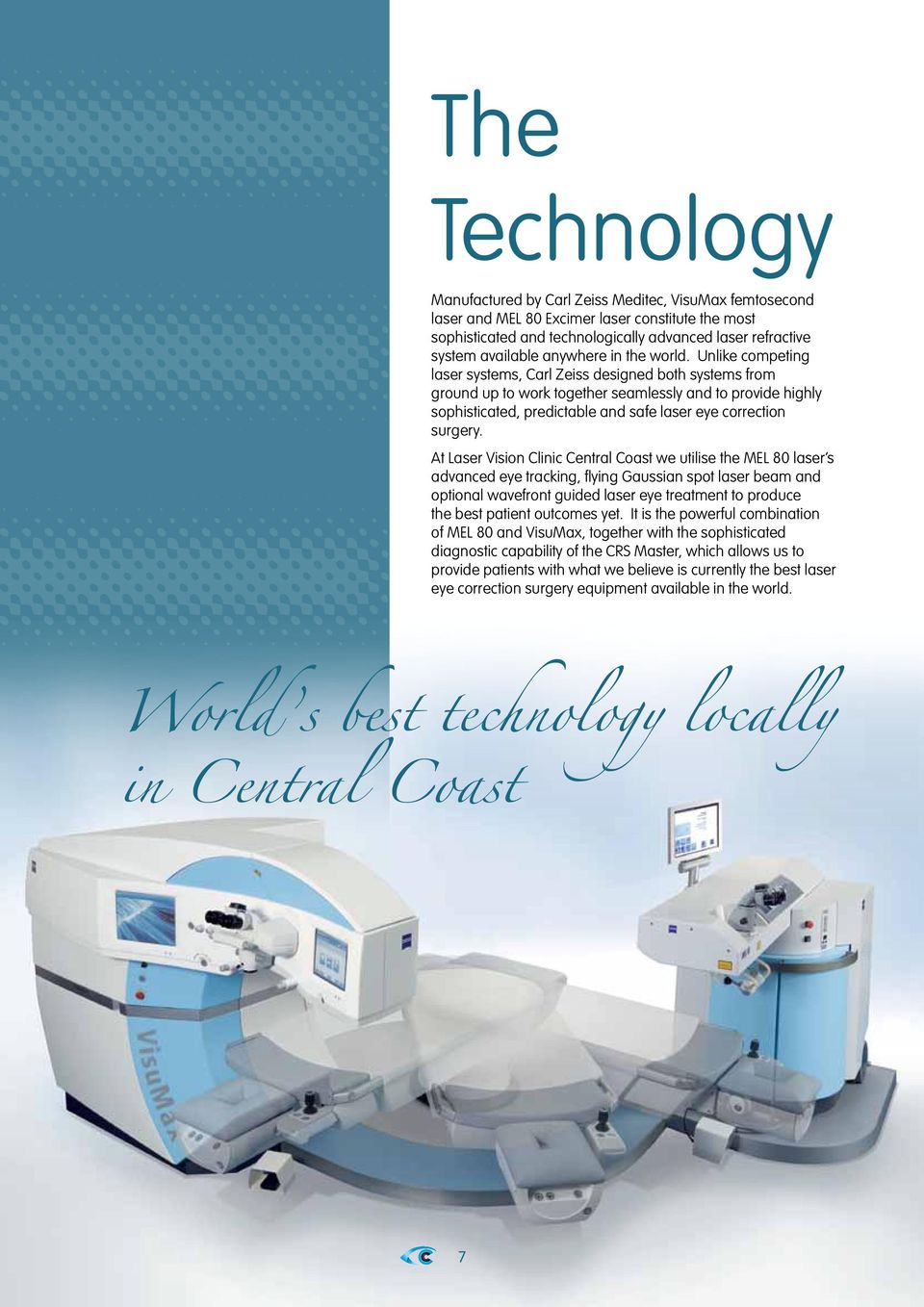
7 The Technology Manufactured by Carl Zeiss Meditec, VisuMax femtosecond laser and MEL 80 Excimer laser constitute the most sophisticated and technologically advanced laser refractive system available anywhere in the world. Unlike competing laser systems, Carl Zeiss designed both systems from ground up to work together seamlessly and to provide highly sophisticated, predictable and safe laser eye correction surgery. At Laser Vision Clinic Central Coast we utilise the MEL 80 laser s advanced eye tracking, flying Gaussian spot laser beam and optional wavefront guided laser eye treatment to produce the best patient outcomes yet. It is the powerful combination of MEL 80 and VisuMax, together with the sophisticated diagnostic capability of the CRS Master, which allows us to provide patients with what we believe is currently the best laser eye correction surgery equipment available in the world. World s best technology locally in Central Coast 7
8 VisuMax femtosecond Laser VisuMax is the fastest femtosecond laser currently available. This leads to enhanced clinical outcomes for patients as compared to other lasers on the market. A femtosecond laser produces extremely short pulses of infrared light which are used to divide the corneal tissue. A femtosecond is 0.000,000,000,000,001 second (one quadrillionth of a second). One femtosecond compared to one second is like the diameter of a human hair compared to the distance between the earth and the moon. The VisuMax laser produces 500,000 pulses a second, each pulse lasting only a few femtoseconds. Each laser pulse produces a microscopic gas bubble which separates the surrounding corneal tissue. Thousands of closely computer guided laser pulses join together to create a highly precise incision in the corneal tissue. The accuracy of the VisuMax femtosecond laser allows a flap to be cut and lifted out of the way so that the tissue under the flap can be reshaped to correct refractive error. MEL 80 Excimer Laser The excimer laser uses high-energy pulses of ultraviolet light to alter the shape of the cornea. It does this by removing extremely tiny amounts of tissue (25 100,000ths of a millimetre at a time), without disturbing other tissue. MEL 80 laser enables extremely safe and precise correction. Highly developed optics focus the laser beam in a very small spot size and an optimal Gaussian shape. This makes the finest corrections possible and the surrounding tissue unharmed. Intelligent technology tracks the slightest eye movements during laser eye treatment and guides the laser beam to continue to work in precisely the right position. The surgeon obtains a precise digital impression of your eyes, enabling him or her to recognise even the most subtle anomalies in the visual process and plan an individual laser eye treatment optimised for you. 8

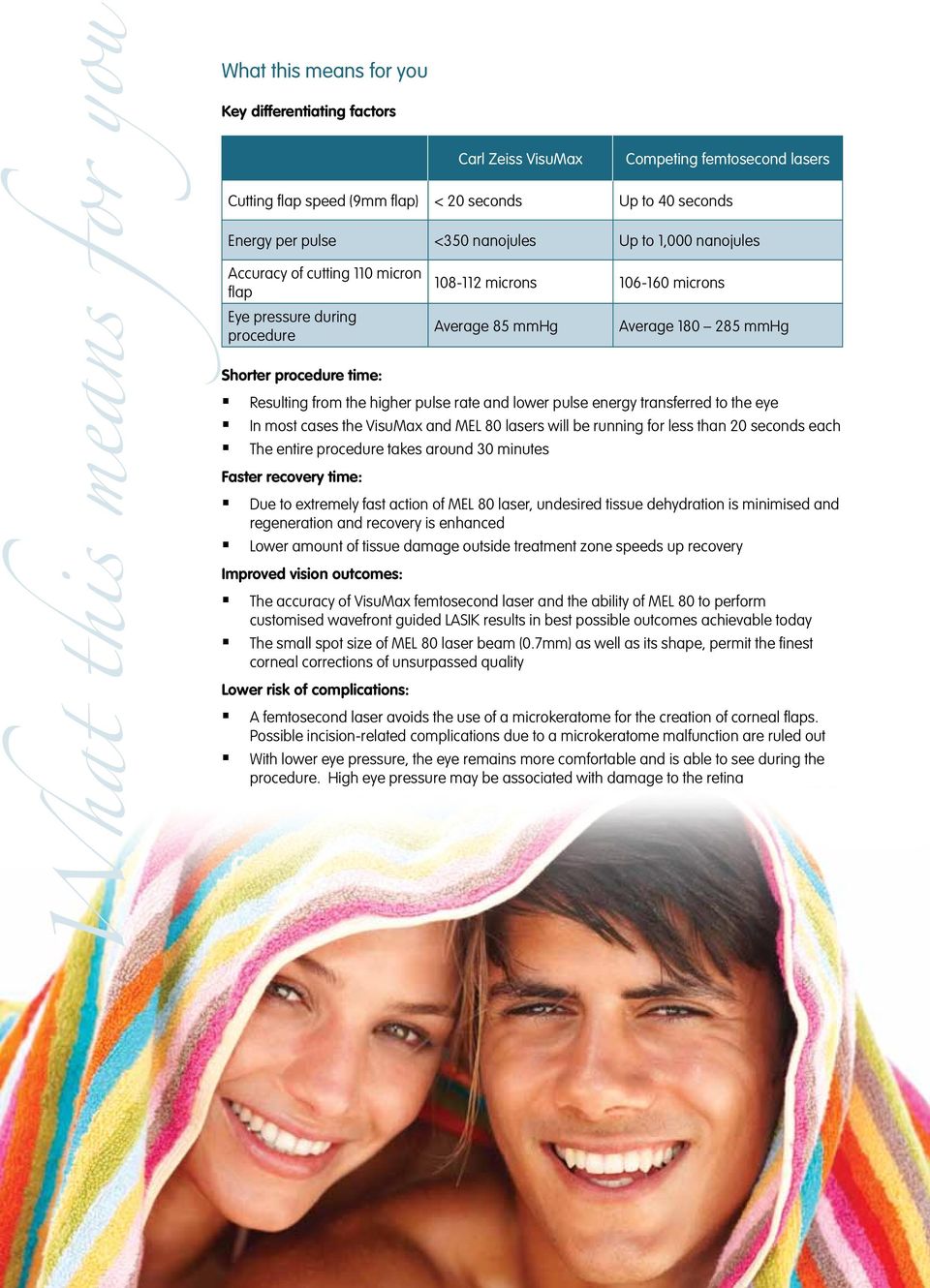
9 What this means for you What this means for you Key differentiating factors Shorter procedure time: Resulting from the higher pulse rate and lower pulse energy transferred to the eye In most cases the VisuMax and MEL 80 lasers will be running for less than 20 seconds each The entire procedure takes around 30 minutes Faster recovery time: Carl Zeiss VisuMax Competing femtosecond lasers Cutting flap speed (9mm flap) < 20 seconds Up to 40 seconds Energy per pulse <350 nanojules Up to 1,000 nanojules Accuracy of cutting 110 micron flap Eye pressure during procedure microns microns Average 85 mmhg Average mmhg Due to extremely fast action of MEL 80 laser, undesired tissue dehydration is minimised and regeneration and recovery is enhanced Lower amount of tissue damage outside treatment zone speeds up recovery Improved vision outcomes: The accuracy of VisuMax femtosecond laser and the ability of MEL 80 to perform customised wavefront guided LASIK results in best possible outcomes achievable today The small spot size of MEL 80 laser beam (0.7mm) as well as its shape, permit the finest corneal corrections of unsurpassed quality Lower risk of complications: A femtosecond laser avoids the use of a microkeratome for the creation of corneal flaps. Possible incision-related complications due to a microkeratome malfunction are ruled out With lower eye pressure, the eye remains more comfortable and is able to see during the procedure. High eye pressure may be associated with damage to the retina 9
10 Cornea Pupil Light Iris Lens Retina Optic Nerve How the Eye The human eye is like a camera in that it possesses a focusing lens system at the front and has a light sensitive film, the retina, at the back. As with a camera, there is a variable auto-focus system - the crystalline lens - which allows us to focus on whatever interests us. Works? 1. Cornea the window of the eye A curved dome of strong, clear tissue on the surface of the eye. Cornea is one of the most critical components of the eye. The purpose of cornea is to bend, or refract light rays so that they focus on the retina at the back of the eye. Refractive errors occur when the cornea fails to focus light rays precisely on the retina. LASIK eye surgery is used to improve these refractive errors 2. Epithelium 3. Iris A thin protective layer for the cornea which heals very quickly when disturbed. The coloured part of the eye is actually a muscle that controls the size of the pupil. 4. Pupil The black circular area in the middle of the eye. Like the camera s aperture it controls the amount of light reaching the retina. 5. Retina A membrane on the inner wall of your eye, similar to the film in the camera, the retina changes light into images that are transmitted to the brain via the optic nerve. 6. Sclera The outer white coat of the eye, the sclera also provides protection. 7. Lens A natural lens behind the iris changes shape to allow the eye to focus. As you age, the natural lens hardens resulting in presbyopia the loss of reading vision. 10

11 Common Refractive Errors in Eyes Cornea Pupil Light Iris Lens Retina Optic Nerve Myopia (short-sightedness) In myopia, rays of light from a distant object are focused in front of the retina. This is either because the eye is too long (from front to back ) or the cornea (the front window of the eye) is too steeply curved and hence has too much focusing power (or a combination of these 2 factors). A negative or minus spectacle or contact lens is required to correct this, i.e. to cancel out this excess of positive focusing power. When not wearing spectacles a shortsighted person will have blurred distance vision. The greater the amount of myopia the more blurred is their view of the world. Even a relatively modest amount of myopia will cause a considerable blurring of distant objects. For example, a person with minus 3 dioptres of myopia would have great difficulty recognising even the largest letter on the standard optometrists chart. For myopic individuals there is a point however at which objects are seen clearly. This will be at a relatively short distance in front of the eye (i.e. short-sight ) and the exact distance depends on the amount of myopia present. For example, in the case of someone with minus 3 dioptres of myopia the point of sharpest focus is 1/3 of a metre (12 inches) in front of the eye. In the case of a highly myopic individual of minus 10 dioptres this point would be only 10cm away. This can sometimes be an advantage since without spectacles even small print will be visible at this 10cm point. Distance vision however would then be extremely blurred. Cornea Pupil Light Iris Lens Retina Optic Nerve Hyperopia (Hypermetropia or long-sightedness) In the case of hyperopia, the situation is slightly more complex. In this refractive error rays of light from a distant object are brought to a focus behind the eye. This is because the eye is either too short in axial length ( from front to back ) or because the cornea (see left) is relatively flat or insufficiently curved and as a consequence does not have sufficient focusing power. Additional power is required therefore and hence positive or plus lenses are required. The complicating factor in hyperopia is that younger patients can supply some or all of the additional power required by a process of accommodation in which the crystalline lens inside the eye changes its shape and compensates for the refractive error. The ability to do so however declines with age and ultimately all hyperopic patients will require optical correction both for distance and for reading. 11

12 Cornea Pupil Light Iris Lens Retina Optic Nerve Astigmatism In myopia and hyperopia the image of a distant object is brought to a single point focus in front of or behind the retina respectively. In the case of astigmatism however the cornea is more steeply curved in one direction (principal meridian) than the other which is, therefore relatively flat. The classic analogy is the comparison of a soccer ball with a rugby ball. The soccer ball is a perfect sphere and looks identical regardless of the viewing angle. The rugby ball however has a long axis and a short axis and therefore appears oval or elliptical when viewed from the side but circular when viewed end on. If the human cornea has an elliptical or oval shape the resulting optical defect or refractive error is astigmatism. Instead of a point focus, 2 line foci are produced and the spectacle lens required to correct this is termed an astigmatic, cylindrical, toroidal or toric lens. Given the above explanation it follows that astigmatism must have not only a magnitude or amount (in dioptres) but must also have a defining direction, angle or axis (in degrees). Very often astigmatism will co-exist with either myopia or hyperopia. Presbyopia (the need for reading spectacles) Since the ability of the human lens to focus on close objects declines with age almost everyone will require spectacles for reading in the fullness of time. This is termed presbyopia and is a normal age change. Even those with perfect sight (emmetropia) do not escape. They will require simple reading spectacles from around their mid 40s onwards. Those who wear spectacles for myopia or hyperopia will require an additional reading prescription usually in the form of bifocal or multi-focal spectacles. As mentioned above however, depending on the amount, some myopic individuals will be able to read small print easily by removing their spectacles. This, of course, is not always practical and contact lens wearers will, for example, have to wear reading spectacles over their contacts in order to read clearly. This problem of presbyopia is one of the most important difficulties encountered by patients who have undergone laser refractive surgery. The laser eye treatment can be thought of as a viable alternative for general distance/driving spectacles or contact lenses and patients of a presbyopic age (mid 40s) will require reading spectacles just as they would have done had they been wearing their contact lenses. Laser refractive surgery does not cause this problem it merely exposes it. If you are in your mid to late 40s or older it is highly likely that you will need reading spectacles for close-work (computers, desk work, reading) after laser refractive surgery. 12

13 Laser Eye Surgery Types Treatment There are three main types of laser eye treatments to choose from: Conventional LASIK Conventional LASIK corrects your vision based on your prescription for contacts or glasses. Your level of vision correction is determined using the familiar which is better, this or that? vision test. This type of LASIK can correct the main types of refractive error: nearsightedness, farsightedness and astigmatism. Wavefront-guided LASIK Wavefront-guided LASIK, sometimes called custom LASIK, creates a personalised map of existing higher order aberrations to correct refractive error and the more subtle vision problems. In some cases, existing higher order aberrations are severe enough to require this special treatment. Higher order aberrations may include subtle blurring, less clear visual contrast and even mild glare, halos or star bursts around lights at night. ASA (Advanced Surface Ablation) / PRK (Photo refractive Keratectomy) ASA/PRK procedures are very effective for treating low to moderate amounts of shortsightedness and astigmatism. It is a straightforward and surgically less complicated procedure where the protective layer of the cornea is gently removed. The laser is then applied to reshape the corneal surface to the desired requirements. Following the cool laser treatment a contact lens is placed over the eye to protect it during the first few days of healing. Although the procedure is painless it is quite normal to feel some mild to moderate discomfort for one or two days following treatment. The effects of ASA/PRK are not instantaneous as there is an ongoing healing process with the cornea. Although the patient is able to see, vision will not immediately be clear and may take up to two weeks to recover. For this reason it is recommended that two weeks be left between treatment of each eye. Your surgeon will carefully evaluate your eyes, health history and refractive error, as well as your age, lifestyle and career considerations to help you decide if LASIK is right for you and which type is best for you. 13

14 Are You Suitable for Laser Eye Surgery? Most Suitable Candidate You may be a perfect candidate for laser eye surgery if you are at least 18 years of age, not pregnant, have stable vision for one year prior to the procedure and are free of complicating eye diseases. However, our eye surgeons exercise very stringent selection criteria and you may be told, that your eyes are not suitable. Most Suitable Candidates are: 18 years of age or older and have had a stable glasses or contact lens prescription for at least the past two years affected by one of the common types of refractive error such as short-sightedness, long-sightedness or astigmatism do not suffer from any disease, ocular or general, that may affect the effectiveness of the surgery, or the ability to heal properly and quickly. You are generally in good health have realistic expectations, and understand that the surgery should reduce your dependency on glasses and contact lenses, but may not completely eliminate them 14
15 Less Suitable Candidate Your surgeon may still be able to perform the surgery safely in some cases, provided you and the surgeon have discussed the risks, benefits and expected results. Less Suitable Candidates: have certain eye problems or a history of eye problems, such as amblyopia (lazy eye), strabismus (muscle imbalance), severe dry eyes, previous eye surgery or injury, or any recurrent, residual or active eye conditions which may affect healing. Other conditions that you should tell your eye surgeon include keloid scarring with previous surgical healing, back problems, claustrophobia or other psychological problems, which may affect the surgery or recovery are undergoing treatment with medications such as steroids and immunosuppressants. Any medication that renders you immuno-compromised can adversely affect the healing process are suffering from conditions or diseases that slow healing (e.g. auto-immune or collagen-vascular disorders, uncontrolled diabetes), or certain eye viruses including herpes simplex and herpes zoster have significant scarring of the cornea A comprehensive examination at LVCCC is your first step towards laser eye surgery. What is Involved? Initial free suitability assessment Will take around an hour and will involve a series of examinations and testing of your eyes. Not all people who want to have refractive surgery are suitable. It is necessary to go through a series of steps to ensure that someone seeking surgery has a good chance of a successful result and understands the risks as well as the benefits. Laser Vision Clinic Central Coast has the some of the most sophisticated diagnostic equipment for assessment of patients. You will be asked to provide your current glasses prescription, ideally containing recent measurements by an optometrist or an ophthalmologist. If you wear soft contact lenses you will be asked to leave these out for 48 hours prior to initial assessment. If you wear hard or RGP contact lenses, you will need to change to soft lenses and have regular visits with your eye care provider until your refractive error stabilises. This can take several months. At the initial suitability assessment we will: Ask you about your eyes and general medical health; Make a map of your corneas to check the eye shape; and Do some simple eye measurements You will have an opportunity to ask any questions you may have. If after the initial suitability assessment you appear suitable for vision correction, then you can proceed to a full medical assessment. 15
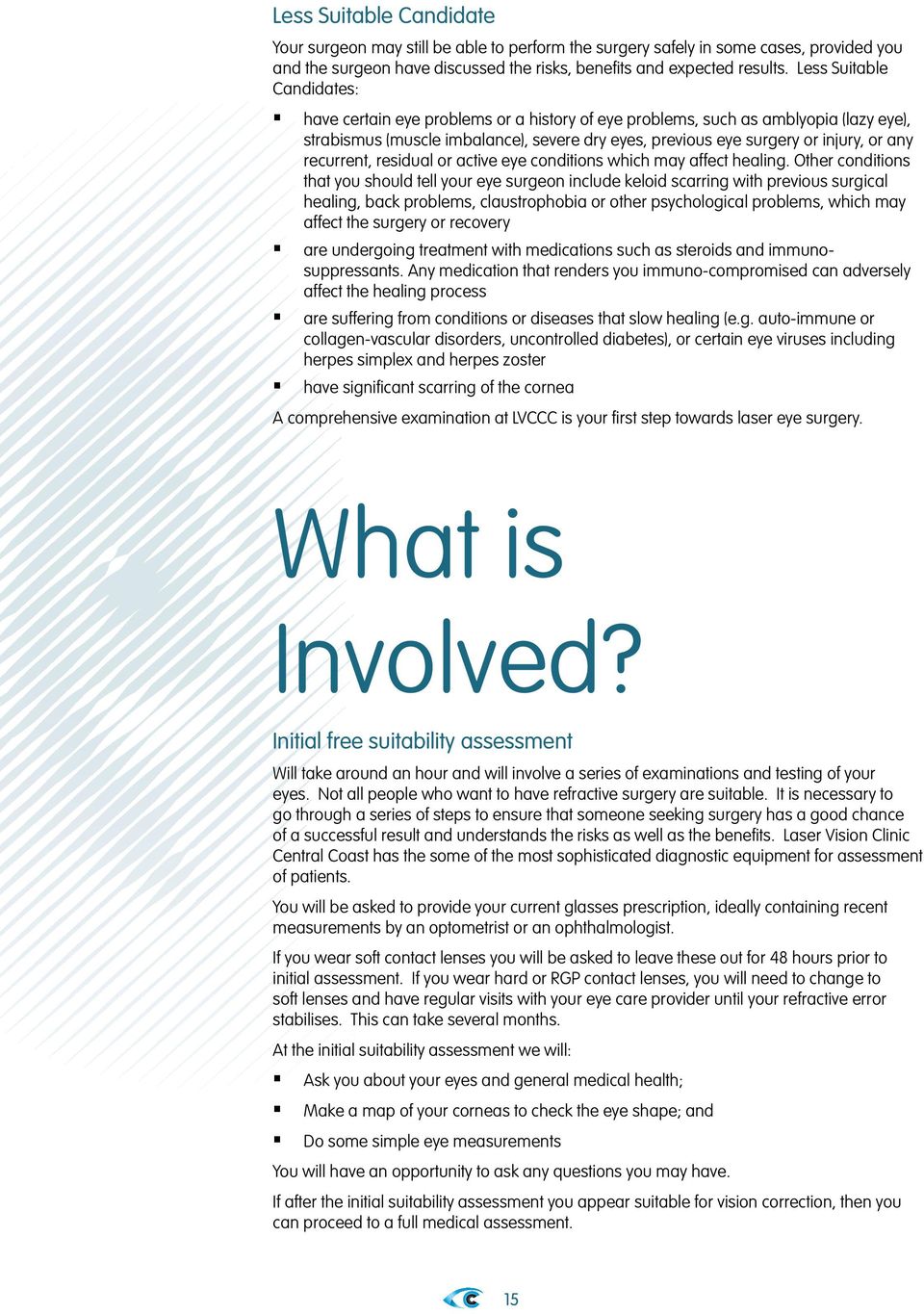
16 Medical assessment The medical assessment is with the eye surgeon. During this appointment we will check your focusing carefully and the general health of your eyes. The eye surgeon will further examine your eyes and determine your suitability. The eye surgeon will then discuss the right type of procedure for you (if any) as well as likely results and possible risks. Once again you ll have an opportunity to ask further questions. It is important to understand that you will be under no obligation to proceed with the surgery and you can withdraw at any time if you wish. You will be charged a fee for this medical consultation. If you decide to proceed an appointment for surgery will be made at a convenient time for you. 16
17 procedure Procedure LASIK is a day surgery procedure where you walk in and walk out afterwards. The entire experience will take around two hours, but the procedure itself is usually over in less than 30 minutes. When you arrive at Laser Vision Clinic Central Coast on the day of the procedure: We will check your informed consent document and ensure that any additional questions have been answered A member of staff will spend time with you to explain the procedure and what you will need to do following surgery Prior to surgery you will be seen again by the eye surgeon who will discuss any points necessary. Following this, refractive surgery will be performed. Most people experience little or no pain, though some discomfort is possible. You ll be awake for the procedure and typically only the eyes need to be numbed usually with anaesthetic drops. In some cases, your eye surgeon may give a mild oral sedative, as well, to help keep you relaxed and comfortable. Immediately after the procedure Your eye surgeon will want you to rest and when satisfied with your condition, you will be released to go home. You won t be ready to drive yet, so someone should be with you. Your eye surgeon may give you protective sunglasses or shields to wear to protect your eyes. 1 day after Following bladeless LASIK visual recovery is rapid with most patients seeing very well the next day and their eyes feeling fairly normal. Following ASA / PRK vision will be quite fuzzy during the first week. However, most people have good functional vision even at the first day after surgery with most patients seeing at least 6/12 (half way down the eye chart). 1 week after Following ASA/PRK by the 6th day, when the contact lens is removed, most patients are expected to be well enough to drive. About 90% of ASA/PRK patients will be seeing well enough to return to normal activities by day 6 or 7. Full time computer workers may need a few extra days to recover. Your vision will improve rapidly in the first few weeks after surgery, but can take one to three months to fully stabilise. 17

18 Follow-up Care The possibility of better vision without glasses or contacts is always exciting, but, as with every surgical procedure, there are risks. LASIK does require careful preparation and care afterwards. Routine follow-up visits are at one to three weeks after surgery; then one month, three months and six months later. These follow-up visits are included in your fee for the surgery. Any medical consultation after 6 months will be charged. Over much of this period you will be using eye drops prescribed by your surgeon. Various eye measurements are made at the follow-ups to check the healing process. During the visual recovery period (one to three months) vision may fluctuate, but from three months on vision is usually stable. If you had a large correction, your eyes may take longer to settle. After your eyes have settled you can have your remaining checkups with your optometrist. On occasion, enhancements or re-treatment is required to improve the refractive outcome. In these circumstances further laser surgery may be required. There is no charge for enhancements or re-treatment within 2 years of the initial treatment. After 2 years, re-treatment will be at half price.. 18

19 What Results Can You Expect? Studies show that the majority of patients obtain 20/20 vision or better after laser eye surgery. And nearly all patients achieve 20/40 or better which is fully functional and good enough to drive without glasses or contacts. Most importantly, the vast majority of people are satisfied with laser eye surgery. In a recent study, about 97% of laser eye surgery patients said they would recommend it to a friend or relative. 2 Patients are often amazed by the clarity of their vision the day after surgery, but your visual experience after LASIK may be slightly different than with corrective lenses. While there are great benefits of LASIK, as with any refractive surgery, there are also short-term side effects you may experience as you recover. You may also still occasionally need to wear corrective lenses to achieve the sharpest possible vision. The benefits of your own laser eye surgery will depend on many personal factors. Your age, health and degree of refractive error will all affect the results of your procedure. 19

20 Typical outcomes of laser eye surgery For nearsightedness If you are moderately nearsighted Mildly or moderately nearsighted patients with or without astigmatism have some of the best benefits of laser eye surgery and recover most quickly. Studies of mildly or moderately nearsighted patients show that one year after having laser eye surgery: 2 98% have obtained 20/20 vision. 100% have achieved 20/40 vision or better. This is good enough to perform most daily activities without corrective lenses If you are severely nearsighted Less than 5% of people are severely nearsighted with refractive error of 7 diopters or greater. Studies show that among these patients, one year after having laser eye surgery: 3 86% have obtained 20/20 vision. 100% have achieved 20/40 vision or better. This is good enough to perform most daily activities without corrective lenses If you are severely nearsighted, you may have a higher chance of regression after LASIK. This means you might see initial improvement, and then see it diminish somewhat over time. A touch-up LASIK treatment, also called an enhancement, is usually effective in correcting regression. Studies have also noted a slightly higher risk of complications for very nearsighted patients as well. Almost all LASIK complications are treatable and you can discuss this further with your eye surgeon. A small number of patients are too nearsighted to have LASIK. If so, a different surgery, called a phakic IOL implantation may be an appropriate alternative to correct your refractive error. For farsightedness If you are moderately farsighted Mildly or moderately farsighted patients with or without astigmatism can be very good candidates for laser eye surgery and achieve good benefits of LASIK. Studies of mildly or moderately farsighted patients who have had laser eye surgery show that after nine months: 4 72% have obtained 20/20 vision. 95% have achieved 20/40 vision or better. This is good enough to perform most daily activities without corrective lenses. Farsighted eyes generally recover more slowly than nearsighted eyes, so your surgeon may wish to treat one eye and wait a few days to weeks before treating the other. It may also take longer for you to achieve your best vision while your eyes heal. 2,3,4 Source: Eye Surgery Education Council 20

21 Farsighted patients may also have a higher chance of regression after laser eye surgery. This means you might see initial improvement and then see it diminish somewhat over time. A touch-up LASIK treatment, also called an enhancement, is usually effective in correcting regression. If you are severely farsighted Less than 5% of people are severely farsighted with refractive error of +4 diopters Studies have noted a slightly higher risk of complications for severely farsighted patients, as well. Almost all LASIK complications are treatable, but discuss this carefully with your eye surgeon. A small number of patients are too farsighted (greater than +6 diopters) to have LASIK. If so, a different surgery, called refractive lens exchange, may be an appropriate alternative to correct your refractive error. For astigmatism If you have moderate astigmatism Laser eye surgery has been shown to be very effective in treating mild to moderate astigmatism up to 4 diopters. The benefits of LASIK will depend on the exact nature and degree of your astigmatism, however, and whether you have other refractive errors. Your eye surgeon can tell you what you can expect, based on the anatomy of your eyes If you have severe astigmatism A very small number of patients have astigmatism higher than 4 diopters. In this case, your surgeon may recommend that you have laser eye surgery with an additional procedure, such as limbal relaxing incisions, to better correct your vision. 21
22 Risks & Possible Complications The vast majority of people who have laser refractive surgery performed obtain an excellent result that lives up to their expectations for the procedure. However for some people, the outcome of their surgery does not meet their expectations, and in a few cases the outcome can be disappointing. Like any other modern surgical procedure, laser refractive surgery is not risk free. In order to have realistic expectations as to what you can reasonably expect from laser refractive surgery, you must be aware of its potential risks, as well as its potential benefits. In addition to this information booklet, you should read our informed consent document for a more detailed coverage of the risks of laser refractive surgery. Pain With bladeless LASIK, there is only minor discomfort associated with the surgery, and there is very little postoperative discomfort. With ASA/PRK, the actual procedure is usually only mildly uncomfortable. All patients are given a variety of medications to use after surgery, and are given full instructions about their use prior to the operation. It is important to take the pain relief tablets as prescribed as the eye can be quite uncomfortable for the first 72 hours afterwards. Infection An infection of the cornea is the worst thing that could happen after laser refractive surgery. This is extremely rare and has been reported to occur in about 1 in 5000 cases. Every effort is made to reduce the risk of an infection following refractive surgery. All instruments are thoroughly sterilised before use. Antibiotic eye drops are used both during and after the laser surgery. Patients are asked to avoid swimming, spa pools, and hot tubs in the first three weeks following laser surgery to avoid infection or contaminants getting in to the eye. Eye make-up should be avoided for three weeks following laser surgery. Any increased pain, redness, discomfort or discharge that occurs after your first post laser visit should be reported to LVCCC immediately as this may indicate early infection. If an infection occurs it should be treatable; any delay in treatment may result in permanent severe scarring which in turn may cause significant loss of vision. Glare Many short-sighted people experience glare during the day or night before having laser surgery. After laser surgery, you will usually experience more glare particularly at night, in the early post operative period. This will usually settle over the first few months and after six months you should be back to your normal pre-laser level of glare. For some people however, night glare or a marked reduction in night vision compared to day vision may be a permanent problem after laser surgery. This was more of a problem with early laser systems, which used a narrow laser beam, and with severely myopic patients, where only a small area of the cornea was treated. LVCCC s lasers use a scanning spot system, which reduces the frequency of this problem, but it can still occur in about 2% of cases. Corneal Haze and Scarring Corneal haze and scarring occur only rarely following ASA/PRK, and are more of a problem with large corrections. Following ASA/PRK all patients will find that their vision is quite hazy in the first week or so. This is caused by the normal healing of the eye which occurs after such procedures. 22
23 In the next few weeks after this, however, further changes occur in the cornea. In some cases, the haze may be much more severe and may cause significant visual problems, such as haloes around lights, fuzzy vision or double vision. Even severe haze will usually eventually clear by itself, but in a few cases may require further laser treatment, or may even be permanent and untreatable. Severe corneal haze is more common after very large corrections, in corneas that have had previous injuries or radial keratotomy, and in people who get thick skin scars (keloid scars) after injury or operations. Modern scanning spot lasers such as the laser at LVCCC are less likely to cause corneal haze. Undercorrection and Overcorrection While the excimer laser is very precisely computer-controlled, everyone responds slightly differently to laser treatment. This means that every patient has a chance of being slightly under or over corrected after laser treatment. Under correction and over correction can occur after any laser procedure. Under correction is more common and small amounts of under correction are usually not a problem and do not significantly degrade distance vision. However if you are significantly under corrected, in most cases you can be retreated. With bladeless LASIK, re-treatments are usually performed at about three months. With ASA/PRK, re-treatments are usually performed after six months. If you are over corrected, you may be treated with eye drops, the wearing of a soft contact lens for several months, or possibly further laser treatment. Under and over corrections are more common after large corrections for myopia. As it is easier and more predictable to treat under corrections than over corrections, for large myopic corrections, you may be deliberately under corrected to reduce the risk of an over correction. A re-treatment for the remaining short sight can then be performed once the eye has settled from the initial treatment. Usually one and occasionally two re-treatments are all that are necessary to obtain a satisfactory visual result. Sometimes, however, it may not be possible to perform a re-treatment to correct any residual refractive error. If the initial treatment has been for a very large refractive error, there may be insufficient corneal thickness remaining to safely re-treat the remaining refractive error. With ASA/PRK this is very uncommon. In this situation, you may have to accept that your short sight cannot be fully corrected. In the first two years after your initial treatment, re-treatment will not incur any further cost to yourself at LVCCC. Regression Regression is the normal slight drift back towards short sight that occurs after laser treatment. It occurs as part of the normal healing response after laser treatment, where the epithelium on the surface of the eye and the underlying corneal tissue thickens slightly after laser treatment. After six months, regression is very unlikely to occur. If your short sight increases again after this period, it is most likely to be due to a natural increase in your normal short sight. Loss of Sharpness Following laser treatment, a small percentage of patients experience a loss of sharpness of vision (best corrected visual acuity). This means that with any residual refractive error corrected with glasses or contact lenses, they are still unable to see as clearly as they did with the glasses or contact lenses they had before they had laser treatment, and they may be unable to read the bottom one or two lines of the eye chart. This problem occurs more commonly after large corrections for short sight. The loss of best corrected visual acuity may be due to corneal haze or scarring, irregular healing of the cornea or decentration of the laser beam during the laser procedure. In most cases this loss of sharpness will improve over a period of 6 to 12 months but in some cases may be permanent. 23
24 Dry Eyes Many patients find their eyes feel more dry after laser refractive surgery, and they may have to use artificial tears regularly to soothe the eyes. This problem is more common after LASIK than after ASA/PRK. It usually improves over time, often taking several months to do so. In some cases however, the problem may be permanent. If you already have dry eyes or poor tear production prior to laser surgery, then you are more likely to have significant dry eye problems afterwards. This may mean you should avoid laser refractive surgery altogether. Diffuse lamellar keratitis (DLK) There may be an inflammation under the LASIK flap termed sands of the Sahara syndrome, or DLK, which may require lifting the flap and intensive use of eye-drops for a number of days. Most cases involve only mild inflammation and are managed with the use of topical eyedrops only. Irregular astigmatism Irregular astigmatism may cause reduced quality of vision and spectacles may not be effective in restoring useful clear vision. If wavefront-guided treatment cannot be performed to correct the optical problem then contact lenses may be required. They may be difficult to wear and may not fully restore the quality of vision. Further surgery may then be required. Epithelial ingrowth The corneal epithelium may grow under the flap. Ectasia The creation of the LASIK flap and removal of some corneal tissue by the laser may weaken the cornea such that long-term bulging or ectasia occurs. To minimise this risk, at LVCCC all treatments must leave at least 300 microns of corneal tissue in the centre and corneal thickness is measured prior to treatment. Double vision This may occur if there is a pre-existing squint or difficulty in balancing the eyes. Occasionally double vision or a ghost image may be perceived. Corneal vascularisation (blood vessels growing into the cornea) This is very rare after LASIK but may occur if there has been a serious corneal abscess (infection) or where there were pre-existing blood vessels in the cornea. Corneal ulcer formation This is very rare and is due to serious post-lasik infection or inflammation. Lens implant power and eye pressure measurements In later life laser refractive surgery, as with any corneal surgery, can make the measurements for the lens implant power needed for cataract surgery more difficult. In addition, the interpretation of the eye pressure (IOP) when assessing possible glaucoma is more involved. Recurrent corneal erosion (which may cause pain or a foreign body sensation) This occurs when surface corneal epithelial cells are dislodged at the time of surgery and the surface heals only partially. There may be recurrent episodes of foreign body sensation. This problem can usually be treated successfully. Ptosis (slight drooping of the upper eyelid) Inflammation or steroid eye drops, and/or use of an eyelid clip during surgery may potentially cause this rare complication. 24
25 Cataract formation There is no evidence that the excimer laser treatment or lifting the LASIK flap is associated with cataract development. However if there are post-lasik complications that require prolonged use of topical steroid eye-drops, then cataract formation may ensue. Protective eye-wear You should also be aware that the eyes may be more susceptible to injury after LASIK without the protective effect afforded by spectacles. Protective eye-wear is recommended for very physical sports (e.g. rugby, martial arts etc.) particularly in the early post-operative period. Accidental trauma You should not rub your eyes in the early period after LASIK and you will be given protective goggles for the first week. Accidental trauma to the LASIK flap may dislodge the flap and require flap reposition or replacement. The latest technologies such as Wavefront guided LASIK have been shown to deliver the clearest vision and fewest night vision symptoms and are least likely to require a touch-up procedure. freedom 25
26 Why Laser Vision Clinic Central Coast? Doctors & staff Dr Anil Arora, Ophthalmic Surgeon and Medical Director of Laser Vision Clinic Central Coast is joined by a team of highly-trained refractive surgeons, as well as specialist ophthalmic nurses and administrative staff to provide a truly outstanding first-class laser refractive facility for the residents of Central Coast and surrounding areas. Dr Arora has performed surgeries on tens of thousands of patients over the past decade. He is a true pioneer of eye surgery in Central Coast having brought retinal eye surgery and now laser eye surgery to the area. world s 26
27 World s best technology, locally in Central Coast Laser Vision Clinic Central Coast, located in Erina, is a state-of-the-art laser refractive facility boasting the Zeiss MEL 80 Excimer laser and the Visumax femtosecond laser. These are currently the most technologically advanced refractive lasers available and provide the highest quality bladeless vision correction for the patient. Until recently Central Coast did not have a facility offering vision correction surgery. Patients had to travel to Sydney and Newcastle. Considering the numerous visits involved this created significant inconvenience for the patients and precluded many from undertaking such surgery. The arrival of Laser Vision Clinic Central Coast in Erina significantly improved the level of eye services available in Central Coast. Carl Zeiss partnership VisuMax, the Gentle Laser Unlike all other femtosecond lasers, the VisuMax exerts very little pressure on the eye. This results not only in a very comfortable procedure for our patients, but significantly contributes towards the optimum result. Why? Because patients treated with the VisuMax laser can perfectly fixate throughout the procedure. Ophthalmologists are very mindful about the amount of energy used in eye surgery procedures. Generally, clinical studies show that the less energy used in the eye, the better. This was an important consideration in why we chose the VisuMax technology. Due it its far greater repetition rate, the VisuMax laser uses only 12% of the energy required by other femptosecond lasers to create a flap. VisuMax, MEL 80 & CRS Master - Perfect Integration It is the powerful combination of MEL 80 and Visumax, together with the sophisticated diagnostic capability of the CRS Master, which allows us to provide patients with what we believe is currently the best LASIK eye surgery equipment available in the world. Zeiss Optics Ophthalmologists have a profound understanding of high performance optics. Indeed, they rely on them every day when examining and treating patients. Refractive lasers are very much optical instruments, and the quality of their ablations and the resulting patient outcomes are as much dependent on precision optics as much as highly trained surgeons. The famous Zeiss optics are at the core of the VisuMax and MEL 80 lasers. Unsurpassed in precision and quality, the Zeiss lenses provide our surgeons the finest detail and ensure our lasers perform ideally day in and day out. LVCCC is part of a licensed health facility Laser Vision Clinic Central Coast is part of Central Coast Day Hospital, a purpose-built ophthalmic centre of excellence, specialising in all types of eye surgery, such as cataract, retinal, glaucoma, eyelid, orbital & lacrimal surgery, removal of pterygium, paediatric surgery, and cosmetic eye plastic surgery. Central Coast Day Hospital is licensed by the Department of Health and the Australian Council on Healthcare Standards, and observes their strict day care procedure guidelines. It has been awarded the prestigious four-year accreditation with the ACHS. best technology, locally in central coast 27
28 Our Doctors Dr Anil Arora Medical Director, Ophthalmic Surgeon M.B., B.S., M.M., F.R.A.N.Z.C.O. Dr Anil Arora is an ophthalmologist who has been practising in Central Coast and in Sydney since Dr Arora completed his medical degree through the University of Sydney in 1985 and after carrying out his internship and residency training at Royal North Shore, Westmead and Royal Prince Alfred Hospitals, he embarked on a career in ophthalmology. He was one of the first to complete a Masters of Medicine in Ophthalmology with a thesis on retinal electrophysiology and carried out five years of specialist training in ophthalmology from the Sydney Eye Hospital from 1988 to In Dr Arora completed a clinical fellowship in Diseases and Surgery of the Retina and Vitreous from the University of Texas in Houston. He then began practicing on the Central Coast and Sydney s North Shore and has established himself as a respected ophthalmologist and has performed surgeries on tens of thousands of patients over the past decade. He brought retinal surgery to Central Coast and this meant that patients no longer had to travel to Sydney for these procedures. Dr Arora also saw the need for laser eye correction services on the Central Coast and carried out further postgraduate training in laser refractive surgery and was one of the first to obtain a Graduate Diploma in Medicine (Refractive Surgery) from the University of Sydney. He decided to establish a state-of-the-art laser refractive centre on the Central Coast. Laser Vision Clinic Central Coast is now a reality and satisfies this need. Dr Arora is joined by a team of other highly-trained refractive surgeons as well as specialist ophthalmic nurses and administrative staff to provide a truly outstanding first-class laser refractive facility for the residents of Central Coast and surrounding areas. Dr Arora has practices in Gosford, Long Jetty, Woy Woy and Wahroonga and is a Visiting Medical Officer at the Central Coast Day Hospital, Brisbane Waters Private Hospital and the Sydney Adventist Hospital and also at Gosford and Wyong Public Hospitals. Dr Arora has a strong interest in ophthalmology in developing countries and carries out surgeries and training of doctors on a regular basis in India and for some years was on the International Advisory Panel for the Indian Journal of Ophthalmology. He is a fellow of the Royal Australian and New Zealand College of Ophthalmologists and a member of the American Academy of Ophthalmology and American Society of Cataract and Refractive Surgeons. Dr Vivek Chowdhury Ophthalmic Surgeon M.B., B.S. (Hons), Ph. D., F.R.A.N.Z.C.O. Dr Vivek Chowdhury is an ophthalmologist, specialising in Laser Refractive, Corneal and Cataract Surgery. Dr Chowdhury completed his medical degree at Sydney University, graduating with First Class Honours. He also completed a PhD at the University of New South Wales in Bionic Eye technology. Dr Chowdhury then spent 5 years training in Eye Surgery at the Prince of Wales Hospital and Sydney Children s Hospital in Randwick. After this he completed a Fellowship in Corneal and Refractive Surgery at Moorfields Eye Hospital in London, one of the world s largest and most prestigious eye surgery institutions. Dr Chowdhury is now working as a consultant ophthalmologist at Laser Vision Clinic Central Coast, as well as Gosford Eye Surgery and Wyong Eye Surgery. 28
29 Dr Nikhil L. Kumar Ophthalmic Surgeon B.Med., M.P.H., F.R.A.N.Z.C.O. Dr Nikhil L. Kumar is an Ophthalmic Surgeon with a sub specialty in Refractive Surgery, Cataract Surgery and Cornea Surgery. He graduated from the University of Newcastle in 1998, completed a Masters of Public Health from the University of New South Wales in 2003 and completed his Ophthalmology fellowship at the Sydney Eye Hospital in Thereafter he completed a fellowship in Refractive and Cornea Surgery at the Toronto Western Hospital and the Yonge Eglinton Laser Eye Centre, University of Toronto, Canada. He gained extensive experience in all forms of refractive and cornea surgery including laser eye correction and keratoconus management. Dr Kumar is a Clinical Senior Lecturer in Refractive and Cornea Surgery at the Australian School of Advanced Medicine, Macquarie University. He is a member of the Australian and American Societies of Cataract and Refractive Surgery and Cornea Societies. He has published numerous peer-reviewed papers involving refractive, cataract and cornea surgery. He is actively involved in the research of refractive and cornea surgical procedures to scientifically verify the best treatment options for patients. Dr Kumar is passionate about improving quality of vision and pursues his goal of attaining exceptional visual outcomes. This leads to his enthusiasm for Laser Eye Surgery. He dedicates considerable time and effort to improving patient outcomes, and recommends the safest and most effective treatment options for his patients. Dr Kerrie Meades Ophthalmic Surgeon M.B., B.S., (Hons), F.R.A.N.Z.C.O. Dr Kerrie Meades graduated from Sydney university in 1978 with honors. She trained in ophthalmology at Sydney Eye Hospital in 1985 and extended her training with a refractive fellowship in the mid 90s. Dr Meades is a member of RANZCO, ASO, ASCRS, AAO, founding member of AUSCRS, on the advisory board of ALCON and co-chairperson of Women in Ophthalmology. She was a VMO at Sydney Eye Hospital, Concord Hospital and Mt Druitt hospital as well as private hospitals and day surgeries including SAN, St Vincents Private, Dalcross and Epping Day Surgery. [REMOVE RETURN IN PDF DOC] Dr Meades has written many published papers in cataract, refractive surgery and general ophthalmology, and presented and attended many meetings in Australia, USA, Europe and Asia. Dr Meades has been actively involved over several years in charitable cataract work in China and Tibet and refractive work in Vietnam. She is now supporting much needed medical care in the Pacific and Madagascar in association with the SAN. Dr Meades passion is in refractive surgery including surface treatments, LASIK, phakic IOLs, customised cataract surgery, intracorneal rings, cross linking and presbyopia. Dr Meades has performed refractive surgery for over 15 years and trained many fellows in refractive procedures, cataract surgery and general ophthalmology. She sees the future for Laser Vision Clinic Central Coast as providing advanced clinical care with excellent patient service. 29
30 LASIK Key Take-outs LASIK treatment is intended to reduce or eliminate dependence on glasses and contact lenses. The treatment may over - or under-correct the refractive error. Expectations must be realistic in that some small amount of refractive error often does remain, similar to normal non-spectacle wearers. For those with normal vision (good distance vision) there will be a progressive need for reading glasses for near vision after 40 to 45 years old. LASIK does not affect the ageing process of the lens within the eye (presbyopia). Normally, when adult life is reached, the vision is stable and remains so after LASIK. In younger patients however it is possible to become slightly more myopic with time. LASIK as with other corneal surgery does however make it somewhat more involved to measure the lens implant power needed in later life when cataract surgery is required and makes it more difficult to measure the pressure of the eye. However LASIK does not affect ageing changes and diseases of the eye such as natural development of cataract, glaucoma and macular degeneration. Based on previous treatments the complication rate for LASIK is around 2-3% with most complications settling without affecting the final visual result. Around 1 in 1,000 will have a significant reduction in vision due to a complication that cannot be corrected or will involve more extensive surgery to remedy the vision. Wavefront guided LASIK has been shown to provide better vision than previous refraction-based LASIK treatment but there is still some scatter in outcome (to be expected due to individual differences in corneal healing) and as such custom wavefront-guided treatment should not be regarded as guaranteeing perfect vision. 30
31 Non-Laser Vision Correction Options Laser Vision Clinic Central Coast offers several alternative methods of vision correction besides laser vision correction. Not all patients are suitable for laser vision correction, and you will usually be told if you are more suitable at the time of your first visit. Phakic Intraocular lenses (IOLs) If you are very nearsighted or your eyes have thin corneas you may be unsuitable for laser eye surgery. Phakic Intra Ocular Lenses (IOL s) could be appropriate in this situation. The Phakic IOL s are placed inside the eye through a small incision and clip onto the front of the iris. The operation takes about 30 minutes and can be done under a local or a general anaesthetic. Recovery of vision is very rapid - most patients will have excellent vision the next day. In some cases, an enhancement procedure using laser vision correction may be required to obtain optimum vision. These lenses are able to correct very high amounts of short sight and can also correct astigmatism. They have been used for many years in Europe, and are approved by the FDA in the USA for vision correction. More than 150,000 procedures have been performed worldwide. They have been shown to be very safe, effective and predictable and can give excellent vision without the use of glasses or contact lenses. Clear Lens Extraction (CLE) This procedure involves removing the existing, usually normal, lens of the eye and replacing it with an artificial lens chosen to reduce or eliminate your myopia. Removal of the normal lens with insertion of an IOL may be the best option for an older, extreme myope or someone who is developing an early cataract. Some older patients who are seeking laser vision correction may be found to have signs of early cataract formation, without this affecting their corrected vision. If an early cataract is present, the ophthalmologist will usually recommend that CLE be performed with insertion of an intraocular lens. This is the same operation as is performed for removal of a cataract in an older person. Lens removal and replacement is generally predictable and safe, but does carry some risk (up to 5% in some reports) of developing a retinal detachment later on, when this surgery is performed on eyes with extreme myopia. CLE is usually performed with a local anaesthetic and takes 20 to 30 minutes. The natural lens is removed from the eye through a 3mm long incision, and an intraocular lens (IOL) is inserted to correct the vision. The procedure is very safe and most patients will get excellent, stable vision within a few days. CLE with insertion of Multifocal Intraocular Lenses Following CLE or cataract surgery, an artificial intraocular lens (IOL) is placed in the eye to correct vision. In most cases the IOL has a single focus point and cannot give good distance and near vision at the same time. However multifocal IOLs are available which can give excellent distance and near vision without the use of glasses. About 90% of patients with these lenses are completely independent of glasses for near or distance vision. Not every patient is suitable for these lenses - the most suitable candidates are older long-sighted people who wish to get out of glasses or who have early cataracts. Your ophthalmologist will advise you if you are suitable for CLE with insertion of a multifocal IOL at the time of your assessment. 31
32 TO THE ENT RANCE CENTRAL COAST HWY TO GOSFORD FOUNTAIN PLAZA ERINA ERINA FAIR SHOPPING CENTRE KARALTA RD WE ARE HERE FOUNTAIN CORPORATE ILYA AVE ERINA PARK p: f: (02) e: w: Suite 1, Fountain Corporate, 2 Ilya Avenue, Erina NSW 2250 Laser Vision Clinic Central Coast Pty Ltd ABN
Vision Correction Surgery Patient Information
 Vision Correction Surgery Patient Information Anatomy of the eye: The eye is a complex organ composed of many parts, and normal vision requires these parts to work together. When a person looks at an object,
Rediscover quality of life thanks to vision correction with technology from Carl Zeiss. Patient Information
 Rediscover quality of life thanks to vision correction with technology from Carl Zeiss Patient Information 5 2 It was really w Vision defects: Light that goes astray For clear vision the eyes, cornea and
Pre-Operative Laser Surgery Information
 Pre-Operative Laser Surgery Information Contact 1800 10 20 20 Our Facility The Canberra Eye Laser Centre has always been at the forefront of refractive technology employing the most up to date equipment
Dr. Booth received his medical degree from the University of California: San Diego and his bachelor of science from Stanford University.
 We've developed this handbook to help our patients become better informed about the entire process of laser vision correction. We hope you find it helpful and informative. Dr. Booth received his medical
ALTERNATIVES TO LASIK
 EYE PHYSICIANS OF NORTH HOUSTON 845 FM 1960 WEST, SUITE 101, Houston, TX 77090 Office: 281 893 1760 Fax: 281 893 4037 INFORMED CONSENT FOR LASER IN-SITU KERATOMILEUSIS (LASIK) INTRODUCTION This information
Excimer Laser Eye Surgery
 Excimer Laser Eye Surgery This booklet contains general information that is not specific to you. If you have any questions after reading this, ask your own physician or health care worker. They know you
How To Know If You Can See Without Glasses Or Contact Lense After Lasik
 The LASIK experience I WHO CAN HAVE LASIK? To be eligible for LASIK you should be at least 21 years of age, have healthy eyes and be in good general health. Your vision should not have deteriorated significantly
TABLE OF CONTENTS: LASER EYE SURGERY CONSENT FORM
 1 BoydVision TABLE OF CONTENTS: LASER EYE SURGERY CONSENT FORM Risks and Side Effects... 2 Risks Specific to PRK... 3 Risks Specific to LASIK... 4 Patient Statement of Consent... 5 Consent for Laser Eye
LASER VISION CORRECTION SURGERY A GUIDE FOR PATIENTS. Professional care for your eye health
 LASER VISION CORRECTION SURGERY A GUIDE FOR PATIENTS Professional care for your eye health Contents About Dr John Males... 1 COMMON QUESTIONS How does an eye work?... 2 What is Myopia (short sightedness)...
LASIK. What is LASIK? Eye Words to Know. Who is a good candidate for LASIK?
 2014 2015 LASIK What is LASIK? LASIK (laser in situ keratomileusis) is a type of refractive surgery. This kind of surgery uses a laser to treat vision problems caused by refractive errors. You have a refractive
Refractive errors are caused by an imperfectly shaped eyeball, cornea or lens, and are of three basic types:
 Tips on Lasik Eye Surgery If you re tired of wearing glasses or contact lenses, you may be considering Lasik eye surgery one of the newest procedures to correct vision problems. Before you sign up for
Laser Vision SA A trusted name in vision restoration. Blade Free Intralase Vision Correction Enhance your potential in just one day
 Laser Vision SA A trusted name in vision restoration Blade Free Intralase Vision Correction Enhance your potential in just one day Imagine Opening your eyes to a clear, vibrant world Before you find your
LASIK EPILASIK FEMTOSECOND LASER. Advantages
 LASIK EPILASIK FEMTOSECOND LASER Advantages There are many advantages to having laser vision correction. Laser vision correction gives most patients the freedom to enjoy their normal daily activities without
ReLEx smile Minimally invasive vision correction Information for patients
 ReLEx smile Minimally invasive vision correction Information for patients Seeing is living Our eyes are our most important sensory organ. The human brain obtains over 80 % of its information via the sense
LASIK. Cornea. Iris. Vitreous
 LASIK Introduction LASIK surgery is a procedure that improves vision and can decrease or eliminate the need for eyeglasses or contact lenses. If you and your doctor decide that LASIK surgery is right for
Refractive Errors & Correction
 Super Vision 6 Chapter Lasik is currently the most sophisticated procedure for correction of refractive errors. Lasik is an acronym for Laser Assisted Insitu Keratomileusis. In Lasik, Excimer laser is
your bestchoice for Laser Vision Correction www.aucklandeyelaser.co.nz
 your bestchoice for Laser Vision Correction www.aucklandeyelaser.co.nz Auckland Eye is the Centre of Excellence for Laser Eye Surgery in Auckland Welcome to a life of freedom from contact lenses and glasses.
INFORMED CONSENT FOR PHOTOREFRACTIVE KERATECTOMY (PRK)
 INFORMED CONSENT FOR PHOTOREFRACTIVE KERATECTOMY (PRK) This information and the Patient Information booklet must be reviewed so you can make an informed decision regarding Photorefractive Keratectomy (PRK)
IntraLase and LASIK: Risks and Complications
 No surgery is without risks and possible complications and LASIK is no different in that respect. At Trusted LASIK Surgeons, we believe patients can minimize these risks by selecting a highly qualified
INFORMED CONSENT FOR PHAKIC IMPLANT SURGERY
 INFORMED CONSENT FOR PHAKIC IMPLANT SURGERY INTRODUCTION This information is being provided to you so that you can make an informed decision about having eye surgery to reduce or eliminate your nearsightedness.
INFORMED CONSENT TO HAVE LASIK
 A Division of Scott & Christie and Associates INFORMED CONSENT TO HAVE LASIK This information is to help you make an informed decision about having Laser Assisted Intrastromal Keratomileusis (LASIK), an
Eye Associates Custom LASIK With IntraLASIK Correction Of Nearsightedness, Farsightedness, and Astigmatism Using IntraLase TM Technology
 Eye Associates Custom LASIK With IntraLASIK Correction Of Nearsightedness, Farsightedness, and Astigmatism Using IntraLase TM Technology INDICATIONS AND PROCEDURE This information is being provided to
Consent for Bilateral Simultaneous Refractive Surgery
 Consent for Bilateral Simultaneous Refractive Surgery Please sign and return Patient Copy While many patients choose to have both eyes treated at the same surgical setting, there may be risks associated
INFORMED CONSENT FOR LASER IN-SITU KERATOMILEUSIS (LASIK)
 Lasik Center 2445 Broadway Quincy, IL 62301 217-222-8800 INFORMED CONSENT FOR LASER IN-SITU KERATOMILEUSIS (LASIK) INTRODUCTION This information is being provided to you so that you can make an informed
INFORMED CONSENT FOR LASER IN-SITU KERATOMILEUSIS (LASIK) USING INTRALASE TM BLADE-FREE TECHNOLOGY
 EYE PHYSICIANS OF NORTH HOUSTON 845 FM 1960 WEST, SUITE 101, Houston, TX 77090 Office: 281 893 1760 Fax: 281 893 4037 INFORMED CONSENT FOR LASER IN-SITU KERATOMILEUSIS (LASIK) USING INTRALASE TM BLADE-FREE
LASER VISION CORRECTION: WHAT YOU SHOULD KNOW.
 LASER VISION CORRECTION: WHAT YOU SHOULD KNOW. You and your eyes Why LASIK? Our Treatment Looking Ahead What Next? FAX: +91 22 2280 9000 www.eyecareindia.com www.phirozedastoor.com You and your eyes Light
Consent for LASIK (Laser In Situ Keratomileusis) Retreatment
 Consent for LASIK (Laser In Situ Keratomileusis) Retreatment Please read the following consent form very carefully. Please initial at the bottom of each page where indicated. Do not sign this form unless
Your one stop vision centre Our ophthalmic centre offers comprehensive eye management, which includes medical,
 sight see OLYMPIA EYE & LASER CENTRE Your one stop vision centre Our ophthalmic centre offers comprehensive eye management, which includes medical, At the Olympia Eye & Laser Centre, our vision is to improve
Bladeless LASIK and PRK
 Bladeless LASIK and PRK Bladeless LASIK and PRK The specialists at North Shore-LIJ Laser Vision Correction understand how valuable your sight is to you, which is why we use the safest, most advanced technology
Refractive Surgery. Common Refractive Errors
 Refractive Surgery Over the last 25 years developments in medical technology and Refractive Surgery allow almost all need for glasses and contact lenses to be eliminated. Currently there are a number of
PRK Wavefront Guided idesign Photorefractive Keratectomy
 PRK Wavefront Guided idesign Photorefractive Keratectomy What is PRK? PRK (photorefractive keratectomy) is the same laser procedure as LASIK. Like LASIK it involves the use of the cool energy of an Excimer
To date, several million patients have been treated worldwide. So why not discover the benefits The Eye Hospital can bring to your life.
 L a s e r E y e S u r g e r y I N F O R M A T I O N 1 Welcome Imagine the freedom of being able to do away with glasses and contact lenses. You too, may be suitable for laser eye surgery, freeing you from
INFORMED CONSENT FOR PHAKIC LENS IMPLANT SURGERY
 INTRODUCTION INFORMED CONSENT FOR PHAKIC LENS IMPLANT SURGERY This information is being provided to you so that you can make an informed decision about having eye surgery to reduce or eliminate your nearsightedness.
How To Treat Eye Problems With A Laser
 1550 Oak St., Suite 5 1515 Oak St., St Eugene, OR 97401 Eugene, OR 97401 (541) 687-2110 (541) 344-2010 INFORMED CONSENT FOR PHOTOREFRACTIVE KERATECTOMY (PRK) This information is to help you make an informed
LASIK & Refractive Surgery
 LASIK & Refractive Surgery LASIK PRK ICL RLE Monovision + + + For over 30 years, The Eye Institute of Utah has been giving people vision for life... The Eye Institute of Utah was the first medical facility
LASIK What is LASIK? Am I a good candidate for LASIK? What happens before surgery? How is LASIK done?
 LASIK What is LASIK? Laser assisted in situ keratomileusis, or LASIK, is an outpatient surgical procedure used to treat myopia (nearsightedness), hyperopia (farsightedness), and astigmatism. With LASIK,
INFORMED CONSENT FOR LASIK SURGERY
 IMPORTANT: READ EVERY WORD! This information is to help you make an informed decision about having laser assisted in-situ keratomileusis (LASIK) surgery to treat your nearsightedness, farsightedness and/or
Explanation of the Procedure
 Informed Consent Cataract Surgery with Intraocular Lens Implant Please initial below indicating that you have read and understand each section Introduction The internal lens of the eye can become cloudy
INFORMED CONSENT FOR LASER IN-SITU KERATOMILEUSIS (LASIK)
 Drs. Fine, Hoffman and Packer, LLC PHYSICIANS AND SURGEONS, EyeMDs OPHTHALMOLOGY I. Howard Fine, M.D. Richard S. Hoffman, M.D. Mark Packer, M.D. 1550 Oak Street, Suite 5 www.finemd.com Eugene, OR 97401-7701
CONSENT FOR INTRALASIK CORRECTION OF NEARSIGHTEDNESS, FARSIGHTEDNESS, AND ASTIGMATISM USING INTRALASE TM TECHNOLOGY BY AMJAD KHOKHAR, M.D.
 CONSENT FOR INTRALASIK CORRECTION OF NEARSIGHTEDNESS, FARSIGHTEDNESS, AND ASTIGMATISM USING INTRALASE TM TECHNOLOGY BY AMJAD KHOKHAR, M.D. INDICATIONS AND PROCEDURE This information is being provided to
Risks and Limitations of LASIK Procedure
 Drs. Fine, Hoffman & Packer, LLC 1550 Oak Street, Suite #5 Eugene, OR 97401 541-687-2110 From Drs. Fine, Hoffman, & Packer Risks and Limitations of LASIK Procedure Infection, serious injury, or even death,
Consumer s Guide to LASIK
 Consumer s Guide to LASIK A Community Service Project brought to you by Price Vision Group Your Guide To A Successful LASIK Procedure The purpose of this educational guide is to help prospective patients
Excimer Laser Refractive Surgery
 Excimer Laser Refractive Surgery In the field of ophthalmology has achieved great technological advances and, undoubtedly, the most representative have focused on refractive surgery, which aims to eliminate
Since the mid 1990s, ReVision LASIK and Cataract Surgery Center has helped individuals from the Midwest and around the world enjoy great vision with
 Refractive Surgery Options Since the mid 1990s, ReVision LASIK and Cataract Surgery Center has helped individuals from the Midwest and around the world enjoy great vision with the latest technologies and
LASIK and Refractive Surgery. Laser and Lens Vision Correction Options
 LASIK and Refractive Surgery Laser and Lens Vision Correction Options For over 30 years, The Eye Institute of Utah has been giving people vision for life... Dr. Andrew Lyle, vision pioneer and founder
THE GUIDE TO REFRACTIVE LENS EXCHANGE SEE CLEARLY.
 THE GUIDE TO REFRACTIVE LENS EXCHANGE SEE CLEARLY. EVERYBODY WANTS TO SEE CLEARLY Many of us take our sight for granted, whether it s forgetting how often we rely on it to guide us through our day-to-day
WAKE FOREST BAPTIST HEALTH EYE CENTER. LASIK Consent Form
 1 WAKE FOREST BAPTIST HEALTH EYE CENTER LASIK Consent Form 1. GENERAL INFORMATION The following information is intended to help you make an informed decision about having Laser In-Situ Keratomileusis (LASIK).
SMILE SURGERY A GUIDE FOR PATIENTS. Professional care for your eye health
 SMILE SURGERY A GUIDE FOR PATIENTS Professional care for your eye health Contents About Dr John Males... 1 Our Commitment to Our Patients... 2 COMMON QUESTIONS How Does an Eye Work?... 3 What is Myopia
Your Prescription for a New Beginning
 Your Prescription for a New Beginning Now is the time to stop letting poor vision stand in between you and life's most meaningful moments. Surgeons at TLC Laser Eye Centers specialize in the latest vision
Seeing Beyond the Symptoms
 Seeing Beyond the Symptoms Cataracts are one of the leading causes of vision impairment in the United States. 1 However, because cataracts form slowly and over a long period of time, many people suffer
Alexandria s Guide to LASIK
 Alexandria s Guide to LASIK A Community Service Project sponsored by: Wallace Laser Center Your Guide To A Successful LASIK Procedure The word LASIK is actually an acronym for Laser Assisted In-Situ Keratomileusis.
LASIK Eye Surgery Report
 LASIK Eye Surgery Report LASIK eye surgery can be a liberating experience for people hoping to reduce or eliminate their dependence on glasses and contact lenses. Most patients do not realize how evolved
ONLY at Auckland Eye
 ONLY at Auckland Eye LASIK, one of the safest eye procedures experienced by millions Worldwide, over 30 million people have experienced the freedom of life without glasses and contacts through LASIK (laser
SLADE AND BAKER VISION CENTER INFORMED CONSENT FOR LASER VISION CORRECTION (LVC)
 SLADE AND BAKER VISION CENTER INFORMED CONSENT FOR LASER VISION CORRECTION (LVC) PLEASE READ THE FOLLOWING PAGES CAREFULLY AND INITIAL AND SIGN WHERE INDICATED. PLEASE DO NOT SIGN ANY SECTION THAT YOU
LASIK Wavefront Guided idesign LASIK with IntraLase
 LASIK Wavefront Guided idesign LASIK with IntraLase What is LASIK? LASIK (Laser Assisted In-Situ Keratomileusis), commonly referred to as laser eye surgery or laser vision correction is a safe High Definition
Tucson Eye Care, PC. Informed Consent for Cataract Surgery And/Or Implantation of an Intraocular Lens
 Tucson Eye Care, PC Informed Consent for Cataract Surgery And/Or Implantation of an Intraocular Lens INTRODUCTION This information is provided so that you may make an informed decision about having eye
Consent for Bilateral Simultaneous Refractive Surgery PRK
 Consent for Bilateral Simultaneous Refractive Surgery PRK Please sign and return Patient Copy While many patients choose to have both eyes treated at the same surgical setting, there may be risks associated
Refractive Surgery Education and Informed Consent
 Refractive Surgery Education and Informed Consent Tripler Army Medical Center Refractive Surgery Center Warfighter Refractive Eye Surgery Program (WRESP) Goals of this Briefing To explain the Warfighter
LASIK Information Kit
 LASIK Information Kit www.eyecareinstitute.com 2 About The Eye Care Institute We are eye physicians and surgeons in Louisville, Kentucky and Southern Indiana. In practice since 1984, our eye doctors have
TLC LASER EYE CENTERS VISION CORRECTION SURGERY INFORMED CONSENT
 TLC The Laser Center (Northeast) Inc. TLC Laser Eye Centers (Charlotte) TLC LASER EYE CENTERS VISION CORRECTION SURGERY INFORMED CONSENT Informed Consent. The purpose of this Informed Consent is to help
TRUSTED LASIK SURGEONS. Eye Conditions Correctable by Refractive Surgical Procedures
 Eye Conditions Correctable by Refractive Surgical Procedures How does the eye focus? Light rays are focused on to the retina (where the image is relayed to the brain) by the cornea and the lens of the
Informed Consent for Refractive Lens Exchange (Clear Lens Extraction)
 Informed Consent for Refractive Lens Exchange (Clear Lens Extraction) This form is designed to ensure that you have all the information you need to make a decision about whether or not you wish to undergo
The Clinic You see - at Sjonlag Eye Center, we care about your eyes
 The Clinic You see - at Sjonlag Eye Center, we care about your eyes Welcome to Sjonlag Eye Center, a total refractive surgery center. Established in 2001, the Center has grown into a fully staffed eye
Congratulations! You have just joined the thousands of people who are enjoying the benefits of laser vision correction.
 Dear Valued Patient, Thank you for choosing Shady Grove Ophthalmology for your laser vision correction procedure. Our excellent staff is committed to offering you the highest quality eye care using state
refractive surgery a closer look
 2011-2012 refractive surgery a closer look How the eye works Light rays enter the eye through the clear cornea, pupil and lens. These light rays are focused directly onto the retina, the light-sensitive
Daniel F. Goodman, M.D. 2211 Bush Street, 2nd Floor San Francisco, CA 94115 Phone: 415-474-3333 Fax: 415-474-3939
 Daniel F. Goodman, M.D. 2211 Bush Street, 2nd Floor San Francisco, CA 94115 Phone: 415-474-3333 Fax: 415-474-3939 INFORMED CONSENT FOR LASIK (LASER IN SITU KERATOMILEUSIS) and PRK (PHOTOREFRACTIVE KERATECTOMY)
1700 Whitehorse-Hamilton Square Rd, Hamilton Sq., NJ 08690
 1700 Whitehorse-Hamilton Square Rd, Hamilton Sq., NJ 08690 INFORMED CONSENT FOR REFRACTIVE SURGERY INCLUDING LASER IN-SITU KERATOMILEUSIS (LASIK), PHOTOREFRACTIVE KERATECTOMY (PRK), AND ENHANCEMENTS AND
WHAT IS A CATARACT, AND HOW IS IT TREATED?
 4089 TAMIAMI TRAIL NORTH SUITE A103 NAPLES, FL 34103 TELEPHONE (239) 262-2020 FAX (239) 435-1084 DOES THE PATIENT NEED OR WANT A TRANSLATOR, INTERPRETOR OR READER? YES NO TO THE PATIENT: You have the right,
Laser Vision Correction
 Laser Vision Correction Your laser eye surgery questions, answered. At Vision Eye Institute, we understand that the decision whether or not to have laser vision correction isn t easy. You ll have many
LASIK LASER VISION How LASIK works Myopia (Nearsightedness)
 LASIK LASER VISION Are you seeking a Houston LASIK surgeon who is dedicated to excellence in ophthalmology? LASIK is a laser eye surgery procedure that can improve your vision and overall quality of life.
Clear Advantage Vision Correction Center INFORMED CONSENT FOR LASIK AND FEMTOSECOND LASER
 Clear Advantage Vision Correction Center INFORMED CONSENT FOR LASIK AND FEMTOSECOND LASER PLEASE READ THE FOLLOWING PAGES CAREFULLY AND INITIAL AND SIGN WHERE INDICATED. PLEASE DO NOT SIGN ANY SECTION
1801 West End Avenue Suite 1150 Nashville, TN 37203, USA Office: 615.321.8881 Fax: 615.321.8874
 1801 West End Avenue Suite 1150 Nashville, TN 37203, USA Office: 615.321.8881 Fax: 615.321.8874 T he purpose of this consent form is to educate you on the bladeless (Intralase) LASIK procedure. It is not
LASIK CONTRAINDICATIONS:
 Left Eye Right Eye INFORMED CONSENT FOR LASER IN-SITU KERATOMILEUSIS (LASIK) FOR THE CORRECTION OF NEARSIGHTEDNESS, FARSIGHTEDNESS, AND ASTIGMATISM ** Please don t sign this until you are asked to by our
INFORMED CONSENT FOR LASER IN-SITU KERATOMILEUSIS (LASIK) AND LASIK ENHANCEMENTS
 1700 Whitehorse-Hamilton Square Rd, Hamilton Sq., NJ 08690 INFORMED CONSENT FOR LASER IN-SITU KERATOMILEUSIS (LASIK) AND LASIK ENHANCEMENTS Please read the following pages carefully and initial and sign
Vision Glossary of Terms
 Vision Glossary of Terms EYE EXAMINATION PROCEDURES Eyeglass Examinations: The standard examination procedure for a patient who wants to wear eyeglasses includes at least the following: Case history; reason
PATIENT CONSENT FOR LASER IN-SITU KERATOMILEUSIS (LASIK)
 INTRODUCTION: You have been diagnosed with myopia (nearsightedness) or hyperopia (farsightedness) with or without astigmatism, or astigmatism alone. Myopia is a result of light entering the eye and focusing
Informed Consent for Refractive Lens Exchange (Clear Lens Replacement)
 Mark Packer, M.D. Informed Consent for Refractive Lens Exchange (Clear Lens Replacement) This surgery involves the removal of the natural lens of my eye, even though it is not a cataract. The natural lens
Windsor Laser Eye Institute.
 Welcome to the Windsor Laser Eye Institute. The Windsor Laser Eye Institute is worldrenowned for its work and contribution in vision correction procedures. The Institute is committed to providing the most
Information For Consent For Cataract Surgery
 Information For Consent For Cataract Surgery Your Ophthalmologist has diagnosed you with a visually significant cataract. The following handout will explain your condition and give you the information
Informed Consent for Cataract Surgery and/or Implantation of an Intraocular Lens (IOL)
 Bruce H. Brumm, MD, PC 6751 North 72 nd Street, Ste 105 Omaha, NE 68122 (402) 572-2020 800-775-5909 www.brummeye.com Informed Consent for Cataract Surgery and/or Implantation of an Intraocular Lens (IOL)
INFORMED CONSENT FOR LASER REFRACTIVE EYE SURGERY
 INFORMED CONSENT FOR LASER REFRACTIVE EYE SURGERY INTRODUCTION LASER IN-SITU KERATOMILEUSIS (LASIK) and PHOTOREFRACTIVE KERATECTOMY (PRK) This information is being provided to you so that you can make
Our Focus is Your Vision. Image Plus. Laser Eye Centre. LASER VISION CORRECTION Dr. James J. Wiens, M.D., FRCSC Medical Director
 Our Focus is Your Vision Image Plus Laser Eye Centre LASER VISION CORRECTION Dr. James J. Wiens, M.D., FRCSC Medical Director Waking and seeing an alarm clock clearly, being able to see while swimming,
I have read and understood this page. Patient Initials
 INFORMED CONSENT FOR PHOTOREFRACTIVE KERATECTOMY (PRK) AND ADVANCE SURFACE ABLATION (ASA) This information and the Patient Information booklet must be reviewed so you can make an informed decision regarding
The pinnacle of refractive performance.
 Introducing! The pinnacle of refractive performance. REFRACTIVE SURGERY sets a new standard in LASIK outcomes More than 98% of patients would choose it again. 1 It even outperformed glasses and contacts
LASIK SURGERY WANT TO KNOW MORE
 LASIK SURGERY WANT TO KNOW MORE The shape of your eye determines how well your vision can focus. Light rays enter the eye through the clear cornea, then through the pupil and the lens. In a normal eye