
IBN Financial Services, Inc. Identity Theft Prevention Program(ITPP) under the FTCFACTActRedFlagsRule
|
|
|
- Marianna Marshall
- 10 years ago
- Views:
Transcription
1 IBN Financial Services, Inc. Identity Theft Prevention Program(ITPP) under the FTCFACTActRedFlagsRule I. Firm Policy Our firm s policy is to protect our customers and their accounts from identity theft and to comply with the FTC s Red Flags Rule. We will do this by developing and implementing this written ITPP, which is appropriate to our size and complexity, as well as the nature and scope of our activities. This ITPP addresses 1) identifying relevant identity theft Red Flags for our firm, 2) detecting those Red Flags, 3) responding appropriately to any that are detected to prevent and mitigate identity theft, and 4) updating our ITPP periodically to reflect changes in risks. Our identity theft policies, procedures and internal controls will be reviewed and updated periodically to ensure they account for changes both in regulations and in our business. II. Rule: 16 C.F.R (d). ITPP Approval and Administration Richard J. Carlesco Jr. the sole owner and officer of the firm, approved this initial ITPP. Richard J. Carlesco Jr., is the designated identity theft officer and is responsible for the oversight, development, implementation and administration (including staff training and oversight of third party service providers of ITTP services) of this ITPP. III. Rule: 16 C.F.R (e) and Appendix A, Section VI.(a). Relationship to Other Firm Programs We have reviewed other policies, procedures and plans required by regulations regarding the protection of our customer information, including our policies and procedures under Regulation S-P, our CIP and red flags detection under our AML Compliance Program in the formulation of this ITPP, and modified either them or this ITPP to minimize inconsistencies and duplicative efforts. IV. Rule: 16 C.F.R , Appendix A, Section I. Identifying Relevant Red Flags To identify relevant identity theft Red Flags, our firm assessed these risk factors: 1) the types of covered accounts it offers, 2) the methods it provides to open or access these accounts, and 3) previous experience with identity theft. Our firm also considered the sources of Red Flags, including identity theft incidents our firm has experienced, 1

2 changing identity theft techniques our firm thinks likely, and applicable supervisory guidance. In addition, we considered Red Flags from the following five categories (and the 26 numbered examples under them) from Supplement A to Appendix A of the FTC s Red Flags Rule, as they fit our situation: 1) alerts, notifications or warnings from a credit reporting agency; 2) suspicious documents; 3) suspicious personal identifying information; 4) suspicious account activity; and 5) notices from other sources. We understand that some of these categories and examples may not be relevant to our firm and some may be relevant only when combined or considered with other indicators of identity theft. We also understand that the examples are not exhaustive or a mandatory checklist, but a way to help our firm think through relevant red flags in the context of our business. Based on this review of the risk factors, sources, and FTC examples of red flags, we have identified our firm s Red Flags, which are contained the first column ( Red Flag ) of the attached Red Flag Identification and Detection Grid ( Grid ). Rule: 16 C.F.R (d)(2)(i) and Appendix A, Section II. V. Detecting Red Flags We have reviewed our covered accounts, how we open and maintain them, and how to detect Red Flags that may have occurred in them. Our detection of those Red Flags is based on our methods of getting information about applicants and verifying it under our CIP of our AML compliance procedures, authenticating customers who access the accounts, and monitoring transactions and change of address requests. For opening covered accounts, that can include getting identifying information about and verifying the identity of the person opening the account by using the firm s CIP. For existing covered accounts, it can include authenticating customers, monitoring transactions, and verifying the validity of changes of address. Based on this review, we have included in the second column ( Detecting the Red Flag ) of the attached Grid how we will detect each of our firm s identified Red Flags. VI. Rule: 16 C.F.R (d)(2)(ii) and Appendix A, Section III. Preventing and Mitigating Identity Theft We have reviewed our covered accounts, how we open and allow access to them, and our previous experience with identity theft, as well as new methods of identity theft we have seen or foresee as likely. Based on this and our review of the FTC s identity theft rules and its suggested responses to mitigate identity theft, as well as other sources, we have developed our procedures below to respond to detected identity theft Red Flags. Procedures to Prevent and Mitigate Identity Theft When we have been notified of a Red Flag or our detection procedures show evidence of a Red Flag, we will take the steps outlined below, as appropriate to the type and seriousness of the threat: Applicants. For Red Flags raised by someone applying for an account: 2
3 1. Review the application. We will review the applicant s information collected for our CIP under our AML Compliance Program (e.g., name, date of birth, address, and an identification number such as a Social Security Number or Taxpayer Identification Number). 2. Get government identification. If the applicant is applying in person, we will also check a current government-issued identification card, such as a driver s license or passport. We do not currently accept online applications. 3. Seek additional verification. If the potential risk of identity theft indicated by the Red Flag is probable or large in impact, we may also verify the person s identity through non-documentary CIP methods, including: a. Contacting the customer b. Independently verifying the customer s information by comparing it with information from a credit reporting agency, public database or other source such as a data broker [or] the Social Security Number Death Master File c. Checking references with other affiliated financial institutions, or d. Obtaining a financial statement. 4. Deny the application. If we find that the applicant is using an identity other than his or her own, we will deny the account. 5. Report. If we find that the applicant is using an identity other than his or her own, we will report it to appropriate local and state law enforcement; where organized or wide spread crime is suspected, the FBI or Secret Service; and if mail is involved, the US Postal Inspector. We may also, as recommended by FINRA s Customer Information Protection web page s Firm Checklist for Compromised Accounts, report it to our FINRA coordinator; the SEC; State regulatory authorities, such as the state securities commission; and our clearing firm. 6. Notification. If we determine personally identifiable information has been accessed, we will prepare any specific notice to customers or other required notice under state law. Access seekers. For Red Flags raised by someone seeking to access an existing customer s account: 1. Watch. We will monitor, limit, or temporarily suspend activity in the account until the situation is resolved. 2. Check with the customer. We will contact the customer using our CIP information for them, describe what we have found and verify with them that there has been an attempt at identify theft. 3. Heightened risk. We will determine if there is a particular reason that makes it easier for an intruder to seek access, such as a customer s lost wallet, mail theft, a data security incident, or the customer s giving account information to an imposter pretending to represent the firm or to a fraudulent web site. 4. Check similar accounts. We will review similar accounts the firm has to see if there have been attempts to access them without authorization. 5. Collect incident information. For a serious threat of unauthorized account access we may, as recommended by FINRA s Customer Information Protection web page s Firm Checklist for Compromised Accounts, collect if available: 3
4 VII. a. Firm information (both introducing and clearing firms): i. Firm name and CRD number ii. Firm contact name and telephone number b. Dates and times of activity c. Securities involved (name and symbol) d. Details of trades or unexecuted orders e. Details of any wire transfer activity f. Customer accounts affected by the activity, including name and account number, and g. Whether the customer will be reimbursed and by whom. 6. Report. If we find unauthorized account access, we will report it to appropriate local and state law enforcement; where organized or wide spread crime is suspected, the FBI or Secret Service; and if mail is involved, the US Postal Inspector. We may also, as recommended by FINRA s Customer Information Protection web page s Firm Checklist for Compromised Accounts, report it to our FINRA coordinator; the SEC; State regulatory authorities, such as the state securities commission; and our clearing firm. 7. Notification. If we determine personally identifiable information has been accessed that results in a foreseeable risk for identity theft, we will prepare any specific notice to customers or other required under state law. 8. Review our insurance policy. Since insurance policies may require timely notice or prior consent for any settlement, we will review our insurance policy to ensure that our response to a data breach does not limit or eliminate our insurance coverage. 9. Assist the customer. We will work with our customers to minimize the impact of identity theft by taking the following actions, as applicable: a. Offering to change the password, security codes or other ways to access the threatened account; b. Offering to close the account; c. Offering to reopen the account with a new account number; d. Not collecting on the account or selling it to a debt collector; and e. Instructing the customer to go to the FTC Identity Theft Web Site to learn what steps to take to recover from identity theft, including filing a complaint using its online complaint form, calling the FTC s Identity Theft Hotline ID-THEFT ( ), TTY , or writing to Identity Theft Clearinghouse, FTC, 6000 Pennsylvania Avenue, NW, Washington, DC Rule: 16 C.F.R (d)(iii) and Appendix A, Section IV. Clearing Firm and Other Service Providers If your firm uses a clearing firm or other service providers in connection with its covered accounts, it must ensure that the providers comply with reasonable policies and procedures designed to detect, prevent and mitigate the risk of identity theft. 4
5 TEXT EXAMPLE: Our firm uses a clearing firm in connection with our covered accounts. We have a process to confirm that our clearing firm and any other service provider that performs activities in connection with our covered accounts, especially other service providers that are not otherwise regulated, comply with reasonable policies and procedures designed to detect, prevent and mitigate identity theft by contractually requiring them to have policies and procedures to detect Red Flags contained in our Grid and report detected Red Flags to us [or take appropriate steps of their own to prevent or mitigate the identify theft or both]. Our clearing firm is Leigh Baldwin & Co. LLC, 112 Albany Street, Cazenovia, New York 13035, address [email protected] phone and our contact person at that clearing firm is Harry Trudeau his phone number is and his address is [email protected]. Our other service providers that perform activities in connection with our covered accounts are: FOLIOfn Institutional, 8180 Greensboro Dr. 8th Floor, McLean, VA 22102, phone (978) , address [email protected]. Rule: 16 C.F.R (e)(4) and Appendix A, Section VI.(c). VIII. Internal Compliance Reporting Our firm s staff who are responsible for developing, implementing and administering our ITPP will report at least annually to Richard J. Carlesco Jr. CEO on compliance with the FTC s Red Flags Rule. The report will address the effectiveness of our ITPP in addressing the risk of identity theft in connection with covered account openings, existing accounts, service provider arrangements, significant incidents involving identity theft and management s response and recommendations for material changes to our ITPP. Rule: 16 C.F.R , Appendix A, Section VI.(b). IX. Updates and Annual Review Our firm will update this plan whenever we have a material change to our operations, structure, business or location or to those of our clearing firm, or when we experience either a material identity theft from a covered account, or a series of related material identity thefts from one or more covered accounts. Our firm will also follow new ways that identities can be compromised and evaluate the risk they pose for our firm. In addition, our firm will review this ITPP annually, on December 31, to modify it for any changes in our operations, structure, business, or location or substantive changes to our relationship with our clearing firm. Rule: 16 C.F.R (d)(2)(iv) and Appendix A, Sections V. and VI. (a) & (b). X. Approval I approve this ITPP as reasonably designed to enable our firm to detect, prevent and mitigate identity theft. 5
6 Rule: 16 C.F.R (e)(1)&(2) and Appendix A, Section VI.(a). Signed: Title: Date: ATTACHMENT: Red Flag Identification and Detection Grid (Grid) 6
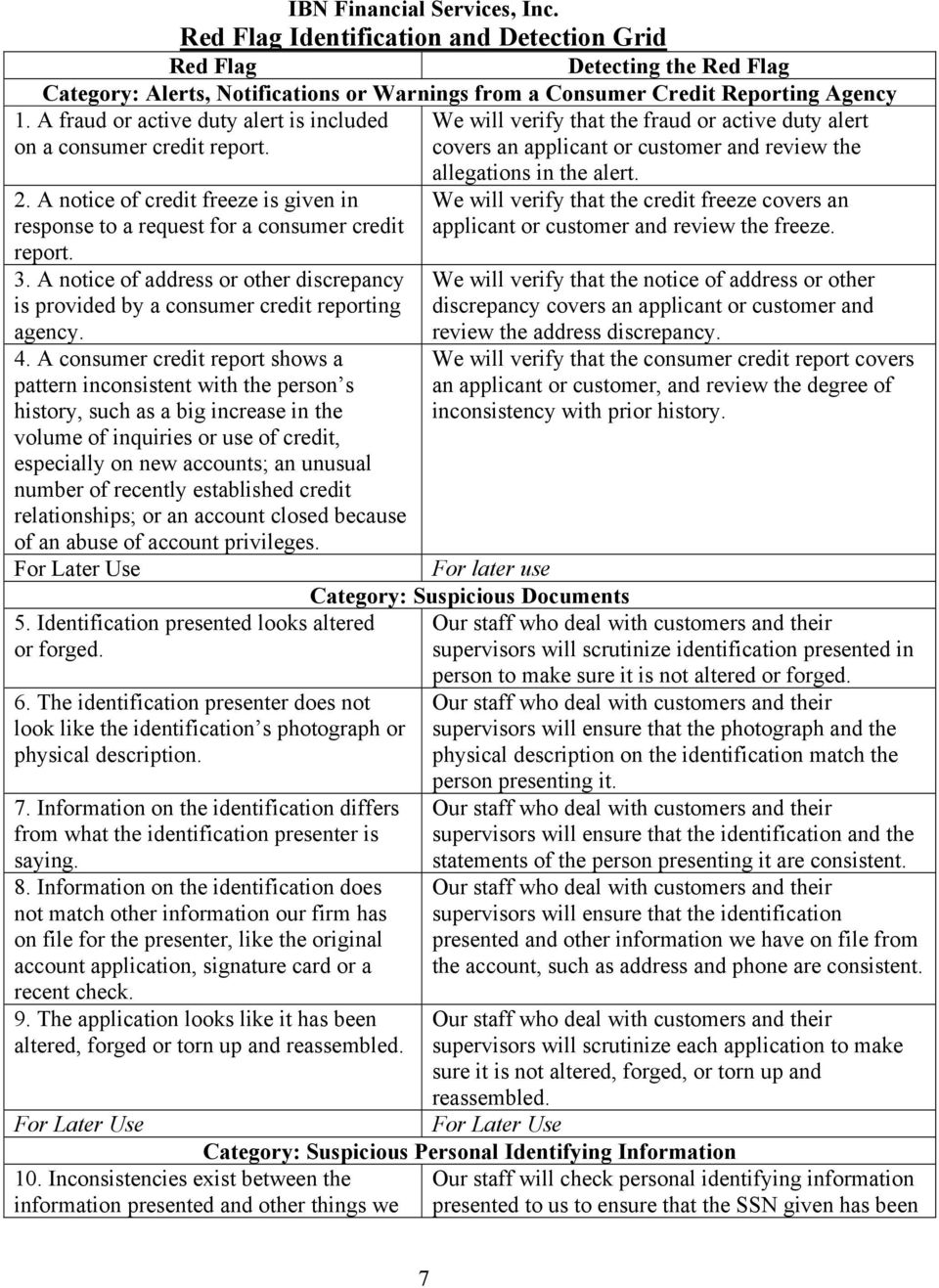
7 IBN Financial Services, Inc. Red Flag Identification and Detection Grid Red Flag Detecting the Red Flag Category: Alerts, Notifications or Warnings from a Consumer Credit Reporting Agency 1. A fraud or active duty alert is included We will verify that the fraud or active duty alert on a consumer credit report. covers an applicant or customer and review the 2. A notice of credit freeze is given in response to a request for a consumer credit report. 3. A notice of address or other discrepancy is provided by a consumer credit reporting agency. 4. A consumer credit report shows a pattern inconsistent with the person s history, such as a big increase in the volume of inquiries or use of credit, especially on new accounts; an unusual number of recently established credit relationships; or an account closed because of an abuse of account privileges. 5. Identification presented looks altered or forged. 6. The identification presenter does not look like the identification s photograph or physical description. 7. Information on the identification differs from what the identification presenter is saying. 8. Information on the identification does not match other information our firm has on file for the presenter, like the original account application, signature card or a recent check. 9. The application looks like it has been altered, forged or torn up and reassembled. allegations in the alert. We will verify that the credit freeze covers an applicant or customer and review the freeze. We will verify that the notice of address or other discrepancy covers an applicant or customer and review the address discrepancy. We will verify that the consumer credit report covers an applicant or customer, and review the degree of inconsistency with prior history. For later use Category: Suspicious Documents supervisors will scrutinize identification presented in person to make sure it is not altered or forged. supervisors will ensure that the photograph and the physical description on the identification match the person presenting it. supervisors will ensure that the identification and the statements of the person presenting it are consistent. supervisors will ensure that the identification presented and other information we have on file from the account, such as address and phone are consistent. supervisors will scrutinize each application to make sure it is not altered, forged, or torn up and reassembled. Category: Suspicious Personal Identifying Information 10. Inconsistencies exist between the information presented and other things we Our staff will check personal identifying information presented to us to ensure that the SSN given has been 7
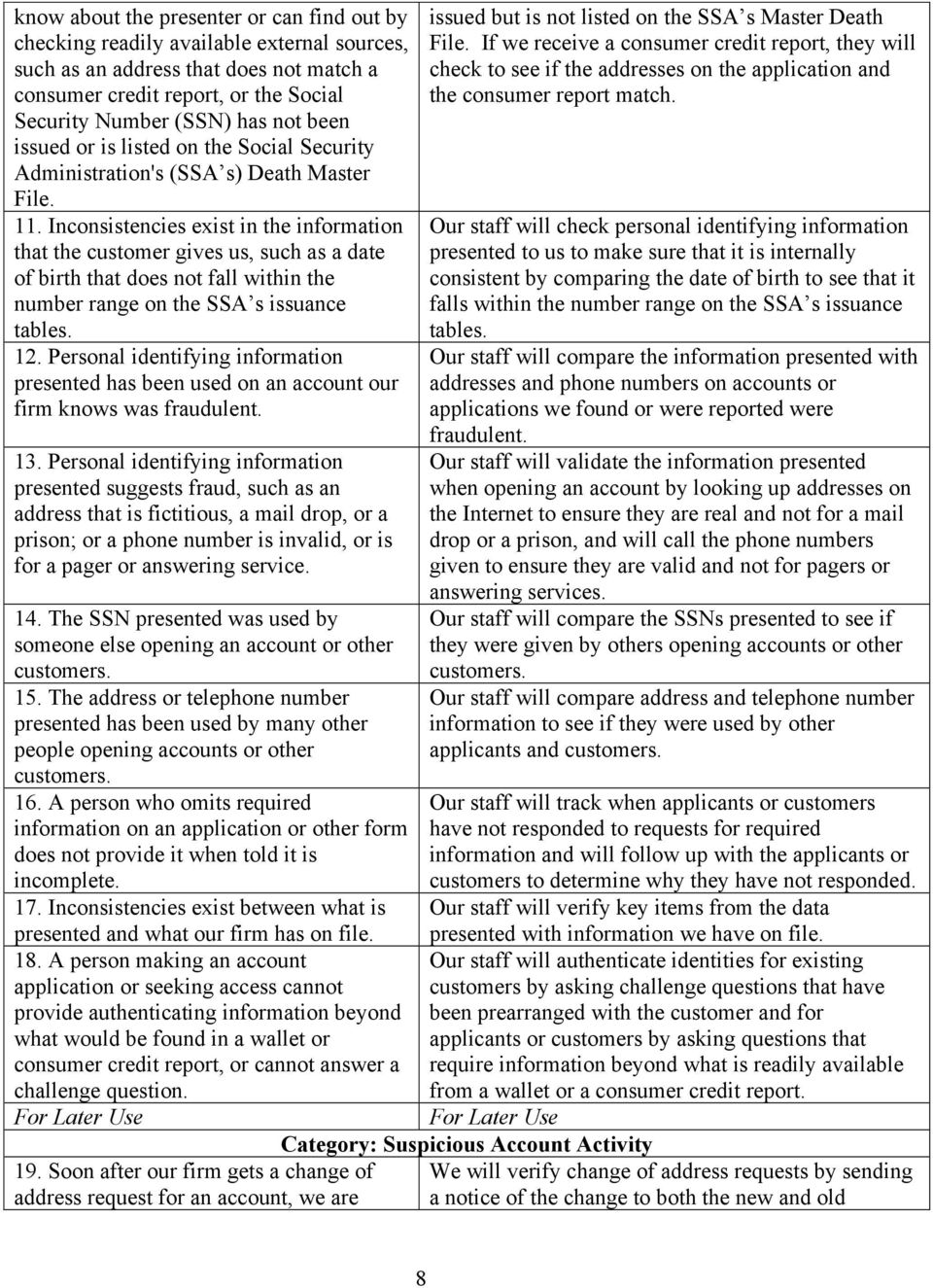
8 know about the presenter or can find out by checking readily available external sources, such as an address that does not match a consumer credit report, or the Social Security Number (SSN) has not been issued or is listed on the Social Security Administration's (SSA s) Death Master File. 11. Inconsistencies exist in the information that the customer gives us, such as a date of birth that does not fall within the number range on the SSA s issuance tables. 12. Personal identifying information presented has been used on an account our firm knows was fraudulent. 13. Personal identifying information presented suggests fraud, such as an address that is fictitious, a mail drop, or a prison; or a phone number is invalid, or is for a pager or answering service. 14. The SSN presented was used by someone else opening an account or other customers. 15. The address or telephone number presented has been used by many other people opening accounts or other customers. 16. A person who omits required information on an application or other form does not provide it when told it is incomplete. 17. Inconsistencies exist between what is presented and what our firm has on file. 18. A person making an account application or seeking access cannot provide authenticating information beyond what would be found in a wallet or consumer credit report, or cannot answer a challenge question. 19. Soon after our firm gets a change of address request for an account, we are issued but is not listed on the SSA s Master Death File. If we receive a consumer credit report, they will check to see if the addresses on the application and the consumer report match. Our staff will check personal identifying information presented to us to make sure that it is internally consistent by comparing the date of birth to see that it falls within the number range on the SSA s issuance tables. Our staff will compare the information presented with addresses and phone numbers on accounts or applications we found or were reported were fraudulent. Our staff will validate the information presented when opening an account by looking up addresses on the Internet to ensure they are real and not for a mail drop or a prison, and will call the phone numbers given to ensure they are valid and not for pagers or answering services. Our staff will compare the SSNs presented to see if they were given by others opening accounts or other customers. Our staff will compare address and telephone number information to see if they were used by other applicants and customers. Our staff will track when applicants or customers have not responded to requests for required information and will follow up with the applicants or customers to determine why they have not responded. Our staff will verify key items from the data presented with information we have on file. Our staff will authenticate identities for existing customers by asking challenge questions that have been prearranged with the customer and for applicants or customers by asking questions that require information beyond what is readily available from a wallet or a consumer credit report. Category: Suspicious Account Activity We will verify change of address requests by sending a notice of the change to both the new and old 8
9 asked to add additional access means (such as debit cards or checks) or authorized users for the account. 20. A new account exhibits fraud patterns, such as where a first payment is not made or only the first payment is made, or the use of credit for cash advances and securities easily converted into cash. 21. An account develops new patterns of activity, such as nonpayment inconsistent with prior history, a material increase in credit use, or a material change in spending or electronic fund transfers. 22. An account that is inactive for a long time is suddenly used again. 23. Mail our firm sends to a customer is returned repeatedly as undeliverable even though the account remains active. 24. We learn that a customer is not getting his or her paper account statements. 25. We are notified that there are unauthorized charges or transactions to the account. 26. We are told that an account has been opened or used fraudulently by a customer, an identity theft victim, or law enforcement. We learn that unauthorized access to the customer s personal information took place or became likely due to data loss (e.g., loss of wallet, birth certificate, or laptop), leakage, or breach. addresses so the customer will learn of any unauthorized changes and can notify us. We will review new account activity to ensure that first and subsequent payments are made, and that credit is primarily used for other than cash advances and securities easily converted into cash. We will review our accounts on at least a monthly basis and check for suspicious new patterns of activity such as nonpayment, a large increase in credit use, or a big change in spending or electronic fund transfers. We will review our accounts on at least a monthly basis to see if long inactive accounts become very active. We will note any returned mail for an account and immediately check the account s activity. We will record on the account any report that the customer is not receiving paper statements and immediately investigate them. We will verify if the notification is legitimate and involves a firm account, and then investigate the report. Category: Notice From Other Sources We will verify that the notification is legitimate and involves a firm account, and then investigate the report. We will contact the customer to learn the details of the unauthorized access to determine if other steps are warranted. 9

Interagency Guidelines on Identity Theft Detection, Prevention, and Mitigation
 Guidelines to FTC Red Flag Rule(reformatted) Appendix A to Part 681 Interagency Guidelines on Identity Theft Detection, Prevention, and Mitigation Section 681.2 of this part requires each financial institution
Administrative Procedure 5800 Prevention of Identity Theft in Student Financial Transactions
 Reference: Fair and Accurate Credit Transactions Act, ( Pub. L. 108-159) The purpose of the Identity Theft Prevention Program (ITPP) is to control reasonably foreseeable risks to students from identity
UNION COUNTY S IDENTITY THEFT PREVENTION PROGRAM
 UNION COUNTY S IDENTITY THEFT PREVENTION PROGRAM This program shall become effective November 1, 2008. Adopted this the 20 th day of October, 2008. I. PREFACE The purpose of this program is to detect,
University Identity Theft and Detection Program (NEW) All Campuses and All Service Providers Subject to the Red Flags Rule
 NUMBER: BUSF 4.12 SECTION: SUBJECT: Finance and Planning University Identity Theft and Detection Program (NEW) DATE: March 3, 2011 Policy for: Procedure for: Authorized by: Issued by: All Campuses and
EXHIBIT A Identity Theft Protection Program. Definitions. For purposes of the Policy, the following definitions apply (1);
 EXHIBIT A Identity Theft Protection Program Definitions. For purposes of the Policy, the following definitions apply (1); A. City means: the City of Troy, Montana B. Covered Account means: An account that
University Policy: Identity Theft Prevention Policy
 University Policy: Identity Theft Prevention Policy Policy Category: Ethics, Integrity and Legal Compliance Policies Subject: Detection, prevention and mitigation of identity theft Office Responsible for
Identity Theft Policy Created: June 10, 2009 Author: Financial Services and Information Technology Services Version: 1.0
 Identity Theft Policy Created: June 10, 2009 Author: Financial Services and Information Technology Services Version: 1.0 Scope: The risk to Loyola University Chicago and its faculty, staff and students
POLICY NO. 449 IDENTITY THEFT PREVENTION POLICY
 POLICY NO. 449 IDENTITY THEFT PREVENTION POLICY I. POLICY SUMMARY It shall be the policy of Polk County Rural Public Power District (PCRPPD) to take all reasonable steps to identify, detect, and prevent
University of St. Thomas. Identity Theft Prevention Program. (Red Flags Regulation Response)
 University of St. Thomas Identity Theft Prevention Program (Red Flags Regulation Response) Revised: January 10, 2013 Program Adoption and Administration The University of St. Thomas ( University ) established
Wake Forest University. Identity Theft Prevention Program. Effective May 1, 2009
 Wake Forest University Identity Theft Prevention Program Effective May 1, 2009 I. GENERAL It is the policy of Wake Forest University ( University ) to comply with the Federal Trade Commission's ( FTC )
NEVADA SYSTEM OF HIGHER EDUCATION PROCEDURES AND GUIDELINES MANUAL CHAPTER 13 IDENTITY THEFT PREVENTION PROGRAM (RED FLAG RULES)
 NEVADA SYSTEM OF HIGHER EDUCATION PROCEDURES AND GUIDELINES MANUAL CHAPTER 13 IDENTITY THEFT PREVENTION PROGRAM (RED FLAG RULES) Section 1. NSHE... 2 Section 2. UNR... 4 Section 3. WNC... 9 Chapter 13,
UNIVERSITY OF MASSACHUSETTS IDENTITY THEFT PREVENTION PROGRAM
 Doc. T08-109 Passed by the BoT 12/11/08 UNIVERSITY OF MASSACHUSETTS IDENTITY THEFT PREVENTION PROGRAM The Board recognizes that some activities of the University are subject to the provisions of the Fair
Spotting ID Theft Red Flags A Guide for FACTA Compliance. An IDology, Inc. Whitepaper
 Spotting ID Theft Red Flags A Guide for FACTA Compliance An IDology, Inc. Whitepaper With a November 1 st deadline looming for financial companies and creditors to comply with Sections 114 and 315 of the
RADLEY ACURA RED FLAG IDENTITY THEFT PROTECTION PROGRAM and ADDRESS DISCREPANCY PROGRAM
 RADLEY ACURA RED FLAG IDENTITY THEFT PROTECTION PROGRAM and ADDRESS DISCREPANCY PROGRAM SUMMARY OF OUR PROGRAM AND PROCESSES This dealership is committed to protecting its customers and itself from identity
DHHS POLICIES AND PROCEDURES
 DHHS POLICIES AND PROCEDURES Section VIII: Privacy and Security Identity Theft Policies, Identity Theft Red Flags and Address Discrepancy Identity Theft Policies Current Effective 2/1/16, 10/1/15 Date:
I. Purpose. Definition. a. Identity Theft - a fraud committed or attempted using the identifying information of another person without authority.
 Procedure 3.6: Rule (Identity Theft Prevention) Volume 3: Office of Business & Finance Managing Office: Office of Business & Finance Effective Date: December 2, 2014 I. Purpose In 2007, the Federal Trade
Texas A&M University Commerce. Identity Theft Prevention Program Effective beginning May 1, 2009
 Texas A&M University Commerce Identity Theft Prevention Program Effective beginning May 1, 2009 1 I. PROGRAM ADOPTION Texas A&M University - Commerce ( University ) developed this Identity Theft Prevention
PROVISIONS IDENTITY THEFT RED FLAG FAQS
 R E D F L A G PROVISIONS 2 0 0 9 IDENTITY THEFT RED FLAG FAQS Provided to you by P r e p a r e d b y Eduard Goodman, J.D.,LL.M. Chief Privacy Officer I d e n t i t y T h e f t 9 11, L L C FREQUENTLY ASKED
Identity Theft Prevention Program
 Identity Theft Prevention Program DATE: 10/22/2015 VERSION 2015-1.0 Abstract Purpose of this document is to establish an Identity Theft Prevention Program designed to detect, prevent and mitigate identity
Red Flag Rules and Aging Services: What You Need to Know
 Red Flag Rules and Aging Services: What You Need to Know Late in 2007, six federal agencies, including the Federal Trade Commission ( FTC ), jointly issued final rules and accompanying guidelines to implement
Florida International University. Identity Theft Prevention Program. Effective beginning August 1, 2009
 Florida International University Identity Theft Prevention Program Effective beginning August 1, 2009 I. PROGRAM ADOPTION Florida International University developed this Identity Theft Prevention Program
[FACILITY NAME] IDENTITY THEFT PREVENTION PROGRAM. Effective May 1, 2009
![[FACILITY NAME] IDENTITY THEFT PREVENTION PROGRAM. Effective May 1, 2009](/thumbs/29/13346234.jpg "[FACILITY NAME] IDENTITY THEFT PREVENTION PROGRAM. Effective May 1, 2009") [FACILITY NAME] IDENTITY THEFT PREVENTION PROGRAM Effective May 1, 2009 Because [FACILITY NAME] offers and maintains covered accounts, as defined by 16 C.F.R. Part 681 (the Regulations ), [FACILITY NAME]
[FACILITY NAME] IDENTITY THEFT PREVENTION PROGRAM Effective May 1, 2009 Because [FACILITY NAME] offers and maintains covered accounts, as defined by 16 C.F.R. Part 681 (the Regulations ), [FACILITY NAME]
21.01.04.Z1.01 Guideline: Identity Theft Prevention Program
 Texas A&M Health Science Center Guidelines 21.01.04.Z1.01 Guideline: Identity Theft Prevention Program Approved October 7, 2009 Reviewed February 26, 2015 Supplements System Regulation 21.01.04 Reason
Village of Brockport Identity Theft Prevention Program Effective December 1, 2009 Confirmed 7/21/14
 Village of Brockport Identity Theft Prevention Program Effective December 1, 2009 Confirmed 7/21/14 I. PROGRAM ADOPTION The Village of Brockport ( Village ) developed this Identity Theft Prevention Program
DOYLESTOWN FAMILY MEDICINE, P.C. IDENTITY THEFT PREVENTION PROGRAM TEMPLATE ADOPTED AND EFFECTIVE: APRIL 15, 2009 UPDATED:
 DOYLESTOWN FAMILY MEDICINE, P.C. IDENTITY THEFT PREVENTION PROGRAM TEMPLATE ADOPTED AND EFFECTIVE: APRIL 15, 2009 UPDATED: I. Adoption of Identity Theft Prevention Program Doylestown Family Medicine, P.C.
Facts About FACTA Red Flag Identity Theft Prevention Program
 FACTA Red Flag Identity Theft Prevention Program FACTA Red Flag Policy Program, page 1 of 6 Contents Overview 3 Definition of Terms 3 Covered Accounts..3 List of Red Flags 3 Suspicious Documents...4 Suspicious
CITY OF MARQUETTE, MICHIGAN CITY COMMISSION POLICY
 CITY OF MARQUETTE, MICHIGAN CITY COMMISSION POLICY Policy Number: 2008-02 Date Adopted: October 27, 2008 Department: Administrative SUBJECT: IDENTITY THEFT PREVENTION PROGRAM I. OBJECTIVE: A. To protect
RANDOLPH COUNTY PUBLIC WORKS. Identity Theft Prevention Program. Adopted September 1, 2009 Effective beginning September 1, 2009
 RANDOLPH COUNTY PUBLIC WORKS Identity Theft Prevention Program Adopted September 1, 2009 Effective beginning September 1, 2009 I. PROGRAM ADOPTION The Randolph County Public Works Department ( the Department
identity TheFT PREVENTION Programs and Response
 IDENTITY THEFT PREVENTION PROGRAM This program is launched in response to the Federal Trade Commission Red Flag Rules and Address Discrepancy Rules in conjunction with the Fair and Accurate Credit Transaction
University of Alaska. Identity Theft Prevention Program
 University of Alaska Identity Theft Prevention Program Effective beginning October 31, 2009 I. PROGRAM ADOPTION The University of Alaska ( University ) developed this Identity Theft Prevention Program
RESOLUTION NO. 2009-1
 RESOLUTION NO. 2009-1 A RESOLUTION OF THE MAYOR AND COUNCI8L OF THE CITY OF ST. ANTHONY, IDAHO, ADOPTING AN IDENTY THEFT PREVENTION PROGRAM WHEREAS, Section 114 of the Fair and Accurate Transaction Act
ACCG Identity Theft Prevention Program. ACCG 50 Hurt Plaza, Suite 1000 Atlanta, Georgia 30303 (404)522-5022 (404)525-2477 www.accg.
 ACCG Identity Theft Prevention Program ACCG 50 Hurt Plaza, Suite 1000 Atlanta, Georgia 30303 (404)522-5022 (404)525-2477 www.accg.org July 2009 Contents Summary of ACCG Identity Theft Prevention Program...
IDENTITY THEFT DETECTION POLICY
 IDENTITY THEFT DETECTION POLICY Approved By: President s Cabinet Date of Last Revision: May 5, 2009 Responsible Office/Department: Business and Finance Policy Statement Grand Valley State University (GVSU)
Identity theft. A fraud committed or attempted using the identifying information of another person without authority.
 SUBJECT: Effective Date: Policy Number: Identity Theft Prevention 08-24-11 2-105.1 Supersedes: Page Of 2-105 1 8 Responsible Authority: Vice President and General Counsel DATE OF INITIAL ADOPTION AND EFFECTIVE
DMACC IDENTITY THEFT- RED FLAGS PROCEDURES
 DMACC IDENTITY THEFT- RED FLAGS PROCEDURES This document contains identity theft red flag procedures for Des Moines Area Community College. Section Topic Page 1.0 2.0 3.0 4.0 5.0 6.0 7.0 8.0 XX PURPOSE
RANDOLPH COUNTY EMERGENCY SERVICES & TAX DEPARTMENT. Identity Theft Prevention Program. Adopted August 3, 2009 Effective beginning August 1, 2009
 RANDOLPH COUNTY EMERGENCY SERVICES & TAX DEPARTMENT Identity Theft Prevention Program Adopted August 3, 2009 Effective beginning August 1, 2009 I. PROGRAM ADOPTION The Randolph County Emergency Services
II. F. Identity Theft Prevention
 II. F. Identity Theft Prevention Effective Date: May 3, 2012 Revises Previous Effective Date: N/A, New Policy I. POLICY: This Identity Theft Prevention Policy is adopted in compliance with the Federal
Red Flag Rules Information and Training
 Red Flag Rules Information and Training What are Red Flag Rules? The Red Flag Rules: - Are enforced by the Federal Trade Commission (FTC), the federal bank regulatory agencies, and the National Credit
MCPHS IDENTITY THEFT POLICY
 SECTION 1: BACKGROUND MCPHS IDENTITY THEFT POLICY The risk to the College, its employees and students from data loss and identity theft is of significant concern to the College and can be reduced only
Lake Havasu City. Identity Theft Prevention Program
 Lake Havasu City Identity Theft Prevention Program Effective beginning May 1, 2009 I. PROGRAM ADOPTION Lake Havasu City (City) developed this Identity Theft Prevention Program (Program) pursuant to the
Pacific University. Policy Governing. Identity Theft Prevention Program. Red Flag Guidelines. Approved June 10, 2009
 Pacific University Policy Governing Identity Theft Prevention Program Red Flag Guidelines Approved June 10, 2009 Program adoption Pacific University developed this identity Theft Prevention Program ( Program
DSU Identity Theft Prevention Policy No. DSU 802.7.001
 1 2 3 4 5 6 7 8 9 10 11 12 13 14 15 16 17 18 19 20 21 22 23 24 25 26 27 28 29 30 31 32 33 34 35 36 37 38 39 40 41 42 43 44 45 IDENTITY THEFT PREVENTION DSU Policy No. 802.7.001 SOURCE: Fair and Accurate
Number: 56.300. Index
 Identity Theft Prevention Program Section: General Operations Title: Identity Theft Prevention Program Number: 56.300 Index POLICY.100 POLICY STATEMENT.110 POLICY RATIONALE.120 AUTHORITY.130 APPROVAL AND
Ouachita Baptist University. Identity Theft Policy and Program
 Ouachita Baptist University Identity Theft Policy and Program Under the Federal Trade Commission s Red Flags Rule, Ouachita Baptist University is required to establish an Identity Theft Prevention Program
FACTA Identity Theft Red Flags Program. www.chs.acfei.com
 1 FACTA Identity Theft Red Flags Program Module 1 Fair and Accurate Credit Transactions Act Overview Identity thieves use individual s personal identifiable information to open new accounts and misuse
Oklahoma State University Policy and Procedures. Red Flags Rules and Identity Theft Prevention
 Oklahoma State University Policy and Procedures Rules and Identity Theft Prevention 3-0540 ADMINISTRATION & FINANCE July 2009 Introduction 1.01 Oklahoma State University developed this Identity Theft Prevention